biology Crossword Puzzles

Biology exam review 2013-01-14

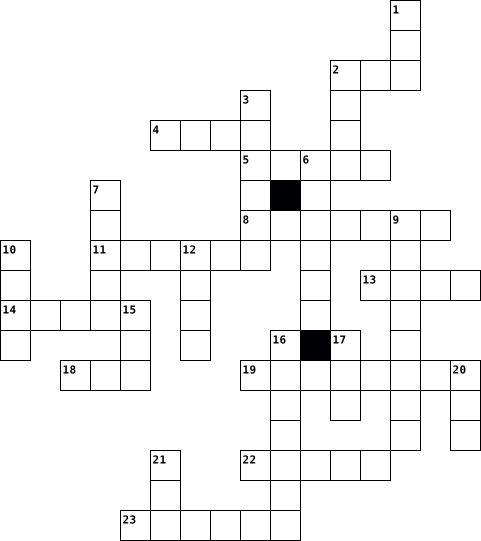
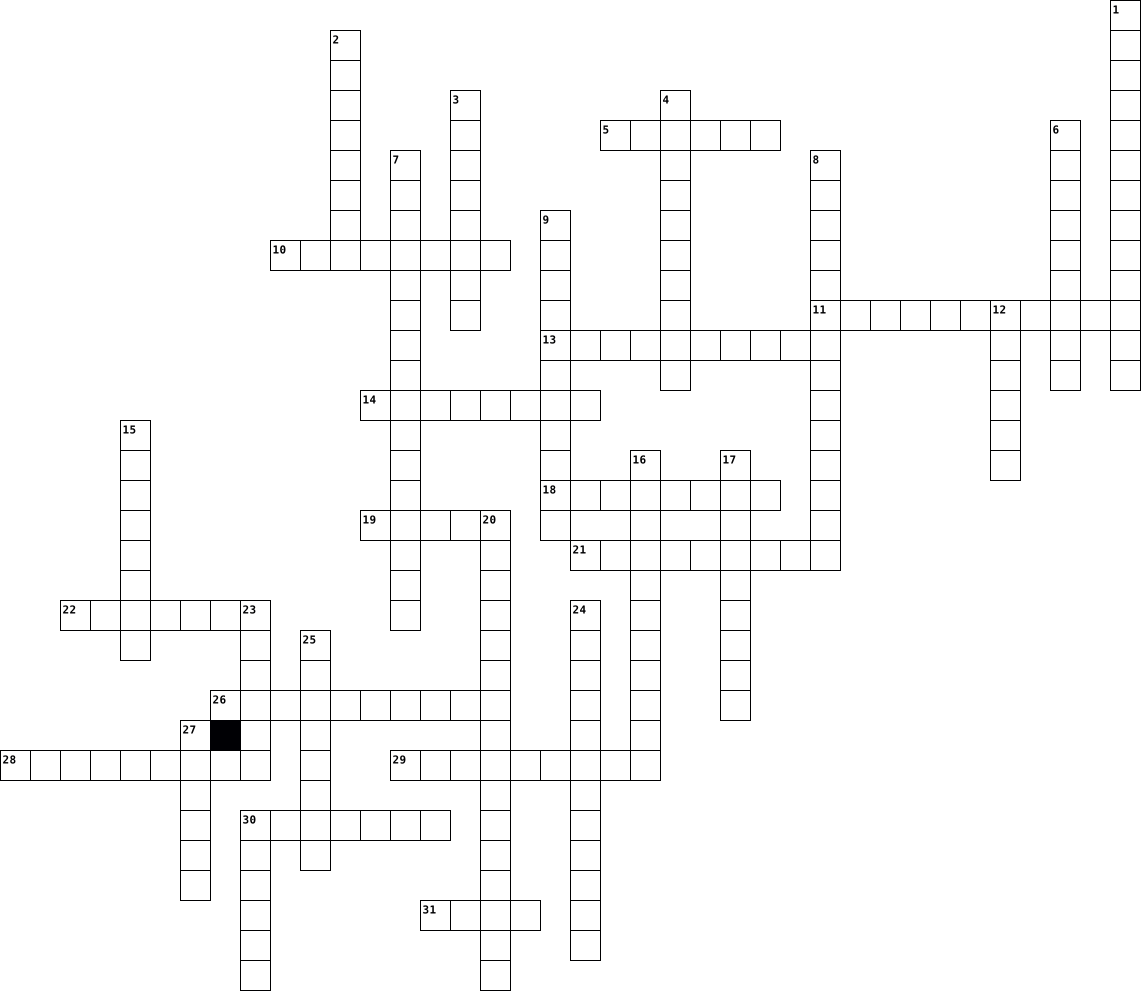
Biology exam review crossword puzzle
Across
  1. factors such as weather and climate affect the population size
  2. the role that the organism plays in a community
  3. the relationship where one organism feeds on a host organism
  4. biology is the study of
  5. in the body lower the amount of activation energy needed to make a reaction take place
  6. has a ph lower than 7
  7. organisms must maintain a stable internal balance known as
  8. solution is where there is higher concentration of a substance on one side of the membrane than there is on the other
  9. back and fourth changes between two species that interact
  10. make proteins
  11. is made up of a group of organisms of the same species that live together in one place at a time
  12. makes energy and ATP using sugar
  13. molecules have charged ends
  14. the largest population that an environment can support at any given time
  15. proteins are made up of many chains of
  16. transport does not require energy
  17. growth occurs when the numbers of a population increase by a certain factor in each successive period over time
  18. water molecules retain heat well and help maintain in the body
  19. bonds are when atoms with two different charges bond together
  20. breaks down old cell parts
  21. bonds are when bonds share electrons
  22. is the change in an ecosystem where one community slowly replaces another community
  23. eletrons have a charge
  24. the human population is over and still growing
  25. is the diffusion of water across a selectively permeable membrane
  26. carbs and molecules made up of sugars, they supply organisms with
  27. is the element of life
  28. cells will communicate with each other using this signal which are recieved by receptor proteins
  29. the major greenhouse gas in the atmosphere
  30. the cell membrane is made up of this bilayer which contains phosopholipids
  31. blocks out harmful ultra violet rays from the sun
Down
  1. factors such as competition, food supply, disease, and predation can also effect a population size
  2. group serves as a standard of comparison because the group recieves no experimental treatment
  3. the greatest threat to the earths many ecosystem is the population
  4. is a posibble explanation that can be tested by experimentation
  5. the factors that change as in response to the independent variable
  6. has a ph lower than 7
  7. are polluntants which destroy the ozone layer of the atmosphere
  8. species is a species that is critical to an ecosystem because it effects the survival and number of many other species
  9. is the movement of molecules from a high concentration to a low concentration
  10. cells use this to move larg particles out of the cell
  11. the relationship in which two species live in a close association with eachother
  12. used for cell support
  13. packages and ships proteins
  14. make sugar
  15. is a place where fresh and salt water mix
  16. cells do not have a nucleus
  17. need to eat other consumers for food
  18. global warming is produced due o the effect
  19. communities with this are more resilent than others
  20. is symbiosis where one benefits and the other is not harmed
  21. the single factor that scientist change in an experiment
  22. all the species in an ecosystem
  23. lipids, include fats, steroids, waxes, and oils repel water because they are
  24. to move large larticles into the cell
  25. diffusion uses transport proteins to move substances throught the cell membrane
  26. is the type of symbiosis where both species benefit
  27. cells have a nucleus surrounded by cytoplasm
  28. matter is made up of only one type of atom
  29. producers use to make energy
  30. is very important because it helps build proteins for the body
  31. growth occurs when a population starts with a miminum number of individuals and grows until it reaches the carrying capacity of a habitat
  32. all matter is composed of
  33. protects DNA
  34. a place where an organism lives
  35. is a large region characterized by specific kinds of plants and animals

66 Clues: make sugarprotects DNAmake proteinshas a ph lower than 7has a ph lower than 7used for cell supportis the element of lifebiology is the study ofall matter is composed ofbreaks down old cell partspackages and ships proteinscells do not have a nucleusmolecules have charged endseletrons have a chargeall the species in an ecosystem...

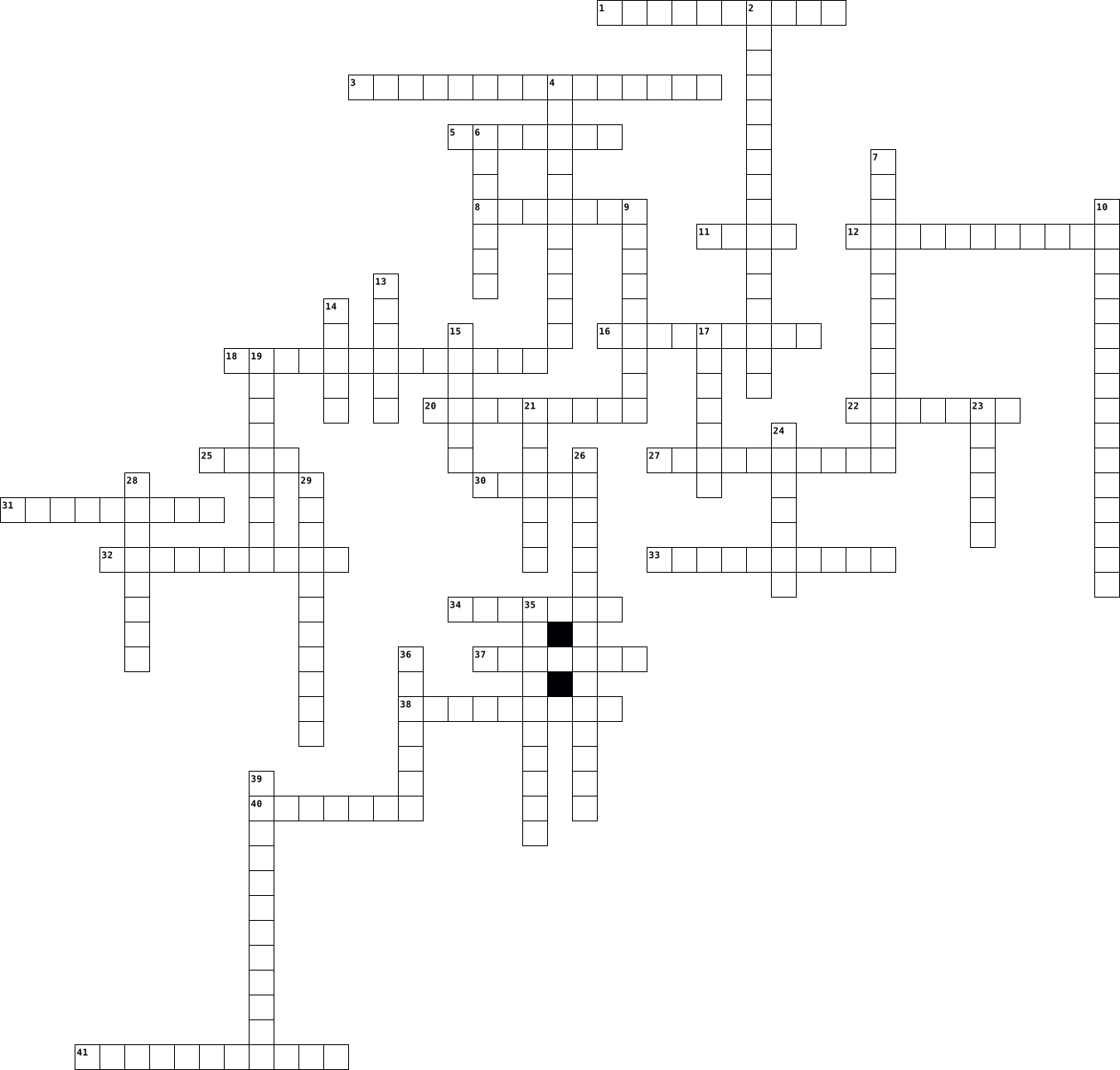
Biology Crossword Puzzle 2013-01-24

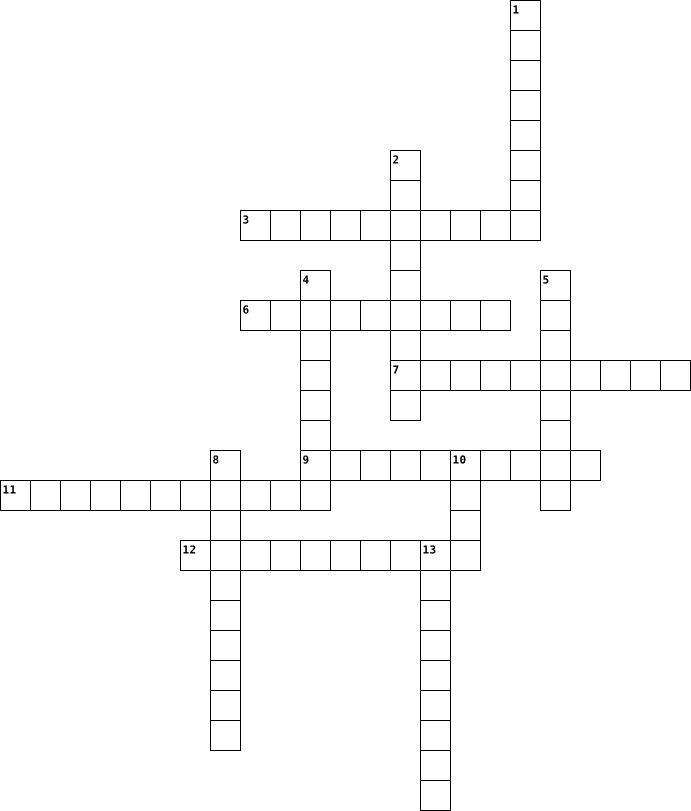
Biology Crossword Puzzle crossword puzzle
Across
  1. Which of the two nucleic acids contains sugar deoxyribose?
  2. What accepts and holds two high-energy electrons and a hydrogen atom?
  3. Releases food energy by using ATP in the absence of oxygen
  4. An organized way of using evidence to learn about the natural world
  5. Which molecule transfers amino acids to ribosomes as was specified by mRNA?
  6. What is the name for adenine, thymine and guanine, cytosine parings?
  7. What two light dependent reactions reused in the Calvin Cycle (a & is used in the answer)
  8. What enzyme is needed for transcription?
  9. What indicates the H+ levels in a solution?
  10. What is the fundamental concept of biology?
  11. Hypothesis that is so well accepted by other scientists
  12. Reproduction sexually
  13. What is the only spot that an enzyme will bind to?
Down
  1. What is this equation for? 6CO + 6H O ---- C + H + O + 6O
  2. What is the real name for ATP?
  3. One strain of bacteria that can infect another benign strand
  4. Which of the two nucleic acids contains sugar ribose?
  5. What shows the relative location of each known gene?
  6. Means 'bacteria eater'
  7. The long molecules DNA is made of
  8. What term makes this equation? pyruvic acid + NADN ---- lactic acid NAD+
  9. What is needed to start a reaction?
  10. What is the principal enzyme involved in DNA replication?
  11. Term that means 'not in air'
  12. Cells with one set of genes
  13. Homologus pairs form tetrads and exchange portions of chromatids
  14. When Cytoplasm extends itself and 'eats' a particle
  15. What process takes materials into the infolds, or pockets of the cell membrane?
  16. In what cycle does the presence of oxygen, pyruvic acid in the glucose pass on to the second stage of reprodiction?
  17. The first stage of division in the cells nucleus

30 Clues: Reproduction sexuallyMeans 'bacteria eater'Cells with one set of genesTerm that means 'not in air'What is the real name for ATP?The long molecules DNA is made ofWhat is needed to start a reaction?What enzyme is needed for transcription?What indicates the H+ levels in a solution?What is the fundamental concept of biology?...

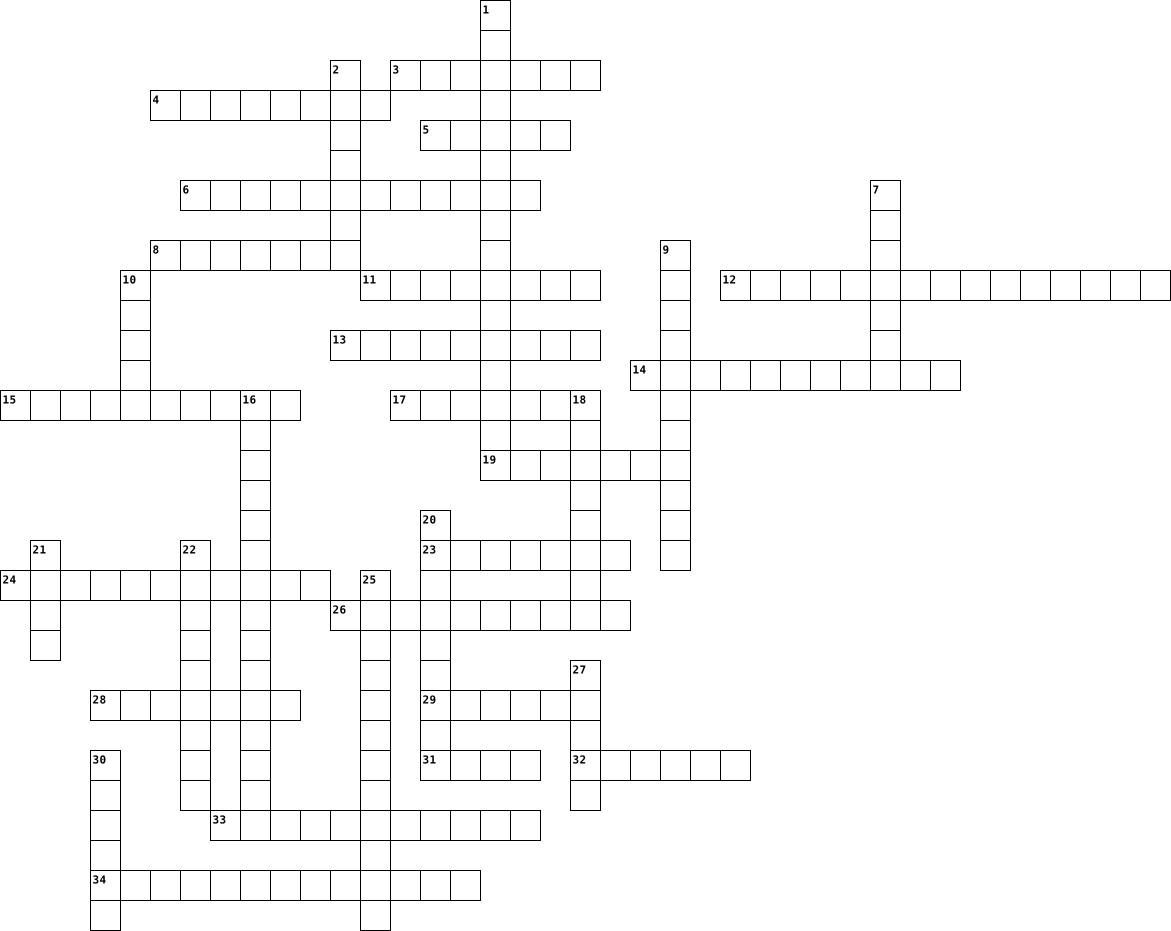
Biology Semester Project 2013-01-23

Biology Semester Project crossword puzzle
Across
  1. The information gathered from observations
  2. Evidence from numerous investigations build up a particular hypothesis and may be well supported
  3. Positively and negatively charged atoms
  4. Compounds made up of carbon, hydrogen, and oxygen atoms
  5. Negatively charged particle with 1/1840, the mass of a proton
  6. The study of chemistry begins with the basic unit of matter
  7. Cells that contain a nuclei
  8. Reactants of enzyme-catalyzed reactions
  9. Cells that do not contain a nuclei
  10. Plants use the energy of sunlight to convert water and carbon dioxide into high-energy carbohydrates
  11. Any compound that forms H+ ions in solution
  12. Exchange portions of their chromatids
  13. Cells also produce a strong supporting layer around the membrane
  14. Pure substance that consists entirely of one type of atom
  15. Atoms of the same element that diff in the number of neutrons they contain
  16. Proteins that act as biological catalysts
  17. Diffusion of water through a selectively permeable membrane
Down
  1. Compound that produces hydroxide ions OH- in solution
  2. Substance that speeds up the rate of a chemical reaction
  3. Energy to get the reaction started
  4. Surrounded by a thin flexible barrier
  5. Specialized subunit within a cell that has a specific function
  6. Are not involved in coding for proteins
  7. Portion of the cell outside the nucleus
  8. Forms when electrons are shared between atoms
  9. A proposed scientific explanation for a set of observations
  10. Logical interpretation based on prior knowledge
  11. Formed when one or more electrons are transferred from one atom to another
  12. Attraction between molecules of different substances
  13. Is the smallest unit of most compounds
  14. The final result in a chemical reaction
  15. Basic units of life
  16. Attraction between molecules of the same substance
  17. Strong forces bind protons and neutrons together to form...
  18. The DNA sequence that code for proteins

35 Clues: Basic units of lifeCells that contain a nucleiEnergy to get the reaction startedCells that do not contain a nucleiSurrounded by a thin flexible barrierExchange portions of their chromatidsIs the smallest unit of most compoundsPositively and negatively charged atomsAre not involved in coding for proteinsPortion of the cell outside the nucleus...

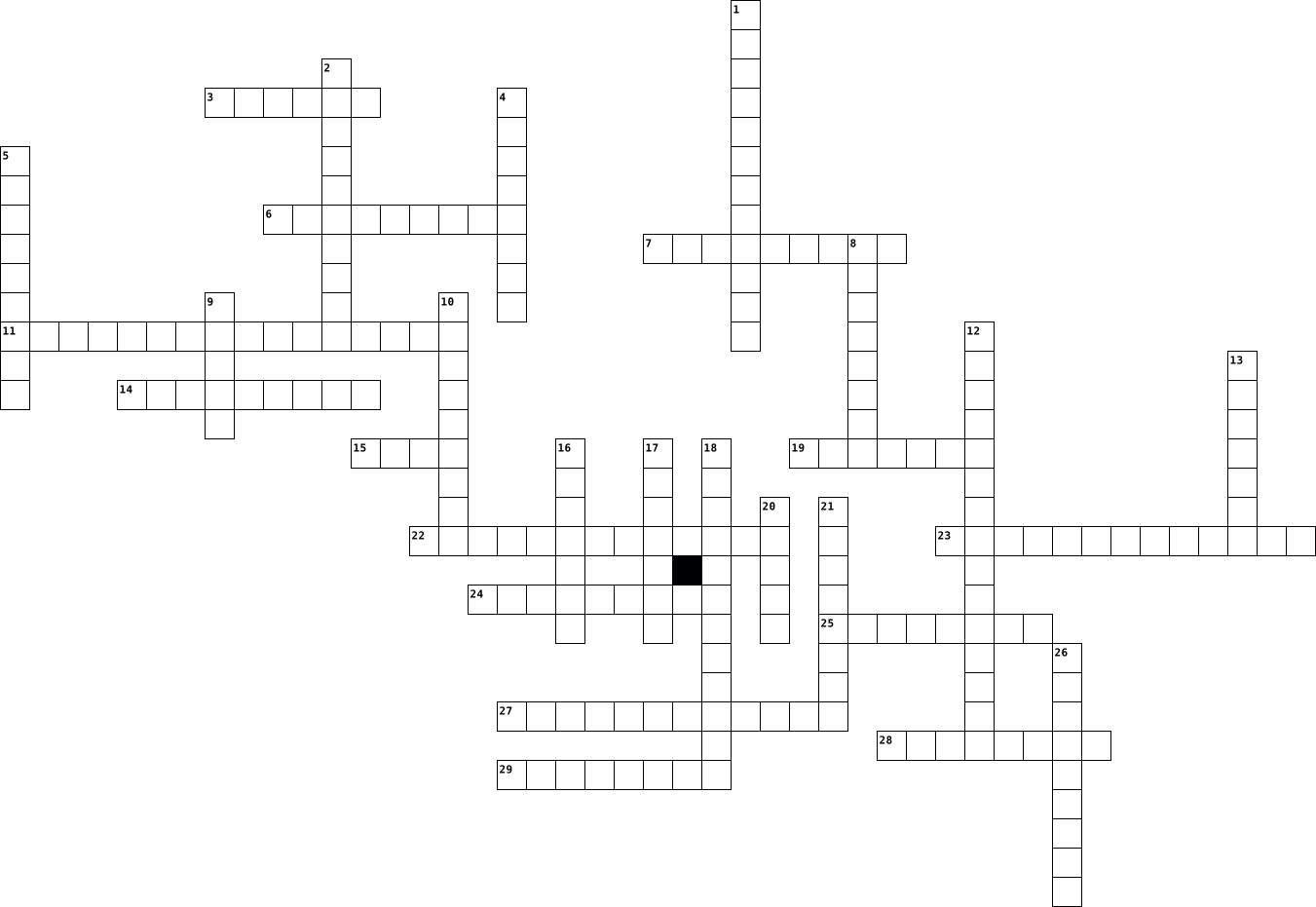
Biology Crossword Puzzle 2013-04-13

Biology Crossword Puzzle crossword puzzle
Across
  1. contain only a single set of chromosomes and therefore only a set of genes
  2. cells that do not contain nuclei
  3. a slight attraction can develop between the oppositely charged regions of nearby molecules.
  4. the process of gathering information about events or processes in a careful, orderly way.
  5. second phase of mitosis and often times only lasts a few minutes
  6. a pure substance that consists entirely of one type of atom
  7. the site where lipid components of the cell membrane are assembled, along with proteins and other materials that are exported from the cell
  8. portion of the cell outside the nucleus
  9. forms when electrons are shared between atoms
  10. 2 tiny structures located in the cytoplasm near the nuclear envelope, separate and take up positions on opposite sides of the nucleus.
  11. proteins that act as biological catalysts.
  12. cell is able to reproduce so that a group of cells.
  13. an attraction between molecules of the same substance.
  14. strong forces bind protons and neutrons together to form the ______
  15. small particles of RNA and protein found throughout the cytoplasm
  16. amount of energy needed to raise the temperature of a gram of water degree celsius
  17. system a decimal system of measurements whose units are based on certain physical standards and are scaled on certain physical standards and are scaled on multiples of 10.
  18. an organized way of using evidence to learn about the natural
  19. the first and longest stage of mitosis
Down
  1. the science that employs the scientific method to study living things
  2. plants use high energy of sunlight to convert water and carbon dioxide into high-energy carbohydrates
  3. variable that is observed and that changes in response to the manipulated variable is called _______
  4. organisms that make their own food
  5. Bond/ formed when one or more electrons are transferred from one atom to another.
  6. variable that is deliberately changed
  7. a kind of virus that infects bacteria
  8. atoms of the same element that differ in the number of neutrons they contain.
  9. organisms that obtain energy from foods they consume
  10. a cell that contains both sets of homologous chromosomes
  11. cells that contain nuclei
  12. devices that produce magnified images of structures that are too small to see with the unaided eye
  13. proposed scientific explanation for a set of observations
  14. the process of homologous chromosomes pairing up and forming tetras in meiosis I then exchanging portion of their chromatids is called ___
  15. positively and negatively charged atoms
  16. a substance that speeds up the rate of a chemical reaction
  17. region outside of the thylakoid membranes
  18. a substance formed by the chemical combination of two or more elements in definite proportions.
  19. smallest unit of most compounds
  20. a disorder in which some of the body's own cells lose the ability to control cell growth

39 Clues: cells that contain nucleismallest unit of most compoundscells that do not contain nucleiorganisms that make their own foodvariable that is deliberately changeda kind of virus that infects bacteriathe first and longest stage of mitosisportion of the cell outside the nucleuspositively and negatively charged atoms...

AP Biology Vocab 2014-04-27

AP Biology Vocab crossword puzzle
Across
  1. radiation- the diversification of a group of organisms into forms filling different ecological niches.
  2. does not vary with changes in the environment.
  3. evolution- the process whereby organisms not closely related, independently evolve similar traits as a result of having to adapt to similar environments or ecological niches.
  4. the chemical element of atomic number 6, a nonmetal that has two main forms and that also occurs in impure form in charcoal, soot, and coal.
  5. species-group of individuals which can breed together
  6. extinction rate-refers to the standard rate of extinction in earth's geological and biological history before humans became a primary contributor to extinctions.
  7. of a large group of organic compounds occurring in foods and living tissues and including sugars, starch, and cellulose.
  8. or authority over.
  9. protein-long filamentous protein molecules.
  10. protein-are spherical proteins that are somewhat water-soluble.
  11. instrument for making a recording
  12. of two or more alternative forms of a gene that arise by mutation and are found at the same place on a chromosome.
  13. ancestor- a group of organisms share common descent
  14. both hydrophilic and hydrophobic parts.
  15. structure- Body part in different species that is similar in function but not in structure that evolved in response to a similar environmental challenge.
  16. reasoning-a logical process in which a conclusion is based on the concordance of multiple premises that are generally assumed to be true.
Down
  1. variable-a variable whose value depends on that of another.
  2. bond-type of covalent bond that joins a carbohydrate molecule to another group.
  3. close a result comes to the true value
  4. acid-a simple organic compound containing both a carboxyl and an amino group.
  5. the branch of biology that deals with the geographical distribution of plants and animals.
  6. selection-the intentional reproduction of individuals in a population that have desirable traits
  7. in separate non-overlapping geographical areas.
  8. influence of closely associated species on each other in their evolution.
  9. bond-They are derived by reacting an oxoacid with a hydroxyl compound such as an alcohol or phenol.
  10. any of a class of sugars whose molecules contain two monosaccharide residues.
  11. anatomy- the study of similarities and differences in the anatomy of different species.
  12. A process in which the folding structure of a protein is altered due to exposure to certain chemical or physical factors causing the protein to become biologically inactive.
  13. the action or process of adapting or being adapted.
  14. supposition or proposed explanation made on the basis of limited evidence as a starting point for further investigation.

30 Clues: or authority over.instrument for making a recordingclose a result comes to the true valueboth hydrophilic and hydrophobic parts.protein-long filamentous protein molecules.does not vary with changes in the environment.in separate non-overlapping geographical areas.ancestor- a group of organisms share common descent...

Biology Christmas Crossword 2013-12-11

Biology Christmas Crossword crossword puzzle
Across
  1. good source of calcium in a glass
  2. has the Latin name Ilex
  3. Santa will have to look after this with regular exercise
  4. what reindeers like to eat
  5. used by reindeers for displaying
  6. what Santa may get if he gets too fat on mince pies
  7. Christmas trees that don't drop their leaves
  8. plant gathered from trees brings people together
  9. these will be slowed by too much drink
  10. pointed and found on an elf head
  11. shines brightly in the dark
  12. thick insulation for Santa's head
  13. has the Latin name Hedera
  14. elven police may ask Santa for a sample of this
Down
  1. elven police may ask Santa for a sample of this
  2. found in the sherry, thins Santa's blood
  3. where Santa lives (5,4)
  4. provide Santa with a clue when the chimney is hot
  5. vegetable left out for Rudolph
  6. difficult to control in cold places
  7. Santa will have to be careful not to drink too much of this
  8. a cone-bearing tree
  9. how Santa gets about

23 Clues: a cone-bearing treehow Santa gets abouthas the Latin name Ilexwhere Santa lives (5,4)has the Latin name Hederawhat reindeers like to eatshines brightly in the darkvegetable left out for Rudolphused by reindeers for displayingpointed and found on an elf headgood source of calcium in a glassthick insulation for Santa's head...

Biology Crossword Puzzle 2013-12-09

Biology Crossword Puzzle crossword puzzle
Across
  1. The fluid found within the inner membrane of mitochondria
  2. Protein that catalyzes chemical reactions
  3. A 10 step process that occurs in the cytoplasm
  4. The source of energy for photosynthesis
  5. The number of strands RNA has
  6. Functional group found at the 5 prime end of DNA
  7. Type of plant which has thinner, broader and greener leaves
  8. The energy product of photosynthesis
  9. Type of plant which opens stoma at night and closes it during the day
  10. Complementary 3 bases of RNA to DNA
  11. Enzyme that is switched on in embryonic and cancer cells
  12. The gain of electrons in a reaction
  13. Used for all cellular work in the cell
Down
  1. Photosynthetic organ of plants
  2. DNA codes for these substances
  3. The ability to do work
  4. Molecule that fatty acids bind with to create a fat molecule
  5. The passive movement of water through a membrane
  6. Type of bond which includes Van der Waals Forces
  7. The inner membrane of a mitochondria
  8. A structure consisting of 2 or more polypeptide chains
  9. Unusual base which bonds with uracil, adenine and cytosol
  10. Changes in the DNA sequence that will be inherited
  11. Enzyme which catalyzes carbon fixation of RuBP and carbon dioxide

24 Clues: The ability to do workThe number of strands RNA hasPhotosynthetic organ of plantsDNA codes for these substancesComplementary 3 bases of RNA to DNAThe gain of electrons in a reactionThe inner membrane of a mitochondriaThe energy product of photosynthesisUsed for all cellular work in the cellThe source of energy for photosynthesis...

Biology Crossword Puzzle 2014-01-14

Biology Crossword Puzzle crossword puzzle
Across
  1. process in which water evaporates
  2. two-phase anabolic pathway in which the Sun's light energy is converted to chemical energy for use by the cell
  3. enzyme that converts inorganic CO2 molecules into organic molecules
  4. triphosphate energy-carrying biological molecule, which when broken down, drives cellular activities
  5. one of the stacks of pigment-containing thylakoids in a plant's chloroplasts
  6. fluid-filled space outside the grana
  7. the movement of ions across a selectively permeable membrane
  8. respiration catabolic pathway in which organic molecules are broken down to release energy for use by the cell
  9. wavelength the distance between one peak or crest of light, heat, or other energy
  10. the parenchyma, usually containing chlorophyll, that forms the interior of a leaf
  11. light absorbing colored molecule
Down
  1. transport chain chain couples electron transfer between electrons
  2. membrane bound organelle that converts fuel into energy
  3. cycle light independent reactions during phase two
  4. in chloroplasts, one of the stacked, flattened, pigment containing membranes in which light dependent reactions occur
  5. study of the flow and transformation of energy in the universe
  6. acid a colorless syrupy, organic acid
  7. ability to work; energy cannot be created nor destroyed, only transformed
  8. process in which NAD+ is regenerated
  9. all of the chemical reactions that occur within an organism

20 Clues: light absorbing colored moleculeprocess in which water evaporatesfluid-filled space outside the granaprocess in which NAD+ is regeneratedacid a colorless syrupy, organic acidcycle light independent reactions during phase twomembrane bound organelle that converts fuel into energyall of the chemical reactions that occur within an organism...

Biology Crossword Puzzle 2014-11-04

Biology Crossword Puzzle crossword puzzle
Across
  1. cellular organelles where cellular respiration occurs
  2. net movement of the particles of a substance from where they are more concentrated to where they are less concentrated
  3. straight hollow tube of proteins that gives rigidity, shape, and organization to a cell
  4. having a lower concentration of solute than another
  5. long, thin, whip-like structures with a core of micro-tubules, that enable some cells to move
  6. membrane bound sac containing digestive enzymes that can break down proteins, nucleic acids, and polysaccharides
  7. main energy source that cells use for for most of their work
  8. small membrane bound sac that functions in moving products into, out of, and within a cell
  9. short structures projecting from a cell and containing bundles of micro-tubules that move a cell through its surroundings or move fluid over the cells surface
Down
  1. solid rod of protein, thinner than a micro-tubule, that enables a cell to move or change shape
  2. cluster of proteins and nucleic acid that constructs proteins in a cell
  3. having a higher concentration of solute than another solution
  4. ball like mass of fibers and granules in a cell nucleus
  5. the central core that contains protons and neutrons
  6. photograph of the view through a microscope
  7. organelle found in some plant cells and certain unicellular organisms where photosynthesis takes place
  8. part of the cell with a specific function
  9. having a solute concentration equal to that of another solution
  10. passive transport of water across a selectively permeable membrane
  11. membrane bound sac that buds from the endoplasmic reticulum or the Golgi apparatus

20 Clues: part of the cell with a specific functionphotograph of the view through a microscopethe central core that contains protons and neutronshaving a lower concentration of solute than anothercellular organelles where cellular respiration occursball like mass of fibers and granules in a cell nucleus...

biology chapter 4 2014-10-17

biology chapter 4 crossword puzzle
Across
  1. most general level of taxonomy
  2. gets nutrients through photosynthesis, ingesting food, and absorbing nutrients
  3. the 2 part naming system for all living things
  4. traits that can be seen/measured
  5. 2nd level of taxonomy
  6. 6th level of taxonomy
  7. 7th level of taxonomy
  8. gets nutrients through secreating digestive enzyms and absaorbing nutrients
  9. gets nutrients through photosynthesis and chemosynthesis
  10. the geographical location an organism can be found
  11. 4th level of taxonomy
  12. most specific level of taxonomy
Down
  1. parasites, preditors,competitors
  2. temperature, soil,rain
  3. 5th level of taxonomy
  4. gets nutrients through chemosynthesis
  5. the science of classifying living things based onthier relationship to eachother
  6. 3rd level of taxonomy
  7. the pattern which a population is distributed or spread.
  8. gets nutrients through ingesting food
  9. gets nutrients through photosynthesis

21 Clues: 5th level of taxonomy3rd level of taxonomy2nd level of taxonomy6th level of taxonomy7th level of taxonomy4th level of taxonomytemperature, soil,rainmost general level of taxonomymost specific level of taxonomyparasites, preditors,competitorstraits that can be seen/measuredgets nutrients through chemosynthesisgets nutrients through ingesting food...

Biology Module#1 2013-10-18

Biology Module#1 crossword puzzle
Across
  1. Organisms that eat both plants and other organisms
  2. A cell with distinct, membrane-bounded organelles
  3. Organisms that eat living producers and/or other consumers for food
  4. The process by which physical and biological characteristics are transmitted from the parent (or parents) to the offspring
  5. A cell that has no distinct, membrane-bounded organelles
  6. An abrupt and marked change in the DNA of an organism compared to that of its parents
  7. The idea that long ago, very simple life forms spontaneously appeared through chemical reactions
  8. Organisms that produce their own food
  9. Reproduction that requires two organisms
  10. The science of classifying organisms
  11. Reproduction accomplished by a single organisms
  12. The sum total of all processes in an organism which break down chemicals to produce energy and simple chemical building blocks
  13. Organisms that eat only organisms other than plants
  14. Special structures that allow living organisms to sense the conditions of their internal or external environment
  15. Organisms that depend on other organisms for their food
Down
  1. Organisms that eat only plants
  2. A theory that has been tested by and is consistent with generations of data
  3. An educated guess that attempts to explain an observation or answer a question
  4. Naming an organism with its genus and species name
  5. Living creatures that are too small to see with the naked eye
  6. The sum total of all processes in an organism which convert energy and matter from outside sources and use that energy and matter to sustain the organism's live functions
  7. Organisms that are able to make their own food
  8. A hypothesis that has been tested with a significant amount of data
  9. The process by which green plants and some other organisms use the energy of sunlight and simple chemicals to produce their own food
  10. Organisms that break down the dead remains of other organisms
  11. The sum total of all processes in an organism which use energy and simple chemical building blocks to produce large chemicals and structures necessary for life
  12. A unit of one or more populations of individuals that can reproduce under normal conditions, produce fertile offspring, and are reproductively isolated from other such units

27 Clues: Organisms that eat only plantsThe science of classifying organismsOrganisms that produce their own foodReproduction that requires two organismsOrganisms that are able to make their own foodReproduction accomplished by a single organismsA cell with distinct, membrane-bounded organellesOrganisms that eat both plants and other organisms...

biology crossword puzzle 2013-08-21

biology crossword puzzle crossword puzzle
Across
  1. Which stage of aerobic respiration requires ATP?
  2. the r mrs gren which you need energy for
  3. photosynthesis takes place in small green structures call
  4. a gas needed for respiration
  5. the chloroplast use _________ to convert carbon dioxide and water together to make sugar and oxygen
  6. Most ATP in eukaryotic cells is produced in the
  7. causes condesation
  8. art of the pressure-flow theory is that the sucrose produced is moved by active transport into the companion cells of the_____ in leaf veins.
  9. the main product is glucose, but it is usually converted to the larger sugar call
  10. a simple sugar
  11. releasing energy from food in our cells
Down
  1. Most ATP produced in aerobic respiration occurs in the process of
  2. getting gases in out of the lungs
  3. plants use sunlight to make food by a process call
  4. a gas which is breathed out
  5. a machine to measure energy content of food
  6. stored in the plants
  7. place were the oxygen gets into de blood
  8. the molecule you use to store energy in your blood
  9. you get this from burning.

20 Clues: a simple sugarcauses condesationstored in the plantsyou get this from burning.a gas which is breathed outa gas needed for respirationgetting gases in out of the lungsreleasing energy from food in our cellsthe r mrs gren which you need energy forplace were the oxygen gets into de blooda machine to measure energy content of food...

Biology Test 2 2013-10-07

Biology Test 2 crossword puzzle
Across
  1. One of the 2 general forms of chromatin, is less densely packed, appears lighter in electron micrographs."
  2. Inside space of the ER"
  3. of the extracellular matrix (ECM) that binds to the integrins. Exists as a protein dimer consisting for two nearly identical monomers linked by disulfide bridges. Plays a major role in cell adhesion, growth, migration and differentiation and is important for wound healing and embryonic development. Alteration has been associated with cancer and fibrosis."
  4. compartment inside chloroplasts that is the site of photosynthesis. Consist of membrane surrounding lumen. Frequently form stacks of disks called grana (singular: granum) that are connected by intergranal or stroma thylakoids which join granum stacks together as single functional compartment"
  5. transmembrane receptors that mediate attachment between cell and its surroundings. In signal transduction they pass info about the chemical composition and mechanical status of the ECM into the cell and reveal status of cell to the outside. Involved in transmitting mechanical forces across otherwise vulnerable membranes, cell signaling, regulation of cell cycle, shape, motility."
  6. An unfolding of the inner membrane of a mitochondrion that houses electron
  7. organelles found in some plant cells. Responsible for synthesis and storage of starch granules through the polymerization of glucose and can convert this starch back into sugar when plant needs energy. Large number found in fruit and underground storage tissues of some plants such as potato tubers. They are plastids (leucoplasts)"
  8. A steroid that forms an essential component of animal cell membranes and acts as a precursor molecule for the synthesis of other biologically important, such as hormones."
  9. a membrane bounded vesicle whose function varies in different kinds of cells."
  10. to oxygen producing and then degrading"
  11. organelle found in cells of plants and algae. The site of manufacture and storage of important chemical compounds used by the cell. Often contain pigments used in photosynthesis and types of pigments present can change or determine cell’s color. Possess a double-stranded DNA molecule which is circular like that of prokaryotes."
  12. lacks ribosomes, main functions are detoxification, lipid synthesis and sequestration of calcium."
  13. Transport/ The diffusion of a substance across a biological membrane with no expenditure of energy."
  14. An organelle in eukaryotic cells that serve as the site of cellular respiration."
  15. proteins/ A protein loosely bound to the surface of a membrane or to part of integral protein and not embedded in the lipid bilayer."
  16. The spontaneous movement of a substance down its concentration gradient , from a region where it is more concentrated to a region where it is less concentrated."
  17. Transport/ The movement of substance across a cell membrane, with an expediture of energy against its concentration or electrochemical gradient ; mediated by specific transport proteins."
  18. a group of naturally occurring proteins found in animals. Main component of connective tissue and most abundant protein in mammals (25-35% of whole-body protein content)."
Down
  1. organelles found in plant cells that conduct photosynthesis, carry out almost all fatty acid synthesis in plants, and are involved in plant’s immune response. A type of plastid. Capture the sun’s light energy and store it as ATP and NADPH while freeing O2 from water. Use the energy to make organic molecules from CO2 (Calvin Cycle)."
  2. a stack of membrane bounded thylakoids in the chloroplast. Grana function in the light reactions of photosynthesis."
  3. chains and molecules of the enzyme catalyze the synthesis."
  4. with ribosomes, continuous with nuclear membrane."
  5. a cable composed of actin proteins in the cytoplasm of almost every eukaryotic cells, making up part of the cytoskeleton and acting alone or with myosin to cause cell contraction, also know as actin filament."
  6. Proteins that need oligosaccharides attached to them in order to function properly."
  7. a hard material embedded in the cellulose matrix of vascular plant cell walls that provides structural support in terrestrial species."
  8. a network of microtubules, microfilaments and intermediate filaments that branch throughout the cytoplasm and serve a variety of mechanical, transport, and signaling functions. "
  9. proteins that are heavily glycosylated. Basic unit consists of core protein with one or more covalently attached glycosaminoglycan (GAG) chain(s). Chains are long, linear carbohydrate polymers that are negatively charged under physiological conditions due to occurrence of sulfate and uronic acid groups. Occur in the connective tissue."
  10. protein/ typically a transmembrane protein with hydrophobic regions that extend into and often completely span the hydrophobic interior of the membrane with hydrophobic regions in contact with aqueous solution on either side of the membrane."
  11. An organelle containing enzymes that transfer hydrogen ( H2) from various
  12. Filaments/ a component of the cytoskeleton that includes filaments intermediate in size between microtubules and microfilaments."
  13. A hollow rod composed of tubulin proteins that make up part of the cytoskeleton in all eukaryotic cells and is found in cilia and flagella."
  14. Structure present in the cytoplasm of animal cells, important during cell division ; functions as microtubule- organizing center. A centrosome has two centrioles."
  15. One of the 2 general forms of chromatin, highly condensed DNA that appears dark in electron micrographs."
  16. are plastids, heterogeneous organelles responsible for pigment synthesis and storage in specific photosynthetic eukaryotes. It is thought they are descended from symbiotic prokaryotes (endosymbiotic theory)"
  17. Large complexes of RNA and protein that are responsible for making proteins."
  18. A type of intercellular junction in animal cells that functions as rivet."
  19. Pore Complex/ Nuclear membrane is studded with these large pores where passage is tightly regulated."

37 Clues: Inside space of the ER"to oxygen producing and then degrading"with ribosomes, continuous with nuclear membrane."chains and molecules of the enzyme catalyze the synthesis."An organelle containing enzymes that transfer hydrogen ( H2) from variousAn unfolding of the inner membrane of a mitochondrion that houses electron...

Biology Test 2 2013-10-07

Biology Test 2 crossword puzzle
Across
  1. An unfolding of the inner membrane of a mitochondrion that houses electron
  2. a cable composed of actin proteins in the cytoplasm of almost every eukaryotic cells, making up part of the cytoskeleton and acting alone or with myosin to cause cell contraction, also know as actin filament.
  3. a membrane bounded vesicle whose function varies in different kinds of cells.
  4. one of the 2 general forms of chromatin, highly condensed DNA that appears dark in electron micrographs.
  5. a hard material embedded in the cellulose matrix of vascular plant cell walls that provides structural support in terrestrial species.
  6. one of the 2 general forms of chromatin, is less densely packed, appears lighter in electron micrographs.
  7. major organelle found in cells of plants and algae. The site of manufacture and storage of important chemical compounds used by the cell. Often contain pigments used in photosynthesis and types of pigments present can change or determine cell’s color. Possess a double-stranded DNA molecule which is circular like that of prokaryotes.
  8. Filaments: a component of the cytoskeleton that includes filaments intermediate in size between microtubules and microfilaments.
  9. The diffusion of a substance across a biological membrane with no expenditure of energy.
  10. The movement of substance across a cell membrane, with an expediture of energy against its concentration or electrochemical gradient ; mediated by specific transport proteins.
  11. An organelle containing enzymes that transfer hydrogen ( H2) from various
  12. typically a transmembrane protein with hydrophobic regions that extend into and often completely span the hydrophobic interior of the membrane with hydrophobic regions in contact with aqueous solution on either side of the membrane.
  13. transmembrane receptors that mediate attachment between cell and its surroundings. In signal transduction they pass info about the chemical composition and mechanical status of the ECM into the cell and reveal status of cell to the outside. Involved in transmitting mechanical forces across otherwise vulnerable membranes, cell signaling, regulation of cell cycle, shape, motility.
  14. Nuclear membrane is studded with these large pores where passage is tightly regulated.
  15. organelles found in plant cells that conduct photosynthesis, carry out almost all fatty acid synthesis in plants, and are involved in plant’s immune response. A type of plastid. Capture the sun’s light energy and store it as ATP and NADPH while freeing O2 from water. Use the energy to make organic molecules from CO2 (Calvin Cycle).
  16. Structure present in the cytoplasm of animal cells, important during cell division ; functions as microtubule- organizing center. A centrosome has two centrioles.
  17. studded with ribosomes, continuous with nuclear membrane.
  18. glycoprotein of the extracellular matrix (ECM) that binds to the integrins. Exists as a protein dimer consisting for two nearly identical monomers linked by disulfide bridges. Plays a major role in cell adhesion, growth, migration and differentiation and is important for wound healing and embryonic development. Alteration has been associated with cancer and fibrosis.
Down
  1. An organelle in eukaryotic cells that serve as the site of cellular respiration.
  2. chains and molecules of the enzyme catalyze the synthesis.
  3. a stack of membrane bounded thylakoids in the chloroplast. Grana function in the light reactions of photosynthesis.
  4. lacks ribosomes, main functions are detoxification, lipid synthesis and sequestration of calcium.
  5. a network of microtubules, microfilaments and intermediate filaments that branch throughout the cytoplasm and serve a variety of mechanical, transport, and signaling functions.
  6. Non-pigmented organelles found in some plant cells. Responsible for synthesis and storage of starch granules through the polymerization of glucose and can convert this starch back into sugar when plant needs energy. Large number found in fruit and underground storage tissues of some plants such as potato tubers. They are plastids (leucoplasts)
  7. A protein loosely bound to the surface of a membrane or to part of integral protein and not embedded in the lipid bilayer.
  8. A type of intercellular junction in animal cells that functions as rivet.
  9. to oxygen producing and then degrading
  10. a group of naturally occurring proteins found in animals. Main component of connective tissue and most abundant protein in mammals (25-35% of whole-body protein content).
  11. located beneath the inner membrane of the nucleus, made up of lamin proteins.
  12. Inside space of the ER
  13. Proteins that need oligosaccharides attached to them in order to function properly.
  14. The spontaneous movement of a substance down its concentration gradient , from a region where it is more concentrated to a region where it is less concentrated.
  15. Large complexes of RNA and protein that are responsible for making proteins.
  16. proteins that are heavily glycosylated. Basic unit consists of core protein with one or more covalently attached glycosaminoglycan (GAG) chain(s). Chains are long, linear carbohydrate polymers that are negatively charged under physiological conditions due to occurrence of sulfate and uronic acid groups. Occur in the connective tissue.
  17. A hollow rod composed of tubulin proteins that make up part of the cytoskeleton in all eukaryotic cells and is found in cilia and flagella.
  18. are plastids, heterogeneous organelles responsible for pigment synthesis and storage in specific photosynthetic eukaryotes. It is thought they are descended from symbiotic prokaryotes (endosymbiotic theory)
  19. membrane-bound compartment inside chloroplasts that is the site of photosynthesis. Consist of membrane surrounding lumen. Frequently form stacks of disks called grana (singular: granum) that are connected by intergranal or stroma thylakoids which join granum stacks together as single functional compartment
  20. A steroid that forms an essential component of animal cell membranes and acts as a precursor molecule for the synthesis of other biologically important, such as hormones.

38 Clues: Inside space of the ERto oxygen producing and then degradingstudded with ribosomes, continuous with nuclear membrane.chains and molecules of the enzyme catalyze the synthesis.A type of intercellular junction in animal cells that functions as rivet.An organelle containing enzymes that transfer hydrogen ( H2) from various...

Cell Biology Crossword 2013-10-09

Cell Biology Crossword crossword puzzle
Across
  1. This organelle Supports and protects plant cells
  2. These organelles are the primary sites of protein synthesis
  3. This organelle is a membrane that separates the nucleus from the the cytoplasm in the cell
  4. This organelle is the cell's power plant and produces most of the cells ATP
  5. This organelle is the "brain" of the cell
  6. These organelles are responsible for photosynthesis in plant cells
  7. This organelle is a gooey slime layer that surrounds the cell so bacteria can stick to things
  8. This organelle has no ribosomes attached and makes lipids and produces phospholipids for membranes
  9. This organelle is the fed ex of the cell
Down
  1. This organelle separates the inside of the cell from the outside enviroment
  2. This organelle has 3 components and each one is sized differently from the other
  3. This type of cell has no nucleus and is found in archae and bacteria
  4. This organelle has many ribosomes attached to its exterior and helps make proteins
  5. These organelles are used for storage of substances
  6. This organelle allows for transport of molecules in and out of the nuclear envelope
  7. This type of cell is found in animals, plants, and protists
  8. These organelles transport and organize substances within the cell
  9. These organelles are the stomach of the cell
  10. These nucleus structures hold our DNA
  11. These organelles are used in animal cells during the process of mitosis and meiosis

20 Clues: These nucleus structures hold our DNAThis organelle is the fed ex of the cellThis organelle is the "brain" of the cellThese organelles are the stomach of the cellThis organelle Supports and protects plant cellsThese organelles are used for storage of substancesThese organelles are the primary sites of protein synthesis...

Biology Crossword Puzzle 2015-03-12

Biology Crossword Puzzle crossword puzzle
Across
  1. They receive blood coming into the heart
  2. Refers to any infection of the lungs caused by bacteria, virus, fungi, or protozoa in rate conditions
  3. Is a long-term disease of the lungs caused by prolonged exposure to respiratory irritants like tobacco chemicals and air pollutants such as factory fumes or coal
  4. Is a chronic and allergic condition that makes the breathing airways narrow and swollen, and causes them to produce extra mucus
  5. Each alveolus is surrounded by a network of tiny blood vessels called
  6. A special kind of protein containing iron
  7. Means "white"
  8. The warmed, moistened, ad filtered air moves through a muscular tube in your upper throat called
  9. Means "cells"
  10. Air that you breathe is filtered though the two openings called
  11. Exhalation
  12. Allows for exchange of gases underwater
Down
  1. Is a pale yellowish liquid that is about ninety-two percent water
  2. Means "red"
  3. Inhalation
  4. Is the physical action of taking in oxygen into, and releasing the waste carbon dioxide out of the lungs
  5. Found in land animals
  6. Is a flap of tissue that closes the entrance to the rest of the respiratory system when you swallow
  7. They pump blood out of the heart
  8. Is the inflammation or swelling of the breathing passages, the pathway between the nose and the lungs

20 Clues: InhalationExhalationMeans "red"Means "white"Means "cells"Found in land animalsThey pump blood out of the heartAllows for exchange of gases underwaterThey receive blood coming into the heartA special kind of protein containing ironAir that you breathe is filtered though the two openings called...

´ ▽ ` )ノ <( BIOLOGY CROSSWORD! ) 2015-06-03

´ ▽ ` )ノ <( BIOLOGY CROSSWORD! ) crossword puzzle
Across
  1. A cell that divides uncontrollably
  2. The process of making someone immune to infection through vaccination
  3. The process of inserting healthy genes so that the cells in the organ function normally
  4. A long piece of coiled DNA and proteins in a cell
  5. The evaporation of water through the stomata in the leaves of a plant
  6. Maintaining a 'steady state'
  7. Unspecialized plant tissue that is capable of creating new parts of the plant
  8. Organelles filled with enzymes where digestion takes place
Down
  1. The process of cell division
  2. A pigment in plants that makes photosynthesis possible
  3. Creating a genetically identical organism that is the exact copy of the parent organism
  4. Organ system that controls growth, development, and metabolism
  5. The controlled death of a cell
  6. The process of splitting the cytoplasm to form two new cells
  7. Medical imaging that uses magnets and radio waves to produce images of the body
  8. Two attached identical copies of the chromosome
  9. Tissue in animals that allows for movement
  10. Tube that carries food from the mouth to the stomach
  11. Thin-walled blood vessels that are responsible for carrying oxygen into the blood
  12. The period in a cell's life where it performs its ordinary functions
  13. The process of particles moving from an area of high concentration to an area of low concentration

21 Clues: The process of cell divisionMaintaining a 'steady state'The controlled death of a cellA cell that divides uncontrollablyTissue in animals that allows for movementTwo attached identical copies of the chromosomeA long piece of coiled DNA and proteins in a cellTube that carries food from the mouth to the stomach...

´ ▽ ` )ノ <( BIOLOGY CROSSWORD! ) 2015-06-03

´ ▽ ` )ノ <( BIOLOGY CROSSWORD! ) crossword puzzle
Across
  1. Tissue in animals that allows for movement
  2. Organ system that controls growth, development, and metabolism
  3. Maintaining a 'steady state'
  4. Unspecialized plant tissue that is capable of creating new parts of the plant
  5. The period in a cell's life where it performs its ordinary functions
  6. A pigment in plants that makes photosynthesis possible
  7. The process of splitting the cytoplasm to form two new cells
  8. The process of making someone immune to infection through vaccination
  9. The process of cell division
  10. Tube that carries food from the mouth to the stomach
  11. Creating a genetically identical organism that is the exact copy of the parent organism
Down
  1. Two attached identical copies of the chromosome
  2. The controlled death of a cell
  3. The process of particles moving from an area of high concentration to an area of low concentration
  4. The process of inserting healthy genes so that the cells in the organ function normally
  5. The evaporation of water through the stomata in the leaves of a plant
  6. A long piece of coiled DNA and proteins in a cell
  7. Thin-walled blood vessels that are responsible for carrying oxygen into the blood
  8. Organelles filled with enzymes where digestion takes place
  9. Medical imaging that uses magnets and radio waves to produce images of the body
  10. A cell that divides uncontrollably

21 Clues: Maintaining a 'steady state'The process of cell divisionThe controlled death of a cellA cell that divides uncontrollablyTissue in animals that allows for movementTwo attached identical copies of the chromosomeA long piece of coiled DNA and proteins in a cellTube that carries food from the mouth to the stomach...

Biology - Chapter 2 2015-01-15

Biology - Chapter 2 crossword puzzle
Across
  1. microscope component that controls the amount of light
  2. when chromosomes move to opposite ends of the cell
  3. a cell that transmits electrical information
  4. this protein carries oxygen in a blood cell
  5. a harmful tumor
  6. these cells control openings under a leaf
  7. chromosomes are aligned along the cell's equator
  8. kingdom of single-celled eukayotes
  9. the last phase of the cell cycle
  10. cells spend 95% of their life in this phase
  11. during cell division, the region where the cell membrane pinches off
  12. microscope lenses of different strengths
  13. an organism consisting of a single cell with no nucleus
  14. this disease causes red blood cells to be sharp and stiff
  15. a new cell wall as it is forming
  16. when the spindle fibres begin to form
  17. organelle that builds glucose
  18. checking for a disease in the absence of symptoms
  19. this organelle chops up and combines proteins
  20. a harmless tumor
Down
  1. reproduction that creates a clone
  2. cancer treatment involving implanting a pellet in a tumor
  3. the plant equivalent of a sperm cell
  4. this gland is checked in men over 40 for cancer
  5. kingdom of cells that can live inside volcanos
  6. cylindrical cells that cause movement
  7. when cancer cells are mobile
  8. stringy molecule with instructions to build proteins
  9. one half of a chromosome
  10. a change in DNA
  11. when two nuclear membranes form in a cell
  12. this controls what enters and leaves the cell
  13. a chemical that can cause DNA damage
  14. cancer treatment using toxic drugs
  15. medical imaging that uses sound waves
  16. the diameter of the circle you see in a microscope
  17. these cells have large vacuoles that can double in size
  18. storage organelle for waste
  19. a test that screens for cervical cancer on women
  20. the connecting point in a chromosome
  21. movement of water across a cell membrane
  22. a cell involved in sexual reproduction

42 Clues: a harmful tumora change in DNAa harmless tumorone half of a chromosomestorage organelle for wastewhen cancer cells are mobileorganelle that builds glucosethe last phase of the cell cyclea new cell wall as it is formingreproduction that creates a clonekingdom of single-celled eukayotescancer treatment using toxic drugs...

human biology - cells 2015-06-11

human biology - cells crossword puzzle
Across
  1. carbohydrate that makes up the cell wall of plants
  2. respiration in a cell without oxygen
  3. this occurs when an enzyme is destroyed by too high a temperature
  4. thin layer of "skin" on the outside of all cells
  5. respiration in a cell which requires oxygen
  6. the energy currency of a cell, known as ATP
  7. produced during anaerobic respiration
  8. special type of diffusion involving water molecules
  9. organelles that synthesize proteins and are called the "protein builders" of the cell
  10. the living material found in all cells
  11. found in plant cells, they absorb light energy and contain a green pigment
Down
  1. the green pigment in the chloroplasts
  2. liquid found in the vacuole of plant cells
  3. the substance the enzyme acts upon and which attaches itself to the active site
  4. cell membranes are this, meaning they allow some substances to pass through them but not others
  5. biological catalysts found in cells which speed up chemical reactions
  6. movement of particles from an area of high concentration to one of low concentration
  7. large central space in plant cells
  8. movement of particles agaisnt a concentration gradient which requires energy
  9. network of membranes found throughout the cytoplasm
  10. the largest organelle in a cell which controls the activities of the cell, found in most cells but not all
  11. small areas on the surface of enzymes where chemical reactions take place
  12. found outside the cell membrane in plant cells
  13. orgenelles that release most of the energy from respiration in cells

24 Clues: large central space in plant cellsrespiration in a cell without oxygenthe green pigment in the chloroplastsproduced during anaerobic respirationthe living material found in all cellsliquid found in the vacuole of plant cellsrespiration in a cell which requires oxygenthe energy currency of a cell, known as ATP...

Biology Extra Credit 2016-01-03

Biology Extra Credit crossword puzzle
Across
  1. the process of an outside substance moving INTO the cell
  2. size of image divided by actual size of specimen
  3. part of the cell structure; flattened membrane sacs of cisternae
  4. a molecule that dissolves in water
  5. compartmentalized cell structure
  6. part of the cell structure; formed from golgi vesicles
  7. the membrane of the cell is composed of this
  8. cells that can be used for many functions, no differentiation with the beginning of this cell
  9. mitosis phase where the chromosomes move to the center of the cell
  10. mitosis phase where the daughter chromosomes start to separate and move to opposite sides of the cell
  11. a single sugar unit
  12. a substance that is both hydrophilic and hydrophobic
  13. water is able to move in and out of the cell by this process
  14. the last phase of mitosis; cell begins to start dividing into two daughter cells
Down
  1. particles passing between the phospholipids in the membrane; permeable membrane only
  2. the breakdown of complex molecules into simpler molecules with hydrolysis
  3. organism with only one cell
  4. the process of an inside substance moving OUT of the cell
  5. channels in the cell allow for substances to travel from areas of high concentration to low concentration
  6. the model that shows what a membrane of a cell looks like
  7. simple cell structure without compartments
  8. a molecule that does not dissolve in water
  9. chromosomes start to coil; supercoiling phase of mitosis
  10. ATP is used to move substances in and out of the cell
  11. the synthesis of complex molecules from simpler molecules
  12. mitosis phase where each chromosome is converted into two identical DNA molecules
  13. part of the cell structure; produce ATP for the cell by aerobic respiration
  14. the theory that all living things are made of cells
  15. the theory that mitochondria were once living cells
  16. the web of all the enzyme catalysed reactions in a cell or organism

30 Clues: a single sugar unitorganism with only one cellcompartmentalized cell structurea molecule that dissolves in watersimple cell structure without compartmentsa molecule that does not dissolve in waterthe membrane of the cell is composed of thissize of image divided by actual size of specimenthe theory that all living things are made of cells...

Biology quiz 1 2016-03-07

Biology quiz 1 crossword puzzle
Across
  1. Structures inside a cell.
  2. Has a true nucleus.
  3. Establishes the outer boundary of the cell.
  4. Species that do not share a common ancestor.
  5. Natural mechanisms that prevent the survival of a zygote between two different species.
  6. Organelle where the DNA is kept.
  7. A hypothesis that has been proven correct multiple times.
  8. Groups of organisms defined by species.
  9. Any change in the environment that favors the survival of one trait over another.
  10. An educated guess
Down
  1. A limit to the natural law.
  2. Organisms capable of producing fertal offspring.
  3. Species that does share a common ancestor.
  4. Theory that all living things are made of cells.
  5. Offspring that are different from the parents.
  6. Everything inside a cell.
  7. Where the proteins are produced in a cell.
  8. Organelle for temporary storage
  9. The belief that life is a product of chemical and physical progression.
  10. Does not have a true nucleus.
  11. Converts sugar energy to ATP.
  12. Natural mechanisms that prevent the ferilization of an egg cell in a different species.
  13. The belief that life is a product of supernatural feats.
  14. Process of evolution that forms new biological species.

24 Clues: An educated guessHas a true nucleus.Structures inside a cell.Everything inside a cell.A limit to the natural law.Does not have a true nucleus.Converts sugar energy to ATP.Organelle for temporary storageOrganelle where the DNA is kept.Groups of organisms defined by species.Species that does share a common ancestor....

Biology 11 Crossword 2015-12-10

Biology 11 Crossword crossword puzzle
Across
  1. Body stationary or sessile form which attaches at the base and points its tentacles upwards
  2. Head of an adult tapeworm; can contain suckers or hooks
  3. Terminal part of the leg of man or animal
  4. Tendancy in the development of animals to localization of important organs or parts in or near the head
  5. Band of glandular tissue in earthworm that secretes a viscid sac in which the eggs are deposited
  6. The division of some animal and plant body plans into a series of repetitive segments
  7. Prominent terminal projection, especially of a carpel or fruit
  8. Include jellyfish, hydra, coral; Means "stinging creature"
  9. A covering or vestment
  10. Most notable feature of cnidarians which contain a coiled thread and a barb for stinging and paralyzing prey\
  11. The body cavity of higher metozoans, between the body wall and intestine, lines with a mesodermal epithelium
  12. Spike shaped structure that makes up the skeletons of harder sponges
Down
  1. Opening of the archenteron in the gastrula, develops into the mouth in protosomes
  2. The unfold and spread out of the wings
  3. Specialized cell in spnges that uses a flagellum to move a steady amount of water through the sponge
  4. One member of a series of paired curved blood vessels that arise in the embryo from the ventral cortex, pass around the pharynx.
  5. Specialized cell in a sponge that makes spicules
  6. Stinging structure within each cnidocyte of a cnidarian
  7. Ribbon-shaped segmented worms which inhabit the intestinal tract of many vertebrates
  8. Motile stage of the life cycle of a cnidarian that has a bell-shaped body
  9. Group of archaeocytes surrounded by a tough layer of spicules; produced by some sponges
  10. A stiff hair' bristle or bristle like part

22 Clues: A covering or vestmentThe unfold and spread out of the wingsTerminal part of the leg of man or animalA stiff hair' bristle or bristle like partSpecialized cell in a sponge that makes spiculesHead of an adult tapeworm; can contain suckers or hooksStinging structure within each cnidocyte of a cnidarian...

Chemistry of Biology 2016-09-28

Chemistry of Biology crossword puzzle
Across
  1. only found in plants
  2. have a positive charge
  3. mixture that it mixed evenly
  4. molecule a molecule that is positive at one end and negative at the other
  5. pure substance consisting of all the same type
  6. fats clog up your arteries and veins
  7. a mixture that is mixed unevenly
  8. solutions with a ph above 7 are considered to be
  9. has no charge
Down
  1. basic unit of matter
  2. the chemical combination of 2 or more elements
  3. the substance that does the dissolving
  4. fat tends to be liquid at room temperature
  5. has a negative charge
  6. the substance that is dissolved
  7. any compound that forms oh- ions in a solution
  8. major component of wood and paper
  9. a mixture of water and undissolved material
  10. 2 kinds of nucleic acids
  11. solutions have a greater h+ ion concentration than pure water
  12. proteins that speed up the chemical reactions of the cell

21 Clues: has no chargebasic unit of matteronly found in plantshas a negative chargehave a positive charge2 kinds of nucleic acidsmixture that it mixed evenlythe substance that is dissolveda mixture that is mixed unevenlymajor component of wood and paperfats clog up your arteries and veinsthe substance that does the dissolving...

biology crossword 3 2016-06-05

biology crossword 3 crossword puzzle
Across
  1. A segment of DNA that codes for a protein
  2. All the living things that directly or indirectly affect the environment
  3. When one organism is hurt and the other benefits
  4. Two or more organisms living in close association with eachother
  5. Another function of Dna is a blueprint for ________
  6. Organisms dependent on other organism for food
  7. similarities that related organisms share derived from a common ancestor
  8. A simple model that illustrates the transfer of chemical energy.
  9. helix What is the term for the shape of DNA?
  10. shift in allele frequencies within a population
  11. DNA carries traits from what? Parents Where you get your genetic traits from
  12. structure existing structures that are no longer used
  13. organism that was an in between of dinosaurs and birds
  14. The maximum number of organism the resources of an area can support.
  15. The study of the interactions of living things between each other and their environment
  16. factors Nonliving things that affect organism ability to reproduce and survive
Down
  1. Convert radiant energy of the sun into chemical energy; make their own food
  2. when individuals have physical/behavioral traits the better suit the environment
  3. and Watson Who created the first DNA model?
  4. random change in an organism's DNA
  5. bases Adenine, Guanine, Cytosine, and Thymine are examples of what?
  6. What is the backbone of DNA composed of?
  7. acid What does DNA stand for?
  8. What percent of our DNA actually codes for proteins?
  9. A function of DNA is to direct _______
  10. change in allele frequency due to a catastrophe
  11. Major changes in alleles that create a new species take long periods of
  12. Can synthesize their own food from inorganic compounds
  13. evolution unrelated species become more similar as they adapt to the same kind of enviroment.
  14. allows scientists to see a continual series of change in a species

30 Clues: acid What does DNA stand for?random change in an organism's DNAA function of DNA is to direct _______What is the backbone of DNA composed of?A segment of DNA that codes for a proteinand Watson Who created the first DNA model?helix What is the term for the shape of DNA?Organisms dependent on other organism for food...

year 7 Biology 2016-06-01

year 7 Biology crossword puzzle
Across
  1. Organisms which make their own energy rich molecules by using the sun’s energy to convert simple molecules into larger energy rich (organic) molecules.
  2. Organism which breaks down energy rich molecules in dead organisms and the wastes of organisms into simple molecules and so help to recycle matter. Bacteria and fungi are the major decomposers.
  3. The first of the hierachical groups for taxomony
  4. The basic building block of living things.
  5. Organism which consumes animals.
  6. The state where a response is produced due to a stimulus.
  7. Process of getting nutrition by organisms making their own food usually by photosynthesis
  8. To increase the apparent size of an object.
  9. Organism which consumes other organisms (prey) that they actively hunt.
  10. A membrane-bound fluid filled space within a cell that is used to store, water, waste and food molecules.
  11. The state where an organism has a definite structure and is made up of cells. (two words)
  12. One of the five kingdoms of living things
  13. A number of food chains combined. (two words)
  14. An organism composed of many cells.
  15. Organism which consumes both plants and animals.
  16. Process by which green plants manufacture their own energy rich food molecules.
  17. One of the five kingdoms of living things
  18. A change in an organism’s environment which produces a response.
Down
  1. Areas on the Earth with similar climatic conditions.
  2. An organism whose cells have membrane-bound organelles including a proper nucleus.
  3. An organism made up of one cell.
  4. The variety of all living things; the different plants, animals and microorganisms, the genetic information they contain and the ecosystems they form.
  5. The process by which fertile land becomes desert, typically as a result of drought, deforestation, or inappropriate agriculture.
  6. The last of the hierachical groups for taxomony
  7. The simultaneous demand by two or more organisms for limited environmental resources, such as nutrients, living space, or light.
  8. The study of the interactions between living things and their environment.
  9. The place on the earth’s surface where all life dwells. Within the biosphere there are many different biomes which in turn contain many different ecosystems.
  10. The process whereby food is broken down to release energy.
  11. Two word (binomial) system used to name organisms using the genus and species names for the organism.
  12. Organism which eats other organisms to obtain the energy rich organic molecules and nutrients it needs.
  13. The practice of classifying organisms.
  14. The control center of the cell, where DNA is found.
  15. An instrument with lenses which magnifies objects.
  16. Feeding level within the community. (two words)
  17. Organism which is actively hunted by predators.

35 Clues: An organism made up of one cell.Organism which consumes animals.An organism composed of many cells.The practice of classifying organisms.One of the five kingdoms of living thingsOne of the five kingdoms of living thingsThe basic building block of living things.To increase the apparent size of an object.A number of food chains combined. (two words)...

Biology Chapter 15 2018-03-01

Biology Chapter 15 crossword puzzle
Across
  1. Darwin brought these birds back from the Galapagos
  2. English mathematician
  3. cumulative changes in groups of organisms
  4. when a small sample of a population settles in a location separated from the rest of the population
  5. operates to eliminate extreme expressions of a trait
  6. there are ___ basic principles for natural selection
  7. a measure of the relative contribution that an individual trait makes to the next generation
  8. structures that are reduced forms of functional structures in other organisms
  9. when a population declines to a very low number and then rebounds
  10. a process that splits a population into two groups
  11. another type of morphological adaptation to make one species look like another
Down
  1. study of the distribution of plants and animals around the world
  2. an early, pre-birth stage of an organism
  3. morphological adaptations that allow them to blend in with their environments
  4. anatomically similar structures inherited from common ancestors
  5. are newly evolved features
  6. any change in the allelic frequencies in a population that results from change
  7. a random change in genetic material
  8. developed the theory of evolution
  9. a ___ can provide a record of species that lived long ago
  10. German physician
  11. primitive features

22 Clues: German physicianprimitive featuresEnglish mathematicianare newly evolved featuresdeveloped the theory of evolutiona random change in genetic materialan early, pre-birth stage of an organismcumulative changes in groups of organismsDarwin brought these birds back from the Galapagosa process that splits a population into two groups...

Summer's Biology Crossword 2018-05-01

Summer's Biology Crossword crossword puzzle
Across
  1. a sequence of three nucleotides forming a unit of genetic code in a transfer RNA molecule, corresponding to a complementary codon in messenger RNA.
  2. A purine base found in dna and RNA; pairs with cytosine.
  3. a gene or DNA sequence with a known location on a chromosome that can be used to identify individuals or species.
  4. A phosphate group is just a phosphorus atom bound to four oxygen atoms.
  5. A cell, group of cells, or organism that is produced asexually from and is genetically identical to a single ancestor.
  6. the area where the replication of DNA will actually take place.
  7. an experimental technique that uses genes to treat or prevent disease.
  8. technique used in molecular biology to amplify a single copy or a few copies of a segment of DNA across several orders of magnitude, generating thousands to millions of copies of a particular DNA sequence.
  9. Genetically-engineered DNA molecule formed by splicing fragments of DNA from a different source or from another part of the same source, and then introduced into the recipient (host) cell.
  10. a step in protein biosynthesis wherein the genetic code carried by mRNA is decoded to produce the specific sequence of amino acids in a polypeptide chain.
  11. an enzyme that synthesizes short RNA sequences called primers. These primers serve as a starting point for DNA synthesis.
  12. The pair of nitrogenous bases that connects the complementary strands of DNA or of double-stranded RNA and consists of a purine linked by hydrogen bonds to a pyrimidine.
  13. enzymes that bind and may even remodel nucleic acid or nucleic acid protein complexes.
  14. scientific tests or techniques used in connection with the detection of crime.
Down
  1. A pyrimidine base found in dna and rna that pairs with guanine.
  2. a sequence of three nucleotides that together form a unit of genetic code in a DNA or RNA molecule.
  3. an enzyme that is responsible for making rna from a dna template.
  4. a genetic structure in a cell that can replicate independently of the chromosomes, typically a small circular DNA strand in the cytoplasm of a bacterium or protozoan. Plasmids are much used in the laboratory manipulation of genes.
  5. a collection of microscopic DNA spots attached to a solid surface.
  6. The rule that in DNA there is always equality in quantity between the bases A and T and between the bases G and C.
  7. a technique used especially for identification (as for forensic purposes) by extracting and identifying the base-pair pattern of an individual's DNA
  8. a protein produced by bacteria that cleaves DNA at specific sites.
  9. the action of copying or reproducing something.
  10. a written or printed representation of something.
  11. a compound that is one of the four constituent bases of nucleic acids. A pyrimidine derivative, it is paired with adenine in double-stranded DNA.
  12. relating to or denoting an organism that contains genetic material into which DNA from an unrelated organism has been artificially introduced.
  13. A type of enzyme that is responsible for forming new copies of DNA, in the form of nucleic acid molecules.
  14. a sugar derived from ribose by replacing a hydroxyl group with hydrogen.
  15. A purine base that is a component of DNA and RNA, forming a base pair with thymine in DNA and with uracil in RNA.
  16. an enzyme that brings about ligation of DNA or another substance.
  17. a nucleic acid present in all living cells. Its principal role is to act as a messenger carrying instructions from DNA for controlling the synthesis of proteins.

31 Clues: the action of copying or reproducing something.a written or printed representation of something.A purine base found in dna and RNA; pairs with cytosine.A pyrimidine base found in dna and rna that pairs with guanine.the area where the replication of DNA will actually take place.an enzyme that is responsible for making rna from a dna template....

Biology Review 1 2018-05-17

Biology Review 1 crossword puzzle
Across
  1. any change in copying the DNA message
  2. form the rungs of a DNA molecule
  3. the DNA that is formed when DNA from one organism is put into the DNA of another organism
  4. a chemical that acts as a messenger for DNA
  5. ______ twins are two children that form from the splitting of one fertilized egg
  6. three pairs of small glands located under the tongue and behind the jaw
  7. the changing of food into a usable form
  8. a tube hat connects the mouth to the stomach
  9. the adding of a healthy gene into the body of a person suffering from a disorder caused by a defective or mutated gene
Down
  1. energy that is given off by atoms
  2. a liquid that is formed in the mouth and that contains an enzyme. (speeds up chemical change in carbohydrates)
  3. A ______ turns food into a form the cells can use
  4. ______ twins are twins that form from two different fertilized egg
  5. the bringing together of two living things to produce offspring
  6. A ______ occurs when large food pieces are broken down into smaller pieces
  7. the code that translates the DNA language into the protein language
  8. chemicals that speed up the rate of chemical change
  9. a molecule that makes up genes and determines the traits of all living things
  10. ______ system is a group of organs that take in food and change it into a form the body can use
  11. a baglike, muscular organ that mixes and chemically changes protein

20 Clues: form the rungs of a DNA moleculeenergy that is given off by atomsany change in copying the DNA messagethe changing of food into a usable forma chemical that acts as a messenger for DNAa tube hat connects the mouth to the stomachA ______ turns food into a form the cells can usechemicals that speed up the rate of chemical change...

Biology Crossword Puzzle 2020-01-27

Biology Crossword Puzzle crossword puzzle
Across
  1. T Cells divide and differentiate into memory cells and into effector cells that help activate cytotoxic T and B cells
  2. a member of a large group of unicellular microorganisms which have cell walls but lack organelles and an organized nucleus
  3. is the entrance of food in the digestive tract
  4. when dehydrated these receptor cells in hypothalamus to send impulses in the posterior pituitary gland
  5. are predators or scavengers that eat the flesh of other animals
  6. is an immune reaction to a harmless substance
  7. the 3rd stage where the nutrients enter the cells lining the digestive tract and move into the bloodstream to be transported
  8. any molecule that stimulates an immune reaction by B and T cells
  9. is a condition in which the immune system lacks one or more essential components.
  10. the chamber in heart where blood exits
  11. the protein that carries oxygen
  12. is a substance that stimulates active immunity against a pathogen without causing illnesses
  13. is the liquid matrix of blood
Down
  1. is the elimination of theses metabolic wastes
  2. the most common measure, is equal to weight/height^2
  3. are Y-shaped proteins that recognize specific antigens.
  4. a reaction in which the cells clumped together
  5. an organ is a pump that keeps the blood moving through these vessels
  6. also known as a leukocyte which are suspended in blood plasma and occupy the interstitial fluid between cells
  7. the colorless fluid of the lymphatic system, forms when plasma seeps out of blood vessel into intestinal fluid
  8. Juice a mixture of water, mucus, salts, hydrochloric acid, and enzymes
  9. is an immediate, localized reaction to an injury or to any pathogen that breaches the body's barriers
  10. substances required for metabolism, growth, maintenance, and repair
  11. is the fluid of the circulatory system
  12. are saucer-shaped disks that participate in the exchange of oxygen and carbon dioxide
  13. are small, colorless cell fragments that participate in blood clotting
  14. small intestine's lining; tiny fingerlike projections that absorb nutrients
  15. cancers in which bone marrow overproduces white blood cells
  16. uses inorganic raw materials like water and carbon dioxide to make its own food.
  17. Cava a large vein carrying deoxygenated blood into the heart

30 Clues: is the liquid matrix of bloodthe protein that carries oxygenis the fluid of the circulatory systemthe chamber in heart where blood exitsis the elimination of theses metabolic wastesis an immune reaction to a harmless substanceis the entrance of food in the digestive tracta reaction in which the cells clumped together...

Biology Vocabulary Crossword 2019-12-10

Biology Vocabulary Crossword crossword puzzle
Across
  1. Compound that occurs in guano and fish scales, and is one of four constituent bases of nucleic acids.
  2. An alteration of nucleotide sequence of the genome of an organism.
  3. Compound is one of four constituent bases of nucleic acids T goes with A.
  4. Most important part of a cell typically single bounded by double membrane.
  5. compound found in living tissue as a constituent base of nucleic acids. C goes with G.
  6. Exhibiting biological specialization especially: highly differentiated especially in a particular direction or for particular end.
  7. Mutation caused by intersections or deletions of a number of nucleotides in DNA
  8. Process where biological cells generate new proteins.
  9. Mutation affecting only one or few nucleotides in a gene sequence.
  10. Threadlike structure of nucleic acid and protein found in the nucleus of most living cells, carrying genetic information in forms of genes.
Down
  1. compound is one of four constituent bases of nucleic acids. A goes with T.
  2. Deoxyribonucleic acid, self replicating material which is present in nearly all living organisms
  3. Compound consisting of a nucleotide linked to a phosphate group.
  4. Process when genetic information represented by sequence of DNA nucleotides is copied into newly synthesized molecules of RNA.
  5. Process when less specialized cell undergoes maturation to become more distinct in form and function.
  6. Pair of parallel helices intertwined about a common axis, structure of DNA.
  7. Simply a nitrogen containing molecule that has the same chemical properties as a base.
  8. Process of copying a double-stranded DNA molecule.
  9. Process when a protein is synthesized from information contained in a molecule of messenger RNA.
  10. Ribonucleic acid. A long single- stranded chain of cells that processes protein.

20 Clues: Process of copying a double-stranded DNA molecule.Process where biological cells generate new proteins.Compound consisting of a nucleotide linked to a phosphate group.An alteration of nucleotide sequence of the genome of an organism.Mutation affecting only one or few nucleotides in a gene sequence....

Biology Vocabulary Crossword 2019-12-10

Biology Vocabulary Crossword crossword puzzle
Across
  1. Compound that occurs in guano and fish scales, and is one of four constituent bases of nucleic acids.
  2. An alteration of nucleotide sequence of the genome of an organism.
  3. Compound is one of four constituent bases of nucleic acids T goes with A.
  4. Most important part of a cell typically single bounded by double membrane.
  5. compound found in living tissue as a constituent base of nucleic acids. C goes with G.
  6. Exhibiting biological specialization especially: highly differentiated especially in a particular direction or for particular end.
  7. Mutation caused by intersections or deletions of a number of nucleotides in DNA
  8. Process where biological cells generate new proteins.
  9. Mutation affecting only one or few nucleotides in a gene sequence.
  10. Threadlike structure of nucleic acid and protein found in the nucleus of most living cells, carrying genetic information in forms of genes.
Down
  1. compound is one of four constituent bases of nucleic acids. A goes with T.
  2. Deoxyribonucleic acid, self replicating material which is present in nearly all living organisms
  3. Compound consisting of a nucleotide linked to a phosphate group.
  4. Process when genetic information represented by sequence of DNA nucleotides is copied into newly synthesized molecules of RNA.
  5. Process when less specialized cell undergoes maturation to become more distinct in form and function.
  6. Pair of parallel helices intertwined about a common axis, structure of DNA.
  7. Simply a nitrogen containing molecule that has the same chemical properties as a base.
  8. Process of copying a double-stranded DNA molecule.
  9. Process when a protein is synthesized from information contained in a molecule of messenger RNA.
  10. Ribonucleic acid. A long single- stranded chain of cells that processes protein.

20 Clues: Process of copying a double-stranded DNA molecule.Process where biological cells generate new proteins.Compound consisting of a nucleotide linked to a phosphate group.An alteration of nucleotide sequence of the genome of an organism.Mutation affecting only one or few nucleotides in a gene sequence....

biology b vocabulary 2020-01-16

biology b vocabulary crossword puzzle
Across
  1. system is an organ system consisting of skeletal, smooth and cardiac muscles. It permits movement of the body, maintains posture and circulates blood throughout the body.
  2. drift variation in the relative frequency of different genotypes in a small population, owing to the chance disappearance of particular genes as individuals die or do not reproduce.
  3. selection the process whereby organisms better adapted to their environment tend to survive and produce more offspring.
  4. the process by which different kinds of living organisms are thought to have developed and diversified from earlier forms during the history of the earth.
  5. the orientation of a plant or other organism in response to light, either toward the source of light
  6. system is a passive biological system that removes excess, unnecessary materials from the body fluids of an organism, so as to help maintain internal chemical homeostasis and prevent damage to the body
  7. system is a biological system consisting of specific organs and structures used for gas exchange in animals and plants.
  8. the male fertilizing organ of a flower, typically consisting of a pollen-containing anther and a filament.
  9. system the bodily system that protects the body from foreign substances, cells, and tissues
  10. having two identical alleles of a particular gene or genes.
  11. the branch of science concerned with classification, especially of organisms; systematics
  12. the genetic constitution of an individual organism.
  13. system the network of nerve cells and fibers which transmits nerve impulses between parts of the body.
  14. flow The movement and exchange of genes or alleles from one population of species to another.
Down
  1. a cellular organisational level between cells and a complete organ.
  2. system the system that circulates blood and lymph through the body, consisting of the heart, blood vessels, blood, lymph, and the lymphatic vessels and glands.
  3. the vascular tissue in plants that conducts water and dissolved nutrients upward from the root and also helps to form the woody element in the stem.
  4. having two different alleles of a particular gene or genes.
  5. the turning of all or part of an organism in a particular direction in response to an external stimulus.
  6. system involves the breakdown of food into smaller and smaller components, until they can be absorbed and assimilated into the body.
  7. a change or the process of change by which an organism or species becomes better suited to its environment.
  8. the set of observable characteristics of an individual resulting from the interaction of its genotype with the environment.
  9. system The framework of the body, consisting of bones and other connective tissues, which protects and supports the body tissues and internal organs.
  10. the vascular tissue in plants that conducts sugars and other metabolic products downward from the leaves.
  11. a differentiated structure (such as a heart, kidney, leaf, or stem) consisting of cells and tissues and performing some specific function in an organism

25 Clues: the genetic constitution of an individual organism.having two different alleles of a particular gene or genes.having two identical alleles of a particular gene or genes.a cellular organisational level between cells and a complete organ.the branch of science concerned with classification, especially of organisms; systematics...

Biology: Animals Unit 2019-11-13

Biology: Animals Unit crossword puzzle
Across
  1. over __-five % of almost all foods is carbs, fat and protein
  2. nucleic acids store and pass of __ information
  3. carbs are also a source of dietary __
  4. fats are __ at room temperature
  5. table sugar
  6. the molecule to which fatty acids are linked
  7. C6 H12 O6
  8. animals get energy from food through cellular __
  9. hundreds to thousands of glucose molecules linked together
  10. simple carbohydrates
  11. a chain of glucose with different bonds than other carbs
  12. __ acid, or DNA, made from nucleic acid
  13. nucleic acids are made up of __
  14. protein speeds up chemical reactions as __
Down
  1. number of amino acids
  2. __ acid, the fourth type of biological macro-molecule
  3. __ are liquid at room temperature, unlike fats
  4. proteins are composed of __ acids
  5. single sugar
  6. __ acid, a copy of half of DNA, made from nucleic acid
  7. when you feel sore, it is because of a buildup of __ acid
  8. fat provides cells with __ term energy
  9. the number of fatty acids
  10. long chained carbohydrates are called __ carbohydrates
  11. fat makes up biological __
  12. carbs provide cells with __ term energy
  13. high energy bonds store __ energy

27 Clues: C6 H12 O6table sugarsingle sugarsimple carbohydratesnumber of amino acidsthe number of fatty acidsfat makes up biological __fats are __ at room temperaturenucleic acids are made up of __proteins are composed of __ acidshigh energy bonds store __ energycarbs are also a source of dietary __fat provides cells with __ term energy...

Grade 10 Biology 2019-11-20

Grade 10 Biology crossword puzzle
Across
  1. Contains nutrients required by the cell (Sandner, 2010, p. 10-12)
  2. Hairs that help with the absorption of nutrients in the small intestine (Dworken, H. J. et al., 2018)
  3. Tissue responsible for growth in the root of a plant (Sandner, 2010, p. 43-44)
  4. Vessel that has thick walls (Sandner, 2010, p. 57)
  5. Type of vascular tissue that transports sugar produced during photosynthesis (Sandner, 2010, p. 45)
  6. A mass of cells resulting from rapid cell growth (Sandner, 2010, p. 34)
  7. Plant organ responsible for reproduction (Sandner, 2010, p. 59-60)
  8. Where bile is stored (Davidson, 2015)
  9. Objective lense x eyepiece lense (Sandner, 2010, p. 18)
  10. Movement of a solvent that requires no energy (Fishman, 2014)
  11. Thin-walled blood vessels (Sandner, 2010, p. 57)
  12. Organelle that breaks down invading bacteria (Sandner, 2010, p. 10-11, 13)
  13. Seals off wind pipe when eating (Sandner, 2010, p. 57)
  14. System that send signals to other parts of the body (Sandner, 2010, p. 81)
Down
  1. A steady state of physical and chemical conditions (Sandner, 2010, p. 79)
  2. Small hairs in the trachea (Carnagie & Bruno, 2009)
  3. Phase when DNA packaged into chromosomes is replicated (Sandner, 2010, p.28-29)
  4. System that protects the body from diseases (Sandner, 2010, p. 66-67)
  5. Drawing size/actual size (Sandner, 2010, p. 18)
  6. Process when the cytoplasm splits in two and the cell divides (Sandner, 2010, p. 31-32)
  7. Type of plant tissue that is responsible for protection (Sandner, 2010, p. 43-44)
  8. Where blood poor in CO₂ goes (Sandner, 2010, p. 57)
  9. The voice box (Sandner, 2010, p. 57)
  10. Type of animal tissue that includes tendons, ligaments, bones, and cartilage (Sandner, 2010, p. 42-43)
  11. Evaporation of water through the stomata in leaves (Sandner, 2010, p. 72)
  12. Part in the lung where carbon dioxide diffuses from the blood to be exhaled (Sandner, 2020, p. 57)
  13. Organ that produces insulin (Dickerson, 2014)
  14. Process where sister chromatids separate and move to opposite poles (Sandner, 2010, p.31-32)
  15. Organ that filters blood (Sandner, 2010, p. 58)
  16. Largest organ in the human body (Sandner, 2010, p. 56)
  17. Cell division (Sandner, 2010, p.28)

31 Clues: Cell division (Sandner, 2010, p.28)The voice box (Sandner, 2010, p. 57)Where bile is stored (Davidson, 2015)Organ that produces insulin (Dickerson, 2014)Drawing size/actual size (Sandner, 2010, p. 18)Organ that filters blood (Sandner, 2010, p. 58)Thin-walled blood vessels (Sandner, 2010, p. 57)Vessel that has thick walls (Sandner, 2010, p. 57)...

Grade 10 Biology 2019-11-20

Grade 10 Biology crossword puzzle
Across
  1. Vessel that has thick walls (Sandner, 2010, p. 57)
  2. Process when the cytoplasm splits in two and the cell divides (Sandner, 2010, p. 31-32)
  3. Objective lense x eyepiece lense (Sandner, 2010, p. 18)
  4. Organ that filters blood (Sandner, 2010, p. 58)
  5. Type of animal tissue that includes tendons, ligaments, bones, and cartilage (Sandner, 2010, p. 42-43)
  6. Where bile is stored (Davidson, 2015)
  7. Cell division (Sandner, 2010, p.28)
  8. The voice box (Sandner, 2010, p. 57)
  9. Where blood poor in CO₂ goes (Sandner, 2010, p. 57)
  10. Hairs that help with the absorption of nutrients in the small intestine (Dworken, H. J. et al., 2018)
  11. Tissue responsible for growth in the root of a plant (Sandner, 2010, p. 43-44)
  12. Organelle that breaks down invading bacteria (Sandner, 2010, p. 10-11, 13)
  13. Phase when DNA packaged into chromosomes is replicated (Sandner, 2010, p.28-29)
  14. Small hairs in the trachea (Carnagie & Bruno, 2009)
Down
  1. System that protects the body from diseases (Sandner, 2010, p. 66-67)
  2. System that send signals to other parts of the body (Sandner, 2010, p. 81)
  3. A steady state of physical and chemical conditions (Sandner, 2010, p. 79)
  4. Evaporation of water through the stomata in leaves (Sandner, 2010, p. 72)
  5. A mass of cells resulting from rapid cell growth (Sandner, 2010, p. 34)
  6. Largest organ in the human body (Sandner, 2010, p. 56)
  7. Drawing size/actual size (Sandner, 2010, p. 18)
  8. Process where sister chromatids separate and move to opposite poles (Sandner, 2010, p.31-32)
  9. Type of vascular tissue that transports sugar produced during photosynthesis (Sandner, 2010, p. 45)
  10. Plant organ responsible for reproduction (Sandner, 2010, p. 59-60)
  11. Thin-walled blood vessels (Sandner, 2010, p. 57)
  12. Organ that produces insulin (Dickerson, 2014)
  13. Type of plant tissue that is responsible for protection (Sandner, 2010, p. 43-44)
  14. Contains nutrients required by the cell (Sandner, 2010, p. 10-12)
  15. Seals off wind pipe when eating (Sandner, 2010, p. 57)
  16. Part in the lung where carbon dioxide diffuses from the blood to be exhaled (Sandner, 2020, p. 57)
  17. Movement of a solvent that requires no energy (Fishman, 2014)

31 Clues: Cell division (Sandner, 2010, p.28)The voice box (Sandner, 2010, p. 57)Where bile is stored (Davidson, 2015)Organ that produces insulin (Dickerson, 2014)Drawing size/actual size (Sandner, 2010, p. 18)Organ that filters blood (Sandner, 2010, p. 58)Thin-walled blood vessels (Sandner, 2010, p. 57)Vessel that has thick walls (Sandner, 2010, p. 57)...

Grade 10 Biology 2019-11-20

Grade 10 Biology crossword puzzle
Across
  1. Vessel that has thick walls (Sandner, 2010, p. 57)
  2. Type of vascular tissue that transports sugar produced during photosynthesis (Sandner, 2010, p. 45)
  3. Where blood poor in CO₂ goes (Sandner, 2010, p. 57)
  4. Process where sister chromatids separate and move to opposite poles (Sandner, 2010, p.31-32)
  5. Tissue responsible for growth in the root of a plant (Sandner, 2010, p. 43-44)
  6. System that send signals to other parts of the body (Sandner, 2010, p. 81)
  7. Movement of a solvent that requires no energy (Fishman, 2014)
  8. Largest organ in the human body (Sandner, 2010, p. 56)
  9. Drawing size/actual size (Sandner, 2010, p. 18)
  10. Seals off wind pipe when eating (Sandner, 2010, p. 57)
  11. Phase when DNA packaged into chromosomes is replicated (Sandner, 2010, p.28-29)
  12. Small hairs in the trachea (Carnagie & Bruno, 2009)
  13. Organ that filters blood (Sandner, 2010, p. 58)
  14. Thin-walled blood vessels (Sandner, 2010, p. 57)
  15. Part in the lung where carbon dioxide diffuses from the blood to be exhaled (Sandner, 2020, p. 57)
  16. A mass of cells resulting from rapid cell growth (Sandner, 2010, p. 34)
  17. Cell division (Sandner, 2010, p.28)
  18. The voice box (Sandner, 2010, p. 57)
Down
  1. Contains nutrients required by the cell (Sandner, 2010, p. 10-12)
  2. Process when the cytoplasm splits in two and the cell divides (Sandner, 2010, p. 31-32)
  3. Type of plant tissue that is responsible for protection (Sandner, 2010, p. 43-44)
  4. Evaporation of water through the stomata in leaves (Sandner, 2010, p. 72)
  5. A steady state of physical and chemical conditions (Sandner, 2010, p. 79)
  6. Objective lense x eyepiece lense (Sandner, 2010, p. 18)
  7. Type of animal tissue that includes tendons, ligaments, bones, and cartilage (Sandner, 2010, p. 42-43)
  8. Hairs that help with the absorption of nutrients in the small intestine (Dworken, H. J. et al., 2018)
  9. System that protects the body from diseases (Sandner, 2010, p. 66-67)
  10. Where bile is stored (Davidson, 2015)
  11. Organ that produces insulin (Dickerson, 2014)
  12. Organelle that breaks down invading bacteria (Sandner, 2010, p. 10-11, 13)
  13. Plant organ responsible for reproduction (Sandner, 2010, p. 59-60)

31 Clues: Cell division (Sandner, 2010, p.28)The voice box (Sandner, 2010, p. 57)Where bile is stored (Davidson, 2015)Organ that produces insulin (Dickerson, 2014)Drawing size/actual size (Sandner, 2010, p. 18)Organ that filters blood (Sandner, 2010, p. 58)Thin-walled blood vessels (Sandner, 2010, p. 57)Vessel that has thick walls (Sandner, 2010, p. 57)...

Grade 10 Biology 2019-11-20

Grade 10 Biology crossword puzzle
Across
  1. Where blood poor in CO₂ goes (Sandner, 2010, p. 57)
  2. Plant organ responsible for reproduction (Sandner, 2010, p. 59-60)
  3. Process when the cytoplasm splits in two and the cell divides (Sandner, 2010, p. 31-32)
  4. The voice box (Sandner, 2010, p. 57)
  5. Objective lense x eyepiece lense (Sandner, 2010, p. 18)
  6. System that protects the body from diseases (Sandner, 2010, p. 66-67)
  7. Part in the lung where carbon dioxide diffuses from the blood to be exhaled (Sandner, 2020, p. 57)
  8. A steady state of physical and chemical conditions (Sandner, 2010, p. 79)
  9. Type of vascular tissue that transports sugar produced during photosynthesis (Sandner, 2010, p. 45)
  10. Hairs that help with the absorption of nutrients in the small intestine (Dworken, H. J. et al., 2018)
  11. Where bile is stored (Davidson, 2015)
  12. Type of animal tissue that includes tendons, ligaments, bones, and cartilage (Sandner, 2010, p. 42-43)
  13. Largest organ in the human body (Sandner, 2010, p. 56)
Down
  1. A mass of cells resulting from rapid cell growth (Sandner, 2010, p. 34)
  2. Evaporation of water through the stomata in leaves (Sandner, 2010, p. 72)
  3. Seals off wind pipe when eating (Sandner, 2010, p. 57)
  4. Thin-walled blood vessels (Sandner, 2010, p. 57)
  5. Tissue responsible for growth in the root of a plant (Sandner, 2010, p. 43-44)
  6. Drawing size/actual size (Sandner, 2010, p. 18)
  7. Organ that produces insulin (Dickerson, 2014)
  8. Phase when DNA packaged into chromosomes is replicated (Sandner, 2010, p.28-29)
  9. Contains nutrients required by the cell (Sandner, 2010, p. 10-12)
  10. Movement of a solvent that requires no energy (Fishman, 2014)
  11. Type of plant tissue that is responsible for protection (Sandner, 2010, p. 43-44)
  12. Organelle that breaks down invading bacteria (Sandner, 2010, p. 10-11, 13)
  13. Vessel that has thick walls (Sandner, 2010, p. 57)
  14. Cell division (Sandner, 2010, p.28)
  15. Process where sister chromatids separate and move to opposite poles (Sandner, 2010, p.31-32)
  16. Organ that filters blood (Sandner, 2010, p. 58)
  17. System that send signals to other parts of the body (Sandner, 2010, p. 81)
  18. Small hairs in the trachea (Carnagie & Bruno, 2009)

31 Clues: Cell division (Sandner, 2010, p.28)The voice box (Sandner, 2010, p. 57)Where bile is stored (Davidson, 2015)Organ that produces insulin (Dickerson, 2014)Drawing size/actual size (Sandner, 2010, p. 18)Organ that filters blood (Sandner, 2010, p. 58)Thin-walled blood vessels (Sandner, 2010, p. 57)Vessel that has thick walls (Sandner, 2010, p. 57)...

Grade 10 Biology 2019-11-20

Grade 10 Biology crossword puzzle
Across
  1. Part in the lung where carbon dioxide diffuses from the blood to be exhaled (Sandner, 2020, p. 57)
  2. Contains nutrients required by the cell (Sandner, 2010, p. 10-12)
  3. Organelle that breaks down invading bacteria (Sandner, 2010, p. 10-11, 13)
  4. Where bile is stored (Davidson, 2015)
  5. Thin-walled blood vessels (Sandner, 2010, p. 57)
  6. Process when the cytoplasm splits in two and the cell divides (Sandner, 2010, p. 31-32)
  7. Phase when DNA packaged into chromosomes is replicated (Sandner, 2010, p.28-29)
  8. Tissue responsible for growth in the root of a plant (Sandner, 2010, p. 43-44)
  9. Process where sister chromatids separate and move to opposite poles (Sandner, 2010, p.31-32)
  10. Drawing size/actual size (Sandner, 2010, p. 18)
  11. Organ that produces insulin (Dickerson, 2014)
  12. Type of animal tissue that includes tendons, ligaments, bones, and cartilage (Sandner, 2010, p. 42-43)
  13. Movement of a solvent that requires no energy (Fishman, 2014)
  14. A mass of cells resulting from rapid cell growth (Sandner, 2010, p. 34)
  15. Organ that filters blood (Sandner, 2010, p. 58)
  16. Cell division (Sandner, 2010, p.28)
Down
  1. Small hairs in the trachea (Carnagie & Bruno, 2009)
  2. Type of vascular tissue that transports sugar produced during photosynthesis (Sandner, 2010, p. 45)
  3. Hairs that help with the absorption of nutrients in the small intestine (Dworken, H. J. et al., 2018)
  4. Objective lense x eyepiece lense (Sandner, 2010, p. 18)
  5. A steady state of physical and chemical conditions (Sandner, 2010, p. 79)
  6. Evaporation of water through the stomata in leaves (Sandner, 2010, p. 72)
  7. System that protects the body from diseases (Sandner, 2010, p. 66-67)
  8. Type of plant tissue that is responsible for protection (Sandner, 2010, p. 43-44)
  9. Seals off wind pipe when eating (Sandner, 2010, p. 57)
  10. Plant organ responsible for reproduction (Sandner, 2010, p. 59-60)
  11. The voice box (Sandner, 2010, p. 57)
  12. Where blood poor in CO₂ goes (Sandner, 2010, p. 57)
  13. System that send signals to other parts of the body (Sandner, 2010, p. 81)
  14. Vessel that has thick walls (Sandner, 2010, p. 57)
  15. Largest organ in the human body (Sandner, 2010, p. 56)

31 Clues: Cell division (Sandner, 2010, p.28)The voice box (Sandner, 2010, p. 57)Where bile is stored (Davidson, 2015)Organ that produces insulin (Dickerson, 2014)Drawing size/actual size (Sandner, 2010, p. 18)Organ that filters blood (Sandner, 2010, p. 58)Thin-walled blood vessels (Sandner, 2010, p. 57)Vessel that has thick walls (Sandner, 2010, p. 57)...

Grade 10 Biology 2019-11-20

Grade 10 Biology crossword puzzle
Across
  1. Contains nutrients required by the cell (Sandner, 2010, p. 10-12)
  2. Part in the lung where carbon dioxide diffuses from the blood to be exhaled (Sandner, 2020, p. 57)
  3. Process where sister chromatids separate and move to opposite poles (Sandner, 2010, p.31-32)
  4. Where blood poor in CO₂ goes (Sandner, 2010, p. 57)
  5. Largest organ in the human body (Sandner, 2010, p. 56)
  6. Hairs that help with the absorption of nutrients in the small intestine (Dworken, H. J. et al., 2018)
  7. Drawing size/actual size (Sandner, 2010, p. 18)
  8. Process when the cytoplasm splits in two and the cell divides (Sandner, 2010, p. 31-32)
  9. System that protects the body from diseases (Sandner, 2010, p. 66-67)
  10. Cell division (Sandner, 2010, p.28)
  11. Small hairs in the trachea (Carnagie & Bruno, 2009)
  12. The voice box (Sandner, 2010, p. 57)
  13. Type of plant tissue that is responsible for protection (Sandner, 2010, p. 43-44)
  14. Where bile is stored (Davidson, 2015)
  15. Type of animal tissue that includes tendons, ligaments, bones, and cartilage (Sandner, 2010, p. 42-43)
  16. Vessel that has thick walls (Sandner, 2010, p. 57)
Down
  1. Organelle that breaks down invading bacteria (Sandner, 2010, p. 10-11, 13)
  2. A mass of cells resulting from rapid cell growth (Sandner, 2010, p. 34)
  3. Objective lense x eyepiece lense (Sandner, 2010, p. 18)
  4. Phase when DNA packaged into chromosomes is replicated (Sandner, 2010, p.28-29)
  5. A steady state of physical and chemical conditions (Sandner, 2010, p. 79)
  6. Organ that filters blood (Sandner, 2010, p. 58)
  7. Type of vascular tissue that transports sugar produced during photosynthesis (Sandner, 2010, p. 45)
  8. Organ that produces insulin (Dickerson, 2014)
  9. Tissue responsible for growth in the root of a plant (Sandner, 2010, p. 43-44)
  10. Thin-walled blood vessels (Sandner, 2010, p. 57)
  11. Evaporation of water through the stomata in leaves (Sandner, 2010, p. 72)
  12. Movement of a solvent that requires no energy (Fishman, 2014)
  13. Seals off wind pipe when eating (Sandner, 2010, p. 57)
  14. System that send signals to other parts of the body (Sandner, 2010, p. 81)
  15. Plant organ responsible for reproduction (Sandner, 2010, p. 59-60)

31 Clues: Cell division (Sandner, 2010, p.28)The voice box (Sandner, 2010, p. 57)Where bile is stored (Davidson, 2015)Organ that produces insulin (Dickerson, 2014)Organ that filters blood (Sandner, 2010, p. 58)Drawing size/actual size (Sandner, 2010, p. 18)Thin-walled blood vessels (Sandner, 2010, p. 57)Vessel that has thick walls (Sandner, 2010, p. 57)...

Biology Quest Review 2019-11-25

Biology Quest Review crossword puzzle
Across
  1. stands for adenosine triphosphate, is energy for a cell
  2. happens in the thylakoids, gives us oxygen
  3. the first step of respiration, doesn't need oxygen
  4. where respiration occurs in a cell
  5. used to produce ATP and specifically NAD+ when oxygen is not present
  6. product of photosynthesis reactant for respiration
  7. requiring oxygen
  8. reactant of photosynthesis and product of respiration
  9. chemical formula O2 product for photosynthesis reactant of respiration
  10. the second step of respiration
  11. aka light-independent reaction makes glucose
  12. where photosynthesis occurs in a plant
  13. the thin pancakes in the chloroplasts
Down
  1. produced in lactic acid fermentation, makes your muscles hurt
  2. chains of chemical enzyme reactions that take place in cells
  3. the last step of respiration
  4. the process by which plants make food
  5. H2O reactant for photosynthesis and product of respiration
  6. not requiring oxygen
  7. the process plants and animals use to make ATP energy
  8. produced in alcoholic fermentation, makes bread rise
  9. the area of the chloroplast surrounding the thylakoids and grana

22 Clues: requiring oxygennot requiring oxygenthe last step of respirationthe second step of respirationwhere respiration occurs in a cellthe process by which plants make foodthe thin pancakes in the chloroplastswhere photosynthesis occurs in a planthappens in the thylakoids, gives us oxygenaka light-independent reaction makes glucose...

GENERAL BIOLOGY 2 2020-03-19

GENERAL BIOLOGY 2 crossword puzzle
Across
  1. Stores energy rich lipids insulates and cushion body parts
  2. Protect soft tissue,function in movement stores,minerals,produce blood cells
  3. Tissue that connects,support,binds,or separate other tissue or organs
  4. Bones that are almost equal in lenght and width,wrist and ankle
  5. The outermost layer made of 25-30 layers of dead flat Kerotino
  6. An ovals shapped part that fits into a curve
  7. Limited rotation neck and head
  8. They absorb nutrients from organic or decaying matter
  9. Sheet like tissue in which cell attach to one another bu tight junction
  10. Acts on the living of passage away
  11. Only found in the fingertips,palms of hand & soles of feet
  12. Attaches to the bones because of body movement
  13. Bands of fibrous slightly elastic connective
  14. Bones of Legs and Arms
  15. Is the largest system of the body
Down
  1. A group of closely associated cell that perform related function and similar in structure
  2. Regular shape facial bone
  3. Occurs only in heart wall,contraction is not under voluntary
  4. Thinner and flatter bones
  5. Main column of the long bone that contain yellow bone
  6. a single layer of cuboidal
  7. Allows for bending and straightening
  8. The deepest layer made up a
  9. Made up to 3-5 layers of keratinocytes
  10. Fibrous card that attaches muscle bone
  11. Types of straited muscle that form the walls
  12. End of the long bone that form joints
  13. Produced keratin protein a fibrous protein that helps product the Epidermis
  14. Appears covered in thornlike spike provide strenght & flexibility to the skin
  15. Strong,flexible connective tissus
  16. Formed when rebound head fits into rounder cavity of joining bone

31 Clues: Bones of Legs and ArmsRegular shape facial boneThinner and flatter bonesa single layer of cuboidalThe deepest layer made up aLimited rotation neck and headStrong,flexible connective tissusIs the largest system of the bodyActs on the living of passage awayAllows for bending and straighteningEnd of the long bone that form joints...

Biology cross word 2020-04-23

Biology cross word crossword puzzle
Across
  1. Organisme yang memakan organisme lain
  2. serambi jantung
  3. Sel memanjang berbentuk benang pada jamur
  4. tempat hidup
  5. Jamur yang hidup bersama dan saling menguntungkan
  6. hidup sendiri
  7. Spora berukuran besar
  8. Benda tak hidup
  9. Pelopor sistem klasifikasi berdasarkan filogeni
  10. Sisa sisa makhluk hidup
Down
  1. Selubung protein pada virus
  2. sel kelamin betina
  3. Kumpulan sel-sel yang serupa
  4. Rongga tubuh Coelenterata yang berfungsi untuk pencernaan
  5. Jalinan hifa
  6. Rongga tubuh pada metazoa
  7. Ilmu yang mempelajari struktur sel dan jaringan dalam tubuh makhluk hidup
  8. bangsa burung
  9. Bakteri berbentuk batang
  10. Filamen seperti akar

20 Clues: Jalinan hifatempat hiduphidup sendiribangsa burungserambi jantungBenda tak hidupsel kelamin betinaFilamen seperti akarSpora berukuran besarSisa sisa makhluk hidupBakteri berbentuk batangRongga tubuh pada metazoaSelubung protein pada virusKumpulan sel-sel yang serupaOrganisme yang memakan organisme lainSel memanjang berbentuk benang pada jamur...

Biology Crossword Assignment 2021-02-04

Biology Crossword Assignment crossword puzzle
Across
  1. the largest and most prominent part of the brain.
  2. it divides the cerebrum in two hemispheres.
  3. some stimuli arise within the organism's bogy. They are called as __________ stimuli.
  4. they are part of neuron cells which receive messages from other neurons.
  5. any condition in an environment which causes a reaction in an organism.
  6. he developed the concept of conditioned reflex through the famous study with dogs.
  7. structual and functional unit of the nervous system.
  8. the ear nerve is connected to the brain by this nerve.
  9. a long fibre covered by a sheath.
  10. the three membranes which envelope the brain.
Down
  1. special cells in the sense organs that receive stimulus from the environment.
  2. an electrical signal carrying messages.
  3. nerves carrying messages from the sense organs to the brain/spinal cord.
  4. there are _______ pairs of cranial nerves.
  5. nerve cells or neurons are joined end to end forming ________.
  6. the eye is connected to the brain by this nerve.
  7. an italian scientist who devised a way of staining nervous tissue with a silver solution and studied the structure of nerve cells in intricate detail.
  8. junction where communication between two neurons.
  9. a highly developed organ and is situated in the cranium of the skull.
  10. it controls all the involuntary actions, including the heart beat, movements of muscles of the stomach,etc.

20 Clues: a long fibre covered by a sheath.an electrical signal carrying messages.there are _______ pairs of cranial nerves.it divides the cerebrum in two hemispheres.the three membranes which envelope the brain.the eye is connected to the brain by this nerve.the largest and most prominent part of the brain.junction where communication between two neurons....

Barb's biology puzzle 2021-01-29

Barb's biology puzzle crossword puzzle
Across
  1. symbiotic relationship in which one species benefits in terms of growth and reproduction to the harm of the other species
  2. single celled fungus that has a single nucleus and reproduces asexually by budding or fission or sexually through spore formation
  3. transfer of genetic material from one cell to another
  4. an organism that transmits a disease or parasite to other organisms
  5. disease causing agent
  6. filament of the vegetative body of the fungus
  7. organism that lacks the membrane bound nucleus and the membranous organelles typical of eukaryotes
  8. spore produced by sac and club fungi during asexual reproduction
  9. form of symbiosis sin which one organism lives inside another
  10. various fungi whose body consists of a mass of hyphae that grow on and receive nutrients from organic matter
  11. supergroup of eukaryotes that includes euglenids, kinetoplastids, parablastids and diplomonads
  12. spore formed within a cell made by certain bacteria
  13. golden brown algae with a cell wall in two parts or valves significant component of phytoplankton
  14. freshwater and marine organisms that are suspended on or near the surface of the water
  15. members of the domain Bacteria
  16. tangled mass of hyphal filaments composing the vegetative body of the fungus
  17. fingerlike sac in which nuclear fusion, meiosis and ascospore production occur during sexual reproduction in sac fungi
  18. symbiotic relationship in which both species benefit in terms of growth and reproduction
  19. poisonous substance produced by living cells or organisms from the environment by bacteria
  20. complex single celled protist that moves by means of cilia and digests food in food vacuoles
Down
  1. group of eukaryotes that includes foraminiferans and radiolarians
  2. supergroup of eukaryotes that includes land plants and red and green algae
  3. exchange of DNS between bacteria by means of bacteriophage
  4. asexual form of reproduction whereby a new organism develops as an outgrowth of the body of the parent
  5. spore that is motile by means of one or more flagella
  6. mostly aquatic fungi with flagellated spores that may represent the most ancestral fungal lineage
  7. a resting structure bodies that contains reproductive bodies in protists and invertebrates
  8. systematic group that refers to the major groups of eukaryotes
  9. clublike structure in which nuclear fusion, meiosis and basidiospore production occur during sexual reproduction of club fungi
  10. group of eukaryotic organisms that are not a plant, fungus or animal
  11. partition or wall that divides two areas
  12. taking up of extraneous genetic material saprotroph organism that secretes digestive enzymes and absorbs the resulting nutrients back across the plasma membrane
  13. having cell walls
  14. hyphae that have no cross walls
  15. symbiotic relationship in which one species is benefitted and the other is neither harmed nor benefited

35 Clues: having cell wallsdisease causing agentmembers of the domain Bacteriahyphae that have no cross wallspartition or wall that divides two areasfilament of the vegetative body of the fungusspore formed within a cell made by certain bacteriaspore that is motile by means of one or more flagellatransfer of genetic material from one cell to another...

Plant Biology Crossword 2021-02-22

Plant Biology Crossword crossword puzzle
Across
  1. a fruit with a soft mesocarp and a seed enclosed by a stony endocarp
  2. cell organelles that control the flow of molecules in the cell
  3. permeable layer inside the cell wall that controls substances enter or leave the cell
  4. a type of fruit that will split open at maturity and freely release seeds for dispersal
  5. a folded membrane system that provides a channel for transporting proteins and lipids in the cell
  6. the inner layer of plant tissue of stems and roots
  7. a fruit with a tough endocarp that encloses the seeds
  8. a substance in cells that plays a role in gene expression
  9. clusters of single flowers gathered on a stem
Down
  1. a type of fruit that keeps the seeds within the fruit walls after leaving the parent plant
  2. an organism that uses external sources of food or energy
  3. a substance in cells that holds a plant’s genetic material and provides genetic information to RNA
  4. specialized epidermal plant cells with pores that open to allow for gas exchange and control water loss
  5. the places on a plant stem where leaves develop
  6. an organism that uses the process of photosynthesis to make its own food
  7. the basic unit of a plant contains many different organelles that drive the plant processes
  8. a dry indehiscent fruit in which part of the fruit wall extended to form a wing
  9. a thin stalk in the stamen of a flower that supports the anther
  10. the parts of a cell that drive the process of respiration and energy transfer
  11. a large organelle found in a plant cell that contains the plant’s genetic material

20 Clues: clusters of single flowers gathered on a stemthe places on a plant stem where leaves developthe inner layer of plant tissue of stems and rootsa fruit with a tough endocarp that encloses the seedsan organism that uses external sources of food or energya substance in cells that plays a role in gene expression...

Biology Final Project 2020-06-08

Biology Final Project crossword puzzle
Across
  1. your food goes here when you swallow it
  2. these cells are specialized for contraction
  3. is an organ that serves as the center of the nervous system
  4. these transport blood through your body
  5. provides blood supply to all body tissue
  6. resistance to change
  7. are the bones that protect the organs in your chest
  8. animals that begin life in the water before growing into a terrestrial adult
  9. it covers almost the entire body
  10. an organ used to see
  11. the system of organs responsible for breaking down food
  12. a thin barrier
  13. all of the bones in your body
  14. of, on, or relating to Earth
  15. the joint between your leg and your foot
Down
  1. food goes down this to get to your stomach
  2. when you breathe, the air goes here
  3. ability to move
  4. this connects your head with your shoulders and the rest of your body
  5. the smallest unit of life.
  6. the lines in your skin caused by age
  7. the muscle at the bottom of your mouth that tastes things
  8. this system is a complex collection of nerves and specialized cells
  9. organs that process body waste
  10. grasping organ
  11. pumps your blood around your body
  12. able to adjust to new conditions

27 Clues: grasping organa thin barrierability to moveresistance to changean organ used to seethe smallest unit of life.of, on, or relating to Earthall of the bones in your bodyorgans that process body wasteit covers almost the entire bodyable to adjust to new conditionspumps your blood around your bodywhen you breathe, the air goes here...

Biology Video Vocab 2020-05-18

Biology Video Vocab crossword puzzle
Across
  1. very small
  2. not exact or accurate; estimated
  3. cause to pass from one place to another
  4. a split in the surface of something
  5. a unit apart or by itself; cause to be apart
  6. to eject material like a volcano
  7. required; not voluntary
  8. a thin barrier
  9. animals that begin life in the water before growing into a terrestrial adult
  10. a nerve cell
Down
  1. of great value
  2. designed for people to live in
  3. a person who offers to do a task
  4. the bones that make up a backbone
  5. to get smaller or more compact
  6. able to adjust to new conditions
  7. so small it can only be seen with a microscope
  8. be full of or swarming with
  9. of, on, or relating to Earth
  10. a scent used by animals to communicate
  11. able to be used for a practical purpose
  12. the central part of something

22 Clues: very smalla nerve cellof great valuea thin barrierrequired; not voluntarybe full of or swarming withof, on, or relating to Earththe central part of somethingdesigned for people to live into get smaller or more compacta person who offers to do a tasknot exact or accurate; estimatedable to adjust to new conditionsto eject material like a volcano...

Biology Final Project 2020-06-09

Biology Final Project crossword puzzle
Across
  1. the top of a mountain
  2. transmit signals from the tongue to the brain
  3. every year
  4. Be full of or swarming with
  5. a terrestrial adult
  6. very small
  7. cause to pass from one place to another
  8. the bones that make up backbone
  9. DNA can found
  10. Divided into two part
  11. carnivores and formidable
  12. the central part of something
  13. golden eagle not migrate
  14. so small it can only be seen with a microscope
Down
  1. not voluntary
  2. to emerge from an egg
  3. golden eagles also nest
  4. not exact or accurate; estimated
  5. of, on, or relating to Earth
  6. one of the world’s largest raptors--or birds
  7. under something
  8. the golden eagles found
  9. something consciously controlled
  10. much more common in winter months
  11. a nerve cell
  12. animals that begin life in the water before growing

26 Clues: every yearvery smalla nerve cellnot voluntaryDNA can foundunder somethinga terrestrial adultto emerge from an eggthe top of a mountainDivided into two partgolden eagles also nestthe golden eagles foundgolden eagle not migratecarnivores and formidableBe full of or swarming withof, on, or relating to Earththe central part of something...

Biology Final Project 2020-06-09

Biology Final Project crossword puzzle
Across
  1. one of the world’s largest raptors
  2. the bones that make up backbone
  3. something consciously controlled
  4. cause to pass from one place to another
  5. Divided into two part
  6. DNA can found in this part of a cell
  7. not voluntary
  8. the top of a mountain
  9. under something
  10. looking for food left by other animals
Down
  1. Be full of or swarming with
  2. of, on, or relating to Earth
  3. half of a sphere
  4. not exact or accurate; estimated
  5. to emerge from an egg
  6. every year
  7. so small it can only be seen with a microscope
  8. the central part of something
  9. very small
  10. animals that begin life in the water before growing into a terrestrial adult
  11. a nerve cell
  12. transmit signals from the tongue to the brain

22 Clues: every yearvery smalla nerve cellnot voluntaryunder somethinghalf of a sphereto emerge from an eggDivided into two partthe top of a mountainBe full of or swarming withof, on, or relating to Earththe central part of somethingthe bones that make up backbonenot exact or accurate; estimatedsomething consciously controlled...

Biology Vocab List 2021-01-18

Biology Vocab List crossword puzzle
Across
  1. Chemical reaction that releases energy
  2. Pattern of genetic inheritance where two or more genes interact to control a phenotype
  3. Small, cylindrical organelle that has tubulin protein around empty central core
  4. Condition in which a cell contains the correct number and combinations of chromosomes
  5. Organism with more than one cell
  6. Small molecule that is subunit of polymer (Ex.Glucose is monomer of starch)
  7. Coenzyme in oxidation-reduction reaction that accepts electron and hydrogen ion to become NADH+ H+
  8. Organic catalyst that speeds a reaction in cell
  9. State of cellular reproduction where nuclear division occur, 1 parent nucleus produces 2 daughter nuclei
  10. Spread of Cancer, caused by ability of cancer cells to migrate and invade tissues
  11. Form of enzyme inhibition where inhibitor binds to enzyme other than active site
  12. Measure of disorder or randomness in a system
  13. Chromatin with a lower level of compaction and therefore accessible for transcription
  14. Means by which cells regulate enzyme activity
  15. Membrane-bound organelle where ATP is produced during cellular respiration
  16. Union of more than two atoms of same element; is the smallest part of compound that still has its properties
  17. Part of photosynthesis, where sunlight is captured in chloroplast, producing ATP and NADPH
  18. Mechanism of homeostatic response where output inhibits activity of system
  19. Chromosome condition in which diploid cell has one less chromosome than normal
  20. Neutral subatomic particle in nucleus
Down
  1. Type of cell that has nucleus and membranous organelles
  2. Inheritance pattern in which there are more than two alleles for a particular trait
  3. Cross between parents that differ in only 1 trait
  4. Nonliving substance secreted by some animal cells
  5. Simple sugar, carbohydrate that is not broken down by hydrolysis
  6. The average energy level of an electron in an atom
  7. Rapid growth of population in small period of time
  8. Caused by environmental selection that have heritable variation, resulting in adaptation to the environment
  9. Protein that catalyzes a specific reaction
  10. The gradual change in the makeup of a community following primary or secondary succession
  11. Any change made in nucleotide sequence of DNA
  12. Spindle Complex of microtubules and associated proteins which assist in separating chromatids during cell division
  13. Process by which substances are moved into the cell from the environment
  14. Membrane-bound vesicle that contains enzymes for metabolic functions
  15. Energy needed for molecules to react with one another
  16. / Process in a cell that involves the passage of electrons from higher to lower energy level
  17. Symbiotic relationship where both species benefit in growth and reproduction
  18. Genetic traits that are under the influence of both environment and multiple genes
  19. Biological community together with the associated abiotic environment
  20. Negative subatomic particle moving around the nucleus of an atom
  21. Regular back and forth movement of animals during particular time of year

41 Clues: Organism with more than one cellNeutral subatomic particle in nucleusChemical reaction that releases energyProtein that catalyzes a specific reactionAny change made in nucleotide sequence of DNAMeasure of disorder or randomness in a systemMeans by which cells regulate enzyme activityOrganic catalyst that speeds a reaction in cell...

Biology Photosynthesis Review 2021-03-17

Biology Photosynthesis Review crossword puzzle
Across
  1. electron carrier molecule made in light reactions and used in Calvin cycle
  2. enzyme used in carbon fixation in Calvin cycle; most abundant enzyme on earth
  3. enzyme used to create ATP in light reactions
  4. happens in thylakoid membrane; produces ATP and NADPH
  5. location of light-dependent reactions
  6. product of photosynthesis; gets released by plant
  7. fluid of chloroplast where Calvin cycle takes place
  8. pigment mostly used by plant; found in chloroplasts
Down
  1. product in equation; MAIN REASON FOR PHOTOSYNTHESIS
  2. organelle where photosynthesis takes place
  3. absorbed by photosystems to "excite" electrons
  4. reactant in equation; used in Calvin cycle
  5. occurs in stroma; CO2 is fixed and makes sugar
  6. get pushed through ATP synthase to make ATP
  7. energy molecule made in light reactions and used in calvin cycle
  8. organisms that take in or obtain food
  9. organisms that make their own food
  10. splits to form oxygen, electrons and hydrogen ions
  11. get energized by light; move through thylakoid membrane to join NADP+
  12. a stack of thylakoids

20 Clues: a stack of thylakoidsorganisms that make their own foodorganisms that take in or obtain foodlocation of light-dependent reactionsorganelle where photosynthesis takes placereactant in equation; used in Calvin cycleget pushed through ATP synthase to make ATPenzyme used to create ATP in light reactionsabsorbed by photosystems to "excite" electrons...

Biology Vocabulary Revision 2018-11-01

Biology Vocabulary Revision crossword puzzle
Across
  1. This describes what bile does to a lipid molecule before digestion takes place
  2. A storage carbohydrate that is often found inside the chloroplast organelle
  3. Cells within a plant that have no chloroplast organelles, but large extensions for the maximum absorption of water and mineral ions
  4. A plant organ that supports the plant and keeps it in an upright position
  5. A nutrient required in small amounts, a lack of these usually results in diseases such as beri-beri, rickets, or scurvy
  6. Any living thing on planet Earth
  7. The process by which digested nutrients pass from the small intestine into the blood so that it can be transported across the body
  8. A specialised, hollow cell inside plants used to transport water and mineral ions
  9. The reproductive organs in plants that often produce seeds
  10. The gaps on the undersides of leaves that allow gases to pass into and out of the leaves
Down
  1. The mass of a living organism
  2. The rhythmic contractions of the muscles in the alimentary canal
  3. An organelle responsible for trapping light energy in order to produce a carbohydrate and oxygen
  4. A nutrient that the body cannot digest, but it helps keep the alimentary canal healthy as it prevents constipation
  5. An organelle that is selectively permeable and controls which substances enter and leave a cell
  6. A nutrient composed of carbon, hydrogen, oxygen, and nitrogen
  7. A molecule required to build a lipid, it combines with three fatty acids
  8. A class of enzymes that break down fat molecules
  9. A molecule, such as an enzyme, that speeds up the rate of chemical reactions
  10. A disease that occurs in people lacking iron in their diet

20 Clues: The mass of a living organismAny living thing on planet EarthA class of enzymes that break down fat moleculesA disease that occurs in people lacking iron in their dietThe reproductive organs in plants that often produce seedsA nutrient composed of carbon, hydrogen, oxygen, and nitrogenThe rhythmic contractions of the muscles in the alimentary canal...

Biology Vocabulary Revision 2018-11-01

Biology Vocabulary Revision crossword puzzle
Across
  1. The mass of a living organism
  2. A disease that occurs in people lacking iron in their diet
  3. A molecule required to build a lipid, it combines with three fatty acids
  4. The reproductive organs in plants that often produce seeds
  5. A class of enzymes that break down fat molecules
  6. Cells within a plant that have no chloroplast organelles, but large extensions for the maximum absorption of water and mineral ions
  7. An organelle responsible for trapping light energy in order to produce a carbohydrate and oxygen
  8. A nutrient required in small amounts, a lack of these usually results in diseases such as beri-beri, rickets, or scurvy
  9. Any living thing on planet Earth
  10. A specialised, hollow cell inside plants used to transport water and mineral ions
Down
  1. A nutrient that the body cannot digest, but it helps keep the alimentary canal healthy as it prevents constipation
  2. A storage carbohydrate that is often found inside the chloroplast organelle
  3. This describes what bile does to a lipid molecule before digestion takes place
  4. The gaps on the undersides of leaves that allow gases to pass into and out of the leaves
  5. The process by which digested nutrients pass from the small intestine into the blood so that it can be transported across the body
  6. An organelle that is selectively permeable and controls which substances enter and leave a cell
  7. The rhythmic contractions of the muscles in the alimentary canal
  8. A plant organ that supports the plant and keeps it in an upright position
  9. A molecule, such as an enzyme, that speeds up the rate of chemical reactions
  10. A nutrient composed of carbon, hydrogen, oxygen, and nitrogen

20 Clues: The mass of a living organismAny living thing on planet EarthA class of enzymes that break down fat moleculesA disease that occurs in people lacking iron in their dietThe reproductive organs in plants that often produce seedsA nutrient composed of carbon, hydrogen, oxygen, and nitrogenThe rhythmic contractions of the muscles in the alimentary canal...

Biology Module #3 2018-10-08

Biology Module #3 crossword puzzle
Across
  1. The thin, watery cytoplasm near the plasma membrane of some cells
  2. Tiny floating organisms that are either small animals or protozoa
  3. A relationship between two or more organisms of different species where all benefit from the asociation
  4. A relationship between two organisms of different species where one benefits and the other is neither harmed nor benefited
  5. A colony that uses holdfasts to anchor itself to an object
  6. The region of a eukaryotic cell that contains the cell's main DNA
  7. Tiny organisms that float in the water
  8. A pigment necessary for photsythesis
  9. Hairlike projections that extend from the plasma membrane and are used for locomotion
  10. A relationship between two organisms of different species where one benefits and the other is harmed
  11. A temporary, foot-like extension of a cell, used for locomotion or engulfing food
  12. A light-sensitive region in certain protozoa
Down
  1. A reproductive cell with a hard, protective coating
  2. A membrane-bounded "sac" within a cell
  3. The body of a plant-like organism that is not divided into leaves, roots, or stems
  4. Tiny floating photosynthetic organisms, primarily algae
  5. A firm, flexible coating outside the plasma membrane
  6. A special structure used by an organism to anchor itself
  7. A close relationship between two or more species where at least one benefits
  8. An organelle containing clorophyll for photosythesis
  9. The dense cytoplasm found in the interior of many cells
  10. A protozoan that propels itself with a flagellum
  11. A substance 'made of sugars' that is common in the cell walls of many organisms

23 Clues: A pigment necessary for photsythesisA membrane-bounded "sac" within a cellTiny organisms that float in the waterA light-sensitive region in certain protozoaA protozoan that propels itself with a flagellumA reproductive cell with a hard, protective coatingA firm, flexible coating outside the plasma membrane...

Fun with Biology! 2018-06-06

Fun with Biology! crossword puzzle
Across
  1. Contains 4 phases, at the end 2 daughter cells are formed
  2. All cells contain this, jelly like substance that surrounds organelles
  3. Membrane Forms protective barrier around cell
  4. Process of splitting the cytoplasm
  5. membrane bound organelles that store nutrients, wastes and other substances in a cell
  6. smallest blood vessels in your body
  7. Regular, controlled cell death
  8. The phase in which a cell spends 90% of it's time
  9. Control centre of the cell
  10. Amount of dissolved particles, called solutes in a a solution
  11. Green substances that uses energy form the sun to preform photosynthesis
  12. anchor of the plant
  13. Process for moving substances across the cell
Down
  1. Have special functions which maintain all the life processes of a _ _ _ _
  2. Small organelles filled with enzymes, where digestion takes place
  3. Transport substances throughout the cell
  4. Internal network of fibres made up of protein filaments
  5. Type of tissue in plants; xylem and phloem
  6. Stage where the sister chromatids separate at centromere
  7. System which consists of the kidneys, uterus, bladder, urethra and skin
  8. 4 types in animals; epithelial, connective, muscle and nervous
  9. Powerhouse of the cell
  10. Largest organ in your body
  11. Muscular pump that supplies blood

24 Clues: anchor of the plantPowerhouse of the cellControl centre of the cellLargest organ in your bodyRegular, controlled cell deathMuscular pump that supplies bloodProcess of splitting the cytoplasmsmallest blood vessels in your bodyTransport substances throughout the cellType of tissue in plants; xylem and phloem...

Biology Vocab 2 2019-08-22

Biology Vocab 2 crossword puzzle
Across
  1. Specialized structure that preforms important cellular functions within a eukaryotic cell
  2. process by which molecules tend to move from one area where they are more concentrated to one where they are less
  3. energy requiring process that moves materials across a cell membrane against a concentration difference
  4. separate roles for each type of cells in multicellular organisms
  5. when comparing two solutions, the solution with the lesser concentration of the solutes
  6. cell organelle filled with enzymes needed to break down certain materials in the cell
  7. process by which a cell takes material into the cell by infolding of the cell membrane
  8. One of two tiny structures located in the cytoplasm of animal cells near the nucleus envelope
  9. material inside the cell membrane-not including the nucleus
  10. internal membrane system in cells in which lipid components of the cell membrane are assembled and some proteins are modified
  11. network of protein filaments within some cells that helps the cell maintain its shape and is involved in many forms of cell movement
  12. system group of organs that work together to preform a specific function
  13. collection of living matter, basic unit of life
  14. process in which extensions of cytoplasm surround and engulfs large particles and take them into the cell
  15. when comparing two solutions, the solution with the greater concentration of the solutes
  16. group of similar cells that perform a particular function
  17. Diffusion of water through a selectively permeable membrane
Down
  1. double layered sheet that forms the core of nearly all cell membranes
  2. Small particle in the cell on which proteins are assembled, made up of RNA and protein
  3. cell organelle that stores materials such as water, salts, proteins, and carbohydrates
  4. stack of membranes in the cell that modifies, sorts, and packages from the endoplasmic reticulum
  5. movement of specific molecules across cell membranes through protein channels
  6. when the concentration of a solute is the same throughout a solution
  7. cell organelle that converts the chemical energy stored in food into compounds that are more convenient for the cell to use
  8. idea that all living things are composed of cells, cells are the basic unit of structure and function in living things, and new cells are produced from existing cells
  9. envelope Layer of two membranes that surrounds the nucleus of a cell
  10. strong supporting layer around the cell membrane in plants, algae, and some bacteria
  11. when the concentration of two solutions is the same
  12. threadlike structure within the nucleus containing genetic information that is passed from one generation of cells to the next
  13. process by which a cell takes liquid from the surrounding environment
  14. thin flexible barrier around a cell, regulates what enters and leaves the cell
  15. The mass of solute in a given volume of solution
  16. organelle found in cells of plants and some other organisms that capture energy from sunlight and convert it into chemical energy
  17. granular material visible within the nucleus, consists of DNA tightly coiled around proteins
  18. Small dense region within the most nuclei in which the assembly of proteins begins
  19. single-celled organism lacking a nucleus
  20. organism whose cells contains a nucleus
  21. process of which a cell releases a large amount of material
  22. The center of the atom which contains the protons and neutrons

39 Clues: organism whose cells contains a nucleussingle-celled organism lacking a nucleuscollection of living matter, basic unit of lifeThe mass of solute in a given volume of solutionwhen the concentration of two solutions is the samegroup of similar cells that perform a particular functionmaterial inside the cell membrane-not including the nucleus...

Biology Vocab 2 2019-08-22

Biology Vocab 2 crossword puzzle
Across
  1. Specialized structure that preforms important cellular functions within a eukaryotic cell
  2. process by which molecules tend to move from one area where they are more concentrated to one where they are less
  3. energy requiring process that moves materials across a cell membrane against a concentration difference
  4. separate roles for each type of cells in multicellular organisms
  5. when comparing two solutions, the solution with the lesser concentration of the solutes
  6. cell organelle filled with enzymes needed to break down certain materials in the cell
  7. process by which a cell takes material into the cell by infolding of the cell membrane
  8. One of two tiny structures located in the cytoplasm of animal cells near the nucleus envelope
  9. material inside the cell membrane-not including the nucleus
  10. internal membrane system in cells in which lipid components of the cell membrane are assembled and some proteins are modified
  11. network of protein filaments within some cells that helps the cell maintain its shape and is involved in many forms of cell movement
  12. system group of organs that work together to preform a specific function
  13. collection of living matter, basic unit of life
  14. process in which extensions of cytoplasm surround and engulfs large particles and take them into the cell
  15. when comparing two solutions, the solution with the greater concentration of the solutes
  16. group of similar cells that perform a particular function
  17. Diffusion of water through a selectively permeable membrane
Down
  1. double layered sheet that forms the core of nearly all cell membranes
  2. Small particle in the cell on which proteins are assembled, made up of RNA and protein
  3. cell organelle that stores materials such as water, salts, proteins, and carbohydrates
  4. stack of membranes in the cell that modifies, sorts, and packages from the endoplasmic reticulum
  5. movement of specific molecules across cell membranes through protein channels
  6. when the concentration of a solute is the same throughout a solution
  7. cell organelle that converts the chemical energy stored in food into compounds that are more convenient for the cell to use
  8. idea that all living things are composed of cells, cells are the basic unit of structure and function in living things, and new cells are produced from existing cells
  9. envelope Layer of two membranes that surrounds the nucleus of a cell
  10. strong supporting layer around the cell membrane in plants, algae, and some bacteria
  11. when the concentration of two solutions is the same
  12. threadlike structure within the nucleus containing genetic information that is passed from one generation of cells to the next
  13. process by which a cell takes liquid from the surrounding environment
  14. thin flexible barrier around a cell, regulates what enters and leaves the cell
  15. The mass of solute in a given volume of solution
  16. organelle found in cells of plants and some other organisms that capture energy from sunlight and convert it into chemical energy
  17. granular material visible within the nucleus, consists of DNA tightly coiled around proteins
  18. Small dense region within the most nuclei in which the assembly of proteins begins
  19. single-celled organism lacking a nucleus
  20. organism whose cells contains a nucleus
  21. process of which a cell releases a large amount of material
  22. The center of the atom which contains the protons and neutrons

39 Clues: organism whose cells contains a nucleussingle-celled organism lacking a nucleuscollection of living matter, basic unit of lifeThe mass of solute in a given volume of solutionwhen the concentration of two solutions is the samegroup of similar cells that perform a particular functionmaterial inside the cell membrane-not including the nucleus...

Biology Royce Liao 2019-09-30

Biology Royce Liao crossword puzzle
Across
  1. a type of lipid that is made up of four interlocked rings of carbon called a steroid, only found in animal cells
  2. a fibrous substance consisting of polysaccharides, which is the major constituent in the exoskeleton
  3. formed from glycerol and three fatty acid groups
  4. an action that releases heat, causing the temperature of the immediate surroundings to rise
  5. a chemical bond formed between two molecules when the carboxyl group of one molecule reacts with the amino group of the other molecule, releasing a molecule of water
  6. an outer shell electron that is associated with an atom,and that can participate in the formation of a chemical bond if the outer shell is not closed
  7. the part which builds complex molecules from simpler ones
  8. the amount of heat one gram of a substance must absorb or lose to change its temperature by one degree Celsius.
  9. a form of unsaturated fat associated with a number of negative health effects
Down
  1. polysaccharides of glucose that serves as a form of energy storage in animals
  2. reaction an action that absorbs heat and cools the surroundings
  3. the structure that results in the maximum energy point along the reaction path
  4. lipid monomer
  5. a natural or artificial place where water is collected and stored for use
  6. lack double bonds between the individual carbon atoms and tends to be solid and from animals
  7. monomers of nucleic acid
  8. the electronegativity of the atoms will be equal
  9. the electronegativity of the atoms will be different.
  10. the part of the metabolism responsible for breaking complex molecules down into smaller molecules.
  11. there is at least one double bond in the fatty acid chain and tends to be liquid from plants

20 Clues: lipid monomermonomers of nucleic acidformed from glycerol and three fatty acid groupsthe electronegativity of the atoms will be equalthe electronegativity of the atoms will be different.the part which builds complex molecules from simpler onesreaction an action that absorbs heat and cools the surroundings...

Biology Royce Liao 2019-09-30

Biology Royce Liao crossword puzzle
Across
  1. a fibrous substance consisting of polysaccharides, which is the major constituent in the exoskeleton
  2. monomers of nucleic acid
  3. a natural or artificial place where water is collected and stored for use
  4. lack double bonds between the individual carbon atoms and tends to be solid and from animals
  5. the electronegativity of the atoms will be different.
  6. the part of the metabolism responsible for breaking complex molecules down into smaller molecules.
  7. the structure that results in the maximum energy point along the reaction path
  8. an action that releases heat, causing the temperature of the immediate surroundings to rise
  9. there is at least one double bond in the fatty acid chain and tends to be liquid from plants
  10. polysaccharides of glucose that serves as a form of energy storage in animals
Down
  1. formed from glycerol and three fatty acid groups
  2. lipid monomer
  3. a type of lipid that is made up of four interlocked rings of carbon called a steroid, only found in animal cells
  4. an outer shell electron that is associated with an atom,and that can participate in the formation of a chemical bond if the outer shell is not closed
  5. an action that absorbs heat and cools the surroundings
  6. a chemical bond formed between two molecules when the carboxyl group of one molecule reacts with the amino group of the other molecule, releasing a molecule of water
  7. the part which builds complex molecules from simpler ones
  8. the amount of heat one gram of a substance must absorb or lose to change its temperature by one degree Celsius.
  9. a form of unsaturated fat associated with a number of negative health effects
  10. the electronegativity of the atoms will be equal

20 Clues: lipid monomermonomers of nucleic acidformed from glycerol and three fatty acid groupsthe electronegativity of the atoms will be equalthe electronegativity of the atoms will be different.an action that absorbs heat and cools the surroundingsthe part which builds complex molecules from simpler ones...

Biology Crossword Puzzle 2019-09-27

Biology Crossword Puzzle crossword puzzle
Across
  1. electrons An outer shell electron that is responsible for the chemical properties of the atom
  2. A biologically active organic compound with four rings specifically arranged
  3. Attraction of like molecules
  4. A multi-branched polysaccharide of glucose that serves as a form of energy storage in animals, fungi, and bacteria.
  5. Builds complex molecules from simpler ones
  6. Absorbs more energy than it releases
  7. An intermediate state that is formed during the conversion of reactants into products.
  8. A measure of how difficult it is to break the surface of a liquid
  9. A carbohydrate, called "milk sugar"
  10. A polymeric molecule essential in various biological roles in coding, decoding, regulation and expression of genes.
Down
  1. Sugar composed of galactose and glucose and is C₁₂H₂₂O₁₁
  2. Attraction of unlike molecules
  3. A community of plants and animals that have a common environment
  4. Releases more energy than it absorbs
  5. The amount of energy required to break up molecules into atoms
  6. A large, structural polysaccharide made from chains of modified glucose, found in the exoskeleton of insects
  7. The place on an enzyme where a non-substrate binds to it and changes the enzyme's shape to make it inactive
  8. The amount of heat required to transform water into vapor
  9. Breaks down large molecules into simpler ones
  10. A group of compounds; prevents excessive bleeding

20 Clues: Attraction of like moleculesAttraction of unlike moleculesA carbohydrate, called "milk sugar"Releases more energy than it absorbsAbsorbs more energy than it releasesBuilds complex molecules from simpler onesBreaks down large molecules into simpler onesA group of compounds; prevents excessive bleeding...

HISTORY OF BIOLOGY 2017-01-05

HISTORY OF BIOLOGY crossword puzzle
Across
  1. A German theologian and botanist published the two volumes of his Herbarum vivae eicones, a book about plants with its fresh and vigorous illustrations
  2. A German Dominican friar recognized for his contribution in botany, zoology and physiology
  3. an American biochemist who studied the structure of the hemoglobin
  4. This Dutch biologist was the first to see red blood cells under a microscope in 1658
  5. A French physician and surgeon regarded by some medical historians as the father of modern surgery
  6. A leading artist and intellectual of the Italian Renaissance. In 1489, he begins a series of anatomical drawings of the human body
  7. A Roman naturalist accounts in his general encyclopedia entitled Pliny’s Natural History
  8. an English naturalist known “Father of Evolutionary Thought”
  9. An Augustinian botanist also known as the “Father of Modern Genetics”
  10. American zoologist and geneticist, famous for his experimental research with the fruit fly (Drosophila) by which he established the chromosome theory of heredity
  11. In 1546, the studies of this French naturalist marked the beginning modern embryology and comparative anatomy
  12. An Islamic theologian and intellectual. Among his biological writings is Kitāb al-ḥayawān (“Book of Animals”)
Down
  1. An Italian Dominican theologian, the foremost medieval Scholastic. He developed his own conclusions from Aristotelian premises, notably in the metaphysics of personality, creation, and Providence
  2. known as the "Father of Biology"
  3. Swiss physician and naturalist, best known for his systematic compilations of information on animals and plants
  4. known as the "Father of Medicine"
  5. Swedish botanist and physician recognized for his Systema Naturae (1735), as he introduced a new approach to taxonomy (binomial nomenclature)
  6. In 1674, this Dutch merchant and scientist was the first one to discover single-celled organisms and called it animalcules
  7. An English physician who was the first to recognize the full circulation of the blood in the human body (De motu cordis) in 1628
  8. In 1242, this Arabian physician was the first to correctly describe the pulmonary circulation of blood in his book the Commentary on the Anatomy of Canon of Avicenna
  9. A Muslim physician particularly noted for his book The Canon of Medicine
  10. An Italian microscopist first visualized capillaries
  11. The three scientists Crick, Watson and Wilkins was known for their discovery of the molecular structure of this hereditary material in 1953
  12. known as the "Father of Botany"
  13. A prominent Greek physician, surgeon and philosopher who contributed to the early understanding of anatomy and physiology

25 Clues: known as the "Father of Botany"known as the "Father of Biology"known as the "Father of Medicine"An Italian microscopist first visualized capillariesan English naturalist known “Father of Evolutionary Thought”an American biochemist who studied the structure of the hemoglobinAn Augustinian botanist also known as the “Father of Modern Genetics”...

Biology Christian Husted 2017-01-26

Biology Christian Husted crossword puzzle
Across
  1. gives the membrane a flexible structure that forms a strong barrier between the inside and the outside of the cell
  2. cell collpses, water moving out of the cell
  3. a group of several tissues functioning as a unit, performing the the same function
  4. burning down food into small molecules that can be used by the cell
  5. manufactures the subuntis that make up ribosomes
  6. class of nitrogenous organic compounds that consist of large molecules composed of 1 or more chanins of amino acids
  7. the amount of matter is at equilibrium in and outside of the cell
  8. to observe things in nature
  9. its purpose is to modify, sort and package the proteins after they have arroved form the er
  10. cells that lack a nucleus and membrane-bound organelles
  11. taking in food and water
  12. a network of protein tubes and fibers that helps the cell to maintain its shape
  13. the moving of something
  14. group of cells that live and work together in one organism
  15. to much pressure inside of cell; cell can possibly burst
  16. have no color
  17. contains pigments of all colors except green
  18. something made in one place but used in another place
  19. the most numerous of the cell's organelles
  20. the internal membrene system of a cell
  21. cells that are generally lager and much more complex than prokaryotic cells
  22. storage area inside of a cell
  23. the cells have no relationship to each other
  24. chloroplasts, chromaplasts, leukoplasts
Down
  1. filled with very strong digestive enzymes
  2. either sexual or asexual
  3. uses others food
  4. a cell that becomes specialized for just one function
  5. means color
  6. breaking down food into small molecules that can be used by the cell
  7. single-celled organism
  8. the removal of solid wast from the cell
  9. responding to a stimulus
  10. movement of materials inside a cell
  11. creates its own food
  12. organs that work together to form a system
  13. the removal of liquid waste
  14. regulates what enters and leaves the cell
  15. building blocks of life
  16. supporting structure found in the cells of plants and fungi
  17. using food to form new cell parts
  18. the "powerhouse" of the cell
  19. the movement of water
  20. control center of the cell
  21. a group of similar cells all performing a similar activity

45 Clues: means colorhave no coloruses others foodcreates its own foodthe movement of watersingle-celled organismthe moving of somethingbuilding blocks of lifeeither sexual or asexualresponding to a stimulustaking in food and watercontrol center of the cellto observe things in naturethe removal of liquid wastethe "powerhouse" of the cell...

Unit 1 Biology 2018-01-09

Unit 1 Biology crossword puzzle
Across
  1. transferred from a parent to offspring
  2. a variation of one gene
  3. two sets of chromosomes
  4. a single set of chromosomes
  5. the set of genes in a cell
  6. its acronym is DNA
  7. a structure of nucleic acids and protein
  8. structures within a cell
  9. one or more long chains of amino acids
  10. the last phase of cell division
  11. the number and appearance of chromosomes
  12. cell division that results in four daughter cells
  13. develops spindle fibres
  14. the control centre of the cell
Down
  1. forms a new organism by uniting nuclei
  2. the stage of cell division between prophase and anaphase
  3. lacks a nucleus
  4. cell any type of cell other than the repdroductive cells
  5. cell pass down genetic material
  6. have a membrane bound nucleus
  7. the spindle fibre is attached here
  8. cell division that results in two daughter cells
  9. the stage in the development of a cell where the nucleus is not dividing
  10. fibre form proteins that divide genetic materials
  11. are found on the edge of the RER
  12. only present in plant cells
  13. first stage of cell division
  14. the death of cells
  15. the smallest unit of an organism

29 Clues: lacks a nucleusits acronym is DNAthe death of cellsa variation of one genetwo sets of chromosomesdevelops spindle fibresstructures within a cellthe set of genes in a cella single set of chromosomesonly present in plant cellsfirst stage of cell divisionhave a membrane bound nucleusthe control centre of the cellcell pass down genetic material...

Biology Cross Word 2017-11-20

Biology Cross Word crossword puzzle
Across
  1. controls cell activities
  2. chemical reactions occur here
  3. converts chemical energy to cell energy through ATP
  4. specialized structure within a living cell
  5. allows for transport in/out of cell
  6. packages roteins
  7. capability for movement
  8. capability of movement
  9. surrounds entire plant cell
  10. cells with a nucleus
  11. synthesize proteins
  12. product of metabolism; separate and expel as waste
  13. ribosome production begins here
  14. resembles a double helix
Down
  1. digestive organelle
  2. more than 1 cell
  3. controls amount of light in microscope
  4. one cell
  5. capacity for movement
  6. cells with no nucleus
  7. discovered all plants are made of cells
  8. studied dead cells
  9. storage system
  10. monomer is amino acid
  11. discovered all animals are made of cells

25 Clues: one cellstorage systemmore than 1 cellpackages roteinsstudied dead cellsdigestive organellesynthesize proteinscells with a nucleuscapacity for movementcells with no nucleusmonomer is amino acidcapability of movementcapability for movementcontrols cell activitiesresembles a double helixsurrounds entire plant cellchemical reactions occur here...

Plan Biology Crossword 2017-11-21

Plan Biology Crossword crossword puzzle
Across
  1. A type of seedless vascular plant.
  2. This prefix means 'upon'.
  3. The part of the vascular bundle that transports sugar around the plant.
  4. The process by which a seed sprouts into a seedling.
  5. The process by which plants absorb light from the sun using chlorophyll to convert carbon dioxide and water into food and oxygen.
  6. This suffix means 'leaf'.
  7. These kinds of plants have structures that move water and sugars around the plant.
  8. What plant cell walls are made up of. This material is tough and gives cells their rigidity.
  9. This prefix means 'middle'
  10. This suffix means 'plant'.
  11. Orange pigment found in leaves.
  12. This part of a plant anchors the plant and absorbs water and minerals from the ground.
Down
  1. These holes in the leaf are controlled by the guard cells.
  2. The study of life.
  3. Moss does not have roots, it has these instead.
  4. A plant with leaves with parallel veins is probably a _______.
  5. The name of the sugar produced during photosynthesis.
  6. Chlorophyll is made in these cell organelles.
  7. The side of a water lily leaf with stomata.
  8. These kinds of plants do not have structures that move water and food around the plant.
  9. This mesophyll layer has cells that are tightly packed and have many chloroplasts.
  10. This prefix related to skin or outer covering.
  11. A plant adapted to survive in dry environments.
  12. The part of the vascular bundle that transports water and minerals up through the plant.
  13. A plant that grows on/upon another plant.

25 Clues: The study of life.This prefix means 'upon'.This suffix means 'leaf'.This prefix means 'middle'This suffix means 'plant'.Orange pigment found in leaves.A type of seedless vascular plant.A plant that grows on/upon another plant.The side of a water lily leaf with stomata.Chlorophyll is made in these cell organelles....

Biology 30 Crossword 2016-05-09

Biology 30 Crossword crossword puzzle
Across
  1. this group is anything that isnt a plant, animal, or fungi
  2. How do scientists began to group organism
  3. What are animal like protists also called?
  4. This bacteria is unicellular-prokaryotes, simple and extremophiles and the oldest form of life
  5. This is the standardized naming system for living thing
  6. This key can be used to determine an organism
  7. this thing can be used to show relationships based on shared,derived characteristics
  8. For organisms that are in the kingdom protista, where is the food digested
  9. this is the threads that form the body of the fungus
  10. Phylogeny is the (blank) history of an organism
  11. When looking at a fungi, what part of the plant do you see?
Down
  1. This type of virus has a DNA stage
  2. This disease is caused by fungi
  3. This part of the fungus is known as the living body of the fungus
  4. organisms that make there own food
  5. What is used in animal cells to remove excess water?
  6. organisms that eat other things for food
  7. Viruses that infect bacteria
  8. The fungi kingdom have this nickname cause you can only see the fruit of the plant
  9. What organism lives in water and has a flagella
  10. An illness that is caused by a protist
  11. this cell organelle carries out photosynthesis
  12. This group is found everywhere except for harsh environments
  13. This is known as the assembly of components

24 Clues: Viruses that infect bacteriaThis disease is caused by fungiThis type of virus has a DNA stageorganisms that make there own foodAn illness that is caused by a protistorganisms that eat other things for foodHow do scientists began to group organismWhat are animal like protists also called?This is known as the assembly of components...

AP Biology - Cells 2020-09-22

AP Biology - Cells crossword puzzle
Across
  1. Where ribosomes would be located that make proteins that will be secreted from the cell.
  2. Site of glucose synthesis.
  3. In addition to the nucleus, the mitochondria and chloroplast contain this molecule.
  4. A large ? is a characteristic of a plant cell.
  5. The internal membrane system of a eukaryotic cell allows the __ of the cells different functions.
  6. Where proteins and lipids are modified, packaged and shipped out of the cell.
  7. Regulates what goes in and out of the cell.
  8. Before a food vacuole can start digesting the contents of the vacuole, it must fuse with a __.
  9. Where glucose is converted to ATP.
  10. Whip-like tail made of microtubules.
  11. An example of a lysosome storage disease.
Down
  1. Gives cells their shape, anchors and moves organiells.
  2. As the diameter of a cell increases, the surface area to volume ratio __.
  3. Cells that make proteins primarily for their own use would find the ribosomes in the __.
  4. Cellulose containing structures found in plants.
  5. Lysosomes help to do this with worn out cell materials.
  6. An intercellular connection found between plant cells.
  7. The smooth ER is involved in the __ of Ca + ions.
  8. Both chloroplast and mitochondria produce this.
  9. The smooth ER is involved in the detoxification of poisons in the __.
  10. Aid animal cells during mitosis.
  11. __ are sythesized in the smooth ER.
  12. Another name for starch.

23 Clues: Another name for starch.Site of glucose synthesis.Aid animal cells during mitosis.Where glucose is converted to ATP.__ are sythesized in the smooth ER.Whip-like tail made of microtubules.An example of a lysosome storage disease.Regulates what goes in and out of the cell.A large ? is a characteristic of a plant cell....

Biology 1100 Prokaryotes 2020-09-15

Biology 1100 Prokaryotes crossword puzzle
Across
  1. moving toward or away from light
  2. a decomposer which absorbs nutrients from dead organic matter
  3. a methagen-producing bacterium
  4. getting energy from the sun and nutrients from ingestion of food
  5. an individual which absorbs nutrients from a host, harming the host in the process
  6. moving toward or away from chemicals
  7. a region of the bacteria containing its main strand of DNA
  8. bacteria shaped like rods
  9. a domain of extremophile prokaryotes
  10. getting energy from chemicals and nutrients from ingested food
  11. A long structure used for locomotion
  12. a spore formed when bacteria run out of food or water and can last for 100 years
Down
  1. an individual who uses oxygen
  2. getting energy from chemicals and nutrients from converting carbon dioxide and water to carbohydrates
  3. an individual who does not use oxygen
  4. An outer covering of the cell wall, preventing dessication.
  5. bacteria shaped as spheres
  6. getting energy from sun and nutrients from converting carbon dioxide and water to carbohydrate
  7. moving toward or away from a magnetic field
  8. a bacterium that loves heat
  9. movement that is directed toward or away from a stimulus
  10. Hairlike structures associated with bacterial adhesion
  11. a bacterium that loves sale
  12. One of many small circular strands of DNA

24 Clues: bacteria shaped like rodsbacteria shaped as spheresa bacterium that loves heata bacterium that loves salean individual who uses oxygena methagen-producing bacteriummoving toward or away from lightmoving toward or away from chemicalsa domain of extremophile prokaryotesA long structure used for locomotionan individual who does not use oxygen...

Biology Revision Crossword 2020-09-25

Biology Revision Crossword crossword puzzle
Across
  1. used in the control of metabolic pathways
  2. where the krebs cycle takes place
  3. - routes bypass steps in the pathway
  4. the use of the genome for choosing the best drug for treatment
  5. process by which energy is released from foods by oxidation
  6. when the nucleotides are altered after a deletion or insertion
  7. one nucleotide is replaced by another
  8. the sugar found in rna
  9. changes in the geome that can result in no protien or an altered protien being expressed
  10. the process of making mrna from the template provided on dna
  11. when part of the chromosone flips itself around
Down
  1. when enzyme activity conforms to the model
  2. non coding regions of genes
  3. a molecule with siilar shape races to the active site to bind
  4. the whole hereditary information of an organism encoded in its dna
  5. first stage of respiration
  6. ATP breakdown releasing energy
  7. biological catalysts
  8. changing the code on mrna into a sequence of amino acids
  9. amplifies DNA
  10. triplets of bases along mrna

21 Clues: amplifies DNAbiological catalyststhe sugar found in rnafirst stage of respirationnon coding regions of genestriplets of bases along mrnaATP breakdown releasing energywhere the krebs cycle takes place- routes bypass steps in the pathwayone nucleotide is replaced by anotherused in the control of metabolic pathways...

Biology crossword puzzle 2020-10-22

Biology crossword puzzle crossword puzzle
Across
  1. It can be found by fats, oil, and waxes
  2. The function to it is by store
  3. An important energy source
  4. 2 sugars
  5. disease resulting too much cholesterol
  6. 2 types of nucleic acids
  7. substance the enzymes acts on
  8. maximum number of hydrogens
Down
  1. chemical that speeds up a reaction
  2. Many sugar cells
  3. its made up by amino acids
  4. A viscous liquid derived from petroleum
  5. it uses fast source of energy
  6. built from smaller organic molecules
  7. A single sugar cell
  8. A substance that acts like as catalyst
  9. A chain that keeps going
  10. A name that is called for single
  11. Natural oil or greasy substance
  12. protects arteries
  13. organic chemical that is produced by all green plants
  14. type of long chain nonpolar lipid
  15. a single form of nucleic acids
  16. A single form of a lipid
  17. singles forms of proteins

25 Clues: 2 sugarsMany sugar cellsprotects arteriesA single sugar cellA chain that keeps going2 types of nucleic acidsA single form of a lipidsingles forms of proteinsits made up by amino acidsAn important energy sourcemaximum number of hydrogensit uses fast source of energysubstance the enzymes acts onThe function to it is by store...

Ishan biology puzzle 2020-11-04

Ishan biology puzzle crossword puzzle
Across
  1. leader of the macrophages
  2. the largest gland in our endocrine system
  3. collar bone
  4. the hardest part of our heart
  5. the part in brain that keeps our temperature
  6. the gland attached to kidney
  7. a beast affecting the intestines
  8. part of heart
  9. the 2nd largest bone
  10. 1st tail bone
  11. the bone between femur and tibia-fibula
Down
  1. the bone of our hip
  2. a disease affecting the intestines
  3. the disease for the less of riboflavin
  4. arm bone
  5. the bone guarding our brain
  6. the pipe from which the blood goes out off heart
  7. it joins one muscle to another
  8. the same bone in hand and feet
  9. it is the only organ that can float on water
  10. the layer between the abdominal cavity and thoracic cavity
  11. the muscle of our heart
  12. second group of palm bone
  13. the bone beside Radius
  14. the largest and longest

25 Clues: arm bonecollar bonepart of heart1st tail bonethe bone of our hipthe 2nd largest bonethe bone beside Radiusthe muscle of our heartthe largest and longestleader of the macrophagessecond group of palm bonethe bone guarding our brainthe gland attached to kidneythe hardest part of our heartit joins one muscle to anotherthe same bone in hand and feet...

Biology Vocabulary Review 2020-11-24

Biology Vocabulary Review crossword puzzle
Across
  1. (2 words) Diffusion that uses carrier or transport proteins without energy
  2. (2 words) The attraction between partial charges of two separate molecules
  3. (2 words) Variable that you are measuring in an experiment
  4. The smallest unit of life
  5. The molecule that cells need to use for energy
  6. Organelle responsible for photosynthesis
  7. The organic molecule that includes glucose and glycogen
  8. Reaction that breaks down polymers
  9. The organic molecule that includes fat molecules and phospholipids
  10. (2 words) Cell part that controls what can enter or exit the cell
  11. Substance that is dissolved in a solution
  12. (2 words) Process that transfers energy in sugar to ATP
  13. Water is attracted to water
  14. Diffusion of water across a membrane
  15. (2 words) Trophic level that consumes producers
  16. The molecule that fits into the active site of an enzyme
  17. (2 words) Variable that you can change in an experiment
Down
  1. Uses the sun's energy to turn CO2 into glucose sugar
  2. Water is attracted to other polar substances
  3. The study of life
  4. Type of cell that has a nucleus and membrane-bound organelles
  5. Substance that dissolves other substances
  6. Type of cell with no nucleus or membrane-bound organelles
  7. (2 words) The organic molecule that stores genetic information
  8. (2 words) Reaction that builds polymers
  9. Another word for consumer; must consume food
  10. Organelle responsible for aerobic respiration (making ATP!)
  11. Variable that you want to keep the same in an experiment
  12. (2 words) Movement of molecules across membrane without energy
  13. Building block of macromolecules
  14. The organic molecule that is made from amino acids
  15. Another word for producer; makes its own food
  16. Maintaining your internal environment
  17. A type of protein that speeds up a chemical reaction

34 Clues: The study of lifeThe smallest unit of lifeWater is attracted to waterBuilding block of macromoleculesReaction that breaks down polymersDiffusion of water across a membraneMaintaining your internal environment(2 words) Reaction that builds polymersOrganelle responsible for photosynthesisSubstance that dissolves other substances...

Biology Module #7 2019-01-21

Biology Module #7 crossword puzzle
Across
  1. A cell that has only one representative of each chromosome pair.
  2. The science that studies how characteristics get passed from parent to offspring.
  3. A non-cellular infectious agent that has two characteristics: 1) It has genetic material (RNA or DNA) inside a protective protein coat. 2) It cannot reproduce on its own.
  4. The RNA that performs transcription.
  5. Specialized proteins that aid in destroying infectious agents.
  6. (n)The number of homologous pairs in a diploid cell.
  7. The time interval between cellular reproduction.
  8. The region that joins two sister chromatids.
  9. The figure produced when the chromosomes of a species during metaphase are arranged according to their homologous pairs.
  10. A process of asexual reproduction in eukaryotic cells.
  11. The factors in a person's life that are determined by the quality of his or her relationship with God.
  12. A cell with chromosomes that come in homologous pairs.
  13. DNA coiled around and supported by proteins, found in the nucleus of a cell.
Down
  1. The process by which a diploid (2n) cell forms gametes (n).
  2. Haploid cells (n) produced by diploid cells (2n) for the purpose of sexual reproduction.
  3. Those "nonbiological" factors that are involved in a person's surroundings such as the nature of the person's parents, the person's friends, and the person's behavioral choices.
  4. A three-nucleotide base sequence on RNA.
  5. The general guideline of traits determined by a person's DNA.
  6. (2n)The total number of chromosomes in a diploid cell.
  7. A cell ready to begin reproduction, containing duplicated DNA and centrioles.
  8. A section of DNA that codes for the production of a protein or a portion of a protein, thereby causing a trait.
  9. A weakened or inactive version of a pathogen that stimulates the body's production of antibodies which can help in destroying the pathogen.
  10. A sequence of three nucleotide bases on mRNA that refers to a specific amino acid.

23 Clues: The RNA that performs transcription.A three-nucleotide base sequence on RNA.The region that joins two sister chromatids.The time interval between cellular reproduction.(n)The number of homologous pairs in a diploid cell.(2n)The total number of chromosomes in a diploid cell.A process of asexual reproduction in eukaryotic cells....

Cell Biology Crossword 2019-01-02

Cell Biology Crossword crossword puzzle
Across
  1. a substance that dissolves in a solvent
  2. the movement of particles from an area of high concentration to an area of low concentration
  3. the time between cell divisions
  4. in this phase of mitosis the chromatids are pulled apart and are considered two separate chromosomes
  5. where glycolysis reactions occur
  6. plants use this process to produce glucose and oxygen
  7. in this phase of mitosis the chromosomes move to the middle of the cell
  8. the physical division of the cell
  9. we use this type of fermentation to produce alcohol and bread
  10. in this phase of mitosis the chromosomes reach opposite ends of the cell and the nuclear envelope reappears
Down
  1. this environment is when the concentration of molecules outside the cell is lower than the concentration of molecules inside the cell
  2. cell division that occurs in eukaryotes to form gametes
  3. if cellular respiration takes place in an anaerobic environment then the process is this
  4. cell division that occurs in prokaryotic organisms
  5. cell division that occurs in eukaryotes for growth and repair
  6. the structure that holds two chromatids together
  7. a green pigment in chloroplasts
  8. rod shaped structures made up of DNA and proteins
  9. glucose made in photosynthesis is used to begin this
  10. this environment has the same concentration of molecules in the inside and outside of the cell
  11. the diffusion of water molecules across a membrane
  12. half of the number of chromosomes in a cell
  13. this type of fermentation causes cramps and soreness in our muscles during exercise
  14. an organism that makes its own food
  15. the replicated homologous chromosomes line up next to each other and form this

25 Clues: a green pigment in chloroplaststhe time between cell divisionswhere glycolysis reactions occurthe physical division of the cellan organism that makes its own fooda substance that dissolves in a solventhalf of the number of chromosomes in a cellthe structure that holds two chromatids togetherrod shaped structures made up of DNA and proteins...

Jennie's biology game 2019-01-03

Jennie's biology game crossword puzzle
Across
  1. energy the amount of energy that will break a bond between two atoms
  2. an atom that has gained or lost one of more electrons
  3. a substance made of atoms of different elements bonded together in a certain ratio
  4. a segment of DNA that stores genetic information
  5. all organisms and the part of Earth where they exist
  6. an organized group of related parts that interact to form a whole
  7. a proposed answer for a scientific question
  8. tool that provides an enlarged image of an object
  9. all of the chemical processes that build up or break down materials
  10. a condition that does not change during an experiment
Down
  1. a compound that releases a proton
  2. acids polymers that are made up of monomers called nucleotides
  3. specific reactants that an enzyme acts on
  4. catalysts for chemical reactions in living things.
  5. the variety of life across the biosphere
  6. the smallest basic unit of matter
  7. the basic unit of life
  8. process that tests a hypothesis by collecting information under controlled circumstances
  9. any individual living thing
  10. two or more atoms held together by covalent bonds

20 Clues: the basic unit of lifeany individual living thinga compound that releases a protonthe smallest basic unit of matterthe variety of life across the biospherespecific reactants that an enzyme acts ona proposed answer for a scientific questiona segment of DNA that stores genetic informationtool that provides an enlarged image of an object...

Biology Revision Vocab 2021-05-25

Biology Revision Vocab crossword puzzle
Across
  1. / carry blood away from the heart
  2. / non-living and its smaller than bacteria
  3. / cell fragments used in blood clotting
  4. / carries water and minerals ions from the roots to the leaf
  5. / allow exchange of nutrients, wastes and gases
  6. / main material(liquid) to keep all cell parts
  7. / process of taking food into the digestive system
  8. / turning in response to light
  9. / brain, government, code center of the cell
  10. / it changed or acted upon by an enzyme
  11. / are biological catalysts
  12. / bread, wheat
  13. / carries sucrose away from the leaf
Down
  1. / increase speed, and not used up in the reaction
  2. / egg, meat
  3. / requires energy from the cells
  4. / feeling + movement
  5. / a passive process that uses no energy
  6. / the breakdown of food
  7. / transporting gases, nutrients, wastes and hormones
  8. / process when plant make their own food
  9. site / it binds to the substrate
  10. / to continue the new generation
  11. / carry blood to the heart
  12. / increase in mass and size
  13. / living and its larger than viruses

26 Clues: / egg, meat/ bread, wheat/ feeling + movement/ the breakdown of food/ carry blood to the heart/ are biological catalysts/ increase in mass and size/ turning in response to light/ requires energy from the cellssite / it binds to the substrate/ to continue the new generation/ carry blood away from the heart/ living and its larger than viruses...

Crossword puzzle - Biology 2021-04-20

Crossword puzzle - Biology crossword puzzle
Across
  1. This process helps to maintain the constant level of the internal environment.
  2. The ability to respond to stimuli from both internal and external environments.
  3. Most prominent organella of an eukaryotic cell.
  4. Synthesis of ATP using solar energy in photosynthesis.
  5. This enzyme is produced by Saccharomyces cerevisiae.
  6. The structural and functional unit of the kidney.
  7. It is a sugar molecule formed by joining two monosaccharides by a glycosidic bond.
  8. Two amino acids undergo condensation reaction by removing a water molecule from both and result a bond known as _____ bond.
  9. The ability to produce offspring for continuous existence of species.
  10. An alteration of the nucleotide sequence of the genome of an organism.
  11. This organella helps to synthesise ATP in aerobic respiration.
Down
  1. Catalysing enzyme of below reaction. Nucleotides ----> Nitrogenous bases + sugars + phosphates.
  2. What is the neurotransmitter which is secreted by the parasympathetic division?
  3. It includes catabolic and anabolic reactions.
  4. Another name for the red blood cells.
  5. Copying a sequence of DNA into mRNA.
  6. This virus is transmitted by Aedes aegypti and Aedes albopictus.
  7. How many steps does the cardiac cycle have?
  8. This may be caused by long - term exposure to dust containing silica compounds.
  9. Union of egg and sperm culminating in fusion of their nuclei.

20 Clues: Copying a sequence of DNA into mRNA.Another name for the red blood cells.How many steps does the cardiac cycle have?It includes catabolic and anabolic reactions.Most prominent organella of an eukaryotic cell.The structural and functional unit of the kidney.This enzyme is produced by Saccharomyces cerevisiae....

Biology final project 2021-06-09

Biology final project crossword puzzle
Across
  1. that act as biological catalysts
  2. substance that has amino acids
  3. energy- Living things store energy in molecules
  4. Materials can be classified based on their physical and chemical properties.
  5. The study of life.
  6. A shape or structure.
  7. the smallest unit of life.
  8. A community of interacting organisms
  9. Movement-Glucose moves from plants leave to all of its cells
  10. Made of cells.
Down
  1. make their own food.
  2. mass of organisms in a given area.
  3. One molecule used for chemical energy.
  4. pictures of the chromosome.
  5. - made up of DNA
  6. respiration- The reactions happen inside of cells
  7. process in which green plants
  8. Cells need this energy to move and function.
  9. Atoms or small molecules.
  10. - Natural things.

20 Clues: Made of cells.The study of life.- Natural things.make their own food.- made up of DNAA shape or structure.Atoms or small molecules.the smallest unit of life.pictures of the chromosome.process in which green plantssubstance that has amino acidsthat act as biological catalystsmass of organisms in a given area.A community of interacting organisms...

Biology Crossword Puzzle 2021-03-30

Biology Crossword Puzzle crossword puzzle
Across
  1. The Father of Biology
  2. The concept of proposing a speculative explanation for a phenomenon or a small group of phenomena observed in nature
  3. The Father of Experimental Physiology
  4. The study of cells as fundamental units of living things
  5. The branch of science that studies the human body's structure
  6. The study of animals
  7. Fe del Mundo’s invention
  8. The biological study of living things' form and structure
Down
  1. The study of the evolution of life on Earth through the use of fossils.
  2. The process of natural selection is used to change the characteristics of a species over several generations
  3. The study of how the human body works
  4. The study of the interactions between living organisms, such as humans, and their physical environment
  5. The study of the structure of cells, tissues, and organs at the microscopic level
  6. Also referred to as Deoxyribonucleic Acid
  7. An instrument for observing small objects, including cells
  8. The science of classification, with a focus on living and extinct organisms
  9. Janssen, Invented the first so-called compound microscope in the late 16th century
  10. This is where the specimen is placed for observation (usually mounted on a glass slide).
  11. The study of an embryo's and fetus' formation and development
  12. Hooke, Contributed his book Micrographia, which was published in 1665

20 Clues: The study of animalsThe Father of BiologyFe del Mundo’s inventionThe study of how the human body worksThe Father of Experimental PhysiologyAlso referred to as Deoxyribonucleic AcidThe study of cells as fundamental units of living thingsThe biological study of living things' form and structure...

Period 5 Biology 2021-08-19

Period 5 Biology crossword puzzle
Across
  1. Likes video games and sports
  2. Has three siblings and does not like talking to people they don't know (oops)
  3. Likes cooking, had a nice summer, and claims anything is their hobby!
  4. Likes to drive around with their friends and has a cat
  5. Went to the mall five times and loves to play music on their speakers
  6. Has no pets but their cousin has a rabbit!
  7. Is a big fan of cats and snakes
  8. Has a ps4, plays GTA, and likes lowrider cars
  9. Favorite games right now are valorant and rocket league
  10. Went to the open practice training camp for the 49ers
  11. Plays soccer, is an only child, and goes by Jay
  12. Has four older brothers and likes to sing and write songs
  13. Went to Hurricane Harbor this Summer and has three siblings
  14. Went to San Francisco this summer and has four siblings
  15. Rides quads and dirt bikes and has six siblings
  16. Favorite movie is spirited away and plays basketball
  17. Has two dogs and the 2nd largest room in their home!
  18. Has two siblings, plays football, and learned how to drive this summer
Down
  1. Likes madden and fast and furious movies, as well as playing sports
  2. Visited LA, San Diego, and Mexico this summer
  3. is the oldest child and has two brothers, paints!
  4. Likes to write fictional stories, has three sisters and two dogs
  5. Likes horror movies, WILL DO XC this year, and is from Stockton
  6. favorite movie is "ready player one" and plays a lot of video games!
  7. has three full siblings and three half siblings and was born in Dallas Texas
  8. Likes fast and furious and is looking forward to learning more English
  9. has five siblings and went to Pakistan this Summer
  10. likes doing make-up and went to Miami this summer
  11. Wants to be a vet and loves animals as well as video games!
  12. Favorite football team is the Ravens
  13. Has a beta fish, likes the dark knight movies, and went to six flags this summer
  14. Went camping this summer, enjoys science experiments, and likes soccer
  15. Favorite book is diary of a wimpy kid and likes to play football
  16. Has three siblings, a dog, and plays rocket league

34 Clues: Likes video games and sportsIs a big fan of cats and snakesFavorite football team is the RavensHas no pets but their cousin has a rabbit!Visited LA, San Diego, and Mexico this summerHas a ps4, plays GTA, and likes lowrider carsPlays soccer, is an only child, and goes by JayRides quads and dirt bikes and has six siblings...

GCSE Biology Crossword 2024-05-23

GCSE Biology Crossword crossword puzzle
Across
  1. Control center of the cell.
  2. Hormone that regulates blood sugar levels.
  3. The brain structure responsible for coordination and balance.
  4. Jelly-like substance inside the cell.
  5. Site of protein synthesis in the cell.
  6. Smallest blood vessels where exchange of substances occurs.
  7. Process of cell specialization.
  8. The nerve cell that detects stimuli.
  9. The largest part of the brain, responsible for voluntary activities.
  10. The body's response to changes in its internal environment.
  11. Blood vessels that carry blood away from the heart.
  12. The part of the nervous system that includes the brain and spinal cord.
Down
  1. Process by which plants make their own food using sunlight.
  2. The protective covering around the axon of some neurons.
  3. Semi-permeable membrane surrounding the cell.
  4. Cells that transport oxygen in the blood.
  5. Chemicals that transmit signals across a synapse.
  6. Rigid structure providing support in plant cells.
  7. Organ that filters blood and produces urine.
  8. Cells that fight infections.
  9. The neuron that sends signals to muscles.
  10. The long fiber that carries impulses away from the cell body of a neuron.
  11. Blood vessels that carry blood back to the heart.
  12. Process by which cells divide to form two identical daughter cells.
  13. Process by which cells obtain energy from glucose.
  14. Organelle where photosynthesis occurs.
  15. The junction between two neurons.
  16. A segment of DNA that codes for a specific protein.
  17. Tiny fragments in blood that help in clotting.

29 Clues: Control center of the cell.Cells that fight infections.Process of cell specialization.The junction between two neurons.The nerve cell that detects stimuli.Jelly-like substance inside the cell.Site of protein synthesis in the cell.Organelle where photosynthesis occurs.Cells that transport oxygen in the blood.The neuron that sends signals to muscles....

Biology Paper 1 2024-06-05

Biology Paper 1 crossword puzzle
Across
  1. Finger-like projections in the small intestine (5)
  2. Upper chamber of the heart (6)
  3. Molecule that carries genetic information (3)
  4. Cell fragment involved in clotting (8)
  5. Movement of particles from high to low concentration (9)
  6. Movement of substances against a concentration gradient (14)
  7. Segment of DNA that codes for a protein (4)
  8. Process plants use to make glucose(14)
  9. Windpipe (7)
  10. Enzyme that breaks down starch (7)
  11. Green pigment in plants (12)
  12. Structure made of DNA and proteins (10)
  13. Respiration without oxygen (9)
  14. Largest artery in the body (5)
  15. Two main branches of the trachea (6)
  16. Group of tissues that perform a specific function (5)
  17. Group of organs working together (9)
  18. Storage form of glucose in animals (8)
  19. Biological catalyst (6)
  20. Respiration with oxygen (7)
  21. Site of aerobic respiration (12)
Down
  1. Air sacs in the lungs (7)
  2. Structure that prevents backflow of blood (5)
  3. Site of protein synthesis (8)
  4. Lower chamber of the heart (9)
  5. Organelle where photosynthesis takes place (11)
  6. Group of similar cells that perform a function (6)
  7. Voice box (6)
  8. Movement of water through a semi-permeable membrane towards a higher concentration of solute (7)
  9. Blood vessel that carries blood to the heart (4)
  10. Hormone that raises blood glucose levels (8)
  11. Muscle that aids in breathing (9)
  12. Control centre of a cell, stores genetic material (7)
  13. Liquid component of blood (6)
  14. Organ that produces bile (5)
  15. Smallest blood vessel (9)
  16. Process of releasing energy from glucose (11)
  17. Protein in red blood cells that carries oxygen (10)
  18. Substance that emulsifies fats (4)
  19. Blood vessel that carries blood away from the heart (6)

40 Clues: Windpipe (7)Voice box (6)Biological catalyst (6)Air sacs in the lungs (7)Smallest blood vessel (9)Respiration with oxygen (7)Green pigment in plants (12)Organ that produces bile (5)Site of protein synthesis (8)Liquid component of blood (6)Lower chamber of the heart (9)Upper chamber of the heart (6)Respiration without oxygen (9)...

Unit 2 Biology 2023-10-03

Unit 2 Biology crossword puzzle
Across
  1. the sphere of water
  2. the process in which glucose is broken down to produce energy
  3. an organism that eats other plants or animals for energy and nutrients.
  4. the process in which a substance breaks down into a simpler substance.
  5. the source of energy for use and storage at the cellular level.
  6. the sphere of life
  7. the sphere of air
  8. the main type of sugar in the blood and is the major source of energy for the body's cells
  9. substances created during a chemical reaction, made from reactants
  10. a series of four protein complexes, that leads to the creation of ATP in a complete system named oxidative phosphorylation
Down
  1. chemical compounds in food that are used by the body to function properly and maintain health.
  2. an organism (as a bacterium or a fungus) that feeds on and breaks down dead plant or animal matter.
  3. plant cell organelles that convert light energy into relatively stable chemical energy via the photosynthetic process.
  4. uses sunlight to synthesize foods from carbon dioxide and water.
  5. the sphere of hard solid earth rock
  6. an organism that can produce its own food using light, water, carbon dioxide, or other chemicals.
  7. describes a situation in which oxygen is present
  8. where the glycolysis process takes place
  9. the conjugate base of pyruvic acid
  10. another name for the krebs cycle

20 Clues: the sphere of airthe sphere of lifethe sphere of wateranother name for the krebs cyclethe conjugate base of pyruvic acidthe sphere of hard solid earth rockwhere the glycolysis process takes placedescribes a situation in which oxygen is presentthe process in which glucose is broken down to produce energy...

Biology Crossword Puzzle 2023-09-21

Biology Crossword Puzzle crossword puzzle
Across
  1. the chemical in proteins that speeds up chemical reactions
  2. bind into macromolecules
  3. energy needed to cause a chemical reaction
  4. quick energy for cell activities
  5. example of nucleic acid; stores genetic information
  6. building blocks (monomers) that make up most proteins.
  7. the sticking together of particles of the same substance.
  8. a measure of how acidic/basic water is.
  9. also known as a catalyst
  10. example of protein; small farm animal with feathers
Down
  1. example of a carbohydrate; food many eat with Marinara Sauce
  2. energy storage
  3. able to dissolve other substances.
  4. RNA and DNA
  5. bind into polymers
  6. example of a lipid; substance that many put on toast.
  7. holds amino acids together
  8. the action or process of adhering to a surface or object.
  9. building blocks of Nucleic Acids
  10. speeds up chemical reactions

20 Clues: RNA and DNAenergy storagebind into polymersbind into macromoleculesalso known as a catalystholds amino acids togetherspeeds up chemical reactionsquick energy for cell activitiesbuilding blocks of Nucleic Acidsable to dissolve other substances.a measure of how acidic/basic water is.energy needed to cause a chemical reaction...

Biology chapter 2 2023-09-21

Biology chapter 2 crossword puzzle
Across
  1. - a particle of matter that uniquely defines a chemical element
  2. a substance that increases the rate of a chemical reaction without itself undergoing any permanent chemical change.
  3. a relationship between people or groups based on shared feelings, interests, or experiences
  4. the movement of a fluid from an area of higher concentration to an area of lower concentration
  5. any of the class of soluble, crystalline, typically sweet-tasting carbohydrates found in living tissues and exemplified by glucose and sucrose.
  6. a thermodynamic quantity representing the unavailability of a system's thermal energy for conversion into mechanical work, often interpreted as the degree of disorder or randomness in the system
  7. the lowest part or edge of something, especially the part on which it rests or is supported.
  8. a group of atoms bonded together, representing the smallest fundamental unit of a chemical compound that can take part in a chemical reaction
  9. a substance that takes part in and undergoes change during a reaction.
  10. any of a class of organic compounds that are fatty acids or their derivatives and are insoluble in water but soluble in organic solvents. They include many natural oils, waxes, and steroids.
  11. acid the building blocks of proteins
  12. the strength and vitality required for sustained physical or mental activity
  13. chemical compounds that show, in water solution, a sharp taste, a corrosive action on metals, and the ability to turn certain blue vegetable dyes red
  14. a substance which slows down or prevents a particular chemical reaction or other process or which reduces the activity of a particular reactant, catalyst, or enzyme.
  15. a substance made up of only one type of atom, all with the same number of protons
  16. a thing or person that is the result of an action or process.
  17. Change the material involved in the change is structurally the same before and after the change
Down
  1. having electrical or magnetic polarity.
  2. any of a large group of organic compounds that includes sugars, starch, and cellulose, containing hydrogen and oxygen in the same ratio as water (2:1) and used as structural materials and for energy storage within living tissues.
  3. a thing that is composed of two or more separate elements; a mixture.
  4. the sticking together of particles of the same substance.
  5. a compound consisting of a nucleoside linked to a phosphate group. Nucleotides form the basic structural unit of nucleic acids such as DNA.
  6. Change a change of materials into another, new materials with different properties and one or more than one new substances are formed
  7. a substance made up of various types of particles that occupies physical space and has inertia
  8. the degree or intensity of heat present in a substance or object, especially as expressed according to a comparative scale and shown by a thermometer or perceived by touch
  9. a band of scar tissue that joins two surfaces of the body that are usually separate
  10. compound any of a large class of chemical compounds in which one or more carbon atoms are covalently bound to atoms of other elements, most commonly hydrogen, oxygen or nitrogen.
  11. a substance produced by a living organism which acts as a catalyst to bring about a specific biochemical reaction.
  12. (with reference to a solid) become or cause to become incorporated into a liquid so as to form a solution

29 Clues: acid the building blocks of proteinshaving electrical or magnetic polarity.the sticking together of particles of the same substance.a thing or person that is the result of an action or process.- a particle of matter that uniquely defines a chemical elementa thing that is composed of two or more separate elements; a mixture....

Chapter 2 Biology 2023-11-17

Chapter 2 Biology crossword puzzle
Across
  1. The average kinetic energy of molecules, regardless of volume.
  2. Usually equals the number of electrons required to complete the atom;s outermost
  3. The substance that is dissolved.
  4. A substance that has an affinity for water.
  5. The clinging of one substance to another.
  6. (1,000 cal) is the quantity of heat required to raise the temperature of 1 kilogram of water by 1 degree C.
  7. An electron has been gained.
  8. Starting materials in a chemical reaction
  9. Composed of 2 or more atoms held together by covalent bonds.
  10. The amount of heat it takes to raise the temperature of 1 g of water by 1degree C.
Down
  1. The dissolving agent of a solution.
  2. Same number of protons, different number of neutrons.
  3. Thermal energy in transfer from one body of matter to another.
  4. The attraction of a particular atom for the electrons of a covalent bond.
  5. A charged atom (or molecule)
  6. A liquid that is a completely homogeneous mixture of 2 or more substances.
  7. The elements or compounds produced by a chemical reaction.
  8. An electron has been lost.
  9. Substances that repel water.
  10. The capacity to cause change by doing work.

20 Clues: An electron has been lost.A charged atom (or molecule)Substances that repel water.An electron has been gained.The substance that is dissolved.The dissolving agent of a solution.The clinging of one substance to another.Starting materials in a chemical reactionA substance that has an affinity for water.The capacity to cause change by doing work....

Biology ch.3 2023-11-17

Biology ch.3 crossword puzzle
Across
  1. disease health disorder
  2. the study of whole sets of genes and their interactions between species
  3. lipid consisted of three fatty acids and glycerol
  4. a sugar or one of its dimers
  5. acid Contains both a carboxyl and amino group
  6. storage polysaccharide in plants
  7. subunit serving as a building block
  8. linkage a covalent bond formed between two monosaccharides by a dehydration reaction
  9. discreet unit of hereditary information
  10. acid carboxylic acid with a long carbon chain
Down
  1. a polymer having many monomers by dehydration reactions
  2. molecule consisting of many monomers linked together
  3. polymer of many amino acids linked by peptide bonds
  4. the number of covalent bonds an atom can form
  5. a double sugar consisting of two monosaccharides
  6. a structural polysaccharide of plant cell walls
  7. fat Unsaturated fat formed during hydrogenation of oils
  8. an organic molecule only containing hydrogen and carbon
  9. A steroid that is a good component of animal membrane
  10. speeds up chemical reactions

20 Clues: disease health disordera sugar or one of its dimersspeeds up chemical reactionsstorage polysaccharide in plantssubunit serving as a building blockdiscreet unit of hereditary informationthe number of covalent bonds an atom can formacid Contains both a carboxyl and amino groupacid carboxylic acid with a long carbon chain...

Biology Chap 2 2023-11-28

Biology Chap 2 crossword puzzle
Across
  1. the unit of matter
  2. When all components are evenly distributed
  3. bond A bond between atoms where electrons are shared
  4. A scale that goes from 0 all the way to 14
  5. attraction with a different kinds of molecule
  6. Produces (0H-) in solution
  7. Put a stop to sudden change in Ph
  8. attraction between molecules with the same substance
  9. consist of one atom
  10. forms (H+) in solution
  11. It's a negative charged particle
Down
  1. Formed by a chemical combination in proportions
  2. Different number of neutrons but some number of protons
  3. dissolves in solution
  4. weak attraction with a hydrogen & other atoms
  5. Makes an attraction with molecules that are close
  6. Contains cell's genetic material in the form of DNA
  7. The smallest unit that shows all the properties of that compound
  8. substance that dissolves in a solute
  9. formed when electrons go from one atom to another

20 Clues: the unit of matterconsist of one atomdissolves in solutionforms (H+) in solutionProduces (0H-) in solutionIt's a negative charged particlePut a stop to sudden change in Phsubstance that dissolves in a soluteWhen all components are evenly distributedA scale that goes from 0 all the way to 14weak attraction with a hydrogen & other atoms...

Biology unit 2 2023-11-13

Biology unit 2 crossword puzzle
Across
  1. intestine site of water reabsorption
  2. the unit of mass
  3. removal of undigested food material
  4. stores food temporaily and starts the digestion
  5. breaking down glucose to produce ATP
  6. feeds on dead organic material especially plant detritus
  7. equals 1000
  8. the mass of living organisms in a given area
  9. organism that eats plants
Down
  1. carbohydrate that makes up plant cell
  2. organism that eats meats
  3. single subunit of macromolecule
  4. mechanical stomach of bird
  5. organism that eats both plants and meats
  6. interaction of organisms when both require the same limited resources
  7. chemical reactions in the body's cells that change food into energy
  8. intestine site of digestion and nutrient absorption
  9. animal that is caught and killed by another for food
  10. animals with a back bone
  11. environmental factors and inter-species relationships that influence the species

20 Clues: equals 1000the unit of massorganism that eats meatsanimals with a back boneorganism that eats plantsmechanical stomach of birdsingle subunit of macromoleculeremoval of undigested food materialintestine site of water reabsorptionbreaking down glucose to produce ATPcarbohydrate that makes up plant cellorganism that eats both plants and meats...

Biology Crossword Puzzle 2023-11-25

Biology Crossword Puzzle crossword puzzle
Across
  1. Means that it allows some things in and out while not allowing others.
  2. Is the powerhouse of the cell
  3. The other word known for energy.
  4. A device used to see small things.
  5. The center of a cell.
  6. Synthesizes Proteins.
  7. The jelly inside of a cell.
  8. Every living thing is made of these.
  9. The place where things are sorted and sent inside of a cell.
  10. The organ-like structures of a cell.
Down
  1. The walls around a cell.
  2. The movement of water from a high concentrated area to a low concentrated area.
  3. Makes energy using solar power, it is green.
  4. The thing inside a cell that holds things, like food, for later use or waste.
  5. plant and animal cells.
  6. Responsible for the creation of ribosomes.
  7. Used to create and store genetic information
  8. The movement of things from a high concentrated area to a lower concentrated area.
  9. Holds the genetic data for proteins.
  10. bacteria cells.
  11. Are used to break down things like macromolecules or proteins.

21 Clues: bacteria cells.The center of a cell.Synthesizes Proteins.plant and animal cells.The walls around a cell.The jelly inside of a cell.Is the powerhouse of the cellThe other word known for energy.A device used to see small things.Holds the genetic data for proteins.Every living thing is made of these.The organ-like structures of a cell....

Biology + Genetics Review 2024-04-23

Biology + Genetics Review crossword puzzle
Across
  1. When two cells combine and divide into four genetically unique new cells. Required for sexual reproduction
  2. The most simple kind of cell. Example: Bacteria
  3. This is how many months you've been in this class (wow)
  4. The most important part of your DNA. Determines your traits
  5. The powerhouse of the cell
  6. The cell organelle where your DNA is located
  7. __________ school is where you will be going next year (fingers crossed...)
  8. How many fish are there (Nothing's died yet!)
  9. The branch of science that studies living things
  10. The type of reproduction requiring two parents. The offspring is 50% similar to either of its parents
Down
  1. The most complex kind of cell. Example: All plants and animals
  2. Genuinely, I will ______________ you all
  3. An organism's characteristics like hair color, eye color, or height
  4. When one cell reproduces by splitting into two identical copies. A form of asexual reproduction
  5. The type of reproduction requiring only one parent. The offspring is identical to its parent
  6. The summer ___________, June 20, is the first official day of summer (We won't be here)
  7. the smallest unit of life
  8. You're lucky I have a sense of ___________.
  9. the part of the microscope that magnifies the subject
  10. Its your cells' job to make these important molecules. Your bones and muscles are made of them.
  11. A tool used by scientists to see look at things too small to see with your eyes
  12. The three-letter molecule that contains your genes. The blueprint of life
  13. You've turned Mr. Condit's hair this color this year (kidding...)

23 Clues: the smallest unit of lifeThe powerhouse of the cellGenuinely, I will ______________ you allYou're lucky I have a sense of ___________.The cell organelle where your DNA is locatedHow many fish are there (Nothing's died yet!)The most simple kind of cell. Example: BacteriaThe branch of science that studies living things...

Biology Part 2 2024-05-08

Biology Part 2 crossword puzzle
Across
  1. the passing of traits from parents to offspring
  2. structure located in the nucleus made of DNA
  3. stores water in a cell
  4. body system that removes waste from the body
  5. a fist sized organ in your chest
  6. body system that breaks down food
  7. maintenance of stable conditions
  8. genetic material found in the nucleus of a cell
  9. animals that begin life in water
  10. variety of life
  11. body system that includes the bones
  12. a fertilized egg cell
Down
  1. organelle in a cell that holds the DNA
  2. resting that helps animals survive the winter
  3. one pair of genes that determines a trait
  4. an activity that helps an organism survive
  5. movement of animals from one place to another
  6. segments of DNA that have traits of an organism
  7. gel like fluid that holds organelles in the cell
  8. body system that controls movements
  9. produce offspring that are genetically identical
  10. body system bring oxygen in the body
  11. body system that transports material in blood

23 Clues: variety of lifea fertilized egg cellstores water in a cella fist sized organ in your chestmaintenance of stable conditionsanimals that begin life in waterbody system that breaks down foodbody system that controls movementsbody system that includes the bonesbody system bring oxygen in the bodyorganelle in a cell that holds the DNA...

Global Change Biology 2024-05-04

Global Change Biology crossword puzzle
Across
  1. A structure or atmospheric phenomenon that traps heat from the sun, warming the Earth's surface. In the context of climate change, the "greenhouse effect" refers to the increase in global temperatures due to the accumulation of greenhouse gases in the atmosphere, such as carbon dioxide and methane.
  2. The reflectivity of a surface, typically referring to the percentage of incoming sunlight that is reflected back into space. Changes in albedo can influence climate by affecting the amount of solar radiation absorbed or reflected by the Earth's surface and atmosphere.
  3. The ability of individuals, communities, ecosystems, or systems to adapt to and recover from environmental disturbances and shocks, maintaining functionality and structure.
  4. The release of gases, particles, or substances into the atmosphere, particularly those generated by human activities such as burning fossil fuels, deforestation, and industrial processes.
  5. Ground that remains frozen for two or more consecutive years, typically found in polar regions and high-altitude mountain areas. Permafrost contains large amounts of organic carbon and methane, which can be released into the atmosphere as it thaws due to global warming, contributing to further climate change.
  6. A dense forest characterized by high levels of rainfall and biodiversity, typically found in tropical regions near the equator. Rainforests play a crucial role in regulating the Earth's climate by absorbing carbon dioxide through photosynthesis and releasing oxygen.
  7. Referring to human activities or human-induced changes to the environment. In the context of climate change, "anthropogenic" factors include the burning of fossil fuels, deforestation, industrial processes, and agricultural practices that release greenhouse gases and contribute to global warming.
  8. Actions taken to reduce or prevent the emission of greenhouse gases and other pollutants to mitigate the impacts of climate change on the environment and society.
  9. A reduction or decrease in the extent, size, or magnitude of something. In the context of climate change, "contraction" may refer to the shrinking of glaciers, ice sheets, or the range of certain species due to rising temperatures and changing environmental conditions.
  10. The deliberate replanting of trees in areas where forests have been depleted or removed, with the aim of restoring ecological balance and biodiversity.
  11. The process by which the pH levels of seawater and freshwater bodies decrease due to the absorption of carbon dioxide (CO2) from the atmosphere, leading to harmful impacts on marine ecosystems.
Down
  1. The sustainable management and protection of natural resources, habitats, and biodiversity to maintain ecosystem health, functionality, and resilience in the face of environmental challenges and human activities.
  2. The concept of maintaining ecological balance and meeting the needs of the present without compromising the ability of future generations to meet their own needs.
  3. The process by which habitats become divided into smaller, isolated patches, often due to human activities such as land development and infrastructure expansion, leading to habitat loss and biodiversity decline.
  4. Energy sources derived from natural processes that are constantly replenished, such as sunlight, wind, water, and geothermal heat, which offer sustainable alternatives to fossil fuels.
  5. The study of seasonal phenomena in plants and animals, such as flowering, leaf emergence, and migration patterns, in response to environmental cues such as temperature, rainfall, and day length. Changes in phenology can be indicators of climate change impacts on ecosystems.
  6. The capture and long-term storage of carbon dioxide (CO2) or other greenhouse gases to prevent their release into the atmosphere and mitigate climate change.
  7. The expansion of shrub-dominated vegetation in response to changing environmental conditions, such as warming temperatures and altered precipitation patterns.
  8. A potent greenhouse gas, primarily produced by natural processes such as wetland decomposition and by human activities such as agriculture (e.g., livestock digestion, rice cultivation) and fossil fuel extraction (e.g., natural gas production, coal mining). Methane has a much higher warming potential than carbon dioxide over shorter time frames.
  9. The authority of a nation-state to govern itself and its territory independently. In the context of climate change, "sovereignty" may refer to a country's right to pursue its own policies and strategies for mitigating and adapting to climate change without external interference.
  10. Geological formations caused by the thawing of permafrost, resulting in land subsidence, formation of depressions, and changes in landscape features.
  11. A phenomenon where the timing of natural events, such as migrations, flowering, and breeding, becomes out of sync with seasonal changes, often due to climate change-induced shifts.
  12. The variety and variability of life forms on Earth, including species diversity, genetic diversity, and ecosystem diversity, which are essential for ecosystem resilience and stability.
  13. The physical and organizational structures and facilities essential for the functioning of societies, economies, and ecosystems, which are vulnerable to climate change impacts such as extreme weather events and sea-level rise.

24 Clues: Geological formations caused by the thawing of permafrost, resulting in land subsidence, formation of depressions, and changes in landscape features.The deliberate replanting of trees in areas where forests have been depleted or removed, with the aim of restoring ecological balance and biodiversity....

Biology Chapter 1 2024-05-19

Biology Chapter 1 crossword puzzle
Across
  1. a method of growing plants without the use of soil
  2. chemical compounds present in our food which are essential for our body
  3. penicillin is derived from a common fungus known as
  4. living organism on which parasite depends for its nutrition
  5. product of photosynthesis which is stored as starch
  6. bacterium living in an association with roots of leguminous plants
  7. symbiosis between alga and fungus
  8. organism which can prepare their own food with the help of raw materials from the environment
  9. aquatic plants which altogether produce more oxygen than land plants
  10. mutually beneficial relationship established between 2 organisms living together
  11. sucking roots in parasitic plants which penetrate into the host tissue
  12. an organism which derives food from another living organism
Down
  1. organisms which depend on plants directly or indirectly for nutrition
  2. conducting tissues in plants for transport of water and minerals
  3. source of energy for chemical reactions in photosynthesis
  4. organelle present in leaf which contains chlorophyll
  5. small openings present on the lower surface of the leaves
  6. chemical substances used in fields to enrich it with nitrogen
  7. coloured mushrooms which are poisonous and inedible
  8. plants which exhibit a special mode of autotrophic and heterotrophic nutrition

20 Clues: symbiosis between alga and fungusa method of growing plants without the use of soilpenicillin is derived from a common fungus known ascoloured mushrooms which are poisonous and inedibleproduct of photosynthesis which is stored as starchorganelle present in leaf which contains chlorophyllsource of energy for chemical reactions in photosynthesis...

Biology & Chemistry Crossword 2024-07-17

Biology & Chemistry Crossword crossword puzzle
Across
  1. one or more cells that make and secrete a particular product
  2. an animal with a spine
  3. the founder of modern bacteriology
  4. the process by which the plasma membrane of a cell allows some substances to pass through it while excluding others
  5. the process by which green plants and some other organisms use sunlight to synthesize foods from carbon dioxide and water
  6. the "pantry" of the cell where chemical substances are kept on hand until needed
  7. the "Father of Modern Genetics"
  8. when a gas turns into a liquid
  9. another word for the skull
Down
  1. The shoulder is what type of joint?
  2. What is the largest muscle in an adult human?
  3. Who discovered the structure of DNA along with James Watson and Maurice Wilkins?
  4. Which teeth are primarily used for cutting food?
  5. ductless glands
  6. when a liquid turns into a gas
  7. the diffusion of water through the plasma membrane
  8. the longest phase of the cell's life cycle wherein the cell grows and carries on its usual metabolic activities while preparing for cell division
  9. biologist credited with discovering penicillin
  10. the "factory floor" of the cell where most cellular activity occurs
  11. the structural units of all living things
  12. considered a connective tissue because it consists of cells surrounded by a nonliving, fluid matrix called plasma

21 Clues: ductless glandsan animal with a spineanother word for the skullwhen a liquid turns into a gaswhen a gas turns into a liquidthe "Father of Modern Genetics"the founder of modern bacteriologyThe shoulder is what type of joint?the structural units of all living thingsWhat is the largest muscle in an adult human?...

Branches of Biology 2024-07-30

Branches of Biology crossword puzzle
Across
  1. - study of tissues
  2. - study of horse
  3. - study of snakes
  4. - study of artificial biological systems
  5. - study of dogs
  6. - study of parasites
  7. - study of flowers
  8. - study of insects
  9. - study of the immune system in all organisms
  10. - study of nervous system
  11. - study of viruses
  12. - study of naming and classifying organisms
  13. - study of plants
Down
  1. - study of lizards
  2. - study of cats
  3. study of technology related to biology
  4. - study of genes or heredity and variation
  5. - study of functions of living organisms
  6. - study of diseases
  7. - study of the living universe
  8. - study of fungi
  9. - study of biological systems
  10. - study of structures and parts of organisms
  11. - study of animals
  12. - study of algae

25 Clues: - study of cats- study of dogs- study of horse- study of fungi- study of algae- study of snakes- study of plants- study of lizards- study of tissues- study of flowers- study of insects- study of animals- study of viruses- study of diseases- study of parasites- study of nervous system- study of biological systems- study of the living universe...

Biology Chapter 3 2024-09-06

Biology Chapter 3 crossword puzzle
Across
  1. microscopic organisms that live in aquatic environments
  2. ecosystem in which water either covers the soil or is present near the surface
  3. all organisms that live in a place with their nonliving environment
  4. different populations that live together in an area
  5. all of the water above and below Earth's surface
  6. study of interactions among organisms
  7. material formed from decaying leaves and other organic matter
  8. day-to-day conditions of the atmosphere
  9. layer of permanently frozen subsoil found in the tundra
  10. average year-to-year conditions of temperature, etc.
Down
  1. part of Earth where life exists
  2. group of similar organisms that can breed and produce offspring
  3. layer in a rain forest found underneath the canopy
  4. biome with long cold winters and a few months of warm weather
  5. group of ecosystems that share similar climates
  6. dense covering formed by the leafy tops of tall trees
  7. all of the rock at and below Earth's surface
  8. kind of wetland formed where a river meets the ocean
  9. groups of individuals of the same species that live in the same area
  10. thin layer of gases that surround Earth

20 Clues: part of Earth where life existsstudy of interactions among organismsday-to-day conditions of the atmospherethin layer of gases that surround Earthall of the rock at and below Earth's surfacegroup of ecosystems that share similar climatesall of the water above and below Earth's surfacelayer in a rain forest found underneath the canopy...

Biology Crossword Puzzle 2023-06-19

Biology Crossword Puzzle crossword puzzle
Across
  1. A three-dimensional spiral shape;DNA is an example
  2. Study of how living things interact with each other and with their environment
  3. Organisms that can make their own food/primary producers
  4. A guess as to what will happen during your experiment. It can either be accepted or rejected
  5. The building blocks of nucleic acids
  6. Chromosomes that are the same size and have the same genes at the same locations
  7. Cell division specific to gametes
  8. Glycerol and fatty acids are the monomers
  9. Process in DNA replication that converts DNA into mRNA so it can leave the nucleus
Down
  1. The scientific study of life
  2. The first stage in cellular respiration
  3. Sugar in DNA
  4. The longest stage of mitosis
  5. The process of converting sunlight into food
  6. There are this many characteristics of life
  7. A variation of a gene
  8. These stem cells can become ALL specialized cell types
  9. This enzyme “unzips” the DNA strands during replication
  10. A sequence of three bases which code for amino acids
  11. The process of creating new genetically identical cells for growth and repair
  12. Pairs with guanine due to the rule of base pairing

21 Clues: Sugar in DNAA variation of a geneThe scientific study of lifeThe longest stage of mitosisCell division specific to gametesThe building blocks of nucleic acidsThe first stage in cellular respirationGlycerol and fatty acids are the monomersThere are this many characteristics of lifeThe process of converting sunlight into food...

Biology....so far 2023-02-14

Biology....so far crossword puzzle
Across
  1. type of mutation in which no change to the amino acid sequence occurs
  2. the changing of mRNA into the amino acid sequence
  3. the process of taking in carbon based molecules with oxygen to create ATP
  4. only examples of these cells are sperm and egg cells
  5. the study of genes
  6. type of cell that does not have plastids such as chloroplasts
  7. the creation of new cells from previously existing cells
  8. type of mutation that changes the "reading" frame of the amino acid sequence
  9. an atom that has either lost or gained electrons
  10. study of life
  11. the neutral particle found within the nucleus
  12. the negative particle found "orbiting" the nucleus
  13. type of cell that does have a nucleus
  14. the building blocks of proteins
  15. type of mutation that adds an extra stop molecule
  16. an explanation of a concept using previously supported supported ideas
  17. process of movement across cellular membrane requiring no energy
  18. the changing of DNA into mRNA
  19. acid genetic code of life
  20. process of movement across cellular membrane requiring energy
  21. the most common element with all of life
  22. three letter sequence of nucleotides
Down
  1. the passage of traits from one generation to the next
  2. the cellular energy for all cells
  3. the regulation of internal condition regardless of external conditions
  4. also known as body cells
  5. the change in a nucleotide
  6. type of cell that does not have a nucleus
  7. the gradual change of species
  8. the inability of a molecule to mix with water
  9. the process of absorbing sunlight to create glucose
  10. control center of the cell; holds the cells DNA
  11. the ability for an organism to sufficiently regulate their energy intake
  12. single stranded nucleic acid responsible for reading DNA
  13. the building blocks of nucleic acids
  14. in the absence of oxygen
  15. type of mutation that creates an amino acid sequence unlike the original
  16. the ability of a molecule to mix with water
  17. the creation of gametes
  18. the positive particle found within the nucleus
  19. in the presence of oxygen
  20. type of cell that has a large central vacuole

42 Clues: study of lifethe study of genesthe creation of gametesalso known as body cellsin the absence of oxygenin the presence of oxygenacid genetic code of lifethe change in a nucleotidethe gradual change of speciesthe changing of DNA into mRNAthe building blocks of proteinsthe cellular energy for all cellsthe building blocks of nucleic acids...