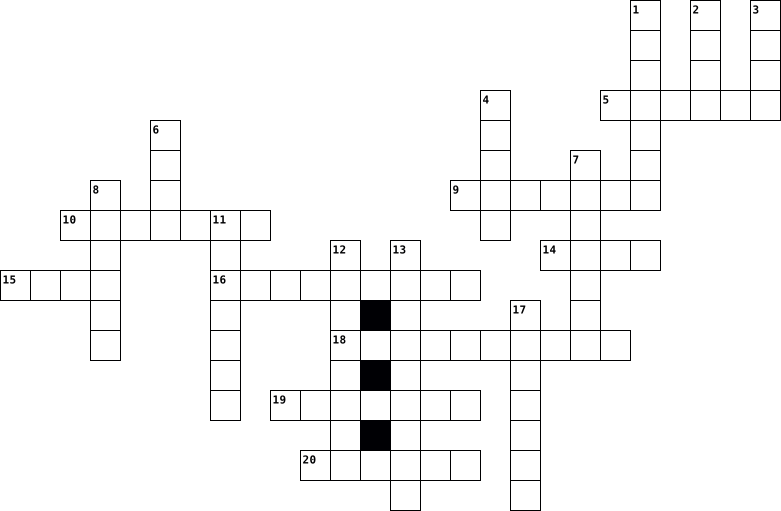
biology Crossword Puzzles
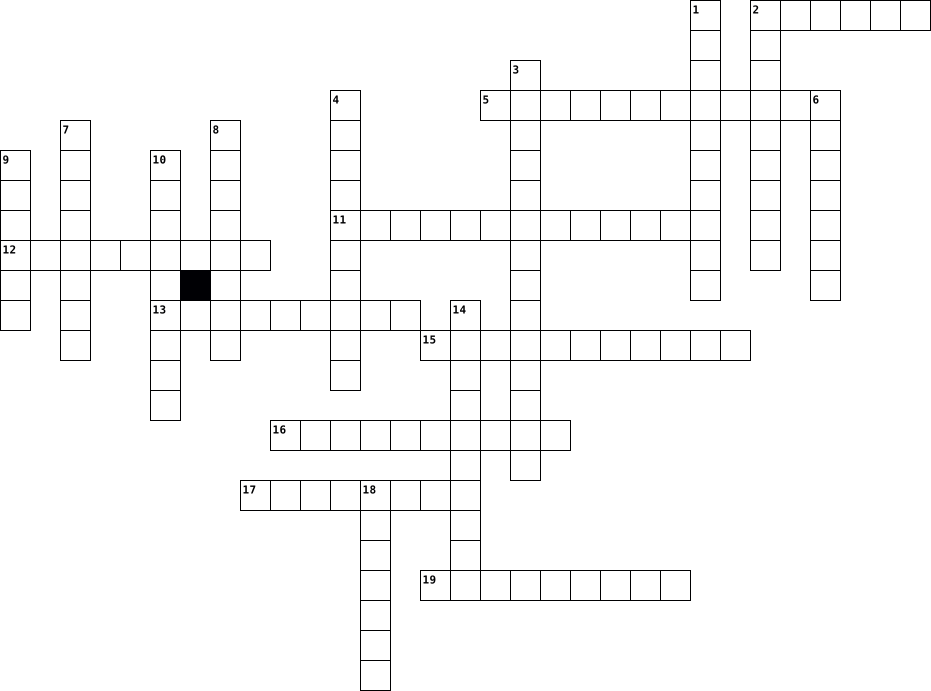
Biology: vocab words 2023-02-24
Across
- he semipermeable membrane surrounding the cytoplasm of a cell.
- a network of membranous tubules within the cytoplasm of a eukaryotic cell, continuous with the nuclear membrane.
- a change or the process of change by which an organism or species becomes better suited to its environment.
- any of a class of organic compounds that are fatty acids or their derivatives and are insoluble in water but soluble in organic solvents. They include many natural oils, waxes
- a minute cylindrical organelle near the nucleus in animal cells, occurring in pairs and involved in the development of spindle fibers in cell division.
- simple organic compound containing both a carboxyl and an amino
- a microscopic single-celled organism that has neither a distinct nucleus with a membrane nor other specialized organelles
- an organelle found in large numbers in most cells, in which the biochemical processes of respiration and energy production occur.
- a structure found inside cells that is involved in making proteins.
- he hierarchy of complex biological systems and structures
- The cell theory states that all biological organisms are composed of cells; cells are the unit of life and all life come from preexisting life
- a molecule containing a very large number of atoms, such as a protein, nucleic acid, carbohydrates and lipids
- any of a number of organized or specialized structures within a living cell.
Down
- a plastid that contains chlorophyll and in which photosynthesis takes place.
- food consisting of or containing a lot of sugars, starch, cellulose, or similar substances that can be broken down to release energy in the human body, and make up one of the main nutritional food groups.
- he highest category in taxonomic classification.
- a genetic structure in a cell that can replicate independently of the chromosomes
- an organism consisting of a cell or cells in which the genetic material is DNA in the form of chromosomes contained within a distinct nucleus.
- a rigid layer of polysaccharides lying outside the plasma membrane of the cells of plants, fungi, and bacteria
- a dense organelle present in most eukaryotic cells, typically a single rounded structure bounded by a double membrane, containing the genetic material.
- A molecule made up of amino acids.
- an infective agent that typically consists of a nucleic acid molecule in a protein coat
- A member of a large group of unicellular microorganisms which have cell walls but lack organelles and an organized nucleus
- the system of nomenclature in which two terms are used to denote a species of living organism
- the branch of science concerned with classification, especially of organisms.
- a simple sugar which is an important energy source in living organisms and is a component of many carbohydrates.
- a complex organic substance present in living cells, especially DNA or RNA, whose molecules consist of many nucleotides linked in a long chain.
- a compound consisting of a nucleoside linked to a phosphate group. Nucleotides form the basic structural unit of nucleic acids such as DNA.
- a branching diagram showing the cladistic relationship between a number of species.
- a slender threadlike structure, especially a microscopic appendage that enables bacteria and others to swim.
30 Clues: A molecule made up of amino acids. • he highest category in taxonomic classification. • he hierarchy of complex biological systems and structures • he semipermeable membrane surrounding the cytoplasm of a cell. • simple organic compound containing both a carboxyl and an amino • a structure found inside cells that is involved in making proteins. • ...
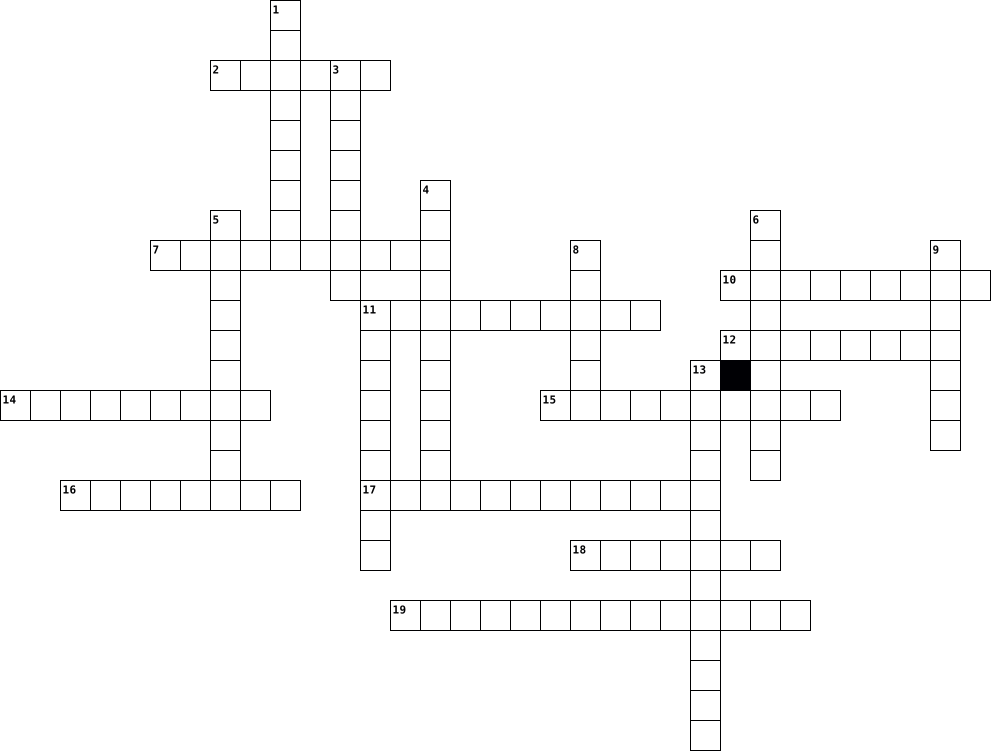
unit 8 Biology 2023-04-12
Across
- a fissure on the seabed from which geothermally heated water discharges.
- being the deep zone of an ocean or lake receiving too little light to permit photosynthesis.
- a composite organism that arises from algae or cyanobacteria living among filaments of multiple fungi species in a mutualistic relationship.
- the secondary ecological succession of a plant's life.
- hardy species that are the first to colonize barren environments or previously biodiverse steady-state ecosystems that have been disrupted, such as by wildfire.
- occurs when an amount of any substance or any form of energy is put into the environment at a rate faster than it can be dispersed or safely stored.
- In scientific ecology, climax community or climatic climax community is a historic term for a community of plants,
- an area classified according to the species that live in that location.
- long-term heating of Earth's surface observed since the pre industrial period due to human activities.
- introduced species to an environment that becomes overpopulated and harms its new environment.
Down
- a phenomenon in which a species' population becomes larger than the carrying capacity of its environment.
- happens when a new patch of land is created or exposed for the first time.
- a land region on the earth's surface covered by biological communities that group under the same climatic patterns like rainfall and temperature.
- the competitive exclusion principle, sometimes referred to as Gause's law.
- when humans remove or thin forests for lumber or to use the land where the trees stood for crops, grazing, extraction
- the tidal mouth of a large river, where the tide meets the stream
- the state of a species being found in a single defined geographic location, such as an island, state, nation, country or other defined zone.
- the variety of life on Earth at all its levels, from genes to ecosystems.
- relating to water.
- a species on which other species in an ecosystem largely depend, such that if it were removed the ecosystem would change
- relating to light, especially as an agent of chemical change or physiological response.
- a system of interlocking and interdependent food chains.
22 Clues: relating to water. • the secondary ecological succession of a plant's life. • a system of interlocking and interdependent food chains. • the tidal mouth of a large river, where the tide meets the stream • an area classified according to the species that live in that location. • a fissure on the seabed from which geothermally heated water discharges. • ...
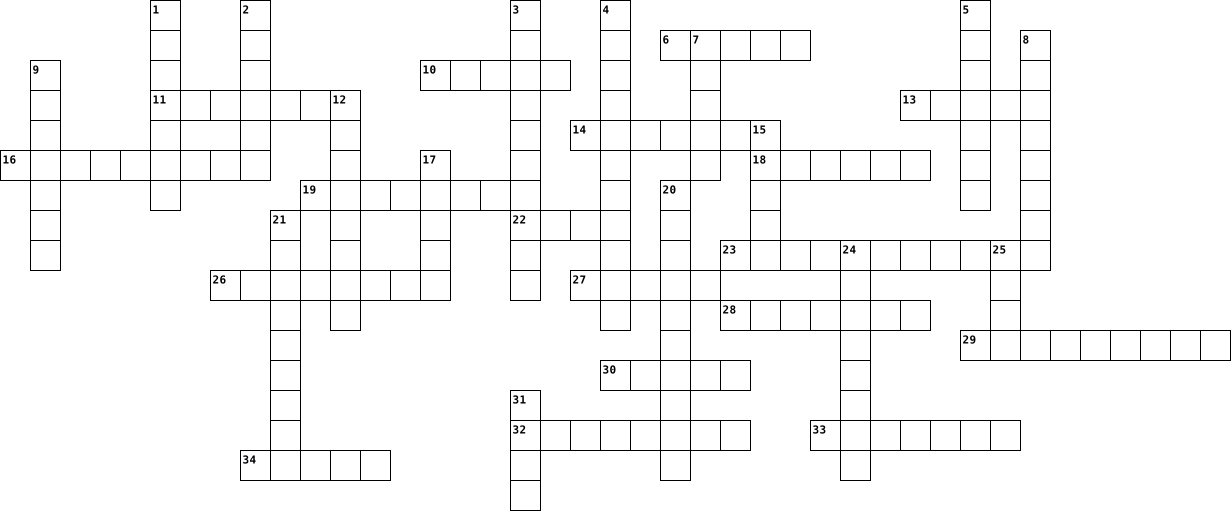
Biology Review 1 2023-04-20
Across
- monomer of carbohydrate
- amino acids are jointed by ___ bonds
- when somatic cells undergo PMAT
- this is when DNA replicates
- many carbohydrates joint together
- site of photosynthesis in plants
- animal organelle that eliminates waste
- majority of cell life occurs here
- monomer of nucleic acid
Down
- virus that uses bacteria as host
- found in extreme locations, oldest!
- has a capsid and nucleic acid
- found in cell wall of bacteria
- ____ and fatty acids make up lipids
- have reverse transciptase to make DNA
- how to distinguish between a euk and a prok
- nitrogenous bases are held by ____ bonds
- have cell wall composed of cellulose and lignin
- single ring nucleic acids--> Aggies A/G
- acid monomer of protein
20 Clues: monomer of carbohydrate • monomer of nucleic acid • this is when DNA replicates • has a capsid and nucleic acid • acid monomer of protein • found in cell wall of bacteria • when somatic cells undergo PMAT • virus that uses bacteria as host • site of photosynthesis in plants • many carbohydrates joint together • majority of cell life occurs here • ...
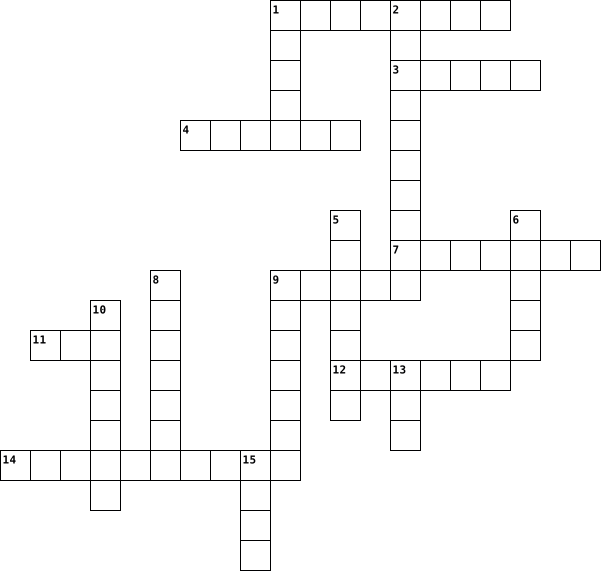
Biology EOC Crossword 2023-04-20
Across
- The backbone of DNA
- Separation in Mitosis
- Beginning of Mitosis
- Transcription & Translation
- DNA has two RNA has one
- Nuclear division
- always pairs with Adenine
- Middle of Mitosis
- DNA is used to create mRNA
- always pairs with Cytosine
- Only expressed when both alleles are present (bb)
- Last phase of Mitosis
- G1,S,G2
- Adenine, Thymine, Cytosine, Guanine
- Deoxyribose...
- always pairs with Guanine
Down
- mRNA is used to make an amino acid chain
- Crosses that involve one or two traits
- Same alleles
- always pairs with Thymine
- Always expressed (B)
- Different alleles
- The other backbone of DNA
- DNA is a long chain of...
- Fully split cells
- Made from DNA
- Ribose...
- A random change in the sequence of a gene
- Growing phase of Interphase
29 Clues: G1,S,G2 • Ribose... • Same alleles • Made from DNA • Deoxyribose... • Nuclear division • Different alleles • Middle of Mitosis • Fully split cells • The backbone of DNA • Beginning of Mitosis • Always expressed (B) • Separation in Mitosis • Last phase of Mitosis • DNA has two RNA has one • always pairs with Thymine • always pairs with Adenine • The other backbone of DNA • DNA is a long chain of... • ...
Biology Crossword #1 2023-04-18
Across
- It contains most of the cell's DNA and is usually the largest structure in a eukaryotic cell.
- The process by which materials spread out from areas where there are more of them to areas where there are less of them; the simplest form of passive transport.
- The membrane-bound sac in a plant cell that acts as a storage area.
- Structures in the cytoplasm of eukaryotic cells. They perform all the activities necessary for life of a cell. They each have a specific structure or function.
- Organisms composed of cells with a membrane-bound nucleus and other membrane-bound organelles. All protists, fungi, plants, and animals are these.
- Single-celled organisms that do not have internal, membrane-bound parts. First organisms on Earth were these...
- The diffusion of water across a selectively permeable membrane.
- Provides the instruction for making proteins, directs cell activities, and enables the cell to reproduce. In some cells, it is enclosed in a nucleus.
- They provide quick energy, can store energy, or provide structure.
- Are made mostly from carbon and hydrogen atoms. They do NOT dissolve in water, so cell can store energy as these. They also provide insulation and make up cell membranes. Fats, oils, and waxes are common names for them.
- A substance that speeds up the rate of a chemical reaction, but its not consumed by the reaction.
Down
- Act as catalysts in the chemical reactors that take place in organisms. They each have a function that is determined by its shape.
- The movement of materials across the cell membrane without using the cells energy.
- The process in which a cell completely surrounds a substance to move materials into the cell.
- The process by which organism keep internal conditions relatively stable regardless of change in the external environment.
- An organelle that moves molecules from one part of the cell to another. It's covered with ribosomes.
- The structure in a plant that protects and supports the plant and is not found in animal cells.
- Organelles that convert glucose molecules into energy in the form of ATP (which is the cell's main energy source).
- The process in which a vesicle in a cell joins with the cell membrane and then release its contents to the outside environment.
- The organelle in plant cells where photosynthesis takes place.
- Are made up of long chains of individual units called nucleotides. The two types of these are DNA and RNA. They contain info that determines how an organism grows and develops, and control the building proteins in cells.
- Are made of carbon, hydrogen, oxygen, and nitrogen. They control cell functions, defend the organism, support transport and movement, and provide structure. They are made up of individual units called amino acids.
22 Clues: The organelle in plant cells where photosynthesis takes place. • The diffusion of water across a selectively permeable membrane. • They provide quick energy, can store energy, or provide structure. • The membrane-bound sac in a plant cell that acts as a storage area. • The movement of materials across the cell membrane without using the cells energy. • ...
Advanced Biology Crossword 2023-04-17
Across
- RNA to amino acid
- one of 4 nitrogen bases and starts with C
- process of nucleus splitting and then cell splitting, creating two daughter cells
- represented with a uppercase letter in punnett squares
- represented with a lowercase letter in punnett squares
- the acronym of ribonucleic acid
- the acronym of deoxyribonucleic acid
- the making of protein (no space)
- the forth phase of mitosis
- the splitting of the cell into two daughter cells
- provides structural support for DNA and RNA
Down
- errors in DNA replication
- Where G1 DNA synthesis and G2 occur
- the shape of DNA (no spaces)
- basic structural unit of DNA and RNA
- one of 4 nitrogen bases and starts with A
- DNA to RNA
- the third phase of mitosis
- the second phase of mitosis
- one of 4 nitrogen bases and starts with T
- one of 4 nitrogen bases and starts with G
- the first phase of mitosis
22 Clues: DNA to RNA • RNA to amino acid • errors in DNA replication • the third phase of mitosis • the first phase of mitosis • the forth phase of mitosis • the second phase of mitosis • the shape of DNA (no spaces) • the acronym of ribonucleic acid • the making of protein (no space) • Where G1 DNA synthesis and G2 occur • basic structural unit of DNA and RNA • ...
biology unit 9 2023-04-19
Across
- Ecological rule that states that no two species can occupy the same exact niche in the same habitat at the same time
- A geographic region categorized by a particular combination of average annual temperature, annual precipitation, and distinctive plant growth forms on land
- A species that influences the survival of many other species in an ecosystem
- the variety of life in the world or in a particular habitat or ecosystem.
- pocket ecosystems at the bottom of the ocean near divergent plate boundaries
- plants and animals that have migrated to places where they are not native
- A stable, mature community that undergoes little or no change in species over time
- succession that occurs on surfaces where no soil exists
- First species to populate an area during primary succession
- Destruction of forests
- An increase in the average temperature of the earth's atmosphere (especially a sustained increase that causes climatic changes)
Down
- The effect of humans on an ecosystem
- species that are native to and found only within a limited area
- permanently dark layer of the oceans below the photic zone
- Portion of the marine biome that is shallow enough for sunlight to penetrate.
- symbiotic association between a fungus and a photosynthetic organism
- reestablishment of a damaged ecosystem in an area where the soil was left intact
- A community of organisms where there are several interrelated food chains
- A group of ecosystems that share similar climates and typical organisms
- largest biome, most stable with little variation in temperature, provides most of earth's food and oxygen, divided into regions based on amount of light they receive
- A habitat in which the fresh water of a river meets the salt water of the ocean.
- A biological community of interacting organisms and their physical environment.
22 Clues: Destruction of forests • The effect of humans on an ecosystem • succession that occurs on surfaces where no soil exists • permanently dark layer of the oceans below the photic zone • First species to populate an area during primary succession • species that are native to and found only within a limited area • ...
Biology EOC review 2023-05-02
Across
- This cycle involves precipitation, condensation, and evaporation.
- The large central organelle in eukaryotic cells that holds DNA.
- a group of organisms that share most characteristics and can reproduce.
- The classification between domain and phyllum.
- ___________ dominance shows a mixture between the two phenotypes.
- this organelle makes ribosomes
- All or part of an organism's genetic composition.
- Having two different alleles for a trait.
- A trait that increases an organism's chance of survival.
- This type of organism eats both meat and plants.
- An allele always expressed
- The ______ membrane is a flexible layer that surrounds a cell and protects it.
Down
- The process of making a strand of mRNA from a DNA template.
- The study of the interactions of organisms and their environments.
- The powerhouse of the cell.
- Mrs. Ledbetter is
- an organelle that stores water and other materials.
- A group of ecosystems that have similar climates and plant life.
- The remains of an organism that lived in the past.
- a large macromolecule that is used second for energy. Ex:fats
20 Clues: Mrs. Ledbetter is • An allele always expressed • The powerhouse of the cell. • this organelle makes ribosomes • Having two different alleles for a trait. • The classification between domain and phyllum. • This type of organism eats both meat and plants. • All or part of an organism's genetic composition. • The remains of an organism that lived in the past. • ...
Evolutionary Biology Vocabulary 2023-05-10
Across
- a trait that makes it more likely that an individual will survive in a specific environment
- a group of individuals born and living at about the same time
- an older population from which two or more newer species descended
- the very long time that spans the history of Earth, from the very first cellular life to the present
- the process by which the distribution of traits in a population changes over many generations
- a part of an organism (i.e. one or more bones)
- a group of the same type of organism living in the same area
- to receive genes from a parent
- an organism's arm, leg, or wing
Down
- living things, such as plants, animals, and bacteria
- having died out completely and no longer alive anywhere on Earth
- everything (living and nonliving) that surrounds an organism
- a random change to a gene that sometimes results in a new trait
- a scientist who studies fossils in order to understand the ancient history of life on Earth
- the process by which species adapt to environmental changes over a very long time
- a more recent species that evolved from an ancestor population
- a related organism from a previous generation
- to classify based on scientific examination
- a graph that uses bars to show how characteristics or values are distributed within a group
- evidence of life from the past, such as fossilized bones, footprints, or leaf prints
20 Clues: to receive genes from a parent • an organism's arm, leg, or wing • to classify based on scientific examination • a related organism from a previous generation • a part of an organism (i.e. one or more bones) • living things, such as plants, animals, and bacteria • everything (living and nonliving) that surrounds an organism • ...
Irish Biology Vertebrates 2023-05-09
Across
- live young
- insulating feathers
- class of lancelets
- finned type of fish with spiny fins
- egg feature for gas exchange
- class of tunicates
- flying feathers
- scratching birds
- eggs are in the mother, but nourished by yolk
- type of circulatory system in vertebrates
- finned type of fish that may have given rise to amphibians
- chambers in an amphibian heart
- perching birds
- (2 words) egg feature for nutrients
- type of fertilization in fish
- number of classes of vertebrates
- bladder lacking in sharks so they have to swim or sink
- changes in an amphibian during development
- modified sweat glands for feeding young
- order of reptiles with alligators
- order of reptiles with snakes
- means 4 legs
- suborder of primates that means human like
- egg feature for wastes
- skeleton on the inside
- (2 words) allow constant oxygen for birds
Down
- cartilaginous fish
- can be used to determine what mammals eat
- eggs are laid and hatch externally
- egg laying mammals
- predator birds
- amphibians with tails
- order with frogs and toads
- flap that pushes water over the gills
- web footed birds
- chambers in a bird heart
- jawless fish
- type of mammals developing completely in the uterus
- legless amphibians
- generate heat with metabolism
- get heat from the environment
- has 2 chambers in fish
- used with lungs to get oxygen in amphibians
- order of reptiles with turtles
- subphylum of animals with backbones
- long flexible rod that can become a spine
- order of mammals with opposable thumbs
- bony fish
- egg feature for protection
- mammals with pouches
- water proofing feathers
- line system for detecting vibration in fish
52 Clues: bony fish • live young • jawless fish • means 4 legs • predator birds • perching birds • flying feathers • web footed birds • scratching birds • cartilaginous fish • egg laying mammals • class of lancelets • class of tunicates • legless amphibians • insulating feathers • mammals with pouches • amphibians with tails • has 2 chambers in fish • egg feature for wastes • skeleton on the inside • ...
Biology EOC Review 2023-05-03
Across
- The fatty acid tails of a phospholipid can be described as this. They don't like water.
- fungi produce _____ to reproduce. These structures are different from seeds because they don't contain nutritive tissue.
- A ____ relationship is when both members benefit. An example is mycorrhizae, where fungus helps plants get more water and plants give the fungus sugars.
- ____ selection is when the two extremes are favored and the middle trait is selected against
- The cell membrane is a _____ bilayer. This structure contains a phosphate head and two fatty acid tails.
- Fatty acids are the monomers of this macromolecule.
- This type of cell division makes two identical daughter cells.
- these are organisms that eat decaying organic matter and return nutrients to the environment
- this part of the cell contains the DNA; prokaryotic cells don't have this part of the cell
- plant cells have a cell ____ outside of their cell membrane. It provides support
Down
- the cell _______ controls what enters and leaves the cell. All cells have this.
- this is the organelle where cellular respiration takes place
- the _____ system includes the lungs and trachea (windpipe)
- Water is ____. Hydrogen is slightly positively charged and oxygen is slightly negatively charged.
- The daughter cells of mitosis have two sets of chromosomes, so they are ___.
- gametes have one set of chromosomes, so they are ____
- The ______ of photosynthesis are oxygen and glucose.
- these are non-living and cause diseases, such as COVID
- these are non-living and cause diseases, such as Mad Cow Disease
- The cell membrane is selectively ____. It lets some things through.
20 Clues: Fatty acids are the monomers of this macromolecule. • The ______ of photosynthesis are oxygen and glucose. • gametes have one set of chromosomes, so they are ____ • these are non-living and cause diseases, such as COVID • the _____ system includes the lungs and trachea (windpipe) • this is the organelle where cellular respiration takes place • ...
Biology Final review 2023-05-05
Across
- What is the stable, maturest form of a community called?
- What pattern of population dispersion have individuals clustered in groups?
- Limiting factor that limits growth but is not associated with the number of individuals (density ___________ )
- What gas makes up 80% of the atmosphere?
- Plants can use nitrogen straight from the atmosphere. True of false?
- What factors limit the growth of a population?
- Transfer of individuals to a new area during a certain time of year.
- What is the study of relations of organisms' with their environment?
- What two things do the ocean do in the carbon cycle with the carbon?
- Limiting factor that is affected by the number of individuals in an area (density _________ )
- Organisms that have narrow niches and require specific conditions to live.
- What kind of activities, such as mining, cutting and burning forests, and burning fossil fuels, release carbon into the atmosphere? ( _____ activities)
- Type of succession where soil was there to begin with.
- Animals use nitrogen in their cells for amino acids and proteins. Where do they get the nitrogen from?
- What is the change in communities that follow a disturbance called? ( __________ succession)
- Term for how the population is distributed. (population __________ )
- Organisms that have a broad niche and adapts easily.
- Release of carbon into the atmosphere from plants and animals.
- Bringing life into the world, increasing the population.
Down
- What cell process produces CO2 to be released into the atmosphere?
- What is the process that converts atmospheric nitrogen into a usable form called?
- Exit of individuals from a population.
- What is C6H12O6?
- What molecule does cellular respiration use?
- Process that converts light energy to glucose
- Term for number of individuals in a specific area. (population _______ )
- Type of succession with no soil, only bare rock. ( _______ succession)
- What type of growth is caused by a dramatic increase in population?
- What is reached when the particular area is as full as it can be with organisms?
- What pattern of population dispersion have individuals evenly spaced?
- Slow growth and reaches carrying capacity slower. ( ________ growth)
- In nitrogen fixation, nitrogen is converted into what?
- What pattern of population dispersion have individuals in an unpredictable pattern?
- Decrease in population through organisms dying off.
- What are the two types of population growth?
- What organism dissolve rocks into soil for nutrients?
- What bacteria fixes nitrogen by forming a mutualistic relationship with plants?
- What organism helps plants create nutrients in the soil?
- First species to come about, usually lichens, during primary succession.
- Term that describes the needed aspects of a habitat in order for an organism to survive.
- How does nitrogen go back into the soil?
41 Clues: What is C6H12O6? • Exit of individuals from a population. • What gas makes up 80% of the atmosphere? • How does nitrogen go back into the soil? • What molecule does cellular respiration use? • What are the two types of population growth? • Process that converts light energy to glucose • What factors limit the growth of a population? • ...
Biology Crossword Puzzle 2023-04-30
Across
- Cells- cells that have the capacity to self-renew and generate multiple mature cell types.
- A small RNA molecule that plays a key role in protein synthesis.
- plant vascular tissue that conveys water and dissolved minerals from the roots to the rest of the plant and also provides physical support.
- Regulation- The process of turning genes on and off
- a sugar derived from ribose by replacing a hydroxyl group with hydrogen
- Instructs cells in the body to make specific proteins.
- Strand- a newly synthesized strand of DNA that is copied via the addition of complementary nucleotides from one strand of pre-existing DNA during DNA replication.
- The space between the end of a nerve cell and another cell.
- the fundamental units of the brain and nervous system
- A pyrimidine derivative, it is paired with adenine in double-stranded DNA.
- Bases- Bases pair up with each other in a consistent way.
- Villi- Tiny hair-like projections that line the inside of the small intestine. They contain blood vessels and help absorb nutrients.
- vascular tissue in plants that conducts sugars and other metabolic products downward from the leaves.
- A chain of amino acids that form from peptide bonds.
- Compound found in living tissue as a constituent base of RNA. In DNA its place is taken by thymine.
- Carries genetic information that is translated by ribosomes into various proteins necessary for cellular processes.
- a sequence of three nucleotides that together form a unit of genetic code in a DNA or RNA molecule
Down
- The process by which DNA is copied to RNA
- The basic unit of heredity passed from parent to child.
- Bonds- a weak bond between two molecules resulting from an electrostatic attraction between a proton in one molecule and an electronegative atom in the other.
- Cells- specialized animal cells which can shorten their length using a series of motor proteins specially arranged within the cell.
- Cell- A type of cell that receives and sends messages from the body to the brain and back to the body.
- A purine derivative, it is paired with thymine in double-stranded DNA.
- Strand- the pre-existing single strand of DNA that is copied into a new strand of DNA via complementary base pairing.
- characterized by or exhibiting biological specialization
- A purine derivative, it is paired with cytosine in double-stranded DNA.
- a genetically determined characteristic
- Cell/Stomata- surrounds each stoma on the leaf surface
- The molecule inside cells that contains the genetic information responsible for the development and function of an organism.
- Replication- The process by which the genome's DNA is copied in cells.
- the processes by which immature cells become mature cells with specific functions.
- your body's chemical messengers.
- It is paired with guanine in double-stranded DNA.
- RNA is used to produce proteins
- Blood Cells- carry oxygen from our lungs to the rest of our bodies.
- Cells- small, compact cells, highly specialized for the task of fertilizing an egg
36 Clues: RNA is used to produce proteins • your body's chemical messengers. • a genetically determined characteristic • The process by which DNA is copied to RNA • It is paired with guanine in double-stranded DNA. • Regulation- The process of turning genes on and off • A chain of amino acids that form from peptide bonds. • the fundamental units of the brain and nervous system • ...
Biology Word Search 2023-03-16
Across
- the process by which partial reproductive isolation between populations is increased by selection against mating between members of the two populations
- This term determines whether character states are ancestral or derived.
- one of two or more distinguishable forms of a character
- An example of this term is plaque on teeth is a biofilm.
- The process of producing offspring through an alternation of fertilization.
- In fungi, having pairs of nuclei within each cell.
- Graphic depiction of a hypothesis of evolutionary relationships.
- A mass of hyphae in fungi.
- The process by which an individual inherits all of its chromosomes from a single parent.
- A characteristic used in taxonomic analysis representing a departure from the primitive form
- The study of evolutionary relationships.
- A polyploid organism that contains a duplicated genome of the same species
- This term is the temporary union of two unicellular organisms
- A highly resistant, thick-walled bacterial spore that can survive harsh environmental stress, such as heat or dessication.
- This term is the stage in the life cycle of myxomycetes.
- In fungi, having nuclei with the same genetic makeup within a mycelium.
- Is used in cladistics to refer to a group that has distant characteristics
- This term found in the outer membrane layer of gram-negative bacteria
- A group within a single species with distinctive characteristics
- The area of a prokaryotic cell, usually near the center.
- The primary type of light-absorbing pigment in photosynthesis.
Down
- A taxonomic technique used for creating hierarchies of organisms that represent true phylogenetic relationships
- Another term for an ancestral character state.
- Chemical substance released by one organism that influences behavior of another organism that is the same species
- Something that results in evolutionary change leading to species dissimilar in resource use.
- A type of view view that species change very slowly in ways that may be imperceptible from one generation to the next but that accumulate and lead to major changes over thousands or millions of years.
- This term allows a cell to move through an aqueous environment.
- A derived character that is shared by clade members in systematics.
- This term causes disease in another organism.
- speciation differentiation of geographically isolated populations into species
- A newly evolved trait in a species that allows members to use resources
- A staining technique that divides bacteria into gram-negative or gram-positive based on the retention of a violet dye.
- A taxonomic group composed of an ancestor and all its descendants.
- In fungi, having two or more genetically distinct types of nuclei.
- A polyploid organism that contains the genomes of two or more different species.
- A period of time during which little evolutionary change occurs.
- A structure in which spores are produced.
- Fossils of microscopic organisms thought to represent early forms of life.
- The evolutionary history of an organism
- A gelatinous layer surrounding the cell wall only in bacteria.
- This term carries out protein synthesis
41 Clues: A mass of hyphae in fungi. • The evolutionary history of an organism • This term carries out protein synthesis • The study of evolutionary relationships. • A structure in which spores are produced. • This term causes disease in another organism. • Another term for an ancestral character state. • In fungi, having pairs of nuclei within each cell. • ...
11 Biology - Cells 2023-03-31
Across
- Organisms that can produce their own food using energy from sunlight or other sources.
- The gel-like substance that fills the cell and contains organelles.
- The organelles responsible for protein synthesis.
- Organelles that produce ATP, the energy currency of the cell, through cellular respiration.
- The diffusion of water molecules across a semi-permeable membrane from an area of lower solute concentration to an area of higher solute concentration.
- ____ transport: The movement of substances across a membrane with the concentration gradient, without requiring energy.
- _____ fission: A form of asexual reproduction in which a single cell divides into two identical cells.
- Cell ____ The scientific theory that all living things are composed of cells, which are the basic structural and functional units of life.
- A network of protein fibers that provides support and shape to cells.
- The organelle that contains the genetic material of a eukaryotic cell.
- A type of cell with a nucleus and membrane-bound organelles.
- Cell ____ The semi-permeable membrane surrounding a cell that controls the exchange of materials between the cell and its environment.
- Organisms that rely on other organisms for food.
Down
- An organelle involved in protein and lipid synthesis, consisting of a network of membranes and tubes.
- The movement of particles from an area of higher concentration to an area of lower concentration, driven by the concentration gradient.
- Surface area-to-volume ___
- Concentration _______ The difference in concentration of a substance between two regions, which can drive passive or active transport.
- An organelle involved in modifying, sorting, and packaging proteins for transport.
- Allowing only certain substances to pass through a membrane while excluding others.
- A type of cell without a nucleus or membrane-bound organelles, typically smaller than eukaryotic cells.
- An organelle involved in transport and storage of materials within the cell.
21 Clues: Surface area-to-volume ___ • Organisms that rely on other organisms for food. • The organelles responsible for protein synthesis. • A type of cell with a nucleus and membrane-bound organelles. • The gel-like substance that fills the cell and contains organelles. • A network of protein fibers that provides support and shape to cells. • ...
Unit 8 Biology 2023-03-22
Across
- they consume producers or other consumers.
- a group of living organisms consisting of similar individuals capable of exchanging genes or interbreeding.
- no two species can exploit the environment in exactly the same way and coexist – one of the species will be excluded.
- An autotroph is an organism that can produce its own food using light, water, carbon dioxide, or other chemicals
- is an animal which feeds on dead organic material, especially plant detritus.
- an association between two organisms in which one benefits and the other derives neither benefit nor harm.
- the preying of one animal on others.
- a non-living part of an ecosystem that shapes its environment.
- living things within an ecosystem.
- an animal or person that eats food of both plant and animal origin.
- the role an organism plays in a community.
Down
- is beneficial to both organisms involved.
- organism feeds off plants
- a graphical representation of the relationship between the different living organisms at different trophic le
- an area classified according to the species that live in that location.
- the practice of living as a parasite in or on another organism.
- a regulatory substance produced in an organism and transported in tissue fluids such as blood or sap to stimulate specific cells or tissues into action
- a device or installation that is used to break down a chemical substance.
- all the inhabitants of a particular town, area, or country.
- any type of a close and long-term biological interaction between two biological organisms of different species.
- the natural home or environment of an animal, plant, or other organism.
- social group whose members have something in common, such as a shared government, geographic location, culture, or heritage.
- an animal that feeds on flesh.
- the total quantity or weight of organisms in a given area or volume.
- a hierarchical series of organisms each dependent on the next as a source of food. chain
- a biological community of interacting organisms and their physical environments
- system of interlocking and interdependent food chains
- the branch of biology that deals with the relations of organisms to one another and to their physical surroundings.
- made up of the parts of Earth where life exists
29 Clues: organism feeds off plants • an animal that feeds on flesh. • living things within an ecosystem. • the preying of one animal on others. • is beneficial to both organisms involved. • they consume producers or other consumers. • the role an organism plays in a community. • made up of the parts of Earth where life exists • ...
AP Biology : Ecology 2023-03-22
Across
- Why a behavior occurs
- Nonliving factor
- Developmentally fixed behaviors
- Pattern of spacing among individuals in a population
- Stimulus generated and transmitted from one animal to another
- Abbreviation for the total primary production in an ecosystem
- How a behvior occurs
- Directional movement towards or away from stimulus
- An animal's response to a stimulus
- The total amount of energy an animal uses in a unit of time
Down
- Living factor
- A group of individuals of the same species living in an area
- Random movement in response to a stimulus
- Long-lasting behavioral response to an individual
- Organism that cannot make its own food
- All the living and nonliving things in an area
- Selection for life history traits that are sensitive to population density (no hyphen)
- Number of individuals per unit area
- Organisms that get energy from detritus
- Selection for life history traits that maximize reproductive success (no hyphen)
- Abbreviation for the Gross Primary Product minus the energy used by primary producers
- Behaviors that depend on environmental influence
22 Clues: Living factor • Nonliving factor • How a behvior occurs • Why a behavior occurs • Developmentally fixed behaviors • An animal's response to a stimulus • Number of individuals per unit area • Organism that cannot make its own food • Organisms that get energy from detritus • Random movement in response to a stimulus • All the living and nonliving things in an area • ...
Biology Kills me 2023-03-21
Across
- group of three bases on a tRNA molecule that are complementary to the three bases of a codon of mRNA
- long chain of amino acids that makes proteins
- process in which cells become specialized in structure and function
- short DNA region, adjacent to the promoter of a prokaryotic operon, that binds repressor proteins responsible for controlling the rate of transcription of the operon
- gene genes that code for transcription factors that activate other genes that are important in cell development and differentiation
- Mutation mutation that shifts the "reading frame" of the genetic message by inserting or deleting a nucleotide
- RNA type of RNA that carries each amino acid to a ribosome during protein synthesis
- mutation gene mutation in which a single base pair in DNA has been changed
- Polymerase enzyme that links together the growing chain of RNA nucleotides during transcription using a DNA strand as a template
- change in the genetic material of a cell
Down
- condition in which an organism has extra sets of chromosomes
- process by which the sequence of bases of an mRNA is converted into the sequence of amino acids of a protein
- group of three nucleotide bases in mRNA that specify a particular amino acid to be incorporated onto a protein
- RNA type of RNA that combines with proteins to form ribosomes
- code collection of codons of mRNA, each of which directs the incorporation of a particular amino acid into a protein during protein synthesis
- gene a class of regulatory genes that determine the identity of body parts and regions in an animal embryo. Mutations in these genes can transform one body part into another
- expressed sequence of DNA; codes for a protein
- in prokaryotes, a group of adjacent genes that shares a common operator and promoter and are transcribed into a single mRNA
- RNA type of RNA that carries copies of instructions for the assembly of amino acids into proteins from DNA to the rest of the cell
- single-stranded nucleic acid that contains the sugar ribose
- synthesis of an RNA molecule from a DNA template
- chemical or physical agents in the environment that interact with DNA and may cause a mutation
- specific region of a gene where RNA polymerase can bind and begin transcription
23 Clues: change in the genetic material of a cell • long chain of amino acids that makes proteins • expressed sequence of DNA; codes for a protein • synthesis of an RNA molecule from a DNA template • single-stranded nucleic acid that contains the sugar ribose • condition in which an organism has extra sets of chromosomes • ...
unit two biology 2023-04-04
Across
- tissue combined
- hates water
- cells combined
- when the enzyme and the substrate can no longer combine
- moves molecules
- make up the cell membrane
- where the enzyme and the substrate combine
- combine molecules
- they combine with the enzyme
- all the organ systems combined to make blank
- make metabolism possible
- the final of the enzyme
- organs make up what
Down
- enzymes lower it
- love water
- the basic unit of life
- controls what goes into the cell
- molecules that naturally move
- the diffusion of water
- new molecules fast
- combined atoms
- what things are made of
22 Clues: love water • hates water • cells combined • combined atoms • tissue combined • moves molecules • enzymes lower it • combine molecules • new molecules fast • organs make up what • the basic unit of life • the diffusion of water • the final of the enzyme • what things are made of • make metabolism possible • make up the cell membrane • they combine with the enzyme • molecules that naturally move • ...
unit two biology 2023-04-04
Across
- tissue combined
- hates water
- cells combined
- when the enzyme and the substrate can no longer combine
- moves molecules
- make up the cell membrane
- where the enzyme and the substrate combine
- combine molecules
- they combine with the enzyme
- all the organ systems combined to make blank
- make metabolism possible
- the final of the enzyme
- organs make up what
Down
- enzymes lower it
- love water
- the basic unit of life
- controls what goes into the cell
- molecules that naturally move
- the diffusion of water
- new molecules fast
- combined atoms
- what things are made of
22 Clues: love water • hates water • cells combined • combined atoms • tissue combined • moves molecules • enzymes lower it • combine molecules • new molecules fast • organs make up what • the basic unit of life • the diffusion of water • the final of the enzyme • what things are made of • make metabolism possible • make up the cell membrane • they combine with the enzyme • molecules that naturally move • ...
Nervous System (Biology) 2023-05-24
Across
- Are found in the brain and spinal cord; act as an integration centre
- potential the change in charge that occurs when gates for Na+ open in a neuron
- Muscles, glands, and other organs that respond to impulses from the motor neuron
- return of a nerve to its resting potential (-70 mv) after depolarization due to Na+ gates closing and K+ gates opening
- A neurotransmitter which simulates fight or flight activity
- a chemical that travels across a synapse between neurons
- cells nourish the neurons, remove their wastes, and defend against infection
- period follows an action potential and is when a neuron cannot be stimulated.
- The type of neurotransmitter in a cholinergic synapse
- membrane that surrounds and protects CNS
- neurons Conduct impulses from the interneurons to the effectors
- nervous system part that we can consciously control
- neuronsTransmit impulses from the sensory receptors to the interneurons
- arc simple connection of neurons that results in a reflex action generated by the spinal cord in response to a stimulus
- nervous system region that includes the brain and spinal cord
- a cell type that forms the myelin sheath
- fatty insulating layer around the axon of some nerve cells that speeds up signals
- all nervous system regions EXCEPT the brain and spinal cord
Down
- end of a neuron that receives signals from other neurons or sensory receptors
- Tiny gap between a neuron end and a dendrite on another nerve or an effector cell
- name of the nodes or spaces between pieces of myelin
- stage where the membrane potential goes from −70 mV to +35 mV by Na+ gates open and close
- receptors Receive stimuli and form a nerve impulse
- nerve cell the structural and functional unit of the nervous system
- many thin extensions of cytoplasm that receive impulse from other nerves
- transmits impulses away from the dendrites
- A neurotransmitter which stimulates parasympathetic activity
- Detects stimulus and converts to electrical energy
- nervous system part that lacks conscious control
- Consists of nerves and ganglia on the outside of the CNS
- Receives electrical impulse from CNS and creates response
- message pathway of the nervous system that is made up of many neurons
32 Clues: membrane that surrounds and protects CNS • a cell type that forms the myelin sheath • transmits impulses away from the dendrites • nervous system part that lacks conscious control • receptors Receive stimuli and form a nerve impulse • Detects stimulus and converts to electrical energy • nervous system part that we can consciously control • ...
Nervous System (Biology) 2023-05-24
Across
- Are found in the brain and spinal cord; act as an integration centre
- potential the change in charge that occurs when gates for Na+ open in a neuron
- Muscles, glands, and other organs that respond to impulses from the motor neuron
- return of a nerve to its resting potential (-70 mv) after depolarization due to Na+ gates closing and K+ gates opening
- A neurotransmitter which simulates fight or flight activity
- a chemical that travels across a synapse between neurons
- cells nourish the neurons, remove their wastes, and defend against infection
- period follows an action potential and is when a neuron cannot be stimulated.
- The type of neurotransmitter in a cholinergic synapse
- membrane that surrounds and protects CNS
- neurons Conduct impulses from the interneurons to the effectors
- nervous system part that we can consciously control
- neuronsTransmit impulses from the sensory receptors to the interneurons
- arc simple connection of neurons that results in a reflex action generated by the spinal cord in response to a stimulus
- nervous system region that includes the brain and spinal cord
- a cell type that forms the myelin sheath
- fatty insulating layer around the axon of some nerve cells that speeds up signals
- all nervous system regions EXCEPT the brain and spinal cord
Down
- end of a neuron that receives signals from other neurons or sensory receptors
- Tiny gap between a neuron end and a dendrite on another nerve or an effector cell
- name of the nodes or spaces between pieces of myelin
- stage where the membrane potential goes from −70 mV to +35 mV by Na+ gates open and close
- receptors Receive stimuli and form a nerve impulse
- nerve cell the structural and functional unit of the nervous system
- many thin extensions of cytoplasm that receive impulse from other nerves
- transmits impulses away from the dendrites
- A neurotransmitter which stimulates parasympathetic activity
- Detects stimulus and converts to electrical energy
- nervous system part that lacks conscious control
- Consists of nerves and ganglia on the outside of the CNS
- Receives electrical impulse from CNS and creates response
- message pathway of the nervous system that is made up of many neurons
32 Clues: membrane that surrounds and protects CNS • a cell type that forms the myelin sheath • transmits impulses away from the dendrites • nervous system part that lacks conscious control • receptors Receive stimuli and form a nerve impulse • Detects stimulus and converts to electrical energy • nervous system part that we can consciously control • ...
Biology revision 2023 2023-05-12
Across
- blood vessel that has a higher pressure
- blood vessel that supplies the oxygen
- active site changes shape slightly (2)
- blood vessel that has a thinner wall
- there is no nucleus,the DNA forms a plasmid.
- intestine that absorbs water
- first thing blood goes into the heart (2)
- intestine that absorbs nutrients
- cells that have not yet become specialised. (2)
- where the specific substrate goes into (2)
- pressure ... when you inhale
- blood goes out of the... after the atria
- movement of particles from high to low, passive.
- blood on the left-side of the heart is...
- tissue that releases substances
- has a nucleus containing DNA.
Down
- makes hormones and builds cells (begins with c)
- blood on the right-side of the heart is...
- where the blood re-enters the heart (2)
- biological catalyst, works on a specific substrate
- movement of water molecules from high to low.
- after the left atrium
- tissue that protects
- stores bile (2)
- tissue that contracts
- dissolved molecules against c-gradient.(2)
- produces bile
- diaphragm ... when you inhale
- process of making genetically identical cells.
- ...blood cells fight off bacteria
- releases enzymes
- when the enzyme's substrate doesn't fit anymore
32 Clues: produces bile • stores bile (2) • releases enzymes • tissue that protects • after the left atrium • tissue that contracts • intestine that absorbs water • pressure ... when you inhale • diaphragm ... when you inhale • has a nucleus containing DNA. • tissue that releases substances • intestine that absorbs nutrients • ...blood cells fight off bacteria • ...
Biology Final Review 2023-05-16
Across
- a bacterium, virus, or other microorganism that can cause disease.
- Brain, Spinal Cord, Nerves
- Done without will or conscious control.
- Helps build muscle growth
- Tendon, Muscle Tissue
- Helps extend, bend, rotate joints, 5 tendons on the back of the knee
- Muscle in front the arm
- sends motor commands from the brain to the body
- connects skeletal muscles to bones on the nerve cell body
- Makes up muscles & organs
- movement or the ability to move from one place to another.
- a tubular structure carrying blood through the tissues and organs
- layer of skin between the epidermis and subcutaneous
- Function of the Integumentary System
- Carry Impulses toward the cell body
- Impulses for an automatic involuntary response to a stimulus
- White Blood Cells, Antibody, Bone Marrow
- Neutralize pathogens
- largest organ is the human body
- A state of balance among all the body systems needed for the body to survive and function correctly.
Down
- Outermost of the three layers of skin
- Carry Impulses away from the nerve cell body
- Function of the Skeletal System
- complex organ that controls thought, touch, motor skills, vision, breathing, and every process that regulates our body
- Sends pain signals to brain
- Muscle found in the walls of stomach blood vessels and intestines
- Found in center of bone & makes white blood cells
- Bones, Joints, Ligaments
- Connects two bone & holds together joints
- Muscle found in the heart
- Made up of amino acids and speed up chemical reactions
- Skin, Nails, Hair
- Most painful bone to break in body
- Function of the Muscular System
- Part of an organism with a function to help the body
- produce and secrete substances through skin
- Function of the Immune System
- Muscle behind the arm
- Messages, Function of the Nervous System
- a thing or event that evokes a specific functional reaction in an organ or tissue.
40 Clues: Skin, Nails, Hair • Neutralize pathogens • Tendon, Muscle Tissue • Muscle behind the arm • Bones, Joints, Ligaments • Muscle in front the arm • Helps build muscle growth • Muscle found in the heart • Makes up muscles & organs • Brain, Spinal Cord, Nerves • Sends pain signals to brain • Function of the Immune System • Function of the Skeletal System • Function of the Muscular System • ...
Plants GCSE Biology 2021-09-23
Across
- plants use glucose for this
- where gas exchange takes place
- when water is lost from the leaves by evcaporation through the stomata
- protective layer on top of the leaf, waterproof
- absorbs and loses water to open and close the stomata
- makes the roots go down and shoots go up
- gas release by plant which controls fruit ripening
- transports water
- seeds germination hormone
- - plant grows towards light
- this and oxygen are products of photosynthesis
- acts as a barrier for plants
Down
- when soluble products of photosynthesis are transported around the plant
- contains guard cells and stomata
- cause of stunted growth
- layer of the leaf which is tightly packed with chloroplasts to absorb light and photosynthesise.
- make the plant unpleasant to eat
- hormone controls growth
- transports substances produced by photosynthesis around the plan
- thin and transparent layer which allows light to enter the palisade layer underneath it
20 Clues: transports water • cause of stunted growth • hormone controls growth • seeds germination hormone • plants use glucose for this • - plant grows towards light • acts as a barrier for plants • where gas exchange takes place • contains guard cells and stomata • make the plant unpleasant to eat • makes the roots go down and shoots go up • this and oxygen are products of photosynthesis • ...
Biology Crossword Puzzle 2021-09-30
Across
- the sticking together of particles of the same substance
- the regions of the surface, atmosphere, and hydrosphere of the earth occupied by living organisms
- a molecule that can be bonded to other identical molecules to form a polymer.
- any of a large group of organic compounds occurring in foods and living tissues and including sugars, starch, and cellulose.
- particle a particle smaller than an atom
- a substance that has a molecular structure consisting chiefly or entirely of a large number of similar units bonded together
- a chemical substance that neutralizes alkalis
- any of the distinct types of material of which animals or plants are made, consisting of specialized cells and their products.
- a group of organisms living in the same place or having a particular characteristic in common.
Down
- the smallest structural and functional unit of an organism
- not consisting of or deriving from living matter
- any of the class of soluble, crystalline, typically sweet-tasting carbohydrates found in living tissues
- a biological community of interacting organisms and their physical environment.
- a substance capable of reacting with an acid to form a salt and water
- all the inhabitants of a particular town, area, or country
- the basic unit of a chemical element
- an individual animal, plant, or single-celled life form.
- a part of an organism that is typically self-contained and has a specific vital function, such as the heart or liver in humans.
- able to dissolve other substances.
- relating to or derived from living matter.
20 Clues: able to dissolve other substances. • the basic unit of a chemical element • particle a particle smaller than an atom • relating to or derived from living matter. • a chemical substance that neutralizes alkalis • not consisting of or deriving from living matter • the sticking together of particles of the same substance • ...
T1 Biology Vocabulary 2021-10-01
Across
- a step in cellular respiration that is located in the inner membrane of the mitochondria and only occurs when there is oxygen involved
- type of inhibitor than binds to the allosteric site of an enzyme and alters the active site
- a colorless fluid located in the chloroplast, surrounding the granum
- process which releases energy from food or glucose using oxygen
- molecule that absorbs light energy; chlorophyll in plants is considered this type of molecule
- type of fermentations animals, humans and other bacteria use to help produce ATP; this process can make you sore after working out
- type of fermentation yeasts use to make energy for the cell and the process causes bread dough to rise because of the production of carbon dioxide
- the amount of energy needed to start a chemical reaction
- located in the mitochondria that contains the ETC and ATP synthase which produces ATP during cellular respiration
- the area of the mitochondria where protons are accumulated; located between the outer membrane and mitochondrial inner membrane
- reactions that involve the use of oxygen
- the study of energy in the environment and the plants and animals that use energy
- organisms that can produce their own food using the sun's energy (sunlight)
- a type of carbohydrate and sugar that plants and animals need to start cell processes and cellular respiration
- the light-collecting units of photosynthesis
- organic molecules that bind to the active site of an enzyme to help catalyze reactions
- type of inhibitor chemical that resembles the enzyme's normal substrate, and the inhibitor will compete with the substrate for the active site
- a process where electron carriers accept two high energy electrons and carry them to another molecule, along with most of their energy; the electrons will lose some energy in the process
- the series of enzymes that are used to get a final product that is specific
- sac of membrane located in chloroplasts; photosynthesis takes place in the membrane of this sac
- the sum of all chemical reactions and activities inside a living organism
- stacks of thylakoids that are embedded in the stroma of a chloroplast
- a step in cellular respiration in which a molecule of glucose is broken in half into 2 pyruvic acids
- substances that are worked on by enzymes; they must fit on the active site of enzymes so that reactants can be brought together for reaction to reduce the energy needed for a chemical reaction to start
- reactions that do not involve the use of oxygen
Down
- one of the two parts of photosynthesis reactions that take place within thylakoid membranes and produce oxygen by splitting water
- this happens when the enzyme has made too many products, and some of the products act as a noncompetitive inhibitor and attach to the allosteric site of an enzyme; this function helps the enzyme not waste energy and materials
- the form of an enzyme that happens during the tiny period of time when the enzyme is joined to its substrates
- a change in the shape of an enzyme's active site that is temporary; this happens so that the enzyme can bind to the substrate (induced by the substrate)
- an organelle in plant and animal cells (eukaryotes) that cellular respiration takes place in
- a metabolic reaction that consumes energy to build more complex molecules from more simple compounds; photosynthesis is an example of a reaction in the anabolic pathways
- a step in cellular respiration that occurs in the mitochondrial matrix and only occurs if oxygen is present; this process includes the product of carbon dioxide
- reactions involving a net release of free energy; it is also called exothermic reactions and releases energy spontaneously
- pigment found in plants that make up the plants green color and is found in the thylakoid of chloroplasts
- an enzyme located in the thylakoid membrane that allows hydrogen ions or protons to flow back out of the thylakoid
- a non-protein chemical compound or ion made of metals (metallic ion) that help the enzyme catalyze reactions with certain substrates
- organisms that can not use the sun's energy as food so has to consume food to survive
- reactions involving a net consumption of or absorption of free energy; it is also called endothermic reactions and need a source of energy to occur
- to increase the temperature or pH above or below photosynthesis enzymes' preferred temperature or pH; this can slow or stop photosynthesis from happening
- one of the two parts of photosynthesis also called dark reactions or Calvin cycle; takes place in the stroma of the chloroplast and produces glucose using carbon dioxide
- a condition where there are high concentrations of hydrogen ions inside and low hydrogen ions on the outside, which means that there is an positively charged inside and a negatively charged outside
- a metabolic reaction that produces energy by breaking down complex molecules and compounds into simpler ones; cellular respiration is an example of a reaction is catabolic pathways
- a molecule losing an electron that makes it more positive
- area located within the mitochondria that have the right enzymes and suitable pH levels for the Krebs cycle to take place in
- the membrane located in the chloroplast where light-independent reactions happen
- a unit of measurement of light energy and is the energy that autotrophs absorb; also called a packet of light energy
- a molecule gaining an electron that makes it more negative
- catalysts that speed up chemical reactions that take place in a cell
- molecules that bind with electrons and pass them from one molecule to another
- when the hydrolysis and dehydration is coupled in ATP by transferring a phosphate group of one ATP to another molecule
- process that helps cells make energy when no oxygen is present after glycolysis; the process is anaerobic; converts NADH back to NAD+ by giving away high energy electrons
- substances that can speed up a chemical reaction; if catalysts are used, then the amount of energy needed to start the chemical reaction will decrease
- modified nucleotide that stores energy and is used by many processes in the cell
53 Clues: reactions that involve the use of oxygen • the light-collecting units of photosynthesis • reactions that do not involve the use of oxygen • the amount of energy needed to start a chemical reaction • a molecule losing an electron that makes it more positive • a molecule gaining an electron that makes it more negative • ...
Biology Crossword Puzzle 2021-10-07
Across
- An extra layer surrounding plant cells
- The basic unit of all plants
- Small body located near the nucleus that divides into two during mitosis
- The jellylike substance surrounding all organelles
- All organisms are made of cells is what step in cell theory
- The organelle made in the centrosome
- The organelle all over Rough ER and where protein synthesis takes place
- Fill in the blank: Cells are the most ------ unit of life
- Cells come from other cells is what step in cell theory
- The organelle that converts stored energy into ATP for the cell
- The theory in Biology that tells us how a cell is formed and its functions
- The smallest living unit
Down
- The organelle that contains digestive enzymes
- The largest organelle in a plant cell
- A single-celled organism that has no nucleus
- The dense center of a centrosome and is only in animal cells
- A barrier in all cells that allows things to come into the cell
- The process where sun energy is converted into food for the cell
- The center of a cell that contains genetic information (DNA)
- The organelle that is used for temporary storage
- The basic structural unit in animals
- The organelle that modifies and packages proteins and carbohydrates to export them out of the cell
- An organelle only in plant cells that contains chlorophyll
- Creates proteins and lipids and is not covered in ribosomes
- A system of connected and folded sacs that is covered in ribosomes
25 Clues: The smallest living unit • The basic unit of all plants • The basic structural unit in animals • The organelle made in the centrosome • The largest organelle in a plant cell • An extra layer surrounding plant cells • A single-celled organism that has no nucleus • The organelle that contains digestive enzymes • The organelle that is used for temporary storage • ...
biology extra credit 2021-10-05
Across
- Also called the "dark" reactions
- Where photosynthesis happens
- To break water
- A packet of light energy
- Bacteria are made of these cells
- Many sugar units
- The boundary that separates the living cell from its nonliving surroundings
- The total of the chemical activities in all cells.
- Transport that includes Ion pumps and Bulk transport
- When the concentration of the solute inside and outside of the cell are equal
- Solutes are transported against their concentration gradients from low to high concentration
- When there is less solute outside the cell
- When there is more solute outside the cell
- A light absorbing molecule
- Large organic molecules.
- The sacs of a membrane inside a chloroplast
- The process where one molecule of glucose is brocken in half.
- The type of biomolecule DNA and RNA are
- Transport that includes simpple diffusion, osmosis, and facilitated diffusion
- The process that releases energy by breaking down food and glucose.
- Biomolecule made of amino acids help together by peptide bonds
- A substance formed by the chemical combination of two or more elements in definite proportions.
- These bonds hold atoms in compounds together
Down
- The ability of a cell to gain or lose water depending on the concentration of solutes inside of and outside of a cell
- The ability of a cell to be able to tell one type of cell from another
- General term for compounds which are not soluble in water
- Animals, plants, fungi and protists are made of these cells
- A type of reaction that traps sunlight energy and converts to chemical energy
- Located inside the thylakoid membrane and absorbs light energy
- The only biomolecule that has a ratio
- How cells make energy when there is no oxygen present after glycolysis.
- Part of a cell that produces ribosomes
- Cell membrane regulates what enters and leaves the cell
- Also called the citric acid cycle.
- The powerhouse of the cell
- The basic unit of matter.
- The most abundant lipid in the plasma membrane
- Forms polymers by combining monomers by removing water
- Happens because all the molecules in a liquid or gas are constantly in random motion and as they move, they spread out.
- A stack of the sacs of a membrane inside a chloroplast
- The fluid inside the chloroplast
- The main pigment of plants stored in chloroplasts
- A cycle where ATP and NADPH are used for energy to power the cycle.
- Solutes needs help to cross the membrane
- Individual subunits of a larger molecule
- Large molecule made of many monomer subunits
- Organisms that cannot make their own food and must eat food to survive
- more of this lipid keeps the membrane more fluid but less of it keeps the membrane less fluid
- Organisms that are able to make their own food using the sun's energy
- The diffusion of water
50 Clues: To break water • Many sugar units • The diffusion of water • A packet of light energy • Large organic molecules. • The basic unit of matter. • The powerhouse of the cell • A light absorbing molecule • Where photosynthesis happens • Also called the "dark" reactions • Bacteria are made of these cells • The fluid inside the chloroplast • Also called the citric acid cycle. • ...
Biology Module 1 2021-09-10
Across
- A suggested testable answer to a well-defined scientific question or a testable explanation for observations.
- group, The group in an experiment that is manipulated.
- Organisms that eat only plants.
- Single-celled organisms.
- Observations Observations that are not easily counted or measured such as color or texture.
- Observations Observations involving numbers such as counting or measuring.
- The process by which physical and biological characteristics are transmitted from the parents to the offspring.
- Reproduction, Process by which a single organism produces genetically identical offspring.
- law, A description of a natural relationship or principal often expressed in mathematical terms.
- variable, The variable responding to the manipulated.
- A factor that changes in an experiment.
- Logical interpretation based on prior knowledge experience or evidence.
- Organisms that eat only organisms other than plants.
- group, The group in an experiment that experiences no manipulation.
- The sum total of all processes in an organism that break down chemicals to produce energy and simple chemical building blocks.
- Organism that is internally warmed by the heat generating metabolic process.
- Oragnisms that are able to make their own food.
- The process by which green plants and some other organisms use the energy of sunlight and simple chemicals to produce their own food.
Down
- Organisms that eat both plants and other organisms.
- variable, The variable manipulated by the experimenter.
- Living creatures that are too small to see with the naked eye.
- Theory, An explanation of some part of the natural world that has been thoroughly tested and supported by a significant amount of evidence.
- reproduction, Process by which two parents produce genetically different offspring.
- The idea that long ago very simple life forms by spontaneously appeared through chemical reactions.
- Organism that lacks in internal mechanism for regulating body heat.
- The collected body of data from experiments and observations.
- Many-celled organisms.
- Organisms that depend on other organisms for their food.
- The sum total of all processes in an organism that use energy and simple chemical building blocks to produce large chemicals and structures necessary for life.
- The maintenance of stable internal conditions.
- the smallest unit of an organism considered alive.
- Special structures that allow living organisms to sense the conditions of their internal or external environment.
- The sum total of all processes in an organism that converts energy and matter from an outside source in the energy and matter to sustain the organism's life functions.
33 Clues: Many-celled organisms. • Single-celled organisms. • Organisms that eat only plants. • A factor that changes in an experiment. • The maintenance of stable internal conditions. • Oragnisms that are able to make their own food. • the smallest unit of an organism considered alive. • Organisms that eat both plants and other organisms. • ...
Biology Choice Board 2021-12-01
Across
- a change in a gene or chromosome
- a segment of DNA chromosome that codes for a specific trait
- expressed sequence of DNA, codes for a protein
- an enzyme that unwinds the DNA double helix during DNA replication
- a five-carbon sugar that is a component of DNA nucleotides
- the base that pairs with Thymine in DNA
- type of RNA that makes up the major part of ribosomes
Down
- specific region of a gene where RNA polymerase can bind and begin
- clusters of DNA, RNA, and protein in the nucleus of a cell
- gene mutation in which a single base pair in DNA has been changed
- a type of RNA, synthesized from DNA and attached to ribosomes in the cytoplasm
- weak attraction between a hydrogen atom and another atom
- virus that infects bacteria
- a specific sequence of three adjacent of DNA or RNA that provides genetic code info for a particular amino acid
- protein molecule around which DNA is tightly coiled in chromatin
- sugar in RNA
- sequence of DNA that is not involved in coding for a protein
- the organic process whereby the DNA sequences in a gene is copied into mRNA
- process by which mRNA is decoded and a protein is produced
- group of three bases on a tRNA molecule that are complementary to an mRNA codon
20 Clues: sugar in RNA • virus that infects bacteria • a change in a gene or chromosome • the base that pairs with Thymine in DNA • expressed sequence of DNA, codes for a protein • type of RNA that makes up the major part of ribosomes • weak attraction between a hydrogen atom and another atom • clusters of DNA, RNA, and protein in the nucleus of a cell • ...
biology crossword puzzle 2021-12-03
Across
- group of similar organisms
- an animal leaves its home because the habitat is no longer ideal for them
- group of same species
- a biological interaction where one organism, the predator, kills and eats another organism, its prey
- non living organisms
- study of relationships between organisms
- a relationship between organisms that strive for the same resources in the same place
- Ecological succession is the process that describes how the structure of a biological community
Down
- Factor- A limiting factor is a variable of a system that causes a noticeable change in output or another measure of a type of system
- relationship between two species of plants or animals in which one benefits at the expense of the other
- an organism that primarily obtains food by the killing and consuming of other organisms
- species- the species that first colonize new habitats created by disturbance
- an animal establishes a home in a habitat because it has resources it can utilize or because the habitat is ideal for them
- Mutualism is defined as an interaction between individuals of different species that results in positive (beneficial) effects on per capita reproduction and/or survival of the interacting populations
- living organisms
- a relationship between individuals of two species in which one species obtains food or other benefits from the other without either harming or benefiting the latter
- Density- Population density is a measurement of population per unit area
- any type of a close and long-term biological interaction between two different biological organisms
- a group of populations
- an environment where both biotic and abiotic organisms live
20 Clues: living organisms • non living organisms • group of same species • a group of populations • group of similar organisms • study of relationships between organisms • an environment where both biotic and abiotic organisms live • Density- Population density is a measurement of population per unit area • an animal leaves its home because the habitat is no longer ideal for them • ...
biology unit 5 2021-12-08
Across
- 3' to 5' replicated in Okazaki fragments
- five-carbon sugar found in RNA
- purine base that pairs with cytosine
- nucleotide that stores genetic information, creates DNA and RNA
- a random error in gene replication that leads to a change
- where the cell’s chromosomes are found: controls cell
- basic structural unit of DNA
- pyrimidine base, forms with adenine
- a condition in which an organism has extra sets of chromosomes
- a purine base, forms pair with thymine
- a mutation affecting only one or very few nucleotides in a gene sequence
- 5' to 3' replicated in one chunk
Down
- a permanent alteration in the DNA sequence that makes up a gene
- site of protein synthesis in the cell
- a pyriidine base, forms with guanine
- substance inside a chromosome that consists of DNA tightly coiled around proteins
- involves the insertion or deletion of a nucleotide in the DNA sequence
- a five-carbon sugar that is a component of DNA nucleotides
- a pyrimidine base, paired with adenine
- enzyme that unwinds double-stranded DNA by breaking hydrogen bonds
20 Clues: basic structural unit of DNA • five-carbon sugar found in RNA • 5' to 3' replicated in one chunk • pyrimidine base, forms with adenine • purine base that pairs with cytosine • a pyriidine base, forms with guanine • site of protein synthesis in the cell • a pyrimidine base, paired with adenine • a purine base, forms pair with thymine • 3' to 5' replicated in Okazaki fragments • ...
Biology Transport Review 2021-12-22
Across
- these are proteins that sit on top of the cell membrane
- what occurs when there's too much water going into a cell
- what occurs when there's too much water leaving the cell
- when there's more water outside the cell than inside the cell
- when cells are in an environment that is not as watery as the inside of the cell
- the diffusion of water
- type of protein that facilitated diffusion uses
- the active transport process where substances can leave cells
- opposite of active
- what a membrane is. Can also think of this as being selective about what goes in and out of a cell.
- an important active transport membrane: _________-potassium
- a state of balance
Down
- the energy that's used in active transport
- what a cell membrane is made of
- the active transport process where substances enter cells
- when there's no net water movement
- this type of diffusion needs a carrier protein
- these are proteins that go through the cell membrane
- the transport that uses ATP energy
- the dissolved substance
- the most basic: _________ diffusion
21 Clues: opposite of active • a state of balance • the diffusion of water • the dissolved substance • what a cell membrane is made of • when there's no net water movement • the transport that uses ATP energy • the most basic: _________ diffusion • the energy that's used in active transport • this type of diffusion needs a carrier protein • type of protein that facilitated diffusion uses • ...
Biology Crossword puzzle 2022-04-12
Across
- Isolation, this is when two populations are separated by rivers, mountains, and bodies of water
- is the study of organisms
- Pool, this is how much genetic diversity is found within a population of living organisms or species.
- Frequency, represents the incidence of a gene variation in a population.
- its an educated guess and this guess is testable
- Method, it's a procedure used to answer a scientific question.
- when a DNA gene is damaged or it could be changed in any way to alter the genetic message thats carried by that gene
- factors, factors of living things in their environment such as plants, fish and algae
- is when species become dying, giving the opportunities for new species to emerge
- when a living thing developers and increases in physical shape and size
- variable, its a variable that you change or control during a scientific experiment
- key, tool thats allows the user to determine the identity of items in the natural world
- Selection, this is the process by which the population of living organisms adapt and change depends on their environment.
- the evolved resemblance of a species acting as ——— to living organisms or non living model.
- a system of moral principles, this is how people make decisions and lead their behaviours
- when living organisms reproduce successfully and also reflects how well an organism is adapted to its environment
- is something that could be changed or controlled during an experiment
- is an explanation that is widely accepted because it is supported by evidence after finishing a scientific experiment
- any living thing that is made up of one or more cells
Down
- Adaptation, this is an animal behaviour usually in response to some type external stimulus in order to survive.
- basic physical and functional unit of heredity
- Evolution, this is when different organisms each evolve similar traits to adapt similar necessities.
- is collection and recording data thats happening and could be during and experiment
- this is known as the difference between two living organisms of a species.
- changes that happen at the molecular level in organisms over a period of time.
- variable, its a variable that you don’t change or do anything to during scientific experiment
- it's how a new type of a living organism such as plants and animal species is created, this happens when groups in a species become isolated and diverge
- it's something that is steady and the same, for example living things maintain body conditions like temp to be able to survive.
- this is the process when different life organisms change or grow from earlier forms or from past organisms.
- is something that you react to, such as your body reacting to a medicine that you took.
- Evolution, type of evolution in which organisms are thought to have similar traits to adapt similar necessities
- it’s the colour that animals have to blend in with their environment to help them survive from predators and to help them hunt for food.
- drift, it’s a mechanism of evolution in which the change in the frequency of an existing gene variant in a population because of any chance
- of View, the maxim view you see through a microscope
- Flow, this is a successful transfer of genetic material from one population to another.
- it's the heritable condition of having more than two complete sets of chromosomes. This is more common among plants.
- when an ancient organism leaves traces of its shape of something or fossils can be the preserved remains.
- its the information that is gathered during an experiment
- a chemical name for the molecule that Carrie’s genetic instructions in all living things
- Selection, its when individuals with traits on one side of the phenotypic range survive better or reproduce more than the the other ones on the the other side.
- Equilibrium, it's a condition in which a gene pool is constant, not changing in frequency from generation to generation.
41 Clues: is the study of organisms • basic physical and functional unit of heredity • its an educated guess and this guess is testable • of View, the maxim view you see through a microscope • any living thing that is made up of one or more cells • its the information that is gathered during an experiment • Method, it's a procedure used to answer a scientific question. • ...
Environmental Biology Vocab 2022-02-16
Across
- process of turning from liquid into vapor
- precipitating a substance from a solution
- eats dead things
- substance that pollutes something
- animal that preys
- eats both plants and meat
- living organism that effects environment
- species organisms nonnative to the ecosystem
- animal that is hunted
- facts and stats together
- eats only plants
- biological community of organisms
Down
- non-living organism effects environment
- variety of plant and animal life
- group of living things in the same place
- gets nutrients from complex things
- every living thing in a specific place
- self-contained ecosystems
- plants use sunlight to synthesize
- make organic things from non organic
- group of living things
- association between two organisms which one benefits and the other neither benefits nor is harmed
- association where one organism benefits and one is hurt
- eats only meat
- biology of organisms and the surroundings
25 Clues: eats only meat • eats dead things • eats only plants • animal that preys • animal that is hunted • group of living things • facts and stats together • self-contained ecosystems • eats both plants and meat • variety of plant and animal life • plants use sunlight to synthesize • substance that pollutes something • biological community of organisms • gets nutrients from complex things • ...
Biology CrossWord puzzle 2022-02-17
Across
- influence of closely associated species on each
- the diversification of a group of organisms
- the largest group of organisms in which any two individuals
- an organism or cell, or group of organisms or cells
- DNA that has been formed artificially
- Genetic trait
- the mating of individuals or organisms
- a type of reproductive isolation
- combining two Dna or Rna
- technology that utilizes biological systems
- denoting an organism that contains genetic material
Down
- Amplify segments
- number of species that would be expected to go
- a group of related genes that specify regions of the body
- a genetic structure in a cell
- the process whereby distantly related organisms independently evolve
- the formation of new and distinct species
- when species vanish much faster than they are replaced
- a population of animals, plants, or other organisms that are separated
- a policy of gradual reform
- a group of organisms believed to have evolved from a common ancestor
21 Clues: Genetic trait • Amplify segments • combining two Dna or Rna • a policy of gradual reform • a genetic structure in a cell • a type of reproductive isolation • DNA that has been formed artificially • the mating of individuals or organisms • the formation of new and distinct species • the diversification of a group of organisms • technology that utilizes biological systems • ...
Biology Ev4 Crossword 2022-05-20
Across
- An organism that has two different alleles for a gene.
- It is when in cell regulation cells stop dividing to specialize in structure and function.
- the process in which haploid gametes are formed in diploid organisms.
- Division of the genetic material in the nucleus.
- Phase in mitosis and meiosis in which nuclear envelope re-forms
- is a small collection of genetic code, either DNA or RNA, surrounded by a protein coat.
- variations in the nucleotide sequence of a genome, can also occur because of damage to DNA.
- cells of the human body that are made through the process of meiosis.
- Term that refers to the presence of two complete sets of chromosomes in an organism's cells, with each parent contributing a chromosome to each pair.
Down
- An organism’s appearance or observable traits.
- Is the genetic makeup of an organism.
- It’s the study of heredity.
- Phase in mitosis and meiosis in which each chromosome is connected to a spindle fiber
- Organisms that viruses need to be able to replicate by infecting it.
- Fase in which cells undergo a round of DNA replication in both meiosis and mitosis.
- Phase in mitosis and meiosis in which the nucleolus disappears and the nuclear envelope breaks down
- specific mechanisms by which characteristics or traits are passed from one generation to the next via genes.
- The programmed death of a cell.
- Phase in mitosis in which sister chromatids separate into individual chromosomes
- An organism that has a pair of identical alleles for a character.
- Term that refers to the presence of a single set of chromosomes in an organism's cells.
21 Clues: It’s the study of heredity. • The programmed death of a cell. • Is the genetic makeup of an organism. • An organism’s appearance or observable traits. • Division of the genetic material in the nucleus. • An organism that has two different alleles for a gene. • Phase in mitosis and meiosis in which nuclear envelope re-forms • ...
Biology EOC 2022 2022-05-19
Across
- first name is not Michael
- evolved from giraffes
- anime fan
- Scottish heritage
- Last name is not Shelton
- generous
- Not related to Fat Albert
- loves rocks
- helpful and respectful
- low key troublemaker; Spongebob obsession
- where has your ________?
- got shoes?
- troublemaker
- pre-workout
- future history teacher
- Gets squirrelled in class
- honker
- possible valedictorian
- mellowed out
- kind and compassionate
- loves animals
Down
- I no speak English
- loves the color pink
- Quack Quack
- high in the mountains
- gives friendly waves
- great artist
- Very nicce
- type of buns
- likes to sleep
- Eats pizza everyday
- loves to play teacher
- Giggly
- Ronald McDonald
- hides behind the mask
- loves to bowl
- loved by God
- Cheers to the leader
- needs to be humble
- Skittles
- always have this to keep going
41 Clues: Giggly • honker • generous • Skittles • anime fan • Very nicce • got shoes? • Quack Quack • loves rocks • pre-workout • great artist • type of buns • troublemaker • loved by God • mellowed out • loves to bowl • loves animals • likes to sleep • Ronald McDonald • Scottish heritage • I no speak English • needs to be humble • Eats pizza everyday • loves the color pink • gives friendly waves • Cheers to the leader • ...
Unit 0 Biology 2025-01-08
Across
- symbiotic relationship in which both species benefit
- reaction to a stimulus
- parts of earth that support life
- balance in the conditions of an organism
- idea that life creates life
- basic unit of life
- orderly structure of having cells
- symbiotic relationship in which one species benefits and the other is harmed
- two different species living together
- something that makes an organism react
- group of different tissues that work together to perform a certain function
- an organism's surroundings
Down
- symbiotic relationship in which one species benefits and the other is unaffected
- a group of similar organisms that can breed and produce fertile offspring
- generation idea that life could come from nonliving material
- any characteristic that gives an organism a better chance of survival
- the changes that take place during an organism's lifetime
- change over time in a population
- the study of life
- production of offspring
- any living thing
- group of different cells that work together to perform a certain function
- increase in the number of cells
- the ability to cause change
24 Clues: any living thing • the study of life • basic unit of life • reaction to a stimulus • production of offspring • an organism's surroundings • idea that life creates life • the ability to cause change • increase in the number of cells • change over time in a population • parts of earth that support life • orderly structure of having cells • two different species living together • ...
Biology Unit 6 2025-01-30
Across
- Genetic change in a new small population
- Ability to survive and reproduce
- One species resembling another
- Mating prevented by behavioral differences.
- Something needed for survival
- A trait that aids survival and reproduction
- Favors one extreme trait
- The proportion of an allele in a population
- Random allele frequency changes
Down
- Survival of the fittest traits
- Human-driven breeding for desired traits
- Differences in DNA among individuals
- Favors both extremes over the average
- Movement of alleles between populations
- Physical barriers block reproduction
- Individuals joining a population
- Individuals leaving a population
- Population loss reduces genetic diversity.
- All genes in a population
- A group of the same species
20 Clues: Favors one extreme trait • All genes in a population • A group of the same species • Something needed for survival • Survival of the fittest traits • One species resembling another • Random allele frequency changes • Ability to survive and reproduce • Individuals joining a population • Individuals leaving a population • Differences in DNA among individuals • ...
Biology Unit Review 2025-01-27
Across
- basic unit of life
- what something does
- get nutrients by eating other organisms
- an individual living thing
- A rigid layer that surrounds cell
- brings oxygen into body
- carries out specific function in the cell
- A trait that helps organism survive
- controls what comes in and out of cell
- circulates blood through body
- organisms make their own food
- producing poison or changing color
Down
- photosynthesis occurs
- Glands secrete hormones
- A jellylike fluid in the cell
- Threadlike structures made of DNA
- Makes protein
- eliminates nitrogenous wastes from the body
- A physical feature on body
- stores materials
20 Clues: Makes protein • stores materials • basic unit of life • what something does • photosynthesis occurs • Glands secrete hormones • brings oxygen into body • an individual living thing • A physical feature on body • A jellylike fluid in the cell • circulates blood through body • organisms make their own food • Threadlike structures made of DNA • A rigid layer that surrounds cell • ...
Biology Crossword Puzzle 2025-02-06
Across
- A small animal with six legs and wings
- Happening not long ago
- To protect or watch over something
- Injured or hurt
- A group of animals that live together
- Special or specific
- A group of similar living organisms
- Covering a large area
- An insect with large, colorful wings
- A person who guides or directs others
- Related to science
- Not special, normal
Down
- Very noticeable or impressive
- Not changing, staying the same
- Mild or moderate in temperature
- To walk around without a clear purpose
- To say that you will harm someone
- Related to warm regions near the equator
- A range of different people or things
- To go beyond a certain limit
- The power to affect something
- Being faithful and supportive
- To save someone from danger
- Showing good judgment
- Located inside something
25 Clues: Injured or hurt • Related to science • Special or specific • Not special, normal • Covering a large area • Showing good judgment • Happening not long ago • Located inside something • To save someone from danger • To go beyond a certain limit • Very noticeable or impressive • The power to affect something • Being faithful and supportive • Not changing, staying the same • ...
Biology Crossword ☘️ 2025-01-29
Across
- What happens to enzymes at extreme pH levels?
- What type of isolation occurs when two species reproduce at different mating times or during different mating seasons?
- Which process describes genetic drift that occurs when a small population migrates from a larger population to colonize a new habitat?
- What will happen to the rate of reaction when the temperature is optimum?
- What is the structure of enzymes?
- What do enzymes do to the activation energy of a reaction?
- What is the process of forming new species from pre-existing species through evolution called?
- What is produced in glycolysis?
- Which process produces 34 ATP from a single glucose molecule?
- What serves as the selection agent in natural selection?
- What is the process of selectively breeding domesticated plants and animals to encourage desirable traits?
- What is the process of producing a hybrid species through interbreeding between two closely related species called?
- A nonprotein molecule molecule or ion that is required for proper functioning of an enzyme is known as?
- What is the type of artificial selection where mating occurs between unrelated or distantly related individuals of a species to produce hybrids?
- Where does pyruvate oxidation occur?
- What type of selection occurs when both extreme phenotypes have a higher chance of survival and reproduction, while the intermediate phenotype has a lesser chance?
Down
- What molecule starts glycolysis?
- Which ion can act as a metal ion activator?
- What is it called when allele or gene frequencies change gradually within a population due to chance events and not natural selection?
- What is the fourth step in the Krebs cycle?
- State the type of inhibitor that compete with the substrate for the same active site.
- What molecule enters the Krebs cycle?
- What is released in the Krebs cycle?
- Where does non-competitive inhibitors bind to the enzyme?
- A mobile electron carrier in the Electron Transport Chain (ETC)
- What type of speciation occurs when a population forms a new species while geographically isolated from its parent population?
- Where does glycolysis occur?
- What binds to an enzyme's allosteric site in non-competitive inhibition?
- Which stage of aerobic respiration can occur in the absence of oxygen?
- What is the example of prosthetic group.
30 Clues: Where does glycolysis occur? • What is produced in glycolysis? • What molecule starts glycolysis? • What is the structure of enzymes? • What is released in the Krebs cycle? • Where does pyruvate oxidation occur? • What molecule enters the Krebs cycle? • What is the example of prosthetic group. • Which ion can act as a metal ion activator? • ...
Noble's Biology Class 2025-01-29
Across
- /inside the head and controls the body
- /circulates blood throughout the body
- /complex molecules
- /organs inside your chest that intake air
- /Smallest unit of compound
- system /system that releases waste
- /structure in a cell that contains the chromosomes
- /Responsible for development and function
- /Sugar
- /pairs with Adenine
Down
- /Very large molecule
- /pairs with Guanine
- system /system that allows you to breathe
- /movement of water molecules from high to low concentration
- /fatty compounds
- system / system that circulates blood through out your body
- /Pairs with cytosine
- /pairs with thymine
- /Has U in it
- acid /Naturally occurring chemical compounds
20 Clues: /Sugar • /Has U in it • /pairs with Guanine • /pairs with thymine • /pairs with Adenine • /complex molecules • /fatty compounds • /Pairs with cytosine • /Very large molecule • /Smallest unit of compound • system /system that releases waste • /circulates blood throughout the body • /inside the head and controls the body • system /system that allows you to breathe • ...
Unit 6 biology 2025-01-29
Across
- change in allele frequencies as a result of the migration of a small subgroup of a population
- Ability of an animal to look like another more harmful animal
- A change in the allele frequency of a population as a result of chance events rather than natural selection
- favors individuals at both extremes of the phenotypic range
- how often a form of a gene appears in a gene pool
- Natural selection that favors intermediate variants by acting against extreme phenotypes
- Form of reproductive isolation in which two populations have differences in courtship rituals
- A trait that helps an organism survive and reproduce
- Migration to a new location
Down
- movement of individuals out of an area
- All the genes
- form of reproductive isolation in which two populations reproduce at different times
- form of reproductive isolation in which two populations are separated physically by geographic barriers such as rivers, mountains, or stretches of water
- A process in which individuals that have certain inherited traits tend to survive and reproduce
- occurs when natural selection favors one of the extreme variations of a trait
- A change in allele frequency following a dramatic reduction in the size of a population
- movement of alleles from one population to another
- Differences among individuals in the composition of their genes or other DNA segments
- Ability of an organism to survive and reproduce in its environment
- A group of individuals that belong to the same species and live in the same area
20 Clues: All the genes • Migration to a new location • movement of individuals out of an area • how often a form of a gene appears in a gene pool • movement of alleles from one population to another • A trait that helps an organism survive and reproduce • favors individuals at both extremes of the phenotypic range • Ability of an animal to look like another more harmful animal • ...
Biology Crossword - Alex 2024-10-01
Across
- Dependent - Can occur in the light
- Respiration - Does not require oxygen
- - Genetic information
- Independent - Can occur in the light or dark
- - Percent of Hydrogen
- - Stacks of thylakoids in the stomata of a chloroplast
- - Green pigment found in plants
- - One individual unit
- Triphosphate (ATP) - Used by living organisms to store and release energy
- - Long chain of amino acids.
- - Taking in larger particles into the cell
- Cycle - Occurs in the mitochondria and produces 2 ATP
- Protein - A protein that serves the function of moving other materials
- - Break down of glucose
- - Made of fatty acids
- Acid - Contain C, H, O, N, P
Down
- - Flattened sacs inside a chloroplast which the light reactions take place in
- - Listed on the left side of the arrow in an equation
- - Produces glucose and oxygen for plants
- - Made up of amino acids
- - Produces it own food
- Respiration - Requires oxygen
- - Large particles move out of the cell with help from vesicles
- Respiration - Breaks down food to produce energy
- - Taking in liquid into the cell
- - Sugar that is important for energy sources of living organisms
- - Ribonucleic Acid
- - Right side of the arrow in an equation, what's produced
- Diphosphate (ADP) - Has one less phosphate than ATP
- - Several units put together to make one large unit
30 Clues: - Ribonucleic Acid • - Genetic information • - Percent of Hydrogen • - One individual unit • - Made of fatty acids • - Produces it own food • - Break down of glucose • - Made up of amino acids • - Long chain of amino acids. • Acid - Contain C, H, O, N, P • Respiration - Requires oxygen • - Green pigment found in plants • - Taking in liquid into the cell • ...
Biology Crossword Puzzle 2025-02-25
Across
- The mass of living biological organisms in a given area or ecosystem at a given time.
- An organism that mostly feeds on plants.
- Organisms that receive their energy from primary consumers.
- A community of living organisms.
- An organism that eats both plants and animals.
- An organism that must eat other organisms to gain energy.
- An organism that can produce its own food.
- The position it occupies in a food web.
- An organism that eats plants (producers).
- The rate at which energy is added to the bodies of organisms in the form of biomass.
Down
- Any organism that breaks down or eats decaying material.
- An organism that mostly eats meat/flesh.
- Animals that consume other animals to obtain energy from them.
- Living components of an ecosystem.
- The ability of a living organism to perform work or cause change.
- Organisms that can create their own food.
- An organism that eats dead animals/plants.
- A model that shows the flow of energy from one trophic level to another.
- Organisms that consume other organisms for energy.
- Non-living components of an ecosystem.
20 Clues: A community of living organisms. • Living components of an ecosystem. • Non-living components of an ecosystem. • The position it occupies in a food web. • An organism that mostly eats meat/flesh. • An organism that mostly feeds on plants. • Organisms that can create their own food. • An organism that eats plants (producers). • An organism that eats dead animals/plants. • ...
Biology Final Review 2024-12-11
Across
- The set of life-sustaining chemical reactions in organisms, including catabolism and anabolism
- A variant form of a gene that determines specific traits in an organism
- A mutation caused by insertion or deletion of nucleotides that alters the reading frame of a gene
- A unicellular organism without a nucleus or other membrane-bound organelles, such as bacteria
- Organelles known as the powerhouse of the cell, where cellular respiration and ATP production occur
- A protein that acts as a biological catalyst, speeding up chemical reactions in the body
- Plant cell organelles that perform photosynthesis by converting light energy into chemical energy
- A cluster of genes under the control of a single promoter, often found in prokaryotes
- A chemical reaction that breaks bonds in molecules by adding water
- A mutated or overexpressed gene that can transform a normal cell into a cancerous cell
- Large biomolecules composed of amino acids that perform a variety of functions in organisms, such as enzymes, hormones, and structural components
- The division of the cytoplasm into two daughter cells during cell division
- An organism or agent that causes disease in another organism
- The movement of molecules from an area of higher concentration to an area of lower concentration
Down
- An organism with cells that contain a nucleus and membrane-bound organelles, including animals, plants, fungi, and protists
- A segment of DNA that codes for a protein or functional RNA
- A characteristic of a system that arises from the interactions of its components but is not present in the individual components
- A change in the DNA sequence of an organism that can lead to variation or disease
- The green pigment in plants that absorbs light energy for photosynthesis
- body An inactivated X chromosome found in the cells of female mammals
- The process of nuclear division in eukaryotic cells that results in two identical daughter cells
- A microscopic infectious agent that replicates only inside living cells of a host
- A genetic scenario where both alleles are expressed equally in the phenotype
- A type of mutation where a single nucleotide change results in a codon that codes for a different amino acid
- A process where cells expel materials through vesicles that merge with the plasma membrane
- The process of using a proton gradient to produce ATP in cellular respiration or photosynthesis
- A type of cell division that reduces the chromosome number by half, producing four haploid cells as part of sexual reproduction
- Proteins that regulate the progression of the cell cycle
- A three-nucleotide sequence on mRNA that specifies an amino acid or a stop signal during translation
29 Clues: Proteins that regulate the progression of the cell cycle • A segment of DNA that codes for a protein or functional RNA • An organism or agent that causes disease in another organism • A chemical reaction that breaks bonds in molecules by adding water • body An inactivated X chromosome found in the cells of female mammals • ...
1st Semester Biology 2024-12-12
Across
- nonliving thing
- 2 word and is the process that cells use to make glucose
- the phase where chromosomes condense
- living thing
- a community of living and non-living things
- 2 word something that consumes the producers
- the heat that is outside measured in Celsius,Fahrenhheit,and Kelvin
- a observable event or occurrence that can be studied
- a phase where one cell splits into two daughter cells
- 2 words again that mean how clear or transparent the water is
Down
- a stage of cell division where the chromosomes are pulled apart to opposite ends of the cell
- the phase of the cell grows and replicates its DNA and prepares its self for cell division
- 2 words as well and they consume the secondary consumers
- Something that plants just go through and the sun helps them go through
- something that we have o breath in if we want to live
- something such as plants that make there food through a process like photosynthesis at the top of the food pyramid
- a very important species in a environment
- the stage where cell division and chromosomes align in the middle before separating into the two daughter cells
- 2 words and they consume the primary consumers
- 2 words no space plants take this is through photosynthesis
20 Clues: living thing • nonliving thing • the phase where chromosomes condense • a very important species in a environment • a community of living and non-living things • 2 word something that consumes the producers • 2 words and they consume the primary consumers • a observable event or occurrence that can be studied • something that we have o breath in if we want to live • ...
Biology 5th Hour 2023-12-12
Across
- Earp
- why is my brother in here?
- "can I go to the bathroom?"
- most likely to give Coach Williams attitude
- just break up with her
- Mr Party Animal
- is wearing boots probably
- probably straightened their hair today
- has a UTM sticker on their laptop
- guys my mom works here
- quiet and probably next to Ashlyn
- Christiiiiiiine
- maybe the smartest football player?
- a new dollar bill
- the silent curve killer on tests
Down
- not Laney
- Agriculture
- the last to finish a test
- the leader of her jeopardy group
- Coach Williams could not pronounce my name
- next to cameron
- A minimum of two hair colors
- a very short name
- I have a higher grade than my sister
- next year's all time leading scorer
- next to Cooper
- soccer
- names after a bridge and a doll
- looks like he just took off a hat
- not in Arizona
- my last name is the first name of someone's brother
31 Clues: Earp • soccer • not Laney • Agriculture • next to Cooper • not in Arizona • next to cameron • Mr Party Animal • Christiiiiiiine • a very short name • a new dollar bill • just break up with her • guys my mom works here • the last to finish a test • is wearing boots probably • why is my brother in here? • "can I go to the bathroom?" • A minimum of two hair colors • names after a bridge and a doll • ...
Biology class crossword 2023-11-09
Across
- similar to cilia and is on sperm cells
- can be smooth or rough
- site of protein synthesis
- supports and shapes cell
- produces energy in plant cells
- holds dna and is like the brain of the cell
- packages dna tightly
- helps with cell division in animal cells
- where microtubules are made
- used to transport materials
Down
- helps with cell movement
- stores waste and water
- cell without nucleus
- produces ribosomes
- powerhouse of the cell
- breaks down old cell parts
- smallest basic unit of life
- Used to transport vesicles, particles, organelles and chromosomes
- cell with nucleus
- has gel like insides
- outer wall in plant cells
21 Clues: cell with nucleus • produces ribosomes • cell without nucleus • packages dna tightly • has gel like insides • stores waste and water • can be smooth or rough • powerhouse of the cell • helps with cell movement • supports and shapes cell • site of protein synthesis • outer wall in plant cells • breaks down old cell parts • smallest basic unit of life • where microtubules are made • ...
Biology Chapter 1 2023-10-26
Across
- and Heredity DNA carries the information in all living things and is passed on to offspring through a process called heredity
- Living things maintain a stable internal environment
- well-tested explanation that unifies a broad range of observations that has been throughly tested
- Experiment an experiment in which only one variable is manipulated at a time
- Variable the variable that is measured in an experiment, the outcome factor; the variable that may change in response to manipulations of the independent variable
- variable The experimental factor that is manipulated; the variable whose effect is being studied.
- and Diversity of Life All living things have basic similarities (carbon-based, DNA) even though they are different
- and Function Living things have different structures (body parts) to help them achieve certain functions.
- process of noticing and describing events or processes in a careful, orderly way
- an organized way of gathering and analyzing evidence about the natural world.
Down
- in Nature All living things are connected and depend on one another
- Basis of Life Living things are made up of cells
- as a way of knowing Scientists use explanations, observations and questions to explain the natural world
- Variable that is measured
- a proposed scientific explanation for a set of observations in ways that support or reject it
- and Energy Living things obtain and consume matter for energy.
- information gathered from experimental observations
- logical interpretation based on prior knowledge and experience
- Groups of living things evolve or change over time
- Development and Reproduction Living things get bigger in size, mature (develop) and produce offspring
- Group in an experiment, the group that is not exposed to the treatment; contrasts with the experimental group and serves as a comparison for evaluating the effect of the treatment.
- a partiality that prevents objective consideration of an issue or situation
22 Clues: Variable that is measured • Basis of Life Living things are made up of cells • Groups of living things evolve or change over time • information gathered from experimental observations • Living things maintain a stable internal environment • and Energy Living things obtain and consume matter for energy. • logical interpretation based on prior knowledge and experience • ...
Biology Unit 2 2023-11-03
Across
- down glucose to
- organism that eats plants
- (at rest or actively through the day)
- interaction of organisms when both
- ATP (energy)
- carbohydrate that makes up plant cell
- chemical reactions in the body's
- food
- animal that is caught and killed by another
- organism that eats meat and plants
Down
- mass of living organisms in a given area
- organism that eats meat
- Breathing Inhaling O2 and exhaling CO2
- feeds on dead organic material,
- that influence the species
- plant detritus
- removal of undigested food material
- that change food into energy
- rate (resting or active): numbers of calories
- the same limited resource
- environmental factors and interspecies
21 Clues: food • ATP (energy) • plant detritus • down glucose to • organism that eats meat • organism that eats plants • the same limited resource • that influence the species • that change food into energy • feeds on dead organic material, • chemical reactions in the body's • interaction of organisms when both • organism that eats meat and plants • removal of undigested food material • ...
Unit 3 Biology 2023-11-03
Across
- Where in cell does Krebs Cycle Happen
- What happens in the intermembrane space as electrons go down the electron transport chain and its purpose
- What type of cells perform Cellular respiration starts with An
- Where does Lactic Acid Fermentation Take Place
- Where in Cell does Glycolysis happen
- What type of cells perform Cellular respiration starts with Al
- Example of where lactic acid fermentation takes place
- How is water byproduct produced
- Occurs in the absence of oxygen
- What are the products of the intermediate step
Down
- Where in cell is Electric transport chain located
- Products of Electron transport chain per 1 glucose
- How is Cellular respiration a redox reaction/What must take place for redox reaction
- What are the final products of Alcohol Fermentation
- What are the final products of Lactic Acid Formation
- Where do electrons come from in Electric Transport Chain
- Human use of Alcohol fementation
- Products of Krebs Cycle per 1 glucose
- What is the purpose of Cellular Respiration?
- Products of glycolysis per 1 glucose
- What type of cells perform Cellular respiration starts with P
- How is cellular respiration a redox reaction/what must take place for redox reaction
- What type of cells perform Cellular respiration starts with F
- Where in cell does Alcohol fermentation take place
- Occurs in presence of oxygen
25 Clues: Occurs in presence of oxygen • How is water byproduct produced • Occurs in the absence of oxygen • Human use of Alcohol fementation • Products of glycolysis per 1 glucose • Where in Cell does Glycolysis happen • Where in cell does Krebs Cycle Happen • Products of Krebs Cycle per 1 glucose • What is the purpose of Cellular Respiration? • ...
Biology Revision Y9 2023-11-10
Across
- Variation The differences among individuals due to different environments
- All the possible versions of genes
- When an individuals has two of the same allele either dominant or recessive
- When a species completely disappears
- Variation When traits have clear separate categories
- A strand of DNA. They are found in the nucleus. 46 chromosomes(23 from each parent)
- The appearance of the organisms ( physical appearance)
- All about protecting nature and species from extinction
- Variation Differences between individuals within a species. It can be continuous or discontinuous.
- A doubled stranded helix shaped molecule made of things called nucleotides
- Refers to the trait that is masked when a dominant allele is present
Down
- It is the characteristic
- Selection A process by which a species changes over time in response to changes in the environment
- A length of DNA that codes for a trait
- Having two different alleles for a fruit
- The adjustment of organisms to their environment in order to improve their chances at survival in that environment
- Tells you the alleles that lead to this appearance
- Variation When traits fall into range with no distant categories
- A building block of DNA AND RNA(molecules)
- A group of living organisms that can interbreed to produce fertile offspring
- The cell's control centre, housing DNA
21 Clues: It is the characteristic • All the possible versions of genes • When a species completely disappears • A length of DNA that codes for a trait • The cell's control centre, housing DNA • Having two different alleles for a fruit • A building block of DNA AND RNA(molecules) • Tells you the alleles that lead to this appearance • ...
Module 6 Biology 2023-10-22
Across
- Organelles in which nutrients are converted to energy
- Organelles that store starches and oils
- Clusters of DNA, RNA, and proteins in the nucleus of a cell
- Producing more cells
- Rigid structure on the outside of certain cells
- Removal of non soluble waste materials
- Process where a cell engulfs foreign substances or other cells
- Rupturing of a cell due to excess internal pressure
- Helps the cell hold its shape
- Collapse of a walled cell's cytoplasm due to a lack of water
Down
- Threadlike proteins found in the cell's cytoskeleton
- Release of biosynthesized substances
- Organelles that contain pigments used in photosynthesis
- Organelle in animal cells responsible for hydrolysis reactions
- Spiral strands of protein molecules
- Jellylike fluid inside the cell
- Maintaining the status quo
- A lipid where one of the fatty acid molecules has been replaced by a molecule that contains a phosphate group
- The study of cells
- Removal of soluble waste materials
20 Clues: The study of cells • Producing more cells • Maintaining the status quo • Helps the cell hold its shape • Jellylike fluid inside the cell • Removal of soluble waste materials • Spiral strands of protein molecules • Release of biosynthesized substances • Removal of non soluble waste materials • Organelles that store starches and oils • ...
Biology Unit 6 2024-01-31
Across
- Natural selection that favors individuals at both extremes of the phenotypic range, leading to the maintenance of genetic and phenotypic diversity within a population.
- The theory that evolution occurs slowly and steadily, shaping the genetic and phenotypic characteristics of populations over long periods of time.
- The physical separation of members of a population leading to reproductive isolation, often resulting in the divergence of gene pools and the formation of new species.
- Reproductive isolation based on differences in behavior or mating rituals, leading to the formation of distinct species through the prevention of gene flow.
- Natural selection that favors intermediate variants by acting against extreme phenotypes, maintaining the existing genetic and phenotypic diversity within a population.
- The movement of individuals into a population, often introducing new genetic variation and influencing the genetic composition of the recipient population.
- Natural selection that favors individuals at one extreme of the phenotypic range, leading to shifts in the average phenotype of a population over time.
- The proportion of a particular allele among all allele copies in a population, influencing the genetic diversity and evolutionary potential of a population.
Down
- The process by which organisms better adapted to their environment tend to survive and produce more offspring, leading to the propagation of advantageous traits within a population.
- The condition where allele frequencies in a population remain constant over generations, providing a null model for understanding evolutionary processes in the absence of evolutionary forces.
- A group of organisms of the same species occupying a particular space, interacting and interbreeding with one another.
- A trait that helps an organism survive and reproduce in its environment, shaped by natural selection and genetic variation.
- The differences in the genetic material within a population, providing the raw material for evolution and adaptation to changing environments.
- A type of genetic drift that occurs after a small number of individuals colonize a new area, leading to a reduction in genetic diversity and the establishment of new allele frequencies.
- The reduction in the genetic diversity of a population caused by a reduction in its size, often leading to decreased adaptive potential and increased susceptibility to environmental changes.
- An adaptation that allows an organism to blend with its environment for protection from predators or prey.
- The movement of individuals out of a population, often resulting in changes to the genetic composition of both the source and destination populations.
- Structures in different species that are similar because of common ancestry, providing evidence for evolutionary relationships and shared evolutionary history.
- The resemblance of one organism to another for protection or other advantages, often leading to coevolutionary dynamics between species.
- The change in allele frequencies due to random sampling in small populations, often leading to the loss of genetic variation and the fixation of certain alleles.
20 Clues: An adaptation that allows an organism to blend with its environment for protection from predators or prey. • A group of organisms of the same species occupying a particular space, interacting and interbreeding with one another. • A trait that helps an organism survive and reproduce in its environment, shaped by natural selection and genetic variation. • ...
Biology crossword puzzle 2023-12-10
Across
- tissue: Cover the body's surfaces and lines organs
- destroy damaged organelles and invaders
- body: processes and packages materials for the cell
- tissue: 3 types: skeletal, smooth, and cardiac
- wall: gives shape and protection to plant cells
- stores food and water.
- E.R: Builds and transports substances no ribosomes
- tissue: specialized for storing energy in the form of fat
- membrane: It surrounds the nucleus
- membrane: protects the cell allows
- Break down food to produce energy
- pumps blood throughout the body
- Helps move protein for the cell
Down
- tissue: Support bind or separate other tissues
- Filter waste products and excess substances from the blood to form urine
- System: Breaks down food into nutrients
- System: Enables movement by contracting and relaxing muscles
- Hair like structure involved in locomotion.
- Providing bile for digestion
- providing oxygen to the bloodstream
- tissue: Composed of neutrons and supporting cells
- System: Controls body activities, receives and processes sensory information
- Surrounds and protects the organelle
- E.R: Builds and transport substances has ribosomes
- Changes sunlight into sugar for plant cells
- System: Responsible for breathing
- The courol center of the cell
- System: Moves blood, oxygen, nutrients, and hormones around the body
- Control the body's function E.G thanking
29 Clues: stores food and water. • Providing bile for digestion • The courol center of the cell • pumps blood throughout the body • Helps move protein for the cell • System: Responsible for breathing • Break down food to produce energy • membrane: It surrounds the nucleus • membrane: protects the cell allows • providing oxygen to the bloodstream • Surrounds and protects the organelle • ...
Biology Unit Exam 2023-11-30
Across
- What is the watery environment that the DNA and ribosomes float within?
- Where are the first cells Prokaryotic or Eubacteria?
- What bacteria is associated with food poisoning?
- Where do Archaebacteria live?
- What are the oldest life forms on earth?
- Who discovered cells in 1665?
- what is the molecule that is present in the majority of living organisms and viruses.
- How many years ago did the first cells appear? Hint: ___ Billion Years ago
- True or False: The human body has more than 700 Trillion cells?
- What are the functions of the ribosomes?
- What Latin word does "cell" come from?
- True or False: Cells are the fundamental unit of life?
Down
- What are the functions of the ribosomes?
- What part of the bacterial cell helps it move?
- Streptococcus looks like this. Hint: line
- What two kingdoms do bacteria belong in?
- What does "decompose" mean?
- What bacteria causes strep throat?
- What part of the bacterial cell helps it stick to the surface?
- Name two foods that are made from the help of bacteria?
- What is the job of the cell's membrane?
- What structure controls the cell's activities?
22 Clues: What does "decompose" mean? • Where do Archaebacteria live? • Who discovered cells in 1665? • What bacteria causes strep throat? • What Latin word does "cell" come from? • What is the job of the cell's membrane? • What are the functions of the ribosomes? • What two kingdoms do bacteria belong in? • What are the oldest life forms on earth? • ...
Marine Biology Study 2023-12-13
Across
- Tiny pores on the surface of a sponge.
- Provides siliceous or calcareous structural support
- Parasitic worm that feeds on tissues.
- Live on top of surfaces
- The main opening through which water leaves the sponge.
- Sponges belong to this phylum
- Skeletal material made out of protein.
- Most commonly seen marine worm.
- Land plants that can tolerate salt.
- Symmetry around a central disc
Down
- Pore cells.
- Also knowns as roundworms
- Second structural form that cnidarians have.
- Most diverse algae
- Spiny-Skinned
- 10-legs marine animal
- Living attached to the bottom or a surface.
- Wandering Cells
- Most abundant member in zooplankton
- 5-arms
20 Clues: 5-arms • Pore cells. • Spiny-Skinned • Wandering Cells • Most diverse algae • 10-legs marine animal • Live on top of surfaces • Also knowns as roundworms • Sponges belong to this phylum • Symmetry around a central disc • Most commonly seen marine worm. • Most abundant member in zooplankton • Land plants that can tolerate salt. • Parasitic worm that feeds on tissues. • ...
Biology test 2 2024-10-11
Across
- When something can be both polar and nonpolar
- Membrane proteins "hook" together
- Most traffic across the cell membranes occur by
- Molecule that CAN dissolve in the lipid bilayer
- Absorbs energy from its surroundings and is nonspontaneous
- Reaction that breaks down complex molecules into simpler compounds
- Where Glycolysis occurs
- Proteins that speed up chemical reactions
- Where ETC occurs
- Diffusion across membrane that DOES require ATP
- First step of cellular respiration
Down
- Releases energy and is spontaneous
- Cells engulf a particle or organism within a vesical
- A pocket or groove in the enzyme structure where the substrate goes
- the reactant an enzymes acts on
- Diffusion across membrane that DOESN'T require ATP
- Second step of cellular respiration
- cells "gulp" droplets of fluid or water within a vesicle
- Reaction that build complex molecules from simpler ones
- the totality of an organism's chemical reaction
- Diffusion of water cells
- Membranes have to be what?
- energy available to do work
- Where Kreb Cycle occurs
- Molecule that CAN'T dissolve in the lipid bilayer
- How a cell acts on a signal
- Third step of cellular respiration
27 Clues: Where ETC occurs • Where Kreb Cycle occurs • Where Glycolysis occurs • Diffusion of water cells • Membranes have to be what? • energy available to do work • How a cell acts on a signal • the reactant an enzymes acts on • Membrane proteins "hook" together • Releases energy and is spontaneous • Third step of cellular respiration • First step of cellular respiration • ...
Vocab 3 biology 2024-11-04
Across
- the community of plants and animals that occur naturally in an area, often sharing common characteristics specific to that area
- any organism that breaks down or eats decaying material for its energy source
- trash or debris
- consists of all the food chains in a single ecosystem
- a graphical representation showing the relationship between different organisms in an ecosystem
- a relationship between the two living species in which one organism is benefitted at the expense of the other
- Not associated with or derived from living organisms
- a person who consumes a product or service
- a type of relationship between two living organisms in which one organism benefits from the other without harming it
- a place, employment, status, or activity for which a person or thing is best fitted
- the natural home or environment of a plant, animal, or other organism
Down
- the policy or advocacy of maintaining strict neutrality in foreign affairs
- the region of the planet where organisms live
- a community of living organisms (plants, animals and microbes) in a particular area
- structure or arrangement in zones
- a close, prolonged association between two or more different biological species
- a maker or manufacturer of something
- the whole number of people or inhabitants in a country or region
- the study of the relationships between living organisms, including humans, and their physical environment
- the variety of all living things and their interactions
- a relationship in which both species are mutually benefited.
- Consisting of living organisms
- the act or process of trying to get or win something
- a type of biological interaction where one species causes harm to another organism without any cost or benefits to itself.
24 Clues: trash or debris • Consisting of living organisms • structure or arrangement in zones • a maker or manufacturer of something • a person who consumes a product or service • the region of the planet where organisms live • Not associated with or derived from living organisms • the act or process of trying to get or win something • ...
Biology Exam 2 2024-10-21
Across
- proteins two functions of membrane protein
- can easily pass through the membrane
- A type of membrane protien
- fluid that the cell wants to take in
- main ingredients of membrane
- made the model of the cell membrane in 1972
- very flexible and fluid motion
- transport in and out of the cell
- movement across a membrane
- Identifier for foreign cells
- High to low concentration
Down
- solid movement across the membrane
- always moving
- resists change in fluidity when temperature changes
- larger particles passing into the cell
- shield from water
- A type of membrane protein
- name and model of membranes
- A type of membrane protein
- chemical and energy flow
- allows the material to pass out of the cell
- joins the vesicle to break down material
- cannot pass easily through the membrane
- structure is important in membrane formation
- membrane layers
- A water polar molecule
26 Clues: always moving • membrane layers • shield from water • A water polar molecule • chemical and energy flow • High to low concentration • A type of membrane protein • A type of membrane protien • A type of membrane protein • movement across a membrane • name and model of membranes • main ingredients of membrane • Identifier for foreign cells • very flexible and fluid motion • ...
Year 9 Biology 2024-11-24
Across
- Plants that make their own food using sunlight.
- A relationship where one organism benefits and the other is harmed.
- The place where an animal or plant lives.
- The variety of plants and animals in an area.
- Different groups of species living together.
- A line of who eats whom in nature.
- A special feature that helps an animal or plant survive.
- The part of Earth where life exists.
- A relationship where both species benefit.
- A group of the same type of animals in an area.
- Cutting down lots of trees in a forest.
- The role or job of an organism in its environment.
- A living thing like a plant, animal, or bacteria.
- When a species is gone forever.
- A community of living and non-living things working together.
- When organisms fight for the same resources.
- Animals that eat plants or other animals.
Down
- The process of breathing or getting energy from food.
- Using resources in a way that doesn’t harm the future.
- Non-living things in an environment, like rocks or water.
- What organisms need to grow, move, and survive.
- A close relationship between two different species.
- The number of different species in a habitat.
- Harmful things added to air, water, or land.
- Organisms that break down dead plants and animals.
- The total weight of living things in an area.
- Protecting plants, animals, and habitats.
- Living things in an environment, like plants and animals.
- A network of connected food chains.
- The usual weather in an area over time.
- A species at risk of disappearing.
- A species that spreads and harms ecosystems.
32 Clues: When a species is gone forever. • A line of who eats whom in nature. • A species at risk of disappearing. • A network of connected food chains. • The part of Earth where life exists. • Cutting down lots of trees in a forest. • The usual weather in an area over time. • The place where an animal or plant lives. • Protecting plants, animals, and habitats. • ...
Marine Biology Vocabulary 2025-03-23
Across
- Releases energy into their surroundings
- How sponges reproduce sexually
- Free swimming and sexual
- A unique hydraulic system found in echinoderms (Starfish)
- Mirrored symmetry
- A lack of symmetry in an organism's body plan
- A tough, flexible connective tissue that provides support and protection
- A gas-filled organ in Bony Fish
- Lives sessile and asexual
- An organ that forms in the womb during pregnancy
- Absorbs energy from their surroundings
- Internal skeleton
Down
- An animal that lacks a backbone
- Shedding
- An animal with a backbone
- A type of egg that has protective membranes
- A hard, external covering that protects the body
- Modified sweat glands that produce milk
- 2 Different body plans
- How sponges reproduce asexually
- Lives along the seafloor
21 Clues: Shedding • Mirrored symmetry • Internal skeleton • 2 Different body plans • Free swimming and sexual • Lives along the seafloor • An animal with a backbone • Lives sessile and asexual • How sponges reproduce sexually • An animal that lacks a backbone • A gas-filled organ in Bony Fish • How sponges reproduce asexually • Absorbs energy from their surroundings • ...
biology unit 8 2025-03-23
Across
- an animal that eats only plants
- shows the relative amount of various parameters across tropic levels
- a network of interconnected food chains
- all individuals of a particular species living within a specific area
- a comunity of living and nonliving things interaction in an environment
- the natural home of an organisms
- a close long term interaction between two different species often beneficial to both
- an organisms position in the food chain indicating its role in energy flow within an ecosystem
- the study of how organisms interact with their enviroment
Down
- a proposition that two species which compete for the same limited resource cannot exist at constant population values
- an animal which foods on dead material
- an organism especially a soil bacterium, fungus or invertebate that decomposes organic material
- an interaction where one organism hunts, kills and consumes another for food
- an animal that eats both plants and animals
- an interaction group of various species in a common location
- shows how energy flows from one organism to another
- a relationship where one organism benefits at the expense of another
- an organisms role in its ecosystem
- an organism that gets its energy by eating other organisms
- a relationship where both species benefit
20 Clues: an animal that eats only plants • the natural home of an organisms • an organisms role in its ecosystem • an animal which foods on dead material • a network of interconnected food chains • a relationship where both species benefit • an animal that eats both plants and animals • shows how energy flows from one organism to another • ...
Biology - Vocabulary - 7 2025-04-04
Across
- having no dangerous effect on health, especially referring to an abnormal growth of cells that are not cancerous
- second phase of mitosis when spindle fibers line up the chromosomes along the cell equator
- programmed cell death
- cancerous tumor in which cells break away and spread to other parts of the body, causing harm to the organism's health
- broad group of proteins that stimulate cell division
- pattern of growth, DNA replication, and cell division that occurs in a eukaryotic cell
- one half of a duplicated chromosome
- repeating nucleotide at the ends of DNA molecules that do not form genes and help prevent the loss of genes
- first phase of mitosis when chromatin condenses, the nuclear envelope breaks down, the nucleolus disappears, and the centrosomes and centrioles move to opposite sides of the cell
- loose combination of DNA and proteins that is present during interphase
- process by which the cell cytoplasm divides
Down
- anaerobic process by which ATP is produced by glycolysis
- third phase of mitosis during which chromatids separate and are pulled to opposite sides of the cell
- substance that causes cancer
- product of fermentation in many types of cells, including human muscle cells
- process by which a cell divides its nucleus and contents
- common name for a class of diseases characterized by uncontrolled cell division
- to spread by transferring a disease-causing agent from the site of the disease to other parts of the body
- long, continuous thread of DNA that consists of numerous genes and regulatory information
- part of a condensed chromosome that looks pinched; where spindle fibers attach during meiosis and mitosis
- protein that organizes chromosomes and around which DNA wraps
- last phase of mitosis when a complete set of identical chromosomes is positioned at each pole of the cell, the nuclear membranes start to form, the chromosomes begin to uncoil, and the spindle fibers break apart
22 Clues: programmed cell death • substance that causes cancer • one half of a duplicated chromosome • process by which the cell cytoplasm divides • broad group of proteins that stimulate cell division • anaerobic process by which ATP is produced by glycolysis • process by which a cell divides its nucleus and contents • ...
Biology STAAR Vocabulary 2025-04-04
Across
- Growth phase
- Errors in the DNA
- A to T and C to G
- Genetic Code/Nucleic Acid
- FF/Ff
- contains Adenine, Thymine, Cytosine, and Guanine
- Base that matches with Guanine
- A part of the nucleotide
- Crosses in the alleles
- GG
- Carbs
- Chromosomes align in the middle
- Process by which cells build proteins
- Cell division process
Down
- Spindles fibers separate
- Base that matches with Cytosine
- Cell growth
- 2 daughter cells form/Cytoplasm divides
- Building blocks for DNA/RNA
- Copies DNA to make complementary strands of mRNA
- DNA
- Base that matches with Adenine
- Gg
- Final stage of mitosis
- Base that matches with Thymine
- ff
- The first stage of mitosis
- Reading mRNA to create Amino Acids
28 Clues: Gg • GG • ff • DNA • FF/Ff • Carbs • Cell growth • Growth phase • Errors in the DNA • A to T and C to G • Cell division process • Final stage of mitosis • Crosses in the alleles • Spindles fibers separate • A part of the nucleotide • Genetic Code/Nucleic Acid • The first stage of mitosis • Building blocks for DNA/RNA • Base that matches with Adenine • Base that matches with Guanine • ...
Biology Semester Vocab 2025-05-06
Across
- Ability to live
- starting substance
- Running water with no where to drain
- Cell containing 2 copies of each chromosome
- Divides to produce new cells
- no more of a fish species in an aquatic environment
- Active without oxygen
- cutting down trees
- Replicates chromosomes then separates them
- DNA that codes for proteins
- specific role
- fight for limited resources
- Disruption of an ecosystem
- Organisms made of many cells
- breaks down organic matter
- Complete set of genetic info
Down
- Creates plant nutrients through photosynthesis
- Contain DNA
- Creates own nutrients
- Formed through a chemical reaction or biological process
- DNA makes a copy of itself
- Share same genetic material
- Helps translate genetic info
- Foundational concept
- molecule produced by living organism
- activity an organism performs
- Active only in presence of oxygen
- Molecules made by bonding
- No more of a species
- Determines trait
30 Clues: Contain DNA • specific role • Ability to live • Determines trait • starting substance • cutting down trees • Foundational concept • No more of a species • Creates own nutrients • Active without oxygen • Molecules made by bonding • DNA makes a copy of itself • Disruption of an ecosystem • breaks down organic matter • Share same genetic material • DNA that codes for proteins • ...
Biology 24-25 2025-05-06
Across
- structures within the cell nucleus that contain DNA
- organisms thatuse energy from the sun
- speed up a chemical reaction
- molecule that carries genetic information
- living things live closely together and depend on each other for survival
- an organisms ability to survive and reduce
- building blocks of biomolecules
- a substance that kills or inhibits the growth of bacteria
- the number of living things stay about the same
- change in characteristics *disrupts the function*
- multiple monomers connected together
Down
- something that can prevent a population from growing to big
- specific DNA sequences that are codes for a specific protein
- responsible for photosynthesis
- light absorbing pigment in plants
- when new plants and animals gradually take over an area
- how something works
- maintaining odeal stable conditions
- chemical reactions that do NOT require the presence of oxygen
- the process by wich DNA makes a copy of itself
- the powerhouse of the cell
- molecules that are needed for living things
- refers to gradual chnage in the characteristics of living organisms
- each new DNA molecule consists of one original strand
- a chemical used to kill
- chemical reactions that require the presence of oxygen
- what it looks like
- a molecule similar to DNA but usually single stranded
- bondsweak attractions between the nitrgrnous bases pf the DNA strands
- describes the flow of generic information within a biological system
30 Clues: what it looks like • how something works • a chemical used to kill • the powerhouse of the cell • speed up a chemical reaction • responsible for photosynthesis • building blocks of biomolecules • light absorbing pigment in plants • maintaining odeal stable conditions • multiple monomers connected together • organisms thatuse energy from the sun • ...
biology crossword puzzle 2025-05-07
Across
- a gene varient that influences specific traits,such a eye color or hair color
- the process by which a new species forms from an existing oneoften due to geographic isolation,genetic drift or other mechanisms that prevent gone flow
- pressure a force that affects which traits are more likely to be passed on to future generations
- trait a characteristic that will only be expressed if an individual has two copies of recessive allele
- cycle a biogeochemical process by where phosphorus moves through the environment,including,rocks,soil,water and livng organisms
- nonemclature a system of standardized nsming in science ,of ten using latin and Greek roots
- of fertilizer put too much fertilizer and it kills the plants
- taking too much fish out of its ecosystem
- the specific role and position a species occupies within its environment,including its resources untilization,interaction with other species, and how it influences its ecosystem
- removal of trees
- uses oxygen to breakdown glucose
Down
- breaks down starch
- trait a characteristic if you have 1 or 2 copies of dominant allele
- a group of organisms that can naturally interbred and produce fertile offspring,forming a distant group reproductively isolated from others
- an organism that eats other plants or animals for energy and nutrients
- the purpose,role or value of an organisms traits,activities,or parts
- breaks down lipids
- physical and behavioral characteristics of an individual organism.
- a group of living things that share common traits and can reproduce together
- a group of related species
- a complete set of genes
- a single molecule that is often linked together to form a larger molecule known as a polymer
- lack of water
- a species dies out and dissapears forever
- when it rains too much and there is no where for the water to go
- does not use glucose to breakdown oxygen
- traits characterisitcs that help an individual or species survive and thrive
- a molecule produced by a living organism and essential to one or more typically biological processes
- an organism especially a soil bacterium,fungus,or invertebrate, that decomposes organic matetial
- an organism that is able to form nutritional organic substances from simple inorganic substances such as carbon dioxide
30 Clues: lack of water • removal of trees • breaks down starch • breaks down lipids • a complete set of genes • a group of related species • uses oxygen to breakdown glucose • does not use glucose to breakdown oxygen • a species dies out and dissapears forever • taking too much fish out of its ecosystem • of fertilizer put too much fertilizer and it kills the plants • ...
biology crossword puzzle 2025-05-07
Across
- A chemical process in which oxygen is used to make energy from carbohydrates(sugar)
- Whatever comes out of the system
- A molecule or atom that bonds with other monomers to form a polymer
- Weak attractions between the nitrogenous bases of the DNA strands
- Structures within the cell nucleus that contain DNA
- Specific sequences of DNA that code for proteins
- A substance that increases the rate of a chemical change without undergoing any permanent chemical changes
- The observable characteristics or traits of an organism, resulting from the interaction of its genotype
- An organism composed of many cells
- The specific activity or role that a particular part of an organism performs within a larger system
- The process by which DNA makes a copy of itself
- The arrangement and organization of parts within a living organism
- occur when more individuals are born than the environment can support
Down
- The breaking down of sugar molecules into simpler compounds to produce substances that can be used in making chemical energy
- One that is expressed in an organism even when only one copy of the associated allele is present
- Biological process where single parent produces offspring that are genetically identical to itself
- An organisms complete set of genes of genetic makeup
- Each new DNA molecule consists of one original strand and one newly synthesized strand
- A cell or organism that contains two complete sets of chromosomes, with one set coming from each parent
- Two new cells that are produced when a single parent cell divides through processes like mitosis or meiosis
- A living organism or element of biological origin
- one fertilized egg splits and develops two babies with exactly the same genetic information
- A situation where an individual has two identical alleles of a gene for a particular trait
- A large molecule made up of many smaller units called monomers
- A trait that is only expressed when an individual inherits two copies of the corresponding allele
- A cell that divides to produce new cells
- One of two or more versions of a gene that can occupy the same position on a chromosome
- The process by which a cell replicates its chromosomes and then segregates them, producing two identical nucleic in preparation for cell division
- An individual processing two different alleles of a particular gene
- Describes the flow of genetic information within a biological system
30 Clues: Whatever comes out of the system • An organism composed of many cells • A cell that divides to produce new cells • The process by which DNA makes a copy of itself • Specific sequences of DNA that code for proteins • A living organism or element of biological origin • Structures within the cell nucleus that contain DNA • ...
Unit 6 - Biology 2025-03-25
Across
- react during a chemical reaction
- Nutrient-absorbing fingers
- Molecule building block
- Digests food
- Genetic characteristic
- Digestion: Physical food breakdown
- Body-building molecules
- Moves food through digestive tract
- Body's filter
Down
- Sun-to-food process
- sugars
- made from a chemical reaction
- part of digestion
- Cell powerhouse
- Complex carbohydrates
- Large organic molecules
- Gland: Spit maker
- Gland that makes insulin
- Stored fat
- Repeating molecule chain
- Intestines: Nutrient absorber
21 Clues: sugars • Stored fat • Digests food • Body's filter • Cell powerhouse • part of digestion • Gland: Spit maker • Sun-to-food process • Complex carbohydrates • Genetic characteristic • Molecule building block • Large organic molecules • Body-building molecules • Gland that makes insulin • Repeating molecule chain • Nutrient-absorbing fingers • made from a chemical reaction • ...
Biology Activity 1 2025-04-07
Across
- The organised body of knowledge supported by observation and experimentation
- The practice of beekeeping for the manufacture of honey and beeswax
- The interpretation of biological events in terms of molecules in the cell
- Also known as Systemics
- The process of producing genetically identical individuals of an organism either naturally or artificially
- The study of fungi
- The study of diseases in plants and animals
- The study of prehistoric forms of life through fossils
- The Father of Medicine
Down
- The rearing of silkworms
- Also known as Radiation Biology
- The study of humans and their interaction with the society
- The study of birds
- The study of plants
- The study of origin and descent of organisms
- The study of structure and function of cells
- The animals who lay eggs
- The study of the relationship of an organism with its biotic and abiotic environment
- The Father of Botany
- The study of Algae
20 Clues: The study of birds • The study of fungi • The study of Algae • The study of plants • The Father of Botany • The Father of Medicine • Also known as Systemics • The rearing of silkworms • The animals who lay eggs • Also known as Radiation Biology • The study of diseases in plants and animals • The study of origin and descent of organisms • The study of structure and function of cells • ...
Branches of Biology 2025-04-19
Across
- Study of diseases of plants and animals
- Study of living beings
- The technique of growing fish
- The study of parasites
- Use of living cells or microorganisms in industry and technology
- Study of metabolism of organisms
- The study of insects
- Process of producing genetically identical individuals
- Management and analysis of biological information
- The study of fishes
- Technique of producing silk
Down
- Study of life in the sea
- The study of survival problems of living things in outer space
- The study of the relation of an organism with its biotic and abiotic environment
- The verification of a person by his body features
- Study of the effects of radioactivity on organisms
- Study of reptiles
- Study of the gross structure of an organism
- The study of animals
- The science of naming, grouping and classifying
- The study of the structure and function of a cell
- Study of origin and descent of organisms
- Treatment of animals
- Study of viruses
- Raising crops and livestock
25 Clues: Study of viruses • Study of reptiles • The study of fishes • The study of animals • The study of insects • Treatment of animals • Study of living beings • The study of parasites • Study of life in the sea • Raising crops and livestock • Technique of producing silk • The technique of growing fish • Study of metabolism of organisms • Study of diseases of plants and animals • ...
Biology - Vocabulary - 5 2025-04-03
Across
- solution that has a lower concentration of dissolved particles compared with another solution
- release of substances out a cell by the fusion of a vesicle with the membrane
- part of photosynthesis that absorbs energy from sunlight and transfers energy to the light-independent reactions
- condition or quality of allowing some, but not all, materials to cross a barrier or membrane
- diffusion of water molecules across a semipermeable membrane from an årea of higher water concentration to an area of lower water concentration
- process by which ATP is made using chemicals as an energy source instead of light
- movement of molecules across a membrane from a region of lower concentration to a region of higher concentration; requires energy input by a cell
- difference in the concentration of a substance from one location to another
- uptake of liquids or large molecules into a cell by inward folding of the cell membrane
- protein that detects-a signal molecule and performs an action in response
Down
- movement of molecules across the cell membrane without energy input from the cell
- process by which light energy is converted to chemical energy; produces sugar and oxygen from carbon dioxide and water
- diffusion of molecules assisted by protein channels that pierce a cell membrane
- ADP - low-energy molecule that can be converted to ATP
- ATP - high-energy molecule that contains, within its bonds, energy that cells can use
- movement of dissolved molecules in a fluid or gas from a region of higher concentration to a region of lower concentration
- solution that has an equal concentration of dissolved particles compared with another solution
- solution that has a higher concentration of dissolved particles compared with another solution
- uptake of a solid particle into a cell by engulfing the particle; see endocytosis
- light-absorbing pigment molecule in photosynthetic organisms
20 Clues: ADP - low-energy molecule that can be converted to ATP • light-absorbing pigment molecule in photosynthetic organisms • protein that detects-a signal molecule and performs an action in response • difference in the concentration of a substance from one location to another • release of substances out a cell by the fusion of a vesicle with the membrane • ...
Biology Crossword Puzzle 2025-05-05
Across
- Change in characteristics of species across generations
- Assembles proteins using DNA instructions
- Diagram shows evolutionary relationships between organisms
- When the nucleus becomes two nuclei and chromosomes divide
- Controls what enters and leaves the cell
- A cell grows, doubles the DNA, and gets prepared for cell division
- Does not use oxygen to break down nutrients
- Controls cell activities, contains genetic information
- DNA is turned into mRNA
- The same species becomes separated by a physical barrier
- Species population size exceeds the capacity
- Genetic expression
- Does not use energy to move molecules across the membrane
- Substance that kills growth of other microorganisms
Down
- Diagram used to identify plants and animals
- What the body does to stay the same or balanced
- Plants convert light energy into food for themselves
- Organisms convert food into usable energy
- Why certain traits become dominant in a population
- Molecules necessary for life
- Uses ATP to move substances across the membrane
- mRNA is read by ribosacidso make amino a cids into a protein
- Produces energy through cellular respiration
- A type of cell division in sexually reproducing organisms
- Uses oxygen to break down nutrients into ATP
- Book of code that tells your cells what to do
- Relatively unspecialized cell develops into mature specialized cells
- Diagram used to predict genotypes and phenotypes of children
- An organism adapts to a specific function or environment
- Physical expression
30 Clues: Genetic expression • Physical expression • DNA is turned into mRNA • Molecules necessary for life • Controls what enters and leaves the cell • Organisms convert food into usable energy • Assembles proteins using DNA instructions • Diagram used to identify plants and animals • Does not use oxygen to break down nutrients • Produces energy through cellular respiration • ...
Biology final project 2025-04-28
Across
- A cell without a nucleus.
- 1/2 of the replicated/duplicated chromosome.
- The process of burning something.
- All living parts in an ecosystem.
- Protein that act as a catalyst to accelerate a reaction.
- A highly contagious disease caused by the SARS- Cov2 virus.
- When a cell is damaged beyond repair, it destroys itself (pop).
- System Releases hormones into the bloodstream.
- Something that causes or starts a chemical reaction.
- An organism that causes disease in the host.
- System Breaks down and absorbs nutrients from the food.
Down
- The end product of a biological or chemical process, what was made or created.
- A preparation that is used to stimulate the body's immune response against a specific disease.
- An organism that is infected with or fed upon by a parasitic or pathogenic organism.
- System Helps the body move
- Transports water through a semipermeable membrane.
- non-living parts of an ecosystem.
- A tumor or growth that is not cancerous.
- A cell with a nucleus.
- Fat tissue that helps keep an organism warm.
20 Clues: A cell with a nucleus. • A cell without a nucleus. • System Helps the body move • The process of burning something. • non-living parts of an ecosystem. • All living parts in an ecosystem. • A tumor or growth that is not cancerous. • 1/2 of the replicated/duplicated chromosome. • Fat tissue that helps keep an organism warm. • An organism that causes disease in the host. • ...
Biology Bio terms 2025-05-14
Across
- Type of infection in which the virus enters a cell, makes a new copy of itself, and causes the cell to burst
- bacteriophage DNA that is embedded in the bacterial host's DNA
- is a protein coat surrounding a virus
- kind of virus that infects bacteria
- symbiotic association of plant roots and fungi
- complex carbohydrates that make up the cell walls of fungi also found in the external skeletons of some insects
- process in which a cell replicates its DNA and then divides in half to produce two identical cells
- life cycle that has 2 alternations peare a haploid layer and a diploid phase
- is the process by which paramecia and some prokaryotes exchange genetic information
Down
- infection in which a virus embeds its DNA into the DNA of the host's cell and is replicated within the host's DNA
- are one of many long slender filaments that make up the body of a fungus
- structure produced by prokaryotes in unfavorable conditions; thick internal walls that enclose DNA and a portion of disease-causing material
- disease-causing agent
- symbiotic association between a fungus and photosynthetic organisms
- structure used by preists for Mohomed moves an unaviable metin
- groups of drugs are used to block the growth and reproduction of bacterial pathogens
- preparation of weakened or killed pathogens is used to produce immunity to a disease
- reproductive structure of a fungus that grows from the mycelium
- short hair-like projection that produces movement
- Particle is made of a protein, nucleic acids, and sometimes lipids that can replicate only by infecting living cells
- densely branched network of hyphae
- is a unicellular organism that lacks a nucleus
- DNA virus that contains RNA as its genetic information
23 Clues: disease-causing agent • densely branched network of hyphae • kind of virus that infects bacteria • is a protein coat surrounding a virus • symbiotic association of plant roots and fungi • is a unicellular organism that lacks a nucleus • short hair-like projection that produces movement • DNA virus that contains RNA as its genetic information • ...
biology chapter 21 2025-05-15
Across
- reproductive structure of a fungus that grows from the mycelium
- symbiotic association between a fungus and a photosynthetic organism
- type of infection in which a virus enters a cell, makes copies of itself, and causes the cell to burst
- protein coat surrounding a virus
- symbiotic association of plant roots and fungi
- structure used by protists for movement; produces movement in a wavelike motion
- one of many long, slender filaments that makes up the body of a fungus
- type of infection in which a virus embeds its DNA into the DNA of the host cell and is replicated along with the host cell's DNA
- densely branched network of the hyphae of a fungus
- structure produced by prokaryotes in unfavorable conditions; a thick internal wall that encloses the DNA and a portion of the cytoplasm
- complex carbohydrate that makes up the cell walls of fungi; also found in the external skeletons of arthropods
Down
- process in which paramecia and some prokaryotes exchange genetic information
- a group of drugs used to block the growth and reproduction of bacterial pathogens
- unicellular organism that lacks a nucleus
- kind of virus that infects bacteria
- RNA virus that contains RNA as its genetic information
- bacteriophage DNA that is embedded in the bacterial host's DNA
- disease-causing agent
- type of asexual reproduction in which an organism replicates its DNA and divides in half, producing two identical daughter cells
- particle made of proteins, nucleic acids, and sometimes lipids that can replicate only by infecting living cells
- preparation of weakened or killed pathogens used to produce immunity to a disease
- short hairlike projection that produces movement
22 Clues: disease-causing agent • protein coat surrounding a virus • kind of virus that infects bacteria • unicellular organism that lacks a nucleus • symbiotic association of plant roots and fungi • short hairlike projection that produces movement • densely branched network of the hyphae of a fungus • RNA virus that contains RNA as its genetic information • ...
EOC Biology review 2024-04-02
Across
- The process where two identical daughter cells form
- Chromosomes move to opposite poles of the spindle
- Having different alleles
- The process of copying a section of DNA into RNA
- Large part of the cell membrane
- Offspring with different pairs of genes
- Building blocks
- The First phase in Mitosis
- Structure of DNA
- A nucleic acid, connects to Cytosine
- Chromosomes move to opposite ends and two nuclei are formed
- Change in DNA sequence/structure
- A simple carbohydrate
- Cells creating proteins
- Chromosomes attach to spindle fibers
Down
- Less common gene
- The more common gene
- Having two of the same allele
- A cell makes proteins using genetic information in mRNA
- Homozygous genotypes result in the opposite phenotype
- A building block of DNA
- Second stage of cell growth, after S phase
- Two daughter cells form
- A nucleic acid, connects to Thymine
- Nucleotide bases are the same when antiparallel
- Preparation for mitosis
- Genetic material in all cells
- A nucleic acid, Connects to Adenine
- A nucleic acid, connects to Guanine
- First stage of cell growth in cell division
30 Clues: Building blocks • Less common gene • Structure of DNA • The more common gene • A simple carbohydrate • A building block of DNA • Two daughter cells form • Preparation for mitosis • Cells creating proteins • Having different alleles • The First phase in Mitosis • Having two of the same allele • Genetic material in all cells • Large part of the cell membrane • ...
Top Biology Vocaulary 2024-04-04
Across
- A cell makes protein by using genetic information.
- adenine (A), thymine (T), cytosine (C), and guanine (G)
- is the phase of the cell cycle in which a typical cell spends most of its life
- A cross between traits
- The next stage of cell division (Mitosis)
- final phase of cell division
- any change in the DNA sequence of a cell.
- having two different alleles of a particular gene
- one of the building blocks of DNA and RNA
- is one of the building blocks of DNA and RNA
- The two main types of nucleic acids
- Glucose
- one of the building blocks of DNA and RNA
- A stage of cell division in which the DNA moves away from eachother
- is a compound consisting of a nucleoside linked to a phosphate group
Down
- RNA copy of the DNA
- A term used to define the structure of DNA
- divides the cytoplasm of a parental cell into two daughter cells.
- enhances the qualities of something else.
- Two identical versions of the same gene
- A chemical compound containing Phosphorus
- turning old proteins into new proteins
- Both phases where the cell grows
- A type of cell division resulting in two daughter cells
- First stage of cell division
- Stronger
- Less dominant trait
- is one of the four nucleotide bases in DNA
28 Clues: Glucose • Stronger • RNA copy of the DNA • Less dominant trait • A cross between traits • final phase of cell division • First stage of cell division • Both phases where the cell grows • The two main types of nucleic acids • turning old proteins into new proteins • Two identical versions of the same gene • enhances the qualities of something else. • ...
Biology terms crossword 2024-04-05
Across
- organism that eats both plants and meat
- interacting organisms coexisting
- individual plant or animal
- organism which produces its own food using light, water, and CO2
- animal that naturally preys off others
- living components which shape the environment
- organism which eats other plants or animals for energy
- organisms that decompose/break apart living material
- plant/animal which a parasite can leech off
- animal which feeds off of dead plants/animals
- branch of biology
- position of organism in a food chain
Down
- group of individuals of the same species
- organism which mostly eats plants
- only one organism benefits off the other
- organism which cannot produce its own food
- organism which mostly eats meat
- natural home/environment
- animal that gets hunted or killed by the predator
- part of the earth where living things exist
- series of organisms which show the transfer of energy between organisms
- community of organisms
- organism which makes its own food
- non-living components which shape the environment
- system of interlocking food chains
25 Clues: branch of biology • community of organisms • natural home/environment • individual plant or animal • organism which mostly eats meat • interacting organisms coexisting • organism which mostly eats plants • organism which makes its own food • system of interlocking food chains • position of organism in a food chain • animal that naturally preys off others • ...
STAAR Review Biology 2024-04-08
Across
- matches with A
- cell division
- Cell growth stages
- matches with C
- different alleles together
- matches with T
- use template or align
- 2nd stage in mitosis
- preparing for mitosis
- 1st stage in mitosis
- DNA to mRNA
Down
- Punnet squares
- Phosphate + Sugar + Bases
- matches with G
- same alleles together
- create proteins
- Trait that overpowers all others
- structure for DNA
- backbone with sugar
- Deoxyribose and ribose
- genetic material
- homozygous alleles to appear
- A,T,C,G
- 3rd stage in mitosis
- Cytoplasm division
- Change in DNA, not normal
- 4th stage in mitosis
27 Clues: A,T,C,G • DNA to mRNA • cell division • Punnet squares • matches with G • matches with A • matches with C • matches with T • create proteins • genetic material • structure for DNA • Cell growth stages • Cytoplasm division • backbone with sugar • 3rd stage in mitosis • 2nd stage in mitosis • 4th stage in mitosis • 1st stage in mitosis • same alleles together • use template or align • preparing for mitosis • ...
Cell biology vocabulary 2024-04-17
Across
- Small blood vessels that connect arteries and veins, allowing for the exchange of nutrients and waste.
- The movement of particles from an area of high concentration to an area of low concentration.
- A type of cell that does not have a nucleus or other membrane-bound organelles.
- A type of cell that has a nucleus and other specialized structures called organelles.
- A structure in the cell that contains genes and carries genetic information.
- Organelles that make proteins in the cell.
- The movement of water across a membrane from an area of low solute concentration to an area of high solute concentration.
- Tiny air sacs in the lungs where gas exchange occurs.
- Small openings on the surface of leaves that allow for gas exchange.
- A solution with a lower concentration of solutes compared to another solution.
- To make a substance less concentrated by adding more solvent.
- A gradual change in concentration, pressure, or another property over a distance.
- A rigid layer outside the cell membrane that provides support and protection to plant cells.
- A process that does not require energy input.
- A part of plant cells that captures sunlight and helps make food through photosynthesis.
Down
- Tiny finger-like projections in the small intestine that increase the surface area for nutrient absorption.
- Organelles that produce energy for the cell.
- A specialized cell in plant roots that absorbs water and nutrients from the soil.
- The control center of the cell that contains the DNA and regulates cell activities.
- The jelly-like substance inside the cell where most of the cell's activities take place.
- A large storage space in plant cells that stores water, nutrients, and waste.
- The protective layer around a cell that controls what goes in and out.
- The amount of a substance in a given volume.
- The movement of substances across a cell membrane using energy.
- Two solutions that have the same concentration of solutes.
- A solution with a higher concentration of solutes compared to another solution.
- The genetic material found in cells that contains instructions for building and maintaining an organism.
- A small, circular piece of DNA found in some cells, often used in genetic engineering.
28 Clues: Organelles that make proteins in the cell. • Organelles that produce energy for the cell. • The amount of a substance in a given volume. • A process that does not require energy input. • Tiny air sacs in the lungs where gas exchange occurs. • Two solutions that have the same concentration of solutes. • To make a substance less concentrated by adding more solvent. • ...
Biology Vocab Review 2024-04-17
Across
- Small, leg-like appendages found on the abdomens of crustaceans, often used for swimming, reproduction, or both.
- The order of reptiles that contains crocodiles and alligators.
- All the different populations of organisms that live and interact in the same area.
- A group of organisms of the same species living in the same area and capable of interbreeding.
- The order of reptiles that contains lizards and snakes.
- Animals that possess both male and female reproductive organs
- A hard external covering or shell that provides support, protection, and structure to the body of an arthropod.
- The middle section of an arthropod's body, located between the head (cephalothorax) and the abdomen, often bearing legs or wings.
- The process by which water is absorbed by plants from the soil, moves through the plant, and then evaporates from the leaves into the atmosphere.
- Hard coverings on the skin of reptiles that help retain water and provide protection
Down
- An egg that has a hard shell and contains fluid, designed for growing on land.
- Animals that have backbones
- A cylindrical form found in cnidarians like sea anemones, with a mouth surrounded by tentacles.
- The process by which arthropods shed their exoskeleton in order to grow, allowing for expansion and development of a new, larger exoskeleton.
- The study of how living organisms interact with each other and their environment.
- The fused head and thorax region found in some arthropods.
- Cannot regulate its own body temperature - "cold-blooded"
- A long, rod-like midline structure that develops in chordates that acts as a central coordinator during chordate development
- Animals that lack backbones
- A large naturally occurring community of flora and fauna occupying a major habitat, such as a forest or desert.
20 Clues: Animals that have backbones • Animals that lack backbones • The order of reptiles that contains lizards and snakes. • Cannot regulate its own body temperature - "cold-blooded" • The fused head and thorax region found in some arthropods. • Animals that possess both male and female reproductive organs • The order of reptiles that contains crocodiles and alligators. • ...
Biology final project 2021-06-06
Across
- that act as biological catalysts
- substance that has amino acids
- energy- Living things store energy in molecules
- Materials can be classified based on their physical and chemical properties.
- The study of life.
- A shape or structure.
- the smallest unit of life.
- A community of interacting organisms
- Movement-Glucose moves from plants leave to all of its cells
- Made of cells.
Down
- make their own food.
- mass of organisms in a given area.
- One molecule used for chemical energy.
- pictures of the chromosome.
- - made up of DNA
- respiration- The reactions happen inside of cells
- process in which green plants
- Cells need this energy to move and function.
- Atoms or small molecules.
- - Natural things.
20 Clues: Made of cells. • The study of life. • - Natural things. • make their own food. • - made up of DNA • A shape or structure. • Atoms or small molecules. • the smallest unit of life. • pictures of the chromosome. • process in which green plants • substance that has amino acids • that act as biological catalysts • mass of organisms in a given area. • A community of interacting organisms • ...
Gracie's Biology Bonus 2022-01-05
Across
- a group where organisms share enough DNA
- hybrid offspring dies
- levels of organization into which organisms are classified
- species occur in different habitats
- the branch of biology that groups and names organisms
- process where organisms change over time
- where an organism moves to a new area
- Drift a random event removes genetic variation from a population
- the process by which humans use breeding for specific traits
Down
- each reproduces at a different time
- changes in organisms that result in the creation of a new species
- occurs gradually
- reproductive isolation that keeps a sperm from fertilizing an egg
- the preserved remains of impression of an organism
- a diagram that links groups of organisms by showing how evolutionary lines branched off from common ancestors.
- hybrid is sterile
- gametes that meet do not fuse to form a zygote
- grouping things into levels based upon similarities
- an organism exits an area
- when a new population is started by a small number of organisms
20 Clues: occurs gradually • hybrid is sterile • hybrid offspring dies • an organism exits an area • each reproduces at a different time • species occur in different habitats • where an organism moves to a new area • a group where organisms share enough DNA • process where organisms change over time • gametes that meet do not fuse to form a zygote • ...
Biology Unit 8 2022-03-20
Across
- organism that obtains energy by eating both plants and animals
- A group of ecosystems that share similar climates and typical organisms
- A substance in the environment that is useful to people, is economically and technologically feasible to access, and is socially acceptable to use.
- A relationship between two species in which both species benefit
- a relationship in which one organism benefits and the other organism is not harmed
- the rule in ecology that states that no two species can occupy the same niche in the same habitat at the same time
- physical, or nonliving, factor that shapes an ecosystem
- An organism that makes its own food
- Succession following a disturbance that destroys a community without destroying the soil
- A group of similar organisms that can breed and produce fertile offspring.
- the variety of life in the world or in a particular habitat or ecosystem.
- Any living part of the environment with which an organism might interact
Down
- feed on plant and animal remains and other dead matter
- Classification system in which each species is assigned a two-part scientific name
- An organism's particular role in an ecosystem, or how it makes its living.
- Place where an organism lives
- Organisms that break down the dead remains of other organisms
- An organism that obtains energy and nutrients by feeding on other organisms or their remains.
- An ecological succession that begins in an area where no biotic community previously existed
- A relationship in which two different organisms live in close association with each other
- Scientific study of interactions among organisms and between organisms and their environment
21 Clues: Place where an organism lives • An organism that makes its own food • feed on plant and animal remains and other dead matter • physical, or nonliving, factor that shapes an ecosystem • Organisms that break down the dead remains of other organisms • organism that obtains energy by eating both plants and animals • ...
Biology Unit 8 2022-03-20
Across
- organism that obtains energy by eating both plants and animals
- A group of ecosystems that share similar climates and typical organisms
- A substance in the environment that is useful to people, is economically and technologically feasible to access, and is socially acceptable to use.
- A relationship between two species in which both species benefit
- a relationship in which one organism benefits and the other organism is not harmed
- the rule in ecology that states that no two species can occupy the same niche in the same habitat at the same time
- physical, or nonliving, factor that shapes an ecosystem
- An organism that makes its own food
- Succession following a disturbance that destroys a community without destroying the soil
- A group of similar organisms that can breed and produce fertile offspring.
- the variety of life in the world or in a particular habitat or ecosystem.
- Any living part of the environment with which an organism might interact
Down
- feed on plant and animal remains and other dead matter
- Classification system in which each species is assigned a two-part scientific name
- An organism's particular role in an ecosystem, or how it makes its living.
- Place where an organism lives
- Organisms that break down the dead remains of other organisms
- An organism that obtains energy and nutrients by feeding on other organisms or their remains.
- An ecological succession that begins in an area where no biotic community previously existed
- A relationship in which two different organisms live in close association with each other
- Scientific study of interactions among organisms and between organisms and their environment
21 Clues: Place where an organism lives • An organism that makes its own food • feed on plant and animal remains and other dead matter • physical, or nonliving, factor that shapes an ecosystem • Organisms that break down the dead remains of other organisms • organism that obtains energy by eating both plants and animals • ...
Biology Crossword Puzzle 2022-10-19
Across
- Greater concentration of solutes in the solution than the inside of the cell.
- Dehydration Synthesis is the chemical reaction that builds smaller molecules from bigger ones.
- Cellular structure responsible of protein synthesis.
- Is in charge of breaking down fatty acids and amino acids.
- Affects the fluidity of membranes.
- Determine most of the membrane’s functions.
- the entire region between plasma membrane and the nuclear envelope.
- Equal concentration of solutes in the solution and inside of the cell.
Down
- It houses the DNA and directs the synthesis of ribosomes and proteins.
- Long chains of monosaccharides
- Is the ability of a surrounding solution to cause a cell to gain or lose water.
- Controls passage of organic molecules, ions, water, and oxygen into and out of the cell.
- Affects fluidity of animal cells’ membrane differently at different temperatures.
- Includes glucose, small sugars, water. Clue: ( a type of molecule)
- Movement of particles so they spread out into available space.
- Chemical reaction that builds bigger molecules from smaller ones.
- Bind to molecules, making the rupture of bond easier.
- A factor that affects Diffusion
- Diffusion of free water molecules across a selectively permeable membrane
- Most membrane proteins are:
20 Clues: Most membrane proteins are: • Long chains of monosaccharides • A factor that affects Diffusion • Affects the fluidity of membranes. • Determine most of the membrane’s functions. • Cellular structure responsible of protein synthesis. • Bind to molecules, making the rupture of bond easier. • Is in charge of breaking down fatty acids and amino acids. • ...
Biology - Chapter 2 2022-08-22
Across
- substance present before a chemical reaction and takes place in it
- the building block of matter; the smallest possible particle of an element
- attraction between two atoms as a result of sharing or transferring valence electrons
- a change in a substance that results in one or more new substances being formed that have different physical and chemical properties than the original substance
- process by which particles in solution are evenly distributed throughout the solvent by Brownian motion
- process by which one substance, the solute, is broken up into smaller pieces by and distributed within a second substance, the solvent
- substance that produces hydroxide ions or accepts hydrogen ions in solution
- class of nonpolar organic compounds that are insoluble in water and are used for energy storage and cell membranes in living things
- substance formed during a chemical reaction
- tendency of energy to disperse and become less available to do work
- a change in a substance that does not change the identify of the substance
- a measurement of the average speed of the particles within a substance
- organic compound comprised of the elements carbon, hydrogen, and oxygen
- naturally occurring catalyst, usually a protein
- the smallest particle of a covalently bonded compound
- class of organic compounds that serve as the building blocks of proteins
Down
- a pure substance made from two or more elements that are chemically combined
- attraction of particles in one substance for particles in a different substance
- substance that binds to an enzyme and reduces its activity
- attraction of like particles within polar substances
- substance that produces hydrogen ions in solution
- substance that changes the rate of a chemical reaction but is not itself used up or affected by the reaction
- a pure substance made of only kind of atom
- class of simple organic compounds important in living things as a source of energy and structure
- the ability to do work; the driver of the physical and chemical processes necessary for life
- having an uneven distribution of electrical charge
- a covalently bonded compound containing the element carbon
- the physical stuff that makes up the universe - anything that occupies space and has mass
- class of organic compounds that serve as the building blocks for the information storage molecules in DNA and RNA
29 Clues: a pure substance made of only kind of atom • substance formed during a chemical reaction • naturally occurring catalyst, usually a protein • substance that produces hydrogen ions in solution • having an uneven distribution of electrical charge • attraction of like particles within polar substances • the smallest particle of a covalently bonded compound • ...
Halloween Biology Crossword 2022-10-30
Across
- Many Serial Killers are considered this type of person.
- These creepy crawly arachnids terrifies many people across the globe
- the molecule that plants build up with photosynthesis and animals break down with cellular respiration
- caused by microorganisms such as bacteria and other types of organisms like fungi.
- Jeffery Dahmer is one of the more famous verisions of this type of monster
- this fictional organism was found in living things and allowed the jedi and the sith to use the force.
- these microorganisms do alcoholic fermentation.
- this mythical creature is part woman part fish.
- the scientific name for the bubonic plaque
- these slithery creatures have scared people for centuries
- Quote this animal nevermore.
- unicellular or multicellular organisms that have membrane bound organelles
- a type of virus that you should vaccinate your pets against.
- fleas on these creatures were responible for one of the worst pandemics this world has ever seen.
- These creatures co-exist in a mutually beneficial relationship. One of Spider-man's suites was made of these
- something with a pH higher than 7 is called this also used to describe those that like pumpkin spice lattes
- this non living thing is responsible for the pandemic we are just starting to recover from
- vampires want to suck this.
- what zombies are looking to eat.
- This mythical creature is wrapped in bandages
Down
- the mad scientist that made a very famous monster from spare human parts.
- these are carniverous plants
- unicellular organisms that have no membrane bound organelles
- you can find these creepy animals buried in the dirt or sometimes your pets need treated for these.
- a process where autotrophs can make their own food from harnessing light energy.
- One of the names we give to things that haunt things after their death.
- These types of creatures live by sucking the life force from other creatures usually in the form of blood.
- these mythical creatures appear when the moon is full.
- this organelle is the powerhouse of the cell
- this animal is what dracula can turn into to escape or travel quickly
- this can damage your skin, some living things make it and use it to digest thing. It holds numbers lower than 7 on the pH scale.
- this can be found in poisonous animals it's also a name for a spider-man villian/antihero
32 Clues: vampires want to suck this. • these are carniverous plants • Quote this animal nevermore. • what zombies are looking to eat. • the scientific name for the bubonic plaque • this organelle is the powerhouse of the cell • This mythical creature is wrapped in bandages • these microorganisms do alcoholic fermentation. • this mythical creature is part woman part fish. • ...
Ib biology glossary 2022-11-09
Across
- a group of organisms that can interbreed and produce fertile offspring.
- the alleles of an organism
- A group of two or more atoms held together by covalent bonds.
- an organism that synthesizes its organic molecules from simple inorganic substance
- the whole of the genetic information of an organism
- A single cell that carries out all the functions of life
- The building up of complex molecules from smaller ones
- unspecialized cells that can give rise to a wide range of body cells by differentiating along different pathways.
- a group of populations living and interacting with each other in an area
- The particular position on homologous chromosomes of a gene
- process where plants make carbohydrate using sunlight, energy, CO2, water and chlorophyll.
- chemical reactions within the organisms
Down
- a group of organisms of the same species who live in the same are at the same time
- The breaking down of complex molecules in the biochemistry of cells.
- Production of offspring, either sexually or asexually
- A single particle of an element, consisting of a positively charged nucleus surrounded by a cloud of negatively charged electrons.
- a heritable factor that controls a specific characteristic
- an organism that obtains organic molecules from other organisms
- the characteristics of an organism
- a type of cell division to produce two genetically identical cells.
20 Clues: the alleles of an organism • the characteristics of an organism • chemical reactions within the organisms • the whole of the genetic information of an organism • Production of offspring, either sexually or asexually • The building up of complex molecules from smaller ones • A single cell that carries out all the functions of life • ...
Biology Crossword Puzzle 2022-11-01
Across
- The main product of cellular respiration
- Molecules containing two or more elements
- The number of electrons in carbon's outer shell
- Phase of mitosis where sister chromatids are lined up in the center of the cell
- Does not like water
- Attraction between unlike molecules
- Phase of mitosis where microtubules attach to kinetochores
- Subunits of polymers
- Subatomic particle with a negative charge
- The addition of water that breaks larger molecules into their subunits
- Synthesis, Role of the rough endoplasmic reticulum
- Subatomic particle with no charge
- Stack of thylakoids
- The removal of water that allows subunits to link together into larger molecules
Down
- Unfolding of polypeptides
- Subatomic particle with a positive charge
- Having both polar and nonpolar regions
- Unique substances that cannot be broken down by ordinary chemical means
- Attraction between like molecules
- acids, Monomer of proteins
- Bond, Bond that holds monomers together
- phosphorylation, The part of cellular respiration where the most ATP is produced
- Heat, The amount of heat a substance must absorb to raise its temperature
- Two or more atoms joined together by covalent bonds
- The type of cell without a nucleus
- Where photosynthesis occurs in a cell
- The monomer of nucleic acids
- Cell division that only occurs in eukaryotic cells
- Likes water
- Where glycolysis takes place in the cell
30 Clues: Likes water • Does not like water • Stack of thylakoids • Subunits of polymers • Unfolding of polypeptides • acids, Monomer of proteins • The monomer of nucleic acids • Attraction between like molecules • Subatomic particle with no charge • The type of cell without a nucleus • Attraction between unlike molecules • Where photosynthesis occurs in a cell • ...
Branches of Biology 2022-01-17
Across
- study of heredity and the lifelong development of living things
- study of insects
- study of living things
- study of animals
- study of diseases
- study of plants
- study of the classification and naming of living things
- study of ocean ecosystems
- study of tissues
- study of microorganisms
Down
- study of the natural world especially as affected by human activity
- study of blood
- study of the normal functions of living things
- study of the internal structures of living things
- study of viruses
- study of the relationships of living things to each other and to the environment
- study of cells
- the use of chemistry in the study of living things
- study of bacteria
- study of fungi
20 Clues: study of blood • study of cells • study of fungi • study of plants • study of viruses • study of insects • study of animals • study of tissues • study of bacteria • study of diseases • study of living things • study of microorganisms • study of ocean ecosystems • study of the normal functions of living things • study of the internal structures of living things • ...
Unit 6 Biology 2022-01-20
Across
- Shows unrelated organisms come to resemble one another.
- Form of reproductive isolation in which two populations are separated physically by geographic barriers such as rivers, mountains, or stretches of water.
- A hypothesis that has been tested with a significant amount of data.
- A single species or a small group of species evolve.
- Principle that all living things were derived from common ancestors.
- Inherited characteristic that increases an organism's chance of survival.
- Form of reproductive isolation in which two populations have differences in courtship rituals or other types of behavior that prevent them from interbreeding.
- Separation of species or populations so that they cannot interbreed and produce fertile offspring.
- Change over time.
Down
- Form of reproductive isolation in which two populations reproduce at different times.
- A type of rock that forms when particles from other rocks or the remains of plants and animals are pressed and cemented together.
- Structures in different species that are similar because of common ancestry.
- Natural Selection is the driving force of evolution and refers to the differential survival and reproduction of individuals due to differences in phenotype and general fitness.
- Remains or traces of life that have been preserved in sedimentary rock over time.
- When there are not enough resources for organisms to thrive so there is a constant struggle.
- When an organism die out.
- Diagram that shows relationships between species or relationships are based on derived characteristics.
- The inner germ layer that develops into the lining of the digestive and respiratory systems.
- Model that uses DNA comparisons to estimate the length of time that two species have been evolving independently.
- The formation of new and distinct species in the course of evolution.
- Structure that is inherited from ancestors but has lost much or all of its original function.
- Middle germ layer; develops into muscles, and much of the circulatory, reproductive, and excretory systems.
- Two species evolve in response to changes in each other over time.
23 Clues: Change over time. • When an organism die out. • A single species or a small group of species evolve. • Shows unrelated organisms come to resemble one another. • Two species evolve in response to changes in each other over time. • A hypothesis that has been tested with a significant amount of data. • ...
Biology Crossword Project 2022-02-15
Across
- slipper shape
- nonmotile gamete or egg
- unicelluar and formerly classified as a protoza
- some make their own light
- spherical air bladders and float
- all are unicelluar
- brown algae
- binary fision
- can be used as a growth medium
- rid of access water
- avoiding reaction, move away
- green algae
Down
- representative organism
- fruiting bodies, produce spores
- golden algae
- cool, moist enviornments
- leaf like part
- rockweed
- two paramecium attach to each other
- colonies can be broken
- gives shape to body
- a gelatinous coating
- thrush, athletes foot, ringworms
- farming of algae
- first animal
- red algae
26 Clues: rockweed • red algae • brown algae • green algae • golden algae • first animal • slipper shape • binary fision • leaf like part • farming of algae • all are unicelluar • gives shape to body • rid of access water • a gelatinous coating • colonies can be broken • representative organism • nonmotile gamete or egg • cool, moist enviornments • some make their own light • avoiding reaction, move away • ...
Biology - Chapter 24 2022-04-20
Across
- upper surface of bilaterally symmetrical animals
- stinging cell
- outside
- muscle, circulatory, excretory
- lower surface of bilaterally symmetrical animals
- produces both eggs and sperm in the same body
- inside
- sperm and egg combine inside the animal's body
- middle
- head end of bilateral animals where sensory organs are often located
- skin, nerve
- fluid-filled body cavity completely surrounded by mesoderm
- body plan that tends to concentrate nervous tissue and sensory organs at the anterior end
Down
- sperm and egg combine outside the animal's body
- animal without a backbone
- an animal without a coelom
- fertilized egg cell
- cnidarian body form in which the body is umbrella shaped with tentacles that hang down
- organism that attaches to one place and stays there
- term describing the arrangement of an animal's body
- capsule holding a coiled, threadlike tube containing poison and barbs
- fluid-filled body with mesoderm
- animal with an endoskeleton or backbone
- tail end of bilaterally symmetrical animals
- digestive tract lining and organs
- two-cell-layer sac with an opening at one end
- fluid-filled ball of cells formed during early embryo development
27 Clues: inside • middle • outside • skin, nerve • stinging cell • fertilized egg cell • animal without a backbone • an animal without a coelom • muscle, circulatory, excretory • fluid-filled body with mesoderm • digestive tract lining and organs • animal with an endoskeleton or backbone • tail end of bilaterally symmetrical animals • produces both eggs and sperm in the same body • ...