
biology Crossword Puzzles
Biology Crossword Puzzle 2022-11-01

Across
- The main product of cellular respiration
- Molecules containing two or more elements
- The number of electrons in carbon's outer shell
- Phase of mitosis where sister chromatids are lined up in the center of the cell
- Does not like water
- Attraction between unlike molecules
- Phase of mitosis where microtubules attach to kinetochores
- Subunits of polymers
- Subatomic particle with a negative charge
- The addition of water that breaks larger molecules into their subunits
- Synthesis, Role of the rough endoplasmic reticulum
- Subatomic particle with no charge
- Stack of thylakoids
- The removal of water that allows subunits to link together into larger molecules
Down
- Unfolding of polypeptides
- Subatomic particle with a positive charge
- Having both polar and nonpolar regions
- Unique substances that cannot be broken down by ordinary chemical means
- Attraction between like molecules
- acids, Monomer of proteins
- Bond, Bond that holds monomers together
- phosphorylation, The part of cellular respiration where the most ATP is produced
- Heat, The amount of heat a substance must absorb to raise its temperature
- Two or more atoms joined together by covalent bonds
- The type of cell without a nucleus
- Where photosynthesis occurs in a cell
- The monomer of nucleic acids
- Cell division that only occurs in eukaryotic cells
- Likes water
- Where glycolysis takes place in the cell
30 Clues: Likes water • Does not like water • Stack of thylakoids • Subunits of polymers • Unfolding of polypeptides • acids, Monomer of proteins • The monomer of nucleic acids • Attraction between like molecules • Subatomic particle with no charge • The type of cell without a nucleus • Attraction between unlike molecules • Where photosynthesis occurs in a cell • ...
Branches of Biology 2022-01-17

Across
- study of heredity and the lifelong development of living things
- study of insects
- study of living things
- study of animals
- study of diseases
- study of plants
- study of the classification and naming of living things
- study of ocean ecosystems
- study of tissues
- study of microorganisms
Down
- study of the natural world especially as affected by human activity
- study of blood
- study of the normal functions of living things
- study of the internal structures of living things
- study of viruses
- study of the relationships of living things to each other and to the environment
- study of cells
- the use of chemistry in the study of living things
- study of bacteria
- study of fungi
20 Clues: study of blood • study of cells • study of fungi • study of plants • study of viruses • study of insects • study of animals • study of tissues • study of bacteria • study of diseases • study of living things • study of microorganisms • study of ocean ecosystems • study of the normal functions of living things • study of the internal structures of living things • ...
Unit 6 Biology 2022-01-20

Across
- Shows unrelated organisms come to resemble one another.
- Form of reproductive isolation in which two populations are separated physically by geographic barriers such as rivers, mountains, or stretches of water.
- A hypothesis that has been tested with a significant amount of data.
- A single species or a small group of species evolve.
- Principle that all living things were derived from common ancestors.
- Inherited characteristic that increases an organism's chance of survival.
- Form of reproductive isolation in which two populations have differences in courtship rituals or other types of behavior that prevent them from interbreeding.
- Separation of species or populations so that they cannot interbreed and produce fertile offspring.
- Change over time.
Down
- Form of reproductive isolation in which two populations reproduce at different times.
- A type of rock that forms when particles from other rocks or the remains of plants and animals are pressed and cemented together.
- Structures in different species that are similar because of common ancestry.
- Natural Selection is the driving force of evolution and refers to the differential survival and reproduction of individuals due to differences in phenotype and general fitness.
- Remains or traces of life that have been preserved in sedimentary rock over time.
- When there are not enough resources for organisms to thrive so there is a constant struggle.
- When an organism die out.
- Diagram that shows relationships between species or relationships are based on derived characteristics.
- The inner germ layer that develops into the lining of the digestive and respiratory systems.
- Model that uses DNA comparisons to estimate the length of time that two species have been evolving independently.
- The formation of new and distinct species in the course of evolution.
- Structure that is inherited from ancestors but has lost much or all of its original function.
- Middle germ layer; develops into muscles, and much of the circulatory, reproductive, and excretory systems.
- Two species evolve in response to changes in each other over time.
23 Clues: Change over time. • When an organism die out. • A single species or a small group of species evolve. • Shows unrelated organisms come to resemble one another. • Two species evolve in response to changes in each other over time. • A hypothesis that has been tested with a significant amount of data. • ...
Biology Crossword Project 2022-02-15

Across
- slipper shape
- nonmotile gamete or egg
- unicelluar and formerly classified as a protoza
- some make their own light
- spherical air bladders and float
- all are unicelluar
- brown algae
- binary fision
- can be used as a growth medium
- rid of access water
- avoiding reaction, move away
- green algae
Down
- representative organism
- fruiting bodies, produce spores
- golden algae
- cool, moist enviornments
- leaf like part
- rockweed
- two paramecium attach to each other
- colonies can be broken
- gives shape to body
- a gelatinous coating
- thrush, athletes foot, ringworms
- farming of algae
- first animal
- red algae
26 Clues: rockweed • red algae • brown algae • green algae • golden algae • first animal • slipper shape • binary fision • leaf like part • farming of algae • all are unicelluar • gives shape to body • rid of access water • a gelatinous coating • colonies can be broken • representative organism • nonmotile gamete or egg • cool, moist enviornments • some make their own light • avoiding reaction, move away • ...
Biology - Chapter 24 2022-04-20

Across
- upper surface of bilaterally symmetrical animals
- stinging cell
- outside
- muscle, circulatory, excretory
- lower surface of bilaterally symmetrical animals
- produces both eggs and sperm in the same body
- inside
- sperm and egg combine inside the animal's body
- middle
- head end of bilateral animals where sensory organs are often located
- skin, nerve
- fluid-filled body cavity completely surrounded by mesoderm
- body plan that tends to concentrate nervous tissue and sensory organs at the anterior end
Down
- sperm and egg combine outside the animal's body
- animal without a backbone
- an animal without a coelom
- fertilized egg cell
- cnidarian body form in which the body is umbrella shaped with tentacles that hang down
- organism that attaches to one place and stays there
- term describing the arrangement of an animal's body
- capsule holding a coiled, threadlike tube containing poison and barbs
- fluid-filled body with mesoderm
- animal with an endoskeleton or backbone
- tail end of bilaterally symmetrical animals
- digestive tract lining and organs
- two-cell-layer sac with an opening at one end
- fluid-filled ball of cells formed during early embryo development
27 Clues: inside • middle • outside • skin, nerve • stinging cell • fertilized egg cell • animal without a backbone • an animal without a coelom • muscle, circulatory, excretory • fluid-filled body with mesoderm • digestive tract lining and organs • animal with an endoskeleton or backbone • tail end of bilaterally symmetrical animals • produces both eggs and sperm in the same body • ...
Honors Biology 10 2022-04-26

Across
- what type of traits did mendel examine?
- In a pedigree what represents a female?
- a vertical line means...
- grid that helps determine all the possible genotypes resulting from a cross
- Mendels second law
- the roman numerals indicate what?
- what is homozygous dominant for height?
- what did mendel study
- how many traits did mendel examine?
- a horizontal line means...
Down
- who invented the punnet square
- a organisms physical traits
- The father of genetics
- type O blood is
- co-dominance is when all of the genotypes are...
- In a pedigree what represents a male?
- men cannot be what?
- Mendels first law
- a pedigree is someones what?
- an organisms genetic information
20 Clues: type O blood is • Mendels first law • Mendels second law • men cannot be what? • what did mendel study • The father of genetics • a vertical line means... • a horizontal line means... • a organisms physical traits • a pedigree is someones what? • who invented the punnet square • an organisms genetic information • the roman numerals indicate what? • how many traits did mendel examine? • ...
GCSE biology revision 2022-04-29

Across
- What type of microscope is used in a school lab?
- What type of organism carries out decomposition?
- A sequence of 3 bases that can be read to create an amino acid.
- Which transport vessel is used to transport water and minerals up the plant?
- What happens to enzymes when the pH of a solution gets too high?
- Which acid is produced during anaerobic respiration in animals?
- What is the zone called around an antibiotic in an agar plate where the bacteria has been killed?
- Which hormone stimulates growth in the plant?
- What is a living organism that can transmit infectious pathogens between humans, or from animal to human?
Down
- What is the name of the square used to study the distribution of small organisms?
- Which type of bacteria turns ammonia in decaying matter into nitrites and then into nitrates?
- Which gland is often referred to as the “master gland”?
- What is used to join the sticky ends of the desired gene to the plasmid DNA of a bacteria?
- What is used to absorb carbon dioxide in the investigating respiration practical?
- The part of your brain that controls unconscious activities like breathing and your heart rate.
- Where a cell divides into two daughter diploid cells and then each daughter cell divides again into four haploid daughter cells.
- Which muscles causes the hairs to stand up when you’re too cold?
- What is the mass of living material that makes up an organism?
- The characteristic that alleles give a whole organism.
- What type of pathogen does an antibiotic not work on?
- What is the name of the small sacs of air in the lungs where gas exchange takes place?
21 Clues: Which hormone stimulates growth in the plant? • What type of microscope is used in a school lab? • What type of organism carries out decomposition? • What type of pathogen does an antibiotic not work on? • The characteristic that alleles give a whole organism. • Which gland is often referred to as the “master gland”? • ...
Biology Crossword Puzzle 2022-05-10

Across
- tube at the back of the mouth that works as passageway
- blood vessel carrying blood from the heart to body
- tissue that joins muscles to bone
- pale liquid portion of blood
- cells that secrete mineral deposits
- cell fragment that helps in blood clotting
- blood cells that fight infection
- fluid that is filtered out of the blood
- outer layer of the skin
- inorganic nutrients that the body needs
- stable bodily environment
- filaments between two Z lines
Down
- smallest blood vessel
- structure that holds the vocal cords
- condition when fatty deposits build up
- another term for the windpipe
- help the body grow
- type of connective tissue
- blood cell containing hemoglobin
- group of regulatory cardiac muscles
- organic molecules that the body needs
- iron-containing protein
22 Clues: help the body grow • smallest blood vessel • outer layer of the skin • iron-containing protein • type of connective tissue • stable bodily environment • pale liquid portion of blood • another term for the windpipe • filaments between two Z lines • blood cell containing hemoglobin • blood cells that fight infection • tissue that joins muscles to bone • ...
Biology Midterm Review 2022-12-15

Across
- organelle responsible for protein synthesis
- This organelle stores DNA and controls the cell's activity
- enzymes help to ____ the speed of a chemical reaction
- type of relationship where both individuals benefit
- structures that are used in mitosis to help pull apart sister chromatids
- respiration in the absence of oxygen
- all energy on earth derives from the ___
- an organelle present in plant cells and absent in animal cells
- enzymes are examples of this biomolecule
- term for maintaining a steady state
- Multicellular eukaryotic autotrophs belong to this kingdom
- phase of mitosis where chromosomes align in the middle of the cell
Down
- type of relationship where one individual benefits and the other is unaffected
- organelle responsible for ribosome synthesis
- plants reflect this color of light
- type of organism can obtain energy directly from any of the other organisms in an ecosystem
- reactant of photosynthesis
- Selectively permeable structure surrounding the cell
- longest phase of a cell's life
- term for a non-living part of an ecosystem that shapes its environment
- iodine solution turns black on a potato, this indicates the presence of
- somatic cells are produced via
- type of cellular transport that requires energy
- diffusion of water
- energy currency in our cells
25 Clues: diffusion of water • reactant of photosynthesis • energy currency in our cells • longest phase of a cell's life • somatic cells are produced via • plants reflect this color of light • term for maintaining a steady state • respiration in the absence of oxygen • all energy on earth derives from the ___ • enzymes are examples of this biomolecule • ...
Biology Crossword Puzzle 2023-01-17

Across
- byproduct of lactic acid fermentation
- generation of chemical compounds by reaction from simpler materials
- it is the process of producing energy without the presence of oxygen
- it is the process of producing energy in the presence of oxygen
- steongest electron receptor
- moving of ions to the other side of the membrane to generate a electrochemical gradient
- creates molecules the body needs for functionality
- a type of an endergonic reaction where energy is stored.
- a nexcessary function of everyday life and could not occur without ATP
- a concept of coupling two biological reactions
Down
- starch and sugar present in grains and fruits ferments into vinegar and condiments
- is a breakdown of substances caused by water
- its primary function is to create an electrochemical gradient and has a series of 4 complexes.
- is the energy currency energy of the cell
- monomer of a protein
- a type of a cellular communication in which a cell produces a signal in which a cell produces a signal to induce changes in nearby cells
- byproduct of alcoholic fermentation
- glucose is partially oxidized to create acids and alcohols
- a process which converts glucose into pyruvate
- 1st compound formed in the krebs cycle
- release of energy to the surroundings
- is a simple sugar and a carbohydrate
22 Clues: monomer of a protein • steongest electron receptor • byproduct of alcoholic fermentation • is a simple sugar and a carbohydrate • byproduct of lactic acid fermentation • release of energy to the surroundings • 1st compound formed in the krebs cycle • is the energy currency energy of the cell • is a breakdown of substances caused by water • ...
Biology Crossword Puzzle 2023-01-24

Across
- NADPH stands for ___________
- transfer of information between neurons
- a reaction that yields ATP through the catabolism of ketone bodies.
- combination of concentration gradient and the electrical gradient
- it is composed of phosphate groups, a ribose and adenine
- it requires energy for it to happen.
- process of breaking down fatty acids into substrates
- a five-carbon sugar found in RNA
- synthesis of polymers from monomers
- it is where the Krebs cycle takes place.
- carbon dioxide and water react, using light energy, to produce glucose and oxygen
- Acid also known as the Krebs cycle or TCA.
- its main function in citric acid is to transport carbon atoms
- protons are pumped from the mitochondrial matrix to the intermembrane space, and oxygen is reduced to form water
- one of the reactants of aerobic respiration.
- range of all types of EM radiation.
- it occurs in yeast cells and bacteria
- FADH stands for __________
- energy generated from one reaction is used to drive the second reaction
- it produces two molecules of pyruvate, ATP, NADH and water
Down
- has a chlorophyll called P700.
- used as an energy source by many tissues during periods of glucose deficiency
- the smallest wavelengths and the most energy of any wave in the electromagnetic spectrum.
- process of cellular respiration in which the presence of oxygen takes place
- tightening of muscles when you do some activity.
- it happens in the thylakoid membrane of the chloroplast and occur in the presence of sunlight.
- a green pigment foung in plants.
- under anaerobic conditions, the pyruvic acid is reduced to lacticid acid by ____________
- responsible for the brown and black skin
- a type of cellular communication which a cell prduces a signal to induce changes in nearby cells
- Phosphorylation process occurring in mitochondria and accounts for majority of the ATP production.
- functional units for photosynthesis.
- emitted by the sun and the reason skin tans and burns.
- pyruvic acid is broken down into carbon dioxide in a series of energy-extracting reactions
- iron-containing sulphur protein, which is the first pigment that accepts PS1
- Krebs cycle was named after him.
- most abundant protein in the chloroplast and maybe on earth
- movement of ions across a semipermeable membrane bound structure, down their electrochemical membrane
- it utilizes energy obtained from multiple catabolic mechanisms, including cellular respiration beta-oxidation, and ketosis.
- the chemical process which involves the splitting of a bond by adding water.
40 Clues: FADH stands for __________ • NADPH stands for ___________ • has a chlorophyll called P700. • a green pigment foung in plants. • a five-carbon sugar found in RNA • Krebs cycle was named after him. • synthesis of polymers from monomers • range of all types of EM radiation. • it requires energy for it to happen. • functional units for photosynthesis. • ...
Biology topic 3 2023-01-25

Across
- on gill filaments to increase surface area
- many in companion cells lining the phloem to provide ATP for active transport
- what is opened by guard cells
- key word for blood and water flowing in opposite directions in a fish
- transports sugars in a plant
- water molecules stick to the wall of the xylem because they are
- what are pores on an insects called
- what flattens and contracts when breathing in
- used in photosynthesis 1 reaction is catalysed by rubisco
- .... of thoracic cavity increases when breathing in
Down
- increases rate of gas exchange
- what does the countercurrent flow maintain
- transports water in a plant
- oxygen diffuses through alveoli epithelium through capillary ...... into the blood
- many of them increase rate of gas exchange in human lungs
- produced by respiration to provide energy
- water molecules move up the xylem in a continues column because water molecules are .....
- adaptation in plant that are in dry environments
- process of water leaving leaves as water vapour
- cell open stomata
20 Clues: cell open stomata • transports water in a plant • transports sugars in a plant • what is opened by guard cells • increases rate of gas exchange • what are pores on an insects called • produced by respiration to provide energy • what does the countercurrent flow maintain • on gill filaments to increase surface area • what flattens and contracts when breathing in • ...
iGCSE Biology (Venetia) 2022-06-24

Across
- in a food chain, each tier is called a ______ level
- Small structures found on a villus
- 23 is the _______ number in humans
- When a male and female gamete fuse
- Water usually moves by osmosis
- Active transport means movement ___ a conc. gradient
Down
- Acid in the stomach
- When volume increases, _________ decreases
- Where you would find pollen in a flowering plant
- Tested for using the Sudan III Test
- 46 is the _______ number in humans
- Plant cell wall is made of…
- Tested for using the Biuret Test
- product of fermentation (other than CO2)
- During inhalation, volume increases in the…
- Tested for using the Benedict’s Test
- Movement of particles down a conc. gradient
- Produced in the liver, released by gall bladder
- Starch turns this from orange-brown to blue-black
- Where nectar is produced in a flowering plant
20 Clues: Acid in the stomach • Plant cell wall is made of… • Water usually moves by osmosis • Tested for using the Biuret Test • 46 is the _______ number in humans • Small structures found on a villus • 23 is the _______ number in humans • When a male and female gamete fuse • Tested for using the Sudan III Test • Tested for using the Benedict’s Test • ...
Biology Unit 5 2022-12-06

Across
- linear DNA,replicated in many places at once
- Made of 5-carbon sugar, phosphate and nitrogen bases
- change of 1 nucleotide in DNA through Substitution
- loop of DNA replicated in one places but goes faster
- occurs in cytoplasm at a ribosome
- nucleotides moving away from the fork
- Adenine and guanine
- part of the chromosome is broken off and put in the wrong place
- part of the chromosome is switched
- nucleotides added or removed change the whole amino acid chain
Down
- nucleotides moving towards the fork
- occurs in the nucleus DNA is transferred to the ribosome
- part of the chromosome is removed
- part of the chromosome is repeated
- mistake or error in genetic material
- folds back up and is used in translation to carry amino acids(anticodons)
- makes subunits of ribosomes
- Thymine and cytosine
- messenger RNA codes for protein codons
- physical structure of DNA
20 Clues: Adenine and guanine • Thymine and cytosine • physical structure of DNA • makes subunits of ribosomes • part of the chromosome is removed • occurs in cytoplasm at a ribosome • part of the chromosome is repeated • part of the chromosome is switched • nucleotides moving towards the fork • mistake or error in genetic material • nucleotides moving away from the fork • ...
Biology Unit 1.1 2022-12-10

Across
- material physically mixed together but not chemically combined
- ____ bond: attraction between a hydrogen atom and another atom(2 words)
- attraction of molecules of the same substance
- ____ forces: forces that exist between molecules(2 words)
- mixture of water and nondissolved material
- small units
- Negatively particles found in electron cloud
- large units
- dissolving substance in a solution(ex: water)
- Atomic ____: weighted average of the masses of element’s isotopes(2 words)
- Basic unit of matter
- ____ Number: Number of protons(2 words)
- attraction between molecules of different substances
- uneven distribution of electrons
- ____ Action: tendency of water to rise in a thin tube(2 words)
- chemical combination of 2 or more elements
- ____ bond: share electrons(2 words)
Down
- ____ shell: outer electron shell(2 words)
- mixture where components are evenly distributed
- same element but different mass number
- ____ bond: transfer electrons(2 words)
- Positive particles found in the nucleus
- Neutral particles found in the nucleus
- Substance that consists of a type of atom
- molecules forming ionic or a hydrogen bonds with water molecules
- substance that is dissolved in solution(ex: sugar, salt)
- ____ forces: forces that hold atoms together within a molecule(2 words)
- ____ Number: Number of protons and neutrons(2 words)
- nonpolar molecules that repel water molecules
- large molecules made from smaller ones
30 Clues: small units • large units • Basic unit of matter • uneven distribution of electrons • ____ bond: share electrons(2 words) • same element but different mass number • ____ bond: transfer electrons(2 words) • Neutral particles found in the nucleus • large molecules made from smaller ones • Positive particles found in the nucleus • ____ Number: Number of protons(2 words) • ...
Biology Unit 5 2022-12-08

Across
- Segment of newly formed DNA on the lagging strand, connected together ligase during DNa replication.
- 1st step of protein synthesis - takes place in nucleus and creates strand of mRNA.
- Organelle where proteins are made.
- Macromolecule made of amino acids for enzymes, transport, and cell structures.
- 3 letter sections of mRNA that codes for an amino acid.
- Replication strand of DNA that adds nucleotides moving toward helicase.
- Type of mutation that changes who sections of a chromosome nu adding, deletion, inverting, and moving sections.
- When a base is added or deleted and changes all amino acids after the mutation.
- Double stranded nucleic acid that has all genetic material, bases include A, T, G, and C, and is located in the nucleus.
Down
- 3 letter section of tRNA that matches to a codon of mRNA.
- Type of mutation that only affects one gene by substituting, adding, or deleting bases.
- Enzyme used to unzip the DNA molecule during DNA replication.
- Replication strand of DNA that adds nucleotides moving away from helicase.
- Refers to DNA and histone proteins that make up chromosomes.
- Monomer of proteins - made of sugar, phosphate, and nitrogen base.
- Strand of RNA created during transcription - Each 3 letter section is called a codon.
- Double stranded nucleic acid that has all genetic material, bases include A, T, G, and C, and is located in the nucleus.
- Type of RNa used during translation, carries the amino acid and matches up with the mRNA codon.
- When a base is substituted and only changes 1 amino acid.
- Single stranded nucleic acid used by cells, has bases A, U, G, and, C types of include mRNA, tRNA, and rRNA.
- 2nd step of protein synthesis - takes place at a ribosome and uses tRNA molecules to assemble amino acids into proteins.
21 Clues: Organelle where proteins are made. • 3 letter sections of mRNA that codes for an amino acid. • 3 letter section of tRNA that matches to a codon of mRNA. • When a base is substituted and only changes 1 amino acid. • Refers to DNA and histone proteins that make up chromosomes. • Enzyme used to unzip the DNA molecule during DNA replication. • ...
Unit 1 Biology 2022-12-08

Across
- the small units
- tendency of water to rise in a thin tube(2 words)
- total number of protons and neutrons in the nucleus of an atom(2 words)
- substance that is dissolved in a solution
- compounds made of hydrogen, oxygen, nitrogen, and phosphorous(2 words)
- mixture of water and an undissolved substance
- model of enzyme-substrate reaction where substrate and enzyme have corresponding shapes(4 words)
- molecules attach to the allosteric site, changing the active site so the enzyme and substrate can't attach(3 words)
- forces that exist between molecules
- pocket/fold on enzymes surface where reaction occurs(2 words)
- positively charged subatomic particle found in the nucleus
- subatomic particle that isn't charged, found in the nucleus
- group in an experiment that does receive the treatment(2 words)
- chemical reactions that absorb energy(2 words)
- the outer electron shell(2 words)
- uneven distribution of electrons between hydrogen and oxygen bonds
- dissolving substance in a solution
- forces that hold atoms together within the molecule
- reasoning from detailed facts to general principles(2 words)
- process of creating large molecules with small molecules, using energy
- organic compounds made from carbon and hydrogen
- (x-axis)variable that is manipulated(2 words)
- molecules sit on the active site so that enzymes can't connect to the substrate(2 words)
- attraction of molecules of the same substance
- law stating every energy transfer/transformation increases entropy in the universe(4 words)
- chemical bond when one or more electrons are transferred from one atom to another(2 words)
- words)bonds chemical bond when electrons are shared between atoms(2 words)
- made when two or more atoms are chemically bound together
- law stating energy can't be created or destroyed(4 words)
- ability to move or change matter
- process of splitting molecules into fragments with the addition of water
- negatively charged subatomic particle found outside the nucleus
- chemical reaction that builds up molecules by losing water molecules(2 words)
Down
- used to measure liquids (2 words)
- water loving
- made when two or more different types of atoms are chemically bound together
- substance that speeds up the rate of reaction by lowering the activation energy
- used to hold small amounts of substances(2 words)
- attraction of molecules of different substances
- (y-axis) variable that may be changed(2 words)
- the number of protons in the atom(2 words)
- process of breaking large molecules into smaller ones, releasing energy
- chemical reactions that release energy(2 words)
- organic compounds made of
- the big units
- substance on which an enzymes acts upon during the reaction
- (in proteins) made up of the primary, secondary, tertiary, and quaternary structures(4 words)
- variable that is not changed(2 words)
- bond between a hydrogen atom and another atom(2 words)
- mixture where are components are evenly distributed
- the weighted average of the masses of an element's isotope(2 words)
- substance made up of only one atom
- used to heat and cool things as well as hold and measure them
- group in an experiment that does not receive the treatment(2 words)
- proteins that act as biological catalysts
- facts
- hydrogen, oxygen, and nitrogen
- applying general statements to(2 words)
- the smallest unit of an element
- model of enzyme-substrate reaction where enzyme is capable of moving into the proper alignment so the active site will enable the enzyme to perform the reaction(4 words)
- source of energy used for metabolic processes
- water fearing
- used to mix chemicals and liquids(2 words)
- atoms of the same element that differ in the number of neutrons they contain
- used to hold many test tubes(3 words)
- organic compounds made of carbon, hydrogen, and oxygen atoms
- used to look at reactions or hold liquids/solids
- used to transfer small amounts of liquid
68 Clues: facts • water loving • the big units • water fearing • the small units • organic compounds made of • hydrogen, oxygen, and nitrogen • the smallest unit of an element • ability to move or change matter • used to measure liquids (2 words) • the outer electron shell(2 words) • substance made up of only one atom • dissolving substance in a solution • forces that exist between molecules • ...
Biology Unit 1 2022-12-08

Across
- A molecule attracted to water
- Causes similar molecules to stick together
- a biomolecule consisting of carbon, hydrogen and oxygen atoms
- An element with the same chemical properties but a different number of neutrons
- cell energy
- a class of organic compounds that are fatty acids or their derivatives and are insoluble in water but soluble in organic solvents
- the breakdown of complex molecules in living organisms to form simpler ones, together with the release of energy
- occurs when molecules very similar to the substrate molecules bind to the active site and prevent binding of the actual substrate
- Causes dissimilar molecules to stick together.
- A unit of double-stranded nucleic acids consisting of two nucleobases bound to each other by hydrogen bonds
- a substance present in living cells, especially DNA or RNA, whose molecules consist of many nucleotides linked in a long chain
- the active site of an adjoining protein subunit
- a class of natural or synthetic substances composed of very large molecules
- a weak bond based on the attraction between opposite electric charges.(2 words)
- The thing dissolving another substance
- the mutual sharing of one or more pairs of electrons between two atoms
- linkage formed from the electrostatic attraction between oppositely charged ions in a chemical compound
Down
- a type of enzyme inhibition characterized by an inhibitor binding to an allosteric site resulting in decreased efficacy of the enzyme
- any chemical reaction in which a molecule of water breaks one or more chemical bonds
- the surface on which an organism lives or the substance on which an enzyme can act
- a class of nitrogenous organic compounds that have large molecules composed of one or more long chains of amino acids and are an essential part of all living organisms
- the creation of larger molecules from smaller monomers where a water molecule is released
- a molecule of a class compound that reacts with other molecules to form polymers
- molecules that combine to form proteins
- a virus that infects and replicates within bacteria and archaea
- the process where food and drink turn into energy
- the specific process where exogenous genetic material is directly taken up and incorporated by a cell through its cell membrane
- A molecule consisting of a nitrogen-containing base, a phosphate group, and a sugar
- the synthesis of complex molecules in living organisms from simpler ones together with the storage of energy
- The thing being dissolved
- When a liquid moves against the force of gravity, going up a thin tube
31 Clues: cell energy • The thing being dissolved • A molecule attracted to water • The thing dissolving another substance • molecules that combine to form proteins • Causes similar molecules to stick together • Causes dissimilar molecules to stick together. • the active site of an adjoining protein subunit • the process where food and drink turn into energy • ...
Biology unit 1 2022-12-05

Across
- when something is attracted to water or water loving
- two things that don't stick
- something that gets dissolved in the solvent
- small units
- energy for the cell
- Making a compound by losing water
- the biomolecule that has Carbon, Hydrogen, Oxygen, and Nitrogen
Down
- a reaction that absorbs heat
- when something is not attracted to water or is scared of water
- the biomolecules for sugars
- when water rises in a thin tube
- two things that do stick together
- Larg units
- Braking down larger units into smaller units releasing energy
- Biomolecules that are RNA and DNA
- the liquid that is used to dissolve somthing
- a reaction that releases heat
- the biomolecules for fats
- splitting a compound with the addtion of water
- Making large units out of small units using energy
20 Clues: Larg units • small units • energy for the cell • the biomolecules for fats • the biomolecules for sugars • two things that don't stick • a reaction that absorbs heat • a reaction that releases heat • when water rises in a thin tube • two things that do stick together • Biomolecules that are RNA and DNA • Making a compound by losing water • the liquid that is used to dissolve somthing • ...
Unit 5 Biology 2022-12-04

Across
- single stranded-used in transcription to code for protein-codes.
- an enzyme that unzips DNA.
- non-coding DNA and are edited out.
- adds nucleotides moving away from the fork.
- each strand acts as a template-each new strand is half old and half new.
- nitrogen bases are held together with this in the middle.
- a protein DNA is wrapped around to make a nucleosome-looks like beads on a string.
- in RNA that replaces the thymine.
- DNA replication occurs in this phase.
Down
- adenine, guanine.
- must be connected together with ligase-happens in lagging strand.
- thymine (uracil if RNA), cytosine.
- occurs in the nucleus-creates mRNA strand editing out introns and sends mRNA strand to translation.
- one strand adds nucleotides moving toward the fork.
- made of 5-carbon sugar, phosphate, and nitrogen base.
- occurs in the cytoplasm at a ribosome mRNA codons are matched with tRNA anticodons that hold amino acids, creating the protein.
- 2 complementary antiparallel strands of nucleotides twisted are called this.
- codes for proteins/genes and are kept.
- this is deoxyribonucleic acid-long strand of repeating nucleotides.
- adds complementary nucleotides to 3' end.
20 Clues: adenine, guanine. • an enzyme that unzips DNA. • in RNA that replaces the thymine. • thymine (uracil if RNA), cytosine. • non-coding DNA and are edited out. • DNA replication occurs in this phase. • codes for proteins/genes and are kept. • adds complementary nucleotides to 3' end. • adds nucleotides moving away from the fork. • ...
Biology Unit 2 2022-09-29

Across
- rocks/soil layer of earth
- air layer of earth
- water layer of earth
- makes NADH and creates pyruvate
- Acid Fermentation- most common fermentation
- recycle nutrients back into non-living environment
- respiration has 3 stages and make a lot of ATP
- bottom of food chain
Down
- location of photosynthesis
- made from breaking down glucose in glycolysis
- living things layer of earth
- Reactions energy is used to split H2O and create O2;needs sunlight
- has 2 main stages and produces glucose
- Cycle creates CO2, ATP, NADH, and FADH2
- carbon, nitrogen, phosphorus, etc.
- location of cellular respiration
- Transport Chain creates 32 units of ATP
- transports energy to ETC
- Reactions uses ATP and NADH to create glucose
- Adenosine triphosphate- energy in all living thing
20 Clues: air layer of earth • water layer of earth • bottom of food chain • transports energy to ETC • rocks/soil layer of earth • location of photosynthesis • living things layer of earth • makes NADH and creates pyruvate • location of cellular respiration • carbon, nitrogen, phosphorus, etc. • has 2 main stages and produces glucose • Cycle creates CO2, ATP, NADH, and FADH2 • ...
Biology Crossword Puzzle 2022-09-15

Across
- a jellylike fluid inside the cell in which the organelles are suspended
- Basic units of DNA molecule, composed of a sugar, a phosphate, and one of 4 DNA bases
- a double-membrane-bound organelle found in most eukaryotic organisms
- prepares to divide
- cell organelle filled with enzymes needed to break down certain materials in the cell
- a tiny cell structure that carries out a specific function within the cell
- threads of genetic material formed from chromatin as a
- strong layer around the cell membrane in plants, algae, and some bacteria
- small particle in the cell on which proteins are assembled; made of RNA and protein
- a naturally occurring, extremely complex substance that consists of amino acid residues joined by peptide bonds
- a part of the cell containing DNA and RNA and responsible for growth and reproduction
Down
- a tiny cavity filled with fluid in the cytoplasm of a cell
- monomer that makes up proteins; contains carboxyl and amino functional groups
- ck of membranes in the cell that modifies, sorts, and packages proteins from the endoplasmic reticulum
- System of internal membranes within the cytoplasm. Membranes are rough due to the presence of ribosomes. functions in transport of substances such as proteins within the cytoplasm
- a unicellular organism having cells lacking membrane-bound nuclei
- an organism with cells characteristic of all life forms except primitive microorganisms such as bacteria
- no ribosomes are found on surface; contains collection of enzymes that perform special tasks that include the synthesis of membrane lipids and detoxification
- thin, flexible barrier around a cell; regulates what enters and leaves the cell
- protein that acts as a biological catalyst
- naturally occurring chemical compounds that serve as the primary information-carrying molecules in cells.
- any of various organic compounds that are insoluble in water
22 Clues: prepares to divide • protein that acts as a biological catalyst • threads of genetic material formed from chromatin as a • a tiny cavity filled with fluid in the cytoplasm of a cell • any of various organic compounds that are insoluble in water • a unicellular organism having cells lacking membrane-bound nuclei • ...
Biology-Human Body 2023-01-30

Across
- A, B, O, and AB are blood ___
- Outer layer of the skin
- We see reflected ____
- These blood vessels carry blood back to the heart
- Sight, sound, smell, taste, and touch
- These act like "wires" sending signals around our body
- Knees, elbows, wrists, hips
- This system consists of the brain, spinal cord, and nerves
- The ___ system helps to fight off diseases
- Black spot in the eye
- Large and small, part of the digestive system
- Liver, kidney, heart, stomach, pancreas
- What we use to taste with
Down
- These connect muscles to bones
- This organ produces bile which helps us to digest our food
- All the bones together make up this
- Two of these to help us see
- The cerebrum, cerebellum, and the medulla are all parts of this
- The stomach and intestine are part of this
- It has an outer, a middle, and an inner
- This thin membrane vibrates when sound hits it
- Muscles expand and ____
- The ____ nerve carries signals to the brain so we can see
- These blood vessels carry blood from the heart to the rest of the body
- The cerebrum, cerebellum, and the medulla are all parts of this
- Cells that make up nerves
26 Clues: We see reflected ____ • Black spot in the eye • Outer layer of the skin • Muscles expand and ____ • Cells that make up nerves • What we use to taste with • Two of these to help us see • Knees, elbows, wrists, hips • A, B, O, and AB are blood ___ • These connect muscles to bones • All the bones together make up this • Sight, sound, smell, taste, and touch • ...
General Biology 1 2023-02-01

Across
- the name of an acid that describes DNA and RNA
- the majority of prokaryotes are classified within this Domain
- the type of covalent bond where electrons are not equally shared
- the type of fatty acid that is solid at room temperature
- contains a polar head, two nonpolar tails, and helps to form cell membranes
- the atom that is the backbone for all biomolecules
- the type of reaction that allows you to break a polysaccharide into monosaccharides
- the type of bond where electrons are taken from another atom
- the type of reaction that allows you to build a disaccharide from two monosaccharides
- the name of a fibrous carbohydrate that is found in plant cell walls
- the type of covalent bond where electrons are equally shared
- examples of this type of biomolecule include oils and fats
Down
- the number of different amino acids
- the classification level that is more general than "Phylum"
- the molecule that is your primary fool for metabolism
- how polar molecules react to water
- this Domain contains prokaryotes that are extremophiles
- how nonpolar molecules react to water
- an atom that has lost one or more electrons
- an atom that has gained one or more electrons
- your excess glucose is stored in this form
- YOU are found within this Domain
- the classification level that is more specific than "Genus"
23 Clues: YOU are found within this Domain • how polar molecules react to water • the number of different amino acids • how nonpolar molecules react to water • your excess glucose is stored in this form • an atom that has lost one or more electrons • an atom that has gained one or more electrons • the name of an acid that describes DNA and RNA • ...
biology unit 3 2025-10-17

Across
- timing of the cell is regulated by this protein
- sister chromatids separate into individual chromosomes
- becomes visible in each daughter cell during telophase
- first in cell cycle, one of main stages
- other main stage of the cell cycle
- plants have this
- type of tumor thats cancerous
- phase of preparation for mitosis,shortest phase
- passed on from 1 generation to another
- reason cells divide
- chromatin condenses into chromosomes in this phase
- type of tumor thats not cancerous
Down
- this condenses into chromosomes
- 2 of these make up a chromatin
- holds 2 identical chromatids together
- process in which cells divide into 2 daughter cells
- phase where chromosomes line up across the center
- phase where chromosomes replicate
- reason cells divide start with g
- division of cytoplasm
- chromosomes gather at opposite ends of the cell
- phase of growth and creation of new organelles
22 Clues: plants have this • reason cells divide • division of cytoplasm • type of tumor thats cancerous • 2 of these make up a chromatin • this condenses into chromosomes • reason cells divide start with g • phase where chromosomes replicate • type of tumor thats not cancerous • other main stage of the cell cycle • holds 2 identical chromatids together • ...
NLCS Plant Biology 2025-10-22

Across
- Attraction between water molecules aiding upward transport
- Tissue that transports water and mineral ions
- Structure containing embryo plant
- Plant adapted to dry conditions
- Brightly coloured structure attracting insects
- Flower part producing pollen grains
- Spreading of seeds away from parent plant
- Movement of water from high to low water potential through a membrane
- Organ that supports leaves and transports substances
- Leaf tissue containing many chloroplasts
- Reactant absorbed by roots used in photosynthesis
- Layer with air spaces for gas diffusion
- Chemical used to test leaves for starch
- Transfer of pollen from anther to stigma
- Plant adapted to living in water
- Insoluble storage form of glucose in plants
- Fusion of male and female gametes
- Structure that develops into a seed after fertilisation
- Organelle where photosynthesis occurs
- Structure containing xylem and phloem in leaves
Down
- Seed leaf containing food store for embryo
- Sugary fluid that attracts pollinators
- Gas released as a by-product of photosynthesis
- Sticky surface receiving pollen
- Young plant within the seed
- Process by which a seed develops into a new plant
- Splitting of water molecules using light energy
- Loss of water vapour from leaves through stomata
- Stalk supporting the anther
- Green pigment that absorbs light energy for photosynthesis
- Tiny openings in leaves for gas exchange
- Tissue that transports sucrose and amino acids
- Attraction between water molecules and xylem walls
- Leaf stalk connecting blade to stem
- Flower part containing ovules
- Structure connecting stigma to ovary
- Layer of tightly packed cells rich in chloroplasts
- Main sugar produced by photosynthesis
- Structure formed from the ovary after fertilisation
39 Clues: Young plant within the seed • Stalk supporting the anther • Flower part containing ovules • Sticky surface receiving pollen • Plant adapted to dry conditions • Plant adapted to living in water • Structure containing embryo plant • Fusion of male and female gametes • Flower part producing pollen grains • Leaf stalk connecting blade to stem • Structure connecting stigma to ovary • ...
Biology paper 1 2025-06-24

Across
- A type of cell division
- A group of similar cells working together
- The enzyme that breaks down starch
- The pathogen that antibiotics work on
- The enzyme that breaks down lipids
- These are released by pathogens and the antibodies respond to them
- The part of the blood that causes clotting
- The vector that transfers malaria
- The specialised cell that transports water in a plant
- The organ that releases insulin
- The type of respiration that does not require oxygen
- The sugar that starch is made of
Down
- The movement of water particles from a high to low concentration
- The type of blood vessel that has valves
- A disease that can be passed on
- The process where a cell becomes specialised
- The gaseous product of photosynthesis
- One of the factors that affects the rate an enzyme works
- The term given when the active site changes shape
- The organelle that respiration takes place
20 Clues: A type of cell division • A disease that can be passed on • The organ that releases insulin • The sugar that starch is made of • The vector that transfers malaria • The enzyme that breaks down starch • The enzyme that breaks down lipids • The pathogen that antibiotics work on • The gaseous product of photosynthesis • The type of blood vessel that has valves • ...
Biology Vocab Crossword 2025-11-24

Across
- Disk-like structure where light-dependent reactions occur.
- A molecule that absorbs certain wavelengths of light.
- The gas reactant absorbed from the air.
- The main green pigment that captures light energy.
- The fluid-filled space surrounding the grana where the Calvin Cycle occurs.
- Biological catalysts that speed up the reactions in the Calvin Cycle.
- The organelle where photosynthesis takes place.
- The simple sugar produced as food during photosynthesis.
- The color of light absorbed most efficiently by chlorophyll.
- The type of energy light energy is converted into.
- The substance absorbed by roots and split during the light reactions.
- The energy-carrying molecule produced during the light reactions.
- The second, light-independent stage, where sugar is made.
- Organism that makes its own food, like a plant.
- The number of carbon atoms in a glucose molecule
- Stacks of thylakoids inside the chloroplast.
Down
- The type of energy that starts the process.
- Organism that must consume other organisms for energy
- The high-energy electron carrier produced in the light reactions.
- The gas product released into the atmosphere.
- The color of light reflected by chlorophyll, which is why plants look this color.
- The first stage, which requires sunlight and water.
- Pores on the leaf surface that allow CO2 in and O2 out.
- The plant organ where most photosynthesis occurs.
- The process of incorporating inorganic CO2 into organic compounds.
25 Clues: The gas reactant absorbed from the air. • The type of energy that starts the process. • Stacks of thylakoids inside the chloroplast. • The gas product released into the atmosphere. • The organelle where photosynthesis takes place. • Organism that makes its own food, like a plant. • The number of carbon atoms in a glucose molecule • ...
biology - plant phylogeny 2025-11-27

Across
- embryonic leaf capable of photosynthesis
- converted into sugars when produced
- “club mosses” - seedless sporophytes with lignified vascular system
- lignified vacuoles used for water transport in plants
- plants who’s seeds are contained within an ovary & ovary wall
- plants with floral parts in multiples of 3
- branched 2N sporophytes, veins in leaves
- what increases with primary structural growth
- alternations of generations with haploid and diploid life cycles
- integumented microgametophytes
- plant with floral parts in multiples of 4-5
- fusion of nuclei
- cells in plants capable of differentiation between tissue types
- possesses megaspores & microspores
- woody meristem tissue type used for growth in width & support
- 2N structure formed by fertilized zygotes in the bryophyte life cycle
- general relationships between plants and fungi
- plant tissue used to reduce water loss, often with wax
- producers of
- plant tissue used for water & nutrient transport
- fusion of cell membrane
- plants who’s seeds are protected by a fruit/ovary
- specialized cells to conduct sugar and nutrients in plants
- plant tissue used for storage and support
- structure made of 3-across, sprout “fruiting bodies”
Down
- gas exchange & guard cells to keep hydration levels
- containing two genetically distinct nuclei
- containing two nucleus
- containing one nucleus
- layer that envelops megasporangium
- collection of “leaf” structures who contain sporangium
- haploid algae with mitotic growth
- 3 words, undergoes mitosis to produce spores, contained in sporangium
- integumented megasporangium
- produces one type of spore
- meristem tissue type associated with growth in length
- sperm cell container
- part of what makes up plants’ cell walls
- particle that carries male gametes to female gametes
- thread of cells part of a greater structure, perform gas exchange with fungi
- gap in protective layer of megasporangium allowing for pollen reception
- “leaf” containing sporangium
- what increases with secondary structural growth
- containing multiple identical nuclei
- egg cell container
45 Clues: producers of • fusion of nuclei • egg cell container • sperm cell container • containing two nucleus • containing one nucleus • fusion of cell membrane • produces one type of spore • integumented megasporangium • “leaf” containing sporangium • integumented microgametophytes • haploid algae with mitotic growth • layer that envelops megasporangium • possesses megaspores & microspores • ...
Biology Halloween Crossword 2025-10-31

Across
- – A spooky spirit often associated with haunting
- – Body structures composed of tissues that perform specific functions
- – Any living thing capable of carrying out life processes
- – African ecosystem famous for large migrations and predator-prey dynamics
- FACTORS – Environmental elements that restrict population growth
- VARIABLE – The factor intentionally changed or manipulated in an experiment
- – All living and nonliving components that interact in a given area
- – Representations or simulations used to explain natural systems
Down
- – Groups of similar cells performing a specific function
- VARIABLE – The factor measured as the outcome of an experiment
- – The study of living things
- CAPACITY – Maximum population size an environment can sustain over time
- – Movement of organisms from one region to another for survival or reproduction
- – Holiday celebrated with costumes, candy, and spooky themes
- – Framework of bones supporting an organism’s body
- – Classic orange fruit carved into jack-o-lanterns during Halloween
- – Sweet treat collected while trick-or-treating
- – A testable statement or educated prediction based on observation
- HOLDERS – Individuals or groups with concerns or priorities in an environmental issue
- – Basic units of structure and function in living organisms
20 Clues: – The study of living things • – Sweet treat collected while trick-or-treating • – A spooky spirit often associated with haunting • – Framework of bones supporting an organism’s body • – Groups of similar cells performing a specific function • – Any living thing capable of carrying out life processes • – Basic units of structure and function in living organisms • ...
Year 8 Biology 2025-10-28

Across
- A group of tissues that work together to carry out a specific job
- The main plant organ that carries out photosynthesis
- The rigid outer layer in plant cells that provides support and shape
- The muscle that helps humans inhale and exhale during breathing
- A group of organs that work together to perform body functions
- The movement of water across a semipermeable membrane
- The control centre of the cell that contains DNA
- The windpipe that carries air from the mouth to the lungs
- Small pores on the underside of leaves that allow gases to move in and out
- An organism made up of only one cell
- A group of similar cells that work together to perform a function
- The plant organ that absorbs water and anchors the plant in the soil
- The plant organ that supports the leaves and transports water and nutrients
- A large sac in plant cells that stores water and nutrients
- The process where glucose reacts with oxygen to release energy
Down
- The powerhouse of the cell where energy is released from food
- A thin layer that controls what enters and leaves the cell
- The jelly-like substance inside a cell where reactions occur
- Cells that open and close the stomata to control gas exchange
- A simple cell without a nucleus, like bacteria
- Organelle in plant cells where photosynthesis takes place
- A complex cell with a nucleus, like plant and animal cells
- A living thing made up of one or more cells
- An organism made up of many cells working together
- Tiny air sacs in the lungs where gas exchange occurs
- The basic structural and functional unit of all living things
26 Clues: An organism made up of only one cell • A living thing made up of one or more cells • A simple cell without a nucleus, like bacteria • The control centre of the cell that contains DNA • An organism made up of many cells working together • The main plant organ that carries out photosynthesis • Tiny air sacs in the lungs where gas exchange occurs • ...
Building Biology Knowledge 2026-01-16

Across
- Part of the body made of tissues with a special job.
- Simple sugar made by plants; gives energy.
- Path of nerves that carry messages to and from the brain.
- Movement of water through a membrane from high to low concentration.
- Pumps blood around the body like a strong muscle engine.
- Plant cell space that stores water to keep the plant firm.
- Cell that carries oxygen; shaped like a disc.
- Medicine that kills bacteria (not viruses).
- Supports the body and protects organs.
- Part of the cell that makes energy for movement and life.
- Narrow pathway that carries tiny electrical signals around the body.
- A group of similar cells working together.
- Tiny germ like a virus or bacteria that can make you ill.
- Particles spreading out from crowded areas to less crowded areas.
- wall Hard outer layer of plant cells that gives support.
- Helps the body move by contracting and relaxing.
Down
- Jelly inside the cell where reactions happen.
- Process where plants make food using light, water, and carbon dioxide.
- Organs that take in oxygen and breathe out carbon dioxide.
- Organ where food is mixed and broken down.
- Plant cell part that uses sunlight to make food.
- Helps your body learn to fight a disease safely.
- Cell that fights germs that make you ill.
- Groups of organs that work together, like breathing or eating.
- Pumps around the body carrying oxygen and food.
- A protein that helps reactions happen faster.
- membrane Soft skin around the cell that lets things in and out.
- The “boss” of the cell that holds DNA.
- Protects the body and helps control temperature.
- Main control centre of the body, sending messages everywhere.
- Smallest building block of all living things.
31 Clues: The “boss” of the cell that holds DNA. • Supports the body and protects organs. • Cell that fights germs that make you ill. • Simple sugar made by plants; gives energy. • Organ where food is mixed and broken down. • A group of similar cells working together. • Medicine that kills bacteria (not viruses). • Jelly inside the cell where reactions happen. • ...
biology unit 6 2026-01-20

Across
- physical separation of 2 populations of same species
- difference in time
- adaption allowing organism to blend into enviroment
- type of selection one extreme phenotype achieves higher fitness
- the raw material natural selection works on
- communication barrier, mating differences
- type of selection both extreme phenotypes achieve higher fitness
- type of selection average phenotype achieves higher fitness
- transfer of genetic material usually through migration or interbreeding
- techniques leading to better prey caught
- arrangement of genetic material
- permanent change in DNA sequence
Down
- variations of a gene
- large population gets reduced
- where a new population, established by a small number of individuals from a larger one, ends up with different gene frequencies
- groups of organisms of the same species that live in same place at the same time
- type of adaption species evolve to resemble another species
- resistance developing in some bacteria
- evolutionary process where individuals compete for mates
- change in allele within population due to chance
- measure of organisms ability to survive
21 Clues: difference in time • variations of a gene • large population gets reduced • arrangement of genetic material • permanent change in DNA sequence • resistance developing in some bacteria • measure of organisms ability to survive • techniques leading to better prey caught • communication barrier, mating differences • the raw material natural selection works on • ...
IB Biology Ecosystems 2026-02-03

Across
- What term describes feeding levels in a food chain
- What type of niche is the full potential role of a species
- What interaction benefits one and harms the other
- What is a random change in DNA that can lead to adaptation
- Which organisms break down dead matter
- What process releases energy from organic molecules
- Which organisms convert light energy into chemical energy
- What type of adaptation involves actions
- What interaction involves one organism feeding on another
- What type of biodiversity refers to variation within a species
- What includes all organisms and their environment
- What measures the number of individuals per unit area
- What level of biodiversity refers to variety of species
- What term describes the total mass of living material
- What process makes organisms better suited to their environment
- What process favours individuals with advantageous traits
- What term describes the role of a species in an ecosystem
- What is the permanent loss of a species
- What includes all populations in an area
- What non-living factors affect adaptation
- What term describes close interactions between species
- What term describes species found only in one location
- What type of adaptation involves body features
Down
- Which organisms obtain energy by feeding on others
- What restricts population growth
- Why is energy lost between trophic levels
- What is the maximum population size an environment can support
- What term describes members of one species in an area
- What is the protection of species and habitats called
- What term describes the variety of life in an area
- What type of adaptation involves internal processes
- What term describes the natural place an organism lives
- What dead organic matter is called
- What describes how individuals are spaced
- What interaction benefits both species
- What interaction occurs when niches overlap
- What type of niche is limited by competition
- What interaction benefits one with no effect on the other
- What process introduces energy into ecosystems
- What living factors affect adaptation
40 Clues: What restricts population growth • What dead organic matter is called • What living factors affect adaptation • Which organisms break down dead matter • What interaction benefits both species • What is the permanent loss of a species • What type of adaptation involves actions • What includes all populations in an area • Why is energy lost between trophic levels • ...
biology Unit 6 2026-01-28

Across
- Isolation due to physical barriers such as mountains or water
- Hardy-Weinberg equation stating all genotypes in a population
- Average phenotype is favored and extremes are selected against
- Measurement of the ability of an individual to survive and reproduce
- Percent of individuals with a particular trait expressed between 0 and 1
- Rapid drastic reduction in population size
- Differences among individuals in a population
- Hardy-Weinberg equation stating all dominant and recessive alleles in a population
- A necessary or desired commodity in an ecosystem
- Movement of genes/alleles/individuals between neighboring populations
- Any characteristic that increases the fitness of an individual
- Individuals best suited to their environment have higher fitness
Down
- Both extremes of a trait are favored over the average
- Migration of individuals out of a population
- Selection within a population due to human interference
- Migration of individuals into a population
- State of genetic equilibrium with no evolution occurring
- One extreme phenotype is favored over the other
- Isolation due to differences in communication or mating rituals
- Small group colonizes a new area and evolves differently
- Random changes in allele frequencies due to chance
- Organisms imitate other organisms to increase fitness
- Collection of all the alleles present in a population
- Isolation due to differences in timing of mating
- Group of individuals of the same species living in the same area and interbreeding
25 Clues: Migration of individuals into a population • Rapid drastic reduction in population size • Migration of individuals out of a population • Differences among individuals in a population • One extreme phenotype is favored over the other • A necessary or desired commodity in an ecosystem • Isolation due to differences in timing of mating • ...
Honors Biology Vocab 2025-09-09

Across
- Organelle, boundary of the cell, decides what goes in and out of the cell
- Type of cellular transport that requires energy, includes solute pumping, endocytosis, and exocytosis
- Protein that speeds up biological reactions by lowering the activation energy
- Organelle, used for structure &support in some cells, plants & fungi
- Passive transport process, causes water to move toward the hypertonic side of the membrane
- acid Macromolecule, made of nucleotides, store genetic information
- Organelle, modifies, sorts, & packages proteins into vesicles
- Small subunit, used to build polymers
- The study of living things
- Place on an enzyme that bonds to a substrate
Down
- Basic unit of structure & functions in living things
- Organelle, site of photosynthesis, creates glucose
- Organelle, used to store substances, plants have one, animals have many small
- Organelle, makes proteins, created in the nucleus
- Organelle, control center of the cell, holds DNA
- Type of cellular transport that does not require energy, includes diffusion, facilitated diffusion, and osmosis
- Process of building monomers into polymers
- Organelle, full of enzymes to break down substances
- Macromolecule, made of glycerol & fatty acids, used for energy storage & membranes
- Macromolecules, made of amino acids, used for enzymes, transport, & cell structure
- Organelle, folds, transports & exports proteins (rough) or lipids (smooth)
- Macromolecule, made of monosaccharides, source of energy for living things
22 Clues: The study of living things • Small subunit, used to build polymers • Process of building monomers into polymers • Place on an enzyme that bonds to a substrate • Organelle, control center of the cell, holds DNA • Organelle, makes proteins, created in the nucleus • Organelle, site of photosynthesis, creates glucose • Organelle, full of enzymes to break down substances • ...
Biology Extra Credit 2025-12-12

Across
- cycle in which viruses burst out of host
- reactants that bind to an enzyme
- organelle that performs cell respiration
- protects genetic material of a virus
- cell that has a nucleus
- organelle that performs photosynthesis
- energy made during cell respiration
- set of 3 tRNA nucleotides
- copying of DNA during S phase
- what DNA and RNA are made up of
- division of the nucleus
- DNA strand that is replicated in fragments
- major biomolecule in cell membrane
- cell that does not have a nucleus
- enzyme that unzips DNA during replication
- base that pairs with adenine on DNA
- protein that speeds up chemical reactions
Down
- biomolecule providing short-term energy
- without oxygen
- used to prevent viral diseases
- solution and cell are equal concentrations
- makes an mRNA copy of the DNA
- set of 3 mRNA nucleotides
- base that pairs with adenine on RNA
- passive transport
- first step of cell respiration
- acid carried by tRNA to make proteins
- preparatory phase of cell cycle
- maintaining a stable environment
- sugar made during photosynthesis
30 Clues: without oxygen • passive transport • cell that has a nucleus • division of the nucleus • set of 3 mRNA nucleotides • set of 3 tRNA nucleotides • makes an mRNA copy of the DNA • copying of DNA during S phase • used to prevent viral diseases • first step of cell respiration • what DNA and RNA are made up of • preparatory phase of cell cycle • reactants that bind to an enzyme • ...
Biology Definition Review 2025-12-17

Across
- Network of protein filaments that gives a cell its shape and internal organization
- Relatively constant internal physical and chemical conditions that organisms maintain
- Signal to which an organism responds
- Series of events in which a cell grows, prepares for division, and divides
- Experiment in which only one variable is changed
- In cells, structure that contains the cell’s genetic material in the form of DNA
- Disorder in which some of the body’s cells lose the ability to control growth
- Force of attraction between different kinds of molecules
- Organelle that converts chemical energy stored in food into usable energy
- Compound used by cells to store and release energy
- Process of diffusion in which molecules pass through membrane channels
- Developing stage of a multicellular organism
- Scientific study of life
- When the concentration of two solutions is the same
- Basic unit of all forms of life
- Light-independent reactions of photosynthesis that use ATP and NADPH to build high-energy compounds
- Small chemical unit that makes up polymers
- Compound made of carbon, hydrogen, and oxygen; major energy source
- Phase of mitosis in which chromosomes line up across the center of the cell
- Process of programmed cell death
- Process used by plants and other autotrophs to capture light energy and convert carbon dioxide and water into energy-rich carbohydrates
- Evidence or information gathered from observations
- Macromolecule containing carbon, hydrogen, oxygen, and nitrogen needed for growth and repair
- Fluid portion of the chloroplast outside of the thylakoid
- External regulatory protein that stimulates the growth and division of cells
- Subunit of nucleic acids made of a sugar, phosphate, and nitrogenous base
- Process that requires oxygen to release energy
Down
- Pressure that must be applied to prevent osmotic movement across a selectively permeable membrane
- Unspecialized cell that can give rise to one or more types of specialized cells
- Organelle that modifies, sorts, and packages proteins and other materials from the endoplasmic reticulum
- Group of tissues that work together to perform closely related functions
- Group in an experiment exposed to the same conditions as the experimental group except for the independent variable
- Possible explanation for observations; educated guess
- Compound with an amino group on one end and a carboxyl group on the other
- To change over time
- When comparing two solutions, the solution with the lesser concentration of solutes
- A personal preference or point of view rather than scientific objectivity
- Process of reproduction involving a single parent producing genetically identical offspring
- Series of electron carrier proteins that shuttle high-energy electrons during ATP-generating reactions
- Organelle that captures energy from sunlight and converts it into chemical energy
- Diffusion of water through a selectively permeable membrane
- Unicellular organism that lacks a nucleus
- Amount of energy needed to raise the temperature of 1 gram of water by 1 degree Celsius
- Part of eukaryotic cell division during which the cell nucleus divides
- On or in a cell, a specific protein that binds a molecular messenger such as a hormone
- Substance that is dissolved
- Molecules composed of many monomers
- Genetic material organisms inherit from their parents
- Process by which cells release energy in the absence of oxygen
49 Clues: To change over time • Scientific study of life • Substance that is dissolved • Basic unit of all forms of life • Process of programmed cell death • Molecules composed of many monomers • Signal to which an organism responds • Unicellular organism that lacks a nucleus • Small chemical unit that makes up polymers • Developing stage of a multicellular organism • ...
Unit 5 Biology 2025-12-11

Across
- gene mutation-when a base is added or deleted and changes all amino acids after the mutation.
- masubstituting made of amino acids-used for enzymes, trnasport, and cell structures.
- type of mutation that changes whole sections of a chromosome by adding, deletion, inverting, or moving sections.
- 3 letter sections of mRNA that codes for an amino acid.
- refers to DNA and histone proteins that make up chromosomes.
- single stranded nucleic acid used by cells, has bases a,u,g,and c, types include mRNA,tRNA, and rRNA.
- used to organize DNA to fit in the nucleus, together with DNA makes up chromatin.
- monomer of proteins-these are carried by tRNA molecules during translation.
- replicating strand of DNA that adds nucleotides moving away from helicase.
- 3 letter section of tRNA that matches to a codon of mRNA.
Down
- replicating strand of DNA that adds nucleotides moving toward helicase.
- enzyme used to unzip the DNA molecule during DNA replication.
- gene mutation-when a base is substituted-changes only 1 amino acid.
- section of a gene that codes for protein.
- segment of newly formed DNA on the lagging strand, connected together by ligase during DNA replication.
- making a copy of DNA, occurs during the s phase of interphase.
- part of a nucleotide along with a 5 cabon sugar and phosphate group.
- double stranded nucleic acid that has all gnetic material, bases includ a,t,g, and c, located in the nucleus.
- type of RNA used during translation, carries the amino acid and matches up with the mRNA codon.
- section of DNA that codes for a protein, has introns and exons-passed from parent to offspring.
- type of mutation that only affects one gene by subsituting, adding, or deleting bases.
- strand of RNA created during transcription-each 3-letter section us called a codon.
- monomer of nucleic acids-made of a sugar, phosphate, and nitrogen base.
- organelle where proteins are made.
- section of a gene between exons-does not code for proteins, "junk".
25 Clues: organelle where proteins are made. • section of a gene that codes for protein. • 3 letter sections of mRNA that codes for an amino acid. • 3 letter section of tRNA that matches to a codon of mRNA. • refers to DNA and histone proteins that make up chromosomes. • enzyme used to unzip the DNA molecule during DNA replication. • ...
biology unit 7 2026-02-19

Across
- structures unused or useless body parts
- theory organelles in eukaryotic used to be free living bacteri
- same structure from common ancestor
- study of development before birth
- organisms traits help survive and reproduce those best fit
- same function but different structure
- evolution on a large scale in a long time
- species mostly stay the same for a long time
- method estimate how long ago species shared a common ancestor
Down
- evolution on a small scale in a short time
- species completely dies out
- species evolves quickly to adapt
- record fossils of past life found on earth
- scientific naming system naming living organisms
- two species evolving similar traits
- control how an animal body develops
- diagram showing relation of different organisms
- group organisms classified together
- trait in species not present in ancestors
- first cell formed when sperm cell and egg cell join
20 Clues: species completely dies out • species evolves quickly to adapt • study of development before birth • two species evolving similar traits • control how an animal body develops • same structure from common ancestor • group organisms classified together • same function but different structure • structures unused or useless body parts • trait in species not present in ancestors • ...
Biology Unit 1 2025-08-27

Across
- smallest particle of an element
- Process where monomers join to form polymer
- system that processes info based on senses
- system that supports body frame and structure
- What macromolecule is used to store energy
- transport where no energy is needed
- study of life and living things
- system that brings air into body
- center part of an atom
Down
- powerhouse of the cell
- system required for the production of offspring
- larger units
- smaller units
- What macromolecule is bread apart of
- break down macromolecule
- transport that requires the use of energy
- system that absorbs nutrients
- center part in nucleus
- most are proteins and act as a catalyst for chemical reaction
- DNA is copied into this messenger
20 Clues: larger units • smaller units • powerhouse of the cell • center part in nucleus • center part of an atom • break down macromolecule • system that absorbs nutrients • smallest particle of an element • study of life and living things • system that brings air into body • DNA is copied into this messenger • transport where no energy is needed • What macromolecule is bread apart of • ...
Science 8 - Biology 2026-01-07

Across
- Microorganism or agent that causes disease
- Substance that stimulates the immune system to build protection against a disease
- Medicine that kills or slows the growth of bacteria
- Group of similar cells working together to perform a function
- Non cellular infectious particle that needs a host cell to reproduce
- Idea that all living things are made of cells
- Cell type that has a nucleus and membrane-bound organelles
- Made of only one cell
- Protein made by the immune system that binds to specific pathogens
- Organisms that grow and use energy and respond and reproduce and produce waste
- Swapping of oxygen and carbon dioxide between an organism and its environment
- Thin and flexible layer that controls what enters and leaves the cell
- Maintenance of a stable internal environment in an organism
- Jelly like fluid inside the cell where organelles are suspended
- Unicellular prokaryotic micro-organisms that can be helpful or harmful
- Process where cells break down glucose with oxygen to release energy
- The set of features that all organisms share
- Process where plants use light and carbon dioxide and water to make glucose and oxygen
- Simple cell type with no nucleus
- Made of many specialized cells working together
- Type of Eukaryotic cell with a cell wall and chloroplasts
- Substances in food that provide energy and materials for growth and repair
- Organelle in plant cells where photosynthesis occurs
- Group of organs that work together to perform a major body function
Down
- Disease outbreak that spreads across many countries or continents
- Rigid outer layer that supports and protects plant cells and some microbes
- Small structure that makes proteins by following genetic instructions
- Movement of particles from an area of higher concentration to lower concentration
- Membrane network that helps transport proteins and other materials in the cell
- Diffusion of water across a semi-permeable membrane
- Storage organelle for water and food and waste
- Organelle that releases energy from food
- Basic unit of structure and function in all living things
- Body system that protects against disease causing organisms and substances
- Organelle that modifies and sorts and packages proteins for transport
- Unneeded materials that cells or organisms must remove
- Type of Eukaryotic cell with no cell wall and no chloroplasts
- Tiny living thing such as bacteria
- Blood cell that helps defend the body against infection
- Organelle that contains DNA and controls cell activities
40 Clues: Made of only one cell • Simple cell type with no nucleus • Tiny living thing such as bacteria • Organelle that releases energy from food • Microorganism or agent that causes disease • The set of features that all organisms share • Idea that all living things are made of cells • Storage organelle for water and food and waste • ...
Biology- Chapter 3 2025-10-01

Across
- nonliving aspects of an ecosystem
- a relationship where two organisms benefit from each other
- limited area smaller than a biome, in which living and nonliving things interact
- land that is frozen year round, has minimal vegetation and short summers.
- organisms that break down nutrients
- a group of organisms of the same species interacting in the same area
- the number of species in an area
- warm humid air, over 250cm of rain, and an abundance of life. Trees grow in layers
- moderate amounts of precipitation. Cool, wet winters and warm, dry summers. Covers the least amount of Earths surface with plants with waxy leaves.
- top layer of the aquatic biome
- when both orgaisms live in the same habitat but don't directly affect each other
- when animals interact with each other in their ecosystem it can either be helpful or harmful for them
- dead, decaying organic matter from plants or animal waste
- a smaller part of an ecosystem that an organism prefers
Down
- gets less than 25cm of rain a year. Temperatures can change dramatically and most organisms survive by conserving water or being active at night.
- large areas that the biosphere is divided up into which includes organisms that are suited to that environment
- a model that demonstrates the flow of energy in a group of organisms by identifying each trophic level, the bottom being producers and top being carnivores
- doesn't get enough rainfall to support trees but grasses grow in rippling fields here which support many herbivores
- an organism that depends on a larger organism for survival exhibits this type of relationship
- a relationship that occurs when one organism is injured while the other is unaffected
- the study of interrelationships between organisms and their physical surroundings
- ecological layering that occurs because their is a difference in light and rainfall due to elevation changes
- a model representing the flow of energy in an ecosystem using arrows to point to the direction an organism would be be consumed by
- also known as heterotrophs
- the way an organism lives in its habitat or the impact or role they play in it
- the realm of life on Earth, which extends into the atmosphere and Earth's crust
- temperate zone that receives moderate rainfall with moderate temperatures. All four seasons.
- a relationship where one organism benefits and the other organism is neither harmed nor helped
- middle layer of the aquatic biome
- when there is a limited supply of a resource that more than one organism needs in an ecosystem, organisms do this
- also known as autotrophs
- widely spaced trees with lots of grasses. Moderate to high temperatures year-round. Rainy season brings 100-150cm of rain.
- living aspects of an ecosystem
- two seasons occur here each year. Hemlock, firs, and redwoods block out most light and change the soil making it difficult for other plants to grow.
- bottom layer of the aquatic biome
35 Clues: also known as autotrophs • also known as heterotrophs • living aspects of an ecosystem • top layer of the aquatic biome • the number of species in an area • nonliving aspects of an ecosystem • middle layer of the aquatic biome • bottom layer of the aquatic biome • organisms that break down nutrients • a smaller part of an ecosystem that an organism prefers • ...
Biology Ch. 12 2026-01-11

Across
- a category of mammals with flexible hands and feet, forward-looking eyes, and enlarged brains
- 251 to 65 million years ago, also known as the Age of the Reptiles
- the early part of the Paleozoic era in which a huge diversity of animal species evolved
- several million years
- 65 million years ago to today
- the oldest living and smallest primate group
- orangutans, chimpanzees, gorillas, and humans
- tens to hundreds of millions of years
- compares the placement of fossils of the organism with fossils in other layers of rock
- the amount of time it takes for half of the isotopes in a sample to decay
- bacteria that can carry out photosynthesis
Down
- 542 to 251 million years ago
- RNA molecules that can catalyze specific chemical reactions
- tens of millions of years
- animals that can walk on two legs
- uses the natural decay rate of unstable isotopes to calculate the material's age
- a relationship in which one organism lives within the body of another
- atoms of an element that have the same number of protons but a different number of neutrons
- a cloud of gas and dust in space
- the human-like primates
20 Clues: several million years • the human-like primates • tens of millions of years • 542 to 251 million years ago • 65 million years ago to today • a cloud of gas and dust in space • animals that can walk on two legs • tens to hundreds of millions of years • bacteria that can carry out photosynthesis • the oldest living and smallest primate group • ...
Biology Ch. 13 2026-01-11

Across
- all of the organisms as well as the climate, soil, water, rocks, and other nonliving things in an area
- the process by which an organism forms carbohydrates using chemicals as an energy source
- a sequence that links species by their feeding relationships
- a consumer that primarily eats one specific organism or a small variety of organisms
- the study of the interactions among living things
- a major regional or global community of organisms
- organisms that eat both plants and animals
- organisms that eat only animals
- detritivores, or organisms that eat dead organic matter, that break down organic matter into simpler compounds
- the water cycle
- a measure of the total dry mass or organisms in a given area
- a process in which certain types of bacteria convert gaseous nitrogen into ammonia
Down
- organisms that get their energy from nonliving sources and make their own food
- a species that has an unusually large effect on its ecosystem
- the movement of a particular chemical through the biological and geological parts of an ecosystem
- organisms that eat only plants
- a diagram that compares energy used by producers, primary consumers, and other trophic levels
- the variety of living things in an ecosystem
- a consumer that has a varying diet
- organisms that get their energy by eating other living resources
- a group of different species that live together in one area
- a model that shows the complex network of feeding relationships and the flow of energy an ecosystem
22 Clues: the water cycle • organisms that eat only plants • organisms that eat only animals • a consumer that has a varying diet • organisms that eat both plants and animals • the variety of living things in an ecosystem • the study of the interactions among living things • a major regional or global community of organisms • ...
Unit 2 Biology 2025-09-30

Across
- an anaerobic (oxygen-free) metabolic process where microorganisms, such as yeast and bacteria, convert carbohydrates like sugar or starch into alcohol, acids, or gases for energy
- a molecule within cells that stores less energy than ATP, acting as a "charged" form for cellular processes
- the initial metabolic process in cellular respiration where a glucose (sugar) molecule is broken down into two pyruvate molecules, releasing a small amount of energy in the form of ATP and NADH
- tiny, membrane-bound structures in a cell known as the "powerhouses of the cell" because they generate the energy needed for the cell to function and survive
- layer of gases that surround the Earth
- a nonmetallic chemical element (symbol C) that forms the fundamental backbone of all life on Earth
- the solid, non-living part of Earth
- where life exists on Earth
- requires oxygen
- the second stage of photosynthesis where carbon dioxide and energy (ATP and NADPH) are converted into sugars, like glucose
- an organism that gets its food and energy by consuming other organisms
- the process by which cells break down glucose and oxygen to release stored chemical energy
- a series of chemical reactions in the cell's mitochondria that breaks down nutrients, producing energy in the form of ATP, electron-carrying molecules (NADH and FADH2), and carbon dioxide as a waste product
- green pigment in plants
Down
- an essential chemical element (symbol N) that forms a colorless, odorless gas making up about 78% of Earth's atmosphere and is a fundamental component of all living things, found in proteins, nucleic acids, and other biologically important compounds
- an organism that makes its own food
- the site of photosynthesis
- without oxygen
- the process by which green plants, algae, and some bacteria use sunlight, water, and carbon dioxide to create their own food in the form of sugars (like glucose), releasing oxygen as a byproduct
- an organism, like bacteria or fungi, that breaks down dead organic matter, such as dead plants and animals, into simpler substances
- the first stage of photosynthesis where light energy is captured by pigments
- any physical substance that has mass and takes up space (volume)
- a molecule found in all living cells that serves as the primary "energy currency" for cellular activities
- an organism, like bacteria or fungi, that breaks down dead organic matter, such as dead plants and animals, into simpler substances
- a nonmetallic chemical element
- all the water on, above, and below the surface of the Earth
- a substance that participates in a chemical reaction and is transformed into other substances, called products
- any substance that is formed as a result of a chemical reaction or natural process
28 Clues: without oxygen • requires oxygen • green pigment in plants • the site of photosynthesis • where life exists on Earth • a nonmetallic chemical element • an organism that makes its own food • the solid, non-living part of Earth • layer of gases that surround the Earth • all the water on, above, and below the surface of the Earth • ...
Biology - Cells EC 2026-02-10

Across
- the body's ability to maintain internal conditions within a healthy range
- expressed with numbers, such as measurements of height or temperature
- lack of proper nutrition caused by not having enough to eat, not eating enough of the right things, or not being able to use the food one does eat
- illness caused by viruses or bacteria that people spread to one another through contact with contaminated surfaces, bodily fluids, blood products, insect bites, or through the air
- a substance made of large molecules that are chains of smaller sugar molecules
- a group of tissues organized into a structure that performs a specific function
- the process of obtaining the food necessary for health and growth
- the smallest structural unit, enclosed by a membrane, that makes up all living organisms
- large molecules made of chains of subunits called amino acids that have many functions in an organism; proteins are encoded by genes, and changes in proteins can result in changes in an organism’s traits
- a group of similar cells that work together to perform a specific function
- non-numerical, such as observations of color or shape
- any breakdown in the structure or function of a living organism
- cell structures that perform a specific function; they are often surrounded by a separate membrane
- microscopic cellular organisms or virus
- a sweet substance that can be broken down to release energy
Down
- the basic building block of matter
- substance that is essential in large amounts to the growth and health of a living organisms
- an organism that spreads diseases causing microbes from one host to another without getting sick itself
- the process by which an organism's cells break down glucose and release energy that can be used for life functions, such as movement and growth
- substance required in trace amounts for the normal growth and development of a living organism
- the process by which the cells of green plants and some other organisms use carbon dioxide and water to produce glucose and oxygen in the presence of light energy
- a preparation that stimulates the body's immune response to prevent or control an infection
- small molecules that are building blocks of proteins
- the ability to meet a community’s present needs without compromising the ability of future generations to meet their own needs
- a form of energy that causes an increase in temperature
25 Clues: the basic building block of matter • microscopic cellular organisms or virus • small molecules that are building blocks of proteins • non-numerical, such as observations of color or shape • a form of energy that causes an increase in temperature • a sweet substance that can be broken down to release energy • ...
Biology Unit 1 2026-09-04

Across
- - Type of cellular transport that requires energy, includes solute pumping, endocytosis, and exocytosis.
- - Macromolecule, made of amino acids, used for enzymes , transport, and cell structures.
- - Process of building monomers into polymers
- - protein that speeds up biological reactions by lowering the activation energy
- - Organelle, used for structure and support in some cells, plants and fungi
- - Macromolecule, made of glycerol/fatty acids, used for energy storage and membranes.
- - Organelle, folds transports and exports proteins (rough) lipids (smooth)
- - what is the type of cellular transport that does not require energy, includesdiffusion, facilitated diffusion, and osmosis
- - Organelle, full of enzymes to break down substances.
Down
- - Macromolecule, source of fast energy for living things
- -organelle site of cellular respiration, creates ATP/energy
- - organelle, modifies sorts and packages proteins into vesicles
- - organelle, makes proteins, created in the nucleolus
- - Organelle, control center of the cell, holds DNA
- - place on an enzyme that binds to a substrate
- - site of photosynthesis, creates glucose, only in plants.
- - Macromolecule, made of nucleotides, stores genetic information
- - small subunit, used to build polymers
- - study of living things
- - basic unit of structure and function in living things
20 Clues: - study of living things • - small subunit, used to build polymers • - Process of building monomers into polymers • - place on an enzyme that binds to a substrate • - Organelle, control center of the cell, holds DNA • - organelle, makes proteins, created in the nucleolus • - Organelle, full of enzymes to break down substances. • ...
Cellular Biology Review 2026-03-25

Across
- Unequal sharing of electrons in bonds
- Nitrogenous base A
- First portion of cellular respiration
- Needed for cellular respiration
- Found in the nucleus
- Main component of cellular membranes
- Sugar + Phosphate + Nitrogenous base
- Occurs to proteins when they are not in their preferred environment
- High concentration to low concentration
- R-OH function group
Down
- Carbohydrate energy storage in animals
- Only found in plant cells
- With oxygen
- Digests material
- The movement of water
- Two glucose molecules
- Lipid with the max amount of hydrogen
- Transport that requires energy
- Make up proteins
- Does not mix with water (water fearing)
20 Clues: With oxygen • Digests material • Make up proteins • Nitrogenous base A • R-OH function group • Found in the nucleus • The movement of water • Two glucose molecules • Only found in plant cells • Transport that requires energy • Needed for cellular respiration • Main component of cellular membranes • Sugar + Phosphate + Nitrogenous base • Unequal sharing of electrons in bonds • ...
Grade 9 Biology 2026-03-30

Across
- The basic unit of fuel (sugar) used in cellular respiration,
- The process of water movement through a plant,
- The upper chamber of the heart,
- Air sacs in the lungs where gas exchange occurs,
- Blood vessel that carries blood away from the heart,
- Covers the trachea during swallowing to prevent food from entering the lungs,
- Plant tissue that transports sugar/food
- The watery, liquid part of blood,
- A nutrient broken down into glucose during digestion,
- Plant tissue that transports water and mineral salts,
- Organ where hydrochloric acid and pepsin break down protein,
- Fatty acid and ________ are the end products of fat digestion,
- The process of taking food into the digestive system
- the movement of water molecules through a selectively permeable membrane,
- Tiny finger-like projections in the small intestine that absorb nutrients,
Down
- The gas produced as a waste product in respiration,
- The gas needed for respiration to release energy,
- Organ responsible for producing bile and filtering blood
- The main artery that pumps blood out of the heart
- An organism's ability to maintain steady internal conditions (like temperature)
- Tiny blood vessels where exchange of materials occurs,
- Chemical, green pigment needed for photosynthesis (not directly in this unit, but related to plant transport)
- Tube connecting the mouth to the stomach
- Process of releasing energy from food, usually needing oxygen,
- Muscle contractions that move food down the alimentary canal
- Muscle under the lungs that assists in breathing,
- Type of respiration without oxygen, common in anaerobic conditions
- Movement of substances from high to low concentration,
- Block of protein; small molecules absorbed by villi,
- Specialized proteins that speed up chemical digestion,
- The process of breaking down food into smaller, absorbable molecules,
31 Clues: The upper chamber of the heart, • The watery, liquid part of blood, • Plant tissue that transports sugar/food • Tube connecting the mouth to the stomach • The process of water movement through a plant, • Air sacs in the lungs where gas exchange occurs, • The gas needed for respiration to release energy, • The main artery that pumps blood out of the heart • ...
Higher Human Biology 2026-03-24

Across
- The T-lymphocytes attack the body’s own cells
- Chemicals that bind to and stimulate specific receptors mimicking the action of a neurotransmitter at a synapse
- Glial cells produce the myelin sheath
- Involves the engulfing of pathogens and their destruction by digestive enzymes contained in the lysosomes
- A neurotransmitter that induces feelings of pleasure and reinforces particular behaviour by activating the reward pathway of the brain
- DNA structure that forms the double helix
- These inhibitors bind at the active site preventing the substrate from binding
- Form dense networks around body tissues and have very thin walls to allow efficient exchange of materials
- Reactions breakdown large molecules into smaller molecules and release energy
- Neural pathway where impulses from several neurons travel to one neuron
- The release of (ovum) from a follicle in the ovary
- Reactions involve the building up of large molecules from small molecules and require energy
- The accumulation of fatty material forming an atheroma or plaque beneath the endothelium of the artery
- A substance which makes the vaccine more effective
Down
- Programmed cell death
- A nerve releases noradrenaline which increases heart rate.
- Is a procedure which the collection of foetal cells contained within amniotic fluid.
- Cells that divide excessively because they do not respond to regulatory signals
- Organising information into groups for the transfer into the long term memory
- Each triplet of bases on mRNA
- The use of genome information in the choice of drugs
- The mutation where a section of the chromosome is removed.
- Chemicals that bind to specific receptors blocking the action of a neurotransmitters at a synapse
- A hormone produced by the interstitial cells which promote sperm production
- A neurotransmitters that stimulate neurons involved in reducing the intensity of pain.
- These molecules have a low affinity for the active site
- Cells that divide by mitosis and meiosis
27 Clues: Programmed cell death • Each triplet of bases on mRNA • Glial cells produce the myelin sheath • Cells that divide by mitosis and meiosis • DNA structure that forms the double helix • The T-lymphocytes attack the body’s own cells • The release of (ovum) from a follicle in the ovary • A substance which makes the vaccine more effective • ...
Year 9 Biology 2026-03-12

Across
- the body’s ability to resist infection
- a substance that triggers immunity to a disease
- the system of glands that release hormones
- a reproductive cell (sperm or egg)
- the process of keeping internal conditions stable
- a type of white blood cell that attacks pathogens
- the joining of sperm and egg
- the gap between neurons where messages pass
- the long fibre that carries nerve impulses away
- a microorganism that causes disease
Down
- the branches of a neuron that receive signals
- a fast automatic response that protects the body
- a chemical messenger made by glands
- the action taken after detecting a stimulus
- a change in the environment that triggers a response
- a cycle that helps maintain balance
- an early stage of human development after fertilisation
- a cell that detects stimuli
- a hormone that lowers blood glucose
- a protein that helps destroy pathogens
- a nerve cell that sends electrical messages
21 Clues: a cell that detects stimuli • the joining of sperm and egg • a reproductive cell (sperm or egg) • a chemical messenger made by glands • a cycle that helps maintain balance • a hormone that lowers blood glucose • a microorganism that causes disease • the body’s ability to resist infection • a protein that helps destroy pathogens • the system of glands that release hormones • ...
Biology terms crossword 2026-04-20

Across
- internal stability
- the primary energy currency of the cell
- organisms that break down dead material
- a threadlike structure of DNA that carries genes, found in the nucleus
- a large ecological area, such as a forest or desert, containing distinct flora and fauna
- gradual change in living things over time
- the molecule that carries genetic information
- simple single-celled organisms, some of which are harmful, while others are beneficial
- an organism that eats other organisms for energy
- the variety of all living organisms in a habitat or on Earth
- units of life
Down
- a segment of DNA containing instructions for a specific trait
- specialized structure within a cell
- an organism that makes its own food
- a tiny particle that causes disease and needs a host cell to reproduce
- The process by which green plants use chlorophyll to capture light energy and convert it into chemical energy
- the study of life
- any individual living organisms
- inheritance
- a phase of the cell cycle where nuclear chromosomes separate, resulting in two identical cells
- a feature that helps an organism survive in its environment
21 Clues: inheritance • units of life • the study of life • internal stability • any individual living organisms • specialized structure within a cell • an organism that makes its own food • the primary energy currency of the cell • organisms that break down dead material • gradual change in living things over time • the molecule that carries genetic information • ...
Biology Key Terms 2026-04-16

Across
- Second phase of mitosis, spindle fibers pull chromosomes to the middle
- Plant organelle, site for photosynthesis
- Ribose Nucleic Acid, holds genetic information
- Type of frameshift mutation in which a nucleotide is removed/deleted
- First phase of mitosis, chromatids condense into chromosomes and cellular membrane breaks down
- Jelly-like material that fills the cell, gives the cell its shape
- Site of protein synthesis
- Holds genetic information, nucleotides DNA/RNA
- Caused by cancer, masses of cells due to uncontrolled cell division
- Third phase of mitosis, spindle fibers pull chromatids to the opposite sides of the cell
- Type of point mutation in which one nucleotide is switched out to a different nucleotide
- Supports and protects the cell
- Holds and protects DNA
- Fourth phase of mitosis, nuclear membranes reform around two identical sets of DNA, two nuclei formed.
- No ATP required, with concentration gradient, facilitated diffusion, osmosis, and diffusion
- No immediate symptoms, viral DNA merges with cell DNA, takes longer
- Animal process to create ATP energy inputs are outputs of photosynthesis
Down
- Site for cellular respiration and ATP production
- Needs host cell to reproduce, genetic material surrounded by capsid, no organelles or internal structures, injects genetic material into a host cells
- Plant process to create glucose, inputs are outputs of cellular respiration and vice versa
- To build a protein from an mRNA template
- Immediately take over of the host cell
- Controls what enters and leaves the cell
- Type of frameshift mutation in which a nucleotide is added
- Free-floating DNA, no membrane bound organelles
- Replaces thymine in DNA to mRNA transcription
- Unregulated/uncontrolled cell growth
- Long term energy, makes up phospholipid bilayer (cell membrane), fats
- Deoxyribose Nucleic Acid, holds genetic code for all living things
- Requires ATP, against concentration gradient, endocytosis, exocytosis, and protein pumps
- Holds food, water, and waste
- Enzymes are substrate specific depends on the active site, creates products to help with cellular processes
- Builds hair, muscles, and provides structural support; enzymes, antibodies, amino acids and polypeptide chains.
- Quick energy, sugars and starch
- Has nucleus and membrane bound organelles
- To make an mRNA copy of DNA that can leave the nucleus to get to the ribosomes
36 Clues: Holds and protects DNA • Site of protein synthesis • Holds food, water, and waste • Supports and protects the cell • Quick energy, sugars and starch • Unregulated/uncontrolled cell growth • Immediately take over of the host cell • Plant organelle, site for photosynthesis • To build a protein from an mRNA template • Controls what enters and leaves the cell • ...
Biology Crossword Puzzle 2026-04-16

Across
- what is the monomer of DNA?
- what type of cells does mitosis produce?
- what are the bases of DNA?
- speed up reactions, type of protein
- what type of transport uses ATP?
- what is the longest part of the cell cycle?
- what organelle performs cellular respiration?
- unzips the DNA
- creates ATP
Down
- What cycle is it when there are immediate symptoms of viral infection?
- transport of water molecules through the membrane
- what transports genetic code to the ribosome for protein synthesis?
- what do all living things have?
- store long term energy
- does transcription or translation come first?
- what occurs in the chloroplast?
- what type of mutation causes the most changes?
- what is the first stage of mitosis?
- pollen attaches to this part of the flower
- what shape is DNA?
20 Clues: creates ATP • unzips the DNA • what shape is DNA? • store long term energy • what are the bases of DNA? • what is the monomer of DNA? • what do all living things have? • what occurs in the chloroplast? • what type of transport uses ATP? • what is the first stage of mitosis? • speed up reactions, type of protein • what type of cells does mitosis produce? • ...
AP Biology Crossword 2026-04-16

Across
- An infectious particle incapable of replication outside of a cell
- A variant form of a gene.
- A noncoding, intervening sequence within a primary transcript
- The sum of a species' use of biotic and abiotic resources in its environment
- The coding region of RNA (joined together after splicing).
- Modified type of cell division in sexually reproducing organisms
- To burst or break a cell
- The main energy source for cellular work
- The diploid cell produce by the union of haploid gametes
- A three-nucleotide sequence of DNA or mRNA that specifies an amino acid
- a measure of hydrogen ion concentration
Down
- A molecule that binds specifically to another molecule, usually a larger one.
- Major life zones characterized by vegetation type or physical environment
- The genetic material of an organism or virus
- A macromolecule serving as a catalyst
- A globular protein that links into chains, forming microfilaments
- Plural group level in biological classification
- An enzyme that transfers phosphate groups from ATP to a protein
- An infectious agent that is a misfolded version of a normal cellular protein
- The 3-carbon sugar produced directly from the Calvin Cycle
20 Clues: To burst or break a cell • A variant form of a gene. • A macromolecule serving as a catalyst • a measure of hydrogen ion concentration • The main energy source for cellular work • The genetic material of an organism or virus • Plural group level in biological classification • The diploid cell produce by the union of haploid gametes • ...
Psych Biology Unit 2026-04-06

Across
- – helps regulate many of the body’s maintenance activities such as eating, drinking, and body temperature; is linked to emotion.
- – the cell body which contains most of the cell’s organelles (systems that keep your cells alive).
- – behavior, learning, and personality; last part of your brain to develop.
- – the study of life and its structures for growth and function.
- – helps process new memories for permanent storage.
- – mood, sleep, appetite. Helps regulate emotions and overall well-being.
- – contains the cell’s DNA.
- – English scientist who authored the theory of evolution.
- – transfers electrical signals from the soma (cell body) to the synapse.
- – ring of structures at the border of the brainstem and cerebral cortex.
- – processing what you touch.
- – send electrical impulses to neighboring neurons.
- – network that helps control bodily functions.
- – understanding language, sounds, and communication.
- – disease that damages and kills neurons.
- – receive electrical impulses from neighboring neurons.
Down
- – railroad worker who had a brain injury that altered his personality.
- – automatic reading can interfere with attention.
- – seeing and interpreting visual information.
- – specialized cell in the nervous system that sends and receives information through electrical and chemical signals.
- – oldest part of the brain; functions for reacting to the outside environment and survival.
- – traits are passed down because they are a survival advantage.
- – the organ that commands all bodily functions.
- – fight-or-flight response. Increases heart rate, breathing, and energy; released during stress or danger.
- – reward, motivation, pleasure. Helps you feel good when you achieve something.
- – cover the axon and work like insulation to help keep electrical signals inside the cell (e.g., plastic over a charger).
26 Clues: – contains the cell’s DNA. • – processing what you touch. • – disease that damages and kills neurons. • – seeing and interpreting visual information. • – network that helps control bodily functions. • – the organ that commands all bodily functions. • – automatic reading can interfere with attention. • – send electrical impulses to neighboring neurons. • ...
unit 9 biology 2026-04-09

Across
- species – first to grow
- species – species with big impact
- – too many individuals
- – sunlight zone
- – cutting down forests
- warming – rising Earth temperature
- succession – regrowth after disturbance
- succession – growth on bare rock
- – no sunlight zone
- species – native to one place
- biome – water-based ecosystem
Down
- – fungus + algae partnership
- biome – land-based ecosystem
- species – harmful non-native species
- vents – hot ocean floor vents
- – variety of life
- – where river meets ocean
- – large ecosystem region
- web – connected food chains
- – harmful environmental waste
- exclusion principle – one species outcompetes another
- community – stable final ecosystem
22 Clues: – sunlight zone • – variety of life • – no sunlight zone • – too many individuals • – cutting down forests • species – first to grow • – large ecosystem region • – where river meets ocean • web – connected food chains • – fungus + algae partnership • biome – land-based ecosystem • vents – hot ocean floor vents • – harmful environmental waste • species – native to one place • ...
arthropods marine biology 2026-05-18

Across
- (8) – The hard upper shell that covers the cephalothorax (head and thorax) of crabs and lobsters.
- (6) – Stalk-eyed, swimming crustacean with an elongated body, often found in both shallow reefs and the deep sea.
- (5) – Tiny, shrimp-like crustaceans that form the massive base of the Antarctic food web, eaten by baleen whales.
- (8) – Small, laterally compressed (flattened sideways) crustaceans often found hiding in seaweed or sand.
- (11) – The external skeleton that supports and protects an arthropod's body.
- or COPEPOD (7) – Microscopic, incredibly abundant zooplankton that serve as a vital food source for young fish.
- (6) – A type of shrimp (___ shrimp) famous for having one of the fastest punches in the animal kingdom, capable of breaking glass.
- (11) – The scientific name for a sea spider, a marine arthropod that is almost entirely legs, with organs housed inside its limbs.
Down
- (8) – A sessile (non-moving) crustacean that cements itself head-first to rocks, ships, or whales and filters food with its feathery legs.
- or ZOEA (4) – The free-swimming, planktonic larval stage of most crabs and shrimp.
- (9) – Jointed structures (like legs, antennae, and mouthparts) that give arthropods their phylum name.
- (8) – Also known as rock lobsters or spiny lobsters in marine environments, they lack the large front claws of their cold-water cousins.
- (6) – A marine scavenger related to pillbugs; the "giant" deep-sea version can grow up to 14 inches long.
- Chelicerates (Arachnid Relatives)
- (4) – The process where an arthropod sheds its old, rigid exoskeleton so its body can grow larger.
- (4) – A decapod crustacean known for its thick exoskeleton, two pincers, and distinct sideways walk.
- (9) – A "living fossil" (___ crab) that is actually more closely related to spiders and scorpions than true crabs.
- (7) – The biological order of crustaceans that literally translates to "ten-footed," including crabs, lobsters, and shrimp.
- (7) – A large, bottom-dwelling marine crustacean with a powerful tail and, in some species, massive crushing claws.
- (5) – Respiratory organs located under the carapace that marine arthropods use to extract oxygen from seawater.
- & Biology Terms
- (6) – The tough, fibrous carbohydrate material that makes up the exoskeleton of marine arthropods.
22 Clues: & Biology Terms • Chelicerates (Arachnid Relatives) • (11) – The external skeleton that supports and protects an arthropod's body. • or ZOEA (4) – The free-swimming, planktonic larval stage of most crabs and shrimp. • (8) – The hard upper shell that covers the cephalothorax (head and thorax) of crabs and lobsters. • ...
Biology EOY Project 2026-05-13

Across
- Virus that inserts its genetic material into a host
- Three-base sequence that codes for an amino acid
- Plant tissue that transports sugars
- Group of atoms bonded together
- Picture showing an organism’s chromosomes
- Synthase Enzyme that helps produce energy in cells
- Animal that mainly eats meat
- Tiny opening on a leaf surface
- Large region with similar climate and organisms
- Bond Weak attraction between molecules
- Reproductive cell like sperm or egg
Down
- Replanting trees in damaged areas
- Protective waxy layer on plants
- Therapy Treatment that replaces faulty genes
- Formation of a new species
- Close relationship between two organisms
- Interaction where one organism hunts another
- Levels Feeding positions in a food chain
- Change in genetic information
- Water moving across a membrane
20 Clues: Formation of a new species • Animal that mainly eats meat • Change in genetic information • Group of atoms bonded together • Tiny opening on a leaf surface • Water moving across a membrane • Protective waxy layer on plants • Replanting trees in damaged areas • Plant tissue that transports sugars • Reproductive cell like sperm or egg • Bond Weak attraction between molecules • ...
Freshman Biology Wordsearch 2026-05-12

Across
- The "cleanup crew" of an ecosystem, like fungi, that break down dead matter.
- Movement of materials across the cell membrane without using any energy.
- The jelly-like substance that fills the cell and holds organelles in place.
- The physical trait you actually see, like blue eyes or curly hair.
- The specific step or level an organism occupies in a food chain or pyramid.
- A macromolecule used for long-term energy storage and making up cell membranes.
- A special type of cell division that produces sperm and egg cells with half the DNA.
- A win-win relationship where both species benefit from each other.
- The gradual change in a population's traits over many generations.
- When an organism has two different versions of a gene, one dominant and one recessive.
- The actual genetic code or "letters" (like Bb) an organism carries.
- The "brain" or control center of the cell that houses the genetic material.
- Often called the "powerhouse," this organelle turns food into usable energy.
- The "survival of the fittest" process where the best-adapted individuals pass on their genes.
- A macromolecule built from amino acids that does most of the "heavy lifting" in cells.
- The process of cell division that results in two identical "daughter" cells.
- An organism that has to eat other living things to get its energy.
- The non-living parts of an ecosystem, like sunlight, rocks, and water.
Down
- A close, long-term relationship between two different species.
- A special protein that acts as a catalyst to speed up chemical reactions.
- The process plants use to turn carbon dioxide, water, and light into oxygen and sugar.
- When a cell has to use energy (ATP) to move materials against the concentration gradient.
- A simple, single-celled organism, like bacteria, that lacks a defined nucleus.
- Having two of the same versions of a gene, whether both are "big" or both are "small."
- Specifically refers to the movement of water across a semi-permeable membrane.
- A specific trait, like a polar bear's white fur, that helps an organism survive its environment.
- A complex cell, like those in your own body, that keeps its DNA tucked away in a nucleus.
- The tiny "protein factories" that read instructions to build chains of amino acids.
- A macromolecule used for quick energy, like the sugars found in fruit or bread.
- A random "typo" or change in the DNA sequence.
- All the living or once-living parts of an environment.
- The specific role or "job" an organism has within its habitat.
- When molecules spread out from a crowded area to a less crowded one.
- The process by which cells break down glucose to release energy (ATP).
- An organism, usually a plant, that makes its own food using energy from the sun.
- A relationship where one organism thrives while the other is harmed.
- The macromolecule family that includes DNA and RNA.
- The body’s way of keeping things stable, like sweating to stay cool in the heat.
- The green "solar panels" in plant cells that capture sunlight to make sugar.
- One of the different forms or "flavors" of a specific gene.
40 Clues: A random "typo" or change in the DNA sequence. • The macromolecule family that includes DNA and RNA. • All the living or once-living parts of an environment. • One of the different forms or "flavors" of a specific gene. • A close, long-term relationship between two different species. • The specific role or "job" an organism has within its habitat. • ...
Biomolecules - Biology 120 2026-06-10

Across
- A _____ group consists of a carbon double bonded to an oxygen.
- A _____ group consists of a nitrogen bonded to two hydrogens.
- _____ reactions form new bonds between monomers.
- A _____ group consists of an oxygen bonded to a hydrogen (-OH)
- A _____ group consists of a carbon bonded to three hydrogens.
- A(n) _____ is a coil shape in a protein.
- _____ reactions break bonds between monomers.
- A(n) _____ is a folding zigzag shape in a protein.
- A good way to understand an organic molecule's properties is to identify its _____ groups.
- This type of organic molecule primarily consists of hydrocarbon chains.
- This type of organic molecule stores energy and contains lots of carbon, hydrogen, and oxygen.
- Amino acids are connected by _____ bonds.
Down
- The monomer of a protein.
- DNA is an example of a(n) _____.
- These smaller molecules make up macromolecules when strung together.
- This type of organic molecule makes up body structure, enzymes, receptors, and more!
- These biomolecules make up the cell membrane.
- A type of lipid with a characteristic four-ring structure.
- Gigantic sugars like starch or glycogen.
- A _____ group consists of a phosphorous bonded to four oxygen atoms.
- A _____ group consists of a carbon double bonded to an oxygen and then single bonded to a hydroxyl group.
- A simple sugar, often with one ring.
- The monomer of a nucleic acid.
- Table sugar (sucrose) is an example of a(n) _____.
- A(n) _____ is made from several smaller component molecules.
25 Clues: The monomer of a protein. • The monomer of a nucleic acid. • DNA is an example of a(n) _____. • A simple sugar, often with one ring. • Gigantic sugars like starch or glycogen. • A(n) _____ is a coil shape in a protein. • Amino acids are connected by _____ bonds. • These biomolecules make up the cell membrane. • _____ reactions break bonds between monomers. • ...
Introduction to biology 2026-08-20

Across
- – The study of prehistoric life through fossils.
- – The science of naming, grouping and classifying plants and animals.
- – The study of bacteria.
- – The study of structure and function of animal and plant cells.
- – The study of fishes.
- – The study of functions and activities of organisms and their parts.
- – The study of geographical distribution of plants and animals.
- – The study of viruses.
- – The study of form and structure of plants and animals.
- – The study of gross structure of organs in an organism as revealed by dissection.
- – The study of relationships of organisms with their biotic and abiotic environment.
Down
- – The study of tissues using a microscope.
- (Algology) – The study of algae.
- – The study of reptiles, lizards and snakes.
- – The study of origin and descent of organisms.
- – The science of inheritance of characteristics from parents to offspring
- – The study of fungi.
- – The study of formation and development of embryos of plants and animals.
- – The study of animals.
- – The study of insects.
- – The study of birds.
- – The study of plants.
22 Clues: – The study of fungi. • – The study of birds. • – The study of fishes. • – The study of plants. • – The study of animals. • – The study of insects. • – The study of viruses. • – The study of bacteria. • (Algology) – The study of algae. • – The study of tissues using a microscope. • – The study of reptiles, lizards and snakes. • – The study of origin and descent of organisms. • ...
Introduction to biology 2026-08-20

Across
- – The study of prehistoric life through fossils.
- – The science of naming, grouping and classifying plants and animals.
- – The study of bacteria.
- – The study of structure and function of animal and plant cells.
- – The study of fishes.
- – The study of functions and activities of organisms and their parts.
- – The study of geographical distribution of plants and animals.
- – The study of viruses.
- – The study of form and structure of plants and animals.
- – The study of gross structure of organs in an organism as revealed by dissection.
- – The study of relationships of organisms with their biotic and abiotic environment.
Down
- – The study of tissues using a microscope.
- (Algology) – The study of algae.
- – The study of reptiles, lizards and snakes.
- – The study of origin and descent of organisms.
- – The science of inheritance of characteristics from parents to offspring
- – The study of fungi.
- – The study of formation and development of embryos of plants and animals.
- – The study of animals.
- – The study of insects.
- – The study of birds.
- – The study of plants.
22 Clues: – The study of fungi. • – The study of birds. • – The study of fishes. • – The study of plants. • – The study of animals. • – The study of insects. • – The study of viruses. • – The study of bacteria. • (Algology) – The study of algae. • – The study of tissues using a microscope. • – The study of reptiles, lizards and snakes. • – The study of origin and descent of organisms. • ...
Introduction to biology 2026-08-20

Across
- – The study of prehistoric life through fossils.
- – The science of naming, grouping and classifying plants and animals.
- – The study of bacteria.
- – The study of structure and function of animal and plant cells.
- – The study of fishes.
- – The study of functions and activities of organisms and their parts.
- – The study of geographical distribution of plants and animals.
- – The study of viruses.
- – The study of form and structure of plants and animals.
- – The study of gross structure of organs in an organism as revealed by dissection.
- – The study of relationships of organisms with their biotic and abiotic environment.
Down
- – The study of tissues using a microscope.
- (Algology) – The study of algae.
- – The study of reptiles, lizards and snakes.
- – The study of origin and descent of organisms.
- – The science of inheritance of characteristics from parents to offspring
- – The study of fungi.
- – The study of formation and development of embryos of plants and animals.
- – The study of animals.
- – The study of insects.
- – The study of birds.
- – The study of plants.
22 Clues: – The study of fungi. • – The study of birds. • – The study of fishes. • – The study of plants. • – The study of animals. • – The study of insects. • – The study of viruses. • – The study of bacteria. • (Algology) – The study of algae. • – The study of tissues using a microscope. • – The study of reptiles, lizards and snakes. • – The study of origin and descent of organisms. • ...
Biology Module 2 2026-06-24

Across
- a polysaccharide consisting of many glucose molecules found in the cell wall of plants
- number of protons in an atom
- a table of the chemical elements arranged in order of atomic number
- attractive force that holds molecules of the same substance together
- a dissolved substance
- a polysaccharide consisting of many glucose molecules found in the cell wall of plants
- lipid molecule with four fused carbon rings
- a polysaccharide consisting of many glucose molecules stored in animals
- lipid made from fatty acids that have at least one double bond between carbon atoms
Down
- attracts water molecules
- mixture of solutes dissolved in a solvent
- lipid made from fatty acids that have no double bonds between their carbon atoms
- a specific reactant acted on by an enzyme
- the building blocks of DNA and RNA
- collection of atoms that all have the same number of protons
- an attractive force that holds molecules of different substances together
- the process in which the normal shape of a protein is lost, usually due to heat
- positively or negatively charged atoms resulting from the transfer of electrons
- chemicals that result when two or more atoms join together chemically
- anything that has mass and takes up space, or has volume
- a polysaccharide consisting of many glucose molecules stored in plants
21 Clues: a dissolved substance • attracts water molecules • number of protons in an atom • the building blocks of DNA and RNA • mixture of solutes dissolved in a solvent • a specific reactant acted on by an enzyme • lipid molecule with four fused carbon rings • anything that has mass and takes up space, or has volume • collection of atoms that all have the same number of protons • ...
biology unit 1 2026-09-09

Across
- organelle site of cellular respiration creates glucose
- type of cellular transport that does not require energy incluydes diffusion facilitated diffusion snd osmosis
- organelle boundary of the cell decides what comes in and out
- the study of living things
- organelle makes protiens created in the nucleolus
- macromolecule made of amino acids used for enzymes transport and cell structures
- organelle full of enzymes to break down substances
- organelle used for structure and support in some cellls plants and fungi
- organelle used to store substances plants have one large animals have mmany small
- organelle modifies sorts and packages protiens into vesicles
- type of celllar transport that requires energy; includes solute pumping, endocytosis, and exocytosis
Down
- small subunit used to build polymers
- organelle site of photosynthesis creates glucose
- place on an enzyme that binds to a system
- process of building monomers into polymers
- macromolecule made of glycerol and fatty acids used for energy storage and memebranes
- macromolecule made of nucleotides stores genetic info
- organelle makes protiens created in the nucleolus
- basic unit of structure and funtion in living things
- organelle folds transports snd exports protiens rough or lipids smooth
- passive transport process causes water to move toward the hypertonic side of a membrane
- protien that speeds up biological reactions by lowering the activation energy
- macromolecule made of monosaccharides source of energy for living things
23 Clues: the study of living things • small subunit used to build polymers • place on an enzyme that binds to a system • process of building monomers into polymers • organelle site of photosynthesis creates glucose • organelle makes protiens created in the nucleolus • organelle makes protiens created in the nucleolus • organelle full of enzymes to break down substances • ...
Welcome to Biology 2026-09-12

Across
- Biological molecule including fats and oils
- An organism whose cells contain a nucleus
- A non-cellular infectious particle that reproduces inside host cells
- The basic structural and functional unit of living organisms
- Organelle where photosynthesis takes place
- Small pores in leaves used for gas exchange
- A biological catalyst
- The molecule an enzyme acts upon
- A structure made from different tissues working together
- Organelle where aerobic respiration occurs
- A microorganism that causes disease
- Process by which plants make glucose using light energy
- Contains the genetic material and controls the activities of a cell
- Cell structure containing cell sap, commonly found in plant cells
Down
- Tiny air sacs where gas exchange occurs in the lungs
- An organism whose cells do not contain a nucleus
- Chemical reactions that release energy from glucose
- Single-celled prokaryotic organisms
- Biological molecule made from amino acids
- Movement of water through a partially permeable membrane
- Biological molecule including sugars and starch
- Site of protein synthesis
- Green pigment that absorbs light energy
- Net movement of particles from high to low concentration
- A group of similar cells working together
25 Clues: A biological catalyst • Site of protein synthesis • The molecule an enzyme acts upon • Single-celled prokaryotic organisms • A microorganism that causes disease • Green pigment that absorbs light energy • Biological molecule made from amino acids • An organism whose cells contain a nucleus • A group of similar cells working together • ...
Marine Biology I 2026-09-14

Across
- a cold-blooded reptile with a hard bony shell that covers its body for protection
- a small marine animal, the hard skeleton it builds, or a bright pinkish-orange color
- the scientific study of plants, animals, and other organisms that live in the ocean and other saltwater environments
- a loose, granular natural material made of finely divided rock and mineral particles
- rise and fall of the water
- a wetland with small shrubs and stunted trees,often growing on a thick mat of moss
- a natural network of interconnected food chains that graphically represents feeding relationships and energy flow within an ecological community
- the science and practice of classifying, naming, and organizing living things or other items into structured, hierarchical groups
- a wetland with grsses, sedges, rushes, and other non-woody plants
- a wetland with trees
- a linear sequence of organisms in an ecosystem that shows how energy and nutrients move as one organism eats another
Down
- the measure of the concentration of dissolved salts, such as sodium chloride, in a body of water
- continuous, directed movements of water driven by wind, gravity, Earth's rotation, and changes in water density
- a community of living organisms interacting with their non-living physical environment as a single, self-sustaining system
- officially renamed the Gulf of America in the United States on January 20, 2025
- a shallow body of water separated from a larger body of water
- small, heterotrophic animals and immature life stages that drift with water currents in oceans, lakes, and ponds
- a moving ridge or bump on the surface of the water that goes up and down
- a continuous body of salt water that covers roughly 71 percent of Earth's surface
- A creature with fins and gills that spends its whole life in water
20 Clues: a wetland with trees • rise and fall of the water • a shallow body of water separated from a larger body of water • a wetland with grsses, sedges, rushes, and other non-woody plants • A creature with fins and gills that spends its whole life in water • a moving ridge or bump on the surface of the water that goes up and down • ...
Biology Unit 2 2026-09-16

Across
- Pigment in chloroplasts, used to trap light energy during photosynthesis
- Type of organism that breaks down biotic compounds into abiotic compounds, recyclers
- Sphere of earth, all living things on earth
- Nutrient, used in proteins and nucleic acids, must be "fixed" for living things to use, often limited
- Type of organism that must eat other organisms to obtain energy
- Nutrient, forms the back bone for all macromolecules in living things
- Describes a situation in which oxygen is not present
- Nutrient, used in phosphates of nucleic acids and phospholipids of membranes, often limited
- Substances at the beginning of a chemical reaction, changed into products
- Second step of photosynthesis, uses energy in ATP and NADPH to make glucose (C6H12O6) from CO2
- Adenosine diphosphate, uncharged energy storage molecule with 2 phosphate
- Second step of anaerobic respiration, 2 types include alcoholic and lactic acid
Down
- Sphere of earth, all the water on earth
- Second step of aerobic respiration, pyruvate is broken down while NADH and FADH2 are made, releases CO2
- Process of breaking down glucose to make ATP, starts with C6H12O6 and O2 and ends with CO2 and H2O
- Organelle, site of steps 2 and 3 of aerobic cellular respiration
- Type of organism that is able to make its own food, base of the food chain
- Sphere of earth, all the soil and rocks on earth
- Process of using light energy to make glucose, starts with CO2 and H2O and ends with C6H12O6 and O2
- First step of aerobic respiration, breaks down glucose (C6H12O6) into pyruvate, make some NADH
- Describes a situation in which oxygen is present
- First step of photosynthesis, uses sunlight to split H2O and make ATP and NADPH, O2 is released
- Adenosine triphosphate, charged energy storage molecule with 3 phosphorus groups
- Third step of aerobic respiration, NADH and FADH2 from earlier reactions are used to make 32 units of ATP
- Anything that has mass and takes up space, makes up everything
- Substances created during a chemical reaction, made from reactants
- Organelle - site of photosynthesis
- Sphere of earth, all the gases surrounding the earth
28 Clues: Organelle - site of photosynthesis • Sphere of earth, all the water on earth • Sphere of earth, all living things on earth • Sphere of earth, all the soil and rocks on earth • Describes a situation in which oxygen is present • Describes a situation in which oxygen is not present • Sphere of earth, all the gases surrounding the earth • ...
Biology Cellular Activity 2026-09-25

Across
- Sugar molecule used by cells for immediate energy.
- Biomolecule used for long-term energy storage and found in cell membranes.
- Series of events through which a cell grows and divides.
- Substance that increases reaction rate without being consumed.
- Cell-cycle stage during which growth and DNA replication occur.
- Biological catalyst that speeds up chemical reactions.
- Molecule that contains hereditary information.
- Division of the cytoplasm following mitosis.
- Building block of proteins.
- Biomolecule that provides quick energy for cells.
- Describes a cell adapted to perform a specific function.
Down
- Molecule upon which an enzyme acts.
- Undifferentiated cell capable of becoming many cell types.
- Biomolecule responsible for storing genetic information.
- Biomolecule composed of amino acids that performs many cellular functions.
- Process by which cells become specialized.
- Cell-cycle control point where conditions are evaluated
- Structural carbohydrate found in plant cell walls.
- Region of an enzyme where the substrate binds.
- Disease resulting from uncontrolled cell division.
- Molecule that helps carry genetic instructions for protein production.
- Change in a DNA sequence.
- Plant carbohydrate used for energy storage.
- Process that produces two genetically identical daughter cells.
24 Clues: Change in a DNA sequence. • Building block of proteins. • Molecule upon which an enzyme acts. • Process by which cells become specialized. • Plant carbohydrate used for energy storage. • Division of the cytoplasm following mitosis. • Region of an enzyme where the substrate binds. • Molecule that contains hereditary information. • ...
Biology Basics Crossword 2026-09-25

Across
- the monomer of nucleic acids
- the property that allows water to climb up plant stems
- water loving molecules
- the reaction that builds polymers by removing water
- the macromolecule used for quick energy
- a structural polysaccharide found in plant cell walls
- the bond between water molecules
- a storage polysaccharide found in animals
- the attraction between water and other substances
- a testable explanation based on observations
- the building block of proteins
Down
- the variable deliberately changed by the experimenter
- data that deals with numbers and measurements
- the macromolecule made of fatty acids
- aspects of an experiment that are kept the same
- the attraction between water molecules to each other
- water is called the universal ____________
- ice is _________ dense than liquid water
- the reaction that breaks polymers into monomers by adding water
- the variable that responds to changes, the effect
- water fearing molecules
- a giant molecule necessary for life
- the group in an experiment used for comparison
- a type of nucleic acid (double stranded)
24 Clues: water loving molecules • water fearing molecules • the monomer of nucleic acids • the building block of proteins • the bond between water molecules • a giant molecule necessary for life • the macromolecule made of fatty acids • the macromolecule used for quick energy • ice is _________ dense than liquid water • a type of nucleic acid (double stranded) • ...
Park Crossword Puzzle 2023-11-13

Across
- crazy fit; perfect bob
- chemistry honors teacher
- brand new counselor
- English teacher obsessed with squirrels
- father-daughter duo
- swim coach
- The Wheeling King
Down
- teacher/ EMT
- weiner dog enthusiast
- new biology honors teacher
- the epitome of PARK
- driver-ed teacher with red hair
- bald teacher with a fleet of cars
- best dancer but like for real
14 Clues: swim coach • teacher/ EMT • The Wheeling King • the epitome of PARK • brand new counselor • father-daughter duo • weiner dog enthusiast • crazy fit; perfect bob • chemistry honors teacher • new biology honors teacher • best dancer but like for real • driver-ed teacher with red hair • bald teacher with a fleet of cars • English teacher obsessed with squirrels
Biology crossword by Ryan Martin 2023-05-23

Across
- comes after tissue
- sugar
- Prophase, Interphase, Anaphase, Telophase
- makes sugar and oxygen
- smallest part of a organism.
- made of organisms
- The study of living things
Down
- made of different organ systems
- The place where living things live
- What digest food
- comes after organ
- comes after cell
- The genetic code of all living things
- made from cellular respiration
14 Clues: sugar • What digest food • comes after cell • comes after organ • made of organisms • comes after tissue • makes sugar and oxygen • The study of living things • smallest part of a organism. • made from cellular respiration • made of different organ systems • The place where living things live • The genetic code of all living things • Prophase, Interphase, Anaphase, Telophase
vocabulary 2021-09-22

Across
- what you normaly chech the time with
- talked into thing
- how things work
- the stars
- how much can it fit
- how much matter one holds
- study of rocks
Down
- mixing chemicals
- how long it is
- how accurate it is
- study of life
- a replica
- how correct are you about the topic
- is a non straight line
14 Clues: a replica • the stars • study of life • how long it is • study of rocks • how things work • mixing chemicals • talked into thing • how accurate it is • how much can it fit • is a non straight line • how much matter one holds • how correct are you about the topic • what you normaly chech the time with
Karla & Dewey Sip & Solve 2025-07-14

Across
- Dewey's star sign
- Mother of the bride
- Dewey's middle name
- Number of years the couple has been together
- Mother of the groom
- Couple's hometown
- Groom's favorite season
- Couple's honeymoon location
Down
- Karla's university degree
- Bride's favorite color
- Karla's star sign
- Bride's favorite season
- City where Dewey and Karla went to university
- Number of siblings the bride has
14 Clues: Dewey's star sign • Karla's star sign • Couple's hometown • Mother of the bride • Dewey's middle name • Mother of the groom • Bride's favorite color • Bride's favorite season • Groom's favorite season • Karla's university degree • Couple's honeymoon location • Number of siblings the bride has • Number of years the couple has been together • City where Dewey and Karla went to university
school 2022-04-20

Across
- (earasable thing you use to write with)
- (dusty material used to write with)
- (arethmetic)
- (excercise)
- board (type of board)
- (a break)
- (chalk board)
Down
- (eat)
- (study of the body)
- (something you sit on)
- (used to write with uses ink)
- (students sit at)
- (end of the week)
- day (a days where you need to attend school)
14 Clues: (eat) • (a break) • (excercise) • (arethmetic) • (chalk board) • (students sit at) • (end of the week) • (study of the body) • board (type of board) • (something you sit on) • (used to write with uses ink) • (dusty material used to write with) • (earasable thing you use to write with) • day (a days where you need to attend school)
Aiden Heard 2014-12-10

Across
- you _______ on paper
- not clean
- you were on your feet
- being able to something
- before
- pretty
- the environment
- to dismiss
- when its sunny
- a boat
- very scare
- you _____ the game
Down
- _______ on my way
- a social or economic system built on manufacturing industries
- jobs or a job
- trade industry and are privately owned
- all non living and living
- scared
- _____ go to the ball game
- the branch of biology that deals with the relations of organisms to one another and to their physical surroundings
20 Clues: before • pretty • scared • a boat • not clean • to dismiss • very scare • jobs or a job • when its sunny • the environment • _______ on my way • you _____ the game • you _______ on paper • you were on your feet • being able to something • all non living and living • _____ go to the ball game • trade industry and are privately owned • a social or economic system built on manufacturing industries • ...
Engelse woorden 2016-03-18

Across
- Engelse woord voor garnalen
- Engelse woord voor wiskunde
- Engelse woord voor straf
- Engelse woord voor alternatief
- Engelse woord voor koekjes
- Engelse woord voor richting
- Engelse woord voor kok
- Engelse woord voor biologie
Down
- Engelse woord voor wortels
- Engelse woord voor boeken
- Engelse woord voor paraplu
- Engelse woord voor talen
- Engelse woord voor leerling
- Engelse woord voor kunst
- Engelse woord voor stage
- Engelse woord voor antwoorden
- Engelse woord voor kool
- Engelse woord voor oefening
- Engelse woord voor werk
- Engelse worod voor sportschool
20 Clues: Engelse woord voor kok • Engelse woord voor kool • Engelse woord voor werk • Engelse woord voor talen • Engelse woord voor kunst • Engelse woord voor stage • Engelse woord voor straf • Engelse woord voor boeken • Engelse woord voor wortels • Engelse woord voor paraplu • Engelse woord voor koekjes • Engelse woord voor garnalen • Engelse woord voor leerling • Engelse woord voor wiskunde • ...
project1 2020-04-13

Across
- függöny
- tanóra
- dob
- hűtőszekrény
- ablak
- tűzhely
- betűz
- tanár
- nagybácsi
- szülők
- matek
- barátságos
- lánygyerek
- Oroszország
- dolgozó
- vastag
- folyó
- láb
- fényképezőgép
- gyűjt
- lakás
- mosogató
- becenév
Down
- fuvola
- vezetéknév
- biológia
- képregény
- tábla
- sivatag
- nők
- ország
- ebéd
- történelem
- földrajz
- Németország
- karóra
- esernyő
- rövid
- kar
- ruhásszekrény
- órarend
- tantárgy
- feleség
- emberek
- férj
- hegedű
- unokatestvér
- Olaszország
- földrész
49 Clues: dob • nők • kar • láb • ebéd • férj • tábla • ablak • betűz • tanár • matek • rövid • folyó • gyűjt • lakás • fuvola • tanóra • ország • karóra • szülők • vastag • hegedű • függöny • sivatag • tűzhely • esernyő • órarend • dolgozó • feleség • emberek • becenév • biológia • földrajz • tantárgy • mosogató • földrész • képregény • nagybácsi • vezetéknév • történelem • barátságos • lánygyerek • Németország • Oroszország • Olaszország • hűtőszekrény • unokatestvér • ruhásszekrény • ...
Vocab Man: Crossword Puzzle 2021-02-04

Across
- to take notes
- a book
- english
- student
- history
- to do homework
- paper
- spanish
- to understand
- a computer
- biology
- to write
- there is
- to exercise
- homework
- much/a lot
- a pencil
Down
- to present in class
- art
- a notebook
- easy
- to need
- to work in class
- a calculator
- a little
- teacher
- test
- dance
- to work
- scissors
- math
- difficult
- i have
- to help
- science
- to read
36 Clues: art • easy • test • math • paper • dance • a book • i have • english • student • to need • history • teacher • spanish • to work • biology • to help • science • to read • a little • scissors • to write • there is • homework • a pencil • difficult • a notebook • a computer • much/a lot • to exercise • a calculator • to take notes • to understand • to do homework • to work in class • to present in class
The Hovdestad Spectacular Crossword Puzzle 2021-01-04

Across
- good, slang-like
- skype rival
- life enhancer
- abbrv. on TikTok
- "the world's first regularly operating television network
- red, green, blue, etc
- Christmas, European, Vegas
- add your two cents
- brain teaser
- ink vessel, one who defies gravity
- between orange and green
- space juice
Down
- far from refined
- heir apparent to Lord Vader
- meal epilogue
- dre's creation
- holy ___ !
- 'the long walk' author
- pro in the cockpit, perhaps
- Scorsese's bairn
- in biology, internet too
- garner's first spouse
- military general
23 Clues: holy ___ ! • skype rival • space juice • brain teaser • meal epilogue • life enhancer • dre's creation • good, slang-like • far from refined • abbrv. on TikTok • Scorsese's bairn • military general • add your two cents • red, green, blue, etc • garner's first spouse • 'the long walk' author • in biology, internet too • between orange and green • Christmas, European, Vegas • heir apparent to Lord Vader • ...
MNT I 2020-12-16

Across
- abnormal enlargement of liver
- regulated or restricted diet
- small sac-shaped organ below liver
- evaluation or estimation of body
- via intravenous method
- weight loss procedure
- lack of proportion
- relating to bodily structure
- contains ions that decompose
- gland that secretes digestive
- state of confusion
Down
- use and effect of drugs
- disordered physiological process
- disorder of structure/function
- infarction Issues of the heart
- food or nourishment
- glands secrete through ducts
- via the human GI tract
- Molecular biology
- a group of signs and symptoms
20 Clues: Molecular biology • lack of proportion • state of confusion • food or nourishment • weight loss procedure • via intravenous method • via the human GI tract • use and effect of drugs • regulated or restricted diet • glands secrete through ducts • relating to bodily structure • contains ions that decompose • abnormal enlargement of liver • gland that secretes digestive • ...
Freedom HS Classes 2021-03-17

Across
- anatomy
- german
- classes
- english
- schedule
- languages
- lunch
- vocational arts (CTC/Votech)
- computer class (4 words)
- civics and government
- sciences
- calculus
- chemistry
- art
- health
- robotics
- geometry
- band
- phys ed
- ecology
- U.S. History
Down
- geography
- mathematics
- physics
- french
- history
- trigonometry
- business
- accounting
- spanish
- communications
- algebra (use "el" not "la")
- psychology
- PLT
- world history
- literature
- study hall
- biology
- music
- economics
- chorus
41 Clues: PLT • art • band • lunch • music • french • german • health • chorus • physics • anatomy • history • classes • english • spanish • biology • phys ed • ecology • business • schedule • sciences • calculus • robotics • geometry • geography • languages • chemistry • economics • accounting • psychology • literature • study hall • mathematics • trigonometry • U.S. History • world history • communications • civics and government • computer class (4 words) • ...
Teachers Rock! 2018-01-10
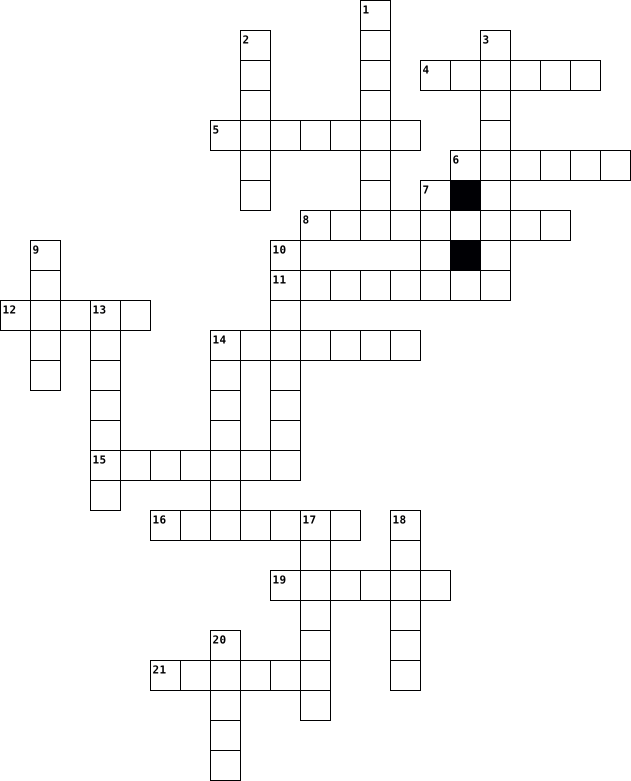
Across
- Culinary Arts/ Personal Finance teacher.
- Choir teacher.
- Digital Photography teacher.
- Spanish teacher.
- Health & Wellness teacher.
- Public Issues teacher.
- World History/ Honors English 9 teacher.
- Yearbook teacher.
- English 10/ AP Literature teacher.
- Biology/Physical Science teacher.
- Algebra 1/ Pre-Calculus teacher.
Down
- Intro Collage Read & Write teacher.
- Business Marketing teacher.
- Calculus/Statistics teacher.
- Band teacher.
- Chemistry/Physics teacher.
- Geometry/Algebra 2 teacher.
- World Geography/ Civics/ Us History/ AP Government teacher.
- Agriculture teacher.
- Trades/ PTLW teacher.
- Gym/Health teacher.
- German teacher.
22 Clues: Band teacher. • Choir teacher. • German teacher. • Spanish teacher. • Yearbook teacher. • Gym/Health teacher. • Agriculture teacher. • Trades/ PTLW teacher. • Public Issues teacher. • Chemistry/Physics teacher. • Health & Wellness teacher. • Business Marketing teacher. • Geometry/Algebra 2 teacher. • Calculus/Statistics teacher. • Digital Photography teacher. • ...
KAYLEEN'S BRIDAL SHOWER 2016-05-04

Across
- best man
- subject bride teaches
- highest degree of bride
- wedding month
- groom's middle name
- groom's name
- super hero in engagement pics
- maid of honor
- where they met
- bride's middle name
- wedding theme
- couple's professions
- where couple graduated from college
- honeymoon destination
Down
- what we are serving to drink
- bride's name
- reception location
- kkl
- groom's eye color
- church location
- subject groom teaches
- wedding date
- bride's eye color
- groom coaches what sport
- matron of honor
- something you are having today
26 Clues: kkl • best man • bride's name • groom's name • wedding date • wedding month • maid of honor • wedding theme • where they met • church location • matron of honor • groom's eye color • bride's eye color • reception location • groom's middle name • bride's middle name • couple's professions • subject bride teaches • subject groom teaches • honeymoon destination • highest degree of bride • groom coaches what sport • ...
Spanish 2 School Crossword 2016-08-23
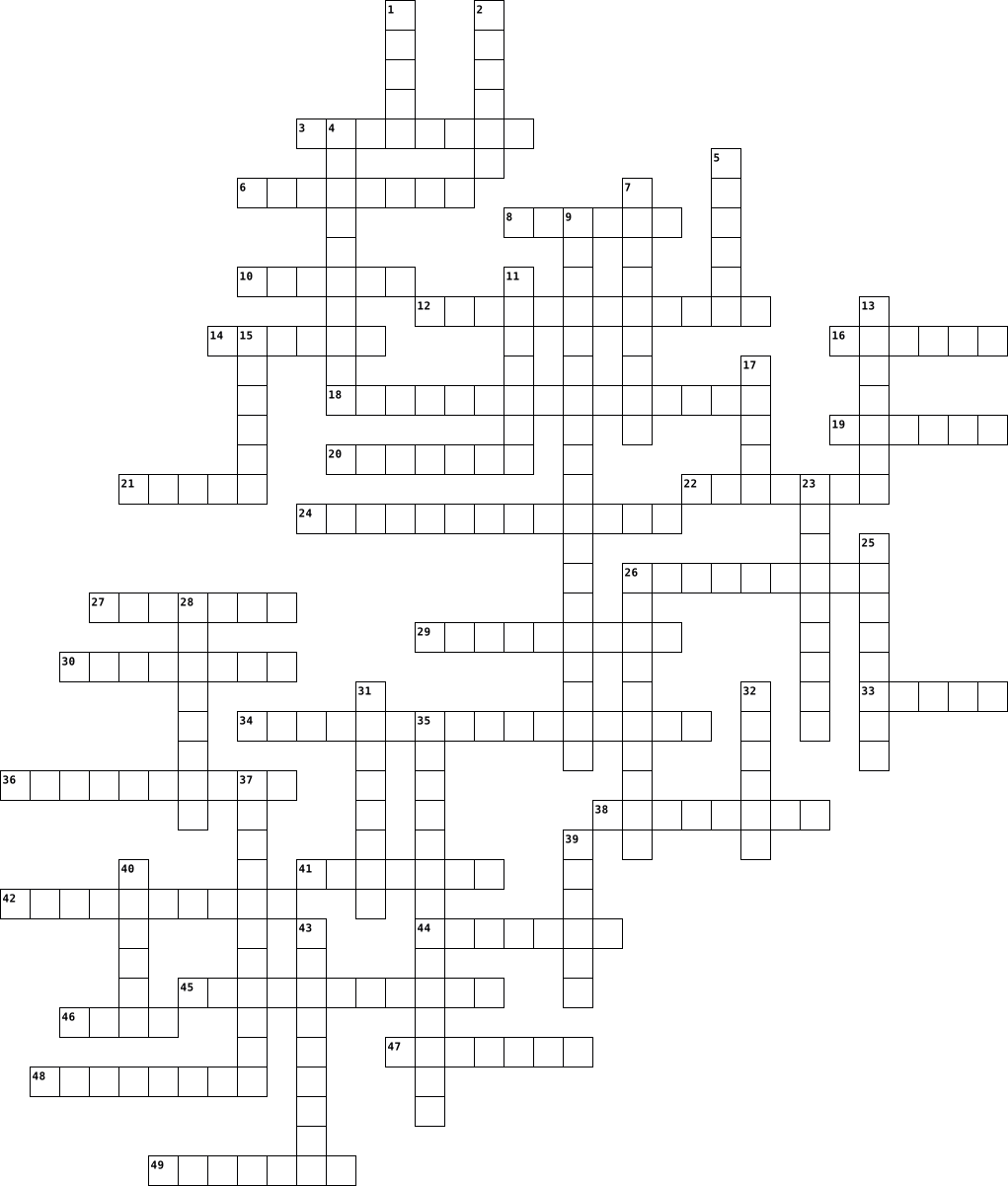
Across
- sports
- history
- English
- physics
- vice principal
- ninth
- tenth
- PE
- music
- second
- friend
- French
- trigonometry
- teacher
- calculus
- geography
- government
- sixth
- social studies
- secretary
- principal
- chemistry
- literature
- nurse
- math
- choir
- algebra
- biology
- Spanish
Down
- Chinese
- third
- student
- fourth
- geometry
- StuCo
- seventh
- languages
- eighth
- band
- counselor
- orchestra
- psycology
- science
- economics
- fifth
- yearbook
- computers
- German
- first
- seminary
50 Clues: PE • band • math • third • StuCo • ninth • tenth • music • fifth • sixth • first • nurse • choir • sports • fourth • eighth • second • friend • French • German • Chinese • student • history • English • physics • seventh • teacher • science • algebra • biology • Spanish • geometry • calculus • yearbook • seminary • languages • counselor • orchestra • psycology • geography • economics • secretary • computers • principal • chemistry • government • literature • trigonometry • vice principal • ...
Prowl Crossword 2018-01-19
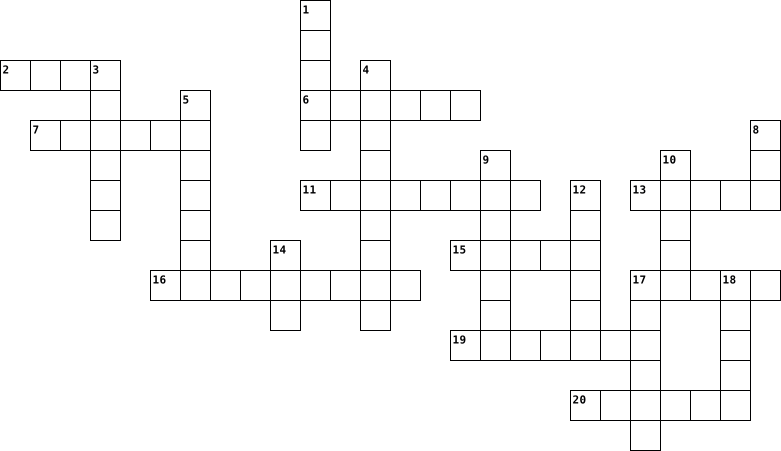
Across
- New middle school math teacher.
- Gym/Health teacher.
- Business and trades club ran by _____.
- Geometry/Algebra 2 teacher.
- Choir piece: Stand in the ______.
- Former spanish teacher.
- Calculus/Statistics teacher.
- German teacher.
- Agriculture teacher.
- Biology/Physical Science teacher.
Down
- Chemistry/Physics teacher.
- Algebra 1/Pre-Calculus teacher.
- Spanish teacher.
- Choir teacher.
- Club Abby Otteson runs.
- World History/Honors English 9 teacher.
- Public Issues teacher.
- New pizza place in Belleville.
- Mr.Martin’s least favorite color.
- Digital Photography teacher.
- The name of Belleville High School's mascot.
21 Clues: Choir teacher. • German teacher. • Spanish teacher. • Gym/Health teacher. • Agriculture teacher. • Public Issues teacher. • Club Abby Otteson runs. • Former spanish teacher. • Chemistry/Physics teacher. • Geometry/Algebra 2 teacher. • Calculus/Statistics teacher. • Digital Photography teacher. • New pizza place in Belleville. • New middle school math teacher. • ...
Branches of Science and Scientists 2019-02-27

Across
- study of living organisms
- experimenting with chemicals
- created a telescope, is an astronomer
- the study of air
- study of space
- the study of the earth
- the study of fossils
- the study of volcanoes
- the study of animals
- the study of ecology
Down
- has long white hair
- Nobel prize
- the study of earthquakes
- the study of physical remains of the past
- the study of insects
- the study of birds
- the study of stars
- the study of the ocean
- French physicist
- Bunsen burner
20 Clues: Nobel prize • Bunsen burner • study of space • the study of air • French physicist • the study of birds • the study of stars • has long white hair • the study of insects • the study of fossils • the study of animals • the study of ecology • the study of the ocean • the study of the earth • the study of volcanoes • the study of earthquakes • study of living organisms • experimenting with chemicals • ...
Paritosh Ambekar 207 2021-04-14

Across
- largest country
- German philosopher
- one religion
- impression in mind/plan
- give law's of motion
- teaching,instruction
- study of social life
- Fast
- one Continent
- Discovered telescope
- one geometry figur
- theory of evolution
- head
- opposite to beautiful
- connected with science
Down
- big/large
- conflict
- to stop
- theory of knowledge
- Writer of Philosophical Fragments
- one revolt
- Study of language
- study of life
- creature
- influenced,by Hegel’s dialectical view of history
- give more details
- to cut
- study of earth
28 Clues: Fast • head • to cut • to stop • conflict • creature • big/large • one revolt • one religion • study of life • one Continent • study of earth • largest country • Study of language • give more details • German philosopher • one geometry figur • theory of knowledge • theory of evolution • give law's of motion • teaching,instruction • study of social life • Discovered telescope • opposite to beautiful • ...
Musicals and Plays 2024-08-08

Across
- MIA= Here we go again
- SPIRIT= Dry Martini?
- ROUGE= Raise your glass
- Don't Lose your head
- But I'm the only man JA!
- Tonton!
- FRIDAY= Oh Biology
- Bangkok
- OF OZ= Ruby Slippers
- The slipper fits
- ACT= Nun Chase
Down
- Throwing away my shot
- DOUBTFIRE= Grace Kelly
- Tell me about it stud
- IT ON= Killer Instinct
- BLONDE= Bend n Snap
- Ultra Clutch
- FRIDAY= Time in year
- BOOTS= Raise you up
- Drain Poisioning
- ELLIOT= Dead Mum
- Go West
22 Clues: Tonton! • Bangkok • Go West • Ultra Clutch • ACT= Nun Chase • Drain Poisioning • ELLIOT= Dead Mum • The slipper fits • FRIDAY= Oh Biology • BLONDE= Bend n Snap • BOOTS= Raise you up • SPIRIT= Dry Martini? • Don't Lose your head • FRIDAY= Time in year • OF OZ= Ruby Slippers • Throwing away my shot • MIA= Here we go again • Tell me about it stud • DOUBTFIRE= Grace Kelly • IT ON= Killer Instinct • ...
Tombs Become One 2024-08-24

Across
- Number of guests
- Favourite sport
- Maid of Honour
- Best man
- Month they got engaged
- Becky's job
- Favourite festival
- City Becky got her degree from
- Name of the camp Becky & Dan met at
- Honeymoon location
- Years Becky & Dan have been together
Down
- Becky cannot live without
- City Becky & Dan live
- Colour of Dan's eyes
- Chocolate Labrador
- Years Dan & Becky have lived together
- Engagement spot
- Becky's hometown
- Dan's favourite snack
- Becky's degree
- Dan's middle name
- Red Labrador
22 Clues: Best man • Becky's job • Red Labrador • Maid of Honour • Becky's degree • Favourite sport • Engagement spot • Number of guests • Becky's hometown • Dan's middle name • Chocolate Labrador • Favourite festival • Honeymoon location • Colour of Dan's eyes • City Becky & Dan live • Dan's favourite snack • Month they got engaged • Becky cannot live without • City Becky got her degree from • ...
Suffixes 2024-08-30

Across
- to have nerves
- a scheduled time to meet
- somebody who works with flowers
- can be washed
- able to be excited
- an extension, extra
- can be desired
- in the state of glory
- a state of leadership
- some one who studies biology
Down
- A animal scientist
- To come to a sensible conclusion
- in the state of being funny
- if something is random it’s …
- able to bear
- can be broken
- Highly pleasant taste
- some one who studies geology
- a thing done successfully
- what is a dentist
20 Clues: able to bear • can be broken • can be washed • to have nerves • can be desired • what is a dentist • A animal scientist • able to be excited • an extension, extra • Highly pleasant taste • in the state of glory • a state of leadership • a scheduled time to meet • a thing done successfully • in the state of being funny • some one who studies geology • some one who studies biology • ...
Intramuscular Injections 2023-04-13

Across
- Biggest muscle
- It extends from the shoulder
- Is a multi axial & ball&socket joint
- protects us & clients
- Most common site
- The 5 rights are?
- These look Red
- Used to measure
- Part of the leg
- Sharp
Down
- This is parted three ways
- Form a big part of the body
- Protection
- To help feel better
- Another word for Human-race
- Always make sure the ? is correct
- least used site
- How we learn about humans
- Uncomfortable
- The procedure
- Expire -
21 Clues: Sharp • Expire - • Protection • Uncomfortable • The procedure • Biggest muscle • These look Red • least used site • Used to measure • Part of the leg • Most common site • The 5 rights are? • To help feel better • protects us & clients • This is parted three ways • How we learn about humans • Form a big part of the body • Another word for Human-race • It extends from the shoulder • ...
English Crossword 2023-03-17

Across
- You boil water with this
- Information and Communications Technology
- Car, Bike, Motorcycle
- Day after thursday
- Biology, Chemistry, Phsyic
- Place for you to sleep
- Second day of the week
- They ... the banana
- You can find knife, stove, and pan here
- Place for you to hang out
Down
- Please do not....(buang sampah sembarangan)
- yesterday....
- Cheese slicer
- Pillow's lover
- I have PE .... Monday
- She.... the cat
- You cook with this
- place for you to take a shower
- two plus two is four
- room Where you eat
20 Clues: yesterday.... • Cheese slicer • Pillow's lover • She.... the cat • Day after thursday • You cook with this • room Where you eat • They ... the banana • two plus two is four • Car, Bike, Motorcycle • I have PE .... Monday • Place for you to sleep • Second day of the week • You boil water with this • Place for you to hang out • Biology, Chemistry, Phsyic • place for you to take a shower • ...
h1a theme words 2021-11-26

Across
- tweede
- zevende
- mentoruur
- biologie
- Frans
- veertiende
- zesde
- leren voor
- elfde
- cijfer
- achtste
- Nederlands
- lesrooster
- spieken
- wiskunde
- geschiedenis
- dertiende
- derde
- opdracht
- muziek
- gymnastiek / LO
- aula
Down
- Duits
- ICT
- eerste
- twintigste
- op school
- agenda
- uit het hoofd leren
- huiswerk
- kluisje
- schrift
- negende
- conciërge
- vijfde
- aardrijkskunde
- vijftiende
- bureau
- tiende
- wiskunde
- twaalfde
- negentiende
- eenentwintigste
- schoolhoofd
- dans
- vierde
46 Clues: ICT • dans • aula • Duits • Frans • zesde • elfde • derde • tweede • eerste • agenda • vijfde • bureau • tiende • cijfer • vierde • muziek • zevende • kluisje • schrift • negende • achtste • spieken • huiswerk • biologie • wiskunde • twaalfde • wiskunde • opdracht • op school • mentoruur • conciërge • dertiende • twintigste • veertiende • vijftiende • leren voor • Nederlands • lesrooster • negentiende • schoolhoofd • geschiedenis • aardrijkskunde • eenentwintigste • ...
Final project vocab 2021-05-11

Across
- a four sided figure
- person who walks
- visual art
- not being fully aware
- statement at the beginning
- not common
- two wheel vehicle
- mythological creature with on horn and like a horse
- educated guess
- not permanent
- study of life
- study of the mind
- study of nerves
Down
- change in form or appearance
- a road vehicle
- three wheel vehicle
- bring together
- a mistaken belief
- documents stating persons background
- different words similar meaning
- a judge
- study of animals
- go forth
- explode
24 Clues: a judge • explode • go forth • visual art • not common • not permanent • study of life • a road vehicle • bring together • educated guess • study of nerves • person who walks • study of animals • a mistaken belief • two wheel vehicle • study of the mind • a four sided figure • three wheel vehicle • not being fully aware • statement at the beginning • change in form or appearance • ...
Greek Roots and Prefixes List #2 Review 2022-02-23

Across
- feeling; suffering; disease
- science dealing with study of living organisms
- the outer boundary of a surface or figure
- study of the earth's surface
- foot
- science; study
- a change in form
- external skeleton
- form
- foot
- within
- the absence of rule or government
- below normal body temperature
Down
- over; above; beyond
- under; beneath
- understanding another's feelings
- earth; ground
- exaggeration for effect
- internal skeleton
- around; about; near; enclosing
- rule
- out of; outside
- one who travels on foot
- life
24 Clues: foot • rule • form • foot • life • within • earth; ground • under; beneath • science; study • out of; outside • a change in form • internal skeleton • external skeleton • over; above; beyond • exaggeration for effect • one who travels on foot • feeling; suffering; disease • study of the earth's surface • below normal body temperature • around; about; near; enclosing • understanding another's feelings • ...
21 2025-02-08

Across
- Study of humans
- Machine that performs tasks
- Enhanced reality
- Organized data
- Study of language
- Study of government
- Physical computer parts
- Not physically existing
- Study of life
- Connected computers
- Study of Earth
- Set of instructions
- Study of ideas
- Intelligence in technology
- Study of space
Down
- Study of mind
- Study of technology
- Protecting digital systems
- Global network
- Programs for computers
- Imitation of real-world process
- Instructions for computers
- Study of society
- Write code
- Study of resources
25 Clues: Write code • Study of mind • Study of life • Global network • Organized data • Study of Earth • Study of ideas • Study of space • Study of humans • Enhanced reality • Study of society • Study of language • Study of resources • Study of technology • Study of government • Connected computers • Set of instructions • Programs for computers • Physical computer parts • Not physically existing • ...
Jurassic Park 2023-12-06

Across
- Very smart dino
- Ian Malcolm
- The dinosaurs will end the world
- Ancient animal
- Life finds a way
- ended the sabotage
- DR. wu saved them but not himself
- T-rex
- Strand of life
- They shouldn't be able to reproduce
Down
- not enough to keep them safe
- Almost saved half of them
- how it's all possible
- the way they are connected
- The first species
- the key
- where it happened
- the most annoying bug
- The science of life
- they tried to steal it
20 Clues: T-rex • the key • Ian Malcolm • Ancient animal • Strand of life • Very smart dino • Life finds a way • The first species • where it happened • ended the sabotage • The science of life • how it's all possible • the most annoying bug • they tried to steal it • Almost saved half of them • the way they are connected • not enough to keep them safe • The dinosaurs will end the world • ...