cells Crossword Puzzles

Chapter 8.3.2 terminology. 2021-01-15

Chapter 8.3.2 terminology. crossword puzzle
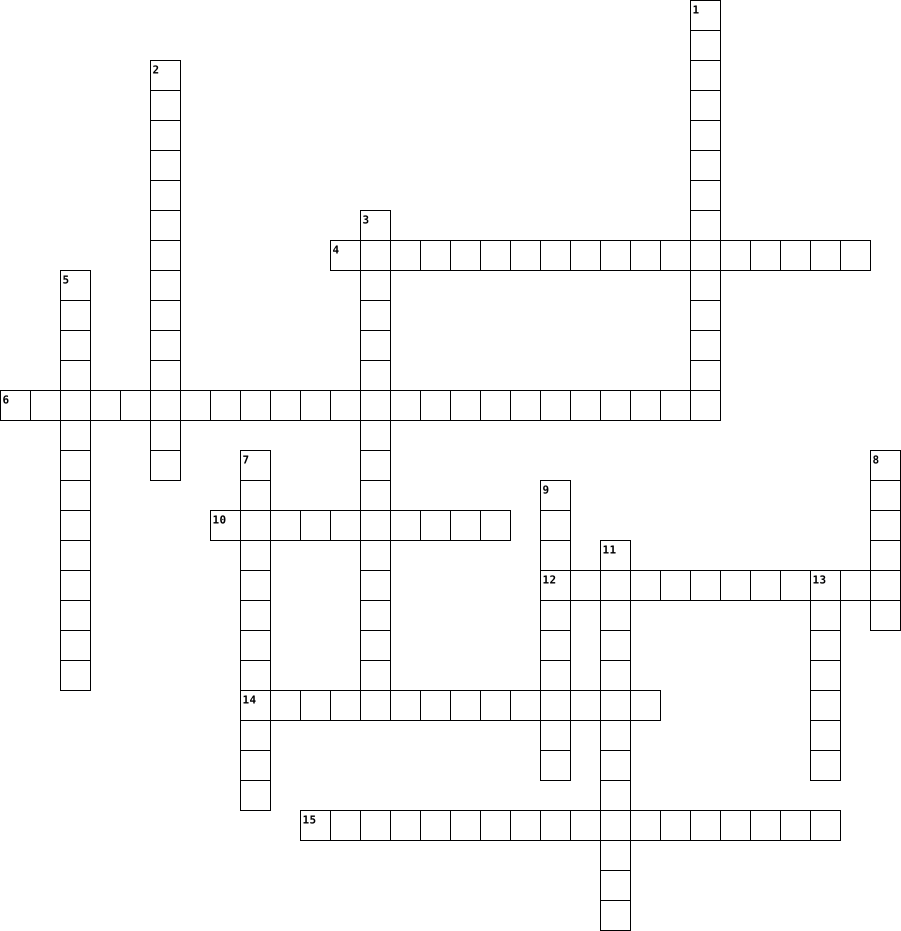
Across
  1. immature red blood cells
  2. blood clot
  3. iron-containing pigment in red blood cells that carries oxygen to the cells
  4. specialist in drawing blood
  5. circulation of blood through tissue
  6. record of the study of lymph vessels
  7. formation of blood cells
  8. increase in the number of platelets
  9. blockage of a vessel
  10. protein that provides protection against disease
  11. study of the blood
  12. incision into a vein
Down
  1. red blood cell
  2. abnormal deficiency in the lymph
  3. deficiency in all cellular components of the blood
  4. capable of producing a blood clot
  5. deficiency in the number of platelets
  6. enlargement of the spleen
  7. deficiency in neutrophil
  8. substance produced by the body in response to an antigen
  9. cell that helps blood clot
  10. white blood cell
  11. condition characterized by a great inequality in the size of red blood cells
  12. specialist in the study of the immune system
  13. red blood cell that assumes a spherical shape
  14. blockage in a blood vessel caused by an embolus
  15. deficiency in white blood cells
  16. deficiency in the number of red blood cells

28 Clues: blood clotred blood cellwhite blood cellstudy of the bloodblockage of a vesselincision into a veinimmature red blood cellsdeficiency in neutrophilformation of blood cellsenlargement of the spleencell that helps blood clotspecialist in drawing blooddeficiency in white blood cellsabnormal deficiency in the lymphcapable of producing a blood clot...

The Cell 2013-10-12

The Cell crossword puzzle
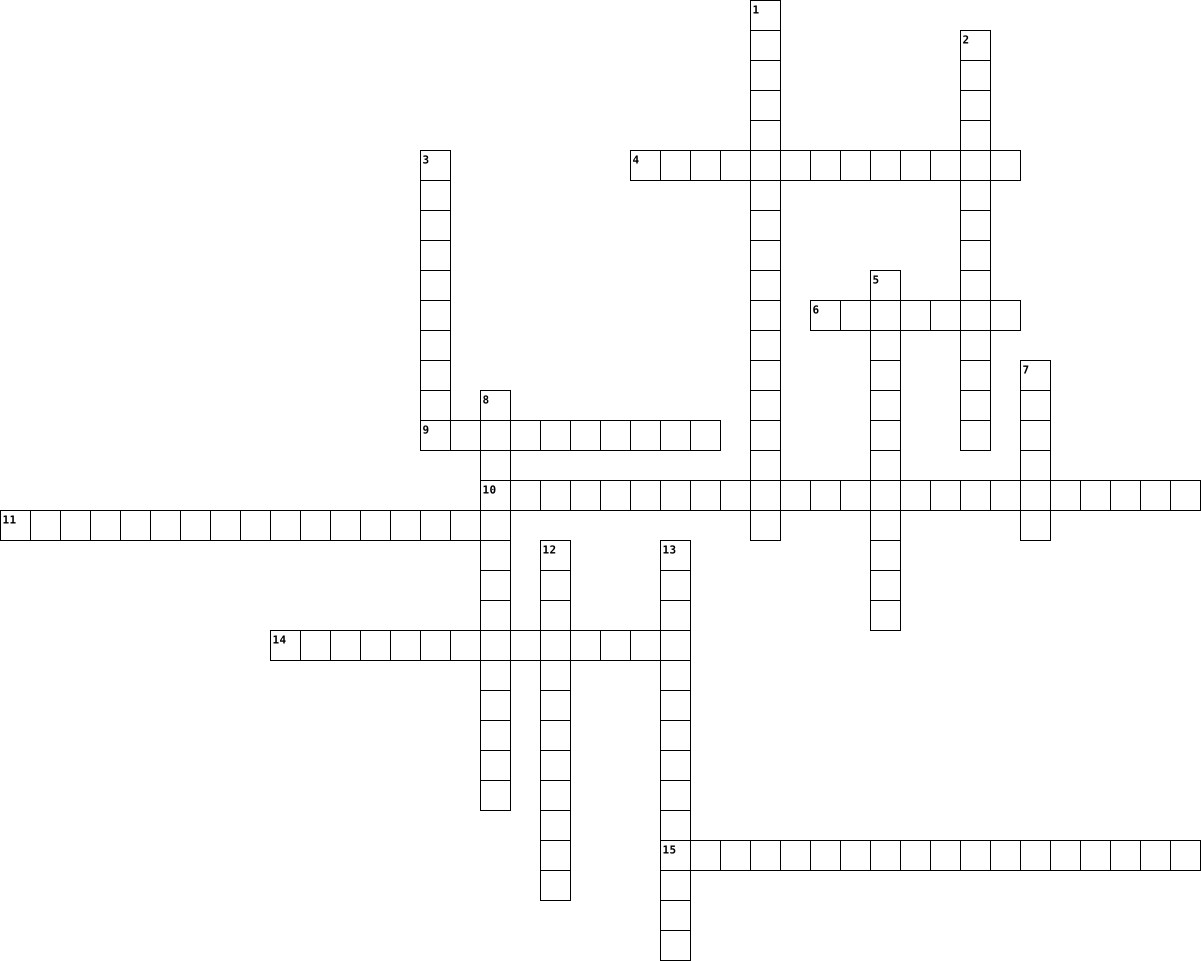
Across
  1. gooey slimy layer around prokaryote cells
  2. allows prokaryote cells to move
  3. allows for cellular respiration and generates ATP
  4. contains chromosomes in Eukaryote cells
  5. protects the interior of the cell, controls what goes in and out of the cell, made of phospolipid bilayer
  6. allow for photosynthesis in plant cells, contain green pigment
  7. outer layer of the nucleus
  8. spheres that store and transport material in the cell
  9. structures that contain enzymes to digest food in cell
  10. control center of the cell, contains DNA
  11. contains the DNA in the nucleus
  12. stores water, sugar, and salt for plant cells
Down
  1. single loop of DNA in prokaryote cells
  2. jelly in between cell parts that maintains the shape of the cell
  3. modifies, sorts, and packages macromolecules, the FedEx of the cell
  4. opening in the nucleus to allow things to pass through
  5. fibers that are tracks for organelles to move within the cell
  6. make proteins by linking amino acids, attached to ER
  7. small structures that break down fats and produce hydrogen peroxide
  8. protects and supports the cell, only found around plant cells

20 Clues: outer layer of the nucleusallows prokaryote cells to movecontains the DNA in the nucleussingle loop of DNA in prokaryote cellscontains chromosomes in Eukaryote cellscontrol center of the cell, contains DNAgooey slimy layer around prokaryote cellsstores water, sugar, and salt for plant cellsallows for cellular respiration and generates ATP...

Cell review-Abby 2024-01-23

Cell review-Abby crossword puzzle
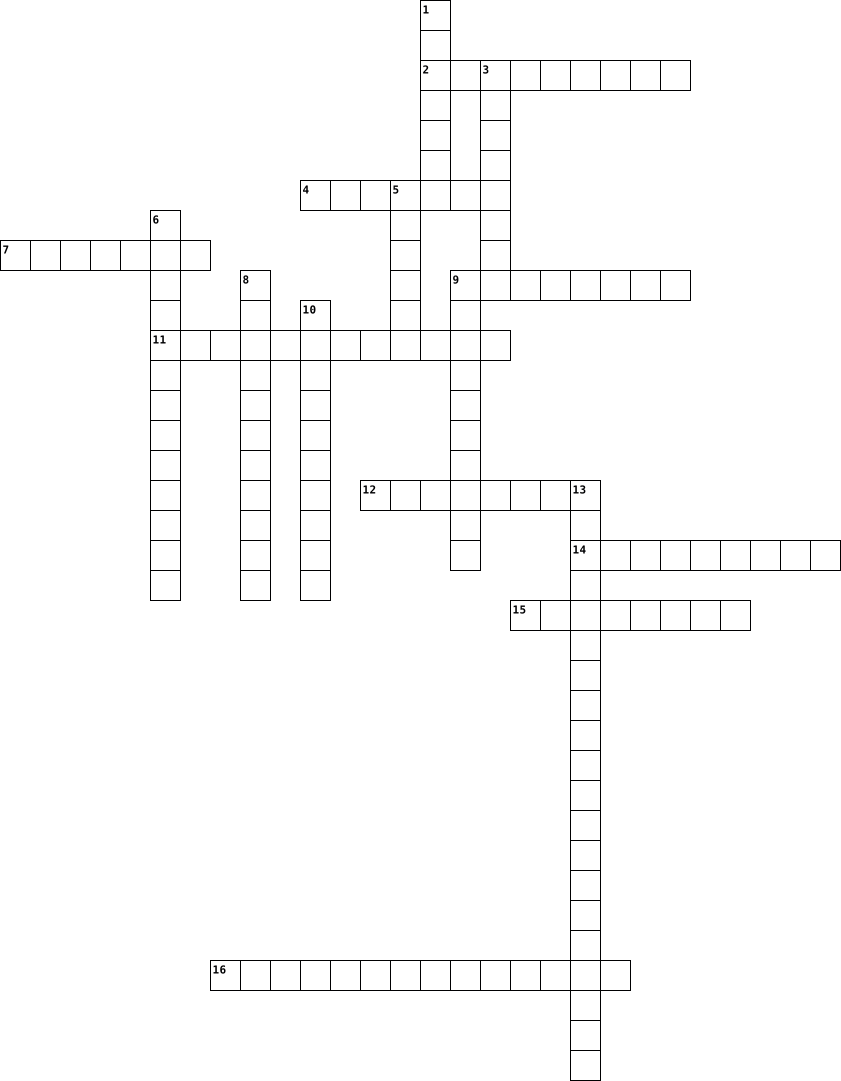
Across
  1. Cells found in plants
  2. In plant cells only,they produce food
  3. They process and realease energy
  4. The cells distributing,sorting organelle
  5. Protein-making factories in a cell
  6. Much more complex types of cells
  7. Organisms that have many cells
  8. The movement of things in and out without the use of energy
  9. The cell's transport organelle
  10. Jelly-like substance containing all the organelles in the cell
Down
  1. Organisms that have a single cell
  2. Very simple,single-celled bacteria
  3. Plants,algae,fungi,and some bacteria have an extra computer layer
  4. The powerhouse of the cell
  5. A layer on the outside that holds it together
  6. Temporary storage bubbles for the cell
  7. All organisms are made of cells
  8. The cell's control center
  9. The function of all forms of life
  10. Cells found in animals
  11. This transport requires energy to move a substance
  12. Moving things in and out of the cell membrane
  13. Organelle that contains digestive chemicals that breaks down the food
  14. A protective double membrane surrounding the nucleus

24 Clues: Cells found in plantsCells found in animalsThe cell's control centerThe powerhouse of the cellOrganisms that have many cellsThe cell's transport organelleAll organisms are made of cellsThey process and realease energyMuch more complex types of cellsOrganisms that have a single cellThe function of all forms of lifeVery simple,single-celled bacteria...

Chapter 11 2025-11-25

Chapter 11 crossword puzzle
Across
  1. Most abundant CNS glial cells that maintain chemical environment
  2. cells PNS glial cells that myelinate a single axon segment
  3. Long neuron extension that carries impulses away from the cell body
  4. CNS glial cells that myelinate multiple axons
  5. Na⁺ entry makes inside of cell less negative
  6. Structures that receive incoming signals from other neurons
  7. potential Small, local change in membrane potential
  8. Graded potential that moves the membrane toward threshold
  9. ions Trigger neurotransmitter release at the axon terminal
  10. potential All-or-none electrical signal that travels the axon
  11. of ranvier Gaps in myelin that allow saltatory conduction
  12. CNS immune defense cells that remove debris
  13. membrane potential -70 mV state of a neuron at rest
Down
  1. sheath Fatty covering that increases speed of impulse conduction
  2. K⁺ exit restores negativity inside the cell
  3. hillock Region where action potentials begin
  4. Membrane becomes more negative than resting
  5. potassium pump Restores ionic balance by pumping 3 Na⁺ out, 2 K⁺ in
  6. cells Glial cells that circulate CSF
  7. cleft Space between neurons where neurotransmitters are released
  8. refractory period Time when no stimulus can trigger another AP
  9. Graded potential that moves the membrane away from threshold

22 Clues: cells Glial cells that circulate CSFK⁺ exit restores negativity inside the cellMembrane becomes more negative than restingCNS immune defense cells that remove debrishillock Region where action potentials beginNa⁺ entry makes inside of cell less negativeCNS glial cells that myelinate multiple axonspotential Small, local change in membrane potential...

Chapter 2 Part 1 2025-12-08

Chapter 2 Part 1 crossword puzzle
Across
  1. declare all cells come from other cells
  2. gel-like fluid that carries nutrients, proteins, and organelles around the cell
  3. looked a living cells
  4. makes food using energy from sunlight
  5. declared all animals have celss
  6. Basic unit of structure and function
  7. helps make proteins and substances
  8. declared all plants have cells
  9. stores food, water, waste products, or other materials
  10. produce proteins needed by the cell
  11. directs cell's activities
Down
  1. rigid supporting layer that surrounds plant cells
  2. converts energy in food to energy the plant can use
  3. thin strands of genetic material
  4. ability to distinguish details on an object
  5. looked at dead cells
  6. a tiny cell structure that carries out a specific function within a cell
  7. Instrument that makes small things look larger
  8. breaks down food particles and worn out cell parts
  9. packages and distributes materials from (ER)
  10. controls which substances come in or out of the cell
  11. produces dot-like ribosomes that produce proteins
  12. a widely accepted explanation of the relationship between cells and living things
  13. condition when objects appear larger than they are

24 Clues: looked at dead cellslooked a living cellsdirects cell's activitiesdeclared all plants have cellsdeclared all animals have celssthin strands of genetic materialhelps make proteins and substancesproduce proteins needed by the cellBasic unit of structure and functionmakes food using energy from sunlightdeclare all cells come from other cells...

Biology Terminology 2018-01-28

Biology Terminology crossword puzzle
Across
  1. has a cytoplasm and nucleus in a membrane
  2. (Haploid) sperm and egg cells
  3. Half the number of diploid chromosomes
  4. What do Ribosomes produce?
  5. The layer that surrounds plant cells
  6. Where the microtubules attach on a chromosome
  7. Small section of DNA that gives the instructions for the construction of protein
  8. results in 2 identical daughter cells
  9. hereditary unit of information, found in the nucleus of cells
  10. equally divides the chromosomes into two daughter cells
  11. final phase of cell division that results in two nuclei being formed
  12. The first phase of mitosis
  13. The third phase of Mitosis
  14. What is an organisms complete set of DNA called?
  15. long section of DNA (humans have 23 pairs of it)
  16. Membrane bound functions within a cell
  17. having double the haploid chromosomes
Down
  1. different version of the same gene
  2. The living cell found in four out of the five kingdoms
  3. The type of living cell found in the Monera kingdom
  4. contains the DNA
  5. The phase of a cells life in which it copies its DNA, to prepare for mitosis
  6. (Diploid) skin and bone cells
  7. Image of all chromosomes in a nucleus
  8. process of cell death
  9. results in 4 non-identical haploid daughter cells
  10. population of bodily cells
  11. Can be found attached to the rough endoplasmic reticulum or floating in the cytoplasm
  12. located near the nucleus, it functions during cell division

29 Clues: contains the DNAprocess of cell deathWhat do Ribosomes produce?population of bodily cellsThe first phase of mitosisThe third phase of Mitosis(Haploid) sperm and egg cells(Diploid) skin and bone cellsdifferent version of the same geneThe layer that surrounds plant cellsImage of all chromosomes in a nucleusresults in 2 identical daughter cells...

Plant/Animal Cell Project 2021-09-02

Plant/Animal Cell Project crossword puzzle
Across
  1. The arrangement of parts in an organism
  2. A system of ideas that explains many related observations and is supported by a body of evidence acquired by scientific investigation
  3. The special normal or proper activity of an organ or part
  4. Complex Packages and distributes materials within or out of the cell
  5. Deoxyribonucleic acid, a molecules that is present in all living cells and that contains information that determines traits
  6. Theory Describes the basic characteristics of all cells and organisms
  7. Makes protein
  8. rigid structure that surrounds the cell membrane in plant cells; provide structure and support
  9. The smallest functional unit of all living things
  10. an organelle found in plant and algae cells where photosynthesis occurs
  11. Gel-like liquid inside a cell; helps cell maintain shape and is about 80% water
  12. Structures within a cell that have special functions to keep the cell working
  13. Cells WITH a nucleus
Down
  1. The site of cellular respiration, which releases energy for use by the cell
  2. Where genetic material is stored and controls the cells growth and reproduction
  3. Protective, flexible barrier that controls what does in and out of the cell
  4. Processes and transports proteins and makes lipids
  5. A fluid-filled vesicle that contains food, water and waste. Plant cells have a large central vacuole that stores water.
  6. One of the structures in the nucleus that are made up of DNA and protein
  7. Cells without a defined nucleus; usually smaller than eukaryotic cells
  8. Produces enzymes that digest wastes, cell parts, and foreign invaders

21 Clues: Makes proteinCells WITH a nucleusThe arrangement of parts in an organismThe smallest functional unit of all living thingsProcesses and transports proteins and makes lipidsThe special normal or proper activity of an organ or partComplex Packages and distributes materials within or out of the cell...

Plant/Animal Cell Project 2021-09-02

Plant/Animal Cell Project crossword puzzle
Across
  1. The arrangement of parts in an organism
  2. A system of ideas that explains many related observations and is supported by a body of evidence acquired by scientific investigation
  3. The special normal or proper activity of an organ or part
  4. Complex Packages and distributes materials within or out of the cell
  5. Deoxyribonucleic acid, a molecules that is present in all living cells and that contains information that determines traits
  6. Theory Describes the basic characteristics of all cells and organisms
  7. Makes protein
  8. rigid structure that surrounds the cell membrane in plant cells; provide structure and support
  9. The smallest functional unit of all living things
  10. an organelle found in plant and algae cells where photosynthesis occurs
  11. Gel-like liquid inside a cell; helps cell maintain shape and is about 80% water
  12. Structures within a cell that have special functions to keep the cell working
  13. Cells WITH a nucleus
Down
  1. The site of cellular respiration, which releases energy for use by the cell
  2. Where genetic material is stored and controls the cells growth and reproduction
  3. Protective, flexible barrier that controls what does in and out of the cell
  4. Processes and transports proteins and makes lipids
  5. A fluid-filled vesicle that contains food, water and waste. Plant cells have a large central vacuole that stores water.
  6. One of the structures in the nucleus that are made up of DNA and protein
  7. Cells without a defined nucleus; usually smaller than eukaryotic cells
  8. Produces enzymes that digest wastes, cell parts, and foreign invaders

21 Clues: Makes proteinCells WITH a nucleusThe arrangement of parts in an organismThe smallest functional unit of all living thingsProcesses and transports proteins and makes lipidsThe special normal or proper activity of an organ or partComplex Packages and distributes materials within or out of the cell...

Stem Cell Vocab 2023-05-31

Stem Cell Vocab crossword puzzle
Across
  1. Stem Cells - Undifferentiated cells that replenish dying cells
  2. - part of an organism that has a specific vital function in the body
  3. Cell - special human cells that are able to develop into many different cell types. Marrow - a soft and fatty substance found in the cavities of bones, in which blood cells are produced
  4. - the smallest unit of life that can live on its own; makes up tissue
  5. - any of the fine threadlike strands growing from the skin of humans, mammals, and some other animals.
  6. - A group or layer of cells that work together to perform a specific function
  7. - an unborn or unhatched offspring in the process of development
  8. - treatment intended to relieve a disorder
  9. - a small secretory cavity, sac, or gland.
  10. - cause something to arise or come about.
  11. - Can develop into a limited variety of cells Differentiate - make or become different in the process of growth or development
  12. - a mature melanin-forming cell, especially in the skin.
Down
  1. - a medical procedure where something from a body is replaced from another body
  2. - a mammalian blastula in which some differentiation of cells has occurred.
  3. - a disease caused by the unregulated hyperdivision of a cell
  4. - regrow new tissue to replace lost or injured tissue (for living organisms).
  5. - Able to produce a fertile individual
  6. - the natural coloring of animal or plant tissue.
  7. - make or become different in the process of growth or development.
  8. - Able to develop into many types of different cells

20 Clues: - Able to produce a fertile individual- cause something to arise or come about.- treatment intended to relieve a disorder- a small secretory cavity, sac, or gland.- the natural coloring of animal or plant tissue.- Able to develop into many types of different cells- a mature melanin-forming cell, especially in the skin....

Blood Basics 2025-10-09

Blood Basics crossword puzzle
Across
  1. Colour of deoxygenated blood
  2. Thickest blood vessel walls
  3. Cells that fight infection
  4. Shape of red blood cells
  5. Fragments of cells that help clotting
  6. Oxygen-carrying pigment
  7. Smallest blood vessels
  8. Nutrients carried in blood
  9. Where are blood cells made?
  10. Main component of plasma
Down
  1. Cells that carry oxygen
  2. Colour of oxygenated blood
  3. Gas removed by blood
  4. Purpose of valves in veins
  5. Main liquid part of blood
  6. Average human resting heartbeat felt in an artery
  7. Gas picked up in lungs
  8. Vessels carrying blood to the heart
  9. Vessels carrying blood away from heart

19 Clues: Gas removed by bloodGas picked up in lungsSmallest blood vesselsCells that carry oxygenOxygen-carrying pigmentShape of red blood cellsMain component of plasmaMain liquid part of bloodColour of oxygenated bloodPurpose of valves in veinsCells that fight infectionNutrients carried in bloodThickest blood vessel wallsWhere are blood cells made?...

Infectious Disease Crossword 2020-11-10

Infectious Disease Crossword crossword puzzle
Across
  1. immunity that results from ether having a disease or from receiving a vaccine
  2. An illness that passes from one organism to another
  3. An epidemic that has grown world-wide, affecting many continents
  4. A type of pathogen that is living and can be treated using antibiotics
  5. (physical & Chemical Barriers) This line of defense is your skin, mucous membranes, cilia, tears, saliva, digestive system
  6. turn off the immune response once the immune system has controlled the infection
  7. Microorganisms or germs that cause infectious disease when they enter your body and multiply
  8. your body's ability to destroy pathogens that it has previously encountered before the pathogens are able to cause disease
  9. This line of defense is inflammation and accumulation of fluids at the site of an infection that leads to heat, redness and swelling. Cells involved include Phagocytes that engulf pathogens.
Down
  1. destroy body cells that are infected or damaged by pathogens
  2. fights disease by producing a separate set of weapons for each kind of pathogen it encounters
  3. white blood cells that produce custom made antibodies against invading pathogens
  4. This line of defense is the immune system. T Cells, B Cells, and Antibodies
  5. white blood cells that search for pathogens stimulate B cells to fight produce antibodies
  6. organisms that are so small that they can only be viewed using a microscope
  7. A nonliving pathogen that uses your own body cells to multiply.
  8. immunity acquired by receiving antibodies from a source other than one's own immune system
  9. Produced by B cells, protein markers that attach to the surface of pathogens and render them harmless
  10. white blood cells that engulfs and destroy pathogens
  11. an unusually high occurrence of a disease in a certain place during a certain time period
  12. another name for "infectious" disease

21 Clues: another name for "infectious" diseaseAn illness that passes from one organism to anotherwhite blood cells that engulfs and destroy pathogensdestroy body cells that are infected or damaged by pathogensA nonliving pathogen that uses your own body cells to multiply.An epidemic that has grown world-wide, affecting many continents...

Altered Immunity 2016-02-21

Altered Immunity crossword puzzle
Across
  1. Due to the action of _______ cells the body has a much more rapid response when re-exposed to the same antigen.
  2. The happens when there is an immune response due to the presense of cells from another individual.
  3. This type of immunity is specific and has a memory of antigens.
  4. These non-specific cells circulate until destroying a threatening cell they come into contact with.
  5. The process by which the body recognizes foreign substances and neutralizes them.
  6. Basophils and ____ cells work to establish an allergic reaction.
  7. This is given to a person to stimulate immunity through exposure to an antigen.
  8. A substance that induces a state of sensitivity or an immune response.
  9. These T lymphocytes limit the immune response.
  10. These develop in the bone marrow.
  11. These are common antigens that are usually harmless.
  12. These are produced and differentiated in the central organs of the lymphatic system.
  13. These offer greatest protection against parasites.
  14. These rapidly respond to bacterial infections.
Down
  1. This type of immunity is a rapid, first responder.
  2. Another name for antibodies.
  3. After B lymphocytes bind with an antigen, they differentiate into plasma cells and produce _____.
  4. These mature and fully differentiate in the thymus.
  5. These are "antigen presenting" cells.
  6. The lymphatic system _____ antigens captured by the cells of the immune system.
  7. These T lymphocytes activate other cells of the immune response.
  8. The immune response is the body's _____ line of defense.
  9. This happens when the body cannot recognize "self" from "nonself".
  10. Cytotoxic T lymphocytes are the primary cells involved in _________ immunity.
  11. These T lymphocytes destroy antigen carrying cells.

25 Clues: Another name for antibodies.These develop in the bone marrow.These are "antigen presenting" cells.These T lymphocytes limit the immune response.These rapidly respond to bacterial infections.This type of immunity is a rapid, first responder.These offer greatest protection against parasites.These mature and fully differentiate in the thymus....

Pause and Reflect #1 (thru October 24, 2022) 2022-10-24

Pause and Reflect #1 (thru October 24, 2022) crossword puzzle
Across
  1. All cells are surrounded by one of these.
  2. Cells are made-up of ___ like mitochondria.
  3. Active transport moves materials ___ the concentration gradient across the cell membrane.
  4. This kind of diffusion occurs when material moves through the cell membrane’s bilayer.
  5. Prokaryotes have this organelle in common with plant and animal cells.
  6. A form of active transport which moves large molecules out of the cell.
  7. head In the phospholipid bilayer which makes-up the cell membrane, the ___ is polar (similar to magnetic).
  8. This kind of diffusion occurs when a membrane protein helps move material across the cell membrane.
  9. wall Prokaryotes have this protective structure in common with plant cells.
  10. Passive transport across the cell membrane occurs from high ___ to low ___.
  11. Cells are the basics ___ and functional unit for living things.
  12. Materials move with or along the concentration ___ during passive transport across the cell membrane.
  13. A form of active transport which moves large molecules into the cell.
Down
  1. This organelle is the site of aerobic respiration in eukaryotes.
  2. A properly functioning cell membrane is critical for maintain the cell’s ___, because it controls what enters and leaves the cell.
  3. Cells with a nucleus and other membrane-bound organelles are referred to as ___.
  4. Passive transport across the cell membrane does not require ___.
  5. Cells are made-up of ___ like protein.
  6. Cells which lack a nucleus and other membrane-bound organelles are referred to as ___.
  7. wall The protective structure that sets plant cells apart from animal cells.
  8. This is where ribosomes are assembled in eukaryotes.
  9. tail In the phospholipid bilayer which makes-up the cell membrane, the ___ is nonpolar (similar to un-magnetic).
  10. This structure is where photosynthesis happens in pant cells.
  11. Any kind of cell transport which uses-up some of the cell’s energy.
  12. The region where a prokaryote’s DNA ay be found.

25 Clues: Cells are made-up of ___ like protein.All cells are surrounded by one of these.Cells are made-up of ___ like mitochondria.The region where a prokaryote’s DNA ay be found.This is where ribosomes are assembled in eukaryotes.This structure is where photosynthesis happens in pant cells.Cells are the basics ___ and functional unit for living things....

Za Crooky Dooky 2023-05-20

Za Crooky Dooky crossword puzzle
Across
  1. Single-celled organisms that lack a nucleus or other membrane-bound organelles.
  2. A structural carbohydrate found in the cell walls of plants and some other organisms.
  3. The process by which organisms eliminate waste products from their body.
  4. A small, circular piece of DNA found in some bacteria that can replicate independently of the chromosomal DNA.
  5. The cellular structure responsible for synthesizing proteins.
  6. membrane: The thin, flexible barrier that surrounds cells and regulates the movement of materials in and out of the cell.
  7. The metabolic process by which cells use oxygen to convert nutrients into energy and produce carbon dioxide as a waste product.
  8. The ability of organisms or their cells to move from one place to another.
  9. The organelle in eukaryotic cells that contains the cell's genetic material, or DNA.
  10. The organelles in eukaryotic cells that produce energy in the form of ATP.
  11. The process of obtaining and using nutrients from food to support bodily functions.
  12. Membrane-bound structures in eukaryotic cells that store water, nutrients, and waste products.
  13. The process by which organisms increase in size and complexity over time.
  14. A type of fungus that is used in baking and brewing, and can ferment sugars into alcohol and carbon dioxide.
Down
  1. The green pigment in plants and algae that absorbs light energy for photosynthesis.
  2. Organisms with cells that contain a nucleus and other membrane-bound organelles.
  3. The organelle in plant cells that carries out photosynthesis.
  4. The process by which organisms produce offspring to continue their species.
  5. The gel-like substance that fills the interior of cells and contains organelles, proteins, and other molecules.
  6. The ability of organisms or cells to respond to changes in their environment or stimuli.
  7. wall: A rigid outer layer that provides additional support and protection for cells in plants, fungi, and some bacteria.

21 Clues: The organelle in plant cells that carries out photosynthesis.The cellular structure responsible for synthesizing proteins.The process by which organisms eliminate waste products from their body.The process by which organisms increase in size and complexity over time.The ability of organisms or their cells to move from one place to another....

Za Crooky Dooky 2023-05-20

Za Crooky Dooky crossword puzzle
Across
  1. Single-celled organisms that lack a nucleus or other membrane-bound organelles.
  2. A structural carbohydrate found in the cell walls of plants and some other organisms.
  3. The process by which organisms eliminate waste products from their body.
  4. A small, circular piece of DNA found in some bacteria that can replicate independently of the chromosomal DNA.
  5. The cellular structure responsible for synthesizing proteins.
  6. membrane: The thin, flexible barrier that surrounds cells and regulates the movement of materials in and out of the cell.
  7. The metabolic process by which cells use oxygen to convert nutrients into energy and produce carbon dioxide as a waste product.
  8. The ability of organisms or their cells to move from one place to another.
  9. The organelle in eukaryotic cells that contains the cell's genetic material, or DNA.
  10. The organelles in eukaryotic cells that produce energy in the form of ATP.
  11. The process of obtaining and using nutrients from food to support bodily functions.
  12. Membrane-bound structures in eukaryotic cells that store water, nutrients, and waste products.
  13. The process by which organisms increase in size and complexity over time.
  14. A type of fungus that is used in baking and brewing, and can ferment sugars into alcohol and carbon dioxide.
Down
  1. The green pigment in plants and algae that absorbs light energy for photosynthesis.
  2. Organisms with cells that contain a nucleus and other membrane-bound organelles.
  3. The organelle in plant cells that carries out photosynthesis.
  4. The process by which organisms produce offspring to continue their species.
  5. The gel-like substance that fills the interior of cells and contains organelles, proteins, and other molecules.
  6. The ability of organisms or cells to respond to changes in their environment or stimuli.
  7. wall: A rigid outer layer that provides additional support and protection for cells in plants, fungi, and some bacteria.

21 Clues: The organelle in plant cells that carries out photosynthesis.The cellular structure responsible for synthesizing proteins.The process by which organisms eliminate waste products from their body.The process by which organisms increase in size and complexity over time.The ability of organisms or their cells to move from one place to another....

Unit 7 Cell Division 2025-01-29

Unit 7 Cell Division crossword puzzle
Across
  1. Cells that contain two complete sets of chromosomes, one from each parent, represented as 2n (n = 23 in humans).
  2. During prophase I, homologous chromosome pairs swap genes to create genetic variation.
  3. A section of DNA that contains the instructions to make proteins, which then code for traits.
  4. The organized, tightly coiled form of DNA.
  5. The unorganized, loose form of DNA.
  6. After mitosis, cell contents are divided
  7. Chromatin condenses into chromosomes.Nuclear membrane disappears.
  8. Two nuclei start to form. Chromosomes decondense
  9. Chromosomes are lined up in the middle of the cell by spindle fibers.
  10. The process by which germ cells divide the nucleus to produce gametes for reproduction.
  11. The center of the chromosome where the sister chromatids attach.
  12. The process by which somatic cells divide the nucleus to make two identical cells.
Down
  1. Are a pair of chromosomes that have,same size,same gene locations,one from the biological mother,one from the biological father
  2. During metaphase I, chromosome pairs line up randomly, so daughter cells may receive any combination of the maternal or paternal chromosomes.
  3. Chromosomes break at the centromeres, and sister chromatids are pulled apart.
  4. "Growth 1”- Cell does normal cell activities and replicates organelles.“Synthesis”-DNA replication occurs(copy of DNA is made).“Growth 2”- Cell grows, DNA is checked for mutations, and the cell prepares for division.
  5. Chromatid One copy or one side of a chromosome.
  6. Haploid reproductive cells.
  7. A cell with one set of chromosomes (n).n = 23 chromosomes (“half”).
  8. Cells that make up the body.Examples: Nerve cells, muscle cells, bone cells, etc.
  9. The entire set of DNA of an organism. Humans = 23 pairs of chromosomes.

21 Clues: Haploid reproductive cells.The unorganized, loose form of DNA.After mitosis, cell contents are dividedThe organized, tightly coiled form of DNA.Chromatid One copy or one side of a chromosome.Two nuclei start to form. Chromosomes decondenseThe center of the chromosome where the sister chromatids attach....

Cell Energy 2025-03-29

Cell Energy crossword puzzle
Across
  1. Nucleic acid containing three phosphates that is the energy molecule for cells
  2. Organelle that is the site of aerobic respiration in eukaryotic cells
  3. Process by which yeast cells break down glucose to produce ATP, carbon dioxide, and ethanol alcohol
  4. Openings generally on the underside of leaves through which plants exchange oxygen and carbon dioxide gas
  5. Tissues that transport water, sugar, and other minerals throughout the plant
  6. Process by which cells use oxygen to help break down glucose into carbon dioxide, water, and ATP energy
  7. Vascular tissue that transports sugar from the leaves to other cells in the plant
  8. Cells located in the middle of leaves that are the main site of photosynthesis
  9. Organelle in which photosynthesis takes place inside of plant and algae cells
  10. Nucleic acid containing two phosphates that can be converted into ATP with the addition of a phosphate group
  11. Process by which bacteria, yeast, and animal muscle cells break down glucose to produce ATP without the help of oxygen
  12. Process by which some bacteria and animal muscle cells break down glucose to produce ATP and lactic acid
Down
  1. Process by which light energy is used to combine water and carbon dioxide to produce glucose and oxygen
  2. Main pigment that absorbs light energy used during photosynthesis
  3. Movement of water up the xylem tissues in stems of plants
  4. Pair of cells that control the opening and closing of stomata
  5. Vascular tissue that transports water from the roots to the leaves of plants
  6. Process by which water evaporates out of stomata in the leaves of plants
  7. Pigments that help plants absorb wavelengths of light that chlorophyll does not absorb
  8. Process by which organisms break down glucose to produce ATP energy

20 Clues: Movement of water up the xylem tissues in stems of plantsPair of cells that control the opening and closing of stomataMain pigment that absorbs light energy used during photosynthesisProcess by which organisms break down glucose to produce ATP energyOrganelle that is the site of aerobic respiration in eukaryotic cells...

biology 2014-01-12

biology crossword puzzle
Across
  1. structure that contains four chromatids
  2. one set of genes
  3. in between period of growth in cell division
  4. moniter the growth and division of cells
  5. two sets of chromosomes
  6. process of programmed cell death
  7. division of cytoplasm
  8. reproduction/ production of genetically identical offspring from a single parent
  9. chromosomes line up in the center of the cell
  10. adult stem cells
  11. unspecialized cells from which differentiated cells develop
  12. DNA strands in the duplicated chromosome
  13. final phase of mitosis
  14. reproduction/ production thats offspring inherit some of their genetic information from each parent
  15. an area where dna molecules can be seen and attatch along there length
  16. complex chromosome and protein
  17. two complete sets of genes
  18. process of which the number of chromosomes is divided in half
Down
  1. developmental stage
  2. chromosomes separate to opposite ends of the cell
  3. disorder in which body cells lose the ability to control growth
  4. process by which cells become specialized
  5. type of cell that can develop most of the bodys cell types
  6. process of homologous pairs forming tetrads
  7. division of the cell nucleus
  8. fertilized egg
  9. chromosomes become visable and the spindle starts to form
  10. body is formed by a single cell
  11. genetic information is bundled into packages of DNA
  12. hallow ball of cells
  13. division/ process by which a cell divides into two new daughter cells
  14. tiny paired structures
  15. mass of cancer cells
  16. regulates the cell cycle

34 Clues: fertilized eggone set of genesadult stem cellsdevelopmental stagehallow ball of cellsmass of cancer cellsdivision of cytoplasmfinal phase of mitosistiny paired structurestwo sets of chromosomesregulates the cell cycletwo complete sets of genesdivision of the cell nucleuscomplex chromosome and proteinbody is formed by a single cell...

Cell Study Game 2021-09-23

Cell Study Game crossword puzzle
Across
  1. Helps fill out the cell and keeps the organelles in their places
  2. When the eyespot on a cell directs it to move towards light for the purpose of photosynthesis
  3. The structure that covers organelles that are considered membrane-bound organelles
  4. Is only present in plant cells and is used during photosynthesis
  5. Creates ATP energy that fuels other organelles
  6. One of the few organelles that is present in both eukaryotic and prokaryotic cells, it's the site of protein synthesis
  7. an extra layer of protection only plant cells have that helps keep their structure
  8. Is present only in eukaryotic cells since it is contained in the nucleus
  9. Complex and typically multicellular organism that contains a nucleus and membrane-bound organelles
  10. What amoeba use to move and surround their food
  11. How organelles work to maintain homeostasis in their cell
Down
  1. Present only in prokaryotic cells and floats around in the cytoplasm
  2. Lists the three basic principles that explain how cells exist within our world
  3. The perfect living condition
  4. Where an organism move to certain chemicals to perform chemosynthesis
  5. A semipermeable organelle, has proteins embedded on it, and has polar and non-polar aspects
  6. Simple Unicellular organism that has no nucleus
  7. Used in cells to expel excess water, therefore, maintaining homeostasis
  8. Are larger in plant cells compared to animal cells, also used to store various materials
  9. This determines the function of its organelle
  10. Structure for locomotion on euglena
  11. What paramecium use to perform taxis

22 Clues: The perfect living conditionStructure for locomotion on euglenaWhat paramecium use to perform taxisThis determines the function of its organelleCreates ATP energy that fuels other organellesSimple Unicellular organism that has no nucleusWhat amoeba use to move and surround their foodHow organelles work to maintain homeostasis in their cell...

Cell Crossword 2016-02-04

Cell Crossword crossword puzzle
Across
  1. An instrument that makes a smaller object look larger than it really is.
  2. He said that all animals were made cell.
  3. A large sac in the center of the cell that stores food, water, and other materials that will be needed.
  4. A thick fluid region that fills the region between the cell membrane and the nucleus.
  5. Supports the body above the stage.
  6. The first thing Robert Hooke looked at under a microscope that he saw cells in
  7. He was a Dutch businessman that built microscopes in his free time
  8. Thin strands of DNA in the nucleus.
  9. Where ribosomes are made.
  10. Contains substances that break down large food particles into smaller ones.
  11. The powerhouse of the cell.
  12. It is only in plant cells and it creates energy for the cell by capturing sunlight.
  13. A widely accepted explanation of the relationship between cells and living things.
Down
  1. He concluded that all plants were made of cells.
  2. What is the thick, rigid layer that surrounds the cells of plants and other organisms.
  3. It controls which substances pass in or out of the cell.
  4. It is like the mail system.
  5. He proposed that new cells are formed only from cells that already are alive.
  6. It is an organelle that has a network of membranes that produces many substances.
  7. It contains a lens that magnifies an object 10 times.
  8. It stores food, water, and other materials that will be needed by the cell.
  9. The control center of any cell.
  10. The parts of an organism that carry out all of its functions.
  11. He was a British scientist who saw cork cells under his microscope.
  12. Little factories that make protein in both plant and animal cells.

25 Clues: Where ribosomes are made.It is like the mail system.The powerhouse of the cell.The control center of any cell.Supports the body above the stage.Thin strands of DNA in the nucleus.He said that all animals were made cell.He concluded that all plants were made of cells.It contains a lens that magnifies an object 10 times....

Cell Cycle 2021-12-05

Cell Cycle crossword puzzle
Across
  1. Condensed chromatin
  2. Checks for cell size, growth factors, and DNA damage
  3. Longest portion of cell cycle- contains G1, S, and G2
  4. Region on chromatid where they are most closely attached
  5. Chromatin condenses, mitotic spindle forms, centrosomes move away from each other
  6. Hormones released by cells that stimulate cell growth-CDKs activated leading to progression through cycle
  7. Body cells-contain diploid cells-divide by mitosis
  8. Protein that provides structural support to a chromosome
  9. Two nucleus formed in preparation for cytoplasm to split
  10. Cells rely on attachment to other cells of matrix to divide
  11. One set of chromosomes
Down
  1. Proteins attached to centromere to link chromatid to mitotic spindle
  2. Repeating unit of eukaryotic chromatin
  3. A way to prevent cancer, by killing the
  4. Similar to all cancers because it has DNA mutations- don't follow checkpoints, immortal, and evade apoptosis.
  5. Has specific regulatory effect-these phosphorylate target proteins, which help regulate events in the cell cycle
  6. Includes Mitosis, Cytokinesis, and results in 2 identical diploid cells
  7. Material are composed as DNA/RNA
  8. Chromatids separate and move to opposite sides of cell, cell then elongates
  9. Nuclear envelope fragments, and microtubules enter nuclear area and some attach to kinetochores
  10. Centrosomes at opposite poles, line up at metaphase plate, and microtubules attached to each kinetochore
  11. Reproductive cells-contain haploid-divide by meiosis
  12. Cells are split into 2 cells by cleavage furrow(animals), and cell plate forms (plant)
  13. Synthesized and degraded at specific stages of the cell cycle
  14. Checks for completion of DNA replication and DNA damage-If good, then moves to mitosis
  15. Two sets of chromosomes, one set from each parent
  16. growing cells
  17. Some stay here forever, and some can be called back into the cell

28 Clues: growing cellsCondensed chromatinOne set of chromosomesMaterial are composed as DNA/RNARepeating unit of eukaryotic chromatinA way to prevent cancer, by killing theTwo sets of chromosomes, one set from each parentBody cells-contain diploid cells-divide by mitosisChecks for cell size, growth factors, and DNA damage...

Unit 3 Crossword Puzzle 2022-08-25

Unit 3 Crossword Puzzle crossword puzzle
Across
  1. Structures found in cells.
  2. Requires Energy to transport substances.
  3. Diffusion of water.
  4. Structure that allows somethings to pass through and other things are blocked.
  5. Fluid found in cells.
  6. Theory that states 3 things: All cells come from preexisting cells.
  7. A reaction that plant cells use to make food.
  8. Meats are example of this
  9. Bread, rice, and pasta are example of this
  10. When many small molecules come together to make a large molecule
  11. Reaction in which substances go from area of high concentration to area of low concentration.
  12. Stores food and water.
  13. A reaction that breaks down glucose into smaller particles.
  14. Fats are example of this
  15. DNA and RNA are these
  16. When the cell takes in substances from outside.
  17. Organisms with many cells.
  18. Cells that have nucleus.
Down
  1. Cells that lack nucleus.
  2. Organisms with only one cell.
  3. Used to look at cells
  4. Contains Chlorophyll.
  5. When the cell release substances outside the cell.
  6. When the cell needs energy in a low oxygen environment.
  7. Control center of the cell.
  8. Many organ systems work together for a living thing. Humans and animals belong at this level.
  9. Does not require energy transport.
  10. When many tissues work together to do a function.
  11. When the substances outside of cell is equal inside the cell.
  12. A reaction that makes energy for the cell.
  13. Keeps shape for plant cell.
  14. When multiple cells work together to do a function.
  15. Smallest unit of life
  16. Powerhouse of the cell.
  17. When many organs work together to do a function.

35 Clues: Diffusion of water.Used to look at cellsContains Chlorophyll.Fluid found in cells.Smallest unit of lifeDNA and RNA are theseStores food and water.Powerhouse of the cell.Cells that lack nucleus.Fats are example of thisCells that have nucleus.Meats are example of thisStructures found in cells.Organisms with many cells.Control center of the cell....

21D: T-cells 2024-02-08

21D: T-cells crossword puzzle
Across
  1. innate phagocytes; do not require permission to chomp chomp cells. Roam around the immune system killing anything that is deemed foreign using perforins
  2. T cell that is responsible for the immune system's capability to respond to an antigen it has encountered before
  3. cells that live on the body's surface in the; starts an immune reaction
  4. who tests the T cells in the thymus by presenting self-antigens to them
  5. T cell that inhibits the immune response
  6. extracellular pathogens are considered:
  7. B lymphocyte's effector cells are in:
  8. MHC proteins
  9. immunity directed against a particular pathogen
Down
  1. T-cells that are capable of recognizing antigens presented to them by APCs are...
  2. immunity where lymphocytes directly attack and destroy foreign cells or diseased host cells
  3. T-cell that gives the okay for phagocytes to chomp chomp
  4. the rounds of mitosis that make clones of effector and memory cells (a part of t-cell activation)
  5. selection type where the T-cell should not recognize self-antigens
  6. T-cell that is considered the effector of cellular immunity
  7. specific regions on an antigen that stimulate immune responses
  8. immunity that is antibody-mediated
  9. selection type where the T-cell should recognize MHC
  10. site of origin for lymphocytes
  11. any molecule that triggers an immune response
  12. where T-cells migrate to when they are being "deployed"
  13. intracellular pathogens are considered:
  14. site of maturation for T-cells
  15. an APC that asks the helper T cell if it can eat any cell that looks like what is being presented
  16. protein that pokes holes in pathogens
  17. what encounters and processes an antigen

26 Clues: MHC proteinssite of origin for lymphocytessite of maturation for T-cellsimmunity that is antibody-mediatedprotein that pokes holes in pathogensB lymphocyte's effector cells are in:intracellular pathogens are considered:extracellular pathogens are considered:T cell that inhibits the immune responsewhat encounters and processes an antigen...

Cancer crossword puzzle 2024-01-04

Cancer crossword puzzle crossword puzzle
Across
  1. The theorized organism that most likely birthed bacteria, Archaea, and Eukarya.
  2. Treatment that kills cancer cells by radiation.
  3. A disease where a cell is uncontrollable and rapidly creates more of itself, turning “selfish”, and makes it a tumor if untreated for long enough.
  4. Cancer that has spread throughout the body from a tumor.
  5. Organisms that have evolved from single cells that have worked together to help each other but at a risk of betraying them.
  6. Cells in your body that kills off invading pathogens, prevents disease, and seeks cancer cells to kill before it turns into a tumor.
  7. The most common brain cancer in children.
  8. An important gene in repairing DNA damage.
  9. the creator of the book “Rebel Cell”.
  10. Anything that might cause cancer to an organism.
Down
  1. Treatment that kills uncontrollable cells by powerful chemicals in the body.
  2. The person who called the disease “cancer” and known as the “Father of Medicine”.
  3. A condition that disables you and limits your abilities for more than a year.
  4. A contagious version of cancer that infects dogs by cells passing through one dog to another.
  5. Cells that are grown from the bone marrow and are capable of tuning into any cell in the body.
  6. Genes that help suppress cancer cells and tumors.
  7. A defense mechanism after an injury where it is indicated by swelling, redness, and heat.
  8. A process in which an organism changes one or more of their genes in the process of making a new species.
  9. A solution for identifying tumors inside a body.
  10. A gene which can turn a cell into a cancer cell.

20 Clues: the creator of the book “Rebel Cell”.The most common brain cancer in children.An important gene in repairing DNA damage.Treatment that kills cancer cells by radiation.A solution for identifying tumors inside a body.A gene which can turn a cell into a cancer cell.Anything that might cause cancer to an organism....

Intro to Histology 2020-10-04

Intro to Histology crossword puzzle
Across
  1. controlled by somatic nervous system and found in connected to bones
  2. highly flexible
  3. provides flexible cushioning
  4. (blood cells) blood
  5. contains lots of collagen mostly running parallel
  6. single, flat layer of cells, that is thin and permeable. Rapid diffusion of materials. Found in blood vessels and lung tissue.
  7. tissue with some open space
  8. engulf invading substances
  9. secretes ground substances,fibers, fluid, etc
  10. Cartilage
  11. contains reticular fibers, which create a stifflike framework
  12. Irregular collagen fiber are arranged in multiple directions
  13. bone
  14. multiple thick layers of cells. Provides proteins for the underlying layers. Epidermal Layer
  15. Cell nuclei are found at different levels, so it appears stratified, though it is not. Secretion and absorption. Upper respiratory tract
  16. free surface cells. Transitions into shapes. Lining of the bladder
  17. firm ground substance with lacuna
  18. connective tissue proper
Down
  1. Columnar cell on the free surface. Rare in the body. Found in the larynx
  2. composed of fat cells
  3. cells detect foreign substances
  4. single layer of cube shaped cells. Secretion and absorption of substances. Found in the kidney
  5. carries oxygen(red) provides immune response(white)
  6. striated and found in the heart
  7. multiple layers of thick cube like cells. Rare in the body. Found in salivary glands
  8. A portion of the cell pinches off with the secreted products.
  9. cells excrete the products via exocytosis
  10. Pass impulses to other neurons, muscle fibers, or glands
  11. layer of tall compact cells. Secretion of mucus for protection and absorption of substances. Lining of digestive tract
  12. Regular collagen fibers are arranged in one direction
  13. cell rupture and spills products into the duct.
  14. non-striated and found in found in the walls of multiple organs
  15. secrete hormones into the bloodstream.
  16. support and protect neurons and regenerates after an injury

34 Clues: boneCartilagehighly flexible(blood cells) bloodcomposed of fat cellsconnective tissue properengulf invading substancestissue with some open spaceprovides flexible cushioningcells detect foreign substancesstriated and found in the heartfirm ground substance with lacunasecrete hormones into the bloodstream.cells excrete the products via exocytosis...

Za Crooky Dooky 2023-05-20

Za Crooky Dooky crossword puzzle
Across
  1. Single-celled organisms that lack a nucleus or other membrane-bound organelles.
  2. A structural carbohydrate found in the cell walls of plants and some other organisms.
  3. The process by which organisms eliminate waste products from their body.
  4. A small, circular piece of DNA found in some bacteria that can replicate independently of the chromosomal DNA.
  5. The cellular structure responsible for synthesizing proteins.
  6. membrane: The thin, flexible barrier that surrounds cells and regulates the movement of materials in and out of the cell.
  7. The metabolic process by which cells use oxygen to convert nutrients into energy and produce carbon dioxide as a waste product.
  8. The ability of organisms or their cells to move from one place to another.
  9. The organelle in eukaryotic cells that contains the cell's genetic material, or DNA.
  10. The organelles in eukaryotic cells that produce energy in the form of ATP.
  11. The process of obtaining and using nutrients from food to support bodily functions.
  12. Membrane-bound structures in eukaryotic cells that store water, nutrients, and waste products.
  13. The process by which organisms increase in size and complexity over time.
  14. A type of fungus that is used in baking and brewing, and can ferment sugars into alcohol and carbon dioxide.
Down
  1. The green pigment in plants and algae that absorbs light energy for photosynthesis.
  2. Organisms with cells that contain a nucleus and other membrane-bound organelles.
  3. The organelle in plant cells that carries out photosynthesis.
  4. The process by which organisms produce offspring to continue their species.
  5. The gel-like substance that fills the interior of cells and contains organelles, proteins, and other molecules.
  6. The ability of organisms or cells to respond to changes in their environment or stimuli.
  7. wall: A rigid outer layer that provides additional support and protection for cells in plants, fungi, and some bacteria.

21 Clues: The organelle in plant cells that carries out photosynthesis.The cellular structure responsible for synthesizing proteins.The process by which organisms eliminate waste products from their body.The process by which organisms increase in size and complexity over time.The ability of organisms or their cells to move from one place to another....

Za Crooky Dooky 2023-05-20

Za Crooky Dooky crossword puzzle
Across
  1. Single-celled organisms that lack a nucleus or other membrane-bound organelles.
  2. A structural carbohydrate found in the cell walls of plants and some other organisms.
  3. The process by which organisms eliminate waste products from their body.
  4. A small, circular piece of DNA found in some bacteria that can replicate independently of the chromosomal DNA.
  5. The cellular structure responsible for synthesizing proteins.
  6. membrane: The thin, flexible barrier that surrounds cells and regulates the movement of materials in and out of the cell.
  7. The metabolic process by which cells use oxygen to convert nutrients into energy and produce carbon dioxide as a waste product.
  8. The ability of organisms or their cells to move from one place to another.
  9. The organelle in eukaryotic cells that contains the cell's genetic material, or DNA.
  10. The organelles in eukaryotic cells that produce energy in the form of ATP.
  11. The process of obtaining and using nutrients from food to support bodily functions.
  12. Membrane-bound structures in eukaryotic cells that store water, nutrients, and waste products.
  13. The process by which organisms increase in size and complexity over time.
  14. A type of fungus that is used in baking and brewing, and can ferment sugars into alcohol and carbon dioxide.
Down
  1. The green pigment in plants and algae that absorbs light energy for photosynthesis.
  2. Organisms with cells that contain a nucleus and other membrane-bound organelles.
  3. The organelle in plant cells that carries out photosynthesis.
  4. The process by which organisms produce offspring to continue their species.
  5. The gel-like substance that fills the interior of cells and contains organelles, proteins, and other molecules.
  6. The ability of organisms or cells to respond to changes in their environment or stimuli.
  7. wall: A rigid outer layer that provides additional support and protection for cells in plants, fungi, and some bacteria.

21 Clues: The organelle in plant cells that carries out photosynthesis.The cellular structure responsible for synthesizing proteins.The process by which organisms eliminate waste products from their body.The process by which organisms increase in size and complexity over time.The ability of organisms or their cells to move from one place to another....

Adaptive Defences-Our 3rd Line of Defence 2025-03-29

Adaptive Defences-Our 3rd Line of Defence crossword puzzle
Across
  1. takes about ten days to reach peak and then antibodies decrease
  2. happens when there are too many RBC's(increased blood viscosity)
  3. where sixty five percent of iron is found
  4. antibody found on skin and mucous membranes
  5. antibody whos role is not known
  6. attack mircoorganisms and prevent them from growing
  7. substances that can mobilize adaptive defences and provoke an immune response
  8. production of WBC's
  9. found in all bodily fluids(smallest and most common antibody)
  10. free iron ions are
  11. cleans up antigens by by clumping them togetherso they are easier to get rid of
  12. cells that"fight now"
  13. this happens when there are too few RBC's
  14. cells that remember the antigen and then attack stronger
  15. the largest of all WBC's
  16. cellular immunity involves
  17. hematopoietic stem cells
  18. this process takes 15 days
  19. the hormone that stimulated the formation of RBC's
  20. causes vasodialation and leakiness of the vessels, leading to symptomsof runny nose and watery eyes
Down
  1. humoral immunity involves
  2. when lymphocytes are educated and mature in primary lymphoid organs
  3. naive cells cells that become active only when antigen is presented
  4. the third line of defence
  5. happens due to release of pyrogens
  6. that responds to allergic reactions
  7. acquired condition that impairs the function or production of immune cells
  8. takes two to three days to peak
  9. prolong the clotting time of the blood
  10. process of making blood cells in the body
  11. congenital or aquiredcondition thatimpair functionor production of immune cells or molecules.
  12. largest antibody that protects the blood stream
  13. the main antibody in defence,it amplifies immune system response.
  14. cripples the immune system by interferring with activity of helper t cells
  15. when antibodies block by binding to cell
  16. blocks the spread to neighbouring cells and activate natural killer cells
  17. immature RBC

37 Clues: immature RBCfree iron ions areproduction of WBC'scells that"fight now"the largest of all WBC'shematopoietic stem cellshumoral immunity involvesthe third line of defencecellular immunity involvesthis process takes 15 daysantibody whos role is not knowntakes two to three days to peakhappens due to release of pyrogens...

Pathology and Disease of Small Animals - Test 4 2025-05-05

Pathology and Disease of Small Animals - Test 4 crossword puzzle
Across
  1. A ___ tumor “harmful”, invades locally, spreads by metastasis.
  2. The study of neoplasia.
  3. This process is the result of direct seeding of cancer cells within a body cavity.
  4. The embryonic germ layer mesenchymal tumors originate.
  5. The characteristic that is associated with benign tumors, contributing to their typically better prognosis compared to malignant tumors.
  6. A ____ tumor is “harmless”, Does not invade surrounding tissue.
  7. benign tumor epithelial cells.
  8. The term refers to normal mature tissue located in an abnormal location.
Down
  1. A benign tumor of dendritic cells.
  2. A benign tumor of adipocytes.
  3. A term for wide variation in cell size observed in tumor cells.
  4. A cellular process that is characterized by irreversible genetic changes rendering cells unresponsive to typical growth controls.
  5. A growth's cells exhibit a loss of differentiation and reversion to a primitive morphology.
  6. An example of a choristoma.
  7. The term that describes the loss of cellular differentiation and reversion to a more primitive cellular morphology.
  8. The process by which the immune system recognizes and eliminates tumor cells.
  9. A process that describes the stage where a tumor becomes increasingly malignant, involving genetic and epigenetic changes.
  10. A nonneoplastic supporting structure of proteins and glycoproteins.
  11. The extensive fibrous reaction stimulated by tumor cells that increases the production of collage.
  12. During neoplastic transformation, ___ initiates the irreversible genetic change in a normal cell.
  13. A tumor that is derived from chondrocytes.
  14. Variance in cells size and shape
  15. A cellular process that is directly inhibited by the loss of cadherins in tumor cells during metastasis.
  16. ______ are composed of normal mature tissue located at an ectopic site
  17. A tumor that contains tissues derived from all three embryonic germ layers is classified as this type of tumor.

25 Clues: The study of neoplasia.An example of a choristoma.A benign tumor of adipocytes.benign tumor epithelial cells.Variance in cells size and shapeA benign tumor of dendritic cells.A tumor that is derived from chondrocytes.The embryonic germ layer mesenchymal tumors originate.A ___ tumor “harmful”, invades locally, spreads by metastasis....

Immunology Crossword 2023-05-10

Immunology Crossword crossword puzzle
Across
  1. Serves as the antigen receptor of B lymphocytes.
  2. Regulator of complement activation which cleaves C3b. (2 words)
  3. Antigen-specific T cells that remain long-term after an infection has been eliminated.
  4. Type of immune response for a fast nonspecific response.
  5. B cells response.
  6. Type of Class II MHC expressing APC responsible for priming. (2 words)
  7. LFA-1 is this type of molecule.
  8. Unresponsiveness of the adaptive immune system to antigens. (2 words)
  9. Subset/type of effector T cell which acts on B cells.
  10. What event occurs only within germinal centers?(2 words)
  11. Activation means the B & T cells become capable of this.
  12. The rearrangement of gene segments that is mediated by a lymphoid-specific enzyme. (2 words)
  13. The receptors that are needed to limit or terminate immune responses.
  14. Polymorphonuclear leukocytes (PMNs).
Down
  1. The hormone produced by lymphocytes which are used in communication.
  2. The portion of an antibody that is responsible for antigen recognition. (2 words)
  3. Type of immune-specific immune response.
  4. Natural killer cells are a member of this family of cells.
  5. B cells that are obtained from an animal immunized with an antigen and fused in vitro with myeloma cells. (2 words)
  6. barrier The major interface between the body and the external environment. (2 words)
  7. Type of T cell capable of killing cells.
  8. Type of antigen recognized in T-dependent antibody responses.
  9. The interface between an antigen-presenting cell or target and a lymphocyte. (2 words)
  10. Type of T cell involved in the activation of B cells.
  11. The organ where T cell progenitors migrate to.

25 Clues: B cells response.LFA-1 is this type of molecule.Polymorphonuclear leukocytes (PMNs).Type of immune-specific immune response.Type of T cell capable of killing cells.The organ where T cell progenitors migrate to.Serves as the antigen receptor of B lymphocytes.Subset/type of effector T cell which acts on B cells....

chapter 11 cancer 2025-08-15

chapter 11 cancer crossword puzzle
Across
  1. sample of abnormal cells
  2. abnormal cell mass
  3. cell replication
  4. these are made of DNA and protein
  5. dry mouth
  6. (2)protects healthy cells during chemo
  7. what chromatin becomes during division
  8. (2)double membrane that surrounds the nucleus
  9. (2)when normal cells stop replicating when they touch each other
  10. (2) a tumor that closely resembles a normal tissue
  11. when a tumor migrates from it's original site
  12. inflammation of the mouth
  13. (2)tumor that sits in one place
  14. (2)control what goes in/out of the nucleus
  15. lack of appetite
  16. symptom control
  17. virus that increases risk for cancer
  18. 2nd step where abnormal cells become tumor
  19. another name for a tumor
  20. abnormal cells that invade other cells
  21. cancer of epithelial cells
  22. the process to make a copy of DNA
  23. (2) a tumor with few normal cells
Down
  1. peeling skin
  2. HPV vaccine
  3. 3rd step where abnormal tumor grows and mestaticizes
  4. DNA errors made during a lifetime
  5. prevention, treatment of cancers
  6. low platelet count
  7. abnormal cells that are not cancerous
  8. is in the center of the nucleus and makes ribosomes
  9. an IV med that can destroy tissues
  10. low WBC count
  11. cancer of the lymph system
  12. (2)time, distance, shielding
  13. test for cervical cancer
  14. contains DNA
  15. cancer of connective tissue
  16. (2) HPV, HIV, H. pylori,radiation
  17. first step in process of erred DNA
  18. x-ray of breast tissue
  19. test for prostate cancer
  20. abnormal cells that take over the function of an organ
  21. formula for staging cancer

44 Clues: dry mouthHPV vaccinepeeling skincontains DNAlow WBC countsymptom controlcell replicationlack of appetiteabnormal cell masslow platelet countx-ray of breast tissuesample of abnormal cellstest for cervical canceranother name for a tumortest for prostate cancerinflammation of the mouthcancer of the lymph systemcancer of epithelial cells...

Cell Division EOC Review 2025 2025-05-12

Cell Division EOC Review 2025 crossword puzzle
Across
  1. when egg and sperm unite; creates variation
  2. type of cells formed during meiosis
  3. type of cells that complete mitosis
  4. type of reproduction that involves only one parent cell
  5. when homologous chromosomes exchange DNA during prophase of MEIOSIS; creates variation
  6. the act of making an exact copy of the DNA strand during the S phase of interphase
  7. having only one of each chromosome (half of the pair)
  8. having two of each chromosome
  9. number of cells created at the end of mitosis
  10. number of rounds of cell division in meiosis
  11. number of cells created at the end of meiosis
  12. number of rounds of cell division in mitosis
  13. division of the cytoplasm into two identical daughter cells; occurs directly after mitosis
  14. differences in offspring as a result of meiosis
Down
  1. involves dividing up the contents of the nucleus so that new cells will have identical DNA
  2. the idea that pairs of chromosomes randomly line up during metaphase of MEIOSIS
  3. production of egg and sperm cells
  4. phase of the cell cycle when the cell is doing all things necessary in preparation for cell division
  5. the segment of interphase where DNA is doubled
  6. the two halves of a doubled chromosome
  7. number of chromosomes at the end of meiosis compared to the parent cell
  8. When chromosomes do not separate properly during metaphase; results in an extra or missing chromosome
  9. a pair of chromosomes, one from mom and one from dad that have the same genes.
  10. the process that occurs when Prokaryote cells split into two identical cells
  11. number of chromosomes at the end of mitosis compared to the parent cell
  12. type of reproduction that involves two parent cells

26 Clues: having two of each chromosomeproduction of egg and sperm cellstype of cells formed during meiosistype of cells that complete mitosisthe two halves of a doubled chromosomewhen egg and sperm unite; creates variationnumber of rounds of cell division in meiosisnumber of rounds of cell division in mitosisnumber of cells created at the end of mitosis...

biology 2025-05-12

biology crossword puzzle
Across
  1. – Outer layer in plant cells.
  2. – Outer cover of cell.
  3. – Jelly inside cell.
  4. – All life has cells.
  5. – Living part of cell.
  6. – Parts inside cell.
  7. – One-celled organism.
  8. – Group of similar cells.
  9. – Makes food in plants.
  10. – Many-celled organism.
  11. – Group of organs.
Down
  1. – Inside nucleus.
  2. – Carry genes.
  3. – Discovered cell.
  4. – Controls the cell.
  5. – Gives energy.
  6. – Stores food/waste.
  7. – Color parts in plant cells.
  8. – Group of tissues.

19 Clues: – Carry genes.– Gives energy.– Inside nucleus.– Discovered cell.– Group of organs.– Group of tissues.– Controls the cell.– Jelly inside cell.– Stores food/waste.– Parts inside cell.– All life has cells.– Outer cover of cell.– Living part of cell.– One-celled organism.– Makes food in plants.– Many-celled organism.– Group of similar cells....

Pass the O-Lymph-ic Torch! 2016-03-17

Pass the O-Lymph-ic Torch! crossword puzzle
Across
  1. Destruction of red blood cells.
  2. Organ to left of stomach involved in production and removal of blood cells.
  3. Another term for platelets.
  4. Genetic disorder characterized by excessive bleeding from deficit of clotting factors.
  5. Body needs this vitamin to make red blood cells (2 WORDS + 2 NUMBERS).
  6. Another term for white blood cell.
  7. Insufficient hemoglobin due to deficit in iron in red blood cell (3 WORDS).
  8. Blood clotting disorder involving excessive clotting and excessive bleeding that causes thrombi and infarctions (3 WORDS).
  9. Process which causes bleeding to stop.
  10. Type of anemia caused by excessive destruction of erythrocyte (2 WORDS).
  11. Abnormal excess amount of hemoglobin in the blood.
  12. Process of stem cell differentiating into blood cells is ___________.
  13. Instead of filtering the lymphatic fluid, the spleen filters _____.
  14. Excess production of leukocytes by the _________ suppresses the production of normal cells (2 WORDS).
Down
  1. Cancer of the lymph tissue distinguished by multiple node involvement in a non-organized pattern (2 WORDS).
  2. Another term for red blood cells.
  3. Excessive bleeding caused by low platelets.
  4. Supplement that helps with the absorption of iron.
  5. Lymph tissue cancer that spreads to adjacent nodes in orderly fashion (2 WORDS).
  6. Type of anemia that occurs when the intestines cannot properly absorb vitamin B 12 (2 WORDS).
  7. Protein that allows red blood cells to carry oxygen.
  8. Twin lumps sitting on the back of the throat that prevent infection.
  9. Lymph returns excess __________ to circulation (2 WORDS).
  10. Inherited anemia caused by abnormally shaped red blood cells (3 WORDS).
  11. Hormone that originates in the kidney that produces erythrocytes.
  12. Lymphatic vessels pick up large proteins from the _______________ (2 WORDS).
  13. Cancer of body’s blood-forming tissues, including bone marrow and lymphatic system.
  14. Lymphocytes that originate in the bone marrow and produce antibodies.
  15. Lymphocytes that recognize and kill virus-infected cells.
  16. Escape of blood from ruptured blood vessel.

30 Clues: Another term for platelets.Destruction of red blood cells.Another term for red blood cells.Another term for white blood cell.Process which causes bleeding to stop.Excessive bleeding caused by low platelets.Escape of blood from ruptured blood vessel.Supplement that helps with the absorption of iron.Abnormal excess amount of hemoglobin in the blood....

Pediatric hematology 2023-11-07

Pediatric hematology crossword puzzle
Across
  1. Condition characterized by an abnormally low white blood cell count.
  2. The condition characterized by a lack of platelets in the blood.
  3. Inherited disorder causing a deficiency in certain blood clotting factors.
  4. The inherited bleeding disorder caused by a deficiency of von Willebrand factor.
  5. A rare inherited disorder where the bone marrow fails to produce enough blood cells.
  6. The red blood cell disorder characterized by abnormally shaped red blood cells.
  7. A type of childhood cancer involving lymph nodes.
  8. The medical term for the production of blood cells.
  9. Condition characterized by a decreased number of platelets in the blood.
  10. The specialized doctor who diagnoses and treats blood disorders in children.
  11. The protein in red blood cells responsible for carrying oxygen.
  12. The most common type of anemia in children caused by a lack of iron in the body.
  13. Inherited disorder leading to excessive iron absorption in the body.
  14. Process of blood cell formation in the body.
Down
  1. A severe decrease in red blood cells often triggered by a viral infection.
  2. Condition where red blood cells are destroyed prematurely, causing anemia.
  3. Condition where the body destroys its platelets.
  4. A term for an abnormal increase in the number of platelets in the blood.
  5. Hematology The medical specialty focusing on blood disorders in children.
  6. A condition where bone marrow fails to produce sufficient healthy blood cells.
  7. Inherited bleeding disorder characterized by prolonged bleeding.
  8. The red blood cell disorder characterized by a deficiency in the globin chain.
  9. Condition characterized by an abnormally low white blood cell count
  10. Term for an increased number of white blood cells in the blood.
  11. Inherited blood disorder characterized by abnormal hemoglobin production, causing sickle-shaped red blood cells.
  12. The inherited blood disorder that affects both hemoglobin and heme synthesis.
  13. The most common symptom of anemia in children.
  14. Inherited disorder causing an inability to produce sufficient clotting factors.
  15. A condition characterized by a deficiency in the number of red blood cells.
  16. A clotting disorder predominantly affecting males, causing prolonged bleeding.
  17. The process of stopping bleeding.
  18. The process of destruction of red blood cells.

32 Clues: The process of stopping bleeding.Process of blood cell formation in the body.The most common symptom of anemia in children.The process of destruction of red blood cells.Condition where the body destroys its platelets.A type of childhood cancer involving lymph nodes.The medical term for the production of blood cells....

Cell Parts 2021-10-06

Cell Parts crossword puzzle
Across
  1. Robert Hooke described cells as
  2. most cells are what type
  3. spherical organelles that degrade hydrogen peroxide
  4. hair like organelles on outside of cell
  5. membrane bound organelle that contains the cell's DNA
  6. only found in plant cells, acts as an additional barrier around the cell
  7. semi permeable membrane around the cell
  8. which type of cell has a cell wall
  9. nine sets of triplet microtubules that divide cells
  10. powerhouse of cell that turns food to energy
  11. made of two subunits, and carries out protein synthesis
  12. membrane around the nucleus
  13. partner to cilia
  14. gel like fluid inside cell membrane
Down
  1. network of thin fibrous elements that provide support for the cell
  2. bacteria are this type of cell
  3. stacked flat stacks that distribute proteins
  4. sac of fluid surrounded by cell membrane for storage, large one in plant cells
  5. acts as intracellular highway but has no ribosomes covering it
  6. only found in plant cells, site of photosynthesis
  7. part of cell that breaks down food particles and invading objects
  8. acts as the intercellular highway and ribosomes covering it
  9. Schleiden, Schwan, and Virchow made this theory
  10. allows small molecules to pass into or out of nucleus
  11. place where ribosomes are made
  12. cells come from other cells, true or false

26 Clues: partner to ciliamost cells are what typemembrane around the nucleusbacteria are this type of cellplace where ribosomes are madeRobert Hooke described cells aswhich type of cell has a cell wallgel like fluid inside cell membranehair like organelles on outside of cellsemi permeable membrane around the cellcells come from other cells, true or false...

Cells and Respiration 2021-08-12

Cells and Respiration crossword puzzle
Across
  1. A common and simple sugar, think about the formula for photosynthesis
  2. The process plants use to create glucose and oxygen
  3. dioxide What we release into the atmosphere when we exhale
  4. There are 37.2 trillion of these in your body
  5. Where you put the specimen on the microscope
  6. One of the outputs of cellular respiration
  7. A scientific tool used to look at specimens
  8. The chemical reaction that cells use to obtain energy but without the first word of the name of the reaction
  9. A type of lens on a microscope, an eye____
  10. "The site of photosynthesis"
  11. A liquid we need to survive
  12. Like a mother that controls what her kinds do it starts with the letter N
Down
  1. What we need to leave and no not water or food
  2. A barrier for cells but not the wall
  3. Finish the phrase "Cells Cells ..." trust me is rhymes
  4. Humans and plants need this, this is one of the things plants need to photosynthesise
  5. helps deal with waste in animal cells, and helps maintain water in plant cells
  6. "The powerhouse of the cells"
  7. A compound(solution)in cells that is made of water,salts and proteins
  8. A wall but put one of the already listed words in

20 Clues: A liquid we need to survive"The site of photosynthesis""The powerhouse of the cells"A barrier for cells but not the wallOne of the outputs of cellular respirationA type of lens on a microscope, an eye____A scientific tool used to look at specimensWhere you put the specimen on the microscopeThere are 37.2 trillion of these in your body...

Anaemia 2024-09-16

Anaemia crossword puzzle
Across
  1. GIT syndrome characterised by a triad of symptoms including iron deficiency anaemia
  2. Protein in red blood cells that carries oxygen.
  3. Large, abnormal red blood cells due to impaired DNA synthesis.
  4. Immature red blood cells seen in blood tests.
  5. Fragmented red blood cells seen in hemolytic anaemia.
  6. A protein made by your liver to eliminate haemoglobin outside your red blood cells
  7. Genetic disorder affecting haemoglobin production.
  8. Pale skin colour due to reduced haemoglobin.
  9. Type of anaemia where red blood cells are destroyed prematurely.
  10. Spoon-shaped nails due to iron deficiency anaemia.
  11. Symptom sometimes seen in hemolytic anemias.
  12. Protein that stores iron; its levels are checked in anaemia.
Down
  1. Protein required for vitamin B12 absorption.
  2. Vitamin B9 needed for red blood cell production.
  3. Percentage of blood volume occupied by red blood cells.
  4. Inflammation of the tongue seen in certain anemias.
  5. Type of anaemia caused by bone marrow failure.
  6. Hormone that stimulates red blood cell production.
  7. an increase in abnormal red blood cells of any shape that makes up 10% or more of the total population
  8. Enzyme deficiency that can cause hemolytic anaemia.
  9. Protein that transports iron in the blood.
  10. Craving for non-food items like dirt, associated with iron deficiency.

22 Clues: Protein that transports iron in the blood.Protein required for vitamin B12 absorption.Pale skin colour due to reduced haemoglobin.Symptom sometimes seen in hemolytic anemias.Immature red blood cells seen in blood tests.Type of anaemia caused by bone marrow failure.Protein in red blood cells that carries oxygen....

BHS 316 Midterm 2 Crossword 2022-11-08

BHS 316 Midterm 2 Crossword crossword puzzle
Across
  1. "assisted suicide" by perforin helping CTL deliver granzyme B
  2. when naive Th cells activate in a rich TGFb environment
  3. what is the germinal center zone established by inactive B cells?
  4. known as protein chippers, cutting protein into peptides to be used by cells to remake new proteins
  5. is a process of eliminating obsolete T cells which have been re-stimulated multiple times to create room for new T cells
  6. special vesicles in the cytoplasm that is used to move class II MHC molecules out of the Golgi stack
Down
  1. a protein involved in AICD to eliminate exhausted T cells
  2. are received by naive T cells to amplify their T cell's receptors strength
  3. secondary lymphoid organs which generate natural regulatory T cells (nTregs)
  4. is a term used to describe T cells that recognizes their cognate antigen presented on a cell but can't receive the co-stimulation
  5. a protein that partners with CTLA-4 to "decommission" T cells
  6. cytokine produced dendritic cells to acquire Th1 cell
  7. cytokines that choreograph secondary lymphoid organ by CXCL13
  8. a type of negative thymic dendritic cell
  9. a type of positive cortical thymic epithelial cell
  10. what kind of ______ T cells have "passports" that give them access to all secondary lymphoid organs except the site of inflammation

16 Clues: a type of negative thymic dendritic cella type of positive cortical thymic epithelial cellcytokine produced dendritic cells to acquire Th1 cellwhen naive Th cells activate in a rich TGFb environmenta protein involved in AICD to eliminate exhausted T cells"assisted suicide" by perforin helping CTL deliver granzyme B...

Innate Immune System 2022-01-10

Innate Immune System crossword puzzle
Across
  1. involved in the hypothalamic activation of fever
  2. binds to ICAM on endothelial cells
  3. prevents C9 from binding in MAC formation
  4. a cytokine made by NK cells
  5. can be dumped on by macrophages for invaders too large for phagocytosis
  6. cytokine created by macrophages that target tumor and virus-infected cells
  7. attached to inhibitory receptors to prevent NK cell from destroying target
  8. kills tumor cells, virus-infected cells, fungi, bacteria, and parasites
  9. an anti-body focused, fast-paced way that the complement system activates
  10. one of the groups that Cb3 can attach to to make convertase
  11. creates more complement proteins in a positive feedback loop
  12. macrophage state when activated by LPS and/or mannose
  13. proliferates more NK cells when its receptors are made on their surfaces
  14. used for virus attacks
  15. the spontaneous, protein-focused method that the complement system activates
  16. when the macrophage becomes an antigen-presenting cell
  17. pain, redness, heat
Down
  1. recognize general invader traits + important, unmutable structures
  2. used to recognize DAMPs + PAMPs
  3. causes cell suicide via delivering granenzyme B in NK cells
  4. part of the complement system; drills holds into the invader cells
  5. targeted way that the complement system gets activated by using MBL
  6. 20 proteins that destroy and signal immune system to attack
  7. primarily where type I IFN-alpha and IFN-beta are made
  8. can liquefy cells and tissues
  9. made by the complement system (eg. C3a, C5a)
  10. can induce fever in bacterial infections
  11. C3bBb
  12. "poor man antibody"
  13. binds to selectin made by endothelial cells; on the neutrophil
  14. the least amount of MHC II receptors are on macrophages at this state

31 Clues: C3bBb"poor man antibody"pain, redness, heatused for virus attacksa cytokine made by NK cellscan liquefy cells and tissuesused to recognize DAMPs + PAMPsbinds to ICAM on endothelial cellscan induce fever in bacterial infectionsprevents C9 from binding in MAC formationmade by the complement system (eg. C3a, C5a)...

Stem Cells to Fight Cancer 2022-12-08

Stem Cells to Fight Cancer crossword puzzle
Across
  1. A type of research study that tests how well new medical approaches work in people.
  2. Vaccines are the safest way to gain long-term immunity
  3. T cells are important immune cells that can sometimes fight cancer
  4. A disease caused by uncontrolled division of abnormal cells in a part of the body.
  5. a new method, idea, product, etc.
  6. A rare, slow-growing type of soft tissue cancer
  7. a scientific procedure undertaken to make a discovery, test a hypothesis, or demonstrate a known fact.
  8. The field of study concerned with discovering and describing the world around us by observing and experimenting.
  9. Ligaments, muscles and tendons.
  10. special cells produced by bone marrow (a spongy tissue found in the centre of some bones) that can turn into different types of blood cells.
Down
  1. enhances their viability and proliferative, migratory and functional properties.
  2. A complex network of cells, tissues, organs, and the substances they make that helps the body fight infections and other disease
  3. A treatment in which a patient's T cells are changed in the laboratory so they will bind to cancer cells and kill them
  4. A type of white blood cell.
  5. A movement where new inventions are tested and helps long term
  6. consisting of many interconnecting parts or elements; intricate.
  7. a set of principles on which the practice of an activity is based.
  8. A type of therapy that uses substances to stimulate or suppress the immune system to help the body fight cancer and infections.
  9. T cells from the patient and re-engineering them in the laboratory to produce proteins on their surface
  10. One of a pair of organs in the chest that supplies the body with oxygen, and removes carbon dioxide from the body.

20 Clues: A type of white blood cell.Ligaments, muscles and tendons.a new method, idea, product, etc.A rare, slow-growing type of soft tissue cancerVaccines are the safest way to gain long-term immunityA movement where new inventions are tested and helps long termconsisting of many interconnecting parts or elements; intricate....

The Cell Theory and Cell Organelles 2021-01-08

The Cell Theory and Cell Organelles crossword puzzle
Across
  1. the structure found in the nucleus that makes ribosomes
  2. the basic unit of structure and function in a living thing
  3. this states that 1. all living things are composed of cells, 2. cells are the basic unit of structure and function in living things, and 3. all cells are produced from other cells.
  4. the control center of the cell
  5. this organelle receives proteins and other materials, packages them, and distributes them to various locations
  6. the first individual to conclude that all animals are made of cells
  7. this organelle stores water, food, and other materials
  8. this organelle is a maze of passageways that produces substances and allows them to move from one point in the cell to another
  9. the individual to conclude that all cells come from other cells
Down
  1. the jellylike material that fills the region between the cell membrane and the nucleus. It holds the organelles in place
  2. the first individual to conclude that all plants are made of cells
  3. the organelles that make usable energy for the cell
  4. this cell structure controls what goes into and out of a cell
  5. Robert Hooke viewed this type of cell which comes from oak trees
  6. this allowed people to look at very small objects
  7. this equals the magnifications of the two lenses of a compound microscope multiplied together
  8. organelles found in animal cells that contain substances to break down food particles, old cell parts, etc.
  9. the structure that surrounds and supports plant cells
  10. green organelles that capture the sun's energy and changes it into a form of energy plants can use in making food
  11. the material that makes up most of a cell wall

20 Clues: the control center of the cellthe material that makes up most of a cell wallthis allowed people to look at very small objectsthe organelles that make usable energy for the cellthe structure that surrounds and supports plant cellsthis organelle stores water, food, and other materialsthe structure found in the nucleus that makes ribosomes...

Chapter 31 Crossword 2023-05-11

Chapter 31 Crossword crossword puzzle
Across
  1. A type of immunity the body makes when responding to an infecting pathogen
  2. Theory proposing that specific microorganisms cause disease
  3. The proteins made by B cells
  4. When the host's immune system attacks a donors tissue
  5. A type of immunity that occurs without the body going through an immune response
  6. Body system that fights diseases and infections
  7. A type of immunity that depends on T cells attaching and bursting infected body cells
  8. A substance that causes an allergic reaction
  9. Protein markers on the surface of cells and viruses that act as identification
  10. Cells that make proteins to inactivate pathogens
  11. Body response that presents through swelling, redness, warmth, and pain
  12. A disease in which the bone marrow and other blood-forming organs create immature or abnormal leukocytes
  13. A substance used to prevent disease-causing microorganisms
  14. Something that carries and transmits a pathogen
  15. A type of immunity that relies on antibodies to destroy or inactivate infected body cells
  16. Cell that surrounds and engulfs pathogens
Down
  1. This happens when germs develop resistance to the drugs used to kill them
  2. A disease where there is a severe loss of the body’s cellular immunity
  3. Proteins made by infected body cells
  4. Infections that occur more often or severely in people with weakened immune systems
  5. Specialized T and B cells that can "remember" antigens
  6. An immune response to a substance to which the body has become hypersensitive to
  7. Cells that destroy infected body cells
  8. Substance used to create immunity or resistance to an infectious disease or pathogen
  9. A disease-causing agent
  10. A virus that attacks the body’s immune system
  11. A severe life-threatening allergic reaction to an antigen

27 Clues: A disease-causing agentThe proteins made by B cellsProteins made by infected body cellsCells that destroy infected body cellsCell that surrounds and engulfs pathogensA substance that causes an allergic reactionA virus that attacks the body’s immune systemBody system that fights diseases and infectionsSomething that carries and transmits a pathogen...

Za Crooky Dooky 2023-05-20

Za Crooky Dooky crossword puzzle
Across
  1. Single-celled organisms that lack a nucleus or other membrane-bound organelles.
  2. A structural carbohydrate found in the cell walls of plants and some other organisms.
  3. The process by which organisms eliminate waste products from their body.
  4. A small, circular piece of DNA found in some bacteria that can replicate independently of the chromosomal DNA.
  5. The cellular structure responsible for synthesizing proteins.
  6. membrane: The thin, flexible barrier that surrounds cells and regulates the movement of materials in and out of the cell.
  7. The metabolic process by which cells use oxygen to convert nutrients into energy and produce carbon dioxide as a waste product.
  8. The ability of organisms or their cells to move from one place to another.
  9. The organelle in eukaryotic cells that contains the cell's genetic material, or DNA.
  10. The organelles in eukaryotic cells that produce energy in the form of ATP.
  11. The process of obtaining and using nutrients from food to support bodily functions.
  12. Membrane-bound structures in eukaryotic cells that store water, nutrients, and waste products.
  13. The process by which organisms increase in size and complexity over time.
  14. A type of fungus that is used in baking and brewing, and can ferment sugars into alcohol and carbon dioxide.
Down
  1. The green pigment in plants and algae that absorbs light energy for photosynthesis.
  2. Organisms with cells that contain a nucleus and other membrane-bound organelles.
  3. The organelle in plant cells that carries out photosynthesis.
  4. The process by which organisms produce offspring to continue their species.
  5. The gel-like substance that fills the interior of cells and contains organelles, proteins, and other molecules.
  6. The ability of organisms or cells to respond to changes in their environment or stimuli.
  7. wall: A rigid outer layer that provides additional support and protection for cells in plants, fungi, and some bacteria.

21 Clues: The organelle in plant cells that carries out photosynthesis.The cellular structure responsible for synthesizing proteins.The process by which organisms eliminate waste products from their body.The process by which organisms increase in size and complexity over time.The ability of organisms or their cells to move from one place to another....

Za Crooky Dooky 2023-05-20

Za Crooky Dooky crossword puzzle
Across
  1. Single-celled organisms that lack a nucleus or other membrane-bound organelles.
  2. A structural carbohydrate found in the cell walls of plants and some other organisms.
  3. The process by which organisms eliminate waste products from their body.
  4. A small, circular piece of DNA found in some bacteria that can replicate independently of the chromosomal DNA.
  5. The cellular structure responsible for synthesizing proteins.
  6. membrane: The thin, flexible barrier that surrounds cells and regulates the movement of materials in and out of the cell.
  7. The metabolic process by which cells use oxygen to convert nutrients into energy and produce carbon dioxide as a waste product.
  8. The ability of organisms or their cells to move from one place to another.
  9. The organelle in eukaryotic cells that contains the cell's genetic material, or DNA.
  10. The organelles in eukaryotic cells that produce energy in the form of ATP.
  11. The process of obtaining and using nutrients from food to support bodily functions.
  12. Membrane-bound structures in eukaryotic cells that store water, nutrients, and waste products.
  13. The process by which organisms increase in size and complexity over time.
  14. A type of fungus that is used in baking and brewing, and can ferment sugars into alcohol and carbon dioxide.
Down
  1. The green pigment in plants and algae that absorbs light energy for photosynthesis.
  2. Organisms with cells that contain a nucleus and other membrane-bound organelles.
  3. The organelle in plant cells that carries out photosynthesis.
  4. The process by which organisms produce offspring to continue their species.
  5. The gel-like substance that fills the interior of cells and contains organelles, proteins, and other molecules.
  6. The ability of organisms or cells to respond to changes in their environment or stimuli.
  7. wall: A rigid outer layer that provides additional support and protection for cells in plants, fungi, and some bacteria.

21 Clues: The organelle in plant cells that carries out photosynthesis.The cellular structure responsible for synthesizing proteins.The process by which organisms eliminate waste products from their body.The process by which organisms increase in size and complexity over time.The ability of organisms or their cells to move from one place to another....

FITS Lecture 3 Spreadsheet 2025-08-20

FITS Lecture 3 Spreadsheet crossword puzzle
Across
  1. Symbol used to specify calculation like + - * /
  2. Checking formulas for accuracy and correct cell references
  3. Number style displaying values with a currency symbol
  4. Small square at bottom-right corner of a cell used to copy formulas
  5. Changes appearance of cells based on criteria
  6. Automatically fills data when a pattern is detected
  7. Returns the current date
  8. A cell or range of cells used in calculation
  9. Finds the highest value in a range
  10. Finds the lowest value in a range
  11. Small button that provides automatic feature options
  12. A predefined set of colors fonts and effects for a worksheet
  13. Tool to identify and correct spelling errors in a worksheet
  14. Calculates the mean of selected cells
  15. Counts empty cells in a range
Down
  1. A mathematical expression in Excel
  2. Displays how the worksheet will look when printed
  3. A predefined formula in Excel
  4. Displays the formulas instead of results in the worksheet
  5. Adds cells that meet a condition
  6. Intersection of a row and column
  7. Number style that aligns currency symbols and decimals
  8. Restricts type of data entered into a cell
  9. Number style that displays values as percentages
  10. A set of predefined formatting options for cells
  11. A number or text value that does not change
  12. Returns the current date and time
  13. Counts cells meeting a specified condition
  14. A file containing one or more worksheets
  15. Highlights which cells are referenced in a formula
  16. Counts the number of numeric entries in a range
  17. A single page in an Excel workbook
  18. Adds a series of values together
  19. A vertical group of cells in Excel
  20. A horizontal group of cells in Excel

35 Clues: Returns the current dateA predefined formula in ExcelCounts empty cells in a rangeAdds cells that meet a conditionIntersection of a row and columnAdds a series of values togetherReturns the current date and timeFinds the lowest value in a rangeA mathematical expression in ExcelFinds the highest value in a rangeA single page in an Excel workbook...

cells and organisms crossword 2020-03-27

cells and organisms crossword crossword puzzle
Across
  1. a plant cell's skeleton
  2. lower solute concentration
  3. a large storage space
  4. when somethings spreads like a wildfire
  5. the highway of the cell
  6. membrane a membrane but only some things can make it through
  7. the parts of a cell
  8. cloning
  9. making somethings balanced
  10. cellular an organism with one lonely cell
  11. perfectly balanced… as all things should be
  12. when an organism adapts they create an……
  13. a small holding space
  14. the basic building blocks of all living things
Down
  1. the powerhouse of the cell
  2. a plant cells food factory
  3. apparatus the packaging and transporting part of the cell
  4. cellular an organism with lots of cells
  5. higher solute concentration
  6. cells the cells you see in plants
  7. the brain of the cell
  8. lots of cells grouped together to do one thing
  9. reproducing with two different cell
  10. the cells doorman
  11. cell the cells you see in animals
  12. exchange how a cell can breathe
  13. how organisms create more of their species
  14. what causes you to react to a change in an environment
  15. when organisms change to survive

29 Clues: cloningthe cells doormanthe parts of a cella large storage spacethe brain of the cella small holding spacea plant cell's skeletonthe highway of the cellthe powerhouse of the cella plant cells food factorylower solute concentrationmaking somethings balancedhigher solute concentrationexchange how a cell can breathewhen organisms change to survive...

Histology Review 2024-09-17

Histology Review crossword puzzle
Across
  1. Serves as packing material that wraps and cushions organs
  2. located in Epiglottis and external ear
  3. Most abundant tissue found in the Body
  4. Is found in the Heart
  5. Most common type of cartilage found in the body
  6. flat cells
  7. Forms a soft skeleton that supports other cells
  8. Two or more layers of cells
  9. Found in Brain and spinal Cord
  10. The study of Tissue
  11. Causes all body movement
  12. Found in tendons and ligaments
  13. tissue that covers all internal and external body surfaces, lines body cavities, and makes up glands
  14. insulates body heat(fat cells)
  15. Box Like Cells
Down
  1. The only liquid body tissue
  2. Stretches easy to allow urine to stretch bladder
  3. Many spaces between fibers
  4. This type of muscle is found inside many organs including stomach, intestines, ect
  5. Few spaces between fibers of the matrix
  6. composed of units called osteons
  7. Tall and Skinny Cells
  8. attached to bones and sometimes your skin
  9. Strong when pulled in many directions
  10. Appears as multiple layers but is only one
  11. One layer of cells
  12. Carries oxygen through blood stream

27 Clues: flat cellsBox Like CellsOne layer of cellsThe study of TissueIs found in the HeartTall and Skinny CellsCauses all body movementMany spaces between fibersThe only liquid body tissueTwo or more layers of cellsFound in Brain and spinal CordFound in tendons and ligamentsinsulates body heat(fat cells)composed of units called osteons...

Cell division Crossword 2024-03-07

Cell division Crossword crossword puzzle
Across
  1. How many daughter cells are produced in meiosis?
  2. How many daughter cells are produced in mitosis?
  3. Phase where the nucleolus begins to disappear.
  4. _______ goes through cell division twice.
  5. Organisms produced by ___________ reproduction will have cells that are diploid.
  6. Chromosomes are aligned in the center of the cell.
  7. What the G stands for in G1 and G2.
  8. What are all the stages of mitosis in order?
  9. chromosomes with the same genes but different variation.
  10. Phase of Mitosis where nuclear membranes begin to form.
  11. Chromosomes are pulled apart into chromatids and brought to opposite sides of the cell.
Down
  1. DNA turns into this during prophase.
  2. Cells spend most their lifetime in this stage.
  3. Term for a fertilized egg cell.
  4. How many times the cell goes through the cell division cycle in meiosis.
  5. Term for reproductive cells.
  6. The stage of interphase where DNA is synthesized.
  7. A cell that contains genetic material from mother and father.
  8. A cell that has a single set of genetic material.
  9. Term for body cells.
  10. Stage of cell division where the cell splits and daughter cells are formed.

21 Clues: Term for body cells.Term for reproductive cells.Term for a fertilized egg cell.What the G stands for in G1 and G2.DNA turns into this during prophase._______ goes through cell division twice.What are all the stages of mitosis in order?Cells spend most their lifetime in this stage.Phase where the nucleolus begins to disappear....

Cell Crossword 2025-11-14

Cell Crossword crossword puzzle
Across
  1. Cell with a nucleus and has membrane bound organelles, like plants and animals, eu means do.
  2. Process that chloroplasts do
  3. Ms.Giannone's dog
  4. Like the brain of the cell, holds and protects the DNA
  5. Small dot sized organelles that make proteins
  6. Cells constantly working to stay stable and balanced.
  7. Organism that is only one cell big
  8. Has cells with a chloroplast, cell wall, and one large vacuole.
  9. Cell with no nucleus or membrane bound organelles, like bacteria, pro means no.
  10. Stores water, larger in plants and smaller in animals
  11. Ms.Giannone's best friend
Down
  1. Has cells with NO chloroplasts or cell wall and has small vacuoles.
  2. Jelly filling of the cell, protects the organelles
  3. Takes sugar and nutrients and turns it into energy (ATP)
  4. Flexible layer that lets things in and out of the cell
  5. Organism that is made of multiple cells
  6. Three rules that tell us all living things are made of cells
  7. Ms.Giannone's cat
  8. Only in plant cells, does photosynthesis to make sugar.
  9. Only in plant cells, provides support and protection

20 Clues: Ms.Giannone's dogMs.Giannone's catMs.Giannone's best friendProcess that chloroplasts doOrganism that is only one cell bigOrganism that is made of multiple cellsSmall dot sized organelles that make proteinsJelly filling of the cell, protects the organellesOnly in plant cells, provides support and protection...

Pass the O-Lymph-ic Torch! 2016-03-17

Pass the O-Lymph-ic Torch! crossword puzzle
Across
  1. Abnormal excess amount of hemoglobin in the blood.
  2. Cancer of the lymph tissue distinguished by multiple node involvement in a non-organized pattern (2 WORDS).
  3. Destruction of red blood cells.
  4. Organ to left of stomach involved in production and removal of blood cells.
  5. Escape of blood from ruptured blood vessel.
  6. Lymphocytes that originate in the bone marrow and produce antibodies.
  7. Insufficient hemoglobin due to deficit in iron in red blood cell (3 WORDS).
  8. Instead of filtering the lymphatic fluid, the spleen filters _____.
  9. Another term for white blood cell.
  10. Type of anemia caused by excessive destruction of erythrocyte (2 WORDS).
  11. Hormone that originates in the kidney that produces erythrocytes.
  12. Lymphatic vessels pick up large proteins from the _______________ (2 WORDS).
  13. Process which causes bleeding to stop.
  14. Twin lumps sitting on the back of the throat that prevent infection.
  15. Inherited anemia caused by abnormally shaped red blood cells (3 WORDS).
  16. Lymphocytes that recognize and kill virus-infected cells.
  17. Another term for red blood cells.
  18. Supplement that helps with the absorption of iron.
Down
  1. Process of stem cell differentiating into blood cells is ___________.
  2. Blood clotting disorder involving excessive clotting and excessive bleeding that causes thrombi and infarctions (3 WORDS).
  3. Cancer of body’s blood-forming tissues, including bone marrow and lymphatic system.
  4. Excessive bleeding caused by low platelets.
  5. Genetic disorder characterized by excessive bleeding from deficit of clotting factors.
  6. Lymph tissue cancer that spreads to adjacent nodes in orderly fashion (2 WORDS).
  7. Type of anemia that occurs when the intestines cannot properly absorb vitamin B 12 (2 WORDS).
  8. Excess production of leukocytes by the _________ suppresses the production of normal cells (2 WORDS).
  9. Another term for platelets.
  10. Body needs this vitamin to make red blood cells (2 WORDS + 2 NUMBERS).
  11. Lymph returns excess __________ to circulation (2 WORDS).
  12. Protein that allows red blood cells to carry oxygen.

30 Clues: Another term for platelets.Destruction of red blood cells.Another term for red blood cells.Another term for white blood cell.Process which causes bleeding to stop.Excessive bleeding caused by low platelets.Escape of blood from ruptured blood vessel.Abnormal excess amount of hemoglobin in the blood.Supplement that helps with the absorption of iron....

Assignment 2 2021-09-12

Assignment 2 crossword puzzle
Across
  1. Layer of the retina that contains photoreceptors
  2. Retinal Ganglion cells that send signals to magnocellular layers
  3. Visual pathway that runs from V1 to V2 into V4 and then to the inferotemporal cortex
  4. Receives signals from photoreceptors
  5. sensitive to low levels of light. Helps with night vision
  6. Layers of lateral geniculate nucleus which the nucleus has small cell bodies
  7. Retinal ganglion cells that send signals to the parvocellular layers
  8. Helps to control eye movements; located near the top of brain stem
  9. Bottom of the temporal lobe
  10. Part of the occipital lobe where signals flow from the lateral geniculate nucleus
  11. Contains synapses among bipolar,retinal, and amacrine ganglion cells
  12. Crossing of the optic nerves
  13. This layer contains synapse among photoreceptors, horizontal cells and bipolar cells
  14. Visual pathway that runs from V1 to V2 into MT then to the parietal cortex; relates to an object's location or motion
  15. Layers of lateral geniculate nucleus which the nucleus has small cell bodies
  16. Provides detailed information about the light they transduce; color
Down
  1. Near the center of the brain; perceives motion and space
  2. Receives signals from and sends signals to photoreceptors
  3. Layers of cells attached to the choroid
  4. This layer contains horizontal, amacrine, and bipolar cells
  5. Sends action potentials to the brain through the optic nerve
  6. Layers of lateral geniculate nucleus which the nucleus have large cell bodies
  7. This layer has retinal ganglion cells
  8. Transmits the separate types of information that define two large scale pathways
  9. Formed by bundling together of axons from retinal ganglion cells
  10. Located in the occipital lobe; consists of neurons that respond selectively to color/curvature
  11. Continuation of optic nerve past the optic chiasm
  12. Retinal Ganglion cells that send signals to the koniocellular layers
  13. Middle temporal lobe. Consists of neurons that selectively respond to speed of motion/direction
  14. Recieves signals from and sends to bipolar and amacrine cells

30 Clues: Bottom of the temporal lobeCrossing of the optic nervesReceives signals from photoreceptorsThis layer has retinal ganglion cellsLayers of cells attached to the choroidLayer of the retina that contains photoreceptorsContinuation of optic nerve past the optic chiasmNear the center of the brain; perceives motion and space...

BHS 316 - Review for Exam 2 2021-02-16

BHS 316 - Review for Exam 2 crossword puzzle
Across
  1. When a cell dies, this process results in the release of enzymes and chemicals by the dying cell into the surrounding tissues, where they are capable of causing real damage
  2. Antigen presenting cells that are able to travel to the lymph node where they help activate virgin T cells
  3. Specific T cell that's job is to downregulate the system after the system's upregulation
  4. Antigen that is capable of causing an allergic reaction
  5. Name of the cytokines that the secondary lymphoid organ choreographs
  6. Anaphylactic shock is caused by the degranulating of this type of cell.
  7. Type of selection that involves testing for tolerance of self
  8. Examples of these proteins include CTLA-4 and PD-1, and their function is to help "decommission" T cells towards the end of a battle.
  9. After entering the thymus, what region of the thymus do lymphocytes migrate to in order to begin proliferation
  10. T cells go here after being taught self tolerance and leave the bone marrow
Down
  1. Portion of the invariant chain that occupies that class II MHC groove in an endosome?
  2. Name of the concept where B and T cells learn to no react to proteins that the body produces for normal functions
  3. When B receptors are brought close enough together to cause B cells to be activated, the BCR's are said to be
  4. Where do B cells and T cells originate
  5. Type of T cells that inspect the peptides presented on class I MHC molecules
  6. Type of antigen that B cells recognize
  7. Name of the component produced by CTL's that helps trigger apoptosis
  8. passport molecules that virgin T cells utilize to visit specific sites in the body
  9. What kinds of proteins does the invariant chain-CLIP-HLA-DM-class II MHC pathway display
  10. Process in which an infected cell's DNA is destroyed by the cell's own enzyme

20 Clues: Where do B cells and T cells originateType of antigen that B cells recognizeAntigen that is capable of causing an allergic reactionType of selection that involves testing for tolerance of selfName of the component produced by CTL's that helps trigger apoptosisName of the cytokines that the secondary lymphoid organ choreographs...

Immune System 2020-12-14

Immune System crossword puzzle
Across
  1. cells engulfing or "eating" pathogens in the body
  2. tags on cells/pathogens that are used for identification purposes
  3. line of defense whose purpose is to keep invaders out of the body; skin, mucus/cilia, saliva/stomach acid
  4. method of protection by injecting antigens of pathogens so that your immune system can produce immunity
  5. main responders in the third line of defense; made by B-cells
  6. line of defense that responds once a pathogen invades the body; WBC's, interferons, inflammatory response
  7. forms a shield against anything foreign to the body
  8. type of cells that make up most of your body; found in the skin, lining vessels, and major organs
  9. clean up cells after they have been killed
  10. chemicals that destroy infected cells; released by killer T cells
  11. category of medications that are used to treat allergic reactions; zyrtec, benedryl, Claritin
  12. type of T-cell that organizes cell death and then calls the B-cells for them to clean up the killed cells
Down
  1. programmed or purposeful cell death
  2. body system that serves as your defense to anything that invades your body
  3. first responder in the second line of defense; type of WBC
  4. when your body reacts to a false threat, such as dust or pollen
  5. swelling of tissue due to increased blood flow to a site of injury
  6. type of immunity passed down from mother's milk and placenta in mammals
  7. anything that invades the body and can cause a disease
  8. a type of shot/vaccine given after a long period of time to remind the body of pathogen
  9. type of B-cells that recognize foreign particles during future exposures
  10. traps particles to prevent them from entering the respiratory system
  11. the number of years a tetanus shot is required to be taken
  12. type of T-cell that releases cytotoxins to destroy cells that have been infected
  13. type of immunity gained by the person through the formation of antibodies or through vaccines

25 Clues: programmed or purposeful cell deathclean up cells after they have been killedcells engulfing or "eating" pathogens in the bodyforms a shield against anything foreign to the bodyanything that invades the body and can cause a diseasefirst responder in the second line of defense; type of WBCthe number of years a tetanus shot is required to be taken...

Cell choice board 2023-10-02

Cell choice board crossword puzzle
Across
  1. excretion; the removal of soluble waste materials. Egestion; the removal of non soluble waste materials. Secretion; the release of biosynthesized substances.
  2. adenosine Triphosphate.
  3. all cells have a cell membrane.
  4. a rigid structure on the outside of certain cells.
  5. the study of cells.
  6. the semipermeable membrane between the cell contents and either the cell wall or the cells surroundings.
  7. breaks down large molecules into smaller molecules.
  8. a jellylike fluid inside the cell in which the organelles are suspended.
  9. maintains the status quo.
  10. all cells have the ability to move.
  11. enzymes fit together perfectly.
Down
  1. has a nucleus, and organelles.
  2. a network of fibers that holds the cell together, helps the cell to keep its shape.
  3. these are 7 functions: absorption, digestion, biosynthesis, moving substances out of the cell, respond to the environment, maintain homeostasis, and protection.
  4. does not have a nucleus or organelles.
  5. large protein molecules in all cells which exert strict control over which chemical reactions occur and when by lowering the activation energy required to start a reaction.
  6. this states that cells are the basic units of life, all living things are made of cells, and all cells are made from other cells
  7. the process of making molecules using absorbed molecules.
  8. allows useful substances in and keeps harmful substances out.
  9. the movement of molecules from an area of high concentration to low concentration.
  10. the study of energy transformation within systems.
  11. an organelle composed of an extensive network of folded membranes that preforms several tasks within the cell.
  12. the organelles in which nutrients are converted to energy.
  13. the organelle in animal cells responsible for hydrolysis reactions that break down proteins.
  14. membrane bound sac.
  15. the organelles where proteins and lipids are stored and then modified to suit the needs of the cell.
  16. holds the main DNA of the cell

27 Clues: the study of cells.membrane bound sac.adenosine Triphosphate.maintains the status quo.has a nucleus, and organelles.holds the main DNA of the cellall cells have a cell membrane.enzymes fit together perfectly.all cells have the ability to move.does not have a nucleus or organelles.a rigid structure on the outside of certain cells....

Pediatric hematology 2025-07-24

Pediatric hematology crossword puzzle
Across
  1. Condition characterized by an abnormally low white blood cell count.
  2. The condition characterized by a lack of platelets in the blood.
  3. Inherited disorder causing a deficiency in certain blood clotting factors.
  4. The inherited bleeding disorder caused by a deficiency of von Willebrand factor.
  5. A rare inherited disorder where the bone marrow fails to produce enough blood cells.
  6. The red blood cell disorder characterized by abnormally shaped red blood cells.
  7. A type of childhood cancer involving lymph nodes.
  8. The medical term for the production of blood cells.
  9. Condition characterized by a decreased number of platelets in the blood.
  10. The specialized doctor who diagnoses and treats blood disorders in children.
  11. The protein in red blood cells responsible for carrying oxygen.
  12. The most common type of anemia in children caused by a lack of iron in the body.
  13. Inherited disorder leading to excessive iron absorption in the body.
  14. Process of blood cell formation in the body.
Down
  1. A severe decrease in red blood cells often triggered by a viral infection.
  2. Condition where red blood cells are destroyed prematurely, causing anemia.
  3. Condition where the body destroys its platelets.
  4. A term for an abnormal increase in the number of platelets in the blood.
  5. Hematology The medical specialty focusing on blood disorders in children.
  6. A condition where bone marrow fails to produce sufficient healthy blood cells.
  7. Inherited bleeding disorder characterized by prolonged bleeding.
  8. The red blood cell disorder characterized by a deficiency in the globin chain.
  9. Condition characterized by an abnormally low white blood cell count
  10. Term for an increased number of white blood cells in the blood.
  11. Inherited blood disorder characterized by abnormal hemoglobin production, causing sickle-shaped red blood cells.
  12. The inherited blood disorder that affects both hemoglobin and heme synthesis.
  13. The most common symptom of anemia in children.
  14. Inherited disorder causing an inability to produce sufficient clotting factors.
  15. A condition characterized by a deficiency in the number of red blood cells.
  16. A clotting disorder predominantly affecting males, causing prolonged bleeding.
  17. The process of stopping bleeding.
  18. The process of destruction of red blood cells.

32 Clues: The process of stopping bleeding.Process of blood cell formation in the body.The most common symptom of anemia in children.The process of destruction of red blood cells.Condition where the body destroys its platelets.A type of childhood cancer involving lymph nodes.The medical term for the production of blood cells....

The Causes and Nature of Cancer 2015-02-08

The Causes and Nature of Cancer crossword puzzle
Across
  1. the process in which cells from a malignant tumor break away from the original tumor and travel to other parts of the body through the blood or lymph system
  2. don't stop dividing, similar to renewing cells
  3. stop growing when an organ reaches adult size, these cells can grow to make up for the loss ex: kidney cells
  4. a group of diseases in which there is irregular growth of abnormal cells that have the ability to metasize
  5. determined by genetic factors and therefore able to be passed on from parents to their offspring
  6. related to two-thirds of all cancers ex: what we eat, smoking, drinking, lack of physical activity, etc.
  7. substances that have been proven to initiate or promote cancer in humans
  8. groups of cells that divide too much and form masses within organs (neoplasms)
  9. center of a cell ,directs what the cell does, including growth and reproduction
  10. basic structural unit of the body
Down
  1. thin outer cover of a cell , allows nutrients to be absorbed and waste products eliminated
  2. reach a specific size and are no longer capable of growing and dividing ex: muscle or nerve cells
  3. do not form solid tumors ex: Leukemia and Lymphoma
  4. include complex hydrocarbons, certain nitrosamines, and certain metals, drugs, and hormones
  5. the control mechanism of cells may also hold clue to the causes of cancer ex: smoking is an initiator and drinking is a promoter, two step process
  6. include viruses that have been shown to attack the DNA of normal cells
  7. include exposure to high levels of ionizing radiation or non-ionizing radiation or the effects of a solid plastic or crystal being absorbed by the body
  8. a mass of cells that lack the ability to invade neighboring tissue or metasize, non-cancerous
  9. always being worn out and replaced, even when the body has reached adult size ex: blood, hair, skin
  10. invade and destroy normal tissue
  11. an infective agent that typically consists of a nucleic acid molecule in a protein coat, able to multiply within the living cells host

21 Clues: invade and destroy normal tissuebasic structural unit of the bodydon't stop dividing, similar to renewing cellsdo not form solid tumors ex: Leukemia and Lymphomainclude viruses that have been shown to attack the DNA of normal cellssubstances that have been proven to initiate or promote cancer in humans...

Immune System 2023-03-03

Immune System crossword puzzle
Across
  1. mean by which the body is given immunity to a disease by intentional exposure to small quantities of it.
  2. acquired from exposure to the disease organism through infection with the actual disease.
  3. key player of the adaptive immune response that is responsible for humoral immunity in mammals.
  4. results when exposure to a disease organism triggers the immune system to produce antibodies to that disease.
  5. cell produced through hematopoiesis and found mainly in the blood
  6. nonspecific resistance that destroys invaders in a generalized way without targeting specific individuals:
  7. type of immune cell that can surround and kill microorganisms, ingest foreign material, and remove dead cells.
  8. protein made by plasma cells (a type of white blood cell) in response to an antigen
Down
  1. provided when a person is given antibodies to a disease rather than producing them through his or her own immune system.
  2. specific lymphocytes that produce antibodies as part of the adaptive immune response.
  3. type of immune cell that is made in the bone marrow and is found in the blood and in lymph tissue.
  4. physical and chemical barriers that are always ready and prepared to defend the body from infection
  5. happens when germs like bacteria and fungi develop the ability to defeat the drugs designed to kill them.
  6. lymphocytes known as B cells and T cells.
  7. responds to antigens by producing cells that directly attack the pathogen, or by producing special proteins called antibodies
  8. Any substance that causes the body to make an immune response against that substance.
  9. act of introducing a vaccine into the body to produce protection from a specific disease.
  10. type of white blood cell that surrounds and kills microorganisms, removes dead cells, and stimulates the action of other immune system cells.
  11. medicines that fight bacterial infections in people and animals
  12. white blood cells that play a central role in the adaptive immune system, where the body adapts specificity to foreign antigen

20 Clues: lymphocytes known as B cells and T cells.medicines that fight bacterial infections in people and animalscell produced through hematopoiesis and found mainly in the bloodprotein made by plasma cells (a type of white blood cell) in response to an antigenspecific lymphocytes that produce antibodies as part of the adaptive immune response....

unit 7 vocab 2020-12-01

unit 7 vocab crossword puzzle
Across
  1. Organism whose cells contain nuclei
  2. Process by which a cell takes material into the cell by infolding of the cell membrane
  3. Thin, flexible barrier around a cell; regulates what enters and leaves the cell
  4. Energy-requiring process that moves material across a cell membrane against a concentration difference
  5. One of two tiny structures located in the cytoplasm of animal cells near the nuclear envelope
  6. Network of protein filaments within some cells that helps the cell maintain its shape and is involved in many forms of cell movement
  7. When the concentration of a solute is the same throughout a solution
  8. Collection of living matter enclosed by a barrier that separates the cell from its surroundings; basic unit of all forms of life
  9. Strong supporting layer around the cell membrane in plants, algae, and some bacteria
  10. Threadlike structure within the nucleus containing the genetic information that is passed from one generation of cells to the next
Down
  1. Movement of specific molecules across cell membranes through protein channels
  2. Process by which molecules tend to move from an area where they are more concentrated
  3. idea that all living things are composed of cells, cells are the basic units of structure and function in living things, and new cells are produced from existing cells
  4. Process by which a cell releases large amounts of material
  5. The mass of solute in a given volume of solution, or mass/volume
  6. Internal membrane system in cells in which lipid components of the cell membrane are assembled and some proteins are modified
  7. Granular material visible within the nucleus; consists of DNA tightly coiled around proteins
  8. Material inside the cell membrane not including the nucleus
  9. The process in which cells develop in different ways to perform different tasks
  10. Organelle found in cells of plants and some other organisms that captures the energy from sunlight and converts it into chemical energy

20 Clues: Organism whose cells contain nucleiProcess by which a cell releases large amounts of materialMaterial inside the cell membrane not including the nucleusThe mass of solute in a given volume of solution, or mass/volumeWhen the concentration of a solute is the same throughout a solution...

Cells Study Game 2020-11-04

Cells Study Game crossword puzzle
Across
  1. Organelle that stores food, water, minerals, enzymes, and waste.
  2. Prokaryotic cells are less complex and smaller than eukaryotic cells (T/F).
  3. The smallest structural and functional unit of an organism. Typically microscopic and consisting of cytoplasm and a nucleus enclosed in a membrane, which is either eukaryotic or prokaryotic.
  4. Is any eukaryotic organism (that is, an organism whose cells contain a cell nucleus) that is not an animal, plant, or fungus.
  5. Chloroplasts and chlorophyll are found in both plant and animal cells (T/F).
  6. When an organism responds to light in their environment.
  7. An organism consisting of a cell or cells in which the genetic material is DNA in the form of chromosomes contained within a distinct nucleus.
  8. This structure is used for water regulation, pumping out excess water (2 words).
  9. All cells contain this liquid jelly material.
  10. When an organism responds to a certain chemical in their environment.
Down
  1. Prokaryotes don't have this and so their DNA is scattered throughout their cytoplasm.
  2. States that living things are composed of one or more cells, that the cell is the basic unit of life, and that cells arise from existing cells (2 words).
  3. A microscopic single-celled organism that has neither a distinct nucleus with a membrane or other specialized organelles.
  4. Cilia, Pseudopods, and ______ help cells move around.
  5. What are cell walls made out of?
  6. Where proteins are produced for the cell.
  7. Term used to describe the cell membrane; allows for only certain things to enter the cell.
  8. Region in unicellular organisms that draws them toward sunlight so protist chloroplasts can make food.
  9. The phospholipid _______ consists of two layers of phospholipids, with a hydrophobic, or water-hating, interior, and a hydrophilic, or water-loving, exterior.
  10. Energy produced by the mitochondria.
  11. Plant cells contain both a cell membrane and a cell ____.

21 Clues: What are cell walls made out of?Energy produced by the mitochondria.Where proteins are produced for the cell.All cells contain this liquid jelly material.Cilia, Pseudopods, and ______ help cells move around.When an organism responds to light in their environment.Plant cells contain both a cell membrane and a cell ____....

Bio 3 Chapter 4 2021-08-20

Bio 3 Chapter 4 crossword puzzle
Across
  1. This helps things like cells and bacteria move.
  2. protein-DNA complex that serves as the chromosomes' building material
  3. the cytoplasm's gel-like material in which cell structures are suspended
  4. This is what makes plants green
  5. an instrument that magnifies an object
  6. This is the brain of the cell
  7. This type of cell is found in only the bacteria kingdom
  8. material secreted from animal or fungal cells that provides mechanical protection and anchoring for the cells in the tissue
  9. This is another way a cell moves and is mostly found in bacteria
  10. plant cell organelle that carries out photosynthesis
  11. This is found in all kingdoms cells save animals
  12. linkages between adjacent epithelial cells that form when cadherins in the plasma membrane attach to intermediate filaments
Down
  1. structure within the nucleus that comprises chromatin that contains DNA, the hereditary material
  2. channel between two adjacent animal cells that allows ions, nutrients, and low molecular weight substances to pass between cells, enabling the cells to communicate
  3. region in animal cells made of two centrioles that serves as an organizing center for microtubules
  4. semi-solid fluid inside the nucleus that contains the chromatin and nucleolus
  5. This cell is the most complex of cells
  6. cellular structure that carries out protein synthesis
  7. This is what is known as a white blood cell
  8. This gives the cell structure and shape
  9. compartment or sac within a cell
  10. the cytoskeleton system's narrowest element; it provides rigidity and shape to the cell and enables cellular movements
  11. central part of a prokaryotic cell's central part where the chromosome is located
  12. This is the theory of cells
  13. membrane-bound sac, somewhat larger than a vesicle, which functions in cellular storage and transport
  14. entire region between the plasma membrane and the nuclear envelope,

26 Clues: This is the theory of cellsThis is the brain of the cellThis is what makes plants greencompartment or sac within a cellThis cell is the most complex of cellsan instrument that magnifies an objectThis gives the cell structure and shapeThis is what is known as a white blood cellThis helps things like cells and bacteria move....

LS Ch 2 Cell Structure 2023-08-31

LS Ch 2 Cell Structure crossword puzzle
Across
  1. Organelle in eukaryotic cells that makes most of the cell's ATP
  2. membrane surrounded structure in eukaryotic cells that have specific functions
  3. Small structure that assembles proteins found in both prokaryotic and eukaryotic cells
  4. Group of similar cells that work together
  5. Jelly-like material inside of a cell
  6. Slimy layer surrounding some bacteria that protects them from harmful substances
  7. Smallest working unit of an organism
  8. Process in organisms of breaking down molecules to produce ATP
  9. Whip-like structure that some cells use to propel themselves through their environment
  10. Group of tissues that work together
  11. Movement of molecules across a membrane without the cell doing any work
  12. molecule a cell uses to power many processes in the cell that need chemical energy
  13. describes a process that does not use oxygen
  14. Protein that speeds up or slows down chemical reactions
  15. Structure that contains a cell's DNA
  16. plants use energy from the sun to turn carbon dioxide and water into glucose
Down
  1. Organelle in eukaryotic cells that modifies many proteins and packages them into vesicles
  2. Network of tubes in eukaryotic cells that produce and transport proteins
  3. Organism that can make its own food, typically through photosynthesis
  4. Structure that surrounds all cells and regulates what comes in and goes out
  5. long and thin fibers anchored to various parts of the cell that help maintain its shape
  6. Small organelle in eukaryotic cells that act as the demolition crew within a cell.
  7. Rigid structure that surrounds and protects some cells
  8. Green pigment that absorbs sunlight for photosynthesis
  9. Molecule that contains important information for making proteins and regulating cellular processes
  10. Model of the cell that states cells make up all living things
  11. Movement of molecules across a membrane that requires the cell to do work
  12. Movement of molecules through a membrane as a result of a concentration gradient
  13. describes a process that uses oxygen
  14. Movement of water across a semipermeable membrane

30 Clues: Group of tissues that work togetherJelly-like material inside of a cellSmallest working unit of an organismdescribes a process that uses oxygenStructure that contains a cell's DNAGroup of similar cells that work togetherdescribes a process that does not use oxygenMovement of water across a semipermeable membrane...

Cell Cycle 2021-10-25

Cell Cycle crossword puzzle
Across
  1. longest phase; cell grows & replicates DNA
  2. type of cell division to heal a cut
  3. during mitosis the cell divides _____
  4. type of cell division to make a baby
  5. a disease that occurs as a result of uncontrolled cell growth & division
  6. during meiosis the cell divides _____
  7. mass of cells
  8. longest phase of the cell cycle
  9. phase where DNA replication takes place
  10. chromosomes exchange info resulting in variation of DNA
Down
  1. egg & sperm
  2. DNA in daughter cells is ______ in meiosis
  3. DNA in daughter cells is ______ in mitosis
  4. cells produced after cell cycle is complete
  5. number of daughter cells in meiosis
  6. skin & blood cells
  7. number of daughter cells in mitosis

17 Clues: egg & spermmass of cellsskin & blood cellslongest phase of the cell cycletype of cell division to heal a cutnumber of daughter cells in meiosisnumber of daughter cells in mitosistype of cell division to make a babyduring mitosis the cell divides _____during meiosis the cell divides _____phase where DNA replication takes place...

Lymphatic System 2023-03-22

Lymphatic System crossword puzzle
Across
  1. controls amount of RBC and creates lymphocytes
  2. what happens to our lymphatic system as we age
  3. specialized blood cells that engulf and destroy damaged cells, foreign particles, cancer cells,and infectious organisms.
  4. a part of the lymphatic system that filters cells and foreign particles
  5. one of the most curable cancers
  6. drugs for nonhodgkins
  7. cluster of lymphatic tissues
  8. what lymphoma cells form
Down
  1. these veins form the vena cava
  2. less curable lymphoma
  3. creates T cells
  4. the drainage system of human body
  5. where lymph vessels drain into
  6. due to uncontrolled production of lymphocytes
  7. inflamed lymph nodes due to excessive buildup
  8. filters white blood cells

16 Clues: creates T cellsless curable lymphomadrugs for nonhodgkinswhat lymphoma cells formfilters white blood cellscluster of lymphatic tissuesthese veins form the vena cavawhere lymph vessels drain intoone of the most curable cancersthe drainage system of human bodydue to uncontrolled production of lymphocytesinflamed lymph nodes due to excessive buildup...

Embryology 4 2024-01-17

Embryology 4 crossword puzzle
Across
  1. week 6 for CNS development; nerve fibers that will connect with organ of corti have entered ___
  2. forms cartilage cells adjacent to developing membranous cochlea
  3. week that otocyst loses contact with surface ectoderm
  4. week the cochlea has full 2 1/4 turns
  5. week 5 for CNS development; neural cells that will supply cochlea arise from ___ and head toward neural tube
  6. week that cochlear sensory epithelium begins to form; beginning development of ductus reuniens separating vestib organs from cochlear organs
  7. formed from cells of medial inner ridge that remain attached but separate into columns
  8. hair cells detected in all turns
  9. cells in outer ridge remain tall and columnar, become ___ and claudius cells
  10. approximate week the stereocilia closest to kinocilium begin to increase in height
  11. week that outgrowth of saccule, coiling of cochlea duct begins
  12. when hair cells differentiate, both afferent and efferent fibers can be seen on IHCs
  13. formed from remainder of cells in inner ridge
  14. low frequency hair cells initially develop at the ___ and as they develop, get pushed up to apex
Down
  1. provides space between cartilaginous otic capsule and membranous cochlea
  2. week for CNS development that cells from wall of neural groove migrate to otic placode
  3. early beginning of otic capsule
  4. at 30 days the ___ begins to form between otic vesicle and neural tube
  5. week organ of corti present in all turns
  6. organ of corti begins as 2 ridges
  7. ectodermal protrusions from utricle area begin to give rise to ___
  8. week the cochlea has 1 1/2 turns
  9. form from junction between inner and outer ridge
  10. week ossification around membranous labryinth occurs
  11. formed from vells from lateral inner ridge detaching from developing tectorial membrane and end up as flat layer of cuboidal cells
  12. week nerve fibers are morphologically complete
  13. weeks 8&9 for vestib development, vestibular branches of VIII nerve link up with ___ and maculae
  14. cells leave the otic epithelium and form the neurons of the ___ cranial nerve
  15. week inner ear is complete

29 Clues: week inner ear is completeearly beginning of otic capsuleweek the cochlea has 1 1/2 turnshair cells detected in all turnsorgan of corti begins as 2 ridgesweek the cochlea has full 2 1/4 turnsweek organ of corti present in all turnsformed from remainder of cells in inner ridgeweek nerve fibers are morphologically complete...

Cells Crossword Puzzle 2023-02-20

Cells Crossword Puzzle crossword puzzle
Across
  1. German doctor that said "All living things are made of cells"
  2. Theory that states that all biological organisms are composed of cells; cells are the unit of life and all life come from preexisting life
  3. Considered the "powerhouses" of the cell
  4. The diffusion of water through a cell membrane
  5. When the nucleus divides to form two new cells
  6. Supplies the cell with a lot of water
  7. Groups of similar cells that do the same sort of wok
  8. Organelle that is the "brain" of the cell. Home to all the cells' chromosomes
  9. Organelle that controls what enters and exits the cell
  10. Moves out waste products
  11. The structures within the cytoplasm that carry on specific jobs to make the cell function
  12. Gel-like fluid made of mostly water that takes up most of the space inside the cell
  13. When materials need energy to help them move through a cell membrane
Down
  1. Green pigment that captures the energy of sunlight and uses it to make glucose
  2. Help package materials from the endoplasmic reticulum and distribute them around the cell or outside of it
  3. Moves materials from nucleus to cell membrane
  4. Organelles that help the plant make food for itself
  5. Moves lipides from nucleus to cell membrane
  6. Tiny organelles that make protein for the cell
  7. Cells that have no nuclear membrane
  8. Cells that have a nuclear membrane
  9. Botanist who said "All plants are made of cells"
  10. Zoologist that said "All animals are made of cells"
  11. The process in which green plants use sunlight to make their own food
  12. Genetic structures that contain the information used to direct cell activity
  13. The control center of the nucleus
  14. When a cell uses no energy to move particles in and out of the cell
  15. Provides extra support and structure for plant cells
  16. Lets things in and out of the nucleus
  17. Scientist who looked at a cork under the microscope and noticed little empty boxes that he called "cells"

30 Clues: Moves out waste productsThe control center of the nucleusCells that have a nuclear membraneCells that have no nuclear membraneSupplies the cell with a lot of waterLets things in and out of the nucleusConsidered the "powerhouses" of the cellMoves lipides from nucleus to cell membraneMoves materials from nucleus to cell membrane...

Immune System 2023-03-03

Immune System crossword puzzle
Across
  1. mean by which the body is given immunity to a disease by intentional exposure to small quantities of it.
  2. acquired from exposure to the disease organism through infection with the actual disease.
  3. key player of the adaptive immune response that is responsible for humoral immunity in mammals.
  4. results when exposure to a disease organism triggers the immune system to produce antibodies to that disease.
  5. cell produced through hematopoiesis and found mainly in the blood
  6. nonspecific resistance that destroys invaders in a generalized way without targeting specific individuals:
  7. type of immune cell that can surround and kill microorganisms, ingest foreign material, and remove dead cells.
  8. protein made by plasma cells (a type of white blood cell) in response to an antigen
Down
  1. provided when a person is given antibodies to a disease rather than producing them through his or her own immune system.
  2. specific lymphocytes that produce antibodies as part of the adaptive immune response.
  3. type of immune cell that is made in the bone marrow and is found in the blood and in lymph tissue.
  4. physical and chemical barriers that are always ready and prepared to defend the body from infection
  5. happens when germs like bacteria and fungi develop the ability to defeat the drugs designed to kill them.
  6. lymphocytes known as B cells and T cells.
  7. responds to antigens by producing cells that directly attack the pathogen, or by producing special proteins called antibodies
  8. Any substance that causes the body to make an immune response against that substance.
  9. act of introducing a vaccine into the body to produce protection from a specific disease.
  10. type of white blood cell that surrounds and kills microorganisms, removes dead cells, and stimulates the action of other immune system cells.
  11. medicines that fight bacterial infections in people and animals
  12. white blood cells that play a central role in the adaptive immune system, where the body adapts specificity to foreign antigen

20 Clues: lymphocytes known as B cells and T cells.medicines that fight bacterial infections in people and animalscell produced through hematopoiesis and found mainly in the bloodprotein made by plasma cells (a type of white blood cell) in response to an antigenspecific lymphocytes that produce antibodies as part of the adaptive immune response....

Chapter 10 Vocab Crossword 2016-12-12

Chapter 10 Vocab Crossword crossword puzzle
Across
  1. The type of reproduction in which cells from 2 parents unite to form the 1st cell of a new organism.
  2. Developed stages of multicellular organisms.
  3. The thread-like structure of DNA and proteins that contains genetic information.
  4. The process of programmed cell death.
  5. Cells that are able to develop into any type of cell found in the body.
  6. A phase of mitosis in which the distinct individual chromosomes begin to spread out in a tangle of chromatin.
  7. Cells that are capable of developing into most, but not all of the body's cell types.
  8. The series of events in which a cell grows, prepares for division, and divides to form 2 daughter cells.
  9. One of a family of proteins that regulates the cell cycle in eukaryotic cells.
  10. Process in which cells become specialized in structure and function.
  11. Period of the cell cycle between cell divisions.
  12. The phase of mitosis in which the chromosomes line up against the center of the cell
  13. Stage of early development in mammals that consists of a hollow ball of cells.
Down
  1. The 1st longest phase of mitosis in which the genetic material inside the nucleus condenses.
  2. The process of reproduction involving a single parent that results in offspring that are genetically identical to the parent
  3. The mass of rapidly dividing cells that can damage surrounding tissue.
  4. The part of eukaryotic division during which the cell nucleus divides.
  5. The substance found in eukaryotic chromosomes that consists of DNA tightly coiled around histones.
  6. One of a group of external regulatory proteins that simulate the growth and division of cells.
  7. A structure in an animal cell that helps to organize cell division.
  8. One of the 2 identical "sister" parts of duplicated chromosomes.
  9. The unspecialized cell that can give rise to one or more types of specialized cells.
  10. The cell with limited potential to develop into many types of differentiated cells.
  11. Division of the cytoplasm to form 2 separate daughter cells.
  12. process by which a cell divides into 2 new daughter cells.
  13. The phase of mitosis in which the chromosomes separate to move to opposite ends of the cell
  14. The region of a chromosome where the 2 sister chromatids attach.
  15. A disorder in which some of the body's cell le the ability to control growth.

28 Clues: The process of programmed cell death.Developed stages of multicellular organisms.Period of the cell cycle between cell divisions.process by which a cell divides into 2 new daughter cells.Division of the cytoplasm to form 2 separate daughter cells.One of the 2 identical "sister" parts of duplicated chromosomes....

Science Girl 2016-12-08

Science Girl crossword puzzle
Across
  1. He concluded that all living things are made of cells
  2. Strong supporting layer around the cell membrane in plants, algae, and some bacteria
  3. unicellular organism lacking in a nucleus
  4. concentration of dissolved substances inside are greater than the outside of the cell
  5. concentration of dissolved substances inside equal the outside of the cell
  6. concentration of dissolved substances inside are less than the outside of the cell
  7. small, dense region within most nuclei in which assembly of proteins begin
  8. Stack membranes in the cell that modifies, sorts, and packages proteins from the endoplasmic reticulum
  9. Specialized structure that performs inmportant cellular functions within a eukaryotic cell
  10. He concluded that all living things are made of cells
  11. Because he made better lenses, he could observe cells in greater detail
  12. Cell organelle filled with enzymes needed to break down certain materials in the cell
  13. idea that all living things are composed of cells, cells are the basic unit of structure and function of livng thngs and new cells are produced from existing cells
Down
  1. small particle in the cell on which proteins are assembled; made of RNA and protein
  2. collection of living matter enclosed by a barrier that separates the cell from its surrondings, basic uniforms of life
  3. Organelle found in cells of plants and some other organisms that catures the energy from sunlight and converts it itnto chemical energy
  4. Material inside the cell membrane - not including the nucleus
  5. internal membrane system in cells in which lipid components of the cell membrane are assembled and some proteins are modified
  6. the center of the atom which contains the protons and neutrons; in cells, structure that contains the cell's genetic material (DNA) and controls the cell's activities
  7. thin flexible barrier around a cell; regulates what enters and leaves cells
  8. He was the first to note that plants were made of cells
  9. cell organelle that converts the chemical energy stored in food into compounds that re more convienent for the cell to use
  10. layer of two membranes that surrounds the nucleus of a cell
  11. He was the first to define cells and named them
  12. organism whose cells contain a nucleus
  13. Cell organelle that stores materials such as water, salts, proteins, and carbohydrates

26 Clues: organism whose cells contain a nucleusunicellular organism lacking in a nucleusHe was the first to define cells and named themHe concluded that all living things are made of cellsHe concluded that all living things are made of cellsHe was the first to note that plants were made of cellslayer of two membranes that surrounds the nucleus of a cell...

Cells & Organelles Quiz Review 2019-03-08

Cells & Organelles Quiz Review crossword puzzle
Across
  1. What kind of material is the cytoplasm?
  2. What is inside the nucleus?
  3. TheodorSchwann said the cell is the basic unit of structure in ________.
  4. RudolphVirchow said that cells come from ________ cells.
  5. What is another name for the cell membrane?
  6. What is the job of a red blood cell?
  7. RobertHooke was the first person to observe and describe ________.
  8. Plant cells have a cell wall but animal cells do not, which other organelle is this also true for?
  9. ________ parts of the cell are located in the cytoplasm.
  10. Too little water in a plant's vacuoles will cause it to ________.
  11. The cell wall is made of cellulose, what other material is mostly made of this?
  12. Which organelle releases energy the cell can use?
  13. AntonVanLeeuwenhoek was the first person to observe and describe ________ cells.
  14. All living things are made up of one one or more cells is part of which theory?
  15. are the basic unit of structure in living things. They carry out all life ________.
  16. DNA contains ________ which are the instructions that tell the cell how to function?
  17. The movement of water through a membrane?
  18. Animal cells have more ________ than plant cells.
  19. Plants use chlorophyll to make what?
  20. Which organelle contains powerful chemicals that digest nutrient molecules in the cell?
  21. Endoplasmicreticulum are a very small network of ________ inside the cell that move substances.
  22. Which type of transport does not require energy to occur?
  23. In a unicellular organism this is a fingerlike extension of the cytoplasm.
Down
  1. Which are a pair of bean shaped cells that surround an opening on a plant leaf?
  2. The nucleus, cell membrane and this are the three main parts of most cells.
  3. What is the thin structure that surrounds a cell called?
  4. Which types of cells store or transfer information?
  5. Which cells have no nucleus?
  6. What is a unicellular (single celled) organism that lives in water?
  7. What surrounds the nucleus?
  8. What is inside chloroplasts?
  9. Vacuoles store food and ________.
  10. Which organelle is like a post office for the cell?
  11. The cell wall ________ the cell.
  12. What is the control center of the cell?
  13. Organelles are small structures ________ in the cytoplasm.
  14. The movement of molecules from a crowded to a less crowded area
  15. Ribosomes are organelles which make________.

38 Clues: What is inside the nucleus?What surrounds the nucleus?Which cells have no nucleus?What is inside chloroplasts?The cell wall ________ the cell.Vacuoles store food and ________.What is the job of a red blood cell?Plants use chlorophyll to make what?What kind of material is the cytoplasm?What is the control center of the cell?...

Histology/Epithelial Tissues 2024-02-29

Histology/Epithelial Tissues crossword puzzle
Across
  1. Type of shape for an epithelial cell that are large & square.
  2. Type of connective tissue that give strength & structure to bones.
  3. Special tissue that can shorten or contract to produce movement of the body parts.
  4. Tissue that supports, protects, & gives structures to other tissues & organs in the body.
  5. Group of cells in an organism that have similar structure & function.
  6. Type of thickness for an epithelial tissue that is made up of a single layer of cells.
  7. Type of tissue that makes up the nervous system.
  8. Large network of proteins & other molecules that surround, support, & give structure to cells & tissues.
  9. Part of a neuron cell that is a long projection that conducts electrical impulses away from the cell body.
  10. Part of a neuron cell that receives the impulses of other neurons and transmits those signals.
  11. Type of shape for an epithelial cell that is flat.
  12. Type of connective tissue that is fluid, consists of cells and plasma.
  13. Epithelial tissue that is single layer, flat & thin.
Down
  1. Type of muscle tissue that makes up the heart.
  2. Type of connective tissue that has no blood vessels, is bendable, & found on ears.
  3. Type of cells that hold the nerve cells in place.
  4. Type of epithelium layer that is made up of a single layer of cells but looks like they're not.
  5. Dense, sheet-like form of extracellular matrix that is under the epithelium tissue & on top of connective tissue.
  6. Type of epithelial cells that can change from cuboidal to flat.
  7. Type of muscle tissue that is attached to the bones and enables the movement of bones.
  8. Connective tissue that is mainly fat cells called adipocytes.
  9. Type of thickness for an epithelial tissue that is made up of multiple layers of cells.
  10. Type of thin tissue that covers the entire organs, glands, & other structures within the body.
  11. Self regulating process that maintains internal stability of an organism due to changing external conditions.
  12. Epithelial tissue that is single layer of square shaped cells.
  13. Type of cells that is responsible for receiving and sending messages throughout the body.
  14. Type of shape for an epithelial cell that is more tall than wide.
  15. Type of muscle tissue that is made up of single, spindle shaped cells and is involuntary.

28 Clues: Type of muscle tissue that makes up the heart.Type of tissue that makes up the nervous system.Type of cells that hold the nerve cells in place.Type of shape for an epithelial cell that is flat.Epithelial tissue that is single layer, flat & thin.Type of shape for an epithelial cell that are large & square....

Chapter 10 2025-11-04

Chapter 10 crossword puzzle
Across
  1. one of a family of closely related proteins that regulate the cell cycle in eukaryotic cells
  2. the final phase of cell division, between anaphase and interphase, in which the chromatids or chromosomes move to opposite ends of the cell and two nuclei are formed
  3. one of a group of external regulatory proteins that stimulate the growth and division of cells
  4. unspecialized cell that can give rise to one or more types of specialized cells
  5. stem cells with the potential to differentiate into any type of cell
  6. A reproductive process that involves two parents that combine their genetic material to produce a new organism, which differs from both parents
  7. cell division in which the nucleus divides into
  8. period of the cell cycle between cell divisions
  9. second phase of mitosis, during which the chromosomes line up across the center of the cell
  10. an organism in the earliest stage of development
  11. Cells that are capable of developing into most, but not all, of the body's cell types
  12. division of the cytoplasm during cell division
  13. a threadlike structure of nucleic acids and protein found in the nucleus of most living cells, carrying genetic information in the form of genes
  14. any malignant growth or tumor caused by abnormal and uncontrolled cell division
  15. Clusters of DNA, RNA, and proteis in the nucleus of a cell
  16. on of two identical "sister" parts of a duplicated chromosome
  17. Chromosome become visible, nuclear envelop dissolves, spindle forms
Down
  1. Area where the chromatids of a chromosome are attached
  2. series of events that cells go through as they grow and divide
  3. process in which cells become specialized in structure and function
  4. stage of early development in mammals that consists of a hollow ball of cells
  5. programmed cell death
  6. cell organelle that aids in cell division in animal cells only
  7. process by which a single parent reproduces by itself
  8. cell with limited potential to develop into many types of differentiated cells
  9. mass of rapidly dividing cells that can damage surrounding tissue
  10. process by which a cell divides into two new daughter cells
  11. the third phase of mitosis, during which the chromosome pairs separate and move toward opposite poles

28 Clues: programmed cell deathdivision of the cytoplasm during cell divisioncell division in which the nucleus divides intoperiod of the cell cycle between cell divisionsan organism in the earliest stage of developmentprocess by which a single parent reproduces by itselfArea where the chromatids of a chromosome are attached...

Lymphatic system 2021-10-22

Lymphatic system crossword puzzle
Across
  1. cells that replace the thymus after involution
  2. aggregated lymphatic nodules in pharynx
  3. organs that generate lymphocytes from progenitor cells
  4. this structure within lymphatic vessels prevents backflow
  5. pulp in the spleen that consist of follicles and Periarterial lymphoid sheaths
  6. type of circulation system seen in the spleen
  7. T cell site within the spleen
  8. secondary organ responsible for filtering/storing blood
  9. cells found in the paracortical tissue of the lymph node
  10. specialized epithelial cells that pinocytose GI contents
  11. site for B cell maturation in birds
  12. secondary organ responsible for filtering lymph
  13. rich content of erythrocytes within sinuses of the ruminant
  14. organs that are sites of lymphocyte activation/differentiation in context of immune response
  15. structures within the spleen that contains vasculature, connective tissue, and smooth muscle
  16. cells found in primary and secondary follicles
Down
  1. dendritic cells, macrophages, B cells
  2. calcified cells surrounded by keratin found in the thymic medulla
  3. B cell site within the spleen
  4. aggregated lymphatic nodules in the small intestine
  5. site for T cell maturation
  6. source of pluripotent stem T and B cells
  7. indentation where afferent and efferent vasculature enter and leave the lymph node, respectively
  8. blind ended chyle-filled capillaries in the small intestine
  9. single or aggregations of lymphoid nodules found at mucosal surfaces
  10. Thymic area for positive T cell selection
  11. first sinus in afferent lymph vessel travel in the lymph node
  12. pulp in the spleen that consists of sinusoids

28 Clues: site for T cell maturationB cell site within the spleenT cell site within the spleensite for B cell maturation in birdsdendritic cells, macrophages, B cellsaggregated lymphatic nodules in pharynxsource of pluripotent stem T and B cellsThymic area for positive T cell selectiontype of circulation system seen in the spleen...

Tissue Types Crossword Puzzle 2021-12-08

Tissue Types Crossword Puzzle crossword puzzle
Across
  1. transports, defends, and involved in clotting; located throughout the body in blood vessels and the heart
  2. found in brain, spinal cord, and peripheral nerves, sensory reception, and conduction of nerve impulses
  3. type of muscle tissue; located in the heart wall, involuntary, striated, and contain intercalated discs
  4. flexible and located in the external ear and the larynx
  5. type of muscle tissue; attached to bones, striated, and voluntary
  6. single layer of flat cells
  7. single layer of elongated cells
  8. most abundant and located at the ends of bones, nose, and respiratory passages
  9. many cell layers with cube-shaped and elongated cells
Down
  1. many cell layers with top cells being flat
  2. cushions, insulates, and stores fat; located beneath skin, behind eyeballs, and around the kidney and heart
  3. false layers
  4. type of muscle tissue; located in the walls of organs and blood vessels and the skin, involuntary, and non-striated
  5. single layer of cube-shaped cells
  6. top layer of elongated cells with cube-shaped cells in deeper layers
  7. 2-3 layers of cube-shaped cells
  8. very tough and shock absorber; located in intervertebral discs and pads of knee and pelvic girdle
  9. bind skin to structures and located between muscles
  10. supports internal organ walls and located in the walls of liver, spleen, and lymphatic organs
  11. bind body parts together and located in tendons, ligaments, and the dermis
  12. supports, protects, and forms blood cells; attachment for muscles; located in the skeleton

21 Clues: false layerssingle layer of flat cells2-3 layers of cube-shaped cellssingle layer of elongated cellssingle layer of cube-shaped cellsmany cell layers with top cells being flatbind skin to structures and located between musclesmany cell layers with cube-shaped and elongated cellsflexible and located in the external ear and the larynx...

Digestive System 2024-05-21

Digestive System crossword puzzle
Across
  1. cells which release sodium bicarbonate to reduce acidity
  2. converted to active form carboxypeptidase by trypsin
  3. cells which secrete gastrin to stimulate chief, ECL, and parietal cells
  4. cells which secrete HCl and intrinsic factor to absorb vitamin B12
  5. converted to trypsin by enteropeptidase
  6. secretions outside of the body like into the gut lumen
  7. 5% of the small intestine where most absorption happens
  8. major smooth muscle coat of the digestive tract
  9. cells which produce pepsinogen
  10. breakdown of structurally complex foods into absorbable units
  11. small emulsified lipid droplets which can diffuse into enterocytes
  12. releases bile salts
Down
  1. thick layer of connective tissue in the digestive tube
  2. the only enzyme which can digest fat in adult humans
  3. repackaged fatty acids and proteins which can be exocytosis to lymph vessels
  4. cells which secrete a thin watery mucus to the lumen
  5. converted to active form chymotrypsin by trypsin
  6. movement mostly in the small intestine for mixing
  7. cells which secrete somatostatin to inhibit chief, ECL, and parietal cells
  8. a highly folded surface which lines the lumen to aid in absorption
  9. where fat digestion begins
  10. the outermost layer of the digestive tract to support and allow mixing of digestive organs
  11. a form of movement to push food throughout the digestive tract
  12. where carbohydrate digestion begins
  13. cells which produce histamine
  14. the upper part of the stomach
  15. where protein digestion begins
  16. secretions inside the body which travel via the bloodstream

28 Clues: releases bile saltswhere fat digestion beginscells which produce histaminethe upper part of the stomachcells which produce pepsinogenwhere protein digestion beginswhere carbohydrate digestion beginsconverted to trypsin by enteropeptidasemajor smooth muscle coat of the digestive tractconverted to active form chymotrypsin by trypsin...

cellular reproduction 2025-11-19

cellular reproduction crossword puzzle
Across
  1. white blood cells that envelop & "eat" other cells an viruses.
  2. protein molecules that stick to bacteria & viruses to identify them as something that needs to be attacked
  3. Lytic Pathway
  4. a system of tubes that drain fluid from around the cells.
  5. fully functional Haploid cell
  6. last phase of mitosis where the cell pulls apart creating Z identical cells.
  7. pairs of DNA with the Same DNA Markers but different traits
  8. Cells with a full set of DNA Chromosomes.
  9. the reproduction of sex cells
Down
  1. the Spindle fibers attatching the centriole to the DNA pairs pull the pairs apart.
  2. a weakened version of a disease-that is given to increase the antibodies in your blood to fight off the diseases
  3. the replacement of cells through cell division
  4. Cells with a half set of DNA (only eggs & sperm)
  5. the cellular phase when mitosis is not happening.
  6. the DNA pairs line up in the middle of the cell
  7. the cell goes through the 4 Steps of Mitosis Ist which we label Meiosis Before it has a chance to replicate its DNA in prophase It begins Meiosis II where it creates either 4 unique sperm or I unique egg and 3 polar bodies
  8. the creation of 2 identical cells from I parent cell.
  9. (white blood cells) Identify attack infection in the body
  10. non-cellular infectious agent
  11. haploid cell that doesn't develop into a gamete.
  12. first phase of mitosis where the cell duplicates it's own DNA.

21 Clues: Lytic Pathwayfully functional Haploid cellnon-cellular infectious agentthe reproduction of sex cellsCells with a full set of DNA Chromosomes.the replacement of cells through cell divisionthe DNA pairs line up in the middle of the cellCells with a half set of DNA (only eggs & sperm)haploid cell that doesn't develop into a gamete....

Lymphatic System 2021-01-07

Lymphatic System crossword puzzle
Across
  1. What is the name of autoantibody for systemic lupus?
  2. Which immunoglobulins are most responsible in promoting allergic reaction?
  3. The thymus is responsible for secreting ___ from epithelial cells
  4. Lymphocytes that reach the thymus become?
  5. Can humans live without a spleen?
  6. The TB skin test is an example of?
  7. It is true that lymph nodes can be seen through CT scan or MRI?
  8. Swelling can happen when there are ___in the lymph.
Down
  1. Disease and disorders of the lymphatic systems are typically treated by?
  2. lymphocytes that do not reach the thymus can become?
  3. Lymph flows in one direction which is ___ toward the neck
  4. Thymus can be founded above of?
  5. not considered a central location of lymph nodes
  6. What is not a primary target group of T cells?
  7. Lymph nodes and spleen will produce ___when they detect bacteria viruses or other microorganisms in the blood.
  8. Key component of cytotoxic T cells is?
  9. Lymphatic flow back to the heart can be called as?
  10. Spleen is located ___ the kidney.
  11. T-cells activation requires a/an ______ cells?
  12. How many type of lymphoma?

20 Clues: How many type of lymphoma?Thymus can be founded above of?Spleen is located ___ the kidney.Can humans live without a spleen?The TB skin test is an example of?Key component of cytotoxic T cells is?Lymphocytes that reach the thymus become?What is not a primary target group of T cells?T-cells activation requires a/an ______ cells?...

Immune System 2022-01-10

Immune System crossword puzzle
Across
  1. to antigen occurs on the first occasion it is encountered. This response can take up to 14 days to resolve and leads to the generation of memory cells with high specificity for the inducing antigen
  2. is a small collection of genetic code, either DNA or RNA, surrounded by a protein coat
  3. is a culture of hybrid cells that results from the fusion of B cells and myeloma cells
  4. are important cells of the immune system that are formed in response to an infection or accumulating damaged or dead cells
  5. is the colorless, odorless, gaseous element represented by the symbol
  6. is the capability of multicellular organisms to resist harmful microorganisms
  7. defined as immunity to a pathogen that occurs following exposure to said pathogen
  8. is an organism that causes disease
  9. also known as B lymphocytes, are a type of white blood cell of the lymphocyte subtype
  10. is a protein produced by the body's immune system when it detects harmful substances, called antigens
  11. Any substance that causes the body to make an immune response against that substance
Down
  1. colorless and non-flammable gas at normal temperature and pressure
  2. occurs when tissues are injured by bacteria, trauma, toxins, heat, or any other cause. The damaged cells release chemicals including histamine, bradykinin, and prostaglandins
  3. are part of the immune system and develop from stem cells in the bone marrow
  4. the immune system can eliminate the antigen, which has been encountered by the individual during the primary invasion, more rapidly and efficiently
  5. provided when a person is given antibodies to a disease rather than producing them through his or her own immune system
  6. are a group of signaling proteins made and released by host cells in response to the presence of several viruses
  7. is a thick fluid containing dead tissue, cells, and bacteria
  8. how your body recognizes and defends itself against bacteria, viruses, and substances that appear foreign and harmful
  9. is a type of white blood cell that is part of the immune system

20 Clues: is an organism that causes diseaseis a thick fluid containing dead tissue, cells, and bacteriais a type of white blood cell that is part of the immune systemcolorless and non-flammable gas at normal temperature and pressureis the colorless, odorless, gaseous element represented by the symbol...

Immune System 2023-03-03

Immune System crossword puzzle
Across
  1. medicines that fight bacterial infections in people and animals
  2. specific lymphocytes that produce antibodies as part of the adaptive immune response.
  3. Any substance that causes the body to make an immune response against that substance.
  4. mean by which the body is given immunity to a disease by intentional exposure to small quantities of it.
  5. acquired from exposure to the disease organism through infection with the actual disease.
  6. nonspecific resistance that destroys invaders in a generalized way without targeting specific individuals:
  7. responds to antigens by producing cells that directly attack the pathogen, or by producing special proteins called antibodies
  8. type of immune cell that can surround and kill microorganisms, ingest foreign material, and remove dead cells.
Down
  1. results when exposure to a disease organism triggers the immune system to produce antibodies to that disease.
  2. happens when germs like bacteria and fungi develop the ability to defeat the drugs designed to kill them.
  3. provided when a person is given antibodies to a disease rather than producing them through his or her own immune system.
  4. cell produced through hematopoiesis and found mainly in the blood
  5. white blood cells that play a central role in the adaptive immune system, where the body adapts specificity to foreign antigen
  6. act of introducing a vaccine into the body to produce protection from a specific disease.
  7. protein made by plasma cells (a type of white blood cell) in response to an antigen
  8. type of white blood cell that surrounds and kills microorganisms, removes dead cells, and stimulates the action of other immune system cells.
  9. physical and chemical barriers that are always ready and prepared to defend the body from infection
  10. lymphocytes known as B cells and T cells.
  11. key player of the adaptive immune response that is responsible for humoral immunity in mammals.
  12. type of immune cell that is made in the bone marrow and is found in the blood and in lymph tissue.

20 Clues: lymphocytes known as B cells and T cells.medicines that fight bacterial infections in people and animalscell produced through hematopoiesis and found mainly in the bloodprotein made by plasma cells (a type of white blood cell) in response to an antigenspecific lymphocytes that produce antibodies as part of the adaptive immune response....

wa wa we woo 2023-01-12

wa wa we woo crossword puzzle
Across
  1. - first and longest phase of mitosis in which the genetic material inside the nucleus condenses and the chromosomes become visible
  2. factor - one of a group of external regulatory proteins that stimulate the growth and division of cells
  3. - the process of programmed cell death
  4. -phase of mitosis in which the chromosomes line up across the center of the cell
  5. - unstable form of a chemical element that releases radiation as it breaks down which can damage cells; used to diagnose and treat some types of cancer
  6. - period of the cell cycle between cell divisions
  7. -phase of mitosis in which the chromosomes separate and move to opposite ends of the cell
  8. - Non-cancerous growth though it may grow larger without spreading to other parts of the body
  9. division - process by which a cell divides into two new daughter cells
  10. disorder in which some of the body's cells lose the ability to control growth
  11. - one of a family of proteins that regulates the cell cycle in eukaryotic cells
  12. fission - type of asexual reproduction in which an organism replicates its DNA and divides in half, producing two identical daughter cells
Down
  1. - phase of mitosis in which the distinct individual chromosomes begin to spread out into a tangle of chromatin
  2. - structure in an animal cell that helps to organize cell division
  3. - division of the cytoplasm to form two separate daughter cells
  4. - part of eukaryotic cell division during which the cell nucleus divides
  5. - mass of rapidly dividing cells that can damage surrounding tissue
  6. - treatment that uses drugs to stop the growth of cancer cells, either by killing the cells or by stopping them from dividing
  7. - region of a chromosome where the two sister chromatids attach
  8. - abnormal cells which divide without control and can invade nearby tissues
  9. (fibers) - network of microtubules that forms within a dividing eukaryotic cell; help to move chromosomes into the daughter cells during mitosis
  10. - substance found in eukaryotic chromosomes that consists of DNA tightly coiled around histones
  11. cycle - series of events in which a cell grows, prepares for division, and divides to form two daughter cells
  12. - one of two identical "sister" parts of a duplicated chromosome

24 Clues: - the process of programmed cell death- period of the cell cycle between cell divisions- division of the cytoplasm to form two separate daughter cells- region of a chromosome where the two sister chromatids attach- one of two identical "sister" parts of a duplicated chromosome- structure in an animal cell that helps to organize cell division...

Chapter 7 Section 1 Life Is Cellular & Section 2 Cell Structure Vocabulary 2016-10-30

Chapter 7 Section 1 Life Is Cellular & Section 2 Cell Structure Vocabulary crossword puzzle
Across
  1. network of protein filaments in a eukaryotic cell that gives the cell its shape and internal organization and is involved in movement.
  2. basic unit of all forms of life.
  3. converts the chemical energy stored in food into compounds that are more convenient for the cell to use.
  4. gives cell membranes a flexible double layer structure that forms a strong barrier between the cell and its surroundings.
  5. internal membrane system found in eukaryotic cells; place where lipid components of the cell membrane are assembled.
  6. structure to help organize cell division. NOT found in plant cells only animal cells.
  7. it captures the energy from sunlight and convert it into food that contains chemical energy in a process called photosynthesis.
  8. are large saclike membrane-enclosed structures. It stores materials such as water, salts, proteins, and carbohydrates.
  9. cells that do not enclose DNA in nuclei.
  10. cell organelle that breaks down lipids, carbohydrates, and proteins into small molecules that can be used by the rest of the cell.
  11. a large membrane enclosed structure that contains genetic material in the form of DNA and controls many of the cell activities.
Down
  1. a biological membrane that some substances can pass across then and others cannot. Can also be called semipermeable membranes.
  2. thin, flexible barrier that surrounds all cell; regulates what enters and leaves the cell.
  3. the fluid portion of the cell outside the nucleus.
  4. all living things are made up of cells; that cells are the basic units of structure and function in living things; new cells are produced from existing cells.
  5. organelle in cells that modifies, sorts, and packages proteins and other materials from the endoplasmic reticulum for storage in the cell or release outside the cell.
  6. cells that enclose their DNA in nuclei.
  7. specialized structure that performs important cellular functions within a eukaryotic cell. (Little organs)
  8. strong supporting layer around the cell membrane in some cells.
  9. are small particles of RNA and protein found throughout the cytoplasm in all cells.

20 Clues: basic unit of all forms of life.cells that enclose their DNA in nuclei.cells that do not enclose DNA in nuclei.the fluid portion of the cell outside the nucleus.strong supporting layer around the cell membrane in some cells.are small particles of RNA and protein found throughout the cytoplasm in all cells....

Immune System: Innate to Adaptive Responses. Mitra, Silvana 2023-10-17

Immune System: Innate to Adaptive Responses. Mitra, Silvana crossword puzzle
Across
  1. Type of molecules stimulate an immune response by being recognized as foreign?
  2. The name of the transmembrane glycoprotein that assists the T cell receptor in communication
  3. How does the body respond during a second exposure to an antigen after memory cells have been produced
  4. Plasma cells secrete what molecules that bind to antigens
  5. Cells are specifically involved in the adaptive immune system
  6. What is produced by fusing spleen cells from an immunized mouse with tumor cells
  7. After exposure to an antigen, which type of cell differentiates into plasma cells and memory cells
  8. Immune response that involves the activation of Cytotoxic T cells by infected cells
Down
  1. Cells that release cytokines that can stimulate B cells
  2. The antigenic determinants on a pathogen
  3. The type of immune response is triggered by vaccines, simulating the effect of being exposed to a real pathogen
  4. granulocyte that releases antimicrobial agents like defensins
  5. Primary physical barrier that excludes most pathogens
  6. What does the cytotoxic T cell release that creates holes or pores in the target cell
  7. What do Macrophages and dendritic cells display on their surface that can trigger the adaptive immune system
  8. The molecule assists the T cell receptor when a cell is infected by a pathogen

16 Clues: The antigenic determinants on a pathogenPrimary physical barrier that excludes most pathogensCells that release cytokines that can stimulate B cellsPlasma cells secrete what molecules that bind to antigensgranulocyte that releases antimicrobial agents like defensinsCells are specifically involved in the adaptive immune system...

Immunology 2021-01-22

Immunology crossword puzzle
Across
  1. Which cells releases cytokines.
  2. When antibodies bind to two pathogens and they clump together.
  3. Which type of ELISA test identifies the presence of antibodies.
  4. Which cells are involved in the secondary immune response.
  5. What type of virus is HIV.
  6. The type of immunity you get from being given antibodies made by a different organism.
  7. The type of immunity you get when your immune system makes its own antibodies after being stimulated by an antigen.
  8. When antibodies bind to pathogens or toxins blocking their active sites and preventing them from doing any more harm.
  9. Which immune response is slower whilst antibodies are made and the person will show symptoms.
  10. What is the term given to describe when pathogens change their surface antigens and different strains develop.
Down
  1. The enzyme found in HIV particles responsible for copying RNA into DNA.
  2. A type of phagocyte that carries out phagocytosis.
  3. The study of the immune system.
  4. What is the term used to describe when the people who have been vaccinated reduce the occurrence of the disease protecting those who have not yet been vaccinated.
  5. Are made of protein and can bind to complementary antigens.
  6. What is the name given to the types of drugs used to treat HIV.
  7. A term to describe when a B cell divides by mitosis into cloned plasma cells all produces identical antibodies.
  8. The ability of an organism to resist a particular infection or toxin by the action of specific antibodies or sensitized white blood cells.
  9. Are micro-organisms that cause disease, bacteria, fungi, protists and viruses.
  10. what is a call referred to when a cell like a macrophage sticks non-self antigens on its surface to activate other immune system cells.
  11. Which immune response is faster and stronger if the same antigen enters the body.
  12. A process where a type of white blood cells engulfs and digests a pathogen.
  13. Is released by cytotoxic T cells which destroys targeted cells by creating lesions like pores in their membranes.
  14. Which cells kill cells infected with viruses, cancer cells or abnormal cells.
  15. Which cells secrete antibodies.
  16. Are cell surface membrane proteins that can generate an immune response when detected as non-self by the body.

26 Clues: What type of virus is HIV.The study of the immune system.Which cells releases cytokines.Which cells secrete antibodies.A type of phagocyte that carries out phagocytosis.Which cells are involved in the secondary immune response.Are made of protein and can bind to complementary antigens.When antibodies bind to two pathogens and they clump together....

Neoplasia 2025-04-29

Neoplasia crossword puzzle
Across
  1. This immunotherapy provides the patient with mature effector cells or antibodies that recognize and destroy tumors
  2. Only having one copy of a working gene is not enough for normal function
  3. _____ _______ carcinogens are effective in the form in which they enter the body
  4. _____ Therapy is when tumor cells can be forced to differentiate into more mature, near-normal cells
  5. __________ tumors spread beyond the original host via physical transplantation following direct physical contact between animals of the same species.
  6. Inhibited by the loss of cadherins in tumor cells during metastasis
  7. This immunity mounts the most effective antitumor defenses
  8. _________normal cellular genes that regulate cell growth and differentiation
  9. Embryonic antigens that are normally not expressed in adult tissues
  10. This part of the immune system is the first line of defense of against cancer cells and is the least specific immune response to tumor cells
  11. Occurs when two pieces of chromosome arms break off and reattach inappropriately
  12. Contains tissued derived from all three embryonic germ layers
Down
  1. Antigens that act like tumor-specific antigens when expressed at high levels
  2. _____ spread is when cancer cells spread across serosal surfaces of body cavities
  3. In _______ the site is determined by the ability of tumor cells to interact with adhesion molecules on the endothelial surface
  4. Process where the immune system recognizes and eliminates tumor cells
  5. This paraneoplastic effect of ____ tumors secretes excess hormones
  6. ____ _____hypothesis is when both alleles of a tumor suppressor gene must undergo mutation, a genetic “hit” for cancer to develop
  7. Assigned by a pathologist
  8. A mass consisting of mature skin and adnexa
  9. Assigned by a clinician
  10. The process by which a local tumor spreads to other sites within the body
  11. Process by which the immune system identifies and kills microbially infected cells or foreign cells
  12. The process of which tumor cells enter blood vessels or lymphatics
  13. Platelets contribute to the metastatic process by _____ tumor cells from immune destruction
  14. This immunotherapy is when there is stimulation of the immune response of the animal against the tumor
  15. This protein detects DNA damage and signals for the cell cycle and apoptosis
  16. Refers to normal mature tissue located in an abnormal location

28 Clues: Assigned by a clinicianAssigned by a pathologistA mass consisting of mature skin and adnexaThis immunity mounts the most effective antitumor defensesContains tissued derived from all three embryonic germ layersRefers to normal mature tissue located in an abnormal locationThis paraneoplastic effect of ____ tumors secretes excess hormones...

CFA 3 Cells Review 2021-11-19

CFA 3 Cells Review crossword puzzle
Across
  1. Two Words: This invention helped in the discovery and advancement of the cell theory
  2. Made up of 2 or more atoms.
  3. Fluid filled vesicles that may contain enzymes, nutrients, water or waste. Plant cells have one large central _____________ that stores water and gives shape to the cell.
  4. Small bodies in a cell's cytoplasm that perform specific functions.
  5. Two Words: A group of organs that work together to perform body functions.
  6. Organelles where photosynthesis occurs.
  7. A ___________ is the smallest functional and structural unit of all living organisms.
  8. Two Words: A rigid structure that protects and gives support and shape to plant cells.
  9. The gel-like fluid that includes all of the organelles of the cell.
  10. A molecule made up of 2 or more different types of atoms.
  11. A structure made up of a collection of tissues that carries out a specialized function.
  12. All matter is made up of these.
  13. Two Words: Plants and animals use ____________ _______________ to produce energy for cell processes.
  14. The process by which cells use sunlight, carbon dioxide, and water to make sure and oxygen.
  15. Two Words: All cells have a cell membrane, DNA, organelles, and cytoplasm. The single cell of a ______________ _____________ must carry out all of the functions for life.
  16. A group of similar cells that perform a common function.
Down
  1. The green pigment contained in chloroplasts that absorbs the energy in sunlight.
  2. The maintenance of a constant internal state in a changing environment.
  3. Two Words: A protective layer that covers the cell surface, and acts as a barrier, controlling what goes in and out the cell.
  4. Two Words: Made up of 2 or more cells. It's cells may be specialized to perform specific functions.
  5. Two Words: Almost all the energy that fuels life on Earth come from the sun.
  6. Two Words: Lists three basic characteristics of all cells and organisms A) All organisms are made up of one or more cells B) The cell is the basic unit of all organisms C) All cells come from existing cells.
  7. The control center of the cell that contains the DNA.
  8. Two Words: From smallest to greatest is atom, molecule, cell.
  9. An _______________ is any living thing.
  10. Break down food molecules to release energy by cellular respiration.
  11. Genetic material that provides instructions for all cell purposes.
  12. ______________ are found in animal cells and have digestive enzymes that help break down waste.
  13. Two Words: Cells use _____________ ________ to replace dead or damaged cells and to allow multicellular organisms to grow.

29 Clues: Made up of 2 or more atoms.All matter is made up of these.Organelles where photosynthesis occurs.An _______________ is any living thing.The control center of the cell that contains the DNA.A group of similar cells that perform a common function.A molecule made up of 2 or more different types of atoms....

CFA 3 Cells Review 2021-11-19

CFA 3 Cells Review crossword puzzle
Across
  1. Break down food molecules to release energy by cellular respiration.
  2. Organelles where photosynthesis occurs.
  3. A protective layer that covers the cell surface, and acts as a barrier, controlling what goes in and out the cell.
  4. The control center of the cell that contains the DNA.
  5. The green pigment contained in chloroplasts that absorbs the energy in sunlight.
  6. This invention helped in the discovery and advancement of the cell theory
  7. Made up of 2 or more atoms.
  8. Lists three basic characteristics of all cells and organisms A) All organisms are made up of one or more cells B) The cell is the basic unit of all organisms C) All cells come from existing cells.
  9. The process by which cells use sunlight, carbon dioxide, and water to make sure and oxygen.
  10. A molecule made up of 2 or more different types of atoms.
  11. Made up of 2 or more cells. It's cells may be specialized to perform specific functions.
  12. Almost all the energy that fuels life on Earth come from the sun.
  13. A group of organs that work together to perform body functions.
  14. Fluid filled vesicles that may contain enzymes, nutrients, water or waste. Plant cells have one large central _____________ that stores water and gives shape to the cell.
  15. From smallest to greatest is atom, molecule, cell.
Down
  1. The gel-like fluid that includes all of the organelles of the cell.
  2. Small bodies in a cell's cytoplasm that perform specific functions.
  3. All matter is made up of these.
  4. Plants and animals use ____________ _______________ to produce energy for cell processes.
  5. Genetic material that provides instructions for all cell purposes.
  6. ______________ are found in animal cells and have digestive enzymes that help break down waste.
  7. Cells use _____________ ________ to replace dead or damaged cells and to allow multicellular organisms to grow.
  8. The maintenance of a constant internal state in a changing environment.
  9. A group of similar cells that perform a common function.
  10. A ___________ is the smallest functional and structural unit of all living organisms.
  11. An _______________ is any living thing.
  12. This line is a test
  13. All cells have a cell membrane, DNA, organelles, and cytoplasm. The single cell of a ______________ _____________ must carry out all of the functions for life.
  14. A rigid structure that protects and gives support and shape to plant cells.
  15. A structure made up of a collection of tissues that carries out a specialized function.

30 Clues: This line is a testMade up of 2 or more atoms.All matter is made up of these.Organelles where photosynthesis occurs.An _______________ is any living thing.From smallest to greatest is atom, molecule, cell.The control center of the cell that contains the DNA.A group of similar cells that perform a common function....

Cell Day 2024-05-21

Cell Day crossword puzzle
Across
  1. The parts of a cell that perform specific functions
  2. Cells that do have a nucleus
  3. A collection of tissues that carry out a specialized function of the body
  4. The basic unit of life
  5. The jelly like substance inside of a cell
  6. A part of an organism consisting of an aggregate of cells having a similar structure and function
  7. A collection of organs which carry out a certain function in the body
  8. The powerhouse of the cell
  9. The process where plants make energy
  10. They store things in the cell such as water or waste
Down
  1. The organelle that cleans up waste in cells
  2. Cells that do not have a nucleus
  3. The molecule that carries genetic information for the development and functioning of an organism
  4. This organelle gives plant cells structure
  5. The thin layer that protects the cell by controlling what goes in and out of it
  6. A net-like structure in the cytoplasm of animal cells
  7. Organelles that hook amino-acids together to make proteins
  8. This is the man who discovered cells
  9. A living thing, such as an animal, a plant, a bacterium, or a fungus
  10. The place where photosynthesis occurs in plant cells
  11. The organelle that acts as a control center or brain

21 Clues: The basic unit of lifeThe powerhouse of the cellCells that do have a nucleusCells that do not have a nucleusThis is the man who discovered cellsThe process where plants make energyThe jelly like substance inside of a cellThis organelle gives plant cells structureThe organelle that cleans up waste in cells...

Chapter 2: Cell as the Basic Unit of Life 2023-09-01

Chapter 2: Cell as the Basic Unit of Life crossword puzzle
Across
  1. Destroy bacteria or viruses
  2. __________ system carries information from the brain to the entire body in the form of impulse.
  3. Living things are composed of basic units called _______.
  4. ________ system helps in the movement off the body.
  5. Absorbs light energy for the process of photosynthesis.
  6. _________ system breaks down complex food into simpler form.
  7. Provides support, protection and fixed shape to the cell.
  8. Carry female genetic materials
  9. ________ cells contain chlorophyll to absorb sunlight to carry out photosynthesis.
  10. Control all activities in the cell.
  11. ________ cells help plants absorb more water and nutrient from the soil.
Down
  1. Produces energy for reactions.
  2. __________ cells carry information in the form of impulse to all parts of body.
  3. Acts as a medium where chemical reactions occur.
  4. ___________ organisms consist of more than one cell.
  5. Controls the flow of materials in and out of the cell.
  6. Carry male genetic materials
  7. Transport oxygen and carbon dioxide in the body.
  8. __________ cells enable movement
  9. _________ system absorbs oxygen and release carbon dioxide from the body.
  10. Allow the water and air to enter and leave the plants.
  11. ___________ system protects the body from dehydration and regulates body temperature.
  12. __________ organisms consist of only one cell.
  13. __________ cells control the opening and closing of stoma.
  14. Cell undergo _________ process to form new cells and replace damaged cells.

25 Clues: Destroy bacteria or virusesCarry male genetic materialsProduces energy for reactions.Carry female genetic materials__________ cells enable movementControl all activities in the cell.__________ organisms consist of only one cell.Acts as a medium where chemical reactions occur.Transport oxygen and carbon dioxide in the body....

Chapter three vocab words 2021-11-15

Chapter three vocab words crossword puzzle
Across
  1. the two new cells that result from mitosis and cytokinesis
  2. cells that line your stomach make enzymes that help digest your food
  3. a group of similar types of cells that work together to carry out specific tasks
  4. structure that holds together the sister chromatids
  5. sister chromatids separate
  6. copies DNA and condenses it into chromosomes
  7. a group of organs that work together and perform a specific task
  8. an unspecialized cell that is able to develop into many different cell types
Down
  1. the cell continues to grow and copies DNA
  2. the process by which cells become different types of cells
  3. pull and push the duplicated chromosomes to the middle cell
  4. a process during which that the cytoplasm and it's contents divide
  5. chromosomes line up in a single file at the middle of the cell
  6. makes up a duplicated chromosome
  7. the period of a cells cycle where growth and development happens
  8. a nuclear membrane forms around the chromatin
  9. genetic material tat is surrounded by a membrane
  10. a cycle of growth
  11. a group of different tissues working together to perform a particular job
  12. a process during which the nucleus and its contents divide
  13. the cells stores energy that will be used during mitotic phase

21 Clues: a cycle of growthsister chromatids separatemakes up a duplicated chromosomethe cell continues to grow and copies DNAcopies DNA and condenses it into chromosomesa nuclear membrane forms around the chromatingenetic material tat is surrounded by a membranestructure that holds together the sister chromatids...

JaMiree Price - Miscellaneous - Immune System - Crossword Puzzle 2022-03-14

JaMiree Price - Miscellaneous - Immune System - Crossword Puzzle crossword puzzle
Across
  1. white blood cells engulf forgeign substances and body temperature rises.
  2. filter lymph for bacteria and tumor cells
  3. stimulates an immune response against an antigen
  4. a series of one way vessels; carry intercellular fluid from tissues to bloodstream
  5. a large white blood cell that attacks pathogen-infected cellsand cancer cells
  6. white blood cell that protects the body from reinfection by a specific pathogen
  7. an organism that causes disease
  8. resistance to a certain pathogen
  9. protein that inhibits the reproduction of viruses
  10. produces antibodies in response to antigens
Down
  1. a substance that stimulates an immune response
  2. system that has fights off invading pathogens and preventing spread of cancer
  3. a large white blood cell that engulfs pathogens and cellular debris
  4. a process where a cell engulfs large particles or whole cells
  5. fluid found in the lymphatic system
  6. solution containing a harmless version of a virus, bacterium or toxin that causes an immune response when introduced into the body.
  7. line body cavities; trap pathogens to keep them out of body
  8. cytokine that causes an inflammatory response to an injury; resulting in redness, swelling, warmth and pain.
  9. largest lymphatic organ; disintegrates old red blood cells, produces lymphocytes and plasmids
  10. a cell that engulfs large particles or whole cells

20 Clues: an organism that causes diseaseresistance to a certain pathogenfluid found in the lymphatic systemfilter lymph for bacteria and tumor cellsproduces antibodies in response to antigensa substance that stimulates an immune responsestimulates an immune response against an antigenprotein that inhibits the reproduction of viruses...

CFA 3 Cells Review 2021-11-19

CFA 3 Cells Review crossword puzzle
Across
  1. The maintenance of a constant internal state in a changing environment.
  2. Cells use _____________ ________ to replace dead or damaged cells and to allow multicellular organisms to grow.
  3. From smallest to greatest is atom, molecule, cell.
  4. A protective layer that covers the cell surface, and acts as a barrier, controlling what goes in and out the cell.
  5. This invention helped in the discovery and advancement of the cell theory
  6. A ___________ is the smallest functional and structural unit of all living organisms.
  7. Genetic material that provides instructions for all cell purposes.
  8. The control center of the cell that contains the DNA.
  9. A structure made up of a collection of tissues that carries out a specialized function.
  10. Small bodies in a cell's cytoplasm that perform specific functions.
  11. Almost all the energy that fuels life on Earth come from the sun.
  12. The gel-like fluid that includes all of the organelles of the cell.
  13. Fluid filled vesicles that may contain enzymes, nutrients, water or waste. Plant cells have one large central _____________ that stores water and gives shape to the cell.
Down
  1. Made up of 2 or more atoms.
  2. A group of organs that work together to perform body functions.
  3. Plants and animals use ____________ _______________ to produce energy for cell processes.
  4. Organelles where photosynthesis occurs.
  5. All cells have a cell membrane, DNA, organelles, and cytoplasm. The single cell of a ______________ _____________ must carry out all of the functions for life.
  6. Break down food molecules to release energy by cellular respiration.
  7. Made up of 2 or more cells. It's cells may be specialized to perform specific functions.
  8. An _______________ is any living thing.
  9. A group of similar cells that perform a common function.
  10. The green pigment contained in chloroplasts that absorbs the energy in sunlight.
  11. ______________ are found in animal cells and have digestive enzymes that help break down waste.
  12. Lists three basic characteristics of all cells and organisms A) All organisms are made up of one or more cells B) The cell is the basic unit of all organisms C) All cells come from existing cells.
  13. All matter is made up of these.
  14. A rigid structure that protects and gives support and shape to plant cells.
  15. A molecule made up of 2 or more different types of atoms.
  16. The process by which cells use sunlight, carbon dioxide, and water to make sure and oxygen.

29 Clues: Made up of 2 or more atoms.All matter is made up of these.Organelles where photosynthesis occurs.An _______________ is any living thing.From smallest to greatest is atom, molecule, cell.The control center of the cell that contains the DNA.A group of similar cells that perform a common function....

CFA 3 Cells Review 2021-11-19

CFA 3 Cells Review crossword puzzle
Across
  1. This invention helped in the discovery and advancement of the cell theory
  2. Made up of 2 or more atoms.
  3. Fluid filled vesicles that may contain enzymes, nutrients, water or waste. Plant cells have one large central _____________ that stores water and gives shape to the cell.
  4. Small bodies in a cell's cytoplasm that perform specific functions.
  5. A group of organs that work together to perform body functions.
  6. Organelles where photosynthesis occurs.
  7. A ___________ is the smallest functional and structural unit of all living organisms.
  8. A rigid structure that protects and gives support and shape to plant cells.
  9. The gel-like fluid that includes all of the organelles of the cell.
  10. A molecule made up of 2 or more different types of atoms.
  11. A structure made up of a collection of tissues that carries out a specialized function.
  12. All matter is made up of these.
  13. Plants and animals use ____________ _______________ to produce energy for cell processes.
  14. The process by which cells use sunlight, carbon dioxide, and water to make sure and oxygen.
  15. All cells have a cell membrane, DNA, organelles, and cytoplasm. The single cell of a ______________ _____________ must carry out all of the functions for life.
  16. A group of similar cells that perform a common function.
Down
  1. The green pigment contained in chloroplasts that absorbs the energy in sunlight.
  2. The maintenance of a constant internal state in a changing environment.
  3. A protective layer that covers the cell surface, and acts as a barrier, controlling what goes in and out the cell.
  4. Made up of 2 or more cells. It's cells may be specialized to perform specific functions.
  5. Almost all the energy that fuels life on Earth come from the sun.
  6. Lists three basic characteristics of all cells and organisms A) All organisms are made up of one or more cells B) The cell is the basic unit of all organisms C) All cells come from existing cells.
  7. The control center of the cell that contains the DNA.
  8. From smallest to greatest is atom, molecule, cell.
  9. An _______________ is any living thing.
  10. Break down food molecules to release energy by cellular respiration.
  11. Genetic material that provides instructions for all cell purposes.
  12. ______________ are found in animal cells and have digestive enzymes that help break down waste.
  13. Cells use _____________ ________ to replace dead or damaged cells and to allow multicellular organisms to grow.

29 Clues: Made up of 2 or more atoms.All matter is made up of these.Organelles where photosynthesis occurs.An _______________ is any living thing.From smallest to greatest is atom, molecule, cell.The control center of the cell that contains the DNA.A group of similar cells that perform a common function....

Immunology 2021-01-22

Immunology crossword puzzle
Across
  1. / Which cells releases cytokines.
  2. / When antibodies bind to two pathogens and they clump together.
  3. / Which type of ELISA test identifies the presence of antibodies.
  4. / Which cells are involved in the secondary immune response.
  5. / What type of virus is HIV.
  6. / The type of immunity you get from being given antibodies made by a different organism.
  7. / The type of immunity you get when your immune system makes its own antibodies after being stimulated by an antigen.
  8. / When antibodies bind to pathogens or toxins blocking their active sites and preventing them from doing any more harm.
  9. / Which immune response is slower whilst antibodies are made and the person will show symptoms.
  10. / What is the term given to describe when pathogens change their surface antigens and different strains develop.
Down
  1. / The enzyme found in HIV particles responsible for copying RNA into DNA.
  2. / A type of phagocyte that carries out phagocytosis.
  3. / The study of the immune system.
  4. / What is the term used to describe when the people who have been vaccinated reduce the occurrence of the disease protecting those who have not yet been vaccinated.
  5. / Are made of protein and can bind to complementary antigens.
  6. / What is the name given to the types of drugs used to treat HIV.
  7. / A term to describe when a B cell divides by mitosis into cloned plasma cells all producing identical antibodies.
  8. / The ability of an organism to resist a particular infection or toxin by the action of specific antibodies or sensitized white blood cells.
  9. / Are micro-organisms that cause disease, bacteria, fungi, protists and viruses.
  10. / what is a call referred to when a cell like a macrophage sticks non-self antigens on its surface to activate other immune system cells.
  11. / Which immune response is faster and stronger if the same antigen enters the body.
  12. / A process where a type of white blood cells engulfs and digests a pathogen.
  13. / Is released by cytotoxic T cells which destroys targeted cells by creating lesions like pores in their membranes.
  14. / Which cells kill cells infected with viruses, cancer cells or abnormal cells.
  15. / Which cells secrete antibodies.
  16. / Are cell surface membrane proteins that can generate an immune response when detected as non-self by the body.

26 Clues: / What type of virus is HIV./ The study of the immune system./ Which cells releases cytokines./ Which cells secrete antibodies./ A type of phagocyte that carries out phagocytosis./ Which cells are involved in the secondary immune response./ Are made of protein and can bind to complementary antigens....

Immunology 2021-01-22

Immunology crossword puzzle
Across
  1. / The enzyme found in HIV particles responsible for copying RNA into DNA.
  2. / Are made of protein and can bind to complementary antigens.
  3. / When antibodies bind to two pathogens and they clump together.
  4. / Which immune response is slower whilst antibodies are made and the person will show symptoms.
  5. / What is the name given to the types of drugs used to treat HIV.
  6. / The type of immunity you get from being given antibodies made by a different organism.
  7. / what is a call referred to when a cell like a macrophage sticks non-self antigens on its surface to activate other immune system cells.
  8. / A term to describe when a B cell divides by mitosis into cloned plasma cells all producing identical antibodies.
  9. / Is released by cytotoxic T cells which destroys targeted cells by creating lesions like pores in their membranes.
  10. / What type of virus is HIV.
  11. / What is the term used to describe when the people who have been vaccinated reduce the occurrence of the disease protecting those who have not yet been vaccinated.
  12. / Which immune response is faster and stronger if the same antigen enters the body.
  13. / A process where a type of white blood cells engulfs and digests a pathogen.
  14. / Which cells kill cells infected with viruses, cancer cells or abnormal cells.
Down
  1. / Which cells secrete antibodies.
  2. / The ability of an organism to resist a particular infection or toxin by the action of specific antibodies or sensitized white blood cells.
  3. / When antibodies bind to pathogens or toxins blocking their active sites and preventing them from doing any more harm.
  4. / A type of phagocyte that carries out phagocytosis.
  5. / Which type of ELISA test identifies the presence of antibodies.
  6. / The type of immunity you get when your immune system makes its own antibodies after being stimulated by an antigen.
  7. / Are cell surface membrane proteins that can generate an immune response when detected as non-self by the body.
  8. / The study of the immune system.
  9. / Which cells releases cytokines.
  10. / Which cells are involved in the secondary immune response.
  11. / What is the term given to describe when pathogens change their surface antigens and different strains develop.
  12. / Are micro-organisms that cause disease, bacteria, fungi, protists and viruses.

26 Clues: / What type of virus is HIV./ Which cells secrete antibodies./ The study of the immune system./ Which cells releases cytokines./ A type of phagocyte that carries out phagocytosis./ Which cells are involved in the secondary immune response./ Are made of protein and can bind to complementary antigens....

Crossword Puzzle 2020-11-10

Crossword Puzzle crossword puzzle
Across
  1. threadlike structure of nucleic acids/proteins carrying genetic information; this amount in the human body was discovered using Henrietta's cells
  2. the substance used to treat the growing cancer
  3. infectious disease that affects the lungs; the disease that most of Henrietta's children got
  4. the type of cancer Henrietta had
  5. the hospital in which Henrietta was treated
  6. Lawrence's wife and caretaker of Henrietta's children
  7. a difficulty that was common among the Lackses family
  8. age of which Henrietta passed
  9. the lady who was going to build the Henrietta Lacks Museum
  10. Henrietta's son
  11. the disease that was helped cured by HeLa cells
  12. Henrietta's disabled daughter
  13. Henrietta's cousin
  14. HeLa cells were sent to space alongside this item
  15. Henrietta's hometown
  16. a type of cell division
Down
  1. cells fusing with each other
  2. HeLa cells helped create this type of treatment to treat cancer
  3. the patient's right to know what is going on with them before experimented on
  4. the cervical cancer expert and surgeon
  5. a virologist who experimented with HeLa cells on prison inmates
  6. Henrietta's husband
  7. Henrietta's daughter who worked with the author
  8. a medium that can be used to grow cells
  9. an alias for Henrietta
  10. the name of the cells that come from Henrietta
  11. the doctor who took Henrietta's cells
  12. a swelling part of the body that can be caused by cancer
  13. the factory that produced and contained the HeLa cells
  14. a high level of toxins in the blood of urea; cause of Henrietta's death
  15. the author of this novel
  16. the place where Henrietta and her family lived
  17. Henrietta's older brother who helped take care of her children
  18. not being able to become pregnant

34 Clues: Henrietta's sonHenrietta's cousinHenrietta's husbandHenrietta's hometownan alias for Henriettaa type of cell divisionthe author of this novelcells fusing with each otherage of which Henrietta passedHenrietta's disabled daughterthe type of cancer Henrietta hadnot being able to become pregnantthe doctor who took Henrietta's cells...

chapter 5 science 2021-10-27

chapter 5 science crossword puzzle
Across
  1. a whip like cellular organelle similar in structure to cilium but longer and used primarily for movement in many bacteria
  2. a stack of disk shaped thylakoids within a chloroplast
  3. a cellular organelle found in plant cells that contains the pigment chlorophyll ans i the site where photosynthesis takes place
  4. the cellular organelle in which aerobic respiration takes place to release energy from good
  5. a short, hairlike extension of a cell used either for movement or as a sensory organelle
  6. individual organisms of the same species living closely together.
  7. describes cells having a true nucleus as well as membrane bound organelles
  8. describes cells lacking a true nucleus and membrane bound organelles
  9. the membrane bound region of a eukaryotic cell that contains the genetic material. The central portion of an atom where protons and neutrons are located
Down
  1. the thick fluid inside cells that contains the organelles
  2. the non membrane bound region of prokaryotic cells that contains most of the genetic material
  3. a structure made of two or more tissues that work together to perform a particular function
  4. structures found within the cytoplasm of cells that perform the carious functions cells need to stay alive
  5. the genetic material of eukaryotic cells consisting of DNA and associated proteins
  6. a non pigmented cellular organelle found in plant cells whose functions include storing starches, lipids and proteins.
  7. -a cellular organelle that functions in the organization of microtubules
  8. a protective coating found found outside the cell walls of many bacteria
  9. the cellular organelle that directs the protein building process
  10. a group of cells that are specialized to perform a particular function
  11. a cellular organ
  12. bilayer-the two layers of phospholipids that make up a cell membrane

21 Clues: a cellular organa stack of disk shaped thylakoids within a chloroplastthe thick fluid inside cells that contains the organellesthe cellular organelle that directs the protein building processindividual organisms of the same species living closely together.describes cells lacking a true nucleus and membrane bound organelles...

Za Crooky Dooky 2023-05-20

Za Crooky Dooky crossword puzzle
Across
  1. Single-celled organisms that lack a nucleus or other membrane-bound organelles.
  2. A structural carbohydrate found in the cell walls of plants and some other organisms.
  3. The process by which organisms eliminate waste products from their body.
  4. A small, circular piece of DNA found in some bacteria that can replicate independently of the chromosomal DNA.
  5. The cellular structure responsible for synthesizing proteins.
  6. membrane: The thin, flexible barrier that surrounds cells and regulates the movement of materials in and out of the cell.
  7. The metabolic process by which cells use oxygen to convert nutrients into energy and produce carbon dioxide as a waste product.
  8. The ability of organisms or their cells to move from one place to another.
  9. The organelle in eukaryotic cells that contains the cell's genetic material, or DNA.
  10. The organelles in eukaryotic cells that produce energy in the form of ATP.
  11. The process of obtaining and using nutrients from food to support bodily functions.
  12. Membrane-bound structures in eukaryotic cells that store water, nutrients, and waste products.
  13. The process by which organisms increase in size and complexity over time.
  14. A type of fungus that is used in baking and brewing, and can ferment sugars into alcohol and carbon dioxide.
Down
  1. The green pigment in plants and algae that absorbs light energy for photosynthesis.
  2. Organisms with cells that contain a nucleus and other membrane-bound organelles.
  3. The organelle in plant cells that carries out photosynthesis.
  4. The process by which organisms produce offspring to continue their species.
  5. The gel-like substance that fills the interior of cells and contains organelles, proteins, and other molecules.
  6. The ability of organisms or cells to respond to changes in their environment or stimuli.
  7. wall: A rigid outer layer that provides additional support and protection for cells in plants, fungi, and some bacteria.

21 Clues: The organelle in plant cells that carries out photosynthesis.The cellular structure responsible for synthesizing proteins.The process by which organisms eliminate waste products from their body.The process by which organisms increase in size and complexity over time.The ability of organisms or their cells to move from one place to another....

Za Crooky Dooky 2023-05-20

Za Crooky Dooky crossword puzzle
Across
  1. Single-celled organisms that lack a nucleus or other membrane-bound organelles.
  2. A structural carbohydrate found in the cell walls of plants and some other organisms.
  3. The process by which organisms eliminate waste products from their body.
  4. A small, circular piece of DNA found in some bacteria that can replicate independently of the chromosomal DNA.
  5. The cellular structure responsible for synthesizing proteins.
  6. membrane: The thin, flexible barrier that surrounds cells and regulates the movement of materials in and out of the cell.
  7. The metabolic process by which cells use oxygen to convert nutrients into energy and produce carbon dioxide as a waste product.
  8. The ability of organisms or their cells to move from one place to another.
  9. The organelle in eukaryotic cells that contains the cell's genetic material, or DNA.
  10. The organelles in eukaryotic cells that produce energy in the form of ATP.
  11. The process of obtaining and using nutrients from food to support bodily functions.
  12. Membrane-bound structures in eukaryotic cells that store water, nutrients, and waste products.
  13. The process by which organisms increase in size and complexity over time.
  14. A type of fungus that is used in baking and brewing, and can ferment sugars into alcohol and carbon dioxide.
Down
  1. The green pigment in plants and algae that absorbs light energy for photosynthesis.
  2. Organisms with cells that contain a nucleus and other membrane-bound organelles.
  3. The organelle in plant cells that carries out photosynthesis.
  4. The process by which organisms produce offspring to continue their species.
  5. The gel-like substance that fills the interior of cells and contains organelles, proteins, and other molecules.
  6. The ability of organisms or cells to respond to changes in their environment or stimuli.
  7. wall: A rigid outer layer that provides additional support and protection for cells in plants, fungi, and some bacteria.

21 Clues: The organelle in plant cells that carries out photosynthesis.The cellular structure responsible for synthesizing proteins.The process by which organisms eliminate waste products from their body.The process by which organisms increase in size and complexity over time.The ability of organisms or their cells to move from one place to another....

Za Crooky Dooky 2023-05-20

Za Crooky Dooky crossword puzzle
Across
  1. Single-celled organisms that lack a nucleus or other membrane-bound organelles.
  2. A structural carbohydrate found in the cell walls of plants and some other organisms.
  3. The process by which organisms eliminate waste products from their body.
  4. A small, circular piece of DNA found in some bacteria that can replicate independently of the chromosomal DNA.
  5. The cellular structure responsible for synthesizing proteins.
  6. membrane: The thin, flexible barrier that surrounds cells and regulates the movement of materials in and out of the cell.
  7. The metabolic process by which cells use oxygen to convert nutrients into energy and produce carbon dioxide as a waste product.
  8. The ability of organisms or their cells to move from one place to another.
  9. The organelle in eukaryotic cells that contains the cell's genetic material, or DNA.
  10. The organelles in eukaryotic cells that produce energy in the form of ATP.
  11. The process of obtaining and using nutrients from food to support bodily functions.
  12. Membrane-bound structures in eukaryotic cells that store water, nutrients, and waste products.
  13. The process by which organisms increase in size and complexity over time.
  14. A type of fungus that is used in baking and brewing, and can ferment sugars into alcohol and carbon dioxide.
Down
  1. The green pigment in plants and algae that absorbs light energy for photosynthesis.
  2. Organisms with cells that contain a nucleus and other membrane-bound organelles.
  3. The organelle in plant cells that carries out photosynthesis.
  4. The process by which organisms produce offspring to continue their species.
  5. The gel-like substance that fills the interior of cells and contains organelles, proteins, and other molecules.
  6. The ability of organisms or cells to respond to changes in their environment or stimuli.
  7. wall: A rigid outer layer that provides additional support and protection for cells in plants, fungi, and some bacteria.

21 Clues: The organelle in plant cells that carries out photosynthesis.The cellular structure responsible for synthesizing proteins.The process by which organisms eliminate waste products from their body.The process by which organisms increase in size and complexity over time.The ability of organisms or their cells to move from one place to another....

Za Crooky Dooky 2023-05-20

Za Crooky Dooky crossword puzzle
Across
  1. Single-celled organisms that lack a nucleus or other membrane-bound organelles.
  2. A structural carbohydrate found in the cell walls of plants and some other organisms.
  3. The process by which organisms eliminate waste products from their body.
  4. A small, circular piece of DNA found in some bacteria that can replicate independently of the chromosomal DNA.
  5. The cellular structure responsible for synthesizing proteins.
  6. membrane: The thin, flexible barrier that surrounds cells and regulates the movement of materials in and out of the cell.
  7. The metabolic process by which cells use oxygen to convert nutrients into energy and produce carbon dioxide as a waste product.
  8. The ability of organisms or their cells to move from one place to another.
  9. The organelle in eukaryotic cells that contains the cell's genetic material, or DNA.
  10. The organelles in eukaryotic cells that produce energy in the form of ATP.
  11. The process of obtaining and using nutrients from food to support bodily functions.
  12. Membrane-bound structures in eukaryotic cells that store water, nutrients, and waste products.
  13. The process by which organisms increase in size and complexity over time.
  14. A type of fungus that is used in baking and brewing, and can ferment sugars into alcohol and carbon dioxide.
Down
  1. The green pigment in plants and algae that absorbs light energy for photosynthesis.
  2. Organisms with cells that contain a nucleus and other membrane-bound organelles.
  3. The organelle in plant cells that carries out photosynthesis.
  4. The process by which organisms produce offspring to continue their species.
  5. The gel-like substance that fills the interior of cells and contains organelles, proteins, and other molecules.
  6. The ability of organisms or cells to respond to changes in their environment or stimuli.
  7. wall: A rigid outer layer that provides additional support and protection for cells in plants, fungi, and some bacteria.

21 Clues: The organelle in plant cells that carries out photosynthesis.The cellular structure responsible for synthesizing proteins.The process by which organisms eliminate waste products from their body.The process by which organisms increase in size and complexity over time.The ability of organisms or their cells to move from one place to another....