
chemical reaction Crossword Puzzles
Shotcrete and Mass Concrete 2026-02-14

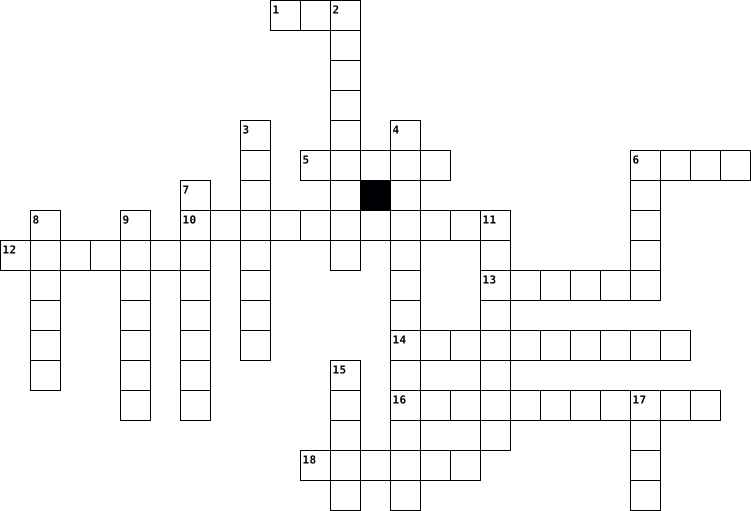
Across
- Mechanical process used to eliminate trapped air in concrete
- Cement combined with supplementary materials to lower heat generation
- Reinforcing elements integrated into the mix to improve toughness
- Material that bounces off the surface during shotcrete application
- Massive hydraulic structures built using mass concrete
- Process that occurs simultaneously with placement in shotcrete
- Temporary molds often unnecessary in shotcrete work
- Cement type preferred for controlling temperature rise
- Method of circulating cold water through pipes to remove heat
- Embedded devices used to measure temperature variations
- Separation of aggregates caused by excessive vibration
- Method of placing concrete in successive lifts to manage internal heat
- Early pneumatic mortar application related to shotcrete
- Admixtures added to achieve rapid setting times
Down
- Chemical modifiers used to delay setting and control reaction timing
- Underground structures commonly supported with shotcrete
- Structural damage caused by temperature differences within concrete
- Chemical additions used to regulate reaction timing
- Application on slopes to prevent erosion and landslides
- Exothermic chemical reaction that produces heat in large concrete pours
- Shotcrete process where water is introduced at the spraying point
- Embedded pipe system used to control internal temperature
- Property that allows sprayed concrete to stick effectively
- Device through which concrete is sprayed onto a surface
- Well-graded materials used to reduce heat generation in mass concrete
- Continuous tracking of internal temperature conditions
- Concrete pneumatically projected at high velocity onto a surface
- Technique of casting concrete in layers to allow heat dissipation
- Large-volume concrete requiring strict thermal control
- Shotcrete method where concrete is pre-mixed with water before pumping
30 Clues: Admixtures added to achieve rapid setting times • Chemical additions used to regulate reaction timing • Temporary molds often unnecessary in shotcrete work • Massive hydraulic structures built using mass concrete • Continuous tracking of internal temperature conditions • Cement type preferred for controlling temperature rise • ...
Matter & Energy in Ecosystems 2026-04-07

Across
- - a group of atoms joined together in a particular way
- - the part of a cell where photosynthesis happens
- - an organism that can make its own energy storage molecules
- - a closed ecosystem made by humans
- - the ability to make things move or change
- - the process by which plants and other producers use energy from sunlight to change carbon dioxide wand water into oxygen and glucose
- - a set of interacting parts forming a complex whole
- - the tiny pieces that all matter—all the stuff in the world—is made of
- dioxide - a molecule made of carbon and oxygen atoms
- - the part of a cell where cellular respiration happens
- - matter that makes up the living and dead organisms in an ecosystem
- - an organism that needs to eat in order to get energy storage molecules
- - an ending substance that is made during chemical reaction
Down
- - a molecule that organisms can use to release energy, and that is made of carbon, hydrogen, and oxygen atoms
- respiration - the chemical reaction between oxygen and glucose that releases energy into cells
- - a type of atom (a tiny piece) that makes up molecules such as carbon dioxide and energy storage molecules
- - living things such as plates, animals, and bacteria
- - an organism that gets energy Storage molecules
- - Something that results from a process
- - all the living and nonliving things interacting in a particular area
- - something that is required for a process
- - matter that makes up the nonliving parts of an ecosystem, such as air, water, and rocks
- - a starting substance that is part of a chemical reaction
- storage molecule - a Molecule that organisms can use to release the energy needed to survive
- - to link two or more things
- - a type of energy storage molecule made of many glucose molecules connected together
26 Clues: - to link two or more things • - a closed ecosystem made by humans • - Something that results from a process • - something that is required for a process • - the ability to make things move or change • - an organism that gets energy Storage molecules • - the part of a cell where photosynthesis happens • - a set of interacting parts forming a complex whole • ...
Crossword Puzzle In Organic Chemistry 2014-08-07

Across
- used to make cups, coolers, and trays
- used to synthesize other compounds
- positively charged ion
- negatively charge ions
- used in making high octane gasoline
- a chemistry subdiscipline involving the scientific study of the structure, properties, and reactions of organic compounds and organic materials, i.e., matter in its various forms that contain carbon atoms
- an organic compound with the formula H2C2O4
- a process of reacting monomer molecules together in a chemical reaction to form polymer chains
- is a chemical process for converting natural rubber into more durable materials
- the order and relative spatial arrangement of the atoms in a molecule
- serves to advance the worldwide aspects of the chemical sciences and to contribute to the application of chemistry in the service of humankind
- reactions in which an unsaturated system is saturated or part saturated by the addition of a molecule across the multiple bond
- a thermoplastic polymer used in a wide variety of applications including packaging and labeling, textiles, stationery, plastic parts and reusable containers
- atoms that can share two pairs of electrons
- the linkage of two atoms by the sharing of two electrons
- containing one carbon atom bonded to three hydrogen atoms — CH₃
Down
- a substance which cannot be further subdivided by chemical methods
- the most common plastic
- has the formula –C₂H₅
- used in white glue and sticky notes
- substance that can make a chemical reaction faster but which is not actually needed to produce the reaction nor is used in the reaction.
- fatty acids used in making soaps, detergents and shampoos
- long chain, giant organic molecules are assembled from many smaller molecules called monomers
- used in construction for pipe, and in profile applications such as doors and windows
- a group in the periodic table consisting of five chemically related elements: fluorine, chlorine, bromine, iodine, and astatine
- organic compound with a formula –OH
- a colorless, flammable type of alcohol with a strong odor
- known for their distinctive odors and are commonly used for food aroma and fragrances
- the attraction and repulsion between atoms and molecules
- the term given to organic molecules which contain no multiple bonds
- compounds that contain carbon
- the term given to an organic compound containing multiple bonds
- sharing of one pair of electrons
- chief acid of vinegar with the formula C2H4O2
- A bond formed when charge particles stick together.
- an atom or group of atoms that has lost or gained one or more electrons to become a charged species
- a class of organic compounds that contain an oxygen between two alkyl groups. They have the formula R-O-R
- used to make a non-stick cookware
- used in making flavorings, dyes and plastics
- organic chemical compound with the molecular formula C6H6
40 Clues: has the formula –C₂H₅ • positively charged ion • negatively charge ions • the most common plastic • compounds that contain carbon • sharing of one pair of electrons • used to make a non-stick cookware • used to synthesize other compounds • used in white glue and sticky notes • used in making high octane gasoline • organic compound with a formula –OH • ...
Unit 1 Vocab 2019-02-11

Across
- deoxyribonucleic acid, a self-replicating material which is present in nearly all living organisms as the main constituent of chromosomes.
- a substance produced by a living organism which acts as a catalyst to bring about a specific biochemical reaction.
- a red protein responsible for transporting oxygen in the blood of vertebrates. Its molecule comprises four subunits, each containing an iron atom bound to a heme group.
- site a region on an enzyme that binds to a protein or other substance during a reaction.
- and Key Model the lock is the enzyme and the key is the substrate.
- a simple sugar in plants.
- any large group of organic compounds occurring in foods, living tissues and sugars, starch, or cellulose.
- any of the class of sugars (e.g., glucose) that cannot be hydrolyzed to give a simpler sugar.
- an ester formed from glycerol and three fatty acid groups.
- compound any chemical compound that contains carbon.
- the substance on which an enzyme acts.
- acid a simple organic compound containing both a carboxyl (—COOH) and an amino (—NH2) group.
- energy the minimum quantity of energy which the reacting species must possess in order to undergo a specified reaction.
Down
- the chemical breakdown of a compound due to a reaction with water.
- a simple sugar in carbohydrates.
- destroy the characteristic properties of (a protein or other biological macromolecule) by heat, acidity, or other effects that disrupt its molecular conformation.
- a hormone produced in the pancreas by the islets of Langerhans, which regulates the amount of glucose in the blood.
- Acid a complex organic substance present in living cells, especially DNA or RNA, whose molecules consist of many nucleotides linked in a long chain.
- any of a class of organic compounds that are fatty acids or their derivatives and are insoluble in water but soluble in organic solvents.
- a lipid containing a phosphate group in its molecule.
- complex a temporary molecule formed when an enzyme comes into perfect contact with its substrate.
- a substance that increases the rate of a chemical reaction without itself undergoing any permanent chemical change.
- ribonucleic acid, a nucleic acid present in all living cells. Its principal role is to act as a messenger carrying instructions from DNA for controlling the synthesis of proteins.
- a simple sugar in animals.
- another simple sugar in plants.
- any of a class of nitrogenous organic compounds that consist of large molecules composed of one or more long chains of amino acids and are an essential part of all living organisms.
- a molecule that can be bonded to other identical molecules to form a polymer.
27 Clues: a simple sugar in plants. • a simple sugar in animals. • another simple sugar in plants. • a simple sugar in carbohydrates. • the substance on which an enzyme acts. • compound any chemical compound that contains carbon. • a lipid containing a phosphate group in its molecule. • an ester formed from glycerol and three fatty acid groups. • ...
Biology Chapter 2: The Chemistry of Life 2019-12-01

Across
- A mixture in which particles of a material are more or less evenly dispersed, but not dissolved.
- Carbon compound that regulates cell processes; made of amino acids.
- 2 or more elements or compounds physically mixed but not chemically combined; can be separated.
- Single sugar.
- Speeds up the rate of a chemical reaction.
- What comes out of a chemical reaction.
- A molecule with an uneven distribution of electrons, making one end positive, the other negative.
- When one or more electrons are transferred from one atom to the other.
- A compound with a pH of 7.
- A compound that produces hydroxide ions in solution; has a pH >7.
- What goes into the reaction.
- smallest unit of most compounds.
- The energy needed to start a chemical reaction.
- What is being dissolved.
- When electrons are shared between two atoms.
- Carbon compound that is a major source of energy for most living things.
- An atom or group of atoms that has a positive or negative charge.
- Attraction between molecules of different substances.
Down
- Two or more elements chemically combined.
- Mixture in which all components are evenly distributed; one is substance is dissolved in another.
- Carbon compound that stores and transmits genetic information: RNA and DNA.
- A pure substance with only one type of atom.
- Acts like a catalyst in living things because it speeds up reactions in cells.
- monomer of protein.
- Positively charged part of an atom in the nucleus.
- Negatively charged particle of an atom that orbits around the nucleus and is 1/1840 the size of a proton.
- Very weak bonds; occurs when a hydrogen atom in one molecule is attracted to the electrostatic atom in another molecule.
- Atoms of the same element that have different numbers of neutrons.
- process that changes or transforms elements or compounds into another.
- Scale with values from 0 to 14, used to measure the concentration of H+ ions in a solution.
- The building blocks of matter; the basic unit of matter.
- Monomer of nucleic acids made up of a 5-carbon sugar, a phosphate group, and a nitrogenous base.
- Attraction between molecules of the same substance.
- Large macromolecule formed from monosaccharides.
- large molecules formed from many small molecules.
- Compound that forms hydrogen ions (H+) in solution; has a pH range < 7.
- In a solution, the substance in which the solute dissolves.
- Part of atom with no charge in the nucleus.
- Energy-rich organic compounds, such as fats, oils, and waxes; made of carbon, hydrogen, and oxygen.
39 Clues: Single sugar. • monomer of protein. • What is being dissolved. • A compound with a pH of 7. • What goes into the reaction. • smallest unit of most compounds. • What comes out of a chemical reaction. • Two or more elements chemically combined. • Speeds up the rate of a chemical reaction. • Part of atom with no charge in the nucleus. • A pure substance with only one type of atom. • ...
Law of Conservation of Mass 2015-11-23

Across
- when a match is lit we see another evidence for chemical change, which is the presence of _______ or light
- chemicals present prior to reaction
- the amount of material in an object
- nothing can be __________, nothing can be destroyed
- the instrument used to measure mass, another word for this is a scale
Down
- if the chemicals present before the reaction weigh 1223 kg, we expect the chemicals remaining after the reaction to also weigh 1223 ________
- chemicals remaining once the reaction is complete
- __________ of a gas takes place when vinegar is mixed with baking soda
- ________ change takes place when leaves change in the fall, and this is evidence for chemical change.
- formation of a _________ takes place when vinegar mixes with milk, producing cheese curds and liquid whey
10 Clues: chemicals present prior to reaction • the amount of material in an object • chemicals remaining once the reaction is complete • nothing can be __________, nothing can be destroyed • the instrument used to measure mass, another word for this is a scale • __________ of a gas takes place when vinegar is mixed with baking soda • ...
science 2023-12-09

Across
- any chemical reaction that absorbs heat from its environment
- a combination of two or more pure substances in which each pure substance retains its individual chemical properties
- substance that cannot be broken down into simpler substances by chemical means.
- to do with the release of heat
- degree to which a substance dissolves in a solvent to make a solution
Down
- A rearrangement of the atoms or molecules of two or more substances that come into contact with each other, resulting in the formation of one or more new substances
- substance that changes when it is combined with another substance in a chemical reaction
- a measure of how quickly a specific material is capable of catching fire and burning.
- the measurement of how tightly a material is packed together
9 Clues: to do with the release of heat • any chemical reaction that absorbs heat from its environment • the measurement of how tightly a material is packed together • degree to which a substance dissolves in a solvent to make a solution • substance that cannot be broken down into simpler substances by chemical means. • ...
Activity 2 2022-09-25

Across
- concentration of hydronium ions in a solution
- a substance that starts a chemical reaction
- rate at which energy is used
- done when force is applied to an object over a distance
- A solution with a pH lower than 7
- is the smallest particle of an element
- the ability to do work
- main element in organic compounds
- A widely accepted hypothesis that stands the test of time.
- named after James Prescott Joule
- a pure substance
Down
- Developing new knowledge based upon old knowledge.
- a substance that forms because of a chemical reaction
- suggested explanation based on evidence that can be tested by observation or experimentation.
- A test that is used to rule out a hypothesis or validate something already known.
- sum of all the biochemical reactions in an organism
- is a substance that consists of two or more elements
- A solution with a pH higher than 7.
- anything that takes up space and has mass.
19 Clues: a pure substance • the ability to do work • rate at which energy is used • named after James Prescott Joule • A solution with a pH lower than 7 • main element in organic compounds • A solution with a pH higher than 7. • is the smallest particle of an element • anything that takes up space and has mass. • a substance that starts a chemical reaction • ...
MATTER 2017-03-11
Across
- ____ state of matter does not definite shape or volume
- chemical reactions happen at different _____
- an object that has a high density will
- ______ mixture are uniform throughout
- is a measure of the amount of matter in a given amount of space
- ____ state of matter has definite volume and takes shape of the container
- _____ reaction produces heat energy
- ______ reaction absorbs heat energy
- is the amount of space that matter takes up
Down
- means that no more material may be dissolved into the mixture
- when matter goes through a ____ change, a new substance is formed
- _______mixture is unevenly distributed
- ____ state of matter has a definite shape and volume
- ____ change is a change in the state of matter (size or shape)
- is the amount of force that gravity puts on that amount of matter
- is a physical combination of 2 or more substance
- _____ is a mixture that is homogeneous
- is a homogeneous mixture metals
- is the amount matter within an object
19 Clues: is a homogeneous mixture metals • _____ reaction produces heat energy • ______ reaction absorbs heat energy • ______ mixture are uniform throughout • is the amount matter within an object • _______mixture is unevenly distributed • an object that has a high density will • _____ is a mixture that is homogeneous • is the amount of space that matter takes up • ...
8th Grade Science 2023-12-06

Across
- Speed=Distance/Time
- Straight line going up on a distance vs. time graph.
- In the nucleus with a neutral charge.
- Straight horizontal line on a distance vs. time graph.
- The force applied in one direction is greater than the force applied in the opposite direction.
- A curved line on a distance vs. time graph.
- How fast something is going.
- An object in motion remains in motion unless acted on by an unbalanced force.
- Two or more molecules producing a new product(s).
- On the rings of an atom.
Down
- Symbolic representation of chemical reaction.
- For every action there is an equal and opposite reaction.
- The rate of change of velocity.
- Positive charge in the nucleus.
- Net force is equal to mass times acceleration.
- Those that are opposite in direction and equal in size.
- Are shiny and malleable.
- On the last ring of an atom.
- On the staircase of the Periodic Table.
- Numbers that come after a symbol in a chemical equation.
20 Clues: Speed=Distance/Time • Are shiny and malleable. • On the rings of an atom. • On the last ring of an atom. • How fast something is going. • The rate of change of velocity. • Positive charge in the nucleus. • In the nucleus with a neutral charge. • On the staircase of the Periodic Table. • A curved line on a distance vs. time graph. • Symbolic representation of chemical reaction. • ...
Y8 Ecosystems Revision 2025-06-03

Across
- Multiple food chains linked together
- The build up of toxic or harmful substances within a food chain
- The number of organisms in the same species within a habitat
- When a species no longer exists
- The variety of living organisms
- The chemical reaction that turns carbon dioxide and water into glucose and oxygen using light.
- The predator at the top of the food chain
- What do the arrows in a food chain represent?
- The chemical reaction that requires glucose to release energy
Down
- The struggle between different organisms for resources
- The place where an organism lives
- Organisms that break down dead plants and animals
- An organisms role in an ecosystem
- Organisms form different species within the same habitat
- All of the living and non-living things in an area
- An organism that makes its own food through photosynthesis
- An organism that eats other animals
- An animal that only eats plants
- An animal that is predated upon
19 Clues: When a species no longer exists • The variety of living organisms • An animal that only eats plants • An animal that is predated upon • The place where an organism lives • An organisms role in an ecosystem • An organism that eats other animals • Multiple food chains linked together • The predator at the top of the food chain • What do the arrows in a food chain represent? • ...
Y8 Ecosystems Revision 2025-06-03

Across
- Multiple food chains linked together
- The build up of toxic or harmful substances within a food chain
- The number of organisms in the same species within a habitat
- When a species no longer exists
- The variety of living organisms
- The chemical reaction that turns carbon dioxide and water into glucose and oxygen using light.
- The predator at the top of the food chain
- What do the arrows in a food chain represent?
- The chemical reaction that requires glucose to release energy
Down
- The struggle between different organisms for resources
- The place where an organism lives
- Organisms that break down dead plants and animals
- An organisms role in an ecosystem
- Organisms form different species within the same habitat
- All of the living and non-living things in an area
- An organism that makes its own food through photosynthesis
- An organism that eats other animals
- An animal that only eats plants
- An animal that is predated upon
19 Clues: When a species no longer exists • The variety of living organisms • An animal that only eats plants • An animal that is predated upon • The place where an organism lives • An organisms role in an ecosystem • An organism that eats other animals • Multiple food chains linked together • The predator at the top of the food chain • What do the arrows in a food chain represent? • ...
Macromolecules and Enzymes 2026-03-05

Across
- catalysts enzymes can also be reffered to as ______ _______.
- a type of lipid that has a hydrophilic head and hydrophobic tail
- when enzymes get to a temperature higher than optimal, they begin to _______.
- carbs, lipids, proteins, nucleic acids
- macromolecules are called ________.
- the two layers present in a phosholipid.
- the structure/shape of a protein determines the _________.
- when at the optimal temperature, enzymes collide with this.
- proteins that speed up chemical reactions
Down
- acids store genetic material and transfers information
- are responsible for energy storage
- a molecule acted upon by the enzyme.
- transports hemoglobin
- sugar a monosaccarhide is when a carb has ___ _____ unit.
- the linked building blocks are called ______.
- rate when the substrate increases, this will too.
- _____ is an example of carbohydrates.
- saturated and unsaturated fats are examples of ______.
- energy this is the energy needed to being a chemical reaction.
- and lock this is a hypothesis that says subtrates and an enzyme have specific shapes that fit exactly into each other.
20 Clues: transports hemoglobin • are responsible for energy storage • macromolecules are called ________. • a molecule acted upon by the enzyme. • _____ is an example of carbohydrates. • carbs, lipids, proteins, nucleic acids • the two layers present in a phosholipid. • proteins that speed up chemical reactions • the linked building blocks are called ______. • ...
REVIEW SH 10 2024-05-22

Across
- In order for plants to create chlorophyll, plant need to get … from the soil.
- Organ to absorb nutrients into the bloodstream
- Which vitamin is lacking when scurvy occurs
- openings on the epidermis of leaves
- deficiency disease that can arise from the lack of protein
- Which tooth is chisel shaped
- organ that occur chemical and mechanical digestion
- to emulsify fat
- carbohydrate will be broken into
- After the enzyme and substrate bind together and perform the reaction, what does the substrate become
Down
- Rate of photosynthesis is high in ....
- Changes in pH and temperature can … an enzyme
- present in the small intestine so that more digested food can be absorbed into the blood stream
- Vitamins A, D, E, and K are … vitamins
- mineral for the production of amino acids
- Organic food material that contained in phloem
- Protein will be broken down into
- part of the enzyme where the substrate binds is called
- speeds up a chemical reaction
- helps to avoid constipation
20 Clues: to emulsify fat • helps to avoid constipation • Which tooth is chisel shaped • speeds up a chemical reaction • Protein will be broken down into • carbohydrate will be broken into • openings on the epidermis of leaves • Rate of photosynthesis is high in .... • Vitamins A, D, E, and K are … vitamins • mineral for the production of amino acids • ...
Photosynthesis and Respiration 2023-06-08

Across
- A molecule made up of single, repeating units
- Something that lowers the rate of reaction when low (two words)
- The chemical used to test for protein
- The energy store produced from respiration
- A term used to describe the amount of oxygen required to break down lactic acid (two words)
- A type of respiration that requires oxygen
- A polymer placed in the cell wall of plant cells
- The chemical used to test for simple sugars
- A type of respiration that does not require oxygen
- A chemical used to test for starch
Down
- A type of reaction that releases energy to the surroundings
- The colour change observed in a starch test that shows that starch is present (two words)
- The dye found in chloroplasts that absorbs light for photosynthesis
- A form of anaerobic respiration in plants and microorganisms
- A product of respiration in the absence of oxygen in animals (two words)
- The colour observed in a starch test that shows a negative result
- A small molecule that can be repeated in a chain to make a larger molecule
- A product of anaerobic respiration in plants
18 Clues: A chemical used to test for starch • The chemical used to test for protein • The energy store produced from respiration • A type of respiration that requires oxygen • The chemical used to test for simple sugars • A product of anaerobic respiration in plants • A molecule made up of single, repeating units • A polymer placed in the cell wall of plant cells • ...
Chemistry Vocab 2020-09-04

Across
- Abbreviations; usually one or two letters from the Latin alphabet.
- A liquid mixture in which the minor component is uniformly distributed within the major compound.
- Any of a material's properties that becomes evident during, or after, a chemical reaction.
- When a substance combines with another to form a new substance.
- The action or process of filtering something.
- A process that involves rearrangement of the molecular or ionic structure of a substance, as opposed to a change in physical form or nuclear reaction.
- A thing that is composed of two or more separate elements; a mixture
- Made up of individual atoms, elemental molecules made from one type of atom, or compound molecules made from various atoms.
- A substance made by mixing other substances together.
- A distinct period or stage in a series of events or a process of change or development.
- A column of elements in the periodic table, there 18 numbered groups.
- A property of physical body, and a measure of its resistance to acceleration when a net force is applied.
- A particular kind of matter with uniform properties.
- Each of more than 100 substances that cannot be chemically interconverted or broken down into simpler substances.
- The action of purifying a liquid by a process of heating and cooling.
- The species formed from chemical reaction.
- Firm and stable in shape; not liquid or fluid.
Down
- A property that is measureable, whose values describes a state of a physical system.
- A table of the chemical elements arranged in order of atomic number, usually in rows so elements with similar atomic structure appear in columns.
- A substance separated from a solution or suspension by chemical or physical change usually as an insoluble or amorphous crystaline solid.
- Changes affecting the form of a chemical substance, but not its chemical composition.
- A solid, liquid, or gaseous mixture that has the same proportions of its components throughout any given sample.
- the horizontal rows on the periodic table; corresponds to the successive occupation of the orbitals in a valence shell of the atom.
- A substance that takes part in and undergoes change during a reaction.
- Physical quantity whose value is proportional to the size or system it describes, or to the quantity of matter in the system.
- Does not depend on the quantity of matter.
- Mass is neither created or destroyed.
- the amount of space that a substance or object occupies, or that is enclosed within a container.
- A nearly incompressible fluid that conforms to the shape of its container, but retains a constant volume.
- A mixture that has components in which proportions vary throughout the sample.
- A substance diffused or suspended in the air, especially one normally liquid or solid.
31 Clues: Mass is neither created or destroyed. • Does not depend on the quantity of matter. • The species formed from chemical reaction. • The action or process of filtering something. • Firm and stable in shape; not liquid or fluid. • A particular kind of matter with uniform properties. • A substance made by mixing other substances together. • ...
Year 8 Chemistry Revision 2013-08-23

Across
- a reaction between an acid and an alkali (14)
- the breakdown of rock into smaller pieces (10)
- type of rock formed from cooled magma (7)
- a word that describes what is made in a chemical reaction (8)
- type of rock formed by heating or compressing other rocks (10)
- acid found in the stomach (12)
- a blue substance containing copper, sulfur and oxygen (6,7)
- a reaction where you burn a fuel (10)
- a poisonous gas formed by a car engine (6,8)
- can be hammered/bent into different shapes (9)
Down
- when a lit splint is put into this gas a popping sound is heard (8)
- changes colour in acid and alkali solutions (9,9)
- remains of plants or animals sometimes seen in sedimentary rocks (7)
- the reaction of a metal with oxygen in the air (9)
- a reaction where a more reactive substance substitutes a less reactive substance from solution (12)
- solution used to test for carbon dioxide gas (9)
- what is formed when two or more different atoms bond together (8)
- gas needed for a fuel to burn
- a substance made up of one type of atom (7)
19 Clues: gas needed for a fuel to burn • acid found in the stomach (12) • a reaction where you burn a fuel (10) • type of rock formed from cooled magma (7) • a substance made up of one type of atom (7) • a poisonous gas formed by a car engine (6,8) • a reaction between an acid and an alkali (14) • the breakdown of rock into smaller pieces (10) • ...
Chem Vocab Review 1 2017-05-02

Across
- reaction that involves O2 as a reactant and typically CO2, H2O and heat as products
- phase change from solid to gas
- 6.02x10^23
- row on the Periodic Table
- positive particle in an atom
- elements and compounds are examples of ___; has a chemical formula
- type of reaction in which two ions swap “partners” to form 2 new compounds
- system absorbs heat
- subatomic particle with no charge
- diagram that shows all electrons in an atom or ion on rings
- theory that defines an acid as a proton donor
- reactant that controls the amount of product that can be produced in a chemical reaction
- acid that ionizes completely in solution
- type of bond formed between C and H
- system releases heat
- type of bond formed between Na and Cl
- theory that defines a base as producing OH- in water
Down
- substance with a pOH less than 7
- diagram that shows the valence electrons in an atom or ion
- atom of an element with a varying number of neutrons
- type of mixture in which parts cannot be distinguished
- ratio of actual yield to theoretical yield
- most dense phase of matter
- ratio of any two parts of a balanced chemical equation; includes coefficient and formula
- measure of concentration; ratio of moles of solute to to volume (in L) of solution
- shows simplest ratio of atoms in a compound
- a measure of the kinetic energy of molecules
- ratio of mass to volume
- formed when an atom gains or loses electrons
- measure of the acidity/basicity of a substance; calculated as -log[H+]
30 Clues: 6.02x10^23 • system absorbs heat • system releases heat • ratio of mass to volume • row on the Periodic Table • most dense phase of matter • positive particle in an atom • phase change from solid to gas • substance with a pOH less than 7 • subatomic particle with no charge • type of bond formed between C and H • type of bond formed between Na and Cl • ...
Mid-term review crossword 2022-12-07

Across
- the ability to do work
- negatively charge subatomic particle that can be either bound to an atom or free
- reaction process in which one or more substances, the reactants, are converted to one or more different substances
- if its moving
- sum of all the forces acting on an object
- every object will remain at rest or in uniform motion in a straight line unless compelled to change its state by the action of an external force.
- the layer of granitic, sedimentary, and metamorphic rocks, which form the continents and the areas of shallow seabed close to their shores
- the time rate at which an object is moving along a path
- chemical element that lacks the characteristics of metal
- really small and it's a source of nuclear reaction
- vector expression of the displacement that an object or particle undergoes with respect to time
- table table of chemical elements
Down
- subatomic particles found inside the nucleus of every atom
- shows the elements that make up the compound and the numbers of atoms of each element in the smallest unit of that compound,
- substances with high electrical and thermal conductivity
- a force to be equal to change in momentum (mass times velocity) per change in time
- a process whereby the degree of hotness of a body (or medium) changes.
- change substance that changes to an unusual color
- boundary between two tectonic plates, where the plates are moving horizontally or vertically in opposite directions, not against or away from each
- for every action (force) in nature there is an equal and opposite reaction.
- if its not moving
- scientific study of the deformation of the rocks that make up the Earth's crust and the forces that produce such deformation.
22 Clues: if its moving • if its not moving • the ability to do work • table table of chemical elements • sum of all the forces acting on an object • change substance that changes to an unusual color • really small and it's a source of nuclear reaction • the time rate at which an object is moving along a path • substances with high electrical and thermal conductivity • ...
Environmental science 2021-09-06

Across
- needed by all known forms of life.
- type of biochemical reactions that breakdowns molecules into smaller units and release energy.
- is a pure substance.
- A widely accepted hypothesis that stands the test of time. Theories are oftentested and usually not rejected.
- ability to do work.
- a compound found mainly in living things.
- are tiny units that make up all matter in the universe and energy what holds the nucleus together.
- these reactions build up bigger molecules from smaller ones.
- the sum of all the biochemical reactions in an organism.
- comprises all types of water resources oceans, lakes, seas, rivers, streams, reservoirs,icecaps, glaciers, and groundwaters.
- organized body of knowledge that is obtained by study and experimentation.
- developing knew knowledge based upon old knowledge.
- a test that is used to rule out a hypothesis or validate something already known.
- unit work of energy in the International System of Units.
Down
- a force that holds molecules together.
- the concentration of hydronium ions in a solution.
- where life operates.
- is the main element in organic compound.
- the unit of power.
- is the study of energy.
- The study of the interactions between life and its physical environment.
- Is a a substance that consist of two or more element
- a substance that starts a chemical reaction.
- the energy needed to start a chemical reaction.
- anything that takes up space and has mass.
- the outer mantle of the solid earth.
- the protective blanket of gases surrounding the earth.
- the rate at which energy is used.
- a substance that forms as a result of a chemical reaction.
- it is a latin word that means knowledge.
30 Clues: the unit of power. • ability to do work. • where life operates. • is a pure substance. • is the study of energy. • the rate at which energy is used. • needed by all known forms of life. • the outer mantle of the solid earth. • a force that holds molecules together. • is the main element in organic compound. • it is a latin word that means knowledge. • ...
Environmental science 2021-09-06

Across
- needed by all known forms of life.
- type of biochemical reactions that breakdowns molecules into smaller units and release energy.
- is a pure substance.
- A widely accepted hypothesis that stands the test of time. Theories are oftentested and usually not rejected.
- ability to do work.
- a compound found mainly in living things.
- are tiny units that make up all matter in the universe and energy what holds the nucleus together.
- these reactions build up bigger molecules from smaller ones.
- the sum of all the biochemical reactions in an organism.
- comprises all types of water resources oceans, lakes, seas, rivers, streams, reservoirs,icecaps, glaciers, and groundwaters.
- organized body of knowledge that is obtained by study and experimentation.
- developing knew knowledge based upon old knowledge.
- a test that is used to rule out a hypothesis or validate something already known.
- unit work of energy in the International System of Units.
Down
- a force that holds molecules together.
- the concentration of hydronium ions in a solution.
- where life operates.
- is the main element in organic compound.
- the unit of power.
- is the study of energy.
- The study of the interactions between life and its physical environment.
- Is a a substance that consist of two or more element
- a substance that starts a chemical reaction.
- the energy needed to start a chemical reaction.
- anything that takes up space and has mass.
- the outer mantle of the solid earth.
- the protective blanket of gases surrounding the earth.
- the rate at which energy is used.
- a substance that forms as a result of a chemical reaction.
- it is a latin word that means knowledge.
30 Clues: the unit of power. • ability to do work. • where life operates. • is a pure substance. • is the study of energy. • the rate at which energy is used. • needed by all known forms of life. • the outer mantle of the solid earth. • a force that holds molecules together. • is the main element in organic compound. • it is a latin word that means knowledge. • ...
Water and Seawater - Academic Decathlon Presentation 2021-05-09

Across
- The mass of one mole of a substance.
- Any of a material's properties that become evident during, or after, a chemical reaction.
- A pure substance consisting only of atoms that all have the same number of protons.
- A particle, atom, or molecule with a net electrical charge.
- Any property that is measurable, whose value describes a state of a physical system.
- A unit of measurement for a substance defined as 6.02 x 10^23 particles.
- An acid-base reaction theory that describes how to identify an acid and base in a reaction.
- A very weak acid formed in a solution when carbon dioxide dissolves in water.
- An ion with a negative charge.
Down
- A bond involving a hydrogen atom located between a pair of other atoms having a high affinity for electrons.
- The process by which plants and some organisms use sunlight, carbon dioxide, and water to create food.
- A process involving the production of energy with the intake of oxygen and the release of carbon dioxide
- Having a higher osmotic pressure than a surrounding medium.
- The amount of salt dissolved in a body of water.
- An ion with a positive charge.
- Having a lower osmotic pressure than a surrounding medium.
- A chemical compound consisting of an ionic assembly of cations and anions.
- A substance composed of atoms from more than one element held together by chemical bonds.
- A law stating that the mass of a dissolved gas in a given volume of solvent at equilibrium is proportional to the partial pressure of the gas.
- A substance which will expand freely to fill the whole container having no fixed state or volume.
20 Clues: An ion with a positive charge. • An ion with a negative charge. • The mass of one mole of a substance. • The amount of salt dissolved in a body of water. • Having a lower osmotic pressure than a surrounding medium. • A particle, atom, or molecule with a net electrical charge. • Having a higher osmotic pressure than a surrounding medium. • ...
Section 1.1 Vocabulary 2016-10-24

Across
- bonds/ bonds that occur through either sharing of electrons or donation between atoms
- the substances that take part in a chemical reaction
- anything that takes up space and has mass; can exist in the form of solids, liquids, or gases.
- forms when two or more atoms of any type of element share a bond
- changing the shape of an object
- the substance dissolved in a liquid
- a new substance formed when reactants are chemically changed
- the abundance of a constituent divided by the total volume of a mixture
- a property of fluids that measures the resistance offered by the fluid to shear stress
- a substance composed of atoms all with the same atomic number; cannot be split chemically into smaller substances
- a combination of subatomic particles: protons (+), neutrons (neutral), and electrons (-)
Down
- the ability of a body to regain its original shape after deformation
- formed when two or more different typed of elements combine in a specific ratio
- the use of mathematics to quantify what occurs in a chemical reaction
- positively charged whole numbers that give information about how many moles of a substance are involved in a reaction
- a counting unit (mol) to quantify the number of atoms, particles, or molecules in a given mass
- ratio/ is the relationship between the coefficients of reactants and products
- a homogeneous mixture that results from a solute dissolving in a solvent
- number of moles of solute per liters of solvent
- the ability of a material to undergo plastic deformation before fracture; mathematically, defined as a percentage
- strength/ the amount of stress a material can withstand before undergoing a significant change to its cross sectional area; not measured but obtained using experimental measures
21 Clues: changing the shape of an object • the substance dissolved in a liquid • number of moles of solute per liters of solvent • the substances that take part in a chemical reaction • a new substance formed when reactants are chemically changed • forms when two or more atoms of any type of element share a bond • ...
Natural Science 2024-07-21

Across
- a chemical reaction that happens in some living things, such as yeast and bacteria.
- the flow of electrical charges through materials.
- a material which does not allow electrical charges to move.
- a method used to separate substances of different density in heterogeneous mixtures.
- another word for a homogeneous mixture.
- a chemical reaction that happens when some metal substances such as iron combine with oxygen in the presence of water.
- A connecting wire, usually made of copper, wrapped in plastic covering.
- a device with a magnetic needle that always points north. We use it to orient ourselves.
- the component of an electric circuit which provides the electricity.
- the component of an electric circuit which transforms electricity into another type of energy.
- a mixture in which the different components can be distinguished.
Down
- a method used to separate solids from liquids, or solids with different size particles, in heterogeneous mixtures.
- a method used to separate liquids that have different boiling points in homogeneous mixtures.
- a type of matter which contains only one type of component.
- an object which can attract other objects made of iron and other magnetic metals.
- a closed path through which electricity flows.
- These happen when atoms react and group together differently.
- a type of matter which contains two or more pure substances.
- a method used to separate solids from liquids in homogeneous mixtures.
- a material which allows electrical charges to move.
- a mixture in which the different components cannot be distinguished.
- a chemical reaction that happens when objects or substances are burned.
- the force of attraction exerted by magnets.
23 Clues: another word for a homogeneous mixture. • the force of attraction exerted by magnets. • a closed path through which electricity flows. • the flow of electrical charges through materials. • a material which allows electrical charges to move. • a type of matter which contains only one type of component. • a material which does not allow electrical charges to move. • ...
science cross word 2024-04-11

Across
- The force exerted by magnets when they attract or repel each other.
- A solid shape that is bound on all its sides by plane faces.
- A combination of all colors in the color spectrum.
- A compound or substance that has been purified or prepared, especially artificially.
- The smallest unit into which matter can be divided without the release of electrically.
- A usually irreversible chemical reaction involving the rearrangement of the atoms
- Any action that tends to maintain or alter the motion of a body or to distort it.
- A process in which one or more substances, the reactants, are converted to one or more
- A substance that is formed as the result of a chemical reaction.
- A physical and/or mathematical and/or conceptual representation of a system of ideas, events or processes.
- Change with time of the position or orientation of a body.
- A property of matter by which it remains at rest or in unchanging motion unless acted on by some external force.
- The ability to make things move and change.
Down
- The energy contained within a system that is responsible for its temperature.
- Stored energy that depends upon the relative position of various parts of a system.
- The transfer energy from a source of light.
- The formula for force in newtons.
- A substance or mixture for use in chemical analysis or other reactions.
- A redistribution of atoms or atomic groups within a molecule, forming the molecule of a different substance.
- The energy an object has because of its motion.
- A process that involves rearrangement of the molecular or ionic structure of a substance, as opposed to a change in physical form or a nuclear reaction.
- The formula for speed times time.
- The qualities and characteristics of a substance that describe and identify it.
23 Clues: The formula for force in newtons. • The formula for speed times time. • The transfer energy from a source of light. • The ability to make things move and change. • The energy an object has because of its motion. • A combination of all colors in the color spectrum. • Change with time of the position or orientation of a body. • ...
Gen Bio 1 Exam 2 2024-10-18

Across
- The diffusion of water across a cell membrane
- Reactions that break down complex molecules into simpler compounds
- A protein that speeds up a reaction without being consumed by it
- An allosteric regulator that binds to one of the enzyme subunits and stabilizes the inactive form of the enzyme
- Certain chemicals that inhibit the action of specific enzymes
- An allosteric regulator that binds to one of the enzyme subunits and stabilizes the active form of the enzyme
- Proteins that penetrate the hydrophobic interior of the lipid bilayer
- A reaction that absorbs free energy; nonspontaneous
- The cell takes up large molecules within vesicles formed around them at the plasma membrane
- Energy associated with the movement of atoms or molecules
- Energy that matter possesses because of its location
- Membrane proteins that have short carbohydrate chains bound to them
- The totality of an organism's chemical reactions
- Channel proteins that enhance the passage of water molecules across cell membranes
- A form of allosteric regulation where the substrate binds to one active site affecting catalysis in another active site
Down
- The reactants that an enzyme acts on
- A solution that has same concentration of water as the solution on the other side of the membrane
- Energy that matter possesses because of chemical structure
- Proteins that are not embedded in the membrane lipid bilayer
- Substance that helps the membrane resist changes in fluidity when temperatures change
- Large molecules within vesicles that dissolve into the plasma membrane and are secreted to the outside of the cell
- Solutions with the lower concentration of water
- Solutions with the higher concentration of water
- A reaction that releases free energy; spontaneous
- Reactions that build complex molecules from simpler one
25 Clues: The reactants that an enzyme acts on • The diffusion of water across a cell membrane • Solutions with the lower concentration of water • Solutions with the higher concentration of water • The totality of an organism's chemical reactions • A reaction that releases free energy; spontaneous • A reaction that absorbs free energy; nonspontaneous • ...
Matter and Energy in Ecosystems 2025-02-11

Across
- a closed ecosystem made by humans
- an organism that gets energy storage molecules by breaking down dead matter
- the part of a cell where cellular respiration happens
- the chemical reaction between oxygen and glucose that release energy into cells and carbon dioxide
- matter that makes up the nonliving parts of an ecosystem (air, water, rocks)
- a type of atom that makes up carbon dioxide and energy storage molecules
- a type of energy storage molecule
- a molecule that organisms can use to release the energy they need to survive
- a type of energy storage molecule
- something that results from a process
- a type of energy storage molecule made of many glucose molecules connected together
- all the living and nonliving things interacting in a particular area
- a set of interacting parts forming a complex whole
Down
- matter that makes us the living and dead organisms in an ecosystem
- a molecule made of carbon and oxygen atoms (CO2)
- a group of atoms joined together in a particular way
- the ability to make things move or change
- a ending substance that is made during a chemical reaction
- the process where producers use sunlight to change carbon dioxide and water into oxygen and glucose
- an organism that needs to eat in order to get ESM
- something that is required for a process
- the part of a cell where photosynthesis happens
- a starting substance that is part of a chemical reaction
- an organism that can make its own energy storage molecules
- living things, such as plants, animals, and bacteria
- a molecule that organisms can use to release energy, and that is made of carbon, hydrogen, and oxygen atoms
26 Clues: a closed ecosystem made by humans • a type of energy storage molecule • a type of energy storage molecule • something that results from a process • something that is required for a process • the ability to make things move or change • the part of a cell where photosynthesis happens • a molecule made of carbon and oxygen atoms (CO2) • ...
The Atom 2023-01-09

Across
- the push or pull measurement of an object
- a positively charged ion
- a chemical process that occurs in plants when exposed to sunlight
- a small mammal adapted to a subterranean lifestyle
- an organelle containing digestive enzymes
- substances that act on receptors to produce morphine-like effects
- DNA
- a line that a function approaches but never reaches
- the minimum amount of hours of sleep people ages 13-18 should get
Down
- a chemical reaction where carbon dioxide and water are always the products
- the energy of motion, observable as the movement of an object or subatomic particle
- the slope of a velocity-time graph
- blood pressure that is higher than normal
- the fans that love this series are called "Trekkies"
- a rotating machine that transforms electrical energy into mechanical energy
- the solid product of a double replacement reaction
- the diffusion of water
17 Clues: DNA • the diffusion of water • a positively charged ion • the slope of a velocity-time graph • the push or pull measurement of an object • blood pressure that is higher than normal • an organelle containing digestive enzymes • a small mammal adapted to a subterranean lifestyle • the solid product of a double replacement reaction • ...
Chemistry Crossword Robert 2020-09-04

Across
- the rule that matter can't be created or destroyed
- an abbreviation for an element
- a change that cause its physical properties to change
- atoms are close together and bonded
- atoms are spread out but attracted to eachother
- another name for the stages of when matter makes a physical change into another one of its forms
- what is formed after a chemical reaction
- a solid that forms after a chemical reaction
- atoms aren't bonded or attracted to eachother
Down
- a type of matter with uniform properties
- a change that cannot be reversed
- made with 2 or more types of atoms
- made with only one type of atom
- two or more substances together from a physical change
- a group of elements in a collum of the periodic table of elements
- another word for weight
16 Clues: another word for weight • an abbreviation for an element • made with only one type of atom • a change that cannot be reversed • made with 2 or more types of atoms • atoms are close together and bonded • a type of matter with uniform properties • what is formed after a chemical reaction • a solid that forms after a chemical reaction • ...
Chemical reactions 2023-01-24

Across
- If you can't build a real airplane you might build a _____ airplane.
- Atoms join together to make _________
- Something that can be observed about a substance.
- The relative size of things.
- A weapon is very _________
- To change the order or position of something
- This helps to grow plants.
Down
- An ending substance that is made in a chemical reaction.
- It is what atoms do to form new substances
- A structure formed by repeating groups of atoms linked together in a larger network.
- Something that is made of all the same atoms or groups of atoms.
- The formula that makes up any substance.
- When a substance changes from a solid to a liquid.
- everything in the world is made up of _____
- The ______ _____ of water is 100 degrees Celsius
- a starting substance that is part of a chemical reaction.
16 Clues: A weapon is very _________ • This helps to grow plants. • The relative size of things. • Atoms join together to make _________ • The formula that makes up any substance. • It is what atoms do to form new substances • everything in the world is made up of _____ • To change the order or position of something • The ______ _____ of water is 100 degrees Celsius • ...
Fire science 2024-11-08

Across
- Hydrogen, uranium and mercury are examples of _____
- a ___, caused by an outburst or change in chemicals
- revival from apparent death or unconsciousness
- energy that moves from one place to another. Light, sound and x-rays are examples of __
- something that catches fire easily
- Oxygen, heat and___are a part of the fire triangle
- high risk of fire
- produce flamed and heat while consuming a material such as coal or wood
Down
- the process of burning something
- helps fire spread
- the energy that is produced when two things rub against each other
- a surge in fire produced by gases mixing
- to put out a fire
- to help fires not start
- gas made from fire that rises so you can crawl under it
- a chemical reaction that that converts a fuel and oxygen into carbon dioxide and water
- hot, bright , glowy and scorching are all words to describe ____
17 Clues: helps fire spread • to put out a fire • high risk of fire • to help fires not start • the process of burning something • something that catches fire easily • a surge in fire produced by gases mixing • revival from apparent death or unconsciousness • Oxygen, heat and___are a part of the fire triangle • Hydrogen, uranium and mercury are examples of _____ • ...
Physio Vocab lesson 3 extra credit 2022-10-24

Across
- Tension on surface firm of a liquid
- A group of atoms bonded together
- Reaction where change in free energy equals negative
- Weak bond between 2 components together
- energy which a body possess by virtue of being in motion.
- A subsatnce by mixing other substances together
- energy stored in objects by their position
- 7 is what acidity
Down
- A thing composed of 2 or more elements
- Is the action or process of adhering to a surface or object.
- the use of evaporated water to cool hot air
- the property of having poles or being polar.
- reaction where energy is positive
- it takes more energy to increase the temperature of water compared to other substances
- energy stored in the bonds of a chemical
- The negative ion of hydrogen ion concentation
- energy possed of its position relative to others
17 Clues: 7 is what acidity • A group of atoms bonded together • reaction where energy is positive • Tension on surface firm of a liquid • A thing composed of 2 or more elements • Weak bond between 2 components together • energy stored in the bonds of a chemical • energy stored in objects by their position • the use of evaporated water to cool hot air • ...
biological molecules 2026-02-12

Across
- Reagent used to test for starch
- Biological catalysts that speed up chemical reactions inside the body without being used up
- Chemical bond in a lipid
- Lipids found in animals are called
- Testing for a protein
- One factor that affects the rate of an enzyme controlled reaction
- Name the monomers that make up a carbohydrate
- Name the monomers that make up a protein
- What is the chemical bond in a carbohydrate
Down
- Lipids found in plants are called
- Name the chemical bond in a protein
- When the temperature increases above the optimum temperature the enzyme becomes
- Reagent used to test for glucose
- Name the carbohydrate found in plants
- Testing for a lipid
- Name the carbohydrate found in animals
16 Clues: Testing for a lipid • Testing for a protein • Chemical bond in a lipid • Reagent used to test for starch • Reagent used to test for glucose • Lipids found in plants are called • Lipids found in animals are called • Name the chemical bond in a protein • Name the carbohydrate found in plants • Name the carbohydrate found in animals • Name the monomers that make up a protein • ...
Unit 2 Week 2 2021-09-15

Across
- the measure of the quantity of matter.
- Random kinetic energy possessed by objects in a material.
- the number placed in front of a chemical equation.
- in any chemical process, matter is neither lost or gained.(sometimes stated as matter is not created or destroyed).
- this is the rate at which a substance undergoes a chemical change.
Down
- a chemical equation where the number of atoms of each element are the same on both sides.
- the number of atoms of a particular element in a chemical reaction.
- the speed at which a chemical reaction occurs.
8 Clues: the measure of the quantity of matter. • the speed at which a chemical reaction occurs. • the number placed in front of a chemical equation. • Random kinetic energy possessed by objects in a material. • this is the rate at which a substance undergoes a chemical change. • the number of atoms of a particular element in a chemical reaction. • ...
Enzymes 2020-12-14

Across
- a solution that can resist pH change
- a reaction in the body
- the area of an enzyme that connects with the substrate
- energy required for a reaction
- Example of an enzyme found in saliva
- Permanently Changed active site of an enzyme and can no longer function
Down
- Small molecules join together to form large molecules, using energy.
- The thing the enzyme acts on
- made up of atoms
- a biological catalyst
- another word for ideal
- Large molecules broken down to smaller molecules, releasing energy
- a substance which speeds up a chemical reaction
13 Clues: made up of atoms • a biological catalyst • a reaction in the body • another word for ideal • The thing the enzyme acts on • energy required for a reaction • a solution that can resist pH change • Example of an enzyme found in saliva • a substance which speeds up a chemical reaction • the area of an enzyme that connects with the substrate • ...
Energy and Nutrition 2023-11-03

Across
- small molocule amino acids, sugars, and fatty acids
- grow and repair
- process by which food, in the form of sugar (glucose), is transformed into energy within cells
- a macromolecule that is always in a on to two also used for energy ratio
- energy
- right side of the reaction
Down
- left side of the reaction
- energy storage, fatty acid
- large molocule such as carbon, oxygen, and hydrogen
- 1 sugar
- 2 sugars
- chemical reactions in the cells body that changes food into energy
- helps speed up reaction (ends in ace)
13 Clues: energy • 1 sugar • 2 sugars • grow and repair • left side of the reaction • energy storage, fatty acid • right side of the reaction • helps speed up reaction (ends in ace) • large molocule such as carbon, oxygen, and hydrogen • small molocule amino acids, sugars, and fatty acids • chemical reactions in the cells body that changes food into energy • ...
Energy and Nutrition 2023-11-03

Across
- small molocule amino acids, sugars, and fatty acids
- grow and repair
- process by which food, in the form of sugar (glucose), is transformed into energy within cells
- a macromolecule that is always in a on to two also used for energy ratio
- energy
- right side of the reaction
Down
- left side of the reaction
- energy storage, fatty acid
- large molocule such as carbon, oxygen, and hydrogen
- 1 sugar
- 2 sugars
- chemical reactions in the cells body that changes food into energy
- helps speed up reaction (ends in ace)
13 Clues: energy • 1 sugar • 2 sugars • grow and repair • left side of the reaction • energy storage, fatty acid • right side of the reaction • helps speed up reaction (ends in ace) • large molocule such as carbon, oxygen, and hydrogen • small molocule amino acids, sugars, and fatty acids • chemical reactions in the cells body that changes food into energy • ...
Energy and Nutrition 2023-11-03

Across
- small molocule amino acids, sugars, and fatty acids
- grow and repair
- process by which food, in the form of sugar (glucose), is transformed into energy within cells
- a macromolecule that is always in a on to two also used for energy ratio
- energy
- right side of the reaction
Down
- left side of the reaction
- energy storage, fatty acid
- large molocule such as carbon, oxygen, and hydrogen
- 1 sugar
- 2 sugars
- chemical reactions in the cells body that changes food into energy
- helps speed up reaction (ends in ace)
13 Clues: energy • 1 sugar • 2 sugars • grow and repair • left side of the reaction • energy storage, fatty acid • right side of the reaction • helps speed up reaction (ends in ace) • large molocule such as carbon, oxygen, and hydrogen • small molocule amino acids, sugars, and fatty acids • chemical reactions in the cells body that changes food into energy • ...
Atomic Vocab 2016-09-12

Across
- of Conservation of Mass is a relation stating that in a chemical reaction, the mass of the products equals the mass of the reactants.
- Sphere Atoms can neither be created or destroyed in a chemical reaction.
- the positively charged central core of an atom, consisting of protons and neutrons and containing nearly all its mass.
- Life The time required to convert one half of a reactant to product
- is a material system made up of two or more different substances which are mixed but are not combined chemically
- the term for any type of material
- Model Theory or model giving an explanation of the properties of the atomic nucleus and its interactions with other particles.
- One of two or more atoms that have the same atomic number (the same number of protons) but a different number of neutrons.
- A reaction equilibrium in which the reactants and products are all in the same phase.
- Pudding Model The Plum Pudding Model is a model of atomic structure proposed by J.J. Thomson in the late 19th century
- composed of parts of different kinds; having widely dissimilar elements or constituents
- a stable subatomic particle occurring in all atomic nuclei, with a positive electric charge equal in magnitude to that of an electron, but of opposite sign
Down
- A positive ion; an atom or group of atoms that has lost one or more electrons.
- A substance that cannot be decomposed into simpler substances by chemical means, and is made up of atoms all with identical number of protons
- Number the number of protons in the nucleus of an atom, which determines the chemical properties of an element and its place in the periodic table.
- Number the total number of protons and neutrons (together known as nucleons) in an atomic nucleus.
- Substance substances that are made of only one type of atom or only one type of molecule
- Cloud Model where electrons are when they go around the nucleus of an atom
- is any atom that is not carbon or hydrogen.
- the spontaneous emission of radiation in the form of particles or high energy photons resulting from a nuclear reaction.
- a substance formed when two or more chemical elements are chemically bonded together
- a subatomic particle of about the same mass as a proton but without an electric charge, present in all atomic nuclei except those of ordinary hydrogen.
- Model The model described the atom as a tiny, dense, positively charged core called a nucleus, in which nearly all the mass is concentrated, around which the light, negative constituents, called electrons, circulate at some distance, much like planets revolving around the Sun.
- An atom or a group of atoms that has an electric charge.
- The basic unit of a chemical element.
- a negatively charged ion, as one attracted to the anode in electrolysis.
26 Clues: the term for any type of material • The basic unit of a chemical element. • is any atom that is not carbon or hydrogen. • An atom or a group of atoms that has an electric charge. • Life The time required to convert one half of a reactant to product • a negatively charged ion, as one attracted to the anode in electrolysis. • ...
Energy and Nutrition 2023-11-03

Across
- small molocule amino acids, sugars, and fatty acids
- grow and repair
- process by which food, in the form of sugar (glucose), is transformed into energy within cells
- a macromolecule that is always in a on to two also used for energy ratio
- energy
- right side of the reaction
Down
- left side of the reaction
- energy storage, fatty acid
- large molocule such as carbon, oxygen, and hydrogen
- 1 sugar
- 2 sugars
- chemical reactions in the cells body that changes food into energy
- helps speed up reaction (ends in ace)
13 Clues: energy • 1 sugar • 2 sugars • grow and repair • left side of the reaction • energy storage, fatty acid • right side of the reaction • helps speed up reaction (ends in ace) • large molocule such as carbon, oxygen, and hydrogen • small molocule amino acids, sugars, and fatty acids • chemical reactions in the cells body that changes food into energy • ...
Energy and Nutrition 2023-11-03

Across
- small molocule amino acids, sugars, and fatty acids
- grow and repair
- process by which food, in the form of sugar (glucose), is transformed into energy within cells
- a macromolecule that is always in a on to two also used for energy ratio
- energy
- right side of the reaction
Down
- left side of the reaction
- energy storage, fatty acid
- large molocule such as carbon, oxygen, and hydrogen
- 1 sugar
- 2 sugars
- chemical reactions in the cells body that changes food into energy
- helps speed up reaction (ends in ace)
13 Clues: energy • 1 sugar • 2 sugars • grow and repair • left side of the reaction • energy storage, fatty acid • right side of the reaction • helps speed up reaction (ends in ace) • large molocule such as carbon, oxygen, and hydrogen • small molocule amino acids, sugars, and fatty acids • chemical reactions in the cells body that changes food into energy • ...
Respiration Crossword 2021-11-16

Across
- The chemical breakdown of glucose into ethanol and carbon dioxide by respiring yeast.
- One of the products of anaerobic respiration in plants and microorganisms .
- A key waste product of protein metabolism in mammals that is excreted in urine.
- The site of anaerobic respiration in cells.
- This is what is released during respiration.
- Process that releases energy.
- Site of aerobic respiration in cells.
- What type of reaction is respiration?
Down
- A reactant that is only present in aerobic respiration.
- Product of anaerobic respiration in mammals.
- Type of respiration with oxygen.
- The sum of all the chemical reactions that happen in an organism.
- The temporary shortage of oxygen in respiring tissues and organs.
- Type of respiration without oxygen.
- A reactant used in aerobic and anaerobic respiration.
- Any reaction in which a substance gives up electrons, as when reacting with oxygen.
- Organ in the body that converts lactic acid into glucose.
17 Clues: Process that releases energy. • Type of respiration with oxygen. • Type of respiration without oxygen. • Site of aerobic respiration in cells. • What type of reaction is respiration? • The site of anaerobic respiration in cells. • Product of anaerobic respiration in mammals. • This is what is released during respiration. • ...
Atomic Theory 2024-01-12

Across
- used to measure Electronegativity
- liquid that releases positively charged hydrogen ions
- equal to atomic number
- a bunch of atoms that are stuck (bonded) together
- when a single compound breaks down into 2 or more simpler products.
- Two or more substances combine to produce a sing new substance
- a material’s ability to conduct electricity
- produce toxic,coloured vapours
- full outer shells, non-reactive.
- Symbol e–
- chemicals that change colour when added to an acid or a base
Down
- reaction that occurs when an acid is added to a base
- shiny and soft metals
- cannot be broken down into another substance
- product of sodium and chloride
- number of protons in an atom
- an exothermic chemical reaction that requires oxygen and a fuel substance as reactants and an ignition source to trigger the reaction.
- substance that accepts hydrogen ions in a reaction
- occurs when the nucleus loses (or gains) a neutron
- Symbol n0
- atomic number 13
- Symbol p+
- discoverer of protons and the nucleus
- smallest building blocks of living and non-living things
24 Clues: Symbol n0 • Symbol p+ • Symbol e– • atomic number 13 • shiny and soft metals • equal to atomic number • number of protons in an atom • product of sodium and chloride • produce toxic,coloured vapours • full outer shells, non-reactive. • used to measure Electronegativity • discoverer of protons and the nucleus • a material’s ability to conduct electricity • ...
M8 Review 2024-11-04

Across
- product of cellular respiration but reactant of photosynthesis
- place where photosynthesis occurs
- reaction that requires oxygen
- changing energy in glucose into energy in atp
- the type of reaction that photosynthesis is
- the 2nd law of thermodynamics says that some energy is ____________when energy is converted
- energy is not created or destroyed but changes forms
- ability to do work
- place where cellular respiration occurs
Down
- the type of reaction that cellular respiration is
- pigment inside plant cells that absorbs light
- glucose is a ___________ of cellular respiration
- changing light energy into chemical energy
- organism that requires food from outside source
- the type of reaction that cellular respiration is
- product of photosynthesis
- atp is a _____________ of cellular respiration
- product of photosynthesis that is used in cellular respiration
- product of cellular respiration but a reactant of photsynthesis
- organism that can produce its own food
- color of light reflected by pigments in leaves of plants
- energy storing molecule that can be used by cells
- the type of reaction that photosynthesis is
- reaction that does not require oxygen
- original source of all energy on Earth
25 Clues: ability to do work • product of photosynthesis • reaction that requires oxygen • place where photosynthesis occurs • reaction that does not require oxygen • organism that can produce its own food • original source of all energy on Earth • place where cellular respiration occurs • changing light energy into chemical energy • the type of reaction that photosynthesis is • ...
Leyla L- Chem Crossword 2024-06-11

Across
- For which type of bond do you use prefixes when naming a compound?
- These types of ions have special endings
- the smallest unit of a compound
- the flow of electrons
- Name the missing essential part of a chemical reaction; compound, state of matter,?
- Name the kind of reaction; AB+ CD -> AD+CB
- Non-metal changes the ending to –___ and always comes second
- State change from liquid to gas
- Multiple reactants to form 1 product
- This must be present as a reactant in a combustion reaction
- State change from solid to gas
- What contains an immense amount of cations and anions and retains the overall ratio described by the formula?
Down
- What type of element requires roman numerals when naming a compound?
- A naming system that follows a universal set of rules
- A lasting attraction between 2 atoms
- This type of reaction happens when you burn something
- State change from gas to liquid
- Ability of a substance to be molded or shaped
- A substance that can’t be separated into other materials by any physical process
- anything that has mass and volume
20 Clues: the flow of electrons • State change from solid to gas • State change from gas to liquid • the smallest unit of a compound • State change from liquid to gas • anything that has mass and volume • A lasting attraction between 2 atoms • Multiple reactants to form 1 product • These types of ions have special endings • Name the kind of reaction; AB+ CD -> AD+CB • ...
Chem intro yr 10 2025-03-30

Across
- When molecules stick to a surface.
- Reaction of an acid with a base to form salt and water.
- Solution that conducts electricity.
- Two or more substances combine to form one.
- Product formed in acid-base reactions.
- The gradual destruction of metals by chemical reactions.
- The solid formed in a precipitation reaction.
- Made from non-metals sharing electrons.
- A more reactive element replaces a less reactive one.
- Biological catalyst that speeds up reactions.
- A substance reacts with oxygen and releases heat.
- Used to show pH, like litmus or universal.
- Conductor through which electricity enters or leaves.
- Substances that donate hydrogen ions and have a low pH.
Down
- A compound breaks down into simpler substances.
- Using electricity to break compounds apart.
- Substances that accept hydrogen ions and have a high pH.
- Negative electrode in electrolysis.
- Releases heat energy.
- A base that dissolves in water.
- Absorbs heat energy.
- compound Formed when metals and non-metals transfer electrons.
- Reaction where an insoluble solid forms in solution.
- Positive electrode in electrolysis.
- Speeds up a reaction without being used up.
25 Clues: Absorbs heat energy. • Releases heat energy. • A base that dissolves in water. • When molecules stick to a surface. • Negative electrode in electrolysis. • Solution that conducts electricity. • Positive electrode in electrolysis. • Product formed in acid-base reactions. • Made from non-metals sharing electrons. • Used to show pH, like litmus or universal. • ...
Akbar Muhammad 2022-03-08

Across
- use the coefficients in a balanced equation
- the symbolic representation of a chemical reaction in the form of symbols and formula
- the chemical symbols for the constituent elements followed by numeric subscripts describing the number of atoms of each element present in the molecule
- the amount of product that was actually produced
- the quantitative relationship between the amount of reactants used and the amount of products formed
Down
- The maximum amount of a reactant produced
- a number placed in front of a chemical symbol or formula
- A chemical reaction will proceed until all of one reactant is used up.
- the actual yield divided by the theoretical yield times 100
- mass of 1 mole of a substance
10 Clues: mass of 1 mole of a substance • The maximum amount of a reactant produced • use the coefficients in a balanced equation • the amount of product that was actually produced • a number placed in front of a chemical symbol or formula • the actual yield divided by the theoretical yield times 100 • A chemical reaction will proceed until all of one reactant is used up. • ...
Vocab 6b 2017-03-23

Across
- Electron electrons on the outermost energy level of an atom that determine the reactivity of the atom.
- elements that have some properties of metals and non-metals and are found along the zigzag on the Periodic Table.
- A chemical reaction in which heat is released and usually feels warm when the heat is released from the reaction
- A chemical reaction that requires an input of energy and usually feels cold when it absorbs heat in the reaction.
- an interaction that holds atoms together.
Down
- states that matter is neither created nor destroyed in ordinary chemical and physical changes.
- vertical column of elements on the Periodic Table that have similar physical and chemical properties.
- horizontal row of elements on the Periodic Table that have the same number of electron shells.
8 Clues: an interaction that holds atoms together. • states that matter is neither created nor destroyed in ordinary chemical and physical changes. • horizontal row of elements on the Periodic Table that have the same number of electron shells. • vertical column of elements on the Periodic Table that have similar physical and chemical properties. • ...
Vocab 6B 2017-04-04

Across
- an interaction that holds atoms together.
- elements that have some properties of metals and non-metals and are found along the zigzag on the Periodic Table.
- A chemical reaction that requires an input of energy and usually feels cold when it absorbs heat in the reaction.
- horizontal row of elements on the Periodic Table that have the same number of electron shells.
Down
- of Mass states that matter is neither created nor destroyed in ordinary chemical and physical changes.
- electrons on the outermost energy level of an atom that determine the reactivity of the atom.
- A chemical reaction in which heat is released and usually feels warm when the heat is released from the reaction.
- vertical column of elements on the Periodic Table that have similar physical and chemical properties.
8 Clues: an interaction that holds atoms together. • electrons on the outermost energy level of an atom that determine the reactivity of the atom. • horizontal row of elements on the Periodic Table that have the same number of electron shells. • vertical column of elements on the Periodic Table that have similar physical and chemical properties. • ...
Logan Henricks chapter 13 2019-03-07

Across
- a substance that lowers the activation energy of a chemical reaction
- AB+Oxygen-oxides of A&B
- reaction where there is an absorbtion of energy
- when a reaction and its reverse act at the same rate
- displacement AB+CD-AD+CB
Down
- energy also known as bond energy
- A+B-AB
- reaction where there is a release of energy
- AB-A+B
- displacement AB+C-AC+B
10 Clues: A+B-AB • AB-A+B • displacement AB+C-AC+B • AB+Oxygen-oxides of A&B • displacement AB+CD-AD+CB • energy also known as bond energy • reaction where there is a release of energy • reaction where there is an absorbtion of energy • when a reaction and its reverse act at the same rate • a substance that lowers the activation energy of a chemical reaction
Photosynthesis! 2021-05-09

Across
- The gas that plants need to do photosynthesis
- The color of chloroplasts
- Rigid out layer that plant cells have but animal cells don't have
- The stuff that's made in a chemical reaction
- The ingredients in any chemical reaction
- The root word "photo" means...
Down
- The liquid that plants need to do photosynthesis
- The gas that plants also make when they make glucose
- The genetic material that's found in the nucleus of cells and is passed down from parents to offspring
- The type of sugar that plants make
- This provides the energy for photosynthesis
- Water enters plants through their...
12 Clues: The color of chloroplasts • The root word "photo" means... • The type of sugar that plants make • Water enters plants through their... • The ingredients in any chemical reaction • This provides the energy for photosynthesis • The stuff that's made in a chemical reaction • The gas that plants need to do photosynthesis • The liquid that plants need to do photosynthesis • ...
Photosynthesis! 2021-05-09

Across
- The genetic material that's found in the nucleus of cells and is passed down from parents to offspring
- dioxide The gas that plants need to do photosynthesis
- The stuff that's made in a chemical reaction
- The root word "photo" means...
- This provides the energy for photosynthesis
- The type of sugar that plants make
Down
- The liquid that plants need to do photosynthesis
- The color of chloroplasts
- Water enters plants through their...
- Rigid out layer that plant cells have but animal cells don't have
- The ingredients in any chemical reaction
- The gas that plants also make when they make glucose
12 Clues: The color of chloroplasts • The root word "photo" means... • The type of sugar that plants make • Water enters plants through their... • The ingredients in any chemical reaction • This provides the energy for photosynthesis • The stuff that's made in a chemical reaction • The liquid that plants need to do photosynthesis • ...
extra credit-Danny 2024-02-26

Across
- an equation that tells you the atoms in molecules
- what you end up with in a chemical reaction
- multiple different atoms bonded together
- types of atoms
- the combining of molecules
- what you start with in a chemical reaction
Down
- atoms bonded together
- atoms sharing electrons
- a formula that tells you how much of the atoms and molecules are in the reactant and product
- a rule that says that matter cannot be destroyed
- smallest particle that makes up anything
- a small number at the bottom of an atomic symbol that tells how much of it there is
12 Clues: types of atoms • atoms bonded together • atoms sharing electrons • the combining of molecules • smallest particle that makes up anything • multiple different atoms bonded together • what you start with in a chemical reaction • what you end up with in a chemical reaction • a rule that says that matter cannot be destroyed • an equation that tells you the atoms in molecules • ...
Oxidative Phosphorylation 2017-07-17

Across
- ATP (9, 12).
- Differences in both solute concentration and charge concentration across a membrane give rise to this (15, 8).
- Metabolic pathway in which cells use enzymes to oxidise nutrients, thereby releasing energy which is used to reform ATP (9, 15).
- An element or compound that donates an electron to another chemical species in a redox chemical reaction (8, 5).
- Describing a metabolic process requiring oxygen (7).
- Gain of electrons during burning or corrosion (9).
- Series of enzyme complexes on the inner membrane of mitochondria (8, 9, 5).
- General name for life sustaining chemical transformations within the cells of living organisms (10).
- A common way of storing energy in molecular form (9, 4).
- Iron containing oxygen transport metalloprotein in red blood cells (11).
- Double membrane bound cellular organelles (12).
Down
- Unit of energy contained in a food (7).
- Ultimate source of the electrons for metabolism (4).
- NAD (12, 7, 12).
- Enzyme that creates the energy storage molecule in the mitochondria (3, 8).
- Believed to be the ancestors of the mitochondria based on analysis of the mitochondrial genome (11, 8).
- Gaseous component of air that is used to accept electrons in metabolism (6).
- Type of chemical reactions involving reduction and oxidation (5).
- Group of two or more atoms held together by chemical bonds (8).
- Poisonous gas that binds tightly to the haem unit of haemoglobin thereby starving bodily tissues of oxygen (6, 8).
- Reduced form of NAD+ (4).
- mnemonic for remembering movement of electrons in reduction and oxidation (3, 3).
- subatomic particle with a negative elementary electric charge (8).
- Region in mitochondria with a generally very high proton density (13, 5).
- Well known poison that quickly causes death by blocking cytochrome c oxidase electron transport (7).
- A chemical reaction that releases energy by light or heat (10).
- The space within the inner mitochondrial membrane (6).
27 Clues: ATP (9, 12). • NAD (12, 7, 12). • Reduced form of NAD+ (4). • Unit of energy contained in a food (7). • Double membrane bound cellular organelles (12). • Gain of electrons during burning or corrosion (9). • Ultimate source of the electrons for metabolism (4). • Describing a metabolic process requiring oxygen (7). • The space within the inner mitochondrial membrane (6). • ...
Mason Good chapter 13 2021-11-23

Across
- Bond energy is also known as
- substance that lowers the activation energy of a chemical reaction
- What accepts a hydrogen ion
- When reaction and its reverse act at the same rate
- what goes along with reactants
Down
- reaction of net absorption of energy
- What ionize completely in water.
- Increasing the concentration and the number of collisions per second
- What donates a hydrogen ion
- reaction of net release of energy
10 Clues: What donates a hydrogen ion • What accepts a hydrogen ion • Bond energy is also known as • what goes along with reactants • What ionize completely in water. • reaction of net release of energy • reaction of net absorption of energy • When reaction and its reverse act at the same rate • substance that lowers the activation energy of a chemical reaction • ...
Chapter 6 & 7 Crossword puzzle 2022-11-09

Across
- bond the force that holds cations and anions together
- a neutral group of atoms that are joined together by one or more covalent bonds
- bond the attraction between a metal cation and the shared electrons that surround it
- a diagram of an atom, ion or molecule in which each dot represents a valence electron
- formula notation that shows what elements a compound contains and the ratio of the atoms or ions of these elements in the compound
Down
- energy the energy stored in chemical bonds
- new substances formed as a result of a chemical reaction
- equation a representation of a chemical reaction in which the reactants and products are expressed as formulas
- an atom or group of atoms that has a positive or negative charge
- bond the force that holds atoms or ions together as a unit
- a substance that undergoes change in a chemical reaction
- bond a chemical bond in which two atoms share a pair of valence electrons
12 Clues: energy the energy stored in chemical bonds • bond the force that holds cations and anions together • new substances formed as a result of a chemical reaction • a substance that undergoes change in a chemical reaction • bond the force that holds atoms or ions together as a unit • an atom or group of atoms that has a positive or negative charge • ...
Vocab 6B 2017-03-30

Across
- vertical column of elements on the Periodic Table that have similar physical and chemical properties.
- A chemical reaction in which heat is released and usually feels warm when the heat is released from the reaction.
- A chemical reaction that requires an input of energy and usually feels cold when it absorbs heat in the reaction.
- an interaction that holds atoms together.
- elements that have some properties of metals and non-metals and are found along the zigzag on the Periodic Table.
Down
- electrons on the outermost energy level of an atom that determine the reactivity of the atom.
- states that matter is neither created nor destroyed in ordinary chemical and physical changes.
- a horizontal row of elements on the Periodic Table that have the same number of electron shells.
8 Clues: an interaction that holds atoms together. • electrons on the outermost energy level of an atom that determine the reactivity of the atom. • states that matter is neither created nor destroyed in ordinary chemical and physical changes. • a horizontal row of elements on the Periodic Table that have the same number of electron shells. • ...
Physical and chemical changes 2025-10-15

Across
- ash and carbon dioxide are ________ of burning wood.
- folding paper is an example of __________ change.
- freezing juice is a physical ______.
- _________/rusting is a chemical change.
- ___ and bubbles may be produced during a chemical reaction.
- vinegar and baking soda are _________.
Down
- cracking an egg is an example of ____________ change.
- ________ change can change color and temperature.
- there are two types of change, ________ and chemical.
- chemical changes cannot be ________.
10 Clues: freezing juice is a physical ______. • chemical changes cannot be ________. • vinegar and baking soda are _________. • _________/rusting is a chemical change. • ________ change can change color and temperature. • folding paper is an example of __________ change. • ash and carbon dioxide are ________ of burning wood. • ...
Intro to Photosynthesis and Matter Cycles 2024-11-22

Across
- holes through which plants breathe
- the energy used by plants to create chemical energy in the from of molecules
- the general term for life that consumes the dead
- the structure in a plant cell that runs the photosynthesis reactions
- the energy produced by plants and consumed by animals
- the general term for photosynthetic life
- a waste product from plant photosynthesis, a gas plants exhale but animals inhale
- one of the reactants for photosynthesis, a gas plants inhale
Down
- a series of chemical reactions only run by plants that can package solar energy into molecules
- the general term for animal life
- the name for the specific chemical reaction body cells use to produce energy
- a method of growing plants without using soil
- the sugar produced by the chemical re4actions in photosynthesis
- the structure in animals cells that run respiration and produce energy
- a life form that can turn solar energy into chemical energy
- a life form that must consumer chemical energy in order to live
16 Clues: the general term for animal life • holes through which plants breathe • the general term for photosynthetic life • a method of growing plants without using soil • the general term for life that consumes the dead • the energy produced by plants and consumed by animals • a life form that can turn solar energy into chemical energy • ...
Unit 4 Chem Vocab 2017-03-13

Across
- the study of quantitative relationships between the amounts of reactants and products in a reaction.
- the max amount of product that can be produced from a given amount of reactant.
- the ratio between the numbers of moles of any two substances.
Down
- the ratio of an actual yield to a theoretical yield as a percentage.
- the amount of product produced when a chemical reaction is carried out.
- a reactant that remains after a chemical reaction stops.
- a reactant that is completely consumed during a chemical reaction and limits the extent of said reaction.
7 Clues: a reactant that remains after a chemical reaction stops. • the ratio between the numbers of moles of any two substances. • the ratio of an actual yield to a theoretical yield as a percentage. • the amount of product produced when a chemical reaction is carried out. • the max amount of product that can be produced from a given amount of reactant. • ...
ICOE2024 2024-09-08

Across
- An organic compound containing the functional group -CHO, often formed by the oxidation of primary alcohols.
- A highly reactive group in organic chemistry, containing a carbon atom double-bonded to an oxygen atom.
- A transition metal with atomic number 30, commonly used as a galvanizing agent.
- Organic compounds containing a sulfur-hydrogen group, often with a strong odor.
- The process of removing electrons from an atom or molecule, often associated with oxidation reactions.
- A positively charged ion formed by losing electrons.
- A class of organic compounds with the general formula R-O-R', where R and R' are alkyl or aryl groups.
Down
- A molecule that consists of one or more atoms of carbon and hydrogen only.
- A measure of tendency of an atom to attract a bonding pair of electrons.
- The process by which a gas turns into a liquid when cooled.
- A four-carbon alkyl group.
- A substance that increases the rate of a chemical reaction without itself undergoing permanent chemical change.
- A simple aromatic hydrocarbon with the formula C6H6.
- A chemical reaction involving the exchange of ligands between two chemical species.
14 Clues: A four-carbon alkyl group. • A simple aromatic hydrocarbon with the formula C6H6. • A positively charged ion formed by losing electrons. • The process by which a gas turns into a liquid when cooled. • A measure of tendency of an atom to attract a bonding pair of electrons. • A molecule that consists of one or more atoms of carbon and hydrogen only. • ...
CHEMICAL REACTIONS ARE GOOD 2023-01-24

Across
- THE RESULT OF A CHEMICAL REACTION
- ABLE TO CAUSE DAMAGE
- SOMETHING THAT IS MADE OF ALL THE SAME ATOMS OR A GROUp OF ATOMS
- THE RELATIVE SIZE OF THINGS
- A DIAGRAM TO BETTER HELP UNDERSTAND
- SOMETHING YOU CAN OWN
- PARTICLES THAT MAKE UP THE WORLD
- LETTERS AND NUMBERS SHOWING THE TYPES AND NUMBER OF ATOMS THAT REPEAT TO MAKE UP A SUBSTANCE
- TEMPERATURE AT WHICH A SUBSTANCE CHANGES FROM A SOLID TO LIQUID
- A STARTING SUBSTANCE THAT IS PART OF A CHEMICAL REACTION
Down
- TEMPERATURE AT WHICH A SUBSTANCE CHANGES FROM A LIQUID TO GAS
- ATOMS REARRANGE TO FORM A NEW SUBSTANCE
- A STRUCTURE FORMED BY REPEATING GROUPS OF ATOMS LINKED TOGETHER IN A LARGE NETWORK
- PARTICLES THAT WE HAVE BEEN LEARNING
- CHANGE THE ORDER
- STUFF YOU PUT IN SOIL TO HELP GROW PLANTS
16 Clues: CHANGE THE ORDER • ABLE TO CAUSE DAMAGE • SOMETHING YOU CAN OWN • THE RELATIVE SIZE OF THINGS • PARTICLES THAT MAKE UP THE WORLD • THE RESULT OF A CHEMICAL REACTION • A DIAGRAM TO BETTER HELP UNDERSTAND • PARTICLES THAT WE HAVE BEEN LEARNING • ATOMS REARRANGE TO FORM A NEW SUBSTANCE • STUFF YOU PUT IN SOIL TO HELP GROW PLANTS • ...
Physical Science Vocab 2024-05-13

Across
- Forces on an object that cause change in the motion of the object
- A negatively charged subatomic particle of the electron cloud;
- The transfer of heat in a fluid (liquid or gas)
- Measure of the average kinetic energy of particles of matter in an object
- A form of charge, designated negative, positive, or neutral (without charge) that is found on the subatomic particles that make up all atoms
- A substance formed during a chemical reaction
- Two opposite electrical charges do this
- Chemical formulas and symbols written to represent a reaction
- A force between two surfaces rubbing against each other
- The change from a gas to a liquid phase
- The transfer of heat energy between objects that are touching
- The transfer of energy through matter or space as waves
- The sum of all forces acting on an object
- the measurement of distance traveled over time
- Two alike electrical charges do this to each other
- The height of a wave
- The substances present before a chemical reaction
- The amount of space an object takes up
- The change from liquid phase to gas phase
- The bending of light when it passes through a liquid.
- Forces of an object that do not change the motion of the object
Down
- The mass of all reactants must be equal to the mass of all products
- The energy of motion
- The subatomic particle that is without charge
- The process by which one or more substances change to produce one or more different substances
- A reaction that gets cold because heat energy is absorbed from the surroundings
- Change of an object's speed or direction
- Light bounces back off of a surface.
- Electromagnetic waves with longer wavelengths than visible light
- When an object takes in, or holds Attractlight.
- The number of times a wave passes by a fixed point
- The measurement of the proportion of a substances mass and volume. D = m/v
- The amount of matter in an object
- Stored energy
- Provide us with visible light spectrum, the colors we see
- Anything that has mass and volume
- The smallest unit of an element that has all of the properties of that element
- The tendency of an object to remain still or continue moving unless an unbalanced force is applied
- A reaction that gets hot because heat energy is released
- A substance that cannot be separated into simpler substances by physical or chemical means
- The distance between two corresponding points on adjacent waves
- A push or a pull
- The positively charged subatomic particle
43 Clues: Stored energy • A push or a pull • The energy of motion • The height of a wave • The amount of matter in an object • Anything that has mass and volume • Light bounces back off of a surface. • The amount of space an object takes up • Two opposite electrical charges do this • The change from a gas to a liquid phase • Change of an object's speed or direction • ...
8th Grade Science 2023-12-06

Across
- Speed=Distance/Time
- Straight line going up on a distance vs. time graph.
- In the nucleus with a neutral charge.
- Straight horizontal line on a distance vs. time graph.
- The force applied in one direction is greater than the force applied in the opposite direction.
- A curved line on a distance vs. time graph.
- How fast something is going.
- An object in motion remains in motion unless acted on by an unbalanced force.
- Two or more molecules producing a new product(s).
- On the rings of an atom.
Down
- Symbolic representation of chemical reaction.
- For every action there is an equal and opposite reaction.
- The rate of change of velocity.
- Positive charge in the nucleus.
- Net force is equal to mass times acceleration.
- Those that are opposite in direction and equal in size.
- Are shiny and malleable.
- On the last ring of an atom.
- On the staircase of the Periodic Table.
- Numbers that come after a symbol in a chemical equation.
20 Clues: Speed=Distance/Time • Are shiny and malleable. • On the rings of an atom. • On the last ring of an atom. • How fast something is going. • The rate of change of velocity. • Positive charge in the nucleus. • In the nucleus with a neutral charge. • On the staircase of the Periodic Table. • A curved line on a distance vs. time graph. • Symbolic representation of chemical reaction. • ...
Chemistry Vocab 2021-10-07

Across
- the minor component in a solution, dissolved in the solvent.
- a biological catalyst
- a molecule or ion capable of either donating a proton
- building blocks, of DNA and RNA
- a naturally occurring, extremely complex substance that consists of amino acid residues joined by peptide bonds.
- substances which react with acids
- species formed from chemical reactions
- a material made up of two or more different Chemical substance/substances
- the positively charged central core of an atom
- a type of chemical bonding that involves the electrostatic attraction between oppositely charged ions
- organic compounds that contain amino and carboxylate functional groups,
- a substance that dissolves a solute
- a stable negatively charged component of an atom.
- atoms or small molecules that bond together to form more complex structures
- an underlying substance or layer.
- large group of organic compounds occurring in foods and living tissues
- The basic unit of matter
Down
- a group of atoms bonded together
- the tendency of dissimilar particles or surfaces to cling to one another
- a special type of homogeneous mixture composed of two or more substances
- a chemical bond that involves the sharing of electron pairs between atoms
- a chemical substance composed of many identical molecules
- molecules that contain hydrocarbons and make up the building blocks of the structure and function of living cells.
- the process of increasing the rate of a chemical reaction
- a particle, atom or molecule with a net electrical charge.
- a substance or material consisting of very large molecules
- a scale used to specify the acidity or basicity
- molecules sticking together
- important class of macromolecules found in all cells and viruses.
- a pure substance consisting only of atoms
- a substance that takes part in and undergoes change during a reaction.
- an aqueous solution consisting of a mixture of a weak acid and its conjugate base
32 Clues: a biological catalyst • The basic unit of matter • molecules sticking together • building blocks, of DNA and RNA • a group of atoms bonded together • substances which react with acids • an underlying substance or layer. • a substance that dissolves a solute • species formed from chemical reactions • a pure substance consisting only of atoms • ...
Properties and Changes 2021-03-04

Across
- the readiness of a substance to produce hydrogen ions
- the ability to rust do to oxygen
- chemical reaction in which thermal energy is absorbed
- property of substance relating to how easily it reacts with other substances
- the amount of space an object occupies
- the external features of a substance
- a chemical substance that produces hydrogen ions in solution and tastes sour
- a measureable characteristic of matter not involving interactions with other substances
- a characteristic of a substance that describes its potential to change when interacting with other substances
- the ability to be drawn out into thin wires
- chemical reactions in which thermal energy is released
- property of a substance defining how easily it ignites and burns
- process where one or more substances are altered into new and different substances
- the ability to be hammered or pressed down
- a type of change in which the form of matter is altered but one substance is not transformed into another
Down
- the characteristic of a slow moving sticky substance
- the readiness of a substance to produce hydroxide ions
- the ability to produce electricity
- the amount of matter in a defined volume
- the characteristic smell of a substance
- temperature at which a liquid substance becomes a gas
- the characteristic of being able to attract because of an electrical force
- a solid substance that forms from a chemical reaction that takes place in a liquid solution
- measure of acidity or basicity of a substance
- a chemical substance that produces hydroxide ions in solutions and tastes bitter
- temperature at which a solid substance becomes a liquid
- combining substances so that new substances are formed that are not separated by normal chemical means
- capacity of an acid to react with a base,measured by the number of hydrogen atoms that can be replaced by a base
- measure of the amount of matter in an object
29 Clues: the ability to rust do to oxygen • the ability to produce electricity • the external features of a substance • the amount of space an object occupies • the characteristic smell of a substance • the amount of matter in a defined volume • the ability to be hammered or pressed down • the ability to be drawn out into thin wires • measure of the amount of matter in an object • ...
Chapter 20: Chemical Texture Services 2019-04-25

Across
- middle layer of the hair
- once in the cortex the waving solution breaks the disulfide bones though a chemical reaction called ___________
- long, coiled peptide chains
- AKA end bonds, chemical bonds that join amino acids together
- ___________________ waving solutions soften and swell the hair and then open the cuticle; permitting the solution to penetrate into the cortex.
- requires a highly alkaline chemical solution
- measures the acidity and alkalinity of a substance
- salt, and hydrogen bonds that cross-link polypeptide chains together
- loosening overly curly hair
- long chains of amino acids joined together by peptide bonds
- highest on pH scale
- the cortex is made of up millions of polypeptide chains ______________ by three types of side bonds: disulfide, salt, and hydrogen
- lowest on pH scale
Down
- are weak physical side bonds that are also the result of an attraction between opposite electrical charges.
- innermost layer of the hair often called pith or core
- are strong chemical side bonds formed when the sulfur atoms in two adjacent protein chains are joined together.
- two-step process whereby the hair undergoes a physical change caused by wrapping the hair on perm rods; then undergoes a chemical change caused by the application of permanent waving solution or neutralizer.
- hair services that cause a chemical change within the hairs natural wave and curl pattern
- the reduction reaction
- the size of the rod __________ the size of the curl.
- the _________________ of the curl are determined by the shape and type of rod and the wrapping method used.
- removing curl or waves
- relatively weak physical side bonds that are the result of an attraction between negative and positive electrical charges (ionic bonds)
- they are easily broken by water or heat and the re-form as the hair ________________.
- compounds made up of carbon, oxygen, hydrogen, nitrogen, and sulfer
- tough exterior layer of the hair
- keratin proteins are made of long chains of amino acids linked together ______________ like beads.
27 Clues: lowest on pH scale • highest on pH scale • the reduction reaction • removing curl or waves • middle layer of the hair • long, coiled peptide chains • loosening overly curly hair • tough exterior layer of the hair • requires a highly alkaline chemical solution • measures the acidity and alkalinity of a substance • the size of the rod __________ the size of the curl. • ...
Chemistry 2022-01-27
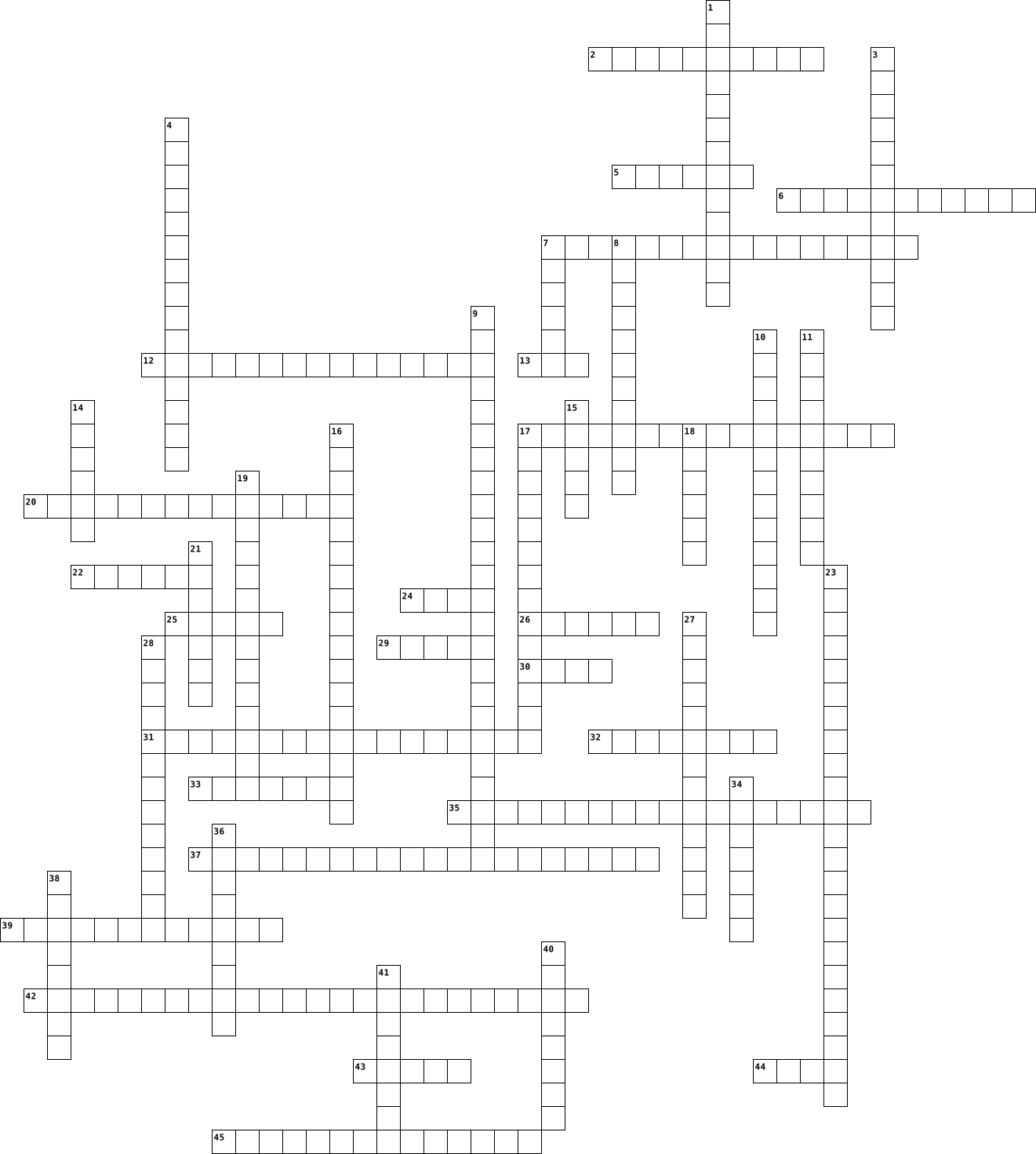
Across
- process in which solid particles in a liquid or gaseous fluid are removed by the use of a filter medium
- the successive occupation of the orbitals in a valence shell of the atom
- PV=nRT
- observed or measured without changing the identity of the substance
- pressure of a given mass of gas varies directly with the absolute temperature of the gas when the volume is kept constant
- no shape
- characteristic of a particular substance that can be observed in a chemical reaction.
- one chemical substance is transformed into one or more different substances
- amount of mass and space taken up
- substance form of matter that has a constant composition and properties that are constant throughout the sample
- gas law pv=nrt
- column in the periodic table of the chemical elements
- a substance diffused or suspended in the air
- particle of matter that uniquely defines a chemical element
- depends on the amount of matter in a sample
- make up Group 18
- any substance that cannot be decomposed into simpler substances by ordinary chemical processes
- composition is uniform throughout the mixture
- composition is not uniform throughout the mixture
- v1/t1=v2/t2
- every chemical compound contains fixed and constant proportions of its constituent elements.
- has a definite shape
- a coherent, typically large body of matter with no definite shape.
- p1(v1)/t1=p2(v2)/t2
Down
- v1/n1=v2/n2
- the action of purifying a liquid by a process of heating and cooling.
- of a liquid, solution, or gas to a crystal
- fourth state of matter
- transition of a substance directly from a solid-state to a gas state
- two elements form more than one compound, then the ratios of the masses of the second element which combine with a fixed mass of the first element will always be ratios of small whole numbers
- is a tabular display of the chemical elements
- P{1}V{1}=P{2}V{2}
- of matter liquid gas solid
- any of a class of substances characterized by high electrical and thermal conductivity as well as by malleability, ductility, and high reflectivity of light
- depends only on the type of matter in a sample and not on the amount.
- separation of a mixture by passing it in solution or suspension or as a vapor
- takes shape of container
- a change in properties such as texture, shape, or state
- the substances produced at the end of the reaction
- mass is neither created nor destroyed
- change of a substance from one physical form to another
- divide the mass of the element in 1 mole of the compound
- combining 2 chemical substances
- an element whose properties are intermediate between those of metals and solid nonmetals or semiconductors.
- substance that takes part in and undergoes change during a reaction.
- a class of chemical elements whose chemical and physical properties contrast with those of metals
- substance consisting of atoms or ions of two or more different elements in definite proportions joined by chemical bonds into a molecule
47 Clues: PV=nRT • no shape • v1/n1=v2/n2 • v1/t1=v2/t2 • gas law pv=nrt • make up Group 18 • P{1}V{1}=P{2}V{2} • p1(v1)/t1=p2(v2)/t2 • has a definite shape • fourth state of matter • takes shape of container • of matter liquid gas solid • combining 2 chemical substances • amount of mass and space taken up • mass is neither created nor destroyed • of a liquid, solution, or gas to a crystal • ...
2 - Matter and Energy 2025-03-05

Across
- The process by which cells obtain energy from an energy source without using oxygen.
- A macromolecule containing hydrogen, oxygen, nitrogen, carbon, and phosphorus (includes DNA and RNA); used for storing genetic genetic information.
- A process that requires oxygen.
- An organism that can produce its own food from abiotic molecules and energy from the sun; producer.
- The chemical formula for carbon dioxide.
- The pores on the leaf where O2 exits and CO2 enters.
- Two or more atoms bonded together.
- The chemical formula for the simple sugar glucose
- A macromolecule that contains carbon, hydrogen, and oxygen. Provides short-term energy (includes starches like potatoes and pasta).
- The chemical formula for the oxygen gas we breathe
- The organelle found in cells of plants and some other organisms that captures the energy from sunlight and converts it into chemical energy.
- A simple sugar made in the process of photosynthesis which the plants use for energy in Cellular Respiration.
- The substance that controls the quantity of product that can form in a chemical reaction.
- The term used to describe the rate at which plants and other photosynthetic organisms produce organic compounds in an area.
- A molecule formed as a result of a chemical reaction (outputs).
- The compound used by cells to store and release energy; made during cellular respiration.
- A rigid layer of nonliving material that surrounds the cells of plants and some other organisms.
- A process that does not require oxygen.
- The type of energy holding atoms together.
Down
- The process by which some organisms, such as certain bacteria, use chemical energy to produce carbohydrates.
- A very large organic molecule composed of many smaller molecules. Carbohydrates, Lipids, Proteins & Nucleic Acids.
- The process in which our cells break down food and turn it into energy that cells need to perform their life functions. Oxygen is needed for this process.
- A green pigment located in the membrane within the chloroplasts of plants and algae and in the membranes of certain prokaryotes.
- Processes by which organisms maintain a relatively stable internal environment.
- The process that converts light energy into chemical energy that is stored in glucose or other organic compounds; occurs in plants, algae, and certain prokaryotes.
- A large, fluid-filled organelle that stores not only water but also enzymes, metabolic wastes, and other materials.
- An organelle found in large numbers in most cells, in which the processes of cellular respiration and energy production occur.
- The most basic unit of matter.
- Anything that has mass and takes up space.
- The chemical formula for water.
- Elements or compounds that enter into a chemical reaction (inputs).
- A protein catalyst that speeds up chemical reactions in the organism.
- An organism whose cell(s) contain a nucleus and membrane bound organelles.
- Found in the bonds that hold molecules together and necessary for all life processes to occur in organisms.
- A macromolecule, built from amino acids, that contains carbon, hydrogen, oxygen, and nitrogen; needed by the body for growth and repair; gives you your traits.
- A macromolecule made mostly from carbon and hydrogen atoms; provides long-term energy (includes fats, oils, and waxes).
- An organism that obtains energy from feeding off of other organisms; Consumer.
- A unicellular organism that lacks a nucleus and membrane bound organelles
38 Clues: The most basic unit of matter. • A process that requires oxygen. • The chemical formula for water. • Two or more atoms bonded together. • A process that does not require oxygen. • The chemical formula for carbon dioxide. • Anything that has mass and takes up space. • The type of energy holding atoms together. • The chemical formula for the simple sugar glucose • ...
MBaker-Chapter13 2019-03-12

Across
- The process where reactants gain one or more electrons.
- A polyatomic ion made by adding a proton to a water molecule.
- An ionic compound commonly formed from the reaction between an acid and a base.
- Description of a chemical reaction in which there is a net release of energy.
- The process by which a reactant loses one or more electrons.
Down
- Description of a chemical reaction in which there is a net absorption of energy.
- A rapid exothermic oxidation-reduction reaction between a material and a molecular Oxygen.
- The deterioration of a metal, typically caused by atmospheric oxygen.
- Description of a solution in which the hydroxide ion concentration is higher than the hydronium ion concentration; also sometimes called alkaline.
- A substance that accepts hydrogen ions.
10 Clues: A substance that accepts hydrogen ions. • The process where reactants gain one or more electrons. • The process by which a reactant loses one or more electrons. • A polyatomic ion made by adding a proton to a water molecule. • The deterioration of a metal, typically caused by atmospheric oxygen. • ...
Energy Crossword 2025-03-18

Across
- possessed by an object due to its motion or due to its position
- Ex of electrical energy
- energy an object possesses because of it's position
- what we measure KE and PE
- another word for heat
- blank energy caused by motion
- ability to work
- Ex: battery
- EX: a rubber band being stretched
- thermal chemical reaction
- energy released during blank fusion
Down
- h in potential energy formula
- blank=mgh
- Ex: ultraviolet rays
- photograph of bones
- movement of electric charge
- transfer of energy
- energy cannot be created or destroyed
- energy that travels in waves
19 Clues: blank=mgh • Ex: battery • ability to work • transfer of energy • photograph of bones • Ex: ultraviolet rays • another word for heat • Ex of electrical energy • what we measure KE and PE • thermal chemical reaction • movement of electric charge • energy that travels in waves • h in potential energy formula • blank energy caused by motion • EX: a rubber band being stretched • ...
Activity - Crossword 2026-02-11

Across
- - One type of Contamination
- - Food safety management principle
- - FIFO is an example of good -----practice
- - Symptom of Food Poisoning
- - Common Pest in food premises
- - Type of Physical Contamination
- - Temperature range where bacteria grows fastes
- - Cleanliness of Body
- - Substance that can cause Allergic reaction
- - Ability to track food through Supply chain
Down
- - Transfer of bacteria
- - A type of Allergen
- - ------- As you Go
- - Keep the food items --------
- - Reduce bacteria to safe level
- - Activity done prior entering kitchen
- - Chemical That remove Dirt and Grease
- - Pathogen related to Raw Eggs
- - Potential cause of harm
19 Clues: - ------- As you Go • - A type of Allergen • - Cleanliness of Body • - Transfer of bacteria • - Potential cause of harm • - One type of Contamination • - Symptom of Food Poisoning • - Keep the food items -------- • - Common Pest in food premises • - Pathogen related to Raw Eggs • - Reduce bacteria to safe level • - Type of Physical Contamination • - Food safety management principle • ...
Science Term 2- Atoms and their Reactions 2021-06-21

Across
- General term used to describe any atoms that are connected by chemical bonds
- The mass of the whole atom measured by protons and neutrons
- A reaction in which a compound is broken down into single elements or smaller compounds
- A pair of atoms with shared electrons
- A molecule made up of two or more different types of elements
- A reaction in which single elements or small compounds react to form a larger compound
- An exothermic chemical reaction producing oxides
Down
- Electrons on the outermost shell of an atom
- The word used to describe how strong a pull an atom has on another atom, measured on a scale of 0.4 to 0.7
- Horizontal rows on the periodic table
- Reacts with a base to form a salt and water
- Vertical columns on the periodic table
- Can kill 10 000 000 people if ingested
13 Clues: Horizontal rows on the periodic table • A pair of atoms with shared electrons • Vertical columns on the periodic table • Can kill 10 000 000 people if ingested • Electrons on the outermost shell of an atom • Reacts with a base to form a salt and water • An exothermic chemical reaction producing oxides • The mass of the whole atom measured by protons and neutrons • ...
Matter and Elements 2021-10-12

Across
- characteristics used to describe an object
- a substance that is made during a chemical reaction
- basic unit of matter
- a group of atoms bonded together; the smallest unit of most compounds
- a single kind of matter that is pure and has a specific set of properties
- a chemical substance that is presented at the start of a chemical reaction
Down
- a substance made up of atoms of two or more different elements joined by chemical bonds
- an arrangement of elements in which the elements are separated into groups based on a set of repeating properties
- a pure substance made of only one kind of atom
- a combination of two or more substances that are not chemically combined
10 Clues: basic unit of matter • characteristics used to describe an object • a pure substance made of only one kind of atom • a substance that is made during a chemical reaction • a group of atoms bonded together; the smallest unit of most compounds • a combination of two or more substances that are not chemically combined • ...
Stoichiometry Crossword Puzzle 2021-03-06

Across
- The number before a symbol or formula that shows how many atoms & molecules are used in the reaction.
- reaction, Happens when a product breaks down into reactants.
- reaction, A process that turns substances into another.
- composition, How much of an element is in a compound, in percentage form.
Down
- reaction, 2 or more reactants forming a product.
- The specific number of an element's atoms in a compound
- The substances that are reacting to create the product.
- Law of Conservation of Matter, Law that states Matter can’t be created or destroyed.
- equation, A chemical equation with the same numbers of elements shown on the reactant & product sides.
- mass, The gram atomic mass divided by the number of moles of an element.
10 Clues: reaction, 2 or more reactants forming a product. • The specific number of an element's atoms in a compound • The substances that are reacting to create the product. • reaction, A process that turns substances into another. • reaction, Happens when a product breaks down into reactants. • mass, The gram atomic mass divided by the number of moles of an element. • ...
Unit B 2014-11-03

Across
- Horizontal row in the periodic table
- abbreviation of atomic mass unit
- Smallest atomic mass
- Organic catalyst
- Going from being a solid to a gas
- Another factor that can affect the rate of reaction
- Symbol on periodic table is O
- Positively charged subatomic matter
- Materials at the start of a reaction
- Means indivisible
- Common name of Dihydrogen monoxide
- Column or family on the periodic table
Down
- Negatively charged subatomic matter
- A metal that is a liquid at room temperature
- A factor that can affect the rate of reaction
- Going from being a gas to a liquid
- Ionic compound formula is NaOH
- Man who thought all matter is made up of air, fire, water, and earth
- Planet used to identify tin
- Group of most reactive non-metals
- Group of metals that are the most reactive
- Chemical reaction that releases heat
- A liquid at room temperature atomic mass of 80
- Material that cannot be broken down into any simpler substance
- Previously represented by the planet mars
- Planet used to identify lead
26 Clues: Organic catalyst • Means indivisible • Smallest atomic mass • Planet used to identify tin • Planet used to identify lead • Symbol on periodic table is O • Ionic compound formula is NaOH • abbreviation of atomic mass unit • Group of most reactive non-metals • Going from being a solid to a gas • Going from being a gas to a liquid • Common name of Dihydrogen monoxide • ...
Chemistry Study Guide 2016-02-10

Across
- group of elements chemically bonded
- metal gets protection
- stuff that comes out of science experiment
- in between properties of metal and non-metals
- outer most particles in the electron
- reaction with heat
- group of atoms in purest form
- odorless colorless gas
- # of protons expressed on each element square
- a substance with high destiny, can conduct electricity, and is shiny
- lower density not good heat conductor and not shiny
Down
- 2 elements chemically bonded form a ________
- after a chemical reaction the mass is the same as before the experiment
- neutral charge in the nucleus
- middle of atom, house of protons and nucleuses
- shortened version of element usual derived from Latin or Greek
- Russian creator of the periodic table
- positive charge in the nucleus
- a row on the periodic table
- Smallest particle in the universe
- the function that describes the wave like behavior of an electron
- weight of atom
- reaction with cold stuff
- Similar elements together on table
- Negative charge that circles around the neutron
- molecule that started reaction
26 Clues: weight of atom • reaction with heat • metal gets protection • odorless colorless gas • reaction with cold stuff • a row on the periodic table • neutral charge in the nucleus • group of atoms in purest form • positive charge in the nucleus • molecule that started reaction • Smallest particle in the universe • Similar elements together on table • group of elements chemically bonded • ...
CHAPTER 8; METABOLISM, RESPIRATION AND PHOTOSYNTHESIS 2024-01-23

Across
- Movement of ions across a selectively permeable membrane, down their electrochemical gradient
- a high energy molecule that functions as an immediate source of power for the cell.
- stacks of thylakoids
- Calvin's experiment on light independant reaction
- functions as the final electron acceptor in the mitochondrial electron transport chain.
- has double membrane
- ____ inhibitors bind with an active site so substrates cannot bind
- anabolic pathway that requires endergonic reactions to be coupled to the hydrolysis of ATP and the oxidation of reduced NADP
Down
- The process of activating a substance by means of radiant energy and especially light
- Lower activation energy of the chemical reaction
- act as an inhibitor in metabolic pathways
- describes a series of oxidation reactions that occur within mitochondrial matrix.
- How can the effect of competitive inhibitors be reduced? By reducing the concentration of ____
- pyruvate is _____ to form acetyl coA
- Overall aerobic reactions produces ___ CO2 and 36 ATP
- Splitting of water
- describes the breakdown of glucose anerobically into two pyruvate.
- the location for light dependant reaction
- FAD changing to FADH2
- location of light-dependent reaction
20 Clues: Splitting of water • has double membrane • stacks of thylakoids • FAD changing to FADH2 • pyruvate is _____ to form acetyl coA • location of light-dependent reaction • act as an inhibitor in metabolic pathways • the location for light dependant reaction • Lower activation energy of the chemical reaction • Calvin's experiment on light independant reaction • ...
Chemistry Puzzle 2020-12-18

Across
- Completely filled valence shell
- A complex reactant breaks down into simpler products
- Non-Brittle
- More than 2 elements
- Electrical conductivity of Covalent bonds
- Bond that shares electrons
- Bond that has the characteristics of Brittle
- Reaction often with a change of color
- Group 17
- 2 Elements
- To mix a dissolvent into a solvent completely
Down
- To have a liquid turn into gas form
- Liquid with unseeable molecules
- Bond with a sea of electrons
- Two or more reactants make a product
- Reaction often associated with melting
- The type of atoms that make up a covalent bond
- Liquid with large seeable molecules
- Brittle
- Melting point of Covalent bonds
20 Clues: Brittle • Group 17 • 2 Elements • Non-Brittle • More than 2 elements • Bond that shares electrons • Bond with a sea of electrons • Completely filled valence shell • Liquid with unseeable molecules • Melting point of Covalent bonds • To have a liquid turn into gas form • Liquid with large seeable molecules • Two or more reactants make a product • Reaction often with a change of color • ...
Metabolism unit vocab 2022-02-18

Across
- corn***** is a food
- this supports your answer
- a possibly harmful reaction
- a molecule your body use of energy
- a body system that leads to cells
- your body breaths this
- a chemical reaction
- this is in fish
- the bodys use of molecules
- mrstrisko needs coffee to have this
- what you think is correct
Down
- a claim supported by evidence
- a group of atoms
- the way your body breaks food down
- covid is a ---------- disease
- a molecule that made of 2 different atoms
- this makes you gain and repair muscles
- a way things work together
- the reason why
19 Clues: the reason why • this is in fish • a group of atoms • corn***** is a food • a chemical reaction • your body breaths this • this supports your answer • what you think is correct • a way things work together • the bodys use of molecules • a possibly harmful reaction • a claim supported by evidence • covid is a ---------- disease • a body system that leads to cells • ...
Random 2024-01-28

Across
- Detective
- A fish from South America and Africa
- Needed to print
- Large marsupial
- the smallest fundamental unit of a chemical compound that can take part in a chemical reaction
- A popular store found only in the U.S.
- A morning staple
- Not talked about
- Quicken
Down
- Originally described opposition to the disestablishment of the Church of England
- Light _____
- A group of people making music together
- What is done in the Kitchen
- Often associated with owls
- Boo
- A tool used while sewing
- Italian automobile manufacturer
- Absolutely Amazing
- A showy or bizarrely shaped flower
19 Clues: Boo • Quicken • Detective • Light _____ • Needed to print • Large marsupial • A morning staple • Not talked about • Absolutely Amazing • A tool used while sewing • Often associated with owls • What is done in the Kitchen • Italian automobile manufacturer • A showy or bizarrely shaped flower • A fish from South America and Africa • A popular store found only in the U.S. • ...
Trinity Martinez Chapter 13 2016-10-12

Across
- A substance that undergoes a chemical change.
- chemical that donates a hydrogen atom
- Must be added to break bonds.
- energy is transferred to reactants from surroundings (usually cool)
- A substance that is the result of the chemical change.
- combining two elements to form a larger compound.
- when you add hydrogen ions.
- one element of the compound leaves and goes to a new compound
Down
- energy transfers from reactants to surroundings.
- separates a compound; broken down
- two elements of a compound change compounds.
- chemical that accepts a hydrogen atom
- the PH level of water.
- The energy stored in molecules that can be released during a reaction.
- product side is always oxide.
15 Clues: the PH level of water. • when you add hydrogen ions. • Must be added to break bonds. • product side is always oxide. • separates a compound; broken down • chemical that donates a hydrogen atom • chemical that accepts a hydrogen atom • two elements of a compound change compounds. • A substance that undergoes a chemical change. • ...
Chemical equations 2025-02-07

Across
- A pure substance that can't be broken down
- The smallest unit of matter
- The substances before the chemical reaction
- The substances after the chemical reaction
- Matter can't be created or ______
Down
- Anything with mass that takes up space
- An equation where both sides have equal amounts of atoms
- Making an equation have the same amount of atoms on both sides
- "The Law of Conservation of ___"
- Two or more elements chemically combined
10 Clues: The smallest unit of matter • "The Law of Conservation of ___" • Matter can't be created or ______ • Anything with mass that takes up space • Two or more elements chemically combined • A pure substance that can't be broken down • The substances after the chemical reaction • The substances before the chemical reaction • ...
Lab Crossword 2025-12-02

Across
- substances before a chemical reaction
- law that states that matter is neither created nor destroyed
- equation that shows no matter was created or destroyed
- groups of connected molecules
Down
- attraction of molecules that holds them together
- occurs after a chemical reaction
- anything that takes up space
- the amount of matter in an object
- a process that transforms a substance into a new substance with different properties
- French chemist who discovered the Law of Conservation
10 Clues: anything that takes up space • groups of connected molecules • occurs after a chemical reaction • the amount of matter in an object • substances before a chemical reaction • attraction of molecules that holds them together • French chemist who discovered the Law of Conservation • equation that shows no matter was created or destroyed • ...
Atoms 2026-03-25

Across
- - a negatively charged subatomic particle
- - a no charge subatomic particle
- - building blocks of all matter
- - Smallest unit of a molecule
- Reaction - a process where two substances mix and can be rearranged
- Reaction - a process where two substances mix and can't be rearranged
Down
- - a positively charged subatomic particle
- - smallest unit of a chemical compound
- - takes up space but no definite shape
- number- How the whole numbers are arranged on the periodic table
10 Clues: - a no charge subatomic particle • - building blocks of all matter • - Smallest unit of a molecule • - smallest unit of a chemical compound • - a positively charged subatomic particle • - a negatively charged subatomic particle • - takes up space but no definite shape • number- How the whole numbers are arranged on the periodic table • ...
Chemical Reactions 2023-03-15

Across
- the temperature at which a substance changes from the solid phase to the liquid phase
- a group of atoms joined together in a particular way
- something that is made of all the same atoms or groups of atoms
- to change the order or position of something
- an ending substance that is made during a chemical reaction
- a process in which atoms rearrange to form new substances
- the temperature at which a substance changes from the liquid phase to the gas phase
Down
- letters and numbers showing the types and number of atoms that repeat to make up a substance
- the tiny pieces that all matter—all the stuff in the world—is made of
- a starting substance that is part of a chemical reaction
- something that can be observed about a substance, such as color, smell, or boiling point
- able to cause damage
- the relative size of things
13 Clues: able to cause damage • the relative size of things • to change the order or position of something • a group of atoms joined together in a particular way • a starting substance that is part of a chemical reaction • a process in which atoms rearrange to form new substances • an ending substance that is made during a chemical reaction • ...
Cellular Energy 2024-09-11

Across
- A monosaccharide
- The powerhouse of the cell; the power factory
- the process by which cells convert chemical energy
- A single, self contained living thing
- The primary molecule used by cells to store chemical energy for use in cellular processes
- An organism that obtains its energy from an abiotic source
- A gas produced by plants; organisms use it for respiration
- The ability to do work or produce heat
Down
- A process that produces lactic acid by the conversion of sugars into cellular energy
- The process by which autotrophs use light energy, carbon dioxide, and water to make glucose and oxygen
- A biological process that produces ethanol and carbon dioxide
- The starting substance in a chemical equation
- The ending substances of a chemical equation
- A gas found in Earth's atmosphere produced by animals during respiration
- Energy stored in chemical bonds; can be released in a chemical reaction
- Electromagnetic wave
- Anything that has mass and volume
17 Clues: A monosaccharide • Electromagnetic wave • Anything that has mass and volume • A single, self contained living thing • The ability to do work or produce heat • The ending substances of a chemical equation • The powerhouse of the cell; the power factory • The starting substance in a chemical equation • the process by which cells convert chemical energy • ...
Cellular Energy 2024-09-11

Across
- A monosaccharide
- The powerhouse of the cell; the power factory
- the process by which cells convert chemical energy
- A single, self contained living thing
- The primary molecule used by cells to store chemical energy for use in cellular processes
- An organism that obtains its energy from an abiotic source
- A gas produced by plants; organisms use it for respiration
- The ability to do work or produce heat
Down
- A process that produces lactic acid by the conversion of sugars into cellular energy
- The process by which autotrophs use light energy, carbon dioxide, and water to make glucose and oxygen
- A biological process that produces ethanol and carbon dioxide
- The starting substance in a chemical equation
- The ending substances of a chemical equation
- A gas found in Earth's atmosphere produced by animals during respiration
- Energy stored in chemical bonds; can be released in a chemical reaction
- Electromagnetic wave
- Anything that has mass and volume
17 Clues: A monosaccharide • Electromagnetic wave • Anything that has mass and volume • A single, self contained living thing • The ability to do work or produce heat • The ending substances of a chemical equation • The powerhouse of the cell; the power factory • The starting substance in a chemical equation • the process by which cells convert chemical energy • ...
Chem 1 Puzzle 2025 2025-06-07

Across
- A pure substance made of two or more elements chemically combined.
- A particle of matter that defines a chemical element.
- The process of using a balanced equation to calculate amounts of reactants or products.
- The measure of how much solute is dissolved in a given quantity of solvent.
Down
- A group of atoms bonded together, representing the smallest fundamental unit of a chemical compound.
- The loss of electrons in a chemical reaction.
- The gain of electrons in a chemical reaction.
- UNIT A shorthand way to show the ratio of ions in an ionic compound.
- MASS The amount of mass in one mole of a substance.
- COMPOSITION The percentage by mass of each element in a compound.
10 Clues: The loss of electrons in a chemical reaction. • The gain of electrons in a chemical reaction. • MASS The amount of mass in one mole of a substance. • A particle of matter that defines a chemical element. • COMPOSITION The percentage by mass of each element in a compound. • A pure substance made of two or more elements chemically combined. • ...
Science on the Main Stage Crossword 2025-10-24

Across
- a substance that only contains one type of atom
- a chemical change between two or more molecules
- Molecule(s) present at the end of a chemical reaction
- a mixture of two or more substances that remain as physically separate substances.
Down
- a substance made of chemically bonded atoms of more than one element
- a change only to the appearance of molecules,
- Molecule(s) present at the start of a chemical reaction
- a a mixture of two or more substances that appears to be a single, uniform medium, with no visible separation between its components
- the smallest unit of a chemical - everything that exists is made up of these tiny particles
- an objects ability to dissolve
10 Clues: an objects ability to dissolve • a change only to the appearance of molecules, • a substance that only contains one type of atom • a chemical change between two or more molecules • Molecule(s) present at the end of a chemical reaction • Molecule(s) present at the start of a chemical reaction • a substance made of chemically bonded atoms of more than one element • ...
topic 1-3 vocab 2013-12-08

Across
- a pH value of more than 7
- a mineral that the body requires in the amount of 100 mg/day or more in order to maintain health
- a chemical used to control weeds
- a chemical reaction in which oxygen combines with other elements to form new substances
- paper saturated with a chemical to show wether a substance is acidic or basic
- rain or snow containing acid compounds in the air
- a chemical that changes colour to indicate wether a substance is an acid or base
- having a pH value less than 7
- a chemical used to control holds and fungi
Down
- the process whereby chemicals accumulate in the tissues of organisms along the food chain
- a mixture of plant compounds used as a chemical indicator
- an organic nutrient that does not dissolve in water
- a chemical in food, used for energy, growth, body building, or cell repair
- a scaled that measures that acidity or alkalinity of a substance
- a molecule that helps enzymes function in the body
- and organic nutrient made of carbon, hydrogen, and oxygen
- an organic nutrient composed of a chain of amino acids
- a special protein molecule that regulates chemical reactions in living organisms
- the process of adding calcium carbonate to the environment
19 Clues: a pH value of more than 7 • having a pH value less than 7 • a chemical used to control weeds • a chemical used to control holds and fungi • rain or snow containing acid compounds in the air • a molecule that helps enzymes function in the body • an organic nutrient that does not dissolve in water • an organic nutrient composed of a chain of amino acids • ...
ACIDS ARE COOL! 2017-04-10

Across
- The gas produced from a metal and acid reaction
- The chemical name for baking soda
- The name for the test for hydrogen gas
- Turns blue litmus red
- An acid and a base produce a _______
- Hydrogen burning produces _______
- Hydrogen gas is ________ when exposed to a flame
Down
- This acid makes chloride salts
- The reaction between an acid and a base is known as _________
- Nitric acid produces __________ salts
- The gas produced from a metal carbonate and acid reaction
- Sulfuric acid produces ________ salts
- Bases turn red litmus ______
13 Clues: Turns blue litmus red • Bases turn red litmus ______ • This acid makes chloride salts • The chemical name for baking soda • Hydrogen burning produces _______ • An acid and a base produce a _______ • Nitric acid produces __________ salts • Sulfuric acid produces ________ salts • The name for the test for hydrogen gas • The gas produced from a metal and acid reaction • ...
Chapter 4 2023-09-22

Across
- - protein that speeds up a reactoin
- - larger molecules that are broken up
- respiration- a reaction that allows cells to use glucose
- synthesis- joining smaller molecules by removing water molecules
- reactions- are reactions that do not require energy
- - small molecules built up into larger ones
- - reactant from an enzyme reaction
- reactions- are reactions that do require energy
Down
- site- combines parts of molecules
- - a collection of all chemical reactions
- - reaction that breaks down carbohydrates, protein, etc
- - the loss of hydrogen atoms
- - the energy that cells use
13 Clues: - the loss of hydrogen atoms • site- combines parts of molecules • - the energy that cells use • - reactant from an enzyme reaction • - larger molecules that are broken up • - protein that speeds up a reactoin • - a collection of all chemical reactions • - small molecules built up into larger ones • reactions- are reactions that do require energy • ...
chapter 12 vocab 2023-10-24

Across
- bodys negative reaction to a substance
- condition where the body cannot properly control the level of sugar in the blood
- lack of proper nutrients in the body
- the substance that causes an allergic reaction
- intake of more food than needed
- chemical substances in food
- most severe allergic reaction
Down
- not eating enough
- a protien found in wheat and other grains
- food guidance system
- science of food and how the body uses the foods taken in
- the hormone that regulates blood sugar level
- the fear of something new
13 Clues: not eating enough • food guidance system • the fear of something new • chemical substances in food • most severe allergic reaction • intake of more food than needed • lack of proper nutrients in the body • bodys negative reaction to a substance • a protien found in wheat and other grains • the hormone that regulates blood sugar level • ...
Energy and Nutrition 2023-11-03

Across
- small molocule amino acids, sugars, and fatty acids
- grow and repair
- process by which food, in the form of sugar (glucose), is transformed into energy within cells
- a macromolecule that is always in a on to two also used for energy ratio
- energy
- right side of the reaction
Down
- left side of the reaction
- energy storage, fatty acid
- large molocule such as carbon, oxygen, and hydrogen
- 1 sugar
- 2 sugars
- chemical reactions in the cells body that changes food into energy
- helps speed up reaction (ends in ace)
13 Clues: energy • 1 sugar • 2 sugars • grow and repair • left side of the reaction • energy storage, fatty acid • right side of the reaction • helps speed up reaction (ends in ace) • large molocule such as carbon, oxygen, and hydrogen • small molocule amino acids, sugars, and fatty acids • chemical reactions in the cells body that changes food into energy • ...
Energy and Nutrition 2023-11-03

Across
- small molocule amino acids, sugars, and fatty acids
- grow and repair
- process by which food, in the form of sugar (glucose), is transformed into energy within cells
- a macromolecule that is always in a on to two also used for energy ratio
- energy
- right side of the reaction
Down
- left side of the reaction
- energy storage, fatty acid
- large molocule such as carbon, oxygen, and hydrogen
- 1 sugar
- 2 sugars
- chemical reactions in the cells body that changes food into energy
- helps speed up reaction (ends in ace)
13 Clues: energy • 1 sugar • 2 sugars • grow and repair • left side of the reaction • energy storage, fatty acid • right side of the reaction • helps speed up reaction (ends in ace) • large molocule such as carbon, oxygen, and hydrogen • small molocule amino acids, sugars, and fatty acids • chemical reactions in the cells body that changes food into energy • ...
Photosynthesis Review 2021-10-18

Across
- "self feeder"; organism that makes its own food via photosynthesis
- a substance that is formed as the result of a chemical reaction
- gas that is released during photosynthesis
- part of plant in which photosynthesis takes place; think of as solar panels
- green pigment; absorbs sunlight
- part of plant in which water is absorbed
- type of biomolecule; sugars are examples
- energy used during photosynthesis
- chemical formula for water
- a substance that takes part in and undergoes change during a reaction
Down
- process that makes glucose using sunlight
- gas that is taken in by plants during photosynthesis
- "different feeder"; organism that does not make its own food EXAMPLE: animals
- sugar that is made during photosynthesis
- organelle found in plants and algae; contains green pigment
15 Clues: chemical formula for water • green pigment; absorbs sunlight • energy used during photosynthesis • sugar that is made during photosynthesis • part of plant in which water is absorbed • type of biomolecule; sugars are examples • process that makes glucose using sunlight • gas that is released during photosynthesis • gas that is taken in by plants during photosynthesis • ...
UNIT 2: MATERIALS: PROPERTIES AND CHANGES 2022-09-13

Across
- A substance that is dissolved.
- Something about a substance that allows us to tell it apart from other substances
- The _______________ of dissolving increases if we heat a solution
- A change where a substance can be changed back to the way it was before.
- When heat is transferred from one object to another.
- Change that results to formation of new substance.
- A substance that dissolves other substances.
- The substances that react together in a chemical reaction.
- A change in the the object that cannot be reversed.
Down
- Objects that conduct electricity.
- Objects that conduct heat.
- The temperature at which liquids change to gas
- The substances that react together in a chemical reaction.
- The temperature at which solids change liquid
- When liquid turns to gas without boiling.
- The way we know that a chemical reaction has happened is called____.
- The temperature at which particles throughout a liquid become a gas.
17 Clues: Objects that conduct heat. • A substance that is dissolved. • Objects that conduct electricity. • When liquid turns to gas without boiling. • A substance that dissolves other substances. • The temperature at which solids change liquid • The temperature at which liquids change to gas • Change that results to formation of new substance. • ...
Key Concepts in Acid-Base Chemistry and Reactions 2025-03-07

Across
- Gain of electrons or decrease in oxidation state.
- Process of forming ions from molecules.
- Sodium (Na+) Nitrate (NO3-) Ammonium (NH4+) Potassium (K+)
- Device used to dispense precise volumes of liquid
- A measurement of how much solute exists within a certain volume of solvent
- Substance being analyzed in a chemical reaction.
- a split in consciousness, which allows some thoughts and behaviors to occur simultaneously with others
- Inverse operation of logarithm, used in calculations.
- Liquid above a settled precipitate.
Down
- Loss of electrons or increase in oxidation state.
- Technique to determine concentration of an unknown solution.
- Maximum amount of solute that dissolves in solvent.
- Solution of known concentration in titration
- Solid formed from a chemical reaction in solution.
- the mathematical function logarithm, specifically used to calculate the pH of a solution
15 Clues: Liquid above a settled precipitate. • Process of forming ions from molecules. • Solution of known concentration in titration • Substance being analyzed in a chemical reaction. • Gain of electrons or decrease in oxidation state. • Loss of electrons or increase in oxidation state. • Device used to dispense precise volumes of liquid • ...
SCIENCE HOLIDAYS HOMEWORK CROSSWORD PUZZLE 2025-05-31

Across
- Reaction where an acid and a base react to form salt and water.
- Device used to protect electric circuits from overloading.
- The chemical used to test the presence of starch.
- The basic functional unit of the kidney.
- The rate at which energy is transferred or converted.
- Type of bonding where electrons are shared.
- process of releasing energy from glucose from cells.
- The process of gaining oxygen or losing hydrogen.
Down
- Mirror that always forms virtual , erect , and diminished images.
- The energy possessed by a body due to its motion.
- Hormone that regulates blood sugar level.
- Compounds made of carbon and hydrogen only.
- Tiny pores in leaves for gas exchange.
- A substance that speeds up the chemical reaction.
- Bending of light at the interface of two media.
15 Clues: Tiny pores in leaves for gas exchange. • The basic functional unit of the kidney. • Hormone that regulates blood sugar level. • Compounds made of carbon and hydrogen only. • Type of bonding where electrons are shared. • Bending of light at the interface of two media. • The energy possessed by a body due to its motion. • The chemical used to test the presence of starch. • ...