
divergent Crossword Puzzles
DONT USE CAPITALS OR SPACES 2024-10-30

Across
- What makes convention currents work and makes oceanic plates sink under continental plates?
- What is the type of boundary where two plates move away from each other or divide?
- What is the only liquid layer of the earth?
- What made Pangea spread apart, and what did Alfred Wegener have a theory about?
- What are the plates that make up the surface of the earth?
- What is the layer second highest in the earth?
Down
- What is the force that makes plates move?
- What is the part of the earth that includes the top part of the mantle and the crust?
- What is the top layer of the earth?
- What is the type of boundary where two plates slide across each other?
- What is the process of a plate going under another plate?
- What is the layer in the center of the earth?
- What is the type of boundary where two plates collide or subduct?
13 Clues: What is the top layer of the earth? • What is the force that makes plates move? • What is the only liquid layer of the earth? • What is the layer in the center of the earth? • What is the layer second highest in the earth? • What is the process of a plate going under another plate? • What are the plates that make up the surface of the earth? • ...
ESH Q2 Extra Credit 2024-12-10

Across
- a type of front in which cold air replaces warm air
- ____ boundary is where two plates move away from each other
- a disturbance that travels through a medium from one location to another location
- ____ boundary where two plates move towards each other
- a type of front in which warm air replaces cold air
- is the number of waves that pass a point in a certain period of time
- theory of _______ ______ in which the earth is broken up into plates that move slowly over time
Down
- a method for determining age of rocks without knowing their specific age
- a method for determining exact age of rocks
- the remains or impression of an organism found within a rock
- the process by which organisms change in order to fit their environment better
- a substance that has mass and takes up space2. ____ boundary where two plates slide against each other
- the process by which organisms change through time
13 Clues: a method for determining exact age of rocks • the process by which organisms change through time • a type of front in which cold air replaces warm air • a type of front in which warm air replaces cold air • ____ boundary where two plates move towards each other • ____ boundary is where two plates move away from each other • ...
WTES Puzzle 2025-04-16

Across
- This type of fault/boundary is when one side of land pushes underneath the other, towards each other.
- A type of plate that moves and forms our planet's land.
- Wind and water combine to create this natural disaster.
- A hole on the surface where hot stuff from inside the earth comes out.
- _______s are formed underground and make up our rocks, sands and soils.
- A crack in the earth where the plates meet.
Down
- _______ happens when parts of earth/rock are weathered away or removed to make a new form.
- This type of fault/boundary is when one side of land moves past another.
- Bones of an animal from the past, now buried underground.
- When the Earth Shakes!
- This type of fault/boundary is when both sides of land push away from each other.
- Where the continents used to sit together before continental drift.
- _cience, _echnology, _ngineering, _rt, and _athmatics
13 Clues: When the Earth Shakes! • A crack in the earth where the plates meet. • _cience, _echnology, _ngineering, _rt, and _athmatics • A type of plate that moves and forms our planet's land. • Wind and water combine to create this natural disaster. • Bones of an animal from the past, now buried underground. • ...
Constructive and Destructive Forces 2026-03-30

Across
- time.
- The idea that Earth's continents slowly move across the surface over a
- The movement of weathered rock and soil from one place to another
- Natural processes that break down or wear away Earth's surface
- A landform made from sediment dropped by a river as it flows into an ocean or lake.
- The breaking down of rocks into smaller pieces by wind, water, ice, or plants.
Down
- When wind, water, or ice leaves behind the rock and soil it was carrying.
- A crack in Earth's crust where rocks have moved during an earthquake.
- Natural processes that build up Earth's surface
- The idea that Earth's surface is made of big pieces (plates) that move slowly over time.
- When two tectonic plates push together
- Small pieces of rock, sand, or dirt that are moved by wind or water and can pile up.
- When two tectonic plates move away from each other
13 Clues: time. • When two tectonic plates push together • Natural processes that build up Earth's surface • When two tectonic plates move away from each other • Natural processes that break down or wear away Earth's surface • The movement of weathered rock and soil from one place to another • A crack in Earth's crust where rocks have moved during an earthquake. • ...
Theories on the Formation of the Earth 2022-09-29

Across
- The lighter crust must be floating on the denser underlying mantle.
- Less dense than oceanic crust.
- Created when the divergent boundaries molten materials cools and hardens.
- Proposed the theory of continental drift.
- Massive slabs of rock
- Earths solid, rocky lithosphere is broken inti pieces called tectonic plates.
Down
- Occurs between 2 plates where molten materials within the earths pushes its way up, causing the plate to move away from each other.
- Proposed the idea of seafloor spreading in the early 1960's
- He proposed the term isostasy
- The crust and mantle would settle into in absence of disturbing forces.
- There are lateral changes in rock density across the lithosphere.
- The movement of tectonic plates which drift apart from the land which sits on the top ,is the cause for this shift.
- Across the lithosphere, the rock density is approximately the same.
- Allows the athenosphere to flow like dough or putty.
- IT happens when tectonic plates move and rub against each other
15 Clues: Massive slabs of rock • He proposed the term isostasy • Less dense than oceanic crust. • Proposed the theory of continental drift. • Allows the athenosphere to flow like dough or putty. • Proposed the idea of seafloor spreading in the early 1960's • IT happens when tectonic plates move and rub against each other • ...
Earth 2020-05-08

Across
- The border between two tectonic plates.
- Outermost layer of earth.
- a supercontinent that existed during the late Paleozoic and early Mesozoic eras.
- Is the only liquid layer of the earth consists of mostly iron and nickel.
- The formation of new areas of oceanic crust.
- is a dropped zone where the plates are pulling apart.
- States that continents shift position on Earth's surface.
Down
- An extremely hot, solid sphere of mostly iron and nickel at the center of the earth.
- where two plates slide past each other.
- The rigid outer part of the earth, consisting of the crust and upper mantle.
- States that the earth's outer layer, or lithosphere, is broken into several large slabs called plates, and the plates slowly move around the planet.
- Where two plates are pushing toward each other.
- Is an underwater mountain range.
- Two plates that are moving apart from each other.
- Semisolid rock is located directly below the crust.
15 Clues: Outermost layer of earth. • Is an underwater mountain range. • where two plates slide past each other. • The border between two tectonic plates. • The formation of new areas of oceanic crust. • Where two plates are pushing toward each other. • Two plates that are moving apart from each other. • Semisolid rock is located directly below the crust. • ...
Tectonic Plates 2021-05-01

Across
- What part of the Earth's crust is the thickest?
- What is responsible for the Earth´s magnetic field?
- What are the pieces of the Earth's crust?
- What is it called when two continental plates collide?
- What do you call it when two tectonic plates rub against each other?
- The most dense part of the Earth is called what?
Down
- What part of the Earth's crust is thin?
- The part of the Earth that is like chewing gum is called what?
- When two continental plates collide it forms what?
- What is it called when two plates separate or go in opposite directions?
- What forms when a oceanic plate & continental plate collide and go underneath each other?
- What is one of the layers that makes up the lithosphere?
- What is one of the layers that make up the lithosphere?
- When two tectonic plates rub against each other,it causes what ?
- What is made out of the crust and the mantle?
15 Clues: What part of the Earth's crust is thin? • What are the pieces of the Earth's crust? • What is made out of the crust and the mantle? • What part of the Earth's crust is the thickest? • The most dense part of the Earth is called what? • When two continental plates collide it forms what? • What is responsible for the Earth´s magnetic field? • ...
Plate Motion 2023-03-01

Across
- a large area of land on Earth's outer layer that sticks up above the ocean, such as Africa and North America
- an underwater mountain range formed when two plates move apart
- to examine in detail for a purpose
- any of the many processes (such as eruptions and lava flows) in gas,lava, and ash are pushed out on the surface of the Earth
- a sudden shaking of Earth's surface caused by plate movement
- a diagram that shows what the inside of something looks like
- how often or fast something happens
- a long, deep indentation in the ocean floor formed when two plates move together
- one of the very large sections of hard, solid rock that make up Earth's outer layer
Down
- something we observe to be similar over and over again
- the layer of soft, solid rock underneath Earth's plates
- earth's outermost layer of hard, solid rock
- moving apart in different directions
- moving toward the same place
- the plate where two plates meet
15 Clues: moving toward the same place • the plate where two plates meet • to examine in detail for a purpose • how often or fast something happens • moving apart in different directions • earth's outermost layer of hard, solid rock • something we observe to be similar over and over again • the layer of soft, solid rock underneath Earth's plates • ...
Plate Motion 2023-03-01

Across
- a large area of land on Earth's outer layer that sticks up above the ocean, such as Africa and North America
- an underwater mountain range formed when two plates move apart
- to examine in detail for a purpose
- any of the many processes (such as eruptions and lava flows) in gas,lava, and ash are pushed out on the surface of the Earth
- a sudden shaking of Earth's surface caused by plate movement
- a diagram that shows what the inside of something looks like
- how often or fast something happens
- a long, deep indentation in the ocean floor formed when two plates move together
- one of the very large sections of hard, solid rock that make up Earth's outer layer
Down
- something we observe to be similar over and over again
- the layer of soft, solid rock underneath Earth's plates
- earth's outermost layer of hard, solid rock
- moving apart in different directions
- moving toward the same place
- the place where two plates meet
15 Clues: moving toward the same place • the place where two plates meet • to examine in detail for a purpose • how often or fast something happens • moving apart in different directions • earth's outermost layer of hard, solid rock • something we observe to be similar over and over again • the layer of soft, solid rock underneath Earth's plates • ...
High School Vocabulary 2023-03-31

Across
- to combine or blend different elements to form a coherent whole
- dealing with things in a practical way; based on practical considerations rather than theory or ideology
- to examine something carefully in order to understand it
- to come together at a common point; to move toward a shared goal or opinion
- to place two things side by side to compare or contrast them
- clear, logical, and convincing; well-reasoned
Down
- to judge or determine the significance, worth, or quality of something
- based on observation or experience rather than theory or pure logic
- an educated guess or proposed explanation based on limited evidence
- moving in different directions from a common point; differing from each other
- to draw a conclusion based on evidence and reasoning
- to analyze something by separating it into its parts
- having more than one possible interpretation or meaning
- relating to beauty or the appreciation of beauty
- a statement or situation that contradicts itself or seems to defy logic
15 Clues: clear, logical, and convincing; well-reasoned • relating to beauty or the appreciation of beauty • to draw a conclusion based on evidence and reasoning • to analyze something by separating it into its parts • having more than one possible interpretation or meaning • to examine something carefully in order to understand it • ...
Plate Tectonics 2012-12-18

Across
- Melting magma making its way to the surface creating a _______
- The theory that the Earth’s surface is made of plates.
- The edge of the Pacific Ocean prone to volcanic eruptions and earthquakes.
- Molten rock
- A deep crack where new earth surface is continuously being formed
- 225 million years ago all the major continents formed a giant super continent called ______________
- These are formed when two plates push against each other.
Down
- When two plates move away from each other, it is called a _________ boundary.
- When two plates collide and one plate slides under the other, it is called a ________ boundary.
- ________ float on the mantle.
- The violent jerk when the tension between two plates is released.
- When two plates push against each other, it is called a _______ boundary.
- The highest mountains in the world (and still growing)
- When two plates move against each other and neither create or consume crust, ________ boundaries are created.
- The line on which two different plates move against each other.
15 Clues: Molten rock • ________ float on the mantle. • The theory that the Earth’s surface is made of plates. • The highest mountains in the world (and still growing) • These are formed when two plates push against each other. • Melting magma making its way to the surface creating a _______ • The line on which two different plates move against each other. • ...
Kaitlyn Nimmer-Dynamic Earth 2018-01-15

Across
- boundaries/2 plates slide sideways past each other.
- wave/earthquake wave that travels through the interior of the earth and is recorded by a seismograph.
- currents/a current that results from convection.
- record produced by a seismograph
- ridges/underwater ridges (mountains) in the middle of the ocean basin.
- boundaries/A tectonic boundary
- wave/when pieces of rock in an earthquake vibrate at right angles.
- core/fluid layer about 2,300 km thick and made up of mostly iron and nickel.
Down
- rock formation
- boundaries/2 plates are moving away from each other
- fault/2 blocks of rock are pulled apart by tension.
- mantle/fluid and can move.That causes the movement of the tectonic plates of the Earth's crust.
- map/type of map characterized by large-scale detail and quantitative representation of relief.
- analysis/analysis using the fact that physical quantities added to or equated with each other must be expressed in terms of the same fundamental quantities.
- fault/2 blocks of rock are forced together by compression.
15 Clues: rock formation • boundaries/A tectonic boundary • record produced by a seismograph • currents/a current that results from convection. • boundaries/2 plates are moving away from each other • fault/2 blocks of rock are pulled apart by tension. • boundaries/2 plates slide sideways past each other. • fault/2 blocks of rock are forced together by compression. • ...
Plate Tectonics by Chris :D 2021-12-09

Across
- What is the shaking of the ground called?
- What is the hottest layer of the earth?
- What is the type of boundary when plates slide past each other?
- What is the type of boundary when plates move towards each other?
- What type of rock forms from melting and hardening again?
- What kind of Igeous rock hardens underground?
- What type of rock forms from sediments hardening?
Down
- What is it called when new oceanic crust is formed through volcanic activity and then gradually moves away from the ridge.
- What is a rupture in the crust that allows lava and ash to escape from a magma chamber below the surface?
- What is the densest plate?
- What is the type of boundary when plates move apart?
- What type of rock forms from heating up and pressure?
- What kind of Igeous rock hardens above ground?
- What is the super continent that existed around 335 million years ago?
- What layer of the earth do plates rest on?
15 Clues: What is the densest plate? • What is the hottest layer of the earth? • What is the shaking of the ground called? • What layer of the earth do plates rest on? • What kind of Igeous rock hardens underground? • What kind of Igeous rock hardens above ground? • What type of rock forms from sediments hardening? • What is the type of boundary when plates move apart? • ...
Geosphere 2024-02-20

Across
- When an oceanic plate runs into a continental plate and slides beneath it
- What happens when two blocks of the earth suddenly slip past one another
- A blanket of gases that surrounds Earth
- The transformation of existing rock to new types of rock
- Formed from the cooling and solidification of molten (melted) rock
- Formed from pre-existing rocks or pieces of once-living organisms
- Places where plates slide sideways past each other
Down
- The solid, outer part of Earth
- A hot, dense ball of (mostly) iron
- This occurs when plates move towards each other and collide
- Lies between Earth's dense, super-heated core and its thin outer layer, the crust
- Occurs when two tectonic plates move away from each other.
- Liquid, iron-nickel layer of the Earth between the solid inner core and lower mantle
- The outermost shell of a terrestrial planet.
- The third planet from the sun, the only planet on which life is known to exist
15 Clues: The solid, outer part of Earth • A hot, dense ball of (mostly) iron • A blanket of gases that surrounds Earth • The outermost shell of a terrestrial planet. • Places where plates slide sideways past each other • The transformation of existing rock to new types of rock • Occurs when two tectonic plates move away from each other. • ...
Plate Techtonics 2024-02-14

Across
- Wegener's idea that all the continents were joined in a super continent
- a large landmass
- theory that states earth's plates are in slow constant motion, driven by convection currents in the mantle
- plates move together
- The edges of the Earth's plates meet at __________
- Where pieces of Earth's crust diverge on land, a deep valley called a __________________ forms
- any trace of an ancient organism that has been preserved in rock
Down
- plates move apart
- Wegener's idea that all the continents slowly moved over Earth's surface
- part of the ocean floor sinks back into the mantle at ________
- plates slip past each other
- is the outer layer of the Earth
- adds more crust to the ocean floor. at the same time older strips of rock move outward from either side of the ridge
- form long chains of mountains that rise up from the ocean floor
- a point or line where one region ends and another begins
15 Clues: a large landmass • plates move apart • plates move together • plates slip past each other • is the outer layer of the Earth • The edges of the Earth's plates meet at __________ • a point or line where one region ends and another begins • part of the ocean floor sinks back into the mantle at ________ • form long chains of mountains that rise up from the ocean floor • ...
Plate Tectonics Part 2 2024-05-07

Across
- Is an opening in the earth's crust through which lava, volcanic ash, and gasses escape.
- An underwater volcanic mountain chain where a new ocean floor is formed.
- A theory stating that Earth's crust is broken into huge plates that move and and causes changes at Earth’s surface.
- Molten rock BELOW Earth's surface.
- A plate boundary where two plates pull apart as result of tension stress.
- Rocks formed from compacted sediment.
- Margin that builds up or CREATES.
Down
- Rocks formed from extreme heat and pressure.
- When a dense oceanic plate sinks below a less dense continental plate and melts and creates volcanoes.
- Margin that causes damage or DESTROYS.
- Molten rock ON Earth's surface.
- A plate boundary where two plates come together as a result of compression stress.
- Rocks formed from cooled/solidified molten rock.
- A plate boundary where two plates slide past each other in opposite directions as result of shear stress.
- Cycle Is a series of processes that create and transform the types of rocks in Earth's crust.
15 Clues: Molten rock ON Earth's surface. • Margin that builds up or CREATES. • Molten rock BELOW Earth's surface. • Rocks formed from compacted sediment. • Margin that causes damage or DESTROYS. • Rocks formed from extreme heat and pressure. • Rocks formed from cooled/solidified molten rock. • An underwater volcanic mountain chain where a new ocean floor is formed. • ...
Chapter Five Crossword 2025-01-13

Across
- The transfer of energy carried in rays like light or heat
- Heat transfer by movement of a fluid
- opening on earth crust wear magma and lava rise to the surface
- Boundaries occurs when plates slide side by side, past each other
- Are pieces of Earth’s crust
- Is the flow that transfers heat within a fluid
Down
- Is the process of continually adding new material to the ocean floor
- A deep underwater canyon formed when oceanic crust bends downward
- Boundaries when plates move away from each other; move apart or diverge
- The process by which the ocean floor sinks beneath a deep ocean trench and back into the mantle
- Heat transfer between materials that are touching
- Are breaks in Earth's crust where rocks have slipped past each other
- Boundaries form where plates move towards each other; come together or converge
- Molten rock stored under earth's surface
- Molten rock that has reached earth's surface through volcano vents
15 Clues: Are pieces of Earth’s crust • Heat transfer by movement of a fluid • Molten rock stored under earth's surface • Is the flow that transfers heat within a fluid • Heat transfer between materials that are touching • The transfer of energy carried in rays like light or heat • opening on earth crust wear magma and lava rise to the surface • ...
Earthquakes! E6D 2025-03-24

Across
- P and S waves are ________ waves
- Giant, unstoppable waves caused by earthquakes.
- Rayleigh and Love waves are _________ waves
- the tectonic boundary where the plates are moving away from each other.
- a series of low frequency shockwaves.
- a 9 or greater is considered a _________ earthquake
Down
- the tectonic boundary where subduction is likely to occur
- __________ is a source of danger. Can not be reduced.
- the scale used to report an earthquakes strength to the public. Each number increase on the scale 31.6 times the energy of the last number.
- an area of a fault that has not had an earthquake is some time may be called a ________ gap.
- the strength of an earthquake is referred to as..
- the number of seismic stations needed to locate an earthquake's epicenter.
- a scale that measures the damage caused by an earthquake, it uses Roman numerals.
- a _______ is the possibility of injury or death, and damage to property. It can be reduced.
- a 7-7.9 earthquake is a __________ earthquake.
15 Clues: P and S waves are ________ waves • a series of low frequency shockwaves. • Rayleigh and Love waves are _________ waves • a 7-7.9 earthquake is a __________ earthquake. • Giant, unstoppable waves caused by earthquakes. • the strength of an earthquake is referred to as.. • a 9 or greater is considered a _________ earthquake • ...
Amina's Crossword 2025-03-28

Across
- a group of people who have come together in a religious building for worship and prayer
- careful and using a lot of effort
- kind and helpful
- careful when using money or food, or (of a meal) cheap or small in amount
- someone who is good at public speaking
- trying to appear or sound more important or clever than you are, especially in matters of art and literature
- to cause trouble to develop
- likely to do something suddenly, without considering the results of your actions
- a situation in which something is changed so that it is the opposite of what it was before, or in which something is turned upside down
- a person who is not experienced in a job or situation
- strong criticism or disapproval
Down
- a situation in which two people or groups of people become friendly again after they have argued
- different or becoming different from something else
- having or showing a feeling of hate and continuing anger about something in the past
- dangerous
15 Clues: dangerous • kind and helpful • to cause trouble to develop • strong criticism or disapproval • careful and using a lot of effort • someone who is good at public speaking • different or becoming different from something else • a person who is not experienced in a job or situation • careful when using money or food, or (of a meal) cheap or small in amount • ...
GEOLOGY VOCAB QUIZ 2025-05-07

Across
- Breaking down of rocks through chemical changes.
- The breaking down of rocks into smaller pieces.
- A plate boundary where two plates move apart.
- MOUNTAINS a natural landform that rises significantly above its surrounding area, formed by tectonic plate movement, volcanism, and erosion
- ROCK Rock formed from layers of sediment that are compacted and cemented.
- TIME SCALE A timeline of Earth’s history based on rock and fossil records.
- The movement of weathered rock and soil by water, wind, or ice.
- a supercontinent that existed before continents broke apart
Down
- Physical breaking of rocks without changing their composition.
- The process of laying down sediment in a new location.
- A plate boundary where two plates slide past each other.
- The preserved remains or traces of once-living organisms.
- A plate boundary where two plates move toward each other.
- A mountain that forms when magma reaches Earth's surface.
- A major area in the Pacific Ocean basin where many volcanoes are located.
15 Clues: A plate boundary where two plates move apart. • The breaking down of rocks into smaller pieces. • Breaking down of rocks through chemical changes. • The process of laying down sediment in a new location. • A plate boundary where two plates slide past each other. • The preserved remains or traces of once-living organisms. • ...
Earth Science Vocabulary 2025-12-12

Across
- Very small pieces of rocks.
- A shaking of Earth’s surface that can cause land to rise and fall.
- The natural land shape or feature.
- The process of rock being broken apart.
- The boundary between two tectonic plates moving away from each other.
- The point on the Earth’s surface directly above the focus of an earthquake.
- The dropping of weathered rock by wind or moving water.
- The thick layer of Earth beneath the crust.
Down
- The boundary between two tectonic plates that are colliding with each other.
- The process of moving weathered rock from one place to another.
- The layer of Earth extending from earth’s center to the bottom of the mantle.
- The boundary between tectonic plates that are sliding past each other horizontally.
- The strength of an earthquake.
- A break in the Earth’s crust where rock on one side moves in relation to rock on the other side.
- The thin outer layer of the Earth.
15 Clues: Very small pieces of rocks. • The strength of an earthquake. • The natural land shape or feature. • The thin outer layer of the Earth. • The process of rock being broken apart. • The thick layer of Earth beneath the crust. • The dropping of weathered rock by wind or moving water. • The process of moving weathered rock from one place to another. • ...
Unit 8 8th Grade Crossword 2022-11-12

Across
- a person who collects things discarded by others; any animal that feeds on decaying organic matter, esp on refuse.
- enduring pain and hardship without showing one's feelings or complaining.
- extremely thin and bony; haggard and drawn, as from great hunger, weariness, or torture; emaciated
- (of a comment, event, or fact) cause annoyance or resentment that persists.
- announce officially or publicly.
- tending to be different or develop in different directions
- enter or gain access to (an organization, place, etc.) surreptitiously and gradually, especially in order to acquire secret information.
- make of no use or value; cancel out.
- (of an area of land or a building) be next to or have a common boundary with
Down
- having or displaying a passionate intensity.
- a close friend or companion
- use or benefit; take advantage of.
- capable of being perceived especially by the senses
- tireless; persistent.
- a feeling or condition of hostility; hatred; ill will; animosity; antagonism
- the authority to represent someone else, especially in voting.
- supply an ungenerous or inadequate amount of (something).
- to be dressed in clothes of a specified kind
- having a meaning that is mysterious or obscure.
- fall or drop straight down at high speed.
20 Clues: tireless; persistent. • a close friend or companion • announce officially or publicly. • use or benefit; take advantage of. • make of no use or value; cancel out. • fall or drop straight down at high speed. • having or displaying a passionate intensity. • to be dressed in clothes of a specified kind • having a meaning that is mysterious or obscure. • ...
Module 2 Vocabulary 2022-12-08

Across
- a method of aging which gauges the number of years that something has existed
- using oxygen
- without oxygen
- the study of magnets and magnetic fields that are located within the earth
- two tectonic plates moving towards each other
- two tectonic plates moving away from each other
- the study of earthquakes
- the concept of the Earths systems evolving alongside life on Earth
- Forces that weather or remove the Earth
- without life
Down
- The time it takes for a radioactive isotope to decay by half of the original mass
- two tectonic plates sliding past each other
- the representation of natural or artificial landforms on a map
- a method of aging that can be used to create a timeline of which things are older than others
- The movement of liquid caused by hot liquids rising and cold liquids sinking
- to remove; usually in reference to tectonic plates
- a variant of an element with a number of neutrons that is different from normal
- Forces that build up the Earth
- with life
- the process in which a radioactive atom gives off radiation in order to gain stability
20 Clues: with life • using oxygen • without life • without oxygen • the study of earthquakes • Forces that build up the Earth • Forces that weather or remove the Earth • two tectonic plates sliding past each other • two tectonic plates moving towards each other • two tectonic plates moving away from each other • to remove; usually in reference to tectonic plates • ...
Exams Review 2022-12-13

Across
- atmospheric layers composition,altitude,___________.
- freezes at _ -_.
- humidity is a measure of the amount of water vapor that air is holding compared to the amount needed for saturation at a specific __________.
- ridge A vast, underwater mountain _____.
- contains the highest concentration of _____.
- scientist has tested her hypothesis, the next step in scientific inquiry is to observe and _____.
- sunlight, water,_______ _______.
- point in Earth's interior where the energy release of __ __________.
- scientific law describes a pattern __ ______.
- wave are the first to reach seismograph after an __________.
Down
- evaporates from oceans and lakes and rises into Earth's atmosphere as _____ _____.
- are freshwater on _____ is found in glaciers.
- is the layer of the atmosphere nearest to Earth's _______.
- boundary between cold and warm air ______.
- causes by earthquake occurs strike slips, normal,_______.
- of low-pressure usually have cloudy _______.
- boundaries a plate that moves _____.
- is used to measure ___________.
- method in order to recognize a problem, form a hypothesis, design an experiment, test the hypothesis, observe and record,_______ ____, draw conclusions.
- process of liquid changing to a gas at the surface of the _________.
- Drift hypothesis that continents have slowly moved to their current ________.
- process takes the rock to the inside __ _____.
22 Clues: freezes at _ -_. • is used to measure ___________. • sunlight, water,_______ _______. • boundaries a plate that moves _____. • ridge A vast, underwater mountain _____. • boundary between cold and warm air ______. • of low-pressure usually have cloudy _______. • contains the highest concentration of _____. • are freshwater on _____ is found in glaciers. • ...
Exams Review 2022-12-13

Across
- atmospheric layers composition,altitude,___________.
- freezes at _ -_.
- humidity is a measure of the amount of water vapor that air is holding compared to the amount needed for saturation at a specific __________.
- ridge A vast, underwater mountain _____.
- contains the highest concentration of _____.
- scientist has tested her hypothesis, the next step in scientific inquiry is to observe and _____.
- sunlight, water,_______ _______.
- point in Earth's interior where the energy release of __ __________.
- scientific law describes a pattern __ ______.
- wave are the first to reach seismograph after an __________.
Down
- evaporates from oceans and lakes and rises into Earth's atmosphere as _____ _____.
- are freshwater on _____ is found in glaciers.
- is the layer of the atmosphere nearest to Earth's _______.
- boundary between cold and warm air ______.
- causes by earthquake occurs strike slips, normal,_______.
- of low-pressure usually have cloudy _______.
- boundaries a plate that moves _____.
- is used to measure ___________.
- method in order to recognize a problem, form a hypothesis, design an experiment, test the hypothesis, observe and record,_______ ____, draw conclusions.
- process of liquid changing to a gas at the surface of the _________.
- Drift hypothesis that continents have slowly moved to their current ________.
- process takes the rock to the inside __ _____.
22 Clues: freezes at _ -_. • is used to measure ___________. • sunlight, water,_______ _______. • boundaries a plate that moves _____. • ridge A vast, underwater mountain _____. • boundary between cold and warm air ______. • of low-pressure usually have cloudy _______. • contains the highest concentration of _____. • are freshwater on _____ is found in glaciers. • ...
ACT Vocab Weeks 1-5 2022-09-29

Across
- irritation, frustration
- diplomatic, polite
- one who delivers a speech
- place of refuge and protection
- hard-working
- withdrawn, hermit-like
- meek
- to verify, confirm
- providing justification for something
- harmful in an unexpected way
- controlled, restricted
- to clear from blame
- thrifty
- adherence to a code or values
- shorten, abridge
- ordinary, common
- state of being renewed
- to end an activity
- provisional, contingent
- deserving imitation because of excellence
- impulsive action
- disloyal
- rash, impulsive
- a short account of an event
- displaying wealth
Down
- able to see the future
- indirect, roundabout
- pleasure seeker
- watchful, alert
- elaborately decorated, flowery style
- to attribute to someone
- nameless
- to settle differences
- exaggerated self-importance
- overused, cliched
- displaying a superior attitude to others
- having insight or natural understanding
- lasting a very short time
- persuader of legislators
- hard-working
- long life
- friendly, disposed to peace
- lucky
- extreme admiration
- profound respect
- having chronological error
- crowd of people
- variant, moving part
- wise, careful, cautious
- to regard someone/thing as unworthy or inferior
50 Clues: meek • lucky • thrifty • nameless • disloyal • long life • hard-working • hard-working • pleasure seeker • watchful, alert • crowd of people • rash, impulsive • shorten, abridge • ordinary, common • profound respect • impulsive action • overused, cliched • displaying wealth • diplomatic, polite • to verify, confirm • extreme admiration • to end an activity • to clear from blame • indirect, roundabout • ...
Place Tectonics Crossword 2019-01-24

Across
- A force that acts on rock to change its shape or volume
- Large landform that stretches above surrounding land
- Where 2 plates crash into each other
- Large section of earths crust that move slowly due to convection currents
- Mantles middle range
- Valley A deep valley that forms when 2 plates move apart
- Layer inside a planetary body bounded below by a core and above by a crust
- Earths longest underwater mountain range where new ocean is formed
- Sudden violent shaking of the ground
- A scientist who came up with the continental drift theory
Down
- Laying down of rocks and sediments
- Where 2 plates slide past each other
- Line on a topographic map that connects point of equal evaluation
- Rigid outer part of earth, consisting of the crust and upper mantle
- Theory that states there was a super continent that split into our continents we know today
- Transportation of rock and sediment to another place
- Where 2 plates go away from each other
- Process where oceanic plate sinks beneath a deep-ocean trench volcano
- Transfer of heat by movement of fluid
- A large super continent
20 Clues: Mantles middle range • A large super continent • Laying down of rocks and sediments • Where 2 plates slide past each other • Where 2 plates crash into each other • Sudden violent shaking of the ground • Transfer of heat by movement of fluid • Where 2 plates go away from each other • Large landform that stretches above surrounding land • ...
Tectonic Plates 2019-10-14

Across
- Crust that is under the ocean.
- Valleys that are formed by Divergent boundarys.
- Crust above water.
- A rupture in Earths crust that alows magma to flow through it.
- Tectonic plates that are moving away from each other.
- When new oceanic crust is formed becuse magma from the mantle hardens and becomes new rock.
- A trasform fault in California.
- Where one Tectonic plate slides under another one and goes to the mantle.
- Tectonic plates that are sliding past each other.
- A therory in which the earth is divided among several plates that float on the mantle.
Down
- Earths crust and upper mantle.
- The "plates" that earths crust is made of.
- Tectonic plates that move towards each other.
- A underwater mountain range formed by plate tectonics.
- The gradual movement of the continents across the Earth's surface.
- Sudden shaking of the earth's crustdue to transform boundarys.
- A mid-ocean ridge in the middle of the Alantic Ocean.
- Currents in the Earth's mantle that move the Tectonic Plates.
- A supercontinent that exsisted when all plates where one.
- The man who came up with the theroy of Plate Tectonics.
20 Clues: Crust above water. • Earths crust and upper mantle. • Crust that is under the ocean. • A trasform fault in California. • The "plates" that earths crust is made of. • Tectonic plates that move towards each other. • Valleys that are formed by Divergent boundarys. • Tectonic plates that are sliding past each other. • A mid-ocean ridge in the middle of the Alantic Ocean. • ...
EARTH SCIENCE:🔎 For Me Now! 2021-02-04

Across
- Caused by forces that are exerted on the edges or interior of a material
- Regions that are below sea level
- Form when the hanging wall moves up
- Support the theory of Sea-Floorspreading
- Youngest strata in center
- Occures when hanging wall moves down relative to the foot wall
- A central valley formed at the summit of the oceanic ridges
- Proposed that the sea-floor is spreading
- Break in the Earth's crust
- A geological features formed by convergent boundaries
Down
- Internal process drives the molten rocks in the mantle
- Measurements of ocean depths and the charting of the shape or topography of the ocean floor
- A geological process in which tectonic plates-large slabs of Earth's lithosphere split apart from each other
- Kind of plate boundary occurs in sea-floor spreading
- Continental crust transition into oceanic crust
- A fracture or zone of fracture between two blocks of rock
- Oldest strata in center
- The process by which heat from the earth's interior causes magma to rise and sink
- Older and colder plates sink at subduction zones
- A transform boundary connects two diverging boundaries
20 Clues: Oldest strata in center • Youngest strata in center • Break in the Earth's crust • Regions that are below sea level • Form when the hanging wall moves up • Support the theory of Sea-Floorspreading • Proposed that the sea-floor is spreading • Continental crust transition into oceanic crust • Older and colder plates sink at subduction zones • ...
Plate Tectonics Crossword Puzzle 2021-10-14

Across
- Trench, Long, narrow depressions on the sea floor
- An area where an oceanic plate sinks down into the Asthenosphere
- Volcano, Volcanoes along the shoreline, usually formed by convergent boundaries
- A boundary between two colliding Tectonic Plates
- Wegener, The scientist that came up with the theory of Continental Drift
- A boundary that causes plates to slide past each other
- A boundary where two Tectonic Plates move away from each other
- A supercontinent
- The rigid and outermost layer of the Earth
- The center of the Earth
Down
- Crust, The outer layer of the Earth's lithosphere
- Mountains, Mountains that are formed by the effects of folding on layers
- The Southern half of the Pangea that existed over 300 million years ago
- Striation, Scratches that are lodged onto a piece of land due to Glaciers moving
- The thinnest layer of the Earth
- The layer of the Earth between the Crust and the Core
- Caused by Convergent Boundaries, also occurs around fault lines
- Ridge, A seafloor mountain system that can be formed by plate tectonics
- Crust, The upper layer of the oceanic portion of a Tectonic Plate
- Valley, A lowland region formed by plate tectonics
20 Clues: A supercontinent • The center of the Earth • The thinnest layer of the Earth • The rigid and outermost layer of the Earth • A boundary between two colliding Tectonic Plates • Crust, The outer layer of the Earth's lithosphere • Trench, Long, narrow depressions on the sea floor • Valley, A lowland region formed by plate tectonics • ...
Study Aid 2023-03-01

Across
- large pieces of crust
- name of the "super continent"
- scale used to measure earthquakes
- plates that move into each other
- measure the amount of energy released from an earthquake
- In what language does pangaea mean all the earth
- plates that move away from each other
- of or relating to vibrations of the earth's crust
- plates that move past each other
- what were one of the things scientists found on two continents that were the same
- outermost layer of earths layers
Down
- size of an earthquake
- Breaking and cracking of rocks inside the crust/plates
- how many major plates are there
- deep,narrow ditch
- last name of the scientist who came up with plate tectonics
- areas around the plates where volcanic and earthquakes activity is likely
- most inner layer of earths layers
- the second layer in the earth's layers
- The point on the surface directly above the focus
- Breaks happen after what builds up
- when magma pushes up through a weak area what happens first
- The exact point where the earthquake started
- amount of centimeters plates move every year
- one plate goes under the other
25 Clues: deep,narrow ditch • size of an earthquake • large pieces of crust • name of the "super continent" • one plate goes under the other • how many major plates are there • plates that move into each other • plates that move past each other • outermost layer of earths layers • scale used to measure earthquakes • most inner layer of earths layers • Breaks happen after what builds up • ...
Earths systems 2023-04-05

Across
- forms under extreme heat and pressure
- forms from pre-existing rock and fossils
- Below lithosphere
- form at convergent boundaries where one plate subducts under the other
- tectonic plates collide
- No longer in existence
- A solid inorganic material found in nature
- lower part of earths mantle
- Petroleum,Natural gas,coal
- study of earthquakes
- magma flows through a crack in the m9iddle of tectonic plates
- Group of animals
- super continent that existed before continents seperated
- lithosphere creates seismic waves
- Still in existance
- compress or squezze through solids and liquids
- tectonic plates divide
Down
- rocks to change from one type to another over time
- tectonic plates slide past each other
- the outer part of Earth
- large pieces of the lithosphere that the ocean and continents rest on
- outermost layer of Earth
- between earths crust and core
- The study of Earth
- the movement caused within a fluid when the hotter, less dense material rises, and colder, denser material to sink
- tool that measures/records details of earthquakes
- forms when molten rock crystallizes
- water held underground
- innermost layer of earth
- move side to side only through solids
- divergent plates seperate
31 Clues: Group of animals • Below lithosphere • The study of Earth • Still in existance • study of earthquakes • No longer in existence • water held underground • tectonic plates divide • the outer part of Earth • tectonic plates collide • outermost layer of Earth • innermost layer of earth • divergent plates seperate • Petroleum,Natural gas,coal • lower part of earths mantle • ...
Earthquake & Volcano Crossword 2023-05-23

Across
- type of fault where rock moves toward one another.
- seismic waves that can travel through all material.
- common along divergent plate boundaries and oceanic hot spots.
- the vibrations in the ground that result in breaks along the earth's lithosphere.
- scientist who studies earthquakes.
- a break in Earth's lithosphere where one block of rock moves past/away/toward another.
- instrument that measures and records ground motion and the distance of seismic waves.
- a graphical illustration of seismic waves.
- volcanoes that are not associated with plate boundaries
Down
- a liquid's resistance to flow.
- type of fault where rock moves away from each other.
- a vent in the earth's crust where molten rock flows.
- tiny particles of volcanic rock that fries out when a volcano erupts.
- type of fault where rock moves horizontally past one another.
- the point above the earth's surface directly above the focus of an earthquake.
- molten rock below the earth's surface.
- molten rock that has erupted onto the earth's surface.
- seismic waves that cannot travel through liquid.
- large, steep-sided volcanoes that result from explosive eruptions of andesitic/rhyolitic lava & ash along convergent plate boundaries.
- the point underground where an earthquake starts.
20 Clues: a liquid's resistance to flow. • scientist who studies earthquakes. • molten rock below the earth's surface. • a graphical illustration of seismic waves. • seismic waves that cannot travel through liquid. • the point underground where an earthquake starts. • type of fault where rock moves toward one another. • seismic waves that can travel through all material. • ...
Inside Earth 2018-12-12

Across
- measure of energy released during an earthquake
- large opening formed when top of volcano collapses
- fossil that forms when crystals fill a mold and harden
- surface where rocks move when they pass their elastic limit and break
- plastic-like layer of earth where lithospheric plates float around
- instrument used to register earthquakes
- in an earthquake, point below earth's surface where energy is released as seismic waves
- point of earths surface above an earthquakes focus
- igneous rock that is formed when magma is squeezed into a vertical crack
Down
- type of fossil that forms in rock when an organism with hard parts decays
- plates moving away from each other
- vibrations that are produced when rock breaks along a fault
- opening in earth's surface that erupts ash and lava at hot spots
- In geology, its the outer solid shell of a rocky planet
- rigid layer of earth made of the crust and part of upper mantle
- remains of once living organisms
- large, ancient landmass that is composed of all continents joined together
- solid bulk of earth's interior
- large section of earth's continental crust and upper mantle that moves around the atmosphere
- depression around a volcano's vent
20 Clues: solid bulk of earth's interior • remains of once living organisms • plates moving away from each other • depression around a volcano's vent • instrument used to register earthquakes • measure of energy released during an earthquake • large opening formed when top of volcano collapses • point of earths surface above an earthquakes focus • ...
Unit 2: The Lithosphere 2018-09-27

Across
- The type of plate boundary where the plates move towards each other.
- This is the name given to the strength of an earthquake.
- The passage through which magma flows in a volcano.
- Scale This measures the magnitude of an earthquake.
- A super volcano found in North America.
- The process of compaction and cementation in rocks.
- These rocks are made through lithification over many years.
- A fast-moving, incandescent mass of gas-enveloped particles.
- Lava found underneath the Earth's surface.
- A fast moving current of hot gas and volcanic matter.
Down
- Also known as intra-plate volcanism.
- The point on the Earth's surface where an earthquake does most damage.
- The type of plate boundary where the plates move away from each other.
- These rocks are made from immense heat and pressure.
- The point where an earthquake begins.
- The type of plate boundary where the plates slide past each other.
- A famous fault line in North America responsible for earthquakes.
- These rocks are made from cooling and hardening of magma.
- The name given to the waves produced by earthquakes.
- The name given to a type of surface wave produced by an earthquake.
20 Clues: Also known as intra-plate volcanism. • The point where an earthquake begins. • A super volcano found in North America. • Lava found underneath the Earth's surface. • The passage through which magma flows in a volcano. • Scale This measures the magnitude of an earthquake. • The process of compaction and cementation in rocks. • ...
Science Crossword 2022-03-23

Across
- Caused by loosened soil or lots of rain
- Earths first layer
- Earths final layer
- An enormous cloud of gas and dust that takes up space between stars
- Shaking of Earth because of a rapid release of energy
- Small earthquake before earthquake
- When sandy soil becomes saturated with water and can no long support buildings
- A force that can deform or move rock
- Volcanic mudflow of water and ash
- The planet moves slow but steady, also wobbles with a slight change in earths axis
- Shift of light to a longer wavelength
Down
- Small earthquake after earthquake
- Type of plate boundary where two plates are being pushed together
- Type of plate boundary where two plates are sliding past one another
- The change in direction of the northern axis
- Type of plate boundary where two plates are being pushed apart
- The point between two objects where they balance each other
- When a planet or moon turns all the way around or spins on its axis one time
- Shift of light to a shorter wavelength
- When a planet or moon travels around the body it is orbiting one time
- Large sea wave
21 Clues: Large sea wave • Earths first layer • Earths final layer • Small earthquake after earthquake • Volcanic mudflow of water and ash • Small earthquake before earthquake • A force that can deform or move rock • Shift of light to a longer wavelength • Shift of light to a shorter wavelength • Caused by loosened soil or lots of rain • The change in direction of the northern axis • ...
Plate Tectonics, Volcanoes, and Earthquakes. 2022-02-15

Across
- the shaking of the surface of the Earth resulting from a sudden release of energy
- Earth's deepest layer
- A mountain or hill, which is usually conical, having a crater or vent through which lava, rock fragments, hot vapor, and gas that have been erupted from the earth's crust.
- Hot semisolid rock erupted from a volcano or fissure.
- When two plates push together
- relating to earthquakes or other vibrations of the earth
- The border between two tectonic plates.
- hot fluid or semifluid material below or within the earth's crust
- Earth's second deepest layer
- When two plates pull apart
Down
- Below the Crust, the third deepest layer.
- Earth's most outer layer
- Under the lithosphere, the upper layer of the earth's mantle
- When one plate gets pulled under another
- a massive, irregularly shaped slab of solid rock
- When two plates slide next to each other
- Made up of the crust, this zone is divided into several constantly moving plates of solid rock that hold the continents and oceans.
- Cracks in the Earth's crust where there is movement
- Little particles blown from the eruption of a volcano
- A dropped zone where two tectonic plates are pulling apart.
20 Clues: Earth's deepest layer • Earth's most outer layer • When two plates pull apart • Earth's second deepest layer • When two plates push together • The border between two tectonic plates. • When one plate gets pulled under another • When two plates slide next to each other • Below the Crust, the third deepest layer. • a massive, irregularly shaped slab of solid rock • ...
Types of Movies 2023-07-06

Across
- About a chick saving the world from aliens
- About a guy who has died but is a ghost lol
- About a girl and her pet that comes from somewhere else
- About a girl who trys to fit into a different faction
- About a boy visiting a factory
- About a girl who found her father and hes a football star
- About movie about a neighborhood superhero
- About a mouse
- About a girl who wants to go to camp to sing
- About cars
- About a girl with hair
- About a girl who is getting married and wants to meet her dad..s
Down
- About cinderella story
- About a boy who can change the outcomes
- About a sister who is trying to save her town
- About a a deaf girl who lives alone
- About a game that turns out to be killer
- About 2 friends who like to scare.
- About a group of friends who all start dating another friend group.
- About 2 families coming together and becoming one
- About a killer who is trying to kill people
- About a girl who travels through a door in the wall
22 Clues: About cars • About a mouse • About cinderella story • About a girl with hair • About a boy visiting a factory • About 2 friends who like to scare. • About a a deaf girl who lives alone • About a boy who can change the outcomes • About a game that turns out to be killer • About a chick saving the world from aliens • About movie about a neighborhood superhero • ...
Unit 2 Test Review Geo 2023-10-05

Across
- condition of the atmosphere at a given time
- this graph shows the percipitation and temperature for a place over 12 months
- when plates slide past each other
- natural disaster that can occur near plate boundaries
- low latitudes are near this
- plate boundaries that move towards each other
- it is _____ year round at low latitudes
- when water forms clouds in the water cycle it-
- greatest influencer of climate
- breakdown of rock
- This causes the seasons
Down
- tilt of the earth in degrees
- the carrying of sediment to new places
- a rock is found in this sphere
- It takes the earth one _____ to rotate.
- found around the ring of fire, where lots of plate boundaries are
- the ocean is found in this sphere
- time it takes for the earth to complete one revolution
- when water turns to gas in the water cycle it-
- high latitudes are near these
- average weather over time
- sphere related to air
- a hawk is apart of this sphere
- it is ______ year round at high latitudes
- when plates spread apart
- Number of planets in the solar system
26 Clues: breakdown of rock • sphere related to air • This causes the seasons • when plates spread apart • average weather over time • low latitudes are near this • tilt of the earth in degrees • high latitudes are near these • a rock is found in this sphere • a hawk is apart of this sphere • greatest influencer of climate • the ocean is found in this sphere • when plates slide past each other • ...
Tectonic Plates 2023-11-15

Across
- Magma gets pushed out and diverges and gets denser as it goes and pushes the ocean floor with it
- Oceanic plates diverge and make a valley
- the heating of an object through rays
- The heating of an object through touch
- An belt in the Atlantic Ocean that volcanoes form around
- Underwater mountain ranges
- Pieces of the crust that get moved by convection currents
- The theory that plates are moved and create continents
- Boundary A boundary that moves past each other
- The heating of an object through liquid
Down
- Materials on the ocean floor like pillow lava, and drill samples
- boundary A boundary that moves towards each other
- The oceanic plates get sucked down by gravity because it is too dense
- An underwater canyon
- Pieces of the ocean floor that are magnetic and get sucked towards the deep ocean trench
- boundary A boundary that moves away from one another
- How much mass or volume is in an object
- The super continent that existed millions of years ago
- The idea that plates slowly move over time
- Traces of organic materials preserved inside rocks
- cracks in the Earth's crust
21 Clues: An underwater canyon • Underwater mountain ranges • cracks in the Earth's crust • the heating of an object through rays • The heating of an object through touch • How much mass or volume is in an object • The heating of an object through liquid • Oceanic plates diverge and make a valley • The idea that plates slowly move over time • ...
FLO + CAB 2023-12-12

Across
- (n.) - a conspiracy, a secret agreement
- (v.) - to improve, to make better
- (n.) - a hole
- (n.) - a plague
- (n.) - accusation of wrongdoing
- (n.) - moral attitudes
- (n.) - agreement, often of sound
- (v.) - to put next to each other
- (adj.) - hurtful, critical
- (v.) - to combine into one
- (adj.) - unable to be penetrated, unaffected
- (n.) - lack of harmony or agreement
- (n.) - a meaning or association suggested by a word beyond its definition
- (v.) - to diversify
- (adj.) - causing conflict, opposition
- (v.) – withdraw
- (adj.) - separate, distinct, individual
Down
- (n.) - a great amount or frequency
- (n.) - a convergence, a coming together
- (n.) - a dignified and formal speech
- (v.) - to frustrate
- (n.) – agreement
- (adj.) - overly sweet
- (adj.) – sentimental
- (n.) - a union, a merger
- (v.) - to criticize, degrade, belittle
- (v.) - to emphasize, to highlight
- (n.) - noise, discordant sound
- (v.) - to distinguish, to make different
- - abundant, plentiful
- (adj.) - lacking energy, weakened, exhausted
- (adj.) - cheery, optimistic, hopeful
- (n.) - total devastation, the end of the world
- (adj.) - different, deviating, contrary
- (adj.) – varied
- (adj.) - critical, urgent
- (adj.) - abrupt, short, brief
37 Clues: (n.) - a hole • (n.) - a plague • (adj.) – varied • (v.) – withdraw • (n.) – agreement • (v.) - to frustrate • (v.) - to diversify • (adj.) – sentimental • (adj.) - overly sweet • - abundant, plentiful • (n.) - moral attitudes • (n.) - a union, a merger • (adj.) - critical, urgent • (adj.) - hurtful, critical • (v.) - to combine into one • (adj.) - abrupt, short, brief • ...
Plate Tectonics 2023-12-07

Across
- one plate slides under another plate
- the outermost layer of Earth
- two plates move apart from each other
- dropped zone where two tectonic plates are pulling apart
- any instrument used for measuring and recording the vibrations of earthquakes
- seismic waves that move in a back and forth/push-pull motion
- supercontinent from 225 years ago, made up of all continents
- the thick shell of dense, rocky matter that surrounds Earth's core
- seismic waves that move in a side-to-side motion
- the point on Earth's surface vertically above the focus of an earthquake
- the border between two tectonic plates
- a slow flowing layer of solid and melted rock formed by heat and pressure
- a huge ocean wave caused by a sudden shift on the ocean floor
Down
- the point of origin of an earthquake
- two plates slide past each other
- A 1-10 scale that indicates the intensity of an earthquake
- melted rock under the surface of Earth
- theory that explains the causes of global seismic and volcanic activity
- melted rock on the surface of Earth
- shaking of Earth's surface due to a release of energy in the crust
20 Clues: the outermost layer of Earth • two plates slide past each other • melted rock on the surface of Earth • the point of origin of an earthquake • one plate slides under another plate • two plates move apart from each other • melted rock under the surface of Earth • the border between two tectonic plates • seismic waves that move in a side-to-side motion • ...
Plate motion crossword 2023-10-27

Across
- earths outer layer
- a feature that forms on land
- the pushing of something such as magma, or lava
- when one plate goes under the other into the mantle
- underneath the earths crust
- gigantic pieces of the Earth's crust and uppermost mantle
- landform that rises prominently above its surroundings, generally exhibiting steep slopes
- when magma erupts underwater then cools causing hot black smoke to come out
- when two plates push together and cause earthquakes and volcanos
- a model that shows the inside of something
- a shaking of the ground caused by movement of the Earth's crust
Down
- the lines in connecting the plates
- when two plates come together
- an opening in earths crust which molten rock, hot gases, and other materials erupt
- when convergent plates push together underwater they cause this
- a mixture of molten and semi-molten rock found beneath the surface of the Earth
- when two plates slide away from each other
- a deep indentation in the ocean floor when two plates move together
- a large continuous mass of land
- Earth’s outermost layer of hard, solid rock that is underneath the soil, vegetation, and water
20 Clues: earths outer layer • underneath the earths crust • a feature that forms on land • when two plates come together • a large continuous mass of land • the lines in connecting the plates • when two plates slide away from each other • a model that shows the inside of something • the pushing of something such as magma, or lava • when one plate goes under the other into the mantle • ...
Plate Tectonics 2023-10-26

Across
- The age of the oldest continent
- A plate boundary where to plates slide past each other
- A big puff of hot mantle coming up from deep in the earth
- Molten rock under the surface of the earth
- She helped prove the theory of plate tectonics
- Anything having to do with vibration in the earth’s crust
- A period in history when glaciers covered most of the earth
- A plate boundary where plates move away from each other
- When the earth’s plates split apart from each other
- Where the crust is being pulled apart to form a trench
Down
- Part of the upper mantle that is solid but can flow
- Another word for the crust of the earth
- Alfred Wegener’s hypothesis
- It uses sound to detect things on or under water
- Movement in the mantle because of changes in temperature
- The study of the bottom of bodies of water
- An area that surrounds most of the Pacific Ocean where a lot of volcanoes erupt and earthquakes happen
- A supercontinent
- This volcano is located in Pompeii and erupted in 79 CE
- The part of the earth’s surface right above the starting point of an earthquake
20 Clues: A supercontinent • Alfred Wegener’s hypothesis • The age of the oldest continent • Another word for the crust of the earth • The study of the bottom of bodies of water • Molten rock under the surface of the earth • She helped prove the theory of plate tectonics • It uses sound to detect things on or under water • Part of the upper mantle that is solid but can flow • ...
Plate Tectonics 2025-01-08

Across
- faults the fault that occurs when a hanging wall moves up
- the line formed by the intersection of a horizontal plane and inclined surface
- the border between 2 plates
- tectonics the Earth's surface is cracked into large pieces
- the rigid outer part of the Earth
- currents the movement of tectonics plates, made by heat and pressure
- a stress that pushes rocks together
- what plate tectonics are made of
- valley a low region that forms where plates move apart
- a stress which stretches rock in 2 opposite directions
Down
- when 2 tectonics plates move away from each other
- where convection currents occurs
- a stress that occurs when forces are parallel but opposite
- fault a fault along a plate boundary that moves horizontally
- what is formed when cracks in the Earth is made and magma can rise through
- when 2 plates collide and 1 plate sinks into the mantle, under the other plate
- a fracture or zone of fractures between 2 blocks of rock
- when tectonics plates move toward each other and collide
- the result of plate tectonics
- what it is called when blocks move horizontally
20 Clues: the border between 2 plates • the result of plate tectonics • where convection currents occurs • what plate tectonics are made of • the rigid outer part of the Earth • a stress that pushes rocks together • what it is called when blocks move horizontally • when 2 tectonics plates move away from each other • a stress which stretches rock in 2 opposite directions • ...
Science Terms 2025-10-02

Across
- Two plates that move together is called __________ boundaries
- These cause grooves in the Earth’s bedrock as they move outward
- Two plates that slide past each other is called _________ boundaries
- Scientists who rejected Wegener and didn't believe his theory were thought of as
- Who mapped the seafloor with sonar
- How many types of sonar are there
- Two plates that move apart is called _________ boundaries
- Listening for vessel sounds is called _______ sonar
- When an oceanic plate goes underneath a continental plate it is called
- Provides heat in the Earth and is the innermost layer
Down
- Name of the Earth's most recent supercontinent
- Who proposed the continental drift theory
- Near the ends of continental plates were
- At the middle of the Atlantic was a ________ range
- Massive shaped slabs of solid rock in the lithosphere
- It is the liquidy part of the Earth and it rises at mid ocean ridges
- The closer to the ridge the _____ the rock
- Sending out pulses and measuring return speed is called ______ sonar
- Outermost level of the Earth that gets pushed apart as less dense materials rise
- The acronym for this is Sound Navigation And Ranging
20 Clues: How many types of sonar are there • Who mapped the seafloor with sonar • Near the ends of continental plates were • Who proposed the continental drift theory • The closer to the ridge the _____ the rock • Name of the Earth's most recent supercontinent • At the middle of the Atlantic was a ________ range • Listening for vessel sounds is called _______ sonar • ...
Puzzling Earth 2024-12-10

Across
- a neutrino or antineutrino emitted during the decay
- vibrations in the earth that transmit energy and occur during seismic activity
- When two plates come together
- upper atmosphere
- The original unstable isotope
- a layer of silicate rock between the crust and the outer core.
- the emission of energy in the form of ionizing radiation.
Down
- formed where two tectonic plates pass laterally by one another.
- occurs when two tectonic plates move away from each other.
- located between the inner core and the mantle
- that makes up portions of tectonic plates in deep oceans.
- consisting of earth crust and upper mantle
- a hot, dense ball of (mostly) iron
- Crust the layer of granitic, sedimentary, and metamorphic rocks
- a method of dating geological
- the more stable form
- which the warmer portions rise and the colder portions sink
- Plate motions cause mountains to rise where plates push together, or converge, and continents to fracture and oceans to form where plates pull apart, or diverge
- the upper layer of the earth's mantle
- rock that originated in outer space and has fallen to the surface of a planet or moon.
20 Clues: upper atmosphere • the more stable form • a method of dating geological • When two plates come together • The original unstable isotope • a hot, dense ball of (mostly) iron • the upper layer of the earth's mantle • consisting of earth crust and upper mantle • located between the inner core and the mantle • a neutrino or antineutrino emitted during the decay • ...
Earth Science 2024-11-26

Across
- Rock type formed by heat and pressure.
- Semi-fluid layer of the mantle.
- Molten rock found on the Earth's surface.
- Boundary at the mid-Atlantic ridge.
- Molten rock found under the Earth.
- Largest sea.
- ___ scale measures Earthquake intensity.
- Rocks are weathered down into ___.
- Plate collide at ___ boundaries.
- Sharp igneous rock.
- Past climate.
- Glacial ___ show the direction ice moved.
- The transport of weathered material.
- Oceanic plates ___ under continental plates.
- Exact point earthquake occurs.
- Boundary at the San Andreas Fault.
- Record of seismic waves.
- Ancient supercontinent where all landmasses were joined.
Down
- Continuous freeze-thawing of water in rock cracks. (2 words)
- Alfred ___ first proposed continental drift.
- Bituminous ___.
- Wind, water and ice are all ___ of erosion.
- Scientist that study rocks.
- Point on Earth's surface directly above focus.
- Creates volcanoes away from plate boundaries.
- Largest ocean.
- ___ penetration is an example of biological weathering.
- Sudden shaking of the ground caused by tectonic plate movement.
- Freshwater reptile fossil found only in South America and Africa.
- Rock type formed by the cooling and solidifying of molten rock.
30 Clues: Largest sea. • Past climate. • Largest ocean. • Bituminous ___. • Sharp igneous rock. • Record of seismic waves. • Scientist that study rocks. • Exact point earthquake occurs. • Semi-fluid layer of the mantle. • Plate collide at ___ boundaries. • Molten rock found under the Earth. • Rocks are weathered down into ___. • Boundary at the San Andreas Fault. • ...
21st 2024-05-04

Across
- Fiction that explores what-if scenarios
- Literary movement portraying life scientifically
- Different types of literary works
- Subcategories within large literary movements
- Imitation or borrowing from offer texts o genres
- Fictional work that draws attention to its construction
- Novels aimed at readers from 12 to 18 years old
- Literary movement focusing on emotion and nature
- Author of Divergent trilogy
- Literary device using humor or contradiction
- General overview or summary
- American
- Platform for publishing user-generated stories
Down
- Literary style blending reality and fantasy
- its works that convey stories and ideas
- Novel presented in a comic strip format
- Literary movement questioning traditional narrative forms
- Literary style delving into character's motivations
- Creators of wren works
- Literary period from the 5th to 15th century
- Literary movement emphasizing subjective experience
- Literary works of the imagination
- Literary movement focusing on the lives of the working class
- Fiction written by fans based on existing works
- Genre focusing on young women's emotional lives
- Conflict between different social classes
- literary movements are characterized by experimentation
- philosophy emphasizing individual existence
- Central ideas explored in literature
- Literary movement emphasizing realistic portrayal
30 Clues: American • Creators of wren works • Author of Divergent trilogy • General overview or summary • Different types of literary works • Literary works of the imagination • Central ideas explored in literature • its works that convey stories and ideas • Novel presented in a comic strip format • Fiction that explores what-if scenarios • Conflict between different social classes • ...
Unit 2 science review 2024-12-16

Across
- A large clump of ice and rock orbiting the sun in a long elliptical orbit.
- When a object revolves around another object
- What Alfred Wegener called the super continent many years ago.
- The largest layer of the Earth’s crust.
- Whether a planet can support life or not.
- Biggest planet in the solar system.
- The most commonly known space company.
- when 2 plate boundaries move past each other in opposite directions.
- When 2 tectonic plates collide/crash into each other.
- Earth’s closest neighbor planet.
Down
- When 2 tectonic plates move away from each other.
- When an object in space moves around in a circle around another object.
- This is a land form created by convergent subduction boundaries.
- A force of attraction between 2 objects.
- Earth’s only major natural satellite.
- The movement inside of Earth’s mantle that causes Earth’s crust to slightly shift.
- The only planet known to man to support life.
- Lava when it is under Earth’s crust
- The solar system’s hottest planet.
- The name of our galaxy.
- A measurement of force.
- A large piece of rock orbiting close to the sun, but too small to be a planet.
22 Clues: The name of our galaxy. • A measurement of force. • Earth’s closest neighbor planet. • The solar system’s hottest planet. • Lava when it is under Earth’s crust • Biggest planet in the solar system. • Earth’s only major natural satellite. • The most commonly known space company. • The largest layer of the Earth’s crust. • A force of attraction between 2 objects. • ...
Midterm Review 2025-03-24

Across
- type of rock that forms near and on volcanoes
- first type of waves that an earthquake releases
- where the San Andreas Fault takes place
- type of radiation that is blocked by the ozone layer
- what happens to greenhouse gases when heat gets into the atmosphere
- gas released from volcanoes
- what happens to the pH of water after a volcanic eruptions
- what the Jovian planets are mostly made of
- what volcanic ash provides to soil
- what happens to temperatures after a volcanic eruption
- where rift valleys and ridges happen
Down
- lowest energy radiation
- wedging that creates potholes
- nuclear process that produces energy in the sun
- what brought the planets and sun together
- best example of a continental continental convergent boundary
- type of tide that happens during full and new moon
- what happens at all plate boundaries
- action that draws water into plants and absorbing materials
- what forms at convergent boundaries
- where you find terrestrial planets compared to the sun
- type of conditions that favors weathering
- the value of an eccentric ellipse
- what forms at an oceanic oceanic convergent boundaries
24 Clues: lowest energy radiation • gas released from volcanoes • wedging that creates potholes • the value of an eccentric ellipse • what volcanic ash provides to soil • what forms at convergent boundaries • what happens at all plate boundaries • where rift valleys and ridges happen • where the San Andreas Fault takes place • what brought the planets and sun together • ...
Earth's Systems 2020-04-12

Across
- move
Down
- away
- under
3 Clues: away • move • under
CHARACTERISTICS OF CREATIVITY 2025-09-09

Across
- Thinking
Down
- Solving
- Intelligence
3 Clues: Solving • Thinking • Intelligence
Science crossword 2021-12-15

Across
- Hot fluid material below or within the earths crust
- Processes by which heat is transferred by movement of a heated fluid
- The uppermost solid part of the earth
- Matter that settles to the bottom of a liquid
- A sudden and violent shaking of the ground sometimes causing great destruction
- A long narrow depressions on the seafloor
- The relatively thick part of the earths crust that forms large landmasses
Down
- A rock that forms when hot, molten rock crystallizes and hardens
- A mountain or hill having a vent through which lava or magma is being erupted
- A type of plate boundary where the plates slowly collide into each other
- A type of plate boundary where the plates slowly move apart from each other
- Large scale processes affecting the structure of the earths crust
- The process in which crust pushes downward into the mantle at a fault line
- A large segment of the Earths crust that slowly moves
- A type of fault where the crust moves sideways past each other
15 Clues: The uppermost solid part of the earth • A long narrow depressions on the seafloor • Matter that settles to the bottom of a liquid • Hot fluid material below or within the earths crust • A large segment of the Earths crust that slowly moves • A type of fault where the crust moves sideways past each other • ...
Sciencesto 2016-03-04

Across
- outermost layer of the Earth
- place where two plates move together
- The undersea mountain chain where new ocean floor is produced; a divergent plate boundary
- a deep valley that forms where two plates move apart
- a deep valley along the ocean floor through which oceanic crust slowly sinks towards the mantle.
- rigid layer of Earth's surface made up of the crust and part of the upper mantle
- sections of the lithosphere
Down
- the process by which molten material adds new oceanic crust to the ocean floor
- boundary between two plates that are moving apart
- cycle of heating,cooling,and sinking
- area where an oceanic plate goes down into the mantle
- the name of the single landmass that broke apaart 200 million years ago and gave rise to today's continents
- plate boundary that forms when two plates slide past each other
- plastic like layer of the Earth's surface below the lithosphere
- hypothesis that the continents have moved slowly to their current locations
15 Clues: sections of the lithosphere • outermost layer of the Earth • cycle of heating,cooling,and sinking • place where two plates move together • boundary between two plates that are moving apart • a deep valley that forms where two plates move apart • area where an oceanic plate goes down into the mantle • plate boundary that forms when two plates slide past each other • ...
Plate Tectonics - Ruhi 3-23 2017-06-13

Across
- an oceanic plate slides under a continental plate or when an oceanic plate slides under an oceanic plate
- layer of the earth composed of liquid iron and nickel
- shaking of the Earth's surface resulting from the release of accumulated energy
- location on the surface of the earth directly above the focus of an earthquake
- plate boundaries that move away from each other as magma rises
- crust and the upper portion of the upper mantle
- layer of the earth, mostly solid iron at tremendous temperature and pressure.
- the location in the Earth where the earthquake originate
- thickest layer of the earth, mostly solid like "thick toothpaste"
Down
- outermost layer of the earth, granite on land and basalt in oceans
- molten layer of the upper mantle
- plate boundaries that come together
- the study of seismic waves
- supercontinent believed to have been before they broke apart
- area where molten rock rises to the surface
15 Clues: the study of seismic waves • molten layer of the upper mantle • plate boundaries that come together • area where molten rock rises to the surface • crust and the upper portion of the upper mantle • layer of the earth composed of liquid iron and nickel • the location in the Earth where the earthquake originate • ...
Tectonic Plates - Ruhi 3-23 2017-06-13

Across
- the thickest layer of the earth, mostly solid like "thick toothpaste"
- the study of seismic waves
- the shaking of the Earth's surface resulting from the release of accumulated energy
- the plate boundaries that move away from each other as magma rises
- when an oceanic plate slides under a continental plate or when an oceanic plate slides under an oceanic plate
- the crust and the upper portion of the upper mantle
- the layer of the earth composed of liquid iron and nickel
Down
- the supercontinent believed to have been before they broke apart
- an area where molten rock rises to the surface
- the plate boundaries that come together
- the molten layer of the upper mantle
- the location on the surface of the earth directly above the focus of an earthquake
- the outermost layer of the earth, granite on land and basalt in oceans
- the layer of the earth, mostly solid iron at tremendous temperature and pressure.
- the location in the Earth where the earthquake originate
15 Clues: the study of seismic waves • the molten layer of the upper mantle • the plate boundaries that come together • an area where molten rock rises to the surface • the crust and the upper portion of the upper mantle • the location in the Earth where the earthquake originate • the layer of the earth composed of liquid iron and nickel • ...
Tectonic Plates 2021-05-01

Across
- What part of the earth's crust is the thickest?
- What is responsible for the Earth´s magnetic field?
- What are the pieces of the earth's crust?
- What is it called when two continental plates collide?
- What do you call it when two tectonic plates rub against each other?
- The most dense part of the earth is called what?
Down
- What part of the earth's crust is thin?
- The part of the Earth that is like chewing gum is called what?
- When two continental plates collide it forms what?
- What is it called when two plates separate or go in opposite directions?
- What forms when a oceanic plate & continental plate collide and go underneath each other?
- What is one of the layers that makes up the lithosphere?
- What is one of the layers that make up the lithosphere?
- When two tectonic plates rub against each other,it causes what ?
- What is made out of the crust and the mantle?
15 Clues: What part of the earth's crust is thin? • What are the pieces of the earth's crust? • What is made out of the crust and the mantle? • What part of the earth's crust is the thickest? • The most dense part of the earth is called what? • When two continental plates collide it forms what? • What is responsible for the Earth´s magnetic field? • ...
Evolution Crossword 2022-05-24

Across
- The last name of the man who is commonly known as the father of evolution
- what type of bird did Darwin study in the Galapegos
- change over time
- A type of evolution that occurs when organisms from a common point evolve differently from one another
- the ship on which Darwin sailed
- the name of the archipelago (Island Chain) that Charles Darwin began to develop his theory of evolution
- All the alleles that individuals in population carry
- The formation of new species
Down
- a trait that aids an organism to survive in its current environment
- A group of related organism that can breed and produce fertile offspring
- genetic differences between individuals in a species
- the word used to describe body parts that serve no useful purpose in an organism
- word used to describe parts of the body similar in position and structure but, used differently
- changes in genes that cause variation in individuals
- A type of evolution that occurs when groups of organisms independently evolve in similar ways
15 Clues: change over time • The formation of new species • the ship on which Darwin sailed • what type of bird did Darwin study in the Galapegos • genetic differences between individuals in a species • changes in genes that cause variation in individuals • All the alleles that individuals in population carry • a trait that aids an organism to survive in its current environment • ...
Cambridge IGCSE O Level and Additional Mathematics 2022-10-18

Across
- All possible output values
- The distance from a starting point.
- Vectors that start at the origin and are the vector equivalent of coordinates.
- Two lines that have the same gradient.
- is the shape enclosed by an arc of a circle and two radii.
- A function that is the inverse of the logarithm function, in the form y = ax.
- When the powers of x are increasing from one term to the next.
- the terms in a geometric series become progressively smaller in size.
Down
- A theorem that states that for any polynomial f(x), f(a) is the remainder when f(x) is divided by (x – a).
- The height from the centre line to the peak (or trough) of a periodic function.
- The distance around a circle.
- A value that is any real number in its positive size.
- A rule that associates each element of one set (the input) with only one element of a second set (the output).
- An ordered arrangement of people, objects or operations.
- Index or power
15 Clues: Index or power • All possible output values • The distance around a circle. • The distance from a starting point. • Two lines that have the same gradient. • A value that is any real number in its positive size. • An ordered arrangement of people, objects or operations. • is the shape enclosed by an arc of a circle and two radii. • ...
volcano 2024-07-07

Across
- Partially molten layer of Earth's mantle beneath the lithosphere.
- Earth's outermost layer, divided into oceanic and continental types.
- Process where one tectonic plate moves beneath another at a convergent boundary.
- Relating to earthquakes or vibrations caused by Earth's movements.
- Outermost rigid layer of Earth, including the crust and upper mantle.
- Fixed mantle plume creating volcanic activity, often forming island chains.
- Core: Solid, dense center of Earth, composed mainly of iron and nickel.
- Tectonics: Theory explaining the movement of Earth's lithospheric plates.
Down
- Crust: Thinner, denser part of Earth's crust found under oceans.
- Transfer of heat through fluid motion, driving plate tectonics in the mantle.
- Layer of Earth beneath the crust, composed of silicate rocks.
- Large ocean wave typically caused by undersea earthquakes or volcanic eruptions.
- Crack or opening in Earth's crust, often found at divergent plate boundaries.
- Core: Liquid layer of Earth between the mantle and inner core, composed mainly of iron and nickel.
- Crust: Thicker, less dense part of Earth's crust that makes up continents.
15 Clues: Layer of Earth beneath the crust, composed of silicate rocks. • Crust: Thinner, denser part of Earth's crust found under oceans. • Partially molten layer of Earth's mantle beneath the lithosphere. • Relating to earthquakes or vibrations caused by Earth's movements. • Earth's outermost layer, divided into oceanic and continental types. • ...
Processes occur along the plate boundaries 2024-09-30

Across
- belt a large scale chain of mountain typically formed by the collision of plates
- eruptions is when the lava, gas release in the volcano
- plate known as divergent, tectonic plates move away from each other
- is the solid, outer part of Earth, including the brittle upper portion of the mantle and the
- a material with more matter
- is a extremely hot liquid
- crust is the less dense, and thicker layer of earth crust
- trench are long, narrow depressions on the seafloo
Down
- plate margins occur when tectonic plates move towards each other and collide.
- a series of mountain connected
- crust is found under the ocean on BOD. it is four miles in thickness and has the youngest types of rock
- is a collision between two of earth tectonic plate
- occurs when two tectonic plates move past one another
- a layer inside a planetary body bounded below by a core and above by crust
- it is a transform plate boundaries also known sd conservative plate
15 Clues: is a extremely hot liquid • a material with more matter • a series of mountain connected • trench are long, narrow depressions on the seafloo • occurs when two tectonic plates move past one another • eruptions is when the lava, gas release in the volcano • crust is the less dense, and thicker layer of earth crust • ...
Endogenic Processes Crossword 2025-09-24

Across
- The property of magma that describes its resistance to flow.
- A type of volcanic eruption that produces ash and pyroclastic material.
- A volcanic cone with gentle slopes, formed mostly from fluid lava.
- Lava that flows quickly because of low
- The zone where one plate sinks beneath another into the mantle.
- The molten rock beneath Earth’s surface.
Down
- A volcano type formed by alternating layers of lava and pyroclastic deposits.
- The most common mineral found in igneous rocks, also used in glass-making.
- Volcanic activity that occurs away from plate boundaries, where magma rises from deep mantle plumes.
- The process by which minerals form as magma cools.
- A type of volcanic eruption that produces lava fountains and gentle lava flows.
- Small, steep-sided volcano built from pyroclastic fragments.
- A place where plates move apart and magma rises, creating new crust.
- A type of magma solidification that produces igneous rocks.
- The process of melting mantle rocks due to a drop in pressure.
15 Clues: Lava that flows quickly because of low • The molten rock beneath Earth’s surface. • The process by which minerals form as magma cools. • A type of magma solidification that produces igneous rocks. • The property of magma that describes its resistance to flow. • Small, steep-sided volcano built from pyroclastic fragments. • ...
DAY 3 MENU Q3 2026-01-13

Across
- a mountain that forms on Earth's crust when magma reaches the surface
- a major belt of volcanoes
- the way plates move at a transform boundary
- Fits Wagner theory
- Plates move away
- an area where material from deep inside Earth rises through the crust and melts to form magma
- the 2 continents that fit back together best according to Wegener's theory proposed: all continents were once joined in a single landmass, & have since drifted apart
- type of boundary that mostly occurs along the mid ocean ridges
Down
- The idea that the continents slowly moved over Earth's surface
- landform created at a convergent boundary
- any trace of ancient rock with something on it
- Earth's lithosphere is broken into these pieces, separated by cracks
- Sea floor spreading is the process of adding new material to the ocean floor along these, under water
- when rock is heated it becomes
- the layer where convection currents occur
15 Clues: Plates move away • Fits Wagner theory • a major belt of volcanoes • when rock is heated it becomes • landform created at a convergent boundary • the layer where convection currents occur • the way plates move at a transform boundary • any trace of ancient rock with something on it • The idea that the continents slowly moved over Earth's surface • ...
Tectonic Plates 2016-07-21

Across
- Tectonic plates moving into each other
- The region of the earth's interior between the crust and the core, believed to consist of hot, dense silicate rocks (mainly peridotite).
- The sideways and downward movement of the edge of a plate of the earth's crust into the mantle beneath another plate.
- Relating to the structure of the earth's crust and the large-scale processes which take place within it.
- Tectonic plates moving against each other
- The rigid outer part of the earth, consisting of the crust and upper mantle.
- Tectonic plates moving away from each other
Down
- Exhibiting or relating to magnetism.
- Forming or belonging to an continent
- Relating to or produced by a volcano or volcanoes.
- The rigid outer part of the earth, consisting of the crust and upper mantle.
- Large tectonic plate covering the continents of Europe and Asia.
- An opening in or near a volcano, through which hot sulphurous gases emerge.
- An instrument that measures and records details of earthquakes, such as force and duration.
14 Clues: Exhibiting or relating to magnetism. • Forming or belonging to an continent • Tectonic plates moving into each other • Tectonic plates moving against each other • Tectonic plates moving away from each other • Relating to or produced by a volcano or volcanoes. • Large tectonic plate covering the continents of Europe and Asia. • ...
Plate Motion 2021-08-20

Across
- one of the very large sections of hard, solid rock that make up Earth’s outer layer
- moving toward the same place
- the layer of soft, solid rock underneath Earth's plates
- any of Earth's main continuous areas of land, such as Africa, Asia, and North America
- an extinct reptile that lived about 300 million years ago
- a long, deep indentation in the ocean floor formed when two plates move together
Down
- a diagram that shows what the inside of something looks like
- moving apart in different directions
- an underwater mountain range formed when two plates move apart
- hot liquid rock on the surface of Earth
- hot liquid rock below the surface of Earth
- a natural spring that sends hot water and steam suddenly into the air from a hole in the ground
- evidence of life from the past, such as fossilized bones, footprints, or leaf prints
13 Clues: moving toward the same place • moving apart in different directions • hot liquid rock on the surface of Earth • hot liquid rock below the surface of Earth • the layer of soft, solid rock underneath Earth's plates • an extinct reptile that lived about 300 million years ago • a diagram that shows what the inside of something looks like • ...
Volcanoes Vocabulary Word Set (Round 5) 2025-04-29

Across
- a fluid’s resistance to flow
- divergent plate boundary where magma rises from the mantle between oceanic crust
- an area in the Earth's mantle where unusually hot material rises and melts the overlying crust forming a volcano
- The pocket beneath a volcano where molten rock collects.
- The opening through which molten rock and gas leave a volcano.
- a volcano that is currently not erupting but is considered "active" because it is likely to erupt in the future
- a volcano that is no longer considered likely to erupt again
- molten rock above earth’s surface
Down
- tall, very steep volcano composed of lava flows, pyroclastic deposits, and mudflow known for their active explosive eruptions
- small, steep-sided hill like volcano formed by small pieces of solidified lava
- wide, gently sloping volcano with lava that flows quickly
- A bowl-shaped area that forms around a volcano’s central opening.
- molten rock below earth’s surface
13 Clues: a fluid’s resistance to flow • molten rock below earth’s surface • molten rock above earth’s surface • The pocket beneath a volcano where molten rock collects. • wide, gently sloping volcano with lava that flows quickly • a volcano that is no longer considered likely to erupt again • The opening through which molten rock and gas leave a volcano. • ...
Plate Motion Vocabulary 2021-01-28

Across
- when two plates move away from each other
- a long, deep indentation in the ocean floor formed when two plates move together
- the place where two plates meet
- a sudden shaking of Earth's surface
- something we observe to be similar over and over again
Down
- Earth's outermost layer of hard, solid rock that is underneath the soil, vegetation, and water
- a diagram that shows what the inside of something looks like
- an underwater mountain range formed when two plates move apart
- any of the many processes (such as eruptions and lava flows) in which gas, lava, and ash are pushed out on the surface of Earth
- the layer of soft, solid rock underneath Earth's plates
- when two plates move toward each other
- one of the very large sections of hard, solid rock that make up Earth's outer layer
12 Clues: the place where two plates meet • a sudden shaking of Earth's surface • when two plates move toward each other • when two plates move away from each other • something we observe to be similar over and over again • the layer of soft, solid rock underneath Earth's plates • a diagram that shows what the inside of something looks like • ...
Science vocab 2021-09-01

Across
- towards the same place.
- of the very large sections of hard solid rock that make up earths outer layer
- of life from the past, such as fossilized bones, footprints, or leaf prints.
- extinct reptile that lived about 300 million years ago
- natural spring that sends hot water and steam suddenly into the air from a hole in the ground.
- layer of soft, solid rock underneath the earth's plates.
Down
- apart in different directions.
- of earth's main continuous areas of land such as Africa, Asia, and North America.
- liquid below the surface of the earth.
- long deep indentation in the ocean floor formed when two plates move together.
- liquid rock on the surface of the earth.
- ocean ridge- An underwater mountain range formed when two plates move apart
12 Clues: towards the same place. • apart in different directions. • liquid below the surface of the earth. • liquid rock on the surface of the earth. • extinct reptile that lived about 300 million years ago • layer of soft, solid rock underneath the earth's plates. • ocean ridge- An underwater mountain range formed when two plates move apart • ...
Plate Tectonics 2013-03-14

Across
- where two tectonic plates meet
- the ocean floor
- when the plates come togeather
- when the plates split apart
- pieces of the lithosphere that move aroundon top of the asthenosphere
Down
- where the plates are slidding past one another
- the process where molten rock from inside earth rises through the cracks in ridges, cools and forms new oceanic crust
- was the supercontinent tht existed during the paleozoic and mesozic eras about 250 million years ago
- An opening in the earth's crust through which molten lava, ash, and gases are ejected
- the theory that explains how large pieces of the lithosphere called plate move ans change shape
- 1.A large natural elevation of the earth's surface rising abruptly from the surrounding level; a large steep hill.
- Any of the world's main continuous expanses of land
12 Clues: the ocean floor • when the plates split apart • where two tectonic plates meet • when the plates come togeather • where the plates are slidding past one another • Any of the world's main continuous expanses of land • pieces of the lithosphere that move aroundon top of the asthenosphere • ...
Plate Tectonics and Earth's Surface 2025-02-06

Across
- The type of crust that is dense and found at the bottom of the ocean.
- An idea that has been studied and investigated and is supported by many types of evidence.
- A plate boundary where two plates move past each other on opposite directions.
- The supercontinent that took place 200 million years ago.
- Earth's plates meet and interact at boundaries in how many ways
- A plate where two plates move away from each other.
- The part of the Earth that's the crust and upper part of the mantle is called
Down
- Convection currents occur where
- The type of crust that is less dense and is almost always thicker.
- Scientists use this technology to measure plate motions
- A plate boundary where two plates move toward each other.
- San Andres in California is classified as a what
12 Clues: Convection currents occur where • San Andres in California is classified as a what • A plate where two plates move away from each other. • Scientists use this technology to measure plate motions • A plate boundary where two plates move toward each other. • The supercontinent that took place 200 million years ago. • ...
film genres crossword 2025-05-05

Across
- you laugh a lot when you see this film
- in this genre the cowboys fight
- this genre is based on the future
- magic, unicorns, fairies and witches appear in this genre
- this genre includes lots of fights, explosions, and exciting scenes.
- in this genre ghost and zombies and after you see this movie you can sleep.
Down
- you will know more after you see this because it tells you information about the animals, the sea, plants...
- two people fall in love in this type of film
- the hunger games, the maze runner and divergent are this type of movies
- the characters aren't real, they are drawn
- in this genre the people sing and dance all the time
- A TV program where people show their skills like singing, dancing, or doing magic to impress judges and the audience.
12 Clues: in this genre the cowboys fight • this genre is based on the future • you laugh a lot when you see this film • the characters aren't real, they are drawn • two people fall in love in this type of film • in this genre the people sing and dance all the time • magic, unicorns, fairies and witches appear in this genre • ...
Tectonic Plate Crossword Puzzle 2025-11-16

Across
- A series of large ocean waves caused from water displacement from underwater earthquakes
- Igneous rock that makes up most of the oceanic crust and some of the continental crust
- Molten rock formed from melted minerals and rocks beneath the earth's surface
- A sudden shaking of the earth from tectonic plates shifting
- A tectonic plate boundary type where two plates move away from each other
- The earth's outermost layer broken into tectonic plates
Down
- A tectonic plate boundary type where two plates slide horizontally past each other
- A tectonic plate boundary type where two plates collide
- A thick layer of the earth between the crust and outer core that is made up of hot rock
- Large cracks in the earth's surface
- Deep, narrow depressions caused by tectonic plates on convergent boundaries
- The process of sinking below a tectonic plate
12 Clues: Large cracks in the earth's surface • The process of sinking below a tectonic plate • A tectonic plate boundary type where two plates collide • The earth's outermost layer broken into tectonic plates • A sudden shaking of the earth from tectonic plates shifting • A tectonic plate boundary type where two plates move away from each other • ...
Tectonic Plates 2023-10-06

Across
- Plates
Down
- Boundary
- drift
3 Clues: drift • Plates • Boundary
Plate Tectonics 2017-10-17

Across
- These are created when magma cools immediately once erupted from the ridge.
- Movement in a gas or liquid in which the warmer parts move up and the cooler parts move down.
- The remains or impression of a prehistoric organism preserved in petrified form or as a mold or cast in rock.
- What landform is made when two continental plates collide?
- This part of the Earth contains our crust and the upper part of the mantle.
- ________ theorized the continents moved.
- What did scientists use to map out the sea floor?
Down
- A break in the Earth's crust.
- ______ dense materials rise.
- Stitched looking mountain ranges on the seafloor.
- This boundary slides.
- Changes in what affect the ocean floor?
- The ocean floor is brand new every 200 _____ years.
- The supercontinent that formed about 200 million years ago.
- Subduction and seafloor spreading act like a ______.
- Energy caused by the sudden breaking of rock within the earth or an explosion.
- The _______ has convection currents which cause continental drift.
- The crust is ________ dense farther from the mid- ocean ridge.
- Where does oceanic crust bend downward in the ocean floor?
- This boundary divides.
20 Clues: This boundary slides. • This boundary divides. • ______ dense materials rise. • A break in the Earth's crust. • Changes in what affect the ocean floor? • ________ theorized the continents moved. • Stitched looking mountain ranges on the seafloor. • What did scientists use to map out the sea floor? • The ocean floor is brand new every 200 _____ years. • ...
Tectonics, Earthquakes and Volcanoes 2013-10-19

Across
- Deepest trench
- Lava that is underground
- Plates collide
- Plates move away from eachother
- Slow wave that travels only through solid
- A type of volcano that is flat
- A hot liquid that spills out of the volcano
- A zone of weak,easily deformed rock in the upper mantle
- The location of the surface directly above the focus
- The layer of the Earth we live on
- Wind,water,glaciers cause _________
- The measure of an earthquake
- The crust and the upper layer of the mantle make up this layer of rock
- Means "builder" in Greek
Down
- A large supercontinent containing all the Earths continents
- Most famous fault boundary
- The slowest type of wave
- Drift
- Tectonics, Earthquakes and ________
- The layer of the earth found between the core and crust
- When tectonic plates slide past eachother
- Plate that we live on
- Largest tectonic plate
- A sudden shaking of the ground
- Most dangerous type of volcano
- When tectonic plates move together they _______
- Where the earthquake starts
- A push-pull wave
- The scale that measures the magnitude of earthquakes
- The very middle layer of the Earth
30 Clues: Drift • Deepest trench • Plates collide • A push-pull wave • Plate that we live on • Largest tectonic plate • The slowest type of wave • Lava that is underground • Means "builder" in Greek • Most famous fault boundary • Where the earthquake starts • The measure of an earthquake • A type of volcano that is flat • A sudden shaking of the ground • Most dangerous type of volcano • ...
Plate Tectonic 2013-11-19

Across
- Vibrations of the earth and its crust
- the layer of the earth between the crust and the core
- A large-scale motion of Earth's lithosphere
- Forming or belonging to a continent
- A sudden violent shaking of the ground
- a hardened layer, coating, or deposit on the surface of something usually soft.
- A large natural elevation of the earth's surface
- The rigid outer part of the earth
- To raise or elevate
- To change markedly the appearance or form
- Drawing apart from a common point or diverging
Down
- A deep furrow or ditch
- Relating to the ocean
- A curved chain of volcanic island
- The large-scale motions of Earth's lithosphere
- The upper layer of the earth's mantle
- A mountain or hill, typically conical, having a crater or vent through which lava, rock fragments, hot vapour, and gas are or have been erupted from the earth's crust
- The act, condition, quality, or fact of converging
- A geologic process in which one edge of one crustal plate is forced below the edge of another
- An edge and the area immediately adjacent to it
20 Clues: To raise or elevate • Relating to the ocean • A deep furrow or ditch • A curved chain of volcanic island • The rigid outer part of the earth • Forming or belonging to a continent • Vibrations of the earth and its crust • The upper layer of the earth's mantle • A sudden violent shaking of the ground • To change markedly the appearance or form • ...
100 Most Common SAT Vocabulary Words (Second 25) 2014-02-07

Across
- -- (v) to improve, bring to a greater level of intensity
- -- (adj) momentary, transient, fleeting
- -- (adj) harmful, destructive, detrimental
- -- (adj) outstanding, an example to others
- -- (adj) red-colored, flushed; gaudy, ornate
- -- (adj) careful and hard-working
- -- (n) the state of separate elements joining or coming together
- -- (n) identification with the feelings of others
- -- (n) the act of turning aside, straying from the main point, esp. in a speech or argument
- -- (n) assumption, theory requiring proof
- -- (adj) separating, moving in different directions from a particular point
Down
- -- (adj) quickly fading, short-lived, esp. an image
- -- (adj) cliched, worn out by overuse
- -- (adj) thrifty, cheap
- -- (adj) weakening, tiring
- -- (n) irritation, frustration
- -- (v) to imitate, follow an example
- -- (adj) excusing, lessening the seriousness of guilt or crime, e.g., of mitigating factors
- -- (v) to regard with scorn or contempt
- -- (adj) rash, impulsive, acting without thinking
- -- (n) leader, rabble-rouser, usually appealing to emotion or prejudice
- -- (adj) happening by luck, fortunate
- -- (v) to harm the reputation of, dishonor or disgrace
- -- (n) person who pursues pleasure as a goal
- -- (adj) arrogant and condescending
25 Clues: -- (adj) thrifty, cheap • -- (adj) weakening, tiring • -- (n) irritation, frustration • -- (adj) careful and hard-working • -- (adj) arrogant and condescending • -- (v) to imitate, follow an example • -- (adj) cliched, worn out by overuse • -- (adj) happening by luck, fortunate • -- (adj) momentary, transient, fleeting • -- (v) to regard with scorn or contempt • ...
Plate Tectonics 2012-12-05
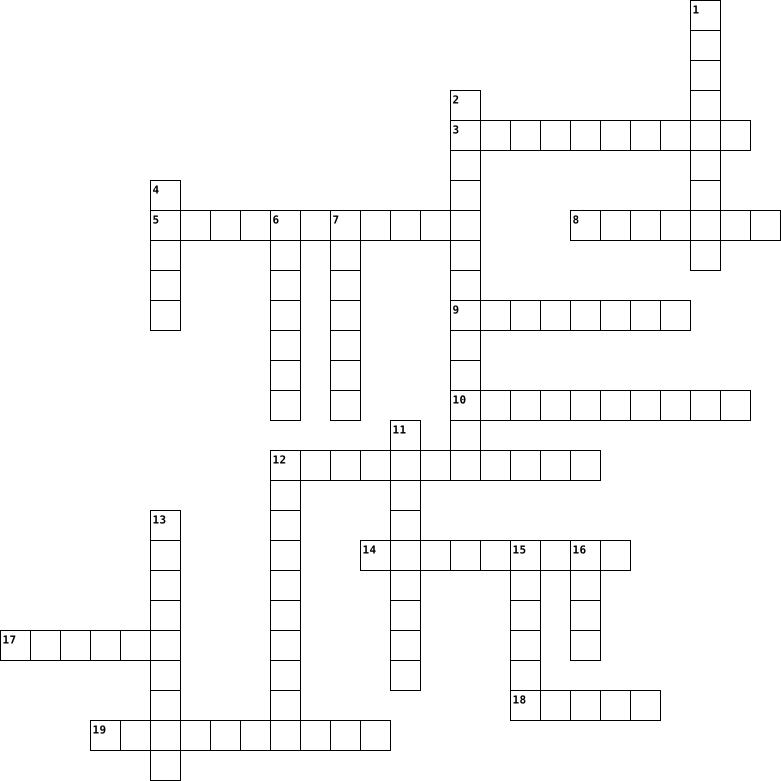
Across
- oceanic and continential plates collide
- ridged layer of earth about 100 km thick
- cone-shaped hill or mountain formed when hot magma, solids and gas erupt onto surface
- spreading Hess’s theory that new seafloor is formed when magma is forced upward
- movement of the ground that occurs when rocks inside Earth pass their elastic limits
- plate portion of one block of Tectonic plates, which is not submerged in water
- boundary-when two plates slide past one another
- Wegner meteorologist who came up with theory of Pangaea
- number of Continents
- current current in earth’s mantle that is driving force for plate tectonics
Down
- ridges mountains that form when two oceanic plates collide
- plasticlike layer of earth which lithospheric plate floats and moves on
- tectonics theory that Earth’s crust and upper mantle are broken into plates that float and move
- crust A thick mass of igneous rock which lies under the ocean floor
- name given to large land mass before drifting apart
- plates move and separate
- plates move and come together
- when continental plates collide forms this
- fracture that occurs when rock changes shape by breaking
- valley long crack that forms between tectonics plates
20 Clues: number of Continents • plates move and separate • plates move and come together • oceanic and continential plates collide • ridged layer of earth about 100 km thick • when continental plates collide forms this • boundary-when two plates slide past one another • name given to large land mass before drifting apart • valley long crack that forms between tectonics plates • ...
Crossword puzzle 2013-04-25

Across
- Molten rock that has reached earth's surface
- rock material formed by a volcanic explosion
- Formed from alternating layers of lava flows and ash or cinders
- A smaller earthquake following the main shock of a large earthquake
- A location where mantle plume rises to the surface to form a volcano
- The layer of rock that lies between the outer crust and the core of the earth
- When two tectonic plates past each other horizontally
- When two tectonic plates release stress
- Measure of the fluidity of a substance
- Two plates moving against each other
Down
- Molten rock that is underneath earth's surface
- A place where gas, Ash or melted rock come out of the ground
- The outer solid part of the Earth, including the crust and uppermost mantle
- a large underground pool of molten rock found beneath the surface of the Earth
- Two plates separating from each other
- A scientific instrument that detects and records vibrations produced by earthquakes
- Lies beneath the lithosphere
- Broad based with gentle slopes
- Small with steep sides Formed from eruptions of only pyroclastic
- the outermost layer of earth
- The opening of a volcano where lava erupts from
21 Clues: Lies beneath the lithosphere • the outermost layer of earth • Broad based with gentle slopes • Two plates moving against each other • Two plates separating from each other • Measure of the fluidity of a substance • When two tectonic plates release stress • Molten rock that has reached earth's surface • rock material formed by a volcanic explosion • ...
Plate Tectonics 2016-06-09

Across
- Astronomer who discovered continental drift theory
- Outermost layer of the Earth
- Layer beneath the mantle
- The region where two tectonic plates come into contact
- Type of plate boundary that the plates push against eachother
- Area where molten rock rises to the Earths surface
- Earth's thickest layer
- Partly molten layer in the upper mantle
- A sudden ground breaking release of built up energy under the Earths surface
- Type of evidence that supported Wegener's theory involving types of animals that lived there
Down
- Earths centre, that has a radius of about 1200km
- Opening in Earths surface that when active spews out gases chunks of rock and melted rock
- Deep underwater valley formed when an oceanic plates subduct under a continental
- Type of plate boundary that the plates push away from eachother
- Plates that move and then re-join on the lithosphere
- The big wave that is caused by the displacement of water after an earthquake
- Type of plate boundary that the plates slide by eachother
- formed by plate tectonics in the crust and upper mantle
- Wegener's name for the "super continent"
- Transform fault in California
20 Clues: Earth's thickest layer • Layer beneath the mantle • Outermost layer of the Earth • Transform fault in California • Partly molten layer in the upper mantle • Wegener's name for the "super continent" • Earths centre, that has a radius of about 1200km • Astronomer who discovered continental drift theory • Area where molten rock rises to the Earths surface • ...
Earths Systems Vocab 2023-04-05

Across
- Compress through solids and liquids. Travels faster than S
- The outer part of the earth
- Still in existence
- Boundary where tectonic plates divide
- Forms when molten rock crystallizes and solidifies
- The lower part of earths mantle
- the movement caused within a fluid by the tendency of hotter things to float and colder things to sink
- Boundary where tectonic plates collide
- The study of earth
- Move side to side only through solids. Moves slower than P
- A solid inorganic material found in nature
- The layer that lies between earths crust and core
- Below the lithosphere
Down
- Group of animals that occupy a certain area
- The intermost layer of the earth
- Forms under extreme heat and pressure
- When Heat, pressure, cooling,etc cause rocks to change from one type to another over time
- No longer in existence
- Forms from pre-existing rock and fossils
- A tool that records details of earthquakes
- The study of earhquakes and related phenomena
- Boundary where tectonic plates slide past each other
- Made from remains of plants and animals
- Water held underground in the soil in deep reservoirs
- The outermost layer of the earth
25 Clues: Still in existence • The study of earth • Below the lithosphere • No longer in existence • The outer part of the earth • The lower part of earths mantle • The intermost layer of the earth • The outermost layer of the earth • Forms under extreme heat and pressure • Boundary where tectonic plates divide • Boundary where tectonic plates collide • ...
Unit 6 Vocabulary 2023-02-26

Across
- developing or growing differently or in different directions
- controlled by a single government or person
- the ability to become part of a social class other than the one you are born into
- a series of rulers from the same family or group
- artificial rivers that are built by humans
- to bring together as a single unit
- when someone has lost power and no one has replaced them
- a food that makes up a dominant portion of someone's diet
- respect for one's elders as described by Confucius
- non-religious
- a person sent to promote a religion in a foreign place
Down
- when government power is held by many different groups
- peace and balance
- to arrange into a system of rules or laws
- a system of ranking groups or people
- a specialist in an area of study
- the word for "ruler" in many Asian societies including the Ottoman Empire
- a military ruler that has total control over a land's economics, culture, and military
- to change (verb), a change (noun)
- a decentralized system of power when a ruler gives away land in exchange for loyalty and work
20 Clues: non-religious • peace and balance • a specialist in an area of study • to change (verb), a change (noun) • to bring together as a single unit • a system of ranking groups or people • to arrange into a system of rules or laws • artificial rivers that are built by humans • controlled by a single government or person • a series of rulers from the same family or group • ...
Plate Tectonics 2023-03-01
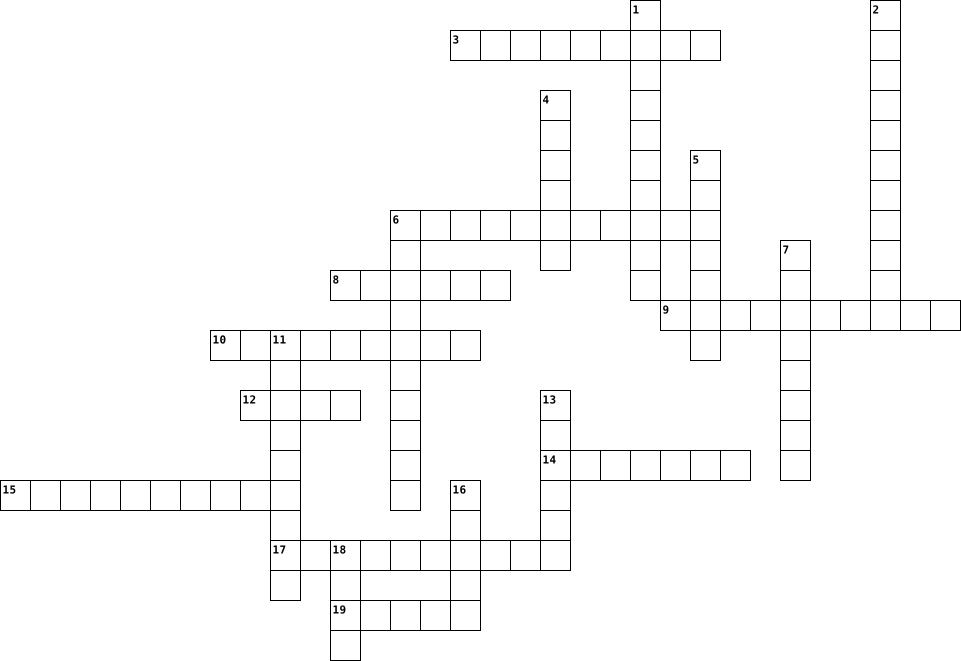
Across
- fault a fault along a plate boundary that moves horizontally
- a stress that pushes rocks together
- where convection currents occurs
- when tectonics plates move toward each other and collide
- when 2 tectonics plates move away from each other
- what it is called when blocks move horizontally
- faults the fault that occurs when a hanging wall moves up
- when 2 plates collide and 1 plate sinks into the mantle, under the other plate
- the result of plate tectonics
- a fracture or zone of fractures between 2 blocks of rock
Down
- the border between 2 plates
- the rigid outer part of the Earth
- tectonics the Earth's surface is cracked into large pieces
- a stress which stretches rock in 2 opposite directions
- currents the movement of tectonics plates, made by heat and pressure
- a stress that occurs when forces are parallel but opposite
- what is formed when cracks in the Earth is made and magma can rise through
- the line formed by the intersection of a horizontal plane and inclined surface
- what plate tectonics are made of
- valley a low region that forms where plates move apart
20 Clues: the border between 2 plates • the result of plate tectonics • where convection currents occurs • what plate tectonics are made of • the rigid outer part of the Earth • a stress that pushes rocks together • what it is called when blocks move horizontally • when 2 tectonics plates move away from each other • a stress which stretches rock in 2 opposite directions • ...
Unit 8 2023-02-09

Across
- an agent, substitute; a written permission allowing one person to act in another's place
- tireless, continuing with vigor
- to cause anger, irritation, or bitterness
- capable of being grasped by the senses or mind
- clothes, apparel, garb; (v.) to dress, adorn or bedeck
- to make of no value or consequence, cancel, wipe out
- puzzling, mystifying, or enigmatic
- thin and bony, starved looking; bare, barren
- to be of use or benefit to; to make use of; to take advantage of; to profit or benefit; (n.) use, benefit, or value
- very earnest, emotional, passionate; extremely hot
- to join at one end or be next to; to support, prop up
Down
- to plunge straight down a weight fastened to a line
- a person who collects or removes usable items from waste materials; an animal that feeds on refuse or dead bodies
- to pass through or gain entrance to gradually or stealthily
- a very close friend, chum, buddy
- to declare publicly or officially
- self-controlled, not showing feeling in response to pleasure or pain
- to limit, be sparing of frugal
- hatred, ill-will
- going in different directions; different from each other
20 Clues: hatred, ill-will • to limit, be sparing of frugal • tireless, continuing with vigor • a very close friend, chum, buddy • to declare publicly or officially • puzzling, mystifying, or enigmatic • to cause anger, irritation, or bitterness • thin and bony, starved looking; bare, barren • capable of being grasped by the senses or mind • ...
Plate Tectonics 2023-02-15

Across
- This effects how uch something weighs with the same voume and surface area
- What average americans have a lot of
- pizza or maggie
- The sinking of continents below sea level
- one of the plate boundaries that creates crust
- has riz
- 0
- Everybody SHOULD have this (not everyone has it)
- Liquid flow that cirrculates and is affected by heat
- The guy that is famous for a theory that then was used to make another thory by a different group of guys because the original theory didn't work
- The theory that was based on the thory by Wegner.
- korean
- what americans don't have a lot of
Down
- what asians have
- Something that americans like to eat by itself and usually comes in jars
- Large rodent that swims
- Plate boundary that neither desroys crust or generates crust
- what americans don't have
- The plate boundary that desroys crust
- dissapointment\
- Asian
- The theory proposed by Allfred Wegner (V-e-gn-r)
- healthier version than burger (the thing amercans eat a lot of)
- Large rodent that issimilar to mouse
24 Clues: 0 • Asian • korean • has riz • pizza or maggie • dissapointment\ • what asians have • Large rodent that swims • what americans don't have • what americans don't have a lot of • What average americans have a lot of • Large rodent that issimilar to mouse • The plate boundary that desroys crust • The sinking of continents below sea level • one of the plate boundaries that creates crust • ...
Plate Tectonics Chap. 5 2023-02-09

Across
- Caused when a plate goes under one another in the ocean.
- Hot rock above the ground.
- A boundary that slides past other boundaries.
- Occurs when a pan touches a stove, also known as the transfer of heat when one object touches another.
- Boundaries that are pushing towards other boundaries.
- Mountain formed by hot spots in the Earth.
- Occurs along divergent boundaries, and makes new oceanic crust.
- A theory that states the sea-floor is always moving.
Down
- Hot rock underground.
- When an oceanic plate slides under a continental plate.
- A boundary that is moving away from the other boundaries.
- Super continent made millions of years ago.
- A place filled with magma that rises to the Earth surface.
- The theory that states that there are plates in the crust that move everything around.
- The transfer of energy through space.
- Dead organisms preserved in rock.
- Chain of islands formed by a volcano.
- This can cause boiling water.
- Pieces of the earth's lithosphere which together make up the earth's surface.
- Found both on land and at the bottom of the ocean, where they are created by the process of seafloor spreading.
20 Clues: Hot rock underground. • Hot rock above the ground. • This can cause boiling water. • Dead organisms preserved in rock. • The transfer of energy through space. • Chain of islands formed by a volcano. • Mountain formed by hot spots in the Earth. • Super continent made millions of years ago. • A boundary that slides past other boundaries. • ...
8th Science Vocab Crossword 2023-04-25

Across
- potential energy that can be stretched/compressed
- boundary where two plates slide by each other
- zero net force/ direction stays the same
- both traits appear on a mammal like a speckled chicken
- nonzero net force/ direction will change
- energy that is stored
- one cell division/ 2 daughter cells
- sum of all the forces acting on an object
- survival of the fittest
- reproduction that results in unique offspring
- a push or a pull
- boundary where two plates move away from each other
- dominance that allows the traits to mix
Down
- a force created by two objects rubbing against each other
- boundary where two plates move torwards each other
- the most dense plate slides underneath the least dense plate during convergent boundary
- two cell divisions/ 4 daughter cells
- circulation of magma that moves tectonic plates
- place or object used to detect motion
- energy in motion
- reproduction that results in identical offspring
- stationary magma plume that a tectonic plate moves over and islands form
- what the layers of the earth are organized by
- supercontinent that began to break apart hundreds of millions of years ago
24 Clues: energy in motion • a push or a pull • energy that is stored • survival of the fittest • one cell division/ 2 daughter cells • two cell divisions/ 4 daughter cells • place or object used to detect motion • dominance that allows the traits to mix • zero net force/ direction stays the same • nonzero net force/ direction will change • sum of all the forces acting on an object • ...
Evolution 2020-10-08

Across
- the amount of time it takes for half of a specimen's Carbon to decay
- formation of a new species
- unrelated organisms develop similar characteristics
- A population of interbreeding organisms capable of producing fertile offspring
- structures which are not used but still there (tiny)
- previously related organisms become less alike
- remains/tracing of a once-living organism
- Age determined through analysis of chemical and physical properties of rocks/fossils
Down
- the study of the history of life on earth
- selection darwin came up with evolution because of
- form of an element with the same no. of protons but different no. of neutrons
- Structures similar in function, but not in the design
- Determine the approx. age of a specimen
- What is the evolution
- the process by whereby organisms better adapted to their environment tend to survive and produce more offspring.
- structures similar in design but not in function
- many related species evolve from a single ancestral species
- one mate selects the other
- the process by which different kinds of living organisms are thought to have developed
- of species darwins first book
- the study of the development of different organisms
21 Clues: What is the evolution • formation of a new species • one mate selects the other • of species darwins first book • Determine the approx. age of a specimen • the study of the history of life on earth • remains/tracing of a once-living organism • previously related organisms become less alike • structures similar in design but not in function • ...
Volcanoes 2021-03-05

Across
- spot a small volcanic regions a few hundred kilometers across
- particles that range in size from small beads to walnuts
- particles larger than 64 millimeters in diameter
- volcanic activity that occurs within a plate
- type of boundary where plates go in different directions and form volcanoes
- when pressure drops enough
- a landform made of magma that hardened in the volcano's pipe and later was exposed by erosion
- affect characteristics of lava flow
- repeated eruptions of lava or pyroclastic material eventually build a mountain
- a steep-walled depression at the summit of volcanoes
- another name for composite cones
- when blocks are ejected as glowing lava
Down
- particles produced in volcanic eruptions
- molten rock beneath earths surface
- produced by the accumulation of fluid basaltic lavas
- a subtance's resistance to flow
- magma outside of the volcano
- type of basaltic lava that forms rough, jagged blocks with sharp, spiny projections
- ejected lava fragments that harden in the air and build this volcano
- a long belt of volcanoes that circles much of the Pacific Ocean
- type of basaltic lava that forms relatively smooth skin that wrinkles as lava continues to flow
21 Clues: when pressure drops enough • magma outside of the volcano • a subtance's resistance to flow • another name for composite cones • molten rock beneath earths surface • affect characteristics of lava flow • when blocks are ejected as glowing lava • particles produced in volcanic eruptions • volcanic activity that occurs within a plate • ...
Plate-tectonics Puzzle 2022-04-22

Across
- Center made of iron and nickel
- A split between two bodies that were once whole
- Sub-marine mountain ridges where the new seafloor is created
- The upper layer of the Earth's interior, including the crust and upper part of the mantle
- The idea that all landmass was one piece and shifted away over time.
- Layer outside the center
- Large moving segments of the lithosphere
- Uppermost section of Earth
- The boundaries between plates.
- Type of boundary that moves away
- A form of stress produced by the action of equal and opposite forces, the effect of which is to reduce the length of a material.
- Type of boundary that comes together
Down
- When a plate dive under another
- an area of rock that has been bent over stress
- A depression in the Earth's crust
- Where two plates fracture from stress
- The layer between Earth's thinnest layer and its center
- A deep depression inside the ocean floor
- The deformation of the lithosphere
- A long trough bounded by two or more faults
- A form of stress that acts to stretch a material
21 Clues: Layer outside the center • Uppermost section of Earth • Center made of iron and nickel • The boundaries between plates. • When a plate dive under another • Type of boundary that moves away • A depression in the Earth's crust • The deformation of the lithosphere • Type of boundary that comes together • Where two plates fracture from stress • ...
8th Grade Chapter 7 2018-11-26

Across
- a pile of broken rocks that collect at the base of a cliff
- Mt. Everest is still ___
- uplift landform
- subsidence landform
- Buttes, pinnacles and fins are all through to be erosional remnants of ___.
- convergent landform
- mountain is to ___as mesa is to butte
- water, and ice in and on the earth's crust against the upward push of the mantle.
- a series of mountain peaks in the same geographical area is called a mountain ___
- The highest mountain in the world
Down
- flat-topped hill with steep sides
- The geologic history of the origin of mountain
- a trough- like fold of rock strata
- divergent landform
- Which of these is not a primary cause of most depositional hills and mountains?
- ridges deposited by glaciers
- On which continent will you find the world's highest mountain and 96 of the 109 tallest peaks in the world
- Which of the following terms applies to the formation of volcanoes?
- arch of rock layers
- Karnes and eskers are both made up of glacial
- The mountain with the highest elevation in North America
- used to describe the balance of the weights of the rocky
- extinct underground volcano
23 Clues: uplift landform • divergent landform • subsidence landform • arch of rock layers • convergent landform • Mt. Everest is still ___ • extinct underground volcano • ridges deposited by glaciers • flat-topped hill with steep sides • The highest mountain in the world • a trough- like fold of rock strata • mountain is to ___as mesa is to butte • ...
Evolution 2019-09-11

Across
- the 'father of taxonomy'.
- a type of speciation involving a new species evolving inside an existing population.
- the name of one of the scientists who proposed natural selection.
- the basic physical and functional unit of heredity.
- a type of speciation caused by an unplanned geographic barrier.
- a variant form of a gene.
- a change in a DNA sequence.
- the rivalry between organisms based around resources.
- the variety of life.
- a physical or physiological difference between individuals of the same species.
- a type of speciation involving two parallel subpopulations.
Down
- the independent development of similar structures in unrelated organisms.
- one of the five kingdoms. Humans are apart of it.
- the process of a single species diverging into two or more descendant species.
- the evolution of different species from a common ancestral species.
- the study of the evolutionary history of a group of organisms based on their similarities and differences.
- a mutation that increases the chances of survival.
- a diagram used to show the evolutionary history of organisms.
- a type of speciation caused by a geographic barrier.
- the development of similar structures in closely related species.
20 Clues: the variety of life. • the 'father of taxonomy'. • a variant form of a gene. • a change in a DNA sequence. • one of the five kingdoms. Humans are apart of it. • a mutation that increases the chances of survival. • the basic physical and functional unit of heredity. • a type of speciation caused by a geographic barrier. • ...
Geoscience Processes 2023-05-24

Across
- type of weathering where the land surface is not uniformly changed
- process by which wind, water, gravity and ice deposit weathered and relocated sediment
- example of deposition found where rivers empty into the ocean
- idea that the Earth's surface is made up of large sections that move
- when forces on Earth break apart and or wear away rocks
- boundary where tectonic plates move together
- type of weathering where rocks are broken down by physical means
- sudden release of energy under Earth's surface that makes ground shake or crack
- relating to the whole world
- average weather conditions
Down
- boundary where tectonic plates move apart
- imperfections in the ice including pollen, dust,air bubbles
- Earth’s material that is broken down by processes of weathering
- huge pieces of Earth's surface that slowly move over the asthenosphere
- agent of weathering that continually pulls rocks downhill
- description of land surface area with reference to variations in elevation
- large masses of ice that erode the Earth's surface
- river that carved out the Grand Canyon
- limestone caves are formed from this type of weathering
- movement of sediments from one place to another by wind or water
20 Clues: average weather conditions • relating to the whole world • river that carved out the Grand Canyon • boundary where tectonic plates move apart • boundary where tectonic plates move together • large masses of ice that erode the Earth's surface • when forces on Earth break apart and or wear away rocks • limestone caves are formed from this type of weathering • ...
FOS Final 2023-05-31

Across
- selasmic body waves shaking ground same directions
- Natural life’s continuous growth
- most widely accepted theory regarding
- Waves moving perpendicular
- Newton’s first law
- inner structures of earth
- the hypotheses that a ___ started life
- energy spanning long rays to very short ones
- ___bubble hypothesis proved that early life may have formed on surface
- Hypothesis stating that life was once a double ___
- Body, Molecular,Trace and Carbon
- any cell or organism that possesses a clearly defined nucleus.
- a description of the way that stars change with time
Down
- 1952 earth simulation
- important numbers in a physics equation
- divergent, convergent, and transform
- Geology dealing with strata/earth’s atmosphere
- form volcanoes via mantle
- toxic aquatic bacteria
- Most of our knowledge of extinct hominids comes from__
- a scientific theory that explains how major landforms are created as a result of Earth's subterranean movements.
- Used to date rocks and carbon
- organic molecules originated from nonliving matter
- cells without nucleus and complex structures.
- Form oceans continents and mountains
- increase in speed or rate
- Laws on how planets move
- earth’s history divided by time scales
- Nucleic acid in all life
- Speed in given direction
30 Clues: Newton’s first law • 1952 earth simulation • toxic aquatic bacteria • Laws on how planets move • Nucleic acid in all life • Speed in given direction • form volcanoes via mantle • increase in speed or rate • inner structures of earth • Waves moving perpendicular • Used to date rocks and carbon • Natural life’s continuous growth • Body, Molecular,Trace and Carbon • ...
Plate Tectonics Project 2023-11-14

Across
- any trace of an ancient organism that has been preserved in a rock
- The flow that transfers heat within fluid
- when magma reaches the surface
- mid-ocean ridges continually add new material to the ocean floor
- Wegener's idea that the continents slowly moved over earth's surface
- The resulting volcanoes sometimes create a string of islands
- form long chains of mountains that rise up from the ocean floor
- boundary plates move apart
- boundary plates come together
- Heat transfer between materials that are touching
- wegener called supercontinent
Down
- the ocean floor sinks beneath a deep-ocean trench and back into the mantle
- an area where material from deep within earths mantle
- one major belt of volcanoes
- broken into pieces separated by cracks
- boundary plates slide past eachothere
- measure of how much mass there is in a given volume
- a mountain that forms in earth's crust
- the transfer of energy that is carried in rays like light
- is a molted mixture of rock-forming substances gases and water from the mantle
- Heat transfer by the movement of a fluid
- the ocean floor plunges into deep underwater canyons
22 Clues: boundary plates move apart • one major belt of volcanoes • boundary plates come together • wegener called supercontinent • when magma reaches the surface • boundary plates slide past eachothere • broken into pieces separated by cracks • a mountain that forms in earth's crust • Heat transfer by the movement of a fluid • The flow that transfers heat within fluid • ...
Plate Tectonics 2023-11-15

Across
- Plate boundary where two plates slip past each other
- Famous string of volcanoes
- A molten mixture of gases, water, and rock-forming substances from the mantle
- Crust that is on the land under mountains
- Valley where the sea floor subducts back into the mantle
- The process of continually adding new material to the ocean floor
- Liquid magma at the surface
- A process in which one plate goes under another at a convergent boundary
- The stress force that pulls on the crust, and thins rock in the middle
- Underwater mountain chain where sea floors are renewed
Down
- Plate boundary where two plates collide
- Crust under the ocean
- Breaks in Earth's crust where rocks have slipped past each other
- A curved chain of volcanoes located at the edge of a plate
- Forms where pieces of Earths crust separate
- The stress force that squeezes the crust, forming mountains
- A vent on the surface where magma escapes from the mantle
- The outer layer of Earth
- An area where magma melts through the crust above it
- Plate boundary where two plates move away from each other
20 Clues: Crust under the ocean • The outer layer of Earth • Famous string of volcanoes • Liquid magma at the surface • Plate boundary where two plates collide • Crust that is on the land under mountains • Forms where pieces of Earths crust separate • Plate boundary where two plates slip past each other • An area where magma melts through the crust above it • ...
Plate Tectonics & Geology Crossword Puzzle 2023-12-18

Across
- Supercontinent that all the continents once formed
- The preserved remains of a plant or animal that has been hardened into a rock
- Plate Boundary where plates slide past each other
- When plates move and cause shaking on the Earth
- A break in the Earth's crust
- The slope of an area
- The science that deals with the Earth's physical structure
- A line that connects points of equal temperature on a topographic map
- Plate Boundary where plates come together
- Plate Boundary where plates move apart
Down
- The Process of one plate going under another
- The Ocean in which the Ring of Fire is located
- Big slabs of crust that the Earth is broken into
- A large plume of hot mantle material rising from deep within the Earth
- A big wave that is capable of taking over an entire town
- A large mountain that erupts with lava and magma
- The rigid outer part of the Earth
- A line that connects points of equal pressure on a topographic map
- A line that connects points of equal value on a topographic map
- An indentation or break in the ocean floor
20 Clues: The slope of an area • A break in the Earth's crust • The rigid outer part of the Earth • Plate Boundary where plates move apart • Plate Boundary where plates come together • An indentation or break in the ocean floor • The Process of one plate going under another • The Ocean in which the Ring of Fire is located • When plates move and cause shaking on the Earth • ...
Geology Grace Grubb 2024-01-30

Across
- outmost, rocky layer of Earth
- to examine in detail for a purpose
- a natural spring that sends hot water and steam suddenly into the air from a hole in the ground
- molten rock that makes up Earths mantle and becomes igneous rock when it cools
- the outside or top layer of something
- the slow pulling apart of land that is cause by plate movement
- layer inside Earth, between the mantle and inner core
- a feature that forms on the surface of a planet
- something we observe to be similar over and over again
- how often or fast something happens
Down
- a sudden shaking of the earths surface
- a set of interacting parts forming a complex whole
- innermost part of Earth, made of solid iron and nickel
- hot liquid rock on the surface of the earth
- the sudden pushing out of something, like lava from a volcano
- evidence of life from the past
- an object or diagram that makes it easier to understand something
- a long, deep indentation in the ocean floor formed when two plates move together
- moving apart in different directions
- a layer of Earths crust
20 Clues: a layer of Earths crust • outmost, rocky layer of Earth • evidence of life from the past • to examine in detail for a purpose • how often or fast something happens • moving apart in different directions • the outside or top layer of something • a sudden shaking of the earths surface • hot liquid rock on the surface of the earth • ...
Final review 2024-06-03

Across
- when pressure from earth's plates is released
- the color of a mineral's powder
- type of rock made from volcanic activity
- type of weathering where water freezes and expands breaking rocks
- the ability to scratch another material
- the breaking down of rocks
- mass divided by volume
- molten rock
- giant super continent
- the theory that states earth's crust is broken into pieces that are constantly moving
- a cycle of heating and rising then cooling and sinking
- boundary where plates move apart
- a break in earth's crust where magma can escape
- type of rock formed in layers, may contain fossils
Down
- a giant river of ice
- outer most layer of earth
- type of rock made from heat and pressure
- boundary where plates come together
- type of weathering that turns iron brownish red
- the wearing away of earth's surface
- pure substances found in nature
- thickest layer of earth, where convection currents happen
- boundary where plates slide past each other
- sections of the earth's crust
- theory that says the continents were once joined and drifted apart over time
- composed of 2 or more minerals
26 Clues: molten rock • a giant river of ice • giant super continent • mass divided by volume • outer most layer of earth • the breaking down of rocks • sections of the earth's crust • composed of 2 or more minerals • the color of a mineral's powder • pure substances found in nature • boundary where plates move apart • boundary where plates come together • the wearing away of earth's surface • ...