
divergent Crossword Puzzles
Geosphere Project 2021-09-28

Across
- a surface feature in the seafloor produced by the descending plate during subduction
- a fault in which the rock above the fault plane has moved down relative to the rock below
- the process by which plate tectonics produces new oceanic lithosphere at ocean ridges
- a boundary in which two plates move together
Down
- a boundary where the rigid plates are moving apart, typified by the oceanic ridges
- a continuous elevated zone on the floor of all the major ocean basins and varying in width from 1000-4000 kilometers
- a boundary in which two plates slide past each other without creating or destroying lithosphere
- deep faulted structure found along the axes of divergent plate boundaries
- a destructive plate margin where oceanic crust is being pushed down into the mantle beneath a second plate
9 Clues: a boundary in which two plates move together • deep faulted structure found along the axes of divergent plate boundaries • a boundary where the rigid plates are moving apart, typified by the oceanic ridges • a surface feature in the seafloor produced by the descending plate during subduction • ...
Earths changing system 2024-05-16

Across
- the variety of life in the world or in a particular habitat or ecosystem.
- spreading the process of new crust forming at a ridge and pushing older crust out
- when all the species have died out
- dating determining the age of rocks based on the decay of the elements
- earth forces forces that change the surface of the earth from within; i.e. divergent, convergent, and transform boundaries
Down
- species species that are not native to a specific location and have a tendency to spread to a degree believed to cause damage
- number of species in an area
- the length of time it takes for one-half of a radioactive element to change into another element
- earth forces forces that change the surface of the earth from outside; i.e. humans, erosion, and weathering
9 Clues: number of species in an area • when all the species have died out • dating determining the age of rocks based on the decay of the elements • the variety of life in the world or in a particular habitat or ecosystem. • spreading the process of new crust forming at a ridge and pushing older crust out • ...
Earth’s Changing Systems Vocab 2024-05-16

Across
- the variety of life in the world or in a particular habitat or ecosystem.
- spreading the process of new crust forming at a ridge and pushing older crust out
- when all the species have died out
- dating determining the age of rocks based on the decay of the elements
- earth forces forces that change the surface of the earth from within; i.e. divergent, convergent, and transform boundaries
Down
- species species that are not native to a specific location and have a tendency to spread to a degree believed to cause damage
- number of species in an area
- the length of time it takes for one-half of a radioactive element to change into another element
- earth forces forces that change the surface of the earth from outside; i.e. humans, erosion, and weathering
9 Clues: number of species in an area • when all the species have died out • the variety of life in the world or in a particular habitat or ecosystem. • dating determining the age of rocks based on the decay of the elements • spreading the process of new crust forming at a ridge and pushing older crust out • ...
Earths changing system 2024-05-15

Across
- the length of time it takes for one-half of a radioactive element to change into another element
- species: species that are not native to a specific location and have a tendency to spread to a degree believed to cause damage
- earth forces: forces that change the surface of the earth from within; i.e. divergent, convergent, and transform boundaries
- dating: determining the age of rocks based on the decay of the elements
- spreading: the process of new crust forming at a ridge and pushing older crust out
- when all the species have died out
Down
- the variety of life in the world or in a particular habitat or ecosystem.
- earth forces: forces that change the surface of the earth from outside; i.e. humans, erosion, and weathering
- number of species in an area
9 Clues: number of species in an area • when all the species have died out • dating: determining the age of rocks based on the decay of the elements • the variety of life in the world or in a particular habitat or ecosystem. • spreading: the process of new crust forming at a ridge and pushing older crust out • ...
Earth Vocabulary 2026-01-07

Across
- Spreading The formation of new areas of oceanic crust at midocean ridges and its movement on either side
- Rock Rock that forms when magma cools on the surface or underground
- Boundary When two plates separate causing sea-floor spreading, creating underwater volcanic chains, and rift valleys
- Rock Rock that forms when existing rocks change due to heat and/or pressure
- Tectonics The process that changes the surface of the Earth through the movement of the lithospheric plates
Down
- Rock Rock that forms when pebbles, sand shells, and other pieces are cemented together over time
- Boundary When two plates move together to form volcanoes, islands, and other landfarms
- When one tectonic plate pushes underneath another in the mantle where it melts
- Boundary When plates scrape past each other causing strong earthquakes
9 Clues: Rock Rock that forms when magma cools on the surface or underground • Boundary When plates scrape past each other causing strong earthquakes • Rock Rock that forms when existing rocks change due to heat and/or pressure • When one tectonic plate pushes underneath another in the mantle where it melts • ...
Earth Science- Skylar Van Blarcom 2013-02-25

Across
- Push Tectonic process associated with convection currents in Earth's mantle that occurs when the weight of an elevated ridge pushes and oceanic plate toward a subduction zone.
- Pull Associated with convection currents in Earths mantle that occurs as the weight of the subduction plates pulls the trailing lithosphere into a subduction zone
- A _________ map uses contour lines, sybols, and color to show changes in elevation.
- Process by which one tectonic plate slips beneath another plate tectonic.
Down
- Spreading Hess's theory that new ocean crust is formed at mid-ocean ridges and destroyed at deep sea trenches
- Plate _________ cause earthquakes, volcanic eruptions and landslides
- Wegener's hypothesis
- Valley A long narrow depression that forms when continental crust begins to separate at a divergent boundary
- Tectonics plates interact at places called plate _______.
9 Clues: Wegener's hypothesis • Tectonics plates interact at places called plate _______. • Plate _________ cause earthquakes, volcanic eruptions and landslides • Process by which one tectonic plate slips beneath another plate tectonic. • A _________ map uses contour lines, sybols, and color to show changes in elevation. • ...
challenge it crossword 2021-11-18

Across
- a mountain or hill, typically conical, having a crater or vent through which lava, rock fragments, hot vapor, and gas are being or have been erupted from the earth's crust.
- the edges where two plates meet
- tending to be different or develop in different directions
Down
- coming closer together, especially in characteristics or ideas.
- hot fluid or semifluid material below or within the earth's crust from which lava and other igneous rock is formed on cooling
- rock formed by solidification of a molten magma
- make a thorough or dramatic change in the form, appearance, or character
- describes the outermost shell of a terrestrial planet.
- a large elongated depression with steep walls formed by the downward displacement of a block of the earth's surface between nearly parallel faults or fault systems.
9 Clues: the edges where two plates meet • rock formed by solidification of a molten magma • describes the outermost shell of a terrestrial planet. • tending to be different or develop in different directions • coming closer together, especially in characteristics or ideas. • make a thorough or dramatic change in the form, appearance, or character • ...
Earth's Changing Systems Vocab 2024-05-15

Across
- the length of time it takes for one-half of a radioactive element to change into another element
- species: species that are not native to a specific location and have a tendency to spread to a degree believed to cause damage
- earth forces: forces that change the surface of the earth from within; i.e. divergent, convergent, and transform boundaries
- dating: determining the age of rocks based on the decay of the elements
- spreading: the process of new crust forming at a ridge and pushing older crust out
- when all the species have died out
Down
- the variety of life in the world or in a particular habitat or ecosystem.
- earth forces: forces that change the surface of the earth from outside; i.e. humans, erosion, and weathering
- number of species in an area
9 Clues: number of species in an area • when all the species have died out • dating: determining the age of rocks based on the decay of the elements • the variety of life in the world or in a particular habitat or ecosystem. • spreading: the process of new crust forming at a ridge and pushing older crust out • ...
Earth's Changing Systems Vocab 2024-05-15

Across
- number of species in an area
- dating determining the age of rocks based on the decay of the elements
- species species that are not native to a specific location and have a tendency to spread to a degree believed to cause damage
- when all the species have died out
- Spreading the process of new crust forming at a ridge and pushing older crust out
Down
- the length of time it takes for one-half of a radioactive element to change into another element
- the variety of life in the world or in a particular habitat or ecosystem.
- earth forces forces that change the surface of the earth from within; i.e. divergent, convergent, and transform boundaries
- earth forces forces that change the surface of the earth from outside; i.e. humans, erosion, and weathering
9 Clues: number of species in an area • when all the species have died out • the variety of life in the world or in a particular habitat or ecosystem. • dating determining the age of rocks based on the decay of the elements • Spreading the process of new crust forming at a ridge and pushing older crust out • ...
Plate Motion555 2025-11-04

Across
- The type of plate boundary that adds rock to the edges of plates
- The age of the rock at the lower layers of the crust
Down
- The boundary type that forms mountains
- The boundary type that only has earthquakes and does not change the plates
4 Clues: The boundary type that forms mountains • The age of the rock at the lower layers of the crust • The type of plate boundary that adds rock to the edges of plates • The boundary type that only has earthquakes and does not change the plates
Geosphere Project 2021-09-28

Across
- a surface feature in the seafloor produced by the descending plate during subduction
- a fault in which the rock above the fault plane has moved down relative to the rock below
- the process by which plate tectonics produces new oceanic lithosphere at ocean ridges
- a boundary in which two plates move together
Down
- a boundary where the rigid plates are moving apart, typified by the oceanic ridges
- a continuous elevated zone on the floor of all the major ocean basins and varying in width from 1000-4000 kilometers
- a boundary in which two plates slide past each other without creating or destroying lithosphere
- deep faulted structure found along the axes of divergent plate boundaries
- a destructive plate margin where oceanic crust is being pushed down into the mantle beneath a second plate
9 Clues: a boundary in which two plates move together • deep faulted structure found along the axes of divergent plate boundaries • a boundary where the rigid plates are moving apart, typified by the oceanic ridges • a surface feature in the seafloor produced by the descending plate during subduction • ...
Plate Tectonics Crossword 2022-10-27

Across
- large-scale processes affecting the structure of the earth's crust
- one plate slides beneath the other plate
- a large circular planet with a lot of living environments
- a broad zone forming as the Pacific Plate slides northwestward past the North American Plate microplates small mostly rigid areas of lithosphere
- a scientific theory that explains how major landforms are created as a result of Earth's subterranean movements.
Down
- plates that are less than 20 million square kilometers in the area but are larger than one million square kilometers
- an area on Earth where two or more lithospheric plates collide
- the rigid outer part of the earth, consisting of the crust and upper mantle.
- a linear feature that exists between two tectonic plates that are moving away from each other
9 Clues: one plate slides beneath the other plate • a large circular planet with a lot of living environments • an area on Earth where two or more lithospheric plates collide • large-scale processes affecting the structure of the earth's crust • the rigid outer part of the earth, consisting of the crust and upper mantle. • ...
Unit Words 2024-05-15

Across
- the length of time it takes for one-half of a radioactive element to change into another element
- species: species that are not native to a specific location and have a tendency to spread to a degree believed to cause damage
- earth forces: forces that change the surface of the earth from within; i.e. divergent, convergent, and transform boundaries
- dating: determining the age of rocks based on the decay of the elements
- spreading: the process of new crust forming at a ridge and pushing older crust out
- when all the species have died out
Down
- the variety of life in the world or in a particular habitat or ecosystem.
- earth forces: forces that change the surface of the earth from outside; i.e. humans, erosion, and weathering
- number of species in an area
9 Clues: number of species in an area • when all the species have died out • dating: determining the age of rocks based on the decay of the elements • the variety of life in the world or in a particular habitat or ecosystem. • spreading: the process of new crust forming at a ridge and pushing older crust out • ...
Earth’s Changing Systems Vocab 2024-05-17

Across
- number of species in an area
- dating: determining the age of rocks based on the decay of the elements
- species species that are not native to a specific location and have a tendency to spread to a degree believed to cause damage
- when all the species have died out
- spreading the process of new crust forming at a ridge and pushing older crust out
Down
- the length of time it takes for one-half of a radioactive element to change into another element
- the variety of life in the world or in a particular habitat or ecosystem.
- earth forces forces that change the surface of the earth from within; i.e. divergent, convergent, and transform boundaries
- earth forces forces that change the surface of the earth from outside; i.e. humans, erosion, and weathering
9 Clues: number of species in an area • when all the species have died out • dating: determining the age of rocks based on the decay of the elements • the variety of life in the world or in a particular habitat or ecosystem. • spreading the process of new crust forming at a ridge and pushing older crust out • ...
Changing Systems Vocab 2024-05-16

Across
- the length of time it takes for one-half of a radioactive element to change into another element
- species: species that are not native to a specific location and have a tendency to spread to a degree believed to cause damage
- earth forces: forces that change the surface of the earth from within; i.e. divergent, convergent, and transform boundaries
- dating: determining the age of rocks based on the decay of the elements
- spreading: the process of new crust forming at a ridge and pushing older crust out
- when all the species have died out
Down
- the variety of life in the world or in a particular habitat or ecosystem.
- earth forces: forces that change the surface of the earth from outside; i.e. humans, erosion, and weathering
- number of species in an area
9 Clues: number of species in an area • when all the species have died out • dating: determining the age of rocks based on the decay of the elements • the variety of life in the world or in a particular habitat or ecosystem. • spreading: the process of new crust forming at a ridge and pushing older crust out • ...
Earth's Changing Systems Vocab 2024-05-15

Across
- number of species in an area
- dating determining the age of rocks based on the decay of the elements
- species species that are not native to a specific location and have a tendency to spread to a degree believed to cause damage
- when all the species have died out
- spreading the process of new crust forming at a ridge and pushing older crust out
Down
- the length of time it takes for one-half of a radioactive element to change into another element
- the variety of life in the world or in a particular habitat or ecosystem.
- earth forces forces that change the surface of the earth from within; i.e. divergent, convergent, and transform boundaries
- earth forces forces that change the surface of the earth from outside; i.e. humans, erosion, and weathering
9 Clues: number of species in an area • when all the species have died out • dating determining the age of rocks based on the decay of the elements • the variety of life in the world or in a particular habitat or ecosystem. • spreading the process of new crust forming at a ridge and pushing older crust out • ...
Earth’s Changing Systems Vocab 2024-05-15

Across
- Number of species in an area
- Forces that change the surface of the earth from within; i.e. divergent, convergent, and transform boundaries
Down
- Forces that change the surface of the earth from outside; i.e. humans, erosion, and weathering
- Species that are not native to a specific location and have a tendency to spread to a degree believed to cause damage
- The variety of life in the world or in a particular habitat or ecosystem
- Determining the age of rocks based on the decay of the elements
- The process of new crust forming at a ridge and pushing older crust out
- The length of time it takes for one-half of a radioactive element to change into another element
- When all the species have died out
9 Clues: Number of species in an area • When all the species have died out • Determining the age of rocks based on the decay of the elements • The process of new crust forming at a ridge and pushing older crust out • The variety of life in the world or in a particular habitat or ecosystem • ...
Plates 2021-12-03

Across
- convergent boundary, divergent boundary,
- ocean ridge, subduction, volcano, magma, convection currents,
Down
- boundary, ocean trench, sea floor spreading
3 Clues: convergent boundary, divergent boundary, • boundary, ocean trench, sea floor spreading • ocean ridge, subduction, volcano, magma, convection currents,
plate boundaries 2024-01-17

Across
- boundary that crashes together
Down
- plates that push away from each other
- plates that slides alongside each other
3 Clues: boundary that crashes together • plates that push away from each other • plates that slides alongside each other
plate tectonics 2024-05-10

Across
- theory that the Earth's lithosphere (the crust and upper mantle) is divided into a number of large, plate like sections that move as distinct masses.
Down
- A geologic process in which one edge of one lithospheric plate is forced below the edge of another
- tending to move toward one point or to approach each other
- any of the world's main continuous expanses of land
- moving away from what is expected
5 Clues: moving away from what is expected • any of the world's main continuous expanses of land • tending to move toward one point or to approach each other • A geologic process in which one edge of one lithospheric plate is forced below the edge of another • ...
Vocab 1 Puzzle 2020-09-18

Across
- um, I can't hear you
- something the inside of my new shoes is not
Down
- faction from Divergent
3 Clues: um, I can't hear you • faction from Divergent • something the inside of my new shoes is not
Plate Boundary Crossword 2022-10-19

Across
- The type of boundary that forms a mid ocean ridge.
- The type of boundary that forms a trench.
- The place where two plates meet.
- How often or fast something happens.
- A long, deep indentation in the ocean floor formed when two plates move together.
- The sudden pushing out of something, such as lava from a volcano.
- An extinct reptile that lived about 300 million years ago.
- A sudden shaking of Earth's surface.
- A natural spring that sends hot water and steam suddenly into the air from a hole in the ground.
- To examine in detail for a purpose.
- An object, diagram, or computer program that helps us understand something by making it simpler or easier to see.
Down
- An underwater mountain range formed when two plates move apart.
- A feature that forms on the surface of a planet, such as a mountain, channel, or sand dune.
- Hot liquid rock on the surface of Earth.
- Something we observe to be similar over and over again.
- Evidence of life from the past, such as fossilized bones, footprints, or leaf prints.
- A set of interacting parts forming a complex whole.
- A diagram that shows what the inside of something looks like.
- One of the very large sections of hard, solid rock that make up Earth’s outer layer.
- The layer of soft, solid rock underneath Earth's plates.
20 Clues: The place where two plates meet. • To examine in detail for a purpose. • How often or fast something happens. • A sudden shaking of Earth's surface. • Hot liquid rock on the surface of Earth. • The type of boundary that forms a trench. • The type of boundary that forms a mid ocean ridge. • A set of interacting parts forming a complex whole. • ...
Unit 2 - Earth's Changes Over Time 2023-01-09

Across
- tall geologic structure formed at convergent boundary
- scientific study of embryos
- where plates meet and interact
- fitting in better with environment
- change of species over time
- supercontinent of the past
- bone history
- blending in with environment
- group of interbreeding organisms
- a regional group of a species
- body structures
- underground pre-lava
- scientific study of fossils
- collision boundary with mountains
- wave from earthquake
- solid metal layer
- oceanic plates moving apart
- collision of continental and oceanic plates
- alfred, discovered drift
- cycle due to density differences
- structure that no longer serves a purpose
- movement of tectonic plates over time
- deep area formed at subduction zone
Down
- study of earth's features
- law about rock layers
- survive and reproduce
- similar functions, different structures
- type of rock created by sediment
- circle of volcanoes around Pacific
- boundary with ridges, rift valleys, seafloor spreading
- outer layer with plates
- similar structures
- rocked created from intense pressure underground
- ancient relative link
- liquid metal layer
- movement when adaptation impossible
- semi-solid layer with convection currents
- death when adaptation impossible
- survival of the fittest
- intense shaking of the ground
- charles, discovered natural selection
- boundary where plates slide past each other
- the type of rock created from hardened lava
- crack in crust at transform boundary
44 Clues: bone history • body structures • solid metal layer • similar structures • liquid metal layer • underground pre-lava • wave from earthquake • law about rock layers • survive and reproduce • ancient relative link • outer layer with plates • survival of the fittest • alfred, discovered drift • study of earth's features • supercontinent of the past • scientific study of embryos • ...
AP Psych Review: Memory and Cognition 2020-04-30

Across
- Links new to well-remembered info for easy recall
- Set of steps that produces a correct conclusion every time
- Amnesia; inability to make new memories
- Chomsky's theory of language development
- Type of serial position effect
- Neurons that fire together wire together
- Memory for what needs to be done in the future
- Holding an opinion despite evidence against it
- Organized cluster of related knowledge
- Study many times with breaks in between
- Level of processing associated with best remembering
- Word order
- Brain structure for motor memory
- Links info to be remembered into groups for easy recall
- Type of LTM for physical skills and conditioned responses
- Photographic memory
- Environment at encoding should match that at retrieval
Down
- Heuristic that relies on a recent specific example
- Average capacity of STM
- Thinking can be both conscious and unconscious
- An ideal mental model with critical attributes
- When old information interferes with retrieval of new
- Can't see new uses for familiar objects
- Brain structure for memory formation
- Smallest unit of sound in language
- Smallest unit of language that alters meaning
- Type of LTM that contains facts and events
- Thinking that generates creative ideas
- Heuristic that relies on a prototype
- Thinking about thinking
- Dementia from amyloid and tau
- Amnesia; inability to retrieve old memories
32 Clues: Word order • Photographic memory • Average capacity of STM • Thinking about thinking • Dementia from amyloid and tau • Type of serial position effect • Brain structure for motor memory • Smallest unit of sound in language • Brain structure for memory formation • Heuristic that relies on a prototype • Thinking that generates creative ideas • Organized cluster of related knowledge • ...
Genetics Crossword Puzzle 2021-01-11

Across
- structures feature of behavior that no longer seems to have a purpose
- flow also known as gene migration or allele flow
- organic compounds occurring in foods and living tissues that must include sugars, salts, and cellulars
- an organism's ability to survive and reproduce
- the ingestion of bacteria
- equilibrium hypothesis that evolutionary development marked by isolated episodes of rapid speciation between long periods of little or no change
- preserved impression/remains of a prehistoric organism
- organic compounds that are fatty acids
- nitrogenous organic compounds composed of amino acids
- selection the process whereby organisms better adapted to their environment tend to better survive
- nomenclature two terms used to denote a species of living organisms
- organism that grows without air
- structures skeletal elements of organisms that suggest a connection to a common ancestor
Down
- changing of a structure of a gene resulting in a variant form that may be transmitted to future generations
- theory- believes organelles in eukaryotic cells were once prokaryotic micros
- evolution may occur as a response to changes in abiotic factors
- selection the identification by humans of desirable traits in the plants and animals
- influence of closely related species on each other
- evolution process where organisms not closely related independently evolve similar traits
- live on earth originated from microorganisms
- structures that are similar in unrelated organisms
- the classification of organisms
22 Clues: the ingestion of bacteria • organism that grows without air • the classification of organisms • organic compounds that are fatty acids • live on earth originated from microorganisms • an organism's ability to survive and reproduce • flow also known as gene migration or allele flow • influence of closely related species on each other • ...
Fitz's Comp Sci 2 Adv Cumulative Review 2021-03-05

Across
- Type of heat transfer that requires direct contact
- The movement of sediment
- Energy of motion
- Data in science that is represented by numbers
- Organisms that make their own food using the Sun’s energy
- Organisms that must eat other organisms for energy
- Plate boundary that forms mountains and volcanoes
- Physical or chemical processes that break rocks down into sediment
- Symbiotic relationship where both individuals benefit
- Plate boundary where new lithosphere is created
- The alleles of the genotype are different
- Symbiotic relationship where one organisms benefits and the other is unaffected
Down
- Type of heat transfer that causes warm fluids to rise
- Stored energy
- Plate boundary most commonly associated with earthquakes
- Data in science that is represented by words
- Variable that the scientist is testing during the experiment
- Sediment is dropped into a new location as the agent of erosion slows
- Variable that changes in response to the independent variable
- Reproduction that involves two parents and results in offspring that are genetically different from the parents
- Rock that forms when sediment is compacted and cemented
- Lake that forms next to a meandering river after deposition cuts off one of the bends
- Both alleles of the genotype are the same
- Cell division that results in two identical daughter cells
- Rock that forms when magma cools and hardens
25 Clues: Stored energy • Energy of motion • The movement of sediment • Both alleles of the genotype are the same • The alleles of the genotype are different • Data in science that is represented by words • Rock that forms when magma cools and hardens • Data in science that is represented by numbers • Plate boundary where new lithosphere is created • ...
Tectonic Plates Crossword Puzzle 2021-02-24

Across
- a boundary where plates are moving apart from each other in opposite directions
- a type of crust that forms the continents
- a type of boundary where crust is formed
- the point below the ground where the earthquake starts
- a zone where earth's crust and mantle are being pulled apart
- the rapid movement of the ground due to the movement of tectonic plates
- the centre of the earth
- a huge wave in the ocean caused by an earthquake occuring in the seafloor
- a section of the earth's crust that moves about on the earth's surface
- molten rock that has erupted onto earth's surface
- a boundary where a section of earth's crust is sliding parallel to each other but in opposite directions
Down
- a place where extremely hot material from inside the earth erupts at the surface
- a type of crust that forms the ocean floor
- name for the crust and upper mantle together
- an isolated place away from plate boundaries where a lot of magma is collected
- a boundary where plate collide with each other
- a type of boundary where lithosphere is destroyed
- the very outer layer of the earth
- when one plate sinks below another plate during a collision
- molten rock beneath the earth's surface
- layer beneath earth's crust
- the point on the earth's surface directly above the focus of an earthquake
22 Clues: the centre of the earth • layer beneath earth's crust • the very outer layer of the earth • molten rock beneath the earth's surface • a type of boundary where crust is formed • a type of crust that forms the continents • a type of crust that forms the ocean floor • name for the crust and upper mantle together • a boundary where plate collide with each other • ...
plate tectonics 2021-11-05

Across
- the layer of rock that forms earth's outer surface
- created by two pieces of continental crust converging
- a boundary where two plates are moving apart - hint: create new crust
- the supercontinent that existed millions of years ago
- the solid, outer layer of the earth that consists of the crust and the upper part of the mantle
- where two or more plates meet
- the process by which Earth's crust breaks apart
- a vent on the earths surface where magma and gases are expelled
- an underwater chain of mountains.
- boundary between two plates that are sliding past each other
- the man who came up with the theory of plate tectonics
- creates midocean ridges, earthquakes, and volcanic activity
Down
- boundary between two colliding plates - keywords: ocean trench
- when one tectonic plates dives under another
- layer that the tectonic plates slide on, also before the crust
- Alfred Wegner's hypothesis that the continents were once a supercontinent
- a deep valley that forms on land at a divergent boundary where two plates move apart
- a theory proposed by Alfred Wegener that explains how large pieces of land called plates move and change shape of the earth.
- the deepest layer of the earth with an inner and outer version
- currents in the mantle from the magma being heated by the core of the earth
20 Clues: where two or more plates meet • an underwater chain of mountains. • when one tectonic plates dives under another • the process by which Earth's crust breaks apart • the layer of rock that forms earth's outer surface • created by two pieces of continental crust converging • the supercontinent that existed millions of years ago • ...
Vocab Unit 8 2023-03-15

Across
- (n) a very close friend, chum, buddy
- (n) to join at one end o be next to; to support, prop up
- (n) a person who collects or removes usable items from waste materials; an animal that feeds on refuse or dead bodies
- (v) to be of use or benefit to; to make use of; to take advantage of; to profit or benefit; (n) use, benefit, or value
- to make of no value or consequence, cancel, wipe out
- (v) to pass through or gain entrance to gradually or stealthily
- (v) to cause anger, irritation, or bitterness (with the suggestion that the pain grows worse with time).
- self controlled, not showing feeling in response to pleasure or pain
- (n) an agent, substitute, a written permission allowing one person t act in another's place
- (v) to plunge straight down; (n) a weight fastened to a line
- (adj) capable of being grasped by the senses or mind
Down
- (adj) puzzling, mystifying, or enigmatic
- (n) clothes, apparel, garb;(v)ti dress, adorn, or bedeck
- (n) hatred, ill-will
- (adj) going in different directions; different from each other; departing from convention, deviant
- (adj) tireless, continuing with vigor
- (adj) vert earnest, emotional, passionate; extremely hot
- (v) to declare publicly or officially
- (adj) thing bony, starved looking, bare, barren
- (adj) self-controlled, not showing feeling in response to pleasure or pain
20 Clues: (n) hatred, ill-will • (n) a very close friend, chum, buddy • (adj) tireless, continuing with vigor • (v) to declare publicly or officially • (adj) puzzling, mystifying, or enigmatic • (adj) thing bony, starved looking, bare, barren • to make of no value or consequence, cancel, wipe out • (adj) capable of being grasped by the senses or mind • ...
Exam 2 Tectonics 2023-04-11

Across
- Rocks upwell, enter lower pressure zone and expand rapidly, creates major force of plate tectonics
- hinge of fold is oriented downward with limbs that rise up away from the hinge
- weakest of 3 forces of plate tectonics, between crust and mantle
- faults that have vertical motion – can be reverse or normal
- Bending, squishing, or stretching deformation occurs slowly over time.
- coarsening upward pattern of sediments as sea level drops
- lateral or transform faults form when fault movement is horizontal as plates slide past each other
- unseen force applied to rocks that can build up and eventually produce strain
- zone of earthquakes that form along a subducting tectonic plate
Down
- Strain in which an object suddenly breaks, fractures, or otherwise fails
- result of an applied force, either ductile, brittle, or elastic deformation
- Tectonic boundary where two plates move toward each other, O-O, O-C, or C-C.
- Driving force of tectonics exerted by old, dense, cold crust sinking into the mantle.
- downfolded circular structure formed by intersecting synclines
- hinge of a fold pushes upward with limbs that dip away and down from it
- continental drift hypothesis using many lines of evidence but lacked mechanism.
- uplifted circular structure forms by intersecting anticlines
- parent rock material, before metamorphism
- where two plates move apart from each other
- fining upward pattern of sediments as sea level rises
20 Clues: parent rock material, before metamorphism • where two plates move apart from each other • fining upward pattern of sediments as sea level rises • coarsening upward pattern of sediments as sea level drops • faults that have vertical motion – can be reverse or normal • uplifted circular structure forms by intersecting anticlines • ...
2013 수능특강 B형 Test 2-2 2013-04-15

Across
- 휴지, 중지
- 땅볼
- 동시에 움직이다
- 소홀히 하다
- 지내다, 살아가다
- 인쇄물, 문헌
- 지속되는
- 없어서는 안 될
- 단지, 그저
- (중요성을) 강조하다
- 강제하다, 억지로 시키다
- 분발, 돌발
- 용이하게 하다
- 정점[최고조]
- 언론
- 통합하다
- 하급자, 부하
- 직관에 반하는
- 처음의, 시작의
- 외야
- 발성의
- 대안이 되는
- 적응하다, 익숙해지다
- 완전히, 철저히
- 발성
- 자유사상가
- 출판물, 출판
- 갈리다, 다르다
- 베란다, 현관
- 함축, 암시
- 들숨(흡기)
- 혁신적인
- 독특한, 뚜렷한
- 기관, 장치
- 체포자, 잡는 사람
- 타자가 공중으로 쳐서 올린 볼
- 민감한
- (자동판매기에) 동전을 넣다, 입금
- 말다툼
Down
- 기숙하는 사람[것], 하숙인
- 전문직
- 투덜대다
- 충분한
- 그렇더라도, 그렇기는 하지만
- 검열관
- 습득하다
- 발산적인, 갈라지는, (의견 등이) 다른
- 일련
- 색다른, 별난
- 살금살금 움직이다
- 차원
- 대인관계의
- 자기인식
- 고집스러운
- 최대의
- 거주자, 서식 동물
- 포부가 있는
- 손재주, 솜씨
- 그 결과
- 포로, 노예
- 떨쳐 버리다
- 날숨의
- 급습하다, 쳐들어가다
- 조화, 조정
- 발전의, 진화의
- 쓸데없이
- 딱, 접근하여
- 원고
- 탁 소리가 나게 치다, 때리다
- 인지의, 인지적인
- 발성
- 직무 연수
- 추적하다
- 시행자, 개업한 사람
- 폭식, 폭음처럼 단기간에 특정 활동을 지나치게 하는 것
- 날숨(호기)
- 귀뚜라미
- (대학교수 등의) 종신 재직권
- 흡입
- 침체된
- 용량, 수용력
- 얕은
- 끈기 있게 일하다
83 Clues: 땅볼 • 일련 • 차원 • 언론 • 원고 • 외야 • 발성 • 발성 • 흡입 • 얕은 • 전문직 • 충분한 • 검열관 • 최대의 • 날숨의 • 발성의 • 침체된 • 민감한 • 말다툼 • 투덜대다 • 습득하다 • 자기인식 • 지속되는 • 그 결과 • 통합하다 • 쓸데없이 • 추적하다 • 귀뚜라미 • 혁신적인 • 대인관계의 • 고집스러운 • 직무 연수 • 자유사상가 • 휴지, 중지 • 소홀히 하다 • 단지, 그저 • 분발, 돌발 • 포부가 있는 • 포로, 노예 • 떨쳐 버리다 • 조화, 조정 • 대안이 되는 • 날숨(호기) • 함축, 암시 • 들숨(흡기) • 기관, 장치 • 색다른, 별난 • 인쇄물, 문헌 • 용이하게 하다 • 손재주, 솜씨 • 정점[최고조] • 하급자, 부하 • 직관에 반하는 • 딱, 접근하여 • 출판물, 출판 • 베란다, 현관 • 용량, 수용력 • 동시에 움직이다 • 없어서는 안 될 • 발전의, 진화의 • 처음의, 시작의 • 완전히, 철저히 • 갈리다, 다르다 • 독특한, 뚜렷한 • 살금살금 움직이다 • 지내다, 살아가다 • 인지의, 인지적인 • ...
Plate Tectonics 2014-09-12

Across
- Molten rock stored beneath Earth's surface
- The process that results when a dense oceanic plate sinks beneath a more buoyant plate
- The type of rock that forms when lava crystallizes and cools
- The thick middle layer of the Earth
- The process by which new oceanic crust forms along a mid-ocean ridge and older crust moves away
- The type of boundary between two plates that move toward each other
- The circulation of particles within a material caused by differences in thermal energy and density
- The dense metallic center of the Earth
- The rigid outermost layer of the Earth that includes the upper mantle and crust
- The type of boundary between two plates that slide past one another
Down
- Name given to a supercontinent that began to break apart 200 million years ago
- Magma that erupts onto Earth's surface
- The process that occurs when one tectonic plate moves under another tectonic plate
- The partially melted portion of the mantle below the lithosphere
- the rigid slabs of rock that make up the Earth's surface
- The movement of Earth's continents over time
- Long, narrow mountain range on the ocean floor
- The process that results when magma rises and pushes oceanic plates in two different directions
- The brittle, rocky outer layer of Earth
- The type of boundary between two plates that move away from each other
20 Clues: The thick middle layer of the Earth • Magma that erupts onto Earth's surface • The dense metallic center of the Earth • The brittle, rocky outer layer of Earth • Molten rock stored beneath Earth's surface • The movement of Earth's continents over time • Long, narrow mountain range on the ocean floor • the rigid slabs of rock that make up the Earth's surface • ...
2nd Quarter 2015-01-05

Across
- Changes in the ______of seismic waves were used to determine the location of Earth's layers.
- The place where an earthquake originates is called the __________.
- The property that peels off in flat sheets.
- What famous strike-slip fault is located in California.
- Earthquakes occur when rocks __________.
- an underwater earthquake can cause a wave called a ______.
- The cycle of heating, rising, cooling, and sinking is called________current.
- What type of forces create mountains?
- Which term refers to the ridged layer of Earth that is about 100 km thick and generally less dense than the material below it?
- Plates move together at ______ boundaries.
- how many parts are in Earth's core?
- the largest layer of Earth is the _____?
Down
- Earth's inner core is________.
- What is the name of the giant supercontinent.
- _________can be located based on different speeds of seismic waves.
- Oceanic plates are pushed down into the upper mantle in ______zone.
- Which scientist is credited with the continental drift hypothesis? Alferd_______________.
- continental drift occurs because of _______spreading.
- Each mineral has a set of properties and specific__________ makeup.
- The layer over which the tectonic plates move is the _____________.
- The process occurring in the mantle that is thought to be the force behind plate tectonics is an example of a(n)___________current.
- The youngest rock in the ocean floor is located at the mid-ocean______.
- Plates move apart at________boundaries.
- The fastest traveling seismic waves are____-_______?
- The study of Earth and Earth process is called?
- _____________boundary has plates sliding past each other.
26 Clues: Earth's inner core is________. • how many parts are in Earth's core? • What type of forces create mountains? • Plates move apart at________boundaries. • Earthquakes occur when rocks __________. • the largest layer of Earth is the _____? • Plates move together at ______ boundaries. • The property that peels off in flat sheets. • ...
Evolution 2015-12-04

Across
- process by which new species are created
- the main mechanism of evolution
- this type of evolution is when unrelated species evolve in similar ways from different ancestors, like birds and bats.
- this type of evolution is when a population splits off and becomes a new species, the two are related but develop new traits for their environment
- change in the gene pool of a population over time
- the variety of living things in our environment
- a product of the reproductive process
- natural selection for courtship purposes
- in example of mouse speciation what separated the mouse population
- if genes mutate and individuals are selected then these evole
- a group of individuals that can interbreed
Down
- along with ammonia it was the most abundant gas in the early atmosphere
- when speciation occurs due to a geographic separation
- all organisms share a tremendous similarities in this
- credited with developing the theory of evolution
- different species have different gene pools, this is called
- the birds Darwin studied
- selection when natural selection favors individuals that are like everyone else
- when natural selection favors a single trait like color
- along with selection and time shape how natural selection works
- when a gene is copied incorrectly this occurs and may be good or bad
- there are different varieties of these under the taxon species, they may interbreed.
22 Clues: the birds Darwin studied • the main mechanism of evolution • a product of the reproductive process • process by which new species are created • natural selection for courtship purposes • a group of individuals that can interbreed • the variety of living things in our environment • credited with developing the theory of evolution • ...
Volcanoes and Earthquakes 2016-03-06

Across
- an instrument that records and measures an earthquakes seismic waves
- the hanging wall slips downward, occur on divergent plate boundary
- rocks slip past one another sideways
- hanging wall moves up and the footwall moves down
- stress that pushes a mass of rock in two opposite directions
- seismic waves that vibrate from side to side or up and down through solids
- uses data from seismographs to assign a magnitude to an earthquake
- magnitude scales that rate small earthquakes based on its waves
Down
- rates the amount of shaking form an earthquake by observations
- waves that move more slowly and produce more ground movement
- a large area of flat land elevated high above sea level
- a force that acts on a rock to change its shape or volume
- the shaking and trembling that results from the movement if earth beneath earths surface
- the point on the surface right above the focus
- a stress that produces reverse faults
- rocks slip past each other sideways
- the point beneath earths surface where rock begins to break under stress and triggers an earthquake
- the first seismic wave to arrive and it compresses and expands the ground like an accordion
- the record of an earthquakes seismic waves
- stress force that pulls on the crust where two plates are moving apart
20 Clues: rocks slip past each other sideways • rocks slip past one another sideways • a stress that produces reverse faults • the record of an earthquakes seismic waves • the point on the surface right above the focus • hanging wall moves up and the footwall moves down • a large area of flat land elevated high above sea level • ...
Tectonic Plates 2018-02-15

Across
- a pulling force
- spreading magma creates new rock in ocean
- a region where an oceanic plate sinks down into the asthenosphere
- a break in the Earth's crust
- A usually light-colored rock that is found in continental crust
- boundary between two plates moving away from each other
- core A dense sphere of solid iron and nickel in the center of Earth
- drift The hypothesis that the continents slowly move across the Earth's surface
- The layer of hot, solid material between Earth's crust and core
- the bending of rock layers
- A rigid layer made up of the uppermost part of the mangle and the crust
- boundary between two colliding plates
Down
- A dark, dense, igneous rock with a find texture, found in oceanic crust
- boundary boundary between two plates that are sliding past each other
- a squeezing force
- Great landmasses surrounded by oceans
- where two plates meet
- The soft layer of the mantle on which the lithosphere forms
- hypothetical supercontinent that included all current land masses
- plates the two sub-layers of the earth's crust that move, float, and sometimes fracture and whose interaction causes continental drift, earthquakes, volcanoes, mountains, and oceanic trenches
- The layer of rock that forms the Earth's outer surface
- core A layer of molten iron and nickel that surrounds the inner core of Earth
22 Clues: a pulling force • a squeezing force • where two plates meet • the bending of rock layers • a break in the Earth's crust • Great landmasses surrounded by oceans • boundary between two colliding plates • spreading magma creates new rock in ocean • The layer of rock that forms the Earth's outer surface • boundary between two plates moving away from each other • ...
창현고1_121~148 2018-10-06

Across
- to attain awareness or understanding of
- to recognize the rights, authority, or status of
- delicate; elusive
- inclined to criticize severely and unfavorably; of, relating to, or being a turning point or specially important juncture
- an attitude of doubt or a disposition to incredulity either in general or toward a particular object
- excluding others from participation
- something that inevitably follows an antecedent (such as a cause or agent)
- performance of executive duties
- tending to move toward one point or to approach each other
- lasting for a limited time
- something that produces good or helpful results or effects
- a plan for the coordination of resources and expenditures
- an original or official paper relied on as the basis, proof, or support of something
- a period of dryness especially when prolonged
- deficient in moisture
Down
- to reduce in size, importance, or effectiveness
- something invented by the imagination or feigned
- to carry out; to do
- a confidence and satisfaction in oneself
- the act of relying : the state of being reliant
- evident; easily discovered, seen, or understood
- having reason or understanding
- causing fear
- exceeding the ordinary, usual, or expected
- the people with common interests living in a particular area
- moving or extending in different directions from a common point
- not given deserved recognition or thanks
- to convey from one person, place, or situation to another
28 Clues: causing fear • delicate; elusive • to carry out; to do • deficient in moisture • lasting for a limited time • having reason or understanding • performance of executive duties • excluding others from participation • to attain awareness or understanding of • a confidence and satisfaction in oneself • not given deserved recognition or thanks • ...
landforms and Climate 2022-03-09

Across
- These areas have very low population.
- A climate Region with temperatures Higher than 25 degrees and precipitation less than 1000mm.
- This is the process where dirt, soil and debris is carried away.
- A landform in Canada known for its flat lands, farming and oil.
- These bring warm and cold air around the world.
- The break down of sediment and minerals around the earths crust.
- this process happens when you go father up into the atmosphere and the temperatures cool down.
- Shows the amount of rain on a monthly basis.
- A climate region with temperatures less than 25 degrees and precipitation more than 1000mm
- The everyday characteristics of the atmosphere.
- The long term pattern of weather.
Down
- Soil is classified for its...
- These are large, tall and wide areas of ice that move across land shaping it.
- The process of when two plates separate
- This is when moisture is carried by the wind over the land.
- There are how many geologic times
- When two plates merge together making one plate slide under the other.
- This influences how the temperature will decrease when you move away from the equator
- This is composed of minerals, air, water, oxygen(and other gases) and plants and animal matter.
- This covers half of Canada and is known for its rocks, forest, rivers and lakes.
20 Clues: Soil is classified for its... • There are how many geologic times • The long term pattern of weather. • These areas have very low population. • The process of when two plates separate • Shows the amount of rain on a monthly basis. • These bring warm and cold air around the world. • The everyday characteristics of the atmosphere. • ...
Geosphere Review 2022-04-12

Across
- _________ trends can significantly affect the value of a gemstone
- number of major plates of the Earth’s crust
- name for a solid with a specific structure
- a rock or mineral formed from molten material
- what scientists cannot do for the date, time, and size of an earthquake
- the way a mineral reflects light
- type of boundary seen in continental rifts and mid-ocean ridges
- nickname for a mantle plume volcano in the middle of a plate
- molten rock below the earth’s surface
- a rock or mineral formed when heat and pressure are applied to existing rock
- occur as the first sign of volcanic activity
- plate boundary in California
Down
- molten rock on the earth surface (including in the ocean)
- definition of mineral – state of matter
- definition of a mineral – how it’s made
- the actual location of an earthquake
- type of boundary producing the most severe earthquakes and volcanoes
- the surface location above an earthquake focus
- property of a mineral breaking along flat surfaces
- minimum number of sites needed for triangulation
- a rock or mineral that forms from water or from pieces of other rocks
- a large section of the Earth’s crust
- measured on Moh’s Scale
- the rock _________ describes the continual recycling of rock types
- definition of a mineral – type of compounds
25 Clues: measured on Moh’s Scale • plate boundary in California • the way a mineral reflects light • the actual location of an earthquake • a large section of the Earth’s crust • molten rock below the earth’s surface • definition of mineral – state of matter • definition of a mineral – how it’s made • name for a solid with a specific structure • ...
MOUNT FUJI 2021-12-02

Across
- mount fuji symbolize
- What type of volcano is Mount Fuji?
- is mount fuji convergent or divergent?
- Located in Kyoto, Sagano is a forest made up of what plant?
- What makes up more than 70 percent of Japan's terrain?
- The best time to visit Muroji Temple is during the festival for these flowers.
- one of the names of the 3 seperate mountains on mount fuji?
- There are places so beautiful in the country, they're known as the "Three Views of Japan". What is NOT one of these traditional views?
- what type of lava does mount fuji have?
- Where is mount Fuji located
- what type of sunrise you can see from mount fuji?
Down
- who discovered mount Fuji
- Central region of the Japanese island Honshu..., site of Mount Fuji
- What caused Mount Fuji?
- What lives near Mount Fuji?
- Who was the first ascent of Mount Fuji ?
- What is the oldest Mount Fuji route?
- Rows of ______ grows in the background of Mount Fuji
- Which science-fiction movie had been filmed on Mount Fuji?
- Soaring at 12,388 feet, what is the highest point in Japan?
- Which forest is located at the north-west base of the mountain?
- At about 259 square miles, what is the biggest lake entirely in Japan?
- Pioneer company in arcade and video games whose logo is based on Mount Fuji
23 Clues: mount fuji symbolize • What caused Mount Fuji? • who discovered mount Fuji • What lives near Mount Fuji? • Where is mount Fuji located • What type of volcano is Mount Fuji? • What is the oldest Mount Fuji route? • is mount fuji convergent or divergent? • what type of lava does mount fuji have? • Who was the first ascent of Mount Fuji ? • ...
Space and Earth Review 2021-12-09

Across
- massive nucleus splits into smaller nuclei with the release of energy
- spinning motion of a planet on its axis
- Plate Boundary two plates move away from each other, and new crust is created between them
- transfer of energy by electromagnetic waves
- formed from an existing rock that is changed by heat and pressure
- Plate Boundary two plates collide, come together, or crash into each other
- nuclei of two smaller atoms join to form a larger atom releasing energy
- slow motion of Earth's axis that traces out a cone over a period of 26,000 years
- Plate Boundary two plates that are sliding past each other often forming earthquakes
- circular movement of an object around another object; orbit
- center of mass of two or more bodies orbiting around each other
Down
- description of surface features of land
- periodic oscillation or wobbling of the Earth's axis
- formed from broken pieces from other rocks or fossils are pressed and cemented together
- directly above an earthquake's focus on the surface of the earth
- formed from the cooling of molten rock at or below the surface of Earth
- arrangement of minerals in flat or wavy parallel bands
- transfer of energy by collisions or direct contact
- transfer of energy by the movement of a fluid
- Magnitude measurement of ground shaking during an earthquake
20 Clues: description of surface features of land • spinning motion of a planet on its axis • transfer of energy by electromagnetic waves • transfer of energy by the movement of a fluid • transfer of energy by collisions or direct contact • periodic oscillation or wobbling of the Earth's axis • arrangement of minerals in flat or wavy parallel bands • ...
Earth's Structure 2022-02-17

Across
- Rock that is changed by heat and pressure
- Magma that reaches the Earth's surface
- The core is made mostly of this metal
- Outer layer of the Earth is the_____
- Plate boundaries that are moving away from each other
- Plate boundaries that are moving toward each other
- The color of a mineral in powder form.
- Movement on the ocean floor
- Scientist that developed the theory of continental drift
- The bending or folding of rock
- The transfer of warm and cool liquids in a circular current
- Igneous rock cooled quickly outside the Earth
- The core that is liquid
- When one plate moves down underneath another plate
- The core that is solid
Down
- The hardness scale to test minerals
- The supercontinent that was one landmass
- The resistance to being scratched
- Tracks are an example of a _______ fossil
- Igneous rock cooled inside the Earth
- The way a mineral reflcts light
- Melted rock under the Earth
- Naturally formed inorganic solid with crystal structure
- made of mixtures of minerals
- Layer under the crust is the______
- Crust is divided into sections called_______
- remains, or physical evidence of a once living thing
- Rock that is formed from layers of sediment
- Seismographs detect this movement
- Sedimentary rock contains fossils
- Plate boundaries that are sliding past each other
31 Clues: The core that is solid • The core that is liquid • Melted rock under the Earth • Movement on the ocean floor • made of mixtures of minerals • The bending or folding of rock • The way a mineral reflcts light • The resistance to being scratched • Seismographs detect this movement • Sedimentary rock contains fossils • Layer under the crust is the______ • ...
Earth's Structure 2022-02-17

Across
- Rock that is changed by heat and pressure
- Magma that reaches the Earth's surface
- The core is made mostly of this metal
- Outer layer of the Earth is the_____
- Plate boundaries that are moving away from each other
- Plate boundaries that are moving toward each other
- The color of a mineral in powder form.
- Movement on the ocean floor
- Scientist that developed the theory of continental drift
- The bending or folding of rock
- The transfer of warm and cool liquids in a circular current
- Igneous rock cooled quickly outside the Earth
- The core that is liquid
- When one plate moves down underneath another plate
- The core that is solid
Down
- The hardness scale to test minerals
- The supercontinent that was one landmass
- The resistance to being scratched
- Tracks are an example of a _______ fossil
- Igneous rock cooled inside the Earth
- The way a mineral reflcts light
- Melted rock under the Earth
- Naturally formed inorganic solid with crystal structure
- made of mixtures of minerals
- Layer under the crust is the______
- Crust is divided into sections called_______
- remains, or physical evidence of a once living thing
- Rock that is formed from layers of sediment
- Seismographs detect this movement
- Sedimentary rock contains fossils
- Plate boundaries that are sliding past each other
31 Clues: The core that is solid • The core that is liquid • Melted rock under the Earth • Movement on the ocean floor • made of mixtures of minerals • The bending or folding of rock • The way a mineral reflcts light • The resistance to being scratched • Seismographs detect this movement • Sedimentary rock contains fossils • Layer under the crust is the______ • ...
Stems list 19 2022-05-16

Across
- The book series __________ is a great book series. 10/10 would recommend
- the ____________ is the second layer of Earth's atmosphere
- Some people seem _________ but if you get to know them it might turn out to not be true
- A _______ is when an atom splits into 2 or more atoms
- I ___________ 9642210 dollars in debt
- ___________ sounds like an era of the dinosaurs
- ________ is a bad bruise
- I researched the ___________ for my science project
- A _______ is about 1000 bytes
- _____ panels are great energy sources
- A __________ is a device used to measure the speed of a rotating object
Down
- We need to ______ an AI invasion
- _______ is the center of the cell
- I ________ the fight between the two.
- Pi is a ______
- It's hard to _______ certain people, they're always so needy and demanding change that isn't always possible
- _____ is a airline company and a cloud type
- If the chicken from Chicken Little saw a _________ he'd probably say "the sky is falling, the sky is falling"
- I think _______ is the most mountainous state
- I go to the ______________ to check on my cataract
- you need to lose some ________
- Bears ________ during winter
- ______ is when authors try too hard to be passionate and instead fall into stupid
- Newton discovered ______ when an apple hit him on the head
- The mineral was as red as a ____
25 Clues: Pi is a ______ • ________ is a bad bruise • Bears ________ during winter • A _______ is about 1000 bytes • you need to lose some ________ • We need to ______ an AI invasion • The mineral was as red as a ____ • _______ is the center of the cell • I ________ the fight between the two. • I ___________ 9642210 dollars in debt • _____ panels are great energy sources • ...
Unit 3 Earth Science Vocabulary 2023-11-30

Across
- measures the magnitude of an earthquake on a scale 1-10
- Tectonics- the theory that Earth’s crust is divided into plates that are always moving
- the process of moving weathered rock from one place to another
- the process of rock breaking apart
- is the molten rock that erupts from the volcano along with ash and hot gases
- the boundary between two tectonic plates that are COLLIDING with each other
- a break in the Earth’s crust where rock on one side moves in relation to rock on the other side
- the boundary between tectonic plates that are sliding past each other horizontally
- scientist that studies volcanoes
- very small pieces of rock
- the dropping of weathered rock by wind or moving water
- thick layer of Earth beneath the crust
Down
- a shaking of Earth’s surface that can cause land to rise and fall
- the point on Earth’s surface directly above the focus of an earthquake
- the layer of Earth extending from Earth’s center to the bottom of the mantle (Metallic)
- scientist that studies earthquakes
- the liquid rock below Earth’s crust
- natural land shape or feature
- a place where hot gases, smoke, and melted rock come out of the ground onto Earth’s surface
- the strength of an earthquake
- the thin outer layer of Earth
- the boundary between two tectonic plates moving AWAY from each other
22 Clues: very small pieces of rock • natural land shape or feature • the strength of an earthquake • the thin outer layer of Earth • scientist that studies volcanoes • scientist that studies earthquakes • the process of rock breaking apart • the liquid rock below Earth’s crust • thick layer of Earth beneath the crust • the dropping of weathered rock by wind or moving water • ...
Earth's Interior Review 2023-11-30

Across
- lava flow with a smooth, ropy surface
- plate boundaries collide
- undersea mountain chains
- series of waves caused by earthquakes or volanoes
- or stratovolcanoes, large volcanoes with material in layers
- theory proposed by Alfred Wegener, continents are moving
- lava slow with a rough, rubbly surface
- solid part of mantle, below asthenosphere
- rising and falling of heat through the mantle
- plate boundaries slide past each other; where most earthquakes occur
- dense, fast-moving flow of solidified lava, ash, and gas
- force that acts on a rock to change its shape or volume
- a hot spring that erupts a column of water
Down
- point on Earth's surface directly above the focus
- center of Earth
- plate boundaries divide
- weak spot in Earth's surface where magma comes to the surface
- place where an earthquake begins under Earth's surface
- volcano that forms when flows of lava form gently sloping, wide sides
- theory proposed by Harry Hess, the sea floor is spreading
- topmost layer of Earth, "skin"
- edge of the Pacific plate where many earthquakes and volcanoes occur
- low, steep volcano made of cinders
- rigid, means "stone", uppermost layer of the mantle
- weak or soft, below lithosphere
- when the ocean floor sinks below a continental plate
- break in the Earth's crust
- when a volcano collapses on itself
28 Clues: center of Earth • plate boundaries divide • plate boundaries collide • undersea mountain chains • break in the Earth's crust • topmost layer of Earth, "skin" • weak or soft, below lithosphere • low, steep volcano made of cinders • when a volcano collapses on itself • lava flow with a smooth, ropy surface • lava slow with a rough, rubbly surface • ...
Weathering and Erosion Vocabulary 2023-11-29

Across
- the liquid rock below Earth’s crust
- a place where hot gases, smoke, and melted rock come out of the ground onto Earth’s surface
- the process of moving weathered rock from one place to another
- a shaking of Earth’s surface that can cause land to rise and fall
- thick layer of Earth beneath the crust
- the theory that Earth’s crust is divided into plates that are always moving
- the point on Earth’s surface directly above the focus of an earthquake
- the strength of an earthquake
- the thin outer layer of Earth
- very small pieces of rock
- the boundary between tectonic plates that are sliding past each other horizontally
Down
- scientist that studies volcanoes
- is the molten rock that erupts from the volcano along with ash and hot gases
- the process of rock breaking apart
- the layer of Earth extending from Earth’s center to the bottom of the mantle (Metallic)
- a break in the Earth’s crust where rock on one side moves in relation to rock on the other side
- natural land shape or feature
- scientist that studies earthquakes
- the boundary between two tectonic plates moving AWAY from each other
- measures the magnitude of an earthquake on a scale of 1-10
- the dropping of weathered rock by wind or moving water
- the boundary between two tectonic plates that are COLLIDING with each other
22 Clues: very small pieces of rock • natural land shape or feature • the strength of an earthquake • the thin outer layer of Earth • scientist that studies volcanoes • the process of rock breaking apart • scientist that studies earthquakes • the liquid rock below Earth’s crust • thick layer of Earth beneath the crust • the dropping of weathered rock by wind or moving water • ...
Science Chapters 4-5 2023-11-13

Across
- long chain of mountains that form new ocean floor.
- The force that moves the tectonic plates and happens in the mantle
- Process where the ocean floor is destroyed.
- A wave released by an earthquake, the first wave to appear.
- Term for when the ground shakes and can cause little to massive damage.
- The part of crust that is the ocean floor.
- "ring" where volcanoes are most likely to be.
- Plate boundary where two plates slip past each other.
- A wave released by an earthquake, its the third to appear and the most destructive wave.
- Part of Earth that is below the crust but above the outer core, has the asthenosphere in it.
Down
- Wave that earthquakes release.
- Part of the ocean floor where plates are destroyed.
- A wave released by an earthquake, the second wave to appear.
- Plate boundary where two plates go away from each other.
- Spot where magma comes up from inside the Earth.
- The part of crust that is on land.
- The point right above the focus of an earthquake.
- Scientist that helped prove the theory of continental drift.
- Instrument that measures an earthquake.
- Plate boundary where two plates collide with each other.
- Scientist who discovered and came up with the idea of Pangaea and continental drift.
21 Clues: Wave that earthquakes release. • The part of crust that is on land. • Instrument that measures an earthquake. • The part of crust that is the ocean floor. • Process where the ocean floor is destroyed. • "ring" where volcanoes are most likely to be. • Spot where magma comes up from inside the Earth. • The point right above the focus of an earthquake. • ...
Unit 3 Vocab 2023-12-01

Across
- the strength of an earthquake
- a shaking of Earth's surface that can cause land to rise and fall
- a place where hot gases, smoke, and melted rock come out of the ground onto Earth's surface
- the theory that Earth's crust is divided into plates that are always moving
- is the molten rock that erupts from the volcano along with ash and hot gases
- the layer of Earth extending from Earth's center to the bottom of the mantle
- the boundary between 2 tectonic plates moving away from each other
- the point on Earth's surface directly above the focus of an earthquake
- the boundary between 2 tectonic plates that are sliding past each other horizontally
- scientist that studies earthquakes
Down
- measures the magnitude of an earthquake on a scale of 1-10
- the boundary between 2 tectonic plates that are colliding with each other
- a break in the Earth's crust where rock on one side moves in relation to rock on the other side
- thick layer of Earth beneath the crust
- the liquid rock below Earth's crust
- scientist that studies volcanoes
- natural land shape or feature
- the dropping of weathered rock by wind or moving water
- very small pieces of rock
- the thin outer layer of Earth
- the process of rock breaking apart
- the process of moving weathered rock from one place to another
22 Clues: very small pieces of rock • the strength of an earthquake • natural land shape or feature • the thin outer layer of Earth • scientist that studies volcanoes • the process of rock breaking apart • scientist that studies earthquakes • the liquid rock below Earth's crust • thick layer of Earth beneath the crust • the dropping of weathered rock by wind or moving water • ...
Senior 100, First 50 2023-12-12

Across
- She was a natural-born teacher
- The counselor helped him realize what he wanted after high school
- The college website featured an in-depth look into the class
- The young dog was trained to listen to commands
- The private school upheld strict standards
- His comedy routine was getting repetitive and ingenuine
- They didn't want a small humble wedding
- A curriculum in math clastypicallyly is successive
- The songs had a slightly similar feel
- Tsa examined the contents of his backpack
- The student remained discouraged until he came to a realization
- Technology is getting newer every year
Down
- The plane had to make a quick change from the originalional path
- Every major sports league and some organizations adopted a similar concept
- He loved learning Spanish and it's intricate elements.
- A good politician always speaks well
- The northeast came with a heavy accent
- She loved talking to the old veterans in her town
- The boy had a passion for school
- The old worn down car couldn't keep up on the highway
- The two former coworkers had a bitter hate after they opened ccompetingstores
- The mechanical issue proved to be rather confusing and unique
- She spoke vaguely but she understood
- Some teachers love group projects
- I always have been known to be cautious behind the wheel
25 Clues: She was a natural-born teacher • The boy had a passion for school • Some teachers love group projects • A good politician always speaks well • She spoke vaguely but she understood • The songs had a slightly similar feel • The northeast came with a heavy accent • Technology is getting newer every year • They didn't want a small humble wedding • ...
TECTONIC PLATES 2024-01-22

Across
- The process where new oceanic crust is formed at mid-ocean ridges.
- Refers to the idea that continents are constantly moving over time.
- Coming together or meeting at a point.
- The downward movement of rock, soil, and debris on a slope.
- The breakdown of rocks into smaller particles due to exposure to natural elements.
- Molten rock beneath the Earth’s surface.
- The gradual movement of continents across the Earth’s surface.
- A mountain that erupts molten rock, ash, and gasses.
- A crack in the Earth’s crust where movement has occurred.
- A large section of the Earth’s lithosphere.
- The process of wearing away soil and rocks by natural forces like wind and water.
- Underwater mountain range where new oceanic crust is formed.
- Large masses of ice that move slowly over land.
Down
- Moving apart or spreading out.
- A large landmass on Earth.
- The rigid outer layer of the Earth, including the crust and upper mantle.
- The theory explaining the movement of Earth’s lithospheric plates.
- The shaking of the Earth’s surface caused by a sudden release of energy.
- The sinking of one tectonic plate beneath another.
- Sliding past each other horizontally, typically at a fault line.
- The process where sediments, soil, and rocks are added to a landform or landmass.
- The supercontinent that existed millions of years ago.
22 Clues: A large landmass on Earth. • Moving apart or spreading out. • Coming together or meeting at a point. • Molten rock beneath the Earth’s surface. • A large section of the Earth’s lithosphere. • Large masses of ice that move slowly over land. • The sinking of one tectonic plate beneath another. • A mountain that erupts molten rock, ash, and gasses. • ...
Geology ( Brooklyn Lent & Aliyah LaRosa) 2024-01-30

Across
- Hot liquid rock on the surface of earth
- a sudden shake of earths surface
- the sudden pushing out of something, such as lava from a volcano
- a natural spring that sends hot water and steam suddenly into the air from a hole in the ground
- the layer of soft, soli rock underneath earths plates
- to examine in detail for a purpose
- One of very large sections of hard, solid rock that make up earths outer layer
- evidence of life from the past, such as fossilized bones, footprints, or leaf prints
- moving toward the same place
Down
- an extinct reptile that lived 300 millions years ago
- hot liquid rock below the surface of earth
- an object diagram, or computer program that’s helps us understand something by making it simpler or easier to see
- The slow pulling apart of land that is caused by plate movement
- moving apart in different directions
- the outside or top layer of something
- layer- earths outermost layer of hard, solid rock that is underneath the soil, vegetation and water
- How often or fast something happens
- a feature that forms on the surface of a planet, such as a mountain, channel, or sand dune
- something we observe to be similar over and over again
- a long, deep indentation in the ocean floor formed when two plates move together
20 Clues: moving toward the same place • a sudden shake of earths surface • to examine in detail for a purpose • How often or fast something happens • moving apart in different directions • the outside or top layer of something • Hot liquid rock on the surface of earth • hot liquid rock below the surface of earth • an extinct reptile that lived 300 millions years ago • ...
Plate Tectonics 2024-02-08

Across
- a break in a body of rock along which one block slides relative to another
- properties that involve a reaction to an applied load strength, ductility, hardness, impact resistance, and toughness
- tectonic plates collide and form mountains.
- the center of the earth
- tectonic plates slide past each other creating earthquakes
- the hypothesis that states the continents once formed a single landmass, broke up, and drifted to their present location
- stress that occurs when the forces act to squeeze an object
- the only liquid layer of the planet
- the middle layer of the earth which is also the largest
- the soft plastic-like layer of the mantle
Down
- the sinking of regions of the earth's crust to lower elevations
- solid outer layer that consists of the crust and the rigid upper part of the mantl
- the nature of something's ingredients or constituents
- tectonic plates move apart
- a block of lithosphere
- the thin, solid, rigid outermost layer of the earth
- the theory that explains how large pieces of the earth's crust move and change shape
- the inner most layer of the earth which is solid and made out of solid iron and nickel
- the strong, lower parts of the mantle
- the process by which new oceanic lithosphere forms and magma rises toward the surface and solidifies
20 Clues: a block of lithosphere • the center of the earth • tectonic plates move apart • the only liquid layer of the planet • the strong, lower parts of the mantle • the soft plastic-like layer of the mantle • tectonic plates collide and form mountains. • the thin, solid, rigid outermost layer of the earth • the nature of something's ingredients or constituents • ...
Plate Tectonics 2024-02-08

Across
- a break in a body of rock along which one block slides relative to another
- properties that involve a reaction to an applied load strength, ductility, hardness, impact resistance, and toughness
- tectonic plates collide and form mountains.
- the center of the earth
- tectonic plates slide past each other creating earthquakes
- the hypothesis that states the continents once formed a single landmass, broke up, and drifted to their present location
- stress that occurs when the forces act to squeeze an object
- the only liquid layer of the planet
- the middle layer of the earth which is also the largest
- the soft plastic-like layer of the mantle
Down
- the sinking of regions of the earth's crust to lower elevations
- solid outer layer that consists of the crust and the rigid upper part of the mantl
- the nature of something's ingredients or constituents
- tectonic plates move apart
- a block of lithosphere
- the thin, solid, rigid outermost layer of the earth
- the theory that explains how large pieces of the earth's crust move and change shape
- the inner most layer of the earth which is solid and made out of solid iron and nickel
- the strong, lower parts of the mantle
- the process by which new oceanic lithosphere forms and magma rises toward the surface and solidifies
20 Clues: a block of lithosphere • the center of the earth • tectonic plates move apart • the only liquid layer of the planet • the strong, lower parts of the mantle • the soft plastic-like layer of the mantle • tectonic plates collide and form mountains. • the thin, solid, rigid outermost layer of the earth • the nature of something's ingredients or constituents • ...
Vocab 2024-04-12

Across
- community- mature form of an ecosystem
- cleaning forest land and repurposing it for non forest use.
- zone- aquatic regions that do not have sunlight unable to support photosynthesis.
- collection of ecosystems characterized by different temperature.
- zone- aquatic regions with sunlight penetration, available to support photosynthesis
- land ecosystems characterized by average temperature precipitation
- created from a mutualistic symbolic relationshop between plant and fungus
- when human population becomes so large they are not supported by an ecosystem.
- warming-long term changes to the average temp weather patterns
- biomes where fresh and saltwater meet.
- web- visual representation of the feeding interaction of ecosystems
- species- non native species in an area often able to compete.
- species- Key organisms in an ecosystem that helps stabilize and maintain organisms.
Down
- biome- water ecosystems characterized by light availability, water depth
- measurement of the variety and richness of an ecosystem
- species- species that evolve and are only found in one location
- pockets ecosystems at the bottom of the ocean near divergent plate boundaries.
- succession- predictable changes in an ecosystem as it progresses from pioneer species to bare rock.
- succession- predictable changes in a echo system after a disturbance as it progresses towards climax community
- the introduction of harmful materials into the environment from human sources.
- includes substances that damage the quality of land.
- species - first species to invade or overpopulate an area.
22 Clues: community- mature form of an ecosystem • biomes where fresh and saltwater meet. • includes substances that damage the quality of land. • measurement of the variety and richness of an ecosystem • species - first species to invade or overpopulate an area. • cleaning forest land and repurposing it for non forest use. • ...
Unit 8 Vocabulary Activity 2024-04-17

Across
- Thin and bony, starved looking; bare, barren
- Self-controlled, not showing feeling in response to pleasure or pain
- An agent, substitute; a written permission allowing one person to act in another's place
- To be of use or benefit to; to make use of; to take advantage of; to profit or benefit; use, benefit, or value
- A very close friend, chum, buddy
- To pass through or gain entrance to gradually or stealthily
- Clothes, apparel, garb; to dress, adorn, or bedeck
- To limit, be sparing or frugal; a limit or restriction; a fixed share of work or duty; a period of activity
- Tireless, continuing with vigor
- To plunge straight down; a weight fastened to a line
Down
- Capable of being grasped by the senses or mind
- Hatred, ill-will
- Puzzling, mystifying, or enigmatic
- going in different directions; different from each other; departing from convention, deviant
- To make of no value or consequence, cancel, wipe out
- To declare publicly or officially
- A person who collects or removes usable items from waste materials; an animal that feeds on refuse or dead bodies
- To cause anger, irritation, or bitterness (with the suggestion that the pain grows worse with time)
- Very earnest, emotional, passionate; extremely hot
- To join at once end or be next to; to support, prop up
20 Clues: Hatred, ill-will • Tireless, continuing with vigor • A very close friend, chum, buddy • To declare publicly or officially • Puzzling, mystifying, or enigmatic • Thin and bony, starved looking; bare, barren • Capable of being grasped by the senses or mind • Very earnest, emotional, passionate; extremely hot • Clothes, apparel, garb; to dress, adorn, or bedeck • ...
The Scarlet Letter Crossword Puzzle 2026-02-22

Across
- The ___ decided to go and date her best friend's ex-boyfriend.
- A serious scandal ___ the women's career.
- This often occurs to a person after they move to a foreign country
- The women's ___ towards others was often frowned upon by the public.
- A book written by Sir Thomas Moore
- A President must have good ___ when responding to a national crisis.
- Fireball is an example of a ___.
- Faint lines that can appear near a person's mouth from smiling a lot
Down
- The ___ of a child is sometimes never known until a genetic test after birth.
- The women wanted to ___ her husband, who was killed by their daughter.
- The Supremacy ___ states that the Constitution is the supreme law of the land.
- The idea that a women could go to college was once considered absolutely ___.
- Dresses worn by teenagers to prom can be a way to demonstrate how ___ has changed over time.
- The ___ boys decided to go and vandalize the mayor's statue.
- A word that can describe an older dog
- A faction in Veronica Roth's Divergent, with members being known for their bravery
- A word that can describe the Empire State Building
- The ___ was extremely difficult to escape, I kept hitting dead ends!
- A type of punishment that was once used for serious crimes
- The women wore a beautiful ___ that went to her hip.
20 Clues: Fireball is an example of a ___. • A book written by Sir Thomas Moore • A word that can describe an older dog • A serious scandal ___ the women's career. • A word that can describe the Empire State Building • The women wore a beautiful ___ that went to her hip. • A type of punishment that was once used for serious crimes • ...
Picnic Point High School Library 2024-12-02

Across
- Mrs _____________ is the coolest Librarian.
- send an email if you require this.
- could you last 5 nights here?
- maybe it will happen this summer! CoA F HAN
- you can read these books as fast as a _________.
- 567.903 WOO
- he rode in a glass elevator and inherited a chocolate factory.
- Mrs ____ teaches Secondary Studies.
- this author is a weirdo.
- Non-Fiction 932
- the hard edge of the book where the pages connect.
- ____________ and Max Adv F HAR
- Adv F BLY Edith _________.
- Ms ______ can help you at the circulation desk.
- these are funny books.
- reading these books is like looking into a crystal ball.
- anyone want to play? 794.1 LEV
- Dys F ROT
- Study Guides 570.76
Down
- this room is used by students studying languages online.
- 3 initials 973.9 MCE
- Hor F DEL
- this room is painted black with an aboriginal mural.
- Batman reads these novels.
- Dia F ZOM Diary of a Minecraft ________________.
- Attack on Titan.
- the Learning Center conducts ____________ sessions.
- it's Aboriginal for embrace.
- author of George's Secret Key.
- this genre will blow your mind.
- Alicia ___________ is a heartstopper.
- go see Mr Allan if you want a job.
- graveyard genre.
- was a prisoner of Azkaban.
- books that are make believe or not true stories.
- on a train 941.5952
36 Clues: Hor F DEL • Dys F ROT • 567.903 WOO • Non-Fiction 932 • Attack on Titan. • graveyard genre. • on a train 941.5952 • Study Guides 570.76 • 3 initials 973.9 MCE • these are funny books. • this author is a weirdo. • Batman reads these novels. • Adv F BLY Edith _________. • was a prisoner of Azkaban. • it's Aboriginal for embrace. • could you last 5 nights here? • author of George's Secret Key. • ...
AP Bio Evolution Puzzle 2025-04-08

Across
- Types of structures that indicate recent common ancestry
- Hybrid breakdown is an example of this disruption to breeding
- Sharing of alleles is interrupted before the zygote is formed
- Change in allele frequencies due to random chance
- Type of evolution where organisms evolve similar traits because of selective pressures (birds and butterflies with flight)
- Type of lizard we watched a short film on for speciation
- When a species splits into two or more species
- Another name for speciation. Large scale changes above species level
- Types of structures that evolved due to similar selective pressures but not necessarily a common ancestor
- When reproduction between a species is interrupted by a geographic change
- An organisms role in its environment
- A way of testing to see if a population is evolving using math
Down
- Rapid evolution of a species from a common ancestor sometimes after mass extinction
- When organisms fight over the same resource
- Change of allele frequency
- Change over time
- Differences in traits within a population
- Structures that are remnants of an ancestral species (femur in whales)
- Change in allele frequencies due to migration
- The mechanism for evolution put forth by Charles Darwin
- A way speciation can happen through changes in interbreeding in a species
- Type of evolution where species share homologous structures and a recent common ancestor
22 Clues: Change over time • Change of allele frequency • An organisms role in its environment • Differences in traits within a population • When organisms fight over the same resource • Change in allele frequencies due to migration • When a species splits into two or more species • Change in allele frequencies due to random chance • ...
U-Pick Project 2025-05-06

Across
- Plate boundaries slide past each other in two opposite horizontal directions
- Innermost layer of the Earth
- The breaking down of rocks and other materials on the Earth's surface by wind, rain, and other forces
- Heat is transferred in waves through the air
- A volcanically active area
- Molten rock at or above Earth's surface
- Type of rock that forms from sediments
- Area of volcanic and seismic activity that surrounds the Pacific plate
- Shaking or trembling of the Earth's crust
- Blocks near the fault move horizontally past one another
- Type of rock that forms from magma or lava
- Not from a living thing
Down
- Force that pulls on the ends of rock causing it to get thinner in the middle
- Type of rock that forms from great heat and pressure
- Process by which weathered rock and soil are moved from one place to another
- A series of processes on the surface and inside Earth that slowly changes rocks from one kind to another
- When plate boundaries move towards each other
- All water on Earth
- The Earth itself
- Lava moving across Earth's surface
- Molten rock below Earth's surface
- Plate boundaries move away from each other
- Process in which sediment is laid down in new locations
- Occurs where one plate moves under another plate
- Outermost layer of the Earth
25 Clues: The Earth itself • All water on Earth • Not from a living thing • A volcanically active area • Innermost layer of the Earth • Outermost layer of the Earth • Molten rock below Earth's surface • Lava moving across Earth's surface • Type of rock that forms from sediments • Molten rock at or above Earth's surface • Shaking or trembling of the Earth's crust • ...
Plate Motion 2024-09-18

Across
- an object, diagram, or computer program that helps us understand
- an extinct reptile that lived about 300 million years ago
- hot liquid rock on the surface of Earth
- one of the very large sections of hard, solid rock that make up Earth’s outer layer
- to examine in detail for a purpose
- the slow pulling apart of land that is caused by plate movement
- moving apart in different directions
- any of Earth’s main continuous areas of land, such as Africa, Asia, and North America
- evidence of life from the past, such as fossilized bones, footprints, or leaf prints
- the layer of soft, solid rock underneath Earth’s plates
- an underwater mountain range formed when two plates move apart
Down
- the place where two plates meet
- a natural spring that sends hot water and steam suddenly into the air from a hole in the
- moving toward the same place
- the sudden pushing out of something, such as lava from a volcano
- is a feature that forms on the surface of a planet, such as a mountain, channel, or sand
- something we observe to be similar over and over again
- a diagram that shows what the inside of something looks like
- a sudden shaking of Earth’s surface
- hot liquid rock below the surface of Earth
- how often or fast something happens
21 Clues: moving toward the same place • the place where two plates meet • to examine in detail for a purpose • a sudden shaking of Earth’s surface • how often or fast something happens • moving apart in different directions • hot liquid rock on the surface of Earth • hot liquid rock below the surface of Earth • something we observe to be similar over and over again • ...
Plate tectonics 2024-10-25

Across
- an object, diagram, or computer program that helps us understand something by making it simpler or easier to see
- these often happen at convergent boundaries when two plates colide
- hot liquid rock on the surface of Earth
- When two plates move together and one goes under the other
- a feature that forms on the surface of a planet, such as a mountain, channel, or sand
- the layer under the land and ocean
- any of the many processes (such as eruptions and lava flows) in which gas, lava, and ash are pushed out on the surface of Earth
- the layer of soft, solid rock underneath Earth's plates
- Earth’s outermost layer of hard, solid rock that is underneath the soil, vegetation, and water
- something we observe to be similar over and over again
Down
- Underwater mountain range formed when two plates move apart
- The person who invented the theory of plate tectonics
- the outside or top layer of something
- these happen often at a divergent boundary when the mantle is coming up between two plates
- The planet we live on
- our teacher
- when two plates slide next to each other
- There are 12 on earth
- The name of the puzzle
- when two plates are moving apart from each other
- a set of interacting parts forming a complex whole
21 Clues: our teacher • The planet we live on • There are 12 on earth • The name of the puzzle • the layer under the land and ocean • the outside or top layer of something • hot liquid rock on the surface of Earth • when two plates slide next to each other • when two plates are moving apart from each other • a set of interacting parts forming a complex whole • ...
Plate tectonics 2024-10-25

Across
- There are 12 on earth
- The person who invented the theory of plate tectonics
- the layer under the land and ocean
- any of the many processes (such as eruptions and lava flows) in which gas, lava, and ash are pushed out on the surface of Earth
- The name of the puzzle
- Underwater mountain range formed when two plates move apart
- the outside or top layer of something
- the layer of soft, solid rock underneath Earth's plates
- when two plates are moving apart from each other
- when two plates slide next to each other
- a feature that forms on the surface of a planet, such as a mountain, channel, or sand
- an object, diagram, or computer program that helps us understand something by making it simpler or easier to see
Down
- our teacher
- hot liquid rock on the surface of Earth
- these often happen at convergent boundaries when two plates colide
- a set of interacting parts forming a complex whole
- When two plates move together and one goes under the other
- The planet we live on
- something we observe to be similar over and over again
- Earth’s outermost layer of hard, solid rock that is underneath the soil, vegetation, and water
- these happen often at a divergent boundary when the mantle is coming up between two plates
21 Clues: our teacher • There are 12 on earth • The planet we live on • The name of the puzzle • the layer under the land and ocean • the outside or top layer of something • hot liquid rock on the surface of Earth • when two plates slide next to each other • when two plates are moving apart from each other • a set of interacting parts forming a complex whole • ...
Plate tectonics 2024-10-25

Across
- Underwater mountain range formed when two plates move apart
- any of the many processes (such as eruptions and lava flows) in which gas, lava, and ash are pushed out on the surface of Earth
- when two plates are moving apart from each other
- something we observe to be similar over and over again
- when two plates slide next to each other
- an object, diagram, or computer program that helps us understand something by making it simpler or easier to see
- The person who invented the theory of plate tectonics
- a set of interacting parts forming a complex whole
Down
- a feature that forms on the surface of a planet, such as a mountain, channel, or sand
- There are 12 on earth
- The name of the puzzle
- hot liquid rock on the surface of Earth
- Earth’s outermost layer of hard, solid rock that is underneath the soil, vegetation, and water
- the layer of soft, solid rock underneath Earth's plates
- the layer under the land and ocean
- these often happen at convergent boundaries when two plates colide
- these happen often at a divergent boundary when the mantle is coming up between two plates
- our teacher
- When two plates move together and one goes under the other
- the outside or top layer of something
- The planet we live on
21 Clues: our teacher • There are 12 on earth • The planet we live on • The name of the puzzle • the layer under the land and ocean • the outside or top layer of something • hot liquid rock on the surface of Earth • when two plates slide next to each other • when two plates are moving apart from each other • a set of interacting parts forming a complex whole • ...
Plate tectonics 2024-10-25

Across
- a feature that forms on the surface of a planet, such as a mountain, channel, or sand
- The person who invented the theory of plate tectonics
- something we observe to be similar over and over again
- hot liquid rock on the surface of Earth
- our teacher
- Earth’s outermost layer of hard, solid rock that is underneath the soil, vegetation, and water
- the layer of soft, solid rock underneath Earth's plates
- Underwater mountain range formed when two plates move apart
- a set of interacting parts forming a complex whole
- when two plates slide next to each other
Down
- When two plates move together and one goes under the other
- the layer under the land and ocean
- these often happen at convergent boundaries when two plates colide
- There are 12 on earth
- The name of the puzzle
- these happen often at a divergent boundary when the mantle is coming up between two plates
- the outside or top layer of something
- an object, diagram, or computer program that helps us understand something by making it simpler or easier to see
- when two plates are moving apart from each other
- any of the many processes (such as eruptions and lava flows) in which gas, lava, and ash are pushed out on the surface of Earth
- The planet we live on
21 Clues: our teacher • There are 12 on earth • The planet we live on • The name of the puzzle • the layer under the land and ocean • the outside or top layer of something • hot liquid rock on the surface of Earth • when two plates slide next to each other • when two plates are moving apart from each other • a set of interacting parts forming a complex whole • ...
Tafakkur 2025-10-31

Across
- boshqalarning tasirisiz oʻz fikrini shakllantirishga tafakkurning....deyiladi
- soʻzda ifodalangan gʻoya va tushunchalarga tayangan holda bevosita idrok natijasida chiqargan hukm va mulohazalarga .....tafakkur deyiladi
- hukm va tushunchalar oʻrtasidagi bogʻlanishdan yangi fikrni keltirib chiqarishga nima deyiladi?
- tafakkurning.....-insonning fikrini tez shakllantira olish va muammoga tez javob topa olish qobiliyati
- tildan foydalanish jarayoni, shaxsiy faoliyat mahsuli nima?
- narsa va hodisaga xos boʻlgan umumiy va xarakterli xususiyatlarini aks ettirishga nima deyiladi?
- bevosita hayotda va harakatlarimiz mobaynida hosil boʻlgan fikrlarga- .....tafakkur deyiladi
- .....-koʻrgan, bilgan narsamizni qanday boʻlsa shundayligicha oʻzgarishsiz qaytarish va tafakkur qilish
- tafakkurning qaysi operatsiyasi narsa yoki hodisalarni bir tizimga solishdan iborat
- masalaning yechimi faqat bitta boʻlgandagi fikrlash nima?
- hodisalarni ichki bogʻlanish va munosabatlardan qat'iy nazar bir tomonlama takidlash nima?
Down
- bir turkum narsalarning oʻxshash muhim belgilarini bir tushuncha qilib fikrda birlashtirishga nima deyiladi?
- tafakkurning....-inson oʻz fikrini dalil va hayotiy asoslar bilan isbotlay olishi kerak
- narsa va hodisani fikran yoki amaliy jihatdan xususiyatlarini tahlil qilish nima?
- fikrlash elementlariga yangilik, noyoblik va qaytarilmaslik qoʻshilgandagi tafakkurga nima deyiladi?
- ....-insonning fikrini tez va oʻzgaruvchan sharoitga qarab yoʻnaltira bilish
- muammo yoki masala yuzasidan bir nechta yechimlar paydo boʻlishiga nima deyiladi?
- tafakkurning qaysi operatsiyasi obyektiv dunyodagi narsa va hodisalarning bir-biriga oʻxshashligi va farqi bilan bogʻliq
- narsa va hodisalar oʻrtasidagi muhim bogʻlanish va munosabatlarning ongimizda aks etishiga nima deyiladi
- narsa va hodisalarning belgi va xususiyatlari haqida tasdiqlab yoki inkor qilib aytilgan fikr nima?
20 Clues: masalaning yechimi faqat bitta boʻlgandagi fikrlash nima? • tildan foydalanish jarayoni, shaxsiy faoliyat mahsuli nima? • ....-insonning fikrini tez va oʻzgaruvchan sharoitga qarab yoʻnaltira bilish • boshqalarning tasirisiz oʻz fikrini shakllantirishga tafakkurning....deyiladi • narsa va hodisani fikran yoki amaliy jihatdan xususiyatlarini tahlil qilish nima? • ...
Earth Space Honors Semester 1 Vocab Crossword Puzzle 2021-12-08

Across
- One of the three mechanisms of plate motion; occurs at convergent boundaries
- Zone of rapid change in temperature with depth in the ocean
- Part of the Earth system that contains all of the ice
- Tool used to measure air pressure
- The study of the atmosphere and weather
- The variable that the scientist changes on purpose AKA independent or manipulated
- The largest reservoir (or sink) for both water and carbon dioxide
- Part of the Earth system that contains all of the living things
- Variable that is located on the y-axis of a bar or line graph
- Plate boundary that forms mountain ranges
Down
- Process in the water cycle that occurs when plants release excess water vapor into the air
- Part of the Earth system that is made up of liquid water
- Currents that are driven by wind
- Plate boundary where new seafloor forms
- Factor that can change in an experiment
- Part of the Earth system that contains all of the gases that surround Earth
- Plate boundary where MOST earthquakes occur
- Part of the Earth system that contains all of the rocks and Earth's interior
- Deep ocean currents are driven by changes in temperature and ___________
- The vertical movement of air caused by differences in air pressure
- Process in which cells convert sugars into usable energy
21 Clues: Currents that are driven by wind • Tool used to measure air pressure • Plate boundary where new seafloor forms • Factor that can change in an experiment • The study of the atmosphere and weather • Plate boundary that forms mountain ranges • Plate boundary where MOST earthquakes occur • Part of the Earth system that contains all of the ice • ...
Eartquake/Volcano Crossword puzzle 2021-12-17

Across
- A deep valley where two plates move in opposite directions
- The thickest layer of earth that consist of the lithosphere and the asthenosphere
- Alfred Wegener's theory that the Continents was once a huge landmass
- A plate boundary that hit each other, moving it in different directions
- What causes the tectonic plates to move through the lithosphere and the asthenosphere
- A plate boundary that moves apart from each other
- A landmass that broke apart 225 million years ago
- A molten layer of iron and nickel surrounding the earth's inner core
- A soft layer of the mantle and where the lithosphere floats
- The process by which oceanic crust sinks beneath a trench and back into a convergent plate boundary
- A deep and wide crack on the ocean floor
- A ball of solid material at the center of the earth
Down
- Where molten material makes new ocean floor
- A crack in the lithosphere which rocks move along
- A theory explaining the structure of the earth
- A layer that forms on the surface of the earth
- A plate boundary where two plates move together
- An underwater mountain chain where a divergent plate boundary creates new ocean floor
- A scientist who first learned about and told the Theory of the Continental Drift in 1912
- A layer made up of part of the mantle and the crust
20 Clues: A deep and wide crack on the ocean floor • Where molten material makes new ocean floor • A theory explaining the structure of the earth • A layer that forms on the surface of the earth • A plate boundary where two plates move together • A crack in the lithosphere which rocks move along • A plate boundary that moves apart from each other • ...
Earthquake/volcano crossword puzzle 2021-12-17

Across
- A deep valley where two plates move in oppisite directions
- The thickest layer of earth that consist of the lithosphere and the asthenosphere
- Alfred Wegener's theory that the Continents was once a huge landmass
- A plate boundary that hit each other, moving it in different directions
- What causes the tectonic plates to move through the lithosphere and the asthenosphere
- A plate boundary that moves apart from each other
- A landmass that broke apart 225 million years ago
- A molten layer of iron and nickle surrounding the earth's inner core
- A soft layer of the mantle and where the lithosphere floats
- The process by which oceanic crust sinks beneath a trench and back into a convergent plate boundary
- A deep and wide crack on the ocean floor
- A ball of solid material at the center of the earth
Down
- Where molten material makes new ocean floor
- A crack in the lithosphere which rocks move along
- A theory explaining the structure of the earth
- A layer that forms on the surface of the earth
- A plate boundary where two plates move together
- An underwater mountain chain where a divergent plate boundary creates new ocean floor
- A scientist who first learned about and told the Theory of the Continental Drift in 1912
- A layer made up of part of the mantle and the crust
20 Clues: A deep and wide crack on the ocean floor • Where molten material makes new ocean floor • A theory explaining the structure of the earth • A layer that forms on the surface of the earth • A plate boundary where two plates move together • A crack in the lithosphere which rocks move along • A plate boundary that moves apart from each other • ...
Dynamic Earth 2022-01-27

Across
- The sphere that contains all of the Earth's waters
- systems where energy enters and leaves the system but matter does not
- The atmospheric layer that contains meteor showers
- The atmospheric layer that contains the Ozone Layer
- Any form of water that falls to the Earth’s surface from the clouds
- Most of the algae that floats at the surface of the ocean
- The plate boundary where two plates are moving away from one another
- The plate boundary where two plates are sliding past one another
- The plate boundary where two plates are coming at one another
Down
- The atmospheric layer closest to Earth
- systems that can exchange both matter and energy with its surroundings
- The atmospheric layer that is furthest from the Earth
- The change of a substance from a liquid to a gas
- a hierarchical series of organisms each dependent on the next as a source of food
- The sphere that contains all of the Earth's layers
- The theory that all of the continents were once one supercontinent
- The sphere that contains all of the Earth's life
- The change of a substance from a gaseous state to a liquid
- The continuous movement of water from the ocean to the atmosphere to the land and back to the ocean
- The sphere that contains all of the Earth's layers of air
20 Clues: The atmospheric layer closest to Earth • The change of a substance from a liquid to a gas • The sphere that contains all of the Earth's life • The sphere that contains all of the Earth's waters • The sphere that contains all of the Earth's layers • The atmospheric layer that contains meteor showers • The atmospheric layer that contains the Ozone Layer • ...
chapter 4 and 5 2021-11-11

Across
- the land that has water around it
- the earth's crust up or down
- a flat area higher than the land around it
- the place that is higher than the land around
- a crack or a fracture in earth's crust
- the force pressing it together
- a low area between higher lands
- a large crack formed by a river or earthquake
- caused by seismic waves.
- one plate slide under another plae
- a flat area on earh's surface
- the surface shape of a landform
- two plates move apart
- sections of crust that float on upper mantle
- earth's crust bends as a result of compression
Down
- low water area formed at the mouth of a river
- a hot dry place with little or no rain
- the downward part of a fold
- the height above sea level
- heat rising and falling inside the mantle
- the upward part of a fold
- a narrow strip connects two large area lands
- formed when block raised between 2 parallel faults
- supercontinent all lands once joined together
- the process of mountain building.
- two plates collide with each other
- two plates slide past each other
- formed when block between 2 parallel faults sinks
- a strip of land extends into a body of water
- sections of earth's crust that are seprated
- a pulling force tending to stretch something
31 Clues: two plates move apart • caused by seismic waves. • the upward part of a fold • the height above sea level • the downward part of a fold • the earth's crust up or down • a flat area on earh's surface • the force pressing it together • a low area between higher lands • the surface shape of a landform • two plates slide past each other • the land that has water around it • ...
plate tectonics 2021-12-02

Across
- The deepest parts of the oceans.
- In this boundary plates slide past each other.
- Paleontologists noticed that these were the same on different continents even though the continents were separated by oceans.
- The most outer solid portion of the planet Earth.
- Plate _____________.
- alfred Wegener noticed that the coast of South America seemed to fit into the coast of this continent, just like a jigsaw puzzle.
- The primary force that causes the seafloor to spread and continents to drift.
- Seafloor ______________.
- The zone below the lithosphere. It is more 'plastic' than the lithosphere so it is easier to bend and move.
- The Theory of Continental _____________.
Down
- The outer part of the Earth's crust. it is composed of solid rock.
- Places where new seafloor is being created.
- the process by which Earth's crust breaks apart; can occur within continental crust or oceanic crust
- The Earth's ______________ field reverses from time to time.
- the theory that explains how large pieces of the lithosphere, called plates, move and change shape the topography of the earth.
- Source of heat in the mantle.
- A _____ boundary creates mountains.
- Section of the Earth below the crust.
- ______________ zones. Places where the seafloor is forced under continental plates.
- A _____ boundary creates new ocean floor.
- Scientist who first proposed the theory that the continents drifted.
21 Clues: Plate _____________. • Seafloor ______________. • Source of heat in the mantle. • The deepest parts of the oceans. • A _____ boundary creates mountains. • Section of the Earth below the crust. • The Theory of Continental _____________. • A _____ boundary creates new ocean floor. • Places where new seafloor is being created. • In this boundary plates slide past each other. • ...
MOUNT FUJI 2021-12-02

Across
- mount fuji symbolize
- What type of volcano is Mount Fuji?
- is mount fuji convergent or divergent?
- Located in Kyoto, Sagano is a forest made up of what plant?
- What makes up more than 70 percent of Japan's terrain?
- The best time to visit Muroji Temple is during the festival for these flowers.
- one of the names of the 3 seperate mountains on mount fuji?
- There are places so beautiful in the country, they're known as the "Three Views of Japan". What is NOT one of these traditional views?
- what type of lava does mount fuji have?
- Where is mount Fuji located
- what type of sunrise you can see from mount fuji?
Down
- who discovered mount Fuji
- Central region of the Japanese island Honshu..., site of Mount Fuji
- What caused Mount Fuji?
- What lives near Mount Fuji?
- Who was the first ascent of Mount Fuji ?
- What is the oldest Mount Fuji route?
- Rows of ______ grows in the background of Mount Fuji
- Which science-fiction movie had been filmed on Mount Fuji?
- Soaring at 12,388 feet, what is the highest point in Japan?
- Which forest is located at the north-west base of the mountain?
- At about 259 square miles, what is the biggest lake entirely in Japan?
- Pioneer company in arcade and video games whose logo is based on Mount Fuji
23 Clues: mount fuji symbolize • What caused Mount Fuji? • who discovered mount Fuji • What lives near Mount Fuji? • Where is mount Fuji located • What type of volcano is Mount Fuji? • What is the oldest Mount Fuji route? • is mount fuji convergent or divergent? • what type of lava does mount fuji have? • Who was the first ascent of Mount Fuji ? • ...
Experts Geology Crossword 2014-07-20

Across
- The coast of South America fits very well into the coast of this continent.
- A sedimentary rock mostly made from crushed seashells.
- Scratches from what have been found in desert rocks?
- The hardest natural mineral on earth (that we know of).
- Maori name for the Grey River.
- A sedimentary rock that is the main ingredient of cement.
- A rift in the pacific ocean, the deepest place in the world.
- The type of zone where you would find Rifts.
- The huge single continent that exist about 200 million years ago.
- A country very far north that gets most of its power from underground volcanoes.
- The plate that contains France, China and Russia.
Down
- A metamorphic rock that is a beautiful green gem.
- Along with wind and ice, the main cause of rocks being worn down.
- The name for the theory that continents move over time.
- A very volcanic island in the Bay of Plenty.
- An igneous rock that is a shiny black glass.
- This tropical island is the tip of the biggest volcano in the world.
- When two plates meet, what happens to the plate that is pushed under?
- The fancy word for rocks being worn down by wind, water and ice
- A lake on the east coast that is a bright blue because it contains so much powdered rocks.
- The volcano that erupted and covered Pompeii.
- A bright yellow chemical that is usually only found near volcanoes.
22 Clues: Maori name for the Grey River. • A very volcanic island in the Bay of Plenty. • An igneous rock that is a shiny black glass. • The type of zone where you would find Rifts. • The volcano that erupted and covered Pompeii. • A metamorphic rock that is a beautiful green gem. • The plate that contains France, China and Russia. • ...
Vocab Test 2013-05-08

Across
- to declare publicly or officially
- to join at one end or to be next to; prop up
- a person who collects or removes usable items from waste materials; an animal that feeds on refuse or dead bodies
- tireless, continuing with vigor
- very earnest, emotional, passionate; extremely hot
- puzzling, mystifying, or enigmatic
- to plunge straight down; a weight fastened to a line
- going in different directions; different from each other; departing from convention, deviant
- thin and bony, starved looking; bare, barren
Down
- capable of being grasped by the senses or mind
- self-controlled, not showing feeling in response to pleasure or pain
- an agent, substitute; a written permission allowing one person to act in another's place
- to make of no value or consequence, cancel, wipe out
- a very close friend, pal, chum, buddy
- to limit, be sparing or frugal; a limit or restriction; a fixed share of work or duty; a period of activity
- to pass through or gain entrance to gradually or stealthily
- clothes, apparel, garb; to dress, adorn or bedeck
- to cause anger, irritation, or bitterness (with the suggestion that the pain grows worse with time)
- hatred, ill-will
- to be of use or benefit to; to make use of; to take advantage of; to profit or benefit; use, benefit, or value
20 Clues: hatred, ill-will • tireless, continuing with vigor • to declare publicly or officially • puzzling, mystifying, or enigmatic • a very close friend, pal, chum, buddy • to join at one end or to be next to; prop up • thin and bony, starved looking; bare, barren • capable of being grasped by the senses or mind • clothes, apparel, garb; to dress, adorn or bedeck • ...
Are you a Tectonicologist? 2013-04-10

Across
- What type of plate boundary slides past one another?
- What is made on the ocean floor that has land features of ocean ridges, and deep sea trenches?
- What happens when a denser plate slides under a less dense plate?
- Who proposed the idea of continental drift?
- What do we call the land that was one big continent?
- What plate has South America in it?
- What plate has Europe in it?
- What type of plate bondary made the Himalayan Mountains?
- What is the name of the biggest plate?
Down
- A convergent plate boundary can make a volcanic arcs, mountain ranges, and ________.
- Who discovered that the sea floor is spreading?
- What is the name of the plate that has Africa in it?
- What plate has North America in it?
- What is the name of the Earth's layer that is semi-solid, and has the plates float on it?
- Where is the San Andreas Fault line? ______ America.
- In every type of plate boundary what can be caused by all of the boudaries?
- What is the name of the volcano that erupted in Washington State on May 18th?
- What is the name of the smallest plate?
- What type of plate boundary is the Mid-Atlantic ridge?
- What is made by a convergent boundary, and spews lava at the top?
20 Clues: What plate has Europe in it? • What plate has North America in it? • What plate has South America in it? • What is the name of the biggest plate? • What is the name of the smallest plate? • Who proposed the idea of continental drift? • Who discovered that the sea floor is spreading? • What type of plate boundary slides past one another? • ...
2nd Quarter 2015-01-05

Across
- Which scientist is credited with the continental drift hypothesis? Alferd_______________.
- Earthquakes occur when rocks __________.
- Plates move apart at________boundaries.
- The property that peels off in flat sheets.
- Oceanic plates are pushed down into the upper mantle in ______zone.
- What type of forces create mountains?
- Plates move together at ______ boundaries.
- _________can be located based on different speeds of seismic waves.
- The place where an earthquake originates is called the __________.
- Earth's inner core is________.
- Which term refers to the ridged layer of Earth that is about 100 km thick and generally less dense than the material below it?
- Each mineral has a set of properties and specific__________ makeup.
- Changes in the ______of seismic waves were used to determine the location of Earth's layers.
Down
- What is the name of the giant supercontinent.
- an underwater earthquake can cause a wave called a ______.
- What famous strike-slip fault is located in California.
- the largest layer of Earth is the _____?
- The study of Earth and Earth process is called?
- The cycle of heating, rising, cooling, and sinking is called________current.
- The process occurring in the mantle that is thought to be the force behind plate tectonics is an example of a(n)___________current.
- The layer over which the tectonic plates move is the _____________.
- how many parts are in Earth's core?
- _____________boundary has plates sliding past each other.
- The youngest rock in the ocean floor is located at the mid-ocean______.
- continental drift occurs because of _______spreading.
- The fastest traveling seismic waves are____-_______?
26 Clues: Earth's inner core is________. • how many parts are in Earth's core? • What type of forces create mountains? • Plates move apart at________boundaries. • the largest layer of Earth is the _____? • Earthquakes occur when rocks __________. • Plates move together at ______ boundaries. • The property that peels off in flat sheets. • ...
2nd Quarter 2015-01-05

Across
- The property that peels off in flat sheets.
- an underwater earthquake can cause a wave called a ______.
- Plates move together at ______ boundaries.
- The cycle of heating, rising, cooling, and sinking is called________current.
- What is the name of the giant supercontinent.
- Changes in the ______of seismic waves were used to determine the location of Earth's layers.
- The layer over which the tectonic plates move is the _____________.
- The place where an earthquake originates is called the __________.
- _____________boundary has plates sliding past each other.
- Plates move apart at________boundaries.
- What famous strike-slip fault is located in California.
- Each mineral has a set of properties and specific__________ makeup.
Down
- The fastest traveling seismic waves are____-_______?
- _________can be located based on different speeds of seismic waves.
- how many parts are in Earth's core?
- Which term refers to the ridged layer of Earth that is about 100 km thick and generally less dense than the material below it?
- The youngest rock in the ocean floor is located at the mid-ocean______.
- Earthquakes occur when rocks __________.
- What type of forces create mountains?
- Oceanic plates are pushed down into the upper mantle in ______zone.
- Earth's inner core is________.
- Which scientist is credited with the continental drift hypothesis? Alferd_______________.
- The study of Earth and Earth process is called?
- continental drift occurs because of _______spreading.
- the largest layer of Earth is the _____?
25 Clues: Earth's inner core is________. • how many parts are in Earth's core? • What type of forces create mountains? • Plates move apart at________boundaries. • Earthquakes occur when rocks __________. • the largest layer of Earth is the _____? • Plates move together at ______ boundaries. • The property that peels off in flat sheets. • ...
Plate Tectonics 2015-01-08

Across
- When a volcano erupts frequently it is _____
- Large pieces of rock that float on the mantle and form Earth's crust
- A destructive volcanic landslide or mudflow.
- When energy is released from the earthds crust in the form of S and P waves.
- the study of the physical features of the earth and its atmosphere, and of human activity as it affects and is affected by these, including the distribution of populations and resources and political and economic activities.
- _______ ________ due to radioactive decay in the mantle causes plates to move.
- The action of one plate sliding beneath another due to a difference in densities.
- A logarithmic scale used to measure the impact of earthquakes.
- A boundary in which plates move away from each other.
- The most amazing, beautiful person that you have ever met.
- A boundary in which plates move towards each other.
- When a volcano is temporarily inactive but isn't fully extinct.
Down
- The point inside the crust where the pressure is released from an earthquake.
- The point directly above the focus, on the surface, of an earthquake.
- A mixture of hot steam, ash, rock and dust.
- Small tremors or mini earthquakes that follow from a major earthquake.
- A boundary in which plates slide past each other.
- A machine that measures seismic waves
- A region under earths surface where hot magma collects.
- Molten rock
20 Clues: Molten rock • A machine that measures seismic waves • A mixture of hot steam, ash, rock and dust. • When a volcano erupts frequently it is _____ • A destructive volcanic landslide or mudflow. • A boundary in which plates slide past each other. • A boundary in which plates move towards each other. • A boundary in which plates move away from each other. • ...
Vocabulary Review for Semester 2 Mid-Term 2023-03-05

Across
- fetid, acrid and pungent are synonyms for this word.
- interfere, insinuate and intrude are synonyms for this word.
- inherited, hereditary and innate are synonyms for this word.
- dissonant, inharmonious and divergent are synonyms for this word.
- recklessness, defiance and foolhardiness are synonyms for this word.
- reprimand, rebuke and upbraid are synonyms for this word.
- enthrall, hypnotize and fascinate are synonyms for this word.
- consign, entrust and devolve are synonyms for this word.
- patron, supporter and contributor are synonyms for this word.
- musing, preoccupation and daydream are synonyms for this word.
- evade, dodge and shake off are synonyms for this word.
Down
- censure, disfavor and condemnation are synonyms for this word.
- certain to happen; unavoidable
- humiliation, mortification and degradation are synonyms for this word.
- acute, clever and shrew are synonyms for this word.
- a molded projection at the top of a building
- tactful, judicious and prudent are synonyms for this word.
- a short cape worn over the shoulders.
- defiant, delinquent and wayward are synonyms for this word.
- persuade, beguile and cajole are synonyms for this word.
- contagion, scourge and endemic are synonyms for this word.
- timelessness, perpetuity and imperishability are synonyms for this word.
- touching, pitiable and moving are synonyms for this word.
- phantasmal, apparitional and illusory are synonyms for this word.
- infuriate, exasperate, and incense are synonyms for this word.
25 Clues: certain to happen; unavoidable • a short cape worn over the shoulders. • a molded projection at the top of a building • acute, clever and shrew are synonyms for this word. • fetid, acrid and pungent are synonyms for this word. • evade, dodge and shake off are synonyms for this word. • persuade, beguile and cajole are synonyms for this word. • ...
PLATE TECTONICS CROSSWORD PUZZLE 2023-03-18
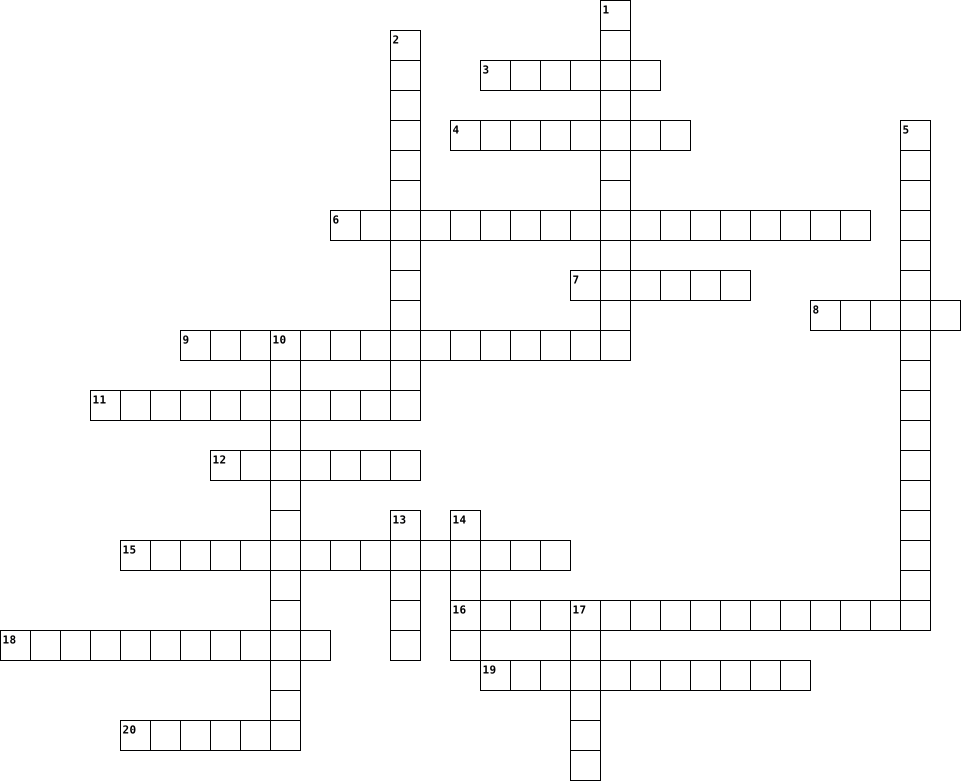
Across
- an area of fracturing between rocks resulting from stress.
- a visible exposure of bedrock or ancient superficial deposits on the surface of the Earth.
- a geologic process in which tectonic plates—large slabs of Earth's lithosphere split apart from each other.
- the outermost shell of a terrestrial planet.
- It's made up of a liquid metal outer core that flows around a solid metal inner core.
- occur along divergent plate boundaries, where new ocean floor is created as the Earth's tectonic plates spread apart.
- a depression in the earth's crust.
- the mostly solid bulk of Earth's interior.
- THE MOVEMENT OR STUDY OF THE MOVEMENT OF EARTHS CRUST
- where crust is neither produced nor destroyed as the plates slide horizontally past each other.
- when an oceanic plate runs into a continental plate and slides beneath it.
- occurs when two tectonic plates move away from each other.
- molten rock in the earths crust.
Down
- includes the brittle upper portion of the mantle and the crust, the outermost layers of Earth's structure.
- bounderies between plates.
- The plates have moved across Earth's surface for hundreds of millions of years.
- long, narrow depressions on the seafloor.
- an area of rock that has been bent by stress.
- is a split between 2 plates that were once joined.
- When forces are parallel but moving in opposite directions.
20 Clues: bounderies between plates. • molten rock in the earths crust. • a depression in the earth's crust. • long, narrow depressions on the seafloor. • the mostly solid bulk of Earth's interior. • the outermost shell of a terrestrial planet. • an area of rock that has been bent by stress. • is a split between 2 plates that were once joined. • ...
Adriyanna Mercado - Period 7 EES 2023-01-10

Across
- One of the three boundaries that occurs when plates move towards each other and collide
- non-depositional surface separating two rock masses of different ages
- Third-Longest division of Geologic time
- A type of body fossil that forms when crystals fill a mold
- Chlorophyll-containing, photosynthetic bacteria thought to be one of the earth life-forms
- Era of ancient life
- Organism with a three-Lobed exoskeleton that was abundant in paleozoic oceans and considered to be an index fossil
- A time where it was the longest part of earth's history
Down
- Middle era of earths history
- One of the three boundaries that occurs when two tectonic plates move away from each other
- Principle stating that earths processes occurring today are similar to those that occured in the past.
- Preserved remains of plants and animals
- A Four lettered fungi
- a long and distinct period of history with a particular feature or characteristic.
- The outermost layer of Earth's lithosphere that is found under the oceans
- a division of time that is a subdivision of a period and is itself subdivided into ages, corresponding to a series in chronostratigraphy.
- One of the three boundaries that occurs when two tectonic plates slide sideways past each other
- A supercontinent
- an indefinite and very long period of time
- An era that began recent life about 66 million years ago and continues today
20 Clues: A supercontinent • Era of ancient life • A Four lettered fungi • Middle era of earths history • Preserved remains of plants and animals • Third-Longest division of Geologic time • an indefinite and very long period of time • A time where it was the longest part of earth's history • A type of body fossil that forms when crystals fill a mold • ...
Elaine's Evolution Vocab Crossword 2023-03-01

Across
- Where things are living
- Surviving organisms cause change in population over time through reproduction acting on heritable traits
- Sets of genes in a population
- Unrelated species with similar traits due to the environment
- Occurs at a slow rate Ex: changes in climate
- Non-Random selection
- The study of pre-historic life
- Bursts of changes in a species
- Related creatures that can produce offspring
- Biological change that makes descendants differ from their ancestors
- Catastrophic event changes the environment suddenly
- Species in an area
- The remains of pre-historic populations
- Similar anatomical structures that serve different purposes
- A change in gene frequency over time
Down
- The study of different structures of organisms
- Forming of a new species by evolution from pre-existing species; Needs Isolation
- Same traits caused by the environment
- Two organisms change in response to each other forming a specialized relationship
- Random change in gene
- A feature that allows an organism to better survive in it's environment
- Today's different species coming from common ancestry
- The study of embryonic development of organisms
- The Study of the chemical processes in organisms Ex: DNA and Amino Acids
- Structures with little or no function
- Slow changes over a long period of time
- Migration of genes in or out of a population
27 Clues: Species in an area • Non-Random selection • Random change in gene • Where things are living • Sets of genes in a population • The study of pre-historic life • Bursts of changes in a species • A change in gene frequency over time • Same traits caused by the environment • Structures with little or no function • Slow changes over a long period of time • ...
Earth Structure Vocabulary Review 2023-02-16

Across
- The process of sediments being placed in a new location from its original placement.
- The movement of sediments from one location to another location.
- A break in earth's crust.
- A boundary type where two plates slide past one another. Causing Earthquakes.
- A boundary where two plates collide into one another.
- The process of rotating crops each year to preserve the nutrients in the soil.
- The remains of animals and plants.
- Layer of Earth made of solid iron and nickel.
- Growing of crops without tilling the soil to prevent erosion.
- Earth's outermost layer.
- Rigid layer made of the uppermost part of the mantle and crust.
Down
- The movement of one plate going under another tectonic plate.
- The process that breaks rock down into sediments.
- Soft layer of mantle that tectonic plates float on.
- The rock that was weathered to become the soil.
- Responsibility of maintaining the health of the lithosphere for human usage.
- Plowing the soil on the curve or slope of a hill.
- Theory stating that the continents were once one large land mass and seperated into the continents that we have today.
- Layer of Earth made of molten iron and nickel.
- A boundary type where two plates move away from one another.
- The layer responsible for the movement of plate tectonics.
21 Clues: Earth's outermost layer. • A break in earth's crust. • The remains of animals and plants. • Layer of Earth made of solid iron and nickel. • Layer of Earth made of molten iron and nickel. • The rock that was weathered to become the soil. • The process that breaks rock down into sediments. • Plowing the soil on the curve or slope of a hill. • ...
Plate Tectonics 2017-06-07

Across
- / the name of the super continent 200 million years ago
- / occurs when continental and oceanic plates converge creating pressure and heat erupting on the surface
- / huge amounts of water displaced onto land due to movement of plates carrying debris onto land
- / the malleable layer of which tectonic plates can drift above it
- / the name of the active volcano located in Italy Naples famous for the destruction of Pompeii in 79 AD
- / the earth is layered according to ____________
- / the boundary in which two plates move away from each other
- / the point on the earth's surface vertically above the focus of an earthquake
- / the uppermost thinnest layer of the earth
- / the boundary in which earthquakes happen the most
Down
- / the name of the Californian fault line
- / the molten rock from beneath the surface of the earth within the asthenosphere
- / the number scale of how powerful or catastrophic an earthquake is
- / contains the crust and a part of the upper mantle
- / the boundary of which two tectonic plates move towards each other
- / the scientist who developed the theory of continental drift
- / the thickest layer of earth, contains the asthenosphere and part of the lithosphere
- / the process of the oceanic plate sliding under an continental plate
- / the very middle of the earth
- / _____________ waves measure the frequency of an earthquake
20 Clues: / the very middle of the earth • / the name of the Californian fault line • / the uppermost thinnest layer of the earth • / the earth is layered according to ____________ • / contains the crust and a part of the upper mantle • / the boundary in which earthquakes happen the most • / the name of the super continent 200 million years ago • ...
Repetition, evolutionen 2020-02-17

Across
- Detta artbegrepp fokuserar på att individerna ska få fertil avkomma
- Om två populationer har väldigt lite genflöde dem emellan kan denna artbildning ske
- Detta kan nyttjas för att tidsbestämma andra fynd, då de endast fanns på en begränsad plats under en begränsad period
- Om två populationer blir geografiskt separerade från varandra kan denna artbildning ske
- När två arter utvecklas tillsammans i samma riktning, t.ex. snabbare eller längre
- En art som endast finns på en geografisk plats
- En typ av evolution där organismer med gemensamt ursprung utvecklar olika egenskaper som följd av olika levnadsmiljöer
- Två ord: Detta urval går mot en av extremerna
- Organ som har ett gemensamt ursprung med olika funktion
Down
- Två ord: delar av våra kroppar som visar på tidigare funktion
- En permanent förändring i vårt genom (DNA)
- Två individer från olika arter får avkomma tillsammans
- När våra världsdelar och öar flyttar sig från varandra
- En typ av selektion där de båda extremerna är gynnsamma
- Organ med nu snarlik funktion trots skilda ursprung
- Två ord: En typ av urval som styrs av honans, eller hannes, preferenser
- En typ av evolution där organismer med skilda ursprung utvecklar liknande egenskaper som följd av lika levnadsmiljöer
- Detta artbegrepp fokuserar på de likheter som finns
- Ett mått på reproduktiv framgång och överlevnad
- Ett annat ord för urval
20 Clues: Ett annat ord för urval • En permanent förändring i vårt genom (DNA) • Två ord: Detta urval går mot en av extremerna • En art som endast finns på en geografisk plats • Ett mått på reproduktiv framgång och överlevnad • Organ med nu snarlik funktion trots skilda ursprung • Detta artbegrepp fokuserar på de likheter som finns • ...
Genetics Crossword Puzzle 2021-01-11

Across
- structures feature of behavior that no longer seems to have a purpose
- flow also known as gene migration or allele flow
- organic compounds occurring in foods and living tissues that must include sugars, salts, and cellulars
- an organism's ability to survive and reproduce
- the ingestion of bacteria
- equilibrium hypothesis that evolutionary development marked by isolated episodes of rapid speciation between long periods of little or no change
- preserved impression/remains of a prehistoric organism
- organic compounds that are fatty acids
- nitrogenous organic compounds composed of amino acids
- selection the process whereby organisms better adapted to their environment tend to better survive
- nomenclature two terms used to denote a species of living organisms
- organism that grows without air
- structures skeletal elements of organisms that suggest a connection to a common ancestor
Down
- changing of a structure of a gene resulting in a variant form that may be transmitted to future generations
- theory believes organelles in eukaryotic cells were once prokaryotic micros
- evolution may occur as a response to changes in abiotic factors
- selection the identification by humans of desirable traits in the plants and animals
- influence of closely related species on each other
- evolution process where organisms not closely related independently evolve similar traits
- live on earth originated from microorganisms
- structures that are similar in unrelated organisms
- the classification of organisms
22 Clues: the ingestion of bacteria • organism that grows without air • the classification of organisms • organic compounds that are fatty acids • live on earth originated from microorganisms • an organism's ability to survive and reproduce • flow also known as gene migration or allele flow • influence of closely related species on each other • ...
Genetics Crossword Puzzle 2021-01-11

Across
- structures feature of behavior that no longer seems to have a purpose
- flow also known as gene migration or allele flow
- organic compounds occurring in foods and living tissues that must include sugars, salts, and cellulars
- an organism's ability to survive and reproduce
- the ingestion of bacteria
- equilibrium hypothesis that evolutionary development marked by isolated episodes of rapid speciation between long periods of little or no change
- preserved impression/remains of a prehistoric organism
- organic compounds that are fatty acids
- nitrogenous organic compounds composed of amino acids
- selection the process whereby organisms better adapted to their environment tend to better survive
- nomenclature two terms used to denote a species of living organisms
- organism that grows without air
- structures skeletal elements of organisms that suggest a connection to a common ancestor
Down
- changing of a structure of a gene resulting in a variant form that may be transmitted to future generations
- believes organelles in eukaryotic cells were once prokaryotic micros
- evolution may occur as a response to changes in abiotic factors
- selection the identification by humans of desirable traits in the plants and animals
- influence of closely related species on each other
- evolution process where organisms not closely related independently evolve similar traits
- live on earth originated from microorganisms
- structures that are similar in unrelated organisms
- the classification of organisms
22 Clues: the ingestion of bacteria • organism that grows without air • the classification of organisms • organic compounds that are fatty acids • live on earth originated from microorganisms • an organism's ability to survive and reproduce • flow also known as gene migration or allele flow • influence of closely related species on each other • ...
Weekend Crossword 2020-11-28

Across
- imitate
- held back; reserved
- From 12 to 11 (not 12 to 1)
- She's not really a friend, but more of an ____.
- If I had had the information ___, I would have changed my strategy.
- going in different directions
- She was arrogant and ___. I'm not sure we want her on our team.
- these kinds of measures are important in order to contain a contagious virus.
- the quality of being genuine
- Do you know how to ___ a tortoise from a turtle?
- describes someone you can rely on and have confidence in
- When will Trump officially ___ ?
- Gert has used this to describe his nosy teacher
- encourage development
Down
- reasonable or probable
- I don't know that it was the most ___ choice, but I will still support his decision.
- no interest or concern
- able to understand and share others' feelings
- anxiety about an unpleasant outcome
- "Life is like a box of chocolates"
- The dodo bird has been ___ for over one hundred years.
- My famous friend's worse fear is to become ___.
- Despite her ____ attitude, she never changed her behavior.
- disprove
- What a ____ employee! We should promote him!
- argument or disagreement
- Make sure to ___ every alleged alibi and statement. We have to find the killer.
- I couldn't see clearly! My vision was __.
- I'm overwhelmed. It has been such a ____ year.
29 Clues: imitate • disprove • held back; reserved • encourage development • reasonable or probable • no interest or concern • argument or disagreement • From 12 to 11 (not 12 to 1) • the quality of being genuine • going in different directions • When will Trump officially ___ ? • "Life is like a box of chocolates" • anxiety about an unpleasant outcome • I couldn't see clearly! My vision was __. • ...
Vocabulary Crossword Puzzle 2020-12-16

Across
- Plate, Large pieces of land that connect together on Earth’s outer shell.
- The lowest region of the atmosphere.
- The layer of Earth's atmosphere that is directly above the stratosphere.
- Contains all of the Earth’s water.
- A layer of gas that blocks harmful ultraviolet rays.
- The largest layer of the Earth.
- The part of Earth in which living things interact with nonliving things.
- Plate Boundaries, When two plates meet and slip/grind alongside one another.
- Process by which the ocean floor sinks beneath a deep-ocean trench and back into the mantle.
Down
- line, A line on a rock surface or the ground that traces a geological fault.
- The sphere that involves the rock cycle and all of our studies of plate tectonics.
- A sea of gases that support and protect the entire biosphere.
- The outermost layer of the atmosphere.
- Quarter, You can see exactly half of the illuminated part of the moon.
- Gibbous, More than half of the illuminated part of the moon is seen.
- The second layer of Earth's atmosphere.
- Boundaries, Boundary between two plates that are moving apart or rifting.
- boundary, When two or more tectonic plates collide and eventually one slides under the other.
- The rigid, rocky outer surface of the Earth.
- Moon, You can see the entire illuminated side of the moon.
20 Clues: The largest layer of the Earth. • Contains all of the Earth’s water. • The lowest region of the atmosphere. • The outermost layer of the atmosphere. • The second layer of Earth's atmosphere. • The rigid, rocky outer surface of the Earth. • A layer of gas that blocks harmful ultraviolet rays. • Moon, You can see the entire illuminated side of the moon. • ...
Tectonic Plates Crossword Puzzle 2021-02-26

Across
- a type of boundary where crust is formed
- the point on the earth's surface directly above the focus of an earthquake
- a type of boundary where lithosphere is destroyed
- the very outer layer of the earth
- molten rock that has erupted onto earth's surface
- layer beneath earth's crust
- molten rock beneath the earth's surface
- a place where extremely hot material from inside the earth erupts at the surface
- a boundary where plates are moving apart from each other in opposite directions
- a boundary where plates collide with each other
Down
- a zone where earth's crust and mantle are being pulled apart
- an isolated place away from plate boundaries where a lot of magma is collected
- a type of crust that forms the continents
- a section of the earth's crust that moves about on the earth's surface
- a boundary where a section of earth's crust is sliding parallel to each other but in opposite directions
- the centre of the earth
- a huge wave in the ocean caused by an earthquake occuring in the seafloor
- a type of crust that forms the ocean floor
- name for the crust and upper mantle together
- the rapid movement of the ground due to the movement of tectonic plates
- the point below the ground where the earthquake starts
- when one plate sinks below another plate during a collision
22 Clues: the centre of the earth • layer beneath earth's crust • the very outer layer of the earth • molten rock beneath the earth's surface • a type of boundary where crust is formed • a type of crust that forms the continents • a type of crust that forms the ocean floor • name for the crust and upper mantle together • a boundary where plates collide with each other • ...
Tectonic Plates 2021-04-22

Across
- Wegener’s 3 pieces of evidence to support continental drift – _________, Fossils, and climate
- an organism preserved in rock
- a large, broken section of Earth’s lithosphere
- <— —>
- most scientists __________ his theory because he was unable to prove the driving force causing the movement of the continents
- convection currents act as giant “________” and drive the movement of Earth’s plates
- the continuous heating and cooling of magma in the mantle creates _________ currents
- _______ and South America look as though they could fit together like puzzle pieces
- scientists believe convection ________ within the Earth’s mantle are slowly causing the plates to move
- scientists estimate that most of Earth’s plates move at a rate of 2.5 _________ per year
- a theory that states that the continents are slowly moving or “drifting” to new locations
Down
- there are _____ main types of crust that cover Earth’s surface
- an extinct fern-like plant whose fossil remains have been found on several continents separated by large distances
- German scientist and meteorologist
- plate _________ is a location where 2 tectonic plates meet
- plate _________ is a theory that the Earth’s lithosphere is broken into plates that move slowly over time
- ________ boundaries is a location where 2 tectonic plates slide past each other
- Wegener’s 3 pieces of evidence to support continental drift – Landforms, _______, and climate
- all of Earth’s continents joined together as one giant landmass
- —> <—
20 Clues: <— —> • —> <— • an organism preserved in rock • German scientist and meteorologist • a large, broken section of Earth’s lithosphere • plate _________ is a location where 2 tectonic plates meet • there are _____ main types of crust that cover Earth’s surface • all of Earth’s continents joined together as one giant landmass • ...
Plate Motion 2021-09-21

Across
- the place where two plates meet
- Earth’s outermost layer of hard, solid rock that is underneath the soil, vegetation, and water
- a diagram that shows what the inside of something looks like
- the sudden pushing out of something, such as lava from a volcano
- to examine in detail for a purpose
- how often or fast something happens
- a sudden shaking of Earth’s surface
- a feature that forms on the surface of a planet, such as a mountain, channel, or sand dune
- an extinct reptile that lived about 300 million years ago
- an object, diagram, or computer program that helps us understand something by making it simpler or easier to see
Down
- any of Earth’s main continuous areas of land, such as Africa, Asia, and North America
- moving apart in different directions
- the outside or top layer of something
- evidence of life from the past, such as fossilized bones, footprints, or leaf prints
- moving toward the same place
- a natural spring that sends hot water and steam suddenly into the air from a hole in the ground
- one of the very large sections of hard, solid rock that make up Earth’s outer layer
- something we observe to be similar over and over again
- hot liquid rock below the surface of Earth
- hot liquid rock on the surface of Eart
- a set of interacting parts forming a complex whole
21 Clues: moving toward the same place • the place where two plates meet • to examine in detail for a purpose • how often or fast something happens • a sudden shaking of Earth’s surface • moving apart in different directions • the outside or top layer of something • hot liquid rock on the surface of Eart • hot liquid rock below the surface of Earth • ...
Calculus Tyler Tranchita 2022-05-31

Across
- High point of a graph
- A series with a finite sum
- Rate of change of velocity
- Area under a curve
- Method of finding volume with space
- A rule between two variables
- Function being integrated
- A series with no finite sum
- Slope of the tangent line
- Method of finding volume with no space
- Ultimate trend of values
- Quantities that cannot be expressed by a single number
- Uses derivatives to help solve limits
- Draw the graph without lifting your
- Guarantees a point where the function obtains a maximum or a minimum value
Down
- A line through a pair of infinitely close points on a curve
- Guarantees a point where the derivative has a certain value
- Solving for an antiderivative
- A point at which the value of a function is the largest or smallest
- Sum of a sequence
- An inverse derivative
- Low point of a graph
- Rate of change of position
- Condition of AST
- A method to solve differentiable equations given an initial value
- A mathematical statement
- A point where a function is not continuous
- The mathematical study of continuous change of arithmetic operations
- A line that intersects a curve at a minimum of two points
- Guarantees a point where the function has a certain value between two given values
30 Clues: Condition of AST • Sum of a sequence • Area under a curve • Low point of a graph • High point of a graph • An inverse derivative • A mathematical statement • Ultimate trend of values • Function being integrated • Slope of the tangent line • A series with a finite sum • Rate of change of velocity • Rate of change of position • A series with no finite sum • A rule between two variables • ...
Plate Tectonics Vocaulary 2022-11-05

Across
- places where plates slide sideways past each other
- two plates comes together
- the part of the earth's crust that makes up the seafloor
- a point at which rays of light, heat, or other radiation meet after being refracted or refracted
- layer of the earth between the solid inner core and lower mantle
- a large depression formed when a volcano erupts and collapses
- the mostly solid bulk of earth's interior
- the eruption of molten rock (magma) onto the surface of a planet
- a large plume of hot mantle material rising from deep within the earth
Down
- abroad runded volcano that is built up by successive outpourings of very fluid lava
- a dip-slip fault in which the block above the fault has moved downward relative to the block below
- sudden movement of the earth's lithosphere
- two tectonic plates move away from each other
- a fracture or zone of fractures between two blocks of rock
- the first waves to arrive at a seismograph
- a seismic body wave that shakes the ground back and forth
- anything thrown into the air during a volcanic eruption
- a mixture of molten and semi-molten rock found beneath the surface of the earth
- comes out of a volcano
- built from particles and blobs of congealed lava ejected from a single vent
- is slid and 90% iron
21 Clues: is slid and 90% iron • comes out of a volcano • two plates comes together • the mostly solid bulk of earth's interior • sudden movement of the earth's lithosphere • the first waves to arrive at a seismograph • two tectonic plates move away from each other • places where plates slide sideways past each other • anything thrown into the air during a volcanic eruption • ...
Harlow's unit 2 review 2022-10-11

Across
- rocks glaciers have picked up and dropped somewhere else
- made up of minerals, air, water, oxygen, plant and animal materials
- the long-term pattern of weather
- variety of vegetation, cooler the higher you are, rain on the windward side
- elongated hills formed by glacial ice on underlying till
- measures the precipitation on a climate graph
- very cold with little life/vegetation
- the in-land climate of Canada with a variation of temperatures
- a string of volcanoes and earthquakes around the edge of the Pacific Ocean
- breakdown of materials to form sediment
- the short-term characteristics of the atmosphere
- long ridges of sand and gravel
- rainforest with lots of rain and a mild climate
- found in valleys and mountians
Down
- large piece of ice that moves across land
- little vegetation with a dry climate
- mix of trees with a temperate climate
- coniferous and deciduous trees in a wet and cold climate with a shot growing season
- the material that gets scraped off land and carried by glaciers
- measures the temperature on a climate graph
- when plates move, and magma makes new crust
- weathered rock is moved by water, wind, and gravity
- deciduous trees with a changing climate and lots of trees
- when two plates come together, one goes under the other
- the costal climate in Canada with mild winters, cool summers and high precipitation
25 Clues: long ridges of sand and gravel • found in valleys and mountians • the long-term pattern of weather • little vegetation with a dry climate • mix of trees with a temperate climate • very cold with little life/vegetation • breakdown of materials to form sediment • large piece of ice that moves across land • measures the temperature on a climate graph • ...
Unit 8: 8th Grade Vocabulary 2022-08-17

Across
- thin and boy, starved looking; bare, barren
- puzzling, mystifying, or enigmatic
- a person who collects or removes usable items from waste materials; an animal that feeds on refuse or dead bodies
- an agent, substitute; a written permission allowing one person to act in another's place
- going in different directions; different from each other; departing from convention, deviant
- capable of being grasped by the senses or mind
- tireless, continuing with vigor
- to cause anger, irritation, or bitterness (with the suggestion that the pain grows worse with time)
- self-controlled, not showing feeling in response to pleasure or pain
Down
- to be of use or benefit to; to make use of; to make use of; to take advantage of; to profit or benefit; use, benefit, or value
- a very close friend, pal, chum, buddy
- to plunge straight down; a weight fastened to a line
- to pass through or gain entrance to gradually or stealthily
- clothes, apparel, garb; to dress, adorn, or bedeck
- to limit, be sparing or frugal; a limit or restriction; a fixed share of work or duty; a period of activity
- very earnest, emotional, passionate; extremely hot
- hatred, ill-will
- to join at one end or be next
- to declare publicly or officially
- to make of no value or consequence, cancel, wipe out
20 Clues: hatred, ill-will • to join at one end or be next • tireless, continuing with vigor • to declare publicly or officially • puzzling, mystifying, or enigmatic • a very close friend, pal, chum, buddy • thin and boy, starved looking; bare, barren • capable of being grasped by the senses or mind • clothes, apparel, garb; to dress, adorn, or bedeck • ...
Popular Books 2016-09-30
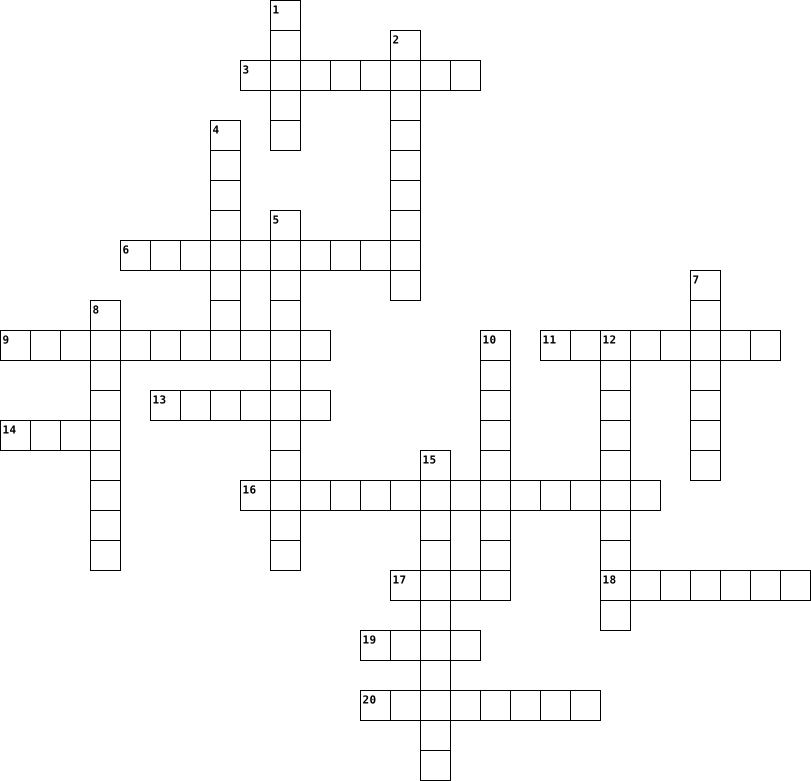
Across
- A horror story about a possessed amusement park.
- Brandon Mull writes this fantasy series about a sanctuary for mystical creatures.
- The kids in this story go to Hogwarts School.
- This sports fiction novel is about a football player who takes performance enhancing drugs.
- The main character in this story is a mechanic and a cyborg.
- Mystery in which the last words of March's cat burglar father instructs him to "find jewels".
- This is a fantasy story that revolves around the gods and heroes of greek mythology.
- stolen This is a book about a kidnapping.
- A biography that is written in graphic novel form.
- Survival story about a boy who climbs Mt. Everest.
- Novel about a girl who struggles after losing everything in a tornado.
Down
- Science fiction novel in which the vaccine for bees is turning teenagers into monsters.
- Futuristic dystopian novel that takes place in Chicago.
- All the characters in this fantasy series are dead.
- This story is like the Hunger Games meets the Bachelor.
- An adventure in which the main character is looking for his brother who is underground.
- One of the characters in this story is half giant/half human.
- A book written in verse about a girl who loses her arm.
- A book character who has electric powers.
- Realistic fiction novel about a girl struggling with dyslexia.
20 Clues: A book character who has electric powers. • stolen This is a book about a kidnapping. • The kids in this story go to Hogwarts School. • A horror story about a possessed amusement park. • A biography that is written in graphic novel form. • Survival story about a boy who climbs Mt. Everest. • All the characters in this fantasy series are dead. • ...
Two of a Kind Vocabulary 2019-09-19

Across
- describes something composed of 2 parts
- to connect/be adjacent to a second part, esp. in terms of location or land
- describes something that splits from/leaves one opinion or course of action for another
- describes something which occurs twice per year or once every 2 years
- describes the ability to use both hands well
- to turn/switch from one direction or path to another
- describes the state of having 2 conflicting emotions or ideas at once
- describes something disconnected from a secondary part; lacking cohesion; confusion
- a part of speech used to connect words, clauses & sentences or as transitions between them
- situation with 2 difficult or unpleasant choices
Down
- the atmosphere, mood or character of a particular place that surrounds one on both (all) sides
- the act of "double-dealing"; lying to 2 different individuals or parties
- describes involvement by 2 different parties or groups
- a negotiator between 2 countries or parties
- a connecting point between 2 things; a significant point in time esp. in decision-making
- a reply or response, esp. one that is sharp in nature (as in anger or cleverness)
- describes something occurring twice a week or once every 2 weeks
- a pre-arranged showdown between 2 combatants usu. over a prior dispute
- describes something occurring every 200 years; a 200th anniversary
- describes something uncertain or vague; having 2+ interpretations or meanings
20 Clues: describes something composed of 2 parts • a negotiator between 2 countries or parties • describes the ability to use both hands well • situation with 2 difficult or unpleasant choices • to turn/switch from one direction or path to another • describes involvement by 2 different parties or groups • describes something occurring twice a week or once every 2 weeks • ...
Grade 8 Science Crossword 2019-10-01

Across
- Lowest point of a wave
- Light coming from a light source
- surge Abnormal rise of water due to tropical cyclone
- effect The movement and speed of typhoons is affected by the _______
- When water-saturated granular material temporarily loses its solid structure and becomes fluid-like
- Caused by rocks pulled together by diverging plates.
- Force that opposes the motion of an object
- faulting Type of faulting which is found along divergent zones
- rainbands Main spiral bands of a typhoon
- Height of crest or depth of trough
- Distance between crest and and its succeeding crest; same goes between trough and its succeeding trough
- Heat transfer through the movement of fluids with different temperatures
- Highest point of a wave
Down
- Point on the ground directly above focus
- Transfer of energy by electromagnetic waves
- Image forms behind the retina of the eye.
- Mature tropical cyclone that develops in western part of North Pacific Ocean
- Transfer of energy as a result of temperature difference between two objects
- Energy transfer between two objects either by collision or contact
- waves Vibrations sent travelling through the ground by earthquakes
- Faulting which happens when the crust is compared.
- The result of two or more waves that meet
- If the human eye is too "long" and image forms in front of retina
- cyclone "Typhoon" "hurricane" are some of those considered under _______
24 Clues: Lowest point of a wave • Highest point of a wave • Light coming from a light source • Height of crest or depth of trough • Point on the ground directly above focus • rainbands Main spiral bands of a typhoon • Image forms behind the retina of the eye. • The result of two or more waves that meet • Force that opposes the motion of an object • ...