
environmental economics Crossword Puzzles
Economics 2020-09-10

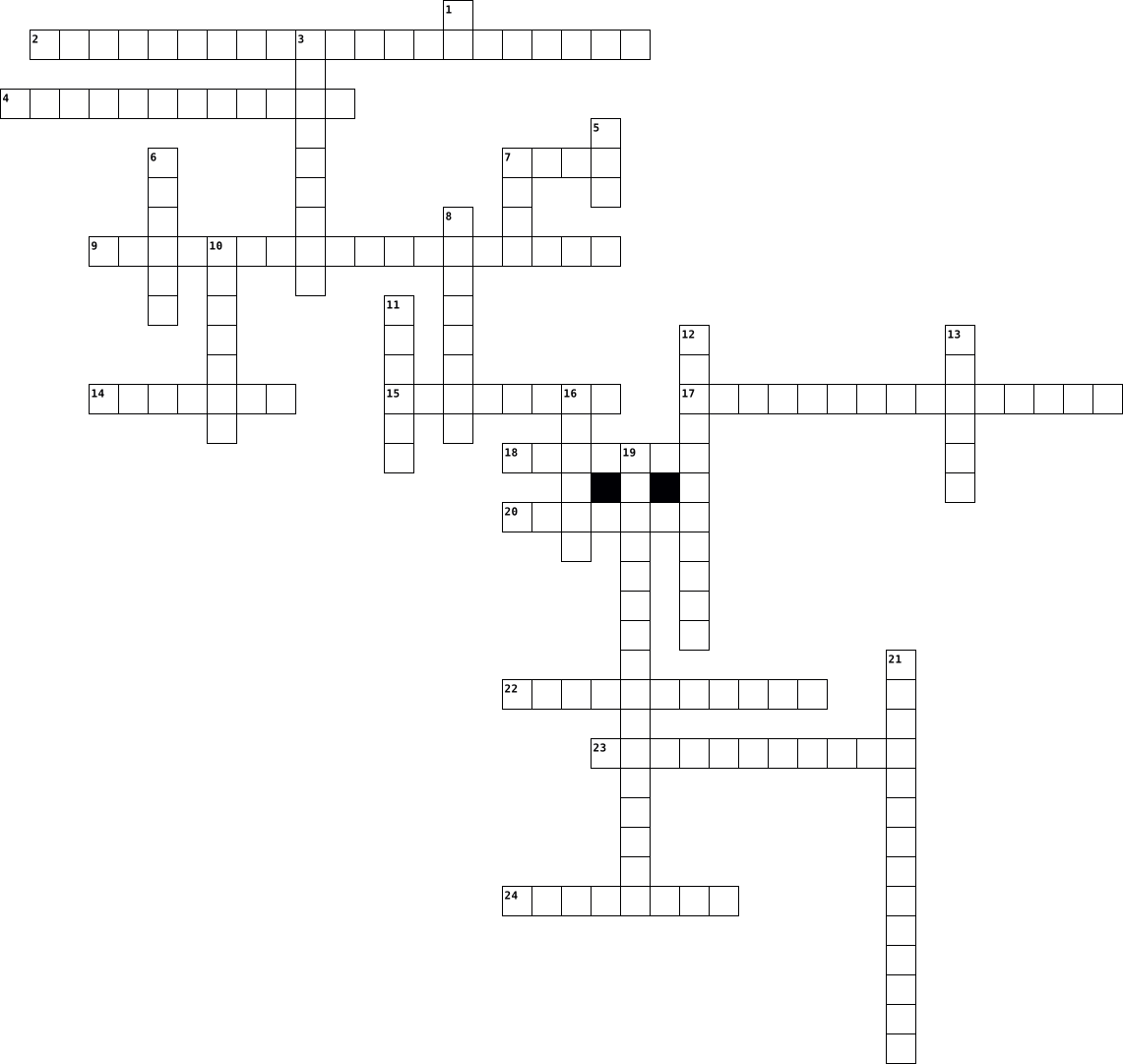
Across
- you can go to a food ______ to buy all kinds of fresh foods
- getting products or service to the consumer is called what
- a special economy that relies on trade
- if u sell a certain item at a certain store and u sold that item for _______
- a positve reward for behaving in a certain way
- ___________ is when producing any goods or service requires land, labor, and capital
- the hard work you put in your job
- a extra or additional benefits of a certain decision
Down
- the _______ of working at subway is freesix inch sandwiches
- lansing is the ______ of michigan
- you by a plot of ___ to start a business
- a punishnment or fine for a bad behavior
- i am consuming bacon packages
- the _____ to makes this product is $10.00
- _______ is when thier a inequality exist between wants and recource availabilty
- the study of all the economy as a hole
- people who makes goods or service is called what
- to give a person something and gets something back is consider a even ____
- economy the study of individual consumers and buisness
- _______ is a social sience that studies how people , are acting indivualy and or in a group
20 Clues: i am consuming bacon packages • lansing is the ______ of michigan • the hard work you put in your job • the study of all the economy as a hole • a special economy that relies on trade • you by a plot of ___ to start a business • a punishnment or fine for a bad behavior • the _____ to makes this product is $10.00 • a positve reward for behaving in a certain way • ...
Economics 2018-11-25

Across
- able to be felt by touch
- one person's consumption does not take away from another's consumption
- bringing dissatisfaction or unhappiness
- tasks that people pay other's to do for them
- outcomes that are not intended
- most highly valued opportunity when a choice is made
- encourages or motivates a person to take action
- not able to be felt
- additional
- anything that satisfies a person's wants
- author of the wealth of nations
Down
- the science that studies the choices of people trying to satisfy their wants
- means for deciding who gets what of the available resources
- special talents some people have for searching out and taking advantage of new businesses
- all natural resources found in nature
- individuals own most of the resources and control their use
- condition in which our wants are greater than our resources
- more of one thing necessarily means less of something else
- a thing that we desire to have
- bringing happiness or satisfaction
20 Clues: additional • not able to be felt • able to be felt by touch • outcomes that are not intended • a thing that we desire to have • author of the wealth of nations • bringing happiness or satisfaction • all natural resources found in nature • bringing dissatisfaction or unhappiness • anything that satisfies a person's wants • tasks that people pay other's to do for them • ...
Economics 2018-09-27

Across
- All the natural resources (including land/space) used in the production of a good or service.
- Refers to "first world" countries, states where nearly all citizens have access to infrastructure, healthcare, clean water, and technology; little to no extreme poverty.
- Condition of being unequal (economic inequality)
- It's very difficult for people to escape poverty
- Refers to property or other assets that have no proven ownership.
- All the human labor required for the production and distribution.
- Average age of death for people in a nation.
- An increase in the capacity of an economy to produce goods and services.
- The state of owing money.
- prizes, money, or other material gain awarded for a desired behavior.
- Benefits guaranteed to an individual.
- Combined value of all goods and services bought, sold, and produced in a year.
- percent of a population that can read at a primary school level or higher.
- The use of monetary or fiscal policy changes to kickstart growth in the economy.
Down
- Quantification of the economic value of a worker's skill set.
- Also "third world" nations, these countries host a high level of extreme poverty and many citizens lack access to basic healthcare and infrastructure.
- All the man-made resources used in the production of a good or service - includes money, equipment, and partially finished goods used to produce a good or service.
- Set of factors or events by which poverty, once started, is likely to continue unless there is outside intervention.
- Measures the rate of people seeking work that are unable to find it in a giving economy.
- The term for the basic physical systems of a business or nation.
- An overall measure the well being of a person in a given nation, as a measure of their capacity for the economic growth and stability.
- Mainly free enterprise but government sets and organizes programs intended to promote economic progress and consumer safety.
- average number of children born per family in a nation.
- The creative minds (inventors) and business people who are essential to the development or improvement.
- Period of no or negative economic growth (negative GDP growth rate) that last more than six months.
25 Clues: The state of owing money. • Benefits guaranteed to an individual. • Average age of death for people in a nation. • Condition of being unequal (economic inequality) • It's very difficult for people to escape poverty • average number of children born per family in a nation. • Quantification of the economic value of a worker's skill set. • ...
Economics 2021-05-14

Across
- : A financial institution that collects deposits from the public and extends credit to businesses and households.
- : means the positive change in the production of goods and services in an economy over a given period.
- : A sharp downturn in general economic activity.
- : In economics, this refers to rivalry between several agents for the same market.
- : selling part of the production of goods or services in the other country
- : decrease in the general price level
- : Situation of a business owner who cannot pay his debts, keep his commitments.
- : a person who starts a business
- : Excess of expenditure over earnings.
Down
- : the situation of a person who wants to work and has the capacity to do so, but finds himself or herself jobless in spite of searching.
- : entry into a country of goods or services from another country
- : Also called a firm, it is an organisation whose purpose is to produce and supply goods or services to a set of customers.
- : a situation in which one supplier has an exclusive position on a product or service offered to a multitude of buyers.
- : to be prudent in spending, to set aside money for a particular purpose.
- : It is a fraction of the capital of a listed company
- : an immediate expenditure intended to increase the wealth of the person incurring it in the long term
- : periodic payment, paid by an employer to a salaried employee
- : It is a practice to record all the flows, expenses and revenues of the company.
- : the sum of a company's sales of goods or services over an accounting period.
- : Rising prices of goods and services.
20 Clues: : a person who starts a business • : decrease in the general price level • : Rising prices of goods and services. • : Excess of expenditure over earnings. • : A sharp downturn in general economic activity. • : It is a fraction of the capital of a listed company • : periodic payment, paid by an employer to a salaried employee • ...
Economics 2021-06-04
Across
- What is low inflation?
- What is it called when congress changes aggregate demand?
- Oil is an example of what in economics?
- What type of economy follows culture and history?
- Equipment is an example of what in economics?
- How do banks make their money?
- what is inflation?
- What is someone's total amount of money?
- What is the name of the place where people go to get a higher education after high school?
- What shows the different amounts of products supplied?
- What shows the demand for a product at all prices?
- when you give one thing up for another
Down
- High inflation is when inflation rate is greater than what percent?
- A shrinking economy is also called what?
- What is the measurement for the total worth of all goods and services?
- What is the willingness to buy a product?
- What is it called when a bank gives someone money in hopes that they return it?
- the idea of limited resources
- What is it called when goods or services are coming into the country?
- When you put money away and don’t spend it
- What is aggregate demand?
- What is the amount of products produced?
- Productivity is a determinant of what?
- What is the central bank of the U.S?
- What is the power to control the money supply?
25 Clues: what is inflation? • What is low inflation? • What is aggregate demand? • the idea of limited resources • How do banks make their money? • What is the central bank of the U.S? • Productivity is a determinant of what? • when you give one thing up for another • Oil is an example of what in economics? • A shrinking economy is also called what? • ...
Economics 2021-04-15

Across
- money that is owed
- businesses, place where the buying and selling of good occurs
- a person who organizes, operates, and assumers the risk to start a new business
- is an economic system in which private individuals or businesses own capital goods: the U. S. has this kind of economy
- money borrowed that must be repaid, usually with interest
- a reserve of money for unforeseen expenses or future purchases
- a person or business that supplies consumers with goods or services
- households, business, banks, and the government are examples of__________ in the U. S.
- the legislative body of a state that plays a role to collect taxes
Down
- when businesses sell the same product and work to gain consumers
- rate which is charged or paid for taking out a loan
- a place where people put their money to be used by lending it to others to buy homes, businesses, and other financial demands
- focusing on providing one kind of product or service example
- the amount a consumer is willing to pay for a good or service, influenced by supply and demand
- a plan for spending money
- a person who buys goods or services in great demand in the market
- the money people earn for work
- the final consumers of goods and services that create demand in the market
- the money remaining after the costs of a business have been paid
- exchanging goods and services
- collected from households and businesses by the government to pay for services
21 Clues: money that is owed • a plan for spending money • exchanging goods and services • the money people earn for work • rate which is charged or paid for taking out a loan • money borrowed that must be repaid, usually with interest • businesses, place where the buying and selling of good occurs • focusing on providing one kind of product or service example • ...
Economics 2021-04-06

Across
- an economic term referring to the static quantity of a good or service when its price changes
- an individual, or entity, who exchanges any good or service in return for payment
- a change in the behavior of buyers and sellers in response to a change in price for a good or service
- a thing that completes or brings to perfection
- the current price at which an asset or service can be bought or sold
- the difference between the revenue received from the sale of an output and the costs of all inputs used
- a person or thing acting or serving in place of another
- items that satisfy human wants and provide utility
- a graph showing how the demand for a commodity or service varies with changes in its price
- the part of economics concerned with single factors and the effects of individual decisions
- money received, especially on a regular basis, for work or through investments
Down
- the amount or number of a material or immaterial thing not usually estimated by spatial measurement
- the total amount of a specific good or service that is available to consumers
- a person who is buying something or who intends to buy it
- any basic, quantifiable item that creates value for a business
- Marginal Utility all else equal as consumption increases the marginal utility derived from each additional unit declines
- Of Demand a fundamental principle of economics that states that at a higher price consumers will demand a lower quantity of a good
- someone who creates and supplies goods or services
- a regular gathering of people for the purchase and sale of provisions, livestock, and other commodities
- an insistent and peremptory request, made as if by right
- the item offered for sale
- the action of replacing someone or something with another person or thing
- a tabulation of the quantity of a good that all consumers in a market will purchase at a given price
- a person who buys and uses up goods
- the benefit gained from consuming one additional unit of a good or service
25 Clues: the item offered for sale • a person who buys and uses up goods • a thing that completes or brings to perfection • someone who creates and supplies goods or services • items that satisfy human wants and provide utility • a person or thing acting or serving in place of another • an insistent and peremptory request, made as if by right • ...
Economics 2024-04-27

Across
- this law establishes a minimum amount that an employer can pay a worker for one day of labor
- is a process and it exists when a group of buyers and sellers communicate to exchange goods and services
- came from nature that are used in production, including land, raw materials, and natural process
- it is the quantities of a particular good or service consumers are willing and able to buy at different possible prices
- a property form which the owner receives payment from the occupants, known as tenants, in return for occupying or using the property
- the efforts of people involved in production, including labor and entrepreneurship
- things that are often are sold or used together
- the amount of a product that is offered for sale at all possible prices in the market
- it is the captain of the industry
- is a mandatory financial charge or some other type of levy imposed upon a taxpayer by a governmental organization in order to fund various public expenditures
- the essentials of life, such as food and shelter
- is a social science concerned with using scarce resources to obtain the maximum of the unlimited wants of society
- it is the physical and human effort exerted in production
- man-made resources used in the production of goods and services which include machineries and equipment
- this is the authoritative system wherein decision-making is centralized in the government or a planning committee
- shows how the quantity demanded of a good depends on its determinants
- businesses take loans to fund capital projects and expand their operations by purchasing fixed and long-term assets such as land, buildings, and machinery
- methods are stagnant and therefore not progressive
- under perfect competition all firms sell homogenous goods which are identical in quantity, shape. size, and color
- a state in which the supply and demand for a given good or service are in balance
- is a division of economics that is concerned with the overall performance of the entire economy
- is a market situation in which there are few (more than two) sellers
- is the art of turning an idea into a business
- the government and the economy are equal
- is a market structure in which large number of sellers sell a homogenous product at uniform price
- a table that shows the quantity demanded of a good or service at different price levels
- is the application of economic theory and econometrics in specific settings with the goal of analyzing potential outcomes
Down
- the processed materials, equipment, and buildings used in production
- it concerned with the process of setting prices of goods that is also known as Price Theory
- he described economics as study of mankind in the ordinary business life
- Between the extremes of monopoly and perfect competition
- refers to using one’s savings in a way that earns a return
- equilibrium means a state of equality or balance between market demand and market supply
- consumers buy more of a good when its price decreases and less when its price increases
- is when supply is limited
- is an asset or item acquired with the goal of generating income or appreciation
- Tendency of suppliers to offer more of a good at a higher price and less at lower prices
- refers to an increase in the value of an asset over time
- it is the specific type of oligopoly where only two producers exist in one market
- is when a good is scarce compared to its demand
- this is the most democratic form of economic system
- the limited nature of resources, which underlies the basic economic problem
- the problem of having unlimited wants, but limited resources to satisfy them
- desires for non-essential items
- form of market in which there are large numbers of sellers selling differentiated products which are similar in nature but not homogenous
- refers to the market situation where there is one seller and there is no close substitute to the commodities sold by the seller
- soil and natural resources that are found in nature and are not man-made
- it refers to the value of the best foregone alternative
- graphical representation of the relationship between the price of a good or service and the quantity
- this refers to the minimum amount of remuneration that an employer in required to pay wage earners for the work performed during a given period
50 Clues: is when supply is limited • desires for non-essential items • it is the captain of the industry • the government and the economy are equal • is the art of turning an idea into a business • things that are often are sold or used together • is when a good is scarce compared to its demand • the essentials of life, such as food and shelter • ...
Economics 2024-05-28

Across
- activity
- resources
- force
- gain
- goods
- amount
- like
- person
- require
- Rise
- reward
Down
- fall
- traits
- acronym
- competitive
- economic problem
- emotional
- option
- quantity
- rational
20 Clues: fall • gain • like • Rise • force • goods • traits • option • amount • person • reward • acronym • require • activity • quantity • rational • resources • emotional • competitive • economic problem
economics 2023-11-14

Across
- a person with temporary permission to work in another country
- output per worker or per hour worked
- a type of business often run by a board to provide a benefit to the public
- a merger between two firms involved in different stages of production join together
- a group of people whose job is to fight for an increase of wages and safer work conditions for its members
- a relationship between people or groups based on shared feelings, interest, or experience
- to obtain goods from a foreign supplier
- a demand for a commodity or service which is a consequence of the demand for something else
- business owned and operated by individuals for their shared benefit
- a business agreement by two or more individuals to share responsibilities
Down
- the practice of basing some of a company's process overseas to take advantage of lower costs
- a business owned by one person
- the state of being responsible of something
- pays a fee to the parent company for the exclusive right to sell something
- a merger between two competing companies in the same industry
- to provide someone with advantageous economic or working conditions
- the process by which education increases productivity and results in higher wages
- most complex form of business owned by individual stockholders
- gives workers the right to decide whether to join a union or not in the workplace
- wages fluctuate with respect to the demand and supply of labor
20 Clues: a business owned by one person • output per worker or per hour worked • to obtain goods from a foreign supplier • the state of being responsible of something • a person with temporary permission to work in another country • a merger between two competing companies in the same industry • most complex form of business owned by individual stockholders • ...
Economics 2023-11-13

Across
- output per worker or per hour worked.
- the exclusive authority to determine how a resource is used, whether that resource is owned by government or by individuals.
- business practice of hiring a party outside a company to perform services or create goods that were traditionally performed in-house by the company's own employees and staff.
- sum of the employed plus the unemployment
- the demand for a good or service that results from the demand for a different, or related, good or service.
- Business owned by on person
- owner licenses its operation along with products,branding,and knowledge.
- two or more individuals share responsibility,assets,profit,and financial/legal liabilities.
- merger of two or more companies that provide different supply chain functions.
- the process by which education increases productivity and results in higher wages.
- being responsible for something,especially by law
Down
- the transferring activities or ownership of a complete business process to a different country from the country (or countries) where the company receiving the services is located.
- a worker who is hired on a temporary or fixed-term contract basis to provide specific services for a specific project or period of time.
- condition or state in which economic forces are balanced.
- merger occurring between companies in the same industry.
- investor lends money to company for period of time in exchange for regular price interest.
- an unfair labor practice that occurs when a union requires an employer to pay for services they did not perform.
- semi independent business that pays fees
- the theory that the completion of college indicates to employers that a job applicant is intelligent and hard-working.
- foreign national who is permitted to live and work temporarily in a host country.
20 Clues: Business owned by on person • output per worker or per hour worked. • semi independent business that pays fees • sum of the employed plus the unemployment • being responsible for something,especially by law • merger occurring between companies in the same industry. • condition or state in which economic forces are balanced. • ...
Economics 2024-02-14

Across
- medium of exchange for goods and services
- people who buy or use goods and services to satisfy their wants
- A financial institution licensed to receive and make loans
- a market place where securities, commodities, derivatives, and others are traded
- the way total output, income, or wealth is distributed among individuals
- The large set of inter-related production, consumption, and exchange activities
- a fixed income instrument that represents a loan made by an investor to a borrower
- public availability or knowledge of something
- A product or service produced in one country but sold to a buyer abroad
- an estimate of income and expenditure for a set period of time
Down
- Exchange for other goods and services without using money
- anything that confers value or benefit to its owner such as a factory and its machinery
- an activity involving two or more firms in which each firm tries to get people to buy their goods
- A persons regular occupation, profession, or trade
- the monetary value of goods and services purchased by producers and consumers
- transaction between two parties in which one supplies money, goods, services, or securities in return for a promised future payment
- Economic concept that relates to a consumers desire to purchase goods
- Items that satisfy human wants, provide utility, or usefulness and are scarse
- an organization set up to provide help and raise money for those in need
- An advantage or profit gained from something
20 Clues: medium of exchange for goods and services • An advantage or profit gained from something • public availability or knowledge of something • A persons regular occupation, profession, or trade • Exchange for other goods and services without using money • A financial institution licensed to receive and make loans • ...
Economics 2024-02-21

Across
- a model of production and consumption, which involves sharing, leasing, reusing, repairing, refurbishing and recycling.
- an organization or enterprising entity engaged in commercial, industrial, or professional activities.
- a source of supply or support.
- a measure of output per worker per unit of time.
- a falling short of an essential or desirable amount or number.
- the money used to build, run, or grow a business.
- pay a lender their principal and usually interest on a loan.
- a spending plan based on income and expenses.
- is an institution where people or businesses can keep their money.
- a charge usually an exchange of goods or services by economic actors.
Down
- the sum or amount of money or its equivalent bought or sold.
- agreeing through discussion.
- to make available for use.
- a shore in the ownership of a company.
- generosity and helpfulness especially toward the needy or suffering.
- income, especially when a company and a subtatail nature.
- a proportional part or share assigned to each in a body.
- an economoy of or reduction in many, time, resources.
- all proerty that has a money value exchangeable value.
- is an act of trading goods or services between two without the use of money.
20 Clues: to make available for use. • agreeing through discussion. • a source of supply or support. • a shore in the ownership of a company. • a spending plan based on income and expenses. • a measure of output per worker per unit of time. • the money used to build, run, or grow a business. • an economoy of or reduction in many, time, resources. • ...
Economics 2024-08-16

Across
- The point at which the quantity of a good or service supplied equals the quantity demanded, leading to a stable price.
- Financial assistance given by the government to support a specific industry or reduce the cost of a product.
- The situation where people who are able and willing to work cannot find a job.
- The value of the next best alternative that you give up when you make a choice.
- The practice of spreading investments or business activities across different areas to reduce risk.
- A measure that examines the average change in prices over time that consumers pay for a basket of goods and services.
- The act of putting money into something, such as stocks, property, or a business, with the hope of earning more money in the future.
- The use of government spending and taxation to influence the economy.
- National Product The total value of all goods and services produced by a country’s residents, including those abroad, in a given period.
- Growth: The increase in a country’s production of goods and services over time, typically measured by GDP.
- A situation where a country imports more goods and services than it exports, leading to more money flowing out than coming in.
- Actions taken by a country’s central bank to control the money supply and interest rates in the economy.
- The total income a business earns from selling its goods or services before any expenses are subtracted.
- The total amount of a good or service that is available for people to buy.
- The value of ownership in an asset or company, often referring to fairness in the distribution of wealth and resources.
- A measure of how much the demand or supply of a good changes when its price changes.
- A plan for how much money will be spent and earned over a certain period, usually created by individuals, businesses, or governments.
- A tax placed on imported goods, making them more expensive, to protect domestic industries or generate revenue.
Down
- A place or system where buyers and sellers come together to exchange goods, services, or resources.
- The total value of all goods and services produced within a country in a given period, usually a year.
- A decrease in the general price level of goods and services, which can increase the value of money.
- How easily an asset can be converted into cash without losing value.
- The desire and ability of people to purchase a good or service at a certain price.
- The general increase in prices over time, meaning that money loses value because it buys less.
- The percentage charged on a loan or paid on savings, which represents the cost of borrowing money.
- The money a business has left after subtracting all its costs from its total revenue.
- A market situation where a single company or group controls all or nearly all of the supply of a product or service.
- The situation in which there are limited resources to meet unlimited wants and needs.
- Money or assets that are used to start or grow a business, such as buildings, machinery, or cash.
- The process of giving up one thing in order to gain something else, often seen in decision-making.
30 Clues: How easily an asset can be converted into cash without losing value. • The use of government spending and taxation to influence the economy. • The total amount of a good or service that is available for people to buy. • The situation where people who are able and willing to work cannot find a job. • ...
Economics 2023-02-03

Across
- division of work
- basic requirement for survival, including food, clothing, and shelter
- work or labor preformed for someone
- risk taking individual in search of profits
- measure of the amount of output of goods and services over time
- a stock or supply of money, materials, staff, and other assers that can be drawn on by a person
- meeting place or mechanism that allows buyers and sellers to come together
- ability or capacity of a good or service to be useful and give satisfaction to someone
- a good that wears out or lasts for fewer than three years when used regularly
- sum of tangible economic goods that are scarce, useful, and transferable from one person to another
- productive resources that make up the four categories of land, capital, labor, and entrepreneurs
- market where the factors of production are bought and sold
Down
- tangible economic product that is useful
- understanding someone
- monetary worth of a good or service as determined by the market
- gross domestic product
- increase in a nation's total output of goods and services over time
- fundamental economic problem of meeting people’s virtually unlimited wants with scarce resources
- good intended for final use by consumers rather than businesses
- tools,equipment, and factories used in the production of goods and services
- social science dealing with how people satisfy seemingly unlimited and competing wants with the careful use of scarce resources
- people with all their efforts, abilities and skills
- something we would like to have but is not necessary for survival
23 Clues: division of work • understanding someone • gross domestic product • work or labor preformed for someone • tangible economic product that is useful • risk taking individual in search of profits • people with all their efforts, abilities and skills • market where the factors of production are bought and sold • monetary worth of a good or service as determined by the market • ...
Economics 2023-02-14

Across
- the study of how individuals and nations makes choices about ways to use scarce resources to fulfill their needs and wants
- an economic system in which the government makes the major economic decisions
- the alternative you face when you decide to do one thing rather than another
- the price set for a good or service in the marketplace, where demand and supply are perfectly balanced
- a location or an arrangement that allows buyers and sellers to get together and buy or sell a certain product
- the amount of a good or service that producers are willing and able to sell over a range of prices
- an expense that does not change no matter how much a business produces
- the combination of all fixed and variable costs
- a person who buys goods and services
- the money a business receives from selling its goods or services
- an economic system in which the decisions of what, how, and for whom to produce are based on custom or habit
Down
- the amount of a good or service that consumers are willing and able to buy over a range of prices
- a thing that can be used-natural resources, labor, capital-to make goods or services
- situation in which supply of the good or service available is less than the demand for it
- efforts by different businesses to sell the same good or service
- an expense that changes depending on how much a business produces
- the situation of not having enough resources to satisfy all one's wants
- an economic system in which individuals and businesses own all resources and make economic decisions on the basis of price
- the cost of the next-best use of time or money when choosing to do one thing or another
- a market economy that has elements of command and tradition
- a person or business that provides goods and services
- desire individuals or nations have that can be met by getting a good or service
- situation in which the amount of a good or a service supplied by producers is greater than the amount demanded by consumers
23 Clues: a person who buys goods and services • the combination of all fixed and variable costs • a person or business that provides goods and services • a market economy that has elements of command and tradition • efforts by different businesses to sell the same good or service • the money a business receives from selling its goods or services • ...
Economics 2023-03-03

Across
- land, labor, capital, and entrepreneur
- change in total production cost
- sum of money granted by the government
- where final goods are sold
- one owner
- moving from another job
- a market that furnishes companies in exchange for monitary benefits
- people who work on a product or service
- point where price and quantity meet
- business owned by two or more people
- amount of something left over
- goal needed to be met at a specific time
Down
- graph that illustrates possible quantities
- industrial reorganization
- something cannot be obtained
- payment or income where goods and services are bring payed for
- shortage
- loss of potential gain
- balance
- unemployed at certain times of the year
- business owner
- business entity owned by sharehloders
- tax on imported goods
- benefit from an increase in a particular activity
- natural resource
25 Clues: balance • shortage • one owner • business owner • natural resource • tax on imported goods • loss of potential gain • moving from another job • industrial reorganization • where final goods are sold • something cannot be obtained • amount of something left over • change in total production cost • point where price and quantity meet • business owned by two or more people • ...
Economics 2023-05-05

Across
- when different businesses compete for consumers’ money such as Walmart v. Target or Microsoft v. Apple.
- an economic system where property and business are owned by the government. The government makes choices about producing and pricing. The consumers have no choice.
- the way people earn and spend money
- the money received in payment for goods or services (rent, wages, interest)
- the government’s job is to protect property rights.
- the founder of a business. Someone who assumes the risk of organizing resources to produce goods and services. Someone who sees an opportunity to make money and takes it.
- the money left over after all expenses are paid
- the amount the seller has to sell at a particular price
- a person who buys goods and services
- Scottish economist who came up with the idea of capitalism. He is known as the father of modern economics, wrote the Wealth of Nations, and influenced the Founding Fathers of the United States.
Down
- the things that people sell
- individuals own businesses and property rather than the government
- the name of Adam Smith’s idea of a free market economy
- an economic system where businesses and property are privately owned. The price and amount of goods traded are based on supply and demand and has little government regulation.
- the person who makes the goods
- the right to make decisions for an individual’s business or property
- people or businesses offering goods for sale
- an activity that someone is paid to perform
- the government’s right to take private property for public use as long as they pay a fair price to the owner
- what consumers are willing to buy at a given price
20 Clues: the things that people sell • the person who makes the goods • the way people earn and spend money • a person who buys goods and services • an activity that someone is paid to perform • people or businesses offering goods for sale • the money left over after all expenses are paid • what consumers are willing to buy at a given price • ...
Economics 2023-04-30

Across
- the practical application of science to commerce and industry
- a system in which people make their own decisions about how to save resources as capital and how to use their capital to produce goods and services
- the basic economic decisions are made according to long-established patterns of behavior
- combining land, labor, and capital
- the act of buying or using goods and services
- example of a mixed economy
- a system in which private individuals own the factors of production and are free to make their own choices about production, distribution, and consumption
- anything produced that is used to produce other goods and services
- renewable and nonrenewable resources
- the difference between the total cost of production and the total revenues from buyers
- to use your money to help a business get started or grow with the hope of earning a profit
Down
- the highest valued benefit given up when a choice is made
- resources are always limited compared with the number and variety of wants people have
- the resources people have for producing goods and services to satisfy their wants
- the government or a central authority owns or controls the factors of production and makes basic economic decisions
- amount
- time, energy, knowledge, and skills
- example of a command economy
- economic system that is a mixture of the three basic systems
- example of a traditional economy
20 Clues: amount • example of a mixed economy • example of a command economy • example of a traditional economy • combining land, labor, and capital • time, energy, knowledge, and skills • renewable and nonrenewable resources • the act of buying or using goods and services • the highest valued benefit given up when a choice is made • ...
Economics 2023-05-28

Across
- People with disabilities are among those eligible for medicaid if they cannot afford health care
- Price are rising too rapidly
- Consumers like you and me buy US goods and services
- Unemployment directly related to swings in the business cycle
- Unemployment caused by annual changes in the weather or other conditions that reduce the demand for jobs
- A shrinking economy producing fewer goods and services than before
- Recession and inflation together
- A negative balance after expenditures are subtracted from revenues
- Tax in which the percentage of income paid in tax is the same regardless of the level of income
- Spending for federal programs that must receive annual authorization
Down
- Federal spending authorized by law that continues without the need for annual approvals by congress
- Businesses buy goods called capital
- Most people who want a job have a job
- When economic progress a change in consumer tastes and progress especially technological change
- Bank belonging to the Federal Reserve
- Unemployment involving workers changing jobs or waiting to go to new ones
- That new or emerging industries should be protected from foreign competition
- The government also buys US-made goods and services
- A positive balance after expenditures are subtracted from revenues
- The main cause of inflation that the government creates
- The difference between the money a country put out to, and receives from, other nations when it engages in international trade
- Bank that can lend money to other banks in times of need
- An increase in prices in general
- How many dollars worth of goods and services were made in America over time
- People in other countries also buy US goods and services
25 Clues: Price are rising too rapidly • An increase in prices in general • Recession and inflation together • Businesses buy goods called capital • Most people who want a job have a job • Bank belonging to the Federal Reserve • The government also buys US-made goods and services • Consumers like you and me buy US goods and services • ...
Economics 2024-09-12

Across
- An economic system in which the government makes all decisions regarding the production and distribution of goods and services.
- Refers to man-made resources used in production.
- An economic system in which decisions regarding investment, production, and distribution are driven by supply and demand in the marketplace.
- Refers to the tangible, man-made assets that are used in the production of goods and services.
- An economic system that combines elements of both command and market economies.
- Refers to natural resources used in production.
- Requirements which is essential for an individual to survive.
- A term which looks at behaviors and decisions of customers and businessess.
- A statement which cannot be proved and based on making recommendations.
- A term which also looks at behaviors and decisions but at a broader level usually with government involvment.
- Desires driven by personal preferences or societal influences.
- A process of making goods and services.
Down
- Involves the ability to combine other factors of production to create goods and services.
- Refers to the skills, knowledge, experience, and abilities that individuals possess, which contribute to their productivity in the workplace.
- Refers to human resources used in production.
- A division used on labor to assign workers on a specific task.
- The study of scarcity, resource allocation, and economies.
- Concentrate on producing some goods and services rather on the others.
- Refers to when resources are unable to satisfy customers wants and needs.
- A statement which can be proved based on cause and effects.
20 Clues: A process of making goods and services. • Refers to human resources used in production. • Refers to natural resources used in production. • Refers to man-made resources used in production. • The study of scarcity, resource allocation, and economies. • A statement which can be proved based on cause and effects. • ...
Economics 2023-11-02

Across
- The ability of one person or nation to produce a good at a lower opportunity cost than another person or nation.
- The effort used to coordinate the factors of production--natural resources, labor, physical capital, and human capital--to produce and sell products.
- The stock of equipment, machines, structures, and infrastructure that if used to produce goods and services.
- The ability of one person or nation to produce a product at a lower resource cost than another person or nation.
- The resources used to produce goods and services; also known as production inputs or resources
- The value of an amount of money in terms of what it can buy.
- A good or service produced in the home country and sold in another country.
- A good for which an increase in income increases demand.
- Two goods for which a decrease in the price of one good increases the demand for the other good.
- The cost of losing another option when you make a decision.
- Reduction in the value of capital goods over a one-year period due to physical wear and tear and also to obsolescence; also called capital consumption allowance.
- Commonly defined as six consecutive months of declining real GDP.
- The resources we use to produce goods and services are limited.
Down
- The percentage of the labor force that is unemployed.
- A good for which an increase in income decreases demand.
- Personal income that households retain after paying income taxes.
- Human effort, including both physical and mental effort, used to produce goods and services.
- Two goods for which an increase in the price of one good increases the demand for the other good.
- The study of the nation's economy as a whole; focuses on the issues of inflation,umemployment, and economic growth.
- Resources provided by nature and used to produce goods and services.
- The total market value of final goods and services produced within an economy in a given year.
- Sustained increases in the prices of all goods.
- The face value of an amount of money.
- A good or service produced in another country and brought into a country.
- The knowledge and skills acquired by a worker through education and experience and used to produce goods and services.
- The study of choices made by households, firms, and government and how these choices affect the markets for goods and services.
26 Clues: The face value of an amount of money. • Sustained increases in the prices of all goods. • The percentage of the labor force that is unemployed. • A good for which an increase in income decreases demand. • A good for which an increase in income increases demand. • The cost of losing another option when you make a decision. • ...
Economics 2023-11-07

Across
- gives a company exclusive rights to sell a new good or service for a specific period of time
- struggle among producers for the dollars of consumers
- the act of redirecting resources from being consumed so benefits can be created in the future
- something essential for survival
- a formal contract issued by a corporation or other entity
- the portion stock is issued in
- the amount of a good or service that is available
- the coins and bills used as money
- a business organization owned and operated by a group of individuals for their shared benefit
- the price paid for using borrowed money
- companies contract with other companies to do a specific job
Down
- the extra cost of adding one unit
- negotiating labor contracts that keep unnecessary workers on the company payroll
- love of one's country
- something we desire but is not necessary for survival
- an authorization from the local government to operate a business
- money or other valuables that one person contributes in a partnership
- an organized work stoppage intended to force an employer to address union demands
- desire to own something and the ability to pay for it
- a market dominated by a few large profitable firms
20 Clues: love of one's country • the portion stock is issued in • something essential for survival • the extra cost of adding one unit • the coins and bills used as money • the price paid for using borrowed money • the amount of a good or service that is available • a market dominated by a few large profitable firms • struggle among producers for the dollars of consumers • ...
Economics 2023-11-07

Across
- gives a company exclusive rights to sell a new good or service for a specific period of time
- struggle among producers for the dollars of consumers
- the act of redirecting resources from being consumed so benefits can be created in the future
- something essential for survival
- a formal contract issued by a corporation or other entity
- the portion stock is issued in
- the amount of a good or service that is available
- the coins and bills used as money
- a business organization owned and operated by a group of individuals for their shared benefit
- the price paid for using borrowed money
- companies contract with other companies to do a specific job
Down
- the extra cost of adding one unit
- negotiating labor contracts that keep unnecessary workers on the company payroll
- love of one's country
- something we desire but is not necessary for survival
- an authorization from the local government to operate a business
- money or other valuables that one person contributes in a partnership
- an organized work stoppage intended to force an employer to address union demands
- desire to own something and the ability to pay for it
- a market dominated by a few large profitable firms
20 Clues: love of one's country • the portion stock is issued in • something essential for survival • the extra cost of adding one unit • the coins and bills used as money • the price paid for using borrowed money • the amount of a good or service that is available • a market dominated by a few large profitable firms • struggle among producers for the dollars of consumers • ...
Economics 2024-10-29

Across
- - the market value of all officially recognized final goods and services produced within a country within one year
- - a technique used to determine whether the cost of a decision will be worth the benefit that it gives you
- - the economics of single country, or even the world, in terms of the terms of the total amount of goods and services produced, total income earned, and the level of employment of productive resources
- - a business cycle slowdown in economic activity for two consecutive quarters (six months); not as severe as a depression
- - a time when investment prices rise, usually during an economic recovery or boom
- - a time when investment prices fall, usually during an economic recession
- - a drop in business or economic activity
- - an economic model that illustrates how money, resources, goods and services move through the economy
- - Economic expansion and prosperity
- - the value of the best alternative that is given up when a choice is made
- - a rise in the cost of goods and services when too much money is in the economy
- -A sustained economic recession in which a nation's GDP is falling and marked by low production and salesand a high rate of business failures and unemployment
- - the act of giving up one thing in exchange for another
- - Supply and Demand are two very strong market concepts that show the relationship between producers and consumers, and the price of goods. For example, one of these laws states that when supply goes up, price may go down.
Down
- - the periodic highs and lows of the economy
- - the percentage you will be charged for borrowing money
- - the total dollar value of all final goods and services provided for consumption in society during a particular time period; closely aligned with the GDP
- - When the economy is up is a good time to sell investments because prices are high
- -the branch of social science that deals with the production, distribution, and consumption of goods and services, and their management
- - A severs, sustained downturn in economic activity that lasts for several years
- - the idea that economic resources can be used in more than one way
- - a lack of goods or services that people demand or want because human wants exceed the capacity of available resources
- - When the economy is down is a good time to buy investments because prices are low
- - Negative economic growth for at least six months in a row
- - the economic behavior of individuals, firms, and markets
25 Clues: - Economic expansion and prosperity • - a drop in business or economic activity • - the periodic highs and lows of the economy • - the percentage you will be charged for borrowing money • - the act of giving up one thing in exchange for another • - Negative economic growth for at least six months in a row • - the economic behavior of individuals, firms, and markets • ...
Economics 2024-12-05

Across
- The value of all goods and services made in a country's specific time period.
- When activities and sales are bottoming
- The number of goods and services that producers are willing to sell
- When the necessary sales and labor are being met in the best way possible
- This is when an economy is shrinking
- The amount of people in the labor force that are unemployed
- When a economy is bouncing back from a recession
- An economy in decline
- Unemployment that typically occur during the end of year seasons
- The amount of growth in an economy over time
- A fluctuation of GDP in its natural growth rate
Down
- A bad, long term downturns in economic activity
- When someone voluntarily leaves a job to find another
- Long lasting unemployments due to economy shifts
- Statistics analysts use to measure current state of economic activity
- The whole demand for all goods and services in a certain market
- This is referred to when the business is at its all time "peak"
- Unemployment due to an economy's business cycle
- When the price has little to no fluctuations
- Calculates how much more expensive certain goods and services have gotten over time
- A value of an economic output that is adjusted for price changes
- The weighted average of consumer goods and services purchased by households
22 Clues: An economy in decline • This is when an economy is shrinking • When activities and sales are bottoming • When the price has little to no fluctuations • The amount of growth in an economy over time • A bad, long term downturns in economic activity • Unemployment due to an economy's business cycle • A fluctuation of GDP in its natural growth rate • ...
Economics 2025-03-20

Across
- A graph of the quantity supplied of a good by all suppliers at various prices (3 words)
- the change in consumption that results when a price increase causes income to decline (2 words)
- how consumers respond to price changes (3 words)
- The change in output from hiring one more worker (4 words)
- when a consumer is sensitive to a price change they are ______
- a graph of the quantity demanded of a good at various prices(2 words)
- the amount that a supplier is willing and able to supply at a specific price (2 words)
- if elasticity is exactly equal to one, demand is ____ ____ (2 words)
- the additional cost of producing one more unit (2 words)
- a measure of the way quantity supplied reacts to a change in price (3 words)
- consumers will buy more if it's cheaper and less if it is more expensive (3 words)
- the total cost divided by the quantity produced will get you _____ (2 words)
- What you get when you add variable cost and fixed cost (2 words)
- Costs that do not change no matter how much of a good is produced (2 words)
- are goods bought and used in place of another good
- the desire to own something and the ability to pay for it
- a government payment that supports a business or Market
- a factor that can change
- shows the quantities demanded at various prices by all consumers in the market (3 words)
- goods that you would not buy if your income increases (2 words)
- shows the relationship between prices and the total quantity supplied by a firm in a market (3 words)
- government intervention in a market that affects the price, quantity, or quality of a good
- are 2 goods usually bought and used together
Down
- the additional income from selling one more unit of a good (2 words)
- when a consumer is not sensitive to a price change they are ________
- producers offer more of a good as its price increases and less as its price Falls (3 words)
- goods that consumers demand more of when their income increases (2 Words)
- consumers react by buying an alternative, similar item because of a price increase (2 words)
- Costs that change as the level of production changes (2 words)
- the cost of operating a facility (2 words)
- statistical characteristics of populations
- shows the relationship between price and quantity supplied for a specific good (2 words)
- amount of money the company receives by selling its goods (2 words)
- a graph of the quantity supplied of a good at various prices (2 words)
- marginal returns a level of production at which the marginal production of Labor decreases as the number of workers increases (3 words)
- a level of production in which the marginal production of labor increases as the number of workers increases (3 words)
- a table that lists the quantity of a good that a person will purchase at various prices (2 words)
- a tax on the production or sale of a good (2 words)
- "all other things held constant" (2 words)
39 Clues: a factor that can change • the cost of operating a facility (2 words) • statistical characteristics of populations • "all other things held constant" (2 words) • are 2 goods usually bought and used together • how consumers respond to price changes (3 words) • are goods bought and used in place of another good • a tax on the production or sale of a good (2 words) • ...
Economics 2025-04-01

Across
- Work people do to earn money.
- Things necessary to live (food, shelter, clothing)
- Swapping one thing for another (like trading toys).
- Trading goods or services without money.
- The amount of money something costs.
- Money set aside for future use
- A plan for using money wisely
- Things that are nice to have but not essential
- give something to someone in exchange for money.
- Work someone does for others (like haircuts or cleaning).
- Deciding between different things to buy or do.
- The amount of money needed to buy something
Down
- Something made or grown to sell (like toys, apples, or books).
- A person who buys things from a store or business.
- coins and bills to buy things
- Something you would like but don’t need (like toys or candy).
- off Giving up one thing to get another
- A company that sells goods or services.
- To use money to buy things
- Something you work towards achieving
- To get something by paying money.
- Money received for work
22 Clues: Money received for work • To use money to buy things • coins and bills to buy things • Work people do to earn money. • A plan for using money wisely • Money set aside for future use • To get something by paying money. • The amount of money something costs. • Something you work towards achieving • off Giving up one thing to get another • A company that sells goods or services. • ...
Economics 2025-04-22

Across
- When consumption of a good or service by one person does not diminish possible consumption by someone else
- A tax on the consumption of a good or service, such as a Value Added Tax or a Sales Tax
- A place where money is borrowed and lent, such as a bank, a bond market and a stock market
- The cost to society in general of production of a good or service
- When it is possible to exclude people who have not paid from consuming a good or service
- A simplification of reality used to make an economic model
- When a resource exists in a limited amount
- When a price rises or fall this impacts the number of consumers willing and able to buy a good or service
- Central bank policy about interest rates, the money supply and exchange rates
- A grant given by the government to a private firm in order to increase production and lower the price of the a good or service
- Money inserted into the circular flow; Government spending, Investment, Export earning
- The level of satisfaction a consumer gains from consuming a product
Down
- When the free market price mechanism leads to a negative outcome for society in general
- A decrease in the general price level of all goods and services in an economy
- A country that is between a free market and command economy
- Money taken out of the circular flow; Taxes, Savings, Import spending
- Laws put in place by government to control the actions of private firms and consumers
- When the rate of inflation slows down
- The total debt owed by government
- The side effects of consumption or production that impact third parties
20 Clues: The total debt owed by government • When the rate of inflation slows down • When a resource exists in a limited amount • A simplification of reality used to make an economic model • A country that is between a free market and command economy • The cost to society in general of production of a good or service • ...
Economics 2025-05-14

Across
- materials found in nature that humans can use
- law of supply and demand
- without job but are seeking employment
- being short on supply
- loss of potential gain from other alternatives
- a table of relationship between price and quantity
- population who are able to work
- resources people, skills, labor, talent, workforce
- relationship between price of product and supply
- one person owns and operates the business
- barter, tradition, subsistence, customs
- supply and demand are equal
Down
- who are able and willing to work
- production determined by the government
- industries one controlled privately
- providing data at national, state, and local levels
- financial resources expanded by a person
- sellers sell same product for similar prices
- reduction in money, time, or another resource
- a single seller dominating the market
20 Clues: being short on supply • law of supply and demand • supply and demand are equal • population who are able to work • who are able and willing to work • industries one controlled privately • a single seller dominating the market • without job but are seeking employment • production determined by the government • barter, tradition, subsistence, customs • ...
Economics 2024-03-15

Across
- A variable that changes the demand
- the chain of raw materials into a product
- the total amount of units sold and how much they made
- shift in demand when a change occurs
- number of goods or service that suppliers will produce
- a table that shows the quantity supplied at each price.
- static quantity of a good or service when its price changes
- the amount a company makes off the demand of a product
- how much of something is produced
- A good whose popularity increases with another
- The demand for a product
- A variable that changes supply
Down
- The quantity of something that is purchased at a certain price
- duty on a manufactured good
- Amount of a good or service that consumers demand over a given interval of time
- cost of good to the supply
- A graph for the demand of a product
- The amount of an item producers are willing and able to sell
- measures the responsiveness of one economic variable to a change in another
- transfer of a resource from a government to a domestic entity
- how much supply there is
- The quantity of a product at a certain price
- the ratio of the percentage change in quantity demanded of a product to the percentage change in price.
23 Clues: how much supply there is • The demand for a product • cost of good to the supply • duty on a manufactured good • A variable that changes supply • how much of something is produced • A variable that changes the demand • A graph for the demand of a product • shift in demand when a change occurs • the chain of raw materials into a product • ...
Economics 2021-06-04

Across
- year mortgage will reduce the amount of interest you pay
- considered in relation to trade
- the action of buying or selling something, a business deal
- a home will increase in value over time
- are not part of your disposable income
- the money you are charged when you borrow money
- buying or paying for a good or service
- always keep these when buying a service or good
- a conclusion or resolution reached after consideration
- spend your disposable income on first
- a safe place to keep your money
- consumers should always be aware before any large purchase
Down
- a company or financial institution to borrow money from
- they go into debt
- a contract to live in a home or apartment for a specified time
- account that offers no/low minimum deposits, low interest
- makes sure that consumer rights are protected
- ensures that companies treat investors fairly
- are less risky than stocks
- your standard of living does this if you use credit
- the protection or promotion of the interest of consumers
- to have a safe product
- stocks that have the highest risk, best potential for rewards
- a person who buys a good or service
- insures all accounts below $250, 000
25 Clues: they go into debt • to have a safe product • are less risky than stocks • considered in relation to trade • a safe place to keep your money • a person who buys a good or service • insures all accounts below $250, 000 • spend your disposable income on first • are not part of your disposable income • buying or paying for a good or service • a home will increase in value over time • ...
Economics 2025-08-02

Across
- A negative result of free trade—jobs moving abroad
- The economic system where jobs are inherited
- Government answers economic questions in this sector
- Government-free market idea by Smith
- Believed in a classless society and influenced command economies
- Mexico and China have this type of economy
- A concept by Adam Smith where self-interest guides the market
- Free markets promote this, driving innovation
- The buying of goods from other countries
- A key goal of U.S. foreign policy
- Economic freedom is often greater in this political system
- The international body that enforces free trade
- The U.S. economic sector where individuals make decisions
- The class of workers in Marxist theory
- Common in traditional economies
- Describes today's worldwide business links
- The idea of letting markets self-regulate
- When nations reduce restrictions on global business
- What the U.S. tries to remove in trade
- Economic model used by North Korea
- Term for businesses operating in many countries
- The right to start your own company
- Related to economic freedom
- In a ______ economy, the government controls production
- In free markets, this drives prices and products
Down
- A major benefit of free trade
- The idea that government should not interfere in the economy
- Another term for profit-making goal
- Citizens have this right to choose jobs and spend money
- The U.K. requires paid time off by law — a government _______
- System where decisions are made by individuals
- Shared ownership of profits, a Marxist idea
- System where individuals make economic decisions
- Trade agreement between the U.S., Canada, and Mexico
- The class of owners in Marxist theory
- System where supply and demand shape the economy
- Adam Smith's book about free markets
- When a business moves production to another country
- Agreement to reduce trade barriers
- A country’s exchange of goods with others
- When people can own property and businesses
- A major industry controlled by Mexico’s government
- One reason for trade restrictions (like defense)
- Government's role in mixed economy
- A nation that reduced its command economy since the 1970s
- The ability to buy, sell, and choose how to earn money
- The class Marx claimed was exploited
- Authority with strong trade opinions
- The economic system where people make choices based on customs
- North Korea has this type of economy
50 Clues: Related to economic freedom • A major benefit of free trade • Common in traditional economies • A key goal of U.S. foreign policy • Agreement to reduce trade barriers • Government's role in mixed economy • Economic model used by North Korea • Another term for profit-making goal • The right to start your own company • Government-free market idea by Smith • ...
Economics 2025-08-02

Across
- What the U.S. tries to remove in trade
- Citizens have this right to choose jobs and spend money
- The class of owners in Marxist theory
- In free markets, this drives prices and products
- The class of workers in Marxist theory
- One reason for trade restrictions (like defense)
- In a ______ economy, the government controls production
- Believed in a classless society and influenced command economies
- System where individuals make economic decisions
- When people can own property and businesses
- A major benefit of free trade
- The international body that enforces free trade
- A major industry controlled by Mexico’s government
- Economic freedom is often greater in this political system
- Adam Smith's book about free markets
- System where supply and demand shape the economy
- When nations reduce restrictions on global business
Down
- Government answers economic questions in this sector
- A concept by Adam Smith where self-interest guides the market
- The ability to buy, sell, and choose how to earn money
- The U.S. economic sector where individuals make decisions
- North Korea has this type of economy
- The economic system where jobs are inherited
- Free markets promote this, driving innovation
- A negative result of free trade—jobs moving abroad
- The economic system where people make choices based on customs
- Mexico and China have this type of economy
- The idea that government should not interfere in the economy
- Trade agreement between the U.S., Canada, and Mexico
- A nation that reduced its command economy since the 1970s
30 Clues: A major benefit of free trade • North Korea has this type of economy • Adam Smith's book about free markets • The class of owners in Marxist theory • What the U.S. tries to remove in trade • The class of workers in Marxist theory • Mexico and China have this type of economy • When people can own property and businesses • The economic system where jobs are inherited • ...
Economics 2022-11-27

Across
- A situation where consumers do not have full or complete information when making decisions
- 'other things equal' or 'other things unchanged'
- Goods that are consumed by one person and not available to anyone else
- Goods that are not scarce and have zero opportunity cost
- Where a manufacturing process is split into a sequence of individual tasks
- An economic system where both market forces and government are involved in resource allocation decisions.
- The data from which a supply curve is drawn on a graph
- Resources that are available to be used
- The quantity of a product that consumers are willing and able to buy at different prices per period of time, other things equal, ceteris paribus
Down
- Where there is a change in ownership from the public sector to the private sector
- A tax levied on goods and services, such as a general sales tax.
- A good that is thought to be desirable for consumers but which is underprovided by the market because of information failure
- The process by which individuals, firms and economies concentrate on producing those goods and services where they have an advantage over others
- A factor of production; human resources available in an economy
- When two goods are consumed together
- The quantity of a product that producers are willing and able to sell at different prices within a time period, other things equal, ceteris paribus
- Where consumption by one person of a good or sevice reduces the availability of the good or service for others
- Someone who does not pay to use a public good
- A factor of production; a physical resource made by humans that aids the production of goods and services
- The means of allocating resources in a market economy
- Where the quantity demanded increases as income decreases
21 Clues: When two goods are consumed together • Resources that are available to be used • Someone who does not pay to use a public good • 'other things equal' or 'other things unchanged' • The means of allocating resources in a market economy • The data from which a supply curve is drawn on a graph • Goods that are not scarce and have zero opportunity cost • ...
Economics 2022-05-08
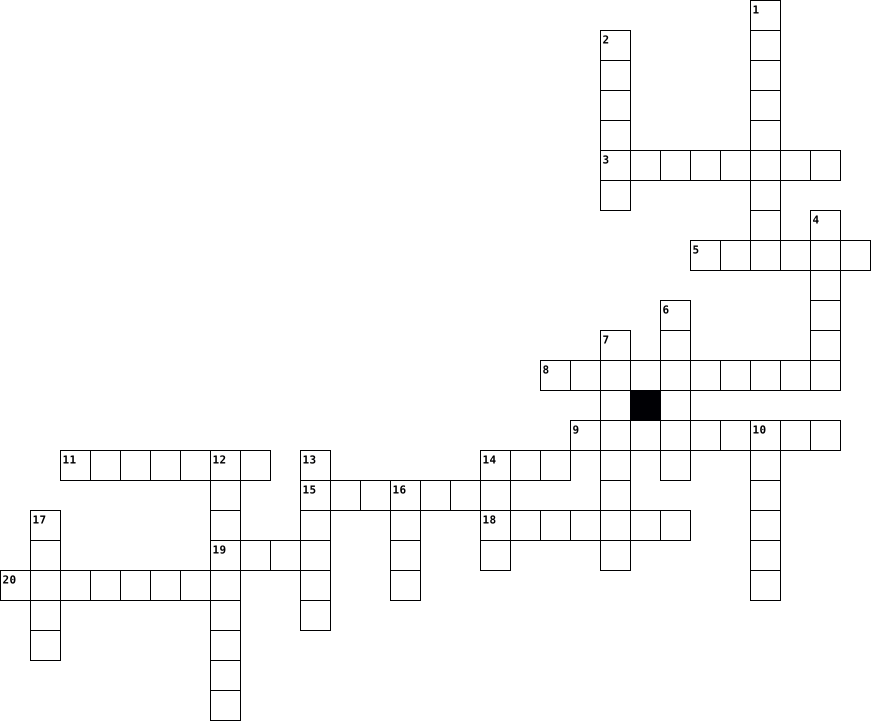
Across
- investment
- tulos
- taloudellinen
- bankruptcy
- vaje
- toimitusjohtaja
- kauppasaarto
- ylijäämä
- depression
- currency
Down
- interest rate
- sijoittaa varoja
- valtiontaloudellinen
- osakkeet
- lautapeli
- tarjonta
- inflaatio
- kysyntä
- korkotaso
- value
- romahdus
21 Clues: vaje • tulos • value • kysyntä • osakkeet • tarjonta • romahdus • ylijäämä • currency • lautapeli • inflaatio • korkotaso • investment • bankruptcy • depression • kauppasaarto • interest rate • taloudellinen • toimitusjohtaja • sijoittaa varoja • valtiontaloudellinen
Economics 2022-04-29
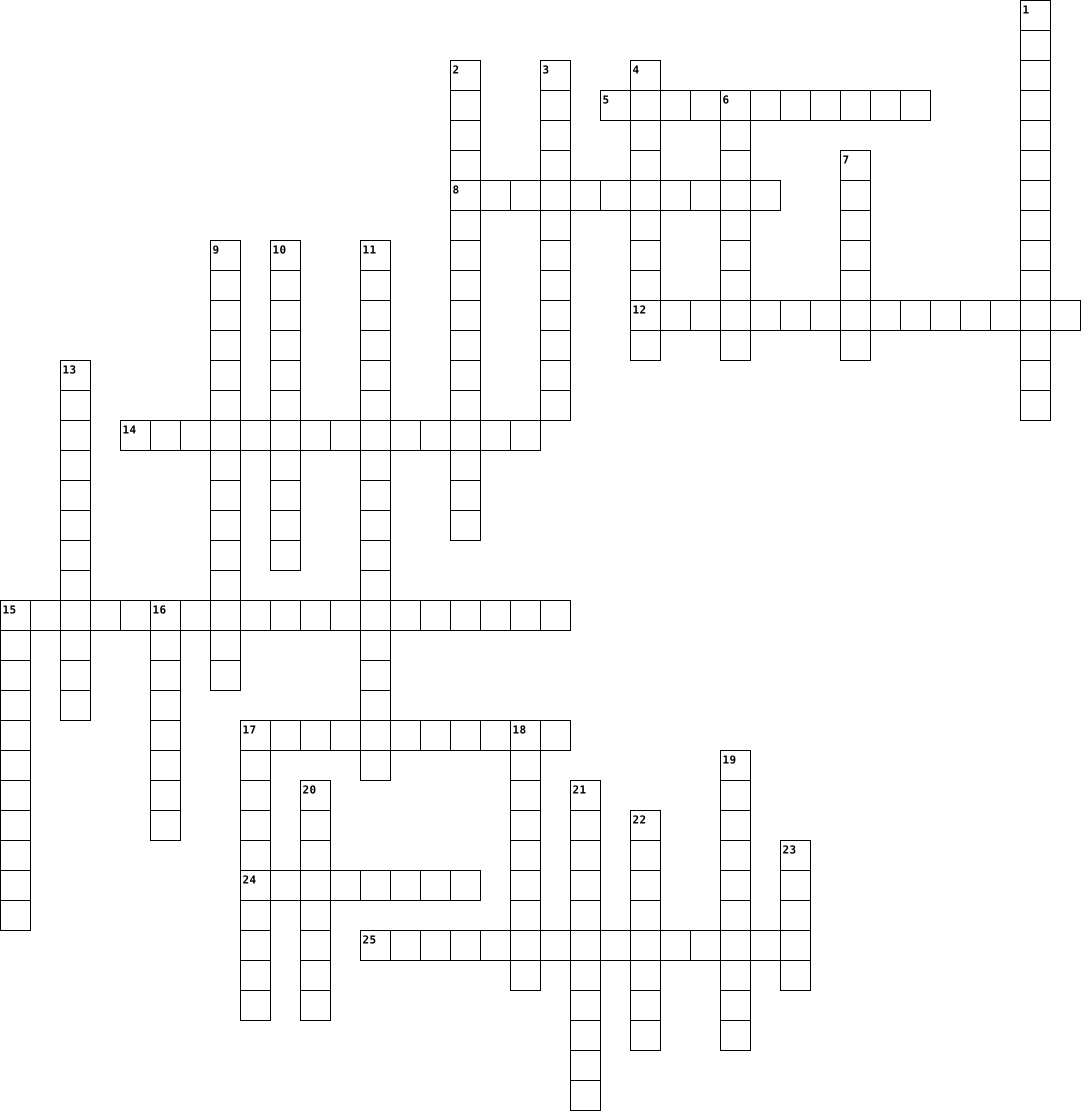
Across
- type of economy in which decisions are based on historical precedent rather than individual ability
- producers will produce more when they can sell at a higher price and will produce less when they can sell at a lower price
- the value of the second-best alternative that is given up when choosing the best option
- central bank of the US; regulates member banks, provides financial services to the government, and manages the money supply to limit inflation
- through their purchases, buyers determine what will be produced
- structure of business in which all profit and risk is shared between two or more owners
- economic model of ____ flow includes households, businesses, the government, the market for resources, and the market for goods and services
- a factor of production that comes from nature, such as water, oil, apples, or land
Down
- structure of business in which all profit and risk belong to one owner
- intersection of supply and demand at which everyone who wants to sell at that price can sell, and everyone who wants to buy at that price can buy
- set by the Federal Reserve; the cost to banks of borrowing funds from the Fed; can be increased to shrink the money supply
- combining human, natural, capital, and entrepreneurship resources to make goods or provide services
- increase in prices that leads to a decrease in the purchasing power of money
- type of economy defined by lack of consumer choice and centralized control (usually by the government) of property and resources
- items, resources, and ideas that a person owns; protected by the government
- legal entity in which all owners share the profits and each owner risks only the loss of their individual investment amount
- set by the Federal Reserve; the minimum amount of consumer deposits that a bank must have on hand at the end of each day; can be increased to shrink the money supply
- person who takes risks to produce/sell goods and services in search of profit
- struggle between producers of similar goods and services that leads to better quality, lower prices, and increased selection for consumers
- one producer controls all production of a single good or service
- something that a person can use or benefit from without paying, such as highways or national defense
- collected by federal and state government; based on the amount of pay earned
- type of economy defined by ownership of private property, no government involvement, competition, and individual choice in economic decisions
- resources and goods are limited, but wants and needs are not, which requires that choices be made
- collected by local government; based on land, buildings, cars, boats and other large privately owned items
- collected by state and local government; based on a percentage of the purchase price of a good
- type of economy which includes some elements of free enterprise as well as government involvement
27 Clues: through their purchases, buyers determine what will be produced • one producer controls all production of a single good or service • structure of business in which all profit and risk belong to one owner • items, resources, and ideas that a person owns; protected by the government • increase in prices that leads to a decrease in the purchasing power of money • ...
Economics 2022-05-05

Across
- ylijäämä
- pääoma
- arvo
- kuluttaja
- kysyntä
- valtiontaloudellinen
- laskusuhdanne
- sijoittaa varoja
- velka
- käteinen
- olla hinnaltaan
Down
- yksinoikeus
- luotto
- lama
- raha-asioihin liittyvä
- alijäämä
- lainata
- joukkovelkakirja
- tappio
- kauppasaarto
20 Clues: lama • arvo • velka • luotto • pääoma • tappio • kysyntä • lainata • ylijäämä • alijäämä • käteinen • kuluttaja • yksinoikeus • kauppasaarto • laskusuhdanne • olla hinnaltaan • joukkovelkakirja • sijoittaa varoja • valtiontaloudellinen • raha-asioihin liittyvä
economics 2022-07-09

Across
- gross investment minus depreciation
- human-made goods used in production
- the output per factor of production in an hour
- risk bearing and key decesion making in business
- spending on capital goods
- a person who bears risks and makes the key decisions in a business
- the ability of enterprise to change where it works or in which occupation
- reduction in the number of capital goods caused by some obsolete and worn out capital goods not being replaced
- a situation where there is not enough to satisfy everyone's wants
- capable of changing use
- the next best alternative forgone
- the ability of capital to change where it works or in which occupation
Down
- the ability of labour to change where it works or in which occupation
- people in work and those actively seeking work
- a curve that shows the maximum output of two types of products and combination of those products that can be produced with existing resources and technology
- goods and services purchased by households for their own satsifaction
- output per worker hour
- goods and services produced by the factors of production
- incapable of moving from one location to another location
- the value of capital goods that have worn out or become obsolete
- total spending's on capital goods
- factors used to produce goods and services
- the next best alternative forgone
- human effort (physical and mental) used in producing goods and services
- a product which requires resources to produce it and therefore has an opportunity cost
- unlimited wants exceeding finite resources
- gifts of nature available for production
- the economic resources of land, labour, capital and enterprise
- a product which does not require any resources to make it and so does not have an opportunity cost
29 Clues: output per worker hour • capable of changing use • spending on capital goods • total spending's on capital goods • the next best alternative forgone • the next best alternative forgone • gross investment minus depreciation • human-made goods used in production • gifts of nature available for production • factors used to produce goods and services • ...
economics 2022-07-09

Across
- gross investment minus depreciation
- human-made goods used in production
- the output per factor of production in an hour
- risk bearing and key decesion making in business
- spending on capital goods
- a person who bears risks and makes the key decisions in a business
- the ability of enterprise to change where it works or in which occupation
- reduction in the number of capital goods caused by some obsolete and worn out capital goods not being replaced
- a situation where there is not enough to satisfy everyone's wants
- capable of changing use
- the next best alternative forgone
- the ability of capital to change where it works or in which occupation
Down
- the ability of labour to change where it works or in which occupation
- people in work and those actively seeking work
- a curve that shows the maximum output of two types of products and combination of those products that can be produced with existing resources and technology
- goods and services purchased by households for their own satsifaction
- output per worker hour
- goods and services produced by the factors of production
- incapable of moving from one location to another location
- the value of capital goods that have worn out or become obsolete
- total spending's on capital goods
- factors used to produce goods and services
- the next best alternative forgone
- human effort (physical and mental) used in producing goods and services
- a product which requires resources to produce it and therefore has an opportunity cost
- unlimited wants exceeding finite resources
- gifts of nature available for production
- the economic resources of land, labour, capital and enterprise
- a product which does not require any resources to make it and so does not have an opportunity cost
29 Clues: output per worker hour • capable of changing use • spending on capital goods • total spending's on capital goods • the next best alternative forgone • the next best alternative forgone • gross investment minus depreciation • human-made goods used in production • gifts of nature available for production • factors used to produce goods and services • ...
Economics 2022-12-01

Across
- where buyers and sellers get together to trade
- an economic system where resources are state owned and allocated by central body.
- a simplified view of reality used to explain economic problems and issues.
- any business that hires factors of production to produce goods and services
- that part of an economy under ownership.
- things that are necessary for survival, such as food.
- resources are scarce so individuals, firms and goverments have to consider alternatives
- inputs available for the production of goods and services
- direct payments made by governments to proders of goods and services.
- the value of labour to the productive potential of an economy
- the goods and services that people may like to have but are not always realised
Down
- goods that are consumed by one person and not available to anyone else.
- a good consumed with another
- a good that is thought to be desirable for consumers but which is underprovided by the market because of information failure
- the quntity of a product that consumers are willing and able to buy at differentprices per period of time other things equal, ceteris paribus.
- the study of an economy or a group of economics
- the maximum output that can be produced when all resources are used fully
- a tax levied on goods and services, such as a general sales tax.
- factors of production such as machinery , buildings and infrastructure.
- a factor of production; natural resources in an economy
- where it is possible to stop someone from consuming a good or service
21 Clues: a good consumed with another • that part of an economy under ownership. • where buyers and sellers get together to trade • the study of an economy or a group of economics • things that are necessary for survival, such as food. • a factor of production; natural resources in an economy • inputs available for the production of goods and services • ...
Economics 2022-12-01

Across
- the quantity of a product that producers are willing and able to sell at different prices within a time period. Other things equal
- where consumption by one person of a good or service reduces the availability of the good or service for others
- the quantity of a product that consumers are willing and able to buy at different prices within a time period, other things equal
- direct payments made by governments to producers of goods and services
- it is possible to stop someone from consuming a good or service
- a good that is thought to be desirable for consumers but which is underprovided by the market because of information failure
- the goods and services that people may like to have but are not always needed
- where buyers and sellers get together to trade
- an individual who seeks out new business opportunities and is willing to take risks
- a factor of production; a physical resource made by humans that aids the production of goods and services
- a good that is non-excludable and non-rival
Down
- goods that are not scarce and have zero opportunity cost
- the means of allocating resources in a market economy
- an alternative good
- things that are necessary for survival, such as food
- the total amount demanded by consumers
- a simplified view of reality used to explain economic problems and issues
- a good consumed with another
- individuals or households who buy goods and services for their own use or for others
- a situation in which wants and needs are greater than the resources available
20 Clues: an alternative good • a good consumed with another • the total amount demanded by consumers • a good that is non-excludable and non-rival • where buyers and sellers get together to trade • things that are necessary for survival, such as food • the means of allocating resources in a market economy • goods that are not scarce and have zero opportunity cost • ...
Economics 2022-09-09

Across
- limited resources not being able to meet unlimited needs and wants
- part of AD formula and is affected by population growth
- unemployment caused due to lack of aggregate demand
- supply factor where amount of output is produced with any given number of input
- tax on individuals income and the bulk of government revenue
- a type of market structure with no competition
- living standards measured by goods and services
- unemployment cause by discouragement of job prospects and not counted in statistics
- what is interest rate
- unemployment when an individual is in between jobs
- makes up 75% of exports
- leading forum to facilitate trade/ investment and economic growth consisting of 21 countries
- geographically located agreement
- test done to check individual’s income and ownership
- living standards of an individual's quality of life with no monetary factors
Down
- income after tax
- the AD formula
- occurs when there is 2 years of consecutive negative GDP & low inflation
- unemployment due to automation
- global agreement
- part time/ casual workers that work similar hours as full time
- occurs when there is high GDP and unemployment decreases
- consumers being optimistic about their future
- something being forgone in order to get something else
- a type of market structure with little competition but not much effect
- taxes on specific goods and services like tobacco
- part of AD formula and is affected by business confidence
27 Clues: the AD formula • income after tax • global agreement • what is interest rate • makes up 75% of exports • unemployment due to automation • geographically located agreement • consumers being optimistic about their future • a type of market structure with no competition • living standards measured by goods and services • taxes on specific goods and services like tobacco • ...
Economics 2022-09-08

Across
- A number between zero and one that indicates the level of inequality in the distribution of income or wealth.
- costs of borrowing.
- It is a way of visually representing the distribution of income or wealth across a population.
- Spending on goods and services within the period.
- It describes a situation where the potential labour of employed people is not fully used
- It is defined as employed persons who are highly skilled but are working in low-paid or low-skilled jobs or are working part-time but would prefer to be working on a full-time basis.
- It is a situation in which economic forces such as supply and demand are balanced.
- It refers to individuals who might be considered unemployable because of some personal characteristic, such as a physical disability.
- It refers to the economic problem that arises because the volume of resources (land, labour and capital) is limited compared with individual needs and wants, which are unlimited.
- fixing It is an anti-competitive practice that allows companies to get together to fix and control or maintain prices artificially, and increase the prices for consumers.
- This is the skill and talent needed to combine the other three resources to successfully produce something people want to buy.
Down
- The volume of output that is produced from any given number of inputs.
- The factors that affect a person's quality of life irrespective of income.
- It is a measure of how much the quantity changes when the price changes and it determines the slope of a demand curve and the slope of a supply curve.
- Spending by government departments and public enterprises on goods and services within the period.
- It is a government policy that takes proportionately more tax from those on higher levels of income and redistributes welfare benefits to those on lower incomes.
- An increase in the value of the Australian dollar
- It is one of the supply factors that shifts the supply curve to the left and it refers to natural events such as floods and droughts.
- It is when a small number of large firms have all or most of the sales in an industry.
- a sustained period of weak or negative growth in real GDP (output) that is accompanied by a significant rise in the unemployment rate
- It is the exclusive possession or control of the supply of or trade in a commodity or service.
- It comprises all people aged over 15 years who are able and willing to work including those who are classified as employed and those who are unemployed.
- A system of money in general use in a particular country
- It measures peoples’ access to goods and service
- It is one of the demand factors which is whether consumers are optimistic or pessimistic about their future spending
- X in aggregate demand formula and income earnt by Australians selling goods overseas.
- The value of the Australian dollar against another currency.
- It is defined as a good or a service that is used in pairs such as pen and ink.
- It occurs when funds are added to the circular flow from a source other than households and businesses.
- the distribution of a company's earnings to its shareholders and is determined by the company's board of directors
30 Clues: costs of borrowing. • It measures peoples’ access to goods and service • An increase in the value of the Australian dollar • Spending on goods and services within the period. • A system of money in general use in a particular country • The value of the Australian dollar against another currency. • ...
Economics 2022-09-08

Across
- Money leaving the economy
- When there's a single seller in a market (no competition)
- Tax imposed on particular goods and services
- rate The value of the australian dollar is determined by the _______
- Line used to represent perfect income equality (at 45 degrees of lorenz curve)
- A direct tax imposed against the income and capital gains of a company
- Income after tax
- Type of business that has around 2-20 owners that all share the profits
- Refers to factor of production that uses machinery to produce goods and services
- Individuals 15 years and older who are either employed or unemployed but actively looking for work
- When an individual has been unemployed for more than one year
- When unlimited needs and wants meet limited resources
- possibility curve PPC
- = C + I + G1 + G2 + X - M
Down
- Type of income received by people who contributed in the production process that takes form in wages or salary
- A number between 0 and 1 that indicates the level of inequality in the distribution of income and wealth
- People who are highly skilled and employed but either do not work enough hours or working a low skilled job
- Type of unemployment when an individual is in between job
- Term to describe the intake of good and services by consumers
- When there is high GDP growth, low unemployment and high inflation
- Visual representation of distribution of income
- A measure of a country's GDP that takes market GDP and adjusts it for inflation
- When there is 2 consecutive negative GDP growth quarters
- Involves business capitalist expenditure of manufactures and equipment
- Type of unemployment that is affected by demand side factors
- Represents the cost of borrowing
26 Clues: Income after tax • possibility curve PPC • Money leaving the economy • = C + I + G1 + G2 + X - M • Represents the cost of borrowing • Tax imposed on particular goods and services • Visual representation of distribution of income • When unlimited needs and wants meet limited resources • When there is 2 consecutive negative GDP growth quarters • ...
Economics 2023-02-05

Across
- a person who organizes and manages any enterprise especially a business usually with considerable initiative and risk
- a branch of mainstream economics that studies the behavior of individuals and firms in making decisions regarding the allocation of scarce resources and the interactions among these individuals and firms.
- of trade: the difference in value over a period of time between a country's imports and exports of goods and services, usually expressed in the unit of currency of a particular country or economic union
- economics: refers to the school of thought of economics that originated in the late 18th and early 19th centuries, especially in Britain.
- a branch of economics which deals with the performance, structure, behavior, and decision-making of an economy as a whole.
- a service or other asset used to produce goods and services that meet human needs and wants
- anything that helps us produce things faster, better or cheaper.
- the demand for a good or service is greater than the availability of the good or service
- deficit: the amount by which the cost of a country's imports exceeds the value of its exports
- refers to the policy of protecting domestic industries against foreign competition through tariffs, import quotas and subsidies, or other restrictions placed on the imports of foreign competitors.
- a measure of the rate of rising prices of goods and services in an economy.
Down
- people who are jobless, actively seeking work, and available to take a job
- the consumer's desire and willingness to buy a product or service at a given period or over time.
- an asset acquired or invested in to build wealth and save money from the hard earned income or appreciation.
- of payments: the difference between all money flowing into the country in a particular period of time and the outflow of money to the rest of the world.
- the ability of a consumer or producer to decide which good, service or resource to purchase or provide from a range of possible options
- items that add some kind of benefit to the lives of the people who consume them
- the total amount of a given product or service a supplier offers to consumers at a given period and a given price level.
- an intangible commodity
- the amount of money that a buyer gives to a seller in exchange for a good or a service.
- belief in the benefits of profitable trading; commercialism.
- growth: the increase or improvement in the inflation-adjusted market value of the goods and services produced by an economy in a financial year.
- the amount of physical, mental, and social effort used to produce goods and services in an economy
- surplus: the amount by which the value of a country's exports exceeds the cost of its imports.
24 Clues: an intangible commodity • belief in the benefits of profitable trading; commercialism. • anything that helps us produce things faster, better or cheaper. • people who are jobless, actively seeking work, and available to take a job • a measure of the rate of rising prices of goods and services in an economy. • ...
Economics 2025-11-06

Across
- Studied
- Productivity
- Profit Helps Society
- Main Problem
- Free Market
- Birthplace
- Limited Government
- University
- Wealth of
- Market Phrase
- Protect Property
- Field of Study
- Taught
- Opposed Theory
- Publication Year
- Death Year
- Global Bank
- Publication Year
Down
- Moral Book
- Birthplace
- Gov Spending Theory
- Economic Recessions
- Nationality
- Father of Economics
- Wrote General Theory
- Economic Decline
- Gold System
- Crisis Advised
- Policy Tool
- Helped Design
30 Clues: Taught • Studied • Wealth of • Moral Book • Birthplace • Birthplace • University • Death Year • Nationality • Free Market • Gold System • Policy Tool • Global Bank • Productivity • Main Problem • Market Phrase • Helped Design • Crisis Advised • Field of Study • Opposed Theory • Economic Decline • Protect Property • Publication Year • Publication Year • Limited Government • Gov Spending Theory • Economic Recessions • ...
Economics 2025-11-20

Across
- business cycle bottoms out
- gas & produce are ______ goods
- opportunity
- supply chains impact
- sold to the world from home
- do what you want with this income
- having more than you need
- price with inflation added
- fast & big inflation
- last longer than three years
- economic growth phase
- "stuff" for a business
Down
- an entire market
- between jobs
- borrowing from a bank
- usefulness
- increase in prices
- devil went down to Georgia...
- market surprise
- consume as you wish
- main interest rate
21 Clues: usefulness • opportunity • between jobs • market surprise • an entire market • increase in prices • main interest rate • consume as you wish • supply chains impact • fast & big inflation • borrowing from a bank • economic growth phase • "stuff" for a business • having more than you need • business cycle bottoms out • price with inflation added • sold to the world from home • ...
Economics 2025-11-20

Across
- The purpose of this is to increase wages and better the working conditions of the members
- A business owned by more than one person that makes up 4% of all sales
- Legally treated like it is its own entity and is owned by individual stockholders
- They have no owner, and they usually offer a benefit to the public. They don't exist to make profit.
- Legal/Financial responsibility for causing bodily or property damage
- A worker with no special skills, like a dishwasher
- Just like a limited partnership but each person only has a limited amount of liability
- A merger of 3 or more unrelated businesses joining
- A business organization owned and operated by a group of individuals for shared benefit
- Workers that are naturalized citizens, permanent residents, guest workers, and unauthorized immigrants
- All nonmilitary people who are employed or unemployed
Down
- One person holds the liability and the other person invests the money
- A worker with advanced skills and education, like a lawyer
- A type of employment known as contingency employment
- These are corporations that are headquartered in one country but operate in many
- Semi independent business that pays fees to a parent company for the right to sell something
- This type of business makes up 10% of businesses and 15% of sales
- A worker with minimal skills, like a warehouse worker
- When two or more firms in the same competing market join together
- A worker with specialized abilities, like a mechanic or a chef
20 Clues: A worker with no special skills, like a dishwasher • A merger of 3 or more unrelated businesses joining • A type of employment known as contingency employment • A worker with minimal skills, like a warehouse worker • All nonmilitary people who are employed or unemployed • A worker with advanced skills and education, like a lawyer • ...
Economics 2025-10-31

Across
- What type of theories did the U.S. and Europe use
- Smith’s ideas rested on principles
- Until what event was Keynes considered a conventional economist
- From the U.S., where did he negotiate a loan to
- What year was Smith born
- He believed in the hand of the market
- What economics are activist fiscal policies derived from
- The name of John M. Keynes’s famous book
- He thought that an increase in spending would drive up what
- Type of policy based on Keynes’s ideas
- Where was Adam Smith educated
- What else did Keynes identify as important
- Smith believed that markets function best within what systems
- Year John M. Keynes was born
- In his book, he stresses that consumers didn’t cause shifts in what cycle
- What did Smith pull us out of
- Countries that used his theories during World War II
Down
- What Keynes believed could help create jobs
- What year did Smith die
- Year John M. Keynes wrote his book
- What University did Adam Smith teach
- What University John M. Keynes went to
- John M. Keynes’s profession
- How Keynes’s ideas differed from Adam Smith’s
- Where was Keynes writing during the Depression
- What conference was he representative at after World War II
- Where was Smith’s native country
- What was the most influential book Adam Smith wrote
- Who was John M. Keynes
- Who is the father of economics
- University where Keynes taught
- When was Smith’s book The Wealth of Nations published
- Why John M. Keynes is still important today
- His insightful analyses elevated economics to the status of
- What examples did Smith use to critique economic theory
- Where John M. Keynes was from
- What Keynes believed the government should do during a recession
- Which social system reins in market-disordering forces
38 Clues: Who was John M. Keynes • What year did Smith die • What year was Smith born • John M. Keynes’s profession • Year John M. Keynes was born • Where was Adam Smith educated • Where John M. Keynes was from • What did Smith pull us out of • Who is the father of economics • University where Keynes taught • Where was Smith’s native country • Year John M. Keynes wrote his book • ...
Economics 2025-11-04

Across
- His discipline (JMK)
- Last name (AS)
- The ideal economic ___ is shaped... (AS)
- His ____ analysis... (AS)
- He wrote the General Theory of... in 19__ (JMK)
- He became a representative at the Bretoon Woods Conference in 194_ (JMK)
- His final work was in 194_ (JMK0
- First name (AS)
- His most influential book is "The ___ of Nations (AS)
- Middle name (JMK)
- Last name (JMK)
- Where was he born (AS)
- He believed in the "invisible ___" (AS)
- He therefore criticized cutthroat "dog-eat-___"... (AS)
- He was born in 188_ (JMK)
Down
- Until 1930, he was a ____ economist (JMK)
- He was an _____ (JMK)
- First name (JMK)
- Smith used ____ and illustrative... (AS)
- He was educated at _____ University (AS)
- He is known as the _____ of economics (AS)
- Everyone _____ in his own... (AS)
- He died in 194_ (JMK)
- He wrote his most influential book in ____ (AS)
- He wrote the General Theory of Employment, Interest and ____ (JMK)
- He was taught at _____ University (AS)
- He was an _____ economist (JMK)
- Where was he educated (JMK)
- Smith's ___ rested on free market principles... (AS)
- During WW2, US and most of _____ used his economic theories (JMK)
30 Clues: Last name (AS) • First name (AS) • Last name (JMK) • First name (JMK) • Middle name (JMK) • His discipline (JMK) • He was an _____ (JMK) • He died in 194_ (JMK) • Where was he born (AS) • His ____ analysis... (AS) • He was born in 188_ (JMK) • Where was he educated (JMK) • He was an _____ economist (JMK) • His final work was in 194_ (JMK0 • Everyone _____ in his own... (AS) • ...
Economics 2026-01-20

Across
- Factor that raises spending when households feel secure about future income
- Demand for labour when a wage rise causes a large fall in employment
- Characteristic of money that prevents loss of value through oversupply
- Function of money that allows wages or loans to be paid later
- Factor that raises wages when workers negotiate from a strong position
- Factor that may reduce the proportion of income saved by richer households
- Factor that encourages saving when it rises
- Cause of wage differences due to unequal treatment of workers
- Factor that makes labour demand more elastic when machines can replace workers
- Production method that raises output through task specialisation
- Factor that increases elasticity of labour supply when workers can change jobs easily
- Characteristic of money that allows repeated use without wearing out
Down
- Central bank role that supports banks during liquidity crises
- Factor that limits labour supply when skills take time to acquire
- Income remaining after direct taxes are deducted
- Household decision that increases present spending without higher income
- Function of money reduced when inflation lowers purchasing power
- Household decision that delays current consumption
- Factor that increases borrowing when loans are easier to obtain
- Function of money that allows comparison of wages across different jobs
20 Clues: Factor that encourages saving when it rises • Income remaining after direct taxes are deducted • Household decision that delays current consumption • Central bank role that supports banks during liquidity crises • Function of money that allows wages or loans to be paid later • Cause of wage differences due to unequal treatment of workers • ...
Economics 2026-01-20

Across
- Factor raising wages through worker negotiation power
- Factor increasing responsiveness of labour supply
- Productivity gain from workers focusing on tasks
- Function of money weakened by inflation
- Cause of wage differences due to unequal treatment
- Function of money used to compare wages and prices
- Money characteristic preventing loss of value through oversupply
- Function of money allowing future payments
- Factor increasing borrowing when loans are easier to obtain
- Central bank role supporting banks in emergencies
Down
- Labour demand when wage rises reduce employment greatly
- Income remaining after direct taxation
- Household choice that raises present spending
- Factor making labour demand more elastic when machines replace workers
- Household choice that delays consumption
- Factor affecting saving behaviour of high income households
- Factor encouraging saving when it rises
- Factor raising spending when households feel secure
- Factor limiting labour supply due to skill requirements
- Money characteristic allowing repeated use
20 Clues: Income remaining after direct taxation • Function of money weakened by inflation • Factor encouraging saving when it rises • Household choice that delays consumption • Function of money allowing future payments • Money characteristic allowing repeated use • Household choice that raises present spending • Productivity gain from workers focusing on tasks • ...
ECONOMICS!!!!!! 2025-09-10

Across
- cost of borrowing money
- entity having total control over a particular market
- one who buys
- exports minus imports over a period of time
- financial assistance from the government
- portions of a company
- working productively with minimum expense
- usefulness/satisfaction from goods/services
- slowing down of economic growth
- worldwide trad/cultural exchange
- quantity of goods/services desired
- wealth
- companies' obligation to society
- distribute
- gradual worsening
- level of comfort experienced by a population
- motivation to do something
Down
- condition in which there is a lack of something
- goods over and above necessity
- pertaining to the economy
- movement of people to another country
- common language used among non-native speakers
- time/money put towards an expected profitable return
- able to be produced indefinitely
- level of comfort people feel spending money
- a government's strategy for managing its budget
- able to be maintained over time
- pertaining to one's own country
- efficient
- goods/services available to consumers
- relying on
31 Clues: wealth • efficient • relying on • distribute • one who buys • gradual worsening • portions of a company • cost of borrowing money • pertaining to the economy • motivation to do something • goods over and above necessity • able to be maintained over time • slowing down of economic growth • pertaining to one's own country • able to be produced indefinitely • worldwide trad/cultural exchange • ...
Economics 2026-01-07

Across
- Goods that are rival but non-excludable (ex: fish in the ocean).
- The total value of final goods and services produced in a country in one year.
- Taxes on imported goods.
- Tax where the percentage paid increases as income increases.
- GDP measured using constant prices, adjusted for inflation.
- Externality that causes harm
- Tax where the percentage paid decreases as income increases.
- Measures the average change in prices of a market basket of goods over time.
- Tax where the same percentage is paid at all income levels.
- The lowest point of economic activity before recovery starts.
- A good where one person’s use reduces availability for others.
- A good that is rival and excludable (ex: food, clothes).
- A required payment to the government to fund public services.
- Unemployment caused by people temporarily searching for jobs.
- A period when GDP and economic activity decline.
- Externality that creates benefits
- A period of the business cycle when GDP, employment, and production increase.
- A good that people cannot be prevented from using.
Down
- When workers are overqualified or working fewer hours than they want.
- GDP measured using current prices in the year goods and services are produced.
- A side effect of production or consumption that affects others.
- Goods that are non-rival but excludable (ex: streaming services).
- A good that can be withheld from people who do not pay.
- Unemployment that rises during economic downturns.
- A general increase in prices across an economy over time.
- Unemployment caused by a mismatch between workers’ skills and job requirements.
- A good that is non-rival and non-excludable (ex: national defense).
- The condition where limited resources must meet unlimited wants.
- Unemployment caused by seasonal changes in demand for labor.
- The highest point of economic activity before a contraction begins.
- A good that can be used by many people at the same time without reducing use.
31 Clues: Taxes on imported goods. • Externality that causes harm • Externality that creates benefits • A period when GDP and economic activity decline. • Unemployment that rises during economic downturns. • A good that people cannot be prevented from using. • A good that can be withheld from people who do not pay. • A good that is rival and excludable (ex: food, clothes). • ...
economics 2026-01-08

Across
- value The worth of a good or service is determined by how much an individual values it
- profit Motive Desire to achieve financial gain
- Something that motivates us to perform
- Analysis Weighing the costs
- incentive A benefit for an action
- The distributing or setting aside of resources for a specific purpose
- The branch of economics focused on the economy of a country or region
- Different options people have when deciding how to use their resources
- The study of how people, businesses, and governments decide to use limited resources to meet their needs
- incentive Cost for an action
- An Economic acronym that means "There is no such thing as a free lunch"
- returns When more of a resource is used to produce a good, the additional output will eventually decrease
Down
- possibilities curve An illustration that shows the maximum output of two goods when resources are used efficiently
- Unplanned results, either positive or negative
- Costs The next best alternative you give up when you choose one option over another
- The satisfaction or happiness that comes from consuming a good or service
- money paid for borrowing money or earned for lending it
- The branch of economics focused on how individuals and businesses make decisions
- incentive Motivators that do not involve money but still encourage specific behaviors
- Incentive A reward that motivates someone to do an action
- The monetary worth of a good service
- The condition of limited resources and unlimited wants
- The money a business makes
- of increasing opportunity costs The more of a product you produce, the greater the opportunity cost to produce each product
- of Inputs The difficulty in using resources across different types of production
25 Clues: The money a business makes • incentive Cost for an action • incentive A benefit for an action • The monetary worth of a good service • Analysis Weighing the costs • Something that motivates us to perform • Unplanned results, either positive or negative • profit Motive Desire to achieve financial gain • The condition of limited resources and unlimited wants • ...
Economics 2026-04-02

Across
- A required payment to a local, state, or national government
- The portion of corporate profits paid out to stockholders
- Money and other valuables belonging to an individual or business
- formal contract to repay borrowed money
- Reserve The nation's central banking system
- The study of how people seek to satisfy their needs and wants by making choices
- The financial gain made in a transaction
- The annual rate of return on a bond
- An item that we desire but that it not essential to survival
- The desire to own something and the ability to pay for it
- The effort that people devote to a task for which they are paid
Down
- Any human-made resource that is used to create other goods or services
- Any form of deferred payment
- A plan for saving and spending
- An illegal group of companies that discourages competition
- A good that is sent to another country for sale
- The amount of goods available
- A factor that can change
- Physical objects
- Anything that serves as a medium of exchange
20 Clues: Physical objects • A factor that can change • Any form of deferred payment • The amount of goods available • A plan for saving and spending • The annual rate of return on a bond • formal contract to repay borrowed money • The financial gain made in a transaction • Reserve The nation's central banking system • Anything that serves as a medium of exchange • ...
Economics 2026-03-31

Across
- Work done for you, like a haircut or car wash
- ____ Resources = Skills and knowledge people gain through education
- Period of declining economic activity
- Government organization that prints money and controls interest
- Percentage of labor force without jobs but seeking work
- Money made after costs are taken out
- A person who buys and uses things
- Quantity producers are willing to sell at different prices
- Physical items you can buy, like shoes or food
- Quantity consumers are willing and able to buy at various prices
Down
- When there is more of something then people want
- A Government payment to producers
- Point where supply and demand are equal
- General rise in prices over time
- ____ Resources = Materials found on earth
- A tax on goods coming from other countries
- ____ Resources = Tools and machines used to make other goods
- A line on a demand or supply graph
- Total value of goods and services produced in a country
- When there is not enough of something people want
20 Clues: General rise in prices over time • A Government payment to producers • A person who buys and uses things • A line on a demand or supply graph • Money made after costs are taken out • Period of declining economic activity • Point where supply and demand are equal • ____ Resources = Materials found on earth • A tax on goods coming from other countries • ...
Economics 2026-04-27

Across
- a political and economic way of organizing the state and society in which the government owns and controls major industries rather than individual people and companies
- the ability of citizens in a society to make economic choices
- data used to help measure the health of the economy; common examples include GDP, PPP, HDI, employment numbers, inflation, home sales etc.
- a system of centralized political power and economic system in which a single-party or dictatorship abolishes private property and controls the means of production and the distribution of goods and services
- how well people live in a town, region, or country in terms of income and wealth
- the method used by a society or government to organize production and distribute resources, goods and services
- the study of the production, distribution, and consumption of goods and services
- economy an economy in which a central government controls production, investment, prices, and incomes
Down
- a person who creates and supplies goods or services
- successful, flourishing, or thriving
- an economic system in which private individuals own and control most of the factors of production
- an economic system in which some elements are left to the free market but other parts of managed by the government
- intangible items that consumers may purchase (haircuts, dental services babysitting)
- an economy free of government regulation
- tangible items that consumers may purchase (pens, apples, books)
- anything that enables us to produce goods and services; common examples of capital are tools, factories, materials, knowledge, and money
- an economic system in which production and prices are determined by supply and demand and unrestricted competition between privately owned businesses.
- a person who buys a good or service
- the amount that is produced; together with demand will impact price
- of production the resources needed to produce a good or service including land, labor, capital, and entrepreneurship
- the amount consumers want to buy; together with supply will impact price
21 Clues: a person who buys a good or service • successful, flourishing, or thriving • an economy free of government regulation • a person who creates and supplies goods or services • the ability of citizens in a society to make economic choices • tangible items that consumers may purchase (pens, apples, books) • ...
Economics 2026-04-28

Across
- Marginal Product x Marginal Revenue (or Price if the goods and services market is perfectly competitive)
- Main reason for the decline of the global economy.
- The additional output generated by employing one more unit of a resource.
- A situation or determinant that increases both price elasticity of supply and price elasticity of demand.
- What is enjoyed by sellers whose marginal private cost is below the price they actually receive as payment.
- A good whose benefits are rival but difficult to keep non-payers from accessing.
- The lost surplus created in a market when society doesn’t allocate the right amount of scarce resources for production.
- In a perfectly competitive labor market, the wage, MFC and supply curve for a firm are…
- A source of market failure that stems from spillover costs onto bystanders, making the market quantity greater than socially efficient.
- At the quantity where ______ = zero, the demand curve of a firm is unit elastic.
- The extra cost of hiring one more unit of a productive resource.
Down
- The difference between total benefits and total costs.
- The entry of more firms into a perfectly competitive market due to short-run economic profit will…
- The entry of more firms into a perfectly competitive market due to short-run economic profit will…
- Establishing this market control at the price where MC equals D will eliminate deadweight loss in a monopoly market.
- The part of total surplus captured by buyers whose willingness to pay exceeds the price they actually pay.
- Workers’ desire for more of this will decrease the market supply curve in the labor market.
- A market in which one firm can produce the entire market output at a lower average total cost than multiple firms could.
- The reason that a constant-cost market in perfect competition will have a long-run supply curve that is perfectly elastic.
- The demand curve represents to society (given the existence of NO externalities).
- The entry of more firms into a monopolistically competitive market due to short-run economic profit will…
- What firms do in the short run when total revenue at the profit-maximizing quantity fails to cover total variable costs.
- A factor of production that is non-rival and does not suffer from scarcity.
- A numerical measure of income inequality.
24 Clues: A numerical measure of income inequality. • Main reason for the decline of the global economy. • The difference between total benefits and total costs. • The extra cost of hiring one more unit of a productive resource. • The additional output generated by employing one more unit of a resource. • ...
economics 2026-04-13

Across
- What type of unemployment is caused by a mismatch of skills in the labour market?
- What type of unemployment occurs when workers are between jobs temporarily?
- The term for the maximum output an economy can produce is called ______ capacity.
- The total number of people willing and able to work in an economy is called ______ force.
- What index is used to measure inflation?
- What measure is commonly used to track economic growth in a country?
- What type of unemployment happens during certain seasons (e.g. tourism or farming)?
- What type of unemployment is caused by a fall in aggregate demand in the economy?
- An increase in real GDP is called ______ growth.
- Real wage unemployment occurs when wages are inflexible above the ______ level.
- Growth driven by changes in aggregate demand is called ______-side growth.
- What type of inflation is caused by excess demand?
Down
- What is a sustained rise in the general price level called?
- Short-run growth occurs when ______ resources are used more efficiently.
- What happens to unemployment when economic growth increases? (general relationship)
- Inflation causes a decrease in ______ power.
- Central banks aim to achieve price ______ by controlling the money supply.
- Long-run economic growth occurs when there is an increase in the ______ potential of an economy.
- Inflation leads to a ______ in the real value of savings.
- What type of inflation is caused by higher production costs?
- What is the difference between the labour force and those actually employed called?
21 Clues: What index is used to measure inflation? • Inflation causes a decrease in ______ power. • An increase in real GDP is called ______ growth. • What type of inflation is caused by excess demand? • Inflation leads to a ______ in the real value of savings. • What is a sustained rise in the general price level called? • ...
Economics 2026-05-20

Across
- an economic system that relies on habit, custom, or ritual to decide the three basic economic questions
- the study of how people seek to satisfy their needs and wants by making choices
- a person who decides how to combine resources to create goods and services
- the physical objects that someone produces
- and Medicare programs
- economic system that has some market-based elements and some level of government involvement
- a set of government programs that protect people who face unfavorable economic conditions
- money paid by the hour and for an agreed number of hours per week
- an economic system in which the government makes all decisions on the three key economic questions
- the first modern economist, whose book The Wealth of Nations describes how free markets function and self-regulate. In addition to economics, Smith published works on moral philosophy. His economic ideas have influenced
- the principle that limited amounts of goods and services are available to meet unlimited wants
- payroll taxes that are used to pay for
- the struggle among producers for the dollars of consumers
Down
- an economic system in which decisions on the three key economic questions are based on voluntary exchange in markets
- describes demand that is not very sensitive to price changes
- a latin phrase that means all other things held constant
- a situation in which consumers want more of a good or service than producers are willing to make available at a particular price
- the most desirable alternative given up as the result of a decision
- the use of resources in such a way as to maximize the output of goods and services
- the annual deadline for filing your income taxes; usually falls on April 15
- a fixed annual amount earned by an employee, typically paid weekly, biweekly, or monthly
- the concentration of the productive efforts of individuals and businesses on a limited number of activities
- the knowledge and skills a worker gains through education and experience
- the resources that are used to make goods and services
- two goods that are bought and used together
- something essential for survival such as food or medical care
- tax paid out by anyone who earns an income
- describes demand that is very sensitive to a change in price
- something that people desire but that is not necessary for survival
- an official IRS inspection of a tax return to make sure the income and deductions are accurate
- the desire to own something and the ability to pay for it
31 Clues: and Medicare programs • payroll taxes that are used to pay for • the physical objects that someone produces • tax paid out by anyone who earns an income • two goods that are bought and used together • the resources that are used to make goods and services • a latin phrase that means all other things held constant • ...
6 2016-07-04

Across
- chemical
- annual
- herbicide
- integrated
- environmental
- biological
- sanitation
- quarantine
- ephemeral
- declared
- seed
- contact
Down
- physical
- translocated
- biodiversity
- vegetative
- solarise
- perennial
- economic
- cultural
20 Clues: seed • annual • contact • physical • chemical • solarise • economic • declared • cultural • herbicide • ephemeral • perennial • vegetative • integrated • biological • sanitation • quarantine • translocated • biodiversity • environmental
Economics 2018-08-28

Across
- Greek word that means "management of the household"
- deals with the behavior of individuals in the market
- supplies that enable the people to get what they want
- a situation in which the quantity supply is less than the quantity demanded
- the value of the next best alternative not chosen
- the father of economics.
- French economists who favored natural economy as opposed to the idea of mercantilism
- economic system that which aimed to accumulate wealth.
- the production of goods by people working at the jobs they do best
Down
- study of how individuals make choices that involve the use of scarce resources
- let things alone
- economics that deals with value judgments or what should be in the economy
- deals with the economy as a whole
- Adam Smith's book is entitled The ____________________
- a situation in which the amount of resources is sufficient or unavailable to satisfy people's desires
- Production Possibilities Frontier
- taxes that governments apply only to imported goods
- economics that uses scientific approach to explain how the economy works
- giving up other opportunities that we value
19 Clues: let things alone • the father of economics. • deals with the economy as a whole • Production Possibilities Frontier • giving up other opportunities that we value • the value of the next best alternative not chosen • Greek word that means "management of the household" • taxes that governments apply only to imported goods • ...
Earth Day Movement Crossword 2023-11-22

Across
- - Laws and regulations for environmental protection, a focus of Earth Day lobbying.
- - Annual event celebrated on April 22 to demonstrate support for environmental protection.
- - A key component of Earth Day, involving efforts to bring about environmental change.
- - Ms. Greulich's home planet.
- - Type of energy sources promoted by Earth Day advocates.
- - An eco-friendly practice heavily promoted during Earth Day.
- - A key concept promoted by Earth Day, aiming for a balance between environment and human needs.
- - One of the major environmental issues addressed by Earth Day initiatives.
- - The primary focus of Earth Day, concerning the natural world and its preservation.
- - A color often associated with environmentalism and Earth Day.
Down
- - The variety of life on Earth, whose preservation is a goal of Earth Day.
- - U.S. Senator who founded Earth Day in 1970.
- - A primary goal of Earth Day is to raise this about environmental issues.
- - A significant global issue that Earth Day campaigns often focus on.
- - The act of preserving and protecting natural resources, a key message of Earth Day.
- - A form of activism often associated with Earth Day to demand environmental action.
- - Scale at which Earth Day's impact is felt, beyond national boundaries.
- - Essential for spreading knowledge about environmental protection, often emphasized on Earth Day.
- - A common pollutant targeted by Earth Day initiatives.
- - The month in which Earth Day is observed.
20 Clues: - Ms. Greulich's home planet. • - The month in which Earth Day is observed. • - U.S. Senator who founded Earth Day in 1970. • - A common pollutant targeted by Earth Day initiatives. • - Type of energy sources promoted by Earth Day advocates. • - An eco-friendly practice heavily promoted during Earth Day. • ...
Human land use vocab 2023-05-03

Across
- internationally comparable measurement index that measures education, health, and living standards
- measurement index that combines three basic measures of human status: life expectancy; knowledge and education; and standard of living
- method of harvesting trees that involves removing all or most of the trees within an area
- study of how humans allocate scarce resources in the production, distribution, and consumption of goods and services
- subfield of economics that examines the costs and benefits of various policies and regulations that seek to regulate or limit air and water pollution and other causes of environmental degradation
- method of harvesting trees that involves the removal of single trees or small number of trees from the larger forest
- U.S. federal act that mandates an environmental assessment of all projects involving federal money or federal permits
- international program that works in 170 countries around the world to advocate change that will help people obtain a better life through development
- measure of economic status that includes personal consumption, income distribution, levels of higher education, resource depletion, pollution, and the health of the population
- classification used to designate lands that may be used for recreation, grazing, timber harvesting, mineral extraction.
- 1973 U.S. act designed to protect species from extinction
- global institution dedicated to the improvement of human health by monitoring and assessing health trends and providing medical advice to countries
- global institution dedicated to promoting dialogue among countries with the goal of maintaining world peace
- plan that outlines how a developer will address concerns raised by a project’s impact on the environment
- principle that grants government the power to acquire a property at fair market value even if the owner does not wish to sell it
- Urbanized areas that spread into rural areas, removing clear boundaries between them
- area similar to a suburb, but unconnected to any central city or densely populated area
- cost or benefit of a good or service that is not included in the purchase price of that good or service or otherwise accounted for
Down
- fire deliberately set under controlled conditions in order to reduce the accumulation of dead biomass on a forest floor
- document outlining the scope and purpose of a development project, describing the environmental context, suggesting alternative approaches to the project, and analyzing the environmental impact of each alternative
- zoning classification that allows retail and high-density residential development to coexist in the same area
- organization that oversees all governmental efforts related to the environment, including science, research, assessment, and education
- worldview that holds that humans are just one of many species on Earth, all of which have equal intrinsic value
- tax placed on environmentally harmful activities or emissions in an attempt to internalize some of the externalities that may be involved in the life cycle of those activities or products
- worldview that places equal value on all living organisms and the ecosystems in which they live
- national area set aside with the intent of preserving a large tract of intact ecosystem or landscape
- approach to removing trees from forests in ways that do not unduly affect the viability of other noncommercial trees
- department that advances the energy and economic security of the United States
- phenomenon of less developed countries using new technology without first using the precursor technology
- maximum amount of a renewable resource that can be harvested without compromising the future availability of that resource
- federal public land managed for the primary purpose of protecting wildlife
- strategy for pollution control that involves regulations and enforcement mechanisms
- Development that attempts to focus dense residential and retail development around stops for public transportation, a component of smart growth
- approach to sustainability that considers three factors—economic, environmental, and social—when making decisions about business, the economy, and development
- planning tool used to separate industry and business from residential neighborhoods
- strategy for pollution control that constructs financial and other incentives for lowering emissions based on profits and benefits
- agency of the U.S. Department of Labor, responsible for the enforcement of health and safety regulations
- phenomenon of less developed countries adopting technological innovations developed in wealthy countries
- degradation of the built and social environments of the city that often accompanies and accelerates migration to the suburbs
39 Clues: 1973 U.S. act designed to protect species from extinction • federal public land managed for the primary purpose of protecting wildlife • department that advances the energy and economic security of the United States • strategy for pollution control that involves regulations and enforcement mechanisms • ...
Economics 2018-08-28

Across
- Greek word that means "management of the household"
- study of how individuals make choices that involve the use of scarce resources
- the value of the next best alternative not choosen
- the father of economics.
- economics that uses scientific approach to explain how the economy works
- taxes that governmebts apply only to imported goods
- deals with the behavior of individuals in the market
- French economists who favored natural economy as opposed to the idea of mercantilism
- giving up other oppurtunities that we value
- a situation in which the quantity supply is less than the quantity demanded
- economics that deals with value judgements or what should be in the economy
Down
- deals with the economy as a whole
- Adam Smith's book is entitled The ____________________
- supplies that enable the people to get what they want
- the production of goods by people working at the jobs they do best
- a situation in which the amount of resources is sufficient or unavailable to satisfy people's desires
- let things alone
- economic system that which aimed to accumulate wealth.
- Production Possibilities Frontier
19 Clues: let things alone • the father of economics. • deals with the economy as a whole • Production Possibilities Frontier • giving up other oppurtunities that we value • the value of the next best alternative not choosen • Greek word that means "management of the household" • taxes that governmebts apply only to imported goods • ...
Economics 2018-08-28

Across
- economics that deals with value judgments or what should be in the economy
- giving up other opportunities that we value
- the production of goods by people working at the jobs they do best
- study of how individuals make choices that involve the use of scarce resources
- deals with the behavior of individuals in the market
- French economists who favored natural economy as opposed to the idea of mercantilism
- a situation in which the amount of resources is sufficient or unavailable to satisfy people's desires
- Greek word that means "management of the household"
- supplies that enable the people to get what they want
- the value of the next best alternative not chosen
- taxes that governments apply only to imported goods
Down
- deals with the economy as a whole
- let things alone
- Adam Smith's book is entitled The ____________________
- Production Possibilities Frontier
- economic system that which aimed to accumulate wealth.
- the father of economics.
- economics that uses scientific approach to explain how the economy works
- a situation in which the quantity supply is less than the quantity demanded
19 Clues: let things alone • the father of economics. • deals with the economy as a whole • Production Possibilities Frontier • giving up other opportunities that we value • the value of the next best alternative not chosen • Greek word that means "management of the household" • taxes that governments apply only to imported goods • ...
Economics 2018-08-28

Across
- taxes that governments apply only to imported goods
- study of how individuals make choices that involve the use of scarce resources
- supplies that enable the people to get what they want
- French economists who favored natural economy as opposed to the idea of mercantilism
- Adam Smith's book is entitled The ____________________
- deals with the behavior of individuals in the market
- let things alone
- economics that uses scientific approach to explain how the economy works
- economics that deals with value judgments or what should be in the economy
Down
- a situation in which the quantity supply is less than the quantity demanded
- the production of goods by people working at the jobs they do best
- Greek word that means "management of the household"
- economic system that which aimed to accumulate wealth.
- deals with the economy as a whole
- the value of the next best alternative not chosen
- a situation in which the amount of resources is sufficient or unavailable to satisfy people's desires
- giving up other opportunities that we value
- the father of economics.
- Production Possibilities Frontier
19 Clues: let things alone • the father of economics. • deals with the economy as a whole • Production Possibilities Frontier • giving up other opportunities that we value • the value of the next best alternative not chosen • taxes that governments apply only to imported goods • Greek word that means "management of the household" • ...
Economics 2018-08-28

Across
- a situation in which the quantity supply is less than the quantity demanded
- a situation in which the amount of resources is sufficient or unavailable to satisfy people's desires
- let things alone
- supplies that enable the people to get what they want
- the value of the next best alternative not chosen
- deals with the behavior of individuals in the market
- Greek word that means "management of the household"
- taxes that governments apply only to imported goods
- the production of goods by people working at the jobs they do best
- French economists who favored natural economy as opposed to the idea of mercantilism
- economics that uses scientific approach to explain how the economy works
- economic system that which aimed to accumulate wealth.
Down
- economics that deals with value judgments or what should be in the economy
- giving up other opportunities that we value
- Adam Smith's book is entitled The ____________________
- deals with the economy as a whole
- study of how individuals make choices that involve the use of scarce resources
- the father of economics.
- Production Possibilities Frontier
19 Clues: let things alone • the father of economics. • deals with the economy as a whole • Production Possibilities Frontier • giving up other opportunities that we value • the value of the next best alternative not chosen • Greek word that means "management of the household" • taxes that governments apply only to imported goods • ...
Envir Sci Ch 3 Crossword 2021-09-03

Across
- the amount of goods people are willing to sell
- resource not easily replaced by natural processes
- using the results of an assessment, weighing responses and selecting actions to minimize risk
- can be formed by natural processes
Down
- the addition of matter or energy that degrades the environment
- using facts to estimate the probability of harm to people or the environment
- no significant health or environmental risk
- how people choose to use resources to produce goods and services and how those are distributed
- the amount of goods people are willing to buy
- the probability that a condition or action will lead to loss
- beneficial effects of a functioning ecosystem
- mathematical statement about how likely it is something will happen
12 Clues: can be formed by natural processes • no significant health or environmental risk • the amount of goods people are willing to buy • beneficial effects of a functioning ecosystem • the amount of goods people are willing to sell • resource not easily replaced by natural processes • the probability that a condition or action will lead to loss • ...
buisness economics 2021-10-04

Across
- process of identifying potential customers, the amount of goods they want to purchase and price the want to pay for i.
- buisness economics is essentially an ____ economics in the field of management.
- method of getting goods to individuals who will use them household independant unit of customers
- deals with small segments or small units.
Down
- the word economics has originated from which greek word.
- scope of buisness economics includes ____ theory.
- profit generationand maximisation is the main aim for every organisation except for _____ organisations.
- classical viewpoint on economics was given by _____.
- creation of a good or service that adss value to another individual
- the term wellfare viewpoint on a neo-classical viewpoint was given by which economist.
- every scarce goods or activity has an ____ cost.
- meaning of nomos.
- meaning of oikos.
13 Clues: meaning of nomos. • meaning of oikos. • deals with small segments or small units. • every scarce goods or activity has an ____ cost. • scope of buisness economics includes ____ theory. • classical viewpoint on economics was given by _____. • the word economics has originated from which greek word. • creation of a good or service that adss value to another individual • ...
Scavenger Egg Hunt: Intro to Economics 2023-04-03

Across
- inefficient
- tradeoffs
- technology
- unattainable
- onehat
- costbenefit
- scarcity
Down
- opportunitycost
- straight
- productionpossibilities
- fifteen
- economics
12 Clues: onehat • fifteen • straight • scarcity • economics • tradeoffs • technology • inefficient • costbenefit • unattainable • opportunitycost • productionpossibilities
Economics 2018-08-28

Across
- supplies that enable the people to get what they want
- economics that uses scientific approach to explain how the economy works
- French economists who favored natural economy as opposed to the idea of mercantilism
- deals with the behavior of individuals in the market
- let things alone
- the value of the next best alternative not chosen
- economic system that which aimed to accumulate wealth.
- Production Possibilities Frontier
Down
- giving up other opportunities that we value
- economics that deals with value judgments or what should be in the economy
- Greek word that means "management of the household"
- a situation in which the amount of resources is sufficient or unavailable to satisfy people's desires
- Adam Smith's book is entitled The ____________________
- the production of goods by people working at the jobs they do best
- study of how individuals make choices that involve the use of scarce resources
- a situation in which the quantity supply is less than the quantity demanded
- deals with the economy as a whole
- the father of economics.
- taxes that governments apply only to imported goods
19 Clues: let things alone • the father of economics. • deals with the economy as a whole • Production Possibilities Frontier • giving up other opportunities that we value • the value of the next best alternative not chosen • Greek word that means "management of the household" • taxes that governments apply only to imported goods • ...
Economics 2018-08-28

Across
- Greek word that means "management of the household"
- deals with the economy as a whole
- supplies that enable the people to get what they want
- a situation in which the quantity supply is less than the quantity demanded
- Adam Smith's book is entitled The ____________________
- economic system that which aimed to accumulate wealth.
- the father of economics.
- let things alone
- economics that uses scientific approach to explain how the economy works
Down
- taxes that governments apply only to imported goods
- the value of the next best alternative not chosen
- a situation in which the amount of resources is sufficient or unavailable to satisfy people's desires
- deals with the behavior of individuals in the market
- French economists who favored natural economy as opposed to the idea of mercantilism
- study of how individuals make choices that involve the use of scarce resources
- the production of goods by people working at the jobs they do best
- economics that deals with value judgments or what should be in the economy
- giving up other opportunities that we value
- Production Possibilities Frontier
19 Clues: let things alone • the father of economics. • deals with the economy as a whole • Production Possibilities Frontier • giving up other opportunities that we value • the value of the next best alternative not chosen • taxes that governments apply only to imported goods • Greek word that means "management of the household" • ...
December 2024 Economics 2024-12-13

Across
- a tax on imports, which is intended to protect domestic industries
- the worst economic recession in American history.
- international pop star and billionaire whose birthday is today - Friday the 13th!
- International organization that controls a significant amount of the world's oil supply.
- In economics, this doesn't exist
- in economics it is often referred to as "M"
- a value that hasn't been adjusted for inflation.
- term created by Adam Smith which is when an unseen process corrects an imbalanced market.
- a situation in which rising prices push workers to demand higher wages, which leads to higher prices
- 2024-25 online/website co-editor of the "Wildcat Tracks" and G block Economics student.
- a situation where there is only one seller in a market.
- a situation where there is only one buyer in a market.
- The name of a Massachusetts based grocery store chain and a tool used to calculate the Consumer Price Index (CPI)
- currency used in many European Union countries.
Down
- international body which deals with the rules of trade between nations.
- currency used in the United Kingdom.
- 1970s economic phenomena when inflation grew, but the GDP contracted
- branch of economics that focuses on the behavior of individual decision-making units and how they interact through the market coordination.
- an economic idea promoted by Adam Smith that government interference in the economy would be harmful.
- 16th - 18th economic ideology that view trade was a zero sum game.
- trade agreement between the United States, Canada, and Mexico that eliminated most tariffs and trade barriers between the three countries
- the first United States Secretary of the Treasury
- a fall in the real GDP for two consecutive quarters (six months).
- 2024-25 online/website co-editor of the "Wildcat Tracks", G block Economics student, and former Mr. Smith 9th World History student.
- Six time NFL Super Bowl winning coach who is now UNC's football coach.
- branch of economics that explores the economy as a whole, including GDP, inflation, and unemployment.
- amount of the current United States deficit is in the _______________ of dollars.
- the "father" of capitalism and the author of "The Wealth of Nations"
- in economics it is often referred to as "X"
- an effort. to artificially create an advantage in a market in order to obtain some market power.
30 Clues: In economics, this doesn't exist • currency used in the United Kingdom. • in economics it is often referred to as "M" • in economics it is often referred to as "X" • currency used in many European Union countries. • a value that hasn't been adjusted for inflation. • the first United States Secretary of the Treasury • the worst economic recession in American history. • ...
Key Terms Activity: Ch 1- What is Economics? 2025-02-06

Across
- A particular use of resources that achieves a desired end, such as consumption.
- The study of the way society makes decisions about the use of scarce resources.
- To use limited resources efficiently in production.
- The usefulness, satisfaction, or benefit derived from each available option to help make a rational choice among them.
- Science Sciences, such as economics, history, and sociology, that study some aspect of human behaviour.
- Method A method of study used to make discoveries in natural science and social sciences (such as economics) that has four steps: observation, data collection, explanation, and verification.
- The branch of economics that deals with value judgements about economic subjects rather than facts and observations.
- The branch of economics that deals with facts and direct observation of the world.
Down
- A self-sustaining system in which many independent transactions in a society create distinct flows of money and products or services.
- A person with a vested or personal interest (or stake) in an economic decision.
- The use of a bare minimum of resources to achieve a desired end, such as consumption.
- The favouring of one available option over another in making a decision or choice.
- The result, effect, or outcome of an action taken or the refusal to take an action.
- A theoretical unit of satisfaction that a person gains from consuming an item.
14 Clues: To use limited resources efficiently in production. • A theoretical unit of satisfaction that a person gains from consuming an item. • A particular use of resources that achieves a desired end, such as consumption. • The study of the way society makes decisions about the use of scarce resources. • ...
What is Economics? 2025-02-07

Across
- (use of resources) - A particular use of resources that achieves a desired end, such as consumption.
- - A self-sustaining system in which many independent transactions in a society create distinct flows of money and products or services.
- - The usefulness, satisfaction, or benefit derived from each available option to help make a rational choice among them.
- - The study of the way society makes decisions about the use of scarce resources.
- - The favouring of one available option over another in making a decision or choice.
- - A person with a vested or personal interest (or stake) in an economic decision.
- (or policy) economics - The branch of economics that deals with value judgements about economic subjects rather than facts and observations.
Down
- - The result, effect, or outcome of an action taken or the refusal to take an action.
- science - Sciences, such as economics, history, and sociology, that study some aspect of human behaviour.
- method - A method of study used to make discoveries in natural science and social sciences (such as economics) that has four steps: observation, data collection, explanation, and verification.
- - A theoretical unit of satisfaction that a person gains from consuming an item.
- (or positive) economics - The branch of economics that deals with facts and direct observation of the world.
- (use of resources) - The use of a bare minimum of resources to achieve a desired end, such as consumption.
- - To use limited resources efficiently in production.
14 Clues: - To use limited resources efficiently in production. • - A theoretical unit of satisfaction that a person gains from consuming an item. • - The study of the way society makes decisions about the use of scarce resources. • - A person with a vested or personal interest (or stake) in an economic decision. • ...
Class Schedule 2024-12-05

Across
- theatre 9:50
- math 8:17
- algebra 2:05
- science 5:23
- geometry 10:40
- government 6:00
- choir 1:45
- spanish 10:35
- gym 3:25
Down
- history 9:30
- physics 4:00
- yearbook 11:21
- biology 12:15
- chemistry 1:20
- art 7:05
- business 7:12
- geography 6:55
- economics 12:08
- english 8:10
19 Clues: art 7:05 • gym 3:25 • math 8:17 • choir 1:45 • history 9:30 • physics 4:00 • theatre 9:50 • algebra 2:05 • science 5:23 • english 8:10 • biology 12:15 • business 7:12 • spanish 10:35 • yearbook 11:21 • chemistry 1:20 • geography 6:55 • geometry 10:40 • economics 12:08 • government 6:00
environmental problems, environmental protection 2025-02-19

Across
- Rain with sulfur in it
- May be harmful to bees or other insects
- What is done to preserve nature
- That the water stays clean, use
- A lot of fertilizer pollutes
- Threatens the climate?
- Should not be used much in the farms
- When too much forest is cut down
- Exhaust gases pollute?
Down
- If heat energy does not leave the earth
- Ozonedepletion
- In the ground are?
- Not buying new things and reusing them?
- Restores the forest
- What to do with garbage?
- When the water runs out
- Protects animals
- If the toxic waste gets into the soil it becomes contaminated
- So the air stays clean in the house, use
19 Clues: Ozonedepletion • Protects animals • In the ground are? • Restores the forest • Rain with sulfur in it • Threatens the climate? • Exhaust gases pollute? • When the water runs out • What to do with garbage? • A lot of fertilizer pollutes • What is done to preserve nature • That the water stays clean, use • When too much forest is cut down • Should not be used much in the farms • ...
Four Pillars of Sustainability 2025-10-07

Across
- Social sustainability reminds us that our choices can affect this generation.
- Human sustainability aims to balance growth with this for everyone.
- The pillar that aims to create fair and strong communities.
- A key area for human sustainability besides health and education.
- A value important for social sustainability.
- Environmentally sustainable businesses try to reduce this.
- The pillar that focuses on keeping financial systems healthy over time.
Down
- Investing in this helps people develop their knowledge and skills.
- Another value needed for fair communities.
- Social sustainability protects culture, relationships, and strives for this.
- The pillar that protects the natural world for future generations.
- Shared goals like equality and human ________ are promoted by social sustainability.
- Companies should respect their workers and these groups.
- New ideas in economics want to balance this with care for people and nature.
- The pillar that focuses on improving people’s lives and skills.
15 Clues: Another value needed for fair communities. • A value important for social sustainability. • Companies should respect their workers and these groups. • Environmentally sustainable businesses try to reduce this. • The pillar that aims to create fair and strong communities. • The pillar that focuses on improving people’s lives and skills. • ...
economics 2022-05-05

Across
- cash
- luotto
- demand
- tax
- fiscal
- markkinat
- säästöt
- crash
- arvo
- accountant
- pääoma
Down
- kauppasaarto
- kuluttaja
- loss
- ylijäämä
- velka
- bond
- recession
- osakkeet
- depression
- demand
21 Clues: tax • cash • loss • bond • arvo • velka • crash • luotto • demand • fiscal • demand • pääoma • säästöt • ylijäämä • osakkeet • kuluttaja • recession • markkinat • depression • accountant • kauppasaarto
Economics 2022-11-02

Across
- The action of buying and seeking goods and services.
- What consumers are consuming and spending money on. Activities that benefit a company without supplying tangible products. For example event planing, marketing, and training.
- the act of sending products to another country for sale
- Is the responsibility of a private international business to contribute to societal goal by doing charitable things or ethically orientated practices.
- a large company or group of companies authorized to act as a single entity and recognized as such in law.
- A person or group of people that buys or uses product from a company.
- A person, company, or country that makes, grows, or supplies goods or commodities for sale.
- The sum total of all the buyers and sellers in the area or region under consideration.
- a method for amassing money in order to reach specific financial goals
- bringing products from overseas for sale
- An organisation or enterprising entity engaged in commercial, industrial, or professional activities in intents to make a profit.
Down
- anything that gives value or benefit to its owner. For example machinery or intellectual property like patents
- A person or group of people who start their own business
- money received mainly on a regular basis from work or investments
- Regular payment made into a fund by an employee toward a future pension.
- things essential for human survival
- Is the desire, willingness and ability of consumers to pay a certain price for a product or service at a given period.
- a social science mainly concerned with the analysis of product and consumption on goods and services.
- a financial planning tool that helps keep track of income and expenses to achieve financial goals
19 Clues: things essential for human survival • bringing products from overseas for sale • The action of buying and seeking goods and services. • the act of sending products to another country for sale • A person or group of people who start their own business • money received mainly on a regular basis from work or investments • ...
Economics 2016-12-14

Across
- market-based economic system with limited government involvement
- economic system that relies on habit, custom, or ritual to decide questions of production and consumption of goods and services
- the amount of a good or service that consumers are able and willing to buy at various possible prices during a specifed time period
- the claim that, other things equal, the quantity demanded of a good falls when the price of the good rises
- Cost allocable to an output.
- A change in a production function that alters the relationship between inputs and outputs.
- graph showing the maximum combinations of goods and services that can be produced from a fixed amount of resources in a given period of time
- economic system in which decisions on production and consumption of goods and services are based on voluntary exchange in markets
- the claim that, other things equal, the quantity supplied of a good rises when the price of the good rises
Down
- dividing a large task into several smaller tasks to produce a better good or service
- A similar type of good that can replace another good
- The circular flow of income is a theory that describes the movement of expenditure and income throughout the economy
- the study of economy wide phenomena, including inflation, unemployment, and economic growth
- economic system in which the central government makes all decisions on the production and consumption of goods and services
- the amount of money expected, required, or given in payment for something
- A good that often accompanies another good.
- Interaction of the free market forces of demand and supply to establish the general level of price for a good or service
- the ability and willingness of producers to provide goods and services at different prices in the marketplace
- to focus on a particular area
19 Clues: Cost allocable to an output. • to focus on a particular area • A good that often accompanies another good. • A similar type of good that can replace another good • market-based economic system with limited government involvement • the amount of money expected, required, or given in payment for something • ...
Economics 2023-11-21

Across
- quantity of goods producers are willing to offer at a given price
- Increase the level of output by a nation
- when capacity is fixed
- basic necessities to survive
- The quantity of goods and services consumers are willing to buy at a given price
- goods made to produce other goods
- all else being equal
- tax put on goods and services
Down
- ‘The final goods’ purchased by households
- total revenue- total costs
- When total revenue is greater than total costs
- the highest valued alternative that we forgo because of scarce resources.
- the price at which supply and demand are the same
- the responsiveness of demand to the change in price
- produced by firms
- when all resources are fully employed
- they produce goods
- A product used to produce other goods
- The total amount of money a firm receives from selling goods
- goods you can touch and feel
20 Clues: produced by firms • they produce goods • all else being equal • when capacity is fixed • total revenue- total costs • basic necessities to survive • goods you can touch and feel • tax put on goods and services • goods made to produce other goods • when all resources are fully employed • A product used to produce other goods • Increase the level of output by a nation • ...
Economics 2024-10-22

Across
- the using of goods and services in an economy, or the amount of goods and services used (49)
- whatever must be given up to obtain some item (54)
- the amount of money that you pay to buy something (56)
- something useful or positive that you get (financial) (50)
- the system of trade and industry by which the wealth of a country is made and used (49)
- the products and services that are bought and sold in an economy (49)
- the relationship between two individuals, groups, sects, businesses, regions, or countries where each of them is dependent over the other for the supply of necessary goods and services (49)
- the amount of something that is made or grown by a country or a company (49)
- often used as a metaphor to represent the aggregate wealth or resources in a country or economy (56)
- something that is sold for less than its usual price or its real value (56)
- the activity of buying and selling, or exchanging, goods and/or services between people or countries (49)
- the amount of money needed to buy, do, or make somethingproductionpossibilitiesfrontier a curve that is used to discover the mix of products that will use available resources most efficiently (50)
- a situation where you accept something bad in order to have something good (51)
Down
- the ability to produce a good at a lower opportunity cost than another producer (55)
- a curve that is used to discover the mix of products that will use available resources most efficiently (51)
- the fact of being able to provide everything you need for yourself, especially food, without buying from or being helped by others (50)
- a curve that is used to show the consumption options (52)
- the ability to produce a good using fewer inputs than another producer (54)
- the process of an organization concentrating its labor and resources on a certain type of production to be more efficient and create a comparative advantage for an economy (50)
19 Clues: whatever must be given up to obtain some item (54) • the amount of money that you pay to buy something (56) • a curve that is used to show the consumption options (52) • something useful or positive that you get (financial) (50) • the products and services that are bought and sold in an economy (49) • ...
Economics 2025-03-11

Across
- The money that a business spends
- A business that buys consumer goods or services and sells them to the ultimate consumer
- The money received by resource owners and by producers for supplying goods and services to customers
- budget: Also called a continuous budget, a rolling budget replaces each passing month with a new month added to the end of the budget, so that there is always a year-long budget in place
- The difference between a budgeted amount and an actual amount
- year: The 12-month period chosen by a business as its operating year that may or may not coincide with the calendar year
- of Commerce: A federal agency that works in partnership with businesses, universities, communities, and workers to promote job creation and economic growth
- A type of producer that changes the shapes or forms of materials so that they will be useful to customers
- An estimate of income and expense for a specific period of time
- budgeting: A method of budgeting that requires a manager to demonstrate the need for every expense instead of relying on figures from a previous period; in effect, each new budget begins at zero
- budget: The overall budget of a company, made up of information from specialized budgets that are generated by individual departments
Down
- budget: A budget that reflects a particular department or activity of a company; specialized budgets are interrelated, often relying on one another for estimates of future activity
- Something that provides a basis for comparison or evaluation
- Having an effect on or depending upon one another
- of commerce: A local organization of businesses and companies that make known to the government the recommendations of the business community on issues and problems affecting the local economy
- Business Administration: A federal agency whose mission is to “aid, counsel, assist and protect the interests of small business concerns, to preserve free competitive enterprise, and to maintain and strengthen the overall economy of our nation”
- business: A type of business that performs intangible activities that satisfy the wants of consumers or industrial users
- association: A group of persons in the same industry or geographic area who form a society to serve their common interests
- forecast: A prediction of future sales over a specific period of time
19 Clues: The money that a business spends • Having an effect on or depending upon one another • Something that provides a basis for comparison or evaluation • The difference between a budgeted amount and an actual amount • An estimate of income and expense for a specific period of time • forecast: A prediction of future sales over a specific period of time • ...
ECONOMICS 2025-10-11

Across
- A machine the that allows you to perform banking functions like deposits and withdrawing money
- To take money out of the account
- Prepaid card issued by government to pay for certain benefits
- A second person that is legally bound to the agreement to the same degree as the original signer
- Scheduled payments that a borrower makes to a lender to repay the principle of and interest on a loan
- union A not-for-profit organization similar to a bank.
- A "Deposit product" offered by a bank that must be kept in the C.D. for a certain amount of time
- A term associated with taking money out of an account
- A physical bank location
- U.S. government agency that insures deposits
- Loan secured by home
Down
- Current market value minus the amount you owe
- Bank to Bank transfers
- The Process of taking out a new loan to pay off the balance of an original loan
- A regularly paid rate for use of the money
- To put money into the account
- Person authorized to by the state to certify signatures and administer oaths
- A term associated with adding money to an account
- Something valuable which the borrower pledges to a lender to secure a loan
- A secure loaning designed to help people with limited or poor credit build a positive credit history by reporting their on time credit payments
20 Clues: Loan secured by home • Bank to Bank transfers • A physical bank location • To put money into the account • To take money out of the account • A regularly paid rate for use of the money • U.S. government agency that insures deposits • Current market value minus the amount you owe • A term associated with adding money to an account • ...
economics 2025-07-30

Across
- Elasticity
- Cost
- Subsidy
- Marginal
- ,Supply
- Budget
- curve ,Oligopoly
- ,Goods
- ,Currency
- ,Taxation
Down
- ,Monopoly
- Capital
- Price
- Monopoly
- Deficit
- Consumer
- ,Demand curve
- schedule ,Capitalism
- Deflation
- ,Investment
20 Clues: Cost • Price • Budget • ,Goods • Capital • Deficit • Subsidy • ,Supply • Monopoly • Marginal • Consumer • ,Monopoly • Deflation • ,Currency • ,Taxation • Elasticity • ,Investment • ,Demand curve • curve ,Oligopoly • schedule ,Capitalism
Economics 2026-05-07

Across
- A person who buys goods or services
- A person or company that makes goods or services
- Money spent on goods or services
- Money used to try and make more money
- Money set aside for later
- Money earned from a job
- Extra money paid on a loan
- Money earned by a business
- A plan for spending money
Down
- Things people would like to have but can live without
- Things people buy that they can touch
- A place where goods and services are bought and sold
- Buying and selling between people or countries
- Money borrowed and paid back later
- Money paid to the government
- When there is not enough of something for everyone
- The system of money jobs and businesses in a country
- A card that takes money directly from your bank account
- Something necessary to live
19 Clues: Money earned from a job • Money set aside for later • A plan for spending money • Extra money paid on a loan • Money earned by a business • Something necessary to live • Money paid to the government • Money spent on goods or services • Money borrowed and paid back later • A person who buys goods or services • Things people buy that they can touch • ...
economics 2026-05-04

Across
- work done for a company
- money paid to the government
- a plan to save and spend money
- where buyers and sellers meet to trade
- physical items you can buy
- human effort used in production
- limited resources compared to unlimited wants
- buying and selling goods or services
- what you give up to get something
- rises in prices
- when one company controls a whole market
Down
- how much people want to buy a product
- using money to try and make more money
- how much of a product is available for sale
- system of how money works
- money you keep for the future
- money left after all costs are paid
- when business try to win
- money or tools used to make goods
19 Clues: rises in prices • work done for a company • when business try to win • system of how money works • physical items you can buy • money paid to the government • money you keep for the future • a plan to save and spend money • human effort used in production • money or tools used to make goods • what you give up to get something • money left after all costs are paid • ...
Economics 2021-02-04

Across
- Finance: study of the role of the government in the economy; It is the branch of economics that assesses the government revenue and government expenditure of the public authorities and the adjustment of one or the other to achieve desirable effects and avoid undesirable ones.
- Growth: increase in the production of goods and services over a specific period.
- the theory or practice of shielding a country's domestic industries from foreign competition by taxing imports.
- economic policy that is designed to maximize the exports and minimize the imports for an economy.
- Balance of Trade: difference between the value of a country's exports and the value of its imports such that imports exceed exports.
- of Payments: difference between all money flowing into the country in a particular period of time and the outflow of money to the rest of the world.
- Proliferation: spread of nuclear weapons, fissionable material, and weapons-applicable nuclear technology and information to nations not recognized as "Nuclear Weapon States".
- Supply: total value of money available in an economy at a point of time.
- items that satisfy human wants and provide utility.
- Organization: field of economics dealing with the strategic behavior of firms, regulatory policy, antitrust policy and market competition.
- Surplus: the amount by which the value of a country's exports exceeds the cost of its imports.
Down
- Balance of Trade: positive situation where a country exports more goods and services than what it imports.
- branch of economics that studies the behavior of individuals and firms in making decisions regarding the allocation of scarce resources and the interactions among these individuals and firms.
- the unlawful use of violence and intimidation, especially against civilians, in the pursuit of political aims.
- Development: creation of wealth from which community benefits are realized.
- increase in prices; fall in purchasing value of money.
- Trade: exchange of capital, goods, and services across international borders or territories.
- number of people who are looking for jobs but cannot get one.
- transaction in which no physical goods are transferred from the seller to the buyer.
- Entities: organizations and individuals that are not affiliated with, directed by, or funded through the government.
20 Clues: items that satisfy human wants and provide utility. • increase in prices; fall in purchasing value of money. • number of people who are looking for jobs but cannot get one. • Supply: total value of money available in an economy at a point of time. • Development: creation of wealth from which community benefits are realized. • ...
Economics 2020-04-08

Across
- The right to buy and sell goods as you want.
- corporate profits paid to stockholders.
- a type of business that is recognized as a separate legal entity.
- An economy where economic decisions are made by people looking out for their own best interests.
- the manufactured goods used to make other goods and services.
- the people who buy corporate stocks.
- items provided by nature without human intervention that can be used to produce goods and to provide services.
- Business owners may operate however they see fit, with little direction or interference by the government.
- Proprietorship a small business owned by one person.
Down
- a business in which two or more people share the responsibilities, costs, profits, and losses.
- businesses will sell more products when they can sell higher prices.
- business organizations that provide goods and services without seeking to earn a profit for stockholders.
- all human effort, skills, and abilities used to produce goods and services.
- when a company is the only one to sell a particular thing.
- an economic system in which the productive resources-farms, factories, machines, and so on-are owned by private citizens.
- buyers will demand, or want, a greater quantity of a good when its price is low.
- a person who organizes, manages, and assumes the risks of business.
- When there are not enough resources to reach people’s wants.
- shares of ownership.
19 Clues: shares of ownership. • the people who buy corporate stocks. • corporate profits paid to stockholders. • The right to buy and sell goods as you want. • Proprietorship a small business owned by one person. • when a company is the only one to sell a particular thing. • When there are not enough resources to reach people’s wants. • ...
Economics 2022-01-31

Across
- cost is "the loss of potential gain from other alternatives when one alternative is chosen"
- goods coming in from another country
- an action that satisfies our wants through the efforts of other people or equipment
- trade allowing any country to buy goods from a different country without any additional fees or restrictions
- goods going out to another country
- the money the bank pays you on the money you deposited with them
- the cost of goods and services going down
- the demand for a good or service is greater than the availability of the good or service.
- the term used to describe the facilities which support modern human life, like bridges, roads, and
- the process by which people and goods move easily across borders
- the cost of goods and services going up
Down
- means focusing on a specific job; limit the focus to one specific activity
- is the study of people and the choices they make
- to work for wages
- A person who organizes and operates a business (s), taking on greater than normal financial risks in order to do so.
- the items you can see and touch
- materials, objects, people, and tools used to make the goods and services that we buy.
- economy based on supply and demand
- rate The percentage of interest that a bank pays you.
- moving people or things from one place to another place
20 Clues: to work for wages • the items you can see and touch • economy based on supply and demand • goods going out to another country • goods coming in from another country • the cost of goods and services going up • the cost of goods and services going down • is the study of people and the choices they make • rate The percentage of interest that a bank pays you. • ...
Economics 2022-01-12

Across
- This cannot be determined graphically
- When two variables move in the same direction, then such a correlation is called
- Coefficient of Variation was introduced by
- It is a statistical device for measuring changes in the magnitude of a group of related variables
- this type of index number measures the general changes in prices between the current year and the base year
- The numerical value of a standard deviation can never be
- It is the central value which represents the entire distribution
- It is also known as cost of living index numbers
- It divides the distribution into hundred equal parts
- Base year is also known as
- The aggregate index formula using base period quantities is known as
Down
- In order to save time in calculating mean from a data set containing a large number of observations, this is used
- The square of the standard deviations
- It is the most frequently observed data value
- When only two variables are studied, then such a correlation is called
- This indicates lack of uniformity in the size of items
- It concentrates on the centre of a distribution
- The correlation coefficient will be -1 if the slope of the straight line in a scatter diagram is
- The symbol 'r' is a
- The relationship between two variables of a series so that changes in the values of one variable are associated with changes in the values of the other variable
20 Clues: The symbol 'r' is a • Base year is also known as • This cannot be determined graphically • The square of the standard deviations • Coefficient of Variation was introduced by • It is the most frequently observed data value • It concentrates on the centre of a distribution • It is also known as cost of living index numbers • ...
economics 2022-04-03

Across
- _____'s coefficient of correlation
- inflow of money or moneys worth
- exchange of goods for other goods
- an activity in which individuals use up goods or services
- any measurement that helps to determine how an economy functions
- a measure of the responsiveness of one economic variable to another
- a consumer's desires
Down
- a consumer's desire to purchase a specific good or service
- lack of resources
- a means by which the exchange of goods takes place due to buyers and sellers being in contact
- incomplete usage of human resources
- an influence that contributes to changes in supply/demand
- a consumer's necessities
- the manufacturers of the goods
- the state of a country or region in terms of the production and consumption
- a situation in a market in which firms or sellers independently strive for the patronage of buyers
- the total amount of a specific good or service that is available to consumer
- digital currency in the form of coins
- the amount of money that has to be paid to acquire a given product
19 Clues: lack of resources • a consumer's desires • a consumer's necessities • the manufacturers of the goods • inflow of money or moneys worth • exchange of goods for other goods • _____'s coefficient of correlation • incomplete usage of human resources • digital currency in the form of coins • an influence that contributes to changes in supply/demand • ...
Economics 2021-10-01

Across
- everyone is taxed equally
- investing in variety areas
- borrower
- high percentage of income to low income
- union fincial service
- borrower money from party
- interest loan
- dealing debt of less than one year
- tax imposed on goods
- money paid regular at particular rate
- company that invest in stocks,bonds
- motivates
Down
- tax rate increases
- something a person or company owes
- another word for revenue
- mortgage
- of deposit time deposit
- investing money for profit
- proportion of a loan that is charged
- provide protection
20 Clues: mortgage • borrower • motivates • interest loan • tax rate increases • provide protection • tax imposed on goods • of deposit time deposit • another word for revenue • everyone is taxed equally • borrower money from party • investing in variety areas • investing money for profit • union fincial service • something a person or company owes • dealing debt of less than one year • ...
Economics 2017-05-04

Across
- difference between the revenue received from the sale of an output and the opportunity cost of the inputs used
- a situation in which the quantity demanded is more than the quantity supplied
- the effect that a change in an items price has on consumers ability to purchase goods
- the graph depicting the relationship between the price of a certain commodity and the amount of it that consumers are willing and able to purchase at any given price
- a rule that a government establishes and enforces to protect the public or provide equal access to specific goods and services
- a business that another company either owns or in which it has controlling interest
- a government regulation that sets a maximum price for a particular good
- an effect that an economic activity has on people and business who are neither producers nor consumers of the good or service being produced
- a government regulation that sets a minimum price for a good
Down
- a situation in which the quantity supplied of an item at a given price exceeds the quantity demanded
- a cost of doing business that remains constant as production increases or decreases
- desire and willingness to pay a price for a specific good or service.
- a decrease in the value of a capital good because of its age, use, or deterioration.
- the situation that exists when quantity demanded changes greatly in response to change in price
- a required payment to a local state or national government
- the sum of a business’s fixed costs except for wages and materials
- the total amount of money that a company receives from selling its product, not before expenses
- the principle that producers will supply more of a product at higher prices and less of a product at lower prices
- any item that a supplier manufactures for consumers
19 Clues: any item that a supplier manufactures for consumers • a required payment to a local state or national government • a government regulation that sets a minimum price for a good • the sum of a business’s fixed costs except for wages and materials • desire and willingness to pay a price for a specific good or service. • ...
economics 2022-11-15

Across
- all people unemployed or employed
- a neutral person try's to find a solution
- money payed for running franchise
- payment to employees other than wages
- money and other valuables
- contract to repay borrowed money
- owned by a group of individuals
- third party imposes a decision
- owned by individual stockholder
- payment to stockholder
- one partner is required
Down
- legal obligation to pay debts
- business owned by two or more people
- demand for labor
- business owned by one person
- have no owner
- the movement of resources to another country
- negotiating labor contracts
- certificate of ownership in corporation
19 Clues: have no owner • demand for labor • payment to stockholder • one partner is required • money and other valuables • negotiating labor contracts • business owned by one person • legal obligation to pay debts • third party imposes a decision • owned by a group of individuals • owned by individual stockholder • contract to repay borrowed money • all people unemployed or employed • ...
ECONOMICS 2022-11-04

Across
- always less than the total cost except on the first unit
- The only cost that can be zero
- It is a type of product which can be used to check the number of units produced in a production unit
- Ask for sacrifice made
- When a firm attains this type of profit, then we can conclude that the firm is performing very well
- In the accounting sense, it is the disposable income
- Easy to identify, audit and record due to it's paper trial
- This revenue follows the law of diminishing returns
- Useful for computing the projected amount of revenue that sales will bring in
- this cost is not in the company's hands to change
- Only meant for internal uses, businesses can use to determine to enter or stay in a particular market
- Important to keep track of this cost because it has the tendancy to hide itself without being noticed
Down
- It is closely tied with Total product and height of TP is at max when it is equal to 0
- It is an inverted U-shaped curve which has all the products under it
- cost that can't be recovered
- I am the income of a firm inconsiderate of the expenses incurred
- This is a type of profit and it shows that a firm has attained its break-even point
- If you know this cost, you know how much you need to make to keep the lights on
- It is a scale which can be used to find the minimum point to achieve the economies of scale for a firm
- to know the price of the product or asset is easy but this provides the info about hidden cost
20 Clues: Ask for sacrifice made • cost that can't be recovered • The only cost that can be zero • this cost is not in the company's hands to change • This revenue follows the law of diminishing returns • In the accounting sense, it is the disposable income • always less than the total cost except on the first unit • Easy to identify, audit and record due to it's paper trial • ...