
environmental economics Crossword Puzzles
Economics 2013-12-02

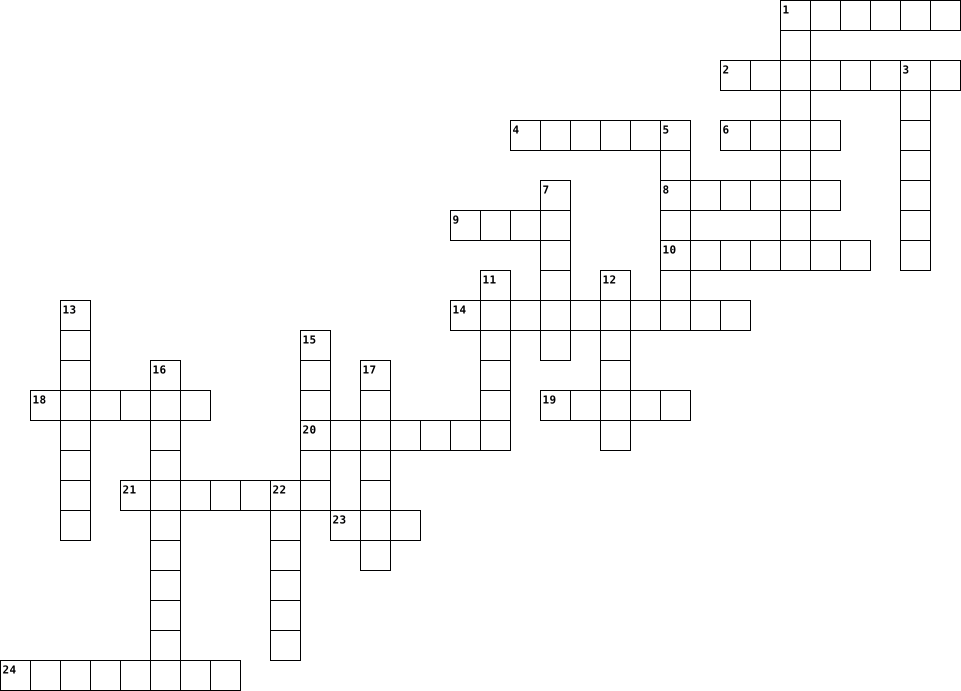
Across
- "natural effect of commerce is to lead to peace
- specie flow theory
- what etienne bonnot de condillac suported
- was the driving force behind the return to classical economics
- written by adam smith
- instituionalist who challenged smith's theory
- true father of modern economics
- believed in private property
- decorated soldier and student of Socrates
- wrote the fable of the bees
- lead character on our story.
- eminent surgeon and doctor
Down
- industry is more productive than agriculture
- agriculture as the most productive sector of the economy
- advocates stable monetary policy
- they resuscitated the invisible hand of smith
- advantage of thrift, free trade and growing population
- one of the greek thought
- also called the great depression.
- condemned in excessive luxury usury and unproductive labor
- vacillated between liberty and socialism
- marginal revolution economist from england
- marginal revolution economist from US
- was an absolutist
- marginal revolution economist from australia
- "law of subsistence wages and permanent misery of the working class
- theory of population and economic decline
- marginal revolution economist from switzerland
- talk about alienation and exploitation of the workers
- leading french physiocrat
30 Clues: was an absolutist • specie flow theory • written by adam smith • one of the greek thought • leading french physiocrat • eminent surgeon and doctor • wrote the fable of the bees • believed in private property • lead character on our story. • true father of modern economics • advocates stable monetary policy • also called the great depression. • marginal revolution economist from US • ...
Economics 2015-05-24

Across
- / A type of measure for inflation
- / When prices are generally falling over a period of time
- / 80% of a business cost
- / When consumers and producers are satisfied with the price
- / Payments received by businesses from selling goods and services
- / A demand factor that can increase GDP
- / Unlimited wants and needs but not enough resources
- / Goods or services bought from sellers in another country
- / When people are willing and able to work but do not have jobs
- / A type of policy that includes taxes
- / All buildings, equipment and human skills used to produce goods and services
- / A point on the business cycle where the GDP of a country is negative
- / A factor in the AD formula
- / Another word for limited
- / A point on the business cycle where the GDP is high
- / Every 20% of income distributed
- / A number between 0-1 that measures the equality of the distributional income
- / Part of the lorenz diagram that shows the degree of income or wealth quality or inequality
- / Natural resources that are used to produce goods and services
- / A measure of resource efficiency
Down
- / A level of income which people cannot enjoy access to basic needs
- / Also known as personal income tax
- / Events such as cyclones, droughts and floods
- / A type of policy that includes interest rates
- / A level of poverty that is experienced when there is a serious deprivation of basic needs
- / A type of market structure that have a few firms in the industry
- / One firm in the industry
- / A supply factor that affects GDP
- / A point on the business cycle where GDP is going up slowly
- / CPI that excludes volatile items
- / A situation where prices rise very quickly and go out of control
- / A supply factor that can affect the cost of production of the business
- / Another word for unlimited
- / Gross domestic product
- / A point on the business cycle where GDP is falling slowly
- / A demand factor in which one product can replace another product
- / Every 10% of income distributed
- / Refers to a rise in the level of prices for goods and services over a period of time
- / A type of market structure that have several firms in the industry and has strong market power
- / Goods or services produced in one country but sold to buyers in another country
40 Clues: / 80% of a business cost • / Gross domestic product • / One firm in the industry • / Another word for limited • / Another word for unlimited • / A factor in the AD formula • / A type of measure for inflation • / Every 10% of income distributed • / Every 20% of income distributed • / A supply factor that affects GDP • / CPI that excludes volatile items • ...
Economics 2021-02-03

Across
- study of government activities
- increase in prices and fall in the value of money
- not engaged in gainful occupation
- international exchange of capital, goods, services
- concerned with largescale economic factors
- spread of nuclear weapons to countries w/o
- production increase of goods/services overtime
- study of decision making of individuals and firms
Down
- formal international organizations
- studies interaction of nation/nonnation states
- measures to reduce risk of violence
- accounting of international transactions
- using economy to augment state power
- behavior of firms, policies, and competition
- device intended to harm citizens
- violence against civilians due to political aims
- value of money available in the economy
- academic study of economy
- exports exceeding cost of imports
- protection of industries from foreign competition
20 Clues: academic study of economy • study of government activities • device intended to harm citizens • not engaged in gainful occupation • exports exceeding cost of imports • formal international organizations • measures to reduce risk of violence • using economy to augment state power • value of money available in the economy • accounting of international transactions • ...
Economics 2021-02-04

Across
- A business that makes and sells products to other companies
- What goes into your bank account besides money
- A person that hires workers
- The amount you have of something
- A customer or a company that will buy the products
- a Free Market
- work
- Money that gets payed to the government
- When you have more than you need of something
- Something you do well in
- the maximum amount of money you can spend
- tax that gets taken from your total work salary
- Someone who works there
Down
- the amount of money people can produce
- a subject that teaches you how to learn money
- Something that is hard to find
- Money that you get then later have to pay it back
- Money you save in your account for later
- How much of what people want to buy
- Battle between two shops
- Someone who starts a business
- looking for items you want to buy
- Tools that you can use
- Goods tools used to make stuff
- Tax that is on items that got payed back to the government
25 Clues: work • a Free Market • Tools that you can use • Someone who works there • Battle between two shops • Something you do well in • A person that hires workers • Someone who starts a business • Something that is hard to find • Goods tools used to make stuff • The amount you have of something • looking for items you want to buy • How much of what people want to buy • ...
Economics 2021-02-04

Across
- A way a person chooses to spend money.
- A person who starts a business.
- Somebody that works for a business.
- Tax on products you purchase.
- When an item is hard to find.
- a business that makes things they sell.
- A person who hires people.
- A type of tax you have to pay when you earn money.
- The study of how humans use currency.
- A car, college tuition, retirement.
- An account you have to save money.
Down
- the amount of money a person will spend.
- A person who buys an item.
- Money people work to get.
- The amount of something people will buy.
- Tools needed for making a product.
- Work that a person does.
- Doing one job very well.
- The amount of a product somebody has.
- Rivalry between 2 or more businesses.
- The market the US has.
- Money that goes to the government.
- A thing you will need for a business.
- Money that you barrow and pay back.
- When there is a lot of something.
25 Clues: The market the US has. • Work that a person does. • Doing one job very well. • Money people work to get. • A person who buys an item. • A person who hires people. • Tax on products you purchase. • When an item is hard to find. • A person who starts a business. • When there is a lot of something. • Tools needed for making a product. • Money that goes to the government. • ...
Economics 2021-02-04

Across
- Money that has to be paid back.
- When you can find a product easily.
- I can't find a specific brand of apple juice, so I will go- .
- A tax when you buy products.
- To give up something by using resources one way.
- When it is hard to find a product.
- Work done by someone.
- I'm an- at this store.
- How much of something that exists.
- Things that need to be used to make other things.
- We need these- for the business.
- How much money that you want to spend.
- A person who starts a business and takes a risk when doing it.
Down
- To pay someone back for using their money and then the bank pays the interest in this.
- Someone that wants to buy something.
- Where more than one company has a rivalry
- Something that someone does a good job at in a business.
- When different people working in a business do different jobs.
- A service where someone puts money in a bank and they can take money out of it when they need to.
- A tax on your income from work.
- I have to pay this- .
- The study of the use of our money.
- This business that is a- of electronics.
- Someone who needs to hire people.
- How many things that people want to buy.
25 Clues: Work done by someone. • I have to pay this- . • I'm an- at this store. • A tax when you buy products. • Money that has to be paid back. • A tax on your income from work. • Someone who needs to hire people. • We need these- for the business. • When it is hard to find a product. • The study of the use of our money. • How much of something that exists. • ...
Economics 2021-01-18

Across
- Any situation where making one choice means losing something else, usually forging a benefit or opportunity
- Goods- Any tangible commodity produced and subsequently purchased to satisfy the current wants and perceived needs of the buyer (durable goods, non-durable goods and services)
- the problem of scarcity is regarded as the fundamental economic problem arising from the fact that, while resources were finite, society’s demand for resources is infinite
- a method of production whereby an entity focuses on the production of a limited scope of goods to gain a greater degree of efficiency
- Typically cash or liquid assets held or obtained for expenditures. In financial economics, the term may be expanded to include a company’s capital assets
- Analysis- (CBA) is the process used to measure the benefits of a decision or taking action minus the costs associated with taking that action
- of Living- Refers to the amount and quality of material goods and services available to a given population. The standard of living includes basic material factors such as income, gross domestic product (GDP), life expectancy and economic opportunity
- the amount of physical, mental and social effort used to produce goods and services in an economy. (one of the 3 things that drives supply; land, capital and entrepreneurship)
- an economic system in which private actors own and control property in accord with their interests, and demand and supply freely set prices in markets in a way that can serve the best interests in society
Down
- the financial benefit realized when revenue generated from a business activity exceeds the expenses, costs and taxes involved in sustaining the activity in question
- Cost- the potential benefits an individual, investor, or business misses out on when when choosing one alternative over another
- A political and economic ideology that positions itself in opposition to liberal democracy and capitalism, advocating itself for a classless system in which the means of production are owned communally and private property is non-existent or severely curtailed
- a populist economic and political system based on public ownership (also known as collective or common ownership) of the means of production
- the process of creating a new enterprise and bearing any of its risk, with the view of making a profit
- needs are based on psychological,personal and socio-economic requirements necessary for you to function and live
- means to fulfilling our needs
- a social science concerned with the production, distribution and consumption of goods and services
- Depression- Worldwide economic crisis that lasted most of the 1930s; a period during which business,employment and stock markets values fall to very low levels for a significant amount of time. (deflation and widespread unemployment)
- Goods- Physical assets that a company uses in the production process to manufacture products and services that consumers will later use. Capital goods are not finished goods instead they are used to make finished goods (buildings, machinery, equipment, vehicles and tools)
- Domestic Product- the total market value of all final goods and services produced within a country in a given period
- of Production- Inputs needed for the creation of a good or service. These include land, labor, entrepreneurship and capital
- the resources that encompasses the natural resources used in production
22 Clues: means to fulfilling our needs • the resources that encompasses the natural resources used in production • a social science concerned with the production, distribution and consumption of goods and services • the process of creating a new enterprise and bearing any of its risk, with the view of making a profit • ...
Economics 2021-01-11

Across
- a good which has an opportunity cost to produce (8,4)
- the education training and experience that workers have gained (5,7)
- incapable of moving from one location to another location (14,8)
- goods and services produced by the factors of production (6)
- the spending on capital goods (10)
- Factor of production which covers all human effort used in producing goods and services (6)
- the system which rules the country (10)
- a point on the PPC is an _______________ point (9)
- the aim of firms in the private sector (6)
Down
- the study of economic decisions and actions of individual consumers, producers and households (14)
- output per worker per hour (6,12)
- Capable of changing use (14,6)
- PPCs are usually bowed ______________ (7)
- _______________ cost is the best alternative foregone (11)
- any human-made (manufactured) good used to produce other goods and services (7)
- Good a good which requires no resources to produce (4,4)
- agents those who undertake economic activities and make economic decisions (8,6)
- ________________ Goods are wanted for the satisfaction they provide to their owners (8)
- includes any gifts of nature available for production (4)
- the study which considers economics issues and actions that affect the whole economy
- the willingness and ability to bear uncertain risks and to make decisions in business (10)
- payment for capital (8)
- reward paid to labour (5)
23 Clues: payment for capital (8) • reward paid to labour (5) • Capable of changing use (14,6) • output per worker per hour (6,12) • the spending on capital goods (10) • the system which rules the country (10) • PPCs are usually bowed ______________ (7) • the aim of firms in the private sector (6) • a point on the PPC is an _______________ point (9) • ...
Economics 2021-02-04

Across
- Surplus, an economic measure of a positive balance of trade, where a country's exports exceed its imports
- an economic system centered around the belief that a government can make a nation more prosperous by regulating trade and using tariffs and other protective measures to achieve a balance of exports over imports
- Trade, the exchange of goods and services between countries
- Development, the creation of wealth from which community benefits are realized
- Conflict, a disagreement between two groups of different religions that struggle against coherent existence without themselves
- Conflict, a form of conflict in which the objectives of at least one party are defined in ethnic terms
- policy of protecting domestic industries against foreign competition by means of tariffs, subsidies, import quotas, or other restrictions or handicaps placed on the imports of foreign competitors
- Economics, the economic study of urban areas; as such, it involves using the tools of economics to analyze urban issues such as crime, education, public transit, housing, and local government finance
- the study of decisions made by people and businesses regarding the allocation of resources, and prices at which they trade goods and services
- the unlawful use or threat of violence especially against the state or the public as a politically motivated means of attack or coercion
- Proliferation, the spread of nuclear weapons, nuclear weapons technology, or fissile material to countries that do not already possess them
Down
- Economics, the allocation of goods and resources for promoting social welfare
- growth, an increase in the amount of goods and services produced per head of the population over a period of time
- the steady rise of prices for goods and services over a period, has many effects that can be good and bad
- people who are jobless, actively seeking work, and available to take a job
- Organization, a field of economics dealing with the strategic behavior of firms, regulatory policy, antitrust policy and market competition
- of Payments, an accounting of a country's international transactions for a particular time period
- Finance, maintaining a sustainable fiscal position, the effective allocation of resources, and the efficient delivery of public goods and services
- Supply, the total amount of money-cash, coins, and balances in bank accounts—in circulation
- Economics, study of the labour force as an element in the process of production
20 Clues: Trade, the exchange of goods and services between countries • people who are jobless, actively seeking work, and available to take a job • Economics, the allocation of goods and resources for promoting social welfare • Development, the creation of wealth from which community benefits are realized • ...
Economics 2021-05-14
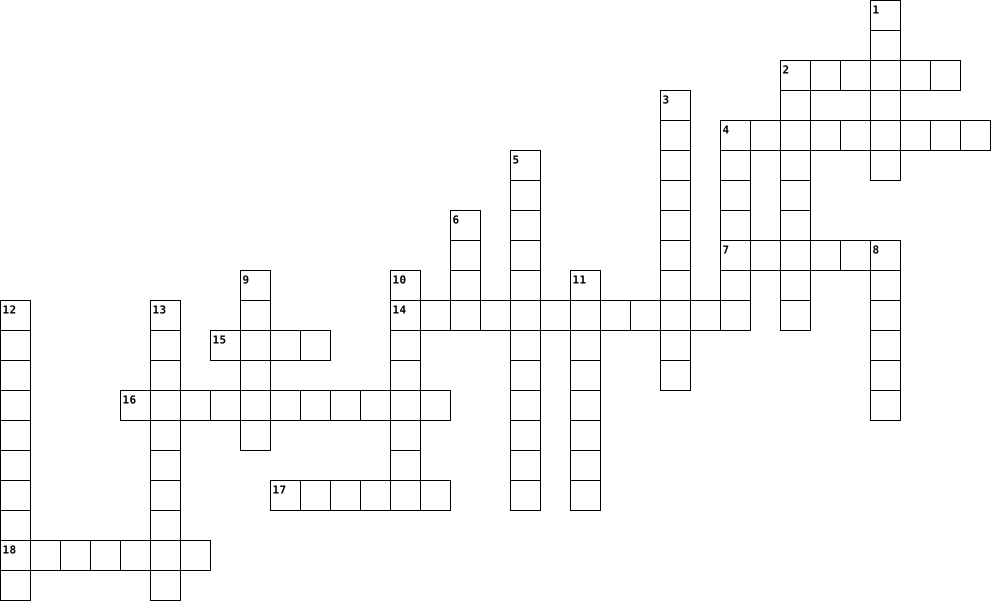
Across
- : entry into a country of goods or services from another country
- : decrease in the general price level
- : A sharp downturn in general economic activity.
- : the situation of a person who wants to work and has the capacity to do so, but finds himself or herself jobless in spite of searching.
- : A financial institution that collects deposits from the public and extends credit to businesses and households.
- : In economics, this refers to rivalry between several agents for the same market.
- : selling part of the production of goods or services in the other country
- : Also called a firm, it is an organisation whose purpose is to produce and supply goods or services to a set of customers.
Down
- : means the positive change in the production of goods and services in an economy over a given period.
- : Rising prices of goods and services.
- : an immediate expenditure intended to increase the wealth of the person incurring it in the long term
- : Excess of expenditure over earnings.
- : a person who starts a business
- : to be prudent in spending, to set aside money for a particular purpose.
- : periodic payment, paid by an employer to a salaried employee
- : It is a fraction of the capital of a listed company
- : the sum of a company's sales of goods or services over an accounting period.
- : a situation in which one supplier has an exclusive position on a product or service offered to a multitude of buyers.
- : Situation of a business owner who cannot pay his debts, keep his commitments.
- : It is a practice to record all the flows, expenses and revenues of the company.
20 Clues: : a person who starts a business • : decrease in the general price level • : Rising prices of goods and services. • : Excess of expenditure over earnings. • : A sharp downturn in general economic activity. • : It is a fraction of the capital of a listed company • : periodic payment, paid by an employer to a salaried employee • ...
Economics 2021-05-14
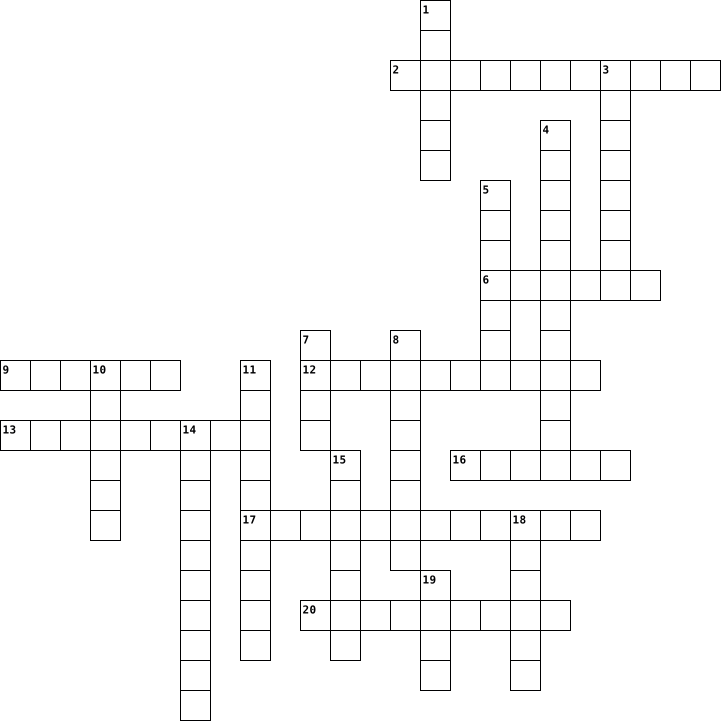
Across
- : In economics, this refers to rivalry between several agents for the same market.
- : entry into a country of goods or services from another country
- : A sharp downturn in general economic activity.
- : It is a practice to record all the flows, expenses and revenues of the company.
- : decrease in the general price level
- : It is a fraction of the capital of a listed company
- : the situation of a person who wants to work and has the capacity to do so, but finds himself or herself jobless in spite of searching.
- : Rising prices of goods and services.
Down
- : means the positive change in the production of goods and services in an economy over a given period.
- : the sum of a company's sales of goods or services over an accounting period.
- : a person who starts a business
- : Excess of expenditure over earnings.
- : to be prudent in spending, to set aside money for a particular purpose.
- : a situation in which one supplier has an exclusive position on a product or service offered to a multitude of buyers.
- : periodic payment, paid by an employer to a salaried employee
- : Situation of a business owner who cannot pay his debts, keep his commitments.
- : an immediate expenditure intended to increase the wealth of the person incurring it in the long term
- : Also called a firm, it is an organisation whose purpose is to produce and supply goods or services to a set of customers.
- : selling part of the production of goods or services in the other country
- : A financial institution that collects deposits from the public and extends credit to businesses and households.
20 Clues: : a person who starts a business • : decrease in the general price level • : Excess of expenditure over earnings. • : Rising prices of goods and services. • : A sharp downturn in general economic activity. • : It is a fraction of the capital of a listed company • : periodic payment, paid by an employer to a salaried employee • ...
Economics 2021-03-20

Across
- cost, The benefit that is lost when you decide to use scarce resources for one purpose rather than for another.
- Giving up all or a part of one thing in order to get something else.
- Intangible activities that are performed by other people for money; productive acts that satisfy economic wants.
- prices, One price compared to another; the ratio between two prices
- want, Desires for things that can be obtained without spending money
- An indication of how changes in price will affect changes in the amounts demanded and supplied.
- demand, A form of demand in which changes in price do not affect demand
- goods, Tangible items that will be consumed by industrial users.
- A function of relative prices that determines who gets the goods and services produced; determining how scarce resources will be distributed.
Down
- A condition resulting from the gap between unlimited wants for goods and services and limited resources.
- The process of trading one good/service for another
- The process or activity of using goods and services.
- utility, Usefulness created by altering or changing the form or shape of a good to make it more useful to the consumer.
- effect, A phenomenon that occurs when changes in relative prices cause buyers to replace the purchase of one product with another.
- price, The point at which the quantity of a good that buyers want to buy is equal to the quantity that sellers are willing to sell at a certain price.
- resources, The human and natural resources and capital goods used to produce goods and services.
- utility, Usefulness created when products are made available at the time they are needed or wanted by consumers or to complete specific business activities.
- A marketing/business function that is responsible for moving, storing, locating, and/or transferring ownership of goods and services
- utility, Usefulness created when ownership of a product is transferred from the seller to the user.
- demand, The situation that exists when demand is greater than supply.
20 Clues: The process of trading one good/service for another • The process or activity of using goods and services. • goods, Tangible items that will be consumed by industrial users. • prices, One price compared to another; the ratio between two prices • Giving up all or a part of one thing in order to get something else. • ...
Economics 2022-03-10

Across
- rider, a person or organization that receives benefits that others have paid for without making any contributions.
- failure, when government intervention leads to a net welfare loss compared to the free market solution.
- a fall in the rate of inflation.
- total expenditure by households on goods and services over a period of time.
- the study of economy as a whole.
- government actions or policies to restrict international trade.
- failure, where resources are inefficiently allocated due to imperfections in the working of the market mechanism.
- addition to an existing course of plan.
Down
- large increases in the price level.
- the process of removing government controls from markets.
- the cost incurred to or the benefit received to the third party from an economic activity.
- buying or selling something in the expectation of a future price change and a profit.
- a loan to help buy a house.
- when a firm splits into two or more independent businesses.
- two quarters of negative economic growth in a row.
- income, household income over a period of time including state benefits, less direct taxes.
- unemployment, unemployment caused by long term changes in the pattern of demand and production of an industry.
- efficiency, efficiency occurring over time as a result of investment and innovations.
- mechanism, the way the decisions made by households and firms interact to decide the allocation of resources.
- population, people aged below school leaving age and above the retirement age of the country.
20 Clues: a loan to help buy a house. • a fall in the rate of inflation. • the study of economy as a whole. • large increases in the price level. • addition to an existing course of plan. • two quarters of negative economic growth in a row. • the process of removing government controls from markets. • when a firm splits into two or more independent businesses. • ...
Economics 2022-03-10

Across
- a fall in the rate of inflation.
- the way the decisions made by households and firms interact to decide the allocation of resources.
- two quarters of negative economic growth in a row.
- a person or organization that receives benefits that others have paid for without making any contributions.
- when government intervention leads to a net welfare loss compared to the free market solution.
- the cost incurred to or the benefit received to the third party from an economic activity.
- efficiency occurring over time as a result of investment and innovations.
- where resources are inefficiently allocated due to imperfections in the working of the market mechanism.
- addition to an existing course of plan.
- people aged below school leaving age and above the retirement age of the country.
Down
- a loan to help buy a house.
- unemployment caused by long term changes in the pattern of demand and production of an industry.
- household income over a period of time including state benefits, less direct taxes.
- when a firm splits into two or more independent businesses.
- government actions or policies to restrict international trade.
- the study of economy as a whole.
- large increases in the price level.
- buying or selling something in the expectation of a future price change and a profit.
- the process of removing government controls from markets.
- total expenditure by households on goods and services over a period of time.
20 Clues: a loan to help buy a house. • a fall in the rate of inflation. • the study of economy as a whole. • large increases in the price level. • addition to an existing course of plan. • two quarters of negative economic growth in a row. • the process of removing government controls from markets. • when a firm splits into two or more independent businesses. • ...
Economics 2022-05-06

Across
- Osakkeet
- surplus
- depression
- pääoma
- kuluttaja
- investment
- debt
- deposit
- income tax
Down
- lautapeli
- budjetti
- kauppasaarto
- arvo
- käteinen
- romahdus
- market
- savings
- stock market
- kysyntä
- credit
- alijäämä
21 Clues: arvo • debt • pääoma • market • credit • surplus • savings • kysyntä • deposit • Osakkeet • budjetti • käteinen • romahdus • alijäämä • lautapeli • kuluttaja • depression • investment • income tax • kauppasaarto • stock market
Economics 2022-05-06
Across
- lautapeli
- credit
- romahdus
- kauppasaarto
- kysyntä
- stock market
- käteinen
- deposit
- arvo
- income tax
- savings
Down
- depression
- liikevoitto
- kuluttaja
- investment
- alijäämä
- budjetti
- pääoma
- market
- Osakkeet
- surplus
- debt
22 Clues: debt • arvo • credit • pääoma • market • kysyntä • surplus • deposit • savings • romahdus • alijäämä • budjetti • käteinen • Osakkeet • kuluttaja • lautapeli • depression • investment • income tax • liikevoitto • kauppasaarto • stock market
Economics 2022-07-04

Across
- which industry provides maximum employment in India
- Which sector contributes most to our GDP
- Name of the Largest Nuclear Power Plant in India with installed capacity of 2000MW
- largest private employer in India
- Which sector contributes most to our employment
- State with Highest population density in India
- State with Highest GDP to Debt % in India
- state with highest coal reserves in India
- India's most valuable company by market value
- which country is the world's largest exporter
- State with Highest GDP growth rate in FY21-22
- index name of National stock exchange
- Rate at which RBI lends short-term money to banks against Govt securities
- which country is the world's largest importer
- What is the position of India on merchandise trade
- What is India's GDP in $Trillion ( Closest)
- state with highest iron-ore reserves in India
- Which is India's largest export
- Which tax is the single biggest source of revenue for Govt of India
Down
- Which industry is maximum consumer of water in India?
- Which country is the largest recipient of remittances in the world
- State with Highest GDP in India
- Largest rice producing state in India
- Minister of Commerce and Industries Govt of India
- Which Industry in India has produced the highest number of billionaires till date
- State which received maximum FDI in India for FY21-22
- index name of Bombay stock exchange
- Leading state in India to produce the highest amount of renewable energy
- country for where India received maximum FDI in FY21-22
- who is in charge of monetary policy in India
30 Clues: State with Highest GDP in India • Which is India's largest export • largest private employer in India • index name of Bombay stock exchange • Largest rice producing state in India • index name of National stock exchange • Which sector contributes most to our GDP • State with Highest GDP to Debt % in India • state with highest coal reserves in India • ...
economics 2022-05-19
Across
- osakkeet
- vero
- sijoittaa
- sijoitus
- taloustiede
- tarjonta
- ylijäämä
- velkakirja
- romahdus
- velka
Down
- rahatalous
- kuluttaja
- talletus
- pääoma
- hinta
- säästöt
- kilpailu
- kirjanpitäjä
- luotto
- tappio
20 Clues: vero • hinta • velka • pääoma • luotto • tappio • säästöt • talletus • osakkeet • sijoitus • kilpailu • tarjonta • ylijäämä • romahdus • kuluttaja • sijoittaa • rahatalous • velkakirja • taloustiede • kirjanpitäjä
Economics 2022-05-08

Across
- put money into something that can help in the future
- money matters or transactions of some size or importance
- rivalry where companies try to be better than the other
- a person whose job is to keep, inspect, and analyse financial accounts.
- a request
- legal process through which people or other entities who cannot repay debts and
- the social science that studies the production, distribution, and consumption of goods and services.
- general consumption tax on the consumption of goods and services
- the ability of a customer to obtain goods or services before payment, the payer will pay later
- make something needed or wanted
- a share which entitles the holder to a fixed dividend
Down
- an official ban on trade with a particular country.
- the monetary value of expenditures for supplies or services
- business makes more money than loses
- guy in charge of the business
- regular gathering of people for the purchase and sale of provisions, livestock, and other commodities.
- a sum of money paid into a bank or building society account
- money one has saved, especially through a bank
- sum of financial assets that are required to produce goods or services.
- business makes less money than it costs
- other word for money
21 Clues: a request • other word for money • guy in charge of the business • make something needed or wanted • business makes more money than loses • business makes less money than it costs • money one has saved, especially through a bank • an official ban on trade with a particular country. • put money into something that can help in the future • ...
economics 2022-05-08

Across
- kulut
- ylijäämä
- tappio
- luotto
- säästöt
- vero
- arvo, hinta
- sijoittaa varoja
- markkinat
- pääoma, varallisuus
Down
- talletus, käsiraha
- taloustiede
- tarjonta, varasto
- kuluttaja
- budjetti
- käteinen
- valtiontaloudellinen
- rate korkotaso
- yksinoikeus, monopoli
- velka
20 Clues: vero • kulut • velka • tappio • luotto • säästöt • budjetti • ylijäämä • käteinen • kuluttaja • markkinat • taloustiede • arvo, hinta • rate korkotaso • sijoittaa varoja • tarjonta, varasto • talletus, käsiraha • pääoma, varallisuus • valtiontaloudellinen • yksinoikeus, monopoli
Economics 2022-05-17

Across
- market
- loss
- luotto
- commodity
- production
- trade
- kulutus
- vero
- economi
- savings
- lama
Down
- investment
- economic
- exports
- devaluation
- alennus
- tili
- talletus
- assets
- palkata
- kuluttaja
21 Clues: loss • tili • vero • lama • trade • market • luotto • assets • exports • alennus • palkata • kulutus • economi • savings • economic • talletus • commodity • kuluttaja • investment • production • devaluation
economics 2022-05-09
Across
- valtiontaloudellinen, vero-
- kuluttaja
- kysyntä
- (joukko)velkakirja, obligaatio
- tulos, (liike)voitto
- velka
- ylijäämä
- konkurssi, vararikko
- lainata, ottaa lainaksi
- arvo, hinta
- talletus, käsiraha
- alijäämä, vaje
- vero
- valuutta, raha, rahayksikkö
Down
- talous-, raha-asioihin liittyvä
- kauppasaarto
- käsiraha, ennakko
- arvopaperit, osakkeet
- markkinat, markkina-alue
- tarjonta, varasto
- yksinoikeus
- luotto
- kilpailu
- pääoma, varallisuus
- sijoittaa varoja
25 Clues: vero • velka • luotto • kysyntä • ylijäämä • kilpailu • kuluttaja • yksinoikeus • arvo, hinta • kauppasaarto • alijäämä, vaje • sijoittaa varoja • käsiraha, ennakko • tarjonta, varasto • talletus, käsiraha • pääoma, varallisuus • tulos, (liike)voitto • konkurssi, vararikko • arvopaperit, osakkeet • lainata, ottaa lainaksi • markkinat, markkina-alue • valtiontaloudellinen, vero- • valuutta, raha, rahayksikkö • ...
Economics 2022-09-08

Across
- costs of borrowing.
- Spending on goods and services within the period.
- It is a way of visually representing the distribution of income or wealth across a population.
- It is a situation in which economic forces such as supply and demand are balanced.
- It is a measure of how much the quantity changes when the price changes and it determines the slope of a demand curve and the slope of a supply curve.
- the distribution of a company's earnings to its shareholders and is determined by the company's board of directors
- It is defined as a good or a service that is used in pairs such as pen and ink.
- The volume of output that is produced from any given number of inputs.
- It is one of the supply factors that shifts the supply curve to the left and it refers to natural events such as floods and droughts.
- A system of money in general use in a particular country
- This is the skill and talent needed to combine the other three resources to successfully produce something people want to buy.
- It occurs when funds are added to the circular flow from a source other than households and businesses.
- It is the exclusive possession or control of the supply of or trade in a commodity or service.
- It comprises all people aged over 15 years who are able and willing to work including those who are classified as employed and those who are unemployed.
- It is a government policy that takes proportionately more tax from those on higher levels of income and redistributes welfare benefits to those on lower incomes.
- An increase in the value of the Australian dollar
Down
- It refers to the economic problem that arises because the volume of resources (land, labour and capital) is limited compared with individual needs and wants, which are unlimited.
- It describes a situation where the potential labour of employed people is not fully used
- It is defined as employed persons who are highly skilled but are working in low-paid or low-skilled jobs or are working part-time but would prefer to be working on a full-time basis.
- A number between zero and one that indicates the level of inequality in the distribution of income or wealth.
- It refers to individuals who might be considered unemployable because of some personal characteristic, such as a physical disability.
- It is one of the demand factors which is whether consumers are optimistic or pessimistic about their future spending
- Spending by government departments and public enterprises on goods and services within the period.
- fixing It is an anti-competitive practice that allows companies to get together to fix and control or maintain prices artificially, and increase the prices for consumers.
- The value of the Australian dollar against another currency.
- It is when a small number of large firms have all or most of the sales in an industry.
26 Clues: costs of borrowing. • Spending on goods and services within the period. • An increase in the value of the Australian dollar • A system of money in general use in a particular country • The value of the Australian dollar against another currency. • The volume of output that is produced from any given number of inputs. • ...
Economics 2022-09-08

Across
- It is a situation in which economic forces such as supply and demand are balanced.
- It is one of the supply factors that shifts the supply curve to the left and it refers to natural events such as floods and droughts.
- The volume of output that is produced from any given number of inputs.
- The value of the Australian dollar against another currency.
- It describes a situation where the potential labour of employed people is not fully used
- It is when a small number of large firms have all or most of the sales in an industry.
- It comprises all people aged over 15 years who are able and willing to work including those who are classified as employed and those who are unemployed.
- It measures peoples’ access to goods and service
- It is one of the demand factors which is whether consumers are optimistic or pessimistic about their future spending
- The factors that affect a person's quality of life irrespective of income.
- A sustained period of weak or negative growth in real GDP (output) that is accompanied by a significant rise in the unemployment rate
- It is the exclusive possession or control of the supply of or trade in a commodity or service.
- It is a government policy that takes proportionately more tax from those on higher levels of income and redistributes welfare benefits to those on lower incomes.
- It is defined as a good or a service that is used in pairs such as pen and ink.
Down
- It refers to the economic problem that arises because the volume of resources (land, labour and capital) is limited compared with individual needs and wants, which are unlimited.
- This is the skill and talent needed to combine the other three resources to successfully produce something people want to buy.
- Costs of borrowing.
- An increase in the value of the Australian dollar
- A number between zero and one that indicates the level of inequality in the distribution of income or wealth.
- It is a way of visually representing the distribution of income or wealth across a population.
- Spending on goods and services within the period.
- Spending by government departments and public enterprises on goods and services within the period.
- A system of money in general use in a particular country
- It refers to individuals who might be considered unemployable because of some personal characteristic, such as a physical disability.
- It is defined as employed persons who are highly skilled but are working in low-paid or low-skilled jobs or are working part-time but would prefer to be working on a full-time basis.
- X in aggregate demand formula and income earnt by Australians selling goods overseas.
- It is a measure of how much the quantity changes when the price changes and it determines the slope of a demand curve and the slope of a supply curve.
- The distribution of a company's earnings to its shareholders and is determined by the company's board of directors
- It occurs when funds are added to the circular flow from a source other than households and businesses.
- It is an anti-competitive practice that allows companies to get together to fix and control or maintain prices artificially, and increase the prices for consumers.
30 Clues: Costs of borrowing. • It measures peoples’ access to goods and service • An increase in the value of the Australian dollar • Spending on goods and services within the period. • A system of money in general use in a particular country • The value of the Australian dollar against another currency. • ...
Economics 2022-09-09

Across
- what is interest rate
- consumers being optimistic about their future
- a type of market structure with no competition
- part time/ casual workers that work similar hours as full time
- something being forgone in order to get something else
- tax on individuals income and the bulk of government revenue
- unemployment caused due to lack of aggregate demand
- geographically located agreement
- limited resources not being able to meet unlimited needs and wants
- test done to check individual’s income and ownership
- living standards of an individual's quality of life with no monetary factors
- supply factor where amount of output is produced with any given number of input
- taxes on specific goods and services like tobacco
- a type of market structure with little competition but not much effect
- part of AD formula and is affected by business confidence
- global agreement
Down
- unemployment when an individual is in between jobs
- part of AD formula and is affected by population growth
- unemployment cause by discouragement of job prospects and not counted in statistics
- income after tax
- occurs when there is 2 years of consecutive negative GDP & low inflation
- unemployment due to automation
- the AD formula
- makes up 75% of exports
- living standards measured by goods and services
- leading forum to facilitate trade/ investment and economic growth consisting of 21 countries
- occurs when there is high GDP and unemployment decreases
27 Clues: the AD formula • income after tax • global agreement • what is interest rate • makes up 75% of exports • unemployment due to automation • geographically located agreement • consumers being optimistic about their future • a type of market structure with no competition • living standards measured by goods and services • taxes on specific goods and services like tobacco • ...
Economics 2022-08-22

Across
- the portion of income not spent on current expenditures
- anything that helps us produce things faster, better or cheaper
- of the same or a similar kind or nature
- individual's ordering of various outcomes
- the point where individuals have no particular preference for either one good or another based on their relative quantities.
- the point when the marginal utility of any activity is zero.
- out-of-pocket costs—payments that are actually made.
- level playing field where everyone has the same access to the same wealth
- condition or state in which economic forces are balanced
Down
- it is representation of economy as a heterogeneous and proliferative social space.
- curve. the maximum amount of one commodity X obtainable for any given amount of another commodity Y, and vice versa
- It refers to people's decisions about sharing and using those resources
- one unit which participate in production mechanism
- a rational consumer always prefers more of a good as it offers the consumer a higher level of satisfaction.
- the process of capital formation by a firm or increase in the stock of existing capital stock
- occurs when a good's quantity demanded or supplied changes even though the price remains the same.
- income that a firm receives from the sale of a good or service to its customers
- the operation of a country’s money supply, commercial activities and industry
- people who make or grow goods and provide services
- the difference between the revenue received from the sale of an output and the costs of all inputs used, as well as any opportunity costs
20 Clues: of the same or a similar kind or nature • individual's ordering of various outcomes • one unit which participate in production mechanism • people who make or grow goods and provide services • out-of-pocket costs—payments that are actually made. • the portion of income not spent on current expenditures • condition or state in which economic forces are balanced • ...
Economics 2021-03-30

Across
- send (goods or services) to another country for sale
- production, investment, prices, and incomes are determined centrally by a government
- production and prices are determined by unrestricted competition between privately owned businesses
- an advantage or profit gained from something
- a tax or duty to be paid on a particular class of imports or exports
- the rate at which a good or service is consumed
- a fixed regular payment made by an employer to an employee
- the exports of a country exceed its imports
- the total value of goods produced and services provided in a country during one year
- the means of production, distribution, and exchange should be owned or regulated by the community as a whole
- traditions, customs, and beliefs help shape the goods and services the economy produces, as well as the rules and manner of their distribution
- the science that deals with the production, distribution, and consumption of goods and services
Down
- interaction between businesses or people, in which success and failure depend on gaining a share of a limited resources
- Balance of Trade
- Not having enough of a resource
- a society in which all property is publicly owned and each person works and is paid according to their abilities and needs
- the amount of money expected, required, or given in payment for something
- an economic and political system in which a country's trade and industry are controlled by private owners for profit, rather than by the state
- the regulations and agreements that control imports and exports to foreign countries
- the amount of the good or service that is available
- bring (goods or services) into a country from abroad for sale
- Restrictions on trade that occur naturally or by government influence
- Combines private and public enterprise
- the effort, loss, or sacrifice necessary to achieve or obtain something
24 Clues: Balance of Trade • Not having enough of a resource • Combines private and public enterprise • the exports of a country exceed its imports • an advantage or profit gained from something • the rate at which a good or service is consumed • the amount of the good or service that is available • send (goods or services) to another country for sale • ...
Economics 2021-06-09

Across
- What is the study of how people satisfy their wants and needs by making choices?
- the change in quantity demanded due to a change in price is called?
- What states the quantity purchased varies inversely with price?
- What is the broadest measure of economic growth?
- What is it called to make something needed or wanted available to someone?
- The amount of money that you have to pay to the government so it can pay for public services is called?
- ____ occurs when a person is actively searching for a job but can't find one.
- What is the basic problem in economics?
- What is an estimation of revenue and expenses over a specified future period of time ?
- What can refer to any mechanism used for generating future income.
- When money is given to another party in exchange for repayment is called
- The change in interest rates and money supply is called?
- What is it called when the quantity does not change when the price does?
Down
- Which type of economic system is the most common in the world?
- Government spending and taxation to influence the economy is called?
- The total amount of money, cash, coins and balances in the bank accounts called?
- The loss of a potential gain from other alternatives is called?
- The cycle of ups and downs in the economy is called ?
- An insistent and peremptory request made by its rights?
- What is the measure of the rate of rising prices of goods and services?
- What is the name for the protection of rights and interests of the general pool of buyers,or an obsession with buying material goods.
- Regulations and agreements that control imports, exports to foreign countries called?
- What is a contract agreement to borrow a sum of money and repay the lender at a later date?
- The area of the economy frequently subtracted from the GDP is called?
24 Clues: What is the basic problem in economics? • What is the broadest measure of economic growth? • The cycle of ups and downs in the economy is called ? • An insistent and peremptory request made by its rights? • The change in interest rates and money supply is called? • Which type of economic system is the most common in the world? • ...
Economics 2022-10-20

Across
- the collection of firms involved in making a similar range of items that usually compete with each other
- the integration between different countries and economies
- a situation in which individual firms have implicitly or explicitly agreed to restrict competition
- government selling pte's to the private sector
- the ease with which a financial asset can be transformed into cash so it can be used as a medium of exchange
- situation of firms agreeing to restrict competition
- the total market value of all final goods and services produced in an economy over a period of time
- the wear and tear that all capital goods experience, causing their decrease in value over time
- a good that is used in conjunction with another good
- any current expenditure where the benefits will be obtained in the future
- Australia's central bank
Down
- the tool of the government for the exercise of fiscal policy
- a type of financial asset that provides an individual with ownership over part of a business or company
- the sustained increase in the general level of prices over a period of time, usually one year. Usually measured by a percentage change in the Consumer Price Index
- the process whereby unemployment in the current period results in the persistence of unemployment in future periods as unemployed people can lose their skills, job contacts and motivation to work
- the satisfaction or pleasure that individuals derive from the consumption of goods or services
- a 10 per cent sales tax imposed on most goods and services in Australia
- the amount of money, or other benefits measured in monetary terms, that flows to individuals or households, usually for their contribution to the production process or as a direct payment from the government over a period of time
- the reward to the factor of production capital for its use in the production of goods and services
- the medium of exchange in most modern economies
- a fun economics-themed board game, also used to describe an industry where there is only one seller producing a unique product
- items that remove money from the circular flow of income
22 Clues: Australia's central bank • government selling pte's to the private sector • the medium of exchange in most modern economies • situation of firms agreeing to restrict competition • a good that is used in conjunction with another good • items that remove money from the circular flow of income • the integration between different countries and economies • ...
economics 2022-10-20

Across
- increase
- when supply and demand are the same
- teaches economics
- money entering the economy
- decreasing economic activity
- not saving money and using it
- decrease
- not spending money and keeping it
- money leaving the economy
- the amount of a product available
- the amount of money being able to be used
Down
- decrease in value of currency
- Mr Johnston teaches this
- influence of resource allocation, redistribution
- the responsivness of quantity demanded and supplied
- the amount of money that flows into individuals
- external costs and benefits
- the amount of a product wanted
- influences the cost and supply of money
- organisation of the factors of production
20 Clues: increase • decrease • teaches economics • Mr Johnston teaches this • money leaving the economy • money entering the economy • external costs and benefits • decreasing economic activity • decrease in value of currency • not saving money and using it • the amount of a product wanted • not spending money and keeping it • the amount of a product available • ...
Economics 2023-11-15

Across
- gives a company exclusive rights to sell a new good or service for a specific period of time
- the struggle among producers for the dollars of consumers
- the act of redirecting resources from being consumed so benefits can be created in the future
- something essential for survival
- a formal contract issued by a corporation other entity
- the portion of stock is issued in
- the amount of good or service that is available
- the coins and bills used as money
- a business organization owned and operated by a group of individuals for their shared benefits
- the price paid for using borrowed money
- companies contract with other companies to do a specific job
Down
- the extra cost of adding one unit
- negotiating labor contracts that keep unnecessary workers on the company payroll
- love of ones country
- something we desire but is not necessary for survival
- an authorization from the local government to operate a business
- money or other values that one person contributes in a partnership
- an organized work stoppage intended to force an employer to adress union demands
- desire to own something and the ability to pay for it
- a market dominated by a few large profitable firms
20 Clues: love of ones country • something essential for survival • the extra cost of adding one unit • the portion of stock is issued in • the coins and bills used as money • the price paid for using borrowed money • the amount of good or service that is available • a market dominated by a few large profitable firms • something we desire but is not necessary for survival • ...
Economics 2023-08-22

Across
- rates set to trigger economics responses when they are not met
- One who makes goods using the factors of production
- responsible for budgetary policy
- responsible for monetary policy
- Amount of an item produced for sale
- Situation in which all the factors of production that are available for useunder current market conditions are being utilized.
- The human effort that can be applied to the production of goods and services
- used to measure an increase in the quantity or quality of the many goods and services that people produce.
- the market value of all the final goods and services produced in a specific time period by a country.
- is a statistical composite index of life expectancy, education, and per capita income indicators, which is used to rank countries.
- purpose of monetary policy is to curb..
- this index or indicator informs us about changes to the ....
- Machinery, equipment and money for production
- a measure of overall progress towards environmental sustainability
- Revenue of a company minus the expenses
- collection of goods and services where price change is monitored
- purpose of budgetary policy is to improve..
- indicator that businesses are positive about the future
- One who buys and/or uses goods or services
- the percentage of people who are looking, able and ready to work but currently don't
- a period between a peak and a trough in the business cycle
Down
- another name for labourforce
- fluctuating levels of economic activity in an economy over a period of time
- the cost of choosing one option over another
- All human resources-workers
- per capita means per
- willingness and ability to purchase a quantity of goods or services at a specified price
- a measure of a countries quality of life
- comprises all persons who are employed or unemployed
- All natural resources
- measure of inflation rate
- what you give up when you make decision
- when government spending exceeds the amount of money available
- a severe and prolonged downturn in economic activity.
- used to measure performance of the economy
- quantitative indicators have many of these
- the United Nations Sustainable Development Solutions Network. It ranks countries based on various factors that contribute to wellbeing
- The interest rate in the overnight money market.
- strong economic expansion where many businesses are operating at full capacity or above capacity,
- The branch of economics that focuses on the choices made by consumersand firms and the impacts those choices have on individual markets.
- the group who have the highest unemployment rate
- Having a limited quantity of resources to meet unlimited wants
- the condition where there is a general increase in prices and fall in the purchasing value of money.
43 Clues: per capita means per • All natural resources • measure of inflation rate • All human resources-workers • another name for labourforce • responsible for monetary policy • responsible for budgetary policy • Amount of an item produced for sale • what you give up when you make decision • purpose of monetary policy is to curb.. • Revenue of a company minus the expenses • ...
Economics 2023-11-27

Across
- The measure of how much output is produced per unit Of labour input.
- The number of unemployed people divided by the economically active population.
- Our ability to access physical goods and services.
- Type of unemployment, when tourist numbers are low during winter but higher during and after harvesting.
- an interactive tool that allows you to see how countries perform according to the importance you give to each of 11 topics that make for a better life.
- Something someone buys.
- An important feature of macroeconomics.
- Type of unemployment, meaning their job has gone because of a downturn in spending.
- The proportion of a loan that is charged as interest to the borrower, is typically expressed as an annual percentage of the loan outstanding.
- It is a statistical figure that is determined by the Australian Bureau of Statistics.
Down
- Measures the change in prices paid by consumers for goods and services.
- Type of unemployment, refers to those people who are 'unemployable' for some reasons.
- Things that contribute to happiness, i.e freedom, low crime levels, free elections.
- Type of unemployment, meaning the time in between when people change jobs.
- When prices increase by 50% or more per month.
- Type of unemployment, meaning it changes to the way economic activity is done to cause some people to lose their jobs.
- A measurement of economic performance that compares the amount of goods and services produced.
- The problem of having unlimited wants and needs but limited resources.
- The change in prices over time.
- The final product since it has completed the process and is ready to be sold to customers directly or to other businesses.
20 Clues: Something someone buys. • The change in prices over time. • An important feature of macroeconomics. • When prices increase by 50% or more per month. • Our ability to access physical goods and services. • The measure of how much output is produced per unit Of labour input. • The problem of having unlimited wants and needs but limited resources. • ...
Economics 2023-12-01

Across
- What an entrepreneur can start
- Creating of improving a product for a better business
- Set amount of money
- An economy where you make enough for income
- What you owe someone
- Human resource
- What is given from a place
- Natural resource
- Money set aside for the future
- The problem of having limited resources but unlimited needs and wants
- Outperforming another similar business
- Individuals can set up a business and make profit
Down
- Money put towards something in hope to make a profit
- Low resources
- Economic system, government control
- Used to purchase goods or services
- An economy where you make enough for your needs
- A man-made resource
- Consumer decisions
- Control of a country
- What is given to a place
- Give loans and credit-cards
22 Clues: Low resources • Human resource • Natural resource • Consumer decisions • Set amount of money • A man-made resource • What you owe someone • Control of a country • What is given to a place • What is given from a place • Give loans and credit-cards • What an entrepreneur can start • Money set aside for the future • Used to purchase goods or services • Economic system, government control • ...
Economics 2023-09-20

Across
- an individual or business that makes a product
- Goods, Goods meant for comfort and not survival
- Goods, Interdependent products: mouse and keyboard
- dramatic downward fall in a nation's economic state
- Demand decreasing
- The group that purchases the goods/services the businesses provide
- Refilling your cup at a restaurant
- Using new concepts to improve an existing product
- Goods, A physical object needed for survival
- Goods, public transportation
- Resources, Water Lumber Soil
- No physical appearance
- food water shelter
Down
- Air conditioning New clothes Headphones
- Gas lamps Cassette
- Resources, equipment, building, money
- the amount of a product
- The making of a unique object device or process
- the person that uses the goods and/or services made by producers
- Goods, running out of the brand of lipstick you usually use so you use a different brand
- the price of a product sold at where both consumers and producers are happy
- resources, workforce
- increase in the prices goods/ service over time
- rise in standard of living
- A physical product made solely for the purpose of being sold
- the consumers' desire to buy a product/service at a given price
26 Clues: Demand decreasing • Gas lamps Cassette • food water shelter • resources, workforce • No physical appearance • the amount of a product • rise in standard of living • Goods, public transportation • Resources, Water Lumber Soil • Refilling your cup at a restaurant • Resources, equipment, building, money • Air conditioning New clothes Headphones • ...
Economics 2024-02-15

Across
- Time and energy
- Act of buying and consuming goods and services
- Wants differ on ___________
- Food, clothing and shelter
- Use resources to create goods and services
- Labor, land and capital are factors of _____
- ________ capital is money available for investing or spending
- A person needs this for his labor
- Process by which goods and services are made available to the people who want them
- People's wants can also __________
Down
- Capital _______ includes tools, machines or buildings
- Wants are also depending on __________
- Resources are limited
- We have to understand that many times wants occur ______
- Farmers produce food by combining ______, water and sunlight
- Shopping for clothes is an ______ want
- Anything produced in an economy
- ________ cost is the benefit given up when resources are scarce
- Since societies have limited resources with which to satisfy their wants, they must make ______
- Natural resources needed to produce goods
20 Clues: Time and energy • Resources are limited • Food, clothing and shelter • Wants differ on ___________ • Anything produced in an economy • A person needs this for his labor • People's wants can also __________ • Wants are also depending on __________ • Shopping for clothes is an ______ want • Natural resources needed to produce goods • Use resources to create goods and services • ...
Economics 2024-02-20

Across
- the income that a firm recieves from the sale of a good or service to its customers
- a financial institution licensed to recieve deposists and make loans.
- a product or service produced in one country but sold to a buyer abroad.
- a mandatory payment or charge
- The consumers desire to purchase a particular good or service
- the process by which various sellers each try to offer better products
- a share in the ownership of a company including a claim
- the amount of money that a buyer gives to a seller in exchange for a good or service
- A loan from an investor to a borrower such as a company or government
- A liquid asset used to facilitate transactions of value
- A current supply given a firms capital expenditure on fixed asset
- the action of helping
Down
- a financial tool in which you write down how much money you expect to earn
- Volentary contributions in money.
- the portion of income not spent on current expendentures
- a government imposed trade restriction that limits the number or monetary value of goods
- to spread the product throughout the marketplace such that a large number of people can buy it
- the physical money in an economy
- the action or process of investing money
- the volentary provision of assistance to those in need
20 Clues: the action of helping • a mandatory payment or charge • the physical money in an economy • Volentary contributions in money. • the action or process of investing money • the volentary provision of assistance to those in need • a share in the ownership of a company including a claim • A liquid asset used to facilitate transactions of value • ...
Economics 2020-03-24
Across
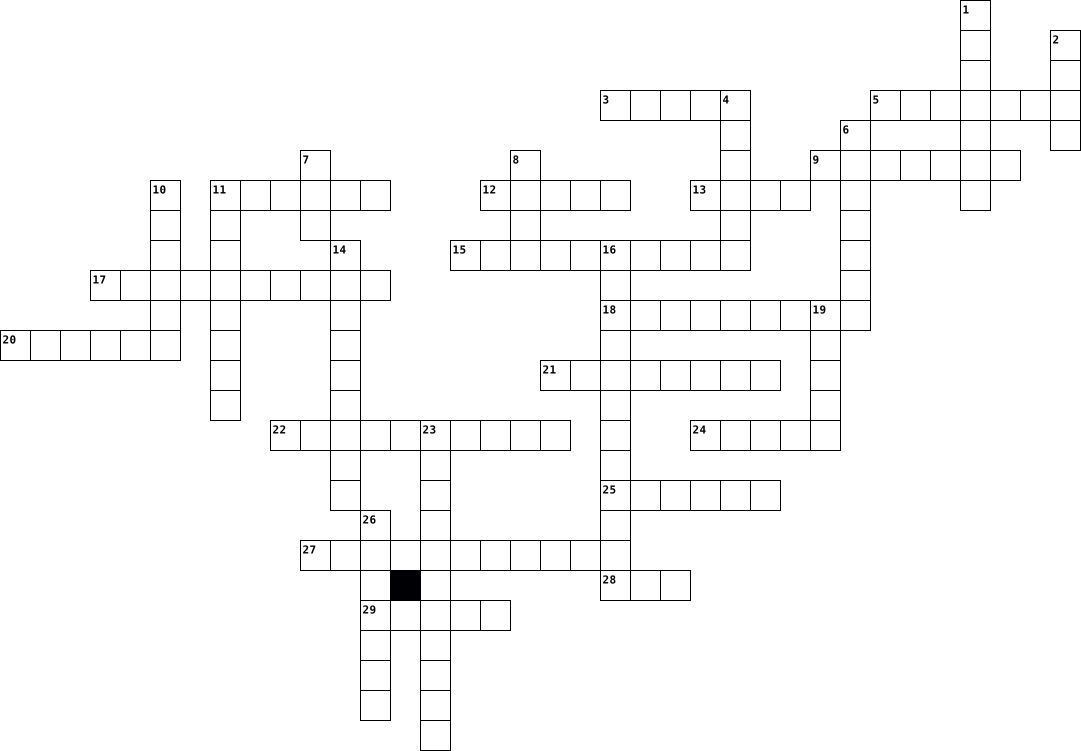
- things to be transported
- money received for work or through investments
- paying someone or something or of being paid
- an insistent and peremptory request, made as of right
- coins and banknotes collectively
- financial institution licensed to receive deposits and make loans
- the state of being bankrupt
- a small plastic card issued by a bank
- social science, which studies how society uses limited resources to meet its desires
- a financial gain, especially the difference between the amount earned and the amount spent in buying, operating, or producing something
- the cost of something
- making or manufacturing from components or raw materials
- a sum of money saved or made available for a particular purpose
- a regular gathering of people for the purchase and sale of provisions, livestock, and other commodities.
- a large company or group of companies authorized to act as a single entity and recognized as such in law
- a compulsory contribution to state revenue, levied by the government on workers' income and business profits, or added to the cost of some goods, services, and transactions.
- the amount of money you expect to pay forsomethong
Down
- a record or statement of financial expenditure and receipts relating to a particular period
- a situation involving exposure to danger
- a fixed regular payment
- money that has been saved
- a system of rules
- borrowing money
- a person using services of other people or organizations an organized group of people with a particular purpose, such as a business or government department
- delivering letters, parcels, or goods
- take or carry from one place to another by means of a vehicle, aircraft, or ship.
- a person without a paid job
- require the payment of before it can be acquired or done
- the activity or condition of striving to gain or win something by defeating or establishing superiority over others
- a commercial business
30 Clues: borrowing money • a system of rules • the cost of something • a commercial business • a fixed regular payment • things to be transported • money that has been saved • the state of being bankrupt • a person without a paid job • coins and banknotes collectively • delivering letters, parcels, or goods • a small plastic card issued by a bank • a situation involving exposure to danger • ...
economics 2020-04-30

Across
- practice of producing goods in another country
- ongoing cost for creating a product or business
- items sold at cost to stimulate other profitable sales
- cost for merchandise that cannot be accounted for
- persistent rise in price related to increase in volume of money resulting in loss of value of currency
- expenses that change in proportion to number of units sold
- costs included in the price of a good should it need to go on sale
- an chartered association of business individuals
- expenses that do not change in proportion to number of units sold
- the method of doubling wholesale cost to determine retail cost
- employee earnings
- expenses that occur if a set of conditions prevail beyond the current condition
- promotional __________designed to convince a consumer of the superiority of a product
- desire for money beyond expenses that encourage one to engage in business
- business owned and controlled by one person
- two or more persons that conduct business as co-owners
- insurance, paid sick days, pensions for an employee
Down
- deliberately designing a product with limited useful life
- trade between countries that does not include tariffs and quotas
- import______ sets a trade limit on quantity of goods allowed to enter the country
- the price of an object determined by the actual expenses spent to create it
- cost to make information about a product known to a consumer
- ________,________ and capital. factors of production and factors of price formation
- payroll spent on anyone directly involved in making goods
- price for a good will settle until quantity equals supply
- reduction in cost given by wholesaler to specialized customers
- of their home territory
- the actual location of sales for a business
- returns, proceeds or revenue from property or investment
- also known as operational expenses
- tax on foreign goods imported into a country
31 Clues: employee earnings • of their home territory • also known as operational expenses • the actual location of sales for a business • business owned and controlled by one person • tax on foreign goods imported into a country • practice of producing goods in another country • ongoing cost for creating a product or business • an chartered association of business individuals • ...
economics 2020-04-30
Across
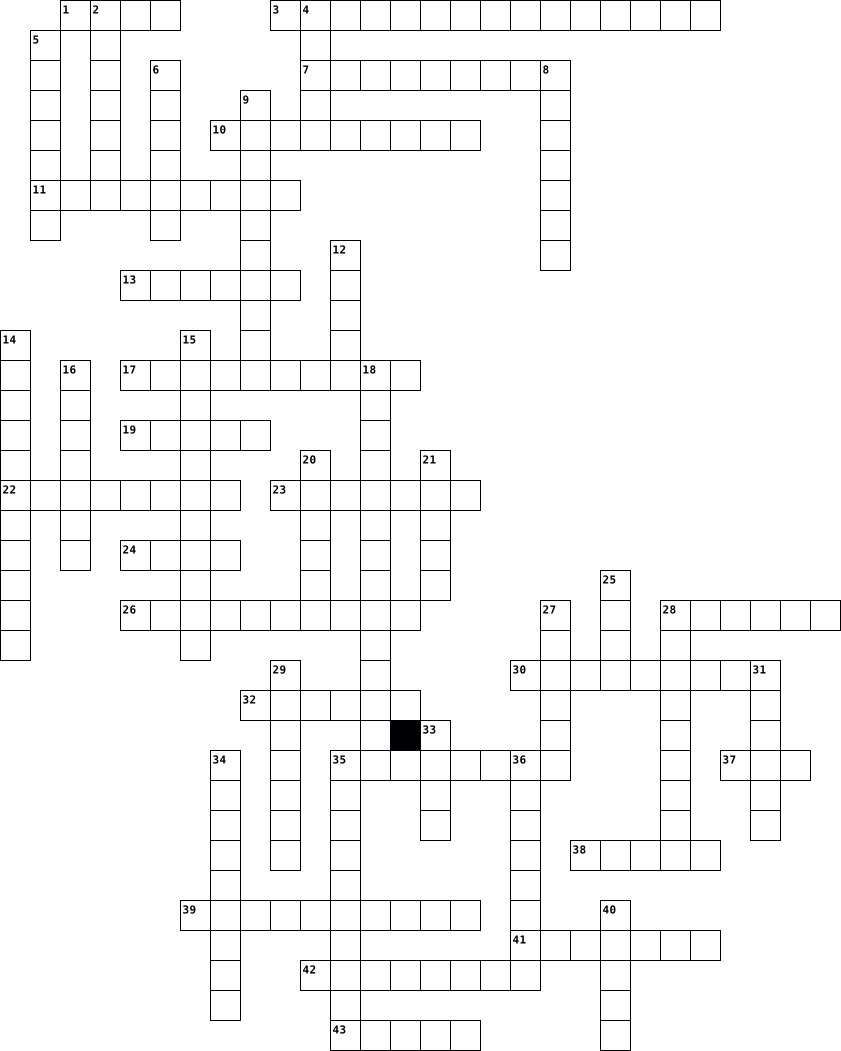
- An organization that sells goods
- Where actions by one party have impacts on another, particularly economically.
- The study of how people use scarce resources to satisfy needs and wants
- Final users of goods and services to satisfy their needs and wants
- Basic units used to make goods and services
- Reward for the use of resources
- A system which allows private ownership of the factors of production
- Physical items used by consumer and services for a profit
- Situation where demand is greater than supply
- Equipment used to make goods and services
- Institution which handles money for households and firms
- Ability to combine all resources to make something (plan, recipe, system etc)
- chain Complex group of firms in many countries each producing a component of a final product.
- Organisations that make goods and services
- Payment earned by entrepreneurs
- Money paid at a particular rate for the money lent
- Compulsory government levy
- Goods and services which we desire but don’t need
- Income flows which are added to the Circular Flow of Income model (investment, govt. spending, exports)
- Goods and services sold overseas
- Income flows that are removed from the Circular Flow model. (savings, tax, imports)
- National Company A company which operates in several countries with its headquarters in the parent country. (Apple)
Down
- Goods and services bought from overseas
- Basic necessities for life
- of production Raw materials used to make goods and services (land, labour, capital & enterprise)
- All human effort, both physical and intellectual
- That part of earnings not spent
- Organization with authority to make decisions for the population
- National Company A company that operates in many countries with independent headquarters in each.(McDonalds)
- An economy where people produce only enough goods and services for their own family
- Cost The cost of the next-best alternative opportunity
- Financial assistance given to people by the Government
- Action of only doing one part of the process
- market Place where factors of production are bought and sold.
- Payment per hour for labour
- All resources provided by nature
- Place where goods and services are bought and sold.
- A system where factors of production are owned by the government
- market Place where goods and services are bought and sold (Coles, Seek.com, Fremantle markets) Same as Market
- Payment per year for labour
- Payment for use of land
- A system where all factors of production, distribution and consumption of goods and services are controlled by the government
- Purchase of new capital
- Actions done for consumers by producers
- Used to pay for goods and services
45 Clues: Payment for use of land • Purchase of new capital • Basic necessities for life • Compulsory government levy • Payment per hour for labour • Payment per year for labour • That part of earnings not spent • Reward for the use of resources • Payment earned by entrepreneurs • An organization that sells goods • All resources provided by nature • Goods and services sold overseas • ...
Economics 2024-04-27

Across
- the problem of having unlimited wants, but limited resources to satisfy them
- is an asset or item acquired with the goal of generating income or appreciation
- is the art of turning an idea into a business
- businesses take loans to fund capital projects and expand their operations by purchasing fixed and long-term assets such as land, buildings, and machinery
- the processed materials, equipment, and buildings used in production
- under perfect competition all firms sell homogenous goods which are identical in quantity, shape. size, and color
- it concerned with the process of setting prices of goods that is also known as Price Theory
- soil and natural resources that are found in nature and are not man-made
- consumers buy more of a good when its price decreases and less when its price increases
- it is the quantities of a particular good or service consumers are willing and able to buy at different possible prices
- the limited nature of resources, which underlies the basic economic problem
- is the application of economic theory and econometrics in specific settings with the goal of analyzing potential outcomes
- is a social science concerned with using scarce resources to obtain the maximum of the unlimited wants of society
- refers to using one’s savings in a way that earns a return
- came from nature that are used in production, including land, raw materials, and natural process
- this law establishes a minimum amount that an employer can pay a worker for one day of labor
- refers to the market situation where there is one seller and there is no close substitute to the commodities sold by the seller
- the efforts of people involved in production, including labor and entrepreneurship
- it refers to the value of the best foregone alternative
- shows how the quantity demanded of a good depends on its determinants
- he described economics as study of mankind in the ordinary business life
- things that are often are sold or used together
- form of market in which there are large numbers of sellers selling differentiated products which are similar in nature but not homogenous
- the government and the economy are equal
- is a division of economics that is concerned with the overall performance of the entire economy
Down
- graphical representation of the relationship between the price of a good or service and the quantity
- Tendency of suppliers to offer more of a good at a higher price and less at lower prices
- methods are stagnant and therefore not progressive
- is a process and it exists when a group of buyers and sellers communicate to exchange goods and services
- refers to an increase in the value of an asset over time
- a property form which the owner receives payment from the occupants, known as tenants, in return for occupying or using the property
- is when supply is limited
- equilibrium means a state of equality or balance between market demand and market supply
- is a market structure in which large number of sellers sell a homogenous product at uniform price
- the amount of a product that is offered for sale at all possible prices in the market
- this is the authoritative system wherein decision-making is centralized in the government or a planning committee
- the essentials of life, such as food and shelter
- it is the captain of the industry
- is a mandatory financial charge or some other type of levy imposed upon a taxpayer by a governmental organization in order to fund various public expenditures
- is when a good is scarce compared to its demand
- desires for non-essential items
- is a market situation in which there are few (more than two) sellers
- a table that shows the quantity demanded of a good or service at different price levels
- this refers to the minimum amount of remuneration that an employer in required to pay wage earners for the work performed during a given period
- Between the extremes of monopoly and perfect competition
- man-made resources used in the production of goods and services which include machineries and equipment
- it is the specific type of oligopoly where only two producers exist in one market
- it is the physical and human effort exerted in production
- this is the most democratic form of economic system
- a state in which the supply and demand for a given good or service are in balance
50 Clues: is when supply is limited • desires for non-essential items • it is the captain of the industry • the government and the economy are equal • is the art of turning an idea into a business • is when a good is scarce compared to its demand • things that are often are sold or used together • the essentials of life, such as food and shelter • ...
Economics 2024-04-27

Across
- the problem of having unlimited wants, but limited resources to satisfy them
- is an asset or item acquired with the goal of generating income or appreciation
- is the art of turning an idea into a business
- businesses take loans to fund capital projects and expand their operations by purchasing fixed and long-term assets such as land, buildings, and machinery
- the processed materials, equipment, and buildings used in production
- under perfect competition all firms sell homogenous goods which are identical in quantity, shape. size, and color
- it concerned with the process of setting prices of goods that is also known as Price Theory
- soil and natural resources that are found in nature and are not man-made
- consumers buy more of a good when its price decreases and less when its price increases
- it is the quantities of a particular good or service consumers are willing and able to buy at different possible prices
- the limited nature of resources, which underlies the basic economic problem
- is the application of economic theory and econometrics in specific settings with the goal of analyzing potential outcomes
- is a social science concerned with using scarce resources to obtain the maximum of the unlimited wants of society
- refers to using one’s savings in a way that earns a return
- came from nature that are used in production, including land, raw materials, and natural process
- this law establishes a minimum amount that an employer can pay a worker for one day of labor
- refers to the market situation where there is one seller and there is no close substitute to the commodities sold by the seller
- the efforts of people involved in production, including labor and entrepreneurship
- it refers to the value of the best foregone alternative
- shows how the quantity demanded of a good depends on its determinants
- he described economics as study of mankind in the ordinary business life
- things that are often are sold or used together
- form of market in which there are large numbers of sellers selling differentiated products which are similar in nature but not homogenous
- the government and the economy are equal
- is a division of economics that is concerned with the overall performance of the entire economy
Down
- graphical representation of the relationship between the price of a good or service and the quantity
- Tendency of suppliers to offer more of a good at a higher price and less at lower prices
- methods are stagnant and therefore not progressive
- is a process and it exists when a group of buyers and sellers communicate to exchange goods and services
- refers to an increase in the value of an asset over time
- a property form which the owner receives payment from the occupants, known as tenants, in return for occupying or using the property
- is when supply is limited
- equilibrium means a state of equality or balance between market demand and market supply
- is a market structure in which large number of sellers sell a homogenous product at uniform price
- the amount of a product that is offered for sale at all possible prices in the market
- this is the authoritative system wherein decision-making is centralized in the government or a planning committee
- the essentials of life, such as food and shelter
- it is the captain of the industry
- is a mandatory financial charge or some other type of levy imposed upon a taxpayer by a governmental organization in order to fund various public expenditures
- is when a good is scarce compared to its demand
- desires for non-essential items
- is a market situation in which there are few (more than two) sellers
- a table that shows the quantity demanded of a good or service at different price levels
- this refers to the minimum amount of remuneration that an employer in required to pay wage earners for the work performed during a given period
- Between the extremes of monopoly and perfect competition
- man-made resources used in the production of goods and services which include machineries and equipment
- it is the specific type of oligopoly where only two producers exist in one market
- it is the physical and human effort exerted in production
- this is the most democratic form of economic system
- a state in which the supply and demand for a given good or service are in balance
50 Clues: is when supply is limited • desires for non-essential items • it is the captain of the industry • the government and the economy are equal • is the art of turning an idea into a business • is when a good is scarce compared to its demand • things that are often are sold or used together • the essentials of life, such as food and shelter • ...
economics 2024-05-24

Across
- people who can't find a job
- An increase in prices in an economy
- No private ownership
- money you pay at a particular rate
- decisions made by authority
- economic equality
- goals designed to help the economy
- Something you pay at a later date
Down
- putting money into something
- is often viewed with negativity
- consumer and supplier interaction
- economic protection
- knowing someone will pay a loan back
- small loans
- money you borrow
- consumer's decision
- paying your bills on time
- earnings minus costs
- increase of goods and services
- An amount that's made in an economy
20 Clues: small loans • money you borrow • economic equality • economic protection • consumer's decision • No private ownership • earnings minus costs • paying your bills on time • people who can't find a job • decisions made by authority • putting money into something • increase of goods and services • is often viewed with negativity • consumer and supplier interaction • ...
Economics 2024-05-03

Across
- Persistent fall in the general price level of goods and services.
- Price Index (CPI) and Gross Domestic Product (GDP) Reported using constant baseline dollar figures to adjust for inflation and deflation.
- cost The price of the total foil being produced when producing more cans.
- wealth Most likely increased by earning a higher income.
- card Advantage over a debit card is the ability to delay payment.
- goods to U.S. markets Results in decreased prices and increased quantity produced.
- of a fast-food chain in China Influenced by the combination of trade and cultural diffusion.
- incentives More effective in encouraging employee creativity over time in the workplace.
- wage increase Likely to increase prices of consumer products.
- economy Strongest incentive for entrepreneurship is earning a profit on investments.
Down
- Economic issue illustrated in the graph, choices must be made.
- economy Type of economic system with the most control exercised by central government.
- collusion Achieved by creating antitrust legislation by the federal government.
- Requires keeping a record of spending.
- utility Economic term for the benefit derived from eating the second slice of pizza.
- due to new technology Type of unemployment experienced by workers losing their jobs.
- financial planning Example is tracking income and expenses.
- systems Associated with monopolistic competition due to different strengths and weaknesses.
- loan Given to Sam because the bank earns money on the loan.
- ceiling Imposed on apartment rents, resulting in rent lower than market rate.
- price increase Occurs during Memorial Day to Labor Day due to consumer demand.
- Reserve Attempts to lower interest rates when purchasing bonds on the open market.
- unemployment Unemployment that occurs during a recession.
- Forced to make choices among goods and services currently on the market.
- economic fact No government can supply everything its citizens want or need.
- rates Lowered to have a long-term impact on the creativity of the workforce.
26 Clues: Requires keeping a record of spending. • wealth Most likely increased by earning a higher income. • unemployment Unemployment that occurs during a recession. • financial planning Example is tracking income and expenses. • loan Given to Sam because the bank earns money on the loan. • wage increase Likely to increase prices of consumer products. • ...
Economics 2024-05-07

Across
- comparison shopping is based on quality and _____.
- a higher ________ wage may mean a reduced demand for workers
- in this type of business setup, there is potential for great gain or huge loss for all partners
- this person felt government should assist in times of need; government intervention
- this reserve controls interest rates
- technology can lead to efficiency and strong ______ growth
- this type of fund gives you diversification of your portfolio
- this type of government spending includes social security payments, medicare, etc.
- acts as a medium of exchange
Down
- something necessary in life
- the freest market system in the world
- low barriers to entry make it easier for new business to enter a ______.
- something not necessary but you would like it
- the policy set by this body can affect the cost of production
- machinery is this type of capital
- the interest rate spread between treasury bonds and the federal funds rate is an economic _______.
- principle that limited amount of goods and services are available to meet unlimited wants
- using resources and time wisely to maximize output
- government restriction on how high rents can go.
- money used by many European countries
20 Clues: something necessary in life • acts as a medium of exchange • machinery is this type of capital • this reserve controls interest rates • the freest market system in the world • money used by many European countries • something not necessary but you would like it • government restriction on how high rents can go. • comparison shopping is based on quality and _____. • ...
Economics 2024-05-08

Across
- the consumer makes market decisions
- general increase in prices and fall in the value of money
- when the market is growing and doing well
- property consisting of lang of buildings
- 20-30 years, much cheaper
- stock dividing and then paying out to you
- tax on privately owned property
- giving up the best thing for and alternative
- business run individually and for people who pay money
- business run and paid for by the government
- when the stocks go down and economy is struggling
Down
- when economy suffers government should influx money
- performance how well a stock is doing based on how others are doing
- have disadvantages because they pay higher taxes
- the more you make the more luxury you can buy
- have advantages because they don't get taxed as much
- anything you gave up to make a finacial decision
- automatically pays out, more expensive,
- a share in the ownership of a company
- hands-off economy will self regulate
- father of modern economics, wealth of nations, capitalism
21 Clues: 20-30 years, much cheaper • tax on privately owned property • the consumer makes market decisions • hands-off economy will self regulate • a share in the ownership of a company • automatically pays out, more expensive, • property consisting of lang of buildings • when the market is growing and doing well • stock dividing and then paying out to you • ...
Economics 2024-03-13

Across
- paid position in which a person does particular tasks
- to plan out how to spend your money
- a person who starts a business
- paying money for a good or service
- a place where people store money
- money
- resources that can be made again by nature in a short period of time
- tasks that people perform to help the consumer
- something that is given to someone else willingly
- to talk about an agreed upon price
- money you spend on a good or service
- something used to make something
- someone who provides goods or services
- when a person can buy a good or service before actual payment
- when a resource is limited
- giving someone a certain amount of money regularly
- the human work put into a product or service
- bringing goods in from another country
- something that you desire, but do not need
- the process of making a good or service
- to trade one good for another
Down
- resources that cannot be replaced
- items that are made for consumers
- to discuss an agreed upon price
- money that a person or business earns for providing a good or service
- someone that uses goods or services
- a person who makes a profit from selling goods and services
- when you give someone a good or service and they give you something in return
- when a bank allows a person to send money electronically
- how much money you make
- the desire of a consumer to buy a product or service
- an place where goods or services are sold
- a piece of paper that allows a person to take an agreed upon amount of money out of your bank account
- setting aside money and not spending it
- selling a good or service to another country
- money made from selling goods or services
- payments that are made for goods and services
- to focus on learning one main subject or skill
- something that you must have to survive
39 Clues: money • how much money you make • when a resource is limited • to trade one good for another • a person who starts a business • to discuss an agreed upon price • a place where people store money • something used to make something • resources that cannot be replaced • items that are made for consumers • paying money for a good or service • to talk about an agreed upon price • ...
economics 2024-09-13

Across
- businesses rely on many other businesses in order to keep going, this is called:
- economic system where a combination of consumers, businesses and government make the decisions
- quantity provided at a specfic price and point
- good that helps complete another in some way
- economic system where everything is government owned and government is decision maker
- demand increases resulting in economic recovery and _
- good that are not necessary for survival
- an item that can be seen or touched
- good people use less as their income increases
- economic system that emphasizes the individual, consumers and businesses make the decisions
- visual illustrating the relationship between price and the amount of a product people want to buy
- anyone who buys/uses good and services
Down
- visual illustratng the relationship between the quantity sellers want to sell during some time period and price
- quantity desired at a specific price and point
- demand decreases resulting in economic decline called a
- goods that satisfy the same set of goals or preferences
- economic system where decisions are based on the past and customs from generation to generation
- business exist to _ what costumers demand
- the desire and the ability to purchase good or service
- anyone who makes, grows a good or provides service to sell
- term of where quantity supplied and quantity demand are equal
- lowest point in the state of an economy ; also known as depression
- economy's highest point with everything high or/and increasing
- extra money paid regularly at a particular rate for the use of money lent
- people perfecting and doing only part of a process ; how the assembly line originated
25 Clues: an item that can be seen or touched • anyone who buys/uses good and services • good that are not necessary for survival • business exist to _ what costumers demand • good that helps complete another in some way • quantity desired at a specific price and point • quantity provided at a specfic price and point • good people use less as their income increases • ...
Economics 2023-03-03

Across
- money issued and put into circulation by the government
- factors that determine supply
- factors that determine demand
- the opportunity you give up in exchange for another
- limited resources and unlimited wants
- the workers and specialization used in production
- the government agency that controls national banks and loans money to banks
- a tax on imported goods
- the resources and area used in production
- the money and assets used in production
- point at which the supply and the demand curves meet
- a limit on imported goods
- a medium of exchange
- the desire of a resource or good
- economy in which people own the resources
- when someone takes a risk to start a business
Down
- economy in which the government controls the resources
- a ban on trade
- the belief that international trade should be limited to protect domestic interests
- land, labor, capital, entreprenuership
- economy based on tradition and ancestral jobs
- the state of holding a job
- unemployment in which someone is between jobs
- the processes of giving up an opportunity for another
- the amount of a resource or good available
25 Clues: a ban on trade • a medium of exchange • a tax on imported goods • a limit on imported goods • the state of holding a job • factors that determine supply • factors that determine demand • the desire of a resource or good • limited resources and unlimited wants • land, labor, capital, entreprenuership • the money and assets used in production • ...
Economics! 2023-02-24

Across
- People choose on their emotions rather than rationally
- Any Arrangement that brings buyers & sellers together to do business with each other
- Never enough of everything to satisfy everyone completely
- The spending of time, money, effort, or other sacrifices to get something
- Comes in the form of points & money offered
- Value of the next best alternative
- Anything used to produce a good or service
- What you gain by adding one more unit to something
- A penalty to stop you from doing something
Down
- Examination of additional benefits of an activity compared to the costs from the same activity
- when something happens as a result of a plan that wasn't expected or planned
- Collection of knowledge, abilities, skills, attitudes, and health you have
- Anything used to produce an economic good or service
- A cost that has already been spent but is not reversible
- A person who purchases goods or services for personal use
- Doing/not doing the right thing when no one is looking
- Earned the title, "Father of Modern Economics"
- An influencing factor that motivates one to do something
- The amount of human satisfaction
- Being seen to do the right thing
20 Clues: The amount of human satisfaction • Being seen to do the right thing • Value of the next best alternative • Anything used to produce a good or service • A penalty to stop you from doing something • Comes in the form of points & money offered • Earned the title, "Father of Modern Economics" • What you gain by adding one more unit to something • ...
Economics 2023-03-06

Across
- Market where large #sellers sell identical products
- What is traded when you make a decision
- A place where an extange is made
- Desire, an willingness to sell product
- They own the FOP
- Market where large #sellers sell similar products
- Table that showes various quanites demanded at all possible prices
- Market few large seller dominate
- benefit of one
- Table that shows various quantitys supplied at all possible prices
Down
- How we satisfy scarcity
- A business owned by one person
- Limited wants but unlimited needs
- What is wanted to live
- When sellers want to sell at the same price buyers want to buy
- Anything used for production
- Represents the amount of goods or services that can be produced when resources are fully employed
- The GDP when inflation is taken to account
- The willingness to buy a product
- What measures growth in the economy
- What is needed to survive
- A business owned by two or more people
- Cost of one
- Business that is separate from its owners
- One seller sells one product
- Another name for business
26 Clues: Cost of one • benefit of one • They own the FOP • What is wanted to live • How we satisfy scarcity • What is needed to survive • Another name for business • Anything used for production • One seller sells one product • A business owned by one person • A place where an extange is made • The willingness to buy a product • Market few large seller dominate • ...
economics 2023-05-30

Across
- where people can buy and sell
- inflation: a low increase in price
- an item that is sold to a consumer
- an act of helpful activity; help; aid
- how well is the economy going
- nothing is free
- curve: a graph that shows the relationship between the price of a good/service
- schedule: the quantity demanded of a good or service
- where the government closely controls the economy
- how much people want it
- an economy of slow GDP, high unemployment, and rising prices.
- FIND. HAUL. LINE. LOOT.
- freedom: trade with any person of their choosing.
- A person who starts a business
Down
- the amount there is of something
- someone who works under someone else
- export: national trade measure
- limited resources
- Labor: natural resource work
- a general increase in prices
- rate: when people cannot find a job
- in demand: when the consumer no longer wants something
- anything that gives you value
- when an economy shrinks
- inflation: high increase in prices
25 Clues: nothing is free • limited resources • when an economy shrinks • how much people want it • FIND. HAUL. LINE. LOOT. • Labor: natural resource work • a general increase in prices • where people can buy and sell • how well is the economy going • anything that gives you value • export: national trade measure • A person who starts a business • the amount there is of something • ...
Economics 2023-05-22

Across
- when consumers react to an increase in a good's price by consuming less of that good and more of other goods
- A legal minimum on the price at which a good can be sold
- A market structure in which a few large firms dominate a market
- an establishment formed to carry on commercial enterprise
- The application of scientific knowledge for practical purposes
- a table that shows the relationship between the price of a good and the quantity demanded
- expectations What you expect prices to do in the future can influence your buying habits today.
- A market in which there are many buyers but only one seller.
- A focus on a particular activity or area of study
- total revenue minus total cost
- A business owned by stockholders who share in its profits but are not personally responsible for its debts
Down
- A business owned by one person
- Economic decisions are made by individuals or the open market.
- A legal maximum on the price at which a good can be sold
- Tastes Trends and fashions that are highly desirable to the consumer
- fixed costs plus variable costs
- the cost of producing one more unit of a good
- the change in consumption resulting from a change in real income
- money received especially on a regular basis for work or through investments.
- A business in which two or more persons combine their assets and skills
- a graph of the relationship between the price of a good and the quantity supplied
- Price x Quantity
22 Clues: Price x Quantity • A business owned by one person • total revenue minus total cost • fixed costs plus variable costs • the cost of producing one more unit of a good • A focus on a particular activity or area of study • A legal minimum on the price at which a good can be sold • A legal maximum on the price at which a good can be sold • ...
Economics 2022-12-12

Across
- a sector that is owned by the govt. and paid for by taxes
- when supply and demand are equal
- people who receive a public
- workers
- benefits without paying
- a good that is non-rivalrous and non-excludable
- a good that is rivalrous and excludable
- a sector that is privately owned and works for profit
- the next best opportunity forgone
- man-made resources
- money taken by the govt.
- natural resources
Down
- ppc definition
- who to produce for, what to produce, and how to produce it
- money granted by the govt.
- the responsiveness of supply to a change in demand
- a public good that determined to be unhealthy or undesirable
- the responsiveness of supply to a change in price
- inversely proportional curve
- business
- a good that is determined to have a benefit
- market failure
22 Clues: workers • business • ppc definition • market failure • natural resources • man-made resources • benefits without paying • money taken by the govt. • money granted by the govt. • people who receive a public • inversely proportional curve • when supply and demand are equal • the next best opportunity forgone • a good that is rivalrous and excludable • ...
Economics 2024-11-19

Across
- Laws in a city or town that designate certain areas or zones, for residential and business use
- the merger of two or more firms involved in different stages of producing the same good or service
- A certificate of ownership in a corporation
- All nonmilitary people who are employed or unemployed
- Partnership in which only one partner is requried to be general, and the other has limited responsibilities
- institution that functions much like a business but does not operate for the purpose of making profit
- The ownership structure of a company or firm
- payments to employees other than wages or salary
- A legal entity, or being, owned by individual stockholders, each who have limited liabilities
- A formal contract issues by a corporation that includes a promise to pay back borrowed money
- The money and other valuables belonging to an individual or business
- Movement of some of a comapany's operations, or resources of production, to another country
- a retail outlet owned and operated by consumers that sells merchandise to members at a reduced price
Down
- Practice of contracting with another company to do a specific job
- The share earnings given by a franchise as a payment to the franchiser
- A business owned and managed by a single individual
- Authorization to operate a business issued by the local government
- Semi-Independent business that pays fees to parent company
- The portion of corporate profits paid out to stockholders
- Theory that suggests that the completion of college signals to employers that a job applicant is intelligent and hard-working
20 Clues: A certificate of ownership in a corporation • The ownership structure of a company or firm • payments to employees other than wages or salary • A business owned and managed by a single individual • All nonmilitary people who are employed or unemployed • The portion of corporate profits paid out to stockholders • ...
Economics 2024-11-14

Across
- Most complex form of business
- money paid to workers
- the company that enforces work regulations
- responsibility of all debts
- unfairness due to race/gender
- cease of work due to unhappiness
- Business owned by two or more people
- under 16 or not in search of a job
- semi independent business with fees
- the amount wanted by consumers
Down
- Business owned by a group of individuals for shared benifits
- No owner, often run by a board Usually provide a benefit to the public
- Business owned by one person
- merger of three or more unrelated companies
- Group of workers by occupation seeking better pay
- perks given to workers
- Two companies join together in the same market
- result of physical work
- all nonmilitary people who are employed or unemployed.
- stocks bought and sold in financial markets
20 Clues: money paid to workers • perks given to workers • result of physical work • responsibility of all debts • Business owned by one person • Most complex form of business • unfairness due to race/gender • the amount wanted by consumers • cease of work due to unhappiness • under 16 or not in search of a job • semi independent business with fees • Business owned by two or more people • ...
Economics 2025-05-12

Across
- Type of currency used in the majority of Europe.
- A law that slows down trade.
- Tools needed to create goods or provide services (man-made).
- Someone who opens their own business.
- Not having enough of something to satisfy all wants.
- Goods made in your country and shipped out to another.
- a contractual agreement in which a borrower receives a sum of money or something else of value and commits to repaying the loan later usually with interest.
- a nation's money.
- How well people can live based on the country’s market value.
- When consumers and producers depend on each other.
- increase in the average price of goods and services .
- When you pay someone to complete a job or task for you.
- Money taken out of pay; additional charge when paying for goods/services; used by government to provide services.
- Tax placed on imported items.
Down
- Resources found in nature.
- Price of one Country’s currency compared to another.
- Study of how individuals make choices to use resources to produce or consume goods.
- A ban on trade.
- Focusing on one good or service to produce to keep costs low & increase profits.
- People who purchase goods and services.
- the currency of Mexico.
- occurs when outward financial flows exceed inward financial flows.
- Items created by producers; will be purchased by consumers.
- The skills and talents of people used to produce goods or provide services.
- Swapping one good for another (barter).
- The cost of borrowing expressed at an annual rate.
- Goods made in another country and shipped in to your own.
27 Clues: A ban on trade. • a nation's money. • the currency of Mexico. • Resources found in nature. • A law that slows down trade. • Tax placed on imported items. • Someone who opens their own business. • People who purchase goods and services. • Swapping one good for another (barter). • Type of currency used in the majority of Europe. • ...
Economics 2025-07-03

Across
- a specific point on the curve showing how much will be produced at a specific price
- Funds deposited in a bank that the depositor (account holder) can withdraw at will
- This type of credit is usually for expensive items and allows you to purchase a good or service and pay it back in fixed monthly payments
- In a ___, the company has the advantage since they have no competition and can set the price at whatever they want.
- the value of a country’s exports - the value of a country’s imports
- Externalities that include public schools, beaches, parks.
- The Federal ___ ___ ___ (FDIC) insures bank deposits in the United States up to $100,000 for each deposit.
- When price is higher than the equilibrium price then too much will be produced
- The ___ ___ is a giant marketplace where traders buy and sell stocks
- Suppliers will typically produce ___ of a good when the price rises
- This type of credit is a way to borrow cash, usually through a bank or credit union.
- how much suppliers should charge for their product
- Factor of production: all the natural physical resources necessary to your product or service
- when ___ changes, only the quantity demanded changes as a result
- ___ Externalities: consequences are desirable and welcome effects on third parties
- A business offering credit charges you ___ on the money borrowed.
- cost the most valued alternative/trade-off
- quantity supplied < quantity demanded
- A savings note issued by a bank to a depositor who places funds in savings for a set period of time
- looks at the big picture of communities, nations, and global decision making
- Money has a consistent numerical measurement
- ___ where marginal cost is closest to marginal revenue without exceeding to maximize profits.
- ___ Externalities: consequences are undesirable and unwelcome effects on third parties
- quantity supplied > quantity demanded
- Barrier to trade: sets a maximum amount of a product for import
- In ___ ___, the lowest price gets the sale.
- ___ and mutual funds are moderate-risk investments.
- limited resources; You are unable to be in two places at once and you do not have unlimited time, so you choose how to spend the time you do have
- ___ taxes are collected when a person pays for a good or service. The seller must submit these taxes to the government.
- looks at the smaller picture of individuals and businesses.
- the general rise in prices over time
- ___ are the the riskiest of the investments because large amounts of money can be earned or lost.
- ___ tax system: the tax rate is equal for all income levels
- Barrier to trade: a safety and quality standard
- Factor of production: intelligence, imagination, and the ability to take risks
- ___ = Total Revenue – Total Cost
- ___ equilibrium: the price is set too high
- ___ is a borrowing service that allows you to obtain goods and services now but pay for them later.
- Externalities that benefit without the cost of the good
- an account that allows the depositor to set aside a portion of income /year
- A pool of funds collected from many investors in order to purchase stocks, bonds, and other investments in greater amounts
- Money is used to describe the worth of an item.
- A type of credit where a deposit is paid to receive a service such as utilities.
- a share of ownership in a corporation
- ___ ___ = revenue gained with the production of 1 additional unit of a good or service
- ___ of Value: Money holds its value.
Down
- money the government declares legal for use in payment
- ___ stock does not usually come with voting rights, but does offer fixed dividends.
- ___ stock allows investors to vote on various company issues such as its leaders and often offers dividends payout.
- These are plastic cards with a magnetic strip issued by stores, banks, and businesses used to purchase goods and services
- Barrier to trade: the complete refusal to import a good or even all goods from a particular country
- a specific point on the curve showing how much will be purchased at a specific price
- Countries want to have ___ exports than imports.
- Barrier to trade: limits consumer access to goods that are considered to be of poor quality or do not meet social expectations
- Externalities that are productive ingredients that exist in quantities > people need or want for production (i.e. air, water).
- In ___-___ ___, factors other than price can effect consumer decisions.
- ___ income = income AFTER taxes and fees
- ___ of money: Divisible, Stable in value, Durable, Portable, Scarce, Accepted
- ___ ___ = cost of producing 1 additional unit of a good or service
- Factor of production: the tools humans create to make the business more efficient
- Stocks and futures are ___ -risk investments.
- During the ___ phase, unemployment rises while inflation falls.
- the total amount of a good or service that people are willing to buy
- Factor of production: the human work that goes into the business
- ___ taxes are paid straight to the government.
- ___ ___ = Quantity x Price
- Purchasing a(n) ___ means giving a loan to a company.
- the study of how people get the goods and services they need and want
- competition In a ___ ___, the customer has the advantage and will always go with the lowest price.
- ___ ___ = Fixed Costs + Variable Costs
- The point where the supply and demand curves meet; identifies the →
- To earn money, the rate of return must be ___ than the rate of inflation.
- During the ___ phase, GDP is increasing.
- When price is lower than the equilibrium price then not enough will be produced
- a savings account that offers a higher rate of return in exchange for larger deposits than normal.
- All the resources necessary to produce goods and services
- ___ tax system: as income increases, the tax rate increase
- Traditional savings or checking accounts, Individual Retirement Accounts, certificates of deposit, and ___ ___ ___ are low-risk investments.
- costs or benefits to third parties
- Barrier to trade: a tax on imported goods
- ___ tax system: as income increases, the tax rate decreases
- activities or items you give up in exchange for something else
- The ___ is the transition from a contraction to an expansion phase
- ___ income = income BEFORE taxes and fees
- ___ for agriculture are money paid to farmers to supplement their income.
- of Exchange: Money is accepted in exchange for another item
- The products available for purchase
- ___ equilibrium: the price is set too low
- The ___ phase is where production and inflation rate are highest.
89 Clues: ___ ___ = Quantity x Price • ___ = Total Revenue – Total Cost • costs or benefits to third parties • The products available for purchase • the general rise in prices over time • ___ of Value: Money holds its value. • quantity supplied < quantity demanded • quantity supplied > quantity demanded • a share of ownership in a corporation • ___ ___ = Fixed Costs + Variable Costs • ...
economics 2022-12-13

Across
- -measure of return on invest I totally interest
- a type of security that gives stockholders a share of ownership in a company.
- - a fixed amount that is paid to an employee at regular intervals, irrespective of the hours or amount of work performed.
- return on investment
- - a account at a bank where checks can be drawn out from the account
- - large amounts of cash giving to you by the bank
- money that is owe/due
- the cost of something
- -money you pay when you pay something that goes to the state
- - Management of large about of money especially by the government and large company's
- - the price you pay for borrowing money
- the average rate of growth experienced by an investment over a multi-year period
Down
- - a spending plan based on income
- - a small plastic card given to you by banks
- - a place or system where there is buyers and sellers
- a agree meant made between a bank and you to leand you money
- if you don't pat you credit card this goes down but if you do it goes up
- a debt security, similar to an IOU
- - a account where you can save your money
- - invest money for profit
20 Clues: return on investment • money that is owe/due • the cost of something • - invest money for profit • - a spending plan based on income • a debt security, similar to an IOU • - the price you pay for borrowing money • - a account where you can save your money • - a small plastic card given to you by banks • -measure of return on invest I totally interest • ...
Economics 2023-01-19
Across
- division of work into individualized tasks that are completed by those who do it best
- any work, whether mental or physical, that contributes to the production of goods and services
- mechanism that allows people to exchange goods
- quantity of a good for sale at a certain price under certain conditions; the amount produced
- economic term meaning "let things alone"
- resources that include land and other raw materials
- type of good used in the production and distribution of goods and services
- Type of capitalistic system where the owner of much of the nation's capital is a powerful centralized apparatus called the collectivist state
- this is the balance of exported goods and imported goods
- economic system in which people are free to make their own economic choices
- Type of capitalistic system where the majority of a nation's capital is owned by individuals
- something it would be difficult to live without
- this term refers to a good's limited availability
- the establishment of colonies and territories to benefit their mother country
- the amount of a good that is bought at a certain price
- the industrial skills and scientific methods that make possible efficient production
Down
- founder of modern economics
- the value of all things that people own
- Following natural resources, labor, capital & entrepreneurship, this is the fifth factor of production
- type of goods produced for direct use of consumers
- Anyone who produces goods or owns a share of some business that produces good
- human desire to have and use a certain good
- French economists that favored a "natural" economy, not one created by mercantilism
- economic system that provides barely enough to keep a society alive
- type of economic theory that states the free market is the best possible economic system
- economic system in which decisions involving production, distribution and consumption of goods are based upon custom, heredity and caste
- this term refers to a good's usefulness
- the condition of enjoying many goods & services
- people who use goods
- the worth that consumers attach to a good or service
- people who provide goods
- economic system in which centralized authority determines the production and distribution of goods and services
32 Clues: people who use goods • people who provide goods • founder of modern economics • the value of all things that people own • this term refers to a good's usefulness • economic term meaning "let things alone" • human desire to have and use a certain good • mechanism that allows people to exchange goods • the condition of enjoying many goods & services • ...
Economics 2023-05-08
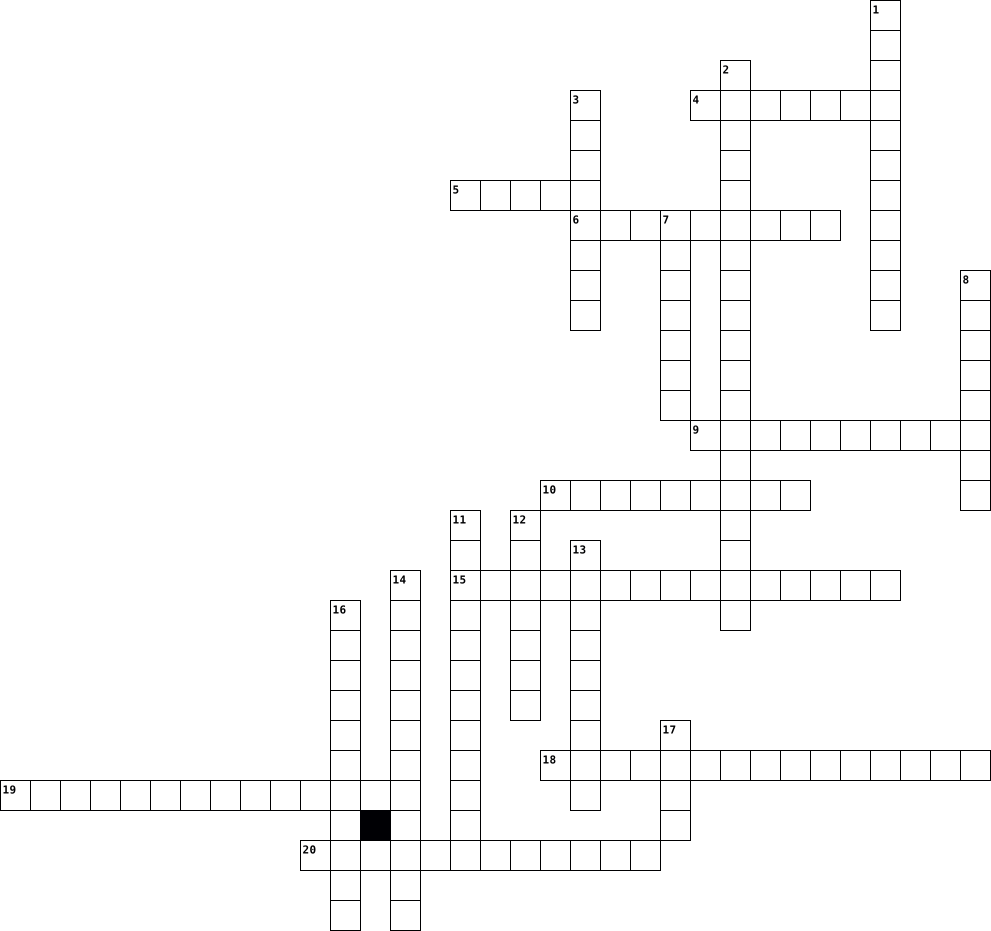
Across
- centrally controlled economy
- jobs or workers
- people who buy or use goods and services to satisfy their wants
- private ownership of property and resources
- the branch of knowledge concerned with the production, consumption, and transfer of wealth
- the choice not taken; what you “give up” to choose the other option
- individuals and businesses have the right to own real and personal property as well as the means of production without undue interference from the government
- markets are generally allowed to operate without undue interference from the government
- most economies today
Down
- people often perform the same type of work as their parents and grandparents
- consumers determine through purchases what goods and services will be produced
- the demand for a good or service is greater than the availability of the good or service
- the amount of an asset or resource that is unused
- all types of businesses that are related to the same good or service
- individuals have the opportunity to create a business and earn profits
- money and manmade objects used to make products or perform services
- people who make or grow goods and provide services
- a person who risks starting a business to earn a profit
- rivalry between producers and/or between sellers of a good or service usually results in better-quality goods and services at lower prices
- natural resources & raw materials used to make products
20 Clues: jobs or workers • most economies today • centrally controlled economy • private ownership of property and resources • the amount of an asset or resource that is unused • people who make or grow goods and provide services • a person who risks starting a business to earn a profit • natural resources & raw materials used to make products • ...
Economics 2023-05-17
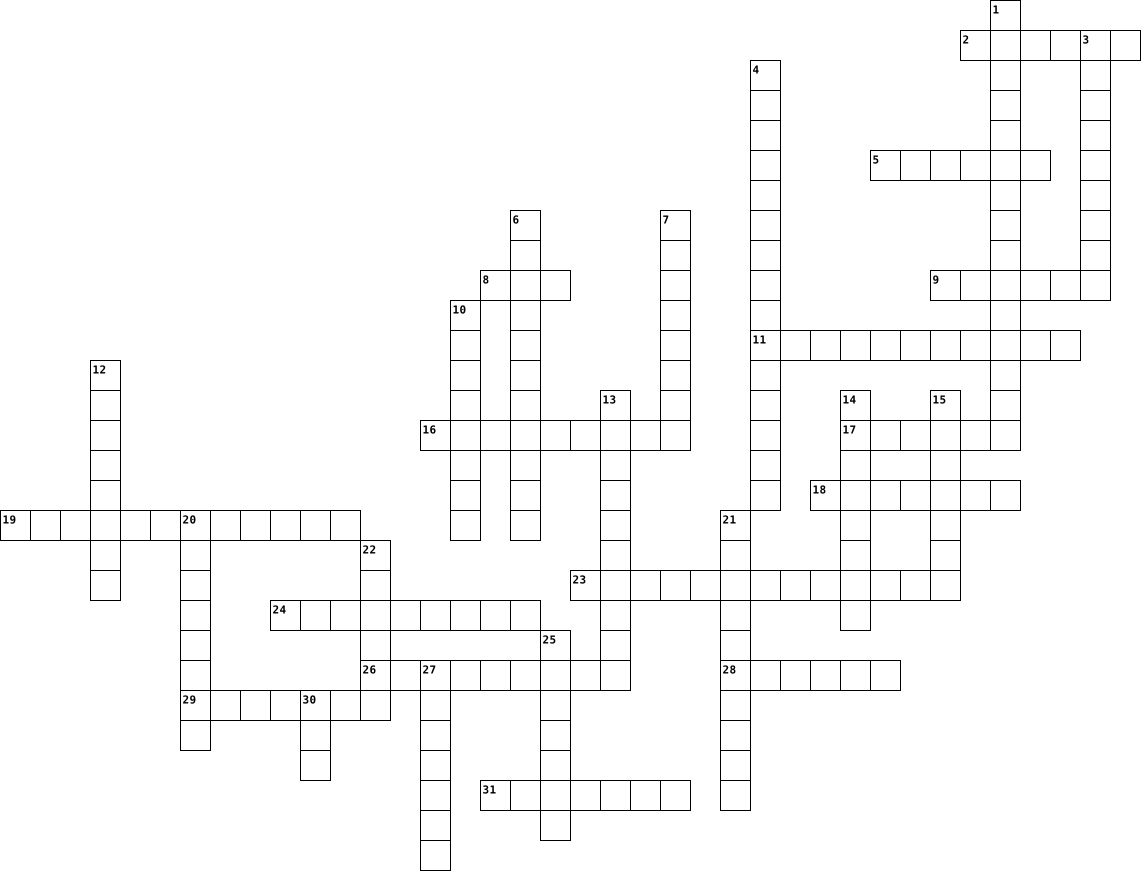
Across
- something that is desired
- Marshall, His most important book was Principles of Economics.
- of Demand, fundamental principle which states that there is an inverse relationship between price and quantity demanded
- Any items, materials and consumable substances which are sold to the consumers
- Cost, the loss of potential gain from other alternatives when one alternative is chosen.
- market structure where a single seller or producer
- person who makes a purchase.
- Economy economy in which production, investment, prices, and incomes are determined centrally by a government.
- market supply and demand balance each other, and as a result prices become stable
- competition when many companies offer competing products or services that are similar
- Competition, competitive market situation where there are many sellers, but they are selling heterogeneous goods
- a person, business, or entity that provides products or services to another entity.
- economy type of economic system where supply and demand regulate the economy, rather than government intervention
- the total amount of a specified product or service that is available to customers
- a place where parties can gather to facilitate the exchange of goods and services
Down
- branch of economics that deals with the performance, structure, behavior, and decision-making of an economy as a whole.
- the state of being scarce or in short supply; shortage.
- economics concerned with single factors and the effects of individual decisions.
- economy system where goods production and distribution are driven by time-honored beliefs, customs, culture, and traditions
- encompasses all of the activities related to the production, consumption, and trade of goods and services in an entity
- two suppliers dominate the market for a commodity or service.
- Scarcity, the comparison of the availability of resources between two or more entities
- markets dominated by a small number of suppliers
- Scarcity, resources that are fixed in supply and cannot be increased or decreased, regardless of demand.
- the consumer's desire to purchase a particular good or service.
- Management the process of planning, organizing, directing, and controlling the activities of a business or organization to achieve its goals and objectives.
- study of scarcity
- something needed to survive
- person who sells something
- Competition, Many firms produce identical products. Many buyers are available to buy the product, and many sellers are available to sell the product.
- of Supply, direct relationship between price and quantity
31 Clues: study of scarcity • something that is desired • person who sells something • something needed to survive • person who makes a purchase. • markets dominated by a small number of suppliers • market structure where a single seller or producer • the state of being scarce or in short supply; shortage. • of Supply, direct relationship between price and quantity • ...
Economics 2025-02-20

Across
- , things used to produce goods and services
- , thing that add comforts and pleasure to your life
- , things you can see and touch; products you purchase to meet your wants and needs
- , the point where supply and demand are equal
- , things that are required to live
- , an economy in which resources are owned and controlled by the government
- , the method a country uses to answer the three economic questions
- , not having enough resources to satisfy every need/want
Down
- , activities provided for the satisfaction of wants and needs that are consumed at the same time they are produced
- , an economy in which the resources are owned and controlled by the people of the country
- , the private ownership of economic resources by individuals rather than buy the government
- , the value of the next best alternative that you were not able to choose
- , an economy in which goods and services are produced
- , the quantity of a good or service that consumers are willing and able to buy
- , the process of choosing which needs and wants will be satisfied
- , an economy that combines elements of the command and market economies
- , a person who buys and uses goods and services
- , an individual or organization that determines what products and services will be available for sale
- , the quantity of a good or service that businesses are willing and able to provide
- , what you make when you give something up to have something else
20 Clues: , things that are required to live • , things used to produce goods and services • , the point where supply and demand are equal • , a person who buys and uses goods and services • , an economy in which goods and services are produced • , thing that add comforts and pleasure to your life • , not having enough resources to satisfy every need/want • ...
Economics 2025-02-23

Across
- Essential items required for survival
- The willingness and ability of consumers to purchase a good or service at a given price
- The general rise in the price of goods and services over time
- The lowest point of the business cycle before recovery begins
- A situation where supply exceeds demand, usually caused by prices being too high
- Man-made tools, machinery, and technology used in production
- A phase of economic growth where businesses hire more workers and production increases
- The study of how limited resources are allocated to meet the unlimited needs and wants of individuals and societies.
- The next best alternative foregone when making an economic decision
- Non-essential items that enhance comfort and lifestyle
- A situation where demand exceeds supply, usually caused by prices being too low
- Human effort (both physical and mental) used to produce goods and services
Down
- The economic problem where unlimited needs and wants exceed limited available resources
- The study of an entire nation’s economy, including government policies, inflation, and overall economic growth
- The study of individual markets and businesses
- The willingness and ability of producers to offer goods or services at a given price
- Goods that can replace each other in consumption
- The price at which the quantity of a good supplied equals the quantity demanded
- A slowdown in economic activity where businesses reduce production and lay off workers
- Goods that are used together
- Physical, tangible products that can be bought
21 Clues: Goods that are used together • Essential items required for survival • The study of individual markets and businesses • Physical, tangible products that can be bought • Goods that can replace each other in consumption • Non-essential items that enhance comfort and lifestyle • Man-made tools, machinery, and technology used in production • ...
Economics 2025-02-24

Across
- An item necessary for survival such as food, clothing or shelter
- Using new technology, materials, or processes to improve on existing products, or on how they are produced and distributed.
- Businesses rely on many other businesses in order to keep going.
- A combination of consumers, businesses and government make the decisions
- Are goods which, as a result of changed conditions, may replace each other in use(or consumption)
- Assistance provided, usually in return for payments, that satisfies needs and wants of people or businesses that does not result in a product that can be touched
- To come up with a unique idea, thought or fabrication; a new object, device or process that no one has seen or heard of before
- People or businesses that buy goods or services
- An item that can be seen or touched and is essential for survival
- Consumers and business make the decisions
- Are goods that are used together
Down
- Decisions are made based on the past
- Another word for Trough
- People that work to produce goods and services in a business(workforce)
- You are only doing part of the process in the assembly line
- An item which can be seen or touched but is not necessary for survival
- Means through which goods and services are made available to consumers
- Equipment, building, money that is used to produce goods and services
- The production and/or sale of goods and/or services to satisfy the needs, wants, and demands of consumers with the purpose of making a profit; an organization setup to do this.
- A product of service that consumers that no longer want because it has become outdated or outmoded or has been replaced by a new improved product
- Those raw materials that get from the earth, water and air
- Increase in output, income, employment, prices and profit.
- An individual or business that makes a product
- An item that can be seen or touched
- An item not necessary for survival but adds pleasure and comfort to life
- Cannot be perceived by touch
- A person who uses goods or services
27 Clues: Another word for Trough • Cannot be perceived by touch • Are goods that are used together • An item that can be seen or touched • A person who uses goods or services • Decisions are made based on the past • Consumers and business make the decisions • An individual or business that makes a product • People or businesses that buy goods or services • ...
Economics 2025-09-23

Across
- an economic and political system in which a country's trade and industry are controlled by private owners for profit.
- a market where one company can provide a good or service at a lower average cost than multiple competing firms, primarily due to high initial fixed costs and significant economies of scale
- a contractual agreement between an employer and a labor union that requires all employees to be members of the union to be hired or to remain employed
- a non-permanent work arrangement where individuals are hired on a temporary, project-by-project, or as-needed basis rather than for long-term, stable employment
- a desire for a good or service that improves quality of life but is not essential for survival
- the subfield of economics that studies how labor markets function, focusing on the dynamics of the supply and demand for labor, the determination of wages and employment, and the factors influencing these outcomes
- a market structure dominated by a small number of large firms, where each firm's actions, such as pricing or production changes, have a significant impact on the others, leading to interdependent decision-making and strategic competition
- workers who possess specialized training, education, or experience in a particular field, enabling them to perform complex tasks requiring high proficiency and expertise
- an economic system in which production and prices are determined by unrestricted competition between privately owned businesses.
- a business practice where a company hires an external party, such as another firm or a contractor, to perform tasks, functions, or services that would typically be done by its own employees
- an economy in which production, investment, prices, and incomes are determined centrally by a government.
- the optimal allocation of scarce resources to satisfy human wants and needs, minimizing waste and maximizing total welfare
- a field of study that analyzes the economic impact of patent systems
- the process where a labor organization (a union) and an employer negotiate terms and conditions of employment for a group of employees, such as wages, benefits, and working conditions, to reach a collectively agreed-upon contract
- gives workers the freedom to choose whether or not to join a labor union in the workplace
- the tangible assets—like machinery, equipment, buildings, and tools—that are used to produce goods and services
- the value of the next best alternative that must be given up to pursue a certain action or make a specific choice
Down
- jobs that require a degree of basic knowledge, experience, or training, but not a high level of specialization, education, or complex skill
- a political and economic philosophy encompassing a diverse range of systems characterized by social ownership of the means of production, rather than private ownership
- the skills, knowledge, intelligence, education, experience, and health that individuals possess, which enhance their economic productivity and earning potential
- those who perform manual labor or skilled trades, often in sectors like manufacturing, construction, and transportation
- the fundamental economic trade-off a society faces between spending its limited resources on military production ("guns") versus civilian needs ("butter")
- the fundamental problem of having limited resources to meet unlimited wants and needs
- the interdisciplinary study of the allocation, use, development, and management of land and natural resources
- the surplus revenue a firm earns after accounting for both explicit costs and implicit costs
- the rivalry between numerous independent firms to provide goods and services to a market
- private, informal, and extrajudicial process where parties in a dispute submit to a neutral, expert third party for a decision that is final and binding, providing a less expensive and more efficient alternative to traditional litigation
- a legally created entity that is separate and distinct from its owners, allowing it to act as a "legal person" under the law
- a market structure where a single firm is the sole producer or seller of a good or service for which there are no close substitutes
- an organization of trade unions that focused on achieving practical economic gains for its members, particularly skilled workers, through collective bargaining and strikes to improve wages, working conditions, and hours
- an economic force in the late 19th century that promoted worker solidarity to improve labor conditions and eventually transition from capitalism to a worker-owned economy
- a good or service essential for basic survival
- an expert in economics who applies their knowledge of economic principles to study, analyze, and forecast economic trends to provide advice and develop policies for businesses, governments, and other organizations
- an economic principle that states that, all else being equal, as the price of a good or service increases, the quantity demanded by consumers will decrease, and vice versa
- obstacles that prevent or make it difficult for new firms to enter a market or industry, thereby reducing competition and allowing existing firms to maintain higher prices and profits
- jobs characterized by mental or administrative work, typically performed in an office setting, requiring higher education and often compensated with an annual salary
- a financial instrument that signifies partial ownership in a company, entitling the holder to a share of the company's assets and earnings
- an economic system where the production, distribution, and consumption of goods and services are based on customs, traditions, and historical beliefs, rather than on money, markets, or technology.
- a workplace where employees are not required to join a labor union or pay union dues, even if a union is present and acts as a representative for the workers
- a work stoppage or slowdown initiated by employees to protest or demand economic concessions from their employer
- jobs requiring little to no specialized training, education, or advanced skills, often involving repetitive or manual tasks
- political and economic ideology that advocates for a classless, stateless society in which the means of production are owned communally
- informal, voluntary, and collaborative negotiation process where a neutral third party assists disputing parties in reaching a mutually acceptable agreement, thereby avoiding costly and adversarial legal proceedings and fostering durable, self-determined outcomes
- physical item or product that satisfies human wants or needs, provides utility, and is scarce enough to have an exchange value
44 Clues: a good or service essential for basic survival • a field of study that analyzes the economic impact of patent systems • the fundamental problem of having limited resources to meet unlimited wants and needs • the rivalry between numerous independent firms to provide goods and services to a market • ...
Economics 2025-09-08

Across
- When households use their income they are conducting
- The wider impacts of a change in one part of the economy
- Sector of production that uses natural resources
- Sector of production that turns raw materials into goods
- Economic group that provides labour and consumes goods
- Inputs used to make goods and services
- Sector of production that provides services
- showing the flow of money and resources in an economy
- Human effort used in production
- Physical items produced to satisfy needs and wants
- A part of the economy, such as primary, secondary, or tertiary
Down
- Economic group that collects taxes and provides public goods
- The next best alternative given up when a choice is made
- Money earned by selling goods and services
- When resources are limited but wants are unlimited
- Money received for providing labour
- Sector that involves exports and imports
- The process of creating goods and services
- Economic group that produces goods and services
- Non-physical activities that satisfy needs and wants
20 Clues: Human effort used in production • Money received for providing labour • Inputs used to make goods and services • Sector that involves exports and imports • Money earned by selling goods and services • The process of creating goods and services • Sector of production that provides services • Economic group that produces goods and services • ...
Economics 2026-02-25

Across
- – The amount of a good or service consumers are willing and able to buy.
- – Money earned from working or investing.
- – Focusing on producing certain goods efficiently.
- – Goods brought into a country.
- – Money owed to another person or institution.
- – A tax placed on imported goods.
- – When supply is greater than demand.
- – The point where supply and demand meet to determine price.
- – Expenses required to operate a business.
- – The act of organizing resources and taking risks to start a business.
- – Giving up one thing in order to gain something else.
- – The exchange of goods and services between countries.
- – A general increase in prices over time, which reduces purchasing power.
- – The study of how people make choices about using limited resources.
Down
- – A market situation where one company controls the entire market.
- – When demand is greater than supply.
- – Borrowed money that must be repaid later.
- – Human effort used in the production of goods and services.
- – Items that improve quality of life but are not necessary for survival.
- – Goods sold to other countries.
- – Basic essentials required for survival (food, water, shelter).
- – Revenue minus costs.
- – The amount of a good or service producers are willing to sell.
- – Using money to try to earn more money over time.
- – Businesses trying to attract the same customers.
- – Money earned from saving or paid for borrowing money.
- – Not having enough resources to satisfy all wants.
- – Total money earned from sales.
- – Tools, machines, and equipment used to produce goods and services.
- – Money set aside for future use.
- – Natural resources used to produce goods and services.
31 Clues: – Revenue minus costs. • – Goods brought into a country. • – Goods sold to other countries. • – Total money earned from sales. • – A tax placed on imported goods. • – Money set aside for future use. • – When demand is greater than supply. • – When supply is greater than demand. • – Money earned from working or investing. • – Expenses required to operate a business. • ...
Economics 2025-08-15

Across
- the act of products being transported between countries
- bringing in goods from another country
- a measure of a country's economy
- the act of focusing on a product so you can export to other countries
- what a working person earns
- a person who takes the risks of starting a business
- natural or man-made materials that can be used to produce goods or provide services
- someone who is not accepted by society (hint: 2 words, but don't type the space)
- someone who works under a business
- a person who manufactures goods of provides services
- the way that participants in an economy depend on each other.
- things you would like but are not necessary for survival
- compulsory in Australia ^^
Down
- the economic problem of not having enough resources to satisfy our wants and needs
- a plan for achieving a goal or several goals
- what you miss out on from the next-best option (hint: 2 words, but don't type the space)
- a person who buys goods or pays for services
- the study of how people and society use resources to satisfy their wants and needs
- the exchange of goods and services amongst buyers and sellers
- the four factors of __________
- somebody that hires people for their business
- businesses would be up against each other in a metaphorical ____________
- shipping goods to another country
- things that are necessary for survival
24 Clues: compulsory in Australia ^^ • what a working person earns • the four factors of __________ • a measure of a country's economy • shipping goods to another country • someone who works under a business • bringing in goods from another country • things that are necessary for survival • a plan for achieving a goal or several goals • a person who buys goods or pays for services • ...
Economics 2025-10-08

Across
- 9
- 4
- 16
- 17
- 11
- 19
- 8
- 18
- 5
Down
- 7
- 2
- 1
- 20
- 10
- 12
- 3
- 14
- 15
- 13
- 6
20 Clues: 7 • 2 • 1 • 9 • 4 • 3 • 8 • 6 • 5 • 16 • 20 • 17 • 10 • 12 • 14 • 11 • 19 • 15 • 13 • 18
Economics 2026-03-03

Across
- implemented first communist state
- first self-proclaimed socialist state
- collaborator with Marx
- co-author of communist manifesto
- established under Mao Zedong
- global economic collapse
- the establishment of first communist government
- Symbol of Soviet style communism collapse
- term for selfish people that drive the economy
- Marx's terms for the capitalists
Down
- manufactoring that led to industrial capitalism economy
- "father of capitalism"
- defended free market capitalism
- Symbol of division between communist and Capitalist states
- System where the state makes all economic decisions
- had theories to stabilize economy
- attitude of letting markets take course
- led to the celebration of workers day
- leader of Chinese communist rebellion
- facilities that produce goods
20 Clues: collaborator with Marx • "father of capitalism" • global economic collapse • established under Mao Zedong • facilities that produce goods • defended free market capitalism • co-author of communist manifesto • Marx's terms for the capitalists • implemented first communist state • had theories to stabilize economy • first self-proclaimed socialist state • ...
Economics 2026-04-06

Across
- Acting in one’s own interest to improve their life
- The limit on resources that creates the need for prices
- The person who holds the legal rights to a company
- Removing government rules to let the market work
- The work done by people to create products
- The group of people living together who buy goods
- Thinking about the next unit or one extra step
- Someone who puts money into a business to help it grow
- The power to pick between different brands or products
- When the amount of stuff made matches the amount people want
- A person who works for a business in exchange for pay
- The creation of a better way to do something
- The person in charge of daily business operations
- How much of a product people want to buy
- A steady economy without wild crashes or spikes
- A state of being successful and having plenty of money
- When a business spends more than it earns
- A measure of quality or wealth like level of living
- A rival business trying to sell to the same people
- The machines tools and money used to run a business
- Having many different types of goods to choose from
- Having the legal right to use and keep your property
- Doing the most work with the least amount of waste
- The battle between businesses for your money
- A person who starts a business to solve a problem
Down
- Having too much of a product left on the shelf
- Done by choice not because of force
- The act of swapping goods for money or other items
- The total value of everything a person owns
- How products get from the factory to the people
- What you give up to get something else
- A reward like money that encourages harder work
- When an economy gets bigger and produces more
- The idea that the buyer is in charge
- The king of the market who buys the goods
- Another word for a business or a bold project
- The person or company that creates the product
- The signal that tells buyers how much a good is worth
- System where the means of production are privately owned
- All the money a business takes in from sales
- The amount of happiness or use a product provides
- The place where buying and selling happens
- How stretchy demand is when prices change
- The reward left over after all bills are paid
- The total amount of a product available for sale
- The back and forth give and take of a sale
- The right to start a business or quit a job at will
- What happens when a store runs out of a popular item
- A specific business or organization
- What a product is actually worth to a person
50 Clues: Done by choice not because of force • A specific business or organization • The idea that the buyer is in charge • What you give up to get something else • How much of a product people want to buy • The king of the market who buys the goods • How stretchy demand is when prices change • When a business spends more than it earns • The work done by people to create products • ...
Economics 2026-04-13

Across
- rate Percentage charged or paid on money borrowed or saved
- Middle value in a set of numbers
- Money earned from work or other sources
- Having work or a job
- of living Level of comfort and wealth a person has
- System of money, trade and business in a country
- Connected to money
- Related to a job that needs special training
- Place or system where goods are bought and sold
- and shares Parts of a company that people can buy
- Income received by a business or government
- Rich; having a lot of money
Down
- State of being very poor
- Buy something
- Money put into something to make more money
- Something that influences a result
- Money kept for future use
- Amount of something available
- Money that is spent
- Put money into something to make a profit
- Have enough money to pay for
- Worth a lot of money or very useful
- How much people want to buy something
- Money gained from an investment
- Unfair difference between groups of people
- How much something is worth
26 Clues: Buy something • Connected to money • Money that is spent • Having work or a job • State of being very poor • Money kept for future use • How much something is worth • Rich; having a lot of money • Have enough money to pay for • Amount of something available • Money gained from an investment • Middle value in a set of numbers • Something that influences a result • ...
economics 2026-05-18

Across
- apparent contradiction between the high value of nonessential item and the low value of an essential item
- society not having enough resources to produce all the things people would like to have
- system of allocating goods and services without prices
- Political system in which the government owns some, but not all, of the factors of production
- The value of the next best alternative given up
- when factors of production perform only tasks they can do better or more efficiently than others
- simplified version of a complex concept or behavior expressed in the form of a graph, figure, equation, or diagram
- products that increase the use of other products
- formal agreement to set specific prices or to otherwise behave in a cooperative manner
Down
- monetary value of a product
- economic system in which supply, demand, and the price system help people allocate resources
- economic system in which privately owned businesses have the freedom to operate for a profit with limited government intervention
- illegal combinations of corporations or companies organized to suppress competition
- principle that more will be offered for sale at higher prices in a market at a given point in time
- measure of responsiveness that tells us how a dependent variable responds to a change in an independent variable
- rise in general level of prices
- also known as externalities
- quantities that someone would be willing to buy over a range of possible prices at a given moment.
- an inverse relationship between price and quantity demanded
- economic and political system in which factors of production are collectively owned and directed by the state
20 Clues: monetary value of a product • also known as externalities • rise in general level of prices • The value of the next best alternative given up • products that increase the use of other products • system of allocating goods and services without prices • an inverse relationship between price and quantity demanded • ...
Maggie Springer - Industrial Revolution and Imperialism 2025-02-21

Across
- free choice economics
- moving crops from year to year
- a class of people in the middle of a social hierarchy
- cloth and thread
- led Berlin conference
- transitional period of the global economy
- a German-born philosopher
- justification for stronger nations to dominate weaker ones
- establish workers rights
- protest poor working conditions
- exploit during imperialism
- discrimination
- individual shareholders
Down
- a Scottish economist and philosopher
- joining together to go on strike
- taken over by europe
- meeting divided africa
- owned by working class
- chaning to machine production of goods
- taking over of a less advanced civilization
- movement of people to cities
- govt interfering with economics
- native
- fenced farm lands
- no private property
- free market economics
26 Clues: native • discrimination • cloth and thread • fenced farm lands • no private property • taken over by europe • free choice economics • led Berlin conference • free market economics • meeting divided africa • owned by working class • individual shareholders • establish workers rights • a German-born philosopher • exploit during imperialism • movement of people to cities • ...
Economics 2012-08-27
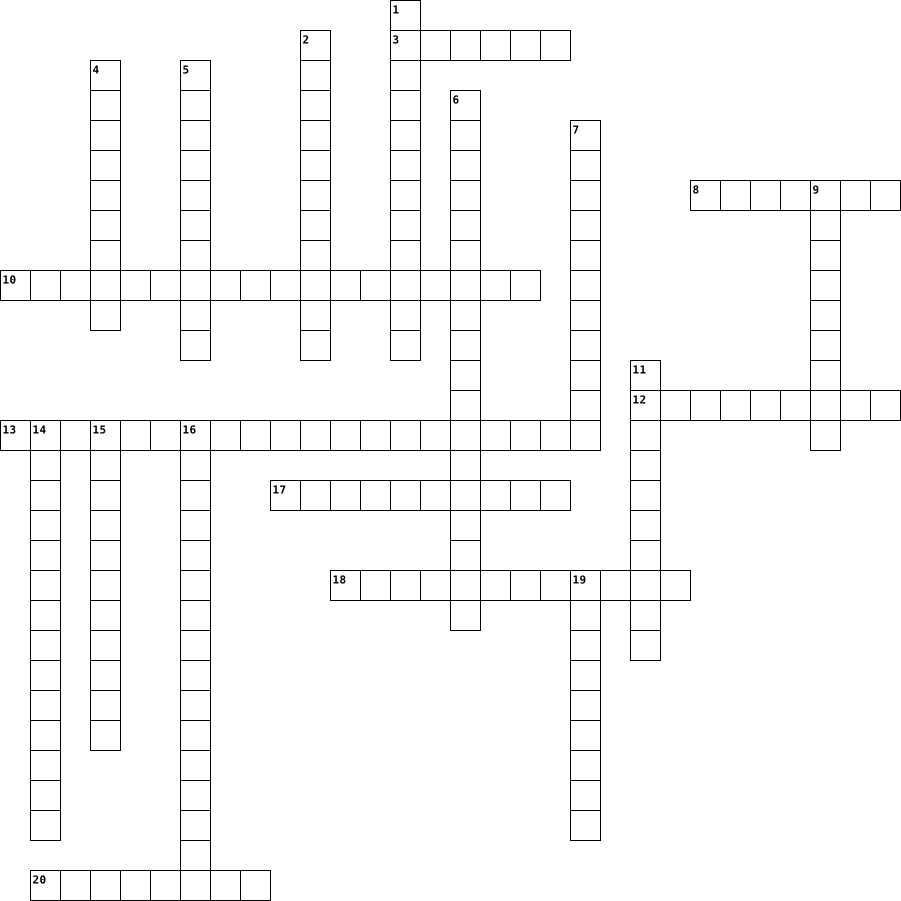
Across
- When a company issues more shares, it is taking advantage of _______ financing
- This decreases as you continue to consume a certain good over and over again
- Index measuring changes in overall value of companies
- The most common market structure in Australia
- If this is high, then it is easier for workers to change within jobs
- Type of unemployment leading to redundancy in manufacturing
- Market for any input into production process
- Sovereignty Concept outlining the consumer's role in a market economy
Down
- Policies conducted to reduce role of government
- A practice with a significant trend of growth in terms of employment contracts
- Movement along demand curve
- Also known as financial assets
- The measure of spread of income within the economy
- Method used to measure price elasticity by examining changes in total revenue of a producer
- A term commonly measured by percentage change in Consumer Price Index
- Good used in conjuction with another good is known as a ________
- Term used in economic analysis stating that all factors remain constant apart from one
- A good is said to be _______ when quantity supplied rises by same proportion as price increases
- Point in which there is most efficient level of production for a firm
- Actual purchasing power of money wages
20 Clues: Movement along demand curve • Also known as financial assets • Actual purchasing power of money wages • Market for any input into production process • The most common market structure in Australia • Policies conducted to reduce role of government • The measure of spread of income within the economy • Index measuring changes in overall value of companies • ...
Economics 2012-09-11
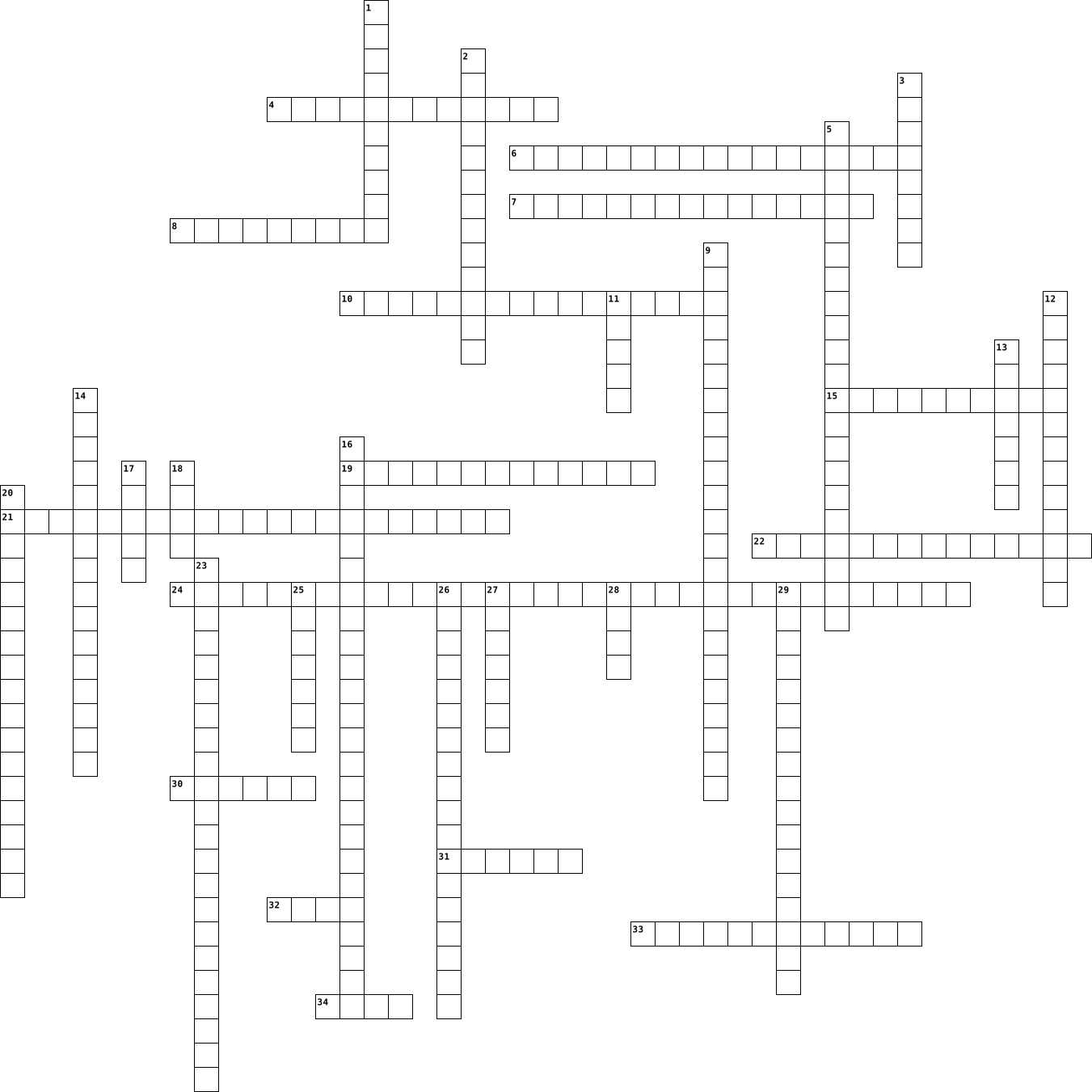
Across
- a risk taker in search of profits who does something new with existing resources
- takes place when work is arranged so that individual workers do fewer tasks than before
- occurs when a nation's total output of goods and services increases over time
- is the study of how people try to satisfy what appears to seemingly unlimited and competing wants through the careful use of relatively scarce resources
- is the situation where some necessities, such as water, have little monetary value, whereas some non-necessities, such as diamonds, have a much higher value
- the process of creating goods and services, can take place
- is when manufactured goods are used to produce other goods and services
- is a way of thinking about a problem that compares the costs of an action to the benefits received
- are productive resources are brought and sold
- a diagram representing various combinations of goods and or services an economy can produce when all productive resources are fully employed
- is the accumulation of those products that are tangible, scarce, useful, and transferable from on person to another
- a location or other mechanism that allows buyers and sellers to exchange a certain economic product
- and item that is economically useful or satisfies and economic want, such as a book, car, or compact disc player
- is a measure of the amount of output produced by a given amount of inputs in a specific period of time
- is a basic requirement for survival and includes food, clothing, and shelter
Down
- or alternative choices, whenever they make an economic decision
- is intended for final use by individuals
- is the condition that results from society not having enough resources to produce all the things people would like to have
- resources required to produce the things we would like to have, are land, capital, labor, and entrepreneurs
- one in which consumers and privately owned businesses, rather than the government making the majority of the What, How, and For Whom decisions
- refers to a worth that can be expressed in dollars and cents
- is the sum of skills, abilities, health, and motivation of people
- the capacity to be useful and provide satisfaction
- the cost of the next best alternative use of money, time, or resources when one choice is made rather than another
- this means that we rely on others, and others rely on us, provide the goods and services that we consume
- people with all their efforts, abilities, and skills
- is a way of expressing a need
- goods and services that are useful, relatively scarce, and transferable to others
- the dollar value of all final goods and services, and structures produced within a country's borders in a 12 month period
- the tools, equipment, machinery, and factories used in the production of goods and services
- are markets where producers sell their goods and services to consumers
- or work that is performed for someone
- also known as "gift of nature" or natural resources not created by humans
- the money used to buy the tools and equipment used to production
34 Clues: is a way of expressing a need • or work that is performed for someone • is intended for final use by individuals • are productive resources are brought and sold • the capacity to be useful and provide satisfaction • people with all their efforts, abilities, and skills • the process of creating goods and services, can take place • ...
Economics 2013-12-16
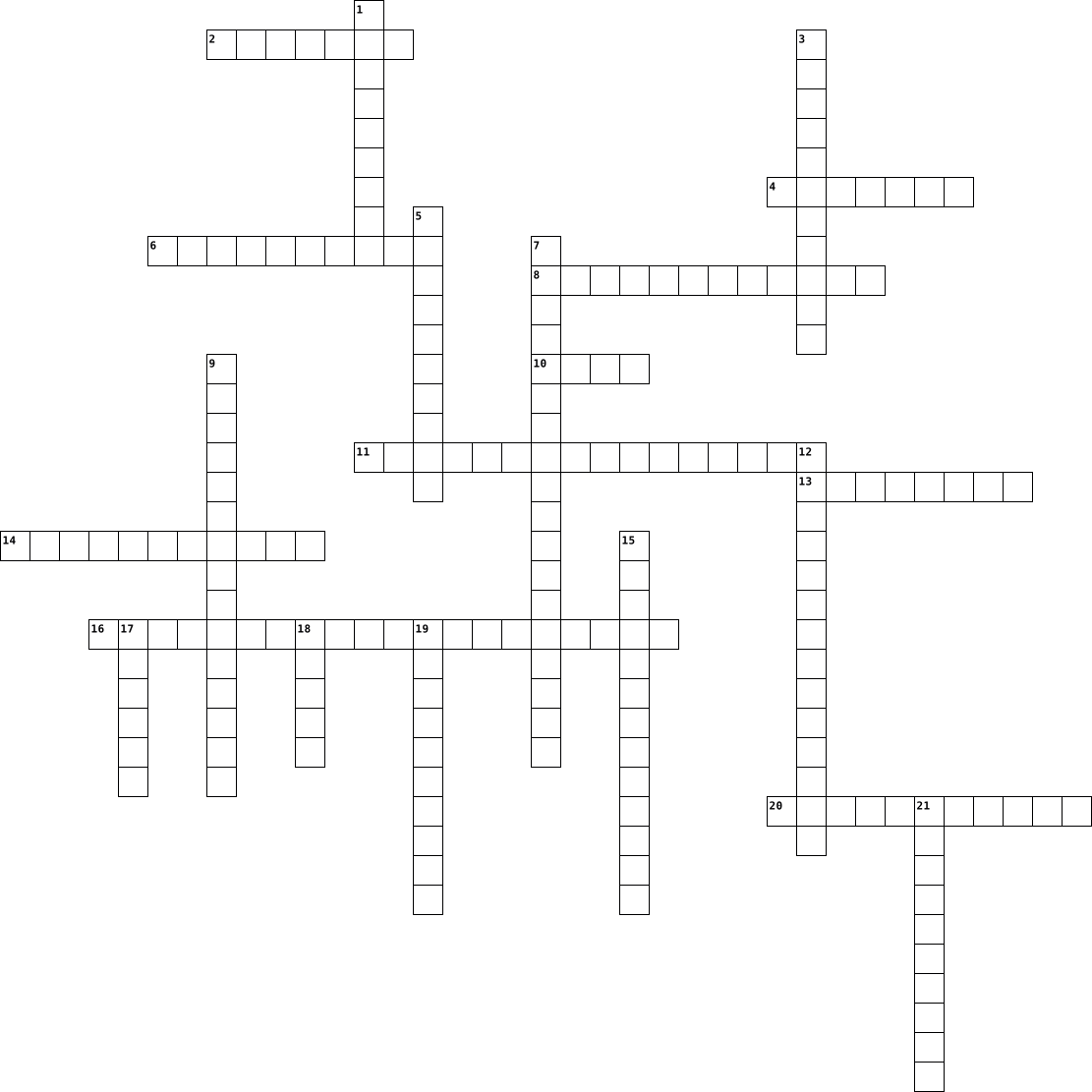
Across
- the condition where a persons income and resources do not allow them to achieve a minimum standard of living
- income not used for consumption
- occurs when stock market prices rise steadily over time
- bank chartered by national government
- possibility for loss on an investment
- the percentage of the labor force that is job-less and looking for work
- paper money and coins
- the ratio of the amount of output produced to the amount of input
- the market value of all final goods and services produced within a nation in a given period of time
- buys and sells stocks for customers
Down
- bank chartered by state government
- profit made from the sale of securities
- measures and reports the change in prices of a set of stocks
- / market activities that go unreported due to being illegal or to avoid taxation
- all the institutions that help transfer funds between savers and investors
- the increase in a nations real GDP over a period of time
- a market where securities are bought and sold
- the profit or loss made on an investment
- anything people will accept for goods or services
- the use of income today that allows for a future benefit
- occurs when stock market prices decline steadily over time
21 Clues: paper money and coins • income not used for consumption • bank chartered by state government • buys and sells stocks for customers • bank chartered by national government • possibility for loss on an investment • profit made from the sale of securities • the profit or loss made on an investment • a market where securities are bought and sold • ...
Economics 2014-03-06
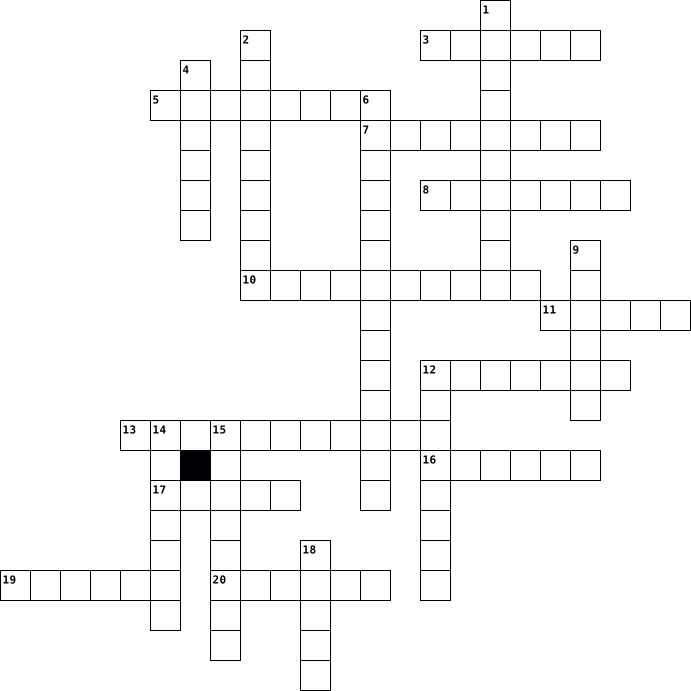
Across
- interaction of buyers and sellers exchanging goods and services
- actions that are capable of satisfying peoples wants
- a person who grows agricultural products or manufactures items
- Resources something found in nature
- Country a country whose economy is still being built
- objects that are capable of satisfying peoples wants
- Resources resources made by humans such as building tools and machinery
- the purchase or use of goods and services
- the quantities of a good or service that producers are willing and able to provide at various prices during a given time period
- exchange of something of value
- goods that leave a country as part of trade
- the quantities or productive resources
Down
- the act of combining natural resources ,human resources capital goods & entrepreneurship to make goods & services
- Country a country with an established economy generally containing all 4 forms of production
- the quantities of a good or service that consumers are willing and able to buy
- concentration of production on fewer kinds of goods & services
- Trade countries relying on one another to satisfy wants and needs 20/ Import goods brought into a country as part of trade
- a person who buys and uses goods and services
- quantities of goods ans services produced
- lack of sufficient resources to produce all the goods and services people desire
- Resources activities of people who decide what kind of economic activities to pursue
21 Clues: exchange of something of value • Resources something found in nature • the quantities or productive resources • the purchase or use of goods and services • quantities of goods ans services produced • goods that leave a country as part of trade • a person who buys and uses goods and services • actions that are capable of satisfying peoples wants • ...
Economics 2013-11-21
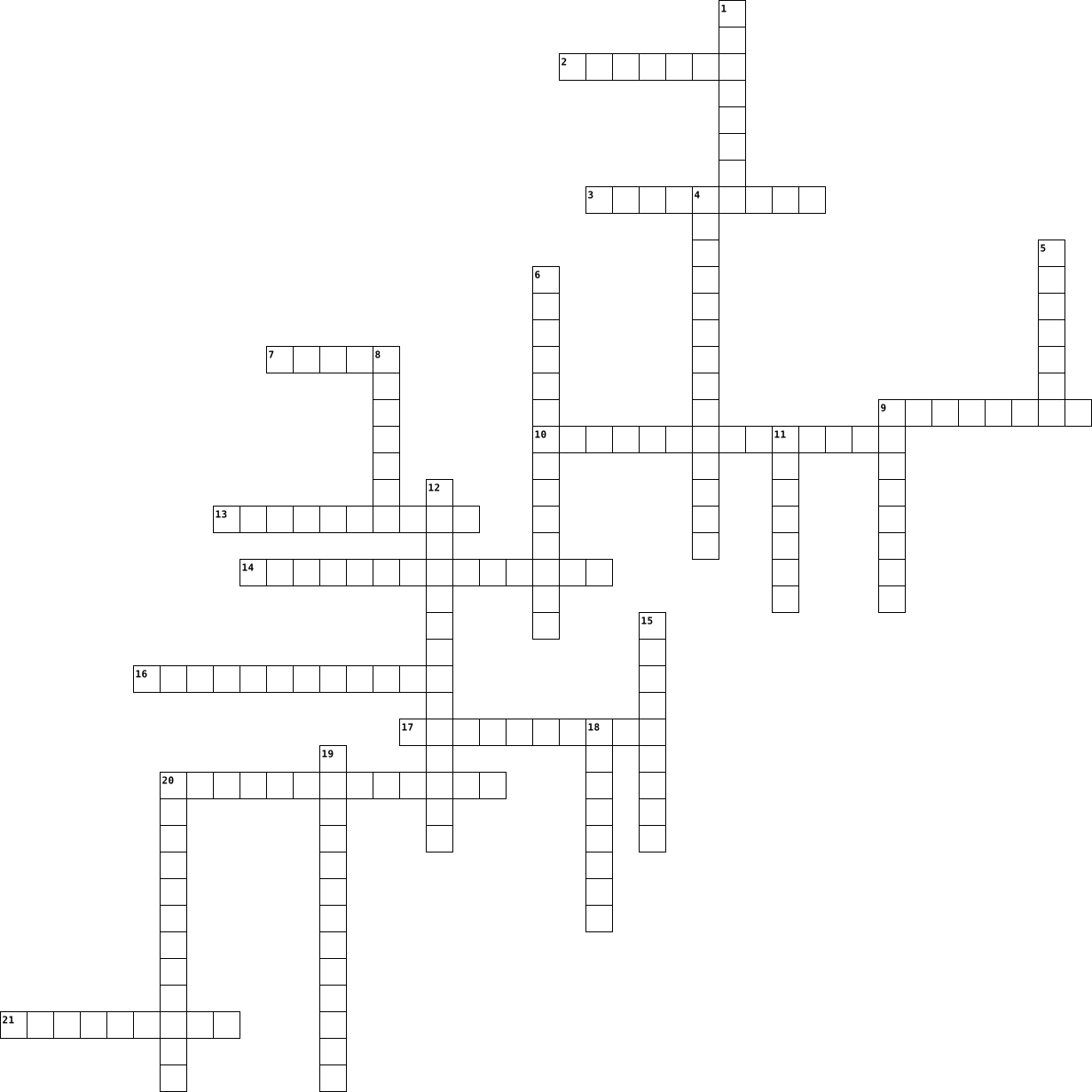
Across
- money the government owes
- overall increase in the price of goods
- major source of income for the federal government
- when a single producer dominates a market and there is no competition, causes high inflation
- large scale public systems like highways, bridges, and schools
- sharp drop in a nation's GDP for more than a year
- gives benefits to the elderly by providing supplemental income after retirement
- governmental plan of action to solve either a problem that affects all or most people or a problem that the people cannot solve on their own
- provide money to buy food based on the dollar amount a household receives based on family income
- a country's official principles, positions, and procedures for dealing with forces outside its borders
- product
Down
- fee charged for borrowing money
- money set aside for a specific use
- type of fuel made by blending gasoline and ethanol
- government's resolution to problems at home in American that need public solution (ex. highways, healthcare, welfare)
- when money is left over
- social welfare program that assists the poor with their medical costs, jointly funded by both the national government and the states
- duties and fees the government charges businesses and individuals who bring good into the US from other countries
- regulates the economy by controlling the money supply
- slowdown in economic growth; decline in GDP for two consecutive quarters
- social insurance program, designed to help the elderly or disabled pay their medical costs
- fees charged to borrow money
- government's power to tax and spend
23 Clues: product • when money is left over • money the government owes • fees charged to borrow money • fee charged for borrowing money • money set aside for a specific use • government's power to tax and spend • overall increase in the price of goods • major source of income for the federal government • sharp drop in a nation's GDP for more than a year • ...
Economics 2015-02-04
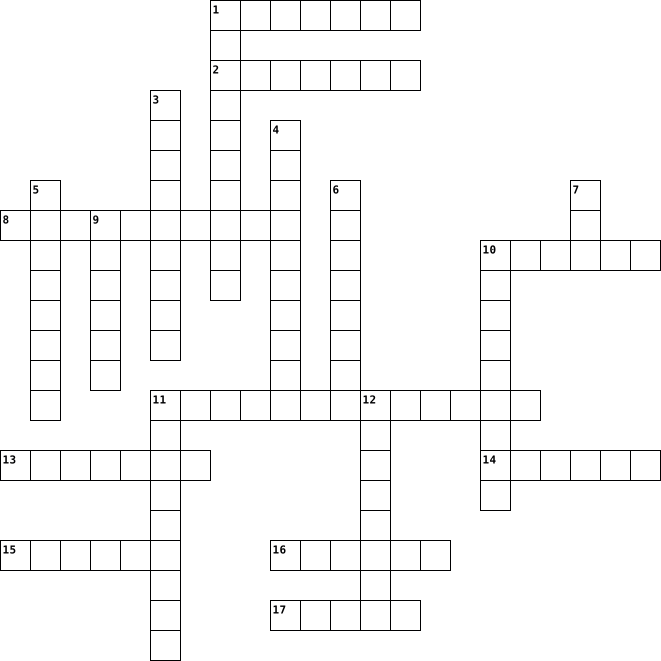
Across
- failure to fulfil the terms of a loan agreement
- state of being poor
- a free-market system built on private ownership
- money loaned
- two-word name for the currency of the UK
- when more money goes out than comes in
- ... and shares
- total revenue minus total costs
- workforce
- ... makes the world go round
Down
- a particularly bad recession, i.e. America, 1929
- rising prices across the board
- jobless
- two-word term for a country with low or no taxes, i.e. Switzerland
- judged by a court to be unable to pay off one's debts
- money sent from one country to another in order to help its economy
- to put money into a venture in the hope of making more money
- Karl Marx's "dictatorship of the proletariat"
- to sell state-owned business to non-public investors
- area of the single European economy
20 Clues: jobless • workforce • money loaned • ... and shares • state of being poor • ... makes the world go round • rising prices across the board • total revenue minus total costs • area of the single European economy • when more money goes out than comes in • two-word name for the currency of the UK • Karl Marx's "dictatorship of the proletariat" • ...
Economics 2015-05-20
Across
- when there's a increase in efficiency there will be more
- Income received from the factors of production (land, labour, enterprise and capital).
- Depicts the maximum level of output possible for a country when all resources are used to maximum efficiency.
- Is the total income received from all sources, including government transfers.
- A consumer's desire and willingness to pay a price for a specific good or service
- Is a term describing generally falling prices over a period of time. It can happen in recession.
- The rate of inflation is
- Is the sum of all apending or demand on final goods and services.
- is a wave pattern which records the various phrases the level of economic activity.
- Is where people's needs and wants are virtually unlimited.
- All firms produce similar yet not perfect substitute products.
- The total amount of a specific good or service that is available to consumers.
- This bank decides on interest rates.
- Represents the degree of income equality or inequality
- CPI measures this
- To create more productivity you need more
- This commission sets up promotes competition and fair trade in markets to benefit consumers and businesses
- a system that increases or decreases taxes
- might be called market or current.
- A situation in which the supply and demand for a good or service can vary significantly due to the price
- Concept or idea of fairness in economics
Down
- Always between 0 and 1
- the loss of other alternatives when one alternative is chosen.
- another term for Real GDP
- Is a measure of the total inflation within an economy
- the situation in which the supply and demand for a good or service are unaffected when the price of that good or service changes.
- Is the stock of financial and material assets a person accumulate through savings or inheritance, including land, houses, shares and savings.
- the 45 degree line that represents equality.
- buying foreign made goods is called
- Australian made goods sold to a overseas market is called
- Is an extreme situation where prices rise very quickly
- Is a measure of inflation that excludes certain items that face volatile price like food and energy.
- Income after tax revenues is called
- a system that the RBA which increases or decreases interest rates
- Is received by people who haven’t directly participated in the production process from people who have participated in that process.
- is a supply side factor in which the wage increase very high, then the cost of production for the company, then to maintain profits they would increase prices.
- A compulsory contribution to state revenue
- Higher Gini Coefficient means
- when a market system is when one market is dominating
- Opposite of inflation
- A market system where their is limited competition
41 Clues: CPI measures this • Opposite of inflation • Always between 0 and 1 • The rate of inflation is • another term for Real GDP • Higher Gini Coefficient means • might be called market or current. • buying foreign made goods is called • Income after tax revenues is called • This bank decides on interest rates. • Concept or idea of fairness in economics • ...
Economics 2015-05-24
Across
- / Payments received by businesses from selling goods and services
- / A type of measure for inflation
- / Part of the lorenz diagram that shows the degree of income or wealth quality or inequality
- / When people are willing and able to work but do not have jobs
- / Also known as personal income tax
- / A supply factor that can affect the cost of production of the business
- / A demand factor in which one product can replace another product
- / A supply factor that affects GDP
- / A type of market structure that have a few firms in the industry
- / A type of policy that includes taxes
- / A level of poverty that is experienced when there is a serious deprivation of basic needs
- / A point on the business cycle where the GDP of a country is negative
- / One firm in the industry
- / When consumers and producers are satisfied with the price
- / A type of market structure that have several firms in the industry and has strong market power
- / A type of policy that includes interest rates
- / Unlimited wants and needs but not enough resources
- / Another word for unlimited
- / A number between 0-1 that measures the equality of the distributional income
- / Natural resources that are used to produce goods and services
- / Every 20% of income distributed
- / When prices are generally falling over a period of time
- / 80% of a business cost
Down
- / A level of income which people cannot enjoy access to basic needs
- / Another word for limited
- / Every 10% of income distributed
- / A factor in the AD formula
- / CPI that excludes volatile items
- / A demand factor that can increase GDP
- / Gross domestic product
- / A measure of resource efficiency
- / A situation where prices rise very quickly and go out of control
- / A point on the business cycle where GDP is falling slowly
- / A point on the business cycle where the GDP is high
- / A point on the business cycle where GDP is going up slowly
- / Events such as cyclones, droughts and floods
- / Refers to a rise in the level of prices for goods and services over a period of time
- / All buildings, equipment and human skills used to produce goods and services
- / Goods or services produced in one country but sold to buyers in another country
- / Goods or services bought from sellers in another country
40 Clues: / Gross domestic product • / 80% of a business cost • / Another word for limited • / One firm in the industry • / A factor in the AD formula • / Another word for unlimited • / A type of measure for inflation • / Every 10% of income distributed • / Every 20% of income distributed • / CPI that excludes volatile items • / A supply factor that affects GDP • ...
Economics 2015-05-07
Across
- How much of something people want.
- Economy People can freely buy and trade goods and services. The price of each good or service is determined not by the government but by demand.
- A fee charged by the government on a product, income, or activity.
- A system of exchange like money.
- To work, especially work hard.
- Resources The man-made tools needed to make a product.
- Describe or draw attention to a product, service, or event)/
- Owing money that is overdue
- Trade Exchange of goods/services throughout the world.
- To provide someone or something with money.
- An economic system where the government has control what goods and services people can have and how much they can have. Everything is owned by everyone, and there are no “social classes.”
- Synonym for Trading.
- The person who has leadership and the innovation in a business.
- A good brought in to North Carolina from another state/country.
- A type of product manufactured by a particular company under a particular name.
- A fee for borrowing money.
- Chief Executive Officer; The President/Manager Director of a business or corporation.
- A company/business that produces goods.
- Management of money.
- The action or business of promoting and selling products or services.
- A document that gives the rights of an inventor to their invention.
- An estimate of expected income and spending over time.
- To persuade someone to buy something.
- Exchange The exchange of one currency to another
Down
- A type of cloth or woven fabric.
- The payment that was paid; directly comes out of checking account.
- There is not an unlimited supply of resources, so sometimes the things that we want are unavailable.
- Increase in prices for goods and services over time.
- An economic system where how much money people have determines on their income; people make profit on the goods or services they provide.
- The money you receive.
- Resources The people who make products.
- The ability of a customer to obtain goods or services before payment.
- Something you would like to have, but it is not necessary for survival.
- of Labor Workers perform specific tasks and put it all together to make a product.
- You depend on other people for other things.
- A new idea.
- A thing that motivates or encourages one to do something.
- A creative ability; a creation of something.
- Amount required as payment for good/service.
- Something you have to have; you can't live without.
- To exchange/swap goods or services for other goods or services.
- Federal Reserve Bank The central bank of the US that supervises all the money and banks in the country.
- Money that is given to someone and expected to be payed back at some point.
- Resources Materials that come from nature and are used to make a product.
- A good given to another state/country from North Carolina.
- A symbol, saying, etc. owned by a business/company and can only be used by the owner.
- How much of something is available.
47 Clues: A new idea. • Synonym for Trading. • Management of money. • The money you receive. • A fee for borrowing money. • Owing money that is overdue • To work, especially work hard. • A type of cloth or woven fabric. • A system of exchange like money. • How much of something people want. • How much of something is available. • To persuade someone to buy something. • ...
Economics 2015-11-17
Across
- The rate at which one currency can be exchanged for another or the number of units of foreign currency that correspond to the domestic currency
- Teaching economics
- Taxes on imported goods tax charged on imports and exports
- The value of the next best alternative
- Includes spending by frims or the government on capital goods
- A good the demand for which varies negatively with income
- Decreases in the average costs of production that occur as a firm increases it's output by varying all it's inputs
- A similar thing to price elasticity of demand
- The absence of government intervention of any kind in international trade, this trade does not have any restriction
Down
- Other things being equal
- Land, Labor, Capital, Entrepreneurship
- A continuing increase in the general price level
- Money charged by the government
- One of the four market structures, a single or dominant firm in the industry
- A factor of production which includes all natural resources
- Product
- Goods that are nessary or essential
- A development assistance organisation made up of 185 members ( Joint Owners )
- Shortage
- Amount of something, especially money that is given to a particular person or used for a particular purpose
- Surplus
21 Clues: Product • Surplus • Shortage • Teaching economics • Other things being equal • Money charged by the government • Goods that are nessary or essential • Land, Labor, Capital, Entrepreneurship • The value of the next best alternative • A similar thing to price elasticity of demand • A continuing increase in the general price level • ...
Economics 2015-10-31
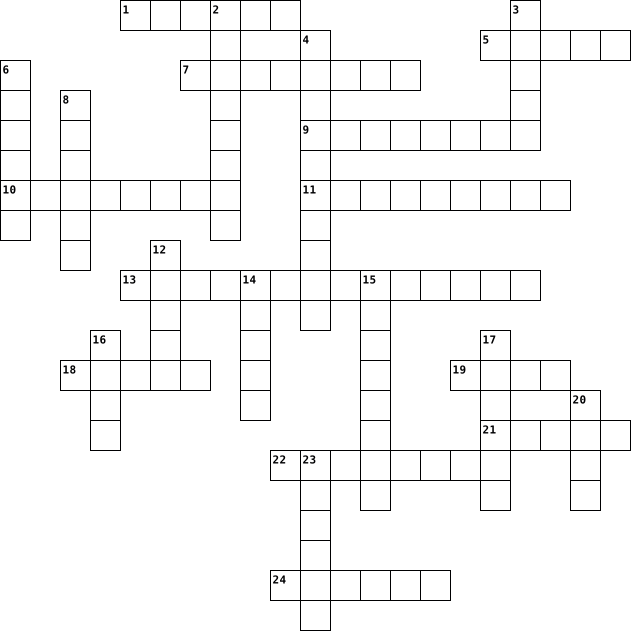
Across
- Those goods for which the demand increases when income increases are called .... goods
- The indifference curve approach was introduced by Prof......
- Such goods the demand for which falls when income increases are called .... goods
- Production Possibility Curve is ...... slopping
- The additional revenue earned from the sale of the last unit produced is called ....
- Other things remaining the same, as the price rises, the demand.....
- ........ Curve is the production possibility curve
- ............cost doesn't change when output is increased or decreased
- The elasticity of supply would range from .... to infinity
- Demanding the same, an increase in supply will .... the price
- Costs of the factor inputs or services supplied by the owner of the firm is called .... costs
- The relationship between price and the quantity demanded is states as law of ......
Down
- If a single producer controls the entire supply of a commodity in the market, is is called ....
- Indian economy is a ...... economy
- The transformation of inputs into output is called ....
- The downward slope of the demand curve reflects the .... effect
- The economic problem is the problem of economising .... resources
- The quantity demanded of a commodity varies inversely with it's.......
- In micro economics, the details of operation of .....small are observed
- The welfare definition of economics was given by........
- Elasticity of demand will be less in the case of households having... income
- Adam Smith defined Economics as a science of ......
- In the case of inferior goods, an increase in income shifts the demand curve to the.... side
- An economy in which goods and services are bought and sold freely in the market is called ..... economy
24 Clues: Indian economy is a ...... economy • Production Possibility Curve is ...... slopping • ........ Curve is the production possibility curve • Adam Smith defined Economics as a science of ...... • The transformation of inputs into output is called .... • The welfare definition of economics was given by........ • ...
Economics 2016-09-19
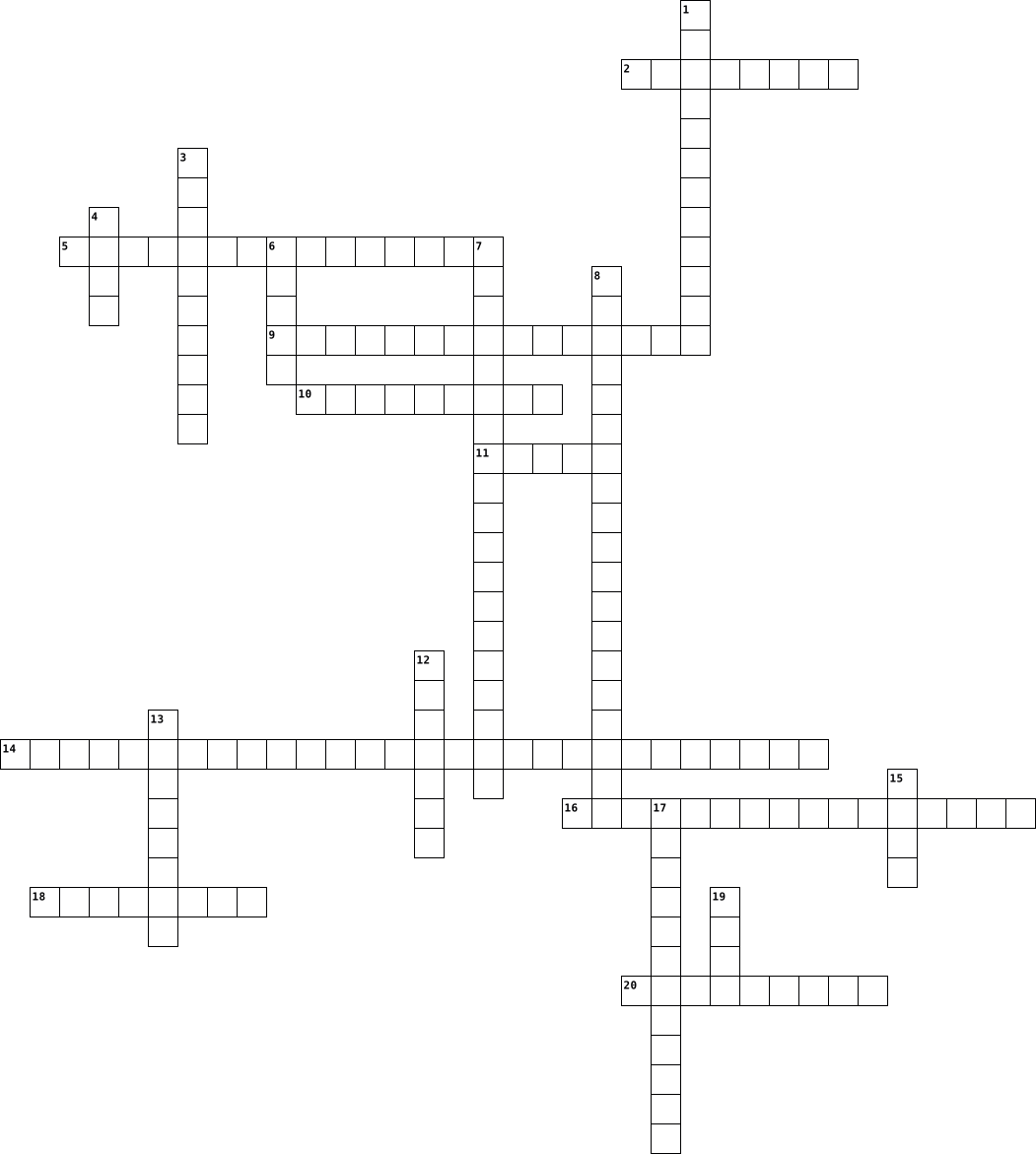
Across
- Help if needed
- get more products
- could buy
- name of class
- Products
- Were the supply and demand could go
- under the PPC
- not enough
- Get the other product
Down
- pay less
- Quick and swift
- Not sea but
- hard work
- Look at other products
- what makes a product
- state/counrty major city
- Low on everything
- Not a need
- evolution
- not a want
20 Clues: pay less • Products • hard work • could buy • evolution • Not a need • not enough • not a want • Not sea but • name of class • under the PPC • Help if needed • Quick and swift • get more products • Low on everything • what makes a product • Get the other product • Look at other products • state/counrty major city • Were the supply and demand could go
ECONOMICS 2016-08-24
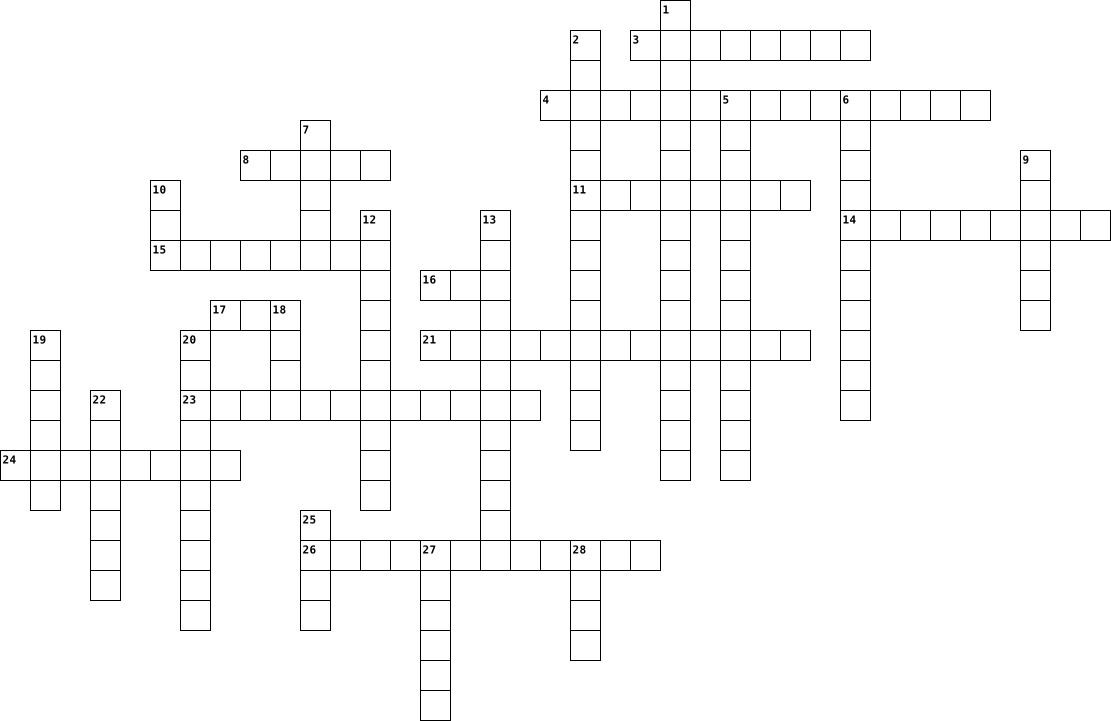
Across
- All economic agents are supposed to be ______.
- A stable state of a system involving the interaction of different participants, in which no participant can gain by a change of strategy if the strategies of the others remain unchanged (___ ________).
- Regional intergovernmental organization and geopolitical union in South Asia
- A monetary union of 19 of the 28 European Union member states which have adopted the euro (€) as their common currency.
- A tax whose amount is based on the value of a transaction.
- The rate at which the Reserve Bank of India lends money to commercial banks in the event of any shortfall of funds.
- This organisation was created at an international conference convened in Bretton Woods in July 1945
- Fresh issue of shares or convertible securities for sale by an unlisted company for the first time to the public.
- A form of monetary action in which a central bank seeks to limit the effect of inflows and outflows of capital on the money supply
- Economic theory based on the belief that a country's wealth could best be judged by the amount of precious metals or bullion it possessed.
- A situation in which a debt is difficult or impossible to pay typically because high interest payments prevent re-payment of principal
- Sale of a security that is not owned by the seller, or that the seller has borrowed.
Down
- A state of allocation of resources in which it is impossible to make any one individual better off without making at least one individual worse off.
- A loss of economic efficiency that can occur when equilibrium for a good or service is not achieved or is not achievable
- This economic principle tells that you cannot control all three policy variables together, namely, the free movement of capital, an independent monetary policy, and a fixed or pegged exchange rate policy (6) (7) .
- An informal index introduced in The Economist in September 1986 for measuring the purchasing power parity (PPP) between two currencies. It is based on the cost of a single Big Mac burger as sold by the McDonald's fast food restaurant chain.
- A comprehensiveagreement that sets the rules for international trade and investment between Canada, the United States, and Mexico
- Exchange (goods or services) for other goods or services without using money.
- A form of international money, created by the International Monetary Fund, and defined as a weighted average of various convertible currencies.
- An organisation which holds securities of investors in electronic form through a registered depository participant (4) (4)
- a graphical representation of the relationship between tax rates, tax revenue, and taxable income.
- An intergovernmental organization of 14 nations to coordinate and unify the petroleum policies of its member countries and ensure the stabilization of oil markets.
- A free-float market-weighted stock market index of top 30 companies listed on Bombay Stock Exchange
- When every open covering of a set has a finite sub-cover it is called ______ ___
- The situation when an entity can survive or continue its activities without external assistance or international trade.
- A process developed by the India's Stock Market Regulator SEBI for applying to IPO in which an IPO applicant's account doesn't get debited until shares are allotted to them
- A tax imposed on imported goods and services.
- Anautonomous apex statutory body which regulates and develops the insuranceindustry in India.
28 Clues: A tax imposed on imported goods and services. • All economic agents are supposed to be ______. • A tax whose amount is based on the value of a transaction. • Regional intergovernmental organization and geopolitical union in South Asia • Exchange (goods or services) for other goods or services without using money. • ...
Economics 2018-04-12
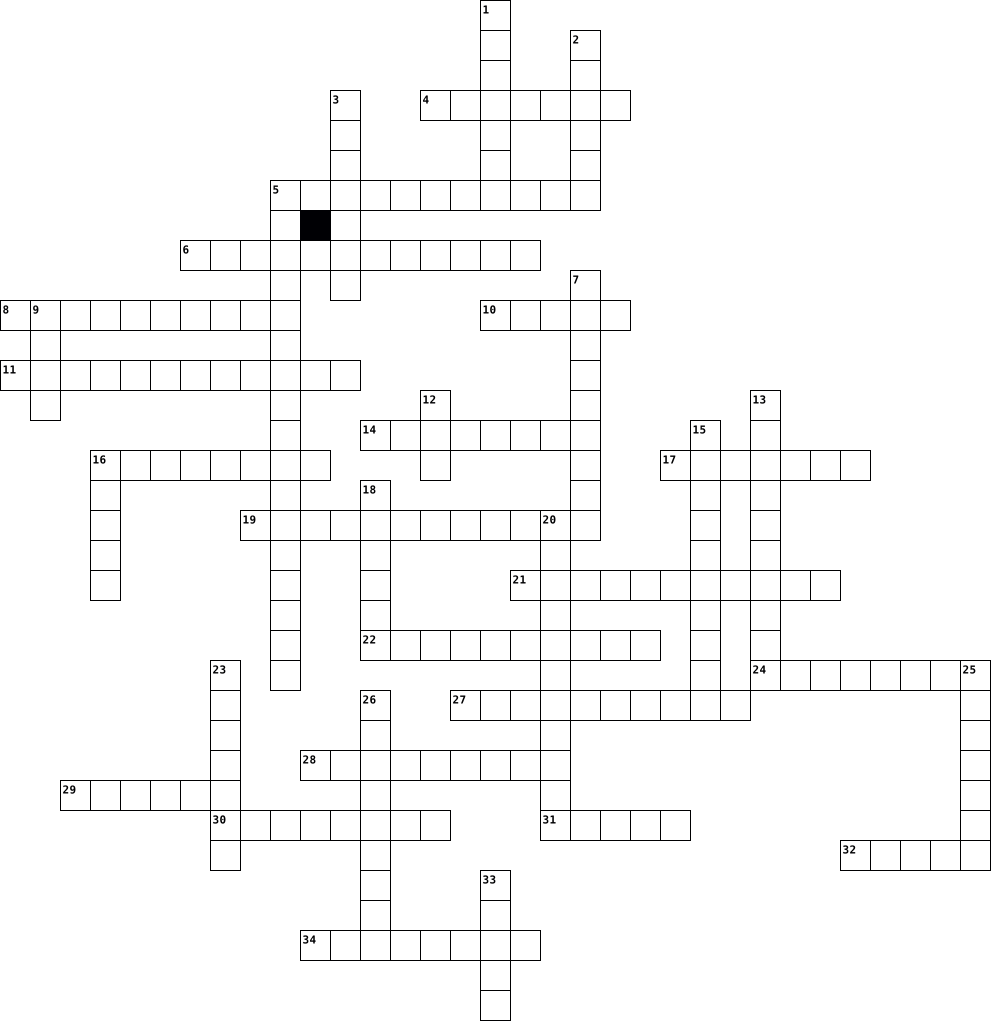
Across
- of production - is an economic term that describes the inputs that are used in the production of goods or services in order to make an economic profit.
- for enterprise - The systems used within the organization. Generally refers to the primary architecture
- –A country run by absolute authority in any sphere.
- resources - the resources used to make goods and services (i.e., natural resources, human resources and capital goods.
- capital- is used simply to purchase goods and services for consumption; capital is more durable and is used to generate wealth through investment.
- especially hard physical work.
- payments- payment made or income received in which no goods or services are being paid for, such as a benefit payment or subsidy.
- sovereignty - the situation in an economy where the desires and needs of consumers control the output of producers.
- cashless economic system in which services and goods are traded at negotiated rates.
- - the effectiveness of productive effort, especially in industry, as measured in terms of the rate of output per unit of input.
- - patriotic feeling, principles, or efforts
- a political theory derived from Karl Marx, advocating class war and leading to a society in which all property is publicly owned and each person works and is paid according to their abilities and needs.
- system- the means by which countries and governments distribute resources and trade goods and services. They are used to control the five factors of production, including: labor, capital, entrepreneurs, physical resources and information resources.
- a political and economic theory of social organization that advocates that the means of production, distribution, and exchange should be owned or regulated by the community as a whole.
- - the general level of prices in an economy going down.
- economy - Transactions in the underground economy are illegal either because the good or service being traded is illegal or because an otherwise licit transaction does not comply with government reporting requirements.
- is one of the three factors of production. The others are land, and labor.
- comprises all naturally occurring resources as well as geographic land. Examples include particular geographical locations, mineral deposits and forests
- economy - an economic system combining private and public enterprise
- recourses- include both fixed assets, such as machinery, buildings and land, and current assets, such as inventory.
Down
- - political philosophy, movement, or regime that exalts nation and often race above the individual and that stands for a centralized autocratic government headed by a dictatorial leader, severe economic and social regimentation, and forcible suppression of opposition.
- economy - economic system in which economic decisions and the pricing of goods and services are guided solely by the aggregate interactions of a country's individual citizens and businesses.
- enterprise- business or industry that is managed by independent companies or private individuals rather than by the state.
- the activity of setting up a business or businesses, taking on financial risks in the hope of profit
- - a system of government by the whole population or all the eligible members of a state, typically through elected representatives.
- capital- already-produced, durable goods or any non-financial asset that is used in production of goods or services
- materials- the basic material from which a product is made.
- resources- It includes patents, copyrights, franchises, goodwill, trademarks, trade names, the general interpretation also includes software
- - an economic and political system in which a country's trade and industry are controlled by private owners for profit, rather than by the state.
- land- land belonging to the British Crown. Land belonging to the state in some parts of the Commonwealth.
- debt - defined as how much a country owes to lenders outside of itself
- system- system that relies on customs, history and time-honored beliefs
- of payment accounts - the record of all economic transactions between the residents of the country and of the world in a particular period
- economy - an economy in which production, investment, prices, and incomes are determined centrally by a government.
- -a general increase in prices and fall in the purchasing value of money.
- added- the amount by which the value of an article is increased at each stage of its production, exclusive of initial costs.
36 Clues: especially hard physical work. • - patriotic feeling, principles, or efforts • –A country run by absolute authority in any sphere. • - the general level of prices in an economy going down. • materials- the basic material from which a product is made. • economy - an economic system combining private and public enterprise • ...
Economics 2020-04-28
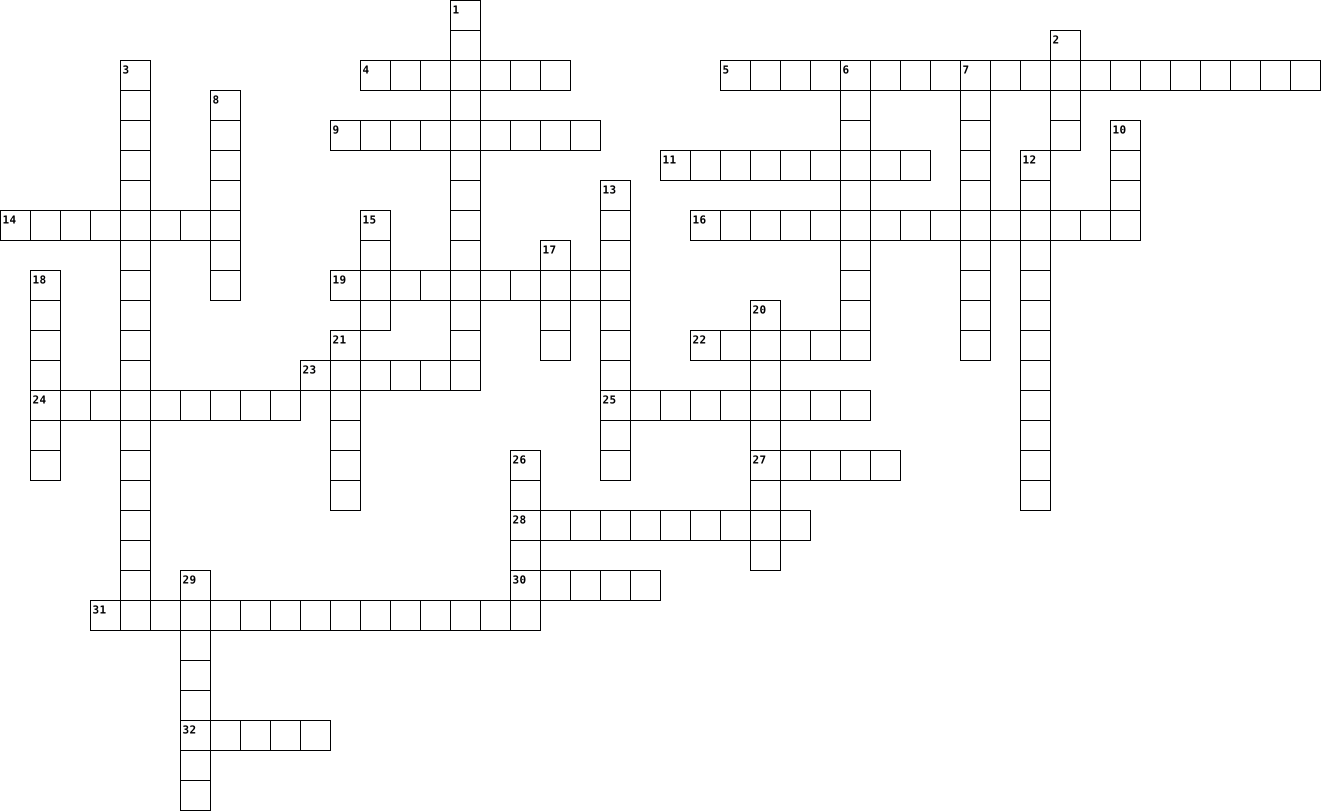
Across
- Goods and services bought from overseas
- A company that operates in many countries with independent headquarters in each.(McDonalds)
- Organisations that make goods and services
- Final users of goods and services to satisfy their needs and wants
- Money paid at a particular rate for the money lent
- The cost of the next-best alternative opportunity
- Ability to combine all resources to make something (plan, recipe, system etc)
- Payment earned by entrepreneurs
- Place where goods and services are bought and sold.
- Basic units used to make goods and services
- The study of how people use scarce resources to satisfy needs and wants
- Basic necessities for life
- A system which allows private ownership of the factors of production
- Used to pay for goods and services
- Where actions by one party have impacts on another, particularly economically.
- Physical items used by consumer and services for a profit
Down
- Place where goods and services are bought and sold (Coles, Seek.com, Fremantle markets) Same as Market
- Institution which handles money for households and firms
- Raw materials used to make goods and services (land, labour, capital & enterprise)
- Purchase of new capital
- Income flows which are added to the Circular FlowofIncomemodel (investment, govt. spending, exports)
- Equipment used to make goods and services
- Payment for use of land
- Place where factors of production are bought and sold.
- Organization with authority to make decisions for the population
- All resources provided by nature
- An organization that sells goods
- Goods and services sold overseas
- A system where all factors of production, distribution and consumption of goods and services are controlled by the government
- All human effort, both physical and intellectual
- Reward for the use of resources
- Income flows that are removed from the Circular Flow model. (savings, tax, imports)
32 Clues: Purchase of new capital • Payment for use of land • Basic necessities for life • Payment earned by entrepreneurs • Reward for the use of resources • All resources provided by nature • An organization that sells goods • Goods and services sold overseas • Used to pay for goods and services • Goods and services bought from overseas • Equipment used to make goods and services • ...
Economics 2020-04-29
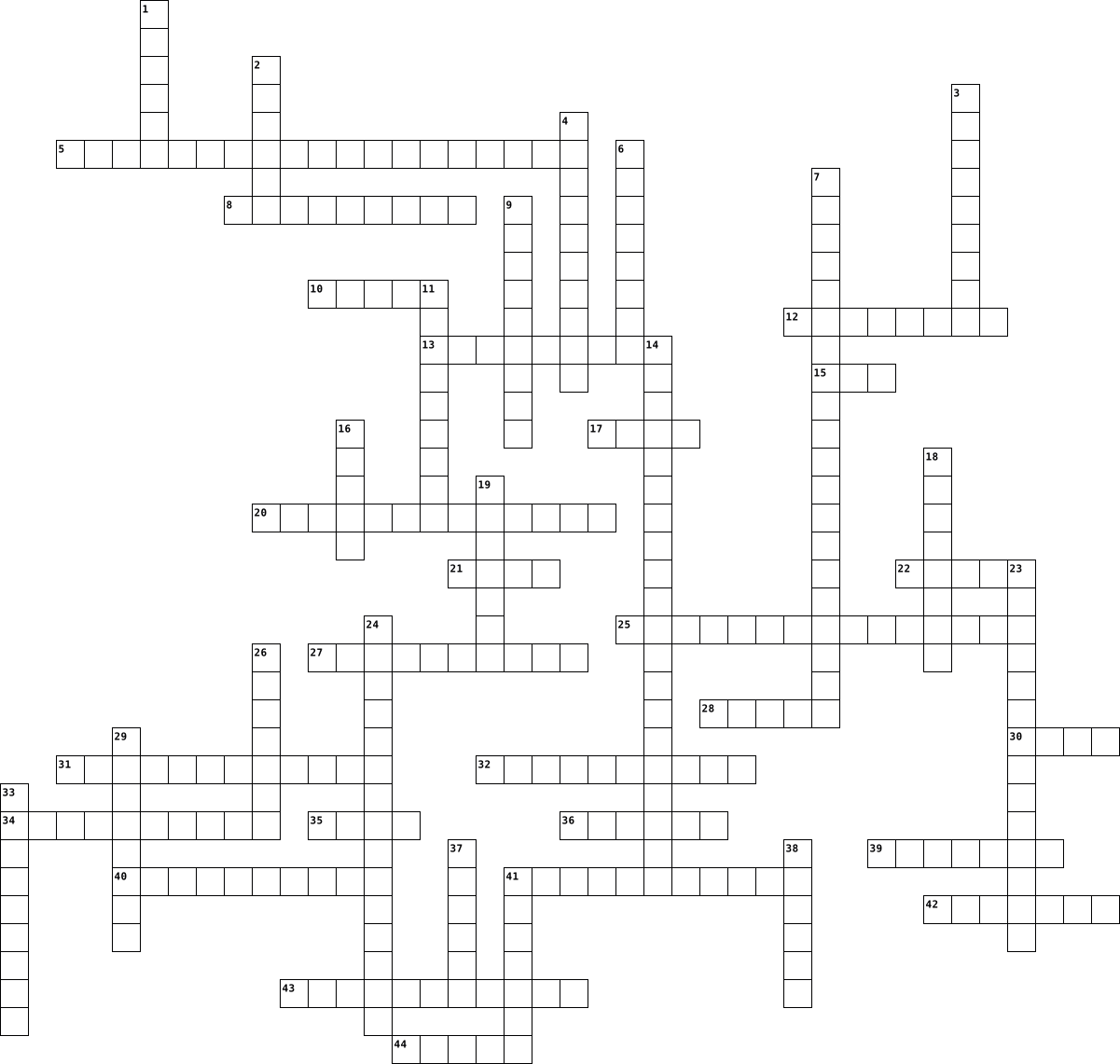
Across
- Raw materials used to make goods and services (land, labour, capital & enterprise)
- Organisations that make goods and services
- Physical items used by consumer and services for a profit
- Money paid at a particular rate for the money lent
- A system where all factors of production, distribution and consumption of goods and services are controlled by the government
- Compulsory government levy
- Payment for use of land
- Place where goods and services are bought and sold (Coles, Seek.com, Fremantle markets) Same as Market
- An organization that sells goods
- Payment per hour for labour
- Where actions by one party have impacts on another, particularly economically.
- A system which allows private ownership of the factors of production
- Used to pay for goods and services
- All resources provided by nature
- Place where factors of production are bought and sold
- Organization with authority to make decisions for the population
- Ability to combine all resources to make something (plan, recipe, system etc)
- Institution which handles money for households and firms
- Payment per year for labour
- Goods and services sold overseas
- Purchase of new capital
- Complex group of firms in many countries each producing a component of a final product.
- Goods and services bought from overseas
- An economy where people produce only enough goods and services for their own family
- Goods and services which we desire but don’t need
Down
- Payment earned by entrepreneurs
- All human effort, both physical and intellectual
- Final users of goods and services to satisfy their needs and wants
- Income flows which are added to the Circular Flow of Income model (investment, govt. spending, exports)
- Actions done for consumers by producers
- A company that operates in many countries with independent headquarters in each.(McDonalds)
- The study of how people use scarce resources to satisfy needs and wants
- A system where factors of production are owned by the government
- A company which operates in several countries with its headquarters in the parent country. (Apple)
- Basic necessities for life
- Income flows that are removed from the Circular Flow model. (savings, tax, imports)
- Equipment used to make goods and services
- Action of only doing one part of the process
- The cost of the next-best alternative opportunity
- Financial assistance given to people by the Government
- Situation where demand is greater than supply
- Basic units used to make goods and services
- Place where goods and services are bought and sold.
- Reward for the use of resources
- That part of earnings not spent
45 Clues: Payment for use of land • Purchase of new capital • Compulsory government levy • Basic necessities for life • Payment per hour for labour • Payment per year for labour • Payment earned by entrepreneurs • Reward for the use of resources • That part of earnings not spent • An organization that sells goods • All resources provided by nature • Goods and services sold overseas • ...
Economics 2020-08-30
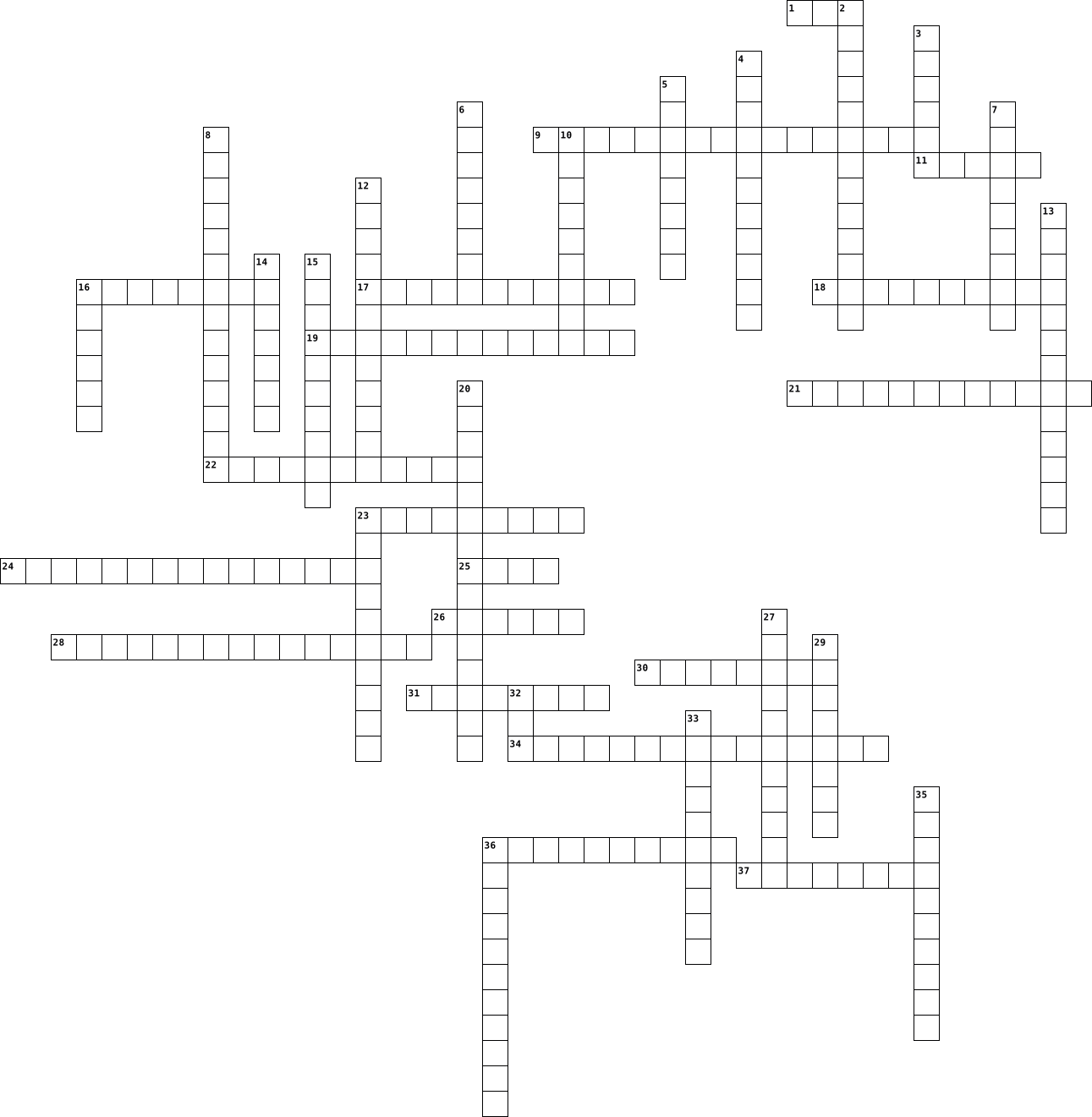
Across
- the final market value of all goods and services produced in the economy over a given period of time
- _ is gross income less the direct taxes
- acronym of non-accelerating inflation rate of unemployment
- this rate refers to the price of the currency on international markets
- occurs when the demand for a good or service is equal to the supply of a good or service at a particular price
- _income is disposable income plus indirect government benefits provided in the form of goods and services
- the carbon tax is designed to tackle this
- output per unit of input or output over inputs
- this type of development refers to the development of a nation at a pace that does not erode the ability of future generations to enjoy the same quality of life
- total value of assets minus the total value of liabilities
- a number between zero and one providing an indication of the degree of inequality in the distribution of income
- a period of very high rates of growth in production, highest in the business cycle
- this curve plots the percentage share of total income earned on the vertical axis against each quintile(decile) on the x-axis
- total volume of goods and services available for sale in an economy in a given time frame
- _unemployment occurs where a person is unemployed due to mental, physical or other characteristics (criminal background, physical disabilities)
- _income is income from investments and other sources
- total expenditure on Australian made goods and services
- the responsiveness of demand or supply to a change in a variable such as price
- _poverty occurs when a household has a low level of income compared to a generally agreed standard (or below the Henderson line).
Down
- _rate refers to the percentage of the population 15 years and over who wish to participate in the labour force
- _unemployment refers to ‘discouraged workers’ people who are not working but are not counted as unemployed
- _line is referred to as the 45 degree line, also the line of absolute inequality
- _poverty refers to people living in a situation where they have insufficient income to purchase the basic goods and services
- _unemployment refers to a rise in unemployment due to insufficient levels of AD
- is an example of a market based approach to addressing climate changed
- _test to determine whether a person is eligible for superannuation, social welfare benefits
- a sustained increase in the general or average price level over time
- when one currency is able to purchase more of another currency, a higher Australian dollar in comparison to other currency
- the cost of borrowing money or alternatively the return offered to hose lending money
- a better measure economic growth, measure value of final good and services produced in Australia, discounted for the effects of inflation
- _unemployment occurs when a person is unemployed for that period of time while they are moving from one job to another
- _income is income, money derived from paid work through employment
- occurs when people are employed, but would like and are available to work more hours
- exports minus imports
- _tax system is one where higher income earners pay a higher percentage rate of tax compared to lower income earners
- taxes, savings and imports and examples of these
- government body in control of monetary policy
- _unemployment occurs where the skills of the unemployed do not match the skills required by the industry, or technological changes
- government spending, investment and exports and examples of these
- _household income is adjusted disposable income to take into account the size and composition of households
40 Clues: exports minus imports • _ is gross income less the direct taxes • the carbon tax is designed to tackle this • government body in control of monetary policy • output per unit of input or output over inputs • taxes, savings and imports and examples of these • _income is income from investments and other sources • total expenditure on Australian made goods and services • ...
Economics 2016-12-07
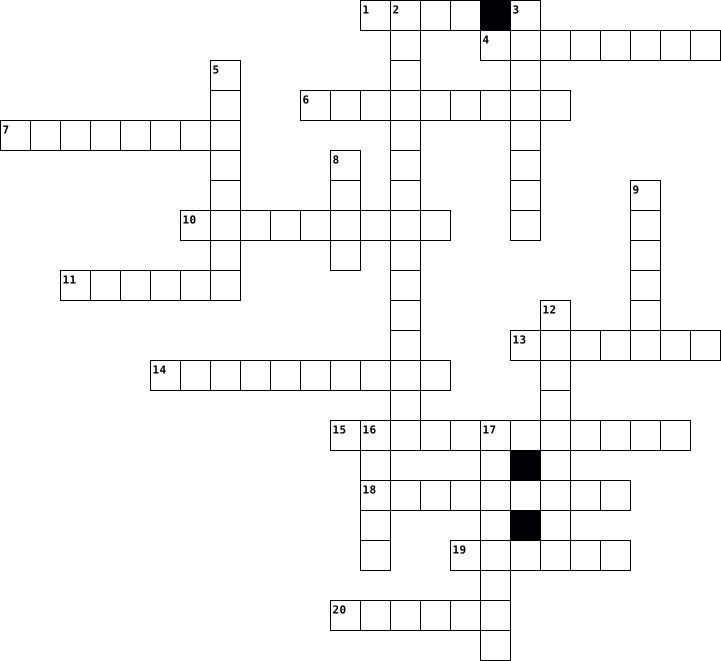
Across
- natural resource
- problem unlimited wants,limited resources
- cabinet maker
- buys goods and services
- way of presenting a product to appeal to the consumers
- fixed amount paid at yearly rate
- photocopier
- earning of a salesman
- innovative and takes risks
- the study of allocating limited resources
- a plan made by a person about how to spend available money
- consumer's earning
Down
- cost of giving up something to get the want
- inability of the economy to satisfy wants at the same time
- a teacher
- paid hourly
- businessman's way of earning
- strategies to promote a product
- goods we must have to live
- makes goods or provides services
20 Clues: a teacher • paid hourly • photocopier • cabinet maker • natural resource • consumer's earning • earning of a salesman • buys goods and services • innovative and takes risks • goods we must have to live • businessman's way of earning • strategies to promote a product • fixed amount paid at yearly rate • makes goods or provides services • problem unlimited wants,limited resources • ...
ECONOMICS 2017-03-21

Across
- type of license to allow owner to sell out at any time
- simplest business form under one can operate a business
- type of monopoly that exists as a result of the high fixed costs
- type of security that signifies ownership
- boy scouts, church
- group of producers who manipulate prices
- limit commercial use of land
- small number of firms has large majority of market share
- portion of the company's earnings
- market of a single seller
Down
- process of distinguishing a product or service from others
- agreement between competing sellers
- govt. license that allows holder to design new materials for a period of time
- marketable item produced to satisfy wants or needs
- payment to work in addition with wages
- future sacrifices of economic benefits
- rival companies cooperate
- debt investment to loan money
- something you own
- payment to the owner of the property
20 Clues: something you own • boy scouts, church • rival companies cooperate • market of a single seller • limit commercial use of land • debt investment to loan money • portion of the company's earnings • agreement between competing sellers • payment to the owner of the property • payment to work in addition with wages • future sacrifices of economic benefits • ...
ECONOMICS 2018-11-11

Across
- paribus latin phrase meaning “other things equal”
- measure of a variable’s sensitivity to a change in another variable
- consumers willingness to pay a price for a good
- process of combining various materials
- market that is dominated by only a few large firms
- income of employees
- first branch of economics
- employees
- desires
- state where supply and demand are balanced
- lack of resources
Down
- utility consumer gains from consuming one good
- opposite of equilibrium
- properties
- goods that producers are willing to provide
- necessities
- second branch of economics
- market structure characterized by single seller
- investment
- greek prefix word “mikro”
20 Clues: desires • employees • properties • investment • necessities • lack of resources • income of employees • opposite of equilibrium • first branch of economics • greek prefix word “mikro” • second branch of economics • process of combining various materials • state where supply and demand are balanced • goods that producers are willing to provide • ...
ECONOMICS 2019-03-28

Across
- This is general name for the voluntary exchange of goods and or services.
- This is a tax on imported goods and is usually designed to protect domestic production of similar goods.
- This is a restriction to regulate international commerce and business.
- This is the way in which a society deals with the production, distribution, and consumption of goods and services.Example: Market Economy, Mixed Economy, Planned Economy, etc.
- Abuja is the capital, but Lagos is its largest city.
- This is the name given to an economy that may contain market, command, and/or traditional economic systems.
- This is equipment and factories used in the production of goods and services.
- This country has three capitals- Pretoria, Bloemfontein (judicial), and Cape Town (legislative)- though Johannesburg is its largest city.
- This is the term that is used to describe the percentage of people in a country who have the ability to read and write.
- This is the social science dealing with the production, distribution, and consumption of goods and services.
- The paper money and coins- sometimes called "cash"- that make up the money supply of a nation.
Down
- This is a person who takes the risk of a new business enterprise.
- The total value of all the goods and services produced within a country in a given year
- This is the general name for an economic system characterized by a central authority which makes major economic decisions.
- This is an economy in which the government- ideally- has nothing to say about what, how, and for whom goods are produced; the factors of production are privately owned.
- This country's capital, Nairobi, is close to its southern border with Tanzania.
- This is a type of protectionist trade restriction that sets a physical limit on the quantity of a good that can be imported into a country in a given period of time.
- This is when each worker performs a specific task in production.
- Ability to obtain goods and services before payment, or money lent or made available, both with specific guidelines for repayment.
- Although it has many definitions, this is generally the act of providing funds to a financial organization for the purposes of making that organization more profitable, while earning a personal profit at the same time.
- This is the process of prohibiting commerce and trade with another country. This is often done to affect the country to change an internal policy.
21 Clues: Abuja is the capital, but Lagos is its largest city. • This is when each worker performs a specific task in production. • This is a person who takes the risk of a new business enterprise. • This is a restriction to regulate international commerce and business. • This is general name for the voluntary exchange of goods and or services. • ...
Economics 2019-05-27

Across
- an exchange of goods that if done correctly allows a country to consume outside its PPC
- type of unemployment that relates to jobs that only exist for part of the year
- fixed costs can be changed
- value of all economic activity in a year
- market for different currencies
- the maximum amount of goods a country can produce
- many firms with differentiated products
- few firms with barrier to entry
- revenue minus costs
Down
- moved by changes in resource number or chnage in technology
- the amount of people who are willing and able to work
- Moved by changing the money supply or by lowering taxes
- many firms with identical products
- type of unemployment that relates to unemployment between jobs or between education and job
- type of unemployment that relates to the changes in the business cycle
- an economist that advocated fro government intervention in the market
- The amount of happiness derived from one more unit of a good
- shows relationship between unemployment and inflation
- the increase in the price level
- Only one firm in a market
20 Clues: revenue minus costs • Only one firm in a market • fixed costs can be changed • market for different currencies • the increase in the price level • few firms with barrier to entry • many firms with identical products • many firms with differentiated products • value of all economic activity in a year • the maximum amount of goods a country can produce • ...
economics 2016-05-09

Across
- smith/considered to be the founding father of modern Economics.
- is the amount of an asset or resource that exceeds the portion that is utilized.
- IRA/ is an individual retirement plan
- decline in economic activity spread across the economy.
- measurement of "useful-ness" that a consumer obtains from any good
- floor/ is a situation when the price charged is more than or less than the equilibrium price determined by market forces of demand and supply
- A market structure characterized by a single seller, selling a unique product in the market.
- money is currency that a government has declared to be legal tender, but is not backed by a physical commodity.
- is an agreement among the United States, Canada and Mexico designed to remove tariff barriers between the three countries.\
- is a range of economic and social systems characterized by social ownership and democratic control of the means of production
- is a sustained increase in the general price level of goods and services in an economy over a period of time.
- worth/ s the total assets minus total outside liabilities of an individual or a company.
- faire/ a system or point of view that opposes regulation or interference by the government in economic affairs beyond the minimum necessary to allow the free enterprise system to operate according to its own laws.
Down
- is a low turning point or a local minimum of a business cycle.
- standard/A monetary system in which a country's government allows its currency unit to be freely converted into fixed amounts of gold and vice versa.
- advantage/ states that if countries specialize in producing goods where they have a lower opportunity cost – then there will be an increase in economic welfare.
- is an increase in the level of economic activity, and of the goods and services available.
- fund/ is an account that is used to set aside funds to be used in an emergency.
- is the economic policy of restraining trade between countries through methods.
- is the only global international organization dealing with the rules of trade between nations.
- is a benefit given by the government to groups or individuals usually in the form of a cash payment or tax reduction.
- the highest point between the end of an economic expansion and the start of a contraction in a business cycle.
- Hayek/ is well-known for his numerous contributions in the field of economics and political philosophy.
- advantage/ refers to the ability of a party (an individual, or firm, or country) to produce a greater quantity of a good, product, or service than competitors, using the same amount of resources.
- trade/ is a policy followed by some international markets in which countries' governments do not restrict imports from, or exports to, other countries.
25 Clues: IRA/ is an individual retirement plan • decline in economic activity spread across the economy. • is a low turning point or a local minimum of a business cycle. • smith/considered to be the founding father of modern Economics. • measurement of "useful-ness" that a consumer obtains from any good • ...
Economics 2016-05-11

Across
- policy means by which a government adjusts its spending levels and tax rates to monitor and influence a nation's economy
- complete control over imdustry
- a state of limited competition
- used by economists to predict future economic activity
- also known as the "the Fed"
- smooth out the effects of expansion and contraction in the business cycle by using fiscal and monetary policy
- government program guaranteeing access to some benefit by members of a specific group and based on established rights or by legislation
- international trade left to its natural course without tariffs, quotas, or other restrictions
- the less amount of money allowed to get paid when working
- an increase in the value of one currency in terms of another
- bottom point on graph
- low supply
- hands off government
- an economic system in which private business operates in competition and largely free of state control
- a political theory derived from Karl Marx
- the amount by which the cost of a country's imports exceeds the value of its exports
- an account that is used to set aside funds to be used in an emergency
- an individual retirement account
- allows business owners to measure the additional benefits of one production activity versus its costs
- measure of what an entity is worth
- an American economist and statistician best known for his strong belief in free-market capitalism
- an economic and political system in which a country's trade and industry are controlled by private owners for profit, rather than by the state
- the system by which the value of a currency was defined in terms of gold
Down
- situation when the price charged is more than or less than the equilibrium price
- mass production
- an index of the variation in prices paid by typical consumers for retail goods and other items
- everyone is eligible to work
- situation in which income exceeds expenditures
- advocates that the means of production, distribution, and exchange should be owned or regulated by the community as a whole
- restraining trade between countries through methods such as tariffs on imported goods
- measure of average income per person in a country
- only global international organization
- broadest quantitative measure of a nation's total economic activity
- if countries specialise in producing goods where they have a lower opportunity cost
- money granted to help an industry
- famous economist born in Vienna, Austria
- use of monetary or fiscal policy changes to kick start a lagging or struggling economy
- measurement of "useful-ness" that a consumer obtains from any good
- decline of progress
- resource that exceeds the portion that is utilized
- ability to produce a better quality good using the same resources
- policy macroeconomic policy laid down by the central bank
- top point on graph
- an agreement among the United States, Canada and Mexico designed to remove tariff barriers between the three countries
- measures how efficiently production inputs
- known for Wealth of Nations
- a situation when the price charged is more than or less than the equilibrium price
- when the demand for a product or service exceeds its supply in a market
- increase of progress
- currency that a government has declared to be legal tender, but is not backed by a physical commodity
50 Clues: low supply • mass production • top point on graph • decline of progress • hands off government • increase of progress • bottom point on graph • also known as the "the Fed" • known for Wealth of Nations • everyone is eligible to work • complete control over imdustry • a state of limited competition • an individual retirement account • money granted to help an industry • ...
Economics 2018-01-26

Across
- An economy that may contain market, command, and/or traditional economic systems
- The role of the consumer as the ruler of the market; the consumer decides what goods and services will be produced
- An economy in which the government has little to say about what, how, and fir whom goods are produced; the factors of production are privately owned
- This is the right of the government to take private property, like land, for public use
- Finished product used by an individual for personal use
- when allocating by force, goods, services, and factors of production are given or taken away under using threats
- Methods available to societies as they seek to answer for whom to produce (how resources are distributed)
- this allocation strategy can distribute the resource to the person who wins. The winning could be based on running a race, in academics, or in a test/knowledge/skill
- fairness within the economy
- the process of reducing or eliminating government regulations on an industry, allowing for more laissez-faire business practices
- economic system where the factors of production are privately owned
- health program sponsored by the United States Government that provides services to individuals and families with low incomes
- one who buys goods or services for personal use
Down
- makes businesses produce efficiently and keeps costs low
- Occur when the private market is unable to produce goods and services in a way that the marginal benefit to society from the production of the good is equal to or greater than the marginal cost to society for producing the good
- us publicly funded health insurance program for the elderly and the disabled
- This refers to rules established at some level of government for the purpose of guiding business practices, it is commonly accepted that it may increase the cost of doing business
- Economic system characterized by a central authority which makes major economic decisions
- this allocation strategy, also known as random selection, gives everyone who wants the good, service, or factor of production equal odds of obtaining it
- The negative impact of economic activity upon people who are not directly involved
- this allocation strategy allows people to receive a good, service, or a factor of production if they get to it first or are one of the people close enough to the front of the line to receive the good, service, or factor of production before there are none remaining
- Seeks to ensure that all those who are willing and able to work have the opportunity to do so
- The way in which a society deals with the production, distribution, and consumption of goods and services
- An increase in real GDP. It happens through increased investment in capital goods, himan capital, and technology
- the ability of consumers, producers, and workers to make their own decisions about consumption, production, and distribution of goods and services
- this strategy is based on the decisions of a power person or group of people who make the most of the decisions about who gets to obtain a good, seevice, or factor od production
- this is legally granted exclusive right to produce a product a process for a given period of time, usually to the inventor of that product or process
- act of providing funds to a financial organization for the purposes of making that organization more profitable, while earning a personal profit at the same time
- This strategy occurs when a group of people who have control over a good, service, or factor of production vote to decide how it will be distributed
- how well factors of production are allocated as compared to what is desired by consumers and how they are used in production to keep costs low
30 Clues: fairness within the economy • one who buys goods or services for personal use • Finished product used by an individual for personal use • makes businesses produce efficiently and keeps costs low • us publicly funded health insurance program for the elderly and the disabled • economic system where the factors of production are privately owned • ...