
forms of energy Crossword Puzzles
Energy 2013-01-24

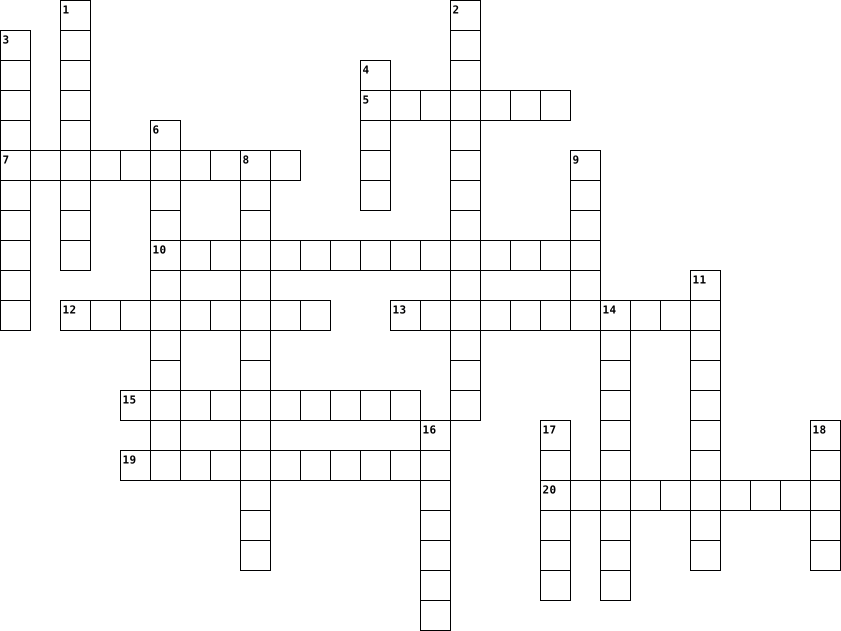
Across
- something we should all try to save
- our main source of energy
- a fossil fuel made from plants and trees
- the posh word for rain, snow, hail and sleet
- the number of people who live in a town, country etc
- something that can be burnt to give energy
- the number of years it took for fossil fuels to form
Down
- when a gas turns back into a liquid
- when a liquid turns into a gas
- a fossil fuel made from sea creatures
- a fossil fuel made from sea creatures
- a gas which forms a protective layer around the earth
- the weather you would expect in a particular place
- everything in our surroundings
- a thick layer of gases which surrounds the earth
- buildings where goods are made by machines
- harmful waste or dirt in the air and water
- to do with the sun
18 Clues: to do with the sun • our main source of energy • when a liquid turns into a gas • everything in our surroundings • when a gas turns back into a liquid • something we should all try to save • a fossil fuel made from sea creatures • a fossil fuel made from sea creatures • a fossil fuel made from plants and trees • buildings where goods are made by machines • ...
my science cross word 2025-02-24

Across
- transfer of heat by the movement of fluid
- consist of an electric field and magnet feald
- the way earths rotation makes wind curve
- the flow of air from land to a body of water forms a
- gas in the atmosphere trap some of the heat near earths surface
- the movement of air parallel to earths surface
Down
- transfer of energy by eletromagnetic waves
- energy the total energy of motion in the particles of a surface
- a large stream of moving water that flows through the ocean
- band of high speed winds
- local wind that blows from an ocean or lake
- the opposite of an El Nino
- transfer of heat between surfaces
- a climate event that occurs every two years
14 Clues: band of high speed winds • the opposite of an El Nino • transfer of heat between surfaces • the way earths rotation makes wind curve • transfer of heat by the movement of fluid • transfer of energy by eletromagnetic waves • local wind that blows from an ocean or lake • a climate event that occurs every two years • consist of an electric field and magnet feald • ...
Art of Living Crossword Puzzle (Oct 2020) 2020-09-14

Across
- A cardinal rule, to absorb all the ‘prana’ (life-force energy) from the foods, is to drink fluids very ——
- —- is a gift to an over-burdened body and an over-indulged mind
- Navratri is a celebration of the —- which can destroy inertia, pride, shame and extreme forms of craving and aversion
- Acknowledging the —— brings a total acceptance in the mind and puts it at ease.
- Goddess Lakshmi is the —- that manifests as the complete spiritual and material well-being of a person.
- There are 36 —— present in us
- Though Navratri is celebrated as the victory of good over evil, the actual fight is —- between good and evil.
- Mild —- is crucial during fasting
- Nine Nights
- The nature of consciousness is dynamism, wanting action. —- for dynamism, but feel the stillness
- Energy
Down
- There are 64 divine mother —— which govern the subtle creation.
- —— favors regular and short term fasting
- The Divine Mother is recognized as the —— of all causes and an energy that pervades the entire creation.
- The big —- winning over the small —- is the Devi Shakti
- 10 days of celebration
- Celebration of vehicles, tools etc..
- First 3 days of Navratri are attributed to ——
- We are all floating in the effulgence of one scintillating unseen cosmic energy called the ——
- Goddess Saraswati is the —- of understanding and the consciousness which vibrates with different types of learning
20 Clues: Energy • Nine Nights • 10 days of celebration • There are 36 —— present in us • Mild —- is crucial during fasting • Celebration of vehicles, tools etc.. • —— favors regular and short term fasting • First 3 days of Navratri are attributed to —— • The big —- winning over the small —- is the Devi Shakti • There are 64 divine mother —— which govern the subtle creation. • ...
Well-being and electrics 2023-04-26

Across
- cumulate Electric charge
- Disconnect circut when current is very high
- cumulate Electrical Energy i tu magnetic energy
- Conecting element of circut together
- storm I'm on the desert. In sometime begin....
- I fell sick i need to....
- specjalist who's keeps human's hearts healthly
- Someone Who's watching from behind you :o
- You are ..... of Poland
- primitive people used.... To hunt
Down
- Someone got hurt! We need to call....
- Gods..... Earth!
- Computer and life forms can have.....
- I cannot talk because i have....
- im.... Cats and grass
- ...... connects twoją lands together
- Connect and disconnect Electrical circut on you will
- reduces Electric current in circut
- Gold is very.... Metal
- It's to late. I need to .... my computer
20 Clues: Gods..... Earth! • im.... Cats and grass • Gold is very.... Metal • You are ..... of Poland • cumulate Electric charge • I fell sick i need to.... • I cannot talk because i have.... • primitive people used.... To hunt • reduces Electric current in circut • ...... connects twoją lands together • Conecting element of circut together • Someone got hurt! We need to call.... • ...
Kinetic Energy and Potential Energy 2025-04-23

Across
- - How fast an object is moving. Increased speed results in increased kinetic energy.
- - A material or object that can return to its original shape after being stretched or compressed. Elastic potential energy is stored in such materials.
- - The process of changing energy from one form to another, such as from potential energy to kinetic energy.
- -The distance from the bottom to the top of something; affects potential energy as the height of an object increases.
- - The energy of motion; anything that is moving has kinetic energy.
- - Energy stored in objects that can be stretched or compressed, like springs or rubber bands.
Down
- - The sum of an object's kinetic and potential energy. It is the energy associated with the motion and position of an object.
- - A principle stating that energy cannot be created or destroyed, only transformed from one form to another.
- - A group of interacting or interrelated entities that form a unified whole. Energy can be transferred within a system.
- - The stored energy in an object due to its position or state; for example, a rock at the top of a hill.
- -The ability to do work or cause change; exists in many forms like heat, light, sound, and motion.
- - A form of potential energy stored in chemical bonds of molecules. It can be released during a chemical reaction.
- -A unit of measurement for energy. Both kinetic and potential energy can be measured in joules.
13 Clues: - The energy of motion; anything that is moving has kinetic energy. • - How fast an object is moving. Increased speed results in increased kinetic energy. • - Energy stored in objects that can be stretched or compressed, like springs or rubber bands. • -A unit of measurement for energy. Both kinetic and potential energy can be measured in joules. • ...
Cell Structure and Function 2015-10-08

Across
- cell that contains cell wall and chloroplasts
- helps the cell maintain its shape
- organism that contains nuclei
- strong layer around the cell membrane
- material inside the the cell
- saclike structures
- cell that contains lysosome and centrioles
Down
- organism that does not contain nuclei
- produce proteins
- uses energy from food to make high-energy compounds for power
- a group of similar cells that perform a particular function
- performs important cellular functions
- basic unit of all forms of life
- controls most cells processes and hereditary information of DNA
14 Clues: produce proteins • saclike structures • material inside the the cell • organism that contains nuclei • basic unit of all forms of life • helps the cell maintain its shape • organism that does not contain nuclei • performs important cellular functions • strong layer around the cell membrane • cell that contains lysosome and centrioles • ...
ENERGY, TYPES OF ENERGY AND ENERGY TRANSFERS 2013-07-17

Across
- Talking,tv,radio.
- When you turn on the radio,the energy transfers into
- Food,batteries,burning things.
- When you put a book on a shelf,the energy transfers into
- When you take something to eat,the energy transfers into
- When you want to kill a bird,you take a spring,the energy transfers into
- Nuclear bombs, power stations.
- When you turn on the light,the energy transfers into
Down
- The energy you receive when you use solar panels.
- When you take your dog to walk and your dog runs away,the energy transfers into
- Anything that is moving or have movements.
- a book on a shelf,a bungee jumper.
- Hot water,a hot radiator.
- When you want to charge the battery of your ipod,the energy transfers into
- When there is a war,they throw nuclear bombs,the energy transfers into
- A rubber band.
- Anything that uses electricity.
- Light bulbs, a bunsen flame.
- The ability to do work.
- When you heat something,there is a flame first,the energy transfers into
20 Clues: A rubber band. • Talking,tv,radio. • The ability to do work. • Hot water,a hot radiator. • Light bulbs, a bunsen flame. • Food,batteries,burning things. • Nuclear bombs, power stations. • Anything that uses electricity. • a book on a shelf,a bungee jumper. • Anything that is moving or have movements. • The energy you receive when you use solar panels. • ...
Weather 2022-02-14

Across
- Dew that forms when the air temperature is below freezing.
- They are cyclones that form in the tropics and so they are also called tropical cyclones.
- Condensed water vapor.
- So much energy collects in cumulonimbus clouds that a huge release of electricity may result.
- The long-term average of weather.
- low visibility.
- Forms in cumulonimbus clouds with strong updrafts.
- Forms when moist air cools below its dew point on a cold surface.
Down
- Fierce products of severe thunderstorms.
- Includes freezing temperatures,high winds,
- Made up of air temperature, air pressure, humidity, cloud cover, precipitation, and speed and direction of the wind.
- The amount of water vapor in the air in a particular spot.
- Where two air masses meet.
- A cloud located at or near the ground.
- a system of winds rotating counterclockwise in the Northern Hemisphere around a low pressure center.
- Rain that becomes ice as it hits a layer of freezing air near the ground.
- More than five consecutive days of temperatures that are more than 9°F (5°C) above average.
17 Clues: low visibility. • Condensed water vapor. • Where two air masses meet. • The long-term average of weather. • A cloud located at or near the ground. • Fierce products of severe thunderstorms. • Includes freezing temperatures,high winds, • Forms in cumulonimbus clouds with strong updrafts. • Dew that forms when the air temperature is below freezing. • ...
Crossword Puzzle 2021-10-06

Across
- - one of the types of energy that is dynamic, transferable and can be converted into useful forms.
- of Fire- Found in this area are best locations for geothermal energy.
- It is the process that produces steam that builds pressure needed to be emitted to the surface through volcanoes.
- Energy that heats water on the surface of rivers, lakes, and oceans, which causes the water to evaporate
- Steam Plants- It sips directly hot steam beneath the ground through pipes to mobilize generator turbines.
- Steam Plants-It pipes high pressure hot water from geothermal reservoir and convert it into steam that turn generator turbines to produce electricity.
- Cycle Plants- It has a system that transfers heat from hot water sipped miles deep to other liquid.
- – Facilities that is most common technology which uses a dam to create a large reservoir of water.
- energy - The heat generated beneath the ground
Down
- Renewable energy source because heat is continuously produced inside the earth.
- Plate - Along these boundaries are found the most active geothermal resources.
- energy- energy that comes from the sun
- - Holes in the earth where volcanic gases are released.
- Reservoirs - Naturally occurring areas of hydrothermal resources.
- Facilities that rely more on natural water flow rates, diverting just a portion of river water through turbines, sometimes without the use of a dam or reservoirs.
- Power plants that use heat from deep inside the Earth to generate steam to make electricity.
- - the conversion of flowing water (mechanical energy) into electrical energy.
- energy- it is the energy that is possessed by an object due to its motion or its position
- storage- facilities that are similar but have a second reservoir below the dam.
- Pumps- Tap into heat close to the Earth's surface to heat water or provide heat for buildings.
20 Clues: energy- energy that comes from the sun • energy - The heat generated beneath the ground • - Holes in the earth where volcanic gases are released. • Reservoirs - Naturally occurring areas of hydrothermal resources. • of Fire- Found in this area are best locations for geothermal energy. • - the conversion of flowing water (mechanical energy) into electrical energy. • ...
Amina's_Biochemistry & Metabolic Processes - Crossword Puzzle 2022-01-24

Across
- is a process where there is a positive flow of energy.
- is a coenzyme and is formed in glycolysis and the Krebs cycle. It helps convert food to energy.
- is where the substrate connects and it must fit perfectly with the substrate.
- is an organic compound that has different forms and is mostly found in bread, spaghetti, and fruits.
- is the force of attraction between molecules.There are three types of this force
- sometimes called disks, its membrane is embedded with many proteins. Only found in one plant cell.
- is the time it would take for half of the compound to decay.
- is a type of reaction when a molecule loses electrons and oxidizes.
Down
- this is the equation of the process 6C02 + 6H20 + light energy -› C6H1206 + 602
- are proteins and they speed up chemical directions and processes in our body.
- are also called simple sugars. It is a molecule of carbohydrates.
- is one of the four stages of aerobic cellular respiration with the net products 2 ATP. 2 NADH.
- is a type of energy, that makes objects move. This is the energy that is being used up. you use this energy when you are running.
- causes atherosclerosis,it converted it into vitamin D.
- is the source of energy, known as “energy currency”.
- is where one of the stages of aerobic respiration occurs.
- there is 20 acid of these, they work together to build the proteins.
17 Clues: is the source of energy, known as “energy currency”. • is a process where there is a positive flow of energy. • causes atherosclerosis,it converted it into vitamin D. • is where one of the stages of aerobic respiration occurs. • is the time it would take for half of the compound to decay. • are also called simple sugars. It is a molecule of carbohydrates. • ...
Crossword of Sustainability 2021-07-05

Across
- Indicator to evaluate the human consumption of natural resources
- We all share
- Respect for the earth, fairness
- It is everywhere around us
Down
- Affects air, water and earth
- Balance between different life forms
- The seas are full of them
- The energy of a breath of wind
- Waste becomes a resource
- The profit discarded
10 Clues: We all share • The profit discarded • Waste becomes a resource • The seas are full of them • It is everywhere around us • Affects air, water and earth • The energy of a breath of wind • Respect for the earth, fairness • Balance between different life forms • Indicator to evaluate the human consumption of natural resources
Homework menu 2026-03-09

Across
- the relatively thick part of the earth's crust that forms the large landmasses
- process by which super continents form and break over millions of years
- the sudden, violent shaking of the ground caused by the release of energy in the Earth’s crust
- a piece of lithosphere that has a unique geologic history
- the single, large ocean that covered Earths surface during the time of pangea
- the process by which new oceanic lithosphere forms as magma rises to Earth's sureface
- the boundary between tectonic plates that are moving away from each other
- boundary between tectonic plates that are sliding past each other horizontally
- supercontinent that formed 300 million years ago
- landmasses were once connected but drifted apart
Down
- the theory that explains how large pieces of the lithosphere move
- the relatively thin part of the earth's crust which underlies the ocean basins
- the process by which a continent breaks apart
- boundary between tectonic plates that are colliding
- a long, undersea mountain chain, forms as magma rises
- the study of magnetic properties of rocks
- the solid, outer layer of the earth
- an extremely hot mixture of molten and semi-molten rock
- 'plastic' rock
- divided landmasses that broke apart to form the present continents
20 Clues: 'plastic' rock • the solid, outer layer of the earth • the study of magnetic properties of rocks • the process by which a continent breaks apart • supercontinent that formed 300 million years ago • landmasses were once connected but drifted apart • boundary between tectonic plates that are colliding • a long, undersea mountain chain, forms as magma rises • ...
Thermochemistry 2020-05-01

Across
- a reaction that releases heat into its surroundings and feel warm
- a measure of the degree of randomness of the particles, such as molecules, in a system
- the SI unit of heat as well as all other forms of energy
- energy that comes from heat and the vibration of atoms and molecules
- the amount of energy required to raise the temperature of one gram of a substance by one kelvin
- an equation that includes the quantity of energy released or absorbed as heat during the reaction as written
- a measure of the average kinetic energy of the particles in a sample of matter
Down
- measures the energy absorbed or released as heat in a chemical or physical change
- Stored energy, energy waiting to be used
- heat transfer by currents in the air or water
- the enthalpy change that occurs when one mole of a compound is formed from its elements in their standard state at 25 °C and 1 atm.
- a reaction that takes in energy from its surroundings and feels cold
- Enter your initials and class period after the j (Suzi Smith in 5th period would be jSS5
- the amount of energy absorbed by a system as heat during a process at constant pressure
14 Clues: Stored energy, energy waiting to be used • heat transfer by currents in the air or water • the SI unit of heat as well as all other forms of energy • a reaction that releases heat into its surroundings and feel warm • a reaction that takes in energy from its surroundings and feels cold • energy that comes from heat and the vibration of atoms and molecules • ...
Electricity terms and concepts 2021-10-25

Across
- The unit of electrical charge is the:
- device opposes current
- symbol for current
- The unit of resistance is the
- How many forms of Ohm’s Law are there?
- electrons do work through a electrical ________.
- Different elements always have different numbers of ___________?
- The fundamental ability to do work
- Potential difference between two points
- a device for storing electrical energy
Down
- What performs the work in an electric circuit?
- A speaker acts similar to a:
- a control device
- the most common material a resistor is made from
- The opposition to current flow
- Force created by the buildup of charge
- Any resistive element connected to a power supply
17 Clues: a control device • symbol for current • device opposes current • A speaker acts similar to a: • The unit of resistance is the • The opposition to current flow • The fundamental ability to do work • The unit of electrical charge is the: • Force created by the buildup of charge • How many forms of Ohm’s Law are there? • a device for storing electrical energy • ...
Chem Review. 2021-05-07

Across
- elements found between group II and III
- positively charged ion
- sum if protons and neutrons
- found in group 7
- most reactive halogen
- has stable electron arrangement
- active part of air
- the only metal that exist in liquid form
- forms an amphoteric oxide
- bonding formed when electrons are transferred
Down
- first noble gas in the periodic table
- same as atomic number
- bonding formed when electrons are shared
- determined by number of occupied energy levels
- bonding formed when electrons shared come from only one atom
- atomic number 11
- negatively charge ion
- can be placed in group I or VII
- determined by electrons in outermost energy level
- subatomic particle with no charge
20 Clues: found in group 7 • atomic number 11 • active part of air • same as atomic number • negatively charge ion • most reactive halogen • positively charged ion • forms an amphoteric oxide • sum if protons and neutrons • has stable electron arrangement • can be placed in group I or VII • subatomic particle with no charge • first noble gas in the periodic table • ...
Chemistry Connections: "Chemistry Terminologies" 2024-09-12

Across
- - Organic molecule that stores and releases chemical energy for use in body cells.
- energy is stored energy, that is, inactive energy that has the potential, or capability, to do work but is not presently doing so.
- bond - Bond joining the amine group of one amino acid to the acid carboxyl group of a second amino acid with the loss of a water molecule.
- Process of substances combining with oxygen or the removal of hydrogen.
- acid - Class of organic molecules that includes DNA and RNA.
- – composition is dissimilar in different areas of the mixture.
- - One of a limited number of unique varieties of matter that composes substances of all kinds.
- - Particle consisting of two or more atoms joined together by chemical bonds.
- substance present in the greatest amount is called the solvent
- Energy - The energy directly involved in moving matter; e.g., in bicycle riding, the legs provide the mechanical energy that moves the pedals.
- – the study of the chemical composition and reactions of living matter.
- ionic bond (i-on9ik) is a chemical bond between atoms formed by the transfer of one or more electrons from one atom to the other.
- Anything that occupies space and has mass.
- – A reactant on which an enzyme acts to cause a chemical action to proceed
- - Isotope that exhibits radioactive behaviour.
- - Nucleic acid that contains ribose and the bases A, G, C, and U. Carries out DNA’s instructions for protein synthesis.
- Energy - Energy formed by the movement of charged particles across cell membranes.
- molecules – Non-symmetrical molecules that contain electrically unbalanced atoms.
- : Smallest particle of an elemental substance that exhibits the properties of that element; composed of protons, neutrons, and electrons
- bond - An energy relationship holding atoms together; involves the interaction of electrons.
- energy is energy in action.
- - A way to express the concentration of a solution; moles per litre of solution.
- reaction - A chemical reaction in which larger, more complex atoms or molecules are formed from simpler ones.
- - Control centre of a cell that contains genetic material and clusters of nerve cell bodies in the CN.
- reaction - Process in which molecules are formed, changed, or broken down.
- - Suspensions are heterogeneous mixtures with large, often visible solutes that tend to settle out.
Down
- Energy – is the amount of energy required to push a reactant to the level necessary for action
- – A nucleic acid found in all living cells; it carries the organism’s hereditary information. DNA replication Process that occurs before cell division; ensures that all daughter cells have identical genes.
- number - The number of protons in an atom.
- - Subatomic particle that bears a positive charge; located in the atomic nucleus.
- - A protein that acts as a biological catalyst to speed up a chemical reaction.
- means that the mixture has exactly the same composition or makeup throughout
- Energy - Energy stored in the bonds of chemical substances.
- Energy - is energy that travels in waves
- shell - Regions of space that consecutively surround the nucleus of an atom.
- are substances composed of two or more components physically intermixed.
- - Displacement reaction in which mixing an acid and a base forms water and a salt.
- Different atomic forms of the same element, which vary only in the number of neutrons they contain; the heavier species tend to be radioactive.
- acids - Organic compound containing nitrogen, car bon, hydrogen, and oxygen; building block of protein.
- present in smaller amounts are called solutes
- - A substance of high molecular weight with long, chain-like molecules consisting of many similar (repeated) units.
- weight –
- - A mole of any element or compound is equal to its atomic weight or its molecular weight measured in grams.
- - A substance that releases hydrogen ions when in solution; a proton donor.
- molecule - Electrically balanced molecules
- number - Sum of the number of protons and neutrons in the nucleus of an atom
- The capacity to do work, or to put matter into motion.
- - Organic compound composed of carbon, oxygen, hydrogen, and nitrogen; types include enzymes, structural components.
- - Group of chemical substances including certain hormones and cholesterol; they are fat soluble and contain little oxygen.
- - A substance capable of binding with hydrogen ions; a proton acceptor.
50 Clues: weight – • energy is energy in action. • Energy - is energy that travels in waves • number - The number of protons in an atom. • Anything that occupies space and has mass. • molecule - Electrically balanced molecules • present in smaller amounts are called solutes • - Isotope that exhibits radioactive behaviour. • The capacity to do work, or to put matter into motion. • ...
Art of Living Crossword Puzzle (Oct 2020) 2020-09-14

Across
- First 3 days of Navratri are attributed to ——
- The nature of consciousness is dynamism, wanting action. —- for dynamism, but feel the stillness
- Though Navratri is celebrated as the victory of good over evil, the actual fight is —- between good and evil.
- There are 64 divine mother —— which govern the subtle creation.
- The Divine Mother is recognized as the —— of all causes and an energy that pervades the entire creation.
- Goddess Lakshmi is the —- that manifests as the complete spiritual and material well-being of a person.
- We are all floating in the effulgence of one scintillating unseen cosmic energy called the ——
- Energy
- Goddess Saraswati is the —- of understanding and the consciousness which vibrates with different types of learning
- Acknowledging the —— brings a total acceptance in the mind and puts it at ease.
- —— favors regular and short term fasting
Down
- Nine Nights
- —- is a gift to an over-burdened body and an over-indulged mind
- Celebration of vehicles, tools etc..
- 10 days of celebration
- Mild —- is crucial during fasting
- There are 36 —— present in us
- A cardinal rule, to absorb all the ‘prana’ (life-force energy) from the foods, is to drink fluids very ——
- The big —- winning over the small —- is the Devi Shakti
- Navratri is a celebration of the —- which can destroy inertia, pride, shame and extreme forms of craving and aversion
20 Clues: Energy • Nine Nights • 10 days of celebration • There are 36 —— present in us • Mild —- is crucial during fasting • Celebration of vehicles, tools etc.. • —— favors regular and short term fasting • First 3 days of Navratri are attributed to —— • The big —- winning over the small —- is the Devi Shakti • —- is a gift to an over-burdened body and an over-indulged mind • ...
Art of Living Crossword Puzzle (Oct 2020) 2020-09-14

Across
- Though Navratri is celebrated as the victory of good over evil, the actual fight is —- between good and evil.
- Celebration of vehicles, tools etc..
- Navratri is a celebration of the —- which can destroy inertia, pride, shame and extreme forms of craving and aversion
- Energy
- First 3 days of Navratri are attributed to ——
- Nine Nights
- Mild —- is crucial during fasting
- —- is a gift to an over-burdened body and an over-indulged mind
- The big —- winning over the small —- is the Devi Shakti
- The Divine Mother is recognized as the —— of all causes and an energy that pervades the entire creation.
- A cardinal rule, to absorb all the ‘prana’ (life-force energy) from the foods, is to drink fluids very ——
- The nature of consciousness is dynamism, wanting action. —- for dynamism, but feel the stillness
Down
- Goddess Saraswati is the —- of understanding and the consciousness which vibrates with different types of learning
- There are 64 divine mother —— which govern the subtle creation.
- Acknowledging the —— brings a total acceptance in the mind and puts it at ease.
- —— favors regular and short term fasting
- 10 days of celebration
- There are 36 —— present in us
- We are all floating in the effulgence of one scintillating unseen cosmic energy called the ——
- Goddess Lakshmi is the —- that manifests as the complete spiritual and material well-being of a person.
20 Clues: Energy • Nine Nights • 10 days of celebration • There are 36 —— present in us • Mild —- is crucial during fasting • Celebration of vehicles, tools etc.. • —— favors regular and short term fasting • First 3 days of Navratri are attributed to —— • The big —- winning over the small —- is the Devi Shakti • There are 64 divine mother —— which govern the subtle creation. • ...
Art of Living Crossword Puzzle (Oct 2020) 2020-09-14

Across
- Though Navratri is celebrated as the victory of good over evil, the actual fight is —- between good & evil.
- Goddess Lakshmi is the —- that manifests as the complete spiritual & material well-being of a person.
- —— favors regular and short term fasting
- The Divine Mother is recognized as the —— of all causes & an energy that pervades the entire creation.
- —- is a gift to an over-burdened body & an over-indulged mind
- There are 64 divine mother —— which govern the subtle creation.
- A cardinal rule, to absorb all the ‘prana’ (life-force energy) from the foods, is to drink fluids very ——
- 10 days of celebration
- Energy
Down
- Celebration of vehicles, tools etc..
- There are 36 —— present in us
- First 3 days of Navratri are attributed to ——
- We are all floating in the effulgence of one scintillating unseen cosmic energy called the ——
- Acknowledging the —— brings a total acceptance in the mind and puts it at ease.
- Nine Nights
- The nature of consciousness is dynamism, wanting action. —- for dynamism, but feel the stillness
- Mild —- is crucial during fasting
- The big —- winning over the small —- is the Devi Shakti
- Navratri is a celebration of the —- which can destroy inertia, pride, shame & extreme forms of craving & aversion
- Goddess Saraswati is the —- of understanding and the consciousness which vibrates with different types of learning
20 Clues: Energy • Nine Nights • 10 days of celebration • There are 36 —— present in us • Mild —- is crucial during fasting • Celebration of vehicles, tools etc.. • —— favors regular and short term fasting • First 3 days of Navratri are attributed to —— • The big —- winning over the small —- is the Devi Shakti • —- is a gift to an over-burdened body & an over-indulged mind • ...
Trust the Process 2021-09-29

Across
- a process where the ATP is hydrolized to release energy and forms ADP and Pi and it can be vice versa.
- the substance that converts pyruvate to carbon dioxide and alcohol
- the place where the energy is carried by the NAHD to be used in electron transport.
- a process that follows glycolysis, regenerating NAD+ needed for glycolysis to continue.
- the opposite of ATP where it doesn't contain energy,
- a type of reaction where the ATP releases energy to the surroundings.
- it comes from food we eat and air we breath.
- a process where it removes the energy stored in glucose and thus make ATP the cell can use.
- a type of respiration where that happens when you exercise at a high intensity, the cardiovascular system aren't able supply enough oxygen to the muscles.
- is a series of reactions that produce energy-storing molecules during aerobic respiration.
- Is a series of reactions where fats, proteins, and carbohydrates, mostly glucose, are broken down to make CO2, water, and energy.
- a type of fermentation where yeast converts pyruvate into alcohol and carbon diioxide.
Down
- a place where large amounts of ATP are made during aerobic respiration.
- a type of reaction where the ADP absorbs energy to the surroundings .
- a type of fermentation where bacteria and other animals convert pyruvate to lactic acid.
- a type of respiration where it happens when you exercise at a steady, comfortable rate, the cardiovascular system can able supply the muscles with all the oxygen they need.
- is the main type of sugar in blood and the source of energy where it can be obtain from the foods that we eat.
- it is a mild poison that causes muscle pain and cramps if it builds up
- a energy-carrying molecule where it captures chemical energy obtained from the breakdown of food molecules and releases it to fuel other cellular processes.
- ferment foods yielding acids and are useful to humans because they give us different cheeses, sour cream, sauerkraut, pickles vinegar and all that nice sour stuff we eat.
20 Clues: it comes from food we eat and air we breath. • the opposite of ATP where it doesn't contain energy, • the substance that converts pyruvate to carbon dioxide and alcohol • a type of reaction where the ADP absorbs energy to the surroundings . • a type of reaction where the ATP releases energy to the surroundings. • ...
Cell Transport 2024-03-01

Across
- the passive movement of molecules
- describe what the cell membrane looks and functions like
- movement of molecules to a high to low concentration
- Taking in a matter by a living cell
- a protein that allows the transport of specific substances across a cell membrane
- uses energy
- some substances are able to pass through, while other substances are not
- Form of active and bulk transport
- specialized type of transport protein found in cell membranes
Down
- forms the main structural part of a cell membrane
- the movement of water
- solutes moving to an area with a higher number of particles to an area with a lower number of particle
- the ability to do work
- uses no energy
- a relatively stable equilibrium between interdependent elements
15 Clues: uses energy • uses no energy • the movement of water • the ability to do work • the passive movement of molecules • Form of active and bulk transport • Taking in a matter by a living cell • forms the main structural part of a cell membrane • movement of molecules to a high to low concentration • describe what the cell membrane looks and functions like • ...
Electricity crossword 2024-04-11

Across
- an incandescent glass bulb which contains gas
- a device that is used to turn electricity on or off
- a device that makes a buzzing sound
- usable power or the resources
- a substance or material capable of transmitting
- a machine that converts other forms of energy
- circuit an incomplete electrical circuit
- a substance or material that does not conduct electricity
- the measure of electric pressure voltage
- a light emitting diode is a device that emits light
Down
- a sealed container that holds chemicals which are used for producing electricity
- an energy transformation is the change
- contacts on an electrical device such as battery
- the terminal of a battery or other voltage source
- the electrical device or device
15 Clues: usable power or the resources • the electrical device or device • a device that makes a buzzing sound • an energy transformation is the change • circuit an incomplete electrical circuit • the measure of electric pressure voltage • an incandescent glass bulb which contains gas • a machine that converts other forms of energy • a substance or material capable of transmitting • ...
PHYSICS 2020-01-17
Across
- state of randomness in a system
- frequency is above 20,000 Hz
- change in length of an object when heated
- reaction of an object to a force to equate frequencies with the natural frequency of an object
- a moving area of colliding molecules
- method of heat transfer through a heated substance; example is air and water
- degree of hotness or coldness of an object, place or substance
- device that transforms heat energy to mechanical work
Down
- method of heat transfer that happens through infrared rays
- branch of physics that deals with heat and other energy forms
- method of heat transfer that happens through direct contact
- rhythmic and timed changes in sound intensity
- device used to study sound waves
- type of energy related to the randomness and disordered motion of molecules
- product of vibration of moving objects
- frequency is below 20 Hz
- emitted by a source of vibration
- unit for measuring the intensity of sound
- emitted when sound bounces back on a hard surface
- the upper part of the wave
20 Clues: frequency is below 20 Hz • the upper part of the wave • frequency is above 20,000 Hz • state of randomness in a system • device used to study sound waves • emitted by a source of vibration • a moving area of colliding molecules • product of vibration of moving objects • change in length of an object when heated • unit for measuring the intensity of sound • ...
Natural Resources 2016-01-25

Across
- Energy and materials found in the nature that are used by the human society are termed as:
- Natural resources that are converted by humans into various forms of usable energy are classified as:
- Power- Power generated by harnessing wind energy using wind mills and turbines known as:
- Energy- Energy from the Sun that is converted into thermal or electrical energy is known as:
- What resources can’t be replaced, or nature will take a long time (millions of years) to replace?
- Fuels- Energy resources formed in the Earth’s crust from plant and animal matter over millions of years:
- Power- Power generated by utilizing the heat stored beneath the Earth’s surface is referred to as:
- Fossil fuels in form of liquid and gaseous hydrocarbons found in underground reservoirs:
- Energy- Electricity produced from energy released by controlled atomic fission is known as:
Down
- What type of resources are constantly replaced by nature, and can be harvested indefinitely?
- Power- Electricity produced by harnessing the energy of flowing water known as:
- resources such as rivers, lakes, glaciers and groundwater are termed as:
- Natural resources from the biosphere, such as forests, crops and wildlife, are termed as:
- Plant matter grown to generate electricity, heat or use as fuel is referred to as:
- Natural resources from which various metals and chemicals are extracted are termed as:
- Name the solid fossil fuel formed by decomposed plant material buried over millions of years.
16 Clues: resources such as rivers, lakes, glaciers and groundwater are termed as: • Power- Electricity produced by harnessing the energy of flowing water known as: • Plant matter grown to generate electricity, heat or use as fuel is referred to as: • Natural resources from which various metals and chemicals are extracted are termed as: • ...
Unit 5 – Energy Vocabulary 2020-11-30

Across
- the sum of potential and kinetic energy for an object
- occurring continuously over a period of time.
- the measured or measurable period during which an action, process, or condition exists or continues
- unit of work or energy in the International System of Units (SI)
- a form of energy that is transferred by a difference in temperature
- the force resisting the relative motion of solid surfaces, fluid layers, and material elements sliding against each other.
- is the force by which a planet or other body draws objects toward its center.
- the speed of something in a given direction.
- force in which the work done by the force is determined only by the displacement of the mass
- a force applied to an object that results in a displacement in the same direction
- when work is done on an object, the kinetic energy of the object changes
- having been adapted to be suitable for a new purpose.
- the fundamental principle of physics that the total energy of an isolated system is constant, despite internal changes
- advanced or elaborated to a specified degree.
- energy related to the stretch or compression of an object
Down
- energy related to the position of an object
- remaining in the same condition or state; not changing
- the capacity for doing work, may exist in potential, kinetic, thermal, electrical, chemical, nuclear, or other various forms.
- the moving of something from its place or position.
- the energy held by an object because of its position relative to other objects, stresses within itself, its electric charge, or other factors.
- is a push or pull upon an object resulting from the object's interaction with another object.
- rate at which energy is transformed
- is a measure of vertical distance, either vertical extent ,how "tall" something or someone is, or vertical position ,how "high" a point is,.
- the SI unit of power, equivalent to one joule per second, corresponding to the power in an electric circuit in which the potential difference is one volt and the current one ampere.
- quantitative measure of inertia, a fundamental property of all matter
- energy of motion
26 Clues: energy of motion • rate at which energy is transformed • energy related to the position of an object • the speed of something in a given direction. • occurring continuously over a period of time. • advanced or elaborated to a specified degree. • the moving of something from its place or position. • the sum of potential and kinetic energy for an object • ...
Cells and Life 2021-11-08

Across
- fluid inside a cell that contains salts and other molecules
- membrane bound organelle that uses light energy and makes food
- network of threadlike proteins inside a cell
- living things are made of one or more cells
- directs all cell activities and contains DNA
- substance that forms by joining many small molecules
- outer covering
- purpose for which something is used
Down
- membrane bound cell structure with a specialized function
- explanation based on scientific knowledge
- one or more sugar molecules
- stiff structure outside the cell membrane
- macromolecule that forms when a long chain of nucleotides join together
- long chain of amino acid
- protects the inside of a cell from the environment
- large macromolecule that does not dissolve in water
16 Clues: outer covering • long chain of amino acid • one or more sugar molecules • purpose for which something is used • explanation based on scientific knowledge • stiff structure outside the cell membrane • living things are made of one or more cells • network of threadlike proteins inside a cell • directs all cell activities and contains DNA • ...
Components of Food 2018-04-22

Across
- deficiency of iron in diet
- quickest source of energy
- mineral for strong bones and muscles
- are required to make new cells
- carbohydrates present in the plant foods that can not be digested
- makes up almost 70% of our body
- a group of nutrients required in small quantities
- disease caused by the lack of nutrients in food
Down
- a disease of the bones
- forms most of our body weight
- a disease in children caused by the deficiency of proteins, carbohydrates and fats
- provides energy
- disease caused due to lack of vitamin C
- result of overheating of carbohydrates and fats
- one of the mineral
15 Clues: provides energy • one of the mineral • a disease of the bones • quickest source of energy • deficiency of iron in diet • forms most of our body weight • are required to make new cells • makes up almost 70% of our body • mineral for strong bones and muscles • disease caused due to lack of vitamin C • result of overheating of carbohydrates and fats • ...
Biology Vocab 2015-09-06

Across
- organic molecule used by living organisms
- polymer composed by amino acids
- sugar
- substance formed by chemical reaction
- molecule that makes up proteins
- molecule composed of carbon hydrogen and oxygen includes sugars and starches
- substance that decreases activation energy
- energy input needed for a chemical reaction
- polymer of nucleotides
- chemical reaction in which water is made
- reactants in a chemical reaction in which enzymes act
- large
- large carbon based molecule formed by monomers
- chemical reaction in which water is broken
- the substance dissolved in a given solution
- nonpolar molecules includes fats and oils
Down
- a substance that dissolves another to form a solution
- many
- carbohydrates monomer
- in which substances change into another
- attraction of atoms that makes up a chemical substance
- molecule subunit of a polymer
- protein that catalyzes chemical reactions
- substance that is changed by a chemical reaction
- monomer that forms DNA
- one
- enzyme
27 Clues: one • many • sugar • large • enzyme • carbohydrates monomer • polymer of nucleotides • monomer that forms DNA • molecule subunit of a polymer • polymer composed by amino acids • molecule that makes up proteins • substance formed by chemical reaction • in which substances change into another • chemical reaction in which water is made • organic molecule used by living organisms • ...
Art of Living Crossword Puzzle (Oct 2020) 2020-09-14

Across
- First 3 days of Navratri are attributed to ——
- We are all floating in the effulgence of one scintillating unseen cosmic energy called the ——
- Goddess Lakshmi is the —- that manifests as the complete spiritual and material well-being of a person.
- Though Navratri is celebrated as the victory of good over evil, the actual fight is —- between good and evil.
- The nature of consciousness is dynamism, wanting action. —- for dynamism, but feel the stillness
- Celebration of vehicles, tools etc..
- There are 64 divine mother —— which govern the subtle creation.
- 10 days of celebration
- Acknowledging the —— brings a total acceptance in the mind and puts it at ease.
- The big —- winning over the small —- is the Devi Shakti
Down
- A cardinal rule, to absorb all the ‘prana’ (life-force energy) from the foods, is to drink fluids very ——
- Mild —- is crucial during fasting
- Navratri is a celebration of the —- which can destroy inertia, pride, shame and extreme forms of craving and aversion
- There are 36 —— present in us
- —- is a gift to an over-burdened body and an over-indulged mind
- —— favors regular and short term fasting
- Goddess Saraswati is the —- of understanding and the consciousness which vibrates with different types of learning
- The Divine Mother is recognized as the —— of all causes and an energy that pervades the entire creation.
- Nine Nights
- Energy
20 Clues: Energy • Nine Nights • 10 days of celebration • There are 36 —— present in us • Mild —- is crucial during fasting • Celebration of vehicles, tools etc.. • —— favors regular and short term fasting • First 3 days of Navratri are attributed to —— • The big —- winning over the small —- is the Devi Shakti • —- is a gift to an over-burdened body and an over-indulged mind • ...
Week 7 crossword puzzle 2013-06-17

Across
- a machine that convert one form of energy to another
- doctor's device to assist with hearing sound of the chest
- latin word for the Sun
- a device which helps see tiny objects
- to strengthen or sharpen
- falling down on it's knees
- a device to help you see from a far
Down
- machines which have motor blade
- generating electricity from the movement of water
- an entrance to the other side
- transforming a substance from solid to gas
- the act of combining different forms together
- breaking the law
- people who carry your luggages
- the Earth's heat energy
15 Clues: breaking the law • latin word for the Sun • the Earth's heat energy • to strengthen or sharpen • falling down on it's knees • an entrance to the other side • people who carry your luggages • machines which have motor blade • a device to help you see from a far • a device which helps see tiny objects • transforming a substance from solid to gas • ...
Chemistry Terms 2018-02-05

Across
- / Amount of space something occupies
- / Evaporates into this
- / Adds one valance electron as you go down
- / 2 or more atoms, same or different type
- Shells / The orbit electrons follow
- / Visibly different substances throughout(can see all parts.)
- / Forms into this
Down
- / 2 or more substances combined physically
- / Amount of matter in an object
- / All substances are the same throughout(looks like substance.)
- / Melts into this
- / 2 or more different types of atoms
- / Anything that has mass and volume
- / 1 type of atom
- / As you go down each row another energy shell is added
15 Clues: / 1 type of atom • / Melts into this • / Forms into this • / Evaporates into this • / Amount of matter in an object • / Anything that has mass and volume • Shells / The orbit electrons follow • / Amount of space something occupies • / 2 or more different types of atoms • / 2 or more atoms, same or different type • / 2 or more substances combined physically • ...
Chemistry CH. 5 Key Vocab Crossword Puzzle 2024-11-21

Across
- the lowest allowable energy state of an atom
- a form of energy that echibits wavelike behavior
- states that each electron occupies the lowest energy orbital level
- the wave's height from the origin to the crest
- all forms of electromagnetic radiation
Down
- the shortest distance between equivilent points on a continuous wave
- a 3D region around the nucleus
- the arrangement of electrons in an atom
- the minimum amount of energy that can be gained or lost
- the number of waves that pass a given point per second
10 Clues: a 3D region around the nucleus • all forms of electromagnetic radiation • the arrangement of electrons in an atom • the lowest allowable energy state of an atom • the wave's height from the origin to the crest • a form of energy that echibits wavelike behavior • the number of waves that pass a given point per second • ...
Intro to Physics Crossword 2022-08-18

Across
- The action or process of moving or of changing place or position; movement.
- A force of attraction that exists between any two masses.
- Change in the position of an object.
- Change in velocity.
- A fundamental form of energy observable in positive and negative forms that occurs naturally.
- motion of bodies and points without considering forces that move them.
Down
- rapid motion or operation; swiftness; speed
- Mass in motion.
- The power to do work.
- size of displacement between two objects/positions.
- The overall effect of a force acting over time.
- How fast an object is moving.
- Direct contact of two bodies, forceful impact.
- A disturbance or variation that transfers energy progressively from point to point
- The push or pull on an object that causes it to change velocity.
15 Clues: Mass in motion. • Change in velocity. • The power to do work. • How fast an object is moving. • Change in the position of an object. • rapid motion or operation; swiftness; speed • Direct contact of two bodies, forceful impact. • The overall effect of a force acting over time. • size of displacement between two objects/positions. • ...
Physics Terminology 2023-06-08

Across
- Law a mathematical relationship between voltage, current, and resistance in an electric circuit
- Energy the energy an object possesses due to its position or state
- the amount of matter in an object
- the opposition to the flow of electric current
- a device that converts mechanical energy into electrical energy
- the maximum displacement or distance moved by a point on a vibrating body or wave
- Field a region around a magnet where a magnetic force can be detected
- the basic unit of a chemical element, consisting of a nucleus of protons and neutrons with electrons orbiting around it
- the force that attracts two objects with mass towards each other
- a measure of the average kinetic energy of the particles in a substance
- a type of electromagnetic radiation that travels in waves
- the rate at which an object changes its position in a given time
- Charge a fundamental property of matter that can be either positive or negative
- Mechanics the branch of physics that deals with the behavior of matter and energy at the atomic and subatomic level
- Energy the energy an object possesses due to its motion
- a measure of the force that causes an object to rotate around an axis
- the number of complete wavelengths that pass a point in a given time
- Current a flow of electric charge
Down
- a material that allows electricity to flow through it easily
- a repetitive motion of a body around an equilibrium point
- the transfer of thermal energy
- a concept that describes the sequence of events and the duration between them
- a type of mechanical wave that travels through a medium
- the product of an object's mass and velocity
- Laws of Motion three fundamental laws that describe the relationship between a body and the forces acting upon it
- the rate at which an object changes its velocity over time
- the rate at which work is done or energy is transferred
- of Conservation of Energy the total amount of energy in a system remains constant, although energy can change forms
- the transfer of energy that results from a force acting on an object over a distance
- Energy the energy a substance possesses due to the motion of its particles
- a complete path through which electric current can flow
- the bending of waves around an object or through a narrow opening
- Field a region in which an electric charge would experience a force
- a push or pull on an object due to the interaction with another object
34 Clues: the transfer of thermal energy • the amount of matter in an object • Current a flow of electric charge • the product of an object's mass and velocity • the opposition to the flow of electric current • a type of mechanical wave that travels through a medium • the rate at which work is done or energy is transferred • ...
ENERGY 2020-11-10

Across
- A change in energy from one form to another.
- A machine that produces motion, or kinetic energy, from a source of electrical energyelectrical energy A form of energy involving the accumulation or movement of electric charges.
- energy A form of potential energy stored within a chemical substance that can be released during a chemical reaction.
- The movement of energy from part of a system to another.
- The conversion of a liquid (usually water) to a vapour.
- The conversion of a vapour from the gas to the liquid state (e.g. from water vapour to water droplets).
- formula is CO2
- The range of energy types, including light, involving vibrations in electric and magnetic fields: all forms travel at the speed of light through a vacuum.
- The space around an electric charge where other charges feel a force.
- circuit A series of devices, connected by electrical conductors: generally involves the transformation of electrical energy to another energy form
- A meter for measuring electric current flowing through a circuit.
- A hypothetical fluid proposed as the carrier of heat in the early 19th Century
Down
- dioxide A chemical present in the atmosphere, at low levels, essential for the building of biological molecules in living things through the process of photosynthesis:
- A large, rotating air depression bringing wind and rain. The term cyclone is used in Australia, hurricane in countries bordering the Atlantic and typhoon in SouthEast Asia.
- The process where warm fluids (liquid or gas) rise due to their lower density, carrying heat with them.
- The situation where a quantity, such as total energy, remains the same during a reaction or process.
- A type of food molecule comprised of carbon, oxygen and hydrogen atoms (e.g. sugar, starch).
- A device that transforms stored chemical energy to electrical energy
- A source of electric current, usually made of metal.
- The force put into a simple machine, such as a pulley or lever
- potential energy A form of stored energy where a material has been stretched or compressed
- Multiple turns of insulated wire used in electric motors, generators and electromagnets
- diagram A diagram showing the layout and components of an electric circuit.
- The capacity for something to flow through a physical medium, such as electric current through a wire or heat from one object in contact with another.
- The capacity to do work or to cause change in a system: a quantity measured in Joules.
- (electric) Electric current is the flow of electrical charges through a circuit.
26 Clues: formula is CO2 • A change in energy from one form to another. • A source of electric current, usually made of metal. • The conversion of a liquid (usually water) to a vapour. • The movement of energy from part of a system to another. • The force put into a simple machine, such as a pulley or lever • A meter for measuring electric current flowing through a circuit. • ...
lanthanide properties 2021-02-05

Across
- lanthanides color
- density along period
- other name of lanthanides
- common oxidation state
- oxides of lanthanides used as
- elements of lanthanides family
- element with diamagnetic property
Down
- forms chelating ligands with
- boiling point of lanthanides
- separation of lanthanides
- use of lanthanides
- all the lanthanides form
- lanthanides dissolve quickly in
- atomic number sixty two
- energy gap between 4f and 5d
15 Clues: lanthanides color • use of lanthanides • density along period • common oxidation state • atomic number sixty two • all the lanthanides form • separation of lanthanides • other name of lanthanides • forms chelating ligands with • boiling point of lanthanides • energy gap between 4f and 5d • oxides of lanthanides used as • elements of lanthanides family • lanthanides dissolve quickly in • ...
Final Physics Exam Vocabulary Review 2015-03-23

Across
- Acceleration depends on the object’s mass and net forces acting upon it.
- The energy that travels in waves with some electrical properties and some magnetic properties such as sun light and microwaves.
- The energy of machines (including humans) due to motion and position.
- The form of mechanical energy based on the ability of the object to stretch
- A place or object used for comparison to determine if something is in motion.
- of Conservation of Energy Energy can be neither created nor destroyed, it can ONLY change between the different forms.
- The ability to do work or cause change.
- Any change in speed or direction (also know as velocity)
- When the forces acting on an object in all directions are ALL equal. Also, when the net force = 0. NO motion occurs when balanced forces act on an object.
- The energy associated with the movement of particles inside an object generating HEAT.
Down
- The stored energy that results from the position or shape of an object.
- When the forces acting on an object in opposite directions are NOT equal. Also, when the net force does not equal 0. Motion occurs when unbalanced forces act on an object.
- For every action there is an opposite and equal reaction.
- The distance an object travels per unit of time with no direction. It is calculated as distance divided by time.
- A object at rest stays at rest or a object in motion stays in motion until another unbalanced force acts on it.
- The energy an object has due to its motion.
- The form of mechanical energy based on the height of the object
- The speed of an object in a given direction.
- The combination of all forces (pushes and pulls) acting on an object.
- The energy that comes from electrical currents or charges such as electricity
- Occurs when the distance from one object to another object is changing.
- The energy stored in the bonds that hold compounds together such as in foods and fuel.
22 Clues: The ability to do work or cause change. • The energy an object has due to its motion. • The speed of an object in a given direction. • Any change in speed or direction (also know as velocity) • For every action there is an opposite and equal reaction. • The form of mechanical energy based on the height of the object • ...
Forms of Energy and Light 2024-09-24

Across
- an interval of time during which a sequence of a recurring succession of events is completed; a course or series of events or operations that recur regularly and usually lead back to the starting point
- regular sequences that can be found throughout nature
- of energy- the total amount of energy does not change within a system, but rather transformed between different types/ forms of energies.
- - the bouncing back of the light rays from a surface in the same medium
- a measurable quantity that describes how much change can occur within a system
Down
- energy- energy is contained in the bonds of chemical compounds and can be released or stored in chemical processes
- a regularly interacting or interdependent group of items forming a unified whole
- - the change of direction and speed of light as it enters from one medium to another
8 Clues: regular sequences that can be found throughout nature • - the bouncing back of the light rays from a surface in the same medium • a measurable quantity that describes how much change can occur within a system • a regularly interacting or interdependent group of items forming a unified whole • ...
Energy Crossword Puzzle 2026-03-05

Across
- Formula for kinetic energy (use symbols: 1/2 for half, M for mass, V for velocity; write as ½MV² with no spaces)
- Both kinetic and potential are forms of this type of energy
- Systems with potential energy can exert forces and produce this form of energy as they change
- The S.I. unit of energy (or work)
- Common examples of changes that show energy: temperature, pressure, or this (for potential) / this (for kinetic) – use the one-word term that fits best as "position" here
- The energy an object has because of its position; it can convert to kinetic (two words)
- Energy of motion (two words)
Down
- Pushing with 1 N over 1 m on a 1 kg object uses exactly one of these
- Energy possessed due to motion or position (two words)
- Potential energy is energy due to this (the main factor in gravitational PE)
- Kinetic energy depends on mass and this squared quantity (from the formula)
- Energy measures the ability to cause this in other things (or in themselves)
- Formula for potential energy (three characters, no spaces: use M for mass, G for gravity, H for height)
13 Clues: Energy of motion (two words) • The S.I. unit of energy (or work) • Energy possessed due to motion or position (two words) • Both kinetic and potential are forms of this type of energy • Pushing with 1 N over 1 m on a 1 kg object uses exactly one of these • Kinetic energy depends on mass and this squared quantity (from the formula) • ...
Unit 12 Vocab - Chemistry 2026-05-20

Across
- measures the strength of an acid
- a reaction that can proceed forward and backward
- loss of electrons
- a measure of disorder or randomness in a system
- a reaction that changes the nucleus of an atom
- a conductor through which electricity enters or leaves a solution
- measures how much an ionic compound dissolves in water
- when reactant and product concentrations remain constant
- gain of electrons
- a reaction where oxidation and reduction happen together
- a chain or radioactive decays until a stable nucleus forms
Down
- a measure of average kinetic energy of particles
- atoms of the same element with different numbers of neutrons
- the amount of solute that can dissolve in a solvent
- an unstable arrangement of atoms formed during a reaction
- the time needed for half of a radioactive sample to decay
- usingelectricity to force a chemical reaction
- combining small nuclei into a larger nucleus releasing energy
- the transfer of thermal energy between objects
- the amount of heat needed to raise 1 gram of a substance by 1 degree celcius
20 Clues: loss of electrons • gain of electrons • measures the strength of an acid • usingelectricity to force a chemical reaction • a reaction that changes the nucleus of an atom • the transfer of thermal energy between objects • a measure of disorder or randomness in a system • a measure of average kinetic energy of particles • a reaction that can proceed forward and backward • ...
atmosphere 2018-04-24

Across
- the transfer of thermal energy by movement of a fluid
- evaporation of water from the leaves of a plant
- air pollution that forms from the interaction between chemicals in the air and sunlight
- the second-lowest layer of earth´s atmosphere
- the outer layer of the thermosphere
Down
- a colorless, odorless,and poisonous gas
- gas to liquid, forms clouds
- the most abundant gas in the atmosphere
- water in the form of a gas
- the outermost layer of the atmosphere
- the layer of gases that surrounds earth
- combo of smoke and fog
12 Clues: combo of smoke and fog • water in the form of a gas • gas to liquid, forms clouds • the outer layer of the thermosphere • the outermost layer of the atmosphere • a colorless, odorless,and poisonous gas • the most abundant gas in the atmosphere • the layer of gases that surrounds earth • the second-lowest layer of earth´s atmosphere • ...
Unit 7 2025-05-09

Across
- fast
- toxic air
- toxic water
- what we breathe
- managing resources
- can include hydro power
- saving resources
Down
- easy to find
- not enough energy for everyone
- forms over millions of years
- toxic soil
- also known as dirt
- not enough nutrition
13 Clues: fast • toxic air • toxic soil • toxic water • easy to find • what we breathe • saving resources • also known as dirt • managing resources • not enough nutrition • can include hydro power • forms over millions of years • not enough energy for everyone
Unit 7: Energy and Changes 2023-04-10

Across
- material, it traps thermal energy
- material, thermal energy can travel through it
- the point at which a substance dissolves
- a process that is used to separate solids from liquids
- process by which an element or compound transitions from its liquid state to its gaseous state below the temperature at which it boils
- when substances increase in volume when their temperature increases
- happens in living things and can be used to produce yogurt
- made of different substances
Down
- materials that will eventually run out because they are used more than they are produced
- a process that separates liquids that have different boiling points
- different forms of matter
- all of these contain two or more substances
- materials that do not run out because they are produced faster than they are used
- happens when a substances combines very quickly with oxygen and releases energy
- when the different components cannot be distinguished
- when substances decrease in volume when the temperature decreases
- happens when a substance combines with oxygen
- a mix of metals
- material, it does not allow light energy to pass through it
19 Clues: a mix of metals • different forms of matter • made of different substances • material, it traps thermal energy • the point at which a substance dissolves • all of these contain two or more substances • happens when a substance combines with oxygen • material, thermal energy can travel through it • when the different components cannot be distinguished • ...
6th Grade Science Review 2026-06-04

Across
- wind blowing from the west
- air mass that forms near the equator
- organism made up of many cells
- air mass that forms near the poles
- solid to liquid
- system that brings lousy weather
- a large body of air with the same temperature and moisture
- organism made up of just one cell
- the study of life
- the phenomenon of different climates on each side of a mountain
- two or more different atoms bonded together
- tool that measures air pressure
- state of matter with definite shape and volume
- direction of heat transfer
- unit of air pressure
- smallest unit of matter
- liquid to gas
- tool that measures wind speed
- the little number after a chemical symbol; # of atoms
- neutral particles inside atoms
- type of energy based on motion
- measurement west or east
- positive particles inside atoms
- air mass that forms over water
- a line on a weather map connecting equal air pressure
- tool to measure temperature
- rain, snow, or sleet falling from clouds
- air mass that forms over land
- a repeated group of atoms forming a molecule
- water evaporating from trees
- state of matter with changing volume and shape
- microscope used to look at prepared slides
- how quickly heat transfers
- heat transfer through direct touch
Down
- system that brings clear, sunny skies
- the center of an atom
- state of matter with definite volume, but changing shape
- how high something is above sea level; also known as altitude
- two or more atoms bonded together (may be the same)
- using energy for cell processes
- heat transfer through waves
- warm moist air rising on one side of a mountain
- maintaining a stable environment
- negative particles inside atoms
- the simplest form of matter that can not be broken down
- water holds more __ than land
- the amount of water vapor in the air
- front that brings heavy precipitation and storms
- liquid to solid
- measurement north or south of the equator
- gas to liquid
- the wet side of a mountain
- the large number before a chemical formula; # of molecules
- heat transfer in fluids; hot rises and cold sinks
- the movement of water on Earth
- solid to gas
- tool that measures humidity
- energy of heat
- the apparent curving of wind due to Earth’s spin
- boundary between air masses that brings warm air and light rain
- the dry side of a mountain
- the amount of mass divided by volume
- anything that has mass and takes up space
- land cools ___ than water
64 Clues: solid to gas • liquid to gas • gas to liquid • energy of heat • solid to liquid • liquid to solid • the study of life • unit of air pressure • the center of an atom • smallest unit of matter • measurement west or east • land cools ___ than water • wind blowing from the west • direction of heat transfer • the wet side of a mountain • the dry side of a mountain • how quickly heat transfers • ...
Lipids 2025-03-14

Across
- common name for a large molecule that stores energy
- the backbone that 3 fatty acids in a triglyceride attach to
- an example of a lipid that forms a waterproof layer
- term that means hydrogen has been added to unsaturated fats
- classification of lipids such as estrogen and cholesterol
- type of fat found in plants
- group of molecules that do not dissolve in water
- lipids do not mix with water because fats are ___________
- a steroid common in cell membranes
Down
- triglycerides have 3 __________ acids
- one of the most common forms of fats in the human body
- type of lipid that makes up cell membranes
- classification of the middle region of a cell membrane
- classification of animal fats
- is when lipid containing deposits block blood vessels
- example of unsaturated fats at room temperature
- type of steroids that are dangerous variants of testosterone
- type of bond that is found in unsaturated fats
18 Clues: type of fat found in plants • classification of animal fats • a steroid common in cell membranes • triglycerides have 3 __________ acids • type of lipid that makes up cell membranes • type of bond that is found in unsaturated fats • example of unsaturated fats at room temperature • group of molecules that do not dissolve in water • ...
Ayse Sapp's Crossword Puzzle 2021-05-28

Across
- It helps you do work, speed up and get stronger.
- What metals look like when they are newly polished
- A specialty of some metals that help pull other metals towards them
- A diagram that shows where energy moves from one living thing to another.
- they are used for tiles, easy to break, and are waterproof
- It harms living organisms because of its filth covering the land, sea and sky
- Another word for interact
Down
- A specialty of most metals that when heated at really high temperatures, they can gain new shapes
- A form of potential energy that pulls objects to the ground
- this gives energy to cars, trucks, and other forms of transportation
- A material that you cannot see through is called this word
- Also known as moving energy
- A metal that is mostly used for wires.
- A layer of the earth's atmosphere that is wearing away due to chloro - fluorocarbon.
- These gasses harm the ozone layer.
15 Clues: Another word for interact • Also known as moving energy • These gasses harm the ozone layer. • A metal that is mostly used for wires. • It helps you do work, speed up and get stronger. • What metals look like when they are newly polished • A material that you cannot see through is called this word • they are used for tiles, easy to break, and are waterproof • ...
Science Ten 2011-12-13

Across
- a negatively charged ion, the result of gaining one or more electrons
- a positively charged ion, the result of losing one or more electrons
- energy
- a PH of 7
- when organic molecules burn
- a solid substance that forms when two liquids are mixed
- are negative
- substances that form n a chemical reaction
- can be divided into 2 groups
- a substance that can accept hydrogen ions
Down
- a chemical substance that neutralizes alkis
- provide evidence that a chemical reaction might have taken place
- a change when a substance changes to a new substance
- energy is absorbed from the surroundings
- have 2 or more different elements in a proportion
- cannot be created or destroyed
- a change where the properties do not change
- explaining an observation in terms of previous experience
- found in the periodic table
- substances that undergo change in a chemical reaction
- appear to be one substance but is a combination
- is lost or gained in every chemical reaction
22 Clues: energy • a PH of 7 • are negative • when organic molecules burn • found in the periodic table • can be divided into 2 groups • cannot be created or destroyed • energy is absorbed from the surroundings • a substance that can accept hydrogen ions • substances that form n a chemical reaction • a chemical substance that neutralizes alkis • a change where the properties do not change • ...
Chemistry Terms 2018-02-05

Across
- electron / Outside electrons that determine chemical properties
- / As you go down each row another energy shell is added
- / All substances are the same throughout(looks like substance.)
- / 2 or more atoms, same or different type
- / 2 or more substances combined physically
- Shells / The orbit electrons follow
- / Anything that has mass and volume
- / Forms into this
Down
- / Amount of matter in an object
- / Visibly different substances throughout(can see all parts.)
- / 2 or more different types of atoms
- / Amount of space something occupies
- / 1 type of atom
- / Adds one valance electron as you go down
- / Melts into this
- / Evaporates into this
16 Clues: / 1 type of atom • / Melts into this • / Forms into this • / Evaporates into this • / Amount of matter in an object • Shells / The orbit electrons follow • / Anything that has mass and volume • / 2 or more different types of atoms • / Amount of space something occupies • / 2 or more atoms, same or different type • / Adds one valance electron as you go down • ...
A level- Membranes 2024-11-22

Across
- Describes the structure of cell membranes.
- Movement of molecules from high to low concentration with the help of proteins.
- Protein that forms a pore in the cell membrane for ions to pass through.
- Protein attached to the surface of the cell membrane.
- Molecule that stabilizes the fluidity of cell membranes.
- Protein that spans across the cell membrane.
- A solution with higher water potential than the cell.
- A molecule that forms the bilayer of cell membranes.
- Movement of molecules from low to high concentration using energy.
- Protein that transports substances across the cell membrane.
- Movement of water across a partially permeable membrane.
- Protein with carbohydrate chains attached, involved in cell recognition.
Down
- Part of a phospholipid that repels water.
- A channel protein that facilitates the transport of water across cell membranes.
- Flattened membrane-bound compartments in the Golgi apparatus.
- Movement of molecules from high to low concentration without energy.
- The pressure created by water molecules, measured in kPa.
- Lipid with carbohydrate chains attached, involved in cell recognition.
- The jelly-like substance where organelles are suspended.
- A solution with the same water potential as the cell.
- The state of being swollen or firm due to high water content in plant cells.
- Part of a phospholipid that is attracted to water.
- A solution with lower water potential than the cell.
23 Clues: Part of a phospholipid that repels water. • Describes the structure of cell membranes. • Protein that spans across the cell membrane. • Part of a phospholipid that is attracted to water. • A molecule that forms the bilayer of cell membranes. • A solution with lower water potential than the cell. • Protein attached to the surface of the cell membrane. • ...
Heat and Matter Crossword 2020-03-11

Across
- Relating to temperature or heat
- Point The temperature at which a liquid changes to a gas, at atmospheric pressure
- Energy transferred between two objects of different temperatures moving continually in a predictable pattern, from a warmer site to a cooler site until all sites have reached the same temperature
- The sum of all of the kinetic energy (KE) and potential energy (PE) found within a substance
- The smallest particle of an element; made of protons, electrons, and neutrons
- The movement of energy from one system to another
- Heat transfer caused by the rising of hotter, less dense liquids and gasses and the falling of cooler, more dense liquids and gasses.
- Anything that has volume and mass
Down
- Energy of Motion
- Average kinetic energy of all the particles in a material
- Heat transfer that occurs when two objects of different temperature touch
- Energy that is stored in an object or a system
- The total kinetic energy of the tiny particles that make up matter; the faster the particles move, the warmer the matter becomes.
- The simplest unit of a chemical compound that can exist; formed when two or more atoms join together chemically
- Distinct forms of matter known in everyday experience; include solid, liquid, and gas; also referred to as phases
- A change in position with respect to time
16 Clues: Energy of Motion • Relating to temperature or heat • Anything that has volume and mass • A change in position with respect to time • Energy that is stored in an object or a system • The movement of energy from one system to another • Average kinetic energy of all the particles in a material • Heat transfer that occurs when two objects of different temperature touch • ...
Ben Huelsman 2023-02-08

Across
- shaking of the earths crust after the initial shaking of an earthquake
- a huge crack in the earths crust at or below the surface
- a cup like hollow that forms at the top of the volcano
- the sliding of a denser ocean plate under another plate when they collide
- sensitive device that detects the shaking of earths crust during an earthquake
- vibrations that spread out after the initial shaking of an earthquake
- the amount of energy released by an earthquake
- continents drifted apart form eachother
- a wide gently slpoed cone that forms from lava spilling out the side
- a cone formed from explosive eruptions of hot rocks followed by a flow of lava over and over
Down
- hot molten rock below earths surface
- earths solid, rocky surface
- heat from below earths surface
- a central opening in a volcanic area through which magma may escape
- horizontal layers
- the point where an earthquake starts
- a steep sided cone that forms from explosive eruptions
- the idea that earths surface is broken into plates
- the point directly above the focus of the earthquake
- new crust is forming at ridges in the sea floor
- a very hot part of the earths mantle
- the layer beneath earths crust
22 Clues: horizontal layers • earths solid, rocky surface • heat from below earths surface • the layer beneath earths crust • hot molten rock below earths surface • the point where an earthquake starts • a very hot part of the earths mantle • continents drifted apart form eachother • the amount of energy released by an earthquake • new crust is forming at ridges in the sea floor • ...
Chapter 5 Vocab 2024-11-25

Across
- Energy the minimum amount of energy needed to start a chemical reaction.
- a number placed in front of an element symbol or chemical formula in an equation.
- of Conservation of Mass states that the total mass of the reactants before a chemical reaction is the same as the total mass of the products after the reaction.
- a chemical reaction that releases thermal energy.
- Equation- a description of a reaction using element symbols and chemical formulas.
- a substance that increases reaction rate by lowering the activation energy of a reaction.
- a type of chemical reaction in which two or more substances combine and form one compound.
- the substances produced by the chemical reaction.
- a substance that slows, or even stops, a chemical reaction.
Down
- the negative ions in two compounds switch places, forming two new compounds.
- one element replaces another element in a compound.
- chemical reactions that absorb thermal energy.
- Reaction- a process in which atoms of one or more substances rearrange to form one or more new substances.
- a chemical reaction in which a substance combines with oxygen and releases energy.
- the starting substances in a chemical reaction.
- a catalyst that speeds up chemical reactions in living cells.
- one compound breaks down and forms two or more substances.
17 Clues: chemical reactions that absorb thermal energy. • the starting substances in a chemical reaction. • a chemical reaction that releases thermal energy. • the substances produced by the chemical reaction. • one element replaces another element in a compound. • one compound breaks down and forms two or more substances. • ...
bones 2016-06-21

Across
- vertebrae of the lower back
- kneecap
- vertebrae of the mid spine
- vertebrae of the neck
- long bone forming the thigh
- cheekbones
- forms palm of the hand
- the only moveable bone of the skull, forms the lower jaw.
- forms the back of the skull
- bones of the ankle
- column lies on the posterior of the skeleton, extending from the skull to the pelvis.
- long bone of the forearm (little finger side)
- forms the anterior part of the roof of the skull
Down
- flat, triangular-shaped bone, that lie in between the pelvic bones
- forms the upper jaw
- fingers and toes
- flat bone that lies beneath the skin in the centre of the chest(breast bone)
- forms the dorsal (top) surface of the foot
- long bone forming the upper arm
- forms the anterior portion of the shoulder girdle
- forms the sides of the skull below the parietal bones and above and around the ears
- flat bone in the shoulder
- bones of the wrist
23 Clues: kneecap • cheekbones • fingers and toes • bones of the wrist • bones of the ankle • forms the upper jaw • vertebrae of the neck • forms palm of the hand • flat bone in the shoulder • vertebrae of the mid spine • vertebrae of the lower back • long bone forming the thigh • forms the back of the skull • long bone forming the upper arm • forms the dorsal (top) surface of the foot • ...
soil choice 2025-11-05

Across
- rich soil
- material soil forms
- layers of soil
- dead plant material
- fine rock
- improves health & structure
- empty void between soil particles
- topsoil
- pine needles falling on the ground
- provide energy
- organism that breaks things down
- destroys
Down
- Arrangement of physical features
- from a living organism
- small granules of rock
- moldable, earthy material
- measure of empty space
- top-most layer of soil
- below topsoil
- extracting saluables
- how soil is formed
- below bedrock
- loose rocks
- supplies nutrients artificially
24 Clues: topsoil • destroys • rich soil • fine rock • loose rocks • below topsoil • below bedrock • layers of soil • provide energy • how soil is formed • material soil forms • dead plant material • extracting saluables • from a living organism • small granules of rock • measure of empty space • top-most layer of soil • moldable, earthy material • improves health & structure • supplies nutrients artificially • ...
Natural Resources 2016-01-25

Across
- Name the solid fossil fuel formed by decomposed plant material buried over millions of years.
- What resources can’t be replaced, or nature will take a long time (millions of years) to replace?
- Natural resources such as rivers, lakes, glaciers and groundwater are termed as:
- Natural resources from which various metals and chemicals are extracted are termed as:
- Energy from the Sun that is converted into thermal or electrical energy is known as:
- Electricity produced by harnessing the energy of flowing water known as:
- Fossil fuels in form of liquid and gaseous hydrocarbons found in underground reservoirs:
- Power generated by harnessing wind energy using wind mills and turbines known as:
- Plant matter grown to generate electricity, heat or use as fuel is referred to as:
Down
- Power generated by utilizing the heat stored beneath the Earth’s surface is referred to as:
- Natural resources that are converted by humans into various forms of usable energy are classified as:
- What type of resources are constantly replaced by nature, and can be harvested indefinitely?
- Natural resources from the biosphere, such as forests, crops and wildlife, are termed as:
- Energy resources formed in the Earth’s crust from plant and animal matter over millions of years:
- Electricity produced from energy released by controlled atomic fission is known as:
- Energy and materials found in the nature that are used by the human society are termed as:
16 Clues: Electricity produced by harnessing the energy of flowing water known as: • Natural resources such as rivers, lakes, glaciers and groundwater are termed as: • Power generated by harnessing wind energy using wind mills and turbines known as: • Plant matter grown to generate electricity, heat or use as fuel is referred to as: • ...
Unit 10 Review 2026-03-23

Across
- An organism that lives on or in a host and causes harm
- A diagram that shows feeding relationships in an ecosystem
- A relationship where one benefits and the other is harmed
- A relationship where both organisms benefit
- Organisms that eat producers
- Bacteria that convert ammonia into nitrates in the soil
- The rule that only about ___% of energy transfers to the next level
- Process where organisms release carbon dioxide into the air
- Animals that eat both plants and animals
- A single pathway of energy flow
- Organisms that make their own food using sunlight
- Type of symbiosis where clownfish and sea anemones interact
- Example of mutualism: bees and ______
- Animals that eat other animals
Down
- Process by which plants make glucose and oxygen
- Gas in the atmosphere that plants use for photosynthesis
- A relationship where one benefits and the other is unaffected
- A tick feeding on a dog is an example of this relationship
- The organism that a parasite lives on
- Organisms that break down dead matter
- Process where bacteria convert nitrogen gas into usable forms
- The amount of energy decreases as you move ______ the trophic levels
- The first trophic level, made up of plants and algae
- Energy source for most ecosystems
- Top predators that have no natural enemies
25 Clues: Organisms that eat producers • Animals that eat other animals • Energy source for most ecosystems • Organisms that break down dead matter • A single pathway of energy flow • Example of mutualism: bees and ______ • Animals that eat both plants and animals • The organism that a parasite lives on • Top predators that have no natural enemies • ...
Unit 1 Review Mrs. Beck Biology 2020-10-12

Across
- all living things need matter and...
- when large groups of species die out
- the time period that saw a huge explosion in biodiversity
- the genetic code found in all living things
- water sticks to other charged substances
- all living things are made of
- observations that are not number based
- water molecules form these kinds of bonds between themselves
- an observation that is NOT opinion based
Down
- the state of internal balance that must be maintained by all life forms
- water sticks to water
- early life forms produced this gas by photosynthesis
- an observation that is based on opinion
- a dog and her puppies is an example of...
- water molecules has slight charges to them which makes them _____
- this group of organisms was alive at the same time as the dinosaurs
- number based observations
- as a group, species can do this over time
- in science we write ____ based claims
19 Clues: water sticks to water • number based observations • all living things are made of • all living things need matter and... • when large groups of species die out • in science we write ____ based claims • observations that are not number based • an observation that is based on opinion • water sticks to other charged substances • an observation that is NOT opinion based • ...
#7 2023-01-10

Across
- opposite fission
- Represented by the symbol (β)
- Newton's cradle demonstrates this rule
- The emission of energy in the form of ionizing radiation
- Consists of two protons and two neutrons bound together in a particle
- The difference between the predicted mass and the actual mass of an atom's nucleus
Down
- Alpha particles, beta particles, and gamma rays are forms of this
- The strongest force out of the four fundamental forces
- Produces multiple fission
- Mechanical, thermal, and sonic are types of this
- opposite fusion
- Has the most energy of any wave in the electromagnetic spectrum
- Margaret Gowing coined this term in 1940
- The time required for half of the atoms of a given amount of a radioactive substance to disintegrate
14 Clues: opposite fusion • opposite fission • Produces multiple fission • Represented by the symbol (β) • Newton's cradle demonstrates this rule • Margaret Gowing coined this term in 1940 • Mechanical, thermal, and sonic are types of this • The strongest force out of the four fundamental forces • The emission of energy in the form of ionizing radiation • ...
Cell Transport 2024-03-01

Across
- the passive movement of molecules
- describe what the cell membrane looks and functions like
- movement of molecules to a high to low concentration
- Taking in a matter by a living cell
- a protein that allows the transport of specific substances across a cell membrane
- uses energy
- some substances are able to pass through, while other substances are not
- Form of active and bulk transport
- specialized type of transport protein found in cell membranes
Down
- forms the main structural part of a cell membrane
- the movement of water
- solutes moving to an area with a higher number of particles to an area with a lower number of particle
- the ability to do work
- uses no energy
- a relatively stable equilibrium between interdependent elements
15 Clues: uses energy • uses no energy • the movement of water • the ability to do work • the passive movement of molecules • Form of active and bulk transport • Taking in a matter by a living cell • forms the main structural part of a cell membrane • movement of molecules to a high to low concentration • describe what the cell membrane looks and functions like • ...
Unit 5 – Energy Vocabulary 2020-11-30

Across
- the speed of something in a given direction.
- the moving of something from its place or position.
- the fundamental principle of physics that the total energy of an isolated system is constant, despite internal changes
- the energy held by an object because of its position relative to other objects, stresses within itself, its electric charge, or other factors.
- a force applied to an object that results in a displacement in the same direction
- having been adapted to be suitable for a new purpose.
- is a push or pull upon an object resulting from the object's interaction with another object.
- energy related to the position of an object
- remaining in the same condition or state; not changing
- the sum of potential and kinetic energy for an object
- energy of motion
- rate at which energy is transformed
Down
- when work is done on an object, the kinetic energy of the object changes
- a form of energy that is transferred by a difference in temperature
- unit of work or energy in the International System of Units (SI)
- advanced or elaborated to a specified degree.
- the force resisting the relative motion of solid surfaces, fluid layers, and material elements sliding against each other.
- occurring continuously over a period of time.
- force in which the work done by the force is determined only by the displacement of the mass
- quantitative measure of inertia, a fundamental property of all matter
- the measured or measurable period during which an action, process, or condition exists or continues
- is a measure of vertical distance, either vertical extent ,how "tall" something or someone is, or vertical position ,how "high" a point is,.
- the capacity for doing work, may exist in potential, kinetic, thermal, electrical, chemical, nuclear, or other various forms.
- energy related to the stretch or compression of an object
- the SI unit of power, equivalent to one joule per second, corresponding to the power in an electric circuit in which the potential difference is one volt and the current one ampere.
- is the force by which a planet or other body draws objects toward its center.
26 Clues: energy of motion • rate at which energy is transformed • energy related to the position of an object • the speed of something in a given direction. • advanced or elaborated to a specified degree. • occurring continuously over a period of time. • the moving of something from its place or position. • having been adapted to be suitable for a new purpose. • ...
Science Vocabulary 2024-01-11

Across
- Small grain organs that produce proteins.
- Recives protiens from the ER and distributes to cells
- Made of many different tissues
- It controls what goes in and out a cell
- A rigid layer that surrounds cells.
- Something made of many cells
- System A group of organs together to make one big function
- A network of membranes that produce substances
Down
- Many tiny cell structures
- A group of cells that work together to make a function
- Something made of many cells
- A cells control center and directs cells
- Captures energy from sunlight and forms energy cells
- Converts energy stored in food so the cells can live
- Stores water, food, and other materials needed in a cell
- Fills the gap between the cell membrane and nucleus
- Breaks down large substances into smaller ones
17 Clues: Many tiny cell structures • Something made of many cells • Something made of many cells • Made of many different tissues • A rigid layer that surrounds cells. • It controls what goes in and out a cell • A cells control center and directs cells • Small grain organs that produce proteins. • Breaks down large substances into smaller ones • ...
Ecology: Unit 2 Review 2024-11-18

Across
- all of the interacting populations in an area
- _ Succession: "Bare Rock"
- animals that are native to an area
- _ partitioning: a way for different species to reduce competition by using the same resources in different areas of the same habitat
- Some animals are active at dawn or dusk
- Plants native to an area
- Some animals are active at night
- Organisms that break down the remains of plants/animals
- An organism that gets energy from eating plants or animals
Down
- Some animals are active during the day
- plants that are native to an area
- the process of change in the living parts of an ecosystem
- The sum of the different forms of living things in a given area/population
- _ partitioning: a way for species to co-exist by using the same resources at different times
- an organism that uses sunlight to make its own food for energy
- Animals native to an area
- role or position a species has in its environment
- _ Succession: development in an area that once inhabited but experienced devastation
- An organism that gets energy by eating only other animals
- an organism that gets energy by eating only plants
20 Clues: Plants native to an area • _ Succession: "Bare Rock" • Animals native to an area • Some animals are active at night • plants that are native to an area • animals that are native to an area • Some animals are active during the day • Some animals are active at dawn or dusk • all of the interacting populations in an area • role or position a species has in its environment • ...
Science 2025-06-11

Across
- Band of colors produced when light is dispersed.
- Deoxyribonucleic acid, carrier of genetic information.
- Subatomic particle with a positive charge.
- Basic unit of the nervous system.
- The global ecological system integrating all living beings and their relationships.
- Unit of heredity that is transferred from a parent to offspring.
- Branch of physical science dealing with the relations between heat and other forms of energy.
- The speed of something in a given direction.
- Closed loop through which electricity can flow.
- Process that involves rearrangement of the molecular or ionic structure of a substance.
Down
- Process by which plants convert light energy into chemical energy.
- Organelle known as the "powerhouse" of the cell.
- Smallest unit of matter that retains an element's chemical identity.
- Distance between successive crests of a wave.
- Force attracting any objects with mass.
- Element essential for respiration.
- (Humorous, self-referential) A mythical bird that rises from ashes, like a program restarting.
- Negatively charged subatomic particle.
- Community of living organisms in conjunction with the nonliving components of their environment.
- A measure of the size or extent of something, like an earthquake.
20 Clues: Basic unit of the nervous system. • Element essential for respiration. • Negatively charged subatomic particle. • Force attracting any objects with mass. • Subatomic particle with a positive charge. • The speed of something in a given direction. • Distance between successive crests of a wave. • Closed loop through which electricity can flow. • ...
Thermal Energy Transfer 2020-01-28

Across
- Transfer of thermal energy that occurs in solids,liquids, and gases when two substances of different temperatures touch
- A state of matter that has no definite shape but has a definite volume.
- A set of connected things that work together
- The total kinetic (motion) energy of the tiny particles that make up matter. The faster the particles move, the warmer the matter becomes
- The transfer of energy by electromagnetic waves
- A state of matter that does not have a definite volume or shape
- Force exerted on an object that causes it to move
- The atoms and molecules that make up matter
Down
- Energy of Motion
- Heat transfer caused by the rising of hotter, less dense fluids and the falling of cooler, more dense fluids
- A substance that allows the flow of electric charge or transfers thermal energy through matter
- Anything that has volume and mass; occurs as elements, compounds, and mixtures
- Average kinetic energy of all the particles in a material;measured by a thermometer in degrees(usually Celsius or Fahrenheit)
- The ability of a system to do work; required for changes to happen within a system
- Transfer The thermal energy exchanged between two objects of different temperatures; energy will continue to move in a predictable pattern, from a warmer site to a cooler site, until all sites have reached the same temperature.
- A state of matter that has a definite shape and a definite volume
- Distinct forms of matter known in everyday experience; states include solid, liquid, and gas;also referred to as phases
17 Clues: Energy of Motion • The atoms and molecules that make up matter • A set of connected things that work together • The transfer of energy by electromagnetic waves • Force exerted on an object that causes it to move • A state of matter that does not have a definite volume or shape • A state of matter that has a definite shape and a definite volume • ...
Chapter 5 2022-05-04

Across
- occurs when compounds break down into similar products
- biological catalysts that help reactions occur at body temperature
- energy the minimum amount of energy required to start a chemical equation
- Change a change in matter that produces one or more new substances
- the new substances that form
- reaction more energy is required to break bonds of the reactants than is released by the formation of the products.
- reaction a way to show a chemical reaction, using symbols instead of words
- substances that undergo the chemical changes
Down
- increases the reaction rate by lowering the activation energy needed
- reaction the energy released as products form is greater than the energy required to break bonds of the reactants
- when one element replaces another in a compound or if 2 elements in different compounds trade places
- the amount of a substance in a given volume
- when 2 or more elements or compounds combine to make a more complex substance
- a material used to decrease the rate of a chemical reaction
- Change any change that alters the form or appearance of a substance but doesn’t change into another substance
- a number placed in front of a chemical formula in an equation
- a solid that forms from liquids during a chemical reaction
- of Conservation of Mass matter is not created or destroyed
18 Clues: the new substances that form • the amount of a substance in a given volume • substances that undergo the chemical changes • occurs when compounds break down into similar products • a solid that forms from liquids during a chemical reaction • of Conservation of Mass matter is not created or destroyed • a material used to decrease the rate of a chemical reaction • ...
Cellular respiration 2025-02-11

Across
- The molecule produced from glycolysis that enters the mitochondria for further energy production.
- An element that forms the backbone of organic molecules, including glucose.
- A series of chemical reactions that regenerate molecules for continuous processes.
- The sum of all chemical reactions in an organism, including cellular respiration.
- The process that allows ATP production in the absence of oxygen by converting pyruvate.
- A compound produced during anaerobic respiration that can cause muscle fatigue.
- A type of fermentation that occurs in muscle cells and produces lactic acid.
- The first step of cellular respiration that breaks down glucose into pyruvate.
- A cycle in cellular respiration that generates high-energy molecules for the electron transport chain.
- The main energy carrier molecule produced during cellular respiration.
Down
- A negatively charged particle involved in energy transfer in the electron transport chain.
- A simple sugar that serves as the main energy source for cellular respiration.
- A gas required for aerobic cellular respiration to produce ATP.
- A type of respiration that requires oxygen to produce ATP.
- The organelle where most of cellular respiration takes place.
- The ability to do work, released during cellular respiration in the form of ATP.
- A type of respiration that does not require oxygen and produces less ATP.
17 Clues: A type of respiration that requires oxygen to produce ATP. • The organelle where most of cellular respiration takes place. • A gas required for aerobic cellular respiration to produce ATP. • The main energy carrier molecule produced during cellular respiration. • A type of respiration that does not require oxygen and produces less ATP. • ...
Chapter 4 and 5 2023-02-09

Across
- Kinetic or potential energy associated with the motion or position of an object
- The energy of light and other forms of radiation, which travels through space as waves
- The movement of a fluid, caused by differences in temperature, that transfers heat from one part of the fluid to another
- The energy of electric charges
- The transfer of thermal energy from one particle matter to another
- A form of potential energy that is stored in chemical bonds between atoms
Down
- The total kinetic and potential energy of all the particles of an object
- The potential energy stored in the nucleus of an atom
- The transfer of thermal energy by the movement of a fluid
- The transfer of energy through space by electromagnetic waves
10 Clues: The energy of electric charges • The potential energy stored in the nucleus of an atom • The transfer of thermal energy by the movement of a fluid • The transfer of energy through space by electromagnetic waves • The transfer of thermal energy from one particle matter to another • The total kinetic and potential energy of all the particles of an object • ...
Chapter 3.1 2020-09-24

Across
- a detritus-feeding consumer
- chemical energy is converted to usable forms through this process
- An autotroph is also called a
- a meat eating consumer
- a plant and meat eating consumer
- Autotrophs are ingested by
- small pieces of dead and decaying plant and animal remains
Down
- a plant eating consumer
- solar energy is converted to chemical energy through this process
- a detritus producing consumer
- consumes carcasses (dead animals)
- A heterotroph is also called a
12 Clues: a meat eating consumer • a plant eating consumer • Autotrophs are ingested by • a detritus-feeding consumer • An autotroph is also called a • a detritus producing consumer • A heterotroph is also called a • a plant and meat eating consumer • consumes carcasses (dead animals) • small pieces of dead and decaying plant and animal remains • ...
Chemistry 2022-03-18
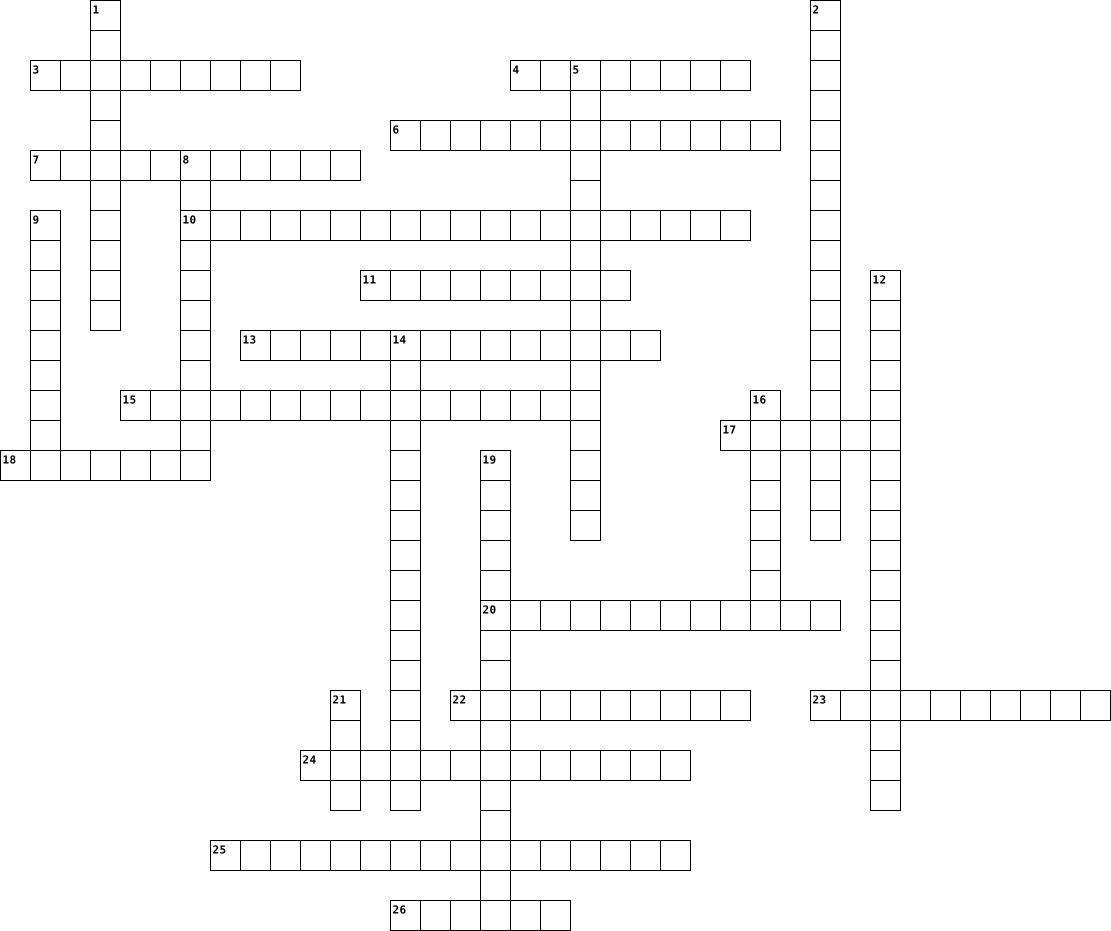
Across
- the study of matter
- the substances you have a the beginning
- the amount of a substance in a given volume
- when on element replaces another in a compound
- a reaction which energy is absorbed
- when two or more elements combined to make more complex substances
- any change the alters the appearance of a substance
- a change in matter that produces one or more substances
- any thing that has mass and takes up space
- new substance after the reaction
- matter is not allowed to enter or leave
- matter can enter from or escape to the surroundings
- a reaction between oxygen and fuel
- breaks down compounds into simpler products
- a characteristic of a substance that can be observed without changing the substance into another substance
- biological catalysts
Down
- a solid that forms from solution during a chemical reaction
- a reaction that releases energy in the form of heat
- minimum amount of energy needed to start a chemical reaction
- a number placed in front of a chemical formula
- used to decrease the rate of reaction
- during a chemical reaction matter is not created of destroyed
- a way to show chemical reactions using symbols
- increases the rate of reaction by lowering the activation energy
- a characteristic of a substance that describes its ability to change into other substances
- releases energy when it buns
26 Clues: the study of matter • biological catalysts • releases energy when it buns • new substance after the reaction • a reaction between oxygen and fuel • a reaction which energy is absorbed • used to decrease the rate of reaction • the substances you have a the beginning • matter is not allowed to enter or leave • any thing that has mass and takes up space • ...
#7 2023-01-10

Across
- opposite fission
- Represented by the symbol (β)
- Newton's cradle demonstrates this rule
- The emission of energy in the form of ionizing radiation
- Consists of two protons and two neutrons bound together in a particle
- The difference between the predicted mass and the actual mass of an atom's nucleus
Down
- Alpha particles, beta particles, and gamma rays are forms of this
- The strongest force out of the four fundamental forces
- Produces multiple fission
- Mechanical, thermal, and sonic are types of this
- opposite fusion
- Has the most energy of any wave in the electromagnetic spectrum
- Margaret Gowing coined this term in 1940
- The time required for half of the atoms of a given amount of a radioactive substance to disintegrate
14 Clues: opposite fusion • opposite fission • Produces multiple fission • Represented by the symbol (β) • Newton's cradle demonstrates this rule • Margaret Gowing coined this term in 1940 • Mechanical, thermal, and sonic are types of this • The strongest force out of the four fundamental forces • The emission of energy in the form of ionizing radiation • ...
Crossword Puzzle 2021-10-06

Across
- Steam Plants, It pipes high-pressure hot water from the geothermal reservoir and converts it into steam that turns generator turbines to produce electricity.
- energy, The heat generated beneath the ground.
- storage, facilities that are similar but have a second reservoir below the dam.
- Facilities that rely more on natural water flow rates, diverting just a portion of river water through turbines, sometimes without the use of a dam or reservoirs.
- is the process that produces steam that builds pressure needed to be emitted to the surface through volcanoes.
- one of the types of energy that is dynamic, transferable, and can be converted into useful forms.
- Steam Plants, It sips directly hot steam beneath the ground through pipes to mobilize generator turbines.
- energy, Energy that comes from the sun
- Energy that heats water on the surface of rivers, lakes, and oceans, which causes the water to evaporate
- Power plants use heat from deep inside the Earth to generate steam to make electricity.
- Plate, Along these boundaries are found the most active geothermal resources.
- Renewable energy source because heat is continuously produced inside the earth.
- of Fire, Found in this area is the best location for geothermal energy.
Down
- the conversion of flowing water (mechanical energy) into electrical energy.
- Reservoirs, Naturally occurring areas of hydrothermal resources.
- Cycle Plants, It has a system that transfers heat from hot water sipped miles deep to other liquids.
- energy, it is the energy that is possessed by an object due to its motion or its position
- Pumps, Tap into heat close to the Earth's surface to heat water or provide heat for buildings.
- Holes in the earth where volcanic gases are released.
- Facilities that are the most common technology which uses a dam to create a large reservoir of water.
20 Clues: energy, Energy that comes from the sun • energy, The heat generated beneath the ground. • Holes in the earth where volcanic gases are released. • Reservoirs, Naturally occurring areas of hydrothermal resources. • of Fire, Found in this area is the best location for geothermal energy. • the conversion of flowing water (mechanical energy) into electrical energy. • ...
Vocab 2024-02-26

Across
- Energy Energy from inside the nucleus of the atom.
- Energy comes from electrons moving from one atom to another.
- is energy from the vibrations of atoms that form a wave based on Compressions and Rarefactions.
- For example, freezers are not cold, they are less hot.
- Energy energy in the form of motion
Down
- materials that allow energy to pass through them easily. (Metal Wires)
- Energy Energy that is doing work or has the potential to do work.
- Spectrum. The spectrum includes all forms of light such as infra-red waves(less energy), visible waves, and ultraviolet waves(more energy)
- comes from electrons changing energy levels in the atoms.
- Materials that Do Not allow energy to pass through them easily. (Rubber)
10 Clues: Energy energy in the form of motion • For example, freezers are not cold, they are less hot. • Energy Energy from inside the nucleus of the atom. • comes from electrons changing energy levels in the atoms. • Energy comes from electrons moving from one atom to another. • materials that allow energy to pass through them easily. (Metal Wires) • ...
Rat&Leprechaun 2024-03-05

Across
- describe what the cell membrane looks and functions like
- some substances are able to pass through, while other substances are not
- uses no energy
- specialized type of transport protein found in cell membranes
- forms the main structural part of a cell membrane
- a relatively stable equilibrium between interdependent elements
- solutes moving to an area with a higher number of particles to an area with a lower number of particle
Down
- the passive movement of molecules
- movement of molecules to a high to low concentration
- the movement of water
- Taking in a matter by a living cell
- Form of active and bulk transport
- the ability to do work
- uses energy
- a protein that allows the transport of specific substances across a cell membrane
15 Clues: uses energy • uses no energy • the movement of water • the ability to do work • the passive movement of molecules • Form of active and bulk transport • Taking in a matter by a living cell • forms the main structural part of a cell membrane • movement of molecules to a high to low concentration • describe what the cell membrane looks and functions like • ...
Suri Yantz 2023-10-25

Across
- plants use other things to transfer light into energy
- chemical energy production of carbohydrates
- energy from nonliving sources and convert it into forms
Down
- acquire energy from other organisms
- stores in forms
- rely on other organisms for energy and nutrients
6 Clues: stores in forms • acquire energy from other organisms • chemical energy production of carbohydrates • rely on other organisms for energy and nutrients • plants use other things to transfer light into energy • energy from nonliving sources and convert it into forms
Other Forms of Energy 2023-01-26

Across
- travels through space waves
- energy that has to do with its motion, shape, position
Down
- results from the relative positions of the particles within a material
- total potential and kinetic energy of particles in an object
- potential energy stored in the nucleus
- electric charges
6 Clues: electric charges • travels through space waves • potential energy stored in the nucleus • energy that has to do with its motion, shape, position • total potential and kinetic energy of particles in an object • results from the relative positions of the particles within a material
MUASCULOSKELETAL DEFINITIONS 2020-09-11

Across
- Very great tiredness
- Level of training intensity when an athlete approaches their maximal heart rate and performs exercise to an increasingly non-aerobic level
- A band of tough, flexible tissue which connects two bones or cartilages or holds together a joint
- A medical condition in which the bones become brittle and fragile from loss of tissue
- A mineral essential for bone growth
- A lifelong process where mature bone tissue is removed from the skeleton (a process called bone resorption) and new bone tissue is formed
- time The speed of a muscular contraction
- A chemical that occurs in all cells, but mainly in muscle, where it forms the energy reserve. Abbreviation ATP
- The enlargement of an organ or tissue. Also called hypertrophy
- The amount of work your muscles produce is related to the heat produced
Down
- An interweaving bed of capillaries supplying tissues such as muscle
- Muscle found only in the heart
- A muscle cell
- A type of starch, converted from glucose by the action of insulin, and stored in the liver as a source of energy
- A cell which build new bone
- A cell which destroys bone
- Microscopic tears in the muscle due to exercise
- The flow of blood around the body. Also called circulation
- The strength of a muscular contraction
- Forms a scaffold to provide strength and structure to bones, muscle, skin and tendons
20 Clues: A muscle cell • Very great tiredness • A cell which destroys bone • A cell which build new bone • Muscle found only in the heart • A mineral essential for bone growth • The strength of a muscular contraction • time The speed of a muscular contraction • Microscopic tears in the muscle due to exercise • The flow of blood around the body. Also called circulation • ...
6.2 Understanding Change 2013-10-25

Across
- A change of state from solid to gas
- Particles packed tightly together. However the particles flow to take the shape of the container
- The change of state from liquid to solid
- Particles that are attracted to each other and bind tightly together
- A simplified representation of solids, liquids and gases
- A change of state where a gas is cooled and forms a liquid
- An increase in size
- The change of state when a solid is heated and forms a liquid
- A mixture where the substances are mixed on the same level
Down
- A change that results in no new substances being formed
- A process where two liquids or two gases mix due to the motion of their particles
- The change of state from liquid to solid
- Particles that are not stuck to each other which leaves big spaces between particles
- A solid formed during a chemical change
- A change that results in a new subsatance being formed
- A decrease in size
- The change of state where a liquid changes to a gas at the surface of the liquid
- Describes a process that gives off energy in the form of heat, light or sound
- Describes a process that absorbs energy from the surroundings
- A change of state from gas to solid
- A change of state where a liquid is heated and changes to a gas within the liquid
21 Clues: A decrease in size • An increase in size • A change of state from solid to gas • A change of state from gas to solid • A solid formed during a chemical change • The change of state from liquid to solid • The change of state from liquid to solid • A change that results in a new subsatance being formed • A change that results in no new substances being formed • ...
Electricity 2021-05-10

Across
- multiple paths for current
- a single path for current
- change in the electrical energy of a charged particle divided by its charge
- the rate at which electrical energy is converted into other forms of energy
- melts to prevent circuit overloads
- internal resistance which slows the movement of charges through a conducting material
Down
- rate in which charges move through a wire
- an electrical property of matter that creates electric fields
- a switch that opens a circuit automatically when the current exceeds a certain value
- allows electric charges to move freely
- pathway of electric charges
- space around a charged particle
- materials that do not transfer charge easily
13 Clues: a single path for current • multiple paths for current • pathway of electric charges • space around a charged particle • melts to prevent circuit overloads • allows electric charges to move freely • rate in which charges move through a wire • materials that do not transfer charge easily • an electrical property of matter that creates electric fields • ...
Electricity 2021-05-10

Across
- allows electric charges to move freely
- multiple paths for current
- materials that do not transfer charge easily
- the rate at which electrical energy is converted into other forms of energy
- internal resistance which slows the movement of charges through a conducting material
- rate in which charges move through a wire
Down
- space around a charged particle
- pathway of electric charges
- an electrical property of matter that creates electric fields
- a switch that opens a circuit automatically when the current exceeds a certain value
- change in the electrical energy of a charged particle divided by its charge
- melts to prevent circuit overloads
- a single path for current
13 Clues: a single path for current • multiple paths for current • pathway of electric charges • space around a charged particle • melts to prevent circuit overloads • allows electric charges to move freely • rate in which charges move through a wire • materials that do not transfer charge easily • an electrical property of matter that creates electric fields • ...
4.2.3-4.2.4 Review 2025-04-15

Across
- Energy produced by vibrating objects that create waves through a medium like air or water.
- Energy of moving electrons.
- The rate at which work is done or energy is transferred. It tells us how quickly something can do work.
- the units used to measure power, equal to one joule of energy used per second.
- The energy an object has due to its motion
- Energy stored in the bonds of atoms and molecules. It is released when those bonds are broken during chemical reactions.
- Heat energy that comes from the movement of atoms and molecules in matter. The faster they move, the more ______ energy is produced.
- The ability to do work or cause change.
Down
- The units used to measure energy or work.
- The law that states that energy cannot be created or destroyed; it can only change forms. The total amount of energy in a closed system always stays the same, though it may move from one object or type to another.
- Energy stored in the nucleus (center) of an atom. It can be released during nuclear reactions, such as fission (splitting atoms) or fusion (joining atoms).
- Energy stored in an object when it is stretched or compressed. It is released when the object returns to its original shape.
- Energy The sum of kinetic and potential energy in an object that is used to do work.
- The energy stored in an object because of its position or condition.
14 Clues: Energy of moving electrons. • The ability to do work or cause change. • The units used to measure energy or work. • The energy an object has due to its motion • The energy stored in an object because of its position or condition. • the units used to measure power, equal to one joule of energy used per second. • ...
Water & the Weather-Part 2 2023-04-04

Across
- Liquid or solid water that falls from clouds to the ground.
- These keep clouds suspended in the air.
- Made up of large pellets of ice.
- Made of tiny water droplets, or tiny ice crystals.
- During this process, water absorbs energy from the surroundings.
- Water droplets that form on surfaces due to condensation of water vapor.
Down
- Forms when air blows ice particles upward & downward many times, allowing the particles to grow much larger in size.
- The process by which atoms or molecules are arranged in a repeating, three dimensional pattern to form crystals.
- This forms when the temperature is below freezing.
- Made up of delicate, six-sided ice crystals.
- This is higher when the air has more water vapor.
- During condensation, water ______ energy to the surroundings.
12 Clues: Made up of large pellets of ice. • These keep clouds suspended in the air. • Made up of delicate, six-sided ice crystals. • This is higher when the air has more water vapor. • This forms when the temperature is below freezing. • Made of tiny water droplets, or tiny ice crystals. • Liquid or solid water that falls from clouds to the ground. • ...
Science 2023-11-17

Across
- earthquakes strength
- records ground movements
- shaking that comes from moving plates
- above the focus
- where magma melts trough earths crust
- scale that gets an earthquakes magnitude from seismic waves
- waves in which the shaking is perpendicular to the waves
- weak spot where magma came through the surface
- a line of volcanoes around the pacific ocean
- transfer of heat energy
- waves that compress and expand underground
Down
- measurement of mass
- the worlds single land mass 200 million years ago
- waves forms when s and p waves reach the surface
- movement of fluid from temperature of liquid
- liquid magma
- acts on rock to break or change its form
- energy transfer from electromagnetic waves
- transfer of heat from liquid
- molten mix of rocks, water and gases
- where the rock first breaks
21 Clues: liquid magma • above the focus • measurement of mass • earthquakes strength • transfer of heat energy • records ground movements • where the rock first breaks • transfer of heat from liquid • molten mix of rocks, water and gases • shaking that comes from moving plates • where magma melts trough earths crust • acts on rock to break or change its form • ...
Thermal Energy Review 2025-02-26

Across
- A state of matter that has molecules moving freely away from each other; no fixed volume or shape
- The transfer of heat through fluids such as liquids and gases due to density differences.
- Law of Conservation of energy: Energy cannot be _________ or destroyed but it can change forms.
- One or more atoms joined together in a particular way
- The energy an object has because it is moving
- A substance that has molecules that are vibrating in place; fixed shape and volume
- The condition under which two substances in physical contact with each other reach the same temperature.
Down
- The transfer of heat through waves. The objects are NOT touching.
- An object that slows energy transfer (heat, electricity).
- Anything that has mass and takes up space
- _______ Energy: The total kinetic energy of all the molecules that make up a sample
- Heat transfer by direct contact
- The average kinetic energy of all the molecules (particles) of a substance
- A state of matter that has molecules moving around each other; a fixed volume but no fixed shape
14 Clues: Heat transfer by direct contact • Anything that has mass and takes up space • The energy an object has because it is moving • One or more atoms joined together in a particular way • An object that slows energy transfer (heat, electricity). • The transfer of heat through waves. The objects are NOT touching. • ...
life and earth science vocab crossword puzzle 2024-09-25

Across
- Cycle -. A chain of processes that produce and transform the rock types in the Earth's crust.
- When liquid turns into gas.
- cycle. - The movement of the particles through a substance transporting their heat energy from hotter to cooler areas.
- - The ability to do work.
- The ability to maintain or support a process continuously over time..
- - Any liquid or frozen water that forms in the atmosphere and back to Earth.
- - The connection of different parts of the world.
Down
- - An organism that creates its own food or energy.
- method. The process of objectively establishing through testing and experiments.
- - The study of organisms and how they interact with each other.
- - A process in which deep cold water rises toward the surface.
- energy. Any energy that is created by the sun.
- resources - A substance that is used up more quickly than it can replace itself.
- - The introduction of harmful materials into the environment.
- - A group of people or things with a common characteristic.
- key - A simple tool used to identify a specific object.
16 Clues: - The ability to do work. • When liquid turns into gas. • energy. Any energy that is created by the sun. • - The connection of different parts of the world. • - An organism that creates its own food or energy. • key - A simple tool used to identify a specific object. • - A group of people or things with a common characteristic. • ...
Skeletal System Crossword Puzzle 2025-08-20

Across
- The tailbone
- Bone that forms the front of the rib cage
- Bone that forms the upper part of the pelvis
- Bone that protects the brain
- Bone that forms the forehead
- Smallest bone in the human body (found in the ear)Bone forming the upper arm
- Bone forming the lower jaw
- Curved bones forming the rib cage
- Bone that forms the base of the spine
- Group of bones protecting the heart and lungs
- Bone that forms the front of the lower leg
Down
- Bone that forms the cheek
- Bone in the lower leg, also called the shinbone
- Bone forming the upper arm
- Bones that make up the fingers and toes
- Bone that connects the shoulder to the sternum
- Bone that forms the side of the skull
- Bone that forms the lower arm along with the radius
- The longest bone in the human body
- Bone that forms the back of the skull
20 Clues: The tailbone • Bone that forms the cheek • Bone forming the upper arm • Bone forming the lower jaw • Bone that protects the brain • Bone that forms the forehead • Curved bones forming the rib cage • The longest bone in the human body • Bone that forms the side of the skull • Bone that forms the base of the spine • Bone that forms the back of the skull • ...
Biology Quarter 1 Review 2023-11-03

Across
- Forms the outer boundary of cell and is selectively permeable due to its structure
- A negatively charged particle that has very little mass and move around the nucleus of an atom
- A molecule used for short-term energy storage
- Mathematical expression of relative H+ concentration in a solution
- A molecule that has many different functions in living things and are made of monomers called amino acids
- A process that uses energy to remove a lot of material out of the cell
- Multicellular organism
- The minimum energy required to start a chemical reaction
- The active site of the enzyme has been destroyed which causes the enzyme activity to fail
- Composed of abiotic and biotic factors where organisms live in a place together with their physical environment
- Diffusion of water through a selectively permeable membrane
- A protein that lowers the activation energy required for a specific biological reaction
- A series of steps where organisms transfer energy by eating or being eaten
Down
- Type of bond that shares electrons between atoms
- A neutrally charged particle found in the nucleus of an atom
- The process where molecules use protein channels to move from an area of high to low concentration
- A long chain of nucleotides, which are made of a sugar, a nitrogen-containing base, and a phosphate group
- Less solutes and more water
- The smallest, simplest and most ancient cell; primarily a single-celled organism
- More solutes and less water
- A positively charged particle found in the nucleus of an atom
- A process that uses energy to bring a lot of material into the cell
- A molecule used for long-term energy storage
23 Clues: Multicellular organism • Less solutes and more water • More solutes and less water • A molecule used for long-term energy storage • A molecule used for short-term energy storage • Type of bond that shares electrons between atoms • The minimum energy required to start a chemical reaction • Diffusion of water through a selectively permeable membrane • ...
STAAR VOCABULARY CATEGORY 4 Biological Processes and Systems 2019-03-08

Across
- protein used to decrease energy required for chemical reaction
- top portion of pistil; sticky to capture pollen
- stalk portion of stamen used to support the anther
- body system that send messages within the body through the use of hormones
- vascular tissue in plants which moves food
- body system that breaks down food into nutrients and then absorbs them into the circulatory system
- energy transfer reaction changing light energy into chemical energy of glucose
- male part of flower; divided into anther and filament
- elements and compounds on the left side of chemical equations
- body system that transports chemicals throughout the body including oxygen, carbon dioxide and hormones
- body system which helps fight infection;
- long tube portion of pistil; forms pollen tubes
Down
- body system that provides protection and keeps the body from drying out
- body system which removes liquid wastes; major organs include the kidneys
- energy transfer changing big chemical energy of glucose into smaller chemical energy of ATP
- female part of the flower; divided into the style, stigma, and ovary
- body system which exchange gases with the environment; major organs are lungs
- vascular tissue in plants which moves water
- body system that provides support, a point of attachment for muscles, storage of minerals and production of red and white blood cells
- top portion of stamen; contains pollen
- body system that allows an organism to reproduce
- body system that allows for movement
- body system that sends and receives messages through electrical impulses
- bottom part of pistil; contains eggs used to form seeds
- elements and compounds on the right side of the chemical equation
25 Clues: body system that allows for movement • top portion of stamen; contains pollen • body system which helps fight infection; • vascular tissue in plants which moves food • vascular tissue in plants which moves water • top portion of pistil; sticky to capture pollen • long tube portion of pistil; forms pollen tubes • body system that allows an organism to reproduce • ...
Natural Resources 2016-01-25

Across
- Energy from the Sun that is converted into thermal or electrical energy is known as:
- Plant matter grown to generate electricity, heat or use as fuel is referred to as:
- Energy and materials found in the nature that are used by the human society are termed as:
- Electricity produced by harnessing the energy of flowing water known as:
- Natural resources such as rivers, lakes, glaciers and groundwater are termed as:
- What resources can’t be replaced, or nature will take a long time (millions of years) to replace?
- Fossil fuels in form of liquid and gaseous hydrocarbons found in underground reservoirs:
Down
- Natural resources from which various metals and chemicals are extracted are termed as:
- Power generated by utilizing the heat stored beneath the Earth’s surface is referred to as:
- What type of resources are constantly replaced by nature, and can be harvested indefinitely?
- Energy resources formed in the Earth’s crust from plant and animal matter over millions of years:
- Natural resources that are converted by humans into various forms of usable energy are classified as:
- Electricity produced from energy released by controlled atomic fission is known as:
- Power generated by harnessing wind energy using wind mills and turbines known as:
- Natural resources from the biosphere, such as forests, crops and wildlife, are termed as:
- Name the solid fossil fuel formed by decomposed plant material buried over millions of years.
16 Clues: Electricity produced by harnessing the energy of flowing water known as: • Natural resources such as rivers, lakes, glaciers and groundwater are termed as: • Power generated by harnessing wind energy using wind mills and turbines known as: • Plant matter grown to generate electricity, heat or use as fuel is referred to as: • ...
Global Systems Review 2022-02-23

Across
- The cycle by which water moves around the Earth and through different forms
- The large interconnected system of ocean currents that transports water and heat around the world
- The way in which carbon atoms cycle through different forms and reservoirs
- The way in which nitrogen cycles through different forms
- The layer of gases surrounding the Earth
- This type of energy drives evaporation in the water cycle
- The sphere containing all the rocks and minerals all over the Earth
Down
- This property of water determines whether it rises or sinks in the ocean
- A body of moving water in the ocean that transports heat
- Heat from the sun causes the water at the equator to do this, increasing the salinity of the water
- The collection of all water on Earth
- The sphere containing all living things on Earth
- Currents in the ocean move this around
- The salt content of water
14 Clues: The salt content of water • The collection of all water on Earth • Currents in the ocean move this around • The layer of gases surrounding the Earth • The sphere containing all living things on Earth • A body of moving water in the ocean that transports heat • The way in which nitrogen cycles through different forms • ...
physics crossword A.E 2022-01-04

Across
- A display of something
- the movement caused within a fluid
- the lowest temperature that is theoretically possible
- the spreading of something more widely.
- the quantity of matter which a body contains,
- corresponding in size or amount to something else.
- the emission of energy as electromagnetic waves
- the amount of space that a substance or object occupies
- proof
- a substance which does not readily allow the passage of heat or sound
- energy associated with microscopic forms of energy.
- Same thing
- an instrument measuring atmospheric pressure
- the pressure exerted by the weight of the atmosphere
- the action on thinking something
- one which the researcher holds constant
- Something natural
- the degree of compactness of a substance.
Down
- methodological point of departure of scholarly research
- proposed explanation made on the basis of limited evidence
- principle of physics
- the process by which heat or electricity is directly transmitted
- something your not certain of
- possesing something
- if one variable increases the other will decrease
- to comprehend something
- continuous physical force exerted on or against an object
- to predict
- the scale of temperature
- the quality of being hot
- the degree or intensity of heat
31 Clues: proof • to predict • Same thing • Something natural • possesing something • principle of physics • A display of something • to comprehend something • the scale of temperature • the quality of being hot • something your not certain of • the degree or intensity of heat • the action on thinking something • the movement caused within a fluid • the spreading of something more widely. • ...
AP Bio Unit 3 Terms 2022-05-03

Across
- Catalyzes transfer of y-phosphate from ATP or GTP to protein substrates
- Inhibited enzyme cannot work once substrate is removed from site
- Energy stored in bonds (ΔG=ΔH−TΔS)
- Biochemical reaction that involves the oxidation of pyruvate, creating acetyl CoA, pyruvate loses electrons, in eukaryotes, it happens in matrix of mitochondria, in prokaryotes, it happens in cytoplasm
- Adenosine diphosphate
- Formed when a substrate binds to an enzyme, lowers activation energy and promotes rapid progression
- Enzyme catalyst of ATP from ADP phosphorylation with an inorganic phosphate
- A salt of pyruvic acid
- Process plants use to turn CO2 into sugar
- Energy carrying molecule found in the cells of all living organisms
- Metabolic pathway that oxidizes acetyl-CoA into two carbon dioxide molecules and two water molecules
- Movement of ions across a semipermeable membrane bound structure
- Contributesto oxidation during processes such as glycolysis
- Destroy the characteristic properties of a protein or biological macromolecule
- An alternate part of the enzyme that can bind to non-substrate molecules
- Inhibited enzyme can work once substrate is removed from site
Down
- Metabolic reaction that requires energy to build complex molecules
- ADP and a phosphorylated intermediate forms ATP
- Releases energy (like breakdown of sugar), meaning energy must leave system
- ATP synthesis is coupled to electron movement through the ETC and associated consumption of oxygen
- Non-spontaneous, will not occur without the addition of free energy, requires energy input
- Stage in aerobic respiration that uses free oxygen as final electron acceptor of electrons removed during glycolysis and ETC
- Molecule that partici[ates in many biochemical reactions in protein, carbohydrate and lipid metabolism
- Area on enzyme that matches the pattern of a certain substrate
- Breaking down of complex molecules into simpler ones, releasing energy
- Non-substrate molecule modifies or binds a site other than the allosteric site
26 Clues: Adenosine diphosphate • A salt of pyruvic acid • Energy stored in bonds (ΔG=ΔH−TΔS) • Process plants use to turn CO2 into sugar • ADP and a phosphorylated intermediate forms ATP • Contributesto oxidation during processes such as glycolysis • Inhibited enzyme can work once substrate is removed from site • Area on enzyme that matches the pattern of a certain substrate • ...
8.1/8.2 Vocab 2021-12-21

Across
- cell organelle that converts the chemical energy stored in food into compounds that are more convenient for the cell
- basic unit of all forms of life
- cell organelle that breaks down lipds, carbohydrates, and proteins into small molecules that can be used by the rest of the cell
- structure that contains the cell’s genetic material or DNA
- flexible double layered sheet that makes up the cell membrane and forms a barrier between cells and its surroundings
- thin flexible barrier that surrounds all cells and regulates what goes in and out the cell
- a unicellular organism that doesn’t contain a nucleus
- a network of protein filaments in an eukaryote cell that gives cells its shape
- organelle found in cells of plants that captures energy from sunlight and convert it into energy
Down
- fluid portion of the cell outside the nucleus
- cell organelle consisting of RNA and protein, its found throughout the cytoplasm in the cell
- a concept in biology that states all living things are composed of cells, cells are the basic unit of structure and functions, and that new cells come from existing cells
- strong supporting layer that surrounds the cell membrane
- organism whose cell contains a nucleus
- specialized structure that performs important cellular functions within a eukaryote cell
- cell organelle that stores materials such as water, salts, proteins, and carbohydrates
16 Clues: basic unit of all forms of life • organism whose cell contains a nucleus • fluid portion of the cell outside the nucleus • a unicellular organism that doesn’t contain a nucleus • strong supporting layer that surrounds the cell membrane • structure that contains the cell’s genetic material or DNA • ...
Vocab 2021-09-07

Across
- Store and are used for energy.
- The building blocks of life.
- Makes up all living organisms and the tissues of the body.
- Generate most of the chemical energy needed to power the cell's biochemical reactions.
Down
- Forms most of the cell membrane.
- Gel-like fluid inside the cell.
- Carries information to the cells.
- Converts sunlight into energy for plants.
- An individual living thing
- Build and regulate bodily functions.
10 Clues: An individual living thing • The building blocks of life. • Store and are used for energy. • Gel-like fluid inside the cell. • Forms most of the cell membrane. • Carries information to the cells. • Build and regulate bodily functions. • Converts sunlight into energy for plants. • Makes up all living organisms and the tissues of the body. • ...
Unit 6 Preview Crossword 2025-11-14

Across
- mountains formed when blocks of Earth's crust are pushed up by forces inside Earth
- A tall, cone-shaped volcano in which layers of lava alternate with layers of ash and other volcanic materials
- A mountain formed by blocks of rock uplifted from normal faults. (Include hyphen)
- A scale that rates an earthquake's magnitude based on the size of its seismic waves.
- Move through rack material by causing particles in the rock to vibrate at right angles (up and down) to the direction in which the waves are moving; slower than primary waves
- A scale that rates earthquakes by estimating the total energy released by an earthquake (No Space)
- Shaking that results from the movement of rock below the surface
- the area covered by lava as it pours out of a volcano's vent (No space)
- The area on the surface directly above the focus
- Using the distance from three stations to determine the epicenter of an earthquake
- Vibrations that travel through Earth carrying energy released by earthquake (no space)
- a wide, gently sloping volcano made of layers of lava and formed by quiet eruptions
- Type of fault where rocks move sideways past one another (include hyphen)
- A scientist who studies earthquakes
Down
- Breaks in Earth's crust where rocks slip past one another
- the flow of ash, cinders, bombs, and gases down the side of a volcano during an explosive eruption
- This type of fault occurs when the rocks move towards one another, with one sliding above the other
- The central point of the earthquake beneath Earth's crust
- a scale that rates the amount of shaking from an earthquake (No space)
- seismic waves that travel along the Earth's surface in a circular motion
- Instrument used to measure horizontal or vertical motion during an earthquake.
- A small, steeply sloped volcano that forms from moderately explosive eruptions of pyroclastic material. (No space)
- mountain that forms when magma is forced upward and flows onto Earth's surface
- A mountain that forms as continental crust is compressed and rocks bend into large folds
- This type of fault occurs when the rocks move away from one another, one moving up and one down
- The digital line graph that shows intensity of an Earthquake's energy
- movement of saturated, slippery soil downhill under the influence of gravity
- a cloud of ash that forms in the air after some volcanic eruptions (No space)
- Travel the fastest through rock material by causing particles in the rock to move back and forth , or vibrate, in the same direction as the waves are moving.
29 Clues: A scientist who studies earthquakes • The area on the surface directly above the focus • Breaks in Earth's crust where rocks slip past one another • The central point of the earthquake beneath Earth's crust • Shaking that results from the movement of rock below the surface • The digital line graph that shows intensity of an Earthquake's energy • ...
Electricity 2021-05-10

Across
- materials that do not transfer charge easily
- a switch that opens a circuit automatically when the current exceeds a certain value
- the rate at which electrical energy is converted into other forms of energy
- change in the electrical energy of a charged particle divided by its charge
- multiple paths for current
- rate in which charges move through a wire
Down
- pathway of electric charges
- allows electric charges to move freely
- an electrical property of matter that creates electric fields
- internal resistance which slows the movement of charges through a conducting material
- space around a charged particle
- a single path for current
- melts to prevent circuit overloads
13 Clues: a single path for current • multiple paths for current • pathway of electric charges • space around a charged particle • melts to prevent circuit overloads • allows electric charges to move freely • rate in which charges move through a wire • materials that do not transfer charge easily • an electrical property of matter that creates electric fields • ...
Electricity 2021-05-10

Across
- change in the electrical energy of a charged particle divided by its charge
- the rate at which electrical energy is converted into other forms of energy
- internal resistance which slows the movement of charges through a conducting material
- melts to prevent circuit overloads
- rate in which charges move through a wire
- multiple paths for current
- a single path for current
- space around a charged particle
- materials that do not transfer charge easily
Down
- a switch that opens a circuit automatically when the current exceeds a certain value
- an electrical property of matter that creates electric fields
- pathway of electric charges
- allows electric charges to move freely
13 Clues: a single path for current • multiple paths for current • pathway of electric charges • space around a charged particle • melts to prevent circuit overloads • allows electric charges to move freely • rate in which charges move through a wire • materials that do not transfer charge easily • an electrical property of matter that creates electric fields • ...
Electricity 2021-05-10

Across
- allows electric charges to move freely
- multiple paths for current
- materials that do not transfer charge easily
- the rate at which electrical energy is converted into other forms of energy
- internal resistance which slows the movement of charges through a conducting material
- rate in which charges move through a wire
Down
- space around a charged particle
- pathway of electric charges
- an electrical property of matter that creates electric fields
- a switch that opens a circuit automatically when the current exceeds a certain value
- change in the electrical energy of a charged particle divided by its charge
- melts to prevent circuit overloads
- a single path for current
13 Clues: a single path for current • multiple paths for current • pathway of electric charges • space around a charged particle • melts to prevent circuit overloads • allows electric charges to move freely • rate in which charges move through a wire • materials that do not transfer charge easily • an electrical property of matter that creates electric fields • ...
Branches of science 2 2025-09-07

Across
- the study of poisons and their treatments
- the study of earthquakes
- the study of the brain and nervous system
- the study of the immune system
- the study of food and nourishment
- the study of fungus
- the design and construction
- the science of designing and applying robots
- Science Technology Engineering and Math
- the study of diseases and their causes
- the study of mental processes and behavior
Down
- the study of fish
- the study of prehistoric life using fossils
- the study of viruses and viral diseases
- the study of relationships between heat and other forms of energy
- the study of animals and their classification
- the study of treating diseases and damage to the body
- the study of languages
- the study of light and vision
- the study of interactions between matter and energy
- the science of measurement
- the study of tumors
22 Clues: the study of fish • the study of fungus • the study of tumors • the study of languages • the study of earthquakes • the science of measurement • the design and construction • the study of light and vision • the study of the immune system • the study of food and nourishment • the study of diseases and their causes • the study of viruses and viral diseases • ...
Light Reflection and Refraction 2024-05-14

Across
- Bouncing of a wave off a surface
- material that allows light to pass through
- Bending of light as it changes while moving from on medium through another
- substance that something exists in or moves through
- point where light rays converge
- where light reflects off of particles bouncing in many different directions
- narrow beam of light
- mirror or lens that curves inward
- how an object is seen in a concave mirror
Down
- visible electromagnetic radiation
- a very small piece of matter
- image that forms from light rays that change direction
- transparent object with at least one curved side that cause light to change direction
- material that light appears blurry
- material that absorbs light
- energy carried by an electromagnetic wave
- image that forms where light rays converge or come together
- mirror or lens that curves outward
18 Clues: narrow beam of light • material that absorbs light • a very small piece of matter • point where light rays converge • Bouncing of a wave off a surface • visible electromagnetic radiation • mirror or lens that curves inward • material that light appears blurry • mirror or lens that curves outward • energy carried by an electromagnetic wave • ...
Cellular Respiration 2023-10-22

Across
- cell organelle that converts the chemical energy stored in food into compounds that are easier for the cell to use
- a process that does not require oxygen
- process that releases energy by breaking down glucose and other food molecules when oxygen is available
- first set of reactions in cellular respiration in which a molecule of glucose is broken into two molecules of pyruvic acid
- innermost compartment of the mitochondria
Down
- process by which cells release energy in the absence of oxygen
- second stage of cellular respiration in which pyruvic acid is broken down into carbon dioxide in a series of energy-extracting reactions
- what is present before a reaction takes place, before the arrow
- electron carrier involved in glycolysis
- process used by plants and other autotrophs to capture light energy and convert carbon dioxide and water into energy-rich sugars and oxygen
- a process that requires oxygen
- measure of heat energy in food
- what is present after a reaction takes place, (what the reaction forms) found after the arrow
13 Clues: a process that requires oxygen • measure of heat energy in food • a process that does not require oxygen • electron carrier involved in glycolysis • innermost compartment of the mitochondria • process by which cells release energy in the absence of oxygen • what is present before a reaction takes place, before the arrow • ...