
forms of energy Crossword Puzzles
Macromolecules 2023-10-25

Across
- A covalent chemical bond formed between two amino acid molecules.
- Proteins have four structures: primary, secondary, tertiary and quaternary structure.
- A covalent bond formed between a carbohydrate molecule and another molecule.
- Or fruit sugar, is a simple monosaccharide found in many plants.
- Are simple sugars, the number of carbon atoms usually ranges from three to seven.
- The most abundant natural biopolymer on Earth because it is the main component in plant cell walls.
- Also known as roughage or bulk, refers to the indigestible carbohydrates found in plant-based foods.
- Adenosine triphosphate is a molecule which acts as a universal energy currency for living cells.
- Sugars capable of acting as a reducing agent because it has a free aldehyde group or a free ketone group.
- Have the same chemical formula but have slightly different structures.
- These reactions create building blocks for and help synthesize energy.
- Consist of an amino group and a carboxyl group connected by an alpha carbon. The R group, also known as side chain, differs with each.
Down
- A disaccharide consisting of the monomers glucose and galactose.
- The process by which animals convert food into a type of energy usable by their cells
- The building blocks of life, are synthesized in all forms of living cells.
- Consist of two sugar molecules.
- A type of sugar with the chemical formula C6H12O6, in humans, an important source of energy.
- molecules built from sugars.
- Protein make up more than 50% of the dry mass of most cells.
- Long chain of monosaccharides linked by glycosidic bonds
- The stored form of sugars in plants. It is made up of a mixture of amylose and amylopectin, both polymers of glucose.
21 Clues: molecules built from sugars. • Consist of two sugar molecules. • Long chain of monosaccharides linked by glycosidic bonds • Protein make up more than 50% of the dry mass of most cells. • A disaccharide consisting of the monomers glucose and galactose. • Or fruit sugar, is a simple monosaccharide found in many plants. • ...
essex 2024-12-09

Across
- Living things in an ecosystem.
- an animal that feeds on plants.
- level- Each of the levels within a food chain, in which animals fill the same nutritional role.
- species- species that are the first to colonize newly created environments.
- an area of low-lying, uncultivated ground where water collects, a bog or marsh.
- consumer- An organism which eats other heterotrophs, usually called carnivores or omnivores.
- the process of turning from liquid into vapor.
- Plants inside an ecosystem
- Animals inside an ecosystem
- Relatively thin life-supporting stratum of Earth’s surface.
- wet muddy ground too soft to support a heavy body.
Down
- Non-living parts of an ecosystem
- water which collects as droplets on a cold surface when humid air is in contact with it.
- Precipitation is any liquid or frozen water that forms in the atmosphere and falls back to the earth.
- Heterotrophs that obtain nutrients by consuming detritus.
- an area of low-lying land which is flooded in wet seasons or at high tide, and typically always remains waterlogged.
- pyramid- graphical representation, showing the flow of energy at each trophic level in an ecosystem.
- consumer- An organism that uses energy from sunlight to manufacture its own food.
- low and marshy or frequently flooded area of land
- Layer of gases surrounding a planet.
20 Clues: Plants inside an ecosystem • Animals inside an ecosystem • Living things in an ecosystem. • an animal that feeds on plants. • Non-living parts of an ecosystem • Layer of gases surrounding a planet. • the process of turning from liquid into vapor. • low and marshy or frequently flooded area of land • wet muddy ground too soft to support a heavy body. • ...
States of Matter 2022-07-03

Across
- During a change of state, the ___ of a substance changes
- The change of state from a gas to a liquid
- The change of state from a liquid to a gas
- Solids that are composed of atoms or molecules in no specific order
- The ___ of a substance is a measure of the speed of its particles
- Solids that have orderly, three-dimensional arrangement of atoms or molecules
- State in which matter changes in both shape and volume
- The change of state from a solid to a liquid
Down
- State in which matter takes the shape of its container and has a definite volume
- ___ Law says that the volume of a gas increases as its temperature increases
- A change in which energy is removed from the substance as it changes state
- A change in which energy is absorbed by the substance as it changes state
- The change of state from a liquid to a solid
- The change of state from a solid directly to a gas
- ___ of matter are the physical forms in which a substance can exist
- State of matter that does not have a definite shape or volume and can conduct electric current
- ___ Law says that the volume of a gas increases as its pressure decreases
- State in which matter has a definite shape and volume
- Amount of force on a given area
19 Clues: Amount of force on a given area • The change of state from a gas to a liquid • The change of state from a liquid to a gas • The change of state from a liquid to a solid • The change of state from a solid to a liquid • The change of state from a solid directly to a gas • State in which matter has a definite shape and volume • ...
ecology part II 2021-03-21

Across
- what cells do to break up sugars to get energy they can use
- the process by which phosphorus moves through the lithosphere, hydrosphere, and biosphere
- biological mechanisms whereby homeostasis is maintained(cycles of matter)
- the spontaneous net movement of solvent molecules through a selectively permeable membrane into a region of higher solute con
- the net movement of anything from a region of higher concentration to a region of lower concentration
- the movement of molecules across a cell membrane from a region of lower concentration to a region of higher concentration
- a process used by plants and other organisms to convert light energy into chemical energy that, through cellular respiration, can later be released to fuel the organism's metabolic activities
- a chemical element with the symbol C and atomic number 6
- a chemical compound composed of two hydrogen and one oxygen
- biogeochemical cycle by which nitrogen is converted into multiple chemical forms as it circulates among atmosphere, terrestri
- having a higher osmotic pressure than a particular fluid, typically a body fluid or intracellular fluid
Down
- a chemical compound composed of one carbon and two oxygen atoms
- has the symbol O and atomic number 8
- when its effective osmole concentration is the same as that of another solution
- a type of membrane transport that does not require energy to move substances across cell membranes
- having a lower osmotic pressure than a particular fluid, typically a body fluid or intracellular fluid
- how water evaporates from the surface of the earth, rises into the atmosphere, cools and condenses into rain or snow in cloud
- a simple sugar which is an important energy source in living organisms and is a component of many carbohydrates
- the biogeochemical cycle by which carbon is exchanged among the biosphere, pedosphere, geosphere, hydrosphere, and atmosphere
- both global warming driven by human emissions of greenhouse gases and the resulting large-scale shifts in weather patterns
20 Clues: has the symbol O and atomic number 8 • a chemical element with the symbol C and atomic number 6 • what cells do to break up sugars to get energy they can use • a chemical compound composed of two hydrogen and one oxygen • a chemical compound composed of one carbon and two oxygen atoms • biological mechanisms whereby homeostasis is maintained(cycles of matter) • ...
Chloe Smith Crossword 2022-03-21

Across
- Is metal a good or bad conductor of heat?
- A liquid_______is a device used to measure heat.
- The three temperature scales are Kelvin, Celsius, and _______.
- When water becomes ice it _____. HINT: either expands or contracts
Down
- What is the process by which thermal energy is transfered through electromagnetic waves?
- When the temperature of a substance is _____ its particles move faster and farther apart.
- Are good absorbers and emitters dark or light in color?
- A materials ability to absorb and radiate thermal energy is indicated by its _______.
- All forms of matter generally ______ when heated and contract when cooled.
- Heat is defined as a flow of _____ energy due to a temperature difference.
10 Clues: Is metal a good or bad conductor of heat? • A liquid_______is a device used to measure heat. • Are good absorbers and emitters dark or light in color? • The three temperature scales are Kelvin, Celsius, and _______. • When water becomes ice it _____. HINT: either expands or contracts • All forms of matter generally ______ when heated and contract when cooled. • ...
Chloe Smith Crossword 2022-03-21

Across
- Is metal a good or bad conductor of heat?
- A liquid_______is a device used to measure heat.
- The three temperature scales are Kelvin, Celsius, and _______.
- When water becomes ice it _____. HINT: either expands or contracts
Down
- What is the process by which thermal energy is transfered through electromagnetic waves?
- When the temperature of a substance is _____ its particles move faster and farther apart.
- Are good absorbers and emitters dark or light in color?
- A materials ability to absorb and radiate thermal energy is indicated by its _______.
- All forms of matter generally ______ when heated and contract when cooled.
- Heat is defined as a flow of _____ energy due to a temperature difference.
10 Clues: Is metal a good or bad conductor of heat? • A liquid_______is a device used to measure heat. • Are good absorbers and emitters dark or light in color? • The three temperature scales are Kelvin, Celsius, and _______. • When water becomes ice it _____. HINT: either expands or contracts • All forms of matter generally ______ when heated and contract when cooled. • ...
RIVERS 2024-10-02

Across
- The area around a river that is prone to flooding.
- A curve in a river, often leading to an oxbow lake.
- The area where fresh water mixes with seawater at the river mouth.
- The highest course in a river.
- An artificial structure built to control water flow or generate energy.
- The area of land drained by a river and its tributaries.
- Large rocks rolling along the riverbed in transportation.
Down
- One of the features of river erosion.
- When rocks scrape and wear down the riverbed.
- The process of water dissolving minerals from rocks.
- Material carried by a river that gets dropped when the river loses energy.
- The force of the moving water.
- The final destination where a river meets the sea.
- What forms when a waterfall retreats upstream.
- The pattern that looks like tree branches.
15 Clues: The highest course in a river. • The force of the moving water. • One of the features of river erosion. • The pattern that looks like tree branches. • When rocks scrape and wear down the riverbed. • What forms when a waterfall retreats upstream. • The area around a river that is prone to flooding. • The final destination where a river meets the sea. • ...
Chemistry 1.1-1.5 2020-09-03

Across
- Coal, petroleum, and natural gas.
- Absorbes energy
- field for understanding basic chemical properties of materials and for producing new materials with well-controlled function.
- Originally limited to substances found only in living organisms, dealing with the compounds of carbon.
- natural gas, propane (LP), oil, coal, wood, electricity, heat pumps, ground source heat pumps and solar energy.
- Releases energy
- Used to view an object visible to the naked eye.
- The technique or science of working or heating metals so as to give them certain desired shapes or properties.
- The science that deals with the composition and properties of substances and various elementary forms of matter.
- The branch of chemistry dealing with inorganic compounds.
- the consideration of the facts and theories of chemistry in their purely scientific relations.
Down
- A substance sought by alchemists that would be capable of transmuting baser metals into gold or silver and of prolonging life.
- 1833–96, Swedish engineer, manufacturer, and philanthropist.
- The chemistry of living matter.
- Dealing with the qualitative and quantitative determination of chemical components of substances.
- Energy liberated by a chemical reaction or absorbed in the formation of a chemical compound.
- Everything around you. Atoms and compounds are all made of very small parts of this.
- Dealing with the relations between the physical properties of substances and their chemical composition and transformations.
- a process in which one or more substances, the reactants, are converted to one or more different substances, the products.
- Used to view an object that is not visible to the naked eye.
- methods For transmuting baser metals into gold and with finding a universal solvent and an elixir of life.
21 Clues: Absorbes energy • Releases energy • The chemistry of living matter. • Coal, petroleum, and natural gas. • Used to view an object visible to the naked eye. • The branch of chemistry dealing with inorganic compounds. • 1833–96, Swedish engineer, manufacturer, and philanthropist. • Used to view an object that is not visible to the naked eye. • ...
science vocabulary 2013-01-09

Across
- energy from the sun
- measures air pressure
- large body of air
- warm air over takes the cold air
- meeting of two air masses
- means rain
- an instrument with two thermometer with one wet bulb on the end
- deals with bad weather
- heat energy travels through empty spaces
- whirling funnel shaped cloud that hits the ground
- pushes warm front under the cold front
- person who analyzes the weather
Down
- clouds at the ground
- two fronts run in to each other and theres no movement
- connects equal temperature with lines on a weather map
- a storm with lightning
- lines on a weather map that show equal atmospheric pressure
- amount of water vapor in the air compared to the amount of room
- thick flay gray clouds
- traping suns heat in earth
- a symbol on a weather map
- cold front travels fast and overcomes a warm front
- a powerful cyclone that forms over the ocean
- condition of the atmosphere with fair weather
- amount of water vapor in the air
25 Clues: means rain • large body of air • energy from the sun • clouds at the ground • measures air pressure • a storm with lightning • thick flay gray clouds • deals with bad weather • meeting of two air masses • a symbol on a weather map • traping suns heat in earth • person who analyzes the weather • warm air over takes the cold air • amount of water vapor in the air • ...
Unit 1: Forms of Energy, Circuits, and Light 2023-09-05

Across
- a closed conducting circle or loop through which current can flow
- the incomplete or broken path that electricity tries to travel
- the energy created by vibrations
- the energy of movement and motion
- a matter that light travels through
- energy that is absorbed or delivered by an electric circuit
- the bending of light as it moves through one medium into another
Down
- the flow of electricity through a conductor
- energy related to an objects temperature
- the bouncing back of light rays from a surface
- a form of energy our eyes can detect
- the path through which an electric current can flow
- the ability to do work or make change
13 Clues: the energy created by vibrations • the energy of movement and motion • a matter that light travels through • a form of energy our eyes can detect • the ability to do work or make change • energy related to an objects temperature • the flow of electricity through a conductor • the bouncing back of light rays from a surface • ...
Unit Vocab (woohoo) 2023-03-30

Across
- The chemical symbol represents the nucleus and internal electrons
- Identifies the atom
- The central of an object, movement or group
- A positive nucleus surrounded by negative electrons
- located in the electron cloud
- 2 forms of the Same element with the same number of protons
- More electrons then protons
- The number of protons in the nucleus
- A group of electron circuling the nucleus
Down
- An atom or molecule with a net electtric charge
- indicates reactivity
- Number of protons and neutrons in the nucleus
- Same number of electrons
- More protons than electrons
- The level closest to the Nucleus
- located in the nucleus
- number of energy levels
- protons=electrons
18 Clues: protons=electrons • Identifies the atom • indicates reactivity • located in the nucleus • number of energy levels • Same number of electrons • More protons than electrons • More electrons then protons • located in the electron cloud • The level closest to the Nucleus • The number of protons in the nucleus • A group of electron circuling the nucleus • ...
What is in the air? 2020-12-02

Across
- a process used by plants and algae to make sugar out of light, carbon dioxide, and water
- a gaseous state of water; a variable gas that is found in earth's atmosphere
- a colorless, odorless gas that makes up about 78 percent of earth's atmosphere
- a radiant energy that heats
- a gas in the atmosphere for which the relative amount stays constant
- the amount of matter in an object or sample
Down
- They are the most stable due to having the maximum number of valence electrons their outer shell can hold.
- a water gas in the atmosphere; a greenhouse gas
- the layer of gases surrounding earth
- a form of oxygen that forms a thin layer in the stratosphere
- a greenhouse gas in earth's atmosphere. carbon dioxide is created by natural and human-made process
- a gas that absorbs and radiates energy in the atmosphere trapping thermal energy
- an atmospheric gas whose amount changes based on the environment
- the mixture of gases that surrounds the earth
- a gas that makes up about 21 percent of earth's atmosphere
15 Clues: a radiant energy that heats • the layer of gases surrounding earth • the amount of matter in an object or sample • the mixture of gases that surrounds the earth • a water gas in the atmosphere; a greenhouse gas • a gas that makes up about 21 percent of earth's atmosphere • a form of oxygen that forms a thin layer in the stratosphere • ...
Evan Baumgartner Chapter 6 2018-11-18

Across
- The transfer of energy by means of electromagnetic waves.
- The lowest possible temperature that a substance may have—the temperature at which molecules of the substance have their minimum kinetic energy.
- A measure of the hotness or coldness of substances, related to the average translational kinetic energy per molecule in a substance; measured in degrees Celsius, in degrees Fahrenheit, or in kelvins.
- The measure of the energy dispersal of a system. Whenever energy freely transforms from one form into another, the direction of transformation is toward a state of greater disorder and, therefore, toward greater entropy.
- The quantity of heat required to raise the temperature of a unit mass of a substance by 1 degree Celsius.
- The transfer of thermal energy in a gas or liquid by means of currents in the heated fluid. The fluid flows, carrying energy with it.
Down
- The amount of heat needed to change the temperature of 1 gram of water by 1 Celsius degree.
- The thermal energy that flows from a substance of higher temperature to a substance of lower temperature, commonly measured in calories or joules.
- The study of heat and its transformation into different forms of energy.
- The total energy (kinetic plus potential) of the submicroscopic particles that make up a substance (often called internal energy).
10 Clues: The transfer of energy by means of electromagnetic waves. • The study of heat and its transformation into different forms of energy. • The amount of heat needed to change the temperature of 1 gram of water by 1 Celsius degree. • The quantity of heat required to raise the temperature of a unit mass of a substance by 1 degree Celsius. • ...
Rocks and Minerals 2022-03-21

Across
- shale is made of
- metamorphism that occurs when a rock is under intense pressure because it is underground
- Minerals that has the special property of being magnetic
- the internal arrangement of _____ determines a minerals properties
- rock type that forms from the compaction and cementation of sediments
- rock that has banding
- rock type that forms from the solidification of lava/magma
- can only be found in sedimentary rocks
- sedimentary rock composed of large fragments like pebbles
- type of igneous rock that forms on the surface of earth and has small crystals (fine texture)
- mineral commonly found in pencils
Down
- when a mineral breaks in random orientation it is called
- when a mineral breaks in perfect slices or pieces on perfect angles it is called
- metamorphism that occurs when lava/magma touches a rock
- type of igneous rock that forms underground and has large mineral crystals
- property that determines if a mineral can scratch glass or not
- parent rock of quartzite
- rocks are usually composed of
- fine-grained, dark-colored, igneous rock is most likely
- chemical sedimentary rock that forms when sea water evaporates
- mineral that bubbles when it comes in contact with acid
- obsidians texture is considered
- rock type that forms from subjecting a rock to intense heat and pressure
23 Clues: shale is made of • rock that has banding • parent rock of quartzite • rocks are usually composed of • obsidians texture is considered • mineral commonly found in pencils • can only be found in sedimentary rocks • metamorphism that occurs when lava/magma touches a rock • fine-grained, dark-colored, igneous rock is most likely • ...
Earths Systems Vocabulary 2023-04-05

Across
- below the lithosphere. hotter and more fluid part of the mantle.
- Forms under extreme heat and pressure. Appears twisted
- A tool that measures/records details of earthquakes
- petroeum,natural gas, coal. Made from remains of plants & animals.
- When heat, pressure, cooling, melting, and weathering cause rocks to change from one type to another over time.
- the lower part of earths mantle, below the asthenosphere
- Group of animals that occupy a certain area
- moves side to side though ONLY solids. travels slower than Pwaves
- Compress or squeeze through solids and liquid. Travel faster than S waves
- When magma flows through a crack in the middle of a tectonic plate, and not a plate boundary. Hawaiin islands were formed this way.
- The layer that lies between earth's crust and core. The majority of earth's mass is in this layer
- Still in existence, surviving species
- the study of earthquakes and related phenomena
- Boundary where tectonic plates divide
- the solid, outermost layer of the earth, lying above the mantle.
- The study of Earth
- when a sudden release of energy in the lithosphere creates seismic waves.
- forms from pre-existing rock and fossils.appears layered
- Forms at convergent boundaries where one plate subdducts under another, and magma underground is pushed upward.
Down
- Large pieces of lithosphere that the ocean and continents rest on
- Boundary where tectonic plates collide
- Occurs when divergent plates separate. COnvection currents cause less dense material to rise. Creates new ocean floor.
- the outer part of the earth. includes crust and upper mantle
- Boundary where tectonic plates slide past eachother.
- Forms when molten rock crystallizes and solidfies. Appears glassy.
- The supercontinent that existed before continents separated
- the innermost layer of earth. divided into 2 parts, liquid outer and solid inner. Made of iron and nickel
- No longer existing
- A solid inorganic material found in nature
- water held under ground in the soil in deep reservoirs
- the movement caused within a fluid when the hotter, less dense material rises, and colder, denser material sinks
31 Clues: No longer existing • The study of Earth • Still in existence, surviving species • Boundary where tectonic plates divide • Boundary where tectonic plates collide • A solid inorganic material found in nature • Group of animals that occupy a certain area • the study of earthquakes and related phenomena • A tool that measures/records details of earthquakes • ...
Earth System's Vocabulary 2023-04-05

Across
- A tool that measures/ records details of earthquakes.
- The study of earthquakes and related phenomena.
- Below the lithosphere. Hotter and more fluid part of mantle.
- Petroleum, natural gas, coal. Made from remains of plants & animals.
- Boundary where tectonic plates divide.
- Group of animals that occupy a certain area.
- Water held underground in the soil in deep reservoirs.
- When magma flows through a crack in the middle of a tectonic plate, & not at a plate boundary. Hawaiian islands were formed this way.
- Move side to side through ONLY solids. Travel slower than P waves.
- Compress or squeeze through solids & liquids. Travels faster than S waves.
- The movement caused within a fluid when the hotter, less dense material rises, and colder, denser material sinks
- When heat, pressure, cooling, melting, and weathering cause rocks to change from one type to another over time.
- The outer part of the earth. Includes the crust & upper mantle.
- Forms at a convergent boundaries where one plate subducts under another, and magma underground is pushed upward.
- The supercontinent that existed before continents separated.
- When a sudden release of energy in the lithosphere creates seismic waves.
- No longer in existence.
- Forms from pre-existing rock and fossils. Appears layerd.
Down
- The lower part of Earth's mantle, below the asthenosphere.
- Occurs when divergent plate boundaries separate. Convection currents cause less dense material to rise. Creates new ocean floor.
- Still in existence, surviving species.
- Forms when molten rock crystallizes and solidifies. Appears glassy.
- The solid, outermost layer of Earth, lying above the mantle.
- Boundary where tectonic plates slide past each other.
- Large pieces of lithosphere that the ocean & the continents rest on.
- The layer that lies between Earth's crust and core. The majority of Earth's mass is in this layer.
- The innermost layer of Earth. Divided into 2 parts, liquid outer and solid inner. Made of iron and nickel.
- The study of Earth.
- Boundary where tectonic plates collide.
- Forms under extreme heat and pressure. Appears twisted.
- A solid inorganic material found in nature.
31 Clues: The study of Earth. • No longer in existence. • Still in existence, surviving species. • Boundary where tectonic plates divide. • Boundary where tectonic plates collide. • A solid inorganic material found in nature. • Group of animals that occupy a certain area. • The study of earthquakes and related phenomena. • A tool that measures/ records details of earthquakes. • ...
Biology 1st Semester Crossword 2013-01-24

Across
- /when a cell takes in material through the membrane by infolding the cell membrane
- /I.P.M.A.T+C
- membrane /a thin layer around the cell membrane that is strong and supportive
- /stack of membranes within a cell that modifies, sorts, and packages proteins
- /second stage of cellular respiration
- /when a cell results in two daughter cells
- /an organism that makes its own food
- /an organism that is made of one cell
- /made of proteins and RNA
- /the material within the cell membrane, not including the nucleus
- /organelles that make energy in food easier to use for cells
- /the membrane system inside a cell where lipid parts of the cell membrane are made and proteins are changed
- /an enzyme-filled cell organelle that is needed to break down specific materials
- /the structure inside a nucleus that contains genetic information passed onto future cell generations
- /the type of cell all living things, other than plants, are made of
Down
- /stores water, salts, proteins, & carbohydrates
- /two identical chromatids
- /reactions of photosynthesis when energy from ATP & NADPH are used to make things, like sugars
- / where the Calvin Cycle takes place
- /a reaction that needs light to happen
- /a sequence of DNA that codes for proteins & determines traits
- /this has no nucleus and is a unicellular organism
- /carbon dioxide+water=glucose+oxygen
- /the amount of energy needed to raise the temperature of 1 gram of water by 1 degree Celcius
- /the first step in releasing energy of glucose
- /found near the nuclear envelope of an animal cell within the cytoplasm
- /a layer found around the cell membrane that is strong and supportive
- /an arganism that gets its energy from the food it consumes
- /organelle found in plant cells which absorbs sunlight
- /where the centrioles lie
- /a principle that bonds in DNA
- /different forms of a gene
- /requiring oxygen
33 Clues: /I.P.M.A.T+C • /requiring oxygen • /two identical chromatids • /made of proteins and RNA • /where the centrioles lie • /different forms of a gene • /a principle that bonds in DNA • / where the Calvin Cycle takes place • /an organism that makes its own food • /carbon dioxide+water=glucose+oxygen • /second stage of cellular respiration • /an organism that is made of one cell • ...
Chemistry Crossword Puzzle 2024-09-22

Across
- How electrons move around the nucleus
- A mixture that it not uniform or consistent in appearance
- The smallest basic unit of matter
- A part of the atom that has a positive charge
- A subatomic particle that has no charge
- How many electrons can fit in the first energy level of an atom
- Two or more atoms that are chemically bonded together
- A mixture that has a uniform consistent appearance
- Anything that has mass and takes up space
Down
- A type of bond that forms when atoms share electrons
- An atom that has become charged by gaining or losing an electron
- How elements on the periodic table are labeled in columns (up and down)
- A part of the atom that has a negative charge
- The center of the atom where protons and neutrons exist
- A type of bond that forms when electrons are transferred from one atom to another
- An organized arrangement of elements according to their atomic number
- How elements on the periodic table are labeled in rows (side to side)
17 Clues: The smallest basic unit of matter • How electrons move around the nucleus • A subatomic particle that has no charge • Anything that has mass and takes up space • A part of the atom that has a negative charge • A part of the atom that has a positive charge • A mixture that has a uniform consistent appearance • A type of bond that forms when atoms share electrons • ...
Chapter 2 terms 2022-03-21

Across
- a solid that forms from a solution during a chemical reaction
- a rapid reaction between oxygen and fuel that results in fire
- the principle stating that matter is not created or destroyed during a chemical reaction
- a system in which matter can enter from or escape to the surroundings
- a number in front of a chemical formula in an equation that indicates how many molecules or atoms of each reactant and product are involved in a reaction
- the study of the properties of matter and how matter changes
- a reaction in which one element replaces another in a compound or when two elements in different compounds trade places
- a characteristic of a substance that can be observed without changing the substance into another substance
- a biological catalyst that lowers the activation energy of reactions in cells
- the process in which substances undergo chemical changes that result in the formation of new substances
- the amount of one material in a certain volume of another material
- a reaction that releases energy in the form of heat
- anything that has mass and occupies space
- a material that releases energy when it burns
Down
- a material that decreases the rate of a reaction
- a system in which no matter is allowed to enter or leave
- a chemical reaction that breaks down compounds into simpler products
- a short and easy way to show a chemical reaction using symbols
- the minimum amount of energy needed to get a
- a reaction that absorbs energy in the form of heat
- a substance formed as a result of a chemical reaction
- a change that alters the form or appearance of a material but does not make the material into another substance
- a material that increases the rate of a reaction by lowering the activation energy
- a characteristic of a substance describes its ability to change into different substances
- a chemical reaction in which two or more simple substances combine to form a new more complex substance
- a substance that enters into a chemical reaction
- reaction started
27 Clues: reaction started • anything that has mass and occupies space • the minimum amount of energy needed to get a • a material that releases energy when it burns • a material that decreases the rate of a reaction • a substance that enters into a chemical reaction • a reaction that absorbs energy in the form of heat • a reaction that releases energy in the form of heat • ...
Ecology Part II 2023-03-16

Across
- A process which takes place in the absence of oxygen gas.
- The process in which carbon atoms continually travel from the atmosphere to the Earth and then back into the atmosphere.
- When particles move from high concentration to low concentration.
- the main type of sugar in the blood and is the major source of energy for the body's cells.
- A chemical process in which oxygen is used to make energy from carbohydrates.
- The diffusion of water across a selectively permeable membrane.
- Occurs when a cell uses no energy to move particles across a membrane.
- When organisms take in food and use the chemical energy they obtain from sugars.
- That have equal concentrations of substances.
- The rapid increase in Earth's average surface temperature over the past century primarily due to the greenhouse gasses released by people burning fossil fuels.
- When organisms take in sunlight as a form of energy and convert it into sugars.
- A gas inhaled by humans and put out by plants through cellular respiration.
- The part of a system in which some portion of the system's output is used as input for future operations.
Down
- The total amount of greenhouse gasses produced to directly and indirectly support human activity.
- That have more solute present.
- That have less solute present.
- A cycle where nitrogen goes through the atmosphere then cycles through to the ground into the roots of plants.
- A gas absorbed from the air by plants in photosynthesis and exhaled by humans.
- The biogeochemical cycle that describes the transformation and translocation of phosphorus in soil, water, and living and dead organic material.
- The membrane found in all cells that separates the interior of the cell from the outside environment.
- The Earth’s surface heat getting trapped in the atmosphere from greenhouse gasses.
- Significant changes in global temperature, precipitation, wind patterns and other measures of climate that occur over several decades or longer.
- Movement of materials through a membrane against concentration gradient and requires energy from the cell.
- The cycle of the continuous movement of water within the Earth and atmosphere.
- Powers nearly all forms of cellular work.
25 Clues: That have more solute present. • That have less solute present. • Powers nearly all forms of cellular work. • That have equal concentrations of substances. • A process which takes place in the absence of oxygen gas. • The diffusion of water across a selectively permeable membrane. • When particles move from high concentration to low concentration. • ...
Ecology part II 2023-03-03

Across
- the process in which carbon atoms continually travel from the atmosphere to the Earth and then back into the atmosphere.
- the rapid increase in Earth's average surface temperature over the past century primarily due to the greenhouse gasses released by people burning fossil fuels.
- the cycle of the continuous movement of water within the Earth and atmosphere.
- powers nearly all forms of cellular work.
- the Earth’s surface heat getting trapped in the atmosphere from greenhouse gasses.
- that have less solute present.
- when particles move from high concentration to low concentration.
- significant changes in global temperature, precipitation, wind patterns and other measures of climate that occur over several decades or longer.
- when organisms take in sunlight as a form of energy and convert it into sugars.
- the biogeochemical cycle that describes the transformation and translocation of phosphorus in soil, water, and living and dead organic material.
- the membrane found in all cells that separates the interior of the cell from the outside environment.
- that have equal concentrations of substances.
- that have more solute present.
- a cycle where nitrogen goes through the atmosphere then cycles through to the ground into the roots of plants.
- a process which takes place in the absence of oxygen gas.
Down
- when organisms take in food and use the chemical energy they obtain from sugars.
- a chemical process in which oxygen is used to make energy from carbohydrates.
- movement of materials through a membrane against concentration gradient and requires energy from the cell.
- the part of a system in which some portion of the system's output is used as input for future operations.
- occurs when a cell uses no energy to move particles across a membrane.
- the total amount of greenhouse gasses produced to directly and indirectly support human activity.
- the main type of sugar in the blood and is the major source of energy for the body's cells.
- a gas absorbed from the air by plants in photosynthesis and exhaled by humans.
- the diffusion of water across a selectively permeable membrane.
- a gas inhaled by humans and put out by plants through cellular respiration.
25 Clues: that have less solute present. • that have more solute present. • powers nearly all forms of cellular work. • that have equal concentrations of substances. • a process which takes place in the absence of oxygen gas. • the diffusion of water across a selectively permeable membrane. • when particles move from high concentration to low concentration. • ...
Lock out Tag out Crossword 2023-05-31

Across
- Forms of potential energy that can be used to perform work are called energy _____________.
- The type of energy that remains in the power supply system.
- During this change a transfer of locks must take place.
- Record, All training and retraining must be documented here.
- Employees are forbidden to do this to another persons lock.
Down
- Retraining is required at least once _____________________.
- Lock out tag out
- An employee who does not perform servicing or maintenance but works near the equipment
- An employee who is required to perform servicing, step up or maintenance to equipment.
- Each employee authorized to perform a Lock out procedure is assigned one of these.
10 Clues: Lock out tag out • During this change a transfer of locks must take place. • Retraining is required at least once _____________________. • The type of energy that remains in the power supply system. • Employees are forbidden to do this to another persons lock. • Record, All training and retraining must be documented here. • ...
Chapter 5 Vocab 2026-01-13

Across
- A plate boundary where two plates move away from each other
- The continents slowly moving over Earth's surface
- The molten mixture of rock-forming substances,gases and water from the mantle
- The process by which ocean crust sinks beneath a deep ocean and back into the mantle at a convergent plate boundary
- The mountain that forms in Earth's crust when molten material,or magma reaches the surface
Down
- The measure of how much mass there is in a given volume of a substance
- A deep valley along the ocean floor beneath which oceanic crust slowly sinks toward the mantle
- An area where magma from deep within the mantle melts through the crust above it
- The transfer of energy by electromagnetic waves
- The transfer of thermal energy by the movement of a fluid
- 300 million years ago there was a supercontinet called this
- One major belt of volcanoes
- A plate boundary where two plates move past each other in opposite directions
- The transfer of thermal energy from one particle of matter to another
- A plate boundary where two plates over toward each other
15 Clues: One major belt of volcanoes • The transfer of energy by electromagnetic waves • The continents slowly moving over Earth's surface • A plate boundary where two plates over toward each other • The transfer of thermal energy by the movement of a fluid • A plate boundary where two plates move away from each other • ...
unit 10 2023-04-13

Across
- transfer of energy by electromagnetic waves
- Effect – the natural heating of a planet where gases in the atmosphere of a planet trap thermal energy (heat)
- front – the boundary that forms between two different air masses
- – the transfer of thermal energy (heat) by direct contact with solid objects
- – The fourth layer of the atmosphere. This is the hottest layer of the atmosphere.
- – The third layer of the atmosphere. This is the coldest layer of the atmosphere.
- pressure - a condition of the atmosphere in which the pressure is above average.
- – a large tropical storm system with high-powered circular winds
Down
- – The second layer of the atmosphere. The ozone layer is located within this layer of the atmosphere
- pressure – a condition of the atmosphere in which the pressure is below average
- – the transfer of thermal energy (heat) by the circulation of a liquid or a gas
- – a destructive vortex of violently rotating winds having the appearance of a funnel-shaped cloud and advancing beneath a large storm system
- – a mixture of gases that surrounds a planet, such as the Earth
- currents - the continual movement of air in a circular pattern in the atmosphere
- pressure – the measure of the force with which air molecules push on a surface
- the average pattern for weather over months, years, decades, or longer in a specific place.
- – The lowest layer of the atmosphere. This is the densest lr and it contains approximately 90% of the mass of the entire atmosphere.
- describes the atmospheric conditions at a specific place at a specific point in time
18 Clues: transfer of energy by electromagnetic waves • – a mixture of gases that surrounds a planet, such as the Earth • front – the boundary that forms between two different air masses • – a large tropical storm system with high-powered circular winds • – the transfer of thermal energy (heat) by direct contact with solid objects • ...
Genetics part 1 Quiz 2013-07-15

Across
- gene that may express itself
- cells split in two
- chromatids separate
- corkscrew
- gene that will express itself
- two gene forms coding for different forms of the same trait
- carrier of all genetic information
- genetic make up
- new cell organelles appear
- gene coding for the alternative forms of a trait
Down
- physical appearance
- nuclear membrane breaks down
- a unit of heredity
- two gene forms coding for same trait
- chromatids align
- Austrian monk
- DNA condenses
17 Clues: corkscrew • Austrian monk • DNA condenses • genetic make up • chromatids align • a unit of heredity • cells split in two • physical appearance • chromatids separate • new cell organelles appear • nuclear membrane breaks down • gene that may express itself • gene that will express itself • carrier of all genetic information • two gene forms coding for same trait • ...
Genetics part 2 Quiz 2013-07-15

Across
- DNA condenses
- two gene forms coding for different forms of the same trait
- carrier of all genetic information
- chromatids align
- new cell organelles appear
- chromatids separate
- Austrian monk
- two gene forms coding for same trait
- cells split in two
- gene coding for the alternative forms of a trait
- a unit of heredity
Down
- physical appearance
- nuclear membrane breaks down
- gene that will express itself
- genetic make up
- gene that may express itself
- corkscrew
17 Clues: corkscrew • DNA condenses • Austrian monk • genetic make up • chromatids align • cells split in two • a unit of heredity • physical appearance • chromatids separate • new cell organelles appear • nuclear membrane breaks down • gene that may express itself • gene that will express itself • carrier of all genetic information • two gene forms coding for same trait • ...
A&P Fall Review 2025-12-11

Across
- the subunits of an atom consisting of protons, neutrons, and electrons
- the orbits/fixed space occupied by electrons outside of and around the nucleus of an atom
- the number equal to the number of protons in the nucleus of an atom
- capable of absorbing and releasing large amounts of heat before its temperature changes. (prevents supplement changes in body temp)
- a group of the same pure molecules
- the bonds formed between atoms that share valence electrons
- Ability to form bonds to create or break down molecules
- Ability to dissolve a smaller amount of another substance
- the weighted average atomic mass of all the isotopes of an element
- energy directly involved in moving matter
- 2 or more atoms or molecules combine to form a larger, more complex molecule
- the outermost shell whose electrons determine the chemical behavior of an atom
- the positively charge subatomic particles located in the nucleus of an atom
- A complete organized listing of elements
- the shorthand representation of an element (usually the first 1 or 2 letters of the element)
- the uncharged particles located in the nucleus of an atom
- contain carbon. Important organic compounds in the body include: carbohydrates, lipids, proteins, and nucleic acids
- the energy store in the bonds of chemical substances
- Form when a change in electrons creates a charge and atoms (now ions) of opposing charges attract and create a bond
- the ability to do work; has no mass and does not take up space
- the unstable, heaviest isotopes of certain elements that release energy to become more stable
Down
- Occur when a molecule is broken down into smaller molecules, atoms, or ions
- when energy is actually doing work (Ex: constant movement of atoms)
- formed when 2 or more atoms combine chemically
- compounds lacking carbon, tend to be small, simple molecules
- the negatively charged particles located outside of the nucleus of an atom (the charge of an electron is equal in strength to that of a proton despite their difference in mass)
- energy of the electromagnetic spectrum that travels in waves
- weak bonds formed when a hydrogen atom forms a “bridge” between an “electron hungry” atom.
- the charged particle resulting from the gaining or losing of an electron from an atom
- the energy resulting from the movement of charged particles
- involves simultaneous synthesis and decomposition reactions
- The sum of the neutrons and protons
- energy that is stored or inactive
- Adenosine triphosphate: the high-energy chemical whose energy is trapped in bonds. ATP’s energy may be transformed into the electrical energy of a nerve impulse or the mechanical energy of contracting muscles
- building blocks of elements (the smallest unit of an element that maintains the properties of that element)
- unique substances that cannot be broken down into simpler substances by ordinary chemical methods
- Protective function of water
- ionic compound contains cations (positively charge ions) and anions (negatively charged ions) other than hydrogen.
- The process of spontaneous atomic decay
- variations of an element that contain the same number of protons and electrons but vary in the number of neutrons
40 Clues: Protective function of water • energy that is stored or inactive • a group of the same pure molecules • The sum of the neutrons and protons • The process of spontaneous atomic decay • A complete organized listing of elements • energy directly involved in moving matter • formed when 2 or more atoms combine chemically • the energy store in the bonds of chemical substances • ...
Puzzle #1 2023-05-10

Across
- A strong feeling of anxiety.
- The color/colour of snow or milk; the colour of light containing equal amounts of all visible wavelengths.
- To rest in a state of reduced consciousness
- The structural elements of a building or other constructed object.
- An abstract entity used to describe quantity
Down
- That status; that position
- An emphatic form of where
- To depart; to go to another place.
- - A machine or device that converts other energy forms into mechanical energy, or imparts motion.
- The people in general, regardless of membership of any particular group.
10 Clues: An emphatic form of where • That status; that position • A strong feeling of anxiety. • To depart; to go to another place. • To rest in a state of reduced consciousness • An abstract entity used to describe quantity • The structural elements of a building or other constructed object. • The people in general, regardless of membership of any particular group. • ...
Evan Baumgartner Chapter 6 2018-11-16

Across
- The transfer of energy by means of electromagnetic waves.
- The total energy (kinetic plus potential) of the submicroscopic particles that make up a substance (often called internal energy).
- The measure of the energy dispersal of a system. Whenever energy freely transforms from one form into another, the direction of transformation is toward a state of greater disorder and, therefore, toward greater entropy.
- The study of heat and its transformation into different forms of energy.
- The transfer of thermal energy in a gas or liquid by means of currents in the heated fluid. The fluid flows, carrying energy with it.
- The thermal energy that flows from a substance of higher temperature to a substance of lower temperature, commonly measured in calories or joules.
Down
- The quantity of heat required to raise the temperature of a unit mass of a substance by 1 degree Celsius.
- The lowest possible temperature that a substance may have—the temperature at which molecules of the substance have their minimum kinetic energy.
- The amount of heat needed to change the temperature of 1 gram of water by 1 Celsius degree.
- A measure of the hotness or coldness of substances, related to the average translational kinetic energy per molecule in a substance; measured in degrees Celsius, in degrees Fahrenheit, or in kelvins.
10 Clues: The transfer of energy by means of electromagnetic waves. • The study of heat and its transformation into different forms of energy. • The amount of heat needed to change the temperature of 1 gram of water by 1 Celsius degree. • The quantity of heat required to raise the temperature of a unit mass of a substance by 1 degree Celsius. • ...
Cell Chemistry 2013-04-08

Across
- Work or operate in a proper or particular way.
- microscopic organism
- energy released from a substance during a chemical reaction
- A film two molecules thick
- A group of atoms bonded together
- energy is the energy produced or given off directly from the sun causing the growth of plants and the existence of most life forms.
- Dealing with one particular thing above all others.
- Any of a large group of compounds including sugars, starch, and cellulose
- thermal, electric, sound, chemical, radiant are all form of _______.
- The basic unit of a chemical element.
- person or thing that makes or causes something.
- series of metabolic processes by which living cells produce energy
- gas released by humans and taken in by plants
- changing of one energy type to another like
- An arrangement or organization of parts to form an organ, system, or living thing.
- process by which green plants and some other organisms use sunlight to synthesize foods from carbon dioxide and water.
- speed up chemical reactions
- C6H12O6
- shaped like a sphere.
Down
- An individual animal, plant, or single-celled life form.
- state of physical balance.
- A chemical change, especially oxidation, accompanied by the production of heat and light.
- unicellular microorganism lacking organelles and an organized nucleus, can cause disease.
- process of becoming smaller.
- Reproduction occurring without the sexual union of male and female gametes.
- a process in which one or more substances are changed into others
- unicellular microorganisms lacking organelles and an organized nucleus, including some that can cause disease.
- energy that exists in the absence of matter.
- become combined into a liquid so as to form a solution.
- specialized structures within a living cell.
- Synthesize sugars or other substances.
- process or action by which neutrons are absorbed by the nucleus.
- line that marks the limits of an area
- put into a system or expended in its operation to achieve output or a result
- Control or maintain the rate or speed
- power which may be translated into motion
- Adenosine triphosphate.
- Any of the group of a long chain of hydrocarbon derived from the breakdown of fats
- formed when two or more elements combine chemically
39 Clues: C6H12O6 • microscopic organism • shaped like a sphere. • Adenosine triphosphate. • state of physical balance. • A film two molecules thick • speed up chemical reactions • process of becoming smaller. • A group of atoms bonded together • The basic unit of a chemical element. • line that marks the limits of an area • Control or maintain the rate or speed • ...
Flow of Energy Unit* 2024-01-09

Across
- An organism that makes its own food
- The process by which cells obtain energy from glucose.
- The process by which a cell captures energy in sunlight and uses it to make food.
- Rod-shaped organelles that convert energy in food molecules to energy the cell can use to carry out its function.
- An organelle found in plant and algae cells where photosynthesis
- The transfer of nitrogen from the atmosphere to the soil, to living organisms, and back to the atmosphere
Down
- Processes that repeat themselves over and over again.
- The resulting substances that forms in a chemical reaction.
- The movement of carbon from the nonliving environment into living things and back
- An organism that cannot make its own food and gets food by consuming other living things.
- The main pigment for photosynthesis in chloroplasts.
- The continual movement of water among Earth's atmosphere, oceans, and land surface through evaporation, condensation, and precipitation
- The starting substance in a chemical reaction.
13 Clues: An organism that makes its own food • The starting substance in a chemical reaction. • The main pigment for photosynthesis in chloroplasts. • Processes that repeat themselves over and over again. • The process by which cells obtain energy from glucose. • The resulting substances that forms in a chemical reaction. • ...
Biology unit 2 vocab 2024-10-01

Across
- mitochondria organelle, site of two and three aerobic cellular respiration
- nutrient, forms the backbone for all macromolecules in living things
- anything that has mass and takes up space, makes up everything
- third step of aerobic respiration NADH and FADH2 from earlier reactions are used to make 32 units of atp
- all the soil on earth
- pigment in chloroplast, used to trap light energy in photosynthesis
- describes a situation in which oxygen is not present
- Organelle, site of photosynthesis
- process of breaking down glucose to make ATP, starts with c6h12 and o2
- all the gases surrounding earth
- Adenosine diphosphate, uncharged energy storage with 2 phosphates
Down
- type of organism that breaks down biotic compounds into abiotic compounds, recycles
- organism that is able to make its own food, base of food chain
- nutrient, used in proteins and nucleic acids. must be fixed for living things to use, often limited
- reactions second step of photosynthesis, uses energy in atp snd nadph to make glucose (c6h
- all water on earth
- nutrient, used in phosphates of nucleic acids and phospholipids of membranes, often limited
- describes a situation in which oxygen is present
- reactions first step of photosynthesis, uses sunlight to split h20 and make atp and nadh, o2 is released
- cycle second step of aerobic respiration,pyruvate is broken down while NADH and FADH are made, releases Co2
- first step is aerobic respiration, breaks down glucose (c6h12o6)
- organism that must eat other organisms to obtain energy
- all living things on earth
- substances at the beginning of a chemical reaction,changed into products
- substances created during a chemical reaction, made from reactants
- adenosine triphosphate, changed every storage molecule with 3 phosphate groups
- second step of anaerobic respiration, two types include alcoholic and lactic acid
- process of using light energy to make glucose
28 Clues: all water on earth • all the soil on earth • all living things on earth • all the gases surrounding earth • Organelle, site of photosynthesis • process of using light energy to make glucose • describes a situation in which oxygen is present • describes a situation in which oxygen is not present • organism that must eat other organisms to obtain energy • ...
Molecules to Organisms Crossword Puzzle Creation 2022-05-02

Across
- Group A functional group characterized by a phosphorus atom bonded to four oxygen atoms
- Compound any of a large class of chemical compounds in which one or more atoms of carbon are covalently linked to atoms
- is a process used by plants and other organisms to convert light energy into chemical energy
- also called simple sugars, are the simplest form of sugar
- Compound contain ions and are held together by the attractive forces among the oppositely charged ions.
- made up of chemical 'building blocks' called amino acids.
- Cycle a process that plants and algae use to turn carbon dioxide from the air into sugar, the food autotrophs need to grow
- Acid molecules that combine to form proteins.
- Acid is a polymeric molecule essential in various biological roles in coding
- is a chemical substance composed of many identical molecules
- Cycle the main source of energy for cells and an important part of aerobic respiration.
Down
- is the sugar formed when two monosaccharides are joined by glycosidic linkage.
- are the most abundant carbohydrate found in food.
- Respiration the process by which organisms combine oxygen with foodstuff molecules
- Acid is a polymer composed of two polynucleotide chains that coil around each other
- any of a large group of organic compounds occurring in foods and living tissues and including sugars, starch, and cellulose
- the basic building block of chemistry
- Triphosphate is an organic compound and hydrotrope that provides energy to drive many processes in living cells
- In biology and biochemistry, a lipid is a macro biomolecule that is soluble in nonpolar solvents.
- Compound typically a chemical compound that lacks carbon–hydrogen bonds
- Acid Nucleic acids are biopolymers, macromolecules, essential to all known forms of life.
- a type of sugar you get from foods you eat, and your body uses it for energy.
- a group of atoms bonded together, representing the smallest fundamental unit of a chemical compound that can take part in a chemical reaction.
- a cytoplasmic pathway which breaks down glucose into two three-carbon compounds and generates energy.
24 Clues: the basic building block of chemistry • Acid molecules that combine to form proteins. • are the most abundant carbohydrate found in food. • also called simple sugars, are the simplest form of sugar • made up of chemical 'building blocks' called amino acids. • is a chemical substance composed of many identical molecules • ...
Ch. 2 Chemical Reactions 2014-10-29

Across
- The amount of one material in a certain volume of another material.
- A system in which matter can enter from or escape to the surroundings.
- A reaction that absorbs energy in the form of heat.
- The minimum amount of energy needed to get a chemical reaction started.
- A biological catalyst that lowers the activation energy of reactions in cells.
- The study of the properties of matter and how matter changes.
- A rapid reaction between oxygen and fuel that results in fire.
- Anything that has mass and occupies space.
- A number in front of a chemical formula in an equation that indicates how many molecules or atoms of each reactant and product are involved in a reaction.
- A chemical reaction that breaks down compounds into simpler products.
Down
- A reaction in which one element replaces another in a compound or when two elements in different compounds trade places.
- A chemical reaction in which two or more simple substances combine to form a new, more complex substance.
- A short, easy way to show a chemical reaction, using symbols.
- A substance that enters into a chemical reaction.
- A substance formed as a result of a chemical reaction.
- A characteristic of a substance that can be observed without changing the substance into another substance.
- A solid that forms from a solution during a chemical reaction.
- A reaction that releases energy in the form of heat.
- A characteristic of a substance that describes its ability to change into different substances.
- The process in which substances undergo chemical changes that result in the formation of new substances.
- A material that decreases the rate of a reaction.
- A change that alters the form or appearance of a material but does not make the material into another substance.
- A system in which no matter is allowed to enter or leave.
- A material that releases energy when it burns.
- A material that increases the rate of a reaction by lowering the activation energy.
25 Clues: Anything that has mass and occupies space. • A material that releases energy when it burns. • A substance that enters into a chemical reaction. • A material that decreases the rate of a reaction. • A reaction that absorbs energy in the form of heat. • A reaction that releases energy in the form of heat. • A substance formed as a result of a chemical reaction. • ...
cell Crossword 2021-10-03

Across
- jelly like substance that contains dissolved molecular building blocks such as proteins, nucleic acids and minerals and ions.
- fluid filled sac for storage materials needed by a cell.
- small region of cytoplasm that produces microtubes only in animal cells.
- rigid layer that gives protection support and shape to the cell.
- makes lipids, breaks down drugs, alcohol, and has no ribosomes.
- tiny organelles that link amino acids together to form proteins.
- contains enzymes that defend a cell from invading bacteria and viruses.
- vacuole filled with a fluid that strengthens the cell and helps to support the entire plant
- produces proteins for the rest of the cell to function. It creates packages and folds the protein.
- carries out photosynthesis and converts solar energy into energy rich molecules the cell can use.
- supplies energy to the cell. converts food molecules into energy.
- jelly like substance that contains dissolved molecular building blocks
Down
- small region of cytoplasm that produces microtubes.
- used for synthesis and storage.
- surrounded by an envelope that controls most functions of a cell. Stores information.
- forms a boundry between a cell and the outside environment and controls the passage of materials into and out of a cell.
- helps in cell division, provides strength for the cell and gives the cell shape.
- small membrane bound sacs that divide some materials from the rest of the cytoplasm and trasport these materials from place to place.
- a complex of vesicles and folded membranes within the cytoplasm of most eukaryotic cells, involved in secretion and intracellular transport.
19 Clues: used for synthesis and storage. • small region of cytoplasm that produces microtubes. • fluid filled sac for storage materials needed by a cell. • makes lipids, breaks down drugs, alcohol, and has no ribosomes. • rigid layer that gives protection support and shape to the cell. • tiny organelles that link amino acids together to form proteins. • ...
Exam 1 Review Crossword 2: lectures 3-6 2017-09-08

Across
- Energy that is available to do work is called _____ energy
- ____ transport brings molecules across a cell membrane without using any energy
- This is the waste product in photosynthesis
- The _____ and Archaea are the two groups of prokaryotes
- This is the main pigment that absorbs sunlight in photosynthesis
- The light reaction pathway in photosynthesis takes place in the _____ membranes
- Cellular drinking
- The type of reaction where molecules are linked together (ex: dehydration synthesis)
- The organelle responsible for producing energy for our cells
- This process takes energy from the sun and makes chemical energy in the form of glucose (hint: only happens in plants)
- The spot on an enzyme where the substrate binds (2 words)
- If oxygen is not present, this is the next step in the metabolism of glucose after glycolysis
- The number of pyruvate molecules produced at the end of glycolysis
- This small cell structure (not an organelle) is responsible for making proteins. It can be found free-floating in the cytoplasm or attached to the ER
Down
- An appendage on cells used for movement. Typically found singly or in pairs in eukaryotic cells.
- In an ______ reaction, energy is released (ball rolling down hill)
- The primary control center in a eukaryotic cell that contains the DNA
- The abbreviation for the pathway in cellular respiration that produces the most ATP
- When a molecule binds to the active site of an enzyme and permanently inactivates the enzyme, this is known as ______ inhibition
- The organelle responsible for digestion in our cells
- This molecule makes up the foundation of the plasma membrane and forms a bilayer
- Glycolysis takes place in what part of the cell?
- The organelle responsible for photosynthesis in plant cells
- During the Calvin cycle or light-independent reactions in photosynthesis, this molecule is converted to glucose using the energy in ATP and NADPH (2 words)
- A light microscope, like the one in lab, uses ______to view cells
- The membrane protein that is used in cellular respiration and photosynthesis to synthesize ATP (2 words)
- If you place a cell in salt water, water will leave the cell, causing it to shrink. The salt water is _____ relative to the solution in the cell
- The abbreviation for the molecule that, when hydrolyzed (split apart), provides a lot of energy for our cells to do work. Hint: this molecule is created during cellular respiration
- The diffusion of water across a selectively permeable membrane
29 Clues: Cellular drinking • This is the waste product in photosynthesis • Glycolysis takes place in what part of the cell? • The organelle responsible for digestion in our cells • The _____ and Archaea are the two groups of prokaryotes • The spot on an enzyme where the substrate binds (2 words) • Energy that is available to do work is called _____ energy • ...
bio 20 jcm puzzle 2023-09-20

Across
- the natural compound present in green plants that gives them their color
- a biological molecule consisting of one adenine, one sugar, and two phosphates.
- a stable subatomic particle with a negative electrical charge.
- when atmospheric nitrogen is converted to ammonia by a nitrogenase enzyme
- stacks of structures called thylakoids which are little discs of membrane on which the light-dependent reactions of photosynthesis take place.
- man who made a cycle we use
- composed of two membranes and an inner aqueous compartmentwater
- source of energy for use and storage at the cellular level.
- the fluid filling up the inner space of the chloroplasts which encircle the grana and the thylakoids
Down
- a biological carrier of reducing equivalents
- an organelle within the cells of plants and certain algae that is the site of photosynthesis
- a nonmetallic element that is the simplest and lightest of the elements and that is normally a colorless odorless highly flammable diatomic gas.
- A naturally abundant, nonmetallic element that occurs in all organic compounds and can be found in all known forms of life.
- proteins that help speed up metabolism, or the chemical reactions in our bodies
- the process by which plants use sunlight, water, and carbon dioxide to create oxygen and energy in the form of sugar.
- a collection of energy that is seeable
- the quantitative property that is transferred to a body or to a physical system
- a series of four protein complexes that couple redox reactions
- chemical reaction in which an inorganic chemical (or an organic chemical) is broken down by photons
- a process that occurs when atoms or groups of atoms lose electrons
20 Clues: man who made a cycle we use • a collection of energy that is seeable • a biological carrier of reducing equivalents • source of energy for use and storage at the cellular level. • a stable subatomic particle with a negative electrical charge. • a series of four protein complexes that couple redox reactions • ...
Science Vocab Prievew Crossword 2017-03-01

Across
- The flow of air from land to a body of water.
- The direct transfer of energy through space by electromagnetic waves.
- A rapidly whirling, funnel-shaped cloud made by storm clouds that reaches Earth's surface.
- A dry air mass that forms over land.
- The horizontal movement of air from an area of high pressure to one with lower pressure.
- The condition of Earth's atmosphere in a particular time and place.
- The flow of cooler air from over an ocean or lake to land.
Down
- Winds that blow over short distances.
- A tropical storm with winds of about 19 kilometers or higher.
- A humid air mass that forms over oceans.
- The process where heat is trapped in the atmosphere, involves gases including water vapor, methane, and carbon dioxide.
- Winds that steadily blow from specific directions over long distances.
- The boundary where different air masses meet but don't mix.
- The lowest layer of Earth's atmosphere
- The envelope of gases that surrounds Earth.
15 Clues: A dry air mass that forms over land. • Winds that blow over short distances. • The lowest layer of Earth's atmosphere • A humid air mass that forms over oceans. • The envelope of gases that surrounds Earth. • The flow of air from land to a body of water. • The flow of cooler air from over an ocean or lake to land. • ...
Chemistry cross-word puzzle 2024-04-26

Across
- Who stated that electrons exist in specific energy levels?
- An atom or group of atoms that has either gained or lost e- so that it is no longer electrically neutral.
- Transition elements are all?
- Who discovered protons?
- What is the mass of an atom given in amu?
- A transition of a substance directly from solid to gas.
- a neutral particle having equal numbers of p+ and e-
- The temperature and pressure at which the solid, liquid, and gas forms of a substance coexist.
- Who stated the atomic theory?
- Who discovered the neutron?
Down
- Who used X-ray Technology to measure the nuclear change and atomic # of elements?
- Who created the first Periodic Table?
- Group 1 of the periodic table is called?
- Who developed the ideas of photons?
- What do all elements exist as?
- Who discovered the nucleus of an atom?
- What are positive charged ions?
- What rule is it when atoms gain, lose, or share valence e- to attain a 8 valence electrons?
- What is the lowest energy state of an atom?
- What type of elements were - H, N, O, F, Cl, Br, I?
20 Clues: Who discovered protons? • Who discovered the neutron? • Transition elements are all? • Who stated the atomic theory? • What do all elements exist as? • What are positive charged ions? • Who developed the ideas of photons? • Who created the first Periodic Table? • Who discovered the nucleus of an atom? • Group 1 of the periodic table is called? • ...
Energy power 2018-01-16

Across
- energy the energy released during nuclear fission or fusion, especially when used to generate electricity.
- strength or energy as an attribute of physical action or movement.
- Hydroelectricity is the term referring to electricity generated by hydropower; the production of electrical power through the use of the gravitational force of falling or flowing water.Jan 27, 2016
- one of a set of toothed wheels that work together to alter the relation between the speed of a driving mechanism (such as the engine of a vehicle or the crank of a bicycle) and the speed of the driven parts (the wheels).
- advantage the ratio of the force produced by a machine to the force applied to it, used in assessing the performance of a machine.
Down
- a rigid bar resting on a pivot, used to help move a heavy or firmly fixed load with one end when pressure is applied to the other.
- energy radiant energy emitted by the sun.
- activity involving mental or physical effort done in order to achieve a purpose or result.
- containing or operated by air or gas under pressure.
- energy relating to or produced by the internal heat of the earth.
- energy Biomass is an industry term for getting energy by burning wood, and other organic matter. Burning biomass releases carbon emissions, but has been classed as a renewable energy source in the EU and UN
- energy Tidal power, also called tidal energy, is a form of hydropower that converts the energy of tides into useful forms of power – mainly electricity. Although not yet widely used, tidal power has potential for future electricity generation. Tides are more predictable than windenergy and solar power.
12 Clues: energy radiant energy emitted by the sun. • containing or operated by air or gas under pressure. • energy relating to or produced by the internal heat of the earth. • strength or energy as an attribute of physical action or movement. • activity involving mental or physical effort done in order to achieve a purpose or result. • ...
Matter and Energy Crossword 2025-09-30

Across
- The process in which nitrogen circulates among the air, soul, water, plants, and animals in an ecosystem.
- A group of atoms that are held together by chemical forces: the smallest unit of matter that can exist by itself and retain all of a substance’s chemical property.
- One of the steps in a food chain or food pyramid.
- A diagram that shows the feeding relationships between organisms in an ecosystem.
- The pathway of energy transfer through various stages as a result of feeding patterns of a series of organisms.
- An organism that can make organic molecules from inorganic molecules.
- Anything that has mass and takes up space.
- The process by which cells produce energy from carbohydrates.
- A substance that cannot be separated or broken down into simpler substances by chemical means.
- The process by which plants, algae, and some bacteria use sunlight, carbon dioxide, and water to produce carbohydrates and oxygen.
- The continuous movement of water between the atmosphere, the land, and the oceans.
- Laws that represent how energy and temperature behave under various circumstances
- An organism that eats other organisms or organic matter, instead of producing its own nutrients or obtaining nutrients from inorganic sources.
- The capacity to do work.
Down
- Subatomic particle that has a positive charge, and that is located in the nucleus of an atom.
- The movement of carbon from the nonliving environment into living things and back.
- States that at each trophic level, about 10% of the energy is transferred to the next trophic level, whereas the rest is utilized for metabolic activities and lost as heat in the environment.
- The cycle movement of phosphorus in different chemical forms from the environment to organisms, and then back to the environment.
- An organism that feeds by breaking down organic matter from dead organisms.
- The energy that an object has because of the position, shape, or condition of the object.
- Subatomic particle that has no charge and is located in the nucleus of an atom.
- A subatomic particle that has a negative charge.
- The smallest unit of an element that maintains the chemical properties of that element.
- The energy of an object that is due to the object’s motion.
24 Clues: The capacity to do work. • Anything that has mass and takes up space. • A subatomic particle that has a negative charge. • One of the steps in a food chain or food pyramid. • The energy of an object that is due to the object’s motion. • The process by which cells produce energy from carbohydrates. • ...
Chapter 6 Crossword Jacob Riggs 2017-11-19

Across
- The amount of heat needed to change the temperature of 1 gram of water by 1 Celsius degree.
- The thermal energy that flows from a substance of higher temperature to a substance of lower temperature, commonly measured in calories or joules.
- The quantity of heat required to raise the temperature of a unit mass of a substance by 1 degree Celsius.
- The total energy (kinetic plus potential) of the submicroscopic particles that make up a substance (often called internal energy).
- The measure of the energy dispersal of a system. Whenever energy freely transforms from one form into another, the direction of transformation is toward a state of greater disorder and, therefore, toward greater entropy.
Down
- The transfer of energy by means of electromagnetic waves.
- The transfer of thermal energy in a gas or liquid by means of currents in the heated fluid. The fluid flows, carrying energy with it.
- A measure of the hotness or coldness of substances, related to the average translational kinetic energy per molecule in a substance; measured in degrees Celsius, in degrees Fahrenheit, or in kelvins.
- The study of heat and its transformation into different forms of energy.
- The lowest possible temperature that a substance may have—the temperature at which molecules of the substance have their minimum kinetic energy.
10 Clues: The transfer of energy by means of electromagnetic waves. • The study of heat and its transformation into different forms of energy. • The amount of heat needed to change the temperature of 1 gram of water by 1 Celsius degree. • The quantity of heat required to raise the temperature of a unit mass of a substance by 1 degree Celsius. • ...
Photosynthesis 2023-09-05

Across
- Reaction: a process in which substances are changed into others
- a sheet of tissue that lines or connects organs or cells
- a specialized part of a cell; analogous to an organ
- Energy: energy that is transmitted in the form of radiation
- Energy: energy from the sun that is converted into thermal or electrical energy
- depending on free oxygen or air
- having cells that lack membrane-bound nuclei
- diffusion of molecules through a semipermeable membrane
- the process by which a substance combines with oxygen
- a complex protein produced by cells that acts as a catalyst
- the act of keeping something for future use
- organelle in which photosynthesis takes place
- a colorless, odorless gas that is essential for respiration
- an elementary particle with negative charge
- a monosaccharide sugar that has several forms
- a nucleotide derived from adenosine that occurs in muscle tissue; the major source of energy for cellular reactions
- pertaining to or exhibiting magnetism produced by electric charge in motion
- a process in which one substance permeates another
Down
- produced by reactions involving atomic or molecular changes
- plant tissue that conducts synthesized food substances
- the simplest structural unit of an element or compound
- a polysaccharide that is the chief constituent of all plant tissues and fibers
- formation of compounds in plants aided by radiant energy
- Energy: that part of the energy in a substance that can be released by a chemical reaction
- dioxide: a heavy odorless colorless gas formed during respiration and by the decomposition of organic substances; absorbed from the air by plants in photosynthesis
- a pore in a plant through which gasses and vapor can pass
- Reaction: the first stage of photosynthesis during which energy from light is used for the production of ATP
- any of a class of highly unsaturated yellow to red pigments occurring in plants and animals
- an idea evoked by some experience
- a way of thinking or coming to mutual understanding
- a reversible chemical reaction in which one reaction is an oxidation and the reverse is a reduction
- a whole formed by a union of two or more elements or parts
- the act of decreasing something
- the supporting tissue of an organ
- the totality of surrounding conditions
- cylinder forming a long narrow part of something
- any of green pigments found in photosynthetic organisms
- any organism of microscopic size
- an organism capable of synthesizing its own food
- underground plant organ that lacks buds or leaves or nodes
- a flat, usually green part of a plant attached to a stem
41 Clues: depending on free oxygen or air • the act of decreasing something • any organism of microscopic size • an idea evoked by some experience • the supporting tissue of an organ • the totality of surrounding conditions • the act of keeping something for future use • an elementary particle with negative charge • having cells that lack membrane-bound nuclei • ...
Renewable energy 2016-04-07

Across
- An organization that provides any combination of consulting
- specialized semiconductor diode that converts visible light into direct current
- a form of energy obtained from within the earth
- central building heating and/or cooling system that takes advantage of the relatively constant year-round ground temperature to pump heat to or from the ground.hydropower
- a turbine having a large vaned wheel rotated by the wind to generate electricity.
- a group of wind turbines in the same location used to produce electricity
Down
- the least expensive way to heat your home
- is a form of hydropower that converts the energy obtained from tides into useful forms of power, mainly electricity
- uses mechanical and electrical equipment
- chemical decomposition produced by passing an electric current through a liquid or solution containing ions.
- energy from burning vegetation
- a fuel derived directly from living matter
12 Clues: energy from burning vegetation • uses mechanical and electrical equipment • the least expensive way to heat your home • a fuel derived directly from living matter • a form of energy obtained from within the earth • An organization that provides any combination of consulting • a group of wind turbines in the same location used to produce electricity • ...
Cell Vocabulary Vocab 2014-02-20

Across
- organelles made of protein and RNA that direct protein synthesis in the cytoplasm
- large organic molecule made of carbon, hydrogen, oxygen, nitrogen, and sometimes sulfur
- reticulum A cell structure that forms a maze of passageways in which proteins and other materials are carried from one part of the cell to another.
- device that produces magnified images of structures that are too small to see with the unaided eye
- compound made up of carbon, hydrogen, and oxygen atoms; major source of energy for the human body
- a property of cell membranes that allows some substances to pass through, while others cannot
- cell organelle filled with enzymes needed to break down certain materials in the cell
- rod-shaped cell structures that convert energy in food molecules to energy the cell can use to carry out its functions
- any substance that cannot be broken down into simpler substances
- organelles that package cellular material and transport them within the cell or out of the cell
- small units that are linked together chemically to form large protein molecules
- a structure in the cells of plants and some other organisms that captures energy from sunlight and uses it to produce food
- A tiny cell structure that carries out a specific function within the cell.
- storage structures for food, water, minerals, waste
- specialized proteins that speed up chemical reactions
Down
- the diffusion of water through a selectively permeable membrane
- a jellylike fluid inside the cell in which the organelles are suspended.
- thin, flexible barrier around a cell; regulates what enters and leaves the cell
- two or more elements that are chemically combined
- the process by which molecules move from an area of higher concentration to an area of lower concentration
- The movement of materials through a cell membrane without using energy
- ribonucleic acid; a nucleic acid that plays an important role in the production of proteins
- The movement of materials through a cell membrane using cellular energy
- Deoxyribonucleic acid; the genetic material that carries information about an organism and is passed from parent to offspring.
- control center of the cell
- energy-rich organic compound (fat, oil, wax) that's made of carbon, hydrogen, and oxygen.
26 Clues: control center of the cell • two or more elements that are chemically combined • storage structures for food, water, minerals, waste • specialized proteins that speed up chemical reactions • the diffusion of water through a selectively permeable membrane • any substance that cannot be broken down into simpler substances • ...
Energy Forms Crossword Puzzle 2025-01-15

Across
- The energy involved in machines or devices that move.
- The energy an object has due to its motion.
- needed for movement or action.
Down
- Energy stored due to an object’s position or condition.
- The type of energy that is transmitted as light waves.
- A type of energy transmitted through vibrations.
- This energy is experienced as heat.
- This form of energy involves electrical charges moving.
8 Clues: needed for movement or action. • This energy is experienced as heat. • The energy an object has due to its motion. • A type of energy transmitted through vibrations. • The energy involved in machines or devices that move. • The type of energy that is transmitted as light waves. • Energy stored due to an object’s position or condition. • ...
Carlos D pt3 2018-05-11

Across
- the burning of a substance
- the energy of an object that is due to the objects motion
- the uppermost layer of the atmosphere, in which temperature increases
- an organism that only eats plants
- an area where fresh water from river mixes with salt water from ocean
- a treeless plain found in the artic
Down
- the lowest layer of the atmosphere in which temperature decreases
- the layer of the earth that is above of the troposphere
- a giant ocean wave that forms after a volcanic eruption, submarine earthquake
- the rise and fall of the water level in the ocean and other large bodies of water
- the transfer of energy as electromagnetic waves
- an organism that is killed by another organism
- a bright streak of light that results when a meteoroid burns up in the earths atmosphere
- a collection of stars, dust, and gas bound together by gravity
- any pieces of information
15 Clues: any pieces of information • the burning of a substance • an organism that only eats plants • a treeless plain found in the artic • an organism that is killed by another organism • the transfer of energy as electromagnetic waves • the layer of the earth that is above of the troposphere • the energy of an object that is due to the objects motion • ...
Rock Types 2025-04-10

Across
- an igneous rock that forms on Earth's crust
- a type of metamorphic rock in which mineral grains are arranged in planes or bands
- a sedimentary rock that forms when water evaporates
- the makeup of a rock
- a type of rock that forms from compressed or cemented layers of sediment
- an igneous rock that forms under Earth's crust
- a sedimentary rock that forms from the remains, or fossils, of once living things
- large particles relating to texture
Down
- the size, shape and position of the grains that make up a rock
- a type of rock that forms from a rock being exposed to high temperature and pressure
- a type of metamorphic rock that does not have mineral grains arranged into planes or bands
- a sedimentary rock that forms when sediment is buried, compacted, and cemented together.
- this rock forms when hot, liquid magma cools into solid rock
- small particles relating to texture
- a combination of one or more minerals or organic matter
15 Clues: the makeup of a rock • small particles relating to texture • large particles relating to texture • an igneous rock that forms on Earth's crust • an igneous rock that forms under Earth's crust • a sedimentary rock that forms when water evaporates • a combination of one or more minerals or organic matter • this rock forms when hot, liquid magma cools into solid rock • ...
Unit 6 Key Terms Crossword Puzzle 2023-05-10

Across
- Finding and implementing ways to use less energy
- A cylindrical tube that encloses nuclear fuel within a nuclear reactor
- Slow flowing, viscous deposits of bitumen mixed with sand, water, and clay
- Liquid fuel created from processed or refined biomass
- The technology to convert solid coal into liquid fuel
- The process of removing more than is replaced by growth, typically used when referring to carbon
- The use of a fuel to generate electricity and produce heat
- A degraded petroleum that forms when petroleum migrates to the surface of Earth and is modified by bacteria
- A reaction that occurs when lighter nuclei are forced together to produce heavier nuclei
- In energy management, an energy source that is either potentially renewable or nondepletable
- A network of interconnected transmission lines that joins power plants together and links them with end users of electricity
- A diesel substitute produced by extracting and chemically altering oil from plants
- Carbon in fossil fuels
- A bell shaped curve representing oil use and projecting both when world oil production will reach a maximum and when the world will run out of oil
- Renewable An energy source that can be regenerated indefinitely as long as it is not overharvested
- In reference to an electricity generating plant, the maximum electrical output
- An energy source that cannot be used up
- The point at which half the total known oil supply is used up
- Energy that comes from the movement of water driven by the gravitational pull of the Moon
- A widely used fossil fuel that occurs in underground deposits, composed of a liquid mixture of hydrocarbons, water, and sulfur
- Liquid petroleum removed from the ground
- Alcohol made by converting starches and sugars from plant material into alcohol and c02
- A unit of measure for radiation
- An energy source that is bought and sold
- An energy source with a finite supply, primarily the fossil fuels and nuclear fuels
- Construction designed to take advantage of solar radiation without active technology
- Energy captured from sunlight with advanced technologies
- An activity that does not change atmospheric c02 concentrations
Down
- Nuclear fuel that can no longer produce enough heat to be useful in a power plant but continues to emit radioactivity
- Fuel derived from radioactive materials that give off energy
- The greatest quantity of energy used at any one time
- A nuclear reaction in which a neutron strikes a relatively large atomic nucleus, which then splits into two or more parts, releasing additional neutrons and energy in the form of heat
- A power plant that uses both exhaust gases and steam turbines to generate electricity
- Unit that measures the rate at which a sample of radioactive material decays
- The energy use per unit of gross domestic product
- Hyrdoelectricity generation in which water is retained behind a low dam or no dam
- The storage of water in a reservoir behind a dam
- Something that can move and deliver energy in a convenient, usable form to end users
- A vehicle that runs on either gasoline or a gasoline/ethanol mixture
- A property of a building material that allows it to maintain heat or cold
- A system of capturing energy from sunlight and converting it directly into electricity
- An energy source gathered by individuals for their own immediate needs
- The fraction of time a power plant operates in a year
- A billing system used by some electric companies in which customers pay higher rates as their use goes up
- The accumulation of sediments, primarily silt, on the bottom of a reservoir
- A fuel derived from biological material that became fossilized millions of years ago
- Carbon in biomass that was recently in the atmosphere
- Electricity generated by the kinetic energy of moving water
- A cylindrical device inserted between the fuel rods in a nuclear reactor to absorb excess neutrons and slow or stop the fission reaction
- A device that can be turned on by water, steam, or wind to produce power
- A solid fuel formed primarily from the remains of trees, ferns, and other plant materials preserved 280 million to 360 million years ago
51 Clues: Carbon in fossil fuels • A unit of measure for radiation • An energy source that cannot be used up • Liquid petroleum removed from the ground • An energy source that is bought and sold • Finding and implementing ways to use less energy • The storage of water in a reservoir behind a dam • The energy use per unit of gross domestic product • ...
CEC Science Final 2021-01-19

Across
- energy, a form of energy created by motion.
- composed of more than one element, ingredient or part.
- the process, act or result of changing place or position.
- of rocks, formed from sediments deposited by water or air.
- water that falls from the sky to the ground as rain, snow, sleet or hail.
- a measurement of the amount of matter something has.
- system, the system that provides structure and support to the body, stores minerals, creates blood cells, protects your internal organs, and helps the body move.
- a part of a chromosome in a cell that controls a particular characteristic such as height or eye color. They are passed from parents to their offspring.
- a large group of stars and matter held together by gravity.
- system, the collection of planets and their moons, along with other celestial bodies, that orbit the sun. Also a similar system orbiting a different star.
- a tropical cyclone storm that forms in the Atlantic and Northeast Pacific Oceans, bringing winds over 74 miles per hour, rain, thunder and lightning.
- the curved form some types of energy, such as heat, light and sound, take as they move through space.
- the movement of small pieces of rock or sediment due to wind, water, gravity and other natural forces.
- an influence or power that can cause a change in an object or system.
- the physical substance that everything is made of.
- in the electromagnetic spectrum, the invisible waves next to violet light that have shorter wavelengths than those of violet light. This type of ray can cause suntan and sunburn.
- chain, a series of living things in which each uses the one below it as a food source.
- molten rock that erupts from a volcano or vent; also the solid rock that forms when this substance cools.
- any audible vibration; anything that is heard.
- an animal that lacks a backbone.
Down
- a simple machine in which a wheel or set of wheels is used with a rope or chain to lift heavy objects.
- heat or light energy sent out in the form of waves. Some forms can be dangerous.
- cycle, the series of changes a living thing passes through.
- to change from a gas or vapor to a liquid.
- the usual weather of a certain area.
- an object, such as a piece of iron or steel, that has the ability to attract certain metals. They may be naturally occurring or manufactured.
- fuel, fuel that contains carbon and that is formed in the Earth over millions of years from plant and animal remains. Oil and natural gas are examples.
- to arrange something into groups according to similarities.
- a tiny structural unit in an organism, typically consisting of cytoplasm and organelles. In animals they are enclosed by a membrane and in plants by a cell wall.
- a shaking of part of the Earth's surface.
- a group of all organisms and their environment.
- in biology, changes that happen over time in the gene pool of a population.
- the passing on of genetic traits from parents to children or offspring.
- water that falls from the sky to the ground as rain, snow, sleet or hail.
- an animal that has a backbone. Mammals, birds, fish, reptiles and amphibians are all examples.
- the rocky outer layer of a planet or moon; the layer of the Earth above the mantle.
- the part of a plant that grows underground. They get water and holds the plant in place.
37 Clues: an animal that lacks a backbone. • the usual weather of a certain area. • a shaking of part of the Earth's surface. • to change from a gas or vapor to a liquid. • energy, a form of energy created by motion. • any audible vibration; anything that is heard. • a group of all organisms and their environment. • the physical substance that everything is made of. • ...
Forms of Energy by Haley Burnett 2023-10-11

Across
- the ability to do work and create change
- A material in which heat or electrical current does NOT flow easily, the material stops/slows down the flow of energy
- A form of energy that can travel through space and gives the ability to see objects
- A material that allows heat or electrical current to flow through easily
Down
- Energy produced by charged particles moving through a conductor
- Energy of motion
- Energy produced by the vibration of matter
- Energy produced by the increasing movement of particles in matter
8 Clues: Energy of motion • the ability to do work and create change • Energy produced by the vibration of matter • Energy produced by charged particles moving through a conductor • Energy produced by the increasing movement of particles in matter • A material that allows heat or electrical current to flow through easily • ...
Crossword Puzzle Extra Credit - End of the Year Final - Nadia Debska 2021-06-03

Across
- ___ forms when organic matter is not fully decomposed because of acidic and/or anaerobic conditions.
- The source of energy for almost all life on Earth.
- The measure of H+ and OH- ions.
- The shape of DNA.
- Word for water-hating.
- The supercoiling of chromosomes.
- Anaerobic bacteria that break down organic matter, producing methane gas, which is then released into the atmosphere.
- The sister chromatids move toward opposite poles and the centromeres uncouple.
- When electrons 'jump' what is formed?
- The nucleic acid responsible for genetic traits being passed from generation to generation.
- The nuclear membrane reforms and the chromosomes relax into chromatin.
- Word for water-loving.
- The cycling of Carbon in an ecosystem.
- Triglycerides, phospholipids, and steroids are all types of ___.
- Something that can form 4 covalent bonds. Life is based on ___ compounds.
- Are unsaturated or saturated acids able to be cis/trans.
- ___ is formed from ADP and a phosphate ion using the energy from respiration.
- A 3D globular protein with long polypeptide chains.
Down
- Something that is found in plant cells, protists and some bacteria. Hint: Most of them contain a light-absorbing pigment called chlorophyll.
- The division of the nucleus into two genetically identical daughter nuclei.
- Flow of energy from one feeding level to another.
- The production of Carbon compounds (sugars) in cells using light energy from the sun.
- The spindle fibers attach to centromeres and more sister chromatids toward the equilateral plane.
- The building blocks of proteins.
- The flow of Carbon from one source to the other. It is also the net difference between Carbon removal and Carbon addition.
- The strong attraction of water to itself.
- Complementary base pairs.
- The attraction of water to different molecules.
- Any substance that absorbs light.
29 Clues: The shape of DNA. • Word for water-hating. • Word for water-loving. • Complementary base pairs. • The measure of H+ and OH- ions. • The supercoiling of chromosomes. • The building blocks of proteins. • Any substance that absorbs light. • When electrons 'jump' what is formed? • The cycling of Carbon in an ecosystem. • The strong attraction of water to itself. • ...
Strawberry Crossword 2017-02-07

Across
- daughter plant cut off from mother
- grow into the soil, nourish the plant
- daughter strawberry plant
- area containing chloroplasts
- short, thickened stem
Down
- conversion of sunlight into energy
- plant runner
- where fruit forms
- located on the outside of the fruit
9 Clues: plant runner • where fruit forms • short, thickened stem • daughter strawberry plant • area containing chloroplasts • daughter plant cut off from mother • conversion of sunlight into energy • located on the outside of the fruit • grow into the soil, nourish the plant
Topic 5: Introduction to Earth's Systems 2024-01-22

Across
- solid metal inner core, the liquid metal outer core, rocky mantel and crust
- all water forms: snow, sleet, hail, rain
- the process of water changing from a liquid to a gas
- the process by which water vapor becomes liquid water
- features of land including coastlines, dunes, and mountains
- the buildup of sediment along a body of water that makes a landforms
- all of the Earth's water, including the water that cycles through the atmosphere
- layers of rock that hold water located below the saturation zone
- when water exists the leaves of plants into the atmosphere
- land area that supplies water to the river system
- natural stream of water that flows into another body of water
Down
- measuring distances and elevations using instruments
- landform with both high elevation and high relief
- hill of sand piled up by the wind
- frozen component of the hydrosphere including ice and snow and sea and lake ice
- thin envelope of gases that forms the Earth's outermost layer
- parts of the Earth that contain all the living organisms
- shape of the land described as elevation, relief, and landforms
- a boundary between the land and the ocean or lake
- continuous cycle in which water moves from Earth's surface to the atmosphere
- ability to do work
21 Clues: ability to do work • hill of sand piled up by the wind • all water forms: snow, sleet, hail, rain • landform with both high elevation and high relief • a boundary between the land and the ocean or lake • land area that supplies water to the river system • measuring distances and elevations using instruments • the process of water changing from a liquid to a gas • ...
The cell as a System 2024-06-05

Across
- Plant cell organelle responsible for making Photosynthesis Process
- organelle considered to be the repairing center of the cell
- main control of the cell
- membrane that surrounds all the cell components
- Gelatinous liquid where cell organelles swim
- microscopic organisms composed of one cell only
- living organisms composed of millions of cells
- material forms the cell wall which surrounds the plant cell
Down
- the skeleton of the living organisms is inside the body
- organelle responsible for providing the cell with energy
- the skeleton of the living organisms is outside the body
- Building unit of any living organism
- organelle helps in transporting different materials inside the cell
- very small organs inside the cell to make the cell's vital processes
- process done by the Mitochondria to provide the cell with its needed energy from the food with the help of Oxygen gas
- process done by the cells to increase their numbers
- organelle considered to be the storage unit of the cell
17 Clues: main control of the cell • Building unit of any living organism • Gelatinous liquid where cell organelles swim • living organisms composed of millions of cells • membrane that surrounds all the cell components • microscopic organisms composed of one cell only • process done by the cells to increase their numbers • the skeleton of the living organisms is inside the body • ...
Unit 4 Wrap Up 2025-02-06

Across
- all gasses held to earth by its gravity
- the technical or scientific term for the rotting process
- the most common molecule used for growth and energy (its a sugar)
- carbon can be naturally transferred from the geosphere to the atmosphere through these
- A life form that extracts energy from rotting remains
- an element used to build chloroplasts and DNA, most of it is inert
- all water on earth, regardless of condition or location
- an element that allows for complex molecules and proteins to form
- a natural water purification process that depends upon the sun
- water vapor goes through this process at higher altitudes and cold temperatures, forms clouds
- the chemical reaction that stores energy by building glucose
- when water vapor is forced out out of the atmosphere and returns to Earth's surface
Down
- all living things on earth, regardless of size
- when marine animals die, their bones and shells sink to the bottom and become part of this
- the organelle in plant cells only that runs the photosynthesis reaction
- the organelle in plant and animal cells that runs the respiration reaction
- the chemical reaction that extracts energy from glucose
- all rock, soil, minerals, and fossil fuels on or in Earth
- openings in the surface of leaves that allow plants to exchange gases with their atmosphere
- the blood protein that carries oxygen, can be damaged by too many nitrates in water
- a greenhouse gas, its chemical formula is CH4
- marine animals can pull carbon and calcium out of ocean water to create these
22 Clues: all gasses held to earth by its gravity • a greenhouse gas, its chemical formula is CH4 • all living things on earth, regardless of size • A life form that extracts energy from rotting remains • the chemical reaction that extracts energy from glucose • all water on earth, regardless of condition or location • the technical or scientific term for the rotting process • ...
Ecology Crossword Puzzle Quiz 2023-05-09

Across
- organisms that use energy from inorganic chemical reactions to make their own food.
- physical environment to which an organism has become adapted and in which it can survive.
- a prokaryotic domain of microorganisms that resemble bacteria.
- water that infiltrates the ground.
- organisms that depend on producers or other types of organisms for food.
- organisms that consume only producers such as plants or algae.
- this process creates organic compounds using the energy from inorganic chemical reactions.
- the process of converting nitrogen gas to nitrate ions that plants can absorb, carried out mainly by some bacteria. (2 words)
- reaction in which ammonium and nitrite ions combine to form water and nitrogen gas, enabled by certain bacteria in the water. (2 words)
Down
- organisms of the same species that live in the same area and interact with one another.
- referring to the non-living physical aspects of the environment.
- the conversion of some of the nitrates in soil back into nitrogen gas.
- the different feeding positions in a food chain or web. (2 words)
- scientific study of the interactions of living things with each other and their relationships with the environment.
- large communities of producers and herbivores.
- organisms that produce organic compounds from energy and simple inorganic molecules.
- organisms that consume dead organisms and other organic waste.
- forms when water droplets in clouds become large enough to fall.
- a simple linear pathway through which energy and materials are transferred from one species to another in an ecosystem. (2 words)
- a life form consisting of one or more cells.
- organisms that produce organic compounds from energy and simple inorganic molecules.
- role of a species in its ecosystem.
- animals that obtain energy by eating other animals.
- natural unit consisting of all the living organisms in an area functioning together with all the nonliving physical factors of the environment.
- a diagram of feeding relationships that includes multiple intersecting food chains. (2 words)
25 Clues: water that infiltrates the ground. • role of a species in its ecosystem. • a life form consisting of one or more cells. • large communities of producers and herbivores. • animals that obtain energy by eating other animals. • a prokaryotic domain of microorganisms that resemble bacteria. • organisms that consume dead organisms and other organic waste. • ...
Organic Chemistry - Unit 1 Review 2024-06-24

Across
- VSEPR electron domain geometry with two electron domains around the central atom
- Hydrocarbon with four carbons in a straight chain
- VSEPR electron domain geometry with six electron domains around the central atom
- Element represented by an intersection or end of a line in a line structure where no other letter is written
- Molecule that donates a proton (Bronsted-Lowry), forms H+ in water (Arrhenius), or accepts nonbonding electrons (Lewis)
- Describes orbitals of the same energy
- Hydrocarbon with one carbon
- Type of bond formed directly head-to-head between orbitals
- Type of bond formed side-to-side between p orbitals
- Energy released when an atom gains an electron
- Hydrocarbon with seven carbons in a straight chain
- Describes orbitals formed by combining different orbital types (s, p, d, etc.)
- VSEPR electron domain geometry with five electron domains around the central atom
Down
- Hydrocarbon with nine carbons in a straight chain
- Describes electrons that are shared among multiple atoms
- Measure of an atom's ability to attract shared electrons to itself
- Molecule that accepts a proton (Bronsted-Lowry), forms OH- in water (Arrhenius), or donates nonbonding electrons (Lewis)
- Hydrocarbon with three carbons in a straight chain
- Hydrocarbon with two carbons
- Scientist who originally developed the periodic table
- Positively charged ion (has lost electrons)
- The full set of valence electrons preferred by most atoms on the periodic table
- VSEPR electron domain geometry with three electron domains around the central atom
- VSEPR electron domain geometry with four electron domains around the central atom
- Structures that show bonding and nonbonding valence electrons in covalent molecules
- Negatively charged ion (has gained electrons)
26 Clues: Hydrocarbon with one carbon • Hydrocarbon with two carbons • Describes orbitals of the same energy • Positively charged ion (has lost electrons) • Negatively charged ion (has gained electrons) • Energy released when an atom gains an electron • Hydrocarbon with nine carbons in a straight chain • Hydrocarbon with four carbons in a straight chain • ...
Organelles By Jalen 2021-11-18

Across
- carries materials from one part of the cell to another
- Float in the cytoplasm
- Break down food particles
- leader of the cell
- forms a barrier between the cytoplasm
Down
- capture sunlight energy and produces food
- powerhouse of the cell
- receive materials from the er
- Sac filled with water, food, and waste
- Stiff wall around the membrane
- gell like fluid
11 Clues: gell like fluid • leader of the cell • powerhouse of the cell • Float in the cytoplasm • Break down food particles • receive materials from the er • Stiff wall around the membrane • Sac filled with water, food, and waste • forms a barrier between the cytoplasm • capture sunlight energy and produces food • carries materials from one part of the cell to another
Ecosystems 2014-04-29

Across
- The areas on and around earth that can sustain life
- When a species no longer lives anywhere on Earth.
- The water in the biosphere on earth
- plants that make their own food using energy from the sun
- Refers to an organism that is eaten by another organism.
- A large area that is home to many ecosystems
- that eat other animals
- Species that do not normally live in a certain area.
- Predictable changes that occur in an ecosystem over time
- single living thing
- animals and get their energy from producers or other animals that eat producers.
- The variety of organisms in an ecosystem
- A model that shows how energy stored in food passes from organism to organism.
- group of the same species
- The role of an organism in a food chain
- Consumers that break down animal waste and dead plants and animals
- Conditions the atmosphere of an area over a short period of time
Down
- Consumers that don’t usually kill for their food, but feed off the remains of living things killed by other consumers
- A network of interconnected food chains
- Is the movement of energy, starting from the Sum, and passing from one organism to the next.
- The air in the biosphere that surrounds earth
- The first species to arrive in an area
- that get their energy from plants
- Have lived in an area for a long time
- large area of the earth with similar climate, vegetations, soils and life forms
- Are often second or third level consumers and obtain energy by eating other organisms.
- The magnification or build-up of toxins in a food chain as you get higher in the food chain.
- Build-up of toxins in an organism over time
- Species that may soon become extinct
- groups of populations live together in the same ecosystem
- non-living components of an ecosystem
- Average weather of an area over a long period of time
- both plants and animals
- living components of an ecosystem
34 Clues: single living thing • that eat other animals • both plants and animals • group of the same species • that get their energy from plants • living components of an ecosystem • The water in the biosphere on earth • Species that may soon become extinct • Have lived in an area for a long time • non-living components of an ecosystem • The first species to arrive in an area • ...
Molecules to Organisms Crossword Puzzle Creation 2022-05-02

Across
- Acid molecules that combine to form proteins.
- Cycle a process that plants and algae use to turn carbon dioxide from the air into sugar, the food autotrophs need to grow
- are the most abundant carbohydrate found in food.
- Respiration the process by which organisms combine oxygen with foodstuff molecules
- Compound contain ions and are held together by the attractive forces among the oppositely charged ions.
- made up of chemical 'building blocks' called amino acids.
- is a process used by plants and other organisms to convert light energy into chemical energy
- is a chemical substance composed of many identical molecules
- Acid Nucleic acids are biopolymers, macromolecules, essential to all known forms of life.
- Triphosphate is an organic compound and hydrotrope that provides energy to drive many processes in living cells
- the basic building block of chemistry
- is the sugar formed when two monosaccharides are joined by glycosidic linkage.
Down
- a type of sugar you get from foods you eat, and your body uses it for energy.
- a group of atoms bonded together, representing the smallest fundamental unit of a chemical compound that can take part in a chemical reaction.
- Group A functional group characterized by a phosphorus atom bonded to four oxygen atoms
- a cytoplasmic pathway which breaks down glucose into two three-carbon compounds and generates energy.
- In biology and biochemistry, a lipid is a macro biomolecule that is soluble in nonpolar solvents.
- also called simple sugars, are the simplest form of sugar
- Acid is a polymer composed of two polynucleotide chains that coil around each other
- Acid is a polymeric molecule essential in various biological roles in coding
- Cycle the main source of energy for cells and an important part of aerobic respiration.
- Compound typically a chemical compound that lacks carbon–hydrogen bonds
- Compound any of a large class of chemical compounds in which one or more atoms of carbon are covalently linked to atoms
- any of a large group of organic compounds occurring in foods and living tissues and including sugars, starch, and cellulose
24 Clues: the basic building block of chemistry • Acid molecules that combine to form proteins. • are the most abundant carbohydrate found in food. • also called simple sugars, are the simplest form of sugar • made up of chemical 'building blocks' called amino acids. • is a chemical substance composed of many identical molecules • ...
Unit 4 (sections 4-6) Review 2014-11-24

Across
- At night, the wind blows from the land to the water
- The movement caused when two different water temperatures mix
- During the day time the wind blows from the water to the land
- Small hills that taper off at the end (like a spoon) created by glaciers
- Patterns of energy that move along the earth’s surface
- A type of warm surface current
- A protective row of trees that block the wind
- Large sheets of ice that move in response to gravity
Down
- Temporary collections of standing water that hold the wastes created from mining
- Forms from rock and gravel that build up along the sides and end of a glacier
- ____________ are created when warm, moist air rises and then cools quickly
- Surface currents are mainly caused by these strong winds
- Area of land surrounding a river bank
- ___________is a change of ocean currents (from cold to warm).
- This forms when parts of a glacier melt and this water flows in tunnels under the glacier
15 Clues: A type of warm surface current • Area of land surrounding a river bank • A protective row of trees that block the wind • At night, the wind blows from the land to the water • Large sheets of ice that move in response to gravity • Patterns of energy that move along the earth’s surface • Surface currents are mainly caused by these strong winds • ...
Unit 4 (sections 4-6) Review 2014-11-24

Across
- At night, the wind blows from the land to the water
- The movement caused when two different water temperatures mix
- During the day time the wind blows from the water to the land
- Small hills that taper off at the end (like a spoon) created by glaciers
- Patterns of energy that move along the earth’s surface
- A type of warm surface current
- A protective row of trees that block the wind
- Large sheets of ice that move in response to gravity
Down
- Temporary collections of standing water that hold the wastes created from mining
- Forms from rock and gravel that build up along the sides and end of a glacier
- ____________ are created when warm, moist air rises and then cools quickly
- Surface currents are mainly caused by these strong winds
- Area of land surrounding a river bank
- ___________is a change of ocean currents (from cold to warm).
- This forms when parts of a glacier melt and this water flows in tunnels under the glacier
15 Clues: A type of warm surface current • Area of land surrounding a river bank • A protective row of trees that block the wind • At night, the wind blows from the land to the water • Large sheets of ice that move in response to gravity • Patterns of energy that move along the earth’s surface • Surface currents are mainly caused by these strong winds • ...
GENETICS 2022-01-14

Across
- Gene that shows a specific trait even if only one parent passes the gene
- Two of the same form of gene
- where a gene inherits where the alleles of a gene pair in a heterozygote
- made up of amino acids
- Internal heredity info that contains genetic code
- Gene that shows a specific trait when both parents pass the gene
- Different forms of a gene which produce variations in genetically inherited traits
- Two different forms of a gene
- inheritance a simple genetic rule where a gene only comes in dominant or recessive form
Down
- chemicals that are produced in the cells when they are broke down in to sugar, fats, and proteins to make energy
- contains a single long piece of DNA with many different genes
- contains the genetic instruction in all living things
- Outwardly expressed traits of characteristics
- Parts of DNA that carry hereditary information passed from parents to children
- dominance the variants are not expressed as dominant or recessive
15 Clues: made up of amino acids • Two of the same form of gene • Two different forms of a gene • Outwardly expressed traits of characteristics • Internal heredity info that contains genetic code • contains the genetic instruction in all living things • contains a single long piece of DNA with many different genes • ...
North Atlantic Ocean 2023-02-01

Across
- Greenhouse gases absorb energy from escaping into space and cause the atmosphere to become ______.
- The North Atlantic bloom is important for producing ____ for fish which in turn feed people all over the world.
- Carbon dioxide is a _________ gas and it absorbs energy from the sun.
- phytoplankton need ____, _____, ____, and ____.
- In spring, conditions are right for ___which increase the population for phytoplankton.
- The eddies bring ___ up into the photic zone, which encourages rapid reproduction.
- The carbon stays in organisms until it is used for ______.
- _____ is essential for plants and animals to survive.
- Data has shown that rough seas push cold water under warmer water, which forms ______.
Down
- Phytoplankton removes tons of ________ from the atmosphere.
- The _____ cycle is the movement of carbon dioxide from the environment to organisms, and back into the environment.
- The ocean has the largest populations of _____ and _____.
- _____ stresses ecosystems and causes sea levels to rise.
- Kelp and _____ are both producers.
- _____ are tiny microscopic animals that feed on phytoplankton.
- ________ ecosystems are the largest on Earth.
- A ____ is anything you can change in an experiment that might affect the outcome.
17 Clues: Kelp and _____ are both producers. • ________ ecosystems are the largest on Earth. • phytoplankton need ____, _____, ____, and ____. • _____ is essential for plants and animals to survive. • _____ stresses ecosystems and causes sea levels to rise. • The ocean has the largest populations of _____ and _____. • ...
Biology Review 2021-01-13

Across
- a mass of microspores in a seed plant appearing usually as a fine dust.
- plant with leaves, seeds, or flowers used for flavouring, food, medicine, or perfume.
- Photosynthesis uses energy from light to convert water and carbon dioxide molecules into _____
- The sexual phase is the gametophyte
- a large, diverse group of eukaryotic, photosynthetic organisms that are not necessarily related to each other.
- division of the plant kingdom including primitive forms of plant life showing a simple plant body.
- The pollen producing part of a flower, usually with a slender filament supporting the anther.
- single-celled algae
- process by which green plants transform light energy into chemical energy.
- plant kingdom amphibians even though these plants live in soil, and they require water for sexual reproduction.
- The____ of higher plant seeds protects the embryo against adverse environmental conditions.
Down
- he gametophyte of a pteridophyte (such as a fern) that is typically a small flat green thallus attached to the soil by rhizoids.
- allowing plants to absorb energy from light.
- The nonsexual phase is the sporophyte.
- The outer parts of the flower (often green and leaf-like) that enclose a developing bud.
- reproductive cell capable of developing into a new individual without fusion with another reproductive cell.
- plant that reproduces by means of an exposed seed and whose seeds are enclosed by mature ovaries, or fruits.
- The____contain (or in the case of gymnosperms and monocotyledons, have access to) the stored food reserves of the seed.
- any of a group of spore-producing organisms feeding on organic matter, including moulds, yeast, mushrooms, and toadstools.
- plants that produce flowers and bear their seeds in fruits
- One of the leaflike, seed-bearing structures that constitute the innermost whorl of a flower.
21 Clues: single-celled algae • The sexual phase is the gametophyte • The nonsexual phase is the sporophyte. • allowing plants to absorb energy from light. • plants that produce flowers and bear their seeds in fruits • a mass of microspores in a seed plant appearing usually as a fine dust. • process by which green plants transform light energy into chemical energy. • ...
Basics of Electricity - Glen Sherman 2024-05-02
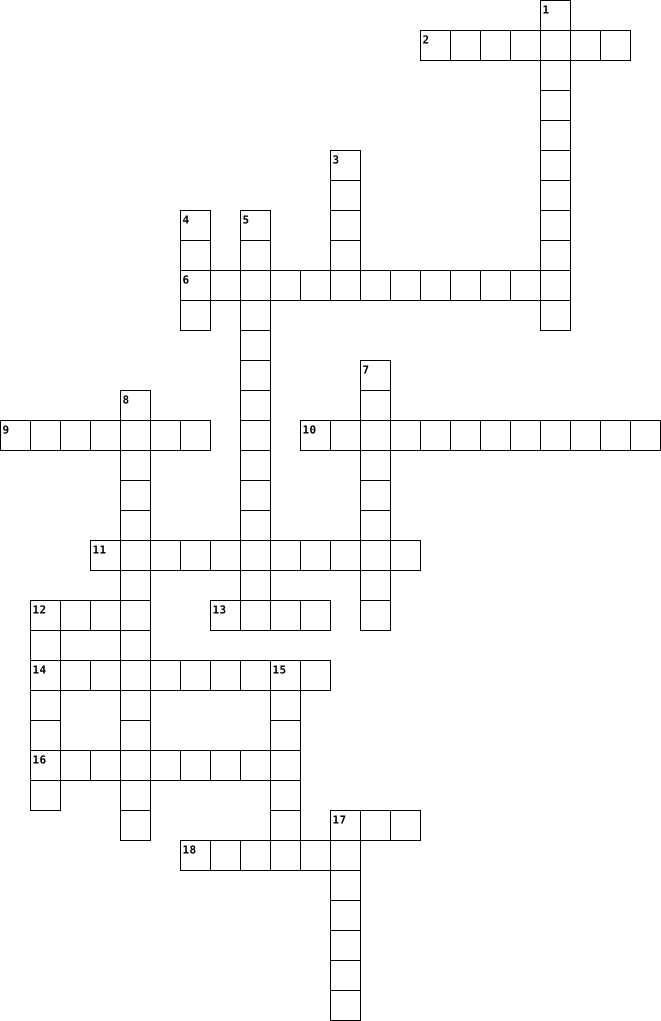
Across
- a container consisting of one or more cells, in which chemical energy is converted into electricity and used as a source of power
- one in which all circuit elements are arranged in a single path
- the pressure from an electrical circuit's power source that pushes charged electrons through a conducting loop
- a measure of a solution's ability to conduct electricity
- a fundamental form of energy observable in positive and negative forms that occurs naturally
- a device, which converts chemical energy into electrical energy
- is a unit of electrical current
- the impeding, slowing, or stopping effect exerted by one material thing on another
- a substance or device which does not readily conduct electricity
- an electrical resistance between two points of a conductor when a constant potential difference of one volt
- a device for making and breaking the connection in an electric circuit
Down
- electrical resistance of a conductor of unit cross-sectional area and unit length
- a unit of electrical potential difference and electromotive force equal to the difference in potential between two points in a conducting wire carrying a constant current of one ampere when the power used between these two points is equal to one watt
- (of an electrical appliance) stop working when a fuse melts
- a graphical representation of an electrical circuit
- a material or object that permits an electric current to flow easily
- an electrical path that branches so that the current divides and only part of it flows through any branch
- a complete and closed path around which a circulating electric current can flow
- a flow of electricity that results from the ordered directional movement of electrically charged particles
- Ohm's law states the relationship between electric current and potential difference
20 Clues: is a unit of electrical current • a graphical representation of an electrical circuit • a measure of a solution's ability to conduct electricity • (of an electrical appliance) stop working when a fuse melts • one in which all circuit elements are arranged in a single path • a device, which converts chemical energy into electrical energy • ...
biology 2025-09-24

Across
- The variety of life in the world or in a particular habitat or ecosystem.
- An organism that produces its own food and energy from light or chemical sources; a producer.
- A specialized subunit within a cell that has a specific function.
- (Deoxyribonucleic Acid): The molecule that carries the genetic instructions for the development, functioning, growth, and reproduction of all known organisms.
- A biological community of interacting organisms and their physical environment.
- The fundamental structural and functional unit of all known organisms.
- The ability of an organism to maintain a stable internal state despite changes in its external environment.
- A segment of DNA that controls a specific physical characteristic or trait.
- A permanent alteration in the nucleotide sequence of the genome of an organism.
- A threadlike structure of nucleic acids and protein found in the nucleus of most living cells, carrying genetic information in the form of genes.
Down
- A Y-shaped protein produced by the immune system that is used to identify and neutralize foreign objects such as bacteria and viruses.
- An organelle found in large numbers in most cells, in which the biochemical processes of respiration and energy production occur.
- An organism whose cells contain a nucleus and other organelles enclosed within membranes.
- The process used by plants, algae, and cyanobacteria to convert light energy into chemical energy, through a process that uses sunlight, water, and carbon dioxide.
- A single-celled microorganism that lacks a distinct nucleus and other membrane-bound organelles.
- A biological catalyst, usually a protein, that speeds up biochemical reactions in cells.
- The process by which different kinds of living organisms are thought to have developed and diversified from earlier forms during the history of the Earth.
- A poisonous substance produced by living organisms.
- A close and long-term interaction between two different biological species.
- An organism that cannot produce its own food and therefore obtains energy by consuming other organisms.
20 Clues: A poisonous substance produced by living organisms. • A specialized subunit within a cell that has a specific function. • The fundamental structural and functional unit of all known organisms. • The variety of life in the world or in a particular habitat or ecosystem. • A close and long-term interaction between two different biological species. • ...
light and sight crossword 2025-05-22

Across
- The bouncing back of light when it hits a surface.
- rays invisible electromagnetic waves that have more energy than visible light and can cause sunburn. These rays are used to sterilize (clean) medical equipment.
- A form of energy that makes things visible and allows us to see.
- A transparent object that bends and separates light into its different colors.
- rays invisible waves of electromagnetic radiation that are felt as heat but cannot be seen by our eyes. These are used in TV remotes, alarm systems and night vision cameras.
- A type of light that is produced by heating a material until it glows, like a traditional light bulb.
- An object that produces its own light, like a star or a light bulb.
- radiation energy that travels in waves through space, carrying light, heat, and other forms of energy. It includes visible light, radio waves, X-rays, and more.
- A tiny particle of light that carries energy and makes up light waves.
Down
- The bending of light as it passes from one material into another, like from air into water.
- A straight line that represents the path of light.
- The origin of light, such as the sun, a light bulb, or a candle.
- A dark area created when an object blocks light.
- A material that allows some light to pass through but not enough to see clearly, like frosted glass.
- A material that allows light to pass through it without obstruction, like clear glass.
- The ability to see, which involves light entering the eyes.
- The range of colours that light can be separated into, usually seen in a rainbow.
- A material that does not let light pass through, such as wood or metal.
18 Clues: A dark area created when an object blocks light. • The bouncing back of light when it hits a surface. • A straight line that represents the path of light. • The ability to see, which involves light entering the eyes. • A form of energy that makes things visible and allows us to see. • The origin of light, such as the sun, a light bulb, or a candle. • ...
Electricity and Magnetism 2021-02-05

Across
- cause to change in form, character, or function
- to pull to or draw toward oneself or itself
- The conversion of one form of energy into another, or the movement of energy from one place to another
- Any procedure in which a given species of organism, present in a particular sample or environment, is obtained in pure culture
- a form of energy that an object or a particle has by reason of its motion
- stored energy that depends upon the relative position of various parts of a system
Down
- a core of magnetic material (such as iron) surrounded by a coil of wire through which an electric current is passed to magnetize the core
- It may exist in potential, kinetic, thermal, electrical, chemical, nuclear, or other various forms
- vector field that describes the magnetic influence on moving electric charges, electric currents, and magnetic materials
- is anything that can change or be changed
10 Clues: is anything that can change or be changed • to pull to or draw toward oneself or itself • cause to change in form, character, or function • a form of energy that an object or a particle has by reason of its motion • stored energy that depends upon the relative position of various parts of a system • ...
Foods to eat before exercise! 2026-02-28

Across
- – Long chains of many glucose molecules, such as starch or glycogen.
- – Two sugar molecules joined together by a glycosidic bond.
- – Single sugar molecules like glucose.
- – Main energy source for the body that breaks down into glucose.
- acids – Small molecules that join together with peptide bonds to form proteins.
- – Energy-rich nutrients made of glycerol and fatty acids.
- – Nutrient made of amino acids that is used for muscle repair and growth.
- – Element that bonds with carbon and stores chemical energy in C–H bonds.
Down
- – Scientific name for fats and oils.
- – A liquid fat that is usually high in unsaturated fatty acids.
- – Physical activity that increases the body’s need for ATP.
- – Type of fat that contains one or more carbon–carbon double bonds and is usually liquid at room temperature.
- – Element found in all organic biomolecules; forms the backbone of carbohydrates, proteins and lipids.
- – Type of fat with only single carbon bonds that is solid at room temperature.
14 Clues: – Scientific name for fats and oils. • – Single sugar molecules like glucose. • – Energy-rich nutrients made of glycerol and fatty acids. • – Physical activity that increases the body’s need for ATP. • – Two sugar molecules joined together by a glycosidic bond. • – A liquid fat that is usually high in unsaturated fatty acids. • ...
Natural Resources 2022-01-23

Across
- heat energy provided from inside the earth
- energy provided from burning materials such as dead plants or trees
- thick, black liquid mixture of naturally occurring hydrocarbons that forms from the buried remains of marine organisms.
- sedimentary rock that is the most abundant fossil fuel in the world
- energy from the sun
- root word meaning water
- resources are replaced through natural processes at a rate that is equal to or greater than the rate at which they are used
- resources that include copper, gold, or silver
- type of mining used to remove materials through a series of tunnels
Down
- broad term of materials that includes oil and natural gas
- anything that harms or degrades the natural environment
- property that includes the ability to burn or react to acid.
- Reprocess a resource so that the materials can be used in another item.
- property of a mineral that includes hardness, luster, color, texture, cleavage, and density
- soil and rock removing process used when resources are close to the earth's surface
- using a material again without changing or reprocessing it
- resources are exhaustible and are extracted faster than the rate at which they formed
17 Clues: energy from the sun • root word meaning water • heat energy provided from inside the earth • resources that include copper, gold, or silver • anything that harms or degrades the natural environment • broad term of materials that includes oil and natural gas • using a material again without changing or reprocessing it • ...
Module G: Earth & Human Activity Vocabulary 2024-02-29

Across
- Natural resources that people use for energy
- Those that have not erupted in the past 10,000 years
- is a geologic hazard in which molten rock—called magma or lava—gases, ash, and other materials are released onto Earth’s surface and into the atmosphere.
- the conditions, requirements, or standards that a solution should meet.
- any natural material or energy source that is used by humans, such as water, petroleum, minerals, forests, and animals
- If geologists agree that a volcano is not likely to erupt ever again
- conditions that limit the design solution or that could prevent the solution from being accomplished
- the ruin or alteration of a place inhabited by an ecological community
- the result of some action or event
- is a place where molten rock and gasses can rise from Earth’s interior to the surface.
- a natural process or phenomenon that may cause widespread injury, death, and property damage
- naturally occurring events that can have a negative effect on humans or the environment and relate to weather conditions, including thunderstorms, tropical storms, lightning, and tornadoes
- pollution that comes from a specific site
- devices that detect vibrations in the ground to monitor earthquake activity
- all the water on Earth
- the warming of the surface and lower atmosphere of Earth that occurs when water vapor, carbon dioxide, and other gasses absorb and reradiate energy
- the reduction in the severity or impact of something
Down
- an unwanted change in the environment caused by substances or forms of energy
- pollution that comes from many sources rather than from a single, specific site
- the mixture of gasses that surrounds the planet
- a resource that forms at a rate that is much slower than the rate at which the resource is consumed
- a rotating thunderstorm that can cause a tornado to develop
- solid part of Earth
- result that follows naturally from the actions of a person or group.
- devices that monitor changes in a volcano’s shape that are related to pressure changes inside the volcano
- the way in which something, such as a resource, is spread out in an area
- naturally occurring events that can have a negative effect on humans or the environment and relate to long-term weather changes such as drought
- a natural resource that can be replaced at the same rate at which the resource is consumed
- widespread injury, death, and property damage caused by a natural hazard
- all the living things on Earth
- the place where an organism usually lives
- describes a species that has died out completely
32 Clues: solid part of Earth • all the water on Earth • all the living things on Earth • the result of some action or event • the place where an organism usually lives • pollution that comes from a specific site • Natural resources that people use for energy • the mixture of gasses that surrounds the planet • describes a species that has died out completely • ...
Organelles By Jalen 2021-11-18

Across
- carries materials from one part of the cell to another
- Float in the cytoplasm
- Break down food particles
- leader of the cell
- forms a barrier between the cytoplasm
Down
- capture sunlight energy and produces food
- powerhouse of the cell
- receive materials from the er
- Sac filled with water, food, and waste
- Stiff wall around the membrane
- gell like fluid
11 Clues: gell like fluid • leader of the cell • powerhouse of the cell • Float in the cytoplasm • Break down food particles • receive materials from the er • Stiff wall around the membrane • Sac filled with water, food, and waste • forms a barrier between the cytoplasm • capture sunlight energy and produces food • carries materials from one part of the cell to another
photosynthesis, Jesus, 1th 2023-05-18

Across
- an organelle within the cells of plants and certain algae that is the site of photosynthesis,
- A form of phosphoric acid, which contains phosphorus
- A type of sugar; the chief source of energy for living organisms.
- a substance that allows plants to absorb sunlight and convert it into usable energy.Epidermis he outer la
- microorganisms that define the limits of life on Earth.
- cell organelles that generate most of the chemical energy needed to activate the biochemical reactions of the cell.
- he process by which green plants and certain other organisms transform light energy into chemical energy.
- Carbohydrates, or carbs, are sugar molecules
- A small particle with a negative charge that is found in all atoms.
- small structure in a cell that is surrounded by a membrane and has a specific function.
- structure found inside cells that is involved in making proteins
Down
- membrane-bound compartments inside chloroplasts and cyanobacteria
- a special type of dipole-dipole attraction between molecules, not a covalent bond to a hydrogen atom
- A molecule made up of amino acids.
- A substance present in all living cells that provides energy for many metabolic processes and is involved in making RNA.
- The process by which plants and certain other organisms transform light energy into chemical energy
- A state of balance between all the body systems necessary to survive and function properly.
- elementary particles with no charge, no resting mass, and travel at the speed of light.
- nonmetallic chemical element belonging to the oxygen group (Group 16 [VIa] of the periodic table), one of the most reactive of the elements
- A chemical compound (such as protein, fat, carbohydrate, vitamin, or mineral) contained in food
- an ancient group of photosynthetic microbes that occur in most inland waters and that can have major effects on the water quality and functioning of aquatic ecosystems.
- a reactive element that is found in water, rocks, and free as a colorless tasteless odorless gas which forms about 21 percent of the atmosphere
- An organism that depends on light for most of its energy and principally on organic compounds for its carbon Supplement
- the tissue of vascular plants that transports water and nutrients from the soil to the stems and leaves.
- a simple molecule composed of two small, positively charged hydrogen atoms and one large negatively charged oxygen atom
- is the vascular tissue in charge of transport and distribution of the organic nutrients
- a pigment that gives plants their green color
27 Clues: A molecule made up of amino acids. • Carbohydrates, or carbs, are sugar molecules • a pigment that gives plants their green color • A form of phosphoric acid, which contains phosphorus • microorganisms that define the limits of life on Earth. • structure found inside cells that is involved in making proteins • ...
Science Year In Review Crossword 2020-06-17

Across
- _______ affects the speed which particles move
- Particles move because they have _______ energy
- Energy can never be _______ or destroyed
- Magnitude, direction, point of application and plane of application are examples of _______ in a force
- Everything that you can see and cannot see are made up of _______
- _______, competition and humans are the main reasons ecosystems change
- A _______ is made up of two or more substances
- Water falling from the sky/clouds. Can be in a form of a liquid or a solid
- A measure of how strong the force is
- _______ succession is when a new community forms where none previously existed
- Something is considered abiotic when all the cells are _______
- _______ don’t kill but feed off of the remains of dead animals
- Change in temperature can cause _______ of state
- The ability to live in balance for long periods of time without being damaged for future use
- There are four ways to separate heterogeneous mixtures. Filtration, sorting, sifting and _______
- The purpose of an object or structure
- Thermal energy is transferred from one object to another trough contact
Down
- Before making a structure, the manufacturer makes an _______ drawing
- The cost of repairs is comparable to the replacement cost
- Liquid to gas
- The outermost layer of the earth
- Interactions of various systems of living and non-living on a global scale
- Can be described as a push or pull on an object or structure
- _______ of carbon dioxide is crucial to the maintenance of life
- Gas has more kinetic energy than _______
- What is a common pulling force?
- Food chains begin with a _______
- The ability to make object and their particles move
- An important biotic factor in recovery. It supplies food for foragers and pollinators
- A substance that dissolved in a solvent to form a solution
- A pushing or squeezing force
- _______ energy can be renewed by physical, biological or chemical process
- _______ heat islands are when the temperature spikes in a certain area and drifts off in other areas
- Conduction, Convection and _______ are three methods of heat transfer
- The system of the products functions is updated
- There are four main types of precipitation. Rain, snow, hail and _______
- Energy decreases as you go up an ecological pyramid because of the animal’s _______
- Solid to gas
- Materials that prevent easy transfer of energy from one place to another
- _______ obsolescence is when designers and manufacturers purposely make something with a limited number of uses
40 Clues: Solid to gas • Liquid to gas • A pushing or squeezing force • What is a common pulling force? • The outermost layer of the earth • Food chains begin with a _______ • A measure of how strong the force is • The purpose of an object or structure • Energy can never be _______ or destroyed • Gas has more kinetic energy than _______ • _______ affects the speed which particles move • ...
Earth Sci 2023-10-12

Across
- A Theory that had no beginning or end.
- It is the leading renewable energy.
- Which Subsystem includes the rocks of the crust and mantle, the metallic liquid outer core, and the solid metallic inner core.
- A Theory about the rapid expansion of the universe.
- Big Bang + Big Crunch = Cyclical event is what Theory?
- Rocks that are formed at or near the surface of the Earth.
- Which Subsystem is the set of all life forms on Earth.
- The quality and intensity of reflected light exhibited by the mineral.
- Comes from sources that will run out or will not be replenished in our lifetimes.
- Is the process by which plants use sunlight, water, and carbon dioxide to create oxygen and energy in the form of sugar.
- Group of Mineral containg Silicon and Oxygen.
- Conversion of a substance from the solid to the gaseous state without its becoming liquid.
- It is the galaxy that includes our solar system.
- The movement of water past the soil going deep into the groundwater.
- Which Subsystem is simply the total of all the water in Earth's atmosphere.
- It directly affects the movement of particles such as molecules.
- States that there may be multiple or even and infinite number of universes.
- Rocks that are formed through the cooling and solidification of magma or lava.
- Refers to the decrease in forest areas across the world.
- This occurs when there is more water than land can absorb.
- It is the interaction of the lithosphere, atmosphere, biosphere and hydrosphere.
- Is a system of stars, stellar remnants, interstellar gas, dust, and dark matter bound together by gravity.
- It is the flow of water from aboveground into the subsurface.
- The process where rocks are broken down by natural forces such as wind or water.
- What Energy is the cause of the expansion of the universe.
Down
- Evaporation of liquid water from plants and trees into the atmosphere.
- The process by which plant remains become coal.
- Is the process of turning from liquid into vapor.
- Rocks that are formed below the surface of the earth through the process of metamorphism.
- Used to build and maintain an organism’s body.
- Are made from decomposing plants and animals.
- The liquids produced become increasingly lighter and gradually turn into methane gas, the lightest hydrocarbon.
- Any liquid or frozen water that forms in the atmosphere and falls back to the earth.
- Are formed from organic matter from dead plants and animals.
- Is considered a hypothetical kind of matter.
- Group of Mineral containg Carbonate anion.
- Which Subsystem is the thin gaseous layer that envelopes the lithosphere.
- It is the process by which water vapor in the air is changed into liquid water.
- This theory implies that the universe started from a point of singularity.
- A combustible black or dark brown rock consisting mainly of carbonized plant matter.
- Group of Mineral containing Oxygen anion.
- Heat within the earth.
- Is energy derived from natural sources that are replenished at a higher rate than they are consumed.
- A hypothesis that is Proposed by Emanual Swedenborg (1734).
- Is an inorganic compound with the chemical formula H 2O.
- A measure of the resistance of a mineral.
- Property of a mineral that exhibit broken surfaces that are irregular and non-planar.
- Is a region of Earth's stratosphere that absorbs most of the Sun's ultraviolet radiation.
- The depth interval in which source rock can actively generate mobile oil.
- Is the property of some minerals to break along parallel repetitive planes.
50 Clues: Heat within the earth. • It is the leading renewable energy. • A Theory that had no beginning or end. • Group of Mineral containing Oxygen anion. • A measure of the resistance of a mineral. • Group of Mineral containg Carbonate anion. • Is considered a hypothetical kind of matter. • Are made from decomposing plants and animals. • ...
Understanding Diabetes 2024-10-30

Across
- Too little glucose in the blood.
- World Diabetes Day was recognized by which President?
- A chemical produced when there is a shortage of insulin in the blood and the body breaks down body fat for energy.
- Nerve damage causing weakness, numbness, tingling, or pain, commonly in the hands and feet. Diabetes is a common cause of this condition, and it is why diabetics commonly wear shoes with orthotic insoles.
- An organ that makes the hormone that helps the body use glucose for energy and enzymes for digestion. It is located behind the lower part of the stomach and is about the size of a hand.
- The process of cleaning wastes from the blood artificially. This job is normally done by the kidneys. If the kidneys fail, the blood must be cleaned artificially with special equipment. The two major forms of dialysis are hemodialysis and peritoneal dialysis. Diabetic kidney disease can lead to the loss of kidney function and the need for this treatment.
- Clogging, narrowing and hardening of the body’s large arteries and medium-sized blood vessels. Atherosclerosis can lead to stroke, heart attack, eye problems and kidney problems.
- Diabetes awareness is celebrated in November, not only to spread awareness but also to celebrate the inventor who discovered this medication used to treat and manage diabetes. This medication is a hormone that helps the body use glucose for energy. When needed, it is taken to manage blood glucose (blood sugar).
- A doctor that treats people with hormone problems.
- A type of diabetes that develops only during pregnancy and usually disappears upon delivery but increases the risk that the mother will develop diabetes later. It is managed with meal planning, activity, and, in some cases, insulin.
- The number of people in a given group or population who are reported to have a disease.
Down
- A sugar that the body uses for energy. The body must have enough insulin to use this sugar properly.
- A type of beverage commonly used to treat low blood sugar.
- A condition where the body’s blood glucose (blood sugar) levels are higher than normal (hyperglycemia) resulting from the body's inability to use or store blood glucose for energy. In type 1 of this disease, this organ no longer makes insulin and blood glucose can’t enter the cells to be used for energy. In type 2 of this disease, either this organ does not make enough insulin or can’t use the insulin it does produce effectively.
- A condition in which blood glucose (blood sugar) levels are higher than normal but are not high enough for a diagnosis of the actual disease in which the body is unable to use or store blood glucose for energy. People with this condition are at increased risk for developing type 2 diabetes and for heart disease and having a stroke.
- This disease of the nervous system has three major forms that affect people with diabetes: peripheral, autonomic, and mono... The most common form is peripheral which affects mainly the legs and feet.
- A person with training in nutrition; may or may not have specialized training and qualifications.
- A hormone produced in the pancreas that helps the body use glucose for energy and regulates the amount of glucose in the blood.
- Proteins made by the body to protect itself from "foreign" substances such as bacteria or viruses. People develop type 1 diabetes when their bodies make antibodies that destroy the body's own insulin-making beta cells.
- Too much glucose in the blood.
- The color for diabetes awareness
- A test that measures a person's average blood glucose (blood sugar) level over the past two to three months.
22 Clues: Too much glucose in the blood. • Too little glucose in the blood. • The color for diabetes awareness • A doctor that treats people with hormone problems. • World Diabetes Day was recognized by which President? • A type of beverage commonly used to treat low blood sugar. • The number of people in a given group or population who are reported to have a disease. • ...
Lesson 4 Assessment 2020-04-28

Across
- an element that conducts heat and electricity very poorly
- the smallest particle of an element that has chemical properties
- bond that forms when atoms share one or more pairs of electrons.
- negatively charged particles
Down
- an element that is shiny and that conducts heat and electricity great
- bond that forms between metal atoms when their outermost energy levels overlap.
- an element that has properties of both metals and nonmetals
- a particle with a positive or negative charge
- a group of atoms held together by chemical bonds
- bond that is a force that brings oppositely charged ions together
10 Clues: negatively charged particles • a particle with a positive or negative charge • a group of atoms held together by chemical bonds • an element that conducts heat and electricity very poorly • an element that has properties of both metals and nonmetals • the smallest particle of an element that has chemical properties • ...
Ecosystems and Biogeochemical Cycles Word Cross 2024-02-19

Across
- The process by which water vapor in the air is changed into liquid water
- The process that changes liquid water to gaseous water
- An organism that consumes entirely just plants
- The weight or total quantity of living organisms of one animal or plant species
- The ability to convert sunlight to energy
- The microbial process of reducing nitrate and nitrite to gaseous forms of nitrogen, principally nitrous oxide
- An organism that eats other plants or animals for energy and nutrients
- The process of absorption of vitamins, minerals, and other chemicals from food as part of the nutrition of an organism
- The sum of all processes by which water moves from the land surface to the atmosphere via evaporation and transpiration
Down
- An organism, often a bacterium, fungus, or invertebrate that feeds on and breaks down dead plant or animal matter, making organic nutrients available to the ecosystem
- An organism that consumes both meat and plants
- Living or once living components of a community
- A type of heterotroph, or organisms that consume dead and decaying organic matter known as detritus to obtain energy and nutrition
- The process where microscopic organisms like bacteria or other types of decomposing organisms, break down nitrogen-containing chemicals from dead organic matter.
- An organism that consumes entirely just meat
- The process behind the condensation of water vapor in the atmosphere that falls down under the influence of gravity
- The process by which organisms exchange gases, especially oxygen and carbon dioxide, with the environment
- A non-living part of an ecosystem that shapes its environment
- An organism that can produce its own food using light, water, carbon dioxide, or other chemicals
- An organism that cannot produce its own food and must eat other plants and/or animals to get energy
20 Clues: The ability to convert sunlight to energy • An organism that consumes entirely just meat • An organism that consumes both meat and plants • An organism that consumes entirely just plants • Living or once living components of a community • The process that changes liquid water to gaseous water • A non-living part of an ecosystem that shapes its environment • ...
Electricity 1 2025-10-07

Across
- A unit of energy equivalent to 3.6 MJ
- 1.6 x 10^-19 C is the charge of an __________
- Ohm's law states that at a constant temperature, potential difference and current are ______ ________ to each other
- The IV characteristic for this component looks like an 'S'
- The number of free electrons per unit volume in a material
- Insulators have a _______ number density than semiconductors
- The IV characteristic for this component is directly proportional
- Unit for power
- In a circuit, the ____ of the potential differences across each component is equal to the emf of the cell
- The energy transferred from electrical energy to other forms per unit charge
- Defined as the energy transferred per unit charge
- Conductors have a _______ number density than semiconductors
- When temperature increases in a wire, the electrons ________ more frequently with the ions causing lower current
- For a ________, the resistance decreases as potential difference increases
- = Current x potential difference
- ___________ current flows from the positive to negative terminal
- If cross sectional area of a wire increases, the mean drift velocity will _________
- Metals are good conductors because they have ______ __________
- Voltmeters need to be connected in _________ with the component they are measuring
Down
- The unit of voltage
- The rate of flow of charge
- 1 Joule of energy transferred per 1 coulomb of charge
- An example of a semiconductor
- The energy transferred from chemical to electrical energy per unit charge
- The unit of charge
- The unit of current
- A diode will only allow current through it past a certain _________ voltage
- =nAve
- A diode only allows current in one ________ to flow through it
- Electrons ______ from the negative to positive terminals
- Ammeters need to be connected in _________ with the component they are measuring
- An LDR has an ________ proportional relationship between light intensity and resistance
- The carriers of charge in conducting wires
- = potential difference / current
- In an NTC thermistor, the number density ___________ when the temperature increases
- The unit of resistance
- Charge particles interact with the _____ field
- The carriers of charge in electrolytes
38 Clues: =nAve • Unit for power • The unit of charge • The unit of voltage • The unit of current • The unit of resistance • The rate of flow of charge • An example of a semiconductor • = potential difference / current • = Current x potential difference • A unit of energy equivalent to 3.6 MJ • The carriers of charge in electrolytes • The carriers of charge in conducting wires • ...
key terms 2022-03-18

Across
- in chemistry when two or more elements or compounds combine to make more complex susbstance the process is called
- a material used to decrease the rate of a reaction is an
- when one element replaces another in compound or when two elements in different compounds trade places the process is called
- is material that releaes energy when it burns
- is a number place in foront of a chemcial formula in an eqaution
- is the amount of a substance in a given volume
- property is a characteristic of a substance taht describes its abitly to change into other substance
- reaction is a reaction in which energy is absorbed
- system matter is not allowed to eneter or leave
- system matter can enter from or escape to the surroundings
- in contrast to a synthesis reaction a process called breaks down compounds into simpler products
- change is any change that alter the form or apperance of a substance but that does not make the substance change into another substance.
Down
- is a material that increases the rate of a reaction be lowering the activation energy.
- the cells in your body comtains biological catalysts called
- property a characteristic of a substance that can be observed without changing the substance into another substance
- equation is a short easy way to show chemical reaction unsing symbols instead of words
- the substance you have at the beginning are called the
- a solid that forms from solution during a chemical reaction is called a
- of mass this principle is call and it states that during q chemical reaction matter created or destroyed
- energy is the minimum amount of energy needed to start a chemical reaction
- the branch of science that deals with the identification of the substances of which matter is composed; the investigation of their properties and the ways in which they interact, combine, and change; and the use of these processes to form new substances.
- fire is the result of a rapid reaction between oxygen and a substance called a fuel
- anything that has mass and takes up space
- reaction A change in matter that produces one or more new substances is a chemical change or
- when the reaction is complete you have new substances called
25 Clues: anything that has mass and takes up space • is material that releaes energy when it burns • is the amount of a substance in a given volume • system matter is not allowed to eneter or leave • reaction is a reaction in which energy is absorbed • the substance you have at the beginning are called the • a material used to decrease the rate of a reaction is an • ...
Photosynthesis Unit Vocabulary 2023-10-15

Across
- an experiment in which only one variable is changed
- an elongated cell organelle containing chlorophyll where photosynthesis takes place
- the amount of matter in an object
- a chemical bond in which atoms share one or more pairs of electrons
- a small, hard structure that contains the embryo of a plant
- a factor that can be changed in an experiment
- the number of protons in the nucleus of an atom
- a substance composed of carbon and hydrogen
- organisms that are capable of making their own food
- a particular region where electrons can orbit a nucleus
- rod-shaped organelles with a double membrane which converts the energy stored in glucose into ATP for the cell
- a negatively charged particle that moves around the nucleus
- organisms that are not capable of making their own food
- electrons found in the outermost energy level of an atom
- a group of two or more atoms joined by covalent bonds
- a combination of chemical nutrients including nitrogen, phosphorus, and potassium
- a positively charged particle located in the nucleus of an atom
- a molecule that contains carbon-hydrogen bonds
- a molecule that forms a ring structure
- a substance made up of two or more different elements
- an atom or molecule that has an electrical charge because it has gained or lost electrons
- a mixture of decaying organic materials such as rotting vegetables and lawn clippings
Down
- a strong force holding two atoms together in a molecule or crystal structure
- a group of symbols that describe the proportions of atom of different elements in a molecule or compound
- a process by which plants convert sunlight, water, and carbon dioxide into food energy (sugar), oxygen, and water
- a chart that organizes the chemical elements based upon their properties
- the positively charged, dense center of an atom containing protons and neutrons
- a diagram that illustrates the chemical bonds in a molecule
- one of several forms of the same element
- a green molecule which uses light energy from sunlight to change water and carbon dioxide gas into sugar and oxygen
- a particle with no charge located in the nucleus of an atom
- a mixture of tiny rock fragments and organic matter
- the number of protons plus neutrons in the nucleus of an atom
- the process by which the chemical energy of food molecules is released and changed into ATP
- the basic unit of matter
- a diagram that shows the element symbol surrounded by dots representing valence electrons
- a pure substance that cannot be broken down into simpler substances by ordinary chemical means
- an atom capable of releasing radiation
- a chemical bond formed when electrons are transferred from one atom to another
39 Clues: the basic unit of matter • the amount of matter in an object • an atom capable of releasing radiation • a molecule that forms a ring structure • one of several forms of the same element • a substance composed of carbon and hydrogen • a factor that can be changed in an experiment • a molecule that contains carbon-hydrogen bonds • ...
Option C: Crossword Puzzle 2020-09-13

Across
- authenticate by someone empowered to witness signatures
- a fear of foreigners or strangers
- summarize briefly
- speech you make to yourself
- physics concerned with heat and other forms of energy
- a standard or typical example
- confidently optimistic and cheerful
Down
- a free man who cultivates his own land
- A longing for something past,homesickness
- lukewarm,unenthusiastic,marked by an absence of interest
- extremely steep
- stern,unyielding,gloomy,ill-humored
- a political system governed by a few people
- to make larger,increase
- to examine closely,inspect
15 Clues: extremely steep • summarize briefly • to make larger,increase • to examine closely,inspect • speech you make to yourself • a standard or typical example • a fear of foreigners or strangers • stern,unyielding,gloomy,ill-humored • confidently optimistic and cheerful • a free man who cultivates his own land • A longing for something past,homesickness • ...
Cell Vocabulary Vocab 2014-02-20

Across
- transport The movement of materials through a cell membrane without using energy
- device that produces magnified images of structures that are too small to see with the unaided eye
- the diffusion of water through a selectively permeable membrane
- A tiny cell structure that carries out a specific function within the cell.
- compound made up of carbon, hydrogen, and oxygen atoms; major source of energy for the human body
- Deoxyribonucleic acid; the genetic material that carries information about an organism and is passed from parent to offspring.
- bodies organelles that package cellular material and transport them within the cell or out of the cell
- transport The movement of materials through a cell membrane using cellular energy
- ribonucleic acid; a nucleic acid that plays an important role in the production of proteins
- cell organelle filled with enzymes needed to break down certain materials in the cell
- permeable a property of cell membranes that allows some substances to pass through, while others cannot
- a jellylike fluid inside the cell in which the organelles are suspended.
Down
- organelles made of protein and RNA that direct protein synthesis in the cytoplasm
- acid small units that are linked together chemically to form large protein molecules
- a structure in the cells of plants and some other organisms that captures energy from sunlight and uses it to produce food
- rod-shaped cell structures that convert energy in food molecules to energy the cell can use to carry out its functions
- the process by which molecules move from an area of higher concentration to an area of lower concentration
- any substance that cannot be broken down into simpler substances
- large organic molecule made of carbon, hydrogen, oxygen, nitrogen, and sometimes sulfur
- membrane thin, flexible barrier around a cell; regulates what enters and leaves the cell
- reticulum A cell structure that forms a maze of passageways in which proteins and other materials are carried from one part of the cell to another.
- specialized proteins that speed up chemical reactions
- storage structures for food, water, minerals, waste
- two or more elements that are chemically combined
- control center of the cell
- energy-rich organic compound (fat, oil, wax) that's made of carbon, hydrogen, and oxygen.
26 Clues: control center of the cell • two or more elements that are chemically combined • storage structures for food, water, minerals, waste • specialized proteins that speed up chemical reactions • the diffusion of water through a selectively permeable membrane • any substance that cannot be broken down into simpler substances • ...
Cell Vocabulary Vocab 2014-02-20

Across
- energy-rich organic compound (fat, oil, wax) that's made of carbon, hydrogen, and oxygen.
- A tiny cell structure that carries out a specific function within the cell.
- organelles that package cellular material and transport them within the cell or out of the cell
- cell organelle filled with enzymes needed to break down certain materials in the cell
- a property of cell membranes that allows some substances to pass through, while others cannot
- compound made up of carbon, hydrogen, and oxygen atoms; major source of energy for the human body
- any substance that cannot be broken down into simpler substances
- the diffusion of water through a selectively permeable membrane
- rod-shaped cell structures that convert energy in food molecules to energy the cell can use to carry out its functions
- control center of the cell
- small units that are linked together chemically to form large protein molecules
- the process by which molecules move from an area of higher concentration to an area of lower concentration
Down
- two or more elements that are chemically combined
- The movement of materials through a cell membrane using cellular energy
- Deoxyribonucleic acid; the genetic material that carries information about an organism and is passed from parent to offspring.
- device that produces magnified images of structures that are too small to see with the unaided eye
- a jellylike fluid inside the cell in which the organelles are suspended.
- large organic molecule made of carbon, hydrogen, oxygen, nitrogen, and sometimes sulfur
- A cell structure that forms a maze of passageways in which proteins and other materials are carried from one part of the cell to another.
- a structure in the cells of plants and some other organisms that captures energy from sunlight and uses it to produce food
- The movement of materials through a cell membrane without using energy
- specialized proteins that speed up chemical reactions
- thin, flexible barrier around a cell; regulates what enters and leaves the cell
- storage structures for food, water, minerals, waste
- organelles made of protein and RNA that direct protein synthesis in the cytoplasm
- ribonucleic acid; a nucleic acid that plays an important role in the production of proteins
26 Clues: control center of the cell • two or more elements that are chemically combined • storage structures for food, water, minerals, waste • specialized proteins that speed up chemical reactions • the diffusion of water through a selectively permeable membrane • any substance that cannot be broken down into simpler substances • ...
Unit 1 Bio Vocab 2025-02-06

Across
- Composed of only one cell, such as bacteria, yeast, and protozoa.
- The process by which cells become specialized in structure and function to perform specific roles.
- Allowing substances to pass through it, but not all substances at the same rate or in the same quantities.
- A cell formed by the fusion of male and female gametes during fertilization, which develops into an embryo.
- Transport: The movement of molecules from an area of high concentration to an area of low concentration without the use of energy.
- The passive movement of molecules from an area of high concentration to an area of low concentration.
Down
- Bilayer: A type of lipid bilayer membrane that surrounds the cells of all living organisms, composed of phospholipid molecules.
- A type of cell lacking a true nucleus, characteristic of bacteria and archaea.
- Transport: The process by which cells move molecules from an area of low concentration to an area of high concentration, using energy.
- The capacity to do work, which can be in the form of kinetic energy, potential energy, or other forms.
- The process by which male and female gametes combine to form a zygote.
- Composed of multiple cells, such as animals, plants, and fungi.
- A type of cell characterized by a true nucleus and other membrane-bound organelles.
- Gradient: A difference in concentration, where a substance is more abundant in one area than in another.
- A cell organelle responsible for protein synthesis, consisting of ribosomal RNA and proteins.
15 Clues: Composed of multiple cells, such as animals, plants, and fungi. • Composed of only one cell, such as bacteria, yeast, and protozoa. • The process by which male and female gametes combine to form a zygote. • A type of cell lacking a true nucleus, characteristic of bacteria and archaea. • ...
Atomic Emissions Spectra Vocabulary 2025-02-07

Across
- the specific wavelengths of electromagnetic radiation emitted by the electrons of atoms or molecules as those electrons return to a lower and more stable energy state
- a form of energy that exhibits wavelike behavior as it travels through space; part of the electromagnetic spectrum
- the distance between two adjacent crests or troughs of a wave
- the distribution of energy in wavelengths within a system
- an electron at the lowest possible energy for an atom
- electrons that momentarily occupy an energy state that is higher than at the ground state
- the number of wave cycles that pass a given point per unit of time
- the behavior of a wave as it bends around a sharp edge; occurs when a wave passes through a single narrow slit or multiple narrow slits
- an elementary particle that is the smallest possible amount of light and all other forms of electromagnetic radiation that can interact with anything
Down
- a continuum of all electromagnetic waves arranged according to frequency and wavelength
- the height of a wave from origin to the crest or trough
- discrete regions around the nucleus where electrons can exist
- the combination of two or more of the same type of wave
- the observation that when certain wavelengths of light strike a piece of metal, electrons are emitted, potentially creating an electric current
- a device that measures the properties of the different wavelengths of electromagnetic radiation coming from a single source
15 Clues: an electron at the lowest possible energy for an atom • the height of a wave from origin to the crest or trough • the combination of two or more of the same type of wave • the distribution of energy in wavelengths within a system • discrete regions around the nucleus where electrons can exist • the distance between two adjacent crests or troughs of a wave • ...
Unit 3 Vocabulary Review 2021-12-21

Across
- The catabolic pathways of aerobic and anaerobic respiration, which break down organic molecules and use an electron transport chain for the production of ATP.
- An energy-coupling mechanism that uses energy stored in the form of a hydrogen ion gradient across a membrane to drive cellular work, such as the synthesis of ATP. Under aerobic conditions, most ATP synthesis in cells occurs by chemiosmosis.
- The conversion of light energy to chemical energy that is stored in sugars or other organic compounds; occurs in plants, algae, and certain prokaryotes.
- The process of generating ATP from ADP and phosphate by means of chemiosmosis, using a proton-motive force generated across the thylakoid membrane of the chloroplast or the membrane of certain prokaryotes during the light reactions of photosynthesis.
- The first of two major stages in photosynthesis (preceding the Calvin cycle). These reactions, which occur on the thylakoid membranes of the chloroplast or on membranes of certain prokaryotes, convert solar energy to the chemical energy of ATP and NADPH, releasing oxygen in the process.
- A catabolic pathway for organic molecules, using oxygen as the final electron acceptor in an electron transport chain and ultimately producing ATP. This is the most efficient catabolic pathway and is carried out in most eukaryotic cells and many prokaryotic organisms.
- A sequence of electron carrier molecules (membrane proteins) that shuttle electrons down a series of redox reactions that release energy used to make ATP.
- A complex of several membrane proteins that functions in chemiosmosis with adjacent electron transport chains, using the energy of a hydrogen ion (proton) concentration gradient to make ATP. ATP syntheses are found in the inner mitochondrial membranes of eukaryotic cells and in the plasma membranes of prokaryotes.
- A metabolic pathway that consumes energy to synthesize a complex molecule from simpler molecules.
Down
- A nonspontaneous chemical reaction, in which free energy is absorbed from the surroundings.
- A metabolic pathway that releases energy by breaking down complex molecules to simpler molecules.
- A spontaneous chemical reaction, in which there is a net release of free energy.
- Glycolysis followed by the reduction of pyruvate to ethyl alcohol, regenerating NAD+ and releasing carbon dioxide.
- In cellular metabolism, the use of energy released from an exergonic reaction to drive an endergonic reaction.
- A catabolic process that makes a limited amount of ATP from glucose (or other organic molecules) without an electron transport chain and that produces a characteristic end product, such as ethyl alcohol or lactic acid.
- A light-capturing unit located in the thylakoid membrane of the chloroplast or in the membrane of some prokaryotes, consisting of a reaction-center complex surrounded by numerous light-harvesting complexes. There are two types, I and II; they absorb light best at different wavelengths.
- A series of reactions that ultimately splits glucose into pyruvate. Occurs in almost all living cells, serving as the starting point for fermentation or cellular respiration.
- The second of two major stages in photosynthesis (following the light reactions), involving fixation of atmospheric CO2 and reduction of the fixed carbon into carbohydrate.
- Glycolysis followed by the reduction of pyruvate to lactate, regenerating NAD+ with no release of carbon dioxide.
- The specific region of an enzyme that binds the substrate and that forms the pocket in which catalysis occurs.
20 Clues: A spontaneous chemical reaction, in which there is a net release of free energy. • A nonspontaneous chemical reaction, in which free energy is absorbed from the surroundings. • A metabolic pathway that releases energy by breaking down complex molecules to simpler molecules. • ...
SCIENCE MODULE 8 PT 2022-02-07

Across
- the flow of electrical power or charge
- is a power electronic device or circuitry that changes direct current (DC) to alternating current
- an electrical generator that converts mechanical energy to electrical energy in the form of alternating current.
- a set of materials or equipment designed for a particular use.
- is often a complicated sequence of elementary radical reactions.
- iis a fictional character appearing in American comic books published by Marvel Comics.
- a machine for converting any of various forms of energy into mechanical force and motion
- in use since ancient times, the catapult has proven to be one of the most persistently effective mechanisms in warfare.
- is a machine that transports people or cargo.
- is a closed vessel in which fluid (generally water) is heated.
- derived unit for electric potential, electric potential difference (voltage), and electromotive force
- is the controlled operation and movement of a vehicle, including cars, motorcycles, trucks, buses, and bicycles.
- is a spacecraft, aircraft, vehicle or projectile that obtains thrust from a rocket engine.
- The term wind engine is sometimes used to describe such devices.
- states that energy can be converted in form, but not created or destroyed.
Down
- is a physical system using power to apply forces and control movement to perform an action.
- device that harnesses the kinetic energy of some fluid
- In the nervous system there is a "closed loop" system of sensation, decision, and reactions.
- is the amount of energy transferred or converted per unit time.
- for the purposes of hauling a trailer or machinery such as that used in agriculture, mining or construction.
- into a transitive clause, with the original subject S becoming the object O.
- is a passive component that transfers electrical energy from one electrical circuit to another circuit, or multiple circuits.
- is a Canadian police procedural crime drama television series that aired for four seasons on CTV from February 3, 2013, to August 30, 2016.
- is the scientific study of the properties and behavior of matter.
- is energy in transfer to or from a thermodynamic system, by mechanisms other than thermodynamic work or transfer of matter.
- it is viewed as one of his most well-known songs and was a major hit in the United States, Europe, Asia & Oceania.
- is any material that can be made to react with other substances so that it releases energy as thermal energy or to be used for work.
- is the creator or originator of any written work such as a book or play, and is also considered a writer or poet.
- which is a machine with an engine, four wheels, and room for passengers that is used to transport people on land.
- is an influence that can change the motion of an object.
30 Clues: the flow of electrical power or charge • is a machine that transports people or cargo. • device that harnesses the kinetic energy of some fluid • is an influence that can change the motion of an object. • a set of materials or equipment designed for a particular use. • is a closed vessel in which fluid (generally water) is heated. • ...
SCIENCE 2022-02-07

Across
- the flow of electrical power or charge
- is a power electronic device or circuitry that changes direct current (DC) to alternating current
- an electrical generator that converts mechanical energy to electrical energy in the form of alternating current.
- a set of materials or equipment designed for a particular use.
- is often a complicated sequence of elementary radical reactions.
- iis a fictional character appearing in American comic books published by Marvel Comics.
- a machine for converting any of various forms of energy into mechanical force and motion
- in use since ancient times, the catapult has proven to be one of the most persistently effective mechanisms in warfare.
- is a machine that transports people or cargo.
- is a closed vessel in which fluid (generally water) is heated.
- derived unit for electric potential, electric potential difference (voltage), and electromotive force
- is the controlled operation and movement of a vehicle, including cars, motorcycles, trucks, buses, and bicycles.
- is a spacecraft, aircraft, vehicle or projectile that obtains thrust from a rocket engine.
- The term wind engine is sometimes used to describe such devices.
- states that energy can be converted in form, but not created or destroyed.
Down
- is a physical system using power to apply forces and control movement to perform an action.
- device that harnesses the kinetic energy of some fluid
- In the nervous system there is a "closed loop" system of sensation, decision, and reactions.
- is the amount of energy transferred or converted per unit time.
- for the purposes of hauling a trailer or machinery such as that used in agriculture, mining or construction.
- into a transitive clause, with the original subject S becoming the object O.
- is a passive component that transfers electrical energy from one electrical circuit to another circuit, or multiple circuits.
- is a Canadian police procedural crime drama television series that aired for four seasons on CTV from February 3, 2013, to August 30, 2016.
- is the scientific study of the properties and behavior of matter.
- is energy in transfer to or from a thermodynamic system, by mechanisms other than thermodynamic work or transfer of matter.
- it is viewed as one of his most well-known songs and was a major hit in the United States, Europe, Asia & Oceania.
- is any material that can be made to react with other substances so that it releases energy as thermal energy or to be used for work.
- is the creator or originator of any written work such as a book or play, and is also considered a writer or poet.
- which is a machine with an engine, four wheels, and room for passengers that is used to transport people on land.
- is an influence that can change the motion of an object.
30 Clues: the flow of electrical power or charge • is a machine that transports people or cargo. • device that harnesses the kinetic energy of some fluid • is an influence that can change the motion of an object. • a set of materials or equipment designed for a particular use. • is a closed vessel in which fluid (generally water) is heated. • ...
SCIENCE 2022-02-07

Across
- the flow of electrical power or charge
- is a power electronic device or circuitry that changes direct current (DC) to alternating current
- an electrical generator that converts mechanical energy to electrical energy in the form of alternating current.
- a set of materials or equipment designed for a particular use.
- is often a complicated sequence of elementary radical reactions.
- iis a fictional character appearing in American comic books published by Marvel Comics.
- a machine for converting any of various forms of energy into mechanical force and motion
- in use since ancient times, the catapult has proven to be one of the most persistently effective mechanisms in warfare.
- is a machine that transports people or cargo.
- is a closed vessel in which fluid (generally water) is heated.
- derived unit for electric potential, electric potential difference (voltage), and electromotive force
- is the controlled operation and movement of a vehicle, including cars, motorcycles, trucks, buses, and bicycles.
- is a spacecraft, aircraft, vehicle or projectile that obtains thrust from a rocket engine.
- The term wind engine is sometimes used to describe such devices.
- states that energy can be converted in form, but not created or destroyed.
Down
- is a physical system using power to apply forces and control movement to perform an action.
- device that harnesses the kinetic energy of some fluid
- In the nervous system there is a "closed loop" system of sensation, decision, and reactions.
- is the amount of energy transferred or converted per unit time.
- for the purposes of hauling a trailer or machinery such as that used in agriculture, mining or construction.
- into a transitive clause, with the original subject S becoming the object O.
- is a passive component that transfers electrical energy from one electrical circuit to another circuit, or multiple circuits.
- is a Canadian police procedural crime drama television series that aired for four seasons on CTV from February 3, 2013, to August 30, 2016.
- is the scientific study of the properties and behavior of matter.
- is energy in transfer to or from a thermodynamic system, by mechanisms other than thermodynamic work or transfer of matter.
- it is viewed as one of his most well-known songs and was a major hit in the United States, Europe, Asia & Oceania.
- is any material that can be made to react with other substances so that it releases energy as thermal energy or to be used for work.
- is the creator or originator of any written work such as a book or play, and is also considered a writer or poet.
- which is a machine with an engine, four wheels, and room for passengers that is used to transport people on land.
- is an influence that can change the motion of an object.
30 Clues: the flow of electrical power or charge • is a machine that transports people or cargo. • device that harnesses the kinetic energy of some fluid • is an influence that can change the motion of an object. • a set of materials or equipment designed for a particular use. • is a closed vessel in which fluid (generally water) is heated. • ...
Universe Vocabulary 2021-08-17

Across
- chunk of rock and metal in outer space that is in orbit around the Sun; smaller than the moon;
- third planet from the sun; has an atmosphere that protects life and surface temperatures that allow water to exist as a solid, liquid, and gas; our home
- a collection in outer space composed of gas or dust that forms after a star explodes
- giant spheres of super hot gas made up mostly of hydrogen and helium; give off electromagnetic radiation (light)
- lumps of ice, dust, and rock that orbit the Sun
- planet a celestial body resembling a small planet but lacking certain technical criteria that are required for it to be classed as a planet
- radiation that moves through space from one object, like a star, to another; carried by electromagnetic waves
- a disturbance that travels through space and matter transferring energy from one place to another; does NOT transfer matter
- unit (AU) distance between Earth and the Sun
- the number of complete wavelengths that pass a point in a given time (for example, per second); this is higher in shorter waves, like gamma
- Any object that orbits around another object in space; can be natural (moons) or manmade (International Space Station)
- the transfer of energy from electromagnetic waves
Down
- A danger or risk, especially caused by high frequency (short wavelength) radiation, like x-ray or gamma
- A metric unit of length equal to 1000 meters
- system made up of the Sun and all the planets, asteroids, and other objects that orbit the Sun
- spectrum range of energy waves that have both an electric and magnetic field; these energy waves can be called "radiation" or "light"; different types of waves have different uses and functions in our everyday lives; how a wave is used depends on its wavelength and frequency
- (hierarchy) The order or ranking of things; can be based on size
- made of billions of galaxies, which are made of billions of stars
- an instrument used to see objects that are far away; often used to view astronomical bodies through magnification (zooming in) or by using different forms of electromagnetic radiation (light)
- collection of billions of stars (and the bodies that orbit those stars) that slowly orbit around a center of high gravity
- a rocky or gaseous object that orbits a star; is large enough to have a round shape because of its own gravity, and has cleared the area of its orbit
- A force (pull) of attraction between objects that is due to their masses
- the distance light travels in one year; used to measure distances that are outside of our solar system
- The distance between two corresponding parts of a wave; often the distance between two crests or two troughs
- A natural satellite that revolves around a planet
25 Clues: A metric unit of length equal to 1000 meters • unit (AU) distance between Earth and the Sun • lumps of ice, dust, and rock that orbit the Sun • A natural satellite that revolves around a planet • the transfer of energy from electromagnetic waves • (hierarchy) The order or ranking of things; can be based on size • ...
Mini Review on Cellular Respiration 2014-04-29

Across
- NAD+ is _________ to NADH.
- The chain uses the energy released by the series of redox reaction from the election flow down the chain to pump H+ across the membrane against equilibrium, a ____________ process.
- An intermediate in the citric acid cycle that is regenerated, this intermediate is used twice in the CAC.
- A type of fermentation that produces CO2 as a product.
- Anaerobes Organisms that are able to switch between aerobic and anaerobic metabolism is called _____________ __________________.
- The folding of the inner membrane into ________, which increases the surface area
- Phosphorylation ATP synthesis occurs when an enzyme transfers a phosphate group from a substrate molecule, an organic molecule generated during the catabolism of glucose, directly ADP.
- The allosterically regulatory enzyme in glycolysis
- This type of respiration does not require oxygen and is performed in the cytosol.
- A small hydrophobic molecule that is the only molecule in the chain that is not a protein, also it is an electron acceptor after complex I.
- This type of respiration requires oxygen and is performed in the mitochondria
- Cellular respiration stage that begins the degradation process of glucose
- Through_________, the transfer of electrons releases the energy from glucose, and this energy is ultimately used to synthesize ATP.
Down
- The end product of glycolysis
- Transport Chain A collection of molecules embedded in the inner membrane of the mitochondrion.
- The process in which an ion concentration gradient across a membrane is used to drive cellular work, this require the action of an embedded enzyme called ATP Synthase.
- Respiration The catabolic activity that converts chemical energy found in bonds of nutrient molecules to the chemical energy stored in ATP occurs inside the cells, and is called_________________.
- The last electron acceptor that forms water molecules by picking up H+ molecules from aqueous solution.
- The number of ATP produce during glycolysis
- Diffusion Each pyruvate formed in glycolysis enters the mitochondria through_____ _____.
- The_______________ process is an extension of glycolysis, occurs in anaerobic conditions.
- The enzyme that phosphorylate glucose
- Aerobic cellular respiration is 40% efficient and the remaining energy is lost as _______.
- The total amount of ATP produce through aerobic respiration
- The breakdown of glucose is_______________ process.
- Particles moving down their concentration gradient via diffusion generates ___________ energy.
26 Clues: NAD+ is _________ to NADH. • The end product of glycolysis • The enzyme that phosphorylate glucose • The number of ATP produce during glycolysis • The allosterically regulatory enzyme in glycolysis • The breakdown of glucose is_______________ process. • A type of fermentation that produces CO2 as a product. • The total amount of ATP produce through aerobic respiration • ...
C-based-BioMolecules 2024-11-26

Across
- electrons are found in the electron
- many molecules composing living things are formed with this element
- the law of conservation of energy says energy ____ be created or destroyed in a chemical reaction
- the smallest basic unit of matter
- composed of only one type of atom
- atoms are composed of protons, neutrons and
- an atom can share these to form bonds
Down
- this is formed when an atom gains or loses an electron
- is a major byproduct of respiration
- main function in a cell is to form the cell membrane
- are proteins in living organisms that affect reactions by weakening bonds in molecules
- carbon has this many valence electrons which give it unique bonding properties
- sugars and starches are forms of these
13 Clues: the smallest basic unit of matter • composed of only one type of atom • electrons are found in the electron • is a major byproduct of respiration • an atom can share these to form bonds • sugars and starches are forms of these • atoms are composed of protons, neutrons and • main function in a cell is to form the cell membrane • ...
Sedimentary Rock Puzzle 2013-03-20

Across
- The particles of minerals or other rocks that give a rock its texture.
- The look and feel of a rock's surface, determined by the size, shape, and pattern of a rock's grains.
- The process by which sediments are pressed together under their own weight.
- The destructive process in which water or wind loosens and carries away fragments of rock.
- The force exerted on a surface divided by the area over which the force is exerted.
- A type of rock that forms when particles from other rocks or the remains of plants and animals are pressed and cemented together.
- A type of rock that forms from an existing rock that is changed by heat, pressure, or chemical reactions.
- Sedimentary that forms when rock fragments are squeezed together under high pressure.
- A type of rock that forms from the cooling of molten rock at or below the surface.
- A dark, dense, igneous rock with a fine texture, found in oceanic crust.
- Term used to describe metamorphic rocks that have grains arranged in parallel layers or bands.
- A type of rock that forms when particles from other rocks or the remains of plants and animals are pressed and cemented together.
Down
- A series of processes on the surface and inside Earth that slowly changes rocks from one kind to another.
- Igneous rock that forms from lava on the Earth's surface.
- One of the common minerals that make up most of the rocks of Earth's crust.
- The process by which dissolved minerals crystallize and glue particles of sediment together into one mass.
- Sedimentary rock that forms from remains of organisms deposited in thick layers.
- Sedimentary rock that forms when minerals crystallize from a solution.
- Igneous rock that forms when magma hardens beneath Earth's surface.
- A usually light-colored igneous rock that is found in continental.
- The process by which sediment settles out of the water or wind that is carrying it.
- A solid mixture of minerals and other materials.
22 Clues: A solid mixture of minerals and other materials. • Igneous rock that forms from lava on the Earth's surface. • A usually light-colored igneous rock that is found in continental. • Igneous rock that forms when magma hardens beneath Earth's surface. • The particles of minerals or other rocks that give a rock its texture. • ...
LIFE SCIENCE 7 REVIEW! (Volume Two) 2025-05-27

Across
- cells are the basic unit of _______ and function for organisms
- the region of Earth capable of supporting living things
- these organelles make proteins for the cell
- soft-bodied invertebrates with or without a shell
- any heritable trait that helps an organism better survive and reproduce in their environment
- this domain features unicellular, prokaryotic organisms that live everywhere
- members of the same species living and interacting together
- organisms that obtain energy from the sun and form the base of every food chain
- molecules of a substance spread evenly throughout a space
- one parent prpduces offspring in ________ reproduction
- vascular plants with seeds in flowers or fruits
- one organism benefits and the other is unaffected
- the process in which a parent cell divides twice to produce gametes
Down
- this organelle allows the movement of materials around the cell
- the nuclear membrane disappears during this stage of mitosis
- this organelle stores food, water, and waste
- a section of DNA that includes sugar, phosphate, and a nitrogen base
- different forms of a trait
- this phylum contains segmented worms
- the process of taking in oxygen and releasing carbon dioxide
- energy is lost to the environment in this form
- a signal that causes an organism to react in some way
- a code that stores hereditary information
- the science of describing, classifying and naming living things
- more offspring are produced than will survive
- chromosomes are pulled apart during this stage of mitosis
- smaller, simpler cells without a true nucleus
- an energy pyramid shows the amount of energy that moves from one ________ level to the next
- groups of tissues that work together to do a specific function
29 Clues: different forms of a trait • this phylum contains segmented worms • a code that stores hereditary information • these organelles make proteins for the cell • this organelle stores food, water, and waste • more offspring are produced than will survive • smaller, simpler cells without a true nucleus • energy is lost to the environment in this form • ...
Periodic Table Review 2024-11-13

Across
- One valence electron and 2 orbitals.
- A gas that makes up most of the air we breathe, with 5 outer electrons
- Element commonly associated with a terrible smell.
- Most massive element in our selection.
- neutral charge and a mass of 12.01
- The most electronegative element.
- Only element touching the stair-step line that is not a metalloid.
- This metal has a higher ionization energy than sodium, due to one more proton.
Down
- A soft metal that reacts quickly with water, and often forms part of table salt.
- This element has 1 valence electron and one proton.
- A key element in DNA
- It has 4 valence electrons, and a neutral mass of 28.
- Two valence electrons and 2 orbitals.
- Prevalent chemical in swimming pools
- A colorless, inert gas in light up signs.
- A gas we breathe, usually gains 2 electrons in reactions.
- This element has no charge and the highest ionization energy.
- 5 protons and part of the boron family
18 Clues: A key element in DNA • The most electronegative element. • neutral charge and a mass of 12.01 • One valence electron and 2 orbitals. • Prevalent chemical in swimming pools • Two valence electrons and 2 orbitals. • Most massive element in our selection. • 5 protons and part of the boron family • A colorless, inert gas in light up signs. • ...
Getting Particular About Particles 2021-06-11

Across
- Liquids have _____ kinetic energy than solids
- Evaporation and boiling are two forms of this phase change
- Gases can be compressed quite easily because there is a lot of free ____ between the molecules
- Adjective meaning the same thing as "distinct" or "known;" used when we talk about volume and shape of matter
- When molecules gain or lose electrons, thereby becoming electrically charged, we say that the molecules are ____ (hint...plasma)
- When heat energy is removed from a gas and the gas is converted to a liquid, this phase change has occurred
- Both the shape and volume of a gas can be described as ____.
- Molecules in a solid are ___ packed
- Liquids and gases can ____ easily, but solids cannot because their molecules are in fixed positions.
- A naturally occurring plasma that we see on Earth during thunderstorms
- Transition of solid directly to a gas
- Matter can be changed from one state to another by adding or removing energy and/or ____
Down
- When molecules at the surface ONLY of a liquid transform into a gas, this type of vaporization has occurred
- During a phase change, the ___ of a substance does not change
- The state of matter that is described as an electrically-charged
- Able to be squeezed together
- A pure substance's freezing point temperature is the same as its _____ temperature (hint...two words)
- The particular state of matter of a substance depends on the ____ of molecules in a substance, in addition to the distance between molecules and the amount of energy they have
- Energy of motion
- Liquids have ___ kinetic energy than gases
- The letter "A" in SATP stands for this word that refers to surroundings
- Adjective that describes something that is not clearly defined; used when we talk about volume and shape of matter
- If you subtract 5 degrees from the temperature at SATP, you end up with this number
- The phase of matter that has an indefinite volume and an indefinite shape
- Matter in this form has a definite volume, but its shape depends upon the container in which you put it
25 Clues: Energy of motion • Able to be squeezed together • Molecules in a solid are ___ packed • Transition of solid directly to a gas • Liquids have ___ kinetic energy than gases • Liquids have _____ kinetic energy than solids • Evaporation and boiling are two forms of this phase change • Both the shape and volume of a gas can be described as ____. • ...
Biology Definition Review 2025-12-17

Across
- Network of protein filaments that gives a cell its shape and internal organization
- Relatively constant internal physical and chemical conditions that organisms maintain
- Signal to which an organism responds
- Series of events in which a cell grows, prepares for division, and divides
- Experiment in which only one variable is changed
- In cells, structure that contains the cell’s genetic material in the form of DNA
- Disorder in which some of the body’s cells lose the ability to control growth
- Force of attraction between different kinds of molecules
- Organelle that converts chemical energy stored in food into usable energy
- Compound used by cells to store and release energy
- Process of diffusion in which molecules pass through membrane channels
- Developing stage of a multicellular organism
- Scientific study of life
- When the concentration of two solutions is the same
- Basic unit of all forms of life
- Light-independent reactions of photosynthesis that use ATP and NADPH to build high-energy compounds
- Small chemical unit that makes up polymers
- Compound made of carbon, hydrogen, and oxygen; major energy source
- Phase of mitosis in which chromosomes line up across the center of the cell
- Process of programmed cell death
- Process used by plants and other autotrophs to capture light energy and convert carbon dioxide and water into energy-rich carbohydrates
- Evidence or information gathered from observations
- Macromolecule containing carbon, hydrogen, oxygen, and nitrogen needed for growth and repair
- Fluid portion of the chloroplast outside of the thylakoid
- External regulatory protein that stimulates the growth and division of cells
- Subunit of nucleic acids made of a sugar, phosphate, and nitrogenous base
- Process that requires oxygen to release energy
Down
- Pressure that must be applied to prevent osmotic movement across a selectively permeable membrane
- Unspecialized cell that can give rise to one or more types of specialized cells
- Organelle that modifies, sorts, and packages proteins and other materials from the endoplasmic reticulum
- Group of tissues that work together to perform closely related functions
- Group in an experiment exposed to the same conditions as the experimental group except for the independent variable
- Possible explanation for observations; educated guess
- Compound with an amino group on one end and a carboxyl group on the other
- To change over time
- When comparing two solutions, the solution with the lesser concentration of solutes
- A personal preference or point of view rather than scientific objectivity
- Process of reproduction involving a single parent producing genetically identical offspring
- Series of electron carrier proteins that shuttle high-energy electrons during ATP-generating reactions
- Organelle that captures energy from sunlight and converts it into chemical energy
- Diffusion of water through a selectively permeable membrane
- Unicellular organism that lacks a nucleus
- Amount of energy needed to raise the temperature of 1 gram of water by 1 degree Celsius
- Part of eukaryotic cell division during which the cell nucleus divides
- On or in a cell, a specific protein that binds a molecular messenger such as a hormone
- Substance that is dissolved
- Molecules composed of many monomers
- Genetic material organisms inherit from their parents
- Process by which cells release energy in the absence of oxygen
49 Clues: To change over time • Scientific study of life • Substance that is dissolved • Basic unit of all forms of life • Process of programmed cell death • Molecules composed of many monomers • Signal to which an organism responds • Unicellular organism that lacks a nucleus • Small chemical unit that makes up polymers • Developing stage of a multicellular organism • ...