
greys anatomy Crossword Puzzles
Human Anatomy Tri 1 Kaan 2023-10-20

Across
- Name of the cells that are found in the dermis close to nerves that have the sense of touch
- secrete collagen proteins to connect
- First line of defense against intruders for the body
- Glands that create salty water to cool you down
- Oils your hair
- Helps the hair with regeneration after injury
- Cells that line organs & make up the outer cells of the body
- Sweating/getting feverish to keep body temperature
- Protein that forms your nail
Down
- Secrete melanin
- Causes ¨goosebumps¨
- A mole changes size and gets cancer (mildly dangerous)
- Infection of a pore
- The name of the skin layer most inward
- Very dangerous type of cancer
- Gland next to the hair follicle that makes oil
- Bottom of the epidermis
- Vitamin from UV
- Fancy name for skin
- Top of the epidermis
- The hair on your skin is inside one
- Protein found in skin
- Fancy name for skin without the epi
23 Clues: Oils your hair • Secrete melanin • Vitamin from UV • Causes ¨goosebumps¨ • Infection of a pore • Fancy name for skin • Top of the epidermis • Protein found in skin • Bottom of the epidermis • Protein that forms your nail • Very dangerous type of cancer • The hair on your skin is inside one • Fancy name for skin without the epi • secrete collagen proteins to connect • ...
Anatomy Review (Skeleton and Muscles) 2023-11-02

Across
- These connect muscles to bones.
- Bones of the wrist.
- Muscle of the chest wall.
- Top layer of your abdominal muscles, commonly referred to as your "six-pack."
- What protein in your bones gives them slight flexibility?
- All creatures that have a backbone are called this.
- Longest bone in your body.
- Chief muscle of the calf of the leg, which flexes the knee and foot
- Living membrane that covers a bone.
- This type of bone tissue is more densely packed together.
- Technical term for shoulder bone.
- Blood cells are manufactured in the __________________ of a bone.
- Skeletal muscles might sometimes be called __________________.
- The outer and usually smaller of the two bones between the knee and the ankle.
- One of two bones in your forearm, thumb-side.
- Large triangular muscle extending over the back of the neck and shoulders and moving the head and shoulder blades.
- A large muscle that lies on the front of the upper arm between the shoulder and the elbow.
- Broad, flat muscle on the back that stretches to the sides.
- These are a kind of involuntary muscle (non-striated, non-striped) found in the walls of the intestines, stomach, arteries, and veins.
- Largest muscle located on the front of the lower leg (on top of the tibia)
- These can be found in your hands, arms, legs, face, etc.
Down
- Muscles work in groups that are opposite of one another; when one group __________________, the opposite relaxes.
- This section of the skeleton includes arm and leg bones.
- Bone of the upper arm.
- Technical term for collarbone.
- Longer of the two bones in your forearm, elbow-side.
- Forms hair, nails, and epidermal layer of the skin.
- Bones that make up the ankle.
- When muscles contract, they produce ________.
- Smallest bone, located in the ear.
- This muscle is the longest in your body (runs from hip to knee).
- Muscles that you cannot control at will.
- These can be found in your stomach, intestines, blood vessels, and other internal organs.
- A quadriceps muscle of the thigh (on top of the femur).
- Jawbone.
- Muscle forming the rounded shape of the shoulder.
- This involuntary muscle makes up the thick middle layer of the heart.
- Muscles that you can control at will.
- The large muscle on the back of the upper arm.
- The human endoskeleton is composed of this flexible connective tissue in addition to bone.
- Creatures that don't have a backbone.
- This is the lighter type of bone tissue.
- Muscle of the hip/rear
- Bone located in front of the knee joint, an attachment point for tendons and ligaments.
44 Clues: Jawbone. • Bones of the wrist. • Bone of the upper arm. • Muscle of the hip/rear • Muscle of the chest wall. • Longest bone in your body. • Bones that make up the ankle. • Technical term for collarbone. • These connect muscles to bones. • Technical term for shoulder bone. • Smallest bone, located in the ear. • Living membrane that covers a bone. • ...
1st page of anatomy-crozer 2023-03-06

Across
- Abductor hallucis, FDB, Abductor digiti minimi
- sesamoids are
- ligament attached to lateral medial cuneiform to medial base of 2nd met
- osseus coalition
- 105 degrees
- fibrous connection between FHL and FDL tendons
- which sesamoid do the PMPL,LMSL,Intersesamoidal ligament, phalangeal-sesamoid ligament, FHB tendon, ADH tendon
- enlarged os trigonum
- anterior tibiotalar
- runs in the second layer; origin of lumbricals insertion of QP
- only bone in the foot with out muscle origin or tendon insertion
- most common coalition in the rear foot
- most common coalition distal and middle phalanx
- anteriortalofibular, calcaneofibular, posterior talofibular
Down
- tibionavicular, tibiocalcaneal, posterior tibiotalar
- calcaneofibular ligament is ________. all others in the ankle are the opposite
- AKA spring ligament
- AKA anterior Inferior tibiofibular ligaments
- quatratus plantae, 4 lumbricals
- fibrous coalition
- attaches periostium to bone
- cartilaginous coalition
- fHB, AdH, flexor digiti minimi
- 3 plantar interossei, 4 dorsal interossei
24 Clues: 105 degrees • sesamoids are • osseus coalition • fibrous coalition • AKA spring ligament • anterior tibiotalar • enlarged os trigonum • cartilaginous coalition • attaches periostium to bone • fHB, AdH, flexor digiti minimi • quatratus plantae, 4 lumbricals • most common coalition in the rear foot • 3 plantar interossei, 4 dorsal interossei • AKA anterior Inferior tibiofibular ligaments • ...
Cardiovascular System Anatomy Crossword - Regular 2023-02-17

Across
- (also called AV Node) found in the lower half of the right atrium, near the tricuspid valve
- (two words) the system of blood vessels carrying the blood from the heart to the lungs and back again
- carries blood away from the heart to some part of the body
- (two words) veins that bring blood from the head back to the heart via the superior vena cava
- (two words) the system of blood vessels carrying the blood from the heart to all parts of the body (except the lungs) and back again
- (two words) conducting fibers that carry the cardiac impulse from the left and right bundle branches to the heart muscle cells in the ventricles
- a network of microscopic blood vessels that connect arteries to veins
- an air sac in the lungs
- one of the two upper chambers of the heart
- (two words) one of the two arteries (left and right) that carries blood to the heart itself
- returns blood to the heart from somewhere in the body
- a connection between two blood vessels that had previously branched apart from each other
Down
- an artery that supplies the head (brain) and neck with oxygenated blood
- (two words) carry deoxygenated blood from the right ventricle of the heart to the lungs. These are the only arteries that carry deoxygenated blood.
- (three words) is the half-moon shaped valve of the heart that lies between the right ventricle and the pulmonary artery and has three cusps
- one of the lower chambers of the heart that pumps blood to the body
- (two words) one of the two arteries (left and right) that carries blood to the heart itself
- (two words) extension of the Bundle of His that carry the electrical impulse down the septum dividing the ventricles to the apex of the heart and then to the right and left ventricles
- (two words) also called the SA Node, a group of cells found in the posterior wall of the right atrium, near the entrance of the superior vena cava that establishes the heart rate and initiates the impulse causing heart contraction
- a structure inside the heart at the exit of each chamber that prevents backflow of blood when the heart contracts
- the connection between the AV node in the right atrium and the ventricles. Also called the Bundle of His
- the straw-colored liquid part of blood in which the blood cells are normally suspended
22 Clues: an air sac in the lungs • one of the two upper chambers of the heart • returns blood to the heart from somewhere in the body • carries blood away from the heart to some part of the body • one of the lower chambers of the heart that pumps blood to the body • a network of microscopic blood vessels that connect arteries to veins • ...
Anatomy Skeletal System Crossword Puzzle 2023-03-31

Across
- Lower-arm bone on the same side as the thumb
- Lower posterior portion of the pubic bone
- Slightly curved triangular-shaped bone near the base of the spine
- Irregular bones making up your spine
- Largest and strongest bone in the human
- Two large flat bones that help protect the lower half of the body
- Jaw Bone
- Broad blade-shaped bone that forms the back sides of the pubic bone
- End of the spine
- Lower leg bone supports all of your weight
- Bones that make up the human head
- Upper Jaw
- Point of the elbow (Funny Bone)
- Knee cap
Down
- Lower-arm bone on the same side as the pinky finger
- Set of flat bones that protect the heart and lungs
- Bone of the upper arm
- Back shoulder bone
- Long flat bone in the front of the body that connects to the ribs
- Lower leg bone small and does not support your weight
- Ankle bone
- Fingers and toes
- Long curved flat bones that for the ribcage
- Wrist bones,short bones
- Long bone connecting your arms to your ribcage
- Bones that make up the feet
26 Clues: Jaw Bone • Knee cap • Upper Jaw • Ankle bone • Fingers and toes • End of the spine • Back shoulder bone • Bone of the upper arm • Wrist bones,short bones • Bones that make up the feet • Point of the elbow (Funny Bone) • Bones that make up the human head • Irregular bones making up your spine • Largest and strongest bone in the human • Lower posterior portion of the pubic bone • ...
7th Grade Cell Theory/Anatomy 2024-10-17

Across
- First person to observe living cells. Called them "Animalcules"
- Saclike organelles, which contain substances (enzymes) that break down large food particles into smaller ones (also old cell parts)
- Proposed that all cells come from other cells
- A rigid layer that surround the cells of plants and some other organisms
- Sac that stores water, food, or other materials needed by the cell
- Green structures that capture energy from sunlight and change it to a form of energy cells can use in making food
- Controls which substances pass into and out of a cell
- Concluded that all animals are made of cells
- “Powerhouse of the Cell,” convert energy stored in food to energy the cell can use to live and function
- Thick, clear, gel-like fluid that fills the region between the cell membrane and the nucleus
- Large oval structure that acts a s cell’s control center, directing all of the cell’s activities
Down
- First person to observe cells. Coined the term "Cell"
- Tiny cell structures that carry out specific functions within a cell
- Concluded that all plants are made of cells
- “Cell Warehouse,” packages proteins from the ER and distributes them to other parts of the cell or to the outside of the cell
- organelle with a network of membranes that produces many substances (make protein with attached Ribosomes)
- 3 part idea that states that all living things are made of cells, cells are the basic unit of structure and function, and cells come from other cells
- How clear a picture is
- Small grain-shaped organelles that produce proteins
- The condition of things appearing larger than they are
20 Clues: How clear a picture is • Concluded that all plants are made of cells • Concluded that all animals are made of cells • Proposed that all cells come from other cells • Small grain-shaped organelles that produce proteins • First person to observe cells. Coined the term "Cell" • Controls which substances pass into and out of a cell • ...
General Functions of Pig Anatomy 2023-05-13

Across
- Helps air get in and out of the body
- Stores bile
- Seperate oral from nasal cavity
- Brings deoxygenated blood to heart
- Brings oxygenated blood to rest of the body
- Carries air between throat and lungs
- Removes waste from blood stream
- Connects the bloodstream of fetus and mother
- Stores white blood cells
- Moves minerals from food into the blood stream
- Makes bile
Down
- Holds spleen in place
- Place where white blood cells mature
- Hard bony structure that makes up roof of mouth
- Moves minerals from food to bloodstream
- Regulates metabolic rate and calcium
- The opening between the vocal cords at the upper part of the larynx
- Stores extra red blood cells and white blood cells
- Secretes watery fluid to prevent heart rubbing
- Produces insulin
- Produces milk in adult females to nourish young
- Produces enzymes that digest cellulose
- Where bile and pancreatic enzymes are mixed
- Allows pigs to make "oink" sounds
24 Clues: Makes bile • Stores bile • Produces insulin • Holds spleen in place • Stores white blood cells • Seperate oral from nasal cavity • Removes waste from blood stream • Allows pigs to make "oink" sounds • Brings deoxygenated blood to heart • Place where white blood cells mature • Helps air get in and out of the body • Regulates metabolic rate and calcium • ...
Anatomy and Physiology: Otorhinolaryngology & Ophthalmic 2022-06-06

Across
- visual receptor for day light and colors
- referring to ear drum
- relating to tympanic membrane
- ____ gland, produces tears
- transparent layer that allows light to enter the eye
- biconvex crystal-like structure
- cartilage flap that sits above the laryx
- visual receptor for dim light and peripheral vision
- anvil
- nose bleed
- most inferior portion of the pharynx
Down
- most superior part of the pharynx
- chamber between iris and lens
- ____ body, produces aqueous humor
- ear wax
- tracheal cartilage that bifurcates into the primary bronchi
- stirrups
- fixation of the auditory ossicles
- forms part of the floor of the eye socket
- discharge from the nose
- hammer
- middle ear infection
- relating to eyelid
- surgical removal of stapes
- white of the eye
25 Clues: anvil • hammer • ear wax • stirrups • nose bleed • white of the eye • relating to eyelid • middle ear infection • referring to ear drum • discharge from the nose • ____ gland, produces tears • surgical removal of stapes • chamber between iris and lens • relating to tympanic membrane • biconvex crystal-like structure • most superior part of the pharynx • ____ body, produces aqueous humor • ...
Anatomy & Physiology: Nervous System 1 2023-08-22

Across
- The term for thinking
- Projections that receive and transmit the impulse toward the cell body
- Division of the nervous system that extends beyond the brain and spinal cord
- The impulses sent by the nerve cells to muscles and glands; includes muscle contractions and reflexes, glandular secretions, changes in hormone levels or activation of immune reactions
- Division of the nervous system that includes the brain and spinal cord
- Receive stimuli from the external environment
- Impulse-conducting cells that are the simplest units of the nervous system
- Type of receptor that detects chemical stimuli
- Type of sensory neuron that transmits the impulse toward the CNS
- Sensory ___________ is the gradual decrease in receptor responsiveness to a constant or prolonged stimulus
- Type of receptor that detects actual or potential tissue damage and serves as a protective function
- When nerve cells detect internal or external stimuli and transmit the information to the brain and spinal cord
- Type of receptor that detects pressure and soundwaves
- Type of neuron that transmits an impulse between the sensory and motor segments of the nervous system
- Division of the autonomic nervous system that controls energy expenditure and is referred to as "fight or flight"
- Ability of a neuron to release a neurotransmitter
- Ability of a neuron to transmit an impulse along the length of their axon and on to other neurons, muscles, or glands
Down
- Subdivision of the peripheral nervous system that regulates involuntary activities of organs, glands, and smooth muscle
- The basic structures of the nervous system include the brain, spinal cord, cranial and spinal nerves, sense organs, and
- Chemical messengers that are released by synaptic vesicles upon arrival of a nerve impulse
- Type of receptor that detects light stimuli
- Contains the nucleus and other organelles
- Type of motor neuron that transmits the impulse away from the CNS
- Ability of a neuron to respond to a stimulus and produce an impulse
- Division of the autonomic nervous system that controls energy conservation and is referred to as "rest and digest"
- Receive stimuli from the internal environment
- Type of receptor that detects changes in electrolyte concentrations in blood plasma
- Type of receptor that detects changes in environmental temperature
- The most common neurotransmitter
- Projection that transmits the impulse away from the cell body
- Subdivision of the peripheral nervous system that transmits sensory input and controls the voluntary function of skeletal muscles
31 Clues: The term for thinking • The most common neurotransmitter • Contains the nucleus and other organelles • Type of receptor that detects light stimuli • Receive stimuli from the external environment • Receive stimuli from the internal environment • Type of receptor that detects chemical stimuli • Ability of a neuron to release a neurotransmitter • ...
Anatomy And Physiology Extra Credit 2022-10-13

Across
- power house of cell
- the aqueous component of the cytoplasm of a cell, within which various organelles and particles are suspended.
- one of two main physiological types of cells in the primary visual cortex
- a membrane-bound cell organelle that contains digestive enzymes
- all biological organisms are composed of cells
- the material of which the chromosomes of organisms other than bacteria are composed
- a process by which molecules of a solvent tend to pass through a semipermeable membrane from a less concentrated solution into a more concentrated one, thus equalizing the concentrations on each side of the membrane
- a liquid mixture in which the minor component is uniformly distributed within the major component
- a minute particle consisting of RNA and associated proteins found in large numbers in the cytoplasm of living cells
- a double layer that encloses the cell's nucleus
Down
- the gelatinous liquid that fills the inside of a cell
- tending to repel or fail to mix with water
- The large network consisting of protein fibers and other molecules that gives shape and structure to cells in the body
- a threadlike structure of nucleic acids and protein found in the nucleus of most living cells, carrying genetic information in the form of genes.
- one of a series of openings found in the cell's nuclear membrane
- a spherical structure found in the cell's nucleus whose primary function is to produce and assemble the cell's ribosomes
- a microscopic membrane of lipids and proteins which forms the external boundary of the cytoplasm of a cell or encloses a vacuole, and regulates the passage of molecules in and out of the cytoplasm.
- having a tendency to mix with, dissolve in, or be wetted by water
- the minor component in a solution, dissolved in the solvent
- structural units of all living things
- blueprint that contains instructions needed for the body
- A liquid that is able to dissolve a solid
22 Clues: power house of cell • structural units of all living things • A liquid that is able to dissolve a solid • tending to repel or fail to mix with water • all biological organisms are composed of cells • a double layer that encloses the cell's nucleus • the gelatinous liquid that fills the inside of a cell • blueprint that contains instructions needed for the body • ...
Special Senses Anatomy and Physiology 2023-09-26

Across
- A tuft of hair cells covered with a gelatinous cap called....
- The dorsal tongue surface is covered with small peg-like projections....
- The greater the convexity, the more light will bend,which is the explanation....
- What is the part where light enters the eye called....
- The bony labyrinth is filled with a plasma-like fluid called....
- Thick,glistening, white connective tissue, is seen anteriorly as the white of the eye....
- The membranous labyrinth itself contains a thicker fluid called....
- What are the enzymes responsible for destroying bacteria called enzymes....
- Tunic rich blood nutrition contains dark pigmen called....
- Capability to defect the taste of substances such as food....
- The innermost sensory layer of the eye is....
Down
- The glands that are connected to the edge of the eyelid are called glands....
- Who is responsible for protecting the eyes....
- Report on changes in the position of the head in space with respect to the pull of gravity when the body is not moving called....
- Elders over age 65 start having gradual loss of hearing....
- What is the sense of sound perception called a sense....
- The ability of the eye to focus specifically on close objects is called....
- The inability to focus or accommodate due to inflexible lens which start as early as age 40 called....
- The outer ear is called...
- Humor that is similar to blood plasma and helps maintain intraocular pressure is called humor....
20 Clues: The outer ear is called... • The innermost sensory layer of the eye is.... • Who is responsible for protecting the eyes.... • What is the part where light enters the eye called.... • What is the sense of sound perception called a sense.... • Tunic rich blood nutrition contains dark pigmen called.... • Elders over age 65 start having gradual loss of hearing.... • ...
Cardiovascular System Anatomy and Physiology 2023-10-01

Across
- The tunica consists of smooth muscle and elastic fibers that narrow or widen, causing blood pressure to increase or decrease
- Vein that receives venous blood from the arms via the axillary vein and from the skin and muscles of the head via the external jugular vein
- Valves that lie between the atrial and ventricular chambers on each side, and prevent backflow into the atria when the ventricles contract
- The septum that divides the heart longitudinally
- An artery that is a branch of the ascending aorta
- The innermost layer of the heart and is a thin, glistening sheet of endothelium hat lines the heart chambers
- Although cardiac muscles can beat independently, the muscle cells in the different areas of the heart have different rhythm
- The visceral and outermost layer is actually a part of the heart wall
- The pressure in the arteries at the peak of ventricular contraction
Down
- Heart contraction
- The right AV valve and has three flaps
- The outermost tunic composed largely of fibrous connective tissue, and its function is basically to support and protect the vessels
- A superficial vein that drains the medial aspect of the arm and empties into the brachial vein proximally
- The outermost layer of the heart that encloses the heart in a double-walled sac
- Valve that closes when the ventricle is full
- A single vein that drains the thorax and enters the superior vena cava just before it joins the heart
- Narrowing of the blood vessels
- Several pairs of arteries serving the heavy muscles of the abdomen and trunk walls
- Thick bundles of cardiac muscle twisted and whirled into ringlike arrangements
- This contraction effectively ejects blood superiorly into the large arteries leaving the heart
20 Clues: Heart contraction • Narrowing of the blood vessels • The right AV valve and has three flaps • Valve that closes when the ventricle is full • The septum that divides the heart longitudinally • An artery that is a branch of the ascending aorta • The pressure in the arteries at the peak of ventricular contraction • ...
Anatomy Bonus Mark - Knee Assessment 2025-03-27

Across
- superior to each condyle and are attachment sites for various ligaments and tendons.
- another name for the intercondylar eminence
- specific name for the structure superior to the medial epicondyle.
- name of the joint that is formed when the femoral condyles articulate with the tibial plateaus.
- name of the gap between the condyles on the posterior aspect of the femur.
- name of the distal, lateral aspect of the fibula.
- name of the joint that is formed by the two articular facets.
- small projection that separate the femoral condyles.
- name of the ligament that has proximal attachment on the lateral epicondyle
- attaches the patella to the tibial tuberosity.
Down
- name of the pointed, inferior end of the patella
- what does the "C" stand for in ACL.
- name of the joint that is formed when the distal end of the fibula articulates with the fibula.
- what are the structures located between the femoral condyles and tibial plateaus.
- small projection on the medial end of the distal tibia is called...
- smooth, small indent on the lateral side of the tibia
- weight-bearing bone of the leg that is also known as the shin bone.
- name of the structure on the anterior surface of the distal femur
- names of the prominences that make up the end of the femur bone lateral and medial...
- which of the menisci are less mobile?
20 Clues: what does the "C" stand for in ACL. • which of the menisci are less mobile? • another name for the intercondylar eminence • attaches the patella to the tibial tuberosity. • name of the pointed, inferior end of the patella • name of the distal, lateral aspect of the fibula. • small projection that separate the femoral condyles. • ...
Human Anatomy (NURS250) Exam 3 2025-02-07

Across
- What tissue covers the deep side of the eyelids and anterior eyeball
- What artery supplies blood to the eyeball and orbit
- What muscles attach the mastoid process and the mandible
- What cartilage changes the position of the vocal folds when moved
- What structure folds over the opening to the larynx when the hyoid is elevated
- What prominent cartilage forms the anterior side of most of the larynx
- What is the name of the point where the scala tympani and scala media meet
- What cranial bone has the styloid process feature
- What bone defines the inferior and lateral edges of the nasal aperture
- What layer of the eyeball contains most of the vasculature
- What gland is found in the cavernous sinus
- What gland is responsible for regulating sleep and wake
- What structure controls basal emotions and motivation
- What muscles elevate and retract the mandible
- What infrahyoid muscle attaches to both the hyoid and scapula
- What lobe of the brain is the visual cortex located
Down
- Which hyoid muscle is not innervated by a cranial nerve that elevates and pulls the hyoid anterior
- What artery is informed by the merging of vertebral arteries on the brainstem
- What fibers pull on the lens in the eye to flatten it
- What fluid flows into the nasal cavity via the inferior meatus
- What is the superior part of the brainstem?
- What lobe of the brain is the motor cortex located
- What cranial nerve performs special sense of sight
- What substance does the carotid body measure in the blood
- What fluid-filled canals detect position and movement
- What cranial nerve performs general sensation to the laryngopharynx
- What process does the temporalis muscle attach to on the mandible
- What cranial nerve performs motor intervention to the buccinator muscle
- What muscle elevates the eyebrows
- What part of the brain are memories formed?
- What part of the brain serves as a relay hub signals
- What muscle changes the shape of the lens in the eye
- What cranial nerve pera forms motor intervention to a superior oblique muscle
- What ventricle is between the thalami?
- What structure does light pass through to enter the eyeball
- What muscle of facial expression helps keep food out of cheek punches
- What muscle slows the vibrations of the stapes ear ossicle
- What cranial never performs special sense of smell
- What muscle attaches to the zygomatic arches and helps elevate the mandible
- What arteries supply blood to the lips of the mouth
40 Clues: What muscle elevates the eyebrows • What ventricle is between the thalami? • What gland is found in the cavernous sinus • What is the superior part of the brainstem? • What part of the brain are memories formed? • What muscles elevate and retract the mandible • What cranial bone has the styloid process feature • What lobe of the brain is the motor cortex located • ...
Essentials of Human Anatomy & Physiology 2025-05-12

Across
- Pigment that gives skin its color
- An atom that has gained or lost an electron
- Skeleton portion that includes skull vertebral column and thorax
- Bone cell that breaks down bone tissue
- Tough protein in skin hair and nails
- Main muscle for breathing
- Biological catalyst
- Freely movable joint cavity filled with fluid
- Chemical messenger secreted by endocrine glands
- Basic structural and functional unit of the nervous system
- Movement of molecules from high to low concentration
- Female reproductive cell
- Diffusion of water across a membrane
- Tube that carries urine from kidney to bladder
- Male reproductive cell
- Fluid portion of blood
Down
- Hormone that lowers blood glucose levels
- Functional unit of the kidney
- Red blood cell
- Functional unit of a muscle fiber
- Oxygen-carrying protein in red blood cells
- Wave-like muscle contractions in digestive tract
- Fingerlike projections in small intestine that increase absorption
- Air sacs in the lungs where gas exchange occurs
- Brain region responsible for balance and coordination
- Smallest unit of matter
- Neurotransmitter released at neuromuscular junctions
- Organelle known as the powerhouse of the cell
- Fertilized egg
- Maintenance of internal balance in the body
- Mechanism used to maintain homeostasis
- Tissue that lines body surfaces and cavities
32 Clues: Red blood cell • Fertilized egg • Biological catalyst • Male reproductive cell • Fluid portion of blood • Smallest unit of matter • Female reproductive cell • Main muscle for breathing • Functional unit of the kidney • Pigment that gives skin its color • Functional unit of a muscle fiber • Tough protein in skin hair and nails • Diffusion of water across a membrane • ...
Solar System Evolution and Anatomy 2025-04-22

Across
- Type of planets found in the inner solar system
- A giant planet composed mainly of elements heavier than hydrogen and helium, such as oxygen, carbon, nitrogen, and sulfur.
- A natural satellite is an astronomical body that orbits a planet, dwarf planet, or small Solar System body
- Trans-Neptunian Objects with a perihelion of more than 47.8 AU and named after a dwarf planet, Sedna
- The symbols for the elements that make up 98% of the mass of the sun when it was formed in the presolar nebula
- The Line that separates the region in the early solar system where rocky planets form and gas giants form
- A large, rounded astronomical body that is neither a star nor its remnant
- A vast cloud of icy planetesimals surrounding the Sun at distances ranging from 2,000 to 200,000 AU, outside of the heliosphere
- The process in which matter accumulates in space to form something bigger
- One of the official dwarf planets of our solar system
- The Line The separates the region in the early solar system where gas giants form and ice giants form
- A small planetary-mass object that is in direct orbit of a star, that does not meet the conditions to become a planet
- Donut-shaped region in the Solar System, centered on the Sun and roughly spanning the space between the orbits of the planets Jupiter and Mars
- The gravitationally bound system of the Sun and the objects that orbit it.
- Type of planets found in the outer solar system
- Objects that are further out than Neptune (abbreviation)
- A giant planet composed mainly of hydrogen and helium
- The Solar ______ Theory is the current accepted belief of how the solar system formed.
- Collection of small, icy objects out in the far reaches of the Solar System. It begins at the outer edge of the Kuiper Belt ,50 AU, to approximately 110 AU
Down
- A circumstellar disc in the outer Solar System, extending from the orbit of Neptune at 30 AU to approximately 50 AU from the Sun
- The types of orbits that are used as evidence for how the solar system formed
- Type of ratios found in asteroids that support the formation of the solar system
- The boundary between our solar system and interstellar space
- These objects have orbits whose points of closest approach to the Sun are sufficiently distant from the gravitational influence of any planet
- The Late Heavy _________ is a time period in the early solar system identified by many asteroid impacts
- The type of disk that forms around a star that will become a solar system
- Objects that are the seeds of what will become planets
- An icy, small Solar System body that warms and begins to release gases when passing close to the Sun
- Any planet much larger than Earth
- The elements whose isotope tells us that an explosion of a nearby star caused our solar system to form
- A planet that is composed primarily of silicate rocks or metals.
- The region of space, encompassing the solar system, in which the solar wind has a significant influence
- Half asteroid, Half comet with erratic orbits
33 Clues: Any planet much larger than Earth • Half asteroid, Half comet with erratic orbits • Type of planets found in the inner solar system • Type of planets found in the outer solar system • One of the official dwarf planets of our solar system • A giant planet composed mainly of hydrogen and helium • Objects that are the seeds of what will become planets • ...
upper raspatory anatomy, Sonja Lund 2025-05-06

Across
- The middle lobe of the right lung contributes to gas exchange and occupies the medial portion of the right lung.
- a tube that conducts air from the larynx to the bronchi, allowing passage of air into the lungs.
- – the uppermost lobe of the right lung and is responsible for gas exchange in the upper right lung region.
- Separates the right superior lobe from the right middle lobe, aiding in the division of lung function.
- A thin membrane that covers the surface of the lungs and reduces friction during breathing.
- The upper lobe of the left lung, also involved in gas exchange.
- Tiny ducts leading from respiratory bronchioles to alveolar sacs, directing air to alveoli.
- major muscle of respiration that contracts to expand the thoracic cavity, helping draw air into the lungs.
- Separates the left superior and inferior lobes, allowing them to function independently.
- Tiny air sacs where the primary gas exchange of oxygen and carbon dioxide occurs between air and blood.
- The lower lobe of the left lung, responsible for oxygen and carbon dioxide exchange.
Down
- Pumps oxygenated blood to the body and deoxygenated blood to the lungs for oxygenation.
- The apex is the top portion of the lung.
- Small branches of the bronchioles where some gas exchange begins to occur.
- Small openings between alveoli that allow for pressure equalization and alternate air pathways.
- The space between the visceral and parietal pleura that contains fluid to reduce friction during lung movement.
- a lymphoid organ where T cells mature.
- Divides the right middle lobe from the right inferior lobe,
- The membrane that lines the chest wall and diaphragm, aiding in smooth lung expansion.
- Muscles between the ribs that help expand and contract the chest cavity during breathing.
- The bottom portion of the lung that rests on the diaphragm and functions in gas exchange.
21 Clues: a lymphoid organ where T cells mature. • The apex is the top portion of the lung. • Divides the right middle lobe from the right inferior lobe, • The upper lobe of the left lung, also involved in gas exchange. • Small branches of the bronchioles where some gas exchange begins to occur. • ...
Lower Respiratory Anatomy-Miria Withey 2025-05-06

Across
- in the chest between the neck and abdomen.
- upper chest, behind sternum and between lungs.
- at the level of the fourth costal cartilage, horizontally from hilum to anterior and lateral surfaces of lung.
- in the walls between adjacent alveoli in the lungs.
- in the left hemithorax, left side of chest cavity.
- in the front of the heart, between the heart and the sternum.
- center of the chest.
- at the end of the bronchioles.
- lines the inner surface of the thoracic cavity.
- in the neck and upper chest.
- anterior to ascending aorta, runs towards lungs.
Down
- at the very end of the bronchiole branch system.
- on the right side of the chest, specifically in right hemithorax.
- at the bottom of the chest cavity.
- in the middle mediastinum.
- within the mediastinum, space between lungs.
- at the very end of the respiratory tree.
- on the surface of the lungs.
- center of the chest, behind the trachea and in front of spine.
- within the thoracic cavity, between the visceral pleura and parietal pleura.
20 Clues: center of the chest. • in the middle mediastinum. • on the surface of the lungs. • in the neck and upper chest. • at the end of the bronchioles. • at the bottom of the chest cavity. • at the very end of the respiratory tree. • in the chest between the neck and abdomen. • within the mediastinum, space between lungs. • upper chest, behind sternum and between lungs. • ...
Lower Respiratory Anatomy - Caughnery Freese 2025-05-06

Across
- Im always right but I’m not special
- cardiac organ
- Im no vast horizon
- I’m not really a stern guy
- The Windpipe
- Below Intercostal Muscle
- Im on the left and everyone is better than me
- Im wrong but no ones better
- between the ribs
- not the top but the…
Down
- I cause hiccups
- Food tunnel
- Below trachea
- The space between
- Beneath the space
- I breathe on the right
- Good thing im not vertical
- Not the bottom but the…
- Im right and the best
- I breathe on the left
20 Clues: Food tunnel • The Windpipe • Below trachea • cardiac organ • I cause hiccups • between the ribs • The space between • Beneath the space • Im no vast horizon • not the top but the… • Im right and the best • I breathe on the left • I breathe on the right • Not the bottom but the… • Below Intercostal Muscle • I’m not really a stern guy • Good thing im not vertical • Im wrong but no ones better • ...
Anatomy & Physiology Q3 Exam Review 2025-03-03

Across
- Fight or flight
- Membrane vibrates when sound enters ear
- Secreted by pineal gland
- Canals for balance
- Movement toward the midline
- Master gland
- Secretes glucagon and insulin
- Photoreceptors located here
- Plexus that innervates chest and upper limb
- Sheaths insulate message
- Neurotransmitter acting on muscles
- Ion required for muscle contraction
- High energy molecule required for the release of myosin from actin
- Cranial Nerve V
- Inadequate blood supply due to blockage or other issue
- Composed of the thalamus, hypothalamus, and epithalamus
- Consists of the tibial and common fibular nerve
- Largest nerve of the lumbar plexus, innervates quadriceps
Down
- Rest and digest
- Pump critical to maintaining resting membrane potential
- Innervates diaphragm
- Endocrine gland regulates metabolism and body heat
- Gaps where message jumps quickly along a neuron
- Bending at a joint
- This head binds to actin
- Hormone released by ovaries
- Inability to move a muscle or group of muscles
- Taste receptors located here
- Glands located on top of kidneys
- Hearing organ of the inner ear
- Layered membrane system that protects the brain
- Infectious disease that invades the nervous system
- Length of a neuron that transmits a signal
- Brain matter composed of axons
- Increase surface area of olfactory receptor cells
- Changes shape to focus on near or far images
- Myopathy occurring in males only
37 Clues: Master gland • Rest and digest • Fight or flight • Cranial Nerve V • Bending at a joint • Canals for balance • Innervates diaphragm • This head binds to actin • Secreted by pineal gland • Sheaths insulate message • Hormone released by ovaries • Movement toward the midline • Photoreceptors located here • Taste receptors located here • Secretes glucagon and insulin • ...
Anatomy Ch.1 & 5 Review 2024-12-11

Across
- A term used to describe the back of the head.
- The study of tissues.
- The system responsible for breaking down food and drink.
- A word used to describe all of the chemical reactions in the body.
- Concentric layers of collagen fibers in bones.
- The muscle tissue that has intercalated disks.
- Opposite of superior
- The type of gland that releases hormones directly into the bloodstream.
- The left arm is __________ to the left leg.
- The tissue that holds body parts together.
- A word used to describe muscle tissue that has a striped appearance due to fibers.
Down
- The most commonly found cartilage in the body.
- A term used to describe the back of the knee.
- Further away from a body part.
- The ability to maintain a stable internal environment.
- The voluntary muscle tissue.
- The type of cell that releases histamine to trigger an inflammatory response.
- This type of cartilage is found in the intervertebral discs and the knees.
- Another word for chin.
- This body cavity is found at the front of the body and contains the thoracic cavity and the abdomino-pelvic cavity.
- A flattened cell shape. This cell shape is often found in the epidermis.
- The membrane on the surface of the heart. Visceral ___________.
22 Clues: Opposite of superior • The study of tissues. • Another word for chin. • The voluntary muscle tissue. • Further away from a body part. • The tissue that holds body parts together. • The left arm is __________ to the left leg. • A term used to describe the back of the knee. • A term used to describe the back of the head. • The most commonly found cartilage in the body. • ...
Anatomy Ch 2-4 Review 2024-12-11

Across
- A macromolecule whose function is to repair and build the body's tissues.
- Cell drinking.
- A fat that is solid at room temperature
- The monomer of nucleic acids.
- Respiration that requires oxygen.
- An acid that is produced during intense exercise.
- A solution that is less concentrated than another solution.
- A process where water is used to break bonds in a molecule.
- A cell will do this if it is placed in a hypertonic solution.
- The organ involved in dialysis.
- A condition where cells have poor cell differentiation.
- A macromolecule whose function is to store energy long term.
Down
- Metabolism that builds larger molecules from smaller molecules.
- A protein that speeds up chemical reactions in organisms.
- Metabolism that breaks down larger molecules to smaller molecules.
- The monomer of carbohydrates.
- Transport that requires energy.
- When cancer cells spread to other parts of the body.
- Amino acids make up this polymer.
- Respiration that does not require oxygen.
- acid A macromolecule whose function is to store and transmit genetic information.
- Cell eating.
- A macromolecule whose function is to store energy short term.
- An increase in the number of cells in a tissue or organ.
- Nutrients that are not made in the body. They must be consumed.
25 Clues: Cell eating. • Cell drinking. • The monomer of carbohydrates. • The monomer of nucleic acids. • Transport that requires energy. • The organ involved in dialysis. • Amino acids make up this polymer. • Respiration that requires oxygen. • A fat that is solid at room temperature • Respiration that does not require oxygen. • An acid that is produced during intense exercise. • ...
ANATOMY FINAL EXAM #1 2025 2025-01-22

Across
- abnormal curvature of the lumbar section of the spine
- largest artery in the body
- bone of the forearm that is found on the thumb side
- cranial nerve that sends signal from nose to brain
- pacemaker of the heart
- greater trochanter, lesser trochanter, and head are part of this bone
- the lower number of a blood pressure reading
- jagged tear in the skin
- anatomical term for chin
- muscle that moves your jaw side to side
- antagonist group to the quadriceps
- lobe controlling complex thinking, personality and voluntary movement (motor cortex)
- type of burn characterized by blistering and damage to epidermis and dermis
- markings include capitulum and greater/lesser tubercles
- area in the eye with the highest concentration of cones
- Muscle tissue that is described as involuntary, striated, and branched
Down
- higher concentration of Na+ outside of an axon than inside
- opening in the back of the skull where the spinal cord meets with the brain
- motion described by swinging your leg out to the side of your body
- muscle that allows you to cross your legs
- top surface layer of epidermis
- muscle used to stand on your toes (“plantar flexion”)
- part of the eye that allows light to go through and is the 1st structure that refracts the light rays
- also known as platelets; function is to clot blood
- pigment of skin; absorbs UV rays
- ions used to unlock active sites in muscle contraction
- cut that divides the body into right and left halves
- cheekbone
- band of white matter that connects the right and left hemispheres of the cerebrum
- the ears are this to the nose
30 Clues: cheekbone • pacemaker of the heart • jagged tear in the skin • anatomical term for chin • largest artery in the body • the ears are this to the nose • top surface layer of epidermis • pigment of skin; absorbs UV rays • antagonist group to the quadriceps • muscle that moves your jaw side to side • muscle that allows you to cross your legs • ...
Dental Hygiene Preclinic Anatomy Review 2025-09-03

Across
- Forms the major component of each tooth, softer than enamel.
- Surface of the tooth that faces lips or cheeks.
- Assist molars in grinding food with broad occlusal surfaces.
- Another term for gums, protects alveolar bone and roots.
- Cuspids, tear food with prominent cusp and tapered shape.
- Vertical overlap between maxillary and mandibular anterior teeth.
- Jaw bone that supports and surrounds the root of the tooth.
- Condition where teeth are closer to cheek or tongue than normal.
- Connective tissue fibers that anchor tooth root to jaw bone.
- Tooth surface closest to the midline of the face.
- have primary predecessors
Down
- do NOT have primary predecessors
- Anterior teeth designed to bite and cut food.
- Contact relationship between upper and lower teeth when jaws close.
- Innermost portion of the tooth containing nerves and blood vessels.
- The mesiobuccal cusp of the maxillary first permanent molar occludes DISTALLY (posteriorly) to the mesiobuccal groove of the mandibular first molar
- Large posterior teeth used for grinding food.
- Lack of incisal or occlusal contact between arches.
- Surface of the tooth that faces the tongue.
- Hardest substance in the human body, covers the crown of the tooth.
- The molar relationship shows the mesiobuccal groove of the mandibular first molar is DISTALLY (posteriorly) positioned when in occlusion with the mesiobuccal cusp of the maxillary first molar
- Horizontal overlap between maxillary and mandibular anterior teeth.
- Covers the root of the tooth, attaches to periodontal ligament.
- Tooth surface farthest from the midline of the face.
24 Clues: have primary predecessors • do NOT have primary predecessors • Surface of the tooth that faces the tongue. • Anterior teeth designed to bite and cut food. • Large posterior teeth used for grinding food. • Surface of the tooth that faces lips or cheeks. • Tooth surface closest to the midline of the face. • Lack of incisal or occlusal contact between arches. • ...
Intro to Anatomy and Physiology 2025-08-26

Across
- Ability to sense changes and react to them.
- Changing absorbed substances into chemically different substances (energy).
- Obtaining oxygen (O2), using it to release energy from food substances, and getting rid of wastes.
- Water, food, and vitamins.
- Movement of substances throughout the body.
- Required to maintain ATP, cell energy.
- Body system that contains bones, ligaments, and tendons.
- Body system that produces hormones.
- Body system that contains ovaries and testes.
- muscle or glands that respond to deviation from the set point.
- Pressure necessary for breathing.
- The normal range that an environmental parameter is to be controlled.
- This system helps to fight infection and produces blood cells.
- Passage of digested products (food substances) through membranes and into body fluids.
- Body system that helps with movement, circulation, and digestion.
Down
- tendency of the body to maintain a stable, balanced, internal environment.
- Chemically changing (breaking down) food substances, and getting rid of wastes.
- Body system that contains the brain, spinal cord, and nerves.
- amplify or increase the occurrence of events.
- Parents produce offspring/passing DNA to new individuals.
- Removal of wastes.
- The function of the body parts.
- increase in body size
- The basic function of this body system is to protect.
- This system helps to fight infection and produces blood cells.
- The structure of body parts (also called morphology).
- Body system that contains the heart, blood, and blood vessels.
- process in which the body senses a change, and activates mechanisms to reverse that change.
- All the chemical changes that occur in the body to maintain life.
- Narrow range, body can respond to changes in temperature.
- Body system that excretes metabolic waste.
- Self initiated change in position, motion of internal parts.
- Body system that exchanges O2 and CO2.
- detect certain environmental parameters within the body such as temperature.
34 Clues: Removal of wastes. • increase in body size • Water, food, and vitamins. • The function of the body parts. • Pressure necessary for breathing. • Body system that produces hormones. • Required to maintain ATP, cell energy. • Body system that exchanges O2 and CO2. • Body system that excretes metabolic waste. • Ability to sense changes and react to them. • ...
Anatomy Ch 7 key terms 2025-11-11

Across
- movable joints that connect and allow for wide movement.
- an immovably fixed joint between bones connected by fibrous tissue.
- bones, cartilage, and ligaments that provide shape, protection, and movement.
- small, cylindrical bones that make up the fingers and toes.
- immovable fibrous joints that connect the bones of the skull.
- The outer surface of the articulating portion of the epiphysis is coated with a layer of hyaline cartilage called ___.
- a type of synovial joint that allows for rotational movement around a single axis.
- the fluid-filled space between the bones of a synovial joint that allows for smooth and free movement.
- small, fluid-filled sacs that act as cushions for tendons, bone, and muscles.
- a type of joint that is typically composed of Fibrocartilage/hyaline cartilage and ligaments or connective tissue.
- dense, hard outer layer of a bone that provides strength/protection
- functional junctions between between bones.
- freely movable joints, also known a synovial joints.
- a dense layer of vascular connective tissue enveloping the bones except at the surfaces of the joints.
Down
- The shaft or central part of a long bone.
- a condition that weakens bones, making them more prone to fractures.
- the end part of a long bone, initially growing separately from the shaft.
- a bone cell, formed when an osteoblast becomes embedded in the matrix it has secreted.
- bones that are longer than they are wide.
- linear cracks or tears in the tissue that can occur in various parts of the body.
- connections between two or more bones in the body.
- a layer of hyaline cartilage in the long bones of children and adolescents that is responsible for growing them.
- a type of synovial joint where two flat or nearly flat bones glide over one another to allow limited sliding movements.
- a type of synovial joint where the articulating bones have opposing surfaces that are reciprocally concave and convex like a saddle.
- cube shaped bones with nearly equal length, width, and thickness. Found primarily in the wrist and ankle.
- a cell that secretes the matrix for bone formation.
- spongy tissue found in the center of certain bones that is responsible for producing blood cells, white blood cells, and platelets.
- a cavity within a bone or other tissue, especially one in the bones of the face or skull connecting with the nasal cavities.
- a large multinucleate bone cell which absorbs bone tissue during during growth/healing.
- a localized collection of blood outside the circulatory system, typically caused by an injury.
30 Clues: The shaft or central part of a long bone. • bones that are longer than they are wide. • functional junctions between between bones. • connections between two or more bones in the body. • a cell that secretes the matrix for bone formation. • freely movable joints, also known a synovial joints. • movable joints that connect and allow for wide movement. • ...
The Anatomy of Prayosha's Awesomeness 2025-12-18

Across
- Sweet that never disappoints
- Dream destination for her wedding
- Hidden and lost lost super power
- City she loves the most
- Movies in theatres make no sense without this
- You may travel the world, but never without this
- The one document you need to work on asap
- One thing she cannot survive without
- Her signature dish if she became a master chef
- Scariest and Cutest attribute of Prayosha
- Her preferred form of therapy
- After dinner love she misses in the US
Down
- One thing no one should ever break at your place
- The more she gets, the more she wants.
- Real reason she attends weddings
- Subject that truly fascinated her in academics
- Nickname at home
- Number of minutes she requires to do anything
- Colour that always wins
- Food that feels like a warm hug
- Her favourite partner for comedy movies
- Place that makes Sundays feel right
- Showers are incomplete without
- Favourite street food
- Webseries and movies are fine but this is pure love
25 Clues: Nickname at home • Favourite street food • City she loves the most • Colour that always wins • Sweet that never disappoints • Her preferred form of therapy • Showers are incomplete without • Food that feels like a warm hug • Real reason she attends weddings • Hidden and lost lost super power • Dream destination for her wedding • Place that makes Sundays feel right • ...
Lower Respiratory Anatomy- Presley Barkstrom 2026-04-21

Across
- fluid filled space that reduces friction
- protects thoracic organs
- front of the chest that contains connective tissue and part of the thymus
- protects the heart and anchors ribs
- produces t-cells for the immune system
- divides the upper and middle lobes of the right lung
- membrane lining the chest wall
Down
- carries deoxygenated blood from the heart to the lungs
- moves the ribs to assist with breathing
- organ responsible for gas exchange with 2 lobes
- pumps blood throughout the body
- surrounds and protects the heart
- transports food from the throat to the stomach
- main airway that carries air to and from the lungs
- carries air from the trachea to the left lung
- organ responsible for gas exchange with 3 lobes
- membrane covering the surface of the lungs
- primary muscle that promotes inhalation
- cluster of tiny air sacs where gas echange occurs
- top portion of the lung
20 Clues: top portion of the lung • protects thoracic organs • membrane lining the chest wall • pumps blood throughout the body • surrounds and protects the heart • protects the heart and anchors ribs • produces t-cells for the immune system • moves the ribs to assist with breathing • primary muscle that promotes inhalation • fluid filled space that reduces friction • ...
Lower Respiratory Anatomy- Natalie Giuliani 2026-04-21

Across
- Exchanges Oxygen and carbon dioxide between the air and blood
- Stablizes the chest wall
- Is the primary site where gas exchange occurs in the body
- Fissure allows for expansion and movement of the lobes
- Passage leading from the throat to the lungs
- Trains T-Cells to identify and destroy foreign pathogens
- Provides crucial structural protection for the heart
- Transports deoxygenated blood away from the heart
- Enables the lung to move against the chest wall
Down
- Located within the lungs at the ends of the bronchioles
- Transports air
- Protects the organs inside the chest cavity
- Facilitates smooth lung movement by reducing friction
- Located in the middle of the Right lung
- Adds a layer of protection for the heart and lungs
- Delivers air to the respiratory bronchioles
- Pumps the blood throughout the body
- Facilitates collateral airflow between adjacent alveoli
- Contracts and flattens during inhalation to allow air to be pulled into the lungs
- Transports food,liquids, and saliva from the pharynx to the stomach
20 Clues: Transports air • Stablizes the chest wall • Pumps the blood throughout the body • Located in the middle of the Right lung • Protects the organs inside the chest cavity • Delivers air to the respiratory bronchioles • Passage leading from the throat to the lungs • Enables the lung to move against the chest wall • Transports deoxygenated blood away from the heart • ...
Libby Yonago lower respiratory anatomy 2026-04-21

Across
- inferior to heart and lungs but superior to liver and stomach
- tiny terminal airways, connecting the respiratory bronchioles to the alveolar sacs
- fissure separates middle and upper lobes of right lung
- the breastbone =, connecting the ribs via cartilage
- the smaller lung
- the larger lung
- concave surface of the lung
- between the sternum anteriorly and the pericardium vessels posteriorly
Down
- also in upper respiratory system
- pulmonary circulation, carrying deoxygenated blood to the lungs
- muscular tube for transition from voluntary muscle to involuntary muscle
- lub-a-dub-dub-dub
- thymosin produced hormones
- features 12 pairs of ribs
- smalled lung lobe
- double-walled sac in the middle mediastinum of the chest
- superior pulmonary artery, inferior veins,m and posterior bronchus
- transition point before respiratory bronchioles start
- surrounded by the chest wall, diaphragm, and mediastinum
- distal ends of the bronchial tree, walls only one cell thick
20 Clues: the larger lung • the smaller lung • lub-a-dub-dub-dub • smalled lung lobe • features 12 pairs of ribs • thymosin produced hormones • concave surface of the lung • also in upper respiratory system • the breastbone =, connecting the ribs via cartilage • transition point before respiratory bronchioles start • fissure separates middle and upper lobes of right lung • ...
Lower Respiratory Anatomy - Kaia Rains 2026-04-21

Across
- Matures, trains, and selects T-Cells
- Directly inferior to the heart and deep to the ribcage
- Pulls air out of lungs and forces air into lungs
- Cluster of sacs that conduct gas exchange
- Pumps blood throughout the body
- Surrounds the heaart and reduces friction during its contraction
- Right of the spinal cord and deep to the rib cage
- Rounded tip at the top of both lungs
- Transports elements from pharynx to stomach
- Produces fluid that enables frictionless lung movement
Down
- Forms base of the left lung; separated from the upper lung by the oblique fissure
- Carries deoxygenated blood away from the heart
- Air sack; Primary site of gas exchange
- Midline of the body; protects heart and lungs
- Houses the thymus gland and lymph nodes
- Distribute oxygen-rich air to the alveoli
- Protective enclosure for thoracic organs
- Cleans, warms and moistens air before it reaches the lungs
- Expands and compresses the thoracic cavity to drive breathing
- Friction-free space between lungs and chest wall
20 Clues: Pumps blood throughout the body • Matures, trains, and selects T-Cells • Rounded tip at the top of both lungs • Air sack; Primary site of gas exchange • Houses the thymus gland and lymph nodes • Protective enclosure for thoracic organs • Distribute oxygen-rich air to the alveoli • Cluster of sacs that conduct gas exchange • Transports elements from pharynx to stomach • ...
Lower Respiratory Anatomy-Theo Goodwin 2026-05-01

Across
- Allows oxygen to enter blood stream
- Primary muscle involved in breathing
- Top of the lung
- Base of the alveoli
- Long bone in the center of the chest
- Provides pleural fluid aș a lubricant
- Covered in alveoli
- Made up of alveoli
- Protects Lungs, heart and liver
- Located in between visceral and parietal pleura
Down
- Above right middle lobe
- Carries deoxygenated blood from right ventricle to lungs
- Surround and protect the heart
- Separates the superior and middle lobe of the right lung
- Regulate air flow in and out of the lungs
- Carries oxygenated blood away from the heart
- Controls rib cage movement for breathing
- Transports food to stomach
- Located in the center of the throat, above the thymus
- Allow oxygen to enter blood stream and carbon dioxide to exit
20 Clues: Top of the lung • Covered in alveoli • Made up of alveoli • Base of the alveoli • Above right middle lobe • Transports food to stomach • Surround and protect the heart • Protects Lungs, heart and liver • Allows oxygen to enter blood stream • Primary muscle involved in breathing • Long bone in the center of the chest • Provides pleural fluid aș a lubricant • ...
Microscopic Anatomy Final Review Session 2026-05-06

Across
- middle layer of the meninges
- fibers that connect lens to ciliary process
- other term for a mature ovarian follicle
- produced by chief cells
- type of muscle cell with central nuclei
- has Hassall's corpuscles
- structure in the lung that contains cartilage
- a blood vessel lined by a single layer of squamous epithelium
- technique that visualizes a pathogen by binding to antigens
- type of cell that lines the central canal of the spinal cord
Down
- type of cell that breaks down bone matrix
- typo of secretion of sebaceous glands
- produced by alpha cells in the pancreas
- functional unit of the kidney
- stain used to make elastic fibers visible
- type of cell division that generates haploid cells
- gland encapsulated by meninges
- this type of cartilage is found in the tip of your nose
- part of blood without clotting factors
- embryological lining of the epithelial lining of the GI-tract
- type of cell that produces testosterone
- organ lined by keratinized, stratified, squamous epithelium
- organ with a capsule which contains smooth muscle
- type of blood vessel in the center of the hepatic lobule
24 Clues: produced by chief cells • has Hassall's corpuscles • middle layer of the meninges • functional unit of the kidney • gland encapsulated by meninges • typo of secretion of sebaceous glands • part of blood without clotting factors • produced by alpha cells in the pancreas • type of muscle cell with central nuclei • type of cell that produces testosterone • ...
Anatomy Respiratory System (Turner Class) 2026-05-12

Across
- — Thin covering around the lungs
- — Breathing air in
- — The part that lets you talk
- — Tiny tubes inside the lungs
- — The “windpipe” you breathe through
- cavity — Inside your nose where air gets warmed
- — Muscles between your ribs
- — Flap that keeps food out of your airway
- — The whole process of breathing
- — Breathing air out
- dioxide — Gas your body breathes out
Down
- — Gas your body breathes in
- — Muscle under your lungs that helps you breathe
- — The throat area
- — Tiny air bubbles in the lungs where oxygen goes
- sacs — Clusters of alveoli
- cavity — The chest space where your lungs sit
- — Slippery stuff that keeps alveoli from sticking
- — Moving air in and out of the body
- — Two big tubes that lead into the lungs
20 Clues: — The throat area • — Breathing air in • — Breathing air out • sacs — Clusters of alveoli • — Gas your body breathes in • — Muscles between your ribs • — The part that lets you talk • — Tiny tubes inside the lungs • — Thin covering around the lungs • — The whole process of breathing • — Moving air in and out of the body • — The “windpipe” you breathe through • ...
Anatomy of a computer 2019-09-18

Across
- an advanced port designed for video cards and 3D accelerators.
- an industry standard that establishes specifications for cables and connectors and protocols for connection, communication and power supply between computers,
- a printed circuit board containing the principal components of a computer or other device
- Also known as a COM
- unit) isn’t the prettiest component by any means. It funnels power through the multicolored cables (many cables have more than one connector) to each device.
- a rigid disk with a large data storage capacity.
Down
- isn’t the prettiest component by any means. It funnels power through the multicolored cables (many cables have more than one connector) to each device.
- Produces and stores sounds
- a device installed in a computer that consists of a graphics processing unit designed to help process and display images, especially 3D graphics.
- to connect many different types of peripherals, including digital cameras and digital video cameras.
- activates when you turn on the computer and performs system checks before starting your main OS. It also lets the processor communicate with the PC’s peripherals.
- the primary component of a computer that processes instructions
- slots let peripherals communicate quickly with the processor.
- the physical hardware inside a computer that temporarily stores data, serving as the computer's "working" memory
14 Clues: Also known as a COM • Produces and stores sounds • a rigid disk with a large data storage capacity. • slots let peripherals communicate quickly with the processor. • an advanced port designed for video cards and 3D accelerators. • the primary component of a computer that processes instructions • ...
Anatomy Of A Computer 2017-09-26

Across
- Peripheral Component Interconnect
- power supply unit
- Manufacturers
- Basic Input/Output System
- Universal Serial Bus
- The motherboard is a large PCB
- Port COM communications port
- color the keyboard port purple and the mouse port green.
Down
- The CPU is the brain that carries out your computer’s instructions
- 1394 Current FireWire ports transfer data as fast as 400Mbps
- Accelerated Graphics Port
- Card sound chips
- Port USB and FireWire connections
- Random Accesses Memory
14 Clues: Manufacturers • power supply unit • Card sound chips • Universal Serial Bus • Random Accesses Memory • Accelerated Graphics Port • Basic Input/Output System • Port COM communications port • The motherboard is a large PCB • Peripheral Component Interconnect • Port USB and FireWire connections • color the keyboard port purple and the mouse port green. • ...
anatomy of a computer 2019-02-15

Across
- it transfers data at 12mb per second.
- blocks made of metal that cools the processer by dissipating the heat.
- The motherboard manufacturer installs a basic OS(operating system) in the ________ chip.
- Lets peripherals communicate quickly with the processor.
- It funnels power through the multicoloured cables
- with an old printer, you would need to connect the device to the _________
- when the reaches its capacity,the processor redirects the excess data to your hard drive.
Down
- it ports transfer data as fast as 400Mb per second
- if your motherboard doesnt have a sound chip, you can use a _______
- the ______ cables are used instead of the USB cables.
- the _______ is a large PCB.
- they are slower than USB cables.
- the brain that carries out your computers instructions.
- it supplies the image to the monitor.
14 Clues: the _______ is a large PCB. • they are slower than USB cables. • it transfers data at 12mb per second. • it supplies the image to the monitor. • It funnels power through the multicoloured cables • it ports transfer data as fast as 400Mb per second • the ______ cables are used instead of the USB cables. • the brain that carries out your computers instructions. • ...
Anatomy of the eye 2021-03-30

Across
- opening at the center of the iris
- the colored part of the eye that that regulates the amount of light entering the eye
- clear outer part of eye's focusing system
- structure that protects the eyeball and helps to keep it moist
- clear part of the eye behind the iris that helps to focus light on retina
- contains the sensory cells that pick up and convert light into nerve impulses
- a gland that produces tears to help keep your eyes moist
- a transparent, colorless gel that fills the back 2/3 of the eyeball
- a tough protective covering on the outside of the eye
Down
- the structure that carries impulses from the retina to the brain
- supplies retina with nutrients
- this muscle changes the shape of the lens and allows the eye to focus on objects at various distances
- a sensory receptor in the retina that senses size, shape, and brightness of visual images and functions best in dim light.
- a sensory receptor in the retina that is sensitive to colors and functions best in bright light.
14 Clues: supplies retina with nutrients • opening at the center of the iris • clear outer part of eye's focusing system • a tough protective covering on the outside of the eye • a gland that produces tears to help keep your eyes moist • structure that protects the eyeball and helps to keep it moist • the structure that carries impulses from the retina to the brain • ...
Anatomy and Physiology Crossword 2023-11-29

Across
- surgical repair of cartilage.
- The smaller of the two lower leg bones
- Kneecap
- inflammation of the membrane lining of a joint.
- type of cancer that occurs in blood-making cells found in the red bone marrow.
- Collarbone
- grating sound heard when the ends of a broken bone move together.
Down
- Shinbone
- A cell that rebuilds bone.
- ________ fluid acts as a lubricant to make the smooth movement of a joint possible.
- often caused by vitamin D deficiency
- bones of the fingers
- The opening in a bone through which blood vessels, nerves, and ligaments pass through is called a
- A cell that breaks down bone
14 Clues: Kneecap • Shinbone • Collarbone • bones of the fingers • A cell that rebuilds bone. • A cell that breaks down bone • surgical repair of cartilage. • often caused by vitamin D deficiency • The smaller of the two lower leg bones • inflammation of the membrane lining of a joint. • grating sound heard when the ends of a broken bone move together. • ...
Anatomy of a horse 2023-12-31

Across
- The ridge between the shoulder blades.
- The ridge between the shoulder blades.
- The back end of a horse, including the buttocks, upper rear legs, dock of the tail, hips, and the croup.
- The topline of a horse’s hindquarters
- The joint above the pastern, this functions like an ankle.
- The part of a horse’s leg immediately above the hoof.
- The hair that grows from a horse’s neck.
- A horse’s front foot.
Down
- This is the bone located inside the hoof.
- The part of the leg between the fetlock and coronet at the top of the hoof. The pastern is made up of 2 bones.
- The left-hand side of a horse.
- This joint is the bony protrusion at the top of the cannon bone on the hind leg. This functions similar to a human knee on the horses back leg.
- The right-hand side of a horse.
- The hard part of a horse’s foot. The hoof itself has little to no nerves, similar to your fingernail only much much thicker. The hoof protects the coffin bone.
- A horse’s lower legs from the knee to the ankle. Similar to a human shin bone.
15 Clues: A horse’s front foot. • The left-hand side of a horse. • The right-hand side of a horse. • The topline of a horse’s hindquarters • The ridge between the shoulder blades. • The ridge between the shoulder blades. • The hair that grows from a horse’s neck. • This is the bone located inside the hoof. • The part of a horse’s leg immediately above the hoof. • ...
Cell and Tissues (Anatomy) 2023-03-07

Across
- Tissue that is in the brain
- Tissue that is between other tissues
- The material within in the cell
- Building block of the body
- Thin outer covering the cell
- Cells that carry electrical messages from the brain
- Cell structure that makes protein
Down
- Carries genetic information
- Encloses the nucleus
- Powerhouse of the cell
- Tissue that is in the heart
- The "brain" of the cell regulates cell activity
- Tissue that covers the body
- Cells that carry hemoglobin
14 Clues: Encloses the nucleus • Powerhouse of the cell • Building block of the body • Carries genetic information • Tissue that is in the brain • Tissue that is in the heart • Tissue that covers the body • Cells that carry hemoglobin • Thin outer covering the cell • The material within in the cell • Cell structure that makes protein • Tissue that is between other tissues • ...
Anatomy of Computer Crossword 2021-09-15

Across
- It stands for Random access memory
- a peripheral that the user types with
- a type of device that controls the cursor
- A device that functions like the brain
- Used to get on the internet, communication
- Stands for arithmetic logic unit
Down
- physical parts described by a term
- The primary storage system of the pc
- displays visuals sent from the computer
- permanent storage of system software
- a device that prints text and graphics
- Generates videos and images to monitor
- a circuited board that connects pc parts
- Instructions that tell a pc what to do
14 Clues: Stands for arithmetic logic unit • physical parts described by a term • It stands for Random access memory • The primary storage system of the pc • permanent storage of system software • a peripheral that the user types with • a device that prints text and graphics • Generates videos and images to monitor • A device that functions like the brain • ...
Anatomy of Long Bones 2021-12-15

Across
- growth plates; let your bones grow in length
- shaft of the bone; made of compact bone
- a tiny hole in the bone that blood vessels thread through
- adipose tissue in the medullary cavity
- a membrane made of connective tissue that covers the outisde of bones
- connective tissue membrane that lines the medullary cavity
Down
- epiphysis further from the trunk
- hollow space filled with yellow marrow
- knobby ends of the bone filled with spongy bone
- filled with red marrow; found in the ends of bones
- found at the end of long bones; protects the bones
- found in the ends of our bones; produces red blood cells
- epiphysis closer to the trunk
- makes up the shaft of bone; has fewer spaces
14 Clues: epiphysis closer to the trunk • epiphysis further from the trunk • hollow space filled with yellow marrow • adipose tissue in the medullary cavity • shaft of the bone; made of compact bone • growth plates; let your bones grow in length • makes up the shaft of bone; has fewer spaces • knobby ends of the bone filled with spongy bone • ...
Hearing-10th grade Anatomy 2022-04-04

Across
- the snail-shaped tube (in the inner ear coiled around the modiolus) where sound vibrations are converted into nerve impulses by the organ of Corti
- fenestra that has the base of the stapes attached to it
- a pouch projecting from an atrium of the heart
- the membrane in the ear that vibrates to sound
- either of the paired tubes connecting the middle ears to the nasopharynx; equalizes air pressure on the two sides of the eardrum
- a state of equilibrium
Down
- one of three tube loops filled with fluid and in planes nearly at right angles with one another; concerned with equilibrium
- either of the passages in the outer ear from the auricle to the tympanic membrane
- the cranial nerve that serves the retina
- a soft yellow wax secreted by glands in the ear canal
- fenestra leading into the cochlea
- the ossicle attached to the eardrum
- the ossicle between the malleus and the stapes
- the stirrup-shaped ossicle that transmits sound from the incus to the cochlea
14 Clues: a state of equilibrium • fenestra leading into the cochlea • the ossicle attached to the eardrum • the cranial nerve that serves the retina • a pouch projecting from an atrium of the heart • the membrane in the ear that vibrates to sound • the ossicle between the malleus and the stapes • a soft yellow wax secreted by glands in the ear canal • ...
Anatomy Of A Computer 2022-02-22

Across
- Purple and Green ports that connect the mouse and keyboard.
- the "brain" of the computer
- peripherals to communicate with the processor. (basic input/output system)
- Transfers data to connect to different peripherals.
- Houses data and directs to appropriate device
- Houses your graphics card.
- Connects old mice and keyboards. Also known as (COM)communications port.
Down
- Enhances sound quality. Plugs into motherboard.
- Lets peripherals communicate quickly with processor.
- performs system checks and allows your
- Connects older devices to computers. Being quickly replaced by Firewire ports and USB.
- Allows peripherals to draw poer from these ports.
- Funnels power through multicolored wires.
- The cpu stores temporary datain this device.
14 Clues: Houses your graphics card. • the "brain" of the computer • performs system checks and allows your • Funnels power through multicolored wires. • The cpu stores temporary datain this device. • Houses data and directs to appropriate device • Enhances sound quality. Plugs into motherboard. • Allows peripherals to draw poer from these ports. • ...
Head and Neck Anatomy 2025-02-04

Across
- The structures found within the carotid sheath are the common carotid artery, internal jugular vein, and _____ nerve.
- The _____ scalene muscle is located anterior to the subclavian artery and the brachial plexus.
- The superior thyroid artery, lingual artery, and facial artery branches of the _____ carotid artery.
- The _____ nerve provides motor innervation to the tongue.
- The _____ joint is formed by the mandible and the temporal bone of the skull.
- Name the cranial nerve responsible for both sensory and motor innervation of the muscles of mastication.
Down
- The _____ nerve innervates the muscles of facial expression such as orbicularis oculi, orbicularis oris and frontalis.
- Except for the _____ pterygoid, all the muscles of mastication elevate the mandible.
- The point where the sagittal suture meets the midpoint of the coronal suture.
- Name the foramina that CNII passes through at the base of the skull.
- The lower motor neuron lesion of the facial nerve results in a clinical condition known as facial _____.
- The spinal cord passes through the foramen _____ at the base of the skull.
- The region that is formed by the Frontal, Temporal, Parietal, and Sphenoid bones of the skull.
- The suprahyoid muscle that has 2 bellies and is responsible for depression of the mandible.
14 Clues: The _____ nerve provides motor innervation to the tongue. • Name the foramina that CNII passes through at the base of the skull. • The spinal cord passes through the foramen _____ at the base of the skull. • The point where the sagittal suture meets the midpoint of the coronal suture. • ...
Anatomy of the stomach 2024-03-08

Across
- Major branch of the abdominal aorta supplying blood to the stomach and other abdominal organs
- The muscular ring controlling the flow of food from the stomach into the duodenum
- The angular notch or indentation along the greater curvature of the stomach
- Enlarged lymph node near the stomach, often associated with certain cancers
- The portion of the stomach connecting to the pyloric canal
- The rounded top portion of the stomach
Down
- The shorter and more superior curve of the stomach
- Vein that drains the spleen and is important in the blood supply of the stomach
- The region where the oesophagus enters the stomach, often associated with the cardiac sphincter
- The opening at the lower end of the stomach that leads to the small intestine
- The folds or wrinkles in the stomach lining that allow for expansion
- The serous membrane lining the abdominal cavity and covering the abdominal organs
- This notch is a distinct point on the upper part of the stomach where the oesophagus meets
- The longer and more inferior curve of the stomach
14 Clues: The rounded top portion of the stomach • The longer and more inferior curve of the stomach • The shorter and more superior curve of the stomach • The portion of the stomach connecting to the pyloric canal • The folds or wrinkles in the stomach lining that allow for expansion • The angular notch or indentation along the greater curvature of the stomach • ...
Anatomy of a computer 2022-02-09

Across
- If you have an older printer or scanner, you probablyconnect the device to the _______ ______
- lets quick communication with the processor.
- funnels power through the multicolored cables
- Most ______ _____attach to one of the motheboards pci slots
- ports transfer data as fast as400Mbps
- generally color the keyboard port purple and the mouse port green.
- directs data traffic
Down
- PCI slots.
- supplies image to the monitor
- The brain of the computer
- this virtual memory stores and releases data
- You can attach some olderkey-boards, mice, and modems to the _______ _____
- lets the processor communicate with the PC’s peripherals.
- 1.1 ports transfer data at 12Mbps
14 Clues: PCI slots. • directs data traffic • The brain of the computer • supplies image to the monitor • 1.1 ports transfer data at 12Mbps • ports transfer data as fast as400Mbps • lets quick communication with the processor. • this virtual memory stores and releases data • funnels power through the multicolored cables • lets the processor communicate with the PC’s peripherals. • ...
Scientific Revolution 2024-04-12

Across
- he believed observation and experimentation were important steps this process
- Germany astronomer that determined that planets revolve in orbits
- an Italian astronomer tried for heresy at the Inquisition for contradicting Ptolemy and the Church
- Danish astronomer that calculated the most accurate celestial observations of the time
- an English mathematician who developed calculus, described gravity and formulated the three laws of motion
- Anton von Leeuwenhoek perfected this instrument of science
Down
- the birth of modern science
- showed how the heart served as a pump to force blood through veins and arteries
- new scientific ideas of the era challenged this institution
- he wrote the first accurate book on human anatomy
- Polish astronomer that first suggested the theory of a heliocentric universe
11 Clues: the birth of modern science • he wrote the first accurate book on human anatomy • Anton von Leeuwenhoek perfected this instrument of science • new scientific ideas of the era challenged this institution • Germany astronomer that determined that planets revolve in orbits • Polish astronomer that first suggested the theory of a heliocentric universe • ...
Computed Radiography 2025-07-03

Across
- Color of the photostimulable luminescence produced when photoelectrons are freed from the europium sites
- Pattern or direction in which the imaging plate is scanned by the laser
- Densities in the x-ray image that do not correspond to the anatomy imaged and degrade the diagnostic yield of the x-ray
- Color of the neon-helium laser that scans the imaging plate during reading
- Converts light into an analog electrical signal
- Activators in the phosphor layer
Down
- Layer that absorbs and reduces static electricity
- Color of the light that erases the PSP IP
- Layer that sends light in a forward direction and reduces light spread
- Site where excited/energized photoelectrons get trapped in the active layer
- Converts analog electrical signals to digital data
11 Clues: Activators in the phosphor layer • Color of the light that erases the PSP IP • Converts light into an analog electrical signal • Layer that absorbs and reduces static electricity • Converts analog electrical signals to digital data • Layer that sends light in a forward direction and reduces light spread • ...
Ancient Egypt and Nubia 2018-01-03

Across
- A body that has been preserved so it will not decompose
- Statue or other free-standing piece of art made of clay, stone, or other material
- One of the world’s first alphabets invented in Ancient Nubia
- Black wood from west africa
- A writing surface similar to paper named after the papyrus reed that grew along the Nile river in ancient Egypt
- Skilled worker who practices a handicraft
- group of rocky rapids
- Buying and selling of goods and services
Down
- A series of rulers from the same family
- Symbol that stands for a word, idea, or sound
- System of many government officials who carry out government rules and regulations
- Dependence by each country or group on the other
- Hard white material made from elephant tusks
- A flat plain formed on the seabed where a river deposits material over many years
- Study of the structure of the body and it’s organs
- King of ancient Egypt
16 Clues: King of ancient Egypt • group of rocky rapids • Black wood from west africa • A series of rulers from the same family • Buying and selling of goods and services • Skilled worker who practices a handicraft • Hard white material made from elephant tusks • Symbol that stands for a word, idea, or sound • Dependence by each country or group on the other • ...
Ancient Egypt and Nubia 2018-01-03

Across
- Buying and selling of goods and services
- Study of the structure of the body and it’s organs
- One of the world’s first alphabets invented in Ancient Nubia
- Statue or other free-standing piece of art made of clay, stone, or other material
- Symbol that stands for a word, idea, or sound
- King of ancient Egypt
- A series of rulers from the same family
- System of many government officials who carry out government rules and regulations
- Hard white material made from elephant tusks
Down
- A body that has been preserved so it will not decompose
- group of rocky rapids
- A flat plain formed on the seabed where a river deposits material over many years
- Dependence by each country or group on the other
- A writing surface similar to paper named after the papyrus reed that grew along the Nile river in ancient Egypt
- Black wood from west africa
- Skilled worker who practices a handicraft
16 Clues: group of rocky rapids • King of ancient Egypt • Black wood from west africa • A series of rulers from the same family • Buying and selling of goods and services • Skilled worker who practices a handicraft • Hard white material made from elephant tusks • Symbol that stands for a word, idea, or sound • Dependence by each country or group on the other • ...
Ologies 2023-09-18

Across
- - Study of naturally occurring chemical compounds and their properties; examples include quartz, fluorite, and
- - Study of nerves; also a branch of medicine dealing with diseases of the nervous system
- - Study of Earth's moon and its geology
- - Study of viruses and viral diseases
- - Study of matter and energy and the interactions between the two through forces and motion.
- - The study of all types of animals and everything about them
- - Study of fossilized plants and animals remains to gain clues about Earth's past
- - Study of the functions of the structures of the body (often combined with Anatomy concepts)
- - Study of all aspects of diseases & possible causes of death
Down
- - Study of fungi and yeasts
- - Study of parasites
- - Study of the bones and the disorders and diseases of the skeletal system
- - Study of earthquakes and seismic waves
- - Study of volcanoes and volcano-related phenomena
- - Study of microscopic life forms
- zoology ` - Study of animals with backbones and everything about them.
16 Clues: - Study of parasites • - Study of fungi and yeasts • - Study of microscopic life forms • - Study of viruses and viral diseases • - Study of Earth's moon and its geology • - Study of earthquakes and seismic waves • - Study of volcanoes and volcano-related phenomena • - The study of all types of animals and everything about them • ...
Nursing Crossword 2023-09-28

Across
- Who helps Tonia care for the prisoners?
- Besides the patients, nurses need to also take care of who?
- Before Jason was a nurse, what was his job that would soon help him with his anatomy class?
- Melissa talks about how important it is for nurses to be able to detect _____________ through a patient.
- The homeless man that's life was completely changed by Whitney?
Down
- Health ______ means that we all have what we need to be as healthy as possible.
- Whitney fear is a _____ mental health nurse practitioner.
- Brian McMillion mainly cares for people who are_______.
- Sister Stephen Bloesl brings in ____ animals to comfort her patients.
- Jason short often goes to homes where ________ cant even reach.
- Many patients get ________ against for their looks, race, and wealth.
- How many years did Whitney work with homeless people?
- Whitney helps people who struggle with physical and _____ heath.
- Tonia tries to see her patients only as ______, not prisoners.
- What kind of nurse was Brian?
- Who was Naomi's biggest supporter?
16 Clues: What kind of nurse was Brian? • Who was Naomi's biggest supporter? • Who helps Tonia care for the prisoners? • How many years did Whitney work with homeless people? • Brian McMillion mainly cares for people who are_______. • Whitney fear is a _____ mental health nurse practitioner. • Besides the patients, nurses need to also take care of who? • ...
Skeletal Variation 2025-11-20

Across
- a bony projection that forms at the margins of joints
- a disease of the joints, degeneration of cartilage and underlying bone aka osteoarthritis
- a defect that is preset at birth (i.e., arising during gestation or due to hereditary tendencies)
- a localized alteration of tissue
- a pathological lesion characterized by abnormal loss or destruction of bone
- ______ Diagnosis, a systematic method for narrow down the identity of a condition
- fusion of two or more bones
- a pathological lesion characterized by abnormal bone shape
- an abnormal condition affecting the body, including infections, injuries and disorders
- an infection of the bone or bone marrow
Down
- the study of disease
- abnormal anatomy, which is a manifestation of a disease process
- hyperostosis a condition of porous enlargement of the bone tissue, often associated with anemia
- a condition where a vertebra takes on characteristics of another segment of the spine
- inflammation involving the periosteal surface (outer) of bone
- a pathological lesion characterized by an abnormal excess of bone
16 Clues: the study of disease • fusion of two or more bones • a localized alteration of tissue • an infection of the bone or bone marrow • a bony projection that forms at the margins of joints • a pathological lesion characterized by abnormal bone shape • inflammation involving the periosteal surface (outer) of bone • ...
15 terms "Ologies" crossword puzzle 2026-05-12

Across
- Study of parasites
- Study of viruses and viral diseases
- Study of animals with backbones and everything about them
- Study of earthquakes and seismic waves
- Study of naturally occurring chemical compounds and their properties; examples include quartz, fluorite, and calcite
- Study of fossilized plants and animals remains to gain clues about Earth's past
- Study of fungi and yeasts
- Study of Earth's moon and its geology
Down
- Study of the functions of the structures of the body(often combined with Anatomy concepts)
- The study of all types of animals and everything about them
- Study of the bones and the disorders and diseases of the skeletal system
- Study of matter and energy and the interactions between the two through forces and motion
- Study of microscopic life forms
- Study of all aspects of diseases & possible causes of death
- Study of nerves; also a branch of medicine dealing with diseases of the nervous system
- Study of volcanoes and volcano-related phenomena
16 Clues: Study of parasites • Study of fungi and yeasts • Study of microscopic life forms • Study of viruses and viral diseases • Study of Earth's moon and its geology • Study of earthquakes and seismic waves • Study of volcanoes and volcano-related phenomena • Study of animals with backbones and everything about them • The study of all types of animals and everything about them • ...
Apologia Anatomy Lesson 5-1 2016-08-16

Across
- A protein (like those found in vegetables) that contains only some of the essential amino acids. TWO WORDS
- One of the two type of essential fatty acids your body needs. Among other foods, it can be found in tuna, dark leafy green vegetables and flax seeds. TWO WORDS
- Fats that are usually solid at room temperature, such as butter. TWO WORDS
- Substances found in food and drink that your body needs to be healthy.
- Another name for fats, based on the three fatty acid chains linked to a glycerol to make a fat.
- Small carbohydrate molecules (sugars) that digest easily and provide "quick energy" for your body. TWO WORDS
- The type of essential fatty acid of which your body needs the greatest amount. It is found in most cooking oils. TWO WORDS
- Large carbohydrate molecules (unrefined starches) that take a long time to digest. They release energy into your bloodstream slowly. TWO WORDS
- The very sweet sugar found in most fruits.
- Fats are made up of three _______________ attached to a glycerol. TWO WORDS
- A protein, such as those from meat or eggs, that contains all nine essential amino acids. TWO WORDS
- What we call the glucose in your bloodstream. TWO WORDS
- These are formed when two or more different kinds of atoms are linked together.
Down
- A strand of amino acids; a substance made and used in every cell in your body.
- The fatty acids your body can't make but must have in order to continue making the special fats it needs to survive. THREE WORDS
- Unhealthy fats that have been industrially altered through hydrogenation. TWO WORDS
- The nine amino acids that your body cannot make, but that are essential (required) for your cells to make the proteins they need. THREE WORDS
- Fats that are usually liquid at room temperature, such as those that come from olives or nuts. TWO WORDS
- Three fatty acid molecules are linked together with this molecule to form a fat.
- The measure for how quickly food releases energy (in the form of glucose) into your bloodstream. TWO WORDS
- A process whereby unsaturated fats are chemically converted into saturated fats.
- The liver changes glucoese into this complex carbohydrate. It becomes stored energy for later use.
- Carbon, hydrogen and oxygen atoms linked together in specific forms that can be broken down to give your body the energy it needs.
- The smallest units of an element that retain the properties of the element.
- Units we use to measure energy.
- Your body turns most carbohydrates into this one simple carbohydrate.
26 Clues: Units we use to measure energy. • The very sweet sugar found in most fruits. • What we call the glucose in your bloodstream. TWO WORDS • Your body turns most carbohydrates into this one simple carbohydrate. • Substances found in food and drink that your body needs to be healthy. • Fats that are usually solid at room temperature, such as butter. TWO WORDS • ...
Anatomy of the Auditory system 2016-04-30

Across
- this is an enlargement near the cavity of the osseous labyrinth
- the tendon of Stapes arises from here
- its functions are protection, resonance, and transmission of sound
- this allows communication between the Scala vestibuli and the middle ear
- is fluid that fills the Scala Vestibuli and Scala Tympani
- this is what divides the outer and middle ear
- this is where the Organ of Corti resides
- the bones of the middle ear
- it is the central portion of the osseous labyrinth
- Function is to aid in localization of sound in space
Down
- it is divided into the Vestibular system and the Cochlear system
- largest of the ossicles
- it looks like a coiled snail shell
- these cells are separated from the inner hair cell row by the tunnel of corti
- this nerve innervates the Tensor Tympani
- the resistance to the flow of energy
- its function is to rotate the stapes posteriorly
- the point of attachment for the malleus
- is the middle bone in the chain of ossicles
- this is located in the petrous portion of the temporal bone
20 Clues: largest of the ossicles • the bones of the middle ear • it looks like a coiled snail shell • the resistance to the flow of energy • the tendon of Stapes arises from here • the point of attachment for the malleus • this nerve innervates the Tensor Tympani • this is where the Organ of Corti resides • is the middle bone in the chain of ossicles • ...
Anatomy of a Medical Term 2016-06-19
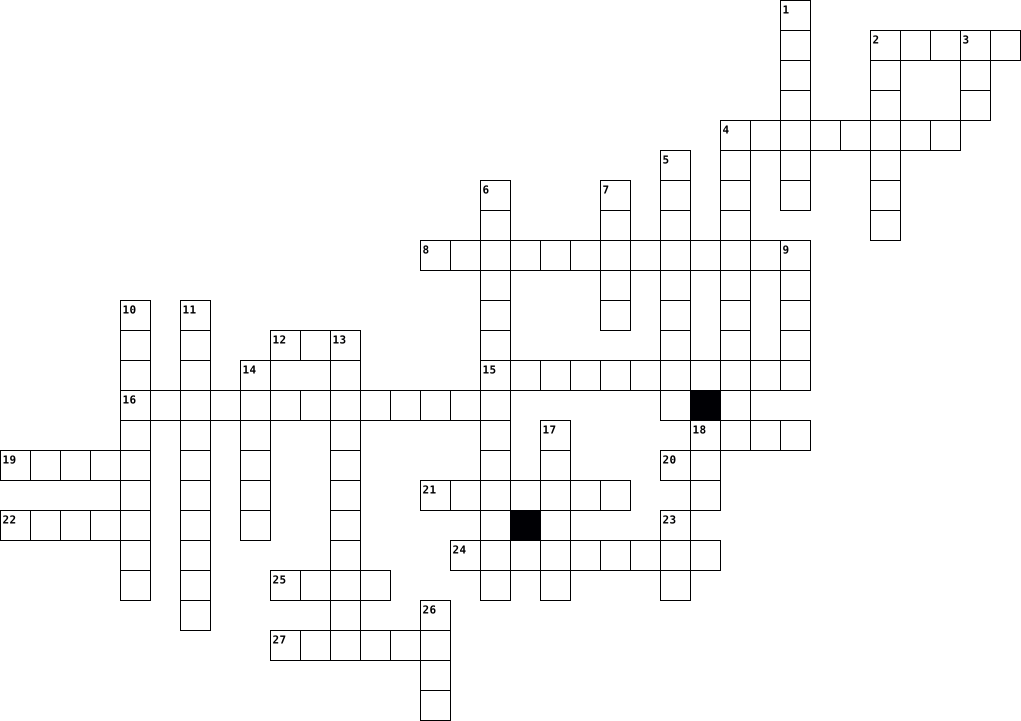
Across
- One origin of medical term
- Pertaining to before birth
- Core of a medical term
- Word analysis and definition
- Inside a vein
- Many people die every year due as a result of poor ?
- Suffix meaning cell
- Side
- Diagnosis
- meaning of -ation
- Origin of axilla
- Where a prefix is found in a medical term
- Number of elements in a medical term
- Between 37 and 42 weeks
Down
- History of a type of illness
- Pertaining to the stomach
- Prefix meaning above
- Study of diseases of the lungs
- more than one diagnosis
- Used when suffix begins with a consonant
- CC, Complaint
- Greek meaning slime
- Type of health record
- Word also meaning physical
- To break down a medical term into its elements
- Found at the end of a term follow a word root
- Usually indicates time, number, or location
- Chest x-ray
- Where to begin when breaking down a medical term
- Around
30 Clues: Side • Around • Diagnosis • Chest x-ray • CC, Complaint • Inside a vein • Origin of axilla • meaning of -ation • Greek meaning slime • Suffix meaning cell • Prefix meaning above • Type of health record • Core of a medical term • more than one diagnosis • Between 37 and 42 weeks • Pertaining to the stomach • One origin of medical term • Pertaining to before birth • Word also meaning physical • ...
Anatomy Lecture 8 Crossword Review 2016-08-31

Across
- Movement that occurs in the sagittal plane
- How muscles attach to bone
- This nerve innervates the muscles of facial expression
- Muscle that depresses mandible and tenses skin of inferior neck
- This muscle elevates the mandible for chewing
- This attachment is usually more proximal and less mobile
- This muscle forms the bulk of the tongue
- This muscle helps you pout
- The sternocleidomastoid muscle inserts at this process
- This nerve innervates the muscles of mastication
- This muscle keeps food inside the mouth
Down
- Term used to describe rotation of the forearm
- This muscle originates on the zygomatic arch
- Term used to describe forward movement in the transverse plane
- Movement of a body part away from the midline
- This term is used to describe how muscles attach to each other
- The pterygoid muscles attach to this bone
- Term used to describe "chewing"
- This muscle inserts on the angle of the mouth
- This orbicularis muscle helps to close the eye
- The fibre arrangement of orbicularis auris
21 Clues: How muscles attach to bone • This muscle helps you pout • Term used to describe "chewing" • This muscle keeps food inside the mouth • This muscle forms the bulk of the tongue • The pterygoid muscles attach to this bone • Movement that occurs in the sagittal plane • The fibre arrangement of orbicularis auris • This muscle originates on the zygomatic arch • ...
Human Anatomy Quiz Study Assignment 2015-10-28

Across
- lower jaw bone
- triangular shape muscles
- maximum/ largest muscle in the body
- and external monitors
- muscle/ spindle shaped, single nucleus
- seven bones in the wrist
- attachment to an immovable bone
- upper arm bone
- it takes 17 muscles to do this
- hinge joint
- ball and socket joints
Down
- holds the shoulder joint away from rest of body
- also known as shoulder blade
- study of how the brain and nervous system works
- information storage, transfer and processing
- support and protection of neurons
- your forehead shaped muscle
- largest bone in the body
- creates the framework for neurons
- type of muscle response
- neuron connector
- interprets sensory information
- response to processed information
- found only in the heart
- only bones with immovable joints
- connects bone to muscle
- your dancing bone
27 Clues: hinge joint • lower jaw bone • upper arm bone • neuron connector • your dancing bone • and external monitors • ball and socket joints • type of muscle response • found only in the heart • connects bone to muscle • largest bone in the body • triangular shape muscles • seven bones in the wrist • your forehead shaped muscle • also known as shoulder blade • interprets sensory information • ...
Anatomy of the Auditory System 2015-12-07

Across
- bones of the middle ear
- largest of the ossicles
- aqueduct small opening between the scala tympani and subarachnoid space of the cranium
- muscle that rotates the stapes posteriorly
- membrane divider between the outer and middle ear
- Wall entrance to the Eustachian Tube, Carotid Artery also passes through this wall
- the inner ear is divided into how many cavity systems
- Ear located in the petrous portion of the temporal bone
- and enlargement near the opening to the vestibule in each canal
- Window footplate of the stapes is embedded here
Down
- also known as the anvil
- the central portion of the osseous labyrinth
- canals houses the sense organs for movement
- curled margin of the pinna
- membrane overlays the hair cells
- Wall tendon of stapes arises from here, Chorda Tympani also courses through here
- houses the organs for hearing
- Window marks entrance to the Scala Tympani of the cochlea
- basilar membrane is the what of the scala media
- main part of the outer ear
20 Clues: also known as the anvil • bones of the middle ear • largest of the ossicles • curled margin of the pinna • main part of the outer ear • houses the organs for hearing • membrane overlays the hair cells • muscle that rotates the stapes posteriorly • the central portion of the osseous labyrinth • canals houses the sense organs for movement • ...
Anatomy & Physiology Chpt. 1&2 2016-01-28

Across
- The nose is _____ to the mouth.(pg.14)
- Study of functional changes associated with disease and aging (pg.2)
- Disrupts homeostasis by increasing or decreasing a controlled variable (pg.9)
- Storage organ that helps in the digestion of fat and helps to make bile more concentrated to increase its effect on fat cells(pg.19)
- Instrument used to visually examine the body organs or cavities (pg.23)
- Fluid within cells (pg.8)
- Serious membrane of the abdominal cavity (pg.19)
- Formed by combining various amino acids(pg.48)
- The number of protons in the nucleus of an atom is an atom's ______ number.(pg.29)
- Any abnormality of structure or function (pg.12)
- System that has the components of a brain and spinal cord (pg.5)
Down
- The body ability to detect and respond to changes.(pg.7)
- Scale that measures how acidic or basic a substance is (pg.40)
- An organ that is located behind the stomach (pg.3)
- The sum of all chemical processes that occur in the body (pg.5)
- Plane that divides the body or organ into superior and inferior portions (pg.16)
- A type of energy needed to break chemical bonds in the reactant molecules so a reaction can start.(pg.36)
- When the examiner feels the surface of the body with the hand (pg.5)
- Elements that make up about 0.4% of the chemicals in our body(Pg.29)
- Organs inside the major cavities of the trunk are called (pg.19)
20 Clues: Fluid within cells (pg.8) • The nose is _____ to the mouth.(pg.14) • Formed by combining various amino acids(pg.48) • Serious membrane of the abdominal cavity (pg.19) • Any abnormality of structure or function (pg.12) • An organ that is located behind the stomach (pg.3) • The body ability to detect and respond to changes.(pg.7) • ...
Anatomy and Physiology of Audiology 2016-12-07

Across
- Houses the sensors for balance and hearing
- The entry way to the cochlea
- Looks as if it could cover the entrance to the meatus
- Includes the malleus, incus, and stapes
- Have a periodic, chopped temporal pattern as long as a tone is present
- Inflammation of the skin of the external ear
- About 0.5mm from the tympanic membrane
- May be seen at the primary reception area, Heschl’s gyrus
- Serves as a collector of sound be processed at deeper levels
- Coils out from its base near the vestibule, wrapping around itself 2-5/8 times before reaching its apex
- Forms the curled margin of the pinna, marking its most distal borders
Down
- There is an initial response to onset of a stimulus, followed by silence
- Slowly increase their firing rate through the initial stages of firing
- A small but extremely important space occupied by three of the smallest bones in the body
- Converts acoustic every into electrochemical energy
- Refers to the quality of a neuron wherein it responds to the period of the stimulus
- Forms a slight “U” pattern opened toward the modular side
- The receptor organ for movement, being made up of ciliated receptor cells and supporting membrane
- Resistance to the flow of energy
- The entrance to the ear canal, known as the external auditory meatus
20 Clues: The entry way to the cochlea • Resistance to the flow of energy • About 0.5mm from the tympanic membrane • Includes the malleus, incus, and stapes • Houses the sensors for balance and hearing • Inflammation of the skin of the external ear • Converts acoustic every into electrochemical energy • Looks as if it could cover the entrance to the meatus • ...
Cross Sectional Anatomy - Facial Bones 2017-10-17

Across
- These bones form the bridge of the nose.
- The inferior nasal conchae are also known as inferior nasal ________________ .
- This muscle originates on the temporal fossa and inserts on the coronoid process of the mandible.
- Narrow, oblong canal that serves as the primary drainage pathway from the maxillary sinuses into the middle meatus.
- This portion of the Palatine bone joins anteriorly with the palatine process of the maxilla to form the hard palate.
- Sinuses that are also called the antrum of Highmore.
- Located on the midsagittal line and forms the inferior portion of the bony nasal septum.
- The Zygoma is also known as these bones...
- Medial and lateral muscles that originate from the pterygoid process of the sphenoid bone.
- Portion of the palatine bone that extends to form a segment of the lateral wall of the nasal cavity and the medial wall of the orbit.
- Thickest wall of the orbit.
- Sinuses that are normally paired and occupy the body of the sphenoid just below the sella turcica.
- Sinuses that do not form or become aerated until 6 years of age.
Down
- The posterior 1/4 of this palate is created by the horizontal portion of the palatine bones.
- Strongest muscle of the jaw.
- Nasal cavity is lined by this and is responsible for filtering airborne particles. (2 words)
- Vertical portion of the mandible.
- Foramen which transmits the infraorbital nerve and blood vessels.
- L-shaped bones located in the posterior aspect of the nasal cavity between the maxilla and pterygoid process of the sphenoid.
- This process serves as an attachment site for the temporalis and masseter muscles.
- Various openings through which drainage of the paranasal sinuses occurs.
- Process that articulates with the mandibular fossa of the temporal bone to form the temporomandibular joint.
- Bones that form the medial wall of each orbit.
- Largest facial bone.
- This wall of the orbit is exceedingly thin.
- The angle created by junction of portions of the mandible.
- This process of the zygomatic bone extends posteriorly to join the zygomatic process of the temporal bone to form the zygomatic arch.
- Sinuses contained within the lateral masses of the ethmoid bone.
- Nerve of sight.
29 Clues: Nerve of sight. • Largest facial bone. • Thickest wall of the orbit. • Strongest muscle of the jaw. • Vertical portion of the mandible. • These bones form the bridge of the nose. • The Zygoma is also known as these bones... • This wall of the orbit is exceedingly thin. • Bones that form the medial wall of each orbit. • Sinuses that are also called the antrum of Highmore. • ...
Vocal Anatomy Crossword of Awesome! 2018-02-27

Across
- / The part of the larynx consisting of the vocal cords and the slitlike opening between them. It affects voice modulation through expansion or contraction.
- / Activated when pressing your hand against the front of your head or the back of your head.
- / Used for intense singing or phonation, belting especially, this is activated by mimicking holding suitcases, holding melons under your arms, or putting on a swim cap.
- / We do this breath everyday all the time.
- / Two small, elongated pieces of yellow elastic cartilage, placed one on either side, in the aryepiglottic fold.
- / The flappy flap that stops you from the choky choke.
- / the primary resonator for vocal sounds. Vowels tend to be most closely associated with this space. It is defined as the Pharyngeal space behind the mouth from the Epiglottis to the Soft Palate. It exists mostly behind the Tongue and is defined almost completely by soft tissue.
- / Breathing Tube of joy.
- / provides attachment to the muscles of the floor of the mouth and the tongue above, the larynx below, and the epiglottis and pharynx behind.
- / When You're larynx rises, your vocal chords get _____________.
- / The vocal chords place of residence.
- / This breath is used for high air pressure belt, pop, and rock sounds.
- / The first space that the Larynx opens into Resonator behind the larynx and can be changed with the lifting and lowering of the larynx.
- / How much of a certain technique is needed.
Down
- / They Allow the vocal folds to be tensed, relaxed, or approximated. They articulate with the supero-lateral parts of the cricoid cartilage lamina, forming the cricoarytenoid joints at which they can come together, move apart, tilt anteriorly or posteriorly, and rotate.
- / When your larynx lowers, your vocal chords get ______________.
- / an apparatus that increases the resonance of a sound, especially a hollow part of a musical instrument.
- / On these, the edges of can be made to tense and relax by the passage of air from the lungs, thus producing vocal sound.
- / provide attachments for the cricothyroid muscle, posterior cricoarytenoid muscle and lateral cricoarytenoid muscle muscles, cartilages, and ligaments involved in opening and closing the airway and in speech production.
- / Flaring the nostrils to engage muscles behind the soft palate to aid in high larynx, head voice, singing.
- / This breath is used for low air pressure, classical, and operatic sounds.
- / the upper pair, each of which encloses a vestibular ligament, extends from one side of the thyroid cartilage in front to the arytenoid cartilage on the same side of the larynx in back, and is not directly concerned with speech production.
- / A fancy name for the throat and your main source of vocal resonation.
- / the highest part of the Pharynx. It exists above the mouth and behind the nose. It is the largest open space of the three Pharyngeal areas and is the most fixed. This means it is unable to close, making it an ideal resonator. The Eustachian tubes open into it, making it the path connecting our vocal sound to the ear internally. This area is referred to as the “ng” resonator from the sensation of resonance that results from the “ng” vocal sound found in words with that spelling, like “sing” and “hung”. It is also referred to as the Head Resonator.
24 Clues: / Breathing Tube of joy. • / The vocal chords place of residence. • / We do this breath everyday all the time. • / How much of a certain technique is needed. • / The flappy flap that stops you from the choky choke. • / When your larynx lowers, your vocal chords get ______________. • / When You're larynx rises, your vocal chords get _____________. • ...
Vocal Anatomy Crossword of Awesome! 2018-02-27

Across
- / provides attachment to the muscles of the floor of the mouth and the tongue above, the larynx below, and the epiglottis and pharynx behind.
- / the primary resonator for vocal sounds. Vowels tend to be most closely associated with this space. It is defined as the Pharyngeal space behind the mouth from the Epiglottis to the Soft Palate. It exists mostly behind the Tongue and is defined almost completely by soft tissue.
- / When your larynx lowers, your vocal chords get ______________.
- / On these, the edges of can be made to tense and relax by the passage of air from the lungs, thus producing vocal sound.
- / A fancy name for the throat and your main source of vocal resonation.
- / The vocal chords place of residence.
- / Breathing Tube of joy.
- / We do this breath everyday all the time.
- / They Allow the vocal folds to be tensed, relaxed, or approximated. They articulate with the supero-lateral parts of the cricoid cartilage lamina, forming the cricoarytenoid joints at which they can come together, move apart, tilt anteriorly or posteriorly, and rotate.
- / The flappy flap that stops you from the choky choke.
- / Anchors away! Used for intense singing or phonation, belting especially, this is activated by mimicking holding suitcases, holding melons under your arms, or putting on a swim cap.
- / This breath is used for high air pressure belt, pop, and rock sounds.
- / Anchors away! Activated when pressing your hand against the front of your head or the back of your head.
Down
- / When You're larynx rises, your vocal chords get _____________.
- / provide attachments for the cricothyroid muscle, posterior cricoarytenoid muscle and lateral cricoarytenoid muscle muscles, cartilages, and ligaments involved in opening and closing the airway and in speech production.
- / Two small, elongated pieces of yellow elastic cartilage, placed one on either side, in the aryepiglottic fold.
- / Anchors Away! Flaring the nostrils to engage muscles behind the soft palate to aid in high larynx, head voice, singing.
- / How much of a certain technique is needed.
- / an apparatus that increases the resonance of a sound, especially a hollow part of a musical instrument.
- / the upper pair, each of which encloses a vestibular ligament, extends from one side of the thyroid cartilage in front to the arytenoid cartilage on the same side of the larynx in back, and is not directly concerned with speech production.
- / The first space that the Larynx opens into Resonator behind the larynx and can be changed with the lifting and lowering of the larynx.
- / the highest part of the Pharynx. It exists above the mouth and behind the nose. It is the largest open space of the three Pharyngeal areas and is the most fixed. This means it is unable to close, making it an ideal resonator. The Eustachian tubes open into it, making it the path connecting our vocal sound to the ear internally. This area is referred to as the “ng” resonator from the sensation of resonance that results from the “ng” vocal sound found in words with that spelling, like “sing” and “hung”. It is also referred to as the Head Resonator.
- / The part of the larynx consisting of the vocal cords and the slitlike opening between them. It affects voice modulation through expansion or contraction.
- / This breath is used for low air pressure, classical, and operatic sounds.
24 Clues: / Breathing Tube of joy. • / The vocal chords place of residence. • / We do this breath everyday all the time. • / How much of a certain technique is needed. • / The flappy flap that stops you from the choky choke. • / When You're larynx rises, your vocal chords get _____________. • / When your larynx lowers, your vocal chords get ______________. • ...
Anatomy Chapter 1 Word Search 2018-10-02

Across
- the study of early developmental processes
- the study of function
- when a person is lying down faced up they are in this position
- internal organs projected into cavities
- study of the effects of diseases on organ or system functions
- the study of general form and superficial markings
- lungs, nose, trachea
- the plane that us perpendicular to the long axis of the human body
- the elbow is what to the wrist
- directing long-term changes in the activities of other organ systems
- a small transmitter that bursts of high-frequency sound and picks up echoes
- system mouth, stomach, esophagus
Down
- a form of high-energy radiation that can penetrate living tissue
- uterus, ovaries, testes
- the kidneys, bladder, and ureters
- the lungs are located in this cavity
- the study of structure
- an automatic response that corrects a situation
- the analysis of the internal structure of individual cells, the simplest units of life
- the study of the physiology of specific organs
- when a person is lying down faced down they are in this position
- highest level of organization
- the existence of a stable internal environment
- brain, spinal cord
- skin, hair, nails
25 Clues: skin, hair, nails • brain, spinal cord • lungs, nose, trachea • the study of function • the study of structure • uterus, ovaries, testes • highest level of organization • the elbow is what to the wrist • system mouth, stomach, esophagus • the kidneys, bladder, and ureters • the lungs are located in this cavity • internal organs projected into cavities • ...
Gavin - Anatomy Of A Computer 2021-09-27

Across
- Energy
- also known as COM
- Lets The peripherals communicate quickly with the cpu
- used to connect mice and keyboards(obsolete)
- Short term memory
- Holds all the computer components
- Everything is connected to it and directs data flow
- allows to directly connect computer to the the modem
- most commonly used input slot
- The whole system
Down
- Creates the picture
- another type of connection for older devices but has become obsolete by the firewire and usb connections
- A signal going to external components
- Long term memory
- cleans up and outputs sound signals
- Holds the GPU
- used to connect many types of peripherals
- Type of software that is necessary
- Solid State
- Disc Storage
- Sends information in from the user
- Brain
22 Clues: Brain • Energy • Solid State • Disc Storage • Holds the GPU • Long term memory • The whole system • also known as COM • Short term memory • Creates the picture • most commonly used input slot • Holds all the computer components • Type of software that is necessary • Sends information in from the user • cleans up and outputs sound signals • A signal going to external components • ...
Gavin - Anatomy Of A Computer 2021-09-17

Across
- Short term memory
- The whole system
- Disc Storage
- Holds all the computer components
- Holds the GPU
- Everything is connected to it and directs data flow
- Type of software that is necessary
- also known as COM
- Energy
- Brain
- Creates the picture
Down
- another type of connection for older devices but has become obsolete by the firewire and usb connections
- used to connect many types of peripherals
- cleans up and outputs sound signals
- allows to directly connect computer to the the modem
- most commonly used input slot
- Lets The peripherals
- A signal going to external components
- Sends information in from the user
- Solid State
- Long term memory
- used to connect mice and keyboards(obsolete)
22 Clues: Brain • Energy • Solid State • Disc Storage • Holds the GPU • The whole system • Long term memory • Short term memory • also known as COM • Creates the picture • Lets The peripherals • most commonly used input slot • Holds all the computer components • Type of software that is necessary • Sends information in from the user • cleans up and outputs sound signals • ...
Anatomy and Physiology Regional Terms 2021-08-22

Across
- Top of the shoulder or point
- Chin
- anterior surface of the leg or shin
- The forearm
- Buttocks
- Posterior surface of the leg
- The palm
- Sacrum
- Anterior surface of the knee
- Ear
- Lower back
- Posterior surface of Knee
- Thigh
- Wrist
- Ankle
- anterior surface of elbow
- Skull
- Fingers or toes
- Groin
- Spine
- Big Toe
Down
- Eye
- Bones of the foot
- Hip
- Cheek
- Bones of the hand
- Thumb
- Arm
- Armpit
- sternum or middle of chest
- Back of the head
- Pelvis
- Forehead
- Head
- Chest
- Abdomen
- Pubis
- Sole of the foot
- Nose
- Mouth
- Neck
- Hand
42 Clues: Eye • Hip • Arm • Ear • Chin • Head • Nose • Neck • Hand • Cheek • Thumb • Chest • Thigh • Wrist • Ankle • Pubis • Skull • Groin • Mouth • Spine • Sacrum • Armpit • Pelvis • Abdomen • Big Toe • Buttocks • The palm • Forehead • Lower back • The forearm • Fingers or toes • Back of the head • Sole of the foot • Bones of the foot • Bones of the hand • Posterior surface of Knee • anterior surface of elbow • sternum or middle of chest • Top of the shoulder or point • ...
Anatomy & Physiology Word Scramble 1 2021-12-29

Across
- the system that controls the steady circulation of blood
- Front (anterior) portion of the epicranius
- composed of 14 bones
- process of cell reproduction
- bones that form the prominence of the cheeks
- facial artery that supplies blood to eye muscles
- Bones that form the sides and top of cranium
- facial artery that supplies blood to the lower lip
- the system responsible for breaking down foods
- Back (posterior) muscle of epicranius that draws the scalp backwards
- bony case that protects the brain
- a cell part that encloses the protoplasm & permits soluble substances to pass through the cell wall
Down
- the watery fluid of a cell known as protoplasm
- The hindmost bone of the skull
- light, spongy bone between the eye sockets
- brain, spinal cords, nerves
- composed of 206 bones and forms the body
- The movable part of the muscle farthest from the skeleton
- tiny, thin-walled blood vessels
- largest & most complex nerve tissue that powers thinking, feeling, and senses
- The part of the muscle that does not move: closest to skeleton
- bones that form the sides of the head
- Muscle that originates at the fibula and bends the foot
- Inner and larger bone in the forearm
- Small, thing bones located at the front inner wall of the orbits
25 Clues: composed of 14 bones • brain, spinal cords, nerves • process of cell reproduction • The hindmost bone of the skull • tiny, thin-walled blood vessels • bony case that protects the brain • Inner and larger bone in the forearm • bones that form the sides of the head • composed of 206 bones and forms the body • Front (anterior) portion of the epicranius • ...
The Anatomy of the Constitution 2021-12-13

Across
- an ________.
- New states can be admitted to the ______ with the
- what article is about federalism.
- Article III creates the ______ _____.
- Article III creates the ______ ________ and authorizes Congress to create federal courts below the ______ _______.
- Article _______ says the Constitution could not take effect until at least nine out of the thirteen states approved it.
- This article creates the legislative branch.
- The first paragraph is called the _______.
- the main topic of chapter 6
- of Congress and the president.
- The Constitution is not set in stone, and Article ____ describes how it can be changed!
- The ________ is in charge of executing the laws
Down
- all of the amendments.
- Article ____ of the Constitution describes how the states should interact with each other.
- Article Seven says the Constitution could not take effect until at least ____ out of the thirteen states approved it.
- A change or addition to the Constitution is
- ______ laws are more powerful then state laws
- Legislative branch creates _____
- This branch executes, or carries out, laws.
- The preambles job is to ____ the reader.
20 Clues: an ________. • all of the amendments. • the main topic of chapter 6 • of Congress and the president. • Legislative branch creates _____ • what article is about federalism. • Article III creates the ______ _____. • The preambles job is to ____ the reader. • The first paragraph is called the _______. • A change or addition to the Constitution is • ...
Human Anatomy Vocabulary Part One 2022-05-19

Across
- palms of hand
- arm or leg
- away from the midline of the body
- towards the front of the body
- chest
- back
- lower back
- top and side of head
- neck
- forhead
Down
- skull
- wrist
- towards the feet
- towards the back of the body
- towards to midline of the body
- bottom of the foot
- tailbone
- femur
- mouth
- towards the head
- kneecap
21 Clues: back • neck • skull • wrist • femur • mouth • chest • kneecap • forhead • tailbone • arm or leg • lower back • palms of hand • towards the feet • towards the head • bottom of the foot • top and side of head • towards the back of the body • towards the front of the body • towards to midline of the body • away from the midline of the body
Anatomy Chapter 1-3 Review 2022-02-03

Across
- A membrane through which nothing can pass
- Proteins associated with the DNA of the nucleus, DNA strand are wound around them
- Contain enzymes that breakdown H2O2
- Genetically programmed cell death
- The monomers of proteins
- Give rise to lysosomes and secretory vesicles
- When chromosomes line up on the metaphase plate
- Synthesis of complex organic compounds
- Engulfing of extracellular material or pathogens
- Low osmotic solution outside of cell
- Body cavity that contains the lungs
- Away from the point of attachment of a limb
- Regional differences in the concentration of a substance
- The study of tissues
- Breakdown of complex organic molecules
- Anatomical term for the armpit
Down
- Outer layer of the serous membrane
- 60% rRNA and 40% protein
- Separates the thoracic cavity and the abdominopelvic cavity
- To remove proteins from the cytoplasm
- The study of cells
- The synthesis of RNA from a DNA template
- Inner layer of the serous membrane
- Cells that have not been divided yet and the DNA not coiled
- Divides body into equal left and right portions
- One glycerol + Three fatty acid
- Most abundant high-energy compound in the body
27 Clues: The study of cells • The study of tissues • 60% rRNA and 40% protein • The monomers of proteins • Anatomical term for the armpit • One glycerol + Three fatty acid • Genetically programmed cell death • Outer layer of the serous membrane • Inner layer of the serous membrane • Contain enzymes that breakdown H2O2 • Body cavity that contains the lungs • ...
Anatomy Root Words Chapter 2 2021-12-09

Across
- crest
- lip
- hidden
- between
- passage
- of one’s free will
- well fed
- egglike
- bud
- make,produce
- a net
- a crow’s beak
- sewing
- upon
- flesh
- passage,channel
- ring
- something written
- joint socket
- band,ligament
Down
- bag,purse
- something inserted
- among,between
- sieve
- skin
- skin
- axis
- entire,whole
- vinegar cup
- pit
- inside
- over,more
- tooth
- stretched
- wrist
- joint
- stiff
- bundle
- knob
- together
- work
- rind or peel
- break
- joint socket
- muscle
45 Clues: lip • pit • bud • skin • skin • axis • knob • work • upon • ring • crest • sieve • tooth • a net • wrist • joint • stiff • flesh • break • hidden • inside • bundle • sewing • muscle • between • passage • egglike • well fed • together • bag,purse • over,more • stretched • vinegar cup • entire,whole • make,produce • rind or peel • joint socket • joint socket • among,between • a crow’s beak • band,ligament • passage,channel • something written • something inserted • ...
nervous system anatomy & physiology terms 2022-11-19

Across
- cerebr/o
- meningi/o
- pont/o
- vag/o
- mening/o
- encephal/o
- cerebell/o
- lept/o
- gli/o
- myel/o
- thalam/o
Down
- -lepsy
- neur/o
- my/o
- caus/o
- -plegia
- dur/o
- thec/o
- -paresis
- -phasia
20 Clues: my/o • vag/o • dur/o • gli/o • -lepsy • neur/o • pont/o • caus/o • thec/o • lept/o • myel/o • -plegia • -phasia • cerebr/o • mening/o • -paresis • thalam/o • meningi/o • encephal/o • cerebell/o
Anatomy of Face and Neck 2022-10-26

Across
- has 2 parts;push the mandible down to open jaw
- back and base of the cranium
- helps with swallowing by bringing the tongue upward
- functions to depress mandible and elevate hyoid
- pushes the cheek against the teeth
- base of the septum
- styloid process;elevates and retracts hyoid bone
- not attached to bone;purpose to move lips
- suspends between mandible and larnyx;support tongue
- incisive fossa in mandible;raises/wrinkles chin
- 3 projections; each one resembles a scroll
- 2 bones that form the upper jaw; hard palate
- depress the tongue and make it protrude
- responsible for movement of mandible
Down
- forms the forehead and makes up frontal sinuses
- one each side of face; form main parts of cheeks
- originates in hyoid bone and depresses down sides of tongue
- has a body and pair of greater wings
- responsible for closing the jaw
- 2 of them; form the roof and upper sides of head
- raises the mandible and closes the jaw
- 2 on each side of head; each contains the ear
- makes the tongue move upward or backward
- 2 of bone; make of orbit near inner angle of eye
- floor of cranium and nasal cavity;concha structures
- lower part of jaw; strongest bone in face
- contains 2 bones; forming the bridge of the nose
- raises the tongue and lowers the jaw
- depresses the mandible
- works to draw angles of the mouth up and back
30 Clues: base of the septum • depresses the mandible • back and base of the cranium • responsible for closing the jaw • pushes the cheek against the teeth • has a body and pair of greater wings • raises the tongue and lowers the jaw • responsible for movement of mandible • raises the mandible and closes the jaw • depress the tongue and make it protrude • ...
PPT: ANATOMY OF THE BRAIN 2023-12-04

Across
- Mater attached to inner surface of skull; protects brain from displacement
- Region of brain responsible for basic life functions
- Brain grooves
- Membranes covering & protecting the CNS
- Lobe responsible for movement, recognition, perception of stimuli
- Region of brain responsible for higher level functioning
- Lobe responsible for auditory, speech & memory
- Lobe responsible for vision
- Brain ridges
- Connects 2 hemispheres and allows communication between sides (2 words)
- Maintains homeostasis and controls automatic responses
- Fluid produced within ventricles & surrounds CNS
Down
- Lobe responsible for executive functioning and long-term memory
- Mater transports cerebrospinal fluid from brain ventricles back into blood vessels
- Mater attached tightly to brain
- Found in temporal lobe; “fight or flight”, memory, emotion, feer
- In brain stem: breathing and heart rate (2 words)
- Region of brain that regulation & coordination of movement
- Sensory information travels through before going to cerebral cortex
- Found in temporal lobe; learning & short-term memory
- In brain stem: motor control, sensory analysis
21 Clues: Brain ridges • Brain grooves • Lobe responsible for vision • Mater attached tightly to brain • Membranes covering & protecting the CNS • Lobe responsible for auditory, speech & memory • In brain stem: motor control, sensory analysis • Fluid produced within ventricles & surrounds CNS • In brain stem: breathing and heart rate (2 words) • ...
Hip and Thigh Anatomy Crossword 2023-11-09

Across
- lower anterior portion of the pelvis
- bursa at insertion of hamstrings
- structure that deepens the joint socket, absorbs shock, and increases surface area
- insertion for the iliopsoas
- weakest of the three ligaments that prevents excessive extension
- extension of spinal column with 5 fused vertebrae
- location of insertion for several gluteal muscles and external rotators
- the rigid, slightly movable joints on the posterior pelvis between spine and pelvis
- upper portion of the pelvis
Down
- lower posterior portion of pelvis
- pubis bones form this amphiarthrodial joint
- socket of the hip joint made of all 3 pelvis parts
- ligament that prevents excess abduction and extension
- opening in the pelvis made by ischium and pubis
- anterior ligament that is the strongest ligament in the body that prevents hyperextension of the hip
- sit bones of the pelvis
- substantial contributor to joint stability that is thicker anterior
- origin of the quadriceps muscle that crosses the hip
- bursa over the greater trochanter
- origin of the muscle that does hip flexion, external rotation, and knee flexion
20 Clues: sit bones of the pelvis • insertion for the iliopsoas • upper portion of the pelvis • bursa at insertion of hamstrings • lower posterior portion of pelvis • bursa over the greater trochanter • lower anterior portion of the pelvis • pubis bones form this amphiarthrodial joint • opening in the pelvis made by ischium and pubis • extension of spinal column with 5 fused vertebrae • ...
Nervous System Anatomy and Physiologi 2023-09-19

Across
- Uterine contractions in laboring patients can occur because they are nervated by which nerves are working at that time
- The part of the brain that regulates body temperature is
- The chemical compound that plays a role in transmitting nerve impulses at synapses is.
- that act as protective and cushioning cells are.
- Neurons that function to connect or act as a means of communication between one neuron and another neuron are called.
- The cerebrum is also known as
- According to the function of the nerve, it has two divisions, namely
- A group of nerves tied together by a covering of coarser connective tissue to 6. form a fiber bundle or fascicle is
- The part of the brain that regulates body movement and balance is
- What connects motor and sensory neurons in nerve pathways is
Down
- Functions that influence responses by activating effector muscles or glands through motor output are functions based on.
- The cylindrical, shiny white bone that continues the brainstem is
- The brain nerves that originate from the retina of the eye are called
- The central nervous system is..
- What usually produces nerve impulses and usually transmits them out of the cell body is.
- The outermost covering layer of the brain is.
- Cel
- The nervous system that regulates events that occur automatically or unintentionally or is usually called the involuntary nervous system is called
- The nerves that function to connect the brain with muscles, sense organs, glands and body organs in the neck, head and without passing through the spinal cord are.
- The largest part of a neuron's nerve cell is
- What is the name of the innermost layer covering the brain..
21 Clues: Cel • The cerebrum is also known as • The central nervous system is.. • The largest part of a neuron's nerve cell is • The outermost covering layer of the brain is. • that act as protective and cushioning cells are. • The part of the brain that regulates body temperature is • What is the name of the innermost layer covering the brain.. • ...
Special Senses Anatomy and Physiologi 2023-09-28

Across
- The bony labyrinth is filled with a plasma-like fluid called....
- Report on changes in the position of the head in space with respect to the pull of gravity when the body is not moving called....
- What are the enzymes responsible for destroying bacteria called enzymes....
- Capability to defect the taste of substances such as food....
- The ability of the eye to focus specifically on close objects is called....
- The inability to focus or accommodate due to inflexible lens which start as early as age 40 called....
- what is the sense of sound perception called a sense....
- The greater the convexity, the more light will bend, which is the explanation....
- Thick, glistening, white connective tissue, is seen anteriorly as the white of the eye....
- The outer ear is called....
Down
- The dorsal tongue surface is covered with small peg-like projections....
- Elders over age 65 start having gradual loss of hearing called....
- Humor that is similar to blood plasma and helps maintain intraocular pressure is called humor....
- Who is responsible for protecting the eyes....
- The innermost sensory layer of the eye is....
- The glands that are connected to the edge of the eyelid are called glands....
- What is the part where light enters the eye called....
- Tunic rich blood nutrition contains dark pigmen called....
- The membranous labyrinth itself contains a thicker fluid called....
- A tuft of hair cells covered with a gelatinous cap called....
20 Clues: The outer ear is called.... • The innermost sensory layer of the eye is.... • Who is responsible for protecting the eyes.... • What is the part where light enters the eye called.... • what is the sense of sound perception called a sense.... • Tunic rich blood nutrition contains dark pigmen called.... • Capability to defect the taste of substances such as food.... • ...
Cardiovascular System Anatomy and Physiology 2023-10-02

Across
- A single vein that drains the thorax and enters the superior vena cava just before it joins the heart
- An artery that is a branch of the ascending aorta
- Valves that lie between the atrial and ventricular chambers on each side, and prevent backflow into the atria when the ventricles contract
- Narrowing of the blood vessels
- Heart contraction
- A superficial vein that drains the medial aspect of the arm and empties into the brachial vein proximally
- The outermost layer of the heart that encloses the heart in a double-walled sac
- The tunica consists of smooth muscle and elastic fibers that narrow or widen, causing blood pressure to increase or decrease
- Valve that closes when the ventricle is full
- The septum that divides the heart longitudinally
Down
- The pressure in the arteries at the peak of ventricular contraction
- Thick bundles of cardiac muscle twisted and whirled into ringlike arrangements
- Although cardiac muscles can beat independently, the muscle cells in the different areas of the heart have different rhythm
- The right AV valve and has three flaps
- Vein that receives venous blood from the arms via the axillary vein and from the skin and muscles of the head via the external jugular vein
- The visceral and outermost layer is actually a part of the heart wall
- The outermost tunic composed largely of fibrous connective tissue, and its function is basically to support and protect the vessels
- This contraction effectively ejects blood superiorly into the large arteries leaving the heart
- Several pairs of arteries serving the heavy muscles of the abdomen and trunk walls
- The innermost layer of the heart and is a thin, glistening sheet of endothelium hat lines the heart chambers
20 Clues: Heart contraction • Narrowing of the blood vessels • The right AV valve and has three flaps • Valve that closes when the ventricle is full • The septum that divides the heart longitudinally • An artery that is a branch of the ascending aorta • The pressure in the arteries at the peak of ventricular contraction • ...
Eye Anatomy and Common Disorders 2016-06-05

Across
- Depression at the center of the macula and point of greatest visual acuity.
- Inflammation of a blocked meibomian gland.
- Error of refraction causing an inability to properly focus light into the retina.
- Connective tissue supporting the upper eyelid.
- Layer deep to the retina containing blood vessels.
- Increased pressure inside the eye causing reduction in vision.
- The chamber of the eye containing the vitreous humour.
- This artery runs through the optic canal with the optic nerve.
- Light sensitive layer of tissue lining the back of the eye.
- Cranial nerve which supplies the superior oblique muscle.
Down
- Tender yellow lesion on the edge of the eyelid due to a bacterial infection.
- Clear, dome-shaped anterior portion of the sclera.
- Muscle responsible for abduction of the eyeball.
- Responsible for drainage of aqueous humour.
- Chamber of the eye containing the aqueous humour.
- Duct which drains excess tears into the inferior meatus of the nasal cavity.
- Double vision.
- Tough outer coat of the eyeball.
- Colored part of the eye;responsible for regulating the amount of light entering the eye.
- Transparent structure which focuses light rays into the retina.
20 Clues: Double vision. • Tough outer coat of the eyeball. • Inflammation of a blocked meibomian gland. • Responsible for drainage of aqueous humour. • Connective tissue supporting the upper eyelid. • Muscle responsible for abduction of the eyeball. • Clear, dome-shaped anterior portion of the sclera. • Layer deep to the retina containing blood vessels. • ...
Chapters 1 & 2 Anatomy/Physiology 2019-09-18

Across
- compounds = Compounds that contain carbon
- = The center of atom containing protons and neutrons
- energy = stored energy
- bonds = Form when a hydrogen atom, already covalently linked to one eletronegative atom, is attracted by another electron hungry atom, so a bridge forms between them.
- energy = Energy directly involved in moving matter
- = Substances composed of tow or more components physically intermixed.
- = Fat molecules made of 4 interlocking hydrocarbon rings
- and Unsaturated = Fatty acids that contain one or more double bonds between carbon atoms
- energy = energy stored in the bonds of chemical substances
- = bitter taste, feels slippery, high pH and are proton acceptors
- = double sugars formed when 2 monosaccharides are joined by dehydration synthesis
- = Fatty acids or their derivatives that are insoluble in water but soluble in organic solvents
- energy = Energy that travels in waves
- = simple sugars. single chain or single ring structures containing from 3-7 carbon atoms
- = The capacity to do work, or tho put matter into motion
- reactions = Reactions that release energy
- = Heterogenous mixtures with large, often visible solutes that tend to settle out.
- energy = Results from the movement of charged particles
- = Basic structural material of the body
Down
- = Sour taste, dissolves metals, low pH
- = A nucleic acid found in all living cells that carries the organism's hereditary information
- = Iconic compound containing cations other than H+ and anions other than hydroxyl ion (OH-)
- = When two or more different kinds of atoms bind
- reactions = The products of energy absorbing
- = commonly known as fats when solid or oils when liquid
- = The relative concentration of hydrogen ions in various body fluids is measured in concentration units.
- = A combination of two or more atoms held together by chemical bonds
- = Polymers of simple sugars linked together by dehydration synthesis
- = High -energy molecule that stores the energy we need to do just about everything we do.
- compounds = all other chemicals in the body besides Carbon.
- = Homogenous mixtures of components that may be gases, liquids or solids.
- energy = energy in action
- = Diglycerides with phosphorus containing group and two, rather than 3 fatty acid chains.
- = A group of molecules that include sugars and starches
- = Chainlike molecules made of similar or repeating units (monomers), which are joined together by dehydration synthesis
- = one singular group of units
- = part of atom that bears a negative charge.
- Bonds = Electrons may be shared to fill its outer electron shell
- = The number and kinds or reacting substances
- = Nucleic acid that contains ribose and the bases A< G< < and U. It carries out DNA's instructions for protein synthesis
40 Clues: energy = stored energy • energy = energy in action • = one singular group of units • energy = Energy that travels in waves • = Sour taste, dissolves metals, low pH • = Basic structural material of the body • compounds = Compounds that contain carbon • reactions = Reactions that release energy • reactions = The products of energy absorbing • ...
IB SHES Unit 1.1 Anatomy 2019-09-20

Across
- The crest of this BONE can be felt at the top of the hip
- The Synovial JOINT TYPE missing from this list. Gliding, Saddle, Pivot, Condyloid, Ball & Socket
- the MOVEMENT TERM used to describe a decrease in the angle between articulating bones
- the BONES that join at a synthesis in the Pelvic Girlde
- This REGION of the Vertebral column contains 7 bones and is found in its superior section
- the MOVEMENT TERM used to describe the movement of the arm away from the midline of body following contraction of the Deltoid
- the POSITIONAL TERM used to describe a structure being above another
- The REGION of a bone found at the head of a long bone
- the MOVEMENT TERM used to describe circular movements of a limb without the need for rotation
- the POSITIONAL TERM used to describe a structure being below another
- BONES such as the Femur, Ulna, Radius and Phalanges are found in this REGION of the skeleton
- the MOVEMENT TERM used to describe the movement of the leg towards the midline of the body following contraction of the Sartorius
- the MOVEMENT TERM used to describe toe up movement at the ankle following contracton of the Tibialis Anterior
- This CONNECTIVE tissue attached muscle to bone
- the POSITIONAL TERM used to describe a structure being at the back of the body
- This synovial STRUCTURE enables reduced friction, impact resistance and acts as a medium for nutrients in a joint
- the MOVEMENT TERM used to describe the upward movement of the shoulders following contraction of the Trapezius
- the MOVEMENT TERM used to describe the movement of the soles of the feet to face or point medially
- This CONNECTIVE tissue attached bone to bone
- This part of the Appendicular skeleton involves an articulation with the Clavicle
- An abbreviation for the CONNECTIVE tissue that supports the Anterior part of the knee and is found under the Patella
Down
- This REGION of the Vertebral column contains 5 bones and is found in its Inferior section
- The outer surface REGION of a bone that does not articulate with other bones
- the MOVEMENT TERM used to describe the downward movement of the shoulders following contraction of the Latissimus Dorsi
- This Synovial STRUCTURE provides the fluid with fresh nutrients and removes Synovial waste
- the POSITIONAL TERM used to describe a structure being further away from the central point of the body
- the MOVEMENT TERM used to describe toe down movement at the ankle following contracton of the Gastrocnemius
- This type of CARTILAGE is hard and shiny and reduces the friction between bones in a joint
- Synovial STRUCTURES that form to add protection to a joint
- the POSITIONAL TERM used to describe a structure being closest to the central point of the body
- Capsule The tough outer STRUCTURE of a Synovial joint
- the MOVEMENT TERM used to describe an increase in the angle between articulating bones
- the MOVEMENT TERM used to describe the movement of the soles of the feet to face or point laterally
- the MOVEMENT TERM used to describe transferring to the face down position
- The REGION of a bone often referred to as the shaft
- This JOINT CLASS is significantly involved in the reduction of the number of skeletal bones between newborns and adults from 270 to 206
- the MOVEMENT TERM used to describe twisting movement of bones at a joint
- BONES such as the Sternum, Vertebrae, Sacrum & Cranium are found in this REGION of the skeleton
- This REGION of the Vertebral column contains 12 bones that articulate with the costal bones
- the POSITIONAL TERM used to describe a structure being on the front of the body
- the BONE that separates the Ilium and Pubis
- The STRUCTURE inside a bone that produces blood cells
42 Clues: the BONE that separates the Ilium and Pubis • This CONNECTIVE tissue attached bone to bone • This CONNECTIVE tissue attached muscle to bone • The REGION of a bone often referred to as the shaft • Capsule The tough outer STRUCTURE of a Synovial joint • The REGION of a bone found at the head of a long bone • The STRUCTURE inside a bone that produces blood cells • ...
INTRODUCTION OF ANATOMY AND PHYSIOLOGY 2019-12-11

Across
- ENDOCRINE ____ PRODUCE CHEMICALS MOLECULES CALLED HORMONES.
- ____ FILTER BLOOD.
- AN ANGLE BETWEEN TRANSVERSE PLANE AND A SAGITTAL PLANE.
- WHICH ANATOMICAL PLANE IS THE ONLY HORIZONTAL PLANE.
- ____ OF BLOOD CLOTTING IS AN EXAMPLE OF POSITIVE FEEDBACK.
- THERE ARE ____ TYPES OF FEEDBACK SYSTEMS.
- AN EVENT MUST BREAK THE POSITIVE FEEDBACK CYCLE.
- WHAT KIND OF SENSOR THAT BEEN USED IN THERMOSTAT?
- POSITIVE FEEDBACK SYSTEMS TEND TO ____ THE ORIGINAL DISTURBANCE.
- SEPARATES THE THORACIC CAVITY FROM THE ABDOMINOPELVIC CAVITY.
- THE TEMPERATURE WILL ____ WHEN HEATER IS OFF.
- THE RESPONSE IN POSITIVE FEEDBACK SYSTEMS IS THE ____.
- CONSISTS OF GROUPS OF SIMILAR CELLS.
- POSITIVE FEEDBACK SYSTEMS ARE ____ IN THE BODY.
Down
- THE TEMPERATURE WILL ____ WHEN HEATER IS ON.
- RESPIRATORY SYSTEM KEEPS THE BLOOD SUPPLIED WITH ____.
- SMALL INTESTINE IS LOCATED AT ____ REGION.
- THE TRANSVERSE PLANE SEPARATE THE BODY INTO ____.
- MOST OF THE DIGESTIVE SYSTEM IS CONTAINED WITHIN THE ____ CAVITY.
- WHAT TYPE OF FEEDBACK SYSTEMS ARE IMPORTANT IN SPECIFIC SITUATIONS.
- TO EXPOSE THE HEART FOR OPEN HEART SURGERY,THE SURGEON WOULD NEED TO CUT THROUGH THE CAVITY.
- POSITIVE FEEDBACK SYSTEMS IS PUSH THE VARIABLE ____ FROM ITS ORIGINAL VALUES.
- MOST HOMEOSTATIC CONTROL MECHANISMS ARE ____ FEEDBACK SYSTEMS.
- A VERY ____ OR VERY STRONG EFFECT IS DESIRED IN POSITIVE FEEDBACK SYSTEMS.
- ____ PRESSURE IS AN ANOTHER EXAMPLE OF NEGATIVE FEEDBACK SYSTEMS.
- CONTAINS A LUNG.
- WHEN MANY ORGAN SYSTEMS WORK TOGETHER IT CAN FORM ____.
- NEGATIVE FEEDBACK SYSTEMS CAUSE AN ____ RESPONSE TO THE INITIAL CHANGE.
- THE ____ IS THE BASIC UNIT OF LIFE.
- STRUCTURE THAT COMPOSED OF TWO OR MORE TISSUE TYPES.
30 Clues: CONTAINS A LUNG. • ____ FILTER BLOOD. • THE ____ IS THE BASIC UNIT OF LIFE. • CONSISTS OF GROUPS OF SIMILAR CELLS. • THERE ARE ____ TYPES OF FEEDBACK SYSTEMS. • SMALL INTESTINE IS LOCATED AT ____ REGION. • THE TEMPERATURE WILL ____ WHEN HEATER IS ON. • THE TEMPERATURE WILL ____ WHEN HEATER IS OFF. • POSITIVE FEEDBACK SYSTEMS ARE ____ IN THE BODY. • ...
INTRODUCTION OF ANATOMY AND PHYSIOLOGY 2019-12-11

Across
- POSITIVE FEEDBACK SYSTEMS IS PUSH THE VARIABLE ____ FROM ITS ORIGINAL VALUES.
- WHAT TYPE OF FEEDBACK SYSTEMS ARE IMPORTANT IN SPECIFIC SITUATIONS.
- ____ OF BLOOD CLOTTING IS AN EXAMPLE OF POSITIVE FEEDBACK.
- ____ PRESSURE IS AN ANOTHER EXAMPLE OF NEGATIVE FEEDBACK SYSTEMS.
- WHICH ANATOMICAL PLANE IS THE ONLY HORIZONTAL PLANE.
- THE TEMPERATURE WILL ____ WHEN HEATER IS OFF.
- THERE ARE ____ TYPES OF FEEDBACK SYSTEMS.
- POSITIVE FEEDBACK SYSTEMS TEND TO ____ THE ORIGINAL DISTURBANCE.
- TO EXPOSE THE HEART FOR OPEN HEART SURGERY,THE SURGEON WOULD NEED TO CUT THROUGH THE CAVITY.
- ____ FILTER BLOOD.
- THE RESPONSE IN POSITIVE FEEDBACK SYSTEMS IS THE ____.
- POSITIVE FEEDBACK SYSTEMS ARE ____ IN THE BODY.
- THE TRANSVERSE PLANE SEPARATE THE BODY INTO ____.
- STRUCTURE THAT COMPOSED OF TWO OR MORE TISSUE TYPES.
- THE ____ IS THE BASIC UNIT OF LIFE.
Down
- CONTAINS A LUNG.
- ENDOCRINE ____ PRODUCE CHEMICALS MOLECULES CALLED HORMONES.
- A VERY ____ OR VERY STRONG EFFECT IS DESIRED IN POSITIVE FEEDBACK SYSTEMS.
- WHAT KIND OF SENSOR THAT BEEN USED IN THERMOSTAT?
- RESPIRATORY SYSTEM KEEPS THE BLOOD SUPPLIED WITH ____.
- SMALL INTESTINE IS LOCATED AT ____ REGION.
- AN EVENT MUST BREAK THE POSITIVE FEEDBACK CYCLE.
- MOST HOMEOSTATIC CONTROL MECHANISMS ARE ____ FEEDBACK SYSTEMS.
- WHEN MANY ORGAN SYSTEMS WORK TOGETHER IT CAN FORM ____.
- AN ANGLE BETWEEN TRANSVERSE PLANE AND A SAGITTAL PLANE.
- NEGATIVE FEEDBACK SYSTEMS CAUSE AN ____ RESPONSE TO THE INITIAL CHANGE.
- SEPARATES THE THORACIC CAVITY FROM THE ABDOMINOPELVIC CAVITY.
- CONSISTS OF GROUPS OF SIMILAR CELLS.
- MOST OF THE DIGESTIVE SYSTEM IS CONTAINED WITHIN THE ____ CAVITY.
- THE TEMPERATURE WILL ____ WHEN HEATER IS ON.
30 Clues: CONTAINS A LUNG. • ____ FILTER BLOOD. • THE ____ IS THE BASIC UNIT OF LIFE. • CONSISTS OF GROUPS OF SIMILAR CELLS. • THERE ARE ____ TYPES OF FEEDBACK SYSTEMS. • SMALL INTESTINE IS LOCATED AT ____ REGION. • THE TEMPERATURE WILL ____ WHEN HEATER IS ON. • THE TEMPERATURE WILL ____ WHEN HEATER IS OFF. • POSITIVE FEEDBACK SYSTEMS ARE ____ IN THE BODY. • ...
Human Anatomy and Physiology 1 2020-10-19

Across
- This is a gland that is located at the base of the brain, shaped like a bean.
- The _____________ links the nervous system and immune systems with the help of the pituitary gland.
- The ______ mater is a thin fibrous tissue found in the brain, it is in direct contact with the cerebral cortex.
- The longitudal ________ separates the two hemispheres of the brain
- The uppermost part of the brain, containing two hemispheres
- The _________ lobe is responsible for processing auditory/olfactory sensation
- The _________ reflex occurs after stroking the sole of the foot
- The _______ mater is one of the meningeal layers that is fused to the periosteum of cranial bones.
- The plexus of the anterior rami arising from C1 - C4
- Section of the brainstem that is responsible for somatic/visceral motor control.
- The specific region of the skin surface monitored by a single pair of spinal nerves.
- The __________ lobe is responsible for visual stimuli
- Site where neuron communicates with another cell
- The node of __________ is a gap found within myelinated axons.
- Type of nerve cell where axon and dendrite processes are fused.
- The structure that is located near the brainstem and responsible for voluntary movement and other motor skills./
- one neuron splitting and communicating with many others
- topmost section of the brainstem.
Down
- The first and main form of active immune defense in the CNS.
- Neurons that link sensory and motor neurons.
- Signaling chemicals
- The type of processing that allows the brain to process simultaneous stimuli
- The spinal nerve motor roots.
- The ______ neurons are responsible for sensory processes such as receiving information(stimuli) and sending it to the CNS.
- The _______ cells form the myelin sheath.
- A groove on the surface of the brain
- Type of axon with one dendrite and one axon process.
- There are three layers of this including, pia mater, arachnoid mater and dura mater.
- Outermost layer of dense and irregular tissue that surrounds the peripheral nerve.
- Type of reflex that helps protect the body from harmful stimuli.
- The long and slender projection of a neuron that conducts action potentials.
31 Clues: Signaling chemicals • The spinal nerve motor roots. • topmost section of the brainstem. • A groove on the surface of the brain • The _______ cells form the myelin sheath. • Neurons that link sensory and motor neurons. • Site where neuron communicates with another cell • The plexus of the anterior rami arising from C1 - C4 • ...
Intro to Anatomy Crossword Puzzle 2020-10-02

Across
- right middle region
- further from surface of body
- top left region
- middle region
- divides anterior and posterior
- lower half of body/closer to feet
- further from body on limb
- closer to body on limb
- top middle region; stomach
- stand straight,palms out,feet apart
- space for intestines
- bottom middle region
- left middle region
- left lower region
- quadrant with right iliac
- space in vertebrae for spinal cord
- inner serosa layer
- quadrant with right hypochondriac
- space for brain and spinal cord
- quadrant with left hypochondriac
Down
- divides right and left of body
- top right region
- lining of ventral body cavity
- closer to surface of body
- toward the back of the body
- abdominal + pelvic combined
- closer to midline
- right lower region
- outer serosa layer
- space inside pelvis, bladder/urethra
- membranes, protect brain+spinal cord
- further from the midline
- quadrant with left iliac
- toward the front of the body
- space inside ribs and sternum
- top half of body/closer to head
- divides superior and anterior
- thoracic + abdominal + pelvic
- space in skull where brain sits
- fluid between the two serosa layers
40 Clues: middle region • top left region • top right region • closer to midline • left lower region • right lower region • outer serosa layer • left middle region • inner serosa layer • right middle region • space for intestines • bottom middle region • closer to body on limb • further from the midline • quadrant with left iliac • closer to surface of body • further from body on limb • ...
Anatomy and Physiology Spring Final 2024-05-09

Across
- the act of swallowing
- the release of the oocyte from a follicle
- the production of germ cells by the ovary
- the process of getting air into and out of lungs
- hormone that affects day/night sleep cycles
- watery liquid found in lymph vessels
- sensory receptors that respond to pain
- to take in by means of suction
- red blood cells that carry O2 in blood
- blood plasma filtered by the nephrons in the kidneys
- hormone that lowers blood glucose
- includes nasal cavity, paranasal cavity, pharynx
Down
- behind the peritoneum
- the process to make sperm
- the breakdown of food molecules
- sensory receptors that respond to light
- proteins secreted by cells infected with a virus
- the ease with which the lungs inflate
- blood vessels that carry blood away from the heart
- proteins activated by foreign cells or antibodies to those cells
- the fluid portion of blood
- blood vessels that carry blood back to the heart
- the rate at which blood flows through the kidneys
- hormone that stimulates bone growth
24 Clues: behind the peritoneum • the act of swallowing • the process to make sperm • the fluid portion of blood • to take in by means of suction • the breakdown of food molecules • hormone that lowers blood glucose • hormone that stimulates bone growth • watery liquid found in lymph vessels • the ease with which the lungs inflate • sensory receptors that respond to pain • ...
Anatomy Crossword Puzzle Ben Hettenbach 2024-03-19

Across
- Ligament that is on the part of the knee closest to the other knee
- The bone of the upper arm, between the shoulder and the elbow
- A back muscle that resembles a trapezoid
- A ligament that would be injured if an athlete suffered a blow to the anterior aspect of the knee
- One of the two bones in the forearm
- A muscle in the arm with two heads
- The bones of the fingers
- One of the heads of the tricep
- The collarbone, connecting the sternum to the scapula
- The large muscle in the calf of the leg, involved in pointing the foot and bending the knee
- A sesamoid bone in the leg
- One of the two bones of the forearm
Down
- The bones of the toes
- The smaller of the two bones in the lower leg
- Known as the abs
- The thigh bone, the longest bone in the human body
- The lower jawbone, the largest and strongest bone in the face
- The largest muscle of the buttocks
- A muscle in the arm with three heads
- A muscle below the calf muscle
- The shoulder blade, a large triangular bone in the shoulder
- The long flat bone that forms the center front of the chest wall
- The five long bones in the palm of the hand
- A thick muscle in the chest, connecting the sternum, clavicle, and ribs to the humerus
- The bones that form the spine
- The shinbone, the larger of the two bones of the lower leg
- The bones that form the head
- Bones of the wrist
- The hip bone
- One of the most commonly injured ligaments in the knee
30 Clues: The hip bone • Known as the abs • Bones of the wrist • The bones of the toes • The bones of the fingers • A sesamoid bone in the leg • The bones that form the head • The bones that form the spine • A muscle below the calf muscle • One of the heads of the tricep • The largest muscle of the buttocks • A muscle in the arm with two heads • One of the two bones in the forearm • ...
Anatomy and Physiology - Chapter 2 2024-09-12

Across
- Biological catalysts (Pg 47)
- Energy stored in chemical bonds (Pg 24)
- Heterogenous mixtures with large solutes that settle out (Pg 30)
- Sugar found in DNA (Pg 43)
- Blood Sugar (Pg 43)
- Proton Donor (Pg 39)
- Polymer of simple sugars formed by dehydration reaction (Pg 43)
- Substance on which an enzyme acts (Pg 52)
- Compounds containing Carbon (Pg 38)
- Substances that conduct electrical current in solution (Pg 39)
- What makes up a substance (Pg 24)
- Constructive chemical reactions (Pg 36)
- Ability to do work (Pg 24)
- Composed of glycerol and 3 fatty acids (Pg 45)
- Homogeneous mixtures of components (Pg 29)
- Acted on by gravity (Pg 24)
- Compounds not containing Carbon (Pg 38)
- Five Carbon Sugar (Pg 43)
- Subatomic particle bearing a positive charge (Pg 25)
- Chemical bonding of 2 or more atoms (Pg 28)
- Unique substances that cannot be broken down (Pg 25)
- Process by which atoms or molecules combine to form a larger, more complex molecule (Pg 36)
- Ion with a net negative charge (Pg 32)
- Energy at work (Pg 24)
Down
- Isotopes that decompose spontaneously into more stable forms (Pg 28)
- Full set of proteins made by the body (Pg 47)
- Energy directly involved in moving matter (Pg 24)
- Sugar formed by dehydration reaction between 2 glucose molecules (Pg 43)
- Proton Acceptor (Pg 39)
- Inactive energy (Pg 24)
- Energy that travels in waves (Pg 24)
- Ion with a net positive charge (Pg 32)
- Energy-absorbing reactions (Pg 37)
- 10 or more united amino acids (Pg 47)
- Forms Hydration Layers around large charged molecules (Pg 38)
- Destructive chemical reactions (Pg 36)
- Indivisible building block of an element (Pg 25)
- 2 fatty acid chains attached to a Diglyceride and a Phosphorus-containing group (Pg 47)
- Different atoms chemically binding (Pg 28)
- Physical combinations of solutes in a solvent (Pg 29)
- Subatomic particle bearing a negative charge (Pg 25)
- Primary component of all organic molecules (Pg 26)
- Subatomic particle bearing a neutral charge (Pg 25)
- Sugar stored primarily in skeletal muscle and liver cells (Pg 43)
- Elements with same Mass Number but different Atomic Number (Pg 27)
- Energy-liberating reactions (Pg 37)
- Six Carbon sugar (Pg 43)
- Movement of charged particles (Pg 24)
- Takes up space and has mass (Pg 24)
- Ionic compounds containing cations and anions (Pg 39)
50 Clues: Blood Sugar (Pg 43) • Proton Donor (Pg 39) • Energy at work (Pg 24) • Proton Acceptor (Pg 39) • Inactive energy (Pg 24) • Six Carbon sugar (Pg 43) • Five Carbon Sugar (Pg 43) • Sugar found in DNA (Pg 43) • Ability to do work (Pg 24) • Acted on by gravity (Pg 24) • Biological catalysts (Pg 47) • What makes up a substance (Pg 24) • Energy-absorbing reactions (Pg 37) • ...
Anatomy and Physiology Crossword Puzzle 2024-09-13

Across
- globular proteins that act as biological catalysts. Page 51
- Radiation that causes atoms to ionize. Page 60
- A condition of basicity or high pH (above 7.45) of the blood; low hydrogen ion concentration. Page 60
- molecules made of many similar or repeating units. Page 42
- A component of proteins and nucleic acids (genetic material). Page 26
- Energy directly involved in moving matter. Page 24
- Needed to make functional thyroid hormones. Page 26
- Substances present in smaller amounts in a mixture is called? Page 29
- polymers of sim- ple sugars linked together by dehydration synthesis. Page 43
- The relative concentration of hydrogen ions in various body fluids is measured in concentration unit. Page 40
- The capacity to do work or to put matter into motion. Page 24
- substances composed of two or more components physically intermixed. Page 29
- chainlike molecules made of many similar or repeating units. Page 42
- A condition resulting from excessive ketones in the blood. Page 60
- the number of protons in the nucleus of an atom. Page 27
- a chemical bond between atoms formed by the transfer of one or more electrons from one atom to the other. Page 32
- substances that increase the rate of chemical reactions. Page 38
- substances that conduct an electrical current in solution. Page 39
- Energy that travels in waves. Page 24
- the sum of the masses of the protons and neutrons in an atom. Page 27
- This is formed when two or more different kinds of atoms bind. Page 28
- Energy in action or the energy something has because of its motion. Page 24
- regions around the nucleus in which a given electron or electron pair is likely to be found. Page 26
- A chemical bond where atoms share electrons. Page 32
Down
- a common waste product of protein breakdown in the body, is also a base. Page 40
- composed of fatty acid chains and glycerol. Page 58
- The substance on which an enzyme acts. Page 52
- These are the building blocks of proteins are molecules. Page 47
- heterogeneous mixtures with large, often visible solutes that tend to settle out. Page 29
- The substance present in the greatest amount in a mixture is called? Page 29
- contain more potential energy in their chemical bonds than did the reactants. Page 37
- a combination of two or more atoms held together by chemical bonds. Page 28
- A chemical reaction that builds molecules by losing water molecules. Page 38
- a group of molecules that includes sugars and starches, represent 1–2% of cell mass. Page 43
- this occurs when chemical bonds are formed, rearranged or broken. Page 35
- Lipoid and protein-based substances that transport fatty acids and cholesterol in the bloodstream. Page 46
- Stored energy or inactive energy. Page 24
- A substance that minimizes changes in pH by absorbing or releasing hydrogen ions. Page 41
- Reactions the release energy. Page 37
- Disease resulting from exposure of the body to radioactivity; digestive system organs are most affected. Page 60
- A condition of acidity or low pH (below 7.35) of the blood; high hydrogen ion concentration. Page 60
- Energy that results from the movement of charged particles. Page 24
- the study of the chemical composition and reactions of living matter. Page 38
- a substance that releases hydrogen ions in detectable amounts and lowers pH. Page 39
- an atom’s outermost energy level or that portion of it containing the electrons that are chemically reactive. Page 32
- When atoms or molecules combine to form a larger or more complex molecule. Page 36
- they have the same molecular formula but their atoms are arranged differently, giving them different chemical properties. Page 43
- elements that have two or more structural variations. Page 27
- the primary energy transferring molecule in cells and it provides a form of energy that is immediately usable by all body cells. Page 57
- Anything that occupies space and has mass. Page 24
50 Clues: Reactions the release energy. Page 37 • Energy that travels in waves. Page 24 • Stored energy or inactive energy. Page 24 • The substance on which an enzyme acts. Page 52 • Radiation that causes atoms to ionize. Page 60 • Energy directly involved in moving matter. Page 24 • Anything that occupies space and has mass. Page 24 • ...
Unit 7 Cardiovascular Anatomy Review 2023-02-21

Across
- the 2 valves between the large arteries
- valve in between the right ventricle and the pulmonary artery
- the 2 valves between atria and ventricles
- the side that will fill up with blood first, has no oxygen
- relaxation
- the sound that is made when semilunar valves are closing
- the outer layer of the heart
- contraction
- the 5 events that complete 1 heartbeat (two words)
- in charge of having ventricles contract (two words)
- the layer in the heart that lines the chambers
- the conduction system that sets the heart beats to be 75 bpm
Down
- the layer in the heart that is in charge of the contractions
- the side that will fill up with blood after it receives oxygen
- largest artery in the body
- the pacemaker of the heart (two words)
- valve in between the left atrium and ventricle
- valve in between the left ventricle and the aorta
- organ that will give oxygen blood
- largest vein in the body (two words)
- valve in between the right atrium and ventricle
21 Clues: relaxation • contraction • largest artery in the body • the outer layer of the heart • organ that will give oxygen blood • largest vein in the body (two words) • the pacemaker of the heart (two words) • the 2 valves between the large arteries • the 2 valves between atria and ventricles • valve in between the left atrium and ventricle • ...
Outer/Middle Ear Anatomy Project 2023-06-29

Across
- The binaural cues for localization of sounds include intramural _____ differences of high-frequency sounds.
- The middle ear muscle reflex causes a _____ in the transmission of low-frequency sounds.
- The _____ of the external ear amplifies the speech frequencies in adults.
- The tympanic membrane is _____ and tilted in the ear canal.
- Contraction of the _____ pulls the stapes in the posterior direction.
- The functions of the outer ear are protection, _____, and localization.
- The outer ear is also known as the _____.
- The _____ tube equalizes pressure in the middle ear.
- The stapes _____ is attached to the oval window.
Down
- The middle ear muscle reflex prevents the ossicular chain from moving in a _____ way.
- The three mechanisms of impedance matching are area ratio, _____ lever, and buckling effect.
- Contraction of the tensor tympani pulls the ______ in the anterior direction.
- Moves with a rocking motion in response to low and moderate-level sounds.
- The tensor veil _____ muscle opens the eustachian tube.
- The pinna _____ locates sounds vertically, above and below the horizontal plane.
- At high frequencies, the _____ effect causes interaural intensity differences.
- The functions of the middle ear are _____ matching, selective oval window stimulation, and pressure equalization.
- The binaural cues for localization of sounds include intramural _____ differences of low-frequency sounds.
- The three _____ are the malleus, the incus, and the stapes.
- The tensor tympani muscle is innervated by the _____ nerve.
20 Clues: The outer ear is also known as the _____. • The stapes _____ is attached to the oval window. • The _____ tube equalizes pressure in the middle ear. • The tensor veil _____ muscle opens the eustachian tube. • The tympanic membrane is _____ and tilted in the ear canal. • The three _____ are the malleus, the incus, and the stapes. • ...
Anatomy and Physiology Crossword Puzzle 2023-04-02

Across
- The strongest bone in the body, the thigh bone
- Different kinds of organs working together as a unit
- What proteins break down into
- The smaller of the two lower leg bones
- Foot Bones
- Composed of the lungs and sinuses
- The basic unit of life.
- The smaller of the two lower arm bones
- The bone of the forearm
- Chemicals used to break big molecules into smaller components
- Many of the same kind of cell working together as a unit
- What starches break down into
- Atoms bound together into units. Water is an example.
- The building blocks of matter
Down
- Includes the mouth, throat, stomach, and intestines
- Hand Bones
- The disease in which glucose cannot get through cell membranes
- Unlocks cell membranes to allow the passage of glucose
- Many cells of different kinds working together as a unit
- These carry oxygen through the circulatory system
- Attach bones to muscles
- The processes a body uses to break down chemicals from food and build molecules needed for growth and maintenance
- Attach bones to bones
- Single-celled organisms
24 Clues: Hand Bones • Foot Bones • Attach bones to bones • The basic unit of life. • Attach bones to muscles • The bone of the forearm • Single-celled organisms • What proteins break down into • What starches break down into • The building blocks of matter • Composed of the lungs and sinuses • The smaller of the two lower leg bones • The smaller of the two lower arm bones • ...
Anatomy Skeletal System Crossword Puzzle 2023-03-31

Across
- Lower-arm bone on the same side as the thumb
- Lower posterior portion of the pubic bone
- Slightly curved triangular-shaped bone near the base of the spine
- Irregular bones making up your spine
- Largest and strongest bone in the human
- Two large flat bones that help protect the lower half of the body
- Jaw Bone
- Broad blade-shaped bone that forms the back sides of the pubic bone
- End of the spine
- Lower leg bone supports all of your weight
- Bones that make up the human head
- Upper Jaw
- Point of the elbow (Funny Bone)
- Knee cap
Down
- Lower-arm bone on the same side as the pinky finger
- Set of flat bones that protect the heart and lungs
- Bone of the upper arm
- Back shoulder bone
- Long flat bone in the front of the body that connects to the ribs
- Lower leg bone small and does not support your weight
- Ankle bone
- Fingers and toes
- Long curved flat bones that for the ribcage
- Wrist bones,short bones
- Long bone connecting your arms to your ribcage
- Bones that make up the feet
26 Clues: Jaw Bone • Knee cap • Upper Jaw • Ankle bone • Fingers and toes • End of the spine • Back shoulder bone • Bone of the upper arm • Wrist bones,short bones • Bones that make up the feet • Point of the elbow (Funny Bone) • Bones that make up the human head • Irregular bones making up your spine • Largest and strongest bone in the human • Lower posterior portion of the pubic bone • ...
Anatomy Skeletal System Crossword Puzzle 2023-03-31

Across
- Lower-arm bone on the same side as the thumb
- Lower posterior portion of the pubic bone
- Slightly curved triangular-shaped bone near the base of the spine
- Irregular bones making up your spine
- Largest and strongest bone in the human
- Two large flat bones that help protect the lower half of the body
- Jaw Bone
- Broad blade-shaped bone that forms the back sides of the pubic bone
- End of the spine
- Lower leg bone supports all of your weight
- Bones that make up the human head
- Upper Jaw
- Point of the elbow (Funny Bone)
- Knee cap
Down
- Lower-arm bone on the same side as the pinky finger
- Set of flat bones that protect the heart and lungs
- Bone of the upper arm
- Back shoulder bone
- Long flat bone in the front of the body that connects to the ribs
- Lower leg bone small and does not support your weight
- Ankle bone
- Fingers and toes
- Long curved flat bones that for the ribcage
- Wrist bones,short bones
- Long bone connecting your arms to your ribcage
- Bones that make up the feet
26 Clues: Jaw Bone • Knee cap • Upper Jaw • Ankle bone • Fingers and toes • End of the spine • Back shoulder bone • Bone of the upper arm • Wrist bones,short bones • Bones that make up the feet • Point of the elbow (Funny Bone) • Bones that make up the human head • Irregular bones making up your spine • Largest and strongest bone in the human • Lower posterior portion of the pubic bone • ...
Lower Respiratory Anatomy-- Sophia Dibble 2025-05-06

Across
- Broad concave surface of the lung that rests on the diaphragm
- Front portion of the space between the lungs, located between the sternum and pericardium; contains fat, lymph nodes, and connective tissue.
- Vessel that carries oxygen-rich blood from the left lung to the left atrium of the heart
- The smallest lobe of the right lung, located between the superior and inferior lobes
- Outer membrane lining the inner surface of the thoracic cavity, not touching the lungs directly
- Tiny air sacs in the lungs where gas exchange with the blood occurs
- Flat bone located at the center of the chest, forming the front of the rib cage and articulating with the ribs and clavicles
- Large artery that exits the right ventricle and splits into the pulmonary arteries to carry deoxygenated blood to the lungs
- Separates the superior and middle lobes of the right lung
- Separates the superior and inferior lobes of the left lung
Down
- Muscular organ located in the mediastinum that pumps blood through the circulatory system
- Thin membrane that directly covers the surface of the lungs
- Cluster of alveoli at the end of an alveolar duct where gas exchange occurs
- Separates the right lung’s middle and inferior lobes
- Small airway that connects respiratory bronchioles to alveolar sacs, guiding air to gas exchange areas
- Openings between adjacent alveoli that equalize air pressure and allow collateral airflow
- Bundle of bronchi, blood vessels, lymphatics, and nerves entering and leaving the lung at its medial surface
- Gland in the anterior mediastinum important for T-cell maturation, especially active in childhood
- Carries deoxygenated blood from the pulmonary trunk to the left lung
- Rounded, superior tip of the lung that extends above the level of the first rib into the root of the neck
20 Clues: Separates the right lung’s middle and inferior lobes • Separates the superior and middle lobes of the right lung • Separates the superior and inferior lobes of the left lung • Thin membrane that directly covers the surface of the lungs • Broad concave surface of the lung that rests on the diaphragm • ...