
greys anatomy Crossword Puzzles
Lower Respiratory Anatomy Sam Williams 2025-05-06

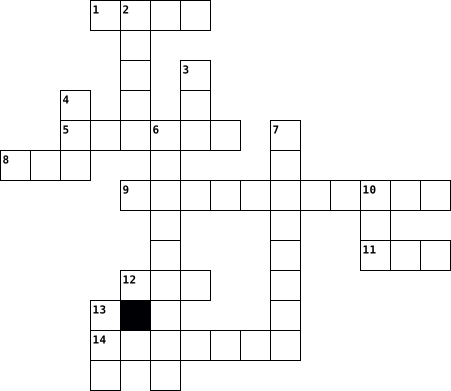
Across
- carries deoxygenated blood
- allow movement of air in the alveolar sac
- top of the lungs
- passageway connecting the respiratory bronchioles to the alveolar sacs
- pulls air into lungs
- separates the superior and inferior lobes
- separates the right middle lobe from the right upper lobe
- acts as cushioning for the lungs
- trains White blood cells/below trachea
Down
- tiny balloon shaped air sacs located at the end of the bronchioles in the lungs
- acts as the pathway from the mouth to the stomach and lungs
- connects the lungs to their supporting structures
- keeps the heart contained in the chest cavity
- transports air from larger bronchial tubes to the alveoli
- facilitate the exchange of oxygen and carbon dioxide
- basic respiratory units
- carries air from and to the lungs
- additional layer of protection
- smallest lobe of the lung
- to protect the vital organs of the chest
20 Clues: top of the lungs • pulls air into lungs • basic respiratory units • smallest lobe of the lung • carries deoxygenated blood • additional layer of protection • acts as cushioning for the lungs • carries air from and to the lungs • trains White blood cells/below trachea • to protect the vital organs of the chest • allow movement of air in the alveolar sac • ...
Lower Respiratory Anatomy - Jacob Lamarche 2025-05-18

Across
- Covers the lungs and their vessels
- Primary organ located in the left thoracic
- Located at the end of the respiratory tree
- Upper most portion of the lungs
- Separates middle lobe from superior lobe
- Transports O2 in and CO2 out
- Carries deoxygenated blood
- Covering that encloses the heart
- Wind pipe
- Small shaped gland in the upper chest
- Upper right corner of the thoracic cavity
Down
- Lines the thoracic cavity
- Divides the lung into lobes
- Branches to the bronchi
- Chest area
- Major organ that pumps blood throughout the body
- Tiny air sacs that exchanges gas
- Tiny openings in the walls of the alveoli
- Dome shaped muscle at the bottom of the lungs
- Breastbone
20 Clues: Wind pipe • Chest area • Breastbone • Branches to the bronchi • Lines the thoracic cavity • Carries deoxygenated blood • Divides the lung into lobes • Transports O2 in and CO2 out • Upper most portion of the lungs • Tiny air sacs that exchanges gas • Covering that encloses the heart • Covers the lungs and their vessels • Small shaped gland in the upper chest • ...
Anatomy of head and neck 2023-01-10

Across
- first permanent teeth
- extensive muscular attachments
- thick-fan shaped muscle
- groove-like air passages
- protect parietal lobes
- deepens the furrows
- forms upper jaw
- blink, wink or squint
- pulls down the bottom lip
- thrusts out the lower lip
- the bottom teeth
Down
- the happy muscle
- cheekbone
- shape of the cheeks
- raises the upper lip
- forms the back and base of the skull
- lowers the corners of our mouth
- puff out the cheek
- brings the teeth back together
- releases fluid which cleanses and protect
- form the head
- small, flat bone of the skull
- creating a smile
- brings lips together
- large muscle of the forehead
- middle of the skull
- upper teeth
- separates the nasal
- largest bone in the human skull
29 Clues: cheekbone • upper teeth • form the head • forms upper jaw • the happy muscle • creating a smile • the bottom teeth • puff out the cheek • shape of the cheeks • deepens the furrows • middle of the skull • separates the nasal • raises the upper lip • brings lips together • first permanent teeth • blink, wink or squint • protect parietal lobes • thick-fan shaped muscle • groove-like air passages • ...
Anatomy and Physiology Ch 07 2023-01-13

Across
- girdle composed of 2 clavicles and 2 scapulae
- a triangular structure composed of 5 fused vertebra
- type of vertebra that is the most anterior, the lightest and least massive
- largest of the tarsals
- the largest uppermost portion of the hip bone
- bone that is located on the thumb side of the forearm, extends from the wrist to the elbow
- moving a body part toward the midline
- broad triangular bones located on either side of the upper back
- type of joint made up of hyaline or fibrocartilage
- process that is the most posterior part of the sternum
- also called the collar bone
Down
- type of vertebra that 12 vertebra that is heavier and thicker than the one above it
- the bones of the fingers
- made up of the hip bones, sacrum and coccyx
- the lowest part of the vertebra column
- Heaviest and thickest type of vertebra, supports the weight of the body
- the ankle is made up of 7 bones called
- 8 small bones of the skeleton of the wrist are called
- the name of the 2nd vertebra
- the name of the very 1st vertebra
- long bone that extends from the scapula to the elbow
- type of ribs that are unattached to the sternum in any way
- bone that has a trochlear notch that articulates with the humerous
23 Clues: largest of the tarsals • the bones of the fingers • also called the collar bone • the name of the 2nd vertebra • the name of the very 1st vertebra • moving a body part toward the midline • the lowest part of the vertebra column • the ankle is made up of 7 bones called • made up of the hip bones, sacrum and coccyx • girdle composed of 2 clavicles and 2 scapulae • ...
Anatomy Ch. 6&7 Review 2024-12-11

Across
- Breaks down and reabsorbs old bone.
- The plate that is responsible for bone growth. Also known as the growth plate.
- Responsible for building new bone.
- The innermost layer of the two main layers of skin.
- Epithelial cells that secrete mucus to protect the body.
- The type of cell that releases histamine to trigger an inflammatory response.
- This type of bone marrow stores fat to produce energy.
- A fracture where the skin remains intact.
- The process of cartilage tissue turning into bone.
- Mature bone cells.
- The white, half moon shaped part at the base of the nail.
- Hair plays a role in maintaining body temperature. This is called __________.
Down
- The deepest layer of the skin. Also known as the hypodermis.
- Bones grow in width. This is called __________ growth.
- These glands secrete sweat when puberty begins
- The type of gland that keeps the skin from drying out.
- The pigment that determines skin color and provides protection by absorbing UV rays.
- The sweat gland that helps regulate body temperature.
- This type of tissue provides insulation and stores energy. It is commonly found in the hypodermis layer of the skin.
- The thin layer of connective tissue that lines the inner surface of bones. It is between compact bone and spongy bone.
- This type of bone has a porous inner structure.
- The bone type that is broad and thin. It provides protection for organs.
- The type of bone that is longer than it is wide.
23 Clues: Mature bone cells. • Responsible for building new bone. • Breaks down and reabsorbs old bone. • A fracture where the skin remains intact. • These glands secrete sweat when puberty begins • This type of bone has a porous inner structure. • The type of bone that is longer than it is wide. • The process of cartilage tissue turning into bone. • ...
Introduction to Anatomy and Physiology 2025-08-19

Across
- the quality or state of being correct (hitting a target)
- explanation of some aspect of the natural world, based on a body of facts that have been repeatedly confirmed through observation and experiment
- Data approximates or characterizes
- a supposition or proposed explanation made on the basis of limited evidence as a starting point for further investigation.
- a result, usually expressed in numbers, that you obtain by measuring something
- study of the structure and behavior of the physical and natural world through observation and experiment.
- a group of organs with coordinated activities, achieving the same general function in the body. One example is the digestive system.
- is a source of knowledge acquired by means of observation or experimentation. It is information that justifies a belief in the truth or falsity of an empirical claim.
- is a well- substantiated explanation of some aspect of the natural world that is acquired through the scientific method and repeatedly tested and confirmed through observation and experimentation.
- a part of an organism that is typically self-contained and has a specific vital function such as the heart or liver in humans
- a bacterium, virus, or other microorganism that can cause disease
Down
- a variable whose variation does not depend on that of another
- expressing a certain quantity, amount or range.
- a testing procedure, designed to eliminate biased results, in which the identity of those receiving a test treatment is concealed from both administration and subjects until after the study is completed.
- control variable, does not change.
- not consistent or having a fixed pattern
- a natural phenomenon involving the physical properties of matter and energy
- method a method of procedure that characterizes Science, consisting in systematic observation, experiment, hypothesis, analyze, collect data, etc.
- knowledge is power
- a harmless pill, medicine, or procedure prescribed more for the psychological benefit to the patient that for any physiological effect
- any of the distinct types of material of which animals or plants are made. Tissue makes up organs
- Consistent, being accurate in every attempt
22 Clues: knowledge is power • control variable, does not change. • Data approximates or characterizes • not consistent or having a fixed pattern • Consistent, being accurate in every attempt • expressing a certain quantity, amount or range. • the quality or state of being correct (hitting a target) • a variable whose variation does not depend on that of another • ...
Anatomy Above the Waist Review 2025-09-11

Across
- What is the name of the muscle highlighted in red? See figure #8
- Which muscle group works in opposition of the prime movers?
- What is the name of the larger muscle seen in figure #2?
- What type of contraction occurs when the muscle acts as a stabilizer, assisting to maintain a given body position?
- Name the abdominal muscle that the letter C is pointing to . See figure #1
- What type of contraction occurs when a muscle group provides a braking action against gravity?
- Which muscle group works as the prime mover?
- What kind of muscle is voluntary?
- Which type of contraction occurs when the muscle shortens as it contracts, in producing movement?
- What is the name of the muscle highlighted in red? See figure #4
- What is the name of the muscle highlighted in red? See figure #5
Down
- Name the abdominal muscle that the letter D is pointing to . See figure #1
- What is the name of the smaller muscle seen in figure #2?
- What is the name of the muscle highlighted in green? See figure #6
- Name the abdominal muscle that the letter A is pointing to. See figure #1
- Which type of muscle is involuntary and found in your internal organs?
- What is the name of the muscle highlighted in red? See figure #3
- Which muscle group is not directly involved in movement, but they assist the primary muscles to keep the body steady?
- Name the abdominal muscle that the letter B is pointing to . See figure #1
- What connects muscle to bone?
- Which type of muscle is involuntary and found only in the heart?
- What is the name of the muscle highlighted in red? See figure #7
22 Clues: What connects muscle to bone? • What kind of muscle is voluntary? • Which muscle group works as the prime mover? • What is the name of the larger muscle seen in figure #2? • What is the name of the smaller muscle seen in figure #2? • Which muscle group works in opposition of the prime movers? • What is the name of the muscle highlighted in red? See figure #8 • ...
living tissue and anatomy terms 2025-09-12

Across
- I'm so high!
- the aliens won this round
- glueeeeeeeeeeee
- bone to bone, not bone on bone!
- it's right behind me, isn't it?
- bendy bendy bend
- there's a lot of layers to it, really
- I got my ear pierced!
- knees over toes, knees over toes
- must be what, 6 foot 4?
Down
- hm, did it get run over by a car or?
- kinda shallow, if you ask me
- pumpin' iron
- face front, cadet!
- I'm waaaaay down in the dumps
- keepin' me safe and warm :)
- feels like a cover-up to me
- electric!
- it's time to straighten up!
- uh, no. I'm not too good with the math
20 Clues: electric! • I'm so high! • pumpin' iron • glueeeeeeeeeeee • bendy bendy bend • face front, cadet! • I got my ear pierced! • must be what, 6 foot 4? • the aliens won this round • keepin' me safe and warm :) • feels like a cover-up to me • it's time to straighten up! • kinda shallow, if you ask me • I'm waaaaay down in the dumps • bone to bone, not bone on bone! • ...
Anatomy Unit 1 Section 1 2025-09-03

Across
- prefix meaning "two"
- made from 1 glycerol and 3 fatty acids
- _____ fatty acids do not contain double bonds
- prefix meaning "one"
- molecule made up of many monomers
- lipid that is liquid at room temperature
- long, complex carbohydrate
- combining two molecules
- common carbohydrate found in plants
- biomolecule made up of amino acids
- number of water molecules created when combining four monomers
Down
- this term describes molecules containing carbon
- common element in living things that can make three bonds
- biomolecule primarily used as a quick energy source
- using water to break down molecules into smaller parts
- this is the most common element in the body; can only form 1 bond
- this type of metabolism is used to store energy
- metabolism that releases energy by breaking bonds
- lipid that contains one fatty acid chain and one alcohol chain; used to make candles
- large carbohydrate for storing energy in our bodies
- biomolecule that is used for long term energy storage
- long chain of many amino acids
22 Clues: prefix meaning "two" • prefix meaning "one" • combining two molecules • long, complex carbohydrate • long chain of many amino acids • molecule made up of many monomers • biomolecule made up of amino acids • common carbohydrate found in plants • made from 1 glycerol and 3 fatty acids • lipid that is liquid at room temperature • _____ fatty acids do not contain double bonds • ...
Anatomy Ch 7 Key Terms 2025-11-05

Across
- - Hyaline cartilage that coats the epiphysis
- - Body's framework of bones that provide support
- - Medical stich that closes wounds by holding tissue edges together
- - Synovial joint that allows movement in one plane only
- - Thin layer of compact bone on the surace
- - Allows for rotation around a single axis
- - Continuous process that involves the breakdown and rebuilding of bone tissue
- - One surface is concave and the other is convex
- - Shaft of the bone between the epiphysis
- - Joint where bones or segments connect
- - Platelike structures with broad surfaces
- - Tough covering of dense connective tissue
- - Equal lengths and widths
- - Two or more bones joined by dense connective tissue
- - Extracellular matix that surrounds osteoblasts
- - Freely movable joints
Down
- - Part of the skeleton that protects the head, neck, and trunk
- - Two or more bones connnected by cartilage
- - The expanded portion at the end of long bones
- - Variety of shapes. Most connected to several other bones
- - Immovable that connects bones with fibrous or cartilage tissue
- - Saclike cushioning structure near a joint
- - Soft, spongy tissue responsible for blood cells
- - Fluid-filled space that seperates the articulating surface of two or more bones
- - Bones in the body that are attached to the axial
- - Allows for sliding and gliding between bones
- - Slightly movable joints where bones are conected by artilage
- - Hollow space that connects the nasal cavity
- - Tightly packed tissue on the wall of the diaphysis
- - When differentiated progenitor cells enlarge and go into bone-forming cells
30 Clues: - Freely movable joints • - Equal lengths and widths • - Joint where bones or segments connect • - Shaft of the bone between the epiphysis • - Thin layer of compact bone on the surace • - Allows for rotation around a single axis • - Platelike structures with broad surfaces • - Two or more bones connnected by cartilage • - Saclike cushioning structure near a joint • ...
Lower Respiratory Anatomy- Ava Dibble 2026-04-21

Across
- Openings between alveoli that allow air to pass between sacs
- Structure forming the outer boundary of the chest cavity
- Flat bone in the center of the chest protecting vital organs
- Single air sac where gas exchange occurs
- Broad lower surface of the lung resting on the diaphragm
- Tiny air sacs where oxygen and carbon dioxide are exchanged
- Small airways in the lungs where gas exchange begins
- Layers surrounding the heart that protect and anchor it
- Space between the lungs and chest wall filled with fluid to reduce friction
Down
- Uppermost pointed portion of the lung
- Groove that separates the upper and middle lobes of the right lung
- Membrane directly covering the surface of the lungs
- Gland located behind the sternum involved in immune system development
- Tube located behind the trachea that carries food to the stomach
- Passageway that carries air from respiratory bronchioles to alveolar sacs
- Membrane lining the inside of the thoracic cavity
- Organ located between the lungs that pumps blood through the body
- Cluster of alveoli at the end of an alveolar duct
- Area where bronchi, blood vessels, and nerves enter and leave the lung
- Tube located in the neck and chest that carries air to the lungs
20 Clues: Uppermost pointed portion of the lung • Single air sac where gas exchange occurs • Membrane lining the inside of the thoracic cavity • Cluster of alveoli at the end of an alveolar duct • Membrane directly covering the surface of the lungs • Small airways in the lungs where gas exchange begins • Layers surrounding the heart that protect and anchor it • ...
Lower Respiratory Anatomy- Ella Miller 2026-04-21

Across
- with the thoracic artery part of letting the process of the lung expanding and contracting smoothly
- a sac surrounding the heart that protects the heart and keeps it stable
- outer lining in the thoracic cavity produces fluid to reduce friction during respiration
- is from the right ventricle that transports deoxygenated blood from heart to lungs
- located in the right lung needed for the movement of the lung lobes
- between the superior and inferior lungs it is to produce good gas exchange
- a tube between larynx and lungs that transports air
- hollow tube behind windpipe transports food and liquid from throat to stomach
- small gland in upper chest responsible for the development of the T-cells
- in the left thoracic cavity brings oxygen into bloodstream and removes carbon dioxide
Down
- base of the left lung need for gas exchange
- within the lungs primary site for gas exchange
- between the lungs pumps blood through the blood and carries oxygen and nutrients and removes waste
- between the parietal and visceral pleura that prevent the lungs from rubbing against the chest
- between neck and abdomen that protects vital organs
- tubes deep in the lung that helps with gas exchange
- beneath the lungs and the primary muscle for respiration
- located in the right thoracic cavity plays a role in respiratory and gas exchange
- lays on the diaphragm and forms the foundation of the lung for expansion
- a flat bone in the center of the chest that protects the thoracic organs and supports breathing
20 Clues: base of the left lung need for gas exchange • within the lungs primary site for gas exchange • between neck and abdomen that protects vital organs • tubes deep in the lung that helps with gas exchange • a tube between larynx and lungs that transports air • beneath the lungs and the primary muscle for respiration • ...
lower respiratory anatomy Olivia Baird 2026-04-21

Across
- Space containing fat, thymus, Front part of mediastinum (between lungs)
- Pumps blood through body, Center of chest, slightly left
- Protects heart and lungs; rib attachment, Front center of chest
- Passage for bronchi, blood vessels, nerves, Medial side of each lung
- Gas exchange, Right side of chest, above diaphragm
- Moves food to stomach, Behind trachea
- Rests on diaphragm; helps lung expand during breathing, Bottom of each lung
Down
- Carries deoxygenated blood to left lung, From pulmonary trunk to left lung
- Covers lungs; reduces friction, Directly on lung surface
- Protect and reduce friction for the heart, Surrounding the heart
- Gas exchange, Left side of chest, slightly smaller due to heart
- Carries oxygenated blood to heart, From left lung to left atrium
- Carries air into the left lung, Branches from trachea into left lung
- Main muscle for breathing, Below lungs, separates chest and abdomen
- Lines chest wall, Inner surface of thoracic cavity
- Protects organs; aids breathing, Chest wall
- Carries deoxygenated blood from heart to lungs, Exits right ventricle, splits into pulmonary arteries
- Conducts air to and from lungs, Midline of neck into upper chest
- Immune system development, Behind sternum, in anterior mediastinum
- Fluid space to reduce friction during breathing, Between visceral and parietal pleura
20 Clues: Moves food to stomach, Behind trachea • Protects organs; aids breathing, Chest wall • Lines chest wall, Inner surface of thoracic cavity • Gas exchange, Right side of chest, above diaphragm • Covers lungs; reduces friction, Directly on lung surface • Pumps blood through body, Center of chest, slightly left • ...
Lower Respiratory Anatomy- Maeve Cronen 2026-04-22

Across
- at the base of thoracic cavity
- pumps blood through circulatory system
- in the left hemithorax
- gateway for air, blood, lymph, and nerves
- the main airway
- forms the front of the rib cage
- contains remnants of thymus gland
- plays a crucial role in gas exchange during respiration
- transports deoxygenated blood from the right ventricle of the heart to the lungs
Down
- separates right upper lobe from right middle lobe
- connects respiratory bronchioles to alveolar sacs.
- surrounding the heart and the roots of the major blood vessels.
- in the right side of the thoracic cavity
- plays a crucial role in gas exchange
- wall
- produces and matures T cells
- encloses and protects the lungs
- works alongside parietal pleura
- center of the chest behind the trachea
- primary site for gas exchange
20 Clues: wall • the main airway • in the left hemithorax • produces and matures T cells • primary site for gas exchange • at the base of thoracic cavity • forms the front of the rib cage • encloses and protects the lungs • works alongside parietal pleura • contains remnants of thymus gland • plays a crucial role in gas exchange • pumps blood through circulatory system • ...
Lower Respiratory Anatomy Sofia Jones 2026-04-23

Across
- facilitates oxygen intake and carbon dioxide removal, left side of the body
- O2 and CO2 between air and bloodstream, within lung branches
- anchors heart in place, surrounds heart
- transport food and liquids to stomach, between lungs
- respiration and protection of vital organs, surrounds lungs and heart
- movement of air through alveoli
- encloses and protects lungs, outside of lungs
- secretes hormones, for immunity, upper chest
- lower neck, transports air to and from lungs
- O2 intake and CO2 removal, left side of body
Down
- expands and contracts ribcage, side of lungs
- air to respiratory bronchioles, on branches of alveoli
- protects chest organs, in front of heart
- connects respiratory bronchioles to alveolar sacs, inside of lungs
- deoxygenated blood to left lung, in left lung
- drives inhalation, below both lungs
- pleural fluid, surrounds lungs
- smooth lung expansion, side of lungs
- separates lung lobes, bottom of lungs
- oxygenated blood to left atrium, in left lung
20 Clues: pleural fluid, surrounds lungs • movement of air through alveoli • drives inhalation, below both lungs • smooth lung expansion, side of lungs • separates lung lobes, bottom of lungs • anchors heart in place, surrounds heart • protects chest organs, in front of heart • expands and contracts ribcage, side of lungs • secretes hormones, for immunity, upper chest • ...
Integumentary System Conditions, Lesions, Anatomy 2026-04-30

Across
- Elevated lesion filled with pus
- Discoloration from bleeding under skin; larger than petechiae
- Parasitic infestation caused by burrowing mites
- glands Structures that regulate body temperature via sweat
- Tissue that covers surfaces and lines cavities
- Flat lesion with color change but no elevation
- Structure specialized to produce and release substances
- Vascular cancer linked to immune suppression (HIV/AIDS)
- Highly contagious superficial bacterial infection, common in children
- Deepest epidermal layer where mitosis actively occurs
- Loss of pigment due to melanocyte destruction
- Purple discoloration from bleeding under skin, larger than petechiae
- cell carcinoma Malignancy of flat epithelial cells in epidermis
- Skin layer containing blood vessels, nerves, and glands
- Pigment responsible for skin, hair, and eye color
- Pinpoint hemorrhage under skin, does not blanch
- Benign skin lesion commonly called a mole
- Linear crack in skin extending into dermis
- Hardened keratin plates protecting distal digits
- Exocrine glands that secrete oil into hair follicles
- Dead epidermal tissue at base of nail plate
- Tissue damage caused by heat, chemicals, electricity, or radiation
- Benign growth caused by human papillomavirus
- Closed sac containing fluid, pus, or semi-solid material
- Epidermal cells that produce melanin
- Autoimmune disorder causing thick, scaly plaques
- Allergic reaction producing raised, itchy welts
- Autoimmune disease causing fibrosis and skin tightening
- Outer layer composed of stratified squamous epithelium
- Solid lesion larger and deeper than a papule
- Protein that gives skin strength and prevents sagging
Down
- Genetic absence of melanin despite normal melanocyte count
- Deep layer composed mainly of adipose tissue
- Enlarged, twisted veins due to valve failure
- Excessive scar tissue growing beyond wound boundaries
- Multiple layers of flat cells for protection
- Chronic inflammatory condition with itching and redness
- Necrosis due to loss of blood supply, often infection-related
- Partial or complete loss of hair from scalp or body
- Small raised lesion without fluid
- Bluish discoloration caused by low blood oxygen levels
- Cells specialized for storing fat (adipocytes)
- Mature scar tissue left after wound healing
- Tough fibrous protein found in hair, skin, and nails
- Abnormal tissue growth projecting from a mucous membrane
- Oily substance that lubricates skin and hair
- Inflammation of clogged sebaceous follicles, not just “dirty skin”
- Temporary raised area from allergic response
- Open lesion with tissue loss and slow healing
- Smooth muscle that contracts to produce goosebumps
- Visible pale crescent at proximal nail
- Small fluid-filled blister less than 1 cm
- Organic fats used for energy storage and insulation
- Dermatophyte infection commonly called ringworm
54 Clues: Elevated lesion filled with pus • Small raised lesion without fluid • Epidermal cells that produce melanin • Visible pale crescent at proximal nail • Benign skin lesion commonly called a mole • Small fluid-filled blister less than 1 cm • Linear crack in skin extending into dermis • Mature scar tissue left after wound healing • Dead epidermal tissue at base of nail plate • ...
Lower Respiratory Anatomy- Pierce Lewis 2026-04-28

Across
- Pumps blood (Middle mediastinum)
- Main breathing muscle (Base of thorax)
- Protects heart/anchors ribs (center of chest)
- Protective enclosure (Ribs and muscles)
- Fluid filled friction reducer (Between pleural layers)
- Tiny air sacs (Functional lung unit)
- Food tube (Posterior to trachea)
- Lines the chest cavity (inner thoracic wall)
- Gas exchange organ (left thoracic cavity)
- Individual site of gas exchange (Functional unit of lung)
Down
- Start of gas exchange (Distal to terminal bronchioles)
- T-cell maturation site (superior to heart)
- Divides right upper/middle lobes (Right lung only)
- Protective heart sac (surrounding the heart)
- Carries deoxygenated blood (enters left lung)
- Air channel
- Connects bronchioles to sac (Deep lung tissue)
- Cluster of gas exchange chambers (end of alveolar ducts)
- Routes blood to lungs (Exits right ventricle)
- Superior tip of lung (Deep to clavicle)
20 Clues: Air channel • Pumps blood (Middle mediastinum) • Food tube (Posterior to trachea) • Tiny air sacs (Functional lung unit) • Main breathing muscle (Base of thorax) • Protective enclosure (Ribs and muscles) • Superior tip of lung (Deep to clavicle) • Gas exchange organ (left thoracic cavity) • T-cell maturation site (superior to heart) • ...
Intro Human Anatomy & Physiology 1 2026-05-20

Across
- A stage in cell division.
- A layer that functions in the absorption, excretion, secretion, and protection.
- Areolar tissue with an abundance of fat cells.
- Loose connective tissue that binds the skin to the underlying tissues.
- Bands of fibrous tissue that connect bones to bones.
- Two or more different tissues that combine to accomplish a definite function.
- Initiates, controls, and coordinates the body’s adaptation to its surroundings.
- Specific arrangements of atoms.
- A system is several organs working together to perform a bodily function.
- Found between the vertebrae and in the pubic symphysis.
- Subatomic particles of which all substances are composed.
- The process of cell division where a cell divides into two identical cells.
- The membrane covering cartilage.
- Epithelial membranes that secrete a thick, sticky substance
Down
- Line body cavities and sometimes the outer layer of organs.
- Found in the nose, trachea, and on the articulating ends of bones
- Responsible for pumping blood through the heart into the blood vessels.
- The repeated division of the ovum during early developmental stages
- A fibrous network that is continuous throughout the body.
- Proteins that act as catalysts for chemical reactions in metabolism
- A stage in cell division.
- composed of fibers that form the start of the liver and lymphoid organs.
- Muscles that can be controlled by conscious effort
- An organelle that contains the chromosomes that transmit heredity
- Collections of similar cells that carry out specific bodily functions.
25 Clues: A stage in cell division. • A stage in cell division. • Specific arrangements of atoms. • The membrane covering cartilage. • Areolar tissue with an abundance of fat cells. • Muscles that can be controlled by conscious effort • Bands of fibrous tissue that connect bones to bones. • Found between the vertebrae and in the pubic symphysis. • ...
English study guide 2022-02-09

Across
- The system that circulates oxygen through the body
- The blood vessel that brings blood back to the heart
- The blood vessel that brings blood away from the heart
Down
- The tissue that helps part of your body move
- The science of the bodily structure of organisms
5 Clues: The tissue that helps part of your body move • The science of the bodily structure of organisms • The system that circulates oxygen through the body • The blood vessel that brings blood back to the heart • The blood vessel that brings blood away from the heart
Anatomy of Motor System 2022-09-30

Across
- part of spinal cord that is mostly sensory
- increased muscle tone
- damage to this results in muscle atrophy/low muscle tone, decreased reflexes
- cranial nerves
- what reflex reemerged in adulthood with upper motor neuron damage?
- nerve located entirely within the CNS
- the more direct motor system
- connections between brain and spine
- damage to this results in increased reflexes, increased muscle tone
Down
- the state of balanced muscle tension that makes normal posture, coordination, and movement possible
- how many neurons in each pathway in the pyramidal system
- how many descending pathways
- part of spinal cord that is mostly motor
- another name forcorticobulbar
- A motor system that includes the basal ganglia and some closely related brainstem structures. Axons of this system pass into the spinal cord outside the pyramids of the medulla.
15 Clues: cranial nerves • increased muscle tone • how many descending pathways • the more direct motor system • another name forcorticobulbar • connections between brain and spine • nerve located entirely within the CNS • part of spinal cord that is mostly motor • part of spinal cord that is mostly sensory • how many neurons in each pathway in the pyramidal system • ...
Holiday Anatomy Crossword Puzzle 2022-12-22

Across
- Where carb digestion begins
- the organ that produces digestive enzymes for the duodenum
- Narrowing of a heart valve
- The mineral found in red blood cells that binds to and transports oxygen in the blood
- Where protein digestion begins
- the artery that supplies oxygenated blood to the heart
- a condition when the lens are cloudy
- the artery that goes through the neck to the brain
- the term for oxygen deprivation
Down
- the diagnosis given when there is plaque buildup in an artery
- Process of breaking large pieces of fat into fat droplets
- Another term for the voicebox
- waves of muscle contraction in the esophagus
- the lobe in the brain that contains the visual cortex
14 Clues: Narrowing of a heart valve • Where carb digestion begins • Another term for the voicebox • Where protein digestion begins • the term for oxygen deprivation • a condition when the lens are cloudy • waves of muscle contraction in the esophagus • the artery that goes through the neck to the brain • the lobe in the brain that contains the visual cortex • ...
Anatomy Of A Computer 2017-02-10
Across
- Activates when you turn on the computer
- To transport something from a computer to another device
- Used to store information
- A large printed circuit board
- Peripheral Component Interconnect
- Power Supply Unit
- Storing data in the computer
Down
- Entering data into the computer
- The brain that carries out the computers instructions
- Read only memory
- A chip in the brain of the computer
- Used to connect many different types of Peripherals
- Accelerated Graphics Port
- Drags data from a computer
14 Clues: Read only memory • Power Supply Unit • Used to store information • Accelerated Graphics Port • Drags data from a computer • Storing data in the computer • A large printed circuit board • Entering data into the computer • Peripheral Component Interconnect • A chip in the brain of the computer • Activates when you turn on the computer • ...
Vet Med Anatomy Vocabulary 2021-09-16

Across
- plane; close to the surface
- plane; divides body into the belly and back
- back side of something
- relating or near the skull/head
- farther from the center or specific area
- relating to the back
Down
- plane; divides body into equal L/R parts
- relating or near the tail
- front side of something
- plane; far from the surface of something
- nearer to the center of body or structure
- plane; divides body into unequal L/R parts
- relating to the belly
- plane; divides body in cranial/caudal parts
14 Clues: relating to the back • relating to the belly • back side of something • front side of something • relating or near the tail • plane; close to the surface • relating or near the skull/head • plane; divides body into equal L/R parts • plane; far from the surface of something • farther from the center or specific area • nearer to the center of body or structure • ...
Anatomy of a computer 2021-09-16

Across
- sound quality
- ports transfer data
- communicate quickly
- connects the mouse or keyboard
- super-fast and temporary
- the brain that carries out your
- much slower than new USB
- connect an old device
Down
- processor communicate with the PC’s
- houses your graphics
- the processor
- transfer data
- funnels power through the multicolored
- directs data traffic
14 Clues: sound quality • the processor • transfer data • ports transfer data • communicate quickly • houses your graphics • directs data traffic • connect an old device • super-fast and temporary • much slower than new USB • connects the mouse or keyboard • the brain that carries out your • processor communicate with the PC’s • funnels power through the multicolored
Anatomy Of A Computer 2021-09-10

Across
- ports transfer data as fast as 400Mbps
- a device which can be slotted into a computer to allow the use of audio components for multimedia applications.
- This houses your graphics card, which supplies the image to the monitor.
- - The main component of a computer
- a connector for a device that sends or receives several bits of data simultaneously by using more than one wire.
Down
- The brain of the computer that carries out your computer's instructions
- serial communication interface through which information transfers in or out sequentially one bit at a time.
- the processor.
- This funnels power through the multi colored cables (many cables have more than one connector) to each device.
- - holds temporary information
- A hardware interface that supports up to 127 peripherals.
- - slots let peripherals communicate quickly
- - a set of computer instructions in firmware which control input and output operations.
- Manufacturers generally color the keyboard port purple and the mouse port green.
14 Clues: the processor. • - holds temporary information • - The main component of a computer • ports transfer data as fast as 400Mbps • - slots let peripherals communicate quickly • A hardware interface that supports up to 127 peripherals. • The brain of the computer that carries out your computer's instructions • ...
Anatomy of a Volcano 2023-02-12

Across
- It is a layer of gas surrounding the Earth
- To hit with force when moving
- To reroute or change course
- To come from or begin in a particular place or situation
- antonym for nutrients
- synonym for originate
- To spurt or gush out
Down
- synonym for collide
- antonym for spewed
- A place of shelter or safety
- antonym for atmosphere
- Substance needed for healthy growth
- synonym for refuge
- antonym for divert
14 Clues: antonym for spewed • synonym for refuge • antonym for divert • synonym for collide • To spurt or gush out • antonym for nutrients • synonym for originate • antonym for atmosphere • To reroute or change course • A place of shelter or safety • To hit with force when moving • Substance needed for healthy growth • It is a layer of gas surrounding the Earth • ...
Anatomy of the BRAIN 2012-11-13

Across
- Where the two optic nerves cross in the brain
- Lobe of the brain responsible for emotions
- Lobe of the brain responsible for interpreting vision
- The neuron responsible for sending messages to the brain
- Part of the brain responsible for autonomic functions like breathing
- The colorful structure on the back of the eye that absorbs light
- The name for a single nerve cell
- The neuron responsible for muscle movement
Down
- The clear covering over the front of the eye
- The part of the eye that gives it color
- Lobe of the brain likely injured in someone who cannot hear
- Part of the brain responsible for balance and coordination
- The opening the eye that lets light through
- Lobe of the brain responsible for feeling pain
14 Clues: The name for a single nerve cell • The part of the eye that gives it color • Lobe of the brain responsible for emotions • The neuron responsible for muscle movement • The opening the eye that lets light through • The clear covering over the front of the eye • Where the two optic nerves cross in the brain • Lobe of the brain responsible for feeling pain • ...
Anatomy 3 and 4 2024-11-18

Across
- the area of the brain through which the two sides communicate
- breastbone
- the kneecap
- a hollow cavity in an organ
- naval or belly button
- the cavity behind the nose and the mouth
- below the ribs
Down
- ankle support system composed mainly of collagen and calcium phosphate
- under the skin
- below the external layer of the meninges
- the nerve carrying visual information from the eye to the brain
- below the lower jaw
- the largest vein in the body
- the duct carrying urine from a kidney to the bladder
14 Clues: breastbone • the kneecap • under the skin • below the ribs • below the lower jaw • naval or belly button • a hollow cavity in an organ • the largest vein in the body • below the external layer of the meninges • the cavity behind the nose and the mouth • the duct carrying urine from a kidney to the bladder • the area of the brain through which the two sides communicate • ...
Chapter 11 Anatomy words 2025-02-07

Across
- pull water into the blood and aid in oxygen transport
- recognise antigens on foreign substances and produces antibodies to fight them
- percent attributed to RBC
- red pigment in erythrocytes (contain iron)
- white blood cells
- unspecialized cells that divide into more specific cells
- transport fat-soluble vitamins, ions, lipids
- blood clotting
Down
- platelets
- release histamin (allergic reactions)
- help clot blood
- process that makes blood
- red blood cells
- organic compounds are dissolved in it
14 Clues: platelets • blood clotting • help clot blood • red blood cells • white blood cells • process that makes blood • percent attributed to RBC • release histamin (allergic reactions) • organic compounds are dissolved in it • red pigment in erythrocytes (contain iron) • transport fat-soluble vitamins, ions, lipids • pull water into the blood and aid in oxygen transport • ...
Plant Physiology and Anatomy 2024-09-06

Across
- large, thin-walled, large central vacuole (when matured)
- the stem segments between nodes
- often stores organic nutrients
- found in shoots, consists of outgrowths
- help the pea plant clings to a support
- containing cells that can divide, leading to new cells, later elongate and differentiate
- long, thin cells with tapered ends
Down
- red parts of the poinsettia are often mistaken for petals but are actually modified leaves
- consists of the cork cambium plus the layers of cork cells it produces
- continuum of cytoplasm connected by plasmodesmata
- specialized root structure that grow out from the water surface
- die after cell wall is fully formed
- provide mechanical support for plants
- boxier, irregular shape, thick lignified secondary cell walls
14 Clues: often stores organic nutrients • the stem segments between nodes • long, thin cells with tapered ends • die after cell wall is fully formed • provide mechanical support for plants • help the pea plant clings to a support • found in shoots, consists of outgrowths • continuum of cytoplasm connected by plasmodesmata • large, thin-walled, large central vacuole (when matured) • ...
Lathe Anatomy Test - Mandy 2026-03-30

Across
- used in woodturning
- supports the tool rest
- Prevents moving or shifting
- acts as a supporting center
- Controls the feeding of drills, reamers, or centers to support workpiece
- spins
- a lever or screw, used to secure the tool rest
Down
- connects the motor's power to the workpiece
- used to immobilize the spindle
- main foundation and structural base
- contains the motor-driven spindle
- Rotates the workpiece at a controlled speed
- allows stable positioning for cutting
- used for spindle turning
14 Clues: spins • used in woodturning • supports the tool rest • used for spindle turning • Prevents moving or shifting • acts as a supporting center • used to immobilize the spindle • contains the motor-driven spindle • main foundation and structural base • allows stable positioning for cutting • connects the motor's power to the workpiece • Rotates the workpiece at a controlled speed • ...
Renaissance Art Intro. 2023-03-06

Across
- Making paintings look 3D
- Making pictures look realistic
Down
- Paintings on a wall of wet plaster.
- The study of the structure of humans, animals and plants
4 Clues: Making paintings look 3D • Making pictures look realistic • Paintings on a wall of wet plaster. • The study of the structure of humans, animals and plants
Renaissance crossword puzzle 2020-10-09

Across
- some reffered to god as this
- Renaissance political philosopher
- the thery that earth is in the middle of the universe
- the action of cutting up a body or plant to study its internal parts.
- the early period of the time period we are investigating
Down
- the theory that the sun is in the middle of the universe
- the branch of science concerned with the bodily structure of humans, animals, and other living organisms, especially as revealed by dissection and the separation of parts.
- the late period of the time period we are investigating
- this law was invented by isaac newton
- a set of principles underlying the work of a particular artist or artistic movement.
10 Clues: some reffered to god as this • Renaissance political philosopher • this law was invented by isaac newton • the thery that earth is in the middle of the universe • the late period of the time period we are investigating • the theory that the sun is in the middle of the universe • the early period of the time period we are investigating • ...
Castillo, Luz period 4 game two 2023-09-18

Across
- allows bones to make a sliding motion either back and forth or side to side.
- bones can move about one another in many directions but cannot rotate.
- when one bone has a rounded end that fits into a concave cavity of another bone.
- The two bones both concave and convex regions with shapes of 2 bones complementing each other.
- immovable.
- a thin layer of dense connective tissue connecting the bones of the skull.
Down
- Allows only extension and flexion due to its anatomy.
- a joint in which bones are connected by ligaments.
- joints where a conical process fits into a socket and is held in place by ligaments.
- joints and bones are connected by hyaline or fibro-cartilage.
10 Clues: immovable. • a joint in which bones are connected by ligaments. • Allows only extension and flexion due to its anatomy. • joints and bones are connected by hyaline or fibro-cartilage. • bones can move about one another in many directions but cannot rotate. • a thin layer of dense connective tissue connecting the bones of the skull. • ...
Blue Group Crossword 2022-05-13

Across
- the study of living organisms, divided into many specialized fields that cover their morphology, physiology, anatomy, behaviour, origin, and distribution.
- the quality of being unwilling to work or use energy.
- the scientific study of the behaviour, structure, physiology, classification, and distribution of animals.
- the state of containing nothing.
- the state or quality of being arranged neatly and in order.
- the state or quality of being nasty.
- the science which deals with the physical structure and substance of the earth, their history, and the processes which act on them.
Down
- lack of common sense or judgement.
- the quality of having great weight.
- the branch of biology that deals with the normal functions of living organisms and their parts.
10 Clues: the state of containing nothing. • lack of common sense or judgement. • the quality of having great weight. • the state or quality of being nasty. • the quality of being unwilling to work or use energy. • the state or quality of being arranged neatly and in order. • the branch of biology that deals with the normal functions of living organisms and their parts. • ...
science 2021-04-26

Across
- study of the structure of living things
- study of matter and its reactions
Down
- first part of a lab report
- your favourite teacher's last name
4 Clues: first part of a lab report • study of matter and its reactions • your favourite teacher's last name • study of the structure of living things
Unit 1: Intro to Anatomy 2013-09-12

Across
- The study of life
- Further from the midline
- tissue Tissue that transmits signals in the body in response to changes in the environment
- tissue groups of cells that hold together and support other tissues and cushion, insulate, and connect organs
- A lot of muscle activity
- The gel-like substance enclosed within the cell membrane
- Means the same as caudal
- Near the midline of the body
- Something that can not be cut
- To the tail end or towards the feet
- When the body temperature is way under the normal temperature
- A skeletal structure inside the body
- The study of an organism's structure
- A scientist that studies living organisms
- Bell of an organism
- End of a structure nearest a major point of reference
Down
- feedback responses are not homeostatic and rare in healthy individuals
- The study of the structure of cells, tissues, and organs
- Means the same as posterior
- This word means distant
- The study of the heart
- The state of equilibrium in the body
- The study of functions or processes in an organism
- A skeletal structure outside the body
- The cutting of the nerve tracts in the frontal lobes of the brain
- Means the same as ventral
- tissue One of the four primary tissue types, responsible for contracting muscles
- One of the four primary tissue types and is responsible for lining structures
- Basic unit of living matter
- The formation of tissues
- The back of a organism
- The head or towards the head
- feedback type of regulation that responds to a change in conditions (creates a response)
- Means the same as cranial
34 Clues: The study of life • Bell of an organism • The study of the heart • The back of a organism • This word means distant • Further from the midline • A lot of muscle activity • Means the same as caudal • The formation of tissues • Means the same as ventral • Means the same as cranial • Means the same as posterior • Basic unit of living matter • Near the midline of the body • ...
Anatomy Physiology Lecture: Preliminary Topics 2015-03-17

Across
- Blunt, rounded point of the heart
- Time between the application of a stimulus and the beginning of contraction
- Longer than they are wide
- Makes up 58% of plasma proteins
- Another word for central canal
- Portion covering the heart
- Principle organ of respiration
- Abnormal lateral curvature of the spine
- Cell membrane of the muscle fiber
- When the tips of the thumb and little finger are brought toward each
Down
- The artery the left ventricle pumps into
- Liquid matrix of blood
- Total of all chemical reactions that occur in the body
- Tough, ropelike protein
- A muscle that accomplishes a certain movement, such as flexion
- Yellowish coloring to skin
- Abnormal heart sounds
- Process of moving air into and out lungs
- Another name for WBC
- External openings of the nose
20 Clues: Another name for WBC • Abnormal heart sounds • Liquid matrix of blood • Tough, ropelike protein • Longer than they are wide • Yellowish coloring to skin • Portion covering the heart • External openings of the nose • Another word for central canal • Principle organ of respiration • Makes up 58% of plasma proteins • Blunt, rounded point of the heart • Cell membrane of the muscle fiber • ...
Anatomy & Physiology Chpt. 1&2 2016-01-28

Across
- Storage organ that helps in the digestion of fat and helps to make bile more concentrated to increase its effect on fat cells
- Scale that measures how acidic or basic a substance is
- The body ability to detect and respond to changes
- The nose is _____ to the mouth
- elements that make up about 0.4% of the chemicals in our body
- Instrument used to visually examine the body organs or cavities
- A type of energy needed to break chemical bonds in the reactant molecules so a reaction can start
- Organs inside the major cavities of the trunk
- System that has the components of a brain and spinal cord
Down
- Formed by combining various amino acids
- Study of functional changes associated with disease and aging
- The number of protons in the nucleus of an atom is an atom's ______ number
- Plane that divides the body or organ into superior and inferior portions.
- Fluid within cells
- The sum of all chemical processes that occur in the body
- Serious membrane of the abdominal cavity
- Any abnormality of structure or function
- When the examiner feels the surface of the body with the hand
- An organ that is located behind the stomach
- Disrupts homeostasis by increasing or decreasing a controlled variable
20 Clues: Fluid within cells • The nose is _____ to the mouth • Formed by combining various amino acids • Serious membrane of the abdominal cavity • Any abnormality of structure or function • An organ that is located behind the stomach • Organs inside the major cavities of the trunk • The body ability to detect and respond to changes • ...
Anatomy & Physiology Chpt. 1&2 2016-01-28

Across
- Formed by combining various amino acids(pg.48)
- The nose is _____ to the mouth.(pg.14)
- Serious membrane of the abdominal cavity (pg.19)
- Study of functional changes associated with disease and aging (pg.2)
- An organ that is located behind the stomach (pg.3)
- Disrupts homeostasis by increasing or decreasing a controlled variable (pg.9)
- The sum of all chemical processes that occur in the body (pg.5)
- Storage organ that helps in the digestion of fat and helps to make bile more concentrated to increase its effect on fat cells(pg.19)
- Plane that divides the body or organ into superior and inferior portions (pg.16)
- Organs inside the major cavities of the trunk are called (pg.19)
Down
- Instrument used to visually examine the body organs or cavities (pg.23)
- The body ability to detect and respond to changes.(pg.7)
- Scale that measures how acidic or basic a substance is (pg.40)
- Fluid within cells (pg.8)
- When the examiner feels the surface of the body with the hand (pg.5)
- Any abnormality of structure or function (pg.12)
- The number of protons in the nucleus of an atom is an atom's ______ number.(pg.29)
- A type of energy needed to break chemical bonds in the reactant molecules so a reaction can start.(pg.36)
- System that has the components of a brain and spinal cord (pg.5)
- Elements that make up about 0.4% of the chemicals in our body(Pg.29)
20 Clues: Fluid within cells (pg.8) • The nose is _____ to the mouth.(pg.14) • Formed by combining various amino acids(pg.48) • Serious membrane of the abdominal cavity (pg.19) • Any abnormality of structure or function (pg.12) • An organ that is located behind the stomach (pg.3) • The body ability to detect and respond to changes.(pg.7) • ...
Anatomy & Physiology Chpt. 1&2 2016-01-28

Across
- The number of protons in the nucleus of an atom is an atom's ______ number.(pg.29)
- Scale that measures how acidic or basic a substance is (pg.40)
- Fluid within cells (pg.8)
- Formed by combining various amino acids(pg.48)
- The nose is _____ to the mouth.(pg.14)
- Instrument used to visually examine the body organs or cavities (pg.23)
- Study of functional changes associated with disease and aging (pg.2)
- System that has the components of a brain and spinal cord (pg.5)
- Disrupts homeostasis by increasing or decreasing a controlled variable (pg.9)
Down
- When the examiner feels the surface of the body with the hand (pg.5)
- Organs inside the major cavities of the trunk are called (pg.19)
- Plane that divides the body or organ into superior and inferior portions (pg.16)
- Storage organ that helps in the digestion of fat and helps to make bile more concentrated to increase its effect on fat cells(pg.19)
- The body ability to detect and respond to changes.(pg.7)
- Elements that make up about 0.4% of the chemicals in our body(Pg.29)
- A type of energy needed to break chemical bonds in the reactant molecules so a reaction can start.(pg.36)
- Any abnormality of structure or function (pg.12)
- Serious membrane of the abdominal cavity (pg.19)
- An organ that is located behind the stomach (pg.3)
- The sum of all chemical processes that occur in the body (pg.5)
20 Clues: Fluid within cells (pg.8) • The nose is _____ to the mouth.(pg.14) • Formed by combining various amino acids(pg.48) • Any abnormality of structure or function (pg.12) • Serious membrane of the abdominal cavity (pg.19) • An organ that is located behind the stomach (pg.3) • The body ability to detect and respond to changes.(pg.7) • ...
Anatomy Lecture 5 Crossword Review 2016-08-31

Across
- This thin delicate membrane is tightly bound to the surface of the brain
- This type of ACH receptor is found in heart tissue
- This preganglionic neurons originate from T1-L2
- The preganglionic neurons exit the spinal cord via the_______root
- Which type of autonomic ganglia form the 'sympathetic chain'?
- Normal space found surrounding spinal cord only
- The cerebral ________ connects the third and fourth ventricles
- This ramus is how preganglionic neurons enter the paravertebral ganglia
- What affect does the parasympathetic system have on pupils of the eye?
- This glial cell is responsible for producing CSF
- A fluid filled cavity inside the cranium
- These nerves carry parasympathetic fibers
Down
- This layer of dura mater folds inward to form the falx cerebri
- This ligament is part of the pia mater that anchors the spinal cord
- CSF flow inside the brain is described as:
- This normal space can be found surrounding brain and spinal cord
- These preganglionic nerves travel as part of a nerve plexus to innervate the abdomen
- This opening allows CSF to flow into the subarachnoid space
- This symptom is a result of fracture to the cranium
- Name one of the pre-vertebral ganglia?
20 Clues: Name one of the pre-vertebral ganglia? • A fluid filled cavity inside the cranium • These nerves carry parasympathetic fibers • CSF flow inside the brain is described as: • This preganglionic neurons originate from T1-L2 • Normal space found surrounding spinal cord only • This glial cell is responsible for producing CSF • ...
Vocal Anatomy Crossword of Awesome! 2018-02-27

Across
- / Breathing Tube of joy.
- / The flappy flap that stops you from the choky choke.
- / the primary resonator for vocal sounds. Vowels tend to be most closely associated with this space. It is defined as the Pharyngeal space behind the mouth from the Epiglottis to the Soft Palate. It exists mostly behind the Tongue and is defined almost completely by soft tissue.
- / Activated when pressing your hand against the front of your head or the back of your head.
- / Two small, elongated pieces of yellow elastic cartilage, placed one on either side, in the aryepiglottic fold.
- / The vocal chords place of residence.
- / Used for intense singing or phonation, belting especially, this is activated by mimicking holding suitcases, holding melons under your arms, or putting on a swim cap.
- / provide attachments for the cricothyroid muscle, posterior cricoarytenoid muscle and lateral cricoarytenoid muscle muscles, cartilages, and ligaments involved in opening and closing the airway and in speech production.
- / This breath is used for low air pressure, classical, and operatic sounds.
- / Flaring the nostrils to engage muscles behind the soft palate to aid in high larynx, head voice, singing.
- / The first space that the Larynx opens into Resonator behind the larynx and can be changed with the lifting and lowering of the larynx.
- / an apparatus that increases the resonance of a sound, especially a hollow part of a musical instrument.
- / This breath is used for high air pressure belt, pop, and rock sounds.
Down
- / provides attachment to the muscles of the floor of the mouth and the tongue above, the larynx below, and the epiglottis and pharynx behind.
- / When your larynx lowers, your vocal chords get ______________.
- / They Allow the vocal folds to be tensed, relaxed, or approximated. They articulate with the supero-lateral parts of the cricoid cartilage lamina, forming the cricoarytenoid joints at which they can come together, move apart, tilt anteriorly or posteriorly, and rotate.
- / the highest part of the Pharynx. It exists above the mouth and behind the nose. It is the largest open space of the three Pharyngeal areas and is the most fixed. This means it is unable to close, making it an ideal resonator. The Eustachian tubes open into it, making it the path connecting our vocal sound to the ear internally. This area is referred to as the “ng” resonator from the sensation of resonance that results from the “ng” vocal sound found in words with that spelling, like “sing” and “hung”. It is also referred to as the Head Resonator.
- / We do this breath everyday all the time.
- / the upper pair, each of which encloses a vestibular ligament, extends from one side of the thyroid cartilage in front to the arytenoid cartilage on the same side of the larynx in back, and is not directly concerned with speech production.
- / How much of a certain technique is needed.
- / On these, the edges of can be made to tense and relax by the passage of air from the lungs, thus producing vocal sound.
- / When You're larynx rises, your vocal chords get _____________.
- / The part of the larynx consisting of the vocal cords and the slitlike opening between them. It affects voice modulation through expansion or contraction.
- / A fancy name for the throat and your main source of vocal resonation.
24 Clues: / Breathing Tube of joy. • / The vocal chords place of residence. • / We do this breath everyday all the time. • / How much of a certain technique is needed. • / The flappy flap that stops you from the choky choke. • / When your larynx lowers, your vocal chords get ______________. • / When You're larynx rises, your vocal chords get _____________. • ...
INTRODUCTION OF ANATOMY AND PHYSIOLOGY 2019-12-11

Across
- POSITIVE FEEDBACK SYSTEMS IS PUSH THE VARIABLE ____ FROM ITS ORIGINAL VALUES.
- WHAT TYPE OF FEEDBACK SYSTEMS ARE IMPORTANT IN SPECIFIC SITUATIONS.
- ____ OF BLOOD CLOTTING IS AN EXAMPLE OF POSITIVE FEEDBACK.
- ____ PRESSURE IS AN ANOTHER EXAMPLE OF NEGATIVE FEEDBACK SYSTEMS.
- WHICH ANATOMICAL PLANE IS THE ONLY HORIZONTAL PLANE.
- THE TEMPERATURE WILL ____ WHEN HEATER IS OFF.
- THERE ARE ____ TYPES OF FEEDBACK SYSTEMS.
- POSITIVE FEEDBACK SYSTEMS TEND TO ____ THE ORIGINAL DISTURBANCE.
- TO EXPOSE THE HEART FOR OPEN HEART SURGERY,THE SURGEON WOULD NEED TO CUT THROUGH THE CAVITY.
- ____ FILTER BLOOD.
- THE RESPONSE IN POSITIVE FEEDBACK SYSTEMS IS THE ____.
- POSITIVE FEEDBACK SYSTEMS ARE ____ IN THE BODY.
- THE TRANSVERSE PLANE SEPARATE THE BODY INTO ____.
- STRUCTURE THAT COMPOSED OF TWO OR MORE TISSUE TYPES.
- THE ____ IS THE BASIC UNIT OF LIFE.
Down
- CONTAINS A LUNG.
- ENDOCRINE ____ PRODUCE CHEMICALS MOLECULES CALLED HORMONES.
- A VERY ____ OR VERY STRONG EFFECT IS DESIRED IN POSITIVE FEEDBACK SYSTEMS.
- WHAT KIND OF SENSOR THAT BEEN USED IN THERMOSTAT?
- RESPIRATORY SYSTEM KEEPS THE BLOOD SUPPLIED WITH ____.
- SMALL INTESTINE IS LOCATED AT ____ REGION.
- AN EVENT MUST BREAK THE POSITIVE FEEDBACK CYCLE.
- MOST HOMEOSTATIC CONTROL MECHANISMS ARE ____ FEEDBACK SYSTEMS.
- WHEN MANY ORGAN SYSTEMS WORK TOGETHER IT CAN FORM ____.
- AN ANGLE BETWEEN TRANSVERSE PLANE AND A SAGITTAL PLANE.
- NEGATIVE FEEDBACK SYSTEMS CAUSE AN ____ RESPONSE TO THE INITIAL CHANGE.
- SEPARATES THE THORACIC CAVITY FROM THE ABDOMINOPELVIC CAVITY.
- CONSISTS OF GROUPS OF SIMILAR CELLS.
- MOST OF THE DIGESTIVE SYSTEM IS CONTAINED WITHIN THE ____ CAVITY.
- THE TEMPERATURE WILL ____ WHEN HEATER IS ON.
30 Clues: CONTAINS A LUNG. • ____ FILTER BLOOD. • THE ____ IS THE BASIC UNIT OF LIFE. • CONSISTS OF GROUPS OF SIMILAR CELLS. • THERE ARE ____ TYPES OF FEEDBACK SYSTEMS. • SMALL INTESTINE IS LOCATED AT ____ REGION. • THE TEMPERATURE WILL ____ WHEN HEATER IS ON. • THE TEMPERATURE WILL ____ WHEN HEATER IS OFF. • POSITIVE FEEDBACK SYSTEMS ARE ____ IN THE BODY. • ...
INTRODUCTION OF ANATOMY AND PHYSIOLOGY 2019-12-11

Across
- POSITIVE FEEDBACK SYSTEMS IS PUSH THE VARIABLE ____ FROM ITS ORIGINAL VALUES.
- WHAT TYPE OF FEEDBACK SYSTEMS ARE IMPORTANT IN SPECIFIC SITUATIONS.
- ____ OF BLOOD CLOTTING IS AN EXAMPLE OF POSITIVE FEEDBACK.
- ____ PRESSURE IS AN ANOTHER EXAMPLE OF NEGATIVE FEEDBACK SYSTEMS.
- WHICH ANATOMICAL PLANE IS THE ONLY HORIZONTAL PLANE.
- THE TEMPERATURE WILL ____ WHEN HEATER IS OFF.
- THERE ARE ____ TYPES OF FEEDBACK SYSTEMS.
- POSITIVE FEEDBACK SYSTEMS TEND TO ____ THE ORIGINAL DISTURBANCE.
- TO EXPOSE THE HEART FOR OPEN HEART SURGERY,THE SURGEON WOULD NEED TO CUT THROUGH THE CAVITY.
- ____ FILTER BLOOD.
- THE RESPONSE IN POSITIVE FEEDBACK SYSTEMS IS THE ____.
- POSITIVE FEEDBACK SYSTEMS ARE ____ IN THE BODY.
- THE TRANSVERSE PLANE SEPARATE THE BODY INTO ____.
- STRUCTURE THAT COMPOSED OF TWO OR MORE TISSUE TYPES.
- THE ____ IS THE BASIC UNIT OF LIFE.
Down
- CONTAINS A LUNG.
- ENDOCRINE ____ PRODUCE CHEMICALS MOLECULES CALLED HORMONES.
- A VERY ____ OR VERY STRONG EFFECT IS DESIRED IN POSITIVE FEEDBACK SYSTEMS.
- WHAT KIND OF SENSOR THAT BEEN USED IN THERMOSTAT?
- RESPIRATORY SYSTEM KEEPS THE BLOOD SUPPLIED WITH ____.
- SMALL INTESTINE IS LOCATED AT ____ REGION.
- AN EVENT MUST BREAK THE POSITIVE FEEDBACK CYCLE.
- MOST HOMEOSTATIC CONTROL MECHANISMS ARE ____ FEEDBACK SYSTEMS.
- WHEN MANY ORGAN SYSTEMS WORK TOGETHER IT CAN FORM ____.
- AN ANGLE BETWEEN TRANSVERSE PLANE AND A SAGITTAL PLANE.
- NEGATIVE FEEDBACK SYSTEMS CAUSE AN ____ RESPONSE TO THE INITIAL CHANGE.
- SEPARATES THE THORACIC CAVITY FROM THE ABDOMINOPELVIC CAVITY.
- CONSISTS OF GROUPS OF SIMILAR CELLS.
- MOST OF THE DIGESTIVE SYSTEM IS CONTAINED WITHIN THE ____ CAVITY.
- THE TEMPERATURE WILL ____ WHEN HEATER IS ON.
30 Clues: CONTAINS A LUNG. • ____ FILTER BLOOD. • THE ____ IS THE BASIC UNIT OF LIFE. • CONSISTS OF GROUPS OF SIMILAR CELLS. • THERE ARE ____ TYPES OF FEEDBACK SYSTEMS. • SMALL INTESTINE IS LOCATED AT ____ REGION. • THE TEMPERATURE WILL ____ WHEN HEATER IS ON. • THE TEMPERATURE WILL ____ WHEN HEATER IS OFF. • POSITIVE FEEDBACK SYSTEMS ARE ____ IN THE BODY. • ...
GROSS ANATOMY OF SKELETAL MUSCLES 2019-12-31

Across
- Fused muscle composed of two muscle.
- Muscles run horizontally across the cheek.
- Arise form the fibula and insert into the metatarsal bones of the foot.
- Muscles which move the head and shoulder girdle.
- Extend form the corner of the mouth to the cheekbone.
- Fleshy,triangle-shaped muscles that form the rounded shape of your shoulder.
- Fibers of the orbicularis that run in circle around the eyes.
- Resides mainly in the forearm.
- Primer mover in elbow flexion.
- Two headed muscle.
- Form a natural girdle that reinforces that body trunk.
- Cover the angle of the lower jaw.
- Deep in the gastrocnemius.
- Head and neck muscles describe are paired expect.
- Large fan-shaped covering the upper part of the chest.
- Muscles that move the vertebral column.
- The most superficial muscles of the posterior neck and upper trunk.
Down
- The circular muscles of the lips.
- Two-bellied muscle that form the curved calf of the posterior leg.
- Deep muscles found between the ribs.
- The posterior end of the cranial aponeurosis.
- The most familiar muscles of the arm.
- Grouped into large categories.
- Dorsi muscles are the two large,flat muscles that cover the lower back.
- Covers the frontal bone.
- Muscles that break down food for the body.
- Fan-shaped muscles overlying the temporal bone.
- Muscle that unique because it insert into soft tissue.
- Most superficial muscle of the thigh.
- Group form the muscle mass at the medial side of each thigh.
30 Clues: Two headed muscle. • Covers the frontal bone. • Deep in the gastrocnemius. • Resides mainly in the forearm. • Primer mover in elbow flexion. • Grouped into large categories. • The circular muscles of the lips. • Cover the angle of the lower jaw. • Fused muscle composed of two muscle. • Deep muscles found between the ribs. • The most familiar muscles of the arm. • ...
INTRODUCTION TO ANATOMY AND PHYSIOLOGY 2019-12-28

Across
- __________ SEPARATES THE THORACIC CAVITY FROM THE ABDOMINOPELVIC CAVITY.
- STRUCTURE THAT COMPOSED OF TWO OR MORE TISSUE TYPES.
- NEGATIVE FEEDBACK SYSTEMS CAUSE AN __ RESPONSE TO THE INITIAL CHANGE.
- MOST OF THE DIGESTIVE SYSTEM IS CONTAINED WITHIN THE __ CAVITY.
- WHAT KIND OF SENSOR THAT BEEN USED IN THERMOSTAT?
- THE TEMPERATURE WILL __ WHEN HEATER IS ON.
- THE TRANSVERSE PLANE SEPARATE THE BODY INTO __.
- __ OF BLOOD CLOTTING IS AN EXAMPLE OF POSITIVE FEEDBACK.
- SMALL INTESTINE IS LOCATED AT __ REGION.
- THE __ IS THE BASIC UNIT OF LIFE.
- __ FILTER BLOOD.
- _______CONTAINS A LUNG.
- CONSISTS OF GROUPS OF SIMILAR CELLS.
- AN EVENT MUST BREAK THE POSITIVE FEEDBACK CYCLE.
- THE RESPONSE IN POSITIVE FEEDBACK SYSTEMS IS THE __.
Down
- MOST HOMEOSTATIC CONTROL MECHANISMS ARE __ FEEDBACK SYSTEM.S.
- THERE ARE __ TYPES OF FEEDBACK SYSTEMS.
- POSITIVE FEEDBACK SYSTEMS ARE __ IN THE BODY.
- WHICH ANATOMICAL PLANE IS THE ONLY HORIZONTAL PLANE.
- ENDOCRINE __ PRODUCE CHEMICALS MOLECULES CALLED HORMONES.
- WHAT TYPE OF FEEDBACK SYSTEMS ARE IMPORTANT IN SPECIFIC SITUATIONS.
- AN ANGLE BETWEEN TRANSVERSE PLANE AND A SAGITTAL PLANE.
- A VERY __ OR VERY STRONG EFFECT IS DESIRED IN POSITIVE FEEDBACK SYSTEMS.
- TO EXPOSE THE HEART FOR OPEN HEART SURGERY,THE SURGEON WOULD NEED TO CUT THROUGH THE CAVITY.
- WHEN MANY ORGAN SYSTEMS WORK TOGETHER IT CAN FORM __.
- POSITIVE FEEDBACK SYSTEMS TEND TO __ THE ORIGINAL DISTURBANCE.
- RESPIRATORY SYSTEM KEEPS THE BLOOD SUPPLIED WITH __.
- __ PRESSURE IS AN ANOTHER EXAMPLE OF NEGATIVE FEEDBACK SYSTEMS.
- POSITIVE FEEDBACK SYSTEMS IS PUSH THE VARIABLE __ FROM ITS ORIGINAL VALUES.
- THE TEMPERATURE WILL __ WHEN HEATER IS OFF.
30 Clues: __ FILTER BLOOD. • _______CONTAINS A LUNG. • THE __ IS THE BASIC UNIT OF LIFE. • CONSISTS OF GROUPS OF SIMILAR CELLS. • THERE ARE __ TYPES OF FEEDBACK SYSTEMS. • SMALL INTESTINE IS LOCATED AT __ REGION. • THE TEMPERATURE WILL __ WHEN HEATER IS ON. • THE TEMPERATURE WILL __ WHEN HEATER IS OFF. • POSITIVE FEEDBACK SYSTEMS ARE __ IN THE BODY. • ...
ANS2L- 3.00 Anatomy & Physiology Review 2020-04-02

Across
- the system that provides oxygen to tissues and removes carbon dioxide, controls temperature and voice production.
- The front limb of the animal.
- Energy for muscle contraction comes from this known as ATP.
- Tube-like structures that carry blood blood to the heart from organs and tissues.
- The tissue that holds various tissues such as bone together.
- Muscles not under control of the animals will.
- Also known as a breastbone.
- Type of involuntary muscle found in the heart.
Down
- The upper leg bone.
- Most meat consumed by humans is this type of muscle tissue.
- Specialized cells that assist with the transformation of cartilage to bone.
- The toes of an animal.
- Blood enters the right atrium from the lower body through this. (Also known as inferior or posterior)
- Carries oxygenated blood to the body.
- The location of actual carbon dioxide and oxygen exchange.
- The large spongy pinkish colored lobed organs found between the front legs of the animal.
- Major involuntary muscle that pumps blood through the circulatory system.
- Also known as the shoulder blade
- The hind limb of the animal.
- Tube-like structures that carry blood from the heart to organs and tissues throughout the body.
- The system whose function is to protect vital body organs and give form or shape to the body.
- The type of bone that is cylindrical in shape that support the body.
22 Clues: The upper leg bone. • The toes of an animal. • Also known as a breastbone. • The hind limb of the animal. • The front limb of the animal. • Also known as the shoulder blade • Carries oxygenated blood to the body. • Muscles not under control of the animals will. • Type of involuntary muscle found in the heart. • The location of actual carbon dioxide and oxygen exchange. • ...
Anatomy of the Spinal Cord 2021-02-04

Across
- Conus medullaris in neonate
- Damage to this artery may result in paraplegia
- Tender mother
- Sample CSF
- Nerves - supply intrinsic back muscle
- Horses tail
- Most medial; stabilising
- Not really a space
- Spinal nerves exit intervertebral canal through
- Yellow ligament
- Last section of the spinal cord
Down
- Surrounds the brain and extends down to vertebra S2
- One axon and many dendrites
- Congenital abnormal spinal curvature
- Arachnoid and pia merge with the ______ to seal a particular space
- Space you would find CSF
- Another name for zygapophysial - between processes
- Unite to form plexuses
- Supplementing blood supply to the spinal cord
- Structure containing a number of nerve cell bodies
20 Clues: Sample CSF • Horses tail • Tender mother • Yellow ligament • Not really a space • Unite to form plexuses • Space you would find CSF • Most medial; stabilising • One axon and many dendrites • Conus medullaris in neonate • Last section of the spinal cord • Congenital abnormal spinal curvature • Nerves - supply intrinsic back muscle • Supplementing blood supply to the spinal cord • ...
Anatomy Chapter 7, 8 Review 2020-12-09

Across
- part of limbic system; function is fear, anxiety
- jelly-like fluid in posterior chamber of eye
- cranial nerve I; sense of smell
- part of brain that relays messages as they come into brain
- extrinsic eye muscle that turns eye outward
- lobe of cerebrum responsible for hearing
- section of brain stem responsible for vital functions
- part of inner ear dealing with hearing
- part of diencephalon; regulates homeostasis/temp
- part of brain used for balance and muscle coordination
- eardrum
- nervous system dealing with fight or flight
Down
- window of the eye, 1st refracting part of eye
- neuroglial cells that produce myelin
- pigmented part of eye that controls size of pupil
- brain and spinal cord
- cranial nerve VIII; hearing
- photoreceptor of eye used for color vision
- ossicle that strikes oval window
- white matter that connects hemispheres of cerebrum
- when Na+ moves into the axon
- lobe of cerebrum responsible for voluntary movement and complex thinking
- tough, white outer layer of eye
23 Clues: eardrum • brain and spinal cord • cranial nerve VIII; hearing • when Na+ moves into the axon • cranial nerve I; sense of smell • tough, white outer layer of eye • ossicle that strikes oval window • neuroglial cells that produce myelin • part of inner ear dealing with hearing • lobe of cerebrum responsible for hearing • photoreceptor of eye used for color vision • ...
Anatomy and Physiology of Audiology 2016-12-07

Across
- A small but extremely important space occupied by three of the smallest bones in the body
- Coils out from its base near the vestibule, wrapping around itself 2-5/8 times before reaching its apex
- Slowly increase their firing rate through the initial stages of firing
- The receptor organ for movement, being made up of ciliated receptor cells and supporting membrane
- May be seen at the primary reception area, Heschl’s gyrus
- Looks as if it could cover the entrance to the meatus
- There is an initial response to onset of a stimulus, followed by silence
- Resistance to the flow of energy
- Inflammation of the skin of the external ear
Down
- Forms the curled margin of the pinna, marking its most distal borders
- Converts acoustic every into electrochemical energy
- Have a periodic, chopped temporal pattern as long as a tone is present
- The entry way to the cochlea
- Refers to the quality of a neuron wherein it responds to the period of the stimulus
- Serves as a collector of sound be processed at deeper levels
- Includes the malleus, incus, and stapes
- Houses the sensors for balance and hearing
- About 0.5mm from the tympanic membrane
- Forms a slight “U” pattern opened toward the modular side
- The entrance to the ear canal, known as the external auditory meatus
20 Clues: The entry way to the cochlea • Resistance to the flow of energy • About 0.5mm from the tympanic membrane • Includes the malleus, incus, and stapes • Houses the sensors for balance and hearing • Inflammation of the skin of the external ear • Converts acoustic every into electrochemical energy • Looks as if it could cover the entrance to the meatus • ...
Anatomy and Physiology of Hearing 2016-12-05

Across
- The entryway to the cochlea and vestibular system is via this space
- The number of layers of tissue the tympanic membrane is made up of
- Part of the stapes that articulates with the oval window
- Part of the brain stem involved in both localization and intersensory interaction
- Permits communication between the scala vestibule and the middle ear space
- Separates the outer and inner hair cells
- Part of auditory cortex responsible for primary reception of the auditory signal
- Anterior to Heschl's gyrus
- Bone of the middle ear directly communicating with the oval window
- The membrane that separates the scala vestibuli and the scala media
Down
- Resistance to the flow of energy
- Primary site of localization of sound in space
- Frequency of a neuron that is the frequency to which it responds best
- Region of the auditory cortex that surrounds the core area for auditory reception
- Provides communication between the scala tympani and the middle ear
- Part of the outer ear important for the localization of sound in space
- Posterior to Heschl's gyrus
- Firing patterns that most resemble VIII nerve responses
- Bone of the middle ear directly attached to the tympanic membrane
- Serves the function of sound collection
20 Clues: Anterior to Heschl's gyrus • Posterior to Heschl's gyrus • Resistance to the flow of energy • Serves the function of sound collection • Separates the outer and inner hair cells • Primary site of localization of sound in space • Firing patterns that most resemble VIII nerve responses • Part of the stapes that articulates with the oval window • ...
anatomy and physiology 2 movements 2017-01-19

Across
- to draw away from the median plane (6)
- pertaining to the back or towards the back (6)
- the act of bending (7)
- referring to the side (7)
- front surface (8)
- to draw towards the median plane (6)
- situated below (8)
- circular movement of a limb (13)
- movement to bring a limb into a straight line (9)
- conveying towards (8)
Down
- pertaining to near the midline (6)
- farthest from (6)
- pertaining to the belly or towards the belly (7)
- conveying away from (8)
- turning around an axis (8)
- the act of adducting (9)
- referring to closer to the surface (11)
- situated above (8)
- nearest to (8)
- the act of abduting (9)
- situated away from the centre (10)
- the middle (6)
22 Clues: nearest to (8) • the middle (6) • farthest from (6) • front surface (8) • situated above (8) • situated below (8) • conveying towards (8) • the act of bending (7) • conveying away from (8) • the act of abduting (9) • the act of adducting (9) • referring to the side (7) • turning around an axis (8) • circular movement of a limb (13) • pertaining to near the midline (6) • ...
Year 12 Anatomy and Physiology 2018-10-05

Across
- / where the muscle length remains the same whilst contracting.
- / body part moves in a forwards direction. Decreasing an angle at a joint.
- / unique to the ankle. Toes pointed towards ground.
- / body part moves in a backwards direction. Increasing an angle at a joint.
- / shoulder moves away from mid line of body.
- / Bones that serve to protect – cranium, spine, ribs
- / a tough band of fibrous, slightly elastic connective tissue that attaches bone to bone
- Rotation / when the bone turns about its long axis towards the body.
- / where the muscle is moving whilst contracting.
- / smooth tissue which covers the surface of articulating bones to absorb shock and allow friction-free movement
- muscle responsible for the movement at a joint.
- / This where the muscle shortens & contracts.
- / fibrous connective tissue that attaches muscle to bone
- / a motor neuron & the muscle fibres it stimulates.
- / the muscle that stabilises the joint. Keeps it still. For a bicep curl, this would be the deltoid.
- Rotation / when the bone turns about its long axis away from the body
Down
- / where a circular motion can be described. Mainly at shoulder joint.
- of movement / the description of 3 dimensional movement at a joint
- / Limbs that create movement
- / unique to the ankle. Foot moves towards the shin.
- / a nerve cell which conducts a nerve impulse to a group of muscle fibres.
- / A chemical (Ach)produced and secreted by a neuron which transmits the nerve impulse across the synaptic cleft to the muscle fibre.
- / Positive electrical charge inside the nerve and muscle cells which conducts the nerve impulse down the neuron and into the muscle fibre.
- / Where the muscle lengthens & contracts.
- / pain and stiffness felt in the muscle which peaks 24-72hours after exercise, associated with eccentric muscle contrations
- / Shoulder moves towards mid line of body.
- / movement away from the midline of the body.
- / Depending on whether the stimulus is above a threshold, all muscle fibres will give a complete contraction or no contraction at all
- / movement towards the midline of the body.
- / muscle that has an action opposite to the agonist.
- / an area of the body where two or more bones articulate to create human movement
31 Clues: / Limbs that create movement • / Where the muscle lengthens & contracts. • / Shoulder moves towards mid line of body. • / movement towards the midline of the body. • / shoulder moves away from mid line of body. • / movement away from the midline of the body. • / This where the muscle shortens & contracts. • muscle responsible for the movement at a joint. • ...
IB SHES Unit 1.1 Anatomy 2019-09-20

Across
- the MOVEMENT TERM used to describe the movement of the soles of the feet to face or point laterally
- the POSITIONAL TERM used to describe a structure being on the front of the body
- This type of CARTILAGE is hard and shiny and reduces the friction between bones in a joint
- the MOVEMENT TERM used to describe a decrease in the angle between articulating bones
- the MOVEMENT TERM used to describe an increase in the angle between articulating bones
- This REGION of the Vertebral column contains 5 bones and is found in its Inferior section
- This REGION of the Vertebral column contains 12 bones that articulate with the costal bones
- the MOVEMENT TERM used to describe twisting movement of bones at a joint
- The outer surface REGION of a bone that does not articulate with other bones
- This CONNECTIVE tissue attached muscle to bone
- Capsule The tough outer STRUCTURE of a Synovial joint
- the MOVEMENT TERM used to describe toe up movement at the ankle following contracton of the Tibialis Anterior
- the MOVEMENT TERM used to describe the movement of the arm away from the midline of body following contraction of the Deltoid
- This synovial STRUCTURE enables reduced friction, impact resistance and acts as a medium for nutrients in a joint
- This part of the Appendicular skeleton involves an articulation with the Clavicle
- The REGION of a bone often referred to as the shaft
- the MOVEMENT TERM used to describe toe down movement at the ankle following contracton of the Gastrocnemius
- the POSITIONAL TERM used to describe a structure being above another
- The Synovial JOINT TYPE missing from this list. Gliding, Saddle, Pivot, Condyloid, Ball & Socket
- the POSITIONAL TERM used to describe a structure being closest to the central point of the body
- the MOVEMENT TERM used to describe the movement of the soles of the feet to face or point medially
- The STRUCTURE inside a bone that produces blood cells
- the POSITIONAL TERM used to describe a structure being further away from the central point of the body
Down
- the MOVEMENT TERM used to describe the upward movement of the shoulders following contraction of the Trapezius
- the BONES that join at a synthesis in the Pelvic Girlde
- An abbreviation for the CONNECTIVE tissue that supports the Anterior part of the knee and is found under the Patella
- Synovial STRUCTURES that form to add protection to a joint
- the POSITIONAL TERM used to describe a structure being at the back of the body
- the MOVEMENT TERM used to describe the movement of the leg towards the midline of the body following contraction of the Sartorius
- This CONNECTIVE tissue attached bone to bone
- the MOVEMENT TERM used to describe the downward movement of the shoulders following contraction of the Latissimus Dorsi
- BONES such as the Femur, Ulna, Radius and Phalanges are found in this REGION of the skeleton
- This REGION of the Vertebral column contains 7 bones and is found in its superior section
- the MOVEMENT TERM used to describe transferring to the face down position
- the MOVEMENT TERM used to describe circular movements of a limb without the need for rotation
- The crest of this BONE can be felt at the top of the hip
- The REGION of a bone found at the head of a long bone
- the POSITIONAL TERM used to describe a structure being below another
- the BONE that separates the Ilium and Pubis
- This Synovial STRUCTURE provides the fluid with fresh nutrients and removes Synovial waste
- BONES such as the Sternum, Vertebrae, Sacrum & Cranium are found in this REGION of the skeleton
- This JOINT CLASS is significantly involved in the reduction of the number of skeletal bones between newborns and adults from 270 to 206
42 Clues: the BONE that separates the Ilium and Pubis • This CONNECTIVE tissue attached bone to bone • This CONNECTIVE tissue attached muscle to bone • The REGION of a bone often referred to as the shaft • Capsule The tough outer STRUCTURE of a Synovial joint • The REGION of a bone found at the head of a long bone • The STRUCTURE inside a bone that produces blood cells • ...
IB SHES Unit 1.1 Anatomy 2019-09-23

Across
- the POSITIONAL TERM used to describe a structure being further away from the central point of the body
- This Synovial STRUCTURE provides the fluid with fresh nutrients and removes Synovial waste
- BONES such as the Sternum, Vertebrae, Sacrum & Cranium are found in this REGION of the skeleton
- This synovial STRUCTURE enables reduced friction, impact resistance and acts as a medium for nutrients in a joint
- This part of the Appendicular skeleton involves an articulation with the Clavicle
- This type of CARTILAGE is hard and shiny and reduces the friction between bones in a joint
- the BONES that join at a synthesis in the Pelvic Girlde
- the POSITIONAL TERM used to describe a structure being above another
- the MOVEMENT TERM used to describe toe down movement at the ankle following contraction of the Gastrocnemius
- The crest of this BONE can be felt at the top of the hip
- This REGION of the Vertebral column contains 5 bones and is found in its Inferior section
- This REGION of the Vertebral column contains 12 bones that articulate with the costal bones
- the MOVEMENT TERM used to describe an increase in the angle between articulating bones
- BONES such as the Femur, Ulna, Radius and Phalanges are found in this REGION of the skeleton
- the MOVEMENT TERM used to describe the movement of the soles of the feet to face or point medially
- The REGION of a bone found at the head of a long bone
- the MOVEMENT TERM used to describe the movement of the soles of the feet to face or point laterally
- This CONNECTIVE tissue attached muscle to bone
- This … capsule is the tough outer STRUCTURE of a Synovial joint
- the MOVEMENT TERM used to describe the movement of the leg towards the midline of the body following contraction of the Sartorius
- The Synovial JOINT TYPE missing from this list. Gliding, Saddle, Pivot, Condyloid, Ball & Socket
Down
- the BONE that separates the Ilium and Pubis
- This REGION of the Vertebral column contains 7 bones and is found in its superior section
- the POSITIONAL TERM used to describe a structure being on the front of the body
- This CONNECTIVE tissue attached bone to bone
- the MOVEMENT TERM used to describe the downward movement of the shoulders following contraction of the Latissimus Dorsi
- An abbreviation for the CONNECTIVE tissue that supports the Anterior part of the knee and is found under the Patella
- the MOVEMENT TERM used to describe twisting movement of bones at a joint
- the MOVEMENT TERM used to describe toe up movement at the ankle following contraction of the Tibialis Anterior
- the POSITIONAL TERM used to describe a structure being closest to the central point of the body
- The REGION of a bone often referred to as the shaft
- the MOVEMENT TERM used to describe circular movements of a limb without the need for rotation
- This JOINT CLASS is significantly involved in the reduction of the number of skeletal bones between newborns and adults from 270 to 206
- Synovial STRUCTURES that form to add protection to a joint
- the MOVEMENT TERM used to describe the movement of the arm away from the midline of body following contraction of the Deltoid
- the POSITIONAL TERM used to describe a structure being at the back of the body
- the POSITIONAL TERM used to describe a structure being below another
- the MOVEMENT TERM used to describe transferring to the face down position
- The outer surface REGION of a bone that does not articulate with other bones
- the MOVEMENT TERM used to describe the upward movement of the shoulders following contraction of the Trapezius
- the MOVEMENT TERM used to describe a decrease in the angle between articulating bones
- The STRUCTURE inside a bone that produces blood cells
42 Clues: the BONE that separates the Ilium and Pubis • This CONNECTIVE tissue attached bone to bone • This CONNECTIVE tissue attached muscle to bone • The REGION of a bone often referred to as the shaft • The REGION of a bone found at the head of a long bone • The STRUCTURE inside a bone that produces blood cells • the BONES that join at a synthesis in the Pelvic Girlde • ...
Cross Sectional Anatomy - Brain 1 2017-10-23

Across
- Strongest, outermost double-layered membrane that is continuous with the periosteum of the cranium. (2 words)
- This ventricle is diamond shaped.
- This lobe of the brain is where Wericke's area is located.
- The Right and left ventricles lie within this hemisphere.
- This cerebelli separates the 2 cerebellar hemispheres.
- Network of blood vessels and nerve cells which produce CSF. (2 words)
- This ventricle is slit-like and located midline just inferior to the lateral ventricles.
- Most posterior lobe of the brain.
- The brain is surrounded and protected by these 3 membranes.
- Located on the posterior wall of the 4th ventricle, this major exit route is the median aperture, also known as what foramen?
- Aqueduct that is a long passageway that communicates between the 3rd and 4th ventricle.
- This cistern courses around the lateral surface of the midbrain.
- These sinuses provide venous drainage from the brain.
Down
- Largest portion of the brain.
- The potential space that separates the dura mater and arachnoid membrane.
- Number of fluid filled cavities/ventricles located deep within the brain.
- This separates the cerebral hemispheres. (2 words)
- This cerebelli spreads out like a tent and forms a partition between the cerebrum and cerebellum.
- This lobe is the most anterior of the brain.
- This spiderlike membrane is the middle membrane and is delicate and transparent.
- Inner membrane layer that is highly vascular and adheres closely to the contours of the brain. (2 words)
- This forms the lateral walls of the 3rd ventricle.
- This foramen is 2 lateral apertures that communicate with the cerebellopontine angle cistern.
- The intraventricular foramen that communicates inferiorly with the 3rd ventricle is also called the foramen of _______ ?
- This is often referred to as the 5th lobe.
25 Clues: Largest portion of the brain. • This ventricle is diamond shaped. • Most posterior lobe of the brain. • This is often referred to as the 5th lobe. • This lobe is the most anterior of the brain. • This separates the cerebral hemispheres. (2 words) • This forms the lateral walls of the 3rd ventricle. • These sinuses provide venous drainage from the brain. • ...
Cross Sectional Anatomy - Brain 2 2017-11-01

Across
- This nerve wanders inferiorly from the brainstem to the splenic flexure in the abdomen.
- Large oval shaped expansion of the midbrain.
- The cerebral hemispheres are connected by this midline structure.
- These cerebellar peduncles attach to the medulla oblongata.
- Relatively small mass of tissue packed with motor and sensory nuclei, and is vital for normal brain function.
- Almond shaped mass of gray matter.
- Endocrine gland located in the sella turcica.
- Number of cranial nerves.
- The Internal Carotid Arteries provide this type of circulation in the brain...
- Major components of this are the Thalamus and Hypothalamus.
- The Circle of Willis functions as what type of blood flow in the event of blockages?
- Endocrine structure/gland that secretes melatonin.
- Located posterior to the cerebral aqueduct that makes up the roof or dorsal surface of the midbrain.
- This forms the floor of the 3rd ventricle and is located below the thalamus just posterior to the optic chiasm.
- Largest of the cranial nerves.
- This serves as a relay station to and from the cerebral cortex for all sensory stimuli, excluding the olfactory nerves.
Down
- These cerebellar peduncles serve as attachments to the pons.
- These cerebellar peduncles connect the cerebellum to the midbrain.
- Veins of the brain do not have these...
- Smallest portion of the brainstem, also known as the Mesencephalon.
- Collection of nuclei deep within the center of each cerebellar hemisphere. (2 words)
- Rounded oval prominence located on each lateral surface of the medulla oblongata.
- This Gyrus is considered the brain's emotional control center.
- Damage to this may result in loss of memory.
- This segment of the anterior cerebral artery courses superiorly toward the rostrum of the corpus callosum.
- These sinuses are located on each side of the sella turcica and body of the sphenoid bone.
- Most frequently identified limbic tract that serves to integrate the hippocampus with other functional areas of the brain.
- Two small rounded bodies in the floor of the posterior hypothalamus responsible for memory and motivation.
- Coordination center for motor functions, meaning little brain.
- The red nucleus is located here, at the level of the superior colliculi.
30 Clues: Number of cranial nerves. • Largest of the cranial nerves. • Almond shaped mass of gray matter. • Veins of the brain do not have these... • Large oval shaped expansion of the midbrain. • Damage to this may result in loss of memory. • Endocrine gland located in the sella turcica. • Endocrine structure/gland that secretes melatonin. • ...
Anatomy Week 1 Review Crossword 2016-08-18

Across
- This non-invasive technique is ideal for viewing bony anatomy
- Thin connective tissue fibers that provide flexibilty
- This epithelial cell tends to line ducts and glands
- Layer of CT that connects and binds internal organs
- This form of regular CT is characterized by fibers arranged in a parallel manner
- Specialized epithelium with apical cell appearing round
- These wavy fibers clump bundle together to form external capsule of many organs
- This CT appears as a thin ring of cells around an empty vacuole
- Common cell found in connective tissue
- This apparatus is responsible for packaging and preparing proteins
Down
- Surface of the cell which faces the lumen
- Cellular modification designed to increase surface area of apical end
- Non-invasive imaging technique that is also radiation-free
- Hard outer layer, anuclear and protective
- Masson's trichome stains ______ blue and keratin pink
- This epithlelial cell can appear round in basal layers and flat in apical layers
- One example of fluid CT in the body
- The presence of this darkly staining structure indicates the cell is preparing for division
- Air can be described as the most _______ on xrays
- Layer of CT that reduces friction between organs
20 Clues: One example of fluid CT in the body • Common cell found in connective tissue • Surface of the cell which faces the lumen • Hard outer layer, anuclear and protective • Layer of CT that reduces friction between organs • Air can be described as the most _______ on xrays • This epithelial cell tends to line ducts and glands • ...
Anatomy Lecture 3 Crossword Review 2016-08-18

Across
- These neurons usually have many dendrites and 1 axon
- These neurons carry a voluntary motor signal
- These cells are responsible for forming CSF
- Term used to describe loss of signal between neuron and muscle cell
- Process which receives the incoming signal
- What is released into the synapse to transmit the signal?
- Collections of axons constitute ______matter
- The CT covering of a peripheral nerve?
- Ascending sensory signals are also called _____ pathways
- These cells are responsible for integration/processing of information
Down
- Dendrites receive the signal and direct it towards the:
- Term used to describe the posterior surface of the hand
- One of these can myelinate many axons
- Term for collection of nerve cell bodies found outside the CNS
- Term used to describe structures on the same side of the body
- These cells form a "neurilemma" around the axon of peripheral cells
- Layer found directly on top of the myelinated axon
- These cells are responsible for forming the blood brain barrier
- Responsible for propagation of the signal away from the soma
- These type of fibers carry signals from periphery to CNS
20 Clues: One of these can myelinate many axons • The CT covering of a peripheral nerve? • Process which receives the incoming signal • These cells are responsible for forming CSF • These neurons carry a voluntary motor signal • Collections of axons constitute ______matter • Layer found directly on top of the myelinated axon • These neurons usually have many dendrites and 1 axon • ...
Anatomy of a Medical Term 2016-06-19
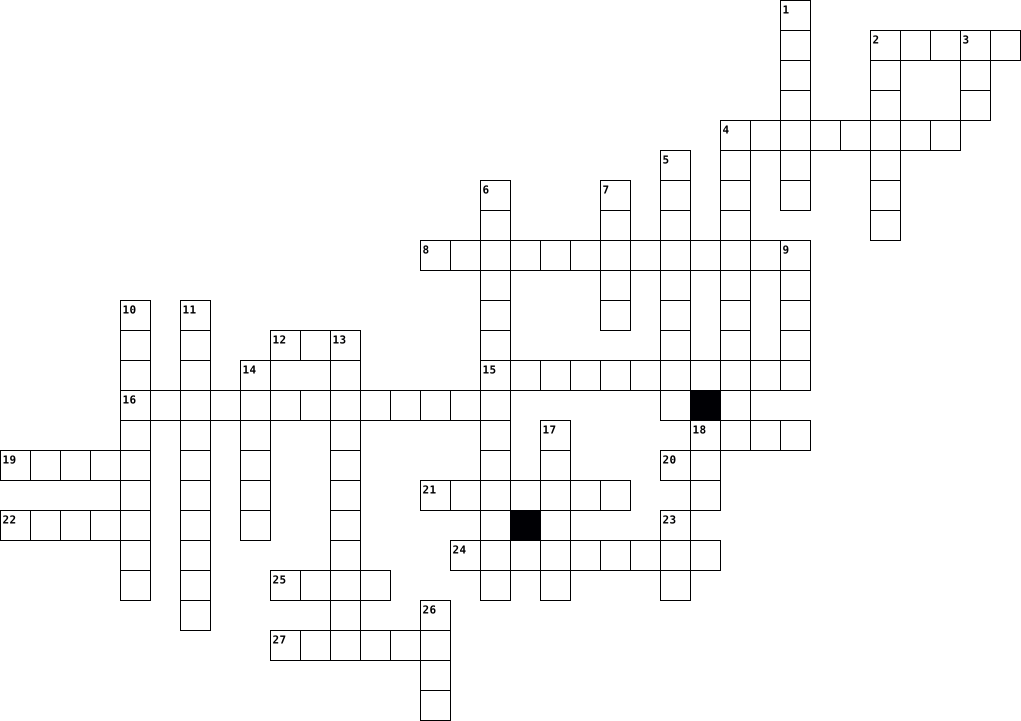
Across
- One origin of medical term
- Pertaining to before birth
- Core of a medical term
- Word analysis and definition
- Inside a vein
- Many people die every year due as a result of poor ?
- Suffix meaning cell
- Side
- Diagnosis
- meaning of -ation
- Origin of axilla
- Where a prefix is found in a medical term
- Number of elements in a medical term
- Between 37 and 42 weeks
Down
- History of a type of illness
- Pertaining to the stomach
- Prefix meaning above
- Study of diseases of the lungs
- more than one diagnosis
- Used when suffix begins with a consonant
- CC, Complaint
- Greek meaning slime
- Type of health record
- Word also meaning physical
- To break down a medical term into its elements
- Found at the end of a term follow a word root
- Usually indicates time, number, or location
- Chest x-ray
- Where to begin when breaking down a medical term
- Around
30 Clues: Side • Around • Diagnosis • Chest x-ray • CC, Complaint • Inside a vein • Origin of axilla • meaning of -ation • Greek meaning slime • Suffix meaning cell • Prefix meaning above • Type of health record • Core of a medical term • more than one diagnosis • Between 37 and 42 weeks • Pertaining to the stomach • One origin of medical term • Pertaining to before birth • Word also meaning physical • ...
Anatomy of the Respiratory Tract 2021-04-16

Across
- The ________ muscles help decrease the volume of the thoracic cavity during expiration by pushing the diaphragm upwards. They relax during inspiration.
- Shelves of bone that line the inside of the nasal cavity.
- Hair-shaped structures found on the lumen of the epithelium, surrounded by a thin film of mucus.
- These are small, elastic buds that are located a the end of the respiratory tree. They provide a large surface area for gas exchange to occur.
- The smallest airway of the respiratory tract, getting smaller with each split branch.
- Thin skeletal muscle located below the lungs that contracts when one inhales to expand the lungs. Upon exhale, this relaxes and causes air to be forced out of the lungs.
- The _____ respiratory tract contains the nasal cavity, pharynx and larynx.
- The __________ muscles run between the ribs to expand and shrink the size of the chest muscle during inspiration and expiration.
- Repiratory __________ acts to warm, filter, and humidify air.
- Epithelial cells that secrete mucus to create a protective layer.
Down
- _________ clearance is a process by which the cilia in the upper respiratory tract beat and push mucus up towards the pharynx for expulsion by a cough or swallow.
- These split from the trachea into two primary sections which enter the lungs, then split into even smaller sections which enter separate lobes, splitting into even smaller sections within.
- Also known as the windpipe, it links the upper airways to the lungs. It consists of C-shaped rings of cartilage which are connected by smooth muscle.
- Contains curved shelves of bone in which the surface is lined with ciliated respiratory epithelium that secretes mucus and fluid to trap foreign
- A pair of organs consisting of elastic sacs with branching passageways where air is drawn in order to conduct gas exchange.
- These are passageways that connect to the end of the respiratory tree.
- Short tube consisting of several cartilages connected by muscles. It also contains the vocal chords which are needed to generate sound.
- The common pathway for the respiratory and digestive tracts and allows for both air and food to pass.
- Flap of cartilage which serves as a switch between the respiratory and digestive tracts, ensuring that food and air each enter in the appropriate location.
- The _____ respiratory tract contains the trachea, bronchi, bronchioles, alveolar ducts, and alveoli.
20 Clues: Shelves of bone that line the inside of the nasal cavity. • Repiratory __________ acts to warm, filter, and humidify air. • Epithelial cells that secrete mucus to create a protective layer. • These are passageways that connect to the end of the respiratory tree. • The _____ respiratory tract contains the nasal cavity, pharynx and larynx. • ...
Anatomy & Physiology-Nerves (Milady Esthetics) 2024-06-04

Across
- nerve that affects skin of lower eyelid, side of nose, upper lip, and mouth
- sturcture that connects spinal cord to brain
- motor nerve that controls motion of neck and shoulder muscles; aka eleventh cranial nerve
- affects muscles of temple, side of forehead, eyebrow, eyelid, and upper part of cheek
- located at base of skull; affects scalp and muscles behind ear; aka smaller occipital nerve
- nerve located at side of neck; affects face, ears, neck, and parotid gland
- affects muscles of chin and lower lip
- part of CNS contained in cranium; largest, most complex nerve tissue in body; controls sensation, muscles, glandular activity
- carry impulses from brain to muscles or glands
- nerve located in back of head; affects scalp as far up as top of head
- affects the skin of lower lip and chin
- aka accessory nerve
- affects the muscles of the upper part of the cheek
- connects CNS to peripheral parts of body; contains sensory and motor nerves
- sensory-motor nerve that, with its branches, supplies impulses to the fingers
- supplies arm and hand; smaller than ulnar and radial nerves
- tissue that controls and coordinates all body functions
- part of nervous system that controls involuntary muscles and glands
- carry impulses from sense organs to brain where sensations are felt
- automatic reaction to stimulus; involves movement of impulse from sensory receptor to spinal cord and a responsive impulse that causes a reaction
- affects skin between eyes and upper side of nose
- nerve that affects membrane and skin of nose
- scientific study of the structure, function, and pathology of the nervous system
Down
- affects skin of forehead, scalp, eyebrow, and upper eyelid
- cerebrospinal nervous system; consists of brain, spinal cord, spinal nerves, and cranial nerves
- nerve that affects skin of forehead, upper eyelids, and interior portion of scalp, orbit, eyeball, and nasal passage
- chief motor nerve of face; emerges near lower part of ear and extends to muscles of neck; aka facial nerve
- sensory nerve endings located close to surface of skin
- affects the upper part of the face
- located at the side of the neck, affects the front and sides of the neck as far down as the breastbone
- body system that controls and coordinates all other systems
- chief sensory nerve of face and motor nerve of chewing muscles; has 3 branches; aka trifacial or trigeminal nerve
- chief motor nerve of face; emerges near lower part of ear, extends to muscles of neck
- aka lesser occipital nerve
- sensory-motor nerve that, with its branches, affects the little-finger side of arm and palm of hand
- affects the muscles behind the ear at the base of the skull
- affects the external ear and skin above the temple, up to the top of the skull
- sensory-motor nerve that, with its branches, supplies the thumb side of the arm and back of hand
- affects the point and lower side of nose
- nerve cell; collectively make up nerves, brain, and spinal cord; transmits nerve impulses
- located in abdominal cavity; a nerve of autonomic nervous system
- a branch of the facial nerve that affects the side of the neck and platysma muscle
- portion of CNS that originates in brain and extends to lower trunk; protected by spinal column
- consists of 3 branches: opthalmic, mandibular, and maxillary nerveaka trigeminal nerve
- whitish cords made up of bundles of nerve fibers held together by connective tissue, through which impulses are transmitted
45 Clues: aka accessory nerve • aka lesser occipital nerve • affects the upper part of the face • affects muscles of chin and lower lip • affects the skin of lower lip and chin • affects the point and lower side of nose • sturcture that connects spinal cord to brain • nerve that affects membrane and skin of nose • carry impulses from brain to muscles or glands • ...
Special Senses Anatomy and Physiology 2023-09-18

Across
- The ability of the eye to focus specifically on near objects is called
- The shell-shaped structure that surrounds the opening of the auditory canal is called?
- what layer has three regions that can be differentiated into the choroid, ciliary body, and iris.
- The membranous labyrinth itself contains a thicker fluid called
- Within the ampulla, a swollen region at the base of each membranous semicircular canal is a receptor region called crista
- Light entering the eye is focused on the retina by
- Lacrimal secretions also contain antibodies and also?
- Long fibers that emerge from the cell body and act as a pathway for carrying electrical signals to other nerve cells are called?
- Specific cells that respond to chemicals dissolved in saliva are cells
- The bony labyrinth is filled with a plasma-like fluid called
Down
- Within the membrane sacs of the vestibule are receptors called?
- The clear outer layer of the eye is called
- The outer pigmented layer of the retina consists of pigmented cells that are shaped like?
- of all the sensory receptors in the body 70% are
- When the eyes are suddenly exposed to bright light, the pupils immediately constrict, this is a reflex
- poor visual acuity or inability to focus due to an inflexible lens which can start from the age of 40 is called
- Elders over age 65 start having gradual loss of hearing, a condition called
- thick, shiny, white connective tissue, visible anteriorly as the “white of the eye” is the definition of
- The modified sebaceous glands associated with the edges of the eyelids are glands
- The optic tract fibers synapse with neurons in the
20 Clues: The clear outer layer of the eye is called • of all the sensory receptors in the body 70% are • Light entering the eye is focused on the retina by • The optic tract fibers synapse with neurons in the • Lacrimal secretions also contain antibodies and also? • The bony labyrinth is filled with a plasma-like fluid called • ...
Eye Anatomy and Key Terms 2023-02-14

Across
- Eye structure responsible for color vision
- structure of the eye that contains the cones
- "Pink eye"
- muscles responsible for moving the eye within the orbital socket
- colored part of the eye
- The middle layer of the eye
- Part of the choroid body in the eye from which the ligaments that suspend the lens extend
- structure in the eye that refracts light rays
- injury where blood builds up in the anterior chamber
- white part of the eye
- bony socket that houses the eye
- The chamber between the cornea and the iris
- scratch or cut of the eye
- gel like substance that fills the eyeball
Down
- Circular clear area in front of the sclerotic coat
- Outermost layer of the eye
- innermost layer of the eye
- The watery fluid found in the anterior and posterior chambers of the eye
- "blind spot"
- muscles that help the iris control how much light enters the eye
- chamber between the iris and the lens
- infection of the glands along the eyelid
- ligament that holds the lens of the eye in place
- widening of the pupil due to dim light
- opening in iris to let in light
- cells that are sensitive to dim light
26 Clues: "Pink eye" • "blind spot" • white part of the eye • colored part of the eye • scratch or cut of the eye • Outermost layer of the eye • innermost layer of the eye • The middle layer of the eye • opening in iris to let in light • bony socket that houses the eye • chamber between the iris and the lens • cells that are sensitive to dim light • widening of the pupil due to dim light • ...
4th Anatomy - Heart and Blood 2023-04-27

Across
- the system that includes the heart and blood vessels
- vena cava where blood returns to the heart from upper body
- a double layered protective covering of the heart
- sends deoxygenated blood to the lungs
- valve between the right atrium and the right ventricle
- valve that keeps blood from flowing back into the left ventricle
- vena cava where blood returns to the heart from lower body
- inner layer of the heart
- vessels that carry blood away from the heart
- this blood enters on the right side of the heart through the superior and inferior vena cava and leaves through the pulmonary artery to the lungs
- this blood is bright red blood that has picked up oxygen from the lungs, and enters back into the heart through the pulmonary lungs
- deoxygenated blood enters the heart here
Down
- pumps oxygen poor blood to the lungs through the pulmonary valve then the pulmonary arteries
- smallest blood vessels
- sends oxygenated blood back to the heart
- vessels that carry blood towards the heart
- valve positioned between the right ventricle and the pulmonary artery
- the two lower chambers of the heart, and they pump blood out to the lungs and body
- chamber that receives blood from the lungs
- the two upper chambers of the heart
- pumps blood out of the heart through the aorta aortic valve into the aorta
- largest artery; where the blood leaves the heart and is pumped to the rest of the body
- prevent back flow of blood
- valve between the left atrium and the left ventricle; bicuspid valve
- divides the right and left chambers of the heart
25 Clues: smallest blood vessels • inner layer of the heart • prevent back flow of blood • the two upper chambers of the heart • sends deoxygenated blood to the lungs • sends oxygenated blood back to the heart • deoxygenated blood enters the heart here • vessels that carry blood towards the heart • chamber that receives blood from the lungs • ...
Anatomy/Physiology Ch 9 #2 2023-03-31

Across
- 2nd set of cranial nerves
- tracts carrying sensory info to the brain
- tiny, reddish, cauliflower like masses
- grey matter outermost part of cerebrum
- 10th pair
- formed by optic nerves crossing over
- 6th pair of cranial nerves
- lobe that lies below the parietal + frontal lobe
- a bulge on the underside of the brainstem
- lobe that forms the anterior part of cerebral h
- 4th set of cranial nerves
- nerves that arise from the base of the brain
- 8th pair of cranial nerves
- lobe that is posterior to the frontal lobe
- tracts carrying motor info from the brain
Down
- located between the cerebra; h above midbran
- 9th pair of cranial nerves
- 12th pair of cranial nerves
- aconeshaped structureattached to diencephalon
- lobe forms the posterior part of cerebral h
- 11th pair of cranial nerves
- extends from the pons to the foramen mag
- nervoussystem thatoversees unconscious activity
- nervous system oversees conscious activities
- each of the 31 vertebra has one of these
- 1st set of cranial nerves
- 5th pair of cranial nerves
- composed composed of 100 billion multipolar neurons
- 3rd set of cranial nerves
29 Clues: 10th pair • 2nd set of cranial nerves • 1st set of cranial nerves • 4th set of cranial nerves • 3rd set of cranial nerves • 9th pair of cranial nerves • 6th pair of cranial nerves • 5th pair of cranial nerves • 8th pair of cranial nerves • 12th pair of cranial nerves • 11th pair of cranial nerves • formed by optic nerves crossing over • tiny, reddish, cauliflower like masses • ...
Human anatomy and body systems 2023-07-28

Across
- Pumps blood throughout the body.
- Stores urine before elimination.
- Enables taste and aids in speech.
- Facilitate vision and sight.
- Enable movement and body function.
- Protects the spinal cord and supports body posture.
- Connects the mouth and nose to the esophagus and windpipe.
- Filters blood and helps the immune system.
- Controls and coordinates bodily functions.
- Responsible for hearing and balance.
- Provide support and protection for the body.
Down
- Detoxifies blood and stores nutrients.
- Produces insulin and regulates blood sugar.
- Filter and remove waste from the blood.
- Responsible for breathing and gas exchange.
- Part of the digestive system where food is partially digested.
- Largest organ of the body, protects from external elements.
- Part of the digestive system where nutrient absorption occurs.
- Allows sense of smell and filters the air we breathe.
- Transmit signals between the brain and body.
20 Clues: Facilitate vision and sight. • Pumps blood throughout the body. • Stores urine before elimination. • Enables taste and aids in speech. • Enable movement and body function. • Responsible for hearing and balance. • Detoxifies blood and stores nutrients. • Filter and remove waste from the blood. • Filters blood and helps the immune system. • ...
Plant Anatomy Crossword - Horticulture 2A 2021-11-08

Across
- Main body of the plant, holds the plant up and acts as support for branches, and is also a passage for food and water.
- Seed-carrying structure.
- Found between the upper and lower epidermis, it aids in gas exchange and photosynthesis via chloroplast.
- Located outside the epidermis and protects against water loss.
- Transports the photosynthetic products to the other parts of the plant.
- These plants have two leaves when they emerge from their seeds.
- Lower most part of the leaf, which is closest to the petiole.
- Leaf shape that is completely undivided.
- The small channels or capillaries, which are further subdivided into venules.
- Plants with this type of root: carrots, potatoes, and garlic.
- Functions in seed propagation of the plant.
Down
- Plants with this type of root: grasses, wheat, and corn.
- The thin, flat part of the leaf that is typically green in color.
- The stalk that connects a leaf to the stem of the plant, it also provides support to the leaf.
- Anchors the plant and helps absorb water and minerals from the soil.
- The edge of the leaf
- Transports water from the roots to the stems and leaves in vascular plants.
- These plants have one leaf when they emerge from their seeds.
- Aids in the regulation of gas exchange via stomata.
- Attracts insects for pollination.
- Functions primarily for food manufacture by photosynthesis.
- Tip of the leaf blade.
22 Clues: The edge of the leaf • Tip of the leaf blade. • Seed-carrying structure. • Attracts insects for pollination. • Leaf shape that is completely undivided. • Functions in seed propagation of the plant. • Aids in the regulation of gas exchange via stomata. • Plants with this type of root: grasses, wheat, and corn. • Functions primarily for food manufacture by photosynthesis. • ...
1-7 units of anatomy 2021-10-20

Across
- security check for lymph
- muscle can be contracted or stretched
- tough sheetlike membrane
- consists of the skull, vertebrae, ribs, & sternum
- What comes after the first Human body system
- Y-shaped proteins produced by the immune system to help combat infection
- the 2 divisions of the trachea
- ability to stretch muscle
- protect fingers & toes
- the cranium
- study of form & structure of the organism
- the four sections of the heart
- the middle part of the skin containing most of the structure
- innermost layer of the skin
- Whats the start of the human body system
- examples are the humerus, tibia, radius, fibula, ulna
- muscle of the heart
- the final part of the heart system which transfers oxygen throughout the body
- a tissue that covers something
- gates between chambers
Down
- Outermost layer of the skin
- metabolic waste product produced by cells when they convert food to energy
- the smooth walls of internal organs
- virus that causes diseases
- Transports oxygen & nutrients to body cells
- made up of 206 bones
- organ for breathing
- muscular, a hollow organ called the body's pump
- transmitted from parents to child to genetically
- caused by a pathogenic organism such as a bacteria or virus(disease type)
- consists of shoulder girlder, arm bones, pelvic girdle, & legbones
- Thin watery fluid that enters the lymphatic system
- skin system
- help fight infection & other diseases
- strong, tough fibrous connective tissue cord
- The other word for Throat
36 Clues: the cranium • skin system • organ for breathing • muscle of the heart • made up of 206 bones • protect fingers & toes • gates between chambers • security check for lymph • tough sheetlike membrane • ability to stretch muscle • The other word for Throat • virus that causes diseases • Outermost layer of the skin • innermost layer of the skin • the 2 divisions of the trachea • ...
Anatomy: Units 1-3 Review 2021-11-29

Across
- system that helps with breathing
- control center of cell
- organic molecule that gives energy
- transport where particles travel from low to high concentration
- pH greater than 7
- salts in body that help keep osmotic pressure
- behind
- part of feedback loop that detects change
- balance/wanted environment
- in the middle
- above
- where all the organelles are stored
- pH less than 7
- close to the heart
Down
- system that sends signals all around body
- close to the surface
- part of feedback loop that shows what is wanted
- below
- to the side
- system that gives movement
- front
- system that gives structure
- organic molecule that helps build things
- organelle giving power to cell
- transport where particles scatter from high to low concentration
- system that regulates hormones
26 Clues: below • front • above • behind • to the side • in the middle • pH less than 7 • pH greater than 7 • close to the heart • close to the surface • control center of cell • system that gives movement • balance/wanted environment • system that gives structure • organelle giving power to cell • system that regulates hormones • system that helps with breathing • organic molecule that gives energy • ...
Anatomy of Head and Neck 2021-12-03

Across
- two small oblong bones
- paired muscle that covers the dorsum of the nose
- the muscle of the forehead that forms part of the occipitofrontalis
- an unpaired bone
- cranial bone forming part of the side and the top of the head
- pyramid-shaped muscle extending from the lower part of the nasal bone to the middle area in the forehead between the eyebrows
- facial muscle
- most posterior cranial bone and the main bone of the occiput
- the tooth located distally from both the mandibular second premolars of the mouth
- the major facial muscle underlying masseter the cheek a muscle which runs through the rear part of the cheek from the temporal bone to the lower jaw on each side and closes the jaw in chewing
- the bones that form the head
- thin, fan-shaped muscle situated within the temporal fossa of the skull
- a paired facial muscle located in the chin region of the face
Down
- largest bone in human skull
- the teeth supported by the alveolar part of the mandible
- the muscle in the orbit that elevates the upper eyelid
- A muscle with origin from the masseter muscle, with insertion into the orbicular muscle of the mouth
- upper teeth formed along the maxillary
- a slender band of muscle on each side of the face that arises from the zygomatic bone
- the muscle encircling the opening of the orbit and functioning to close the eyelids
- a short, paired triangular muscle of the face
- one of 22 bones that form the skull
- structures made of bones inside of nose
- complex, multi-layered muscle
- bone that forms upper jaw
- a broad sheet of muscle fibers extending from the collarbone to the angle of the jaw
- thick hard bone that forms part of side and base of the skull
27 Clues: facial muscle • an unpaired bone • two small oblong bones • bone that forms upper jaw • largest bone in human skull • the bones that form the head • complex, multi-layered muscle • one of 22 bones that form the skull • upper teeth formed along the maxillary • structures made of bones inside of nose • a short, paired triangular muscle of the face • ...
Anatomy Chapter 4-5 Review 2022-02-17

Across
- Accumulation of debris, fluid, dead and dying cells, and necrotic tissue
- Simple Epithelium whose function is absorption and secretion and is located in glands, ducts, thyroid gland, and a portion of the kidney
- glands that secrete hormones into the interstitial fluid
- Fascia that refers to the subcutaneous layer and separates the skin from underlying tissues and organs
- Epithelium that lines the trachea, and nasal cavity
- Epithelium that is flat and thin
- Stratum Layer that contains cells that participate in the immune response
- The body of a neuron
- A connective tissue with a gelatinous matrix that contains lots of fibers
- The extensive distortion of the dermis that exceeds the elastic limits of the skin
- Most common type of cartilage
- Blood has a watery matrix called____
- Vitamin D3 gets converted into this, which is a hormone that allows the intestines to absorb calcium and phosphate ions from food.
Down
- Glands that produce sebum and are associated with hair follicles
- Glands that produce earwax
- A deficiency of Vitamin D3 can cause bending of bones underweight
- Epithelia that can be found in the urinary bladder and renal pelvis
- Second most abundant fixed cell in CT
- Connective tissue that cushions organs, provides support, but permits independent movement, located deep to the dermis of the skin, digestive, urinary, respiratory tracts
- Epithelial cells that increase absorption, located in the kidneys and digestive tract
- Cells that are found in bone
- Strong connective tissue containing special cells and a mineralized matrix of calcium phosphate and calcium carbonate, is also called bone
- Also known as fat cells
- Extracellular fibers + Ground Substance =_____
- Connective tissues are connected to the overlying epithelium via_____
25 Clues: The body of a neuron • Also known as fat cells • Glands that produce earwax • Cells that are found in bone • Most common type of cartilage • Epithelium that is flat and thin • Blood has a watery matrix called____ • Second most abundant fixed cell in CT • Extracellular fibers + Ground Substance =_____ • Epithelium that lines the trachea, and nasal cavity • ...
Anatomy 2024 Dry Lab Final 2024-12-10

Across
- muscle of the neck that laterally flexes to the same side and rotates to the opposite
- large superficial muscle of the back, divided into upper, middle, and lower
- another word for your voice box
- lies between two vertebrae, provide cushioning and shock absorption
- large bony structure below the lumbar vertebrae
- muscle that flexes the hip
- posterior part of the vertebra that sticks out, able to palpate (D in the picture)
- deepest of the abdominal muscle, fibers run horizontally between the ribs and pelvis
Down
- cranial nerve that innervates the tongue
- on the sides of spinal vertebrae, allow muscles and ligaments to attach to the spine (C in the picture)
- a group of muscles that lie deep to the trapezius and extend the cervical spine and head
- floating bone in the anterior neck that is "U" shaped
- originates from the anterior rami of C1 through C4
- main part of the vertebra, lies anterior (A in the picture)
- the major organ that lines within the mediastinum
- most lateral muscle of the erector spinae
- main muscle of respiration
- attach to the vertebrae, 12 in total
- large bone of the lower jaw
- articulates with the inferior facet (B in the picture)
20 Clues: main muscle of respiration • muscle that flexes the hip • large bone of the lower jaw • another word for your voice box • attach to the vertebrae, 12 in total • cranial nerve that innervates the tongue • most lateral muscle of the erector spinae • large bony structure below the lumbar vertebrae • the major organ that lines within the mediastinum • ...
Keep Calm and Study Anatomy 2025-02-06

Across
- The structure that connects muscles to bones
- The longest bone in the human body
- The valve between the left atrium and left ventricle
- The process of blood cell formation
- The small intestine segment where most nutrient absorption occurs
- The type of joint found in the shoulder and hip
- The outermost layer of the skin
- The fluid that cushions and protects the brain and spinal cord
- The gland that regulates metabolism
Down
- The large vein that carries deoxygenated blood to the heart
- The part of the brain that controls involuntary functions
- The functional unit of the kidney
- The primary muscle used for respiration
- The part of the eye that controls the amount of light entering
- The smallest functional unit of life
- The bone that forms the forehead
- The part of the brain responsible for balance
- The protein responsible for oxygen transport in red blood cells
- The artery that supplies blood to the heart muscle
- The largest organ in the human body
20 Clues: The outermost layer of the skin • The bone that forms the forehead • The functional unit of the kidney • The longest bone in the human body • The process of blood cell formation • The largest organ in the human body • The gland that regulates metabolism • The smallest functional unit of life • The primary muscle used for respiration • ...
Anatomy I - Terminology and Structures 2024-09-07

Across
- Fluid-filled sac that acts as a shock absorber
- Opening in the pelvis bone formed by the pubis and ischium (written as one word)
- There is a compromise between stability and ______ in each joint of the body.
- 'C' shaped articulating surface of the acetabulum
- Stability of a joint depends on the neuromuscular factors of strength, ________ and proprioception.
- Connective tissue that connects bone to bone.
- patella relative to the femoral condyles
- cuboid relative to the intermediate cuneiform
Down
- Stability of a joint depends on the _____, size and arrangement of the articulating surfaces.
- Most prominent intra-articular fold of joint lining (written as one word)
- 'C' shaped pad of fibrous cartilage
- Thick fibrocartilage ring of the acetabulum
- band of thickened fascia that stabilizes tendons
- Hip flexion movement plane of movement
- Ankle eversion movement plane of movement
- a cartilaginous joint that contains a fibrocartilaginous disc
- Alternate name for the pelvic bone
- head of the metatarsal relative to the base of the metatarsal
- Thick, dense membrane between the tibia and fibula
- Alternate name for the superior-inferior axis of rotation
20 Clues: Alternate name for the pelvic bone • 'C' shaped pad of fibrous cartilage • Hip flexion movement plane of movement • patella relative to the femoral condyles • Ankle eversion movement plane of movement • Thick fibrocartilage ring of the acetabulum • Connective tissue that connects bone to bone. • cuboid relative to the intermediate cuneiform • ...
Anatomy&Physiology Q1 Exam Review 2024-10-02

Across
- Increase in size of cells
- Controlled cell death
- Cellular extension to increase surface area for optimal absorption
- Protective caps on chromosomes
- Cell appendage allows movement of mucus accross cell surface
- "Fake layers" but all cells connected to basement membrane
- Stable internal conditions
- This type of epithelium is present in the bladder, to allow for distension
- Secretion by a gland to exit the body, like sweat
- Membrane junction between two communicating nuerons
- The abdominal cavity is ______ to the thoracic cavity
- Secretion by a gland, into the blood to remain in the body
- Flattened cell shape, found in our outer skin
- Organelle involved in phagocytosis
Down
- This type of solution could cause cell lysis
- Type of feedback where signal enhances the response
- Tall cell shape,oval nucleus
- Cell specialization, a stem cell becomes a liver cell
- Bulk transport out of the cell, like secretion or neurotransmitter release
- ATP producer in the cell
- Main component of cell membrane
- Most specific form of endocytosis
- Vertical plane dividing anterior and posterior.
- Membrane junction that allows two muscle cells to stretch
- Muscle tissue without striations
- Fatty acid that yields fluidity
- When cells touch, they no longer divide
- high energy molecule
- Occurs to proteins when temperature increases
- Parietal serosa is ____ to the visceral serosa
- Increase in number of cells
- Part of cytoskeleton that allow cell to change shape
32 Clues: high energy molecule • Controlled cell death • ATP producer in the cell • Increase in size of cells • Stable internal conditions • Increase in number of cells • Tall cell shape,oval nucleus • Protective caps on chromosomes • Main component of cell membrane • Fatty acid that yields fluidity • Muscle tissue without striations • Most specific form of endocytosis • ...
Anatomy of a Sewing Machine 2023-12-06

Across
- holds the needle in place
- sinds the thread onto the bobbin
- guide the thread from the spool to the needle
- keep the edge of fabric aligned so seam allowances will be uniform in width
- adjusts the width of zigzag and other two-dimensional stitches
- Raises and lowers presser foot
- allows the machine to backstitch
- adjusts the amount of pressure the presser foot applies to the fabric
- pulls the thread from the spool and through the tention regulator
Down
- adjusts and applies tension to the thread so that it feeds at a constant rate
- holds the fabric in place as the machine stitches
- holds the spool of thread
- adjust the number of stitches per inch
- moves the fabric under the presser foot
- covers the area around the needle
- changes the type of stitches
- holds the presser foot in place
- holds the bobbin and applies tension to the bobbin thread, which appears on the underneath side of the fabric
- turns to raise or lower the needle and thread take-up lever
- turns the machine on and off
20 Clues: holds the needle in place • holds the spool of thread • changes the type of stitches • turns the machine on and off • Raises and lowers presser foot • holds the presser foot in place • sinds the thread onto the bobbin • allows the machine to backstitch • covers the area around the needle • adjust the number of stitches per inch • moves the fabric under the presser foot • ...
#20 Chapter 7- - Muscle Anatomy 2024-10-20

Across
- Stores calcium in muscle cells
- Muscle not striated, found in organs, and is involuntary
- Involuntary muscle found only in the heart with intercalated discs
- Neurotransmitter necessary for muscle excitation and contraction
- Muscles that cooperate with the primary mover
- Muscle wasting due to disuse
- Muscle attachment site that moves when the muscle contracts
- Major muscle for breathing, separating thoracic and abdominopelvic cavities
- Long organelles in striated muscle cells
Down
- Condition when muscles lose tonus (tone)
- Carbohydrate stored in muscles for energy, converted to glucose when needed
- Increased growth or development of muscles
- Muscle opposing the primary mover in a movement
- Muscle with a striped appearance found in skeletal muscles
- Muscle controlled by thought
- Process by which muscle contractions occur through the filament mechanism
- Partial contraction of a muscle providing tone
- Energy source required for muscle contraction
- Muscle not under conscious control
- Ability to contract or cause contraction
- Smallest functional unit of striated muscle tissue
- Muscle attachment site that does not move during contraction
22 Clues: Muscle controlled by thought • Muscle wasting due to disuse • Stores calcium in muscle cells • Muscle not under conscious control • Condition when muscles lose tonus (tone) • Ability to contract or cause contraction • Long organelles in striated muscle cells • Increased growth or development of muscles • Energy source required for muscle contraction • ...
Dental Nursing-General Anatomy 1 2024-11-02

Across
- Medical condition-Reduced blood flow to the heart
- Medical term for the throat, responsible for swallowing
- Valve located in the left side of the heart
- Side of the Heart that pumps Deoxygenated blood
- Which bacterial infection can cause a gastric ulcer?
- Type of circulation that enables external respiration
- Body system that includes the Brain
- Body system that includes the heart
- Scientific term for the formation of blood components
- Chronic inflammatory bowel disease that can cause anaemia
- Condition that causes 'inflammation of the lining of the heart'
- Type of cardiac arrest categorised as 'Sudden failure of the heart's electrical system'
- Disease characterised by thickening of the intestine walls, malabsorption, weight loss, abscesses
- Body system that includes the Lungs
- Medical term for a red blood cell
- Disorder affecting the red blood cells' ability to carry oxygen
- Side of the Heart that pumps Oxygenated blood
- Type of Oedema caused by heart failure on the right
- Body system that includes the Stomach
- Type of blood pressure measured at rest
- Medical term for a white blood cell
- Valve located in the right side of the heart
- Respiratory membrane that facilitates internal respiration is located here
- Automimmune inflammatory disease initiated by a previous streptococcal infection
Down
- Medical condition caused by severe erosion of the stomach wall
- Veins attached to the left side of the heart
- Type of cardiac arrest described as 'A rapid, but ineffective heartbeat'
- Type of circulation that enables internal respiration
- Part of the larynx responsible for preventing aspiration
- Medical term for 'tingling/numbness of the extremities
- Valve located in the left side of the heart
- Medical term for 'Bacteria in the blood'
- Organ responsible for creating hormones to control blood sugar
- Device used to measure blood pressure
- Medical term for 'difficulty swallowing'
- Artery attached to the left side of the heart
- Type of blood pressure measured at ventricular contraction
- Disease categorised as 'Inflammation of the liver'
- Respiratory membrane that facilitates external respiration is located here
- Valve located in the right side of the heart
- Type of oedema caused by heart failure on the left
- Medical term for 'canker sore', indication of crohn's
- The opening in the diaphragm that facilitates the connection between oesophagus and stomach
- Name for the involuntary contractions of the oesophagus
- Medical term for a platelet
- Artery attached to the right side of the heart
- Veins attached to the right side of the heart
- Inflammation of the inner lining of the stomach
- Medical term for 'dry mouth'
49 Clues: Medical term for a platelet • Medical term for 'dry mouth' • Medical term for a red blood cell • Body system that includes the Brain • Body system that includes the heart • Body system that includes the Lungs • Medical term for a white blood cell • Device used to measure blood pressure • Body system that includes the Stomach • Type of blood pressure measured at rest • ...
Anatomy Physiology Puzzle-Anders Koijane 2024-11-12

Across
- Keeps body balanced
- Surrounds root of strand of hair
- Secretes sebum
- Tough protective outer layer
- Supports tissues and organs in the body.
- Overlying the Dermis
- Membrane for joints
- Wraps around inner organs
- Where two bones meet
- Outer covering of body
- Underneath the skin
Down
- Found in skin, breast, eyelid and ear
- Connective tissue
- Muscle attached to hair follicle
- Epithelial cells in the stomach
- Tube that transports blood
- Membrane that opens out
- Transmits impulses in the body
- Thin layer that covers organs
- Sweat gland found in all regions of skin
- Storage of fat
- Membrane for skin
- Membrane that doesn't open
23 Clues: Secretes sebum • Storage of fat • Connective tissue • Membrane for skin • Keeps body balanced • Membrane for joints • Underneath the skin • Overlying the Dermis • Where two bones meet • Outer covering of body • Membrane that opens out • Wraps around inner organs • Tube that transports blood • Membrane that doesn't open • Tough protective outer layer • Thin layer that covers organs • ...
Lower Respiratory Anatomy - Perry Cassel 2025-05-06

Across
- Outermost of the two pleural membranes
- small air sac in the lungs
- Thin, sac-like membrane that surrounds the heart
- the small air sacs in the lungs
- tiny tube in the lung
- group that connects each rib to each other
- small portion between the heart and sternum, containing organs like the thymus
- chest structure made of skin, fat, muscles, bones, and cartilage
- short artery on the heart that sends deoxygenated blood to the lungs
- beats per minute
- openings in the interalveolar septa of the lung that permit air flow between adjacent alveoli
Down
- bottom of the lower breathing lobes
- inner layer of the serous membrane that surrounds the lungs
- flat piece of bone in the middle of chest
- muscular tube that transports food from mouth to stomach
- Very top of your breathing lobes
- separates the upper lobes from the lower lobes
- potential space between the pleurae
- Cite where T-cells develop
- Hollow tube that connects the voice box to the lungs
20 Clues: beats per minute • tiny tube in the lung • small air sac in the lungs • Cite where T-cells develop • the small air sacs in the lungs • Very top of your breathing lobes • bottom of the lower breathing lobes • potential space between the pleurae • Outermost of the two pleural membranes • flat piece of bone in the middle of chest • group that connects each rib to each other • ...
Lower Respiratory Anatomy- Carolina Galla 2025-05-06

Across
- located in the left part of the breast, left of the heart
- plays a role in creating pleural fluid
- last part of the bronchiole that doesn't contain aveolis
- located at the base of the thoracic cavity
- protects heart, lungs and major blood vessels
- muscles between the ribs
- located in the right part of the breast, right of the heart
- located in the thoracic cavity, directly covers lungs
- small openings in the wall of the aveolis
- a hollow muscular tube connecting throat and stomach
Down
- delivers air to the left lung
- Carries air in and out of your lungs
- transmits CO2 rich blood from the right ventricle to the lungs
- also known as the rib cage
- separates the upper lobes from the lower lobes
- most inferior part of the lungs
- clusters of aveoli
- located between the lungs and behind the breastbone
- highest point of the lung
- located in lungs, form alveolar sacs
- Moves blood throughout the body
21 Clues: clusters of aveoli • muscles between the ribs • highest point of the lung • also known as the rib cage • delivers air to the left lung • most inferior part of the lungs • Moves blood throughout the body • Carries air in and out of your lungs • located in lungs, form alveolar sacs • plays a role in creating pleural fluid • small openings in the wall of the aveolis • ...
Lower Respiratory Anatomy - Ruby Shaw 2025-05-06

Across
- transports blood from the right ventricle
- lines outer surface of lung
- left side of your chest
- right hemithorax
- upper part of torso between neck and abdomen
- upper chest behind breastbone
- passes food from larynx to stomach
- discrete holes adjacent from alveoli
- found in thorax seperating lungs from surrounding structrues
Down
- outer surface of lung
- extends across the bottom of the thoracic cavity.
- forms a lining for the chest cavity
- end of the respiratory tree
- within rib cage
- respiratory zone of the lungs
- bottom of lung
- middle of chest
- Between left and right lung slightly to the left
- ends of the respiratory bronchiloes within the lungs
- in your lower neck and upper chest, below your larynx.
20 Clues: bottom of lung • within rib cage • middle of chest • right hemithorax • outer surface of lung • left side of your chest • lines outer surface of lung • end of the respiratory tree • respiratory zone of the lungs • upper chest behind breastbone • passes food from larynx to stomach • forms a lining for the chest cavity • discrete holes adjacent from alveoli • ...
Lower Respiratory Anatomy- Luis Haro 2025-05-06

Across
- covers the diaphragm and lines inner wall of chest
- facilitates optimal lung function
- Takes oxygen from environment and puts it into blood
- Acts as a barrier against infection
- Serve as mobile scavengers to engulf foreign particles in the lungs
- stabilizes arms and shoulders
Down
- Delivers air to alveoli
- carries food and liquid from your mouth to your stomach
- Holds important organs
- cleans inspired air and distributes it to the gas exchanging zone
- pulls are into lungs
- Carry low oxygen blood from the heart to the lungs
- Promotes production of T-cells
- Facilitates gas exchange
- protects organs of the chest
- Has a higher ventilation ratio
- Formed by a structure that connects it to the heart and trachea
- Pumps blood throughout body
- Lubricate the surfaces of the pleurae
- warms and moisturizes air before it enters the lungs
20 Clues: pulls are into lungs • Holds important organs • Delivers air to alveoli • Facilitates gas exchange • Pumps blood throughout body • protects organs of the chest • stabilizes arms and shoulders • Promotes production of T-cells • Has a higher ventilation ratio • facilitates optimal lung function • Acts as a barrier against infection • Lubricate the surfaces of the pleurae • ...
lower respiration anatomy- Audrey Stanton 2025-05-07

Across
- Separates right lung's superior and middle lobes
- Conducts air to lungs; located in neck and upper chest
- Immune organ behind sternum; active in childhood
- Membrane directly covering lungs; allows frictionless movement
- Outer pleural membrane lining chest wall; reduces lung friction
- Topmost portion of lung; extends above first rib
- Main breathing muscle; separates thoracic and abdominal cavities
- Lower lobe of left lung; involved in gas exchange
- Space between pleural membranes; contains lubricating fluid
- Central lobe of right lung; participates in respiration
- Divides superior and inferior lobes of left lung
Down
- Separates middle and inferior lobes of right lung
- Flat chest bone protecting heart; anchor for ribs
- Upper lobe of right lung; aids in gas exchange
- Double membrane around heart; reduces friction and protects heart
- Pumps blood throughout the body; located in mediastinum
- Three-lobed lung located in right thoracic cavity
- Bottom portion of lung resting on diaphragm
- Upper lobe of left lung; responsible for respiration
- Two-lobed lung located in left thoracic cavity
20 Clues: Bottom portion of lung resting on diaphragm • Upper lobe of right lung; aids in gas exchange • Two-lobed lung located in left thoracic cavity • Separates right lung's superior and middle lobes • Immune organ behind sternum; active in childhood • Topmost portion of lung; extends above first rib • Divides superior and inferior lobes of left lung • ...
Lower Respiratory Anatomy - Austin Shoemaker 2025-05-07

Across
- Single air sac in the lung
- Diagonal lung separation
- Final part of the bronchial tree before alveoli
- Protective structure around the chest cavity
- Space between lung membranes
- Windpipe that carries air to the lungs
- Muscle between ribs aiding breathing
- Tube that carries food from mouth to stomach
- Lower portion of the lung
- Muscle that helps with breathing
Down
- Lung on the right side of the body
- Tiny air sacs where gas exchange occurs
- Lung on the left side of the body
- Small openings that connect alveoli
- Membrane directly covering the lungs
- Cluster of alveoli for gas exchange
- Organ involved in immune system development
- Muscle that pumps blood throughout the body
- Bone in the center of the chest
- Major artery carrying blood to the lungs
20 Clues: Diagonal lung separation • Lower portion of the lung • Single air sac in the lung • Space between lung membranes • Bone in the center of the chest • Muscle that helps with breathing • Lung on the left side of the body • Lung on the right side of the body • Small openings that connect alveoli • Cluster of alveoli for gas exchange • Membrane directly covering the lungs • ...
Anatomy Chapter 6 & 9 Review 2022-03-03

Across
- Hormone that functions to increase blood calcium levels
- First carpometacarpal joint is a _____joint
- Is created when two bones fuse, Ex. epiphyseal cartilage of growing long bones
- Intercarpal joints are _____joints
- A reduction in bone mass that causes brittle, fragile bones
- Adds layers of bone superficially
- Rounded passageway for blood vessels or nerves
- Bone marrow that forms red blood cells
- An ossification that produces flat dermal bones such as the clavicle and skull
- Mature bone cells that maintain the bone matrix
- A fibrous connection that binds teeth to bony sockets
- Functions to decrease blood calcium levels
- The deposition of calcium salts within a tissue, Kidney stones
- The elbow is what type of joint
- Bone marrow that stores fat as an energy source
- Bones that are small, flat, irregular shaped, between the flat bones of the skull
Down
- An immovable joint
- Fracture of the radius, only one side of the shaft is broken and the other is bent
- Deficiency of Vitamin D3
- Type of joint in which bones are joined by cartilage
- Joint that is freely movable
- Bones that are box-like in appearance, Ex. carpal bones, tarsal bones
- Cell that dissolves the fibers and matrix of bone
- Bones that appear normal, although they are weak and flexible due to poor mineralization
- A narrow groove
- Fracture that is produced by twisting stresses that spread along the length of the bone
- Ossification where bone replaces an existing hyaline cartilage model
- Location on the epiphyseal plates
28 Clues: A narrow groove • An immovable joint • Deficiency of Vitamin D3 • Joint that is freely movable • The elbow is what type of joint • Adds layers of bone superficially • Location on the epiphyseal plates • Intercarpal joints are _____joints • Bone marrow that forms red blood cells • Functions to decrease blood calcium levels • First carpometacarpal joint is a _____joint • ...
Lower Respiratory Anatomy - Griffin Randall 2025-06-04

Across
- : Outer membrane that lines the chest wall and diaphragm.
- : Groove that separates the upper and lower lobes of the left lung.
- : Primary airway that leads into the left lung.
- : Openings that allow air pressure to equalize between alveoli.
- : Tiny tube leading from respiratory bronchioles to alveolar sacs.
- : Cluster of alveoli at the end of an alveolar duct.
- : Small airway that branches off the bronchi inside the lungs.
- : The lower section of the left lung.
Down
- : Muscle between ribs that helps move the chest during breathing.
- : Airways that connect terminal bronchioles to alveolar ducts.
- : Diagonal groove that separates the right lung lobes.
- : Space between the pleura that reduces friction during breathing.
- : Single air sac where oxygen enters the blood.
- : The middle section of the right lung.
- : Inner membrane that tightly covers the lung surface.
- : Central area where vessels and bronchi enter the lung.
- : Windpipe that connects the larynx to the bronchi.
- : The lung on the same side as the liver; has three lobes.
- : The very top portion of each lung, under the collarbone.
- : Dome-shaped muscle under the lungs that controls breathing.
20 Clues: : The lower section of the left lung. • : The middle section of the right lung. • : Single air sac where oxygen enters the blood. • : Primary airway that leads into the left lung. • : Windpipe that connects the larynx to the bronchi. • : Cluster of alveoli at the end of an alveolar duct. • : Diagonal groove that separates the right lung lobes. • ...
Anatomy And Physiology Extra Credit 2022-10-13

Across
- one of two main physiological types of cells in the primary visual cortex
- a microscopic membrane of lipids and proteins which forms the external boundary of the cytoplasm of a cell or encloses a vacuole, and regulates the passage of molecules in and out of the cytoplasm.
- a threadlike structure of nucleic acids and protein found in the nucleus of most living cells, carrying genetic information in the form of genes.
- power house of cell
- a liquid mixture in which the minor component is uniformly distributed within the major component
- The large network consisting of protein fibers and other molecules that gives shape and structure to cells in the body
- tending to repel or fail to mix with water
- a membrane-bound cell organelle that contains digestive enzymes
- a spherical structure found in the cell's nucleus whose primary function is to produce and assemble the cell's ribosomes
- the minor component in a solution, dissolved in the solvent
- blueprint that contains instructions needed for the body
- the gelatinous liquid that fills the inside of a cell
- the material of which the chromosomes of organisms other than bacteria are composed
Down
- a double layer that encloses the cell's nucleus
- a process by which molecules of a solvent tend to pass through a semipermeable membrane from a less concentrated solution into a more concentrated one, thus equalizing the concentrations on each side of the membrane
- one of a series of openings found in the cell's nuclear membrane
- a minute particle consisting of RNA and associated proteins found in large numbers in the cytoplasm of living cells
- having a tendency to mix with, dissolve in, or be wetted by water
- the aqueous component of the cytoplasm of a cell, within which various organelles and particles are suspended.
- A liquid that is able to dissolve a solid
- structural units of all living things
- all biological organisms are composed of cells
22 Clues: power house of cell • structural units of all living things • A liquid that is able to dissolve a solid • tending to repel or fail to mix with water • all biological organisms are composed of cells • a double layer that encloses the cell's nucleus • the gelatinous liquid that fills the inside of a cell • blueprint that contains instructions needed for the body • ...
Anatomy and Physiology: crossword prep 2022-08-18

Across
- Opposite of lateral.
- Makes and trains white blood cells called T-cells.
- The heel region.
- The region in which the spine runs.
- This system protects organs, and synthesizes vitamin D.
- The Chest.
- produces several hormones; growth, metabolism,reproduction.
- The posterior region of the elbow.
- The cavity that contains the cranial and spinal cavity.
- The hips.
- Pertaining to fingers and toes.
Down
- Towards the front of the body.
- The anterior knee region.
- distant from the origin of a body part.
- Runs through the y axis of the human body.
- The neck.
- The chin.
- cavity that houses the eyes.
- This system controls hormones in your body.
- Carries oxygen into your lungs.
20 Clues: The neck. • The chin. • The hips. • The Chest. • The heel region. • Opposite of lateral. • The anterior knee region. • cavity that houses the eyes. • Towards the front of the body. • Carries oxygen into your lungs. • Pertaining to fingers and toes. • The posterior region of the elbow. • The region in which the spine runs. • distant from the origin of a body part. • ...
Semester 2 Anatomy Review #2 2022-06-13

Across
- A total collapsed lung.
- Proteins produced by B cells that identify foreign antigens for the body to attack.
- The part of the brainstem that does ALL the things -- heart rate, BP, breathing, vomiting, swallowing, coughing. (2 words)
- There are two __ that split from the trachea.
- The __ formation wakes the cerebral cortex as sensory information arrives to the brainstem.
- __ of neurons occurs after an impulse is created and the neuron is "recharging"
- Farsightedness
- Rhythmic contractions of smooth muscle that move food through the alimentary canal.
- __ intolerance occurs when a person lacks the lactase enzyme and cannot digest milk sugar properly.
- Liver inflammation caused by a virus, spread through contaminated food/feces. (2 words)
- __ seizures occur when impulses occur irregularly.
- __ is released as a "reward" for the brain.
- Irregular muscle contractions when ATP is low.
- Liver inflammation caused by a virus, spread through bodily fluids. (2 words)
- __ occurs when a cell has used more oxygen that it is being supplied. (2 words)
- The windpipe and largest section of the bronchial tree.
- Liver is nonfunction for a variety of reasons, bile leaks into blood causing yellowing skin/eyes.
- A nerve impulse will not be created until a stimulus crosses the __.
- The membrane that holds/suspends the small intestine in place while providing it a blood supply.
- Inflammation of the pericardium.
- The __ regulates breathing and transmits impulses in the brainstem.
- __ pectoris refers to chest pain due to low oxygen in the heart muscle.
- __ arteries supply the heart itself with blood.
- The red-brown pigment in muscle cells.
- A partially collapsed lung.
- Liver inflammation caused by a virus, a variant of Hep. B, 20% fatal. (2 words)
- __ are drugs that are designed to block pain reception.
- Swollen and infected gums.
- __ of neurons means an impulse has been generated.
- The double membrane surrounding the heart.
- Liver inflammation caused by a virus, spread through contaminated water. (2 words)
- A small cartilage flap that prevents food from entering the respiratory system.
- A __ occurs when heart tissue dies due to lack of Oxygen, causing the heart to stop. (2 words)
Down
- __, aka heart burn, occurs when stomach acid enters the esophagus regularly. (2 words)
- The fatty substances on axons that insulate them and speed up impulses.
- __ B cells are part of the adaptive immune response, allowing the body to identify and respond to familiar antigens faster.
- __ cartilage forms the C-shaped rings of bronchial tree.
- A __ forms as part of a muscle contraction when actin and myosin bond.
- Muscle __ occurs when lactic acid lowers the pH of a muscle cell's membrane, so it can't react to impulses as quickly.
- __ refers to clogged arteries, leading to multiple other heart diseases.
- The enzyme required to digest protein in the stomach.
- __ is the normal state of a neuron before an impulse is generated. (2 words)
- Larger number of motor units activated cause increased tension in a muscle contraction.
- The __ generates your emotional responses. (2 words)
- __ forms when fermentation occurs in the body. (2 words)
- Liver inflammation caused by a virus, spread through blood contact. (2 words)
- __ chemicals slow down nerve impulses.
- Muscles lock/contract after death, causing stiffness. (2 words)
- __ is a collection of acids and enzymes in the stomach for chemical digestion. (2 words)
- The __ regulates hormones and homeostasis.
- Swollen and itchy rectal veins.
- The thinner, upper chambers of the heart.
- __ ions are required for actin and myosin to form a cross-bridge.
- The opening between the vocal cords.
- Rapid stimuli causing a long, sustained muscle contraction.
- __ diseases occur when the body identifies its own antigens as foreign and the lymphatic system attacks parts of the body.
- Surface markers on all cells the body uses to distinguish foreign objects from the body itself.
- __ are the most abundant sense receptors in the skill, not specialized, and help with pain detection. (3 words)
- The iron containing pigment in RBCs, turns red when oxygen bonds.
- The larger, thicker chambers of the heart.
- The __ is the eye and head reflex center of the brainstem.
- The __ tree is the set of continuously shrinking tubes that allow air exchange b/w the lungs and the blood.
- __ chemicals cause more nerve impulses.
- A hole in tooth enamel caused by bacterial acid deposition, exposing the nerves.
- Feeling pain at a site other than its source is __ pain.
65 Clues: Farsightedness • A total collapsed lung. • Swollen and infected gums. • A partially collapsed lung. • Swollen and itchy rectal veins. • Inflammation of the pericardium. • The opening between the vocal cords. • __ chemicals slow down nerve impulses. • The red-brown pigment in muscle cells. • __ chemicals cause more nerve impulses. • The thinner, upper chambers of the heart. • ...
Semester 2 Anatomy Review #4 2022-06-13

Across
- The inflammation of the appendix.
- General __ detect sensory input for your sense of taste and smell.
- The tube connecting the mouth to the stomach.
- __ matter is myelinated axons.
- A WBC
- The __ glands secrete enzymes in the mouth that help digest and lubricate food for swallowing.
- The __ valve controls blood flow from the left atrium into the left ventricle.
- The cerebral cortex's ability to locate the specific receptors being stimulated.
- Wide/flat tooth for grinding food.
- A RBC
- The lower, back section of the brain; involuntary movement control.
- __ occurs when the stomach protrudes through the diaphragm. (2 words)
- The area surrounding a neuron's body, connects to axons of other neurons.
- A cloudy lens that blocks light from reaching retina, causing temporary blindness.
- The largest artery.
- The __ valve controls blood flow from the right atrium into the right ventricle.
- The generation of new blood cells.
- High blood pressure, leads to significant problems in the liver, heart, kidneys and other organs.
- The vibrating __ transmits auditory signals from the air into middle ear bones.
- __ detect pain.
- The upper portion of the brain, higher order thinking and sensory interpretation.
- One of the 4 cone-shaped teeth for tearing into food.
- The process of preventing blood from moving through a wound.
- The throat.
- __ is a neurotransmitter that activates your immune response to allergens.
- The gas needed for running your metabolism.
- The gland that secretes bile.
- The __ carries the impulse toward another neuron.
- __ of gases throughout the body using the circulatory system.
- The process of bringing air in/out of the lungs.
- Suffocation.
- __ respiration occurs as gas is exchanged b/w the lungs and the blood.
- The divider of the nasal cavity bends to one side, causing breathing complications. (2 words)
- __ is created as the ventricles of the heart push blood out to the body; controlled by the diameter of blood vessels. (2 words)
- The oral cavity where food intake occurs.
- The __ tube connects the ear to the throat, allowing for pressure to equalize in the ear.
Down
- __ mater is the outermost meninges layer.
- The __ contains the brain & spinal cord.
- The main relay center for incoming sensory information from the spinal cord.
- An __ occurs due to chronic hypertension , overworking the heart muscle. (2 words)
- __ anemia is genetic, causes irregular RBC shapes, preventing their full function. (2 words)
- A yellow-green substances that breaks down fat.
- General __ detect light stimulus.
- Semi-flat, jagged tooth for grinding food.
- Chisel-shaped tooth that tears into food.
- The hormone responsible for hematopoiesis.
- __ matter is unmyelinated axons.
- __ is created from the movement of fluid in the semicircular canals.
- The bean-shaped organ that breaks down carbohydrates and proteins in a highly acidic environment.
- An endocrine gland that secretes many enzymes for digestion.
- The __ contains all nerves outside of the brain & spinal cord.
- __ mater is the meninges layer closest to the brain.
- An irregularly formed blood clot.
- Flexible muscle for mixing food with saliva.
- Blood clotting
- General __ detect physical changes to the body.
- A thrombus that has started circulating in the blood.
- Layers of membrane surrounding the brain for protection & support.
- An irregular heartbeat
- __ is an inhibitory neurotransmitter that calms you down.
- The waste-gas your respiratory system is trying to get rid of. (2 words)
- The largest vein; has 2 sections. (2 words)
- The central part of the brain.
- A nerve cell.
- A platelet
- General __ detect temperature changes to the body.
- __ respiration occurs as gas is exchanged b/w the blood and the cells.
- A swollen voice box due to over-use or infection.
- __ absorbs shock for the brain by keeping it in a fluid environment.
- The liquid portion of blood.
70 Clues: A WBC • A RBC • A platelet • The throat. • Suffocation. • A nerve cell. • Blood clotting • __ detect pain. • The largest artery. • An irregular heartbeat • The liquid portion of blood. • The gland that secretes bile. • __ matter is myelinated axons. • The central part of the brain. • __ matter is unmyelinated axons. • The inflammation of the appendix. • General __ detect light stimulus. • ...
Anatomy II Chapter 17-1 2022-07-16

Across
- What produces the aqueous humor?
- Scattered around the tongue and have a few taste buds, about 5 each.
- When the constricting sphincter pupillae muscles contract, the pupil____.
- An enzyme that converts ATP to Cyclic-AMP(cAMP)
- A cyst that results from an infection of a tarsal gland
- provides information about the foods and liquids we eat and drink.
- Produces, distributes and removes tears.
- Produced by the olfactory gland.
Down
- Pupils dilate in the response to____activation.
- Papillae that have folds on the side of the tongue with taste buds.
- The sclera and the cornea are part of what tunic?
- Added to natural gas to make it easier to detect a leak.
- The sense of smell.
- An infection gland associated with an eyelash produces a painful localized swelling
- The choroid coat, ciliary body and the iris are part of what tunic?
- Papillae with slender conical projections from the dorsal surface of the anterior 2/3 of the tongue(Don't have taste buds.
- Airborne substances, including water-soluble and lipid-soluble substances that stimulate olfactory receptors
- The___nerve innervates the taste buds on the epiglottis.
- A pleasant, savory taste imparted by the amino acid glutamate.
- When the radial dilator pupillae muscles contract, the pupil_____
20 Clues: The sense of smell. • What produces the aqueous humor? • Produced by the olfactory gland. • Produces, distributes and removes tears. • Pupils dilate in the response to____activation. • An enzyme that converts ATP to Cyclic-AMP(cAMP) • The sclera and the cornea are part of what tunic? • A cyst that results from an infection of a tarsal gland • ...
ANATOMICAL TERMS AND MUSCLE ANATOMY 2022-08-03

Across
- divides body into ventral and dorsal sections
- bundles of stretchy fibres
- divides body into equal left and right parts
- biggest muscle in the body
- divides body into upper and lower parts
- pertaining to both sides of the body
- moving a limb toward the midline
- towards the front or belly
- away from the root
- at the back
- closer to the midline
- moving a limb away from the midline
- closer to the feet
- longest muscle in the body
Down
- a joint is flexed beyond its normal range
- divides body into left and right parts
- movement involving bending
- excessive movement of a joint in one direction
- lying facing downwards
- pertaining to one side of the body
- close to the core
- in the front
- close to the surface
- lying facing upwards
- farther away from the midline
- closer to the head
- smallest muscle in the body
- closer to the root
- moving from a bent position into a straight one
- towards the back
30 Clues: at the back • in the front • towards the back • close to the core • closer to the head • closer to the root • away from the root • closer to the feet • close to the surface • lying facing upwards • closer to the midline • lying facing downwards • bundles of stretchy fibres • movement involving bending • biggest muscle in the body • towards the front or belly • longest muscle in the body • ...
Anatomy Unit 1 key terms 2025-09-22

Across
- Refers to the back of the body in anatomical position.
- A state in which the body maintains a relatively constant and stable internal environment.
- A positon of the body lying flat on one’s back with their face facing upward.
- Toward the head of an organism.
- Toward the middle or midline of the body.
- A location closer to the point of attachment on the body.
- The study of the functions of the human body.
- A collection of similar cells, that work together to perform a specific function.
- Towards the top of the body.
- Nearer the front of the body.
- An organisms ability to evolve or be modified to better survive in its environment.
Down
- A collection of tissues that are jointed in a structural unit to serve a common function.
- Toward the back of the body.
- Below or toward the feet.
- Further away from the midline of the body.
- The branch of science concerned with the structure of the body of living organisms.
- Refers to structures that are located further away from the surface of the body.
- Farther away from the point of attachment on the body.
- The study of the composition, function and organization of tissues within the body.
- The study of the structure, function and behavior of cells.
- Body position where a person lies face down.
- The front or belly side of an organism.
- The chemical processes taking place in the human body to maintain life.
- Toward the tail or hind part of an organism.
24 Clues: Below or toward the feet. • Toward the back of the body. • Towards the top of the body. • Nearer the front of the body. • Toward the head of an organism. • The front or belly side of an organism. • Toward the middle or midline of the body. • Further away from the midline of the body. • Body position where a person lies face down. • ...
Ocular Anatomy Quiz 3 Review 2026-03-24

Across
- When the eye is ____ in the right and up gaze, it is the inferior oblique muscle working.
- A single image formed with images from both eyes.
- The visual axis of the eyes is misaligned, leaving the eyes appearing as though they are looking in different directions.
- Smooth ____, slow movements of the eyes to follow an object. Controlled by the parietal-occipital region of the brain, plus a few others.
- The lateral rectus' function is ____.
- ____ muscles refers to one muscle from each eye acting together to cause movement.
- When the eye is ____ in the right and up gaze, it is the superior rectus muscle working.
- Keeping an image on the fovea.
- A modified Krimsky test places the prism in front of the ____ eye.
- Prefix for outward turning of the eye.
- The superior ____ muscle has a primary function of elevation, and a secondary function of intorsion.
- Binocular movements of the eyes in the same gaze.
- Both eyes look away from each other to maintain fusion.
- Fast movements of the eye that keep an image on the fovea. Controlled by the frontal lobe.
- The medial rectus' function is ____.
- An eye affected by Duane's syndrome ____ on adduction.
- Prefix for upward turning of the eye.
- This law dictates the antagonist muscle should receive less nerve supply to relax on the opposite side of the movement.
- Both eyes looking left.
- The four ____ test tests for diplopia, suppression, and strabismus. It is a dissociation test.
- This law dictates that both yoke muscles should get equal innervation from the nerves to work together.
- This test for strabismus is quantitative. It measures how much prism it takes to center the deviation on the eye.
- Both eyes looking down.
Down
- Two images are perceived, one from each eye. There is a lack of fusion. (Hint: double vision)
- This is the primary function of the superior oblique. The secondary function is depression.
- An eye turn that is constantly present. It is manifest, and is seen right away.
- An eye turn that is occasionally present. It is hidden, and is seen only when fusion is broken.
- Monocular movements of the eye.
- Both eyes look towards each other to maintain fusion.
- The benefits of ____ vision are: stereo vision (depth perception), increased field of vision, and compensation for the blind spot.
- The ____ of strabismus are: accommodative esotropia, congenital strabismus, cranial nerve palsies, decompensated strabismus, trauma, Duane syndrome, and Brown syndrome.
- The ____ rectus muscle has a primary function of depression, and a secondary function of extorsion.
- ____ syndrome is an incorrect innervation of the extra-ocular muscles by the cranial nerves, and is mostly congenital. A muscle contracts when it should relax, and vice versa.
- This test for strabismus is qualitative. A light is shone in the eyes and the examiner observes where the light reflects off the pupil to determine the presence of strabismus.
- ____ syndrome occurs when the tendon of the superior oblique is too tight or too short. It is usually congenital, but can also occur due to surgery or trauma. Looking up causes diplopia, and it is usually unilateral.
- Both eyes looking up.
- The amount of strabismus is measured in prism ____.
- This test is the more sensitive of the two for stereopsis, and is easier for adults than for kids.
- Prefix for downward turning of the eye.
- Prefix for inward turning of the eye.
- Reduced best corrected visual acuity if the visual system in the brain does not receive clear images during development. (Hint: lazy eye)
- This is the primary function of the inferior oblique muscle. The secondary function is elevation.
- When the brain ignores one of the images during diplopia.
- Both eyes looking right.
44 Clues: Both eyes looking up. • Both eyes looking left. • Both eyes looking down. • Both eyes looking right. • Keeping an image on the fovea. • Monocular movements of the eye. • The medial rectus' function is ____. • The lateral rectus' function is ____. • Prefix for inward turning of the eye. • Prefix for upward turning of the eye. • Prefix for outward turning of the eye. • ...
Human Anatomy Midterm Part 2 2026-03-09

Across
- The ____ membrane separates the external and middle ear. It is attached to the malleus, and passes sound through the ossicles via vibration.
- CN I, sense of smell, receptors in the epithelium of the nose.
- The ____ lobe is found at the top/back of the cerebrum.
- Term for taste.
- CN IX, sense of taste in the posterior 1/3 of tongue, salivary glands, pharynx muscles (swallowing).
- The ____ lobe of the cerebrum is found around where the ears would be.
- Pain felt on the body's surface, even though it is coming from a deep organ in a different part of the body.
- One of two structures tracking static equilibrium and linear acceleration.
- Receptors for detecting and responding to light.
- The tibialis posterior of the leg helps with ____ and inversion. It goes medially.
- The ____ are found in the medial compartment of the thigh. They help with hip adduction.
- Pupil constricts and the lens changes curvatures to focus on an object.
- The medulla ____ connects with the spinal cord. It assists in controlling autonomic functions, and contains cardiac and respiratory monitoring centers. Official end point of the spinal cord in the brain.
- ___ mater, the tough outer layer of the meninges.
- The _____ prevent infections in the brain and spinal cord, and is made up of 3 layers. It is a serous membrane.
- This muscle is found in the hamstrings, and is deep to the semitendinosus.
- A reflex is a fast, ____, unplanned response to particular stimulus.
- Amount of cervical spinal nerves.
- The biceps ____ of the hamstrings sit laterally on the posterior thigh.
- Third auditory ossicle.
- There are two ____ areas of the occipital lobe. They are in charge of seeing object, interpreting them, and remembering them for the future.
- CN IV, eye movement, supplies the superior oblique.
- The ____ lobe is found at the back of the cerebrum, close to the base of the skull.
- The 5 tastes are sweet, sour, salty, bitter, and ____ (savoury).
- White matter is the myelinated ____ of a nerve.
- Grey matter is ____ in the brain, while white matter is internal.
- The transmission of reflexes is called the reflex ____.
- The spinal cord's functions are electrochemical communication between the body and brain, and ____.
- One of two structures tracking static equilibrium and linear acceleration.
- Nociceptors that are deeper in the body's organs. Dull, aching pain.
- Amount of thoracic spinal nerves.
- Receptors for detecting and responding to certain chemicals.
- The ____ nervous system is the site of most integration.
- Part of the external ear, also called the pinna. Elastic cartilage directing sound into the ear canal.
- The tibialis anterior muscle of the leg helps with dorsiflexion and ____. It goes medially.
- This calf muscle is deep to the gastrocnemius, and helps with plantarflexion.
- There are ____ motor areas in the frontal lobe, producing and coordinating voluntary body movements.
- Bending of light rays to focus precisely on the retina.
- The semicircular ducts track ____ acceleration and dynamic equilibrium.
- The exocrine glands in the ear canal produce ____ to trap dust, keeping things from reaching the middle ear.
- Second auditory ossicle.
- Term for smell.
- ____ area of the frontal lobe allows for language and speaking, formulating meaningful words.
- CN X, crucial nerve for the sympathetic nervous system, sensory for the larynx, pharynx, ear canal, thoracic and abdominal organs. Smooth muscles for swallowing and digestion, decreasing heart rate and constricting airways.
- There are five ____ spinal nerves.
- Amount of coccygeal spinal nerves.
- The ____ duct inside the membranous labyrinth houses the organs of corti.
- Receptors for detecting harmful stimuli and converting them into pain sensations.
- The ____ area of the temporal lobe is for memory and emotion.
- A nerve ____ is where spinal nerves unite to make larger nerves to supply specific regions of the body, especially the muscles in the limbs.
- ____ mater, the thin middle layer of the meninges. It contains cells that make cerebrospinal fluid.
- The order of transmission through a neuron is: dendrite, cell body, axon, ____ end, neuromuscular junction.
- The type, ____, and intensity of a stimulus trigger a response.
- Cerebrospinal fluid exists in the skull to cushion the brain from bone, reducing the risk of ____.
- CN V, sensations from the face and scalp, supplies muscles in mastication (chewing). Three divisions; ophthalmic, maxillary, mandibular.
Down
- Dense connective tissue in the eyelids, houses glands for tear production.
- Amount of lumbar spinal nerves.
- Nociceptors that are more superficial, found in the skin and mucous membranes. Sharp, localized pain.
- CN XII, supplies tongue muscles.
- The lacrimal ____ is the production and drainage of lacrimal fluid.
- Receptors for touch, pressure, vibration, and stretching.
- The _____ coordinates and monitors muscle movements, sends messages for balance and posture, and stores muscle memory.
- CN XI, supplies sternocleidomastoid and trapezius muscles.
- Lining up of the visual axis of each eye toward an object.
- The ____ labyrinth is internal to the bony labyrinth, and houses the functioning structures.
- Motor neurons are an ____ nerve pathway. They bring messages away from the CNS.
- Part of the diencephalon, controls the autonomic nervous system. Works towards homeostasis. Also controls metabolic processes, hormone secretions by the pituitary gland, and plays a role in emotional responses.
- Receptors for detecting temperature changes.
- There are two ____ areas of the temporal lobe. They hear sounds, interpret them, and remember them for the future.
- The blood-brain ____ are very tightly packed arteries that are very selective on what is allowed to diffuse into the brain. A fetus has very similar properties.
- The cauda ____ is found at the sacrum. It is a spinal nerve bundle where the spinal cord has ended but the nerves continue.
- These neurons connect messages between input and output neurons.
- The organs of ____ convert vibration into nerve impulses.
- CN VIII, balance and hearing.
- Grey matter is ____ in the spinal cord, while white matter is external.
- ____ mater, the thin inner layer of the meninges.
- The frontal eye-____ controls eye movements left and right.
- The semitendinosus muscle of the hamstrings sits ____ on the posterior thigh.
- The orbital ____ is where the orbicularis oculi attaches and anchors.
- Sensory nerves enter ____ in the spinal cord.
- Grey matter is the cell ____ of a nerve.
- CN II, vision, receptors in retina.
- Sensory neurons are an ____ nerve pathway. They bring messages to the CNS.
- Areas of skin attached to specific sensory nerves from the spinal cord.
- There is a higher concentration of receptors in the tongue, lips, face, palms of the hands, and soles of the feet. This makes them more ____.
- Motor nerves leave the spinal cord ____.
- Ocular muscles inside the eye controlling lens shape and pupil size.
- Part of the diencephalon, major relay station for motor and sensory inputs especially. It processes sensory input and decides what to send to the cerebrum.
- The ____ nervous system has 12 cranial nerves.
- ____ area, found in the parietal lobe, allows for comprehension of written and spoken language.
- Part of the brainstem, coordinates visual and auditory reflexes.
- The longus and brevis ____ muscles of the lateral compartment of the leg help with eversion of the foot at the ankle.
- The sections between myelin sheath sections on an axon are called the ____ of Ranvier.
- CN III, eye movements, supplies most extraocular muscles and the pupillary muscles for constriction.
- Tube draining into the throat and equalizing air pressure in the middle ear.
- The roles of the nervous system are sensing, ____, and responding.
- External ____ meatus (ear canal).
- CN VI, eye movement, supplies the lateral rectus.
- Ocular muscles external to the eye responsible for eye movements.
- This muscle has visible heads through the skin of the calf, and helps with plantarflexion. The achilles tendon attaches to it.
- The pre-frontal ____, found in the frontal lobe, is in charge of cognition, memory, emotion, social judgement, decision making, reasoning, aggression, and certain personality aspects.
- The ___ is the largest part of the brain.
- The ____ are found in the posterior compartment of the thigh. They help with knee flexion.
- There are two ____ areas of the parietal lobe which receive, integrate, and interpret sensory stimuli.
- The ____ labyrinth is for protection and consists of the vestibule, the semicircular canals, and the cochlea.
- Part of the brainstem, connects with the cerebellum.
- CN VII, sense of taste in the anterior 2/3s of tongue, muscles of facial expression, salivary glands, and lacrimal glands.
107 Clues: Term for taste. • Term for smell. • Third auditory ossicle. • Second auditory ossicle. • CN VIII, balance and hearing. • Amount of lumbar spinal nerves. • CN XII, supplies tongue muscles. • Amount of cervical spinal nerves. • Amount of thoracic spinal nerves. • External ____ meatus (ear canal). • There are five ____ spinal nerves. • Amount of coccygeal spinal nerves. • ...
Lower Respiratory Anatomy- Stella Grant 2026-04-21

Across
- contracts and flattens
- prevents lungs from collapsing
- removes waste products
- transports food, liquid, and saliva
- lower-anterior portion of chest
- end of bronchioles
- hilum of the left lung
- transports air
- inside the lungs
- site for gas exchange
- in the thoracic region
Down
- transports deoxygenated blood
- lines the inner surface of thoracic cavity
- between the neck and the abdomen
- acts as a protective shield
- superior to the first rib
- fights infection and disease
- middle mediastinum of chest
- seperating the right lobe from the middle lobe
- stable pathway for respiration
- removes carbon dioxide
21 Clues: transports air • inside the lungs • end of bronchioles • site for gas exchange • contracts and flattens • removes waste products • hilum of the left lung • removes carbon dioxide • in the thoracic region • superior to the first rib • acts as a protective shield • middle mediastinum of chest • fights infection and disease • transports deoxygenated blood • prevents lungs from collapsing • ...
Lower Respiratory Anatomy- Stella Grant 2026-04-21

Across
- superior to the first rib
- hilum of the left lung
- seperating the right lobe from the middle lobe
- middle mediastinum of chest
- removes waste products
- stable pathway for respiration
- between the neck and the abdomen
- acts as a protective shield
- site for gas exchange
- lines the inner surface of thoracic cavity
Down
- end of bronchioles
- in the thoracic region
- transports air
- transports deoxygenated blood
- transports food, liquid, and saliva
- removes carbon dioxide
- fights infection and disease
- inside the lungs
- lower-anterior portion of chest
- contracts and flattens
20 Clues: transports air • inside the lungs • end of bronchioles • site for gas exchange • in the thoracic region • hilum of the left lung • removes carbon dioxide • removes waste products • contracts and flattens • superior to the first rib • middle mediastinum of chest • acts as a protective shield • fights infection and disease • transports deoxygenated blood • stable pathway for respiration • ...