
greys anatomy Crossword Puzzles
Lower Respiratory Anatomy - Nora Klesch 2026-04-22

Across
- air from trachea to left lung
- small balloon gas exchange with capillaries
- conducts air to aveoli
- separates right superior and middle lobes for lung expansion
- transports food and liquids from throat to stomach
- prevents lung friction
- lobes control upper respiration
- transports air from lungs, protection from invaders
- connects pericardium membrane to the sternum
- transports deoxygenated blood from the right ventricle to left lung
Down
- control lower respiration
- equalize lung pressure and prevent collapse
- expands and contracts ribcage
- transports oxygen from left lung to left heart atrium
- separates lobes in both lungs for lung expansion
- protects organs like heart and lungs
- produces T-cells and secretes hormones
- protects heart and reduces hearbeat friction
- the diaphram aids this to create room for lung expansion
- provides organ protection and rib support
20 Clues: conducts air to aveoli • prevents lung friction • control lower respiration • expands and contracts ribcage • air from trachea to left lung • lobes control upper respiration • protects organs like heart and lungs • produces T-cells and secretes hormones • provides organ protection and rib support • equalize lung pressure and prevent collapse • ...
Lower Respiratory Anatomy- Hannah Connell 2026-04-21

Across
- Connects each rib to its neighbor
- Pumps blood to the rest of your body
- Carries blood from the lungs back to the left atrium
- Cages your lungs and heart
- Allows passage of air in and out of the lungs
- Contracts when you breathe
- Air chambers and represent the first gas-exchanging alveoli on the airway path
- Transports food from the pharynx into the stomach
- At the end of the bronchioles
- The potential space between the two pleurae (visceral and parietal) of the lungs
- Delivers air to the exchange surfaces of the lungs
- Brings oxygen into the bloodstream and removing carbon dioxide
Down
- The long flat bone that forms the center front of the chest wall
- Takes unoxygenated blood from the pulmonary trunk and transport it to the left lung where the blood vessel then branches into the lungs and gas exchange takes place, re-oxygenating the blood
- Collect and direct the oxygen entering the alveoli and the carbon dioxide exiting the lungs
- Permit greater transmission of diaphragmatic excursions to the superior lobe
- Creates white blood cells called T lymphocytes
- Separates the right middle lobe from the right upper lobe
- Responsible for most of the gas exchange in the right lung during calm, shallow breathing
- Where the lungs and the blood exchange oxygen and carbon dioxide during the process of breathing in and breathing out
20 Clues: Cages your lungs and heart • Contracts when you breathe • At the end of the bronchioles • Connects each rib to its neighbor • Pumps blood to the rest of your body • Allows passage of air in and out of the lungs • Creates white blood cells called T lymphocytes • Transports food from the pharynx into the stomach • Delivers air to the exchange surfaces of the lungs • ...
Lower Respiratory Anatomy - Chloe Garvin 2026-04-21

Across
- conduits for oxygen entering the alveoli and carbon dioxide leaving
- main conduit for air entering and leaving lungs
- lines walls of thoracic cavity
- contracts and flattens during inhalation
- narrow superior portion of each lung
- stabilize the chest wall and drives breathing
- exchanges oxygen and carbon dioxide between air and blood
- enhances lung elasticity on right lung
Down
- facilitates breathing by altering volume and pressure
- transports deoxygenated blood away from heart’s right ventricle to lungs
- facilitate independent movement of both lung lobes during respiration
- pumps blood throughout the body
- transport food, liquids, and saliva
- translates to small cavity/air sacs
- crucial, friction free space between lungs and chest wall
- occupy entire thoracic cavity except the most central area
- often called the respiratory tree
- matures, trains, and selects T-cells
- lung area resting on the diaphragm
- protective shield for the heart and lungs
20 Clues: lines walls of thoracic cavity • pumps blood throughout the body • often called the respiratory tree • lung area resting on the diaphragm • transport food, liquids, and saliva • translates to small cavity/air sacs • narrow superior portion of each lung • matures, trains, and selects T-cells • enhances lung elasticity on right lung • contracts and flattens during inhalation • ...
Lower Respiratory Anatomy- Katie Domrese 2026-04-21

Across
- Produce a fluid that allows lungs to glide over thorax walls
- Holds the esophagus open and allows it to expand
- Serosa that covers the surface of each lung
- Most known organ in the respiratory system on the right
- Organ found in between the right and left lung
- The lobe between the superior and inferior lobe of the right lung
- A bone found superficial to the lungs
- The space in between the parietal pleura and the visceral pleura
- Found underneath the lungs, where the base rests upon
- A conducting passageway that leads into the respiratory zone structures
- Connect neighboring air sacs and provide alternate routes for air
Down
- A central area that houses the heart
- The lower lobe of the left lung
- Part of the respiratory zone that are not alveoli
- The broad lung area resting on the diaphragm
- The end of bronchioles, also called air sacs
- The top most lobe of the right lung
- The seperation of the superior and middle lobe of the right lung
- Most known organ in respiratory system on the left
- Narrow superior portion of each lung
20 Clues: The lower lobe of the left lung • The top most lobe of the right lung • A central area that houses the heart • Narrow superior portion of each lung • A bone found superficial to the lungs • Serosa that covers the surface of each lung • The broad lung area resting on the diaphragm • The end of bronchioles, also called air sacs • ...
Lower Respiratory anatomy Haden Davis 2026-04-21

Across
- within the mediastinum. Trains T-cells to send and fight infection
- Behind the sternum and Infront of pericardium. Supports the immune system.
- between the ribs. stabilizes the chest wall.
- top of right ventricle of the heart. carry deoxygenated blood to the lungs
- pulls air into the lungs. below the lungs and heart
- above the mediastinal surface. primary conduit for airway passage
- filters the air. above the first rib and medial third clavicle
- Within the thoracic cavity, surrounding each lung. Facilitates lung function
- reduce friction against the chest wall. covers surface of lung into interlobar fissures
- facilitates lung lobes movement and expansion. runs along the right lung
- At ends of the respiratory tree. transport oxygen in and carbon dioxide out
Down
- Reduce friction during heart contractions. middle mediastinum of the chest
- Allows lung distension and isolate pathology to a lobe. between the superior left lobe and inferior left lobe
- in walls of adjacent alveoli. Equalizes air pressure and collateral ventilation
- acts as a barrier for respiration. between the abdomen and neck
- Anterior to the esophagus. Conduit for air passage
- Exchange oxygen and carbon dioxide. very end of bronchioles and within the lungs
- inside the lungs. transport oxygen from bronchi to alveoli
- An lubricating layer for smooth lung movement. inner surface of the thoracic cavity
- transfer oxygen into the bloodstream. terminus of the respiratory bronchioles
20 Clues: between the ribs. stabilizes the chest wall. • Anterior to the esophagus. Conduit for air passage • pulls air into the lungs. below the lungs and heart • inside the lungs. transport oxygen from bronchi to alveoli • filters the air. above the first rib and medial third clavicle • acts as a barrier for respiration. between the abdomen and neck • ...
Internal Anatomy of the Pig 2026-05-03

Across
- pigs and most mammals do not have this but can be found as extension of cecum
- palate, roof of mouth with underlying bone
- two organs located lateral to spine and dorsal to intestines
- blocks larynx during swallowing
- transports air from larynx to bronchi
- amylase, enzyme in saliva that starts starch breakdown
- salivary glands located behind ears
- cavity, empty space in the mouth
- joint passageway for food and drink and air thats open space behind buccal cavity
- four-chambered organ located caudually to larynx and ventrally to lungs
- portal system, network of blood vesselsthat collects blood from stomach, small intestine and large intestine and delivers to liver after a meal
- body cavity that contains majority of digestive tract
- longest part of large intestine
- bladder, stores urine in mammals
Down
- middle portion of the small intestine
- organ found in the duodenal loop of small intestine
- cartilage, forms anterior wall of larynx and protects vocals chords
- large purplish organ just posterior to diaphragm
- salivary gland located at base of jaw
- largest lymphatic organ in the body
- skeletal muscle that separates the thoracic and abdominal cavities
- part of respiratory tract between pharynx and trachea
- keeps mouth pH near neutrality
- paired organs dorsal to the heart and bright pink to red color
24 Clues: keeps mouth pH near neutrality • blocks larynx during swallowing • longest part of large intestine • cavity, empty space in the mouth • bladder, stores urine in mammals • largest lymphatic organ in the body • salivary glands located behind ears • middle portion of the small intestine • salivary gland located at base of jaw • transports air from larynx to bronchi • ...
Anatomy of the Human Body 2026-05-08

Across
- Organ that filters waste from blood
- Organ that breaks down food with acid
- Organ that detoxifies chemicals and produces bile
- Organ that produces insulin
- Structure made of vertebrae that protects the spinal cord
- Control center of the nervous system
- Largest organ of the human body
- Tube that carries food from the mouth to the stomach
- Organ that stores urine
- Blood vessels that carry blood away from the heart
- Organ responsible for hearing and balance
Down
- Blood vessels that carry blood back to the heart
- SYSTEM Body system that sends electrical signals throughout the body
- Tube that carries air to the lungs
- Organ used for vision
- Organ where most nutrient absorption occurs
- Tissue responsible for movement
- Structures that support and protect the body
- Organ that pumps blood through the body
- Organs used for breathing and gas exchange
20 Clues: Organ used for vision • Organ that stores urine • Organ that produces insulin • Tissue responsible for movement • Largest organ of the human body • Tube that carries air to the lungs • Organ that filters waste from blood • Control center of the nervous system • Organ that breaks down food with acid • Organ that pumps blood through the body • ...
Nature of Science 2022-09-15

Across
- the action or process of observing something or someone carefully or in order to gain information.
- Educated guess
- Branch of physical behavior act of everything around us
Down
- the study of living organisms, divided into many specialized fields that cover their morphology, physiology, anatomy, behavior, origin, and distribution.
- facts and statistics collected together for reference or analysis.
- A order of operation for science
6 Clues: Educated guess • A order of operation for science • Branch of physical behavior act of everything around us • facts and statistics collected together for reference or analysis. • the action or process of observing something or someone carefully or in order to gain information. • ...
ologies vocabulary 4 2026-05-13

Across
- zoology - Study of animals with backbones and everything about them.
- - The study of all types of animals and everything about them
- - Study of the functions of the structures of the body (often combined with Anatomy concepts)Seismology - Study of earthquakes and seismic waves
- - Study of volcanoes and volcano-related phenomena
Down
- - Study of Earth's moon and its geology
- - Study of viruses and viral diseases
6 Clues: - Study of viruses and viral diseases • - Study of Earth's moon and its geology • - Study of volcanoes and volcano-related phenomena • - The study of all types of animals and everything about them • zoology - Study of animals with backbones and everything about them. • ...
Anatomy of a Computer 2015-02-06

Across
- A port used to connect printers and scanners
- The acronym for this word is USB
- Also known as a COM port
- Houses the graphic cards, which supplies the image to the monitor
Down
- Performs system checks in advance before running your main OS
- Houses most computer's components and directs traffic
- Funnels power through multicoloured cables
- The acronym for "Random Access Memory"
- The brains of the computer
- Lets the peripherals to communicate with the computer
- Usually are intergrated in the motherboard
- The word's binary code is :01010111 01101001 01101100 01101100 01101001 01100001 01101101
- These ports are used to connect keyboards and mices
- Connects digital cameras and video cameras
14 Clues: Also known as a COM port • The brains of the computer • The acronym for this word is USB • The acronym for "Random Access Memory" • Funnels power through multicoloured cables • Usually are intergrated in the motherboard • Connects digital cameras and video cameras • A port used to connect printers and scanners • These ports are used to connect keyboards and mices • ...
Anatomy of a computer 2022-09-13

Across
- I activate when you turn on a computer or per
- my keyboard port is purple and my mouse is green
- I can transfer your data as fast as 400Mbps
- card I often have integrated sound chips
- when I have reached my full capacity, the processor redirects the excess data to your hard drive
- I house your graphics card, which supplies the image to your monitor
- port you can attach older key board, mice and modems to me
- I am the brain that carries out your computers instructions
Down
- many devices like mp3 players, modern printers, and PDA's need my connections
- my most popular sizes are ATX and microATX
- you can add certain devices like modems or sound cards into my slot
- systems checks before starting your main OS
- I am an ugly component with colourful cables
- port when buying me you want to make sure you have a USB cable
14 Clues: card I often have integrated sound chips • my most popular sizes are ATX and microATX • I can transfer your data as fast as 400Mbps • systems checks before starting your main OS • I am an ugly component with colourful cables • I activate when you turn on a computer or per • my keyboard port is purple and my mouse is green • ...
Anatomy of a Computer 2023-02-09

Across
- Only reads memory
- most likely connects to an old printer or scanner
- performs system checks before starting your main operating system
- outside storage device
- stores temporary data, mainly on open tabs
- communicates quickly with the processor
- houses your graphics card
- Motherboards usually have this integrated
Down
- also known as COM port
- can transfer data up to 400Mbps
- Commonly known as the brain of a computer
- funnels power through the colored cables
- the actual brain of the computer
- mainly colored purple and green
14 Clues: Only reads memory • also known as COM port • outside storage device • houses your graphics card • can transfer data up to 400Mbps • mainly colored purple and green • the actual brain of the computer • communicates quickly with the processor • funnels power through the colored cables • Commonly known as the brain of a computer • Motherboards usually have this integrated • ...
Anatomy Of A Computer 2021-01-12

Across
- this requires MB3 players, modern printers and IPDA's
- when it reaches it capacity the computer redirect itself
- it performs systems check.
- this is replacing firewall connections
- it carries out the computer's instructions
- you can add devices such as modem and sound cards
- gives better sound quality
- the keyboard port is green and the mouse is green
Down
- a large PCB
- this transport data as fast as 400mbph
- this is much slower than the USB and Firewall ports
- Power supply unit
- it activates when you turn on the computer
- this includes an additional RAM
14 Clues: a large PCB • Power supply unit • it performs systems check. • gives better sound quality • this includes an additional RAM • this transport data as fast as 400mbph • this is replacing firewall connections • it activates when you turn on the computer • it carries out the computer's instructions • you can add devices such as modem and sound cards • ...
Anatomy of a Computer 2020-12-07

Across
- This performs system checks and lets the processor communicate with the PC's peripherals.
- This isn't a pretty component.
- A heatsink covers this "brain."
- These ports protrude from the back of the computer.
- Most of your computer's components are housed here.
- This houses the card that supplies images to your monitor.
- The keyboard part of this is purple.
- This temporary storage unit sends excess data to your hard drive.
Down
- these.
- If you want better sound quality, buy one of these.
- This is also known as the COM.
- These, along with USB ports, are hot-swappable.
- 1.1 ports of these transfer data at 12MBPS.
- Owners of older printers and devices connect
14 Clues: these. • This isn't a pretty component. • This is also known as the COM. • A heatsink covers this "brain." • The keyboard part of this is purple. • 1.1 ports of these transfer data at 12MBPS. • Owners of older printers and devices connect • These, along with USB ports, are hot-swappable. • If you want better sound quality, buy one of these. • ...
Anatomy of Parotid gland 2021-08-24

Across
- One artery traversing it
- One vein formed within it
- one branch of facial nerve emerging from apex
- Border separates lateral and anteromedial surfaces
- Type of secretion
Down
- One muscle pierced by its duct
- Sympathetic plexus winds around this artery
- Preganglionic secretomotor fibres begin from this nucleus
- False capsule
- vessels related to it base
- One nerve passing through it
- One viral infection associated with it
- Peripheral parasympathetic ganglion
- One surgical method employed for drainage of infection
14 Clues: False capsule • Type of secretion • One artery traversing it • One vein formed within it • vessels related to it base • One nerve passing through it • One muscle pierced by its duct • Peripheral parasympathetic ganglion • One viral infection associated with it • Sympathetic plexus winds around this artery • one branch of facial nerve emerging from apex • ...
Anatomy of A computer 2018-09-14

Across
- CARRY OUT OR PUT INTO EFFECT
- AMOUNT OF MONEY MADE BY A COMPANY
- A HAMMER, CAR ENGINE, IPHONE
- CIRCUIT THAT CONTAINS ALL THE FUNCTIONS
- THE RETENTION DATA ON A COMPUTER
- SMALL PIECE OR PART
- AMOUNT OF MEMORY
Down
- A PLACE WHERE ENERGY OR FORMATION ENTERS A SYSTEM
- IOS, ANDROID
- REALATING TO OR INVOLVING 2 THINGS
- SEMICONDUCTOR DEVICE WITH THREE CONNECTIONS,CAPABLE OF AMPLIFICATION
- OUTER EDGES OR OUTSKIRTS
- THE BRAIN OF THE COMPUTER WHERE MOST OF THE CALCULATIONS
- A TYPE OF COMPUTER CHIP
14 Clues: IOS, ANDROID • AMOUNT OF MEMORY • SMALL PIECE OR PART • A TYPE OF COMPUTER CHIP • OUTER EDGES OR OUTSKIRTS • CARRY OUT OR PUT INTO EFFECT • A HAMMER, CAR ENGINE, IPHONE • THE RETENTION DATA ON A COMPUTER • AMOUNT OF MONEY MADE BY A COMPANY • REALATING TO OR INVOLVING 2 THINGS • CIRCUIT THAT CONTAINS ALL THE FUNCTIONS • A PLACE WHERE ENERGY OR FORMATION ENTERS A SYSTEM • ...
Anatomy of the Heart 2023-11-14

Across
- vas/o
- The largest artery in the body
- This artery brings de-oxygenated blood to the heart
- Smallest veins
- Coron/o
- The artery that supplies blood to the arm
Down
- The bottom chambers of the heart
- This is carried through the blood to the body cells
- phleb/o
- The valve between the right atrium and right ventricle
- Angi/o
- Arteri/o
- The upper chambers of the heart
- This is removed from the cells and carried to the lungs
- This separates the two chambers
15 Clues: vas/o • Angi/o • phleb/o • Coron/o • Arteri/o • Smallest veins • The largest artery in the body • The upper chambers of the heart • This separates the two chambers • The bottom chambers of the heart • The artery that supplies blood to the arm • This is carried through the blood to the body cells • This artery brings de-oxygenated blood to the heart • ...
Gallbladder and Biliary Anatomy 2023-11-18

Across
- where the bile is made
- If you are unable to find the gall bladder with the patient supine, what position should the patient move to?
- which wall of the gallbladder should be measured
- a greenish yellow fluid that consists of bile salts, bile pigments, cholesterol, and other fats
- small, hollow tube that functions to transport bile
- location where the common hepatic duct and the cystic duct join
- the duct that joins the gallbladder and the common hepatic duct;
- bile capillaries
Down
- outer layer of the gallbladder
- removal of gallbladder
- small, pear-shaped, muscular storage sac that holds bile
- what does elevated alk phos indicate
- first part of small intestines and final destination of bile
- hormone that causes the gallbladder to contract
14 Clues: bile capillaries • where the bile is made • removal of gallbladder • outer layer of the gallbladder • what does elevated alk phos indicate • hormone that causes the gallbladder to contract • which wall of the gallbladder should be measured • small, hollow tube that functions to transport bile • small, pear-shaped, muscular storage sac that holds bile • ...
ANATOMY OF A HORSE 2024-01-09

Across
- A horse’s front foot.
- The part of a horse’s leg immediately above the hoof.
- The joint above the pastern functions like an ankle.
- The hard part of a horse’s foot. The hoof itself has little to no nerves, like your fingernail only much much thicker. The hoof protects the coffin bone.
- The part of the leg between the fetlock and coronet at the top of the hoof. The pastern is made up of 2 bones.
- This joint is the bony protrusion at the top of the cannon bone on the hind leg. This is like a human knee.
- The back end of a horse, including the buttocks, upper rear legs, dock of the tail, hips, and the croup.
Down
- This is the bone located inside the hoof.
- The topline of a horse’s hindquarters.
- A horse’s lower legs from the knee to the ankle. It’s like a human shin bone.
- The left-hand side of a horse.
- The right-hand side of a horse.
- The ridge between the shoulder blades.
- The hair that grows from a horse’s neck.
- The ridge between the shoulder blades.
15 Clues: A horse’s front foot. • The left-hand side of a horse. • The right-hand side of a horse. • The topline of a horse’s hindquarters. • The ridge between the shoulder blades. • The ridge between the shoulder blades. • The hair that grows from a horse’s neck. • This is the bone located inside the hoof. • The joint above the pastern functions like an ankle. • ...
Outer/Middle Ear Anatomy 2026-01-29

Across
- Bone housing external and middle ear
- Middle ear reflex measured clinically to assess neural integrity
- Outer ear structure most affected by congenital malformations
- Smallest ossicle
- Membrane whose stiffness changes affect low-frequency transmission
- Window connected by the stapes footplate
- Condition where the ossicular chain becomes fixated, commonly at the stapes
- Primary muscle protecting against excessively loud sounds via stapes fixation
Down
- Ossicle that provides the greatest mechanical advantage
- Type of hearing loss caused by disruption of ossicular movement
- Primary role of the outer ear beyond sound collection
- Bone most commonly malformed in congenital hearing loss
- Eustachian tube dysfunction most directly affects this middle ear property
- Window that releases pressure created by stapes motion
14 Clues: Smallest ossicle • Bone housing external and middle ear • Window connected by the stapes footplate • Primary role of the outer ear beyond sound collection • Window that releases pressure created by stapes motion • Ossicle that provides the greatest mechanical advantage • Bone most commonly malformed in congenital hearing loss • ...
Anatomy Vocabulary 🐖🧑🔬 2026-04-28

Across
- In people this describes the front side such as the chest or stomach
- Describes a structure that is farther away from the point of attachment
- The back side of a person where you would find the shoulder blades
- For a pig this is the side that is closest to the ground
- A human-specific term for moving towards the skull
- The underside or belly side of a pig
- The vertical line between right and left sections
- Moving toward the center or the midline of a body
Down
- Positioned away from the midline towards the outer side of the body
- The top surface in a four legged animal referring to the spine or back area
- On four legged animal points towards the head
- Towards the head or higher up
- This line separates the front from the back
- A horizontal line that divides upper & lower sections
- Refers to moving towards the tail end of a pig
15 Clues: Towards the head or higher up • The underside or belly side of a pig • This line separates the front from the back • On four legged animal points towards the head • Refers to moving towards the tail end of a pig • The vertical line between right and left sections • Moving toward the center or the midline of a body • A human-specific term for moving towards the skull • ...
Find my Team Mate 2022-01-21

Across
- this is our favorite class meal
- you can learn a thing or two in my jiu jitsu class
- once I am done with my degree you can call me
- I don't wear a cape, but I save lives
Down
- it tastes like chicken but it Moo's
- you can't do my job by watching Grey's Anatomy
- pina coladas & the pool makes a great vacation
- I enjoy playing musical instrument
8 Clues: this is our favorite class meal • I enjoy playing musical instrument • it tastes like chicken but it Moo's • I don't wear a cape, but I save lives • once I am done with my degree you can call me • you can't do my job by watching Grey's Anatomy • pina coladas & the pool makes a great vacation • you can learn a thing or two in my jiu jitsu class
Jones Karley Period 5 Game 2 2022-09-19

Across
- allows bones to make a sliding motion, either back and fourth or side to side
- formed where bones can move about one another in many directions but can not rotate
- most joints in the body
- when one bone has a rounded end that fits into a concave cavity or other bone
- a thin layer of dense, fibrous connective tissue that unites the bones of the skull
Down
- a freely moveable joint in which moves around a central axis
- joints where conical process fits into socket and is held in place by ligaments
- a joint in which the bones are connected by ligaments
- allows only extension and flexion due to its anatomy
- example of gomphoses
10 Clues: example of gomphoses • most joints in the body • allows only extension and flexion due to its anatomy • a joint in which the bones are connected by ligaments • a freely moveable joint in which moves around a central axis • allows bones to make a sliding motion, either back and fourth or side to side • ...
crossword puzzle for animal science 1 class-jalen wade cousar 2022-10-05

Across
- is a cow that is USDA certified to be slaughtered
- the amount of depth within the body to the rib goes
- the amount of fat that covers the animal
- is the body structure of an animal
- the terminology that describes what the ideal amount of muscle is on one poultries body
Down
- the arrangement of bone and tissue within the body
- the removing of an animal that displays poor physical traits
- the distribution of muscle within the animal body
- is the apparent health of the animal in terms of physical strength and fat within the animal's body.
- of the design of the physical arrangement of parts within the animal's body (etc) bone structure
10 Clues: is the body structure of an animal • the amount of fat that covers the animal • the distribution of muscle within the animal body • is a cow that is USDA certified to be slaughtered • the arrangement of bone and tissue within the body • the amount of depth within the body to the rib goes • the removing of an animal that displays poor physical traits • ...
Great Courses Video #18 2023-02-06

Across
- they have no spinal column but have an internal skeleton and make up 95% of species
- fourlegged vertebrate name
- body mass to limb length and other critical physical and physiological ratios are not linear, but scale in a number of different ways
- gives support allows a framework for muscles to accomplish movement and protects the central organs and
Down
- is a biological polymer which supports invertebrate but not as strong as bone
- any animal with a backbone is called
- nervous systems
- that colder places harvest larger animals to allow the displacement of body heat to cater to the animals
- larger size is found to help animals adapt to ------- factors
- study of the structure of organisms
10 Clues: nervous systems • fourlegged vertebrate name • study of the structure of organisms • any animal with a backbone is called • larger size is found to help animals adapt to ------- factors • is a biological polymer which supports invertebrate but not as strong as bone • they have no spinal column but have an internal skeleton and make up 95% of species • ...
Science revolution 2023-11-07

Across
- Known as father of anatomy
- a fundamental interaction which causes mutual attraction between all things that have mass
- The theory that which claims that the earth is the center of the solar system and that the sun and other planets orbit around it
- Theory that the Earth is simply one of several planets which orbit the sun.
- Discovered existence of oxygen
- newton wanted to transform ordinary metals into this
Down
- Method used to confirm findings and to prove or disprove a hypothesis
- Society of London brought together the greatest minds of the region in efforts to advance science through cooperation
- people went here to discuss new ideas in England
- Developed by newton to prove gravity
10 Clues: Known as father of anatomy • Discovered existence of oxygen • Developed by newton to prove gravity • people went here to discuss new ideas in England • newton wanted to transform ordinary metals into this • Method used to confirm findings and to prove or disprove a hypothesis • Theory that the Earth is simply one of several planets which orbit the sun. • ...
Species Relatedness 2025-04-24

Across
- a genetically determined characteristic.
- shared ancestor of multiple species or groups.
- structures that are adapted for the same environment, but do not come from a common ancestor.
- process that determines the precise order of nucleotide bases (adenine, guanine, cytosine, and thymine) within a DNA strand.
- newer rocks are on the top and older rocks are at the bottom.
Down
- word meaning "body structure".
- the process by which organisms better adapted to their environment tend to survive and reproduce more successfully, passing on their favorable traits to future generations.
- structures that are similar and passed down from a common ancestor.
- the remains or impressions left behind by prehistoric organisms.
- random change in DNA sequence, resulting in a new genotype.
10 Clues: word meaning "body structure". • a genetically determined characteristic. • shared ancestor of multiple species or groups. • random change in DNA sequence, resulting in a new genotype. • newer rocks are on the top and older rocks are at the bottom. • the remains or impressions left behind by prehistoric organisms. • ...
Collins, Carter, (4), Game 2 2024-09-13

Across
- A freely moveable joint that moves around a central axis point
- The 2 bones both concave and convex regions, with the shapes of 2 bones complementing each other
- Formed where bones can move about one another in many directions, but cannot rotate
- an immovable type of joint
Down
- When one bone has a rounded end that fits in a concave cavity of another bone
- Allows bones to make a sliding motion, either back and forth, or side to side
- a slightly moveable joint
- Allows only for extension and flexion due to its anatomy
- a freely moveable joint
- A thin layer of dense fibrous connective tissue unites the bones of the skull
10 Clues: a freely moveable joint • a slightly moveable joint • an immovable type of joint • Allows only for extension and flexion due to its anatomy • A freely moveable joint that moves around a central axis point • When one bone has a rounded end that fits in a concave cavity of another bone • Allows bones to make a sliding motion, either back and forth, or side to side • ...
Peterson, Ellsie (Period 3), Game 3 2024-09-15

Across
- formed where bones can move about one another in many directions, but cannot rotate
- a vertical plane running from front to back
- a freely moveable joint in which a bone moves around a central axis
- a horizontal plane dividing the body or any of its parts into upper and lower parts
Down
- towards the back, or on the back
- contains synovial fluid, secreted by the synovial membrane
- when one bone has a rounded end that fits into a concave cavity of another bone
- allows only extension and flexion due to its anatomy
- joint that lack a synovial cavity, held closely together by a fibrous connective tissue
- away from the surface or further into the body
10 Clues: towards the back, or on the back • a vertical plane running from front to back • away from the surface or further into the body • allows only extension and flexion due to its anatomy • contains synovial fluid, secreted by the synovial membrane • a freely moveable joint in which a bone moves around a central axis • ...
Tomy/tom—cutting, operation/incision 2017-11-17

Across
- the science dealing with the structure of animals and plants.
- division into three parts, classes, categories, etc.
- the operation of excising or removing one or both tonsils.
- the operation of cutting into a lobe, as of the brain or the lung.
- a machine for making an x-ray of a selected plane of the body.
Down
- the act or practice of opening a vein for letting or drawing blood as a therapeutic or diagnostic measure; venesection; bleeding.
- excision of the vermiform appendix.
- division into two parts, kinds, etc.; subdivision into halves or pairs.
8 Clues: excision of the vermiform appendix. • division into three parts, classes, categories, etc. • the operation of excising or removing one or both tonsils. • the science dealing with the structure of animals and plants. • a machine for making an x-ray of a selected plane of the body. • the operation of cutting into a lobe, as of the brain or the lung. • ...
Hisory 2013-05-17

Across
- Mathematician, astronomer, astrologer. Worked with a telescope and calculus to improve planetary motion.
- 1st to suggest the earth moved around the sun.
- Created compass, work with astronomy and gravity made him persecuted by the church.
- modern chemistry. Famous for Boyle's law – relationship between pressure and volume of gas.
Down
- gravity. Science focus led to great finds and more philosophy.
- Father of human anatomy. “cut him open and the soul will fall out” - church.
- Political philosopher, wrote Leviathon. Favored strong government, monarchy.
- Political philosopher. Wrote about the need for 'self government', democracy.
8 Clues: 1st to suggest the earth moved around the sun. • gravity. Science focus led to great finds and more philosophy. • Father of human anatomy. “cut him open and the soul will fall out” - church. • Political philosopher, wrote Leviathon. Favored strong government, monarchy. • Political philosopher. Wrote about the need for 'self government', democracy. • ...
Daily Crossword 2013-05-17

Across
- Political philosopher. Wrote about the need for 'self government', democracy.
- Created compass, work with astronomy and gravity made him persecuted by the church.
- gravity. Science focus led to great finds and more philosophy.
- Father of human anatomy. “cut him open and the soul will fall out” - church.
- Political philosopher, wrote Leviathon. Favored strong government, monarchy.
Down
- modern chemistry. Famous for Boyle's law – relationship between pressure and volume of gas.
- 1st to suggest the earth moved around the sun.
- Mathematician, astronomer, astrologer. Worked with a telescope and calculus to improve planetary motion.
8 Clues: 1st to suggest the earth moved around the sun. • gravity. Science focus led to great finds and more philosophy. • Father of human anatomy. “cut him open and the soul will fall out” - church. • Political philosopher, wrote Leviathon. Favored strong government, monarchy. • Political philosopher. Wrote about the need for 'self government', democracy. • ...
Word Work Week 3- Greek Roots- Maia Y.- Bio 2025-09-28

Across
- a branch of science that deals with the anatomy, physiology, and pathology of the nervous system
- of or relating to the form of the earth or the forms of its surface. resembling the earth in form
- not having a fixed shape
- The field of study related to the ethics of certain medical procedures
- having but a single form, structural pattern, or genotype
- the living together of two organisms in a way that benefits both
Down
- being of identical or similar form, shape, or structure
- any of a large group of chemical substances, as penicillin or streptomycin
8 Clues: not having a fixed shape • being of identical or similar form, shape, or structure • having but a single form, structural pattern, or genotype • the living together of two organisms in a way that benefits both • The field of study related to the ethics of certain medical procedures • any of a large group of chemical substances, as penicillin or streptomycin • ...
Renaissance Art Intro. 2023-03-06

Across
- Making paintings look 3D
- Making pictures look realistic
Down
- Paintings on a wall of wet plaster.
- The study of the structure of humans, animals and plants
4 Clues: Making paintings look 3D • Making pictures look realistic • Paintings on a wall of wet plaster. • The study of the structure of humans, animals and plants
Biology branches 2021-03-12

Across
- deals with the study of the structure of organisms and their parts.
- the study of animals.
Down
- It's the chemical and physicochemical processes that occur within living organisms.
- what the organism is like, its appearance, how it survives, and how it behaves in its environment.
- processes and mechanisms that allow a living thing to survive, grow, and develop.
- life processes, adaptations, habitual interactions, biodiversity of organisms.
6 Clues: the study of animals. • deals with the study of the structure of organisms and their parts. • life processes, adaptations, habitual interactions, biodiversity of organisms. • processes and mechanisms that allow a living thing to survive, grow, and develop. • It's the chemical and physicochemical processes that occur within living organisms. • ...
English_A_Lykeiou-1o 2016-11-24

Across
- All humans, while aging, grow taller. Being tall means that you have reached a certain...
- A human is also called an...
- An unhealthily overweight human is...
Down
- Humans have two ears and use them for...
- The human body has two...to lift items or perform other actions using them.
- Humans open up dead humans or animals to learn about their bodies. They perform an...
6 Clues: A human is also called an... • An unhealthily overweight human is... • Humans have two ears and use them for... • The human body has two...to lift items or perform other actions using them. • Humans open up dead humans or animals to learn about their bodies. They perform an... • ...
Human 2016-11-23

Across
- An unhealthily overweight human is...
- Humans have two ears and use them for...
- The human body has two...to lift items or perform other actions.
Down
- All humans, while aging, the grow taller. Being tall means that you have reached a certain...
- Humans open up dead humans or animals to learn about their bodies. They perform an...
- A human is also called an...
6 Clues: A human is also called an... • An unhealthily overweight human is... • Humans have two ears and use them for... • The human body has two...to lift items or perform other actions. • Humans open up dead humans or animals to learn about their bodies. They perform an... • All humans, while aging, the grow taller. Being tall means that you have reached a certain...
english_1st 2016-12-01

Across
- All humans, while aging, grow taller. Being tall means that you have reached a certain...
- Humans open up dead humans or animals to learn about their bodies. They perform an...
- A human is also called an...
Down
- An unhealthily overweight human is...
- Humans have two ears and use them for...
- The human body has two...to lift items or perform other actions using them.
6 Clues: A human is also called an... • An unhealthily overweight human is... • Humans have two ears and use them for... • The human body has two...to lift items or perform other actions using them. • Humans open up dead humans or animals to learn about their bodies. They perform an... • ...
Anatomy II Chapter 17-2 2022-07-16

Across
- Visual pigments are derivatives of the compound_____.
- When you can see close objects, but distant objects appear blurred.
- Between the bony and membranous labyrinth is a fluid called____.
- The retina has a thin outer____layer.
- Measure of frequency of sound in terms of cycles per second.
- Is high or low and is the indication of the wavelength.
- The retina has a think inner____layer.
- Condition in which the lens has lost its transparency
- Is the height of the wavelength from peak to trough.
- During positive accommodation, the lens becomes____ to focus on a nearby object.
- During negative accommodation, the lens becomes flatter to focus on a____ object.
- Which part of the ear contains the auditory ossicles?
- Portion of the retina that has the highest concentration of cones.
- Middle ossicle that attaches to the stapes.
Down
- A Photoreceptor responsible for vision in dim lighting.
- When you see distant objects, but close objects appear blurred.
- What color photon contains the most energy and has the shortest wavelength?
- When the aqueous humor cannot be drained into the scleral venous sinus and the intra-ocular pressure rises, this is a sign of what?
- _____cells connect photoreceptors to ganliion cells.
- The utricle and saccule detect___movements and position.
- A pigment that is made from vitamin A.
- What part of the ear collects soundwaves?
- What color photons carry the least amount of energy and have the longest wavelength?
- A photoreceptor responsible for sharp vision and color vision.
- During____the otoliths lag behind due to their inertia.
25 Clues: The retina has a thin outer____layer. • A pigment that is made from vitamin A. • The retina has a think inner____layer. • What part of the ear collects soundwaves? • Middle ossicle that attaches to the stapes. • _____cells connect photoreceptors to ganliion cells. • Is the height of the wavelength from peak to trough. • ...
ANATOMICAL TERMS AND MUSCLE ANATOMY 2022-08-03

Across
- bundles of stretchy fibres
- moving from a bent position into a straight one
- excessive movement of a joint in one direction
- pertaining to both sides of the body
- closer to the head
- farther away from the midline
- moving a limb toward the midline
- away from the root
- divides body into upper and lower parts
- divides body into left and right parts
- a joint is flexed beyond its normal range
- close to the surface
- divides body into equal left and right parts
- towards the back
- biggest muscle in the body
- closer to the midline
Down
- at the back
- in the front
- divides body into ventral and dorsal sections
- pertaining to one side of the body
- moving a limb away from the midline
- towards the front or belly
- lying facing upwards
- close to the core
- longest muscle in the body
- closer to the feet
- smallest muscle in the body
- movement involving bending
- lying facing downwards
- closer to the root
30 Clues: at the back • in the front • towards the back • close to the core • closer to the head • away from the root • closer to the feet • closer to the root • lying facing upwards • close to the surface • closer to the midline • lying facing downwards • bundles of stretchy fibres • towards the front or belly • longest muscle in the body • movement involving bending • biggest muscle in the body • ...
Anatomy and Physiology: General surgery 2022-06-06

Across
- butterfly-shaped endocrine organ
- difficulty swallowing
- ____ peritoneum, lines the abdominopelvic wall
- ____ peritoneum, covers the viscera
- decreases blood sugar, produced by pancreas
- horizontal colon
- major organ of digestion, recieves bile from gallblader
- digestive organ that creates hormones
- largest lymphatic organ that is highly vascular and susceptible to trauma
Down
- relating to the back of the peritoneum
- disease caused by hyposecretion of the insulin or resistance
- inflammation of gallbladder
- tonsils removed in tonsilitis
- tonsils located by the tongue
- organ located under the liver, stores bile
- nodes located by the armpits and breast
- Greater ____, adipose layer that lays over digestive viscera
- ____ triangle, weak area for inguinal hernia
- _____ cord elevated and retracted during inguinal hernia repair
- this organ synthesizes bile
- referring to sodium (Na)
- landmark, cystohepatic triangle or triangle of ____
22 Clues: horizontal colon • difficulty swallowing • referring to sodium (Na) • inflammation of gallbladder • this organ synthesizes bile • tonsils removed in tonsilitis • tonsils located by the tongue • butterfly-shaped endocrine organ • ____ peritoneum, covers the viscera • digestive organ that creates hormones • relating to the back of the peritoneum • ...
Anatomy Unit 1 Section 1 2022-09-09

Across
- this term can also be used to describe a protein polymer
- small molecules that can be assembled into larger ones
- monomer of proteins
- the number of bonds oxygen can form
- cellulose is an example of a...
- dietary molecule that is a quick energy source
- combining molecules by removing water
- type of metabolism that breaks down large molecules
- molecule containing a glycerol and three fatty acids
- type of metabolism used to store energy
Down
- describes the type of chemistry concerned with carbon based molecules
- large molecule formed from several smaller ones
- monomer of a carbohydrate
- this molecule commonly found in the human body can form three bonds
- breakdown of large molecules using water
- a single carbon atom can form this many bonds
- can only form a single bond
- molecule commonly used to store energy in the body
- type of fat that contains the maximum amount of hydrogen atoms
- type of bond when atoms share electrons
20 Clues: monomer of proteins • monomer of a carbohydrate • can only form a single bond • cellulose is an example of a... • the number of bonds oxygen can form • combining molecules by removing water • type of bond when atoms share electrons • type of metabolism used to store energy • breakdown of large molecules using water • a single carbon atom can form this many bonds • ...
Semester 2 Anatomy Review #1 2022-06-13

Across
- __ coats the alveoli, preventing water from collecting and causing them to collapse.
- Photoreceptor that detects light/dark.
- The __ nervous system is part of the PNS, it regulates involuntary responses like BP, heart rate, and breathing.
- The bumps on the tongue, house the taste buds.
- High pressure in the eye, damages the retina.
- Without the __ neurotransmitter, muscle contractions would not occur.
- An __ carries high pressure blood away from the heart.
- The smallest blood vessels in the body.
- The loss of your sense of smell.
- A __ is found between an axon and a dendrite.
- __ occurs when a several stimuli use the same neural pathway.
- An __ is a diagram that represents the electrical activity of the heart. (3 words)
- The connective tissue covering muscles.
- The neuromuscular __ is where neurons meet a muscle cell.
- The porous bone found in teeth.
- A torn or over stretched muscle.
- The bending of light by the lens.
- __ are small bundles of skeletal muscle.
- A __ produces antibodies once antigens are identified. (2 words)
- The __ nervous system is part of the PNS, it regulates voluntary body functions.
- __ causes blood vessels to increase in size, releasing heat and lowering pressure.
- When you exhale as hard as possible, the remaining air left in your lungs is called the __ volume.
- An __ neurotransmitter decreases neural impulses.
- The thick protein fiber in muscle cells.
- Photoreceptor that detects color.
- A term for the overlapping stripes created by proteins in muscle cells.
- The smaller part of the bronchial tree after the bronchi.
- __ volume refers to the amount of air that comes in/out during a normal breath.
- The __ stores extra bacteria for the digestive process in the large intestine.
- As fascia extends beyond the muscle and attaches to bone, it forms a __.
- __ is a genetic disorder that largely impacts the respiratory and digestive systems. (2 words)
- __ is responsible for your fight or flight response.
Down
- __ receptors are what your body uses to smell.
- The smallest section of the bronchial tree, for external respiration of gases.
- An __ neurotransmitter increases neural impulses.
- __ muscle is branched, striated, and found in the heart.
- A collection of lymph nodes on each sides of the throat.
- __ causes blood vessels to decrease in diameter, increasing pressure.
- A __ allows an impulse to travel between neurons.
- The __ vibrate as air moves through them, generating sound. (2 words)
- A wide, flat tendon attached to other muscles.
- Automatic responses to stimuli.
- The muscle cell membrane.
- __ muscle is spindle shaped, involuntary, and is found in the organs.
- __ corpuscles detect deep pressure.
- The __ nervous system regulates your normal involuntary responses when at rest.
- __ muscle has striations, many nuclei, and helps move the whole body.
- The __ generates electricity for the heart. (3 words)
- The hardens substance in the body, covers teeth.
- A __ carries low pressure blood toward the heart.
- The __ nervous system regulates your rapid, involuntary responses when stressed.
- A __ identifies foreign antigens and destroys those objects. (2 words)
- A __ will make mucous for the digestive, respiratory, and reproductive systems. (2 words)
- The thin protein fiber in muscle cells.
- __ cells are the taste receptors.
- Nearsightedness
- __ occurs when the stomach contracts on all sides, forcing food up and out.
- __ is ultimately responsible for the direction of air movement in/out of the body. (2 words)
- The tongue and stomach use __ motion to combine food with enzymes for digestion.
59 Clues: Nearsightedness • The muscle cell membrane. • Automatic responses to stimuli. • The porous bone found in teeth. • The loss of your sense of smell. • A torn or over stretched muscle. • The bending of light by the lens. • Photoreceptor that detects color. • __ cells are the taste receptors. • __ corpuscles detect deep pressure. • Photoreceptor that detects light/dark. • ...
Anatomy & Physiology Unit 1-5 2022-12-16

Across
- make up tendons and ligaments
- appears layered, but really only one long layer
- located on body surfaces (skin) and linings (organs)
- support with flexibility;looks like frosted glass when exposed
- combination of cholesterol,proteins, fats, and salts
- encloses the bone except the articular cartilage
- face up (on spine)
- contain powerful digestive enzymes - garbage disposal of cells
- two or more types of tissues arranged into a structure with a specific function
- found within our joints; reduces friction
- blood formation, and occurs in marrow cavities of bone
Down
- hormone that is responsible for the direct stimulation of erythrocytes (Red Blood Cells)
- determines the set point at which the variable is maintained
- a membrane lining the inner surface of the bony wall
- specialized group of cells
- column-like matrix tubes; concentric rings of bone matrix
- made up of columnar epithelial cells;line cavities that open to the outside of the body
- flat cells
- ability to maintain a relatively stable internal environment in an ever-changing outside world
- striated with one nucleus; intercalated discs
- a chemical signal binds to a cellular protein, typically at the cell’s surface.
- most abundant cells in the epidermis
- tough, very strong tissue found predominantly in the intervertebral disks and at the insertions of ligaments and tendons
- the transduced signal triggers a specific cellular activity.
- monitors the environments and responds to changes (stimuli)
- make up organs like the liver, tonsils, appendix and thymus gland
- provides the means to respond to stimuli
- a biochemical process that involves the addition of phosphate to an organic compound
- binding leads to a change in the receptor that triggers a series of changes along a signal-transduction pathway.
29 Clues: flat cells • face up (on spine) • specialized group of cells • make up tendons and ligaments • most abundant cells in the epidermis • provides the means to respond to stimuli • found within our joints; reduces friction • striated with one nucleus; intercalated discs • appears layered, but really only one long layer • encloses the bone except the articular cartilage • ...
Comparative Anatomy (Chapter 7&8) 2020-04-27

Across
- Paired ventrolateral processes, remnants of the hemal arch bases that may receive the articulation with ventral ribs.
- Often encroach upon the posterior margin of the skull roof.
- In most mammals, the sternum consists of a chain of ossified elements in series, the _____.
- Meckel’s cartilage, encased in dermal bone, usually remains unossified, except in some tetrapods where its anterior end ossifies as the _____ bone.
- Centra with flat ends are _____ (amphiplatyan) and seem especially suited to receive and distribute compressive forces within the vertebral column.
- Struts that sometimes fuse with vertebrae or articulate with them.
- Ventral rib head.
- Within cervical and lumbar regions, ribs exist only as remnants fused with transverse processes, forming what should properly be termed _____.
- Served to anchor and support these arches.
- A bony flap that covered the exit gill slits.
- A collective term that refers to the fused cranial components immediately surrounding and encasing the brain.
- Centra that are _____ bear saddle-shaped articular surfaces at both ends.
- Formed from or within the integument, the dermis giving rise to bone and the epidermis to keratin.
- Exhibits two centra per segment.
- Mammals typically chew their food before swallowing it, a process termed _____.
- An ancient chordate structure.
- In nautical terminology applied to submarines, adjustment for vertical tilt is called “_____”.
- A composite bony plate forming the floor of the shell.
- _____ processes, projections that extend posteriorly from proximal rib segments.
- Gives the vertebrate body shape, supports its weight, offers a system of levers that together with muscles produces movement, and protects soft parts such as nerves, blood vessels, and other viscera.
- The first cervical vertebra.
- A midventral skeletal structure that is endochondral in embryonic origin and arises within the ventral connective tissue septum and adjacent myosepta.
- Forms deep within the body from mesoderm and other sources, not directly from the integument.
- Takes its name from the nasolacrimal (tear) duct of tetrapods that passes through or near this bone.
- Also form anti-twist, interlocking processes, or zygapophyses, between successive vertebrae.
- Reinforced the ventral edge of the lower jaw.
- Jaw-closing muscles are inserted on the _____ process, an upward extension of the dentary.
- Abdominal ribs.
- The hemal arches below expand into supportive struts, known as _____, to which the rest of the fin attaches.
- _____ Process generally applies to any process extending from the centrum or the neural arch, but historically it has been used so loosely that it retains no exact morphological meaning
- The reverse shape, concave posteriorly and convex anteriorly, characterizes centra that are _____.
- Used as an equivalent term for the chondrocranium by some morphologists.
- In many mammals, including humans, the distal end of the hyoid horn fuses with the otic region of the braincase to form the _____ process.
Down
- Second hyomandibuladerived bone.
- Where a hinge passes across the back of the skull, permitting rotation between the neurocranium and outer dermatocranium, the skull is said to exhibit _____.
- Centra that are concave anteriorly and convex posteriorly are _____.
- A long, continuous rod of fibrous connective tissue wrapping a core of fluid or fluid-filled cells.
- In metamorphosed salamanders and in adult frogs, gill slits are absent, so excess water entering the mouth during feeding must reverse its flow to exit via the mouth. Such flow is said to be _____.
- Underlies and supports the brain and is formed of endochondral bone or of cartilage, or both.
- Ribs that meet ventrally with the sternum are _____ ribs.
- In most _____ fishes, the axial column consisted of a prominent notochord.
- If a joint passes through the dermatocranium behind the eye, the skull exhibits_____.
- Consists only of Meckel’s cartilage in chondrichthyans.
- Those false ribs articulating with nothing ventrally are _____ ribs.
- In fishes and lower tetrapods, there also is an unpaired medial dermal bone.
- As the ceratohyal, and to some extent the hyomandibula, have moved in to aid in supporting the jaws, the gill slit in front has become crowded, leaving only a small opening, the_____.
- At the other end of the vertebral column, the posterior thoracic, lumbar, sacral, and, occasionally, caudal vertebrae fuse into a unit, the_____.
- Processes that will be described more fully as we meet them during the survey of the axial column later in the chapter, project from centra and from their arches.
- Amethod by which the animal rapidly grasps the prey with its jaws.
- Openings in the outer dermatocranium.
- Branchial arches that support the mouth.
- Formed from the fusion of various bones in different species but usually includes the hyomandibula, various pterygoids, and quadrate.
- A composite structure formed of three distinct parts.
- If these vertebral processes fail to develop, the articular surface persists, forming a small concavity, the_____, to receive the rib.
- In flying birds, the massive flight muscles arise from a large sternum that bears a prominent ventral keel, the _____.
- Exhibits one centra.
- Those that articulate with each other but not with the sternum are _____ ribs.
- In most amphibians, reptiles, and birds, jaw suspension is _____.
- These arriving streams of cells initially form enlarged clusters called _____ rings, arranged serially along the notochord.
- Centra is absent.
- If a joint in the dermatocranium passes in front of the orbits, the skull exhibits _____.
- If each surface is concave, the centrum is _____, a design that seems to allow limited motion in most directions.
- Means “horn”.
- The anterior tooth-bearing part of the dentary.
64 Clues: Means “horn”. • Abdominal ribs. • Ventral rib head. • Centra is absent. • Exhibits one centra. • The first cervical vertebra. • An ancient chordate structure. • Second hyomandibuladerived bone. • Exhibits two centra per segment. • Openings in the outer dermatocranium. • Branchial arches that support the mouth. • Served to anchor and support these arches. • ...
GROSS ANATOMY OF SKELETAL MUSCLES 2019-12-07

Across
- fibers of the orbicularis that run in circle around the eyes
- head and neck muscles describe are paired except
- the posterior end of the cranial aponeurosis
- the most familiar muscles of the arm
- deep in the gastrocnemius
- two headed muscle
- cover the angle of the lower jaw
- most superficial muscle of the thigh
- grouped into two large categories
- muscles which move the head and shoulder girdle
- muscles run horizontally across the cheeck
- the most superficial muscles of the posterior neck and upper trunk
- form a natural girdle that reinforces the body trunk
- the circular muscle of the lips
- muscles that move the vertebral column
- fused muscle composed of two muscle
Down
- muscle that unique because it insert into soft tissues
- arise from the fibula and insert into the metatarsal bones of the foot
- extend from the corner of the mouth to the cheekbone
- fan-shaped muscles overlying the temporal bone
- two-bellied muscle that forms the curved calf of the posterior leg
- covers the frontal bone
- primer mover in elbow flexion
- resides mainly in the forearm
- dorsi muscles are the two large,flat muscles that cover the lower back
- deep muscles found between the ribs
- group from the muscle mass at the medial side of each thigh
- larged fan-shaped muscle covering the upper part of the chest
- fleshy,triangle-shaped muscles that form the rounded shape of your shoulder
- muscles that break down food for the body
30 Clues: two headed muscle • covers the frontal bone • deep in the gastrocnemius • primer mover in elbow flexion • resides mainly in the forearm • the circular muscle of the lips • cover the angle of the lower jaw • grouped into two large categories • deep muscles found between the ribs • fused muscle composed of two muscle • the most familiar muscles of the arm • ...
WSCS 8th grade Anatomy 2 2019-09-25

Across
- as Emerson put it - the 'muscle of the lungs'
- microscopic plants that are the basis of the food chain in the ocean
- the smaller branches of the air tubes in the lungs
- the movement of a fixed amount of carbon through the earth's ecosystem
- the air tube in our body
- energy + water + Carbon Dioxide---> oxygen + water + sugar(glucose)
- the greenhouse gas we are most concerned about in the news
- sacs on each side of the heart that fill with air as we breathe
- another name for our vocal cords
- clusters of tiny air sacs surrounded by capillaries- where blood comes in contact with air
Down
- root words mean carbon and water; made up of glucose
- the amount of carbon dioxide and other carbon compounds emitted due to the consumption of fossil fuels
- cells that look like flattened disks that contain hemoglobin
- the organ that prevents food and liquids form entering the trachea
- tiny hairs the line the sinuses and tubes of the respiratory system and help clean it and move mucous out
- crude oil and natural gas that formed over thousands of years from tons of plant material under the earth
- the function of life involving the exchange of gasses
- cavities in the skull that receive air through the nose- cleaning,warming and moisturizing it.
- the two tubes that branch off of the trachea joining it to the lungs
- yellowish fluid that carry the other cells in blood
20 Clues: the air tube in our body • another name for our vocal cords • as Emerson put it - the 'muscle of the lungs' • the smaller branches of the air tubes in the lungs • yellowish fluid that carry the other cells in blood • root words mean carbon and water; made up of glucose • the function of life involving the exchange of gasses • ...
Anatomy and Physiology: Chapter 6 2019-11-06

Across
- tissue used for communication and control
- a liquid tissue found between cells
- responsible for the continuation of the human race
- protects the body from harmful diseases
- the skin
- regulates bodily activities by secreting hormones
- gives support and rigidity to the body
- organs of the abdominal cavity
- a liquid tissue associated with circulation
- fluid tissue associated with the immune system
- organs once believed to be of no use to the human body
- breaks down food for absorption and use
- tissue used for movement
- transports food, oxygen, and waste products
Down
- includes the bones, ligaments, tendons, cartilage, and fat of the body
- exchanges carbon dioxide and oxygen in the lungs
- provides movement for the body
- includes the skin and its many sensory receptors
- the excretion of liquid waste from the body
- the liquid tissue of the nervous system
- tissue used for covering and lining
- membrane lining the joint cavities
- controls all of the body's activities
- membrane type lining the mouth, nose, and throat
- membrane which lines the chest cavity
25 Clues: the skin • tissue used for movement • provides movement for the body • organs of the abdominal cavity • membrane lining the joint cavities • a liquid tissue found between cells • tissue used for covering and lining • controls all of the body's activities • membrane which lines the chest cavity • gives support and rigidity to the body • protects the body from harmful diseases • ...
IB SHES Unit 1.1 Anatomy 2019-09-23

Across
- This CONNECTIVE tissue attached muscle to bone
- BONES such as the Femur, Ulna, Radius and Phalanges are found in this REGION of the skeleton
- This Synovial STRUCTURE provides the fluid with fresh nutrients and removes Synovial waste
- the POSITIONAL TERM used to describe a structure being closest to the central point of the body
- the MOVEMENT TERM used to describe circular movements of a limb without the need for rotation
- This … capsule is the tough outer STRUCTURE of a Synovial joint
- the POSITIONAL TERM used to describe a structure being at the back of the body
- the MOVEMENT TERM used to describe the upward movement of the shoulders following contraction of the Trapezius
- BONES such as the Sternum, Vertebrae, Sacrum & Cranium are found in this REGION of the skeleton
- the MOVEMENT TERM used to describe a decrease in the angle between articulating bones
- the MOVEMENT TERM used to describe toe up movement at the ankle following contraction of the Tibialis Anterior
- the MOVEMENT TERM used to describe the movement of the arm away from the midline of body following contraction of the Deltoid
- The REGION of a bone found at the head of a long bone
- the MOVEMENT TERM used to describe the movement of the soles of the feet to face or point laterally
- An abbreviation for the CONNECTIVE tissue that supports the Anterior part of the knee and is found under the Patella
- the MOVEMENT TERM used to describe an increase in the angle between articulating bones
- This REGION of the Vertebral column contains 5 bones and is found in its Inferior section
- the MOVEMENT TERM used to describe the movement of the leg towards the midline of the body following contraction of the Sartorius
- This part of the Appendicular skeleton involves an articulation with the Clavicle
- The STRUCTURE inside a bone that produces blood cells
- The crest of this BONE can be felt at the top of the hip
- This REGION of the Vertebral column contains 12 bones that articulate with the costal bones
- the POSITIONAL TERM used to describe a structure being further away from the central point of the body
Down
- The Synovial JOINT TYPE missing from this list. Gliding, Saddle, Pivot, Condyloid, Ball & Socket
- This synovial STRUCTURE enables reduced friction, impact resistance and acts as a medium for nutrients in a joint
- the MOVEMENT TERM used to describe twisting movement of bones at a joint
- the BONE that separates the Ilium and Pubis
- the MOVEMENT TERM used to describe toe down movement at the ankle following contraction of the Gastrocnemius
- the BONES that join at a synthesis in the Pelvic Girlde
- the MOVEMENT TERM used to describe the movement of the soles of the feet to face or point medially
- the MOVEMENT TERM used to describe transferring to the face down position
- The REGION of a bone often referred to as the shaft
- the MOVEMENT TERM used to describe the downward movement of the shoulders following contraction of the Latissimus Dorsi
- The outer surface REGION of a bone that does not articulate with other bones
- This REGION of the Vertebral column contains 7 bones and is found in its superior section
- the POSITIONAL TERM used to describe a structure being above another
- the POSITIONAL TERM used to describe a structure being on the front of the body
- Synovial STRUCTURES that form to add protection to a joint
- This JOINT CLASS is significantly involved in the reduction of the number of skeletal bones between newborns and adults from 270 to 206
- This type of CARTILAGE is hard and shiny and reduces the friction between bones in a joint
- the POSITIONAL TERM used to describe a structure being below another
- This CONNECTIVE tissue attached bone to bone
42 Clues: the BONE that separates the Ilium and Pubis • This CONNECTIVE tissue attached bone to bone • This CONNECTIVE tissue attached muscle to bone • The REGION of a bone often referred to as the shaft • The REGION of a bone found at the head of a long bone • The STRUCTURE inside a bone that produces blood cells • the BONES that join at a synthesis in the Pelvic Girlde • ...
Plant Anatomy part 1 + 2 2020-10-04

Across
- Animals which cause lots of damage to plants
- Plants which their above ground parts die in the winter, roots store energy
- Plants which live 3 or more years
- Fungi which helps and is helped by plant roots
- Plant disease
- Plants which lose their leaves in the winter
- Xylem and phloem factory cells in a plant
- Dead phloem cells in a tree, becomes bark
- Area where the trunk meets the roots
Down
- Plants which complete their lifecycle in 2 years
- Water and mineral transport cells in a plant
- Plants which retain their leaves in the winter
- Cutting of xylem and phloem, leads to plant death
- where 2 branches meet on a tree
- Relationship between 2 organisms where they both help each other survive
- Sugar transport cells in a plant
- Dead xylem cells in a tree, becomes heartwood
- Absorb water for and anchor plants
- Rotting wood, leads to plant failure
- Plants which complete their lifecycle in 1 year
- When soil around a plant is hardened and squished
21 Clues: Plant disease • where 2 branches meet on a tree • Sugar transport cells in a plant • Plants which live 3 or more years • Absorb water for and anchor plants • Rotting wood, leads to plant failure • Area where the trunk meets the roots • Xylem and phloem factory cells in a plant • Dead phloem cells in a tree, becomes bark • Water and mineral transport cells in a plant • ...
Anatomy Root Words PT 1 2020-08-21

Across
- body
- sprout
- liver
- carry, bear
- starch
- head
- join
- skull
- before
- blood
- heat
- upon
- heart
- over, above
- same, alike
- cut out
- sharp
- safe
- back
- arm
- outside, external
- ring, around
- stomach
- milk
- within
- within, into
- loose, break
- tissue
Down
- wrist
- bladder, sac
- breast
- self
- sugar
- against, opposite
- between
- life
- breathe
- head, brain
- away from
- other, different
- hole, perforation
- towards
- skin
- half
- below, beneath
- bad, badly
- sound
- away, not
- inflammation
- large
- green
- joint
- fat
- reddish
- to walk
- outside of
56 Clues: arm • fat • body • self • head • join • life • heat • upon • skin • half • safe • back • milk • wrist • liver • sugar • skull • blood • heart • sound • sharp • large • green • joint • sprout • breast • starch • before • within • tissue • between • breathe • towards • cut out • stomach • reddish • to walk • away from • away, not • bad, badly • outside of • carry, bear • head, brain • over, above • same, alike • bladder, sac • inflammation • ring, around • within, into • loose, break • below, beneath • ...
INTRODUCTION OF ANATOMY AND PHYSIOLOGY 2019-12-11

Across
- POSITIVE FEEDBACK SYSTEMS IS PUSH THE VARIABLE ____ FROM ITS ORIGINAL VALUES.
- WHAT TYPE OF FEEDBACK SYSTEMS ARE IMPORTANT IN SPECIFIC SITUATIONS.
- ____ OF BLOOD CLOTTING IS AN EXAMPLE OF POSITIVE FEEDBACK.
- ____ PRESSURE IS AN ANOTHER EXAMPLE OF NEGATIVE FEEDBACK SYSTEMS.
- WHICH ANATOMICAL PLANE IS THE ONLY HORIZONTAL PLANE.
- THE TEMPERATURE WILL ____ WHEN HEATER IS OFF.
- THERE ARE ____ TYPES OF FEEDBACK SYSTEMS.
- POSITIVE FEEDBACK SYSTEMS TEND TO ____ THE ORIGINAL DISTURBANCE.
- TO EXPOSE THE HEART FOR OPEN HEART SURGERY,THE SURGEON WOULD NEED TO CUT THROUGH THE CAVITY.
- ____ FILTER BLOOD.
- THE RESPONSE IN POSITIVE FEEDBACK SYSTEMS IS THE ____.
- POSITIVE FEEDBACK SYSTEMS ARE ____ IN THE BODY.
- THE TRANSVERSE PLANE SEPARATE THE BODY INTO ____.
- STRUCTURE THAT COMPOSED OF TWO OR MORE TISSUE TYPES.
- THE ____ IS THE BASIC UNIT OF LIFE.
Down
- CONTAINS A LUNG.
- ENDOCRINE ____ PRODUCE CHEMICALS MOLECULES CALLED HORMONES.
- A VERY ____ OR VERY STRONG EFFECT IS DESIRED IN POSITIVE FEEDBACK SYSTEMS.
- WHAT KIND OF SENSOR THAT BEEN USED IN THERMOSTAT?
- RESPIRATORY SYSTEM KEEPS THE BLOOD SUPPLIED WITH ____.
- SMALL INTESTINE IS LOCATED AT ____ REGION.
- AN EVENT MUST BREAK THE POSITIVE FEEDBACK CYCLE.
- MOST HOMEOSTATIC CONTROL MECHANISMS ARE ____ FEEDBACK SYSTEMS.
- WHEN MANY ORGAN SYSTEMS WORK TOGETHER IT CAN FORM ____.
- AN ANGLE BETWEEN TRANSVERSE PLANE AND A SAGITTAL PLANE.
- NEGATIVE FEEDBACK SYSTEMS CAUSE AN ____ RESPONSE TO THE INITIAL CHANGE.
- SEPARATES THE THORACIC CAVITY FROM THE ABDOMINOPELVIC CAVITY.
- CONSISTS OF GROUPS OF SIMILAR CELLS.
- MOST OF THE DIGESTIVE SYSTEM IS CONTAINED WITHIN THE ____ CAVITY.
- THE TEMPERATURE WILL ____ WHEN HEATER IS ON.
30 Clues: CONTAINS A LUNG. • ____ FILTER BLOOD. • THE ____ IS THE BASIC UNIT OF LIFE. • CONSISTS OF GROUPS OF SIMILAR CELLS. • THERE ARE ____ TYPES OF FEEDBACK SYSTEMS. • SMALL INTESTINE IS LOCATED AT ____ REGION. • THE TEMPERATURE WILL ____ WHEN HEATER IS ON. • THE TEMPERATURE WILL ____ WHEN HEATER IS OFF. • POSITIVE FEEDBACK SYSTEMS ARE ____ IN THE BODY. • ...
INTRODUCTION OF ANATOMY AND PHYSIOLOGY 2019-12-11

Across
- POSITIVE FEEDBACK SYSTEMS IS PUSH THE VARIABLE ____ FROM ITS ORIGINAL VALUES.
- WHAT TYPE OF FEEDBACK SYSTEMS ARE IMPORTANT IN SPECIFIC SITUATIONS.
- ____ OF BLOOD CLOTTING IS AN EXAMPLE OF POSITIVE FEEDBACK.
- ____ PRESSURE IS AN ANOTHER EXAMPLE OF NEGATIVE FEEDBACK SYSTEMS.
- WHICH ANATOMICAL PLANE IS THE ONLY HORIZONTAL PLANE.
- THE TEMPERATURE WILL ____ WHEN HEATER IS OFF.
- THERE ARE ____ TYPES OF FEEDBACK SYSTEMS.
- POSITIVE FEEDBACK SYSTEMS TEND TO ____ THE ORIGINAL DISTURBANCE.
- TO EXPOSE THE HEART FOR OPEN HEART SURGERY,THE SURGEON WOULD NEED TO CUT THROUGH THE CAVITY.
- ____ FILTER BLOOD.
- THE RESPONSE IN POSITIVE FEEDBACK SYSTEMS IS THE ____.
- POSITIVE FEEDBACK SYSTEMS ARE ____ IN THE BODY.
- THE TRANSVERSE PLANE SEPARATE THE BODY INTO ____.
- STRUCTURE THAT COMPOSED OF TWO OR MORE TISSUE TYPES.
- THE ____ IS THE BASIC UNIT OF LIFE.
Down
- CONTAINS A LUNG.
- ENDOCRINE ____ PRODUCE CHEMICALS MOLECULES CALLED HORMONES.
- A VERY ____ OR VERY STRONG EFFECT IS DESIRED IN POSITIVE FEEDBACK SYSTEMS.
- WHAT KIND OF SENSOR THAT BEEN USED IN THERMOSTAT?
- RESPIRATORY SYSTEM KEEPS THE BLOOD SUPPLIED WITH ____.
- SMALL INTESTINE IS LOCATED AT ____ REGION.
- AN EVENT MUST BREAK THE POSITIVE FEEDBACK CYCLE.
- MOST HOMEOSTATIC CONTROL MECHANISMS ARE ____ FEEDBACK SYSTEMS.
- WHEN MANY ORGAN SYSTEMS WORK TOGETHER IT CAN FORM ____.
- AN ANGLE BETWEEN TRANSVERSE PLANE AND A SAGITTAL PLANE.
- NEGATIVE FEEDBACK SYSTEMS CAUSE AN ____ RESPONSE TO THE INITIAL CHANGE.
- SEPARATES THE THORACIC CAVITY FROM THE ABDOMINOPELVIC CAVITY.
- CONSISTS OF GROUPS OF SIMILAR CELLS.
- MOST OF THE DIGESTIVE SYSTEM IS CONTAINED WITHIN THE ____ CAVITY.
- THE TEMPERATURE WILL ____ WHEN HEATER IS ON.
30 Clues: CONTAINS A LUNG. • ____ FILTER BLOOD. • THE ____ IS THE BASIC UNIT OF LIFE. • CONSISTS OF GROUPS OF SIMILAR CELLS. • THERE ARE ____ TYPES OF FEEDBACK SYSTEMS. • SMALL INTESTINE IS LOCATED AT ____ REGION. • THE TEMPERATURE WILL ____ WHEN HEATER IS ON. • THE TEMPERATURE WILL ____ WHEN HEATER IS OFF. • POSITIVE FEEDBACK SYSTEMS ARE ____ IN THE BODY. • ...
Anatomy Chapter 6: Muscles Crossword 2020-11-10

Across
- an electrical event occurring when a stimulus of sufficient intensity is applied to a neuron or muscle cell, allowing sodium ions to move into the cell and reverse the polarity.
- of the same length
- muscles that act in opposition to an agonist or prime mover.
- the connective tissue enveloping bundles of muscle fibers.
- chemical released by neurons that may, upon binding to receptors of neurons or effector cells, stimulate or inhibit them.
- organ system consisting of skeletal muscles and their connective tissue attachments.
- requiring oxygen to live or grow
- muscles cooperating with another muscle or muscle group to produce a desired movement.
- The product of anaerobic metabolism, especially in muscle.
- muscle consisting of cross-striated (cross-striped) muscle fibers; includes cardiac and skeletal muscle.
- muscle cells
- neuron process that carries impulses away from nerve cell body; efferent process; the conducting portion of a nerve cell.
- filaments composing the myofibrils. Of two types: actin and myosin.
- the movable attachment of a muscle as opposed to its origin
- circular movement of a body part.
- fibrous or membranous sheet connecting a muscle and the part it moves.
- one of the principal contractile proteins found in muscle.
- (ACh)a chemical transmitter substance released by certain nerve endings
- the region where a motor neuron comes into close contact with a skeletal muscle cell.
- turning toward a common point from different directions.
Down
- specialized muscle of the heart.
- a single rapid contraction of a muscle followed by relaxation.
- the fluid-filled space at a synapse between neurons.
- muscle composed of cylindrical multinucleate cells with obvious striations; the muscle(s) attached to the body’s skeleton; also called voluntary muscle.
- ability to respond to a stimulus
- attachment of a muscle that remains relatively fixed during muscular contraction.
- muscle whose contractions are primarily responsible for a particular movement; antagonist.
- the volume of oxygen required after exercise to oxidize the lactic acid formed during exercising.
- a bundle of nerve or muscle fibers bound together by connective tissue.
- to move away from the midline of the body
- movement that increases the angle of a joint; straightening a flexed knee.
- respiration in which oxygen is consumed and glucose is broken down entirely; water, carbon dioxide, and large amounts of ATP are the final products.
- not requiring oxygen
- muscles acting to immobilize a joint or a bone; fixes the origin of a muscle so that muscle action can be exerted at the insertion.
- to move toward the midline of the body.
- contractile organelles found in the cytoplasm of muscle cells.
- a response that varies directly with the strength of the stimulus.
- (1) the tense, contracted state of a muscle; (2) an infectious disease.
- bending; the movement that decreases the angle between bones.
- muscle under control of the will; skeletal muscle.
- muscles consisting of spindle shaped, unstriped (nonstriated) muscle cells, involuntary muscle.
- the thin connective tissue surrounding each muscle cell.
- the smallest contractile unit of muscle; extends from one Z disc to the next.
- the sheath of fibrous connective tissue surrounding a muscle.
- cord of dense fibrous tissue attaching a muscle to a bone.
- a contractile protein of muscle
- sustained partial contraction of a muscle in response to stretch receptor inputs; keeps the muscle healthy and ready to react.
- breakdown of glucose to pyruvic acid; an anaerobic process.
48 Clues: muscle cells • of the same length • not requiring oxygen • a contractile protein of muscle • specialized muscle of the heart. • ability to respond to a stimulus • requiring oxygen to live or grow • circular movement of a body part. • to move toward the midline of the body. • to move away from the midline of the body • muscle under control of the will; skeletal muscle. • ...
Anatomy 242 final exam crossword 2020-12-04

Across
- What artery delivers blood to the kidney?
- Articulates with radius.
- Empty stomach lies in folds that called .....
- Milk production by a mother to her baby is what feedback.
- Hormone that helps to set biological clock.
- Insulin and glucagon released from.
- Most numerous white blood cells are?
- Merocrine, apocrine, sebaceous, and cerominous are calling ......
- What happened when body produce too much growth hormone?
- Distribution of oxygen and nutrients to the body cells are functions of the .....
Down
- Kidney produce.
- Renal tubule have this type of cells.
- What is the third major region of small intestine ileum, jejunum, and ?
- The biconcave discs, anucleate, essentially no organelles are called.
- Articulation point for humerus
- Release of water, enzymes, and buffers calls .........
- The left side of the heart supplies the blood into the ........ circulation?
- The right side of the heart pumps blood to what circulation?
- 90% of absorption occurs in what part of intestine?
- Protein that stays in skeletal and cardiac muscles.
20 Clues: Kidney produce. • Articulates with radius. • Articulation point for humerus • Insulin and glucagon released from. • Most numerous white blood cells are? • Renal tubule have this type of cells. • What artery delivers blood to the kidney? • Hormone that helps to set biological clock. • Empty stomach lies in folds that called ..... • ...
Anatomy of the Inner Ear 2021-02-05

Across
- A cavity located within the petrous portion of the human temporal bone that creates the cochlea image we often see in textbooks.
- The widest coil of the spiral
- Houses the the vestibulocochlear (VIII) and facial (VII) nerves
- High in potassium and very low in sodium. This fluid fills the membranous labyrinth including the scala media.
- Part of the cell that transmits signals to other cells.
- Located on the edge of the scala media and translates to the strip of vascular system.
- A structure of the bony labyrinth that together with the cochlea form the medial wall of the middle ear cavity.
- A structure of the bony labyrinth which contains the organ of hearing
- The main structure responsible for converting mechanical vibrations that enter the cochlea into neural impulses.
- Holes in the bones that auditory nerves use to enter the spiral lamina.
- The narrowest end of the spiral where the coils get tighter
Down
- Located within the cochlea as a central core of bone
- Part of the cell that receives signals from the other cells.
- Located within the bony labyrinth and follows all the curves and coils of the bony labyrinth. It is also suspended within the bony labyrinth in a fluid called perilymph and attaches to the edge of the bony labyrinth along the edge of the cochlear spiral.
- Also known as the cochlear duct or cochlear partition and it is the membranous part of the cochlea
- A structure of the bony labyrinth that together with the vestibular contains the organs of balance
- A spiral corkscrew -shaped bony shelf that projects from the side of the modiolus and partially divides the cochlear tunnel into sections
- Narrow passage where the scala tympani and scala vestibuli are connected together.
- Network of cells used by the hair cells of the organ of Corti to communicate with the brain
- The scala vestibuli and scala tympani, together with the vestibule and semicircular canals are filled with this fluid, which is high in sodium and low in potassium.
20 Clues: The widest coil of the spiral • Located within the cochlea as a central core of bone • Part of the cell that transmits signals to other cells. • The narrowest end of the spiral where the coils get tighter • Part of the cell that receives signals from the other cells. • Houses the the vestibulocochlear (VIII) and facial (VII) nerves • ...
Anatomy of the Inner Ear 2021-02-05

Across
- The scala vestibuli and scala tympani, together with the vestibule and semicircular canals are filled with this fluid, which is high in sodium and low in potassium.
- Narrow passage where the scala tympani and scala vestibuli are connected together.
- A structure of the bony labyrinth which contains the organ of hearing.
- Holes in the bones that auditory nerves use to enter the spiral lamina.
- Part of the cell that receives signals from the other cells.
- Network of cells used by the hair cells of the organ of Corti to communicate with the brain.
- A cavity located within the petrous portion of the human temporal bone that creates the cochlea image we often see in textbooks.
- The narrowest end of the spiral where the coils get tighter
- The main structure responsible for converting mechanical vibrations that enter the cochlea into neural impulses.
- A structure of the bony labyrinth that together with the cochlea form the medial wall of the middle ear cavity.
Down
- Houses the the vestibulocochlear (VIII) and facial (VII) nerves.
- The widest coil of the spiral
- Located within the cochlea as a central core of bone.
- A spiral corkscrew -shaped bony shelf that projects from the side of the modiolus and partially divides the cochlear tunnel into sections.
- High in potassium and very low in sodium. This fluid fills the membranous labyrinth including the scala media.
- Part of the cell that transmits signals to other cells.
- A structure of the bony labyrinth that together with the vestibular contains the organs of balance.
- Located within the bony labyrinth and follows all the curves and coils of the bony labyrinth. It is also suspended within the bony labyrinth in a fluid called perilymph and attaches to the edge of the bony labyrinth along the edge of the cochlear spiral.
- Also known as the cochlear duct or cochlear partition and it is the membranous part of the cochlea.
- Located on the edge of the scala media and translates to the strip of vascular system.
20 Clues: The widest coil of the spiral • Located within the cochlea as a central core of bone. • Part of the cell that transmits signals to other cells. • The narrowest end of the spiral where the coils get tighter • Part of the cell that receives signals from the other cells. • Houses the the vestibulocochlear (VIII) and facial (VII) nerves. • ...
LSHS Holiday + Anatomy Crossword 1 2020-12-16

Across
- one of Santa’s reindeers
- this mineral is needed for strong bones and for muscle contractions
- it is not so easy to make this winter figure in Whittier
- these glands in the skin produce oil
- this protein, along with actin makes up the sarcomere
- houses, men and women may be made of this and then decorated for the holidays
- you hang this on a Christmas tree
- a brown pigment made by cells in the skin
- this large upper back muscle is named based on its shape
- this fluid helps to lubricate articulating joints
- __________ pelvises are wider and the jaw is more curved
Down
- this structure in compact bone is made of layers called lacunae and lamellae
- the colorful name for the Friday after Thanksgiving
- Santa slides down this to get in a house
- this skin disorder is caused by a fungus and is very easily transmitted
- a white and red striped treat
- these cells in muscle tissue need to be activated in order to increase muscle size
- the spicy flavor of candy canes
- it is better to give these than receive them
- this type of tissue helps to store energy and provides insulation
- this is weeklong celebration held in the United States that honors African heritage in African-American culture
- your elbow is _______ to your wrist (positional term)
- these tiny white structures have very pretty geometric shapes
- Santa’s vehicle
- a nine-branched candelabrum that is a part of the Hanukkah celebration
25 Clues: Santa’s vehicle • one of Santa’s reindeers • a white and red striped treat • the spicy flavor of candy canes • you hang this on a Christmas tree • these glands in the skin produce oil • Santa slides down this to get in a house • a brown pigment made by cells in the skin • it is better to give these than receive them • this fluid helps to lubricate articulating joints • ...
Anatomy of a Computer - Mark 2023-02-10

Across
- let peripherals communicate quickly with the processor.
- Many peripherals, such as MP3 playe s, modern printers, and PDAs
- houses most of your computer’s components and directs data traffic to and from the appropriate devices.
- brain of the computer
- ports transfer data as fast as 400mbps
- port If you have an older printer or scanner, you probably connect the device to the serial port You can attach some older key- boards, mice, and modems to the
- The CPU stores temporary information, such as data relating to open programs,
- It funnels power through the multicolored cables
- supplies the image o the monitor.
- one of the 3 primary functions
- output
Down
- it petrays your computer
- input devices
- read only memory
- This activates when you turn on the computer and per- forms system checks before starting your main OS.
- represented by ones and zeroes
- dot on scoreboard
- each digit
- 1s and 0s are the only two numbers ou need to represent the flow of
- Manufacturers generally color the keyboard port purple and the mouse port green.
- card increases sound quality
21 Clues: output • each digit • input devices • read only memory • dot on scoreboard • brain of the computer • it petrays your computer • card increases sound quality • represented by ones and zeroes • one of the 3 primary functions • It funnels power through the multicolored cables • supplies the image o the monitor. • ports transfer data as fast as 400mbps • ...
Anatomy of a Computer - John 2023-02-10

Across
- funnels power through multicoloured wires.
- a piece of information that acts like a description to a search
- an input device that moves a hand across the screen.
- houses most of the computer's components.
- houses your graphics card.
- an output device that displays other people' voices through calls and voicemails
- an input device that allows other to hear your voice through calls and voicemail
- a code or language using 1's and 0's
Down
- An input device that helps type words on the screen
- a component that displays everything you see and browse.
- The address of a webpage
- set of related webpages located under a single name
- The brain of the computer.
- Info system on the internet which allows documents to be connected by other documents
- shortened version of Hypertext markup language
- a famous browser
- displays sound and is interrogated in a motherboard.
- Temporary storer of information in a computer.
- is a word or button that points to another location
- slots let peripherals communicate quickly with the processor.
20 Clues: a famous browser • The address of a webpage • The brain of the computer. • houses your graphics card. • a code or language using 1's and 0's • houses most of the computer's components. • funnels power through multicoloured wires. • shortened version of Hypertext markup language • Temporary storer of information in a computer. • ...
The Anatomy of a Computer 2023-02-10

Across
- A type of input device
- A type of output device
- transmits or receives data
- inter-processor communication within a system
- enables the computer to input, process, and deliver sound
- output device you hear from
- input device you use to type
- connects your home to the internet
- generates the video signal sent to a computer display
- used to keep the pc cooled
- magnetic storage medium for a computer
Down
- the backbone of the computer
- the primary component of a computer
- helps handle graphics-related work like graphics, effects, and videos
- connects personal computers, audio and video devices
- provides stable electricity
- the amount of info a computer can hold
- the thing hold everything in a computer
- storage, data backup, and transferring files between devices
- mainly used for storage
20 Clues: A type of input device • A type of output device • mainly used for storage • transmits or receives data • used to keep the pc cooled • provides stable electricity • output device you hear from • the backbone of the computer • input device you use to type • connects your home to the internet • the primary component of a computer • the amount of info a computer can hold • ...
Upper Extremity Vocabulary and Anatomy 2023-03-31

Across
- External rotation
- Proximal Interphalangeal (PIP), Distal Interphalangeal (DIP)
- Abduction (first 15 degrees), some internal rotation, stabilizes the head of the humerus
- Turning on a single axis
- Side bending
- Turning the palm downward
- Scaphoid
- Lowering a part
- Moving horizontally towards the midline
- Epicondyles
- Shoulder abduction, flexion, extension
- Rotation away from midline
- Elbow flexion
- Movement of the wrist toward the radius or lateral side
- Straightening joint or increasing the angle between two bones
Down
- Movement of the thumb across the palm of the hand
- Moving a part forward
- Moving horizontally away from the midline
- Movement of the wrist toward the ulna or medial side
- Moving a part backward
- Sternoclavicular (SC), Acromioclavicular (AC), Glenohumeral, Scapulothoracic
- Horizontal adduction and adduction of the shoulder
- Shoulder adduction, shoulder extension, horizontal abduction
- Turning the palm upward
- Elbow extension
- Excessive extension beyond anatomical position
- Moving towards the midline
- Circular motion at hip and shoulder (Tri-planar)
- Moving away from the midline
- Internal rotation
- Rotation toward midline
- Raising a part
- Acromion process, spine of the scapula, glenoid fossa/cavity
- Proximal, middle, distal
- External rotation
- Bending a joint or decreasing the angle between two bones
36 Clues: Scaphoid • Epicondyles • Side bending • Elbow flexion • Raising a part • Elbow extension • Lowering a part • External rotation • Internal rotation • External rotation • Moving a part forward • Moving a part backward • Turning the palm upward • Rotation toward midline • Turning on a single axis • Proximal, middle, distal • Turning the palm downward • Moving towards the midline • ...
Anatomy Skeletal System Crossword Puzzle 2023-03-31

Across
- Lower-arm bone on the same side as the thumb
- Lower posterior portion of the pubic bone
- Slightly curved triangular-shaped bone near the base of the spine
- Irregular bones making up your spine
- Largest and strongest bone in the human
- Two large flat bones that help protect the lower half of the body
- Jaw Bone
- Broad blade-shaped bone that forms the back sides of the pubic bone
- End of the spine
- Lower leg bone supports all of your weight
- Bones that make up the human head
- Upper Jaw
- Point of the elbow (Funny Bone)
- Knee cap
Down
- Lower-arm bone on the same side as the pinky finger
- Set of flat bones that protect the heart and lungs
- Bone of the upper arm
- Back shoulder bone
- Long flat bone in the front of the body that connects to the ribs
- Lower leg bone small and does not support your weight
- Ankle bone
- Fingers and toes
- Long curved flat bones that for the ribcage
- Wrist bones,short bones
- Long bone connecting your arms to your ribcage
- Bones that make up the feet
26 Clues: Jaw Bone • Knee cap • Upper Jaw • Ankle bone • Fingers and toes • End of the spine • Back shoulder bone • Bone of the upper arm • Wrist bones,short bones • Bones that make up the feet • Point of the elbow (Funny Bone) • Bones that make up the human head • Irregular bones making up your spine • Largest and strongest bone in the human • Lower posterior portion of the pubic bone • ...
4th Anatomy - Heart and Blood 2023-04-27

Across
- largest artery
- valve between the left atrium and the left ventricle; bicuspid valve
- this blood is bright red blood that has picked up oxygen from the lungs, and enters back into the heart through the pulmonary lungs
- the two lower chambers of the heart, and they pump blood out to the lungs and body
- a double layered protective covering of the heart
- vessels that carry blood towards the heart
- smallest blood vessels
- chamber that receives blood from the lungs
- the vena cava where blood returns to the heart from upper body
- deoxygenated blood enters the heart here
- valve between the right atrium and the right ventricle
- sends deoxygenated blood to the lungs
- vessels that carry blood away from the heart
Down
- pumps blood out of the heart through the aorta aortic valve into the aorta
- sends oxygenated blood back to the heart
- the body system that includes the heart and blood vessels
- this blood enters on the right side of the heart through the superior and inferior vena cava and leaves through the pulmonary artery to the lungs
- the two upper chambers of the heart
- prevent back flow of blood
- vena cava where the blood returns to the heart from lower body
- pumps oxygen poor blood to the lungs through the pulmonary valve then the pulmonary arteries
- valve positioned between the right ventricle and the pulmonary artery
- valve that keeps blood from flowing back into the left ventricle
23 Clues: largest artery • smallest blood vessels • prevent back flow of blood • the two upper chambers of the heart • sends deoxygenated blood to the lungs • sends oxygenated blood back to the heart • deoxygenated blood enters the heart here • vessels that carry blood towards the heart • chamber that receives blood from the lungs • vessels that carry blood away from the heart • ...
Anatomy Ch 11 Endocrine System 2023-05-01

Across
- also called the hypophysis
- stimulates cells to enlarge and divide
- entireprocess ofchemical comunication
- located deep between the cerebral hemi
- produces estrogens, progesterone, gonadotropin
- the pineal gland secretes this hormone
- the central portion of the adrenal gland
- regulatory biochemicals for cells
- male gonads
- hormone produced by the hypothalamus
- stimulates and sustains milk production
Down
- cyclic adenosine monophosphate
- stimulates the liver to break down glycogen
- secretions which only affect the secreting cell
- stimulates the liver to produce glycogen
- female gonads
- the outer part of the adrenal gland
- chemical synthesized from norepinephrine
- the thymus secretes a group of hormonescallee
- hormone synthesized in the outer zone adrenal
- glands closely associated with the kidneys
- lies in the mediastinum between the lungs
- steroid that effects glucose metabolism
23 Clues: male gonads • female gonads • also called the hypophysis • cyclic adenosine monophosphate • regulatory biochemicals for cells • the outer part of the adrenal gland • hormone produced by the hypothalamus • entireprocess ofchemical comunication • stimulates cells to enlarge and divide • located deep between the cerebral hemi • the pineal gland secretes this hormone • ...
General Functions of Pig Anatomy 2023-05-11

Across
- Oxygen-rich blood from left ventricle to all parts of body
- Air from lungs to throat
- Opening between vocal cords and upper larynx
- Distinguish different tastes
- Removes excess water and wastes
- Brings bile to duodenum
- Membrane around heart
- Place where white blood cells mature
- Covers glottis
- Connects bloodstream to fetus
- Blood from right ventricle to lungs
- Carries oxygen-rich blood to fetus
- First part of small intestine
Down
- Carries oxygen-rich blood to lower-body organs
- Collects blood from right atrium
- Makes digestive enzymes
- Food tube
- Reddish gland at back of neck
- Pouch off digestive tract
- Sack that stores food
- Allows diffusion of oxygen into blood
- Digestion is completed here
- Flattened organ attached to stomach
- Muscular wall that divides chest cavity
- Makes bile
- Produces eggs
- Voice box
27 Clues: Food tube • Voice box • Makes bile • Produces eggs • Covers glottis • Sack that stores food • Membrane around heart • Makes digestive enzymes • Brings bile to duodenum • Air from lungs to throat • Pouch off digestive tract • Digestion is completed here • Distinguish different tastes • Reddish gland at back of neck • Connects bloodstream to fetus • First part of small intestine • ...
The Human Digestive System Anatomy 2012-03-04

Across
- What category of teeth do your wisdom teeth belong to?
- Name one of the salivary glands.
- What are your two front teeth?
- Which is the sphincter between your esophagus and stomach?
- Name the tube that transports food from your pharyxn to your stomach.
- where is bile stored?
- Where does the intestinal chyme convert to fecal stool?
- What is the first length of your small intestine called?
- What organ produces the bile salts?
- What part of the small intestine is the last section?
Down
- What is that thingy that hangs at the back of your mouth called?
- Which sphincter is between your stomach and small intestine?
- What is the name of the circular muscle at the top of your stomach called?
- What is above your uvula?
- What organ releases a buffer into your duodenum?
- Name the salivary gland located on your jaw bone.
- Where does the chemical breakdown of food begin?
- Which is the sphincter between your small and large intestine?
- What is your second length of your small intestine called?
- What are the finger-like extensions in your small intestine which absorb?
20 Clues: where is bile stored? • What is above your uvula? • What are your two front teeth? • Name one of the salivary glands. • What organ produces the bile salts? • What organ releases a buffer into your duodenum? • Where does the chemical breakdown of food begin? • Name the salivary gland located on your jaw bone. • What part of the small intestine is the last section? • ...
Muscular System: Anatomy and Physiology 2014-01-28

Across
- type of muscle that is found in the walls of hollow organs
- attaches to bones or skin
- responsible for the striations; come in a dark and light form
- provides the "go" signal for contraction and is stored in the SR
- chains of contractile units made up of myofibrils
- allows for cell-cell communication in cardiac muscle
- wraps a bundle of fasicles
- means having many nuclei per cell
- means "around"
- means "striped"
- composes the thin filaments
- both cardiac and smooth muscle exhibit this type of control
- the characteristic shape of a smooth muscle cell
Down
- there are two types of these in each sarcomere
- the special name for a muscle cell's plasma membrane
- a bundle of fibers
- connects muscle to bone
- wraps a single muscle fiber
- specialized smooth endoplasmic reticulum
- where cardiac muscle is found
- composes the thick filaments
- the outermost connective tissue layer covering the muscle body
- generated by muscle activity
23 Clues: means "around" • means "striped" • a bundle of fibers • connects muscle to bone • attaches to bones or skin • wraps a bundle of fasicles • wraps a single muscle fiber • composes the thin filaments • composes the thick filaments • generated by muscle activity • where cardiac muscle is found • means having many nuclei per cell • specialized smooth endoplasmic reticulum • ...
Anatomy of the Auditory System 2015-12-07

Across
- bones of the middle ear
- largest of the ossicles
- aqueduct small opening between the scala tympani and subarachnoid space of the cranium
- muscle that rotates the stapes posteriorly
- membrane divider between the outer and middle ear
- Wall entrance to the Eustachian Tube, Carotid Artery also passes through this wall
- the inner ear is divided into how many cavity systems
- Ear located in the petrous portion of the temporal bone
- and enlargement near the opening to the vestibule in each canal
- Window footplate of the stapes is embedded here
Down
- also known as the anvil
- the central portion of the osseous labyrinth
- canals houses the sense organs for movement
- curled margin of the pinna
- membrane overlays the hair cells
- Wall tendon of stapes arises from here, Chorda Tympani also courses through here
- houses the organs for hearing
- Window marks entrance to the Scala Tympani of the cochlea
- basilar membrane is the what of the scala media
- main part of the outer ear
20 Clues: also known as the anvil • bones of the middle ear • largest of the ossicles • curled margin of the pinna • main part of the outer ear • houses the organs for hearing • membrane overlays the hair cells • muscle that rotates the stapes posteriorly • the central portion of the osseous labyrinth • canals houses the sense organs for movement • ...
Anatomy of the Auditory System 2015-12-07

Across
- bones of the middle ear
- largest of the ossicles
- aqueduct small opening between the scala tympani and subarachnoid space of the cranium
- muscle that rotates the stapes posteriorly
- membrane divider between the outer and middle ear
- Wall entrance to the Eustachian Tube, Carotid Artery also passes through this wall
- the inner ear is divided into how many cavity systems
- Ear located in the petrous portion of the temporal bone
- and enlargement near the opening to the vestibule in each canal
- Window footplate of the stapes is embedded here
Down
- also known as the anvil
- the central portion of the osseous labyrinth
- canals houses the sense organs for movement
- curled margin of the pinna
- membrane overlays the hair cells
- Wall tendon of stapes arises from here, Chorda Tympani also courses through here
- houses the organs for hearing
- Window marks entrance to the Scala Tympani of the cochlea
- basilar membrane is the what of the scala media
- main part of the outer ear
20 Clues: also known as the anvil • bones of the middle ear • largest of the ossicles • curled margin of the pinna • main part of the outer ear • houses the organs for hearing • membrane overlays the hair cells • muscle that rotates the stapes posteriorly • the central portion of the osseous labyrinth • canals houses the sense organs for movement • ...
Anatomy Lecture 7 Crossword Review 2016-08-31

Across
- These receptors bind acetylcholine
- CT covering around muscle fascicles
- Structure from Z-line to Z-line
- An individual muscle cell
- Neurotransmitter released by motor neurons
- appearance of both skeletal and cardiac muscle on histological image
- Muscle tissue lacking striations
- CT attachment to bone
- Pathologic reflex indicating injury to corticospinal tract
- A motor ______ is defined as all neurons controlling the same muscle
Down
- Thick filaments
- Post synaptic membrane of the neuromuscular junction
- Made up of 1 t-tubule and 2 cisterns
- Release of this causes contraction in the sarcomere
- location of nuclei in skeletal muscle histology
- These cells support and repair skeletal muscles
- cardiac myocytes stick together to form ______
- Pathophysiology of Guillain-Barre syndrome
- The embryonic origin of muscle tissue
- This motor neuron modulates activity of muscles
- When two Z lines come together
- Type of contraction produced by smooth muscle
- Made up exclusively of thin filaments
23 Clues: Thick filaments • CT attachment to bone • An individual muscle cell • When two Z lines come together • Structure from Z-line to Z-line • Muscle tissue lacking striations • These receptors bind acetylcholine • CT covering around muscle fascicles • Made up of 1 t-tubule and 2 cisterns • The embryonic origin of muscle tissue • Made up exclusively of thin filaments • ...
Anatomy Lecture 9 Crossword Review 2016-09-01

Across
- Term used to describe an illness of dizzyness, ataxia and nausea
- CN VII pierces this gland but doesn't innervate it
- This reflex pathway involves CN V and CN VII
- Large cranial nerve, uses 3 separate foramen to exit the skull
- Nerve that innervates the stylopharyngeus muscle
- Lesion to CN IV will produce _______ when you look down and out
- One symptom that results from injury to cranial nerve three
- CN VI is responsible for eye_______
- Division of CN V that provides sensation to the upper eyelid
- Cranial nerve 1 pierces through this bone to enter the skull.
- Only functional modality carried by CN XII
Down
- CN IX, X and XI exit the skull via this foramen
- This nerve is responsible for being able to look down and in
- One symptom of CN X compression
- Symptom that results from injury to the cribiform plate
- CN VII exits the skull via the ______ foramen
- Injury at the optic chiasm will produce _______vision
- One muscle innervated by CN XI
- This cranial nerve is responsible for pupillary contstriction
- Function of the vestibular portion of CN VIII
- The optic _______ contains information from both eyes
- Injury of CN XII will cause the tongue to deviate _____ side of injury
22 Clues: One muscle innervated by CN XI • One symptom of CN X compression • CN VI is responsible for eye_______ • Only functional modality carried by CN XII • CN VII exits the skull via the ______ foramen • Function of the vestibular portion of CN VIII • This reflex pathway involves CN V and CN VII • CN IX, X and XI exit the skull via this foramen • ...
Anatomy and Physiology of Audiology 2016-12-07

Across
- Resistance to the flow of energy
- Refers to the quality of a neuron wherein it responds to the period of the stimulus
- May be seen at the primary reception area, Heschl’s gyrus
- Converts acoustic every into electrochemical energy
- Slowly increase their firing rate through the initial stages of firing
- There is an initial response to onset of a stimulus, followed by silence
- About 0.5mm from the tympanic membrane
- Inflammation of the skin of the external ear
- The entry way to the cochlea
- Houses the sensors for balance and hearing
Down
- Forms the curled margin of the pinna, marking its most distal borders
- Have a periodic, chopped temporal pattern as long as a tone is present
- The entrance to the ear canal, known as the external auditory meatus
- Looks as if it could cover the entrance to the meatus
- Forms a slight “U” pattern opened toward the modular side
- Coils out from its base near the vestibule, wrapping around itself 2-5/8 times before reaching its apex
- Includes the malleus, incus, and stapes
- A small but extremely important space occupied by three of the smallest bones in the body
- Serves as a collector of sound be processed at deeper levels
- The receptor organ for movement, being made up of ciliated receptor cells and supporting membrane
20 Clues: The entry way to the cochlea • Resistance to the flow of energy • About 0.5mm from the tympanic membrane • Includes the malleus, incus, and stapes • Houses the sensors for balance and hearing • Inflammation of the skin of the external ear • Converts acoustic every into electrochemical energy • Looks as if it could cover the entrance to the meatus • ...
Anatomy and Physiology of Hearing 2016-12-07

Across
- The entrance to the ear canal
- Excitation of the inner hair cells occurs primarily as a result of this effect on the cilia
- This separates the outer and inner hair cells
- The “stirrup;” one of the bones of the ear
- These neurons slowly increase their firing rate through the initial stages of firing
- Houses the sensors for balance and hearing
- The curled margin of the pinna
- This marks the boundary between the outer and middle ear
- The bones of the ear are collectively known as this
- In this type of response, there is an initial response to the start of a stimulus followed by silence
Down
- of light This area that reflects the lights of an audiologist’s otoscope
- This type of response does not seem to be related to stimulus frequency, but appear to have a periodic, chopped temporal pattern as long as a tone is present
- Inflammation of the mastoid bone
- This receives bilateral innervation from the LSO, as well as indirect input from the CN via the lateral lemniscus
- This is lateral to the belt and makes up the third level of processing of the input auditory signal at the reception area
- This receives input primarily from the contralateral ear via the ipsilateral MGB
- These take longer to respond than other neurons, having an initial on-response for strong stimuli
- Resistance to the flow of energy
- The rate of firing increases because this increases
- A device used to view cavities of the body
20 Clues: The entrance to the ear canal • The curled margin of the pinna • Inflammation of the mastoid bone • Resistance to the flow of energy • The “stirrup;” one of the bones of the ear • Houses the sensors for balance and hearing • A device used to view cavities of the body • This separates the outer and inner hair cells • The rate of firing increases because this increases • ...
Anatomy and Physiology of Hearing 2016-12-07

Across
- The entrance to the ear canal
- Excitation of the inner hair cells occurs primarily as a result of this effect on the cilia
- The rate of firing increases because this increases
- Houses the sensors for balance and hearing
- Resistance to the flow of energy
- This receives bilateral innervation from the LSO, as well as indirect input from the CN via the lateral lemniscus
- A device used to view cavities of the body
- The bones of the ear are collectively known as this
- In this type of response, there is an initial response to the start of a stimulus followed by silence
- The curled margin of the pinna
Down
- Inflammation of the mastoid bone
- This type of response does not seem to be related to stimulus frequency, but appear to have a periodic, chopped temporal pattern as long as a tone is present
- This marks the boundary between the outer and middle ear
- This separates the outer and inner hair cells
- This is lateral to the belt and makes up the third level of processing of the input auditory signal at the reception area
- These take longer to respond than other neurons, having an initial on-response for strong stimuli
- This receives input primarily from the contralateral ear via the ipsilateral MGB
- This area that reflects the lights of an audiologist’s otoscope
- These neurons slowly increase their firing rate through the initial stages of firing
- The “stirrup;” one of the bones of the ear
20 Clues: The entrance to the ear canal • The curled margin of the pinna • Inflammation of the mastoid bone • Resistance to the flow of energy • Houses the sensors for balance and hearing • A device used to view cavities of the body • The “stirrup;” one of the bones of the ear • This separates the outer and inner hair cells • The rate of firing increases because this increases • ...
anatomy and physiology prefix/suffix 2017-01-19

Across
- suffix meaning fixation (4)
- suffix meaning tumour (3)
- prefix meaning backwards (5)
- prefix meaning around or about (4)
- suffix meaning pertaining to (2)
- suffix meaning pain (5)
- prefix menaing half (4)
- suffix meaning crushing (6)
- prefix meaning two (2)
- suffix meaning softening (7)
- prefix meaning under, beneath or below (3)
- prefix meaning to (2)
- prefix meaning through or across (5)
- suffix meaning involuntary spasm (5)
- prefix meaning bad or improper (3)
- suffix meaning excision (6)
- suffix meaning falling (6)
Down
- prefix meaning beneath or below (4)
- prefix meaning outside (3)
- prefix meaning before (4)
- prefix meaning against (4)
- prefix meaning three (3)
- suffix meaning suture (6)
- suffix meaning disease (5)
- prefix meaning against or opposite (6)
- prefix meaning above or beyond (5)
- suffix meaning inflammation (4)
- suffix meaning plastic repair (6)
- suffix meaning enlargement (6)
- suffix meaning drawing or letter (4)
- prefix meaning away from (2)
- suffix meaning tapping (8)
- suffix meaning examination or inspection (5)
- suffix meaning creating artifical opening (5)
34 Clues: prefix meaning to (2) • prefix meaning two (2) • suffix meaning pain (5) • prefix menaing half (4) • prefix meaning three (3) • suffix meaning tumour (3) • prefix meaning before (4) • suffix meaning suture (6) • prefix meaning outside (3) • prefix meaning against (4) • suffix meaning disease (5) • suffix meaning tapping (8) • suffix meaning falling (6) • suffix meaning fixation (4) • ...
Anatomy and Physiology of Hearing 2016-12-05

Across
- Bone of the middle ear directly communicating with the oval window
- Bone of the middle ear directly attached to the tympanic membrane
- Part of the brain stem involved in both localization and intersensory interaction
- Provides communication between the scala tympani and the middle ear
- Firing patterns that most resemble VIII nerve responses
- Anterior to Heschl's gyrus
- The number of layers of tissue the tympanic membrane is made up of
- Resistance to the flow of energy
- Part of auditory cortex responsible for primary reception of the auditory signal
- Posterior to Heschl's gyrus
Down
- Separates the outer and inner hair cells
- Frequency of a neuron that is the frequency to which it responds best
- The entryway to the cochlea and vestibular system is via this space
- Part of the stapes that articulates with the oval window
- Primary site of localization of sound in space
- Serves the function of sound collection
- Permits communication between the scala vestibule and the middle ear space
- The membrane that separates the scala vestibuli and the scala media
- Part of the outer ear important for the localization of sound in space
- Region of the auditory cortex that surrounds the core area for auditory reception
20 Clues: Anterior to Heschl's gyrus • Posterior to Heschl's gyrus • Resistance to the flow of energy • Serves the function of sound collection • Separates the outer and inner hair cells • Primary site of localization of sound in space • Firing patterns that most resemble VIII nerve responses • Part of the stapes that articulates with the oval window • ...
Animal Anatomy, Physiology, and Nutrition 2016-09-08

Across
- The amount and content of food eaten by an animal in one day.
- Chemicals that regulate many of the activities of the body, including growth and reproduction.
- The internal functions and vital processes of animals and their organs.
- The various parts of the body collectively.
- A stomach with only one compartment.
- Nutrients made up of amino acids that are the building blocks of muscles.
- Grains low in fiber and high in total digestible nutrients.
- The largest compartment in a ruminant stomach.
- Animals that have stomachs with more than one compartment.
- A medical condition that results from receiving too little nutrition.
Down
- Sugars and starches that supply energy to the body.
- Complex chemicals essential for normal body functions.
- A medical condition that results from too much or improper types of food being eaten.
- A class of feed materials made up by dry, green, and silage feeds.
- A form of simple sugar.
- The production of milk.
- The main component of the skeletal system.
- Feed created from the storage and fermentation of green crops.
- Elements essential for normal body functions.
- A form of complex carbohydrate
20 Clues: A form of simple sugar. • The production of milk. • A form of complex carbohydrate • A stomach with only one compartment. • The main component of the skeletal system. • The various parts of the body collectively. • Elements essential for normal body functions. • The largest compartment in a ruminant stomach. • Sugars and starches that supply energy to the body. • ...
Anatomy & Physiology Chpt. 1&2 2016-01-28

Across
- Scale that measures how acidic or basic a substance is (pg.40)
- Elements that make up about 0.4% of the chemicals in our body(Pg.29)
- The body ability to detect and respond to changes.(pg.7)
- Storage organ that helps in the digestion of fat and helps to make bile more concentrated to increase its effect on fat cells(pg.19)
- The number of protons in the nucleus of an atom is an atom's ______ number.(pg.29)
- Disrupts homeostasis by increasing or decreasing a controlled variable (pg.9)
- System that has the components of a brain and spinal cord (pg.5)
- A type of energy needed to break chemical bonds in the reactant molecules so a reaction can start.(pg.36)
- Formed by combining various amino acids(pg.48)
- The nose is _____ to the mouth.(pg.14)
Down
- Study of functional changes associated with disease and aging (pg.2)
- Plane that divides the body or organ into superior and inferior portions (pg.16)
- The sum of all chemical processes that occur in the body (pg.5)
- Fluid within cells (pg.8)
- Instrument used to visually examine the body organs or cavities (pg.23)
- When the examiner feels the surface of the body with the hand (pg.5)
- Serious membrane of the abdominal cavity (pg.19)
- Any abnormality of structure or function (pg.12)
- Organs inside the major cavities of the trunk are called (pg.19)
- An organ that is located behind the stomach (pg.3)
20 Clues: Fluid within cells (pg.8) • The nose is _____ to the mouth.(pg.14) • Formed by combining various amino acids(pg.48) • Serious membrane of the abdominal cavity (pg.19) • Any abnormality of structure or function (pg.12) • An organ that is located behind the stomach (pg.3) • The body ability to detect and respond to changes.(pg.7) • ...
Anatomy & Physiology Chpt. 1&2 2016-01-28

Across
- When the examiner feels the surface of the body with the hand (pg.5)
- Any abnormality of structure or function (pg.12)
- The number of protons in the nucleus of an atom is an atom's ______ number.(pg.29)
- Elements that make up about 0.4% of the chemicals in our body(Pg.29)
- Serious membrane of the abdominal cavity (pg.19)
- Storage organ that helps in the digestion of fat and helps to make bile more concentrated to increase its effect on fat cells(pg.19)
- The body ability to detect and respond to changes.(pg.7)
- Scale that measures how acidic or basic a substance is (pg.40)
- A type of energy needed to break chemical bonds in the reactant molecules so a reaction can start.(pg.36)
- System that has the components of a brain and spinal cord (pg.5)
Down
- An organ that is located behind the stomach (pg.3)
- Instrument used to visually examine the body organs or cavities (pg.23)
- Formed by combining various amino acids(pg.48)
- Plane that divides the body or organ into superior and inferior portions (pg.16)
- Disrupts homeostasis by increasing or decreasing a controlled variable (pg.9)
- Study of functional changes associated with disease and aging (pg.2)
- Fluid within cells (pg.8)
- The sum of all chemical processes that occur in the body (pg.5)
- The nose is _____ to the mouth.(pg.14)
- Organs inside the major cavities of the trunk are called (pg.19)
20 Clues: Fluid within cells (pg.8) • The nose is _____ to the mouth.(pg.14) • Formed by combining various amino acids(pg.48) • Any abnormality of structure or function (pg.12) • Serious membrane of the abdominal cavity (pg.19) • An organ that is located behind the stomach (pg.3) • The body ability to detect and respond to changes.(pg.7) • ...
Anatomy - Bones in the body 2016-05-10

Across
- The knee cap
- the proper name for your jaw
- A small bone in the lower leg
- protects your brain
- Your collar bone is very easy to break
- The longest bone in your body
- The first set of bones in the ankle and foot
- The bones in the middle of your hand
- The first set of bones in the wrist and hand
- A large bone that shapes our hips
- Forearm bone on the thumb side
Down
- the center of your chest where the ribs come together
- One of the bones in the forearm
- The bones in the middle of your foot
- Sometimes called your 'funny bone'
- important bones that protect your heart and lungs
- Commonly called your spine
- your fingers and toes
- The shoulder blade
- The shin bone
20 Clues: The knee cap • The shin bone • The shoulder blade • protects your brain • your fingers and toes • Commonly called your spine • the proper name for your jaw • A small bone in the lower leg • The longest bone in your body • Forearm bone on the thumb side • One of the bones in the forearm • A large bone that shapes our hips • Sometimes called your 'funny bone' • ...
Anatomy - Bones in the body 2016-05-10

Across
- the proper name for your jaw
- protects your brain
- Your collar bone is very easy to break
- Forearm bone on the thumb side
- the center of your chest where the ribs come together
- The bones in the middle of your hand
- One of the bones in the forearm
- Sometimes called your 'funny bone'
- A large bone that shapes our hips
- A small bone in the lower leg
Down
- The bones in the middle of your foot
- The shin bone
- The longest bone in your body
- Commonly called your spine
- The first set of bones in the ankle and foot
- your fingers and toes
- The first set of bones in the wrist and hand
- important bones that protect your heart and lungs
- The shoulder blade
- The knee cap
20 Clues: The knee cap • The shin bone • The shoulder blade • protects your brain • your fingers and toes • Commonly called your spine • the proper name for your jaw • The longest bone in your body • A small bone in the lower leg • Forearm bone on the thumb side • One of the bones in the forearm • A large bone that shapes our hips • Sometimes called your 'funny bone' • ...
Anatomy of the Auditory System 2017-04-26

Across
- The entrance to the ear canal; also known as the external auditory meatus
- The bones of the ear, which include the malleus, incus, and stapes
- The entryway to the cochlea
- The largest of the ossicles; provided the point of attachment with the tympanic membrane
- The prominence we refer to as the ear; its functions are to aid in localization of sound in space; made of cartilage
- The core of the osseous labyrinth; a finely perforated bone
- Forms the curled margin of the pinna, marks its most distal boarders
- The region through which the scala tympani and scala vestibuli will communicate
- Known as the handle; it is of the malleus and is a long process, separated from the head by a thin neck
- A flap of epithelium-covered cartilage; looks as if it could cover the entrance to the meatus
Down
- The third bone of the ossicular chain, the head articulates with the lenticular process of the incus; also called "stirrup"
- The receptor organ for movement, made up of ciliated receptor cells and a supporting membrane
- The fluid in the cochlear duct
- Known as "ear wax"
- The expanded region of the semicircular canals near the opening of the vestibule
- The most distal point of attachment of the inner tympanic membrane of the malleus
- The fluid that fills the scala vestibuli and scala tympani
- A muscle embedded in the bone of the posterior wall of the middle ear
- A bulge created by the basal turn of the cochlea
- Middle bone of the chain; provides the intermediate communicating link of the ossicular chain
20 Clues: Known as "ear wax" • The entryway to the cochlea • The fluid in the cochlear duct • A bulge created by the basal turn of the cochlea • The fluid that fills the scala vestibuli and scala tympani • The core of the osseous labyrinth; a finely perforated bone • The bones of the ear, which include the malleus, incus, and stapes • ...
Livestock Anatomy: Unit 4 Review 2017-10-01

Across
- The phase of mitosis between active cell divisions
- A lipid where carbon atoms are connected in a ring structure
- Glucose is a major source of this within the body
- Hydrogen, ____, Oxygen, and Nitrogen are all elements found in proteins
- Mechanism of movement of water across a membrane
- Type of fluid found in joints, eyes, and serous/visceral places
- A small chain of amino acids
- Type of transport that allows movement of molecules AGAINST the gradient
- Type of solution that contains both acids and bases
- Transport and ____ are functions of a plasma protein
- The golgi apparatus packages products for this process, aka secretion
- Membrane-bound organelle that houses digestive enzymes that breakdown material
- Along with Potassium, Magnesium, and Bicarb, this is a major ion in cells
- The protoplasm of the cell is 85% this
- Passive mechanism of transport of a substance in a medium until it is equally distributed
Down
- This element is NOT part of a carbohydrate
- The cell _____ is the location of receptors for hormones and drugs
- A substance that dissociates in solution into ions
- This compound is capable of accepting a hydrogen molecule
- Should I know all the phases in mitosis for the test?
- A chain of 50 or more amino acids linked together
- Along with hormones, these are reactive proteins
- AKA neutral fat
- A water channel is formed by this
- This compound is capable of releasing a hydrogen molecule
- Proteins are classified as Reactive and this
- Glucose + Fructose = ?
- Proteins are made up of these compounds (2 words)
- An example of a monosaccharide
- The greater the number of hydrogen ions, the ____ the pH
- The protoplasm of the cell is 2% this
31 Clues: AKA neutral fat • Glucose + Fructose = ? • A small chain of amino acids • An example of a monosaccharide • A water channel is formed by this • The protoplasm of the cell is 2% this • The protoplasm of the cell is 85% this • This element is NOT part of a carbohydrate • Proteins are classified as Reactive and this • Mechanism of movement of water across a membrane • ...
Year 12 Anatomy and Physiology 2018-10-05

Across
- / unique to the ankle. Toes pointed towards ground.
- / where a circular motion can be described. Mainly at shoulder joint.
- / This where the muscle shortens & contracts.
- / Where the muscle lengthens & contracts.
- / movement towards the midline of the body.
- of movement / the description of 3 dimensional movement at a joint
- Skeleton / Limbs that create movement
- flexion / Shoulder moves towards mid line of body.
- / movement away from the midline of the body.
- / unique to the ankle. Foot moves towards the shin.
- / the muscle that stabilises the joint. Keeps it still. For a bicep curl, this would be the deltoid.
- / pain and stiffness felt in the muscle which peaks 24-72hours after exercise, associated with eccentric muscle contrations
- / body part moves in a backwards direction. Increasing an angle at a joint.
- Cartilage / smooth tissue which covers the surface of articulating bones to absorb shock and allow friction-free movement
- / where the muscle is moving whilst contracting.
- NEURONE / a nerve cell which conducts a nerve impulse to a group of muscle fibres.
Down
- Rotation / when the bone turns about its long axis away from the body
- / A chemical (Ach)produced and secreted by a neuron which transmits the nerve impulse across the synaptic cleft to the muscle fibre.
- / an area of the body where two or more bones articulate to create human movement
- Rotation / when the bone turns about its long axis towards the body.
- / body part moves in a forwards direction. Decreasing an angle at a joint.
- / muscle that has an action opposite to the agonist.
- muscle responsible for the movement at a joint.
- Skeleton / Bones that serve to protect – cranium, spine, ribs
- POTENTIAL / Positive electrical charge inside the nerve and muscle cells which conducts the nerve impulse down the neuron and into the muscle fibre.
- / a tough band of fibrous, slightly elastic connective tissue that attaches bone to bone
- / where the muscle length remains the same whilst contracting.
- / fibrous connective tissue that attaches muscle to bone
- OR NONE LAW / Depending on whether the stimulus is above a threshold, all muscle fibres will give a complete contraction or no contraction at all
29 Clues: Skeleton / Limbs that create movement • / Where the muscle lengthens & contracts. • / movement towards the midline of the body. • / This where the muscle shortens & contracts. • / movement away from the midline of the body. • muscle responsible for the movement at a joint. • / where the muscle is moving whilst contracting. • ...
Respiratory System Anatomy and Physiolgy 2023-09-27

Across
- humidifier Warms the incoming air
- Normal respiratory rate
- The reserve volume which is usually between 2100 ml to 3200 ml is called volume
- Olfactory receptors are located in the mucosa in the gaps of the nasal cavity called recaptors
- Removal of carbon dioxide
- Pharangeal tonsils are called
- The remaining mucosal layar, namely the nasal cavity, is called the respiratory tract
- The nasal cavity is surrounded by a ring
- Three mucosal projects or lobes are called
Down
- What system keeps the body supplied with oxygen
- During exercise, we deeply because breathe more forcefully and the muscular centers send more impulses to the so-called breathing pattern
- The surface of each lung is filled with uiseral callulose
- The breathing sound heard as the air fills the alopoly is
- The road is about 13cm long
- The Cells of the nasal bulb create a gentle current as the cells
- Tonsils at the tip of the soft palate
- Passageways that allow air to reach the lungs
- The right and left bronchi are formed by division
- Tonsils located at the base of the tongue
- The Pharymponic duct, which drains the maiddle ear, opens into the
20 Clues: Normal respiratory rate • Removal of carbon dioxide • The road is about 13cm long • Pharangeal tonsils are called • humidifier Warms the incoming air • Tonsils at the tip of the soft palate • The nasal cavity is surrounded by a ring • Tonsils located at the base of the tongue • Three mucosal projects or lobes are called • Passageways that allow air to reach the lungs • ...
Cardiovascular system anatomy and physiology 2023-09-25
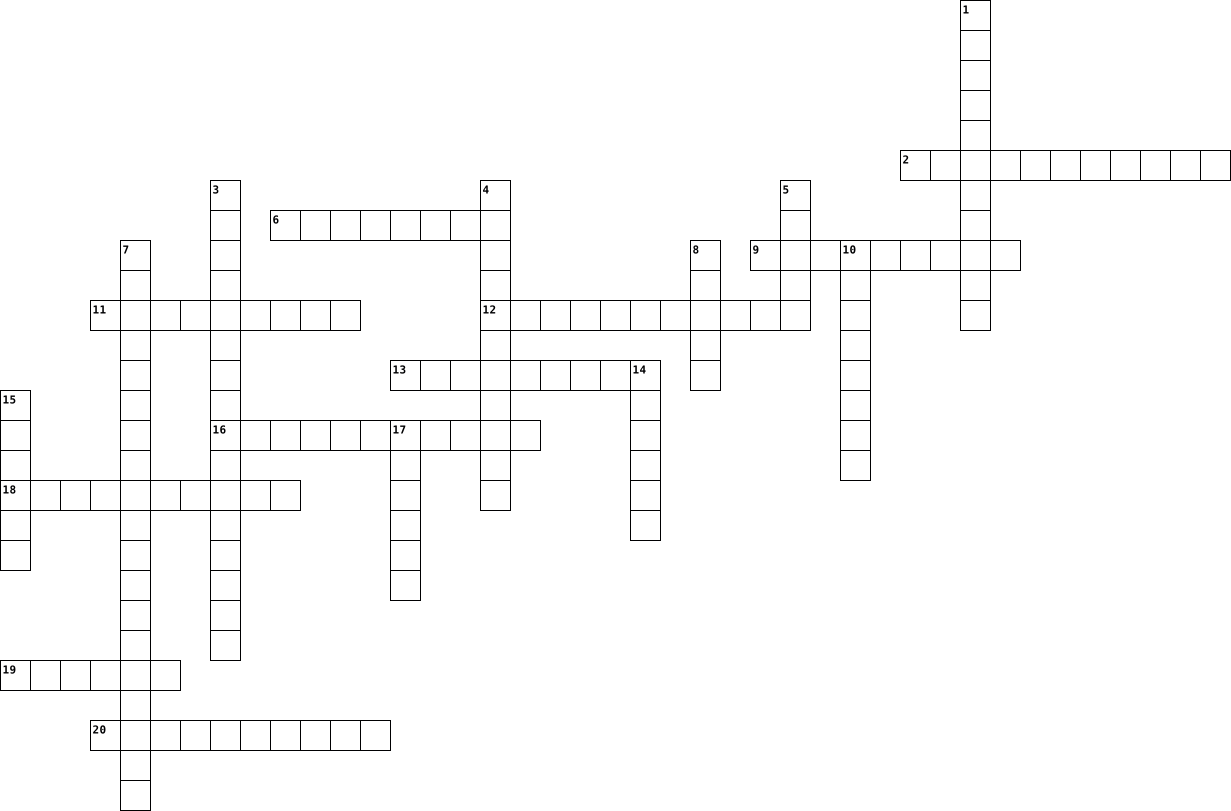
Across
- Nodes that play a role in regulating heart rhythm
- Fibers that send electrical signals quickly to the right and left ventricles of the heart
- relaxation phase of the heart when the heart refills with blood
- large chambers in the heart that pump blood throughout the body
- small blood vessels that connect arteries and veins
- the right and left upper atria are separated by a septum
- Increase in heart rate beyond 100 beats
- the layer of heart muscle that receives blood from the coronary arteries
- blood vessels that carry blood from the heart to the rest of the body
- the covering of the heart that is attached to the surface of the heart
Down
- the inner layer of the heart that lines the heart chambers and heart valves
- the right and left ventricles are separated by a septum
- the outer layer of the heart that protects the heart
- blood vessels that carry blood from throughout the body to the heart
- record the electrical activity that accompanies atrial and ventricular contractions of the heart
- largest blood vessel in the body
- heart contraction phase when blood is pumped into the arteries
- traditional heart sound picture
- Abnormal or unnatural heart sounds
- small chambers in the heart that receive blood from the veins
20 Clues: traditional heart sound picture • largest blood vessel in the body • Abnormal or unnatural heart sounds • Increase in heart rate beyond 100 beats • Nodes that play a role in regulating heart rhythm • small blood vessels that connect arteries and veins • the outer layer of the heart that protects the heart • the right and left ventricles are separated by a septum • ...
Respiratory System Anatomy and Physiology 2023-09-24

Across
- That play a role in the formation of gall cells
- If it has died, the veins become
- The heart region has low oxygen content and high carbon dioxide
- Bacteria caused the cardiac valve
- blood Cardiac function
- The microbiology examination that can be done on this patient is to take its most representative specie
- The ability to penetrate the pores of the capillaries and enter the tissues
- The part responsible for the heart's contractions
- Right and top left atrium separator
Down
- The blood part that is involved in the transportation of food grains that have been digestive tract
- That helps the muscles and the heart contract
- the oxygen rich in the heart
- membranes or membranes that coat the heart
- Heart disease
- Diseases that harm the immune system by attacking t's lymphocytes
- The membrane conditions are returning to a potential after-depolarization break
- HB deficiency or red blood cells
- A type of cancer characterized by uncontrolled white blood cell polyferase
- The classification of white blood cells that play a role in the immune system by pathogenic means
- Organs that work as a blood pump
20 Clues: Heart disease • blood Cardiac function • the oxygen rich in the heart • If it has died, the veins become • HB deficiency or red blood cells • Organs that work as a blood pump • Bacteria caused the cardiac valve • Right and top left atrium separator • membranes or membranes that coat the heart • That helps the muscles and the heart contract • ...
Cardiovascular system anatomy and physiology 2023-09-25
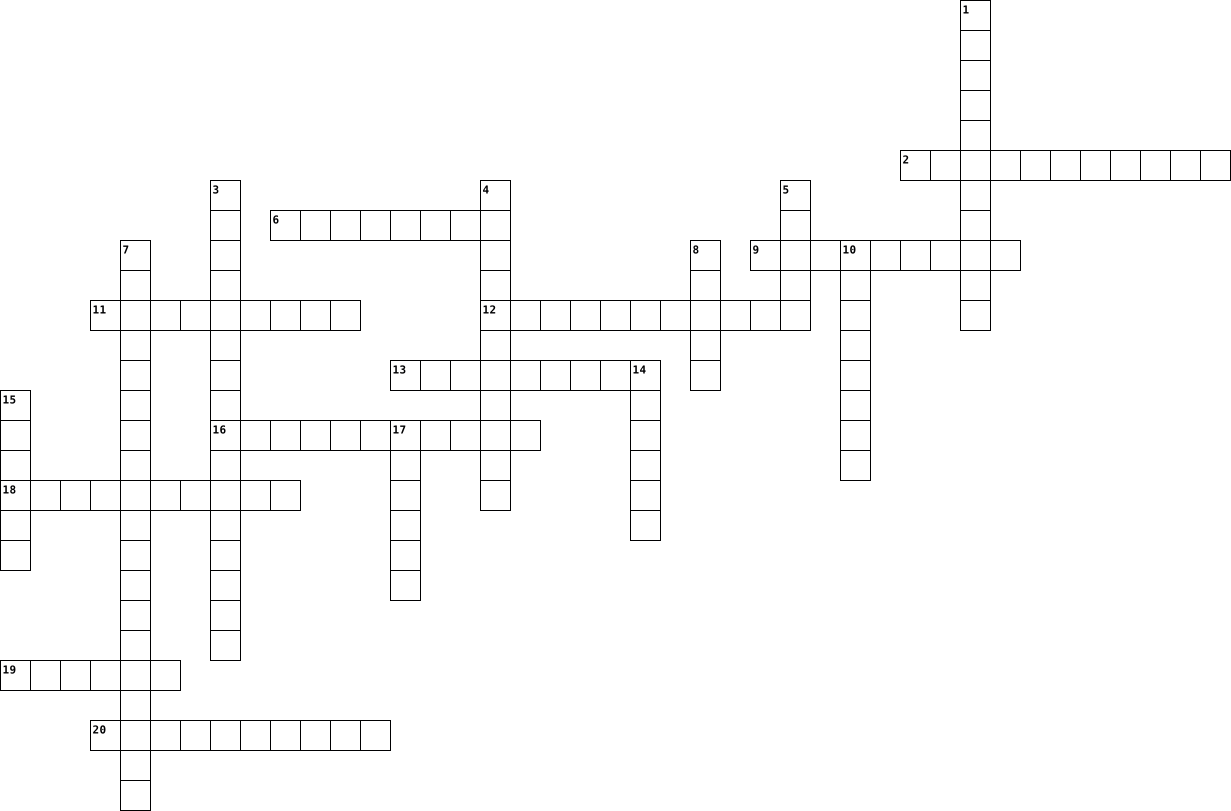
Across
- Nodes that play a role in regulating heart rhythm
- Fibers that send electrical signals quickly to the right and left ventricles of the heart
- relaxation phase of the heart when the heart refills with blood
- large chambers in the heart that pump blood throughout the body
- small blood vessels that connect arteries and veins
- the right and left upper atria are separated by a septum
- Increase in heart rate beyond 100 beats
- the layer of heart muscle that receives blood from the coronary arteries
- blood vessels that carry blood from the heart to the rest of the body
- the covering of the heart that is attached to the surface of the heart
Down
- the inner layer of the heart that lines the heart chambers and heart valves
- the right and left ventricles are separated by a septum
- the outer layer of the heart that protects the heart
- blood vessels that carry blood from throughout the body to the heart
- record the electrical activity that accompanies atrial and ventricular contractions of the heart
- largest blood vessel in the body
- heart contraction phase when blood is pumped into the arteries
- traditional heart sound picture
- Abnormal or unnatural heart sounds
- small chambers in the heart that receive blood from the veins
20 Clues: traditional heart sound picture • largest blood vessel in the body • Abnormal or unnatural heart sounds • Increase in heart rate beyond 100 beats • Nodes that play a role in regulating heart rhythm • small blood vessels that connect arteries and veins • the outer layer of the heart that protects the heart • the right and left ventricles are separated by a septum • ...
Human Anatomy Tri 1 Kaan 2023-10-20

Across
- Name of the cells that are found in the dermis close to nerves that have the sense of touch
- secrete collagen proteins to connect
- First line of defense against intruders for the body
- Glands that create salty water to cool you down
- Oils your hair
- Helps the hair with regeneration after injury
- Cells that line organs & make up the outer cells of the body
- Sweating/getting feverish to keep body temperature
- Protein that forms your nail
Down
- Secrete melanin
- Causes ¨goosebumps¨
- A mole changes size and gets cancer (mildly dangerous)
- Infection of a pore
- The name of the skin layer most inward
- Very dangerous type of cancer
- Gland next to the hair follicle that makes oil
- Bottom of the epidermis
- Vitamin from UV
- Fancy name for skin
- Top of the epidermis
- The hair on your skin is inside one
- Protein found in skin
- Fancy name for skin without the epi
23 Clues: Oils your hair • Secrete melanin • Vitamin from UV • Causes ¨goosebumps¨ • Infection of a pore • Fancy name for skin • Top of the epidermis • Protein found in skin • Bottom of the epidermis • Protein that forms your nail • Very dangerous type of cancer • The hair on your skin is inside one • Fancy name for skin without the epi • secrete collagen proteins to connect • ...
Unit 1 Human Anatomy Crossword 2023-09-23

Across
- The four properties of muscle tissue are contractility, extensibility, tonus, and ____
- Moving the lateral surface of the foot superiorly
- Shaft of a long bone
- Bone which articulates with the Os Coxa at the Acetabulum
- Bone that contains the supraorbital notch or foramen
- A type of joint found in the shoulder and hip, known for its wide range of motion
- Subdivision of the thorax
- Origin is the coracoid process, insertion is middle medial of humerus
- Disc that is only found in growing children
- Innervated by cranial nerve XI, accessory nerve
- Cartilaginous joint, hyaline cartilage joint, and fibrocartilage joint
- The stratum basale layer is composed of these types of cells
- Joint in which the intervening tissue is merely fibrous connective tissue
- The innermost layer of the skin responsible for producing sweat and sebum
Down
- A bone in the human skull that is often referred to as the "cheekbone"
- Bone that forms the outer surface of all bones
- Layer of tissue which the 2 layers of skin lie on
- Pigment-producing cells that are found in the deepest layer of the epidermis
- The tough, fibrous tissue that connects muscle to bone
- Facilitates movement by minimizing friction between 2 moving structures
- The medical term for the voice box, which houses the vocal cords
- Type of synovial joint found in the elbow
- Trabecullar or cancellous bone
- Name for the lateral condyle of the humerus
- Another name for horizontal plane
- The papillary layer forms these
- A large, dome-shaped muscle involved in the process of breathing
- Muscle that maintains body position while a part is moving
- Cartilage that has a glassy, translucent appearance
- The largest muscle in the human body responsible for hip flexion and thigh extension.
30 Clues: Shaft of a long bone • Subdivision of the thorax • Trabecullar or cancellous bone • The papillary layer forms these • Another name for horizontal plane • Type of synovial joint found in the elbow • Name for the lateral condyle of the humerus • Disc that is only found in growing children • Bone that forms the outer surface of all bones • ...
Anatomy of the Nervous System 2024-03-08

Across
- The clear internal fluid of the cell
- Neurons with a short axon or no axon at all
- It relays and regulates signals of sensation that induces pain to the body
- Located just below the anterior thalamus
- Are the largest glial cells
- A nerve cell which sends different messages all throughout the body.
- It is a class of neuron with more than two processes extending from its cell body
- Cell bodies in the central nervous system
- A neuron with one process extending from its cell body
- Site of aerobic energy release
- The buttonlike endings of the axon branches, which release chemicals into synapses
- Membrane A semipermeable membrane that encloses the neuron
- Matter It allows the exchange of information and communication to the different areas of the body
- It responds to injury or disease by multiplying, engulfing cellular debris or even entire cells and triggering inflammatory responses.
- Fatty insulation around the axon
- Large furrows in a convoluted cortex
Down
- The gaps between adjacent neurons across which chemical signals are transmitted.
- Cell bodies in the peripheral nervous system
- A space located beneath the arachnoid membrane
- It makes up about 90%of the human cerebral cortex
- Cord It is a long band of tissues, nerves, and cells. A delicate structure inside the spine.
- The almond-shaped nucleus in the anterior temporal lobe
- Dorsal surface of the midbrain
- A midline nucleus located at the anterior tip of the cingulate cortex
- It is the automatic motor nerves that project from the brain and sacral region of the spinal cord.
- A kind of nerve that carries sensory signal from the skin, skeletal muscle, joints, eyes, ears, etc.
- It is the most posterior region of the brain stem
- A large convoluted structure on the brain stem’s dorsal surface
- Water head
- It means toward the surface of the chest or the bottom of the head.
30 Clues: Water head • Are the largest glial cells • Dorsal surface of the midbrain • Site of aerobic energy release • Fatty insulation around the axon • The clear internal fluid of the cell • Large furrows in a convoluted cortex • Located just below the anterior thalamus • Cell bodies in the central nervous system • Neurons with a short axon or no axon at all • ...
Anatomy of the Nervous System 2024-03-08

Across
- scavenge pathogens and dead cells
- plays an important role in emotion as well, especially in anger and aggression
- receives inputs from the neocortex
- thin layer that closely follows the contours of the brain
- transmits signals between the brain and the rest of the body, including internal organs
- is the large, two-lobed structure that constitutes the top of the brain
- the key connection point to a person’s cerebellum
- branch-like structures that receive messages from other neurons and allow the transmission of messages to the cell body
- house of many ascending and descending tracts and parts of the reticulum formation and the anterior part of the hindbrain
- tube-like structure that carries electrical impulse from the cell body to the axon terminals that pass the impulse to another
- a circuit of midline structures that circle the thalamus
- division located outside the skull and spine
- dorsal surface of the midbrain
- it is composed of myelinated axons (Myelin- gives off glossy white sheen)
- ridges between fissures & sulci
- are a network of cavities that are distributed throughout the brain
- it is a band of tissues, nerves, and cells
- composed of cell bodies and unmyelinated interneurons
Down
- attached to the spinal cord on the left and right side
- adheres the skull on one side and arachnoid mater on the other side
- strands of connective tissue called arachnoid trabeculae
- composed of two divisions: the brain and the spinal cord
- also called the soma
- cells that are specialized for the reception, conduction, and transmission of electrochemical signals
- developed by Franz Nissl, German psychiatrist, in the 1880s
- neurons with a short axon or no axon at all
- called inferior colliculi
- pronounced as "GLEE-a"
- comes from the Greek word for “Membrane”
- the division of the mesencephalon ventral to the tectum
30 Clues: also called the soma • pronounced as "GLEE-a" • called inferior colliculi • dorsal surface of the midbrain • ridges between fissures & sulci • scavenge pathogens and dead cells • receives inputs from the neocortex • comes from the Greek word for “Membrane” • it is a band of tissues, nerves, and cells • neurons with a short axon or no axon at all • ...
Anatomy of the Nervous System 2024-03-09

Across
- dorsal surface of the midbrain
- black substance
- It means toward the head
- are a network of cavities that are distributed throughout the brain.
- comes from the Greek word for “Membrane” and refers to 3 membranes that surround the brain and spinal cord.
- it is located at the upper back portion of the brain, is associated with somatosensory processing.
- it is a technique used to examine the intricate details of neuronal structure.
- it is a circuit of midline structures that circle the thalamus
- cells that forms the myelin sheath.
- are the gaps between sections of myelin.
- one of the important components of the sensorimotor system
- a neuron with more than two processes extending from its cell body.
- it receives inputs from the neocortex
- It was utilized by Santiago Ramón y Cajal in the late 19th to early 20th centuries, was essential in his groundbreaking research on the nervous system.
Down
- it provide nutrients to neurons, maintain their extracellular environment, and provide structural support.
- House of many ascending and descending tracts and parts of the reticulum formation and the anterior part of the hindbrain.
- branch like structures that receive messages from other neurons and allow the transmission of messages to the cell body.
- cells which provide nutrients and structural support to neurons.
- it is one-shaped region at the junction between the axon and the cell body.
- are cells that are specialized for the reception, conduction, and transmission of electrochemical signals
- It is the most posterior region of the brain stem. The myelencephalon accommodates most of the nucleus regions of the cranial nerves as it is the transition between the spinal cord and the brain.
- help support, connect, and protect the neurons of the central and peripheral nervous systems.
- this is used to map the paths of axons projecting away from cell bodies in a specific area.
- This staining method, commonly employing cresyl violet dye, permeates all cells on a slide but selectively binds to molecules abundant in neuron cell bodies, such as DNA and RNA.
- the ridges between fissures & sulci
- Made up of seven vertebrae called the C1-C7. These bones allow a person to turn, lift, tilt, and nod their head.
- it is located below the anterior thalamus
- the metabolic center of the neuron; also called the soma, which contains nucleus and many organelles.
- it is a midline nucleus located at the anterior tip of the cingulate cortex.
- It is composed of cell bodies and unmyelinated interneurons.
30 Clues: black substance • It means toward the head • dorsal surface of the midbrain • the ridges between fissures & sulci • cells that forms the myelin sheath. • it receives inputs from the neocortex • are the gaps between sections of myelin. • it is located below the anterior thalamus • one of the important components of the sensorimotor system • ...
Respiratory System Anatomy and Physiology 2023-09-28

Across
- Large areas of the lungs are present in
- The right and left bronchi are formed by division
- Pharangeal tonsils are called
- Tonsils located at the base of the tongue
- The reserve volume which is usually between 2100 ml to 3200 ml is called volume
- What system keeps the body supplied with oxygen
- The Cells of the nasal bulb create a gentle current as the cells
- Removal of carbon dioxide
- The road is about 13cm long
- Three mucosal projects or lobes are called
Down
- The surface of each lung is filled with uiseral callulose
- The gap between the vocal cords is
- During exercise, we deeply because breathe more forcefully and the muscular centers send more impulses to the so-called breathing pattern
- The biggest cargo is
- The breathing sound heard as the air fills the alopoly is
- Passageways that allow air to reach the lungs
- The nasal cavity is surrounded by a ring
- The main bronchus is larger in size
- Tonsils at the tip of the soft palate
- Normal respiratory rate
20 Clues: The biggest cargo is • Normal respiratory rate • Removal of carbon dioxide • The road is about 13cm long • Pharangeal tonsils are called • The gap between the vocal cords is • The main bronchus is larger in size • Tonsils at the tip of the soft palate • Large areas of the lungs are present in • The nasal cavity is surrounded by a ring • Tonsils located at the base of the tongue • ...
Lower Respiratory Anatomy - Carson Varallo 2025-05-14

Across
- located in the throat and chest, behind the trachea and heart
- functions to facilitate gas exchange, allowing oxygen to enter blood
- located in the left side of the thoracic cavity within the rib cage
- the serous membrane that covers the outer surface of each lung
- carries deoxygenated blood from the right ventricle to the lungs
- primary muscle for breathing
- located at the bottom of each lung resting on the diaphragm
- located in lungs at the end of their respiratory bronchioles
- located in mediastinum
- primary site of gas exchange in the lungs
Down
- located in both lungs, seperates superior and inferior lobes
- protects the lungs heart and major blood vessels while playing a major role in providing structure and support for muscles involved in breathing
- functions to assist in breathing by elevating and depressing the ribs
- in the anterior midline of the thorax
- functions to carry air between the larynx and the lungs
- functions in both air conduction and gas exchange
- functions to pump and circulate blood throughout the body
- located in upper anterior portion of chest cavity, behind sternum and between the lungs
- protects the heart and anchors it within mediastinum
- located at top of each lung slightly above the clavicle
20 Clues: located in mediastinum • primary muscle for breathing • in the anterior midline of the thorax • primary site of gas exchange in the lungs • functions in both air conduction and gas exchange • protects the heart and anchors it within mediastinum • functions to carry air between the larynx and the lungs • located at top of each lung slightly above the clavicle • ...
anatomy of the aud system 2024-08-04

Across
- allows for communication between air cells of the mastoid and the epitympanic recess (3 words)
- the ________ crus of the stapes is the wider, longer, and curvier crus
- the portion of the temporal bone houses the sensory organs of hearing and balance
- CN VII (2 words)
- the deflection of the _____ at the base of the SCCs causes the hair cells to be sheared
- this wall of the ME houses a semicanal the tensor tympani enters through, the Eustachian tube, and chorda tympani
- the ________ vestibular nerve is made up of nerve fibers from the posterior SCC and Saccule
- the loss of energy due to friction, not related to frequency
- the vestibulocolic reflex is a ______ reflex as it assists in maintaining the head in horizontal gaze orientation relative to gravity but independent to trunk movement
- the narrowest point of the EAC
- small perforations in the osseous spiral lamina that allow nerve fibers to pass through
- the auditory nerve is known as the auditory ______ because damage here can result in dysfunction at or beyond this point
- the interaural timing difference occurs due to the difference in the _______ of a sound as it arrives at each ear
- the medial wall of the ME is made up of the prominence of the lateral semicircular canal, oval window, _________ and round window
- the _______ between the TM and oval window is the mechanism that accounts for 24.6 dB SPL (2 words)
- the ossicular chain is _______ in the ME cavity by its attachment to the TM by the manubrium and to the oval window by the stapes footplate and by various tendons and ligaments
- the tympanic annulus is a _________ ring that attaches the tympanic membrane to the tympanic sulcus
- AN fibers with a ______ spontaneous firing rate respond to low intensities
- a pure tone does not contain ________ making it optimal for testing specific points of the cochlea
- the propeoreciptors in the muscles of the limbs, the eyes, and the vestibular system are the three ways we maintain _________
- the chorda tympani nerve travels through the ME space through the posterior wall, between the ossicular chain to the anterior wall and deals with ________
- low and moderate intensities cause the stapes to move along the _________ axis
- the ET serves to equalize the less compressible air pressure in the middle ear with the _________
- the rarefaction phase cause the BM to reflect ______ and leads to depolarization of hair cells
- the left anterior SCC is paired with the right ______ SCC
- the tympanic _______ is a groove in the bony wall of the EAC
- the dynamic range of an AN fiber is it's threshold to it's point of ________
- the middle ear muscles pull in essentially ______ directions stiffening the ossicular chain
- spinning sensation caused by dysfunction in the vestibular system
- air molecules oscillate and hit neighboring air molecules and _________ the energy to them
- OHCs ______ in response to rarefaction
- the pH of cerumen is ______
- the SCCs are approximately ________ (90 degrees) from each other
- the EAC first travels _____________ then posterosuperiorly and then _____________
- the ________ plane divides the body horizontally into superior and inferior
- the SOC is the first place in the auditory system where there is _______ representation of monaural acoustic input
- the cartilaginous portion of the EAC is __________ as the epidermal lining moves outward (2 words)
- the largest portion of the temporal bones that forms the superior wall of the EAC
- the EAC gives a 10-15 dB _____ to frequencies between 3000-4000 Hz
- OHCs are directly sheared because they are imbedded to the tectorial membrane and IHCs are imposed by the ______ of the endolymph flow imposed on them
- the basilar membrane is shorter and more stiff at the _____
- the inner layer of the TM is continuous with the ________ lining of the ME space
- hair cells of the SCCs are located in the _______ ampullaris on the ampulla
- the intertragal _____ (or incisure)is between the tragus and antitragus
- the vestibulo-ocular reflex ________ our gaze when we are turning our heads- the eyes move opposite to head movement
- bone that forms the framework of support and protection for the outer, middle, and inner ear as well as the 7th and 8th cranial nerve
- CN V (2 words)
- outer hair cell are embedded in this gelatinous flap that covers the length of the organ of corti (2 words)
- the TM is attached to the tympanic ______ by the tympanic annulus
- the _____ zone is the inner section of the BM that courses from the osseous spiral lamina to the outer pillar cells
- the ________ foramen is the opening between the two crura of the stapes
Down
- the products of the _______ glands and ceruminous glands combine to create cerumen
- portion of the wave when molecules are close together
- Low frequency sounds are more affected by the ________ of a system
- the function of the _____ is to collect acoustic energy into the EAC, best at collecting frequencies 5000 and above
- calcium carbon crystals that sit on top of the jelly like structure in the macula. they add mass and allow for the hair cells the be sheared.
- ______ muscles are vestigial in humans meaning it serves no functional purpose
- the ET courses to the posterior aspect of the nasopharynx in a inferior, ______, and anterior direction
- _______ type I AN fibers innervate a single IHC
- Claudian cells provide ________ to the basilar membrance
- the endolymphatic duct regulates endolymphatic ______ to avoid the overproduction/under absorption of endolymph
- the semicircular canals are arranged in pairs so that when one is excited the other is _______
- the middle layer of the TM is made up of ______ fibers and circular fibers
- the apex of the cochlea is oriented anteriorly and slightly laterally pointing towards the ________
- The stria vascularis maintains endocochlear potential by ___________ endolymph
- the combination and integration of information arriving from the two ears (at the SOC)
- ______ membrane separates the scala vestibuli and scala media and keeps their fluids separate
- in the posterior and superior canal the ________ is located on the canal side
- allows the tendon of the stapedius muscle to enter through the posterior wall of the middle ear (2 words)
- kinocilium of the saccule are oriented _____ from the striola
- The EAC functions as a ________ resonator enhancing sounds four times its length (2 words)
- the frequency that hair cells are most sensitive, meaning they respond at the lowest intensity, is known as the _________ frequency
- the striola is the invisible _______ of the otolith organs
- the _______ of the incus is a true ball and socket joint that articulates with the stapes (2 words)
- the round window _______ the movement of the traveling wave
- the short process of the ______ acts as a fulcrum to assist in the lever action of the ossicular chain
- because the striola is ______ their will be a portion of the saccule and utricle that is excited and one portion that is inhibited
- open ion channels when the stereocilia are deflected towards the tallest stereocilia
- pitch, yaw, and roll are _____ motions that excite or inhibit different SCC
- muscle innervated by the facial nerve
- the upper shelf of the osseous spiral lamina is continuous with the _______ and serves as a point of attachment for the tectorial membrane (2 words)
- the different _________ of the reticular lamina and tectorial membrane allows them to move relative to each other (2 words)
- the bony portion of the ear canal is the ______ 2/3
- the scala vestibuli and scala tympani are filled with ______ which is high in sodium and low in potassium
- the petrous pyramid divides the middle cranial ______ and posterior cranial ______
- the tonotopic organization of the auditory nerve organizes low frequencies toward the ______
- the tendon of the tensor tympani muscle enter the middle ear space through a _______ in the anterior wall
- the tegmen tympani is a thin piece of bone that forms the _____ of the ME
- explanation that AN fibers can only fire at a max. rate of 800 times per second so frequencies that are higher rely on multiple AN fibers to lock onto the same phase of multiple cycles (2 words)
- _______ cells support outer hair cells as they sit in them
- which window opens into the scala vestibuli?
- the point at which the Scala vestibuli and Scala tympani communicate
- the lateral process and cone of light reflex are located on the ______ side of the ear that is being observed
- mass and stiffness reactances are opposites and the frequencies at which they cancel out is known as the ________ frequency
- contains 3 important auditory structures (Heschl's gyrus, planum temporale, and insula) located deep within the posterior half of the sylvian fissure
- Type I fibers are myelinated by _____ cells in Rosenthal's canal
- the release of _____ causes the activation of of the AN across the synaptic cleft
- the condyle of the ______ makes up the inferior-anterior wall of the EAC
- _______ flow causes displacement toward the ampulla. the horizontal canal is excited by this flow
- vestibular organ with a horizontal orientation and the kinocilium are oriented towards the striola
- when sound travels from air to _______ there is a loss of intensity
- contraction of the ________ veli palatini and the levator veli palatine causes the cartilaginous portion of the ET to open
- _______ fibers are descending neurons that send signals from the nervous system to the cochlea, these mostly communicate with OHCs
- the tunnel of corti is formed by the inner and outer ______ cells
- the intermediate cells of the stria vascular contains ______
105 Clues: CN V (2 words) • CN VII (2 words) • the pH of cerumen is ______ • the narrowest point of the EAC • muscle innervated by the facial nerve • OHCs ______ in response to rarefaction • which window opens into the scala vestibuli? • _______ type I AN fibers innervate a single IHC • the bony portion of the ear canal is the ______ 2/3 • ...
Anatomy & Physiology Q3 Exam Review 2026-03-02

Across
- Site of ATP production.
- Receive pressure sensory input
- Brain matter that contains fatty myelinated axons
- Secretes insulin
- Pump that maintains resting membrane potential
- Area of the brain responsible for voluntary skeletal muscle activity
- Temporary endocrine organ
- Roots that extend to skeletal muscle
- Horn for visceral organs
- Large gland involved in calcium homeostasis
- Smooth muscle here controls the amount of light that enters the eye
Down
- Nerve that serves our breathing
- Protective connective tissue of the brain and spinal cord
- Nerve that innervates muscles for smiling, squinting, etc.
- Neurotransmitter released by cholinergic fibers
- Plexus the innervates the arm
- Receive temperature sensory input, and spice.
- Master gland
- Increase surface area for smell
- Fight or flight nervous system
- Roots that carry sensory input from PNS to CNS
- Eye structure that bends light to focus vision
- Binds to actin during muscle contraction
23 Clues: Master gland • Secretes insulin • Site of ATP production. • Horn for visceral organs • Temporary endocrine organ • Plexus the innervates the arm • Receive pressure sensory input • Fight or flight nervous system • Nerve that serves our breathing • Increase surface area for smell • Roots that extend to skeletal muscle • Binds to actin during muscle contraction • ...
Chase's Frog Anatomy Crossword Puzzle 2024-06-03

Across
- Hearing
- Largest digestive gland in the body
- Stores solid waste and is part of the excretory system
- All waste is collected; part of the digestive system
- Blood vessels that carry blood away from the heart; part of the circulatory system
- the first part of the small intestine immediately beyond the stomach, leading to the jejunum; part of the digestive system
- moves digested food out of the body; part of the digestive system
- Filters blood and makes urine
- Organ near the stomach that produces, stores, and eliminates blood cells
- air opening to exchange gases
Down
- Blood vessels that carry blood back to the heart; part of the circulatory system
- Catches prey
- Carries eggs in female frogs; part of the reproductive system
- First site of chemical digestion
- Transparent cover that protects the eye
- Uptake of sugar
- Stores urine; part of the excretory system
- Delivers Oxygen to the body
- Stores bile; part of the digestive system
- thin membrane that holds the coils of the small intestine
20 Clues: Hearing • Catches prey • Uptake of sugar • Delivers Oxygen to the body • Filters blood and makes urine • air opening to exchange gases • First site of chemical digestion • Largest digestive gland in the body • Transparent cover that protects the eye • Stores bile; part of the digestive system • Stores urine; part of the excretory system • ...
Pediatric Anesthesia: Anatomy and Physiology 2025-03-31

Across
- Blood-brain barrier in neonates is this
- Closure of the ductus arteriosus occurs due to muscle contraction in response to decreases in this
- Important to maintain this when newborn is hypovolemic
- C2-C3 represents the anatomical area of this structure in neonates and infants
- Fontanelle that closes between 18 months-2 years of age
- Approximately 3x greater in neonates and infants when compared to adults (two words, but remove the space in between them)
- Dangerous in neonates and infants due to associated drop in cardiac output
- Neonates have a limited ability to compensate for hypotension with tachycardia due to this (two words, but remove the space in between them)
- Epiglottis in neonates and infants is long and this
- Fontanelle that closes around 6 months of age
- A cause of elevated PVR and shunt patency
- Hypothermia in neonates and infants causes this to occur (regarding blood sugar)
- Inversely proportionate to age
Down
- This results in immediate increases in SVR and BP at birth (two words, but remove the space in between them)
- Can cause retinal artery vasoconstriction and hemorrhage
- Fetal circulation results in this type of circulation being bypassed
- Increased by 16x in pediatric patients (two words, but remove the space in between them)
- Nervous system that is immature at birth
- Nervous system that is fully functional at birth
- May be impaired in sick newborns regarding cerebral blood flow
- Neonatal kidneys have a decreased ability to do this
- Narrowest point in the airway in children < 5 years old
- O2 affinity of fetal hemoglobin is
- Infant larynx appears more _____
- Neonate and infant cardiac output are dependent on this (two words, but remove the space in between them)
- Primary muscle for ventilation in neonates and infants
- Neonates and infants are obligate ____-breathers until 4-6 months of age
- Largest factor in causes of decreased cerebral perfusion pressure
- Shape of trachea in neonates and infants
- Elevated PVR can lead to this
30 Clues: Elevated PVR can lead to this • Inversely proportionate to age • Infant larynx appears more _____ • O2 affinity of fetal hemoglobin is • Blood-brain barrier in neonates is this • Nervous system that is immature at birth • Shape of trachea in neonates and infants • A cause of elevated PVR and shunt patency • Fontanelle that closes around 6 months of age • ...