
history Crossword Puzzles
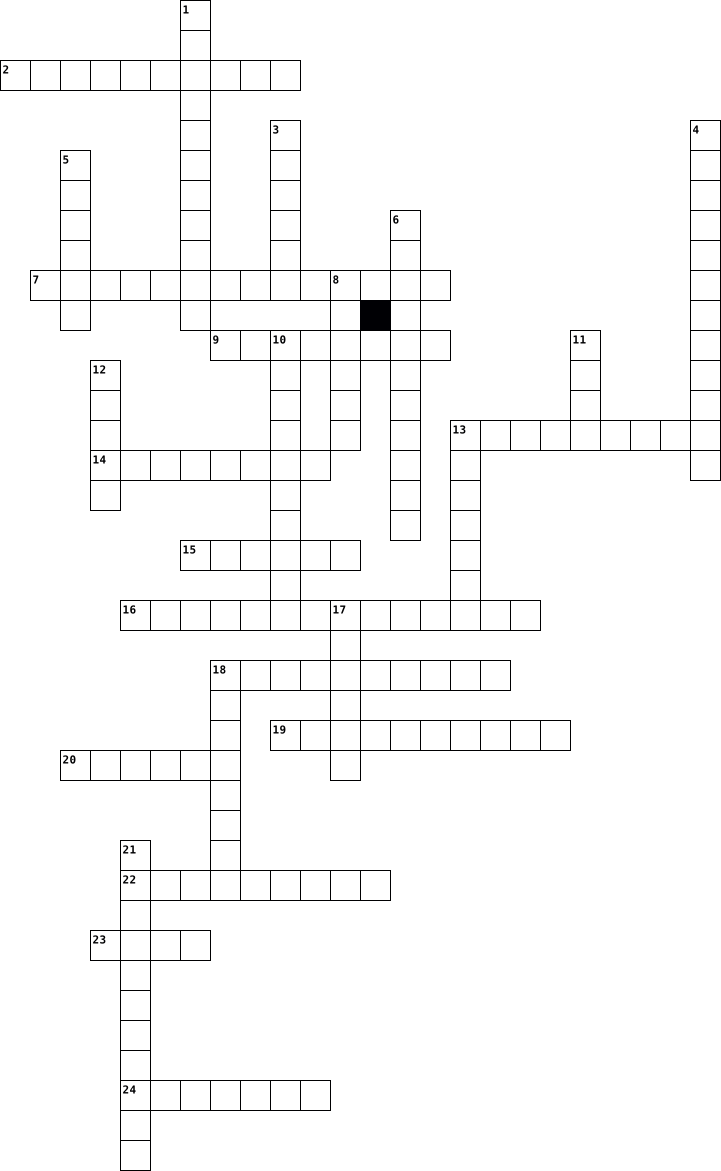
US history 2022-10-07

Across
- the process of a company increasing production of goods
- invented the railway air brake
- first female self-made millionaire in America
- the combination in one company of two or more stages of production
- His inventions included an evaporative air conditioner
- second known African American woman to receive a patent
- the theory that individuals, groups, and peoples are subject to the same laws of natural selection
- a refusal to work organized by a body of employees as a form of protest
- a political theory, advocating class war and leading a society in which all property is publicly owned and each person works and is paid according to their abilities and needs
- possession or control of the supply of or trade
- economic system where production is determined
- the goods or merchandise kept on the premises of a business or warehouse and available for sale or distribution
- an arrangement whereby a person holds property as its nominal owner for the good of one or more beneficiaries
- political system in which a country's trade
- manufactured the Pullman sleeping car
- a person who organizes and operates a business
- inventor whose lasting machine brought significant change to the manufacturing of shoes
- invented lubrication systems for steam engines
- the action or process of innovating
- an American financier and investment banker
- an industrial lockout and strike
- invented a single-wire telegraph system
- inventors of the first airplane
- the exclusion of employees by their employer from their place of work until certain terms
- a landmark U.S. law that banned businesses from colluding or merging to form a monopoly
- co-founder of the American telephone
Down
- a company that sells or manages mail-order advertising or a mail-order business
- a widespread strike by railroad workers
- a system of ideas and ideals, especially one which forms the basis of economic or political theory and policy
- labor union leader
- violent confrontation between police and labour protesters in Chicago on May 4, 1886
- also known as the technical revolution
- an organized association of workers, often in a trade or profession, formed to protect and further their rights and interests
- a political and economic theory of social organization which advocates that the means of production, distribution, and exchange should be owned or regulated by the community as a whole
- led the expansion of the American steel industry
- considered the wealthiest American of all time and the richest person in modern history
- a national federation of labor unions
- an economic and political system in which a country's trade and industry are controlled by private owners for profit
- system for transmitting messages
- the abolition of hierarchical government
- inventor of the lightbulb
- steel making process
- group of people authorized to act as a single entity and recognized as such in law
- inventor of the smoke hood
- submarine communications cable
- an American industrialist and a founder of Standard Oil
- an American labor federation
47 Clues: labor union leader • steel making process • inventor of the lightbulb • inventor of the smoke hood • an American labor federation • invented the railway air brake • submarine communications cable • inventors of the first airplane • system for transmitting messages • an industrial lockout and strike • the action or process of innovating • co-founder of the American telephone • ...
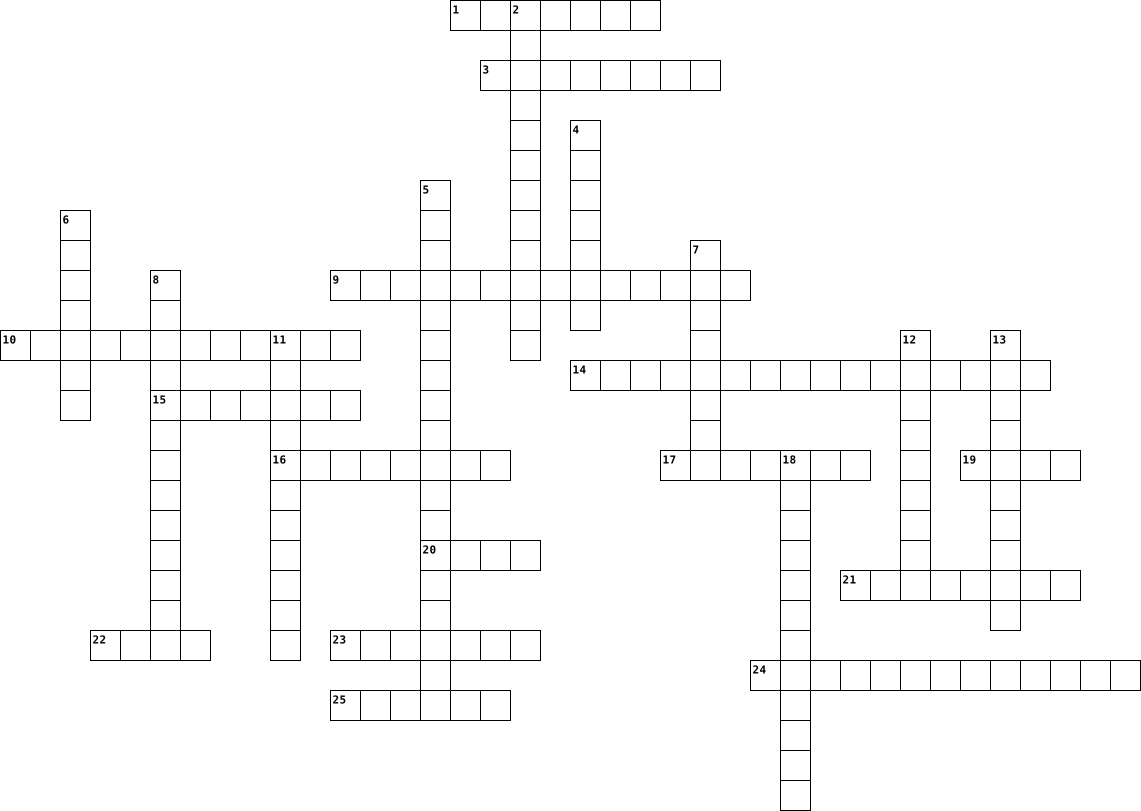
MUSIC HISTORY 2022-09-23
Across
- Music with 1 melody line
- Monophonic Sacred music sung by monks
- An era with passionate & very expressive music
- Deafness afflicted him. Music was emotional
- An era after the fall of Rome
- Music having to do with the church
- Met to decide fate of the polyphonic mass
- Music with more than 1 melody line
- Romantic artsong about the grim reaper
- Wealthy landowners
- an era with a return to simpler music and arts
- The catholic worship service
- Music that does not involve the church
Down
- Traveling musicians
- Someone who provides money for an endeavor
- Style where music represents specific word
- Child Prodigy-Perhaps the greatest composer ever
- An era after the Dark Ages - A rebirth
- Wrote Water Music & Music for the Royal Fireworks
- Wrote the first opera
- Famous Baroque composer, Organ player, Fugue writer
- Father of the symphony. Wrote Surprise Symphony
- An era with very ornamented arts and music
- The first opera
- Poor people in the Dark Ages
- Romantic composer - The Big Ending - Russian
26 Clues: The first opera • Wealthy landowners • Traveling musicians • Wrote the first opera • Music with 1 melody line • Poor people in the Dark Ages • The catholic worship service • An era after the fall of Rome • Music having to do with the church • Music with more than 1 melody line • Monophonic Sacred music sung by monks • An era after the Dark Ages - A rebirth • ...
puzzling history 2022-09-30

Across
- first ten amendments
- the moderation in consumption of alcohol, wanting people to give up alcohol.
- groups of workers who press for better working conditions and member benefits.
- the power to decide whether or not laws are constitutional and to strike down those that are unconstitutional.
- the immediate end to slavery.
- a revolution/plus up in business and industry. large-scale manufacturing using complex machines and organized workforces in factories.
- laws limiting the rights of african americans in the south.
- a woman’s rights convention/movement.
- the vice president who put out the idea of nullification to make way for a legal way to resist tariffs for his home state.
- when about 16,000 cherokees were forcibly removed and relocated from their ancestral homelands in the southeast to now oklahoma. 2,000 died i camps while waiting and another 2,000 died of starvation, exposure, and disease.
- the preference for native-born people and a desire to limit immigration.
- open to interpretation has a double meaning.
- the powers specifically mentioned in the constitution.
- this was marylands attempt to tax baltimore branch second bank of the united states.
Down
- us paid $11.25 million and agreed to take french debts, about $3.75 million, owed to the american citizens which then doubled the us and gained control of the entire mississippi river.
- powers that aren’t explicitly written in the constitution but are necessary for the government to do its job.
- her and Lucretia Mott organized the seneca falls convention for women’s rights.
- the freeing of enslaved people.
- a famous abolitionist who escaped slavery to maryland, published an antislavery newspaper and wrote an autobiography
- letting the session of congress expire without signing the legislation.
- paper money came known as greenbacks because of the green color.
- a new political party led by Henry Clay, JQA, and Daniel Webster who wanted to expand the federal government.
- appointing people to government jobs because of their party loyalty and support.
- those who would head these departments and advise him.
- president declared that the american continents were no longer open to colonization or be viewed as such.
25 Clues: first ten amendments • the immediate end to slavery. • the freeing of enslaved people. • a woman’s rights convention/movement. • open to interpretation has a double meaning. • those who would head these departments and advise him. • the powers specifically mentioned in the constitution. • laws limiting the rights of african americans in the south. • ...
US history 2022-10-06
Across
- Where did the Pilgrims on the Mayflower arrive?
- Who did the british kill in the boston massacre?
- Who fired the shot heard round the world?
- Who drafted the amendments to become the bill of rights?
- Where did the US purchase land on April 30, 1803?
- Who was the Native that introduced the pilgrims to Plymouth?
- Who doesnt have the power to pass laws and override the constitution?
- What was the war called when Andrew Jackson battled over the second bank?
- Scott Who didnt have freedom in a free state on March 6, 1857?
- What did Andrew Jackson trade for with the indians?
- What was the first state to ratify the constitution?
- What Month did the US adopt the Declaration of Independance?
- What was one of the buildings that the british set on fire on August 24, 1814?
- Where did the Salem witch trials occur?
- Who did Washington surprise attack on?
Down
- Where did the first sold 20-30 african americans land in 1619?
- What month did Samuel Morse introduce the telegraph?
- What war was the battle of yorktown in?
- Where did Christopher Columbus make landfall?
- What State did the men and boys settle in?
- Who discovered gold in California?
- Where did the Female Sufferagists meet?
- On April 15, 1817 what construction was passed by the New York Legislature?
- What did the constitution gave states the right to block?
- Who did the indians hang on June 8, 1675?
25 Clues: Who discovered gold in California? • Who did Washington surprise attack on? • What war was the battle of yorktown in? • Where did the Female Sufferagists meet? • Where did the Salem witch trials occur? • Who fired the shot heard round the world? • Who did the indians hang on June 8, 1675? • What State did the men and boys settle in? • ...
History Crossword 2022-10-12

Across
- A plan to make America economically independent
- Parts that are exactly alike/easily replaced
- To withdraw
- The practice of rewarding political backers with government jobs
- A license from the government giving an Inventor the sole right to make, use, and sell an invention for a certain period of time
- Told the rest of the world to stay out of all affairs in the western hemisphere
- capital Money that a business spends in hopes of a future gain.
- system A practice where the winner of an election chose who would fill government jobs, regardless of qualifications
- To reject
- A Supreme Court case where the court ruled that the powers of the Federal government went beyond those spelled out in the
- A band of states stretching from South Carolina to Texas
- production process.
- A system in which each worker performs just one part of an
- Ongoing effort to increase production with machines
- A 116 day forced march of the Cherokee people to the Indian territory. 1 out of every 4 Cherokees died.
- A war between natives, led by Black Hawk, and the U.S. in Illinois. Won by the U.S.
- A heavy tax on imported manufactured goods, designed to strengthen American business.
- A single factory where all tasks involved in making a product are carried out.
- The Supreme Court case where the court ruled that states could not interfere with the Federal government’s regulation of interstate commerce
- An organization of workers formed to protect the interests of its members.
- An 1830 law giving the President authority to move Native tribes from the homeland to territories in the west
Down
- An 1835 uprising of the Seminoles, led by Osceola against the United States. Won by the U.S.
- areas made up of farms and countryside.
- cities.
- The use of machinery to make goods.
- A violent slave uprising in 1831.
- A piece of paper that the bank issues to their customers.
- profits.
- crowded apartments with poor standards of sanitation.
- A Supreme Court Case where the court ruled that states cannot interfere with private contracts.
- distinct region of the country.
- An economic system in which companies compete
- a work stoppage.
- The powers neither given to the federal government nor denied to the states.
- Invented by Eli Whitney, separates cotton from seeds, led to an increase in the use of slave labor
- development of industry.
36 Clues: cities. • profits. • To reject • To withdraw • a work stoppage. • production process. • development of industry. • distinct region of the country. • A violent slave uprising in 1831. • The use of machinery to make goods. • areas made up of farms and countryside. • Parts that are exactly alike/easily replaced • An economic system in which companies compete • ...
History Core 2022-11-21

Across
- Apa lagu kebangsaan negara Indonesia?
- Sebutkan sila pertama dalam pancasila
- apa kependekan dari rukun tetangga?
- Apa lambang negara Indonesia?
- Apa sistem negara Indonesia?
- hidup Berapa lama masa jabatan kepala negara dalam bentuk pemerintahan monarki?
- apa kependekan dari dewan perwakilan rakyat?
- apa kependekan dari rukun warga?
- Manusia purba pada masa berburu dan mengumpulkan makanan selalu hidup berpindah-pindah atau juga diesbut sebagai...
- Bagaimana cara pemilihan kepala negara dalam bentuk pemerintahan republik?
- Kapak merupakan peninggalan masa praaksara pada zaman apa?
- Apa dasar negara Indonesia?
- Tempat apa yang digunakan manusia peraaksara sebagai tempat tinggal?
- Apa hukum tertinggi negara Indonesia?
Down
- Apa semboyan negara Indonesia?
- jaman sebelum ada tulisan di bumi
- Apa sistem pemerintahan negara Indonesia?
- Menhir merupakan peninggalam praaksara pada zaman apa?
- apa kependekan dari Majelis Permusyawaratan Rakyat
- Pada tanggal 27 Desember 1949 terjadi peristiwa...
- Bagaimana cara pemilihan kepala negara dalam bentuk pemerintahan monarki?
- Apa warna bendera Negara Indonesia?
- Apa kependekan dari dewan perwakilan daerah?
- nama lain jaman praaksara
- Apa bentuk pemerintahan negara Indonesia?
- Siapa nama presiden Indonesia?
26 Clues: nama lain jaman praaksara • Apa dasar negara Indonesia? • Apa sistem negara Indonesia? • Apa lambang negara Indonesia? • Apa semboyan negara Indonesia? • Siapa nama presiden Indonesia? • apa kependekan dari rukun warga? • jaman sebelum ada tulisan di bumi • apa kependekan dari rukun tetangga? • Apa warna bendera Negara Indonesia? • Apa lagu kebangsaan negara Indonesia? • ...
US History 2022-10-19

Across
- a socialist, political activist, trade unionist, one of the founding members of the Industrial Workers of the World, and five times the candidate of the Socialist Party of America for President
- he developed many devices in fields such as electric power generation, mass communication, sound recording, and motion pictures
- an Irish-born American schoolteacher and dressmaker who became a prominent union organizer, community organizer, and activist
- a United States Supreme Court case in which the Court upheld the power of state governments to regulate private industries
- a business magnate and philanthropist. He has been widely considered the wealthiest American of all time
- a United States federal law that was designed to regulate the railroad industry
- an American businessman and the first American to successfully drill for oil
- a national federation of labor unions in the United States
- they believe in "survival of the fittest" and that some people do better because they are innately better
- a two-part fraud conducted from 1864 to 1867 by the Union Pacific Railroad and the Crédit Mobilier of America construction company
- he invented the QWERTY keyboard, has been contended to be one of the inventors of the first typewriter in the United States, and he was also a newspaper publisher and Wisconsin politician
Down
- when a business grows by acquiring a similar company in their industry
- a 1,911-mile continuous railroad line constructed between 1863 and 1869 that connected the U.S.
- an international labor union that was founded in Chicago in 1905
- a Scottish-American industrialist and philanthropist who led the expansion of the American steel industry in the late 19th century
- a Scottish-born inventor, scientist and engineer who is credited with patenting the first practical telephone
- a British-born American cigar maker, labor union leader and a key figure in American labor history
- an engineer and industrialist who designed and manufactured the Pullman sleeping car and founded a company town, Pullman, for the workers
- this authorized the federal government to institute proceedings against trusts in order to dissolve them
- the first inexpensive industrial process for the mass production of steel from molten pig iron
20 Clues: a national federation of labor unions in the United States • an international labor union that was founded in Chicago in 1905 • when a business grows by acquiring a similar company in their industry • an American businessman and the first American to successfully drill for oil • a United States federal law that was designed to regulate the railroad industry • ...
History Vocab 2022-10-21

Across
- Ruling class of nobles families
- bridge held up by cables
- One earth travel around the sun
- Bishop of an important city
- related to the leader of an empire
- No jail without being charged indefinitely
- Leader of an empire
- City on the edge of eastern Europe
- fights fought to france and england
- Empire in west africa
- Rule by officials of proven merit
- drawing that stands for a word or phrase
- Holds beliefs to a specific religious teachings
- 1215 agreement limiting the monarchy's power
Down
- trade between north and south sahara
- Qualify people for government
- empire at crossroads of asia and europe
- stone pillar with carvings
- complex body of workers
- Commoners,church officials, and nobles
- family line traced through the mother
- Christianity development in byzantine empire
- a variety of a language
- surgery that makes a hole in the skull
- military leaders working outside of the government
- symbol for a word or idea
26 Clues: Leader of an empire • Empire in west africa • complex body of workers • a variety of a language • bridge held up by cables • symbol for a word or idea • stone pillar with carvings • Bishop of an important city • Qualify people for government • Ruling class of nobles families • One earth travel around the sun • Rule by officials of proven merit • related to the leader of an empire • ...
Art History 2023-01-03

Across
- a fine shading meant to produce a soft transition between colors and tones
- Pose of a figure with weight on one leg with an s-curve in the body, creating a graceful pose
- Featured paintings with light, sentimental themes that focused on aristocracy
- Romantic artist of the landscape titled The Haywain
- Focus on unidealized depiction of real life in subject matter and painting style
- Art movement associated with the Enlightenment and a reverence for drawing
- Artist of The Incredulity of St. Thomas
- Artist of the painting, Las Meninas
- Dutch Baroque artist of The Art of Painting
- Dramatic use of light on figures or objects in a painting
- Artist of the painting, The Swing
- Sculpted the Pieta and painted the Sistine Ceiling
- Mannerist artist of The Last Supper
- Art movement partially characterized by an emphasis on powerful forces in nature
- Artist who painted Lamentation (The Mourning of Christ)
Down
- Nike of Samothrace is an example of _________ Greek sculpture
- Term for the period of art during the Late Renaissance
- Realist artist who said, "...An abstract object, invisible or nonexistent, does not belong to the domain of painting
- High Renaissance painter of Virgin of the Rocks
- term for painting outdoors
- Important sculptor from the early Renaissance
- Artist who painted Dance at Le Moulin de la Galette
- Diana of Gabii is an example of ________ Greek sculpture
- Artist of Christ Giving the Keys to the Kingdom to St. Peter
- Nickname of Greek Mannerist artist Domḗnikos Theotokópoulos
- Famous Neo-Classical painter
- a method of painting water-based pigments on freshly applied plaster, usually on wall surfaces
- Art History movement lasting from roughly 1600 - 1750
- Artist of the painting, Death of Marat
- Medieval architecture featuring pointed arches
- One of the main artists of the High Renaissance
31 Clues: term for painting outdoors • Famous Neo-Classical painter • Artist of the painting, The Swing • Artist of the painting, Las Meninas • Mannerist artist of The Last Supper • Artist of the painting, Death of Marat • Artist of The Incredulity of St. Thomas • Dutch Baroque artist of The Art of Painting • Important sculptor from the early Renaissance • ...
History Stuff 2023-01-11

Across
- forcible overthrow
- wishes to permanently rid of an idea
- Abolitionist
- not north
- a masterpiece of elegant architecture
- brought captive Africans to America
- not owned
- not east
- Forced work without pay
- Millionaires capital
- someone who kills for religious reasons
- brother-in-law of hammond
- not south
- not free
Down
- the wealthy
- houses of the government
- Invented cotton gin
- flowing water
- not black
- not white
- Clothing fabric
- small town land owners
- made up of political leaders
- a man who illustrates the culture of southern honor
- not west
- an idea used to account a situation
26 Clues: not east • not west • not free • not black • not white • not north • not owned • not south • the wealthy • Abolitionist • flowing water • Clothing fabric • forcible overthrow • Invented cotton gin • Millionaires capital • small town land owners • Forced work without pay • houses of the government • brother-in-law of hammond • made up of political leaders • brought captive Africans to America • ...
Modern History 2020-06-03

Across
- the changes a group can experience after interacting with another culture.
- a large biuldig in which machinery is used to manufacture goods
- the Spanish soldiers, explorers, and fortune hunters who took part in conquest of the Americas in the 16th century
- a person religous faith
- one of the nomads who invaded the Indian subcontinent in the 16th century and established a powerful empire there.
- a pardon
- a machine with a heavy blade sliding vertically in grooves, used for beheading people.
- is the belief in the importance of the individual and in the virtues of self-reliance and personal independence
- movement of people to a new area or country in order to find work or better living conditions.
- a division of humankind wit common characteristics, such as nationality, race or religion
- an 18th-century Europena movement in wich thinkers attempted to apply the principles of reason
Down
- a group of people who sought freedom from religious persecution in Englandby fiunding a colony at Massachusetts Bay in the early 1600s.
- a government ruled by a few powerful people
- is known as one of the Seven Wise Men of Greece
- the transition to new manufacturing processes in Europe and U.S.
- the religion of the hebrews
- china´s last dunasty, which ruled from 1644 to 1912
- the customs, ides, art, etc, of a particular civilization, society or social group
- an american invention that aided the British textile industry
- a 16th-century movement for religiuos reform, leading to the founding of Christian churches that rejected the pope´s authority
- an imaginary land described by Thomas More in his book utopia
- is a cancelation of punishment still due for a sin that has been forgiven
- an 18th-century European movement in which thinkers attempted to apply the principles of reason and the scientific method to all aspects of society.
- was based on the teachings of the prophet Muhammad.
- morals principles or standards
25 Clues: a pardon • a person religous faith • the religion of the hebrews • morals principles or standards • a government ruled by a few powerful people • is known as one of the Seven Wise Men of Greece • china´s last dunasty, which ruled from 1644 to 1912 • was based on the teachings of the prophet Muhammad. • an american invention that aided the British textile industry • ...
PNW History 2020-06-05

Across
- a United States statute that permitted the entrance of Montana and Washington into the United States of America.
- A tunnel made by James T. Kingsbury in August 1882
- The native american guide of the Lewis and Clark expeditions
- A confrontation in 1859 between the United States and United Kingdom over the British–U.S. border in the San Juan Islands.
- A Greek Maritime pilot who discovered the straits that were named after him in Northwest Washington.
- Otherwise known as Harvey's Depot, this fort existed from 1859-1882
- A slogan by Polk used to advertise the expansion of Texas, California, and Oregon Territory
- Did missionary work with Native American peoples
- A conflict between the United States and the Sahaptian-speaking people of the Northwest Plateau
- British Officer of the Royal Navy. Famously explored the Pacific Northwest coast regions.
- The belief that Settlers were destined to come to Western America
- A conflict between the Spanish Empire, the Kingdom of Great Britain, and the United States of America
- An estimated 1,000 emigrants leave for Oregon Territory with John Gantt as their leader
- The encampment of the Lewis and Clark Expedition in the Oregon Country near the mouth of the Columbia River.
Down
- Has a town on the border of Idaho named after him. The town is right next to Lewiston.
- Has a town in Idaho on the border of Washington named after him. The town is right next to Clarkston.
- The city of Seattle is named after him
- A Spanish Basque explorer of the Pacific Northwest
- Major investor in the PNW Fur Trade
- The first non-native woman to climb Mt. Rainer
- Rivaled with the Northwest Company in the fur trade which caused the Pemmican War in 1816
- The term for the fur of an Otter
- A United States policy that opposed European colonialism in the Americas.
- An entrepreneur and politician regarded as the founder of Seattle
- Governor of the Territory of Washington from 1853 to 1857. First governor of Washington Territory.
25 Clues: The term for the fur of an Otter • Major investor in the PNW Fur Trade • The city of Seattle is named after him • The first non-native woman to climb Mt. Rainer • Did missionary work with Native American peoples • A Spanish Basque explorer of the Pacific Northwest • A tunnel made by James T. Kingsbury in August 1882 • ...
Ancient history 2020-06-05

Across
- a contagious bacterial disease characterized by fever and delirium
- was a Greek philosopher and polymath during the Classical period in Ancient Greece
- the art or practice of designing and constructing buildings
- the stage of human social and cultural development and organization that is considered most advanced.
- best teacher
- the science or practice of farming
- the dominant social system in medieval Europe
- a diagrammatic representation of an area of land or sea showing physical features, cities, roads, etc.
- mountain in Thessaly that in Greek mythology is the abode of the gods.
- as a taxonomic grouping, based on physical or biological similarities within groups.
Down
- an extensive group of states or countries ruled over by a single monarch, an oligarchy, or a sovereign state.
- the aggregate of people living together in a more or less ordered community.
- a matter of cultural identity of a group, often based on shared ancestry
- A Muslim is a believer in the religion of Islam
- the state of a country or region in terms of the production and consumption of goods and services and the supply of money
- the religious faith of Muslims
- an Athenian philosopher during the Classical period in Ancient Greece
- a state of armed conflict between different countries or different groups within a country
- the arts and other manifestations of human intellectual achievement regarded collectively
- the study of the physical features of the earth and its atmosphere
- is the central religious text of Islam, which Muslims believe to be a revelation from God
21 Clues: best teacher • the religious faith of Muslims • the science or practice of farming • the dominant social system in medieval Europe • A Muslim is a believer in the religion of Islam • the art or practice of designing and constructing buildings • a contagious bacterial disease characterized by fever and delirium • ...
History crossword 2020-06-09

Across
- The youngest guild member who was studying or lerning a "job".
- The knight that owns all the land in a village.
- The first person to have went around the world.
- The wooden wall that protected the first castles and the villages.
- The vow that monks made to have no sexual relation, no relathionship, no marriage and to only serve God.
- The name of the monks haircut.
- The iron "door" that was used when a castle was under attack.
- The water that surrounds a castle keeping the ennemies away.
- One of the greatest emperors of the eastern empire.
- The predominent peace of cloth these people wore, which symbolized the love of God.
- The name given to the person undertaking this journey.
- The weapon/piece of artillery that ended with the castles.
Down
- The voluntary action of not eating that monks viewed as a sacrifice.
- The center part of a stone castle were the owners and some knights lived.
- The journey that people undertook for several reasons.
- The action or process of settling among and establishing control over the indigenous people of an area.
- organisation that controls trade in a town.
- A fortification that made the entry of a bigger castles more difficult to break though.
- Antother name for peasnats during Medieval times.
- A tax that was worth 10% of what a peasant had farmed.
- Holy objects or pieces of body of saint's.
- A craftsman who is free to work for a different master.
- Charlemagne was the king of them.
- The first inventor of an efficient and printing press.
- The heart and capital of the Byzantine empire.
- The towers placed all around the curtain wall in case of an attack.
26 Clues: The name of the monks haircut. • Charlemagne was the king of them. • Holy objects or pieces of body of saint's. • organisation that controls trade in a town. • The heart and capital of the Byzantine empire. • The knight that owns all the land in a village. • The first person to have went around the world. • Antother name for peasnats during Medieval times. • ...
history byoq 2020-05-18

Across
- became president of Screen Actors Guild
- illness, first noticed in among homosexual men
- Jimmy Carters vice president
- was president in Russia
- civil rights leader
- also known as restructuring
- found conservatives magazine National Review
- group of people organizing at a local level
- believe the government should regulate economy
- argued that the federal government was too strong
Down
- one of two that built national followings
- sent his army to invade Kuwait
- marked beginning of gay activists movement
- comes from young urban professionals
- amount by which expenditures exceed income
- became leader of the Soviet Union in 1985
- Spanish word for counterrevolutionary
- allowed more freedom of religion and speech
- generally oppose high taxes
- first american woman in space
20 Clues: civil rights leader • was president in Russia • generally oppose high taxes • also known as restructuring • Jimmy Carters vice president • first american woman in space • sent his army to invade Kuwait • comes from young urban professionals • Spanish word for counterrevolutionary • became president of Screen Actors Guild • one of two that built national followings • ...
World History 2019-05-28

Across
- Located in England,archaeological site started in neolithic age and finished in bronze age
- Developed the theory of gravity
- Built to keep china from invasions
- Explorer for Spain, discovered the Americas
- Disease that killed large percentage of europe in dark ages
- Capital of Ottoman empire
- Establishing control over foreign lands and people
- Belief of John Calvin
- Had supreme power and was the church leader of Western Europe
- Code of roman law in four parts had impact on modern European legal codes
- Belief in more than one god
- Prehistoric age
- Belief in only one god
- New age
- Most sacred temple of islam, located in mecca
- Proved and confirmed the helio-centric theory
- Powers in world war 1 including,Russia,France,Britain,and U.S.
- Invented the spinning jenny
- Document that protected Latin american countries
- West african kingdom that was a center for trade
- Sun centered solar system
- Established after world war 1 to prevent future wars
- First emperor of rome
- Ruler who has complete control over government
- Holy book of islam
- People that came from Scandinavia
- Language of western church
- Inspired declaration of independence,believed in life,liberty,and property
Down
- Treaty Hitler defied during world war 2
- Origin of Hinduism
- Religion started by Abraham
- Europeans born in america
- King of France who extended royal power and land
- Wrote wealth of nations
- Roman Peace
- Alliance in world war 1 including Germany,Austria-Hungary,Italy,and ottoman empire
- Founded in India by Siddhartha Gautama
- English writer who wrote Utopia
- Government of Russia during European nation-states
- 39 articles, victory over Spanish armada
- Famous painter who painted the roof of the Sistine Chapel
- Seat of power in Byzantine Empire
- Policy followed by U.S before they entered war
- Time period of western Europe after the fall of the roman empire
- Rise of factory system and collapse of cottage industries
- Father of philosophy
- Name given to Egyptian king
- Government of England during the European nation-states
- System of thought the emphasized humans rather than religious ideas
- Battle between the Muslims and Christians in 732 CE
- Law in Rome,went by phrase "innocent until proven guilty"
- Third monotheistic religion
- Wrote the 95 Theses
- Fought between Rome and Carthage,3 different wars fought during this
- Type of government of Spain during the European nation states
- Name for humans
- Term when money has lost its value
- This empire traded in ceramics and coffee
- Continent early humans emerged from
- First state in Russia
60 Clues: New age • Roman Peace • Prehistoric age • Name for humans • Origin of Hinduism • Holy book of islam • Wrote the 95 Theses • Father of philosophy • Belief of John Calvin • First emperor of rome • First state in Russia • Belief in only one god • Wrote wealth of nations • Europeans born in america • Capital of Ottoman empire • Sun centered solar system • Language of western church • ...
Remembering History 2019-03-12

Across
- First to walk the Sauk Trail
- Native American Civil War General
- Used for food, water and bird houses
- Indian Marker Tree Location
- 1800's war lasting four years
- Native American Sharp Shooters
- 1812 hero also the 7th President
- A dome-shaped hut or home of the Woodlands People
- Powhatan call this a tamahaac
- Green, mush or meal I’m a staple to most Tribes
Down
- A type of jerky
- Black powder weapon
- French Canadians who transported furs by canoe
- Another name for steam train
- Another name for the Sumac Tree
- President who hung 38 Native Americans
- Pulled by dogs and horses
- Something Given, also a General in the Civil War
- 1900's war lasting seventeen years
- Cowboy field kitchen
- Weapon of the European armies between 1660 and 1840
- Bunny in a blanket, can’t breath
- Used on drums and rattles
- Cone shaped houses of the plains Tribes
- Many tribes say there are 13 of these in a year
25 Clues: A type of jerky • Black powder weapon • Cowboy field kitchen • Pulled by dogs and horses • Used on drums and rattles • Indian Marker Tree Location • Another name for steam train • First to walk the Sauk Trail • 1800's war lasting four years • Powhatan call this a tamahaac • Native American Sharp Shooters • Another name for the Sumac Tree • 1812 hero also the 7th President • ...
US history 2019-10-10

Across
- one's own nation and support for it's interest especially to the exclusion or detriment of the interests of other nations.
- an american religious leader & politician.
- the acquisition of the territory of Louisiana by the USA from France.
- people who left their homes in search of gold
- proposal to prohibit slavery in the territory acquired by the US at the conclusion of the Mexican war.
- a 2,000 mile route from Missouri to Oregon.
- father of the America industrial revolution.
- the name of Texas when it was not part of the USA or Mexico.
- transition to new manufacturing processes in Europe to USA.
- first women's right convention.
- father of the Common school.
- an idealist philosophical and social movement.
- the idea that the american had the the god right to expand in the west.
- protestant religious revival
- she created the 1st generation of american mental asylum.
- leader of the Texas revolution.
- authorized the president to negotiate with southern native American tribes for their removal.
Down
- movement who sought to end the Atlantic slave trade .
- suies of forced relocation of Native Americans in the USA from their ancestral homelands. Whigs: a political party active in the US in the middle of 19 century, alongside the Democratic party.
- 12th president of the USA.
- treaty of peace between the USA and the Mexican republic.
- a abolitionist women's right activist.
- he led a 2 day rebellion of both enslaved and free black people.
- inventor of the cotton gin.
- instrumental in bringing the industrial revolution to the USA.
- an american soldier and statesman who served as the seventh president of the USA
- a United States policy of opposing European colonialism.
- identical parts that can be easily mass produced and replaced.
- an armed conflict between the USA and Mexico.
- association of workers formed to protect and further their rights and interest.
30 Clues: 12th president of the USA. • inventor of the cotton gin. • father of the Common school. • protestant religious revival • first women's right convention. • leader of the Texas revolution. • a abolitionist women's right activist. • an american religious leader & politician. • a 2,000 mile route from Missouri to Oregon. • father of the America industrial revolution. • ...
History Glossary 2019-10-15

Across
- under ground burial
- place of residence
- uncovered small chamber
- related to funerary habits
- wore by pharaoh
- a period i ancient egypt
- chronology of humanities
- cow goddesses
- earliest phase of burial
- afterlife god
- very high building
- first king of egypt
Down
- gods worshiped inside
- symbol of spirit in ancient egypt
- sequence of historical events
- educated man in royal court
- make one rule under one king
- Greek macedonian king
- headdress
- creator god of memphis
- mother goddesses
- Tomb of a pharaoh
- symbol of authorization
23 Clues: headdress • cow goddesses • afterlife god • wore by pharaoh • mother goddesses • Tomb of a pharaoh • place of residence • very high building • under ground burial • first king of egypt • gods worshiped inside • Greek macedonian king • creator god of memphis • uncovered small chamber • symbol of authorization • a period i ancient egypt • chronology of humanities • earliest phase of burial • ...
History Crossword 2019-11-24

Across
- The alliance in WWI that included America; the winning alliance
- The addition to the Monroe Doctrine that said the US could intervene to stabilize the economy of nations in the West.
- A canal that connects the Pacific and Atlantic Oceans
- The leader of the Rough Riders that bravely fought in the battle of Kettle Hill
- A telegram that proposed an alliance with Germany and Mexico
- mediated negotiation supported by the unspoken threat of a powerful military
- The 28th president of the United States
- A team of nations in a war
- the belief or desire of a government or people that a country should maintain a strong military capability and be prepared to use it aggressively to defend or promote national interests.
- The alliance in WWI that included Germany; the losing alliance
- Fake News
- A US ship that sank and was blamed on Spain
Down
- a country that has significant influence in international affairs.
- An international organization to promote world peace and cooperation that was created by the Treaty of Versaille; dissolved April 1946.
- a policy of extending a country's power and influence through diplomacy or military force.
- A British ocean liner that was sunk by a German U-Boat
- a government's strategy in dealing with other nations.
- Not involved in a war
- The principles for peace negotiation in WWI
- The doctrine that said the East could not colonize the West anymore.
- identification with one's own nation and support for its interests, especially to the exclusion or detriment of the interests of other nations.
21 Clues: Fake News • Not involved in a war • A team of nations in a war • The 28th president of the United States • The principles for peace negotiation in WWI • A US ship that sank and was blamed on Spain • A canal that connects the Pacific and Atlantic Oceans • A British ocean liner that was sunk by a German U-Boat • a government's strategy in dealing with other nations. • ...
History Review 2020-09-28

Across
- A battle that George Washington started to give his troops hope.
- Gave reserved land to native tribes.
- laws that oppressed African Americans.
- What describes how the Americans pushed the natives out their land.
- To fit in or blend in to something.
- The last war between America and England.
- When the american army started the a war against Indians.
- Selling goods.
- laws that the British enforced that limited Americas trading with other countries.
- Where one crop is grown only.
- A actor who was famous and assassinated Abe Lincoln.
- The ruler of England during the war of independence.
Down
- Louis and Clark started their adventurous with purchase of new land.
- The author of the declaration of independence.
- A railroad that connected the east to west.
- Rights that the government can not take away from the people.
- A civil rights activist.
- He made the bank financial system.
- Added taxes to sugar and molasses.
- A reason for the western expansion.
- This document made America officially independent from the British control.
- A peaceful protest to show the king their disagreement on the tea taxes.
- Where the surrender of the Confederates general surrendered to the Union.
- To leave or withdraw from something.
- A act that made people pay for extra paper for product.
- the case of america that showed slaves where property and not human.
- A Solider in the Civil war who fought to abolish slavery.
- A general who who lead the Americans during the War of Independence from England.
- The war of land west such as texas.
- The final battle of the civil war.
30 Clues: Selling goods. • A civil rights activist. • Where one crop is grown only. • He made the bank financial system. • Added taxes to sugar and molasses. • The final battle of the civil war. • A reason for the western expansion. • To fit in or blend in to something. • The war of land west such as texas. • Gave reserved land to native tribes. • To leave or withdraw from something. • ...
History Vocab 2020-09-30

Across
- The right of citizens of the United States to vote shall not be denied or abridged by the United States or by any State on account of race, color, or previous condition of servitude
- state constitutional provisions mandated the segregation of public schools, public places, and public transportation, and the segregation of restrooms, restaurants, and drinking fountains between white and black people
- All persons born or naturalized in the United States and subject to the jurisdiction thereof, are citizens of the United States and of the State wherein they reside
- the process in which a minority group or culture comes to resemble a dominant group or assume the values, behaviors, and beliefs of another group
- a proposal to the United States Constitutional Convention for the creation of a supreme national government with three branches and a bicameral legislature.
- was the acquisition of the territory of Louisiana by the United States from France
- series of laws passed by the British Parliament that imposed restrictions on colonial trade
- a proposal for the structure of the United States Government presented by William Paterson at the Constitutional Convention
- political and mercantile protest by the Sons of Liberty in Boston
- comprises the first ten amendments to the United States Constitution
- This royal proclamation, issued on October 7, 1763, closed down colonial expansion westward beyond Appalachia
- First Transcontinental Railroad was a 1,912-mile continuous railroad line constructed between 1863 and 1869
- British legislation aimed at ending the smuggling trade in sugar and molasses from the French and Dutch West Indies
Down
- The proclamation declared "that all persons held as slaves" within the rebellious states "are, and henceforward shall be free."
- formally known as the Bureau of Refugees, Freedmen and Abandoned Lands, was established in 1865 by Congress to help millions of former black slaves and poor whites in the South in the aftermath of the Civil War
- authorized the federal government to break up tribal lands by partitioning them into individual plots
- pure democracy is a form of democracy in which people decide on policy initiatives directly
- a conflict between the United States and Mexico, fought from April 1846 to February 1848
- a person who favors the abolition of a practice or institution, especially capital punishment or (formerly) slavery
- Amendment to the United States Constitution abolished slavery and involuntary servitude
- the action of withdrawing formally from membership of a federation or body, especially a political state
- a series of forced relocation's of approximately 60,000 Native Americans between 1830 and 1850
- a slave who sued for freedom but was denied for being considered property
- small but pivotal battle during the American Revolutionary War, which took place on the morning of December 26, 1776, in Trenton, New Jersey
- joint Franco-American land and sea campaign that entrapped a major British army on a peninsula at Yorktown
- an estate on which crops such as coffee, sugar, and tobacco are cultivated by resident labor
- a form of government operating on principles adopted from a republic and a democracy
- an act regulating stamp duty (a tax on the legal recognition of documents)
- was a massacre of Cheyenne and Arapaho people by the U.S. Army in the American Indian Wars that occurred on November 29
- belief in the benefits of profitable trading; commercialism.
- a conflict fought between the United States and its allies, and the United Kingdom of Great Britain and Ireland and its allies
31 Clues: belief in the benefits of profitable trading; commercialism. • political and mercantile protest by the Sons of Liberty in Boston • comprises the first ten amendments to the United States Constitution • a slave who sued for freedom but was denied for being considered property • an act regulating stamp duty (a tax on the legal recognition of documents) • ...
American History 2020-10-01

Across
- of Rights List of rights that apply to all citizens
- People completely against slavery and want it gone
- Act Act to end smuggling of goods
- Scott Case Slave sued for freedom but was considered nothing but property
- of Trenton Small Battle, Hassian army vs British army
- of Guadalupe Hidalgo Limits settlements and line of Mexico and America
- of Yorktown Battle with 1000 deaths, won by the British
- Plan Plan with population advantages
- Democracy People decide directs on policies
- Tea Party Peaceful protest in the harbor
- Jefferson wrote the Declaration Of Independence
- Washington 1st president
- Hamilton Was a statesman, politician, and a founding father
- of 1763 Not allowing colonists past the Appalachian Mountains
- Destiny Belief that expansion was good and inevitable
- Inheriting characteristics and traits
Down
- War Armed conflict between two races
- Democracy Government ran by Republicans and Democrats
- Large farms where slaves are forced to work
- Purchase U.S. bought land for $15 million from France
- of Independence Article saying the U.S. is separating from the king
- Acts Act to restrict colonial trade
- George III Ruler of the United Kingdom
- of 1812 Conflict between U.S.+ allies and British+ allies
- Jersey Plan 3 branch plan with equal say
- of Tears Native Americans were forced to relocate west of the Mississippi river
- Belief in the benefit of profitable trading
- Trail U.S. continued to move west in the mid 1800s creating opportunity
- and Indian War War between native people and intruders
- Act Act to tax all paper goods
30 Clues: Washington 1st president • Act Act to tax all paper goods • Act Act to end smuggling of goods • Acts Act to restrict colonial trade • War Armed conflict between two races • Plan Plan with population advantages • Inheriting characteristics and traits • George III Ruler of the United Kingdom • Jersey Plan 3 branch plan with equal say • Tea Party Peaceful protest in the harbor • ...
American History 2020-10-01

Across
- The War of 1812 was a conflict fought between the United States and its allies, and the United Kingdom of Great Britain
- Freedmen and Abandoned Lands, was established in 1865 by Congress to help millions of former black slaves
- belief in the benefits of profitable trading; commercialism
- The Navigation Acts were a series of laws passed by the British Parliament that imposed restrictions on colonial trade
- founding father who served as the third president
- The United States Bill of Rights comprises the first ten amendments to the United States Constitution
- was a proposal for the structure of the United States Government presented by William Paterson at the Constitutional Convention on June 15, 1787
- was an American social reformer and abolitionist
- war ended with the treaty of paris in 1763
- an act of the British Parliament in 1765 to get revenue from America by imposing a stamp duty
- On November 29, 1864, peaceful Southern Cheyenne and Arapahoe Indians are massacred by a band of Colonel John Chivington's Colorado volunteers at Sand Creek, Colorado
- was a proposal to the United States Constitutional Convention for the creation of a supreme national government with three branches and a bicameral legislature
- a person that is anti slavery
- This act, passed on July 1, 1862, provided Federal subsidies in land and loans for the construction of a transcontinental railroad across the United States
- a series of forced relocations of approximately 60,ooo Native Americans
- he was one of the founding fathers of the uninted states
- was a small but pivotal for America on Christmas day
Down
- was a former slave that tried to sue for freedom but was rejected because he was told he was property
- The United States Declaration of Independence is the pronouncement adopted by the Second Continental Congress meeting in Philadelphia, Pennsylvania, on July 4, 1776
- It was the first peaceful protest by the sons of liberty
- founding father who was the first president
- an estate on which crops such as coffee,sugar,and tobacco
- was an American stage actor who assassinated President Lincoln
- The Louisiana Purchase was the acquisition of the territory of Louisiana by the United States from France in 1803
- fought in Appomattox County, Virginia, on the morning of April 9, 1865, was one of the last battles of the American Civil War
- aimed at ending the smuggling trade in sugar and molasses
- The Battle of the Little Bighorn, fought on June 25, 1876, near the Little Bighorn River in Montana Territory
- In 1862, the Pacific Railroad Act chartered the Central Pacific and the Union Pacific Railroad
- A democratic republic is a form of government operating on principles adopted from a republic and a democracy
- the 19th-century doctrine or belief that the expansion of the US throughout the American continents was both justified and inevitable
- In response to Pontiac's Rebellion, a revolt of Native Americans led by Pontiac, an Ottawa chief
31 Clues: a person that is anti slavery • war ended with the treaty of paris in 1763 • founding father who was the first president • was an American social reformer and abolitionist • founding father who served as the third president • was a small but pivotal for America on Christmas day • It was the first peaceful protest by the sons of liberty • ...
Puzzling history 2020-10-08

Across
- big land
- power to decide if laws are constitutional
- Washington DC.
- modern action of banning allachol
- political party
- when he bought a lot of land
- first 10 amendments.
- individuals head of a department.
- to pave a way to a home state
- made the cotton gin
- the pratice of finding people
- to quit
- when he told GB to stay out
- powers not listed in the constitution.
Down
- a Cherokee trail
- groups of workers
- when they compromised with Missouri
- a state
- abolishing of natives
- when there were major industrial advances
- to chose a party’s nommanie
- powers mentioned in the constitution.
22 Clues: a state • to quit • big land • Washington DC. • political party • a Cherokee trail • groups of workers • made the cotton gin • first 10 amendments. • abolishing of natives • to chose a party’s nommanie • when he told GB to stay out • when he bought a lot of land • to pave a way to a home state • the pratice of finding people • modern action of banning allachol • individuals head of a department. • ...
World History 2019-12-11

Across
- The developing countries of Asia, Africa, and Latin America.
- Culture- Is generally recognized by members of a society as a set of the practices, beliefs and objects that are dominant or ubiquitous in a society at a given point in time. Popular culture also encompasses the activities and feelings produced as a result of interaction with these dominant objects.
- Often referred to by the initials JFK and Jack, was an American politician who served as the 35th president of the United States from January 1961 until his assassination in November 1963.
- Cho Lon, South Vietnam now in Vietnam, Vietnamese political leader who served as president, with dictatorial powers, of what was then South Vietnam, from 1955 until his assassination.
- A Nicaraguan politician serving as President of Nicaragua since 2007
- Is an alliance of 28 countries bordering the North Atlantic Ocean.
- A military alliance of communist nations in eastern Europe.
- Country that is on its way to becoming an industrialized nation.
- Economy of all humans of the world.
- Cambodian Communist movement that was active as a guerrilla force from 1970 to the late 1990s and held power under the leadership of Pol Pot from 1975 to 1979.
- Was an American general best known for his command of Allied forces in the Pacific Theater during World War II.
- A large increase in crop production in developing countries
- nASoviet statesman who became president of the Soviet Union 1906-1982
- Is an Act of the United States Congress that was signed into law by U.S. President George W. Bush on October 26, 2001.
- The architect of the Iranian Revolution and the first leader rahbar of the Islamic republic established in 1979. He articulated the concept of guardianship of the jurist using a historical basis, which underlay Iran's Islamic republic.
- The unlawful use of violence and intimidation, especially against civilians, in the pursuit of political aims.
- Was the 37th president of the United States
- Often referred to by the initials LBJ, was an American politician who served as the 36th president of the United States from 1963 to 1969. Formerly the 37th vice president from 1961 to 1963, he assumed the presidency following the assassination of President John F. Kennedy.
- The principal policy making committee of a communist party.
- The principle that the US should give support to countries or peoples threatened by Soviet forces or Communist insurrection.
- Was a Chinese nationalist politician, revolutionary and military leader who served as the leader of the Republic of China between 1928 and 1975.
- International trade left to its natural course without tariffs.
- (DHS) is a federal agency designed to protect the United States against threats. Its wide-ranging duties include aviation security, border control, emergency response and cybersecurity.
- Political dissent refers to any expression designed to convey dissatisfaction with or opposition to the policies of a governing body. Such expression may take forms from vocal disagreement to civil disobedience to the use of violence.
- A disease in which there is a severe loss of the body's cellular immunity, greatly lowering the resistance to infection and malignancy.
- Is a form of philosophical monism that holds that matter is the fundamental substance in nature, and that all things, including mental states and consciousness, are results of material interactions.
- Mineral
- rapid increase in numbers.
- Interconnected network
- Involves passing a current through a person's brain to alleviate depressive and other psychiatric symptoms.
Down
- A Cuban communist revolutionary and politician who governed the Republic of Cuba as Prime Minister from 1959 to 1976 and then as President from 1976 to 2008.
- Was a Chinese communist revolutionary who became the founding father of the People's Republic of China.
- A replicant.
- The easing of hostility or strained relations, especially between countries.
- Is an international organization formed in 1945
- a notional barrier separating the former Soviet bloc and the West.
- A member of the communist guerrilla movement in Vietnam that fought the South Vietnamese government forces 1954–75.
- A person who has been forced to leave their country in order to escape war, persecution, or natural disaster.
- The politically motivated use of computers and information technology to cause severe disruption or widespread fear in society.
- International document that states basic rights and fundamental freedoms to which all human beings are entitled.
- Soviet and Russian politician who served as the first president of the Russian Federation
- A Soviet statesman who led the Soviet Union during part of the Cold War as the First Secretary of the Communist Party of the Soviet Union from 1953 to 1964, and as Chairman of the Council of Ministers, or Premier, from 1958 to 1964.
- The state of political hostility that existed between the Soviet bloc countries and the US-led Western powers from 1945 to 1990.
- Several factors that determine whether or not a country is developed
- A Vietnamese revolutionary leader of the twentieth century.
- A region of Earth's stratosphere.
- Was officially the 21st President of Nicaragua from 1 January 1937 to 1 May 1947 and from 21 May 1950 to 29 September 1956, but ruled effectively as dictator from 1936 until his assassination.
- The policy or practice of more open consultative government and wider dissemination of information.
- Was an American initiative passed in 1948 to aid Western Europe,
- Is a circle of latitude that is 38 degrees north of the Earth's equatorial plane.
- Any of various radical or socialist groups
- Space Station.
- Annual percentage of increase in sales that is consistent with a defined financial policy.
- Commonwealth of Independent States (formerly the USSR)
- Nonaligned nations.
- A group of people living together and sharing possessions and responsibilities.
- Gender inequality acknowledges that men and women are not equal and that gender affects an individual's lived experience.
- Was a sociopolitical movement in the People's Republic of China from 1966 until 1976
- The policy or practice of restructuring or reforming the economic and political system.
- The US policy of withdrawing its troops and transferring the responsibility and direction of the war effort to the government of South Vietnam.
- The deliberate modification of the characteristics of an organism by manipulating its genetic material.
- Is a Russian and formerly Soviet politician.
- The art or practice of pursuing a dangerous policy to the limits of safety before stopping, especially in politics.
- The theory that a political event in one country will cause similar events in neighboring countries, like a falling domino causing an entire row of upended dominoes to fall.
- The 40th president of the United States
- Was a United States policy using numerous strategies to prevent the spread of communism abroad.
66 Clues: Mineral • A replicant. • Space Station. • Nonaligned nations. • Interconnected network • rapid increase in numbers. • A region of Earth's stratosphere. • Economy of all humans of the world. • The 40th president of the United States • Any of various radical or socialist groups • Was the 37th president of the United States • Is a Russian and formerly Soviet politician. • ...
Philippine History 2020-02-19

Across
- first governor-general
- the disease which caused the death of Magellan's men
- provincia
- judicial, financial, military powers bestowed on him
- name given to the Filipinos by the Spaniards
- settlement for conquered tribes
- first bishop of the Philippines
- the royal instruction of King Philip to Legazpi
- the tribute list which summarized the Philippine society
Down
- appointed to maintain peace and order
- first officer in charge of the island of Cebu
- the tagalog timawa as called by the first Spanish writer
- preliminary inspection to gather military information
- head of the barangay
- the boat that had circumnavigated the world
- an advanced officer
- name given to Rajah Humabon
- office tasked to check the governor-general
- public service rendered by male-40 years old
- high chief
20 Clues: provincia • high chief • an advanced officer • head of the barangay • first governor-general • name given to Rajah Humabon • settlement for conquered tribes • first bishop of the Philippines • appointed to maintain peace and order • the boat that had circumnavigated the world • office tasked to check the governor-general • name given to the Filipinos by the Spaniards • ...
History Final 2019-12-17

Across
- 1963 president assassination
- served as the 44th president
- formal alliance between terrorists of North America and Europe
- foreign policy during the cold war
- where ISIS is
- event in one country will follow in neighboring countries
- economic and political system in where trade isn't controlled by state
- in favor of expanding policy
- withdrawing troops and transporting them in southern Vietnam
Down
- tend to favor tight policy
- Kennedy defeated Nixon
- federal law to check presidents power
- kid from Indiana who died of aids and wasn't allowed at school
- economic assistance to help rebuild western Europe Europe
- ideology of economic equality through private property
- he resigned before impeachment
- formal football player accused of murder
- scandal during 1972 president election
- wall that cut off Germany and west berlin
- Our curent President
20 Clues: where ISIS is • Our curent President • Kennedy defeated Nixon • tend to favor tight policy • 1963 president assassination • served as the 44th president • in favor of expanding policy • he resigned before impeachment • foreign policy during the cold war • federal law to check presidents power • scandal during 1972 president election • formal football player accused of murder • ...
History Crossword 2020-03-26

Across
- Positive factor that lures someone to move
- Business that has total control of an
- Attempt by a dominant nation to seek cultural, political, and economic influence over a weaker nation
- Buying all means of production in order to consolidate the industry
- Favoritism towards native-born Americans
- Gave US government the power to raise an income tax
- Ruthless capitalist that becomes wealthy by exploiting natural resources and workers
- Gave women the right to vote
- Prohibited the buying, selling, and manufacturing of alcohol
- Natural selection applied to people in society
- Law that limits how businesses can operate
- Gave the federal government the right to regulate the railroads
- Permanent movement of people into a foreign country
- Made it illegal to form a monopoly that interferes with free trade between states and other countries
- Successful and philanthropic business leader whose means of making money helped the country
- Militarism, alliance systems, imperialism, and nationalism
Down
- Development of industry on a wide scale
- Negative factor that forces someone to move
- Merging businesses that produce similar goods
- Economic and political system based on the private ownership of business and industry
- Using gold or silver to back paper currency
- Group that offers services in exchange for political or financial support
- Mass influx of people moving into cities
- Legal representation of workers and their rights
- Using gold to back paper currency
- Established free trade in China
- Established the direct election of the Senate
- Process that makes mass manufacturing of steel possible
- Upton Sinclair wrote this to expose the meat packing industry
- God given right to expand the US
30 Clues: Gave women the right to vote • Established free trade in China • God given right to expand the US • Using gold to back paper currency • Business that has total control of an • Development of industry on a wide scale • Favoritism towards native-born Americans • Mass influx of people moving into cities • Positive factor that lures someone to move • ...
History puzzle 2020-10-21

Across
- a time period of reasoning and ideas in France
- a piece of land surrounded by water but still connected to land
- a chain of command or power
- white people in Latin America with peninsular parents
- acquiring political control over another country
- a person of white and black heritage
- .war between Napoleon and toussaint
- mixed race parents
- an imperialist economic system
- a country determine it's own statehood
Down
- a large territory being sold to America by France
- money Germany owes to it's allies
- having loyalty to your own region of people the same race as u
- people native to one land
- a western portion of an island where the Haiti French colony was
- a Haitian leader of the Haitian revolution
- a creole priest
- a region of America with a main national language of Spanish and Portuguese
- a quote by Otto von Bismarck
- the youngest leader of France
20 Clues: a creole priest • mixed race parents • people native to one land • a chain of command or power • a quote by Otto von Bismarck • the youngest leader of France • an imperialist economic system • money Germany owes to it's allies • .war between Napoleon and toussaint • a person of white and black heritage • a country determine it's own statehood • ...
WAWF History 2020-04-06

Across
- Longtime password of the databases.
- Before it was known as TODPG, it was known by this acronym. "Happy Dappy"
- There are 10 ____ rules to be followed by every CACI employee, that usually end with 'or your contract will not be renewed'.
- Last name of Don's partner in crime, before his retirement
- Now deprecated, this used to be a slimmed down version of WAWF, available for Android, Blackberry, and IPhone
- Name of the WAWF application, between it being named WAWF
- In WAWF, the 527R EDI transaction is used to perform ____ receipt of a document.
- In version 5.0, the look and feel of WAWF was significantly updated with a ____ refresh.
- Common acronym used when signing in from your place of residence.
- In pre-Agile days, this person was responsible for overseeing the efforts on an ECP.
- Last name of Amy's predecessor
- What's a JIRA? Our previous ticketing software, developed by IBM
- Where you sign into PIEE, released in version 5.6
- Before JSF, you used to have to render the XML directly using one of these transformation templates. Datalake.
- Legacy; PBIS; Synopsis XML; Justin's favorite application.
- These cards are usually needed to access government laptops and DLA email accounts.
- Acronym for Preliminary design review
- Last name of the other Rick; known for his cool style and falling asleep in meetings
- This conference room was once known as The Boneyard
- This meeting gives us a good guess of how much an ECP might cost
- One of the oldest and most common WAWF document types
- In Agile, you should always assume that your customer has _____ intent.
- ____work; Name of Rick Gray's original DAO/DTO generation program; Sound made under duress
- Acronym for DPC, before it was renamed.
- Last name of one of the GFP application's product owners.
- Learning environment promoted by CACI, which now includes Lynda courses
- Best feature of the old WAWF web interface; window; door
Down
- Before moving downtown, the CACI office was located in this town
- Last name of longtime Jacksonville office member, who started for CACI the year the Macintosh was released by Apple.
- First name of the head of DPC development efforts; Sumpter
- First name of Jacksonville office member, who's twin sister also used to work in the office.
- Before Agile, our project was developed using this methodology; TLC single
- Back in the day, if you wanted to work on a file, you'd have to fight for an exclusive one of these.
- Absolute worst coach in college football
- Another career growth pattern; Not a ladder.
- 508-compliance software program
- System often responsible for transforming Inbound/Outbound transactions to and from WAWF; JC and Teri
- The other entry level developer in the office when Tym started
- Last word in the acronym EDI
- Now used for documentation only, this program was once used as a code repository.
- Last name of one tough customer... "Here's Brucey!"
- IBM's software for tracking requirements, which we used until its end of life in 2017.
- The 811 EDI Inbound Transaction is used for this WAWF document type
- Name of the development support server
- First name of Chris Brown's predecessor
45 Clues: Last word in the acronym EDI • Last name of Amy's predecessor • 508-compliance software program • Longtime password of the databases. • Acronym for Preliminary design review • Name of the development support server • Acronym for DPC, before it was renamed. • First name of Chris Brown's predecessor • Absolute worst coach in college football • ...
Nokia History 2020-04-22

Across
- Weight of the first Nokia car phone (in kg's)
- Nokia introduces this Mobira Senator in 1982
- Our form of entertainment during lock down
- Aussies and Americans having hard time finding
- Early Nokia product owned by most Kiwis
- In 1998 Nokia becomes the world leader in these
- Name of river that inspired the name Nokia
- Not just something women wear but a Fashion Phone
- Company that allowed Nokia to re-enter mobile biz
- Partner that led Nokia into a network provider
- This type of phone first introduced in 2003
Down
- Town in Finland Nokia founded
- Nickname of phone that featured The Matrix film
- Bought mobile business in 2014
- First factory established
- Nokia made in 1930's now in high demand worldwide
- Wouldn't be able to ride far without these
- Nokia headquarters
- He made world's 1st call from Helsinki to Moscow
- Founder of Nokia
- One of first products manufactured by Nokia
- Number of colours the Nokia 3210 came in
22 Clues: Founder of Nokia • Nokia headquarters • First factory established • Town in Finland Nokia founded • Bought mobile business in 2014 • Early Nokia product owned by most Kiwis • Number of colours the Nokia 3210 came in • Our form of entertainment during lock down • Wouldn't be able to ride far without these • Name of river that inspired the name Nokia • ...
Cupar History 2020-04-28

Across
- Site where Cupar Castle once stood.
- 1813 building that later became Watts.
- Green space given to the town by a wealthy philanthropist.
- You can use this to cross the river.
- Cupar High School
- This church tower is home to four gargoyles.
- Winner of the Victoria Cross buried in Cupar Cemetery.
- River running through Cupar.
- Music venue in Haugh Park.
Down
- Open space named after former Provost.
- Very narrow alley linking Kirk Wynd to Crossgate.
- Henry Gamley's angel statue marks this monument.
- Shop where Cattle Market used to be.
- 1890 Drill Hall, home to the Army Reserves Centre.
- Animal on top of the Mercat Cross.
- Originaly the Duncan Institute, this building is 150 years old.
- Street named after a famous author.
- Now a car park, but once a place of execution.
- Second oldest building in Cupar, dated 1623.
- Lost its golden weathercock to an opportunistic thief.
20 Clues: Cupar High School • Music venue in Haugh Park. • River running through Cupar. • Animal on top of the Mercat Cross. • Site where Cupar Castle once stood. • Street named after a famous author. • Shop where Cattle Market used to be. • You can use this to cross the river. • Open space named after former Provost. • 1813 building that later became Watts. • ...
History Vocab 2020-09-24

Across
- a person that buys and sells goods
- relating to the middle ages in Europe
- to preserve meat, fish, or other food by smoking drying, or salting it
- Man's best friend
- Likes to chase mice
- Large marsupial
- Flying mammal
- a group of people who serve as representatives of their government in another country
- a type of fine pottery
- the act of planning and directing the movement of a ship, plane, or other vehicles
- to discuss the terms of an agreement
- a navigational instrument that uses a telescope and scale to determine latitude and longitude
Down
- a plant used to add flavor to food
- the reason for taking a specific
- the sides and bottom of a boat rig to prepare for sailing
- an area that gets less rain because it is on the protected side of a mountain
- Has a trunk
- a situation in which one person, country, or company has complete control of the supply of a good or service
- never mapped
- a chain of islands
- a place where people buy and sell goods
- a native of the Asian nation of
- a person who buys and sells goods to earn money
- related to controlling the movement of a ship
- a navigational tool used to determine the position of the sun, a star, or another object in the sky
25 Clues: Has a trunk • never mapped • Flying mammal • Large marsupial • Man's best friend • a chain of islands • Likes to chase mice • a type of fine pottery • a native of the Asian nation of • the reason for taking a specific • a plant used to add flavor to food • a person that buys and sells goods • to discuss the terms of an agreement • relating to the middle ages in Europe • ...
History Vocab!! 2020-05-05

Across
- a formal indication of a choice between two or more candidates or courses of action, expressed typically through a ballot or a show of hands or by voice.
- a person who is professionally involved in politics, especially as a holder of or a candidate for an elected office.
- the process of voting in an election
- a person sent or authorized to represent others, in particular an elected representative sent to a conference.
- free from outside control; not depending on another's authority.self-governing.not belonging to or supported by a political party
- the system or form by which a community is ruled
- a meeting at which local members of a political party register their preference among candidates running for office or select delegates to attend a convention.
- cartoonists followed Nast and used the donkey to represent the Democrats
- The elephant as the symbol for the Republican Party of the United States originated in an 1874 political cartoon
- a nation's ruler usually by hereditary right
- a form of government in which the ruler is unconstrained
Down
- or supporting republican government.
- belonging to, or characteristic of a republic.
- a written agreement ratified in 1781 by the thirteen original states; it provided a legal symbol of their union by giving the central government no coercive power over the states or their citizens
- an agreement between countries covering particular matters, especially one less formal than a treaty.
- a card perforated according to a code, for controlling the operation of a machine, used in voting machines and formerly in programming and entering data into computers.
- an advocate or supporter of democracy.
- a political system governed by a few people
- a person who is proposed or formally entered as a candidate for an office or as the recipient of a grant or award.
- an act of voting by the electorate of a country or area.the choice expressed through the votes cast by the electorate.
- a theory favoring collectivism in a classless society.
- the piece of paper used to record someone's vote.a process of voting, in writing and typically in secret.
22 Clues: or supporting republican government. • the process of voting in an election • an advocate or supporter of democracy. • a political system governed by a few people • a nation's ruler usually by hereditary right • belonging to, or characteristic of a republic. • the system or form by which a community is ruled • a theory favoring collectivism in a classless society. • ...
earth history 2020-05-01

Across
- the youngest layer is on top and the oldest layers on the bottom
- the movement of magma going onto a surface
- the change in heritable characteristics of biological populations
- the actual age of something
- Rock that is formed by the accumulation of small particles
- the process where organisms change over time
- System of chronological dating that relates to geological stanza
- the earths outer shell is divided into several plates
- the difference in DNA in individuals
- forcing igneous rock between existing formations
Down
- when is soil and rock particles are worn away
- a fossil that is used for dating the strata
- one rock or a fossil compared to another to determine which one is younger or older
- one of several subdivisions geological time
- organisms who better adopt tend to survive
- scientist who studies fossils
- the remains of a prehistoric organism
- Rock that is formed by the cooling of magma
- the change in the earths surface
- a long period of time in history
- the breaking down of rocks on earth surface
21 Clues: the actual age of something • scientist who studies fossils • the change in the earths surface • a long period of time in history • the difference in DNA in individuals • the remains of a prehistoric organism • organisms who better adopt tend to survive • the movement of magma going onto a surface • a fossil that is used for dating the strata • ...
History Project 2020-11-30

Across
- belief that some people are inferior because of their race
- practice of one person being owned by another
- First colony in the America's
- sailing ship
- grant of Native American slave labor
- to send abroad for trade or sale
- Native American uprising against Puritan colonies
- to mistreat
- importing or exporting goods illegally
- highest ranking social group
- variety
- leader of the Jamestown colony
- The first representative assembly of the colonies
- economic system that European nations used to enrich their treasuries
Down
- American writer, publisher, scientist, inventor, and diplomat.
- written contract giving the right to establish a colony
- settlement created by the Spanish church in order to convert Native Americans to Christianity
- colony ruled by the King's appointed officials
- deadly disease that spread through Europe in the fourteenth century
- large fleet of ships sent to invade England and restore Catholicism
- a person who disagrees with an official church
- covered wagons introduced by German immigrants
- Maryland law that forbade religious persecution
- group of Protestant dissenters
- a group of people who belong to the same church
- Native Americans who built great mud-brick cities
- person who puts money into a project to earn a profit
- Christian followers of the Roman Catholic Church
- land grant given to one who could pay his or her way to the colonies
- process of clearing land by cutting down and burning trees
30 Clues: variety • to mistreat • sailing ship • highest ranking social group • First colony in the America's • group of Protestant dissenters • leader of the Jamestown colony • to send abroad for trade or sale • grant of Native American slave labor • importing or exporting goods illegally • practice of one person being owned by another • colony ruled by the King's appointed officials • ...
History crossword 2020-12-03

Across
- a process of voting
- a council usually possessing high legislative function.
- a range of government programs that provide aid to people who need it
- A large community of people united by common culture, that usually all live in a particular country
- an official requirement
- The head of the government, and enforces laws
- a system of government in which several states form a group
- the system that lets people get what they deserve, this usually applies the criminals
- a choice between two or more candidates, that usually is expressed through a ballot
- two Governments that try to persuade the other Government into there point of view
- a formal or sacred promise, the usually involves ones action in the future
- A period of time when the president serves the country
- a kind of "rough raft" version of a law
Down
- The political "group" that leads the country
- a group of judges, usually 12 of them
- the preparation and enactment of laws by a legislative body
- When someone in the government gets tried for doing some illegal
- a political administration that has the power to or laws
- a system of government by the people or all the eligible members of a state
- the fundamental principles of a country
- the ability to do whatever you want without any restraints
- a formal agreement between countries
- The ability to deny the proposal of a law or anything relating to the law
- The Legislative branch of the Government
- a state in which power is held by the people and their elected representatives
25 Clues: a process of voting • an official requirement • a formal agreement between countries • a group of judges, usually 12 of them • the fundamental principles of a country • a kind of "rough raft" version of a law • The Legislative branch of the Government • The political "group" that leads the country • The head of the government, and enforces laws • ...
Fashion History 2021-02-02

Across
- inexpensive clothing produced rapidly by mass-market retailers in response to the latest trends.
- a machine with a mechanically driven needle for sewing or stitching cloth.
- a French fashion designer, best known as the founder of one of the world's top fashion houses
- a fashion designer- the father of haute couture
- A pattern cut out of paper; specifically a dressmaking pattern printed on paper
- an electronic communications network that connects computer networks and organizational computer facilities around the world.
- a machine used to spin cotton and other fibers in mills
- an object that is regarded as the usual or most common size or form of its kind
- Machine that represented an important step toward automatic weaving
- took place from the 18th to 19th centuries, was a period of transition to new manufacturing processes
- an American inventor and sewing machine pioneer
Down
- a machine that automated the separation of cottonseed from the short-staple cotton fiber
- a famous french fashion designer popularized the little black dress
- allow each person to have only a fixed amount of (a particular commodity).
- the inventor of the quintessential American garment, the blue jean
- made for the general market and sold through stores rather than made to order for an individual customer; off the rack.
- a machine for spinning with more than one spindle at a time
- a type of cloth or woven fabric.
- the inventor of the cotton gin and a pioneer in the mass production of cotton
- the craft or action of forming fabric by interlacing threads.
20 Clues: a type of cloth or woven fabric. • a fashion designer- the father of haute couture • an American inventor and sewing machine pioneer • a machine used to spin cotton and other fibers in mills • a machine for spinning with more than one spindle at a time • the craft or action of forming fabric by interlacing threads. • ...
History Crossword 2021-01-04

Across
- legislative body ruling Russia
- The last Emperor of All Russia
- ethnic group
- Sunday, a massacre on 30 January 1972
- economic system when money is invested in business ventures with the goal of making a profit
- He believed that social progress could be achieved through reason
- a member of the majority faction of the Russian Social Democratic Party
- a single leader or group of leaders
- rule should be based on the people
- Party, A political party that realizes the social and economic goals of communism
- System, Napoleonic code
- System, clergy, nobility, and peasants
- a member of a democratic club
- Locke, natural rights to life
- separation of powers
- Marx, He’s famous for his theories about capitalism
- Lenin, He served as the head of government of Soviet Russia
- royal
- Land and Bread”, win the support of the people
- consisting of workers, peasants, and soldiers
Down
- a form of complete socialism in which the means of production
- people have a manner and apply it toward making choices
- controlled prices, encourage new industry
- ensure well trained officials and military
- The economic policy of letting owners of businesses set working conditions without interference
- a system of government in which priests rule in the name of God or a God
- Railway, connecting Moscow with the Russian Far Eas
- d’etat, removal of an existing government from power
- Police, engage in covert operations against a government's political opponents
- Assembly, passed laws and reforms in the name of the French people
- a system of government that is dictatorial and requires complete subservience to the state
31 Clues: royal • ethnic group • separation of powers • System, Napoleonic code • a member of a democratic club • Locke, natural rights to life • legislative body ruling Russia • The last Emperor of All Russia • rule should be based on the people • a single leader or group of leaders • Sunday, a massacre on 30 January 1972 • System, clergy, nobility, and peasants • ...
Caribbean history 2021-01-12

Across
- a journey over the sea with slave ships
- he was a leader of a rebellion in Barbados
- this is running away from slavery
- this is what you are called if you was black and white
- to be hidden
- this is where most of the enslaves were taken from
- an act expressing disapproval
- the houseslaves would do this to kill their master secretly
- ____in 1807
- one of the abolition committee
- someone who terminates practices
- to come together and start a rebellion
Down
- a group of indigenous people who are free from slavery
- being held captive without rights
- the act of making something better
- to be shown openly
- slaves were free this mean were_____-
- what was William Wilberforce?
- the refusal to comply with something
- also known as a beating
- if someone kills their self this is called?
- a estate where crops are grown
22 Clues: ____in 1807 • to be hidden • to be shown openly • also known as a beating • what was William Wilberforce? • an act expressing disapproval • a estate where crops are grown • one of the abolition committee • someone who terminates practices • being held captive without rights • this is running away from slavery • the act of making something better • the refusal to comply with something • ...
Vocab history 2021-01-15

Across
- agreement made to stop fighting in war
- planting food to prevent food shortage
- making amends for wrong doings
- used to require men to register for military service
- an international organization used to resolve disputes
- proposed Mexican-German alliance in case of a war between th US and Mexico
- a group of European nations that caused WWI
- biased information used for political causes
- a good that has been transported illegally
- using spies to obtain information
Down
- concept for independent governments made up of people with same political stances
- primary treaty produced at the end of WWI
- general for the Americans in WWI
- country should maintain strong military
- assassinated in Bosnia by a Bosnian-Serb
- A pledge made by Germany to give warning before sinking non-military ships
- Agency that coordinates war supply purchases
- a group traveling often with armed vehicles
- the land between the front lines in war
- strong support of a nations ideals
20 Clues: making amends for wrong doings • general for the Americans in WWI • using spies to obtain information • strong support of a nations ideals • agreement made to stop fighting in war • planting food to prevent food shortage • country should maintain strong military • the land between the front lines in war • assassinated in Bosnia by a Bosnian-Serb • ...
Theater History 2021-09-29

Across
- plays were based on Christ's final week
- The first actor to step from the chorus
- Greek actors were _____
- O'Neill's The _____ Cometh
- The English Royal Patent _________ theatre
- Commedia dell'arte ingénue's father
- wrote The Tragical History of Doctor Faustus
- Japanese 'singing, dancing, and acting" theatre
- Twentieth Century writer of Cats, Streetcars, and Iguanas
- where "groundlings" viewed the plays
- _____ means "goat song"
- A play of noble extravagance
Down
- Rebellious Elizabethan writer
- wrote Antigone and Oedipus the King
- Greeks honored this god with theatre
- Marlowe's and Jonson's biggest rival
- commedia dell'arte plays were basically
- finances writers and actors and gave them credibility
- American_____ almost overshadowed American stage
- _________ plays were based on stories from the Bible and saints' lives
- Japanese "puppet" teatre
- Shakespeare's patron queen
- The Crucible playwright
- comedia dell'arte performers traveled in
- philosophical author of Arms and the Man
25 Clues: Greek actors were _____ • The Crucible playwright • _____ means "goat song" • Japanese "puppet" teatre • O'Neill's The _____ Cometh • Shakespeare's patron queen • A play of noble extravagance • Rebellious Elizabethan writer • wrote Antigone and Oedipus the King • Commedia dell'arte ingénue's father • Greeks honored this god with theatre • Marlowe's and Jonson's biggest rival • ...
History crossword 2021-09-24

Across
- the policy or practice of acquiring full or partial political control over another country, occupying it with settlers, and exploiting it economically.
- a three- or four-masted ocean-going sailing ship that was developed in the 14th to 15th centuries in Europe, most notably in Portugal.
- the name of the person who found the pacific ocean after making a passage through panama
- the continent most sea travel originated in the 14th-15th century
- the country that led the way in sea exploration in the 14th-15th century
- a prominent disease on ships on long journeys resulting from vitamin C deficiency
- the action of buying and selling goods and services.
- the first name of the person who captained the voyage to america to colonize it
- the name of the treaty which divided the world among spain and portugal
Down
- an instrument containing a magnetized pointer which shows the direction of magnetic north and bearings from it.
- plan and direct the route or course of a ship, aircraft, or other form of transportation, especially by using instruments or maps.
- an instrument with a graduated arc of 60° and a sighting mechanism, used for measuring the angular distances between objects and especially for taking altitudes in navigation.
- the outline of a coast, especially with regard to its shape and appearance.
- a small, fast Spanish or Portuguese sailing ship of the 15th–17th centuries.
- the last name of the first person to circumnavigate the world
- sail or travel all the way around
- an aromatic or pungent vegetable substance used to flavor food
- travel in a boat with sails
- the first name of the person who started the school of oceanic navigation
- a vessel larger than a boat for transporting people or goods by sea.
20 Clues: travel in a boat with sails • sail or travel all the way around • the action of buying and selling goods and services. • the last name of the first person to circumnavigate the world • an aromatic or pungent vegetable substance used to flavor food • the continent most sea travel originated in the 14th-15th century • ...
U.S History 2021-10-04

Across
- Money fraud that went from 1864 to 1867
- He was a business magnate witch had a networth of 418 billion dollars
- Invented the first phone
- Upheld the power of government to regulate private industries.
- prohibits activities that restrict inter state and competition in the market
- American businessman to successfully drill for oil
- To increase railroads rate
- Invented the first pullman sleeping car
- labor union that was made in 1905
- Invented the lightbuld
Down
- Labor was in Columbus
- inventor of the QWERTY keyboard
- He was a cigar maker
- way for businesses to reduce competiton
- Has been used justify imperialism,racism, eugenic and social inequality at various times over the past century and a half
- Steel making progress
- He led the American steel industry
- A american socialist political activeist, trade unionist one of the founding members of the industriak workers
- North Americans fist 1,912 miles long continaos railroad
- She was a dressmaker
20 Clues: He was a cigar maker • She was a dressmaker • Labor was in Columbus • Steel making progress • Invented the lightbuld • Invented the first phone • To increase railroads rate • inventor of the QWERTY keyboard • labor union that was made in 1905 • He led the American steel industry • Money fraud that went from 1864 to 1867 • way for businesses to reduce competiton • ...
Black History 2021-02-19

Across
- The 15th amendment, the last of the Reconstruction Amendments, gave black men this right
- First African American to receive the Congressional Medal of Honor
- Inventor; held more patents than any other African American inventor (as of 1909); his patents coined the phrase "The Real ________"
- From Richmond, IND; first white couple in Indiana to adopt a black child; set up a community in Guyana that ended up in a massacre (two words)
- "Hattie _________"; first African American performer to receive an Academy Award; first African-American to attend the ceremony as a guest and not a servant (1940)
- Garrett Morgan, who also invented the 3-position traffic light, shocked people when he wore this invention and saved people in a burning building (two words)
- _____ soldier; what soldiers were called in an all-black regiment
- In 2003, the Supreme Court decided Virginia v. Black that this activity was protected free speech
- "_____ _____ Protests"; a passive protest in which the protesters had their heads covered in ketchup and soda
- real name of Madame CJ Walker of Indianapolis
- The last state to repeal laws against interracial marriage (2000)
- Tommie Smith and John Carlos lost their medals in this sporting event when they raised their fists in a "black power salute" (1968)
- First non-white elected to Congress in 1870 (first/last name)
- "____ v. Board of Education", the Supreme Court case that determined "separate but equal" was not constitutional (1954)
- First African American appointed to the Supreme Court
- Known as "The Black Harvard"; founded by Booker T. Washington
- Guiness Book of Records cites Madame CJ Walker as being the first woman, white or black, to achieve becoming one of these under her own achievement
- "___ ___ v. Sandford"; the Supreme Court case that ruled blacks were not and could not be citizens of the U.S.
- Known as the "Master Conductor" on the Underground Railroad, his home was in Fountain City, IND. (two words)
- "____v. Ferguson", the Supreme Court case that ruled "separate but equal" was constitutional (1896)
- This crop was known as "white gold" in the South.
- A recording studio in Richmond, IND; one of the few studios that allows black musicians to record; also recorded records for the KKK
- Arrested in London by Scotland Yard, he pleaded guilty to killing Martin Luther King Jr.
- Bessie Coleman became the first African American woman to receive this type of license
Down
- The number of little girls killed when a KKK bomb exploded in a Birmingham church
- First President to appoint an African American to the Supreme Court
- First major-party black candidate for President (1972); first African American woman elected to Congress (1968)
- The Voting Rights Act eliminated this type of test for voters
- First black female to refuse to give up her seat on the bus
- First aired in 1975, it was the first TV show to show a successful black family
- Col. Guion Bluford becomes the first African American astronaut on this space shuttle in 1983
- Sen. Strom Thurmond set a 24-hour, 18-minute record with one of these to voice his opposition to the Civil Rights Act of 1957
- First black player in major league baseball
- The all-black basketball team formed when professional basketball teams did not permit black players
- An NAACP investigator and a seasoned anti-rape crusader who specialized in investigating assaults on black women. (two words)
- The first national monument to an African American AND the first national monument for someone NOT a president was dedicated to this person (first name/middle initial)
- (first/last name); designer of Jackie Kennedy's wedding dress; known as "The best known unknown"
- This university accepted James Meredith as a student until they found out he was black.
- The TV show that had the first scripted interracial kiss
- James W. Smith was the first African American admitted to this military establishment in 1870
- "Freedom's __________", the first black-owned and operated newspaper in the U.S. (1827)
- Emmett Ashford was the first to hold this sports position (1952)
- W.E.B. DuBois was the first African American to graduate from this university
43 Clues: First black player in major league baseball • real name of Madame CJ Walker of Indianapolis • This crop was known as "white gold" in the South. • First African American appointed to the Supreme Court • The TV show that had the first scripted interracial kiss • First black female to refuse to give up her seat on the bus • ...
Black history 2021-02-11

Across
- 27 years in prison
- Song about a rat
- Followed Gandhi practices
- shortened his name
- you get a car
- built a school system
- sold for money
- Michael Jackson sons name
- raced horses
- joined French foreign legion
Down
- won in a white sport
- breaking color barriers
- Sting like a bee
- nickname Moses
- Japanese steak
- wonderful little woman
- black nativity
- plays basketball
- one of 35
- has 3 children
- teen parent at 17
- believed in a separate nation for blacks
- believes in woman rights
- Called the chef
24 Clues: one of 35 • raced horses • you get a car • nickname Moses • Japanese steak • black nativity • has 3 children • sold for money • Called the chef • Sting like a bee • plays basketball • Song about a rat • teen parent at 17 • 27 years in prison • shortened his name • won in a white sport • built a school system • wonderful little woman • breaking color barriers • believes in woman rights • ...
Black History 2021-02-24

Across
- T. Washington Was an American educator, author, orator, and adviser to multiple presidents of the United States.
- King Introduced a sophisticated style of soloing based on fluid string bending, shimmering vibrato and staccato picking that influenced many later blues electric guitar players.
- Powell An American politician, diplomat and retired four-star general who served as the 65th United States Secretary of State from 2001 to 2005.
- X Was an African American Muslim minister and human rights activist who was a popular figure during the civil rights movement.
- B. Wells Was an American investigative journalist, educator, and early leader in the civil rights movement.
- Garvey Was the founder and first President-General of the Universal Negro Improvement Association and African Communities League, through which they declared themself Provisional President of Africa.
- Huges One of the earliest innovators of the then-new literary art form called jazz poetry.
- Luther King Jr. Was an African American Baptist minister and activist who became the most visible spokesperson and leader in the Civil Rights Movement from 1955 until his assassination in 1968.
- Scott was an enslaved African-American in the United States who unsuccessfully sued.
- Baker American-born French entertainer
Down
- DuBois American sociologist, socialist, historian, civil rights activist, Pan-Africanist, author, writer and editor.
- Obama an American politician and attorney who served as the 44th president of the United States from 2009 to 2017.
- Wheately Was the first African-American author of a published book of poetry.
- O. Davis Was the first Black Brigadier general in the United States Air Force.
- Neale Hurston The most popular of their four novels is Their Eyes Were Watching God, published in 1937.
- Parks was an American activist in the civil rights movement best known for their pivotal role in the Montgomery bus boycott.
- Angelou received dozens of awards and more than 50 honorary degrees.
- Rice An American diplomat, political scientist, civil servant, and professor who is the current director of the Hoover Institution at Stanford University.
- Tubman was an American abolitionist and political activist. Born into slavery, they escaped and subsequently made some 13 missions to rescue approximately 70 enslaved people.
- Washington Carver Was an American agricultural scientist and inventor who promoted alternative crops to cotton and methods to prevent soil depletion.
20 Clues: Baker American-born French entertainer • Angelou received dozens of awards and more than 50 honorary degrees. • Wheately Was the first African-American author of a published book of poetry. • O. Davis Was the first Black Brigadier general in the United States Air Force. • ...
history vocabulary 2021-02-08

Across
- england religious
- people who created their own congregations
- they used natural resources to engage
- attacks became knows as
- native American led some of them to form a
- the pilgrims established
- in 1729 both carolinas had became
- they gave up several years of freedom
- sermon hooker provided
Down
- the agreement established
- both living and not living
- what happened to puritan churches
- European settlers took advantage of the
- his son became lord Baltimore and Maryland
- penn set out to create a colony based on
- berkeley was accused bacon
- wealthy plantation owner and merchant built docks
- king James pervaded
- a agreement to support one another
- a new type of business
- they rebelledlled
- in 1701 signed a treaty of
22 Clues: england religious • they rebelledlled • king James pervaded • a new type of business • sermon hooker provided • attacks became knows as • the pilgrims established • the agreement established • both living and not living • berkeley was accused bacon • in 1701 signed a treaty of • what happened to puritan churches • in 1729 both carolinas had became • a agreement to support one another • ...
History Project 2021-02-18

Across
- One of Shakespeare’s plays
- country where the Renaissance
- invented moveable type (last name)
- most famous sponsors of Renaissance art
- wrote Don Quixote
- considered greatest playwrite of all time
- Father of Humanism
- what type of music did they have during the Middle Ages?
- painted Mona Lisa
- What city is famous for it’s art
- what do you call the focus on man’s capacities and abilities?
Down
- wrote important works on government
- painted Sistine Chapel
- where was Shakespeare from?
- Father of Renaissance painting
- painted Madanas
- pointed out the evils of the Renaissance society
- created 3D paintings
- sponsors of art
- known for painting movement
20 Clues: painted Madanas • sponsors of art • wrote Don Quixote • painted Mona Lisa • Father of Humanism • created 3D paintings • painted Sistine Chapel • One of Shakespeare’s plays • where was Shakespeare from? • known for painting movement • country where the Renaissance • Father of Renaissance painting • What city is famous for it’s art • invented moveable type (last name) • ...
History Project 2021-02-18

Across
- considered greatest playwrite of all time
- most famous sponsors of Renaissance art
- wrote Don Quixote
- created 3D paintings
- invented moveable type (last name)
- painted Sistine Chapel
- Where was Shakespeare from?
- What do you call the focus on man’s capacities and abilities?
- Father of Renaissance painting
Down
- One of Shakespeare’s plays
- wrote important works on government
- painted Madanas
- Father of Humanism
- sponsors of art
- What type of music was popular during the middle Ages?
- pointed out the evils of the Renaissance society
- painted Mona Lisa
- known for painting movement
- What city is famous for it’s art?
- country where the Renaissance began
20 Clues: painted Madanas • sponsors of art • painted Mona Lisa • wrote Don Quixote • Father of Humanism • created 3D paintings • painted Sistine Chapel • One of Shakespeare’s plays • known for painting movement • Where was Shakespeare from? • Father of Renaissance painting • What city is famous for it’s art? • invented moveable type (last name) • wrote important works on government • ...
History Crossword 2021-02-19

Across
- the 16th president of the United States
- Era after the Civil War to help try and unite both parts of the U.S.
- boys that carried powder for cannons
- Bloodiest battle in American History
- Riot to buy food for same price as army
- Leaving military before a soldier’s term is up
- Union spy and helped guild people in the Underground Railroad
- Where Robert E. Lee offically became a Southern general and the Battle of Hampton Roads happened
- Capital of the Union and current capital of U.S.
- states that had slavery and did not secede
Down
- First speech a president gives when they officially become the president of the U.S.
- Federal fort, once fired at, started the Civil War
- Bloodiest single day in American history
- Domestic terrorist group that helped increase racism
- helped union secure Tennessee river
- Another Southern name
- war was started and ended in his property
- Confederate general that fought in the Battle of Antietam and Gettysburg
- Nicknamed after a poisonous snake, the Copperheads
- man who inspired the word sideburn
- war fought between the North and South side of America
- another Northern name
- Union general and the 18th president
- A document that freed slaves in rebelled confederacy states
- When most of the South formilly withdrew from the Union
25 Clues: Another Southern name • another Northern name • man who inspired the word sideburn • helped union secure Tennessee river • boys that carried powder for cannons • Bloodiest battle in American History • Union general and the 18th president • the 16th president of the United States • Riot to buy food for same price as army • Bloodiest single day in American history • ...
Modern History 2021-03-23

Across
- the belief that God was the creator of this orderly universe
- logical method for gathering and testing ideas.
- de Montesquie devoted himself to the study of political liberty.
- another name for François Marie Arouet
- The main artistic style of the late 1700s
- She ruled with absolute authority but also sought to reform Russia.
- What style dominated european art of the 1600s and early 1700s
- discovered gravity
- absolute ruler
- he criticized absolute monarchy and favored the idea of self-government.
- reason and rational thinking in one word
Down
- built his own telescope
- an injection that contains medication that prevent us from getting sick
- social critics of this era where also known as
- the view that persons' moral and political obligations in a society
- sun centered theory
- This earth-centered view of the universe was called
- author of A Vindication of the Rights of Woman in 1792.
- another name for Middle Ages
- he argued that civilization corrupted people’s natural goodness.
20 Clues: absolute ruler • discovered gravity • sun centered theory • built his own telescope • another name for Middle Ages • another name for François Marie Arouet • reason and rational thinking in one word • The main artistic style of the late 1700s • social critics of this era where also known as • logical method for gathering and testing ideas. • ...
Modern History 2021-03-23

Across
- the belief that God was the creator of this orderly universe
- logical method for gathering and testing ideas.
- de Montesquie devoted himself to the study of political liberty.
- another name for François Marie Arouet
- The main artistic style of the late 1700s
- She ruled with absolute authority but also sought to reform Russia.
- What style dominated european art of the 1600s and early 1700s
- discovered gravity
- absolute ruler
- he criticized absolute monarchy and favored the idea of self-government.
- reason and rational thinking in one word
Down
- built his own telescope
- an injection that contains medication that prevent us from getting sick
- social critics of this era where also known as
- the view that persons' moral and political obligations in a society
- sun centered theory
- This earth-centered view of the universe was called
- author of A Vindication of the Rights of Woman in 1792.
- another name for Middle Ages
- he argued that civilization corrupted people’s natural goodness.
20 Clues: absolute ruler • discovered gravity • sun centered theory • built his own telescope • another name for Middle Ages • another name for François Marie Arouet • reason and rational thinking in one word • The main artistic style of the late 1700s • social critics of this era where also known as • logical method for gathering and testing ideas. • ...
History Puzzle 2021-03-25

Across
- an official act by the president or by a governor forgiving a person convicted of a crime
- lower federal courts that have original jurisdiction
- the body of law that governs relationships among individuals; defines peoples legal rights
- written agreements between nations
- a country's plan for dealing with other countries of the world
- meetings of congress
- the authority to interpret and administer the law
- the removal of a person from an institution
- the process of drawing congressional district lines to favor a political party
- the order in which the office of presidents is filled if it becomes vacant
- an earlier court decision that guides judges' decisions in later cases
Down
- to be distributed, as in seats in the House of Representatives
- the body of law that regulates the conduct of individuals as members of the state
- legal protection
- a law making body of 2 houses
- a yearly report by the president to congress describing the nations conditions
- the art of dealing with foreign governments
- law based on the U.S. Constitution
- customary law that develops from judges' decisions
- a postponement in the carrying out of a prison sentence
- any act that breaks the law
- the formal disapproval of of the action of a member of Congress by other members
- the right of a convicted person to ask a higher court to review their case
23 Clues: legal protection • meetings of congress • any act that breaks the law • a law making body of 2 houses • written agreements between nations • law based on the U.S. Constitution • the art of dealing with foreign governments • the removal of a person from an institution • the authority to interpret and administer the law • customary law that develops from judges' decisions • ...
Guiding History 2021-10-10

Across
- Another name for the position for an unconscious person.
- World organisation which we are a part of.
- We are all part of this.
- The first President of the Girl Guides.
- Word in the last Guide Law.
- A word in the third Guide Law.
- Island where the first practise Scout camp was held.
- The name of the World Centre in Switzerland.
- The seventh word of the Guide Promise.
- Use safely to chop wood.
- Something we do every day.
- Eleventh word in the Guide Promise.
- Day set aside to celebrate World Guiding and the founders.
- A Reef and granny are a type of one of these.
- Lord BP was a colonel in the ______.
Down
- Country where Guiding began.
- We should always try to ______ healthy food.
- tradition carried out during a night at camp.
- Which African town did B.P. defend for seven months
- Jamboree on the ______.
- Lord Baden-Powell's third christian name.
- The sixth word of the Guide Promise.
- A snake like animal which lives in water.
- What Junior Guides used to be called.
- Pink and grey bird in Australia.
- Scandanavian country who is a member of WAGGGS.
- Palace where the first Scout rally was held.
- In what year did Lady B.P. become World Chief Guide?
- Who married Lord Baden-Powell?
- Hand which we use to greet other Guides.
- Name for a Guide who cannot attend regular meetings.
- Indian World Centre.
- Lord Baden-Powell's first name.
- Another word for the bag taken to camp.
34 Clues: Indian World Centre. • Jamboree on the ______. • We are all part of this. • Use safely to chop wood. • Something we do every day. • Word in the last Guide Law. • Country where Guiding began. • A word in the third Guide Law. • Who married Lord Baden-Powell? • Lord Baden-Powell's first name. • Pink and grey bird in Australia. • Eleventh word in the Guide Promise. • ...
World History 2021-10-26

Across
- last name of the guy who invented the printing press.
- Largest city in Pierce county.
- Largest State population-wise.
- name of the empire in South America during the 1500's.
- second element in the periodic table of elements.
- belief that the Earth is the center of the solar system.
- name of the "road" where tons of trade happened.
- name of the reformation that challenged the church.
- idea/culture that focuses on humanity.
Down
- Smallest State population-wise
- Food, but also the Scientist credited for the Scientific Method.
- name of the renaissance inventor who came up with many inventions and art including the Mona Lisa.
- Name of civilization during the 1500's in Mexico.
- Unit we are studying 1600's
- Model of car that Choe owns.
- name of Scientist that theorized heliocentricity.
- last name of the guy who wrote the 95 theses.
- Largest River in the U.S.
- name of the exchange between the Americas and the United States.
- discovered the moons of Jupiter.
- Scientist that discovered the laws of motion.
21 Clues: Largest River in the U.S. • Unit we are studying 1600's • Model of car that Choe owns. • Smallest State population-wise • Largest city in Pierce county. • Largest State population-wise. • discovered the moons of Jupiter. • idea/culture that focuses on humanity. • last name of the guy who wrote the 95 theses. • Scientist that discovered the laws of motion. • ...
Art History 2021-10-20

Across
- Talented Women in Incan Society
- Kongo Word for Medicine
- Incan Sun God
- Incan Ceremonial Tunic
- "Green Table"
- Home of the Great Mosque in Africa
- A Helmet Mask made by the Mende People
- Ethnic Group of Olowe of Ise
- Pueblo Ceremonial Drains
- Creators of the King Mishe Portrait
- Horizontal Threads
Down
- Centre of the World
- Creators of the Brass Plaques of the Oba
- Circular Pits for Pueblo Ceremonies
- Incan Capital
- Baule Portrait Mask
- "Golden Stool"
- Aztec Sun God
- Incan Royal Estate, Means Old Mountain
- Vertical Threads
20 Clues: Incan Capital • Incan Sun God • Aztec Sun God • "Green Table" • "Golden Stool" • Vertical Threads • Horizontal Threads • Centre of the World • Baule Portrait Mask • Incan Ceremonial Tunic • Kongo Word for Medicine • Pueblo Ceremonial Drains • Ethnic Group of Olowe of Ise • Talented Women in Incan Society • Home of the Great Mosque in Africa • Circular Pits for Pueblo Ceremonies • ...
WA history 2021-10-22

Across
- A language group from the plateau.
- People who hunt animals and find plants for food
- group A group of people with shared beliefs and patterns of behavior
- Indians Native Americans who lived east of the Cascade Mts.
- The land that connected North America and Asia during the Ice Age.
- group who lived around the Salish Sea
- Missoula The Ice Age Lake formed by the Ice Dam, on the Clark Fork River in Montana.
- Something that is passed down from family.
- jargon A simplified trading language.
- Sea The waters around Puget Sound and Vancouver Island
- Ancient Native Americans.
Down
- Indians Native Americans who live west of the Cascade Mts
- Ancient paintings
- The Pacific Northwest
- A bunch of snow piled on itself that doesn't melt.
- A language group of people that lived on the Olympic Peninsula.
- A tool used to throw spears farther
- Giant animals from the Ice Age.
- Age The time period when glaciers covered most of the Earth.
- Columbian A language group That lived on the lower columbia.
- An ancient rock carving.
21 Clues: Ancient paintings • The Pacific Northwest • An ancient rock carving. • Ancient Native Americans. • Giant animals from the Ice Age. • A language group from the plateau. • A tool used to throw spears farther • group who lived around the Salish Sea • jargon A simplified trading language. • Something that is passed down from family. • ...
WA history 2021-10-22

Across
- A language group from the plateau.
- People who hunt animals and find plants for food
- group A group of people with shared beliefs and patterns of behavior
- Indians Native Americans who lived east of the Cascade Mts.
- The land that connected North America and Asia during the Ice Age.
- group who lived around the Salish Sea
- Missoula The Ice Age Lake formed by the Ice Dam, on the Clark Fork River in Montana.
- Something that is passed down from family.
- jargon A simplified trading language.
- Sea The waters around Puget Sound and Vancouver Island
- Ancient Native Americans.
Down
- Indians Native Americans who live west of the Cascade Mts
- Ancient paintings
- The Pacific Northwest
- A bunch of snow piled on itself that doesn't melt.
- A language group of people that lived on the Olympic Peninsula.
- A tool used to throw spears farther
- Giant animals from the Ice Age.
- Age The time period when glaciers covered most of the Earth.
- Columbian A language group That lived on the lower columbia.
- An ancient rock carving.
21 Clues: Ancient paintings • The Pacific Northwest • An ancient rock carving. • Ancient Native Americans. • Giant animals from the Ice Age. • A language group from the plateau. • A tool used to throw spears farther • group who lived around the Salish Sea • jargon A simplified trading language. • Something that is passed down from family. • ...
world history 2021-10-30

Across
- japans military system at the time
- english explorer that told people about the initial findings of the new world
- controlled most of indias trade
- when slaves were traded from the old world to the new world
- the believe in profitable trade
- the right to own and buy slaves
- paintings paintings of mixed families
- was the first european to travel around the south border of africa
- european and native descent
- the journey taken to take slaves to the americas
- he was the lat incan emperor
- foced labor of slaves
- conquered the aztecs
Down
- when you export more than you import
- shareholder
- trade between africa north america and europe
- he lead spain
- when the old world was introduced to the new world and trade between inside countries
- controlled north indias spice trade
- an agreement between spain and portugal to split their land.
- he introduced spain to the columbian exchange as well as the old and new worlds
21 Clues: shareholder • he lead spain • conquered the aztecs • foced labor of slaves • european and native descent • he was the lat incan emperor • controlled most of indias trade • the believe in profitable trade • the right to own and buy slaves • japans military system at the time • controlled north indias spice trade • when you export more than you import • ...
somewhat history 2021-05-03

Across
- this person was the leader of america during ww1
- this place was built to kill many Jews and disables or just Hitler does not seem good enough
- this country is where the 1936 olympics where at
- this person was a well known America gangster during the great depression
- this person was the general of the german army
- these Africa airmen were airman
- this person was the leader of the austriahungry but he was killed before ww1
- japan attacked this island
- this person was the leader of communist USSR
- this was the deadliest concentration camp located in Poland
- an area that was supposed to remain a demilitarized zone according to the Treaty of Versailles.
- this was used in ww1 they dug holes to make a stale mate
- he was the leader of great Britain
- lead America through European war
- after ww1 Germany was forced to sign this treaty
- this person was the GENERAL o japan
Down
- this city was bombed second in japan ww2
- this place is where d-day took place
- Hitler made this place in France look like France joined Germany
- this guy was the leader of Germany
- Hitler wanted this country and Neville Chamberlain gave him the country
- this person was the leader of japan
- when Hitler and Stalin sign this thing to invade Poland together
- this city was bombed first in japan ww2
- started the manhattan project
- this person was the leader of Great Britain during ww1
26 Clues: japan attacked this island • started the manhattan project • these Africa airmen were airman • lead America through European war • this guy was the leader of Germany • he was the leader of great Britain • this person was the leader of japan • this person was the GENERAL o japan • this place is where d-day took place • this city was bombed first in japan ww2 • ...
Black History 2021-04-23

Across
- Became the first African American and one of the first women to publish a book of poetry in the colonies, doing so in 1773. mastered Latin and Greek, going on to write highly acclaimed poetry.
- Professional golfer who is among the most successful golfers of all time.
- The first African-American player in the modern major leagues.
- Actor and comedian who was the voiceover for the donkey in the animated Shrek
- Religious leader; director of NAACP.
- Accused of harassing a local white woman and was later killed
- Actor with leading roles in the blockbusters Independence Day and Men in Black
- Rhythm-and-blues singer, and an actress became an overnight R&B sensation.
- At the 1936 Olympic games in Berlin, he astounded the world and upset Hitler's "Aryan" theories by equaling the world mark in the 100-meter race
- The rapper who made the hit album Get Rich or Die Tryin; he survived being shot 9 times.
- His work in chemistry revolutionized the meatpacking industry.
- 1960 Olympic gold medalist boxer who became the world heavyweight champion.
Down
- I can't breathe
- He played professionally with the San Francisco 49ers, the Oakland Raiders, and the Seattle Seahawks.
- A decentralized political and social movement protesting against incidents of police brutality and all racially motivated violence against black people.
- the beginning of the BLM movement
- The first African-American women to reach billionaire status.
- First major black promoter who has controlled heavyweight title off and on since 1978;
- Intelligent fugitive slave who was also an abolitionist.
- 44th president of the U.S. The first black U.S. president.
- A social movement that seeks to raise awareness for black female victims of police brutality and anti-black violence in the United States
- Became a teacher at age 16. taught her students woodworking, sewing, cooking, and gardening, as well as academics.
- American folk painter known for his depictions of African American life and of the horrors of war.
- He was the first black to sit on the high court (Supreme Court).
- Comedian and actor who was the voiceover for Marty the zebra in Madagascar
25 Clues: I can't breathe • the beginning of the BLM movement • Religious leader; director of NAACP. • Intelligent fugitive slave who was also an abolitionist. • 44th president of the U.S. The first black U.S. president. • The first African-American women to reach billionaire status. • Accused of harassing a local white woman and was later killed • ...
World History 2021-05-10

Across
- Greek stories about the gods
- spreading of culture
- device used to show direction
- group of people that included the Vandals and the Visigoths
- a line of rules from the same family
- new capital of Rome
- men who fought wars
- a fake horse
- long period of time with a shortage of food
- smooth cloth from China
- form of government where nobles protect the king,in exchange for land
- building on the Acropolis
- city-state
- the region of ancient Israel
- fine white glass
Down
- men who fought for sport
- government ruled by a priest or religious laws
- the enlightened on
- Rome built 2,500 miles of this network
- book that told people when to plant crops
- what Alexander was
- is a stone coffin or a container to hold a coffin.
- people that were owned
- silver roman coin
- head of a man body of a lion
- skilled workers
- mixing of metals
- winds that blow across India
- The highest level of human society
- love of wisdom
30 Clues: city-state • a fake horse • love of wisdom • skilled workers • mixing of metals • fine white glass • silver roman coin • the enlightened on • what Alexander was • new capital of Rome • men who fought wars • spreading of culture • people that were owned • smooth cloth from China • men who fought for sport • building on the Acropolis • Greek stories about the gods • head of a man body of a lion • ...
HISTORY XII 2021-04-22

Across
- WROTE ARTHASHASTRA
- GUPTA WOMAN WHO GAVE LAND GRANTS
- FIRST DIRECTOR GENERAL OF ASI
- SMALLER BUT HIGHER IN THE CITY
- A RARE MATERIAL TO MAKE OBJECTS
- ANCIENT NAME FOR PATNA
- CENTRE OF CRAFT PRODUCTION
- A SOFT STONE WHICH WAS EASILY WORKED TO MAKE BEADS
- ASOKA'S MESSAGE TO HIS SUBJECTS
- ANCIENT NAME FOR INDUS VALLEY CIVILIZATION.
- MEN WHO MAINTAINED THEMSELVES THROUGH LOCAL RESOURCES AND CONTROL OVER LAND
- THE GOLDEN MOUNTAIN AND PROVINCIAL CENTRE OF MAURYAS.
- ANCIENT NAME FOR OMAN
Down
- TRACES OF CANAL
- THE MOST POWERFUL MAHAJANAPADA
- COMPOSED IN PRAISE OF KINGS
- ANNOUNCED THE DISCOVERY OF A NEW CIVILIZATION.
- INDUS VALLEY FOOD PROCESSORS
- LAND WHERE PEOPLE SET THEIR FOOT
- GREEK AMBASSADOR AT THE COURT OF CHANDRAGUPTA MAURYA
- DECIPHERED BRAHMI AND KHAROSTHI
- TERM USED FOR SMALL PEASANTS AND LARGE LANDOWNERS/ OWNER OR HEAD OF A HOUSEHOLD
- EVIDENCE OF A PLOUGHED FIELD
23 Clues: TRACES OF CANAL • WROTE ARTHASHASTRA • ANCIENT NAME FOR OMAN • ANCIENT NAME FOR PATNA • CENTRE OF CRAFT PRODUCTION • COMPOSED IN PRAISE OF KINGS • INDUS VALLEY FOOD PROCESSORS • EVIDENCE OF A PLOUGHED FIELD • FIRST DIRECTOR GENERAL OF ASI • THE MOST POWERFUL MAHAJANAPADA • SMALLER BUT HIGHER IN THE CITY • A RARE MATERIAL TO MAKE OBJECTS • DECIPHERED BRAHMI AND KHAROSTHI • ...
U.S. History 2021-04-28

Across
- This American war was fought between the North and the South from 1861 to 1865
- Ocean found on the West coast of the United States
- Country that borders the U.S. to the North
- This market crashed in 1929 and contributed to the start of the Great Depression
- An increase in the price of goods and services over time
- This astronaut is known as the first man to walk on the moon
- When people cast ballots and vote officials into office
- This is the most populated state in the U.S.
- This occurred in the 1920s when alcohol was outlawed in the United States
- The U.S., Mexico, and Canada are all on this continent
Down
- The national bird and a prominent symbol of the United States
- This president was known as "Honest Abe"
- Ocean found on the East coast of the United States
- The title for the wife of the president
- The 35th president of the United States who was assassinated in Dallas, Texas in 1963
- This is where the President lives in Washington D.C.
- The 1920s is known as the ______ Twenties
- Kamala Harris is the _____ ________ of the United States
- We pay these to fund government spending and other public services
- National park where you can see the geyser Old Faithful
- Country that borders the U.S. to the South
- This official document states the fundamental laws and principles by which the United States is governed
- The leader of the United States
- The ______ of Representatives (lower house of the United States Congress
- The capital of the United States of America
- National park located in Arizona that was carved out by the Colorado River
26 Clues: The leader of the United States • The title for the wife of the president • This president was known as "Honest Abe" • The 1920s is known as the ______ Twenties • Country that borders the U.S. to the North • Country that borders the U.S. to the South • The capital of the United States of America • This is the most populated state in the U.S. • ...
U.S. History 2021-04-28

Across
- When people cast ballots and vote officials into office
- There are ten of these in the Bill of Rights
- The country is divided into these
- Most populated city in the United States
- This is the most populated state in the U.S.
- The leader of the United States
- An increase in the price of goods and services over time
- This American war was fought between the North and the South from 1861 to 1865
- This astronaut is known as the first man to walk on the moon
- Country that borders the U.S. to the North
- Kamala Harris is the _____ ________ of the United States
- Ocean found on the West coast of the United States
- The ______ of Representatives (lower house of the United States Congress
- We pay these to fund government spending and other public services
- This is where the President lives in Washington D.C.
Down
- This market crashed in 1929 and contributed to the start of the Great Depression
- The U.S., Mexico, and Canada are all on this continent
- This official document states the fundamental laws and principles by which the United States is governed
- National park where you can see the geyser Old Faithful
- National park located in Arizona that was carved out by the Colorado River
- The 35th president of the United States who was assassinated in Dallas, Texas in 1963
- The capital of the United States of America
- Country that borders the U.S. to the South
- The 1920s is known as the ______ Twenties
- The national bird and a prominent symbol of the United States
- Ocean found on the East coast of the United States
- This president was known as "Honest Abe"
- The power of the president to block the passing of a bill into law
- This occurred in the 1920s when alcohol was outlawed in the United States
- The title for the wife of the president
30 Clues: The leader of the United States • The country is divided into these • The title for the wife of the president • Most populated city in the United States • This president was known as "Honest Abe" • The 1920s is known as the ______ Twenties • Country that borders the U.S. to the South • Country that borders the U.S. to the North • ...
U.S. History 2021-05-06

Across
- The economy was down bad
- Government led by a dictator
- Advertisement used during WWI
- The camp that killed the most
- Almost every family had it
- Reason why the US declares war on Japan
- Millions of Jews were killed
- Cause of Hitler's death
- The view that your country is superior
- Where the all black air unit was trained
Down
- Solution to the depression
- They were punished after WWI
- Who was the U.S leader during WWI
- What Hitler was to Germany
- Turning point in the war for Allies
- Having a controlling government
- Saved America at its worse
- Many African Americans moved here during the Great Migration
- Won WWI
- People moved from south to find jobs
- President that didn't help America out of the depression
- This destroyed banks
- The villain of the world
- Fear of communism in the U.S.
- Large hate group
25 Clues: Won WWI • Large hate group • This destroyed banks • Cause of Hitler's death • The economy was down bad • The villain of the world • Solution to the depression • What Hitler was to Germany • Saved America at its worse • Almost every family had it • They were punished after WWI • Government led by a dictator • Millions of Jews were killed • Advertisement used during WWI • ...
Tap History 2021-08-17

Across
- the Nicholas Brothers, Berry Brothers, Tip Tap and Toe and the Four Step Brothers were known as ______acts
- ________ dancing has loose articulation, swing phrases, improvisation and relaxed body language.
- Bill “___________” Robinson
- jigs and reels as well as Africa Dance is what William Henry Lane used to create tap vocabulary
- the 2nd place tao shares its roots in the culture of
- another word for dance battle in tap is a______
- John Bubbles changed the face of tap dance by adding in the heel. He became known as the founder of________ Tap
- 1st place tap shares its roots in the culture of
- ____________ Glover was a student of Gregory Hines and transformed tap by using unconventional movements to create the rhythm
Down
- Bill Robinson danced with what famous adorable young performer Shirley _________.
- What was added to the bottom of the shoes in the 1920's
- What country was tap born in?
- Robinson is known for dancing lightly on his “______” .(soft shoe tap)
- William Henry Lane nickname or what he went by Master _______
- aluminum on the shoes made it possible for more _________and musical advancement
- _________dancing is elegant, controlled, delicate and sophisticated.
- Gregory _________ advanced tap by adding complex movement and rhythmic patterns rearranging the sounds in the music and the shoes to create new sounds.
- Robison’s shoes were similar to a ___________
- Christopher Scott combines tap with _________movements blending styles
- Chole _____________ is a spokesperson for Tap and getting tap more accessible globally
20 Clues: Bill “___________” Robinson • What country was tap born in? • Robison’s shoes were similar to a ___________ • another word for dance battle in tap is a______ • 1st place tap shares its roots in the culture of • the 2nd place tao shares its roots in the culture of • What was added to the bottom of the shoes in the 1920's • ...
Roman History 2021-11-03

Across
- People's check on the power of the Senate
- Shield
- Amphitheater
- Military officer
- Augustus was the first
- "master"
- Country estate
- Sword
Down
- Roman nobles
- Stoic philosopher and warrior
- Roman Republic leader
- Raced at the Circus Maximus
- Tortoise formation
- "Public matter"
- Absolute power
- Common people
- Javelin
- German tribe known for bad behavior
- Queen who rose against Rome
- Popular Roman art form
20 Clues: Sword • Shield • Javelin • "master" • Roman nobles • Amphitheater • Common people • Absolute power • Country estate • "Public matter" • Military officer • Tortoise formation • Roman Republic leader • Augustus was the first • Popular Roman art form • Raced at the Circus Maximus • Queen who rose against Rome • Stoic philosopher and warrior • German tribe known for bad behavior • ...
History & Geography 2021-11-11

Across
- holy book of Islam
- areas of high-level land
- country with most people
- first prime minister of Israel
- world's highest mountain system
- land that is able to grow crops
- longitude meridians measure east or west
- largest country in Middle East
- Muhammad was the founder
- famous missionary to Middle East
- largest continent
Down
- Middle Eastern Country once called Persia
- known for its cedars in ancient times
- climate in middle East
- most important natural resource in Middle East
- largest peninsula in the world
- highest mountain in the world
- movement regathering Jews to their land
- used to be called Asia Minor
- world's largest lake
- language dominant in Middle East
- triangular peninsula between Egypt & Turkey
- Line of latitude/N & S hemispheres
- largest city in Turkey
- highest mountain in Turkey,Noah's Ark landed
25 Clues: largest continent • holy book of Islam • world's largest lake • climate in middle East • largest city in Turkey • areas of high-level land • country with most people • Muhammad was the founder • used to be called Asia Minor • highest mountain in the world • largest peninsula in the world • first prime minister of Israel • largest country in Middle East • world's highest mountain system • ...
History Crossword 2021-11-11

Across
- Not connected to society
- From another country
- Country above North Africa
- English king who translated the KJV Bible
- The common Chinese people
- Japanese warrior
- areas of land belonging to a person or group
- People who live in the Netherlands
- Followers of the Roman Catholic church
- Another word for territory
- City founded by Samuel Champlain
- The people of north China, overthrew the Ming
- Precious Mineral
- People that labor against their will for nothing
Down
- Reformed Christians
- Name of Natives of North America, named by Columbus
- someone who travels to another area
- Overthrown by the Manchu
- Ship that carried the Pilgrims to America
- The exchange of goods
- "Green Gold"
- Country on the west border of Spain
22 Clues: "Green Gold" • Japanese warrior • Precious Mineral • Reformed Christians • From another country • The exchange of goods • Not connected to society • Overthrown by the Manchu • The common Chinese people • Country above North Africa • Another word for territory • City founded by Samuel Champlain • People who live in the Netherlands • someone who travels to another area • ...
History PCC 2023-02-02

Across
- people can vote out an elected offical
- a form of political corruption
- first law restricting imigration
- involving the public in decisions
- stopped the sale of altered food and drugs
- the right to be informed
- a legislative propose before congress
- the amendment that created income tax
- the admendment that prohibited alcohol
- the admendment saying any gender can vote
Down
- a party that controlled votes
- outlaws monopolies
- granting congress power to control railroad rates
- the amendment saying two senators per state
- people can vote against a law
- giving U.S. citizenship to someone who is born in the U.S.
- an act that took land away from the natives
- peoples right to propose a new law
- an act that got people to move west
- providing visia to two precent of imagrants in total
20 Clues: outlaws monopolies • the right to be informed • a party that controlled votes • people can vote against a law • a form of political corruption • first law restricting imigration • involving the public in decisions • peoples right to propose a new law • an act that got people to move west • a legislative propose before congress • the amendment that created income tax • ...
History Crossword 2023-01-17

Across
- Sole control of a industry.
- A store that buys large quantities and sells for less.
- A store with specialized department.
- A award named after Joseph Pulitzer.
- The legal separation of blacks and whites.
- Writer of "Huckleberry Finn".
- A island that was known for its amusement parks.
- The state that had the first daycare.
- A test to limit voting rights of blacks.
- Why leaves are green.
- A sport invented in England.
- One of the biggest chocolate companies.
- Plessy v. Ferguson established this phrase.
- Art style portraying life as it is.
Down
- What carbonated water is called
- The first camera for the masses.
- Age of Minecraft.
- Black gold.
- thought racism would end if blacks proved their economic value.
- First black to get a doctorate from Harvard.
- Cane is short for.
- Used to fence in livestock.
- Fought to end lynching.
- The last name of the brothers that had the first successful flight.
- A place where matter is compressed to an infinitely small point.
- What RFD stands for.
- America's favorite pastime.
27 Clues: Black gold. • Age of Minecraft. • Cane is short for. • What RFD stands for. • Why leaves are green. • Fought to end lynching. • Sole control of a industry. • Used to fence in livestock. • America's favorite pastime. • A sport invented in England. • Writer of "Huckleberry Finn". • What carbonated water is called • The first camera for the masses. • Art style portraying life as it is. • ...
Ancient History 2023-02-17

Across
- Leader of the ancient Egyptians
- Government where the people have a voice
- Chinese Emperor that rules using the Legalism Philosophy
- God of the underworld
- System of Social Order in Hindu culture
- City on the Indus River
- Marketplace in Ancient Greece
- Society based on farming
- collection of Buddhist writings
- Received the 10 commandments
- Burial site for Pharaohs
- These mountains separate China and India
- Greek City-State
Down
- Jars used to store organs in during mummification
- Philosopher who believed in Social Order and Respect
- Considered the greatest pharaoh
- Siddhartha Gautama became ...
- 2 rivers in Mesopotamia: the ______ and the Euphrates
- Wanderers followed food source
- Main trade route from China to Europe The ____ Road
- King who rebuilt the 2nd temple for the Jews
- Warrior based city in Greece
- Developed first written legal code
- River that flows through Egypt
- Philosophy based on Nature and Balance
- Jewish Holy Book
- Device invented by Chinese for determining direction
- Another name for the Huang He River
28 Clues: Jewish Holy Book • Greek City-State • God of the underworld • City on the Indus River • Society based on farming • Burial site for Pharaohs • Warrior based city in Greece • Received the 10 commandments • Siddhartha Gautama became ... • Marketplace in Ancient Greece • Wanderers followed food source • River that flows through Egypt • Leader of the ancient Egyptians • ...
History Assignment 2023-02-22

Across
- nickname for the confederacy
- discrimination against a person because of the color of their skin
- being set free from something
- said that escaped slaves had to be returned to their owners
- an item your not supposed to have
- the states that stayed loyal to the US
- owning a person as property
- also called the union
Down
- a large farm where slaves worked
- a large group of citizens used during emergencys
- said that slaves and black people were not people
- what union soliders are called
- 16th Predsident
- The time before the war
- when someone is murdered because of politics
- increase of prices and lowering of value of an item
- to formally end something
- bloodiest battleof the civil war
- first state to secede
- splittng from your country
20 Clues: 16th Predsident • first state to secede • also called the union • The time before the war • to formally end something • splittng from your country • owning a person as property • nickname for the confederacy • being set free from something • what union soliders are called • a large farm where slaves worked • bloodiest battleof the civil war • an item your not supposed to have • ...
HISTORY REVIEW 2023-02-28

Across
- economy that is Applied in times of armed conflicts or violent convulsions
- to bring down or depose someone
- Venustiano Carranza and the constitutionalist were figthing uphold the_______
- ________was the Great problem of mexico during the 20th century
- the working conditions of many mexicans were ___
- who was assesinated in 1920, and then Álvaro Obregón was elected president
- finished his presidential term in 1928
- form of goverment in which power is obtained trougth authoritarian or violent methods
- in the south______ were strugling to get back the lands
Down
- Cárdenas reformed the_______ and change its name to PMR
- was considered the father of the education in mexico
- living conditions of indigenous groups remained deplorable
- one of the ideals of the mexican revolution
- the revolution had led to the creation of many ___ which were figthing for diferent ideals
- was exile to the USA
- mexican political period from 1928-1934
- known as the “Centaur of the north”
- article that was established in 1917
- when the battle over the Land distribution began?
- pice of land that is worked by acommunity
20 Clues: was exile to the USA • to bring down or depose someone • known as the “Centaur of the north” • article that was established in 1917 • finished his presidential term in 1928 • mexican political period from 1928-1934 • pice of land that is worked by acommunity • one of the ideals of the mexican revolution • the working conditions of many mexicans were ___ • ...
History Review 2023-04-02

Across
- sacred river to ancient Egyptians
- Greek city-state based on military strength
- ditch around a castle filled with water
- ruler that has absolute power
- knight in training
- ancient Egyptian trained to read and write
- man who was leader of a Roman family
- disease that kills many people
- 80 Roman soldiers led by a centurion
Down
- Greek goddess of beauty
- Egyptian picture and symbol writing
- ancient Greek sporting event
- government that is run by elected officials
- Roman man-made channel that delivered water
- low-lying wetland in the shape of a fan
- blinded the cyclops that imprisoned his crew
- most powerful Greek city-state
- most protected part of a castle
- code by which knights pledged to live
- Egyptian form of paper made from plants
20 Clues: knight in training • Greek goddess of beauty • ancient Greek sporting event • ruler that has absolute power • most powerful Greek city-state • disease that kills many people • most protected part of a castle • sacred river to ancient Egyptians • Egyptian picture and symbol writing • man who was leader of a Roman family • 80 Roman soldiers led by a centurion • ...
Art History 2023-04-18

Across
- a style of painting, music, or drama in which the artist or writer seeks to express emotional experience rather than impressions of the external world.
- artistic movement in which artists rejected tradition and produced works that often shocked their viewers with its stance of anti-war and anti-art.
- Very elaborate and ornate (in decorating or metaphorically, as in speech and writing); relating to a highly ornate style of art and architecture in 18th-century France
- European architecture, music, and art of the 17th and 18th centuries that followed mannerism and is characterized by ornate detail. Often considered a Catholic art style, it actually was produced by Protestants as well and was characterized by intensity, tension, great emotion, and bombast. Peter Paul Reubens is often acknowledged as the great representative of this style.
- Means "wild beast". Bold, shocking color. Joyous tone, usually.
- a style of art where painters try to catch visual impressions made by color, light, and shadows of the moment
- Descended from Art Nouveau, this movement of the 1920s and 1930s sought to upgrade industrial design in competition with "fine art" and to work new materials into decorative patterns that could be either machined or handcrafted. Characterized by streamlined, elongated, and symmetrical design.
- an art movement, focused on basic geometric forms, such as circles, squares, lines, and rectangles, painted in a limited range of colors. It was founded by Kazimir Malevich in Russia, around 1913
- visual art created in public locations, usually unsanctioned artwork executed outside of the context of traditional art venues
- "rebirth"; following the Middle Ages, a movement that centered on the revival of interest in the classical learning of Greece and Rome
- an art movement in which landscape and the work of art are inextricably linked
- A 19th-century movement in which art became infused with exaggerated sensitivity and a spooky mysticism. It was a continuation of the Romantic tradition.
- a style of American painting of the 1920s and 1930s characterized by abstracted form, crisp contour, and static composition and usually depicting industrial or architectural subject matter.
- an art movement in sculpture and painting that began in the 1950s and emphasized extreme simplification of form and color
Down
- Renaissance A period in the 1920s when African-American achievements in art and music and literature flourished
- A German interdisciplinary school of fine and applied arts that brought together many leading modern architects, designers, and theatrical innovators.
- An artistic movement that displayed vivid dream worlds and fantastic unreal images
- a style of decorative art, architecture, and design prominent in western Europe and the US from about 1890 until World War I and characterized by intricate linear designs and flowing curves based on natural forms.
- Deriving from the orderly qualities of ancient Greek and Roman culture; implies formality, objectivity, simplicity, and restraint.
- An artistic movement that expressed world that could not normally be seen, like dreams and fantasy.
- art based on modern popular culture and the mass media, especially as a critical or ironic comment on traditional fine art values.
- small,distinct dots of color in order to create impression of mixing color and appearance of various images
- A style of art in which the subject matter is portrayed by geometric forms, especially cubes
- A 19th century artistic movement in which writers and painters sought to show life as it is rather than life as it should be
- a style of art that exploits the physiology of seeing in order to create illusory optical effects
- An early-20th-century Italian art movement that championed war as a cleansing agent and that celebrated the speed and dynamism of modern technology.
- A kind of art in which subjects are religious, figures look flat and stiff, important figures are large, subjects are clothed with little emotion, and it is flat and two dimensional with a single color background.
27 Clues: Means "wild beast". Bold, shocking color. Joyous tone, usually. • an art movement in which landscape and the work of art are inextricably linked • An artistic movement that displayed vivid dream worlds and fantastic unreal images • A style of art in which the subject matter is portrayed by geometric forms, especially cubes • ...
U.S. History 2023-05-02

Across
- OF TEARS FORCED REMOVAL OF CHEROKEE INDIANS
- FATHER OF AMERICAN PUBLIC EDUCATION
- LEADER (CHIEF) OF THE SEMINOLE INDIANS
- LAW THAT FORCED INDIANS WEST OF MISSISSIPPI RIVER
- FORMER SLAVE; SPOKE OUT AGAINST SLAVERY
- THE CIVIL WAR STARTED IN THIS STATE
- ITS ABBREVIATION IS IA
- REASON WHY MANY PEOPLE WENT TO CALIFORNIA IN 1849
- AREA WHERE 1ST U.S. FACTORIES WERE BUILT
- CITY IN MA; 1ST "FACTORY CITY"
- HE CREATED THE COMPROMISE OF 1850
- SHE FOUGHT FOR BETTER TREATMENT OF THE MENTALLY ILL/PRISONERS
- ITS ABBREVIATION IS MS
- HE INVENTED THE TELEGRAPH
- ITS ABBREVIATION IS MD
- ALLOWED TO BRING 1ST GROUP OF AMERICANS INTO TEXAS
- TRAVELLERS ON THE OREGON TRAIL DEPARTED FROM THIS CITY
- ONE OF THE STATES INVOLVED WITH THE MISSOURI COMPROMISE
- NICKNAME FOR KANSAS DUE TO THE VIOLENCE IN ITS BORDERS
- HE CREATED THE COTTON GIN
- WHEN FACTORY MACHINES REPLACED HAND TOOLS
- SENT OUT TO EXPLORE THE LOUISIANA TERRITORY
- HIS NEWSPAPER WAS CALLED "THE LIBERATOR"
Down
- HE WON THE ELECTION OF 1860
- HE CAPTURED THE ARSENAL AT HARPERS FERRY
- INVENTED THE MECHANICAL REAPER
- FEMALE SHOSHONE INDIAN; GUIDE FOR LEWIS AND CLARK
- HE ASSAULTED A SENATOR WITH HIS CANE
- THE # 1 CROP GROWN IN THE SOUTH
- U.S. BOUGHT LOUISIANA TERRITORY FROM THIS COUNTRY
- BOOK WRITTEN BY HARRIET BEECHER STOWE
- THIS GROUP MOVED OUT WEST, SETTLING IN UTAH
- LIVED IN MOUNTAINS BY THEMSELVES HUNTING BEAVER
- MOVEMENT TO END SLAVERY
- A PERSON WHO FLEES OR TRIES TO ESCAPE
- A BROADWAY MUSICAL WAS CREATED ABOUT THIS MAN
- INVENTED THE STEAMBOAT
- A SLAVE THAT SUED FOR HIS FREEDOM
- LARGE SOUTHERN FARM, WITH MANY SLAVES
- ITS ABBREVIATION IS AR
- ITS ABBREVIATION IS MO
41 Clues: ITS ABBREVIATION IS IA • INVENTED THE STEAMBOAT • ITS ABBREVIATION IS MS • ITS ABBREVIATION IS MD • ITS ABBREVIATION IS AR • ITS ABBREVIATION IS MO • MOVEMENT TO END SLAVERY • HE INVENTED THE TELEGRAPH • HE CREATED THE COTTON GIN • HE WON THE ELECTION OF 1860 • INVENTED THE MECHANICAL REAPER • CITY IN MA; 1ST "FACTORY CITY" • THE # 1 CROP GROWN IN THE SOUTH • ...
U.S. History 2023-05-02

Across
- slang, derogatory term used for a migrant worker from Oklahoma
- policy that implied that the U.S. would go to the brink of nuclear war in order to cause other nations to back down
- U.S. foreign policy of stopping the spread of communism
- system of government in which power is shared between a central government and state governments
- Reagan's economic policy that heavily emphasized supply-side economics
- a form of protest where demonstrators refuse to leave an establishment when refused service
- people who staked a claim on the land offered by the Homestead Act
- counting of all peoples living within specific areas of the country
- Middle Eastern terrorist group led by Osama bin Laden
Down
- government's policy of not interfering with other countries
- formal accusation against a president of committing a crime; the first step in removing a public official from office
- loyal Democratic Party officials who are given the right to vote for any nominee they choose regardless of the popular vote during the primaries
- person who believes in the moral and religious teachings of the Bible
- mostly middle-class movement to reform the problems caused by rapid industrialization and urbanization
- policy of avoiding foreign alliances or involvement in the affairs of other nations
- deliberate killing of a tribe or race
- legal organization that controlled multiple corporations to promote a monopoly
- German submarines
- federally funded healthcare for the poor
- place where livestock are raised as a business
20 Clues: German submarines • deliberate killing of a tribe or race • federally funded healthcare for the poor • place where livestock are raised as a business • Middle Eastern terrorist group led by Osama bin Laden • U.S. foreign policy of stopping the spread of communism • government's policy of not interfering with other countries • ...
U.S History 2023-05-08

Across
- slaves counted as 3/5 of a person for population in congress
- economic system in which trade is seen as the source of wealth rather than as exchange of goods
- form of government where power is vested in the people and exercised by them through system of representation
- constitutional doctrine holding that a state has legal right to declare a national law void
- British practice of taking American sailor
- peoplel mixed of Spanish and Native American descent
- 1st railroad to span the whole US allowing travel from the east to west
- system of government in which power is clearly divided between state and national government
- term applied to America in late 1800s that refers to the shallow display and worship of wealth
- grant of land made by Spain to an American settler including the right to use natives as laborers
Down
- supportors of the constituion
- major third party in 1890s formed to fight for the rights of working people
- the transatlantic exchange of plants, animals, diseases that occurred after 1st European contact w the americas
- a tax on imports into any nation
- people in the colonies who supported Britain and opposed American independence
- first 10 amendments to the U.S Constitution
- Eli Whitney invention that allowed for cheap processing of cotton
- all states would be equally represented in the Senate and proportionally represented in the House of Representatives
- boundary set at the peaks of the Appalachian Mountains beyond which no western white settlement was to take place
- first permanent British settlement in North America
20 Clues: supportors of the constituion • a tax on imports into any nation • British practice of taking American sailor • first 10 amendments to the U.S Constitution • first permanent British settlement in North America • peoplel mixed of Spanish and Native American descent • slaves counted as 3/5 of a person for population in congress • ...
American History 2023-05-08

Across
- suspended Chinese immigration and limited civil rights for Chinese
- religious revival in British American colonies during the early 1700s
- Mound builders along the Mississippi River Valley
- a militia of the dispossessed (poor whites and slaves) to burn Jamestown and kill the natives
- Pushed for the inclusion of the Bill of Rights when the Articles of Confederation were being revised
- fear of potential rise communism
- required purchase of public land to be paid with hard currency like gold or silver
- economic changes created a middle class along with a greater wealth divide between the rich and the poor
- from Woodrow Wilson's 14 points to which USA didn't join itself
- showed the weaknesses of the Articles of Confederation as it lacked national power to raise an army without state consent and support
- stated there would be no British settlement west of the Appalachian Mountains
- American movement in which insight and knowledge held a precedent over logic and reasoning
- a system of routes set up by antislavery groups in order to help slaves escape to the north
- banned the sale, transportation, or manufacture of alcohol
Down
- US authority to intervene in Latin American affairs which expanded on the Monroe Doctrine
- employing civil servants who are friends and supporters of the group in power
- lengthened time to qualify for citizenship so French immigrants couldn't vote, allowed govt to deport them; made it a crime to criticize the President or Congress (targeted Democratic-Republican newspapers which damaged Adams's reputation)
- French ambassador sent to the US that began commissioning American vessels to attack British, purchased munitions for France, violated Washington's neutrality
- the belief that Americans had the god given right to spread Protestant Christianity and Jacksonian Democracy to the West
- established that the US would provide aid (military, economic, political) to all democratic nations under threat of authoritarian forces
20 Clues: fear of potential rise communism • Mound builders along the Mississippi River Valley • banned the sale, transportation, or manufacture of alcohol • from Woodrow Wilson's 14 points to which USA didn't join itself • suspended Chinese immigration and limited civil rights for Chinese • religious revival in British American colonies during the early 1700s • ...
History crossword 2023-04-24

Across
- A landed estate or territorial unit.
- A system of political organization in Europe during the middle ages.
- An ideal place where people live in prefect fondutas.
- People from northern Europe which invaded Rome and other countries.
- Took over most of Asia by rapidly invading cities.
- An indigenous people of Mexico and central America and south through Honduras.
- A cultural rebirth after the middle ages.
- Judicial institution which lasted from 1478 to 1834.
- A nation of ethnic group from Northern Europe.
- A war between England and France over the French throne from 1337 to 1453.
- A vassal's source of income, help from his lord in exchange for services.
- Ruled an empire that extended along the Pacific coast to the northern boarder of modern Ecuador.
- A code of honor for knights of war in the 11th and 12th centuries.
Down
- A series of religious wars between Muslims and Christians.
- One invested with a fief in return for services to an overlord.
- An educational, cultural, and literary movement.
- A wealthy person supporting another.
- A Germanic speaking people who invaded the Roman empire in the 5th century
- Belief in innumerable spiritual beings concerned with human affairs.
- A body of unwritten law.
- Migrants to England from Northern Europe.
- An unfree person bound to lord.
- Lending money of an interest rate which is unreasonably high.
- The very first document to state that the king and his government are not above the law.
- Native Americans who dominated Northern Mexico in the early 16th century.
- A disease which killed millions of Europeans during the middle ages.
- A narrow strip of land connecting 2 larger landmasses and separates 2 bodies of water.
- The separation of religion from civil affairs.
- Mountains over a distance of over 5,500 miles from the southern tip of South America.
- Cutting flat areas out of a mountain in order to grow crops.
- Of the middle ages.
31 Clues: Of the middle ages. • A body of unwritten law. • An unfree person bound to lord. • A wealthy person supporting another. • A landed estate or territorial unit. • Migrants to England from Northern Europe. • A cultural rebirth after the middle ages. • The separation of religion from civil affairs. • A nation of ethnic group from Northern Europe. • ...
Washington history 2023-04-24

Across
- What language did the Chinook speak
- What took place in fall
- What did costal Indians weave
- What ocean helped the Indian rich culture thrive
- What distinguishes the Indian costal culture
- What did scientists use to date sites
- How were groups of Indians and white settlers divided
- What was a main gift at a potlatch
- What did the costal Indians build to house multiple families
- What was the main fish that they caught
- By what were jobs gaven
- What mountains were the Indians divided on
- Where did DR.Richard Daugherty go to college
- What tribe occupied most of the west coast of Vancouver Island
- What type of prized shells did the Indians trade
- What type of cedar wood was the most important
- What is a potlatch
- Berries What did kids travel to the mountains to pick
- What was found in a apple orchard in east Wenatchee
- What tribes claimed the Columbia mans remains
- What kind of large animal did the
Down
- Where did college students find a skull while testing out a model boat
- What does paleo mean
- What was a similarity between Indians and white settlers
- What river were the dams that flooded the marmes shelter
- What was the foundation of the costal economy
- What is the modern word for believing everyone has a spirit
- What took place at kettle falls and The Dalles
- What were the dentalium shells used
- Down stream of what bridge was the historic indian site found
- What determined social status
- Who is revered because of their special healing and spiritual gifts
- Where did this discovery link our area to
- How old was the found body projected to be
- What was an important part of everyday life for Indians
- What was embedded in the pelvis bone
- What did the Pacific Ocean provide for the Indians
- What part of Washington did the Salish live
- What material did the costal Indians mainly use
- What did the paleo Indians develop
- Who were the Biggest group of Indians on the coast
- What kind of chinook language did the chinook use for trade
- What was the main form of art for them
- What is the name of the job where people look into unnatural death
- What lived on the northwest corner of the Olympic Peninsula
45 Clues: What is a potlatch • What does paleo mean • What took place in fall • By what were jobs gaven • What did costal Indians weave • What determined social status • What kind of large animal did the • What was a main gift at a potlatch • What did the paleo Indians develop • What language did the Chinook speak • What were the dentalium shells used • What was embedded in the pelvis bone • ...
Washington History 2023-04-25

Across
- what disease came from new england?
- What scientists study artifacts about people long ago
- What was indians source of transportation route and main source of food?
- what was used to measure thich poles of green timber?
- Plateu tribes were divided into how many groups?
- what could you turn into art?
- What were the native people called in the Pacific Northwest?
- What was the foundation of coastal economy?
- how long did it take to finish a house?
- how old were they when they started preparing
- What group of Indians were the largest?
- After Paleo Indians what other Indians lived here?
- How old was the Kennewick man's skull?
- What homes on eastern egde of cascade range were wid ley used
- If a person wanted to build a house how many people came?
- what did dalles and kettle falls become?
- where did horses come from?
- What was the spear that was used during native times
- what was a large log used for?
- in the summer what did women and children digfor?
- What was the basic group of extended family?
- what did men do during spring and summer?
Down
- Who were the slaves in the families?
- What was the costal culture really good at?
- how did people get food back then ?
- What was the skull found be college students called?
- how many creators did the platue indians believe in?
- when was hunting seosen?
- why did they go on a vison quest?
- at least 100 years before whites came whos lives changed?
- what was placed about 2 feet in the ground in a circle to make the roop?
- Where did lots of people live before white people come?
- where were the most popular fidhing sites?
- where do they go after hunting season?
- Where was the man's skull buried?
- young people were expected to go on what?
- what was the special technique for hunting called?
- What was the place above the Columbia river and the Dalles called?
- What area is from northern California to southern Alaksa
- What did the costal Indians use as their building material?
- who supervised the quest?
- What is the modern word for belif in living and nonliving things to have spirits?
- what was the main one called?
- What tribe is on the very northwest corner of the Olympic Peninsula?
- What did healthy people own?
45 Clues: when was hunting seosen? • who supervised the quest? • where did horses come from? • What did healthy people own? • what could you turn into art? • what was the main one called? • what was a large log used for? • why did they go on a vison quest? • Where was the man's skull buried? • what disease came from new england? • how did people get food back then ? • ...
Global History 2023-04-25

Across
- Led Cambodian purge against Westernization
- Toussaint's nation
- John of 'Natural Rights'
- Chairman ___ of China
- Country of Napoleon and Hitler's defeat
- Ho Chi Minh's style of warfare
- Home of industrialization
- Britain's imperial "jewel in the crown"
- Man of "blood and iron"
- Franz Ferdinand's War
- War of influence between superpowers
- _____ of nations; predecessor to the UN
- Consequence of appeasement
Down
- Ditches of stalemate
- Human Right Violation of Auschwitz
- Treaty; also home to Louis' Palace
- Congress to end Napoleon's empire
- Country of Fidel's Crisis
- City of Imperialist conference
- Man of steel and gulags
- Weapon of mutually assured destruction
21 Clues: Toussaint's nation • Ditches of stalemate • Chairman ___ of China • Franz Ferdinand's War • Man of "blood and iron" • Man of steel and gulags • John of 'Natural Rights' • Country of Fidel's Crisis • Home of industrialization • Consequence of appeasement • City of Imperialist conference • Ho Chi Minh's style of warfare • Congress to end Napoleon's empire • ...
Earth History 2023-05-04

Across
- the theory that the continents have moved over time
- the type of rock that is made of hardened sediment where fossils are found
- a fossil that is a copy of an organisms shape, formed when minerals seep into mold
- the age of a rock given as the number of years since the rock formed
- a fossil in which minerals replace all or part of an organisms
- a record of the geological events and life forms in Earth's history
- a place where an old, eroded rock surface is in contact with a newer rock layer
- a type of fossil consisting of an extremely thin coating of carbon on rock
- the geological principle that states in horizontal layers of sedimentary rock, each layer is older than the layer above it and younger than the layer below it
- the length of time needed for half of the atoms of a sample of a radioactive isotope to decay
Down
- fossils of widely distributed organisms that lived during only one short period
- the age of rock compared to the ages of rock layers
- the breakdown of a radioactive element, releasing particles and energy
- a break or crack in Earth's lithosphere along which the rocks move
- a scientist who studies fossils to learn about organisms that lived long ago
- a fossil formed when an organism buried in sediment dissolves leaving a hollow area
- describes a type of organisms that no longer exists anywhere on Earth
- an igneous rock layer formed when magma hardens beneath Earth's surface
- a type of fossil that provides evidence of the activities of ancient organisms
- an igneous rock layer formed when lava flows onto Earth's surface and hardens
- one of those three long untits of geologic time between the Precambrian and the present
- the preserved remains or traces of living things
- one of the units of geologic time into which geologist divide eras
23 Clues: the preserved remains or traces of living things • the theory that the continents have moved over time • the age of rock compared to the ages of rock layers • a fossil in which minerals replace all or part of an organisms • a break or crack in Earth's lithosphere along which the rocks move • one of the units of geologic time into which geologist divide eras • ...
Baseball History 2023-05-10

Across
- first name of Twins MVP Shortstop in 60's
- First MLB AfricanAmerican
- Sits on Top of pitcher's mound
- Longest Hitting Streak Ever
- "Buy me some peanuts and ___"
- "Lets Take a 7th Inning ___"
- Has most basehits in MLB history
- Nickname for Alex Rodriguez
- First Name of Tiger's HOF infielder
- Current Twins player born in Germany
- Name of Hinckley, MN baseball team
- Won Triple Crown with Orioles
- Number 12 for Phillies team today
- Said to be best defensive 3rd baseman
- Minnesota's Best CF ever
- When two outs are made during just one at bat
Down
- worn by ballplayers to catch the ball
- home field for Red Sox
- Surpassed Ruth's HR record in 1974
- A baserunner is: out or ___!
- First Name of Brewers MVP Shortstop
- Name of Richmond, MN baseball team
- Famous MN Twins HOF pitcher, nickname="Kitty"
- Southern California team named after priests
- Pitched Game7 for 1991 Twins
- Played with his father of same name
- Dodger All-star outfielder Betts
- rarest type of base hit
- Current SS for MN Twins
- Bob Gibson posted lowest ever in 1968
- rarest type of offensive award
- Killebrew
- previous team name was the Colt 45's
- Home Run All-Star contest for MLB Sluggers
- A flubbed up play in the field
- Ended career with 714 HRs
- rarest type of defensive play
- Scorecard symbol for 3 strikeouts in a row
- Stan the Man, Cardinals star player
39 Clues: Killebrew • home field for Red Sox • rarest type of base hit • Current SS for MN Twins • Minnesota's Best CF ever • First MLB AfricanAmerican • Ended career with 714 HRs • Longest Hitting Streak Ever • Nickname for Alex Rodriguez • A baserunner is: out or ___! • Pitched Game7 for 1991 Twins • "Lets Take a 7th Inning ___" • "Buy me some peanuts and ___" • Won Triple Crown with Orioles • ...
World history 2023-05-19

Across
- typically brownish-red earthenware
- a woman who is a sovereign ruler of great power and rank, especially one ruling an empire
- a line of hereditary rulers of a country
- a sovereign ruler of great power and rank, especially one ruling an empire.
- the armed forces of a country.
- a group of soldiers
- the application of scientific knowledge for practical purposes, especially in industry.
- a system of philosophical and ethical teachings founded by Confucius and developed by Mencius
- the study of the fundamental nature of knowledge, reality, and existence, especially when considered as an academic discipline.
- the process of taking in and fully understanding information or ideas.
Down
- government or the holding of power by people selected on the basis of their ability.
- the dominant social system in medieval Europ
- the arts and other manifestations of human intellectual achievement regarded collectively.
- a set of things working together as parts of a mechanism or an interconnecting network.
- a system of government by one person with absolute power.
- dependence on moral law rather than on personal religious faith.
- the stage of human social and cultural development and organization that is considered most advanced.
- a part of human
- a Chinese philosophy based on the writings of Lao tzu, advocating humility and religious piety.
- a fine, strong, soft lustrous fibre produced by silkworms
20 Clues: a part of human • a group of soldiers • the armed forces of a country. • typically brownish-red earthenware • a line of hereditary rulers of a country • the dominant social system in medieval Europ • a system of government by one person with absolute power. • a fine, strong, soft lustrous fibre produced by silkworms • ...
U.S. History 2023-05-19

Across
- US president after FDR passed away
- Us and the Entente win after war turns against Germans
- greatly affected by the dust bowl in the great planes
- Extreme pride in ones country
- US and USSR staring contest
- US treaty to stop european expansion in the americas
- Movement for African Americans to gain equality in all feilds
- Form of protesting used by anyone who wished to push change.
- President during great depression and most of WW2
- General who pushed for use of tanks
- lacking morals and doing things for ones own gain
- what the result of protest normally is
- using global power to stop communism
- stopping nearly all global activity in order to avoid conflict
- Final leader of USSR
- Owned Oil and Steel in the 1800's
- US V Soviet proxy war
- owned a railroad tycoon
- German Dictator in the early 1900's
Down
- Main supporter of the Marshall Plan
- Guns used in great numbers during WW1 to attack from the trench
- rapid expansion of nations industry
- rapid expansion of land for the main country
- book written in the ealry 1800's to show the wealthy the world most Americans lived in
- enhanced steel making process
- a form of protesting used in the civil rights era (did to whitehouse).
- Telegraph that was the turning point for us ww1 involvment
- Central and Entente powers go to war
- Complex system of dug lines used by both sides in WW1.
- Second leader of USSR lead with an iron fist
- people who exposed corruption
- President of US in early 1900's
- Done by many European countries in the late 1800's
- End of ww2 when US Dropped 2 bombs on Japan
- Axis and Allies go to war after Poland is invaded
- Rapid expansion of armed forces
- Chancellor of Britian during ww2
- aid for greece and turkey in the could war
- SHip sunk before US joined ww1
39 Clues: Final leader of USSR • US V Soviet proxy war • owned a railroad tycoon • US and USSR staring contest • Extreme pride in ones country • enhanced steel making process • people who exposed corruption • SHip sunk before US joined ww1 • President of US in early 1900's • Rapid expansion of armed forces • Chancellor of Britian during ww2 • Owned Oil and Steel in the 1800's • ...
History crossword 2023-05-17

Across
- 1st African American president
- A philanthropist who gave to libraries
- made travel to west coast easier
- Businessmen who used ruthless tactics to destroy competition
- nations build large armies to help secure their empires
- New freedom program
- A company having complete control over supply of a product
- leader who helped found the NAACP
- William Jennings Bryan v.s Clarence Darrow
- Immigrants behave like Americans
- wrote "The Jungle"
- wrote declaration of independence
- act of moving from the south to the north for better lives
- one-room apartments that lacked daylight
- Mexican Americans sought to correct past discrimination
- Invented Polio vaccine
- Birth of Women's rights movement
- Name of satellite soviets launched into space
- leader in the settlement house movement
- Drove cattle on "long drives"
- New optimism and growth of African American culture
Down
- movement of people from the countryside to cities
- Heavy winds carried top soil away
- federal land made available to settlers
- Depicting things as they really are
- Big stick policy
- started by assassination of Archduke Franz Ferdinand
- competition between European countries to create empires
- FDR's program to get out of the depression
- shows other nations how strong the U.S. became
- controlled the refining of oil
- national 3rd party representing laborers, farmers etc
- ended the Spanish colonial empire in the Americas
- Wilson proposal as a basis for the peace treaty
- led to the 1929 stock crash
- used control of city government to make personal fortunes on overpriced city countries
- opposed immigration
- "Hands Off" policy
- passed laws to protect consumers health
- Dug water wells, made sod houses, used barbed wire and steel plows
40 Clues: Big stick policy • wrote "The Jungle" • "Hands Off" policy • New freedom program • opposed immigration • Invented Polio vaccine • led to the 1929 stock crash • Drove cattle on "long drives" • 1st African American president • controlled the refining of oil • made travel to west coast easier • Immigrants behave like Americans • Birth of Women's rights movement • ...
US History 2023-05-09
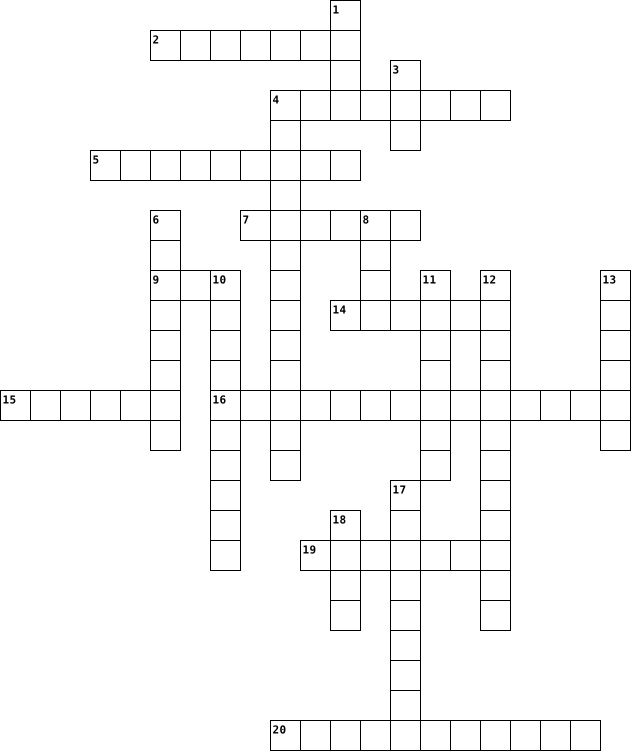
Across
- After WWI the United States did not join the League of _________
- Americans were encouraged to buy these to help fund WWII
- He founded the NAACP
- He is your US History teacher
- animal that says "meow"
- Country where America built a canal at the turn of the century
- The answer to this hint is cheese so write cheese in the boxes for the crossword
- They were the elite group of African American fighter pilots in WWII
- This gets carved on Halloween to make a jack-o-lantern
- He made the decision to drop the atomic bomb of Japan
Down
- Joseph Stalin was the leader of the ____
- animal that barks
- President during WWI
- Pearl Harbor was attacked on ________ 7th, 1941
- This country gained independence as a result of the Spanish American War
- Amendment that ended slavery in the US
- MLB baseball team with 27 World Series Championships
- He said "give me liberty or give me death"
- Country Germany invaded in 1939 to start WWII in Europe
- Teddy Roosevelt practiced Big Stick __________
- The Declaration of Independence was signed on _______ 4th, 1776
21 Clues: animal that barks • President during WWI • He founded the NAACP • animal that says "meow" • He is your US History teacher • Amendment that ended slavery in the US • Joseph Stalin was the leader of the ____ • He said "give me liberty or give me death" • Teddy Roosevelt practiced Big Stick __________ • Pearl Harbor was attacked on ________ 7th, 1941 • ...
Global History 2023-05-26

Across
- Human Rights Organization that focused on getting justice for those that "disappeared" by Latin America Dictators.
- The time period of when the U.S invaded Latin American countries.
- Fertile ground turning into a desert due to dry climates.
- Leader of the Sandinistas.
- Results of the world constantly being connected.
- Organization that dealt with trade of goods and services between countries.
- President of Chile who led a Socialist government.
- Weapons secretly sold to Iran by President Ronald Reagan to fund Nicaraguan Contras.
- Group that provides international loans to developing countries.
- U.S. corporation that sold fruit, specifically bananas, which were grown in Chile and Canada.
Down
- Policies and rules created by Juan Peron.
- United States backed campaign that supported the dictators who disappeared and tortured thousands of Latin Americans.
- Leader of Chile's military junta.
- Middle Eastern Countries that produced oil and wanted to control the oil.
- Political and Economic Union of 28 European States.
- Family with large land ownerships that ruled Nicaragua as a dictatorship.
- Long term warming of the planet.
- Clearing Forests by cutting down trees.
- Rebel group that opposed the Sandinistas.
- Process of which the world becomes connected as a result of trade and cultural exchange.
20 Clues: Leader of the Sandinistas. • Long term warming of the planet. • Leader of Chile's military junta. • Clearing Forests by cutting down trees. • Policies and rules created by Juan Peron. • Rebel group that opposed the Sandinistas. • Results of the world constantly being connected. • President of Chile who led a Socialist government. • ...
HISTORY CROSSWORD 2023-05-22

Across
- the use of demolitions to move from one building to another, by blowing holes in rooftops or walls
- Canadians first battle of WWII
- ____Was assassinated which kicked off WWI
- In WWI Canadians faught in the battles of: Somme,Vimey Ridge, Passchendale and ___
- Compulsory enlistment of civilians into military service
- Insulin, pitchporpeller, snowmobile and ____ Was invented in the 1920's
- After WWI women were expected to return to their pervious ____ roles
- This line was held and shifted during the war
- Albertas econemy boomed in 1947 because of ____ in leduc
- A temporary war measure???
- In 1920, 1 in 4 families had these.
Down
- WW____ Started September 1st 1939
- This started in 1929 and lasted till 1932
- Germany, JApan, Italy
- There was a strike in May 1919 what was it called
- Cutting back
- This style of Warfare was not head on
- In 1921 55% of Canadians lived in ____ Cities
- Prime Minister Borden allowed soldiers overseas and women serving as nurses to ____in the 1917 election.
- ____front describes the activities of the civilian population as they support war efforts
- Used in WWI to fight the enemy
- Instigated by the temperance movement
- Over 90,000 Canadian soldiers were involved in the______campaign
- This big event happend in 1914
- The lion related term often associated with the 1920's
- The____plan depended on Russia not mobilizing its armed forces quickly
26 Clues: Cutting back • Germany, JApan, Italy • A temporary war measure??? • Canadians first battle of WWII • Used in WWI to fight the enemy • This big event happend in 1914 • WW____ Started September 1st 1939 • In 1920, 1 in 4 families had these. • This style of Warfare was not head on • Instigated by the temperance movement • This started in 1929 and lasted till 1932 • ...
world history 2023-06-02

Across
- where the first human came from
- Lived in the mountains
- Aztec main city
- The people Greece had a war with
- the city in Italy where the Renaissance started
- signed the magna carta
- the founder of Islam
- the king of the greek gods
- empire started in Greeks
- The angel Gabriel that talked to Muhammad
- Live in the rainforest
- helped France win the 100 Years'War
- The battel that stop Islam from going into Europe
- a fervent period of European cultural
Down
- the leader of Greece during its golden age
- the first emperor of Rome
- sculptor, painter and architect
- made the mona lisa
- the birthplace of democracy
- greek city known for militaristic
- Colosseum
- Indus River Valley
- the home of the founder of Islam
- tenochtitlan
- Doric, Ionic, and Corinthian
- where the Renaissance begin
- France called in the past
- caused the black death
- became the first Barbarian to rule Rome
- Japan
30 Clues: Japan • Colosseum • tenochtitlan • Aztec main city • made the mona lisa • Indus River Valley • the founder of Islam • Lived in the mountains • signed the magna carta • Live in the rainforest • caused the black death • empire started in Greeks • the first emperor of Rome • France called in the past • the king of the greek gods • the birthplace of democracy • where the Renaissance begin • ...
world history 2023-06-02

Across
- picchu this city was important to the incas.
- emerged around 200,000 years ago.
- are written laws of the Jewish.
- is located in Egypt.
- disease killed a large percentage of people.
- at least once in their lifetime.
- document limited the power of the king.
- groups allowed automatic citizenship.
- battle in France.
- tigris and euprates rivers.
- was a writer of plays and dramas.
- two groups split Muslims.
- math was created by the Muslims.
Down
- important Mayan city.
- many people.
- hero of the 100 Years war.
- located in the Andes mountains.
- capital of the Aztec empire.
- is the holy book of Islam.
- tables recorded Roman laws.
- Road trade route.
- faith.
- had a group of city-states.
- age the old stone age.
- two-hundred-year period.
- father of history.
- is the name of a Greek city-state.
- very militaristic city-state in Greece.
- leader of Rome's enemy.
- were geographically protected by water.
30 Clues: faith. • many people. • Road trade route. • battle in France. • father of history. • is located in Egypt. • important Mayan city. • age the old stone age. • leader of Rome's enemy. • two-hundred-year period. • two groups split Muslims. • hero of the 100 Years war. • is the holy book of Islam. • tables recorded Roman laws. • had a group of city-states. • tigris and euprates rivers. • ...
Church History 2012-02-05

Across
- Pope that set up an official court called the Inquisition
- The religion of the followers of Christ
- Place in Italy to resolve issue of 2 Popes.
- "rebirth," rediscovery of culture.
- Cruciform design of a cathedral
- Catholicism influenced every aspect of life
- the bubonic plague.
- This event happened in 1054 and 1378 and divided the Church
- A severe penalty imposed by the Church for serious sins against the Catholic faith
- From the Latin word crux, or cross, "take back the cross."
- Place where Schism was resolved.
- Male person whose life is dedicated to prayer, work, study, and the needs of society
- comes from the Latin word frater, meaning "brother."
- moved papacy to Avignon, France.
Down
- A journey to a shrine or other holy place for spiritual and devotional reasons
- Person who influenced an end of the Schism of 1378.
- The changing of the bread and wine into the Body and Blood of Christ
- Maximum number of popes during 1378 Schism.
- moved papacy back to Rome.
- Founded a monastery at Monte Cassino
- The buying and selling of spiritual things, spiritual services, or Church offices.
- Not the true Pope
- Sister to famous saintly monk who found a monastery for nuns
- Place where Monks or Nuns live
- emphasis on the importance of the person.
- Church Governance
- Prophet of Islam leader of Muslims
27 Clues: Not the true Pope • Church Governance • the bubonic plague. • moved papacy back to Rome. • Place where Monks or Nuns live • Cruciform design of a cathedral • Place where Schism was resolved. • moved papacy to Avignon, France. • "rebirth," rediscovery of culture. • Prophet of Islam leader of Muslims • Founded a monastery at Monte Cassino • The religion of the followers of Christ • ...
American History 2011-11-25

Across
- The first president, under the Articles.
- ______ of power- anti-tyrrany technique.
- "We the People of the United States in order to form a more perfect union..."
- The famous person who made the Midnight ride
- The Sons Of ____.
- The site of the Constitutional Convention.
- The system put in place to stop one branch from getting too powerful.
- "I smell a ___"- famous quote from Rhode Island delegate
- The writer of the Declaration
- The "first" president, and leader of the army in the Revolution
- The "mother country" of the colonies.
- The leader of a farmer's rebellion.
- The main way of spreading propaganda in the colonies
- A historical event in Boston port.
- The number of colonies.
- The site of a "Bloody massacre"
Down
- Another name for the militia
- Articles of ______
- The battle of Lexington and _____.
- The type of government the U.S. is.
- Number of amendments in the Bill of rights.
- The lawmaking body of England
- the group for he ratification of the Constitution
- The spread of ideas biased to a cause
- The date the Declaration was signed
- An agreement in which both sides give something up.
- The government of the greeks that the Constitution drew inspiration from.
- The state that reused to send a delegate to the Convention.
- King George the _____.
- The president of the Continental congress, John.
30 Clues: The Sons Of ____. • Articles of ______ • King George the _____. • The number of colonies. • Another name for the militia • The lawmaking body of England • The writer of the Declaration • The site of a "Bloody massacre" • The battle of Lexington and _____. • A historical event in Boston port. • The type of government the U.S. is. • The date the Declaration was signed • ...
history crossword 2012-04-04

Across
- / a tool with a curved blade used for cutting grass"
- / the time of life after death, part of the ancient Egyptians' spiritual beliefs"
- / the flood season that occurred from JUly to October each year"
- / a statue with a humans head and a lions body"
- / ancient Egypt written language like symbols"
- / a family of rulers the period of time a family remained in power"
- / a way of bringing water to dry land"
- jars /pottery jars used to store intestines, liver, lungs and stomach of a preserved body"
- / a period of time in Egypt's history when pharaohs and their descendants controlled all of Egypt"
- / an oval shape surrounding an inscription of hieroglyphs identifying the name of the pharaoh
- / a god or goddess"
- / word meaning great house used to describe the ruler of Egypt in ancient times"
- / a supreme being worshipped by people"
- / all things inherited from previous generations are which we value including events, traditions, influences and experiences"
- / person employed to make written records"
- / the season for sowing crops that occurred from November to February each year"
- / a plant growing along the Nile River, made into flattened strips on which to write"
- and flail / curved stick and whip carried by the pharaoh as a symbol of his royal power"
Down
- / a series of steps used to measure of the Nile flood"
- / a town based society with complex forms of art, science, religion and government"
- / a symbol of eternal life"
- / the person who took responsibility for the pharaohs government and who was the chief judge in ancient Egypt"
- / the process of preserving a dead body by using spices and salt"
- / the process of preserving bodies by drying them, packing them with minerals and wrapping them in linen cloth"
- / the person responsible for day to day government in Egypt's main regions"
- / a religious place often a large building where people go to worship their god or gods"
- / a large waterfall or series of waterfalls"
- / the Egyptian name for the harvest season that occurred from March to June each year"
- / area where a river splits into separate streams or rivers before flowing into the sea"
- / paintings on a plaster wall or ceiling"
- / the regions that ancient Egypt was divided into to make government easier"
- / eroded soil carried by river"
- / a mineral used to preserve bodies"
33 Clues: / a god or goddess" • / a symbol of eternal life" • / eroded soil carried by river" • / a mineral used to preserve bodies" • / a way of bringing water to dry land" • / a supreme being worshipped by people" • / paintings on a plaster wall or ceiling" • / person employed to make written records" • / a large waterfall or series of waterfalls" • ...