
moon phases Crossword Puzzles
moon over manifest 2022-09-26

Across
- Abilene's dad in disguise
- a news paper maker
- a fortune teller
- Who the girls thought were the rattler
- What part of the body gets stuck in the bear trap
- What Jinx buys with $25.72
- a ghost like myth
- a sickness that spread around 1916
- the diviner
- The real "rattler"
- What Abilene was assigned to do over summer?
- object found under a floorboard
- The only thing Gideon left Abilene
- Where Abilene found the letters
Down
- The book Abilene steals from the high school
- Shady's job
- a weird gate with junk behind it
- who made the real elixir
- What is jinx's uncles name
- a small town affected by the drought
- the main way of transportation
- the money they made to buy the mine(cure for influenza
- A 12 year old girl
- the crash of stock market in 1929
- A friend of jinx who died in war
- the pastor that took in Abilene
26 Clues: Shady's job • the diviner • a fortune teller • a ghost like myth • a news paper maker • A 12 year old girl • The real "rattler" • who made the real elixir • Abilene's dad in disguise • What is jinx's uncles name • What Jinx buys with $25.72 • the main way of transportation • the pastor that took in Abilene • object found under a floorboard • Where Abilene found the letters • ...
India Moon Landing 2023-08-24
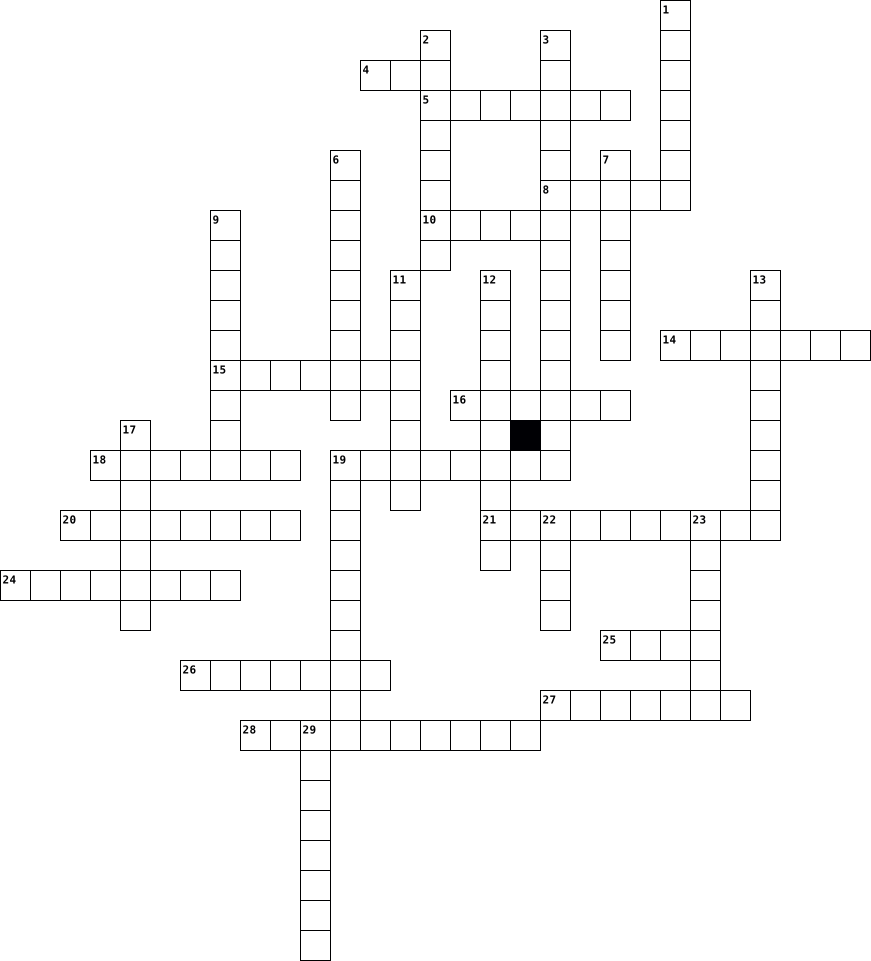
Across
- - Solid form of water (3 letters)
- - Outer layer or exterior (7 letters)
- - Move slowly on hands and knees (5 letters)
- - Occurrence or happening (5 letters)
- - Objective or purpose (7 letters)
- - Bowl-shaped depressions on a celestial body (7 letters)
- - Area or district (6 letters)
- - Nation or sovereign state (7 letters)
- - Examination or investigation of something (8 letters)
- - Action, movement, or process (8 letters)
- - Comprehend or grasp the meaning of (9 letters)
- - Related to the structure and movement of the Earth's crust (8 letters)
- - In real time or not pre-recorded (4 letters)
- - Spacecraft or satellite that orbits a celestial body (7 letters)
- - Collided violently or came to a sudden stop (7 letters)
- - Researchers or experts in a scientific field (9 letters)
Down
- - Extremely important or essential (7 letters)
- - Stockpiles or quantities held in reserve (7 letters)
- - Distinguishing features or qualities (14 letters)
- - Conveyed in words or explained (9 letters)
- - Touchdown or arrival (7 letters)
- - Challenging or not easy (8 letters)
- - Relating to the body or material things (8 letters)
- - Accomplished or having achieved the desired outcome (10 letters)
- - Damaged beyond repair or completely ruined (9 letters)
- - Power to influence or direct (7 letters)
- - Gaseous envelope surrounding a planet or celestial body (10 letters)
- - Facts, figures, or information (4 letters)
- - Accomplish or attain (7 letters)
- - Curiosity or attention toward something (8 letters)
30 Clues: - Area or district (6 letters) • - Solid form of water (3 letters) • - Touchdown or arrival (7 letters) • - Objective or purpose (7 letters) • - Accomplish or attain (7 letters) • - Outer layer or exterior (7 letters) • - Challenging or not easy (8 letters) • - Occurrence or happening (5 letters) • - Nation or sovereign state (7 letters) • ...
Full Cicada Moon 2023-02-14

Across
- Mimi and stacy got ______ for saying that girls should be allowed to take Shop class.
- stacy's crush.
- The Annual science fair.
- Mr.Dell was a ______ in World War 2.
- mimi's mom's ethnicity.
- first name of the author.
- mimi's dream career.
- the main character.
- class mimi wants to take instead of home ec.
- Mimi is very _________, never giving up.
- state the story takes place.
- item her father gives he before the dance.
- model of the ____ for the science groove.
Down
- the grumpy neighbor.
- a repeated three world phrase.
- Mr.Dells's dog.
- timothy gifts mimi this item.
- City Mimi moved from.
- Mimi's race or _____ is very confusing to some people.
- item mr.pease hands out to each student.
- Dessert Mimi and Stacy share.
- Mimi's best friend.
- Animals Mimi's mother raises in their backyard.
- Type of trivia mimi and stacy answer to get out of detention.
- Space Launch that Mimi watches.
- Item mimi buys her mom for her christmas.
26 Clues: stacy's crush. • Mr.Dells's dog. • Mimi's best friend. • the main character. • the grumpy neighbor. • mimi's dream career. • City Mimi moved from. • mimi's mom's ethnicity. • The Annual science fair. • first name of the author. • state the story takes place. • timothy gifts mimi this item. • Dessert Mimi and Stacy share. • a repeated three world phrase. • Space Launch that Mimi watches. • ...
Blue Moon Flood 2025-07-02

Across
- a large monkey with a long face
- a set of matching clothes (jacket and pants or skirt)
- not tight; big or wide in fit
- the number after one
- a large store that sells food and other things
- not old; just made or bought
- to reverse or take back an action
- things you eat
- sweet food that grows on trees or plants
- something you wear on your foot
- pants made of blue denim
Down
- a paper or code that gives a lower price
- wireless tech to connect devices
- very good or excellent
- rings, necklaces, or bracelets people wear
- to make or create something
- a small thing with wheels you stand on and ride
- also; or more than needed
- heavy shoes that cover your feet and ankles
- a comment or opinion about a product
20 Clues: things you eat • the number after one • very good or excellent • pants made of blue denim • also; or more than needed • to make or create something • not old; just made or bought • not tight; big or wide in fit • a large monkey with a long face • something you wear on your foot • wireless tech to connect devices • to reverse or take back an action • ...
TTS Strawberry moon 2025-11-03

Across
- lapisan terluar yang terdiri dari kerak dan lapisan atas mantel
- lapisan atmosfer bumi yang berfungsi memantulkan gelombang radio adalah
- lapisan yang melindungi bumi dari meteor
- bumi planet urutan
- lapisan bumi terluar yang tipis dan padat
- lapisan yang menyerap radiasi uv sinar x
- lapisan paling bawah bumi
- lapisan atmosfer yang mengandung ozon
- bumi berputar pada porosnya
- panas dari matahari sampai ke bumi melalui
- matahari merupakan
- benda langit yang tidak memiliki cahaya sendiri
- bumi mengelilingi matahari
- lapisan yang paling dekat dengan luar angkasa
- planet yang berbentuk pepat sedikit lonjong
- lapisan paling luar matahari
Down
- gas yang paling banyak di atmosfer
- lapisan bumi yang tersusun dari batuan cair panas
- lintasan bumi berbentuk
- matahari terbit dari
- bumi termasuk planet
- inti luar bumi
- lapisan gas yang menyelimuti bumi
- lapisan paling panas bumi
- bagian matahari yang memiliki suhu 6000 derajat celcius dan ketebalan 300km
- pusat tatasurya
- suhu udara semakin ....jika naik ke lapisan atmosfer yang lebih tinggi
- bagian inti bumi yang terletak dibawah kerak bumi
- planet urutan ketujuh
- lapisan matahri yang paling panas
- bumi planet terbesar
31 Clues: inti luar bumi • pusat tatasurya • bumi planet urutan • matahari merupakan • matahari terbit dari • bumi termasuk planet • bumi planet terbesar • planet urutan ketujuh • lintasan bumi berbentuk • lapisan paling panas bumi • lapisan paling bawah bumi • bumi mengelilingi matahari • bumi berputar pada porosnya • lapisan paling luar matahari • lapisan gas yang menyelimuti bumi • ...
Solar Eclipse 2017-08-23

Across
- moon / the phenomenon whereby the moon in total eclipse appears reddish in color as it is illuminated by sunlight filtered and refracted by the earth's atmosphere
- / An elliptical orbit is the revolving of one object around another in an oval-shaped path called an ellipse. The planets in the solar system orbit the sun in elliptical orbits
- / the shadow cast by the earth or the moon over an area experiencing a partial eclipse
- / the dark central part of a sunspot
- eclipse / an eclipse of a celestial body in which only part of the luminary is obscured or darkened
- / the moment or duration of total obscuration of the sun or moon during an eclipse
- bands / looks like snakes on the ground
Down
- solar eclipse / an eclipse of the sun in which the moon completely hides the solar surface or photosphere and thereby cuts off all direct rays of sunlight from the observer
- beads / the row of brilliant points of sunlight shining through valleys on the edge of the moon that is seen for a few seconds just before and after the central phase of an eclipse of the sun
- ring / looks like a diamond ring
- eclipse / an eclipse of the sun in which the edge of the sun remains visible as a bright ring around the moon
- / a crown or crown-like structure
- eclipse / an eclipse in which the moon appears darkened as it passes into the earth's shadow
- eclipse / A solar eclipse in which the Moon's umbral and ant-umbral shadows traverse Earth
- eclipse / an eclipse in which the sun is obscured by the Moon
15 Clues: ring / looks like a diamond ring • / a crown or crown-like structure • / the dark central part of a sunspot • bands / looks like snakes on the ground • eclipse / an eclipse in which the sun is obscured by the Moon • / the moment or duration of total obscuration of the sun or moon during an eclipse • ...
The Moon by:Puneet 2013-03-21

Across
- The Moon is made of serveral ___
- The Planets impact was ___
- The Moon is shaped like a ____
- The Moon has no ____ of it's own
- The Moon Has Low _____
Down
- The Moon is made up by ____
- A full moon seems very ____
- The Planet that we think earth is named ____
- The moon is _______ Than The Earth
- The Moon Has No ____
10 Clues: The Moon Has No ____ • The Moon Has Low _____ • The Planets impact was ___ • The Moon is made up by ____ • A full moon seems very ____ • The Moon is shaped like a ____ • The Moon is made of serveral ___ • The Moon has no ____ of it's own • The moon is _______ Than The Earth • The Planet that we think earth is named ____
Moon Stuff Crossword 2026-01-14

Across
- Phase of the moon when we only see the lit side
- Phase of the moon when we only see the dark side
- When we see half of one side of the moon
- When the moon is nearly full
- What scatters the light and causes us to see the sky or moon as different colors
- When the moon is a thin sliver
Down
- Eclipse that occurs when the moon moves through the Earth's shadow
- Eclipse that occurs when the moon casts a shadow on the Earth
- How close together particles are in a substance
- Our perspective of the Earth rotating through where the moon is pulling on the oceans
- The color of the light from the sun
11 Clues: When the moon is nearly full • When the moon is a thin sliver • The color of the light from the sun • When we see half of one side of the moon • Phase of the moon when we only see the lit side • How close together particles are in a substance • Phase of the moon when we only see the dark side • Eclipse that occurs when the moon casts a shadow on the Earth • ...
astronomy 2023-11-20

Across
- what we see every night
- a force that keeps things down
- a sliver of the moon that is lit up
- a moon that you cant see
- the moon is getting smaller
Down
- tide happens during the night
- big yellow star
- tide during the day
- objects in space
- a moon that is all the way lit up
- the moon is getting bigger
11 Clues: big yellow star • objects in space • tide during the day • what we see every night • a moon that you cant see • the moon is getting bigger • the moon is getting smaller • tide happens during the night • a force that keeps things down • a moon that is all the way lit up • a sliver of the moon that is lit up
sky science - parker 2024-02-05

Across
- less than half the moon lit
- eclipse the earth blocks light from the sun from reaching the moon
- the lit part of the moon is getting bigger
- the movement of a object around another one
Down
- more than half the moon is lit
- a group of stars forming a recognizable pattern
- the spinning of an object on an axis
- the lit part of the moon getting smaller
- earths natural satellite
- system the collection of 8 planets
- chunks of rock and metal in space that orbit the sun.
- a smaller celestial body that is made of dust ice and small rocky particlessun
- a medium sized star that we orbit
13 Clues: earths natural satellite • less than half the moon lit • more than half the moon is lit • a medium sized star that we orbit • system the collection of 8 planets • the spinning of an object on an axis • the lit part of the moon getting smaller • the lit part of the moon is getting bigger • the movement of a object around another one • ...
B1 - Preparing the coaching team RECAP 2025-11-18

Across
- – Structured training plan divided into timed phases to optimise performance.
- – Psychological drive influencing athletes’ effort, persistence and sporting performance levels.
- – Physical activity completed for enjoyment, relaxation and general wellbeing benefits.
- – Group of athletes training together under unified coaching leadership structure.
- – Specific performance targets guiding athletes’ training direction and motivational focus.
- – Extended period focused on gradual progress towards major performance outcomes.
- – Distinct training periods focusing on specific goals within a programme.
- – Long-term training cycle spanning months to achieve major performance improvements.
- – Coach’s clear explanation of tasks, aims and expectations before training.
- – Medium-term training cycle linking microcycles to broader macrocycle aims.
Down
- – Distinct approach a coach uses to communicate, instruct and manage athletes.
- – Formal sporting event where athletes perform and compare their abilities.
- – Ensuring coaching practice follows laws, safeguarding policies and duty-of-care.
- – Tailored coaching approach designed to meet a single athlete’s needs.
- – Planned training or recovery activities occurring outside formal coached sessions.
- – Effective planning of people, resources and activities for training sessions.
- – Brief timeframe for achieving immediate performance objectives in training cycles.
- – Method or environment used by coaches to deliver training information.
- – Long-term training schedule outlining progressive development towards performance targets.
- – Short training cycle focusing on immediate objectives within the larger plan.
20 Clues: – Tailored coaching approach designed to meet a single athlete’s needs. • – Method or environment used by coaches to deliver training information. • – Distinct training periods focusing on specific goals within a programme. • – Formal sporting event where athletes perform and compare their abilities. • ...
Carters Crossword[Mitosis] 2026-01-20
![Carters Crossword[Mitosis] crossword puzzle](/image/18713738.svg?size=30&stroke_width=1)
Across
- sister identical halfs
- ordered events
- Dna replication
- opposite poles
- form into cells
- has phases
Down
- replication
- uncontrolled growth
- make into sister chromatids
- form into genetically identical daughter cells
10 Clues: has phases • replication • ordered events • opposite poles • Dna replication • form into cells • uncontrolled growth • sister identical halfs • make into sister chromatids • form into genetically identical daughter cells
mitosis puzzle 2026-01-22

Across
- longest cycle, cell grow
- final step in cell division
- cells pull apart
- cell division
Down
- Half number
- Growing phases
- carry DNA
- identical ___
- fibers dynamic protien structures
- Full number
10 Clues: carry DNA • Half number • Full number • identical ___ • cell division • Growing phases • cells pull apart • longest cycle, cell grow • final step in cell division • fibers dynamic protien structures
mitosis puzzle 2026-01-22

Across
- longest cycle, cell grow
- final step in cell division
- cells pull apart
- cell division
Down
- Half number
- Growing phases
- carry DNA
- identical ___
- fibers dynamic protien structures
- Full number
10 Clues: carry DNA • Half number • Full number • identical ___ • cell division • Growing phases • cells pull apart • longest cycle, cell grow • final step in cell division • fibers dynamic protien structures
earth and its neighbours 2014-08-01

Across
- group of stars are called
- ___________ of earth causes day and night
- imaginary line on which an object spins
- more than half of the moon is seen
Down
- the other movement of the earth that takes 365 1/4 days to complete
- first man to tell the earth is round
- half of the moon is seen
- little bit of the moon is seen
- the moon is between the sun and earth
- fixed path
- people who study the sun, moon, stars and the planets
- natural satellite of the earth
12 Clues: fixed path • half of the moon is seen • group of stars are called • little bit of the moon is seen • natural satellite of the earth • more than half of the moon is seen • first man to tell the earth is round • the moon is between the sun and earth • imaginary line on which an object spins • ___________ of earth causes day and night • ...
Policy Frameworks and Theories 2024-04-25

Across
- Three phases
- Interacting parts
- Human decision making
- Slow moving policy
- Self-interest
- Policy change through coordinated activity
Down
- Evidence informed public heath
- Uses abstract models and black boxes
- Merit based promotions
- Opposition to the needs of black women
- Mathamatical models
- Small groups runs government
- Problems viewed as interpretations of conditions
- Performance measures
- Advanced decision making
15 Clues: Three phases • Self-interest • Interacting parts • Slow moving policy • Mathamatical models • Performance measures • Human decision making • Merit based promotions • Advanced decision making • Small groups runs government • Evidence informed public heath • Uses abstract models and black boxes • Opposition to the needs of black women • Policy change through coordinated activity • ...
Our solar system 2016-10-24

Across
- the sun goes down in the
- has no moons
- is the smallest gas giant
- the moon _ light
- the amount of space you take up
- has 62 moons
- our star
- oval shaped
- we only see one face of...
- planets close to the sun
- rotation around an
Down
- takes 262 days for one orbit
- objects in space
- the surface of the moon
- orbits a planet
- summer to winter
- pieces of rock
17 Clues: our star • oval shaped • has no moons • has 62 moons • pieces of rock • orbits a planet • objects in space • the moon _ light • summer to winter • rotation around an • the surface of the moon • the sun goes down in the • planets close to the sun • is the smallest gas giant • we only see one face of... • takes 262 days for one orbit • the amount of space you take up
Exam Crossword 2024-11-20

Across
- a certain phase of the moon, when it's bulging outward but isn't quite full
- an organism that only eats consumers
- the thing that makes up everything
- a certain phase of the moon when small bright crescent is on the right or left
- an organism that eats producers and consumers
- the first and last phase of the moon
- a habitat where animals live and interact with eachother
Down
- when the moon goes between the earth and sun
- when the earth goes between the sun and moon
- when the moon fully reflects the sun
- an organism that eats only producers
- the largest object in the solar system
- What planet do we live on
13 Clues: What planet do we live on • the thing that makes up everything • when the moon fully reflects the sun • an organism that eats only producers • an organism that only eats consumers • the first and last phase of the moon • the largest object in the solar system • when the moon goes between the earth and sun • when the earth goes between the sun and moon • ...
Astrobiology 2020-12-21

Across
- found on Venus
- Message sent to space
- NASA 2020 rover to Mars
- hardy creature on moon
- our cloudy neighbour
Down
- Telescope finding exoplanets
- Our nearest celestial body
- Saturn moon with ocean
- the red planet
- Jupiter moon with ocean
- Saturn moon with hydrocarbons
11 Clues: found on Venus • the red planet • our cloudy neighbour • Message sent to space • Saturn moon with ocean • hardy creature on moon • NASA 2020 rover to Mars • Jupiter moon with ocean • Our nearest celestial body • Telescope finding exoplanets • Saturn moon with hydrocarbons
Earth/Sun/Moon 2024-01-18

Across
- to be off center
- the gravitational pull on the earths water
- the moon without light
- an imaginary line connecting north and south
- the sun furthest from the equator
- the moon at its brightest
- the moon gaining light
- when the sun is above the equator
- the moon losing light
Down
- the moons pull of earths water up the shoreline
- the darkest part of a shadow
- the lowest point of water on the earths shoreline
- a complete trip along an orbit
- the pull one object has on another
- the spin of an object on its axis
- shadow of one body falling on another
16 Clues: to be off center • the moon losing light • the moon without light • the moon gaining light • the moon at its brightest • the darkest part of a shadow • a complete trip along an orbit • the sun furthest from the equator • the spin of an object on its axis • when the sun is above the equator • the pull one object has on another • shadow of one body falling on another • ...
earth and its neighbours 2014-08-01

Across
- group of stars are called
- ___________ of earth causes day and night
- imaginary line on which an object spins
- more than half of the moon is seen
Down
- the other movement of the earth that takes 365 1/4 days to complete
- first man to tell the earth is round
- half of the moon is seen
- little bit of the moon is seen
- the moon is between the sun and earth
- fixed path
- people who study the sun, moon, stars and the planets
- natural satellite of the earth
12 Clues: fixed path • half of the moon is seen • group of stars are called • little bit of the moon is seen • natural satellite of the earth • more than half of the moon is seen • first man to tell the earth is round • the moon is between the sun and earth • imaginary line on which an object spins • ___________ of earth causes day and night • ...
Our solar system 2016-10-24

Across
- the sun goes down in the
- the moon _ light
- oval shaped
- has 62 moons
- orbits a planet
- the surface of the moon
- rotation around an
- the amount of space you take up
- our star
Down
- takes 262 days for one orbit
- has no moons
- is the smallest gas giant
- objects in space
- summer to winter
- planets close to the sun
- pieces of rock
- we only see one face of...
17 Clues: our star • oval shaped • has no moons • has 62 moons • pieces of rock • orbits a planet • the moon _ light • objects in space • summer to winter • rotation around an • the surface of the moon • the sun goes down in the • planets close to the sun • is the smallest gas giant • we only see one face of... • takes 262 days for one orbit • the amount of space you take up
sky science by Gilbert 2024-02-05

Across
- earth's natural satellite.
- more than half of the moon is lit
- a group of stars forming a recognizable pettern
- less than a half of the moon is lit.
- the movement of one objet around another objet
- system- the collection of eight planets and their moons in orbit around the sun toghter with asteroids
Down
- lit part of the moon is getting smaller.
- medium size star that is at the center of the center of the solar sys
- the spinning of an objet on an axis.
- us with sunlight and heat
- lit part of a moon is getting bigger
- -- chunks of rock and metal in outer space that orbit the un
- -The earth blocks the sunlight from reaching the moon.
- smaller celestial body that is made from dust,ice,and small rocky particles.
14 Clues: us with sunlight and heat • earth's natural satellite. • more than half of the moon is lit • the spinning of an objet on an axis. • lit part of a moon is getting bigger • less than a half of the moon is lit. • lit part of the moon is getting smaller. • the movement of one objet around another objet • a group of stars forming a recognizable pettern • ...
Tides 2022-01-21

Across
- the other lunar phase where we experience a spring tide
- what celestial body control the tides on the earth
- tides are caused by the __________ of the moon
- the lunar phase where we experience a spring tide
- the quarter lunar phase where we experience neap tides
- neap tides occur when the moon, earth, and sun are at __________ angle to one another
- between the sun and the moon, the moon plays a bigger role on tides because of its _________ to the Earth compared to the sun
- a tide that has an extreme tidal change from high to low tide
Down
- how many high tides does a beach experience in a 24 hour period
- the bay of _______ experiences the largest tidal changes on earth
- if you were wanting to look for seashells by the seashore, when would you want to go to the beach during a spring tide
- how many high and low tides does a beach experience in a 24 hour period
- the tidal bulge will always point _______ the moon
- spring tides occur when the moon, earth, and sun are in a ______________ line
- a tide that has a small tidal change from high to low tide
15 Clues: tides are caused by the __________ of the moon • the lunar phase where we experience a spring tide • what celestial body control the tides on the earth • the tidal bulge will always point _______ the moon • the quarter lunar phase where we experience neap tides • the other lunar phase where we experience a spring tide • ...
Astronomy Vocab Review 2025-11-11

Across
- During the winter months at the North and South pole, the Sun does not rise and it is dark for 24 hours. This is called ___.
- The term ____ means relating to the moon.
- During the summer months at the poles, the Sun doesn't set and it is daylight 24 hours a day. This is called ___.
- The phase of the moon when none of the bright side of the moon is visible from Earth. The moon looks invisible.
- A ___ is the time it takes Earth to travel once around the sun.
- A group of stars that forms a pattern in the night sky
Down
- The darkest part of the moon's shadow
- The name of the North Star
- The path that the Earth takes around the Sun is a slight oval shape called a(n) __.
- The lighter part of the moon's shadow
- _____ is the study of the moon, stars, and other objects in space
- When the visible surface of the moon increases, it is ___.
- The equator divides the Earth into two halves. Each half is called a ___.
- When the visible surface of the moon decreases, it is ___.
- The partial or total blocking of one object in space by another
15 Clues: The name of the North Star • The darkest part of the moon's shadow • The lighter part of the moon's shadow • The term ____ means relating to the moon. • A group of stars that forms a pattern in the night sky • When the visible surface of the moon increases, it is ___. • When the visible surface of the moon decreases, it is ___. • ...
Space 2022-11-03

Across
- is a force that we experience every millisecond of our lives
- has to do with the Earth's path around the sun
- another part of the name of a moon phase
- caused by the moon
- something that happens with the Earth, Moon and Sun
- has to do with the relationship the Earth and the Sun
Down
- a phase of a moon
- spinning on an axis
- part of the name of a moon phase
- has to do with the moon
- this orbits the Earth
11 Clues: a phase of a moon • caused by the moon • spinning on an axis • this orbits the Earth • has to do with the moon • part of the name of a moon phase • another part of the name of a moon phase • has to do with the Earth's path around the sun • something that happens with the Earth, Moon and Sun • has to do with the relationship the Earth and the Sun • ...
science(lunar phases) 2023-11-03

Across
- halfway to a new moon
- first phase of the moon
- a little more than a waning crescent
- right behind a half moon
- the other gibbous
Down
- the other crescent
- Fully light moon
- right before full moon
- when the moon blocks the sun completely
- Fully dark moon
10 Clues: Fully dark moon • Fully light moon • the other gibbous • the other crescent • halfway to a new moon • right before full moon • first phase of the moon • right behind a half moon • a little more than a waning crescent • when the moon blocks the sun completely
Latin Stage 7 Nouns 2018-01-22

Across
- Yesterday
- Night (acc)
- Story (nom)
- Today
- Wolf (acc)
- Moon (nom)
- Guard (acc)
- Woods (acc)
- Ghost, Shadow (acc)
Down
- Ghost, Shadow (nom)
- Hair (acc)
- Guard (nom)
- Night (nom)
- Story (acc)
- Wolf (nom)
- Tomorrow
- Hair (nom)
- Cup (nom/acc)
- Moon (acc)
19 Clues: Today • Tomorrow • Yesterday • Hair (acc) • Wolf (nom) • Hair (nom) • Wolf (acc) • Moon (acc) • Moon (nom) • Guard (nom) • Night (nom) • Night (acc) • Story (nom) • Story (acc) • Guard (acc) • Woods (acc) • Cup (nom/acc) • Ghost, Shadow (nom) • Ghost, Shadow (acc)
Space Crossword 2014-04-13

Across
- The type of eclipse during which the moon blocks the light from the sun from reaching the earth
- The fifth planet from the sun
- A small, airless rock revolving around the sun
- This is the closest natural satellite to the Earth
- A group of stars that make a pattern in the sky
- A word that describes the circling of the Earth around the Sun
- A type of eclipse during which the Earth blocks the sun's light from reflecting off of the moon
- An icy body in space that releases a trail of gas and dust behind it as it travels
- The season during which Canada is located farthest away from the sun
Down
- The imaginary line that the Earth rotates on
- The stage of the moon when half of the sun's light can be seen reflected off of the moon from Earth
- A phase of the moon where you do no see any of the moon from Earth
- The name of our sun
- This is created as the result of a supernova and is mostly made up of gas
- The name of the rover that is currently exploring Mars
15 Clues: The name of our sun • The fifth planet from the sun • The imaginary line that the Earth rotates on • A small, airless rock revolving around the sun • A group of stars that make a pattern in the sky • This is the closest natural satellite to the Earth • The name of the rover that is currently exploring Mars • ...
Solar and Lunar Eclipses 2020-03-15

Across
- Occurs at beginning and end of solar eclipse, where it looks like a ring
- Beads of sunlight that shine through during a solar eclipse due to the rugged topography of the moon
- Partially shaded outer region of the shadow cast by an opaque object
- When the Earth's shadow blocks the sun's light
- An eclipse of the sun where the edge of the sun remains visible around the moon
- Curved path of a celestial object around a star, planet or moon
Down
- When the moon passes directly behind the earth and into its shadow
- an alignment of three celestial objects
- When the moon passes through the outer part of the shadow of the earth
- When Earth's moon is in a total lunar eclipse, it looks red
- A rare type of solar eclipse that changes its appearance as the moons shadow moves across the Earth's surface
- An eclipse of a celestial body in which only part of the luminary is obscured or darkened
- The track of the moon's shadow across the Earth's surface
- An eclipse in which the whole of the disk of the sun or moon is obscured
- Shaded inner region of a shadow cast by an opaque object
15 Clues: an alignment of three celestial objects • When the Earth's shadow blocks the sun's light • Shaded inner region of a shadow cast by an opaque object • The track of the moon's shadow across the Earth's surface • When Earth's moon is in a total lunar eclipse, it looks red • Curved path of a celestial object around a star, planet or moon • ...
Year 5 2025-12-16

Across
- Really good at times tables
- Has a sister who studies abroad
- Has a little sister
- Knows lots about Hinduism
- Loves Five Guys
- Loves chocolate
- Loves singing
- Knows lots about animals
- Loves drama
Down
- Has a brother who looks exactly like him
- Does taekwondo
- Goes through interesting phases
- Loves cats
- Loves Mario
- Has two brothers
15 Clues: Loves cats • Loves Mario • Loves drama • Loves singing • Does taekwondo • Loves Five Guys • Loves chocolate • Has two brothers • Has a little sister • Knows lots about animals • Knows lots about Hinduism • Really good at times tables • Has a sister who studies abroad • Goes through interesting phases • Has a brother who looks exactly like him
Tides 2023-10-26

Across
- spring and neap tides occur two times a
- Amount of hours that separate tides
- highest tide of the year
- one type of tide
- tides move
- tide that goes out
- difference between high and low tides
- the moon and sun impact
Down
- tides that come in
- Tides occur on major
- occur at first and third quarter moon
- occurs during a new moon
- occurs on the side of the earth facing the moon
- causes tides
- occurs when the earth, sun, and moon are aligned
15 Clues: tides move • causes tides • one type of tide • tides that come in • tide that goes out • Tides occur on major • the moon and sun impact • highest tide of the year • occurs during a new moon • Amount of hours that separate tides • occur at first and third quarter moon • difference between high and low tides • spring and neap tides occur two times a • ...
earth sun moon 2025-11-17

Across
- a division of the year that is characterized by recurring weather conditions, and determined by both Earth's tilt relative to the sun and Earth's position in its orbit around the sun
- In astronomy, the change in the sunlit area of one celestial body as seen from another celestial body; phases of the moon are caused by the changing positions of Earth, the sun, and the moon
Down
- an event in which the shadow of one celestial body falls on another
- the path that a body follows as it travels around another body in space
4 Clues: an event in which the shadow of one celestial body falls on another • the path that a body follows as it travels around another body in space • a division of the year that is characterized by recurring weather conditions, and determined by both Earth's tilt relative to the sun and Earth's position in its orbit around the sun • ...
Earth and Moon Vocabulary 2025-11-17

Across
- an event in which the shadow of one celestial body falls on another
Down
- the path that a body follows as it travels around another body in space
- in astronomy, the change in the sunlit area of one celestial body as seen from another celestial body; phases of the moon are caused by the changing positions of Earth, the sun, and the moon
- a division of the year that is characterized by recurring weather conditions, and determined by both Earth's tilt relative to the sun and Earth's position in its orbit around the sun
4 Clues: an event in which the shadow of one celestial body falls on another • the path that a body follows as it travels around another body in space • a division of the year that is characterized by recurring weather conditions, and determined by both Earth's tilt relative to the sun and Earth's position in its orbit around the sun • ...
vocabulary three 2025-11-20

Across
- a division of the year that is characterized by recurring weather conditions, and determined by both Earth's tilt relative to the sun and Earth's position in its orbit around the sun
- an event in which the shadow of one celestial body falls on another
Down
- in astronomy, the change in the sunlit area of one celestial body as seen from another celestial body; phases of the moon are caused by the changing positions of Earth, the sun, and the moon
- the path that a body follows as it travels around another body in space
4 Clues: an event in which the shadow of one celestial body falls on another • the path that a body follows as it travels around another body in space • a division of the year that is characterized by recurring weather conditions, and determined by both Earth's tilt relative to the sun and Earth's position in its orbit around the sun • ...
The Moon 2024-09-17

Across
- What we call it when the ocean bulges towards the Moon and floods over the land, causing the water to be at its highest level at a particular place (no space).
- A word used in reference to or relating to the Moon.
- A kind of vehicle used to explore the Moon (no space).
- This is what we call the Moon when it is completely dark to the Earth. This happens about once a month, at the beginning of the Moon's cycle (no space).
- Dark patches on the surface of the Moon that are smooth, flat plains. The side of the Moon that always faces the Earth has a lot of these patches.
- This is what we call the Moon immediately after the new Moon, until the first quarter (no space)
- The first spacecraft to land on the Moon (no space).
Down
- This is what we call the Moon when it is more than half illuminated. It occurs right before a full Moon (no space).
- How the Moon looks to the Earth when the entire Moon is visible and lit up (no space).
- This is what we call the Moon when we can see exactly half of the Moon lit up, making a half circle (no space).
- This is what we call it when the Moon's gravity causes the water level of the ocean to be low at a particular place (no space).
11 Clues: A word used in reference to or relating to the Moon. • The first spacecraft to land on the Moon (no space). • A kind of vehicle used to explore the Moon (no space). • How the Moon looks to the Earth when the entire Moon is visible and lit up (no space). • This is what we call the Moon immediately after the new Moon, until the first quarter (no space) • ...
Kelly's Baby Shower Crossword Puzzle 2022-12-28

Across
- Bird that brings babies
- What percentage of babies arrive on their due date?
- Itsy Bitsy ___
- Constellation: Big or Little
- First sign of the zodiac
- Name of a baby
- Baby's nickname
- Number of children Kelly wants (for now)
- Where the baby sleeps
- Name of Kelly's favorite stuffed animal
- Harry Potter House that Kelly is
- Kelly's preference: Cat or Dog?
- School grade that Zach was held back
- Number of weeks parents kept pregnancy secret
- Kelly's all time favorite pop culture character
- Study of the stars, planets, and galaxies
- "Life is but a ___"
- The biggest star in the sky
- Number of states baby travelled to inside Kelly's belly
- One Fish, Two Fish, ___ Fish, Blue Fish
- Number of houses Zachary has lived in since birth
- Name of a baby triplet on "Friends"
- One of Kelly's favorite things to do is go to afternoon ___
- Physical feature of mom's she hopes baby doesn't inherit
- Number of years parents have been together
- What street does the Muffin Man live on?
- Name of Zachary's favorite childhood movie
- Third planet from the Sun
- Zachary's favorite adolescent activity
- City most of Zachary's family lives
- Color of the sunset on Mars
- Baby will go through a million of these
- Weeks
- Age Zachary broke his first bone
- Average number of weeks of pregnancy
- What sport did Zach play as a kid?
- Body part babies are born without
- Number of days it takes for the Moon to pass through all its phases
- Girls are from Venus, Boys are from ___
- Hostess treat Kelly was given on her first birthday
- Number of stars that make up the Big Dipper
- ___ or Lunar Eclipse
Down
- Zodiac sign of baby (if on time)
- These rise and fall and are caused by the Moon
- Age Kelly was when she got her ears pierced
- Baby's middle name
- A popular brand of diapers
- Zach's zodiac sign
- How did Zach get his neck injury?
- It's raining, it's pouring, the old man is ___
- Zach's main food allergy
- Element found on both Earth and the Moon
- Kelly's maiden name
- Zachary's middle name
- The parents' favorite holiday
- Kelly's zodiac sign
- Which planet has the most moons?
- Kelly's favorite pastime
- Food Kelly hated before pregnancy and now loves
- Parents will never get this again
- A star that suddenly increases in brightness due to a catastrophic explosion
- Number of pregnancy tests Kelly took to confirm
- Age Kelly was when her and Zach met
- Twinkle, Twinkle Little ___
- Large constellation and named after a Greek hunter
- Tooth ___
- Kelly's top pregnancy food aversion
- Parents' favorite color
- Kelly's favorite food that she's not allowed to eat in pregnancy
- Job where parents met
- What sport did Kelly play as a kid?
- First trip the parents took together
- Number of months an elephant is pregnant for
- It's a ___!
- Was baby planned or a surprise?
- Planet with the largest ocean
- Another name for the Moon
- Zachary's favorite childhood author
- Name of Kelly's first beloved baby boy cat
- Only "craving" Kelly really has in pregnancy
80 Clues: Weeks • Tooth ___ • It's a ___! • Itsy Bitsy ___ • Name of a baby • Baby's nickname • Baby's middle name • Zach's zodiac sign • Kelly's maiden name • Kelly's zodiac sign • "Life is but a ___" • ___ or Lunar Eclipse • Where the baby sleeps • Zachary's middle name • Job where parents met • Bird that brings babies • Parents' favorite color • First sign of the zodiac • Zach's main food allergy • ...
6th Grade Science! 2024-06-04

Across
- stores a cell’s DNA and directs the cell
- in charge of producing lipids (fats)
- wave encoded with varying amplitude
- smallest unit of structure in living things
- day when the sun crosses the equator
- body system in charge of structure and support
- collection of stars, gas, and dust that is held together by gravity
- wave that does not require a medium
- wave that requires a medium
- body system in charge of breaking down and absorbing nutrients
- low point of a wave
- coordinates protein synthesis of ribosomes
- universe is getting bigger
- jelly-like liquid that fills up a cell
- wave encoded with varying frequency
- path of an object as it revolves around another object in space
- seasons are caused by the Earth’s …
- body system in charge of sending & receiving stimuli, and coordinating bodily functions
- distance from crest to crest
- 23.5° (2 words)
- waves goes through it
- point on standing wave with minimum amplitude
- Sun and Moon gravitational forces work together, resulting in large tides (2 words)
- your body’s ability to maintain a balanced and stable internal environment
- type of wave stored as binary code
- waves change direction
- organisms with more than one cell
- wave in which particles oscillate perpendicular to the wave
- a cell without a nucleus
- number of waves per second
- code comprised of 0s and 1s
- group of tissues working together
- transfer energy from wave to medium
- body system in charge of removing bodily wastes
- what DNA stands for (2 words)
Down
- body system in charge of movement
- group of similar cells working together
- day and night are caused by …
- what waves transfer
- 5.1° (2 words)
- wave in which particles oscillate parallel to the wave
- controls what goes in and out of a cell (2 words)
- years are caused by …
- cells store water, nutrients, and waste in the
- small bodies inside the cell that perform specific functions
- like solar panels because they absorb energy from the sun
- height of a wave from rest to crest
- space and all of the matter and energy in it
- process by which plants use sunlight to convert H2O & CO2 into glucose (O2 waste)
- scientist provided first evidence of expanding universe (2 words)
- body system in charge of transporting blood
- all of the large and small objects that orbit the sun (2 words)
- convert glucose into energy the cells can use (ATP)
- high point of a wave
- process by which cells convert glucose and oxygen into ATP (H2O & CO2 waste) (2 words)
- waves bounce off it
- when the Earth, Moon & Sun are in perfect alignment
- different apparent shapes of the moon that repeat over 29.5 days
- organisms with only one cell
- organelle that makes proteins
- plants have this to protect the cell and maintain its shape (2 words)
- day when the sun is as far north or south of the equator as possible
- group of organs working together (2 words)
- Sun and Moon gravitational forces partially cancel out, resulting in small tides (2 words)
- force of attraction between objects that is due to their masses
- on average, every planet’s closest planetary neighbor
- a cell with a nucleus
- body system in charge of O2 and CO2 gas exchange
- smooth and continuous wave
69 Clues: 5.1° (2 words) • 23.5° (2 words) • what waves transfer • low point of a wave • waves bounce off it • high point of a wave • years are caused by … • waves goes through it • a cell with a nucleus • waves change direction • a cell without a nucleus • universe is getting bigger • smooth and continuous wave • number of waves per second • wave that requires a medium • code comprised of 0s and 1s • ...
Phases, clauses and conjunctions 2022-01-08

Across
- the first letters of the 7 coordinating conjunctions.
- what the N in FANBOYS stands for.
- what the O in FANBOYS stands for.
- a special type of subordinate clause.
- the type of conjunction that joins two main clauses.
- when the subordinate clause is in the middle of the main clause.
- the type of conjunction that joins a main and a subordinate clause.
- type of phrase that gives more information about the place of the noun or the verb.
- a word that joins two clauses.
Down
- type of phrase that gives more information about the verb.
- a clause that doesn't make sense on its own.
- group of words that makes sense but doesn't contain a verb.
- what the F in FANBOYS stands for.
- what the Y in FANBOYS stands for.
- when the phrase comes at the beginning of the sentence.
- a clause that makes sense on its own.
- a relative clause begins with a relative _ _ _ _ _ _ _.
- a clause is different from a phrase because it contains a _ _ _ _.
- what the A in FANBOYS stands for.
- what the B in FANBOYS stands for.
- what the S in FANBOYS stands for.
- type of phrase that gives more information about the noun
- a group of words that has a subject and a verb.
23 Clues: a word that joins two clauses. • what the N in FANBOYS stands for. • what the O in FANBOYS stands for. • what the F in FANBOYS stands for. • what the Y in FANBOYS stands for. • what the A in FANBOYS stands for. • what the B in FANBOYS stands for. • what the S in FANBOYS stands for. • a clause that makes sense on its own. • a special type of subordinate clause. • ...
Phases of Matter Test 2024-02-29

Across
- the phase of matter in which particles are moving independent of each other
- pressure of gas particles exerted on a closed container of liquid
- the type of phase change where solid converts directly to gas
- the phase of matter in which particles cannot separate but can glide past one another and flow
- a measure of the force of collisions of gas particles on their container
- a solid with no pattern to its particle arrangement
- the kind of relationship between temperature and pressure; both variables move in the same direction
- O Kelvin; theoretical temperature at which all particle motion stops
- the variable on the x-axis of a phase diagram
- forces acting between molecules to attract them to each other
- the variable on the y-axis of a phase diagram
- the phase change where gas particles convert directly to solid
- the process of converting liquid to gas throughout the liquid; occurs only at certain temperature and pressure
Down
- an absence of gas pressure; it causes water to boil at room temperature
- a temperature scale used among scientists; has no degree symbol
- the phase of matter with the least kinetic energy
- meaning to move out; how gas particles expand
- abbreviation for the unit of pressure called atmosphere
- theory of matter says all particles of matter are in constant motion
- a kind of solid that is made from a repeating pattern
- a measure of the average kinetic energy in a substance; units of Fahrenheit/Celsius/Kelvin
- the conversion of liquid to gas at the surface of a liquid; happens at any temperature between melting point and boiling point
- 760 of this unit equals 1 atm
- the kind of relationship between intermolecular forces and vapor pressure; the variables move in opposite directions
- the temperature scale on which water boils at 100
- the temperature at which a solid transforms to a liquid
26 Clues: 760 of this unit equals 1 atm • meaning to move out; how gas particles expand • the variable on the x-axis of a phase diagram • the variable on the y-axis of a phase diagram • the phase of matter with the least kinetic energy • the temperature scale on which water boils at 100 • a solid with no pattern to its particle arrangement • ...
A Race to Space! 2023-03-24

Across
- The predecessor to NASA
- The night's sun.
- The decade when the Space Race was at its highest.
- The development and operation of aircraft
- The first rocket to successfully dock with another ship in space.
- An unmanned spaceship.
- The year Armstrong died.
Down
- The state Armstrong was born in.
- The first man on the moon
- The second man on the moon.
- The government agency that put people on the moon.
- The age in which Neil Armstrong wanted to become a pilot.
- The first manned rocket to land on the moon.
13 Clues: The night's sun. • An unmanned spaceship. • The predecessor to NASA • The year Armstrong died. • The first man on the moon • The second man on the moon. • The state Armstrong was born in. • The development and operation of aircraft • The first manned rocket to land on the moon. • The government agency that put people on the moon. • ...
Rilee j. 2015-03-11

Across
- of Matter the phases of matter are solid liquid gas plasma
- the shapes of molecules are pyramids chains rings spirals
- substance is
- crazy but in the same area
- when a liquid is warm it evaporates
- the particles barely move the solid itself doesn't move at
- electrons protons and neutrons make this up the radius of a
- the conversion of water from a gas to a liquid
- physical changes can be reversed doesn't change what
- something new
- when a liquid changes to a gas
- atom is one tenth of a billionth of a meter
- mass is a measure of the number of atoms in an object combined
Down
- how much space takes up or the amount of something
- they can not be mixed 1 or more substances are dissolved
- a solid changes to a liquid
- flame is affiliated with most chemical changes
- gas flows everywhere It flies around like it's a plane crashing
- the point to which it's freezing cold or liquid changes to a solid
- almost the exact same as gasses but the atoms are different
- fluid and degenerate gas
- it has little free space all of the particles float together
- or tubes different atoms stick together to make a molecule
23 Clues: substance is • something new • fluid and degenerate gas • crazy but in the same area • a solid changes to a liquid • when a liquid changes to a gas • when a liquid is warm it evaporates • atom is one tenth of a billionth of a meter • flame is affiliated with most chemical changes • the conversion of water from a gas to a liquid • ...
Phases Of Matter Vocabulary 2021-04-19

Across
- The movement of molecules of matter
- Light or color bouncing off an object
- The ability to cause change in matter
- A material that allows electrons to flow easily through them.
- Transfer of thermal energy from one substance to another
- Direct transfer of thermal energy between objects that touch
- The energy an object has because of where it is or of its condition
- A coil wrapped around an iron bar with electric current flowing through it.
- A piece of clear material that bends light rays passing through
- When the pressure drops after compression in sound energy
- Frequency at witch sound waves move
- The result of vibrations of molecules matter must be presented
- Charged objects that have potential electric energy
Down
- Bending of light
- Thermal energy transfer as a result of the mixing of a liquid or a gas
- The energy in motion or energy in use
- Transfer of thermal energy by electromagnetic waves
- The loudness of sound
- A material that does not carry electrons
- The squeezing together of molecules
20 Clues: Bending of light • The loudness of sound • The movement of molecules of matter • The squeezing together of molecules • Frequency at witch sound waves move • The energy in motion or energy in use • Light or color bouncing off an object • The ability to cause change in matter • A material that does not carry electrons • Transfer of thermal energy by electromagnetic waves • ...
Phases of Matter Crossword 2014-10-03

Across
- change of state that happens when molecules at the surface of a liquid become a gas
- change of state that happens when molecules below the surface of the liquid becomes a gas
- change of state from a liquid to a solid
- change of state from a gas directly to a solid
- a unique type of gas made of particles that have an electric charge
- the temperature at which a solid becomes a liquid
- the state in which matter has no definite shape or volume
- the temperature at which a liquid becomes a gas beneath the surface
- a characteristic that describes how one substance reacts with another substance
- change of state from a solid directly to a gas
- change of state from a solid to a liquid
- the amount of matter in a given space
- a change in one or more physical properties of a substance
Down
- change of state from a liquid to a gas
- change of state from a gas to a liquid
- a characteristic of matter that can be observed or measured without changing the substance
- the state in which matter has a definite shape and definite volume
- the ability to catch fire when exposed to oxygen and flame
- when one or more substances are change into a new substance with different properties
- the ability to do work
- the state in which matter has a definite volume but no definite shape
21 Clues: the ability to do work • the amount of matter in a given space • change of state from a liquid to a gas • change of state from a gas to a liquid • change of state from a liquid to a solid • change of state from a solid to a liquid • change of state from a gas directly to a solid • change of state from a solid directly to a gas • ...
Phases of the moon 2019-01-25

Across
- moon
- crescent
- quarter
Down
- gibbous
- quarter
- moon
6 Clues: moon • moon • gibbous • quarter • quarter • crescent
All 8 moon phases 2021-09-30

Across
- Gibbous
- Moon
- crescent
Down
- Crescent
- Quarter
- Quarter
6 Clues: Moon • Gibbous • Quarter • Quarter • Crescent • crescent
Español by Moon 2022-04-25

Across
- your this when you do sports
- El G.O.A.T Tom Brady
- to swim
- el lugar donde vives
- this is a person who doesn't talk a lot
- the rock is this
- simone biles
- cristiano ronaldo
- therapist are usually like this
- you do this before a test
- de clase your with these people at school
- hablar múltiples idiomas
Down
- you don't eat meat
- person who acts
- trait of a class clown
- you do this when your hungry
- we do this to communicate a lot
- a famous person vincent van gogh
- your this at school
- what are these clarinet,saxophone,oboe.
20 Clues: to swim • simone biles • person who acts • the rock is this • cristiano ronaldo • you don't eat meat • your this at school • El G.O.A.T Tom Brady • el lugar donde vives • trait of a class clown • hablar múltiples idiomas • you do this before a test • your this when you do sports • you do this when your hungry • we do this to communicate a lot • therapist are usually like this • ...
earth and moon 2017-11-30

Across
- sunlight shines equally on both hemispheres
- the darkest part of the shadow
- difference in the gravitational force between the sun and moon across Earth
- when areas north of the Arctic circle has 24 hours of daylight
- the motion of a body traveling around another body in space
- a body that orbits another body
- the spinning of a body on its axis
- a water level that is higher than the average sea level
- area of sunlight is at a max in one hemisphere and at a minimum in the other
Down
- a spreading cone lighter shadow
- Earth’s full rotation around the sun
- on full rotation on its axis
- have the largest daily tidal range
- the portion of the moon that reflects sunlight back to Earth changes
- difference between the levels of ocean water at high tide and low tide
- an event when one objects casts a shadow onto another
- when areas south of the Antarctic circle receives 24 hours of darkness
- all bodies that have mass exert a pulling force called
- daily changes in levels of ocean water
- have the smallest daily tidal range
20 Clues: on full rotation on its axis • the darkest part of the shadow • a spreading cone lighter shadow • a body that orbits another body • have the largest daily tidal range • the spinning of a body on its axis • have the smallest daily tidal range • Earth’s full rotation around the sun • daily changes in levels of ocean water • sunlight shines equally on both hemispheres • ...
Blue Moon Ecology 2018-05-21

Across
- water that warms and rises in ocean
- chemicals applied to plants to kill pests
- water in gaseous form
- water vapor cooling and forming droplets
- lay of the land/ shows the altitude of landforms
- deep ocean currents that circulate around the world
- salty water
- area surrounding continental crust under the ocean
- elephant, lion, leopard, Cape Buffalo, rhinoceros
- One of the countries that borders Lake Victoria
- how nitrogen moves through all the spheres
Down
- crystal remains of phytoplankton deposited long ago in the ocean, found in the Sahara Desert
- displaced pygmy people in Uganda and Congo
- vents in ocean crust where magma comes out and reacts with cold ocean water
- two tectonic plates spreading apart breaking Africa apart
- formed when lightening breaks nitrogen gas in two. The single N then combines with Oxygen.
- chemicals applied to plants to kill 'weeds'
- microscopic plants
- effects within a food web from top down
- no matter is created or destroyed it only changes form
- how carbon moves through all the spheres
- Bachinka/Bantu greeting
- member of ape family with whom we share many charateristics
23 Clues: salty water • microscopic plants • water in gaseous form • Bachinka/Bantu greeting • water that warms and rises in ocean • effects within a food web from top down • water vapor cooling and forming droplets • how carbon moves through all the spheres • chemicals applied to plants to kill pests • displaced pygmy people in Uganda and Congo • ...
Blue Moon Anatomy 2016-11-29

Across
- A sheet or band of fibrous connective tissue enveloping, separating, or binding together muscles
- connect muscle to bone
- heart muscle
- chemical substances that act like messenger molecules in the body. After being made in one part of the body, they travel to other parts of the body where they help control how cells and organs do their work.
- hormone responsible for the development of male characteristics
- the branch of science concerned with the bodily structure of humans, animals, and other living organisms,
- connect bone to bone
- top, front portion of the brain consisting of two hemispheres; dominant part of the brain in humans
- the cord of nervous tissue that extends from the brain lengthwise along the back in the vertebral canal,
- bone contains holes or "pores." These open areas contain blood marrow, nerves, and blood vessels that transport cells and nutrients.
- dense bone which is solidly filled with substance and inorganic salts, leaving only tiny spaces
- are made up of tissues and work together in systems
- fight or flight nervous system
- the part of the neuron that pick up sensations or impulses
- Firm, rubbery tissue that cushions bones at joints.
- endocrine gland in the throat considered to be the master gland because it affects and directs the other glands
Down
- tissue or organ that secretes a substance (a hormone) into the bloodstream
- found at the back of the brain, below the cerebrum. Controls balance, movement, and coordination.
- a substance (as norepinephrine or acetylcholine) that transmits nerve impulses across a synapse
- can be red and yellow - where blood cells are produced
- nerve cells specialized to carry "messages" through an electro-chemical process.
- muscle that surrounds the skeleton, consciously controlled
- gap between the axon terminus and dendrite across which neurotransmitters travel
- system made up of the brain,spinal cord and neurons throughout the body
- muscle not consciously controlled, makes up stomach, intestines, etc
- long nerve fiber that conducts away from the cell body of the neuron
- system made up of glands such as the thyroid,adrenals and pineal
- elbow and knees are this kind of joint
- smallest unit of life
- neurotransmitter that is primarily inhibitory
- ball and socket, hinge, pivotal, suture are examples
31 Clues: heart muscle • connect bone to bone • smallest unit of life • connect muscle to bone • fight or flight nervous system • elbow and knees are this kind of joint • neurotransmitter that is primarily inhibitory • are made up of tissues and work together in systems • Firm, rubbery tissue that cushions bones at joints. • ball and socket, hinge, pivotal, suture are examples • ...
Earth Sun Moon 2015-05-14

Across
- The sun appears farthest north of the equator once each year and farthest south once each year
- Push or pull
- Large, round pits
- Earth's path
- The amount of matter in an object
- Neither hemisphere is tilted toward the sun
- States that every object in the universe attracts every other object
- Attracts all objects toward each other
- A system of organizing time that defines the beginning, length, and divisions of war
- Dark, flat areas
- The different shapes of the moon you see from earth
- The larger part of the moon’s shadow
Down
- The imaginary line that passes through earth’s center and the north
- The measure of the force of gravity on an object
- says that an object at rest will stay at rest and an object in motion will stay in motion with a constant speed and direction unless acted on by a force
- Occurs when the moon passes directly between earth and the sun, blocking sunlight from earth
- The tendency of an object to resist a change in motion
- Chunks of rock or dust in space
- Occurs at a full moon when earth is directly between the moon and the sun
- The very darkest part of the moon’s shadow
- The movement of one object around another
- The spinning of earth on it’s axis
- When an object in spaces comes between the sun and a third object it casts a shadow on that object
23 Clues: Push or pull • Earth's path • Dark, flat areas • Large, round pits • Chunks of rock or dust in space • The amount of matter in an object • The spinning of earth on it’s axis • The larger part of the moon’s shadow • Attracts all objects toward each other • The movement of one object around another • The very darkest part of the moon’s shadow • ...
Full Cicada Moon 2023-02-14

Across
- the main character.
- Type of trivia mimi and stacy answer to get out of detention.
- timothy gifts mimi this item.
- item mr.pease hands out to each student.
- The color of the dress mimi's mom makes for stacy.
- Mimi and her family have the opportunity to move to _____, but decide against it.
- stacy's crush.
- Space Launch that Mimi watches.
- Ms.Stanton offers mimi a _______ to learn about the space program in Cape Kennedy.
- first name of the author.
- Mr.Dells's dog.
- ______ punches victor at the dance.
- mimi's dream career.
- Dessert Mimi and Stacy share.
- a repeated three world phrase.
- Item mimi buys her mom for her christmas.
Down
- Mr.Dell was a ______ in World War 2.
- Mimi decides against bringing _____ to the last day of school party, instead bringing chocolate chip cookies.
- the grumpy neighbor.
- Place where mimi's father works.
- The Annual science fair.
- item her father gives he before the dance.
- Animals Mimi's mother raises in their backyard.
- Mimi is very _________, never giving up.
- state the story takes place.
- City Mimi moved from.
- Mimi's race or _____ is very confusing to some people.
- model of the ____ for the science groove.
- Mimi's best friend.
- class mimi wants to take instead of home ec.
- The food mimi's mother teaches how to make in Home EC.
- Mimi and stacy got ______ for saying that girls should be allowed to take Shop class.
- mimi's mom's ethnicity.
33 Clues: stacy's crush. • Mr.Dells's dog. • the main character. • Mimi's best friend. • the grumpy neighbor. • mimi's dream career. • City Mimi moved from. • mimi's mom's ethnicity. • The Annual science fair. • first name of the author. • state the story takes place. • timothy gifts mimi this item. • Dessert Mimi and Stacy share. • a repeated three world phrase. • Space Launch that Mimi watches. • ...
Sun, Earth, Moon. 2024-02-22

Across
- has alot of craters
- To spin
- the envelope of gases surrounding the earth or another planet.
- What shape the planets are
- To orbit
- a celestial body orbiting the earth or another planet.
- A imaginary line through the middle of a planet
- Holes made by asteroids or meterors
Down
- The different shapes of the lit portion of the Moon that can be seen from Earth
- Where all our planets are
- To fallow a path
- The sun is the only
- has human life
- a system of millions or billions of stars, together with gas and dust, held together by gravitational attraction.
- An imaginary line that goes through the center of the earth
- One of the moon-phase
- There are eight of these in our solar syestem
- Big ball of gas.
- the shell of a planet.
- The force that attracts a body towards the center of the earth or any other mass-carrying physical body.
20 Clues: To spin • To orbit • has human life • To fallow a path • Big ball of gas. • has alot of craters • The sun is the only • One of the moon-phase • the shell of a planet. • Where all our planets are • What shape the planets are • Holes made by asteroids or meterors • There are eight of these in our solar syestem • A imaginary line through the middle of a planet • ...
Español by Moon 2022-04-27

Across
- you do this when your hungry
- your this when you do sports
- El G.O.A.T Tom Brady
- what are these clarinet,saxophone,oboe.
- trait of a class clown
- to swim
- we do this to communicate a lot
- this is a person who doesn't talk a lot
- you do this before a test
- cristiano ronaldo
Down
- the rock is this
- simone biles
- therapist are usually like this
- el lugar donde vives
- person who acts
- a famous person vincent van gogh
- hablar múltiples idiomas
- you don't eat meat
- your this at school
- de clase your with these people at school
20 Clues: to swim • simone biles • person who acts • the rock is this • cristiano ronaldo • you don't eat meat • your this at school • el lugar donde vives • El G.O.A.T Tom Brady • trait of a class clown • hablar múltiples idiomas • you do this before a test • you do this when your hungry • your this when you do sports • therapist are usually like this • we do this to communicate a lot • ...
Traffic Signals 2024-01-16

Across
- Period when all signal indications are red to clear the intersection.
- Traffic movement with the highest demand during a signal cycle.
- Time delay between corresponding phases at adjacent intersections.
- Duration during which a particular signal indication is displayed.
Down
- Sequential set of signal indications that allow specific traffic movements.
- Time when the signal is yellow, indicating an upcoming change in signal indications.
- Synchronization of multiple traffic signals to optimize traffic flow.
- Percentage of green time allocated to a specific movement within a signal phase.
- Complete sequence of all signal phases at an intersection.
- Part of the signal cycle associated with a specific set of traffic movements.
10 Clues: Complete sequence of all signal phases at an intersection. • Traffic movement with the highest demand during a signal cycle. • Time delay between corresponding phases at adjacent intersections. • Duration during which a particular signal indication is displayed. • Synchronization of multiple traffic signals to optimize traffic flow. • ...
TCSC 223 (crossword puzzle) 2025-03-14

Across
- a process of which the main goal is set and action plan is developed.
- see changes negatively
- deny the necessity of change
- a change in mental function, mood or behavior.
- Comprehensive perceived competence dwindles
- facing the change with skepticism and doubts.
- the existing state of affairs
- a gradual acceptance in a status-quo
- an extrinsic change in an organization
- employee must accept that change is necessary.
- turning the old ways into a new one.
- the impact of the change.
- when the decision on a change process is made
- 15% belong to this group of people in an organization
Down
- the queen of this cross-word puzzle.
- exercising new methods and exploring changes.
- a change that can be managed.
- this include preparation at all levels of change.
- it is to clarify and define mission of organization.
- an intrinsic change in an organization.
- goes by the term-crisis
- rebuilding ways of working habit.
- the outward sign of the five phases of change.
- lewin he is the father of organization
- a sequence of actions regularly followed.
- open-minded towards change.
- In this phases of change sub-projects are in progress and the secondary is planned.
- exploring what the change really mean.
28 Clues: see changes negatively • goes by the term-crisis • the impact of the change. • open-minded towards change. • deny the necessity of change • a change that can be managed. • the existing state of affairs • rebuilding ways of working habit. • the queen of this cross-word puzzle. • a gradual acceptance in a status-quo • turning the old ways into a new one. • ...
Matter and Change 2025-01-09

Across
- properties that can be observed and measured without changing the material's composition.
- substances that are formed during the reaction.
- variable shape and variable volume
- process that releases energy into the surroundings.
- the smallest unit of matter.
- energy possessed by an object due to its position, composition, or condition.
- matter that has a definite composition.
- variable shape and fixed volume
- a measure of the amount of matter.
- a mixture of 2 or more visibly distinct phases. Different properties.
- a pure substance made of only one kind of atom.
- energy of motion
- beginning substances that start a reaction.
- mass cannot be created or destroyed; it remains constant.
- process that absorbs energy from the surroundings.
- study of the composition, structure, and properties of matter and the changes it undergoes.
Down
- a measure of the amount of space that is occupied.
- a mixture of only one visibly distinct phases, same properties throughout.
- fixed shape and volume
- a substance made from atoms of two or more elements that are chemically bonded.
- depends on the amount of matter
- depends on the type of matter
- the ability of a substance to undergo a specific chemical change.
- anything with mass that occupies space.
24 Clues: energy of motion • fixed shape and volume • the smallest unit of matter. • depends on the type of matter • depends on the amount of matter • variable shape and fixed volume • variable shape and variable volume • a measure of the amount of matter. • matter that has a definite composition. • anything with mass that occupies space. • beginning substances that start a reaction. • ...
Semester 2 final Midterm 2024-02-13

Across
- Distance traveled from start
- How much space an object takes up
- The planets go around the sun
- Mass divided by volume
- When the moon is empty
Down
- When the moon is half full
- The planets spin on it's axis
- Distance divided by time
- When the moon is full
- When the moon is almost full
- When the moon is mostly empty
- Newtons first law of motion
12 Clues: When the moon is full • Mass divided by volume • When the moon is empty • Distance divided by time • When the moon is half full • Newtons first law of motion • When the moon is almost full • Distance traveled from start • The planets spin on it's axis • When the moon is mostly empty • The planets go around the sun • How much space an object takes up
Phases and Phase Changes 2021-01-08

Across
- quantity of matter in an object
- change of a liquid to a gas below the boiling point
- change from a solid to a gas
- change from gas to a liquid
- gas form of H2O
- change from a gas to a solid
- change from solid to liquid
- mass of substance divided by volume
- motion energy
Down
- measure of kinetic energy of the molecules of a substance
- state of matter having no definite volume or shape
- change of liquid to a gas
- liquid form of H2O
- anything that has mass and takes up space
- change of a liquid to a solid
- measure of the amount of space occupied by an object
- state in which atoms or molecules are very close together and are regularly arranged
- state of matter having definite volume and shape
- change of liquid to a gas at the boiling point
- state of matter having a definite volume but no definite shape
- solid form of H2O
21 Clues: motion energy • gas form of H2O • solid form of H2O • liquid form of H2O • change of liquid to a gas • change from gas to a liquid • change from solid to liquid • change from a solid to a gas • change from a gas to a solid • change of a liquid to a solid • quantity of matter in an object • mass of substance divided by volume • anything that has mass and takes up space • ...
Lune 2025-08-19

Across
- situated under the moon
- a condition of insanity
- crescent shape in your fingers and toes
- of the moon
- Little moon
Down
- affected with periodic insanity dependent of the changes of the moon
- crescent shaped, the shape of a moon
- a moon's period between the old moon and new moon
- resembling the shape of a moon
- crescent shaped body mark or marking
10 Clues: of the moon • Little moon • situated under the moon • a condition of insanity • resembling the shape of a moon • crescent shaped, the shape of a moon • crescent shaped body mark or marking • crescent shape in your fingers and toes • a moon's period between the old moon and new moon • affected with periodic insanity dependent of the changes of the moon
Term 4 Module 5 Revision 2022-10-18

Across
- NASA's "Perseverance" rover has ________ to pick up sounds on Mars.
- The name of a vehicle used to travel on the Moon.
- The driver of a Mars spacecraft uses _______ signals to steer it from Earth.
- 1972 is the year of the final moon landing mission of _______'s Apollo program.
- The direction in which the Earth revolves around the Sun.
- The Moon is approximately 384,400km from the ________.
- The name of the first person to walk on the Moon.
- True or False. No human has ever been to the Moon.
Down
- The name of a person who explores space.
- The Sun heats the Moon's surface to the temperature of __________ water.
- The cost of a NASA space suit is approximately 176 _______ rand.
- The Moon is Earth's only natural __________.
- True or false. No human has ever been to Mars.
- The name of the spacecraft that landed on Mars in 1997.
- The renewable energy that rovers use to make electricity from sunlight.
15 Clues: The name of a person who explores space. • The Moon is Earth's only natural __________. • True or false. No human has ever been to Mars. • The name of a vehicle used to travel on the Moon. • The name of the first person to walk on the Moon. • True or False. No human has ever been to the Moon. • The Moon is approximately 384,400km from the ________. • ...
Research Methodology 2024-07-10

Across
- Discussion between two or more people
- Comparing secondary and primary data
- Confidentiality
- Inability to be impartial
- This many research methodologies
- When dealing with sensitive topics
- How to select your research group
- Completed before conducting research
Down
- Phases of the research process
- Consistency
- Do not change data collected
- Opinions or feelings
- Type of Observation
- Numbers
- Accuracy
15 Clues: Numbers • Accuracy • Consistency • Confidentiality • Type of Observation • Opinions or feelings • Inability to be impartial • Do not change data collected • Phases of the research process • This many research methodologies • How to select your research group • When dealing with sensitive topics • Comparing secondary and primary data • Completed before conducting research • ...
The Disappearing Moon 2024-12-10

Across
- If you look up into the sky tonight you might see a small ___________ of the moon.
- The boy ___________ that the moon was getting smaller.
- I am so hungry but I only have a ___________ of an apple left to eat.
- Sometimes it looks like the moon is disappearing, but it is only a ___________ moon.
- At the end of the story the animals had a ___________ moon party.
- The children all ___________ outside the classroom before the lesson started.
- When it is dark in my room at night I turn the ___________ on.
Down
- The teacher ___________ at the students when they did not listen to his directions.
- Someone who is old and intelligent is called ___________.
- The moon does not ___________ on its own.
- Squirrel was scared in the beginning of the story because he thought the moon was ___________.
- Sometimes you do not see the moon at ___________.
12 Clues: The moon does not ___________ on its own. • Sometimes you do not see the moon at ___________. • The boy ___________ that the moon was getting smaller. • Someone who is old and intelligent is called ___________. • When it is dark in my room at night I turn the ___________ on. • At the end of the story the animals had a ___________ moon party. • ...
The Moon By:Zara:) 2013-03-21

Across
- because of the moons ____ gravity,any gasses there have long ago drifted away from the surface.
- At first,the earth formed a huge ______ around the earth but gradually collected together to form a moon.
- On the Moon things weigh only_______ as much as they do on the bigger earth.
- After it formed as a new ______.
- Is the force that attracts objects together.
- Would have been an amzing sight.
- It containsfar less ________.
Down
- The planet struck the Earth long Before there was any____.
- The Moon is moving away at a rate of about 1.5 _______.
- Although a full moon seems very _______
- About ________ the size of the Earth,struckour world a glancing below.
- the mighty impact _________ off rocksRing At first,the Earth formed a huge ______ around the Earth but gradually collected together to form the moon and other materials into space
- the moons core is a hot mass perhaps made mostly of ______ iron.
- The_____ has no light of it's own. And shines only by reflected sunlight.
- we live on ________.
15 Clues: we live on ________. • It containsfar less ________. • After it formed as a new ______. • Would have been an amzing sight. • Although a full moon seems very _______ • Is the force that attracts objects together. • The Moon is moving away at a rate of about 1.5 _______. • The planet struck the Earth long Before there was any____. • ...
Astronomy: Saturn 2025-10-19

Across
- The most prominent feature of Saturn composed of billions of small particles of ice and rock orbiting the planet.
- An inner shepherd moon of Saturn that helps shape the F Ring.
- A moon of Saturn known for its enormous impact crater Herschel which gives it a resemblance to the Death Star.
- Saturn's largest moon and the only moon in the Solar System with a thick atmosphere and liquid on its surface.
- Small moons that orbit near the edges of rings using their gravity to keep the ring particles in a narrow band. (e.g. Prometheus and Pandora)
- Saturn's second-largest moon a heavily cratered icy body.
- A small icy moon of Saturn that is known for its geysers of water vapor erupting from its south pole suggesting a subsurface ocean.
- The classification for a large planet composed mainly of hydrogen and helium just like Jupiter and Saturn.
- The joint NASA/ESA/ASI space probe that studied Saturn and its system from 2004 to 2017. The Huygens probe landed on Titan.
Down
- An outer shepherd moon of Saturn that works with Prometheus to confine the F Ring.
- A phenomenon where water particles from the rings are pulled into Saturn's atmosphere by its magnetic field.
- The largest gap in Saturn's rings located between the A Ring and B Ring.
- The flattened appearance of Saturn caused by its fast rotation and low density making it bulge at the equator.
- The thousands of narrow individual rings that make up the broader ring system of Saturn.
- A moon of Saturn famous for its dramatic two-tone coloration with one hemisphere being bright and the other very dark.
- The sixth planet from the Sun and the second-largest in the Solar System famous for its extensive ring system.
- The primary material that makes up the vast majority of Saturn's rings.
- A persistent six-sided jet stream pattern located at Saturn's north pole.
18 Clues: Saturn's second-largest moon a heavily cratered icy body. • An inner shepherd moon of Saturn that helps shape the F Ring. • The primary material that makes up the vast majority of Saturn's rings. • The largest gap in Saturn's rings located between the A Ring and B Ring. • A persistent six-sided jet stream pattern located at Saturn's north pole. • ...
Lunar Cycles 2023-01-25

Across
- between new moon and full moon
- movement of object around another object
- moon when it looks smaller
- caused by the moon gravity
- moon looks lighter
Down
- changes in the moon's appearance
- whole moon is lit
- spinning on axis
- force pulls two objects together
- cannot see the moon
10 Clues: spinning on axis • whole moon is lit • moon looks lighter • cannot see the moon • moon when it looks smaller • caused by the moon gravity • between new moon and full moon • changes in the moon's appearance • force pulls two objects together • movement of object around another object
Science 2018-05-09

Across
- decreasing (HINT moon)
- increasing (HINT moon)
- A group of atoms
- when more than half of the moon is lit up
- the third planet from the sun
- heat transfer through touch
- A chemical element
Down
- Hot air rises, cool air sinks
- a small planet that orbits the earth
- heat transfer through waves
- when less than half of the moon is lit up
- the star in our solar system
12 Clues: A group of atoms • A chemical element • decreasing (HINT moon) • increasing (HINT moon) • heat transfer through waves • heat transfer through touch • the star in our solar system • Hot air rises, cool air sinks • the third planet from the sun • a small planet that orbits the earth • when less than half of the moon is lit up • when more than half of the moon is lit up
Astronomy vocab 2015-02-24

Across
- lines created by the elements of a star
- the total or partial overshadowing of a celestial body by another
- the apparent shift of an object against a stationary object
- a celestial body moving in an elliptical orbit around a star
- brightness
- the process in which the nuclei of atoms fuse together to form larger atoms
- place where comets originate from
- when the sun reaches its lowest or highest point in the sky
- a model of celestial motion in which the earth and all planets revolve
- largest stage of an intermediate mass star
- cool low mass star
- largest stage of a high mass star
- celestial body of hot gasses with a core like a furnace that makes its own energy
- the motion of earth as it orbits the sun
- Energy that is radiated in the form of waves
- astronomer who proposed the universe formed in a single moment of
- optical instrument used to separate light
- a measurement to equal the average distance between the earth and
- last stage of an intermediate mass star
- a cloud of gas and dust in space
- very hot and last stage of a low mass star
- proposes that the universe formed 13.7 billion years ago
- pull
- meteoroids that burn up as they pass through the atmosphere
- the sun
- our galaxy
- rocky chunks broken off of astroids or planets
- distance light travels in a year
- when a high mass stars life ends in a giant explosion
- small rocky bodies in our solar system
- the earliest stage of a star
- distinctive patterns in the sky formed by groups of stars
Down
- a model of celestial motion where the earth is in the center of the
- an overshadowing of earth when the moon is between it and the sun
- the change in sound because of the movement of the source relative to
- an overshadowing of the moon when the earth is between it and the sun
- band of rainbow colours created when white light passes through a prism
- group of planets circling one or ore stars
- diagram that tells the luminosity, size, and temperature of a
- super collider in switzerland used to smash protons together
- people who study objects in space
- place where comets originate from
- the tilt of the earth on its axis
- triangle
- the material that fills space made up of hot gas and dust
- any object in space
- shifting of light from an object towards the red(longer wavelength)
- atmoshphere
- meteoroids that are large enough not to entirely burn up as the pass through
- small body made of rocky material and ice
- a celestial body that orbits a planet
- large sphere of incredibly tightly packed material with an immense
- a technique for determining the distance to a visible object by creating an
- result of a supernova collapsing in on itself
- the motion of earth as its axis from west to east
- streams of high energy particles ejected by the sun
- american astronomer who proposed universe was expanding
- changes of appearances in the moon as it orbits
58 Clues: pull • the sun • triangle • brightness • our galaxy • atmoshphere • cool low mass star • any object in space • the earliest stage of a star • a cloud of gas and dust in space • distance light travels in a year • place where comets originate from • people who study objects in space • place where comets originate from • largest stage of a high mass star • the tilt of the earth on its axis • ...
CRATER#1 2023-04-25

Across
- captain teller’s truck
- Crater’s shovelball team
- a short but strong humanoid creature
- a bluish slime mold
- Maria and Crater’s car
- the umlap king
- a material that is only mined on the moon
- the empress of the Russian territories on the moon
- dangerous killers that want to stop Crater from getting the package
- a Russian experiment used to harm others
- the mayor of Aristillus' shovelball team
Down
- the convoy leader
- the cycler’s ship cat
- Petro’s mother
- Crater’s boss
- a warhorse
- a friend of Crater’s mother
- the celestial body where the story takes place
- Crater’s adopted brother
- the colonel’s granddaughter
20 Clues: a warhorse • Crater’s boss • Petro’s mother • the umlap king • the convoy leader • a bluish slime mold • the cycler’s ship cat • captain teller’s truck • Maria and Crater’s car • Crater’s shovelball team • Crater’s adopted brother • a friend of Crater’s mother • the colonel’s granddaughter • a short but strong humanoid creature • a Russian experiment used to harm others • ...
Earth, Sun & Moon System 2022-02-09

Across
- 365 days (1 year)
- a little part of the moon's right side is in sunlight
- 24 hours (1 day)
- The Sun and the group of planets and other celestial bodies that are held by their gravitational attraction and revolve around the Sun
- about 3/4th of the right side moon's disk is in sunlight
- revolve; composed mainly of hydrogen and helium
- The imaginary line through Earth that extends from the north Pole to the South Pole and is the center of earth's rotation
- An obscuring of the light from a celestial body by the passage of an object between the celestial body and the observer or between the celestial body and its source of illumination
- A curved path followed by a satellite as it revolves around an object
- The luminous star around which Earth and other
- The slant of Earth’s axis, which is 23.5 degrees from vertical compared to Earth’s orbital plane around the Sun; as a result, the North Pole always points toward the North Star.
- The full moon passes into Earth’s shadow, causing the moon to appear reddish in color when the Sun, Earth, and Moon directly line up; lasts 1–3½ hours
- getting smaller
- by nuclear reactions in its interior
Down
- The shape of the illuminated portion of the Moon as seen by an observer, usually on Earth
- A phenomenon or process that involves multiple steps and repeats itself
- A celestial body that revolves around a planet
- getting larger
- the left half of the moon's disk is in sunlight
- The Moon passes between the Earth and Sun, covering all or part of the Sun; occurs when the Sun, Earth, and moon directly line up; lasts for less than 12 minutes
- The four natural divisions of the year based on changes in temperature due to the varied amounts of sunlight (both intensity and number of daylight hours received); caused by the tilt of Earth during revolution
- A self-luminous celestial body consisting of a mass of gas held together by its own gravity in which the energy is
- the moon's entire disk is in sunlight because the Earth is between the sun and the moon
- the right half of the moon's disk is in sunlight
- a little part of the moon's left side is in sunlight
- the moon's disk facing us is dark because the moon is between the sun and the Earth
- about 3/4th of the left side moon's disk is in sunlight
27 Clues: getting larger • getting smaller • 24 hours (1 day) • 365 days (1 year) • by nuclear reactions in its interior • A celestial body that revolves around a planet • The luminous star around which Earth and other • the left half of the moon's disk is in sunlight • revolve; composed mainly of hydrogen and helium • the right half of the moon's disk is in sunlight • ...
Space 2021-01-28

Across
- Europa has a ____ underground
- Io volcanoes can blast ___ 250 miles from the moon
- Most livable moon
- Jupiter's ice moon
- The space Telescope used to see the moon Europa
Down
- Europa is covered with ____
- ____ Juno's spacecraft is orbiting Jupiter
- Enceladus is ____ biggest moon
- Saturns ice moon
- Moon full of volcanoes
10 Clues: Saturns ice moon • Most livable moon • Jupiter's ice moon • Moon full of volcanoes • Europa is covered with ____ • Europa has a ____ underground • Enceladus is ____ biggest moon • ____ Juno's spacecraft is orbiting Jupiter • The space Telescope used to see the moon Europa • Io volcanoes can blast ___ 250 miles from the moon
Life As We Knew It 2014-10-06

Across
- Matt chops
- Miranda's pet cat
- Miranda's step mother
- Leaves her belongings to Miranda's family
- Miranda's older brother
- One of Miranda's friends
- Miranda's younger brother
- Jonny plays this sport
- Peter works at the
- Miranda keeps this
Down
- Comes closer to earth
- This smoked up during the night
- Miranda saw some men carrying
- Miranda decides to be
- the protagonist
- The moon was hit by a
- Miranda's mom twists her
- Miranda and Matt were caught in a
- her mom was mad at her because she ate from the
- The moon being closer causes this
- Jonny goes to
21 Clues: Matt chops • Jonny goes to • the protagonist • Miranda's pet cat • Peter works at the • Miranda keeps this • Comes closer to earth • Miranda decides to be • Miranda's step mother • The moon was hit by a • Jonny plays this sport • Miranda's older brother • Miranda's mom twists her • One of Miranda's friends • Miranda's younger brother • Miranda saw some men carrying • ...
Space Case 2021-06-01

Across
- what is Dashell's nickname?
- How did they solve the murder?
- Where is the moon?
- Who helped Dashell?
- Who killed Dr Holtz?
- What does Dashell do in the book?
- Who was the main charater?
Down
- What is the book called?
- Who is Dashell's friendish?
- How old are Kira and Dashell?
- How long does her have to stay on there?
- Who kept everyone inline?
- Who was the alien?
- How did they get to the moon?
- Who is Dashells Sister?
- Who wrote the book?
- Where did it take place?
- Why is it called space case?
- Who was killed?
- Where is Dashell's family from?
20 Clues: Who was killed? • Where is the moon? • Who was the alien? • Who helped Dashell? • Who wrote the book? • Who killed Dr Holtz? • Who is Dashells Sister? • What is the book called? • Where did it take place? • Who kept everyone inline? • Who was the main charater? • what is Dashell's nickname? • Who is Dashell's friendish? • Why is it called space case? • How old are Kira and Dashell? • ...
Lunar Cycle 2022-04-29

Across
- The stage of the moon between full moon and new moon
- The movement of an object that goes around another object
- The spinning of an object
- Earth cannot see the moon
Down
- The stage of the Moon between new moon and full moon
- The force that tries to pull two objects toward each other
- Earth can fully see the moon
- The change in the appearance of the Moon
- What gives of light
- Synonyms to waves
10 Clues: Synonyms to waves • What gives of light • The spinning of an object • Earth cannot see the moon • Earth can fully see the moon • The change in the appearance of the Moon • The stage of the Moon between new moon and full moon • The stage of the moon between full moon and new moon • The movement of an object that goes around another object • ...
Moon Phases and Planets 2021-12-13

Across
- We have it at night
- It's in the solar system
- We live on it
Down
- Phases We have 8 of them
- It a planet that is not a planet any more
5 Clues: We live on it • We have it at night • Phases We have 8 of them • It's in the solar system • It a planet that is not a planet any more
THE SUN, THE MOON, EARTH AND GRAVITY 2023-01-11

Across
- A __________ ECLIPSE IS WHEN THE EARTH IS BETWEEN THE SUN AND THE MOON.
- GRAVITY HOLDS ENTIRE ______________ TOGETHER.
- THERE ARE ABOUT 100 BILLION ____________ IN OUR GALAXY.
- GRAVITATIONAL FORCE ______________ WHEN THE MASS IS LARGER AND THE OBJECT IS CLOSER TO ANOTHER OBJECT.
- THE MOON DOES NOT __________ LIGHT.
- EARTH'S ___________ APPEARS VERY DARK ON THE SIDE OF THE MOON FACING EARTH.
- ANYTHING THAT HAS MASS ALSO HAS A _____________ PULL.
Down
- OUR SOLAR SYSTEM IS PART OF THE ___________ WAY GALAXY.
- GRAVITY IS ONE OF THE FUNDAMENTAL ___________ OF THE UNIVERSE.
- THE FORCE THAT DRAWS TWO OBJECTS TOWARD EACH OTHER.
- WHEN THE SUN OR MOON IS TEMPORARILY BLOCKED FROM VIEW.
- EARTH IS _____________ ON ITS AXIS.
- EARTH ORBITS THE __________.
- ___________ IS A FORCE CAUSED BY GRAVITY.
- __________ ECLIPSES HAPPEN WHEN THE MOON IS BETWEEN THE SUN AND EARTH.
- THE MORE _________ AN OBJECT HAS, THE STRONGER ITS GRAVITATIONAL PULL.
16 Clues: EARTH ORBITS THE __________. • EARTH IS _____________ ON ITS AXIS. • THE MOON DOES NOT __________ LIGHT. • ___________ IS A FORCE CAUSED BY GRAVITY. • GRAVITY HOLDS ENTIRE ______________ TOGETHER. • THE FORCE THAT DRAWS TWO OBJECTS TOWARD EACH OTHER. • ANYTHING THAT HAS MASS ALSO HAS A _____________ PULL. • WHEN THE SUN OR MOON IS TEMPORARILY BLOCKED FROM VIEW. • ...
7.1 Unit Review 2023-04-03

Across
- The Moon only ___________ light from the Sun.
- patterns in the sky made by stars
- Study of all physical objects beyond Earth’s Atmosphere
- first to explain movement of Sun, Moon, and Planets/Geocentric Model
- Noticed that things orbit in an elliptical (oval) pattern rather than circular
- Sun at center of universe, planets orbit sun
- The type of eclipse that happens when the Moon prevents light from reaching the Earth
- When day and night are of equal time
- first to explain why Gravity has an effect on objects
- Thin outer layer of the sun only seen during eclipses
- Published strong evidence to support Heliocentric Model/Telescope
- Swirling mass of flames and red light in the sun
- __________ __________ Theory is the theory that A large protoplanet the size of Mars hit Earth during formation, and broke pieces off, which condensed into the Moon
- Pockets of strong magnetism on the sun
- The tides that happen when the moon is perpendicular to the sun
- The sun's magnetic field
- The time it takes a planet to spin once on its axis
- Force that attracts all objects to each other
Down
- The time it takes a planet to orbit around its star
- Where light is released from the sun
- When the sun reaches it's highest or lowest point in the sky
- The type of eclipse that happens when Earth prevents light from reaching the Moon
- daily changes in sea level caused by gravitational pull of the Moon and Sun
- where energy moves using convection in the sun
- area of the sun where energy radiates from atom to atom
- The moon phase that is between 50-99% full
- center of the sun with the highest heat and pressure
- Earth at the center of the universe, other things orbit Earth
- first to correctly explain motion of Solar System/Heliocentric Model
- created well developed Star Charts
- Tropic of _________ in the Northern Hemisphere
- an object continues moving in a path until acted on by another force
- How oval or circular a planet's orbit is
- Tropic of _________ in the Southern Hemisphere
- The theory of _________ says time is the fourth dimension of space, and any object with mass actually warps space-time
- When it is Winter in the Northern Hemisphere, it is this in the Southern
- first to explain why planets and moons stay in orbit
- The tides that happen when the moon is in line with the sun
38 Clues: The sun's magnetic field • patterns in the sky made by stars • created well developed Star Charts • Where light is released from the sun • When day and night are of equal time • Pockets of strong magnetism on the sun • How oval or circular a planet's orbit is • The moon phase that is between 50-99% full • Sun at center of universe, planets orbit sun • ...
moons 2023-05-10

Across
- happens when only part of Earth's shadow covers the Moon
- ccurs when the Moon and Sun are on opposite sides of Earth
- second phase of the Moon
- when the moon appears to us as a larger-than-usual
- extra Moon in a season with four full moons whcih only happens every two-and-a-half years
- celestial body that makes an orbit around a planet
Down
- when sunlight hits off the Moon's far side, the side we can't see from Earth
- first moons discovered outside of Earth's moons
- full, bright Moon that occurs closest to the start of autumn
- occurs during a total lunar eclipse
- when Earth comes between the Sun and the Moon, blocking the sunlight falling on the Moon
11 Clues: second phase of the Moon • occurs during a total lunar eclipse • first moons discovered outside of Earth's moons • when the moon appears to us as a larger-than-usual • celestial body that makes an orbit around a planet • happens when only part of Earth's shadow covers the Moon • ccurs when the Moon and Sun are on opposite sides of Earth • ...
Moon and Tides Vocabulary 2020-11-05

Across
- a total or partial covering of the sun or moon
- eclipse/ occurs when earth passes through sun and moon
- tides/ moon earth and sun are in a straight line
- partial shadow
- eclipse/ when sun or moon fully blocks out one another
Down
- darkest shadow
- moon/ moon at its brightest
- tides/ earth moon and sun form 90 angle
- eclipse/ occurs when moon passes through sun and earth
- eclipse/ when sun or moon partly covers one another
10 Clues: darkest shadow • partial shadow • moon/ moon at its brightest • tides/ earth moon and sun form 90 angle • a total or partial covering of the sun or moon • tides/ moon earth and sun are in a straight line • eclipse/ when sun or moon partly covers one another • eclipse/ occurs when moon passes through sun and earth • eclipse/ occurs when earth passes through sun and moon • ...
Earth and Space Science Crossword Puzzle 2023-05-12

Across
- Ultimate source of all our energy
- Columbia, Challenger, Discovery, Atlantis, and Endeavour
- Trajectory of planets
- Gravitational trap
- Neil _________
- Meeting point of astronauts
- Arctic light display
- Sun and moon alignment
- Mercury Venus Earth _______
- Rim of sun
- Look through and see stars
- Rocket starts from here
Down
- Earth's companion
- Rocket fuel container
- A bar like Mars
- Anagram of : rephrasetost
- Has a long trail
- Once a planet, now a dwarf
- Make a wish at sight
- Jupiter Saturn Uranus Neptune
- All of time and space and all its contents
- First moon landing spacecraft
- Enables communication on earth
23 Clues: Rim of sun • Neil _________ • A bar like Mars • Has a long trail • Earth's companion • Gravitational trap • Make a wish at sight • Arctic light display • Rocket fuel container • Trajectory of planets • Sun and moon alignment • Rocket starts from here • Anagram of : rephrasetost • Once a planet, now a dwarf • Look through and see stars • Meeting point of astronauts • Mercury Venus Earth _______ • ...
Circulation of Earth's Air and Water Vocabulary 2025-11-17

Across
- an event in which the shadow of one celestial body falls on another
- in astronomy, the change in the sunlit area of one celestial body as seen from another celestial body; phases of the moon are caused by the changing positions of Earth, the sun, and the moon
- the path that a body follows as it travels around another body in space
Down
- a division of the year that is characterized by recurring weather conditions, and determined by both Earth's tilt relative to the sun and Earth's position in its orbit around the sun
4 Clues: an event in which the shadow of one celestial body falls on another • the path that a body follows as it travels around another body in space • a division of the year that is characterized by recurring weather conditions, and determined by both Earth's tilt relative to the sun and Earth's position in its orbit around the sun • ...
MOON and SUN vocab words 2025-11-17

Across
- a division of the year that is characterized by recurring weather conditions, and determined by both Earth's tilt relative to the sun and Earth's position in its orbit around the sun
- in astronomy, the change in the sunlit area of one celestial body as seen from another celestial body; phases of the moon are caused by the changing positions of Earth, the sun, and the moon
Down
- an event in which the shadow of one celestial body falls on another
- the path that a body follows as it travels around another body in space
4 Clues: an event in which the shadow of one celestial body falls on another • the path that a body follows as it travels around another body in space • a division of the year that is characterized by recurring weather conditions, and determined by both Earth's tilt relative to the sun and Earth's position in its orbit around the sun • ...
Q1 Reflection 2024-10-25

Across
- found in many layers and are mostly short lived
- made out of ice and air and called Jovien planets
- discovered gravity in 1660
- youngest on the top and the oldest on the bottem
- you can't see the moon cause the earth is blocking it
- is always a pull never a push
- the cause of earth's tilt on it axis
- remains or impressions of ancient organism
Down
- a moon phase when you can only see the dark side of the moon
- a moon phase that means getting smaller
- are mostly made of rock and they are called Terrestal planets
- the sky goes black for a couple of minutes cause the moon is blocking it
- spining around in space
- the oldest rock layer in our model we created
- when the sun is pointing toward this star it is summer
- around another object
16 Clues: around another object • spining around in space • discovered gravity in 1660 • is always a pull never a push • the cause of earth's tilt on it axis • a moon phase that means getting smaller • remains or impressions of ancient organism • the oldest rock layer in our model we created • found in many layers and are mostly short lived • ...
Solar System Crossword 2025-04-30

Across
- The smallest moon in our solar system that belongs to Mars
- This is what keeps our planets in orbit
- This planet is farthest away from the sun
- This planet has visible rings we can see from Earth
- Pluto wasn't able to keep this moon in orbit
- This planet is the biggest in our solar system
- This planet has the most moons
- Earth has a 23.5 degree ____
- This planet is the closest to the sun
- This moon belongs to Jupiter and is the biggest moon in the solar system
Down
- Pluto was called this after August 24, 2006
- There are 8 of these in our solar system
- The center of the solar system
- These are all over the moon
- The only known planet to support life
- When you look up, you see these in the night sky
- The solar system which contains our 8 planets
17 Clues: These are all over the moon • Earth has a 23.5 degree ____ • The center of the solar system • This planet has the most moons • The only known planet to support life • This planet is the closest to the sun • This is what keeps our planets in orbit • There are 8 of these in our solar system • This planet is farthest away from the sun • ...
Planetary Science Crossword 2022-12-16

Across
- the path an object takes to travel around another object
- a region of space occupied by a system of objects orbiting a star
- a collection of interacting parts
- a planet orbiting a star
- a crater that has central peaks and ejecta in long rays
- a force of attraction between masses
- the stage of a star when it has no more fuel for nuclear reactions
- the stage of a star when it becomes very large
- a theory that one explosion created the universe
- the range of electromagnetic radiation arranged in order of energy level
- a piece of rock or metal from space
- an object that orbits a star and is massive enough for its own gravity to force it into a spherical shape
- the reference star pointed to by Earth's North Pol
- the name of the galaxy that our solar system is in
- the assemblage of objects, distances, and directions
- how long it takes an object to orbit another
- the phase of the Moon is opposite the Sun as seen from the moon
Down
- pertaining to the Moon
- each different shape of the Moon
- a Moon shape that is larger than a first or third quarter Moon
- wavelengths of electromagnetic radiation that can be seen by the human eye
- a streak of light in the sky
- the path one object takes to travel around another object
- the region of the solar system beyond the orbit of Neptune
- a cloud of gas and dust in space between stars
- a small, rocky object that orbits the sun
- a representation
- when Earth is exactly between the Moon and the Sun
- earths natural satellite
- a day of the year when the Sun's rays shine
- an object that orbits the Sun and is big enough to be round
- light-colored areas of the Moon with lots of rough mountains and craters
- a bright line of a spectrum
- the sum total of all things that can be observed or detected
- an imaginary axle that a planet spins on
- a layer of gases that surround an object
- a chunk of ice, dust, and rock material
- a change in land created by an impact
- an enormous collection of tons of millions of stars
- the dark surface of cooled magma in a flooded crater
- the remains of organisms that lived long ago
41 Clues: a representation • pertaining to the Moon • earths natural satellite • a planet orbiting a star • a bright line of a spectrum • a streak of light in the sky • each different shape of the Moon • a collection of interacting parts • a piece of rock or metal from space • a force of attraction between masses • a change in land created by an impact • ...
Planetary Science Crossword 2022-12-16

Across
- a day of the year when the Sun's rays shine
- a crater that has central peaks and ejecta in long rays
- how long it takes an object to orbit another
- the region of the solar system beyond the orbit of Neptune
- a bright line of a spectrum
- the sum total of all things that can be observed or detected
- the dark surface of cooled magma in a flooded crater
- pertaining to the Moon
- a layer of gases that surround an object
- an enormous collection of tons of millions of stars
- a chunk of ice, dust, and rock material
- the path one object takes to travel around another object
- a representation
- a cloud of gas and dust in space between stars
- the reference star pointed to by Earth's North Pol
- the stage of a star when it has no more fuel for nuclear reactions
- a piece of rock or metal from space
- an object that orbits a star and is massive enough for its own gravity to force it into a spherical shape
- an object that orbits the Sun and is big enough to be round
- a streak of light in the sky
- the assemblage of objects, distances, and directions
Down
- wavelengths of electromagnetic radiation that can be seen by the human eye
- when Earth is exactly between the Moon and the Sun
- an imaginary axle that a planet spins on
- a change in land created by an impact
- a small, rocky object that orbits the sun
- the phase of the Moon is opposite the Sun as seen from the moon
- a Moon shape that is larger than a first or third quarter Moon
- the remains of organisms that lived long ago
- the name of the galaxy that our solar system is in
- the path an object takes to travel around another object
- each different shape of the Moon
- a force of attraction between masses
- the range of electromagnetic radiation arranged in order of energy level
- earths natural satellite
- a collection of interacting parts
- a planet orbiting a star
- a theory that one explosion created the universe
- light-colored areas of the Moon with lots of rough mountains and craters
- a region of space occupied by a system of objects orbiting a star
- the stage of a star when it becomes very large
41 Clues: a representation • pertaining to the Moon • earths natural satellite • a planet orbiting a star • a bright line of a spectrum • a streak of light in the sky • each different shape of the Moon • a collection of interacting parts • a piece of rock or metal from space • a force of attraction between masses • a change in land created by an impact • ...
THE SOLAR SYSTEM 2024-04-20
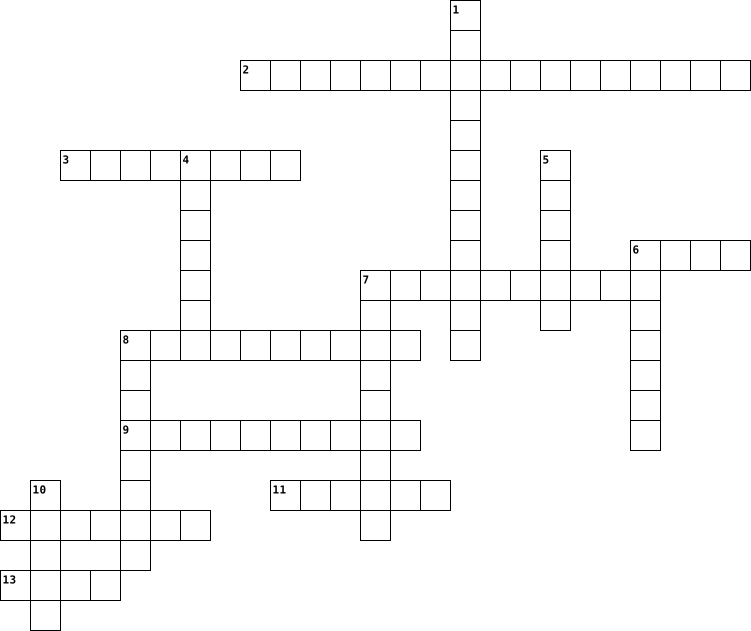
Across
- The moon is held onto Earth by its gravitational pull
- Our Solar Systems largest moon
- This celestial object is slightly lemon-shaped
- The part of the universe we can see is called the _________ universe
- The layer of Earth's atmosphere where meteorites burn up
- Included in our solar system, located past Neptunes orbit
- These planet's rings are 90% water
- This is the most accepted theory about how the solar system began
- The largest volcano in our solar system called "Olympus Mons" is located on this planet
Down
- The region in space between Mars and Jupiter
- These are what many people call "Shooting Stars"
- The shape of our galaxy
- This planet has a small tail made of sodium
- The is a spherical shell that surronds our solar system
- Our solar system orbits the center of this
- Saturn's biggest moon, is the only moon that has an atmosphere.
16 Clues: The shape of our galaxy • Our Solar Systems largest moon • These planet's rings are 90% water • Our solar system orbits the center of this • This planet has a small tail made of sodium • The region in space between Mars and Jupiter • This celestial object is slightly lemon-shaped • These are what many people call "Shooting Stars" • ...
Mid-Autumn Crosswords 2018-09-21

Across
- (n) Vietnamese name of the girl living in the moon (Chinese folk tale)
- (n) another name for Autumn
- (v) what children do to have fun on this day
- (n) Vietnamese name of the man in the moon (Vietnamese folk tale)
- (n) where the children go to have fun in the evening
- (n) the toy played in this festival
- (n) the main characters of this festival
- (n) what fruit is necessary to display on this day
- (n) you may hear this in electric lanterns
Down
- (n) which kind of tree is in the moon according to folk tales
- (n) which month in Lunar calendar is Mid-Autumn in
- (n) the festive food in this festival
- (n) these small things are scattered all over streets when it's Autumn
- (n) which animal lives on the moon with the moonlady (according to folk tale)
- (n) when it's Autumn, the leaves change ______.
- (n) the first material to make a lantern
- (n)the most beautiful thing on Mid-autumn
17 Clues: (n) another name for Autumn • (n) the toy played in this festival • (n) the festive food in this festival • (n) the main characters of this festival • (n) the first material to make a lantern • (n)the most beautiful thing on Mid-autumn • (n) you may hear this in electric lanterns • (v) what children do to have fun on this day • ...
Science but letters 2022-01-15

Across
- Edible moon model
- the earthy scent produced when rain falls on dry soil.
- The (unofficial) fear of palindromes, which are words that read the same front and back and, you guessed it, the word itself is a palindrome.
- A minor planet of the inner solar system
- the amount of time it takes the moon to go from new moon to new moon
- Another name for the moon
Down
- "Even though the sound of it is something quite atrocious"
- the fear of long words
- the fear of redheads
- An English mathematician, physicist, astronomer, alchemist, theologian, and author widely recognized as one of the greatest mathematicians and physicists of all time and among the most influential scientists.
- an object every person would need if we colonized the moon
- slightly smaller than a full moon
- A natural science that studies celestial objects and phenomena
13 Clues: Edible moon model • the fear of redheads • the fear of long words • Another name for the moon • slightly smaller than a full moon • A minor planet of the inner solar system • the earthy scent produced when rain falls on dry soil. • "Even though the sound of it is something quite atrocious" • an object every person would need if we colonized the moon • ...
Basic Astronomy 2021-11-04

Across
- ball of ice
- darkest part of a shadow
- the planet we live on
- a place in a galaxy filled with planets
- planets farthest to the sun
- the moon between the sun and earth
- lightest part of a shadow
- not full eclipse
- ball of rock
- what we see in the sky
Down
- full eclipse
- smaller than a meteor
- our type of galaxy
- our galaxy
- the object that orbits the earth
- who receives the shadow in a lunar eclipse
- the earth between the sun and moon
- who receives the shadow during a solar eclipse
- planets closest to the sun
- what killed the dinosaurs
- can be total or partial
21 Clues: our galaxy • ball of ice • full eclipse • ball of rock • not full eclipse • our type of galaxy • smaller than a meteor • the planet we live on • what we see in the sky • can be total or partial • darkest part of a shadow • lightest part of a shadow • what killed the dinosaurs • planets closest to the sun • planets farthest to the sun • the object that orbits the earth • ...
Space 2025-11-17

Across
- point of highest ascent
- relating to the moon
- star-related prefix
- sky glow from charged particles
- streak of light from falling debris
- robot exploring alien terrain
- orderly whole of the universe
- path a body follows around a star
Down
- long constellation winding across the sky
- cloud of gas lit from within
- impact hollow on a moon or planet
- spot directly overhead
- vast and universal
- immense stellar island
- name tied to early moon flights
- hunter’s pattern in the night
- icy traveller with a glowing tail
- powered by the sun
- darkest part of a shadow
19 Clues: vast and universal • powered by the sun • star-related prefix • relating to the moon • spot directly overhead • immense stellar island • point of highest ascent • darkest part of a shadow • cloud of gas lit from within • hunter’s pattern in the night • robot exploring alien terrain • orderly whole of the universe • sky glow from charged particles • name tied to early moon flights • ...
unit three vocab 2025-11-17

Across
- division of the year that is characterized by recurring weather conditions, and determined by both Earth's tilt relative to the sun and Earth's position in its orbit around the sun.
- in astronomy, the change in the sunlit area of one celestial body as seen from another celestial body; phases of the moon are caused by the changing positions of Earth, the sun, and the moon.
Down
- an event in which the shadow of one celestial body falls on another.
- the path that a body follows as it travels around another body in space.
4 Clues: an event in which the shadow of one celestial body falls on another. • the path that a body follows as it travels around another body in space. • division of the year that is characterized by recurring weather conditions, and determined by both Earth's tilt relative to the sun and Earth's position in its orbit around the sun. • ...
Earth-Moon-Sun 2025-11-17

Across
- a division of the year that is characterized by recurring weather conditions, and determined by both Earth's tilt relative to the sun and Earth's position in its orbit around the sun
- in astronomy, the change in the sunlit area of one celestial body as seen from another celestial body; phases of the moon are caused by the changing positions of Earth, the sun, and the moon
Down
- an event in which the shadow of one celestial body falls on another
- the path that a body follows as it travels around another body in space
4 Clues: an event in which the shadow of one celestial body falls on another • the path that a body follows as it travels around another body in space • a division of the year that is characterized by recurring weather conditions, and determined by both Earth's tilt relative to the sun and Earth's position in its orbit around the sun • ...
vocab 2025-11-17

Across
- a division of the year that is characterized by recurring weather conditions, and determined by both Earth's tilt relative to the sun and Earth's position in its orbit around the sun
- in astronomy, the change in the sunlit area of one celestial body as seen from another celestial body; phases of the moon are caused by the changing positions of Earth, the sun, and the moon
Down
- an event in which the shadow of one celestial body falls on another
- the path that a body follows as it travels around another body in space
4 Clues: an event in which the shadow of one celestial body falls on another • the path that a body follows as it travels around another body in space • a division of the year that is characterized by recurring weather conditions, and determined by both Earth's tilt relative to the sun and Earth's position in its orbit around the sun • ...
vocab 2025-11-17

Across
- in astronomy, the change in the sunlit area of one celestial body as seen from another celestial body; phases of the moon are caused by the changing positions of Earth, the sun, and the moon
- the path that a body follows as it travels around another body in space
- a division of the year that is characterized by recurring weather conditions, and determined by both Earth's tilt relative to the sun and Earth's position in its orbit around the sun
Down
- an event in which the shadow of one celestial body falls on another
4 Clues: an event in which the shadow of one celestial body falls on another • the path that a body follows as it travels around another body in space • a division of the year that is characterized by recurring weather conditions, and determined by both Earth's tilt relative to the sun and Earth's position in its orbit around the sun • ...
Unit 3 vocab 2025-11-21

Across
- A division of the year that is characterized by recurring weather conditions, and determined by both Earth's tilt relative to the sun and Earth's position in its orbit around the sun.
- In astronomy, the change in the sunlit area of one celestial body as seen from another celestial body; phases of the moon are caused by the changing positions of Earth, the sun, and the moon.
Down
- An event in which the shadow of one celestial body falls on another.
- The path that a body follows as it travels around another body in space.
4 Clues: An event in which the shadow of one celestial body falls on another. • The path that a body follows as it travels around another body in space. • A division of the year that is characterized by recurring weather conditions, and determined by both Earth's tilt relative to the sun and Earth's position in its orbit around the sun. • ...
Vocabulary Words 2025-11-24

Across
- an event in which the shadow of one body falls on another
- in astronomy, the change in the sunlit area of one celestial body as seen from another celestial body; phases of the moon are caused by the changing positions of Earth, the sun, and the moon
Down
- the path that a body follows as it travels around another body in space
- a division of the year that is characterized by recurring weather conditions, and determined by both Earth's tilt relative to the sun and Earth's position in its orbit around the sun
4 Clues: an event in which the shadow of one body falls on another • the path that a body follows as it travels around another body in space • a division of the year that is characterized by recurring weather conditions, and determined by both Earth's tilt relative to the sun and Earth's position in its orbit around the sun • ...
Circulation of Earth's air and water 2025-11-20

Across
- a division of the year that is characterized by recurring weather conditions, and determined by both Earth's tilt relative to the sun and Earth's position in its orbit around the sun
- in astronomy, the change in the sunlit area of one celestial body as seen from another celestial body; phases of the moon are caused by the changing positions of Earth, the sun, and the moon
Down
- an event in which the shadow of one celestial body falls on another
- the path that a body follows as it travels around another body in space
4 Clues: an event in which the shadow of one celestial body falls on another • the path that a body follows as it travels around another body in space • a division of the year that is characterized by recurring weather conditions, and determined by both Earth's tilt relative to the sun and Earth's position in its orbit around the sun • ...
FULL MOON NAMES 2022-03-15

Across
- when this full moon is seen the Sap also runs in Maple trees
- In Native American culture the month of the Falling Leaves Moon
- what we call the 13th Full Moon of a year
- the month of the Cold Moon
- a fish found in some North American lakes in August
- the month of the Bear Moon in Native American culture
- emerge on buck deer's foreheads around the time of the Buck Moon
Down
- Full Moon that can come in September or October
- this adjective describes the Americans who settled the 13 original colonies that became the United States
- settelers thought to have brought the name Wolf Moon to North America
- this Full Moon is used by Christians to calculate the date for Easter
11 Clues: the month of the Cold Moon • what we call the 13th Full Moon of a year • Full Moon that can come in September or October • a fish found in some North American lakes in August • the month of the Bear Moon in Native American culture • when this full moon is seen the Sap also runs in Maple trees • In Native American culture the month of the Falling Leaves Moon • ...
Life As We Knew It 2014-10-06

Across
- Jonny goes to
- Miranda saw some men carrying
- Jonny plays this sport
- Peter works at the
- the protagonist
- This smoked up during the night
- Miranda's younger brother
- Nesbitt Leaves her belongings to Miranda's family
- Miranda's pet cat
- Miranda keeps this
Down
- The moon was hit by a
- Miranda's mom twists her
- Miranda and Matt were caught in a
- One of Miranda's friends
- Miranda's mom was mad at her because she ate from the
- Miranda decides to be
- Miranda's step mother
- Comes closer to earth
- The moon being closer causes this
- Matt chops
- Miranda's older brother
21 Clues: Matt chops • Jonny goes to • the protagonist • Miranda's pet cat • Peter works at the • Miranda keeps this • The moon was hit by a • Miranda decides to be • Miranda's step mother • Comes closer to earth • Jonny plays this sport • Miranda's older brother • Miranda's mom twists her • One of Miranda's friends • Miranda's younger brother • Miranda saw some men carrying • ...