
physical Crossword Puzzles
Physical Quantities, Momentum & Impulse 2020-08-11

Across
- It’s a scalar quantity that tells how fast the object is moving.
- Measurement of the rate and direction of motion
- A physical quantity that has the SI unit mol
- A measuring tool used to precisely measure the length of an object. Has an outer and inner jaw.
- Is measured by the acceleration that it gives to freely falling objects.
- It is the resistance to motion of 1 object moving relative to another object
- It occurs when the objects bounce apart when they collide.
- A physical quantity that expresses cold and hot.
- One of the important base quantities that are used to measure or identify the size of an object or the distance from one point to another.
- An event where two or more bodies exert forces on each other in a relatively short time
- The physical quantity that expresses the amount of light power that is emitted from a point of source to a solid angle.
- The isolated system refers to any type of system in which there exists no transfer of matter and energy with the surroundings.
- a vector quantity that is a measure of the rotational momentum of a rotating body or system
- The quantity of mass that is associated with a body that moves in a straight path/direction
- when applied to an object, it will change the motion of an object.
- Measure of the amount of time that elapses between its activation and deactivation.
- The product of mass and velocity.
- Unit: A metric system that is used as a standard of measurement.
- When objects collide but do not bounce away from each other.
Down
- Quantities that are calculated from 2 or more measurements
- It’s the international unit of measure for force
- The change of momentum. It's a vector quantity.
- Cylinder: A measuring tool used to measure a volume of liquid and has a curve called meniscus.
- The property of an object that can be measured by measuring tools/instruments.
- Gauge: It is an instrument used for measuring the exact diameter of a thin wire or the width of a sheet of metal.
- A measuring tool used to measure the length of an object.
- It’s a scalar quantity that refers to how much ground an object has covered during its motion.
- The gravitational force of an object
- Change in rate of velocity over time
- current: A physical quantity that expresses the rate of flow of electric charge
- Used to identify or measure the duration of an event taking place.
- Motion wherein the acceleration of the object is steady (constant)
- Is the amount of energy stored in a given system or region of space per unit volume.
- It’s used to refer to the amount of matter in any given object. It’s the measure of the object's inertia
34 Clues: The product of mass and velocity. • The gravitational force of an object • Change in rate of velocity over time • A physical quantity that has the SI unit mol • Measurement of the rate and direction of motion • The change of momentum. It's a vector quantity. • It’s the international unit of measure for force • A physical quantity that expresses cold and hot. • ...
Physical and Chemical Change 2019-11-07

Across
- A solid formed during a chemical change
- A simple chemical equation where chemicals are represented by their names
- A chemcial reaction that converts oxygen and glucose into water and carbon dioxide while releasing energy.
- A change of state where a gas is cooled and forms a liquid
- The change of state when a solid is heated and forms a liquid
- A change that results in a new substance being formed
- The substances formed in chemical reactions
- A decrease in size
- Evaporation of solvent from a solution to leave solute behind as crystals
- Any chemical reaction where a substance burns in oxygen to produce light and heat
- A gradual erosion of rocks and buildings that occurs when limestone and marble react chemically with the carbonic acid in rainwater
- A change of state where a liquid is heated and changes to a gas within the liquid
- The starting substances in chemical reactions
Down
- The chemical reaction in plants that converts carbon dioxide and water into oxygen and glucose using energy from the sun
- An increase in size
- A change of state from solid to gas
- The process of rearranging atoms in substances to form different substances
- A change that does not result in a new substance being produced
- A change of state from gas to solid
- A change of state where a liquid changes to a gas at the surface of the liquid
- The change of state from liquid to solid
21 Clues: A decrease in size • An increase in size • A change of state from solid to gas • A change of state from gas to solid • A solid formed during a chemical change • The change of state from liquid to solid • The substances formed in chemical reactions • The starting substances in chemical reactions • A change that results in a new substance being formed • ...
Physical and Chemical Change 2019-11-07

Across
- A solid formed during a chemical change
- The substances formed in chemical reactions
- The change of state when a solid is heated and forms a liquid
- A gradual erosion of rocks and buildings that occurs when limestone and marble react chemically with the carbonic acid in rainwater
- The change of state from liquid to solid
- A change that results in a new substance being formed
- A simple chemical equation where chemicals are represented by their names
- A change of state from solid to gas
- A decrease in size
- The chemical reaction in plants that converts carbon dioxide and water into oxygen and glucose using energy from the sun
- The starting substances in chemical reactions
Down
- A change of state from gas to solid
- A change of state where a gas is cooled and forms a liquid
- Evaporation of solvent from a solution to leave solute behind as crystals
- An increase in size
- A change that does not result in a new substance being produced
- The process of rearranging atoms in substances to form different substances
- A change of state where a liquid changes to a gas at the surface of the liquid
- Any chemical reaction where a substance burns in oxygen to produce light and heat
- A change of state where a liquid is heated and changes to a gas within the liquid
- A chemcial reaction that converts oxygen and glucose into water and carbon dioxide while releasing energy.
21 Clues: A decrease in size • An increase in size • A change of state from gas to solid • A change of state from solid to gas • A solid formed during a chemical change • The change of state from liquid to solid • The substances formed in chemical reactions • The starting substances in chemical reactions • A change that results in a new substance being formed • ...
PHYSICAL SCIENCE EXAM VOCABULARY 2024-05-28

Across
- OUTERMOST ELECTRONS
- A SOLID FORMED
- ABLE TO BE MOLDED
- PB
- ATOMS COMBINING
- AMOUNT OF SPACE A SUBSTANCE TAKES UP
- CONDUCTS ELECTRICITY IN WATER
- PRODUCES CARBON DIOXIDE AND WATER
- METAL MIXED WITH SOMETHING ELSE
- STRONGEST FORM OF RADIATION
- CONTAINS ONLY 2 ELEMENTS
- ADDED CHARGES TO THE ATOM
- MAKES GOOD WIRING
- PH BELOW 7
- O
- AL
- PH ABOVE 7
- SI
- EX. JELLO
- NE
- FOUND THE NUCLEUS
- FIRST TO SAY ATOMS EXIST
- SIMPLEST FORM OF MATTER
- S
- HE
- USED TO BALANCE EQUATIONS
- N
- THE ARROW IN CHEMICAL EQUATIONS
Down
- PH OF 7
- ABSORBS ENERGY
- CREATED THE PERIODIC TABLE
- SPEEDS UP REACTIONS
- H
- DISSOLVED IN WATER
- WEAKEST FORM OF RADIATION
- EX. CHEX MIX
- GIVES OFF ENERGY
- ANYTHING THAT HAS MASS AND TAKES UP SPACE
- K
- F
- CA
- BOND BETWEEN A METAL AND A NONMETAL
- MASS PER VOLUME
- NA
- MEDIUM FORM OF RADIATION
- FE
- ATOMS SPLITTING
- TWO OR MORE ELEMENTS COMBINED
- AU
- ADDED ORBITALS TO THE ATOM
- LI
- ALLOWS HEAT AND ENERGY TO FLOW THROUGH
- ONE PRODUCT IS FORMED
- SOMETHING BREAKS DOWN
- BOND BETWEEN 2 NONMETALS
- CL
- C
- AG
58 Clues: H • K • F • O • C • S • N • PB • CA • NA • FE • AU • AL • LI • SI • NE • CL • HE • AG • PH OF 7 • EX. JELLO • PH BELOW 7 • PH ABOVE 7 • EX. CHEX MIX • ABSORBS ENERGY • A SOLID FORMED • ATOMS COMBINING • MASS PER VOLUME • ATOMS SPLITTING • GIVES OFF ENERGY • ABLE TO BE MOLDED • MAKES GOOD WIRING • FOUND THE NUCLEUS • DISSOLVED IN WATER • OUTERMOST ELECTRONS • SPEEDS UP REACTIONS • ONE PRODUCT IS FORMED • SOMETHING BREAKS DOWN • SIMPLEST FORM OF MATTER • ...
Physical and Chemical changes 2024-03-12

Across
- Changes substance
- Phase that is rigid
- Average thermal Energy
- Solid to gas
- Transfer of heat through waves
- Liquid to gas quickly
- Transfer of heat through liquid
- Transfer of energy
- When molecules can move freely
- Phase that can move freely
- Change in phase
- From gas to solid
- Solid, Liquid, Gas
- Phase with the most volume
- From solid to liquid
Down
- Liquid to solid
- Transfer of heat through solids
- Liquid to gas at the surface
- Liquid to gas from the bottom
- Smallest part of anything
- Gas to liquid
- Total of kinetic energy
- Substance that flows
- How much something moves
24 Clues: Solid to gas • Gas to liquid • Liquid to solid • Change in phase • Changes substance • From gas to solid • Transfer of energy • Solid, Liquid, Gas • Phase that is rigid • Substance that flows • From solid to liquid • Liquid to gas quickly • Average thermal Energy • Total of kinetic energy • How much something moves • Smallest part of anything • Phase that can move freely • ...
Physical and Chemical Changes 2024-03-12

Across
- law if volume goes up, pressure goes down
- a state of matter that rarely occurs on planet earth
- made of atoms
- A phase change from a solid to gas
- change when solid changes to liquid, then to gas
- change changes the molecules, may or may not be a visible change
- A phase change from solid to liquid
- energy the total energy of the molecules
- A phase change from liquid to gas (quickly)
- point the point at which a liquid turns into a gas
- determined by the average kinetic energy
- a state of matter that has a non-fixed volume
Down
- a visible change, but with no change to molecules
- law If temperature goes up pressure goes up
- A phase change from gas to liquid
- state of matter that has a a fixed volume and vibrates in place
- heat energy that helps break the molecular bonds of a solid
- a phase change from liquid to gas (slowly on surface)
- A phase change from liquid to gas (from bottom)
- the amount of space an object takes up
- the ____ transferred from the mug to my hands
- the _____ between molecules always stays the same
- heat ____ from the water to the cup
- a state of matter that has a fixed volume and takes the shape of container
- law if temperature goes up volume goes up
- A phase change from liquid to solid
26 Clues: made of atoms • A phase change from gas to liquid • A phase change from a solid to gas • A phase change from solid to liquid • heat ____ from the water to the cup • A phase change from liquid to solid • the amount of space an object takes up • determined by the average kinetic energy • A phase change from liquid to gas (quickly) • ...
Vocab Man - Physical Environment 2024-04-15

Across
- Continent
- Coast
- Island
- City
- Countryside
- Farm
- Forest
- Valley
- Beach
- Mountain
- Ocean
Down
- Desert
- Country
- World
- Feild
- Hill
- Hurricane
- Lake
- River
- Region
- Town
- Waterfalls
- State
- Tree
- Sea
25 Clues: Sea • Hill • Lake • City • Town • Farm • Tree • World • Feild • Coast • River • State • Beach • Ocean • Desert • Island • Region • Forest • Valley • Country • Mountain • Continent • Hurricane • Waterfalls • Countryside
Physical Effects of Drug 2024-12-18

Across
- Loss of coordination, drowsiness, trouble breathing
- Increased heart rate, nausea, mix up of senses
- Altered time perception, and impaired thinking, memory, and body movement
- Elevated heart rate, increased blood pressure, dilated pupils, induce nausea, vomiting
- Muscle and bone pain, insomnia, diarrhea, vomiting, cold flashes
- Disorientation, confusion, or loss of motor coordination
- Blackouts and memory lapses, respiratory arrest, tunnel vision
- More energetic and alert, having an increased sense of well-being, warmth, openness toward others
- Increased or decreased reaction time, decreased anxiety, amnesia
- Drowsiness, disinhibition, lightheadedness, and agitation
- Headaches, heart attack, passing out, weakened immune system
Down
- Respiratory issues, Yellow teeth, wrinkles, impaired sense of smell, increased risk of heart disease and stroke
- Substances that change a person's mental or physical state
- An altered state of consciousness – with altered thinking and changes in time and perception
- Increased heart rate, blood pressure, breathing rate, and body temperature
- Impaired coordination, slurred speech, dizziness, nausea, vomiting, headaches, drowsiness, poor vision, increased heart rate, dehydration
- Lethargy, Lack of concentration, Sense of detachment, Memory loss
- Relaxation, pain relief, sedation, confusion, dizziness
- Hallucinations and changes in visual perception, uncontrolled laughter, mood and emotional swings
- Indigestion, heartburn, insomnia
- Addiction, Anxiety, Depression
- Shortness of breath, Chest pain, Diarrhea, nausea, vomiting, and abdominal pain
- Trouble sleeping, loss of energy, and lack of concentration
- Muscle twitches, tremors, and seizures, Weight loss, malnutrition, and dehydration
- Increased alertness, physical energy, and talkativeness
25 Clues: Addiction, Anxiety, Depression • Indigestion, heartburn, insomnia • Increased heart rate, nausea, mix up of senses • Loss of coordination, drowsiness, trouble breathing • Relaxation, pain relief, sedation, confusion, dizziness • Increased alertness, physical energy, and talkativeness • Disorientation, confusion, or loss of motor coordination • ...
Adjectives of physical appearances 2024-10-23

Across
- Having well-defined muscles or a strong physique.
- Attractive, usually used to describe men.
- Hair that forms loose curls or undulations.
- Unpleasant or unattractive in appearance.
- Having a lot of hair on the body.
- Having a sun-kissed or bronzed skin tone.
- Very thin; often with a connotation of unhealthiness.
- Having facial hair, typically a beard.
- Perfect in appearance; without any imperfections.
- Lacking color in the skin, often appearing light or washed out
- Having holes made in the body for jewelry, typically in ears or face.
Down
- Having light-colored or yellowish hair.
- Thick and full, often used to describe eyebrows or hair.
- Fit and strong; typical of an athlete.
- Graceful and stylish in appearance or manner.
- Following the latest trends in clothing and style.
- Having lines or folds in the skin, typically due to aging.
- Extremely overweight; having an excessive amount of body fat.
- Lacking hair on the scalp.
- Light in color or complexion; often refers to skin tones.
20 Clues: Lacking hair on the scalp. • Having a lot of hair on the body. • Fit and strong; typical of an athlete. • Having facial hair, typically a beard. • Having light-colored or yellowish hair. • Attractive, usually used to describe men. • Unpleasant or unattractive in appearance. • Having a sun-kissed or bronzed skin tone. • Hair that forms loose curls or undulations. • ...
South America Physical Geography 2025-04-23

Across
- this is one of two important rivers that drain the Andean region.
- a mountain system made up of roughly parallel ranges.
- in addition, the region has other valuable resources one of them being ___.
- this river drains much of the central part of South America.
- Venezuela's highest elevation is in the ____ Highlands.
- mostly grassland with few trees. At a low elevation and without much vegetation.
- highest point in the region is. It is larger than California and Texas combined.
- this is a partially enclosed body of water where freshwater mixes with saltwater.
- Caribbean, South America's location is near what? Most of the region has warm temperatures year round.
- this river is the largest river system. Flows eastward and is about 4,000 miles long.
- clearing of trees is known as what?
- this is the highest lake in the world that large ships can cross.
Down
- Venezuela is located on what coast?
- the following four countries make up _______. Those countries are Brazil, Argentina, Uruguay, and Paraguay. This region covers about two-thirds of South America.
- rice, coffee, bananas, and sugarcane are major _____.
- a broad, high plateau that lies between the ridges of the Andes.
- Patagonia has a cool, ___, climate.
- a region of dry plains and plateaus south of the Pampas.
- the longest river in this region. Flows for 1,600 miles.
- a low plains region known as the Gran ___ stretches across parts of Paraguay and northern Argentina.
- This mountain range is found on the western side of Colombia.
- some of the Andes' snowcapped peaks are active what?
- Flat landscape of the Llanos region has a tropical ____ climate. Favorable conditions for grassland to grow.
- some of the steep-sided plateaus are capped by sandstone layers that have resisted erosion. These unusual flat-topped formations are called what?
- this type of forest thrives in the humid tropical climate of southern Colombia.
- all the countries in this region share one major physical feature - the Andes mountains.
26 Clues: Venezuela is located on what coast? • Patagonia has a cool, ___, climate. • clearing of trees is known as what? • some of the Andes' snowcapped peaks are active what? • rice, coffee, bananas, and sugarcane are major _____. • a mountain system made up of roughly parallel ranges. • Venezuela's highest elevation is in the ____ Highlands. • ...
Physical Therapy CrossWord Puzzle 2025-04-15

Across
- Another name for tailbone
- Inner quadricep muscle
- Muscle that bends the knee
- Connects bone to bone
- Largest muscle in the body
- Connects muscle to bone
- Years of Graduate School for Physical Therapy
- Bone that covers and protects the knee
- Largest organ of the body
- Largest bone in the body
Down
- Tool that measures range of motion of a joint
- The heel bone
- What cushions your spine
- Muscle to chew food
- People who work to help others with injuries or post surgery
- The funny bone is actually the___nerve
- The name of the bones in your wrist
- Muscle that contracts 100,000 times a day without you knowing
- Smallest bone in the body
- One of the top joints to be replaced
20 Clues: The heel bone • Muscle to chew food • Connects bone to bone • Inner quadricep muscle • Connects muscle to bone • What cushions your spine • Largest bone in the body • Another name for tailbone • Smallest bone in the body • Largest organ of the body • Muscle that bends the knee • Largest muscle in the body • The name of the bones in your wrist • One of the top joints to be replaced • ...
Physical Science Cross word 2025-06-09

Across
- Energy moving objects in motion
- is a fast moving particle
- the building blocks of everything
- energy that travels through space
- is the volume of an object
- a substance that takes shape of its container
- the up and down on a graph
- amount of space a 3d object takes up
- Variable changes in an experiment
- liquid water gets so hot it vapors
- energy that makes things warm
Down
- describing something with numbers
- something made or produced
- a metal like copper
- special picture for inside you body
- is a team of elements
- how well something dissolves in water
- a force that pulls everything together
- a path something follows
- how heavy something is
- the brain of the cell
- how easily something burns
- a special kind of light
- is a type of unit used to measure energy
- a tool used to measure temperature
25 Clues: a metal like copper • is a team of elements • the brain of the cell • how heavy something is • a special kind of light • a path something follows • is a fast moving particle • something made or produced • is the volume of an object • how easily something burns • the up and down on a graph • energy that makes things warm • Energy moving objects in motion • ...
MS Physical Education Final 2025-05-13

Across
- Muscular_________, one of the key fitness
- Faster than walking or jogging
- Ball game played with a bat and gloves
- Another term for physical condition or wellness
- Used to build muscle, often found in a gym
- Strength building upper body exercise
- ball Played with a plastic ball and bat
- Stretch Alternating arm and leg movements to warm up
- Game using a large rubber ball
- Cardio movement similar to sprinting
- Team sport with a hoop
- Ability to move joints through full range of motion
- Field game using a round white ball and clubs
Down
- Incorporates aspects of both soccer and components basketball
- ball Throw, duck and dodge in this game
- Game played with a birdie
- Game played with 10 pins and a ball
- Exercise that uses oxygen over a long period of time
- Low Impact cardiovascular activity
- Fitness component related to sustained effort
- Played with a puck and stick
- Team sport with 11 players involving kicking a ball into a net
- Racket sport similar to tennis, often played indoors
- Stretch Type of stretch without movement
- Team sport that allows 3 hits per side (bump, set, spike)
- Core strength exercise involving lying on on your back
- Type of training without oxygen
27 Clues: Team sport with a hoop • Game played with a birdie • Played with a puck and stick • Faster than walking or jogging • Game using a large rubber ball • Type of training without oxygen • Low Impact cardiovascular activity • Game played with 10 pins and a ball • Cardio movement similar to sprinting • Strength building upper body exercise • Ball game played with a bat and gloves • ...
physical science crossword puzzle 2022-12-15

Across
- substances that form in chem reaction
- the thickness or runniness of a liquid
- temp of boiling
- enerrgy required to pull 2 atoms apart
- chemical bonds between atoms are broke
- electrons are shared
- electrons in the outermost shell
- ability to be deformed
- the absorbtion of heat
- molecules not having a dipol
- electrons flow in an electron sea
- temp of melting
Down
- hard metals that are malleable
- rate the speed of any chem reaction
- electrons are given and taken
- substances that react
- the heat releases
- burns at room temp
- unequal sharing of electrons
- soft metals highly reactive with water
- written form of a chemical reaction
21 Clues: temp of boiling • temp of melting • the heat releases • burns at room temp • electrons are shared • substances that react • ability to be deformed • the absorbtion of heat • molecules not having a dipol • unequal sharing of electrons • electrons are given and taken • hard metals that are malleable • electrons in the outermost shell • electrons flow in an electron sea • ...
Physical science MAP review 2023-05-05

Across
- In a chemical change the __________ of the new substance are different from the original.(SA)
- Motion can be described by finding an objects ______ or how fast it moves in a certain amount of time.(KS)
- Physical and chemical changes are both able to change in ________ ways. (SA)
- Sound, water and light are all _______________waves. (PO)
- When potential energy ________, kinetic energy decreases. (KS)
- When kinetic energy increases, potential energy ________.(KS)
- Reflection is when is a way of light reaches a ______polished surface and a light wave bounces back (PO)
- ______ is a force that pulls objects down to earth.(KS)
- Altitude the _______ between the resting places displacements of the wave(PO)
- Light travels as a _____, it doesn't need any matter/material to carry its energy along (PO)
- _____ are an extremely small amount of something or quality.(SA)
- Atoms are the smallest substance that cannot be broken down _________.(SA)
- _______ energy is stored energy that can be used later (KS)
- Opaque objects don’t allow ____ light to travel through them, the light can be absorbed and converted into thermal energy, we as humans are opaque(PO)
- ______ are a basic part of a whole.(SA)
- Frequency is the _______ of waves that pass through a fixed unit of time(PO)
Down
- in a physical change the __________ of the matter changes (SA)
- ______ is the force between two objects in contact with each other. (KS)
- The ______ an object is moving the more kinetic energy it has(KS)
- The _________ of an object is dependent upon both force and mass.(KS)
- Molecules are made up of one or more ____.(SA)
- In a ________ change you cant see the physical substance change.
- _____ energy is the energy of movement (KS)
- Light moves in a _____ line through space(PO)
- In a physical change the kind of ______ will not change.(SA)
- Light is a type of electromagnetic _____(PO)
- Transparent objects ______ all/most light to travel through them like glasses(PO)
- _____ can make things move, change shape, or change speed.(KS)
- Atoms are an extreme small amount of thing or _______.(SA)
- Electromagnetic energy waves are _______through vibrations.(PO)
30 Clues: ______ are a basic part of a whole.(SA) • _____ energy is the energy of movement (KS) • Light is a type of electromagnetic _____(PO) • Light moves in a _____ line through space(PO) • Molecules are made up of one or more ____.(SA) • ______ is a force that pulls objects down to earth.(KS) • Sound, water and light are all _______________waves. (PO) • ...
PHYSICAL EDUCATION MIDTERMS EXAM 2025-02-10

Across
- The process of maintaining fluid balance in the body
- The process by which the body converts food into energy
- A two-headed muscle on the upper arm responsible for flexion
- A low-impact physical activity that improves cardiovascular health
- A large chest muscle involved in arm movement
- A three-headed muscle on the back of the upper arm
- A facility equipped for physical exercise and training
- The rhythmic throbbing of arteries as blood is pumped by the heart
- The ability to sustain prolonged physical effort
- A shorthand term for abdominal muscles
- A broad, flat muscle of the back aiding in arm rotation
- The larger and stronger of the two lower leg bones
- A sport and exercise involving lifting heavy weights
- The ability to stay upright and control body position
- A sport involving dribbling and shooting a ball into a hoop
- Physical activity that improves strength, endurance, and flexibility
- The ability to exert force against resistance
- The ability to move quickly and change direction efficiently
- The state of muscle exhaustion from exercise
- The study of motion and its causes
Down
- A racket sport played with a shuttlecock over a net
- A push or pull exerted on an object
- The study of forces and their effects on the body
- A sport where players use their feet to control and kick a ball into a goal
- A sudden and involuntary muscle contraction causing pain
- A measure of energy used or consumed by the body
- The ability to move quickly in a short amount of time
- The study of forces and motion in physical activity
- The number of times an exercise is performed
- The ability to maintain balance and control
- The rate at which work is done or energy is transferred
- A technique using a cylindrical tool to relieve muscle tension
- A person trained in sports and physical activities
- A fast-paced sport played on ice or field with a stick and ball/puck
- A state of physical, mental, and social well-being
- The ability to move quickly
- A measure of body fat based on height and weight
- A full-body workout performed in water
- A group of muscles at the back of the thigh
- A practice involving physical postures, breathing, and meditation
40 Clues: The ability to move quickly • The study of motion and its causes • A push or pull exerted on an object • A shorthand term for abdominal muscles • A full-body workout performed in water • The ability to maintain balance and control • A group of muscles at the back of the thigh • The number of times an exercise is performed • The state of muscle exhaustion from exercise • ...
Chemical and Physical Properties 2025-02-20

Across
- Incapable of being squeezed into a smaller volume
- Capable of breaking down naturally
- Rusting
- A state of matter in which the object has a definite shape and volume.
- To make or become liquid
- How heavy a substance is compared with other substances with the same size
- Easily broken
- The process of burning something
- Not shiny
- Temperature at which a liquid changes into a solid
- A state of matter with no definite shape or volume
Down
- Squeezed or pressed together
- Characteristics used to describe an object for example what it looks like and its reaction with water
- Temperature at which a solid becomes a liquid
- Measure of how fast a chemical reaction occurs
- Another word for smell
- A single kind of matter that is pure and has a specific set of properties.
- The amount of water vapor in the air
- Conductor a material that allows electricity to pass through easily
- A state of matter that has no definite shape but has a definite volume.
- Conductor A material that allows heat to pass through easily
21 Clues: Rusting • Not shiny • Easily broken • Another word for smell • To make or become liquid • Squeezed or pressed together • The process of burning something • Capable of breaking down naturally • The amount of water vapor in the air • Temperature at which a solid becomes a liquid • Measure of how fast a chemical reaction occurs • Incapable of being squeezed into a smaller volume • ...
North America's Physical Features 2024-10-10

Across
- vast flatlands that stretch from the U.S. Midwest (Texas to Canada)
- one of the longest rivers in the world, flowing from Minnesota to the Gulf of Mexico
- desert that covers part of California, Arizona, and northern Mexico
- the lowest point in North America, located in California; it is one of the hottest places on Earth
- large saltwater lake found in Utah
- river that forms part of the U.S.-Mexico border
- mountain range located in the eastern U.S., running from Canada to Alabama
- large ocean basin off the southeastern coast of North America, bordered by the U.S., Mexico, and Cuba
- one of the most famous natural wonders of the world, carved by the Colorado River in Arizona
- large peninsula extending into the Atlantic Ocean and the Gulf of Mexico, famous for its wetlands like the Everglades
- desert that is found in southern California, Nevada, and Arizona
- the world's largest island, located to the northeast of Canada
Down
- a tropical peninsula extending into the Gulf of Mexico, known for its limestone terrain and Mayan ruins, shared by Mexico, Belize, and Guatemala
- largest group of freshwater lakes in the world, located between the U.S. and Canada
- mountain range along the western U.S., primarily in California and Nevada
- river known for carving out the Grand Canyon that flows from the Rocky Mountains to the Gulf of California
- desert that extends from southern New Mexico and Texas into northern Mexico
- mountain range that stretch from western Canada through the United States
- a large, semiarid plateau in Mexico
- a vast subtropical wetland in southern Florida, known for its unique ecosystems and species such as alligators, manatees, and the Florida panther
20 Clues: large saltwater lake found in Utah • a large, semiarid plateau in Mexico • river that forms part of the U.S.-Mexico border • the world's largest island, located to the northeast of Canada • desert that is found in southern California, Nevada, and Arizona • vast flatlands that stretch from the U.S. Midwest (Texas to Canada) • ...
Physical and Chemical Properties. 2025-09-25

Across
- Tendency of a substance to react chemically with water (e.g., sodium reacting explosively).
- The ability of a substance to chemically combine with oxygen (e.g., iron forming rust).
- The ability of a substance to dissolve in another substance.
- The slow reaction of iron with oxygen and moisture to form oxides.
- The ability of a substance to allow electricity to flow through it.
- what you can measure or observe directly (no new substance formed)
- Reaction of certain metals like silver with air or moisture to form a dull surface layer.
- The smell a substance gives off.
- how it behaves/reacts (new substances form)
- The ability of a substance to ignite quickly and burn rapidly at normal temperatures.
- The ability of a substance to transfer heat.
Down
- The ease with which a substance can catch fire and continue burning.
- How a substance reacts when exposed to a base (e.g., acid–base neutralization).
- The mass per unit volume of a substance.
- The flavor of a substance (though testing this is unsafe in chemistry).
- How a substance reacts when exposed to an acid (e.g., metal + HCl → hydrogen gas).
- The temperature at which a solid changes into a liquid.
- The temperature at which a liquid changes into a gas.
- The ability of a substance to attract or repel other materials due to a magnetic field.
- The visual appearance of a substance as perceived by the eye.
- The spontaneous breakdown of an unstable atomic nucleus, releasing radiation.
- Resistance of a substance to being scratched or deformed.
- The degree to which a substance can damage living tissue through chemical interactions.
- Gradual destruction of a material (usually metal) by chemical reaction with its environment.
- The amount of energy released as heat when a substance undergoes complete combustion with oxygen.
25 Clues: The smell a substance gives off. • The mass per unit volume of a substance. • how it behaves/reacts (new substances form) • The ability of a substance to transfer heat. • The temperature at which a liquid changes into a gas. • The temperature at which a solid changes into a liquid. • Resistance of a substance to being scratched or deformed. • ...
French Physical Descriptions 1 2025-09-25

Across
- Pretty (F)
- Beautiful
- Fat (M)
- Ugly (M)
- Cute (F)
- Medium Height
- Weak
- Tall
- Old (M)
- Thin
- Short (F)
- Beautiful
Down
- Fat (F)
- Old (F)
- Ugly (F)
- Athletic (F)
- Pretty (M)
- Cute (M)
- Strong (F)
- Short (M)
- Strong (M)
- Young
22 Clues: Weak • Tall • Thin • Young • Fat (F) • Old (F) • Fat (M) • Old (M) • Ugly (F) • Ugly (M) • Cute (F) • Cute (M) • Beautiful • Short (M) • Short (F) • Beautiful • Pretty (F) • Pretty (M) • Strong (F) • Strong (M) • Athletic (F) • Medium Height
Physical and Chemical Matter 2026-01-21

Across
- shine
- sensation of flavor
- smell
- some more reactive than others
- fire
- M/V
- bumpy
- dissolve
- oxidation
Down
- corrosion
- electrical charge
- reflects light
- solid gas liquid
- shaped
- temp. something melts
- temp. something boils
- resistance to flow
- wires
- transfer heat
- magnet
20 Clues: M/V • fire • shine • smell • wires • bumpy • shaped • magnet • dissolve • corrosion • oxidation • transfer heat • reflects light • solid gas liquid • electrical charge • resistance to flow • sensation of flavor • temp. something melts • temp. something boils • some more reactive than others
Unit 2 - Physical Activity 2026-01-22

Across
- training to get into shape for physical activity or a sport
- the places where two or more bones meet
- painful swelling of a tendon caused by overuse
- the ability to move joints fully and easily through a full range of motion
- a small fracture caused by repeated strain on a bone
- rhythmic, moderate-to-vigorous activity that uses large amounts of oxygen and works the heart and lungs
- how much energy you use when you work out
- the smooth and effective working together of your muscles and bones
- overheating of the body that can result from dehydration
- freezing of the skin
- the feeling of stability and control
- the ability of a muscle to repeatedly use force over a period of time
- procedure used to treat strains and sprains (protect, rest, use, compress, elevate)
- conditioning too hard or too often without enough rest between sessions
- a 4-step method for safely increasing aspects of your workout without injuring yourself (frequency, intensity, time, type)
Down
- switching between different forms of physical exercise
- planned physical activity done regularly to build or maintain one’s fitness
- the ability to handle the physical demands of everyday life without becoming overly tired
- gentle exercises that let the body adjust to ending a workout
- excessive loss of water from the body
- a jarring injury to the brain that can cause unconsciousness
- a break in a bone
- the most weight you can lift or the most force you can exert at one time
- your ability to stick with a task or activity for a long period of time
- the ability of your muscles to use force
- a major injury that happens when a bone is forced from its normal position within a joint
- any kind of movement that makes the body use energy
- and Lung Endurance: the measure of how efficiently your heart and lungs work when you exercise and how quickly they return to normal when you stop
- the ability to perform difficult physical activity without getting overly tired
- intense physical activity that builds muscle but does not use large amounts of oxygen
- is an injury to a ligament connecting bones to a joint
- gentle exercise that gets the heart muscles ready for moderate-to-vigorous activity
- the number of days you work out each week
33 Clues: a break in a bone • freezing of the skin • the feeling of stability and control • excessive loss of water from the body • the places where two or more bones meet • the ability of your muscles to use force • how much energy you use when you work out • the number of days you work out each week • painful swelling of a tendon caused by overuse • ...
Physical Science Chemistry Review 2026-02-23

Across
- negative charge
- elements coming together to make compound
- metals that can have multiple oxidation numbers
- Fluorine column of elements
- gain electrons
- reaction that feels hot
- litmus paper turns blue
- tastes sour
- sea of electrons bond
- anything with a charge
- atomic model that uses only roman numerals
- reaction that feels cold
Down
- electrons transfer bond
- positive charge
- neutral charge
- neutralization makes water and
- change number of neutrons
- atomic model with orbits of electron energies
- shared electrons bond
- acid plus base
- compound breaks down into separate parts
- lose electrons
- first column of elements
- gases that react to nothing
24 Clues: neutral charge • acid plus base • gain electrons • lose electrons • negative charge • positive charge • tastes sour • shared electrons bond • sea of electrons bond • anything with a charge • electrons transfer bond • reaction that feels hot • litmus paper turns blue • first column of elements • reaction that feels cold • change number of neutrons • Fluorine column of elements • ...
Physical Science - Atomic Structure 2025-10-09

Across
- Created first periodic table by atomic mass.
- Number Number of protons in an atom.
- Force Pull between nucleus and electrons.
- Atom is a positive sphere with embedded electrons.
- Dense center with protons and neutrons.
- Notation Symbol with mass number (¹²C).
- Negative particle outside the nucleus.
- Electrons move in clouds, not fixed orbits.
- Force (e⁻) Push between electrons.
- Discovered atomic number; reorganized periodic table.
- Electrons orbit nucleus in fixed paths.
Down
- First to name the atom.
- Atoms are solid spheres; can’t be divided.
- Same element, different neutrons.
- Number Total of protons and neutrons.
- Neutral particle in the nucleus.
- Atomic Mass Weighted average of isotopes.
- Atom has dense nucleus with electrons around it.
- Force (p⁺) Push between protons in nucleus.
- Notation Element name and mass number (Carbon-12).
- Symbol Abbreviation for an element.
- Cloud Space around nucleus with electrons.
- Positive particle in the nucleus.
23 Clues: First to name the atom. • Neutral particle in the nucleus. • Same element, different neutrons. • Positive particle in the nucleus. • Force (e⁻) Push between electrons. • Symbol Abbreviation for an element. • Number Number of protons in an atom. • Number Total of protons and neutrons. • Negative particle outside the nucleus. • Dense center with protons and neutrons. • ...
Atomic Structure- Physical Science 2025-12-04

Across
- Positive subatomic particle
- Equals the protons plus neutrons.
- Original name given to electron stream by Thomson
- thought all substances were made of 4 elements
- Neutrons have ________ charge.
- Lowest energy state of an atom
- The energy levels in Bohr's model are often called ____________.
- Thomson's model of the atom.
- equals the number of protons minus the number of electrons.
- Negative subatomic particle
- Neutral subatomic particle
- Bohr's model of the atom was called the ____________ model.
- came up with the idea of "atoms"
- The arrangement of electrons in an atom is called the electron ________________.
Down
- Protons have a __________ charge
- Scientist that discovered the neutron.
- Atom of the same element with different number of neutrons.
- Atom that has gained or lost electrons.
- Discovered electrons.
- Electrons have a __________ charge
- Early people believed in only _________ elements.
- Dalton's atomic theory was better accepted because he based it on ____________.
- Rutherford used the ______________ experiment to discover the nucleus.
- Small dense positive center of an atom.
- English teacher that came up with the first Atomic Theory.
- Scientist that discovered the atom is mostly empty space.
- All atom are ____________ , meaning the same number of positives and negatives.
- The modern model of the atom is called the _________ ______ model.
- Relative mass of subatomic particles is measured in ____.
- Equals the number of protons in an atom.
30 Clues: Discovered electrons. • Neutral subatomic particle • Positive subatomic particle • Negative subatomic particle • Thomson's model of the atom. • Neutrons have ________ charge. • Lowest energy state of an atom • Protons have a __________ charge • came up with the idea of "atoms" • Equals the protons plus neutrons. • Electrons have a __________ charge • ...
Physical Science Crossword Puzzle 2026-03-25

Across
- one of the two ends of a magnet where the magnetism seems to be concentrated
- to push away
- temporary magnet that loses its magnetism when the electric current is turned off
- To pull toward
- More protons than electrons
- A material that allows heat and electricity to pass through it
- An attractive force that acts between any two objects
- A measure of the extra positive or negative particles that an object has
- the attraction or repulsion between magnetic poles
- an instrument for detecting and measuring small electric currents
- The force of attraction or repulsion of magnetic materials
Down
- The region around a magnet where the magnetic force is exerted
- To send out rays; to beam or shine
- A form of energy caused by the movement of electrons
- A flow of charged particles, such as electrons or ions, moving through an electrical conductor or space
- A state where an object or particle has an excess of electrons compared to protons
- A north-seeking pole of a magnet
- energy caused by movement of electrons
- A south seeking pole of a magnet
- A machine that converts mechanical energy into electrical
20 Clues: to push away • To pull toward • More protons than electrons • A north-seeking pole of a magnet • A south seeking pole of a magnet • To send out rays; to beam or shine • energy caused by movement of electrons • the attraction or repulsion between magnetic poles • A form of energy caused by the movement of electrons • An attractive force that acts between any two objects • ...
Physical Science Crossword Puzzle 2026-03-25

Across
- one of the two ends of a magnet where the magnetism seems to be concentrated
- to push away
- temporary magnet that loses its magnetism when the electric current is turned off
- To pull toward
- More protons than electrons
- A material that allows heat and electricity to pass through it
- An attractive force that acts between any two objects
- A measure of the extra positive or negative particles that an object has
- the attraction or repulsion between magnetic poles
- an instrument for detecting and measuring small electric currents
- The force of attraction or repulsion of magnetic materials
Down
- The region around a magnet where the magnetic force is exerted
- To send out rays; to beam or shine
- A form of energy caused by the movement of electrons
- A flow of charged particles, such as electrons or ions, moving through an electrical conductor or space
- A state where an object or particle has an excess of electrons compared to protons
- A north-seeking pole of a magnet
- energy caused by movement of electrons
- A south seeking pole of a magnet
- A machine that converts mechanical energy into electrical
20 Clues: to push away • To pull toward • More protons than electrons • A north-seeking pole of a magnet • A south seeking pole of a magnet • To send out rays; to beam or shine • energy caused by movement of electrons • the attraction or repulsion between magnetic poles • A form of energy caused by the movement of electrons • An attractive force that acts between any two objects • ...
Physical Properties of Matter 2026-04-12

Across
- (-) charge and outside the nucleus
- Particles with more than one atom joined together.
- The ability of an object or material to be pushed or pulled by a magnet.
- The ability of matter to dissolve in a liquid.
- Cutting a Tree, Folding Paper, Cutting hair, Ironing clothes
- The amount of matter in an object.
- Objects with Relative Density greater than 1 will resist surface tension and
- Power cord, light bulb, water
- A property that can be observed or measured without changing what matter is
- An object’s resistance to sinking.
- The ability of a material to resist deformation by indentation.
- A measure of how closely packed an object's particles are in relation to one another.
- (Talc)
- The upward force exerted on objects submerged in fluids is
- The way a light bounces off an object. Ex. Reflection on a mirror.
- dry, bulk solid composed of many very fine particles that may flow freely when shaken or tilted.
Down
- A material that transfers heat or electricity easily.
- Iron Skillet handle getting hot
- The amount of space an object takes up.
- color, size, shape texture
- How strongly gravity pulls on an object
- Plastic, Cloth, Wood, Rubber, Glass
- Objects with Relative Density less than 1 will
- The smallest unit of an element that has the same properties of that element.
- (no charge) and inside the nucleus
- A change to something that does not change the molecular structure. Ex.
- Amount of density in relation to surrounding matter
- A material that stops or slows the flow of energy, such as electricity or heat.
- (+) charge) and inside the nucleus
29 Clues: (Talc) • color, size, shape texture • Power cord, light bulb, water • Iron Skillet handle getting hot • (-) charge and outside the nucleus • The amount of matter in an object. • (no charge) and inside the nucleus • An object’s resistance to sinking. • (+) charge) and inside the nucleus • Plastic, Cloth, Wood, Rubber, Glass • The amount of space an object takes up. • ...
Module 30 - Physical Layer 2026-05-14

Across
- Cable that transmits data as light pulses and is immune to EMI and RFI
- Copper cable with a center conductor insulation shielding and outer jacket
- Fiber-optic cable type that uses multiple light paths for shorter distances
- How 1s and 0s are represented as electrical optical or wireless signals
- Common connector used to terminate UTP Ethernet cables
- Physical connection type that uses radio waves to transmit bits
- The actual amount of data successfully transferred over time
- The OSI layer responsible for transporting bits across network media
Down
- Interference from electrical sources that can corrupt copper cable signals
- Converting data bits into a predefined pattern for transmission
- Usable data transferred after subtracting overhead and retransmissions
- Twisted-pair cable with shielding for better protection against noise
- The capacity of a medium to carry data
- Cable type that uses electrical pulses to represent bits
- The basic units of data transported across media at the physical layer
- The delay for data to travel from one point to another
- Interference caused by one wire affecting the signal on a nearby wire
- Unshielded twisted-pair copper cable commonly terminated with RJ-45
- Hardware that connects a device to a network
- Interference from radio waves that can distort signals on copper media
20 Clues: The capacity of a medium to carry data • Hardware that connects a device to a network • The delay for data to travel from one point to another • Common connector used to terminate UTP Ethernet cables • Cable type that uses electrical pulses to represent bits • The actual amount of data successfully transferred over time • ...
Physical science super trivia 2026-05-12

Across
- a decrease in speed over time
- The ability to do work or cause change
- A place or object used for comparison to detect motion
- The curved path an object follows through space
- The amount of matter in a object
- a change in position over time
- the tendency of an object to resist changes in motion
- the change in position from start to finish
- how far an object travels
- the force that pull objects towards earth
Down
- The study of motion without considering forces
- What is measured to determine how long motion lasts
- a push or pull on an object
- the rate at which velocity changes
- the quantity of motion an object has
- The unit used to measure force
- speed In a certain direction
- The path along which something moves
- how fast something moves
- a force that slows moving objects down
20 Clues: how fast something moves • how far an object travels • a push or pull on an object • speed In a certain direction • a decrease in speed over time • The unit used to measure force • a change in position over time • The amount of matter in a object • the rate at which velocity changes • the quantity of motion an object has • The path along which something moves • ...
CAST Physical Science Review 2026-05-11

Across
- Ability to cause change or do work
- Number of waves passing a point in a given time
- When a wave bounces off a surface
- Change in position over time
- When a wave bends passing through materials
- Movement of energy from one object to another
- Speed in a specific direction
- Energy related to temperature
- Distance between repeating parts of a wave
- When two objects hit each other
- Force that slows motion when surfaces rub together
Down
- Forces that change motion
- Equal forces that do not change motion
- When energy is taken in by matter
- Disturbance that transfers energy through matter or space
- Energy of motion
- Tendency of an object to resist changes in motion
- Stored energy based on position or condition
- A push or pull on an object
- Change in velocity over time
- Force that pulls objects towards each other
- When a wave passes through a material
22 Clues: Energy of motion • Forces that change motion • A push or pull on an object • Change in position over time • Change in velocity over time • Speed in a specific direction • Energy related to temperature • When two objects hit each other • When energy is taken in by matter • When a wave bounces off a surface • Ability to cause change or do work • When a wave passes through a material • ...
Chapter 10 2023-11-22

Across
- 7
- 12
- 8
- 6
- 1
- 14
- 9
- 10
Down
- 13
- 5
- 3
- 16
- 15
- 17
- 2
- 4
- 11
17 Clues: 5 • 7 • 3 • 2 • 8 • 4 • 6 • 1 • 9 • 13 • 16 • 15 • 17 • 12 • 11 • 14 • 10
RO33 - Impacts of Life Events 2026-02-10

Across
- ISOLATION Lack of contact with others affecting emotional and social wellbeing
- The effect on the body caused by a life event
- Leaving paid work permanently which can impact daily structure and identity
- Physical disease or chronic condition affecting health and ability to function
- DIFFICULTIES Struggles with money affecting stress lifestyle and access to resources
- Extra help provided to meet individual needs during or after a life event
- Support given by family and friends; relating to relationships with others
- HEALTH Long term physical condition that affects daily living and wellbeing
- EVENT A change that can affect physical, emotional, and social health
- A life event involving moving home or country
- The ability to cope with challenges and bounce back after difficult life events
- The process of learning to cope with change or new situations
- Loss of stable housing impacting physical safety and emotional wellbeing
- The impact of life events on how we feel and manage feelings
Down
- The legal ending of a marriage often affecting emotional and social stability
- A life event where two people legally join in partnership impacting roles and routines
- Becoming a parent bringing new responsibilities and lifestyle changes
- A deeply distressing experience that can affect emotional and psychological wellbeing
- An unexpected event causing physical injury or disruption
- A life event such as marriage, divorce, or bereavement affecting connections with others
- Money related impact of a life event
- Lack of paid work affecting income status and self esteem
- The body’s response to pressure that can impact physical and emotional health
- The experience of losing someone close, affecting emotional wellbeing
- A life event involving a change in job or role that can affect health and wellbeing
- RESPONSIBILITIES Providing care for others which can impact time stress and health
26 Clues: Money related impact of a life event • The effect on the body caused by a life event • A life event involving moving home or country • An unexpected event causing physical injury or disruption • Lack of paid work affecting income status and self esteem • The impact of life events on how we feel and manage feelings • ...
chemical and psychical changes 2021-10-22

Across
- freezing
- chemical
- bubbles
- change
- evaporation
- condensing
- smell
- precipitate
Down
- sound
- fizzing
- physical
- heat
- melting
- dissolving
- light
- order
16 Clues: heat • sound • smell • light • order • change • fizzing • bubbles • melting • freezing • physical • chemical • condensing • dissolving • evaporation • precipitate
Characteristics, Properties, and More!!!!1!!1!!!!1!1!! 2021-10-07

Across
- when a substance changes but stays as the same substance
- a chemical change that happens when you add fire to a firework
- a property that determines how something reacts
- a property we can physically see
Down
- when two substances react and create a new substance
- a chemical property that determines how well something holds a fire
- a chemical property that determines how toxic something is
- a chemical property that determines how it acts with another substance
- a physical change that happens when you put salt into boiling water
- a chemical change that happens when you leave an apple out for too long
- a physical change that can flatten a box
- a physical characteristic that controls the hue of an object
- a chemical change that happens when you set wood on fire
- a physical property that shows what an objects shape is
- a physical change that turns glass into glass shards
- a physical property that shows how big or small something is
16 Clues: a property we can physically see • a physical change that can flatten a box • a property that determines how something reacts • when two substances react and create a new substance • a physical change that turns glass into glass shards • a physical property that shows what an objects shape is • when a substance changes but stays as the same substance • ...
Chapter 14 2025-03-21

Across
- An essential skill for maintaining order and ensuring learning.
- A policy that expanded physical education programs in schools.
- A challenge that physical educators may face without professional development.
- Ongoing study and best practices that improve teaching effectiveness.
- Key factor in active learning during physical education classes.
- A career path that involves instructing students in physical education.
Down
- Used to measure student learning and progress in physical education.
- Essential for students to improve skills and engage in learning.
- A mental process that helps students plan, focus, and multitask.
- Activities that help teachers stay current in their field.
- A specialized area for teaching students with disabilities.
- National organization that sets standards for physical education.
- The study of teaching physical activity.
13 Clues: The study of teaching physical activity. • Activities that help teachers stay current in their field. • A specialized area for teaching students with disabilities. • A policy that expanded physical education programs in schools. • An essential skill for maintaining order and ensuring learning. • Essential for students to improve skills and engage in learning. • ...
CHAPTER 2:PHYSICAL GEOGRAPHY 2022-08-30

Across
- CHANGE OF WATER VAPOR TO LIQUID
- PROCESS OF WATER BE USED/REUSED
- LARGE BODY OF ICE
- SIDE OF MOUNTAIN RECEIVING LESS RAINFALL
- WATER CONTAINED IN EARTH'S CRUST
- IMAGINARY LINE THROUGH EARTH
- FLAT AREA ABOVE SURROUNDING LAND
- PART OF CONTINET EXTENDING INTO OCEAN
- WHEN SUN REACHES NORTHERN/SOUTHERN MOST POINT
- WHEN SUN IS DIRECTLY OVER EQUATOR
Down
- LONG NARROW BAND OF VOLCANOES
- PROCESS OF MAKING SALT WATER DRINKABLE
- SIXTEEN PIECES OF EARTH'S CRUST
- AREA WHERE SAND,CLAY, AND SILT ARE DEPOSITED
- VAST EXPANSE OF FLAT LAND
- SHAKING OR TREMBLING OF EARTH
- WHERE TWO PLATES GRIND AGAINST EACH OTHER
- NARROW LAND STRIP CONNECTING TWO LAND AREAS
- THE WEARING AWAY OF EARTH BY NATURAL FORCES
- LARGE UNBROKEN MASS OF LAND
- WEATHERED BITS OF ROCK
21 Clues: LARGE BODY OF ICE • WEATHERED BITS OF ROCK • VAST EXPANSE OF FLAT LAND • LARGE UNBROKEN MASS OF LAND • IMAGINARY LINE THROUGH EARTH • LONG NARROW BAND OF VOLCANOES • SHAKING OR TREMBLING OF EARTH • CHANGE OF WATER VAPOR TO LIQUID • PROCESS OF WATER BE USED/REUSED • SIXTEEN PIECES OF EARTH'S CRUST • WATER CONTAINED IN EARTH'S CRUST • FLAT AREA ABOVE SURROUNDING LAND • ...
Nutrition and Physical Activity 2022-05-23

Across
- using oxygen to break down energy
- body weight is to low
- tough complex carb
- very high body temp
- not taking in enough nutrients
- bones out of normal position
- ability to continue performing
- frequency, intensity, time, type
- structured physical activity
- stylist weight loss plans
- attempts to rid body of food
- results from not eating enough nutrients
- body loses heat
- brain injury
- excess body fat
- chemical substances that give your body what it needs to grow and function.
- provides a valuable source of energy
- builds and maintain all of bodies cells
- rapidly changing direction
Down
- eating foods that contain sugars
- freezing of skin
- inorganic substances
- organic substances
- person's heart rate
- broken bone
- excessive overweight
- brain chemicals released during activity
- injury to ligament
- done in groups of repetitions
- amount of energy used
- used to determine healthy body weight
- opposition
- without the use of oxygen
- major source of energy for the body
34 Clues: opposition • broken bone • brain injury • body loses heat • excess body fat • freezing of skin • tough complex carb • organic substances • injury to ligament • very high body temp • person's heart rate • inorganic substances • excessive overweight • body weight is to low • amount of energy used • stylist weight loss plans • without the use of oxygen • rapidly changing direction • ...
Physical and Chemical Changes 2022-10-22

Across
- has a definite shape and a definite volume
- SI units use this form of measurement
- this can be used to measure the volume of a substance
- another word for evaporation
- mass divided by volume
- these types of reactions require (absorb) energy
- the amount of space something takes up
- a change from solid to gas
- has indefinite shape and indefinite volume
- these types of reactions release energy
- 2 or more atoms chemically combined
- a change from liquid to gas
- rusting is an example of this
- properties observed during a reaction where a new substance is formed
- this can be observed without changing the identity of a substance
Down
- procedure used to determine the volume of an irregularly shaped object
- another way to describe a state of matter
- physical properties that depend on the type of matter, not the amount
- when using a graduated cylinder, you measure to the bottom of this
- a change from gas to solid
- physical properties that depend on the amount of matter, not the type
- a change from gas to liquid
- this can be used to find the mass of a substance
- has indefinite shape but definite volume
- the most abundant state of matter in the universe
- a change from liquid to solid
- a change from solid to liquid
- this common substance expands as it freezes
- 2 different elements that are chemically bonded
- a phase change is an example of this
30 Clues: mass divided by volume • a change from gas to solid • a change from solid to gas • a change from gas to liquid • a change from liquid to gas • another word for evaporation • a change from liquid to solid • a change from solid to liquid • rusting is an example of this • 2 or more atoms chemically combined • a phase change is an example of this • ...
chapter 21 - Physical Examination 2022-11-02

Across
- Abnormal enlargement of the distal phalanges associated with cyanotic heart disease or advanced chronic pulmonary disease
- Arranged in the order of time
- To establish an orderly relationship or connection
- An abnormal sound heard during auscultation of the heart that may or may not have a pathologic origin
- Statistical data of a population; in healthcare, this includes the patient’s name, address, date of birth, employment, and other details ______________________
- The use of touch during the physical examination to assess the size, consistency, and location of certain body parts
- Small lumps, lesions, or swelling that are felt when the skin is palpated
- Occurring in or affecting members of a family more than would be expected by chance
- The process of stretching out; increasing the angle of a joint
- Thinning and eventual destruction of the alveoli
- Not noticeable or prominent
- Movement or exercise of a body part by means of an externally applied force
Down
- Allows the listener to get additional information
- The white part of the eye that forms the orbit
- An abnormal sound or murmur heard on auscultation of an organ, vessel, or gland
- Similarity in size, form, and arrangement of parts on opposite sides of the body
- A procedure in which a fiber-optic scope is used to examine the large intestine
- Considering the patient as a whole; includes the physical, emotional, social, economic, and spiritual needs of the person _______________________
- The process of decreasing the angle of a joint
- Referring to normal skin tension; the resistance of the skin to being grasped between the fingers and released
- The manner or style of walking
21 Clues: Not noticeable or prominent • Arranged in the order of time • The manner or style of walking • The white part of the eye that forms the orbit • The process of decreasing the angle of a joint • Thinning and eventual destruction of the alveoli • Allows the listener to get additional information • To establish an orderly relationship or connection • ...
physical science crossword puzzle 2022-12-15

Across
- substances that form in chem reaction
- the thickness or runniness of a liquid
- temp of boiling
- enerrgy required to pull 2 atoms apart
- chemical bonds between atoms are broke
- electrons are shared
- electrons in the outermost shell
- ability to be deformed
- the absorbtion of heat
- molecules not having a dipol
- electrons flow in an electron sea
- temp of melting
Down
- hard metals that are malleable
- rate the speed of any chem reaction
- electrons are given and taken
- substances that react
- the heat releases
- burns at room temp
- unequal sharing of electrons
- soft metals highly reactive with water
- written form of a chemical reaction
21 Clues: temp of boiling • temp of melting • the heat releases • burns at room temp • electrons are shared • substances that react • ability to be deformed • the absorbtion of heat • molecules not having a dipol • unequal sharing of electrons • electrons are given and taken • hard metals that are malleable • electrons in the outermost shell • electrons flow in an electron sea • ...
Physical and Chemical Change 2022-11-22

Across
- elements that are poor conductors
- changes appearance
- what happens to metals after a while
- elements that are good conductors
- takes up space and has mass
- when foods are old and beginning to stink
- molecule made with two different atoms or more
- is composed of particles of two or more substances that are distributed evenly amongst each other
- changes its atoms
- the substance in which a solute is dissolved to form a solution
- two elements that dont chemically bond together
Down
- Components of mixture are evenly distributed
- the ability to dissolve in another substance
- these could be found on the periodic table
- a mixture in which particles of a material are dispersed throughout a liquid or gas but are large enough that they settle out
- Components of the mixture are NOT evenly distributed
- a substance that is dissolved to form a solution
- a measure of the amount of solute dissolved in a solvent
- groups of two or more atoms that are bonded together. It is the smallest particle of a substance which exhibits the physical and chemical characteristics of that substance.
- smallest unit of matter
20 Clues: changes its atoms • changes appearance • smallest unit of matter • takes up space and has mass • elements that are poor conductors • elements that are good conductors • what happens to metals after a while • when foods are old and beginning to stink • these could be found on the periodic table • Components of mixture are evenly distributed • ...
Physical Properties of Matter 2020-06-11

Across
- a food _____ shows one path of energy flow through an ecosystem
- a cycle is closely linked to climate change
- needs to be fixed before most living things can use it
- relationship where organism vie for resources
- produced along with sugar by photosynthesis
- required along with CO2 for photosynthesis
- zone around Earth where life can exist
- describes factors that are living things
- all living things in an ecosystem
- relationship where both species benefit
- green plants for example
- layer of gases surrounding Earth
- Earth's solid outer layer
- % of energy that typically gets passed along to the next trophic level
Down
- original source of energy in ecosystems
- _____ capacity is the maximum sustainable population size
- describes factors that are non-living
- all of Earth's water
- a cycle including evaporation and precipitation
- James Lovelock's famous hypothesis
- tape worms are an example of this
- mass of living organisms in a given area
- something that obtains energy by eating other organisms
- all the organisms of one species in an ecosystem
- an organism's roll in an ecosystem
- _____ level describes an organism's position along a food chain
26 Clues: all of Earth's water • green plants for example • Earth's solid outer layer • layer of gases surrounding Earth • tape worms are an example of this • all living things in an ecosystem • James Lovelock's famous hypothesis • an organism's roll in an ecosystem • describes factors that are non-living • zone around Earth where life can exist • original source of energy in ecosystems • ...
Physical Health Test Review 2017-05-10

Across
- A strong, sometimes fatal reaction to taking a large amount of a drug.
- The main muscle of respiration.
- Nicotine patches and gums are examples of nicotine ______________.
- __________________ is the hormone produced in the pancreas.
- _________________ respiration is when oxygen moves from the blood into the cells, and carbon dioxide moves from the cells into the blood.
- With _________________ diabetes, the body still produces insulin. But doesn’t respond normally to the insulin the body makes.
- The fluid in which other parts of the blood are suspended.
- Cells in the blood that cause blood clots to form.
- Someone who is addicted and dependent on alcohol.
- ___________ circulation is the process by which blood moves between the heart and the lungs.
- The __________ Nervous System is made up of the brain and spinal cord.
- Characterized by the accumulation of plaque on artery walls.
- Thin-walled air sacs within the lungs that are covered in capillaries.
- The process of learning to live alcohol free.
- Activates a person’s immune system to recognize specific cancers and destroy them.
- Non-cancerous tumor.
Down
- A drug that slows the central nervous system.
- The spread of cancer from the point where it originated to other parts of the body.
- Cancerous tumor.
- The stages of alcoholism are abuse, dependence, and ___________.
- _____________ dependence is when a drug user believes that a drug in needed in order to feel good or function normally.
- The mind altering chemical found in marijuana.
- The removal of a small piece of tissue for examination.
- Living without alcohol.
- Thickened, white, leathery-looking spots on the inside of the mouth that can develop into oral cancer.
- Another name for high blood pressure.
- Blood vessels that carry oxygenated blood away from the heart.
- One symptom of alcohol poisoning is _________ breathing.
- The second step in treating alcoholism.
- Drinking five or more alcoholic drinks.
- Alcohol __________ is a potentially fatal reaction to an alcohol overdose.
- Blood vessels that return deoxygenated blood to the heart.
- Nerve cells.
33 Clues: Nerve cells. • Cancerous tumor. • Non-cancerous tumor. • Living without alcohol. • The main muscle of respiration. • Another name for high blood pressure. • The second step in treating alcoholism. • Drinking five or more alcoholic drinks. • A drug that slows the central nervous system. • The process of learning to live alcohol free. • ...
Physical Development of Infants 2019-10-25

Across
- a newborn can distinguish their mother by ________
- the _______ reflex this happens when the baby's cheek is stroked; the baby turns to the side that was stroked
- the ______ reflex causes baby to throw their arms back with fists clenched when he arms are held and suddenly released
- involve smaller muscles of the body and require precise movements; picking up objects
- at 2 months, an infant can respond to different ________ of voice
- the ________ reflex; babies suck when something is put in their mouth
- at 12 months, an infant may ______ a few steps alone
- at 3 months, an infant can bring its _______ together
- at 7 months, an infant can __________ both ways
- ability to move the hands and fingers in relation to what is seen
- a baby's _______ develops before birth
- at 8 months, an infant can look at objects with sustained __________
- soft spots; allow the baby's head to grow as the brain develops
Down
- the contact that occurs during play helps nurture a baby's ___________
- at 9 months, an infant can use its _________ to poke
- at 4 months, an infant can ______ from their tummy to their back
- making large movements; lifting head, rolling over
- at 6 months, an infant can put objects into their _______
- at 11 months, an infant can _______ with thumb and forefinger
- a beneficial game you can play with a baby
- a __________ voice calms the infant
- at 1 month, an infant can ________ to parent's voices
- at 10 months, an infant can ______ well
- at 5 months, an infant can turn their head in direction of ________
24 Clues: a __________ voice calms the infant • a baby's _______ develops before birth • at 10 months, an infant can ______ well • a beneficial game you can play with a baby • at 7 months, an infant can __________ both ways • a newborn can distinguish their mother by ________ • making large movements; lifting head, rolling over • ...
Physical and Chemical Change 2019-11-07

Across
- A change that results in a new substance being formed
- The change of state when a solid is heated and forms a liquid
- A gradual erosion of rocks and buildings that occurs when limestone and marble react chemically with the carbonic acid in rainwater
- The chemical reaction in plants that converts carbon dioxide and water into oxygen and glucose using energy from the sun
- A decrease in size
- Evaporation of solvent from a solution to leave solute behind as crystals
- A change of state where a liquid is heated and changes to a gas within the liquid
- A change of state from gas to solid
- A change of state where a gas is cooled and forms a liquid
Down
- Any chemical reaction where a substance burns in oxygen to produce light and heat
- The change of state from liquid to solid
- A change of state from solid to gas
- A simple chemical equation where chemicals are represented by their names
- The process of rearranging atoms in substances to form different substances
- A chemical reaction that converts oxygen and glucose into water and carbon dioxide while releasing energy.
- A change of state where a liquid changes to a gas at the surface of the liquid
- A change that does not result in a new substance being produced
- An increase in size
- A solid formed during a chemical change
- The substances formed in chemical reactions
- The starting substances in chemical reactions
21 Clues: A decrease in size • An increase in size • A change of state from solid to gas • A change of state from gas to solid • A solid formed during a chemical change • The change of state from liquid to solid • The substances formed in chemical reactions • The starting substances in chemical reactions • A change that results in a new substance being formed • ...
Chapter 3 Physical Activity 2020-10-12

Across
- risk factor Being inactive is a ____ ____ ____ for
- ____ is a condition in which a person has excessive body fat.
- Another name for high blood pressure is ____.
- is known as ____.
- The lowest pressure exerted by blood in your arteries is your ____ blood pressure.
- ____ is a disease characterized by uncontrolled growth of abnormal cells.
- vessel wall.
- People suffering from a condition called ____ have too much arch in the lower back.
- A condition in which bones become porous and lose their strength is ____.
- injured or ill may have an ____ ____.
- neurosis People who continue exercising even when they
Down
- diseases.
- The highest pressure exerted by blood in your arteries is your ____ blood pressure.
- condition A health problem caused by doing too much
- bone mass You develop your ____ ____ ____, or greatest bone mass, when you are young.
- People who have ____ cannot regulate the sugar level in their blood properly.
- pressure ____ ____ is the force exerted by blood against a
- attack If the blood supply to the heart is severely reduced or cut off a ____ ____ occurs.
- A buildup of substances on the inner walls of
- A ____ can affect a person’s ability to think,move,and speak.
- activity is a ____ ____.
- An ____ carries blood away from the heart to other parts of the body.
22 Clues: diseases. • vessel wall. • is known as ____. • activity is a ____ ____. • injured or ill may have an ____ ____. • Another name for high blood pressure is ____. • A buildup of substances on the inner walls of • risk factor Being inactive is a ____ ____ ____ for • condition A health problem caused by doing too much • neurosis People who continue exercising even when they • ...
Physical Science Module 13 2020-03-16

Across
- this type of radioactive decay results in a neutron changing into a proton and emitting an electron
- the force that keeps protons and neutrons in the nucleus
- the scientist who developed the first model of an atom
- this type of radioactive decay emits a ray only
- atoms with the same number of protons but different numbers of neutrons
- this type of radioactive particle can be stopped by paper
- you need to make a lot of these about the original condition of an object in order to use radioactive dating
- the product that results from radioactive decay
- the sum of the numbers of neutrons and protons in the nucleus of an atom
- an atom with a nucleus that is not stable
- a collection of atoms that all have the same number of protons
- the time it takes for half of the original sample of a radioactive isotope to decay
- this element has 6 protons
Down
- the force that keeps the electrons orbiting around the nucleus
- the number of protons in an atom
- the center of an atom, containing the protons and neutrons
- the largest of the 3 main parts of an atom
- this type of radioactive particle require several inches of lead to stop them
- this type of radioactive decay emits a particle that contains two protons and two neutrons
- the smallest of the 3 main parts of an atom
- what an atom mostly consists of
- if an atom has too many or too few neutrons it will be this
- tiny particles exchanged by protons and neutrons
- this element has 9 protons
- a schematic description of a system that accounts for its known properties
- this element has 29 protons
26 Clues: this element has 9 protons • this element has 6 protons • this element has 29 protons • what an atom mostly consists of • the number of protons in an atom • an atom with a nucleus that is not stable • the largest of the 3 main parts of an atom • the smallest of the 3 main parts of an atom • this type of radioactive decay emits a ray only • ...
Physical description (Unit 2) 2020-10-21

Across
- dito del piede
- gomito
- barba
- cavallo
- biondo
- testa
- apparecchio
- statura
- ovale
- lentiggini
- bocca
- lungo
- rotondo
- spalla
- alto
- mento
- che arriva alle spalle
- grigio
- coda
- ginocchio
- a spazzola
- pollice
- frangia
- riccio
- occhiali
- viso
- corto
Down
- piede
- sovrappeso
- di mezza età
- calvo
- anziano
- castano
- naso
- orecchio
- schiena
- basso
- verde
- piccolo
- caviglia
- mano
- liscio
- baffi
- lungo
- mosso
- azzurro
- rosso
- petto
- gamba
- giovane
- magro
- occhio
- dito
- collo
- grande
- nero
- treccia
- peso
- braccio
59 Clues: naso • mano • alto • coda • dito • nero • peso • viso • piede • calvo • barba • testa • basso • ovale • verde • bocca • lungo • baffi • lungo • mosso • rosso • mento • petto • gamba • magro • collo • corto • gomito • biondo • liscio • spalla • occhio • grigio • grande • riccio • anziano • castano • cavallo • schiena • statura • piccolo • rotondo • azzurro • giovane • pollice • treccia • frangia • braccio • orecchio • caviglia • occhiali • ginocchio • sovrappeso • lentiggini • a spazzola • apparecchio • ...
Physical and Climate Regions 2020-05-04

Across
- shield horseshoe-shaped area of rocky hills, lakes, and evergreen forests that wraps around the Hudson Bay
- a high point that determines the direction that rivers flow
- connected area of urban communities
- deep valleys with steep sides
- states third-largest country
- giant sheets of ice
- rolling inland grasslands with fertile soil
- group of mountain ranges that run side by side
- a windstorm in the form of a funnel-shaped cloud that often touches the ground
Down
- eight large islands and 124 smaller islands make up what state
- oldest mountains in North America
- lakes the world's largest group of freshwater lakes
- severe winter storms that last several hours and combine high winds with heavy snow
- wide and deep enough to allow the passage of ships
- river one of canada's most important rivers
- long periods without rainfall
- river North America's longest river
- second largest country in the world
- wind systems that form over the ocean in tropical areas and bring violent storms with heavy rains
- canyon the most famous canyon is the USA
20 Clues: giant sheets of ice • long periods without rainfall • deep valleys with steep sides • oldest mountains in North America • states third-largest country • river North America's longest river • connected area of urban communities • second largest country in the world • rolling inland grasslands with fertile soil • canyon the most famous canyon is the USA • ...
Chemical vs physical change 2020-04-30

Across
- changing a liquid to a gas all throughout the liquid
- When an atom bumps into another atom, sometimes a chemical reaction takes place
- one evidence of a chemical reaction is the release of _________
- when particles move around each other
- when particles move around in all direction
- there of seven pieces of this, that shows a chemical reaction has taken place. Some can be misleading
- the smallest form of matter. Could be atom, molecule, or ion.
- when a compound breaks down or its atoms rearrange
- the state change of a liquid to a gas at the surface
- one of the least reactive metals. That's why it is so precious.
- this type of change is when the same chemical composition exists
- when two or more pure substances are combined with no chemical reaction
- when a solid turns directly into a gas (dry ice)
Down
- when a solid is formed from a liquid
- when a solid _______ into a liquid to form a solution (like saltwater)
- an example of this is frost on a cold morning, a gas goes straight to a solid
- the melting point of this metal is 842 C
- the state change you see in a steam room
- the measurement of average kinetic energy
- when a solid turns to a liquid
- this type of change shows a different kind of compound formed
- when particles are very close to each other
22 Clues: when a solid turns to a liquid • when a solid is formed from a liquid • when particles move around each other • the melting point of this metal is 842 C • the state change you see in a steam room • the measurement of average kinetic energy • when particles move around in all direction • when particles are very close to each other • ...
Physical Science Chapter 1 2021-09-22
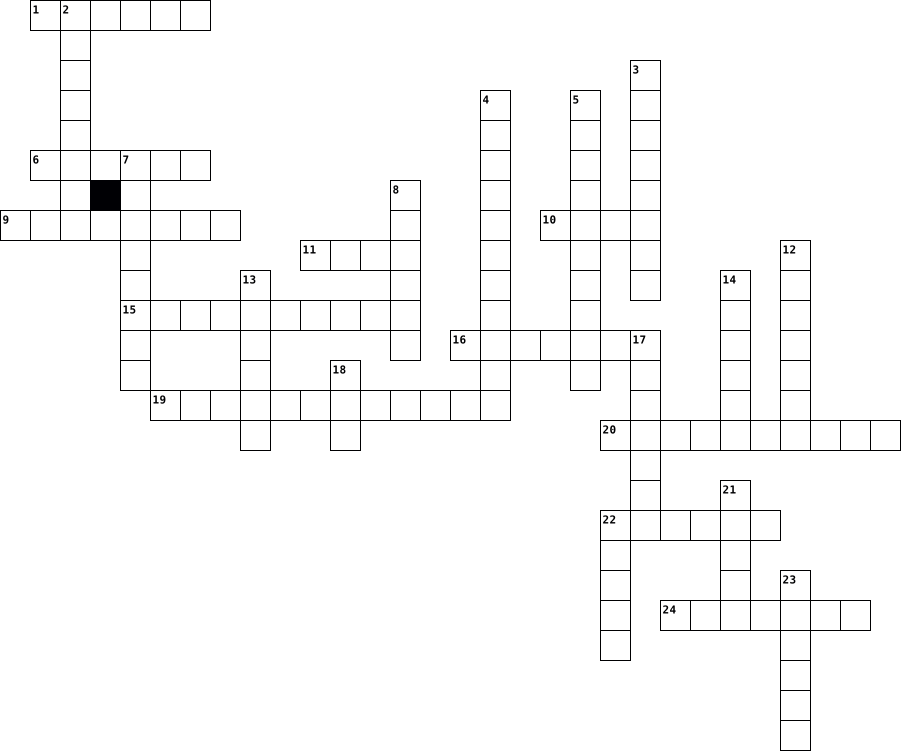
Across
- Always follow your teacher's instructions and textbook directions exactly is the most important ___ rule.
- A scientific law is a statement that summarizes a pattern found in _____.
- Life science, Earth and space science and ____ science are all branches of natural science.
- A ____ review is a process in which scientists examine other scientists' work.
- A(n) _____ graph is a way of plotting data to show changes that occur in related variables.
- The ____ is the variable that changes in response to the manipulated variable.
- On the ____ scale, water boils at 100 degrees.
- When making _____, information is obtained through the senses.
- Computers are an example of _____ that helps people solve problems.
- An organized plan for gathering, organizing, and communicating information is called a scientific ____.
- On this temperature scale, water freezes at 0 degrees.
Down
- The closeness of a measurement to the actual value being measured.
- The SI base unit of mass is the _____.
- 1 centimeter equals 10 ____.
- On this temperature scale, water freezes at 32 degrees.
- The ____ is very old and very large.
- ____ can be transferred from one form to another, but it can never be destroyed.
- _____ science is divided into life science, Earth and space science, and physical science.
- ____ cause changes in motion.
- On this temperature scale, water freezes at 273
- a system of knowledge and the methods used to find that knowledge
- A scientific ____ summarizes a pattern found in nature.
- A physical or mental representation of an object or an event.
- A scientific ____ makes it easier to understand things that are too small, too large, or too hard to observe directly.
- When the ratio of the manipulated variable and the responding variable is constant, the relationship is a(n) ____ proportion.
25 Clues: 1 centimeter equals 10 ____. • ____ cause changes in motion. • The ____ is very old and very large. • The SI base unit of mass is the _____. • On the ____ scale, water boils at 100 degrees. • On this temperature scale, water freezes at 273 • On this temperature scale, water freezes at 0 degrees. • On this temperature scale, water freezes at 32 degrees. • ...
Physical Descriptions, Color, Clothing 2021-09-23

Across
- watch
- suit
- Pants
- blue(singular)
- ring
- orange(m/s)
- cap
- red(m/s)
- black(m/pl)
- sweater
- yellow(f/pl)
- pink(m/pl)
- earring
- gray
- black(f/s)
- green(singular)
- boots
- dress
- tie
- socks
- orange(f/pl)
- brown(plural)
- wallet
- black(m/s)
- sunglasses
- yellow(f/s)
- orange(m/pl)
- pink(f/pl)
- white(m/pl)
- Tshirt
- red(feminineplural)
- heels
- white(m/s)
- purple(m/s)
- underwear
- green(plural)
Down
- veryshort
- shorts
- jeans
- sweatshirt
- slippers
- verylong
- purple(f/pl)
- scarf
- necklace
- pink(f/s)
- blue(plural)
- skirt
- shoes
- blouse
- glasses
- purple(f/s)
- bracelet
- store
- black(f/pl)
- grey(plural)
- bathingsuit
- yellow(m/s)
- toboggan
- jacket
- orange(f/s)
- pink(m/s)
- dressshirt
- vest
- brown(singular)
- yellow(m/pl)
- white(f/s)
- white(f/pl)
- cheap
- purple(m/pl)
- red(f/s)
- red(m/pl)
72 Clues: cap • tie • suit • ring • gray • vest • jeans • watch • scarf • Pants • skirt • shoes • store • boots • dress • socks • cheap • heels • shorts • blouse • wallet • jacket • Tshirt • glasses • sweater • earring • slippers • verylong • necklace • red(m/s) • bracelet • toboggan • red(f/s) • veryshort • pink(f/s) • pink(m/s) • red(m/pl) • underwear • sweatshirt • pink(m/pl) • black(f/s) • dressshirt • black(m/s) • sunglasses • white(f/s) • pink(f/pl) • white(m/s) • orange(m/s) • black(m/pl) • ...
Physical Properties of Matter 2021-09-28

Across
- Attracts metals.
- To stay the same; does not change its properties.
- A type of energy which can travel through circuits.
- Another word to describe heat energy.
- The state in which particles move the fastest.
- When substances form a solution.
- A quality or trait that can describe something.
- Takes the shape of its container.
- From a gas to a liquid.
- Can carry/transfer a type of energy (electrical or thermal).
Down
- A type of energy which makes things have a temperature.
- Everything we see is made up of this.
- To arrange different objects into groups.
- Whether something is solid, liquid, or gas.
- From liquid to gas.
- A mixture in which one substance dissolves in the other.
- A combination of two or more substances.
- The ability to dissolve.
- Has a definite shape.
- How tightly particles are packed together; whether it sinks or floats.
20 Clues: Attracts metals. • From liquid to gas. • Has a definite shape. • From a gas to a liquid. • The ability to dissolve. • When substances form a solution. • Takes the shape of its container. • Everything we see is made up of this. • Another word to describe heat energy. • A combination of two or more substances. • To arrange different objects into groups. • ...
Physical Aspects of Parliament 2021-09-27

Across
- The member of a political party that makes sure all party members vote in favour of their party’s decision
- a provincial court that does not conduct jury trials
- the highest court in british columbia
- Left Leaning part with their leader being Jagmeet Singh
- They look over any legislation that is passed by the HOC and take on any matters the HOC can't/won't take on
- the representative of the queen at a national level
- Any MP that sits behind the Cabinet and Shadow cabinet
- the official action that happens when an MP votes against their party’s decision
- They support the prime minister and cabinet in implementing their goals, decisions and ideas
- the leader of parliamentary debate and discussion
- The general assembly of that represents Canadian citizens and makes decisions on their behalf
- Generally left wing party with their leader being Annamie Paul
- This group sets out policies and priorities for the federal government and acts as advisor to the Prime Minister.
- Right leaning party with their leader being Erin O/Toole
Down
- the party with the second largest amount of seats in the house
- The Head of municipal/city government
- the highest court in a province or territory before the supreme court of canada
- The area for which a MP represents
- canada's head of state
- The representative of the queen at a provincial lever
- the political party representing the people of Quebec
- Left leaning party with their leader being Jagmeet Singh
- the party with the highest amount of seats in the house
- The party with the second largest amount of seats in the house
- a party meeting held in private where all party members can state their opinions freely
25 Clues: canada's head of state • The area for which a MP represents • The Head of municipal/city government • the highest court in british columbia • the leader of parliamentary debate and discussion • the representative of the queen at a national level • a provincial court that does not conduct jury trials • The representative of the queen at a provincial lever • ...
Physical & Chemical Changes vocabulary 2021-03-30

Across
- Solid-liquid is an example of
- Smoke and fog is an example of a
- Toxicity is an example of
- -116 is an example of
- another smallest cell is called
- dry ice is an example of
- polar it is an example of
- one of the smallest cell is called
- Fogging a Mirror is an example of
- Crushing a can is an example of
Down
- sight and touch is an example of
- Icebergs are examples of
- burning paper is an example of
- one quart is an example of
- Iron is made out of
- 50 kg is an example of
- Formation of snow is an example of
- Drying of Wet Hair is an example of
- 100 pounds is an example of
- 100 °C (212 °F) is an example of
20 Clues: Iron is made out of • -116 is an example of • 50 kg is an example of • Icebergs are examples of • dry ice is an example of • Toxicity is an example of • polar it is an example of • one quart is an example of • 100 pounds is an example of • Solid-liquid is an example of • burning paper is an example of • another smallest cell is called • Crushing a can is an example of • ...
Physical description and clothes 2021-03-23

Across
- The opposite of small
- Shirt in the shape of a T
- Glasses to protect your eyes from the sun
- To keep your feet warm
- Very slim
- The opposite of long
- The opposite of straight hair
- Hairs which cover a man's face
- Ear ornament for girls
- Piece of clothing which covers your legs
- The colour of the sky
Down
- Shoes you wear to practice sports
- Shoes which cover your ankle
- The colour of nature
- The opposite of slim
- Piece of clothing for girls
- The colour of sadness
- Synonym for little
- Piece of clothing which protects you from the wind and rain
- Piece of clothing which protects your neck
- Neck ornament for girls
- Comfortable and fashionable shoe
- The colour of the sun
- Mrs Bondroit's hair colour
- Classy outfit for men
25 Clues: Very slim • Synonym for little • The colour of nature • The opposite of slim • The opposite of long • The opposite of small • The colour of sadness • The colour of the sun • Classy outfit for men • The colour of the sky • To keep your feet warm • Ear ornament for girls • Neck ornament for girls • Shirt in the shape of a T • Mrs Bondroit's hair colour • Piece of clothing for girls • ...
Physical Science Crossword Puzzle 2021-08-12

Across
- A place equipped for experimental study
- An explanation of things or events based on knowledge gained from many observations and investigations
- The five _____ are problem/question, formulate a hypothesis, experiment, collect and analyze results, conclusion, and communicate the results.
- Keep you safe from hazards including cuts, burns (chemical), abrasion, crushing or contact with bio-hazards
- The action or process of observing something or someone in order to gain information
- Safety glasses you need to wear during a lab
- A substance that flows freely but is of constant volume
- Physical substance which occupies space and possesses rest mass, especially as distinct from energy
- A quantity that can have more than a single value
- a group of atoms bonded together
- Detailed examination of the elements or structure of something
Down
- The ability of a substance to burn
- A judgement or decision reached by reasoning
- A scientific procedure undertaken to make a discovery
- Possible explanation for a problem using what is known and what is observed
- The mass per unit volume of a material
- The amount of space that a substance or object occupies within a container
- Freedom from harm or danger
- A large body of matter with no define shape
- The action or power of focusing one's attention
20 Clues: Freedom from harm or danger • a group of atoms bonded together • The ability of a substance to burn • The mass per unit volume of a material • A place equipped for experimental study • A large body of matter with no define shape • A judgement or decision reached by reasoning • Safety glasses you need to wear during a lab • The action or power of focusing one's attention • ...
Physical Science Crossword Puzzle 2021-08-12

Across
- A place equipped for experimental study
- An explanation of things or events based on knowledge gained from many observations and investigations
- The five _____ are problem/question, formulate a hypothesis, experiment, collect and analyze results, conclusion, and communicate the results
- keep you safe from hazards including cuts, burns, abrasion, crushing, or contact with bio-hazards
- The action or process of observing something or someone in order to gain information
- Safety glasses you need to wear during a lab
- A substance that flows freely but is of constant volume
- A physical substance that occupies space and possesses rest mass, especially as distinct from energy
- A quantity that can have more than a single value
- A group of atoms bonded together
- Detailed examination of the elements or structure of something
Down
- The ability of a substance to burn
- A judgment or decision reached by reasoning
- A scientific procedure is undertaken to make a discovery
- Possible explanation for a problem using what is known and what is observed
- The mass per unit volume of a material
- The amount of space that a substance or object occupies within a container
- Freedom from harm or danger
- A large body of matter with no defined shape
- The action or power of focusing one's attention
20 Clues: Freedom from harm or danger • A group of atoms bonded together • The ability of a substance to burn • The mass per unit volume of a material • A place equipped for experimental study • A judgment or decision reached by reasoning • Safety glasses you need to wear during a lab • A large body of matter with no defined shape • The action or power of focusing one's attention • ...
PHYSICAL EDUCATION CROSSWORD PUZZLE 2021-11-07
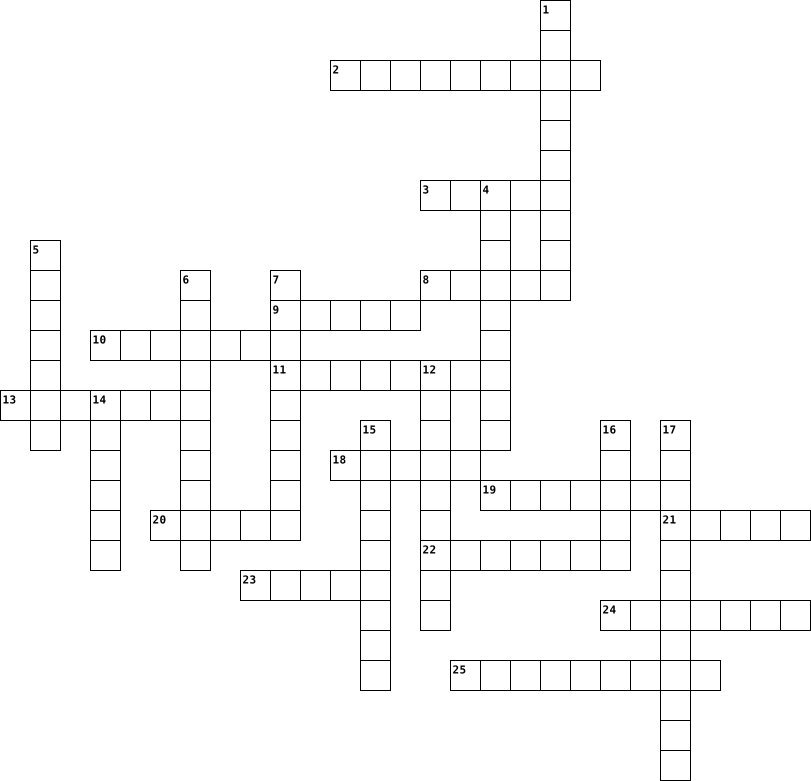
Across
- rapid, short, jerky percussive movements.
- where the dancer's eyes look as he/she is dancing.
- accented beat or heartbeat of the rythm.
- interconnected phrases of the dance are coherent and flow smoothly together.
- longer sequences of movement.
- patterns we make as we move across the floor.
- they will evaluate according to specific demands that the performance places on them.
- a single movement or a short phrase of movement that embodies the style and intention of the dance.
- feels hard and tight.
- releasing energy in a controlled, restrained manner.
- the vertical distance from the floor.
- consists of series of movement phrases that are often unrelated but have been brought together to create a single dance with a beginning, a middle, and an end.
- the speed of the movement.
- releasing energy freely.
- where the body moves.
Down
- strong pulses for precise moves.
- the opposite of suspended, body falls back on itself.
- different movement phrases are performed by different dancers simultaneously in the same space.
- also vital because it keeps the unity and continuity of the dance.
- forward, lifted posture, great for singing.
- they will evaluate according to the particular context of the dance.
- this is where the apex of energy in the dance is reached.
- movements that take the body from one point to another.
- every section of the dance use different tempos and qualities.
- movements that the body can do and still stay in one place.
25 Clues: feels hard and tight. • where the body moves. • releasing energy freely. • the speed of the movement. • longer sequences of movement. • strong pulses for precise moves. • the vertical distance from the floor. • accented beat or heartbeat of the rythm. • rapid, short, jerky percussive movements. • forward, lifted posture, great for singing. • ...
Physical Science Final Exam 2021-11-15

Across
- The rate of change of position of an object ; Can be displayed by the slope on a distance-time graph
- energy of position, shape, or state
- Apparent change in the frequency of a sound due to the motion of the source or the listener
- speed of an object in a particular direction
- the number of protons found within one atom of an element
- items that do not transfer heat or electricity well
- Any disturbance that transmits energy through matter or space
- Vertical column on the Periodic Table, the elements share properties
- energy stored in the chemical bonds between the atoms of a substance
- positively charged particles found in the nucleus of an atom
- state of matter which moves erratically and fills the entire volume of its container
- current that flows in more than one direction
- force that slows or opposes current
- substance that was dissolved in a solution
- the energy of motion
- The distance in a wave from one corresponding point to another
- the energy of vibrations of an object
- Any push or pull that has the ability to change the motion of an object
- In a solution, the substance that is present in greater quantities
- energy of moving electrons
- circuit with only one path for electrons to follow
- electric current that flows in only one direction
- The rate of change of velocity ; Can be displayed by the slope on a velocity-time graph
- the substance a wave travels through
- the amount of matter an object is made from
- the force of attraction between two objects
- the ability to do work or cause change
- device that converts electrical energy to mechanical energy
- the energy found within the nucleus of an atom
- The bouncing back of a wave when it hits a barrier
- The bending of a wave as it passes through an opening or around a corner
- transfer of thermal energy in empty space
- substances that are not able to dissolve
Down
- particle made of a combination of protons, neutrons, and electrons; smallest part of an element that has its properties
- the energy of electromagnetic waves
- the movement of thermal energy between objects
- Bending of a wave as it passes from one substance to another because of a change in speed
- solution that contains the largest possible amount of a solute
- movement of thermal energy as currents within a liquid or gas
- circuit that has more than one path for electrons to follow
- property of matter that resists a change in its motion
- particles found it the nucleus of an atom with no charge
- negatively charged particles found in an atom
- devices that convert chemical energy to electrical energy
- total kinetic energy of the particles that make up an object
- the flow of electrons within a circuit
- Water and earthquake waves are an example, Waves that require a medium
- a solution that is bitter and turns red litmus paper blue
- state of matter in which particles vibrate in place and has its own definite shape and volume
- elements found on the right hand side of the Periodic Table, usually brittle and non-conductors
- How often a disturbance, or wave, occurs
- items that will transfer heat or electricity well
- The height of a wave above its rest position
- Elements Located on the left and middle of the Periodic Table that conduct electricity and heat well
- Horizontal row on the Periodic Table
- solution that is sour and turns blue litmus paper red
- this state of matter takes the shape of its container, but not the volume
- transfer of thermal energy through touching or direct contact
- the path electricity will follow
- an atom with a positive or negative charge because it has gained or lost electrons
60 Clues: the energy of motion • energy of moving electrons • the path electricity will follow • the energy of electromagnetic waves • energy of position, shape, or state • force that slows or opposes current • the substance a wave travels through • Horizontal row on the Periodic Table • the energy of vibrations of an object • the flow of electrons within a circuit • ...
Physical Science - Review Crossword 2023-03-02

Across
- This type of variable remains unchanged. Sometimes also called a constant
- A simple machine that is made up of an arm and fulcrum (or fixed pivot).
- 45 ____ is the optimal angle to launch a projectile for maximum distance
- We had a contest/lab to design a paper ___ that would fly the farthest.
- Term for stored energy.
- This variable in an experiment is the result or measured response variable.
- This variable is the one you choose to manipulate/change.
- On Fridays we always play this in class.
- An ancient military device to launch projectiles. We built mini ones in class!
- Calculated by distance divided by time.
- Scientific unit for measuring distance
Down
- The measure of how much space on object takes up
- Energy can neither be created nor _____.
- An element of an experiment that could potential be changed.
- Any device the makes work easier by changing the force.
- At the beginning of the block we had a contest to see who could build the tallest ____ tower.
- A rough early draft of an engineering project; often built smaller or cheaper for proof of concept.
- Term for the energy of motion.
- Speed + a directional indicator.
- A ____meter is equal to 1/100th of a meter.
- he application of the principles of science and mathematics to solve real world problems and to innovate new products and processes across a wide range of industries and applications.
- Attractive force that works on all things with mass. Pulls you towards the center of Earth too!
22 Clues: Term for stored energy. • Term for the energy of motion. • Speed + a directional indicator. • Scientific unit for measuring distance • Calculated by distance divided by time. • Energy can neither be created nor _____. • On Fridays we always play this in class. • A ____meter is equal to 1/100th of a meter. • The measure of how much space on object takes up • ...
Physical Science And Elements 2023-05-09

Across
- the center of a cell
- This Element is one of the main elements used in nuclear reactors
- This element is the reason is you eat 400 bananas you will die
- This element is the first element in water
- This Element is used in pools
- An Negatively charged subatomic particle
- This Element is W on the periodic table
- The Column of numbers that show the energy levels on the periodic table
Down
- This Element is used to help heal tissue cells
- our science teacher
- This Element Is used in carbon fiber
- Changes the speeds of chemical reactions
- This is the second element in Iron-Silicon
- Laying don of sediment on the earth
- the hundreds of items of the periodic table
- This Element is used as a catalyst
- The concept of emptiness
- A rhythmic disturbance
- This Element is the main element we breathe in the air
- An positively charged subatomic particle
20 Clues: our science teacher • the center of a cell • A rhythmic disturbance • The concept of emptiness • This Element is used in pools • This Element is used as a catalyst • Laying don of sediment on the earth • This Element Is used in carbon fiber • This Element is W on the periodic table • Changes the speeds of chemical reactions • An positively charged subatomic particle • ...
Physical Science Exam Crossword 2023-05-26

Across
- force applied over a distance
- Water has a high ________ _______
- clean and puts out lots of energy, dangerous
- the ability to do work
- majority of our energy sources
- transfer of thermal energy via contact
- energy that is easily replenished
- rate of energy transformation
- attractive force depending on mass and distance
- rate of change of speed
- resisting change in motion
- energy in rubber bands or spring
- converts mechanical energy into electrical energy
- transfer of thermal energy
- steps down/up voltage
- makes your car go, chemicial into thermal energy
- energy found in gasoline or food
Down
- opposes sliding motion
- circuit with multiple branches
- How we know motion has occurred
- stored energy
- transfer of thermal energy via liquids/gas
- Distance / time
- makes your car go, electrical into mechanical energy
- energy from magma
- makes a generator spin, captures mechanical energy
- circuit with only one branch
- push or pull
- Mass x velocity
- kinetic AND potential energy of an object
30 Clues: push or pull • stored energy • Distance / time • Mass x velocity • energy from magma • steps down/up voltage • opposes sliding motion • the ability to do work • rate of change of speed • resisting change in motion • transfer of thermal energy • circuit with only one branch • force applied over a distance • rate of energy transformation • circuit with multiple branches • ...
Physical Features of India 2023-06-03

Across
- it is spread over the states of North India,partly jharkhand and West Bengal to its East
- Another name of Lesser Himalyas
- It is the administrative headquarters of Lakshadweep
- Himalayan mountain ranges run in a east-west direction from Indus to the ____
- Andaman and Nicobar Islands have which type of climate
- it is formed by three major rivers- Indus, Ganga and the brahmaputra
- The part lying between Teesta and Dihang rivers is knows as _____ Himalyas
- It is wider it the west but narrower in the east
- This ranges are composed of unconsolidated sediments
- it is a storehouse of minerals
Down
- the black soil area of Deccan Plateau known as what?
- Peninsular Plateau is formed due to breaking and drifting of this land
- All the streams disappear in this river belt
- Himalya consist of three parallel ranges In its ____ extent
- the famous hill Station of Udagamandalam
- Krishna and Kaveri have formed extensive delta on which coast?
- Himalyas forms an _____
- Himalayan mountain forms a ______ zone
- wet,marshy and swampy region
- the only large river in the Indian Desert
- It stretch from the Mahanadi Valley to the Nilgiris in the south
21 Clues: Himalyas forms an _____ • wet,marshy and swampy region • it is a storehouse of minerals • Another name of Lesser Himalyas • Himalayan mountain forms a ______ zone • the famous hill Station of Udagamandalam • the only large river in the Indian Desert • All the streams disappear in this river belt • It is wider it the west but narrower in the east • ...
Physical Education Unit 2 2012-11-04
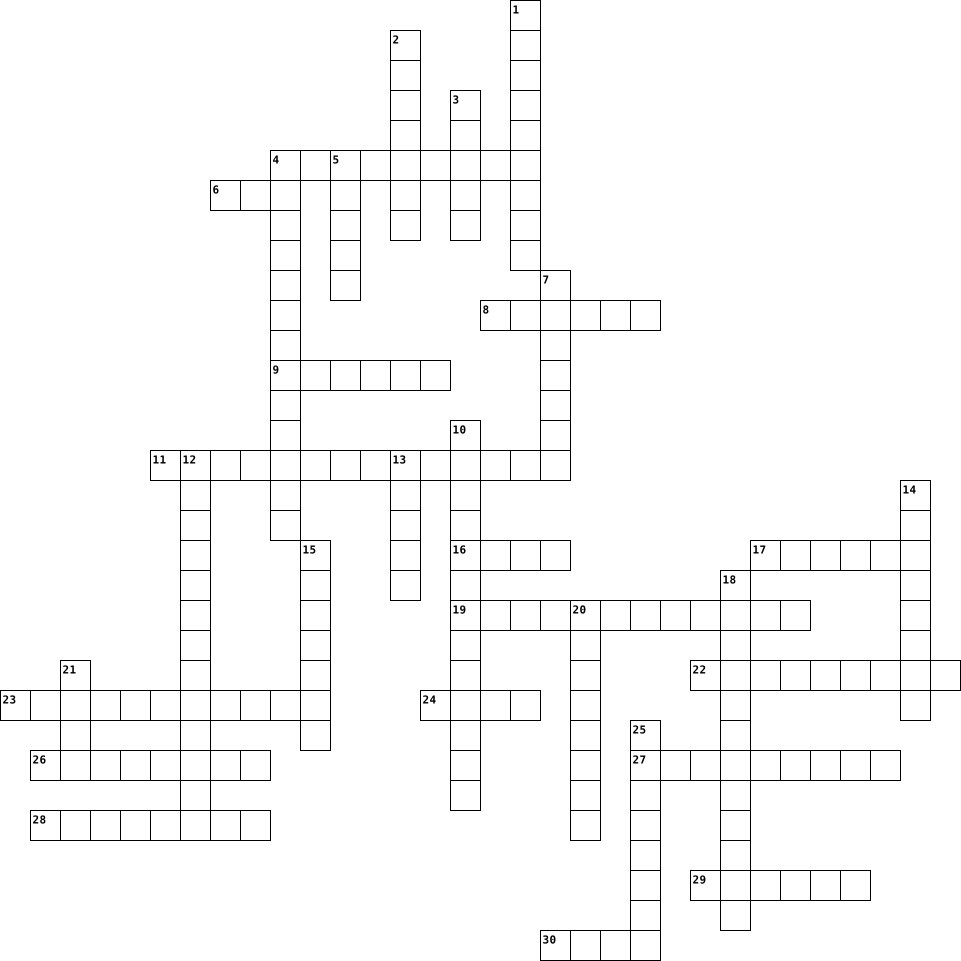
Across
- Intermediate stage of learnning.
- Childeren 5-12 years old are to spend no more than ..... hours a day using electronic media.
- A coach needs to be a good?
- Skills where the performer has greatest control over their environment.
- Disease that is the biggest killer in Australia.
- Can be a barrier to physcial activity for adults who work.
- Practice that involves scheduling of less frequent training sessions that last for a longer period of time
- Domain where physical activity can be performed regulary as a part of one's work.
- Staying in the same place for much of the time and expending low amounts of energy.
- Coach that is genuiely interested in their athlets opinions
- Teaching segments of a tennis serve is an example of what type of practice?
- ......... makes perfect?
- How much effort is required to engage in an activity.
- Type of feedback where the performer uses their own senses.
- Type of benefit associated with playing sport to interact with others.
- Skill that involes the recruitment of smaller muscles for precise movements
Down
- Number of times a person engages in physical activity within a given time frame.
- A type of health risk associated with inactivity.
- The ability to do something well
- An important skill for a coach to have.
- Skill that involves the recruitment of larger muscle groups
- A factor that makes it difficult to do something.
- Can be done to gauge how active Australians are.
- Strict coach
- The recommended number of minutes youth (12-18) year olds are suppose to spent being physcially active a day.
- Learner prefers verbal instructions
- Repetitive practice of the same task
- An organises or planned activity that interrupts a normal course of action within a given subgroup or target group.
- Activity that can be defined as any bodily movement produced by skeletal muscles that result in energy expenditure.
- The number of different styles of coaching
- Skill that has a distinct beginning and end.
31 Clues: Strict coach • ......... makes perfect? • A coach needs to be a good? • The ability to do something well • Intermediate stage of learnning. • Learner prefers verbal instructions • Repetitive practice of the same task • An important skill for a coach to have. • The number of different styles of coaching • Skill that has a distinct beginning and end. • ...
Physical Properties of Materials 2012-12-10

Across
- a strength that resists twisting
- a material where light goes through an object but you can't see behind them clearly
- a material that can be made into sheets
- a very hard metal made of iron and carbon
- an example of thermal and electrical conductors
- a material that allows water to go through it
- changing from solid to liquid when heated
- the opposite of conduct
- a material that does not allow water to go through it
- a material that can be formed into filaments or wires
- having to do with sound
- a material that does not let light go through it
- an object that has tiny holes, or pores
- the relationship between the mass and volume of an object
Down
- a material that you can see through clearly
- not easily marked or scratched by another material
- a strength that resists crushing
- a strength that resists bending
- to join together two pieces of metal by melting them
- something that breaks easily
- something that is able to return to its original shape
- a strength that resists stretching
- something that is resistant to breaking
- to transmit a form of energy such as heat or electricity through an object
- a strength that resists sliding
25 Clues: the opposite of conduct • having to do with sound • something that breaks easily • a strength that resists bending • a strength that resists sliding • a strength that resists twisting • a strength that resists crushing • a strength that resists stretching • a material that can be made into sheets • something that is resistant to breaking • ...
Physical vs. Chemical Changes 2013-01-24

Across
- a change of matter from one form to another
- One sign a chemical reaction occurred is a change in this.
- this is a physical property that is mass divided by volume
- An example of a physical change where sugar combines with water
- This is released or absorbed when matter changes
- Sodium and Chlorine react to form this substance
- Chemical property that describes a substance's ability to burn
- Bubbles, fizzing, or foaming shows that this was produced
- When two liquids combine, and form a new solid.
- When Iron reacts with Oxygen, this chemical change occurs.
- The amount of matter in an object
- Another word for chemical change
- The amount of space an object takes up
- Ice absorbs thermal energy and changes state
Down
- A form of energy that is released or absorbed.
- a characteristic of matter that describes it
- a change that occurs when one or more substances change into a new substance
- You look for these to see if a chemical reaction occurred
- A physical change involves a change in size, shape, or ____
- Anything that has mass and takes up space
- Chemical property that describes a substance's ability to combine with other substances
- Describes what form of matter it is, such as a solid
22 Clues: Another word for chemical change • The amount of matter in an object • The amount of space an object takes up • Anything that has mass and takes up space • a change of matter from one form to another • a characteristic of matter that describes it • Ice absorbs thermal energy and changes state • A form of energy that is released or absorbed. • ...
Physical Science Part 1 2013-05-28

Across
- the overall force acting on an object after all the forces are combined
- the SI unit of work
- an upward force due to a pressure difference between the top and bottom of a wing
- the movement of an object toward Earth because of gravity
- the equivalence of the buoyant force on an object and the weight of the fluid displaced by the object
- the energy stored in chemical bonds
- movement in relation to a frame of reference
- the fixed point a lever rotates around
- the result of a force distributed over an area
- the ratio of the distance an object moves to the amount of time the object moves
- a push or pull that acts on an object
- energy obtained from flowing water
- the product of distance and the force in the direction an object moves
- the rate of doing work
- the SI unit of pressure, equal to 1 newton per square meter
- the percentage of the work input that becomes work output
- a substance or mixture that flows and has no shape of its own
Down
- the length of the path between two points
- the SI unit of power
- the curved path of an object in free fall after it is given an initial forward velocity
- the ability of a fluid to exert an upward force on an object placed in it
- a steady change in velocity
- the energy associated with electric charges
- a device that uses a pressurized fluid acting on pistons of different sizes to increase force
- a system of objects that are not moving in respect to one another
- a friction force that opposes the motion of an object through a fluid
- the energy stored in atomic nuclei
- fluid friction acting on an object moving through the air
- the energy associated with the motion and position of everyday objects
- the constant velocity of a falling object when the force of air resistance equals the force of gravity
- thermal energy beneath Earth's surface
- sunlight that is converted into usable energy
- the total distance traveled divided by the time it takes to travel
- a common unit of power, equal to 764 watts
- the tendency of an object to resist a change in its motion
35 Clues: the SI unit of work • the SI unit of power • the rate of doing work • a steady change in velocity • the energy stored in atomic nuclei • energy obtained from flowing water • the energy stored in chemical bonds • thermal energy beneath Earth's surface • the fixed point a lever rotates around • a push or pull that acts on an object • the length of the path between two points • ...
Physical Development (1st Year) 2013-06-26

Across
- describes gradual changes in an individuals states and abilities
- at 10-18 an infant will begin
- these games are enjoyed at 11 months
- babies use these as support
- during the first few months the ____ cartilage becomes much stronger
- at 5 months a baby can ___
- a grip using thumb and finger
- at 3 weeks, an infant enjoys focusing on ____ colours
- most infants get their first ___ at 6 months
Down
- these movements are jerky in the first few weeks
- at 11 months an infant has the ability to _____ themself
- at this stage an infant can focus on faces
- the only thing an infant consumes for 6 months
- during the first 12 months of life, this is rapid
- gums are fromed during what stage?
- a very young child or baby
- at 6 months an infant will consume this food
- at which stage is an infants head 1/4 of their body size?
- these teeth grow first
- suck, grasping, blinking
20 Clues: these teeth grow first • suck, grasping, blinking • a very young child or baby • at 5 months a baby can ___ • babies use these as support • at 10-18 an infant will begin • a grip using thumb and finger • gums are fromed during what stage? • these games are enjoyed at 11 months • at this stage an infant can focus on faces • at 6 months an infant will consume this food • ...
Physical Science Final Crossword 2014-05-27

Across
- the overall force acting on an object after all the forces are combined
- a force that acts between any two masses
- the energy stored in chemical bonds
- SI unit of power
- equal to 746watts
- a form of energy that travels through space in the form of waves
- formed underground from remains of once living organisms
- force you exert on a machine
- the product of force and distance
- is movement in relation to a frame of reference
- the friction force that acts on objects that are not moving
- is the energy associated with electric charges
- SI unit of pressure
- is a description of both speed and direction of motion
- the result of a force distributed over an area
- sunlight that is converted into usable energy
Down
- total potential and kinetic energy related to the motion of all the microscopic particle in a n object
- a force that opposes the motion of objects that touch as they move past each other
- the energy associated with the motion and position of everyday objects
- the ratio of the distance an object moves to the amount of time the object moves
- upward force which acts in the opposite direction of gravity
- a force that opposes the direction of motion of an object as it slides over a surface
- energy obtained from flowing water
- is a system of objects that are moving with respect to one another
- the rate at which an object is moving at a given moment in time
- the ability of a fluid to exert an upward force on an object placed in it
- a push or a pull that acts on an object
- rate at which velocity changes
- the force that causes a 1 kilogram mass to accelerate at a rate of 1 meter per second each second
- distance the input force acts through
- energy stored in atomic nuclei
- a device that uses pressurized fluid acting on pistons of different sizes to change a force
- rate of doing work
- pressure difference between the top and the bottom of the wing creates an upward force
- the SI unit of work
- the total distance traveled, divided by the time it takes to travel that distance
36 Clues: SI unit of power • equal to 746watts • rate of doing work • the SI unit of work • SI unit of pressure • force you exert on a machine • rate at which velocity changes • energy stored in atomic nuclei • the product of force and distance • energy obtained from flowing water • the energy stored in chemical bonds • distance the input force acts through • ...
Physical Science Crossword Puzzle 2014-05-27

Across
- is the SI unit of power.
- is a push or a pull that acts on an object.
- is the ratio of the distance an object moves to the amount of time the object moves.
- is the energy stored in atomic nuclei.
- the result of a force distributed over an area.
- is the SI unit of work.
- is a devise that uses pressurized fluid acting on pistons of different sizes to change a force.
- the force you exert on a machine.
- is a form of energy that travels through space in the form of waves.
- is a substance that assumes the shape of its container.
- is the energy stored in chemical bonds.
- is the force that causes a 1 kg mass to accelerate at a rate of 1 meter per second.
- the total potential and kinetic energy related to the motion of all the microscopic particles in an object.
- is the length of a path between two points.
- the SI unit of pressure.
- is the vector sum of two or more vectors.
- an upward force that acts in the opposite direction of gravity.
- is the speed and direction in which an object is moving.
- is a device that changes a force.
- is the overall force acting on an object after all the forces are combined.
Down
- is the total distance traveled.
- oil, natural gas, coal, and uranium.
- is a system of objects that are not moving with respect to one another.
- energy associated with the motion and position of everyday objects.
- is a quantity that has magnitude and direction.
- is a force that acts between any two masses.
- is the rate of doing work.
- a force that opposes the motion of objects that touch as they move past each other.
- is a force that opposes the direction of motion of an object as it slides over a surface.
- is the energy associated with electric charges.
- is equal to 746 watts.
- an upward force.
- is the friction force that acts on objects that are not moving.
- is the product of force and distance.
- is movement in relation to frame of reference.
- is the ability of a fluid to exert an upward force on an object placed on it.
36 Clues: an upward force. • is equal to 746 watts. • is the SI unit of work. • is the SI unit of power. • the SI unit of pressure. • is the rate of doing work. • is the total distance traveled. • the force you exert on a machine. • is a device that changes a force. • oil, natural gas, coal, and uranium. • is the product of force and distance. • is the energy stored in atomic nuclei. • ...
Physical Geography of Bangladesh 2014-01-26

Across
- / Bangladesh is surrounded by ...
- / The Padma-Ganges flows from here
- / One of the parts of the Bangladesh forest ecosystem, starts with an M
- / The river that is 420 km long
- / The Jamuna-Brahmaputra originates from here
- / The ... point is 0 m
- / Most of the land in Bangladesh is ...
- / Bangladesh receives 40% of it's water during the ... season
- / One of the parts of the Bangladesh forest ecosystem, starts with an E
- / The Surma-Meghna is the ... river
- / The Padma-Meghna flows through Bangladesh ...
- / Bangladesh is next to .....
- / Something that often happens during the wet season
- / 10,090 km2 of Bangladesh is ...
Down
- / Bangladesh receives 60% of it's water during the ... season
- / The lowest point is the ... Ocean
- / During the dry season, the amount of rain ...
- / Most of the rivers flow from this place
- / The latitude is 24 Degrees ...
- / Bangladesh is sunny from ... to June
- / Bangladesh is rainy from June to ...
- / The highest point
- / The ... point is 986 m
- / 133,910 km2 of Bangladesh is dry ...
- / Bangladesh is slightly ... then Iowa
- / There is heavy ... in Bangladesh
- / The longitude is 90 Degrees ...
- / What continent is Bangladesh located in
- / Bangladesh is next to the Bay of ....
- / There are ... river divisions
30 Clues: / The highest point • / The ... point is 0 m • / The ... point is 986 m • / Bangladesh is next to ..... • / The river that is 420 km long • / There are ... river divisions • / The latitude is 24 Degrees ... • / Bangladesh is surrounded by ... • / The longitude is 90 Degrees ... • / 10,090 km2 of Bangladesh is ... • / The Padma-Ganges flows from here • ...
Physical Science 8.1 Review 2015-04-15

Across
- this type of reaction occurs when a compound breaks down to form different substances
- substances that produce hydroxide anions in a water solution; slippery; have a bitter taste
- to break apart
- this type of chemical reaction occurs when an element in a compound is replaced by another element
- substances that produce hydronium ions when dissolved in water; have a sour taste
- chemical change resulting from a collision between atoms or molecules
- chemical formulas cannot be _______to balance an equation
- reactants are located on the_______side of an equation
- according to the law of conservation of_____, the total mass of the reactants is equal to the total mass of the products
- a chemical reaction that releases thermal energy
- the number before each molecular formula
Down
- this type of reaction occurs when two compounds exchange atoms or ions
- new substances produced by a reaction
- any ionic compound that does not contain H or OH
- an expression that uses chemical symbols to represent a chemical reaction
- substances that are neither acids nor bases
- this type of reaction occurs when two or more substances combine to form a third substance
- a reaction that absorbs thermal energy
- a chemical equation that has the same number of each type of atom on each side of the arrow is said to be__________
- products are located on the________side of an equation
- original substances that undergo a chemical reaction
21 Clues: to break apart • new substances produced by a reaction • a reaction that absorbs thermal energy • the number before each molecular formula • substances that are neither acids nor bases • any ionic compound that does not contain H or OH • a chemical reaction that releases thermal energy • original substances that undergo a chemical reaction • ...
Physical Science Unit 3 2016-10-14

Across
- when KE of an object increases, the PE ________
- sum of KE and PE in a system
- energy of moving electrons
- time is measured in
- mass is measured in_______
- when 2 small atoms combine to make a larger atom
- energy is measured in ________
- energy inside the bonds of molecules
- the type of energy on the surface of the sun
- the energy stored in an object above the ground
- the GPE of an object changes if mass or________ changes
- energy of moving objects
- the transfer of heat through the movement of a fluid
- distance is usually measured in
Down
- the larger something is, the _____ thermal energy it has
- energy in light waves
- the transfer of heat through electromagnetic waves
- energy________be created or destroyed
- force is measures in
- the transfer of heat through direct physical touch
- friction causes mechanical energy to be converted into_______energy
- another word for electromagnetic energy
- the energy stored in a spring or coil
- energy created by vibrating molecules in a medium
- something that slows down the transfer of heat between objects
- something that speeds up the transfer of heat between objects
- when 1 large atom splits to make 2 smaller atoms
27 Clues: time is measured in • force is measures in • energy in light waves • energy of moving objects • energy of moving electrons • mass is measured in_______ • sum of KE and PE in a system • energy is measured in ________ • distance is usually measured in • energy inside the bonds of molecules • energy________be created or destroyed • the energy stored in a spring or coil • ...
French, Physical Traits, Crossowrd. 2017-09-28

Across
- Pretty
- Bronze
- In shape
- Hazel ( Eyes )
- Red Hairs
- Long Hairs
- Beautiful
- Brown ( Eyes )
- Small
- Tall
- Straight Hairs
- Brown Hairs
Down
- Old
- Short Hairs
- Young
- Black Hairs
- Curly Hairs
- Athletic
- Blond(e) Hairs
- Green ( Eyes )
- Blue ( Eyes )
21 Clues: Old • Tall • Young • Small • Pretty • Bronze • Athletic • In shape • Red Hairs • Beautiful • Long Hairs • Short Hairs • Black Hairs • Curly Hairs • Brown Hairs • Blue ( Eyes ) • Hazel ( Eyes ) • Blond(e) Hairs • Green ( Eyes ) • Brown ( Eyes ) • Straight Hairs
Physical Science Fall Review 2017-12-07

Across
- Instrument used to measure mass.
- Observations such as color or texture.
- Weight is measured in_______________.
- When wires in a circuit touch bypassing the resistor.
- SI unit for mass
- The thing that is measured in an experiment.
- Type of energy that includes infrared waves, light waves, and ultraviolet waves.
- A Newton is a unit of ________.
- The type of force that gravity is.
- An educated guess.
- The thing the scientist can change in an experiment.
- Meters/second is the unit for this.
- Newton's __________ law states that for every action there is an equal and opposite reaction.
- The SI unit for length.
- Meters/second south is a unit for ________.
- Mass divided by volume
- The type of force resulting when two objects touch.
Down
- Measurements such as volume, temperature and speed.
- The type of electricity that involves moving electrons
- The curve of the surface of liquid in a graduated cylinder.
- The type of energy a stationary ball at the top of a hill has.
- Unit for current
- Charging an object by rearranging the positive and negative parts of atoms.
- Instrument used to measure volume of a liquid.
- The first step in the scientific method.
- tendency of an object to stay in motion.
- Type of circuit that results in all lights going out when one burns out.
- The part of the circuit designed to turn electricity into another form of energy.
- meter SI unit for volume
- This type of substance is attracted to magnets the most.
- Unit for energy.
- The unit for resistance.
- Type of energy a moving car has.
- The study of how things move.
- The ability to do work.
- Newton's ______ Law explains the relationship between an object's mass and acceleration to a force.
- Newton's _____ Law states that an object at rest stays at rest and an object in motion until an unbalanced force acts on it.
37 Clues: Unit for current • SI unit for mass • Unit for energy. • An educated guess. • Mass divided by volume • The ability to do work. • The SI unit for length. • meter SI unit for volume • The unit for resistance. • The study of how things move. • A Newton is a unit of ________. • Instrument used to measure mass. • Type of energy a moving car has. • The type of force that gravity is. • ...
Physical science - Lesson 8 2018-03-15

Across
- - wave theory
- -Curves inward
- - Refraction of light in ice Crystals
- - Water droplets and ice crystal joined
- - Electromagnetic wave
- -Dispersion of sunlight ing drops of water
- - Constructive and Destructive
- - reversed o the secondary bow
- - oscillation accompanied by a transfer of energy.
- - Proposed vision is caused by visual rays
- - allows light to pass through easily
- - Ice crystals which have vertically oriented axis
- - Triangular glass block
- - Developed a model of vision
- - Courpuscular theory
- - Distance between peak of a wave
- - Discussed the rpopagation
Down
- - Apparent shift in the position of object caused by refraction
- - F
- - Suggested that light is composed of tiny particles
- - max planck introduced in 1900
- - Curves Outwards
- - Lights Spread out as it passes a barrier
- - Difference in Degree of refraction
- -Light travel in straight lines
- - Filters the light
- - Lights as bends as it passes a medium
- - Light bounces as it strikes a surface
- - Different range of color
- - H
- - J
31 Clues: - F • - H • - J • - wave theory • -Curves inward • - Curves Outwards • - Filters the light • - Courpuscular theory • - Electromagnetic wave • - Triangular glass block • - Different range of color • - Discussed the rpopagation • - Developed a model of vision • - Constructive and Destructive • - reversed o the secondary bow • - max planck introduced in 1900 • -Light travel in straight lines • ...
Physical science - Lesson 9 2018-03-15

Across
- - any decrease in wavelength, with a corresponding increase in frequency, of an electromagnetic wave
- - another term of extrasolar
- - planet comes from the greek word
- - methods depends on the obsevation of the proper motion
- - helps undertanding the size of the universe
- - Theory of the beginning of the universe
- - all of space and time and their contents, including planets, stars, galaxies, and all other forms of matter and energy.
- - is a structure that consists of anywhere from hundreds to thousands of galaxies
- - theory that there is no beginning to the universe nor the there be en end
- - the apparent change in the frequency of a wave, caused by the relative motion between the source and the observe
- body - is any natural body outside of the Earth's atmosphere
- - spherical collection of stars that orbits a galactic core as a satellite
- - small very dense star that is typically the size of a planet
- - a gravitationally bound system of stars, stellar remnants, interstellar gas, dust, and dark matter
Down
- - explained that the shift was beacuase star must be moving away
- - composed of different planets and stars
- - a very large star of high luminosity and low surface temperature
- - the change in the apparent position of star
- - event when planet drossed in front of a star
- - a key concept for astronomers
- - _____________ fitting is the process of determining the star cluster
- -a celestial body resembling a small planet but lacking certain technical criteria that are required for it to be classed as such.
- - a planet outside our solar system that orbits a star
- - spacetime in general relativity
- - planet that is no longer a planet
- - an astronomical body orbiting a star or stellar remnant that. is massive enough to be rounded by its own gravity
26 Clues: - another term of extrasolar • - a key concept for astronomers • - planet comes from the greek word • - spacetime in general relativity • - planet that is no longer a planet • - composed of different planets and stars • - Theory of the beginning of the universe • - helps undertanding the size of the universe • - the change in the apparent position of star • ...
Physical Science Crossword Puzzle 2021-11-22

Across
- unit of measure of potential difference
- which wave has the longest range
- a device used to make work easier
- what make up proteins
- what is the unit for energy
- to measure how hot or cold something is
- the rate at which work is done
- base unit of length
- when two substances combine to make one product
- speed in a certain direction
- a push or pull
- transferring electricity by rubbing
- lowest point on a wave
- base unit of mass
- made up of two or more substances
Down
- what is mixed evenly
- one element replaces another element in a compound
- numbers
- what is made up of two incline planes
- an educated guess
- device used to measure voltage
- sugar and starches
- # of protons
- all parts are connected one after another in a circuit
- the height of a wave
- the # of protons and neutrons
- a rod on the roof to protect it from lightning
- something that conducts electricity
28 Clues: numbers • # of protons • a push or pull • an educated guess • base unit of mass • sugar and starches • base unit of length • what is mixed evenly • the height of a wave • what make up proteins • lowest point on a wave • what is the unit for energy • speed in a certain direction • the # of protons and neutrons • device used to measure voltage • the rate at which work is done • ...
Physical Activity and Fitness 2022-01-27

Across
- an activity that prepares the muscles for work
- a condition in which body temperature becomes dangerously low
- a condition characterized by a decrease in bone density, producing porous and fragile bones
- an activity that prepares the muscles to return to a resting state.
- a spasm or sudden tightening of a muscle.
- the number of times your heart beats in one minute when you are not active.
- intense short bursts of activity in which the muscles work so hard that they produce energy without using oxygen.
- the ratio of body fat to lean body tissue, including muscle, bone, water, and connective tissue such as ligaments, cartilage, and tendons.
- a condition in which the body loses the ability to rid itself of excessive heat through perspiration.
- the ability to move a body part through a full range of motion.
- the amount of force a muscle can exert.
- muscle spasms that result from a loss of large amounts of salt and water through perspiration.
- any activity that uses large muscle groups, is rhythmic in nature, and can be maintained continuously for at least 10 minutes three times a day or for 20 to 30 minutes at one time.
- a condition that results when body tissues become frozen
- the process by which your body gets energy from food
Down
- the ability of the muscles to perform physical tasks over a period of time without becoming fatigued.
- the ability to carry out daily tasks easily and have enough reserve energy to respond to unexpected demands
- a condition resulting from damaging a muscle or tendon
- the ability of the heart, lungs, and blood vessels to utilize and send fuel and oxygen to the body’s tissues during long periods of moderate-to-vigorous activity.
- purposeful physical activity that is planned, structured, and repetitive and that improves or maintains personal fitness.
- the gradual increase in overload necessary to achieve higher levels of fitness.
- a way of life that involves little physical activity
- an injury to the ligament surrounding a joint
- The part of an exercise program when the activity is performed at its highest peak
- particular exercises and activities improve particular areas of health-related fitness
- working the body harder than it is normally worked
- overworking the body
- any form of movement that causes your body to use energy
28 Clues: overworking the body • the amount of force a muscle can exert. • a spasm or sudden tightening of a muscle. • an injury to the ligament surrounding a joint • an activity that prepares the muscles for work • working the body harder than it is normally worked • a way of life that involves little physical activity • the process by which your body gets energy from food • ...
Physical Descriptions & Personality Traits 2022-04-22

Across
- Good
- Neat
- Funny
- Fat
- Large
- Daring
- Skinny
- Serious
- Sports Minded
Down
- Small
- Intelligent
- Ugly
- Impatient
- Messy
- Tall
- Good Looking
- Pretty
- Short
- Blonde
- Artistic
20 Clues: Fat • Good • Ugly • Neat • Tall • Small • Messy • Funny • Large • Short • Pretty • Daring • Skinny • Blonde • Serious • Artistic • Impatient • Intelligent • Good Looking • Sports Minded
Physical Science Crossword Puzzle 2022-05-11

Across
- Uranium is the term given to the chemical element of the periodic table
- It is defined as that force necessary to provide a mass
- a wave of compression and rarefaction, by which sound is propagated in an elastic medium such as air.
- diminution in the density of something, especially air or gas.
- broken so that current does not flow.
- the distance between identical points
- A light wave is an electromagnetic wave
- is the action or process of deflecting or being deflected.
- the directional speed of an object in motion as an indication of its rate of change
- Magnetism is the force exerted by magnets when
- is a universal force of attraction acting between all matter.
Down
- is the quality or condition of being hard.
- (of a substance) allowing light, but not detailed shapes, to pass through; semitransparent.
- The joule is a derived SI unit of energy.
- object in motion
- An atom is the basic building block of
- is The resistance that one surface or object encounters when moving over another.
- is the process by which heat or electricity is
- Physical science is the study of the inorganic world.
- Energy is the capacity for doing work.
- , quantum is the required or allowed amount of any physical property
- In chemistry, yield refers to the quantity of a product obtained from a chemical reaction
- relating to or arising from inertia.
23 Clues: object in motion • relating to or arising from inertia. • broken so that current does not flow. • the distance between identical points • An atom is the basic building block of • Energy is the capacity for doing work. • A light wave is an electromagnetic wave • The joule is a derived SI unit of energy. • is the quality or condition of being hard. • ...
Physical Science Vocab 2 2023-09-26

Across
- anything about a substance that can be observed or measured without altering its chemical composition
- a pure substance that consists of atoms with the same atomic number
- the state of matter in which particles vibrate in fixed positions, giving a substance a fixed shape and volume
- the mass per unit volume of an object
- the relatively slow form of vaporization in which liquid particles obtain sufficient energy to change to the gaseous state through the random collisions of particles
- a gas-like state of matter, formed at very high temperatures, that consists of high-energy ions and free electrons
- the change of state from a liquid to a gas (vapor)
- the relatively fast form of vaporization in which the energy within a liquid creates higher pressure within the liquid than the air pressure outside the liquid
- a material made of only one kind of element or compound
- the force of gravity acting on the matter in an object
- the law that state that the masses of chemical substances combine in definite, characteristic integer ratios when forming compounds
- the space enclosed or occupied by an object
- a particle consisting of two or more atoms covalently bonded together
- the change of state from a solid to a liquid
- the change in state directly from a gas (vapor) to a solid without condensing first
- anything that has mass and occupies space
- any change in matter that does not alter its chemical or nuclear composition
Down
- the law that states that within a closed system, the total momentum remains constant
- a mixture that has a uniform appearance throughout; also known as a solution, especially of a solid dissolved in a liquid
- the change in state directly from a solid to a gas (vapor) without melting first
- the change of state from a gas (vapor) to a liquid
- the temperature at which a solid turns to a liquid
- a model that states that all physical matter exists in the form of particles
- a property of a substance that describes how its chemical identity changes in the presence of another substance or under certain conditions
- the temperature at which a liquid starts to boil
- the state of matter in which particles are far apart, move rapidly,
- a change that alters the chemical composition of a substance
- the change of state from a liquid to a solid
- a mixture that does not have a uniform appearance since the combined substances are unevenly distributed
- a physical combination of two or more substances in a changeable ratio
- a pure substance consisting of atoms of two or more elements that are chemically combined in a fixed ratio
- the state of matter in which particles are close together but able to move around
- the measure of the amount of matter in an object
- the building block of all matter; consists of protons, electrons, and (usually) neutrons
34 Clues: the mass per unit volume of an object • anything that has mass and occupies space • the space enclosed or occupied by an object • the change of state from a liquid to a solid • the change of state from a solid to a liquid • the temperature at which a liquid starts to boil • the measure of the amount of matter in an object • ...
Physical Science Vocab 2 2023-09-28

Across
- - Anything about a substance that can be observed or measured without altering its chemical composition.
- - The relatively slow form of vaporization in which liquid particles obtain sufficient energy to change to the gaseous state through the random collisions of particles.
- - The change of state from a liquid to a solid.
- - A model that states that all physical matter exists in the form of particles.
- - The change in state directly from a gas (vapor) to a solid without condensing first.
- - The change of state from a solid to a liquid.
- - The change of state from a liquid to a gas (vapor).
- - A pure substance that consists of atoms with the same atomic number.
- - The state of matter in which particles are far apart, move rapidly, and have little interaction with each other.
- - The relatively fast form of vaporization in which the energy within a liquid creates higher pressure within the liquid than the air pressure outside the liquid.
- - The state of matter in which particles are close together, but able to move around.
- - A physical combination of two or more substances in a changeable ratio.
- - A particle consisting of two or more atoms covalently bonded together.
- - A gas-like state of matter, formed at very high temperatures, that consists of high-energy ions and free electrons.
- - The mass per unit volume of an object.
- - A mixture that has a uniform appearance throughout; also known as the solution, especially of a solid dissolved in liquid.
- A property of a substance that describes how its chemical identity changes in the presence of another substance or under certain conditions.
- - The change in state directly from a solid to a gas (vapor) without melting first.
- - A material made of only one kind of element or compound.
Down
- - The temperature at which a liquid starts to boil.
- - The law that states that the masses of chemical substances combine in definite, characteristic integer ratios when forming compounds.
- - A mixture that does not have a uniform appearance since the combined substances are unevenly distributed.
- - The building blocks of all matter; consists of protons, electrons, and (usually) neutrons.
- - The measure of the amount of matter in an object.
- - A pure substance consisting of atoms of two or more elements that are chemically combined in a fixed ratio.
- A change that alters the chemical composition of a substance.
- Any change in matter that does not alter its chemical or nuclear composition.
- - The law that states matter can neither be created nor destroyed, but can only change form.
- - The space enclosed or occupied by an object.
- - The force of gravity acting on the matter in an object.
- - The state of matter in which particles vibrate in fixed positions, giving a substance a fixed shape and volume.
- - Anything that has mass and occupies space.
- - The change of state from a gas (vapor) to a liquid.
- - The temperature at which a solid turns to a liquid.
34 Clues: - The mass per unit volume of an object. • - Anything that has mass and occupies space. • - The space enclosed or occupied by an object. • - The change of state from a liquid to a solid. • - The change of state from a solid to a liquid. • - The temperature at which a liquid starts to boil. • - The measure of the amount of matter in an object. • ...
physical science module 2 2024-01-04

Across
- rate at which work is done
- the product of a force exerted on an object multiplied by the object's displacement.
- the transfer of heat energy in the form of electromagnetic waves
- energy energy associated with the motion and position of everyday objects
- An inclined plane wrapped helically around a wheel and axle
- A measure of how hot or cold an object is compared to a reference point.
- the process of heat transfer in fluids by the means of rising and falling currents of liquid or gas
Down
- the transfer of heat energy from one solid to another through direct contact
- Any rigid bar that can be used to pry or lift.
- Energy stored energy
- Machines The six basic machines that all machines are composed of. Include: Pulley, Lever, Inclined Plane, Wedge, Wheel & Axle, and Screw
- Rope wound around a wheel system used for lifting objects.
- Machines Any machine that is made up of more than one simple machine.
- of conservation of energy- energy cannot be created nor destroyed
- the transfer of thermal energy from one object to another because of a difference in temperature.
- and axle Simple machine composed of two round disks of different diameter, joined together so that work can be done.
- heat the amount of heat needed to raise the temperature of one gram of a material by one degree Celsius.
- Part of the lever around which the input arm and output arm rotate.
- Energy energy that is in motion
- Energy (heat) kinetic energy of particles
20 Clues: Energy stored energy • rate at which work is done • Energy energy that is in motion • Energy (heat) kinetic energy of particles • Any rigid bar that can be used to pry or lift. • Rope wound around a wheel system used for lifting objects. • An inclined plane wrapped helically around a wheel and axle • the transfer of heat energy in the form of electromagnetic waves • ...
Physical and Personal adjectives 2024-01-19

Across
- creative
- tall
- intelligent
- silly
- mean
- hardworking
- boring
- studious
- shy
- smart
- short
- artistic
- bald
- fat
Down
- lazy
- caring
- athletic
- thin
- honest
- funny
- poor
- handsome
- big
- small
- ugly
- nice
- pretty
- rich
- bad
- weak
30 Clues: big • shy • bad • fat • lazy • thin • tall • poor • mean • ugly • nice • rich • weak • bald • funny • silly • small • smart • short • caring • honest • boring • pretty • creative • athletic • handsome • studious • artistic • intelligent • hardworking
Physical Properties of Soil 2023-09-12

Across
- The horizon of weathered rock or partially weathered soil material from which the soil is formed.
- The arrangement of primary soil particles into compoundparticles or aggregates taht are separated from adjoining aggregates
- Single-celled microorganisms; some cause human, animal, or plan t diseases; others are beneficial
- A unit oif soil structuyre such as an aggregate, crumb, prism, block, or granule, formed by natural processes (in contrast with a clod, which is formed artificially by compression of a wet clay soil).
- The capacity of soil or rock for transmitting a fluid. The degree of permeability depends upon the size and shape of the pores, the size, and shape of their interconnections, and the extent of the latter.
- An organism so small that it cannot be seen clearly without the use of a microscope, a microscopic or submicroscopic organism
- The relative degree of downward movement of water in a soil. Also called permeability.
- Soil that consists of less than 52% sand, 28-50% silt, and 7-27% nclay, resulting in a soil texture ideal for gardening.
- The relative proportion in a soil of the vaious size groups of individual soil grains
- A layer of soil, approximately parallel to the surface, having distinct characteristics produced by soil-forming processes
- The removal of soluble constituents from soils or other materials by percolating water.
Down
- A size term denoting particles, regardless of mineral composition, withg a diameter less that two microns
- Accumulation of water-worn pebbles larger than two millimeters in diameter
- Microscopic, wormlike, transparent organisms that can attack plant roots or stems to cause stunted or unhealthy growth
- Unweathered hard rock that lies directly beneath the soil layers or beneath superficial geological deposits, such as glacial drift
- Matter found in or produced by, living animals and plants, which contains carbon, hydrogen, oxygen, and often nitrogen and sulfur
- In soil science, a group of textural classes in which the particles are finer than gravel but coarser than silt, ranging in size from 2.00 to 0.5 millimeters in diameter. It is the textural class of any soil that contains 85% or more of sand and not more than 10% of clay.l
- The artificial application of water to soil for the purpose of increasing plant production
- Refers to the extent of voids or openings in the soil that exist between soil particles and soil peds or clods. These pores hold water and air for absorption by plant roots. About half of soil volume which is in a good physical condition for plkant growth is pore space.
- Any living individual, whether plant or animal
- Plantlike organisms that have nbo chlorophyll; they get their nourishment from living or decaying organic matter
- The mineral and organic surface of the earth capable of supporting upoland plants. It has been (abnd is being) formed by the active factors of climate and biosphere exerting their influence on passive plant material and topography over neutral time.
- A vertical section of a soil. The section, or face of an exposure made by a cut, may exhibit with depth a succession of separate layers.
- Any vegetation that grows close to the ground, producing protection for the soil
- A textural class of soils containing 80% or more of silt and less than 12% clay.
- A phylum or division of the animal kingdom; includes insects, spiders, and Crustacea; characterized by a coating which serves as an exoskeleton and by legs with distinct movable segments or joints.
- Color difference on a mass of moderately poorly drained soil
- Mineral matter of variable composition, consolidated or unconsolidated, assembled in masses or considerable quantities in nature.
28 Clues: Any living individual, whether plant or animal • Color difference on a mass of moderately poorly drained soil • Accumulation of water-worn pebbles larger than two millimeters in diameter • Any vegetation that grows close to the ground, producing protection for the soil • A textural class of soils containing 80% or more of silt and less than 12% clay. • ...
Physical Science Mega Crossword 2024-03-07

Across
- contains hydrogen, reacts, ph less than 7
- something that acts upon an object to move or change it
- electricity moves through easily
- force that makes electricity flow
- chemicals changing each other in some way
- everything is made of these
- substance that makes up something
- positive particle in an atom
- reaction that combines molecules
- middle part of an atom
- conductive, shiny, ductile elements
- energy from motion
Down
- from the sun, a type of renewable energy
- rate that electricity flows
- electron on the outer shell of an atom
- atoms together that cannot be broken down, like Iron or Calcium
- electricity does not move through easily
- the amount of matter
- negative particle in an atom
- reaction that breaks down molecules
- oscillation that allows us to hear sound
- dead guy that helped invent computer
- the amount of gravity acting on mass
- base unit of electricity
- energy that hasn't done anything yet
25 Clues: energy from motion • the amount of matter • middle part of an atom • base unit of electricity • rate that electricity flows • everything is made of these • negative particle in an atom • positive particle in an atom • electricity moves through easily • reaction that combines molecules • force that makes electricity flow • substance that makes up something • ...
Physical Fitness and Injuries 2025-03-18

Across
- A form of training that involves sprinting and jogging at different intensities.
- The test used to measure flexibility.
- A type of training that focuses on speed, agility, and quick movements.
- A training method that involves alternating between high and low intensity.
- The range of motion available at a joint.
- The ability to use two or more body parts together smoothly and efficiently.
- A test that measures muscular endurance using bodyweight exercises.
- The ability to maintain control of body position while stationary or moving.
- The ability to perform a movement quickly over a short distance.
- The maximum amount of force a muscle can exert in a single effort.
- The test used to measure agility by running between cones.
- The efficiency of the heart, lungs, and blood vessels in delivering oxygen to the muscles.
Down
- A type of endurance training that involves continuous movement.
- The time taken to respond to a stimulus.
- The proportion of fat, muscle, and bone in the body.
- A cardiovascular endurance test where participants run back and forth.
- The ability of muscles to continue working without fatigue.
- The ability to move quickly while maintaining control.
- A type of training that uses bodyweight exercises performed in a sequence.
- A test that measures power by how far a participant can jump.
- A training method that involves lifting weights.
21 Clues: The test used to measure flexibility. • The time taken to respond to a stimulus. • The range of motion available at a joint. • A training method that involves lifting weights. • The proportion of fat, muscle, and bone in the body. • The ability to move quickly while maintaining control. • The test used to measure agility by running between cones. • ...
Intro to Physical Science 2025-10-06

Across
- A state of matter with a define shape and volume.
- Makes up everything we know
- An educated guess.
- A conversion of a substance from the liquid or solid phase into the gas.
- The change of the state of matter from gas into a liquid.
- A pure substance that cannot be broken down into any other substances by chemical or physical means.
- The amount of space an object takes up.
- A _____________ property is a characteristic of matter that can be observed or measured without changing the chemical identity of the substance.
- A liquid's resistance to flowing.
- A mass per unit volume of a material substance.
- A state of matter with no defined shape but has defined volume.
Down
- A conversion of a substance from a solid to gas without it becoming liquid.
- A state of matter that has neither a defined shape nor defined volume.
- A pure substance made of two or more elements chemically combined in a set ratio.
- The basic particle from which all elements are made.
- A _____________ property is a characteristic of a pure substance that describes its ability to change into different substances.
- Matter is anything that has _______.
- Any factors, trait, or condition that can be controlled, changed, or measured in an experiment.
- A cycle that goes through all states of matter.
- The facts, figures, and other evidence gathered through observations.
- Use one or more senses to gather information.
- Explain your observation.
22 Clues: An educated guess. • Explain your observation. • Makes up everything we know • A liquid's resistance to flowing. • Matter is anything that has _______. • The amount of space an object takes up. • Use one or more senses to gather information. • A cycle that goes through all states of matter. • A mass per unit volume of a material substance. • ...
Physical Characteristics & Personality Traits 2025-10-15

Across
- tall
- daring
- creative
- pretty
- red-headed
- ugly
- studious
- old/older
- fat
- dark haired
- thin
Down
- friendly
- short
- blond
- funny
- young
- spontaneous
- old
- intelligent
- unfriendly
- athletic
- serious
- handsome
- shy
24 Clues: old • shy • fat • tall • ugly • thin • short • blond • funny • young • daring • pretty • serious • friendly • creative • athletic • handsome • studious • old/older • red-headed • unfriendly • spontaneous • intelligent • dark haired
10 physical science terms 2025-09-27

Across
- object that attracts iron
- ability to do work
- of electric charge
- amount of matter in an object
- push or pull acting on an object
- applied over a distance
- travelling through a medium
- form of energy that makes vision possible
- force attraction between masses
- rate of doing work
- unit of force
- difference in a circuit
Down
- of thermal energy
- transparent material to hat bends light
- per unit area
- traveled per unit time
- disturbance that transfer energy
- of position with time
- force opposing motion
- smallest unit of matter
20 Clues: per unit area • unit of force • of thermal energy • ability to do work • of electric charge • rate of doing work • of position with time • force opposing motion • traveled per unit time • smallest unit of matter • applied over a distance • difference in a circuit • object that attracts iron • travelling through a medium • amount of matter in an object • force attraction between masses • ...
PHYSICAL AND CHEMICAL CHANGE 2026-01-07

Across
- — The state of matter ice cream starts in
- — The state of matter melted ice cream becomes
- — A very reactive metal (forms table salt)
- — Breaking down of rock caused by water, ice, or wind (8,10)
- — Solid, liquid, or gas
- — Substances in the body that cause chemical changes in food
- — A change where a substance keeps its identity (8,6)
- — When water turns into ice
- — The change from solid to liquid
- — What happens to water when it freezes in cracks
- — A change that forms one or more new substances (8,6)
Down
- — One thing that can change in a physical change
- — The gas that reacts with iron to form rust
- — The metal that rusts
- — The process of breaking food down in the body
- — The substance formed when iron reacts with oxygen
- — What changes when an object is broken or crushed
- — A poisonous green gas (group 7)
- — The breaking down of rocks and surfaces over time
- — The safe substance formed from sodium and chlorine
- — When substances change into new substances
21 Clues: — The metal that rusts • — Solid, liquid, or gas • — When water turns into ice • — A poisonous green gas (group 7) • — The change from solid to liquid • — The state of matter ice cream starts in • — A very reactive metal (forms table salt) • — The gas that reacts with iron to form rust • — When substances change into new substances • ...
Physical appearance & Body (Aga) 2025-12-08

Across
- żółć
- jelito
- łono
- ... gland - szyszynka
- cecha
- kasztanowy
- źrenica
- She is in her ... sixties. - Ona jest trochę po sześćdziesiątce.
- opalony
- płatek ucha
- ... apendix - wyrostek robaczkowy
- ścięgno
- pachwina
- przysadzisty, krępy
- skroń
Down
- obojczyk
- tęczówka
- krąg
- to ... bald - wyłysieć
- to go ... with - pasować do / dobrze wyglądać z
- wyróżniający, rozpoznawalny
- ... gland - przysadka (mózgowa)
- kark
- warkocz
- dwunastnica
- He is in his ... twenties. - One jest przed trzydziestką.
- podniebienie
- baki, bokobrody
- grzywka
- żuchwa
30 Clues: żółć • krąg • łono • kark • cecha • skroń • jelito • żuchwa • źrenica • warkocz • opalony • grzywka • ścięgno • obojczyk • tęczówka • pachwina • kasztanowy • dwunastnica • płatek ucha • podniebienie • baki, bokobrody • przysadzisty, krępy • ... gland - szyszynka • to ... bald - wyłysieć • wyróżniający, rozpoznawalny • ... gland - przysadka (mózgowa) • ... apendix - wyrostek robaczkowy • ...
Physical Science Cross Word 2025-12-15

Across
- Breaks down into two
- Replacement Cheats On Eachother
- Bond Shares Electrons
- Positive Charged
- An Atom With A Net Electrical Charge
- Bond Opposites Attract
- Absorbs Heat
- Known For Being Shiny
- Table Holds The Elements
- Starts Dating
- Neutral Charged
Down
- Lacks Typical Metallic Traits
- Substance Formed From Chemical Reaction
- Negative Charged
- Releases Heat
- Change Changes Substances Form
- Involves Valence Electrons
- Replacement Cheats On Partner
- Chemically Changed Starting Substance
- Mass
20 Clues: Mass • Absorbs Heat • Releases Heat • Starts Dating • Neutral Charged • Negative Charged • Positive Charged • Breaks down into two • Known For Being Shiny • Bond Shares Electrons • Bond Opposites Attract • Table Holds The Elements • Involves Valence Electrons • Lacks Typical Metallic Traits • Replacement Cheats On Partner • Change Changes Substances Form • ...
Body and physical description 2024-12-03

Across
- gros
- visage
- jeune
- cou
- moyen
- bouclé
- queue
- carré
- genou
- bouche
- dents
- vieux
Down
- tâches
- ondulé
- beau
- maigre
- taille
- laid
- oreille
- tête
- nez
- estomac
- doigt
- ovale
24 Clues: cou • nez • gros • beau • laid • tête • jeune • moyen • queue • carré • genou • doigt • ovale • dents • vieux • tâches • ondulé • visage • maigre • taille • bouclé • bouche • oreille • estomac
Physical Science Vocabulary Review 2024-05-01

Across
- A ________ _________ circuit has one path for electrons to travel. If one light bulb goes out, the rest will also go out.
- Any substance with a pH level of 7.
- Group 18 on the Periodic Table. Non Reactive.
- Elements which easily form negative ions by accepting electrons and do not conduct heat and electricity.
- Positive ion.
- Type of energy that powers our lights, TVs, household appliances, etc.
- Elements characterized by high electrical and thermal conductivity as well as by malleability, ductility, and high reflectivity of light.
- Negative ion.
- How many times a wave passes a point in one second.
- Change from solid to liquid.
- Any substance that has a pH level below 7.
- heat energy.
- Basic building block of matter comprised of protons, neutrons, and electrons.
- Gas laws state that if volume remains constant and temperature decreases, ______________ also decreases.
- Material that does not allow electricity or heat to pass through it.
- The number of valence electrons needed to be considered a stable atom.
- Acids taste __________.
- Newton's _________ law states for every action there is an equal and opposite reaction
- Top point of a wave.
- Group 2 on the Periodic Table. Loses 2 valence electrons to become a positive ion.
- Group 1 on the Periodic Table. Loses one valence electron to become a positive ion.
- Gas laws state that if pressure remains constant and volume increases, ______________ also increases.
- Ions in group _________ will bond 1:1 with ions in group sixteen.
- Part of a longitudinal wave where density and energy are low.
- Change from liquid to gas.
- State of matter that allows particles to slide past one another. Fixed volume, no fixed shape.
- Type of energy released by fission and fusion.
- Newton's __________ law states as mass increases, force must increase to maintain acceleration. (F=M x A)
- Change from gas to liquid.
- State of matter with the lowest amount of energy and strongest intermolecular forces. Particles vibrate in place. Fixed volume and shape.
- Material that allows electricity or heat to pass through it easily and well.
- Type of energy produced by light.
Down
- Newton's __________ law states an object at rest will stay at rest and an object in motion will stay in motion unless acted on by an outside force.
- The measurement of a wave from crest to crest or trough to trough.
- Name of the compound created when one carbon atom bonds with three fluoride atoms.
- Negatively charged subatomic particle.
- Bases feel ______________.
- Part of a longitudinal wave where density and energy are high.
- State of matter that fills the container it is in. No fixed volume OR shape. Particles have highest amount of energy.
- Neutrally charged subatomic particle.
- Gas laws state that if temperature remains constant and pressure increases, ______________ will decrease.
- Bases turn litmus paper ___________.
- Measurement from the resting point to the crest of a wave. The higher it is, the more energy the wave is carrying.
- A blender transforms _____________ energy into _____________ energy.
- Lowest point of a wave.
- Acids turn litmus paper ___________.
- When energy changes from one form to another.
- Any substance with a pH level above 7.
- A ______________ circuit has multiple paths for electrons to travel. If one bulb goes out, the rest can stay on.
- Change from liquid to solid.
- On a sped-time graph, ________________ is shown by a curved line.
- Type of energy stored in bonds between atoms.
- On a distance-time graph, constant speed is shown by a striaght, _________________ line.
- Name of the compound created when a Lithium ion bonds with a Bromine ion.
- Elements that have both metal and non-metal characteristics. The stairstep of the Periodic Table
- On a speed-time graph, a straight, horizontal line translate to a ____________ ______________.
- Type of energy that is made up of potential and kinetic energies. Energy of motion.
- Positively charged subatomic particle.
- Bond between two non-metals.
- An objects resistance to a change in motion.
- Bond between a metal and a non-metal.
- Type of energy produced by vibrating particles.
62 Clues: heat energy. • Positive ion. • Negative ion. • Top point of a wave. • Lowest point of a wave. • Acids taste __________. • Bases feel ______________. • Change from liquid to gas. • Change from gas to liquid. • Change from solid to liquid. • Change from liquid to solid. • Bond between two non-metals. • Type of energy produced by light. • Any substance with a pH level of 7. • ...
Physical Science Ch. 16 2024-04-17

Across
- Particle of matter that makes up protons and neutrons
- Group 2A is known as the ________.
- Number of protons in an atom's nucleus
- Particle in the nucleus with an electric charge of 1+
- Area around the nucleus of an atom where the atom's electrons are most likely found
- Located to the left of the stair-step ladder
- The horizontal row on the periodic table; represent the energy levels
- Located along the stair-step ladder
- An atom of an element that has a specific number of neutrons
- Group 7A is known as the ________.
- The smallest particle of an element that still retains the properties of the element
- The sum of the number of protons and neutrons in an atom's nucleus
- Electrically neutral particle inside the nucleus of an atom
Down
- Particle with an electric charge of 1- and surrounds the nucleus of an atom
- The small positively charged center of an atom that contains both protons and neutrons
- Organized list of all known elements that are arranged by increasing atomic number and by changes in chemical and physical properties
- Uses the symbol for an element and dots representing the number of electrons in the element's outer energy level
- Group 8A is known as the ________.
- Weighted-average mass of an element's isotopes according to their natural abundance
- Vertical column in the periodic table
- Group 1A is known as the ________.
- Located to the right of the stair-step ladder
22 Clues: Group 2A is known as the ________. • Group 8A is known as the ________. • Group 7A is known as the ________. • Group 1A is known as the ________. • Located along the stair-step ladder • Vertical column in the periodic table • Number of protons in an atom's nucleus • Located to the left of the stair-step ladder • Located to the right of the stair-step ladder • ...
Physical Education crossword puzzle 2025-02-14

Across
- A sport that involves grappling and pinning opponents
- A water sport that involves riding waves
- A defensive move in basketball to prevent scoring
- A track and field event where the athlete jumps over a high bar
- A sport that involves a bat and bases
- A sport played with a shuttlecock and racket
- The place where athletes train
- The movement of the body that increases the heart rate
- A popular cardiovascular exercise performed on two feet
- A term for jogging at a steady pace
- A protective item worn in boxing
- A team sport where players shoot a ball into a hoop
- The sport that uses a net and players hit a ball with their hands
- A term for a full-body workout performed in water
- A martial art that originated in Japan
- The act of stretching before a workout
- The number of players on a soccer team
- A sport involving a pommel horse and uneven bars
- A fast-paced indoor sport played with a rubber ball
- The type of exercise that builds flexibility
- A person who teaches sports and exercise
- The action of moving a ball with feet in soccer
- A scoring method in tennis when the score is tied
Down
- A large field sport with touchdowns
- The ability to move quickly
- The sport where players aim to knock down pins
- A position in soccer that prevents the ball from entering the goal
- The sport where you hit a small white ball into holes
- A race that involves running 42.2 km
- The number of innings in a standard baseball game
- A game similar to tennis but played with a paddle
- The ability of a muscle to sustain repeated contractions piece of equipment used in weightlifting
- The equipment used to hit a baseball
- The practice of breathing and stretching exercises
- A game played on ice with a puck and stick
- The measurement of how much weight a person can lift
- A type of race that includes swimming, cycling, and running
- The ability of a muscle to sustain repeated contractions
- Jacks A type of exercise that involves jumping in one place
- The type of footwear needed for most sports
40 Clues: The ability to move quickly • The place where athletes train • A protective item worn in boxing • A large field sport with touchdowns • A term for jogging at a steady pace • A race that involves running 42.2 km • The equipment used to hit a baseball • A sport that involves a bat and bases • A martial art that originated in Japan • The act of stretching before a workout • ...