
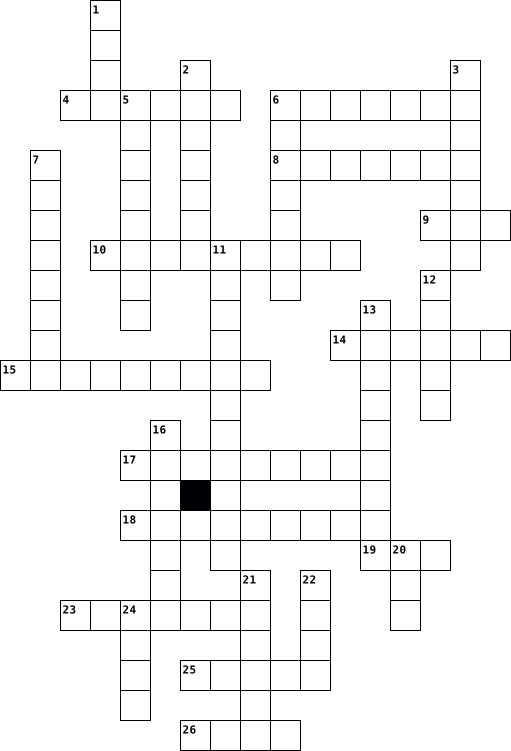
physical Crossword Puzzles
physical and chemical change 2022-01-26

Across
- a property that depends on the amount of matter in a sample.
- firm and stable in shape; not liquid or fluid.
- the separation of a mixture into its components.
- changes affecting the form of a chemical substance, but not its chemical composition.
- a substance that has mass and takes up space.
- one way of representing the concentration of an element in a compound or a component in a mixture.
- a state that flows freely but is of constant volume.
- they are all odorless, colorless, monatomic gases with very low chemical reactivity.
- chemical reaction involving the rearrangement of the atoms of one or more substances
- is composed of two or more separate elements
- an ionized gas
- PV=NRT
- a substance diffused or suspended in the air, especially one normally liquid or solid.
- mixture consisting of different, distinguishable parts or elements.
- one of the distinct forms in which matter can exist.
- an element whose properties are intermediate between those of metals and solid nonmetals or semiconductors
- a law stating that the volumes of gases undergoing a reaction at constant pressure and temperature are in a simple ratio to each other and to that of the product.
- a mixture in which the composition is uniform throughout the mixture.
- a substance made by mixing other substances together.
- to form crystals or assume crystalline form.
- The horizontal rows of the periodic table.
Down
- has a fixed chemical composition throughout
- every definite compound always contains the same elements in the same proportions
- an element or substance that is not a metal.
- matter in a state in which it will expand freely to fill the whole of a container
- a law stating that the volume of an ideal gas at constant pressure is directly proportional to the absolute temperature.
- a law stating that the pressure of a given mass of an ideal gas is inversely proportional to its volume at a constant temperature.
- Law that states a gas pressure x volume x temperature = constant.
- quantity of matter in a physical body.
- a characteristic of a particular substance that can be observed in a chemical reaction.
- matter not involving in its manifestation a chemical change.
- mass in an isolated system is neither created nor destroyed by chemical reactions or physical transformations.
- a law stating that equal volumes of gases at the same temperature and pressure contain equal numbers of molecules.
- the action of purifying a liquid by a process of heating and cooling.
- when two chemical elements combine with each other to form more than one compound
- the basic unit of a chemical element.
- a pure substance consisting only of atoms that all have the same numbers of protons.
- the action or process of filtering something.
- elements with similar chemical properties.
- a physical quantity whose value does not depend on the amount of the substance for which it is measured.
- a table of the chemical elements arranged in order
- The physical process where matter moves from one state to another.
- the transition of a substance directly from the solid to the gas state.
- a solid material that is typically hard, shiny, malleable, fusible, and ductile.
44 Clues: PV=NRT • an ionized gas • the basic unit of a chemical element. • quantity of matter in a physical body. • elements with similar chemical properties. • The horizontal rows of the periodic table. • has a fixed chemical composition throughout • an element or substance that is not a metal. • is composed of two or more separate elements • ...
Physical Activities Injuries Crossword 2020-09-17

Across
- a spasm or sudden tightening of a muscle that results from tired, overworked or dehydrated muscles
- what does the R stand for in R.I.C.E.
- condition of having an abnormally and dangerously low body temp (below 95F) that can cause body systems to shut down
- an injury to the ligament surrounding a joint that can cause pain, bruising, swelling and difficulty moving
- applying sunscreen and lip balm with an SPF of at least 15 thirty minutes before going out in the sun can help protect you from this disease
- what does the E stand for in R.I.C.E.
- injury to body tissues caused by exposure to extreme cold, typically affecting the nose, fingers or toes
- what does the I stand for in R.I.C.E.
- condition that occurs when tendons (bands of fiber that connect muscles to bones) are stretched or torn from overuse
- reddening and soreness of the skin caused by prolonged exposure to the wind
Down
- what does the C stand for in R.I.C.E.
- muscle spasms caused by a loss of large amounts of salt and water through perspiration
- the amount of body heat that is lost from the head (a good reason to wear a hat when it is cold)
- any break in a bone or cartilage that requires medical treatment and immobilization to heal properly
- overworking or straining the body through exercise or activity that can cause discomfort or injury
- group of heat-related conditions characterized by an abnormally high body temperature (104F or above)
- reversible freezing of superficial skin layers that causes whitening of the skin and numbness
- A damaging condition resulting from excessive tension on or from stretching of a muscle or tendon
- burning of the outer layers of skin that can cause redness, blistering, swelling and pain
- a bone that is fractured from its normal position at a joint that often needs to be put back in place by a doctor
- temporary unconsciousness resulting from a blow to the head that can cause headaches, confusion, vomiting, and swelling of the brain
- excess loss of fluids from the body that can cause headache, weakness and dizziness
22 Clues: what does the C stand for in R.I.C.E. • what does the R stand for in R.I.C.E. • what does the E stand for in R.I.C.E. • what does the I stand for in R.I.C.E. • reddening and soreness of the skin caused by prolonged exposure to the wind • excess loss of fluids from the body that can cause headache, weakness and dizziness • ...
PHYSICAL AND CHEMICAL CHANGES 2020-06-30

Across
- Over 110 of these are listed on the periodic table.
- Which science is obviously the best?
- A form of energy associated with the movement of atoms and molecules in any material
- Characteristic that can be observed or measured without changing the compostition
- Bend over on itself so that one part of it covers another
- The most important sign of chemical change.
- Separate or cause to separate into pieces as a result of a blow, shock or strain
- On Monday, lead nitrate and potassium iodide mixed together to form a yellow p..........
- A distinctive smell, especially an unpleasant one
- A colorless, odoUrless, gas produced by burning carbon and organic compounds and by respiration.
- Magnesium and hydrochloric acid reacted together to create this type of gas. When ignited, it makes a loud POP!
- To make a solution of, as by mixing with liquid.
Down
- Any change that results in the formation of new chemical substances
- To pull apart so as to leave ragged or irregular edges
- A physical change may include a change in s....o.m..... An example of this is ice melting to water.
- Burning magnesium, reacting sodium with water, and glow sticks all create the same type of evidence of chemical reaction. It is ......
- True or false, the holes or 'bubbles' in bread are evidence of a physical reaction?
- Crushing a solid is a form of this type of change.
- A SUBSTANCE that is composed of two or more DIFFERENT TYPES OF ATOMS
- To pass from the liquid to the solid state by loss of heat
- Characteristic that can be observed or measured without changing the compostition
- Combustion is a type of chemical change. It is often referred to as b......
- Vibrations that travel through the air or another medium and can be heard when they reach a person's or animal's ear
- A rising temperature
- The action of bringing a liquid to the temperature at which it bubbles and turns to vapor
- A falling temperature
- Chemical reactions may become exothermic. This is a type of energy created.
- When gas is formed in a reaction, it is often seen by this.
28 Clues: A rising temperature • A falling temperature • Which science is obviously the best? • The most important sign of chemical change. • To make a solution of, as by mixing with liquid. • A distinctive smell, especially an unpleasant one • Crushing a solid is a form of this type of change. • Over 110 of these are listed on the periodic table. • ...
Physical Properties of Matter 2020-06-11

Across
- relationship where both species benefit
- required along with CO2 for photosynthesis
- produced along with sugar by photosynthesis
- all living things in an ecosystem
- % of energy that typically gets passed along to the next trophic level
- a cycle including evaporation and precipitation
- an organism's roll in an ecosystem
- something that obtains energy by eating other organisms
- _____ level describes an organism's position along a food chain
- layer of gases surrounding Earth
- a food _____ shows one path of energy flow through an ecosystem
- zone around Earth where life can exist
- relationship where organism vie for resources
- James Lovelock's famous hypothesis
- _____ capacity is the maximum sustainable population size
- original source of energy in ecosystems
Down
- tape worms are an example of this
- all of Earth's water
- all the organisms of one species in an ecosystem
- Earth's solid outer layer
- needs to be fixed before most living things can use it
- describes factors that are living things
- describes factors that are non-living
- a cycle is closely linked to climate change
- mass of living organisms in a given area
- green plants for example
26 Clues: all of Earth's water • green plants for example • Earth's solid outer layer • layer of gases surrounding Earth • tape worms are an example of this • all living things in an ecosystem • an organism's roll in an ecosystem • James Lovelock's famous hypothesis • describes factors that are non-living • zone around Earth where life can exist • relationship where both species benefit • ...
Physical Science Final Exam 2021-11-15

Across
- rate of change of position of an object; can be displayed by the slope on a distance-time graph
- energy of position, shape, or state
- Apparent change in the frequency of a sound due to the motion of the source or the listener
- speed of an object in a particular direction
- the number of protons found within one atom of an element
- items that do not transfer heat or electricity well
- A disturbance that transmits energy through matter or space
- Vertical column on the Periodic Table, the elements share properties
- energy stored in the chemical bonds between the atoms of a substance
- positively charged particles found in the nucleus of an atom
- state of matter which moves erratically and fills the entire volume of its container
- current that flows in more than one direction
- force that slows or opposes current
- substance that was dissolved in a solution
- the energy of motion
- distance in a wave from one corresponding point to another
- the energy of vibrations of an object
- Any push or pull that has the ability to change the motion of an object
- In a solution, the substance that is present in greater quantities
- energy of moving electrons
- circuit with only one path for electrons to follow
- electric current that flows in only one direction
- rate of change of velocity; displayed by the slope on a velocity-time graph
- the substance a wave travels through
- the amount of matter an object is made from
- the force of attraction between two objects
- the ability to do work or cause change
- device that converts electrical energy to mechanical energy
- energy found within the nucleus of an atom
- The bouncing back of a wave when it hits a barrier
- The bending of a wave as it passes through an opening or around a corner
- transfer of thermal energy in empty space
- substances that are not able to dissolve
Down
- particle made of a combination of protons, neutrons, and electrons; smallest part of an element that has its properties
- the energy of electromagnetic waves
- the movement of thermal energy between objects
- Bending of a wave as it passes from one substance to another because of a change in speed
- solution that contains the largest possible amount of a solute
- movement of thermal energy as currents in a liquid or gas
- circuit that has more than one path for electrons to follow
- property of matter that resists a change in its motion
- particles found in the nucleus of an atom with no charge
- negatively charged particles found in an atom
- device that converts chemical energy to electrical energy
- total kinetic energy of the particles that make up an object
- the flow of electrons within a circuit
- Water and earthquake waves are an example, Waves that require a medium
- solution that is bitter and turns red litmus paper blue
- state of matter in which particles vibrate in place and has its own definite shape and volume
- elements found on the right of the Periodic Table, usually brittle and non-conductors
- How often a disturbance, or wave, occurs
- items that transfer heat or electricity well
- the height of a wave above its rest position
- elements Located to the left of the Periodic Table that conduct electricity well
- Horizontal row on the Periodic Table
- solution that is sour and turns blue litmus paper red
- this state of matter takes the shape of its container, but not the volume
- transfer of thermal energy through touching or direct contact
- path electricity will follow
- an atom with a positive or negative charge because it has gained or lost electrons
60 Clues: the energy of motion • energy of moving electrons • path electricity will follow • the energy of electromagnetic waves • energy of position, shape, or state • force that slows or opposes current • the substance a wave travels through • Horizontal row on the Periodic Table • the energy of vibrations of an object • the flow of electrons within a circuit • ...
Physical Science Year Review 2021-11-22

Across
- a measure of the average kinetic energy of the individual particles of a substance
- many saccharides bonded together
- when a complex substance Is broken down
- occur when chemical bonds are formed or broken
- potential movement
- what makes things move and go
- building block 1 glycerol & 3 fatty acids
- one simple sugar
- a push or pull
- Building blocks nucleotides
- an inclined plane wrapped around a cylinder
- base unit of length in the metric system
- a property that can be easily observed without chaing the identity of the substance
- the total # of both protons & neutrons in the atom
- a rate of motion that measures how fast something moves
- rate of change in velocity
Down
- the number of protons present in the nucleus of an atom
- What the scientist can't control
- how fast an object is moving in a certain direction
- any ability to produce a change in the identity of matter
- a disturbance that transfers energy from place to place
- any tool that pries something loose is a lever
- is moving
- two or more substances combined
- a material that transfers heat well
- you can use the edge of inclined plane to push things apart
- thermal energy moving from a warmer object to a cooler object
- made of two monosacharides joined together
- Does not receive the treatment
- fight off infection
- when you gather imformation that relates to the problem
- the distance between two corresponding parts of a wave
- a material that does not transfer heat well
- Building block monosaccharides
- building block amino acids
35 Clues: is moving • a push or pull • one simple sugar • potential movement • fight off infection • building block amino acids • rate of change in velocity • Building blocks nucleotides • what makes things move and go • Does not receive the treatment • Building block monosaccharides • two or more substances combined • What the scientist can't control • many saccharides bonded together • ...
Physical descriptions & Personality Trains 2022-02-04

Across
- amiable/kind
- honest
- rude
- attractive
- patient
- liar
- red-headed
- old
- generous
- bald
- handsome
- faithful
- simpathetic/kind
- strong
- skinny
Down
- agreeable/kind
- short
- pretty
- funny
- hard-working
- tall
- intelligent
- fun
- fat
- young
- studious
- impatient
- skinny
- considerate
- small
- beautiful
- ugly
- lazy
33 Clues: fun • fat • old • rude • tall • liar • bald • ugly • lazy • short • funny • young • small • pretty • honest • skinny • strong • skinny • patient • studious • generous • handsome • faithful • impatient • beautiful • attractive • red-headed • intelligent • considerate • amiable/kind • hard-working • agreeable/kind • simpathetic/kind
Physical Science Part 1 2013-05-28

Across
- the ability of a fluid to exert an upward force on an object placed in it
- the ratio of the distance an object moves to the amount of time the object moves
- the tendency of an object to resist a change in its motion
- a common unit of power, equal to 764 watts
- the energy stored in chemical bonds
- the constant velocity of a falling object when the force of air resistance equals the force of gravity
- sunlight that is converted into usable energy
- a push or pull that acts on an object
- the equivalence of the buoyant force on an object and the weight of the fluid displaced by the object
- the SI unit of power
- fluid friction acting on an object moving through the air
- energy obtained from flowing water
- an upward force due to a pressure difference between the top and bottom of a wing
- a system of objects that are not moving in respect to one another
- the overall force acting on an object after all the forces are combined
- the fixed point a lever rotates around
Down
- the energy stored in atomic nuclei
- the SI unit of pressure, equal to 1 newton per square meter
- the result of a force distributed over an area
- movement in relation to a frame of reference
- a substance or mixture that flows and has no shape of its own
- the curved path of an object in free fall after it is given an initial forward velocity
- thermal energy beneath Earth's surface
- the energy associated with electric charges
- a friction force that opposes the motion of an object through a fluid
- a device that uses a pressurized fluid acting on pistons of different sizes to increase force
- a steady change in velocity
- the energy associated with the motion and position of everyday objects
- the total distance traveled divided by the time it takes to travel
- the rate of doing work
- the length of the path between two points
- the product of distance and the force in the direction an object moves
- the SI unit of work
- the percentage of the work input that becomes work output
- the movement of an object toward Earth because of gravity
35 Clues: the SI unit of work • the SI unit of power • the rate of doing work • a steady change in velocity • the energy stored in atomic nuclei • energy obtained from flowing water • the energy stored in chemical bonds • thermal energy beneath Earth's surface • a push or pull that acts on an object • the fixed point a lever rotates around • the length of the path between two points • ...
Physical Science Final Crossword 2014-05-27

Across
- the overall force acting on an object after all the forces are combined
- a force that acts between any two masses
- the energy stored in chemical bonds
- SI unit of power
- equal to 746watts
- a form of energy that travels through space in the form of waves
- formed underground from remains of once living organisms
- force you exert on a machine
- the product of force and distance
- is movement in relation to a frame of reference
- the friction force that acts on objects that are not moving
- is the energy associated with electric charges
- SI unit of pressure
- is a description of both speed and direction of motion
- the result of a force distributed over an area
- sunlight that is converted into usable energy
Down
- total potential and kinetic energy related to the motion of all the microscopic particle in a n object
- a force that opposes the motion of objects that touch as they move past each other
- the energy associated with the motion and position of everyday objects
- the ratio of the distance an object moves to the amount of time the object moves
- upward force which acts in the opposite direction of gravity
- a force that opposes the direction of motion of an object as it slides over a surface
- energy obtained from flowing water
- is a system of objects that are moving with respect to one another
- the rate at which an object is moving at a given moment in time
- the ability of a fluid to exert an upward force on an object placed in it
- a push or a pull that acts on an object
- rate at which velocity changes
- the force that causes a 1 kilogram mass to accelerate at a rate of 1 meter per second each second
- distance the input force acts through
- energy stored in atomic nuclei
- a device that uses pressurized fluid acting on pistons of different sizes to change a force
- rate of doing work
- pressure difference between the top and the bottom of the wing creates an upward force
- the SI unit of work
- the total distance traveled, divided by the time it takes to travel that distance
36 Clues: SI unit of power • equal to 746watts • rate of doing work • the SI unit of work • SI unit of pressure • force you exert on a machine • rate at which velocity changes • energy stored in atomic nuclei • the product of force and distance • energy obtained from flowing water • the energy stored in chemical bonds • distance the input force acts through • ...
Describing People (Physical Characteristics) 2014-03-27

Across
- no hair on the head at all
- slang for very muscular
- the color of the clouds when it is rainy outside
- the color of teacher Jessi's hair
- the color of Elsa's hair (from Frozen)
- the opposite of fat
- little brown dots on a person's skin, very cute!
- facial hair that covers most of the face
- a person who looks very messy
- medium, most common
- the color of milk
Down
- the texture of hair Ms. Snow has
- short hair across the forehead
- the texture of hair teacher Jessi has
- a person with red hair is sometimes called this
- slang for very attractive, handsome or pretty
- the color of your hair
- the opposite of dark
- the opposite of curly
- hair is shaved on the sides of the head
20 Clues: the color of milk • the opposite of fat • medium, most common • the opposite of dark • the opposite of curly • the color of your hair • slang for very muscular • no hair on the head at all • a person who looks very messy • short hair across the forehead • the texture of hair Ms. Snow has • the color of teacher Jessi's hair • the texture of hair teacher Jessi has • ...
Physical Science Chapter 1 2014-01-27

Across
- An organized plan for gathering, organizing and communicating information.
- An instrument that measures temperature or how hot an object is.
- A statement that summarizes a pattern found in nature.
- A gauge of how exact a measurement is.
- The closeness of a measurement to the actual value of what is being measured.
- The quantity of matter in an object or sample.
- The straight line distance between two points.
- The study of matter and energy and the interactions between the two through forces of motion.
- The variable that causes a change in another.
- Information that you obtain through your senses.
- all the digits that are known in a measurement, plus the last digit that is estimated.
- Representation of an object or event
- The amount of space taken up by an object.
- The study of the universe beyond Earth, including the sun, moon, planets, and stars.
- The study of composition, structure, properties, and reactions of matter.
- The use of knowledge to solve practical problems.
Down
- A system of knowledge and the methods you use to find that knowledge.
- A way of expressing a value as the product of a number between 1 and 10 and a power of 10.
- A proposed answer to a question.
- An experiment in which only one variable, the manipulated variable, is deliberately changed at a time.
- The variable that changes in response to the manipulated variable.
- The steepness
- A relationship in which the ratio of two variables is constant.
- A relationship in which the product of two variables is a constant.
- The study of the origin, history, and structure of Earth.
25 Clues: The steepness • A proposed answer to a question. • Representation of an object or event • A gauge of how exact a measurement is. • The amount of space taken up by an object. • The variable that causes a change in another. • The quantity of matter in an object or sample. • The straight line distance between two points. • Information that you obtain through your senses. • ...
Physical Properties of Materials 2012-12-10

Across
- a very hard metal made of iron and carbon
- a material that can be formed into filaments or wires
- something that is resistant to breaking
- a material that allows water to go through it
- the opposite of conduct
- a material where light goes through an object but you can't see behind them clearly
- an example of thermal and electrical conductors
- having to do with sound
- a strength that resists sliding
- to join together two pieces of metal by melting them
- a material that does not allow water to go through it
- a strength that resists stretching
Down
- a strength that resists bending
- something that breaks easily
- not easily marked or scratched by another material
- a material that does not let light go through it
- the relationship between the mass and volume of an object
- a material that can be made into sheets
- something that is able to return to its original shape
- a strength that resists crushing
- a material that you can see through clearly
- a strength that resists twisting
- changing from solid to liquid when heated
- to transmit a form of energy such as heat or electricity through an object
- an object that has tiny holes, or pores
25 Clues: the opposite of conduct • having to do with sound • something that breaks easily • a strength that resists bending • a strength that resists sliding • a strength that resists crushing • a strength that resists twisting • a strength that resists stretching • something that is resistant to breaking • a material that can be made into sheets • ...
Physical Science Vocabulary Review 2015-01-08

Across
- The bottom of a transverse wave.
- The amount of space something takes up.
- The least penetrating form of radiation.
- Electricity has 1 path to flow in this circuit.
- The time is takes half of an isotope to decay.
- A device that turns electrical energy into mechanical energy.
- The force that opposes motion.
- The tendency of an object at rest to stay at rest.
- A substance that turns litmus paper blue.
- Energy that is stored.
- The process in which the sun warms the earth.
- The transfer of thermal energy by touching.
- The distance an object travels divided by time.
- The symbol for this element is Fe.
- A mixture that settles into layers over time.
- A simple substance that can't be broken down.
- Areas in a longitudinal wave that are close.
- This law states that V=IR.
- Type of friction between objects that are not moving.
- Force x distance.
- A positively charged ion.
- A background of unmoving objects used to describe motion.
- State of matter that has a definite volume but indefinite shape.
- The ability to be drawn into thin wires.
- The most reactive metal.
- A substance that tastes sour and has a pH below 7.
- Energy of motion.
- Atoms of the same element with diff. # of neutrons.
- Work/time.
- A quantity that has both magnitude & direction.
Down
- The most penetrating form of radiation.
- The bond between two nonmetals.
- If the switch in a circuit is _____, it will not work.
- A swimmer experiences this type of friction.
- The bending of light.
- Sweet tea or coffee are example of this mixture.
- An atom that has a charge.
- The new substances formed in a chemical reaction.
- A reaction in which energy is released.
- These waves have the longest wavelength and the lowest frequency.
- The unit for power.
- Mass/volume.
- The phase change of a gas to a liquid.
- A magnet is strongest at its ______.
- Another name for rows on the periodic table.
- A material that doesn't allow heat to flow through.
- Protons and neutrons are located in an atom's ___.
- A rubberband has this type of potential energy.
- An example of a colloid.
- A subatomic particle that is positively charged.
- The bond between a metal and a nonmetal.
- The phase change from a liquid to a solid.
- The smallest particle of an element.
- When light bounces off an object.
- A subatomic particle with a negative charge.
- The ability to do work.
- A material that allows heat/electricity to flow.
- This noble gas has 2 valence electrons.
- This type of radiation is similar to a fast-moving electron.
- The splitting of an atomic nuclei.
- A push or a pull.
- The top of a transverse wave.
- The substance being dissolved in a solution.
63 Clues: Work/time. • Mass/volume. • Force x distance. • A push or a pull. • Energy of motion. • The unit for power. • The bending of light. • Energy that is stored. • The ability to do work. • An example of a colloid. • The most reactive metal. • A positively charged ion. • An atom that has a charge. • This law states that V=IR. • The top of a transverse wave. • The force that opposes motion. • ...
Physical Features of Europe 2015-12-17

Across
- It is the second largest ocean in the world.
- These mountains are between the Caspian and The Black Sea.
- This is a ancient mountain range.
- This is the largest enclosed inland body of water on Earth by area.
- This region is a polar region
- it is a marginal sea in the North Atlantic Ocean.
- This is divided into several pieces.
- It is a marginal sea of the Atlantic Ocean located between Great Britain, Scandinavia, Germany, the Netherlands, Belgium, and France.
- This is also called simply the Channel.
- This is the second largest river.
- This is a body of water separating the Italian Peninsula from the Balkan peninsula.
Down
- It drains through the Mediterranean into the Atlantic Ocean.
- The Baltic Sea is a sea of the Atlantic Ocean, enclosed by Scandinavia, Finland, the Baltic countries, and the North European Plain.
- These mountains form a 1,500km-long range.
- This mountain range lies entirely in Europe.
- This sea is almost completely enclosed by land.
- Is a gulf of the northeast Atlantic Ocean located south of the Celtic Sea.
- The Pyrenees mountain range separates the Iberian Peninsula from the rest of Europe.
- This is the longest river in Europe.
- This is the fourth longest river in Europe.
- This river begins in the Swiss Canton.
21 Clues: This region is a polar region • This is a ancient mountain range. • This is the second largest river. • This is divided into several pieces. • This is the longest river in Europe. • This river begins in the Swiss Canton. • This is also called simply the Channel. • These mountains form a 1,500km-long range. • This is the fourth longest river in Europe. • ...
Grade 8: PHYSICAL SCIENCE 2014-10-19

Across
- how much stuff matter has
- the substance that dissolves something else
- a pure substance
- composed of two or more elements
- the smallest particle of matter
- change can be reversed to separate the parts it is made of
- how much space matter contains or takes up
- a mixture made of different substances
- the ability to do work
- the substance that dissolves
- something we know or can observe about an object
- change can only be reversed by another chemical change
- two or more substances that need an emulsifier to hold them together
- positively charged sub-atomic particles in the nucleus of an atom
- take the shape of the container they are in
- the center of an atom that contains protons and neutrons
Down
- molecules are spread far apart
- stuff that has mass and volume
- negatively charged sub-atomic particles in an atom's nucleus
- substance substances that are made of the same stuff all the way through
- when a solute is spread evenly throughout a solvent
- two or more substances that are not chemically combined
- a mixture that has more solute in it than solvent
- a mixture of substances that appears to be the same throughout
- table all the elements in our known universe are organized here
- has large particles in it that can be seen with the naked eye
- negatively charged sub-atomic particles that orbit an atom's nucleus
- a homogeneous mixture made from a solute and a solvent
- combination of atoms that form something new
- a mixture that has more solvent in it that solute
- molecules are packed tightly together
31 Clues: a pure substance • the ability to do work • how much stuff matter has • the substance that dissolves • molecules are spread far apart • stuff that has mass and volume • the smallest particle of matter • composed of two or more elements • molecules are packed tightly together • a mixture made of different substances • how much space matter contains or takes up • ...
Nutrition and Physical Activity 2016-02-07

Across
- Iron, calcium, & folic acid are especially important for a woman during this
- Drinking plenty of this prevents electrolyte imbalance
- Newest food graphic (2 wds)
- Basic rate at which the body expends energy to maintain itself in resting state
- Teenagers are recommended to get _______ minutes of exercise each day
- The study of dietary requirements.
- Main source of energy for the body, includes sugars & starches
- Throwing up after eating is a symptom of this eating disorder
- Food substances that make up a mixture
- The human body needs these chemical elements & compounds
- This is the way we see ourselves (2 wds)
- Naturally occurring compound that our body needs
- Running, swimming & biking are examples of this type of exercise
- Having a large amount of body fat
- People with this disorder often eat large amounts of food in private (2 wds)
- Rapid weight loss without having to exercise or change eating habits are characteristics of these diets
- Person qualified in or practicing the science of applying the principles of nutrition
Down
- Necessary nutrient that we get from meat, eggs, & dairy
- Fatty substance found in food or formed by the body that coats & restricts arteries
- Unusual weight gain or loss, hair loss, acne, or sterility can result from use of these
- Vegetables & fruits are examples of these foods (2 wds)
- Measurement of heat energy provided by food
- Heart disease, high blood pressure, & type 2 diabetes are all health risks associated with being this
- Look at the nutrition label & ingredients of these foods to decide if you should eat them regularly
- Nutrient that supplies the most calories per gram
- Calories we get from food provide us with this
- Proteins are made of these, some are essential (2 wds)
- Organic nutrient compounds needed in small amounts to help with body processes
- Psychological desire to eat
- This disorder has consequences similar to starvation
- 3500 calories
- Maintenance & improvement of health through exercise & proper diet
32 Clues: 3500 calories • Newest food graphic (2 wds) • Psychological desire to eat • Having a large amount of body fat • The study of dietary requirements. • Food substances that make up a mixture • This is the way we see ourselves (2 wds) • Measurement of heat energy provided by food • Calories we get from food provide us with this • Naturally occurring compound that our body needs • ...
Physical and Chemical Changes 2023-02-11

Across
- 4th state of matter
- Type of mixture where settling happens.
- temperature at which a liquid starts vaporizing.
- type of mixture where particles are distributed evenly throughout.
- State of matter where there is no defined volume to it.
- type of reaction when a paper is burnt.
- ease to catch fire or burn.
- physical change from gas to solid state.
Down
- the amount of mass per volume
- powder formed as the result of chemical reactions.
- flaky coating of iron oxide formed by oxidation and moisture.
- element with properties between metals and non-metals.
- Type of energy that all matter has. Energy of motion.
- upward force exerted by fluids when immersing an object.
- the properties of matter detected by senses.
- the feel or consistency of a substance/surface.
- the result of substances reacting to air.
- decay of a material with heat or age.
- Physical change from solid to liquid.
- the ability to transfer electricity
20 Clues: 4th state of matter • ease to catch fire or burn. • the amount of mass per volume • the ability to transfer electricity • decay of a material with heat or age. • Physical change from solid to liquid. • Type of mixture where settling happens. • type of reaction when a paper is burnt. • physical change from gas to solid state. • the result of substances reacting to air. • ...
Physical Geography Grade 9 2023-03-04

Across
- Geographic Information System
- Data collection by physically going to a place
- Data collection in the form of descriptions
- Sharing cultural ideas with eachother
- A piece of land that is surrounded by water
- The spread of cultures around the world
- Cultural practices that oppose modern society
- Adopting culture from another group
- Consists of large German lands
- The study of human populations
- Data collecting by using satellite or radars
- Divides Iceland and the floor of the Atlantic Ocean
- Storms and waves grind away at rock
Down
- The climate here is suitable for wool products
- Lowered elevation in Belgium, Netherlands, and Luxembourg
- Sea that acts as a natural border between Africa and Europe
- The amount of people in one given space
- Data collection in numbers
- A type of geography about natural Earth features of a place
- Highest and most extensive mountain range in Europe
- A sea that is 45% covered in ice
- The third largest plate in the world
- Landform made when a glacier goes back down in water
- Semi Desert Environment with Occasional Rain
- Global Positioning System
25 Clues: Global Positioning System • Data collection in numbers • Geographic Information System • Consists of large German lands • The study of human populations • A sea that is 45% covered in ice • Adopting culture from another group • Storms and waves grind away at rock • The third largest plate in the world • Sharing cultural ideas with eachother • ...
physical science crossword puzzle 2022-12-15

Across
- the absorbtion of heat
- electrons are shared
- unequal sharing of electrons
- soft metals highly reactive with water
- enerrgy required to pull 2 atoms apart
- the heat releases
- ability to be deformed
- electrons in the outermost shell
- substances that react
- the thickness or runniness of a liquid
- temp of melting
- substances that form in chem reaction
Down
- chemical bonds between atoms are broke
- electrons flow in an electron sea
- hard metals that are malleable
- electrons are given and taken
- written form of a chemical reaction
- rate the speed of any chem reaction
- burns at room temp
- temp of boiling
- molecules not having a dipol
21 Clues: temp of boiling • temp of melting • the heat releases • burns at room temp • electrons are shared • substances that react • the absorbtion of heat • ability to be deformed • unequal sharing of electrons • molecules not having a dipol • electrons are given and taken • hard metals that are malleable • electrons in the outermost shell • electrons flow in an electron sea • ...
Unit 3: Physical Evidence 2023-02-26

Across
- - evidence collected over time used to prove or disprove the link between a suspect and a crime
- - term used to describe fibers that are not of natural origin
- - process of using physical or chemical properties to determine what an object is
- - category of evidence in which the object has been narrowed down to a single identity
- - term that describe evidence that can not be used in court for a variety of reasons
- - type of evidence in which a person recounts what he or she saw
- - the object of comparison by which we can ascertain positive identity
- - term used to describe how certain an outcome/result is likely to be
Down
- - evidence that establishes the need to start an investigation
- - the last name of a victim (Caylee) and accused killer (Casey)
- - the last name of the French Forensic Scientist whose principal of exchange is widely accepted
- - type of evidence in which a person act in such a way that is consistent with someone who has committed a crime
- - physical evidence of this type crime may include glass, headlights, paint, etc.
- - type of evidence in which an object links a victim or suspect to a crime
- - another name for rule or law - ex. "_______ of Limitations"
- - the intentional contamination or disruption of evidence or a crime scene
- - accuracy of a test
- - anything that may provide a link to a civil or criminal investigation
- - the last word in a process used to ensure that the collection, transfer, processing, and storage of evidence is documented as it changes hands
- - term used to describe fibers that are not man-made
20 Clues: - accuracy of a test • - term used to describe fibers that are not man-made • - term used to describe fibers that are not of natural origin • - another name for rule or law - ex. "_______ of Limitations" • - evidence that establishes the need to start an investigation • - the last name of a victim (Caylee) and accused killer (Casey) • ...
Physical Signals of Emotions 2023-02-17

Across
- smiling, relaxed appearance; bubbly voice; expressing enjoyment of the senses; overall feeling of weightlessness
- Kind words spoken in a soothing tone of voice; patting someone's back; squeezing a hand; and understanding nod
- shaking head and closing eyes; sagging against a wall; wobbly legs; crying or calling out in release; confirming the moment is real
- shoulders back and chest out; lifting the chin; purposeful stride
- raising one's palms; backing away; engaging in verbal disagreements; reacting as if being attacked
- chest thrust out; shoulders back; huge smile; appearing unaffected by what others think
- holding one's breath; raising the eyebrows; covering mouth with a hand, eyes wide and shining
- shaky hands; vacant expression; loss of appetite; wanting to be left alone; eyes that appear red and raw; the sensation of ones heart being heavy
- the mouth falling open; incredulous stare; slapping the hands against the cheeks; squealing; doing a double take
- leaning forward; eyes that glow; rushing;rubbing the hands together; using animated gestures
- a quiet voice; avoiding eye contact; a nervous smile; changing the subject; toying with clothing to release nervous tension
- pained look; avoiding eye contact; talking in a soft voice; taking up little space; unsure how to act
- crossing the arms, forming a barrier to others; twisting hands, watch or ring; biting nails
- nodding the head; listening to others; chest puffing out; looking people in the eye
- downturned mouth; apologizing; arms crossed; staring at one's feet; avoidance; insomnia
- checking and re-checking one's appearance; restlessness; a deep sigh; hesitation
- feet that tap; twisting hair; uncertainty over the future; taking deep breaths to calm oneself
- crossing arms over chest; body tenses; being highly negative; sighing; refusing to engage in conversation; tightness in the chest
- an expectant look upon being addressed that fades when no acknowledgement is forthcoming
- closing eyes; taking deep breaths; voice taking a wistful tone; thoughts turned inward; talking often about the thing one wants
Down
- eyes that are soft and filled with an inner glow; tearing up; repeating one's thanks and appreciation
- cheeks that burn; muttering 'what have i done'; hiding one's face; holding back a cry
- wide-open eyes; aha moment; frenzied activity; pacing while thinking, feeling highly energized
- pacing; short, jerky movements; lack of eye contact; eyeing the exits; restlessness; rapid speaking or babbling
- standing strong, head held high; a purposeful stride; being positive and upbeat; smiling in response to one's name
- offering a thumbs up; clapping someone on the back; a confident smile; a fist pump
- making oneself small; avoiding eye contact; looking down at one's hands; difficulty making independent choices
- smmothing down clothing; a self-depreciating laugh; fidgeting; speaking in a too-quiet voice; asking for reassurance from others
- steady eye contact that is comforting; offering a small smile that communicates acceptance, listening without judgment, placing a hand on the back to provide comfort
- first to speak; tight muscles; using affirmative words; displaying a strong posture
- eyes that seem to buldge, cold & hard; flexing arm muscles; a reddening of the face; punching & kicking; grinding teeth
- strong posture; looking others directly in the eye
- eyes brighten after making the decision to move forward
- slumped shoulders; limp posture; looking down when walking; a longing for human contact
34 Clues: strong posture; looking others directly in the eye • eyes brighten after making the decision to move forward • shoulders back and chest out; lifting the chin; purposeful stride • checking and re-checking one's appearance; restlessness; a deep sigh; hesitation • offering a thumbs up; clapping someone on the back; a confident smile; a fist pump • ...
Physical Science Review Crossword 2023-04-27

Across
- these electromagnetic waves have the highest frequency
- newton's ______ law says that net force equals mass times acceleration
- the SI unit of time
- the variable symbol is T, the amount of time between identical parts of a wave
- kinetic energy is equal to one half times mass times velocity ____
- letter g represents the acceleration on earth due to ___
- the unit for frequency
- newton's ______ law of gravity is given by G*m1*m2/d^2
- the specific _____ of a material, its variable is c
- the unit measuring weight and force
- the unit of potential difference, its symbol is V
- wave ______ is described by wavelength times frequency
- is the amount of energy associated with the motion of an object- its ____ energy
- the type of energy associated with an object's height above earth
- the speed of _____ is 3 * 10^8 m/s
- a type of circuit in which the current can take multiple paths
- _____ potential energy is the energy stored in a spring
- these subatomic particles are located in the nucleus of an atom and carry a positive charge
- it's symbol is the letter p
- a type of circuit in which the current only has one path it can take
- the rate of change of velocity divided by time
Down
- the unit of electrical current, its symbol is A
- the SI unit of length
- these subatomic particles are located in the nucleus of an atom and carry no charge
- the amount of energy out of a system divided by the energy put in
- these electromagnetic waves have the longest wavelengths
- the variable for electrical current, its symbol is I
- the unit measuring electrical _____, its symbol is R
- equations that relate the motion of an object, velocity, acceleration, position and time
- the unit measuring energy, J
- coulomb's ______ is defined as k = 9*10^9 Nm^2 / C^2
- force times distance
- these subatomic particles orbit the nucleus is different shells or energy levels
- the SI unit of temperature
- the unit of electrical charge, its symbol is C
- the SI unit of mass
- the change in position divided by the change in time
- the change of momentum, delta p, is equal to _____
- _____ law, which states that V = IR
- the _____ force is equal to k*q1*q2 / d^2
- the force that a mass feels due to the acceleration of gravity, Fg = mg
41 Clues: the SI unit of time • the SI unit of mass • force times distance • the SI unit of length • the unit for frequency • the SI unit of temperature • it's symbol is the letter p • the unit measuring energy, J • the speed of _____ is 3 * 10^8 m/s • the unit measuring weight and force • _____ law, which states that V = IR • the _____ force is equal to k*q1*q2 / d^2 • ...
Physical Properties of Solutions 2017-03-29

Across
- the amount of dissolved gas is proportional to its partial pressure in the gas phase
- a membrane that enables solvent molecules to pass through but blocks blocks the movement of solute molecules
- a solution with thermodynamic properties analogous to those of a mixture of ideal gases
- the number of moles of solute dissolved in 1 kilogram of solvent
- the phenomenon that the boiling point of a liquid (a solvent) will be higher when another compound is added colligativeproperties/properties that depend upon the concentration of solute molecules or ions, but not upon the identity of the solute
- the pressure required to stop osmosis
- tending to dissolve in, mix with, or be wetted by water
- the removal and segregation from a melt of mineral precipitates; except in special cases, removal of the crystals changes the composition of the magma
- does not have a measurable vapor pressure
- the ratio of the mass of a solute to the mass of the solution, multiplied by 100%
- the vapor pressure of the solvent over a solution is given by the product of the vapor pressure of the pure solvent and the mole fraction of the solvent in the solution
- at a given temperature, the solution that results when the maximum amount of a substance has dissolved in a solvent.
- separation of a liquid mixture into fractions differing in boiling point (and hence chemical composition) by means of distillation, typically using a fractionating column
Down
- a solution that contains less solute than it has the capacity to dissolve.
- a solution that contains more of the solute than is present in a saturated solution.
- the process in which an ion or a molecule is surrounded by solvent molecules arranged in specific manner.
- two liquids that are completely soluble in each other in all proportions are said to be (________)
- the process in which adding a solute to a solvent decreases the freezing point of the solvent
- a homogeneous, noncrystalline substance consisting of large molecules or ultramicroscopic particles of one substance dispersed through a second substance
- do not dissolve in water, has not charge and is non-polar
- the net movement of solvent molecules through a semi-permeable membrane from a pure solvent or from a dilute solution to a more concentrated solution.
- a duplex of charged particles (ordinarily charged atoms or molecules), one positive, the other negative
22 Clues: the pressure required to stop osmosis • does not have a measurable vapor pressure • tending to dissolve in, mix with, or be wetted by water • do not dissolve in water, has not charge and is non-polar • the number of moles of solute dissolved in 1 kilogram of solvent • a solution that contains less solute than it has the capacity to dissolve. • ...
Physical Science Chapter 11 2020-01-20

Across
- Anything that has mass and occupies space
- substances are not uniformly mixed
- this theory says that energy cannot be created or destroyed
- the smallest unit of a substance that exhibits all of the properties characteristic of that substance
- the smallest particle that has the properties of an element
- substance that cannot be broken down into simpler substances
- mixing occurs between individual units
- the ability to change or move matter
- any matter that has a fixed composition and definite properties
- describes 2 or more liquids that are able to dissolve into each other in various portions
- combination of more than one pure substance
Down
- has four rules, one of them being particles are always moving
- describes 2 or more liquids that do not mix into each other
- the force exerted per unit area of a surface
- a characteristic of a substance that cannot be observed or measured without changing the composition of the substance
- theory that says mass cannot be created or destroyed
- the way a substance reacts with others to form new substances with different properties
- little free space between particles
- lots of free space between particles
- a substance made of atoms of more than one element bound together
- the chemical symbols and numbers indicating the atoms contained in the basic unit of a substance
- the mass per unit volume
- retains a fixed volume and shape
23 Clues: the mass per unit volume • retains a fixed volume and shape • substances are not uniformly mixed • little free space between particles • lots of free space between particles • the ability to change or move matter • mixing occurs between individual units • Anything that has mass and occupies space • combination of more than one pure substance • ...
Physical Education and Sport 2020-02-10
Across
- merupakan olahraga paling digemari masyarakat amerika
- lebar kolam renang standar FINA
- Negara yang pertama kali memainkan sepakbola
- denyut nadi maksimal
- panjang kolam renang standar FINA
- olahraga yg dilakukan didalam air
- biasa disebut juga sebagai teknik/gaya freestyle strook
- salah satu olahraga yg termasuk dalam olahraga dengan bola kecil
- olahraga terfavorit di seluruh dunia
- National Basketball League
- posisi pemain depan (penyerang) berada dibelakang bek lawan
- persatuan bolavoli seluruh indonesia
- organisasi renang di indonesia
Down
- federasi international dalam renang
- Tim Sepakbola kebanggaan warga lamongan
- mengumpan bola kepada teman satu tim
- gerakan melempar bola keralam ring basket
- Melakukan gerakan menggiring bola dalam sepakbola
- gerakan pencak silat sebagai penguat tumpuan kaki ketika berdiri
- olahraga beladiri asli dari indonesia
- teknik memukul bolavoli secara keras sebagai senjata mengumpulkan angka
- gerakan yg dilakukan sebelum melakukan gerakan inti
- Jumlah Pemain Dalam Satu Tim Di Sepakbola
- alat untuk memukul bola dalam tenis meja
- teknik awalan sebagai permulaan olahraga bolavoli
- ikatan pencak silat seluruh indonesia
- organisasi internasional dalam sepakbola
27 Clues: denyut nadi maksimal • National Basketball League • organisasi renang di indonesia • lebar kolam renang standar FINA • panjang kolam renang standar FINA • olahraga yg dilakukan didalam air • federasi international dalam renang • mengumpan bola kepada teman satu tim • olahraga terfavorit di seluruh dunia • persatuan bolavoli seluruh indonesia • ...
Physical description (Unit 2) 2020-10-21

Across
- corto
- giovane
- basso
- treccia
- dito del piede
- mano
- naso
- spalla
- gamba
- di mezza età
- viso
- piccolo
- peso
- anziano
- calvo
- sovrappeso
- che arriva alle spalle
- liscio
- riccio
- schiena
- grande
- rosso
- barba
- ginocchio
- lungo
- frangia
Down
- lentiggini
- tail coda
- pollice
- occhiali
- apparecchio
- castano
- caviglia
- alto
- braccio
- ovale
- occhio
- biondo
- petto
- magro
- baffi
- statura
- testa
- azzurro
- bocca
- orecchio
- piede
- gomito
- collo
- cavallo
- nero
- a spazzola
- verde
- mosso
- grigio
- rotondo
- lungo
- mento
- dito
59 Clues: alto • mano • naso • viso • peso • nero • dito • corto • basso • ovale • gamba • petto • magro • baffi • testa • bocca • calvo • piede • collo • verde • mosso • rosso • barba • lungo • lungo • mento • occhio • spalla • biondo • gomito • liscio • riccio • grande • grigio • pollice • giovane • castano • treccia • braccio • piccolo • statura • azzurro • anziano • cavallo • schiena • rotondo • frangia • occhiali • caviglia • orecchio • tail coda • ginocchio • lentiggini • sovrappeso • a spazzola • apparecchio • ...
Physical Science Unit 6 2020-11-06

Across
- The average mass of all the isotopes of an element
- A small particle in the nucleus of the atom, with no electrical charge
- A positively charged ion
- One of the Group B elements in which the highest occupied s sublevel and a nearby d sublevel generally contain electrons
- A nonmetal in Group 7A of the periodic table
- The basic unit of a chemical element.
- Any metal in Group 1A of the periodic table
- Sharing of electrons
- An atom or group of atoms that has a positive or negative charge.
- The sum of the number of neutrons and protons in an atomic nucleus
- A row on the periodic table
- Metal and metal
- Positively charged particle
- Atoms of the same element that have different numbers of neutrons
- Negatively charged particle
- A negatively charged ion
Down
- A column on the periodic table
- The attractive force that holds atoms or ions together
- A combination of chemical symbols and numbers to represent a substance
- Electrons on the outermost energy level of an atom
- The number of protons in the nucleus of an atom
- Any metal in Group 2A of the periodic table
- Positive or negative number that indicates how many electrons an atom has gained, lost, or shared to become stable
- Ions that are made of more than one atom
- Transfer of electrons
- The elements in Group 8A of the periodic table
26 Clues: Metal and metal • Sharing of electrons • Transfer of electrons • A positively charged ion • A negatively charged ion • A row on the periodic table • Positively charged particle • Negatively charged particle • A column on the periodic table • The basic unit of a chemical element. • Ions that are made of more than one atom • Any metal in Group 2A of the periodic table • ...
Physical Science Unit 2 2021-02-15

Across
- Energy related to movement of matter in a substance.
- The transfer of heat through matter in contact with each other.
- A simple machine with a circle and axle.
- The amount of heat require to raise the temperature of 1 gram 1 degree.
- The transfer of heat through fluids and changes in density.
- An inclined plane wrapped around a cylinder.
- A measure of the average kinetic energy matter in a material.
- A simple machine with a V-shape.
- A simple machine with a ridged bar and fulcrum.
- Law describing energy moving from one form to another.
- A simple machine that changes elevations.
- Mechanical advantage related to distance.
Down
- Law stating energy cannot be created nor destroyed.
- Mechanical advantage related to force.
- The amount of work over time.
- A machine that combines other motions into one.
- Energy due to either motion or position.
- The ability to do work.
- Energy related to motion.
- How well an machine uses its input force and distance.
- Energy stored due to position.
- Energy that is transferred due to differences in temperature.
- The transfer of heat through space.
- A wheel with a groove for lifting.
24 Clues: The ability to do work. • Energy related to motion. • The amount of work over time. • Energy stored due to position. • A simple machine with a V-shape. • A wheel with a groove for lifting. • The transfer of heat through space. • Mechanical advantage related to force. • A simple machine with a circle and axle. • Energy due to either motion or position. • ...
Africa Physical Geography Honors 2021-03-16

Across
- Large Northern desert
- Strait that connects the Med to Atlantic
- longest lake in Africa
- Mountains in the southern Sahara
- Source of the Nile
- Manmade lake on the Nile River
- River in South Africa
- Famous falls on the Zambezi River
- Small land mass that jet into the ocean where the Atlantic and Indian oceans meet
- River that flows through Sudan and Egypt
- The eastern tip of Africa by the Gulf of Aden
Down
- Desert on the southwestern coast of Africa
- Mountains in eastern Africa
- Lake in Kenya
- Mountains in Southern Africa
- Desert in southern Africa
- Lake that borders Mozambique and Tanzania
- Gulf south of Ghana and west of Gabon
- Mountains in northwest Africa
- The source of this waterway is Lake Tana
- River in Central Africa
- The river home to Victoria Falls
- Northeastern part of the Sahara
- Highlands in Northeastern Africa
24 Clues: Lake in Kenya • Source of the Nile • Large Northern desert • River in South Africa • longest lake in Africa • River in Central Africa • Desert in southern Africa • Mountains in eastern Africa • Mountains in Southern Africa • Mountains in northwest Africa • Manmade lake on the Nile River • Northeastern part of the Sahara • Mountains in the southern Sahara • ...
Key Terms Physical assessment 2021-03-03

Across
- small blister
- small bump or pimple
- localized area of edema
- tapping body pats with fingers hands or instrument
- when the upper eye lid droops over eye
- jugular vein distention
- abnormal lateral curvature of the spine
- excessive inward curvature of spine
- flat area of discoloration (freckle)
- a decrease in the size of an organ muscle or tissue
- growth of excessive male-patter hair on a women after puberty
Down
- feeling of pins and needles
- enlargement of one or more fingernails
- circulation of blood or fluid in tissue or space
- swelling of vein
- excessive outward curvature of the spin
- pinpoint purpura lesions
- solid lesion bigger than 10mm
- condition that causes skin and whites of eyes to turn yellow
- pale color of skin
- any rash which blood cells leak into the skin
- pus containing lesion
- point of maximum impulse (apex)
23 Clues: small blister • swelling of vein • pale color of skin • small bump or pimple • pus containing lesion • localized area of edema • jugular vein distention • pinpoint purpura lesions • feeling of pins and needles • solid lesion bigger than 10mm • point of maximum impulse (apex) • excessive inward curvature of spine • flat area of discoloration (freckle) • ...
Physical Aspects of Parliament 2021-09-27

Across
- The member of a political party that makes sure all party members vote in favour of their party’s decision
- a provincial court that does not conduct jury trials
- the highest court in british columbia
- Left Leaning part with their leader being Jagmeet Singh
- They look over any legislation that is passed by the HOC and take on any matters the HOC can't/won't take on
- the representative of the queen at a national level
- Any MP that sits behind the Cabinet and Shadow cabinet
- the official action that happens when an MP votes against their party’s decision
- They support the prime minister and cabinet in implementing their goals, decisions and ideas
- the leader of parliamentary debate and discussion
- The general assembly of that represents Canadian citizens and makes decisions on their behalf
- Generally left wing party with their leader being Annamie Paul
- This group sets out policies and priorities for the federal government and acts as advisor to the Prime Minister.
- Right leaning party with their leader being Erin O/Toole
Down
- the party with the second largest amount of seats in the house
- The Head of municipal/city government
- the highest court in a province or territory before the supreme court of canada
- The area for which a MP represents
- canada's head of state
- The representative of the queen at a provincial lever
- the political party representing the people of Quebec
- Left leaning party with their leader being Jagmeet Singh
- the party with the highest amount of seats in the house
- The party with the second largest amount of seats in the house
- a party meeting held in private where all party members can state their opinions freely
25 Clues: canada's head of state • The area for which a MP represents • The Head of municipal/city government • the highest court in british columbia • the leader of parliamentary debate and discussion • the representative of the queen at a national level • a provincial court that does not conduct jury trials • The representative of the queen at a provincial lever • ...
Physical Science Vocab 2 2021-05-10

Across
- A term used to describe a material that absorbs and/or reflects light and does not allow light to pass through
- The amount of space an object or substance occupies.
- A substance that dissolves another substance
- A substance that is being dissolved by another substances
- A term used to describe a material that can be clearly seen through because it allows light waves to pass through in straight lines.
- A physical property of a solid used to describe its surface.
- A measure of the acidity or alkalinity of a solution based on a scale from zero to fourteen.
- The lowest point on a wave.
- A term used to describ6 a material that cannot be clearly seen through but that allows some light to pass through it.
Down
- The center region of an atom where protons and neutrons ape located (also the cell structure that contains a cell's genetic material)
- To force away or apart.
- To bounce light, sound, or heat off of a surface.
- The time-rate at which a body changes its position.
- The relative frequency (high or low) of a sound as perceived by a listener.
- The force exerted per unit area.
- The distance between crests of a wave
- A subatomic particle having a positive charge and which is found in the nucleus of an atom.
- A measure of how hot or cold a substance is; a measure of the average kinetic energy of the particles of a substance.
- A particle, object, or system that lacks a net charge.
- A measure of the force of gravity on an object
- The distance traveled by an object in a given amount of time.
- A subatomic particle having zero charge found in the nucleus of an atom.
22 Clues: To force away or apart. • The lowest point on a wave. • The force exerted per unit area. • The distance between crests of a wave • A substance that dissolves another substance • A measure of the force of gravity on an object • To bounce light, sound, or heat off of a surface. • The time-rate at which a body changes its position. • ...
PHYSICAL FEATURES OF INDIA 2021-07-19

Across
- HIGHEST PEAK OF WESTERN GHATS
- HIGHEST PEAK OF HIMALAYAN RANGE
- WET SWAMP AND MARSHY LAND
- THE GRAINHOUSE OF INDIA
- NEW ALLUVIAL SOIL
- CRECENT SHAPED HILLS FORMED BY SAND
- ADMINISTRATIVE HEADQUARTERS OF LAKSHDWEEP
- ANCIENT NAME OF LAKSHDWEEP
- ISLAND HAVING BIRD SANCTUARY
- LONG RIVER IN RAJASTHAN
Down
- SOUTHERN PART OF PENINSULAR PLATEAU
- SOUTHERN PART OF EASTERN COAST
- LANDFORMS CREATED BY RIVERS BEFORE FALLING IN SEA
- NORTHERN PART OF WESTERN COAST
- OLDEST LANDMASS OF INDIA
- ISLAND WHICH HAS ACTIVE VOLCANO
- THE NORTHERNMOST RANGE OF HIMALAYAS
- THE RANGE OF HIMALAYAS KNOWN FOR HILLSTATIONS
- EASTERN HIMALAYAS ARE KNOWN BY THIS NAME
- HIMALAYAS BETWEEN SATLUJ AND TEESTA RIVERS
20 Clues: NEW ALLUVIAL SOIL • THE GRAINHOUSE OF INDIA • LONG RIVER IN RAJASTHAN • OLDEST LANDMASS OF INDIA • WET SWAMP AND MARSHY LAND • ANCIENT NAME OF LAKSHDWEEP • ISLAND HAVING BIRD SANCTUARY • HIGHEST PEAK OF WESTERN GHATS • SOUTHERN PART OF EASTERN COAST • NORTHERN PART OF WESTERN COAST • HIGHEST PEAK OF HIMALAYAN RANGE • ISLAND WHICH HAS ACTIVE VOLCANO • ...
History and Physical terminology 2021-10-18

Across
- opposite of left
- Step 04
- Step 03
- go down
- temperature-pulse-respirations-Blood Pressure
- see
- Step 10
- bring up
- carry
- Step 05
- opposite of bacwards
- opposite of right
- take clotes off
- Step 09
- below
Down
- Step 11
- Step 06
- hand like a boxer
- opposte of front
- Step 07
- remove something
- opposite of close
- bow down
- change position
- a sound to make when examining throat
- Step 08
- above
- onto something
- lift up
- put clothes on
- change position
- Step 02
- to feel with fingers
- opposite of in
- Step 01
- oppostite of out
36 Clues: see • above • carry • below • Step 11 • Step 06 • Step 04 • Step 03 • Step 07 • go down • Step 08 • Step 10 • lift up • Step 05 • Step 02 • Step 01 • Step 09 • bow down • bring up • onto something • put clothes on • opposite of in • change position • change position • take clotes off • opposite of left • opposte of front • remove something • oppostite of out • hand like a boxer • opposite of close • opposite of right • opposite of bacwards • ...
BBE Physical Science Forces 2021-10-19

Across
- Amount of matter in an object
- The day when Isaac Newton was born
- The other name for Newtons First Law of Motion
- The combination of Mass and gravity
- 9.8 is the Acceleration due to________ on earth
- The type of motion that Aristotle thought that objects did without force.
- A quantity with both magnitude and direction
- How many laws of motion?
- Last name of the ego centric Scientist
- Surprisingly Galileo Looked alot like this teacher.
Down
- The Law that talks about objects moving and at rest wanting to continue doing this.
- An object NOT in equilibrium will_________
- Force generated by any surface an object is sitting on
- Who proved Aristotle wrong
- The symbol that means "net" or to add
- Any push or pull
- Galileo Dropped objects off the Leaning tower of ______
- Newtons Third law says that all forces come in_______.
- The type of equilibrium where an object is moving.
- the letter used to signify acceleration due to gravity
- The velocity you are going right at this time
- The man who "discovered" Gravity
- which world war had the Brits using a poster that told them to keep calm and carry on
- The unit of force.
24 Clues: Any push or pull • The unit of force. • How many laws of motion? • Who proved Aristotle wrong • Amount of matter in an object • The man who "discovered" Gravity • The day when Isaac Newton was born • The combination of Mass and gravity • The symbol that means "net" or to add • Last name of the ego centric Scientist • An object NOT in equilibrium will_________ • ...
PHYSICAL SCIENCE / CHEMICAL REACTIONS 2022-10-18

Across
- Li2O
- Al2S3
- WHEN A CHEMICAL EQUATION IS BALANCED, THERE ARE ___ NUMBERS OF ATOMS ON BOTH SIDES.
- OUTERMOST ELECTRONS THAT FORM CHEMICAL BONDS.
- USED TO BALANCE CHEMICAL EQNS.
- RIGHT SIDE OF CHEMICAL EQN.
- ELEMENTS ON THE PT ARE ARRANGED BY ____ ATOMIC NUMBER.
- COLUMNS ON THE PT
- SELENIUM MONOXIDE
- CaCl2
- SODIUM CHLORIDE
- NO2
- NUMBER OF PROTONS IN ATOMIC NUCLEI.
- WATER
- MOST OF THE ELEMENTS ON THE PT ARE THESE.
- MASS IS ___ IN CHEMICAL REACTIONS.
- CHEMICAL REACTIONS THAT ABSORB HEAT.
- MADE OF TWO OR MORE ATOMS. CAN BE SAME OR DIFFERENT.
- ROWS ON THE PT
- MADE OF TWO OR MORE DIFFERENT ELEMENTS.
- CHEMICAL BOND THAT FORMS WHEN ATOMS SHARE e.
Down
- A + BC => AB + C
- CHEMICAL EQUATIONS ARE ___ TO SHOW AMOUNTS OF REACTANTS AND PRODUCTS.
- A + B => AB
- WHAT HAPPENS TO ATOMS IN CHEMICAL REACTIONS.
- CCl4
- LEFT SIDE OF CHEMICAL EQN.
- CHEMICAL REACTIONS THAT GIVE OFF HEAT.
- ATOMS THAT HAVE LOST OR GAINED ELECTRON(S).
- REQUIRED FOR ALL CHANGES.
- AB => A + B
- REACTION THAT OCCURS WHEN SUBSTANCES BURN IN AIR.
- AB + CD => AC + BD
- IF YOU SAY THIS IS TOO HARD, YOU ARE ___.
- SUM OF PROTONS AND NEUTRONS IN ATOMIC NUCLEI.
- CHEMICAL BOND THAT FORMS WHEN ATOMS TRANSFER e.
36 Clues: NO2 • Li2O • CCl4 • Al2S3 • CaCl2 • WATER • A + B => AB • AB => A + B • ROWS ON THE PT • SODIUM CHLORIDE • A + BC => AB + C • COLUMNS ON THE PT • SELENIUM MONOXIDE • AB + CD => AC + BD • REQUIRED FOR ALL CHANGES. • LEFT SIDE OF CHEMICAL EQN. • RIGHT SIDE OF CHEMICAL EQN. • USED TO BALANCE CHEMICAL EQNS. • MASS IS ___ IN CHEMICAL REACTIONS. • NUMBER OF PROTONS IN ATOMIC NUCLEI. • ...
PHYSICAL SCIENCE / CHEMICAL REACTIONS 2022-10-18

Across
- COLUMNS ON THE PT
- LEFT SIDE OF CHEMICAL EQN.
- ROWS ON THE PT
- CHEMICAL REACTIONS THAT GIVE OFF HEAT.
- WHEN A CHEMICAL EQUATION IS BALANCED, THERE ARE ___ NUMBERS OF ATOMS ON BOTH SIDES.
- NUMBER OF PROTONS IN ATOMIC NUCLEI.
- CCl4
- Li2O
- ELEMENTS ON THE PT ARE ARRANGED BY ____ ATOMIC NUMBER.
- MOST OF THE ELEMENTS ON THE PT ARE THESE.
- SODIUM CHLORIDE
- CHEMICAL REACTIONS THAT ABSORB HEAT.
- CHEMICAL BOND THAT FORMS WHEN ATOMS SHARE e.
- RIGHT SIDE OF CHEMICAL EQN.
- A + BC => AB + C
- SELENIUM MONOXIDE
- A + B => AB
- CaCl2
- REACTION THAT OCCURS WHEN SUBSTANCES BURN IN AIR.
- CHEMICAL EQUATIONS ARE ___ TO SHOW AMOUNTS OF REACTANTS AND PRODUCTS.
Down
- Al2S3
- AB + CD => AC + BD
- WATER
- SUM OF PROTONS AND NEUTRONS IN ATOMIC NUCLEI.
- REQUIRED FOR ALL CHANGES.
- WHAT HAPPENS TO ATOMS IN CHEMICAL REACTIONS.
- CHEMICAL BOND THAT FORMS WHEN ATOMS TRANSFER e.
- OUTERMOST ELECTRONS THAT FORM CHEMICAL BONDS.
- USED TO BALANCE CHEMICAL EQNS.
- NO2
- ATOMS THAT HAVE LOST OR GAINED ELECTRON(S).
- AB => A + B
- MADE OF TWO OR MORE ATOMS. CAN BE SAME OR DIFFERENT.
- MASS IS ___ IN CHEMICAL REACTIONS.
- IF YOU SAY THIS IS TOO HARD, YOU ARE ___.
- MADE OF TWO OR MORE DIFFERENT ELEMENTS.
36 Clues: NO2 • CCl4 • Li2O • Al2S3 • WATER • CaCl2 • AB => A + B • A + B => AB • ROWS ON THE PT • SODIUM CHLORIDE • A + BC => AB + C • COLUMNS ON THE PT • SELENIUM MONOXIDE • AB + CD => AC + BD • REQUIRED FOR ALL CHANGES. • LEFT SIDE OF CHEMICAL EQN. • RIGHT SIDE OF CHEMICAL EQN. • USED TO BALANCE CHEMICAL EQNS. • MASS IS ___ IN CHEMICAL REACTIONS. • NUMBER OF PROTONS IN ATOMIC NUCLEI. • ...
Physical Science Vocabulary Crossword 2017-12-12

Across
- to determine a future outcome
- to determine whether or not a design, model, process, system or theory meets to criteria as a possible solution
- the quality of being near to the true or desired value
- to determine significance
- a predictive dependent relationship between variables that may be positive or negative. Changing a variable creates a corresponding change in another but doesn't imply causation
- the use of a model to learn how the device, process or system will behave
- an exchange of one idea or another that may involve losing a quality or aspect of a design
- attributes of a design that can be measured; a set of standards upon which a decision is based
- consistently repeating the same measurement procedure on a system or part of a system with the same tool used under the same conditions by the same person
- quantifiable doubt about a measurement result
- breaking an object or process into smaller parts to examine or evaluate systematically
- a variable that is kept the same across all tests for use as the comparison standard
- an idea or set of ideas used to explain a fact or event
- a detailed written record specific to the criteria needed to solve the problem; the technical information about "what" is needed to solve the problem but not "how" to solve it
- the extent to which data points differ from each other; how far apart or how close together
- a predictable and consistent deviation from a value (true or accepted) or a process
- to improve through small changes
- the quality of being reproducible in amount or performance
- a limitation or condition that must be satisfied by a design, including materials, cost, size, labor, etc
- the process of gathering or examining information systematically; generating data to provide evidence to support a claim based on a stated goal, predicted outcome, and planned course of action
- analyze a past course of action, process, or experience in order to generate a future improvement or modification
- the capability of someone or something to help solve a problem
- the closeness between the average value of a large series of measurements results and the true or reference value; quantitative
Down
- a visual representation of data or information
- a determination of how well a solution meets the criteria
- significant predictive features identified through analysis
- data used to support a claim
- the relationship between the size of an accurate representation of an object and the actual object itself
- a possible explanation that can be tested with an experiment
- the relationship between cause and effect
- a systematic approach to solving a problem
- a suggestion about or connection to a future outcome that isn't stated directly
- the minimum or maximum permissible value
- the difference between a measured value and its true or accepted value
- the ability of a device, process or system to perform an intended function without failure for a given time under specified operating conditions
- measurable and can be represented in numeric form; objective
- a situation to be changed; a question raised for inquiry, consideration, or solution
- the measurable relationship between a solution and the amount of resources it requires
- a persuasive defense for an explanation or solution based on evidence and reasoning
- the consistent ability of a tool to reproduce the same measurement on a system under the same conditions no matter who operates the tool
- a series of steps that form a pathway to a solution
- what the designs must do; may be used in place of criteria
- an unpredictable result from a consistent measurement process
- a model that tests design performance
- to generate or to propose a possible solution; to create, fashion, execute, or construct
- to share information orally, in written form and/or graphically through various forms of media
- non-measurable and described through observation; subjective
- a diagram, replica, mathematical representation, analogy, or computer simulation used to analyze a system for condition flaws, test a solution, visualize or refine a design, and/or communicate design features
- a response made to a question and in the process of answering that question
- to become aware of an occurrence using the senses
- the inability of a device, process, or system to perform a required function
- an evaluation of the cost, quality, and/or ability of someone or something
- a strong effect or influence on someone or something
- the required action of a device, process or system
- a logical, objective thought process based on data, information, and evidence to form a conclusion or judgement
- a perceived line of sight displacement while viewing an object
- forming an opinion based on known facts or evidence
57 Clues: to determine significance • data used to support a claim • to determine a future outcome • to improve through small changes • a model that tests design performance • the minimum or maximum permissible value • the relationship between cause and effect • a systematic approach to solving a problem • quantifiable doubt about a measurement result • ...
Physical and chemical changes 2018-05-30

Across
- the process of changing a liqiud to a solid
- when water evaporates and forms a gas
- a chain of molecules that repeats
- the arrangements of all known elements in a single table
- collision of particles when reacting
- it is made of one substance
- water does this at a 100 degress
- changes reactants into products
- a type of catalyst that we need to survive
- rows in the periodic table
- a gas that has a strong odour
- one atom
- helps speed up reaction
- when two objects are joined
- a close gathering of a substance
- the process of gas to liquid
- what you have after a reaction
Down
- made by particles and is indivisible
- a group of two or more atoms that are bonded
- process of liquid to gas
- something that becomes a gas easily
- when metal is damaged due to the elements
- arrangements of particles in a pattern
- an element that has two or more of the same atoms bonded
- a single molecule that only has two atoms
- a moleculewith many different atoms bonded together
- columns of elements in the periodic table
- made of two ore more atoms
- process when gas changes into a liqiud
- what you have before a reaction
30 Clues: one atom • helps speed up reaction • process of liquid to gas • made of two ore more atoms • rows in the periodic table • it is made of one substance • when two objects are joined • the process of gas to liquid • a gas that has a strong odour • what you have after a reaction • changes reactants into products • what you have before a reaction • water does this at a 100 degress • ...
Physical and chemical changes 2018-05-30

Across
- a substance diffused in the air
- sub-atomic particle
- _____are changed into other substance
- compound two molecular bonded
- columns of element in the periodic table
- pure substance
- there are 6_____ in school
- change of state from solid to a gas
- emit of gas or vapour
- liquid to gas same as evaporate
- when substance particle are collide with each other
- one atom
- only two atoms
- is the abundance of a consitituent divded by the total volume
- easily becomes a gas
Down
- two reactant makes_____
- chain of molecular simpler to each other repeating
- an arrangement in space of isolated points in a regular pattern
- speeds the chemical reaction
- two or more different substance bonded together e.g. water
- when the environment does damage to metal
- gas turn to liquid
- you can soeed this up by adding heat engery
- type of catalyst
- water turns to gas when heated
- element into a table
- ice in the sun
- two attracted to each other
28 Clues: one atom • pure substance • ice in the sun • only two atoms • type of catalyst • gas turn to liquid • sub-atomic particle • element into a table • easily becomes a gas • emit of gas or vapour • two reactant makes_____ • there are 6_____ in school • two attracted to each other • speeds the chemical reaction • compound two molecular bonded • water turns to gas when heated • ...
Physical and Chemical Changes 2018-05-30

Across
- When heated at 100 C it can cause vapour
- Made of sub-atomic particles
- Something that is prone to become a gas
- A gaseous form a liquid which has evaporated due to being in room temperature
- When metal begins rust
- A type of catalyst that helps create chemical reactions
- Substances that are bond together by different atoms
- When heated at a certain temperature, a solid could turn into a liquid
- A substance that can make things go faster by increasing the rate of a chemical reaction
- A substance that only consists of one type of atom
- The beginning of a chemical reaction which is seen on the left side
- A combination of two atoms that form together
- The horizontal row of the periodic table
- A molecule that consists of only two atoms
- A vapor or gas that has a stench
Down
- A huge chain that consists of molecule substances
- An arrangement of particles that turns it into a regular pattern
- Just one atom
- When two atoms that are the same element are bond together
- The amount of pressure put into a particle
- When gas changes into liquid due to the temperature change
- When a solid turns into a gas or a gas turns into a solid
- When two different atoms bond together
- When a liquid undergoes chemical change that makes it gas
- You can speed this up by adding heat energy
- When two atoms are attracted towards each other by force
- A classification system that classifies atoms by atomic mass
- When substances react to energy and start colliding forming a more kinetic energy
- When something is classified to its own section
- The after-mat of a reactant which is seen on the right side
30 Clues: Just one atom • When metal begins rust • Made of sub-atomic particles • A vapor or gas that has a stench • When two different atoms bond together • Something that is prone to become a gas • When heated at 100 C it can cause vapour • The horizontal row of the periodic table • The amount of pressure put into a particle • A molecule that consists of only two atoms • ...
Physical and Chemical Change 2019-11-07

Across
- A chemcial reaction that converts oxygen and glucose into water and carbon dioxide while releasing energy.
- The chemical reaction in plants that converts carbon dioxide and water into oxygen and glucose using energy from the sun
- The change of state from liquid to solid
- The substances formed in chemical reactions
- The process of rearranging atoms in substances to form different substances
- A change that does not result in a new substance being produced
- A change of state where a liquid changes to a gas at the surface of the liquid
- The starting substances in chemical reactions
- A change of state where a liquid is heated and changes to a gas within the liquid
- The change of state when a solid is heated and forms a liquid
Down
- Any chemical reaction where a substance burns in oxygen to produce light and heat
- A simple chemical equation where chemicals are represented by their names
- A solid formed during a chemical change
- A decrease in size
- A gradual erosion of rocks and buildings that occurs when limestone and marble react chemically with the carbonic acid in rainwater
- A change of state from solid to gas
- Evaporation of solvent from a solution to leave solute behind as crystals
- A change of state from gas to solid
- A change that results in a new substance being formed
- A change of state where a gas is cooled and forms a liquid
- An increase in size
21 Clues: A decrease in size • An increase in size • A change of state from solid to gas • A change of state from gas to solid • A solid formed during a chemical change • The change of state from liquid to solid • The substances formed in chemical reactions • The starting substances in chemical reactions • A change that results in a new substance being formed • ...
Physical and Chemical Change 2019-11-07

Across
- A chemcial reaction that converts oxygen and glucose into water and carbon dioxide while releasing energy.
- A gradual erosion of rocks and buildings that occurs when limestone and marble react chemically with the carbonic acid in rainwater
- The substances formed in chemical reactions
- A simple chemical equation where chemicals are represented by their names
- A decrease in size
- A change of state from solid to gas
- Evaporation of solvent from a solution to leave solute behind as crystals
- A change that does not result in a new substance being produced
- An increase in size
Down
- The change of state when a solid is heated and forms a liquid
- A change of state where a liquid changes to a gas at the surface of the liquid
- A change of state where a liquid is heated and changes to a gas within the liquid
- A solid formed during a chemical change
- The chemical reaction in plants that converts carbon dioxide and water into oxygen and glucose using energy from the sun
- A change of state from gas to solid
- The change of state from liquid to solid
- The process of rearranging atoms in substances to form different substances
- A change of state where a gas is cooled and forms a liquid
- A change that results in a new substance being formed
- The starting substances in chemical reactions
- Any chemical reaction where a substance burns in oxygen to produce light and heat
21 Clues: A decrease in size • An increase in size • A change of state from gas to solid • A change of state from solid to gas • A solid formed during a chemical change • The change of state from liquid to solid • The substances formed in chemical reactions • The starting substances in chemical reactions • A change that results in a new substance being formed • ...
Physical and Chemical Change 2019-11-07

Across
- The change of state from liquid to solid
- A change of state where a liquid changes to a gas at the surface of the liquid
- A change that results in a new substance being formed
- A gradual erosion of rocks and buildings that occurs when limestone and marble react chemically with the carbonic acid in rainwater
- A change of state where a gas is cooled and forms a liquid
- The starting substances in chemical reactions
- A decrease in size
- An increase in size
- Any chemical reaction where a substance burns in oxygen to produce light and heat
Down
- A change of state from gas to solid
- A chemcial reaction that converts oxygen and glucose into water and carbon dioxide while releasing energy.
- Evaporation of solvent from a solution to leave solute behind as crystals
- The chemical reaction in plants that converts carbon dioxide and water into oxygen and glucose using energy from the sun
- A simple chemical equation where chemicals are represented by their names
- The substances formed in chemical reactions
- A change that does not result in a new substance being produced
- The process of rearranging atoms in substances to form different substances
- A change of state where a liquid is heated and changes to a gas within the liquid
- A solid formed during a chemical change
- A change of state from solid to gas
- The change of state when a solid is heated and forms a liquid
21 Clues: A decrease in size • An increase in size • A change of state from gas to solid • A change of state from solid to gas • A solid formed during a chemical change • The change of state from liquid to solid • The substances formed in chemical reactions • The starting substances in chemical reactions • A change that results in a new substance being formed • ...
Physical Science Vocabulary Review 2023-05-11

Across
- The rate at which an object's velocity changes
- The tendency of an object to resist changes in its velocity
- When force is applied to a confined fluid, the pressure increases equally at all points in the fluid
- The rate at which an object's position changes
- The force which opposes the motion of an object rubbing against another
- The application of a force to move an object over some distance
- The transfer of heat between adjacent particles without the material itself moving
- A device that makes work easier by changing the amount or direction of force needed
- A change in position for an object relative to a reference point
- The energy which an object has because it is in motion
- The upward force that a fluid exerts on any object immersed in it
- A measure of the total kinetic energy of particles in an object
Down
- The overall effect of all forces applied to an object
- Fuels formed from the remains of buried organic matter over hundreds of millions of years
- The pressure exerted by a moving stream of fluid is less than the pressure exerted by the surrounding fluid
- The force per unit area applied to a surface
- Any energy stored in an object to be released later
- A substance whose particles can easily move past each other
- A measure of the average kinetic energy of particles in an object
- The transfer of heat by currents in a fluid
- The strength of the buoyant force on an object is equal to the weight of the fluid displaced by that object
- The amount of energy needed to raise the temperature of one kilogram of a substance by one kelvin
- The rate at which work is done
- The force that every object in the universe exerts to pull on every other object based on mass and distance
- The transfer of energy by electromagnetic waves (light)
- A measure of what percentage of a machine's input work is converted to output work
- A combination of speed and direction to describe an object's motion
- The ability to do work
- The transfer of thermal energy from an object at higher temperature to one at lower temperature
- A push or pull applied to an object
- The "amount" of motion an object has, equal to its mass times velocity
31 Clues: The ability to do work • The rate at which work is done • A push or pull applied to an object • The transfer of heat by currents in a fluid • The force per unit area applied to a surface • The rate at which an object's velocity changes • The rate at which an object's position changes • Any energy stored in an object to be released later • ...
Physical Activity and Fitness 2023-06-08

Across
- ability to continue performing a physical activity over time.
- ability to rapidly change the body’s momentum and direction.
- powering the body without the use of oxygen.
- condition in which the body does not have enough fluid to perform basic functions.
- body’s ability to perform daily activities with ease and energy.
- health condition caused by overheating of the body; characterized by nausea, dizziness, weakness, headache, weak pulse, disorientation, and fainting.
- act of participating in various types of physical activity to help improve skill in another type.
- three health conditions related to intense physical activity in females; disordered eating, amenorrhea, and osteoporosis.
- physical activity that is structured, planned, and has the purpose of increasing physical fitness.
- number of heartbeats per minute when the heart is working its hardest.
- break in a bone.
- using oxygen to break down energy for use in the muscles.
- condition in which bones move out of their normal positions.
- brain chemicals that improve mood; released during physical activity.
Down
- ability to fully and easily move the joints.
- painful muscle spasms caused by overheating of the body.
- amount of energy the body uses per minute during an activity.
- condition in which the skin and the body tissues beneath it freeze.
- recommendations published by the US Department of Health and Human Services about how much physical activity children, teens, and adults should get.
- abnormal absence of menstrual period.
- ability of the cardiovascular and respiratory systems to deliver oxygen and nutrients to muscles and cells.
- medical emergency caused by overheating of the body; can lead to shock, coma, and even death.
- body’s ability to perform daily activities and meet unexpected demands with energy to spare.
- ability to perform successfully in a particular sport or leisure activity
- activities that consist of sitting or lying down and using very little energy.
- any action in which the body uses energy.
- injury to a ligament.
- number of heartbeats per minute that is safe and effective for a given intensity.
- brain injury that results from a blow or jolt to the head or upper body.
- activity that prepares the body for physical activity; gets blood pumping to the muscles and stretches muscles.
- medical emergency in which body temperature is too low; can lead to shock, coma, and death.
- activity that helps the body wind down after physical activity; helps heart rate return to normal level.
32 Clues: break in a bone. • injury to a ligament. • abnormal absence of menstrual period. • any action in which the body uses energy. • ability to fully and easily move the joints. • powering the body without the use of oxygen. • painful muscle spasms caused by overheating of the body. • using oxygen to break down energy for use in the muscles. • ...
Elliott Physical Therapy Trip 2023-05-30

Across
- French word for "shop"
- The Newport Breakers
- "Relax at the hotel-"
- Chowder popular in New England
- In a messy situation
- Covers 71% of earth
- "The world is your-"
- Synonym for border
- Racket sport
- Celebratory fire
- "I've been working on the..."
Down
- Synonym for principle
- Snack mix with nuts, granola, fruit, and candy
- A small community
- Antonym for rare
- Wild, short tailed cat
- Seattle's baseball team
- A Thanksgiving pie
- Type of Christmas tree
- Play 9 or 18 holes
- Celebrated the last Friday in April
21 Clues: Racket sport • Antonym for rare • Celebratory fire • A small community • A Thanksgiving pie • Play 9 or 18 holes • Synonym for border • Covers 71% of earth • The Newport Breakers • In a messy situation • "The world is your-" • Synonym for principle • "Relax at the hotel-" • Wild, short tailed cat • French word for "shop" • Type of Christmas tree • Seattle's baseball team • ...
Physical Science Vocab 2 2023-09-28

Across
- - Anything about a substance that can be observed or measured without altering its chemical composition.
- - The relatively slow form of vaporization in which liquid particles obtain sufficient energy to change to the gaseous state through the random collisions of particles.
- - The change of state from a liquid to a solid.
- - A model that states that all physical matter exists in the form of particles.
- - The change in state directly from a gas (vapor) to a solid without condensing first.
- - The change of state from a solid to a liquid.
- - The change of state from a liquid to a gas (vapor).
- - A pure substance that consists of atoms with the same atomic number.
- - The state of matter in which particles are far apart, move rapidly, and have little interaction with each other.
- - The relatively fast form of vaporization in which the energy within a liquid creates higher pressure within the liquid than the air pressure outside the liquid.
- - The state of matter in which particles are close together, but able to move around.
- - A physical combination of two or more substances in a changeable ratio.
- - A particle consisting of two or more atoms covalently bonded together.
- - A gas-like state of matter, formed at very high temperatures, that consists of high-energy ions and free electrons.
- - The mass per unit volume of an object.
- - A mixture that has a uniform appearance throughout; also known as the solution, especially of a solid dissolved in liquid.
- - A property of a substance that describes how its chemical identity changes in the presence of another substance or under certain conditions.
- - The change in state directly from a solid to a gas (vapor) without melting first.
- - A material made of only one kind of element or compound.
Down
- - The temperature at which a liquid starts to boil.
- - The law that states that the masses of chemical substances combine in definite, characteristic integer ratios when forming compounds.
- - A mixture that does not have a uniform appearance since the combined substances are unevenly distributed.
- - The building blocks of all matter; consists of protons, electrons, and (usually) neutrons.
- - The measure of the amount of matter in an object.
- - A pure substance consisting of atoms of two or more elements that are chemically combined in a fixed ratio.
- - A change that alters the chemical composition of a substance.
- - Any change in matter that does not alter its chemical or nuclear composition.
- - The law that states matter can neither be created nor destroyed, but can only change form.
- - The space enclosed or occupied by an object.
- - The force of gravity acting on the matter in an object.
- - The state of matter in which particles vibrate in fixed positions, giving a substance a fixed shape and volume.
- - Anything that has mass and occupies space.
- - The change of state from a gas (vapor) to a liquid.
- - The temperature at which a solid turns to a liquid.
34 Clues: - The mass per unit volume of an object. • - Anything that has mass and occupies space. • - The space enclosed or occupied by an object. • - The change of state from a liquid to a solid. • - The change of state from a solid to a liquid. • - The temperature at which a liquid starts to boil. • - The measure of the amount of matter in an object. • ...
Chemical and Physical Changes 2023-10-26

Across
- what we use to represent chemical reactions
- molecules move freely
- when a liquid changes to a solid
- what the reaction ends with
- matter changes, but no new substance is formed
- What a reaction starts with
- the number in front of chemical formulas to tell how many molecules there are
- when a gas changes to a liquid
- has mass and takes up space
- type of reaction that absorbs energy from its surroundings
- type of reaction that releases energy to its surroundings
- matter changes so that a new substance is formed
Down
- what is added to make state of matter change
- anything that describes an item
- matter cannot be created or destroyed, it can change forms
- molecules are fluid
- the small number to tell how many specific atoms are in a molecule
- when a solid goes to a gas
- molecules are tightly packed together
- when a liquid changes to a gas
- when a solid changes to a liquid
- anything that proves a change has happened
- when a gas changes to a solid
23 Clues: molecules are fluid • molecules move freely • when a solid goes to a gas • what the reaction ends with • What a reaction starts with • has mass and takes up space • when a gas changes to a solid • when a liquid changes to a gas • when a gas changes to a liquid • anything that describes an item • when a liquid changes to a solid • when a solid changes to a liquid • ...
Les Traits ! (Physical descriptions) 2024-05-15

Across
- French for "I have"
- Lukas W. has secret friends from this country.
- French for a ponytail: "une _______ de cheval"
- "Il est ________ (thin)."
- "M. Conley est très _________ (muscular)."
- Eli's favorite type of sweet fish.
- He has curly hair. → "Il a les _________ frisés."
- French for "He is short." (no spaces)
- Taghyeer needs help with his _____shot.
- She has straight hair. → "Elle a les cheveux ________."
- French for "he is" (no spaces).
- She has medium-length hair. → "Elle a les cheveux __-_______."
- French for "she is" (no spaces).
- French for "he has" (no spaces).
- What are "des tresses" in English?
Down
- Facial hair on the jaw and chin, in French : "une ______"
- French for "I am"
- "Tu es _________ (gross)!"
- French for "average-height": "de taille __________"
- Tristan is the worst because he won't share this school supply.
- French for "the eyes".
- Bald.
- "Elle est _______ (fat)."
- "Par terre !" Ameer's favorite phrase means "Get on the _______!"
- French for "she has" (no spaces).
25 Clues: Bald. • French for "I am" • French for "I have" • French for "the eyes". • "Il est ________ (thin)." • "Elle est _______ (fat)." • "Tu es _________ (gross)!" • French for "he is" (no spaces). • French for "she is" (no spaces). • French for "he has" (no spaces). • French for "she has" (no spaces). • Eli's favorite type of sweet fish. • What are "des tresses" in English? • ...
Les Traits ! (Physical Descriptions) 2024-05-15

Across
- French for "I have"
- Facial hair on the jaw and chin, in French : "une ______"
- L'Rae and André confuse M. Conley for this teacher.
- He has curly hair. → "Il a les _________ frisés."
- French for "he is" (no spaces).
- "Il est ________ (thin)."
- French for "he has" (no spaces).
- M. Conley's ________ Expansion: "Infinite Gravity" (All students must take their seats)
- "Elle est _______ (fat)."
- French for "the eyes".
- French for "I am"
- French for "she has" (no spaces).
Down
- French for "He is short." (no spaces)
- French for "average-height": "de taille __________"
- What are "des tresses" in English?
- French for a ponytail: "une _______ de cheval"
- She has medium-length hair. → "Elle a les cheveux __-_______."
- She has straight hair. → "Elle a les cheveux ________."
- Bald.
- "Tu es _________ (gross)!"
- French for "she is" (no spaces).
- "M. Conley est très _________ (muscular)."
22 Clues: Bald. • French for "I am" • French for "I have" • French for "the eyes". • "Il est ________ (thin)." • "Elle est _______ (fat)." • "Tu es _________ (gross)!" • French for "he is" (no spaces). • French for "he has" (no spaces). • French for "she is" (no spaces). • French for "she has" (no spaces). • What are "des tresses" in English? • French for "He is short." (no spaces) • ...
Physical Science Crossword Puzzle 2024-03-04

Across
- Located on the right side of the stairs step line. They gain electrons and have negative charge
- Rough texture
- The measure of kinetic energy
- Spreads out to take up all the space available
- Changes shape depending on the container
- The amount of matter
- A mathematically defined region around an atomic nucleus defined by a high probability that the atom's electrons will be present in that region
- The ability of a substance to be made into a wire
- A subatomic particle of about the same mass as a proton, but without an electric charge.
- How easily something moves through a substance
- Located on the left side of the stairs step line. Loses electrons and have a positive charge
- Definite shape and volume
- The ratio of mass to volume
- A subatomic particle found in the nucleus of every atom. It has a positive electrical charge
Down
- Average mass of a typical atom
- Smooth texture
- Measures the ability of an atom in a chemical compound to attract other electrons from another atom into a compound
- How a substance looks and feels
- Anything that has weight and takes up space
- The ability to be pounded into sheets
- How an object reflects lights
- The ability to dissolve
- The positively charged central core of an atom, consisting of protons and neutrons and containing nearly all its mass
- The amount of space an object takes up
- A negatively charged subatomic particle.
- The ability of being attracted by a magnet
- 1/2 of the distance between the nuclei of identical atoms that are bonded together
27 Clues: Rough texture • Smooth texture • The amount of matter • The ability to dissolve • Definite shape and volume • The ratio of mass to volume • The measure of kinetic energy • How an object reflects lights • Average mass of a typical atom • How a substance looks and feels • The ability to be pounded into sheets • The amount of space an object takes up • ...
ABC's of Physical Chemistry 2024-03-28

Across
- A mixture of ethanol and water
- English Chemist and author of Physical Chemistry
- Most important concept in pchem (arguably)
- The ratio of two extensive properties are ___ properties
- What is PChem really about?
- Kelvin, Rankine, Fahrenheit, and Celsius
- Cv = (3/2)R for _____ ideal gases
- For an ideal gas, this is the integral of P(ext) with respect to dV
- Unit of energy
- Alternative letter for change in internal energy
- Revealing atomic structure of a crystal using radiation: ___diffraction
- Gibbs ____ ______
- One of the topics of CHM4412
- Letter used for mole fractions of vapor a
- F = 2 + c - π
Down
- van der Waals is used for...
- Compressibility factor
- Anion containing oxygen
- Really cool and awesome pchem professor
- Equation for temperature dependance of vapor pressure
- E + PV
- Like 1 of HW 4 and 5
- Thermodynamics and ________
- Topic of handout 12
- Amount of energy needed to raise the temperature of a matter by 1 C
25 Clues: E + PV • F = 2 + c - π • Unit of energy • Gibbs ____ ______ • Topic of handout 12 • Like 1 of HW 4 and 5 • Compressibility factor • Anion containing oxygen • What is PChem really about? • Thermodynamics and ________ • van der Waals is used for... • One of the topics of CHM4412 • A mixture of ethanol and water • Cv = (3/2)R for _____ ideal gases • Really cool and awesome pchem professor • ...
Places Physical and Metaphorical 2024-04-09

Across
- Where I first laid eyes on you (3 words)
- Bee claims it as home now.
- Met you and Dayna for a drink, a type of haircut (2 words)
- Home of childhood memories
- Home of FIBs
- Drove me crazy Mrs Daisy. (2 words)
- Traversing the backseat (2 words)
- Gone but not forgotten the little hotel in Green Bay
- Raze the roof in your lazy place
- I wish I lived closer to this man
- As the book says; you were once so close, but yet to far
- Mirror mirror on the wall who's the sexiest Magpie of them all (2 words)
- Where we fell in love (3 words)
Down
- Seeing you not in person
- Paranoid looking for cameras (3 words)
- You needed to get some air while I enjoyed our thyme together (2 words)
- Love to see this welcome sign
- New Horizons (2 words)
- Snoring louder than live music you'll soon miss it (2 words)
- I want to be inside it as much as you.
- Only flame allowed next to gas
- A walk to remember (3 words)
22 Clues: Home of FIBs • New Horizons (2 words) • Seeing you not in person • Bee claims it as home now. • Home of childhood memories • A walk to remember (3 words) • Love to see this welcome sign • Only flame allowed next to gas • Where we fell in love (3 words) • Raze the roof in your lazy place • Traversing the backseat (2 words) • I wish I lived closer to this man • ...
Physical Science Module 18 2024-04-16

Across
- a solution that contains more dissolved solute than a saturated solution at the same temperature
- a mixture containing particles that settle out if left undisturbed
- the scattering of light by colloidal particles
- describes two liquids that are soluble in each other in any proportion
- the ratio of the number of moles of solute in solution to the total number of moles of solute and solvent
- the ratio of the number of moles of solute dissolved in one kilogram of solvent
- the number of moles of solute dissolved per liter of solution
- the diffusion of solvent particles across a semipermeable membrane from an area of higher solvent concentration to an area of lower solvent concentration
- the temperature difference between a solution’s freezing point and the freezing point of its pure solvent
- the temperature difference between a solution’s boiling point and a pure solvent’s boiling point
- describes two liquids that can be mixed by separate shortly after mixing
- states that at a given temperature, the solubility (S) of a gas in a liquid is directly proportional to the pressure (P) of the gas above the liquid
Down
- a substance dissolved in a solution
- a measure of how much solute is dissolved in a specific amount of solvent or solution
- a solution in which more solute can be dissolved for a given temperature and pressure
- physical property of solutions that are affected by the number of particles but not the identity of the dissolved solute particles
- the amount of additional pressure caused by water molecules that move back across a membrane into a solution
- the process of surrounding solute particles with solvent particles to form a solution
- random movement of colloid particles resulting from the collision of the particles of the dispersion medium with the dispersed particles
- a mixture containing particles whose diameters range between 1nm and 1000 nm
- the substance that dissolves a solute to form a solution
- the overall energy change that occurs during the solution formation process
- the decrease in vapor pressure caused by the addition of solute particles into a solvent
- a chemical reaction in which more energy is released than is required to break bonds in the initial reactants
- an atom that is electrically charged
25 Clues: a substance dissolved in a solution • an atom that is electrically charged • the scattering of light by colloidal particles • the substance that dissolves a solute to form a solution • the number of moles of solute dissolved per liter of solution • a mixture containing particles that settle out if left undisturbed • ...
REDO 8.1: Physical Features 2024-08-19

Across
- a connected line of mountains
- one of the seven large landmasses on the earth
- A large area of land drained by a river
- the place where a river empties into another body of water.
- Land formed at the mouth of a river by deposits of silt, sand, and pebbles
- any natural characteristic of Earth's surface, such as landforms and bodies of water (no spaces)
- A hill or ridge of sand piled up by the wind
- low hills at the base of a mountain range
- any narrow body of water that leads inland from a shore.
- a coastal body of water where ships can anchor and be protected (sheltered) from stormy weather
- a deep inlet of the sea almost surrounded by land, with a narrow mouth.
- A lake that stores water for human use.
- pointed top of a mountain or hill
Down
- A high, level area of land
- point of land that extends into a river, lake, or ocean
- part of a large body of water that extends into a shoreline, generally smaller than a gulf
- A narrow passage of water connecting two large bodies of water
- elevation above which it is too cold for trees to grow
- a large area of flat land with few trees
- a wetland typically covered with grasses
- A narrow strip of land connecting two larger land areas
- a river or stream flowing into a larger river or lake.
22 Clues: A high, level area of land • a connected line of mountains • pointed top of a mountain or hill • A large area of land drained by a river • A lake that stores water for human use. • a large area of flat land with few trees • a wetland typically covered with grasses • low hills at the base of a mountain range • A hill or ridge of sand piled up by the wind • ...
Lista #5 Physical Descriptions 2025-11-21

Across
- he has
- man
- I have
- green eyes
- weak
- old
- What is she like?
- brown eyes
- woman
- dark-haired
- tall
- has a beard
- pretty
- What is he like?
Down
- blonde hair
- ugly
- fat
- she has
- red hair
- young
- skinny
- has muscles
- short
- blue eyes
- What are you like?
- has dreads
- strong
- has freckles
- handsome/beautiful
29 Clues: man • fat • old • ugly • weak • tall • young • short • woman • he has • I have • skinny • strong • pretty • she has • red hair • blue eyes • green eyes • brown eyes • has dreads • blonde hair • has muscles • dark-haired • has a beard • has freckles • What is he like? • What is she like? • What are you like? • handsome/beautiful
3rd grade physical descriptions 2025-11-07

Across
- Not short
- Found on your hands
- You see with these
- No hair on top
- Found on your feet
- You hear with these
- Bend in the middle of your arms
- Sits between your eyes
- Used to grab things
- Inside your mouth, helps you taste
- Where your features are
- Found inside your mouth
- Opposite of chest
- Hold up your arms
- Covers your whole body
Down
- Lower part of the face
- Border of the mouth
- Bend in the middle of your legs
- Protect your eyes
- Used for talking and eating
- Above your eyebrows
- Help you walk
- Opposite of tall
- Front part of the upper body
- Hair above your eyes
- Found on either side of your face
- You stand on these
- Connects head to shoulders
- Extend from your shoulders
- Covered in strands from the scalp
30 Clues: Not short • Help you walk • No hair on top • Opposite of tall • Protect your eyes • Opposite of chest • Hold up your arms • You see with these • Found on your feet • You stand on these • Border of the mouth • Found on your hands • Above your eyebrows • You hear with these • Used to grab things • Hair above your eyes • Lower part of the face • Sits between your eyes • Covers your whole body • ...
Physical Geography Vocab: Practice 2026-03-24

Across
- a region of parallel mountain chains
- the measure of how much above or below sea level a place is
- an underground layer of rock through which water flows
- a flat, treeless plain with permanently frozen ground
- a fine-grained, fertile soil deposited by the wind
- the process of collecting water and using it to water crops
- a group or chain of islands
- the animal life in a particular environment
- describes an area that is lightly populated
- deep and narrow valley with steep walls
- a partly dry grassland often found at the edge of a desert
- a large area of sand
Down
- a body of land jutting into a lake or ocean, surrounded on three sides by water
- the process by which an area turns into a desert
- a dry riverbed that fills with water when rare rains fall in desert
- a fertile area that rises in a desert where water is regularly available
- describes an area that is densely populated
- the plant life of a particular environment
- having access to a major coastline (sea or ocean)
- a wide strait or waterway between two landmasses; a course for a river to flow through
- a small river that flows into a larger river
21 Clues: a large area of sand • a group or chain of islands • a region of parallel mountain chains • deep and narrow valley with steep walls • the plant life of a particular environment • describes an area that is densely populated • the animal life in a particular environment • describes an area that is lightly populated • a small river that flows into a larger river • ...
Physical Science- Chemical Reactions 2026-03-25

Across
- Reaction that involves a hydrocarbon reacting with oxygen
- One of the factors that can affect equilibrium by squeezing things
- The smaller the particles, the faster a reaction occurs because the ___________ is larger.
- Reaction that combines 2 or more substances into 1
- substances that undergo changes in a reaction
- One of the products of a combustion reaction
- Chemical reactions involve the __________ of chemical bonds in the reactants
- representation of a chemical reaction
- new substances made in a chemical reaction
- Reactants are found on the _________ side
- One of the factors that affect the rate because the particles are moving faster
- Reaction that has 1 substance fall apart into 2 or more producta
- Replacement reaction where 2 elements switch places in 2 different compounds
- Element with the symbol Au
- reaction that gives off energy to the surroundings
- reaction that absorbs energy from the surroundings
- a chemical change where atoms are rearranged is called a _________
- The arrow in a chemical equation is read as ________
- This is the state where the forward and reverse reactions balance
Down
- Element with the symbol Mg
- These are used to write chemical formulas
- Law of ___________ of Mass means matter is neither created nor destroyed
- A higher _____________ of reactants can speed a reaction up since there are more particles.
- This helps speed a reaction because the particles are moved around more in the container.
- One of the products of a combustion reaction
- A substance that speeds a reaction without being used up.
- Element with the symbol K
- The energy stored in the chemical bonds of a substance
- Chemical reactions involve the __________ of chemical bonds in the products
- Reaction that involves the transfer of electrons between atoms
- These are used to balance chemical equations
- Replacement reaction where 1 element is switched out
- Products are found on the _________ side
- The type of reaction that can go back to reactants
- Reaction _________ describes how fast a reaction occurs
35 Clues: Element with the symbol K • Element with the symbol Mg • Element with the symbol Au • representation of a chemical reaction • Products are found on the _________ side • These are used to write chemical formulas • Reactants are found on the _________ side • new substances made in a chemical reaction • One of the products of a combustion reaction • ...
Physical Science Chapter 6 2025-02-13

Across
- an unsaturated hydrocarbon that contains at least one benzene structure
- a solution that contains less than the maximum amount of solute that it could hold at a given temperature
- a simple molecule that can link with other monomers to form large molecules called polymers. For example, glucose monomers combine to form the polymer starch
- a hydrocarbon in which at least one of the hydrogen atoms has been replaced with another atoms or group of atoms. The replacement atom or group of atoms is called a functional group.
- the nucleic acid responsible for most cellular reproduction, growth, and developement; abbreviation for deoxyribonucleic acid
- a class of organic compounds that serve as the building blocks of proteins
- a substituted hydrocarbonin which a hydroxyl groupn (OH) replaces a hydrogen atom
- a substituted hydrocarbon in which a pair of hydrogen atoms bonded to a carbon atom other than those at the end of the carbon chain are replaced by an oxygen atom, forming a carbonyl group (C = O)
- any of a group of biochemical molecules that act as the monomers to make nucleic acids. Each consists of sugar, a nitrogen base, and a phosphate group.
- a biochemical polymer that encodes, stores, and provides instructions for cellular processes
Down
- an atom or group of atoms that replaces a hydrogen atom to form a substituted hydrocarbon;also called a substituent
- a hydrocarbon that has only single bonds between its carbon atoms
- a six-carbon unsaturated hydrocarbon ring with the electrons from the C-C bonds equally distributed among the carbon atoms. It is the key feature in aromatic hydrocarbons.
- an organic compound comprised of carbon, hydrogen, and oxygen atoms that is the basic energy source for living organisms; includes sugars and starches
- any group of compounds that have the same molecular formula but different structures
- a large molecule formed by linking smaller molecules, called monomers. For example, nucleic acid, a polymer, is formed by linking nucleotide monomers
- a biochemical polymer made of amino acids. Proteins are the building blocks for muscle, blood, skin, and hair in humans and animals.
- a covalenty bonded compound containing carbon
- a substituted hydrocarbon in which the replacement by an oxygen atom of a pair of hydrogen atoms at the end of a hydrocarbon chain forms a carbonyl group (C = O)
- an organic compound consisting of only hydrogen and carbon atoms
- organic compounds that provide long-term energy storage in living organisms; includes fats, oils, waxes, and steroids
21 Clues: a covalenty bonded compound containing carbon • an organic compound consisting of only hydrogen and carbon atoms • a hydrocarbon that has only single bonds between its carbon atoms • an unsaturated hydrocarbon that contains at least one benzene structure • a class of organic compounds that serve as the building blocks of proteins • ...
Physical Education crossword puzzle 2025-02-14

Across
- Jacks A type of exercise that involves jumping in one place
- A sport involving a pommel horse and uneven bars
- The sport that uses a net and players hit a ball with their hands
- The equipment used to hit a baseball
- The number of innings in a standard baseball game
- The measurement of how much weight a person can lift
- A race that involves running 42.2 km
- A martial art that originated in Japan
- A protective item worn in boxing
- The number of players on a soccer team
- The action of moving a ball with feet in soccer
- The sport where players aim to knock down pins
- The act of stretching before a workout
- The ability of a muscle to sustain repeated contractions
- A game played on ice with a puck and stick
- A sport that involves grappling and pinning opponents
- The sport where you hit a small white ball into holes
- A sport that involves a bat and bases
- A defensive move in basketball to prevent scoring
- The ability of a muscle to sustain repeated contractions piece of equipment used in weightlifting
Down
- A sport played with a shuttlecock and racket
- A person who teaches sports and exercise
- A position in soccer that prevents the ball from entering the goal
- The place where athletes train
- A term for jogging at a steady pace
- A fast-paced indoor sport played with a rubber ball
- The type of exercise that builds flexibility
- A type of race that includes swimming, cycling, and running
- The movement of the body that increases the heart rate
- A track and field event where the athlete jumps over a high bar
- A water sport that involves riding waves
- A large field sport with touchdowns
- The ability to move quickly
- The type of footwear needed for most sports
- The practice of breathing and stretching exercises
- A scoring method in tennis when the score is tied
- A term for a full-body workout performed in water
- A game similar to tennis but played with a paddle
- A team sport where players shoot a ball into a hoop
- A popular cardiovascular exercise performed on two feet
40 Clues: The ability to move quickly • The place where athletes train • A protective item worn in boxing • A term for jogging at a steady pace • A large field sport with touchdowns • The equipment used to hit a baseball • A race that involves running 42.2 km • A sport that involves a bat and bases • A martial art that originated in Japan • The number of players on a soccer team • ...
Physical Changes in Matter 2024-12-10

Across
- What do we call something that is not hard?
- What is inside a balloon that makes it float?
- What happens when you squeeze a can?
- What happens when you bend paper neatly?
- What do you do when you stir things together, like sugar and water?
- What happens when something becomes different?
- What happens to water when it gets very hot and makes steam?
- What does a balloon filled with air do?
- What can change when you squeeze or mold something?
- What happens when water disappears into the air?
- Ice is an example of this type of matter.
Down
- What do we drink that comes from a tap or bottle?
- How does ice feel when you touch it?
- What happens when steam turns into water?
- What happens to ice when it melts
- What happens when something hard is snapped into two pieces?
- What forms when you mix baking soda and vinegar?
- What shape does water take?
- What happens to water when it is very cold
- What makes things warm?
20 Clues: What makes things warm? • What shape does water take? • What happens to ice when it melts • How does ice feel when you touch it? • What happens when you squeeze a can? • What does a balloon filled with air do? • What happens when you bend paper neatly? • What happens when steam turns into water? • Ice is an example of this type of matter. • ...
What is Physical Geography? 2024-11-23

Across
- rocky outer most layer of the earth. (like the skin of an apple. Forms our continents and lines the bottoms of our oceans.
- a large mass of snow, ice, earth, rock, or other material in swift motion down a mountainside.
- incoming solar radiation.
- result of processes happening both above and below the surface of the earth.
- area that can be seen from one point; view.
- All the physical surroundings on Earth. includes everything living and everything nonliving.
- geography exploring how people occupy the earth's surface (how we've moved, settled and used the land resources and space.}
- all the landscapes and major systems that interact to create our dynamic planet.
- part of geography studying the world above and below the earth's surface.
- human-environment interaction when studying geography.
- the removal or destruction of a forest.
Down
- part of geography recognizing the characteristics of the environment and the processes that cfeate, modify and destroy it.
- the skills that players need to learn to play a game.
- the home of an animal or a plant. Most include a community of animals and plants along with water, oxygen, soil or sand, and rocks.
- shape of the land
- layers of air around the earth that give us clouds, weather, the ozone layer, and the air we breathe.
- group living in the same place or having a particular characteristic in common.
- parts of earth where life can exist.
- continuous change.
- all the water on, below or above the planet's surface.
- community of living things interacting with their nonliving environment.
- a rotating storm system that forms in the ocean and may become a hurricane.
- sphere
23 Clues: sphere • shape of the land • continuous change. • incoming solar radiation. • parts of earth where life can exist. • the removal or destruction of a forest. • area that can be seen from one point; view. • the skills that players need to learn to play a game. • all the water on, below or above the planet's surface. • human-environment interaction when studying geography. • ...
Physical Science L2J Crossword 2024-12-12

Across
- A class of elements that form anions in reactions, chemical opposites of metals
- A ball of hot gas, primarily hydrogen and helium, that undergoes nuclear fusion.
- The smallest part of an element that can take part in a chemical change
- The general name for group II elements
- A negatively charged particle surrounding the nucleus of an atom
- Positively charged particle found inside the nucleus of an atom
- The general name for group VII elements
- The general name for group 0 elements
- The splitting of an atomic nucleus to release energy.
- Substance made up of two or more elements chemically combined together
- Energy stored in chemical bonds
- Horizontal row of the Periodic Table
Down
- Energy that is radiated or transmitted in the form of rays or waves or particles.
- Energy stored in the nucleus of an atom
- The general name for group I elements
- Atoms having the same atomic number but different mass number
- A substance which cannot be split into simpler form by chemical means
- A class of elements that form cations in reactions, conduct electricity, ductile and malleable
- Creation of energy by joining the nuclei of two hydrogen atoms to form helium.
- A chemical bond that involves sharing a pair of electrons between atoms in a molecule
- A measure of the ability of an atom in a chemical compound to attract electrons
- decay A spontaneous process in which unstable nuclei lose energy by emitting radiation
- Electrons on the outermost energy level of an atom
- one-half the distance between the nuclei of identical atoms that are bonded together
- Vertical column of the Periodic Table
- A neutral particle found inside the nucleus of an atom
26 Clues: Energy stored in chemical bonds • Horizontal row of the Periodic Table • The general name for group I elements • Vertical column of the Periodic Table • The general name for group 0 elements • The general name for group II elements • Energy stored in the nucleus of an atom • The general name for group VII elements • Electrons on the outermost energy level of an atom • ...
Spanish Physical Features Vocabulary 2024-11-20

Across
- light blue
- weak
- wavy
- dimples
- short
- light
- tan
- slender
- with highlights
- scar
- attractive
- grey headed
- mole
- hazel
- strong
- goatee
- mustache
- dark
- curly
- thin
- eyes
- plump
- tattoo
- dark
- short
Down
- red headed
- younger
- average height
- blonde headed
- thick
- skinny
- big
- athletic
- pinkish
- freckles
- straight
- medium weight
- plain
- tall
- side burns
- dyed
- ugly
- long
- middle aged
- pale
- pretty
- red
- wrinkles
- small
- beard
- young
- older
- muscular
- skin
- fat
- bald
56 Clues: big • tan • red • fat • weak • wavy • tall • scar • dyed • ugly • long • mole • pale • dark • thin • eyes • skin • dark • bald • thick • short • light • plain • hazel • small • beard • young • older • curly • plump • short • skinny • strong • goatee • pretty • tattoo • younger • dimples • pinkish • slender • athletic • freckles • straight • mustache • wrinkles • muscular • red headed • light blue • attractive • side burns • grey headed • middle aged • blonde headed • medium weight • average height • ...
Physical Therapy Medical Terminology 2024-11-15

Across
- a condition of a diseased small root (of the spine)
- abnormal or diseased condition of the vertebral spine
- the scientific study of (human) movement and motion
- resembling flow or secretion
- the longest muscle of the spinalis muscle group
- a disease of softening bones
- stiffening
- pertaining to the muscle and fascial tissue
- belonging to the upper arm
- a procedure that carries ions (through the skin)
- a condition of pain in the coccus
- person interested in medically treating nature
- inflammation of the bursa
- muscle above the spine
- a diseased condition of the muscular wall of the uterus
Down
- produced from the neck region
- a condition of a humpback
- inflammation of bone and cartilage
- a condition of diseased nerves
- a diseased condition of the tendons
- a condition of abnormal movement
- inflammation of the band of fascia
- the study of diseased bone conditions
- inflammation of the joints
24 Clues: stiffening • muscle above the spine • a condition of a humpback • inflammation of the bursa • belonging to the upper arm • inflammation of the joints • resembling flow or secretion • a disease of softening bones • produced from the neck region • a condition of diseased nerves • a condition of abnormal movement • a condition of pain in the coccus • inflammation of bone and cartilage • ...
Cyber Physical Systems-2 2025-03-20

Across
- Using data to forecast and prevent equipment failures.
- Self-driving cars and intelligent transportation systems.
- A predictable system behavior under given conditions.
- The delay between input and response in a system.
- An intelligent electricity network with automated controls.
- The use of technology to control industrial processes.
- Ensuring processes operate in a coordinated manner.
- The ability to continue operation despite component failures.
Down
- Smart healthcare devices with embedded intelligence.
- The creation of mathematical representations of systems.
- The ability of a system to function under expected conditions.
- The process of improving system performance.
- The capacity of a system to handle growth efficiently.
- Urban areas that integrate technology for improved efficiency.
- Monitoring and optimizing energy consumption.
- Farming with IoT and AI for better productivity.
- The production of goods using machines and automation.
- The management of materials and goods from production to delivery.
- Duplication of critical components to increase reliability.
- The capacity of a system to recover from disruptions.
20 Clues: The process of improving system performance. • Monitoring and optimizing energy consumption. • Farming with IoT and AI for better productivity. • The delay between input and response in a system. • Ensuring processes operate in a coordinated manner. • Smart healthcare devices with embedded intelligence. • A predictable system behavior under given conditions. • ...
Advanced Physical Science Review 2025-01-17

Across
- A solution with uniform texture
- A change in composition that forms a new substance
- This force results from two objects sliding pass each other
- The amount of land traveled when moving from point A to point B
- This type of energy is the sum of kinetic and potential energy
- A substance made of two or more elements chemically combined
- A push or pull
- An overarching explanation of a natural phenomenon
- Definite volume definite shape
- Which of Newton's laws states; force is equal to mass times acceleration
- Which of Newton's laws states; an object at rest stays in rest unless acted upon by an outside force
- The units for force
- This law states the energy is neither created or destroyed
- This simple machine is made of a rope wrapped around a wheel
- A substance made of only one type of atom
- A possible explanation for an experiment
- This type of data describes the number of something
- The straight line distance traveled from point A to point B
- Indefinite volume indefinite shape
Down
- A change in velocity over time
- This type of data describes the characteristics of something
- Which of Newton's laws states; for every action there is an equal and opposite reaction
- A solution with visible separation
- This simple machine consists of a rod and a fulcrum
- Matter with a fixed composition and definite properties
- This type of energy is stored in bonds
- 9.8 (m/s^2) on Earth, the acceleration of a dropped object
- The units for work and energy
- Work requires a force and ______
- The units for mass
- The change is distance over time
- This type of energy is an objects ability to move
- This type of energy is seen in light
- A change of the form or properties not composition
- definite volume indefinite shape
- This simple machine consists of two inclined planes put together
- This is the energy involved in motion
- The amount of matter an object is made of
38 Clues: A push or pull • The units for mass • The units for force • The units for work and energy • A change in velocity over time • Definite volume definite shape • A solution with uniform texture • Work requires a force and ______ • The change is distance over time • definite volume indefinite shape • A solution with visible separation • Indefinite volume indefinite shape • ...
chemical and physical changes 2025-05-02

Across
- definition 6
- definition 11
- defintion 5
- definiton 9
- definition 15
- definition 12
- definiton 4
- definition 20
- definition 8
- definition 17
- definition 13
Down
- definition 10
- definition 16
- definiton 3
- defintion 14
- definition 7
- definition 18
- definition 19
- definition 1
- defintion 2
20 Clues: definiton 3 • defintion 5 • definiton 9 • definiton 4 • defintion 2 • definition 6 • defintion 14 • definition 7 • definition 1 • definition 8 • definition 10 • definition 16 • definition 11 • definition 18 • definition 19 • definition 15 • definition 12 • definition 20 • definition 17 • definition 13
Physical Science Crossword Puzzle 2025-03-30

Across
- Characteristics that you can observe or measure without changing the identity of the matter.
- Chemical reaction where more energy is needed to start the reaction.
- Mass per unit volume of a substance.
- Stored energy due to the interactions between particles.
- A group of atoms that are held together by chemical bonds and act as a unit.
- Chemical reaction where more energy is released during the reaction.
- The amount of thermal energy transferred from regions of higher temperature to regions of lower temperatures.
- Property which occurs when a substance reacts with another substance, changing it into a new substance.
- Characteristic of matter that can be observed as it changes to a different type of matter.
Down
- A group of chemical symbols and numbers that represent the element and the number of atoms of each element that makes up a compound.
- The substance produced by the chemical reaction.
- Energy in motion.
- The measure of the average kinetic energy of the particles in a material.
- The starting substance in a chemical reaction.
- A substance made of only one type of atom.
- The ability of a type of matter to burn easily.
- The amount of space a substance takes up.
- Matter with a composition that is always the same.
- The amount of matter in a substance.
- A small particle that is the building block of matter.
- Matter changes into other substances with different chemical and physical properties.
- Type of substance that occurs when atoms of two or more different elements are bonded together.
22 Clues: Energy in motion. • Mass per unit volume of a substance. • The amount of matter in a substance. • The amount of space a substance takes up. • A substance made of only one type of atom. • The starting substance in a chemical reaction. • The ability of a type of matter to burn easily. • The substance produced by the chemical reaction. • ...
Chapter 2 Physical Science 2025-08-30

Across
- a familiar object or idea that is used as a point of comparison to help describe or measure something less familiar
- tells both how fast and which way it is moving
- type of force that governs Gravity force/Electromagnetic force/Strong nuclear force/Weak nuclear force
- the amount of heat required to raise the temperature of one pound of water by one degree Fahrenheit
- Law of ____ of Momentum the total momentum of objects in a closed system is constant unless acted on by an outside force
- the transfer of heat or energy through direct contact of particles in a solid
- Scientific ____ a statement that describes what always happens in nature under certain conditions
- A measure of how much momentum changes when a force acts for a certain time
- relating to motion energy an object has due to its movement
- the SI unit of absolute temperature starting at absolute zero
- is the tendency of energy and matter to spread out into disorder making energy less useful for work
- the transfer of energy by electromagnetic waves
- Newtons ___ Law An object at rest remains at rest and an object in motion remains in motion at constant speed and in a straight line unless acted on by an unbalanced force
- First Law of ____ energy cannot be created or destroyed, only changed from one form to another
- the amount of heat required to raise the temperature of one gram of water by one degree Celsius
- Latent heat of ______ the amount of heat required to change a substance from liquid to gas at constant temperature
Down
- the transfer of heat by the movement of fluids due to differences in temperature and density
- Second Law of Thermodynamics in any energy transfer some energy becomes ___ for work increasing the entropy of the universe
- The rate of change of velocity
- Newtons ___ Law the acceleration of an object depends on the mass of the object and the amount of force applied
- Kinetic _____ Theory states the idea that matter is made of tiny particles in constant motion and this motion explains properties like temperature and pressure
- Newtons ____ Law For every action there is an equal and opposite reaction
- the smallest unit of an element that retains the element’s properties
- two or more atoms chemically bonded together
- type of force that causes an apparent outward force that seems to push an object away from the center of a circle when it is moving in a circular path
- a pure substance made of only one kind of atom
- Latent heat of ____ the amount of heat required to change a substance from solid to liquid at constant temperature
- an atom or molecule that has gained or lost electrons giving it a positive or negative charge
- distance per unit of time
- Universal Law of ______ is Every object in the universe attracts every other object with a force depending on their masses and the distance between them
- The tendency of an object to resist a change in its motion
31 Clues: distance per unit of time • The rate of change of velocity • two or more atoms chemically bonded together • tells both how fast and which way it is moving • a pure substance made of only one kind of atom • the transfer of energy by electromagnetic waves • The tendency of an object to resist a change in its motion • ...
REDO 8.1: Physical Features 2025-08-19

Across
- point of land that extends into a river, lake, or ocean
- A narrow passage of water connecting two large bodies of water
- A hill or ridge of sand piled up by the wind
- A narrow strip of land connecting two larger land areas
- pointed top of a mountain or hill
- Land formed at the mouth of a river by deposits of silt, sand, and pebbles
- low hills at the base of a mountain range
- a deep inlet of the sea almost surrounded by land, with a narrow mouth.
- a large area of flat land with few trees
- a coastal body of water where ships can anchor and be protected (sheltered) from stormy weather
- one of the seven large landmasses on the earth
- a wetland typically covered with grasses
Down
- A high, level area of land
- a river or stream flowing into a larger river or lake.
- features any natural characteristic of Earth's surface, such as landforms and bodies of water
- A lake that stores water for human use.
- the place where a river empties into another body of water.
- A large area of land drained by a river
- a connected line of mountains
- line A line joining the waterfalls on different rivers that marks the point where each area descends from the upland to lowland
- any narrow body of water that leads inland from a shore.
- part of a large body of water that extends into a shoreline, generally smaller than a gulf
22 Clues: A high, level area of land • a connected line of mountains • pointed top of a mountain or hill • A lake that stores water for human use. • A large area of land drained by a river • a large area of flat land with few trees • a wetland typically covered with grasses • low hills at the base of a mountain range • A hill or ridge of sand piled up by the wind • ...
Physical Science ABCs Crossword 2025-06-09

Across
- A substance that flows, but is of constant volume.
- Energy that's transfered from one body to another, resulting in a difference in temperature.
- The SI unit of work or energy.
- A force that attracts an object toward the center.
- Amount of space occupied.
- The 30th element in the periodic table.
- The smallest part of a substance that has protons, neutrons, and electrons.
- Heaviness in an object.
- A variable that doesn't depend on other variables.
- At or near the point where a liquid becomes a gas.
- Emission of energy.
- Vertical axis of a system of coordinates.
- Amount of mass in a volume.
Down
- The result of an action.
- How quickly a material burns.
- Instrument that measures temperature.
- Electromagnetic radiation that is shorter than visible light, but longer that X-ray radiation.
- Relating to a type instead of amount.
- Ability of a substance to dissolve in a solvent.
- Made of 2 or more different molecules that are bonded together.
- Structure in a cell having chromosomes.
- Energy which a body moves.
- A negatively charged particle found in all atoms.
- The curved path of an object.
- Electromagnetic radiation that is shorter than ultraviolet, but longer than gamma rays.
25 Clues: Emission of energy. • Heaviness in an object. • The result of an action. • Amount of space occupied. • Energy which a body moves. • Amount of mass in a volume. • How quickly a material burns. • The curved path of an object. • The SI unit of work or energy. • Instrument that measures temperature. • Relating to a type instead of amount. • The 30th element in the periodic table. • ...
Physical changes in matter. 2025-06-04

Across
- Speed.
- Squeezes things.
- Rips things.
- Friction from the air.
- Floating.
- Able to move over or around something.
- Changes, then changes back.
- Newton's first law of motion.
- Twists things.
- Resistance to motion.
Down
- Cannot be changed.
- Pulls things from either end.
- How tightly packed the molecules are.
- Changes, then doesn't change back.
- Draws you to the largest thing around.
- The area air touches.
- Attraction of magnetic fields.
- Position so that friction is minimized.
- Newton's third law of motion, action and ______.
- Bends things.
- A push or a pull.
21 Clues: Speed. • Floating. • Rips things. • Bends things. • Twists things. • Squeezes things. • A push or a pull. • Cannot be changed. • The area air touches. • Resistance to motion. • Friction from the air. • Changes, then changes back. • Pulls things from either end. • Newton's first law of motion. • Attraction of magnetic fields. • Changes, then doesn't change back. • ...
Physical and Chemical Changes 2025-09-30

Across
- elements that have no metallic properties
- an element that has physical and chemical properties of both metals and nonmetals
- the component that is present in the largest amount in a solution
- a pure substance made of only one type of atom that cannot be broken down into simpler substances by chemical means
- a solid that sometime forms when to liquid solutions combine
- breaks easily
- matter with a composition that is always the same
- the gradual breaking down or degradation of a metal through a chemical reaction with its environment, typically involving oxygen and water
- a chemical process where energy, typically in the form of heat or light
- appearance or quality of light reflected from the surface or a substance
- is a special kind of glow that happens when a material absorbs invisible light
- another name for homogeneous mixture
Down
- a small particle that is the building block of matter
- an element that is generally very shiny and is easily pulled into wires and hammered into thin sheets
- is not shiny or lacks luster
- to form a solution by mixing evenly
- a mixture in which two or more substances are evenly mixed
- energy due to motion
- the ability of a substance to be pulled into thin wires
- anything that has mass and takes up space
- a mixture in which two or more substances are not evenly mixed
- the ability of a substance to be hammered or rolled into sheets
- a chemical change where a system absorbs heat energy from its surroundings, causing the surroundings to cool down
- the substance that is dissolved in a solvent to form a solution.
24 Clues: breaks easily • energy due to motion • is not shiny or lacks luster • to form a solution by mixing evenly • another name for homogeneous mixture • elements that have no metallic properties • anything that has mass and takes up space • matter with a composition that is always the same • a small particle that is the building block of matter • ...
Chemical and Physical changes 2025-09-23

Across
- hot coffee
- toxic acid
- a pinecone
- lightbulb
- food
- steam
- of matter gas solid liquid
- changes substance
- how light something is
- flavoring in water
- shiny
Down
- substance remains same
- fire
- to water
- nuclear
- crayon
- diamond
- rotting apple
- odor
- orangry brown
- sunlight on ice
21 Clues: fire • food • odor • steam • shiny • crayon • nuclear • diamond • to water • lightbulb • hot coffee • toxic acid • a pinecone • rotting apple • orangry brown • sunlight on ice • changes substance • flavoring in water • substance remains same • how light something is • of matter gas solid liquid
Sports and physical activities 2025-10-15

Across
- Players hit a ball with a bat and run around bases.
- People move through the water using arms and legs.
- Players hit a ball over a net and try not to let it fall.
- Players run with an oval ball and try to score points.
- Players hit a shuttlecock over a high net.
- Players kick a ball and try to score goals.
- People slide down snow hills on skis.
- Two people fight and try to make the other fall.
- People use hands and feet to fight and defend.
Down
- Players throw and catch a ball to score goals.
- People ride bicycles for sport or fun.
- Players use sticks to hit a ball or puck into a goal.
- Players hit a small ball into holes with clubs.
- People ride and do tricks on a skateboard.
- Players hit a small ball on a table with paddles.
- People ride waves on a surfboard.
- Players hit a ball over a net with rackets.
- Players hit a ball with a bat and run to score runs.
- Two people wear gloves and try to hit carefully.
- Players throw a ball into a high net to get points.
20 Clues: People ride waves on a surfboard. • People slide down snow hills on skis. • People ride bicycles for sport or fun. • People ride and do tricks on a skateboard. • Players hit a shuttlecock over a high net. • Players hit a ball over a net with rackets. • Players kick a ball and try to score goals. • Players throw and catch a ball to score goals. • ...
Unit 2 - Physical Science 2026-04-16

Across
- Friction between two moving objects
- Friction between non-moving objects
- the curved path that an object follows when thrown, launched, or otherwise projected near the surface of Earth (________ motion)
- a measure of the gravitational force exerted on an object; its value can change with the location of the object in the universe
- the rate at which the velocity changes over time; an object accelerates if its speed, direction, or both change
- the tendency of an object to resist being moved or, if the object is moving, to resist a change in speed or direction until an outside force acts on the object
- a push or a pull exerted on an object in order to change the motion of the object
- Newton's _______ Law: Whenever one object exerts a force on a second object, the second object exerts an equal and opposite force on the first
- the SI unit for force (symbol, N); equal to 1 kg ∙ m/s2
- a force that opposes the motion between two surfaces that are in contact
Down
- a force of attraction between objects that is due to their masses
- Newton's _______ Law: The acceleration of an object depends on the mass of the object and the amount of force applied
- change in velocity/ time
- Newton's _______ Law: An object at rest will remain at rest …unless acted upon by an external force. An object moving at a constant velocity will continue to move at a constant velocity….unless acted upon by an external force
- measure of the amount of matter in an object
- the distance traveled divided by the time interval during which the motion occurred
- a quantity defined as the product of the mass and velocity of an object
- the speed of an object in a particular direction
- an object’s change in position relative to a reference point
- (two words)the combination of all the forces acting on an object
- Mass * Acceleration
- distance/ time
- the constant velocity of a falling object when the force of air resistance is equal in magnitude and opposite in direction to the force of gravity
- (two words) the motion of a body when only the force of gravity is acting on the body
24 Clues: distance/ time • Mass * Acceleration • change in velocity/ time • Friction between two moving objects • Friction between non-moving objects • measure of the amount of matter in an object • the speed of an object in a particular direction • the SI unit for force (symbol, N); equal to 1 kg ∙ m/s2 • an object’s change in position relative to a reference point • ...
Physical science super trivia 2026-05-12

Across
- a force that slows moving objects down
- the quantity of motion an object has
- the force that pull objects towards earth
- how fast something moves
- A place or object used for comparison to detect motion
- the tendency of an object to resist changes in motion
- The path along which something moves
- speed In a certain direction
- The curved path an object follows through space
Down
- the change in position from start to finish
- a decrease in speed over time
- a change in position over time
- The study of motion without considering forces
- how far an object travels
- the rate at which velocity changes
- The unit used to measure force
- The ability to do work or cause change
- a push or pull on an object
- The amount of matter in a object
- What is measured to determine how long motion lasts
20 Clues: how fast something moves • how far an object travels • a push or pull on an object • speed In a certain direction • a decrease in speed over time • a change in position over time • The unit used to measure force • The amount of matter in a object • the rate at which velocity changes • the quantity of motion an object has • The path along which something moves • ...
Vocab - First 26 Words 2022-09-22

Across
- facilitator
- dimension
- empathy
- self-esteem
- self-talk
- optimism
- spiritual
- optimist
- emotional
- mindset
- responsible
- characteristic
- prosocial
Down
- overgeneralize
- pessimist
- physical
- pessimism
- exaggerate
- stress
- optimistic
- social
- personalize
- self-respect
- conflict
- mental
25 Clues: stress • social • mental • empathy • mindset • physical • conflict • optimism • optimist • pessimist • pessimism • dimension • self-talk • spiritual • emotional • prosocial • exaggerate • optimistic • facilitator • personalize • self-esteem • responsible • self-respect • overgeneralize • characteristic
Physical Science Part 1 2013-05-28

Across
- the SI unit of pressure, equal to 1 newton per square meter
- the rate of doing work
- the ability of a fluid to exert an upward force on an object placed in it
- the movement of an object toward Earth because of gravity
- the length of the path between two points
- the tendency of an object to resist a change in its motion
- the fixed point a lever rotates around
- the constant velocity of a falling object when the force of air resistance equals the force of gravity
- a system of objects that are not moving in respect to one another
- the energy associated with electric charges
- the equivalence of the buoyant force on an object and the weight of the fluid displaced by the object
- a steady change in velocity
- the result of a force distributed over an area
- movement in relation to a frame of reference
- the energy stored in chemical bonds
- fluid friction acting on an object moving through the air
- the overall force acting on an object after all the forces are combined
- a device that uses a pressurized fluid acting on pistons of different sizes to increase force
- a common unit of power, equal to 764 watts
- the SI unit of work
Down
- the percentage of the work input that becomes work output
- the curved path of an object in free fall after it is given an initial forward velocity
- the energy stored in atomic nuclei
- a friction force that opposes the motion of an object through a fluid
- energy obtained from flowing water
- the product of distance and the force in the direction an object moves
- a substance or mixture that flows and has no shape of its own
- a push or pull that acts on an object
- thermal energy beneath Earth's surface
- an upward force due to a pressure difference between the top and bottom of a wing
- the energy associated with the motion and position of everyday objects
- the ratio of the distance an object moves to the amount of time the object moves
- the total distance traveled divided by the time it takes to travel
- sunlight that is converted into usable energy
- the SI unit of power
35 Clues: the SI unit of work • the SI unit of power • the rate of doing work • a steady change in velocity • the energy stored in atomic nuclei • energy obtained from flowing water • the energy stored in chemical bonds • the fixed point a lever rotates around • a push or pull that acts on an object • thermal energy beneath Earth's surface • the length of the path between two points • ...
Physical Science Part 1 2013-05-28

Across
- a common unit of power, equal to 764 watts
- a substance or mixture that flows and has no shape of its own
- the energy stored in atomic nuclei
- the movement of an object toward Earth because of gravity
- fluid friction acting on an object moving through the air
- the product of distance and the force in the direction an object moves
- the tendency of an object to resist a change in its motion
- the total distance traveled divided by the time it takes to travel
- energy obtained from flowing water
- the SI unit of work
- the result of a force distributed over an area
- the energy associated with the motion and position of everyday objects
- movement in relation to a frame of reference
- the rate of doing work
- the fixed point a lever rotates around
- the ability of a fluid to exert an upward force on an object placed in it
- the overall force acting on an object after all the forces are combined
- the SI unit of power
- an upward force due to a pressure difference between the top and bottom of a wing
- the length of the path between two points
- a friction force that opposes the motion of an object through a fluid
- the constant velocity of a falling object when the force of air resistance equals the force of gravity
Down
- sunlight that is converted into usable energy
- the energy stored in chemical bonds
- a steady change in velocity
- the percentage of the work input that becomes work output
- a push or pull that acts on an object
- the ratio of the distance an object moves to the amount of time the object moves
- the equivalence of the buoyant force on an object and the weight of the fluid displaced by the object
- a system of objects that are not moving in respect to one another
- the curved path of an object in free fall after it is given an initial forward velocity
- a device that uses a pressurized fluid acting on pistons of different sizes to increase force
- the energy associated with electric charges
- thermal energy beneath Earth's surface
- the SI unit of pressure, equal to 1 newton per square meter
35 Clues: the SI unit of work • the SI unit of power • the rate of doing work • a steady change in velocity • the energy stored in atomic nuclei • energy obtained from flowing water • the energy stored in chemical bonds • a push or pull that acts on an object • thermal energy beneath Earth's surface • the fixed point a lever rotates around • the length of the path between two points • ...
Describing People (Physical Characteristics) 2014-03-27

Across
- the color of your hair
- the color of teacher Jessi's hair
- a person with red hair is sometimes called this
- the color of the clouds when it is rainy outside
- hair is shaved on the sides of the head
- slang for very attractive, handsome or pretty
- little brown dots on a person's skin, very cute!
- the opposite of fat
- no hair on the head at all
- the color of milk
- facial hair that covers most of the face
Down
- the texture of hair teacher Jessi has
- short hair across the forehead
- medium, most common
- way to describe skin color, opposite of dark
- the opposite of curly
- a person who looks very messy
- the color of Elsa's hair (from Frozen)
- the texture of hair Ms. Snow has
- slang for very muscular
20 Clues: the color of milk • medium, most common • the opposite of fat • the opposite of curly • the color of your hair • slang for very muscular • no hair on the head at all • a person who looks very messy • short hair across the forehead • the texture of hair Ms. Snow has • the color of teacher Jessi's hair • the texture of hair teacher Jessi has • the color of Elsa's hair (from Frozen) • ...
Physical Science B-Layer 2014-10-05

Across
- / result of a force distributed over an area
- / Raising the temperature will _________ the pressure if the volume of the gas
- / law that states there is an inverse relationship between the volume and
- / positively charged subatomic particle that is found in the nucleus of an atom.
- / a change where the system absorbs energy from surroundings
- / a reversible physical change
- / the sum of the protons and neutrons in the nucleus
- / an endothermic process that changes from a liquid into a gas
- / neutral subatomic particle found in the nucleus of an atom.
- / What pressure is measured in
- / _________ the number of particles will decrease the pressure of a gas.
- / atoms of the same element that have different numbers of neutrons and different mass numbers.
- / the number of protons in an atom
- / What SI stands for
- / the central and most important part of an object.
- / What is picture number 3?
- / law that states there is a direct relationship between temperature and
- the number of particles are constant.
- / Picture 6 is the equation for whose law?
Down
- / The _________ the area of impact is, the greater the pressure.
- / Reducing the volume _________ the pressure if the temperature and the number of particles are constant.
- / What is happening in picture number 2?
- / amount of energy released or absorbed
- / What force is measured in
- / phase change where substance changes from solid to gas.
- pressure of a gas.
- / where the system releases energy to its surroundings
- / negatively charged subatomic particle found in the space outside the nucleus.
- / gas or vapor changes directly into a solid.
- / How many joules of energy does water release to its surroundings?
- / the amount of heat required to convert a liquid into vapor.
- / What is happening in picture number 1?
- Picture 5 is an equation of what?
- / Picture 4 is the equation for whose law?
- / How many electrons equal the mass of one proton?
- / caused by the collisions of the vapor and the walls of the container.
- / The number of isotopes oxygen has.
- / temperature = zero degrees Kelvin
- / One kilopascal is equal to _________ pascals?
- / The person that discovered neutrons
40 Clues: pressure of a gas. • / What SI stands for • / What force is measured in • / What is picture number 3? • / a reversible physical change • / What pressure is measured in • Picture 5 is an equation of what? • / the number of protons in an atom • / temperature = zero degrees Kelvin • / The number of isotopes oxygen has. • / The person that discovered neutrons • ...
Physical Science Final Crossword 2014-05-27

Across
- equal to 746watts
- the total distance traveled, divided by the time it takes to travel that distance
- the ability of a fluid to exert an upward force on an object placed in it
- is a description of both speed and direction of motion
- the friction force that acts on objects that are not moving
- the ratio of the distance an object moves to the amount of time the object moves
- a force that opposes the direction of motion of an object as it slides over a surface
- is a system of objects that are moving with respect to one another
- SI unit of pressure
- energy stored in atomic nuclei
- the rate at which an object is moving at a given moment in time
- is the energy associated with electric charges
- energy obtained from flowing water
- a push or a pull that acts on an object
- pressure difference between the top and the bottom of the wing creates an upward force
- force you exert on a machine
- total potential and kinetic energy related to the motion of all the microscopic particle in a n object
- the SI unit of work
- the overall force acting on an object after all the forces are combined
- the force that causes a 1 kilogram mass to accelerate at a rate of 1 meter per second each second
Down
- rate of doing work
- distance the input force acts through
- a device that uses pressurized fluid acting on pistons of different sizes to change a force
- the result of a force distributed over an area
- a form of energy that travels through space in the form of waves
- the product of force and distance
- the energy stored in chemical bonds
- the energy associated with the motion and position of everyday objects
- a force that acts between any two masses
- is movement in relation to a frame of reference
- rate at which velocity changes
- upward force which acts in the opposite direction of gravity
- a force that opposes the motion of objects that touch as they move past each other
- SI unit of power
34 Clues: SI unit of power • equal to 746watts • rate of doing work • SI unit of pressure • the SI unit of work • force you exert on a machine • energy stored in atomic nuclei • rate at which velocity changes • the product of force and distance • energy obtained from flowing water • the energy stored in chemical bonds • distance the input force acts through • ...
Physical Science Final Crossword 2014-05-27

Across
- total potential and kinetic energy related to the motion of all the microscopic particle in a n object
- rate at which velocity changes
- the ability of a fluid to exert an upward force on an object placed in it
- pressure difference between the top and the bottom of the wing creates an upward force
- is the energy associated with electric charges
- the rate at which an object is moving at a given moment in time
- energy obtained from flowing water
- formed underground from remains of once living organisms
- the energy associated with the motion and position of everyday objects
- SI unit of power
- distance the input force acts through
- the friction force that acts on objects that are not moving
- the force that causes a 1 kilogram mass to accelerate at a rate of 1 meter per second each second
- energy stored in atomic nuclei
- is a system of objects that are moving with respect to one another
- equal to 746watts
- the result of a force distributed over an area
Down
- upward force which acts in the opposite direction of gravity
- a force that opposes the motion of objects that touch as they move past each other
- force you exert on a machine
- the energy stored in chemical bonds
- a device that uses pressurized fluid acting on pistons of different sizes to change a force
- a force that acts between any two masses
- the SI unit of work
- a form of energy that travels through space in the form of waves
- a force that opposes the direction of motion of an object as it slides over a surface
- is a description of both speed and direction of motion
- is movement in relation to a frame of reference
- rate of doing work
- the ratio of the distance an object moves to the amount of time the object moves
- the product of force and distance
- SI unit of pressure
- the total distance traveled, divided by the time it takes to travel that distance
- the overall force acting on an object after all the forces are combined
- a push or a pull that acts on an object
35 Clues: SI unit of power • equal to 746watts • rate of doing work • the SI unit of work • SI unit of pressure • force you exert on a machine • rate at which velocity changes • energy stored in atomic nuclei • the product of force and distance • energy obtained from flowing water • the energy stored in chemical bonds • distance the input force acts through • ...
Latin American Physical Geography 2014-12-18

Across
- desert along the Pacific coast of S.America
- "shaky" and destructive fact of S.America's geography
- S.America's major oil reserves are located here
- volcanic zone in the Pacific Ocean
- river separating Mexico from USA
- "Latin America's most distinctive landforms"
- "high plains"
- type of power generated by rivers
- the body of water to the east of Mexico and south of USA
- Mexico and Peru are known for this metal
Down
- grasslands of Argentina and Uruguay
- sea to the East of Mexico...cruises and islands
- densely populated region of Mexico, between mountains
- "steep slope"
- this nation produces the world's finest emeralds
- the Western Hemisphere's longest river
- S.America's climates are mostly influenced by this
- major mountain range on the west coast of S.America
- grasslands of Columbia and Venezuela
- a dense covering of leaves, term usually used of rainforest vegetation
- Venezuela is known for this precious metal
21 Clues: "steep slope" • "high plains" • river separating Mexico from USA • type of power generated by rivers • volcanic zone in the Pacific Ocean • grasslands of Argentina and Uruguay • grasslands of Columbia and Venezuela • the Western Hemisphere's longest river • Mexico and Peru are known for this metal • Venezuela is known for this precious metal • ...
Physical Science Unit 3 2016-10-14

Across
- when 2 small atoms combine to make a larger atom
- time is measured in
- the transfer of heat through the movement of a fluid
- the GPE of an object changes if mass or________ changes
- force is measures in
- energy of moving electrons
- when KE of an object increases, the PE ________
- energy inside the bonds of molecules
- the larger something is, the _____ thermal energy it has
- the energy stored in an object above the ground
- when 1 large atom splits to make 2 smaller atoms
- another word for electromagnetic energy
- energy________be created or destroyed
Down
- energy is measured in ________
- something that speeds up the transfer of heat between objects
- energy of moving objects
- the type of energy on the surface of the sun
- the energy stored in a spring or coil
- energy in light waves
- friction causes mechanical energy to be converted into_______energy
- the transfer of heat through direct physical touch
- distance is usually measured in
- mass is measured in_______
- sum of KE and PE in a system
- something that slows down the transfer of heat between objects
- the transfer of heat through electromagnetic waves
- energy created by vibrating molecules in a medium
27 Clues: time is measured in • force is measures in • energy in light waves • energy of moving objects • energy of moving electrons • mass is measured in_______ • sum of KE and PE in a system • energy is measured in ________ • distance is usually measured in • energy inside the bonds of molecules • the energy stored in a spring or coil • energy________be created or destroyed • ...
PHYSICAL SCIENCE-UNIT REVIEW 2016-04-07

Across
- A sensation caused by vibrations and perceived by hearing.
- A wheel with teeth.
- The smallest particle of an element.
- The chemical change also known as burning.
- A measure of the motion of an object.
- The smallest particle of a compound.
- A state of matter t hat takes up a definite amount of space but does not have a definite shape.
- A combination of two or more kinds of matter that can be separated by physical means.
- The transfer of heat from one particle of matter to another.
- A process in which a vibrating object causes another object to vibrate at the same frequency.
- A state of matter that has a definite shape and takes up a definite amount of space.
- A substance that cannot be broken down into other substances by ordinary means, such as heating or crushing.
- A state of matter that does not have a definite size or shape and expands to fill its container.
Down
- A type of mixture in which the ingredients are distributed evenly throughout.
- An object on which another object turns.
- Able to be stretched and compressed and then returned to the original shape.
- Two or more elements combined chemically.
- The transfer of heat through the movement of liquid.
- The height of a wave.
- The substance in a solution that is present in the lesser amount.
- Perceived frequency of a sound wave.
- The substance in a solution that is present in the greater amount.
- A bar that turns on a pivot.
- The ability of matter to do work.
24 Clues: A wheel with teeth. • The height of a wave. • A bar that turns on a pivot. • The ability of matter to do work. • The smallest particle of an element. • The smallest particle of a compound. • Perceived frequency of a sound wave. • A measure of the motion of an object. • An object on which another object turns. • Two or more elements combined chemically. • ...
Physical and Chemical Change 2019-11-07

Across
- The change of state from liquid to solid
- The process of rearranging atoms in substances to form different substances
- The chemical reaction in plants that converts carbon dioxide and water into oxygen and glucose using energy from the sun
- A simple chemical equation where chemicals are represented by their names
- A decrease in size
- A chemcial reaction that converts oxygen and glucose into water and carbon dioxide while releasing energy.
- A change that does not result in a new substance being produced
- A change of state from solid to gas
- A change of state where a liquid is heated and changes to a gas within the liquid
Down
- Evaporation of solvent from a solution to leave solute behind as crystals
- The change of state when a solid is heated and forms a liquid
- The substances formed in chemical reactions
- A gradual erosion of rocks and buildings that occurs when limestone and marble react chemically with the carbonic acid in rainwater
- An increase in size
- A change of state where a gas is cooled and forms a liquid
- A change that results in a new substance being formed
- The starting substances in chemical reactions
- A solid formed during a chemical change
- A change of state where a liquid changes to a gas at the surface of the liquid
- A change of state from gas to solid
- Any chemical reaction where a substance burns in oxygen to produce light and heat
21 Clues: A decrease in size • An increase in size • A change of state from gas to solid • A change of state from solid to gas • A solid formed during a chemical change • The change of state from liquid to solid • The substances formed in chemical reactions • The starting substances in chemical reactions • A change that results in a new substance being formed • ...
Physical and Chemical Change 2019-11-07

Across
- The starting substances in chemical reactions
- A change that results in a new substance being formed
- A gradual erosion of rocks and buildings that occurs when limestone and marble react chemically with the carbonic acid in rainwater
- Evaporation of solvent from a solution to leave solute behind as crystals
- A change of state where a liquid changes to a gas at the surface of the liquid
- A change of state where a gas is cooled and forms a liquid
- A change of state where a liquid is heated and changes to a gas within the liquid
- A decrease in size
- Any chemical reaction where a substance burns in oxygen to produce light and heat
Down
- A change of state from gas to solid
- The change of state from liquid to solid
- A change that does not result in a new substance being produced
- The process of rearranging atoms in substances to form different substances
- A change of state from solid to gas
- A simple chemical equation where chemicals are represented by their names
- A solid formed during a chemical change
- A chemcial reaction that converts oxygen and glucose into water and carbon dioxide while releasing energy.
- The chemical reaction in plants that converts carbon dioxide and water into oxygen and glucose using energy from the sun
- An increase in size
- The change of state when a solid is heated and forms a liquid
- The substances formed in chemical reactions
21 Clues: A decrease in size • An increase in size • A change of state from gas to solid • A change of state from solid to gas • A solid formed during a chemical change • The change of state from liquid to solid • The substances formed in chemical reactions • The starting substances in chemical reactions • A change that results in a new substance being formed • ...
Physical Quantities, Momentum & Impulse 2020-08-11

Across
- It occurs when the objects bounce apart when they collide.
- Calliper: A measuring tool used to precisely measure the length of an object. Has an outer and inner jaw.
- quantities: Quantities that are calculated from 2 or more measurements
- Cylinder: A measuring tool used to measure a volume of liquid and has a curve called meniscus.
- It’s a scalar quantity that refers to how much ground an object has covered during its motion.
- Measure of the amount of time that elapses between its activation and deactivation.
- The change of momentum. It's a vector quantity.
- Unit: A metric system that is used as a standard of measurement.
- of substance: A physical quantity that has the SI unit mol
- momentum: The quantity of mass that is associated with a body that moves in a straight path/direction
- A measuring tool used to measure the length of an object.
- current: A physical quantity that expresses the rate of flow of electric charge
- Motion wherein the acceleration of the object is steady (constant)
- momentum: a vector quantity that is a measure of the rotational momentum of a rotating body or system
- It’s used to refer to the amount of matter in any given object. It’s the measure of the object's inertia
- Is measured by the acceleration that it gives to freely falling objects.
- The gravitational force of an object
- Is the amount of energy stored in a given system or region of space per unit volume.
Down
- A physical quantity that expresses cold and hot.
- An event where two or more bodies exert forces on each other in a relatively short time
- Change in rate of velocity over time
- It’s a scalar quantity that tells how fast the object is moving.
- Measurement of the rate and direction of motion
- Screw Gauge: It is an instrument used for measuring the exact diameter of a thin wire or the width of a sheet of metal.
- quantities: The property of an object that can be measured by measuring tools/instruments.
- Used to identify or measure the duration of an event taking place.
- System: The isolated system refers to any type of system in which there exists no transfer of matter and energy with the surroundings.
- It is the resistance to motion of 1 object moving relative to another object
- The product of mass and velocity.
- when applied to an object, it will change the motion of an object.
- intensity: The physical quantity that expresses the amount of light power that is emitted from a point of source to a solid angle.
- When objects collide but do not bounce away from each other.
- One of the important base quantities that are used to measure or identify the size of an object or the distance from one point to another.
- It’s the international unit of measure for force
34 Clues: The product of mass and velocity. • Change in rate of velocity over time • The gravitational force of an object • Measurement of the rate and direction of motion • The change of momentum. It's a vector quantity. • A physical quantity that expresses cold and hot. • It’s the international unit of measure for force • ...
Diversity and Physical Disabilities 2021-01-12

Across
- The Greek goddess of poetry and an instrument.
- The manifestation of a disability.
- As Amy mentioned, a person with a disability can still achieve the things they want to but they may have to get _____________ in how they do it.
- A person who is disabled doesn't want to be categorized as doing __________________ well when they are doing something "normal."
- One of the common stereotypes frequently projected onto those who have a disability.
- A common stereotype projected onto those who struggle with a disability (Five words).
- As Amy said, "My disability is not something I am trying to overcome, but something I am trying to learn to live ___________________.
- The manifestation of a disability.
- How Sean felt when his teacher continued to talk to his caregiver rather than to him.
- One example of academic accommodations would be additional _____________ _____________ (Two words).
- One of Harry Potter's roommates.
- Ableism is the _____________________ of equality and respect.
- One aspect of ableism is seeing a person as "disabled" rather than seeing them as an _________________.
- Amy said that one thing she was trying to avoid was _______________ ___________________ to her disability.
- The loss of ability caused by an impairment.
- One of the common stereotypes often projected onto those who have a disability (British wording).
Down
- Sometimes stereotypes may be dressed up as this.
- Amy described this as a place where barriers created by others don't inhibit her freedom.
- Disability is only one facet of this.
- How a person with a disability may feel when called out by strangers.
- A group of stereotypes about people with disabilities which may lead to displays of bias or prejudice.
- The ADA requires all educational institutions to make "reasonable" _________________ for a person with a disability.
- Disability is a _________________________ continuum of impairment.
- The occupation of Diggory's uncle in The Chronicles of Narnia.
- We need to remember that a person like Sean ___ _____ to understand is even if this is not our first impression (Two words).
- He built an ark.
- How a person with a disability may feel when called out by strangers.
- Disability is not ______________________.
- The physiological basis for a disability.
- Overemphasizing the normative accomplishments of a person with a disability in order to manufacture an emotional high.
- One example of a vision impairment.
31 Clues: He built an ark. • One of Harry Potter's roommates. • The manifestation of a disability. • The manifestation of a disability. • One example of a vision impairment. • Disability is only one facet of this. • Disability is not ______________________. • The physiological basis for a disability. • The loss of ability caused by an impairment. • ...
Physical and chemical change 2018-10-23

Across
- measures how much matter is in a substance (unit: g)
- pushes upwards, as in pushes water upwards
- a mixture where the substances are mixed on the atomic level
- a solid formed during a chemical change
- a type of chemical equation where the chemicals are represented by the chemical names
- the change of state from liquid to solid
- a simplified representation of solids, liquids and gases
- a change of state from solid to gas
- a change of state from gas to solid
- an increase in size
- describes a process that gives off energy in the form of heat, light or sound
- when atoms rearrange to form new substances
- change a change that does not result in a new substance being produced
- a change of state where a gas is cooled and forms a liquid
- a process where two liquids or two gases mix due to the motion of their particles
Down
- a cluster of atoms
- the change of state where a liquid changes to a gas at the surface of the liquid
- a measure of the mass per unit volume of a substance, d = mV (unit: g/cm3)
- a change of state where aliquid is heated and changes to a gas within the liquid
- a type of chemical equation where the chemicals in the reaction are represented by their chemical formulas
- the substances formed in chemical reactions
- measures how much space is occupied by a substance (units: mL or cm3)
- the change of state from liquid to solid
- describes a process that absorbs energy from the surroundings
- the starting substances in chemical reactions
- change a change that results in a new substance being formed
- the smallest building block that makes up all substances
- a decrease in size
- the change of state when a solid is heated and forms a liquid
29 Clues: a cluster of atoms • a decrease in size • an increase in size • a change of state from solid to gas • a change of state from gas to solid • a solid formed during a chemical change • the change of state from liquid to solid • the change of state from liquid to solid • pushes upwards, as in pushes water upwards • the substances formed in chemical reactions • ...
Physical and Chemical Changes 2018-10-30

Across
- a cluster of atoms
- measures how much matter is in a substance (unit: g)
- the change of state where a liquid changes to a gas at the surface of the liquid
- pushes upwards, as in pushes water upwards
- describes a process that absorbs energy from the surroundings
- a change of state where a gas is cooled and forms a liquid
- when atoms rearrange to form new substances
- the starting substances in chemical reactions
- the change of state from liquid to solid
- a mixture where the substances are mixed on the atomic level
- the smallest building block that makes up all substances
- a decrease in size
- the change of state when a solid is heated and forms a liquid
Down
- a process where two liquids or two gases mix due to the motion of their particles
- an increase in size
- a change of state from solid to gas
- the substances formed in chemical reactions
- describes a process that gives off energy in the form of heat, light or sound
- a type of chemical equation where the chemicals in the reaction are represented by their chemical formulas
- a change of state from gas to solid
- a change that does not result in a new substance being produced
- a change that results in a new substance being formed
- a type of chemical equation where the chemicals are represented by the chemical names
- a solid formed during a chemical change
- a simplified representation of solids, liquids and gases
- the change of state from liquid to solid
- a measure of the mass per unit volume of a substance, d = mV (unit: g/cm3)
- measures how much space is occupied by a substance (units: mL or cm3)
- a change of state where a liquid is heated and changes to a gas within the liquid
29 Clues: a cluster of atoms • a decrease in size • an increase in size • a change of state from solid to gas • a change of state from gas to solid • a solid formed during a chemical change • the change of state from liquid to solid • the change of state from liquid to solid • pushes upwards, as in pushes water upwards • the substances formed in chemical reactions • ...
Physical and Chemical Reactions 2018-05-31

Across
- made up of two or more seperate elements
- water vapour turning into liquid
- a group of 2 or more atoms that are grouped togethor
- transformation of a chemical substance to another
- when liquid boils
- changing a solid to its original or new form
- elements are divided into these different things
- smallest unit of ordinary matter
- a single particle
- Molecules colliding by kinetic energy
- when liquid bubbles and turns into vapour
- liquid boils and turns in vapour
- a type of dimensional pattern of particles
- substance made up of only one atoms
- a substance that is very fragile and could change unpredictably
- when 2 or more atoms are connected
Down
- a molecule joined with two or more of the same atoms
- the outcome of a reaction
- a molecule that is grouped and also bonded to others
- a dangerous thing to breathe in
- this affect can be used to move particles around faster
- a substance that undergoes change during a reaction
- a grouped up table which divides different types of elements into groups
- materials being damaged
- solids skips liquid
- consisting of 2 atoms
- a enzyme that fastens the reaction rate
- plastics and elastomers
- its given to a row of elements
- a chemical that helps speed up reactions
30 Clues: when liquid boils • a single particle • solids skips liquid • consisting of 2 atoms • materials being damaged • plastics and elastomers • the outcome of a reaction • its given to a row of elements • a dangerous thing to breathe in • water vapour turning into liquid • smallest unit of ordinary matter • liquid boils and turns in vapour • when 2 or more atoms are connected • ...
Physical Science Intro Review 2017-08-21

Across
- amount of space occupied by an object
- tested idea that explains what happens and is considered a fact
- this variable in an experiment is changed/manipulated. It is the tested variable.
- this chart shows the proportions as related to the whole
- tested idea that attempts to explain why something happens
- this type of graph shows trends in data and change over time
- an object with a volume of 4 L has a density of 2 kg/L. The mass is ____kg
- the exactness of measurements; has to do with how close measurements are to each other
- study of matter and energy and the interactions between forces and motion
- this type of graph compares data by counting
Down
- an object with a length of 1 cm, a width of 3 cm, and a height of 4 cm has a volume of ______ cm3
- an object with a mass of 28 mg has a density of 2 mg/mL. The volume is _____ mL
- the metric system is based on multiples of ______
- this variable in an experiment is measured as a result of the tested variable
- study of the composition, structure, and properties of matter as well as reactions
- a sample of water that weight 40 g has a volume of 40 mL. The density is ____ g/mL
- in an experiment the results of the test group are compared to a ______ group to ensure that the tested variable is causing the change(s)
- the mass per unit of volume of a material
- how close a measurement is to the true value is called _____
- the amount of matter in an object
20 Clues: the amount of matter in an object • amount of space occupied by an object • the mass per unit of volume of a material • this type of graph compares data by counting • the metric system is based on multiples of ______ • this chart shows the proportions as related to the whole • tested idea that attempts to explain why something happens • ...
French, Physical Traits, Crossowrd. 2017-09-28

Across
- Red Hairs
- Long Hairs
- Beautiful
- Short Hairs
- Curly Hairs
- Forme In shape
- Athletic
- Old
- Brown Hairs
- Small
- Tall
Down
- Black Hairs
- Blond(e) Hairs
- Young
- Blue ( Eyes )
- Hazel ( Eyes )
- Bronze
- Pretty
- Brown ( Eyes )
- Green ( Eyes )
- Straight Hairs
21 Clues: Old • Tall • Young • Small • Bronze • Pretty • Athletic • Red Hairs • Beautiful • Long Hairs • Black Hairs • Short Hairs • Curly Hairs • Brown Hairs • Blue ( Eyes ) • Blond(e) Hairs • Hazel ( Eyes ) • Forme In shape • Brown ( Eyes ) • Green ( Eyes ) • Straight Hairs
Introduction to Physical Science 2018-01-31

Across
- This prefix means 1/10 or 0.1
- Representation of an object or event.
- The study of forces and energy.
- An explanation that has been tested by repeated observation.
- What you change in an experiment.
- This prefix means 1/100 or 0.01
- The closeness of a measurement to the actual value of what is being measured.
- A possible answer that can be tested.
- This base SI Unit is used to measure the amount of matter an object has.
- This SI Unit is the base unit for volume.
- Is the ratio of the objects mass to its volume.
- Anything that can be changed in an experiment.
Down
- How exact a measurement is.
- These are all the digits that are known in a measurement, plus the last digit that is estimated.
- What changes because of the independent variable.
- This is the base SI Unit for length.
- This prefix means 100
- States a repeated observation about NATURE.
- Any information collected with the senses.
- This prefix means 10.
- A conclusion or deduction based on observations.
- The study of matter and its changes.
- What you keep the same.
- This prefix means 1000
- This prefix means 1/1000 or 0.001
25 Clues: This prefix means 100 • This prefix means 10. • This prefix means 1000 • What you keep the same. • How exact a measurement is. • This prefix means 1/10 or 0.1 • The study of forces and energy. • This prefix means 1/100 or 0.01 • What you change in an experiment. • This prefix means 1/1000 or 0.001 • This is the base SI Unit for length. • The study of matter and its changes. • ...