
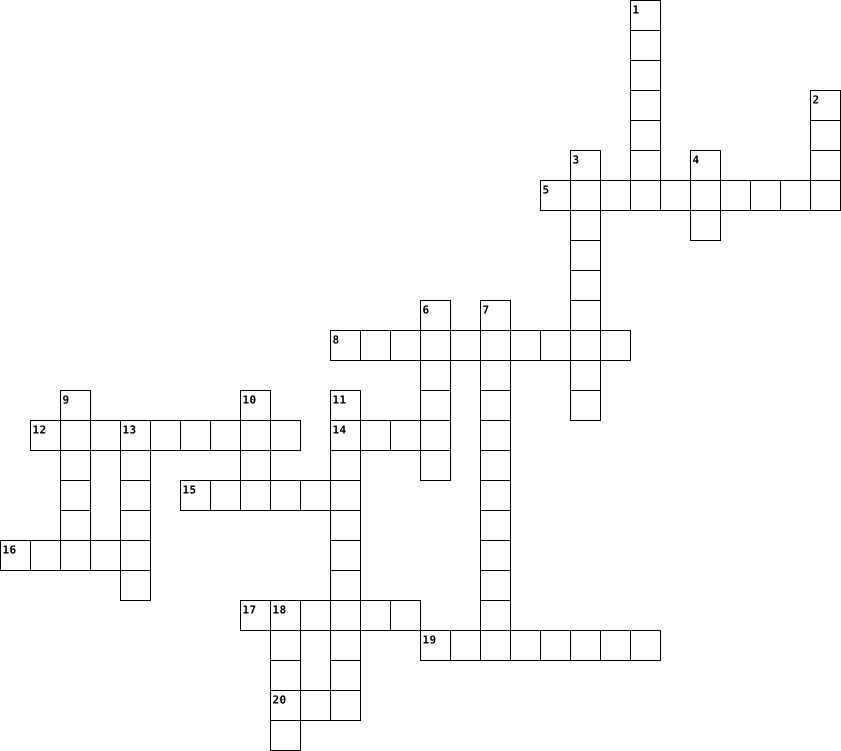
physics Crossword Puzzles
Physics 2021-09-09
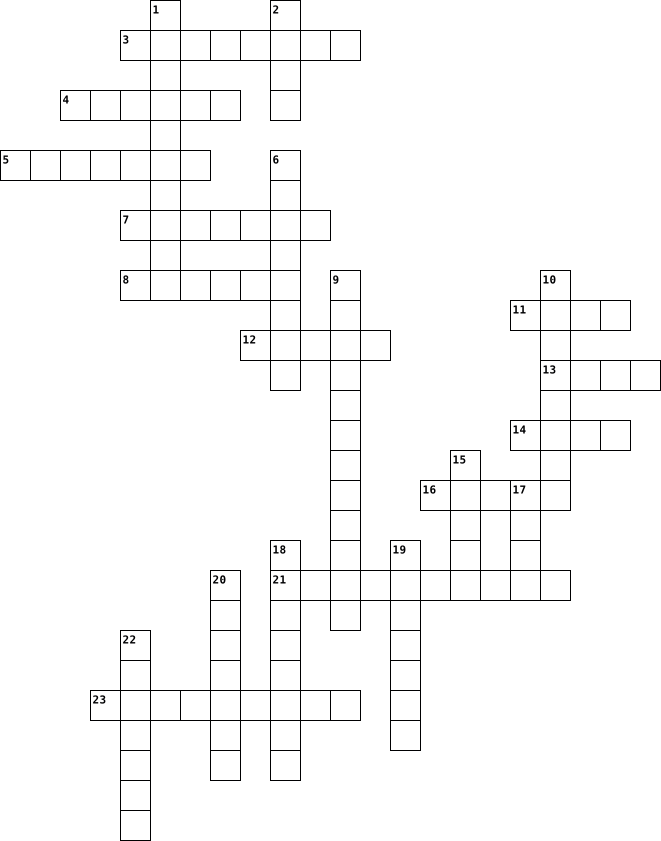
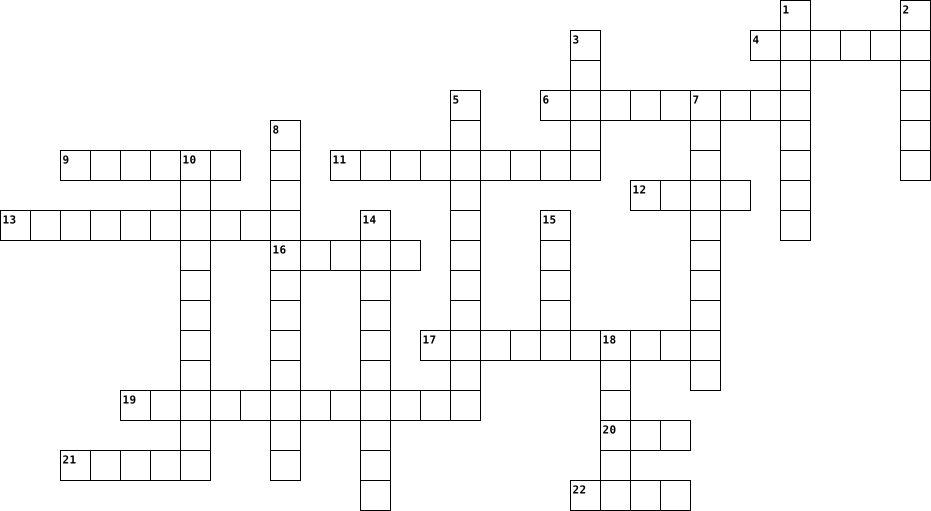
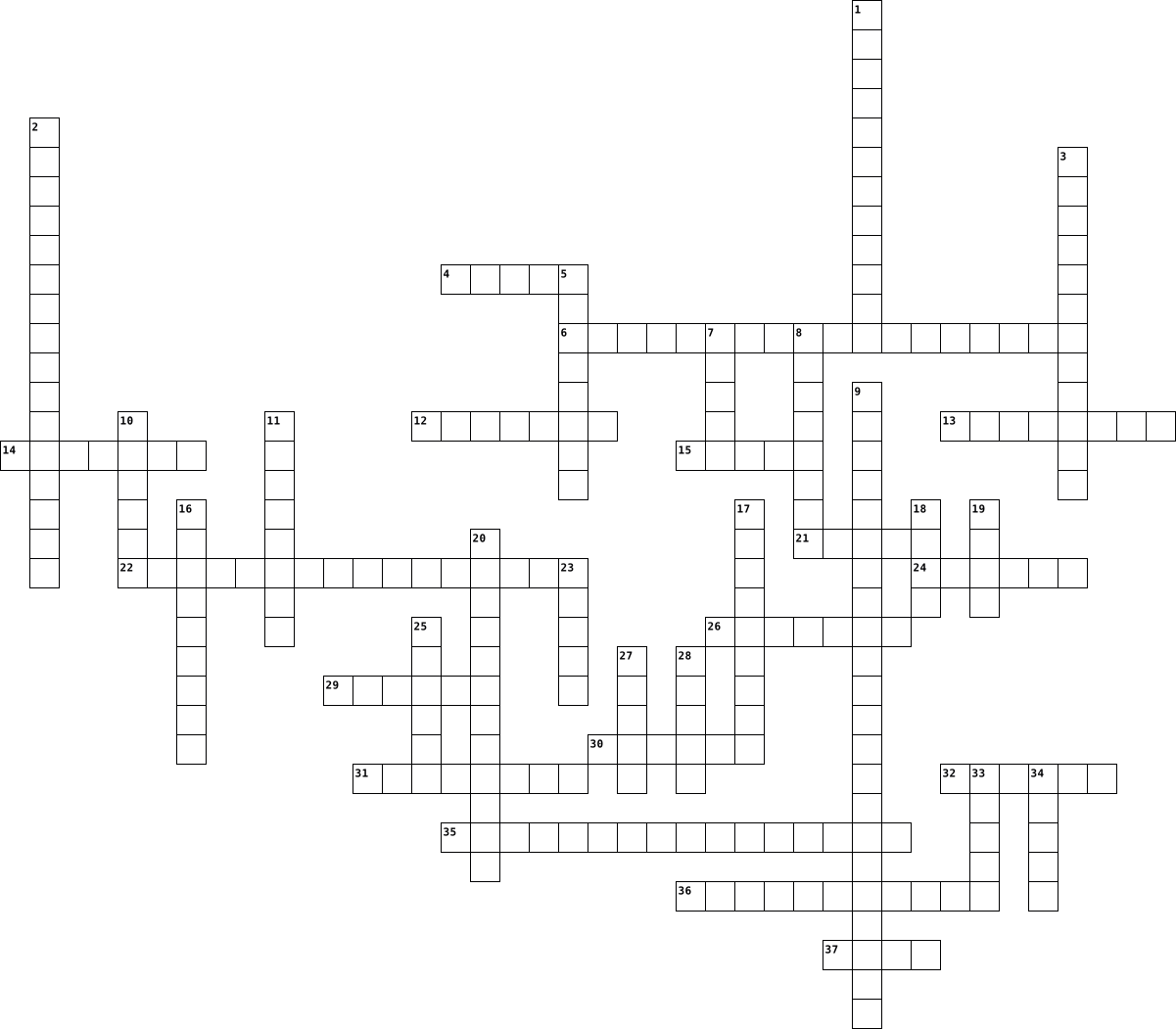
Across
- change in speed and/or direction
- object changes its position over time
- a force that pulls on other materials
- changes to the object's speed or direction
- force acting on an object due to gravity
- force that causes an object to move from its state of rest
- push or pull
- resistance that a body of matter offers to a change in its speed or position
- a force which tends to slow the movement of an object
- describes the way a function changes
- a form of motion experienced by a launched object
- distance or quantity
Down
- opposition offered by one thing to another
- the density of an object is greater than the density of that liquid
- force resisting the relative motion of material elements
- the rate at which an object changed its velocity
- the volume of the fluid displaced is equal to the volume of the object
- when the weight force on the object is balanced by the upward push on the object
- the force of brining an object closer
- an upward force exerted by a fluid
- absolute unit of force
- forces and interactions
- universal force of attraction
23 Clues: push or pull • distance or quantity • absolute unit of force • forces and interactions • universal force of attraction • change in speed and/or direction • an upward force exerted by a fluid • describes the way a function changes • object changes its position over time • a force that pulls on other materials • the force of brining an object closer • ...
Physics 2021-05-23
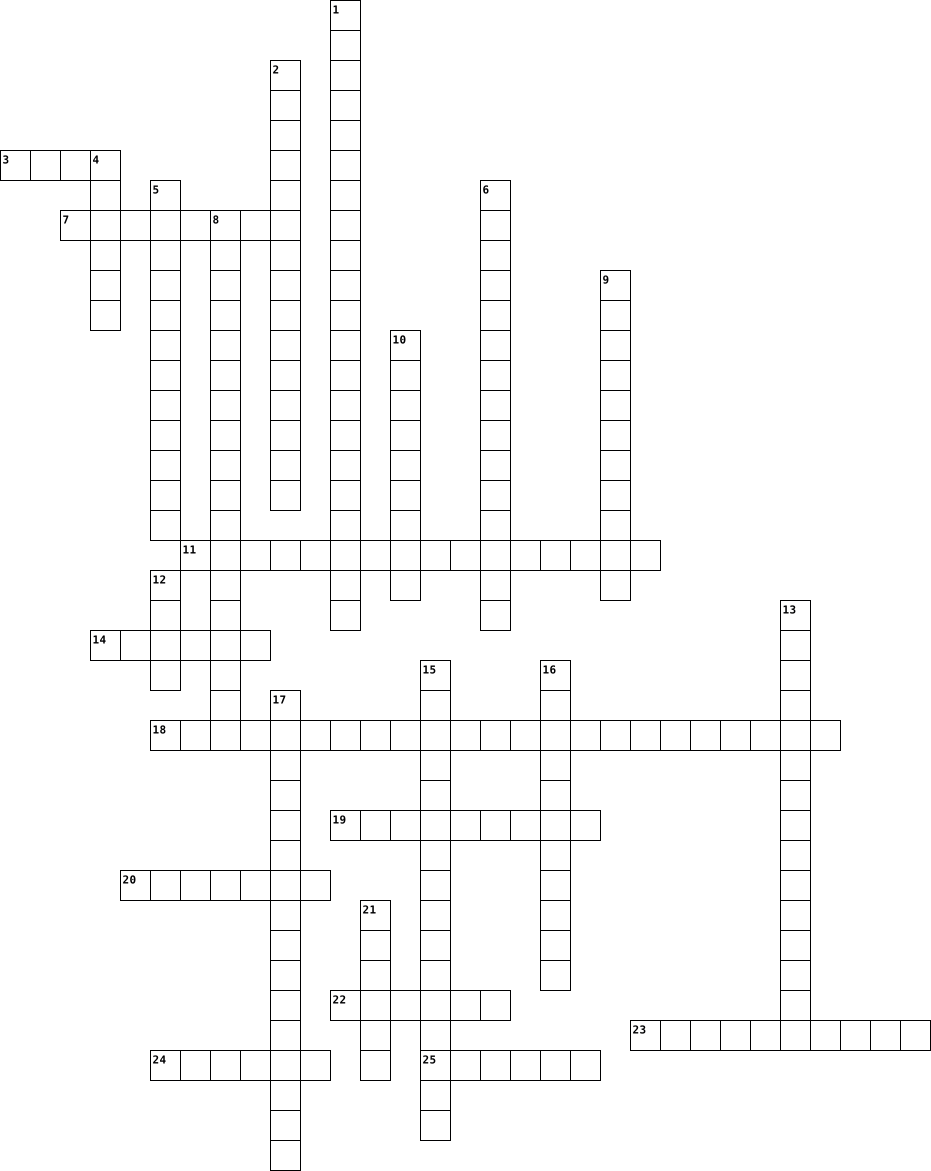
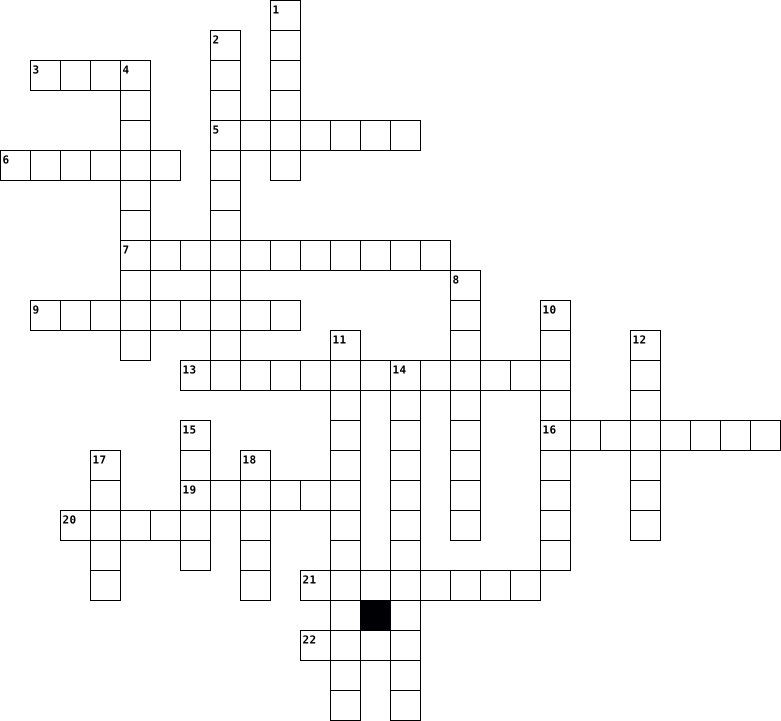
Across
- the quantity of matter in a substance,measured in kilograms
- the force between opposes one sliding on the other
- a collision that conserves initial kinetic energy
- a reaction force that pushes a body forward in response to a backward force
- the acceleration of an object moving in a circle, toward the center
- the only force acting on an object is the force due to gravity
- the pulling force that acts along a stretched flexible connector
- ratio of force to area
- electromagnetic waves with wavelength in the range
- the ability to do work
- turning or twisting effectiveness of a force
Down
- the motion of an object to a circular path at constant speed
- a body at rest , will remain at rest
- change in length to an original length
- the rate at what objects velocity changes over a period of time
- there’s always an equal and opposite reaction
- a collision in which internal kinetic energy is not conserved
- change in shape due to application of force
- the number of complete wave cycles passing a a given point within one second
- the transfer of energy by a force that causes an object to be displaced
- force to be equal in change of momentum
- The difference between the final and initial momentum
- movement back and forth at regular speed
- a sketch showing all the external forces acting on an object or system
- defined by boundaries of an object or collection of objects being observed
25 Clues: ratio of force to area • the ability to do work • a body at rest , will remain at rest • change in length to an original length • force to be equal in change of momentum • movement back and forth at regular speed • change in shape due to application of force • turning or twisting effectiveness of a force • there’s always an equal and opposite reaction • ...
Physics 2021-10-14
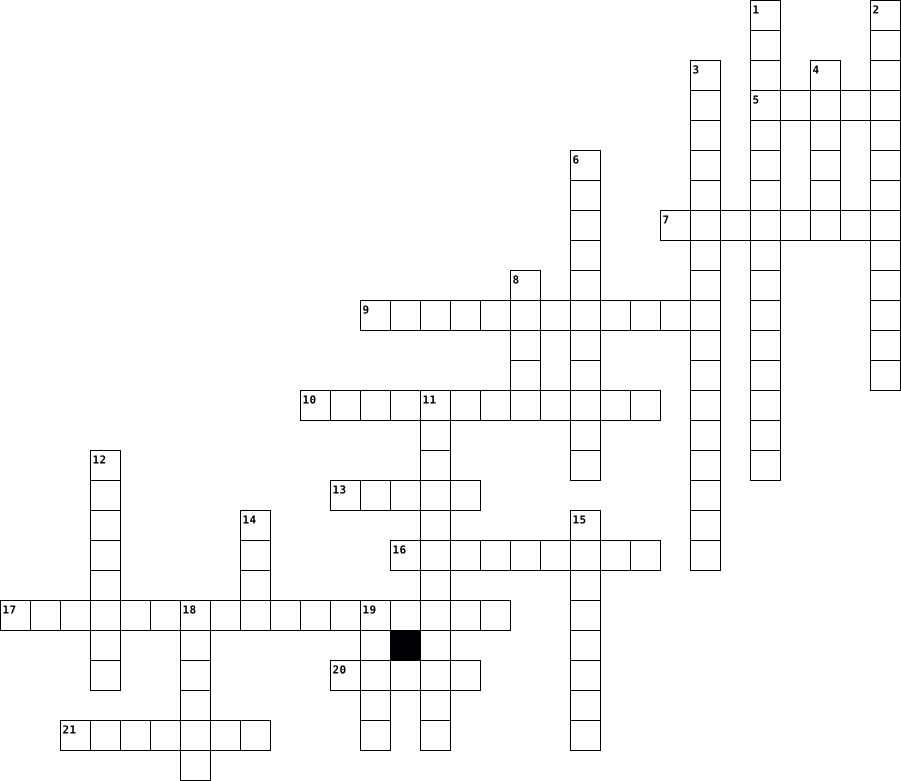
Across
- The steepness of a line on a graph.
- How far an object moved during a problem.
- The shortest distance between an object's initial position and final position magnitude and direction.
- Total distance an object travels divided by the total time it takes to travel that distance.
- Distance an object travels per unit of time.
- The variable that is measured in the experiment.
- A graph of an object's motion that shows how its position depends on time.
- The vertical axis where the dependent variable is plotted.
- The science of matter, motion, and energy.
Down
- Velocity that does not change during a specific time interval.
- A line on a graph or scatter plot showing the general shape that a group of points seem to be trending.
- A graph of an object's motion that shows how its velocity depends on time.
- The state in which one objects distance from another is changing.
- the variable that is controlled in the experiment
- The horizontal axis where the independent variable is plotted.
- Rate of change of velocity
- The separation between an object and a reference point.
- the label given for a measurement
- The speed and direction of a moving object, can change with change in speed and/or direction.
- The starting/fixed point on a graph.
- A visual way to represent data
21 Clues: Rate of change of velocity • A visual way to represent data • the label given for a measurement • The steepness of a line on a graph. • The starting/fixed point on a graph. • How far an object moved during a problem. • The science of matter, motion, and energy. • Distance an object travels per unit of time. • The variable that is measured in the experiment. • ...
physics 2022-05-02
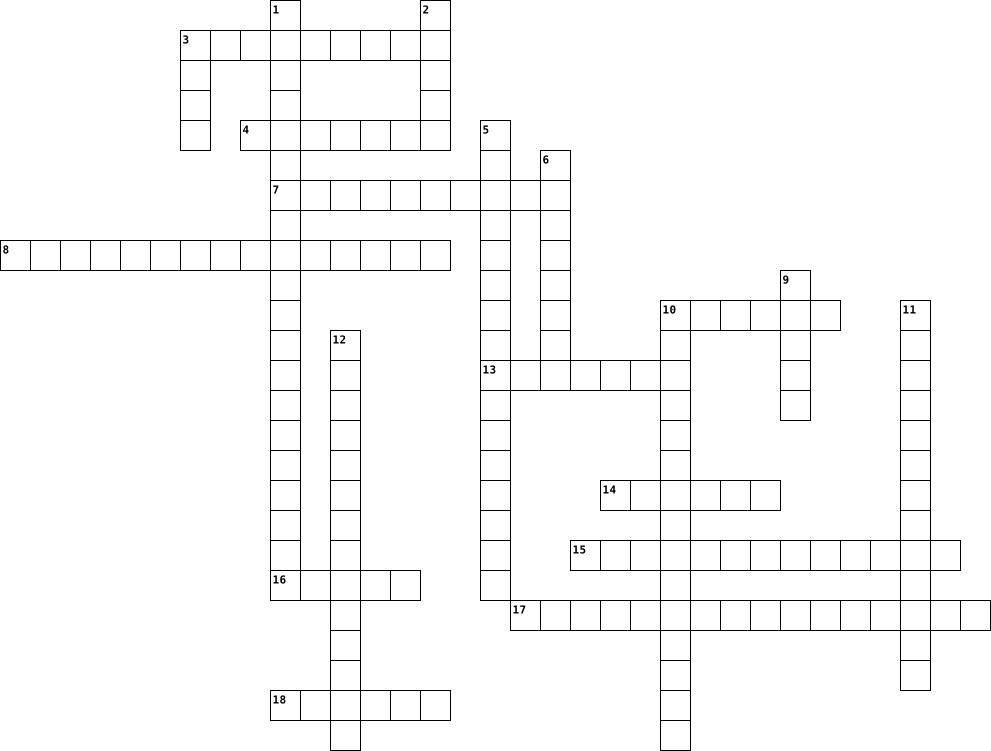
Across
- made of two circular or cylinder objects fastened together
- to make work easier
- force to get machines to work
- machine made of more than one simple machine
- made of a grooved wheel with a rope or cube wrapped around it
- allows electricity to flow through one point to another
- make or break connections in circuits
- sloped surface
- an inclined plane wrapped around a cylinder
- amount of work something can do due to its potential and kinetic energy
- the force put on an object by a machine
Down
- measure the force achieved by using a tool
- devise that is thick at one end and goes to a thin edge at the other side
- force put onto an object to cause it to move
- a circuit contains more than one path for energy to flow through
- a device that resists the flow of electrical current
- bar that is free to move around a fixed point
- stored energy
- energy of motion
- a circuit contains only one path for energy to flow
20 Clues: stored energy • sloped surface • energy of motion • to make work easier • force to get machines to work • make or break connections in circuits • the force put on an object by a machine • measure the force achieved by using a tool • an inclined plane wrapped around a cylinder • force put onto an object to cause it to move • machine made of more than one simple machine • ...
Physics 2022-05-19
Across
- the force that pulls objects towards each other
- constituting the core or central part
- the distance an object travels per unit of time
- push or pull on an object
- produced by reactions involving atomic or molecular changes
- the state in which one objects distance from another is changing
- the rate in which the velocity changes
- plains a flat surface which has a slope
- a linear interval of space
- the capacity of a physical system to do work
- energy the mechanical energy that a body has by virtue its position
- force equal force acting on an object in different directions
- an object in motion stays in motion
- force forces that produce a nonzero net force
Down
- velocity the maximum speed possible while free falling
- second law the acceleration of an object depends on the mass of the object and the amount of force applied
- the product of a body's mass and velocity
- third law for every action there is an equal opposite reaction
- quantity of matter
- the force between two rubbing surfaces
- the amount of energy transferred or converted
- a speed in any direction
- fall when the only force acted on an object is gravity
- energy the mechanical energy that a body has by virtue of its motion
- friction friction which keeps things still
- mechanical vibrations transmitted by an elastic medium
- point A place used for comparison to determine if something is in motion
- of conservation of energy the law that states that energy cannot be created nor destroyed but can be changed from one form to another
- force the overall force on an object
29 Clues: quantity of matter • a speed in any direction • push or pull on an object • a linear interval of space • an object in motion stays in motion • force the overall force on an object • constituting the core or central part • the force between two rubbing surfaces • the rate in which the velocity changes • plains a flat surface which has a slope • ...
Physics 2022-05-19
Across
- the force that pulls objects towards each other
- constituting the core or central part
- the distance an object travels per unit of time
- push or pull on an object
- produced by reactions involving atomic or molecular changes
- the state in which one objects distance from another is changing
- the rate in which the velocity changes
- plains a flat surface which has a slope
- a linear interval of space
- the capacity of a physical system to do work
- energy the mechanical energy that a body has by virtue its position
- force equal force acting on an object in different directions
- an object in motion stays in motion
- force forces that produce a nonzero net force
Down
- velocity the maximum speed possible while free falling
- second law the acceleration of an object depends on the mass of the object and the amount of force applied
- the product of a body's mass and velocity
- third law for every action there is an equal opposite reaction
- quantity of matter
- the force between two rubbing surfaces
- the amount of energy transferred or converted
- a speed in any direction
- fall when the only force acted on an object is gravity
- energy the mechanical energy that a body has by virtue of its motion
- friction friction which keeps things still
- mechanical vibrations transmitted by an elastic medium
- point A place used for comparison to determine if something is in motion
- of conservation of energy the law that states that energy cannot be created nor destroyed but can be changed from one form to another
- force the overall force on an object
29 Clues: quantity of matter • a speed in any direction • push or pull on an object • a linear interval of space • an object in motion stays in motion • force the overall force on an object • constituting the core or central part • the force between two rubbing surfaces • the rate in which the velocity changes • plains a flat surface which has a slope • ...
Physics 2022-05-31
Across
- The height or depth of a wave from the horizontal center, which affects the loudness of sounds.
- A type of wave where the energy is transferred in the same direction that the wave is
- The energy stored in a moving object.
- The energy stored in the nucleus of an atom.
- We can detect _________ using our ears.
- A flow of electricity.
- How sound is transmitted.
- The higher the temperature, the more energy there is in this store.
- Energy is transferred in this way when a force makes something move.
- The transfer of energy in the form of waves.
- The energy stored in the bonds of a substance or group of substances.
- A _________is a push or a pull that acts on an object due to the interaction with another object.
- State of matter that transmits sound that fastest.
- Unit of measurement for frequency.
- Reflected sound waves that we hear.
- The energy stored when repelling poles have been pushed closer together or when attracting poles have been pulled further apart.
Down
- The potential energy stored in an object when it is lifted to a height.
- Sound waves with a very high frequency, which are used by animals and in medicine.
- A form of energy resulting from the existence of charged particles.
- __________is a disturbance or variation that transfers energy progressively from point to point.
- A device that stores electrical energy as a chemical. Two or more cells joined together form a __________.
- Electrical components, like motors and lamps, can be connected together to form a _________.
- The number of waves passing a given point each second.
- The energy stored when repelling charges have been pushed closer together or when attracting charges have been pulled further apart.
- When a wave bounces off a surface.
- An object that is being stretched experiences a __________force.
- _____________is the force applied perpendicular to the surface of an object per unit area over which that force is distributed.
- How high or low the sound is.
- The change in direction of a wave as it moves through a surface at different speeds.
- The transfer of energy as a result of a temperature difference between two objects This transfer happens by conduction or convection.
30 Clues: A flow of electricity. • How sound is transmitted. • How high or low the sound is. • When a wave bounces off a surface. • Unit of measurement for frequency. • Reflected sound waves that we hear. • The energy stored in a moving object. • We can detect _________ using our ears. • The energy stored in the nucleus of an atom. • The transfer of energy in the form of waves. • ...
PHYSICS 2022-11-08
Across
- how fast an object is moving
- defined in terms of the Avogadro constant
- all objects have mass and if they are moving
- unit of force and weight
- defined in terms of the Boltzmann constant
- a physical quantity that has only a magnitude
- force that acts opposes the relative motion of two surfaces
- rate at which an object changes its velocity
- how far out of place an object is
- negative acceleration
- strength use in physical action
- path taken up by a moving object that is following through space as a function of time
- fundamental interaction which causes mutual attraction between all things with mass or energy
- the motion travelling into the air or being thrown along the earth’s surface.
- form of energy that an object or a particle has by reason of its motion
- can be derived from the equation of Law of Acceleration
- branch of science that deals with the structure of matter
Down
- states how well repeated measurements of something generate the same or similar results
- rate of doing work
- quantities which have a size and a direction
- stored energy in any object
- process of moving or of changing place
- how close a measurement is to the correct value for that
- force that holds the universe together
- defined in terms of the elementary charge
- defined in terms of the Planck constant
- uncertain disturbances occur in the experiment
- ability to do work
- the distance covered by an object in unit time
- the complete path travelled by an object
30 Clues: rate of doing work • ability to do work • negative acceleration • unit of force and weight • stored energy in any object • how fast an object is moving • strength use in physical action • how far out of place an object is • process of moving or of changing place • force that holds the universe together • defined in terms of the Planck constant • ...
PHYSICS 2017-12-25
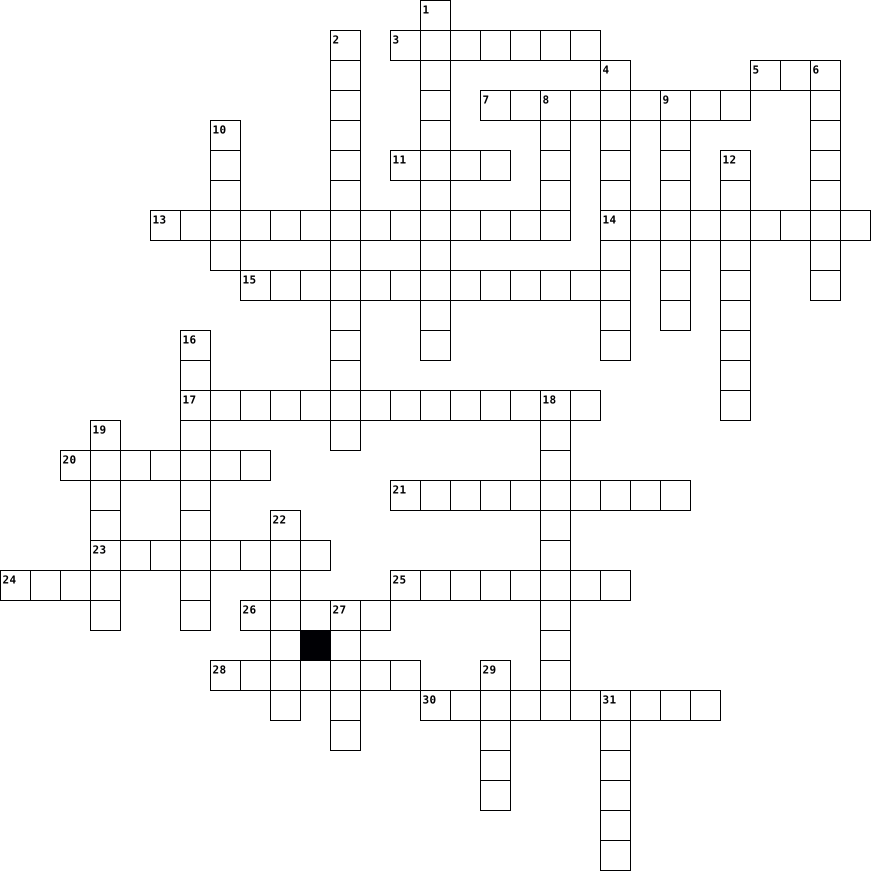
Across
- An attribute of things that result from the light they reflect, transmit or emit in so far as this light causes a visual sensation that depends on its wavelenght.
- Reflection of waves or particles from a surface such that the incident rays on the surface are scattered at many angles rather than at just one angle
- A substance that makes possible the transfer of energy from one location to another, especially through waves
- Imaginary surface representing corresponding points of a wave that vibrates in unison.
- The distance travelled by a wave in a specified context.
- The way in which the energy of a photon is taken up by matter, typically by the electrons of an atom, transforming that into internal energy.
- It's the magnitude, thus a scalar quantity, of the rate of change of an object's position.
- It's a phenomenon that causes the separation of a wave into spectral components with different wavelengths, due to the dependence of the wave speed from the wavelength in the crossed medium. An example happens with the prism, in which visible light is separated into its different colours.
- A state, or the production of a state, in which rays of light or similar radiation exhibit different properties in different directions.
- In optics, it is an idealized model of light, obtained by choosing a line that is perpendicular to the wavefronts of the actual light, and that points in the direction of energy flow.
- The electromagnetic radiation within a certain portion of the electromagnetic spectrum.
- It's a piece of transparent material that refracts light rays in such a way as to form an image. Lenses can be thought of as a series of tiny refracting prisms, each of which refracts light to produce their own image, and when they act together, they produce a bright image focused at a point.
Down
- Line that marks the limits or edges of something and separates it from other things or places. So it is a dividing line between mediums.
- The point on the medium that exhibits the maximum amount of negative or downward displacement from the rest position.
- A change in the observed frequency of a wave.
- The process by which a beam of light or another system of waves is spread out as a result of passing through a slit of similar linear dimensions to the wavelength of the incident wave, typically accompanied by interference between the wave forms produced.
- The process by which a beam of light or another system of waves is forced to deviate from a straight trajectory by one or more paths due to localized non-uniformities in the medium through which they pass.
- It is when light waves move all the way through a material without being absorbed, this happens with transparent materials, which do not absorb the photon, so the light is able to pass straight through.
- An electromagnetic radiation that in the Electromagnetic spectrum is situated in between visible light and X-rays. It has frequencies of about 8 × 10 to the power of 14 to 3 × 10 to the power of 16 hertz (Hz), and wavelengths from 10 to about 380 nm.
- It's the change of direction of a ray or a wave after bumping into a barrier or a surface.
- The position of a point in time on a waveform cycle; we can also state that two waves are "in-phase" if their interference is totally constructive, on the contrary, if two waves are "out-of-phase", their interference is destructive.
- A natural or artificial process that emits a visible electromagnetic radiation.
22 Clues: A change in the observed frequency of a wave. • The distance travelled by a wave in a specified context. • A natural or artificial process that emits a visible electromagnetic radiation. • Imaginary surface representing corresponding points of a wave that vibrates in unison. • ...
Physics 2017-10-25
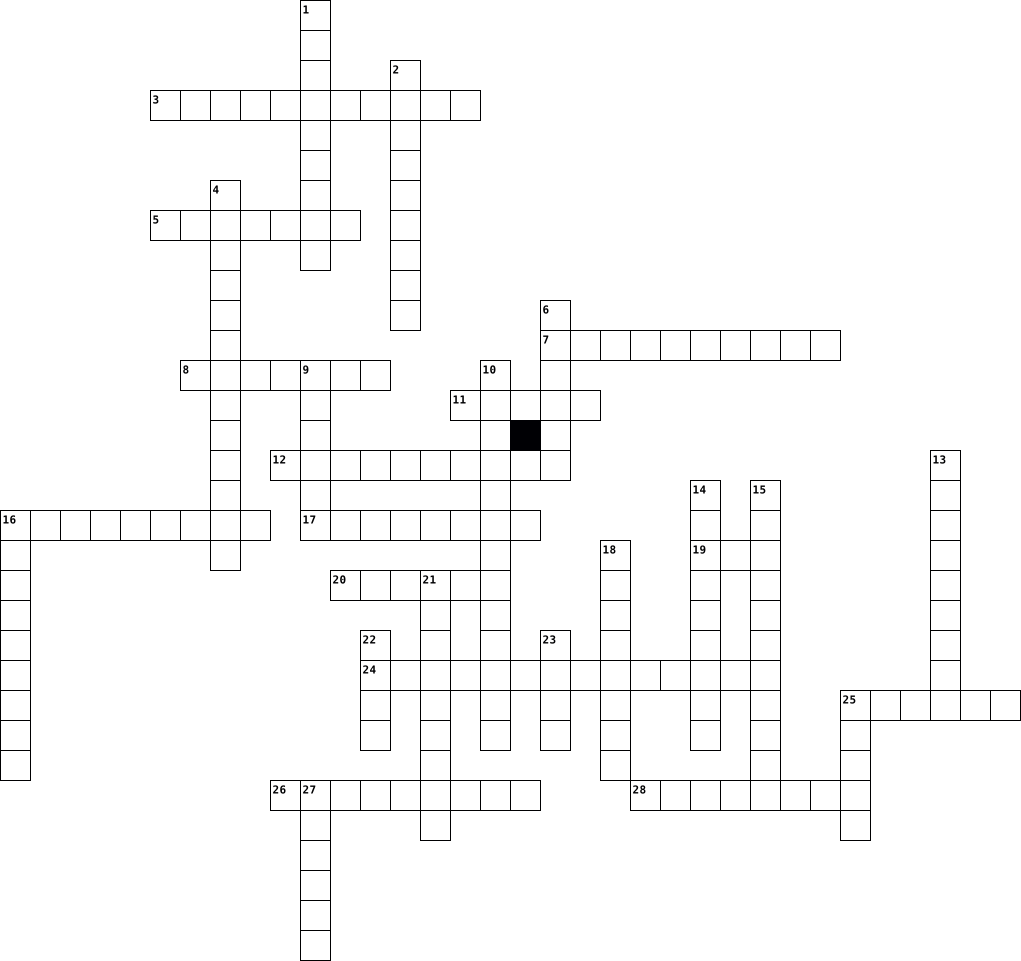
Across
- Product of work and displacement
- Kinetic energy is conserved
- It is a lever that rotates in a fixed point
- Energy from ocean tides and tidal currents
- Amount of consistency of independent measurements
- Makes work necessary in allowing the heavy objects to be pushed
- How closed a measured value to a true or accepted value is
- Physical quantity that has both magnitude and direction
- When it moves through an object it cuts or forces the object to seperate
- Mass in motion
- Work is also equals to power and?
Down
- Physical quantity that has only magnitude
- When an object slows down
- Study of motion
- When two objects strike together
- Kinetic energy is not conserved
- When both velocity and direction remains the same
- Force x Time =
- Change in position
- A steel bar that rotates at a fixed point
- Change in distance per unit change in time
- Described as an incilined plane
22 Clues: Force x Time = • Mass in motion • Study of motion • Change in position • When an object slows down • Kinetic energy is conserved • Kinetic energy is not conserved • Described as an incilined plane • Product of work and displacement • When two objects strike together • Work is also equals to power and? • Physical quantity that has only magnitude • ...
physics 2018-10-26
Across
- / elektron membawa muatan
- / tegangan dari suatu sumber tegangan sebelum mengalirkan arus
- / alat yang digunakan untuk mengukur tegangan listrik
- / energi yang dilepaskan muatan listrik tiap satuan waktu
- suatu alat untuk mengubah tegangan AC tanpa kehilangan daya yang cukup besar
- / medan listrik arahnya ... muatan negatif
- / tegangan dari suatu sumber tegangan setelah mengalirkan arus
- / ggl yang terjadi dalam suatu penghantar itu dan terjadi perubahan kuat arus 1 A tiap sekon
- / gaya tarik atau gaya tolak antara 2 muatan listik disebut dengan gaya
- 1 cincin yang terbelah di tengahnya pada generator DC
- kawat yang dililitkan pada inti yang berbentuk lingkaran
- / hambatan dapat dirangkai secara pararel dan
- / medan listrik arahnya ... muatan positif
- / "jumlah garis gaya dari suaru medan listrik yang menembus suatu permukaan tertutup sebanding dengan jumlah muatan listrik yang dilingkupi oleh permukaaan tertutup" adalah bunyi dari hukum
- menaikan tegangan bolak balik sumber
- kawat panjang yang dililitkan pada inti yang berbentuk silinder
Down
- bila muatan q negatif maka arah v ... dengan I
- magnet yang timbul pada suatu penghantar saat dialiri arus listrik
- / alat yang digunakan untuk mengukur kuar arus listrik
- suatu penghantar berarus listrik ysng berada dalam medan magnet akan mengalami gaya ...
- "aurs induksi akan muncul di dalam arah yang sedemikian rupa sehingga arah tersebut menentang perubahan yang dihasilkan
- / I x R
- magnet / ruang di sekitar sebuah manet
- menurunkan tegangan bolak balik sumber
- arus dan tegangan AC dapat diukur dengan
- / Q/A
- / proton membawa muatan
- / voltmeter harus dipasang ... dengan komponen listrik yang akan diukur tegangannya
- / hambatan yang dipasang pararel dengan ampremeter untuk memperbesar batas ukurnya
- / garis gaya dari suatu medan listrik homogen yang menembus tegak lurus bidang dengan luas tertentu
- efisiensi transformator sama dengan 100%
31 Clues: / Q/A • / I x R • / proton membawa muatan • / elektron membawa muatan • menaikan tegangan bolak balik sumber • menurunkan tegangan bolak balik sumber • magnet / ruang di sekitar sebuah manet • arus dan tegangan AC dapat diukur dengan • efisiensi transformator sama dengan 100% • / medan listrik arahnya ... muatan negatif • / medan listrik arahnya ... muatan positif • ...
physics 2023-05-18
Across
- The bending of a wave around the edges of an opening or an obstacle.
- A subatomic particle of about the same mass as a proton but without an electric charge, present in all atomic nuclei except those of ordinary hydrogen.
- A phenomenon that occurs when a wave changes direction as a result of a change in the wave speed at different points along a wave front.
- an electromotive force or potential difference expressed by volts.
- the SI unit of frequency, equal to one cycle per second.
- A phenomenon that occurs when a wave or object bounces off an interface or another object
- a substance which does not readily allow the passage of heat or sound.
- the production and discharge of something, especially gas or radiation.
- the SI unit of electrical resistance, expressing the resistance in a circuit transmitting a current of one ampere when subjected to a potential difference of one volt.
- The time it takes for a particle or physical quantity to move through one cycle of oscillation in a wave.
- the study of stationary electric charges or fields as opposed to electric currents.
- The property of matter that is responsible for electrical phenomena, existing in a positive or negative form.
- The Maximum distance a particle moves from its starting point in a wave
- the attribute of a sound that determines the magnitude of the auditory sensation produced and that primarily depends on the amplitude of the sound wave involved
Down
- a device used to store an electric charge, consisting of one or more pairs of conductors separated by an insulator.
- an instance of vibrating.
- The principle that rock layers form one on top of another, with the youngest layers towards the top
- a stable subatomic particle occuring in all atomic nuclei with a positive electric charge equal in magnitude to that of an electron, but of opposite sign.
- The SI base unit of electrical current.
- a solid substance that has a conductivity between that of an insulator and that of most metals, either due to the addition of the impurity or because of the temperature effects.\
- a material or device that conducts or transmits heat, electricity, or sound, especially when regarded in terms of its capacity to do this.
- connect (an electrical charge) with the ground.
- the action of compressing or being compressed.
- the production of an electric or magnetic state by the proximity( without contact) of an electrified or magnetized body.
- a stable subatomic particle with a charge of negative electricity, found in all atoms and acting as the primary carrier of electricity in solids.
- A measure of light power per unit area
- the highest point above the rest position
- the SI unit of electromotive force, the difference of potential that would drive ampere of current against one ohm of resistance.
- The highest surface part of a wave
- The type of matter through which a wave’s energy propagates
30 Clues: an instance of vibrating. • The highest surface part of a wave • A measure of light power per unit area • The SI base unit of electrical current. • the highest point above the rest position • the action of compressing or being compressed. • connect (an electrical charge) with the ground. • the SI unit of frequency, equal to one cycle per second. • ...
Physics 2023-05-22
Across
- produced at locations where destructive interference occurs.
- combination of two waves moving in opposite directions, each having the same amplitude and frequency
- The angle between the wave propagation direction and the normal to the coastline
- when a wave reflects off a plane surface, the angle of incidence is equal to the angle of reflection
- change in frequency of a wave in relation to an observer moving relative to the wave source.
- property of transverse waves which specifies the geometrical orientation of the oscillations.
- occurs when waves come together so that they completely cancel each other out.
- a wave with a repeating continuous pattern which determines its wavelength and frequency
- a description of the frequency of the sound.
- a value calculated from the ratio of the speed of light in a vacuum.
- the lowest point in a wave length
- a completed period in a wave
- the area of a wave that is spread out.
- an increase or decrease in the frequency of sound, light, or other waves as the source and observer move toward each other.
- a single disturbance that moves through a transmission medium
- the number of waves that pass a fixed point in unit time
- observed when a wave is not confined to a given space along the medium.
- the substance that carries a wave or disturbance from one location to another
- a relationship between the path taken by a ray of light in crossing the boundary
- the ray of light falling on the surface
- lght that has the same wavelength so it is one color
- The angle between the reflected ray and the normal
- when two waves meet while traveling along the same medium.
Down
- A standing wave pattern always consists of an alternating patter
- a wave vibrating at right angles to the direction of its propagation.
- wave movement
- When two objects vibrate with different frequencies
- When the peaks of the waves line up
- the vibration is parallel to the direction of motion
- when the matching vibrations of another object increase the amplitude of an object's oscillations.
- the entire distribution of electromagnetic radiation according to frequency
- the distance between successive crests of a wave, especially points in a sound wave
- the time for a particle on a medium to make one complete vibrational cycle.
- The highest surface part of a wave
- the repetitive or periodic variation
- reflection of light or other waves or particles from a surface such that a ray incident on the surface is scattered at many angles
- the maximum displacement or distance moved by a point on a vibrating body or wave measured from its equilibrium position.
- a wave vibrating in the direction of propagation.
- A form of radiant energy that is thrown back from a nonpermeable or nonabsorbing surface
- reflection such that the angle of reflection of the light is equal to the angle of incidence and on the opposite side
- the change in direction of a wave passing from one medium to another
- a wave that is an oscillation of matter, and therefore transfers energy through a medium.
- abrupt change in the direction of propagation of a wave that strikes the boundary between different mediums.
- the spreading of waves around obstacles
44 Clues: wave movement • a completed period in a wave • the lowest point in a wave length • The highest surface part of a wave • When the peaks of the waves line up • the repetitive or periodic variation • the area of a wave that is spread out. • the spreading of waves around obstacles • the ray of light falling on the surface • a description of the frequency of the sound. • ...
Physics 2023-06-05
Across
- is the same
- pressure on a...
- Candela is...
- Kilogram is...
- exerts pressure on the walls of a container
- Ampere is...
- Magnets can...
- Constant...
- Combination of base units
- Pound is an example of...
- slope on a graph
- the increase in length is
- Scientific Person (gravity)
- F=mv/r is a....
Down
- can be able to change
- 1,000 grams equals...
- Mole is...
- Magnetic is a...
- Unbalanced forces will change the... of an object
- Accleration*Mass is...
- Subject the branch of science concerned with the nature and properties of matter and energy
- force of the Sum of zero
- quantify by measurement
- luminous intensity and electric current are...
- Not equal to zero
- T,e is...
- seconds is...
- equal and opposite reaction
- change or keep
- remains at rest
30 Clues: T,e is... • Mole is... • is the same • Constant... • Ampere is... • Candela is... • seconds is... • Kilogram is... • Magnets can... • change or keep • remains at rest • F=mv/r is a.... • pressure on a... • Magnetic is a... • slope on a graph • Not equal to zero • can be able to change • 1,000 grams equals... • Accleration*Mass is... • quantify by measurement • force of the Sum of zero • ...
Physics 2023-06-05
Across
- unit of mass
- measure of how close a measurement is to the true value of the quantity being measured.
- velocity is not changing in magnitude and in direction both.
- force acting on unit area of a surface.
- the difference of electrical potential between two points.
- fundamental interaction which causes mutual attraction between all things with mass or energy
- a variable (often denoted by x ) whose variation does not depend on that of another.
- interaction that occurs between particles with electric charge via electromagnetic fields.
- unit used to calculate the force
- empirical law which states that the force needed to extend or compress a spring by some distance scales
- the scientist who discovered gravity
- Getting faster
- the change in position of an object
- physical attributes that occur through a magnetic field, which allows objects to attract or repel each other.
Down
- the basic photometric value, expressing the capacity of a point light source to provide illumination in a given direction.
- the to and fro motion of an object from its mean position
- force transmitted through a rope, string or wire when pulled by forces acting from opposite sides.
- significant figures in a measurement include all of the digits that are known, plus one last digit that is estimated.
- modern form of the metric system and the world's most widely used system of measurement
- measure of how close a series of measurements are to one another. A measure of how exact a measurement is.
- the scientist who discovered inertia
- unit of length
- force that is caused by air.
- how to calculate speed
- Electrostatic, Gravitational, Magnetic which does not require surface contact and may pass through space.
- pressure is the pressure of air around us.
- measure of energy transfer that occurs when an object is moved over a distance by an external force at least part of which is applied in the direction of the displacement.
- object’s speed in a given direction
28 Clues: unit of mass • unit of length • Getting faster • how to calculate speed • force that is caused by air. • unit used to calculate the force • object’s speed in a given direction • the change in position of an object • the scientist who discovered inertia • the scientist who discovered gravity • force acting on unit area of a surface. • pressure is the pressure of air around us. • ...
Physics 2023-06-09
Across
- Product of force and displacement
- Change of position over time
- Shortest distance from point A to B
- Opposing force from contact with an object
- Unit of energy
- Magnitude and direction
- Curved trajectory of an object
- Space between two intersecting lines
- Property that resists change in motion
- Magnitude only
- Change in momentum
Down
- force exerted per are
- Unit for force
- the rate of increase of speed
- Influences objects to move
- Study of sound waves
- Force that draws to the centre of mass
- Amount of matter in something
- Ability to do work
- a region containing no matter; free space
20 Clues: Unit for force • Unit of energy • Magnitude only • Ability to do work • Change in momentum • Study of sound waves • force exerted per are • Magnitude and direction • Influences objects to move • Change of position over time • the rate of increase of speed • Amount of matter in something • Curved trajectory of an object • Product of force and displacement • ...
physics 2023-05-31
Across
- - qüvvəni ölçən cihaz
- - elektrik cərəyanın keçirməyən maddələrə deyilir
- - bu fiziki kəmiyyətlərin həm istiqaməti həm də ədədi qiyməti var
- - elektrik yükü olmayan zərrəcik
- - cismin iş görmə qabiliyyəti adlanır
- - materiyanın növlərindən biri
- - kütlə vahidi olaraq götürülmüş bu cisim platin və iridium ərintisindən
- - problem sualın ehtimal olunan cavabı
- - atomdan elektron ayrılması və ya özünə əlavə elektron birləşdirməsi nəticəsində yaranan zərrəcik
Down
- - cisimlərin tarazlıq şərtlərini öyrənir
- - həcm vahidi
- - bu hadisənin latınca mənası yayılma deməkdir
- - trayektoriyanın uzunluğu
- - maddənin aqreqat hallarından biri
- - təcili ölçən cihaz
- - bir tam dövrə sərf olunan zaman
- - maddənin bu aqreqat halı formasını saxlamır amma həcmini saxlayır
- - zamanı ölçən cihaz
- - fizika sözünün mənası
- - sürətin zamana görə birinci tərtib törəməsi
20 Clues: - həcm vahidi • - təcili ölçən cihaz • - qüvvəni ölçən cihaz • - zamanı ölçən cihaz • - fizika sözünün mənası • - trayektoriyanın uzunluğu • - materiyanın növlərindən biri • - elektrik yükü olmayan zərrəcik • - bir tam dövrə sərf olunan zaman • - maddənin aqreqat hallarından biri • - cismin iş görmə qabiliyyəti adlanır • - problem sualın ehtimal olunan cavabı • ...
Physics 2023-08-14
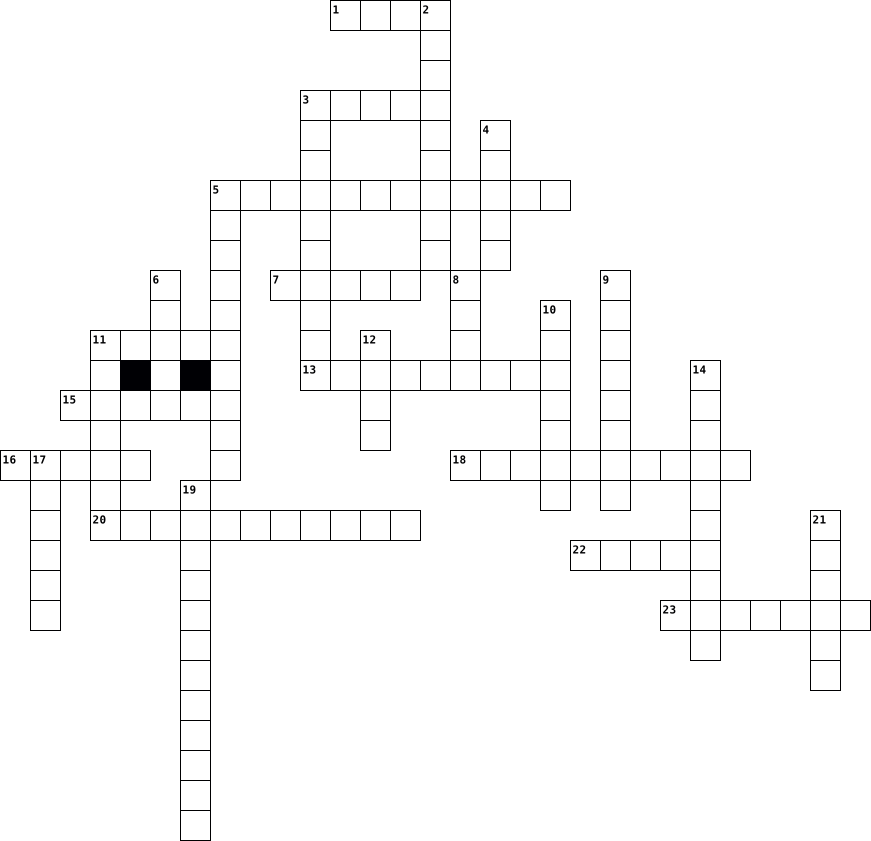
Across
- classes each day
- mathematical term for rise/run
- 9.8 m/s/s if the ________ of gravity
- your grade
- My name
- science class you will take next year
- ___________ Einstein
- an electric car company and the unit for measuring magnetism
- device needed for calculations
- Often called the "father of the atomic bomb". Movie premiered same day as Barbie
- 186,000 miles/sec if the speed of _________
- a fundamental force of attraction
Down
- FHS mascot
- ________ method
- Principal's name
- the opposite of matter
- Isaac Newton has this many laws of motion
- not weight but _______
- independent and dependent
- The study of matter, motion, energy and force
- _________Galilei
- least amount possible
- Most countries measure distance on a road in ____ instead of miles (1000 m)
- potential and kinetic
- the opposite of acceleration
- Isaac _________
26 Clues: My name • FHS mascot • your grade • ________ method • Isaac _________ • classes each day • Principal's name • _________Galilei • ___________ Einstein • least amount possible • potential and kinetic • the opposite of matter • not weight but _______ • independent and dependent • the opposite of acceleration • mathematical term for rise/run • device needed for calculations • ...
Physics 2023-12-15
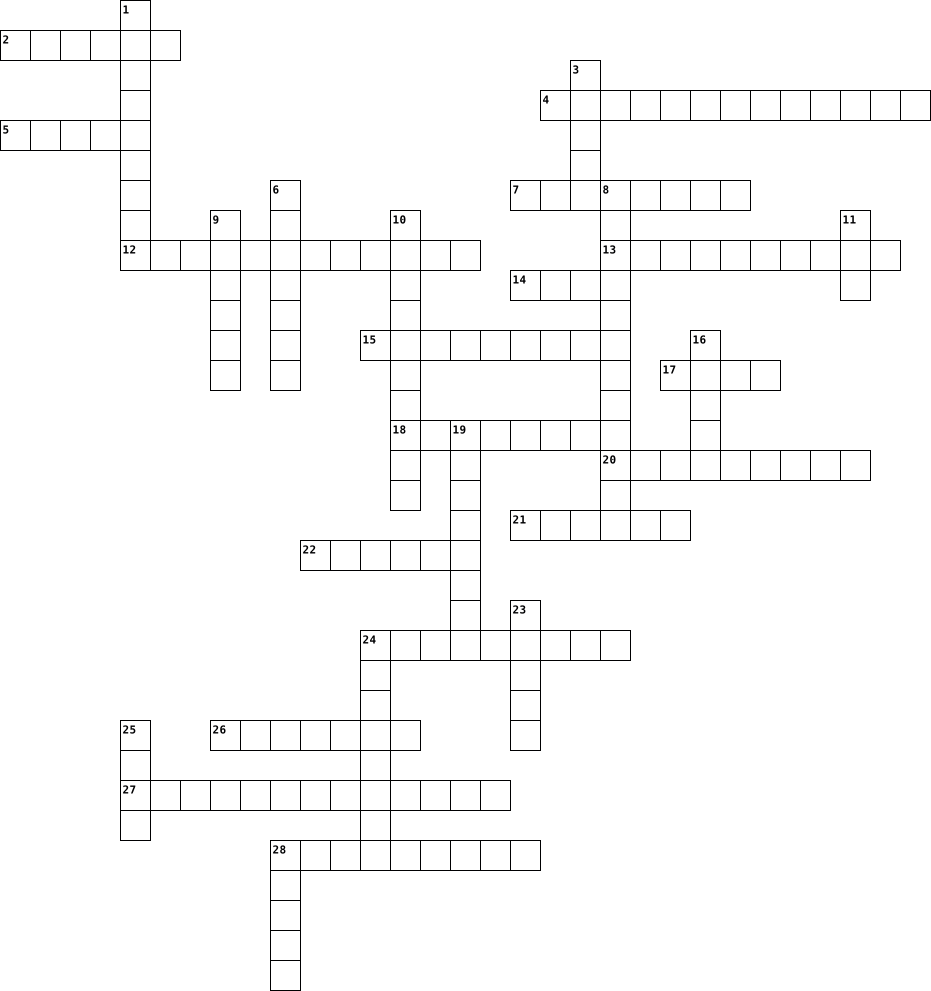
Across
- More generally, power is the rate of energy transfer by any ______.
- All energy, such as nuclear, chemical, internal, and electrical, that is not mechanical energy is classified as __________ energy.
- Work is not done on an object unless the object is moved with the action of a ____.
- Work is done only when components of a force are ______ to a displacement
- Work is done on an object when a force causes a __________ of the object
- Elastic potential energy depends on distance __________ or stretched
- power = work ÷ ____ interval
- the work you do on the car is equal to the ______ of the force
- the product of the component of a force along the direction of displacement and the magnitude of the displacement
- Although the amount of mechanical energy is ________, mechanical energy itself can change form.
- Machines with different power _____ do the same amount of work in different time intervals.
- The net work done on a body equals its ______ in kinetic energy
- Gravitational potential energy depends on ______ from a zero level
- the energy associated with an object because of the position, shape, or condition of the object
- the energy of an object that is due to the object’s motion
- potential energy the potential energy stored in the gravitational fields of interacting bodies
- elastic potential energy = 1/2 × spring constant × (distance compressed or ________)^2
Down
- Mechanical energy is not _______in the presence of friction
- a quantity that measures the rate at which work is done or energy is transformed
- potential energy that is stored in any compressed or stretched object
- Energy conservation occurs even when _________ varies
- The symbol k is called the ______ constant, or force constant.
- energy that the sum of kinetic energy and all forms of potential energy
- ___ work = change in kinetic energy
- Kinetic energy is a scalar quantity, and the SI unit for kinetic energy is the ____.
- Work is _______ when the force is in the direction opposite the displacement.
- Potential energy is ______energy
- Work is ______ when the component of force is in the same direction as the displacement.
- The ____ of work is important
- power = force × ______
30 Clues: power = force × ______ • power = work ÷ ____ interval • The ____ of work is important • Potential energy is ______energy • ___ work = change in kinetic energy • Energy conservation occurs even when _________ varies • the energy of an object that is due to the object’s motion • Mechanical energy is not _______in the presence of friction • ...
Physics 2023-12-05
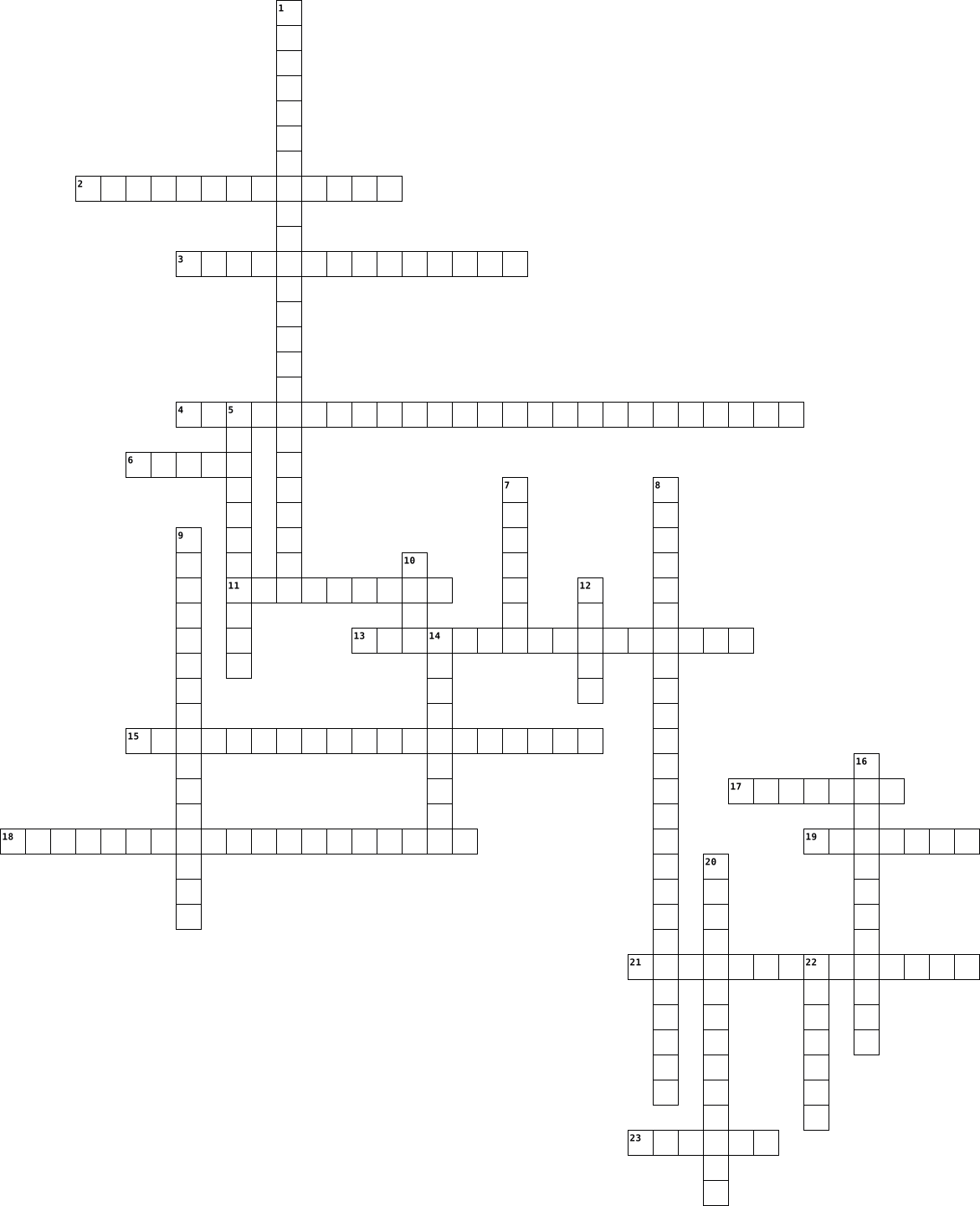
Across
- A law describing the electrostatic force of interaction between charged particles based on the strength of the charges and the distance between the particles.
- A region around a charged particle or object within which a force would be exerted on other charged particles or objects.
- The production of electric potential difference across a conductor as the conductor moves through a magnetic field.
- An interaction between an object and another object or a field that acts to change the motion of the object.
- A material that allows electrons to flow freely from particle to particle.
- A force that acts to move objects closer together.
- The region of space surrounding a body in which another body experiences a force of gravitational attraction.
- A closed loop of conductors through which an electric current can flow.
- An electric current that reverses its direction many times a second at regular intervals.
- The difference in electric potential between two points.
- An electric current flowing in only one direction.
- The SI unit of measurement for electric current.
Down
- An attraction related to the relative charge of an object.
- A physical phenomenon associated with the presence and movement of electric charge
- The flow of an electric charge through an object or medium.
- Energy in the form of oscillating electric and magnetic fields that is released in electromagnetic processes; characterized based on the frequency and wavelength of the oscillations as radio waves, microwaves, infrared radiation, visible light, ultraviolet radiation, X-rays, and gamma rays.
- The physical interaction between charged particles; one of the four fundamental interactions in nature.
- The SI unit for electromotive force, or the difference in potential that would drive one amp of current against one ohm of resistance.
- A physical condition existing in space that causes particles placed within the space to experience a force.
- The force that acts between bodies of like electric charge or magnetic polarity, tending to separate them
- Forces that act over a distance, such as gravity.
- The area around a magnet or moving electric charge that can exert a magnetic force.
- The SI unit of electric charge, equal to the quantity of electricity conveyed in one second by a current of one ampere.
23 Clues: The SI unit of measurement for electric current. • Forces that act over a distance, such as gravity. • A force that acts to move objects closer together. • An electric current flowing in only one direction. • The difference in electric potential between two points. • An attraction related to the relative charge of an object. • ...
Physics 2023-12-07
Across
- HOW FAR FROM WHERE YOU STARTED
- DEVELOPED THE THREE LAWS OF MOTION
- MEASURE OF GRAVITY
- AS FAST AS IT CAN FALL
- ROTATION IN THE MORNING
- WHAT YOU SAY IS NOT MOVING
- PUTS THINGS IN MOTION
- HOW FAR YOU WENT
- OVERLL SPEED
- THIS WILL SLOW ACCELERATION
Down
- SPEED WITH A DIRECTION
- SPEEDING UP
- A PROPERTY OF MATTER
- CHANGE IN POSITION
- DRAWS TOWARDS THE CENTER OF THE EARTH
- SPEED RIGHT NOW
- WHAT IS MOVING
- SLOWING DOWN
- FLAT LINE ON A DISTANCE TIME GRAPH
- DISTANCE DIVIDED BY TIME
- , MASS TIMES ACCERATION
- SPEED THAT DOESN'T CHANGE
22 Clues: SPEEDING UP • SLOWING DOWN • OVERLL SPEED • WHAT IS MOVING • SPEED RIGHT NOW • HOW FAR YOU WENT • CHANGE IN POSITION • MEASURE OF GRAVITY • A PROPERTY OF MATTER • PUTS THINGS IN MOTION • SPEED WITH A DIRECTION • AS FAST AS IT CAN FALL • , MASS TIMES ACCERATION • ROTATION IN THE MORNING • DISTANCE DIVIDED BY TIME • SPEED THAT DOESN'T CHANGE • WHAT YOU SAY IS NOT MOVING • THIS WILL SLOW ACCELERATION • ...
physics 2023-12-05
Across
- the unit of measuring energy
- the rate in which the the velocity changes
- The push or pull on an object
- an object in motion stays in motion
- the amount of possible energy
- the energy transferred to or from an object
- for every action there is an equal and opposite reaction
- unit of force
- ability to do work
- equal force acting on a object in different directions.
Down
- the force between two rubbing surfaces
- the rate at which work is done
- energy cannot be created or destroyed
- a speed in a direction
- the overall force an an object
- The acceleration of an object depends on the mass of the object and the amount of force applied
- an interaction that occurs between particles with electric charge
- the amount of energy that is created by motion
- the distance a object travels in a unit of time
- the force that pulls objects towards each other
20 Clues: unit of force • ability to do work • a speed in a direction • the unit of measuring energy • The push or pull on an object • the amount of possible energy • the rate at which work is done • the overall force an an object • an object in motion stays in motion • energy cannot be created or destroyed • the force between two rubbing surfaces • ...
Physics 2024-01-09
Across
- A name used to describe energy when it is stored in stretched or squashed things that can change back to their original shapes.
- A way if transferring energy by waves.
- A lever or other machine where the load moves further than the effort.
- To change speed
- A way of transferring energy by waves. They cannot travel through vacuum.
- A way of saying how much energy something wastes
- The weight or force on something.
- A fuel formed from the dead remains of organisms over millions of years.
- The turning effect of a force.
- A force that pushes things up in liquids and gases.
- Change shape.
- A simple machine consisting of a wheel that can turn on an axis with a rope running around it.
Down
- A way of transferring energy through the wires.
- Spread out.
- A point about which something turns. Another name for fulcrum
- A name used to describe energy stored when it is stored inside materials.
- How fast something is moving. Often measured in meters per second or kilometers per hour.
- In balance.
- The force put on something, especially a lever or other simple machine.
- A way of transferring energy from hot substance to cooler ones.
- The unit for the movement of a force.
- A way of describing steepness of a line on a graph in numbers.
- The difference between forces in two opposite directions.
- A force between two objects that are touching. It usually acts to slow things down or prevent movement.
- Another name for air resistance or water resistance
25 Clues: Spread out. • In balance. • Change shape. • To change speed • The turning effect of a force. • The weight or force on something. • The unit for the movement of a force. • A way if transferring energy by waves. • A way of transferring energy through the wires. • A way of saying how much energy something wastes • Another name for air resistance or water resistance • ...
Physics 2024-02-02
Across
- Magnitude with direction.
- The total amount traveled.
- Distance between start and end in a straight line.
- Study of motion.
- Rate of change of distance.
- Friction between an object and a fluid.
- Force of gravity acting on an objects mass.
- Force exerted by a surface that supports an object.
- An object's tendency to resist change to its status.
- Standard unit for work and energy.
Down
- Force between an object and surface that opposes motion.
- Standard unit for time.
- The standard unit for mass.
- Standard unit for distance.
- A number with magnitude only.
- The ability to do work.
- The rate of change of velocity.
- Force acting through a distance.
- The standard unit for force.
- Standard unit for electric current.
- Speed with direction.
21 Clues: Study of motion. • Speed with direction. • Standard unit for time. • The ability to do work. • Magnitude with direction. • The total amount traveled. • The standard unit for mass. • Standard unit for distance. • Rate of change of distance. • The standard unit for force. • A number with magnitude only. • The rate of change of velocity. • Force acting through a distance. • ...
PHYSICS 2024-05-20

Across
- The law that states the acceleration of an object is directly proportional to the net force acting on it and inversely proportional to its mass.
- A closed path through which electric current flows.
- A point in a standing wave with no displacement from the rest position.
- The type of field produced by moving electric charges.
- A type of circuit where components are connected across common points or junctions, providing multiple paths for current.
- A material that does not allow electric charge to flow easily.
- The law that states an object at rest will stay at rest and an object in motion will stay in motion unless acted upon by a net external force.
- The process of splitting a heavy nucleus into two lighter nuclei, releasing energy.
- A scalar quantity that measures the duration of events.
- The type of force that keeps an object moving in a circular path.
- The process of combining two light atomic nuclei to form a heavier nucleus, releasing energy.
- The unit of electric charge.
- A subatomic particle with a positive electric charge, found in the nucleus of an atom.
- The proportionality constant in Hooke's Law, representing the stiffness of a spring
- The positively charged central core of an atom, containing protons and neutrons.
- A type of elementary particle and a fundamental constituent of matter.
- The lowest point of a wave.
- The type of velocity that is perpendicular to the radius in circular motion.
- The electric potential difference between two points.
- A subatomic particle with no electric charge, found in the nucleus of an atom.
- A particle representing a quantum of light or other electromagnetic radiation.
- The type of collision in which kinetic energy is not conserved.
- A type of circuit where components are connected end-to-end so that current flows through each component without branching.
- The horizontal distance traveled by a projectile.
- The rate of change of displacement.
- The motion of an object under the influence of gravitational force only.
- A wave in which the particles of the medium move perpendicularly to the direction the wave is traveling.
- The process by which a conductor becomes electrified when near a charged body without direct contact.
- The combination of two or more waves that results in a single wave.
- The law stating that the current through a conductor between two points is directly proportional to the voltage across the two points.
- The opposition to the flow of electric current.
- The type of speed or velocity at a specific moment in time.
- The size or quantity of a vector.
- The type of energy stored due to an object's position or arrangement.
- The sum of kinetic and potential energy in a system.
- The law stating that the force exerted by a spring is proportional to its displacement.
- The type of diagram that shows all the forces acting on an object.
- The unit of work or energy in the International System of Units (SI).
- It explains how particles called quarks (which make up protons and neutrons) and leptons (which include electrons) make up all known matter
- The rate at which distance is traveled.
- The spreading out of waves as they pass through an opening or around obstacles.
- The force that opposes the motion of two surfaces sliding past each other.
- The path followed by a projectile.
- The branch of mechanics that describes the motion of objects without considering the forces that cause the motion.
- The force of gravity acting on an object's mass.
- When the total amount before and after an event are the same
Down
- The bending of a wave as it enters a new medium at an angle.
- The product of an object's mass and its velocity.
- The state in which the net force on an object is zero.
- The bouncing back of a wave when it hits a surface it cannot pass through.
- The tendency of an object to resist changes in its state of motion.
- The force that causes objects to fall towards the Earth/the force of attraction between two masses
- The maximum displacement of points on a wave, which is a measure of the wave's energy.
- The type of collision in which kinetic energy is conserved.
- The total length of the path traveled by an object.
- The distance between two corresponding points on consecutive waves.
- The unit of force in the International System of Units (SI).
- A wave that appears to stay in one place and does not seem to move through the medium.
- The substance through which a wave travels.
- A quantity that has both magnitude and direction.
- A subatomic particle with a negative electric charge.
- The flow of electric charge.
- The overall force acting on an object after all the forces are combined.
- The type of friction that acts on moving objects.
- The highest point of a wave.
- The type of field produced by moving electric charges.
- A quantity that has magnitude only.
- A point where a crest or trough occurs midway between two nodes.
- The law that states for every action, there is an equal and opposite reaction.
- The rate of change of velocity.
- The unit of electric current.
- The concept that every particle or quantum entity can exhibit both wave and particle properties.
- The time it takes for one complete cycle of a wave to pass a point.
- The ability to do work or cause change.
- A wave in which the particles of the medium move parallel to the direction of wave travel.
- A measure of the amount of matter in an object, which influences momentum and kinetic energy.
- The unit of electrical resistance.
- An interaction that causes a change in an object's motion.
- The force perpendicular to the surface that an object contacts.
- The type of friction that acts on objects at rest.
- The pulling force transmitted along a string, rope, or cable.
- A device used to detect electric charge.
- An object thrown into the air with an initial velocity.
- The unit of frequency, equal to one cycle per second.
- A type of magnet created by an electric current.
- The straight-line distance and direction from the starting point to the ending point.
- The product of force and the time over which it acts on an object.
- The product of force and the distance over which it acts in the direction of the force.
- A material that allows electric charge to flow easily.
- The transfer of electric charge through a material.
- The unit of power in the International System of Units (SI), equal to one joule per second.
- The type of energy associated with an object's motion.
- The number of complete wavelengths that pass a point in a given time.
- The rate at which electrical energy is transferred by an electric circuit/rate at which work is done or energy is transferred.
94 Clues: The lowest point of a wave. • The flow of electric charge. • The highest point of a wave. • The unit of electric charge. • The unit of electric current. • The rate of change of velocity. • The size or quantity of a vector. • The unit of electrical resistance. • The path followed by a projectile. • A quantity that has magnitude only. • The rate of change of displacement. • ...
Physics 2024-07-18

Across
- - The force that moves an aircraft through the air.
- - Forces that are equal in size and opposite in direction.
- - A quantity with only magnitude.
- - The rate of change of velocity.
- - The rate at which an object covers distance.
- - Negative acceleration or slowing down.
- - Stored energy.
- - Speed in a given direction.
- - The force of gravity acting on an object.
- - A push or pull exerted on an object.
Down
- - The constant speed that a freely falling object eventually reaches when resistance prevents further acceleration.
- - Energy of motion.
- - Forces that cause a change in the motion of an object.
- - Measurement of time.
- - The change in position of an object over time.
- - Delta y / Delta x of a graph.
- - A measure of the duration of events.
- - The total path length traveled by an object.
- - Unit of speed.
- - A quantity with both magnitude and direction.
- - The state of an object not in motion.
21 Clues: - Unit of speed. • - Stored energy. • - Energy of motion. • - Measurement of time. • - Speed in a given direction. • - Delta y / Delta x of a graph. • - A quantity with only magnitude. • - The rate of change of velocity. • - A measure of the duration of events. • - A push or pull exerted on an object. • - The state of an object not in motion. • ...
Physics 2024-05-02
Across
- change in distance over change in time
- method of determining precision, our favorite concept so far :)
- trigonometry function that equals opposite over adjacent
- if something is travelling downwards its velocity is this, or what gravity always is
- the rate of acceleration for falling objects based on the planets magnetic pull
- SI units for length
- largest SI prefix
- how fast someone appears to someone else
- only magnitude
- the amount of energy something has when it is in motion
- trigonometry function that equals adjacent over hypotenuse
- base units for force
- the variable that will not change during an experiment
- what an arrow represents
- if something maintains the same speed and direction it has this
- data follows a parabolic or curved line on this kind of graph
- trigonometry function that equals opposite over hypotenuse
Down
- distance plus direction, a straight line from the starting point to ending point
- point of view
- based on units of 10
- how far something is from something else
- the basis of Newton's 2nd Law of Motion
- how close a measurement is to an expected value
- the amount of energy something has while at rest
- data follows a straight trendline on this kind of graph
- speed plus direction
- units for mass in F=ma
- how consistent measurements are, or how close the measurements are to each other
- the m in F=ma
- SI units for mass
- the a in F=ma
- smallest SI prefix
- the point where the x-axis and y-axis cross
- SI units for volume
- the Greek letter used to represent angle
- GPE and KE are ________ to each other
- the amount of laws Newton is credited for
37 Clues: point of view • the m in F=ma • the a in F=ma • only magnitude • SI units for mass • largest SI prefix • smallest SI prefix • SI units for length • SI units for volume • based on units of 10 • speed plus direction • base units for force • units for mass in F=ma • what an arrow represents • GPE and KE are ________ to each other • change in distance over change in time • ...
Physics 2025-12-01

Across
- science that studies matter, energy, and how they interact
- hands rubbing together
- a force that acts on an object without physical contact
- opposite of gravity
- push or pull
- center directed force
- Moving through air
- object at rest stays in rest
- every action=opposite reaction
- earth pulling down
- when two objects are in direct physical contact
Down
- man who came up with 3 laws
- directed toward center of circle
- f=ma
- tendency of an object to resist a change in its state of motion
- a push or pull
- time it takes to complete lap
- stay in place
- moving
- the action or process of moving or being moved.
20 Clues: f=ma • moving • push or pull • stay in place • a push or pull • Moving through air • earth pulling down • opposite of gravity • center directed force • hands rubbing together • man who came up with 3 laws • object at rest stays in rest • time it takes to complete lap • every action=opposite reaction • directed toward center of circle • the action or process of moving or being moved. • ...
Physics 2024-10-21

Across
- - The transfer of heat through a material without the movement of the material itself.
- - The basic unit of a chemical element, consisting of protons, neutrons, and electrons.
- Energy - The energy stored in an object due to its position or configuration, such as height in a gravitational field.
- - The number of cycles of a periodic wave that occur in a unit of time, measured in hertz.
- - The process of energy transfer that occurs when a force is applied to an object over a distance.
- - The central part of an atom, containing protons and neutrons, and carrying a positive charge.
- - The product of an object’s mass and its velocity, representing the quantity of motion.
- - The capacity to do work, existing in various forms such as kinetic and potential energy.
- - A particle representing a quantum of light or other electromagnetic radiation.
- - The branch of physics that deals with heat and temperature and their relation to energy and work.
- - The force applied per unit area, commonly measured in pascals or atmospheres.
- - Variants of a chemical element that have the same number of protons but different numbers of neutrons.
- - The rate of change of velocity of an object with respect to time.
- - The interaction between electric charges and magnetic fields, a fundamental force of nature.
- - The emission of energy as electromagnetic waves or as moving subatomic particles.
- - A measure of the rotational force applied to an object, affecting its angular motion.
- - The resistance encountered when one surface moves over another, affecting motion and energy transfer.
- - A disturbance that travels through space and matter, transferring energy without transferring matter.
Down
- - The minimum amount of any physical entity involved in an interaction, foundational in quantum mechanics.
- - The bouncing back of light or sound waves when they hit a surface, essential in optics.
- - The distance between successive crests or troughs of a wave, often used in relation to sound and light.
- Energy - The energy of an object due to its motion, calculated as
- - The upward force exerted by a fluid that opposes the weight of an object immersed in it.
- - A push or pull on an object, measured in newtons, that can cause it to accelerate.
- - A measure of the amount of matter in an object, typically measured in kilograms.
- - The repeated back-and-forth movement of an object about a central position, often seen in waves.
- - The speed of an object in a specified direction, measured in meters per second.
- - A phenomenon where a material exhibits zero electrical resistance at very low temperatures.
- - The property of an object to resist changes in its state of motion, related to its mass.
- - The force of attraction between two masses, commonly associated with the Earth’s pull on objects.
30 Clues: Energy - The energy of an object due to its motion, calculated as • - The rate of change of velocity of an object with respect to time. • - The force applied per unit area, commonly measured in pascals or atmospheres. • - A particle representing a quantum of light or other electromagnetic radiation. • ...
Physics 2024-10-16

Across
- a quantity having direction as well as magnitude, especially as determining the position of one point in space relative to another
- the force acting between two surfaces that are sliding past each other
- the resistance that one surface or object encounters when moving over another
- a graphical illustration used to visualize the applied forces, moments, and resulting reactions on a free body in a given condition
- a force that acts to keep an object stationary, preventing it from moving
- the quantity of motion of a moving body, measured as a product of its mass and velocity
- the combined effect of all the forces on the object's acceleration,
- the speed of something in a given direction
- the action or process of moving or being moved
- the rate of change of velocity per unit of time
- the moving of something from its place or position
- the universal force of attraction acting between all bodies of matter
Down
- a dimensionless number that describes the amount of resistance an object encounters when trying to slide across a surface
- states that an object will remain at rest or continue moving in a straight line at a constant speed unless acted upon by an external force
- a tendency to do nothing or to remain unchanged
- base unit for measuring mass
- the force needed to accelerate a mass of one kilogram by one meter per second squared
- strength or energy as an attribute of physical action or movement
- states that the force acting on an object is equal to the object's mass multiplied by its acceleration
- the quantity of matter which a body contains, as measured by its acceleration under a given force or by the force exerted on it by a gravitational field
- states that "for every action, there is an equal and opposite reaction,"
21 Clues: base unit for measuring mass • the speed of something in a given direction • the action or process of moving or being moved • a tendency to do nothing or to remain unchanged • the rate of change of velocity per unit of time • the moving of something from its place or position • strength or energy as an attribute of physical action or movement • ...
physics 2024-10-07

Across
- mass over volume
- floating on liquid
- magnitude with direction
- upward force
- physical quantities that can be measured
- unit for force
- unit for energy
- force x displacement
- mass x velocity
- force towards center of earth
Down
- another word for strain
- distance with direction
- force x distance
- pulling force
- force over area
- unit for temperature
- unit for mass
- imperfections in measurements
- speed with direction
- resistance of object in fluid
20 Clues: upward force • pulling force • unit for mass • unit for force • force over area • unit for energy • mass x velocity • mass over volume • force x distance • floating on liquid • unit for temperature • speed with direction • force x displacement • another word for strain • distance with direction • magnitude with direction • imperfections in measurements • resistance of object in fluid • ...
Physics 2024-10-14

Across
- adfasdfads
- asakdfjkasjdfk
- adjkfjsadkfjsa
- aksdfjkasjdf
- asdkfasdjfk
- asdkfksadf
- kljaksdfjkadjf
- ajdfkadkflja
- kjdkfjakdfka
- adkfjksdjfkl
Down
- asdfkasjkdf
- askfjaskf
- akdjkafjdk
- sadjfkasjkdf
- askdjfkjskd
- ajfkajkfja
- j;kdsfksad
- asdkfjkadjf
- akdjfkajfdkja
- askdfjksdjfk
- afksajdfl
21 Clues: askfjaskf • afksajdfl • akdjkafjdk • adfasdfads • ajfkajkfja • j;kdsfksad • asdkfksadf • asdfkasjkdf • askdjfkjskd • asdkfasdjfk • asdkfjkadjf • sadjfkasjkdf • aksdfjkasjdf • askdfjksdjfk • ajdfkadkflja • kjdkfjakdfka • adkfjksdjfkl • akdjfkajfdkja • asakdfjkasjdfk • adjkfjsadkfjsa • kljaksdfjkadjf
Physics 2024-10-09

Across
- side by side and having the same distance continuously between them.
- The path of a projectile under the influence of gravity ideally follows a curve of this shape.
- right angles to a horizontal plane; in a direction, or having an alignment, such that the top is directly above the bottom
- the great size or extent of something
- frame of reference is a set of coordinates that can be used to determine positions and velocities of objects in that frame.
- Objects that are thrown or launched into the air and are subject to gravity are called projectiles
- the force that acts on an object moving through air in the opposite direction of the object's motion
- a physical quantity that has magnitude but no direction
- a physical quantity that has both magnitude and direction
- the curved path that an object follows when thrown, launched, or otherwise projected near the surface of Earth
- the path followed by a projectile flying or an object moving under the action of given forces
- branch of mechanics concerned with the motion of objects without reference to the forces which cause the motion.
- indicates vector quantities
- indicates scalar quantities
- square of the hypotenuse of a right triangle is equal to the sum of the squares of the other two sides
Down
- rate of change of velocity per unit of time.
- the acceleration of an object falling under the influence of gravity alone aka 9.8 m/s2
- the projections of a vector along the axes of a coordinate system
- angle less than 90 degrees
- vertical axis on Cartesian coordinate plane
- a symbol used to specify one of the elements of an array
- displacement of the object in unit time.
- the length of the straight line drawn from its initial position to the object’s final position
- the impact of an action or activity after mitigation
- parallel to the plane of the horizon; at right angles to the vertical
- the motion of one object in relation to another object, as if the second object is stationary.
- the action or process of moving or being moved.
- at an angle of 90° to a given line, plane, or surface.
- horizontal axis on Cartesian coordinate plane
- a vector that represents the sum of two or more vectors
30 Clues: angle less than 90 degrees • indicates vector quantities • indicates scalar quantities • the great size or extent of something • displacement of the object in unit time. • vertical axis on Cartesian coordinate plane • rate of change of velocity per unit of time. • horizontal axis on Cartesian coordinate plane • the action or process of moving or being moved. • ...
Physics 2024-12-06

Across
- Change in position
- The rate of change of velocity
- The rate at which is done
- The force acting outwards from a surface
- The length of the traveled
- The name of the guy who made Newton's Laws
- The component of a projectile that increases
- The study of matter and energy and their interaction
- The force acting when something is pulled by a string
- A quantity with only magntidue
- The units of force
- Energy due to position
- Distance over time
Down
- The only force acting on a projectile
- The units of Energy
- Force that resists sliding motion
- Type of friction acting on an object that is not moving
- The shape of a projectile's path
- Type of friction acting on an object in motion
- Displacement over time
- Part of a vector in the x or y direction
- Energy due to motion
- The component of a projectile with constant velocity
- A quantity with magnitude and direction
- The unit of Power
- Force times distance
26 Clues: The unit of Power • Change in position • The units of force • Distance over time • The units of Energy • Energy due to motion • Force times distance • Displacement over time • Energy due to position • The rate at which is done • The length of the traveled • The rate of change of velocity • A quantity with only magntidue • The shape of a projectile's path • Force that resists sliding motion • ...
PHYSICS 2025-01-09

Across
- offer practically no resistance to the flow of charges below some critical temperature
- a subatomic particle located around the nucleus
- are intermediate between conductors and insulators
- is the most common used conductor
- a principle that states that each charge will exert a force on another charge as if no other charges are present
- the strength of the electric field at a point due to the source charge
- a force each charged object generates and is influenced by
- are the extremely small particles that are the basic building blocks of ordinary matter
Down
- The study of all phenomena associated with electric charges at rest
- an imaginary surface in space surrounding or enclosing a character or charges
- a subatomic particle that carries no charge or neutral charge
- are materials that readily allow the flow of charges through them
- flux came from the Latin word "_" which means "flow"
- a subatomic particle with a positive charge
- materials that resist the flow of charges
- SI unit for electrical charge
- the electric field is _ at the neutral point
- the measure of the ease at which an electric charge moves through a material
- the force magnitude F is always _
- The build of electric charge on the surface of an object
20 Clues: SI unit for electrical charge • is the most common used conductor • the force magnitude F is always _ • materials that resist the flow of charges • a subatomic particle with a positive charge • the electric field is _ at the neutral point • a subatomic particle located around the nucleus • are intermediate between conductors and insulators • ...
PHYSICS 2025-01-16

Across
- be used before a unit to indicate a multiple of 10 or 1/10,
- An object that is thrown or launched into the air and is only significantly influenced by the force of gravity during its flight,
- object that can be represented as a mass at a single point in space,
- The size or length of a vector
- the motion of an object that can move only along a straight line,
- quantity, a physical quantity is described by a single number (with a unit),
- A ratio that compares two quantities with different units of measurement,
- The change of an object’s position or orientation with time,
- which might be a straight line or might be curved,
- definitions,The path along which an object moves,
- a change of position,
Down
- Your location at a particular instant in time (when your friend phoned),
- model, allows us to see connections that are very important but that are obscured or lost by examining all the parts of an extended object,
- A number expressing the central or typical value in a set of data,
- a reference point (the post office) from which all distances are to be measured,
- Occurring or done in an infinitely small amount of time,
- The symbol that represents a position along an axis,
- quantity, a quantity that has both a size (How far? or How fast?) and a direction (Which way?),
- A system that interacts with another system to extract and store information about it,
- intervals, changes in time,
- diagram, an object’s positions at several equally spaced instants of time,
- not only the object’s speed but also the direction in which it is moving,
22 Clues: a change of position, • intervals, changes in time, • The size or length of a vector • definitions,The path along which an object moves, • which might be a straight line or might be curved, • The symbol that represents a position along an axis, • Occurring or done in an infinitely small amount of time, • be used before a unit to indicate a multiple of 10 or 1/10, • ...
physics :) 2025-01-30

Across
- The principle stating that energy cannot be created or destroyed
- The distance traveled per unit time
- The speed of light in a vacuum
- The rate of doing work
- The unit of electric current
- A measure of how much matter is in an object
- The change in velocity over time
- The ability to do work
- The product of mass and acceleration
- The measure of the amount of substance
- The total momentum before an event equals the total momentum after
Down
- A particle with a positive charge found in the nucleus of an atom
- The force that opposes the motion of two surfaces in contact
- The measure of the average kinetic energy of particles in a substance
- The rate of change of velocity
- The study of heat transfer
- The force per area unit
- The law that describes the relationship between voltage, current, and resistance
- The force of attraction between two masses
- The resistance of a material to deformation
- The specific path
- The study of forces and their effects on motion
- The energy stored in an object due to its position
- The phenomenon where light bends as it passes from one medium to another
- The point at which an object rotates
- The unit of frequency
26 Clues: The specific path • The unit of frequency • The rate of doing work • The ability to do work • The force per area unit • The study of heat transfer • The unit of electric current • The rate of change of velocity • The speed of light in a vacuum • The change in velocity over time • The distance traveled per unit time • The product of mass and acceleration • ...
Physics 2024-12-16

Across
- the friction of a stationary object
- the force from the pull of Earth is known as the force of gravity.
- the name given to forces that pull harder on one side than the other
- this type of diagram is used to show the forces acting on an object
- the rate that velocity changes
- Any force through a string of cable
- the amount of time for a pendulum to make one complete swing.
- the type of radiation that comes from black holes
- the slope of a position vs time graph
- was sent home from school because of the Bubonic plague
- the force that is multiplied by the coefficient of friction to get the force of friction
- the first person to say that the Earth was round
- The direction of centripetal acceleration.
- the SI unit for force
- a number with both magnitude and direction
- the SI unit for displacement
- the part of the a projectile that follows a parabola
Down
- final position minus initial position
- the idea that without a force there will be zero acceleration is known as Newtions ____ law
- The shape of a projectile.
- use a heliocentric model to make the calendar
- the slope of a velocity vs time graph
- the si unit for mass
- discovered the moon s of Jupiter
- the direction of the velocity vector for an object moving in a circle
- the friction of a moving object
- Another name for the force of gravity.
- came up with three laws of planetary motion.
- the rate that position changes
- had is nose cut off in a fight.
- the amount of matter in an object
- for every force there is an equal and opposite force is known as Newton's ____
32 Clues: the si unit for mass • the SI unit for force • The shape of a projectile. • the SI unit for displacement • the rate that velocity changes • the rate that position changes • the friction of a moving object • had is nose cut off in a fight. • discovered the moon s of Jupiter • the amount of matter in an object • the friction of a stationary object • ...
Physics 2025-03-12

Across
- momentum is the product of mass times what?
- a collision in which two objects stick together after colliding
- The expression F x delta t = delta p is called the
- In physics, an elastic material is one in which the … done to deform the material during a collision is equal to the …the material does to return to its original shape
- plural of momentum is?
- momentum of an object is equal to zero when the object is …?
- In fact, any collision that produces …is not elastic; the …signifies a decrease in kinetic energy.
- The product of the … and the time interval during which the force is applied is called the impulse of the force for the time interval.
- a quantity defined as the product of the mass and velocity of an object
- force equals change in momentum divided by …?
- the product of the force and the time over which the force acts on an object
- the what involved in a collision are treated as though they are constant
- What is not conserved in a collision
- what refers to something that always returns to, or keeps, its original shape.
- What is the force applied constantly to an object for a certain time interval will cause a change in the object’s momentum equal to the product of the force and the time interval during which the force acts.
- Momentum has … mass × length/time
- what leads to conservation of momentum
- momentum is a …?
- Force is reduced when the time interval of an impact is
Down
- the law when total initial momentum equals total final momentum
- The total momentum of all objects interacting with one another remains constant regardless of the nature of the forces between the objects in what kind of system?
- the Si unit of momentum is?
- What depends on the impulse momentum theorem
- In what kind of collision is kinetic energy not conserved?
- a collision in which the total momentum and the total kinetic energy are conserved
- The total momentum remains … in any kind of collision.
- When objects deform during a collision kinetic energy turns into what?
- Even in what kind of collision will still result in some decrease in kinetic energy
- event where two or more objects exert forces on each other for a relatively short period of time
- During a collision, some of the work done on what is converted to other forms of energy, such as heat and sound
30 Clues: momentum is a …? • plural of momentum is? • the Si unit of momentum is? • Momentum has … mass × length/time • What is not conserved in a collision • what leads to conservation of momentum • momentum is the product of mass times what? • What depends on the impulse momentum theorem • force equals change in momentum divided by …? • ...
Physics 2025-03-12

Across
- When objects deform during a collision kinetic energy turns into what?
- In physics, an elastic material is one in which the … done to deform the material during a collision is equal to the …the material does to return to its original shape
- The expression F x delta t = delta p is called the
- Even in what kind of collision will still result in some decrease in kinetic energy
- a collision in which two objects stick together after colliding
- The product of the … and the time interval during which the force is applied is called the impulse of the force for the time interval.
- momentum of an object is equal to zero when the object is …?
- During a collision, some of the work done on what is converted to other forms of energy, such as heat and sound
- momentum is a …?
- plural of momentum is?
- event where two or more objects exert forces on each other for a relatively short period of time
- The total momentum remains … in any kind of collision.
- momentum is the product of mass times what?
- In fact, any collision that produces …is not elastic; the …signifies a decrease in kinetic energy.
- the what involved in a collision are treated as though they are constant
- The total momentum of all objects interacting with one another remains constant regardless of the nature of the forces between the objects in what kind of system?
Down
- the product of the force and the time over which the force acts on an object
- force equals change in momentum divided by …?
- the Si unit of momentum is?
- Force is reduced when the time interval of an impact is
- What is not conserved in a collision
- a collision in which the total momentum and the total kinetic energy are conserved
- What depends on the impulse momentum theorem
- a quantity defined as the product of the mass and velocity of an object
- Momentum has … mass × length/time
- What is the force applied constantly to an object for a certain time interval will cause a change in the object’s momentum equal to the product of the force and the time interval during which the force acts.
- In what kind of collision is kinetic energy not conserved?
- the law when total initial momentum equals total final momentum
- what refers to something that always returns to, or keeps, its original shape.
- what leads to conservation of momentum
30 Clues: momentum is a …? • plural of momentum is? • the Si unit of momentum is? • Momentum has … mass × length/time • What is not conserved in a collision • what leads to conservation of momentum • momentum is the product of mass times what? • What depends on the impulse momentum theorem • force equals change in momentum divided by …? • ...
Physics 2025-03-12

Across
- momentum of an object is equal to zero when the object is …?
- momentum is the product of mass times what?
- In fact, any collision that produces …is not elastic; the …signifies a decrease in kinetic energy.
- Momentum has … mass × length/time
- Force is reduced when the time interval of an impact is
- what refers to something that always returns to, or keeps, its original shape.
- event where two or more objects exert forces on each other for a relatively short period of time
- the law when total initial momentum equals total final momentum
- The product of the … and the time interval during which the force is applied is called the impulse of the force for the time interval.
- a collision in which the total momentum and the total kinetic energy are conserved
- momentum is a …?
- plural of momentum is?
- what leads to conservation of momentum
- The total momentum remains … in any kind of collision.
- During a collision, some of the work done on what is converted to other forms of energy, such as heat and sound
- the what involved in a collision are treated as though they are constant
- the product of the force and the time over which the force acts on an object
- a quantity defined as the product of the mass and velocity of an object
- Even in what kind of collision will still result in some decrease in kinetic energy
Down
- In what kind of collision is kinetic energy not conserved?
- the Si unit of momentum is?
- What is not conserved in a collision
- What is the force applied constantly to an object for a certain time interval will cause a change in the object’s momentum equal to the product of the force and the time interval during which the force acts.
- When objects deform during a collision kinetic energy turns into what?
- a collision in which two objects stick together after colliding
- The expression F x delta t = delta p is called the
- The total momentum of all objects interacting with one another remains constant regardless of the nature of the forces between the objects in what kind of system?
- What depends on the impulse momentum theorem
- In physics, an elastic material is one in which the … done to deform the material during a collision is equal to the …the material does to return to its original shape
- force equals change in momentum divided by …?
30 Clues: momentum is a …? • plural of momentum is? • the Si unit of momentum is? • Momentum has … mass × length/time • What is not conserved in a collision • what leads to conservation of momentum • momentum is the product of mass times what? • What depends on the impulse momentum theorem • force equals change in momentum divided by …? • ...
Physics 2025-04-02

Across
- energy transferred per unit charge.
- type of energy stored in a stretched or compressed spring.
- A circuit component that reduces current flow.
- A circuit made of two loops.
- A push or pull acting on an object.
- force that pulls objects towards Earth.
- rate of change of velocity.
- The force exerted by a stretched or compressed spring. tension
- The unit of charge.
- The unit of electric current.
Down
- The force that acts upwards in a fluid.
- The speed of an object in a given direction.
- The part of a circuit that provides energy.
- The movement of charge in a circuit.
- Energy stored in an object due to its height.
- Unit of power.
- The energy contained in food or fuel. chemical
- The force that opposes motion between two surfaces in contact friction.
- The force that acts against an object moving through a fluid.
- A circuit made of one loop.
- A closed-loop that allows current to flow.
- The unit of resistance.
22 Clues: Unit of power. • The unit of charge. • The unit of resistance. • rate of change of velocity. • A circuit made of one loop. • A circuit made of two loops. • The unit of electric current. • energy transferred per unit charge. • A push or pull acting on an object. • The movement of charge in a circuit. • The force that acts upwards in a fluid. • ...
Physics 2025-03-24

Across
- The ability to do work.
- The product of force and displacement in the direction of force.
- The rate at which work is done.
- The SI unit of force.
- The rate of change of velocity per unit time.
- The amount of matter in an object.
- The ratio of useful energy output to total energy input.
- The SI unit of pressure.
- Force per unit area.
- The force of gravity acting on an object.
Down
- A force that opposes motion between two surfaces in contact.
- A device that stores elastic potential energy.
- The speed of an object in a given direction.
- The type of energy possessed by a moving object.
- The tendency of an object to resist a change in motion.
- The upward force exerted by a fluid on a submerged object.
- The product of an object’s mass and velocity.
- The mass per unit volume of a substance.
- A push or pull acting on an object.
- The type of energy stored due to an object’s position.
20 Clues: Force per unit area. • The SI unit of force. • The ability to do work. • The SI unit of pressure. • The rate at which work is done. • The amount of matter in an object. • A push or pull acting on an object. • The mass per unit volume of a substance. • The force of gravity acting on an object. • The speed of an object in a given direction. • ...
Physics 2025-03-26

Across
- The fact that the acceleration of objects in free fall on Earth’s surface is always the same confirms that gravitational mass and what other kind of mass is equal. (Pg 247)
- Tangential acceleration depends on what? (Pg 236)
- Which of Newton’s laws of motion can be applied to find the magnitude of centripetal force? (Pg 237)
- Each planet travels in what kind of orbit around the sun, and the sun is at one of the focal points? (Pg 249)
- What is this ratio used to find (ouput force/ input force)? (Pg 258)
- On the surface of any planet, the value of g, as well as your what, will depend on the planet’s mass and radius? (Pg 246)
- Centripetal acceleration is due to a change in what? (Pg 234)
- Gravitational field strength and free-fall acceleration are what? (Pg 246)
- What is the line about which rotation occurs called? (Pg 234)
- How is the square of a planet’s orbital period (T^2) related to the cube of the average distance (r^3) between the planet and the sun, or T^2 sign r^3 (Pg 249)
- Where is the net force directed toward when an object’s circular path is called centripetal force? (Pg 237)
- Who conducted the experiment in 1798 that determined the value of the constant G. (Pg 245)
- What kind of speed depends on distance? (Pg 234)
- The ability of a force to rotate an object around some axis is measured by a quantity called what? (Pg 255)
- Astronauts feel weightless due to a lack of which force that is usually acting on them? (Pg 253)
Down
- Orbiting objects are in what? (Pg 240)
- What is this ratio used to find (ouput force/ input force)? (Pg 258)
- The what is the distance between the centers of the two bodies? (Pg 250)
- What is the measure of how well a machine works? (Pg 260)
- The acceleration directed toward the center of a circular path is called what? (Pg 235)
- G is the what of universal gravitation? (Pg 241)
- Whose three laws describe the motion of the planets? (Pg 248)
- When tangential speed is constant the circular motion is described as what? (Pg 234)
- What can alter the force and distance moved? (Pg 260)
- In Ptolemy’s theory planets travel in small circles called what while simultaneously traveling in larger circular orbits? (Pg 248)
- The perpendicular distance from the axis of rotation to a line drawn along the direction of the force is called what? (Pg 255)
- Who developed this equation for the Law of universal gravitation? Fg = G(m1m2/r^2) (Pg 241)
- Scientists later developed a theory of fields to explain how gravity and other what operate? (Pg 245)
- What kind of force holds planets in orbit and pulls an apple to the ground. It is the mutual force of attraction between particles of matter (pg 240)
- What is the period called for the time it takes a planet to finish one full revolution? (Pg 249)
30 Clues: Orbiting objects are in what? (Pg 240) • G is the what of universal gravitation? (Pg 241) • What kind of speed depends on distance? (Pg 234) • Tangential acceleration depends on what? (Pg 236) • What can alter the force and distance moved? (Pg 260) • What is the measure of how well a machine works? (Pg 260) • ...
physics 2025-06-08

Across
- : A measure of how a material responds to and allows magnetic fields
- : A numerical integration rule named after an 18th-century mathematician
- : A transformation that preserves angles but not necessarily lengths
- : A point in a wave or standing pattern where the amplitude is zero
- : A meson involved in mediating the strong nuclear force
- : Physicist who contributed to quantum mechanics and the probabilistic interpretation
- : A vast cloud of gas and dust in space; often a stellar nursery
- : A set of transformation equations fundamental to special relativity
- : A neutral, nearly massless particle that interacts only via the weak force
- : Astrophysicist known for the mass limit of white dwarfs
- : A tensor used in general relativity to describe curvature of spacetime
- : A fundamental particle not affected by the strong nuclear force (e.g., electron)
Down
- : A self-similar geometric structure with non-integer dimension
- : An elementary particle and fundamental constituent of matter
- : Mathematician known for algebra used in vector spaces and exterior calculus
- : The diffusion of solvent molecules through a semipermeable membrane
- : A mathematical object used to describe physical quantities in relativity
- : The rate at which velocity changes with time
- : A differential operator used in physics, named after a French mathematician
- : A coordinate system used to describe uniformly accelerated frames
- : A transformation preserving points, straight lines, and parallelism
- : A force-carrying particle that obeys Bose-Einstein statistics
- : The rate of change of acceleration; third derivative of position
- : A process where a function or definition refers to itself
- : A topological space that locally resembles Euclidean space
- : A heavy subatomic particle made of three quarks (e.g., proton, neutron)
26 Clues: : The rate at which velocity changes with time • : A meson involved in mediating the strong nuclear force • : Astrophysicist known for the mass limit of white dwarfs • : A process where a function or definition refers to itself • : A topological space that locally resembles Euclidean space • : An elementary particle and fundamental constituent of matter • ...
Physics 2025-07-01

Across
- The transfer of energy when a force moves something over a distance
- Speed in a certain direction (important in momentum)
- Energy cannot be created or destroyed
- Output The amount of power delivered by a system
- The objects being studied for energy or momentum changes energy
- The ability to do work or cause change
- How much matter an object has (affects kinetic energy and momentum)
- Momentum remains constant if no outside forces act
- Power at a specific moment in time
- Stored energy because of position
- The distance and direction an object moves while force is applied
- The unit used to measure power
- The unit used to measure work and energy
- Mass times velocity; quantity of motion
- Energy due to motion
Down
- Energy stored when something is lifted
- Changing energy from one type to another
- The total of kinetic and potential energy
- How fast work is done or energy is transferred
- Total work done divided by total time
- Energy stored by stretching or compressing
- The ratio of useful work output to total input energy
- Moving energy from one place or form to another
- Change in momentum from a force over time
- A push or pull (needed to do work)
25 Clues: Energy due to motion • The unit used to measure power • Stored energy because of position • Power at a specific moment in time • A push or pull (needed to do work) • Energy cannot be created or destroyed • Total work done divided by total time • Energy stored when something is lifted • The ability to do work or cause change • Mass times velocity; quantity of motion • ...
physics 2025-08-26

Across
- Amount of matter in an object
- Push or pull acting on an object
- Force per unit area
- Maximum displacement of a wave
- Resistance to change in motion
- Capacity to do work
- Force opposing motion between surfaces
- Rotational equivalent of force
- Speed with a direction
- Electric potential difference
- Disturbance that transfers energy
- Flow of electric charge
Down
- Rate of change of velocity
- Bending of light when it changes medium
- Attraction between objects with mass
- Opposition to current in a circuit
- Number of wave cycles per second
- Mass times velocity
- Rate at which work is done
- Force applied over a distance
20 Clues: Force per unit area • Capacity to do work • Mass times velocity • Speed with a direction • Flow of electric charge • Rate of change of velocity • Rate at which work is done • Amount of matter in an object • Electric potential difference • Force applied over a distance • Maximum displacement of a wave • Resistance to change in motion • Rotational equivalent of force • ...
Physics 2026-04-20

Across
- speed in a given direction
- support force
- Newtons first law that states an object in motion will not change unless and unbalanced force acts on it.
- stored energy
- three principles that explain relationships between objects & forces applied.
- speed that is steady or unchanging
- total distance traveled divided by total time
- forces acting on an object that cancel each other out
- force greater than zero that cause change in motion.
- rate at which an object moves a distance over time
- group of items interacting to create a whole
- tendency of all objects to resist change
- push or pull measured in newtons
Down
- a force acting directly in contact with an object
- gravity is the pull toward another object
- sum of all forces acting on an object
- force that is opposite of motion between two surfaces
- objects in motion
- unit of measurement(N)
- Newtons second law that states acceleration of an object depends on mass & amount of Force applied. (f=ma)
- Newtons third law states forces occur in contact pairs
- the amount of matter in a object measured by grams or kilograms.
- rate at which velocity changes (speed/direction)
23 Clues: support force • stored energy • objects in motion • unit of measurement(N) • speed in a given direction • push or pull measured in newtons • speed that is steady or unchanging • sum of all forces acting on an object • tendency of all objects to resist change • gravity is the pull toward another object • group of items interacting to create a whole • ...
science 2022-11-02
Across
- potential
- energy
- transfer
- kinetic
- newtons
- gravity
- friction
Down
- resist
- air
- physics
- force
- mechanical
- graph
- work
14 Clues: air • work • force • graph • resist • energy • physics • kinetic • newtons • gravity • transfer • friction • potential • mechanical
Life 2025-12-07

Across
- university
- coffee
- eyes
- solo
- physics
- emotions
- bookbag
Down
- flute
- cheerleading
- love
- first
- pandemic
- friend
- used
14 Clues: love • eyes • solo • used • flute • first • coffee • friend • physics • bookbag • pandemic • emotions • university • cheerleading
School Subjects Communication Crossword 2021-12-09
Across
- biology
- math
- music
- Physical Education
- photography
- history
- home_economics
- art
- chemistry
Down
- geography
- Japanese
- social_studies
- physics
- English
14 Clues: art • math • music • biology • physics • history • English • Japanese • geography • chemistry • photography • social_studies • home_economics • Physical Education
Physics 2021-06-08

Across
- unit of weight
- Compared to insulators, metals are better conductors of electricity because metals contain more free _______?
- product of mass and velocity
- tendency of an object to resist changes in its state of motion
- _______ waves have the longest wavelength
- 1/frequency
- If a 15-ohm resistor is connected in parallel with a 30-ohm resistor, what is the equivalent resistance?
Down
- A runner starts from rest and accelerates uniformly to a speed of 8.0 m/s in 4.0 seconds. What is the magnitude of the acceleration of the runner?
- 10kg = ____ N
- amount of matter in an object
- force _______ is exerted by surfaces and acts in the opposite direction of velocity
- change in displacement/change in time
- Approximately how far will and object near Earth's surface fall in 3 seconds?
- A 5 newton force directed east and a 5 newton force directed north act concurrently on a point. What is the resultant of the two forces?
- ability to cause change
- Force*displacement*cosθ
- work/time
- A light ray must ______ in speed when passing from air into water.
- force _______ is exerted by ropes and chains
19 Clues: work/time • 1/frequency • 10kg = ____ N • unit of weight • ability to cause change • Force*displacement*cosθ • product of mass and velocity • amount of matter in an object • change in displacement/change in time • _______ waves have the longest wavelength • force _______ is exerted by ropes and chains • tendency of an object to resist changes in its state of motion • ...
Physics 2022-02-15

Across
- Describes a distance common in US
- Cat in box with poison.
- All arrows end up in close proximity
- Miles per hour
- 3.2 x 10
- All arrows end up where they are supposed to go
- Distance divided by time
- Tool to organize experiment observations
- Wacky cartoonist
- When something has changed position
Down
- Displacement if starting/ending location are the same
- Difference between starting and final ending position.
- Winner of 2022 Super bowl
- Speed an object is moving at a specific moment
- Visual representation of a data table
- How much ground is covered by an object
- As it relates to
- Average speed if I drive 80 miles in 4 hours
- Distance an object travels per unit of time
- statement about the anticipated outcome of an experiment
20 Clues: 3.2 x 10 • Miles per hour • As it relates to • Wacky cartoonist • Cat in box with poison. • Distance divided by time • Winner of 2022 Super bowl • Describes a distance common in US • When something has changed position • All arrows end up in close proximity • Visual representation of a data table • How much ground is covered by an object • Tool to organize experiment observations • ...
Physics 2025-01-02

Across
- Particle found in the nucleus with no electric charge (7 Letters)
- Physicist who developed the uncertainty principle (10 Letters)
- Theory describing particles as having both wave and particle properties (19 Letters)
- An electron in the highest energy level of an atom (7 Letters)
- The particle with a charge of +1 and mass equal to a neutron(6 Letters)
- The process by which a nucleus splits into smaller nuclei, releasing energy (7 Letters)
- The law that energy cannot be created or destroyed (12 Letters)
- Type of radiation consisting of high-energy photons (5 Letters)
- An unstable isotope that emits radiation (12 Letters)
- The positively charged center of an atom (7 Letters)
Down
- A unit of energy used in nuclear physics (12 Letters)
- Device used to accelerate charged particles to high speeds (9 Letters)
- The interaction responsible for the decay of neutrons into protons (4 Letters)
- A subatomic particle with a negative charge (8 Letters)
- A particle of light, also known as a quantum of electromagnetic radiation (6 Letters)
- The energy required to remove an electron from an atom or ion (16 Letters)
- The basic unit of matter, consisting of a nucleus surrounded by electrons (4 Letters)
- The smallest quantity of electromagnetic radiation energy (6 Letters)
- Term for the splitting of a nucleus into smaller parts (6 Letters)
- Nucleus of a helium atom, emitted in radioactive decay (6 Letters)
20 Clues: The positively charged center of an atom (7 Letters) • A unit of energy used in nuclear physics (12 Letters) • An unstable isotope that emits radiation (12 Letters) • A subatomic particle with a negative charge (8 Letters) • Physicist who developed the uncertainty principle (10 Letters) • An electron in the highest energy level of an atom (7 Letters) • ...
Example Crossword 2019-11-11
Across
- Subject Leader for Physics
- Biology lecturer
- Assistant Programme Manager
- IT lecturer
- Chemistry lecturer
- Chemistry+ lecturer
- Subject Leader for Further Maths
Down
- Chemistry lecturer
- Physics+ lecturer
- Subject Leader for Biology
- Physics lecturer
- S & E Foundation Co-ordinator
- Programme Manager
- Subject Leader for Chemistry
- Physics lecturer
15 Clues: IT lecturer • Physics lecturer • Biology lecturer • Physics lecturer • Physics+ lecturer • Programme Manager • Chemistry lecturer • Chemistry lecturer • Chemistry+ lecturer • Subject Leader for Physics • Subject Leader for Biology • Assistant Programme Manager • Subject Leader for Chemistry • S & E Foundation Co-ordinator • Subject Leader for Further Maths
Physics 2013-05-08
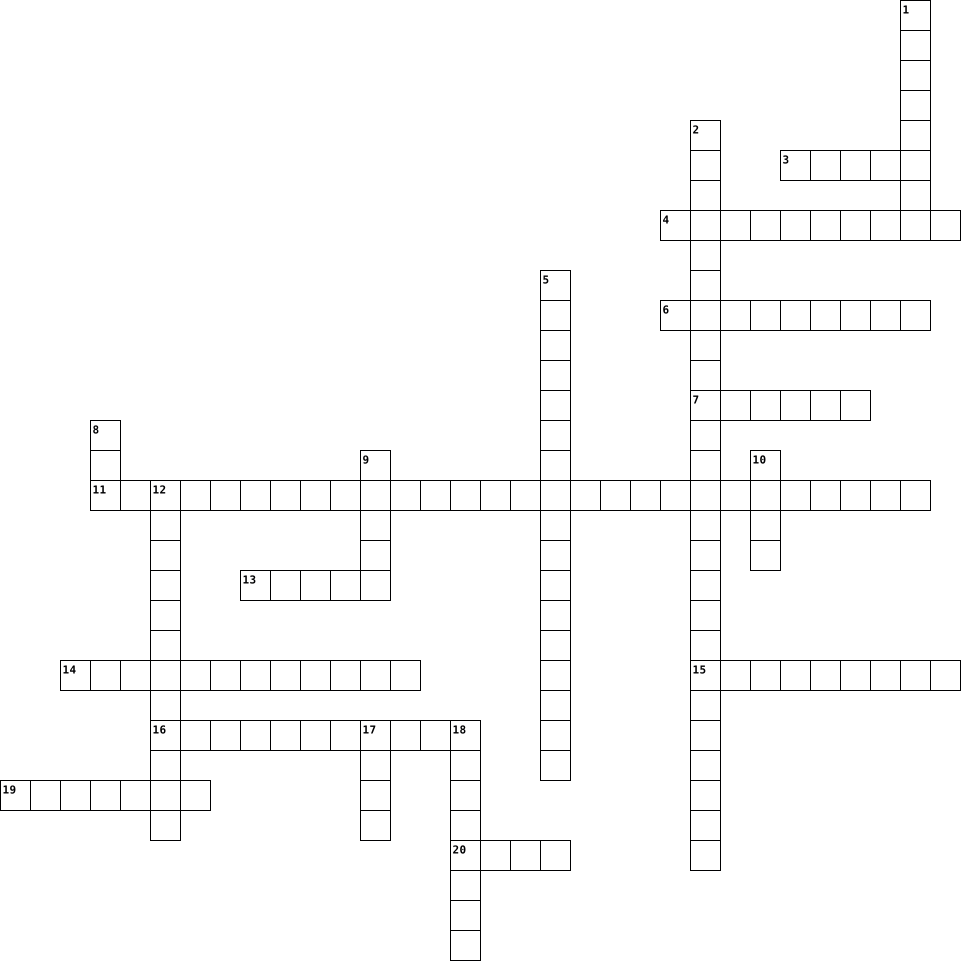
Across
- is defined as the time rate of doing work.
- 1 _____ unit of power equal to 550 ftlb/s or 33,000 ft lb/m or 746 watt.
- is the energy an object has by virtue of its position or configuration.
- if an object can do work then it has ____.
- the energy an object possess due to gravitational force.
- does work on an object
- is obtained by dividing the unit of work in that system by unit of time.
- units of work in fps system.
- is the product of a force unit and a length unit.
- is the energy possessed by an object because of its motion.
- unit of power equal to joule.
Down
- ______ in the direction of motion increases the kinetic energy of an object.
- energy is neither created nor destroyed it merely changes from one form to another.
- the potential energy of a weight w lifted a vertical distance h.
- units of work in cgs system.
- units of work in mks system.
- work done by an object against friction.
- the potential energy of a mass m lifted a vertical distance h.
- a force does ____ on an object when it makes the object move through a distance. against a resisting force
- 1 _____ unit of power equal to 1000 watt.
20 Clues: does work on an object • units of work in cgs system. • units of work in mks system. • units of work in fps system. • unit of power equal to joule. • work done by an object against friction. • 1 _____ unit of power equal to 1000 watt. • is defined as the time rate of doing work. • if an object can do work then it has ____. • is the product of a force unit and a length unit. • ...
physics 2014-02-18
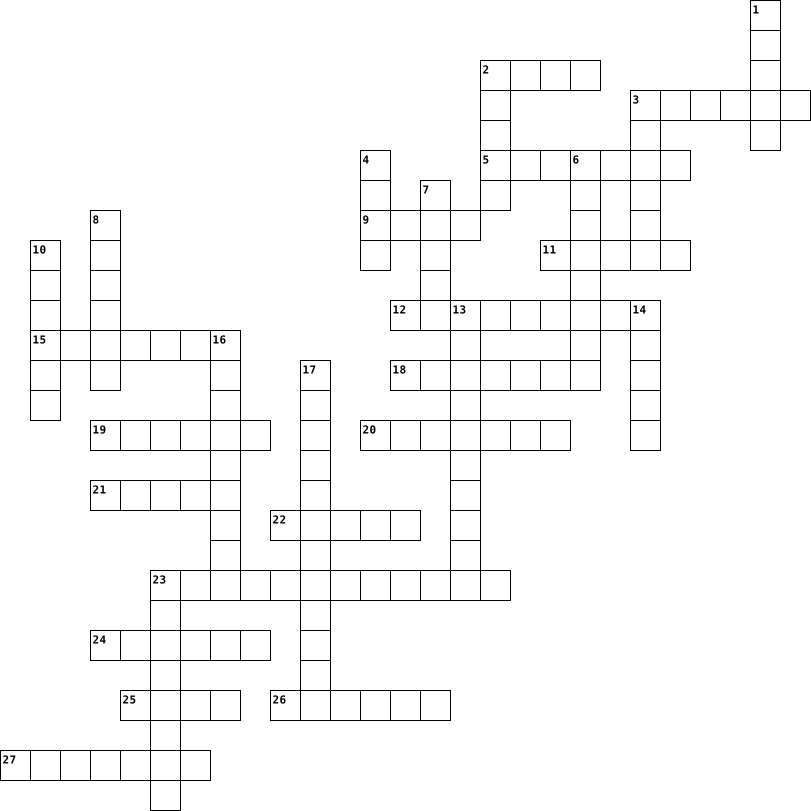
Across
- disturbance
- substance
- a natural phenomenon
- basic unit
- vibration
- branch of science
- resistance
- mass of a material
- place without air
- body of knowledge
- point of wave
- lift heavy things easily
- is the straight line
- a nuclear reaction
- derive unit
- strength
- knowledge of nature
Down
- converts rotational
- triangular shape
- position of a body
- transformed energy
- the rate at which an object change
- derived unit of energy
- lift some things
- branch of physics
- collective of groups
- is a measure of how quickly an event occurs
- interdisciplinary science
- speed over time
- a numerical description
30 Clues: strength • substance • vibration • basic unit • resistance • disturbance • derive unit • point of wave • speed over time • triangular shape • lift some things • branch of physics • branch of science • place without air • body of knowledge • position of a body • transformed energy • mass of a material • a nuclear reaction • converts rotational • knowledge of nature • a natural phenomenon • collective of groups • ...
Physics 2014-03-21
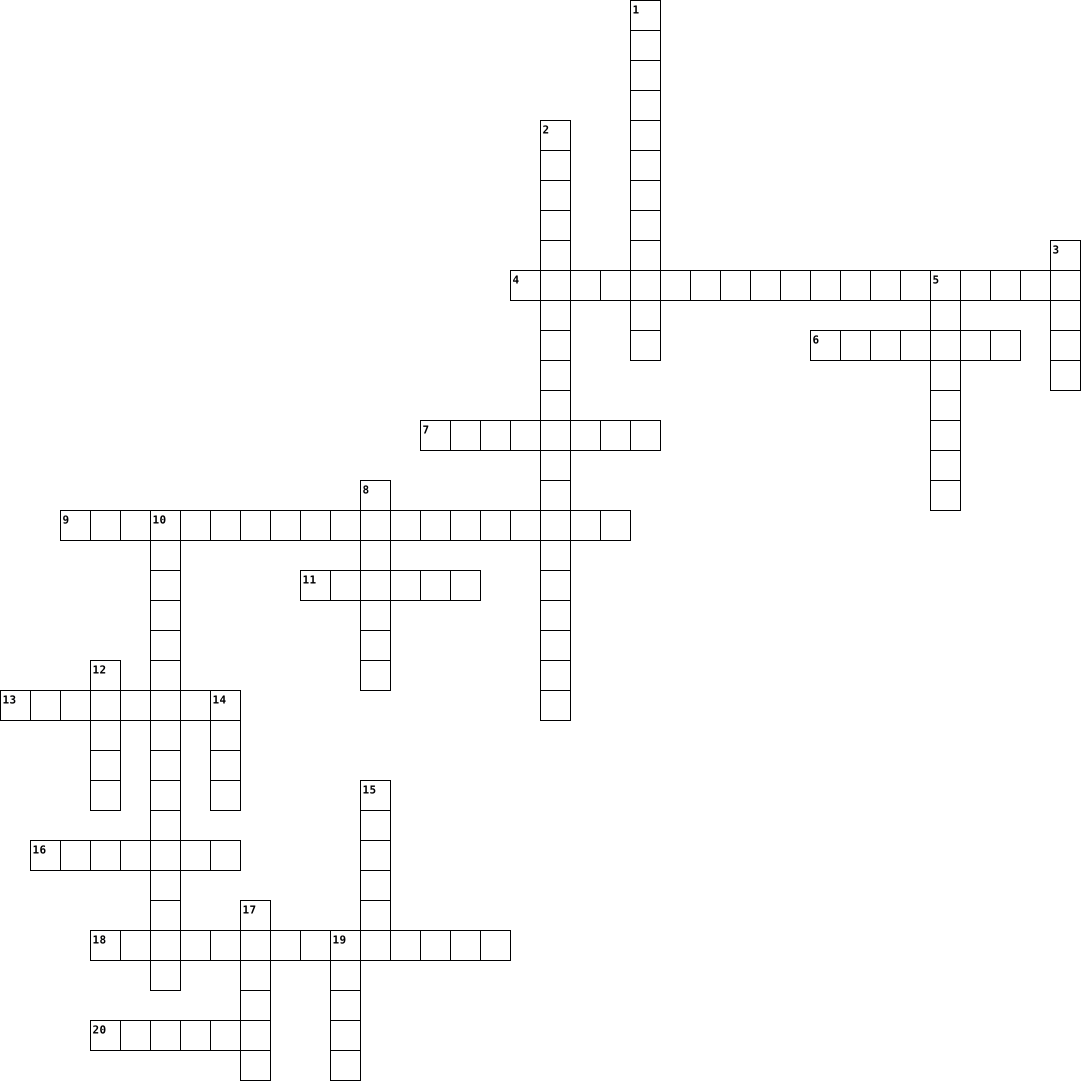
Across
- The pull exerted by the earth gravity on any object
- The pull exerted by a stretched spring on an object attached to it
- Rate of change of displacement
- A region which a mass experiences a force due to gravitational attraction
- Time taken for one complete oscillation
- S.I unit of mass
- Mass per unit volume
- Opposes with motion of moving objects,increases with speed
- S.I unit of force
Down
- Rate of change of velocity
- Constant rate of change of velocity
- S.I unit of length
- Contact force that opposes or tends to oppose motion between surfaces in contact
- Reluctance of the object to change its state of rest or motion due to its mass
- Measures both internal and external diameter of objects
- A push or pull motion that one object exerts one another one
- Amount of matter in a body
- Gravitational force or gravity acting on a object
- S.I unit of Time
- Distance moved per unit time
20 Clues: S.I unit of mass • S.I unit of Time • S.I unit of force • S.I unit of length • Mass per unit volume • Rate of change of velocity • Amount of matter in a body • Distance moved per unit time • Rate of change of displacement • Constant rate of change of velocity • Time taken for one complete oscillation • Gravitational force or gravity acting on a object • ...
Physics 2015-01-18
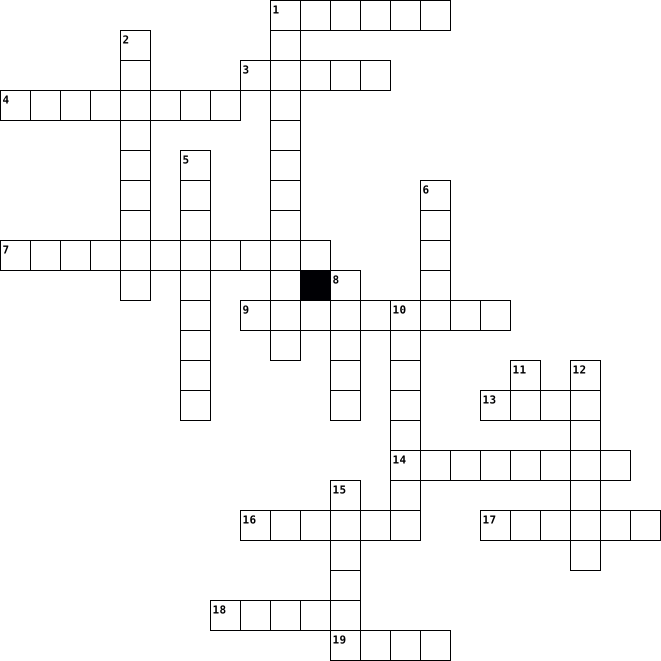
Across
- regangan (bahasa inggris)
- “ jika gaya tarik tidak melampaui batas elastisitas pegas, maka perubahan panjang pegas berbanding lurus dengan gaya tariknya” Bunyi hukum...
- Perbandingan antara pertambahan panjang L terhadap panjang mula-mula(Lo)
- kemampuan (ability) dari benda padat untuk kembali ke bentuk semula segera setelah gaya luar yang bekerja padanya hilang/ dihilangkan
- transformasi sebuah benda dari kondisi semula ke kondisi terkini
- mempunyai modulus young E=200 x 10^9 N/m^2
- memiliki satuan N/m2
- satuan gaya
- nama depan penemu hukum hooke
- benda elastis
- susunan pegas jika gaya yang bekerja pada masing-masing pegas sama dengan gaya luar F
Down
- sistem pegas penstabil pada kendaraan
- k pada F=-kx
- benda non elastis
- notasi ilmiah tegangan
- nama lain modulus elastis
- dua buah gaya yang segaris
- pascal
- susunan pegas jika gaya F terbagi rata pada kedua pegas
- tegangan(bahasa inggris)
20 Clues: pascal • satuan gaya • k pada F=-kx • benda elastis • benda non elastis • memiliki satuan N/m2 • notasi ilmiah tegangan • tegangan(bahasa inggris) • regangan (bahasa inggris) • nama lain modulus elastis • dua buah gaya yang segaris • nama depan penemu hukum hooke • sistem pegas penstabil pada kendaraan • mempunyai modulus young E=200 x 10^9 N/m^2 • ...
Physics 2016-03-28
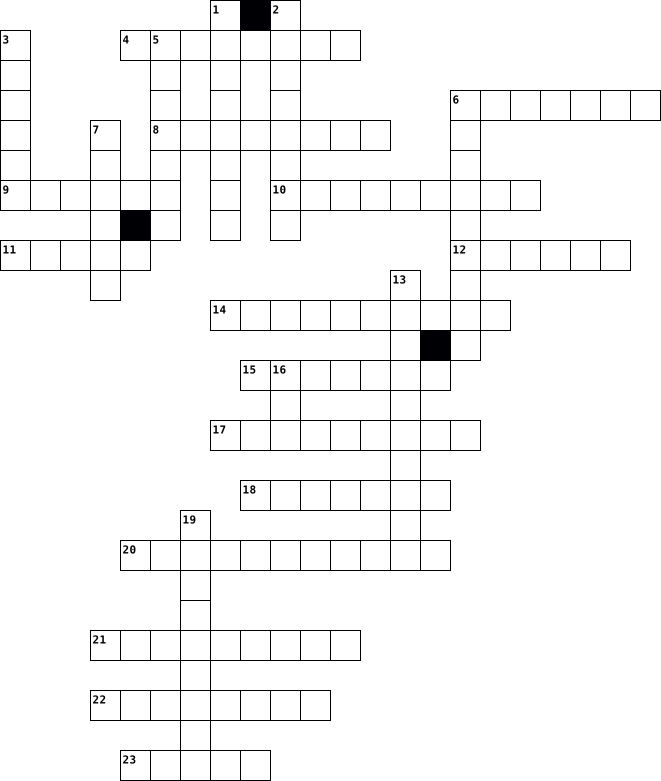
Across
- Circuit circuit that has two or more paths for current to flow through.
- an electromotive force or potential difference expressed in volts
- subatomic particle, symbol e− or β−, with a negative elementary electric charge
- is the physical property of matter that causes it to experience a force when placed in an electromagnetic field.
- definition a material of such low conductivity that the flow of current through it is negligible.
- station is an industrial facility for the generation of electric power.
- a peppery of objects which can be transferred to other objects or converted into different forms.
- an instrument designed to measure electric current, voltage, and usually resistance, typically over several ranges of value.
- a complete electrical network with a closed loop giving a return path for current.
- an object or type of material that allow the flow of electrical current in one or more directions.
- subatomic particle, symbol p or p+, with a positive electric charge of +1e elementary charge and mass slightly less than that of a neutron.
- change the voltage of (an electric current).
- difference the difference of electrical potential between two points.
- is a passive two-terminal electrical component that implements electrical resistance as a circuit element.
- law states the current through a conductor between two points is directly proportional to the potential difference across the two points.
Down
- field the magnetic effect of electric currents and magnetic materials.
- force is one of the most powerful, fundamental forces in the universe.
- electricity an imbalance of electric charges within or on the surface of a material.
- is a measuring instrument used to measure the current in a circuit.
- is an instrument used for measuring electrical potential difference between two points in an electric circuit.
- circuit the current through each of the components is the same, and the voltage across the circuit is the sum of the voltages across each component.
- In electricity, a measurement of the difficulty encountered by a power source in forcing electric current through an electrical circuit, and hence the amount of power dissipated in the circuit.
- an atom or a molecule in which the total number of electrons is not equal to the total number of protons, giving the atom or molecule a net positive or negative electrical charge.
- Is a force between electric currents: two parallel currents in the same direction attract, in oposite directions repel.
24 Clues: change the voltage of (an electric current). • an electromotive force or potential difference expressed in volts • is a measuring instrument used to measure the current in a circuit. • difference the difference of electrical potential between two points. • field the magnetic effect of electric currents and magnetic materials. • ...
Physics 2016-03-27
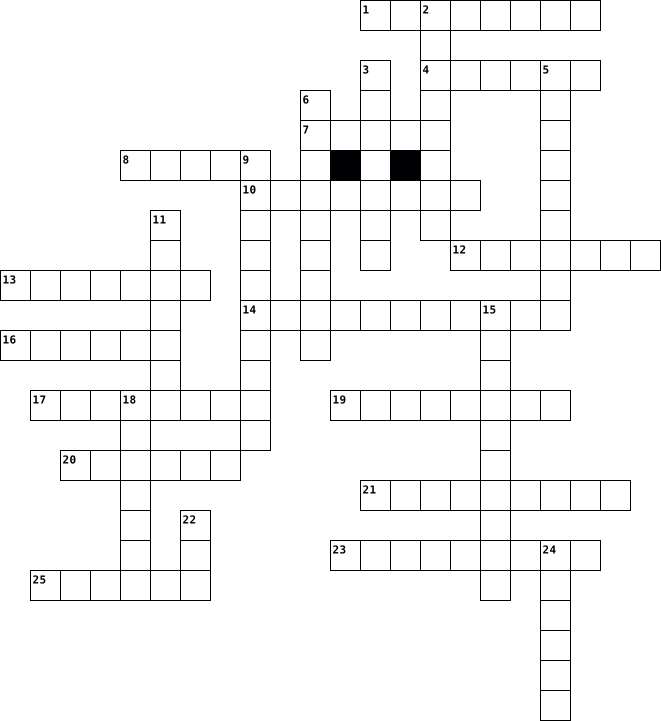
Across
- Circuit Has two or more paths for current to flow through
- Electricity An imbalance of electrical charges within or on the surface of a material
- Law States that the current through a conductor between two points is directly proportional to the potential difference across the points
- Plant An installation where electrical power is generated for distribution
- subatomic particle with a negative charge
- A electromotive force expressed in volts
- Device consisting of one or more electrochemical cells
- An electrical device that transfers electrical energy between two or more circuits.
- Physical property of matter that causes it to experience a force when placed in an electromagnetic field
- Force The attraction or repulsion interaction between any two charged objects
- Field The magnetic effect of electrical currents and magnetic materials
- Circuit Having only one path for electrons to flow
- The study of magnet
- an instrument used for measuring electrical potential difference between two points in an electric current
- Subatomic particle with a positive charge
Down
- A passive two-terminal electrical component that implements electrical resistance as a circuit element
- A measuring instrument used to measure the current in a circuit
- A material in which electric charges don't flow freely
- Difference The difference of electrical potential between two points
- a measure of difficulty encountered by a power source in forcing electric current through a circuit
- A flow of electric charge
- An instrument used to measure electric current, voltage, and usually resistance
- A complete electrical network with a closed loop
- An atom in which the total number of electrons are not equal to the total number of protons
- Conductor A substance in which electrical charge carries, electrons, move easily
25 Clues: The study of magnet • A flow of electric charge • A electromotive force expressed in volts • subatomic particle with a negative charge • Subatomic particle with a positive charge • A complete electrical network with a closed loop • Circuit Having only one path for electrons to flow • A material in which electric charges don't flow freely • ...
Physics 2016-09-01
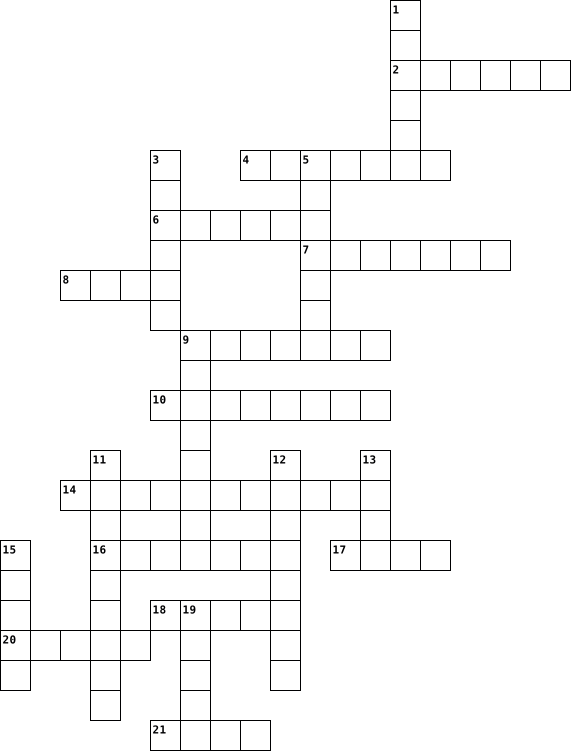
Across
- nuclear force the force that holds particles together
- energy energy the holds nucleus together
- mass unit to express atomic weights
- a subatomic particle
- nuclear force responsible for beta and decay of hadrons
- reaction change the identity of the atomic nucleus
- when things are being done
- emission of ionizing radiation
- splitting
- production changing of radiation quantum to electron and positron
- decay atomic nucleus loses energy
- reaction a chemical reaction of products
- number total # of protons and neutrons
Down
- joining two or more things together
- elementary particle of matter
- specific # of protons and neutrons
- a proton or neutron
- half of the radioactive value
- model math model of elementary particles of matter
- decay when an electron is emitted
- carriers give rise to forces between other particles
- decay # of reduced by 4 an atomic number by 2
22 Clues: splitting • a proton or neutron • a subatomic particle • when things are being done • elementary particle of matter • half of the radioactive value • emission of ionizing radiation • decay when an electron is emitted • decay atomic nucleus loses energy • specific # of protons and neutrons • joining two or more things together • mass unit to express atomic weights • ...
Physics 2020-01-23
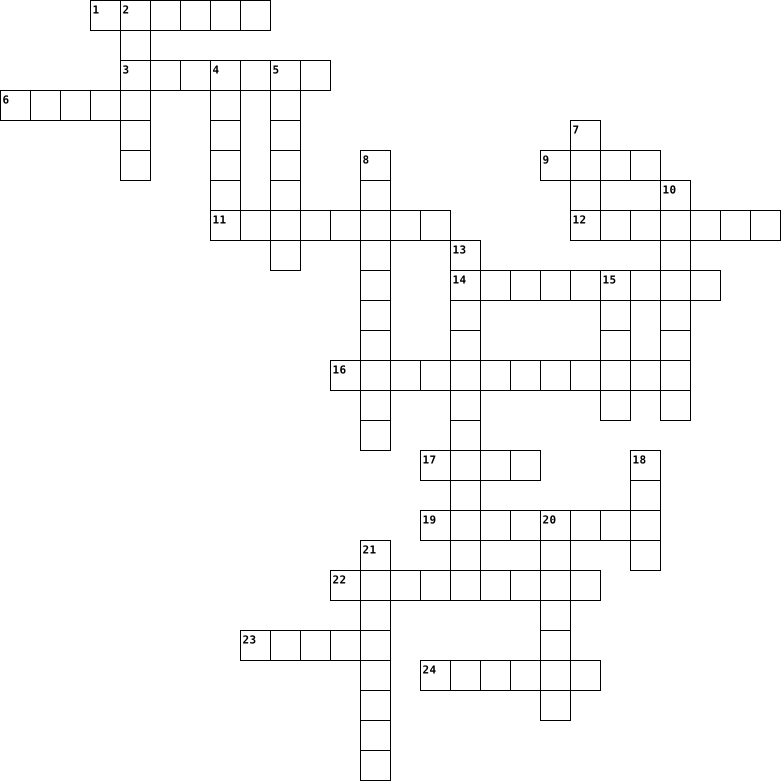
Across
- The product of acceleration due to gravity and mass
- - Energy stored in stretchy materials as the result of their stretching or compressing
- - Unit of Distance, 1000 Millimeters.
- - Unit of Time, 24 of these in a day
- The total length an object travels
- - Energy that is created by
- 2 objects that hit each other
- the shortest distance between points.
- - How much stuff something has
- - Unit of Mass, 1000 grams.
- Energy that is created by an object’s position
- Strength of a movement
- - Unit of Time, 60 seconds.
Down
- The capacity of power to do work
- - Unit of Time, very common for short lengths of time, 60 of them makes up a minute.
- Change in momentum
- The product of force and displacement
- the science of motion
- - displacement over time
- the change in velocity
- - Distance over time, how fast something is moving.
- - Universal concept developed by humans to measure the progress of existence.
- The force that attracts mass to other mass
- The quantity of motion in a moving body
24 Clues: Change in momentum • the science of motion • the change in velocity • Strength of a movement • - displacement over time • - Energy that is created by • - Unit of Mass, 1000 grams. • - Unit of Time, 60 seconds. • 2 objects that hit each other • - How much stuff something has • The capacity of power to do work • The total length an object travels • - Unit of Time, 24 of these in a day • ...
PHYSICS 2020-01-17
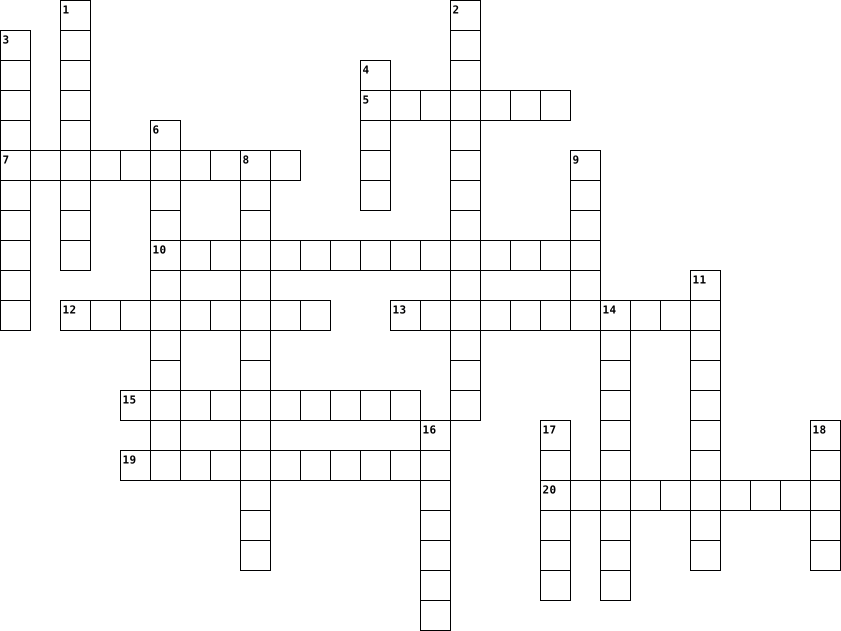
Across
- state of randomness in a system
- frequency is above 20,000 Hz
- change in length of an object when heated
- reaction of an object to a force to equate frequencies with the natural frequency of an object
- a moving area of colliding molecules
- method of heat transfer through a heated substance; example is air and water
- degree of hotness or coldness of an object, place or substance
- device that transforms heat energy to mechanical work
Down
- method of heat transfer that happens through infrared rays
- branch of physics that deals with heat and other energy forms
- method of heat transfer that happens through direct contact
- rhythmic and timed changes in sound intensity
- device used to study sound waves
- type of energy related to the randomness and disordered motion of molecules
- product of vibration of moving objects
- frequency is below 20 Hz
- emitted by a source of vibration
- unit for measuring the intensity of sound
- emitted when sound bounces back on a hard surface
- the upper part of the wave
20 Clues: frequency is below 20 Hz • the upper part of the wave • frequency is above 20,000 Hz • state of randomness in a system • device used to study sound waves • emitted by a source of vibration • a moving area of colliding molecules • product of vibration of moving objects • change in length of an object when heated • unit for measuring the intensity of sound • ...
Physics 2020-04-22
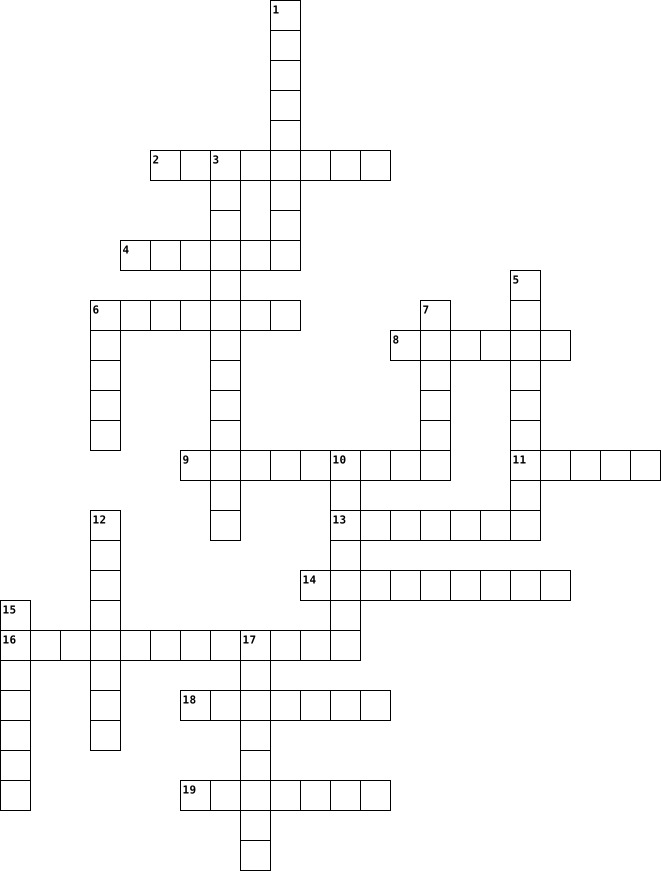
Across
- A force that exists around every object that has mass
- How fast an object is moving, measured in m/s
- When an object takes up space and has mass it has this
- A push or pull of an object changing the object's state of rest
- Use the formula P=mv to find this
- Always measure in seconds
- Collision: When objects collide and bounce off of each other
- The resistance of motion when one abject rubs against another
- When the net force of an object is at zero
- The influence required to perform an action
- The amount of gravity pushing down on an object
Down
- Use the formula V=d/t to find this
- Increasing rate of speed of an object
- Collision: When objects collide and stick together
- Measure of amount of matter in an object
- Unit of measurement for energy and work represented with a J
- An explanation of why something happens, it may not be a correct explanation
- A science that deals with matter, energy, motion, and force
- Physicist known for his laws of motion
- Defined in Newton's 1st law
20 Clues: Always measure in seconds • Defined in Newton's 1st law • Use the formula P=mv to find this • Use the formula V=d/t to find this • Increasing rate of speed of an object • Physicist known for his laws of motion • Measure of amount of matter in an object • When the net force of an object is at zero • The influence required to perform an action • ...
Physics 2020-06-03
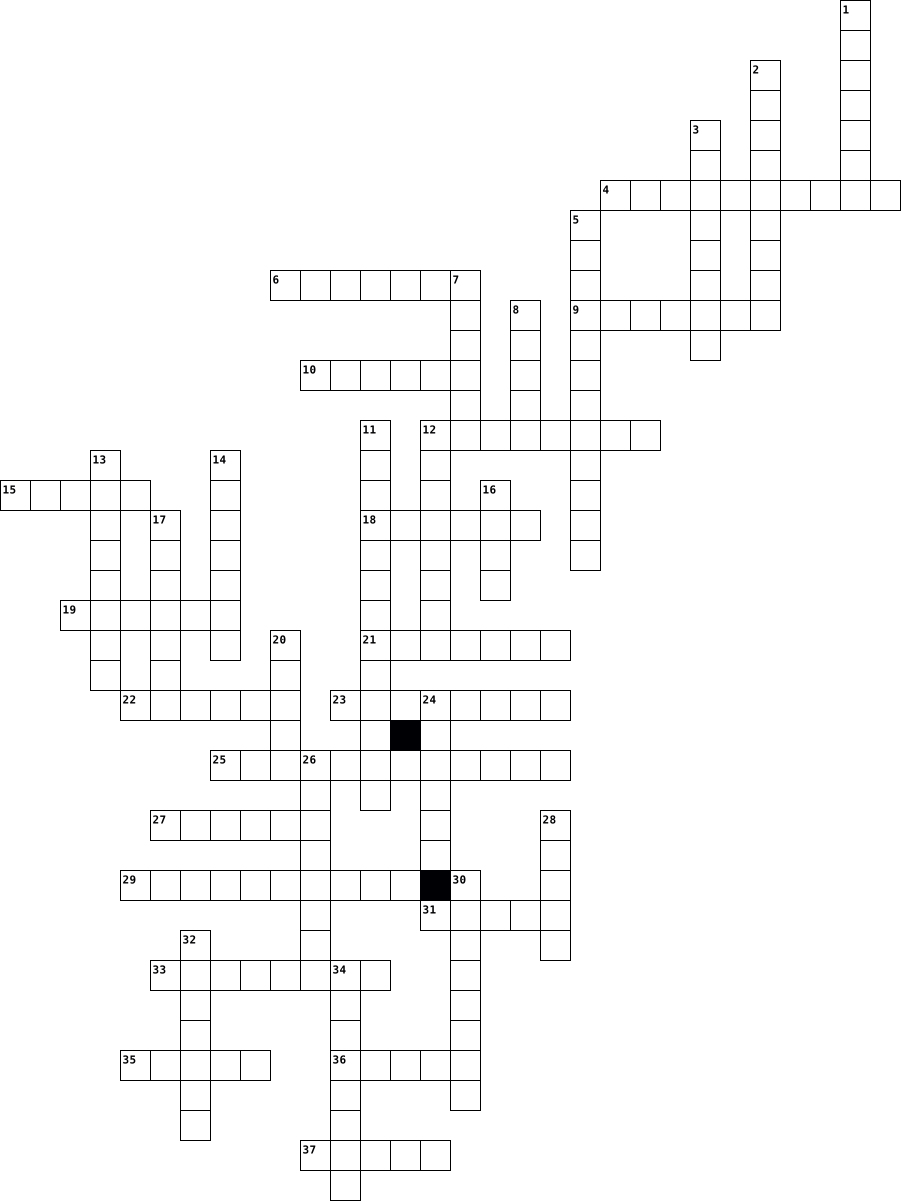
Across
- forced that cause a change in the motion of an object are ______ forces
- international unit measure for force
- no energy is converted into heat during the collision so kinetic energy before and after the collision remains constant.
- direction is perpendicular to any curve at a particular point
- any object that is being acted upon only by the force of gravity
- amount of energy transferred or converted per unit time
- a quantity that has both magnitude and direction
- measuring exactly the thing that you're looking to measure
- pulling force transmitted axially by the means of a string, chain, or similar one-dimension continuous object
- force exerted on a body by gravity
- in mechanics, the universal force of attraction acting between all matter and is a vector quantity
- vector quantity that refers to "how far out of place an object is"
- equaled to work done by a force of one newton acting through one meter
- any object that once projected or dropped continues in motion by its own inertia the resistance an object has to a change in its state of motion
- projectile launched with a velocity at an angle to the horizontal of the horizontal distance traveled
- scalar quantity that refers to "how much ground an object has covered"
- fundamental unit of length in the metric system
- measure of the steepness of a line, or a section of a line, connecting two points
- standard measure of a quantity
Down
- total distance traveled by the object divided by the elapsed time to cover that distance
- a collision in which there is a loss of kinetic energy
- physical property that can be quantified
- vector quantity that can define as the rate where an object changes its velocity
- fully described by a magnitude (a numerical value) alone
- push or pull
- in mechanics, the universal force of attraction acting between all matter
- resistance motion of one object moving relative to another
- measures displacement and a vector quantity
- measured by the acceleration that it gives to freely falling objects.
- measure of energy transfer that occurs when an object is moved to a great amount of distance
- instead of two variables moving in the same direction they move in opposite directions
- defined as a derived unit of 1 joule per second and is used to quantify the rate of energy transfer
- kinetic _____ has an equal amount of positive work done
- place where someone or something is located or has been put
- rate at which an object covers a distance
- two individual forces are of equal magnitude and opposite direction, then the forces are _____
- a work needed to accelerate a body of a given mass from rest to its stated velocity
- used to fill in the gaps when an equation no longer works
38 Clues: push or pull • standard measure of a quantity • force exerted on a body by gravity • international unit measure for force • physical property that can be quantified • rate at which an object covers a distance • measures displacement and a vector quantity • fundamental unit of length in the metric system • a quantity that has both magnitude and direction • ...
Physics 2020-06-17
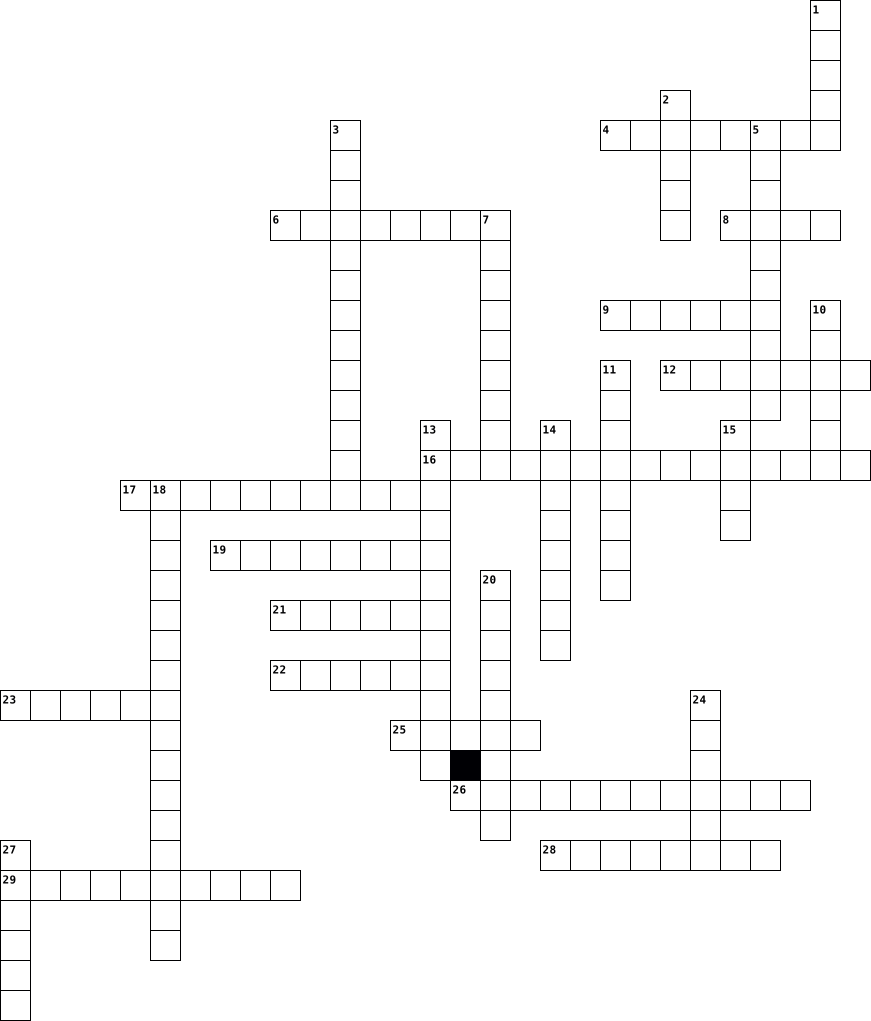
Across
- force per unit area
- the product of force and distance moved in the direction of the force
- unit of power
- SI unit of temperature
- energy due to the motion of the body
- a point where the weight of the object seems to act
- pressure from the surrounding air molecules
- energy in a battery or dry cell
- quantity that has magnitude only
- the product of force and its perpendicular distance from the pivot
- unit of pressure
- work done per unit time taken
- negative acceleration
- SI unit of mass
- useful output power/total input power
Down
- unit of energy
- SI unit of length
- friction with air
- when two forces in opposite direction are not equal and produces acceleration
- increase in length of the spring
- the gravitational pull acting on a body
- distance travelled in a stated direction per unit time taken
- change in velocity per unit time taken
- force that opposes the motion of object moving against other object
- amount of matter in a body
- when object fall with constant speed and zero acceleration due to equal upward and downward forces
- one of the instrument to measure pressure
- quantity that has magnitude and direction
- SI unit of time
29 Clues: unit of power • unit of energy • SI unit of time • SI unit of mass • unit of pressure • SI unit of length • friction with air • force per unit area • negative acceleration • SI unit of temperature • amount of matter in a body • work done per unit time taken • energy in a battery or dry cell • increase in length of the spring • quantity that has magnitude only • ...
Physics 2020-06-10
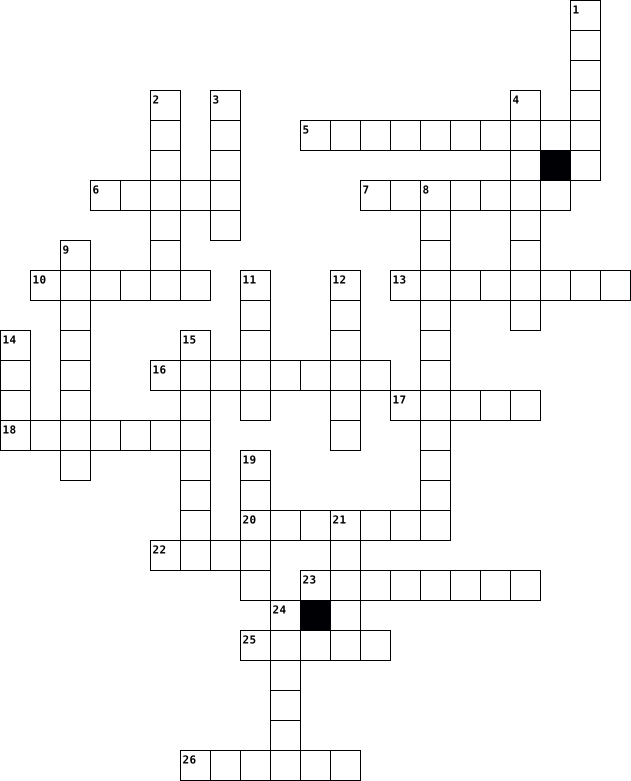
Across
- form of motion experienced by an object or particle that is projected near the earth's surface and moves along a curved path under the action of gravity
- push or pull of upon an object
- any physical property that can be quantified, that is, be measured using numbers.
- an object at rest on a flat surface is equal to the gravitational force on that object
- the speed of something in a given direction
- any motion of a body where gravity is the only force acting upon it
- the horizontal displacement of the projectile
- an object is the energy that it possesses due to its motion
- the pulling force transmitted axially by the means of a string, a cable, chain
- is specific measures are given to a dimension
- mass in motion
- is a unit of length
- the capacity for doing work
Down
- unit of work or energy
- the resistance an object has to a change in its state of motion
- distance traveled per unit of time
- how much ground an object has covered
- the rate at which the velocity of an object changes over time
- not changing or varying
- the amount of energy transferred or converted per unit time
- magnitude, no direction
- a force causing a movement or a displacement
- objects sliding against eachother
- unit of power
- steepness of a line
- has magnitude and direction
26 Clues: unit of power • mass in motion • steepness of a line • is a unit of length • unit of work or energy • not changing or varying • magnitude, no direction • has magnitude and direction • the capacity for doing work • push or pull of upon an object • objects sliding against eachother • distance traveled per unit of time • how much ground an object has covered • ...
Physics 2017-10-25
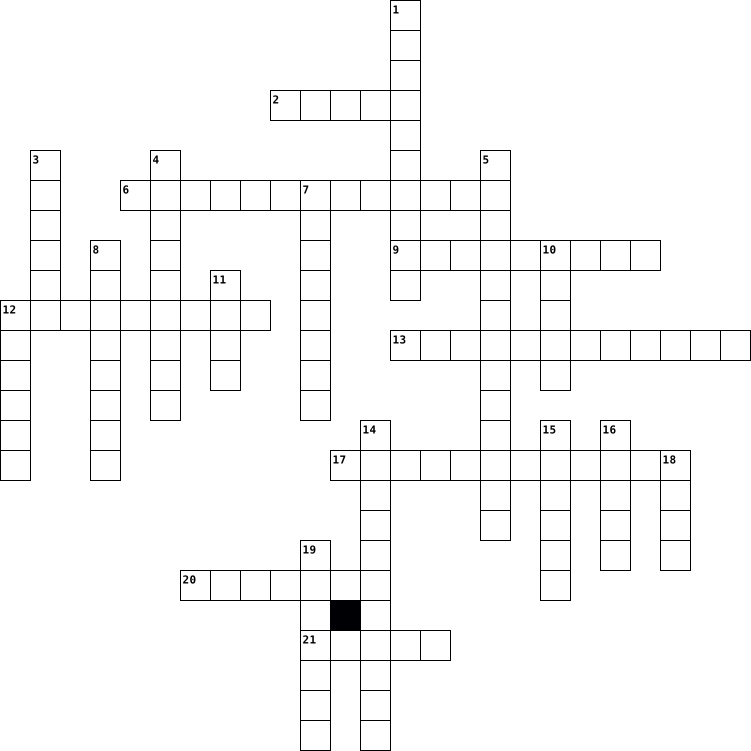
Across
- When it moves through an object it cuts or forces the object to seperate
- When both velocity and direction remains the same
- When two objects strike together
- Amount of consistency of independent measurements
- When an object slows down
- Change in position
- Force x Time =
- Change in distance per unit change in time
Down
- Study of motion
- Physical quantity that has only magnitude
- Kinetic energy is not conserved
- Makes work necessary in allowing the heavy objects to be pushed
- Mass in motion
- How closed a measured value to a true or accepted value is
- Described as an incilined plane
- Product of work and displacement
- It is a lever that rotates in a fixed point
- Energy from ocean tides and tidal currents
- Physical quantity that has both magnitude and direction
- A steel bar that rotates at a fixed point
- Work is also equals to power and?
- Kinetic energy is conserved
22 Clues: Mass in motion • Force x Time = • Study of motion • Change in position • When an object slows down • Kinetic energy is conserved • Kinetic energy is not conserved • Described as an incilined plane • When two objects strike together • Product of work and displacement • Work is also equals to power and? • Physical quantity that has only magnitude • ...
physics 2016-04-25
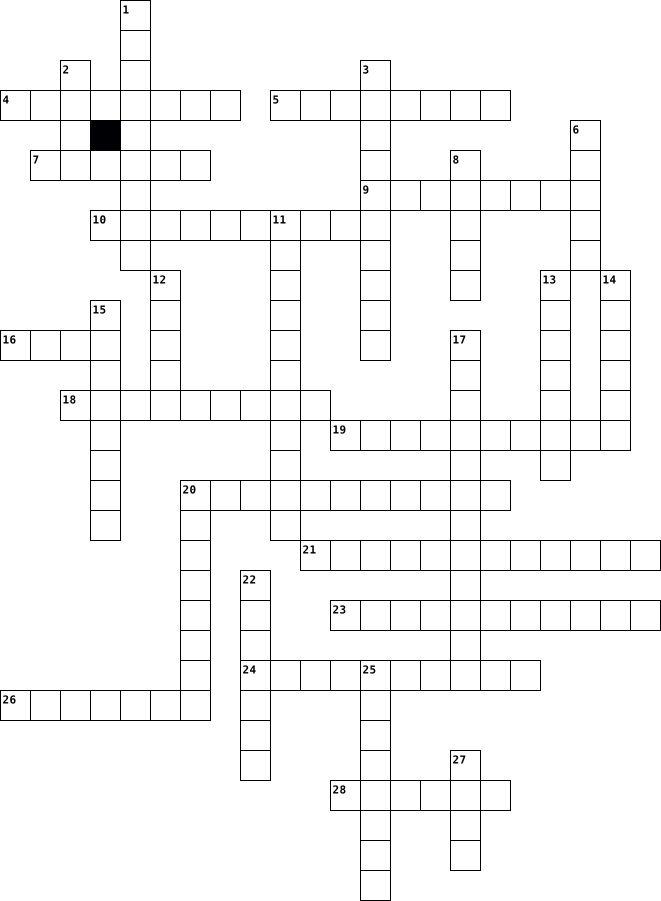
Across
- Heat :The quantity of heat required to raise a unit of mass of homogeneous material 1oK or 1oC in a specific way given constant pressure and volume
- :A quantity defined as the product of the mass and the velocity of an object
- Friction: The force that resists the initiation between two surfaces that are in contact and at rest
- Zero :The temperature at which molecular energy is a minimum 0oK on the Kelvin scale or -273.16oC on the Celsius scale
- :The movement of matter due to differences in density that are caused by temperature variations
- Fall :the motion of a body when only the force of gravity is acting on the body.
- Energy :The energy an object has because of position, shape or condition of the object
- Motion :the curved path that an object follows when thrown, launched, or otherwise projected near the surface of he earth; the motion of objects that are moving in two dimensions under the influence of gravity
- : an Instrument that measures and indicates temperature
- :The change in position of an object
- :A material used to cool an area or object to a temperature that is lower than the temperature of the environment
- :A quantity, usually expressed as a percentage that measures the ratio of useful work output to work input
- Conduction :The transfer of energy as heat through a material
- : objects change in position relative to a reference point
Down
- :The energy that is transferred as electromagnetic waves, such as visible light and infrared waves
- Engine :A machine that transform heat into mechanical energy or work.
- Energy :The amount of work an object can do because of the object’s kinetic and potential energy
- : the distance traveled by the time interval during which the motion occurred
- :A quantity that measures the rate at which work is done or energy is transformed
- : is a measure of how hot (or cold) something is; specifically; a measure of average kinetic energy of the particles in an object
- : an action exerted on a body in order to change the body’s state of rest or motion; force has magnitude and direction
- :The tendency of an object to resist being moved or, if the object is moving, to resist a change in speed or direction until and outside force acts on the object.
- Machine :One of six basic machine types of machines which are the basis for all other forms of machines
- : The speed of an object in a particular direction
- : The rate at which velocity changes over time; an objects accelerates if its speed, direction or both change
- Velocity :The constant velocity of a falling object when the force of air resistance is equal in magnitude and opposite in direction to the force of gravity
- Friction : The force that opposes the movement of two surfaces that are in contact with each other and are sliding over each other
- Machines :A machine made of more that one simple machine
- :The transfer of energy to a body by the application of a force that causes the body to move in the direction of the force
29 Clues: :The change in position of an object • : The speed of an object in a particular direction • : an Instrument that measures and indicates temperature • Machines :A machine made of more that one simple machine • : objects change in position relative to a reference point • Conduction :The transfer of energy as heat through a material • ...
physics 2016-04-25
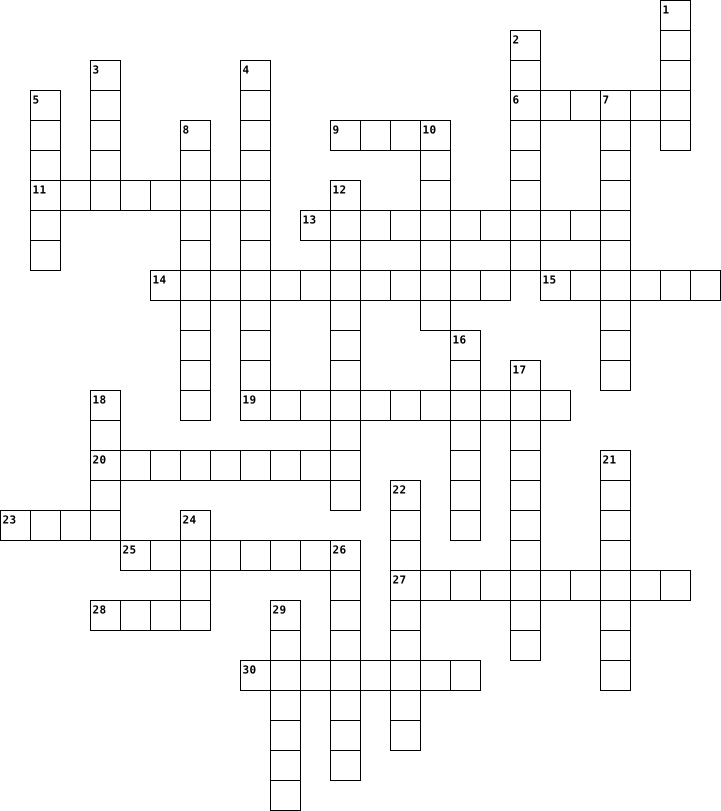
Across
- Machine :One of six basic machine types of machines which are the basis for all other forms of machines
- :The transfer of energy to a body by the application of a force that causes the body to move in the direction of the force
- Velocity :The constant velocity of a falling object when the force of air resistance is equal in magnitude and opposite in direction to the force of gravity
- : is a measure of how hot (or cold) something is; specifically; a measure of average kinetic energy of the particles in an object
- : The rate at which velocity changes over time; an objects accelerates if its speed, direction or both change
- : objects change in position relative to a reference point
- : an Instrument that measures and indicates temperature
- :The energy that is transferred as electromagnetic waves, such as visible light and infrared waves
- Fall :the motion of a body when only the force of gravity is acting on the body.
- Heat :The quantity of heat required to raise a unit of mass of homogeneous material 1oK or 1oC in a specific way given constant pressure and volume
- :A quantity, usually expressed as a percentage that measures the ratio of useful work output to work input
- Engine :A machine that transform heat into mechanical energy or work.
- : The speed of an object in a particular direction
Down
- : the distance traveled by the time interval during which the motion occurred
- Zero :The temperature at which molecular energy is a minimum 0oK on the Kelvin scale or -273.16oC on the Celsius scale
- :A quantity that measures the rate at which work is done or energy is transformed
- :The change in position of an object
- Friction: The force that resists the initiation between two surfaces that are in contact and at rest
- Motion :the curved path that an object follows when thrown, launched, or otherwise projected near the surface of he earth; the motion of objects that are moving in two dimensions under the influence of gravity
- :The movement of matter due to differences in density that are caused by temperature variations
- Friction : The force that opposes the movement of two surfaces that are in contact with each other and are sliding over each other
- :A material used to cool an area or object to a temperature that is lower than the temperature of the environment
- :The tendency of an object to resist being moved or, if the object is moving, to resist a change in speed or direction until and outside force acts on the object.
- Energy :The amount of work an object can do because of the object’s kinetic and potential energy
- : an action exerted on a body in order to change the body’s state of rest or motion; force has magnitude and direction
- :A quantity defined as the product of the mass and the velocity of an object
- Energy :The energy an object has because of position, shape or condition of the object
- :the energy transferred between objects that are at different temperatures
- Machines :A machine made of more that one simple machine
- Conduction :The transfer of energy as heat through a material
30 Clues: :The change in position of an object • : The speed of an object in a particular direction • : an Instrument that measures and indicates temperature • Machines :A machine made of more that one simple machine • : objects change in position relative to a reference point • Conduction :The transfer of energy as heat through a material • ...
Physics 2018-01-24
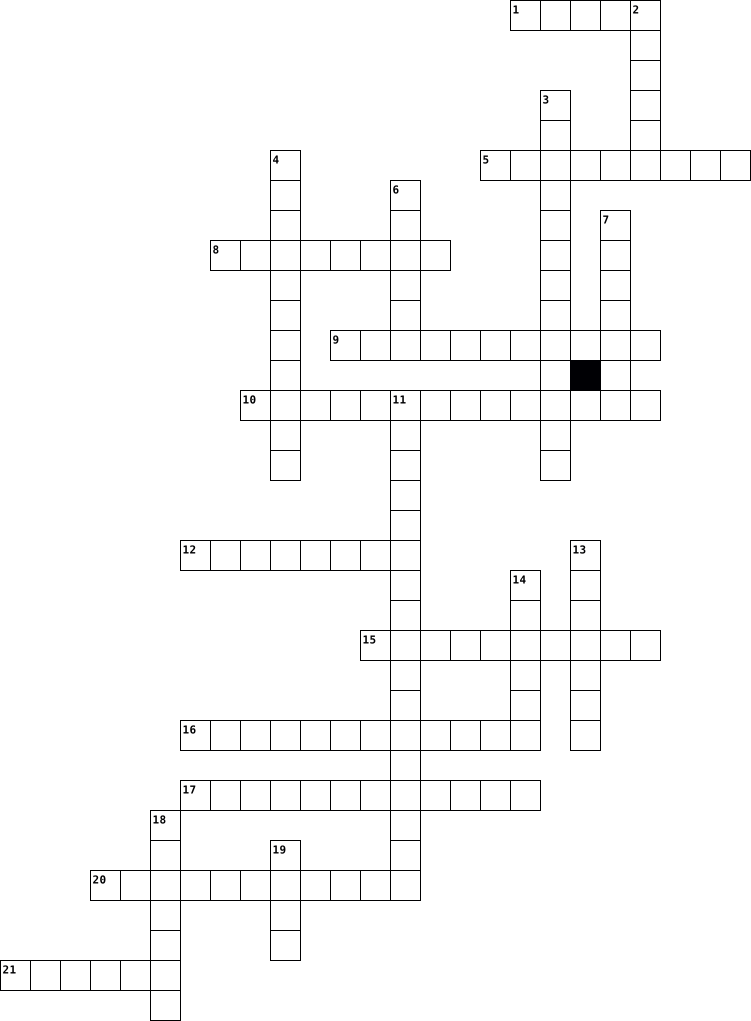
Across
- instrument used to measure time
- acceleration is speeding up, slowing down, or changing ____
- speed and direction
- line that goes between data points on a graph (3 words, no spaces)
- what astronauts feel as the space station falls
- gravity is affected by both mass and ____
- instrument used to multiply and divide values
- word for values and numbers
- measured in meters/second/second
- word for descriptions
- another word for force due to gravity
Down
- quiz game used when reviewing for a test
- instrument used to measure weight (2 words, no spaces)
- tiny unit of volume
- units for distance
- units for time
- instrument used to measure mass (3 words, no spaces)
- units for weight
- measured using a graduated cylinder
- 9.8 m/s/s
- measured in kilograms
21 Clues: 9.8 m/s/s • units for time • units for weight • units for distance • tiny unit of volume • speed and direction • measured in kilograms • word for descriptions • word for values and numbers • instrument used to measure time • measured in meters/second/second • measured using a graduated cylinder • another word for force due to gravity • quiz game used when reviewing for a test • ...
Physics 2019-03-10
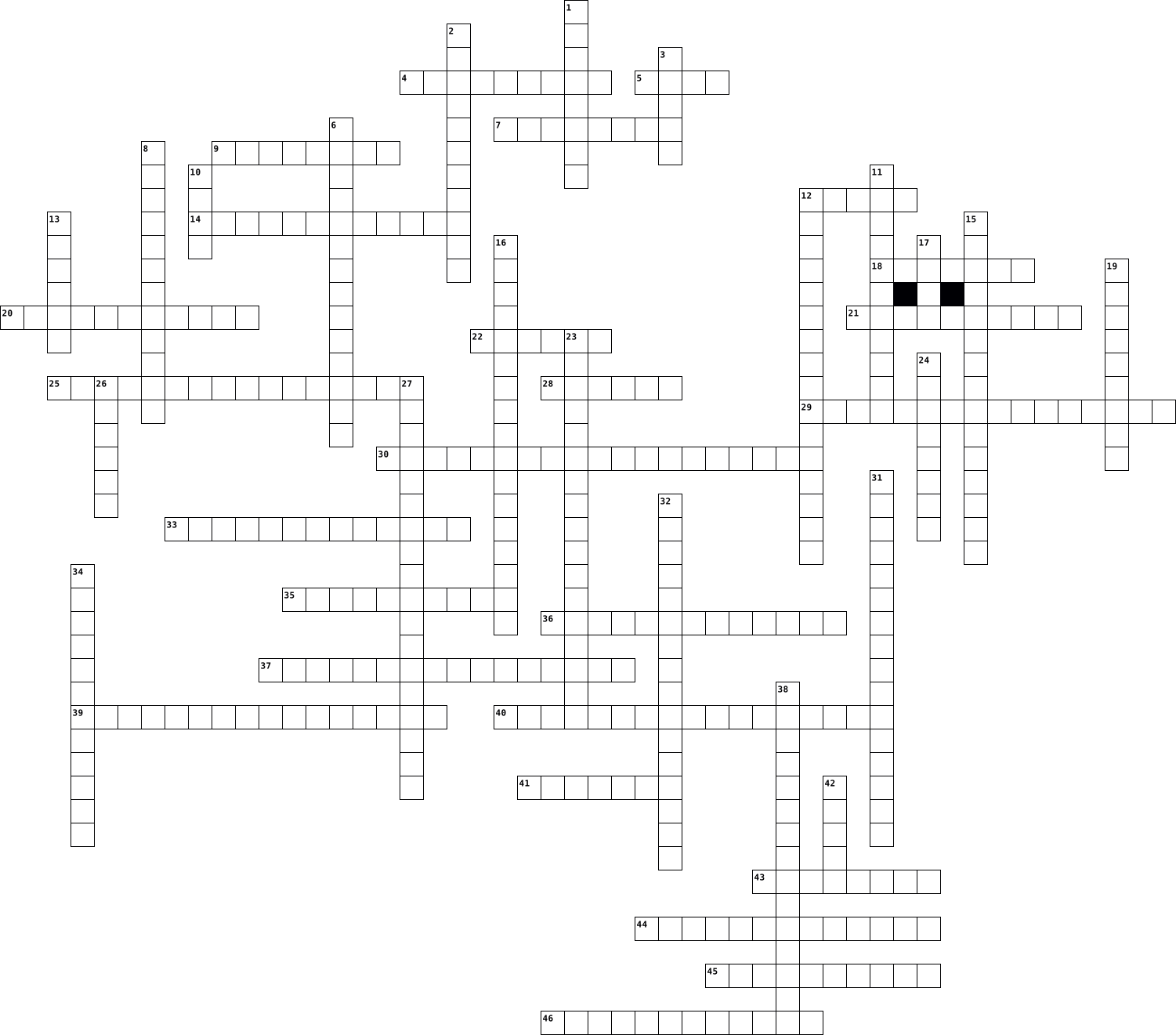
Across
- the exactness of a measurement
- the transfer of energy to a body by the application of a force that causes the body to move in the direction of the force
- a factor that changes in an experiment in order to test a hypothesis
- a quantity defined as the product of the mass and the velocity of an object
- the distance travelled by the time interval during which the motion occurred
- the quantity of heat required to raise a unit of mass of homogeneous material 1 ok or 1 oc in a specific way given constant pressure and volume
- the tendency of an object to resist being moved or, if the object is moving, to resist a change in speed or direction until and outside force acts on the object
- a measure of how hot (or cold) something is; specifically; a measure of average kinetic energy of the particles in an object
- a machine that transform heat into mechanical energy or work
- the measure of the straight-line distance between two points
- a machine made of more that one simple machine
- a measure of the gravitational force exerted on an object
- the ability and willingness to assess claims critically and make judgements on the basis of objective and supported reasons
- a quantity that measures how much a machine multiples a force by
- one of six basic machine types of machines which are the basis for all other forms of machines
- the movement of matter due to differences in density that are caused by temperature variations
- a summary of many experimental results and observations; a law tells how things work
- the curved path that an object follows when thrown, launched, or otherwise projected near the surface of the earth; the motion of objects that are moving in two dimensions under the influence of gravity
- the constant velocity of a falling object when the force of air resistance is equal in magnitude and opposite I direction to the force of gravity
- a prescribed decimal place that determines the amount of rounding off to be done based on the precision of the measurement
- the knowledge obtained by observing natural events and conditions in order to discover facts and formulate laws or principles that can be verified or tested
- the motion of a body when only the force of gravity is acting on the body
- the energy of a moving object due to the objects motion
- a quantity, usually expressed as a percentage that measures the ratio of useful work output to work input
- the change in position of an object
Down
- the speed of an object in a particular direction
- An instrument that measures and indicates temperature
- a quantity that measures the rate at which work is done or energy is transformed
- the force that resists the initiation between two surfaces that are in contact and at rest
- the rate at which velocity changes over time; an objects accelerates if its speed, direction or both change
- a measure of the amount of matter in an object
- a material used to cool an area or object to a temperature that is lower than the temperature of the environment
- a series of steps followed to solve problems including collecting data, formulating a hypothesis, testing the hypothesis and stating conclusions
- a measure of the size of a body or region in three-dimensional space
- the energy an object has because of position, shape or condition of the object
- the vertical movement of air currents due to temperature variations
- the energy transferred between object that are at different temperatures
- the energy that is transferred as electromagnetic waves, such as visible light and infrared waves
- the transfer of energy as heat through a material
- a description of how close a measurement is to the true value of the quantity measured
- object change in position relative to a reference point
- a method of expressing a quantity as a number multiplied by 10 to the appropriate power
- the amount of work and object can do because of the object’s kinetic and potential energy
- an explanation for some phenomenon that is based on observation, experimentation, and reasoning
- the temperature at which molecular energy is a minimum 0 ok on the kelvin scale or -273.16 oc on the Celsius scale
- the force that opposes the movement of two surfaces that are in contact with each other and are sliding over each other
- an action exerted on a body in order to change the body’s state of rest or motion; force has magnitude and direction
47 Clues: the exactness of a measurement • the change in position of an object • a measure of the amount of matter in an object • a machine made of more that one simple machine • the speed of an object in a particular direction • the transfer of energy as heat through a material • An instrument that measures and indicates temperature • ...
Physics 2019-03-10
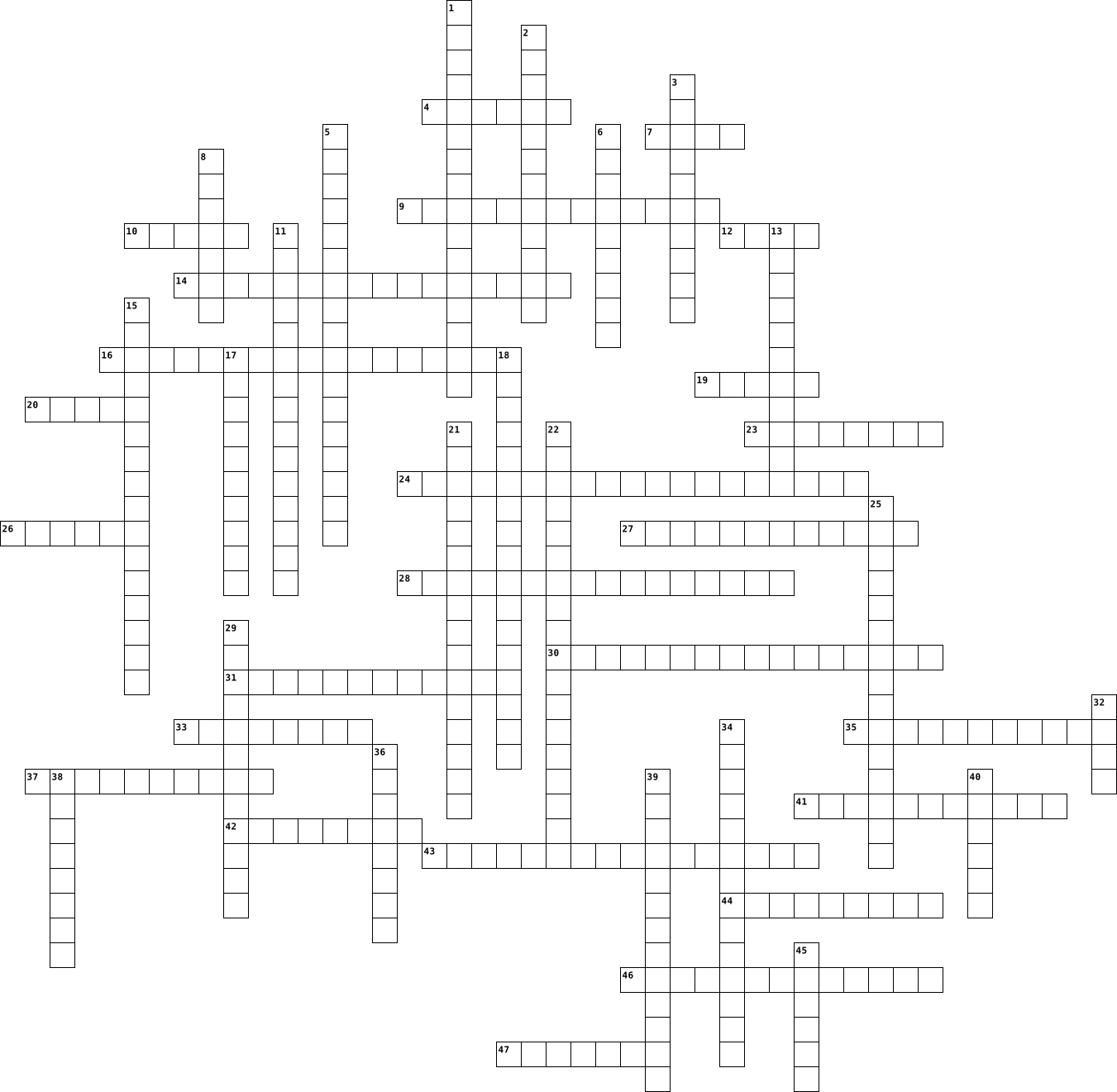
Across
- object change in position relative to a reference point
- a measure of the amount of matter in an object
- one of six basic machine types of machines which are the basis for all other forms of machines
- the distance travelled by the time interval during which the motion occurred
- the transfer of energy to a body by the application of a force that causes the body to move in the direction of the force
- an explanation for some phenomenon that is based on observation, experimentation, and reasoning
- the vertical movement of air currents due to temperature variations
- a quantity that measures the rate at which work is done or energy is transformed
- an action exerted on a body in order to change the body’s state of rest or motion; force has magnitude and direction
- a factor that changes in an experiment in order to test a hypothesis
- a quantity that measures how much a machine multiples a force by
- a measure of the size of a body or region in three-dimensional space
- the rate at which velocity changes over time; an objects accelerates if its speed, direction or both change
- a series of steps followed to solve problems including collecting data, formulating a hypothesis, testing the hypothesis and stating conclusions
- the ability and willingness to assess claims critically and make judgements on the basis of objective and supported reasons
- the quantity of heat required to raise a unit of mass of homogeneous material 1 ok or 1 oc in a specific way given constant pressure and volume
- the speed of an object in a particular direction
- a measure of how hot (or cold) something is; specifically; a measure of average kinetic energy of the particles in an object
- a quantity, usually expressed as a percentage that measures the ratio of useful work output to work input
- An instrument that measures and indicates temperature
- a quantity defined as the product of the mass and the velocity of an object
- the constant velocity of a falling object when the force of air resistance is equal in magnitude and opposite I direction to the force of gravity
- the energy that is transferred as electromagnetic waves, such as visible light and infrared waves
- the energy of a moving object due to the objects motion
- the tendency of an object to resist being moved or, if the object is moving, to resist a change in speed or direction until and outside force acts on the object
Down
- a machine made of more that one simple machine
- the temperature at which molecular energy is a minimum 0 ok on the kelvin scale or -273.16 oc on the Celsius scale
- a machine that transform heat into mechanical energy or work
- a prescribed decimal place that determines the amount of rounding off to be done based on the precision of the measurement
- the exactness of a measurement
- the knowledge obtained by observing natural events and conditions in order to discover facts and formulate laws or principles that can be verified or tested
- the force that opposes the movement of two surfaces that are in contact with each other and are sliding over each other
- a material used to cool an area or object to a temperature that is lower than the temperature of the environment
- the curved path that an object follows when thrown, launched, or otherwise projected near the surface of the earth; the motion of objects that are moving in two dimensions under the influence of gravity
- the movement of matter due to differences in density that are caused by temperature variations
- the transfer of energy as heat through a material
- the amount of work and object can do because of the object’s kinetic and potential energy
- a method of expressing a quantity as a number multiplied by 10 to the appropriate power
- the energy an object has because of position, shape or condition of the object
- the change in position of an object
- the energy transferred between object that are at different temperatures
- the force that resists the initiation between two surfaces that are in contact and at rest
- a description of how close a measurement is to the true value of the quantity measured
- the motion of a body when only the force of gravity is acting on the body
- a summary of many experimental results and observations; a law tells how things work
- the measure of the straight-line distance between two points
- a measure of the gravitational force exerted on an object
47 Clues: the exactness of a measurement • the change in position of an object • a machine made of more that one simple machine • a measure of the amount of matter in an object • the speed of an object in a particular direction • the transfer of energy as heat through a material • An instrument that measures and indicates temperature • ...
Physics 2021-05-25
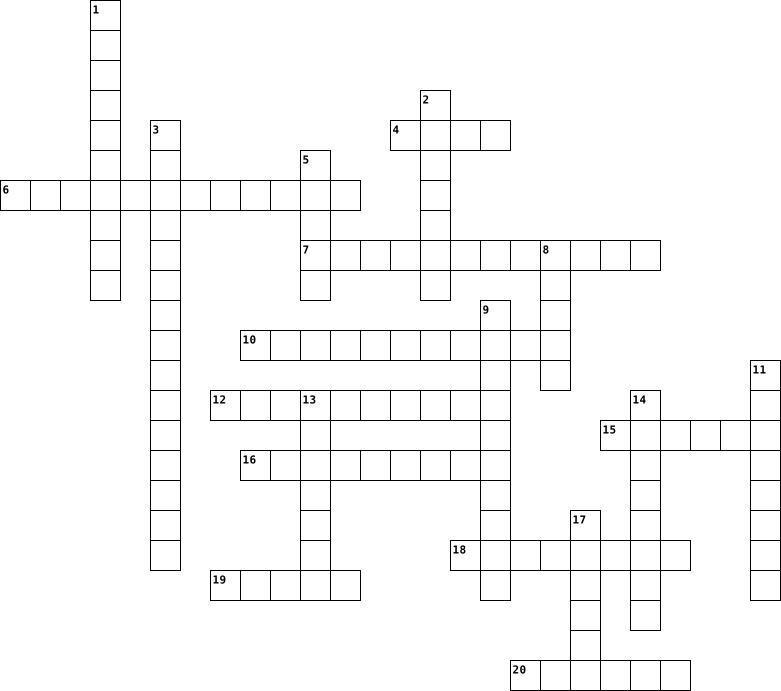
Across
- the energy transformed from one object to another because of a temperature difference between them
- the rate of change of velocity with respect to time
- describes the force felt between any two charged objects
- helps us understand/predict the world
- measures how hard it is for the charge to move from one place to another
- unit of energy
- maximum displacement of the medium from "rest" position
- variable=v
- a collection of statements or ideas that simplify or explain a complex phenomenon
- time for one wave/cycle to pass a given point
Down
- a guess based on observations and prior understanding; must be testable
- pull caused by rope,chain,cable,etc.
- a simple sketch of all forces acting on an object
- example: Mr. McKinnell pushing an object
- the absolute value of rate of change of position with respect to time
- attempts to explain something indirectly observed based on prior understanding
- the location of an object in space
- uses the variable I
- uses the equation p=mv
- a quantity with only magnitude is a ______
20 Clues: variable=v • unit of energy • uses the variable I • uses the equation p=mv • the location of an object in space • pull caused by rope,chain,cable,etc. • helps us understand/predict the world • example: Mr. McKinnell pushing an object • a quantity with only magnitude is a ______ • time for one wave/cycle to pass a given point • a simple sketch of all forces acting on an object • ...
physics 2024-04-29
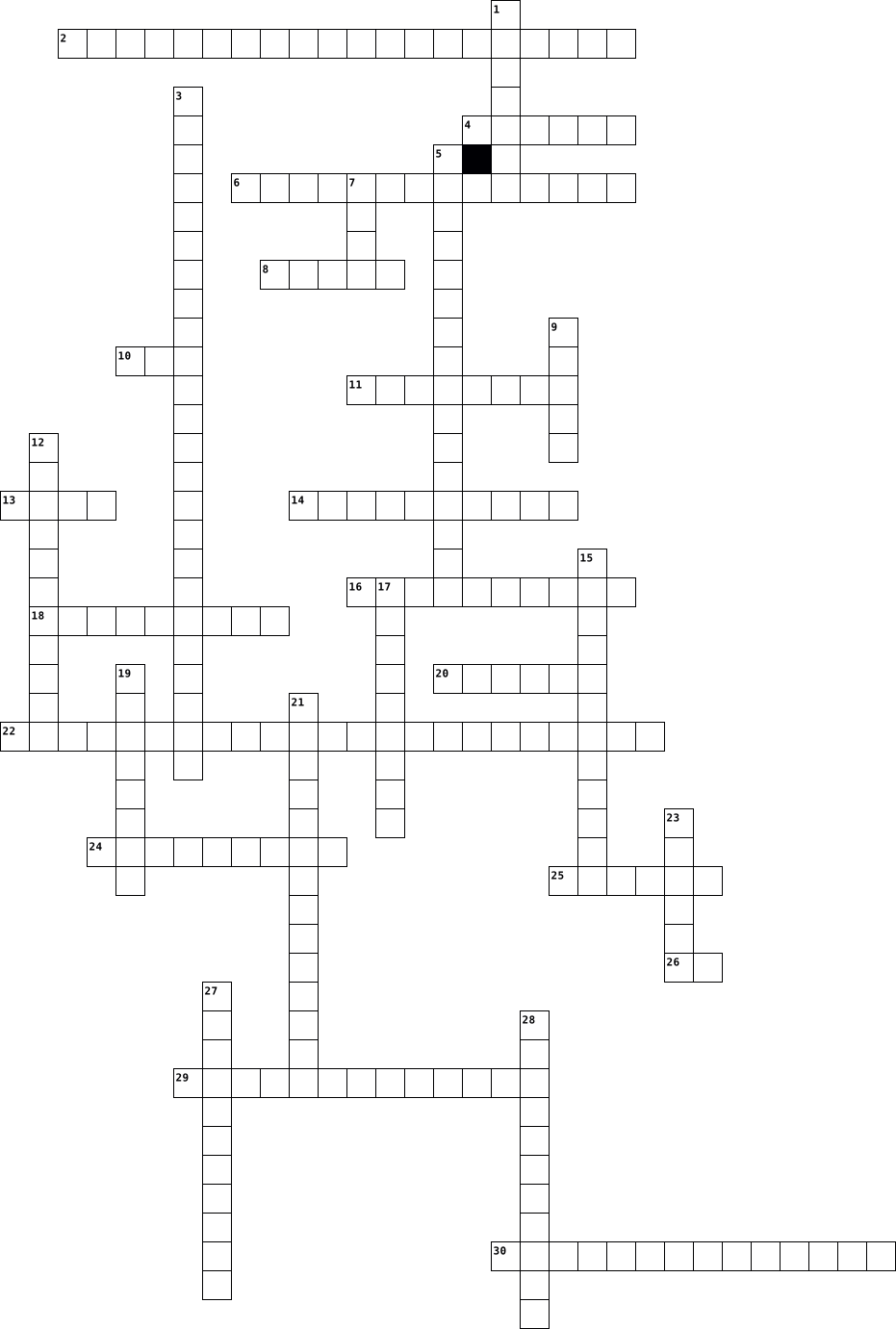
Across
- any periodic motion that is the result of a restoring force that is proportional to displacement
- a physical environment through which a disturbance can travel
- k is quantity of ______
- At a _____ boundary, waves are reflected and inverted
- period = ____× square root of (length divided by free-fall acceleration)
- a point in a standing wave, halfway between two nodes, at which the largest displacement occurs
- At a _____ boundary, waves are reflected
- The frequencies of __that are audible to humans range from 20 Hz to 20 000Hz
- The distance the wave travels along its path during one cycle
- number of complete cycles the ride swings through in a unit of time is the ride’s
- the time it takes for this complete cycle of motion
- a superposition of two or more waves in which individual dis- placements on opposite sides of the equilibrium position are added together to form the resultant wave
- Much of your perception of the physical world is ______ on waves.
- t is the quantity of _____
- Units of hertz=s^-1
- vibrations ______ to the direction of wave motion transverse wave
- particles of the disturbed medium move perpendicularly to the wave motion
Down
- A mass-spring system vibrates with simple harmonic motion the force if from ____ law
- a superposition of two or more waves in which individual displacements on the same side of the equilibrium position are added together to form the resultant wave
- When the particles of the medium vibrate parallel to the direction of wave motion
- a point in a standing wave that maintains zero displacement
- The highest point above the equilibrium position
- _______ = −(spring constant displacement)
- a wave pattern that results when two waves of the same fre- quency, wavelength, and ampli- tude travel in opposite directions and interfere
- maximum displacement from the equilibrium position
- vibrations ______ to the direction of wave motion are longitudinal wave
- Waves that require a material medium
- The lowest point below the equilibrium position
- _______= frequency × wavelength
- Felastic quantity of ______
30 Clues: Units of hertz=s^-1 • k is quantity of ______ • t is the quantity of _____ • Felastic quantity of ______ • _______= frequency × wavelength • Waves that require a material medium • At a _____ boundary, waves are reflected • _______ = −(spring constant displacement) • The lowest point below the equilibrium position • The highest point above the equilibrium position • ...
Physics 2024-05-29

Across
- Pattern of light
- Forms an image
- Substance through which wave travels
- Straight line
- The bouncing back of light
- Huygens
- Transparent optical figure
- Concentrated stream of light
- Ray landing on a surface
- Bending of light as it passes through medium
- Distance between crests
Down
- Separation of light
- The combination of 2 or more waves
- Total displacement is algebraic sum of individual displacements
- Point where rays meet
- Perpendicular line
- Reflective surface
- Bending of waves around obstacles
- Power over area
- Ray leaving a surface
20 Clues: Huygens • Straight line • Forms an image • Power over area • Pattern of light • Perpendicular line • Reflective surface • Separation of light • Point where rays meet • Ray leaving a surface • Distance between crests • Ray landing on a surface • The bouncing back of light • Transparent optical figure • Concentrated stream of light • Bending of waves around obstacles • ...
Physics 2023-09-24
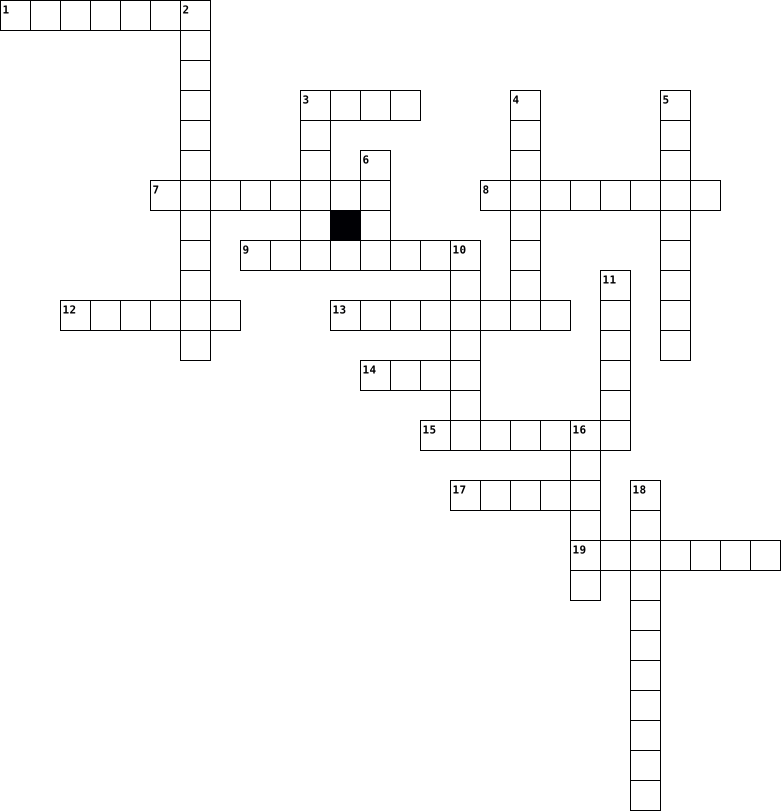
Across
- Fact or a rule written with mathematical symbols
- Measure of the amount of matter in an object.
- Force resists motion when the surface of one object comes in contact with the surface of another.
- A mathematical relationship or rules expressed in symbols.
- Expression, rule, or law that defines a relationship between one variable
- Quantity or phenomenon that has two independent properties: magnitude and direction.
- The speed of something in a given direction.
- Disturbance that transfers energy and momentum from one point to another in a medium.
- Question or matter involving doubt, uncertainty, or difficulty
- The push or pull on an object with mass causes it to change its velocity.
- An invisible force that pulls objects toward each other.
Down
- Increase in the rate or speed of something.
- Act, process, or instance of changing place
- Method of expressing large numbers in terms of powers.
- The action or process of removing or getting rid of something
- Single quantity is regarded as a whole in the calculation.
- Relates to the nuclei of atoms, or to the energy released when these nuclei are split or combined
- Group of interacting or interrelated elements that act according to a set of rules to form a unified whole.
- Power derived from the utilization of physical or chemical resources
- Technique in which the properties of an object are determined by comparing them to a standard quantity
20 Clues: Increase in the rate or speed of something. • Act, process, or instance of changing place • The speed of something in a given direction. • Measure of the amount of matter in an object. • Fact or a rule written with mathematical symbols • Method of expressing large numbers in terms of powers. • An invisible force that pulls objects toward each other. • ...
Physics 2024-05-08

Across
- any kind of push or pull on an object
- change in position
- Newton's first law of motion is also called this
- change in velocity over time
- speed and direction
- energy that is found stored in food or fuel
- ultraviolet radiation is an example of this type of wave
- a material in which charges (electrons) can move easily
- compressional wave moving through matter
- the type of circuit where there is more than one path to the battery
- and opposing force
- the movement of electrons
- the ability to do work, or exert force, and move things in the direction of that force
- this type of energy includes both fusion and fission
- a simple machine that changes the direction of the force
Down
- electromagnetic radiation that we can see
- energy that is stored
- the distance a wave rises or falls from its rest position
- electricity makes this temporarily magnetic
- SI(metric) unit for measuring weight
- unit for measuring the power of an object
- the bending of a wave through a new medium
- acceleration of 9.8 m/s/s
- the type of mirror found in car headlights or flashlights
- when an object moves a distance in the direction of the force applied
25 Clues: change in position • and opposing force • speed and direction • energy that is stored • acceleration of 9.8 m/s/s • the movement of electrons • change in velocity over time • SI(metric) unit for measuring weight • any kind of push or pull on an object • compressional wave moving through matter • electromagnetic radiation that we can see • unit for measuring the power of an object • ...
Physics 2023-03-03
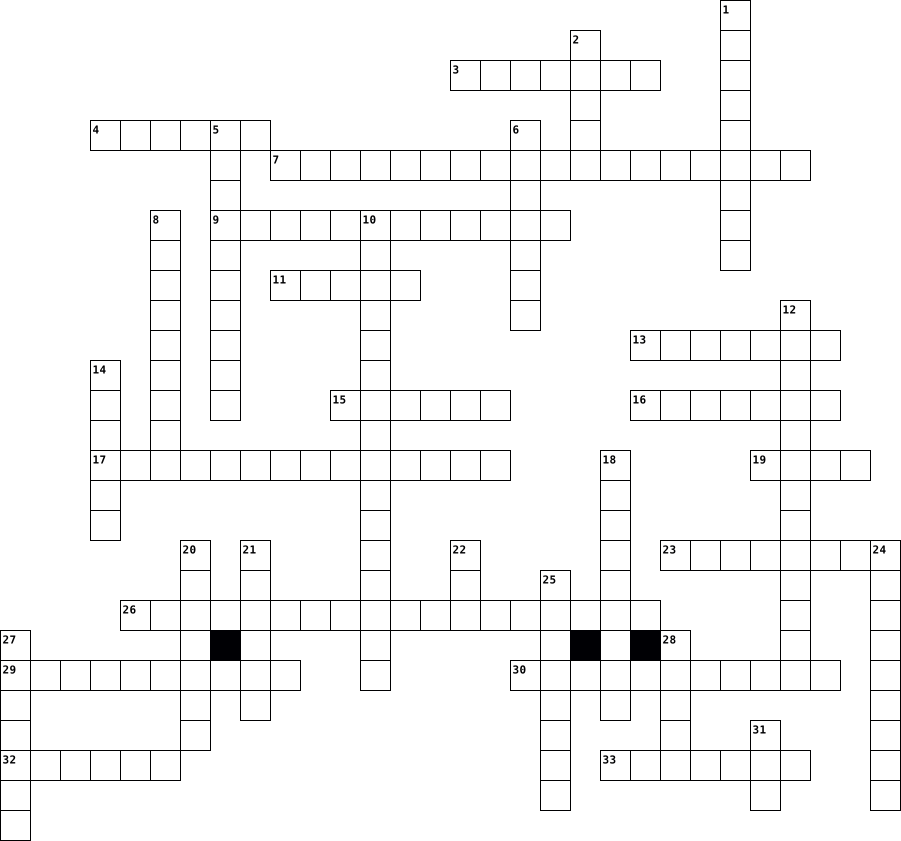
Across
- The unit of force.(there is a s)
- The metric unit of distance.(there is a s)
- The evolution equation of quantum mechanics.
- Something that changes velocity.
- Measured in meters per second and DOES NOT have direction.
- The unit of pressure.(there is a s)
- The unit of energy.(there is a s)
- Forces that apply on touch.
- the study of heat and temperature.
- The force pushing back on airplanes.
- The Force a object has when in contact with a surface.
- The best representation of quantum and particle physics.
- Forces that don't need touch.
- The force that objects apply on one another other to counter overlapping.
- The force overcoming drag by pushing mass out of engines.
- The study of everything.
Down
- The physics of macroscopic objects but not microscopic particles.
- Something that changes acceleration.
- Einstein’s theory of ___ shows how and why time slows down when speed increases.
- The unit of time.(there is a s)
- The ___ point from which you are taking measurements from.
- The unified electrostatic and magnetic forces.
- A noncontact force proportional to the charges of two particles/points/objects.
- A ___ is a arrow in physics.
- The metric unit of mass.(there is a s)
- The physics of small particles but not macroscopic objects like planets or stars.
- The study of lenses and their effect on light.
- The study of the electromagnetic force at a quantum scale.
- The 3 types of classical physics are ____, Lagrangian, and Hamiltnian.
- Is speed with a direction.
- "An objects tendency to stay in motion"
- The suffix meaning “the study of.”
- The study of the strong force.
33 Clues: The study of everything. • Is speed with a direction. • Forces that apply on touch. • A ___ is a arrow in physics. • Forces that don't need touch. • The study of the strong force. • The unit of time.(there is a s) • The unit of force.(there is a s) • Something that changes velocity. • The unit of energy.(there is a s) • the study of heat and temperature. • ...
physics 2023-03-01
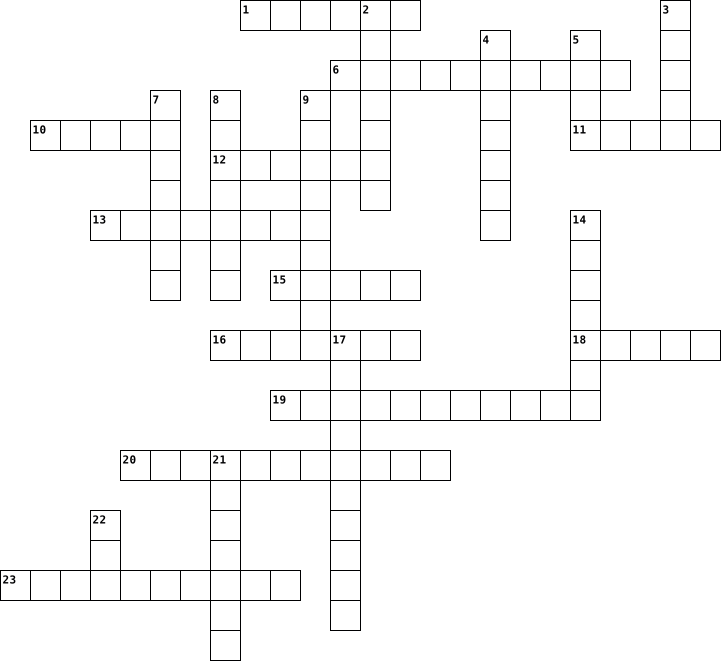
Across
- The property of matter that determines how much space an object occupies
- energy A type of energy that is produced by the movement of electrons
- Famous physicist known for his work on electricity and magnetism
- A type of simple machine that consists of an inclined plane wrapped around a cylinder
- The unit used to measure force.
- The force that resists motion between two surfaces that are in contact
- A type of energy that travels in waves and can be seen by the human eye
- energy The energy released from the nucleus of an atom
- A type of energy that travels in waves and can be seen by the human eye
- A device that measures temperature.
- The process of changing from a liquid to a gas
- The bending of light as it passes through different materials
Down
- The process of changing from a solid to a liquid
- A push or pull on an object
- The force that pulls all objects toward one another
- A measure of the amount of matter in an object
- Famous physicist known for his work on black holes and cosmology
- energy The energy an object possesses due to its motion
- energy The energy an object possesses due to its position or motion
- Famous physicist known for the Doppler effect in waves.
- energy A type of energy that results from the motion of charged particles
- The study of matter and energy and their interactions
- resistance A force that opposes motion through the air
23 Clues: A push or pull on an object • The unit used to measure force. • A device that measures temperature. • A measure of the amount of matter in an object • The process of changing from a liquid to a gas • The process of changing from a solid to a liquid • The force that pulls all objects toward one another • The study of matter and energy and their interactions • ...
Physics 2023-04-19
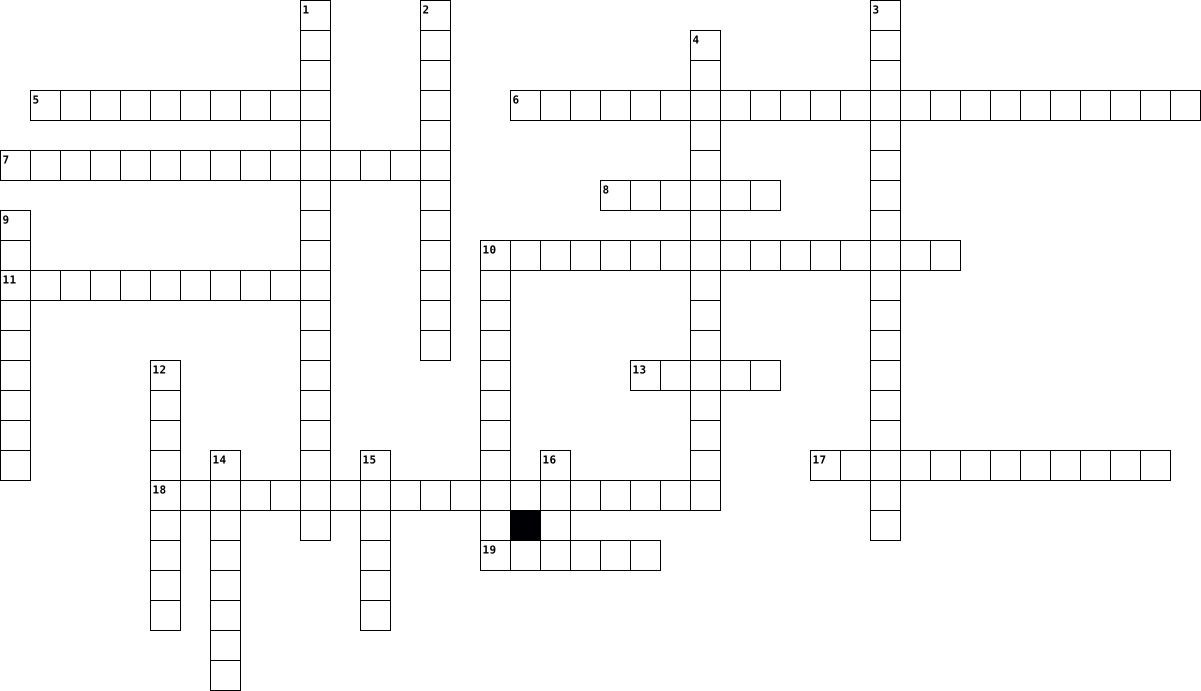
Across
- transfer of heat related to the movement that occurs within a fluid due to the rising of hotter materials paired with the sinking of colder materials
- range of frequencies of electromagnetic radiation and their respective wavelengths and photon energies
- when two or more unequal forces act on an object
- refers to the duration in which a complete wave cycle is achieved
- the neutral atoms likelihood of gaining an electron
- spreading of waves around an obstacle
- answers the question "how fast an object moves or travels?"
- type of sound that cannot be perceived by people
- when light is directed at metal, the photons collide with the atoms. If the photons frequency is sufficient to knock off an electron, the collision produces the ___
- an object is in ___, if it changes position relative to a reference point
Down
- number of digits in a quantity, often a measurement that contribute to the degree of accuracy of the value
- defined as the rate at which an object changes its velocity
- reaction that releases energy in the form of heat or light
- movement of particles of matter
- charging by ___ happens when charges in an uncharged object are rearranged without direct contact with a charged object
- also known as line of origin
- a short, non-periodic, wave formed by a single input of energy
- image from sound
- any substance that allows sound waves to travel through
- energy that is transferred from one body to another
20 Clues: image from sound • also known as line of origin • movement of particles of matter • spreading of waves around an obstacle • when two or more unequal forces act on an object • type of sound that cannot be perceived by people • the neutral atoms likelihood of gaining an electron • energy that is transferred from one body to another • ...
Physics 2023-03-28
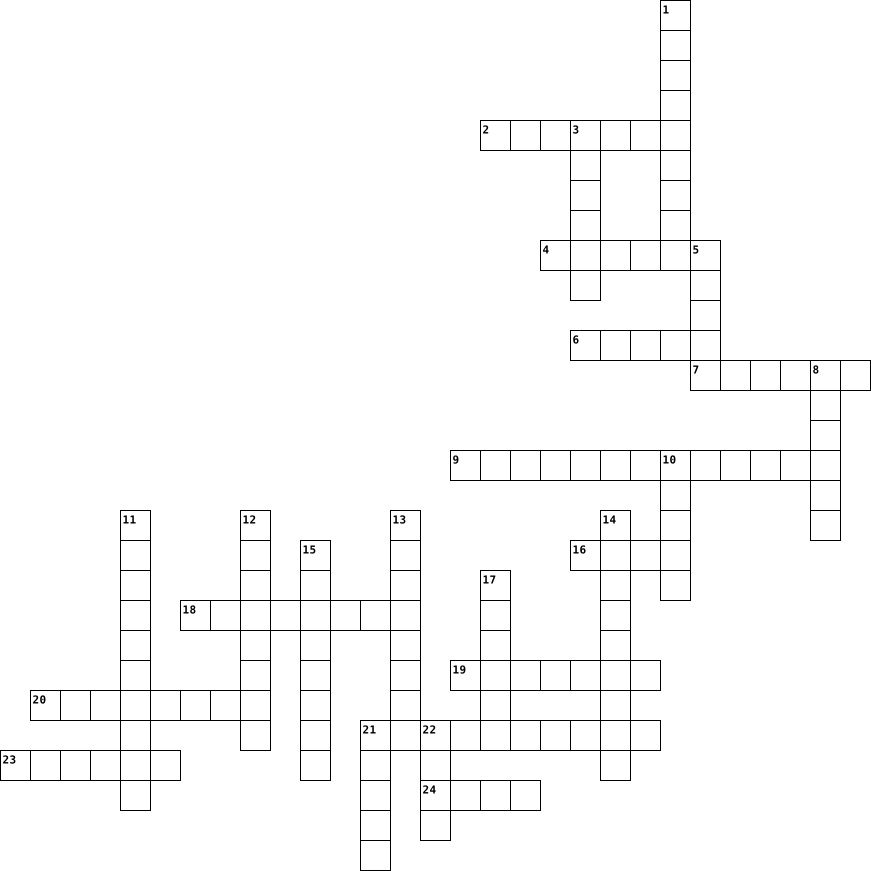
Across
- На френски: vitesse
- Мярка за количеството енергия, което се пренася от една система в друга.
- Четвъртото измерение в пространствено-времевия континуум.
- А е символ за
- R е символ за
- Брой на планетите в Слънчевата система
- Скоростта ѝ е равна на 299 792 458 m.s-1
- Мерна единица за звук
- Описва физичните величини път, скорост и ускорение и тяхното изменение под въздействието на сили
- U е символ за
- Мерна единица за температура
- V е символ за
Down
- Свойството на телата да запазват състоянието си на движение или покой, ако не са подложени на въздействие.
- С това определяме разпръснатостта в набора на данни
- Мерна единица за ток
- От латински: gravitas
- s е мерна единица за
- Природно явление, в резултат на което всички обекти, притежаващи маса или енергия – включително планети, звезди, галактики и дори светлината – се привличат един към друг
- Система за отчитане на големи промеждутъци от време
- Пътят, който описва едно тяло, хвърлено под ъгъл към хоризонта
- Векторна физична величина, която показва изменението на скоростта на движещо се тяло за единица време
- Мерна единица за маса
- Силата на взаимодействие между две притиснати една към друга повърхности
- Законите за движение са измислени от
- S означава
25 Clues: S означава • А е символ за • R е символ за • V е символ за • U е символ за • На френски: vitesse • Мерна единица за ток • От латински: gravitas • s е мерна единица за • Мерна единица за маса • Мерна единица за звук • Мерна единица за температура • Законите за движение са измислени от • Брой на планетите в Слънчевата система • Скоростта ѝ е равна на 299 792 458 m.s-1 • ...
Physics 2023-06-05
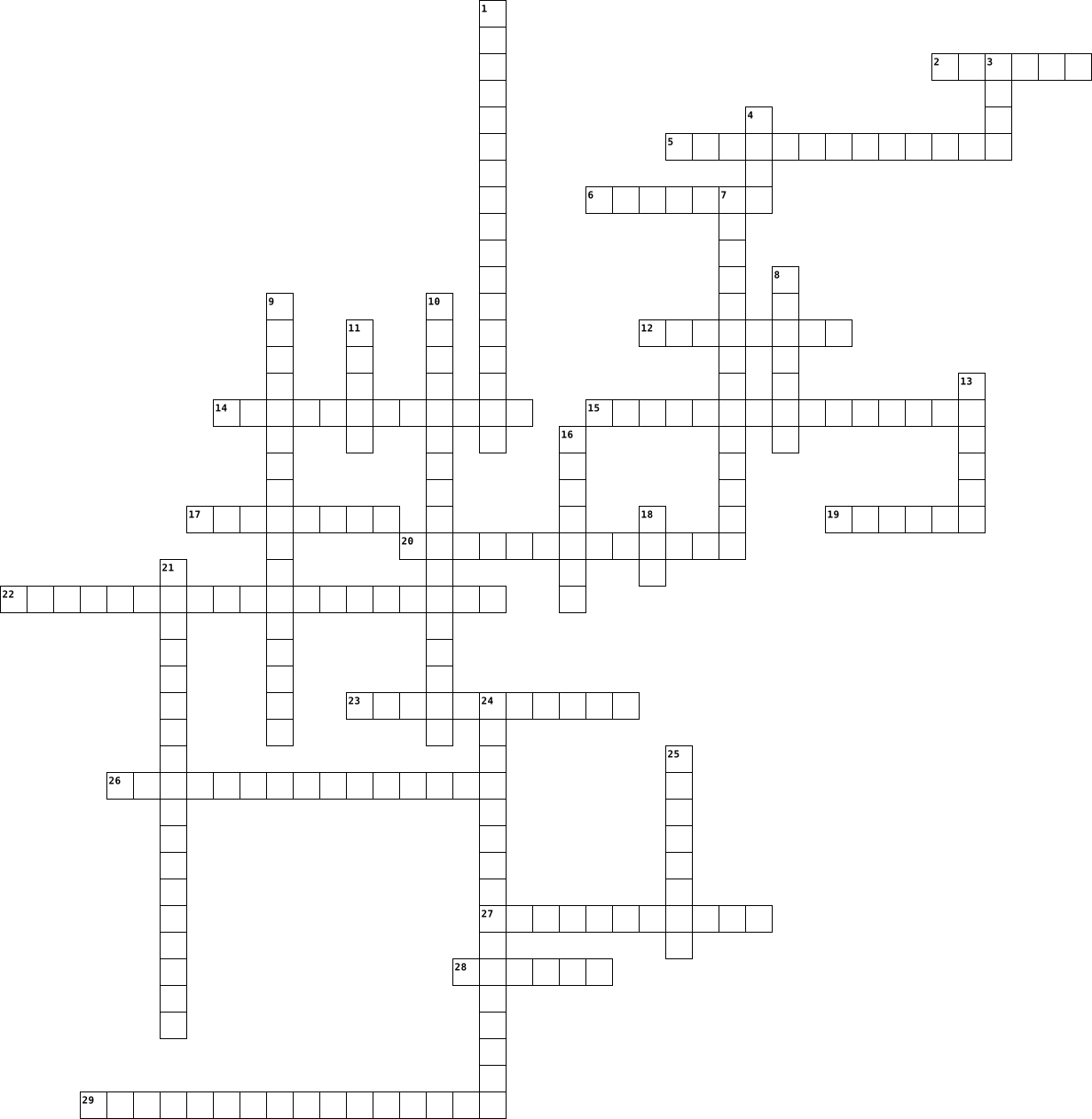
Across
- Moving
- Sum of zero
- subject
- 1,000 grams
- Magnetic
- Not equal to zero
- change or keep
- Attract
- Has boxes
- F=mv/r
- Person
- Ampere
- T,e
- Water
- remains at rest
Down
- Mol
- seconds
- Matter
- same
- pressure on...
- Candela
- Acceleration*Force
- push/pull
- Pound
- Stay on Earth
- Hydrogen
- change
- equal&opposite
- Constant
29 Clues: Mol • T,e • same • Pound • Water • Moving • Matter • change • F=mv/r • Person • Ampere • seconds • subject • Candela • Attract • Magnetic • Hydrogen • Constant • push/pull • Has boxes • Sum of zero • 1,000 grams • Stay on Earth • pressure on... • change or keep • equal&opposite • remains at rest • Not equal to zero • Acceleration*Force
Physics 2023-05-19
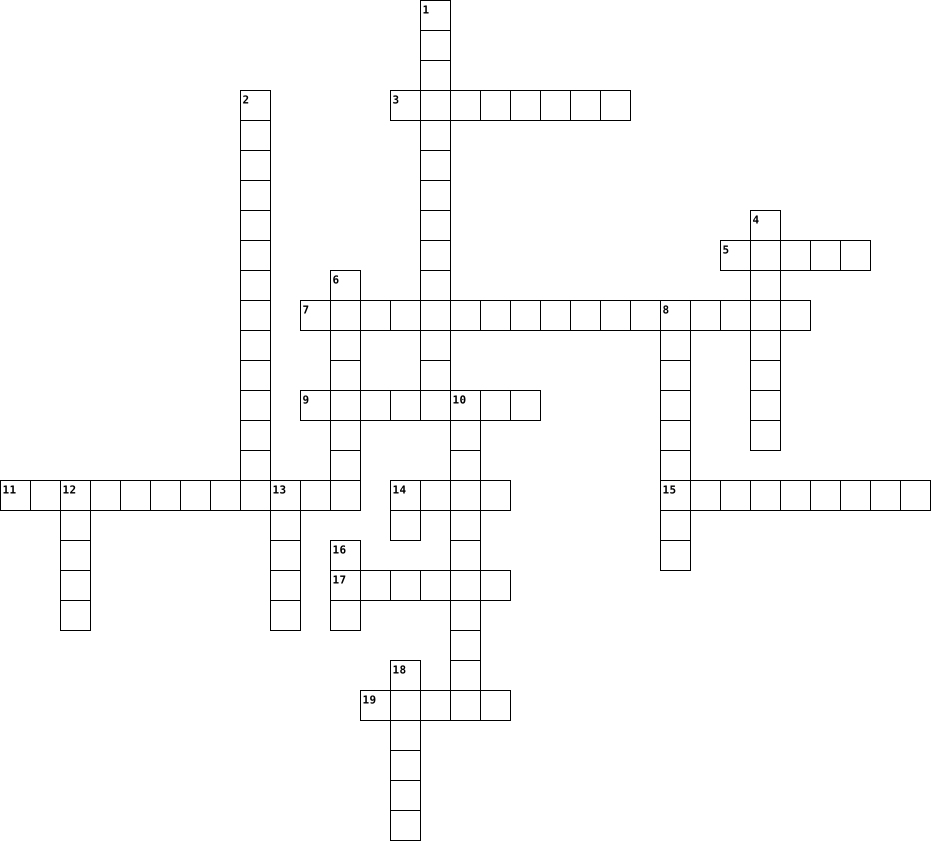
Across
- - made of a solenoid, are a permenant magnet and has cone changing current
- - B field goes out of this direction
- - Analayzing elements to find their average atomic masses
- - first part of thhe rught hand rule
- - paired electrons
- - amount of magnetic field passing through the cross section area of a loop.
- - charging an object without actually touching it
- - convert electrical energy to mechanical energy
- - third part of the right hand rule
Down
- - sound waves push on a diaphragm that connects to a plate of a capacitor
- - F = qvBsin0
- - a coil of wire
- - unpaired electrons
- - charges in motion
- - sound waves push on a diaphragm connected to a coil
- - B goes out of this direction
- - SI units for magnetic fields (B)
- - second part of the right hand rule
- - Is also reffered to as voltage
- - local magnetic region
20 Clues: - F = qvBsin0 • - a coil of wire • - paired electrons • - charges in motion • - unpaired electrons • - local magnetic region • - B goes out of this direction • - Is also reffered to as voltage • - SI units for magnetic fields (B) • - third part of the right hand rule • - B field goes out of this direction • - first part of thhe rught hand rule • - second part of the right hand rule • ...
physics 2023-05-16
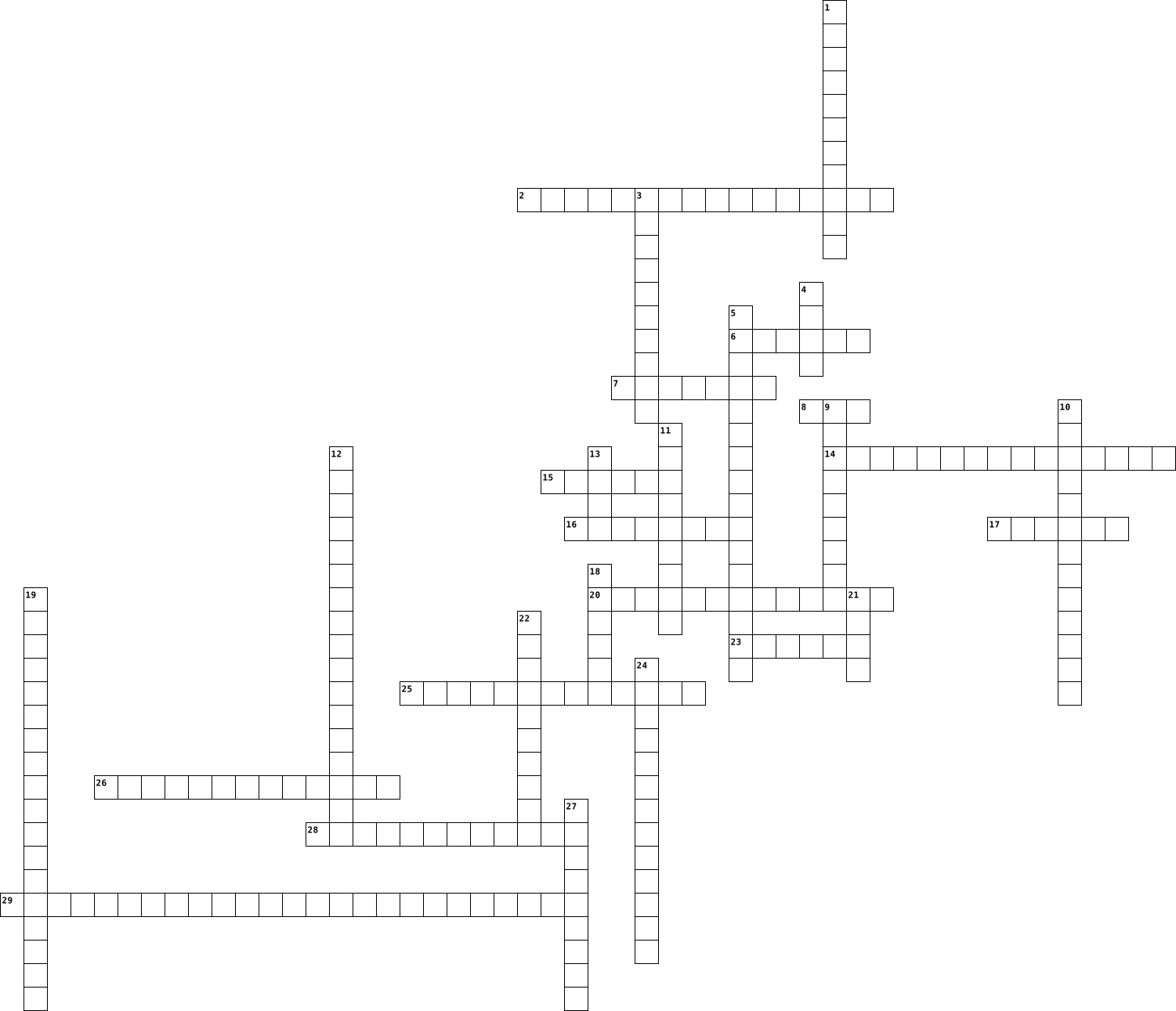
Across
- Same areas at the same time
- power derived from the utilization of physical or chemical resources,
- French physicist best known for his law that states that the force between two electrical charges is proportional to the product of the charges and inversely proportional to the square of the distance between them.
- The light traveling in any one direction in a straight line
- the energy possessed by a body by virtue of its position relative to others, stresses within itself, electric charge, and other factors
- a characteristic of a unit of matter that expresses the extent to which it has more or fewer electrons than protons.
- A pendulum is a body suspended from a fixed point so that it can swing back and forth under the influence of gravity.
- The time interval between two waves
- an electric property associated with each point in space when charge is present in any form.
- the greatest English mathematician of his generation. He laid the foundation for differential and integral calculus.
- Global warming is the long-term heating of Earth's surface observed since the pre-industrial period
- the ability of a quantum system to be in multiple states at the same time until it is measured.
- The phenomenon in which two or more waves superpose to form a resultant wave of greater, lower or the same amplitude.
- every particle attracts every other particle in the universe with a force that is proportional to the product of their masses and inversely proportional to the square of the distance between their centers.
Down
- the force of attraction or repulsion acting along a straight line between two electric charges is directly proportional to the product of the charges and inversely to the square of the distance between them.
- the bending of light (it also happens with sound, water and other waves) as it passes from one transparent substance into another.
- the transfer of energy by a force acting on an object as it is displaced.
- a method for arriving an estimate of an uncertain variable of interest.
- the maximum change of a variable from its mean value
- energy which a body possesses by virtue of being in motion.
- the rate at which something occurs or is repeated over a particular period of time or in a given sample.
- A phenomenon in which the length of a moving object is measured to be shorter than its proper length
- a disturbance in a medium that carries energy without a net movement of particles.
- a mathematician and physicist who not only observed, but also sought to explain the celestial dance above.
- the total energy of an isolated system is constant despite internal changes.
- piece of glass or other transparent substance that is used to form an image of an object by focusing rays of light from the object.
- when light bounces off an object.
- the lengthening of the time interval between two events for an observer in an inertial frame that is moving with respect to the rest frame of the events
- when the matching vibrations of another object increase the amplitude of an object's oscillations.
29 Clues: Same areas at the same time • when light bounces off an object. • The time interval between two waves • the maximum change of a variable from its mean value • The light traveling in any one direction in a straight line • energy which a body possesses by virtue of being in motion. • power derived from the utilization of physical or chemical resources, • ...
Physics 2023-05-22
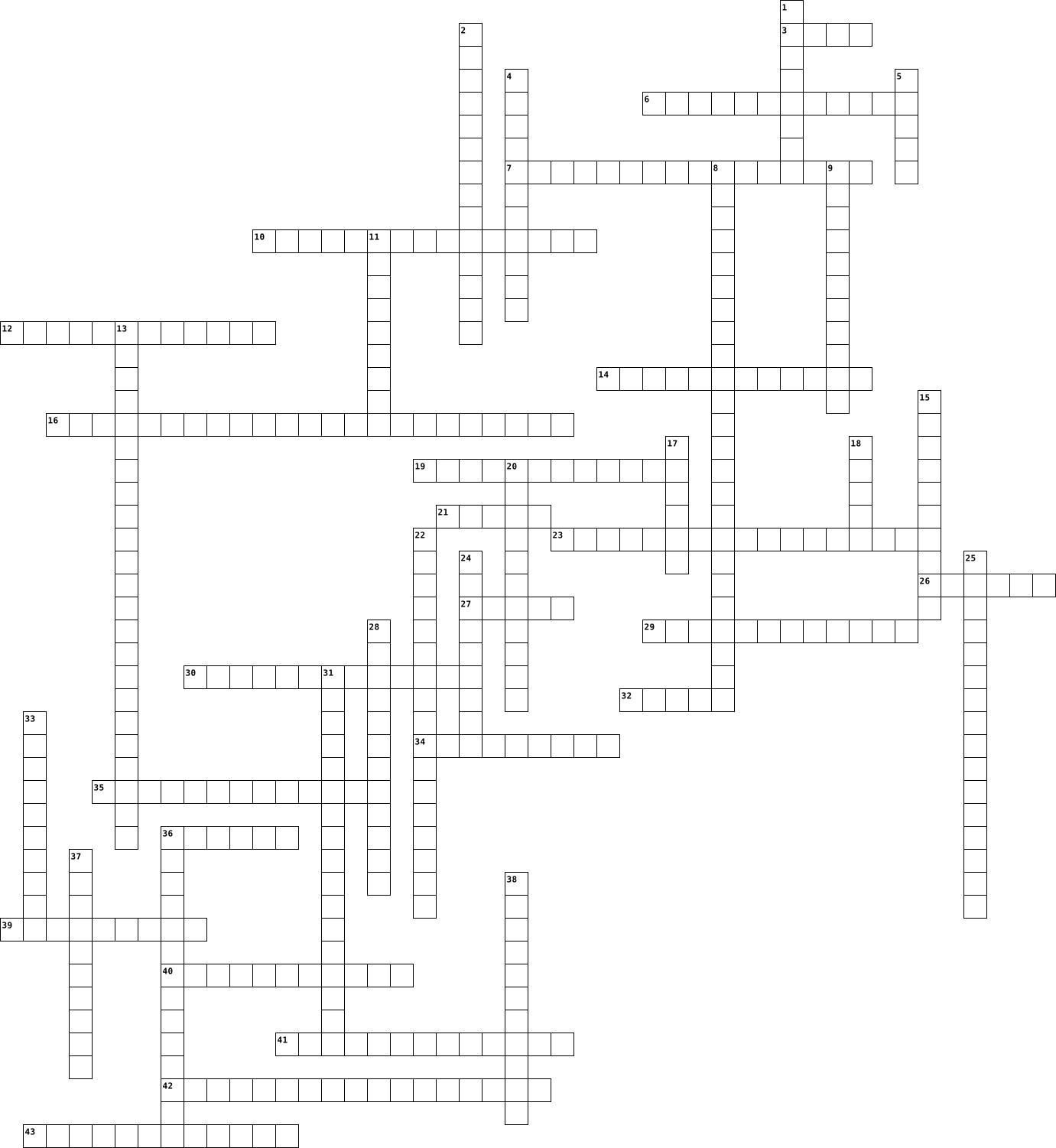
Across
- produced at locations where destructive interference occurs.
- combination of two waves moving in opposite directions, each having the same amplitude and frequency
- The angle between the wave propagation direction and the normal to the coastline
- when a wave reflects off a plane surface, the angle of incidence is equal to the angle of reflection
- change in frequency of a wave in relation to an observer moving relative to the wave source.
- property of transverse waves which specifies the geometrical orientation of the oscillations.
- occurs when waves come together so that they completely cancel each other out.
- a wave with a repeating continuous pattern which determines its wavelength and frequency
- a description of the frequency of the sound.
- a value calculated from the ratio of the speed of light in a vacuum.
- the lowest point in a wave length
- a completed period in a wave
- the area of a wave that is spread out.
- an increase or decrease in the frequency of sound, light, or other waves as the source and observer move toward each other.
- a single disturbance that moves through a transmission medium
- the number of waves that pass a fixed point in unit time
- observed when a wave is not confined to a given space along the medium.
- the substance that carries a wave or disturbance from one location to another
- a relationship between the path taken by a ray of light in crossing the boundary
- the ray of light falling on the surface
- lght that has the same wavelength so it is one color
- The angle between the reflected ray and the normal
- when two waves meet while traveling along the same medium.
Down
- A standing wave pattern always consists of an alternating patter
- a wave vibrating at right angles to the direction of its propagation.
- wave movement
- When two objects vibrate with different frequencies
- When the peaks of the waves line up
- the vibration is parallel to the direction of motion
- when the matching vibrations of another object increase the amplitude of an object's oscillations.
- the entire distribution of electromagnetic radiation according to frequency
- the distance between successive crests of a wave, especially points in a sound wave
- the time for a particle on a medium to make one complete vibrational cycle.
- The highest surface part of a wave
- the repetitive or periodic variation
- reflection of light or other waves or particles from a surface such that a ray incident on the surface is scattered at many angles
- the maximum displacement or distance moved by a point on a vibrating body or wave measured from its equilibrium position.
- a wave vibrating in the direction of propagation.
- A form of radiant energy that is thrown back from a nonpermeable or nonabsorbing surface
- reflection such that the angle of reflection of the light is equal to the angle of incidence and on the opposite side
- the change in direction of a wave passing from one medium to another
- a wave that is an oscillation of matter, and therefore transfers energy through a medium.
- abrupt change in the direction of propagation of a wave that strikes the boundary between different mediums.
- the spreading of waves around obstacles
44 Clues: wave movement • a completed period in a wave • the lowest point in a wave length • The highest surface part of a wave • When the peaks of the waves line up • the repetitive or periodic variation • the area of a wave that is spread out. • the spreading of waves around obstacles • the ray of light falling on the surface • a description of the frequency of the sound. • ...
Physics 2021-09-25
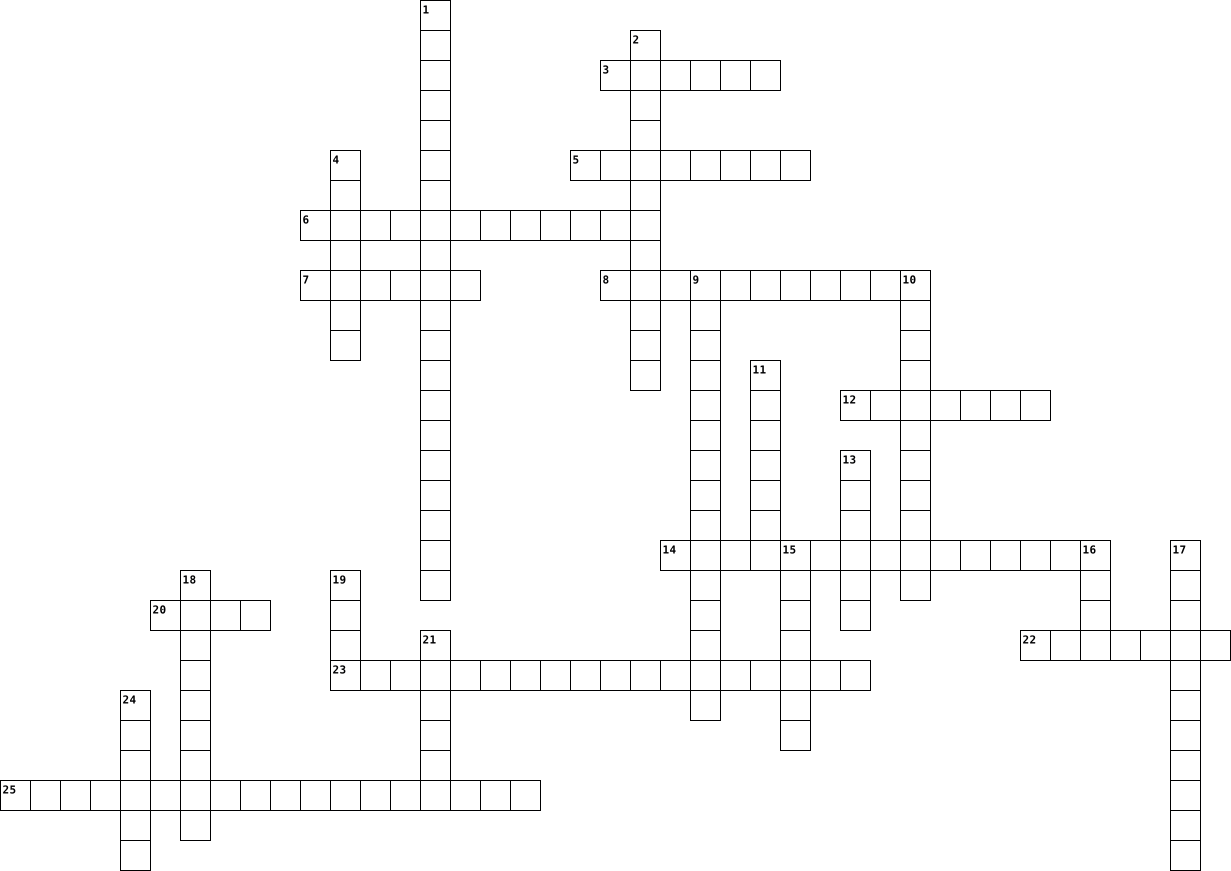
Across
- , base unit of thermodynamic temperature measurement
- , force that resists the sliding or rolling of one solid object over another.
- , also known as customary or imperial unit
- , A measured distance or dimension
- , He discovered the laws of gravity and motion and invented calculus
- , is a force that attracts a body towards the centre of the earth, or towards any other physical body having mass.
- , A flow of an electric charge between two points
- , is the SI unit for the amount of a substance.
- , is the resistance of any physical object to any change in its velocity.
- , s a way of writing very large or very small numbers.
- , A property of a material or system that can be quantified by measurement.
Down
- , French Word where SI is derived
- , a decimal system of weights and measures based on the meter and on the kilogram.
- , the SI unit of luminous intensity.
- , the rate at which displacement is changing with respect to the time in circular motion.
- , is an everyday force that is felt when a surface pushes against an object that is placed on that surface.
- , form of energy that an object or a particle has by reason of its motion.
- , is the action of changing location or position.
- , is a force developed in a rope, string, or cable when stretched under an applied force.
- , change, or the interval over which change occurs
- , the condition of a system when neither its state of motion nor its internal energy state tends to change with time.
- , stored energy that depends upon the relative position of various parts of a system.
- , A quantitative measure of inertia
- , gravitational force of attraction on an object, caused by the presence of a massive second object, such as the Earth or Moon.
- , distance between the center of the circle to its circumference is the
25 Clues: , French Word where SI is derived • , A measured distance or dimension • , A quantitative measure of inertia • , the SI unit of luminous intensity. • , also known as customary or imperial unit • , is the SI unit for the amount of a substance. • , A flow of an electric charge between two points • , is the action of changing location or position. • ...
physics 2021-11-18
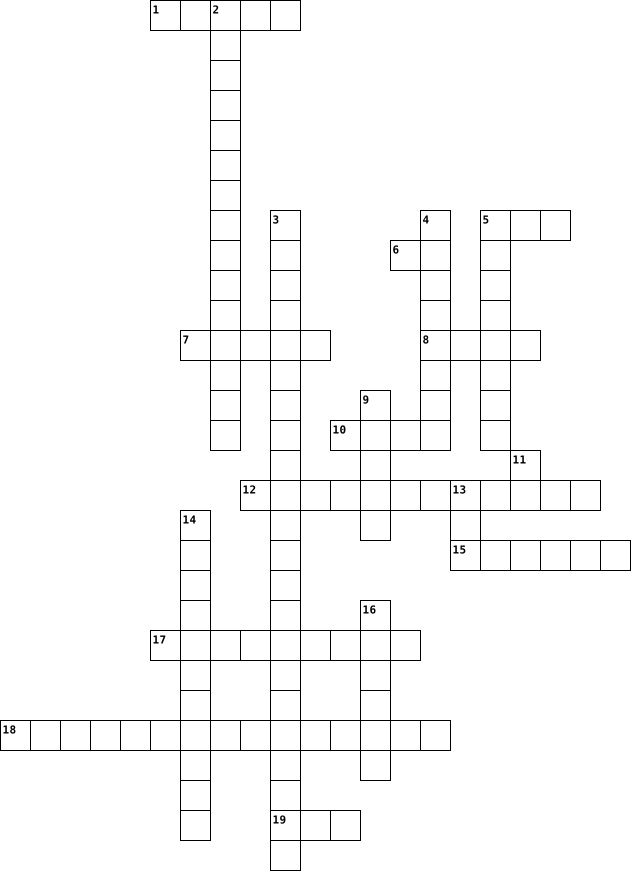
Across
- A push or pull on an object
- physical representation of an object and its interactions in the environment
- Sum of KE and PE
- equation is W/t or Fv
- SI units for power
- Transfer of energy to or from an object
- change in distance of an object
- ability to perform work
- Sum of all forces acting on an object
- what is K in the EPE equation
- potential energy in relation to position on Earth's surface
Down
- equation is -kx
- Energy cannot be created nor destroyed
- Sum of all work being done on an object
- force that occurs when microscopic irregularities of two objects get caught
- SI units for work/energy
- Energy of an object in motion
- equation is 1/2kx^2
- Force needed to stretch/compress a spring increases proportionally with amount of stretch
- Work, Power, KE, and EPE are all these quantities
20 Clues: equation is -kx • Sum of KE and PE • SI units for power • equation is 1/2kx^2 • equation is W/t or Fv • ability to perform work • SI units for work/energy • A push or pull on an object • Energy of an object in motion • what is K in the EPE equation • change in distance of an object • Sum of all forces acting on an object • Energy cannot be created nor destroyed • ...
physics 2021-12-14
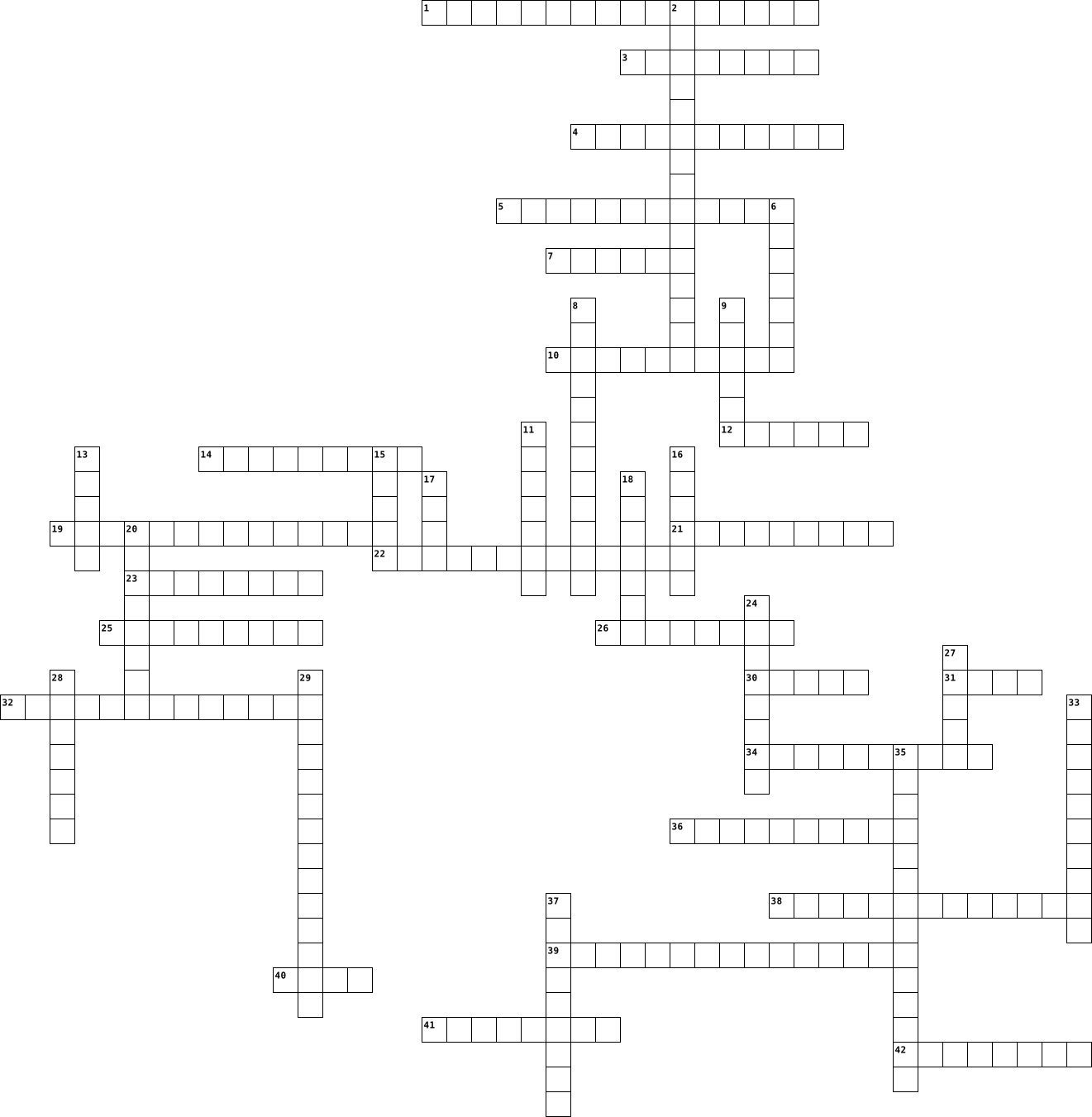
Across
- the form of an energy associated with the position and motion of an object
- Energy the potential energy stored in chemical bonds
- the process of light bending around an obstacle or spreading out after it moves through a small space.
- the rate at which velocity changes
- positively charged particle
- the throwing back by a body or surface of light, heat, or sound without absorbing it.
- Lowest part of a wave
- the number of waves that pass a fixed place in a given amount of time.
- a path along which the whole current flows through each component
- the maximum displacement or distance moved by a point on a vibrating body
- total potential and kinetic energy of the particles in an object
- the force acting on its gravity
- is energy that comes from a source and travels through space at the speed of light.
- Force upward force on a submerged object
- a push or pull
- The basic unit of a chemical element
- a table of the chemical elements arranged in order of atomic number
- process by which heat is transferred by movement of a heated fluid such as air or water
- the change in direction of a wave passing from one medium to another
- The apparent difference between the frequency at which sound or light waves leave a source
- the magnetic moments are aligned with one another because of interactions between molecules or atoms.
- the amount of matter in an object
- negative charged particle
- speed in a given direction
Down
- relating to a magnetic field produced by an electric current.
- neutral charged atom
- The speed of sound is the distance travelled per unit of time
- gravity's force on an object
- Light Waves The only electromagnetic waves we can see
- the distance an object travels per unit of time
- the highest surface part of a wave.
- As wavelengths get smaller, the waves have more energy.
- a disturbance from one place to another
- The tendency of an object
- Waves Long and short wavelengths.
- the overall force of an object when all the individual forces acting on it are added
- Waves Have the longest wavelength in the electromagnetic spectrum.
- the force that pulls objects toward each other
- an object in motion will stay in constant motion, unless it's acted upon by an unbalanced force
- the distance in the line of advance of a wave from any one point to the next point of corresponding phase.
- motion in which all points on a wave oscillate along paths at right angles to the direction of the wave's advance.
- They have the smallest wavelength and the most energy of the waves in the electromagnetic spectrum
42 Clues: a push or pull • neutral charged atom • Lowest part of a wave • The tendency of an object • negative charged particle • speed in a given direction • positively charged particle • gravity's force on an object • the force acting on its gravity • Waves Long and short wavelengths. • the amount of matter in an object • the rate at which velocity changes • ...
physics 2021-12-14
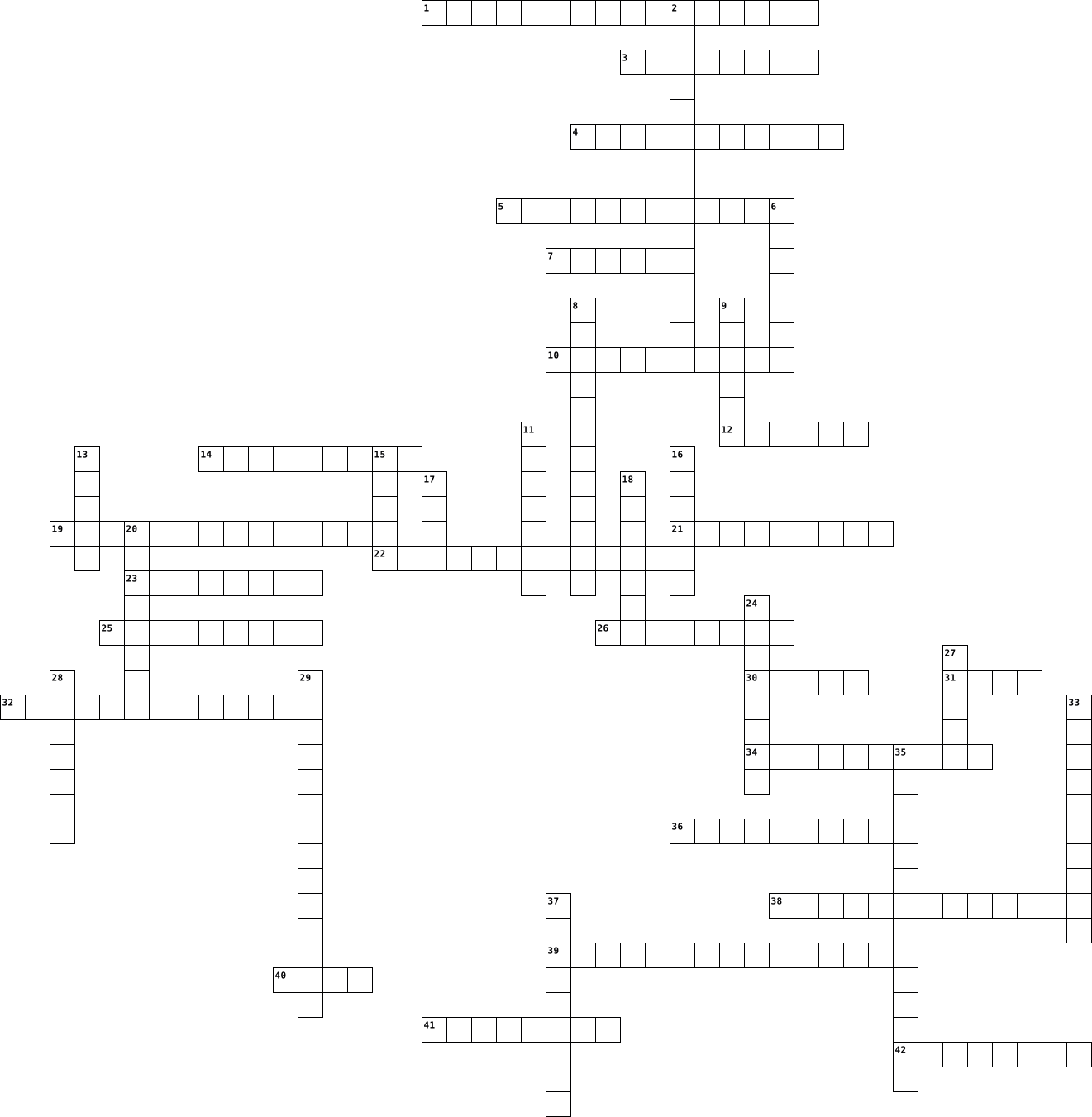
Across
- the form of an energy associated with the position and motion of an object
- Energy the potential energy stored in chemical bonds
- the process of light bending around an obstacle or spreading out after it moves through a small space.
- the rate at which velocity changes
- positively charged particle
- the throwing back by a body or surface of light, heat, or sound without absorbing it.
- Lowest part of a wave
- the number of waves that pass a fixed place in a given amount of time.
- a path along which the whole current flows through each component
- the maximum displacement or distance moved by a point on a vibrating body
- total potential and kinetic energy of the particles in an object
- the force acting on its gravity
- is energy that comes from a source and travels through space at the speed of light.
- Force upward force on a submerged object
- a push or pull
- The basic unit of a chemical element
- a table of the chemical elements arranged in order of atomic number
- process by which heat is transferred by movement of a heated fluid such as air or water
- the change in direction of a wave passing from one medium to another
- The apparent difference between the frequency at which sound or light waves leave a source
- the magnetic moments are aligned with one another because of interactions between molecules or atoms.
- the amount of matter in an object
- negative charged particle
- speed in a given direction
Down
- relating to a magnetic field produced by an electric current.
- neutral charged atom
- The speed of sound is the distance travelled per unit of time
- gravity's force on an object
- Light Waves The only electromagnetic waves we can see
- the distance an object travels per unit of time
- the highest surface part of a wave.
- As wavelengths get smaller, the waves have more energy.
- a disturbance from one place to another
- The tendency of an object
- Waves Long and short wavelengths.
- the overall force of an object when all the individual forces acting on it are added
- Waves Have the longest wavelength in the electromagnetic spectrum.
- the force that pulls objects toward each other
- an object in motion will stay in constant motion, unless it's acted upon by an unbalanced force
- the distance in the line of advance of a wave from any one point to the next point of corresponding phase.
- motion in which all points on a wave oscillate along paths at right angles to the direction of the wave's advance.
- They have the smallest wavelength and the most energy of the waves in the electromagnetic spectrum
42 Clues: a push or pull • neutral charged atom • Lowest part of a wave • The tendency of an object • negative charged particle • speed in a given direction • positively charged particle • gravity's force on an object • the force acting on its gravity • Waves Long and short wavelengths. • the amount of matter in an object • the rate at which velocity changes • ...
Physics 2022-03-02
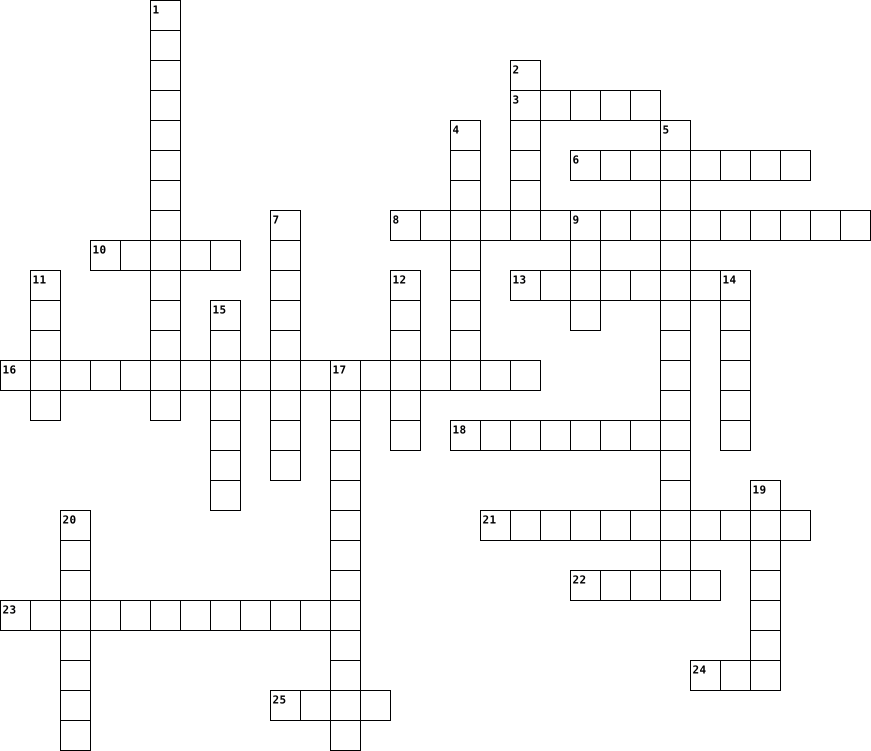
Across
- Einsteins famous energy-mass equivelance equation.
- Protons and neutrons are examples of this.
- Rules that only apply to the subatomic world.
- The particles that make up protons and neutrons.
- Positively charged anti-particle of the electron.
- Particles that aren't made up of anything.
- Negatively charged elementary particle that is common in atoms.
- Quantum physicist who is famous for his cat.
- The stuff that everythings made of.
- The universal speed limit.
- An atom that has an electric charge.
- The amount of atoms, particles, molecules etc in a substance.
Down
- A famous disabled physicist that did major discoveries on black holes.
- The force acted upon an object by gravity.
- Something that is smaller than an atom.
- The study of the relation between electricity and magnetism.
- The distance light travels in one year.
- Quantity of matter.
- The Si unit for energy.
- A massless particle that is the carrier of electromagnetic radiation.
- The Si unit of force and the name of a famous physicist.
- The force between two objects with mass.
- A type of particle that is also just a helium nucleus.
- Neutrally charged particle that is common in atmoic nuclei.
- A grouping of atoms.
25 Clues: Quantity of matter. • A grouping of atoms. • The Si unit for energy. • The universal speed limit. • The stuff that everythings made of. • An atom that has an electric charge. • Something that is smaller than an atom. • The distance light travels in one year. • The force between two objects with mass. • The force acted upon an object by gravity. • ...
Physics 2022-05-27
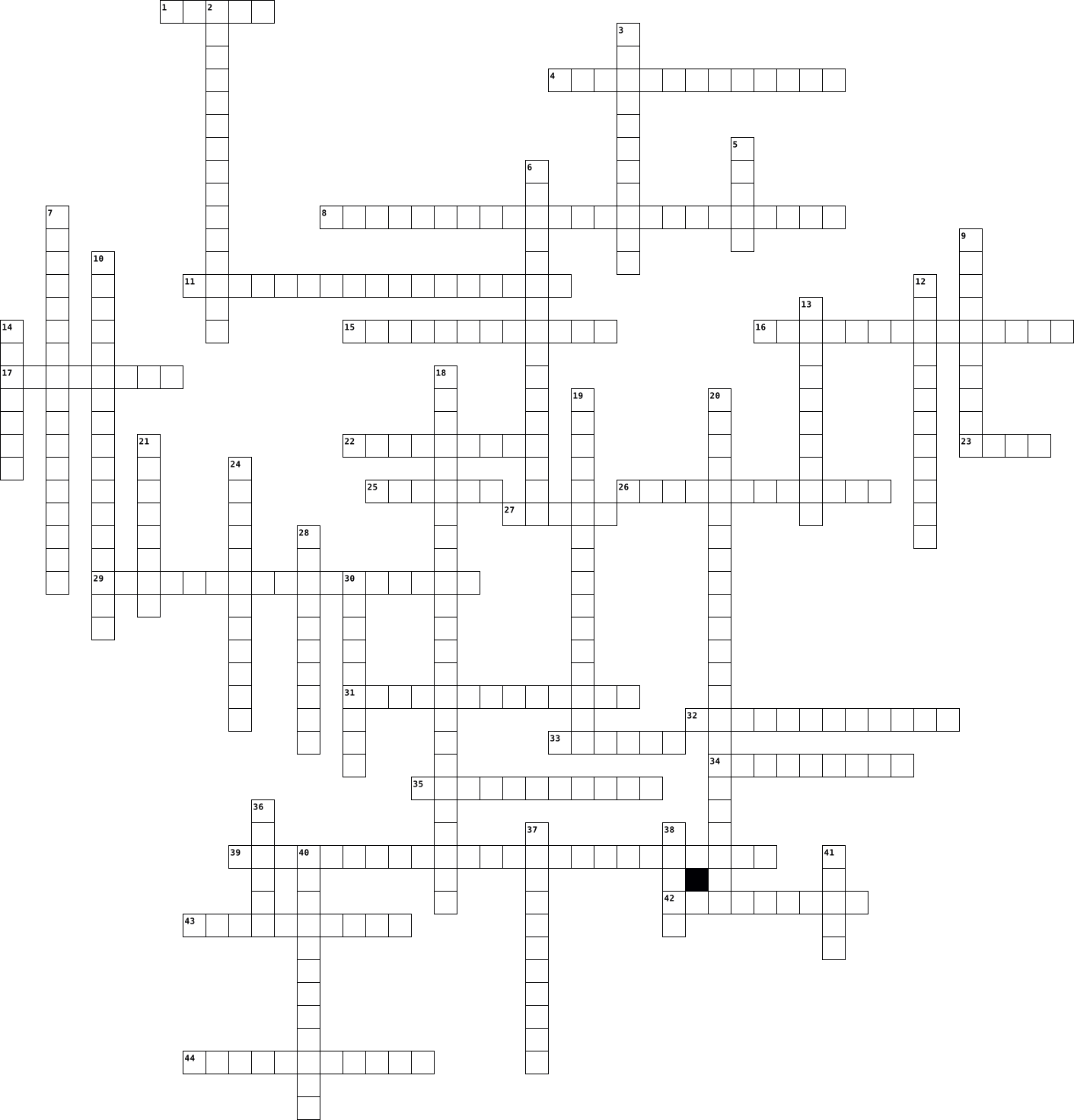
Across
- a single disturbance that moves through a transmission medium.
- one color light
- range of frequencies of electromagnetic radiation
- Scattered out reflection
- a decrease in the density of something
- a wave vibrating at right angles to the direction of its propagation
- wave- a wave with a repeating continuous pattern which determines its wavelength and frequency
- Increased amplitude as it approaches the thing that produces the waves
- a point along a standing wave where the wave has minimum amplitude.
- a substance or material that carries the wave.
- specifies the geometrical orientation of the oscillations
- interference pattern between two sounds of slightly different frequencies
- indication of the light bending ability of that medium
- wave that passes others
- incident ray bouncing back in the same medium after striking the reflecting surface
- the time for a particle on a medium to make one complete vibration cycle.
- the number of occurrences of a repeating event per unit of time
- repetitive or periodic variation in time
- When two waves of identical wavelength are in phase they form a new wave with an amplitude equal to the sum of their individual amplitudes
- formula used to describe the relationship between the angles of incidence and refraction
- wave wave that transfers energy through a medium.
- when a wave encounters an obstacle or opening
Down
- of reflection is equal to the angle of incidence and that the incident ray,
- the process by which a disturbance, such as the motion of electromagnetic or sound waves, is transmitted through a medium such as air or water
- High or low amplitudes of waves
- angle between the normal and the ray of light
- normal way that waves reflect
- change in direction of a wavefront at an interface that returns into the medium from which it originated
- angle made by a reflected ray with a perpendicular to the reflecting surface.
- a decrease in the density of something
- the distance between successive crests of a wave especially points in a sound wave or electromagnetic wave.
- Effect/Doppler Shift:
- the net response caused by two or more stimuli is the sum of the responses that would have been caused by each stimulus individually
- a wave vibrating in the direction of propagation
- type of interference that occurs at any location along the medium where the two interfering waves have a displacement in the opposite direction.
- a region of maximum amplitude situated between adjacent nodes in a vibrating body
- two waves combine by adding their displacement together at every single point in space and time, to form a resultant wave of greater, lower, or the same amplitude
- redirection of a wave as it passes from one medium to another.
- a process by which the wave signal is transmitted by modulating the amplitude of the signal
- the point on the medium that exhibits the maximum amount of negative or downward displacement from the rest position.
- ray of light which is approaching a mirror surface
- the point on the medium that exhibits the maximum amount of positive or upward displacement from the rest position.
- Wave that moves yet doesn't change max amplitude
- an angle-like quantity representing the fraction of the cycle covered up to t.
44 Clues: one color light • Effect/Doppler Shift: • wave that passes others • Scattered out reflection • normal way that waves reflect • High or low amplitudes of waves • a decrease in the density of something • a decrease in the density of something • repetitive or periodic variation in time • angle between the normal and the ray of light • when a wave encounters an obstacle or opening • ...
Physics 2022-05-19
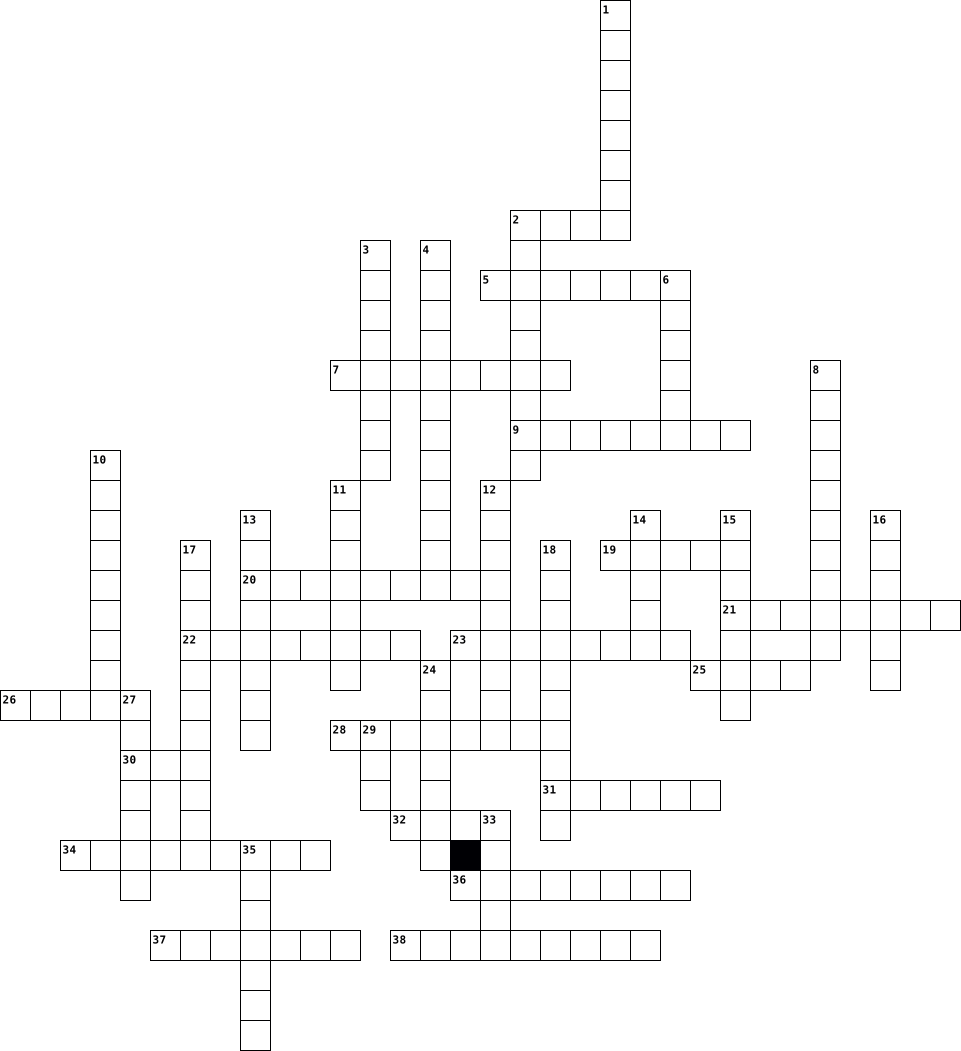
Across
- fall when the only force acted on an object is gravity
- second law the acceleration of an object depends on the mass of the object and the amount of force applied
- plains a flat surface which has a slope
- produced by reactions involving atomic or molecular changes
- the amount of energy transferred or converted
- point A place used for comparison to determine if something is in motion
- a speed in any direction
- the force between two rubbing surfaces
- force equal force acting on an object in different directions
- the entity as a source of nuclear energy
- mechanical vibrations transmitted by an elastic medium
- a stable elementary particle present in all atoms, orbiting the nucleus in numbers equal to the atomic number of the element in a neutral atom
- force the overall force on an object
- the capacity of a physical system to do work
- quantity of matter
- energy the mechanical energy that a body has by virtue its position
- third law for every action there is an equal opposite reaction
- a flow of electric charge through a conductor
- a substance, body, or system that conducts electricity, heat, etc.
Down
- a linear interval of space
- the number of times that a periodic function or vibration repeats itself in a specified time. Usually measured in hertz
- the product of a body's mass and velocity
- the rate in which the velocity changes
- friction friction which keeps things still
- the process by which masses of relatively warm air are raised into the atmosphere, often cooling and forming clouds, which compensatory downward movements of cooler air
- the random thermal motion of atoms, molecules, clusters of atoms, et, in gases, liquids, and some solids
- energy the mechanical energy that a body has by virtue of its motion
- any device for converting mechanical energy into electrical energy by electromagnetic induction
- velocity the maximum speed possible while free falling
- push or pull on an object
- the force that pulls objects towards each other
- the state in which one objects distance from another is changing
- a deviation in the direction of a wave at the edge of an obstacle in its path
- force forces that produce a nonzero net force
- constituting the core or central part
- a measure of the compactness of a substance, expressed as its mass per unit volume
- of conservation of energy the law that states that energy cannot be created nor destroyed but can be changed from one form to another
- the distance an object travels per unit of time
- an object in motion stays in motion
39 Clues: quantity of matter • a speed in any direction • push or pull on an object • a linear interval of space • an object in motion stays in motion • force the overall force on an object • constituting the core or central part • the rate in which the velocity changes • the force between two rubbing surfaces • plains a flat surface which has a slope • ...
Physics 2025-01-08

Across
- Charging by ___ requires physical contact between a charging body and a neutral body
- Measure of the ease at which an electric charge moves through materials
- Affects all object's quality called the charge
- Greek word meaning "amber"
- Branch of physics dealing with electric current, electric and magnetic fields, as well as their interaction
- Materials that resist the flow of charge
- The space surrounding a charged body
- Offers no resistance to the flow of charges
- Latin word for flow
- Build-up of electric charge on a surface
Down
- Anything that pulls with mass
- Same amount of positive and negative energy
- Result when two different materials are rubbed together
- Not as conductive as metals, but are more conductive than insulators
- Physical occurrence that happens in an object's motion
- Materials that readily allow the flow of charges through them
- Measure of the number of field lines passing through a surface
- When a neutral body is charged without physical contact
- ___ principle states that each charge will exert a force on another charge as if no other charges are present
- Amount of charge that is "on" or "carried by" an object
20 Clues: Latin word for flow • Greek word meaning "amber" • Anything that pulls with mass • The space surrounding a charged body • Materials that resist the flow of charge • Build-up of electric charge on a surface • Same amount of positive and negative energy • Offers no resistance to the flow of charges • Affects all object's quality called the charge • ...
Physics 2025-01-21

Across
- the amount of matter contained within an object
- the force that acts between two surfaces sliding past each other, always opposing the direction of motion of the object
- a unitless number that represents the ratio of the force of kinetic friction acting between two surfaces in relative motion to the normal force pressing those surfaces together
- the si unit of energy or work, the amount of energy transferred when a force of one newton acts on an object through a distance of one meter
- the metric system that is used universally as a standard for measurements
- a quantity that measures the rate at which work is done or energy is transformed
- a push or pull exerted on an object that can cause it to change its motion
- the total work done on an object by all forces acting on it
- the sum of all forces acting on an object
- the rate of change of velocity per unit of time
- a physical property or value that remains constant over time within a closed system
- the starting point or baseline in a system of measurement, essentially meaning "nothing" or the lowest possible value within that context
- a parameter that is a measure of a spring’s resistance to being compressed or stretched
- The length of a spring when no external forces are acting on it
- energy that has not been used or dissipated and is ready to be released
Down
- the change in an object's position
- the International System of Units (SI) unit for measuring force
- the distance an object moved per unit in time
- the sum of kinetic energy and all forms of potential energy
- a unit of measurement for power, or the rate at which energy is used or produced
- a physical quantity that is described solely by its magnitude (size), meaning it has no direction associated with it
- the energy of an object that is due to the object’s motion
- the potential energy stored in the gravitational fields of interacting bodies
- the net work done by all the forces acting on an object is equal to the change in the object’s kinetic energy
- the constant acceleration experienced by an object falling solely under the influence of gravity
- the energy available for use when a deformed elastic object returns to its original configuration
- the product of the component of a force along the direction of displacement and the magnitude of the displacement
- another unit of power 746 watts
- the energy associated with an object because of the position, shape, or condition of the object
- any form of energy that is not associated with the motion or position of an object
30 Clues: another unit of power 746 watts • the change in an object's position • the sum of all forces acting on an object • the distance an object moved per unit in time • the amount of matter contained within an object • the rate of change of velocity per unit of time • the energy of an object that is due to the object’s motion • ...
PHYSICS 2024-09-16

Across
- BENDING OF LIGHT WHEN IT PASSES THROUGH DIFFERENT MEDIA
- NEGATIVELY CHARGED PARTICLE
- FORCE PRODUCED BY MOVING ELECTRIC CHARGES
- ELECTRICAL POTENTIAL DIFFERENCE
- NEUTRAL PARTICLE
- FORCE THAT PULLS OBJECTS TOWARDS EARTH
- ABILITY OF A SYSTEM TO STORE ELECTRIC CHARGE
- MASS IN MOTION
- PUSH OR PULL ACTING ON AN OBJECT
- CHANGE IN MOMENTUM
Down
- REPEATED MOTION
- MAXIMUM DISPLACEMENT
- SMALLEST POSSIBLE DISCRETE UNIT OF ENERGY
- FORCE THAT OPPOSES MOTION BETWEEN SURFACES
- STUDY OF HEAT AND ITS RELATION TO ENERGY
- TENDENCY OF AN OBJECT TO RESIST CHANGES IN MOTION
- SPEED IN A SPECIFIC DIRECTION
- QUANTUM OF LIGHT
- DISTANCE BETWEEN TWO PEAKS IN A WAVE
- TYPE OF ENERGY AN OBJECT HAS DUE TO MOTION
20 Clues: MASS IN MOTION • REPEATED MOTION • NEUTRAL PARTICLE • QUANTUM OF LIGHT • CHANGE IN MOMENTUM • MAXIMUM DISPLACEMENT • NEGATIVELY CHARGED PARTICLE • SPEED IN A SPECIFIC DIRECTION • ELECTRICAL POTENTIAL DIFFERENCE • PUSH OR PULL ACTING ON AN OBJECT • DISTANCE BETWEEN TWO PEAKS IN A WAVE • FORCE THAT PULLS OBJECTS TOWARDS EARTH • STUDY OF HEAT AND ITS RELATION TO ENERGY • ...
Physics 2025-03-12

Across
- What is the force applied constantly to an object for a certain time interval will cause a change in the object’s momentum equal to the product of the force and the time interval during which the force acts.
- momentum is the product of mass times what?
- the what involved in a collision are treated as though they are constant
- what leads to conservation of momentum
- plural of momentum is?
- what refers to something that always returns to, or keeps, its original shape.
- During a collision, some of the work done on what is converted to other forms of energy, such as heat and sound
- What depends on the impulse momentum theorem
- Force is reduced when the time interval of an impact is
- the Si unit of momentum is?
- What is not conserved in a collision
- In what kind of collision is kinetic energy not conserved?
- the law when total initial momentum equals total final momentum
- a collision in which the total momentum and the total kinetic energy are conserved
- a collision in which two objects stick together after colliding
Down
- force equals change in momentum divided by …?
- The product of the … and the time interval during which the force is applied is called the impulse of the force for the time interval.
- In physics, an elastic material is one in which the … done to deform the material during a collision is equal to the …the material does to return to its original shape
- The total momentum remains … in any kind of collision.
- The expression F x delta t = delta p is called the
- Momentum has … mass × length/time
- Even in what kind of collision will still result in some decrease in kinetic energy
- When objects deform during a collision kinetic energy turns into what?
- event where two or more objects exert forces on each other for a relatively short period of time
- The total momentum of all objects interacting with one another remains constant regardless of the nature of the forces between the objects in what kind of system?
- the product of the force and the time over which the force acts on an object
- a quantity defined as the product of the mass and velocity of an object
- In fact, any collision that produces …is not elastic; the …signifies a decrease in kinetic energy.
- momentum is a …?
- momentum of an object is equal to zero when the object is …?
30 Clues: momentum is a …? • plural of momentum is? • the Si unit of momentum is? • Momentum has … mass × length/time • What is not conserved in a collision • what leads to conservation of momentum • momentum is the product of mass times what? • What depends on the impulse momentum theorem • force equals change in momentum divided by …? • ...
Physics 2025-03-12

Across
- When objects deform during a collision kinetic energy turns into what?
- In physics, an elastic material is one in which the … done to deform the material during a collision is equal to the …the material does to return to its original shape
- The expression F x delta t = delta p is called the
- Even in what kind of collision will still result in some decrease in kinetic energy
- a collision in which two objects stick together after colliding
- The product of the … and the time interval during which the force is applied is called the impulse of the force for the time interval.
- momentum of an object is equal to zero when the object is …?
- During a collision, some of the work done on what is converted to other forms of energy, such as heat and sound
- momentum is a …?
- plural of momentum is?
- event where two or more objects exert forces on each other for a relatively short period of time
- The total momentum remains … in any kind of collision.
- momentum is the product of mass times what?
- In fact, any collision that produces …is not elastic; the …signifies a decrease in kinetic energy.
- the what involved in a collision are treated as though they are constant
- The total momentum of all objects interacting with one another remains constant regardless of the nature of the forces between the objects in what kind of system?
Down
- the product of the force and the time over which the force acts on an object
- force equals change in momentum divided by …?
- the Si unit of momentum is?
- Force is reduced when the time interval of an impact is
- What is not conserved in a collision
- a collision in which the total momentum and the total kinetic energy are conserved
- What depends on the impulse momentum theorem
- a quantity defined as the product of the mass and velocity of an object
- Momentum has … mass × length/time
- What is the force applied constantly to an object for a certain time interval will cause a change in the object’s momentum equal to the product of the force and the time interval during which the force acts.
- In what kind of collision is kinetic energy not conserved?
- the law when total initial momentum equals total final momentum
- what refers to something that always returns to, or keeps, its original shape.
- what leads to conservation of momentum
30 Clues: momentum is a …? • plural of momentum is? • the Si unit of momentum is? • Momentum has … mass × length/time • What is not conserved in a collision • what leads to conservation of momentum • momentum is the product of mass times what? • What depends on the impulse momentum theorem • force equals change in momentum divided by …? • ...
Physics 2025-03-12

Across
- The expression F x delta t = delta p is called the
- the Si unit of momentum is?
- The total momentum remains … in any kind of collision.
- a collision in which two objects stick together after colliding
- what refers to something that always returns to, or keeps, its original shape.
- What depends on the impulse momentum theorem
- When objects deform during a collision kinetic energy turns into what?
- the law when total initial momentum equals total final momentum
- What is the force applied constantly to an object for a certain time interval will cause a change in the object’s momentum equal to the product of the force and the time interval during which the force acts.
- Momentum has … mass × length/time
- the what involved in a collision are treated as though they are constant
- During a collision, some of the work done on what is converted to other forms of energy, such as heat and sound
- a collision in which the total momentum and the total kinetic energy are conserved
- a quantity defined as the product of the mass and velocity of an object
Down
- event where two or more objects exert forces on each other for a relatively short period of time
- In physics, an elastic material is one in which the … done to deform the material during a collision is equal to the …the material does to return to its original shape
- The product of the … and the time interval during which the force is applied is called the impulse of the force for the time interval.
- plural of momentum is?
- force equals change in momentum divided by …?
- In fact, any collision that produces …is not elastic; the …signifies a decrease in kinetic energy.
- the product of the force and the time over which the force acts on an object
- Even in what kind of collision will still result in some decrease in kinetic energy
- momentum of an object is equal to zero when the object is …?
- In what kind of collision is kinetic energy not conserved?
- momentum is a …?
- What is not conserved in a collision
- what leads to conservation of momentum
- Force is reduced when the time interval of an impact is
- The total momentum of all objects interacting with one another remains constant regardless of the nature of the forces between the objects in what kind of system?
- momentum is the product of mass times what?
30 Clues: momentum is a …? • plural of momentum is? • the Si unit of momentum is? • Momentum has … mass × length/time • What is not conserved in a collision • what leads to conservation of momentum • momentum is the product of mass times what? • What depends on the impulse momentum theorem • force equals change in momentum divided by …? • ...