
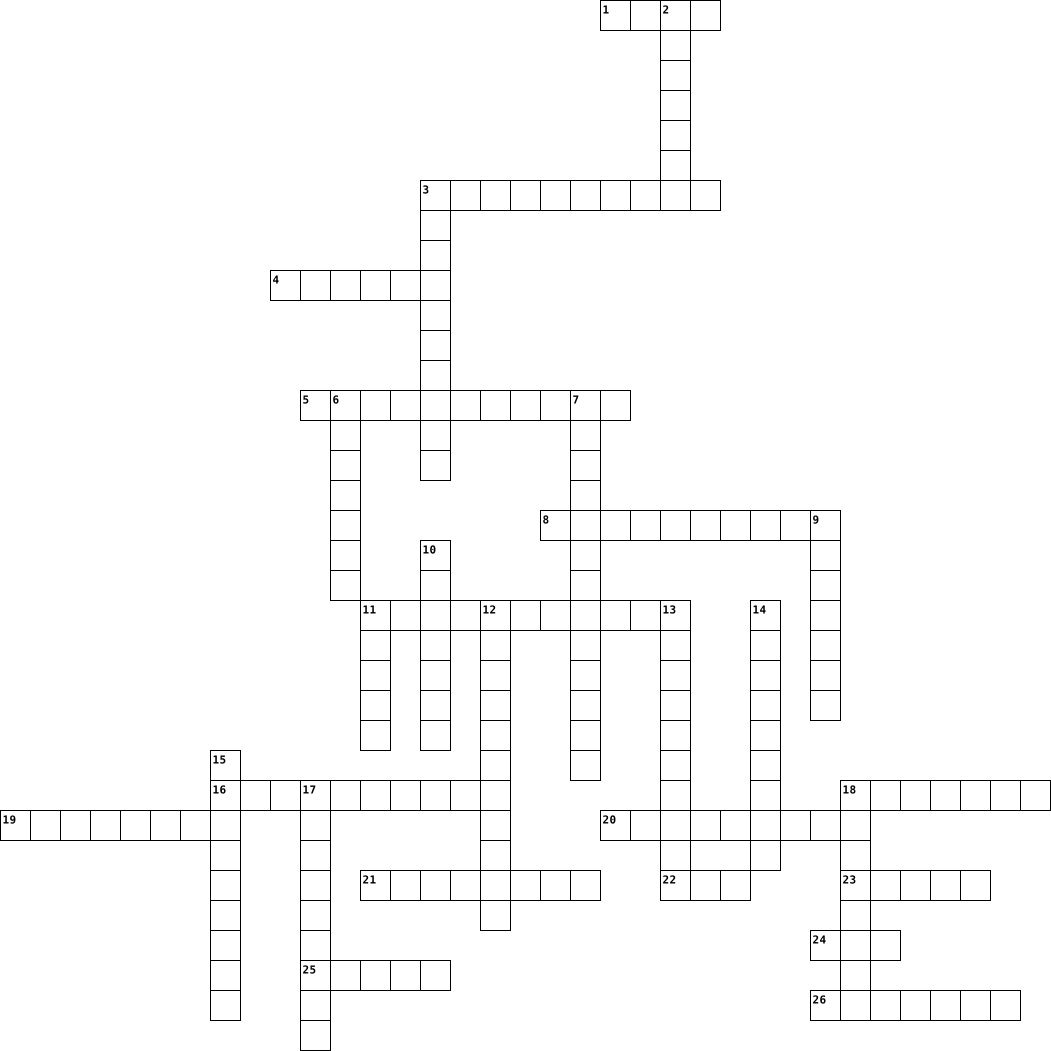
plate tectonics Crossword Puzzles
Elaborate: Plate Tectonics 2020-09-30

Across
- crash
- irregularly shaped slab of solid rock,
- slide past
- hot liquid
- volcano ring
Down
- pull apart
- slide under
- big wave of water
- ground shaking
- mountain with lava
10 Clues: crash • pull apart • slide past • hot liquid • slide under • volcano ring • ground shaking • big wave of water • mountain with lava • irregularly shaped slab of solid rock,
Elaborate: Plate Tectonics 2020-09-30

Across
- big wave of water
- ground shaking
- mountain with lava
- crash
- slide past
Down
- irregularly shaped slab of solid rock,
- slide under
- pull apart
- volcano ring
- hot liquid
10 Clues: crash • pull apart • hot liquid • slide past • slide under • volcano ring • ground shaking • big wave of water • mountain with lava • irregularly shaped slab of solid rock,
Elaborate: Plate Tectonics 2020-09-30

Across
- ground shaking
- pull apart
- volcano ring
- irregularly shaped slab of solid rock,
- big wave of water
- hot liquid
Down
- slide under
- mountain with lava
- crash
- slide past
10 Clues: crash • pull apart • slide past • hot liquid • slide under • volcano ring • ground shaking • big wave of water • mountain with lava • irregularly shaped slab of solid rock,
Plate Tectonics Crossword 2020-10-04

Across
- what causes the plates to move
- upper layer of the earth's mantle
- this type of boundary causes rift valleys
- crust goes under other crust
- this type of boundary causes mountains
Down
- all continents together
- caused by a transform boundary
- the San Andreas fault was caused by this boundary
- the rigid outer part of the earth
- lava comes out the top
10 Clues: lava comes out the top • all continents together • crust goes under other crust • what causes the plates to move • caused by a transform boundary • upper layer of the earth's mantle • the rigid outer part of the earth • this type of boundary causes mountains • this type of boundary causes rift valleys • the San Andreas fault was caused by this boundary
Science Plate Tectonics 2021-03-17

Across
- a tremor in the earth
- a chain of large masses of land
- consists of two plates that slide past each other
- consists of two plates that move away, repel from each other
Down
- consists of two plates that attract; come together
- the theory that earth is divided into multiple plates
- landform that is formed by transform boundary and where earthquakes commonly happen
- lowland region formed by tectonic plates
- molten rock
- landform that is formed by convergent boundary and is a mountain where lava erupts
10 Clues: molten rock • a tremor in the earth • a chain of large masses of land • lowland region formed by tectonic plates • consists of two plates that slide past each other • consists of two plates that attract; come together • the theory that earth is divided into multiple plates • consists of two plates that move away, repel from each other • ...
Plate tectonics vocab 2021-11-18

Across
- A result of seafloor spreading
- The kind of boundary that is sliding by
- the area below the plate under the crust
- The kind of boundary to be going apart
- Liquid lava
- Another result of a divergent boundary
Down
- A result of a divergent boundary
- The surface of the earth
- The boundary at which two tectonic plates come together
- The result of a convergent boundary
10 Clues: Liquid lava • The surface of the earth • A result of seafloor spreading • A result of a divergent boundary • The result of a convergent boundary • The kind of boundary to be going apart • Another result of a divergent boundary • The kind of boundary that is sliding by • the area below the plate under the crust • The boundary at which two tectonic plates come together
Plate tectonics crossword 2023-01-18

Across
- wave of energy caused by an explosion
- the first body wave, p-wave
- the second type of body wave, s-wave
- the origin of an earthquake
Down
- located directly above the focus on the surface of the earth
- forces that are parallel by moving in opposite directions
- located directly above the focus
- waves that travel though the interior of the earth
- study of earthquakes and seismic waves
- rocks that pull apart from one another
10 Clues: the first body wave, p-wave • the origin of an earthquake • located directly above the focus • the second type of body wave, s-wave • wave of energy caused by an explosion • study of earthquakes and seismic waves • rocks that pull apart from one another • waves that travel though the interior of the earth • forces that are parallel by moving in opposite directions • ...
Plate Tectonics Vocabulary 2023-03-06

Across
- a current in a fluid that results from convection, and heat uses it to travel
- Hot liquid substance at the center of earth
- A long whole in the ground that is wide and deep
- a mountain that is open at the top and has molten hit magma inside it
Down
- collides creates mountains
- slides past each other creates earthquakes
- divides apart creates rifts
- one plate sinks under other plate
- plates slide past each other and the ground shakes
- Magma creates it when coming out of the earth underwater
10 Clues: collides creates mountains • divides apart creates rifts • one plate sinks under other plate • slides past each other creates earthquakes • Hot liquid substance at the center of earth • A long whole in the ground that is wide and deep • plates slide past each other and the ground shakes • Magma creates it when coming out of the earth underwater • ...
plate tectonics puzzle 2023-02-28

Across
- a theory explaining the structure of the earth's crust which move slowly over the underlying mantle.
- the third layer of the earth
- the inner most layer of the earth
Down
- the outer most layer of the earth
- two plates growing apart
- the second layer of the earth
- one plate going underneath another plate
- the scientist who proposed the theory of continental drift
- two plates sliding past eachother
- two plates coming together, closer
10 Clues: two plates growing apart • the third layer of the earth • the second layer of the earth • the outer most layer of the earth • two plates sliding past eachother • the inner most layer of the earth • two plates coming together, closer • one plate going underneath another plate • the scientist who proposed the theory of continental drift • ...
plate tectonics puzzle 2023-02-28

Across
- a theory explaining the structure of the earth's crust which move slowly over the underlying mantle.
- the third layer of the earth
- the inner most layer of the earth
Down
- the outer most layer of the earth
- two plates growing apart
- the second layer of the earth
- one plate going underneath another plate
- the scientist who proposed the theory of continental drift
- two plates sliding past eachother
- two plates coming together, closer
10 Clues: two plates growing apart • the third layer of the earth • the second layer of the earth • the outer most layer of the earth • two plates sliding past eachother • the inner most layer of the earth • two plates coming together, closer • one plate going underneath another plate • the scientist who proposed the theory of continental drift • ...
Plate Tectonics Vocabulary 2023-03-10

Across
- : is the recording of the ground shaking at the specific location of the instrument
- :A sudden and violent shaking of the ground, sometimes causing great destruction, as a result of movements within the earth's crust or volcanic action.
- : is a smaller earthquake that follows a larger earthquake, in the same area of the main shock, caused as the displaced crust adjusts to the effects of the main shock.
Down
- :the rigid outer part of the earth, consisting of the crust and upper mantle.
- : are shear waves that deform the ground perpendicular to their direction of travel, are unable to pass through air and liquids such as water and magma, This is how we know Earth's outer core is molten
- :the vibration of the rock is in the direction of propagation. They travel the fastest and are the first to arrive from the earthquake.
- :they can travel through the interior of a body such as the Earth's inner layers, from the focus of an earthquake to distant points on the surface.
- :a wave of acoustic energy that travels through the Earth or another planetary body. It can result from an earthquake, volcanic eruption, magma movement, a large landslide, and a large man-made explosion that produces low-frequency acoustic energy.
- :the continent we now know as North America was contiguous with Africa, South America, and Europe
- :are earthquakes that precede larger earthquakes in the same location. An earthquake cannot be identified as a foreshock until after a larger earthquake in the same area occurs.
10 Clues: :the rigid outer part of the earth, consisting of the crust and upper mantle. • : is the recording of the ground shaking at the specific location of the instrument • :the continent we now know as North America was contiguous with Africa, South America, and Europe • ...
Plate Tectonics Crosword 2013-02-05

Across
- the theory that the continents can drift apart
- made of solid iron and nickel
- an underwater mountain range
- one giant super continent
Down
- made of liquid iron and nickel
- a process where new oceanic earth forms at ridges
- a boundary that occurs when two plates collide
- a boundary that occurs when two plates collide and one slides under the other
- a boundary that occurs when two plates separate
- influential on the theory of plate tectonics
10 Clues: one giant super continent • an underwater mountain range • made of solid iron and nickel • made of liquid iron and nickel • influential on the theory of plate tectonics • the theory that the continents can drift apart • a boundary that occurs when two plates collide • a boundary that occurs when two plates separate • a process where new oceanic earth forms at ridges • ...
Plate Tectonics Project 2022-02-28

Across
- what created the Hawaiian island
- the boundary that goes away from each other
- the boundary that goes torward each other
- Famous scientist who proposed the theory of continental drift
- The number of major plates
- Occurs when a continental and oceanic crust collide at a convergent boundary
- the boundary that slides past each other
Down
- the super continent
- The type of current in the asthenosphere that moves plates
- The rate at which plates move per year
10 Clues: the super continent • The number of major plates • what created the Hawaiian island • The rate at which plates move per year • the boundary that slides past each other • the boundary that goes torward each other • the boundary that goes away from each other • The type of current in the asthenosphere that moves plates • ...
Plate Tectonics Project 2022-02-28

Across
- what created the Hawaiian island
- the boundary that goes away from each other
- the boundary that goes torward each other
- Famous scientist who proposed the theory of continental drift
- The number of major plates
- Occurs when a continental and oceanic crust collide at a convergent boundary
- the boundary that slides past each other
Down
- the super continent
- The type of current in the asthenosphere that moves plates
- The rate at which plates move per year
10 Clues: the super continent • The number of major plates • what created the Hawaiian island • The rate at which plates move per year • the boundary that slides past each other • the boundary that goes torward each other • the boundary that goes away from each other • The type of current in the asthenosphere that moves plates • ...
Science Plate Tectonics 2022-02-02

Across
- plates collide
- divorce
- core solid ball of metal
- solid outer section of Earth
- core 2nd largest layer
- made up continental layer and oceanic layer
Down
- the middle of the earth
- plates slip sideways each other
- the heat that causes the rock to rise to the surface
- crust glides over the layer
10 Clues: divorce • plates collide • core 2nd largest layer • the middle of the earth • core solid ball of metal • crust glides over the layer • solid outer section of Earth • plates slip sideways each other • made up continental layer and oceanic layer • the heat that causes the rock to rise to the surface
Plate Tectonics Lab 2023-11-17

Across
- when two plates collide
- created at subduction areas
- hot substance that rises in the mantle
- when one plate overlaps another
- when two plates come apart
- created at divergent boundaries
Down
- natural disaster with transform boundaries
- natural disaster with subduction
- when two plates slide past each other
- gigantic piece of earths crust
10 Clues: when two plates collide • when two plates come apart • created at subduction areas • gigantic piece of earths crust • when one plate overlaps another • created at divergent boundaries • natural disaster with subduction • when two plates slide past each other • hot substance that rises in the mantle • natural disaster with transform boundaries
Bryan Plate Tectonics 2024-02-21

Across
- second layer of the earth.
- first layer in the earth.
- two plates that move towards each other.
- core 3rd layer of the earth.
Down
- core last layer in the earth.
- two plates go under and over each other.
- made by all of the boundry's
- dried up lava.
- two plates that rub against each other.
- super continent.
10 Clues: dried up lava. • super continent. • first layer in the earth. • second layer of the earth. • made by all of the boundry's • core 3rd layer of the earth. • core last layer in the earth. • two plates that rub against each other. • two plates go under and over each other. • two plates that move towards each other.
Geology(Plate Tectonics) 2024-02-01

Across
- Outermost layer of Earth
- Solid outer layer
- Block of the lithosphere consists of the crust
- Strong, lower part of the mantle
- Thickest layer of Earth
- The hottest part of Earth
Down
- Theory that states drift apart from each other
- A break in a body of rock
- Layer of the mantle that plates move on
- Part of core but not the middlemost layer
10 Clues: Solid outer layer • Thickest layer of Earth • Outermost layer of Earth • A break in a body of rock • The hottest part of Earth • Strong, lower part of the mantle • Layer of the mantle that plates move on • Part of core but not the middlemost layer • Theory that states drift apart from each other • Block of the lithosphere consists of the crust
Plate Tectonics Science 2024-01-24

Across
- this happens underwater during a Divergent Boundary
- This occurs when two plates slide past each other
- Often makes mid-ocean ridges and rift valleys
- When to plates of crust collide this occurs
- The separated areas of the mantle that are drifting
- A break in Earth!s crust where masses of rock slip past each other
Down
- it’s made of granite
- This happens under the Crust and causes the plates to move
- The name of the land mass that all the continents were originally together
- It’s made of basalt
10 Clues: It’s made of basalt • it’s made of granite • When to plates of crust collide this occurs • Often makes mid-ocean ridges and rift valleys • This occurs when two plates slide past each other • this happens underwater during a Divergent Boundary • The separated areas of the mantle that are drifting • This happens under the Crust and causes the plates to move • ...
Science plate tectonics 2024-01-11

Across
- seafloorspreading
- panthalassa
- platetectonics
- earthquakes
- asthenosphere
Down
- ridgepush
- fossilevidence
- rifting
- supercontinentcycle
- convergentboundary
10 Clues: rifting • ridgepush • panthalassa • earthquakes • asthenosphere • fossilevidence • platetectonics • seafloorspreading • convergentboundary • supercontinentcycle
PLate tectonics vocab 2025-02-20

Across
- melted rock on Earth's surface
- plates slide against each other
- the layer of earth between the crust and core
- plates moved towards each other
- the solid outer part of the earth
- the outermost layer of the earth
Down
- boundary an area where two or more tectonic plates meet
- the scientific theory that the earths continents are moving
- melted rock beneath Earth's surface
- plates move away from each other
10 Clues: melted rock on Earth's surface • plates slide against each other • plates moved towards each other • plates move away from each other • the outermost layer of the earth • the solid outer part of the earth • melted rock beneath Earth's surface • the layer of earth between the crust and core • boundary an area where two or more tectonic plates meet • ...
Plate Tectonics & Pangea 2024-11-12

Across
- German scientist who believe the continents used to be connected
- a scientific theory that explains how major landforms are created as a result of Earth's subterranean movements
- slide against each other
- both plates come together
- move away from each other
Down
- the Earth's crust
- a volcanic center that has had an eruption of magnitude 8 on the volcano explosivity
- the central or innermost portion of the earth
- a large plum of hot mantle material rising from deep within the earth
- a layer inside a planetary body bounded below by core and above by a crust
10 Clues: the Earth's crust • slide against each other • both plates come together • move away from each other • the central or innermost portion of the earth • German scientist who believe the continents used to be connected • a large plum of hot mantle material rising from deep within the earth • a layer inside a planetary body bounded below by core and above by a crust • ...
Chapter 1 and 2 (pages 19-42) Key Terms 2026-02-04

Across
- (Page 41) Rock that was once broken apart but has been melted together through heat and compaction
- (Page 32) Landform _________, events like tsunamis, earthquakes, or natural events caused by the earth
- (Page 35) Plate ____________ is the theory of the world being broken up into different segments of earth
- (Page 28) Type of settlement pattern where houses and people live far away from one another
- (Page 41) Sediments need ___________ to be turned into metamorphic rock
- (Page 42) Rock created by sedimentary rock melting and experiencing huge pressure
- (Page 40) Sedimentary rock that is buried underground eventually experiences ___________ and becomes metamorphic rock
- (Page 25) ____________ Ecumene, when urban areas are broken up by physical areas
- (Page 38) A type of tectonic plate that is primarily on the land
- (Page 26) Rural/small towns are currently
- (Page 21) The acronym for Canadian Metropolitan Area
- (Page 28) The word used for country areas where there are less people per square kilometre
- (Page 26) Many people are leaving small towns in Canada due to poor ____ opportunities, so they go to the cities
- (Page 19) Alongside the word "population" it means the amount of people in a particular area of space
- (Page 40) This pures out of the earth's crust through volcanic eruptions and created igneous rock
- (Page 37) Mid-Atlantic ________ is the most famous example of this but there are many around the world at divergent tectonic plates
- (Page 28) Type of settlement pattern that follows a line like along a railroad or highway or river
- (Page 37) When two plates move towards one another
Down
- (Page 40) Igneous rocks formed by exposure to the earth's surface are called
- (Page 40) Sedimentary and Metamorphic rock need this to be created, but it is not good for small children
- (Page 39) When two plates rub alongside eachother
- (Page 25) _________ Ecumene, when urban areas continue with no break or gaps
- (Page 40) The _____ Cycle is caused by and impacts plate tectonics and supposedly creates mountains
- (Page 41) Igneous rock is worn down through weathering and _____________ which creates sediments
- (Page 40) When exposed to this children often cry, but sedimentary rocks will melt
- (Page 31) The word used to describe when a city or settlement grows beyond its bounds/limits and begins taking over farm/wild land
- (Page 37) When two plates move away from one another
- (Page 25) A fancy geography word for inhabited area
- (Page 40) Rock created by magma moving to the surface and hardening due to the air
- (Page 38) A type of tectonic plate that is primarily in the ocean
- (Page 37) The process of one tectonic plate being pulled under the other
- (Page 31) The biggest type of land under threat from urban sprawl
- (Page 28) Type of settlement pattern where people are nucleated in patches around on central industry
- (Page 28) ________ System is used in most of Canada to plot land in a grid formation?
- (Page 34) The most recent ice age and current period of earth's history according to secular historians
35 Clues: (Page 26) Rural/small towns are currently • (Page 39) When two plates rub alongside eachother • (Page 37) When two plates move towards one another • (Page 25) A fancy geography word for inhabited area • (Page 37) When two plates move away from one another • (Page 21) The acronym for Canadian Metropolitan Area • ...
My Crossword 2022-11-15

Across
- rocks formed from pre-existing rocks or pieces of once-living organisms.
- the transfer of heat by the movement of a fluid (liquid or gas) between areas of different temperatures.
- energy that comes from a source and travels through space at the speed of light.
- Made of crust and upper portion of mantle
- formed when other rocks are affected by great temperatures and pressure.
- forms when magma is trapped deep inside the Earth.
Down
- A boundary when plates shifts towards each other or collide.
- Two plates are moving apart.
- a supercontinent that incorporated almost all the landmasses on Earth.
- The process by which heat or electricity goes through a substance.
- Two plates sliding pass each other.
- the action or process in plate tectonics of the edge of one crustal plate descending below the edge of another.
12 Clues: Two plates are moving apart. • Two plates sliding pass each other. • Made of crust and upper portion of mantle • forms when magma is trapped deep inside the Earth. • A boundary when plates shifts towards each other or collide. • The process by which heat or electricity goes through a substance. • a supercontinent that incorporated almost all the landmasses on Earth. • ...
Restless Earth Vocab Crossword 2024-04-12

Across
- The semi-fluid layer of the mantle where convection currents happen.
- Sudden events that led to a mass a mass extinction.
- Hot material rises, cooler materials sink. It drives plate tectonics.
- Includes the crust and upper part of the mantle, and is divided into tectonic plates.
- Formed as a result of high temperature and pressure deep within Earth changing a rock that already existed.
- Extinction Events: Extinction events that occur over a longer time period.
Down
- A group of the same species living in the same area.
- plates: Large, rigid pieces of the Earth's lithosphere that move and interact with each other along plate boundaries.
- Rock formed when lava or magma cools and hardens.
- Instruments used to measure and record seismic waves.
- Located between the mantle and the outer core.
- Forms after weathering and erosion when sediments compact and cement.
12 Clues: Located between the mantle and the outer core. • Rock formed when lava or magma cools and hardens. • Sudden events that led to a mass a mass extinction. • A group of the same species living in the same area. • Instruments used to measure and record seismic waves. • The semi-fluid layer of the mantle where convection currents happen. • ...
Chapter 5 Science 2026-02-20

Across
- A theoretical stack of rock layers that documents the history of the Earth.
- The study of the large-scale motion and deformation of Earth's lithosphere.
- A massive landmass, such as Rodinia or Pangea, that contains most of Earth's continental crust.
- The prevailing model for the formation of the solar system from a cloud of dust and gas.
- The rule stating that in an undisturbed sequence, the oldest rocks are at the bottom.
- The most recent "all-earth" supercontinent that existed during the late Paleozoic and early Mesozoic eras.
- A single layer of sedimentary rock or soil with internally consistent characteristics.
- Molten rock stored beneath the Earth's surface before it becomes lava.
Down
- Alfred Wegener’s early 20th-century hypothesis that landmasses move across the globe.
- A rapid-motion version of plate movement proposed to have occurred during a massive geological event.
- The sideways and downward movement of the edge of a plate into the mantle beneath another plate.
- The process where new oceanic crust is formed at mid-ocean ridges.
- A massive, irregularly shaped slab of solid rock that makes up the Earth's outer shell.
- A term relating to a great flood, often used in geological contexts regarding flood-deposited sediment.
14 Clues: The process where new oceanic crust is formed at mid-ocean ridges. • Molten rock stored beneath the Earth's surface before it becomes lava. • A theoretical stack of rock layers that documents the history of the Earth. • The study of the large-scale motion and deformation of Earth's lithosphere. • ...
Plate Tectonics Assignment 2021-03-09

Across
- the process by which new oceanic lithosphere
- the study of the alignment of magnetic minerals in rock
- the boundary between tectonic plates that are colliding
- the solid, plastic layer of the mantle beneath the lithosphere
- hypothesis that states that the continents once formed a single landmass, broke up, and drifted to their present locations
Down
- the boundary between tectonic plates that are sliding past each other horizontally
- a long, undersea mountain chain that has a steep, narrow valley at its center
- theory that explains how large pieces of the lithosphere
- the boundary between tectonic plates that are moving away from each other
- the solid, outer layer of Earth that consists of the crust and the rigid upper part of the mantle
10 Clues: the process by which new oceanic lithosphere • the study of the alignment of magnetic minerals in rock • the boundary between tectonic plates that are colliding • theory that explains how large pieces of the lithosphere • the solid, plastic layer of the mantle beneath the lithosphere • the boundary between tectonic plates that are moving away from each other • ...
Plate Tectonics Crossword 2021-11-16

Across
- feature of a convergent boundary
- when two plates go toward each other
- caused by transform
- earths surface
- when two plates pass each other
Down
- when oceanic plates slide under a continental plate
- created the continental drift theory
- when two plates go the opposite of each other
- came up with sea floor spreading
- caused by a divergent boundary
10 Clues: earths surface • caused by transform • caused by a divergent boundary • when two plates pass each other • feature of a convergent boundary • came up with sea floor spreading • created the continental drift theory • when two plates go toward each other • when two plates go the opposite of each other • when oceanic plates slide under a continental plate
Plate Tectonics Vocabulary 2022-11-04

Across
- The mineralized remains of organisms and the rock layers in which they are found.
- The very slow, creeping motion of Earth's mantle caused by convection currents.
- The solid, innermost layer of Earth.
- Theory that the crust is divided into large pieces called tectonic plates that slowly move on top of the mantle.
Down
- Fossils that are widespread, have lived over a relatively short period of time and can be used to correlate rock strata.
- The theory that continents were once connected but have drifted apart.
- The solid layer of Earth between the crust and the core.
- Huge pieces of crust that slowly move on the upper part of the mantle.
- The thin, solid, outermost layer of Earth.
- The liquid layer that surrounds the inner core.
10 Clues: The solid, innermost layer of Earth. • The thin, solid, outermost layer of Earth. • The liquid layer that surrounds the inner core. • The solid layer of Earth between the crust and the core. • The theory that continents were once connected but have drifted apart. • Huge pieces of crust that slowly move on the upper part of the mantle. • ...
Plate Tectonics Vocabulary 2022-11-04

Across
- The solid, innermost layer of Earth.
- The thin, solid, outermost layer of Earth.
- Huge pieces of crust that slowly move on the upper part of the mantle.
- The very slow, creeping motion of Earth's mantle caused by convection currents.
Down
- Theory that the crust is divided into large pieces called tectonic plates that slowly move on top of the mantle.
- The theory that continents were once connected but have drifted apart.
- Fossils that are widespread, have lived over a relatively short period of time and can be used to correlate rock strata.
- The liquid layer that surrounds the inner core.
- The mineralized remains of organisms and the rock layers in which they are found.
- The solid layer of Earth between the crust and the core.
10 Clues: The solid, innermost layer of Earth. • The thin, solid, outermost layer of Earth. • The liquid layer that surrounds the inner core. • The solid layer of Earth between the crust and the core. • The theory that continents were once connected but have drifted apart. • Huge pieces of crust that slowly move on the upper part of the mantle. • ...
Plate Tectonics Crossword 2022-10-19

Across
- boundary where earthquakes form (sliding)
- gap that formed from a subduction zone
- shaking on Earth from shifting plates
- valley formed at divergent boundaries
- layer of the Earth with convection currents
- currents that cause tectonic plates to shift
Down
- boundary where two plates drift apart
- zone where volcanoes form
- semi-molten rock found in the Earth's mantle
- boundary where two plates collide
10 Clues: zone where volcanoes form • boundary where two plates collide • boundary where two plates drift apart • shaking on Earth from shifting plates • valley formed at divergent boundaries • gap that formed from a subduction zone • boundary where earthquakes form (sliding) • layer of the Earth with convection currents • semi-molten rock found in the Earth's mantle • ...
Plate Tectonics Crossword 2022-10-19

Across
- boundary where earthquakes form (sliding)
- gap that formed from a subduction zone
- shaking on Earth from shifting plates
- valley formed at divergent boundaries
- layer of the Earth with convection currents
- currents that cause tectonic plates to shift
Down
- boundary where two plates drift apart
- zone where volcanoes form
- semi-molten rock found in the Earth's mantle
- boundary where two plates collide
10 Clues: zone where volcanoes form • boundary where two plates collide • boundary where two plates drift apart • shaking on Earth from shifting plates • valley formed at divergent boundaries • gap that formed from a subduction zone • boundary where earthquakes form (sliding) • layer of the Earth with convection currents • semi-molten rock found in the Earth's mantle • ...
Plate Tectonics Crossword 2022-10-19

Across
- boundary where earthquakes form (sliding)
- gap that formed from a subduction zone
- shaking on Earth from shifting plates
- valley formed at divergent boundaries
- layer of the Earth with convection currents
- currents that cause tectonic plates to shift
Down
- boundary where two plates drift apart
- zone where volcanoes form
- semi-molten rock found in the Earth's mantle
- boundary where two plates collide
10 Clues: zone where volcanoes form • boundary where two plates collide • boundary where two plates drift apart • shaking on Earth from shifting plates • valley formed at divergent boundaries • gap that formed from a subduction zone • boundary where earthquakes form (sliding) • layer of the Earth with convection currents • semi-molten rock found in the Earth's mantle • ...
Plate tectonics crossword 2023-02-15

Across
- plates when they get out of a toxic relationship
- what the old creapy man wants to do to children
- if only alfred wagner could could get it through there thick skulls
- Plates regretting a break up
- dont conFORM to soicety and supress being TRANS
Down
- one of the best parts of felix from stray kids
- I'm telling you, Im really good at jigsaw puzzles!
- pangeas faverite OG theory
- oh **** i turned up the hot tub too much, jeff is drowning!
- would anyone interested in sand care for a wich
- yoooooooooooooooo ? (jimmy)
11 Clues: pangeas faverite OG theory • yoooooooooooooooo ? (jimmy) • Plates regretting a break up • one of the best parts of felix from stray kids • what the old creapy man wants to do to children • would anyone interested in sand care for a wich • dont conFORM to soicety and supress being TRANS • plates when they get out of a toxic relationship • ...
Plate Tectonics Crossword 2025-01-16

Across
- A plate boundary that makes the plates slide against each other
- Causes the movement of the Earth's plates
- A theory proposed by Alfred Wegener that proposed that all the continents were together at some point in time (2 words)
- A plate boundary that makes the plates move away from each other
Down
- A layer of rock which forms the continents (2 words)
- A theory that states that the Earth's outer crust is divided into several plates (2 words)
- A thin layer of crust that underlies the ocean basins
- A chain of volcanos that surround the pacific ocean (3 words)
- A plate boundary that makes a less dense plate go over a denser plate
- A plate boundary that makes the plates collide into each other
10 Clues: Causes the movement of the Earth's plates • A layer of rock which forms the continents (2 words) • A thin layer of crust that underlies the ocean basins • A chain of volcanos that surround the pacific ocean (3 words) • A plate boundary that makes the plates collide into each other • A plate boundary that makes the plates slide against each other • ...
Dillon Wright. 2015-04-30

Across
- a line on a diagram or map connecting points relating to the same time or equal time
- is the process that takes place at convergent boundaries by which one tectonic plate moves under another tectonic plate and sinks into the mantle as the plates converge.
- is an actively deforming region where two (or more) tectonic plates or fragments of the lithosphere move toward one another and collide.
- s the portion of motion of a tectonic plate that can be accounted for by its subduction.
- is the study of the record of the Earth's magnetic field in rocks, sediment, or archeological materials.
- also known as conservative plate boundary since these faults neither create nor destroy lithosphere, is a type of fault whose relative motion is predominantly horizontal in either sinistral or dextral direction. Furthermore, transform faults end abruptly and are connected on both ends to other faults, ridges, or subduction zones.
- is the movement of the Earth's continents relative to each other, thus appearing to "drift" across the ocean bed.
- are measurement instruments used for two general purposes: to measure the magnetization of a magnetic material like a ferromagnet, or to measure the strength and, in some cases, the direction of the magnetic field at a point in space.
- valley of mountain ranges
- or sliding plate force is a proposed mechanism for plate motion in plate tectonics. Because mid-ocean ridges lie at a higher elevation than the rest of the ocean floor, gravity causes the ridge to push on the lithosphere that lies farther from the ridge.
- is a process that occurs at mid-ocean ridges, where new oceanic crust is formed through volcanic activity and then gradually moves away from the ridge.
Down
- or divergent plate boundary (also known as a constructive boundary or an extensional boundary) is a linear feature that exists between two tectonic plates that are moving away from each other.
- As scientists learned more about sea-floor spreading and magnetic reversals, they formed a theory to explain how continents move.
- all the continents connected together
- is a change in a planet's magnetic field such that the positions of magnetic north and magnetic south are interchanged.
15 Clues: valley of mountain ranges • all the continents connected together • a line on a diagram or map connecting points relating to the same time or equal time • s the portion of motion of a tectonic plate that can be accounted for by its subduction. • is the study of the record of the Earth's magnetic field in rocks, sediment, or archeological materials. • ...
Volcano Crossword 2024-03-20

Across
- The layer under the mantle that's convection current causes plate tectonics
- An area where superhot mantle leaks through the crust and forms volcanoes
- A word used to describe inactive volcanoes
- A word used to describe a volcano that could erupt at any time
- Massive pieces of land that move around over a convection current; whose boundaries form landforms
- The loop of volcanoes and earthquakes that surrounds the pacific plate
Down
- The index scientists use to explain the danger level of a volcano
- The thickness of a liquid
- When a volcano explodes under intense pressure
- After an eruption there can be earthquakes as a result of this
- This often spills out a volcano, and can cover houses and streets
- A deadly Mixture of hot ash and toxic gases that flows down a mountain during an eruption
12 Clues: The thickness of a liquid • A word used to describe inactive volcanoes • When a volcano explodes under intense pressure • After an eruption there can be earthquakes as a result of this • A word used to describe a volcano that could erupt at any time • The index scientists use to explain the danger level of a volcano • ...
Earth's Moving Crust 2023-03-03

Across
- A mid-ocean chain of undersea mountains that circle the Earth like the seam of a baseball.
- A type of touch volcanic rock that makes up most of the ocean's basins, mid-ocean ridges, and plates.
- A crack in the Earth's surface between two divergent plates.
- The study of the structure of the Earth's surface.
- A mountain peak on the ocean floor that does not reach the surface of the water.
Down
- Plate movement when two plates move away from each other.
- Hot, molten rock deep below the Earth's surface.
- Plate movement when two plates move toward each other.
- The layer of the Earth between the crust and the core
- The bottom or floor of the ocean.
- Huge rock slabs that form the Earth's crust
- The bottom of the deep ocean below the continental shelf, usually deeper than 13,000 feet.
12 Clues: The bottom or floor of the ocean. • Huge rock slabs that form the Earth's crust • Hot, molten rock deep below the Earth's surface. • The study of the structure of the Earth's surface. • The layer of the Earth between the crust and the core • Plate movement when two plates move toward each other. • Plate movement when two plates move away from each other. • ...
Types of plate 2014-11-04

Across
- a theory of how plate tectonics work
- the name of when all the continents are formed
- things that moved the continents
Down
- the current of techtonic plates
- how the earth is structured
- edges of the plates
- is the movement of the Earth's continents relative to each other
7 Clues: edges of the plates • how the earth is structured • the current of techtonic plates • things that moved the continents • a theory of how plate tectonics work • the name of when all the continents are formed • is the movement of the Earth's continents relative to each other
Alfred Wegener 2023-03-16

Across
- where he died
- Country he was highly interested in
- Born In
Down
- what theory he discovered
- he continent we now know as North America was contiguous with Africa, South America, and Europe.
- Year Born
- a scientific theory that explains how major landforms are created
7 Clues: Born In • Year Born • where he died • what theory he discovered • Country he was highly interested in • a scientific theory that explains how major landforms are created • he continent we now know as North America was contiguous with Africa, South America, and Europe.
Mountains 2024-10-02

Across
- The peak of a mountain
- Mountain range located across the eastern side of the US
- A long, narrow, elevated path along the top of a mountain
- _____ Plates
Down
- The process in which plate tectonics create mountains
- Mountain region towards Chinas border
- Mountain range in South America
7 Clues: _____ Plates • The peak of a mountain • Mountain range in South America • Mountain region towards Chinas border • The process in which plate tectonics create mountains • Mountain range located across the eastern side of the US • A long, narrow, elevated path along the top of a mountain
Plate Tectonics Vocabulary 2026-01-20

Across
- a supercontinent that existed during the late Paleozoic and early Mesozoic eras.
- the scientific theory that Earth's lithosphere comprises a number of large tectonic plates, which have been slowly moving since 3–4 billion years ago
- an American geologist and a United States Navy officer in World War II who is considered one of the "founding fathers" of the unifying theory of plate tectonics
Down
- Meteorologist that proposed the Theory that all the continents were once joined together
- the gradual movement of the continents across the earth's surface through geological time.
- a Canadian geophysicist and geologist who achieved worldwide acclaim for his contributions to the theory of plate tectonics.
6 Clues: a supercontinent that existed during the late Paleozoic and early Mesozoic eras. • Meteorologist that proposed the Theory that all the continents were once joined together • the gradual movement of the continents across the earth's surface through geological time. • ...
The Changing Earth 2014-06-04
Across
- / Molten rock below the Earth's surface
- / When oceanic crust collides with continental crust, and the oceanic plate then sinks below the continental plate
- Arc / A chain of islands formed at the edges of colliding tectonic plates where one plate subducts
- Drift / The separating of continents by drifting across the oceans
- / An instruments that detects the seismic waves from an earthquakes
- Flow / A cloud of ash, rock and gas about 500°C that exists from a volcano like an avalanche
- / The rapid movement of the ground, usually back and forth and up and down in a wave motion due to the movement of tectonic plates
- Wave / The shaking, wave-like movement of the ground in an earthquake
- Stripping / Patterns of magnetism trapped in rocks on each side of plate boundaries
- / The point on the Earth's surface directly above the focus of an earthquake
- A huge wave in the ocean caused by an earthquake occurring on the seafloor
- Ground Station / A receiver and computer that can detect satellite signals and calculate its position on the Earth's surface
- / The place below ground where an earthquake starts
- Spots / Isolated places away from plate boundaries where a lot of hot magma is being created
- Trench / A deep trench in the ocean floor that is much deeper than the rest of the ocean floor
- Wave / A longitudinal seismic wave that travels fast through the Earth
Down
- / A place where and extremely hot material from inside the Earth erupts at the surface
- / Where the crust is sinking down into the Earth
- Crust / The crust that forms the ocean floor
- / A layer of 'plastic' semi-solid rock in the lower mantle
- / The process of continents breaking up, subsiding and allowing in the sea
- Wave / A seismic wave that travels along the surface of the Earth in the crust
- Tectonics / The theory that the Earth's crust is cracked into many large pieces that move on the asthenosphere
- Crust / The crust that forms the continents
- Boundary / Where plates are colliding with each other
- Boundary / Where plates are moving apart from each other in opposite directions
- Wave / A transverse seismic wave that travels through the Earth
- Boundary / Where plates are sliding parallel to each other but in opposite directions
- Spreading / The process of new crust forming at the ocean ridges and spreading outwards
29 Clues: / Molten rock below the Earth's surface • Crust / The crust that forms the continents • Crust / The crust that forms the ocean floor • / Where the crust is sinking down into the Earth • / The place below ground where an earthquake starts • Boundary / Where plates are colliding with each other • / A layer of 'plastic' semi-solid rock in the lower mantle • ...
Global Enviroments 2014-11-30

Across
- steep sided bowl with a lake called a tarn
- a large landform usually standing 600m high
- molten rock beneath the earths surface
- the difference in height between the base and the summit of a landform
- a theory about earths creation of landforms
- high floor above the valley
- slope direction
- meeting of rive rs
- a mountain formed by an eruption of material through the earths crust
Down
- seasonal movement up and down mountains to graze animals
- buckling
- flow of hot volcanic ash cinders and rock
- steep-sided flat-floored valley caused by glaciation
- earths centre
- molten rock that reaches the earths surface
- the layer between the earths crust and core
16 Clues: buckling • earths centre • slope direction • meeting of rive rs • high floor above the valley • molten rock beneath the earths surface • flow of hot volcanic ash cinders and rock • steep sided bowl with a lake called a tarn • a large landform usually standing 600m high • a theory about earths creation of landforms • molten rock that reaches the earths surface • ...
Test 4/10 2026-03-27

Across
- a large body of accumulated ice and compacted snow that is found year-round and that slowly moves downward and out
- a device that makes electrical signals when the ground moves; detects earthquakes and measures and records their magnitude
- the liquid state of rock when heated to a high temperature
- a high and often rocky area of land with steep or sloping sides that is bigger and taller than a hill
- the action or process in plate tectonics of the edge of one crustal plate descending below the edge of another
- the natural removal of rock or soil by water, wind, or ice
- moving or extending in different directions from a common point :diverging from each other
Down
- tending to move toward one point or to approach each other
- a crack in Earth's crust along which movement occurs
- the point on the surface directly above where vibrations are centered in an earthquake
- the end or last part of an event, process, or experiment
- to change in form or appearance
- relating to the process of plate movement on Earth's surface
- a series of large, destructive ocean waves caused by an underwater earthquake, landslide, or volcanic eruption
- a hot spring that boils from time to time, sending a column of water and steam into the air
15 Clues: to change in form or appearance • a crack in Earth's crust along which movement occurs • the end or last part of an event, process, or experiment • tending to move toward one point or to approach each other • the liquid state of rock when heated to a high temperature • the natural removal of rock or soil by water, wind, or ice • ...
Science ocean floor & currents 7th grade 2024-10-16

Across
- a depression of Earth's surface in which an ocean lies
- huge pieces of lithosphere that slowly move on the asthenosphere and consist of the crust and the rigid, uppermost part of the mantle
- melted or molten rock material beneath Earth's surface; cools slowly to form rocks with larger crystals
- the process of forming something by forcing or pushing it out
- a deep and narrow depression in the seafloor where the subducted plate moves into the asthenosphere
- a mountain range that is found on the ocean floor
- when two tectonic plates move away from each other
Down
- a dense, destructive mass of very hot ash, lava fragments, and gases ejected explosively from a volcano and typically flowing downslope at great speed
- when two tectonic plates move towards each other, sometimes forming mountains
- the formation of new areas of oceanic crust, which occurs through the upwelling of magma at midocean ridges and its subsequent outward movement on either side
- the thin, solid, outermost layer of Earth; made of less dense silicates and is either continental (landmasses) or oceanic (ocean floors)
- it causes a fault between two plates of the lithosphere, which will slide past one another
- the process in which a denser plate is pushed downward beneath a less dense plate when plates converge; occurs at continental to oceanic boundaries and oceanic to oceanic boundaries
- a hot liquid that comes from the mantle
- an underwater mountain system formed by plate tectonics; the largest single volcanic feature on Earth
15 Clues: a hot liquid that comes from the mantle • a mountain range that is found on the ocean floor • when two tectonic plates move away from each other • a depression of Earth's surface in which an ocean lies • the process of forming something by forcing or pushing it out • when two tectonic plates move towards each other, sometimes forming mountains • ...
Get to Know your School! 2022-09-14

Across
- 16th king of France
- what does "C" stand for in CTE?
- element Ne
- 3rd step of the Scientific Method
- Complete the phrase "With ____ you can do anything"
- known as the "father of Mexican Independence"
- Complete the sentence "Readers to __"
- Who is at the Docking Station?
Down
- figurative language that gives human qualities to objects (hint: The Giving Tree)
- Student of the month in December 2021
- 3rd Book Talk benefit "Build Skills"
- CTE pathway--first pathway listed (Hint: near Social Studies wall)
- first name of the author of The Quiet Place
- type of boundary that occurs when plates slide past each other (Hint: Plate Tectonics Poster)
- 4th phase of Mitosis
- number of fishes in Mr. Teddy's fish tank
16 Clues: element Ne • 16th king of France • 4th phase of Mitosis • Who is at the Docking Station? • what does "C" stand for in CTE? • 3rd step of the Scientific Method • Student of the month in December 2021 • Complete the sentence "Readers to __" • number of fishes in Mr. Teddy's fish tank • 3rd Book Talk benefit "Build Skills" • first name of the author of The Quiet Place • ...
Volcanoes and Earthquakes 2014-11-25

Across
- spreading The process of an Ocean trench
- The process of the crust sinking downwards
- The crust on the ocean floor
- trench I deep trench in the ocean floor
- tectonics Cracked pieces of crust
- Rapid movement of the ground
- Molten rock under the earths surface
- A huge wave caused by an earthquake
Down
- A place where materials from the earths core erupts to the surface
- The shaking wave like movement of the ground during an earthquake
- The movement of continents across the ocean floor
- crust The crust that forms continents
- Equipment that detects seismic waves in an earthquake
- The starting point of an earthquake
- The process of contents breaking apart
- Molten rock that has erupted to the earths surface
16 Clues: The crust on the ocean floor • Rapid movement of the ground • tectonics Cracked pieces of crust • The starting point of an earthquake • A huge wave caused by an earthquake • Molten rock under the earths surface • crust The crust that forms continents • The process of contents breaking apart • trench I deep trench in the ocean floor • spreading The process of an Ocean trench • ...
Layers of the Earth & Plate Tectonics 2025-09-09

Across
- Molten rock that has erupted onto Earth’s surface through a volcano or fissure.
- The breakdown of rocks and minerals at Earth's surface through physical, chemical, or biological processes, without moving the material.
- Sudden shaking of the ground caused by the release of energy along faults or tectonic plate boundaries.
- A type of plate boundary where two tectonic plates move toward each other, often resulting in mountain formation, earthquakes, or subduction.
- The scientific theory that Earth's lithosphere is broken into plates that move over the mantle due to convection currents, causing geological activity.
- The thick, middle layer of the Earth is located between the crust and the outer core. It is composed of semi-solid rock that flows slowly, driving plate tectonics.
- Underwater Mountain ranges formed by divergent boundaries where new oceanic crust is created by rising magma.
- A type of rock formed when sediments are compacted and cemented together over time, often containing fossils and forming in layers.
- The process by which natural forces like water, wind, ice, or gravity wear away rocks and soil and transport them from one location to another.
- A region where one tectonic plate sinks beneath another into the mantle, usually forming trenches, earthquakes, and volcanoes.
- An opening in Earth’s crust where magma, gases, and ash erupt onto the surface; often located at plate boundaries or hot spots.
Down
- Molten rock is located beneath Earth’s surface; it can rise to form lava during volcanic eruptions.
- A type of plate boundary where two tectonic plates move away from each other, creating new crust, often seen at mid-ocean ridges.
- The outermost solid layer of the Earth, composed of rocks and minerals. It includes both the continental crust (land) and oceanic crust (under oceans).
- The rigid outer layer of the Earth consists of the crust and the uppermost part of the mantle. It is broken into tectonic plates.
- Circular movements of fluid (liquid or gas) caused by the rise of warmer, less dense material and the sinking of cooler, denser material, driving heat transfer and, in the Earth, plate movement.
- The innermost layer of the Earth, composed primarily of solid iron and nickel, despite the extreme heat, due to immense pressure.
- A type of plate boundary where two tectonic plates slide past each other horizontally, often causing earthquakes.
- The layer of the Earth beneath the mantle, composed of liquid iron and nickel. Its movement generates the Earth’s magnetic field.
- The geological process in which sediments, soil, and rocks are added to a landform or land mass, typically after being transported by wind, water, ice, or gravity.
20 Clues: Molten rock that has erupted onto Earth’s surface through a volcano or fissure. • Molten rock is located beneath Earth’s surface; it can rise to form lava during volcanic eruptions. • Sudden shaking of the ground caused by the release of energy along faults or tectonic plate boundaries. • ...
Continental Drift. 2017-03-02

Across
- A series of large waves that result from an underwater earthquake.
- Spreading: A theory that the middle of the ocean is spreading apart, forming new oceanic crust.
- Tectonics: The theory that the surface of the Earth is divided into a series of plates that continually moving.
- Lithosphere; the outer layer of the Earth
- Plate: A rigid layer of the Earth's crust that is believed to drift slowly.
- The transfer of thermal energy by the movement of molecules in air or liquid from one place to another.
- Ridge: A series of underwater mountains that form as a result of tectonic plates moving apart and allowing magma to rise.
- To be reduced from a solid state to a liquid state.
- The degree of hotness or coldness of a body or place.
- Boundary: The boundary between two tectonic plates that are moving apart.
- Mass: A large continuous piece of land.
- The layer of molten rock located beneath the Earth's crust.
- Rock that in its molten form issues from volcanos.
Down
- Relating to ocean depths from 2000 to 5000 meters.
- A fracture in rock where tectonic plates have moved.
- Trench: A deep ditch under the ocean along a tectonic plate boundary
- The movement of one tectonic plate under another tectonic plate.
- Plates: A large layer of solid rock that covers part of the Earth's surface.
- Boundary: The boundary between two tectonic plates that are sliding past each other.
- Someone who is specialised in the history of the Earth recorded in rocks.
- Crash into each other with violent impact.
- The regions of the Earth where living organisms exist.
- Shelf: Underwater cliffs between the beach and ocean
- Current: The current or flow of air or liquid that results from the transfer of thermal energy through convection
- The centre of the Earth
- Valley: A deep valley that forms as a result of tectonic plates moving apart on land.
- Floor: The bottom of a sea or ocean
- Semi-liquid rock found beneath the Earth's surface.
28 Clues: The centre of the Earth • Floor: The bottom of a sea or ocean • Mass: A large continuous piece of land. • Lithosphere; the outer layer of the Earth • Crash into each other with violent impact. • Relating to ocean depths from 2000 to 5000 meters. • Rock that in its molten form issues from volcanos. • To be reduced from a solid state to a liquid state. • ...
Mechanism of Plate Movement 2025-07-09

Across
- occurs between two colliding plates, one subducting underneath the other, whereby convection currents in. the upper mantle suck both plates open
- act against the driving forces of plate tectonics.
- force resists movement of lithospheric plates.
- occurs when a heavy plate is pulled into the mantle but resists subduction because of friction.
- occurs when the lithosphere is pushed up by the asthenosphere because of convection currents from the mantle.
Down
- is the force that resists all the forces associated with plate movement in subduction zone.
- caused by the rising of heat from the core toward the mantle.
- is the frictional force due to the opposing movement of plates moving past one another between two spreading centers.
- takes place when a subducting slab sinks into the hot mantle because of a difference in temperature.
9 Clues: force resists movement of lithospheric plates. • act against the driving forces of plate tectonics. • caused by the rising of heat from the core toward the mantle. • is the force that resists all the forces associated with plate movement in subduction zone. • occurs when a heavy plate is pulled into the mantle but resists subduction because of friction. • ...
Cross Test 2012-12-09

Across
- A ridge or swell moving through or along the surface of a large body of water.
- A supercontinent that included all the landmasses of the earth before the Triassic Period
- The outermost solid layer of a planet or moon.
- A bend in a stratum of rock.
- A long, narrow elevation on the ocean floor.
- A sudden movement of the earth's crust caused by the release of stress along geologic faults.
- The movement or formation of continents described by the theory of plate tectonics.
- Related to earthquake or earth vibration.
- The scientific study of the origin, history, and structure of the earth.
- A very large ocean wave caused by an underwater earthquake or volcanic eruption.
Down
- A long depression in the land surface formed by erosion in the earth's crust
- Geophysicist most remembered for advancing the theory of continental drift
- One of the sections of the earth's lithosphere, constantly moving in relation to the other sections.
- A geologic process in which one edge of a crustal plate is forced below the edge of another.
- A long, steep-sided valley on the ocean floor.
- A fracture in a rock formation caused by a shifting or dislodging of the earth's crust
- A mountain or hill with a crater through which lava, hot vapor, and gas are released
- The exertion of force by one body on the surface of another
- Resulting from structural deformation of the earth's crust.
- A hypothetical landmass that broke up into North America, Europe, and Asia.
20 Clues: A bend in a stratum of rock. • Related to earthquake or earth vibration. • A long, narrow elevation on the ocean floor. • The outermost solid layer of a planet or moon. • A long, steep-sided valley on the ocean floor. • The exertion of force by one body on the surface of another • Resulting from structural deformation of the earth's crust. • ...
Earthquake and Volcano Crossword 2013-03-25

Across
- Crater that forms when the ground sinks around a vent
- on Earth's surface directly above and earthquakes focus
- volcano that has explosive eruptions, a wide bass,steep slopes, and quiet flows
- Tectonics/The theory that the Earth's lithosphere is divided into tectonic plates that move around on top of the asthenosphere
- Wave/Energy waves that are produced at and travel outward of an earthquake
- boundary between two tectonic plates that are moving away from each other
- Spot/ A volcanically active area of Earth's surface far from a tectonic plate boundary
- caused by breaking rocks along faults.
- boundary between two tectonic plates, that are colliding
- Scale/Logarithmic increases by powers of ten, and is used to measure earthquakes
Down
- volcano built of layers of lava and have non explosive eruptions
- Cone/A volcano that has pyroclastic material,steep slopes, and moderately explosive
- vent or fissure in the Earth's surface through which magma and gases are expelled
- Chamber/The body of molten rock that feeds a volcano
- who studies earthquakes and seismic waves
- used by seismologists to record primary, surface and secondary waves
- opening at the surface of the Earth through which volcanic material passes
- along which rocks break and move
- of Fire/An area of volcanic activity that borders the Pacific Plate
- an earthquake the point beneath Earth's surface
- funnel-shaped pit near the top of the central vent of a volcano
21 Clues: along which rocks break and move • caused by breaking rocks along faults. • who studies earthquakes and seismic waves • an earthquake the point beneath Earth's surface • Chamber/The body of molten rock that feeds a volcano • Crater that forms when the ground sinks around a vent • on Earth's surface directly above and earthquakes focus • ...
ES Vocab Review #1A 2017-10-18

Across
- the biggest planet in our solar system
- the most dense layer of the Earth
- formed when magma melts through a part of the crust, not near a plate boundary
- the hottest planet in our solar system
- the explosion of a star is called a _____
- an explanation of something that occurs naturally; supported by a lot of evidence/data
- if a boundary has many volcanoes AND earthquakes, it is most likely a ____ boundary
- type of convergent boundary formed when two of the same type of plates collide; forms mountains
- type of boundary that causes earthquakes but not volcanoes
- landform created in the ocean by a hotspot
- type of boundary that is considered constructive
- the only liquid layer of the Earth
- the gas giant with retrograde rotation
Down
- when two ____ plates move apart, new crust is formed
- area of low elevation formed at a convergent boundary
- the type of variable that is changed by the person doing the experiment
- the layer of the Earth that the tectonic plates are made of
- a “belt” of these is located in the space between Mars and Jupiter
- type of convergent boundary formed when two different types of plates collide
- name for the process when one plate is pulled beneath the other
- plate tectonics occurs because of convection currents in this layer of the Earth
- the terrestrial planets are more ___ than the gas giants because they are made of rocky materials
- area of higher elevation formed at the center of a divergent boundary
23 Clues: the most dense layer of the Earth • the only liquid layer of the Earth • the biggest planet in our solar system • the hottest planet in our solar system • the gas giant with retrograde rotation • the explosion of a star is called a _____ • landform created in the ocean by a hotspot • type of boundary that is considered constructive • ...
Ariana's Crossword 2015-05-01

Across
- a proposed mechanism for plate motion in plate tectonics.
- measurement instruments used to measure the magnetization of a magnetic material like a ferromagnet, or to measure the strength and, in some cases, the direction of the magnetic field at a point in space.
- motion of a tectonic plate that can be accounted for by its subduction.
- an actively deforming region where two (or more) tectonic plates or fragments of the lithosphere move toward one another and collide.
- a line on an isotope ratio diagram denoting a suite of rock or mineral samples all formed at the same time.
- the sideways and downward movement of the edge of a plate of the earth's crust into the mantle beneath another plate.
- the movement of the Earth's continents
- a change in a planet's magnetic field such that the positions of magnetic north and magnetic south are interchanged.
Down
- theory that Earth's outer shell is divided into several plates that glide over the mantle, the rocky inner layer above the core.
- a strike-slip fault that offsets a mid-ocean ridge in opposing directions on either side of an axis of seafloor spreading.
- the hypothetical landmass that existed when all continents were joined, from about 300 to 200 million years ago.
- a process that occurs at mid-ocean ridges, where new oceanic crust is formed through volcanic activity and then gradually moves away from the ridge.
- a linear feature that exists between two tectonic plates that are moving away from each other.
- magnetic polarization acquired by the minerals in a rock at the time the rock was deposited or solidified.
- continuous geographic trench.
15 Clues: continuous geographic trench. • the movement of the Earth's continents • a proposed mechanism for plate motion in plate tectonics. • motion of a tectonic plate that can be accounted for by its subduction. • a linear feature that exists between two tectonic plates that are moving away from each other. • ...
Plate Tectonics CROSS/SEARCH 2023-01-10

Across
- when parallel rays of light hit a smooth surface
- a measure of how much a ray of light bends when it enters a new material
- the bending of light rays resulting from the change in speed of the light that travels through more than one medium
- the idea that the angle of light reflection equals the angle of incidence
- a material that reflects or absorbs all of the light that strikes it
- A relative expression of the intensity of the energy output of a visible light source
- a material that scatters light as the light passes through
Down
- when light rays are scattered by reflecting off of a bumpy surface
- lenses that bend light toward a central focal point
- the part of the electromagnetic spectrum, between infrared and ultraviolet, that can be sensed with the human eye.
- a material that transmits light
- lenses that bend light outward away from a focal point
- when light does not pass through or reflect from material, but remains in the material as energy
- colors that when combined in equal amounts produce white light
14 Clues: a material that transmits light • when parallel rays of light hit a smooth surface • lenses that bend light toward a central focal point • lenses that bend light outward away from a focal point • a material that scatters light as the light passes through • colors that when combined in equal amounts produce white light • ...
Plate Tectonics Crossword Puzzle 2014-10-15

Across
- runs along the Mid Atlantic Ridge and was discovered by Maurice Ewing and Bruce Heezen in 1953
- ____ are one result of the movement within the Earth's crust which causes violent shaking of the ground
- the theory of ____ explains the movement of the Earth's plates.
- ____ is the formation of the new areas of the oceanic crust
- convergent, divergent, and transform are 3 primary types of this
- a tectonic boundary where two plates are moving toward each other
Down
- a tectonic boundary where two plates move away from each other and a new crust forms from magma that rises to the Earth's surface
- the theory of ____ states within time, the continents, including the ocean, move around the Earth's surface
- a ____ is long, narrow steep-sided depression into the Earth's crust
- ____ boundaries is where two plates slide against each other in a sideways motion
- a ____ sometimes move, float, and sometimes fracture and whose interaction causes continental drift, earthquakes, volcanoes, mountains, and oceanic trenches
- a high sea wave caused by submarine landscapes, earthquakes, or other disturbances is called a ____.
- the sideways and downwards motion of the edge of a plate of the Earth's crust into the mantle beneath another plate is called ____
- transfer of heat by the circulation of the heated parts of a liquid or gas
14 Clues: ____ is the formation of the new areas of the oceanic crust • the theory of ____ explains the movement of the Earth's plates. • convergent, divergent, and transform are 3 primary types of this • a tectonic boundary where two plates are moving toward each other • a ____ is long, narrow steep-sided depression into the Earth's crust • ...
Plate Tectonics Crossworld Puzzle 2014-10-16

Across
- when plates move sideways against eachother
- when two plates move away from each other
- theory that the continents move from plates moving
- transfer heat through liquids or gases
- a series of rift valleys underwater
- shaking and movement of the ground
- a huge ocean caused by a sudden shift on the ocean floor
- the border between two tectonic plates
Down
- when two plates collide
- states that the earth's outer rlayer, lithosphere is broken into large slabs called plates
- movement of two oceanic plates away from each other at a divergent plate boundary
- theory that the Earth's lithosphere is divided into plates
- a valley
- when a plate sinks under another plate
14 Clues: a valley • when two plates collide • shaking and movement of the ground • a series of rift valleys underwater • transfer heat through liquids or gases • when a plate sinks under another plate • the border between two tectonic plates • when two plates move away from each other • when plates move sideways against eachother • theory that the continents move from plates moving • ...
Plate Tectonics Vocabulary Review 2018-03-01

Across
- A deep depression of the sea floor caused by the subduction of one plate under another
- Type of plate boundary where plates move away from each other
- Makes up the crust and upper mantle; what the tectonic plates are composed of
- Caused when two transform plates slide past each other
- A __ valley is caused by divergent continental plates
- Formed when two continental convergent plates collide and the crust crumbles.
- Elevations along a contour line are ___.
Down
- Plastic-like layer below the lithosphere. Convection currents here cause the tectonic plates to move.
- Type of plate boundary where two plates collide
- A crack in the Earth's crust where rocks slide past one another
- Type of plate boundary where two plates slide past each other
- Convergent boundary where an oceanic plate is pushed beneath a continental plate forming a trench.
- Forms above and near subduction zones.
- Supercontinent
14 Clues: Supercontinent • Forms above and near subduction zones. • Elevations along a contour line are ___. • Type of plate boundary where two plates collide • A __ valley is caused by divergent continental plates • Caused when two transform plates slide past each other • Type of plate boundary where plates move away from each other • ...
Plate Tectonics Vocabulary Review 2018-03-01

Across
- Supercontinent
- A crack in the Earth's crust where rocks slide past one another
- Type of plate boundary where two plates slide past each other
- Type of plate boundary where plates move away from each other
- A deep depression of the sea floor caused by the subduction of one plate under another
- Plastic-like layer below the lithosphere. Convection currents here cause the tectonic plates to move.
Down
- Formed when two continental convergent plates collide and the crust crumbles.
- Makes up the crust and upper mantle; what the tectonic plates are composed of
- Type of plate boundary where two plates collide
- Convergent boundary where an oceanic plate is pushed beneath a continental plate forming a trench.
- Caused when two transform plates slide past each other
- A __ valley is caused by divergent continental plates
- Elevations along a contour line are ___.
- Forms above and near subduction zones.
14 Clues: Supercontinent • Forms above and near subduction zones. • Elevations along a contour line are ___. • Type of plate boundary where two plates collide • A __ valley is caused by divergent continental plates • Caused when two transform plates slide past each other • Type of plate boundary where two plates slide past each other • ...
Plate Tectonics: What/Where 2025-10-31

Across
- where 2 plates are spreading apart
- Most accepted theory in geology. Theory of _________
- Earths surface is divided into plates in different ______ and _______
- two plates colliding
Down
- two plates pulling apart
- The theory of plate tectonics explains ______, mountains, earthquakes, and climate change
- two plates sliding past each other
7 Clues: two plates colliding • two plates pulling apart • where 2 plates are spreading apart • two plates sliding past each other • Most accepted theory in geology. Theory of _________ • Earths surface is divided into plates in different ______ and _______ • The theory of plate tectonics explains ______, mountains, earthquakes, and climate change
Earth Structure 2022-02-18

Across
- what the ocean is made from
- A process that is responsible for holding up large regions of the Earth's crust
- Movement of the plate tectonics
- Composed of layers
- What continents are made from
Down
- Crust, Mantle, Core
- Suggests that the Earth's surface is not static and solid but moving plates
- Ability to float by displacing water equal to its own weight
- What do scientist analyze to know what is inside the Earth?
- Continental drift theory
10 Clues: Composed of layers • Crust, Mantle, Core • Continental drift theory • what the ocean is made from • What continents are made from • Movement of the plate tectonics • What do scientist analyze to know what is inside the Earth? • Ability to float by displacing water equal to its own weight • Suggests that the Earth's surface is not static and solid but moving plates • ...
Restless Earth Vocab 2024-09-22

Across
- The process by which new oceanic lithosphere (sea floor) Forms when magma rises to the earth's surface at mid-ocean ridges and solidifies, as older, existing sea floor moves away from the ridge
- A movement or trembling of the ground that is caused by a sudden release of energy when rocks along a fault line
- A way of energy that travels through the Earth and earthquakes in all directions
- The hypothesis that a single large landmass broke up into smaller landmasses to form the continents, which then drifted to their present locations
- The thin and solid outermost layer of Earth above the mantle
- The process by which one lithosphere plate moves beneath another plate as a result of technic forces
- The boundary between technic plates are colliding
- The edge between two or more plates classified as divergent, convergent, or transforms by the movement taking place between the plates
- The point in the Earth's surface directly above an earthquake starting point, or focus
- The center part of Earth below the mantle
- The layer of rock between the Earth's crust and core
Down
- A break in a body of rock along which one block moves relative to another
- The theory that explains how large pieces of the lithosphere, called plates, move and change shape
- The boundary between two tectonic plates that are sliding against each other horizontally
- The location within Earth along a fault at which the first motion of an earthquake occurs
- The solid, outer layer of Earth that consists of the crust and the rigid upper part of the mantle
- The process by which Earth's magnetic north pole and magnetic south pole switch positions periodically
- Any movement of matter that results from differences in density
- The soft layer of the mantle on which the tectonic plates move
- The boundary between two technoic plates that are moving away from each other
- The strong, lower part of the mantle between the asthenosphere and the outer core
- A block of lithosphere that consists of the crust the rigid, outermost part of the mantle
22 Clues: The center part of Earth below the mantle • The boundary between technic plates are colliding • The layer of rock between the Earth's crust and core • The thin and solid outermost layer of Earth above the mantle • The soft layer of the mantle on which the tectonic plates move • Any movement of matter that results from differences in density • ...
7th Grade BGM geology 2024-11-15

Across
- rock In which type of rock do you typically find fossils?
- spreading The process by which new oceanic crust forms as magma rises towards the surface and solidifies at divergent boundaries.
- term for the super continent which contained all the plates together
- record chronological collection of all fossils found in sedimentary rock layers
- Boundary The boundary between tectonic plates that are sliding past each other horizontally
- extremely deep areas in the ocean that are created by a subducting plate
- The chemical and physical processes that break down rock and other materials on Earth's surface.
- The process by which water, ice, wind, or gravity moves weathered rock and soil.
- process in which two plates collide and the denser ocean plate descends below the other
- no longer in existence
- current a current caused by the rising of heated fluid that is less dense and sinking of cooled fluid that is more dense that drives plate movement in the mantle of the earth
- fossils Distinctive fossils used to establish and compare the relative ages of rock layers and the fossils they contain
- Tectonics The theory that the earth is broken into plates and are in motion due to convection currents in the asthenosphere (upper mantle)
Down
- Process in which sediment is laid down in new locations.
- A giant wave usually caused by an earthquake beneath the ocean floor.
- a sedimentary rock consisting mainly of calcium that was deposited by the remains of marine animals
- The sudden release of strain energy in the Earth's crust, resulting in waves of shaking that radiate outwards from the earthquake source.
- Drift The hypothesis that states that the continents once formed a single landmass, broke up, and drifted to their present locations
- Boundary The boundary formed by the collision of two plates
- ridge an underwater mountain range made at divergent plate boundaries
- Earth materials created by weathering and deposited by erosion.
- Boundary The boundary between two tectonic plates that are moving away from each other
- layers of sedimentary rock
- The thin and solid outermost layer of the Earth above the mantle
24 Clues: no longer in existence • layers of sedimentary rock • Process in which sediment is laid down in new locations. • rock In which type of rock do you typically find fossils? • Boundary The boundary formed by the collision of two plates • Earth materials created by weathering and deposited by erosion. • The thin and solid outermost layer of the Earth above the mantle • ...
vocab 2 2022-09-15

Across
- rebound the sudden return of elastically deformed rock to its undeformed shape
- plates Sections of the Earth's crust that move due to convection currents.
- is A rigid layer made up of the uppermost part of the mantle and the crust.
- boundary A plate boundary where two plates move toward each other.
- reversal a switch in the direction of Earth's magnetic field so that the magnetic north pole becomes the magnetic south pole and the magnetic south pole becomes the magnetic north pole.
- The edge between two or more plates classified as divergent, convergent, or transform by the movement taking place between the plates.
- The process by which oceanic crust sinks beneath a deep-ocean trench and back into the mantle at a convergent plate boundary.
- The soft layer of the mantle on which the lithosphere floats.
- The strong, lower part of the mantle between the asthenosphere and the outer core
- A hypothesis that has been tested with a significant amount of data
- The point beneath Earth's surface where rock breaks under stress and causes an earthquake
- the bending, tilting, and breaking of Earth's crust; the change in the shape of rock in response to stress
Down
- drift The hypothesis that states that the continents once formed a single landmass, broke up, and drifted to their present locations
- spreading The process by which molten material adds new oceanic crust to the ocean floor
- A break in the earth's crust
- The central part of the earth below the mantle
- tectonics A theory stating that the earth's surface is broken into plates that move.
- current a current caused by the rising of heated fluid and sinking of cooled fluid
- The layer of hot, solid material between Earth's crust and core.
- earth'soutermostlayer
- Point on Earth's surface directly above an earthquake's focus
- The shaking that results from the movement of rock beneath Earth's surface.
- boundary A plate boundary where two plates move away from each other.
- boundary A plate boundary where two plates move past each other in opposite directions
24 Clues: earth'soutermostlayer • A break in the earth's crust • The central part of the earth below the mantle • The soft layer of the mantle on which the lithosphere floats. • Point on Earth's surface directly above an earthquake's focus • The layer of hot, solid material between Earth's crust and core. • boundary A plate boundary where two plates move toward each other. • ...
7th Grade BGM Geology 2024-11-18

Across
- Tectonics The theory that the earth is broken into plates and are in motion due to convection currents in the asthenosphere (upper mantle)
- process in which two plates collide and the denser ocean plate descends below the other
- Drift The hypothesis that states that the continents once formed a single landmass, broke up, and drifted to their present locations
- rock In which type of rock do you typically find fossils?
- layers of sedimentary rock
- The thin and solid outermost layer of the Earth above the mantle
- Process in which sediment is laid down in new locations.
- spreading The process by which new oceanic crust forms as magma rises towards the surface and solidifies at divergent boundaries.
- ridge an underwater mountain range made at divergent plate boundaries
- fossils Distinctive fossils used to establish and compare the relative ages of rock layers and the fossils they contain
- a sedimentary rock consisting mainly of calcium that was deposited by the remains of marine animals
- The process by which water, ice, wind, or gravity moves weathered rock and soil.
- The chemical and physical processes that break down rock and other materials on Earth's surface.
Down
- no longer in existence
- Boundary The boundary between tectonic plates that are sliding past each other horizontally
- The sudden release of strain energy in the Earth's crust, resulting in waves of shaking that radiate outwards from the earthquake source.
- Boundary The boundary between two tectonic plates that are moving away from each other
- Earth materials created by weathering and deposited by erosion.
- A giant wave usually caused by an earthquake beneath the ocean floor.
- extremely deep areas in the ocean that are created by a subducting plate
- current a current caused by the rising of heated fluid that is less dense and sinking of cooled fluid that is more dense that drives plate movement in the mantle of the earth
- term for the super continent which contained all the plates together
- Boundary The boundary formed by the collision of two plates
- record chronological collection of all fossils found in sedimentary rock layers
24 Clues: no longer in existence • layers of sedimentary rock • Process in which sediment is laid down in new locations. • rock In which type of rock do you typically find fossils? • Boundary The boundary formed by the collision of two plates • Earth materials created by weathering and deposited by erosion. • The thin and solid outermost layer of the Earth above the mantle • ...
Chapter 1 Plate Tectonics 2015-04-27

Across
- a dark, dense, igneous rock with a fine texture, found in oceanic crust
- a break in the Earth's crust where rocks slip past each other
- the soft layer of the mantle on which the lithosphere floats
- the amount of mass in a given space
- the layer of hot, solid material between Earth's crust and core
- the transfer of heat by movement of a fluid
- the transfer of energy through space
- the layer of rock that forms Earth's outer surface
Down
- a rigid layer made up of the uppermost part of the mantle and the crust
- a section of the lithosphere that slowly moves over the asthenosphere
- the transfer of heat with a material
- a trace of an ancient organism that has been preserved in rock
- a usually light-colored igneous rock that is found in continental crust
- the force exerted on a surface divided by the area over which the force is exerted
14 Clues: the amount of mass in a given space • the transfer of heat with a material • the transfer of energy through space • the transfer of heat by movement of a fluid • the layer of rock that forms Earth's outer surface • the soft layer of the mantle on which the lithosphere floats • a break in the Earth's crust where rocks slip past each other • ...
Plate Tectonics Crossword Puzzle 2014-10-15

Across
- ____ boundaries is where two plates slide against each other in a sideways motion
- convergent, divergent, and transform are 3 primary types of this
- a tectonic boundary where two plates move away from each other and a new crust forms from magma that rises to the Earth's surface
- the theory of ____ explains the movement of the Earth's plates.
- transfer of heat by the circulation of the heated parts of a liquid or gas
- ____ is the formation of the new areas of the oceanic crust
- a ____ sometimes move, float, and sometimes fracture and whose interaction causes continental drift, earthquakes, volcanoes, mountains, and oceanic trenches
Down
- runs along the Mid Atlantic Ridge and was discovered by Maurice Ewing and Bruce Heezen in 1953
- a tectonic boundary where two plates are moving toward each other
- a high sea wave caused by submarine landscapes, earthquakes, or other disturbances is called a ____.
- the theory of ____ states within time, the continents, including the ocean, move around the Earth's surface
- the sideways and downwards motion of the edge of a plate of the Earth's crust into the mantle beneath another plate is called ____
- ____ are one result of the movement within the Earth's crust which causes violent shaking of the ground
- a ____ is long, narrow steep-sided depression into the Earth's crust
14 Clues: ____ is the formation of the new areas of the oceanic crust • the theory of ____ explains the movement of the Earth's plates. • convergent, divergent, and transform are 3 primary types of this • a tectonic boundary where two plates are moving toward each other • a ____ is long, narrow steep-sided depression into the Earth's crust • ...
Plate Tectonics Test Review 2023-03-10

Across
- The place where two lithospheric plates interact
- These volcanic islands formed due to a hot spot
- These occur at every plate boundary
- plate boundary where lithospheric plates slide against one another
- Province with rolling hills underlain by mostly ancient igneous and metamorphic rocks
- Province with coarse igneous and metamorphic rocks which are the oldest in the state
- Oceanic crust sinks below continental crust because it is more ______
- Pacific coastlines where the majority of the world's earthquakes and volcanoes are
Down
- Province that provides the majority of the state's coal resources
- In addition to the Crust, this layer of Earth is composed of solid material
- Currents in the mantle that are responsible for the movement of lithospheric plates
- Zone where one plate sinks below another due to relative density, returning to the mantle
- Ocean crust the same distance on either side of the Mid-Ocean Ride is ________
- plate boundary where new ocean crust is formed
14 Clues: These occur at every plate boundary • plate boundary where new ocean crust is formed • These volcanic islands formed due to a hot spot • The place where two lithospheric plates interact • Province that provides the majority of the state's coal resources • plate boundary where lithospheric plates slide against one another • ...
Continental Drift & Plate Tectonics 2025-02-26

Across
- when one plate is so dense it slips underneath another at a convergent boundary
- type of crust that is thicker & less dense
- Where two plates interact
- Boundary where 2 plates collide
- caused by transform boundaries
- State known for having earthquakes
- created at continent-ocean convergent boundary
Down
- type of crust that is thinner & more dense
- The name of the supercontinent that used to exist.
- boundary where 2 plates are moving apart
- The name of the scientist who created the theory of Continental Drift
- Created by divergent boundaries on land
- created at a continent-continent convergent boundary.
- boundary where 2 plates slide past each other
14 Clues: Where two plates interact • caused by transform boundaries • Boundary where 2 plates collide • State known for having earthquakes • Created by divergent boundaries on land • boundary where 2 plates are moving apart • type of crust that is thinner & more dense • type of crust that is thicker & less dense • boundary where 2 plates slide past each other • ...
Continental drift theory 2023-10-24

Across
- Records Fossils of similar species found on continents that are now separated by vast oceans, suggesting a connection in the past.
- Plates Large, rigid pieces of the Earth's lithosphere that interact with each other at plate boundaries, playing a key role in continental drift.
- Tectonics The modern geological theory that explains how tectonic plates move and interact, supporting the idea of continental drift.
- Evidence Geological features, such as matching rock layers and mountain ranges, that support the theory of continental drift.
- Spreading The process by which new oceanic crust is created at mid-ocean ridges, supporting the idea of continental drift.
- Various pieces of evidence, such as fossil distribution, geological formations, and fit of continents, that support the Continental Drift Theory.
- The northern supercontinent in the Continental Drift Theory, which included North America, Europe, and Asia.
- Ridge An underwater mountain range running through the Atlantic Ocean, where new oceanic crust is formed, providing evidence for plate movement.
Down
- Fixed points of volcanic activity within tectonic plates, which can be used to track plate motion.
- Zones Areas where one tectonic plate sinks beneath another, often associated with the consumption of oceanic crust.
- The supercontinent that is believed to have existed about 335 million years ago, according to the Continental Drift Theory.
- A southern supercontinent proposed by Wegener that included South America, Africa, India, Australia, and Antarctica.
- Wegener The German meteorologist and geophysicist who first proposed the Continental Drift Theory in the early 20th century.
- Evidence from ancient climates on different continents that supports the idea of continental drift.
- Anomalies Patterns of magnetic stripes on the seafloor that provided crucial evidence for the movement of tectonic plates.
15 Clues: Fixed points of volcanic activity within tectonic plates, which can be used to track plate motion. • Evidence from ancient climates on different continents that supports the idea of continental drift. • The northern supercontinent in the Continental Drift Theory, which included North America, Europe, and Asia. • ...
Aleesha's Crossword Puzzle 2015-05-01

Across
- the Greek word meaning "all the Earth"
- magnetic reversing led scientists to the idea of
- plate tectonics descending below the edge of another
- a long,steep valley between two rifts
- measures the mag
Down
- a place between two tectonic plates that are moving away from eachother
- theory of how Earth's continents shift
- place where plates slide past eachother
- the study of the magnetic record in rocks is called
- the process that takes place at convergent boudaries
10 Clues: measures the mag • a long,steep valley between two rifts • theory of how Earth's continents shift • the Greek word meaning "all the Earth" • place where plates slide past eachother • magnetic reversing led scientists to the idea of • the study of the magnetic record in rocks is called • plate tectonics descending below the edge of another • ...
Earth's structures 2023-02-10

Across
- transfer of heat energy through solid matter as one particle strikes another
- 1400 miles thick
- layer of earth between the crust and outer core
- brittle outer layer of the earth that includes the crust and upper mantle
- scientist who studies Earth
- solid iron center of the earth's core
Down
- hot layer of earth's upper mantle that flows very slowly
- cycling of flowing matter as it is heated and cooled
- earth's outermost layer
- tectonics theory that earth's solid plates move on top of the asthenosphere
- liquid metal layer of earth between the inner core and mantle
- middle layer and thickest
- 750 miles thick
13 Clues: 750 miles thick • 1400 miles thick • earth's outermost layer • middle layer and thickest • scientist who studies Earth • solid iron center of the earth's core • layer of earth between the crust and outer core • cycling of flowing matter as it is heated and cooled • hot layer of earth's upper mantle that flows very slowly • ...
Interior of the Earth 2024-08-08

Across
- The thickest layer of the Earth.
- The layer between the crust and the core.
- The outermost layer of the Earth.
- CORE, The hottest layer of the Earth.
- The material that makes up most of the Earth's core.
- The state of matter of the inner core.
Down
- The layer where convection currents occur.
- The layer below the crust.
- CURRENT, The process that drives plate tectonics.
- The state of matter of the outer core.
10 Clues: The layer below the crust. • The thickest layer of the Earth. • The outermost layer of the Earth. • The state of matter of the outer core. • The state of matter of the inner core. • CORE, The hottest layer of the Earth. • The layer between the crust and the core. • The layer where convection currents occur. • CURRENT, The process that drives plate tectonics. • ...
ES Vocab Review 1B 2017-10-18

Across
- when two ____ plates move apart, new crust is formed
- landform created in the ocean by a hotspot
- the biggest planet in our solar system
- if a boundary has many volcanoes AND earthquakes, it is most likely a ____ boundary
- formed when magma melts through a part of the crust, not near a plate boundary
- the hottest planet in our solar system
- name for the process when one plate is pulled beneath the other
- type of convergent boundary formed when two different types of plates collide
- the type of variable that is changed by the person doing the experiment
- area of low elevation formed at a convergent boundary
Down
- the gas giant with retrograde rotation
- type of convergent boundary formed when two of the same type of plates collide; forms mountains
- the most dense layer of the Earth
- the explosion of a star is called a _____
- plate tectonics occurs because of convection currents in this layer of the Earth
- the layer of the Earth that the tectonic plates are made of
- the youngest crust is found near a ___ boundary
- an explanation of something that occurs naturally; supported by a lot of evidence/data
- area of higher elevation formed at the center of a divergent boundary
- the only liquid layer of the Earth
- a “belt” of these is located in the space between Mars and Jupiter
- type of boundary that causes earthquakes but not volcanoes
- the terrestrial planets are more ___ than the gas giants because they are made of rocky materials
23 Clues: the most dense layer of the Earth • the only liquid layer of the Earth • the gas giant with retrograde rotation • the biggest planet in our solar system • the hottest planet in our solar system • the explosion of a star is called a _____ • landform created in the ocean by a hotspot • the youngest crust is found near a ___ boundary • ...
Restless Earth Crosswords 2024-04-12

Across
- Forms after weathering and erosion when sediments compact and cement
- New oceanic crust is formed as tectonic plates pull apart and magma rises
- Formed at the plate boundaries usually when plates collide
- A group of the same species living in the same area
- Includes the crust and the upper part of the mantle, and is divided into tectonic plates
- Instruments used to measure and record seismic waves
- Formed as a result of high temperature and pressure deep within Earth changing a rock that already existed
- The semi-fluid layer of the mantle where convection currents happen
- Sudden events that led to a mass extinction
- Rock formed when lava or magma cools and hardens
- An opening in the Earth's crust through which molten rock is pushed out and creates new rock
Down
- Tectonic plates move away from each other, usually forms new crust and rift valleys
- Cycles Hot material rises, cooler material sinks... it drives plate tectonics
- Where tectonic plates slide past each other.... Causes earthquakes
- Plates Large, rigid pieces of the Earth's lithosphere that move and interact with each other along plate boundaries
- Name of the ancient super-continent when it was all one landmass
- Extinction events that occur over a longer time period
- Deep elongated depressions in the ocean, often associated with subduction zones
- Fractures or zones of weakness in the Earth's crust
- Tectonic plates move toward each other, usually forms mountains and volcanoes
- Located Between the mantle and the outer core
21 Clues: Sudden events that led to a mass extinction • Located Between the mantle and the outer core • Rock formed when lava or magma cools and hardens • A group of the same species living in the same area • Fractures or zones of weakness in the Earth's crust • Instruments used to measure and record seismic waves • Extinction events that occur over a longer time period • ...
Earth Systems TCAP Vocab Game 2024-04-12

Across
- Name of the ancient supercontinent when it was all one land mass.
- Fractures or zones of weakness in the Earth´s crust.
- Extinction events that occur over a longer period of time.
- Rock formed when lava or magma cools and hardens.
- Tectonic plates move away from each other, usually forms a new crust and rift valleys.
- Sudden events that led to a mass extinction.
- Where tectonic plates slide past each other. Causes earthquakes.
- Located between the mantle and the outer core.
- Formed at plate boundaries usually when plates collide.
- The semi-fluid layer of the mantle where convection currents happen.
- Formed as a result of high temperature and pressure deep within earth changing a rock that already existed.
- A group of the same species living in the same area.
Down
- Large, rigid pieces of the Earth ´ s lithosphere that move and interact with each other along plate boundaries.
- An opening in the Earth ´ s crust through which molten rock is pushed out and creates new rock.
- Hot material rises, cooler materials sink. It drives plate tectonics.
- Forms after weathering and erosion when sediments compact and cement.
- New oceanic crust is formed as tectonic plates pull apart and magma rises.
- Tectonic plates move toward each other, usually forms mountains and volcanoes.
- Deep, elongates depressions in the ocean, often associated with subduction zones.
- Instruments used to measure and record seismic waves.
- Includes the crust and upper part of the mantle, and is divided into tectonic plates.
21 Clues: Sudden events that led to a mass extinction. • Located between the mantle and the outer core. • Rock formed when lava or magma cools and hardens. • Fractures or zones of weakness in the Earth´s crust. • A group of the same species living in the same area. • Instruments used to measure and record seismic waves. • ...
Garrett Crossword 2015-04-30

Across
- formation of new areas of oceanic crust, which occurs through the upwelling of magma at mid ocean ridges and its subsequent outward movement on either side.
- an instrument used for measuring magnetic forces, especially the earth's magnetism.
- a proposed mechanism for plate motion in plate tectonics
- an actively deforming region where two (or more) tectonic plates or fragments of the lithosphere move toward one another and collide.
- the sideways and downward movement of the edge of a plate of the earth's crust into the mantle beneath another plate.
- was a supercontinent that existed during the late Paleozoic and early Mesozoic eras.
- a line on a diagram or map connecting points relating to the same time or equal times.
Down
- the lithosphere of the earth is divided into a small number of plates which float on and travel independently over the mantle and much of the earth's seismic activity occurs at the boundaries of these plates.
- type of fault whose relative motion is predominantly horizontal in either sinistral or dextral direction.
- a large elongated depression with steep walls formed by the downward displacement of a block of the earth's surface between nearly parallel faults or fault systems.
- Changes in direction or orientation of the magnetic field of the Earth that have occurred from time to time.
- linear feature that exists between two tectonic plates that are moving away from each other.
- the gradual movement of the continents across the earth's surface through geological time.
- the study of the magnetic record in rocks
- the portion of motion of a tectonic plate that can be accounted for by its subduction.
15 Clues: the study of the magnetic record in rocks • a proposed mechanism for plate motion in plate tectonics • an instrument used for measuring magnetic forces, especially the earth's magnetism. • was a supercontinent that existed during the late Paleozoic and early Mesozoic eras. • the portion of motion of a tectonic plate that can be accounted for by its subduction. • ...
GROUP 3 - CROSSWORD PUZZLE 2019-07-04

Across
- the only astronomical object known to harbor life
- molten or semi-molten natural material from which all igneous rocks are formed
- Valley is formed on a divergent plate boundary, a crustal extension or spreading apart of the surface
- the point on the earth's surface vertically above the focus of an earthquake
- is a plate boundary where the motion is predominantly horizontal
- is an instrument used to detect and record earthquakes
- also known as a constructive boundary or an extensional boundary
- kind of rock formed through the cooling and solidification of magma or lava
- a concentration of heat in the mantle capable of creating magma
- any break in a rock in which no significant movement has taken place
- rigid sections of the lithosphere that move as a unit
Down
- a mountain range extending about 1500 miles (2400 km) along the border between India and Tibet
- is a geographical feature consisting of a chain of mountains or hills that form a continuous elevated crest for some distance
- is a graph output by a seismograph
- is an extremely thin layer of rock that makes up the outermost solid shell of our planet
- A tectonic boundary where two plates are moving toward each other
- is a geological process that takes place at convergent boundaries of tectonic plates where one plate moves under another and is forced to sink due to gravity into the mantle
- large-scale processes affecting the structure of the earth's crust.
- is any naturally occurring solid mass or aggregate of minerals or mineraloid matter
- the study of the Earth
20 Clues: the study of the Earth • is a graph output by a seismograph • the only astronomical object known to harbor life • rigid sections of the lithosphere that move as a unit • is an instrument used to detect and record earthquakes • a concentration of heat in the mantle capable of creating magma • is a plate boundary where the motion is predominantly horizontal • ...
science 2023-05-18

Across
- crust what layer do we live on
- what happens when two tectonics plates collide together
- name one type of rock
- a big mass of water
Down
- vent from which magma and other substances erupt to the surface
- plate what is one of the plates called
- name a rock that starts with m
- what is one type of rock
8 Clues: a big mass of water • name one type of rock • what is one type of rock • crust what layer do we live on • name a rock that starts with m • plate what is one of the plates called • what happens when two tectonics plates collide together • vent from which magma and other substances erupt to the surface
Plate tectonics and Topographic maps. 2021-03-29

Across
- Layers of this were used as evidence for Pangea
- A large piece of land ex.= Africa, Antarctica, ect
- The highest point of something
- This natural disaster can happen when two plates rub against eachother
- These are the remains of plants and animals that were found around the world proving that Pangea existed
- A view from the side
- This was the name of the supercontinent
- A view from the top
- a spot on a topographic map where the elevation dips
- this person named Pangea
- The movement of continents over time
Down
- Something that can be created when two plates collide
- The continent we live on
- Pictures of landmarks are taken by this
- how high something is
- The lines get closer on a topographic when an area is ___
- This comes out of a volcano
- The lines are farther apart on a topographic map when an are is ____
- The continents fit together like _____
- the lines on a topographic map
20 Clues: A view from the top • A view from the side • how high something is • The continent we live on • this person named Pangea • This comes out of a volcano • The highest point of something • the lines on a topographic map • The movement of continents over time • The continents fit together like _____ • Pictures of landmarks are taken by this • This was the name of the supercontinent • ...
Plate Tectonics by Julia Collins 2017-01-30

Across
- When a volcano is resting
- The man who discovered seafloor spreading.
- An abnormally up welling of molten material within the earth's crust.
- The slowest most destructive seismic waves.
- The heating and cooling of rock.
- When two plates move away from each other.
- Composed of silica and magnesium and makes up oceanic crust.
- A broad, flat volcano.
- A volcano with short, steep sides.
Down
- A block of rock that lies on the underside of an inclined fault.
- A large sea wave caused by earthquakes or underwater landslides.
- The seismic waves that arrive first.
- Alfred Wegener thought continents were pulled apart by a mechanism called?
- The name of the mountain that erupted in Pompeii, Italy.\
- There are three types of faults, normal, strike slip and?
- What seismic waves are measured by.
- The movement of the earth's crust resulting from the release of potential energy between two stuck tectonic plates.
- When two plates come together.
- A 12 step scale that measures the intensity of an earthquake
- The location on the earth's crust where the earthquake occurred.
20 Clues: A broad, flat volcano. • When a volcano is resting • When two plates come together. • The heating and cooling of rock. • A volcano with short, steep sides. • What seismic waves are measured by. • The seismic waves that arrive first. • The man who discovered seafloor spreading. • When two plates move away from each other. • The slowest most destructive seismic waves. • ...
Earth's Layers and Plate tectonics 2016-12-08

Across
- crust The thickest part of the tectonics plates
- To move towards each other
- Its like plastic below the lithosphere
- It makes a new oceanic lithosphere and it forms a magma
- Its an underground water where the sea spreading takes place
- Release the Earth's crust causing the earth to shake
- the thinnest layer of the earth
- the crust is different from the mantle and it moves like crust
- Is the largest layer of the earth
- Its an instrument that make vibration happen
- To move away from each other
Down
- is an oceanic fault between two plates
- Is the upper part of the mantle
- layer of the mantle that comes with the liquid outtercore
- Dense layer composed of mostly sold iron
- The mass that compare the size and the volume of it
- outer most layer
- Layer of Earth that lies above the inner core
- Is an energy that through the earth
- Slide past each other
20 Clues: outer most layer • Slide past each other • To move towards each other • To move away from each other • Is the upper part of the mantle • the thinnest layer of the earth • Is the largest layer of the earth • Is an energy that through the earth • is an oceanic fault between two plates • Its like plastic below the lithosphere • Dense layer composed of mostly sold iron • ...
Earth's Layers and Plate tectonics 2016-12-08

Across
- Is an oceanic fault between two plates
- Plates that move towards each other
- the crust is different from the mantle and it moves like crust
- Outer most layer
- Dense layer composed of mostly sold iron
- It makes a new oceanic lithosphere and it forms a magma
- The thickest part of the tectonics plates
- Plates that move away from each other
- Its an instrument that make vibration happen
- Is the largest layer of the earth
Down
- The thinnest layer of the earth
- Release the Earth's crust causing the earth to shake
- Is the upper part of the mantle
- Layer of the mantle that comes with the liquid outtercore
- The mass that compare the size and the volume of it
- Its like plastic below the lithosphere
- Is an energy that through the earth
- Its an underground water where the sea spreading takes place
- Layer of Earth that lies above the inner core
- Plates that Slide past each other
20 Clues: Outer most layer • The thinnest layer of the earth • Is the upper part of the mantle • Plates that Slide past each other • Is the largest layer of the earth • Plates that move towards each other • Is an energy that through the earth • Plates that move away from each other • Is an oceanic fault between two plates • Its like plastic below the lithosphere • ...
Earth's Layers and Plate tectonics 2016-12-08

Across
- Is an oceanic fault between two plates
- Outer most layer
- Its an underground water where the sea spreading takes place
- Its like plastic below the lithosphere
- The thinnest layer of the earth
- Layer of the mantle that comes with the liquid outtercore
- Plates that move towards each other
- Its an instrument that make vibration happen
- The thickest part of the tectonics plates
Down
- The mass that compare the size and the volume of it
- Layer of Earth that lies above the inner core
- the crust is different from the mantle and it moves like crust
- It makes a new oceanic lithosphere and it forms a magma
- Is the upper part of the mantle
- Dense layer composed of mostly sold iron
- Plates that move away from each other
- Plates that Slide past each other
- Is an energy that through the earth
- Is the largest layer of the earth
- Release the Earth's crust causing the earth to shake
20 Clues: Outer most layer • Is the upper part of the mantle • The thinnest layer of the earth • Plates that Slide past each other • Is the largest layer of the earth • Is an energy that through the earth • Plates that move towards each other • Plates that move away from each other • Is an oceanic fault between two plates • Its like plastic below the lithosphere • ...
Earths structure and plate tectonics 2017-02-21

Across
- the belief that all the contents made one giant land mass
- this is the second layer of the earth
- _________ mantle
- these plates along with the mantle are located in the _________
- propoesed the theory of sea floor spreading
- the earths crust is made of _____________ plates
- when the earth "swallows" up the old crust
- a Rift Valley is formed when this boundary happends
- when magma reaches the earth surface
- flats are a result of this boundary
Down
- the person who cam up with the idea of Pangea
- the upper/lower mantle and the mantle is a part of the _______
- this is the third layer of earth
- the result of two plates rubbing against each other
- the mantle's state of mater a a solid with _______
- one of the two types of techtonic plates (land)
- the other type of techtonic plate (ocean)
- mountains, volcanoes and deep sea trenches form with this boundary
- the outermost layer of the earth
- _____core, the last layer
20 Clues: _________ mantle • _____core, the last layer • this is the third layer of earth • the outermost layer of the earth • flats are a result of this boundary • when magma reaches the earth surface • this is the second layer of the earth • the other type of techtonic plate (ocean) • when the earth "swallows" up the old crust • propoesed the theory of sea floor spreading • ...
Earth’s Interior and Plate Tectonics 2018-01-03

Across
- Ocean floor sinks beneath a deep ocean trench and back to the mantle
- Deep underwater canyons
- Plates come together,or converge
- Plates slip past each other
- Continually adding new materials to the ocean floor
- Results from a force pressing on an area
- Mountain ranges that ran along the middle of some ocean floors
- The layer of rock that forms Earth's outer skin
Down
- Part of the mantle that is less rigid than the rock above
- Theory that plates are in slow, constant motion
- Layer of molten metal materials
- Dark,fine-grained rock
- Part of the mantle that is strong hard and rigid
- Plates move apart, or diverge
- Dense ball of solid metal
- Landmass slowly moved over Earth's surface
- made of mostlty iron and nickel
- Breaks in Earths crust
- sections of Earth separated by cracks
- Rock usually with light colors and has coarse grains
- Any trace of an ancient organism
- single landmass, about 300 million years ago
- Part of the mantle that is hot but more rigid
- Is a large landmass
24 Clues: Is a large landmass • Dark,fine-grained rock • Breaks in Earths crust • Deep underwater canyons • Dense ball of solid metal • Plates slip past each other • Plates move apart, or diverge • Layer of molten metal materials • made of mostlty iron and nickel • Plates come together,or converge • Any trace of an ancient organism • sections of Earth separated by cracks • ...
volcanoes, plate tectonics, and earthquakes 2012-02-01

Across
- the shaking that results from the movement of rock beneath earth's surface
- point under the surface of the Earth where an earthquake originate
- wave which causes rock particles to move in a backward rolling and side to side swaying motion
- measure of the energy released by an earthquake
- harry hess's theory that new seafloor is formed when magma is forced upward toward the surface at a mid-ocean ridge
- a wave produced by an earthquake
- ocean wave produced by an earthquake on the ocean floor
- breaking in rock caused by tension forces, where rock above the fault surface moves down relative to the rock below the fault surface
- the largest intrusive igneous rock bodies are ____________
- the worlds most active volcano, located in Hawaii
- a theory stating that the earth's surface is broken into plates that move
- break in rock caused by shear forces
- when magma reaches earth's surface and flows out through an opening called a _________
- breaking in earth's crust along which movement occurs
- large, ancient landmass that was composed of all the continents joined together
- when rocks break they move along surfaces called _____________
- an opening in Earth that erupts gases, ash, and lava.
- the point on the Earth's surface directly above the focus of an earthquake
Down
- seismic wave that moves rock particles back and forth in the same direction that the wave travels
- sections of the Earth's upper mantle and crust that move slowly
- bits of rock or solidified lava dropped from the air are called___________
- current a current in the asthenosphere caused by the rising of heated fluid and sinking of cooled fluid.
- the process by which an earthquake's violent movement suddenly turns loose soil into liquid mud
- Alfred wegener's theory that continents can drift apart from one another
- an instrument that records earthquake waves
- break in rock caused by compressive forces
- Hot rock at these areas is forced toward the crust where it melts partically to form a __________
- the solid, outer layer of the earth that consists of the crust and the upper part of the mantle
- a broad volcano with gently slipping sides
- the steep-walled depression around the vent is the _________
- seismic wave that moves rock particles at right angles to the direction of the wave
- when oceanic and continental plates collide
- plastic-like layer of the lower mantle on which the lithosphere move
33 Clues: a wave produced by an earthquake • break in rock caused by shear forces • break in rock caused by compressive forces • a broad volcano with gently slipping sides • an instrument that records earthquake waves • when oceanic and continental plates collide • measure of the energy released by an earthquake • the worlds most active volcano, located in Hawaii • ...
Plate Tectonics by Emily Grugan 2013-05-08

Across
- A break in the Earth's crust
- Point of Earth's surface directly above an earthquake's focus
- Outermost, rigid layer of the Earth
- Boundary between two colliding plates
- The bending of rock layers
- Theory that continents drift apart
- Single large landmass made up of all the continents connected together that broke apart 200 million years ago
- Piece of the lithosphere that moves on the asthenosphere
- Outermost layer of the Earth
- Boundary between two plates moving away from each other
- Device used by seismologists to record primary, secondary, suface waves from earthquakes
Down
- Layer between the crust and the core
- new lithosphere is created here
- Soft layer of the mantle
- A region where a an oceanic plate sinks down into the athenosphere
- Solid, dense center of the Earth
- Liquid layer of the Earth's core
- Boundary between two plates that are sliding past each other
- A squeezing force
- A pulling force
20 Clues: A pulling force • A squeezing force • Soft layer of the mantle • The bending of rock layers • A break in the Earth's crust • Outermost layer of the Earth • new lithosphere is created here • Solid, dense center of the Earth • Liquid layer of the Earth's core • Theory that continents drift apart • Outermost, rigid layer of the Earth • Layer between the crust and the core • ...
Earths structure and plate tectonics 2015-03-09

Across
- any remains trace or imprint of an animal preserved in Earths crust
- between the crust and outer core
- part of the Earths lithosphere that surfaces in the ocean basins
- Earths innermost part
- heat that originates within the Earth
- a large elongated depression with steep walls
- planar fracture
- underwater mountain system
- included all present continents which broke up and drifted apart
- liquid layer above solid inner layer
- pertaining to the structure or movement of the Earths crust
- sideways and downward movement of the edge of a plate
Down
- intrusive igneous rock
- process that occurs mid ocean ridges
- rigid outermost part of the Earth
- large rigid slab of rock
- energy that travels through Earths layers
- mountain that opens downward to molten rock
- quake,tremor,trembler
- long high sea wave
20 Clues: planar fracture • long high sea wave • Earths innermost part • quake,tremor,trembler • intrusive igneous rock • large rigid slab of rock • underwater mountain system • between the crust and outer core • rigid outermost part of the Earth • process that occurs mid ocean ridges • liquid layer above solid inner layer • heat that originates within the Earth • ...
Plate Tectonics by Eemonie Moore 2016-03-29

Across
- a result of movements within the earth's crust or volcanic action.
- The average amount of energy of motion in the molecules of a substance
- The transfer of heat by movements of a fluid
- two tectonic plates of the lithosphere move toward one another and collide,____ boundary
- the thickest layer of the earth
- the center of the earth. This is made out of iron and nickel
- this item contains ice and brought water to earth
- The process by which ocenic crust sinks beneath a deep-ocean trench and back into the mantle at a convergent plate boundary
- the thinnest layer of the earth
- has a sliding motion and causes a lot of earthquakes,______ boundary
Down
- A hot fluid below the earths crust which lava and other igneous rock is formed by cooling
- The direct transfer of energy through empty space by electromagnetic wave
- exists between two tectonic plates that are moving away from each other, _____boundary
- an area in the basin of the Pacific Ocean where a large number of earthquakes and volcanic eruptions occur
- a theory explaining the structure of the earth's crust and many associated phenomena
- when magma rises through the cracks of the earth and erupts it forms______
- Transfer of heat from one substance to another by direct contact of particles of matter
- The amount of mass in given space
- The amount of force pushing on a surface or area
- this is made from debris of the earth when another planet hit earth. It orbits the earth
20 Clues: the thickest layer of the earth • the thinnest layer of the earth • The amount of mass in given space • The transfer of heat by movements of a fluid • The amount of force pushing on a surface or area • this item contains ice and brought water to earth • the center of the earth. This is made out of iron and nickel • ...
Plate Tectonics Crossword Puzzle #2 2023-01-27

Across
- Theory that the lithosphere is divided into tectonic plates that move on the asthenosphere.
- The Theory of Continental _____________.
- Paleontologists noticed that these were the same on different continents even though the continents were separated by oceans.
- Type of plate boundary where two plates slide past each other in opposite directions.
- The layer just below the lithosphere.
- Type of crust that is thinner and contains basalt.
- The Earth's ______________ field reverses from time to time.
- Places where new seafloor is being created.
- The primary force that causes the seafloor to spread and continents to drift.
- Scientist who first proposed that thermal convection in the mantle causes continental drift.
Down
- Scientists study these in order to learn about the interior of the earth.
- The name of the supercontinent that existed 245 million years ago.
- Source of heat in the mantle.
- The cool, outermost layer of Earth that consists of the crust and uppermost part of the mantle.
- The core is made up mostly of these two elements.
- how many tectonic plates are there.
- ______________ zones. Places where the seafloor is forced under continental plates.
- Scientist who first proposed the theory that the continents drifted.
- where everyone lives.
- gushing out hot liquid.
20 Clues: where everyone lives. • gushing out hot liquid. • Source of heat in the mantle. • how many tectonic plates are there. • The layer just below the lithosphere. • The Theory of Continental _____________. • Places where new seafloor is being created. • The core is made up mostly of these two elements. • Type of crust that is thinner and contains basalt. • ...
Movement of PLates p. 283-285 2018-01-23

Across
- on average tectonic plates move about 5 what a year
- specific type of marsupial that lives in Australia
- marsupials carry their young in these
- the slow movement of continents is called what drift
- land mass about 225 million years ago
- word for the dozen or so “jigsaw” pieces that move around the surface of the Earth
- Theory of plate what states the Earth’s plates move slowly on Earth
Down
- These become separated as plates move apart
- as animals become separated for long periods of time, this will actually change due to evolution
- Dinosaur fossil that has been found in Europe, Africa, and North America
- This continent has been isolated by itself for a long period of geologic time
- a type of rare animal found in Australia due to long periods of isolation
- This can change on a tectonic plate that moves from a northern hemisphere position towards the Equator
- this peninsula fits between Africa and Asia like a puzzle piece
14 Clues: marsupials carry their young in these • land mass about 225 million years ago • These become separated as plates move apart • specific type of marsupial that lives in Australia • on average tectonic plates move about 5 what a year • the slow movement of continents is called what drift • this peninsula fits between Africa and Asia like a puzzle piece • ...
Earth vocab 2024-04-12

Across
- Located between the mantle and the outer core
- Extinction events that occur over a longer time period
- Tectonic plates move away from each other, usually forms new crust and rift valleys.
- Sudden events that led to mass extinction
- Includes the crust and upper part of the mantle, and is divided into tectonic plates.
- Rock formed when lava or magma cools and hardens
- Large, rigid pieces of the Earth's lithosphere that move and interact with each other along plate boundaries
- Tectonic plates move toward each other, usually forms mountains and volcanoes
Down
- Hot material rises, cooler materials sink. it drives plate tectonics
- The semi-fluid layer of the mantle where convection currents happen
- Formed as a result of high temperatures and pressure deep within earth changing a rock that already existed
- Instruments used to measure and record seismic waves
- A group of the same species living in the same area
- Forms after weathering and erosion when sediments compact and cement
14 Clues: Sudden events that led to mass extinction • Located between the mantle and the outer core • Rock formed when lava or magma cools and hardens • A group of the same species living in the same area • Instruments used to measure and record seismic waves • Extinction events that occur over a longer time period • ...
Rocks With The Shrock 2025-09-23

Across
- theory explaining the structure of the earth's crust and many associated phenomena as resulting from the interaction of rigid lithospheric plates which move slowly over the underlying mantle.
- type of tectonic plate boundary where two plates slide horizontally past each other, rather than colliding or separating
- ductile, semi-fluid layer of Earth's upper mantle, located beneath the lithosphere
- intrusive magma body transforms the surrounding cooler rock into a new
- seismically active submarine ridge system situated in the middle of an ocean basin and marking the site of the upwelling of magma associated with seafloor spreading
- undisturbed sequence of sedimentary rock layers, the oldest layers are at the bottom, and the youngest layers are at the top
- the thicker, less dense layer of Earth's crust that forms the continents
- geologic axiom stating that any geological feature, such as a fault, intrusion, or erosional surface, is younger than the rock layers or structures it cuts through
- Earth's innermost, solid, high-pressure sphere, primarily composed of a iron-nickel alloy
- break apart or become separated through faulting caused by plate tectonics
- buried, irregular surface between rock layers that represents a significant break in geologic time
- a tectonic plate boundary where two plates move away from each other, resulting in the creation of new crust as magma rises from the Earth's mantle to the surface and solidifies
Down
- body of intrusive igneous rock formed when magma cools and crystallizes deep within the Earth's crust, below the surface
- changes in the earth's crust during geological history have resulted from the action of continuous and uniform processes
- 67
- plate tectonic process by which Earth's continents repeatedly merge into a single supercontinent and then break apart again over hundreds of millions of years
- formation of new areas of oceanic crust, which occurs through the upwelling of magma at midocean ridges and its subsequent outward movement on either side
- type of tectonic plate boundary where two plates move toward each other and collide
- used to determine the age of rocks, minerals, and fossils by measuring the decay
- Earth's continents have moved slowly across the planet's surface
20 Clues: 67 • Earth's continents have moved slowly across the planet's surface • intrusive magma body transforms the surrounding cooler rock into a new • the thicker, less dense layer of Earth's crust that forms the continents • break apart or become separated through faulting caused by plate tectonics • ...
River's Plate Tectonics Crossword Puzzle 2012-12-03

Across
- to change in form, appearance of structure
- hot molten or semi-fluid rock erupted from a volcano or surface
- hit with force
- is the place where two plates meet
- that part of the earth's crust that underlies the continents and continental shelves
- the strength and vitality required for sustaining physical or mental activity
- solid sphere in the middle of the fluid core such as the iron-nickel core of the Earth
- movement caused within a fluid by the tendency of hotter and therefore less dense to rise
- vent in the earth's crust through which lava, steam, ashes, etc., are expelled, either continuously or at irregular intervals
Down
- a large natural elevation of the earths surface
- limit
- sub sea chasm extending along the crest of a mid-ocean ridge, locus of the magma upwelling that accompany seafloor spreading
- upper layer of earth's mantel
- hemispheric-scale long but narrow topographic depressions of the sea floor
- rising or falling, increasing or decreasing, according to a standard or to a set of conditions
- long mountain range on the ocean floor
- the crust and upper mantel of the earth
- a theory explaining the structure of the earth's crust
- trench long narrow steep-sided depression in the earth's oceanic crust
- merging
20 Clues: limit • merging • hit with force • upper layer of earth's mantel • is the place where two plates meet • long mountain range on the ocean floor • the crust and upper mantel of the earth • to change in form, appearance of structure • a large natural elevation of the earths surface • a theory explaining the structure of the earth's crust • ...
Ch.8 / Plate Tectonics Crossword 2013-03-07

Across
- the three long units between Precambrian Time and now
- the pieces that make up Earth's outer layer
- magma that has pushed itself into rock that cooled and hardened
- study of the structure of Earth and the forces that make and shape Earth
- the very slow movement of plates
- molten material under Earth's surface
- states that Earth's plates move slowly in various directions
- break in Earth's crust
- warm blooded vertebrate that feeds its young milk
- series of processes that builds, destroys, and changes rocks
Down
- what magma becomes when it reaches Earth's surface
- the breaking down of rocks
- lava that cools and hardens on a rock surface
- tiny particles of matter
- record of life forms and geologic events in Earth's history
- an animal that lives of both land and water
- subdivision of eras
- half the time it takes for radioactive atoms to decay
- organisms with scaly skin and lay tough, leathery eggs
- piece of rock contained in another rock
20 Clues: subdivision of eras • break in Earth's crust • tiny particles of matter • the breaking down of rocks • the very slow movement of plates • molten material under Earth's surface • piece of rock contained in another rock • the pieces that make up Earth's outer layer • an animal that lives of both land and water • lava that cools and hardens on a rock surface • ...
Continental Drift and Plate Tectonics 2017-10-07

Across
- ridge / where plates move apart
- Spot / an area of intense volcanic activity
- / this confirmed the existing of sea-floor spreading
- plate / large mobile slab of crust
- / combines magnitude and intensity of an eruption
- / man is the main driver
- trench / deep, go in to here at your peril in your submarine
- spreading / lateral movement of new oceanic crust
- zone / the dynamic zone of subduction
- / a volcanic peak rising steeply from the sea floor
Down
- / between crust and mantle
- / below the lithosphere
- arc / a line of islands
- / another word for convergent plate margins
- / another word for divergent plate margins
- / he worked on his idea from 1912 until his death in 1930
- plain / the deepest part of the ocean covering a vast area.
- basalt / The Deccan traps are evidence of this.
- / where the plates are
- drift / the changing face of planet Earth
- / the downfolded section of a rift valley
- / vertical movement in the Earth's crust
- / type of volcano with wide and gently sloping flanks
23 Clues: / where the plates are • / below the lithosphere • / man is the main driver • arc / a line of islands • / between crust and mantle • ridge / where plates move apart • plate / large mobile slab of crust • zone / the dynamic zone of subduction • / vertical movement in the Earth's crust • / the downfolded section of a rift valley • ...
Earth's Layers and Plate tectonics 2016-12-08

Across
- Outer most layer
- the crust is different from the mantle and it moves like crust
- Slide past each other
- Layer of the mantle that comes with the liquid outtercore
- Layer of Earth that lies above the inner core
- Is an energy that through the earth
- To move away from each other
- Is the largest layer of the earth
- The thickest part of the tectonics plates
- Its an underground water where the sea spreading takes place
- The mass that compare the size and the volume of it
- Dense layer composed of mostly sold iron
Down
- Is an oceanic fault between two plates
- Its like plastic below the lithosphere
- Its an instrument that make vibration happen
- It makes a new oceanic lithosphere and it forms a magma
- The thinnest layer of the earth
- Is the upper part of the mantle
- Release the Earth's crust causing the earth to shake
- To move towards each other
20 Clues: Outer most layer • Slide past each other • To move towards each other • To move away from each other • The thinnest layer of the earth • Is the upper part of the mantle • Is the largest layer of the earth • Is an energy that through the earth • Is an oceanic fault between two plates • Its like plastic below the lithosphere • Dense layer composed of mostly sold iron • ...
Quiz#: 4 VOLCANOES & PLATE TECTONICS 2021-04-28

Across
- An example of early stages of island arc are the
- magma that flows onto Earth's surface; the rock that forms when it cools and solidifies
- A vent or fissure in Earth's surface through which magma and gases are expelled
- small tubular plutons; may be only a few centimeters wide
- Scientists can learn more about volcanic eruptions by studying ____________ within the Earth
- large plutons that cover an area of at least 100 km2 when exposed on Earth's surface
- rocks that form when magma cools
- Any activity that includes the movement of magma toward or onto Earth's surface
Down
- large formation of igneous rocks, created by magma that does not reach Earth's surface, but cools and solidifies inside the crust
- Sometimes Earth's solid mantle and crust melt to form
- as hot bodies of magma rise toward the surface and melt surrounding rock they become
- Cause of many volcanic eruptions is the movement of
- the islands that make up ______ are island arcs that have joined to form one landmass
- Volcanic eruptions can be more powerful than a(n)
- lava flows from an opening in Earth's surface called
- many volcanoes are located along _______ zones
- combined temperature & pressure in the lower part of Earth's mantle keeps rocks below their
- the movement of tectonic plates is driven by Earth's internal
- The pacific ring of fire is also one of Earth's major __________ zones
- When oceanic lithosphere subducts beneath oceanic lithosphere, magma rises to the surface to form a(n)
20 Clues: rocks that form when magma cools • many volcanoes are located along _______ zones • An example of early stages of island arc are the • Volcanic eruptions can be more powerful than a(n) • Cause of many volcanic eruptions is the movement of • lava flows from an opening in Earth's surface called • Sometimes Earth's solid mantle and crust melt to form • ...