
plate tectonics Crossword Puzzles
Laki Charms Crossword Puzzle 2025-02-19

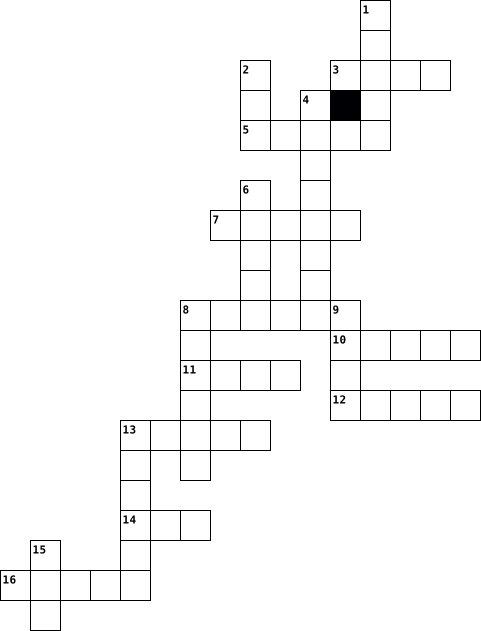
Across
- A portion of the Earth's mantle that flows like molten plastic despite being solid.
- Formed from oceanic continental convergent plate boundaries.
- An opening in the earth's crust through which lava, volcanic ash, and gases escape
- The thinner and denser part of earths crust that makes up the ocean floor.
- The location in which two tectonic plates interact through converging, diverging, or transforming.
- A path along the Pacific Ocean characterized by active volcanoes and frequent earthquakes.
- An oceanic tectonic plate that lies beneath the Pacific Ocean.
Down
- The location where two plates are being forced together by the convection currents in the earth's mantle.
- The solid, outermost layer of Earth, made of the crust and upper mantle.
- A sudden shaking of the ground caused by movement of tectonic plates.
- Molten rock (magma) erupted from a volcano.
- The layer of granitic, sedimentary, and metamorphic rocks, which form the continents and the areas of shallow seabed close to their shores.
- A type of rock that forms when molten rock cools and solidifies.
- The location when two plates converge, and one plate is forced under another.
- Formed from oceanic oceanic convergent plate boundaries.
- A hot, chaotic mixture of rock fragments, gas, and ash that travels rapidly away from a volcanic vent or collapsing flow front.
- A hot or cold mixture of water and rock fragments that flow quickly down the slopes of a volcano.
- Molten rock below the earth's surface near the upper mantle and lower crust.
- An area of the Earth's mantle from which hot plumes rise upward, forming volcanoes on the overlying crust.
- The solid remanence from fires, explosions, and/or volcanic vents.
20 Clues: Molten rock (magma) erupted from a volcano. • Formed from oceanic oceanic convergent plate boundaries. • Formed from oceanic continental convergent plate boundaries. • An oceanic tectonic plate that lies beneath the Pacific Ocean. • A type of rock that forms when molten rock cools and solidifies. • ...
Agung Volcano Crossword Challenge!!! 2025-02-13

Across
- An oceanic tectonic plate that lies beneath the Pacific Ocean.
- Mountains created by volcanic activity.
- A type of plate boundary where two tectonic plates are moving toward each other.
- A volcano is an opening in the earth's crust through which lava, volcanic ash, and gases escape.
- The layer of the Earth that lies below the lithosphere. This portion of the Earth's mantle flows like molten plastic despite being solid.
- Molten rock that flows from a volcano onto the Earth's surface.
- A mixture of molten and semi-molten rock found beneath the surface of the Earth.
- A thinner layer of crust (usually made of basalt) found underneath oceans and other bodies of water.
- A path along the Pacific Ocean characterized by active volcanoes and frequent earthquakes.
- A location where 2 plates meet.
- The sideways and downward movement of the edge of a plate of the earth's crust into the mantle beneath another plate.
Down
- A sudden shaking of the ground caused by movement of tectonic plates.
- The outer layer of the earth, consisting of both the crust and upper mantle.
- A dense, destructive mass of very hot ash, lava fragments, and gases ejected explosively from a volcano and typically flowing downslope at great speed.
- A thick layer of crust (usually made of granite) found beneath land masses.
- Rock formed when magma (molten rock) cools and crystallizes
- A island originating from a volcano or volcanic activity.
- A violent type of mudflow or debris flow composed of a slurry of pyroclastic material, rocky debris and water.
- Mixture of rock, mineral, and glass particles emitted by a volcano during an eruption.
- Spot a part of the Earth's mantle where hot plumes rise upward, forming volcanoes on the crust.
20 Clues: A location where 2 plates meet. • Mountains created by volcanic activity. • A island originating from a volcano or volcanic activity. • Rock formed when magma (molten rock) cools and crystallizes • An oceanic tectonic plate that lies beneath the Pacific Ocean. • Molten rock that flows from a volcano onto the Earth's surface. • ...
Plate Tectonic Cross Word 2013-11-19

Across
- Vibrations of the earth and its crust
- The upper layer of the earth's mantle
- A geologic process in which one edge of one crustal plate is forced below the edge of another
- A curved chain of volcanic island
- A large-scale motion of Earth's lithosphere
- A deep furrow or ditch
- To raise or elevate
- Forming or belonging to a continent
- To change markedly the appearance or form
Down
- A large natural elevation of the earth's surface
- A hardened layer, coating, or deposit on the surface of something usually soft.
- Relating to the ocean
- The large-scale motions of Earth's lithosphere
- Drawing apart from a common point or diverging
- The act, condition, quality, or fact of converging
- A sudden violent shaking of the ground
- The rigid outer part of the earth
- An edge and the area immediately adjacent to it
- A mountain or hill, typically conical, having a crater or vent through which lava, rock fragments, hot vapour, and gas are or have been erupted from the earth's crust
- The layer of the earth between the crust and the core
20 Clues: To raise or elevate • Relating to the ocean • A deep furrow or ditch • A curved chain of volcanic island • The rigid outer part of the earth • Forming or belonging to a continent • Vibrations of the earth and its crust • The upper layer of the earth's mantle • A sudden violent shaking of the ground • To change markedly the appearance or form • ...
science crossword 2014-02-23

Across
- mountain ranges in the middle of the ocean.
- a theory of moving plates.
- the dense metallic center of earth.
- forms when two plates collide
- As a slab sinks, it pulls the rest of the plate with it.
- the outer part if the magnetic field that interacts with charged particles.
- cold and rigid outermost layer.
- man who had a theory.
- The denser plate sinks below the more buoyant plate.
- the brittle and rocky layer of earth
- material soft enough to flow.
- a supercontinent.
- theory that states that earth's surface is made of rocky plates.
Down
- occurs and the magnetic fields reverse directions.
- Rising mantle pushes plates away from each other.
- the thick middle layer in the solid part of earth.
- circulation of material caused by differences in temperature.
- a state in which magnetized objects will point north.
- a state in which magnetized objects will point south.
- forms where two plates slide past each other.
- forms where two plates separate.
- Process in which new seafloor is made.
- the plastic layer below the lithosphere that has part of the crust and mantle in it.
23 Clues: a supercontinent. • man who had a theory. • a theory of moving plates. • forms when two plates collide • material soft enough to flow. • cold and rigid outermost layer. • forms where two plates separate. • the dense metallic center of earth. • the brittle and rocky layer of earth • Process in which new seafloor is made. • mountain ranges in the middle of the ocean. • ...
Tectonic Plate Crossword 2021-04-01

Across
- Where two plates are moving apart
- They are created by subduction
- A fine grained volcanic rock formed by the partial of the mantle
- A dark intrusive igneous rock
- The pieces of earths crust
- Where two plates are colliding.
- A fracture or zone of fractures in the earth along which there has been a displacement of the sides relative to one another
- The solid outer portion of the earth
- Molten material erupted at the surface of the earth
- Atom with same atomic number, different number of neutrons
- The act of imitating the behaviour of some situation
- The outer layer of the earth
- The layer of the earth between the crust and the core
- Large section of earths crust and upper mantle that moves around on the asthenosphere
Down
- Molten rock in the earths crust
- A specialist in the history of the earth in rocks
- Rigid layer made out of and upper mantle
- the sideways and downward movement of the edge of a plate of the earth's crust into the mantle beneath another plate
- The lower layer of the crust
- Where plates slide passed each other
20 Clues: The pieces of earths crust • The lower layer of the crust • The outer layer of the earth • A dark intrusive igneous rock • They are created by subduction • Molten rock in the earths crust • Where two plates are colliding. • Where two plates are moving apart • Where plates slide passed each other • The solid outer portion of the earth • Rigid layer made out of and upper mantle • ...
1st Year Christmas test 2024-11-20

Across
- – Name a metamorphic rock used in construction.
- – Which reindeer has a red nose?
- – What landform is created when two plates collide?
- – Which plate boundary creates new land?
- – What causes tectonic plates to move?
- – What is a popular main dish for Christmas dinner?
- – What sedimentary rock forms from compressed sand?
- – What is Ireland's most common sedimentary rock?
- – Name an extrusive igneous rock.
- – Which scale measures earthquake strength?
- – What animals pull Santa’s sleigh?
- – What was the name of the supercontinent?
- – Where in Ireland can you find basalt columns?
Down
- – What type of plate boundary causes earthquakes?
- – Which plate boundary causes subduction?
- – Where in Ireland can you find granite?
- – What is molten rock inside the Earth called?
- – What forms in extrusive rocks due to rapid cooling?
- – Name the underwater mountain range between Europe and America.
- – Where did a devastating earthquake occur in 2010?
- – What forms in intrusive rocks due to slow cooling?
- – What is used to count down the days to Christmas?
- – What is the name of the Christmas movie starring Will Ferrell as one of Santa’s helpers?
- – Name an intrusive igneous rock.
- – What is molten rock on the Earth's surface called?
25 Clues: – Which reindeer has a red nose? • – Name an extrusive igneous rock. • – Name an intrusive igneous rock. • – What animals pull Santa’s sleigh? • – What causes tectonic plates to move? • – Where in Ireland can you find granite? • – Which plate boundary creates new land? • – Which plate boundary causes subduction? • – What was the name of the supercontinent? • ...
Denton County Tax Office 2025-11-18

Across
- Discontinued plate material
- Type of card used for authorization.
- A clownfish... and a queue system...
- The month property tax is due
- "I thought we didn't need an inspection anymore"
- Our newest department
- Highway is to motor vehicle as ADVAL is to
- We can't notarize but we can
- The reason a statement is signed by both buyer and seller
- A01 is the first ticket for a
- The type of title that needs a rider to correct
- 2010 means my odometer is
- I have a "N" brand
- Has a plate but may not have a title?
Down
- When the death certificate is needed.
- LL/SUV
- Placards are red. Wait, they're blue too. The form isn't notarized. They have this in lieu.
- I wanted ketchup packets for my tenders no ___ packets!
- Costs an additional 20% on top of prescribed registration fee.
- prints titles
- The DD214 helps decide a plate's
- Why does my registration cost an extra $200?
- What puts the T in RTS?
- Most people start as a
- Name of the position in charge of a substation.
- A candy cane plate
- A contactless method of webdealer payment
27 Clues: LL/SUV • prints titles • A candy cane plate • I have a "N" brand • Our newest department • Most people start as a • What puts the T in RTS? • 2010 means my odometer is • Discontinued plate material • We can't notarize but we can • The month property tax is due • A01 is the first ticket for a • The DD214 helps decide a plate's • Type of card used for authorization. • ...
6. THE DINNER IS SERVED 2021-01-14

Across
- kattila
- pöytäliina
- tarjotin
- veitsi
- paistinpannu
- pippurimylly
- leipä
- suolasirotin
Down
- voi
- maljakko
- lusikka
- lautasliina
- lautanen
- kynttilä
- kannu
- leivänpaahdin
- haarukka
- lasi
18 Clues: voi • lasi • kannu • leipä • veitsi • kattila • lusikka • maljakko • lautanen • kynttilä • tarjotin • haarukka • pöytäliina • lautasliina • paistinpannu • pippurimylly • suolasirotin • leivänpaahdin
Breakfast! 2021-11-25
Across
- Milch
- Teller
- Zucker
- Käse
- Glas
- Gabel
- Löffel
- Brot
- Tee
- Wasser
Down
- Messer
- Tasse
- Pfannkuchen
- Saft
- Cafe
- Eier
- Butter
- Marmelade
18 Clues: Tee • Saft • Käse • Cafe • Eier • Glas • Brot • Tasse • Milch • Gabel • Messer • Teller • Zucker • Löffel • Butter • Wasser • Marmelade • Pfannkuchen
Mi Casa 2024-02-19

Across
- Sofa
- Lamp
- Table
- Kitchen
- Dining room
- Plate
- House
- \
- Window
- Knife
Down
- Bedroom
- Bed
- Cup
- Pot
- Cup
- Chair
- Spoon
- Door
- Fork
19 Clues: \ • Bed • Cup • Pot • Cup • Sofa • Lamp • Door • Fork • Table • Chair • Plate • House • Spoon • Knife • Window • Bedroom • Kitchen • Dining room
restaurante 2023-05-02

Across
- waitress
- salt
- waiter
- pepper
- chair
- spoon
- napkin
Down
- cup
- fork
- glass
- plate
- restaurant
- bill
- menu
- table
- bowl
- knife
- sugar
18 Clues: cup • fork • salt • bill • menu • bowl • glass • plate • table • knife • chair • spoon • sugar • waiter • pepper • napkin • waitress • restaurant
Unit4 2023-01-18

Across
- bouillir
- étaler
- baguettes
- chips
- viande
- fourchette
- assiette
Down
- verre
- cuillère
- sécher
- serviette
- riz
- fromage
- couteau
- couper
- paille
- mélanger
- éplucher
18 Clues: riz • verre • chips • sécher • étaler • couper • paille • viande • fromage • couteau • bouillir • cuillère • mélanger • assiette • éplucher • serviette • baguettes • fourchette
things in the room 2026-02-10

Across
- kasur
- bantal
- handuk
- piring
- kompor
- sapu
- gelas
- gambar
- pisau
- buku
- jendela
Down
- guling
- televisi
- meja
- sendok
- kursi
- pensil
- pintu
18 Clues: meja • sapu • buku • kasur • kursi • gelas • pisau • pintu • guling • bantal • handuk • piring • kompor • sendok • pensil • gambar • jendela • televisi
Geophysical Processes and Associated Hazards 2014-05-07

Across
- Violent ejection of steam and volcanic material
- Mass movement mechanism triggered by seismic activity
- A volcanic hazard consisting of a mixture of hot high density rock and gas
- Part of the lithosphere which moves in continental drift
- Plate boundary where new crust is created
- Devastation of infrastructure e.g. roads, railways and industry
- Rock fragments and material ejected from a volcano
- Point on the surface directly above the focus of an earthquake
- Precipitation affected by volcanic gases such as sulphur and nitrogen oxides
- Conservative plate boundary
- 300,000 deaths 180,000 homes destroyed and 1.5 million people homeless following a 7.0 magnitude earthquake here in 2010
- Seismic activity that occurs preceding an earthquake as stress builds
- Location of the 9.1 magnitude tsunami that affected 14 countries on Boxing Day 2004
- Exposure of the ocean floor preceding a tsunami wave hitting land
- Weakness in rock formation often trigger of seismic activity
- Lightweight airborne deposit from a volcanic eruption
Down
- Earthquake resistant structures should not do this
- Result of tectonic and/or volcanic activity severe shaking of the ground that can cause mass destruction
- Large area prone to volcanic and seismic activity around the Pacific Ocean
- Destructive mud flow on slopes of a volcano
- Discipline of dealing with and avoiding natural and man made catastrophies
- Sudden swell of high water
- Found at a destructive plate boundary where crust sinks into the mantle
- Water saturated sediment acting as a fluid when shaken
- Logarithmic scale that measures magnitude of an earthquake
- Destructive plate boundary
- Seismic wave propagated by submarine tectonic fault
- Size of seismic or tectonic hazard
- Ruptured gas pipes and electricity lines can cause this potential hazard
- Renewable energy source that creates a high risk of radioactive explosions
30 Clues: Sudden swell of high water • Destructive plate boundary • Conservative plate boundary • Size of seismic or tectonic hazard • Plate boundary where new crust is created • Destructive mud flow on slopes of a volcano • Violent ejection of steam and volcanic material • Earthquake resistant structures should not do this • Rock fragments and material ejected from a volcano • ...
Chapter 9 Vocabulary 2023-12-07

Across
- The process of ______ moves new ocean floor along mid ocean ridges and slowly moves outward along ocean basins
- ____ means all land
- Long steep valleys that form in the deepest part of the ocean are ______
- Arc shaped land chains of volcanic islands are _____ and are made of newly formed land
- Boundaries that move away from each other are called ______ boundaries
- When older parts of the ocean floor return to the mantle ____ occurs as the floor moves through trenches
- _________ is a range of volcanic mountains within a continent produced in part by subduction
- _____ are chains of mountains that extend through oceans
Down
- A long canyon that forms a valley in the center of a mid-ocean ridge
- The upwelling of mantle rock, known as _______, occur in hotspots and take on column shapes
- ______ is the theory that Earth’s plates move slowly driven by the convection currents of the mantle
- The gradual movement of the continents across Earth’s surface is ______ which was hypothesized by Alfred Wegener
- Plate that grind past each other without breaking or building the lithosphere are _______ boundaries
- ______ boundaries form where two tectonic plates move together
- Sound navigation and Ranging stand for _____ and is a system of using sound wave to calculate distance
- Lithosphere that slides into the asthenosphere near mid-ocean ridges is a result of ________ mechanics of plate motion mechanics
- A rock has ______ if it acquires the same type of polarity as the Earth's magnetic field at that time
- Broken pieces of the Earth’s lithosphere are _____
- The continuous circular flow in a fluid, a ______, is due to differences in density in the fluid.
- When dense oceanic lithosphere is pulled into the mantle is the _______ mechanism of plate motion mechanics
20 Clues: ____ means all land • Broken pieces of the Earth’s lithosphere are _____ • _____ are chains of mountains that extend through oceans • ______ boundaries form where two tectonic plates move together • A long canyon that forms a valley in the center of a mid-ocean ridge • Boundaries that move away from each other are called ______ boundaries • ...
Chapter 6: Manicuring 2023-10-01

Across
- boards and buffers 150-180 grit
- conservative nail shape
- shorten the nails free edge
- combination of clear polish and protein
- cosmetic treatment for the hands
- set of all tools that will be used in a service
- also called kneading
- absorb in the nail plate; increase flexibility; soften surrounding skin
- adds cross link to natural nail plate
- rapid tapping or striking motion of the hands against the skin
- used to gently scrape cuticle tissue from the natural nail plate
- colorless, inflammable liquid; removes oils and prepares nails for polish
- nail shape completely straight across the free edge
Down
- tools to perform nail services can be multi use or single use
- wooden stick used to remove cuticle tissue from the nail plate
- reusable implements
- barrier product;seal the skin surface; hold subdermal moisture in the skin
- abrasives 240 grit or higher
- nail shape suited to thin hands with long fingers and narrow nail beds
- nail shape with square free edge with rounded corner edges
- continuous trembling or shaking movement applied by the hand without leaving contact with the skin
- uses high- temperature steam and pressure to kill microorganisms and their spores
- disposable implements
- quickly reduce the thickness of any surface and produce deeper and more visible scratches on the surface
- stainless steel implement used to carefully trim dead skin around the nail
- list of services that you are legally allowed to perform in your specialty
- manual or mechanical manipulation of the body by rubbing, kneading, or tapping
- petroleum by product; excellent sealing properties; excellent moisture in the epidermal layer
- slightly tapered nail shape
29 Clues: reusable implements • also called kneading • disposable implements • conservative nail shape • shorten the nails free edge • slightly tapered nail shape • abrasives 240 grit or higher • boards and buffers 150-180 grit • cosmetic treatment for the hands • adds cross link to natural nail plate • combination of clear polish and protein • ...
Tectonic Plates 2025-03-14

Across
- a German meteorologist and geophysicist who came up with the continental drift hypothesis
- mountains formed in part by igneous activity associated with the subduction of oceanic lithosphere beneath a continent
- a deep canyonlike structure found along the creat of some ridge segments
- the action that drives the movement of tectonic plates
- the crust that is less likely to subduct due to its buoyancy
- the number of major plates which account for 94% of the Earth’s surface area
- the largest tectonic plate
- a boundary in which two plates slide past one another without creating or destroying lithosphere
- supercontinent containing all of the existing continents
- the amount of pieces the lithosphere is broken up into
- a hypothesis proposed by Harry Hess which suggested that new oceanic crust is produced at the crests of mid-ocean ridges
Down
- a well-tested theory proposing that Earth’s outer shell consists of individual plates that interact in various ways and thereby produce earthquakes, volcanoes, mountains, and the crust itself
- a chain of volcanic islands generally located a few hundred km from a trench where there is active subduction of one oceanic plate beneath another
- elevated areas of the seafloor characterized by high heat flow and volcanism; found at divergent boundaries
- a hypothesis which suggested that all present continents once existed as a single supercontinent
- a plate boundary where the two plates move together
- linear zones of irregular topography on the deep-ocean floor that follows transform faults and their inactive extensions
- processes that deform Earth’s crust to create major structural features, such as mountains, continents, and ocean basins
- a narrow, elongated depression of the seafloor
- a plate boundary in which two plates move apart
20 Clues: the largest tectonic plate • a narrow, elongated depression of the seafloor • a plate boundary in which two plates move apart • a plate boundary where the two plates move together • the action that drives the movement of tectonic plates • the amount of pieces the lithosphere is broken up into • supercontinent containing all of the existing continents • ...
EARTH SCIENCE PT#2 2021-02-03

Across
- A fault on which the two blocks slide past one another.
- A type of plate movement that found in San Andreas Fault.
- This boundary occurs when two plates move away.
- Occurs when two plates move toward each other.
- linear, strata normally dip away from axial center, oldest
- The term for the force exerted by a tectonic plate descending into the mantle.
- They are geological features formed by convergent boundaries.
- Opposite of a convergent boundary, a divergent boundary is formed by the spreading of a tectonic plate.
- It occurs between the core and mantle or even between the asthenosphere and lithosphere.
- It is formed at the base of the continental rise about 4000 to 6000 meters deep.
Down
- The one who proposed that the sea floor is spreading.
- These are inclined fractures where the blocks have mostly shifted vertically.
- Gravitational force that causes a plate to move away from the crest of an ocean ridge, and into a subduction zone.
- It is a fracture or zone of fractures between two blocks of rock.
- These are regions that are below sea level and about 70% of these areas hold the planet’s water.
- Internal process drives the molten rocks in the mantle to rise to the lithosphere.
- A fault rock which is cohesive with a poorly developed or absent planar fabric, or which is incohesive, characterized.
- It is the force per unit that place on a rock.
- Another geological feature that results from a subduction zone.
- It is a central valley formed at the summit of the oceanic ridges as the molten materials continuously flow out from the ridges.
20 Clues: Occurs when two plates move toward each other. • It is the force per unit that place on a rock. • This boundary occurs when two plates move away. • The one who proposed that the sea floor is spreading. • A fault on which the two blocks slide past one another. • A type of plate movement that found in San Andreas Fault. • ...
Living with the physical environment 2024-07-04

Across
- organisms who absorb energy from the sun through photosynthesis
- an extended area of beach material that sticks out into the sea, joined to the mainland at one end
- living components of an ecosystem
- herbivores
- the top of a wave
- the type of air pressure when air is rising
- the variety of life in the world or particular habitat
- a ridge of sand or shingle which joins two headlands
- the type of air pressure when air is sinking
- a sudden or violent movement within the Earth's crust, followed by aftershocks
- an organism which breaks down dead tissue e.g. fungus
- the removal of solid mineral resources from the earth
- the most common wind direction for an area
- the long-term change in the earth's climate due to increasing greenhouse gas emissions
Down
- responsible travel to natural areas that conserves the environment and sustains local people
- the measure of distance north or south of the equator
- plate boundary where to plates come together and the denser plate subducts
- an area of low pressure with winds moving in a spiral around a calm central point
- the down-slope movement of rock or soil due to gravity
- a complex hierarchy of plants and animals that rely on each other for food
- a long period of little or no rainfall
- winds that carry air back to the equator
- plate margin where two plates move apart and rising magma creates new land
- plate margin where two plates slide past each other
- the zig-zag movement of sediment along the coast
- the cutting down of trees
- the type of weather that results in rocks being disintegrated
- the distance between two successive crests
28 Clues: herbivores • the top of a wave • the cutting down of trees • living components of an ecosystem • a long period of little or no rainfall • winds that carry air back to the equator • the distance between two successive crests • the most common wind direction for an area • the type of air pressure when air is rising • the type of air pressure when air is sinking • ...
Geology crossword 2021-12-03

Across
- a feature that forms where a stream or river ends and deposits sediment on land
- any change to the Earth’s crust that results from two tectonic plates converging
- the slope of a river or stream
- processes such as landslides or stream erosion that break down or wash away the surface of geologic features
- the slow broad upward movement of the Earth’s surface
- a landform that results when increased pressure is put on a rock layers causing them to fold downward
Down
- circular movement of molten magma that causes tectonic plates to shift
- a landform that results when increased pressure is put on rock layers causing them to fold upwards
- a plate boundary where two tectonic plates collide
- where two plates slide past one another
- a process that displaces rock layers when surfaces on either side of a crack in the earth's surface shift
- the process that occurs when two plates converge causing the crust to fold over onto itself
- no longer active but capable of erupting one day
- when two plate slide away from each other
- a destructive natural process through which rock and soil are loosened and removed from the Earth surface
- the area extending from a stream to its valley walls where sediment is deposited when the stream overflows
- where oceanic plates converge and the older denser oceanic plates
- pulled under the other tectonic plate at a convergent plate boundary
- processes that help build or shape geological features
- particles of sandstone or dirt that are removed from Earth's surface and deposited elsewhere
- the feature that forms when sediment is carried from a stream: to river into another body of water such as an ocean lake or larger river
21 Clues: the slope of a river or stream • where two plates slide past one another • when two plate slide away from each other • no longer active but capable of erupting one day • a plate boundary where two tectonic plates collide • the slow broad upward movement of the Earth’s surface • processes that help build or shape geological features • ...
cereal box project 2025-02-14

Across
- a sudden and violent shaking of the ground, sometimes causing great destruction, as a result of movements within the earth's crust or volcanic action.
- is a fast-moving current of hot gas and volcanic matter
- makes Lava
- coming closer together, especially in characteristics or ideas.
- a mountain or hill, typically conical, having a crater or vent through which lava, rock fragments, hot vapor, and gas are being or have been erupted from the earth's crust.
- the solid, outer part of the Earth
- the outermost layer of Earth's lithosphere that makes up the planet's continents and continental shelves
- the outermost layer of Earth's lithosphere that is found under the oceans and formed at spreading centres on oceanic ridges, which occur at divergent plate boundaries.
- an island of volcanic origin
Down
- the upper layer of the earth's mantle, below the lithosphere, in which there is relatively low resistance to plastic flow and convection is thought to occur.
- path along the Pacific Ocean characterized by active volcanoes and frequent earthquakes.
- an oceanic tectonic plate that lies beneath the Pacific Ocean.
- a small area or region with a relatively hot temperature in comparison to its surroundings.
- formed from the cooling and solidification of molten (melted) rock.
- starts out as a simple crack in the Earth called a volcanic vent.
- molten or partially molten rock (magma)
- The location where two plates meet
- mixtures of water, volcanic ash, tephra, rock fragments, and chunks of ice that can flow like wet concrete.
- the sideways and downward movement of the edge of a plate of the earth's crust into the mantle beneath another plate.
- the powdery residue left after the burning of a substance.
20 Clues: makes Lava • an island of volcanic origin • The location where two plates meet • the solid, outer part of the Earth • molten or partially molten rock (magma) • is a fast-moving current of hot gas and volcanic matter • the powdery residue left after the burning of a substance. • an oceanic tectonic plate that lies beneath the Pacific Ocean. • ...
Neurophysiology & Contraction 2025-03-25

Across
- Channels responding to changes in membrane potential.
- Phase restoring negative membrane potential (K+ efflux).
- Passive ion channels maintaining resting membrane potential.
- Rapid depolarization/repolarization propagating along excitable membranes.
- Channels opening when neurotransmitters bind.
- Synapse between motor neuron and muscle fiber.
- State of having a membrane potential (negative inside relative to outside).
- Vesicles storing neurotransmitters in axon terminals.
- Measure of potential energy in electrical charges (in millivolts).
- Voltage difference between a cell's interior and exterior.
- Pump maintaining ionic gradients by exchanging 3Na+ out/2K+ in.
- Space between axon terminal and motor end plate.
- Ion channels opening/closing in response to stimuli.
- Specialized sarcolemma region with acetylcholine receptors.
- Depolarization of motor end plate by acetylcholine.
- Sequence linking action potentials to crossbridge cycling.
- Junction between neuron and target cell (e.g., neuromuscular junction).
Down
- Process where action potentials trigger muscle contraction.
- Study of electrical properties in cells and tissues.
- Long projection of a neuron conducting action potentials.
- Voltage difference across a cell membrane.
- State of being supplied with motor neurons.
- Combined influence of concentration and electrical gradients on ions.
- Stable voltage (-70mV in neurons) when not transmitting signals.
- Phase where membrane potential becomes less negative (Na+ influx).
- Neuron transmitting signals from CNS to muscles.
- Chemical messengers (e.g., acetylcholine) crossing synaptic clefts.
- Enzyme breaking down acetylcholine to terminate signals.
- End of axon releasing neurotransmitters.
- Ability of action potentials to spread along membranes.
- Neurotransmitter activating skeletal muscle contraction.
31 Clues: End of axon releasing neurotransmitters. • Voltage difference across a cell membrane. • State of being supplied with motor neurons. • Channels opening when neurotransmitters bind. • Synapse between motor neuron and muscle fiber. • Neuron transmitting signals from CNS to muscles. • Space between axon terminal and motor end plate. • ...
Meal Planning & Etiquette 2022-04-20

Across
- New cooks should prepare ____ recipes.
- Use flatware from the _______ in.
- Pass foods this direction.
- No food should be put on this part of a plate.
- Forks, spoons, knives.
- Manners show ____ for others.
- Food choices may be limited based on where you ____.
- Cooking from ____ can save money.
- Toothpicks should be used in ____.
- Setting the table affects the ____ of food.
- Your napkin goes here during the meal.
- Placed to the left of the plate.
- Chew with your mouth ____.
- A list of things that need to be done to finish a meal. (two words)
- Courtesy shown by good manners.
- Pass salt & pepper ______
- The guidelines of aesthetically pleasing meals. (two words)
- Working on several items at the same time. (two words)
- The way food is presented.
- Affects the kind of foods made in a home.
Down
- Never place food here.
- Should be considered for people with certain health concerns. (two words)
- Plates, cups, bowls.
- Sit from this side of the chair.
- Do this as you cook to manage time. (two words)
- Placed to left of fork, center of the plate, or in the water goblet.
- A place setting for one person.
- Begin to eat when ______ has been served.
- These foods may speed up prep time but are usually more expensive.
- Glasses & goblets.
- Never use this item at the table
- These are not allowed on the table.
- Wait ____ minutes before calling late arrivals.
- These are 18-20% of the total meal.
- Your napkin goes ____ of the plate when you are done eating.
- If there more than ___ people at the table you can eat when ___ have been served.
- The napkin should not _____ the flatware.
- Your napkin goes here if you leave and plan to return.
38 Clues: Glasses & goblets. • Plates, cups, bowls. • Never place food here. • Forks, spoons, knives. • Pass salt & pepper ______ • Pass foods this direction. • Chew with your mouth ____. • The way food is presented. • Manners show ____ for others. • A place setting for one person. • Courtesy shown by good manners. • Sit from this side of the chair. • Never use this item at the table • ...
Topic 10 Plate Tectinics 2026-04-01

Across
- A plate boundary where two plates move toward each other.
- A giant wave usually caused by an earthquake beneath the ocean floor.
- An area where magma from deep within the mantle melts through the crust above it
- liquid magma that reaches the surface
- A plate boundary where two plates move away from each other.
- An undersea mountain chain where new ocean floor is produced; a divergent plate boundary under the ocean.
- trench An undersea valley that represents one of the deepest parts of the ocean.
- A plate boundary where two plates move past each other in opposite directions
- A force that acts on a rock to change its shape or volume
- Stress that stretches rock so that it becomes thinner in the middle
- The shaking that results from the movement of rock beneath Earth's surface.
- The measurement of an earthquake's strength based on seismic waves and movement along faults.
Down
- The process by which molten material adds new oceanic crust to the ocean floor
- The sinking, movement of the ocean floor back into the mantle
- A weak spot in the crust where magma has come to the surface
- Stress that squeezes rock until it folds or breaks
- A molten mixture of rock-forming substances, gases, and water from the mantle
- A term used to describe a volcano that is not currently active but able to become active in the future
- stress that pushes masses of rock in opposite directions, in a sideways movement
- A term used to describe a volcano that is no longer active and unlikely to erupt again.
- A break in the Earth's crust
21 Clues: A break in the Earth's crust • liquid magma that reaches the surface • Stress that squeezes rock until it folds or breaks • A plate boundary where two plates move toward each other. • A force that acts on a rock to change its shape or volume • A weak spot in the crust where magma has come to the surface • A plate boundary where two plates move away from each other. • ...
Geological Forces Crossword Puzzle 2020-10-18

Across
- the layer of earth we live on
- plate movement where one tectonic plate goes under another plate
- pulling apart of two tectonic plates
- the crust and upper mantle
- fast moving, very hot, dark cloud of volcanic ash, gas, and rocks
- a crack in the earth's crust
- means "all lands"; a supercontinent of all the continents making one big land mass
- this machine measures seismic waves
- shaking of the earth's surface
- the layer of earth as hot as the sun;a solid ball of iron
- area around the pacific plate with most of the earth's volcanoes and earthquakes
- Alfred Wegener saw that the continents looked like they fit together like ____ pieces.
- type of volcano made of volcanic ash, volcanic clinkers, or volcanic cinder
Down
- type of volcano also called a stratovolcano;cone shaped with steep sides
- inside the earth where the earth moves or breaks;start of seismic waves
- type of volcano in the shape of a large, round dome
- a surface wave that rolls the earth's surface during an earthquake
- coming together of two tectonic plates
- body waves; the second waves that come from the focus of an earthquake
- the largest layer of the earth
- viscous, slow moving lava
- a surface wave the moves the earth side to side during an earthquake
- a giant wave caused by under ocean earthquakes or volcano eruptions
- the layer of earth made of melted iron and nickel
- fast moving lava with clinkers
- sliding boundary of two tectonic plates
- body waves;the first waves that come from the focus of an earthquake
- the study of the earth
28 Clues: the study of the earth • viscous, slow moving lava • the crust and upper mantle • a crack in the earth's crust • the layer of earth we live on • the largest layer of the earth • shaking of the earth's surface • fast moving lava with clinkers • this machine measures seismic waves • pulling apart of two tectonic plates • coming together of two tectonic plates • ...
Geological Forces Crossword Puzzle 2020-10-18

Across
- the layer of earth we live on
- plate movement where one tectonic plate goes under another plate
- pulling apart of two tectonic plates
- the crust and upper mantle
- fast moving, very hot, dark cloud of volcanic ash, gas, and rocks
- a crack in the earth's crust
- means "all lands"; a supercontinent of all the continents making one big land mass
- this machine measures seismic waves
- shaking of the earth's surface
- the layer of earth as hot as the sun;a solid ball of iron
- area around the pacific plate with most of the earth's volcanoes and earthquakes
- Alfred Wegener saw that the continents looked like they fit together like ____ pieces.
- type of volcano made of volcanic ash, volcanic clinkers, or volcanic cinder
Down
- type of volcano also called a stratovolcano;cone shaped with steep sides
- inside the earth where the earth moves or breaks;start of seismic waves
- type of volcano in the shape of a large, round dome
- a surface wave that rolls the earth's surface during an earthquake
- coming together of two tectonic plates
- body waves; the second waves that come from the focus of an earthquake
- the largest layer of the earth
- viscous, slow moving lava
- a surface wave the moves the earth side to side during an earthquake
- a giant wave caused by under ocean earthquakes or volcano eruptions
- the layer of earth made of melted iron and nickel
- fast moving lava with clinkers
- sliding boundary of two tectonic plates
- body waves;the first waves that come from the focus of an earthquake
- the study of the earth
28 Clues: the study of the earth • viscous, slow moving lava • the crust and upper mantle • a crack in the earth's crust • the layer of earth we live on • the largest layer of the earth • shaking of the earth's surface • fast moving lava with clinkers • this machine measures seismic waves • pulling apart of two tectonic plates • coming together of two tectonic plates • ...
Ch.20 Manicuring 2025-11-20

Across
- Nail shape for a client who is more conservative
- How many coats of polish color are standard for coverage
- Nail shape for a client who wants tapered, long nails
- multiuse implement that should be held at a 20 to 30 degree angle from the nail plate
- abrasive used to buff, polish, and remove fine scratches
- Personal Protective equipment
- multiuse implement used to lift small bits of debris from the nail plate
- treatment that increases blood circulation to the skin while also trapping moisture
- Type of nail hardener
- implement used for each side of the nail to prevent stress damage to the sides of the nail plate
- abrasive used to shorten and shape natural nails
- What is the best material for multiuse tool?
- Three part nail care procedure that includes disinfecting your tools
Down
- contain ingredients designed to seal the surface of the skin around the nails
- equipment made from plastic, metal, glass or ceramic
- manicure that eliminate soaking the nails in water
- List of services that you legally are allowed to perform within your license in your state
- How many coats for a successful nail polish application
- Lace, mesh, and fabric used for nail art
- Are also called pledgets and can be used for many things
- tool shaped like a two sided nail file and creates shine
- implement used to remove dead skin
- The most memorable part of the manicure
- designed to speed the evaporation of solvents, allowing them to harden more quickly
- Abrasive that should be used with caution and not generally on natural nails
- designed to loosen and dissolve dead tissue on the nail plate
- tool used to create a marbleized effect
- Many salons and spas have services based on...
28 Clues: Type of nail hardener • Personal Protective equipment • implement used to remove dead skin • The most memorable part of the manicure • tool used to create a marbleized effect • Lace, mesh, and fabric used for nail art • What is the best material for multiuse tool? • Many salons and spas have services based on... • Nail shape for a client who is more conservative • ...
Topic 10 Plate Tectinics 2026-04-01

Across
- trench An undersea valley that represents one of the deepest parts of the ocean.
- An area where magma from deep within the mantle melts through the crust above it
- A force that acts on a rock to change its shape or volume
- A term used to describe a volcano that is not currently active but able to become active in the future
- The shaking that results from the movement of rock beneath Earth's surface.
- A plate boundary where two plates move past each other in opposite directions
- A term used to describe a volcano that is no longer active and unlikely to erupt again.
- stress that pushes masses of rock in opposite directions, in a sideways movement
- A molten mixture of rock-forming substances, gases, and water from the mantle
- A weak spot in the crust where magma has come to the surface
- An undersea mountain chain where new ocean floor is produced; a divergent plate boundary under the ocean.
Down
- A plate boundary where two plates move away from each other.
- Stress that stretches rock so that it becomes thinner in the middle
- A plate boundary where two plates move toward each other.
- Stress that squeezes rock until it folds or breaks
- A break in the Earth's crust
- liquid magma that reaches the surface
- A giant wave usually caused by an earthquake beneath the ocean floor.
- The process by which molten material adds new oceanic crust to the ocean floor
- The sinking, movement of the ocean floor back into the mantle
- The measurement of an earthquake's strength based on seismic waves and movement along faults.
21 Clues: A break in the Earth's crust • liquid magma that reaches the surface • Stress that squeezes rock until it folds or breaks • A plate boundary where two plates move toward each other. • A force that acts on a rock to change its shape or volume • A plate boundary where two plates move away from each other. • A weak spot in the crust where magma has come to the surface • ...
Unit 5 & 6 Vocab 2025-05-14

Across
- A deep valley formed by the separation of tectonic plates.
- Extensive lava flows covering vast areas.
- A logarithmic scale measuring earthquake magnitude.
- A small, steep volcano made of volcanic fragments.
- The periodic switch in Earth's magnetic field direction.
- A large crater formed by volcanic collapse or eruption.
- A stationary magma source that creates volcanic islands.
- A volcanic channel transporting magma to the surface.
- The process of one tectonic plate sinking beneath another.
- A fast-moving cloud of volcanic ash, gas, and rock.
- A tall volcano with alternating lava and ash layers.
- A large ocean wave triggered by earthquakes or other disturbances.
Down
- The process of mountain formation through tectonic forces.
- A mountain formed by shifting fault lines.
- A plate boundary where two plates collide.
- The force pulling a subducting plate into the mantle.
- The fastest seismic wave that travels through solids and liquids.
- The force applied to rocks that causes deformation.
- The energy released by an earthquake.
- A line on a map showing equal geological age.
- The gradual movement of continents over Earth's surface.
- The underground point where an earthquake originates.
- A tectonic boundary where plates slide past each other.
- A fracture in Earth's crust where movement occurs.
- The resistance of a fluid, like lava, to flow.
- The height of a seismic wave from its resting position.
- Rock fragments ejected during a volcanic eruption.
- The equilibrium between Earth's crust and mantle due to buoyancy.
- The processes associated with magma movement and eruptions.
- Energy waves produced by earthquakes.
- A body of intrusive igneous rock beneath Earth's surface.
- A small tectonic plate that moves independently.
32 Clues: The energy released by an earthquake. • Energy waves produced by earthquakes. • Extensive lava flows covering vast areas. • A mountain formed by shifting fault lines. • A plate boundary where two plates collide. • A line on a map showing equal geological age. • The resistance of a fluid, like lava, to flow. • A small tectonic plate that moves independently. • ...
Test 3 - Ocean Boundaries and Wilson Cycle 2025-10-01

Across
- This is driving magma to well up at the mid-ocean ridges and pull crust into the mantle
- Mountains on land are found at _____ plate boundaries
- The ____ Sea is an example of a terminal ocean
- This is the fourth stage of the Wilson cycle
- The ____ Mountains are an example of the suturing stage
- What is the supercontinent called?
- A ____ plate boundary is where plates move apart
- This is the fifth stage of the Wilson cycle
- The rock closest to the ____ _____ ____ will record the newest magnetic field readings
- The deformation of the Earth's crust
- The decreasing focus of earthquakes as a plate is subducted occurs on this zone
- This is the theory proposed by Alfred Wegener
- The frequency, magnitude, and distribution of earthquakes
Down
- This is the theory proposed by Harry Hess
- This is the third stage of the Wilson cycle
- The ___ ___ is an example of a juvenile ocean
- This is the second stage of the Wilson cycle
- This is the Ocean life cycle proposed by John Tuzo Wilson
- The frequency, magnitude, and distribution of volcanoes
- The ____ Ocean is an example of a mature ocean
- This is the first stage of the Wilson cycle
- This is the sixth stage of the Wilson cycle
- This is the permanent marking of the Earth's magnetic field in the oceanic crust
- The ____ Ocean is an example of a declining ocean
- Mid-ocean ridges are found at ____ plate boundaries
- A ____ plate boundary is where plates collide
- When oceanic crust meets continental crust, the ____ ____ will subduct.
- The East ____ Rift Valley is an example of an embryonic ocean
- Magnetic ____ are alternate positive and negative magnetic field readings
- Earth's _____field is not constant
- A ____ plate boundary is where plates slide across each other
31 Clues: What is the supercontinent called? • Earth's _____field is not constant • The deformation of the Earth's crust • This is the theory proposed by Harry Hess • This is the third stage of the Wilson cycle • This is the first stage of the Wilson cycle • This is the sixth stage of the Wilson cycle • This is the fifth stage of the Wilson cycle • ...
griffin's earth science vocabulary crossword 2026-02-03

Across
- dense sphere of nickel and iron at the center of the earth
- plate that forms the continents
- undersea trench where new ocean floor is produced through seafloor spreading
- when this occurs north and south switch
- undersea valley that can be the deepest place in the world
- crust that holds the world's oceans
- German scientist who theorized that the continents move
- layers sectioned based on the chemical makeup of the layers and by density
- used locate the north and south in relation to where it cooled down
- very hot material in its liquid state
- field generated from convection currents in the mantle
- this drives plate movement
- outermost layer of the earth
- layer of the earth that protects us from most asteroids
Down
- combined upper mantle and crust string and rigid solid rock
- science of dating rocks based on the magnitite
- layer of molten iron and nickel surrounding the center of the earth
- occurs when plates interact in violent ways
- layers sectioned based on physical properties and behavior
- idea that all the continents have moved, developed by Alfred Wegener
- layer of hot, solid material is between earth's crust and core
- plate boundary where the plates are moving together
- makes up most of the continental crust
- molten mixture of rocks, gasses, and water from the mantle
- drew maps of the seafloor that provided evidence for continental drift and seafloor spreading
- chain of volcanic islands that formed through subduction
- partially molten mechanical layer that the tectonic plates float on
- makes up most of the oceanic crust
- plate boundary where the plates are moving apart
29 Clues: this drives plate movement • outermost layer of the earth • plate that forms the continents • makes up most of the oceanic crust • crust that holds the world's oceans • very hot material in its liquid state • makes up most of the continental crust • when this occurs north and south switch • occurs when plates interact in violent ways • ...
Alex's Awesome quest crossword puzzle 2026-02-03

Across
- is a large, rigid piece of earth's lithosphere (the crust and and upper mantle
- A plate boundary where two plates move away from each other
- dark igneous rock that forms when lava cools quickly at earth's surface
- The process by which oceanic crust sinks beneath a deep ocean trench and back into the mantle at a convergent plate boundary
- plates move and float on it
- layer that the plates are in made up of solid rock
- The shaking that results from the movement of rock beneath earth's surface
- _____ is a meteorologist
- A dense sphere of solid iron and nickel at the center of earth
- hard light colored igneous rock that forms when magma cools slowly beneath earth's surface
- A plate boundary where two plates move toward each other
Down
- An undersea valley that represents one of the deepest parts of the ocean
- _______ helped create the first detailed maps of the ocean floor
- a single massive supercontinent that once included almost all of earth's land joined together
- is the thin, dense outer layer of earth's crust that lies beneath the oceans
- a curved chain of volcanoes over a subduction zone
- The layer of hot, solid material between earth's crust and core
- These occur in the mantle and move the plates
- Vibrations that travel through earth carrying the energy released during an earthquake
- An undersea mountain chain where new ocean floor is produced
- The process by which molten material adds new oceanic crust to the ocean floor
- a crack, split, or opening in the ground
- _____ is hard and rigid thinnest layer
- A plate boundary where two plates move past each other in opposite directions
- A layer of molten iron and nickel that surrounds the inner core of earth
25 Clues: _____ is a meteorologist • plates move and float on it • _____ is hard and rigid thinnest layer • a crack, split, or opening in the ground • These occur in the mantle and move the plates • a curved chain of volcanoes over a subduction zone • layer that the plates are in made up of solid rock • A plate boundary where two plates move toward each other • ...
Unit 5: Tectonic Plates 2022-02-06

Across
- type of convergent boundary where two plates collide and the more dense plate subducts below the less dense plate; forms volcanoes, deep ocean trenches, and earthquakes
- type of convergent boundary where two plates move towards one another pushing crust upward; forms mountains and earthquakes
- states that pieces of the Earth's lithosphere are in slow, constant motion, driven by forces in the mantle
- type of convergent boundary where two plates move towards one another, but one plate subducts under; forms volcanoes, mountains, earthquakes
Down
- force that pushes away newly created crust away from the mid-ocean ridge
- force that occurs when materials move in currents due to the differences in heat and density
- boundary where two plates horizontally slide past one another; form earthquakes
- boundary where two plates move away from each other; forms mid-ocean ridges and rift valleys
- boundary where two plates move towards each other; collide
- force that occurs as the edge of a dense tectonic plate sinks beneath a less-dense plate; creates a pull on the rest of the plate behind it
10 Clues: boundary where two plates move towards each other; collide • force that pushes away newly created crust away from the mid-ocean ridge • boundary where two plates horizontally slide past one another; form earthquakes • force that occurs when materials move in currents due to the differences in heat and density • ...
vocab words 2022-09-16

Across
- The central part of earth below the mantle
- spreadingsubductionThe process by which one lithospheric plate moves beneath another plate as a result of tectonic forces.Magnetic reversal process by which earth's magnetic north pole and magnetic south pole switch positions Any movement of matter the results from differences and density bending tilting and breaking of earth's crust The boundary between two tectonic plates that are moving away from each other boundary between tectonic plates that are colliding boundary between tectonic plates that are sliding past each other horizontally block of lithosphere that consists of the crust and the rigid, outermost part of the mantle A movement or trembling of the ground the is caused by a sudden release of energy when rocks along a fault move The point on earth's surface directly above an earthquake's starting point or focus The location within earth along a fault at which the first movement where an earthquake occurs A break of a body of rock along which one block moves relative to The sudden return of elastically deforms rock to its undeformed shape The edge between 2 or more plates classified as divergent, convergent, or transform by the moving taking place between the plates
- A layer of rock between the earth's crust and core
- The soft layer of the mantle on which the tectonic plates move mesosphere The strong, lower part of the mantle between the asthenosphere and the outer core
Down
- The thin and solid outermost layer of earth above the mantle
- drift The hypothesis that a single large landmass broke up into smaller land masses to form the continents, which then drifted to their present locations; the movement of continents
- tectonics The theory that the earth's outer layer is made up of large, moving pieces called tectonic plates.theory system of ideas that explains many related observations and is supported by a large body of evidence acquired through scientific investigations new oceanic lithosphere forms when magma rises to the earth's surface
- The solid, outer layer of earth that consists of the crust and the rigid upper part of the mantle
8 Clues: The central part of earth below the mantle • A layer of rock between the earth's crust and core • The thin and solid outermost layer of earth above the mantle • The solid, outer layer of earth that consists of the crust and the rigid upper part of the mantle • ...
vocab words 2022-09-16

Across
- The central part of earth below the mantle
- spreadingsubductionThe process by which one lithospheric plate moves beneath another plate as a result of tectonic forces.Magnetic reversal process by which earth's magnetic north pole and magnetic south pole switch positions Any movement of matter the results from differences and density bending tilting and breaking of earth's crust The boundary between two tectonic plates that are moving away from each other boundary between tectonic plates that are colliding boundary between tectonic plates that are sliding past each other horizontally block of lithosphere that consists of the crust and the rigid, outermost part of the mantle A movement or trembling of the ground the is caused by a sudden release of energy when rocks along a fault move The point on earth's surface directly above an earthquake's starting point or focus The location within earth along a fault at which the first movement where an earthquake occurs A break of a body of rock along which one block moves relative to The sudden return of elastically deforms rock to its undeformed shape The edge between 2 or more plates classified as divergent, convergent, or transform by the moving taking place between the plates
- A layer of rock between the earth's crust and core
- The soft layer of the mantle on which the tectonic plates move mesosphere The strong, lower part of the mantle between the asthenosphere and the outer core
Down
- The thin and solid outermost layer of earth above the mantle
- drift The hypothesis that a single large landmass broke up into smaller land masses to form the continents, which then drifted to their present locations; the movement of continents
- tectonics The theory that the earth's outer layer is made up of large, moving pieces called tectonic plates.theory system of ideas that explains many related observations and is supported by a large body of evidence acquired through scientific investigations new oceanic lithosphere forms when magma rises to the earth's surface
- The solid, outer layer of earth that consists of the crust and the rigid upper part of the mantle
8 Clues: The central part of earth below the mantle • A layer of rock between the earth's crust and core • The thin and solid outermost layer of earth above the mantle • The solid, outer layer of earth that consists of the crust and the rigid upper part of the mantle • ...
Trimester II Final Review XWord 2020-02-27

Across
- a type of rock that forms when melted rock cools and hardens
- nonrenewable resources that are rich in energy.
- melted rock on Earth's surface
- rock that is created from previously existing rock by the action of intense heat and pressure
- water stored below Earth's surface in soil and rock layers
- a model describing the transformations of rocks from one major rock type to another
- stored energy
- all of the water on, under, and above the Earth
- a tectonic plate boundary at which two tectonic plates move away from each other
- movement of energy and matter through fluids, such as the asthenosphere or atmosphere, that enable natural processes, such as the rock cycle and water cycle, respectively
- resources that are obtained from the earth
- the transfer of energy though a vacuum
- energy of motion
- the transfer of heat through a solid
- geologic event that frequently occurs at transform plate boundaries and sometimes at convergent boundaries
- melted rock located beneath Earth's surface
Down
- a tectonic plate boundary at which two tectonic plates move toward each other, causing collisions and subduction zones
- that part of Earth in which life can exist
- Earth's geologic processes are the same in the present as in the past
- the part of Earth which is composed mostly of rocks; the crust and outer mantle
- a tectonic plate boundary along which plates slide horizontally past one another in opposite directions
- a nuclear reaction in which nuclei combine to produce more massive nuclei resulting in the release of large amounts of energy
- The layer of soft but solid mobile rock found below the lithosphere.
- Earth's crust, both beneath the oceans and continents, as well as the mantle and inner and outer core
- a crack in a body of rock that the rock can move along
- rock formed by gravity pressing fragments of other rocks and minerals together as they settle on land or under the ocean over a long period of time
- scientific law stating that, in undisturbed rock layers, each layer is younger than the layer beneath it, and older than the layer above it
- the transfer of heat through a fluid
- a natural, solid substance found in rocks
- resource that is able to meet the demands of current use and yet be maintained in usable quantities to meet indefinite future demands.
- renewable energy source created from organisms
- the sinking of an oceanic plate beneath a plate of lesser density at a convergent boundary
- a substance or matter that is human-made
- the layers of gases that surround a planet
- energy in the form of heat
35 Clues: stored energy • energy of motion • energy in the form of heat • melted rock on Earth's surface • the transfer of heat through a fluid • the transfer of heat through a solid • the transfer of energy though a vacuum • a substance or matter that is human-made • a natural, solid substance found in rocks • that part of Earth in which life can exist • ...
Words 2022-10-22

Across
- разведенный
- стена
- сад
- испытывать жажду
- потолок
- свобода
- чашка
- ложка
- одежда
- нож
Down
- внизу
- вилка
- room спальня
- крыша
- занятие
- пол
- тарелка
- кухня
- вверху
19 Clues: сад • пол • нож • внизу • вилка • стена • крыша • чашка • ложка • кухня • вверху • одежда • занятие • потолок • свобода • тарелка • разведенный • room спальня • испытывать жажду
engels 2015-10-19

Across
- voertuig
- spoorweg
- brug
- geadresseerde
- takelwagen
- rijstrook
- inhaalverbod
- sneeuwkettingen
- indicator
- gewicht
- versnelling
Down
- blokeerd
- brandstof
- omleiding
- ontbijt
- bestemming
- nummerplaat
- rondpunt
- koppeling
19 Clues: brug • ontbijt • gewicht • blokeerd • voertuig • spoorweg • rondpunt • brandstof • omleiding • rijstrook • koppeling • indicator • bestemming • takelwagen • nummerplaat • versnelling • inhaalverbod • geadresseerde • sneeuwkettingen
Sweet Potato Dumplings 2022-01-26

Across
- 그릇
- 우유
- off, 벗기다
- 앞치마
- 도구
- 꿀
- 재료
- 뿌리다
- 으깨다
- 으깨는 기구
- 넣다
Down
- 접시
- 빵가루
- 종류
- 장갑
- potatoes, 고구마
- 껍질
- 덮다
- 다른
19 Clues: 꿀 • 접시 • 그릇 • 우유 • 종류 • 장갑 • 껍질 • 도구 • 덮다 • 재료 • 다른 • 넣다 • 빵가루 • 앞치마 • 뿌리다 • 으깨다 • 으깨는 기구 • off, 벗기다 • potatoes, 고구마
A CROSSWORD 2025-01-14

Across
- krona
- brki
- leto
- šal
- umetnik
- kopalnica
- hodnik
- prazen
- prst na roki
Down
- oblačila
- lasulja
- hiter
- len
- papagaj
- doma
- teta
- kljun
- krožnik
- Benetke
19 Clues: len • šal • brki • leto • doma • teta • krona • hiter • kljun • hodnik • prazen • lasulja • papagaj • umetnik • krožnik • Benetke • oblačila • kopalnica • prst na roki
continental drift and plate tectonics crossword by mila 2023-02-15

Across
- The largest rodent in the world, it is native to south America.
- Is mass and volume in relation to each other
- it is a theory made by Alfred Wegener and it says that the continents are drifting on the asthenosphere.
- It is a pickled cucumber.
- when two plates collide, and one slowly goes under the other.
Down
- it is the evidence for the theory of continental drift
- it is when the denser plate goes under the lighter plate
- It is two pieces of bread with stuffing in the middle.
- when two plates are moving away from each other.
- It is a process.When the liqud or gas is heated up it is less dense, so it rises. Then it expands out and comes back down
- He was a German meteorologist, and he invented continental drift.
- It is when two plates rub against each other in opposite directions.
12 Clues: It is a pickled cucumber. • Is mass and volume in relation to each other • when two plates are moving away from each other. • it is the evidence for the theory of continental drift • It is two pieces of bread with stuffing in the middle. • it is when the denser plate goes under the lighter plate • when two plates collide, and one slowly goes under the other. • ...
The Earths Systems 2012-11-07

Across
- the layer between the inner core and the mantle
- the place in New Zealand where an earthquake struck on the 3rd of February 1931
- what sedimentary rock is made of
- the part of the earths crust that move and create earthquakes
- a type of earthquake wave
- A type of rock made by the compaction of other rocks and remains over time
- the process in which a type of rock is changed into another rock
- the outermost part of the earths geosphere
- the solid iron-nickel core of earth
- another word for the size of an earthquake
- the type of volcano that Rangitoto is
Down
- the scale used to measure earthquakes
- the place where tectonic plates meet
- A type of plate boundary caused by plates rubbing against each other
- A type of rock that has been through physical changes as a result of compaction, time and sometimes heat
- The molten material beneath the earths crust
- A type of plate boundary caused by plates moving towards each other
- The solid part of the earth consisting of four main parts
- A type of plate boundary caused by plates moving away from each other
- A vent in the earths crust where lava and ashes are ejected
- A serious of vibrations caused by movements in the earths crust
- the number of different waves that can be created by an earthquake
- a large mass of land usually on its own tectonic plate (there are seven of them)
- A type of rock formed by the cooling of magma
- the part of the earths geosphere containing magma
25 Clues: a type of earthquake wave • what sedimentary rock is made of • the solid iron-nickel core of earth • the place where tectonic plates meet • the scale used to measure earthquakes • the type of volcano that Rangitoto is • the outermost part of the earths geosphere • another word for the size of an earthquake • The molten material beneath the earths crust • ...
6th Grade Rock Cycle/Continental Drift 2021-04-12

Across
- This model describes how rocks change as they are exposed to different elements.
- The layer of the Earth made of solid iron.
- Molten rock found on/above the Earth's surface is called this.
- The Theory proposed that first stated the continents move.
- The force that moves lava through the mantle (hot fluids go up...)
- The process of sediment being transported.
- The name of the most recent supercontinent.
- The largest layer of the Earth.
- The layer of the Earth we live on is called.
- Pieces of broken down rocks are called this.
- Type of rock formed when other rocks are exposed to heat/pressure.
- A formation caused by plates moving apart.
- A formation caused by plates moving past each other.
- Type of rock formed by small pieces being compacted/glued together.
- Molten rock found under the Earth's surface is called this.
Down
- A formation caused by plates coming together
- The modern name for the Theory that explains how the continents move.
- Type of rock formed when lava/magma cools.
- The layer of the Earth made of liquid iron.
- The name of the scientist who proposed continental drift.
- The type of plate boundary formed when two plates come together.
- The process where pieces of sediment are dropped/deposited in a new location.
- The planet's Crust ______ on top of the Mantle.
- The type of plate boundary formed when two plates move apart.
- The process of rocks being broken down into smaller pieces.
- A natural disaster caused by plate movements.
- The type of plate boundary formed when two plates move past each other.
27 Clues: The largest layer of the Earth. • Type of rock formed when lava/magma cools. • The layer of the Earth made of solid iron. • The process of sediment being transported. • A formation caused by plates moving apart. • The layer of the Earth made of liquid iron. • The name of the most recent supercontinent. • A formation caused by plates coming together • ...
Earth's Physical Systems: Environmental Science 2023-11-02

Across
- (chemical symbol Ra); a radioactive metal that was used to make paint glow in the dark; caused severe deformation to workers
- A molecule made from more than one element
- by shedding subatomic particles, these emit high energy radiation that can harms organism
- processes that outlines how each of the three major rock types—igneous, metamorphic, and sedimentary—form and break down based on the different applications of heat and pressure over time
- The process by which Earth’s surface is shaped by the extremely slow movement of sections of crust
- neutral subatomic particles
- a nucleic acid
- Made from more than one atom
- oceanic trench formed from the subduction of the Pacific plate under the Philippine plate
- Proteins, Nucleic acids, Carbohydrates, Lipids
- positively charged subatomic particle
- Elements of same atomic number that have different number of neutrons
Down
- shedding of subatomic particles
- based on the number of protons
- the study of matter and their interactions
- plate boundary where two plates move away from each other
- the scientific study of Earth’s physical features, processes, and history
- Concentration of H+
- pH below 7
- all material in the universe with mass and that occupies space
- weight of protons plus neutrons
- negatively charged subatomic particles
- substance with given properties that can’t be broken down into simpler substances
- have protons, neutrons and electrons
- plate boundary where two plates move toward each other; can create mountains or subduction zones
- type of rock that forms when rocks are subjected to high heat, high pressure
- "Shearon _______"; the nuclear power plant that generates electricity for much of the Triangle
- sits outside the Earth’s mantle
28 Clues: pH below 7 • a nucleic acid • Concentration of H+ • neutral subatomic particles • Made from more than one atom • based on the number of protons • shedding of subatomic particles • weight of protons plus neutrons • sits outside the Earth’s mantle • have protons, neutrons and electrons • positively charged subatomic particle • negatively charged subatomic particles • ...
Geological Forces Crossword Puzzle 2020-10-18

Across
- the layer of earth we live on
- plate movement where one tectonic plate goes under another plate
- pulling apart of two tectonic plates
- the crust and upper mantle
- fast moving, very hot, dark cloud of volcanic ash, gas, and rocks
- a crack in the earth's crust
- means "all lands"; a supercontinent of all the continents making one big land mass
- this machine measures seismic waves
- shaking of the earth's surface
- the layer of earth as hot as the sun;a solid ball of iron
- area around the pacific plate with most of the earth's volcanoes and earthquakes
- Alfred Wegener saw that the continents looked like they fit together like ____ pieces.
- type of volcano made of volcanic ash, volcanic clinkers, or volcanic cinder
Down
- type of volcano also called a stratovolcano;cone shaped with steep sides
- inside the earth where the earth moves or breaks;start of seismic waves
- type of volcano in the shape of a large, round dome
- a surface wave that rolls the earth's surface during an earthquake
- coming together of two tectonic plates
- body waves; the second waves that come from the focus of an earthquake
- the largest layer of the earth
- viscous, slow moving lava
- a surface wave the moves the earth side to side during an earthquake
- a giant wave caused by under ocean earthquakes or volcano eruptions
- the layer of earth made of melted iron and nickel
- fast moving lava with clinkers
- sliding boundary of two tectonic plates
- body waves;the first waves that come from the focus of an earthquake
- the study of the earth
28 Clues: the study of the earth • viscous, slow moving lava • the crust and upper mantle • a crack in the earth's crust • the layer of earth we live on • the largest layer of the earth • shaking of the earth's surface • fast moving lava with clinkers • this machine measures seismic waves • pulling apart of two tectonic plates • coming together of two tectonic plates • ...
Clutches 2024-09-16

Across
- This is considered the clutch's 'driven' member.
- In a Diaphragm-type clutch, the diaphragm spring will transfer force to the driving _____.
- Clutch facings can be separated into two main categories: Ceramic & ___
- A diaphragm spring.
- This bearing is located at the front of the Transmission Input Shaft in a bore within the Flywheel or Crankshaft.
- This type of pressure is needed to engage the Clutch Disc.
- Is what is prevented by using a Clutch Brake.
- The Clutch is _________ when power is able to run through it.
- Clutch facings are commonly held on by these.
- In a Coil Spring-Type clutch, the coil springs will transfer force to the driving ____.
- A heavy-duty clutch primarily uses this type of release.
Down
- The Clutch is _________ when the clamping force is eliminated and the disc is able to freewheel.
- A clutch Disc may burst if the driver performs this action, while the transmission is in gear and the clutch is disengaged.
- This type of Clutch Disc does not handle a lot of vibration, as it does not include Torsional springs or Marcel springs.
- One of the 3 types of mechanisms used to transfer motion from the Clutch Pedal to the Release Bearing.
- This plate is required in a Twin-Disc style Clutch.
- The Pressure Plate Assembly bolts to this part and rotates with it.
- A light-duty clutch primarily uses this type of release.
- The Pressure Plate is located inside this part.
- The Clutch Disc is attached to the input shaft in this way.
- These parts will move the Pressure Plate away from the Flywheel during disengagement.
- A wavy type of spring.
- This is an important movement that a clutch must make during engagement and disengagement.
23 Clues: A diaphragm spring. • A wavy type of spring. • Is what is prevented by using a Clutch Brake. • Clutch facings are commonly held on by these. • The Pressure Plate is located inside this part. • This is considered the clutch's 'driven' member. • This plate is required in a Twin-Disc style Clutch. • A light-duty clutch primarily uses this type of release. • ...
Earth's Outer Layer & Understanding Plate Boundaries 2025-03-19

Across
- The place where two plates meet
- When two plates collide and one is pushed under the other into the mantle, one of the plates is __________.
- Any of the many processes (such as eruptions and lava flows) in which gas, lava, and ash are pushed out on the surface of Earth
- Moving apart in different directions
- A set of interacting parts forming a complex whole
- Earth's plates _________ on top of Earth's mantle
- a feature that forms of the surface of a planet such as a mountain, channel or sand dune
- Moving to the same place
- The layer of soft solid rock underneath Earth's plates
- A diagram that shows what the inside of something looks like
- To examine in detail with a purpose
Down
- A sudden shaking of Earth's surface
- A long deep indentation in the ocean floor formed when two plates move together
- One of the very large sections of hard, solid rock that make up Earth's outer layer
- The South American Plate and the African plate moved apart _______.
- Something we observe to be similar over and over again
- Powerful microphones that are built to travel underwater and scientists use to listen to plate motion
- Plates move, which can _________ earthquakes
- When two plates move apart the mantle comes up to fill the _____ creating new crust
- An underwater mountain range formed when two plates move apart
- An ancient lizard that lived about 300 million years ago and fossils have been found in Africa and South America
- Earth's plates move on the mantle because it is made of _____, solid rock
- Earth's outer layer is made of _______, solid rock
23 Clues: Moving to the same place • The place where two plates meet • A sudden shaking of Earth's surface • To examine in detail with a purpose • Moving apart in different directions • Plates move, which can _________ earthquakes • Earth's plates _________ on top of Earth's mantle • A set of interacting parts forming a complex whole • ...
Nails Test Study Guide 2025-08-01

Across
- The largest upper bone in the arm.
- Toenails are __________ than fingernails because the toenail matrix is longer.
- _________ pushers are multi-use implements that should be held at a 20-30 degree angle from the nail plate.
- The part of the nail bed that extends below the nail root and helps to produce the nail plate.
- If the hyponychium is damaged, an __________ under the nail is possible
- Nail wrap ________ is a type of adhesive applied on top of the nail fabric to create a hard nail surface.
- Electric hand mitts, electric foot mitts, and Paraffin treatments are examples of ______ ______ services.
- The 8 bones of the wrist.
- Also known as the shin bone.
- The term for bitten nails.
- Nail ________ is a non-infectious condition that affects the surface of the natural nail making it appear pitted or rough.
- _________ -Grit abrasives should be used with caution and generally not on natural nails.
- Abnormal brittleness of the nail plate.
Down
- Nail ________ are folds or normal skin that surround the natural nail plate.
- Whitish discoloration of the nails caused by injury.
- Cosmetologist should NOT provide ___________ advice.
- A type of muscle that spreads the fingers and toes apart.
- A nail disorder associated with significant darkening of the fingernails.
- Spongy, respiratory organs responsible for inhaling and exhaling.
- Another name for the kneecap.
- The Flexor Digiti ________ is the muscle that moves the little toe.
- The split cuticle located around the nail.
- The acrylic powder, which is combined with the liquid, to form the sculpting product for acrylic nails.
- A group of adductor muscles located in the palm that pulls the thumb toward the fingers.
- Short polymer chains consisting of just a few monomers that create a thick resin or "gel-like" substance.
25 Clues: The 8 bones of the wrist. • The term for bitten nails. • Also known as the shin bone. • Another name for the kneecap. • The largest upper bone in the arm. • Abnormal brittleness of the nail plate. • The split cuticle located around the nail. • Whitish discoloration of the nails caused by injury. • Cosmetologist should NOT provide ___________ advice. • ...
Papas Papandayan Crossword 2025-02-14

Across
- A hot, chaotic mixture of rock fragments, gas, and ash that travels rapidly away from a volcanic vent or collapsing flow front.
- A path along the Pacific Ocean characterized by active volcanoes and frequent earthquakes.
- An oceanic tectonic plate that lies beneath the Pacific Ocean.
- The location in which two tectonic plates interact through converging, diverging, or transforming.
- Formed from oceanic oceanic convergent plate boundaries.
- A type of rock that forms when molten rock cools and solidifies.
- A sudden shaking of the ground caused by movement of tectonic plates.
- The solid, outermost layer of Earth, made of the crust and upper mantle.
- The location where two plates are being forced together by the convection currents in the earth's mantle.
- Molten rock (magma) erupted from a volcano.
- The solid remanence from fires, explosions, and/or volcanic vents.
Down
- The thinner and denser part of earths crust that makes up the ocean floor.
- The layer of granitic, sedimentary, and metamorphic rocks, which form the continents and the areas of shallow seabed close to their shores.
- Formed from oceanic continental convergent plate boundaries.
- The location when two plates converge, and one plate is forced under another.
- An opening in the Earth's crust that allows molten rock, ash, and gases to escape.
- A portion of the Earth's mantle that flows like molten plastic despite being solid.
- a large plume of hot mantle material rising from deep within the Earth.
- Molten rock below the earth's surface near the upper mantle and lower crust.
- A hot or cold mixture of water and rock fragments that flow quickly down the slopes of a volcano.
20 Clues: Molten rock (magma) erupted from a volcano. • Formed from oceanic oceanic convergent plate boundaries. • Formed from oceanic continental convergent plate boundaries. • An oceanic tectonic plate that lies beneath the Pacific Ocean. • A type of rock that forms when molten rock cools and solidifies. • ...
Volcanoes 2024-10-22

Across
- An opening in the Earth’s surface through which molten rock, ash, and gasses erupt.
- A long crack in the Earth’s surface through which lava erupts.
- A chain of volcanoes formed along a subduction zone, where an oceanic plate sinks beneath a continental plate.
- A bowl-shaped depression at the top of a volcano, formed by eruptive activity.
- A type of basaltic lava flow with a rough, jagged, blocky texture.
- A type of basaltic lava flow characterized by a smooth, ropy surface.
- Molten rock that has erupted onto the Earth’s surface.
- A broad, gently sloping volcano built from fluid lava flows, typically basaltic (e.g., Mauna Loa).
- The opening in a volcano through which magma and gasses escape.
- A steep-sided, conical volcano built from alternating layers of lava and pyroclastic material (e.g., Mount St. Helens).
Down
- A zone of frequent volcanic activity encircling the Pacific Ocean, associated with plate boundaries (three words).
- Low-viscosity lava that flows easily, typically associated with shield volcanoes.
- A location where magma rises from deep within the Earth’s mantle, creating volcanic activity away from tectonic plate boundaries (e.g., Hawaii).
- A volcano that has not erupted in recent history but is expected to erupt again.
- Cone A small, steep-sided volcano formed by the accumulation of volcanic debris around a vent.
- A destructive volcanic mudflow composed of water and volcanic debris.
- A large, basin-like depression formed when a volcano’s summit collapses after an eruption.
- Molten rock beneath the Earth’s surface.
- A fast-moving flow of hot gas and volcanic matter that flows down the side of a volcano during an explosive eruption.
- Fine particles of volcanic rock and minerals ejected during an eruption.
20 Clues: Molten rock beneath the Earth’s surface. • Molten rock that has erupted onto the Earth’s surface. • A long crack in the Earth’s surface through which lava erupts. • The opening in a volcano through which magma and gasses escape. • A type of basaltic lava flow with a rough, jagged, blocky texture. • ...
Y8 Autumn Term 2025-12-09

Across
- What property means metals can be hammered into shape without breaking?
- years What unit is used to measure large distances in space?
- energy Which renewable energy source uses moving air to generate electricity?
- Which metal is commonly used in electrical wiring?
- What type of fuel can be replaced naturally, such as wind or solar?
- What are metals called when they allow electricity to pass through them easily?
- Sun What is the name of the star at the centre of our solar system?
- Which planet is often called the “Red Planet”?
- energy Which renewable energy source uses sunlight to generate electricity?
- What force keeps planets in orbit around the Sun?
- What type of plate boundary involves plates sliding past each other?
- At which type of plate boundary do plates move towards each other?
- Way What is the name of the galaxy that contains our solar system?
Down
- Which planet is the largest in the solar system?
- fuels What are coal, oil, and natural gas collectively called?
- What is the explosion called when a massive star dies?
- What layer of the Earth lies directly beneath the crust?
- What natural hazard often occurs at plate boundaries?
- At which type of plate boundary do plates move apart?
- What type of fuel will eventually run out, such as coal or oil?
- What layer of the Earth do tectonic plates make up?
- How many continents are there on Earth?
- Which planet is famous for its rings?
- Which planet is closest to the Sun?
- What continent is south of Europe and east of South America?
- How many planets are in our solar system?
26 Clues: Which planet is closest to the Sun? • Which planet is famous for its rings? • How many continents are there on Earth? • How many planets are in our solar system? • Which planet is often called the “Red Planet”? • Which planet is the largest in the solar system? • What force keeps planets in orbit around the Sun? • Which metal is commonly used in electrical wiring? • ...
Plate Tectonic Crossword Puzzle 2022-03-10

Across
- the plate that is made up of India and Australia
- You live here!
- the plate that is under Africa
- the plate that contains two continents Asia and Europe
Down
- the plate that is straddling the equator and the prime meridian
- the plate that contains the continent of Antarctica
- an oceanic plate that is beneath the pacific ocean
7 Clues: You live here! • the plate that is under Africa • the plate that is made up of India and Australia • an oceanic plate that is beneath the pacific ocean • the plate that contains the continent of Antarctica • the plate that contains two continents Asia and Europe • the plate that is straddling the equator and the prime meridian
2G Vocabulario noviembre 2020-07-15

Across
- plate
- South American Country
- carrot
- delicious
- mashed potatoes
- cookie
- banana
- salad
Down
- rice
- apple
- noodles
- potatoes
- fish
- table
- South American Country
- dessert
- pineapple
- ham
- turkey
- food
20 Clues: ham • rice • fish • food • apple • plate • table • salad • carrot • turkey • cookie • banana • noodles • dessert • potatoes • delicious • pineapple • mashed potatoes • South American Country • South American Country
prepare 1 2022-03-10

Across
- selimut
- dapur
- penggorengan
- bantal
- gambar
- kamar tidur
- sabun
- kompor
- air
Down
- kamar mandi
- ruang keluarga
- mangkuk
- keran
- pisau
- jam
- lampu
- piring
- pancuran
- kasur
19 Clues: jam • air • keran • dapur • pisau • lampu • kasur • sabun • bantal • gambar • piring • kompor • selimut • mangkuk • pancuran • kamar mandi • penggorengan • kamar tidur • ruang keluarga
les parties du corps 2 2013-03-21

Across
- pols
- geslachtsorgaan
- neus
- ogen
- enkel
- oor
- duim
Down
- vuist
- tand
- borstkas
- voetzool
- lichaam
- keel
- pupil
- wenkbrauw
- mond
- hand
- arm
- oog
19 Clues: arm • oor • oog • tand • pols • keel • neus • mond • hand • ogen • duim • vuist • pupil • enkel • lichaam • borstkas • voetzool • wenkbrauw • geslachtsorgaan
Med Terms Review 2024 2024-05-20

Across
- Eat Phage
- Pariet
- Wall Lapar
- Trich
- Adnexa
- Pro
- Granule
- Inflammation
- Phren
- Part
Down
- Dynam
- Plak
- Asthenia
- Pan
- Osmo
- Grad
- Pod
- Ptyal
- Phak
19 Clues: Pan • Pod • Pro • Plak • Osmo • Grad • Part • Phak • Dynam • Trich • Ptyal • Phren • Pariet • Adnexa • Granule • Asthenia • Eat Phage • Wall Lapar • Inflammation
Hope's Crossword Puzzle 2015-05-01

Across
- Movement of Earth's continents relative to each other
- Supercontinent
- New oceanic crust is formed through volcanic activity then gradually moves away from the
- Change in a planet's magnetic field.
- One tectonic plate moves under another on and sinks into man
- Two plates moving away from each other
Down
- Two plates slide past each other
- A line demoting suites of rocks and minerals samples all formed at the same time
- a subsea chasm extending along the crest of a mid-ocean ridge, locus of the magma upwellings that accompany seafloor spreading.
- Crest of a plate moves away towards subduction zone
- Study of the magnetic record in rocks
- Two plates move towards each other
- portion of motion of a tectonic plate by its subduction
- Measures small changes in magnetic fields
14 Clues: Supercontinent • Two plates slide past each other • Two plates move towards each other • Change in a planet's magnetic field. • Study of the magnetic record in rocks • Two plates moving away from each other • Measures small changes in magnetic fields • Crest of a plate moves away towards subduction zone • Movement of Earth's continents relative to each other • ...
Sigrún 2023-09-21

Across
- Líkamlegt
- Eiginleiki
- Asni
- Rökræða
- Banna
- Greina
- Klár
- Alvarlegt
- Ólöglegt
Down
- Sýnilegur
- Diskur
- Rassskella
- Stöðugt
- Lygasögur
- Sjálfsöruggur
- Sár
- Niðulægja
- Hrein mey
- Eldavél
19 Clues: Sár • Asni • Klár • Banna • Diskur • Greina • Stöðugt • Rökræða • Eldavél • Ólöglegt • Sýnilegur • Líkamlegt • Lygasögur • Niðulægja • Hrein mey • Alvarlegt • Rassskella • Eiginleiki • Sjálfsöruggur
Unit 13 2023-05-26

Across
- taldrik
- sibul
- Inglismaa pealinn
- mõõk
- küpsised
- juust
- piraat, mereröövel
- või
- korv
Down
- viiul
- aken
- võileib
- jahu
- piknik
- puuvili
- omlett
- laev, paat
- sool
- suhkur
19 Clues: või • aken • jahu • mõõk • sool • korv • viiul • sibul • juust • piknik • omlett • suhkur • taldrik • võileib • puuvili • küpsised • laev, paat • Inglismaa pealinn • piraat, mereröövel
You 2022-03-30

Across
- sõbrad
- kahvel
- ema
- voodi
- viiskümmend kuus
- pliiats
- tee
- lendama
- vanaema
Down
- punane
- lusikas
- Nina
- laud
- nuga
- tüdruk
- taldrik
- kala
- kass
- koer
19 Clues: ema • tee • Nina • laud • nuga • kala • kass • koer • voodi • sõbrad • punane • kahvel • tüdruk • lusikas • pliiats • taldrik • lendama • vanaema • viiskümmend kuus
la cuisine 2026-04-23

Across
- fork
- waiter
- spoon
- plate
- cup
- bowl
- table cloth
- salt
- mug
- fridge
- oven
Down
- nappkin
- knife
- sink
- microwave
- toaster
- platter
- bill
- pepper
19 Clues: cup • mug • fork • sink • bowl • salt • bill • oven • knife • spoon • plate • waiter • pepper • fridge • nappkin • toaster • platter • microwave • table cloth
S9 Lección 5B Table setting & eating out 2023-04-30

Across
- fork
- cup
- spoon
- sugar
- main dish
- bill
- pepper
Down
- tasty
- knife
- glass
- dessert
- napkin
- plate
- delicious
- waiter
- to want
- to order
- salt
- menu
19 Clues: cup • fork • bill • salt • menu • tasty • knife • glass • spoon • plate • sugar • napkin • waiter • pepper • dessert • to want • to order • main dish • delicious
Maori Pangakupu 2019-08-25

Across
- Think
- Plate
- Food
- Prepare
- Well done
- Dishes
- Pray
- Fork
- Knife
- Table
Down
- Milk
- Coffee
- Fridge
- Tea
- Sugar
- Chair
- Cup
- Spoon
- Command
19 Clues: Tea • Cup • Milk • Food • Pray • Fork • Think • Plate • Sugar • Chair • Knife • Spoon • Table • Coffee • Fridge • Dishes • Prepare • Command • Well done
Spanish 2019-12-06

Across
- bag
- wallet
- belt
- botas
- handicraft
- jewelry
- bracelet
- cassette
- video
Down
- silver
- plate
- radio
- jar
- ceramic
- radio tape player
- pot
- necklace
- earings
- gold
19 Clues: bag • jar • pot • belt • gold • plate • radio • botas • video • silver • wallet • ceramic • jewelry • earings • necklace • bracelet • cassette • handicraft • radio tape player
Plate Tectonic Crossword Puzzle 2022-03-10

Across
- the plate that is made up of India and Australia
- You live here!
- the plate that is under Africa
- the plate that contains two continents Asia and Europe
Down
- the plate that is straddling the equator and the prime meridian
- the plate that contains the continent of Antarctica
- an oceanic plate that is beneath the pacific ocean
7 Clues: You live here! • the plate that is under Africa • the plate that is made up of India and Australia • an oceanic plate that is beneath the pacific ocean • the plate that contains the continent of Antarctica • the plate that contains two continents Asia and Europe • the plate that is straddling the equator and the prime meridian
Nail Disorders 2021-06-03

Across
- increase curvature of the nail; aka trumpet
- redness, pain, swelling, pus
- thin, white nail plates; use 240 grit file
- white spots on the nail plate
- black band within the nail plate
- skin stretched by the nail plate
Down
- ridges caused by harsh cleaning agents
- bitten nails
- folded nail
9 Clues: folded nail • bitten nails • redness, pain, swelling, pus • white spots on the nail plate • black band within the nail plate • skin stretched by the nail plate • ridges caused by harsh cleaning agents • thin, white nail plates; use 240 grit file • increase curvature of the nail; aka trumpet
week 6 spelling words 2026-03-06

Across
- a part of earths crust
- oceanic tectonic plate in the eastern Pacific Ocean
- two things coming together
- a part of the earths crust that erupts
Down
- commonly used in geography
- plate that holds land
- plate that holds europe and asia
- volcanos surrounding the pacific ocean
- agency of ice
9 Clues: agency of ice • plate that holds land • a part of earths crust • commonly used in geography • two things coming together • plate that holds europe and asia • volcanos surrounding the pacific ocean • a part of the earths crust that erupts • oceanic tectonic plate in the eastern Pacific Ocean
Plate Tectonic Crossword Puzzle 2022-03-10

Across
- an oceanic plate that is beneath the pacific ocean
- the plate that is under Africa
- the plate that contains two continents Asia and Europe
Down
- the plate that is made up of India and Australia
- the plate that contains the continent of Antarctica
- the plate that is straddling the equator and the prime meridian
- You live here!
7 Clues: You live here! • the plate that is under Africa • the plate that is made up of India and Australia • an oceanic plate that is beneath the pacific ocean • the plate that contains the continent of Antarctica • the plate that contains two continents Asia and Europe • the plate that is straddling the equator and the prime meridian
Wyatt Banks 4th 2021-11-04

Across
- connects chambers to a vent
- stores magma
- never again
- when lava pours out
- sleeping
Down
- subduction of oceanic plates
- hole
- opening
- edge of pacific plate
- middle of a plate
10 Clues: hole • opening • sleeping • never again • stores magma • middle of a plate • when lava pours out • edge of pacific plate • connects chambers to a vent • subduction of oceanic plates
vivian6 2024-10-10

Across
- spot-middle of a plate
- in volcano
- chambers to a vent
- of fair-edge of pacific plate
- flows
- cone-violent with cinder
- heat
- flow-hot gas,ash,cinder,and bombs
Down
- lava
- of heated water
- chamber- stores magma
- spring-water heated by magma
- flow-when lava pours out
13 Clues: lava • heat • flows • in volcano • of heated water • chambers to a vent • chamber- stores magma • spot-middle of a plate • cone-violent with cinder • flow-when lava pours out • spring-water heated by magma • of fair-edge of pacific plate • flow-hot gas,ash,cinder,and bombs
Nutritional crossword 2025-05-13

Across
- What is the maori name for unity and togetherness?
- What is the maori word that means guardianship and protection?
- What is the Mental and emotional corner of hauora called?
- How many classes of water do you need every day?
- Where does meat fit in the healhty plate model?
- What is the maori word for making relationships and kinship?
- What is the function of protein in the human body?
- Where does bread fit in the healthy plate model?
Down
- What takes up half of the healthy plate model?
- What is the maori word for extending aroha to others?
- What are lipids?
- What is the physical corner of hauora called?
- What is the spirtual corner of hauora called?
- Where does avocados fit in the healthy plate model?
- What is the Family corner of hauora called?
15 Clues: What are lipids? • What is the Family corner of hauora called? • What is the physical corner of hauora called? • What is the spirtual corner of hauora called? • What takes up half of the healthy plate model? • Where does meat fit in the healhty plate model? • How many classes of water do you need every day? • Where does bread fit in the healthy plate model? • ...
vocab words 2022-09-16

Across
- The central part of earth below the mantle
- spreadingsubductionThe process by which one lithospheric plate moves beneath another plate as a result of tectonic forces.Magnetic reversal process by which earth's magnetic north pole and magnetic south pole switch positions Any movement of matter the results from differences and density bending tilting and breaking of earth's crust The boundary between two tectonic plates that are moving away from each other boundary between tectonic plates that are colliding boundary between tectonic plates that are sliding past each other horizontally block of lithosphere that consists of the crust and the rigid, outermost part of the mantle A movement or trembling of the ground the is caused by a sudden release of energy when rocks along a fault move The point on earth's surface directly above an earthquake's starting point or focus The location within earth along a fault at which the first movement where an earthquake occurs A break of a body of rock along which one block moves relative to The sudden return of elastically deforms rock to its undeformed shape The edge between 2 or more plates classified as divergent, convergent, or transform by the moving taking place between the plates
- A layer of rock between the earth's crust and core
- The soft layer of the mantle on which the tectonic plates move mesosphere The strong, lower part of the mantle between the asthenosphere and the outer core
Down
- The thin and solid outermost layer of earth above the mantle
- drift The hypothesis that a single large landmass broke up into smaller land masses to form the continents, which then drifted to their present locations; the movement of continents
- tectonics The theory that the earth's outer layer is made up of large, moving pieces called tectonic plates.theory system of ideas that explains many related observations and is supported by a large body of evidence acquired through scientific investigations new oceanic lithosphere forms when magma rises to the earth's surface
- The solid, outer layer of earth that consists of the crust and the rigid upper part of the mantle
8 Clues: The central part of earth below the mantle • A layer of rock between the earth's crust and core • The thin and solid outermost layer of earth above the mantle • The solid, outer layer of earth that consists of the crust and the rigid upper part of the mantle • ...
Zoya's crossword 2018-07-04

Across
- how many km is the ring of fire
- the deepest part of the ocean floor
- pacific P______
- something that erupts
Down
- the centre of the earth
- was once believed to be apart of the pacific plate
- T______ plate
- comes out of a volcano
- the top layer of the earth
9 Clues: T______ plate • pacific P______ • something that erupts • comes out of a volcano • the centre of the earth • the top layer of the earth • how many km is the ring of fire • the deepest part of the ocean floor • was once believed to be apart of the pacific plate
Plate Boundary Crossword 2022-10-19

Across
- The type of boundary that forms a mid ocean ridge.
- The type of boundary that forms a trench.
- The place where two plates meet.
- How often or fast something happens.
- A long, deep indentation in the ocean floor formed when two plates move together.
- The sudden pushing out of something, such as lava from a volcano.
- An extinct reptile that lived about 300 million years ago.
- A sudden shaking of Earth's surface.
- A natural spring that sends hot water and steam suddenly into the air from a hole in the ground.
- To examine in detail for a purpose.
- An object, diagram, or computer program that helps us understand something by making it simpler or easier to see.
Down
- An underwater mountain range formed when two plates move apart.
- A feature that forms on the surface of a planet, such as a mountain, channel, or sand dune.
- Hot liquid rock on the surface of Earth.
- Something we observe to be similar over and over again.
- Evidence of life from the past, such as fossilized bones, footprints, or leaf prints.
- A set of interacting parts forming a complex whole.
- A diagram that shows what the inside of something looks like.
- One of the very large sections of hard, solid rock that make up Earth’s outer layer.
- The layer of soft, solid rock underneath Earth's plates.
20 Clues: The place where two plates meet. • To examine in detail for a purpose. • How often or fast something happens. • A sudden shaking of Earth's surface. • Hot liquid rock on the surface of Earth. • The type of boundary that forms a trench. • The type of boundary that forms a mid ocean ridge. • A set of interacting parts forming a complex whole. • ...
Plate motion vocabulary 2021-01-08

Across
- how often or fast something happens
- to examine in detail for a purpose
- a feature that forms on the surface of a planet, such as a mountain, channel, or sand dune
- an extinct reptile that lived about 300 million years ago
- hot liquid rock below the surface of Earth
- any of the many processes (such as eruptions and lava flows) in which gas, lava, and ash are pushed out on the surface of Earth
- an object, diagram, or computer program that helps us understand something by making it simpler or easier to see
- moving toward the same place
- the layer of soft, solid rock underneath Earth's plates
- the slow pulling apart of land that is caused by plate movement
- layer Earth's outermost layer of hard, solid rock that is underneath the soil, vegetation, and water
- a natural spring that sends hot water and steam suddenly into the air from a hole in the ground
- the sudden pushing out of something, such as lava from a volcano
Down
- one of the very large sections of hard, solid rock that make up Earth's outer layer
- a set of interacting parts forming a complex whole
- one of the seven large landmasses on the earth
- a long, deep indentation in the ocean floor formed when two plates move together
- hot liquid rock on the surface of Earth
- the outside or top layer of something
- evidence of life from the past
- something we observe to be similar over and over again
- a sudden shaking of Earth's surface
- moving apart in different directions
- a diagram that shows what the inside of something looks like
- An underwater mountain range formed where two plates move apart
- boundary the place where two plates meet
26 Clues: moving toward the same place • evidence of life from the past • to examine in detail for a purpose • how often or fast something happens • a sudden shaking of Earth's surface • moving apart in different directions • the outside or top layer of something • hot liquid rock on the surface of Earth • boundary the place where two plates meet • ...
Mātes plate DMM 2023-03-23

Across
- Kam vajadzīga sistēm plate? Komponenšu ............?
- Kā sauc mazo batteriju sistēmplatē?
- Kas ir datora galvenā shēmas plate?
- Kā sauc vietu vecākās mātesplatēs kas savieno cpu ar atmiņu un citām komponentēm?
- Kā sauc moderno pieslēg vietu pie kā pieslēdz monitoru?
- Kāda video karte var būt iekša cpu?
- Kā sauc mātes plati kas ir vidēji liela?
- Kāds procesoru ražotājs lieto LGA-1200 soketu?
- Kā sauc disku ko pievieno tikai caur sata savienojumu?
Down
- Atmiņas tips kas tiek izmantots uz sistēmplates?
- Kāda ir mātesplates funkcija?
- CPU savienojums ar sistēmplati?
- Savienojums ar videokarti, M.2 sdd un citām?
- Kas atšķirās AMD un Intel mātes platēm?
- Kāda ir mātesplates programmatūra?
- Kā sauc mazāko mātesplati kas izpilda visas vajadzīgās funkcijas kā parstā ATX?
- Kā sauc vietu kur var pieslēkt dažādas perifērijas ierīces pie sistēmplates?
- Galvenais Sistēmplates veids kopš 1995?
- Kāds tilts ir atbildīgs par ātrajām komponentēm.
- Kādam cpu tipam atbilst AM5 sokets?
20 Clues: Kāda ir mātesplates funkcija? • CPU savienojums ar sistēmplati? • Kāda ir mātesplates programmatūra? • Kā sauc mazo batteriju sistēmplatē? • Kas ir datora galvenā shēmas plate? • Kāda video karte var būt iekša cpu? • Kādam cpu tipam atbilst AM5 sokets? • Kas atšķirās AMD un Intel mātes platēm? • Galvenais Sistēmplates veids kopš 1995? • ...
My Plate Vocab 2023-04-21

Across
- Nutrient-dense foods contain vitamins, minerals, complex carbohydrates, lean protein, and healthy fats.
- A low-fat diet is one that restricts fat, and often saturated fat and cholesterol as well.
- Fruits make up a huge part of a healthy diet. They contain essential vitamins, minerals, and antioxidants that keep your body functioning well and protect it against harmful free radicals.
- Calories from solid fats and/or added sugars.
- Calcium is a vital mineral that our bodies need. Calcium's main role is building bones, but it also helps the heart, muscles, nerves, and blood vessels work.
- Measures the minimum amount of calories that your body needs to perform necessary functions.
- Protein is an essential nutrient that promotes growth, strength, energy, weight loss, and more.
- A person is considered obese when his or her weight is 20% or more above normal weight or his or her body mass index (BMI) is over 30.
- Plant foods contain thousands of natural chemicals.
- Vegetables make up a huge part of a healthy diet. They contain essential vitamins, minerals, and antioxidants that keep your body functioning well and protect it against harmful free radicals.
Down
- Sodium, or salt, is a mineral found in many foods, sometimes in very high amounts.
- Foods made from wheat, rice, oats, cornmeal, barley, or another cereal grain is a grain product.
- Average daily level of intake sufficient to meet the nutrient requirements of nearly all (97–98%) healthy individuals.
- Whole grains are packed with health benefits -- fiber, vitamins, minerals, protein, and antioxidants.
- A unit for measuring the amount of energy we get from food.
- Improving your body by moving and being active.
- The benefits of healthy eating add up over time, bite by bite.
- Dairy products are part of a healthy diet and a great source of vitamin D and calcium as well as B vitamins and protein.
- Drinking water is important to our health in many ways -- it keeps us hydrated, aids in digestion, nourishes our skin, and gives us energy, among other things.
- Antioxidants protect the body from free radicals which can play a role in heart disease, cancer, and other conditions.
- A substance in food that is necessary for good health.
21 Clues: Calories from solid fats and/or added sugars. • Improving your body by moving and being active. • Plant foods contain thousands of natural chemicals. • A substance in food that is necessary for good health. • A unit for measuring the amount of energy we get from food. • The benefits of healthy eating add up over time, bite by bite. • ...
Tectonic Plate Boundaries 2023-05-28

Across
- hot fluid or semifluid under the earth's crust
- two plates moving away from one another
- scientist had the theory of continental drift
- a line on a rock surface
- formed by solidification and deposition of sediments
- violent shaking of the ground
- outermost layer of the planet
- contains most of earth's mass
- remains of prehistoric organisms
- formed new rocks caused by extreme pressure
Down
- hot molten rock erupted from a volcano
- formed by cooling and solidification of magma
- two plates move toward one another then collide
- tall mountain with a lot of pressure that shoots out lava
- technical name for crust and mantle
- piece of crust that floats in the mantle
- places where the seafloor spreading takes place
- made of iron with small amount of iron
- two plates slide against each other
- long and high sea waves caused by earthquakes
20 Clues: a line on a rock surface • violent shaking of the ground • outermost layer of the planet • contains most of earth's mass • remains of prehistoric organisms • technical name for crust and mantle • two plates slide against each other • hot molten rock erupted from a volcano • made of iron with small amount of iron • two plates moving away from one another • ...
Tectonic Plate Crossword 2012-05-14

Across
- the dense central region of a planet.
- Plates/Theory explaining the structure of the earth.
- of fire/The zone of volcanic activity surrounding the Pacific Ocean.
- A fault line that extends for about 600 miles through the length of coastal California.
- having the properties of a magnet.
- the process by which heat or electricity is directly transmitted through a substance when there is a difference of temperature or of electrical potential between adjoining regions, without movement of the material.
- the bottom of the ocean.
- Trenches/Of or relating to the ocean.
Down
- the part of the earth above the mantle.
- the rigid outer part of the earth, consisting of the crust and upper mantle.
- a large natural elevation of the earth's surface rising abruptly from the surrounding level.
- the sudden and violent shaking of the ground, sometimes causing great destruction.
- a continuous slow movement from one place to another.
- the sideways and downward movement of the edge of a plate of the earth's crust into the mantle.
- Ocean/The Ocean near the west African coast.
- make a thorough or dramatic change in the form, appearance, or character of.
- a long high sea wave caused by an earthquake, submarine landslide, or other disturbance.
- the movement caused within a fluid by the tendency of hotter or colder, more dense or less dense materials.
- the planet we live on.
- an extended break in a body of rock.
20 Clues: the bottom of the ocean. • the planet we live on. • having the properties of a magnet. • Trenches/Of or relating to the ocean. • an extended break in a body of rock. • the dense central region of a planet. • Ocean/The Ocean near the west African coast. • the part of the earth above the mantle. • ...
Plate Tectonic Project 2014-02-24

Across
- The soft layer of the mantle on which the lithosphere floats.
- The transfer of heat by movement of a fluid.
- The amount of mass in a given space; mass per unit volume.
- The surface of land broken up into parts.
- A plate boundary where two plates move away from each other.
- A dark, dense, igneous rock with a fine texture, found in oceanic crust.
- A device that determines the distance of an object under water by recording echoes of sound waves.
- Vibrations that travel through Earth carrying the energy released during an earthquake.
- The transfer of energy through space.
- The layer of hot, solid material between Earth’s crust and core.
- A break in Earth’s crust where masses of rock slip past each other
Down
- A rigid layer made up of the uppermost part of the mantle and the crust.
- The theory that pieces of Earth_tm)s lithosphere are in constant motion, driven by convection currents in the mantle.
- A plate boundary where two plates move toward each other.
- The layer of rock that forms Earth’s outer surface.
- The force exerted on a surface divided by the area over which the force is exerted.
- A dense sphere of solid iron and nickel at the center of Earth.
- The shaking that results from the movement of rock beneath Earth’s surface.
- A usually light-colored igneous rock that is found in continental crust.
- A layer of molten iron and nickel that surrounds the inner core of Earth.
20 Clues: The transfer of energy through space. • The surface of land broken up into parts. • The transfer of heat by movement of a fluid. • The layer of rock that forms Earth’s outer surface. • A plate boundary where two plates move toward each other. • The amount of mass in a given space; mass per unit volume. • A plate boundary where two plates move away from each other. • ...
My Plate Vocab 2016-10-26

Across
- I have Two types and has to take insulin to fix.
- is an abnormal immune response to food.
- a rare and potentially fatal illness caused by a toxin.
- The process of providing or obtaining the food necessary for health and growth.
- a solid inorganic substance of natural occurrence.
- the condition of being grossly fat or overweight.
- excessive or extra weight.
- Comes from fruits, vegetables, grains, and beans.
- below a weight considered normal or desirable.
- The 5 groups foods can fall under.
- The amounts of servings per box.
- Come from Breads and Grains.
- a person who does not eat or use animal products.
- It is a plant-based nutrient.
Down
- obstruction of an artery, typically by a clot of blood or an air bubble.
- is a vegetarian who does not eat any meat.
- the chemical processes that occur within a living organism in order to maintain life.
- one of the most common forms of sugar in food.
- What is 2–5% in men, and 10–13% in women.
- On the back of all drinks, and boxed foods.
- is a vegetarian diet that includes dairy products.
- Comes From Meats.
- something that completes or enhances something else when added to it.
- I am used to fix diabetes.
- is unable to eat sufficient food to meet basic nutritional needs.
25 Clues: Comes From Meats. • excessive or extra weight. • I am used to fix diabetes. • Come from Breads and Grains. • It is a plant-based nutrient. • The amounts of servings per box. • The 5 groups foods can fall under. • is an abnormal immune response to food. • What is 2–5% in men, and 10–13% in women. • is a vegetarian who does not eat any meat. • ...
Plate Tectonic Terms 2022-01-15

Across
- boundaries between plates
- the upper layer of earths interior, including the crust and the upper brittle portion of the earths mantle
- the theory thatthe configuration of Earth's continents was once different than it is today
- the otter layer of the earth
- the center of the earth
- The theory that seafloors crack open along the crests of mid-ocean ridges and that new seafloor forms in those areas
- thick,dense,middle layer of the earth
- The study of tectonism, including its causes and effects, most notably mountain building
Down
- a form of stress produced by a force that acts to stretch a material
- a region of extremely high pressure underlying the lithosphere, where rocks are deformed by enormous stresses. (depth of 100-350km)
- an area of fracturing between rocks that has been bent by stress
- large movable segments of the lithosphere
- plates move away from one another
- any attempt to deform a solid
- sub marine mountain ridges where new seafloor is created by seafloor spreading
- plates move toward one another
- a long trough bounded by two or more faults
- an area of rock that has been bent by stress
- a split between two bodies (for example, two plates) that once was joined
- two plates slide past one another in opposite directions
20 Clues: the center of the earth • boundaries between plates • the otter layer of the earth • any attempt to deform a solid • plates move toward one another • plates move away from one another • thick,dense,middle layer of the earth • large movable segments of the lithosphere • a long trough bounded by two or more faults • an area of rock that has been bent by stress • ...
Plate Motion Vocab 2023-10-04

Across
- moving toward the same place
- a natural spring that sends hot water and steam suddenly into the air from a hole in the ground
- the place where two plates meet
- hot liquid rock below the surface of Earth
- something we observe to be similar over and over again
- an object, diagram, or computer program that helps us understand something by making it simpler or easier to see
- how often or fast something happens
- the outside or top layer of something
- any of the many processes (such as eruptions and lava flows) in which gas, lava, and ash are pushed out on the surface of Earth
- any of Earth's main continuous areas of land
- an underwater mountain range formed when two plates move apart
Down
- a feature that forms on the surface of a planet, such as a mountain, channel, or sand dune
- moving apart in different directions
- one of the very large sections of hard, solid rock that make up Earth’s outer layer
- evidence of life from the past, such as fossilized bones, footprints, or leaf prints
- a set of interacting parts forming a complex whole
- hot liquid rock on the surface of Earth
- a sudden shaking of Earth's surface
- the layer of soft, solid rock underneath Earth's plates
- Earth’s outermost layer of hard, solid rock that is underneath the soil, vegetation, and water
- an extinct reptile that lived about 300 million years ago
- the sudden pushing out of something, such as lava from a volcano
- a long, deep indentation in the ocean floor formed when two plates move together
- a diagram that shows what the inside of something looks like
- to examine in detail for a purpose
- the slow pulling apart of land that is caused by plate movement
26 Clues: moving toward the same place • the place where two plates meet • to examine in detail for a purpose • a sudden shaking of Earth's surface • how often or fast something happens • moving apart in different directions • the outside or top layer of something • hot liquid rock on the surface of Earth • hot liquid rock below the surface of Earth • ...
Plate tectonic puzzle 2023-11-29

Across
- These things contain magma and when they erupt it becomes lava
- This is the closest thing to the core of the earth
- Something on the surface of earth
- Where 2 divergent plate boundaries are found there’s always a
- This is the very center of the earth
- We are standing on the _______ of the earth
- When two tectonic plates are moving toward each other
- large landforms such as America, Antarctica, Africa, etc
- Where 2 tectonic plates meet
Down
- Hot liquid rock on the surface of the earth
- Hot liquid rock underneath the surface of the earth
- Outside of the inner mantle there’s the
- There’s the crust of the earth but under the ocean it’s called the
- When the tectonic plates shake and cause a
- Old ancient bones from dinosaurs are called
- When two tectonic plates are moving away from each other
- Natural hot springs that shoot out hot water and steam
- This happens when a volcano is under so much pressure that it
- This is the part of the earth that lets us stand on it
- There’s a famously known thing under the ocean named the Mariana
20 Clues: Where 2 tectonic plates meet • Something on the surface of earth • This is the very center of the earth • Outside of the inner mantle there’s the • When the tectonic plates shake and cause a • Hot liquid rock on the surface of the earth • Old ancient bones from dinosaurs are called • We are standing on the _______ of the earth • ...
Plate Motion (Spanish) 2023-11-10

Across
- de placas: el lugar donde se juntan dos placas
- un manantial natural que repentinamente lanza agua caliente y vapor hacia el aire desde
- geográfico: un rasgo que se forma sobre la superficie de un planeta, como una montaña,
- evidencia de vida del pasado, como huesos, huellas o impresiones de hojas fosilizados
- canal o una duna de arena
- volcánica: cualquiera de los muchos procesos (tales como erupciones y flujos de lava) en los
- una de las muy grandes secciones de roca dura y sólida que forman la capa externa de la Tierra
- que se mueven hacia el mismo lugar
- agujero en la tierra
- un conjunto de partes que interactúan formando un todo complejo
- qué tan frecuente o qué tan rápido pasa algo
- algo que observamos que sea similar una y otra vez
- un objeto, diagrama o programa de computadora que nos ayuda a entender algo haciéndolo
- un reptil ya extinguido que vivió hace cerca de 300 millones de años
- se expulse gas, lava y cenizas sobre la superficie de la Tierra
- examinar en detalle y con un propósito
Down
- transversal: un diagrama que muestra cómo es el interior de algo
- roca líquida y caliente bajo la superficie de la Tierra
- la expulsión repentina de algo, como la lava de un volcán
- que se mueven y se separan en diferentes direcciones
- simple o fácil de ver
- cualquiera de las principales áreas continuas de terreno de la Tierra, como África, Asia y
- vegetación y el agua
- la capa de roca sólida y blanda que se encuentra bajo las placas de la Tierra
- la parte exterior o la capa más externa de alg
- la separación lenta de terreno que es provocada por el movimiento de las placas
- una sacudida repentina de la superficie de la Tierra
- una hendidura larga y profunda en el piso oceánico que se forma cuando dos placas se juntan
- oceánica: una cadena montañosa submarina que se forma cuando se separan dos placas
- roca líquida y caliente sobre la superficie de la Tierra
- externa: la capa más exterior de la Tierra, hecha de roca dura y sólida, que está bajo el suelo,
31 Clues: vegetación y el agua • agujero en la tierra • simple o fácil de ver • canal o una duna de arena • que se mueven hacia el mismo lugar • examinar en detalle y con un propósito • qué tan frecuente o qué tan rápido pasa algo • de placas: el lugar donde se juntan dos placas • la parte exterior o la capa más externa de alg • algo que observamos que sea similar una y otra vez • ...
Plate motion crossword 2023-10-27

Across
- earths outer layer
- a feature that forms on land
- the pushing of something such as magma, or lava
- when one plate goes under the other into the mantle
- underneath the earths crust
- gigantic pieces of the Earth's crust and uppermost mantle
- landform that rises prominently above its surroundings, generally exhibiting steep slopes
- when magma erupts underwater then cools causing hot black smoke to come out
- when two plates push together and cause earthquakes and volcanos
- a model that shows the inside of something
- a shaking of the ground caused by movement of the Earth's crust
Down
- the lines in connecting the plates
- when two plates come together
- an opening in earths crust which molten rock, hot gases, and other materials erupt
- when convergent plates push together underwater they cause this
- a mixture of molten and semi-molten rock found beneath the surface of the Earth
- when two plates slide away from each other
- a deep indentation in the ocean floor when two plates move together
- a large continuous mass of land
- Earth’s outermost layer of hard, solid rock that is underneath the soil, vegetation, and water
20 Clues: earths outer layer • underneath the earths crust • a feature that forms on land • when two plates come together • a large continuous mass of land • the lines in connecting the plates • when two plates slide away from each other • a model that shows the inside of something • the pushing of something such as magma, or lava • when one plate goes under the other into the mantle • ...
My plate Crossword 2025-08-28

Across
- An alternative dairy source for lactose intolerant people
- one of the largest food groups on the my plate chart
- what your body needs to repair tissues
- Grains that have the brain and germ removed
- helps lower blood cholesterol
- provides energy for your body
- The smallest food group on the my plate chart
- Grains with the brain and germ
- essential for life
- used as an energy reserve
- a vegetarian option for protein
Down
- the only kind of juice that counts as your fruit for the day
- fruits help to reduce the chance of these
- Fruits do not have this
- assist in biochemical reactions
- Fruits and vegetables help reduce the risk of this
- fiber also helps lower the risk of this
- one of the healthiest meat choices
- Grains with vitamin b reintroduced
- Contained in fruits and vegetables helps with bowel movements
- Dairy is needed to build these
- people need to choose these meats more often
22 Clues: essential for life • Fruits do not have this • used as an energy reserve • helps lower blood cholesterol • provides energy for your body • Dairy is needed to build these • Grains with the brain and germ • assist in biochemical reactions • a vegetarian option for protein • one of the healthiest meat choices • Grains with vitamin b reintroduced • ...
My Plate crossword 2025-08-28

Across
- what source of nutrient is vegetables important for
- Main nutrient of fruit
- Letter E on myplate is called
- 3 things vegans can eat to get protein
- What conditions do fruits reduce
- What nutrient is not added back
- Letter D on myplate is called
- Main nutrient of Diary
- Dietary fiber ruduce and lowers what
- What two subgroups do grains have
Down
- Main nutrient of Grains
- what 2 foods are the largest
- What food group is the smallest
- Most people in the us eat enough total grain foods however,the blank is off
- What options do most people need to choose
- What can vegetables lower the risk of
- Refined grains have been blank a process that removes the bran and germ
- Main nutrient of vegetables
- Letter C on myplate is called
- Element of the body that protein builds
- Letter B on myplate is called
- Fiber is important for what function
- Main nutrient of protein
- Letter A on myplate is called
- How much grains should we eat that need to be whole grains
25 Clues: Main nutrient of fruit • Main nutrient of Diary • Main nutrient of Grains • Main nutrient of protein • Main nutrient of vegetables • what 2 foods are the largest • Letter E on myplate is called • Letter C on myplate is called • Letter B on myplate is called • Letter D on myplate is called • Letter A on myplate is called • What food group is the smallest • ...
Plate Tectonic Vocab 2024-05-17

Across
- an opening in the Earth’s surface that causes a landform and is caused by divergent and convergent boundaries
- caused by the sudden movement from Earth’s crust that results in waves of shaking
- type of crust that makes up the sea floor
- a type of boundary where the plates slide sideways past each other
- a deep hole or also called a ditch in the ground
- very hot and dense center of Earth and is below the mantle
- occurs along divergent boundaries where new ocean floor is created when the Earth’s tectonic plates spread apart
- happens at divergent boundaries and leads to the creation of a newer ocean floor
- a flat region where Earth’s tectonic plates move apart
- large slabs of rock that divide Earth’s crust
- a type of boundary that collides then one plate slides under the other
Down
- a supercontinent that was predicted to have broken apart millions of years ago
- A crust plate forced beneath another at a plate boundary
- a chain of volcanoes that surrounds the Pacific ocean
- a landform that’s formed by convergent plates that collide up
- he made the theory of seafloor spreading
- the way which heat travels
- his hypothesis was that the continents had once formed a single landmass called Pangaea before breaking apart and drifting to their current location
- largest layer of Earth and is in-between the crust and outer core
- the process of continents moving
- a type of wave caused by an earthquake
- the solid outer part of Earth that consists of the crust and the outer mantle
- a small area or region with a relatively hot temperature in comparison to its surroundings
- type of crust that makes up the continents on Earth
- a type of boundary that moves away from each other
- a crack in the Earth’s lithosphere that occurs between two pieces of rock
26 Clues: the way which heat travels • the process of continents moving • a type of wave caused by an earthquake • he made the theory of seafloor spreading • type of crust that makes up the sea floor • large slabs of rock that divide Earth’s crust • a deep hole or also called a ditch in the ground • a type of boundary that moves away from each other • ...
Tectonic Plate Review 2024-12-04

Across
- Trait of Iron that determines polarity of the Earth
- Fissures in the ocean floor that release heated water from the Earth's crust
- Hess's theory that the ocean floor is like a conveyer belt
- Outermost layer of the Mantle
- Wegener's name for a supercontinent
- The core of the Earth is made up of this metal along with Nickel
- Two plates sliding horizontally against one another in different directions
- Wegener's idea that the continents were once together then drifted apart
- Two plates that come together
- When one oceanic plate subducts, it goes down an ocean
- When one plate goes underneath a less dense one
- What is denser, a continental or oceanic plate
Down
- Two plates that move apart from one another
- Middle layer of mantle, slow moving liquid
- Place where two tectonic plates meet
- Outermost layer of the Earth
- Liquid rock in core is located here; switches polarity
- When two of these plates meet on land they may converge to form mountains
- Where two oceanic plates diverge and magma rises
- Why the center of the Earth is solid rock (core)
- Lowest layer of mantle
- Came up with the theory of continental drift
- These waves measure plate movement (the pen does not move but the paper does)
- His theory of seafloor spreading supported Continental Drift
- An educated guess
- How closely packed atoms are together
- Rising of warm fluid that cools, sinks, and repeats the process; helps move tectonic plates
- Fossils of creatures who lived in abundance for a short time then went extinct
- Theory that the Earth's crust is divided into different plates that move
- Solid center of the Earth; is magnetic
- Hess and other geologists used this to map the seafloor, discovering ridges and trenches
- When two plates come together and create mountains
32 Clues: An educated guess • Lowest layer of mantle • Outermost layer of the Earth • Outermost layer of the Mantle • Two plates that come together • Wegener's name for a supercontinent • Place where two tectonic plates meet • How closely packed atoms are together • Solid center of the Earth; is magnetic • Middle layer of mantle, slow moving liquid • ...
Plate Motion 1 2025-04-08

Across
- the slow pulling apart of land that is caused by plate movement
- section: a diagram that shows what the inside of something looks like
- the layer of soft, solid rock underneath Earth’s plates
- a set of interacting parts forming a complex whole
- one of the very large sections of hard, solid rock that make up Earth’s outer layer
- a feature that forms on the surface of a planet, such as a mountain, channel, or sand dune
- moving apart in different directions
- how often or fast something happens
- hot liquid rock below the surface of Earth magma: roca líquida y caliente bajo la superficie de la Tierra
- layer Earth’s outermost layer of hard, solid rock that is underneath the soil, vegetation, and water
- to examine in detail for a purpose
- the sudden pushing out of something, such as lava from a volcano
- ridge an underwater mountain range formed when two plates move apart
Down
- an extinct reptile that lived about 300 million years ago
- evidence of life from the past, such as fossilized bones, footprints, or leaf prints
- any of Earth’s main continuous areas of land, such as Africa, Asia, and North America convergent: moving toward the same place
- the outside or top layer of something
- a natural spring that sends hot water and steam suddenly into the air from a hole in the ground
- an object, diagram, or computer program that helps us understand something by making it simpler or easier to see
- hot liquid rock on the surface of Earth
- a sudden shaking of Earth’s surface
- something we observe to be similar over and over again
- boundary the place where two plates meet
- a long, deep indentation in the ocean floor formed when two plates move together volcanic activity: any of the many processes (such as eruptions and lava flows) in which gas, lava, and ash are pushed out on the surface of Earth
24 Clues: to examine in detail for a purpose • a sudden shaking of Earth’s surface • how often or fast something happens • moving apart in different directions • the outside or top layer of something • hot liquid rock on the surface of Earth • boundary the place where two plates meet • a set of interacting parts forming a complex whole • ...
Plate Motion 1 2025-04-08

Across
- a feature that forms on the surface of a planet, such as a mountain, channel, or sand dune
- section: a diagram that shows what the inside of something looks like
- an extinct reptile that lived about 300 million years ago
- a set of interacting parts forming a complex whole
- one of the very large sections of hard, solid rock that make up Earth’s outer layer
- moving apart in different directions
- how often or fast something happens
- the slow pulling apart of land that is caused by plate movement
- hot liquid rock below the surface of Earth magma: roca líquida y caliente bajo la superficie de la Tierra
- a long, deep indentation in the ocean floor formed when two plates move together volcanic activity: any of the many processes (such as eruptions and lava flows) in which gas, lava, and ash are pushed out on the surface of Earth
- ridge an underwater mountain range formed when two plates move apart
- to examine in detail for a purpose
- the sudden pushing out of something, such as lava from a volcano
- a natural spring that sends hot water and steam suddenly into the air from a hole in the ground
Down
- evidence of life from the past, such as fossilized bones, footprints, or leaf prints
- something we observe to be similar over and over again
- any of Earth’s main continuous areas of land, such as Africa, Asia, and North America convergent: moving toward the same place
- the outside or top layer of something
- an object, diagram, or computer program that helps us understand something by making it simpler or easier to see
- hot liquid rock on the surface of Earth
- a sudden shaking of Earth’s surface
- the layer of soft, solid rock underneath Earth’s plates
- boundary the place where two plates meet
- layer Earth’s outermost layer of hard, solid rock that is underneath the soil, vegetation, and water
24 Clues: to examine in detail for a purpose • a sudden shaking of Earth’s surface • how often or fast something happens • moving apart in different directions • the outside or top layer of something • hot liquid rock on the surface of Earth • boundary the place where two plates meet • a set of interacting parts forming a complex whole • ...
Plate Motion 1 2025-04-08

Across
- an object, diagram, or computer program that helps us understand something by making it simpler or easier to see
- the outside or top layer of something
- the slow pulling apart of land that is caused by plate movement
- a long, deep indentation in the ocean floor formed when two plates move together volcanic activity: any of the many processes (such as eruptions and lava flows) in which gas, lava, and ash are pushed out on the surface of Earth
- an extinct reptile that lived about 300 million years ago
- one of the very large sections of hard, solid rock that make up Earth’s outer layer
- boundary the place where two plates meet
- the layer of soft, solid rock underneath Earth’s plates
- layer Earth’s outermost layer of hard, solid rock that is underneath the soil, vegetation, and water
- to examine in detail for a purpose
- hot liquid rock below the surface of Earth
- the sudden pushing out of something, such as lava from a volcano
Down
- moving toward the same place
- evidence of life from the past, such as fossilized bones, footprints, or leaf prints
- something we observe to be similar over and over again
- a diagram that shows what the inside of something looks like
- a set of interacting parts forming a complex whole
- any of Earth’s main continuous areas of land, such as Africa, Asia, and North America
- hot liquid rock on the surface of Earth
- a natural spring that sends hot water and steam suddenly into the air from a hole in the ground
- an underwater mountain range formed when two plates move apart
- a sudden shaking of Earth’s surface
- moving apart in different directions
- a feature that forms on the surface of a planet, such as a mountain, channel, or sand dune
- how often or fast something happens
25 Clues: moving toward the same place • to examine in detail for a purpose • a sudden shaking of Earth’s surface • how often or fast something happens • moving apart in different directions • the outside or top layer of something • hot liquid rock on the surface of Earth • boundary the place where two plates meet • hot liquid rock below the surface of Earth • ...
Plate Motion 1 2025-04-08

Across
- a diagram that shows what the inside of something looks like
- boundary the place where two plates meet
- a feature that forms on the surface of a planet, such as a mountain, channel, or sand dune
- an extinct reptile that lived about 300 million years ago
- any of Earth’s main continuous areas of land, such as Africa, Asia, and North America
- the layer of soft, solid rock underneath Earth’s plates
- an underwater mountain range formed when two plates move apart
- the sudden pushing out of something, such as lava from a volcano
- layer Earth’s outermost layer of hard, solid rock that is underneath the soil, vegetation, and water
- a natural spring that sends hot water and steam suddenly into the air from a hole in the ground
- how often or fast something happens
- hot liquid rock on the surface of Earth
- a set of interacting parts forming a complex whole
- moving toward the same place
Down
- the outside or top layer of something
- to examine in detail for a purpose
- the slow pulling apart of land that is caused by plate movement
- any of the many processes (such as eruptions and lava flows) in which gas, lava, and ash are pushed out on the surface of Earth
- evidence of life from the past, such as fossilized bones, footprints, or leaf prints
- hot liquid rock below the surface of Earth
- one of the very large sections of hard, solid rock that make up Earth’s outer layer
- moving apart in different directions
- a sudden shaking of Earth’s surface
- a long, deep indentation in the ocean floor formed when two plates move together
- an object, diagram, or computer program that helps us understand something by making it simpler or easier to see
- something we observe to be similar over and over again
26 Clues: moving toward the same place • to examine in detail for a purpose • a sudden shaking of Earth’s surface • how often or fast something happens • moving apart in different directions • the outside or top layer of something • hot liquid rock on the surface of Earth • boundary the place where two plates meet • hot liquid rock below the surface of Earth • ...
plate tectonic crossword 2025-10-29

Across
- molten mixture
- shaking from the movement of rock beneath earth
- boundary were two plates move away from earth other
- area were magma from deep within the mantle melts
- a break in Earth's crust along which rocks move
- boundary were two plates move toward each other
- term used to describe a volcano that is currently no active
- boundary where two plates move past each other
- vibrations that travel through earth
- giant wave
Down
- process by which molten material adds new oceanic crust to the ocean floor
- stress that pushes masses of rock in opposite directions
- measurement of an earthquake's strength
- term used to describe a volcano that is likely not going to erupt again
- under sea valley that represents one of the deepest parts of the ocean
- process by which oceanic crust sinks beneath a deep ocean trench
- layer of rock that forms Earth's outer surface
- stress that stretches rock
- liquid magma that reaches the surface
- hot solid material between earth's crust and core
20 Clues: giant wave • molten mixture • stress that stretches rock • vibrations that travel through earth • liquid magma that reaches the surface • measurement of an earthquake's strength • layer of rock that forms Earth's outer surface • boundary where two plates move past each other • a break in Earth's crust along which rocks move • boundary were two plates move toward each other • ...
roman 3rd 2022-11-11

Across
- when lava pours out
- edge of pacifc plate
- sleeping
- middle of a plate
- never again
- hole
Down
- subduction of oceainc plates
- opening
- stores magma
- connects chambers to a vent
10 Clues: hole • opening • sleeping • never again • stores magma • middle of a plate • when lava pours out • edge of pacifc plate • connects chambers to a vent • subduction of oceainc plates
DYNAMIC PLANET VOCABULARY 2012-11-27

Across
- The name of the single landmass that broke apart 225 million years ago.
- The amount of mass in a given space.
- The soft layer of the mantle on which the lithosphere floats.
- The movement of energy from a warmer object to a cooler object
- The transfer of heat by movements of a fluid.
- A plate boundary where two plates move past each other in opposite directions.
- The process by which molten material adds new oceanic crust to the ocean floor.
- The movement of a fluid, cause by differences in temperature, that transfers heat from one part of the fluid to another.
- All living things. One of the 4 spheres into which scientists divide Earth.
- The amount of force pushing on a surface or area.
- A plate boundary where two plates move away from each other.
- A dense sphere of solid iron and nickel in the center of Earth.
- A rigid layer made up of the uppermost part of the mantle and the crust. One of 4 spheres into which scientists divide Earth.
- The layer of hot, solid material between Earth's crust and core.
- Earth's water and ice. One of the 4 spheres into which scientists divide Earth.
Down
- The direct transfer of energy through empty space.
- A deep valley that forms where two plates move apart.
- The undersea mountain chain where new ocean floor is produced; a divergent plate boundary.
- The transfer of heat from one substance to another by direct contact of particles of matter.
- The hypothesis that the continents slowly move across Earth's surface.
- The process by which oceanic crust sinks beneath a deep-ocean trench and back into the mantle at a convergent plate boundary.
- The scientist who first introduced the idea of Continental Drift.
- A plate boundary where two plates move toward each other.
- The theory that pieces of Earth's lithosphere are in constant motion, driven by convection currents in the mantle.
- The mixture of gases that surrounds Earth. The outermost of the 4 spheres into which scientists divide Earth.
- A section of the lithosphere that slowly moves over the asthenosphere, carrying pieces of continental and oceanic crust.
- The layer of rock that forms Earth's outer surface.
- A system that determines the distance of an object under water by recording echoes of sound waves.
- A vibration that travels through Earth carrying the energy released during an earthquake.
- A break or crack in Earth's lithosphere along which the rocks move.
- A deep valley along the ocean floor through which oceanic crust slowly sinks toward the mantle.
- A layer of molten iron and nickel that surrounds the inner core of Earth.
32 Clues: The amount of mass in a given space. • The transfer of heat by movements of a fluid. • The amount of force pushing on a surface or area. • The direct transfer of energy through empty space. • The layer of rock that forms Earth's outer surface. • A deep valley that forms where two plates move apart. • A plate boundary where two plates move toward each other. • ...
Continental Drift 2021-11-11

Across
- the boundary between two plates that move away from each other.
- the process by which atoms form a solid with an orderly, repeating
- magma that erupts onto Earth's surface.
- a round depression formed on the surface of a planet, moon, or other space object by the impact of a meteorite.
- cycle the series of processes that change one type of rock into another type of rock.
- the process by which new oceanic crust forms along a mid-ocean ridge and older oceanic crust moves away from the ridge.
- a naturally occurring, inorganic solid that has a crystal structure and a definite chemical composition.
- the process through which sediment turns into rock.
- the boundary between two plates that move toward each other.
- rock igneous rock that forms as magma cools underground.
- the process that occurs when one tectonicplate moves under another tectonic plate.
- a naturally occurring solid composed of minerals, rock fragments, and sometimes other materials such as organic matter.
- the laying down or settling of eroded material.
- the moving of weathered material, or sediment, from one location to another.
- Wegener’s hypothesis that all continents were once connected in a single large landmass that broke apart about 200 million years ago and drifted slowly to their current positions.
- a large mass of ice, formed by snow accumulation on land, that moves slowly across Earth’s surface.
- rapid, downhill movement of soil, loose rocks, and boulders.
- an area of many fractured pieces of crust along a large fault.
Down
- the mechanical and chemical processes that change Earth’s surface over time.
- the boundary between two plates that slide past each other.
- vibrations caused by the rupture and sudden movement of rocks along a break or a crack in Earth’s crust.
- name given to a supercontinent that began to break apart approximately 200 million years ago.
- a process in which minerals dissolved in water crystallize between sediment grains.
- a wave that forms when an ocean disturbance suddenly moves a large volume of water.
- theory that Earth’s surface is broken into large, rigid pieces that move with respect to each other.
- a curved line of volcanoes that forms parallel to a plate boundary.
- a vent in Earth's crust through which molten rock flows.
- long, narrow mountain range on the ocean floor; formed by magma at divergent plate boundaries.
- molten rock stored below Earth's surface.
- rock igneous rock that forms when volcanic material erupts, cools, and crystallizes on Earth’s surface.
- a deep, underwater trough created by one plate subducting under another plate at a convergent plate boundary.
- a crack or a fracture in Earth’s lithosphere along which movement occurs.
- a process in which the weight from the layers of sediment forces out fluids and decreases the space between sediment grains.
33 Clues: magma that erupts onto Earth's surface. • molten rock stored below Earth's surface. • the laying down or settling of eroded material. • the process through which sediment turns into rock. • a vent in Earth's crust through which molten rock flows. • rock igneous rock that forms as magma cools underground. • the boundary between two plates that slide past each other. • ...
Papaʻōlelo 3 Part 2 (Revised) 2022-10-11

Across
- garage
- sponge
- stairs
- electric light
- blanket
- spoon
- microwave
- bowl
Down
- shower
- garden
- knife
- car
- bathtub
- pillow
- pot
- plate
- toilet
- towel
18 Clues: car • pot • bowl • knife • plate • spoon • towel • shower • garden • garage • sponge • pillow • stairs • toilet • bathtub • blanket • microwave • electric light
EN LA COCINA 2013-08-31

Across
- spoon
- oven
- refrigerator
- stove
- sugar
- napkin
- saucer
- table cloth
- cup
Down
- plate
- salt
- knife
- fork
- dishwasher
- chairs
- dessert
- table
- glass
18 Clues: cup • salt • oven • fork • plate • spoon • knife • stove • sugar • table • glass • napkin • chairs • saucer • dessert • dishwasher • table cloth • refrigerator