
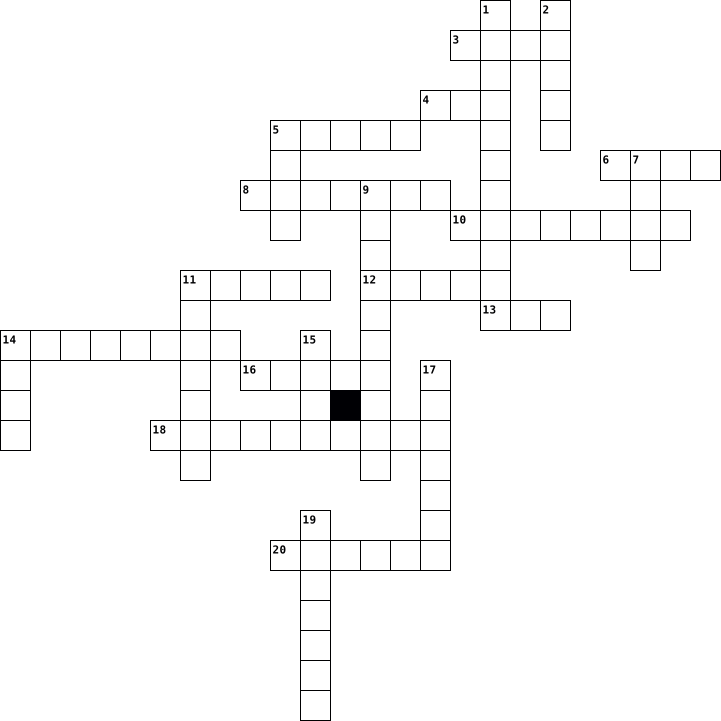
plate tectonics Crossword Puzzles
ENV100 #3 Crossword 2018-03-15

Across
- A plant that competes with crops.
- Categorization of a species in danger of extirpation or extinction.
- The uniform planting of a single crop over a large area.
- Residual materials that remain after preliminary processing of ore, typically consisting of crushed waste rock contaminated with chemicals used in ore processing.
- The ability of an ecological community to change in response to disturbance but later return to its original state.
- Microscopic floating plants and protists, mainly algae.
- A quality of materials that are poisonous; able to harm health of people or other organisms when a substance is inhaled, ingested, or touched.
- The plate tectonic process by which a tectonic plate carrying dense oceanic crust slides beneath a plate carrying lighter continental crust at a convergent plate boundary.
- The functional role of a species in a community.
- A complex plant-supporting system consisting of disintegrated rock, organic matter, air, water, nutrients, and microorganisms.
- In a cycle, a reservoir that takes in more material than it releases.
- A strategy in which efforts are made ahead of time, to forestall or minimize the anticipated impacts of environmental change.
Down
- A simplified representation of a natural process, which can be physical, graphical, or quantitative and computer-based.
- Land-based.
- The process in which one species (the predator) hunts, tracks, captures, and ultimately kills its prey.
- Describes a diffuse source of pollutants, often consisting of many small sources.
- The physical, chemical, and biological processes that break down rocks and minerals, turning large particles into smaller particles.
- A network of relationships among a group of parts, elements, or components that interact with and influence one another through the exchange of energy, matter, and/or information.
- A toxicant that causes harm to the unborn, resulting in birth defects.
19 Clues: Land-based. • A plant that competes with crops. • The functional role of a species in a community. • Microscopic floating plants and protists, mainly algae. • The uniform planting of a single crop over a large area. • Categorization of a species in danger of extirpation or extinction. • In a cycle, a reservoir that takes in more material than it releases. • ...
Living with Tectonic Hazards Revision [By Luke] 2016-04-18
![Living with Tectonic Hazards Revision [By Luke] crossword puzzle](/image/775645.svg?size=30&stroke_width=1)
Across
- __________ currents are movements of heat within the mantle.
- _____ and extreme weather and climate conditions are caused by Climate-related natural hazards.
- ________ plate boundaries slides past each other.
- _____ formed rocks are closest to the mid-oceanic ridge and therefore younger than those further away.
Down
- _________ plate boundaries are areas where two plates move away from each other.
- ____ valleys and block mountains are formed at divergent plate boundaries where plates are pulled apart.
- _________ forces these movements results in parts of the crust being fractured.
- __________ plate boundaries move towards each other and become faulted, folded and sometimes subducted.
- ____ mountains are layers of rocks compressed and folded.
- ________ plates are broken from the earths crust which is the outermost layer.
10 Clues: ________ plate boundaries slides past each other. • ____ mountains are layers of rocks compressed and folded. • __________ currents are movements of heat within the mantle. • ________ plates are broken from the earths crust which is the outermost layer. • _________ forces these movements results in parts of the crust being fractured. • ...
Forces That Shape the Earth 2025-10-23

Across
- Molten rock that reaches the surface
- A sudden shaking of the ground
- The process of moving sediment
Down
- Molten rock beneath Earth’s surface
- When rock breaks down by wind, water, or ice
- The outermost solid layer of Earth
- Large crack in the Earth’s crust
- The movement of Earth’s plates
- Ice mass that moves slowly over land
9 Clues: The movement of Earth’s plates • A sudden shaking of the ground • The process of moving sediment • Large crack in the Earth’s crust • The outermost solid layer of Earth • Molten rock beneath Earth’s surface • Molten rock that reaches the surface • Ice mass that moves slowly over land • When rock breaks down by wind, water, or ice
Chapter 10 vocab review 2023-01-26

Across
- zone An area of many fractured pieces of crust along a large fault.
- to higher elevations.
- The process that moves large bodies of Earth
- The pulling force at a divergent boundary.
- An area of subsidence region with low
- The squeezing force at a convergent boundary
- trench A deep, underwater trough created by one plate subducting under another plate at a convergent boundary.
- Parallel forces acting in opposite directions at a transform boundary.
Down
- arc A curved line of volcanoes that forms parallel to a plate boundary.
- An area with low relief and high elevation.
- The downward vertical motion of Earth's
- mountain Parallel ridge that forms where blocks of crust move up or down along faults.
- Landform with low relief and low elevation
- mountain Mountain made of layers of rocks that are folded.
- A change in the shape of rock caused by stress.
- The equilibrium between continental crust and the denser mantle below it.
16 Clues: to higher elevations. • An area of subsidence region with low • The downward vertical motion of Earth's • Landform with low relief and low elevation • The pulling force at a divergent boundary. • An area with low relief and high elevation. • The process that moves large bodies of Earth • The squeezing force at a convergent boundary • ...
Internal Forces of Change 2023-11-13

Across
- the theory that the continents were once joined, then slowly drifted apart
- cracks in the Earth's crust
- the term scientists use to describe the activities of continental drift and magma flow
Down
- when pieces of the Earth's crust come together slowly as the oceanic plate slides under the continental plate at a shallow angle
- when the heavier oceanic plate dives beneath the lighter continental plate
- oceanic plates being pushed apart
- when the folded land cannot be bent any further
- bends in layers of rock
- molten rock that is located below the Earth's surface
9 Clues: bends in layers of rock • cracks in the Earth's crust • oceanic plates being pushed apart • when the folded land cannot be bent any further • molten rock that is located below the Earth's surface • when the heavier oceanic plate dives beneath the lighter continental plate • the theory that the continents were once joined, then slowly drifted apart • ...
Housing 2017-01-16

Across
- knihovna
- trouba
- talíř
- pošlář
- dálkový ovladač
- vana
- myčka
- krb
- dřez
- mrazák
- polička
Down
- hrned
- komoda
- váza
- skříňka
- konvice
- hodiny
- příbor
- ručník
- pánev
- umyvadlo
- šuplík
- předložka
23 Clues: krb • váza • vana • dřez • hrned • talíř • pánev • myčka • komoda • trouba • pošlář • hodiny • příbor • ručník • šuplík • mrazák • skříňka • konvice • polička • knihovna • umyvadlo • předložka • dálkový ovladač
MINCED FAJiTAS - cooking vocabulary 2018-06-12

Across
- schneiden
- Topf
- Zwiebel
- schneiden
- wärmen
- Serviette
- Ofen
- Teller
- Gabel
- Raffel
- Brett
Down
- schälen
- Löffel
- Krug
- Büchsenöffner
- köcheln
- brauchen
- Büchse
- Messer
- kochen
- Glas
- verteilen
- hinzufügen
- Schüssel
24 Clues: Krug • Topf • Glas • Ofen • Gabel • Brett • Löffel • Büchse • Messer • kochen • wärmen • Teller • Raffel • schälen • köcheln • Zwiebel • brauchen • Schüssel • schneiden • schneiden • Serviette • verteilen • hinzufügen • Büchsenöffner
Food 2013-01-17

Across
- tallrik
- soptunna
- tvättmaskin
- grönsallad
- lock
- kopp
- grytlapp
- brödrost
Down
- sked
- stekpanna
- diskmaskin
- kyckling
- skål
- kylskåp
- mugg
- bordsduk
- mikro
- servett
- bricka
- burk(läskburk)
20 Clues: sked • skål • mugg • lock • kopp • mikro • bricka • tallrik • kylskåp • servett • soptunna • kyckling • bordsduk • grytlapp • brödrost • stekpanna • diskmaskin • grönsallad • tvättmaskin • burk(läskburk)
French Foods Crossword 2014-03-31

Across
- lobster
- peas
- butter
- yogurt
- eggplant
- dish
- sauce
- for breakfast
- cooked chicken
- corn
- to order
- rice
- pepper
Down
- pineapple
- green beans
- fresh orange juice
- cherry
- pie
- tea
- mineral water
20 Clues: pie • tea • peas • dish • corn • rice • sauce • cherry • butter • yogurt • pepper • lobster • eggplant • to order • pineapple • green beans • for breakfast • mineral water • cooked chicken • fresh orange juice
Sag Mal Kap. 4B 2021-10-05

Across
- bland
- napkin
- cup
- flavor, taste
- plate
- tip
- waiter
- spicy
Down
- bottle
- breakfast
- side dish
- delicious
- juice
- bill, check
- to taste (good)
- silverware
- dessert
- knife
- fork
- heavy, rich
20 Clues: cup • tip • fork • bland • juice • knife • plate • spicy • bottle • napkin • waiter • dessert • breakfast • side dish • delicious • silverware • bill, check • heavy, rich • flavor, taste • to taste (good)
En el restaurante 2021-05-19

Across
- waiter
- fork
- dressing
- recipe
- knife
- napkin
- cup
- pepper shaker
- mustard
- tomatoe sauce
Down
- the cook
- plate/dish
- tablecloth
- spoon
- dessert
- salt shaker
- glass
- check
- mayonnaise
- tip
- sauce
21 Clues: tip • cup • fork • spoon • glass • knife • check • sauce • waiter • recipe • napkin • dessert • mustard • the cook • dressing • plate/dish • tablecloth • mayonnaise • salt shaker • pepper shaker • tomatoe sauce
Spanish 3 2021-03-25

Across
- spoon
- spoon
- waitress
- saucer
- mussels
- meat
- restaurant
- plate
- check
- steak
- fork
- tip
- menu
Down
- seafood
- cup
- waitress
- pork
- beef
- napkin
- edibles
- knife
- clams
- lamb
- table
- tablecloth
25 Clues: cup • tip • pork • beef • meat • lamb • fork • menu • spoon • spoon • knife • plate • clams • check • steak • table • saucer • napkin • seafood • mussels • edibles • waitress • waitress • restaurant • tablecloth
STUDY GUIDE #2 - COMIDAS 2022-02-27

Across
- fork
- mug
- piece
- pinch
- lunch
- cereal
- bag
- spoon
- plate
- dinner
Down
- like
- knife
- cup
- basket
- snack time (in the afternoon)
- breakfast
- rice
- eat
- bowl
- slice
- salt
21 Clues: mug • cup • eat • bag • like • fork • rice • bowl • salt • knife • piece • pinch • lunch • slice • spoon • plate • basket • cereal • dinner • breakfast • snack time (in the afternoon)
Kitchen 2022-05-17

Across
- akuyucissuun
- luuskaaq
- saskaq
- qantaq
- sass'aq
- kuuviarcuun
- masslirissuun
- mumigcissuun
- perriun
Down
- cuqcissuun-saskaq
- tunqaq
- miilaq
- uucivik
- saarralaq
- ipuun
- egan
- kagissuun
- board ayalleq
- nerrsuun
- taryuq
20 Clues: egan • ipuun • tunqaq • miilaq • saskaq • qantaq • taryuq • uucivik • sass'aq • perriun • luuskaaq • nerrsuun • saarralaq • kagissuun • kuuviarcuun • akuyucissuun • mumigcissuun • board ayalleq • masslirissuun • cuqcissuun-saskaq
Kitchen 2022-05-17

Across
- miilaq
- tunqaq
- qantaq
- luuskaaq
- ayalleq
- ipuun
- kuuviarcuun
- saskaq
- masslirissuun
Down
- saarralaq
- sass'aq
- akuyucissuun
- egan
- cuqcissuun-saskaq
- perriun
- taryuq
- kagissuun
- uucivik
- mumigcissuun
- nerrsuun
20 Clues: egan • ipuun • miilaq • tunqaq • qantaq • taryuq • saskaq • sass'aq • perriun • ayalleq • uucivik • luuskaaq • nerrsuun • saarralaq • kagissuun • kuuviarcuun • akuyucissuun • mumigcissuun • masslirissuun • cuqcissuun-saskaq
Kitchen 2022-05-18

Across
- miilaq
- ayalleq
- masslirissuun
- egan
- cuqcissuun-saskaq
- nerrsuun
- qantaq
- uucivik
- mumigcissuun
- luuskaaq
Down
- taryuq
- ipuun
- sass'aq
- kagissuun
- akuyucissuun
- tunqaq
- saarralaq
- kuuviarcuun
- saskaq
- perriun
20 Clues: egan • ipuun • taryuq • miilaq • tunqaq • saskaq • qantaq • ayalleq • sass'aq • perriun • uucivik • nerrsuun • luuskaaq • kagissuun • saarralaq • kuuviarcuun • akuyucissuun • mumigcissuun • masslirissuun • cuqcissuun-saskaq
Max #7 2022-06-22

Across
- / sult
- / morsomt
- / maling
- / plakat
- / brændeovn
- / tyr
- / indkørsel
- / postbud
- / afstand
Down
- / krabbe
- / tåge
- / rede
- / flod
- / ferskner
- / nyheder
- / tallerken
- / skjold
- / forbrydelse
- game / brætspil
- / flagermus
- / reb
- forgive / tilgive
22 Clues: / tyr • / reb • / tåge • / sult • / rede • / flod • / krabbe • / maling • / plakat • / skjold • / morsomt • / nyheder • / postbud • / afstand • / ferskner • / tallerken • / brændeovn • / flagermus • / indkørsel • / forbrydelse • game / brætspil • forgive / tilgive
Latihan Bahasa Inggris 2022-11-10

Across
- bak mandi
- garasi
- ember
- kamar tidur
- rumah
- gayung
- gerbang
- meja
- mangkok
- pisau
Down
- dapur
- selimut
- kamar mandi
- serbet
- lemari
- pagar
- ruang tamu
- kompor
- kasur
- bantal
- piring
21 Clues: meja • dapur • pagar • ember • kasur • rumah • pisau • serbet • garasi • lemari • kompor • gayung • bantal • piring • selimut • gerbang • mangkok • bak mandi • ruang tamu • kamar mandi • kamar tidur
Things in the Rooms 2023-11-05

Across
- lemari baju
- kipas angin
- pasta gigi
- bantal
- kulkas
- gayung
- sendok
- oven
- selimut
Down
- piring
- sikat
- wajan
- rak buku
- mangkok
- alas kaki
- handuk
- cermin
- meja
- cangkir
- bak mandi
20 Clues: meja • oven • sikat • wajan • piring • handuk • cermin • bantal • kulkas • gayung • sendok • mangkok • cangkir • selimut • rak buku • alas kaki • bak mandi • pasta gigi • lemari baju • kipas angin
Kitchen 2020-08-03

Across
- chair
- cutlery
- soup
- kitchen
- napkin
- faucet
- waiter
- pan
- plate
- bowl
- table
- cabinet
Down
- cup
- fridge
- cheese
- saucer
- floor
- knife
- frying pan
- spoon
- meat
- fork
- dishes
23 Clues: cup • pan • soup • meat • fork • bowl • chair • floor • knife • spoon • plate • table • fridge • cheese • saucer • napkin • faucet • waiter • dishes • cutlery • kitchen • cabinet • frying pan
Synonyms 2016-09-05

Across
- Applaud
- Stone
- Close
- Ship
- Stay
- Long
- Leave
- Yell
- Quick
- Correct
- Talk
Down
- Stroll
- Hurry
- Jacket
- Work
- Tired
- Same
- Over
- Road
- Present
- Look
- Fantastic
- Plate
23 Clues: Work • Ship • Same • Stay • Over • Road • Long • Yell • Look • Talk • Stone • Hurry • Close • Tired • Leave • Quick • Plate • Stroll • Jacket • Applaud • Present • Correct • Fantastic
House 2020-03-24
Across
- skål
- säng
- sked
- dörr
- badkar
- Dator
- spis
- bord
- matta
- kastrull
- stol
- tandkräm
- spegel
Down
- balsam
- tallrik
- tvål
- ugn
- tandborste
- schampo
- diskho
- lampa
- frys
- kök
23 Clues: ugn • kök • skål • säng • sked • tvål • dörr • spis • bord • stol • frys • Dator • matta • lampa • balsam • badkar • diskho • spegel • tallrik • schampo • kastrull • tandkräm • tandborste
This is My House 2023-02-07

Across
- boneka
- bantal
- dapur
- tirai
- gambar
- kamar mandi
- piring
- pintu
- garasi
- beranda
- kipas
Down
- bunga
- kamar tidur
- pisau
- kursi
- meja
- lampu
- atap
- tangga
- cermin
- kasur
- kebun
22 Clues: meja • atap • bunga • dapur • pisau • kursi • tirai • lampu • pintu • kasur • kebun • kipas • boneka • bantal • gambar • tangga • cermin • piring • garasi • beranda • kamar tidur • kamar mandi
rvati1 2024-12-21

Across
- tobacco
- knee
- name
- potato
- week
- fire
- ham
- hand
- green
- firework
- lighter
Down
- monday
- water
- box
- garlic
- air
- earth
- plate
- sunday
- yellow
- wednesday
- ladle
- fork
23 Clues: box • air • ham • knee • name • week • fire • hand • fork • water • earth • plate • green • ladle • monday • garlic • potato • sunday • yellow • tobacco • lighter • firework • wednesday
L'action de grâce 2025-10-06

Across
- acorn
- nuts
- green beans
- cranberry sauce
- turkey (you eat)
- corn
- mashed potatoes
- plate
- marshmallow
Down
- pumpkin
- pie
- bread
- utensils
- squirrel
- brussel sprouts
- gravy
- carrots
- turkey (live)
- potato
- share
20 Clues: pie • nuts • corn • acorn • bread • gravy • share • plate • potato • pumpkin • carrots • utensils • squirrel • green beans • marshmallow • turkey (live) • brussel sprouts • cranberry sauce • mashed potatoes • turkey (you eat)
Las cosas de la cocina 2022-11-30

Across
- table
- oven
- lamp
- dining room
- napkin
- stove
- plate
- blender
- sink
Down
- glass
- refrigerator
- kitchen
- frying pan
- dishwasher
- light
- thing
- microwave
17 Clues: oven • lamp • sink • glass • table • light • stove • thing • plate • napkin • kitchen • blender • microwave • frying pan • dishwasher • dining room • refrigerator
Plate Tectoniocs 2020-10-13

Across
- magma
- volcanoes can also destroy things
- earthquakes can make new shapes of landforms
- the outside of the center of the Earth
- where the plates are
- when plates come together
- this happens when earthquakes happen in the ocean
- when plates move apart
Down
- earthquakes can also destroy things
- the inside of the center of the Earth
- volcanoes can create new landforms
- when a dense tectonic plate meets a less dense tectonic plate
12 Clues: magma • where the plates are • when plates move apart • when plates come together • volcanoes can also destroy things • volcanoes can create new landforms • earthquakes can also destroy things • the inside of the center of the Earth • the outside of the center of the Earth • earthquakes can make new shapes of landforms • this happens when earthquakes happen in the ocean • ...
My Plate 2024-03-12

Across
- Fruit is better than fruit juice because it has more _______ and less calories.
- Low-fat dairy has fewer calories but enough __________ to build strong bones.
- Kids and teens who participate in physical activity need more __________ each day (HINT: to replace the ones that are burned off)
- ___________ calories should be limited because they are high in calories and low in nutrients. Hint: These leave you feeling empty.
- Each day make half of your grains ________ grains
- Eating from the five food groups helps to get all of your nutrients for the day: vegetables, fruit, protein, dairy and _______________.
Down
- Go for low-fat and fat-free _________. Try to get 3 servings of this food group each day. (*If you are lactose intolerant or don't like milk there are other options for calcium).
- Go for a variety of colors when choosing _________ and vegetables. These groups should be 1/2 of your plate.
- Fruits and vegetables can help prevent against chronic diseases(ie: heart disease, type 2 diabetes & _________).
- Beans, seafood, tofu, egg whites, and poultry are examples of "GO" foods in the _________ group.
- Limit _______ grains(like white bread, white rice, white pasta) because they don't have nutrients like fiber, vitamin B and iron.
- Calories are a measurement of _________ available in food. The average person needs 2,000 per day.
12 Clues: Each day make half of your grains ________ grains • Low-fat dairy has fewer calories but enough __________ to build strong bones. • Fruit is better than fruit juice because it has more _______ and less calories. • Beans, seafood, tofu, egg whites, and poultry are examples of "GO" foods in the _________ group. • ...
plate tectonic 2023-03-06

Across
- a zero-width test between two pates
- fire in shape of a ring
- the border between two plates
- a mountain that erupts alot
- the Northern Hemisphere
- part of the boundary between plate boundary'
Down
- a giant rock you can rock climb
- occurs when two tectonic plates move together
- the southern Hemisphere
- is a plate that moves alot
- a crack in the Earth's crust
- the bottom of the ocean
12 Clues: the southern Hemisphere • fire in shape of a ring • the Northern Hemisphere • the bottom of the ocean • is a plate that moves alot • a mountain that erupts alot • a crack in the Earth's crust • the border between two plates • a giant rock you can rock climb • a zero-width test between two pates • part of the boundary between plate boundary' • ...
plate boundries 2026-02-10

Across
- the edges where tectonic plates meet
- plates under a continual plate
- core innermost layer of the earth
- hottest layer of the earth
- one of the rocks for it is limestone
- thinnest layer of the earth
Down
- one of the rocks for it is marble
- when two plates come together
- transfers heat through the physical movement of a fluid.
- the form changes
- two plates moving away from each other
- core outermost layer of the earth
12 Clues: the form changes • hottest layer of the earth • thinnest layer of the earth • when two plates come together • plates under a continual plate • one of the rocks for it is marble • core outermost layer of the earth • core innermost layer of the earth • the edges where tectonic plates meet • one of the rocks for it is limestone • two plates moving away from each other • ...
Plate Motion 2025-10-28

Across
- a way to see inside an object
- layer of soft solid rock below earth's plates
- a land form found at a convergent boundary
- moving toward each other
- a large section of earth's outer layer made of hard, solid rock.
- tool used by Bob Ziak in the "listening to earth" article
Down
- considered part of a plate
- moving away from each other
- the place where two plates meet
- a land form found at a divergent boundary
- something observed over and over again
- a sudden shaking of earth's surface
12 Clues: moving toward each other • considered part of a plate • moving away from each other • a way to see inside an object • the place where two plates meet • a sudden shaking of earth's surface • something observed over and over again • a land form found at a divergent boundary • a land form found at a convergent boundary • layer of soft solid rock below earth's plates • ...
Me gusta Rompecabezas 2018-01-06

Across
- long
- salt
- short length
- old
- sugar
- napkin
- short
- fork
- glass cup
Down
- handsome
- plate
- spoon
- knife
- pepper
- young
- tall
- mug
17 Clues: old • mug • long • salt • tall • fork • plate • spoon • knife • young • sugar • short • pepper • napkin • handsome • glass cup • short length
Н 2021-12-23

Across
- ложка
- нож
- зал
- кухня
- тарелка
- высокая кастрюля
- сад
- спальня
Down
- вилка
- холодильник
- кастрюля
- шкаф
- плита
- буфет
- ванная комната
- чашка
- коридор
17 Clues: нож • зал • сад • шкаф • вилка • ложка • плита • буфет • кухня • чашка • тарелка • коридор • спальня • кастрюля • холодильник • ванная комната • высокая кастрюля
crossword puzzle "breakfast" 2020-08-22

Across
- 10.
- 2.
- 15.
- 6.
- 7.
- 16.
- 13.
Down
- 1.
- 17.
- 8.
- 3.
- 12.
- 11.
- 9.
- 4.
- 14.
- 5.
17 Clues: 1. • 8. • 3. • 2. • 6. • 9. • 4. • 7. • 5. • 17. • 10. • 12. • 15. • 11. • 14. • 16. • 13.
En la cocina 2023-01-25

Across
- pan
- plate
- stove
- mug
- napkin
- spoon
- drinking glass
- oven
- kitchen
Down
- table
- grill
- dining room
- bottle
- knife
- can
- fork
- pot
17 Clues: pan • can • mug • pot • fork • oven • table • grill • knife • plate • stove • spoon • bottle • napkin • kitchen • dining room • drinking glass
smash 1- unit 2 2019-11-05

Across
- по-късно
- чиния
- ученик
- кенгуру
- шах
- женен
- древен
- победител
- тенис
Down
- уча,научавам
- мравка
- език
- любим
- делфин
- пуканки
- кит
- гепард
17 Clues: кит • шах • език • чиния • любим • женен • тенис • мравка • делфин • ученик • древен • гепард • пуканки • кенгуру • по-късно • победител • уча,научавам
Cree-cember 2023-12-14

Across
- stove
- broom
- towel
- dish towel
- fork
- plate
- pan
Down
- sheet
- dish cloth
- house
- blanket
- pot
- fridge
- pillow
- cup
- bed
- spoon
17 Clues: pot • cup • bed • pan • fork • sheet • house • stove • broom • towel • spoon • plate • fridge • pillow • blanket • dish cloth • dish towel
Things in the house 2025-09-16

Across
- panci
- sendok makan
- mixer
- blender
- gelas
- sendok teh
- mangkuk
- wastafel
Down
- piring
- oven
- kulkas
- kursi
- garpu
- kompor
- meja
- cangkir
- serbet
17 Clues: oven • meja • kursi • panci • garpu • mixer • gelas • piring • kulkas • kompor • serbet • cangkir • blender • mangkuk • wastafel • sendok teh • sendok makan
En el restaurante 2026-04-28

Across
- delicious
- cup
- knife
- dessert
- menu
- sugar
- waiter
- waitress
Down
- pepper
- plate, dish
- rich, tasty
- napkin
- bill
- spoon
- glass
- fork
- salt
17 Clues: cup • bill • fork • menu • salt • knife • spoon • glass • sugar • pepper • napkin • waiter • dessert • waitress • delicious • plate, dish • rich, tasty
Geology 2014-03-31

Across
- The area in an earthquake that receives the most violent shaking
- Occurs usually on the side of elevated land, and can trigger Tsunamis
- The movement of particles from one place to another
- The physical changes of the earths surface
- The center of an earthquake
- Japanese word for 'Storm Wave'
Down
- Is the process that creates caves
- The violent shaking of the earths surface, caused by tectonic plate movement
- An opening in the earths crust, where lava, ash, gas, and stone erupts out
- Any feature that rises above the surface of the earth
- The most active volcano and earthquake zone in the world, on the boundaries of the Pacific plate, the worlds largest tectonic plate
- ridge An underwater mountain chain
- The process of wearing away of the earths surface and features
- The most common cause of erosion
14 Clues: The center of an earthquake • Japanese word for 'Storm Wave' • The most common cause of erosion • Is the process that creates caves • ridge An underwater mountain chain • The physical changes of the earths surface • The movement of particles from one place to another • Any feature that rises above the surface of the earth • ...
Tectonic Hazards 2022-11-19

Across
- Where two plates are sliding past each other
- The process that occurs in the mantle which causes tectonic plates to move
- The instrument used to measure earthquakes
- where two continental plates are moving towards each other
- A volcano that is currently erupting
- A volcano that has not erupted recently but may still erupt again
- The point on the Earth's surface directly above the focus
- Superheated rock in the mantle
Down
- The most volcanically active area on earth
- A weakness in the middle of a plate where a volcano may occur
- The type of volcano found at divergent plate boundaries
- Composite volcanoes are found at this type of plate boundary
- A volcano which will never erupt again as it has lost its source of magma
- The point of origin of an earthquake
14 Clues: Superheated rock in the mantle • A volcano that is currently erupting • The point of origin of an earthquake • The most volcanically active area on earth • The instrument used to measure earthquakes • Where two plates are sliding past each other • The type of volcano found at divergent plate boundaries • The point on the Earth's surface directly above the focus • ...
Unit 6: Earth materials 2022-02-15

Across
- Layer of Earth with magma convection currents. The largest layer.
- The element that makes up Earth's core mainly.
- The 2nd most abundant element in the atmosphere. Animals breathe it to survive.
- Plate boundary where mountains and trenches are made.
- Plate boundary where seafloor Spreading and rift valleys happen.
- Rock type that is made from compaction and cementation of broken rocks.
- Rock type that is made from cooled magma.
- Layer of Earth with plasticity.
Down
- This is what Earth's broken lithosphere sections are called, one example is "Eurasian"
- The most abundant element in the universe. 2 atoms of this are needed to create water.
- The most abundant element in the air (atmosphere).
- Layer of Earth that's broken in to plates
- Plate boundary that creates faults & Earthquakes
- Rock type that is made by changing another rock with extreme heat & pressure.
14 Clues: Layer of Earth with plasticity. • Layer of Earth that's broken in to plates • Rock type that is made from cooled magma. • The element that makes up Earth's core mainly. • Plate boundary that creates faults & Earthquakes • The most abundant element in the air (atmosphere). • Plate boundary where mountains and trenches are made. • ...
Gus's super awesome crossword puzzle 2026-05-27

Across
- edge of pizza
- a landmark you get thrown into when getting sacrifised
- something you cant cross when playing a game
- moving together
- changing
- used in world war 1
- moving apart
- what form a Dinosuar is in at a museum
- when converging plates making a landmark
- they are currently melting
- goes in the dishwasher
- molten rock beneath earth
Down
- boundaries
- rhymes with what aliens do when the take humans
- part of mountain range
- measurement of size
- a theory that the continents are shifting on earths surface
- tragic natural disaster in Myanmar in 2025
- middle of apple
- the time you work in a day
- how to find the power of a Earthquake
- all the continents
- fortnite movement
23 Clues: changing • boundaries • moving apart • edge of pizza • moving together • middle of apple • fortnite movement • all the continents • measurement of size • used in world war 1 • part of mountain range • goes in the dishwasher • molten rock beneath earth • the time you work in a day • they are currently melting • how to find the power of a Earthquake • what form a Dinosuar is in at a museum • ...
Renewable Energy Crossword Puzzle 2022-05-25

Across
- Fuels made of biomass.
- When water is separated into hydrogen and oxygen through an electrical current to create hydrogen fuel.
- This is an electricity that is made when biomass goes through combustion.
- When this technology absorbs sun, electrons in one of two silicon plates move to the other plate. Then the electrons move back to the original plate as the technology absorbs the sun.
- Large areas that have a lot of wind turbines.
- Fuel made of alcohol and gasoline.
- Energy that is made from water and its kinetic energy.
- This is heat that is created when there is high pressure and radioactive substances breaking up underground. This heat can be used as an energy source.
- This fuel is created when sugar or a kind of starch is fermented. This is often made of corn in the United States.
- This technology absorbs heat through a glass plate on top of a metal plate. The heat then transfers to fluid inside of tubes that are inside of the metal plate. The fluid then moves around the building to heat it.
Down
- When a building is made to take in the sun's heat. store it, and move it around a building. Greenhouses use this kind of heating.
- Fuel made of oil that's made of vegetables. It is often combined with diesel made of petroleum.
- When energy is created by the ocean's tides.
- This is when eletrical energy is converted from thermal energy in the ocean. This is also known as OTEC.
- This kind of heating uses technology that takes in the sun's heat, stores it, and moves it around a building. Solar panels are used for this ind of heating.
- When mirrors direct sunlight to a 'power tower' to create power.
- This is made of substances that form organisms or substances that originate from organisms. One example of it is charcoal.
- Technology that turns the kinetic energy in wind to electrical energy.
- A grouping of pipes underground that heat or cool a building by using soil and water.
- This technology works when a chemical reaction between a positive and negative electrode causes there to be an electrical current to move through a wire to the other side of it. This is one way to create power using hydrogen.
20 Clues: Fuels made of biomass. • Fuel made of alcohol and gasoline. • When energy is created by the ocean's tides. • Large areas that have a lot of wind turbines. • Energy that is made from water and its kinetic energy. • When mirrors direct sunlight to a 'power tower' to create power. • Technology that turns the kinetic energy in wind to electrical energy. • ...
Year 9 ESS Key Words Revision 2022-10-24

Across
- The place below the ground where an earthquake starts (5).
- A depression in the ocean floor (6).
- Patterns of magnetism trapped in rocks on each side of plate boundaries (8,8).
- A long, active submarine ridge system situated in the middle of an ocean basin (3-5,5).
- The layer beneath Earth’s crust (6).
- A fluid layer composed mostly of iron and nickel (5,4).
- The rigid outer part of the Earth, consisting of the crust and upper mantle (11).
- Molten rock that has erupted onto Earth’s surface (4).
- A layer of ‘plastic’ semi-solid rock in the lower mantle, on which Earth’s tectonic plates move (13).
- The shaking, wave-like movement of the ground in an earthquake (7,4).
- Molten rock below Earth’s surface (5).
- The crust that forms the continents (11,5).
- Mountains formed by crust crumpling upwards as plates collide (4,8).
- When one plate sinks below another plate during a collision (10).
- Where plates are moving apart from each other in opposite directions (9,8).
- Unable to bend or be forced out of shape (5).
- Isolated place away from plate boundaries where a lot of hot magma is collecting (3,4).
- Where plates are sliding parallel to each other in opposite directions (9,8).
Down
- Where plates are colliding with each other (10,8).
- The point on Earth’s surface directly above the focus of an earthquake (9).
- A chain of islands formed at the edges of colliding tectonic plates where one plate subducts (6,3).
- A zone where Earth’s crust and mantle are being pulled apart (4).
- The process of new crust forming at the ocean ridges and spreading outwards (8,9).
- The section of Earth’s crust that moves around on Earth’s surface (8,5).
- The rapid movement of the ground due to the movement of tectonic plates (10).
- A place where extremely hot material from inside Earth erupts at the surface (8).
- Movement in a gas or liquid where the warmer parts move up and cooler parts move down (10,7).
- The inner most geological layer of Earth (5,4).
- The crust that forms the ocean floor (7,5).
- A huge wave in the ocean caused by an Earthquake occurring on the sea floor (7).
30 Clues: A depression in the ocean floor (6). • The layer beneath Earth’s crust (6). • Molten rock below Earth’s surface (5). • The crust that forms the ocean floor (7,5). • The crust that forms the continents (11,5). • Unable to bend or be forced out of shape (5). • The inner most geological layer of Earth (5,4). • Where plates are colliding with each other (10,8). • ...
SHEET 12 2020-08-20

Across
- bowl
- glass
- cook
- plate
- oven
Down
- wash
- glove
- spoon
8 Clues: bowl • wash • cook • oven • glass • glove • spoon • plate
World Watchers_3_WB_M6 Lesson 6a 2023-02-28

Across
- fork
- saucepan
- spoon
- cake_tin
Down
- knife
- frying_pan
- baking_tray
- plate
8 Clues: fork • knife • spoon • plate • saucepan • cake_tin • frying_pan • baking_tray
Bear's Pie 3 2013-11-05

Across
- lick
- concert
- continue
- pity
Down
- delicious
- plate
- cartoon
- moment
8 Clues: lick • pity • plate • moment • cartoon • concert • continue • delicious
zwxecvgbhjnkl 2024-07-30

Across
- sandwiches
- drinks
- picnicblanket
- basket
Down
- fruits
- sunscreen
- napkins
- plate
8 Clues: plate • fruits • drinks • basket • napkins • sunscreen • sandwiches • picnicblanket
I'm dancing 2022-01-03

Across
- what
- wardrobe
- meters
- miska
- rzucać
- złoty
- świat
- cup
Down
- kanapa
- szybki
- mistrz
- talerz
- silny
- teraz
- medal
- doing
16 Clues: cup • what • miska • silny • teraz • medal • złoty • świat • doing • kanapa • szybki • mistrz • meters • talerz • rzucać • wardrobe
Week 46 2024-11-12

Across
- vacker
- mugg
- brödlimpa
- smör
- kniv
- konservburk
- ost
Down
- viktig
- ätafrukost
- färsk
- tallrik
- gaffel
- koka
- bönor
- skinka
- ägg
16 Clues: ost • ägg • mugg • smör • koka • kniv • färsk • bönor • viktig • vacker • gaffel • skinka • tallrik • brödlimpa • ätafrukost • konservburk
Ekhishini 2025-05-27

Across
- spoon
- dish
- fork
- table
- tray
- pot
- kettle
Down
- sink
- chair
- tap
- cup
- stove
- plate
- knife
- fridge
- cupboard
16 Clues: tap • cup • pot • sink • dish • fork • tray • spoon • chair • stove • plate • knife • table • fridge • kettle • cupboard
Breakfast and vocabulary 2023-03-15

Across
- delicious
- fat
- bacon
- sweet
- crispy
- skip
- peaches
Down
- chocolatespread
- hot
- moe
- biscuit
- healtiest
- cup
- plate
- strawberries
- grapes
16 Clues: hot • moe • fat • cup • skip • bacon • plate • sweet • crispy • grapes • biscuit • peaches • delicious • healtiest • strawberries • chocolatespread
Benda di rumah 2025-08-20

Across
- spoon
- chair
- blanket
- clock
- plate
- door
- doll
- table
- toys
- carpet
Down
- key
- stove
- lamp
- window
- pillow
- bed
16 Clues: key • bed • lamp • door • doll • toys • spoon • chair • stove • clock • plate • table • window • pillow • carpet • blanket
Vocabulary: House 2026-04-28

Across
- despertarse
- sopa
- diente
- sentarse
- dormir
- flor
- ramas
- tenedor
Down
- jabón
- ropa
- comida
- verde
- perro
- enfriar
- alas
- cortar
16 Clues: ropa • sopa • alas • flor • jabón • verde • perro • ramas • comida • diente • dormir • cortar • enfriar • tenedor • sentarse • despertarse
Cosmetology 14E Chapter 6 Crossword Puzzle 2023-10-24

Across
- Whitish discolored spots on the nails, usually caused by minor injury to the nail matrix, are known as ______
- Smaller nail bed injuries cause (a/an) _______ and can be camouflaged with product
- When skin on the eponychium becomes torn, it is called (a/an) _________
- Whitish patches that can be scraped off the nail plate, pale yellowish streaks within the nail plate, or even the entire crumbling of the nail plate, is a type of infection known as __________.
- The technical name for the result of nail-biting is ______
- Depressions running across the nail plate's width that are the result of an illness or injury are called _________
Down
- A/An_______is a misnomer because it refers to the lengthwise grooves in the nail plate that naturally come with age.
- Medical referral is also necessary for _____which is the separation of the nail plate and nail bed due to injury or allergic reaction.
- Because the word onyx refers to the natural nail, many nail diseases start with this root: ________is an inflammation and shedding caused by injury or infection.
- granuloma which Severe nail inflammation, indicated by a lump of red tissue growing from the nail bed to the nail plate, is called ____________.
10 Clues: The technical name for the result of nail-biting is ______ • When skin on the eponychium becomes torn, it is called (a/an) _________ • Smaller nail bed injuries cause (a/an) _______ and can be camouflaged with product • Whitish discolored spots on the nails, usually caused by minor injury to the nail matrix, are known as ______ • ...
Science Vocablary 2021-01-06

Across
- The process in which new oceanic lithosphere is formed at a midocean ridge is referred to as __
- The type of boundary that is found where two plates are moving away from each other.
- Continental to __ convergence is when two continents meet head-on
- the boundary that is found where two plates are sliding past each other horizontally
Down
- when the denser oceanic plate is pushed underneath the continental plate.
- Continental to __ convergence is when a dense oceanic plate collides with a relatively light, thick continental plate
- A fault in California that is an example of a transform boundary.
- The point at which one tectonic plate touches another is called this type of boundary
8 Clues: A fault in California that is an example of a transform boundary. • Continental to __ convergence is when two continents meet head-on • when the denser oceanic plate is pushed underneath the continental plate. • The type of boundary that is found where two plates are moving away from each other. • ...
Science 2021-12-15

Across
- The layer of rock that forms the Earth's outer surface
- A deep canyon on the ocean floor
- Wagner German Scientist who developed the Theory of the Continental Drift in 1912.
- A soft layer of the mantle on which the lithosphere floats
- boundary A plate boundary where two plates move away from each other
- A rigid layer made up of the uppermost part of the mantle and the crust
Down
- boundary A plate boundary where two plates move toward each other
- valley A deep valley where two plates move apart
- A break or crack in the Earth's lithosphere along which rocks move
- boundary A plate boundary where two plates grind against each other, moving in different directions
- zone The process by which oceanic crust sinks beneath a deep-ocean trench and back into the mantle at a convergent plate boundary
11 Clues: A deep canyon on the ocean floor • valley A deep valley where two plates move apart • The layer of rock that forms the Earth's outer surface • A soft layer of the mantle on which the lithosphere floats • boundary A plate boundary where two plates move toward each other • A break or crack in the Earth's lithosphere along which rocks move • ...
Science 2021-12-15

Across
- The layer of rock that forms the Earth's outer surface
- A deep canyon on the ocean floor
- Wagner German Scientist who developed the Theory of the Continental Drift in 1912.
- A soft layer of the mantle on which the lithosphere floats
- boundary A plate boundary where two plates move away from each other
- A rigid layer made up of the uppermost part of the mantle and the crust
Down
- boundary A plate boundary where two plates move toward each other
- valley A deep valley where two plates move apart
- A break or crack in the Earth's lithosphere along which rocks move
- boundary A plate boundary where two plates grind against each other, moving in different directions
- zone The process by which oceanic crust sinks beneath a deep-ocean trench and back into the mantle at a convergent plate boundary
11 Clues: A deep canyon on the ocean floor • valley A deep valley where two plates move apart • The layer of rock that forms the Earth's outer surface • A soft layer of the mantle on which the lithosphere floats • boundary A plate boundary where two plates move toward each other • A break or crack in the Earth's lithosphere along which rocks move • ...
Earth History 2018-12-15

Across
- the genetic makeup of a cell or organism; defined by certain alleles for a particular trait.
- remains or traces of animals, plants and other organisms from the past; usually at least 10000 years old
- Dating determining the age or order of things from the past or past events without knowing or calculating the actual age
- Variation the characteristics that make members of the same species different from one another.
- Time Scale timeline that illustrates Earth's past. This timeline includes the divisors of the 4.6 billion years of Earth's geologic and biologic existence, and divides time into eons, eras, periods, and epochs. The divisions of the time scale are based on major events that have caused major geologic or biologic change throughout history, such as mass extinctions.
- anatomy the analysis of body structures (body systems , skeletal systems) between two or more different species that provides insight into the genetic/biologic similarities and differences across species
- fracture along which blocks of the Earth's crust that can be caused by the shifting or dislodging of the Earth's crust. Types include normal, strike slip, or reverse
- rock rock formed by deposition of sand, clay and other pieces of rock that are compacted together under pressure
- classification the organization and identification of an organism from general to specific by identifying the organisms' Domain, Kingdom, Phylum, Class, Order, Genus, and Species
- Body Structures Similar body structures and systems between different species; evidence for biologic evolution
- Plate the part of Earth's crust that underlies the oceans
- -the complete elimination (dying out) of a species due to the species inability to survive and therefore adapt to its environment.
- rock rock created from the transformation of other types of rock through heat and pressure
- a beneficial trait that helps an organism survive in its environment.
- Change the change in a geographic area caused by earthquakes, volcanoes, mountains forming, and other natural phenomena.
- the physical appearance that is a result of the genotype.
- Core a core sample of ice removed from a sheet of ice. Properties of the ice and the crystallized components in the ice are used to reconstruct climatic record
- radioactive heavy metal that is an abundant source of nuclear energy that has 14 known isotopes used in radioactive dating
Down
- of Evolution the theory that organisms/species change over time, caused by the natural selection of advantageous traits for survival in a particular environment. This theory also proposes that all organisms evolved from a common ancestor.
- Change change in an organism's genetic makeup, DNA, that occurs through natural selection of advantageous traits for survival over an extended period of time.
- the study of the rocks, processes, and history of Earth
- (radioactive)Dating measurement of the known rates of decay of radioactive materials that an object contains in order to determine the age of the object
- Selection explanation of how organisms in a population develop traits that allow them to survive and reproduce
- a child or animal in relation to its parent or parents.
- similarities liknesses in the embryonic stage of development between different species; evidence for evolution.
- rocks type of rock formed under or above ground when magma or lava cools
- Plate the crust that makes up the continents
- of Crosscutting Relationships states rock layers that cut across other rock layers are younger than those they cut
- are the different forms of a trait.
- Fossil fossil known to have lived in a particular geologic age that can be used to determine the date of the rock layer in which it was found
- Tectonics the Earth's lithosphere is broken into major and minor plates of continental or oceanic crust that are in constant motion due to their position above the convection currents of the asthenosphere. The movement of the tectonic plates is responsible for geologic and subsequent biologic change over time.
31 Clues: are the different forms of a trait. • Plate the crust that makes up the continents • the study of the rocks, processes, and history of Earth • a child or animal in relation to its parent or parents. • Plate the part of Earth's crust that underlies the oceans • the physical appearance that is a result of the genotype. • ...
cword15 2017-10-01

Across
- spoon
- fork
- stove
- bowl
- plate
Down
- knife
- table
- cup
8 Clues: cup • fork • bowl • knife • spoon • stove • table • plate
food 2022-04-09

Across
- bar
- glass
- bowl
- plate
Down
- bag
- slice
- loaf
- piece
8 Clues: bar • bag • bowl • loaf • glass • slice • plate • piece
Halloween 2024-10-14

Across
- cake
- plate
- bike
- bone
Down
- wave
- kite
- globe
- robe
8 Clues: wave • cake • kite • robe • bike • bone • globe • plate
Spelling Crossword 2023-03-23

Across
- plate
- reptile
- complete
- hope
Down
- contest
- springtime
- prize
- spike
8 Clues: hope • plate • prize • spike • contest • reptile • complete • springtime
Tectonic plates 2023-12-04

Across
- An instrument used to detect and record seismic waves produced by earthquakes.
- The theory that continents were once joined together in a supercontinent called Pangaea and have since drifted apart.
- A boundary where two tectonic plates slide past each other horizontally, causing earthquakes.
- A location on the Earth's surface where volcanic activity occurs due to a plume of hot mantle material rising from the Earth's interior.
- The semi-fluid layer in the mantle where convection currents occur, influencing plate movement.
- A region of the Earth's crust where tectonic plates are pulling apart, creating fractures and volcanic activity.
- Large pieces of the Earth's lithosphere that move around, interacting at their boundaries.
- The rigid outer layer of Earth consisting of the crust and upper mantle.
- A boundary where two tectonic plates move away from each other, causing the formation of new crust as magma rises from the mantle.
- Curved chains of volcanic islands formed at convergent plate boundaries.
Down
- Process where new oceanic crust forms through volcanic activity.
- The movement of material in the mantle driven by heat, influencing tectonic plate motion.
- The region where two tectonic plates meet.
- A boundary where two tectonic plates move toward each other, leading to compression and often resulting in mountain formation or subduction.
- Waves of energy caused by the sudden breaking of rock within the Earth or an explosion that radiates outward.
- Thinner, denser sections of Earth's lithosphere found beneath the oceans.
- The phenomenon associated with the eruption of molten rock (magma) onto the Earth's surface.
- The study of Earth's magnetic field preserved in rocks, providing evidence for the movement of tectonic plates over time
- Columns of hot rock rising from the Earth's mantle, believed to cause volcanic activity in hotspot regions like Hawaii.
- The process where one tectonic plate moves beneath another at a convergent boundary due to differences in density.
- An underwater mountain range formed at a divergent boundary where new oceanic crust is created through volcanic activity.
- A fracture or zone of fractures in the Earth's crust where movement has occurred.
- A series of ocean waves caused by the displacement of a large volume of water, often due to undersea earthquakes at tectonic plate boundaries.
- Molten or semi-molten rock beneath the Earth's surface.
24 Clues: The region where two tectonic plates meet. • Molten or semi-molten rock beneath the Earth's surface. • Process where new oceanic crust forms through volcanic activity. • The rigid outer layer of Earth consisting of the crust and upper mantle. • Curved chains of volcanic islands formed at convergent plate boundaries. • ...
Tectonic plates 2023-12-04

Across
- Large pieces of the Earth's lithosphere that move around, interacting at their boundaries.
- The theory that continents were once joined together in a supercontinent called Pangaea and have since drifted apart.
- Thinner, denser sections of Earth's lithosphere found beneath the oceans.
- The region where two tectonic plates meet.
- Process where new oceanic crust forms through volcanic activity.
- Waves of energy caused by the sudden breaking of rock within the Earth or an explosion that radiates outward.
- A region of the Earth's crust where tectonic plates are pulling apart, creating fractures and volcanic activity.
- The phenomenon associated with the eruption of molten rock (magma) onto the Earth's surface.
- The study of Earth's magnetic field preserved in rocks, providing evidence for the movement of tectonic plates over time
- Columns of hot rock rising from the Earth's mantle, believed to cause volcanic activity in hotspot regions like Hawaii.
- The process where one tectonic plate moves beneath another at a convergent boundary due to differences in density.
- A boundary where two tectonic plates move away from each other, causing the formation of new crust as magma rises from the mantle.
- Molten or semi-molten rock beneath the Earth's surface.
- Curved chains of volcanic islands formed at convergent plate boundaries.
Down
- A fracture or zone of fractures in the Earth's crust where movement has occurred.
- An instrument used to detect and record seismic waves produced by earthquakes.
- An underwater mountain range formed at a divergent boundary where new oceanic crust is created through volcanic activity.
- The rigid outer layer of Earth consisting of the crust and upper mantle.
- The movement of material in the mantle driven by heat, influencing tectonic plate motion.
- A series of ocean waves caused by the displacement of a large volume of water, often due to undersea earthquakes at tectonic plate boundaries.
- A boundary where two tectonic plates slide past each other horizontally, causing earthquakes.
- A boundary where two tectonic plates move toward each other, leading to compression and often resulting in mountain formation or subduction.
- A location on the Earth's surface where volcanic activity occurs due to a plume of hot mantle material rising from the Earth's interior.
- The semi-fluid layer in the mantle where convection currents occur, influencing plate movement.
24 Clues: The region where two tectonic plates meet. • Molten or semi-molten rock beneath the Earth's surface. • Process where new oceanic crust forms through volcanic activity. • The rigid outer layer of Earth consisting of the crust and upper mantle. • Curved chains of volcanic islands formed at convergent plate boundaries. • ...
Me gusta Rompecabezas 2018-01-06

Across
- long
- salt
- short length
- old
- sugar
- napkin
- short
- fork
- glass cup
Down
- handsome
- plate
- spoon
- knife
- pepper
- young
- tall
- mug
17 Clues: old • mug • long • salt • tall • fork • plate • spoon • knife • young • sugar • short • pepper • napkin • handsome • glass cup • short length
Spanish Connections 2025-10-16

Across
- perfect
- peso
- to gift
- for
- cheap
- money
- together
- price
- to give
Down
- handbag
- market
- pay
- plate
- pitcher
- boots
- quality
- expensive
17 Clues: pay • for • peso • plate • cheap • boots • money • price • market • handbag • perfect • to gift • pitcher • quality • to give • together • expensive
food 2026-01-08

Across
- przekąska
- brokuł
- grill
- mieszać
- krewetka
- miska
- kroić
- garnek/dzbanek
Down
- gotować
- paczka
- nóż
- przyprawy
- późne śniadanie
- talerz
- kawiarnia
- zamawiać
- wieprzownia
17 Clues: nóż • grill • miska • kroić • paczka • brokuł • talerz • gotować • mieszać • krewetka • zamawiać • przekąska • przyprawy • kawiarnia • wieprzownia • garnek/dzbanek • późne śniadanie
chloe puzzle 2022-01-21

Across
- mangkuk
- dapur
- gambar
- sabun
- lampu
- selimut
- kompor
- jam dinding
- tempat tidur
Down
- piring
- bak mandi
- panci
- kamar tidur
- pisau
- air
- bantal
- kran air
- pancuran
18 Clues: air • panci • dapur • pisau • sabun • lampu • piring • gambar • bantal • kompor • mangkuk • selimut • kran air • pancuran • bak mandi • kamar tidur • jam dinding • tempat tidur
Hazards Taan 2019-03-13

Across
- These things are formed by the mantle moving into different directions.
- around 5,505°C and is inside the outer core
- This happens when the Oceanic plate melts and magma begins to rise
- This crust is land based
- it is made of Solid rock and is the outmost layer of the Earth
- This current keeps the plate in motion
- It is a place located on a conservation plate boundary
Down
- What is the name of the super continent which existed a long time ago?
- These are produced by the convection currents in the mantle moving the plates which causes violent shaking.
- it is a place where new crust is created
- made of liquid metal which is 4,400°C
- a place where 2 plates meet
- This is crust based in water
- Hot liquid rock
14 Clues: Hot liquid rock • This crust is land based • a place where 2 plates meet • This is crust based in water • made of liquid metal which is 4,400°C • This current keeps the plate in motion • it is a place where new crust is created • around 5,505°C and is inside the outer core • It is a place located on a conservation plate boundary • ...
Farm to Plate 2023-10-25

Across
- food grown without pesticides or hormones up to the USDA requirements.
- keeping something isolated from others
- antibiotics that are still in the animal's body when killed
- Welfare, optimal well being of an animal.
- viruses in animals that can be given to humans
- Period, amount of time it takes for an antibiotic to leave an animal's system.
- Breeding, breeding plants and animals for specific traits.
- public food safety requirements.
- tiny holes in the brain that is a zoonotic prion virus.
Down
- getting food from the farm to the table.
- getting food ready to eat.
- changing plants/animals to what we see as food.
- growing plants/animals for food.
- reduce the size of a herd.
- States Department of Agriculture, in charge of the wellbeing of animals
- making resources so that they last for a long time.
- natural, food grown without additives with no USDA controlment.
- and Drug Administration, examines all food processes except meat and poultry.
- steps that must be followed in food production to maintain cleanliness.
19 Clues: getting food ready to eat. • reduce the size of a herd. • growing plants/animals for food. • public food safety requirements. • keeping something isolated from others • getting food from the farm to the table. • Welfare, optimal well being of an animal. • viruses in animals that can be given to humans • changing plants/animals to what we see as food. • ...
Plate Tectonic Crossword 2025-03-14

Across
- supercontinent containing all of the existing continents
- account for 94% of earths surface area
- a well-tested theory proposing that earths outer shell consists of individual plates that interact in various ways
- a boundary in which two plates move together
- produce tensional forces that pull and stretch the lithosphere
- a continuous elevated zone on the floor of all the major ocean basins and varying in width from 500 to 5000km
- A hypothesis, first proposed by Harry Hess
- is the primary driving force for movement of tectonic plates
Down
- a boundary in which two plates move apart
- two oceanic slabs converge
- Coastlines, Matching fossils, geologic features, ancient climates
- heat is continuously flowing outward from earths interior
- a chain of volcanic islands generally located a few hundred km from a trench
- a hypothesis which suggested that all present continents once existed as a single supercontinent
- processes that deform earth’s crust
- elevated areas of the seafloor characterized by high heat flow and volcanism
- a boundary in which two plates slide past one another without creating or destroying lithosphere
- a narrow, elongated depression of the seafloor
- Has a greater density than continental crust
19 Clues: two oceanic slabs converge • processes that deform earth’s crust • account for 94% of earths surface area • a boundary in which two plates move apart • A hypothesis, first proposed by Harry Hess • a boundary in which two plates move together • Has a greater density than continental crust • a narrow, elongated depression of the seafloor • ...
science crossword. 2021-01-27

Across
- biggest layer of earth
- This includes the crust and upper mantle.
- in the mantle, hot and cold rotate
- oceanic and continental ____
- where plates move away from eachother
- hottest and densest layer of earth
- continents formed together
Down
- an area where 2+ plates collide.
- where plates slide sideways by eachother
- a plate going under another plate
- Upper mantle.
- liquid layer of earth
- part of the earth's crust
- theory about the continents moving
14 Clues: Upper mantle. • liquid layer of earth • biggest layer of earth • part of the earth's crust • continents formed together • oceanic and continental ____ • an area where 2+ plates collide. • a plate going under another plate • in the mantle, hot and cold rotate • theory about the continents moving • hottest and densest layer of earth • where plates move away from eachother • ...
. 2022-04-07

Across
- Formed when two plates collide
- A supercontinent
- The thickest type of plate
- The area where two plates meet
- A volcano that is unlikely to erupt again
- The thinnest type of plate
- The shaking of the earth
Down
- A volcanic island
- Two plates that seperate
- Two plates sliding past each other
- A volcano that is likely to erupt again
- Two plates that collide
- A country prone to earthquakes
- A scale measuring earthquakes
14 Clues: A supercontinent • A volcanic island • Two plates that collide • Two plates that seperate • The shaking of the earth • The thickest type of plate • The thinnest type of plate • A scale measuring earthquakes • Formed when two plates collide • A country prone to earthquakes • The area where two plates meet • Two plates sliding past each other • A volcano that is likely to erupt again • ...
Structures 2022-08-17

Across
- state of being twisted
- A joint between two timbers
- A load that changes direction
- A plate connecting two beams
- engineer that designs structures
- Any system of bracing
- An influence that changes motion
Down
- A force applied slowly
- joint between pieces of wood
- A woodworking joint
- A tall structure
- The action of compressing
- Break off or cause to
- The state of being stretched
14 Clues: A tall structure • A woodworking joint • Break off or cause to • Any system of bracing • A force applied slowly • state of being twisted • The action of compressing • A joint between two timbers • joint between pieces of wood • A plate connecting two beams • The state of being stretched • A load that changes direction • engineer that designs structures • An influence that changes motion
Science Crossword 2026-05-01

Across
- structure inside eukaryotic cells
- part of an atom with a negative charge
- center of an atom
- atom with neutral charge
- powerhouse of a cell
Down
- natural disaasters before they've happened
- atom with positive charge
- way plants make their energy
- rigid layer outside membrane
- plate boundary where one goes under the other
- plate boundary where two plates intersect
- thin flexible barrier in cells
- thing that makes up all mass
- makes up all living things
14 Clues: center of an atom • powerhouse of a cell • atom with neutral charge • atom with positive charge • makes up all living things • way plants make their energy • rigid layer outside membrane • thing that makes up all mass • thin flexible barrier in cells • structure inside eukaryotic cells • part of an atom with a negative charge • plate boundary where two plates intersect • ...
Vocab for Tectonic Plates 2025-02-05

Across
- The ocean floor
- the crust on land
- A place where two continental convergent plates meet
Down
- A mountain range where the Indian plate and the Eurasion plate converge
- a place where two plates meet
- The area where a denser plate descends into earth along a convergent plate.
- caused by the rupture and sudden movement of rocks along a break or a crack in Earth's crust.
- Plates on land and ocean floor and the way they move effects the formation of land features.
- A vent in Earth's crust through which molten rock flows.
9 Clues: The ocean floor • the crust on land • a place where two plates meet • A place where two continental convergent plates meet • A vent in Earth's crust through which molten rock flows. • A mountain range where the Indian plate and the Eurasion plate converge • The area where a denser plate descends into earth along a convergent plate. • ...
Household Chores Nouns 2023-11-07

Across
- freezer
- dishwasher
- napkin
- clothes dryer
- electric appliance
- cup
- glass
Down
- toaster
- microwave oven
- knife
- wineglass
- washing machine
- fork
- plate
- coffee make
- stove
- refrigerator
- spoon
18 Clues: cup • fork • knife • plate • stove • spoon • glass • napkin • toaster • freezer • wineglass • dishwasher • coffee make • refrigerator • clothes dryer • microwave oven • washing machine • electric appliance
objets dans la cuisine (KITCHEN OBJECTS) 2022-11-15

Across
- knife
- fork
- table
- kitchen
- napkin
- flat plate (regular)
- bowl
- glass
Down
- frying pan
- tablecloth
- oven
- counter
- cup
- spoon
- freezer
- cooking pot
- sink
- refrigerator
18 Clues: cup • fork • oven • sink • bowl • knife • table • spoon • glass • napkin • counter • kitchen • freezer • frying pan • tablecloth • cooking pot • refrigerator • flat plate (regular)
cooking 2025-11-15

Across
- węglowodany
- ... pan - patelnia
- nabiał
- gotować na parze
- białko
- puszka
- miska
Down
- słoik
- mieszać
- karton
- kroić
- smażyć
- talerz
- siekać
- gotować
- puszka konserwowa
- kubek
- dodawać
18 Clues: słoik • kroić • kubek • miska • karton • smażyć • talerz • siekać • nabiał • białko • puszka • mieszać • gotować • dodawać • węglowodany • gotować na parze • puszka konserwowa • ... pan - patelnia
Unit 11 Picnic 2026-03-03

Across
- maasikas
- mootorratas
- tekk
- või
- suupiste; näksima
- terve, kogu
- mõte
- keskpäev
- vorst
Down
- maitsev, nämma
- kurk
- taldrik
- inimene, isik
- unustama
- mahlane
- leib
- redis
- mets
18 Clues: või • kurk • tekk • leib • mets • mõte • redis • vorst • taldrik • mahlane • unustama • maasikas • keskpäev • mootorratas • terve, kogu • inimene, isik • maitsev, nämma • suupiste; näksima
Crossword - Krzyżówka 2014-01-26

Across
- / Piwnica
- / Małżeństwo
- / Prysznic
- / Wnuk
- / Zmywarka do naczyń
- / Córka
- / Stół
- / Budynek
- / Dziecko
- / Talerz
- / Łyżka
Down
- / Fotel
- / Bratanek, siostrzeniec
- / Przytulne
- / Mieszkanie
- / Regał na książki
- / Mikrofalówka
- / Rodzeństwo
18 Clues: / Wnuk • / Stół • / Fotel • / Córka • / Łyżka • / Talerz • / Piwnica • / Budynek • / Dziecko • / Prysznic • / Przytulne • / Małżeństwo • / Mieszkanie • / Rodzeństwo • / Mikrofalówka • / Regał na książki • / Zmywarka do naczyń • / Bratanek, siostrzeniec
Unit 5 Cooking 2020-11-29

Across
- вкусный
- баклажан
- подавать (блюдо)
- нарезать
- свежая мята
- посыпать, брызгать
- варить
Down
- ложка
- добавлять
- мука
- кальмар
- мешать (ложкой)
- сковорода
- морепродукты
- рецепт
- шпинат
- фаршировать
- тарелка
18 Clues: мука • ложка • рецепт • шпинат • варить • вкусный • кальмар • тарелка • баклажан • нарезать • добавлять • сковорода • фаршировать • свежая мята • морепродукты • мешать (ложкой) • подавать (блюдо) • посыпать, брызгать
PAG The Kitchen 2025-03-03

Across
- Kitchen Sink
- Clothes Iron
- Dish
- Spoon
- Frying pan
- Refrigerator
- Stool
- Broom
- Fork
Down
- Drawer
- Plate
- Glasses
- Knife
- Tea kettle
- Dishes
- The Kitchen
- Cup
- Clock
18 Clues: Cup • Dish • Fork • Plate • Knife • Spoon • Clock • Stool • Broom • Drawer • Dishes • Glasses • Tea kettle • Frying pan • The Kitchen • Kitchen Sink • Clothes Iron • Refrigerator
Crossword on anatomy of the nail 2022-04-18

Across
- Skin where the nail plate and bed separate
- Skin at side of free edge
- Skin covering the matrix
- Skin both sides of the nail plate
- End of the nail plate
Down
- Overlapping skin surrounding nail
- Half moon shaped point at base of nail
- Visible part of the nail that sits on nail bed
- Only living part of the nail
9 Clues: End of the nail plate • Skin covering the matrix • Skin at side of free edge • Only living part of the nail • Overlapping skin surrounding nail • Skin both sides of the nail plate • Half moon shaped point at base of nail • Skin where the nail plate and bed separate • Visible part of the nail that sits on nail bed
Earth Science Chapter 6 2025-11-18

Across
- Continental ______ – The idea that continents move slowly over Earth’s surface.
- Continental _____ – The steep slope where the continental shelf drops down to the deep ocean floor.
- The idea that the processes we observe today worked the same way in the past and can be used to explain how the world was made.
- Plate ______ – The theory that Earth’s outer shell is broken into large pieces that move slowly over the surface, shaping mountains, oceans, and earthquakes.
- Creationism – the belief that God created the world thousands of years ago in a mature state, and it appears older than it is.
- _____ plain – A wide, flat area on the deep ocean floor, usually covered with layers of sediment.
- A crack in rock where it has broken apart but not necessarily moved.
- Creationism – the belief that God created the world thousands of years ago and that geology was shaped primarily by the Flood.
- _____ boundary – A place where two plates slide past each other horizontally, causing earthquakes.
- Continental _____ – The underwater edge of a continent, including the shelf, slope, and rise.
- ______ reversal – When Earth’s magnetic north and south poles switch places in history.
- The rigid outer layer of Earth, made up of the crust and the uppermost part of the mantle.
- An underwater mountain formed by volcanic activity.
- Creationism – the belief that God created the world billions of years ago and that Genesis 1-2 should be interpreted as an analogy
- _____ causes – the belief that God created and shaped the world mostly through the natural processes that He originally created.
- The soft, partially melted layer of the mantle beneath the lithosphere, where rocks can slowly flow.
- Continental _____ – The gently sloping area found at the base of the continental slope, made up of sediments that have slid or drifted down from the continent.
- A break in Earth’s crust where rocks have moved past each other.
- When rock layers bend instead of breaking, often forming mountains or ridges.
Down
- _____ boundary – A place where two tectonic plates move apart, forming new crust.
- A force that acts on rock, causing it to change shape or break.
- _____ spreading – The process where new ocean crust forms at mid-ocean ridges and slowly moves outward, pushing older crust away.
- _______ crust – The thicker, less dense layer of rock that forms the continents.
- _______ crust – The thin, dense layer of rock that makes up the ocean floor.
- When one tectonic plate slides beneath another into the mantle.
- A type of stress that squeezes rocks together.
- _____ boundary – A place where two plates move toward each other, often forming mountains in continental crust or trenches in oceanic crust.
- – A deep, narrow valley on the ocean floor, often found near subduction zones.
- Huge pieces of Earth’s outer layer (the lithosphere) that move slowly across the surface.
- A giant “supercontinent” that existed hundreds of millions of years ago, before breaking apart into today’s continents.
- The idea that Earth’s features formed mainly through sudden, violent events like the flood, and that the processes we observe today don’t fully explain how the world was made because these historical events don’t follow the slow pattern of today’s processes.
- Mid-Ocean ____ – A long, underwater mountain range formed where new ocean crust is created at a divergent boundary.
- _____ Naturalism – the belief that the material world is all there is and was formed entirely by natural processes without any divine involvement.
- Continental _____ – The gently sloping area of the ocean floor that extends outward from a continent before it drops off sharply.
- The thick layer of hot, solid rock beneath Earth’s crust that slowly flows over time and drives plate movement.
- _____ causes – The belief that God created and shaped the world mostly through miracles.
36 Clues: A type of stress that squeezes rocks together. • An underwater mountain formed by volcanic activity. • A force that acts on rock, causing it to change shape or break. • When one tectonic plate slides beneath another into the mantle. • A break in Earth’s crust where rocks have moved past each other. • ...
Unterschiedliche Dinge 2020-05-12

Across
- Schreibtisch
- ... to music (hören)
- unser
- Wohnung
- on the left ... ( Seite)
- zwischen
- Flughafen
- Tante
- Teich
Down
- beschreiben
- Regal
- Wolken
- Teller
- schneiden
- Welle
- Berg
- treffen
- Weg
18 Clues: Weg • Berg • Regal • Welle • unser • Tante • Teich • Wolken • Teller • Wohnung • treffen • zwischen • schneiden • Flughafen • beschreiben • Schreibtisch • ... to music (hören) • on the left ... ( Seite)
High five! 4 Recap - Kertaus 2023-05-24

Across
- toukokuu
- leikkiä hippaa
- tanssitunti
- paina enter-näppäintä
- kitara
- luokkakaveri
- sulkapallo
- haarukka
Down
- vartti
- junalla
- ravintola
- tietokone
- tehdä musiikkia
- mielenkiintoinen
- lautanen
- kirjasto
- koulureppu
- rummut
18 Clues: vartti • kitara • rummut • junalla • toukokuu • lautanen • kirjasto • haarukka • ravintola • tietokone • koulureppu • sulkapallo • tanssitunti • luokkakaveri • leikkiä hippaa • tehdä musiikkia • mielenkiintoinen • paina enter-näppäintä
paddock to plate 2012-12-04

Across
- a breed of sheep famous for its wool
- a young goat
- a popular meat food made that sizzles
- the name given to the back side area of a cow
- a female sheep is called a...
- meat that comes from a pig
- the most expensive piece of meat from a chicken is the
- the red frilly piece on top of a chickens head
- a lambs lower leg used in winter casserole dishes
Down
- ground down in a mill to make flour
- a male sheep is called a...
- a breed of cattle known for its milk producing quality
- a breed of cattle known for its beef
- these sit underneath a chickens beak
- a BBQ food made by putting a selection of vegetables and meats onto a stick
- a baby sheep
- a big beef steak
- the bump on top of a cows head
- the hard part of a cows foot
19 Clues: a young goat • a baby sheep • a big beef steak • meat that comes from a pig • a male sheep is called a... • the hard part of a cows foot • a female sheep is called a... • the bump on top of a cows head • ground down in a mill to make flour • a breed of sheep famous for its wool • a breed of cattle known for its beef • these sit underneath a chickens beak • ...
Science Crossword 2021-06-18

Across
- A narrow crack in on the ocean floor.
- Someone who studies rocks.
- Solidified by lava or magma.
- Where one bends and slides underneath the other.
- Two plates that slide against each other.
- Two plates are moving apart from each other.
- Shaking in the ground.
- The unit we are studying.
- The densest layer.
- The liquid layer.
Down
- Release hot lava.
- Transformation via heat.
- A range of multiple of them.
- ......Of Fire
- Accumulation or deposition of mineral or organic particles at the Earth's surface.
- A big, high wave.
- Two plates pushing towards each other.
- The top layer of the earth.
- The solid part of the rock cycle.
- The scale measures the magnitude of the wave of an earthquake.
- Something that preserves the history of life.
21 Clues: ......Of Fire • Release hot lava. • A big, high wave. • The liquid layer. • The densest layer. • Shaking in the ground. • Transformation via heat. • The unit we are studying. • Someone who studies rocks. • The top layer of the earth. • A range of multiple of them. • Solidified by lava or magma. • The solid part of the rock cycle. • A narrow crack in on the ocean floor. • ...
Plate Boundaries Puzzle 2021-06-09

Across
- a continental rift, often referred to as a rift valley, forms where continental plates_______________.
- the edges of tectonic plates are called _______________.
- where oceanic plates converge, the _______________, denser plate subducts under the less dense plate.
- when magma cools in a rift, it creates more _______________ in the gap between the plates. (one part of the Earth)
- where plates _______________, earthquakes occur and volcanoes and mountains form.
- plates move because of forces in the _______________.
- movements of crust often result in _______________.
- at_______________ boundaries, neighbouring plates are moving away from one another.
Down
- earthquakes send out _______________ waves when there is movement along transform boundaries.
- at _______________ boundaries, neighbouring plates are moving toward one another.
- at convergent boundaries, neighbouring plates are moving _______________ one another.
- during subduction, magma that is less _______________ than the rest of the mantle rises to the surface.
- oceanic plates are pulled _______________ continental plates.
- _______________ is when one plate is pulled under another.
- if magma reaches the surface without cooling and solidifying, it can break through in the form of _______________ eruptions.
- where plates move apart,_______________ form.
- The rifting of plates allows _______________ to move to the surface. (It's really hot.)
- subduction under water creates a _______________ between the plates and a subduction zone below.
- at _______________ boundaries, neighbouring plates are sliding past one another or locked in place as they are trying to slide past one another.
19 Clues: where plates move apart,_______________ form. • plates move because of forces in the _______________. • the edges of tectonic plates are called _______________. • movements of crust often result in _______________. • _______________ is when one plate is pulled under another. • oceanic plates are pulled _______________ continental plates. • ...
Volcanoes 2025-10-14

Across
- A type of volcano that is large, steep sided and results from explosive eruptions of andesitic and rhyolitic lava and ash along convergent plate boundaries
- Of Fire An area of earthquake and volcanic activity that surrounds the Pacific ocean
- Large volcanic depression formed when a volcano's summit collapses or is blown away by explosive activity
- When 2 plates collide and the denser plate sinks
- A vent in earth's crust through which melted or molten rock flows
Down
- Volcanic Eruptions Eruptions caused by lava that is low in silicia and the amount of dissolved gasses
- A small steep sided volcano that erupts gas-rich, basaltic lava
- Molten rock below earth's surface
- When 2 plates spread apart and magma rises through the vent
- Volcanic Eruptions Eruptions caused by lava and ash that are high in silicia and dissolved gasses
- Spots Volcanoes that aren't associated with plate boundaries
- A type of volcano common along divergent plate boundaries and oceanic hot spots
12 Clues: Molten rock below earth's surface • When 2 plates collide and the denser plate sinks • When 2 plates spread apart and magma rises through the vent • A small steep sided volcano that erupts gas-rich, basaltic lava • A vent in earth's crust through which melted or molten rock flows • Spots Volcanoes that aren't associated with plate boundaries • ...
What we've learnt so far 2015-10-29

Across
- Marmelade ohne Stückchen
- Brot
- Dusche
- Flur
- juice Orangensaft
- Kühlschrank
- Teller
- Löffel
- Besteck
- Gabel
Down
- Spiegel
- Kleiderschrank
- Messer
- Marmelade mit Stückchen
- Ananas
- Erdbeere
- Himbeere
- Kaffee
18 Clues: Brot • Flur • Gabel • Dusche • Messer • Ananas • Teller • Löffel • Kaffee • Spiegel • Besteck • Erdbeere • Himbeere • Kühlschrank • Kleiderschrank • juice Orangensaft • Marmelade mit Stückchen • Marmelade ohne Stückchen
En la mesa 2022-04-11

Across
- chair
- salt
- pepper
- table
- fork
- dining room
- kitchen
- plates
Down
- napkin
- glass
- plate
- cup
- tablecloth
- knife
- bowl
- spoon
16 Clues: cup • salt • fork • bowl • chair • glass • plate • table • knife • spoon • napkin • pepper • plates • kitchen • tablecloth • dining room
Unit 5 What's cooking. 2023-11-09

Across
- ย่าง
- จาน
- กรอบ
- ส้อม
- มีรสเปรี้ยว
- มีรสเผ็ด
- ไข่เจียว
Down
- มีรสหวาน
- แห้ง
- อบ
- มีรสเค็ม
- เป็นน้ำมัน มีคราบมัน
- แกงกะหรี่
- มีด
- ช้อน
- ชิม
16 Clues: อบ • จาน • มีด • ชิม • แห้ง • ย่าง • กรอบ • ส้อม • ช้อน • มีรสหวาน • มีรสเค็ม • มีรสเผ็ด • ไข่เจียว • แกงกะหรี่ • มีรสเปรี้ยว • เป็นน้ำมัน มีคราบมัน
TTS Day-18 Ramadan Ceria 2025-01-22

Across
- Paku
- Bumi
- Kapur
- Raja
- Baju
- Bulan Purnama
- suara
- Piring
Down
- Puasa
- Topi
- Kebun
- Mencuci
- Pisau
- Telur
- Kerudung
- Unta
16 Clues: Paku • Topi • Bumi • Raja • Baju • Unta • Puasa • Kebun • Kapur • Pisau • Telur • suara • Piring • Mencuci • Kerudung • Bulan Purnama
Spanish Task Card 6 2024-08-20

Across
- eye
- fruit
- Shower
- cookie
- Dry off
- Hate
- Plate
- prohibit
- throat
Down
- Sneeze
- Candy
- symptom
- childhood
- Water
- Pill
- forget
16 Clues: eye • Pill • Hate • fruit • Candy • Water • Plate • Sneeze • Shower • cookie • forget • throat • symptom • Dry off • prohibit • childhood
10 Vocabulary Words about Tectonic Plates 2023-12-15

Across
- When tectonic plates move away from each other.
- When tectonic plates slide past each other.
- Semi-molten rock.
- When tectonic plates move towards each other.
- Is created by a divergent plate boundary.
- Are formed when tectonic plates with the same density slide toward each other.
- Are what move the tectonic plates.
Down
- Happen when there is a transform boundary.
- Between two tectonic plates in a Divergent Boundary.
- Are formed when an oceanic plate subducts under a continental plate.
10 Clues: Semi-molten rock. • Are what move the tectonic plates. • Is created by a divergent plate boundary. • Happen when there is a transform boundary. • When tectonic plates slide past each other. • When tectonic plates move towards each other. • When tectonic plates move away from each other. • Between two tectonic plates in a Divergent Boundary. • ...
Lithosphere vocab 2025-11-06

Across
- fracture in earths crust where movement occurs
- plates move towards each other, form mountains/trenches
- one plate sinks below another into the mantle
- process of rock formation and transformation
- plates slide past eachother, causes earthquakes
- magma is below the surface, lava is above surface
Down
- theory explaining earths lithospheric plate movement
- rigid outer layer of the Earth (crust + upper mantle)
- plates move apart, creates new crust at ridges
- semi-fluid layer beneath the lithosphere allowing plate movement
10 Clues: process of rock formation and transformation • one plate sinks below another into the mantle • fracture in earths crust where movement occurs • plates move apart, creates new crust at ridges • plates slide past eachother, causes earthquakes • magma is below the surface, lava is above surface • theory explaining earths lithospheric plate movement • ...