
plate Crossword Puzzles
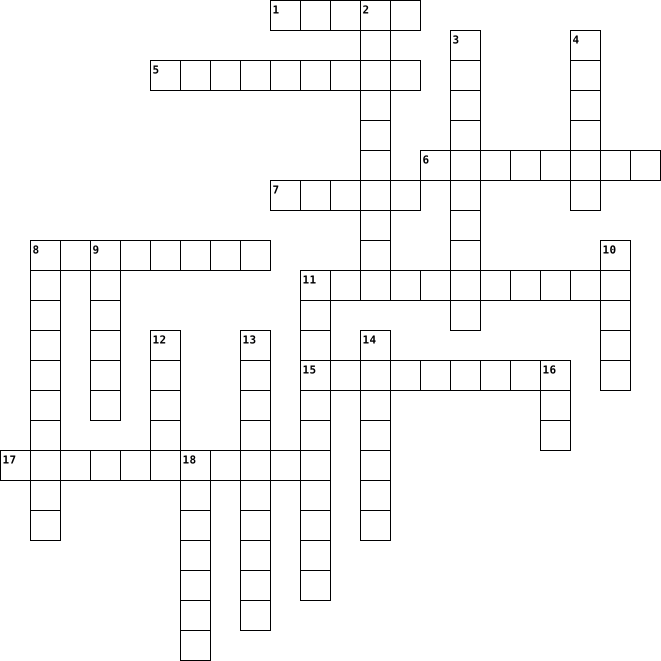
Plate Tectonics 2022-05-06

Across
- together
- sideways and downwards
- geological process
- Europe
- natural disaster
- ocean depths
- Planet
- water
- causes natural disasters
Down
- pangea
- relating to ocean
- Earth
- rock
- ocean
- edge
- molten rock
- dinner
17 Clues: rock • edge • Earth • ocean • water • pangea • Europe • Planet • dinner • together • molten rock • ocean depths • natural disaster • relating to ocean • geological process • sideways and downwards • causes natural disasters
Plate Tectonics 2022-05-11

Across
- Circulation within fluids caused by differences in density and thermal energy
- hot fluid or semifluid material below or within the earth's crust
- A plate boundary where two plates move away from each other
- The process that occurs when one tectonic plate moves under another
- secondary seismic waves produced by an earthquake
- the region of earth's interior between the crust and core.
- a sudden and violent shaking of the ground
- a mountain or hill, typically conical, having a crater or vent through which lava, rock fragments, hot vapor, and gas are being or have erupted from the earth's crust.
- A rigid layer made up of the uppermost part of the mantle and crust
Down
- How much energy is released by an earthquake
- When two plates slide past each other
- a crack or a fracture in Earth's crust where movement can occur
- A plate boundary where two plates move toward each other
- The partially melted portion of the mantle
- the first waves produced by an earthquake
- the outermost solid shell of earth
- States that Earth's surface is made up of rigid slabs of rock that move with respect to one another
17 Clues: the outermost solid shell of earth • When two plates slide past each other • the first waves produced by an earthquake • The partially melted portion of the mantle • a sudden and violent shaking of the ground • How much energy is released by an earthquake • secondary seismic waves produced by an earthquake • A plate boundary where two plates move toward each other • ...
Plate Tectonics 2023-01-12

Across
- a type of boundary that involves plates sliding against each other
- the crust is divided into the continental and _______ crust
- this is an example of what happens at divergent boundaries
- scientist found theses on both Australia and southern Asia as evidence that the continents were once connected
- forms as continental plates push against one another
- a type of boundary where tectonic plates move into one another
- this force causes denser material to fall
- are caused when plates slide past one another;
Down
- a large mountain range that lies underwater in between continents.
- this layer contains parts that are moving at a slow rate
- advancements in this area has allowed scientist to better understand plate movement
- this layer of the Earth heats the mantle and causes denser magma to rise
- this is a factor along with temperature that causes convection currents in the mantle
- a type of boundary where plates are pushed away from one another
- known as a super-continent where all the continents where one large landmass
- this happens when hot material in the mantle rises reaches the surface cools and sinks back into the mantle; repeated cycle
- made up of the crust and upper mantle; make up of plates that are broken into sections
17 Clues: this force causes denser material to fall • are caused when plates slide past one another; • forms as continental plates push against one another • this layer contains parts that are moving at a slow rate • this is an example of what happens at divergent boundaries • the crust is divided into the continental and _______ crust • ...
Plate Techtonics 2025-12-10

Across
- The plates move on top of magma due to convection _____________
- Plate Tectonics moving creates these that sometimes spray lava.
- The lithosphere is broken into large rocky __________
- Convergent boundaries come _____________
- Transform boundaries can happen where any plate touches _____________
- Oceanic plates that move apart is an underwater mountain range that makes new ___________
- A famous fault is located in this State.
- Continental Convergent occurs when two continents __________
- An area on earth with a lot of volcanoes is known as "The Ring of _________"
Down
- Plate Tectonics cause the formation of this land feature.
- The more __________ crust sinks
- Plates moving apart can create _________
- Divergent boundaries move __________
- A natural disaster that causes the earth to shake
- This type of boundaries slide past each other
- A land form under water that forms in the shape of a V.
- This is when one crust sinks below another.
17 Clues: The more __________ crust sinks • Divergent boundaries move __________ • Plates moving apart can create _________ • Convergent boundaries come _____________ • A famous fault is located in this State. • This is when one crust sinks below another. • This type of boundaries slide past each other • A natural disaster that causes the earth to shake • ...
Indy pacific ring of fire 2018-07-04

Across
- the length of the ring of fire
- the name of the ring of volcanoes on the edge of the Pacific plate
- the name of the plate other than the Pacific that is part of the ring of fire
- there are 452 _____ in the ring of fire
- New Zealand lies on the Pacific plate and witch other
- the name of the plate that makes up the majority of the ring of fire
Down
- the number of volcanos in the ring of fire
- the deepest point in the ocean which is located on the edge of the Pacific plate
- the most common plate boundary zone we see on the ring of fire
- the type of plate that the Pacific plate is
10 Clues: the length of the ring of fire • there are 452 _____ in the ring of fire • the number of volcanos in the ring of fire • the type of plate that the Pacific plate is • New Zealand lies on the Pacific plate and witch other • the most common plate boundary zone we see on the ring of fire • the name of the ring of volcanoes on the edge of the Pacific plate • ...
Plate Tectonics 2013-09-25

Across
- The exterior portion of the earth that lies above the mantle.
- A very large ocean wave caused by an underwater earthquake or volcanic eruption
- Boundary two plates slide against each other in a sideways motion
- The point of the earth's surface directly above the focus of an earthquake.
- Boundary A tectonic boundary where two plates are moving away from each other and new crust is forming from magma that rises to the Earth's surface between the two plates
- A zone of the earth's mantle that lies beneath the lithosphere
- The layer of the earth between the crust and the core.
Down
- A fracture in the continuity of a rock formation caused by a shifting or dislodging of the earth's crust
- Wave A type of seismic body wave in which rock particles vibrate parallel to the direction of wave travel.
- wave A seismic wave that travels across the surface of the Earth as opposed to through it
- Boundary A tectonic boundary where two plates are moving toward each other.
- An opening in the earth's crust through which molten lava, ash, and gases are ejected
- The point of origin of an earthquake
- Wave An earthquake wave in which rock particles vibrate at right angles to the direction of wave travel
- The outer part of the earth, consisting of the crust and upper mantle
- a sudden and violent shaking of the ground, sometimes causing great destruction, as a result of movements within the earth's crust or volcanic action.
- An instrument for automatically detecting and recording the intensity, direction, and duration of a movement of the ground, especially of an earthquake.
17 Clues: The point of origin of an earthquake • The layer of the earth between the crust and the core. • The exterior portion of the earth that lies above the mantle. • A zone of the earth's mantle that lies beneath the lithosphere • Boundary two plates slide against each other in a sideways motion • The outer part of the earth, consisting of the crust and upper mantle • ...
Plate Tectonics 2013-11-19

Across
- These ridges are formed when new crust is added.
- Waves used to determine the Earths interior structure.
- This property explains why continental plates float.
- Plastic layer of the earth
- The size of mineral crystals found in intrusive igneous rocks.
- Earthquakes can occur at the edge of these plate boundaries.
- These can form when plates collide.
- This is the process that causes the magma to move.
- This process holds the particles together in sedimentary rocks
- Proposed the existence of Pangaea.
Down
- These and fossils embedded in them are found in sedimentary rocks.
- These rock can look very different after heat and pressure.
- This occurs when oceanic crust meets a continental plate.
- When this occurs at high temperature metamorphic rock turn into lava
- They are evidence for continental drift.
- This process is one step in the rock cycle.
- this is one of the metal found in the Earths core.
17 Clues: Plastic layer of the earth • Proposed the existence of Pangaea. • These can form when plates collide. • They are evidence for continental drift. • This process is one step in the rock cycle. • These ridges are formed when new crust is added. • This is the process that causes the magma to move. • this is one of the metal found in the Earths core. • ...
Plate Tectonic 2013-01-04

Across
- Where the earthquake mainly happened.
- A molten rock material found under earth’s surface.
- Magma coming out from narrow cracks in earth’s crust.
- When two lithospheric plates scrape sideways past each other.
- Normal reverse and strike slips.
- Volcanoes that do not form along the plate boundary.
- The opening of a volcano.
Down
- The supercontinent that Alfred Wegener discovered in the early 1900s.
- Compression, tension, and shearing have this in common.
- The first waves that get to the epicenter of an earthquake.
- When two lithospheric plates move towards each other.
- Magma erupted from a volcano.
- When two lithospheric plates move away from each other.
- The process when one plate is pushed downward beneath another plate.
- A unexpected movement of rocks in the earth’s crust
- The second set of waves that get to the epicenter of an earthquake.
- The point beneath earth surface where rock under stress breaks to cause an earthquake.
17 Clues: The opening of a volcano. • Magma erupted from a volcano. • Normal reverse and strike slips. • Where the earthquake mainly happened. • A molten rock material found under earth’s surface. • A unexpected movement of rocks in the earth’s crust • Volcanoes that do not form along the plate boundary. • When two lithospheric plates move towards each other. • ...
Plate Tectonics 2013-03-10

Across
- Where is the magma?
- Found in Africa
- rise and fall of a fluid due to temperature
- Liquid rock
- Sinking oceanic plate
- Type of rock oceanic plates are made of
- formed by convergent plate boundaries
- Innermost layer of Earth
Down
- Often the aftermath of an earthquake
- Change in magnetic polarity
- Supercontinent
- Posed Continental Drift Theory in 1912
- These plates ride atop oceanic plates
- Shake, shake, shake!
- San Andreas Fault
- Where is Alfred Wegener from?
- Underwater mountains
17 Clues: Liquid rock • Supercontinent • Found in Africa • San Andreas Fault • Where is the magma? • Shake, shake, shake! • Underwater mountains • Sinking oceanic plate • Innermost layer of Earth • Change in magnetic polarity • Where is Alfred Wegener from? • Often the aftermath of an earthquake • These plates ride atop oceanic plates • formed by convergent plate boundaries • ...
Plate Tectonics 2015-03-11
Across
- A trench is a ? in the ocean
- When two plates go away from each other
- Alfred Wegener's theory was first ____
- tectonics causes earthquakes
- spreading at the mid-ocean ridge a new sea floor is built
- crust One of the two crusts
- 2 plates slide past each other
- Plates are located here
Down
- Currents the power of moving the continents
- 2 plates come together
- there are two types of ? one is oceanic
- happens in trenches
- Wegener Scientist who proposed of the theory of the continental drift
- boundaries three types divergent,convergent and transform
- Drift Theory of the continents moving
- Recent discovery of the plate tectonics happened in the mid
- ? happens in the asthenosphere
- One super continent
- ocean ridge seafloor spreading takes place
- Biggest plate out of the 7 major plates
20 Clues: happens in trenches • One super continent • 2 plates come together • Plates are located here • A trench is a ? in the ocean • tectonics causes earthquakes • crust One of the two crusts • ? happens in the asthenosphere • 2 plates slide past each other • Drift Theory of the continents moving • Alfred Wegener's theory was first ____ • there are two types of ? one is oceanic • ...
My Plate 2019-04-11

Across
- A sweet, smooth, calcium-rich snack that comes in many flavors
- Fits into the "Grains" group; goes great with stir-fry
- This makes a quick, "ready-to-eat" breakfast with milk
- Spaghetti is a type of ____
- Chicken and turkey are examples of ____
- Lean ____ is an excellent source of protein, iron, and zinc
- Broccoli and green beans are examples of a ____
- Try to eat fat-free or low ____ foods when you can
- Salmon and trout are examples of ____
Down
- Use whole-grain ____ for your sandwiches
- Vegetable or olive ____ are often used for cooking
- Apples, oranges, and bananas fit into this food group
- An orange vegetable packed with Vitamin A
- Cheddar, Swiss, mozzarella, and jack are examples
- You can hard-boil, scramble, fry or poach these
- Pinto, kidney, black, refried - lots of different kinds
- Eat a variety of ____ from all of the groups
17 Clues: Spaghetti is a type of ____ • Salmon and trout are examples of ____ • Chicken and turkey are examples of ____ • Use whole-grain ____ for your sandwiches • An orange vegetable packed with Vitamin A • Eat a variety of ____ from all of the groups • Broccoli and green beans are examples of a ____ • You can hard-boil, scramble, fry or poach these • ...
Plate Tectonics 2019-11-24

Across
- magma once it has erupted
- A risk
- Shaking of the Earth
- Large movable segments
- lies between the crust and the outer core
- Drift Pieces of the land mass
- bent by stress
- The opening at the Earth's surface
- The thin outer layer
- containing a volcanic vent
Down
- Molten rock containing liquids, crystals, and dissolved gases
- area of fracturing
- The innermost layers
- follows a larger earthquake
- where an oceanic and continental plate move towards each other
- A vent (opening) in the surface of the Earth
- directly above the hypocenter
17 Clues: A risk • bent by stress • area of fracturing • The innermost layers • Shaking of the Earth • The thin outer layer • Large movable segments • magma once it has erupted • containing a volcanic vent • follows a larger earthquake • Drift Pieces of the land mass • directly above the hypocenter • The opening at the Earth's surface • lies between the crust and the outer core • ...
Plate Tectonics 2024-05-08

Across
- When one plate goes under another.
- Hot molten rock erupted from a volcano or fissure.
- The type of wave that forms from earthquakes.
- Type of boundary where plates slide past each other.
- Type of boundary where plates move apart.
- Vent on the surface of the earth that releases magma.
- Massive slabs of rock in the lithosphere that move with tectonics.
- Long, narrow ditches formed in the ocean floor.
Down
- The faster wave, can travel through all matter.
- Middle of a tectonic plate.
- Study of seismic waves.
- Hot fluid rock within the earth's crust.
- Type of boundary where plates come together.
- A narrow crack in the earth.
- Unexpected ground movement, caused by the release of energy in rocks
- The slower wave, can only travel through solids.
- A disturbance in a medium that carries energy.
17 Clues: Study of seismic waves. • Middle of a tectonic plate. • A narrow crack in the earth. • When one plate goes under another. • Hot fluid rock within the earth's crust. • Type of boundary where plates move apart. • Type of boundary where plates come together. • The type of wave that forms from earthquakes. • A disturbance in a medium that carries energy. • ...
Food Portions: How much should I eat? 2024-01-09

Across
- doing this on your plate helps you eat a balanced meal
- is good to eat extra of these
- gives how much a person should eat
- amount on plate for starches/grains
- snack size of chips or ice cream recommended
- = clenched fist
- amount of recommended meat serving
- part of plate for fruits and veggies
Down
- nutrition information section giving a serving size
- number of food groups given by My Plate
- amount of protein should take on the plate
- drinking a glass before meals helps control hunger
- number of balanced meals per day recommended
- eat at this speed to help not to over-eat
14 Clues: = clenched fist • is good to eat extra of these • gives how much a person should eat • amount of recommended meat serving • amount on plate for starches/grains • part of plate for fruits and veggies • number of food groups given by My Plate • eat at this speed to help not to over-eat • amount of protein should take on the plate • number of balanced meals per day recommended • ...
Jayla's Crossword Puzzle 2024-10-23

Across
- hot liquid rock below the surface of Earth
- a set of interacting parts forming a complex whole
- Earth’s outermost layer of hard, solid rock that is underneath the soil.
- the sudden pushing out of something, such as lava from a volcano
- a diagram that shows what the inside of something looks like
- the slow pulling apart of land that is caused by plate movement
- how often or fast something happens
- moving apart in different directions
- A large sea wave caused by an underwater earthquake, volcanic eruption, or landslide.
- any of Earth’s main continuous areas of land, such as Africa, Asia, and North America
- a sudden shaking of Earth’s surface
- A crack in the Earth's crust, typically associated with plate boundaries.
- the place where two plates meet
- The movement of fluid in the mantle caused by the heat from the Earth's core, driving plate tectonics.
Down
- The process by which new oceanic crust is formed at mid-ocean ridges and slowly moves away from the ridge.
- Waves of energy that travel through the Earth as a result of an earthquake.
- any of the many processes (such as eruptions and lava flows) in which gas, lava, and ash are pushed out on the surface of the Earth
- moving toward the same place
- when an oceanic plate runs into a continental plate and slides beneath it
- The rigid outer layer of the Earth, including the crust and the upper mantle, which is broken into tectonic plates.
- the outside or top layer of something
- The gradual movement of continents across the Earth’s surface over geological time.
- A location where magma rises from deep within the Earth and can cause volcanic activity, often in the middle of a tectonic plate.
- Large slabs of Earth’s lithosphere that move over the mantle.
- an underwater mountain range formed when two plates move apart
- hot liquid rock on the surface of the Earth
- a long, deep indentation in the ocean floor formed when two plates move together
- one of the very large sections of hard, solid rock that make up Earth’s outer layer
- a feature that forms on the surface of a planet, such as a mountain, channel, or sand dune
- where two of the tectonic plates slide alongside each other.
30 Clues: moving toward the same place • the place where two plates meet • how often or fast something happens • a sudden shaking of Earth’s surface • moving apart in different directions • the outside or top layer of something • hot liquid rock below the surface of Earth • hot liquid rock on the surface of the Earth • a set of interacting parts forming a complex whole • ...
Plate Tectonics Terms 2021-03-09

Across
- The tectonic plate that North America is on
- A branch of the earth sciences that combines aspects of geology and physics. It addresses the planet's physical processes as well as its gravitational, magnetic, and electric properties, and the means by which energy is transmitted through its interior.
- The tectonic plate that Africa is on
- The study of tectonism, including its causes and effects, most notably mountain building.
- In early geologic time, a supercontinent that incorporated almost all the landmasses on Earth.
- An underwater mountain system that consists of various mountain ranges (chains), typically having a valley known as a rift running along its spine, formed by plate tectonics.
- The deformation of the lithosphere.
- Large movable segments of the lithosphere.
- An area of rock that has been bent by stress.
- A mountain or hill having a crater or vent through which lava, rock fragments, hot vapour, and gas are being or have been erupted from the earth's crust
- A tectonic process whereby plates slide past each other. It is one of the three ways, along with convergence and divergence, that plates interact.
- A tectonic process that results when plates converge and one plate forces the other down into earth's mantle. As a result, the subducted plate eventually undergoes partial melting.
- A form of stress produced by a force that acts to stretch a material.
- The science that deals with the earth's physical structure and substance, its history, and the processes that act on it
- A term describing a phenomenon whereby certain materials are subject to a form of decay brought about by the emission of high-energy particles or radiation.
- Sudden and violent shaking of the ground, sometimes causing great destruction, as a result of movements within the earth's crust or volcanic action
- The tectonic plate that contains Europe and Asia
- A process of plate tectonics where new oceanic crust is created as large slabs of the Earth's crust split apart from each other and magma wells up to fill the gap.
- The theory that the configuration of Earth's continents was once different than it is today; that some of the individual landmasses of today once were joined in other continental forms; and that these landmasses later separated and moved to their present locations.
- The tectonic plate that Antarctica is on
- The theory that the Earth's crust and upper mantle (the lithosphere) is broken into a number of more or less rigid, but constantly moving, segments or plates
Down
- A large natural elevation of the earth's surface rising abruptly from the surrounding level; a large steep hill.
- The tectonic plate that contains south America
- The border between two plates
- An abbreviation used by earth scientists, meaning "million years."
- Upheavals or depressions of land exhibiting long wavelengths and little folding apart from broad undulations
- The gathering of data without actual contact with the materials or objects being studied.
- A deep depression in the ocean floor caused by the convergence of plates and the resulting subduction of one plate.
- One of two principal forms of tectonism, the other being epeirogenesis. Derived from the Greek words for mountain and origin, this involves the formation of mountain ranges by means of folding, faulting, and volcanic activity. These processes play a major role in plate tectonics
- The planet on which we live
- The thick, dense layer of rock, approximately 1,429 mi. (2,300 km) thick, between Earth's crust and its core.
- A general statement derived from a hypothesis that has withstood sufficient testing.
- The study of Earth's physical history. It is one of two principal branches of geology, the other being physical geology.
- The outer solid part of the earth, including the crust and uppermost mantle. The lithosphere is about 100 km thick, although its thickness is age-dependent (the older lithosphere is thicker).
- The tectonic plate that India and Australia are on
- A linear zone where the Earth's crust and lithosphere are being pulled apart.
- A very large expanse of sea, in particular each of the main areas into which the sea is divided geographically.
- The tectonic plate containing mostly ocean
- An area of historical geology devoted to studying the direction and intensity of magnetic fields in the past, as discerned from the residual magnetization of rocks.
- A weak point in the Earth's crust and upper mantle where the rock layers have ruptured and slipped. They are caused by earthquakes, and earthquakes are likely to reoccur on pre-existing faults.
40 Clues: The planet on which we live • The border between two plates • The deformation of the lithosphere. • The tectonic plate that Africa is on • The tectonic plate that Antarctica is on • Large movable segments of the lithosphere. • The tectonic plate containing mostly ocean • The tectonic plate that North America is on • An area of rock that has been bent by stress. • ...
Plate Tectonics Crossword Puzzle 2021-10-14

Across
- Trench, Long, narrow depressions on the sea floor
- An area where an oceanic plate sinks down into the Asthenosphere
- Volcano, Volcanoes along the shoreline, usually formed by convergent boundaries
- A boundary between two colliding Tectonic Plates
- Wegener, The scientist that came up with the theory of Continental Drift
- A boundary that causes plates to slide past each other
- A boundary where two Tectonic Plates move away from each other
- A supercontinent
- The rigid and outermost layer of the Earth
- The center of the Earth
Down
- Crust, The outer layer of the Earth's lithosphere
- Mountains, Mountains that are formed by the effects of folding on layers
- The Southern half of the Pangea that existed over 300 million years ago
- Striation, Scratches that are lodged onto a piece of land due to Glaciers moving
- The thinnest layer of the Earth
- The layer of the Earth between the Crust and the Core
- Caused by Convergent Boundaries, also occurs around fault lines
- Ridge, A seafloor mountain system that can be formed by plate tectonics
- Crust, The upper layer of the oceanic portion of a Tectonic Plate
- Valley, A lowland region formed by plate tectonics
20 Clues: A supercontinent • The center of the Earth • The thinnest layer of the Earth • The rigid and outermost layer of the Earth • A boundary between two colliding Tectonic Plates • Crust, The outer layer of the Earth's lithosphere • Trench, Long, narrow depressions on the sea floor • Valley, A lowland region formed by plate tectonics • ...
Unit 2: The Lithosphere 2018-09-27

Across
- The type of plate boundary where the plates move towards each other.
- This is the name given to the strength of an earthquake.
- The passage through which magma flows in a volcano.
- Scale This measures the magnitude of an earthquake.
- A super volcano found in North America.
- The process of compaction and cementation in rocks.
- These rocks are made through lithification over many years.
- A fast-moving, incandescent mass of gas-enveloped particles.
- Lava found underneath the Earth's surface.
- A fast moving current of hot gas and volcanic matter.
Down
- Also known as intra-plate volcanism.
- The point on the Earth's surface where an earthquake does most damage.
- The type of plate boundary where the plates move away from each other.
- These rocks are made from immense heat and pressure.
- The point where an earthquake begins.
- The type of plate boundary where the plates slide past each other.
- A famous fault line in North America responsible for earthquakes.
- These rocks are made from cooling and hardening of magma.
- The name given to the waves produced by earthquakes.
- The name given to a type of surface wave produced by an earthquake.
20 Clues: Also known as intra-plate volcanism. • The point where an earthquake begins. • A super volcano found in North America. • Lava found underneath the Earth's surface. • The passage through which magma flows in a volcano. • Scale This measures the magnitude of an earthquake. • The process of compaction and cementation in rocks. • ...
MGH Micro 2022-04-25

Across
- plate used to grow gram negative rods
- the study of microorganisms and where we work
- a common specimen type in the non sterile hood
- tests that stopped being performed at the onset of the COVID pandemic
- plate used to grow more fastidious bacteria
- the machine that runs our routine COVID tests
- disease for which the RPR test can help monitor
- bacteria which do not prefer or cannot tolerate oxygenated conditions
- agar used for CSF and pleural fluid cultures
- a very common mold that can grow from respiratory specimens,
Down
- a parasitology test that requires an induced sputum or a specimen that is more invasive
- where respiratory culture and MRST cultures are worked up
- where tissue and fluid cultures are worked up
- additional plate for stool cultures
- where urine and stool cultures are worked up
- the plate that we use which will grow most bacteria
- a test which can help diagnosis sepsis
- the sensi room gives MIC levels for these
- a common specimen type in the planting room
- caused by a bacterium the TB lab cannot grow and can be transmitted by armadillos
- a common specimen type in the sterile hood
21 Clues: additional plate for stool cultures • plate used to grow gram negative rods • a test which can help diagnosis sepsis • the sensi room gives MIC levels for these • a common specimen type in the sterile hood • plate used to grow more fastidious bacteria • a common specimen type in the planting room • where urine and stool cultures are worked up • ...
Geology unit 3 2025-03-13

Across
- When a denser plate descends into the mantle at the same rate as seafloor production
- Mountain formed by subduction of oceanic lithosphere beneath a continent
- boundary in which two plates slide past each other
- a continuous elevated zone on the floor of all major ocean basins
- processes that deform Earth’s crust to create major structural features
- Formed from transform boundaries
- Volcanic islands created by subduction of one oceanic plate under another
- boundary in which two plates move apart
- hypothesis suggesting new oceanic crust is created at the crests of mid ocean ridges
Down
- boundary in which two plates move together
- The primary source of plate movement
- The largest tectonic plate
- Supercontinent containing all of the existing continents
- The place where convection takes place in the earth
- Suggests that all present continents once existed as a supercontinent
- Came up with the continental drift theory
- Age of lithosphere that results in a high angle of decent/deep trench
- Common disaster at or near faults
- Age of lithosphere that results in a low angle of decent/shallow trench
- narrow, elongated depression of the seafloor
20 Clues: The largest tectonic plate • Formed from transform boundaries • Common disaster at or near faults • The primary source of plate movement • boundary in which two plates move apart • Came up with the continental drift theory • boundary in which two plates move together • narrow, elongated depression of the seafloor • boundary in which two plates slide past each other • ...
Plate motion study help 2025-11-05

Across
- a set of interacting parts forming a complex whole
- the layer of soft solid rock underneath earths plates
- something that happens over and over again
- how often or fast something happens
- a very large section of earths hard solid rock layer
- any of the many processes (such as eruptions)in which has and lava are pushed to the surface of earth
- an object or diagram that helps us understand something by making it easier
- an underwater mountain range formed when two plates move apart
- how many different plate boundaries are there
- a trench is formed at this plate boundary
Down
- one of earths layers made of hard solid rock
- the place where two plates meet
- A diagram that shows the inside of something
- a mid ocean ridge is formed at this plate boundary
- they introduced the continental drift theory
- a sudden shaking of earths surface
- is an explanation of a scientific process that has been successfully tested in many different ways
- to examine in detail for a purpose
- any of earths main continuous areas of land such as Africa and North America
- a long deep indentation in the ocean floor formed when two plates move together
20 Clues: the place where two plates meet • a sudden shaking of earths surface • to examine in detail for a purpose • how often or fast something happens • a trench is formed at this plate boundary • something that happens over and over again • one of earths layers made of hard solid rock • A diagram that shows the inside of something • they introduced the continental drift theory • ...
Tectonics 2023-09-29

Across
- The movement of the crust caused by convection currents in the mantle
- Volcanic eruptions and ______ are examples of tectonic hazards
- Hawaii is an example of a _________ volcano
- The circular motion of magma in the mantle
- Plate boundary where plates move apart
- The thickest part of Earth's structure
- Plate boundary where plates move towards eachother
Down
- Plate boundary where plates move past eachother in opposite directions
- Where two tectonic plates meet
- A famous example of a conservative plate boundary in California, USA
- Fertile soils near volcanoes mean there is a large a_______ sector
- Able to meet our needs without jeopardising future generations
- The crust is broken up into seven major _______ plates
- The Pacific _____ __ ______ is home to 90% of the world's volcanoes
- Volcano type with a cone shape and violent eruptions
15 Clues: Where two tectonic plates meet • Plate boundary where plates move apart • The thickest part of Earth's structure • The circular motion of magma in the mantle • Hawaii is an example of a _________ volcano • Plate boundary where plates move towards eachother • Volcano type with a cone shape and violent eruptions • The crust is broken up into seven major _______ plates • ...
Chapter 8 2018-12-10

Across
- Earth's surface is made up of rigid slabs of rock that move with respect of each other.
- The upward vertical motion of the Earth's surface.
- Enormous splits in Earth's crust.
- A change in the shape of rock caused by stress.
- Flat regions with high elevations.
- A curved line of volcanoes that form parallel to a plate boundary.
- Made of layers of rocks that are folded.
- When large regions rise vertically with very little deformation.
- Made from layers of cooled molten rock and ash.
- Stress that pulls something apart.
Down
- Deep, underwater troughs created by one plate subducting under another plate at a convergent plate boundary.
- Where tectonic plates slide horizontally past each other.
- The equilibrium between continental crust and the denser mantle below it.
- Areas of subsidence and regions with low elevation.
- Parallel ridges that form where blocks of crust move up or down along faults.
- Parallel forces acting in opposite directions.
- An extensive area of level or rolling land.
- The downward vertical movement of the Earth's surface.
- An area of many fractured pieces of crust along a large fault.
- Squeezing stress.
20 Clues: Squeezing stress. • Enormous splits in Earth's crust. • Flat regions with high elevations. • Stress that pulls something apart. • Made of layers of rocks that are folded. • An extensive area of level or rolling land. • Parallel forces acting in opposite directions. • A change in the shape of rock caused by stress. • Made from layers of cooled molten rock and ash. • ...
Why live in a Tectonic Place? 2024-05-03

Across
- The plate boundary where plates move next to eachother
- The continent our volcano case study is on
- The plate boundary type that forms the Great Rift Valley
- The tectonic plate that China sits on
- The point on land directly above the focus of an earthquake
- The name of the scale that earthquakes are measured on
- The abbreviated country that our volcano case study is located in
- The name given to an area in China
- The name for magma once erupted and on the earth's surface
- The currents in the earth that move tectonic plates
- The name of the city effected by our volcano case study
Down
- The name of the earthquake case study we have studied
- The plate boundary where plates move towards eachother
- A crack in the earth's crust due to pressure
- The continent that China is on
- What unit earthquakes are measured in
- The name for impacts on people
- The point below the earth's surface where pressure is released to cause an earthquake
- The renewable energy that uses heat from the ground
- The Volcano case study
- A person who designs earthquake proof buildings
- The name for financial impacts
22 Clues: The Volcano case study • The continent that China is on • The name for impacts on people • The name for financial impacts • The name given to an area in China • What unit earthquakes are measured in • The tectonic plate that China sits on • The continent our volcano case study is on • A crack in the earth's crust due to pressure • ...
Engineering Vocabulary 2024-07-15

Across
- Circuits with components that are opposite and equal distance apart from each other.
- The difference in electrical energy in a circuit.
- An early version of a design, often used for testing.
- A force that tends to lengthen objects.
- What the "S" stands for in S-Wave.
- Charged particles moving through a conductor.
- The type of plate boundary where one plate slides under the other.
- The type of plate boundary made from a sliding motion.
- Machine which measures the magnitude of an earthquake.
- Outermost layer of the Earth.
Down
- The type of plate boundary where the plates separate.
- The force which opposes the direction of movement.
- A force which acts vertically on an object. It helps objects to rise when greater than the weight.
- A force that tends to shorten objects.
- What the "P" stands for in P-Wave.
- The number of Newton's Law which says that "Any action has an equal and opposite reaction."
- This step follows brainstorming and involves looking into materials, permits, and economics.
- Circuits in a simple loop.
- Limitations, restrictions, or challenges to a design.
- A bridge with only compression forces.
20 Clues: Circuits in a simple loop. • Outermost layer of the Earth. • What the "P" stands for in P-Wave. • What the "S" stands for in S-Wave. • A force that tends to shorten objects. • A bridge with only compression forces. • A force that tends to lengthen objects. • Charged particles moving through a conductor. • The difference in electrical energy in a circuit. • ...
Plate Tectonics Topic 1 KQ 1 2026-01-13

Across
- Plate boundary where plates move away from each other
- The semi-solid layer below the lithosphere
- The force created when oceanic plates sink into the mantle and drags the plate along
- The innermost and hottest layer of Earth
- Process where one plate sinks beneath another plate
- The solid upper mantle and crust combined
Down
- The crust that is less dense
- Plate boundary where plates slide past one another
- The supercontinent that existed when all continents were connected
- Rising and sinking movement that drives plate motion
10 Clues: The crust that is less dense • The innermost and hottest layer of Earth • The solid upper mantle and crust combined • The semi-solid layer below the lithosphere • Plate boundary where plates slide past one another • Process where one plate sinks beneath another plate • Rising and sinking movement that drives plate motion • ...
Flexographic Platemaking 2025-01-27

Across
- The variation in thickness within one plate, usually expressed in mils
- A face exposure procedure which temporarily covers portions of a negative prone to fill-in or shoulder broadening during long exposures
- Exposure of a photopolymer with ultraviolet light through a photographic negative to create an image. The clear areas of the negative allow light to pass through, curing the photopolymer. The black, opaque areas of the negative screen the light and the photopolymer under these areas remains unchanged and can be washed away
- Distortion of the surface of image characters on a printing plate into a cup shape
- A photopolymer plate with a thin (2-7 mil) top layer of a photopolymer material, added to improve image fidelity at the printing surface
- A thin (less than I mil) protective coating applied by the plate manufacturer to the surface of sheet photopolymer plates.
- A removable cylinder covering on which plates are mounted
Down
- Term to describe the hardness of the plate
- A thin (5 mil to 10 mil), dimensionally stable material adhered to the back of most photopolymer plates.
- The ability of a material to rebound, or bounce back after being impacted.
- Exposure of a photopolymer with ultraviolet light, usually through a transparent polyester backing sheet, to create the plate floor:
- The amount of photopolymer material washed away in a set period of time, usually expressed in mils/minute.
- A polymer material which is sensitive to ultraviolet light
- The raised image on a flexographic printing plate.
- A measure of distance equal to 1/1000 of an inch
15 Clues: Term to describe the hardness of the plate • A measure of distance equal to 1/1000 of an inch • The raised image on a flexographic printing plate. • A removable cylinder covering on which plates are mounted • A polymer material which is sensitive to ultraviolet light • The variation in thickness within one plate, usually expressed in mils • ...
Earth 2023-02-15

Across
- A food soaked in vinegar
- A crazy little man
- causes a trench
- floating ground
- heat cycle of density
- separating type of plate
Down
- slight moving of puzzle pieces
- A common lunch food
- Floating or not floating
- cute rodent
- Moving closer type of plate
- sliding type of plate
12 Clues: cute rodent • causes a trench • floating ground • A crazy little man • A common lunch food • sliding type of plate • heat cycle of density • A food soaked in vinegar • Floating or not floating • separating type of plate • Moving closer type of plate • slight moving of puzzle pieces
6th Grade Tectonic Plates Vocab 2025-05-05

Across
- A type of plate boundary where two plates move toward each other, causing mountains, earthquakes, or volcanic activity.
- The very center of Earth, made of iron and nickel, with two parts: the outer core (liquid) and the inner core (solid).
- The outer layer of Earth, made of solid rock, including the crust and upper part of the mantle.
- A large opening in the Earth's surface where melted rock, ash, and gases escape.
- The movement in the mantle caused by heat from the Earth's core, helping to move tectonic plates.
- The name of the supercontinent that existed millions of years ago when all the continents were joined together.
- The Earth's outer layer, made of solid rock. It's the thinnest layer of the Earth.
- A type of plate boundary where two plates slide past each other, often causing earthquakes.
- A crack in the Earth's surface where plates move or slide past each other. Earthquakes can happen along faults.
Down
- Large pieces of Earth's lithosphere that move on top of the asthenosphere.
- A layer of the Earth beneath the lithosphere that is soft and flows slowly, allowing the lithosphere to move on top of it.
- The remains or traces of ancient plants or animals, which provide evidence for the theory of plate tectonics.
- The process where new oceanic crust is created as two plates move apart at mid-ocean ridges.
- A type of plate boundary where two plates move away from each other, creating new crust at mid-ocean ridges.
- A sudden shaking or movement of Earth's surface caused by the release of energy along a fault or plate boundary.
- The thick layer of rock beneath the Earth's crust that can flow slowly.
- The place where one tectonic plate is pushed under another plate, often causing earthquakes and volcanoes.
17 Clues: The thick layer of rock beneath the Earth's crust that can flow slowly. • Large pieces of Earth's lithosphere that move on top of the asthenosphere. • A large opening in the Earth's surface where melted rock, ash, and gases escape. • The Earth's outer layer, made of solid rock. It's the thinnest layer of the Earth. • ...
Chapter 9&10 2020-08-14

Across
- also known as ingrown nails
- tough band of fibrous tissue that connects bones
- also known as lateral nail fold
- common bacteria that can lead to a bacterial infection tat appears green, yellow or black
- lack of circulating oxygen in the red blood cells
- separation and falling off of a nail plate from the nail bed
Down
- fungal infection of the natural nail plate
- thickening of nails
- folds of normal skin that surrounds the natural nail plate
- furrow on each side of the nail
- dead colorless tissue
- any deformity or disease of the natural nails
- living tissue surrounding the nail plate splits or tears
- tissue bordering the root and sides of a fingernail or toenail
- concave shape that appear to be scooped out
15 Clues: thickening of nails • dead colorless tissue • also known as ingrown nails • also known as lateral nail fold • furrow on each side of the nail • fungal infection of the natural nail plate • concave shape that appear to be scooped out • any deformity or disease of the natural nails • tough band of fibrous tissue that connects bones • ...
Earth Dynamics Extra Credit 2022-04-07

Across
- The upward vertical motion of Earth's surface.
- A curved line of volcanoes that forms parallel to a plate boundary.
- Made of layers of rocks that are folded.
- A change in the shape of rock caused by stress.
- Areas of subsidence and regions with low elevation.
- Parallel forces acting in opposite directions.
- Stress that pulls something apart.
- An area of many fractured pieces of crust along a large fault.
Down
- Flat regions with high elevations.
- Where blocks of crust slide horizontally past each other.
- An extensive area of level or rolling land.
- Squeezing stress
- The equilibrium between continental crust and the denser mantle below it.
- Deep, underwater troughs created by an oceanic plate subducting under another plate at a convergent plate boundary.
- The downward vertical motion of Earth's surface.
15 Clues: Squeezing stress • Flat regions with high elevations. • Stress that pulls something apart. • Made of layers of rocks that are folded. • An extensive area of level or rolling land. • The upward vertical motion of Earth's surface. • Parallel forces acting in opposite directions. • A change in the shape of rock caused by stress. • ...
Jessica's plate tectonics crossword puzzle 2021-11-09

Across
- hot fluid or semi-fluid material below or within the earth's crust
- Vertical fractures where the blocks have mostly moved horizontally
- Earth's tectonic plates move apart, or rift
- remains or traces of organisms that were once alive
- Sea-floor spreading were combined into the new more recent theory of ___________.
- What caused the San Andreas fault
- A giant landmass that existed 200 million years ago
- The shaking of the Earth due to a sudden release of energy
- The cycle that powers the ocean currents, weather, and tectonic plates
- area on Earth where two or more lithospheric plates collide
Down
- A boundary between two plates that are moving apart
- plate oceanic tectonic plate that lies beneath the Pacific Ocean
- major tectonic plate straddling the Equator as well as the prime meridian
- tectonics
- Known for creating the continental drift theory
- Process by which new ocean lithosphere forms
- geological process in which the oceanic lithosphere is recycled into the Earth's mantle at convergent boundaries
- fracture or zone of fractures between two blocks of rock
- the deepest parts of the ocean floor
- a geological process in which the oceanic lithosphere is recycled into the Earth's mantle
20 Clues: tectonics • What caused the San Andreas fault • the deepest parts of the ocean floor • Earth's tectonic plates move apart, or rift • Process by which new ocean lithosphere forms • Known for creating the continental drift theory • A boundary between two plates that are moving apart • remains or traces of organisms that were once alive • ...
Plate Tectonics Chap. 5 2023-02-09

Across
- Caused when a plate goes under one another in the ocean.
- Hot rock above the ground.
- A boundary that slides past other boundaries.
- Occurs when a pan touches a stove, also known as the transfer of heat when one object touches another.
- Boundaries that are pushing towards other boundaries.
- Mountain formed by hot spots in the Earth.
- Occurs along divergent boundaries, and makes new oceanic crust.
- A theory that states the sea-floor is always moving.
Down
- Hot rock underground.
- When an oceanic plate slides under a continental plate.
- A boundary that is moving away from the other boundaries.
- Super continent made millions of years ago.
- A place filled with magma that rises to the Earth surface.
- The theory that states that there are plates in the crust that move everything around.
- The transfer of energy through space.
- Dead organisms preserved in rock.
- Chain of islands formed by a volcano.
- This can cause boiling water.
- Pieces of the earth's lithosphere which together make up the earth's surface.
- Found both on land and at the bottom of the ocean, where they are created by the process of seafloor spreading.
20 Clues: Hot rock underground. • Hot rock above the ground. • This can cause boiling water. • Dead organisms preserved in rock. • The transfer of energy through space. • Chain of islands formed by a volcano. • Mountain formed by hot spots in the Earth. • Super continent made millions of years ago. • A boundary that slides past other boundaries. • ...
Anson Health 7 2017-06-21

Across
- who you can ask for help
- milk and ______ are part of the plate as drinks
- something that someone doesnt agree with can make them
- id you dont eat meat you are
- the abilty to bounce back is being ______
- when someone is watching you get hurt and dont help
- when you puke up what you eat
- what takes up the second most on the eat well plate
- how many calories is in a bottle of water
- when someone is making fun of you you are getting
Down
- what is a important grooming product
- when you keeping hurt by someone you are getting _______
- what takes up the most room on the eat well plate
- hurting someone smaller or being rude to someone is
- teasing can be very ______
- adults should have ______ calories a day
- what you are if you don't want to eat
- if you dont eat meat or diary you are
- when harrasment doesnt stop it can make someone
- when you dont eat anything prossesed you are on what kind of diet
- takes up the least amount on the eat well plate
21 Clues: who you can ask for help • teasing can be very ______ • id you dont eat meat you are • when you puke up what you eat • what is a important grooming product • what you are if you don't want to eat • if you dont eat meat or diary you are • adults should have ______ calories a day • the abilty to bounce back is being ______ • how many calories is in a bottle of water • ...
Plate Tectonics & Geology Crossword Puzzle 2023-12-18

Across
- Supercontinent that all the continents once formed
- The preserved remains of a plant or animal that has been hardened into a rock
- Plate Boundary where plates slide past each other
- When plates move and cause shaking on the Earth
- A break in the Earth's crust
- The slope of an area
- The science that deals with the Earth's physical structure
- A line that connects points of equal temperature on a topographic map
- Plate Boundary where plates come together
- Plate Boundary where plates move apart
Down
- The Process of one plate going under another
- The Ocean in which the Ring of Fire is located
- Big slabs of crust that the Earth is broken into
- A large plume of hot mantle material rising from deep within the Earth
- A big wave that is capable of taking over an entire town
- A large mountain that erupts with lava and magma
- The rigid outer part of the Earth
- A line that connects points of equal pressure on a topographic map
- A line that connects points of equal value on a topographic map
- An indentation or break in the ocean floor
20 Clues: The slope of an area • A break in the Earth's crust • The rigid outer part of the Earth • Plate Boundary where plates move apart • Plate Boundary where plates come together • An indentation or break in the ocean floor • The Process of one plate going under another • The Ocean in which the Ring of Fire is located • When plates move and cause shaking on the Earth • ...
Sienna’s 6th grade Amplify plate motion science crossword! 🌎🌋 2024-10-28

Across
- an extinct dinosaur that lived in the water
- hot liquid rock on the surface of the earth
- a plate boundary that moves apart
- something that occurs only at a divergent boundary
- the outer layer of the earth
- hot liquid underneath the surface of the earth
- a natural spring that erupts hot water and steam into the air
- a great country to visit if you want to learn about geology
Down
- an opening that erupts lava and smoke on the earths surface
- evidence that shows us things about life millions of years ago
- a plate boundary that moves toward each other
- a group of working parts making something
- a sudden pushing out of something like lava
- the inside of the earth
- how long it typically takes for a plate to move in a year
- when the land gets pulled apart because of plate movement
- the space in between the crust and core
- where most of the worlds earthquakes and volcanoes occur
- a movement of plates that shakes the ground and causes lots of damage
- an indentation in the ocean floor when two plates move towards each other
20 Clues: the inside of the earth • the outer layer of the earth • a plate boundary that moves apart • the space in between the crust and core • a group of working parts making something • an extinct dinosaur that lived in the water • a sudden pushing out of something like lava • hot liquid rock on the surface of the earth • a plate boundary that moves toward each other • ...
Jayda 2015-04-30

Across
- a line on an isotope ratio diagram denoting a suite of rock or mineral samples all formed at the same time.
- states that Earth's lithosphere is broken into many pieces—tectonic plates—that move slowly over the asthenosphere.
- a linear feature that exists between two tectonic plates that are moving away from each other.
- the hypothetical landmass that existed when all continents were joined
- measurement instruments used for two general purposes: to measure the magnetization of a magnetic material like a ferromagnet, or to measure the strength and, in some cases, the direction of the magnetic field at a point in space.
- a process that occurs at mid-ocean ridges
- a strike-slip fault that offsets a mid-ocean ridge in opposing directions on either side of an axis of seafloor spreading.
- the portion of motion of a tectonic plate that can be accounted for by its subduction.
Down
- the study of the magnetic record in rocks.
- is the process that takes place at convergent boundaries by which one tectonic plate moves under another tectonic plate and sinks into the mantle as the plates converge.
- a change in a planet's magnetic field such that the positions of magnetic north and magnetic south are interchanged.
- a destructive plate boundary.
- the movement of the Earth's continents.
- a large elongated depression with steep walls formed by the downward displacement of a block of the earth's surface between nearly parallel faults or fault systems.
- a sliding plate force is a proposed mechanism for plate motion in plate tectonics.
15 Clues: a destructive plate boundary. • the movement of the Earth's continents. • a process that occurs at mid-ocean ridges • the study of the magnetic record in rocks. • the hypothetical landmass that existed when all continents were joined • a sliding plate force is a proposed mechanism for plate motion in plate tectonics. • ...
Plate Tectonics CROSSWORD!!! 2023-02-24
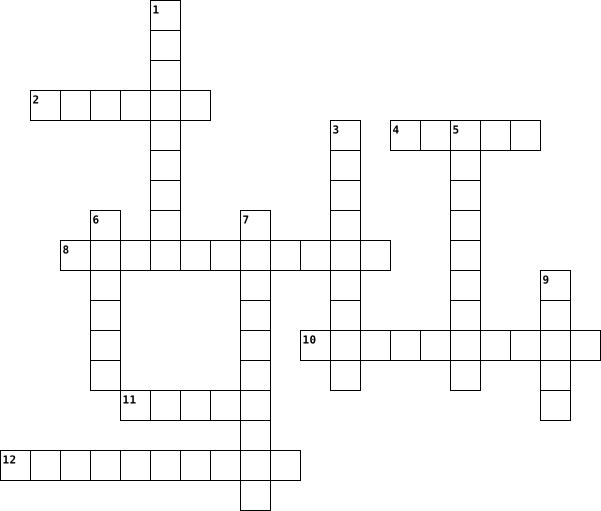
Across
- wegener first scientist to introduce the theory of plate tectonics.
- core solid layer of the earth
- caused by transform boundary
- boundary when two plate tectonics collide into each other
- thinnest layer of the earth
- current the result of differential heating
Down
- boundary when two plate tectonics spread apart from each other
- coolest science teacher
- boundary when two plate tectonics slide past each other
- biggest layer of the earth
- zone when the oceanic crust goes underneath the continental crust
- core hottest layer of the earth
12 Clues: coolest science teacher • biggest layer of the earth • thinnest layer of the earth • caused by transform boundary • core solid layer of the earth • core hottest layer of the earth • current the result of differential heating • boundary when two plate tectonics slide past each other • boundary when two plate tectonics collide into each other • ...
Pacific ring of fire- 2016-06-13

Across
- Taupo A lake in new zealand that starts with a T
- plate starts with p and ends with plate
- something pritika not good at being
- zealand the country we are living in
- starts with b and ends with dary
- there is heaps of this in christchurch
- volcanoes have ---------
Down
- not shallow and not deep, its the -------
- they explode with magma
- plate starts with n and ends with plate
- sub and duck together makes this word
- its on the hoof of a horse
12 Clues: they explode with magma • volcanoes have --------- • its on the hoof of a horse • starts with b and ends with dary • something pritika not good at being • sub and duck together makes this word • there is heaps of this in christchurch • zealand the country we are living in • not shallow and not deep, its the ------- • plate starts with p and ends with plate • ...
Earthquakes 2023-11-20

Across
- removing people from a place before an earthquake
- only earthquakes occur at this plate boundary
- at a conservative plate boundary plates move ___ each other
- instrument used to measure earthquake intensity
- _____ scale measures the effects of an earthquake
Down
- another name for constructive plate boundaries
- the outermost layer of Earth
- Zimbabwe is not on a plate ____.
- where an earthquake starts in the ground
- the area on the earth's surface directly above the focus
- a giant wave
- _____ scale measures the energy released by an earthquake
12 Clues: a giant wave • the outermost layer of Earth • Zimbabwe is not on a plate ____. • where an earthquake starts in the ground • only earthquakes occur at this plate boundary • another name for constructive plate boundaries • instrument used to measure earthquake intensity • removing people from a place before an earthquake • _____ scale measures the effects of an earthquake • ...
Subduction plate boundary 2025-11-11

Across
- This plate combines with the Philippine plate to create the Mariana Trench
- The layer of the earth which the submerging plate is being forced into
- The deepest example of an oceanic trench
- This type of plate gets subducted underneath the continental
Down
- The process of one plate being forced under another
- A narrow deep valley caused by one plate being pushed under another
- These happen when the 2 plates scrape across each other
- These form when the magma explodes out the crust
- The area in which the subducted plate gets pushed down into is the subduction _ _ _ _
- This country has a large arc of volcanos across it
10 Clues: The deepest example of an oceanic trench • These form when the magma explodes out the crust • This country has a large arc of volcanos across it • The process of one plate being forced under another • These happen when the 2 plates scrape across each other • This type of plate gets subducted underneath the continental • ...
Chapter 7 vocab 2021-10-12

Across
- magnetic feild reverses direction
- when the seafloor seperates
- magnets point north
- the contenets conected
- when one plate goes under the other
- the product of two plates seperating
- the crust and upper mantle
Down
- when two plates hit eachother
- when matereals move based on density and tepature
- the term for the contenents shifting
- giant underwater mountain ranges
- the idea that earth's crust is made of gint rock slabs
- magnets point south
- when plates slide past eachother
- caused by magma rising from plate seperation
- when [art of a plate pulls down on the rest of it
16 Clues: magnets point south • magnets point north • the contenets conected • the crust and upper mantle • when the seafloor seperates • when two plates hit eachother • giant underwater mountain ranges • when plates slide past eachother • magnetic feild reverses direction • when one plate goes under the other • the term for the contenents shifting • the product of two plates seperating • ...
Chapter 7 vocab 2021-10-12

Across
- when the seafloor seperates
- when two plates hit eachother
- caused by magma rising from plate seperation
- when one plate goes under the other
Down
- the term for the contenents shifting
- when plates slide past eachother
- magnets point north
- the product of two plates seperating
- magnetic feild reverses direction
- when part of a plate pulls down on the rest of it
- magnets point south
- giant underwater mountain ranges
- the idea that earth's crust is made of gint rock slabs
- the contenets conected
- when matereals move based on density and tepature
- the crust and upper mantle
16 Clues: magnets point north • magnets point south • the contenets conected • the crust and upper mantle • when the seafloor seperates • when two plates hit eachother • when plates slide past eachother • giant underwater mountain ranges • magnetic feild reverses direction • when one plate goes under the other • the term for the contenents shifting • the product of two plates seperating • ...
Tribute to Hope's succelent 2022-06-14

Across
- Somebody's home
- slow down and sleep 'cause its cold
- Not living
- What you yell when you attack
- Speeeeeeeeeeed
- Plate hides under plate
- The thing over your fireplace
- The the part of the earth that we stand on
- The type of heat that doesn't rely on matter
Down
- The area that a magnet has power over
- Living or once living
- The very middle of an earthquake
- The thing that teachers often lecture about
- How much stuff in an object
- The place between plates
- The cause of a volcano in the middle of a plate
16 Clues: Not living • Speeeeeeeeeeed • Somebody's home • Living or once living • Plate hides under plate • The place between plates • How much stuff in an object • What you yell when you attack • The thing over your fireplace • The very middle of an earthquake • slow down and sleep 'cause its cold • The area that a magnet has power over • The the part of the earth that we stand on • ...
James McLester 3 2023-12-12

Across
- the quakes that happen before the quake
- the more dense type of crust
- the inner most part of the earth
- very explosive with steep sides
- the place where the earthquake is the strongest
- mini earthquakes that take place after the quake
- Sliding plate boundary
- why is the inner core solid
- a crack in the earths crust
Down
- the flat volcano
- plate boundary that pulls apart
- made mostly of ash and cinders
- plate boundary that come together
- the place under ground bellow the epicenter
- where is the asthenosphere
- lava before it leaves the volcanoe
16 Clues: the flat volcano • Sliding plate boundary • where is the asthenosphere • why is the inner core solid • a crack in the earths crust • the more dense type of crust • made mostly of ash and cinders • plate boundary that pulls apart • very explosive with steep sides • the inner most part of the earth • plate boundary that come together • lava before it leaves the volcanoe • ...
Chapter 3 - Plate Tectonics Extra Credit Crossword 2016-08-08

Across
- A deep valley along the ocean floor beneath which oceanic crust slowly sinks toward the mantle.
- The process by which molten material adds new oceanic crust to the ocean floor.
- A break in Earth’s crust along which rocks move.
- Preserved remains or traces of an organism that lived in the past.
- A plate boundary where two plates move away from each other.
- A section of the lithosphere that slowly moves over the asthenosphere, carrying pieces of continental and oceanic crust.
- An undersea mountain chain where new ocean floor is produced; a divergent plate boundary.
Down
- A plate boundary where two plates move past each other in opposite directions.
- The hypothesis that the continents slowly move across Earth’s surface.
- The process by which oceanic crust sinks beneath a deep-ocean trench and back into the mantle at the convergent plate boundary.
- The name of the single landmass that began to break apart 200 million years ago and gave rise to today’s continents.
- A plate boundary where two plates move toward each other.
- A deep valley that forms where two plates move apart.
- The theory that pieces of Earth’s lithosphere are in constant motion, driven by convection currents in the mantle.
14 Clues: A break in Earth’s crust along which rocks move. • A deep valley that forms where two plates move apart. • A plate boundary where two plates move toward each other. • A plate boundary where two plates move away from each other. • Preserved remains or traces of an organism that lived in the past. • ...
Tribute to Hope's succelent 2022-06-14

Across
- Somebody's home
- slow down and sleep 'cause its cold
- Not living
- What you yell when you attack
- Speeeeeeeeeeed
- Plate hides under plate
- The thing over your fireplace
- The the part of the earth that we stand on
- The type of heat that doesn't rely on matter
Down
- The area that a magnet has power over
- Living or once living
- The very middle of an earthquake
- The thing that teachers often lecture about
- How much stuff in an object
- The place between plates
- The cause of a volcano in the middle of a plate
16 Clues: Not living • Speeeeeeeeeeed • Somebody's home • Living or once living • Plate hides under plate • The place between plates • How much stuff in an object • What you yell when you attack • The thing over your fireplace • The very middle of an earthquake • slow down and sleep 'cause its cold • The area that a magnet has power over • The the part of the earth that we stand on • ...
Plate Tectonics 2024-01-29

Across
- , instrument used to measure the magnitude of an earthquake
- , Earth's crust is broken into these types of plate
- , boundary where two plate slide past each other
- , most well known transform plate boundary in the world
- , boundary where two plates move toward each other
Down
- , underwater earthquakes that cause large ocean waves
- , a supercontinent 200 million years ago
- , boundary where two plate move away from each other
- , Divergent plate boundaries cause these
- , cycle begins with continental rifting within a large landmass
- , magma that has erupted onto Earth's surface
11 Clues: , Divergent plate boundaries cause these • , a supercontinent 200 million years ago • , boundary where two plate slide past each other • , most well known transform plate boundary in the world • , boundary where two plates move toward each other • , magma that has erupted onto Earth's surface • ...
Chapter 8 2018-12-08

Across
- Made of layers of rocks that are folded.
- The downward vertical movement of the Earth's surface.
- Squeezing stress.
- When large regions rise vertically with very little deformation.
- Areas of subsidence and regions with low elevation.
- An area of many fractured pieces of crust along a large fault.
- Stress that pulls something apart.
- A curved line of volcanoes that forms parallel to a plate boundary.
- _______ move only 1-9 cm per year, creating tall mountains.
- When divergent boundaries occur within a continent, they can form ________, or enormous splits in Earth's crust.
Down
- Made from layers of cooled molten rock and ash.
- Flat regions with high elevation.
- An extensive area of level or rolling land.
- Parallel forces acting in opposite directions.
- The upward vertical motion of the Earth's surface.
- Parallel ridges that form where blocks of crust move up or down along faults.
- Deep, underwater troughs created by one plate subducting under another plate at a convergent plate boundary.
- Where tectonic plates slide horizontally past each other.
- A change in the shape of rock caused by stress.
- The equilibrium between continental crust and the denser mantle below it.
20 Clues: Squeezing stress. • Flat regions with high elevation. • Stress that pulls something apart. • Made of layers of rocks that are folded. • An extensive area of level or rolling land. • Parallel forces acting in opposite directions. • Made from layers of cooled molten rock and ash. • A change in the shape of rock caused by stress. • ...
Chapter 8 2018-12-08

Across
- The upward vertical motion of the Earth's surface.
- A curved line of volcanoes that forms parallel to a plate boundary.
- Parallel forces acting in opposite directions.
- The equilibrium between continental crust and the denser mantle below it.
- When large regions rise vertically with very little deformation.
- An area of many fractured pieces of crust along a large fault.
- A change in the shape of rock caused by stress.
- Made from layers of cooled molten rock and ash.
- Deep, underwater troughs created by one plate subducting under another plate at a convergent plate boundary.
- Squeezing stress.
- Areas of subsidence and regions with low elevation.
Down
- An extensive area of level or rolling land.
- Made of layers of rocks that are folded.
- _______ move only 1-9 cm per year, creating tall mountains.
- When divergent boundaries occur within a continent, they can form ________, or enormous splits in Earth's crust.
- Where tectonic plates slide horizontally past each other.
- Parallel ridges that form where blocks of crust move up or down along faults.
- The downward vertical movement of the Earth's surface.
- Flat regions with high elevation.
- Stress that pulls something apart.
20 Clues: Squeezing stress. • Flat regions with high elevation. • Stress that pulls something apart. • Made of layers of rocks that are folded. • An extensive area of level or rolling land. • Parallel forces acting in opposite directions. • A change in the shape of rock caused by stress. • Made from layers of cooled molten rock and ash. • ...
Y7 End of topic crossword 2020-12-07

Across
- the point at which an earthquake origniated in the crust
- This is a famous shield volcano in Hawaii
- the area where an oceanic plate sinks beneath a continental plate
- capital city of Australia
- molten rock that can be found in the mantle
- another name for the crust of the earth
- the name of magma once it reaches the crust
- a tall and explosive volcano
- the point on the earths surface directly above the focus
- these rise and fall in the mantle and are responsible for plates moving
- the capital city of South Korea
Down
- the method of measuring the amount of damage caused by an earthquake
- the hottest layer of the earth
- the capital city of France
- Madrid is the capital city of this country
- instrument used to measure the magnitude of an earthquake
- slabs of rock that make of the crust of the earth
- A deep part of the ocean above a subduction zone. Mariana Trench is an example
- a type of plate boundary that sides past one another. Causes earthquakes
- also known as the strength of the earthquake
- type of volcano with a wide base and runny lava. Found at constructive plate margins
21 Clues: capital city of Australia • the capital city of France • a tall and explosive volcano • the hottest layer of the earth • the capital city of South Korea • another name for the crust of the earth • This is a famous shield volcano in Hawaii • Madrid is the capital city of this country • molten rock that can be found in the mantle • the name of magma once it reaches the crust • ...
Integrated Midterm Practice 2024-03-06

Across
- Rock type that can be dated with Uranium-238
- Amalgamation of all continents between 335-220 Ma
- Contains Cambrian, Ordovician, Silurian, Devonian, Carboniferous, and Permian periods
- Plates slide towards each other (boundary)
- Duration of time involving isotopic decay rate
- Amalgamation of most continents between 635-200 Ma
- The upwelling of magma to Earth’s surface
- A material datable using Carbon-14
- Two plates pulling part on land (formation)
- Original isotope
- Contains Paleogene, Neogene, and Quaternary periods
- Plates slide along each other (boundary)
- Period between 201.3-145 Ma
- Two plates pulling apart in the ocean (formation)
- Contains Triassic, Jurassic, and Cretaceous periods
Down
- Islands created by oceanic plate subduction
- Plates move apart from each other in opposing directions (boundary)
- Version of atom with extra neutrons
- Contains Hadean, Archean, and Proterozoic Eons
- Period between 251.9-201.3 Ma
- Period between 358.9-298.9 Ma
- Two plates pushing together on land (formation)
- Release of energy from transform fault slip
- When a plate is pulled beneath another plate and into the mantle
- Period between 419.2-358.9 Ma
- Valley in the ocean created by oceanic plate subduction
- Isotope after decay
27 Clues: Original isotope • Isotope after decay • Period between 201.3-145 Ma • Period between 251.9-201.3 Ma • Period between 358.9-298.9 Ma • Period between 419.2-358.9 Ma • A material datable using Carbon-14 • Version of atom with extra neutrons • Plates slide along each other (boundary) • The upwelling of magma to Earth’s surface • Plates slide towards each other (boundary) • ...
Geology 2025-05-21

Across
- Large pieces of Earth's crust that move and cause earthquakes and volcanoes.
- A boundary where two plates move away from each other.
- Waves Vibrations that travel through the Earth during an earthquake.
- When one plate sinks under another plate.
- A sudden shaking of the ground caused by moving plates.
- Heat movement in the mantle that causes plate motion.
- The layer beneath the crust where convection causes plate movement.
- Spot A fixed place where magma melts through the crust to form volcanoes.
Down
- An underwater mountain range formed at divergent boundaries.
- A boundary where two plates slide past each other.
- Melted rock beneath Earth’s surface.
- A boundary where two plates move toward each other.
- A landform created when plates push together and crust crumples.
- A crack in Earth’s crust where movement happens.
- Magma that has reached the surface of Earth.
- The place underground where an earthquake begins.
- The point on Earth’s surface directly above the earthquake's origin.
- of Fire An area around the Pacific Ocean where many volcanoes and earthquakes occur.
- The thin, outer layer of Earth we live on.
- A mountain that forms when magma erupts through the crust.
20 Clues: Melted rock beneath Earth’s surface. • When one plate sinks under another plate. • The thin, outer layer of Earth we live on. • Magma that has reached the surface of Earth. • A crack in Earth’s crust where movement happens. • The place underground where an earthquake begins. • A boundary where two plates slide past each other. • ...
super elaborate complicated extreme plate convection via convection extreme again crossword 2023-10-06

Across
- the center of the earth
- what happens when the liquid in mantel heats up
- what happens during convection
- what liquid submerges into the crust from the mantle
- what dose convection move on the crust
- an area where magma from deep within the mantle melts through the crust above it
- a plate boundary where two plates move away from each other
- a break in Earth's crust where masses of rock slip past each other
- what happens in the mantel
Down
- a plate boundary where two plates slide past each other
- a plate boundary where two plates move toward each other
- top layer of the earth
- what is caused by plate movement
- the middle liquidity part of the earth
- what happens when liquid in the mantel cools
15 Clues: top layer of the earth • the center of the earth • what happens in the mantel • what happens during convection • what is caused by plate movement • the middle liquidity part of the earth • what dose convection move on the crust • what happens when liquid in the mantel cools • what happens when the liquid in mantel heats up • ...
Earth's Structure 2019-12-16

Across
- Type of stress where an object is stretched.
- Number of physical layers of Earth.
- A break in a rock layer.
- Layer of the Earth below the tectonic plate lithosphere.
- Tectonic plate boundary where tectonic plates collide into each other.
- The deepest hole ever dug went about half way through this layer of Earth.
Down
- Type of stress where an object is squeezed together.
- Large pieces of Earth's lithosphere.
- Earth's crust makes up less than what percent of Earth by mass.
- Continental crust is about 25 _____________ thick.
- Number of chemical layers of Earth.
- Tectonic plate boundary where tectonic plates are pulled away from each other.
- A bend in a rock layer.
- _____________ crust is 3-5 miles thick.
- Tectonic plate boundary where tectonic plates slide past each other.
15 Clues: A bend in a rock layer. • A break in a rock layer. • Number of physical layers of Earth. • Number of chemical layers of Earth. • Large pieces of Earth's lithosphere. • _____________ crust is 3-5 miles thick. • Type of stress where an object is stretched. • Continental crust is about 25 _____________ thick. • Type of stress where an object is squeezed together. • ...
Nail Structure and Growth 2022-03-31

Across
- where the nail plate cells are formed
- thickened layer of skin under the nail that lies between the fingertip and the free edge of the nail plate
- is known as the onyx
- living skin at the base of the natural nail plate covering the matrix area
- tough band of fibrous tissue that connects bones and holds organs in place
- dead, colorless tissue attached to the natural nail plate
Down
- several major parts, including the nail plate, bed, matrix, cuticle eponychium, perionychium, hyponychium, ligaments, and nail folds
- hardened keratin plate that sits on and covers the nail bed
- extends over the fingertip
- living skin that supports the nail plate
10 Clues: is known as the onyx • extends over the fingertip • where the nail plate cells are formed • living skin that supports the nail plate • dead, colorless tissue attached to the natural nail plate • hardened keratin plate that sits on and covers the nail bed • living skin at the base of the natural nail plate covering the matrix area • ...
Plate Tectonics CROSSWORD!!! 2023-02-24

Across
- wegener first scientist to introduce the theory of plate tectonics.
- core solid layer of the earth
- caused by transform boundary
- boundary when two plate tectonics collide into each other
- thinnest layer of the earth
- current the result of differential heating
Down
- boundary when two plate tectonics spread apart from each other
- coolest science teacher
- boundary when two plate tectonics slide past each other
- biggest layer of the earth
- zone when the oceanic crust goes underneath the continental crust
- core hottest layer of the earth
12 Clues: coolest science teacher • biggest layer of the earth • thinnest layer of the earth • caused by transform boundary • core solid layer of the earth • core hottest layer of the earth • current the result of differential heating • boundary when two plate tectonics slide past each other • boundary when two plate tectonics collide into each other • ...
Plate Tectonics 2014-05-26

Across
- The type of plate boundary that move away from each other
- convergent boundaries form what type of natural disaster when forced up
- plates that are under water
- the fluid portion of the Earth's lower mantle below the lithosphere
- how many million years it takes for the cycle crust forming and melting down in the core
- The tectonic plate we live on
- how the intensity of an earthquake is measured
- The type of boundary that that earthquakes are made from
- top layer of the crust
Down
- when one plates moves underneath the other
- the slow movement of the continents over time
- How many major plates are there
- which type of plate that is thicker?
- A boundary were two tectonic plates are pushing against each other
- the super continent
- the first person to develop the theory of plate tectonic
16 Clues: the super continent • top layer of the crust • plates that are under water • The tectonic plate we live on • How many major plates are there • which type of plate that is thicker? • when one plates moves underneath the other • the slow movement of the continents over time • how the intensity of an earthquake is measured • ...
chapter 18 2025-12-08

Across
- is a way of serving bowls and placed in front of the host
- is givin to serving containers made of sliver, siler plate, or stainless steel
- The tableware needed by one person to eat a meal
- require more, and more vaired
- small pieces of bread
- is the most elaborate style of serving
- come in different sizes
- includes knives, forks, and spoons
- each course that follows arrives on its own plate
Down
- includes items like the dinner plate
- A long, narrow cloth that runs the length of the table
- A small portion of food served at the beginning of a meal
- refers to any item used for serving and eating food
- A beverage glass sits just above the tip of the
- is served after the table has been cleared
- place to folded napkin on the of the forks
16 Clues: small pieces of bread • come in different sizes • require more, and more vaired • includes knives, forks, and spoons • includes items like the dinner plate • is the most elaborate style of serving • is served after the table has been cleared • place to folded napkin on the of the forks • A beverage glass sits just above the tip of the • ...
Plate Tectonics & Earth's Layers 2016-01-10

Across
- this is what happens when a plate moves BELOW another plate. For example, oceanic plates subducting under continental plates creates above ground volcanos.
- Heat & pressure do this, the further down you go from the Earth's crust to the core
- this is created when 2 oceanic plates spread apart. Seafloor spreading happens, when is what happens when new seafloor is being created; like when the Atlantic Ocean began growing.
- this part of the Earth's crust is found under the oceans AND is only about 5km thick.
- the type of movement that happens when 2 or more things come together.
- this is what is created when an oceanic plate moves below a continental plate, because the oceanic plate takes water with it; which mixes with magma.
- this is a landform made when 2 continental plates crash into each other and an upheaval of land/rock happens.
- sections of the Earth's crust that move, because of the convection currents in the mantle of the Earth
- this layer of the Earth is solid in the upper and lower parts, and is liquid-like in the middle; because convection currents causes flowing of the material here.
- a large break in the Earth's crust.
- a vibration of the Earth's plates that is caused by 2 plates sliding past each other AND getting stuck on one another.
- when convection currents do THIS, heat is taken away from the plates and the plates come closer together
Down
- when convection currents do THIS, heat is added to the plates and the plates separate and move apart
- this is created when an older oceanic plate moves below another younger oceanic plate. Because the plate takes water with it when it moves below, it mixes with magma.
- this layer of the Earth's crust is solid, because there is SO MUCH heat and pressure, the nickel and iron metals are squeezed into a solid.
- these are the heat waves that travel through the Earth's mantle, and allow the plates on the crust to move.
- the type of movement that happens when 2 or more things spread apart.
- this layer of the Earth is the only COMPLETELY liquid layer of the Earth. It is made of two metals: nickel and iron.
- the movement of the Earth's crust upward. This upward motion creates mountains.
- Heat & pressure do this, the further up you go from the Earth's core to the crust
- this part of the Earth's crust is found under the continents AND is about 30km thick.
- the layer of the Earth we live on. This is the outermost layer of the Earth.
- this was the name of the Earth's continents, when all 7 of them were joined together, 200 million years ago.
23 Clues: a large break in the Earth's crust. • the type of movement that happens when 2 or more things spread apart. • the type of movement that happens when 2 or more things come together. • the layer of the Earth we live on. This is the outermost layer of the Earth. • the movement of the Earth's crust upward. This upward motion creates mountains. • ...
Digital Radiographic Artifact QA/QC – Bushong Chapter 21 2025-10-26

Across
- : A graph showing the frequency of occurrence versus pixel value.
- : Unwanted image pattern caused by scatter from behind the image receptor.
- detection : Too many fields on one plate, such as three-on-one, confuses this detection algorithm.
- : Leaving CR plates in an x-ray room can result in this unwanted exposure.
- algorithm : Algorithm used by DR systems to match acquired histogram to stored reference histogram.
- : Software correction that adjusts image data for dead pixels or rows.
- : Failure to correctly identify exposure field boundaries results in a _______ analysis error.
- : Type of compression that allows the image to be reconstructed exactly.
- artifact : Physical damage to a CR plate from rough handling or scratches produces this visible effect.
- : Process that adjusts image brightness and contrast based on histogram data.
- : Technique that allows more than one exposure field on a single imaging plate.
- : Imaging plates that have not been used for several days must undergo this before reuse.
Down
- : Damaged or scratched imaging plate often requires _______ to restore performance.
- : Misaligned exposure field edges can cause this kind of processing error.
- : Software process that equalizes pixel response to a uniform x-ray beam.
- : Mathematical process that replaces missing pixel data based on neighbors.
- : Type of compression that permanently discards some image data.
- : CR plates are sensitive to both background and _______ radiation.
- artifacts : Artifacts that arise from technologist errors in positioning, collimation, or histogram selection.
- image : Digital artifact caused by incomplete erasure of a CR imaging plate.
20 Clues: : Type of compression that permanently discards some image data. • : A graph showing the frequency of occurrence versus pixel value. • : CR plates are sensitive to both background and _______ radiation. • : Software correction that adjusts image data for dead pixels or rows. • : Type of compression that allows the image to be reconstructed exactly. • ...
Plate Tectonics 2021-12-09

Across
- What type of boundary forms subduction?
- What type of boundary forms rifts and ridges?
- What pattern do volcanoes normally form on a map?
- What layer of the Earth has a convection cycle, ultimately causing plate tectonics?
- What is created at a transform boundary (besides an earthquake)?
- Hess originally discovered this phenomena
- What theory comprises the phenomenon that the plates "drift" across the lithosphere?
- What type of valley forms at a divergent plate boundary?
- What force in the mantle moves the plates?
Down
- What is one sign of a active volcano?
- What type of wave does a seismograph read?
- What is the innermost layer of the Earth?
- What scientific rule says that matter cannot be created nor destroyed?
- What ridge is formed at a divergent plate boundary?
- How is old plate material "recycled" back into the Earth?
- What phenomena did Alfred Wegener discover?
16 Clues: What is one sign of a active volcano? • What type of boundary forms subduction? • What is the innermost layer of the Earth? • Hess originally discovered this phenomena • What type of wave does a seismograph read? • What force in the mantle moves the plates? • What phenomena did Alfred Wegener discover? • What type of boundary forms rifts and ridges? • ...
Unit 2 Lesson 2 Vocabulary Practice 2022-09-29

Across
- Type of plate boundary where a plate subducts (moves)under another
- Remove features from the surface of Earth
- Another work for mountain building
- Loosening and removal of weather rocks
- Processes that break down rock into smaller materials
- When wind, water, glaciers and gravity move weathered and eroded materials to another place
- Type of plate boundary where two plates move apart
Down
- Force in the mantle responsible for moving plates and drive continental drift
- Type of plate boundary where new crust is made
- Build features on the surface of Earth
- Type of plate boundary where two plates collide
- Type of plate boundary where two plates slide past each other
- There are two types of _________, continental and oceanic
- Occurs at a convergent boundary where one plate moves under another
14 Clues: Another work for mountain building • Build features on the surface of Earth • Loosening and removal of weather rocks • Remove features from the surface of Earth • Type of plate boundary where new crust is made • Type of plate boundary where two plates collide • Type of plate boundary where two plates move apart • Processes that break down rock into smaller materials • ...
Plates tectonic 2023-12-07

Across
- currents in the mantle that cause the movement of Earth's plates
- an underwater chain of mountains.
- Theory hat the continents were once as one large, single land mass.
- Type of plate boundary where two plates separate or move apart.
- a deep valley that forms on land at a divergent boundary where two plates move apart
- These are formed under water at divergent plate boundaries. They are areas where new ocean crust is formed.
- This forms on land at divergent plate boundaries. There is a great one in Eastern Africa.
- When one tectonic plate moves underneath another one, it's called this.
- the process by which molten material adds new crust to the ocean floor
- Theory that the lithosphere is divided into tectonic plates that move on the asthenosphere.
Down
- Type of plate boundary where two plates slide past each other in opposite directions.
- Rift This place is in Africa and the plates are coming apart.
- a mountain or hill, typically conical, having a crater or vent through which lava, rock fragments, hot vapor, and gas are being or have been erupted from the earth's crust.
- Type of plate boundary where two plates collide.
- Type of crust that is thinner and contains basalt.
- These form underwater (on the ocean floor) at most convergent boundaries.
- Layer of earth with the lowest temperature.
- The cool, outermost layer of Earth that consists of the crust and uppermost part of the mantle.
- The layer just below the lithosphere.
- the supercontinent that existed millions of years ago
20 Clues: an underwater chain of mountains. • The layer just below the lithosphere. • Layer of earth with the lowest temperature. • Type of plate boundary where two plates collide. • Type of crust that is thinner and contains basalt. • the supercontinent that existed millions of years ago • Rift This place is in Africa and the plates are coming apart. • ...
Plate Boundaries 2020-04-14

Across
- sliding
- thicker, less dense plate
- dividing
- creates earthquakes
- creates mid-ocean ridges
Down
- oceanic plate collides with a continental plate
- thinner, more dense plate
- oceanic plate goes into the mantle
- creates mountains and volcanoes
9 Clues: sliding • dividing • creates earthquakes • creates mid-ocean ridges • thinner, more dense plate • thicker, less dense plate • creates mountains and volcanoes • oceanic plate goes into the mantle • oceanic plate collides with a continental plate
Plate tectonics 2021-11-17

Across
- _____ current found in the mantle
- ______ is caused by different density in convergent plate boundary
- Plates separating
- The second layer of the earth
- Plates sliding
Down
- _____tectonics
- Caused by Transform Plate boundary's
- plates colliding
- Caused by Divergent plate boundary's
- ____is hot molten rock
10 Clues: _____tectonics • Plates sliding • plates colliding • Plates separating • ____is hot molten rock • The second layer of the earth • _____ current found in the mantle • Caused by Transform Plate boundary's • Caused by Divergent plate boundary's • ______ is caused by different density in convergent plate boundary
Plate Boundaries 2022-02-25

Across
- a change to the structure of the Earth by tectonic activities
- two plates coming together
- study of the movement of large masses of rock, known as plates, on the Earth’s surface; includes folds, faults, and plate movement
- theory that describes plate movement and how it affects Earth’s geologic features
- a region where two lithospheric plates meet
- distinct sections of the lithosphere which make up the outermost layer of the Earth
- undersea mountain range formed where two parts of the Earth’s crust are moving apart
Down
- two plates moving apart
- scientist who proposed the Theory of Plate Tectonics
- large bowl shaped depression that holds ocean water; regions of crust below sea level
- an explanation of a set of related observations or events based upon proven hypotheses and verified multiple times by groups of detached researchers; can be used to explain and predict natural phenomena
- thinner part of Earth’s crust that lies underneath the ocean basins
- process where one plate slides under another
- two plates sliding past each other in opposite directions
- thicker part of Earth’s crust that forms the large land masses
- formation of new oceanic crust due to the upwelling of magma at mid-ocean ridges
16 Clues: two plates moving apart • two plates coming together • a region where two lithospheric plates meet • process where one plate slides under another • scientist who proposed the Theory of Plate Tectonics • two plates sliding past each other in opposite directions • a change to the structure of the Earth by tectonic activities • ...
Plate tectonics 2021-02-05

Across
- boundary, occurs when plates move towards each other and collide
- wave, a wave of energy that travels through the Earth and away from an earthquake in all directions
- is a fracture or zone of fractures between two blocks of rock
- is a channel for conveying water or other fluid
- boundary, occurs when two tectonic plates move away from each other
- the point on the earth's surface vertically above the focus of an earthquake
- zone, is a collision between two of Earth's tectonic plates, where one plate sinks into the mantle underneath the other plate
Down
- hot molten or semifluid rock erupted from a volcano or fissure, or solid rock resulting from cooling of this
- a mountain or hill, typically conical, having a crater or vent through which lava, rock fragments, hot vapor, and gas are being or have been erupted from the earth's crust
- is not expected to ever erupt again
- hot fluid or semifluid material below or within the earth's crust from which lava and other igneous rock is formed on cooling
- a sudden and violent shaking of the ground, sometimes causing great destruction, as a result of movements within the earth's crust or volcanic action
- a long high sea wave caused by an earthquake or submarine landslide
- is the outermost shell of a planet
- plates, are pieces of Earth's crust and uppermost mantle, together referred to as the lithosphere
- boundary, is a place where plates slide sideways past each other
- have not erupted for a very long time but may erupt at a future time
17 Clues: is the outermost shell of a planet • is not expected to ever erupt again • is a channel for conveying water or other fluid • is a fracture or zone of fractures between two blocks of rock • boundary, occurs when plates move towards each other and collide • boundary, is a place where plates slide sideways past each other • ...
Plate Tectonics 2021-01-10

Across
- Are the remains of things that lived long ago
- Plates that slide past each other
- A narrow strip of land connecting two larger land areas
- Things have been melted, often by great heat
- Things move away from each other
- The largest volcano on Earth
- Soft layer of melted rock under the lithosphere
- A German scientist in 1912 that suggested that at one time all of the continents were joined together in a supercontinent called Pangaea
Down
- As the plates move the continents on them move as well
- Things move closer to each other
- Where 90% of all of the volcanoes are located
- The process in which one tectonic plate is forced beneath the edge of another plate
- The transform fault that extends for hundreds of miles through the state of California
- Earth's rigid outer layer
- The "Supercontinent"
- A British geologist that purposed that the heat from Earth's mantel caused continental drift
- The portion of the Earth lying between the crust and the core
17 Clues: The "Supercontinent" • Earth's rigid outer layer • The largest volcano on Earth • Things move closer to each other • Things move away from each other • Plates that slide past each other • Things have been melted, often by great heat • Where 90% of all of the volcanoes are located • Are the remains of things that lived long ago • ...
Plate Tectonics 2021-11-16

Across
- the closer to the epicenter of the earthquake, the more intense the shaking
- a crack in the Earth's crust
- a vibration of the Earth that is produced by a quick release of energy
- machine used to measure the seismic waves
- causes subduction, earthquakes, formation of trenches and mountains
- where inside the Earth that the earthquake occurred
- study of the large scale motion of the plates that make up the Earth's lithosphere
Down
- where on the Earth's surface (directly above the focus) that the earthquake occurred
- the measure of the earthquake remains unchanged despite the distance from the epicenter
- wave that makes the ground shake and roll
- causes seafloor spreading, mid-ocean ridges, earthquakes and rift valleys
- causes major earthquake
- wave that compresses and expands
- earth consists of ___ major plates
- tectonic plates are ____________ moving
- the data that is collected from earthquakes
- wave that vibrates side to side or up and down
17 Clues: causes major earthquake • a crack in the Earth's crust • wave that compresses and expands • earth consists of ___ major plates • tectonic plates are ____________ moving • wave that makes the ground shake and roll • machine used to measure the seismic waves • the data that is collected from earthquakes • wave that vibrates side to side or up and down • ...
Plate tectonics 2012-10-22

Across
- boundary boundary between two colliding plates
- the bending of rock layers
- layer between the crust and the core
- outermost, rigid layer of the Earth
- a squeezing force
- spreading new lithosphere is created here
- outermost layer of the Earth
- plate piece of the lithosphere that moves on the asthenosphere
Down
- drift theory that continents drift apart
- boundary boundary between two plates that are sliding past each other
- zone a region where a an oceanic plate sinks down into the athenosphere
- core solid, dense center of the Earth
- soft layer of the mantle
- boundary boundary between two plates moving away from each other
- a pulling force
- a break in the Earth's crust
- core liquid layer of the Earth's core
17 Clues: a pulling force • a squeezing force • soft layer of the mantle • the bending of rock layers • a break in the Earth's crust • outermost layer of the Earth • outermost, rigid layer of the Earth • layer between the crust and the core • core solid, dense center of the Earth • core liquid layer of the Earth's core • drift theory that continents drift apart • ...
Plate Tectonics 2014-11-23

Across
- drift theory that continents drift apart
- a pulling force
- outermost layer of the Earth
- a region where a an oceanic plate sinks down into the athenosphere
- boundary between two colliding plates
- core solid, dense center of the Earth
- boundary between two plates moving away from each other
- a break in the Earth's crust
Down
- layer between the crust and the core
- soft layer of the mantle
- new lithosphere is created here
- plate piece of the lithosphere that moves on the asthenosphere
- the bending of rock layers
- a squeezing force
- boundary between two plates that are sliding past each other
- core liquid layer of the Earth's core
- outermost, rigid layer of the Earth
17 Clues: a pulling force • a squeezing force • soft layer of the mantle • the bending of rock layers • outermost layer of the Earth • a break in the Earth's crust • new lithosphere is created here • outermost, rigid layer of the Earth • layer between the crust and the core • boundary between two colliding plates • core solid, dense center of the Earth • ...
Plate Techtonics 2016-03-31

Across
- Atlantic Ridge- is a mid-ocean ridge, a divergent tectonic plate or constructive plate boundary located along the floor of the Atlantic Ocean, and part of the longest mountain range in the world.
- a mountain or hill, typically conical, having a crater or vent through which lava, rock fragments, hot vapor, and gas are being or have been erupted from the earth's crust.
- boundary- are places where plates slide sideways past each other.
- boundary- is an actively deforming region where two or more tectonic plates or fragments of the lithosphere move toward one another and collide.
- Currents- a current in a fluid that results from convection.
- a sudden and violent shaking of the ground, sometimes causing great destruction, as a result of movements within the earth's crust or volcanic action.
- of Plate Tectonics- a theory of global tectonics in which the lithosphere is divided into a number of crustal plates, each of which moves on the plastic asthenosphere more or less independently to collide with, slide under,or move past adjacent plates.
- a long, narrow ditch.
- ranges- a line of mountains connected by high ground.
Down
- boundary- is a linear feature that exists between two tectonic plates that are moving away from each other.
- of fire- an area in the basin of the Pacific Ocean where a large number of earthquakes and volcanic eruptions occur.
- Valley- a large elongated depression with steep walls formed by the downward displacement of a block of the earth's surface between nearly parallel faults or fault systems.
- crust- the relatively thick part of the earth's crust that forms the large landmasses. It is generally older and more complex than the oceanic crust.
- the sideways and downward movement of the edge of a plate of the earth's crust into the mantle beneath another plate.
- an extended break in a body of rock, marked by the relative displacement and discontinuity of strata on either side of a particular surface.
- ridges- an elevated region with a central valley on an ocean floor at the boundary between two diverging tectonic plates where new crust forms from upwelling magma.
- Andreas Fault- a continental transform fault that extends roughly 1300 km through California. It forms the tectonic boundary between the Pacific Plate and the North American Plate.
17 Clues: a long, narrow ditch. • ranges- a line of mountains connected by high ground. • Currents- a current in a fluid that results from convection. • boundary- are places where plates slide sideways past each other. • boundary- is a linear feature that exists between two tectonic plates that are moving away from each other. • ...
Plate Tectonics 2017-06-20

Across
- The movement of plates next to each other, causing long linear valleys
- The movement of plates toward each other, causing mountain ranges
- A type of plate in the Earth's crust that moves over magma
- The 'o' in BOLTSS stands for...
- A mountain range above India, that includes Mount Everest
- Tectonic plates move at the same rate as your....... grow
- A weak spot in the mantle, where magma can escape to form volcanos
- A mountain range that runs through Canada and USA
Down
- Molten rock that moves in currents in the mantle
- When a heavier, denser plate is pushed under another
- A type of plate that is below an ocean
- The study of the Earth's environment, landscapes and people
- A mountain range on the west coast of South America
- The gradual movement of continents on the Earth's surface
- The type of plate that is under land
- The part of the Earth that contains magma and is between the crust and the core
- The movement of plates away from each other, creating ridges and rift valleys
17 Clues: The 'o' in BOLTSS stands for... • The type of plate that is under land • A type of plate that is below an ocean • Molten rock that moves in currents in the mantle • A mountain range that runs through Canada and USA • A mountain range on the west coast of South America • When a heavier, denser plate is pushed under another • ...
Plate Bounderies 2022-03-07

Across
- each cycle of spreading and intrusion of magma during seafloor spreading results in
- Subduction results in the formation of
- what forms when plates move apart
- Volcanoes that form far from plate boundaries are associated with
- what forms when the top or side of a volcano collapses into the magma chamber
- Which volcanoes are the most explosive?
- Which boundary is crust neither formed along nor destroyed
- What can the differences in travel times between P and S waves be used to determine?
Down
- Where do most volcanoes form?
- many early mapmakers thought earth's continents had moved based on
- Compared to ocean crust near deep-sea Trenches, crust near ocean ridges is
- What is oceanic crust made of
- The magnetic pattern of ocean-floor rocks on one side of an ocean ridge is
- Features found at divergent boundaries include
- the driving forces of tectonic plates are related to convection currents in earths
- continental-continental plate collisions produce what?
- Approximately, how much of earths surface is above sea level
17 Clues: Where do most volcanoes form? • What is oceanic crust made of • what forms when plates move apart • Subduction results in the formation of • Which volcanoes are the most explosive? • Features found at divergent boundaries include • continental-continental plate collisions produce what? • Which boundary is crust neither formed along nor destroyed • ...
plate tectonics 2021-12-09

Across
- What boundary occurs when two plates pull apart.
- What occurs when hot rock moves in circular motions, hot rock going up and cold rock down?
- How does igneous rock turn into sediments?
- Where do convection currents occur?
- What boundary occurs when 2 plates move next to eachother?
- What do divergent boundries form?
- What do divergent boundaries cause other than ridges?
Down
- What plate boundary is it when a sudbuction zone occurs?
- What plate goes under the other.
- What is the crust of the upper mantle?
- What forms when two continental plates collide?
- How does magma turn into igneous rock?
- What shows up in extrusive and instrusive igneous rock to tell them apart?
- What do sediments go through to get to sedimentary rock?
- What happens when the ground shakes?
- What can transform boundaries make other than earthquakes?
- What cools that turns into igneous rock?
17 Clues: What plate goes under the other. • What do divergent boundries form? • Where do convection currents occur? • What happens when the ground shakes? • What is the crust of the upper mantle? • How does magma turn into igneous rock? • What cools that turns into igneous rock? • How does igneous rock turn into sediments? • What forms when two continental plates collide? • ...
Plate Tectonics 2022-01-02

Across
- Thinnest Layer
- Plates colliding
- Rigid layer on crust
- Product of Convection Currents
- Surrounds the inner core
- Soft layer of the mantle
- Plates separating
- The denser crust
- Thickest Layer
- Used to track plate tectonic movement
- Process to make magma and new land
Down
- The belief of a super continent
- The less dense crust
- Where to plates meet
- Densest Layer
- Happens in order to make magma
- Plates Sliding
17 Clues: Densest Layer • Thinnest Layer • Plates Sliding • Thickest Layer • Plates colliding • The denser crust • Plates separating • The less dense crust • Where to plates meet • Rigid layer on crust • Surrounds the inner core • Soft layer of the mantle • Product of Convection Currents • Happens in order to make magma • The belief of a super continent • Process to make magma and new land • ...
Plate Motion 2024-03-19

Across
- An underwater mountain chain where new ocean floor is formed as two tectonic plates pull away from each other.
- The theory that Earth's outer shell is divided into several plates that glide over the mantle, the rocky inner layer above the core.
- The very hot center of the Earth, consisting of a solid inner core and a liquid outer core.
- Large pieces of the Earth's lithosphere that move and interact with one another.
- A fracture along which rocks on either side have moved relative to each other.
- A plate boundary where two tectonic plates slide past each other horizontally.
- An instrument used to measure and record earthquakes.
- The shaking and trembling that results from movement of rock beneath Earth's surface.
- Molten rock beneath the Earth's surface that forms igneous rock when it cools.
Down
- A plate boundary where two tectonic plates move away from each other, often leading to the formation of new crust.
- An area where one tectonic plate is being forced down into the mantle beneath another plate.
- Molten rock that flows out of a volcano during an eruption.
- A natural feature of the Earth's surface, like a mountain, valley, or plain.
- A plate boundary where two tectonic plates move toward each other, leading to collisions.
- A mountain that opens downward to a pool of molten rock below the surface of the Earth.
- The layer of rock between the Earth's crust and core.
- The gradual movement of the continents across Earth's surface through geological time.
17 Clues: The layer of rock between the Earth's crust and core. • An instrument used to measure and record earthquakes. • Molten rock that flows out of a volcano during an eruption. • A natural feature of the Earth's surface, like a mountain, valley, or plain. • A fracture along which rocks on either side have moved relative to each other. • ...
Plate tectonics 2025-03-28

Across
- the thing that is caused by two oceanic plates going apart
- the part containing the upper mantle and causing the plate tectonics to move
- the part of the earth containing the crust and the upper mantle
- the part containing all the mantle
- where one plate meets another
- the hottest part of earth
- The land we stand on
- The part of the core that is liquid
- The theory that Alfred Wegner came up with
- when two plates go apart
- The thing that all plates are made of
Down
- the hottest part of earth
- the type of boundaries that slides past one another
- the idea Alfred Wegner came up with
- when one plate goes under another
- The second layer of the earth
- The first layer of the earth
- the type of boundary where two plates Collide
18 Clues: The land we stand on • when two plates go apart • the hottest part of earth • the hottest part of earth • The first layer of the earth • where one plate meets another • The second layer of the earth • when one plate goes under another • the part containing all the mantle • the idea Alfred Wegner came up with • The part of the core that is liquid • ...
Plate tectonics 2025-06-06

Across
- A fracture in the Earth's crust where rocks have moved.
- A shaking of the Earth caused by the release of energy.
- A boundary where plates move apart, often creating mid-ocean ridges or rift valleys.
- Current The movement of heat within the mantle that drives plate tectonics.
- The soft, plastic layer beneath the lithosphere where plates move.
- The outermost solid layer of the Earth, either oceanic or continental.
- A boundary where plates collide, leading to subduction, earthquakes, or mountain building.
- The rigid outer layer of the Earth, composed of the crust and upper mantle.
Down
- An area where two or more tectonic plates meet.
- The supercontinent that existed before the breakup of continents.
- A boundary where plates slide past each other, causing earthquakes.
- The layer beneath the Earth's crust, mostly solid but capable of flowing.
- A chain of underwater mountains where new oceanic crust is formed.
- A deep, narrow depression in the ocean floor formed by subduction.
- An area where one tectonic plate slides under another.
- An opening in the Earth's crust through which lava, gas, and ash erupt.
- Wegener Scientist who first proposed the theory of continental drift.
17 Clues: An area where two or more tectonic plates meet. • An area where one tectonic plate slides under another. • A fracture in the Earth's crust where rocks have moved. • A shaking of the Earth caused by the release of energy. • The supercontinent that existed before the breakup of continents. • The soft, plastic layer beneath the lithosphere where plates move. • ...
Mason's Puzzle 2015-05-01

Across
- is the portion of motion of a tectonic plate that can be accounted for by its subduction.
- is the study of the record of the Earth's magnetic field in rocks, sediment, or archaeological materials.
- the sideways and downward movement of the edge of a plate of the earth's crust into the mantle beneath another plate.
- a line on a diagram or map connecting points relating to the same time or equal times.
- known as a destructive plate boundary (because of subduction), is an actively deforming region where two (or more) tectonic plates or fragments of the lithosphere move toward one another and collide.
- A change in the Earth's magnetic field resulting in the magnetic north being aligned with the geographic south, and the magnetic south being aligned with the geographic north
- is the movement of the Earth's continents relative to each other, thus appearing to "drift" across the ocean bed.
Down
- process that occurs at mid-ocean ridges, where new oceanic crust is formed through volcanic activity and then gradually moves away from the ridge.
- Places where plates slide past each other
- outer rigid layer of the earth (the lithosphere) is divided into a couple of dozen "plates" that move around across the earth's surface relative to each other, like slabs of ice on a lake.
- an instrument used for measuring magnetic forces, especially the earth's magnetism.
- a large elongated depression with steep walls formed by the downward displacement of a block of the earth's surface between nearly parallel faults or fault systems.
- was a supercontinent that existed during the late Paleozoic and early Mesozoic eras.
- or divergent plate boundary (also known as a constructive boundary or an extensional boundary) is a linear feature that exists between two tectonic plates that are moving away from each other.
- sliding plate force is a proposed mechanism for plate motion in plate tectonics.
15 Clues: Places where plates slide past each other • sliding plate force is a proposed mechanism for plate motion in plate tectonics. • an instrument used for measuring magnetic forces, especially the earth's magnetism. • was a supercontinent that existed during the late Paleozoic and early Mesozoic eras. • ...
Earth Forces 2024-11-04

Across
- The type of plate boundary where the plates slide past each other.
- Iceland sits on this type of plate boundary.
- The scale used to measure an earthquake.
- There are two types of crust - continental and?
- These happen at every type of plate boundary.
- This is the type of current that moves the tectonic plates.
Down
- The type of plate boundary where the plates move towards each other.
- Scientists used these to prove there was once one large super continent.
- The hottest layer in the Earth
- An earthquake under water can trigger one of these.
- The name for hot molten rock which spews from a volcano.
- The UK sits on this tectonic plate.
12 Clues: The hottest layer in the Earth • The UK sits on this tectonic plate. • The scale used to measure an earthquake. • Iceland sits on this type of plate boundary. • These happen at every type of plate boundary. • There are two types of crust - continental and? • An earthquake under water can trigger one of these. • The name for hot molten rock which spews from a volcano. • ...
Layers of the Earth & Plate Tectonics 2025-09-09

Across
- Molten rock that has erupted onto Earth’s surface through a volcano or fissure.
- The breakdown of rocks and minerals at Earth's surface through physical, chemical, or biological processes, without moving the material.
- Sudden shaking of the ground caused by the release of energy along faults or tectonic plate boundaries.
- A type of plate boundary where two tectonic plates move toward each other, often resulting in mountain formation, earthquakes, or subduction.
- The scientific theory that Earth's lithosphere is broken into plates that move over the mantle due to convection currents, causing geological activity.
- The thick, middle layer of the Earth is located between the crust and the outer core. It is composed of semi-solid rock that flows slowly, driving plate tectonics.
- Underwater Mountain ranges formed by divergent boundaries where new oceanic crust is created by rising magma.
- A type of rock formed when sediments are compacted and cemented together over time, often containing fossils and forming in layers.
- The process by which natural forces like water, wind, ice, or gravity wear away rocks and soil and transport them from one location to another.
- A region where one tectonic plate sinks beneath another into the mantle, usually forming trenches, earthquakes, and volcanoes.
- An opening in Earth’s crust where magma, gases, and ash erupt onto the surface; often located at plate boundaries or hot spots.
Down
- Molten rock is located beneath Earth’s surface; it can rise to form lava during volcanic eruptions.
- A type of plate boundary where two tectonic plates move away from each other, creating new crust, often seen at mid-ocean ridges.
- The outermost solid layer of the Earth, composed of rocks and minerals. It includes both the continental crust (land) and oceanic crust (under oceans).
- The rigid outer layer of the Earth consists of the crust and the uppermost part of the mantle. It is broken into tectonic plates.
- Circular movements of fluid (liquid or gas) caused by the rise of warmer, less dense material and the sinking of cooler, denser material, driving heat transfer and, in the Earth, plate movement.
- The innermost layer of the Earth, composed primarily of solid iron and nickel, despite the extreme heat, due to immense pressure.
- A type of plate boundary where two tectonic plates slide past each other horizontally, often causing earthquakes.
- The layer of the Earth beneath the mantle, composed of liquid iron and nickel. Its movement generates the Earth’s magnetic field.
- The geological process in which sediments, soil, and rocks are added to a landform or land mass, typically after being transported by wind, water, ice, or gravity.
20 Clues: Molten rock that has erupted onto Earth’s surface through a volcano or fissure. • Molten rock is located beneath Earth’s surface; it can rise to form lava during volcanic eruptions. • Sudden shaking of the ground caused by the release of energy along faults or tectonic plate boundaries. • ...
Plate Tectonics 2020-02-23

Across
- basins / Dense crust that sinks lower in the asthenosphere than the less dense continental crust resulting in depression on Earth's surface and fills with water
- / Major geological events that occur when plates shift suddenly and release stored energy; a frequent occurrence at transform boundaries
- / what happens when two plates of equal density converge
- Plate / A tectonic plate division of the lithosphere that is composed entirely of oceanic crust; lies beneath the Pacific
- plate / A tectonic plate division of the lithosphere including most of the land masses of Europe and Asia
- / occurs when one plate is denser than another and is forced below as the two plates converge at their boundary
Down
- American Plate / A tectonic plate division of the lithosphere including the continental crust of Greenland, North America, Siberia, and the surrounding oceanic crust.
- / Major geological events that occur when a dense plate subducts below a less dense plate
- / Huge pieces of lithosphere that slowly move on the asthenosphere, and consists of the crust and the rigid, upppermost part of the mantle
- plate / A tectonic plate division of the lithosphere composed of the continental crust of Africa and surrounding oceanic crust
10 Clues: / what happens when two plates of equal density converge • / Major geological events that occur when a dense plate subducts below a less dense plate • plate / A tectonic plate division of the lithosphere including most of the land masses of Europe and Asia • ...
Rola khalil 2022-04-28

Across
- divergent boundary occurs when two tectonic plates move away from each other. ... Two plates sliding past each other forms a transform plate boundary
- the sideways and downward movement of the edge of a plate of the earth's crust into the mantle beneath another plate.
- results suggest that tectonic plates also need this type of lubrication to keep moving."
- Rocks and Plate Boundaries. Intense igneous activity happens along divergent and some convergent plate boundaries.
- Metamorphic rocks result from the forces active during plate tectonic processes.
Down
- Plate tectonics is a scientific theory that explains how major landforms are created as a result of Earth's subterranean movements.
- Continental drift is the hypothesis that the Earth's continents have moved over geologic time relative to each other.
- divergent boundary occurs when two tectonic plates move away from each other. Along these boundaries, earthquakes are common and magma (molten rock).
- of rock) that has formed from sediment deposited by water or air.
- This occurs when plates move towards each other and collide. When a continental plate meets an oceanic plate, the thinner, denser, and more flexible oceanic plate sinks beneath the thicker, more rigid continental plate
10 Clues: of rock) that has formed from sediment deposited by water or air. • Metamorphic rocks result from the forces active during plate tectonic processes. • results suggest that tectonic plates also need this type of lubrication to keep moving." • Rocks and Plate Boundaries. Intense igneous activity happens along divergent and some convergent plate boundaries. • ...
nails disease and disorders 2025-04-03

Across
- any deformity or disease of the natural nails
- nail that has turned a variety of colors; may indicate surface staining, a systemic disorder, or poor blood circulation
- nail plate fungal infection, consisting of whitish patches that can be scraped off the nail’s surface or long whitish or pale yellowish streaks within the nail plate
- also known as trumpet nail; a form of dramatically increased nail curvature of the free edge, whereby the nail can curl in upon itself or may be deformed only on one sidewall
- inflammation of the nail matrix followed by shedding of the natural nail caused by infection or injury
- separation and falling off of a nail plate from the nail bed; caused by infection, matrix injury, systemic illness, or medical procedure
- also known as bitten nails; result of a habit of chewing the nail or chewing the hardened skin surrounding the nail plate
Down
- bacterial inflammation of the tissues surrounding the nail; redness, pus, and swelling are usually present
- separation of the nail plate and bed, often due to injury or allergic reactions
- irregular split or brittle nails appearing as nail plate surface roughness; potentially caused by heredity, matrix injury, excessive exposure to cuticle removers, harsh cleaning agents, or aggressive filing techniques
- damaged skin around the nail plate (often on the eponychium) becomes split or torn
- whitish discoloration found inside the nail plate, usually caused by injury to the nail matrix
- also known as ingrown nail; nail grows into the living tissue around the nail
13 Clues: any deformity or disease of the natural nails • also known as ingrown nail; nail grows into the living tissue around the nail • separation of the nail plate and bed, often due to injury or allergic reactions • damaged skin around the nail plate (often on the eponychium) becomes split or torn • ...
Plate Tectonics Vocab Part 2 Crossword Puzzle 2024-11-20

Across
- A plate boundary where two plates pull apart as result of tension stress.
- An opening in the earth's crust through which lava, volcanic ash, and gasses escape.
- Molten rock BELOW Earth's surface.
- The process of creating new ocean floor at mid-ocean ridge that moves plates apart.
- A plate boundary where two plates come together as result of compression stress.
- An underwater volcanic mountain chain where new ocean floor is formed.
- When dense oceanic plate sinks below a less dense continental plate and melts and creates volcanoes.
- A plate boundary where two plates slide past each other in opposite directions as result of shear stress.
Down
- To cause damage or DESTROY.
- Molten rock ON Earth's surface.
- To build up or CREATE.
- Force behind plate tectonics when heated mantle rises and pushes plates apart and cooled mantle sinks where plates come together.
12 Clues: To build up or CREATE. • To cause damage or DESTROY. • Molten rock ON Earth's surface. • Molten rock BELOW Earth's surface. • An underwater volcanic mountain chain where new ocean floor is formed. • A plate boundary where two plates pull apart as result of tension stress. • A plate boundary where two plates come together as result of compression stress. • ...
Tectonic Plate Vocab Quiz 2021-10-01

Across
- When magnetized objects, such as compass needles, orient themselves to point north.
- When magnetized objects reverse direction and orient themselves to point south.
- The rigid outermost layer of the Earth that includes the uppermost mantle and crust.
- The boundary between two plates that slide past each other.
- The circulation of particles within a material caused by differences in thermal energy and density.
- The process that occurs when one tectonic plate moves under another tectonic plate.
- The process by which new oceanic crust forms along a mid-ocean ridge and older oceanic crust moves away from the ridge.
- The boundary between two plates that move toward each other.
Down
- The process that results when magma rises at a mid-ocean ridge and pushes oceanic plates in two different directions.
- Theory that Earth's surface is broken into large, rigid pieces that move with respect to each other.
- An event that causes a magnetic field to reverse direction.
- The boundary between two plates that move away from each other.
- The process that results when a dense oceanic plate sinks beneath a more buoyant plate along a subduction zone, pulling the rest of the plate that trails behind it.
- The movement of Earth's continents over time.
- Name given to a supercontinent that began to break apart approximately 168 million years ago.
- Long, narrow mountain range on the ocean floor; formed by magma at divergent plate boundaries.
16 Clues: The movement of Earth's continents over time. • An event that causes a magnetic field to reverse direction. • The boundary between two plates that slide past each other. • The boundary between two plates that move toward each other. • The boundary between two plates that move away from each other. • ...
Plate Boundaries 2022-02-25

Across
- a change to the structure of the Earth by tectonic activities
- two plates coming together
- study of the movement of large masses of rock, known as plates, on the Earth’s surface; includes folds, faults, and plate movement
- theory that describes plate movement and how it affects Earth’s geologic features
- a region where two lithospheric plates meet
- distinct sections of the lithosphere which make up the outermost layer of the Earth
- undersea mountain range formed where two parts of the Earth’s crust are moving apart
Down
- two plates moving apart
- scientist who proposed the Theory of Plate Tectonics
- large bowl shaped depression that holds ocean water; regions of crust below sea level
- an explanation of a set of related observations or events based upon proven hypotheses and verified multiple times by groups of detached researchers; can be used to explain and predict natural phenomena
- thinner part of Earth’s crust that lies underneath the ocean basins
- process where one plate slides under another
- two plates sliding past each other in opposite directions
- thicker part of Earth’s crust that forms the large land masses
- formation of new oceanic crust due to the upwelling of magma at mid-ocean ridges
16 Clues: two plates moving apart • two plates coming together • a region where two lithospheric plates meet • process where one plate slides under another • scientist who proposed the Theory of Plate Tectonics • two plates sliding past each other in opposite directions • a change to the structure of the Earth by tectonic activities • ...
Volcanoes 2023-03-18

Across
- A volcano that will not erupt again
- Magma that flows out onto the Earth’s surface
- Molten rock beneath the Earth’s crust
- A volcano with regular eruptions
- A low, flat volcano, made from runny lava
- Differences in temperature of material beneath the plates of the Earth’s crust leads to the creation of currents to transfer the heat. These currents move the plates above them
- Region created by the action of two tectonic plates colliding and the less dense plate, submerges underneath the denser one
- A volcanic mudlfow that contains a mixture of rocky debris, ash and water
- A volcano that hasn’t erupted for many years but activity can be detected inside
Down
- Type of energy that can be derived from heat within the Earth's crust
- Plate boundaries where two plates are sliding past eachother in opposite directions
- Rigid segments of rock that make up the Earth’s crust, they meet at plate boundaries where volcanoes are created
- Plate boundaries where two plates are moving away from eachother
- A high, steep-sided volcano made from thick lava
- Mass movement of rocks and soil down a slope that is often triggered by heavy rain
- Plate boundaries that move towards eachother and collide
16 Clues: A volcano with regular eruptions • A volcano that will not erupt again • Molten rock beneath the Earth’s crust • A low, flat volcano, made from runny lava • Magma that flows out onto the Earth’s surface • A high, steep-sided volcano made from thick lava • Plate boundaries that move towards eachother and collide • ...
Chapter 7 2021-10-12

Across
- when two tectonic plates move away from each other
- The main heat transfer mechanism in the Earth's mantle is convection, a thermally driven process
- the process by which the North pole is transformed into a South pole and the South pole becomes the North pole
- the rigid outer part of the earth, consisting of the crust and upper mantle
- Magnetic minerals in the rock having the same polarity as the Earth's present magnetic field
Down
- The layers on the floor that if they open up they let out lava and earthquakes
- A elevated area that spews lava
- When the tectonic plates large slabs of the lithosphere split apart.
- when two tectonic plates collide
- a change of the earth's magnetic field to the opposite
- a proposed driving force for plate motion in plate tectonics
- The moving of the continent
- when two plates slide past each other, horizontally
- slab pull is a part of the motion of a tectonic plate
- What was before the continents split up
- the sideways and downward movement of the edge of the plate of the earth's crust into the mantle beneath another plate
16 Clues: The moving of the continent • A elevated area that spews lava • when two tectonic plates collide • What was before the continents split up • when two tectonic plates move away from each other • when two plates slide past each other, horizontally • slab pull is a part of the motion of a tectonic plate • a change of the earth's magnetic field to the opposite • ...
7th grade Ch. 10 Science vocab 2023-01-26

Across
- Is the equilibrium between continental crust and the denser mantle below it
- squeezing stress
- stress that pulls something apart
- areas of subsidence and regions with low elevation
- mountains are made of layers of rocks that are folded
- flat regions with high elevations
- mountain are parallel ridges that form where blocks of crust move up or down along faults
- zone an area of many fractured pieces of crust along a large fault
Down
- arc a curved line of volcanoes that forms parallel to a plate boundary
- a change in the shape of rock caused by stress
- trenches are deep underwater troughs created by an oceanic plate subducting under another plate at a convergent plate boundary
- parallel forces acting in opposite directions
- the downward motion of earth's surface
- the upward motion of earth’s surface
- faults where blocks of crust slide horizontally past each other
- is an extensive area of level or rolling land
16 Clues: squeezing stress • stress that pulls something apart • flat regions with high elevations • the upward motion of earth’s surface • the downward motion of earth's surface • parallel forces acting in opposite directions • is an extensive area of level or rolling land • a change in the shape of rock caused by stress • areas of subsidence and regions with low elevation • ...
plate tectonics 2021-12-10

Across
- the largest plate
- cooled metamorphic rock in the volcano.
- the athenosphere hold it
- when 2 plates pull apart
- the man who came up with plate tectonics
- cooled magma in the volcano
- compacted sediments
Down
- when 2 plates collide
- when 2 plates slide past each other
- cooled magma outside of the volcano.
- cooled metamorphic rock outside of the volcano
- is in the mantle
- has the athenoshere in it
- igneous rock that has been eroded
14 Clues: is in the mantle • the largest plate • compacted sediments • when 2 plates collide • the athenosphere hold it • when 2 plates pull apart • has the athenoshere in it • cooled magma in the volcano • igneous rock that has been eroded • when 2 plates slide past each other • cooled magma outside of the volcano. • cooled metamorphic rock in the volcano. • ...
Nail Structure and Growth Review 2024-08-09

Across
- What part of the nail unit protects the tips of fingers and toes?
- The length, width, and curvature of the matrix determine the _______, width, and curvature of the nail plate.
- Toenails are ______ than fingernails because the toenail matrix is longer.
- ________ can make the nail plate grow thicker.
- What is the living skin that supports the nail plate as it grows to the free edge?
- The thickened layer of skin that connects the fingertip to the free edge of the nail is the ________.
- The ______ content of a healthy nail is 15-25%
- The visible part of the matrix that extends from underneath the living skin to create a half-moon shape is the _____.
- If the hyponychium is damaged, _______ under the nail plate is possible.
Down
- The nail plate is made up of a _______ layers.
- The average rate of nail growth in normal adults is one/______ to one/eighth inch per month.
- Do not get confused and cut the eponychium instead of the ______.
- A _____ nail is firm and flexible.
- The lateral nail fold is also known as the ________.
- The PNF is the entire flap of skin that covers the _____.
- It takes 4-6 months for the ________ plates to be replaced.
- What is the technical term for the entire nail unit?
- Cuticle moisturizers are designed for all except the _______.
- The natural nail unit includes the tip to the _____ knuckle.
19 Clues: A _____ nail is firm and flexible. • The nail plate is made up of a _______ layers. • ________ can make the nail plate grow thicker. • The ______ content of a healthy nail is 15-25% • The lateral nail fold is also known as the ________. • What is the technical term for the entire nail unit? • The PNF is the entire flap of skin that covers the _____. • ...
chapter 7 2021-10-13

Across
- tectonics is a scientific theory that explains how major landforms are created as a result of Earth's subterranean movements
- mountain ranges in the middle of the ocean
- A tectonic boundary where two plates are moving toward each other
- process by which heat is transferred by movement of a heated fluid such as air or water
- continents
- when a receptacle is wired backwards
- action or process in plate tectonics of the edge of one crustal plate descending below the edge of another
- magnetic feild reverses polarity magnetized
Down
- new crust forms along a midocean ridge
- when two tectonic plates move away from each other.
- a state in which mangetized objects point north
- the rigid outer part of the earth, consisting of the crust and upper mantle
- Gravitational force that causes a plate to move away from the crest of an ocean ridge, and into a subduction zone
- pulling force exerted by a cold, dense oceanic plate plunging into the mantle due to its own weights
- a theory that all the continents were together
- a type of fault in which two tectonic plates slide past one another
16 Clues: continents • when a receptacle is wired backwards • new crust forms along a midocean ridge • mountain ranges in the middle of the ocean • magnetic feild reverses polarity magnetized • a theory that all the continents were together • a state in which mangetized objects point north • when two tectonic plates move away from each other. • ...
Chapter 7 2021-10-12

Across
- when two tectonic plates move away from each other
- The main heat transfer mechanism in the Earth's mantle is convection, a thermally driven process
- the process by which the North pole is transformed into a South pole and the South pole becomes the North pole
- the rigid outer part of the earth, consisting of the crust and upper mantle
- Magnetic minerals in the rock having the same polarity as the Earth's present magnetic field
Down
- The layers on the floor that if they open up they let out lava and earthquakes
- A elevated area that spews lava
- When the tectonic plates large slabs of the lithosphere split apart.
- when two tectonic plates collide
- a change of the earth's magnetic field to the opposite
- a proposed driving force for plate motion in plate tectonics
- The moving of the continent
- when two plates slide past each other, horizontally
- slab pull is a part of the motion of a tectonic plate
- What was before the continents split up
- the sideways and downward movement of the edge of the plate of the earth's crust into the mantle beneath another plate
16 Clues: The moving of the continent • A elevated area that spews lava • when two tectonic plates collide • What was before the continents split up • when two tectonic plates move away from each other • when two plates slide past each other, horizontally • slab pull is a part of the motion of a tectonic plate • a change of the earth's magnetic field to the opposite • ...
Chapter 7 2021-10-12

Across
- when two tectonic plates move away from each other
- The main heat transfer mechanism in the Earth's mantle is convection, a thermally driven process
- the process by which the North pole is transformed into a South pole and the South pole becomes the North pole
- the rigid outer part of the earth, consisting of the crust and upper mantle
- Magnetic minerals in the rock having the same polarity as the Earth's present magnetic field
Down
- The layers on the floor that if they open up they let out lava and earthquakes
- A elevated area that spews lava
- When the tectonic plates large slabs of the lithosphere split apart.
- when two tectonic plates collide
- a change of the earth's magnetic field to the opposite
- a proposed driving force for plate motion in plate tectonics
- The moving of the continent
- when two plates slide past each other, horizontally
- slab pull is a part of the motion of a tectonic plate
- What was before the continents split up
- the sideways and downward movement of the edge of the plate of the earth's crust into the mantle beneath another plate
16 Clues: The moving of the continent • A elevated area that spews lava • when two tectonic plates collide • What was before the continents split up • when two tectonic plates move away from each other • when two plates slide past each other, horizontally • slab pull is a part of the motion of a tectonic plate • a change of the earth's magnetic field to the opposite • ...
Plate Tectonics Vocabulary Lab 2025-10-30

Across
- Drift The idea that continents have moved across Earth's surface over time.
- The soft, flowing layer of the upper mantle beneath the lithosphere that allows tectonic plates to move.
- Tectonics The theory that Earth's outer shell is divided into large plates that move over the mantle.
- The rigid outer layer of Earth, made of the crust and the upper part of the mantle.
- of Plate Tectonics The scientific theory explaining how and why Earth's plates move, and how that movement shapes Earth's surface.
- Plate Boundaries Places where two plates move toward each other, causing collisions that can form mountains, volcanoes, or trenches.
- A giant landmass made of all or most of Earth's continents joined together.
Down
- A supercontinent that existed about 200 million years ago and later broke apart into today's continents.
- Plate Boundaries Places where two plates move apart, often forming new crust.
- Ridge System An underwater mountain range formed at divergent boundaries in the ocean, where new crust is created.
- Trenches Very deep valleys in the ocean floor formed at convergent boundaries where one plate sinks beneath another.
- Plate A large piece of Earth's lithosphere that moves over the asthenosphere.
- Plate Boundary A place where two plates slide past each other, often causing earthquakes.
13 Clues: A giant landmass made of all or most of Earth's continents joined together. • Plate Boundaries Places where two plates move apart, often forming new crust. • The rigid outer layer of Earth, made of the crust and the upper part of the mantle. • Drift The idea that continents have moved across Earth's surface over time. • ...
Continental Drift Vocabulary 2024-01-26

Across
- Spreading the usual process at work at divergent plate boundaries, leading to the creation of new ocean floor
- a fracture or zone of fractures between two blocks of rock.
- Boundary occurs when two tectonic plates move away from each other.
- Valley an area where the earth's crust is splitting apart
- long, narrow depressions on the seafloor. These chasms are the deepest parts of the ocean—and some of the deepest natural spots on Earth.
- Push The upward movement of hot material causes the lithosphere to be moved upward and sideways and be split
- Current heat-driven cycles that occur in the air, ocean, and mantle.
- Boundary an area on Earth where two or more lithospheric plates collide
- these are the areas of the ocean that are below sea level
- Zone where two oceanic plates collide with one another and the denser plate goes under the less dense plate
- Islands an island of volcanic origin.
- tectonic Theory theory that Earth's lithosphere comprises a number of large tectonic plates, which have been slowly moving since about 3.4 billion years ago.
Down
- Boundary places where plates slide sideways past each other.
- the study of the history of Earth’s magnetic field
- Pull The downward movement of cooled material causes the plates to be dragged along with it
- Drift hypothesis Wegner developed to explain the separation or movement of the continents.
- Plates gigantic pieces of the Earth's crust and uppermost mantle.
- The remains of an organism preserved in rock
- Ridge seafloor mountain system formed by plate tectonics
- supercontinent
20 Clues: supercontinent • Islands an island of volcanic origin. • The remains of an organism preserved in rock • the study of the history of Earth’s magnetic field • Ridge seafloor mountain system formed by plate tectonics • these are the areas of the ocean that are below sea level • Valley an area where the earth's crust is splitting apart • ...
tectonic plates 2024-02-08

Across
- Name of the biggest tectonic plate
- This action is when tectonic plates move into each other
- This action is when tectonic plates move apart
- beneath the Lithospheric mantle
- Substance is made by mixing together 2 or more substances
- The layer in which earthquakes are most likely to occur
- This is caused when two tectonic plates collide with each other
- When 2 things are getting squeezed together by pressure
- The thickest layer of the Earth
- When converging the continental and oceanic plates and the oceanic plate goes under this happens
- Tectonic plates can move less than a ___________a day
Down
- The movement of tectonic plates causes ____________ and volcanoes
- includes the crust and the top of the mantle
- The state where the largest volcano is located
- The number of major tectonic plates
- This action is when tectonic plates move against each other
- Last name of the man who came up with the Theory of Continental Drift
- crack in the earth's surface
- Layer of the Earth that is the the innermost layer of the core
- Last name of the person who came up with the idea of seafloor spreading
- The plate tectonic theory was developed _________ years ago
- made up of most of the mantle
- Name of the supercontinent, 300 million years ago
- Layer of the Earth that is the outermost layer of the core
- First name of the person who came up with the plate tectonics theory
- special properties of a substance or layer
- Tectonic plate motion causes __________ to rise
27 Clues: crack in the earth's surface • made up of most of the mantle • beneath the Lithospheric mantle • The thickest layer of the Earth • Name of the biggest tectonic plate • The number of major tectonic plates • special properties of a substance or layer • includes the crust and the top of the mantle • The state where the largest volcano is located • ...