
plate Crossword Puzzles
Tectonic Plates 2014-12-02

Across
- Dense center of the Earth
- Molten rock in the earth's crust
- Boundary between two colliding plates
- Result from the action of plate tectonic forces
- Vibrations caused by breaking rocks along faults
- current this type of energy transfer is believed to drive plate movement
- Outermost, rigid layer of the Earth
- Layer under the earths crust
- Boundary between two tectonic plates that are moving away from each other
- plate piece of the lithosphere that moves on the asthenosphere
Down
- Subject to or caused by an earthquake or earth vibration
- A fissure in the earth's crust through which molten lava and gases erupt
- Proposed the continental drift theory in the 1900s (last name)
- Boundary between two plates that are sliding past each other
- What magma is called when it reaches the surface
- A layer between the crust and the outer core
- Soft layer of the mantle
- spot Location in the mantle that is hotter than any other areas
- Earth's outermost layer
- A geological process in which one edge of a crustal plate is forced sideways and downward into the mantle below another plate
20 Clues: Earth's outermost layer • Soft layer of the mantle • Dense center of the Earth • Layer under the earths crust • Molten rock in the earth's crust • Outermost, rigid layer of the Earth • Boundary between two colliding plates • A layer between the crust and the outer core • Result from the action of plate tectonic forces • What magma is called when it reaches the surface • ...
E&E Unit 2 Review 2020-10-08

Across
- weathering breaks rocks apart without changing their chemical composition
- process of breaking down rocks
- currents are found in the mantle and cause the tectonic plates to move
- tectonic plates that are moving away from each other
- rock formed by heat and pressure
- primary agent for erosion
- rocks formed under pressure but don't need heat
- these geological features form when one tectonic plate subducts under another plate
- evidence of dead plants and animals
- causes landslides and mudflows
Down
- layer of the earth which is believed to be responsible for plate movement
- the earth is made of these and they are constantly moving along above the mantle
- two tectonic plates sliding by each other
- when one tectonic plate goes underneath another plate
- weathering breaks rocks apart by changing their chemical composition
- rock formed by hardening and cooling
- molten rock beneath the surface of the earth
- tectonic plates that move towards each other
- super continent
- the process of moving sediment from one place to another
- molten rock above the surface of the earth
21 Clues: super continent • primary agent for erosion • process of breaking down rocks • causes landslides and mudflows • rock formed by heat and pressure • evidence of dead plants and animals • rock formed by hardening and cooling • two tectonic plates sliding by each other • molten rock above the surface of the earth • molten rock beneath the surface of the earth • ...
Reliefs & Plate Tectonics 2024-04-29

Across
- a part of the sea that extends into the land
- the tectonic plate that hits north of Kyla’s country. (BONUS)
- where the land meets the sea
- flat areas of land at higher altitudes
- an area of land surrounded by water on all sides
- PLAINS where mid-ocean ridges are usually found
- the tectonic plate between the Caribbean, Pacific, and Nazca plates
- AMERICAN the tectonic plate north of the Caribbean
- low flat areas of land
- the tectonic plate between the Afrucan, Indo-Australian, and Eurasian plates
- a strip of land that extends to the sea
Down
- a term referring to a group of islands close together
- a shelf that begins at the coast and descends to a depth of 200 m below the ocean.
- classified into 3 categories: Continental, Coastal, and Oceanic landforms
- can be grouped into sierras or mountain ranges
- the area of land between mountains
- connects a peninsula to the continent
- TRENCHES long, deep cracks in the abyssal plain
- the continental shelf descends at the continental ______.
- the tectonic plate where we can find the Atlas Mountains
20 Clues: low flat areas of land • where the land meets the sea • the area of land between mountains • connects a peninsula to the continent • flat areas of land at higher altitudes • a strip of land that extends to the sea • a part of the sea that extends into the land • can be grouped into sierras or mountain ranges • PLAINS where mid-ocean ridges are usually found • ...
Plate Tectonics 2021-11-09

Across
- two plates that move apart or rift.
- when the denser oceanic plate subducts under the continental plate.
- a scientific theory that explains the earth's continental movements.
- outer layer.
- rigid outer layer (crust).
- adjoins the crust to form the lithosphere.
- the gradual movement as the continents drift apart over time.
- two plates that are sliding past each other.
- a supercontinent that incorporated almost all of the continents together a few hundred years ago.
- made mostly up of iron, very hot.
- liquid layer.
- solid very dense.
Down
- when a more dense oceanic plate slides under a less dense continental plate.
- the middle layer and one of the thickest layers of the earth.
- the collision of two plates.
- when the denser oceanic plate subducts under the other one.
- process that occurs at mid-ocean ridges where oceanic crust is formed where volcanic activity has occurred.
- when the material pushes upward after the collision of two plates.
- solid rock that flows slowly.
- apart of the middle layer and has a higher temperature and pressure than the upper mantle.
20 Clues: outer layer. • liquid layer. • solid very dense. • rigid outer layer (crust). • the collision of two plates. • solid rock that flows slowly. • made mostly up of iron, very hot. • two plates that move apart or rift. • adjoins the crust to form the lithosphere. • two plates that are sliding past each other. • when the denser oceanic plate subducts under the other one. • ...
Plate Tectonics 2025-02-04

Across
- famous transform boundary in California
- True or False,Alfred Wegener used evidence from land features, fossils, and climate to support his theory of continental drift
- what forms at a subduction zone
- two converging continental plates form this geological feature
- currents in what cause tectonic plates to move
- Most geologists of Wegener’s time accepted his idea of drifting continents
- tectonic plates that move towards each other
- tectonic plates that are moving away from each other
- 2 tectonic plates sliding by each other
Down
- who came up with the theory that the continents moved
- before the continents, moved what was the super continent called
- this feature is found on continents at a divergent boundary
- process that causes tectonic plates to move
- which type of crust is more dense
- when one tectonic plate goes underneath another plate
- divergent plates underneath the ocean cause this
- fossils of what plant provided evidence for Wegener’s hypothesis for continental drift
- these geological features form when one tectonic plate subducts under another plate
- who came up with the theory of plate tectonics
- which type of crust is older
20 Clues: which type of crust is older • what forms at a subduction zone • which type of crust is more dense • famous transform boundary in California • 2 tectonic plates sliding by each other • process that causes tectonic plates to move • tectonic plates that move towards each other • currents in what cause tectonic plates to move • who came up with the theory of plate tectonics • ...
plate tectonics, earthquakes, volcanoes. 2026-03-02

Across
- The opening through which volcanic material escapes
- A supercontinent that existed 200 million years ago.
- Molten rock beneath Earth's surface.
- Large ocean wave caused by an underwater earthquake.
- Instrument used to record earthquake waves.
- A fracture in the crust where movement occurs.
- A plume of magma creating volcanic features in the middle of a plate.
- Underwater mountain range formed by divergent plates.
- Scale used to measure the magnitude of an earthquake.
- A plate boundary where plates collide
Down
- A plate boundary where plates pull apart
- Heat transfer in the mantle that moves plates.
- Energy waves released during an earthquake.
- The soft, plastic layer of the mantle beneath the lithosphere.
- Massive, moving pieces of Earth's lithosphere.
- The rigid outer part of the Earth consists of the crust and upper mantle.
- The point on Earth's surface directly above an earthquake's focus.
- A process where one plate sinks beneath another.
- A plate boundary where plates slide past each other horizontally.
- The point inside the crust where an earthquake begins.
20 Clues: Molten rock beneath Earth's surface. • A plate boundary where plates collide • A plate boundary where plates pull apart • Energy waves released during an earthquake. • Instrument used to record earthquake waves. • Heat transfer in the mantle that moves plates. • A fracture in the crust where movement occurs. • Massive, moving pieces of Earth's lithosphere. • ...
Natural Hazards Bam Bam 8CS 2019-03-13

Across
- How does the San Andreas plate move?
- What is the super continent?
- boundary What plate moves apart from each other?
- plate What plate melt and turn into magma?
- How many layers are there in the erath’s surface?
- What gets pushed out of the volcano by force?
- What are the materials called that are melting underneath?
Down
- What type of substance can you get that is a force?
- ridge What type of crust is created in this ridge?
- What move the plates?
- What was formed 4600 million years ago?
- boundary What plate moves towards each other?
- boundary What movement of the plates causes earthquakes and volcanoes?
- What type of liquid is hot and burning?
14 Clues: What move the plates? • What is the super continent? • How does the San Andreas plate move? • What was formed 4600 million years ago? • What type of liquid is hot and burning? • plate What plate melt and turn into magma? • What gets pushed out of the volcano by force? • boundary What plate moves towards each other? • boundary What plate moves apart from each other? • ...
Germs and My plate 2023-08-30

Across
- The green part of my plate is ___________.
- The purple part of my plate is ____________.
- The blue part of my plate is ___________.
- Tiny particles that can make you sick.
- There are four types of germs, fungi, protozoa, bacteria, and ____________.
- The red part of my plate is __________.
- How many food groups are there?
- You should try to avoid foods with added ___________.
Down
- What kind of grains should you use?
- What should you do to help prevent the spread of germs.
- Eating good, washing hands, and ____________ can help you fight germs.
- The orange part of my plate is ___________.
- How many seconds should you wash your hands?
- This plate teaches people about healthy eating.
14 Clues: How many food groups are there? • What kind of grains should you use? • Tiny particles that can make you sick. • The red part of my plate is __________. • The blue part of my plate is ___________. • The green part of my plate is ___________. • The orange part of my plate is ___________. • The purple part of my plate is ____________. • ...
A Comida e Num Restaurante (no definite articles needed) 2021-10-07

Across
- fork
- napkin
- menu
- salt shaker
- outdoors
- ribs
- appetizer
- main course
- pepper shaker
- soup plate
Down
- I would like...
- knive
- scrambled eggs
- dinner plate
- pot
- spoon
- seafood
- bean-and-beef stew
- I'm starving
- clams
20 Clues: pot • fork • menu • ribs • knive • spoon • clams • napkin • seafood • outdoors • appetizer • soup plate • salt shaker • main course • dinner plate • I'm starving • pepper shaker • scrambled eggs • I would like... • bean-and-beef stew
8.9 vocab review 2022-03-02

Across
- When one denser plate slides under a less dense plate
- Type of plate that is less dense and under the ocean floor
- Type of plate that is less dense and under land
- how do the plates move
- Under water mountain system created by a divergent boundary (no space or dash)
- Theorized continental drift (last name)
- Created when plates slide against each other on a fault line
- landform created by subduction (no space)
Down
- When plates pull apart
- Created by transform plate boundary (no space)
- landform created by continental to continental Convergence
- Discovered sea-floor spreading (last name)
- theory by Wegener that all the continents where once joined (no space, only 2 words)
- Is heat less or more dense
- supercontinent named by wegener
- When heat rises and cool sinks
- When plates slide against each other
- When plates push against each other
18 Clues: When plates pull apart • how do the plates move • Is heat less or more dense • When heat rises and cool sinks • supercontinent named by wegener • When plates push against each other • When plates slide against each other • Theorized continental drift (last name) • landform created by subduction (no space) • Discovered sea-floor spreading (last name) • ...
Ch 6: Nail Diseases & Disorders PART 1 2023-04-27

Across
- bitten nails; chewing the nail or chewing the hardened skin surrounding the nail plate.
- Also known as folded nail; a type of highly curved nail plate
- irregular stretching of eponychium or hyponychium around nail plate. serious injury/allergic skin reaction
- Dark purplish spot. Usually due to small injuries to the nail bed
- living tissue surrounding the nail plate splits or tears.
- Whitish discolored spots of the nails, usually caused by injury to the matrix area (not related to the body's health or vitamin deficiencies)
- Visible depressions across the width of the natural nail plate caused by a major illness/injury
Down
- Also known as trumpet nail; dramatically increased nail curvature of free edge.
- damage to capillaries under nail; appearance of lengthwise splinter under nail plate.
- nail bed color, caused by lack of circulation/systemic disorder
- Condition caused by an injury or disease of the nail unit.
- Split or brittle nails appearing as nail plate roughness
- Noticeably thin, white nail plates that are more flexible than normal and can curve over the free edge.
- lengthwise grooves in plate(mistaken for ridges)
- Significant nail darkening caused by increased pigment cells(melanocytes) - visible black band or dark color over entire nail
15 Clues: lengthwise grooves in plate(mistaken for ridges) • Split or brittle nails appearing as nail plate roughness • living tissue surrounding the nail plate splits or tears. • Condition caused by an injury or disease of the nail unit. • Also known as folded nail; a type of highly curved nail plate • nail bed color, caused by lack of circulation/systemic disorder • ...
Xword_Tectonics 2024-01-12

Across
- Formed by the collision of India end average depth of 4km
- Process by which andesite can be generated from the mantle at a convergent oceanic-oceanic plate margin
- Theory was first proposed by Alfred Wegener
- These values are high over mid-ocean ridges and low over ocean trenches
- Considered for many years to be the main driving force of plate tectonics, but recently called into question
- Rock-type formed at depth by the melting of the continental lithosphere at convergent continental-continental plate margins
Down
- German meteorologist who was right all along so to speak!
- Volcanic rock that is most commonly associated with divergent plate margins
- A low-angle fault associated with convergent plate margins
- Outer layer of the Earth comprises the crust and upper mantle which is solid and rigid
- Process now thought to be responsible for oceanic lithosphere being subducted back into the asthenosphere
- Type of fault associated with conservative and divergent plate margins
- Method used to establish the age of igneous and metamorphic rocks
- Type of plate margins where two plates are moving away from each older
- Type of plate margin where two plates are sliding past each other
15 Clues: Theory was first proposed by Alfred Wegener • German meteorologist who was right all along so to speak! • Formed by the collision of India end average depth of 4km • A low-angle fault associated with convergent plate margins • Method used to establish the age of igneous and metamorphic rocks • Type of plate margin where two plates are sliding past each other • ...
Unit 5 Vocabulary 2025-11-06

Across
- boundaries where the edges of two or more tectonic plates meet
- theory that states that Earth’s lithosphere is made up of huge plates that move over the surface of Earth
- plate boundary where two plates move away from each other.
- plate boundary where two plates move toward each other.
- the sideways and downward movement of the edge of a plate of the earth's crust into the mantle beneath another plate.
- heat from a plume (heated rising rocks in asthenosphere) melts some of the rock in the tectonic plate above – can cause volcanoes to form
- pulls Earth’s crust
- Underwater mountain ranges that can form at a divergent boundary.
Down
- a gap at divergent boundaries where molten material rises to build new crust. This can be at oceanic (mid-ocean ridges) and continental (volcanoes, lakes, rivers)
- rock is being pushed in opposite directions
- a section of lithosphere that moves over the asthenosphere carrying pieces of continental and oceanic crust
- a long narrow trench when one plate goes under another at a convergent boundary.
- force that acts on rock to change its shape or volume, there are three types
- A break in the earth's crust
- plate boundary where two plates slide past each other
- squeezes Earth’s crust
16 Clues: pulls Earth’s crust • squeezes Earth’s crust • A break in the earth's crust • rock is being pushed in opposite directions • plate boundary where two plates slide past each other • plate boundary where two plates move toward each other. • plate boundary where two plates move away from each other. • boundaries where the edges of two or more tectonic plates meet • ...
Alex Science Crossword 2017-12-10

Across
- Vibrations that are caused by earthquakes.
- A long chain of undersea mountains.
- Theory if how the plates move.
- Transfer of heat through motion of liquids and gases.
- Idea that continents move around on Earth's surface.
- A lithospheric plate boundary where two plates slide by each other.
- Scientists who detect seismic waves.
- Process involving a lithospheric plate sinking into the mantle.
- A movement that begins in one location and sets things in motion far away.
- Center of the Earth.
- Mass of an object divided by its volume.
Down
- Huge landmass composed of earlier forms of todays continents.
- Valley in the ocean created when one lithospheric plate subducts under another.
- Waves that move with a forward and backwards morion.
- Thick lithospheric plates that form the continents.
- A lithospheric plate boundary where two plates come together.
- Outermost layer of Earth.
- A lithospheric plate boundary where two plates move apart.
- Plates that form ocean floor.
- Seismic waves that move side to side.
- Thick layer of Earth between crust and core.
21 Clues: Center of the Earth. • Outermost layer of Earth. • Plates that form ocean floor. • Theory if how the plates move. • A long chain of undersea mountains. • Scientists who detect seismic waves. • Seismic waves that move side to side. • Mass of an object divided by its volume. • Vibrations that are caused by earthquakes. • Thick layer of Earth between crust and core. • ...
Plate Tectonics 2021-11-09

Across
- the middle layer and one of the thickest layers of the earth.
- solid rock that flows slowly.
- adjoins the crust to form the lithosphere.
- made mostly up of iron, very hot.
- two plates that are sliding past each other.
- outer layer.
- when the denser oceanic plate subducts under the continental plate.
- two plates that move apart or rift.
- the gradual movement as the continents drift apart over time.
- when the material pushes upward after the collision of two plates.
- a scientific theory that explains the earth's continental movements.
Down
- the collision of two plates.
- rigid outer layer (crust).
- apart of the middle layer and has a higher temperature and pressure than the upper mantle.
- liquid layer.
- process that occurs at mid-ocean ridges where oceanic crust is formed where volcanic activity has occurred.
- when the denser oceanic plate subducts under the other one.
- when a more dense oceanic plate slides under a less dense continental plate.
- solid very dense.
- a supercontinent that incorporated almost all of the continents together a few hundred years ago.
20 Clues: outer layer. • liquid layer. • solid very dense. • rigid outer layer (crust). • the collision of two plates. • solid rock that flows slowly. • made mostly up of iron, very hot. • two plates that move apart or rift. • adjoins the crust to form the lithosphere. • two plates that are sliding past each other. • when the denser oceanic plate subducts under the other one. • ...
Herch's Plate Tectonics 2021-12-16

Across
- Points north to magnetic south pole
- Hotspot on N. American plate
- Density of oceanic crust
- Continental Drift Dude
- Type of divergent boundary
- Circulation of heat in Asthenosphere
- Magnetic mineral in oceanic crust
- San Andreas Fault
- Hawaii, Iceland, or Easter Island
- Crashing into Eurasia forming Himalaya Mtns.
- Outer Core is
- Mountains near Peru-Chile Trench
- Large mass of flowing ice
- Created at subduction zones
- Deepest ocean trench
- Seafloor spreading guy
- sound waves used to measure depth
- Plate subducted under S. America
- Planet with no magnetic field
- Roth's other cat
- ESRT Earth's Interior Chart
Down
- 3.5 million atmospheres
- Used to study Earth's composition
- ESRT Tectonic Plate Map
- Continental crust
- Boundary between crust & Rigid Mantle
- Plastic Mantle
- As distance from M.O.R. increases, crust gets
- When 1 plate is drawn under another
- Oceanic crust
- EQ waves change their speed & direction
- Crust & Rigid Mantle
- Island where magnetic lava is tested
- Supercontinent
- Ring of fire plate
35 Clues: Oceanic crust • Outer Core is • Plastic Mantle • Supercontinent • Roth's other cat • Continental crust • San Andreas Fault • Ring of fire plate • Crust & Rigid Mantle • Deepest ocean trench • Continental Drift Dude • Seafloor spreading guy • 3.5 million atmospheres • ESRT Tectonic Plate Map • Density of oceanic crust • Large mass of flowing ice • Type of divergent boundary • ...
Plate Tectonics 2023-09-26

Across
- Tectonic plates can move less than a ___________a day
- Name of the biggest tectonic plate
- The layer in which earthquakes are most likely to occur
- The country where the largest earthquake occurred
- This is caused when two tectonic plates collide with teach other
- The movement of tectonic plates causes ____________ and volcanoes
- The plate tectonic theory was developed _________ years ago
- Name of the super continent, 300 million years ago
- The planet where the largest volcano is in the Solar System
- Scotland is located on this tectonic plate
- This action is when tectonic plates move into each other
- Layer of the Earth that is closet to the Earth's core
Down
- This action is when tectonic plates move apart
- Tectonic plate motion cause __________ to rise
- The number of major tectonic plates
- This action is when tectonic plates move against each other
- The state where the largest volcano is located
- The thickest layer of the Earth
- Name of the smallest tectonic plate
- Last name of the man who came up with the Theory of Continental Drift
20 Clues: The thickest layer of the Earth • Name of the biggest tectonic plate • The number of major tectonic plates • Name of the smallest tectonic plate • Scotland is located on this tectonic plate • This action is when tectonic plates move apart • Tectonic plate motion cause __________ to rise • The state where the largest volcano is located • ...
Geogrophy 2023-03-08

Across
- The biggest plate
- Violent shaking of the ground
- Earth's fifth-largest tectonic plate
- Roughly rhomboid, extending between 50°S 70°W and 63°S 20°W
- Where two plates move away from each other
- Includes much of the continent of Africa, and adjacent oceanic
Down
- Mostly oceanic tectonic plate underlying Central America
- The third biggest plate
- lies beneath the Philippine Sea, to the east of the Philippines
- The earth's crust and the large-scale processes
- The oldest rocks of the plate are about 50 million years old
- Minor tectonic plate in the Northern and Eastern Hemispheres
- Where two plates move toward from each other
- Vent through which lava, rock fragments
14 Clues: The biggest plate • The third biggest plate • Violent shaking of the ground • Earth's fifth-largest tectonic plate • Vent through which lava, rock fragments • Where two plates move away from each other • Where two plates move toward from each other • The earth's crust and the large-scale processes • Mostly oceanic tectonic plate underlying Central America • ...
SWERVVV 2024-05-21

Across
- A printing system component that holds the plate on the press.
- A group of rollers designed to carry ink to the image area of the printing plate.
- The vertical distance between the surface of the cylinder bearers and the cylinder body. This allows for the thickness of the plate or blanket and packing.
- Printing system that prints both sides of the substrate at once.
- A group of cylinders used to transfer images from the printing plate to the substrate. In a lithographic press, the printing system consists of a plate cylinder, a blanket cylinder, and an impression cylinder.
- A curved or triangular plane that serves as the folding surface on a web-fed press.
- A duplicate relief plate that is produced from a mold through an electrochemical process.
- A method of printing from cells or depressions that are engraved below the nonimage area of the printing cylinder.
- The distance across individual open areas between adjacent threads.
- A single thread.
- A relief printing process that uses flexible printing plates for printing long run jobs.
- A uniform stack of paper that accepts sheets from the delivery system of a sheet-fed press.
Down
- Solvents added to ink to change the viscosity of the ink. They do not affect drying time.
- A measuring scale used to determine the acidity or alkalinity of a solution. The pH scale is numbered from 0–14, with 7 designated as neutral. A pH value below 7 indicates an acidic solution; a value above 7 indicates an alkaline solution.
- Adjusting images to optimize values for highlight and shadow, neutral tones, skin tones, and sharpness, to compensate for impurities in the printing ink and color separation.
- The number of threads (or strands) per linear inch in a fabric.
- A relief press that prints by pressing a type form or plate against a platen, the surface that holds the paper to be printed.
- A resilient material that is attached to a cylinder and used as an image transfer material from the plate cylinder to the substrate.
- A splicer unit that bonds a new web to the existing web without stopping any operations on a web-fed press.
- A measurement that indicates the acidity or alkalinity of a solution, as measured on the pH scale.
- An instrument that measures screen fabric tension.
21 Clues: A single thread. • An instrument that measures screen fabric tension. • A printing system component that holds the plate on the press. • The number of threads (or strands) per linear inch in a fabric. • Printing system that prints both sides of the substrate at once. • The distance across individual open areas between adjacent threads. • ...
Review the vocabulary at the restaurant 2024-03-08

Across
- menu
- cheese
- waiter
- pizza
- fish
- the drink
- chair
- hamburger
- cake
- plato starter
- meat
Down
- fork
- olives
- appetizer
- spoon
- plate, dish
- napkin
- very small dish
- knife
- plato main course
- dessert
- table
- plate
23 Clues: fork • menu • fish • cake • meat • spoon • pizza • knife • chair • table • plate • olives • cheese • napkin • waiter • dessert • appetizer • the drink • hamburger • plate, dish • plato starter • very small dish • plato main course
La Mesa 2025-03-06

Across
- with
- menu
- spoon
- table
- clean
- cup
- ready
- pepper
- plate
- I need more
- I want to drink
- salt
Down
- knife
- napkin
- sugar
- dirty
- can I have
- small plate
- fork
- without
- I can
- cream
22 Clues: cup • with • menu • fork • salt • knife • spoon • sugar • dirty • table • clean • ready • plate • I can • cream • napkin • pepper • without • can I have • small plate • I need more • I want to drink
Tectonic Plates 2024-11-18

Across
- This root word means to move.
- This layer is weak where the crust melts.
- This plate boundary movement slide past each other.
- This root word means to turn or bend.
- This type of current causes tectonic plates to move.
- This layer is between the crust and the core.
- One plate slips under another in this plate boundary movement.
- Convection currents work because of this property.
- This layer is where all the rocks are.
Down
- This plate boundary movement moves toward each other.
- This root word means across.
- This plate boundary movement moves away from each other.
- This root word means weakness.
- This means all of Earth
- Maps outline tectonic plates with this (singular).
- This root word means rocks.
16 Clues: This means all of Earth • This root word means rocks. • This root word means across. • This root word means to move. • This root word means weakness. • This root word means to turn or bend. • This layer is where all the rocks are. • This layer is weak where the crust melts. • This layer is between the crust and the core. • Maps outline tectonic plates with this (singular). • ...
Tic tac toe assignment. 2023-11-02

Across
- consists of the crust, upper mantle and where the plate tectonics are located.
- boundary: when 2 plate tectonics meet or collide with each other.
- found at the ocean floor where a boundary occurs creating a long, and slim opening in the seafloor.
- ridge: a divergent boundary occurs at the sea floor creating mountain ranges that which create new crust.
- the collection of the continental was all one, making a massive super continental.
- Tectonics: located in the lithosphere and moved by the asthenosphere creating geological features above and underground.
- Plate: denser but thinner than the continental plate.
- boundary: when 2 plates slide beside each other.
Down
- when an oceanic plate slides under a continental plate due to its thinness.
- plate: thicker but less dense than the oceanic plate.
- boundary: when 2 plates move or drift apart from each other.
- vents: on a divergent boundary which formation has the characteristics or elements of extreme pressure, extreme heat, nutrient black smoke and on the ocean floor.
- Drift: a hypothesis stating that the earth's continental or its surface was moving.
- spreading: the spreading of magma from a mid-ocean ridge and its cooling creating new crust.
- Wegner: the person who hypothesized continental drift theory.
15 Clues: boundary: when 2 plates slide beside each other. • plate: thicker but less dense than the oceanic plate. • Plate: denser but thinner than the continental plate. • boundary: when 2 plates move or drift apart from each other. • Wegner: the person who hypothesized continental drift theory. • boundary: when 2 plate tectonics meet or collide with each other. • ...
Plate tectonics kessler 2024-11-14

Across
- Plates collide, forming mountains or trenches.
- Land based tectonic plate.
- Deep ocean dip at plate collision.
- Earth's solid outer layer.
- Plates moving toward each other.
- Theory of Earth's moving crustal plates.
- Plates slide past each other.
- Dense volcanic rock in oceanic crust.
- Plates move apart, creating new crust.
- Displacement along a fault.
Down
- Depressions from plates pulling apart.
- Circular mantle flow driving plate movement.
- Molten rock beneath Earth's surface.
- Light-colored rock in continental crust.
- sea-based, dense tectonic plate.
- Layer of hot rock under the crust.
16 Clues: Land based tectonic plate. • Earth's solid outer layer. • Displacement along a fault. • Plates slide past each other. • Plates moving toward each other. • sea-based, dense tectonic plate. • Deep ocean dip at plate collision. • Layer of hot rock under the crust. • Molten rock beneath Earth's surface. • Dense volcanic rock in oceanic crust. • ...
SWERVVV 2024-05-21

Across
- A printing system component that holds the plate on the press.
- A group of rollers designed to carry ink to the image area of the printing plate.
- The vertical distance between the surface of the cylinder bearers and the cylinder body. This allows for the thickness of the plate or blanket and packing.
- Printing system that prints both sides of the substrate at once.
- A group of cylinders used to transfer images from the printing plate to the substrate. In a lithographic press, the printing system consists of a plate cylinder, a blanket cylinder, and an impression cylinder.
- A curved or triangular plane that serves as the folding surface on a web-fed press.
- A duplicate relief plate that is produced from a mold through an electrochemical process.
- A method of printing from cells or depressions that are engraved below the nonimage area of the printing cylinder.
- The distance across individual open areas between adjacent threads.
- A single thread.
- A relief printing process that uses flexible printing plates for printing long run jobs.
- A uniform stack of paper that accepts sheets from the delivery system of a sheet-fed press.
Down
- Solvents added to ink to change the viscosity of the ink. They do not affect drying time.
- A measuring scale used to determine the acidity or alkalinity of a solution. The pH scale is numbered from 0–14, with 7 designated as neutral. A pH value below 7 indicates an acidic solution; a value above 7 indicates an alkaline solution.
- Adjusting images to optimize values for highlight and shadow, neutral tones, skin tones, and sharpness, to compensate for impurities in the printing ink and color separation.
- The number of threads (or strands) per linear inch in a fabric.
- A relief press that prints by pressing a type form or plate against a platen, the surface that holds the paper to be printed.
- A resilient material that is attached to a cylinder and used as an image transfer material from the plate cylinder to the substrate.
- A splicer unit that bonds a new web to the existing web without stopping any operations on a web-fed press.
- A measurement that indicates the acidity or alkalinity of a solution, as measured on the pH scale.
- An instrument that measures screen fabric tension.
21 Clues: A single thread. • An instrument that measures screen fabric tension. • A printing system component that holds the plate on the press. • The number of threads (or strands) per linear inch in a fabric. • Printing system that prints both sides of the substrate at once. • The distance across individual open areas between adjacent threads. • ...
Unit 1 APES 2024-12-12

Across
- Result of earth spinning on its axis
- most impermeable soil type
- most intense air current/cell
- ability of water to move through soil
- plate boundary that spreads
- plate boundary that is destructive
- the highest area of volcanic activity
- four soil forming factors
- magma leaks through crust forming volcano
Down
- soil nutrient holding capacity
- plate boundary that slides against each other
- cells, least intense air current/cell
- magma sinks and rises creating plate movement
- how much water the soil will hold
- soil layers
- decomposed organic material
16 Clues: soil layers • four soil forming factors • most impermeable soil type • plate boundary that spreads • decomposed organic material • most intense air current/cell • soil nutrient holding capacity • how much water the soil will hold • plate boundary that is destructive • Result of earth spinning on its axis • cells, least intense air current/cell • ...
Plate Tectonics 2013-04-10

Across
- Boundaries/ Locations in which two tectonic plates move apart from one another
- Ancient Supercontinent
- Puzzle/ One of the first pieces of evidence supporting continental drift.
- A device uses to detect small changes in magnetic fields
- Push/ The weight of a plate forces the plate toward the trench formed by a subduction zone
- Evidence of Pangaea's existence
- The process of a dense oceanic plate descending beneath another
- Valley/ A long, narrow depression in Earth's crust
Down
- What is often found at Divergent, Convergent and Transform Boundaries
- Reversal/ A change in Earth's magnetic field
- The study of Earth's magnetic record
- Pull/ The weight of a plate pulls the plate down into the subduction zone
- Boundaries/ Locations in which two tectonic plates move toward each other
- Boundaries/ Where two tectonic plates slide horizontally past one another
- Wegener/ German scientist who developed the hypothesis of continental drift
- of Plate Tectonics/ Theory which states that Earth's crust is broken into massive slabs, called plates
- A line on a map that connects points with the same age
- Spreading/ A theory that states that new ocean crust is formed at ocean ridges and is destroyed at trenches
- A technological advance that uses sound waves to measure water depth
19 Clues: Ancient Supercontinent • Evidence of Pangaea's existence • The study of Earth's magnetic record • Reversal/ A change in Earth's magnetic field • Valley/ A long, narrow depression in Earth's crust • A line on a map that connects points with the same age • A device uses to detect small changes in magnetic fields • ...
U-Pick Project 2025-05-06

Across
- Plate boundaries slide past each other in two opposite horizontal directions
- Innermost layer of the Earth
- The breaking down of rocks and other materials on the Earth's surface by wind, rain, and other forces
- Heat is transferred in waves through the air
- A volcanically active area
- Molten rock at or above Earth's surface
- Type of rock that forms from sediments
- Area of volcanic and seismic activity that surrounds the Pacific plate
- Shaking or trembling of the Earth's crust
- Blocks near the fault move horizontally past one another
- Type of rock that forms from magma or lava
- Not from a living thing
Down
- Force that pulls on the ends of rock causing it to get thinner in the middle
- Type of rock that forms from great heat and pressure
- Process by which weathered rock and soil are moved from one place to another
- A series of processes on the surface and inside Earth that slowly changes rocks from one kind to another
- When plate boundaries move towards each other
- All water on Earth
- The Earth itself
- Lava moving across Earth's surface
- Molten rock below Earth's surface
- Plate boundaries move away from each other
- Process in which sediment is laid down in new locations
- Occurs where one plate moves under another plate
- Outermost layer of the Earth
25 Clues: The Earth itself • All water on Earth • Not from a living thing • A volcanically active area • Innermost layer of the Earth • Outermost layer of the Earth • Molten rock below Earth's surface • Lava moving across Earth's surface • Type of rock that forms from sediments • Molten rock at or above Earth's surface • Shaking or trembling of the Earth's crust • ...
ES Unit 5 Test 2023-04-03

Across
- Plate boundaries that move side-to-side compared to each other
- The formation of new mountains
- The denser type of tectonic plate
- A device used to measure earthquakes
- Volcano made of alternating layers of lava and tephra
- The supercontinent that existed before continental drift pulled the continents apart
- Plate boundaries that move apart
Down
- the scale used to measure earthquakes
- Underwater valley
- changes in elevation in an area
- Underwater mountain
- Smallest type of volcano, made of layers of tephra
- Biggest type of volcano, made of non-exploded lava
- The less dense type of tectonic plate
- Plate boundaries that come together
15 Clues: Underwater valley • Underwater mountain • The formation of new mountains • changes in elevation in an area • Plate boundaries that move apart • The denser type of tectonic plate • Plate boundaries that come together • A device used to measure earthquakes • the scale used to measure earthquakes • The less dense type of tectonic plate • ...
tectonic plates crossword 2024-10-14

Across
- cycles of heated magma in the mantle
- plates large plates of crust that span the lengths of continents and oceans
- cause of rock deformities
- tectonics landforms created from the moving and shifting of plates
- a person who studies the earth and rocks
- plate above fault zone
- large pieces of crust on top of the mantle
- the area between to plates
Down
- area around fault
- when the denser plate slides under the less dense plate
- convergent, divergent, and transform faults
- plate below fault zone
- the moving of plates on the mantle
- supercontinent that formed millions of years ago
- instrument used to measure the size of earthquakes
15 Clues: area around fault • plate below fault zone • plate above fault zone • cause of rock deformities • the area between to plates • the moving of plates on the mantle • cycles of heated magma in the mantle • a person who studies the earth and rocks • large pieces of crust on top of the mantle • convergent, divergent, and transform faults • ...
Unit 1 Crossword 2025-11-12

Across
- A diagram that shows the transfer of energy in an ecosystem
- The type of plate motion where two plates move away from each other
- The type of landform created at convergent plate boundaries
- Consumers that eat both plants and animals
- Groups that organisms live in
- When one living thing benefits, but the other is neither helped nor harmed by the relationship
- What Earth's tectonic plates are made of
- The type of landform that is found at divergent plate boundaries
- Organisms that must eat other ogranisms to get energy
Down
- When two organisms fight over the same resource
- Organisms that take in energy from the sun
- When one living thing hunts and eats another
- The man who thought of continental drift
- When one living thing lives on or inside another and harms it in the process
- Organisms that recycle nutrients from dead plants and animals
- The type of plate motion where two plates slide past each other
- When living things live in close proximity to each other and interact in different ways
- When two living things benefit from their relationshp
- Consumers that only eat plants
- Consumers that only eat animals
- Evidence of plate motion from the remains of plants or animals
- The type of plate motion where two plates move toward each other
- Earth's outer layer is broken into these
23 Clues: Groups that organisms live in • Consumers that only eat plants • Consumers that only eat animals • The man who thought of continental drift • Earth's outer layer is broken into these • What Earth's tectonic plates are made of • Organisms that take in energy from the sun • Consumers that eat both plants and animals • When one living thing hunts and eats another • ...
Plate motion 2023-10-25

Across
- The edge of a plate sinks into the mantle at which zone?
- Crystals that point in the direction of the magnetic North Pole are made of
- Flat topped mountains in the Pacific Ocean are known as?
- Which layer of the earth contains the asthenosphere?
- The Himalayan mountains formed where two Continental plates?
- San Andreas fault in California occurs at which plate boundary?
- Where did Alfred Wegener die?
- Deepest part of the sea.
Down
- When two plates come together they form a plate
- The driving force behind the plate tectonics is the?
- What are the plate tectonics made of?
- Plates move at a rate about 2?
- Which piece of evidence indicates that the South America and Africa?
- The huge supercontinent Pangea was surrounded by one gigantic ocean.
- The segments on the Earth’s outer space are —————————- plate.
15 Clues: Deepest part of the sea. • Where did Alfred Wegener die? • Plates move at a rate about 2? • What are the plate tectonics made of? • When two plates come together they form a plate • The driving force behind the plate tectonics is the? • Which layer of the earth contains the asthenosphere? • The edge of a plate sinks into the mantle at which zone? • ...
Unit 4 Review Crossword 2026-02-05

Across
- At this type of boundary, plates collide or move together
- This type of crust makes up the land on Earth and is less dense than oceanic crust.
- This type of crust makes up the ocean floor and is more dense than continental crust.
- This land feature is made where two oceanic plates divide.
- This land feature is made where two continental plates collide.
- This land feature is made where any two plates slide past each other.
- This land feature is made where two continental plates divide.
- Crust is _______ at mid ocean ridges.
- The process that destroys old crust at ocean trenches is called _________.
Down
- _______________ ___________ cause plate tectonics to move.
- This land feature is made where two oceanic plates collide.
- Plate ________ are where two or more tectonic plates meet.
- At this type of boundary, plates slide past each other
- This land feature is made where one oceanic plate and one continental plate collide.
- Crust is _______ at ocean trenches.
- At this type of boundary, plates divide or move apart
- The process that creates new crust at mid ocean ridges is called _______ ______.
- This land feature is made where two oceanic plates OR one oceanic plate and one continental plate collide.
18 Clues: Crust is _______ at ocean trenches. • Crust is _______ at mid ocean ridges. • At this type of boundary, plates divide or move apart • At this type of boundary, plates slide past each other • At this type of boundary, plates collide or move together • _______________ ___________ cause plate tectonics to move. • ...
Plate Tectonic Crossword Puzzle 2022-01-14

Across
- the edge where two plates meet
- discontinuity in a volume of rock across where there has been a lot of displacement from rock-mass movements
- edge of Earth's plates meet at this boundary
- when a rock snaps from stress
- formation of new areas of oceanic crust
- where two or more lithospheric plates collide
- rock gets thin as it pulls apart
- linear shaped lowland between mountain ranges created from a geologic rift
Down
- fault along a plate boundary where motion is mostly horizontal
- chain of volcanoes formed above a subducting plate, positioned in an arc shape
- area of Earth's mantle where hot plumes rise upward, forming a volcano on the crust
- idea that continents havee and are still moving slowly across Earth
- The Earth's crust and upper mantle are broken into sections called
- vertical elevation of the Earth's surface in response to natural causes
- theory that pieces of Earth's lithosphere are in constant motion
- surface shaking on Earth from a sudden release of energy in Earth's lithosphere
- oceanic trench area marginal to a continent
- pieces of Earth's crust and uppermost mantle
- two tectonic plates that are MOVING AWAY from each other
19 Clues: when a rock snaps from stress • the edge where two plates meet • rock gets thin as it pulls apart • formation of new areas of oceanic crust • oceanic trench area marginal to a continent • edge of Earth's plates meet at this boundary • pieces of Earth's crust and uppermost mantle • where two or more lithospheric plates collide • ...
Spring Holidays 2026-03-05

Across
- On Ash Wednesday and Good Friday, Christians aren't allowed to eat: instead they ______.
- The final meal Jesus had with his disciples.
- After _____ days, Jesus rose from the dead.
- Seder plate: herb, usually parsley, which symbolizes spring. It is dipped in salt water, a symbol of tears.
- On Palm Sunday, Jesus arrived in Jerusalem on the back of a ______.
- Seder plate: a hard-boiled egg, symbol of mourning and of the Jews' determination.
- Jesus died on a cross: this is called ______.
- Seder plate: a bitter herb, usually horseradish, that symbolizes suffering.
- Today, some people decorate _____ to celebrate Easter.
- The mean ruler of Egypt who enslaved the Israelites was called _______.
- Seder plate: a sweet paste that symbolizes the mortar used by Jewish slaves.
Down
- To show his anger, G*d sent 10 _______ on Egypt.
- Passover happens on the 15th day of _____.
- Easter celebrates Jesus rising from the dead, also called his __________.
- This flat, unleavened bread is eaten at Passover.
- Seder plate: z'roa is a bone, symbolizing the sacrificial ______ whose blood marked the doors of Jewish houses.
- This is the most important Christian holiday.
- Good Friday is a day of _________ (synonym for grief).
- Seder plate: a bitter herb, usually endive, symbolizing the bitterness of slavery.
- ____ celebrate Passover.
- ____ celebrate Easter.
- Jesus was buried in a _______.
- This is the book Jews read from at seder.
23 Clues: ____ celebrate Easter. • ____ celebrate Passover. • Jesus was buried in a _______. • This is the book Jews read from at seder. • Passover happens on the 15th day of _____. • After _____ days, Jesus rose from the dead. • The final meal Jesus had with his disciples. • This is the most important Christian holiday. • Jesus died on a cross: this is called ______. • ...
Unit 5 Terminology Review 2024-11-04

Across
- These landforms can form when two plates collide with one another
- One of the most famous supercontinents
- Last name of the scientist who proposed the theory of continental drift
- Plate boundary where plates move towards one another
- Region where the oceanic plate slides below continental plate
- region where oceanic crust is being pulled down by gravity
- This theory states that magma pushes up from the mantle and causes the plates to move apart
- Plate boundary where the plates move past or against one another
- Theory that states our lithosphere is broken up into tectonic plates
- Mountain range that formed when the Eurasian and Indo-Aust. plates met
- region where magma is rising and pushing plates apart
Down
- The concept that warmer, less dense matter rises while cooler, more dense matter sinks
- The theory that the plates once moved and still move today
- This is a species whose fossils were found on multiple continents
- A plate boundary where the plates move away from one another
- Longest mountain chain in the world underwater
- Visible crack in Earth where two plates meet
- Last name of scientist who came up with seafloor spreading
- These occur at a subduction zone. The Mariana version is the most famous one.
- These occur at a plate boundary when the plates meet and cause shaking to occur.
20 Clues: One of the most famous supercontinents • Visible crack in Earth where two plates meet • Longest mountain chain in the world underwater • Plate boundary where plates move towards one another • region where magma is rising and pushing plates apart • The theory that the plates once moved and still move today • region where oceanic crust is being pulled down by gravity • ...
Ch.5 Nail Product Chemisrty 2024-09-10

Across
- sterile matrix
- living skin underneath the PNF found at the nail plate base covering the matrix area bye thank you
- Technical term For nails of the fingers or toes
- slightly they can layer of the skin that lights between the fingertip and free age of the nail plate
- bed. Portion of the living skins that supports the nail plate as it grows toward the free edge
- epithelium thin layer of tissue between the nail plate and the nail bed
- Visible part of the matrix that ends from underneath the living skin, whitish half moon shape of the base of the nail
- Area where the nail plate sells are formed
- edge Part of the nail plate that extends over the tip of the finger or toe
- nail fold also known as a sidewall folds the skin that line the size of the nail plate
- folds. Folds of skin that surrounded the nail plate
Down
- nail fold. Abbreviated PNF, entire flap of skins covering the matrix, extending from the edge of the visible nail plate to the first joint of the finger or toe
- no living colorless tissue attached to the nail plate
- Collectively, the nailbed
- Tough band of fibrosis tissue that connects bones or hold in organs in place
- nail unit. All parts of the finger from the tip to the first knuckle technically referred to the onyx
- plate. Hard keratin plate on top off and slowly sliding across the nail bed as it grows
- groove. Slit or on the sides of the wall
18 Clues: sterile matrix • Collectively, the nailbed • Area where the nail plate sells are formed • groove. Slit or on the sides of the wall • Technical term For nails of the fingers or toes • no living colorless tissue attached to the nail plate • folds. Folds of skin that surrounded the nail plate • ...
Plate Tectonics By: Wesley and Luke 2025-03-04

Across
- the super continent before the 7 continents today
- the crust and the upper mantle
- the tectonic plate that is below India and Austrailia
- zone beneath earth's lithosphere
- the tectonic plate that is below North America
- the theory that the continents are slowly moving away from each other
Down
- the tectonic plate that is below the Pacific ocean
- the tectonic plate that is below Africa
- a large piece of crust
- the tectonic plate that is below South America
- the tectonic plate that is below Eurasia
- the tectonic plate that is below Antartica
12 Clues: a large piece of crust • the crust and the upper mantle • zone beneath earth's lithosphere • the tectonic plate that is below Africa • the tectonic plate that is below Eurasia • the tectonic plate that is below Antartica • the tectonic plate that is below South America • the tectonic plate that is below North America • the super continent before the 7 continents today • ...
Earth's Changing Surface 2020-04-10

Across
- a break in Earth’s crust where the rocks on either side have moved
- depressions of the sea floor, relatively narrow in width, but very long. the deepest parts of the ocean floor
- the scientific theory that the crust is made up of rigid pieces, called tectonic plates, that move across Earth’s surface
- the process by which a collision between two tectonic plates forces the denser plate under the less dense plate
- A seafloor mountain system formed by plate tectonics, found at divergent boundaries
Down
- a plate boundary where two of more plate are moving apart
- the hypothesis that the continents slowly drifted to their current positions after having been part of a single, giant landmass that broke apart
- The edge of two or more tectonic plate
- a plate boundary where two of more plate are moving past each other
- a plate boundary where two of more plate are moving together
- At a mid-ocean ridge the plate boundary slowly pull away from each other, allowing molten rock to rise, solidify, and form new seafloor
- break in the crust of Earth object,that allows hot lava, volcanic ash, and gases to escape from a magma chamber below the surface
- a natural disaster that occurs on a fault when plates shift
13 Clues: The edge of two or more tectonic plate • a plate boundary where two of more plate are moving apart • a natural disaster that occurs on a fault when plates shift • a plate boundary where two of more plate are moving together • a break in Earth’s crust where the rocks on either side have moved • a plate boundary where two of more plate are moving past each other • ...
Tectonic Plates 2025-03-05

Across
- formed when oceanic plate clashes with a continental plate
- when oceanic plates diverge
- two plates that collide
- Earths crust and upper mantle
- two plates that are moving apart
- the stationary point underground that heats magma ConvectionCurrent
- when the denser plate slides over the less dense plate
- when two continental plates diverge
- plates below the continent
- when two plates rub against each other causing an earthquake
- the plastic layer below the lithosphere
Down
- the lithosphere broken into sections called plates that move
- when two oceanic plates diverge
- when hot magma in the earth moves to the surface, cools, and sinks to reheat
- when two continental plates clash
- there are two ____
- caused by two oceanic plates
- plates below the ocean
- oceanic ____
- when plates rub together and cause friction
20 Clues: oceanic ____ • there are two ____ • plates below the ocean • two plates that collide • plates below the continent • when oceanic plates diverge • caused by two oceanic plates • Earths crust and upper mantle • when two oceanic plates diverge • two plates that are moving apart • when two continental plates clash • when two continental plates diverge • ...
Nail disease and disorder 2022-03-09

Across
- fungal infection known as athletes foot
- increased curvature of the matrix
- skin around nail plate that splits
- vertical lines located down length of nail plate
- dried blood under nail plate
- tiny pits on surface of nail plate
Down
- highly curved nail plate
- also known as furrows
- disorder of nail growth aka rams horn
- abnormal hemoglobin
- weak white nail plate
- deformity of disease of natural nail
12 Clues: abnormal hemoglobin • also known as furrows • weak white nail plate • highly curved nail plate • dried blood under nail plate • increased curvature of the matrix • skin around nail plate that splits • tiny pits on surface of nail plate • deformity of disease of natural nail • disorder of nail growth aka rams horn • fungal infection known as athletes foot • ...
Science croswroosrd 2023-10-09

Across
- chain of islands formed at edges of colliding tectonic plates where one plate subducts
- molten rock below the surface of Earth
- an instrument detecting the seismic waves from an earthquake
- when one tectonic plate sinks below another plate during a collision
- separating of continents by drifting across Earth's surface
- type of plate boundary where plates are colliding with each other
- place with extremely hot material comes out of Earth's surface
- point on Earth's surface directly above focus of an earthquake
Down
- molten rock erupted on Earth's surface
- rapid movement of ground due to movement of tectonic plates
- deep channel where crust is sinking downwards
- below ground where an earthquake starts
- layer of plastic semi solid rock in the lower mantle
- type of plate boundary where plates are sliding parallel to each other but in opposite directions
- process of continents breaking up, subsiding and allowing in water from the sea
- type of plate boundary where plates are moving apart in opposite directions from each other
- huge wave in the ocean caused by an earthquake on seafloor
17 Clues: molten rock erupted on Earth's surface • molten rock below the surface of Earth • below ground where an earthquake starts • deep channel where crust is sinking downwards • layer of plastic semi solid rock in the lower mantle • huge wave in the ocean caused by an earthquake on seafloor • rapid movement of ground due to movement of tectonic plates • ...
Plate tectonics revision 2025-10-14

Across
- Malta is influenced by the movements of the African and ____________ plates
- this crust is made of basalt and is heavy
- The San Andreas Fault is located in
- This is the name of the boundary where plates seperate
- _____________ currents are responsible for the movement of our tectonic plates
- At this plate boundary, we have no volcanic activity
- At a constructive plate boundary, we have _________ earthquakes and eruptions
- At a destructive plate boundary, we have __________ earthquakes and eruptions
- This country is found on a constructive plate boundary
Down
- The process where the crust is forced downwards into the mantle
- At a destructive plate boundary, we also can get an underwater ___________
- This country is found on a destructive plate boundary
- This is the name of the boundary where plates collide
- This crust is made of granite and is lighter
- This major city is right on top of the San Andreas Fault
- This is responsible for heating up the core
- The Pacific ring of ________ is the most tectonically active place on earth
17 Clues: The San Andreas Fault is located in • this crust is made of basalt and is heavy • This is responsible for heating up the core • This crust is made of granite and is lighter • At this plate boundary, we have no volcanic activity • This country is found on a destructive plate boundary • This is the name of the boundary where plates collide • ...
Sec 3-6 Vocab Review 2024-09-17

Across
- a long, narrow belt in which one plate moves downward into the mantle beneath the edge of another plate at a convergent plate boundary.
- a kind of volcanic igneous rock, usually dark colored, with a high content of iron.
- the record of the past orientation and polarity of Earth’s magnetic field recorded in rocks containing the mineral magnetite.
- Earth’s most recent supercontinent, which was rifted apart about 200 million years ago.
- a long, narrow, elongated depression of the deep seafloor.
- zone the zone on Earth’s surface where two continents have collided and have been welded together to form a single continent.
- a long crack in a lithospheric plate formed by hot mantle pushing up from below.
- a region where two (or more) lithospheric plates move toward one another and collide.
- the process of one lithospheric plate moving beneath another.
- rock formed by volcanic activity.
Down
- a large mass of igneous rock formed when magma intrudes and solidifies.
- accretion the growth of a continent along its edges.
- any evidence of past life preserved in sediments or rocks. fold: a bend in a planar feature of rock.
- a very hot spring on the ocean floor where heated, mineral-rich water exits from cracks in Earth’s crust.
- a region where lithospheric plates are moving horizontally in relation to one another.
- a large continent consisting of all of Earth’s continental lithosphere. Supercontinents are assembled by plate tectonic processes of subduction and continent-continent collision.
- a region where lithospheric plates are moving away from each other.
- a large, long valley on a continent, formed where the continent is pulled apart by forces produced when mantle material rises up beneath the continent.
18 Clues: rock formed by volcanic activity. • accretion the growth of a continent along its edges. • a long, narrow, elongated depression of the deep seafloor. • the process of one lithospheric plate moving beneath another. • a region where lithospheric plates are moving away from each other. • a large mass of igneous rock formed when magma intrudes and solidifies. • ...
Plate Tectonics Review Crossword 2025-12-01

Across
- Sudden shaking caused when two plates slide past each other, often at transform boundaries.
- Tectonics, The theory that the Earth is broken into plates that move due to convection currents in the mantle.
- Volcano, A volcano that is not currently active but could erupt again.
- Boundary, Boundary where two tectonic plates move away from each other.
- Basin, Low areas on Earth that contain oceans.
- Andreas Fault, A famous example of a transform boundary.
- Landform created when two continental plates collide.
- Crust, Earth's crust that forms the continents.
- Deep valley formed at a convergent boundary where one plate subducts.
- Current, Rising of heated (less dense) mantle material and sinking of cooled (denser) material that drives plate movement.
Down
- The rigid outer layer of the Earth made of crust and upper mantle.
- Spot, A location where magma rises through the mantle to create volcanoes, not at plate boundaries.
- A supercontinent that existed millions of years ago before plate movement separated it.
- Property involving magnetic fields (appears in distractors).
- Boundary, Boundary formed by the collision of two plates.
- Vibrations that travel through the Earth during earthquakes (mentioned in distractors).
- Spreading, Process where new oceanic crust forms as magma rises and solidifies at mid-ocean ridges.
- When an ocean plate moves under a continental plate, often creating volcanoes.
- Boundary, Boundary where tectonic plates slide past each other horizontally.
- The layer of Earth between the crust and core where convection currents occur.
- Drift, Early theory that continents move across Earth’s surface.
- Ridge, Area where two ocean plates move apart, creating new crust at a divergent boundary.
- Valley, Valley formed at divergent boundaries when plates pull apart.
- A mountain or opening that forms when magma reaches the surface (connected to subduction zones).
24 Clues: Basin, Low areas on Earth that contain oceans. • Crust, Earth's crust that forms the continents. • Landform created when two continental plates collide. • Andreas Fault, A famous example of a transform boundary. • Boundary, Boundary formed by the collision of two plates. • Property involving magnetic fields (appears in distractors). • ...
Unit 4 Cross Word Puzzle 2023-04-19

Across
- thin and brittle layer of rock floating on top of the mantle
- When one plate subducts under another underwater.
- when one plate subducts underneath another plate and pushes it under
- compressed soil by machines, livestock, and humans.
- the transportation of weathered rock fragments such as wind and rain.
- is a type of plate boundary that has the plates move toward each other
- Solid, flexible outer layer of the mantle, beneath the lithosphere
- the soil pH and nutrient content.
- a pattern of volcanos all around the pacific ocean
- Faults likely location of earthquakes hotspots
Down
- the percentages of sand, silt,and, clay
- when a dense oceanic plate subducts beneath a continent.
- is a type of plate boundary that has the plants move away from each other
- the breakdown of ricks into smaller pieces
- is a type of plate boundary that has the plates slide on each other
15 Clues: the soil pH and nutrient content. • the percentages of sand, silt,and, clay • the breakdown of ricks into smaller pieces • Faults likely location of earthquakes hotspots • When one plate subducts under another underwater. • a pattern of volcanos all around the pacific ocean • compressed soil by machines, livestock, and humans. • ...
Plate Tectonics 2016-03-28

Across
- plume : is believed to be the center of vertically rising convect cells assumed to be deep Earth's surface
- / supercontinent that existed during the Paleozoic and Mesozoic eras
- / a sudden violent shaking of the ground
- ridge / a mountain range at the bottom of the ocean composed mostly of volcanoes and lava flows
- : Theory of continental drift
- drift / the gradual moment of the continents across the earths surface through geological time
- spreading : the principle that the oceanic lithosphere spreads outward
- plate boundary / the boundary between two colliding plates often associated with mountain building ocean trenches and volcanic island arcs
- scale / a numerical scale for expressing the magnitude of an earthquake
- section of the lithosphere that moves around Earths solid surface
- mountains / mountains that are presently rising because they are at location of converging plates or at the site of a hot spot
Down
- tectonic theory /states that Earths lithosphere is divided into sections called that can move
- plate boundary / a boundary at which plated slide by each other
- plate boundary / the boundary between two plates that are spreading apart at a mid-ocean ridge or at continental rift zone
- : the plate tectonic process in which one of the plates at a convergent boundary sinks under the other plate and eventually melts into the asthenosphere
- spot : the site of volcanic activity
- / a submarine mountain
- waves /the energy waves given off by an earthquake
- : an instrument used to detect and record seismic or earthquake
- / Mountain or hill typically conical having a crater or vent through which lava rock fragments, hot vapor, and gas are being or have been erupted from the earth's crust
20 Clues: / a submarine mountain • : Theory of continental drift • spot : the site of volcanic activity • / a sudden violent shaking of the ground • waves /the energy waves given off by an earthquake • plate boundary / a boundary at which plated slide by each other • : an instrument used to detect and record seismic or earthquake • ...
Science 2017-06-01

Across
- Whats the last layer of the Earth.
- Only the divergent boundary creates this.
- The transform boundary doesn't create this.
- All three boundaries create this.
- The boundary that slides.
- Whats the third layer of the Earth.
- The second largest tectonic plate.
- The convergent boundary creates this landform
- The country that Alfred Wegener died in.
- The second layer of the Earth.
- The plate thats under North America.
Down
- The boundary that collides.
- The tectonic plate that has two continents in it.
- The boundary that divides.
- The plate under the North American plated
- He proposed the continental drift theory.
- What country looks like it fits into Africa.
- The divergent boundary creates this landform.
- The first layer of the Earth.
- The name that Alfred Wegener proposed for this ancient landmass that mean't " all lands."
20 Clues: The boundary that slides. • The boundary that divides. • The boundary that collides. • The first layer of the Earth. • The second layer of the Earth. • All three boundaries create this. • Whats the last layer of the Earth. • The second largest tectonic plate. • Whats the third layer of the Earth. • The plate thats under North America. • The country that Alfred Wegener died in. • ...
restless earth revision 2015-10-21

Across
- this type of volcano is much flatter and erupts much more frequently
- this is a depression in the earths crust where sediment gathers
- this type of volcano is created at a destructive plate margin
- these currents are what cause the earths crust to move
- downward folds created at a collision plate margin
- upward folds created at a collision plate margin
- this crust is much denser
Down
- at this plate margin, the oceanic plate is subducted under the continental plate
- at this plate margin the plates are either moving in the same direction at different speeds, or in different directions
- at this plate margin, continental crusts are moving apart
- this crust is much older
- at this plate margin, two continental plates, of the same density meet and create folds
12 Clues: this crust is much older • this crust is much denser • upward folds created at a collision plate margin • downward folds created at a collision plate margin • these currents are what cause the earths crust to move • at this plate margin, continental crusts are moving apart • this type of volcano is created at a destructive plate margin • ...
Our Restless Earth 2014-04-30

Across
- When you use something over and over again
- Found at a divergent boundary
- When land breaks apart it __________
- When one plate dives under another at a convergent boundary
- There is lots of dangerous_________ in a volcano
- Destroying the oceanic lithosphere
- When the Earth shakes because of plate movement
- A large mass of land
- A_________ is a large wave caused by tectonic plate movement
Down
- Parallel to the ground
- Lots of power and activity
- The thinnest layer of the Earth
- Don't construct or destruct
- The uppermost layer or the outside
- The largest tectonic plate
- The thickest layer of the Earth
- When water breaks down land over a period of time
- The largest mountain in the world
- The largest continent on Earth
- Where the land meets the ocean
20 Clues: A large mass of land • Parallel to the ground • Lots of power and activity • The largest tectonic plate • Don't construct or destruct • Found at a divergent boundary • The largest continent on Earth • Where the land meets the ocean • The thinnest layer of the Earth • The thickest layer of the Earth • The largest mountain in the world • The uppermost layer or the outside • ...
Cadeyn B. Plate Tectonics Crossword Puzzle 2023-02-20

Across
- hot magma in the Earth moves toward the surface, cools, then sinks again
- continental plate converging with continental plate
- another word for a fault
- caused by transform boundaries
- 2 plates that are sliding past each other
- formed from Continental-Continental Divergent boundary
- oceanic plate converging with oceanic plate
- formed from Oceanic-Oceanic Divergent boundary
- _______ are found below the ocean
- ___________ are found below the continents
Down
- 2 plates moving apart
- crust and upper part of the mantle
- plastic layer under the lithosphere
- pieces of the Earth’s crust and upper mantle that have been broken in sections
- at every convergent boundary you will get a ________
- divergent, transform, convergent
- 2 plates colliding
- what are volcanoes made of
- ________ causes seafloor spreading
- _____ and upper mantle make up the lithosphere
20 Clues: 2 plates colliding • 2 plates moving apart • another word for a fault • what are volcanoes made of • caused by transform boundaries • divergent, transform, convergent • _______ are found below the ocean • crust and upper part of the mantle • ________ causes seafloor spreading • plastic layer under the lithosphere • 2 plates that are sliding past each other • ...
Batteries 2024-03-13

Across
- cells are connected in this
- voltage is tested with this
- ensure the positive and the negative plates do not touch in a cell
- negative plate made of this
- energy in a battery is stored in this form
- leads connect here, are different sizes
- Gas given off by the negative plate
- batteries rated in this
- batteries are topped up with this
- battery drain most when this happens
- fluid in a battery
Down
- positive plates made of this
- cells that can be recharged
- debris from the plate collect here
- Gas given off my a Positive Plate
- the electrolyte is measured in this
- H2S04 is this
- when both plates are discharged they go hard and turn to
- cells that cannot be re charged
- the electrolyte is weakened with this as the battery discharges
20 Clues: H2S04 is this • fluid in a battery • batteries rated in this • cells are connected in this • cells that can be recharged • voltage is tested with this • negative plate made of this • positive plates made of this • cells that cannot be re charged • Gas given off my a Positive Plate • batteries are topped up with this • debris from the plate collect here • ...
Plate Motion Review 2023-01-27

Across
- What type of landform is commonly found at or near diveregent plate boundaries?
- Earth's outer layer is made of
- The center of the earth\
- Plates are able to move because the _____ is made of ______, solid rock
- A long deep indentation in the ocean floor formed when two plates move together
- Earth's outermost layer of hard, solid rock that is underneath the soil, vegetation,and water.
- at a divergent plate boundary the plate and mantle interact when mantle material is ______ to the edges of both plates.
- One of the very large sections of hard, solid rock that make up earth's outer layer
- Moving apart in different directions
Down
- earthquakes and volcanoes occur at or near ____ ____
- An underwater mountain range made when two plates move apart
- At a convergent boundary the plate and the mantle interact becuase one plate _____ into the mantle and is _______
- What landform is commonly found at or near convergent plate boundaries?
- Moving toward the same place
- The area where plates meet is called?
- A diagram that shows what the inside of something looks like
- Something we observe to be similar over and over
- The outermost layer of the earth
- The layer of soft solid rock under earth's plates
19 Clues: The center of the earth\ • Moving toward the same place • Earth's outer layer is made of • The outermost layer of the earth • Moving apart in different directions • The area where plates meet is called? • Something we observe to be similar over and over • The layer of soft solid rock under earth's plates • earthquakes and volcanoes occur at or near ____ ____ • ...
Erosion, Plate Tectonics, Earthquakes, and Geologic Time 2013-10-23

Across
- When two plates of oceanic lithosphere collide, the older, denser plate subducts under the other plate.
- The succession of eras,periods, and epochs as considered in historical geography
- When two plates move past each other horizontally this forms.
- Are ground movements that occur when blocks of rock in earth move suddenly and release energy.
- The process in which the surface of the earth is worn away.
- Some pars of the Mantle become hotter than other parts. The hot parts rise as the cooler, denser materials sink and push the hotter materials upward. What is this process?
- Stress that stretches rock and makes rock thinner.
- The force of the cooler, denser rocks moving down and away from the ridge.What is this process?
- A single large landmass formed about 245 million years ago.
- When two plates collide this forms.
- In this process, molten rocks from inside of earth rise through the cracks in the ridges, cools, and forms new oceanic crust.
- When a plate of oceanic lithosphere collides with a continental lithosphere, the oceanic lithosphere subducts because it is denser
- Stress that distorts a body by pushing different tectonic plates in opposite directions.
Down
- When two plates move away from each other this forms.
- Describes the large-scale movements of earth's lithosphere.
- When two plates of continental lithosphere collide, they buckle and thicken(creates mountains)
- Where two or more Tectonic Plates meet.
- Stress that shortens or squeezes an object.
- A break in Earth's crust along which blocks of rock move.
- At subduction zones, a denser plate sinks beneath another, less dense plate. As it sinks, the leading edge of the plate pulls the rest of the plate with it. What is this process?
20 Clues: When two plates collide this forms. • Where two or more Tectonic Plates meet. • Stress that shortens or squeezes an object. • Stress that stretches rock and makes rock thinner. • When two plates move away from each other this forms. • A break in Earth's crust along which blocks of rock move. • Describes the large-scale movements of earth's lithosphere. • ...
Plate Tetonics 2014-04-27

Across
- the part of Earth's crust that makes up the continents and larger islands
- the boundary between two plates that are spreading apart at a mid-ocean ridge or at a continental rift zone
- the whole crust and the upper most portion of the mantle
- states that Earth's lithosphere is divided into plates that can move in any direction on the plastic part of the upper mantle
- the long, steep, and narrow depression produced by the bending down of subducting plates, which warps the crust
- a boundary at which plates slide by each other
- mountains that are presently rising because they are at the location of converging plates or at the site of a hot spot
- another word for "plate"
- the process in which one of the plates at a convergent boundary sinks under the other plate and eventually melts into the asthenosphere
- a super continent that existed about 300 million years ago
Down
- major regions of volcanic activity that are usually in the interior of plate away from plate boundaries
- the outermost portion of Earth's solid lithosphere
- the boundary between two colliding plates
- section of the lithosphere that moves around Earth's solid surface
- the plastic, partly solid, partly liquid layer of Earth's mantle just below the lithosphere that allows plate movement
- the interface between Earth's crust and mantle
- a transform plate boundary that separates the north American and Pacific Plates
- a mountain range at the bottom of the ocean
- the portion of Earth's crust that is usually below the oceans and not associated with continental areas
- a curved series of volcanoes and volcanic islands that stretch hundred of miles
20 Clues: another word for "plate" • the boundary between two colliding plates • a mountain range at the bottom of the ocean • the interface between Earth's crust and mantle • a boundary at which plates slide by each other • the outermost portion of Earth's solid lithosphere • the whole crust and the upper most portion of the mantle • ...
Plate Tectonics 2022-05-25

Across
- the shaking of the surface of the earth resulting from a sudden release of energy in the earth's lithosphere that creates seismic waves
- a rupture in the crust of a planetary-mass object, such as earth, that allows hot lava, volcanic ash, and gases to escape from a magma chamber below the surface
- continental transform fault that extends roughly 1,200 kilometers through california
- valley, a valley formed by the separation of tectonic plates
- magma rises on the sea floor causing it to spread
- heat energy transfer between two parts of a fluid of different temperatures. When hot fluids rise and cold fluids sink
- a feature of convergent plate boundaries, where two or more tectonic plates meet
- oceanic-continental convergent plate boundary
- a seafloor mountain system formed by plate tectonics
- convergent plate boundaries
- mountain range in asia
- earth’s crust located under the ocean
- the place where two lithospheric plates come together, one riding over the other
Down
- an area on earth where two or more lithospheric plates collide
- a plate boundary where two plates move away from each other
- pieces of earths crust
- mid-ocean ridge located along the floor of the atlantic ocean, and part of the longest mountain range in the world
- a major belt of volcanoes that rims the pacific ocean
- a place where there is a significant change in the velocity (speed or direction) of motion of one lithospheric plate relative to the adjacent lithospheric plate
- boundary between tectonic plates that are sliding past each other
- portion of the Earth’s crust that primarily contains granite, is less dense than oceanic crust, and his 20-50 km thick
21 Clues: pieces of earths crust • mountain range in asia • convergent plate boundaries • earth’s crust located under the ocean • oceanic-continental convergent plate boundary • magma rises on the sea floor causing it to spread • a seafloor mountain system formed by plate tectonics • a major belt of volcanoes that rims the pacific ocean • ...
Earth Processes Crossword 2025-01-28

Across
- molten rock from melting plates
- a volcano that is not currently erupting but may erupt in the future
- less dense crust that makes up land masses
- a long narrow valley formed when tectonic plate diverge
- inner most layer of the Earth
- plate boundary where plates push together
- a volcano that is not, and will not erupt again.
- deep points in the ocean formed when tectonic plates converge
- process of a denser plate being pushed under a less dense plate and then melting
- magma that reaches the Earth’s surface
- machine used to detect and record earthquakes
- shaking of the ground that occurs when plates move
- a breaks in the Earth’s crust along which tectonic plates slide
- plate boundary where plates slide past each other without creating or destroying crust
Down
- an opening in the Earth’s crust that allows lava, ash and gases to escape.
- under water mountain ranges that form due to rising magma
- responsible for the movement of magma within the mantel
- layer of the Earth below the crust where convection current occur
- waves of energy that travel through the Earth away form an earthquake
- type of plate boundary where tectonic plates pull apart
- layer upon which tectonic plates move
- type of dense crust found under the ocean
- layer of the Earth made up of the crust and the upper mantel.
- a stationary source of magma located away from a plate boundary through which magma can reach the Eart’s surface
- the theory that explain the movement of the Earth’s tectonic plates over time
- a large depression formed when a volcano erupts and collapses
26 Clues: inner most layer of the Earth • molten rock from melting plates • layer upon which tectonic plates move • magma that reaches the Earth’s surface • plate boundary where plates push together • type of dense crust found under the ocean • less dense crust that makes up land masses • machine used to detect and record earthquakes • ...
High Middle Ages 2025-04-13

Across
- A type of technology that Helped peasants and serfs join battles as soldiers.
- A government system that began to weaken during the High Middle Ages.
- The most powerful ranged weapon that shoots bolts.
- Tools built to break through defenses during a siege.
- A heavy weight used in trebuchets.
- A tall structure used to climb over castle walls during a siege.
- A catapult that used tension to launch things.
- A type of energy that is stored.
- Plate armor piece used for head protection.
- Chainmail armor that protected the torso.
- Ammunition shot from a crossbow that pieces armor.
- A padded layer worn beneath armor for comfort and protection.
- Plate armor pieces worn to protect the lower legs.
- Plate armor worn to protect the feet and toes.
- A type of energy that creates motion.
Down
- Placed on the sides of siege towers to protect them from arrows.
- Plate armor used to protect the shoulders.
- A catapult that uses a counterweight to launch things.
- Chainmail leggings used to protect the legs.
- Plate armor piece used for torso protection.
- When an army surrounds and attacks a castle or city to capture it.
- The fastest-firing ranged weapon.
- A machine designed to launch objects over long distances.
- Chainmail covering for head and neck protection.
- Armor made from tiny metal rings.
- Chainmail protection for the hands and wrists.
- Plate armor pieces worn to protect the hands.
- This type of weapon is handheld and shoots from far away.
- The ranged weapon that took the longest time to train for.
- Type of armor made from custom-sized metal pieces.
30 Clues: A type of energy that is stored. • The fastest-firing ranged weapon. • Armor made from tiny metal rings. • A heavy weight used in trebuchets. • A type of energy that creates motion. • Chainmail armor that protected the torso. • Plate armor used to protect the shoulders. • Plate armor piece used for head protection. • Chainmail leggings used to protect the legs. • ...
Plate tectonics 2023-11-21

Across
- a plate boundary where two plates move away from each other
- a plate boundary where two plates move past each other in opposite directions
- a section of the lithosphere that slowly moves over the asthenosphere, carrying pieces of continental and oceanic crust
- the molten mixture of rock forming, substaces, gases, and water from the mantle
- a device that uses sound waves to measure the distance to an object
- the force that two surfaces exert on each rock forming they rub against each other
- a plate boundary where two plates move toward each other
- a deep valley that forms where two plates move apart
- the theory that pieces of earths lithosphere are in constant motion, driven by convection currents in the mantle
- the movement of a fluid, caused by differences in temperature that transfers heat from one part of the fluid to another
Down
- stress that stretches rock so that it becomes thinner in the middle
- a weak spot in the crust where magma has come to the surface
- an undersea mountain chain where new ocean floor produced; a divergent plate boundary under the ocean
- the process by which oceanic crust sinks beneath a deep ocean trench and back into the mantle at a convergent plate boundary
- adds more crust to the ocean floor
- liquid magma that reaches the surface
- a deep valley along the ocean floor beneath which oceanic crust slowly sinks toward the mantle
- the shaking that results from the movement of rock beneath earth
- a break in earths crust along which rocks move
- the layer of hot,solid material between earths crust and core
20 Clues: adds more crust to the ocean floor • liquid magma that reaches the surface • a break in earths crust along which rocks move • a deep valley that forms where two plates move apart • a plate boundary where two plates move toward each other • a plate boundary where two plates move away from each other • a weak spot in the crust where magma has come to the surface • ...
7th grade Ch. 9 Science vocab 2023-01-12

Across
- the circulation of material caused by differences in temperature
- push rising mantle material at Mid-ocean ridge creates the potential for plates to move away from the ridge with a force
- ridges the mountain ranges in the middle of the oceans
- pull as a slab sinks, it pulls the rest of the plate with a force
- spreading is the process by which new oceanic crust forms along a mid-ocean ridge and older oceanic crust moves away from the ridge
- the cold rigid outermost rock layer
- drift which suggested that continents are constantly moving on the surface of earth
- the denser plate sinks below the more buoyant plate in the
Down
- plate boundary forms where two plates separate
- tectonics states that earth’s surface is made of rigid slabs of rock plates that move with respect to each other
- continents where once part of a super continent
- polarity a state which magnetized objects would reverse themselves to point south
- polarity a state in which magnetized objects such as compass needles, will orient themselves to point north
- plate boundary form where two plates collide
- plate boundary forms where two plates slide past each other
- reversal when the magnetic field reverses direction
16 Clues: the cold rigid outermost rock layer • plate boundary form where two plates collide • plate boundary forms where two plates separate • continents where once part of a super continent • reversal when the magnetic field reverses direction • ridges the mountain ranges in the middle of the oceans • the denser plate sinks below the more buoyant plate in the • ...
Unit 5 Earth 2023-04-20

Across
- giant wave usually caused by earthquake beneath the ocean floor
- oceanic plate collides with another plate sliding under because it is denser
- source of an earthquake
- boundary formed when 2 tectonic plates collide or converge
- formation of new oceanic crust as the seafloor is forced apart at mid-ocean ridges by convection currents in the mantle
- mountain ranges formed by convergent boundary
- extremely deep areas in the ocean caused by subducting plate
- boundary that forms when 2 tectonic plates slide by each other in opposite direction
- crack anywhere in the earths surface; ground slides in 2 different directions
Down
- mountains formed where a one continental plate subducts beneath another
- when 2 plates collide or converge, the force of gravity pulls the plate deeper into the mantle
- series of volcanoes formed at a subduction zone
- weak spot in the middle of a tectonic plate where magma surfaces, forms volcanic islands
- when convection currents cause magma to rise to the surface and force 2 plates apart
- boundary between 2 tectonic plates that are moving away from each other
- deep valley that forms where 2 tectonic plate move apart at a divergent boundary
16 Clues: source of an earthquake • mountain ranges formed by convergent boundary • series of volcanoes formed at a subduction zone • boundary formed when 2 tectonic plates collide or converge • extremely deep areas in the ocean caused by subducting plate • giant wave usually caused by earthquake beneath the ocean floor • ...
Nail Diseases, Disorders, and Conditions 2020-04-06

Across
- white spots on the nail
- increased thickness of the nail plate
- curved or spoon nails
- the cause of the nail disease, disorder, or condition
- loosening of the nail from the nail bed
- horizontal wavy ridges across the nail
- poor circulation turns the nail blue
- very thin, soft nails
- split or brittle nails
- any disease, disorder, or condition of the nail
Down
- ringworm of the hand
- ringworm of the foot
- ingrown nails
- another term fro tinea unguium
- shedding or falling off of the nail
- vertical lines down the nail plate
- wasting away of the nail
- hangnails or split cuticles
- bitten nails
- dark purple discoloration under the nail plate
- living skin becomes attached to the nail plate
- claw nails
- infection or inflammation of the skin around the nail
23 Clues: claw nails • bitten nails • ingrown nails • ringworm of the hand • ringworm of the foot • curved or spoon nails • very thin, soft nails • split or brittle nails • white spots on the nail • wasting away of the nail • hangnails or split cuticles • another term fro tinea unguium • vertical lines down the nail plate • shedding or falling off of the nail • poor circulation turns the nail blue • ...
plate tectonics 2024-04-23

Across
- lots of volcanos are on along this line
- the juan de fuca plate
- when 2 plates slide
- the plates that the world is made of.
- Hawaii is a blank in a plate
- what comes up from the earth when theres a gap
- under water divergent plate boundary
- which part of land goes under the plate when they smash into each other
- when a earth quake is under water
- a movie
Down
- a theory on how plates move
- when a plates pull apart what forms
- when 2 plates move away
- a mega continent
- when 2 plates push agents each other
- where plates meat
- the rubbing of plates can produce these
- these are made from plates pushing agenst another
- what the pates float on
- there's a lot of them near us.
20 Clues: a movie • a mega continent • where plates meat • when 2 plates slide • the juan de fuca plate • when 2 plates move away • what the pates float on • a theory on how plates move • Hawaii is a blank in a plate • there's a lot of them near us. • when a earth quake is under water • when a plates pull apart what forms • when 2 plates push agents each other • ...
tectonic plates vocab 2025-03-28

Across
- third layer in mechanical layers
- something that is being pressed
- second layer in mechanical layers
- the objects response to forces being applied
- how the continents drifted
- plate moving away from each other
- what the crust is broken up into
- what something is made of or the ingredients of something
- center of earth
- second layer of earth
Down
- first layer of the mechanical layers
- the idea hess proposed
- second to last mechanical layer of earth
- plate that are colliding
- the line the tells us where the edge of transform boundaries are
- the idea the wegener introduced
- plates that are sliding past each other
- where the oceanic plate sinks under the continental plate
- center a earth in mechanical layers and it is solid
- first layer of earth
20 Clues: center of earth • first layer of earth • second layer of earth • the idea hess proposed • plate that are colliding • how the continents drifted • something that is being pressed • the idea the wegener introduced • third layer in mechanical layers • what the crust is broken up into • second layer in mechanical layers • plate moving away from each other • ...
chap 7 vocab cross word 2021-10-12
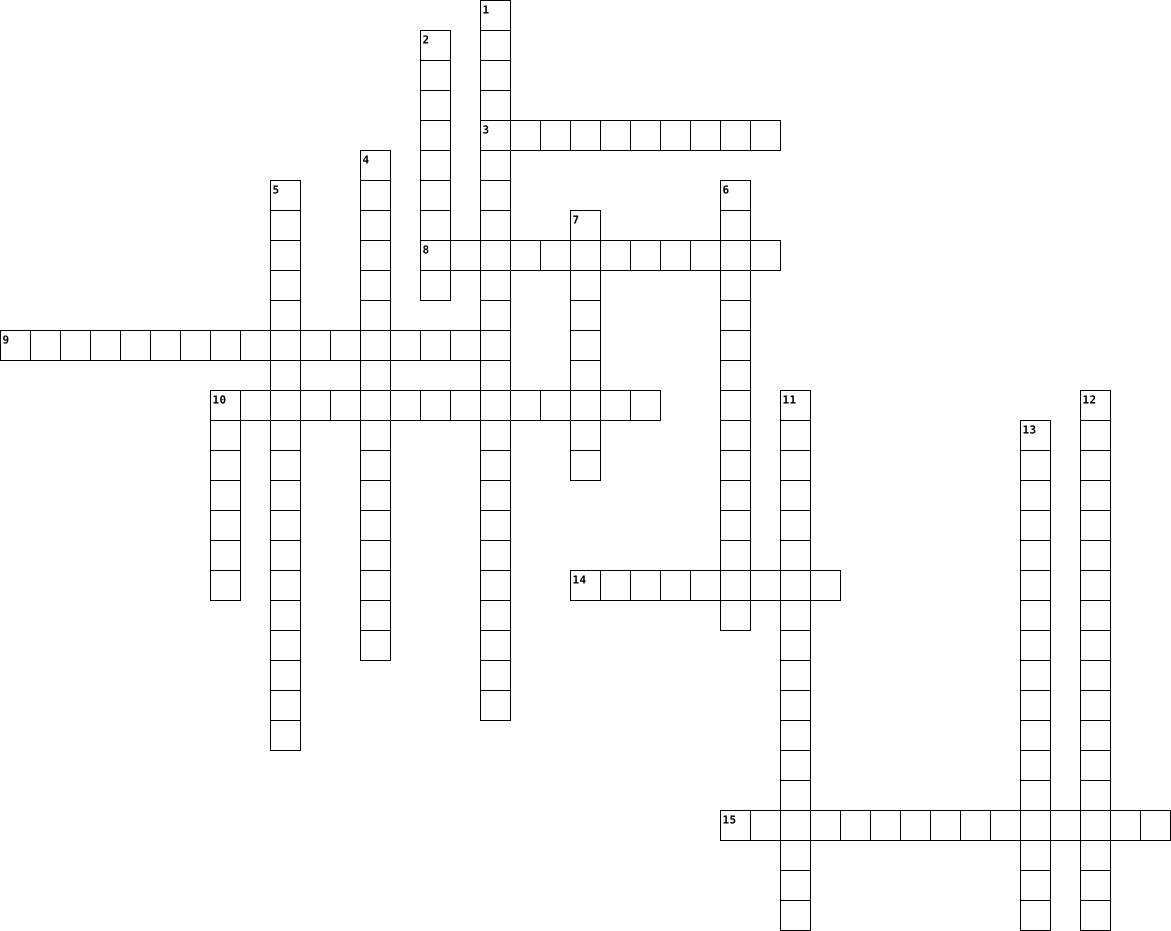
Across
- a proposed driving force for plate motion in plate tectonics
- the rigid outer part of the earth, consisting
- the process by which the North pole is transformed into a South pole and the South pole becomes a North pole.
- a scientific theory that explains how major landforms are created as a result of Earth's subterranean movements.
- the sideways and downward movement of the edge of a plate
- is a seafloor mountain system formed by plate tectonics.
Down
- when two tectonic plates move away from each other.
- is that part of the motion of a tectonic plate caused by its subduction
- when a receptacle is wired backward.
- an area on Earth where two or more lithospheric plates collide
- magnetic minerals in the rock having the same polarity as the Earth's present
- the movement caused within a fluid by the tendency
- was a super continent that existed during the late Paleozoic and early Mesozoic eras.
- places where plates slide sideways past each other.
- the formation of new areas of oceanic crust
- the gradual movement of the continents across the earth's surface through geological time.
16 Clues: when a receptacle is wired backward. • the formation of new areas of oceanic crust • the rigid outer part of the earth, consisting • the movement caused within a fluid by the tendency • when two tectonic plates move away from each other. • places where plates slide sideways past each other. • is a seafloor mountain system formed by plate tectonics. • ...
7th grade Ch. 9 Science vocab 2023-01-12

Across
- the circulation of material caused by differences in temperature
- push rising mantle material at Mid-ocean ridge creates the potential for plates to move away from the ridge with a force
- ridges the mountain ranges in the middle of the oceans
- pull as a slab sinks, it pulls the rest of the plate with a force
- spreading is the process by which new oceanic crust forms along a mid-ocean ridge and older oceanic crust moves away from the ridge
- the cold rigid outermost rock layer
- drift which suggested that continents are constantly moving on the surface of earth
- the denser plate sinks below the more buoyant plate in the
Down
- plate boundary forms where two plates separate
- tectonics states that earth’s surface is made of rigid slabs of rock plates that move with respect to each other
- continents where once part of a super continent
- polarity a state which magnetized objects would reverse themselves to point south
- polarity a state in which magnetized objects such as compass needles, will orient themselves to point north
- plate boundary form where two plates collide
- plate boundary forms where two plates slide past each other
- reversal when the magnetic field reverses direction
16 Clues: the cold rigid outermost rock layer • plate boundary form where two plates collide • plate boundary forms where two plates separate • continents where once part of a super continent • reversal when the magnetic field reverses direction • ridges the mountain ranges in the middle of the oceans • the denser plate sinks below the more buoyant plate in the • ...
Kitchen Tools 2025-10-16

Across
- Sink
- Can
- Glass
- Cuttingboard
- Trivet
- Spatula
- Napkin
- Dishes
- Jar
- Pot
- Dishtowel
- Tablecloth
- Fork
- Pan
Down
- Drain
- Microwave
- Mug
- Spoon
- Cutlery
- Tap
- Rag
- Pantry
- Dishrack
- Plate
- Lid
- Cup
- Bowl
27 Clues: Mug • Can • Tap • Rag • Jar • Pot • Lid • Cup • Pan • Sink • Bowl • Fork • Drain • Glass • Spoon • Plate • Trivet • Napkin • Pantry • Dishes • Cutlery • Spatula • Dishrack • Microwave • Dishtowel • Tablecloth • Cuttingboard
Earth Science 1 2019-02-28

Across
- The process where the ocean plate collides with the continental plate and the ocean plate then sinks below the continental plate.
- A place where extremely hot molten rock erupts from the earth’s mantle.
- Molten rock that has erupted onto the earth’s surface.
- Currents in the mantle caused but the hot molten rock.
- Where plates are moving apart from each other
- The separating of continents by drifting across the oceans is called _______.
- Large pieces of the earth crust is broken into large pieces that move on the geosphere.
- Molten rock below the earth’s surface.
- The point on the earth surface directly above the focus of the earthquake.
Down
- The name given to the place where the ocean plate sinks below the continental plate.
- The first land mass Pangaea, split in to two. The name given to the southern super continent containing Australia was called _________ .
- the rapid movement of the ground in a wave motion due to movement of tectonic plates
- Where plates are colliding with each other
- The place below ground where the earthquake starts.
- The process where the ocean ridge separates and new crust is formed.
- A deep trench in the ocean floor that it much deeper than the rest of the ocean floor.
- patterns of alternating magnetism trapped in rocks on each side of plate boundaries.
- A very violent eruption of cloud of ash, rock and gas that erupts from a volcano like an avalanche.
- Where plates are sliding parallel to each other but in opposite directions.
- A huge wave in the ocean caused by an earthquake occurring on the seafloor.
20 Clues: Molten rock below the earth’s surface. • Where plates are colliding with each other • Where plates are moving apart from each other • The place below ground where the earthquake starts. • Molten rock that has erupted onto the earth’s surface. • Currents in the mantle caused but the hot molten rock. • ...
Matthew's Tectonic plates puzzle 2026-02-03

Across
- The type of plates granite makes up
- The layer of rock that forms Earth's outer surface
- Vibrations that travel through Earth carrying the energy released during an earthquake
- The shaking that results from the movement of rock beneath Earth's surface
- A dropped zone where plates pull apart
- A plate boundary where two plates move toward each other
- The process by which oceanic crust sinks beneath a deep-ocean trench and back into the mantle at a convergent plate boundary
- a layer of the Earth where the tectonic plates move
- This heat transfer drives plate motion due to density differences
- boundary A plate boundary where two plates move away from each other
- The layer of hot, solid material between Earth's crust and core
- the type of plates that are made of basalt rock
- A plate boundaary where two plates move past each other in opposite directions
Down
- A layer of the Earth that allows tectonic plates to move on top
- A dense sphere of solid iron and nickel at the center of Earth
- The type of rock continental plates are made from
- The type of rock oceanic plates are made from
- The first scientist to create the theory of continental drift
- Am undersea mountain chain where new ocean floor is produced; a divergent plate boundary under the sea
- The last supercontinent on Earth
- The plate theory made up by Alfred Wegener
- An undersea valley that represents one of the deepest parts of the ocean
- A molten mixture of rock-forming substances, gases, and water from the mantle
- A layer of molten iron and nickel that surrounds the inner core of Earth
- The process by which molten material adds new oceanic crust to the ocean floor
25 Clues: The last supercontinent on Earth • The type of plates granite makes up • A dropped zone where plates pull apart • The plate theory made up by Alfred Wegener • The type of rock oceanic plates are made from • the type of plates that are made of basalt rock • The type of rock continental plates are made from • The layer of rock that forms Earth's outer surface • ...
Dynamic Earth: Module 10 2026-03-31

Across
- Wegener's hypothesis that all continents were once connected in a single large landmass that broke apart about 200 million years ago and drifted slowly to their current positions.
- a deep, underwater trough created by one plate subducting under another plate at a convergent plate boundary.
- the boundary between two plates that slide past each other.
- a crack or fracture in Earth's lithosphere along which movement occurs.
- rapid, downhill movement of soil, loose rocks, and boulders.
- molten rock stored below Earth's surface.
- name given to a supercontinent that began to break apart approximately 200 million years ago.
- the process that occurs when one tectonic plate moves under another tectonic plate.
- a curved line of volcanoes that forms parallel to a plate boundary.
Down
- the boundary between two plates that move away from each other.
- a round depression formed on the surface of a planet, moon, or other space object by the impact of a meteorite.
- a vent in Earth's crust through which molten rock flows.
- theory that Earth's surface is broken into large, rigid pieces that move with respect to each other.
- an area of many fractured pieces of crust along a large fault.
- the process by which new oceanic crust forms along a mid-ocean ridge and older oceanic crust moves away from the ridge.
- the boundary between two plates that move towards each other.
- vibrations caused by the rupture and sudden movement of rocks along a break or crack in Earth's crust.
- a wave that forms when an ocean disturbance suddenly moves a large volume of water.
- long, narrow mountain range on the ocean floor; formed by magma at divergent plate boundaries.
- magma that erupts onto Earth's surface.
20 Clues: magma that erupts onto Earth's surface. • molten rock stored below Earth's surface. • a vent in Earth's crust through which molten rock flows. • the boundary between two plates that slide past each other. • rapid, downhill movement of soil, loose rocks, and boulders. • the boundary between two plates that move towards each other. • ...
Kitchen Words 2012-10-16

Across
- Cup
- Oven
- Tea
- Stove
- Sink
- Microwave
- Knife
- Spoon
- Fridge
Down
- Milo
- Tongs
- Plate
- Coffee
- Kitchen
- Fork
- Toaster
16 Clues: Cup • Tea • Milo • Oven • Sink • Fork • Tongs • Plate • Stove • Knife • Spoon • Coffee • Fridge • Kitchen • Toaster • Microwave
Thing In The Kitchen 2024-02-25

Across
- spatula
- kitchen
- fork
- glass
- pan
- stove
- teapot
- oven
- mixer
- bowl
Down
- plate
- napkin
- refrigerator
- knife
- spoon
- kettle
16 Clues: pan • fork • oven • bowl • plate • knife • glass • spoon • stove • mixer • napkin • teapot • kettle • spatula • kitchen • refrigerator
food 2021-08-29

Across
- carrot
- mug
- strawberry
- knife
- cucumber
- glass
- oil
- nuts
Down
- fork
- cheese
- mushroom
- olives
- cup
- cabbage
- spoon
- plate
16 Clues: mug • cup • oil • fork • nuts • knife • glass • spoon • plate • carrot • cheese • olives • cabbage • mushroom • cucumber • strawberry
Latitude and Longitude - ESRT pages 3 and 5 2017-10-03

Across
- Hotspot near 155°W 20°N
- Plate at 170°E 18°S
- 74°50’W 45°N
- Hotspot near 118°W 45°N
- Small plate centered at 100°W 10°N
- 76°30’W 42°20’N
- Hotspot near 160°E 35°S
- 76°50’W 42°10’N
Down
- Plate at 40°E 25°N
- 78°50’W 42°50’N
- Hotspot near 5°E 52°S
- 79°15’W 42°10’N
- 75°50’W 43°50’N
- Plate at 55°W 57°S
- 77°40’W 43°15’N
- Reference line for latitude
- 73°45’W 42°45’N
17 Clues: 74°50’W 45°N • 78°50’W 42°50’N • 79°15’W 42°10’N • 75°50’W 43°50’N • 77°40’W 43°15’N • 76°30’W 42°20’N • 73°45’W 42°45’N • 76°50’W 42°10’N • Plate at 40°E 25°N • Plate at 55°W 57°S • Plate at 170°E 18°S • Hotspot near 5°E 52°S • Hotspot near 155°W 20°N • Hotspot near 118°W 45°N • Hotspot near 160°E 35°S • Reference line for latitude • Small plate centered at 100°W 10°N
Vulkane 2023-12-05

Across
- volcano
- lava
- eruption
- explosion
- natural catastrophe
- plate boundary
- plate boundaries
Down
- volcanos
- hot spot
- Ash rain
- crater
- magma
- smoke
- catastrophe
- volcano vent
- ash
- magma chamber
- cone
18 Clues: ash • lava • cone • magma • smoke • crater • volcano • volcanos • hot spot • Ash rain • eruption • explosion • catastrophe • volcano vent • magma chamber • plate boundary • plate boundaries • natural catastrophe
Tectonic Plates 2017-05-21

Across
- plates, like pieces of a puzzle
- When oceanic plates collide with continental plates a __________ will form between the two plates.
- floor spreading, The process by which new oceanic lithosphere is created.
- The __________ mountain range was formed from the collision of the Indian plate colliding into the Eurasian plate.
- boundaries, The boundary where two tectonic plates meet and push into one another.
- a place where two tectonic plates meet.
- At a __________ plate boundary, new crust is created as two or more plates pull away from each other.
- Transform boundaries (faults) cause __________.
- When oceanic crust melts it can result in the formation of a __________.
- When a divergent boundary occurs on land a __________, or separation, will arise and over time, that mass of land will break between them.
- Currents, A circulation pattern in which material is heated and rises in one area then cools and sinks in another area, flowing in a continuous loop
- zone, A __________ __________ is a convergent boundary where an oceanic plate is pushed beneath a continental plate forming a trench. The oceanic crust melts resulting in the formation of volcanoes.
Down
- Tectonic Theory, theory that Earth's lithosphere is divided into.
- When two continental plates collide large __________ will usually form.
- A region where oceanic plates sink down.
- Earthquakes often occur at __________ lines.
- boundary, The plate boundary where two tectonic plates move away from one another.
- Ridge, The __________-__________ __________ is an example of a divergent boundary.
- ridges, Underwater mountain ranges where the crust is spreading apart creating new ocean floor.
19 Clues: plates, like pieces of a puzzle • a place where two tectonic plates meet. • A region where oceanic plates sink down. • Earthquakes often occur at __________ lines. • Transform boundaries (faults) cause __________. • Tectonic Theory, theory that Earth's lithosphere is divided into. • When two continental plates collide large __________ will usually form. • ...
vocab 2022-09-16

Across
- layer of rock
- strong lower part of the mantle
- plates classified as divergent
- within earth along a fault
- system of ideas
- soft layer of the mantle
- north pole and south pole switch Convection-current movement of matter
- boundary between tectonic plates Transform-boundary boundary between tectonic plates Tectonic-plate consists of the crust
Down
- movement or trembling
- central part of earth below the mantle
- moving pieces called tectonic plates-subduction process by lithospheric plate moves
- elastically deformed rock
- solid outer layer of earth
- point on earth's surface
- bending, tilting, and breaking Divergent-boundary tectonic plates that are moving
- break in a body of rock
- hypothesis
- process by which new oceanic lithosphere forms
- thin and solid outermost layer
19 Clues: hypothesis • layer of rock • system of ideas • movement or trembling • break in a body of rock • point on earth's surface • soft layer of the mantle • elastically deformed rock • solid outer layer of earth • within earth along a fault • plates classified as divergent • thin and solid outermost layer • strong lower part of the mantle • central part of earth below the mantle • ...
Tectonic Plates 2017-05-21

Across
- When oceanic crust melts it can result in the formation of a __________.
- floor spreading, The process by which new oceanic lithosphere is created.
- zone, A __________ __________ is a convergent boundary where an oceanic plate is pushed beneath a continental plate forming a trench. The oceanic crust melts resulting in the formation of volcanoes.
- Currents, A circulation pattern in which material is heated and rises in one area then cools and sinks in another area, flowing in a continuous loop
- Tectonic Theory, theory that Earth's lithosphere is divided into.
- Ridge, The __________-__________ __________ is an example of a divergent boundary.
- a place where two tectonic plates meet.
- At a __________ plate boundary, new crust is created as two or more plates pull away from each other.
- plates, like pieces of a puzzle
- Earthquakes often occur at __________ lines.
Down
- When oceanic plates collide with continental plates a __________ will form between the two plates.
- When a divergent boundary occurs on land a __________, or separation, will arise and over time, that mass of land will break between them.
- When two continental plates collide large __________ will usually form.
- boundaries, The boundary where two tectonic plates meet and push into one another.
- Transform boundaries (faults) cause __________.
- The __________ mountain range was formed from the collision of the Indian plate colliding into the Eurasian plate.
- A region where oceanic plates sink down.
- boundary, The plate boundary where two tectonic plates move away from one another.
- ridges, Underwater mountain ranges where the crust is spreading apart creating new ocean floor.
19 Clues: plates, like pieces of a puzzle • a place where two tectonic plates meet. • A region where oceanic plates sink down. • Earthquakes often occur at __________ lines. • Transform boundaries (faults) cause __________. • Tectonic Theory, theory that Earth's lithosphere is divided into. • When two continental plates collide large __________ will usually form. • ...
food 2021-08-29

Across
- spoon
- cheese
- fork
- glass
- cucumber
- plate
- strawberry
- mug
Down
- knife
- mushroom
- cup
- nuts
- olives
- oil
- cabbage
- carrot
16 Clues: cup • oil • mug • nuts • fork • knife • spoon • glass • plate • cheese • olives • carrot • cabbage • mushroom • cucumber • strawberry
food 2021-08-29

Across
- cup
- glass
- mushroom
- knife
- cabbage
- strawberry
- nuts
- oil
Down
- olives
- cucumber
- carrot
- plate
- mug
- fork
- cheese
- spoon
16 Clues: cup • mug • oil • fork • nuts • plate • glass • knife • spoon • olives • carrot • cheese • cabbage • cucumber • mushroom • strawberry
WB p. A1, B1-B3 2022-09-07

Across
- abbreviation for the National Oceanic and Atmospheric Administration
- type of powerful microphones used to record sounds under water
- at a divergent plate boundary this liquid rock fills in the gap created by plates pulling apart and cools off to form solid rock
- the Mesosoraus did not have gills but instead had these
- What the word mesosaurus means (2)
- type of plate boundary that the Mariana Trench is located on
Down
- plates basically move only a few what a year
- name of the small earthquakes that are present before a large earthquake happens
- name of area where Bob Dziak sent the hydrophones down in the ocean
- plate motion causes these
- Mesosaurus fossils are both found on the African and what other continent
- if a plate sinks underneath another plate at a convergent plate boundary, the plate will melt and become part of what again?
- type of plate boundary that a mid-ocean is
13 Clues: plate motion causes these • What the word mesosaurus means (2) • type of plate boundary that a mid-ocean is • plates basically move only a few what a year • the Mesosoraus did not have gills but instead had these • type of plate boundary that the Mariana Trench is located on • type of powerful microphones used to record sounds under water • ...
PREPARING FOOD 2020-03-17

Across
- jack ..... looking at his eggs
- jack .... out some oils
- jack washed the plate with dishwashing ....
- jack ...... the oil into the skillet
- then, jack ...... the pan
- jack placed the ..... on the dining room table
- jack got a ...... damp
- jack ... out some eggs
- jack ....... the eggs into a bowl
Down
- the eggs ...... pretty on the white plate
- next, jack ...... on the heat
- next, jack ... the eggs on a plate
- jack ...... a skillet on the stove
- jack was ...... he walked to the kitchen
- jack stirred the ....
- then, jack poured the eggs into the ... skillet
- jack ... down in the large wooden chair
17 Clues: jack stirred the .... • jack got a ...... damp • jack ... out some eggs • jack .... out some oils • then, jack ...... the pan • next, jack ...... on the heat • jack ..... looking at his eggs • jack ....... the eggs into a bowl • next, jack ... the eggs on a plate • jack ...... a skillet on the stove • jack ...... the oil into the skillet • jack ... down in the large wooden chair • ...
Earth Science EC Crossword 2016-11-02

Across
- the boundary where one surface plate is contained underneath another plate.
- A volcano that is not currently erupting and hasn't in some time but is anticipated to erupt in the future.
- A type of volcano categorized as a mix between the other two types.
- A plate boundary where two plates move side by side
- the boundary where one surface plate hangs over another one
- The technology that allowed scientists to map the ocean floor.
- the element the signals the death of a star. Once this is made the star will begin to "die"
- The official name for the parts of the lithosphere that move around on the mantle of fluid rock.
- A scale used to determine how powerful any given earthquake is.
- A tool that is used to measure the intensity of an earthquake
- The force the pulls the atoms in a star together (It also keeps us on Earth)
- The location on the Earth's surface directly above the Focus
- The waves that travel similarly to tapping the end of a stretched slinky. Also known as compression waves.
Down
- A type of volcano categorized by gentle slopes and nonexplosive eruptions.
- What happens in a star as smaller atoms combine into a bigger star
- When big enough stars explode they form this kind of gigantic explosion.
- This object is believed to have been created from a giant meteor impact that came crashing into Earth.
- The waves that travel side to side. These occur after the primary waves
- The idea that all the continents of the world were once one giant continent known as "Pangea"
- Where the actual earthquakes takes place between two plates
- the Theory that states the world started as a tiny speck that exploded into all of the universe as we know it
- A plate boundary where one plate is pushed down underneath another plate.
- A plate boundary where two plates move apart from one another
- The concept of hot things rising and cold things falling.
- A type of volcano categorized by steep slopes and explosive eruptions.
- A plate boundary where two plates move towards one another
- The only layer of the Earth that is completely liquid.
27 Clues: A plate boundary where two plates move side by side • The only layer of the Earth that is completely liquid. • The concept of hot things rising and cold things falling. • A plate boundary where two plates move towards one another • Where the actual earthquakes takes place between two plates • the boundary where one surface plate hangs over another one • ...
P2: Energy, Forces and Earth's Crust 2025-03-16

Across
- Energy in waves, like infrared radiation.
- One crust block moves down, common at divergent boundaries.
- Earth's outermost layer where energy transfer occurs.
- Continents move over time due to plate tectonics.
- Energy transfer by electromagnetic waves without a medium.
- Sudden energy release in Earth's crust from plate movement.
- Heat flows from hotter to colder objects.
- Semi-fluid layer beneath lithosphere allowing plate movement.
- Magma rising through crust, creating volcanic islands.
- Heat from within Earth's crust.
- Edges where tectonic plates meet and interact.
- Stored energy due to position or structure.
- Movement of energy between places or systems.
- Gravity pushes plates apart at ridges.
- Energy flow affecting itself, like in climate systems.
- Plates move apart, creating new crust (e.g., mid-ocean ridges).
- Plates move horizontally past each other.
- Earth's innermost layer, generating heat.
Down
- Energy waves traveling through Earth during an earthquake.
- Deep ocean depression where a plate is subducted.
- Underwater mountain range at a divergent boundary.
- Plates collide, forming mountains or subduction zones.
- Movement of thermal energy from warmer to cooler objects.
- Plates slide past each other, causing earthquakes.
- Slow mantle circulation driving plate tectonics.
- Total kinetic energy of particles, related to temperature.
- Volcano chain above a subduction zone.
- One plate sinks beneath another, forming trenches and volcanoes.
- New oceanic crust forms at ridges and moves outward.
- Energy of motion.
- Heat transfer through direct contact.
- Sum of kinetic and potential energy.
- Landform at a divergent boundary where crust stretches and cracks.
- Energy is transferred or transformed, not created or destroyed.
- Layer beneath the crust driving plate movement.
- Crack in Earth's crust with movement.
- Large lithosphere sections moving over the asthenosphere.
- Heat transfer by fluid movement.
- Rigid outer layer, including crust and upper mantle.
- Energy in chemical bonds, like fossil fuels.
- Sinking plate pulls the rest with it.
- Measure of system disorder as energy spreads.
- Ancient supercontinent that broke apart.
- Large ocean wave from underwater earthquakes or eruptions.
- One crust block moves up, common at convergent boundaries.
45 Clues: Energy of motion. • Heat from within Earth's crust. • Heat transfer by fluid movement. • Sum of kinetic and potential energy. • Heat transfer through direct contact. • Crack in Earth's crust with movement. • Sinking plate pulls the rest with it. • Volcano chain above a subduction zone. • Gravity pushes plates apart at ridges. • Ancient supercontinent that broke apart. • ...
Earth Science EC Crossword 2016-11-02

Across
- the element the signals the death of a star. Once this is made the star will begin to "die"
- The waves that travel side to side. These occur after the primary waves
- A type of volcano categorized by steep slopes and explosive eruptions.
- A plate boundary where two plates move side by side
- The only layer of the Earth that is completely liquid.
- The official name for the parts of the lithosphere that move around on the mantle of fluid rock.
- A plate boundary where two plates move towards one another
- A volcano that is not currently erupting and hasn't in some time but is anticipated to erupt in the future.
- A plate boundary where one plate is pushed down underneath another plate.
- A type of volcano categorized by gentle slopes and nonexplosive eruptions.
- the Theory that states the world started as a tiny speck that exploded into all of the universe as we know it
- The concept of hot things rising and cold things falling.
- A plate boundary where two plates move apart from one another
Down
- A type of volcano categorized as a mix between the other two types.
- Where the actual earthquakes takes place between two plates
- The technology that allowed scientists to map the ocean floor.
- The location on the Earth's surface directly above the Focus
- the boundary where one surface plate is contained underneath another plate.
- The idea that all the continents of the world were once one giant continent known as "Pangea"
- The waves that travel similarly to tapping the end of a stretched slinky. Also known as compression waves.
- A scale used to determine how powerful any given earthquake is.
- What happens in a star as smaller atoms combine into a bigger star
- This object is believed to have been created from a giant meteor impact that came crashing into Earth.
- A tool that is used to measure the intensity of an earthquake
- the boundary where one surface plate hangs over another one
- When big enough stars explode they form this kind of gigantic explosion.
- The force the pulls the atoms in a star together (It also keeps us on Earth)
27 Clues: A plate boundary where two plates move side by side • The only layer of the Earth that is completely liquid. • The concept of hot things rising and cold things falling. • A plate boundary where two plates move towards one another • Where the actual earthquakes takes place between two plates • the boundary where one surface plate hangs over another one • ...
Volcano crossword 2025-04-14

Across
- a destructive mudflow
- A mountain with a crater, vent and is over a magma chamber
- the vibration of a plate
- the denser crust
- the layer below the lithosphere
- a big hole that has a higher temperature than its surroundings
- the rock that volcanos are made of
- the lighter type of crust
- an island with a volcano
- the ring in the pacific ocean of earthquakes and volcanos
Down
- the plate under the pacific ocean
- the powdery residue from a volcano
- a destructive combination of hot ash, lava fragments, and gases ejected
- A volcano on a mountain
- above ground magma
- the boundary of a plate
- the layer above the asthenosphere
- when two plates push together
- when one plate goes under another
19 Clues: the denser crust • above ground magma • a destructive mudflow • A volcano on a mountain • the boundary of a plate • the vibration of a plate • an island with a volcano • the lighter type of crust • when two plates push together • the layer below the lithosphere • the plate under the pacific ocean • the layer above the asthenosphere • when one plate goes under another • ...
pasach crossword for cool kidssss 2026-03-12

Across
- a bitter thing on the plate
- four of what we drink during the sedur
- somthing you cant do on pesach
- another vegtible on the sedur plate
- a weird sandwitch on the plate
- a leaf on the sedur plate
- a mitvah that takes the longest
Down
- the B in brows
- a mitzvah including eating non bread
- the R in brows
- the s in brows
- the w in brows
- zeroah in english
- beitzah in english
- the o in brows
15 Clues: the B in brows • the R in brows • the s in brows • the w in brows • the o in brows • zeroah in english • beitzah in english • a leaf on the sedur plate • a bitter thing on the plate • somthing you cant do on pesach • a weird sandwitch on the plate • a mitvah that takes the longest • another vegtible on the sedur plate • a mitzvah including eating non bread • ...
Chapter 7 -- Plate Tectonics 2023-03-09

Across
- the circulation of material caused by differences in temperature and density
- a plate boundary where two plates slide past each other
- magnetized objects reorientate themselves with the poles
- the process of new oceanic crust forming along a mid-ocean ridge and older oceanic crust moves away from the ridge
- the supercontinent
- Earth's surface is made of rigid slabs of rock, or plates, that move
- when the magnetic field reverses direction
- Mountain ranges in the middle of the ocean
- when the denser plate sinks below the more buoyant plate
Down
- cold and rigid outermost rock layer
- the force causing causing mantel material to rise at mid-ocean
- a plate boundary where two plates collide
- continents are always in motion
- normal _______ is a state where magnetized objects orient themselves to point towards the north pole; ex: a compass
- a plate boundary where two plates separate
- the force that pulls on the rest of the plate as a slab sinks
16 Clues: the supercontinent • continents are always in motion • cold and rigid outermost rock layer • a plate boundary where two plates collide • a plate boundary where two plates separate • when the magnetic field reverses direction • Mountain ranges in the middle of the ocean • a plate boundary where two plates slide past each other • ...
The lazy burglar 2022-05-03

Across
- plate
- drawer
- doormat
- living
- chocolatecake
- vase
- money
- footprints
Down
- bedroom
- police
- door
- burglar
- saucepan
- glasses
- hotmilk
- kitchen
16 Clues: door • vase • plate • money • police • drawer • living • bedroom • burglar • doormat • glasses • hotmilk • kitchen • saucepan • footprints • chocolatecake
a 2025-03-13

Across
- mug
- spoon
- glass
- teapot
- knife
- ladle
- kettle
- fryingpan
- pot
Down
- cuttingboard
- cup
- bowl
- fork
- towel
- plate
- ovenmitt
16 Clues: mug • cup • pot • bowl • fork • spoon • glass • towel • knife • plate • ladle • teapot • kettle • ovenmitt • fryingpan • cuttingboard
Crossword Review 2024-10-10

Across
- - the layer under the lithosphere that flows and causes the movement of plate tectonics.
- Has a trunk
- - a place in the middle of a tectonic plate where hot magma rises from deep inside the Earth, often forming volcanoes.
- Crust - the thick part of the Earth’s crust that forms the land.
- - a type of plate boundary where two plates move away from each other, allowing magma to rise and create new crust.
- - the process where eroded materials are dropped off in a new location.
- - the supercontinent, Greek for “all the earth”.
- - when magma cools, it crystallizes to form igneous rocks.
- - rocks that form when heat and pressure change existing rocks.
- - when rocks inside the Earth are exposed to intense heat.
- - a type of plate boundary where two plates slide past each other, which can cause earthquakes.
- Ridge - an underwater mountain range formed by divergent plates.
- Crust - the thinner part of Earth’s crust that lies beneath the ocean.
- Drift - a hypothesis developed by Alfred Wegener in 1912 that proposed that the Earth’s continents had once been joined as a single landmass that broke apart and sent the continents adrift.
- Trench - a deep, narrow valley in the ocean floor where one plate is pushed under another.
- - the type of weathering that breaks down rocks through a chemical reaction.
- - the process of rocks breaking down from physical, biological, or chemical processes.
- Flying mammal
Down
- - rocks that are formed from cooling magma or lava.
- - as sediments settle and build layers, the process that forms sedimentary rocks.
- - the process that moves sediments to different places.
- Tectonic - the crust is made up into large pieces that move slowly over time.
- - The process where one tectonic plate is ford beneath another at a convergent boundary.
- - a mountain or opening in the Earth’s surface where magma, ash, and gasses escape from below.
- Man's best friend
- Boundary - the place where two tectonic plates meet.
- - melted rock beneath Earth’s surface.
- - when rocks change shape due to pressure or tension in the Earth’s crust
- Likes to chase mice
- - a type of plate boundary where two plates move towards each other, creating mountains or volcanoes.
- - the shaking of the ground caused by the movement of tectonic plates.
- - the type of weathering that breaks down rocks without changing their chemical composition.
- - the crust and part of the upper mantle that makes up the plate tectonics.
- - the type of weathering caused by plants, animals, or other life.
- - rocks that form from the compaction of sediments.
- Large marsupial
36 Clues: Has a trunk • Flying mammal • Large marsupial • Man's best friend • Likes to chase mice • - melted rock beneath Earth’s surface. • - the supercontinent, Greek for “all the earth”. • - rocks that are formed from cooling magma or lava. • - rocks that form from the compaction of sediments. • Boundary - the place where two tectonic plates meet. • ...
What a disaster! 2020-11-12

Across
- Type of volcano that has not erupted for a while, but may do so again
- Second layer of the earth, made from molten rock
- Plate boundary where plates move apart
- Plate boundary where plates move alongside each other
- Point on the earth's surface where shockwaves are strongest
- Circular movements in the mantle that make plates move
- someone who studies volcanoes
- Word to describe the strength of an earthquake
Down
- Plate boundary when one oceanic and one continental plate move towards each other.
- The edge of plates
- Capital city of Haiti
- Machine for monitoring earth movements
- disease carried in water
- Machine for monitoring volcanoes
- Type of crust which is permanent and less dense.
- Large section of the earth's crust floating on the mantle
16 Clues: The edge of plates • Capital city of Haiti • disease carried in water • someone who studies volcanoes • Machine for monitoring volcanoes • Machine for monitoring earth movements • Plate boundary where plates move apart • Word to describe the strength of an earthquake • Second layer of the earth, made from molten rock • Type of crust which is permanent and less dense. • ...
Unit 4 Choice Board 2022-11-16

Across
- likely location of earthquakes
- areas of especially hot magma rising up to lithosphere
- plates move away from each other
- thin brittle layer of rock floating on mantle
- plates move toward each other
- one plate subducts under the other
- pattern of volcanoes and earthquackes all around pacific plate
- dense oceanic plate subducts beneath continental plate and melts
- soil pH nutrient content
- very outer layer of lithosphere, earths surface
- Dense mass of nickel, iron, radioactive elements
Down
- one plate subducts underneath the other, forcing surface crust upward
- Soft solid of magma surrounding core
- topsoil, layer of decomposed organic matter and minerals from parent material
- solid flexible outer layer of mantle
- plates slide past each other
16 Clues: soil pH nutrient content • plates slide past each other • plates move toward each other • likely location of earthquakes • plates move away from each other • one plate subducts under the other • Soft solid of magma surrounding core • solid flexible outer layer of mantle • thin brittle layer of rock floating on mantle • very outer layer of lithosphere, earths surface • ...
Plate Tectonics 2025-11-12

Across
- Famous mountain range formed by 2 continental plates converging into each other
- Plate boundary where 2 plates slide past each other
- Plate boundary where 2 plates move towards each other
- When one plate is pushed under another
- Place under the crust where magma sits and creates volcanoes
- A piece of lithosphere that can move
- Layer of the Earth that is broken up into massive sections
- Occur where 2 plates are sliding past each other
- Where 2 plates meet
Down
- The most well known example of a transform boundary
- Plate boundary where 2 plates move away from each other
- The movement of the plates
- Occur where 2 plates are converging or diverging
- The thicker of the 2 types of plates
- The deepest place in the Earth's lithosphere
- The thinner of the 2 types of plates
- The scientist who came up with the Continental Drift theory
17 Clues: Where 2 plates meet • The movement of the plates • The thicker of the 2 types of plates • The thinner of the 2 types of plates • A piece of lithosphere that can move • When one plate is pushed under another • The deepest place in the Earth's lithosphere • Occur where 2 plates are converging or diverging • Occur where 2 plates are sliding past each other • ...
Plate Tectonics 2021-12-10

Across
- What turns sedimentary rock into metamorphic?
- Which type of plate boundary slides plates against each other?
- How can metamorphic rock turn into magma?
- Do earthquakes or volcanoes occur more?
- Which type of plate boundary pulls plates apart?
- Which type of plate boundary pulls plates together?
- What happens at convergent plate boundaries?
Down
- What happens at transform boundaries?
- What was the name of the supercontinent that existed 300 million years ago?
- How many major plates make up the Earth?
- Which part of the Earth is made up of the crust and upper mantle?
- How many layers does the Earth have?
- Which plate goes down when a oceanic and continental plate collide?
- What causes plates to move?
- What type of rock does magma turn into when it cools?
15 Clues: What causes plates to move? • How many layers does the Earth have? • What happens at transform boundaries? • Do earthquakes or volcanoes occur more? • How many major plates make up the Earth? • How can metamorphic rock turn into magma? • What happens at convergent plate boundaries? • What turns sedimentary rock into metamorphic? • ...
no 2025-03-05

Across
- earthquake
- continental drift
- convergent boundary
- lithosphere
- volcano
- transform boundary
- crust
- convection
- mountain
- island arcs
Down
- oceanic crust
- outer core
- trench
- plate pressure
- divergent boundary
- hot spots
- continental crust
- tectonic plate
- inner core
19 Clues: crust • trench • volcano • mountain • hot spots • outer core • earthquake • convection • inner core • lithosphere • island arcs • oceanic crust • plate pressure • tectonic plate • continental drift • continental crust • divergent boundary • transform boundary • convergent boundary
Science Vocabulary 2021-12-16
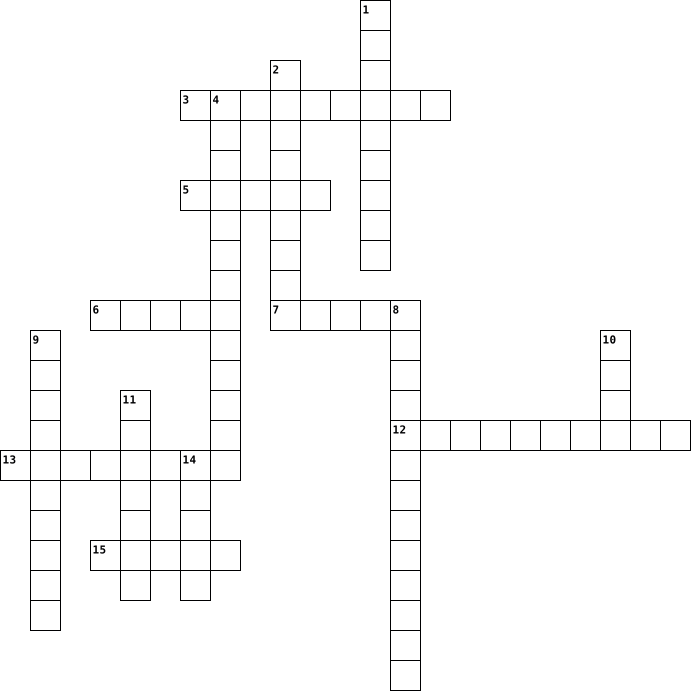
Across
- discovered Seafloor spreading
- Outermost layer of the earth
- tectonics there are 3,Convergent,Divergent,and transform
- Lava before it comes out of a volcano.
- happens when two tectonic plates slide past Each other
- spreading the theory by Harry Hess
- core The innermost layer of the earth
Down
- plate when two plates go away from each other
- plate two plates that slide past each other
- had the theory of Plate tectonics
- Upper layer of the mantle but under the lithosphere
- plate, when to plates come together
- Magma after it leaves the ground
- A mountain that holds and releases lava
- Core Almost the innermost layer of the earth
15 Clues: Outermost layer of the earth • discovered Seafloor spreading • Magma after it leaves the ground • had the theory of Plate tectonics • spreading the theory by Harry Hess • plate, when to plates come together • Lava before it comes out of a volcano. • core The innermost layer of the earth • A mountain that holds and releases lava • plate two plates that slide past each other • ...
Tectonics-Honors Earth 2023-03-21

Across
- forms where Nazca plate subducts under South American plate
- form where one oceanic plate meets a continental plate
- circulating flow of dense, molten material driving plates
- forming along divergent boundaries (ex: atlantic ocean)
- patterns of these outline Earth's tectonic plates
- densest liquid layer of Earth composed of metallic material
- pieces of continent and ocean that move due to convection
- the thickest layer of Earth where convection currents flow
- convergent boundary between Asia and India
- form along an ocean-ocean convergent boundary in North Pacific Ocean
- the when you use 3 seismic stations to find an epicenter
- the ___ of an S-wave is used to help calculate Richer magnitude
- the thinnest layer of Earth that moves due to convection currents
- the point at the surface directly above the earthquake found using either damage or seismic waves
- form along subduction zones on the less dense plate
- the magnitude of an Earthquake can be assigned this number based on quantitative wave measurements
- theory explaining the cause of earthquakes
- they change speed as they move through denser or less dense layers of Earth
- the point where elastic rebound occurs for an earthquake
- the name given to the ancient supercontinent
- the interval between the arrival of primary and secondary waves
- evidence used to support the idea of a metallic core
- when two plates move along side one another but get stuck
- many continents appear to fit together due to their matching
- transform boundary along California coast
Down
- divergent boundary between Africa and SaudiArabia
- convergence where both plates are equal density
- when two or more plates collide head-on
- theory explaining how ocean plates behave at divergent boundaries
- convergence where denser plate subducts beneath less dense plate
- matching __ of the same type and age are found on different continents today
- deep chasms forming along convergent boundaries
- seismic wave traveling in a compression (push-pull) motion
- form where 2 continental plates converge
- Earth's liquid outer core either bends or blocks seismic waves to create these
- densest solid layer of Earth composed of metallic material
- the property that causes one plate to subduct while another does not
- when two plates pull away from one another
- less dense plate material, very old
- alternating north/south magnetism evidence that supports sea floor spreading
- identical __ are found on distant continents now separates by oceans
- theory that explains continental drift, how the plates move, and other modern evidence
- the strength of an earthquake assigned a number using damage and other qualitative observations
- theory that all landmasses were once connected but have been moving away since
- an area of activity located away from tectonic plate boundaries
- seismic wave traveling sideways as it also moves forwards
- slowest seismic waves causing the most damage
- denser plate material that subducts, much younger
48 Clues: less dense plate material, very old • when two or more plates collide head-on • form where 2 continental plates converge • transform boundary along California coast • convergent boundary between Asia and India • when two plates pull away from one another • theory explaining the cause of earthquakes • the name given to the ancient supercontinent • ...
Layers of the Earth Vocabulary 2023-10-19

Across
- a mechanism that helps power plate tectonics. The cooling, dense oceanic slab sinks at a subduction zone and pulls the rest of the plate with it.
- Type of plate boundary where the plates move apart as magma rises to the surface from the asthenosphere.Ex: Mid-ocean ridges; mid-atlantic ridge, East Africa Rift
- Type of plate boundary where plates move toward each other. One plate sinks beneath another along a subduction zone. Descending plate melts, gnerating magma. No subduction zone for two continental plates colliding. Ex: Chile and the West coast of South America, Japan
- the record of the orientation of the magnetic poles with respect to the rock being studied - Remnant magnetism in ancient rocks
- This layer of the mantle makes up the greatest volume of the earth. It is solid.
- Middle layer of the mantle. This layer is “plastic” – the rock is soft and weak, so it is in this layer that the heat convection currents can flow. This powers plate tectonics.
- the outermost layer of the earth which makes up the ocean floor. Thin and dense enough to be subducted.
- This is solid iron-nickel material
- a mechanism that helps power plate tectonics. The creation of new oceanic crust at divergent margins (mid-ocean ridges) pushes the plates away from each other.
Down
- theory that the lithosphere is divided into rigid plates that move over the asthenosphere. Movement is on a global scale, resulting in continental drift and changing the shape, size and location of continents and ocean basins.
- Crust plus Upper mantle. This makes up the tectonic plates
- the outermost layer of the earth. Thick crust, less dense so may not be subducted.
- the magnetic and geographic north and south poles are located at approximately the same place. This is the current day orientation of the magnetic field.
- Type of plate boundary where the plates slide sideways past each other. Example is the San Andreas Fault.
- An idea before plate tectonics that showed that the continents had all fit together into a giant supercontinent (Pangaea) at some point in the past. Continents had somehow moved through the oceans to their present position. Did not provide a mechanism for movement of the continents.
- the idea that new oceanic crust is created at divergent plate margins. The ocean crust and continental crust move together as a unit.
- Solid mantle material
- the magentic north and south poles reverse positions. Magnetic north pole coincides with geographic south pole
18 Clues: Solid mantle material • This is solid iron-nickel material • Crust plus Upper mantle. This makes up the tectonic plates • This layer of the mantle makes up the greatest volume of the earth. It is solid. • the outermost layer of the earth. Thick crust, less dense so may not be subducted. • ...
Los Mariscos y Las Carnes 2021-03-04
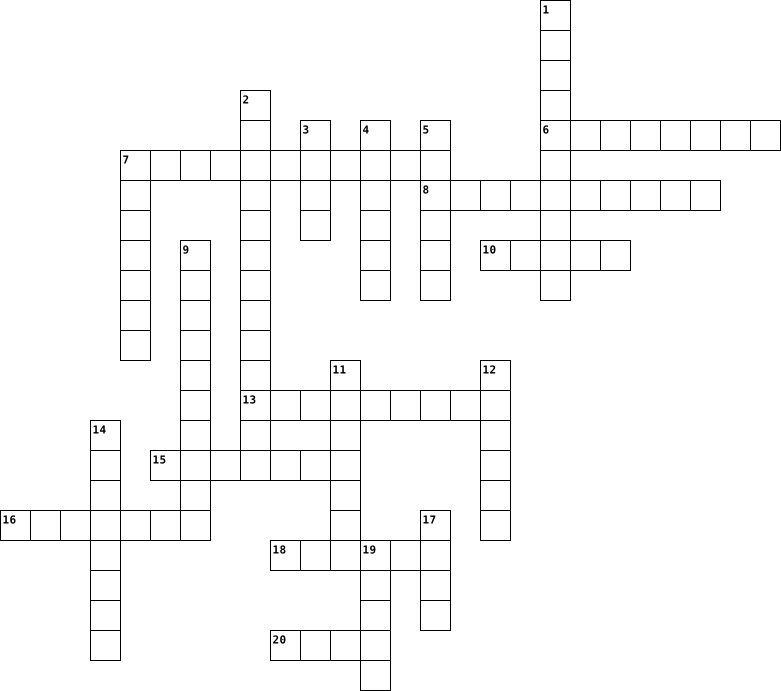
Across
- saucer or small plate
- to set the table
- "three milk cake"
- plate or dish
- teaspoon
- fork
- spoon
- cake
- glass
Down
- sweet fried bread
- rice pudding
- mug or cup
- ice cream
- milkshake
- desserts
- napkin
- churros
- table cloth
- knife
- flan
- bowl
21 Clues: fork • flan • cake • bowl • knife • spoon • glass • napkin • churros • desserts • teaspoon • ice cream • milkshake • mug or cup • table cloth • rice pudding • plate or dish • to set the table • sweet fried bread • "three milk cake" • saucer or small plate