
radiation biology Crossword Puzzles
biology 2024-10-02

Across
- adenosine diphosphate uncharged energy storage molecules with 2 phosphates.
- Sphere of earth all gases on earth.
- Second step of anaerobic respiration 2 types include alcoholic and lactic.
- anything that has mass and takes up space makes up everything.
- site of photosynthesis.
- Sphere on earth all soil and rocks on earth.
- Substance created during a chemical reaction made from reactants.
- describes a situation in which oxygen is not present.
- nutrient used in phosphate of nucleic acids and phospholipids of membranes often limit.
- Sphere on earth all water on earth.
- first step of aerobic respiration breaks down glucose into pyruvate makes some nadh.
Down
- Sphere of earth all living things on earth.
- type of organism that is able to make its own food base of the food chain.
- organelles site of steps 2 and 3 of aerobic cellular respiration.
- type of organism that must eat other organisms to obtain energy.
- describes a situation in which oxygen is present.
- nutrient used in proteins and nucleic acids must be fixed for liveing to use often limited.
- Pigment in chloroplast used to trap light during photosynthesis.
- nutrient forms the backbone for all macromolecules in living things.
- adenosine triphosphate charge energy storage molecules with 3 phosphorus groups.
- kaolin first step of photosynthesis use sunlight to split h2o and make atp and nadph o2 is released.
21 Clues: site of photosynthesis. • Sphere of earth all gases on earth. • Sphere on earth all water on earth. • Sphere of earth all living things on earth. • Sphere on earth all soil and rocks on earth. • describes a situation in which oxygen is present. • describes a situation in which oxygen is not present. • anything that has mass and takes up space makes up everything. • ...
Biology 2025-03-24

Across
- - strongest and biggest bone in our body
- - the study of living things
- - state of being dependent to drugs or alcohol
- - organisms that eat both plants and meat
- - nutrients also known as fats and oils
- - main source of our energy
- - process of plants making food
- - drug found in beer
- - tubes inside a plant for water movement
- - a natural place where animals and plants live
- - organisms that only eat meat
- - gas that plants produce
- - small green organisms that live on water considered as plants
- - a fat person
- - the body of a tree
- - the bone in our head
- - the organ that pumps our blood
- - the fastest land animal
- - organisms that eat smaller organisms
Down
- - an animal that eats smaller animal
- - drug found in cigarette
- - animal that has white and black stripes
- - the green pigment in a plant
- - parts of a plant that absorbs water
- - an animal that is eaten by a bigger animal
- - organisms that only eat plants
- - tiny holes of a leaf
- - a very hot and dry place
- - organisms that can make their own food (plants)
- - the name of our planet
30 Clues: - a fat person • - drug found in beer • - the body of a tree • - tiny holes of a leaf • - the bone in our head • - the name of our planet • - drug found in cigarette • - gas that plants produce • - the fastest land animal • - a very hot and dry place • - main source of our energy • - the study of living things • - the green pigment in a plant • - organisms that only eat meat • ...
Biology 2025-04-12

Across
- - stage in the cell cycle where a cell grows and prepares for division
- - the mating of two organisms that are heterozygous for the same two traits
- - first stage of cell division, the nucleus condenses into visible chromosomes
- - structural component of DNA
- - Genetic information
- - phase where chromosomes align along the middle of the cell
- - masked by a dominant allele
- - two structures fit together
- - process of creating protein molecules
- - an individual that has two different alleles
- - gene's DNA sequence is copied (transcribed) to make an RNA molecule
- - when a trait appears more over the other
- - an individual that has two identical alleles
Down
- - cell performs its normal functions, grows, and prepares for cell division
- - offspring of a cross between two parents that differ in only one trait
- - single parent cell divides to produce two genetically identical daughter cells
- - change in the DNA sequence, leading to alterations in the genetic material
- - pairs with cytosine
- - pairs with thymine
- - where chromosomes are separated and are pulled to opposite ends of the cell by spindle fibers
- - shape of a double-stranded DNA molecule
- - deoxyribose
- - compound containing phosphorus
- - containing nitrogen that form the building blocks of the nucleic acid
- - cell uses the information carried by mRNA molecule to build a protein
- - division of the cytoplasm of a cell into two daughter cells
- - pairs with adenine
- - chromosomes move to opposite ends of the cell and two nuclei are formed
- - pairs with guanine
- - the first stage of interphase
30 Clues: - deoxyribose • - pairs with thymine • - pairs with adenine • - pairs with guanine • - pairs with cytosine • - Genetic information • - structural component of DNA • - masked by a dominant allele • - two structures fit together • - the first stage of interphase • - compound containing phosphorus • - process of creating protein molecules • - shape of a double-stranded DNA molecule • ...
Biology 2025-04-10

Across
- The introduction of harmful materials into the environment often from human sources
- Aquatic regions that do not have sunlight, unable to support photosynthesis
- Predictable changes in an ecosystem after a disturbance as it progresses toward reestablishing a mature climax community - some soil already exists
- Long term changes in average global temperatures causes changes in weather patterns - human interactions with ecosystems have accelerated this process
- Non-native species in a community, often able to outcompete endemic species because they are removed from the limiting factors they evolved with
- Water ecosystems characterized by light availability, water depth, and salinity - includes intertidal areas, continental shelf, coral reefs, pelagic zones, benthic zones, photic and aphotic zones, and hydrothermal vents i
- Clearing forested land and repurposing it for non-forest use like agriculture, or urban development
- Aquatic regions where sunlight penetrates, able to support photosynthesis
- Species that evolve and are only found in one isolated geographic location - ex: marsupials in australia
- Pockets ecosystems at the bottom of the ocean near divergent plate boundaries - producers in this ecosystem use chemosynthesis
- Key organisms in an ecosystem that help stabilize or maintain that ecosystem - ex wolves in yellowstone
- When human populations become so large they are not able to be supported by ecosystems - populations are higher than carrying capacity
Down
- Mature form of an ecosystem, end result of biological succession
- No 2 species can occupy the same niche in an ecosystem, one species will outcompete the others - Comp exe trincarla
- Measurement of the variety and richness of an ecosystem, measured in part by species richness, species evenness, and endemic species
- Land ecosystems characterized by average temperature and precipitation - includes the tundra, grasslands, deserts, boreal forest, temperate forests, savannas, and tropical rainforests
- Collection of ecosystems characterized with similar temperatures, rainfall totals, and climax communities
- First species to invade or populate an area, typically a lichen in primary successio
- Created from a mutualistic symbiotic relationship between a plant and a fungus - often the pioneer species in
- Visual representation of the feeding interactions in ecosystems - helps show interconnectedness among species
- Predictable changes in an ecosystem as it progresses from pioneer species on bare rock to a mature climax community - starts with no soil
- where fresh and saltwater meet - typically very productive areas due to influx of nutrients from terrestrial ecosystems
22 Clues: Mature form of an ecosystem, end result of biological succession • Aquatic regions where sunlight penetrates, able to support photosynthesis • Aquatic regions that do not have sunlight, unable to support photosynthesis • The introduction of harmful materials into the environment often from human sources • ...
Biology 2024-11-15

Across
- different allele from each parent
- sugar or starch used to store energy
- speeds up reactions in cells
- fat found in animals
- expression of the gene
- the dominant allele is effected by the recessive allele
- bitter taste high pH
- removes introns
- different versions of a gene
- transfer of genetic information
- close relationship between species where at least one benefits
- law that states factors controlling different charanteristics are inherited indepentently
- law that states the dominant gene is shown in offspring
- allele that is expressed
- statement that cannot be changed under certain natural conditions
- two alleles both expressed
Down
- fat found in plants
- adds a tail
- chance or probability or chance that something will happen
- alleles inherited from both parents
- same allele from each parent
- hidden allele
- 3 bases that stand for one amino acid
- mixture of two substances
- sum of all reactions within an organism
- concentration of hydronium ions
- sour taste low pH
- science of heredity
- location of gene
- changes in the sequence of DNA/RNA
- law that states two factors control a single characteristic
- used to guess possible genotypes
- fat or oil made of chains of fatty acids
- changes some of the nucleotides
- process where one cell divides into two
35 Clues: adds a tail • hidden allele • removes introns • location of gene • sour taste low pH • fat found in plants • science of heredity • fat found in animals • bitter taste high pH • expression of the gene • allele that is expressed • mixture of two substances • two alleles both expressed • same allele from each parent • speeds up reactions in cells • different versions of a gene • ...
Biology 2024-11-12

Across
- variable - affect by other variables
- - more than one code for the same amino acid
- reactions - exothermic reactions which break down large molecules and supply energy
- Cloning - isolating and making a copy of the gene
- - different versions of the gene (one from each parent)
- - number of same species in a specific area
- - all the same type of atom
- - the study of life
- reactions - endothermic reactions which build up large molecules are require energy
- - all the populations in the same area
- roles
- - similar ecosystems with similar environments
- thing - organism
- allele - expressed; Recessive allele - hidden
- - serve as chemical messengers and have
- replication - make a copy of the chromosomes
- - different allele from each parent
- reaction
- - alleles inherited from parent
- - each codon codes for only one amino acid
Down
- - science of heredity
- - all living things use the same code
- - part of Earth where life exists; includes water, land and air
- energy - energy is required to start a
- - abiotic and biotic factors in an area
- Chain Reaction - makes many copies of the DNA segment
- - same allele from each parent
- - expression of the genes
- bonds - keep water in the liquid phase even though it shouldn’t be at room temperature
- - fat or oil
- variable - changed by the experimenter
- Cloning - isolating and making a copy of the gene
- - speed up reactions in cells, without them most life would die
- - electrical charge difference between areas of molecule
- - location of gene on the chromosome
- - sum of all the reactions within an organism
36 Clues: roles • reaction • - fat or oil • thing - organism • - the study of life • - science of heredity • - expression of the genes • - all the same type of atom • - same allele from each parent • - alleles inherited from parent • - different allele from each parent • variable - affect by other variables • - location of gene on the chromosome • - all living things use the same code • ...
Biology 2024-11-19

Across
- Secondary Phase in PMAT
- 4 created at the end of meiosis
- Cells reproduce their DNA
- Cellular Energy
- Process in which mRNA is made
- Full pairs of DNA
- Process in which Protein is made
- Contains DNA
- Chromosomes paired up
Down
- Third Phase in PMAT
- Cells living their regular lives
- Process in which somatic cells reproduce
- Powerhouse of the cell
- Starting Phase in PMAT
- Single set of DNA
- Jelly-like substance inside of a cell
- Process in which reproductive cells reproduce
- Final Phase in PMAT
- 1/2 a chromosome
- Life Cell
20 Clues: Life Cell • Contains DNA • Cellular Energy • 1/2 a chromosome • Single set of DNA • Full pairs of DNA • Third Phase in PMAT • Final Phase in PMAT • Chromosomes paired up • Powerhouse of the cell • Starting Phase in PMAT • Secondary Phase in PMAT • Cells reproduce their DNA • Process in which mRNA is made • 4 created at the end of meiosis • Cells living their regular lives • ...
BIOLOGY 2025-05-02

Across
- The thick, semi-fluid mass of partially digested food that leaves the stomach and enters the small intestine.
- Intestine The final part of the digestive system.
- An enzyme that breaks down starch into smaller sugars like maltose during digestion.
- Chemical substances found in food that are essential for the growth, maintenance, and repair of living organism.
- Are inorganic substances needed in small amounts for the body to function properly.
- Saclike, muscular organ within the digestive system, specifically between the esophagus and the small intestine.
- Unit of energy
- Organic compound composed of Carbon, hydrogen, and oxygen, often in a 1:2:1 ratio.
- Important for Amino Acid (AA) metabolism.
- Intestine A long tube-like organ that connects the stomach and the large intestine.
Down
- Is a wave-like contraction of muscles that propels food and waste through the digestive system.
- Occurs when stomach acid backs up into the tube that carries food from your mouth to your stomach.
- A Large organ located in the upper abdomen.
- A muscular tube that connects the pharynx to the stomach.
- A dual-function, glandular organ located in the abdomen behind the stomach.
- Used for catching and masticating food, for defense, and for other specialized purposes.
- A type of macromolecule composed of glycerol and fatty acids.
- Are large, complex molecules that play many critical roles in the body.
- Any of the small, slender, vascular projections that increase the surface area of a membrane.
- Are organic compounds, typically required in small amounts, that are essential for the normal functioning of an organism.
20 Clues: Unit of energy • Important for Amino Acid (AA) metabolism. • A Large organ located in the upper abdomen. • Intestine The final part of the digestive system. • A muscular tube that connects the pharynx to the stomach. • A type of macromolecule composed of glycerol and fatty acids. • Are large, complex molecules that play many critical roles in the body. • ...
Biology 2025-05-01

Across
- навчнаас үндэс хүртэл шим бодисын уруудах
- Эсийн доторх олон янзын химийн урвал нь юуны тусламжтай явагддаг вэ?
- тос Орчны температурт царцдаггүй тосыг ерөнхийд нь ямар тос гэх вэ?
- Цусны найрлаганд байх ямар уураг нь өнгөт төмөр агуулсан уургийн дөрөвдөгч бүтэцтэй байдаг вэ?
- Ургамлын үндэсний эсүүдээр ус шингээгдэн
- бодис Долон юуг зөөвөрлөдөг вэ?
- бүтэц Хоёр болон түүнээс дээш тооны полипептидийн гинж өөр хоорондоо нэгдэж уургийн хэддэгч бүтцийг үүсгэдэг вэ?
- ялгаврын үр дүнд ус шингээхийг юу гэдэг вэ?
- Шигшүүрт хоолой, дагуул эсүүдээс бүрддэг зүйлийн нэр?
- эс, эдүүдэд зөөвөрлөн бодисын солилцоонд
- Ус Эрдсийг юу өгсөх чиглэлд зөөвөрлөдөг вэ?
- тос Ургамлын тосыг ямар тосонд хамааруулах вэ?
- бус бүтэцтэй Модлог ургамлын иш ямар бүтэцтэй вэ?
Down
- Навчнаас үндэс хүртэл шим бодисын уруудах урсгалыг хариуцдаг зүйл юу вэ?
- шингээлт Хөрсөнд чийг хангалттай, ууршилт хэвийн явагдаж байгаа үед усны
- буцаан ууршуулах үзэгдлийг юу гэдэг вэ?
- хүрэх зөөлтийн нэр?
- Ургамлын навчаар ус ууршихыг юу гэх вэ?
- Трахей Трахейд гэж нэрлэгдэх үхсэн эсүүдээс тогтох бөгөөд үндэснээс навч хүртэл өгсөх урсгалыг хариуцдаг дамжуулах багцын нэр юу вэ?
- Ус ишний модлогоор өгсөх буюу зөөлтийн нэр?
- Ургамлын навчаар ус ууршихийг юу гэх вэ?
- нэр?
- Ямар энзим аманд нүүрс усыг задладаг вэ?
- солилцоо Ургамал үндсээрээ усыг шингээн авч иш, навч, үр
- Уртаашаа сунасан хэд хэдэн босоо, эсүүдийн хоорондох хана нь уусан үгүй болж үүссэн цорго хоолойгоос бүрдэх эсийн нэр?
25 Clues: нэр? • хүрэх зөөлтийн нэр? • бодис Долон юуг зөөвөрлөдөг вэ? • буцаан ууршуулах үзэгдлийг юу гэдэг вэ? • Ургамлын навчаар ус ууршихыг юу гэх вэ? • Ургамлын үндэсний эсүүдээр ус шингээгдэн • Ургамлын навчаар ус ууршихийг юу гэх вэ? • Ямар энзим аманд нүүрс усыг задладаг вэ? • эс, эдүүдэд зөөвөрлөн бодисын солилцоонд • навчнаас үндэс хүртэл шим бодисын уруудах • ...
BIOLOGY 2025-04-21

Across
- The Study Of Animals
- The Study Of Structure and Function of Animal and Plant Cells
- Technique of Growing Fish
- Science Treatment and Surgery Of Animals
- The Study Of Algae
- The Study Of Diseases of Plants and Animals
- Father Of Medicine
- The Science of the transmission of Body Charact
- The Study Of Plants
- Study of Origin And Descent of Organisms
- The Study Of Birds
- Biology Study Of Life in Sea
Down
- The Process of Raising Crops And Livestock
- Also called as Systematics
- The Study Of Viruses
- The Study Of Fungi
- Father Of Biology
- The Study Of Fishes
- TheStudy Of Insects
- The Study Of Geographical Distribution Of Plants and Animals
20 Clues: Father Of Biology • The Study Of Fungi • The Study Of Algae • Father Of Medicine • The Study Of Birds • The Study Of Fishes • TheStudy Of Insects • The Study Of Plants • The Study Of Animals • The Study Of Viruses • Technique of Growing Fish • Also called as Systematics • Biology Study Of Life in Sea • Science Treatment and Surgery Of Animals • Study of Origin And Descent of Organisms • ...
Biology 2025-05-16

Across
- – Molecules that carry genetic instructions in cells.
- – Having two identical alleles for a gene.
- – Bases that match each other in DNA: A-T and C-G.
- – Cell division that creates two identical cells.
- Helix – The twisted ladder shape of a DNA molecule.
- – A nitrogen base in DNA that pairs with adenine.
- – Changes in the DNA sequence that may affect traits.
- – The process of making proteins from RNA.
- – The division of the cell’s cytoplasm to form two separate cells.
- – The phase where a cell grows and copies its DNA before dividing.
- – Part of the backbone of DNA and RNA that links the sugars together.
- – The final stage of mitosis when two new nuclei form.
- – A nitrogen base that pairs with cytosine in DNA and RNA.
- – Having two different alleles for a gene.
Down
- Bases – The parts of DNA and RNA that pair together to form genetic codes.
- – A gene that shows its trait even if only one copy is present.
- – A nitrogen base that pairs with thymine in DNA.
- – A gene that only shows its trait when two copies are present.
- – The building block of DNA and RNA, made of a sugar, phosphate, and base.
- Synthesis – The process of building proteins using DNA and RNA instructions.
- – Genetic crosses that show inheritance of one (mono) or two (di) traits.
- – The process of making RNA from DNA.
- – The stage of mitosis when chromosomes are pulled apart.
- – The first stage of mitosis when chromosomes become visible.
- – A nitrogen base that pairs with guanine in DNA and RNA.
- G2 – Growth phases in the cell cycle before (G1) and after (G2) DNA is copied.
- – The stage of mitosis where chromosomes line up in the middle of the cell.
- – A part of DNA/RNA nucleotides that connects to phosphate and base.
28 Clues: – The process of making RNA from DNA. • – Having two identical alleles for a gene. • – The process of making proteins from RNA. • – Having two different alleles for a gene. • – A nitrogen base that pairs with thymine in DNA. • – Cell division that creates two identical cells. • – A nitrogen base in DNA that pairs with adenine. • ...
biology 2025-01-29

Across
- helps an organism survive and reproduce
- organism make own food
- basic unit of life
- hair
- one person
- control center
- powerhouse
- network of nerve cells
- supports body
- processes such as growth
Down
- produces heat
- contributes to the survival of the organism
- makes proteins
- Made up of more than one cell
- one cell
- something does
- basic units of structure
- two people
- gets rid of cardon dioxide
- found in plant cells.
20 Clues: hair • one cell • two people • one person • powerhouse • produces heat • supports body • makes proteins • something does • control center • basic unit of life • found in plant cells. • organism make own food • network of nerve cells • basic units of structure • processes such as growth • gets rid of cardon dioxide • Made up of more than one cell • helps an organism survive and reproduce • ...
Biology 2025-06-13

Across
- produces food for the plant
- often referred to as the "powerhouses of the cell."
- Vacuoles are membrane-bound organelles found in the cytoplasm
- water is lost from the plant to draw water up a plant
- water moves from high concentration to low concentration
- a rigid outer layer found in plant cells
- thin tubes that carry urine from the kidneys to the bladder
- vascular tissue in plants responsible for the transport of nutrients
- moves from high concentration to low concentration
Down
- body regulation
- commonly referred to as the chest
- a network of glands that produce and secrete hormones
- protects the thorax
- gas diffusion in plants
- Cytoplasm is the gel-like substance that fills the interior of a cell
- located on either side of the spine, just below the rib cage.
- the female gametes involved in reproduction.
- body regulation
- is located in the neck and extends down into the chest, branching into the bronchi of the lungs.
- air sacs
- male gametes involved in reproduction.
21 Clues: air sacs • body regulation • body regulation • protects the thorax • gas diffusion in plants • produces food for the plant • commonly referred to as the chest • male gametes involved in reproduction. • a rigid outer layer found in plant cells • the female gametes involved in reproduction. • moves from high concentration to low concentration • ...
biology 2025-06-13

Across
- The maintenance of a constant internal environment
- A group of similar cells working together to perform a specific function.
- The breakdown of large food molecules into small, soluble molecules that can be absorbed into the bloodstream
- The junction between two neurons
- any microorganism that causes disease in another organism
- The control of water potential in the blood and body fluids
- Plant vascular tissue that transports water and mineral ions up from roots to shoots and leaves
- The net movement of particles from an area of higher concentration to an area of lower concentration
- can be multicellular or single-celled and are made up of cells that contain a nucleus with a distinct membrane
- Tiny air sacs in the lungs where gas exchange occurs
Down
- The process by which green plants and some other organisms use light energy to convert carbon dioxide and water into glucose and oxygen
- An organelle containing genetic material that controls the cell's activities
- Where photosynthesis occurs
- A chemical messenger released from vesicles at the end of a presynaptic neuron into the synaptic cleft.
- Where aerobic respiration occurs
- A specialized structure within a cell that performs a specific function
- Organelles where protein synthesis occurs.
- The chemical reactions in cells that break down nutrient molecules to release energy for metabolism
- A blood vessel that carries blood away from the heart under high pressure.
- A substance that speeds up a chemical reaction without being changed or used up.
- A biological catalyst, usually a protein, that speeds up chemical reactions in living organisms without being used up itself
- A chemical messenger produced by an endocrine gland, secreted into the blood, and carried to target organs where it exerts a specific effect.
22 Clues: Where photosynthesis occurs • Where aerobic respiration occurs • The junction between two neurons • Organelles where protein synthesis occurs. • The maintenance of a constant internal environment • Tiny air sacs in the lungs where gas exchange occurs • any microorganism that causes disease in another organism • ...
Biology 2024-12-16

Across
- : Nama lain untuk sel kelamin
- : Pasangan gen yang mengendalikan sifat tertentu
- : Nama lain kromosom selain kromosom seks
- : Istilah untuk individu dengan genotipe yang sama untuk sifat tertentu
- : Proses pewarisan sifat dari induk kepada keturunan
- : Hormon yang berperan penting dalam pembentukan karakter seksual pria
- : Penyilangan antara dua individu dengan dua sifat beda
- : Enzim yang berperan dalam replikasi DNA
- : Fase di profase I tempat terjadinya crossing over (pindah silang)
- : Gen yang lebih sering muncul dibandingkan gen lain
- : Tempat terjadinya oogenesis pada wanita
- : Organisme yang berkembang biak melalui pembelahan biner
- : Proses pembentukan sperma pada testis
- : Pembelahan yang bertujuan untuk membentuk gamet
Down
- : Tahap pembelahan di mana kromosom mulai memisah ke kutub berlawanan
- : Penyilangan antara dua individu dengan satu sifat beda
- : Bentuk kromosom yang sentromernya terletak di ujung kromosom
- : Cara reproduksi aseksual pada organisme uniseluler
- : Sel yang membelah menjadi spermatosit primer dalam spermatogenesis
- : Tempat terjadinya pembelahan mitosis
- : Sel yang memiliki jumlah kromosom setengah dari sel induk
- : Gula pentosa dalam molekul DNA
- : Basa nitrogen yang hanya terdapat pada RNA
- : Benang yang mengatur pergerakan kromosom selama pembelahan
- : Struktur beruntai tunggal tak berpilin
- : Molekul yang menyimpan informasi genetik dalam sel
- : Fase akhir pembelahan di mana membran inti mulai terbentuk kembali
- : Tahap pembelahan mitosis di mana kromosom berada di bidang ekuator
- : Sel yang memiliki jumlah kromosom sama dengan induknya
- : Tempat berlangsungnya sintesis protein dalam sel
30 Clues: : Nama lain untuk sel kelamin • : Gula pentosa dalam molekul DNA • : Tempat terjadinya pembelahan mitosis • : Proses pembentukan sperma pada testis • : Struktur beruntai tunggal tak berpilin • : Nama lain kromosom selain kromosom seks • : Enzim yang berperan dalam replikasi DNA • : Tempat terjadinya oogenesis pada wanita • : Basa nitrogen yang hanya terdapat pada RNA • ...
Biology 2025-09-08

Across
- Speeds up reaction
- Sorts/Packages
- control center
- genetic information
- monomer to polymers
- Study of life
- structure of cell
- Amino Acids
Down
- full of enzymes
- boundary
- cellular transport
- cellular respiration
- photosynthesis
- Small subunit
- glycerol/fatty acid
- makes protein
- source of energy
- transport
- passive transport
- Plants have 1, animals have many
20 Clues: boundary • transport • Amino Acids • Small subunit • makes protein • Study of life • photosynthesis • Sorts/Packages • control center • full of enzymes • source of energy • passive transport • structure of cell • cellular transport • Speeds up reaction • glycerol/fatty acid • genetic information • monomer to polymers • cellular respiration • Plants have 1, animals have many
Biology 2025-09-24

Across
- Structure made of DNA and proteins, visible during cell division.
- Diffusion of water across a membrane.
- Specialized structure inside a cell.
- Rigid structure in plant cells, not in animals.
- Organelle that stores DNA.
- Organelle with enzymes that break down waste.
- Energy currency of the cell.
- Organelle known as the powerhouse of the cell.
- tool used to see very small things.
- Selectively permeable barrier around the cell.
- Storage sac for water, food, or waste.
- Passive movement of molecules from high to low concentration.
Down
- Jelly-like fluid inside the cell.
- Protein filaments giving cell shape and movement.
- Organelle with smooth and rough types for transport and synthesis.
- Maintaining a stable internal environment.
- Organelle where photosynthesis happens.
- Organelle that packages and ships proteins.
- Small structure that makes proteins.
- Cell without a nucleus.
- Molecule that carries genetic information.
- Basic unit of life.
- Cell with a nucleus.
- Process of cell division for growth and repair.
- Single-stranded molecule important in protein synthesis.
25 Clues: Basic unit of life. • Cell with a nucleus. • Cell without a nucleus. • Organelle that stores DNA. • Energy currency of the cell. • Jelly-like fluid inside the cell. • tool used to see very small things. • Specialized structure inside a cell. • Small structure that makes proteins. • Diffusion of water across a membrane. • Storage sac for water, food, or waste. • ...
BIOLOGY! 2025-09-19

Across
- System that processes information
- Cell division that makes identical cells
- System that breaks down food
- Jellylike substance inside the cell
- Stage where chromosomes line up
- Barrier that controls entry and exit
- Where photosynthesis happens
- Main energy source, includes sugars
- Packages and ships proteins
- Fats and oils
- Gland that makes insulin
- Organs that absorb nutrients
Down
- System that controls hormones
- Building blocks of proteins
- System that carries oxygen
- Pumps blood
- Structure that holds sister chromatids
- Connects brain and body
- Rigid outer layer of plant cells
- Nerve cells
- Powerhouse of the cell
- Control center of the cell
- Site of protein synthesis
- Cell division that makes gametes
- Genetic material
25 Clues: Pumps blood • Nerve cells • Fats and oils • Genetic material • Powerhouse of the cell • Connects brain and body • Gland that makes insulin • Site of protein synthesis • System that carries oxygen • Control center of the cell • Building blocks of proteins • Packages and ships proteins • System that breaks down food • Where photosynthesis happens • Organs that absorb nutrients • ...
biology 2025-09-23

Across
- Natural environment where an organism lives
- Basic unit of life
- Organelle known as the powerhouse of the cell
- Change in species over time
- Segment of DNA that codes for a trait
- Organism that breaks down dead matter
- Physical expression of traits
- Non-living particle that infects cells
- Maintenance of stable internal conditions
- Process of breaking down food for energy
- Change in DNA sequence
- Protein that speeds up chemical reactions
- Organelle that contains the cell’s DNA
Down
- Single-celled organism without a nucleus
- Organelle where photosynthesis occurs
- Process by which plants make food using sunlight
- Organism that makes its own food
- Molecule that carries genetic information
- Genetic makeup of an organism
- Trait that helps an organism survive
- Molecule made of amino acids
- Organism that eats other organisms
- Study of interactions between organisms and their environment
- Movement of water across a membrane
- Group of tissues performing a function
- Group of similar cells working together
26 Clues: Basic unit of life • Change in DNA sequence • Change in species over time • Molecule made of amino acids • Genetic makeup of an organism • Physical expression of traits • Organism that makes its own food • Organism that eats other organisms • Movement of water across a membrane • Trait that helps an organism survive • Organelle where photosynthesis occurs • ...
Biology 2025-08-20

Across
- The bright, colorful part of a flower that attracts bees and butterflies.
- A place where many animals of the same kind live together, like ants.
- Tiny living things that can only be seen with a microscope and sometimes cause sickness.
- The underground part of a plant that takes in water and minerals from the soil.
- The animals that are eaten by predators.
- An animal that eats both plants and meat.
- The outer covering of an animal’s body, like fur, scales, or feathers.
- Animals that can live both on land and in water, such as frogs.
- The thin tubes in plants that carry water from roots to leaves.
- The process by which green plants use sunlight, water, and air to make their own food.
- Tiny holes on human skin that release sweat.
Down
- Animals that eat only plants, such as cows and rabbits.
- The green substance in plants that helps them capture sunlight for food.
- The big change that turns a caterpillar into a butterfly.
- Animals that feed their babies with milk.
- The small part inside a cell that controls its activities.
- Dioxide The gas from the air that plants take in to make their food.
- The breathing holes on the surface of plant leaves.
- Animals that reproduce by laying eggs, such as birds or reptiles.
- A small insect that makes honey and helps pollinate flowers.
- An animal that hunts other animals for food.
21 Clues: The animals that are eaten by predators. • Animals that feed their babies with milk. • An animal that eats both plants and meat. • An animal that hunts other animals for food. • Tiny holes on human skin that release sweat. • The breathing holes on the surface of plant leaves. • Animals that eat only plants, such as cows and rabbits. • ...
Biology 2025-08-18

Across
- group of a diseases caused by the uncontrolled growth and spread abnormal cell
- cell drinking
- protect cell by destroying foreign invaders
- requires energy
- first stage of mitosis
- the most common cancer
- Cell eating
- reproduction that one parent can produce offsprings
- happens in somatic cells
- has a high water potential
- particles move along a concentration gradient from high to low concentration
- requires no energy
- chromosome number is halved in each daughter cell
- carry out photosynthesis energy from light
- tumor that stay in one place
- removing materials from the cell through the vesicles that fuse with the plasma membrane
- main component in cell membranes
- manages tge fluidity of the membrane and stop phospholipids sitting too closely together
- transport ions and polar molecules along the concentration gradient
- carries oxygen
- the cell will shrink
Down
- proposed all animals are made up of cells
- double layered covering called nulear membrane
- cells fights pathogens which cause diseas
- occurs when cytoplasm from the original cell divides and form 2 new cells
- cell that has long, thin axon
- a substance within a chromosome consisting of DNA
- abnormal growth or mass of tissue
- proposed all plants are made up of cellsFerti
- responsible for activities related to making and storing food
- only one chromosome is present
- long protein fibers
- tumor that spread to other areas in the body
- water moves through a partially permeable membrane
- discovered cell out of cork
- process called when the female egg is joined with the male sperm.
- more than one chromosomes are present
- has same solute as inside of cell
- one of the treatments that can treat cancer
- is the basic unit of life
40 Clues: Cell eating • cell drinking • carries oxygen • requires energy • requires no energy • long protein fibers • the cell will shrink • first stage of mitosis • the most common cancer • happens in somatic cells • is the basic unit of life • has a high water potential • discovered cell out of cork • tumor that stay in one place • cell that has long, thin axon • only one chromosome is present • ...
Biology 2025-08-22

Across
- merupakan sebuah sistem membran yang berlipat yang bersatu dengan membran sel dan membran inti
- terdapat pada sel tumbuhan
- berfungsi sebagai the power of house karena merupakan tempat berlangsungnya respirasi aerob sel
- adalah penghancuran diri sel dengan cara membebaskan semua isi lisosom dalam sel
- adalah perpindahan air atau zat pelarut dari larutan hipotonis ke larutan hipertoni
- berfungsi membentuk sel dan dinding sel tumbuhan
- berperan dalam memisahkan sel anak
- adalah alat bantu penglihatan yang memiliki lensa untuk memperbesar penampakan objek
- yaitu mengerutnya sel jika sel dimasukkan ke dalam larutan hipertonis dibandingkan sel tersebut
- adalah sel yang memiliki inti sel (nukleus)
- adalah difusi yang memerlukan bantuan protein spesifik dalam bentuk saluran protein dan protein transpor
- adalah penyingkiranstruktur struktur yang tidak dikehendaki dalam sel
- unit terkecil penyusun makhluk hidup
- adalah pembebasan enzim ke luar sel
- adalah cairan yang terdapat didalam sel
- ada tiga macam yaitu kloroplas,kromoplas,dan leukoplas
- adalah proses pengeluaran zat padat atau cair melalui membran
- yaitu robeknya membran plasma sel jika sel dimasukkan kedalam larutan hipotonis dibandingkan sel tersebut
Down
- terdapat didalam sitoplasma secara bebas dan terikat pada RE
- yaitu lepasnya membran plasma dari dinding sel tumbuhan jika sel tumbuhan dimasukkan ke dalam larutan hipertonis
- memiliki akuaporin untuk mengisap kembali air dari dalam urine
- sel yang tidak memiliki membran yang melapasi inti sel
- berfungsi sebagai kerangka sel
- adalah mikroskop yang menghasilkan gambar objek melalui berkas elektron
- adalah perpindahan zat padat,cair dan gas dari larutan hipertonis ke larutan hipotonis
- adalah peristiwa masuknya zat padat atau cair melalui membran
- adalah transpor pada membran sel yang tidak memerlukan energi
- merupakan lapisan pembatas antara sel dan lingkungan luarnya
- berfungsi mempertahankan bentuk sel
- merupakan komponen utama dalam sel yang berfungsi mengatur aktivitas sel
30 Clues: terdapat pada sel tumbuhan • berfungsi sebagai kerangka sel • berperan dalam memisahkan sel anak • berfungsi mempertahankan bentuk sel • adalah pembebasan enzim ke luar sel • unit terkecil penyusun makhluk hidup • adalah cairan yang terdapat didalam sel • adalah sel yang memiliki inti sel (nukleus) • berfungsi membentuk sel dan dinding sel tumbuhan • ...
Biology 2025-08-22

Across
- adalah difusi yang memerlukan bantuan protein spesifik dalam bentuk saluran protein dan protein transpor
- berfungsi mempertahankan bentuk sel
- berfungsi sebagai kerangka sel
- terdapat pada sel tumbuhan
- sel yang tidak memiliki membran yang melapasi inti sel
- merupakan komponen utama dalam sel yang berfungsi mengatur aktivitas sel
- adalah penghancuran diri sel dengan cara membebaskan semua isi lisosom dalam sel
- merupakan lapisan pembatas antara sel dan lingkungan luarnya
- adalah sel yang memiliki inti sel (nukleus)
- yaitu robeknya membran plasma sel jika sel dimasukkan kedalam larutan hipotonis dibandingkan sel tersebut
- berperan dalam memisahkan sel anak
- adalah perpindahan zat padat,cair dan gas dari larutan hipertonis ke larutan hipotonis
- yaitu lepasnya membran plasma dari dinding sel tumbuhan jika sel tumbuhan dimasukkan ke dalam larutan hipertonis
- unit terkecil penyusun makhluk hidup
- memiliki akuaporin untuk mengisap kembali air dari dalam urine
- ada tiga macam yaitu kloroplas,kromoplas,dan leukoplas
Down
- berfungsi membentuk sel dan dinding sel tumbuhan
- adalah alat bantu penglihatan yang memiliki lensa untuk memperbesar penampakan objek
- yaitu mengerutnya sel jika sel dimasukkan ke dalam larutan hipertonis dibandingkan sel tersebut
- adalah peristiwa masuknya zat padat atau cair melalui membran
- adalah penyingkiranstruktur struktur yang tidak dikehendaki dalam sel
- adalah pembebasan enzim ke luar sel
- terdapat didalam sitoplasma secara bebas dan terikat pada RE
- merupakan sebuah sistem membran yang berlipat yang bersatu dengan membran sel dan membran inti
- berfungsi sebagai the power of house karena merupakan tempat berlangsungnya respirasi aerob sel
- adalah transpor pada membran sel yang tidak memerlukan energi
- adalah mikroskop yang menghasilkan gambar objek melalui berkas elektron
- adalah perpindahan air atau zat pelarut dari larutan hipotonis ke larutan hipertoni
- adalah proses pengeluaran zat padat atau cair melalui membran
- adalah cairan yang terdapat didalam sel
30 Clues: terdapat pada sel tumbuhan • berfungsi sebagai kerangka sel • berperan dalam memisahkan sel anak • berfungsi mempertahankan bentuk sel • adalah pembebasan enzim ke luar sel • unit terkecil penyusun makhluk hidup • adalah cairan yang terdapat didalam sel • adalah sel yang memiliki inti sel (nukleus) • berfungsi membentuk sel dan dinding sel tumbuhan • ...
Biology 2025-08-22

Across
- terdapat pada sel tumbuhan
- ada tiga macam yaitu kloroplas,kromoplas,dan leukoplas
- merupakan lapisan pembatas antara sel dan lingkungan luarnya
- adalah peristiwa masuknya zat padat atau cair melalui membran
- adalah proses pengeluaran zat padat atau cair melalui membran
- berfungsi mempertahankan bentuk sel
- adalah penghancuran diri sel dengan cara membebaskan semua isi lisosom dalam sel
- adalah perpindahan zat padat,cair dan gas dari larutan hipertonis ke larutan hipotonis
- merupakan komponen utama dalam sel yang berfungsi mengatur aktivitas sel
- adalah cairan yang terdapat didalam sel
- adalah penyingkiranstruktur struktur yang tidak dikehendaki dalam sel
- adalah alat bantu penglihatan yang memiliki lensa untuk memperbesar penampakan objek
- adalah pembebasan enzim ke luar sel
- adalah difusi yang memerlukan bantuan protein spesifik dalam bentuk saluran protein dan protein transpor
Down
- berfungsi membentuk sel dan dinding sel tumbuhan
- adalah mikroskop yang menghasilkan gambar objek melalui berkas elektron
- unit terkecil penyusun makhluk hidup
- berfungsi sebagai kerangka sel
- sel yang tidak memiliki membran yang melapasi inti sel
- yaitu robeknya membran plasma sel jika sel dimasukkan kedalam larutan hipotonis dibandingkan sel tersebut
- merupakan sebuah sistem membran yang berlipat yang bersatu dengan membran sel dan membran inti
- adalah transpor pada membran sel yang tidak memerlukan energi
- terdapat didalam sitoplasma secara bebas dan terikat pada RE
- berfungsi sebagai the power of house karena merupakan tempat berlangsungnya respirasi aerob sel
- berperan dalam memisahkan sel anak
- yaitu mengerutnya sel jika sel dimasukkan ke dalam larutan hipertonis dibandingkan sel tersebut
- adalah sel yang memiliki inti sel (nukleus)
- yaitu lepasnya membran plasma dari dinding sel tumbuhan jika sel tumbuhan dimasukkan ke dalam larutan hipertonis
- memiliki akuaporin untuk mengisap kembali air dari dalam urine
- adalah perpindahan air atau zat pelarut dari larutan hipotonis ke larutan hipertoni
30 Clues: terdapat pada sel tumbuhan • berfungsi sebagai kerangka sel • berperan dalam memisahkan sel anak • berfungsi mempertahankan bentuk sel • adalah pembebasan enzim ke luar sel • unit terkecil penyusun makhluk hidup • adalah cairan yang terdapat didalam sel • adalah sel yang memiliki inti sel (nukleus) • berfungsi membentuk sel dan dinding sel tumbuhan • ...
Biology 2025-08-22

Across
- berperan dalam memisahkan sel anak
- yaitu robeknya membran plasma sel jika sel dimasukkan kedalam larutan hipotonis dibandingkan sel tersebut
- berfungsi mempertahankan bentuk sel
- adalah perpindahan air atau zat pelarut dari larutan hipotonis ke larutan hipertoni
- terdapat didalam sitoplasma secara bebas dan terikat pada RE
- adalah penyingkiranstruktur struktur yang tidak dikehendaki dalam sel
- adalah difusi yang memerlukan bantuan protein spesifik dalam bentuk saluran protein dan protein transpor
- berfungsi sebagai the power of house karena merupakan tempat berlangsungnya respirasi aerob sel
- unit terkecil penyusun makhluk hidup
- adalah sel yang memiliki inti sel (nukleus)
- memiliki akuaporin untuk mengisap kembali air dari dalam urine
- adalah transpor pada membran sel yang tidak memerlukan energi
- sel yang tidak memiliki membran yang melapasi inti sel
- ada tiga macam yaitu kloroplas,kromoplas,dan leukoplas
- yaitu mengerutnya sel jika sel dimasukkan ke dalam larutan hipertonis dibandingkan sel tersebut
- adalah mikroskop yang menghasilkan gambar objek melalui berkas elektron
- adalah pembebasan enzim ke luar sel
- merupakan sebuah sistem membran yang berlipat yang bersatu dengan membran sel dan membran inti
Down
- adalah perpindahan zat padat,cair dan gas dari larutan hipertonis ke larutan hipotonis
- merupakan lapisan pembatas antara sel dan lingkungan luarnya
- yaitu lepasnya membran plasma dari dinding sel tumbuhan jika sel tumbuhan dimasukkan ke dalam larutan hipertonis
- terdapat pada sel tumbuhan
- berfungsi sebagai kerangka sel
- adalah cairan yang terdapat didalam sel
- berfungsi membentuk sel dan dinding sel tumbuhan
- merupakan komponen utama dalam sel yang berfungsi mengatur aktivitas sel
- adalah proses pengeluaran zat padat atau cair melalui membran
- adalah peristiwa masuknya zat padat atau cair melalui membran
- adalah penghancuran diri sel dengan cara membebaskan semua isi lisosom dalam sel
- adalah alat bantu penglihatan yang memiliki lensa untuk memperbesar penampakan objek
30 Clues: terdapat pada sel tumbuhan • berfungsi sebagai kerangka sel • berperan dalam memisahkan sel anak • berfungsi mempertahankan bentuk sel • adalah pembebasan enzim ke luar sel • unit terkecil penyusun makhluk hidup • adalah cairan yang terdapat didalam sel • adalah sel yang memiliki inti sel (nukleus) • berfungsi membentuk sel dan dinding sel tumbuhan • ...
Biology 2025-09-12

Across
- Frog larval form with gills before developing lungs
- Outgrowth reproduction in hydra
- Reproduction from underground stems like potatoes
- Organisms that reproduce only once then die
- Fertilization inside the female’s body
- Reproduction without gametes, producing identical offspring
- Bright parts of flowers that attract pollinators
- Reproduction without fertilization, offspring from unfertilized eggs
- Male organ of a flower consisting of anther and filament
- Seed state that prevents germination until favorable conditions
Down
- Fertilization outside the female’s body
- Process unique to flowering plants involving two sperm cells
- Colorful structures that protect the flower bud before it opens
- Tissue that transports sugars in plants
- Transfer of pollen from anther to stigma
- Organ that receives pollen
- Few offspring, long lifespans, high parental care strategy
- Female reproductive structure in flowers (stigma, style, ovary)
- Many offspring, little parental care strategy
- Stage in insects between larva and adult in complete metamorphosis
20 Clues: Organ that receives pollen • Outgrowth reproduction in hydra • Fertilization inside the female’s body • Fertilization outside the female’s body • Tissue that transports sugars in plants • Transfer of pollen from anther to stigma • Organisms that reproduce only once then die • Many offspring, little parental care strategy • Bright parts of flowers that attract pollinators • ...
biology 2025-09-30

Across
- Process by which organisms with traits better suited to their environment tend to survive and reproduce.
- Relationship in which both species benefit.
- Organism that breaks down dead organisms and recycles nutrients.
- Tropical grassland biome with scattered trees and seasonal rainfall.
- Cold, treeless biome with permafrost and low-growing vegetation.
- Long-term patterns of temperature and precipitation in an area.
- Formation of new and distinct species in the course of evolution.
- Species introduced to a new habitat that outcompetes native species.
- Division of a population’s gene pool that reduces or eliminates gene flow between groups.
- Organism that gets its energy by eating other organisms.
- Form of reproductive isolation in which two populations develop differences in courtship rituals or behaviors.
- Animal that feeds on the remains of dead organisms.
- Relationship where one organism benefits while the other is harmed.
- All of Earth’s water in liquid form, including oceans, lakes, and rivers.
- All living organisms on Earth and the environments in which they live.
- Species that has a disproportionate effect on the stability of its ecosystem.
- Biome dominated by trees that shed their leaves seasonally.
- Biome with high rainfall, dense vegetation, and high biodiversity.
- Separation of populations by physical barriers such as mountains, rivers, or distance.
- Organism that makes its own food, usually through photosynthesis.
- Species likely to become endangered in the near future.
- Biome dominated by grasses with few trees, found in regions with moderate rainfall.
Down
- Biome dominated by coniferous forests, also called boreal forest.
- Earth’s rigid outer layer, including the crust and upper mantle.
- Reproductive isolation that occurs when species reproduce at different times.
- Biome with very low precipitation and organisms adapted to dry conditions.
- When individuals of different species compete for the same limited resource.
- Group of organisms that can interbreed and produce fertile offspring.
- Reproductive isolation caused by differences in reproductive structures that prevent mating.
- Species at risk of extinction throughout all or a large portion of its range.
- All of Earth’s frozen water, including glaciers, ice caps, and sea ice.
- Relationship in which one organism hunts, kills, and eats another.
- Relationship where one species benefits while the other is neither helped nor harmed.
- High mountain biome with cold temperatures and limited vegetation.
- Day-to-day atmospheric conditions such as temperature and precipitation.
- Biome with hot, dry summers and mild, wet winters; dominated by shrubs.
- Species whose presence, absence, or abundance reflects environmental conditions.
37 Clues: Relationship in which both species benefit. • Animal that feeds on the remains of dead organisms. • Species likely to become endangered in the near future. • Organism that gets its energy by eating other organisms. • Biome dominated by trees that shed their leaves seasonally. • Long-term patterns of temperature and precipitation in an area. • ...
biology 2025-10-03

Across
- makes it own food
- makes plants green
- makes up everything
- stores nutrients for the cell
- makes protein for the cell
- plants release this
- man made light
- non living bacteria
- center of the cell
- humans release this
Down
- the powerhouse of the cell
- doe not make its own food
- repairs cell
- provides scruture to the cell
- makes the well compact
- plants do this
- makes thing go in/out of cell
- only plant cells have this
- the sun makes this
- ribosome makes this
- sorts proteins and lipids
- lets you see micro things
22 Clues: repairs cell • plants do this • man made light • makes it own food • makes plants green • the sun makes this • center of the cell • makes up everything • ribosome makes this • plants release this • non living bacteria • humans release this • makes the well compact • doe not make its own food • sorts proteins and lipids • lets you see micro things • the powerhouse of the cell • ...
Biology 2025-10-07

Across
- the study of life
- light, sound, temperature, water
- one parent is involved
- a living thing
- producers do this
- things that don't change
- includes if, then, because
- the variable that may be affected
- they can successfully reproduce
- heterotroph
- what producers make
Down
- all the chemical reactions inside you
- our scientific name
- more than one
- what we know about nature
- the smallest living thing
- organisms need energy to do this
- autotroph
- the first part of a scientific name
- two parents are involved
20 Clues: autotroph • heterotroph • more than one • a living thing • the study of life • producers do this • our scientific name • what producers make • one parent is involved • things that don't change • two parents are involved • what we know about nature • the smallest living thing • includes if, then, because • they can successfully reproduce • light, sound, temperature, water • ...
Biology 2025-10-13

Across
- puncak pegunungan jaya wijaya
- biji terbuka
- pelestarian
- fungsi tanaman sbg
- PERESEBARAN
- anoa, bbb
- 7 bioregion
- 12persen
- gravellia bunga wilayah
- pengelompokan
Down
- ciri fisik mh
- Indonesia
- taksonomi kedua
- kucing domestik
- hutan hujan tropis
- lumut
- bubalis bubalis
- moluska
- bunga lily
- wilayah mamalia berbadan besar
20 Clues: lumut • moluska • 12persen • Indonesia • anoa, bbb • bunga lily • pelestarian • PERESEBARAN • 7 bioregion • biji terbuka • ciri fisik mh • pengelompokan • taksonomi kedua • kucing domestik • bubalis bubalis • fungsi tanaman sbg • hutan hujan tropis • gravellia bunga wilayah • puncak pegunungan jaya wijaya • wilayah mamalia berbadan besar
Biology 2025-11-14

Across
- a cellular machine made of RNA and protein that is responsible for protein synthesis
- the basic unit of heredity
- the passive movement of water
- the central hub of an atom
- a distinguishing quality or characteristic
- an essential macronutrient for building and repairing tissues
- the set of observable characteristics of an individual resulting from the interaction of its genotype with the environment.
- a protein that acts as a catalyst
- a large geographical region characterized by a specific climate, distinct plant and animal life, and a unique ecosystem
- a group of cells with a specific function
- the total number of individuals in a group defined by certain characteristics
- an individual animal, plant, or single-celled life form
Down
- process of cell division
- convert carbon dioxide into oxygen
- a community of living organisms
- a group of people with shared characteristics
- the fundamental unit of all living organisms
- an organism's complete set of inherited genetic instructions
- the process of breathing
- an organelle in plant and algal cells that conducts photosynthesis
- a structure in a living organism or a musical instrument
- a basic unit of biological classification for a group of organisms
- reduces a cell's chromosome number by half
- a change in an organism's DNA sequence
- one of two or more alternative versions of a gene that exist at a specific location on a chromosome
- the molecule that contains the genetic instructions for the development
26 Clues: process of cell division • the process of breathing • the basic unit of heredity • the central hub of an atom • the passive movement of water • a community of living organisms • a protein that acts as a catalyst • convert carbon dioxide into oxygen • a change in an organism's DNA sequence • a group of cells with a specific function • a distinguishing quality or characteristic • ...
BIOLOGY 2025-11-11

Across
- Each of the two main big chambers of the heart, left and right.
- A sugar present in milk. It is a disaccharide containing glucose and galactose units
- The internal organ in which the major part of the digestion of food occurs,
- A small sac-shaped organ beneath the liver in which bile is stored after secretion by the liver and before release into the intestine.
- The part of the alimentary canal that connects the throat to the stomach; the gullet. In humans and other vertebrates it is a muscular tube lined with mucous membrane
- A substance produced by a living organism which acts as a catalyst to bring about a specific biochemical reaction.
- A hexose sugar found especially in honey and fruit
- A one-way valve in the heart, located between the left atrium and the left ventricle, that controls blood flow from the lungs to the rest of the body.
- Any of the muscular-walled tubes forming part of the circulation system by which blood (mainly that which has been oxygenated) is conveyed from the heart to all parts of the body.
- A device for controlling the passage of fluid or air through a pipe, duct, etc., especially an automatic device allowing movement in one direction only.
- A watery, typically yellowish fluid stored in the bladder and discharged through the urethra.
- A female reproductive organ in which ova or eggs are produced, present in humans and other vertebrates as a pair
- A large lobed glandular organ in the abdomen of vertebrates, involved in many metabolic processes
- Large organ use to breathe
Down
- Each of the functional units in the kidney, consisting of a glomerulus and its associated tubule, through which the glomerular filtrate passes before emerging as urine
- The duct by which urine is conveyed out of the body from the bladder
- An organ which produces spermatozoa (male reproductive cells).
- any of the major air passages of the lungs which diverge from the windpipe
- A large membranous tube reinforced by rings of cartilage, extending from the larynx to the bronchial tubes
- The process of taking air into and expelling it from the lungs
- A cluster of nerve endings, spores, or small blood vessels, in particular a cluster of capillaries around the end of a kidney tubule, where waste products are filtered from the blood.
- Any of the tubes forming part of the blood circulation system of the body, carrying in most cases oxygen-depleted blood toward the heart
- A heart valve located between the right atrium and the right ventricle that ensures one-way blood flow from the upper right chamber to the lower right chamber
- Muscular organ that pumps blood
- A bean-shaped organ, about the size of a fist, located below the rib cage on either side of the spine. It functions as a filter for the body, cleaning blood by removing waste and extra water to create urine
- A bitter greenish-brown alkaline fluid that aids digestion and is secreted by the liver and stored in the gallbladder
- A measure of the amount of variation or dispersion in a set of data values
- Microscopic tissue responsible of gas exchange
- The duct by which urine passes from the kidney to the bladder or cloaca
- The organ in the lower body of a woman or female mammal where offspring are conceived and in which they gestate before birth; the womb.
- The hollow muscular organ forming an air passage to the lungs and holding the vocal cords in humans and other mammals; the voice box.
- Each of the two upper cavities of the heart from which blood is passed to the ventricles.
- Any of the minute branches into which a bronchus divides.
- The main artery of the body, supplying oxygenated blood to the circulatory system
- An abdominal organ involved in the production and removal of blood cells in most vertebrates and forming part of the immune system.
- A simple sugar which is an important energy source in living organisms and is a component of many carbohydrates.
36 Clues: Large organ use to breathe • Muscular organ that pumps blood • Microscopic tissue responsible of gas exchange • A hexose sugar found especially in honey and fruit • Any of the minute branches into which a bronchus divides. • An organ which produces spermatozoa (male reproductive cells). • The process of taking air into and expelling it from the lungs • ...
Biology 2025-11-12

Across
- used to see microscopic things
- as the food store in animal cells
- single-celled
- organ in the reproductive system where sperm is made
- for decay
- Variable^What is the Y-axis?
- the cell's DNA and control cell activities
- Systems^Organs of different types working together
- everything in the universe
- name of the triangle equation for magnification
- of a protoctist
- the cell wall in prokaryotic cells is made of
- of the sperm cell
Down
- up multicellular fungi (thread-like)
- ribosomes produce
- network of Hyphae
- cell walls are made of chitin
- more of the same species
- reaction to release energy in living organisms
- Mole rat^ Mrs Landy's favourite animal
- smaller than bacteria, make you ill and not alive
- of respiration that doesn't include oxygen
- many eukarotic kingdoms are there?
- in graphs to make straight lines
- are Hetrophes and their cells contain a nucleus with a distinct membrane
- green and in plant cells
- Rectillium^Long for ER- inside the cell
- defecation excretion? (True/False)
- of point (0,0) on a graph
29 Clues: for decay • single-celled • of a protoctist • ribosomes produce • network of Hyphae • of the sperm cell • more of the same species • green and in plant cells • of point (0,0) on a graph • everything in the universe • Variable^What is the Y-axis? • cell walls are made of chitin • used to see microscopic things • in graphs to make straight lines • as the food store in animal cells • ...
biology 2025-11-07

Across
- Structures responsible for protein synthesis; they make the rough endoplasmic reticulum "rough".
- The molecule that carries the genetic instructions for an organism.
- A feature that helps an organism survive and reproduce in its specific environment.
- A specialized cell transmitting nerve impulses; a nerve cell.
- The passive movement of particles from an area of high concentration to an area of low concentration.
- The process of waste removal from an organism.
- The basic structural and functional unit of all known living organisms.
- The process of taking food into the body.
- The cell organelle responsible for energy production (the cell's "powerhouse").
- An organism's ability to maintain a stable internal condition despite a changing environment.
- A plant organelle that stores water, waste, and other materials.
- The organelle that contains the genetic information in a eukaryotic cell.
- An organism that can make its own food using energy from the sun.
Down
- A type of single-celled prokaryotic microorganism.
- The process plants use to convert sunlight, carbon dioxide, and water into glucose/sugar.
- The movement of water from an area of high water concentration to low water concentration across a membrane.
- The process of gas exchange, taking in oxygen and releasing carbon dioxide.
- A term for a single-celled organism.
- The scientific study of heredity and the variation of inherited characteristics.
- Related to the lungs (e.g., in the circulatory system).
- The plant organelle responsible for photosynthesis.
- The organ responsible for pumping blood throughout the body.
- Proteins that act as biological catalysts to speed up chemical reactions.
- The sum of all chemical reactions that occur within an organism.
- The process of cell division that results in two identical daughter cells.
25 Clues: A term for a single-celled organism. • The process of taking food into the body. • The process of waste removal from an organism. • A type of single-celled prokaryotic microorganism. • The plant organelle responsible for photosynthesis. • Related to the lungs (e.g., in the circulatory system). • The organ responsible for pumping blood throughout the body. • ...
Biology 2026-01-05

Across
- แตง
- วัว
- สกปรก
- ฟองน้ำ
- รักแฟน
- แก้ม
- แฟน
- รัก
- หวาน
- ก้อง
- ถุงน้ำ
- ฟาย
- แมว
- สิงโต
- ยีส
- ปลา
- มิว
- เริ่ด
- ควาย
- ไอเลิฟยู
Down
- รา
- เปรม
- ตุ๊ก
- จู๋
- ลิง
- เสือ
- อาหลิ่ง
- เลิฟๆ
- ม้า
- จิ้งจก
- ตะขาบ
- รา
- หมา
- หลอดเลือด
- หน่อย
- เตย
- ช้าง
- อาหลิ่งเฮ็ดงาน
38 Clues: รา • รา • แตง • วัว • จู๋ • ลิง • แฟน • รัก • ม้า • ฟาย • แมว • หมา • ยีส • ปลา • มิว • เตย • เปรม • ตุ๊ก • แก้ม • เสือ • หวาน • ก้อง • ช้าง • ควาย • สกปรก • เลิฟๆ • ตะขาบ • สิงโต • หน่อย • เริ่ด • ฟองน้ำ • รักแฟน • จิ้งจก • ถุงน้ำ • อาหลิ่ง • ไอเลิฟยู • หลอดเลือด • อาหลิ่งเฮ็ดงาน
Biology 2026-01-05

Across
- การกินอาหารจะอาศัยอวัยวะที่เรียกว่า เลเบียลพัลพ์
- ทำหน้าที่สร้างเอนไซม์
- มีลักษณะคล้ายหนวด
- มีการย่อยอาหารเช่นเดียวกันกับแบคทีเรีย
- อาหารส่วนใหญ่เป็นน้ำตาลโมเลกุลเดี่ยว
- จุดเริ่มต้นของทางเดิน อาหาร
- digestion ย่อยอาหารแบบไม่อาศัยเอมไซม์
- อยู่ด้านหลังปากและโพรงจมูก
- ลักษณะท่อยาว อยู่หลังท่อลม
- ประกอบ3เนื้อเยื่อ 3ชั้น
- ทางเดินอาหารแบ่งเป็น3ตอน
- digestion ย่อยแบบใช้เอนไซม์
- เป็นสัตว์ในไฟลัมพอริเฟอรา
- เคลื่อนที่โดนแฟลเจลลัม เป็นเส้นยาว1 หรือ 2เส้น
- กินอาหารทางปาก มีคอหอยทำหน้าที่ส่งผ่านอาหาร
- intestines มีความยาว 1.5 เมตร
- มีการย่อยอาหารภายนอกเซลล์
- มีการดำรงชีพแบบอิสระในน้ำจืด
- มีกระดูกสันหลัง ทางเดินอาหารประกอบด้วยปากซึ่งไม่มีฟัน
- ทางเดิมอาหารเริ่มจากต้นปาก
Down
- เคลื่อนที่ด้วยการไหลของไซโทพลาซึมภายในเซลล์
- cell สร้างเอนไซม์ส่งออกไปย่อยอาหาร
- สิ่งมีชีวิตขนาดเล็ก
- gland มี3คู่ อยู่บริเวณใต้ลิ้น
- คลุกเคล้าอาหาร รับรสชาติ
- เป็นปรสิตอาศัยในร่างกายของสิ่งมีชีวิต
- นำอาหารเข้าสู่เซลล์โดยการพัดโบกของลิเซีย
- ทำหน้าที่ตัด ฉีก บด เคี้ยวอาหารมีขนาดเล็กลง
- มีกระดูกสันหลัง
- or nutritive cell จะมีแฟลเจลลัมทำหน้าที่จับอาหาร
- intestine เป็นท่อยาวประมาณ 6-7เมตร
- เป็นสัตว์ในไฟลัมอาร์โทรโพดาที่มีชนิดและปริมาณมากที่สุด
- สร้างน้ำดี
- เคลื่อนที่ด้วยซิเลีย มีลักษณะเป็นสั้นๆ
- เป็นโพรโทซัวที่สามารถสังเคราะห์อาหารเองได้
- สิ่งมีชีวิตเซลล์เดียวจำพวกโพรโทซัว
- มีทางเดินอาหารยาวมากประมาณ 40เมตร
- ไม่มีโครงสร้างที่ใช้ในกระบวนการเคลื่อนที่
38 Clues: สร้างน้ำดี • มีกระดูกสันหลัง • มีลักษณะคล้ายหนวด • สิ่งมีชีวิตขนาดเล็ก • ทำหน้าที่สร้างเอนไซม์ • ประกอบ3เนื้อเยื่อ 3ชั้น • คลุกเคล้าอาหาร รับรสชาติ • ทางเดินอาหารแบ่งเป็น3ตอน • เป็นสัตว์ในไฟลัมพอริเฟอรา • มีการย่อยอาหารภายนอกเซลล์ • อยู่ด้านหลังปากและโพรงจมูก • ลักษณะท่อยาว อยู่หลังท่อลม • ทางเดิมอาหารเริ่มจากต้นปาก • จุดเริ่มต้นของทางเดิน อาหาร • digestion ย่อยแบบใช้เอนไซม์ • ...
Biology 2025-12-08

Across
- Tanaman lidah buaya yang sering dimanfaatkan sebagai obat
- Jamur pembuatan kecap yang berperan dalam fermentasi
- Tumbuhan anggrek yang sering dibudidayakan sebagai tanaman hias
- Tanaman kemangi yang memiliki aroma khas
- Tanaman singkong penghasil pati
- Ikan yang digunakan sebagai hewan peliharaan dalam akuarium
- Parasit penyebab skabies pada manusia
- Hewan burung hantu yang berburu pada malam hari
- Bakteri penyebab sakit gigi (karies)
- Tumbuhan sirih yang digunakan sebagai bahan obat tradisional
- Alga merah yang digunakan sebagai bahan agar-agar
- Protozoa penyebab penyakit disentri lain pada manusia
- Serangga semut yang hidup berkoloni besar
- Jamur mikoriza yang bersimbiosis dengan akar tanaman
- Hewan amfibi salamander yang mampu beregenerasi
- Tanaman bunga matahari penghasil biji kaya minyak
- Jamur beracun yang sering disebut agaric lalat
- Tanaman kopi yang bijinya diproses menjadi minuman
- Hewan penyu laut yang memiliki karapas keras
- Bakteri yang hidup di susu dan berfungsi sebagai probiotik
- Mamalia lumba-lumba yang cerdas dan hidup di laut
- Bakteri patogen yang menyebabkan penyakit difteri
- Bakteri pemecah selulosa pada sistem pencernaan hewan herbivor
- Aves burung elang yang merupakan predator puncak
Down
- Tanaman jati yang menghasilkan kayu keras berkualitas tinggi
- Tanaman bawang yang menghasilkan umbi beraroma kuat
- Cacing darah penyebab penyakit schistosomiasis
- penjalaran sinyal saraf
- Tanaman kacang tanah yang menghasilkan biji di dalam tanah
- Serangga nyamuk yang menjadi vektor malaria lainnya
- Jamur parasit yang menyerang tanaman padi
- Bakteri pengikat nitrogen pada akar tanaman polong
- Serangga belalang yang sering menjadi hama tanaman
- Tumbuhan beringin yang memiliki akar gantung
- Serangga pembawa penyakit pes yang hidup sebagai parasit tikus
- Alga hijau bersel banyak yang hidup di laut
- Tanaman melon yang menghasilkan buah manis berair
- Tanaman pepaya yang buahnya mengandung enzim papain
- Serangga rayap yang membangun koloni besar
- Tanaman kentang yang akarnya dimanfaatkan sebagai bahan pangan
- Bakteri yang menyebabkan penyakit pneumonia
- Kupu-kupu yang larvanya memakan tanaman kubis
- Tanaman jeruk yang menghasilkan buah berwarna oranye
- Cacing tambang penyebab anemia pada manusia
- Tumbuhan gulma air yang berkembang cepat di perairan
- Tanaman kaktus yang mampu hidup di lingkungan kering
- Unggas bebek yang dipelihara untuk daging dan telur
- Alga coklat yang hidup di zona pasang surut
- Protozoa penyebab penyakit tidur pada manusia
- Tumbuhan bambu yang digunakan sebagai bahan bangunan
- Burung merpati yang banyak dipelihara oleh manusia
51 Clues: penjalaran sinyal saraf • Tanaman singkong penghasil pati • Bakteri penyebab sakit gigi (karies) • Parasit penyebab skabies pada manusia • Tanaman kemangi yang memiliki aroma khas • Jamur parasit yang menyerang tanaman padi • Serangga semut yang hidup berkoloni besar • Serangga rayap yang membangun koloni besar • Alga hijau bersel banyak yang hidup di laut • ...
BIOLOGY 2025-12-09

Across
- skala ukuran virus
- tanaman yang diserang virus TMV
- virus lemah yang digunakan untuk melatih antibodi demi menangkal virus lain
- mikroskop yang digunakan untuk melihat virus
- cara virus berkembang biak
- siklus reproduksi virus jika ketahanan sel inang tinggi
- tingkat keanekaragaman yang mencakup perbedaan warna, bentuk, dan ukuran
- materi genetik virus covid-19
- kingdom dengan ciri bersifat heterotrof dan tak punya dinding sel
- perantara yang menyebarkan virus DBD
- proses perubahan N2 menjadi NH3 dalam daur nitrogen
- sel yang dimiliki kingdom Plantae untuk berfotosintesis
- fase penempelan virus pada sel inang
- hubungan persaingan dalam ekosistem
- penyusun dinding sel fungi
Down
- makanan yang menggunakan jamur rhizopus stolonifer
- bentuk virus bakteriofag
- zat penyusun tubuh virus
- ketahanan sel inang terhadap virus
- orang yang pertama kali menggunakan kata ekosistem
- minimnya varietas genetik adalah salah satu ... kultur jaringan
- klasifikasi berdasarkan hubungan kekerabatan dari materi genetis organisme
- kegiatan makhluk hidup yang menyumbang CO2 di atmosfer
- fase litik virus yang memecahkan dinding sel
- simbiosis antara ikan badut dan anemon
- bentuk virus TMV
- komponen tak hidup dalam ekosistem
- tipe fauna yang hidup di Papua
- sebutan lain dari tingkatan tropik I
- DNA rekombinan biasa digunakan dalam replikasi zat...
30 Clues: bentuk virus TMV • skala ukuran virus • bentuk virus bakteriofag • zat penyusun tubuh virus • cara virus berkembang biak • penyusun dinding sel fungi • materi genetik virus covid-19 • tipe fauna yang hidup di Papua • tanaman yang diserang virus TMV • ketahanan sel inang terhadap virus • komponen tak hidup dalam ekosistem • hubungan persaingan dalam ekosistem • ...
Biology 2026-04-06

Across
- The system of the heart blood and blood vessels that transports substances throughout the body
- Any organism or microbe that can cause disease
- The body's defense system that fights infections and diseases
- Abnormal growths of cells in the body which can be benign or malignant
- A group of similar cells working together to perform a specific function in the body
- Practices that help maintain health and prevent disease like washing hands
- Bleeding that occurs inside the body often due to injury or disease
- An organism like a flea or mosquito that transmits a pathogen to a host
- A single-celled microorganism that can cause diseases like tuberculosis or plague
- The process by which the body takes in oxygen and releases carbon dioxide
- Illnesses caused by microorganisms such as bacteria viruses or fungi that can spread between people
Down
- Diseases caused by microscopic organisms like bacteria viruses or fungi
- Diseases caused by parasites that live on or inside the human body and feed on its nutrients
- The complete physical structure of a person including organs tissues and systems
- Medical practices that focus on preventing diseases rather than treating them
- The invasion and multiplication of harmful microorganisms in the body
- A tiny infectious agent that can only reproduce inside living cells
- The careful cutting apart of organisms to study their internal structures
- An organism that a parasite or microbe lives in or on to survive
- A type of organism such as yeast or mold that can cause infections
- A serious infectious disease caused by the bacterium Yersinia pestis
- Small structures in the body that filter lymph and help fight infections
- The system of blood circulation throughout the body that transports cells and nutrients
- The process of grouping diseases based on their causes symptoms or effects on the body
- Poor health caused by not getting enough nutrients from food
- Collections of pus in tissues caused by infection
26 Clues: Any organism or microbe that can cause disease • Collections of pus in tissues caused by infection • Poor health caused by not getting enough nutrients from food • The body's defense system that fights infections and diseases • An organism that a parasite or microbe lives in or on to survive • A type of organism such as yeast or mold that can cause infections • ...
biology 2026-04-16

Across
- how plants make glucose
- type of transport that uses atp
- make their own food
- speed up reactions
- active transport uses this
- sugars that are made in photosynthesis
- system that is the first line of defense
- result of unregulated cell division
- where photosynthesis happens
- attract pollinators
- where cellular respiration happens
- turns dna into rna
Down
- both benefit
- monomer of dna
- cell with nucleus
- pollen sticks to it
- cell without a nucleus
- system that transports food and other things in blood
- transport of water
- type of energy needed for photosynthesis
20 Clues: both benefit • monomer of dna • cell with nucleus • speed up reactions • transport of water • turns dna into rna • make their own food • pollen sticks to it • attract pollinators • cell without a nucleus • how plants make glucose • active transport uses this • where photosynthesis happens • type of transport that uses atp • where cellular respiration happens • ...
Biology 2026-04-16

Across
- Trait of allele that gets covered over dominant
- The study of life
- Same genotype
- When one organism benefits and the other is harmed
- When one organism hunts another for food
- When both organisms benefit
- Biomolecule that gives short term energy
- Opposite genotype
- Reproduction with 2 parents
- An organism that produces its own food
Down
- Reproduction with 1 parent
- A type of cell with no nucleus
- Biomolecule that is genetic material
- When one organism benefits and the other is unaffected
- Biomolecule that gives long term energy
- A nonliving infectious agent that requires a host to reproduce
- The organelle a plant uses to do photosynthesis
- Trait of allele that will always show
- A type of cell that has membrane bound organelles
- A substance that speeds up a chemical reaction
20 Clues: Same genotype • The study of life • Opposite genotype • Reproduction with 1 parent • When both organisms benefit • Reproduction with 2 parents • A type of cell with no nucleus • Biomolecule that is genetic material • Trait of allele that will always show • An organism that produces its own food • Biomolecule that gives long term energy • When one organism hunts another for food • ...
biology 2026-04-16

Across
- The “control center” of the cell.
- A community of living and nonliving things interacting.
- A group of similar cells working together.
- An organism that makes its own food.
- The structure where proteins are made.
- Acts as a biological catalyst.
- Structure made of different tissues working together.
- A layer outside the cell membrane that prevents water loss
- Goes from high water concentration to low.
- Can be physical or behavioral.
- An organism that hunts and eats other organisms.
Down
- Driven by natural selection.
- Keeping balance in the body.
- Respiration Process of breaking down glucose to release energy.
- Selectively permeable barrier.
- Happens in chloroplasts using light energy.
- Opposite of predator.
- Shaped like a double helix.
- Organelle where photosynthesis occurs.
- No energy required.
- Known as the “powerhouse of the cell.”
21 Clues: No energy required. • Opposite of predator. • Shaped like a double helix. • Driven by natural selection. • Keeping balance in the body. • Selectively permeable barrier. • Acts as a biological catalyst. • Can be physical or behavioral. • The “control center” of the cell. • An organism that makes its own food. • The structure where proteins are made. • ...
Biology 2026-05-12

Across
- - An inherited trait that helps an organism survive in its specific environment.
- - The monomer of DNA consisting of a sugar, phosphate, and base.
- - When an organism has two of the same alleles for a trait (e.g., TT or tt).
- - A process that requires oxygen to produce energy.
- - The passive movement of particles from high to low concentration.
- - When an organism has two different alleles for a trait (e.g., Tt).
- - The organelle where the Krebs cycle and electron transport chain happen.
- - A complex cell that contains a nucleus; you are made of these.
- - The process of maintaining a stable internal environment despite external changes.
- - The first step of cellular respiration that happens in the cytoplasm.
- - Different
- - A change in the genetic sequence that can be beneficial, harmful, or neutral.
- - A pattern where both traits show up at the same time, like a speckled chicken.
- - The change in the inherited traits of a population over many generations.
- - The "survival of the fittest" mechanism that drives evolution.
- - Movement of molecules against the gradient that requires ATP.
- - A protein catalyst that speeds up reactions by lowering activation energy.
Down
- - The process of copying DNA into a strand of mRNA.
- - Cell division that results in four unique haploid daughter cells.
- - Cell division used for growth and repair that results in two identical diploid cells.
- - The process of converting light energy into chemical energy in the form of glucose
- - The physical appearance or trait expressed by an organism.
- - A simple cell that lacks a nucleus and membrane-bound organelles.
- - The site of protein synthesis that can be free-floating or attached to the ER.
- - Using the mRNA code to build a chain of amino acids.
- - The specific term for the movement of water across a semi-permeable membrane.
- - The organelle where the Calvin Cycle takes place
- A long chain of amino acids linked by peptide bonds; this is what becomes a functional protein after folding.
- - The actual genetic makeup or "letter" combination of an organism
- - A process that occurs when oxygen is absent, like fermentation.
- - The main component of the cell membrane with a "hydrophilic" head and "hydrophobic" tail.
31 Clues: - Different • - The organelle where the Calvin Cycle takes place • - The process of copying DNA into a strand of mRNA. • - A process that requires oxygen to produce energy. • - Using the mRNA code to build a chain of amino acids. • - The physical appearance or trait expressed by an organism. • - Movement of molecules against the gradient that requires ATP. • ...
Biology 2016-08-21

Across
- ........diversity refers to the number of different species found in a certain area
- All of the organisms in this kingdom can photosynthesize.
- footprint The total amount of greenhouse gases produced to directly and indirectly support human activities
- An animal without a backbone
- This organism is used in the production of certain cheeses and penicillin.
- An organisms presence in that region is the result of only natural process
- Algae, water fugue and slime fungi are examples of which kingdom?
- Plants which have no vascular tissue
- An organism with a proper nucleus
- Who is regarded as the father of the binomial system of name-giving?
- A species only found in a specific area
- We should conserve our biodiversity because 40% of our ..... come from living organisms
- The protection of living and non-living natural resources
- An organism that has an usually large role in how an ecosystem works
- A subdivision of systematics and involves the naming and classification of organisms
Down
- An organism without a true nucleus
- These plants use vast amounts of our limited water
- Ecosystem diversity refers to the ...... within a specific or between different ecosystems.
- Major threat to biodiversity
- What do biologists use to classify and name organisms?
- A species selected to act as an ambassador for a defined habitat
- This refers to the variety and the variation in a species
- Relating too or concerned with the relation of living organisms to one another and to their physical surroundings
- Bacteria is found in this kingdom
24 Clues: Major threat to biodiversity • An animal without a backbone • An organism with a proper nucleus • Bacteria is found in this kingdom • An organism without a true nucleus • Plants which have no vascular tissue • A species only found in a specific area • These plants use vast amounts of our limited water • What do biologists use to classify and name organisms? • ...
Biology 2015-11-29

Across
- สิ่งมีชีวิตกลุ่มหนึ่ง เดิมเคยจัดอยู่อาณาจักรเดียวกับพืช
- ยูแบคทีเรียแกรมลบที่เป็นปรสิต
- protist เซลลเดียวมีช่องว่างเล็กๆใต้เยื่หุ้มเซลล์ alvedi
- เป็นเห็ดชนิดหนึ่งในกลุ่มเห็ดรา (Mycorrhizal Fungi) มีรสจัด และมีกลิ่นเฉพาะตัว ซึ่งในเมนูอาหารตะวันตก
- ยูแบคทีเรียที่สามารถสังเคราะห์ด้วยแสงได้
- สิ่งมีชีวิตหลายชนิดในอาณาจักรโครมาลวีโอลาตา เอกซ์คาวาตา ไรซาเรีย มีลักษณะคล้ายพืช แต่ไม่มีส่วนที่เป็นราก ลำต้น และใบที่แท้จริง
- กลุ่ม protist เป็น Eukaryotic cell มีแต่ nucleus กับ ribosome
- แบคทีเรียแกรมบวกใช้ทำยาปฏิชีวนะ
- เซลล์สืบพันธ์ของพืช
- สาหร่ายสีเขียวโปรตีนสูงนิยมทำเป็นอาหารเสริม
- สิ่งมีชีวิตหลายเซลล์
Down
- protist เซลล์เดียว มีคลอโรฟิลด์ เคลื่อนที่โดยแฟลกเจลลัม
- protist เดียว เคลื่อนที่โดยใช้แฟลกเจลลา2เส้นแนวดิ่ง
- แบคทีเรียแกรมบวกผลิคกรดแลคติกได้ ทำโยเกิร์ตได้
- ไซยาโนแบคทีเรียสามรุตรึงไนโตรเจนเป็นไนเตรตได้
- protist ขนาดเล็ก เป็นปรสิตเช่น plasmadium sp. โรคมาลาเรีย
- protist ที่ใช้ซีเลียในการเคลื่อนที่
- protist ที่เคลื่อนที่โดยใช้เท้าเทียม
- ยูแบคทีเรียแกรมลบที่มีรูปทรงเกลียว
- เป็นเห็ดโคนที่มีผิวหมวกเห็ดเป็นรูพรุนเหมือนฟองน้ำ มีสีน้ำตาลอ่อนไปถึงน้ำตาลเข้ม
20 Clues: เซลล์สืบพันธ์ของพืช • สิ่งมีชีวิตหลายเซลล์ • ยูแบคทีเรียแกรมลบที่เป็นปรสิต • แบคทีเรียแกรมบวกใช้ทำยาปฏิชีวนะ • ยูแบคทีเรียแกรมลบที่มีรูปทรงเกลียว • protist ที่ใช้ซีเลียในการเคลื่อนที่ • protist ที่เคลื่อนที่โดยใช้เท้าเทียม • ยูแบคทีเรียที่สามารถสังเคราะห์ด้วยแสงได้ • สาหร่ายสีเขียวโปรตีนสูงนิยมทำเป็นอาหารเสริม • ไซยาโนแบคทีเรียสามรุตรึงไนโตรเจนเป็นไนเตรตได้ • ...
Biology 2017-01-29

Across
- Transports all the oxygen and nutrients throughout the body.
- All of the tissues in living things are made up of this microscopic unit.
- The organ that undergoes respiration.
- The process plants use to turn light into energy.
- An animal that eats only plants.
- The human body is made up mainly of this substance; that is why it is important to drink lots of it!
- A microscopic infectious agent that makes you sick.
- An animal that eats only meat.
- The pump of the body.
- Send electrical impulses through the body allowing muscle movement.
Down
- A complete set of bones.
- The part of a cell that contains genetic material.
- An animal that eats both plants and meat.
- The green pigment found in various plants.
- The chemical processes in our body that use energy to maintain life.
- The process food goes through after you eat it.
- A change in genetic information allowing a species to evolve.
- The ability for an animal to change positively to its environment.
- These express characteristics that we get from our biological mother and father.
- Organ that controls the body; voluntary and involuntary processes, movement, thoughts, emotions etc.
20 Clues: The pump of the body. • A complete set of bones. • An animal that eats only meat. • An animal that eats only plants. • The organ that undergoes respiration. • An animal that eats both plants and meat. • The green pigment found in various plants. • The process food goes through after you eat it. • The process plants use to turn light into energy. • ...
Biology 2017-12-13

Across
- It gives the cell its shape, structure and protection
- Cyclinder shaped organelle, involved in cell division
- A unicellular organism that does not have membrane bound organelles
- A parent cell making four non identical haploid cells
- Programmed cell death
- The carrier of genetic information
- Long section of DNA
- The phase of a cell's cycle in which a typical cell spends most of its life
- An organism's reproductive cells
- The final phase of cell division
- A cell containing 46 chromosomes
- Different versions of a cells gene
Down
- The control centre of the cell
- Image of all chromosomes in the nucleus
- All the organisms DNA
- Synthesises proteins and have a flat round structure
- Any organism with cells with membrane-bound organelles
- The sequence of cells that develop into eggs and sperm
- A cell containing 23 chromosomes
- A segment of DNA that codes for a particular protein
- The part of a chromosome that links sister chromatids
- The second stage of cell division
- Forms a protein structure that divides the genetic material in a cell
- Any cell of a living organism that is not a reproductive cell
- A molecule made up of polymers of amino acids joined together by peptide bonds
- A specialised structure within a living cell
- The division of the nucleus which creates two identical cells
- The first phase of mitosis
- The building blocks of life
29 Clues: Long section of DNA • All the organisms DNA • Programmed cell death • The first phase of mitosis • The building blocks of life • The control centre of the cell • A cell containing 23 chromosomes • An organism's reproductive cells • The final phase of cell division • A cell containing 46 chromosomes • The second stage of cell division • The carrier of genetic information • ...
Biology 2017-12-13

Across
- Image of all chromosones in the nucleus
- Any organism with membrane-bound organelles
- A cell that contains 23 chromosones
- Are instructions of how to build a protein
- Long section of DNA
- A unicelluar organism with no membrane-bound organelles
- An organisms reproductive cell
- The phase of a cell's cycle in which a typical cell spends the majority of its life
- All the Organisms DNA
- A parent cell making four non-identical haploid cells
- The sequence of cells that develop into eggs and sperm
- A molecule consisting of polymers of amino acid joined together by peptide bonds
- The first phase of mitosis
- It gives a cell shape, sturcture and protection
- division of the nucleus, which creates two identical cells
Down
- A cell that contains 46 chromosones
- The final phase of cell division
- Different versions of the cells gene
- A specialised structure within a living cell
- The carrier of genetic information
- Cylinder shaped organelle, involved in cell division
- controlled cell death
- Any cell of a living organism that isn't a reproductive cell
- The part of a chromosome that links sister chromatid
- Forms a protein structure that divides the genetic material in a cell
- synthesises proteins and have a flat round structure
- The second stage of cell division
- control centre of the cell
- building blocks of life
29 Clues: Long section of DNA • controlled cell death • All the Organisms DNA • building blocks of life • control centre of the cell • The first phase of mitosis • An organisms reproductive cell • The final phase of cell division • The second stage of cell division • The carrier of genetic information • A cell that contains 46 chromosones • A cell that contains 23 chromosones • ...
Biology 2017-12-13

Across
- Synthesises proteins and have a flat round structure
- A cell containing 46 chromosomes
- A parent cell making four non identical haploid cells
- A specialised structure within a living cell
- Programmed cell death
- The second stage of cell division
- The control centre of the cell
- Long section of DNA
- The final phase of cell division
- The sequence of cells that develop into eggs and sperm
- The carrier of genetic information
- The phase of a cell's cycle in which a typical cell spends most of its life
- Image of all chromosomes in the nucleus
- All the organisms DNA
- A segment of DNA that codes for a particular protein
Down
- A cell containing 23 chromosomes
- It gives the cell its shape, structure and protection
- Any cell of a living organism that is not a reproductive cell
- The division of the nucleus which creates two identical cells
- The part of a chromosome that links sister chromatids
- Different versions of a cells gene
- Cyclinder shaped organelle, involved in cell division
- Forms a protein structure that divides the genetic material in a cell
- Any organism with cells with membrane-bound organelles
- A unicellular organism that does not have membrane bound organelles
- An organism's reproductive cells
- A molecule made up of polymers of amino acids joined together by peptide bonds
- The first phase of mitosis
- The building blocks of life
29 Clues: Long section of DNA • Programmed cell death • All the organisms DNA • The first phase of mitosis • The building blocks of life • The control centre of the cell • A cell containing 23 chromosomes • A cell containing 46 chromosomes • The final phase of cell division • An organism's reproductive cells • The second stage of cell division • Different versions of a cells gene • ...
Biology 2017-06-02

Across
- a hollow muscular organ the pumps bloood around the body
- bubble like structures the provide an enormous amount of surface area
- an inhereted trait that increases an organisms chances of survival
- separate waste and extra water from the blood
- all living organisms are related to one another
- organs that exchange oxygen
- blood circulates entirely within blood vessels that extend through the body
- the process of change over time
- structures that concentrate waste and add then to digestive wastes
- proposed a mechanism for evolution
- pumps blood out oxygen rich blood
- the ability to survive and reproduce
Down
- tube like excretory structures that filter body fluid
- feathery structure that expose a large surface area of thin selectively permeable membranes to water
- "leftover" traces of evolution that serve no purpose
- use kidneys to get to get rid of ammonia
- blood is only partially contained within a system of blood vessels as it travels through the body
- chemical or agent in the environment that cause mutation
- embryos of all vertebrates are very similar early on
- each living species had descended with changes from other species over time
- each species produce more That can survive
- receives oxygen poor blood
- heritable changes in genetic information
- gene mutations that involve changes in one or few nucleotides
- spongy cavities
- animals remove ammonia waste through the process
- a record of the history of life on earth
27 Clues: spongy cavities • receives oxygen poor blood • organs that exchange oxygen • the process of change over time • pumps blood out oxygen rich blood • proposed a mechanism for evolution • the ability to survive and reproduce • use kidneys to get to get rid of ammonia • heritable changes in genetic information • a record of the history of life on earth • ...
Biology 2018-01-31

Across
- Refers to organisms or cells having two copies of each specific chromosome, that is, having a paired set of chromosomes.
- Cell division which the new cells are genetically identical.
- Small organs of the cell which undertake the processes which happen inside cells.
- An organised representation of an organism’s chromosomes. Typically going from size order from largest to smallest.
- An acronym for this is DNA. It contains fours bases - adenine, guanine, cytosine and thymine - which code for genetic instructions.
- It is an egg or sperm cell.
- Cells which are found in the gonads.
- It is any cell with a membrane-bound nucleus.
- A stage of mitosis and meiosis in which the cells are in between cell division.
- It is an organelle containing RNA which is the major place of protein production in cells.
- It is the position where the chromatids are held together. It is generally in the centre of the chromatids.
- It is the second stage of mitosis in which chromosomes align along the equator of the spindle.
- An organism with half the amount of chromosomes - unpaired chromosomes.
- It is an organelle found in plant, algae, fungi and bacteria cells. It is a semi-rigid structure found outside the cell membrane.
- Cell division where the new cells each contain half the number of chromosomes as the original cell.
- It is base sequences which code for a specific protein that are inherited on chromosomes.
- The microscopic structures which are the building blocks of all living things.
Down
- This is the process of which the cell is programmed to die.
- A structure containing proteins and DNA, which is wound up tightly.
- Any cells or organism without a membrane-bound nucleus.
- It is the organelle which is vital when the spindle fibres are being created.
- They are protein structures which divide the chromosomes in a cell during cell division.
- The alternate forms of genes.
- They are made up of amino acids and produce a phenotype.
- They are cells in the body that are not found in the gonads.
- It is the total amount of genes in an organism or cell.
- It is the first stage of mitosis in which the nuclear membrane begins to disintegrate and the spindle begins to form.
- It is a membrane bound organelle in a cell which is said to be the ‘control centre’ of the cell as it controls all cellular activity.
- It is the third stage of mitosis in which the the one cells is split in two and nuclear membrane starts to form again.
29 Clues: It is an egg or sperm cell. • The alternate forms of genes. • Cells which are found in the gonads. • It is any cell with a membrane-bound nucleus. • Any cells or organism without a membrane-bound nucleus. • It is the total amount of genes in an organism or cell. • They are made up of amino acids and produce a phenotype. • ...
Biology 2018-04-29

Across
- Ribonucleic acid
- A sequence of three nucleotides that together form a unit of genetic code in a DNA or RNA molecule.
- Gene that is used to identify a chromosome on a genetic map
- Known as messenger RNA
- The process of duplicating a polynucleotide strand such as DNA
- An organism that contains genes from another organism
- Technique used by biologists to make many copies of a gene
- A phosphorus atom bound to 4 oxygen atoms, backbone of DNA
- A member of a population of genetically identical cells created from one cell
- Synthesis of RNA molecule from a DNA template
- A sequence of three nucleotides forming a unit of genetic code in a tRNA
- Enzyme that cuts DNA at a sequence of nucleotides
- An enzyme that synthesizes short RNA sequences called primers, producing RNA molecules
- A compound that is paired with thymine in a double-helix DNA
- Small RNA molecules that carry amino acids to the ribosome, transfer RNA
- A compound paired with adenine in a double- stranded DNA
Down
- One of the four bases of nucleic acids that is paired with cytosine in a double-stranded DNA
- A collection of microscopic DNA spots attached to a solid surface
- Pairs of nucleotides connecting with their complementary bases
- Used to identify individuals by analyzing DNA from body tissues or fluids
- An organism or a crop containing genetic material that has been artificially altered to make more desired
- Small, circular piece of DNA that is found in the cytoplasm of most bacteria
- Scientific tests used to detect a crime using biology
- Enzymes that bind nucleic acidsDuring replication, they separate double- stranded DNA into single strand
- An enzyme that catalyzes the joining of two large molecules
- Ribosomal RNA, a molecular component of a ribosome
- The sequence of bases of mRNA is converted into the sequence of amino acids of a protein
- The complementary base pair for guanine in a double-helix DNA
- Transplantation of normal genes into a cell to correct a defect or fill in a missing gene
- Sugar derived from ribose, makes up the backbone of DNA
30 Clues: Ribonucleic acid • Known as messenger RNA • Synthesis of RNA molecule from a DNA template • Enzyme that cuts DNA at a sequence of nucleotides • Ribosomal RNA, a molecular component of a ribosome • Scientific tests used to detect a crime using biology • An organism that contains genes from another organism • Sugar derived from ribose, makes up the backbone of DNA • ...
Biology 2018-06-20

Across
- study of relationship between a living and non-living thing
- body chromosomes
- combination of genes in an organism
- container of genes
- traits that are expressed
- study of organs
- naming,growing and classifying living things
- study of heredity
- study of bacteria
- study of tissues
- study of micro organisms
- made up of genes located inside the nucleus
Down
- study of animals
- study of cells
- study of plants
- external appearance of an organism
- combinations of 2 same alleles
- study of viruses
- mating of 2 organism that different in only in one character
- traits that are hidden
- combination of 2 different alleles
- transfer of characteristics from parents to offspring
22 Clues: study of cells • study of plants • study of organs • study of animals • body chromosomes • study of viruses • study of tissues • study of heredity • study of bacteria • container of genes • traits that are hidden • study of micro organisms • traits that are expressed • combinations of 2 same alleles • external appearance of an organism • combination of 2 different alleles • ...
BIOLOGY 2018-08-16

Across
- concerned with the identification and description of the body structures of living things
- provides a medium for chemical reactions to take place
- the function of this organelles is to protect the proteins
- they are surrounded by single membrane containing digestive enzymes for breaking down toxic materials
- the science that deals with structures, functions, and relationships of living things and their environment
- study of microorganisms
- reaction(s) to various stimuli
- makes ribosomes that make proteins; found inside nucleus
- father of embryology
- controls the normal activities of the cell
Down
- fluid filled sacks for storage
- break down food, bacteria, and worn out cell parts of the cells
- maintaining the same state
- study of the different proteins in an organisms
- used during cell division to move and separate chromosomes
- cells that have a nucleus and membrane-bound organelles; multicellular
- powerhouse of the cell
- helps cell maintain cell shape
- cells that lack a nucleus or membrane-bound organelles; unicellular
- supports and protects cell
20 Clues: father of embryology • powerhouse of the cell • study of microorganisms • maintaining the same state • supports and protects cell • fluid filled sacks for storage • helps cell maintain cell shape • reaction(s) to various stimuli • controls the normal activities of the cell • study of the different proteins in an organisms • provides a medium for chemical reactions to take place • ...
biology 2013-05-09

Across
- moves food down gullet
- supports structure of cell (plants)
- biconcave shaped cell
- what kind of factor hinders photosynthesis
- engulf bacteria
- carries away fats
- nitrates converted to nitrogen gas
- poisonous substance produces by anaerobic respiration
- enzyme
- palisade and spongy
Down
- windpipe
- where reagent attaches to enzyme
- attaches to red blood cells
- what bile does
- used to test for starch
- breaks up lipids
- ailimentary ......
- bacteria tail
- waft mucus up windpipe
- transports glucose and minerals in plants
- smallest blood vessel
- transparent layer on the top of leaves
- muscles between ribs
- where chemical reactions take place in cells
- on the end of brochioles
- leaf pores
26 Clues: enzyme • windpipe • leaf pores • bacteria tail • what bile does • engulf bacteria • breaks up lipids • carries away fats • ailimentary ...... • palisade and spongy • muscles between ribs • biconcave shaped cell • smallest blood vessel • moves food down gullet • waft mucus up windpipe • used to test for starch • on the end of brochioles • attaches to red blood cells • where reagent attaches to enzyme • ...
Biology 2013-04-08

Across
- Long threadlike colonies
- Small, bottle-shaped structures used for defense
- Helps organism find sunlight to power photosynthesis
- Temporary projection of cytoplasm used by protists for feeding or movement.
- Male reproductive structure in some algae and plants
- Slime mold whose individual cells remain separated during every phase of the mold's life cycle
- Process when algae switch back and fourth between haploid and diploid stages of their life
- Slender reproductive structure that produces spores and its found in some fungus-like protists
- Intricate cell membrane
- Gamete-producing plants
- Short hairlike projections similar to flagella
- Contains "reserve copy" of all the cell's genes
- Haploid reproductive cell
Down
- Any organism that is not a plant, an animal, a fungus, or a prokaryote.
- "Working library" of genetic information
- Accessory pigment found in red algae that is good at absorbing blue light
- Diploid (spore-producing) phase of an organism
- Form of sexual reproduction in which paramecia and some prokaryotes exchange genetic information
- Population of algae and small photosynthetic organisms found near the surface of the ocean
- Absorb light at different wavelengths than chlorophyll
- Cavities in the cytoplasm that are specialized to collect water
- Small cavity in the cytoplasm that temporarily stores food.
- Spore case
- Region where waste-containing food vacuoles fuse and are emptied into environment
- Slime mold that passes through a stage in which its cells fuse to from large cells with many nuclei
- Type of locomotion used by amoebus.
- Indentation in one side of organism
- Specialized structure formed by hyphae that produces female neclei
- Structure with many nuclei formed by acellular slime molds
- Tiny filament that makes up a multicellular fungus or a water mold
30 Clues: Spore case • Intricate cell membrane • Gamete-producing plants • Long threadlike colonies • Haploid reproductive cell • Type of locomotion used by amoebus. • Indentation in one side of organism • "Working library" of genetic information • Diploid (spore-producing) phase of an organism • Short hairlike projections similar to flagella • ...
biology 2012-06-07

Across
- Nerve cell.
- Long, thin bundle of nerves that extends from the brain along the spine.
- Resistance to a disease causing organism or harmful substances.
- The solution of stopping the spread of disease.
- The outer layer of skin.
- Remember the same antigen production.
- Microbes that can only grow and reproduce within other living things.
- Micro-organisms that cause harm to us. Cns Central Nervous System
- Single celled organisms.
- Peripheral Nervous System
- The space between the two connecting Neurons.
- Liquid that contains many chemicals that break bacteria down.
- Red cells in the body.
Down
- Biological preparation that improves immunity.
- Microbes that live off other living things.
- Network of specialized cells called Neurons.
- Transfers the data on the Neuron.
- Fight against infections that make it past the first line of defence.
- The 'nucleus' of the human.
- Have antiseptic properties to flush foreign particles from the eye.
- Detect the 'feeling' of the stimuli.
- Small living things that cannot be seen by the naked eye.
- Transmitted sexually. Destroys the immune system.
- Holds the cell together.
- An itchy rash also known as atopic dermatitis.
- Something you detect from the outside environment.
26 Clues: Nerve cell. • Red cells in the body. • The outer layer of skin. • Single celled organisms. • Holds the cell together. • Peripheral Nervous System • The 'nucleus' of the human. • Transfers the data on the Neuron. • Detect the 'feeling' of the stimuli. • Remember the same antigen production. • Microbes that live off other living things. • Network of specialized cells called Neurons. • ...
Biology 2012-09-04

Across
- usual major subdivision of a family or subfamily in the classification of organisms, usually consisting of more than one species.
- the development or evolution of a particular group of organisms.
- process in the breeding of animals and in the cultivation of plants by which the breeder chooses to perpetuate only those forms having certain desirable inheritable characteristics.
- a proposition assumed as a premise in an argument.
- a taxonomic category, as a species or genus.
- the recognized Latin name given to an organism, consisting of a genus and species, according to a taxonomy.
- any cellular organism that has no nuclear membrane.
- the hypothesis to be tested.
- a form of life composed of mutually interdependent parts that maintain various vital processes.
- a tree in the Garden of Eden that yielded food giving everlasting life.
- the total number of persons inhabiting a country, city, or any district or area.
Down
- to test or verify by a parallel experiment or other standard of comparison.
- adjustment.
- any organism that contains a membrane bound nucleus.
- the genetic contribution of an individual to the next generation's gene pool relative to the average for the population
- the formation of new species as a result of geographic,physiological, anatomical, or behavioral factors that preventpreviously interbreeding populations from breeding with each other.
- any process of formation or growth.
- the process by which forms of life having traits that better enable them to adapt to specific environmental pressures.
- the highest taxonomic rank of organisms, higher than a kingdom.
- capable of passing, naturally from parent to offspring through the genes.
- this states that cells are the basic units of structure and function in living organisms.
- the primary subdivision of a taxonomic kingdom, grouping together all classes of organisms that have the same body plan.
- projection.
- the science or technique of classification.
24 Clues: adjustment. • projection. • the hypothesis to be tested. • any process of formation or growth. • the science or technique of classification. • a taxonomic category, as a species or genus. • a proposition assumed as a premise in an argument. • any cellular organism that has no nuclear membrane. • any organism that contains a membrane bound nucleus. • ...
biology 2013-01-31

Across
- Provides nutrients in adequate amounts and enough energy for a person to maintain a healthful weight
- A pouchlike organ in which bile is stored
- The first step of digestion
- Converts food intro small molecules that can be used by the cells of the body
- Provide the force that moves the food from the esophagus toward the stomach
- Is a large muscular sac that continues the chemical and mechanical digestion of food
- The study of food and its effects on the body.
- Food is broken down in to ways, mechanical and chemical...
- Way to get the nutrients of the food
- A mixture with an oatmeal-like consistency produced in the mechanical digestion of the stomach
- Tiny projections that cover the villi
- Tube in which the bolus passes from the throat into the stomach
- An enzyme that begins to break the chemical bonds of starches, forming sugars
Down
- A fluid loaded with lipids and salts
- It's primary function is to remove water from the undigested material that is left
- The first part of the small intestine
- Breaks proteins into smaller polypeptide fragments
- A gland that serves three important functions, located behind the stomach
- Way to get rid of the substances that weren't digested
- Are anchored bones of the jaw, its surfaces are protected by a coating of mineralized enamel
- Provide general information about nutrition as well as specific information about the product
- Helps moisten the food and make it easier to chew
- A folded surface and fingerlike projections that provide and enourmous surface area for absobtion of nutrient molecules
- Inorganic nutrients that the body needs, usually in small amounts
- Here srarts thework of the digestive system
25 Clues: The first step of digestion • A fluid loaded with lipids and salts • Way to get the nutrients of the food • The first part of the small intestine • Tiny projections that cover the villi • A pouchlike organ in which bile is stored • Here srarts thework of the digestive system • The study of food and its effects on the body. • ...
BIOLOGY 2013-01-24

Across
- particle of RNA
- consists of three consecutive nucleotides
- process that releases energy by breaking down sugars
- structure formed during meiosis I
- protein found in cell membrane
- continuation of breeding individuals with similar characteristics
- an organism with extra chromosomes
- genes that control the changes in the cells and the tissues
- process where daughter cells divide
- a specific characteristic
- they are not involved in the coding of proteins
Down
- upaired bases
- groups of organs that work together
- passage way in and out of the nucleus
- speacialized in structure and function
- a kind of virus that targets bacteria for infection
- duplication of DNA
- contains copies of DNA-binding proteins
- offspring crosses between parent cells
- binding reigons of DNA
- nicotinamide adennine dinucleotide
- units that make up DNA molecules
- protein in which DNA is coiled around
- DNA coiled around Protein
- tissues that work together
25 Clues: upaired bases • particle of RNA • duplication of DNA • binding reigons of DNA • DNA coiled around Protein • a specific characteristic • tissues that work together • protein found in cell membrane • units that make up DNA molecules • structure formed during meiosis I • nicotinamide adennine dinucleotide • an organism with extra chromosomes • groups of organs that work together • ...
Biology 2013-09-10

Across
- Expected outcome of a test
- The inherited traits of a species over time
- How organisms pass on their genes to their offspring
- The part of an experiment changed by the experimenter
- The process by which an organism makes more of its kind
- Complete genetic material contained in an individual
- Liquid acidity measurement
- An unforeseen change in the genome
- The sum of all the chemical reactions in the body
- the variable effected by the independent variable
Down
- act of noting or perceiving objects or events using the senses
- An explanation that might be true
- Basic unit of heredity
- The basic unit of life
- Altering specific genes for more desirable traits
- Organisms relying on each other
- Achieving a balance between internal and external conditions
- Deoxyribonucleic acid
- Replacing a faulty gene with a healthy one
- Group not effected by the independent variable
- planned procedure to test a hypothesis
21 Clues: Deoxyribonucleic acid • Basic unit of heredity • The basic unit of life • Expected outcome of a test • Liquid acidity measurement • Organisms relying on each other • An explanation that might be true • An unforeseen change in the genome • planned procedure to test a hypothesis • Replacing a faulty gene with a healthy one • The inherited traits of a species over time • ...
Biology 2013-09-13

Across
- your chromosomes
- Able to be changed or adapted
- Scientific study of life
- The end or finish of the process
- the rate at which you use materials and energy.
- The process of studying an object
- beliefs/values
- signal to which an organism responds
- scientific study of heredity
Down
- Evidence/information.
- change
- A process to investigate an object.
- Electronic tools used for everyday life.
- An educated guess
- you have doubts
- a personal point of view
- basic unit of all forms of life
- scientific reaction to stimulus
- an object increasing in physical size.
- The study of the natural world.
20 Clues: change • beliefs/values • you have doubts • your chromosomes • An educated guess • Evidence/information. • Scientific study of life • a personal point of view • scientific study of heredity • Able to be changed or adapted • basic unit of all forms of life • scientific reaction to stimulus • The study of the natural world. • The end or finish of the process • ...
Biology 2013-10-10

Across
- The outtermoust and exposed part of the tooth
- Organ that contains digestive enzymes
- The outtermost layer of GI Tract
- Two words protein is digested into blank before active transport
- Two words type of epithelial tissue in the small intestine
- Supportive connective tissue that is solid and rigid matrix
- The top region of the skin
- Submucosa layer contains this connective tissue
- Passageway for food to the stomach
Down
- Fats are emulsified by
- This layer of digestive track has two layers of smooth muscle
- Enzyme that digests protein
- Two words organ that is 6 meters long
- Cavity between the mouth and esophagus that serves as a passageway for food.
- Fibrous connective tissue consisting of fibers that are densely packed
- This enzyme breaks down fat
- Two words fat globules come with this
- This organ makes bile salts
- Pancreatic amylase digests this
- This is the region of dense fibrous connective tissue beneath the epidermis.
- Muscle tissue found in small intestine
- Fluid connective tissue contained in blood vessels
- Produced by small intestine site of action small intestine
23 Clues: Fats are emulsified by • The top region of the skin • Enzyme that digests protein • This enzyme breaks down fat • This organ makes bile salts • Pancreatic amylase digests this • The outtermost layer of GI Tract • Passageway for food to the stomach • Organ that contains digestive enzymes • Two words organ that is 6 meters long • Two words fat globules come with this • ...
Biology 2014-01-09

Across
- When growth is rising at a steady rate with no limiting factors
- The total of different organisms in a ecosystem
- reaction When two chemicals react and become something new
- Relationship where one organism benefits and the other suffers
- Transportation across the membrane that requires energy
- Eats both plants and animals
- The place in which an organism lives
- The process of joining two smaller organic compounds to form one large organic compound
- Where substrates bind with the enzyme
- Which type of cell is more simple?
- Feeds on carrion(dead animals)
- Organelle inside the nucleus that is made of RNA and proteins
Down
- The role a species plays in a community; It's total way of life
- Maximum number of organisms an environment can hold
- The powerhouse of the cell
- The monomer of carbohydrates
- Organisms that take energy and use it to make their own food
- Something that all organic compounds contain
- Lowest level of the organization pyramid with Biosphere being the highest
- What is the cell membrane made of?
- The first step of the scientific method
- The monomer of protein
- The relationship of two organisms in which both benefit each other
23 Clues: The monomer of protein • The powerhouse of the cell • The monomer of carbohydrates • Eats both plants and animals • Feeds on carrion(dead animals) • What is the cell membrane made of? • Which type of cell is more simple? • The place in which an organism lives • Where substrates bind with the enzyme • The first step of the scientific method • ...
Biology 2014-05-20

Across
- Organism captures and feeds on another organism.
- Kingdom composed of heterotrophs.
- A living organism in the kingdom animalia.
- wall Supporting layer of the cell membrane in plants.
- Energy produced in the mitochondria or chloroplasts.
- A group of the same species in the same area.
- Breaks down dead organic matter.
- Deoxyribose nucleic acid.
- Group of similar organism that can breed and produce fertile offspring.
- Plant eater.
- A living organism found in the kingdom Plantae.
Down
- Macromolecule containing Carbon, Hyrogen, Oxygen, and Nitrogen.
- Unicellular organism lacking a nucleus.
- Basic unit of Matter.
- Fats, Oils, and Waxes.
- Process of plants taking in sunlight.
- Meat Eater.
- Seed-Bearing structure of an angiosperm.
- Infects living cells.
- The area where an organism lives.
20 Clues: Meat Eater. • Plant eater. • Basic unit of Matter. • Infects living cells. • Fats, Oils, and Waxes. • Deoxyribose nucleic acid. • Breaks down dead organic matter. • Kingdom composed of heterotrophs. • The area where an organism lives. • Process of plants taking in sunlight. • Unicellular organism lacking a nucleus. • Seed-Bearing structure of an angiosperm. • ...
Biology 2014-12-04

Across
- / Substance dissolved in the solution
- Scale / Scale that compares the relative concentrations of hydronium ions and hydroxide ions in a solution
- energy / Energy in a system that is available for work
- / The measurement of the amount of solute dissolved in a fixed amount of the solution
- / Quantity of matter an object has
- / Things on the right side of the equation
- bond / Two atoms sharing one or more pairs of electrons
- / The central core of an atom
- / A solution that contains more hydroxide ions than hydronium ions
- / An atom or molecule with a charge
- / Important class of catalysts in living things
- / The rate at which atoms or molecules of a substance move determines
Down
- / Pure substance that can not be broken down chemically into simpler kinds of matter
- Ion / H3O+
- / simplest part of a substance that retains all the properties of the substance and that can exist in a free state
- Reaction / Substances change into new or more substances
- Reaction / Reactions that absorb energy
- energy / The amount of energy needed to start the reaction
- Number / Number of protons an atom has
- / Referring to bases
- / Substance in which the solute is dissolved
- Reaction / Reactions in which electrons are transferred between atoms
22 Clues: Ion / H3O+ • / Referring to bases • / The central core of an atom • / Quantity of matter an object has • / An atom or molecule with a charge • / Substance dissolved in the solution • Number / Number of protons an atom has • Reaction / Reactions that absorb energy • / Things on the right side of the equation • / Substance in which the solute is dissolved • ...
Biology 2015-09-19

Across
- Deoxyribonucleic Acid.
- The balance of internal conditions.
- Smallest unit capable of all life functions
- More complex cells. Ex: plants and animals.
- Organisms that use sunlight to make food.
- Examples of this Kingdom are Protozoans and algae.
- Entire organism is made up of one single cell.
- The simplest cells. Ex: bacteria.
- Organisms that eat plants.
Down
- Organisms that can make their own food.
- A living organism made up of many specialized cells.
- Organisms that use chemicals as energy.
- Scientists that identify and name organisms.
- Organisms that eat plants and meat.
- Organisms that cannot make their own food, must consume other organisms.
- The first taxonomist.
- Change over time, in order to survive within changing environments.
- Examples of this Kingdom are mushrooms and yeasts.
- Organisms that eat meat.
- The study of all living things.
20 Clues: The first taxonomist. • Deoxyribonucleic Acid. • Organisms that eat meat. • Organisms that eat plants. • The study of all living things. • The simplest cells. Ex: bacteria. • The balance of internal conditions. • Organisms that eat plants and meat. • Organisms that can make their own food. • Organisms that use chemicals as energy. • Organisms that use sunlight to make food. • ...
Biology 2015-02-23

Across
- theory that a species would slowly evolve over time through favorable mutations
- same bone structure, same function, no common ancestor
- both extremes are favored
- theory that life comes from other life
- person who theorized that evolution is due to natural selection
- when two species evolve in response to each other
- average trait is favored
- theory that evolution occurs over a lifetime and changes with use/disuse
- same bone structure, different functions, shows common ancestor
- hypothesis that early rain and lightning created simple organic compounds to create life
- person who created the theory of acquired characteristics
Down
- show constant change in a species
- period of no change followed by periods of rapid change
- theory that life came from nothing
- states that several key organelles of eukaryotes originated as symbiosis between organisms
- one species can change over time to become two
- one of the extreme traits is favored
- adaptation that allows an animal to blend into its enviornment
- our planet in its early years of volcanic activity
- organ that is no longer in use
20 Clues: average trait is favored • both extremes are favored • organ that is no longer in use • show constant change in a species • theory that life came from nothing • one of the extreme traits is favored • theory that life comes from other life • one species can change over time to become two • when two species evolve in response to each other • ...
Biology 2015-05-08

Across
- Any of the various analogous processes by which there is an exchange of gases.
- The maximum population size of the species that the environment can sustain indefinitely, given the food, habitat, water, and other necessities available in the environment.
- Symbiosis that is beneficial to both organisms involved.
- The process by which a substance goes directly from the solid to the gaseous state without passing through the liquid state.
- An animal that naturally preys on others
- Delayed part of the angiographic examination of a vascular bed, to show small artery patency.
- (1) Of, pertaining to, or produced by life or living organisms (of an ecosystem).(2) Pertains to a living thing (such as plant, animal, fungus, etc.) as well as its products (e.g. secretions, wastes, and remains).
- The process of giving off water vapour through the skin or mucous membranes; also sometimes referred to as sweating, which is the evaporation of water together with a small amount of sodium chloride via the sweat glands of the skin.
- The passage of white blood cells through the endothelium and wall of small blood vessels.
- A system that includes all living organisms (biotic factors) in an area as well as its physical environment (abiotic factors) functioning together as a unit.
- An organism whose ecological function involves the recycling of nutrients by performing the natural process of decomposition as it feeds on dead or decaying organisms.
Down
- An organism that feeds on detritus or organic waste.
- The movement of organisms to a specific area, perhaps, for example, an upstream aquatic environment to further downstream.
- A form of symbiosis in which one organism (called parasite) benefits at the expense of another organism usually of different species (called host). The association may also lead to the injury of the host.
- A factor present in an environment that controls a process, particularly the growth, abundance or distribution of a population of organisms in an ecosystem.
- An autotrophic organism capable of producing complex organic compounds from simple inorganic molecules through the process of photosynthesis (using light energy) or through chemosynthesis (using chemical energy).(2) The first trophic level in a food chain in which it serves as a food source for consumers or for higher trophic levels.
- An association between two organisms in which one benefits and the other derives neither benefit nor harm.
- An organism that generally obtains food by feeding on other organisms or organic matter due to lack of the ability to manufacture own food from inorganic sources; a heterotroph.
- The synthesis of complex organic material using carbon dioxide, water, inorganic salts, and light energy (from sunlight) captured by light-absorbing pigments, such as chlorophyll and other accessory pigments.
- The close external resemblance of an animal or plant (or part of one) to another animal, plant, or inanimate object.
- (1) The part of the earth where living things exist.(2) The part of the earth (or planet) that is capable of supporting life.(3) The living things and their environment.(4) All of the ecosystems of the earth.
- A contest between organisms, animals, individuals, groups, etc., for territory, a niche, or a location of resources, for resources and goods, mates, for prestige, recognition, awards, or group or social status, for leadership.
- Nonliving, as in a factor, which is a nonliving physical and chemical attribute of a system, for example light, temperature, wind patterns, rocks, soil, pH, pressure, etc. in an environment.
23 Clues: An animal that naturally preys on others • An organism that feeds on detritus or organic waste. • Symbiosis that is beneficial to both organisms involved. • Any of the various analogous processes by which there is an exchange of gases. • The passage of white blood cells through the endothelium and wall of small blood vessels. • ...
Biology 2015-03-23

Across
- Element needed for formation of proteins, amino acids and nucleic acids.
- What is the name of the meristem that produces secondary xylem.
- Processes caused by light breaking down IAA on one side of the plant and elongation occurring on the dark side.
- What type of sugar is present in a DNA backbone?
- What gland produces ADH?
- What amino acid can PKU sufferers not break down?
- Drought is an example of a density-........ factor.
- Are humans ectotherms or endotherms?
- What occurs in the blood vessels when the temperature is above optimum?
- How many carbons are there in pyruvic acid?
- What structure in the chloroplast contains chlorphyll?
Down
- What type of competition occurs between members of different species?
- Number of haploid gametes produced by one gamete mother cell multiplied by the number of ATP molecules produced by anaerobic respiration?
- What layer synthesises alpha amylase when stimulated with GA?
- Where does the krebs cycle take place?
- An organism's appearance resulting from its inherited genetic information.
- What part of the brain monitors body temperature?
- What type of chemical reaction occurs to GP when it gains hydrogen; oxidation or reduction?
- What do tannins inhibit in a pathogen that attack a plant.
- What gene does the repressor molecule join to in the absence of lactose?
20 Clues: What gland produces ADH? • Are humans ectotherms or endotherms? • Where does the krebs cycle take place? • How many carbons are there in pyruvic acid? • What type of sugar is present in a DNA backbone? • What amino acid can PKU sufferers not break down? • What part of the brain monitors body temperature? • Drought is an example of a density-........ factor. • ...
Biology 2015-05-08
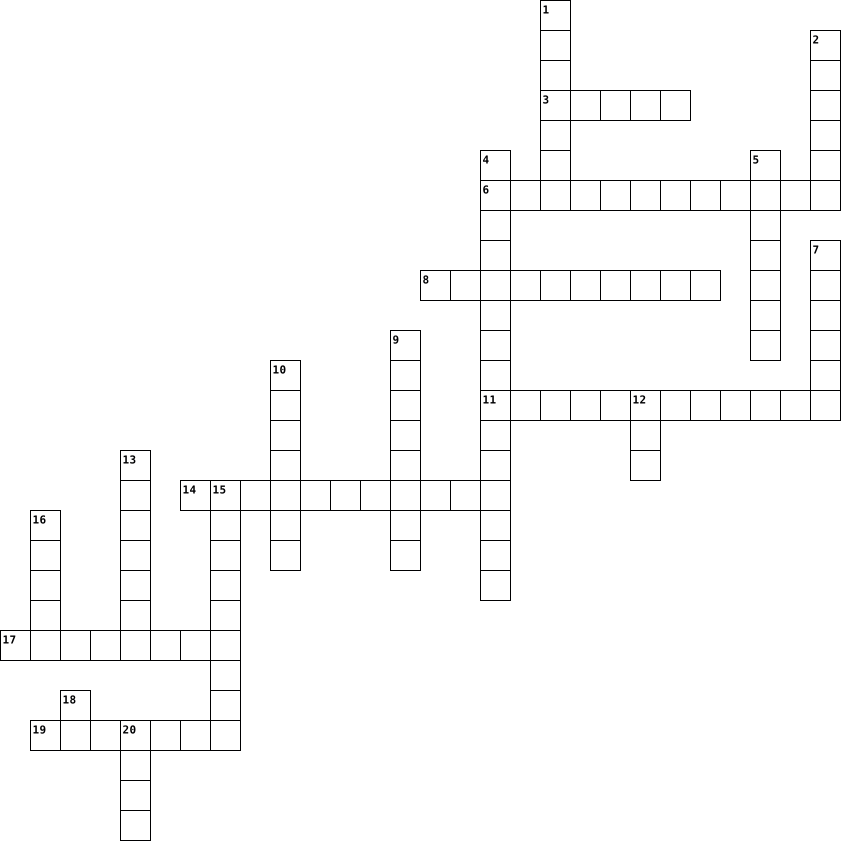
Across
- Transports water and minerals in a plant
- Proteins are made up of..
- Produces naked seeds in cones
- Hormone that makes grapes larger
- Examples include Roan Horses and blood type AB
- Guanine attaches to..
- Muscle and nerve tissue are only found in..
Down
- Form of reproduction of a poyp (Cnidarian)
- Becomes seeds
- Produces 4 sperm
- Thymine attaches to..
- There are 64...
- Comes after Metaphase
- n
- Has a base of U, A, C, G
- Where does transcription happen
- Produce 1 egg and 3 polar bodies
- Forms a fruit
- Diploid
- aka Bryophytes
20 Clues: n • Diploid • Becomes seeds • Forms a fruit • aka Bryophytes • There are 64... • Produces 4 sperm • Thymine attaches to.. • Comes after Metaphase • Guanine attaches to.. • Has a base of U, A, C, G • Proteins are made up of.. • Produces naked seeds in cones • Where does transcription happen • Hormone that makes grapes larger • Produce 1 egg and 3 polar bodies • ...
biology 2021-09-10

Across
- A substance that is present before a chemical reaction and takes part in it, usually shown on the left-hand side of a chemical equation.
- The building block of matter; the smallest possible particle of an element.
- An attraction between two atoms as a result of sharing or transferring valence electrons.
- A change in a substance that results in one or more new substances being formed that have different physical and chemical properties than those of the original substance.
- The process by which particles in solution are evenly distributed throughout the solvent by Brownian motion.
- The process by which one substance, the solute, is broken up into smaller pieces by and distributed within a second substance, the solvent.
- A substance that can produce hydroxide ions (OH-) or accept hydrogen ions (H+) in solution.
- A class of nonpolar organic compounds that are insoluble in water and are used for energy storage and cell membranes in living things.
- The substances formed during a chemical reaction, usually indicated on the right-hand side of the chemical equation.
- The tendency of energy to disperse and become less available to do work.
- A change in a substance that does not change to identity of the substance (e.g., a change of form or state).
- A measurement of the average speed of the particles within a substance.
- An organic compound comprised of the elements carbon, hydrogen, and oxygen; includes sugars, starch, and cellulose.
- A naturally occurring catalyst, usually a protein.
- The smallest particle of a covalently bonded compound.
- A class of organic compounds that serve as the building blocks of proteins.
Down
- A pure substance made from two or more elements that are chemically combined.
- The attraction of particles in one substance for particles in a different substance.
- A substance that binds to an enzyme and reduces its activity, thus slowing a chemical reaction that the enzyme catalyzes.
- The attraction between like particles within polar substances.
- A substance that can produce hydrogen ions (H+) in solution.
- A substance that changes the rate of a chemical reaction but is not itself used up or affected by the reaction.
- A pure substance made of only one kind of atom.
- A class of simple organic compounds important in living things as a source of both energy and structure.
- The ability to do work. Especially in biology, the driver of the physical and chemical processes necessary for life.
- Quality of molecules having an uneven distribution of electrical charge, resulting in some regions of a molecule having negative charge while others are positive.
- A covalently bonded compound containing the element carbon.
- The physical stuff that makes up the universe. Anything that occupies space and has mass.
- A class of organic compounds that serve as the building blocks for the information storage molecules DNA and RNA.
29 Clues: A pure substance made of only one kind of atom. • A naturally occurring catalyst, usually a protein. • The smallest particle of a covalently bonded compound. • A covalently bonded compound containing the element carbon. • A substance that can produce hydrogen ions (H+) in solution. • The attraction between like particles within polar substances. • ...
biology 2021-09-27

Across
- the breakdown of glucose by enzymes, releasing energy and pyruvate
- process that releases energy by breaking down glucose and other food molecules in the presence of oxygen
- Stacks of thylakoids
- a cluster composed of hundreds of chlorophyll molecules and accessory pigments used to harvest light molecules for photosynthesis
- reactions of photosynthesis in which energy from ATP and NADPH is used to build high energy compounds
- one of the carrier molecules that transfers high energy electrons from chlorophyll to other molecules
- electron carrier that provides high energy electrons for photosynthesis
- organelle that is the site of ATP production
- uses the high energy electrons from the Krebs cycle to convert ADP into ATP
- The fluid of the chloroplast surrounding the thylakoid membrane
- respiration that does not require oxygen
Down
- an organelle found only in plant and algae cell
- green pigment in plants that absorbs light energy used to carry out photosynthesis
- reactions of photosynthesis that use energy from light to produce ATP and NADPH
- Respiration that requires oxygen
- second stage of cellular respiration
- process by which plants and some other organisms use light energy to covert water and carbon dioxide into oxygen and high energy carbohydrates such as sugars and starches
- main energy source that cells use for most of their work
- a lower energy molecule that can be converted into ATP by the addition of a phosphate group
- A flattened membrane sac inside the chloroplast
20 Clues: Stacks of thylakoids • Respiration that requires oxygen • second stage of cellular respiration • respiration that does not require oxygen • organelle that is the site of ATP production • an organelle found only in plant and algae cell • A flattened membrane sac inside the chloroplast • main energy source that cells use for most of their work • ...
Biology 2021-09-13

Across
- VARIABLE, The variable manipulated by the experimenter
- VARIABLE, The variable responding to the manipulated variable
- THEORY, an explanation of some part of the natural world that has been thoroughly tested and is supported by a significant amount of evidence from observations and experiments
- Organisms that eat only organisms other than plants.
- GROUP, the group in an experiment that experiences no manipulation (does not contain the independent variable)
- The maintenance of stable internal conditions.
- LAW, a description of a natural relationship or principle, often expressed in mathematical terms, and supported by a significant amount of evidence
- REPRODUCTION, Process by which a single organism produces genetically identical offspring
- The sum total of all processes in an organism that convert energy and matter from outside sources and use that energy and matter to sustain the organism's life functions
- OBSERVATIONS, Observations involving numbers, such as counting or measuring.
- The study of life. the Greek word bios means "life", and -logy means "study of".
- OBSERVATIONS, Observations that are not easily counted or measured, such as color or texture
- Organisms that only eat plants.
- REPRODUCTION, Process by which two parents produce genetically different offspring.
- organisms that are able to make their own food
- living creatures that are too small to see with the naked eye
- Organisms that eat both plants and other organisms.
- The smallest units of an organism considered alive
- organism that lacks an internal mechanism for regulating body heat
- an abrupt and marked change in the DNA of an organism compared to that of its parents
Down
- ELECTRON MICROSCOPE, a microscope that transmits a beam of electrons through a thinly sliced specimen
- Logical interpretation based on prior knowledge, experience, or evidence
- The process by which physical and biological characteristics are transmitted from the parent (parents) to the offspring.
- SYSTEM OF UNITS, the metric system (SI), which is the most widely used system of measurement in science
- The idea that long ago, very simple life forms spontaneously appeared through chemical reactions
- the sum total of all processes in an organism that break down chemicals to produce energy and simple chemical building blocks
- The process by which green plants and some other organisms use the energy of sunlight and simple chemicals to produce their own food.
- The sum total of all processes in an organism that use energy and simple chemical building blocks to produce large chemicals and structures necessary for life.
- GROUP, The group in an experiment that is manipulated
- a suggested, testable answer to a well-defined scientific question or a possible, testable explanation for observations
- The Latin prefix uni means "one", so unicellular means "single-celled"
- ELECTRON MICROSCOPE, a microscope that passes a beam of electrons over the surface of a specimen
- Organisms that is internally warmed by heat-generating metabolic process.
- organisms that depend on other organisms for their food
- The collected body of data from experiments and observations.
- LIGHT MICROSCOPE, a microscope that shines light through a specimen using two lenses to magnify an image
- A factor that changes in an experiment
- Special structures that allow living organisms to sense the conditions of their internal or external environment.
38 Clues: Organisms that only eat plants. • A factor that changes in an experiment • The maintenance of stable internal conditions. • organisms that are able to make their own food • The smallest units of an organism considered alive • Organisms that eat both plants and other organisms. • Organisms that eat only organisms other than plants. • ...
Biology 2021-09-16

Across
- the scientific name for the modern human species (2 words)
- observable characteristics of an individual
- Organism that two or more species are descendant from.
- _________selection is when certain trait are intentionally bred for (usually selected by humans)
- the remains of a plant or animal preserved in rock
- How well an organism is able to survive and reproduce
- _________ structures are similar physical features organisms share, even though the features may serve completely different functions.
- Scientist known as the father or evolution.
- a group of organisms that can reproduce fertile offsring together.
- offspring between 2 species
- the process by which a species becomes fitted to its environment
Down
- the amount of variety within a species.
- name of Darwins Ship.
- The islands off the coast of S.America Darwin famously visited on his voyage.
- process whereby organisms better adapted to their environment tend to survive and produce more offspring (2 words)
- The formation of a new species.
- The idea that genetic distribution changes over time
- Type of bird Darwin studied on his voyage.
- immediate descendant of an organism
- The two chromosomes that all males have
20 Clues: name of Darwins Ship. • offspring between 2 species • The formation of a new species. • immediate descendant of an organism • the amount of variety within a species. • The two chromosomes that all males have • Type of bird Darwin studied on his voyage. • observable characteristics of an individual • Scientist known as the father or evolution. • ...
biology 2021-10-07

Across
- A pigment necessary for photosynthesis.
- A thin covering of tissue.
- Conversion of light energy from the sun into chemical energy.products of photosynthesis are glucose and oxygen
- DNA coiled around and supported by proteins, found in the nucleus of the cell.
- The region of a cell that contains the cell's main DNA. Centre of a cell.
- A membrane-bounded "sac" within a cell.
- shorter term for spermatozoon; male gamete
- Powerhouse of the cell
Down
- The breakdown of absorbed substances.
- Small part of all living things.
- An organelle containing chlorophyll for photosynthesis.
- A rigid structure on the outside of certain cells, usually plant and bacteria cells.
- The breakdown of food molecules with a release of energy.
- Sets of organs in our bodies that do the work to keep us healthy and alive.
- Hairlike projections that extend from the plasma membrane and are used for locomotion.
- A large vacuole that rests at the center of most plant cells and is filled with a solution that contains a high concentration of solutes.
- The tendency of a solvent to travel across a semipermeable membrane into areas of higher solute concentration.
- The removal of soluble waste materials.
- main source of energy
- Made of thousands of cells, connected by several body systems to do work to keep our bodies healthy & alive.
20 Clues: main source of energy • Powerhouse of the cell • A thin covering of tissue. • Small part of all living things. • The breakdown of absorbed substances. • A pigment necessary for photosynthesis. • The removal of soluble waste materials. • A membrane-bounded "sac" within a cell. • shorter term for spermatozoon; male gamete • ...
biology 2020-12-18

Across
- The nuclear membrane breaks down, chromosomes are clearly visible, and the spindle begins to form.
- organelle where amino acids are bonded together to form proteins
- This is not technically a stage of mitosis because mitosis is the division of a cell's nucleus. This stage is the division of the cell's cytoplasm.
- process by which a section of DNA is used to produce a single-stranded RNA molecule
- Chromosomes are lined up in the center of the cell.
- another name of a protein.
- In both plant and animal cells; controls cellular functions: the brain
- when part of a gene in a chromosome is lost.
- Where photosynthesis occurs; in plant cells only
- During this stage the cell grows and functions. In addition, the cell's DNA duplicates and the nucleus is clearly visible.
- Synthesizes (makes) protein
Down
- The pairs of chromatids that make up the chromosomes separate from each other and are pulled to two opposite ends of the cell.
- environmental factors (physical or chemical) ex. radiation, viruses like HPV, enviro. poisons like tobacco, etc.
- Gives support and protection to cell; only in plant cells
- enzyme that unzips DNA
- building blocks of proteins
- the process whereby genetic information coded in messenger RNA directs the formation of a specific protein at a ribosome in the cytoplasm.
- Nuclear membranes form around both sets of chromosomes and the chromosomes uncoil. The cytoplasm starts separating (cytokinesis).
- a building block of nucleic acid.
- allows you to match up and place in right place, its a special triplet of bases at one end of a folded molecule.
20 Clues: enzyme that unzips DNA • another name of a protein. • building blocks of proteins • Synthesizes (makes) protein • a building block of nucleic acid. • when part of a gene in a chromosome is lost. • Where photosynthesis occurs; in plant cells only • Chromosomes are lined up in the center of the cell. • Gives support and protection to cell; only in plant cells • ...
Biology 2020-12-18

Across
- contains digestive enzymes to break down foreign bodies
- gives support to plant cell
- Occur during S phase of Interphase
- body cells
- full set of chromosomes
- Cell highway or transports goods
- a building block of nucleic acid
- type of RNA that carries each amino acid to a ribosome during protein synthesis
- the substance that is being dissolved by a solvent
- takes sugar and turns it into energy
- builds the mRNA
Down
- out of control mitosis
- the substance that dissolved the solute
- half number of chromosomes
- the process of making mRNA from DNA
- any change in DNA
- three-base sequence on messenger RNA that codes for a single amino acid
- twisted ladder, shape of DNA
- jelly-like substance the cell organelles float in
- Genetic material
20 Clues: body cells • builds the mRNA • Genetic material • any change in DNA • out of control mitosis • full set of chromosomes • half number of chromosomes • gives support to plant cell • twisted ladder, shape of DNA • Cell highway or transports goods • a building block of nucleic acid • Occur during S phase of Interphase • the process of making mRNA from DNA • ...
Biology 2021-02-23

Across
- One of the factors that limit the rate of photosynthesis. One word only.
- Gather light's energy
- Waste product of photosynthesis other then oxygen
- Other word for o2
- process where plants make their own food
- Colour or pigment of chlorophyll
- Holes found in the underside of leaves
- Factors affecting rate of photosynthesis. It has 3 word
- Photosynthesis is essential for _____ and takes place in chlorophyll
Down
- Living things that can photosynthesise
- The other word for h2o
- To see oxygen reduced during photosynthesis
- To see glucose is produce and stored as starch in a plant
- ATP
- It contain chlorophyll
- It is where the stomata is located
- Factors affecting rate of photosynthesis. 2 words
- compound that's produce by photosynthesis
- The other word for carbon dioxide
- Plants need this for photosynthesis
20 Clues: ATP • Other word for o2 • Gather light's energy • The other word for h2o • It contain chlorophyll • Colour or pigment of chlorophyll • The other word for carbon dioxide • It is where the stomata is located • Plants need this for photosynthesis • Living things that can photosynthesise • Holes found in the underside of leaves • process where plants make their own food • ...
Biology 2021-01-29
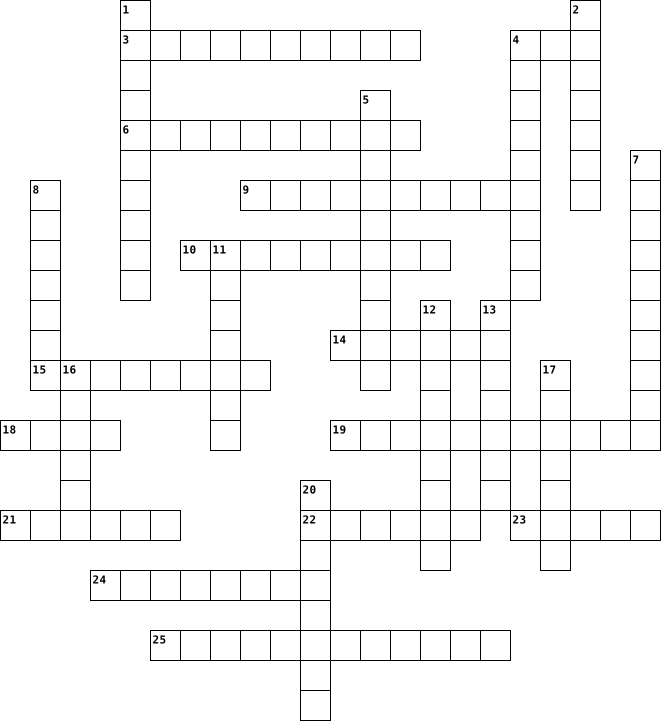
Across
- happens before sperm meets egg
- what is the acronym for cardiopulmonary resuscitation
- an artery carries _________________ blood
- Digestion another name for physical digestion
- Structure anatomically different; same function
- a respiratory disease caused by stress and outside factors
- Glands first step to breaking down carbohydrates
- what does the liver produce
- the cytoplasm splits into two
- two thin layers of tissue that protect the lungs
- the voice box, which includes two vocal chords
- carries deoxygenated blood to the heart
- a factor that can increase heart rate
- increase in blood flow by widening vessels
Down
- measures volume of air inspired and expired
- Synthesis process of building proteins
- one cell thick
- chemical reaction that occur in an organism
- official name for white blood cells
- contains the cells genetic material
- selection the process through which populations of living organisms adapt and change
- branch of biology that studies how all species are related through ancestry
- Arrest this occurs when your heart flatlines
- slight variation of one gene
- most specific taxon
- in what part of the small intestine does absorption take place
26 Clues: one cell thick • most specific taxon • what does the liver produce • slight variation of one gene • the cytoplasm splits into two • happens before sperm meets egg • official name for white blood cells • contains the cells genetic material • a factor that can increase heart rate • Synthesis process of building proteins • carries deoxygenated blood to the heart • ...
Biology 2021-01-26

Across
- of various water-soluble compounds having a sour taste
- system /The organs responsible for eliminating
- simplest structural unit of an element or compound
- system /The organs that are responsible for
- on free air
- a way of thinking
- organism that makes its own food
- interacting with their physical environment
- of the relations of organisms to their environment
- proteins and package them into vesicles
- the entire body
- containing chlorophyll and other pigments
- materials
Down
- mouth, stomach and intestines
- products from the human body
- all cell activities
- organs that make and send special chemical messengers called hormones
- compounds containing an amino group and acid group
- down
- supporting tissue of an organ (as opposed to parenchyma)
- covering of plant cells that protects and keeps its shape
- system /The blood, blood vessels and the
- on free air
- property of sticking together
- living part of an ecosystem
- that carry on the cell’s processes
- monosaccharide sugar that has several forms
27 Clues: down • materials • on free air • on free air • the entire body • a way of thinking • all cell activities • living part of an ecosystem • products from the human body • mouth, stomach and intestines • property of sticking together • organism that makes its own food • that carry on the cell’s processes • proteins and package them into vesicles • system /The blood, blood vessels and the • ...
Biology! 2021-01-23

Across
- Where Cellular Respiration occurs
- The state of steady/balanced internal, physical, and chemical conditions maintained by living systems.
- Taking materials into the cell by folding the cell membrane.
- Function is to defend against foreign micros, bacteria, and viruses. To return the tissue fluid in your body.
- Groups of the same species in an area.
- Cover body surfaces, line body cavities, and hollow organs. They provide a variety of functions but most importantly protection.
- Ecosystem with the same climate and similar communities.
- 6CO2+6H2O=C6H12O6+6O2
- Cell found in plants and animals and has a nucleus.
- These two things recycle CO2, Water, Glucose, and Oxygen.
- Going out of the Reaction.
- Where Photosynthesis occurs
- All organisms in an area plus the nonliving environment.
Down
- Protein carriers in cell membranes allow certain molecules to pass through.
- Provides Protection/ support in both plant and animal cells.
- Pockets of liquid form along the cell membrane which break off to form vacuoles.
- Their function is protection and temperature control.
- Molecules that go into the reaction.
- Speeds up a reaction
- Energy needed to start a chemical reaction.
- C6H12O6+6O2=6CO2+6H2O+Energy
- Organisms so similar that they can breed and make fertile offspring.
- Function is to regulate all body functions.
- Take reactants of an enzyme and catalyze the reaction.
- Different populations in an area.
25 Clues: Speeds up a reaction • 6CO2+6H2O=C6H12O6+6O2 • Going out of the Reaction. • Where Photosynthesis occurs • C6H12O6+6O2=6CO2+6H2O+Energy • Where Cellular Respiration occurs • Different populations in an area. • Molecules that go into the reaction. • Groups of the same species in an area. • Energy needed to start a chemical reaction. • Function is to regulate all body functions. • ...
Biology 2021-03-13

Across
- made up of two simple sugars
- break down of complex molecules
- this liquid makes up >60% of your body
- long chains of simple sugars
- biological catalysts
- large chain molecule made of many monomers
- made of four interconnected carbon rings, a precursor for many complex hormone molecules
- hardening or the setting of a protein eg) frying an egg
- synthesis of complex molecules
- molecules that have the same number of atoms but are arranged differently
- enzyme-catalyzed reaction in which water is added to a molecule to split it into two smaller molecules
- mechanical process of breaking down food into smaller pieces
Down
- when the physical structure of a protein is altered in an irreversible way eg,)whisking egg whites
- long-chain lipids joined to an alcohol or carbon ring
- enzyme-catalyzed reaction in which macromolecules are created and water is expelled
- 6 main elements of life
- a chain of several amino acids bonded together
- inhibitors attaches and blocks the active site of the enzyme
- organic compounds that help enzymes function, they are coenzymes
- small, single-unit molecule
- large complex organic molecules
- a chain of amino acids
22 Clues: biological catalysts • a chain of amino acids • 6 main elements of life • small, single-unit molecule • made up of two simple sugars • long chains of simple sugars • synthesis of complex molecules • break down of complex molecules • large complex organic molecules • this liquid makes up >60% of your body • large chain molecule made of many monomers • ...
Biology 2021-11-12

Across
- it is a solution to test for starch
- it is the movement of small food molecules and ions through the wall of the intestine into the blood
- it is a protein that functions as a biological catalyst
- A sustainable ...... is one that is produced as rapidly as it is removed from the environment
- A ...... is the probability of that organism surviving and reproducing in the environment where it is found
- A ........... is made up of all the plants and animals living in an ecosystem
- What is the process of getting energy from ammonia?
- the movement of the sucrose and amino acids in the phloem, from regions of production to the regions of storage or to regions where they are used in respiration or growth
- The process by which energy is produced from food
- structure made up of a group of tissues, working together to perfrom a specific function
- it is the movement of digested food molecules into the cells of the body where they are used, becoming part of the cells.
- a group of organisms that can reproduce to produce fertile offspring
- A ..... is any substance taken into the body that modifies or affects chemical reactions in the body
- the removal of the nitrogen-containing part of amino acids to form urea
- fats are a solid form of a group of molecules is called.....
- Another version of genes are called ........
- it is the process by which plants manufacture carbohydrates from raw materials using the energy from light.
- Type of variation that is brought about by genes, but can also be caused by the environment is .........
- Dominance that is sometimes taken to mean the same as co-dominance is ........... dominance
- the ability to detect or sense stimuli in the internal or external environment and to make appropriate responses
Down
- Heroine, morphine and codeine belong to a group of drugs are called....
- it is a fluid filled space surrounded by a membrane which is found inside the cyptoplasm of plant cells to help to keep plants cells firm
- it is the net movement of molecules and ions from region of their higher concentration to a region of their lower concentration down a concentration gradient as a result of their random movement
- When a crop of single species is grown on the same land, year after year, it is called .........
- the loss of water vapour from the plant leaves by evaporation of water at the surfaces of the mesophyll cells followed by the diffusion of water vapour through the stomata
- EGC stands for
- it is a substances that increases the rate of a chemical reaction and is not changed by the reaction
- Coordination by chemicals is brought about by the.......
- the fusion of gamete nuclei
- the removal from organisms of toxic materials and substances in excess of requirements.
- The Goblet Cells secrete....
- The effect of greenhouse gas is that they trap .......... radiation and increase global temperature
- respiration the term for the chemical reactions in the cells that break down nutrient molecules to release energy without using oxygen
- it is proteins produced by white blood cells called lymphocytes
- .......... and wallflower are examples of insect-pollinated flowers
- Bacterial DNA that is in the form of circular strand and also small circular pieces called ..........
- The sounds you heart make can be heard by a......
- The ...... in our atmosphere contains about twenty one% of oxygen
- the defence against the pathogen by antibody production in the body
- it is the net movement of waterr molecules from a region of higher water potential to a region of lower water potential through a partially permeable membrane
- Nerve impulses from the sense organs to the central nervous system are called,,,,
41 Clues: EGC stands for • the fusion of gamete nuclei • The Goblet Cells secrete.... • it is a solution to test for starch • Another version of genes are called ........ • The process by which energy is produced from food • The sounds you heart make can be heard by a...... • What is the process of getting energy from ammonia? • ...
Biology 2021-12-05

Across
- A Layer of the earth
- Covers most of the earth and is one of the reasons for life
- Composition of Soil
- factor affecting soil formation
- Another type of biogeochemical cycle
- A gas which is found 21% in the atmosphere
- The process when CO2 incorporates into plants, product is glucose
- Process which takes millions of years and forms fossil fuels
- Another factor soil formation
- The process in which the dead organism degrades by Microbes and Fungus, CO2 is released
- Resources for sustaining life
- When water becomes unclean
Down
- Direction of the wind during the day
- A Layer in the stratosphere
- Direction of the wind during the night
- A type of biogeochemical cycle
- A process in the nitrogen cycle
- Process in which glucose is broken into ATP and CO2
- Cause of Soil Erosion
- Cause of depletion of the soil
20 Clues: Composition of Soil • A Layer of the earth • Cause of Soil Erosion • When water becomes unclean • A Layer in the stratosphere • Another factor soil formation • Resources for sustaining life • A type of biogeochemical cycle • Cause of depletion of the soil • A process in the nitrogen cycle • factor affecting soil formation • Direction of the wind during the day • ...
Biology 2022-04-15

Across
- One of the larger air tubes in the lungs. Each lung has a main bronchus that branches into smaller and smaller airways.
- The transparent dome at the front of the eyeball that is the eye's main focusing lens.
- A thin-walled blood vessel that returns blood at low pressure from body organs and tissues to the heart.
- The sum of all the physical and chemical processes that take place in the body.
- The dome-shaped muscular sheet that separates the chest from the abdomen.
- A watery fluid secreted into the mouth by the salivary glands to aid chewing, tasting and digestion.
- Fatty or oily substance, insoluble in water, with varied roles in the body.
- The outer layer of the skin; its box-shaped cells become flatter and scalier towards the surface.
- Control centre of a cell, containing the genetic material DNA.
- Watery or jelly-like fluid that fills the bulk of a cell; it contains many organelles.
- Body structure made of similar cells that perform one main function
- A region of the brain located behind the brainstem. It is concerned with balance, posture, and the control of fine movement.
Down
- An elastic, muscular-walled tube that transports blood away from the heart to other body parts.
- A type of microorganism with one cell. Only a few of the many species of them cause disease.
- The coiled structure in the inner ear that converts sound vibrations into nerve impulses for the transmission to the brain.
- A morphine-like substance produced naturally by the body in times of pain and stress, and also activated during exercise.
- A soluble protein that attaches to body incaders, such as bacteria, and helps to destroy them.
- The membrane separating the outer eat from the middle ear that vibrates in response to sound.
- A threadlike structure, present in all nucleated body cells, that carries the genetic code for the formation of the body. A normal body has 23 pairs of it.
- A protein that accelerates chemical reactions within cells.
20 Clues: A protein that accelerates chemical reactions within cells. • Control centre of a cell, containing the genetic material DNA. • Body structure made of similar cells that perform one main function • The dome-shaped muscular sheet that separates the chest from the abdomen. • Fatty or oily substance, insoluble in water, with varied roles in the body. • ...
Biology 2022-04-29

Across
- What part of the brain controls the unconscious activities such as heart rate and breathing rate?
- What bacteria converts ammonia to nitrates in the soil?
- What type of enzyme is used to isolate the gene and plasmid?
- What plant hormone is used to control ripening of fruit
- What type of cells are responsible for the secondary immune response?
- Apart from moisture and temperature, what other factors affect rate of decomposition
- What occurs at the alveoli?
- What is the circular area around an antibiotic where bacteria does not grow?
- Where does respiration occur
- What trial is testing on animal/tissue
- Which gland are most hormones produced at?
Down
- What process takes water from trees to clouds?
- What does lipase break fatty acids down into?
- What is the position of an organism on a food chain?
- Which tissue is used for transpiration?
- What is released when the concentration of blood glucose is too high?
- What blood type IO an example of?
- What base sequence is complementary to Thymine?
- Form of cell division that occurs after Interphase?
- What is a regular square that is used to count amount of organisms in the square?
- Where is the specimen placed on to view it?
- What is used to measure rate of respiration?
22 Clues: What occurs at the alveoli? • Where does respiration occur • What blood type IO an example of? • What trial is testing on animal/tissue • Which tissue is used for transpiration? • Which gland are most hormones produced at? • Where is the specimen placed on to view it? • What is used to measure rate of respiration? • What does lipase break fatty acids down into? • ...
Biology 2022-05-12

Across
- any environmental or physical pressure that elicits a response from an organism
- Evolutionary process that fits an organism to its environment
- interaction between organisms where both require the same resources
- when there are not enough resources in an environment for organisms
- measure of how well peoples genes account for differences in traits
- A theory that all organisms came from the same place and evolved to suit their environments
- a gene that is shown as a phenotype, or physical trait
- branch of biology relating to the function of organs and organ systems
- successive stage of natural organism
- creator of the evolution theory
- difference in DNA between organisms or populations
Down
- specific arrangement of continuing objects
- average contribution to the gene pool
- process where organisms adapt to their environments
- made up of dna strands
- Change of activity in an organism to stimulus
- the study of the size shape and structure of plants and animals in an environment
- process that uses lab equipment to alter the DNA of organisms
- something that occurs when a DNA strand is changed in a way to alter the message of a gene
- when one organism is dominating the food tree in it's given environment
20 Clues: made up of dna strands • creator of the evolution theory • successive stage of natural organism • average contribution to the gene pool • specific arrangement of continuing objects • Change of activity in an organism to stimulus • difference in DNA between organisms or populations • process where organisms adapt to their environments • ...
Biology 2022-05-18

Across
- humans select the survival of organisms with desirable traits
- how many divisions does meiosis have?
- lipids store...
- physical appearance of an individual for a trait
- allows large, polar molecules to pass through the cell membrane
- what does secondary succession have that primary succession does not?
- the phase where chromosomes line up in the middle of the cell
- lowest trophic level in a food pyramid
- what holds together sister chromatids?
- monomer for protein
- type of cell with no nucleus
- water molecules sticking to other molecules
- place on enzyme where substrates fit
- substances changed during a chemical reaction
Down
- when a small bud forms and falls off an organism and becomes a new organism
- what blood type can be given to any other blood type
- organelle in an animal cell that stores water and nutrients
- how many divisions does mitosis have?
- external factors that cause mutations
- relationship where both species benefit
- are gametes haploid or diploid?
- the diffusion of water from a high to low concentration
- cellular respiration happens in the...
- the DNA nucleotides sugar is...
- monomer for lipids
- change over time in a population of species
- synthesize proteins
- how many kingdoms are there in the modern classification system?
- what is the first step in photosynthesis called?
- all living things are made of...
30 Clues: lipids store... • monomer for lipids • synthesize proteins • monomer for protein • type of cell with no nucleus • are gametes haploid or diploid? • the DNA nucleotides sugar is... • all living things are made of... • place on enzyme where substrates fit • how many divisions does mitosis have? • external factors that cause mutations • how many divisions does meiosis have? • ...
biology 2022-09-07

Across
- kepanjangan dari DNA?
- fauna di indonesia sejenis kadal?
- cycle dimana menggunakan asap dari kendaraan dan faktor industri?
- family dari herpes?
- bahasa latinnya manusia?
- singkatan dari ribonudeic acid?
- molus domestica nama latin dari?
- siklus biogeokimia yang menggambarkan transformasi dan translokasi dalam tanah, air, serta bahan organik hidup dan mati?
- nama latin dari kuda?
- bunga yang di lindungi di indonesia?
- bahasa latin dari black paper?
Down
- jika hewan mati akan mengeluarkan senyawa co2 / carbon dioxide dan menyisahkan tubuh hewan yang akan berubah menjadi?
- pristiwa pengomposan kotoran hewan pada nitrogen cycle di sebut?
- genus dari ebola?
- zat yang di keluarkan dari proses fotosintesis yang mengandung co2?
- ecosystem yang isinya cactus, unta, dan lain lain?
- proses dimana n2 di keluarkan dari tanah disebut?
- yang termasuk dengan divercity of gene dari kucing adalah?
- kepanjangan dari no3
- hubungan alami dari rantai-rantai makanan dan representasi grafis dari proses makan-dan-dimakan dalam komunitas ekologis disebut?
- apa sebutan pristiwa dimana tanaman menyerap NO3?
- suatu sistem ekologi yang terbentuk oleh hubungan timbal balik tak terpisahkan antara makhluk hidup dengan lingkungannya disebut?
22 Clues: genus dari ebola? • family dari herpes? • kepanjangan dari no3 • kepanjangan dari DNA? • nama latin dari kuda? • bahasa latinnya manusia? • bahasa latin dari black paper? • singkatan dari ribonudeic acid? • molus domestica nama latin dari? • fauna di indonesia sejenis kadal? • bunga yang di lindungi di indonesia? • proses dimana n2 di keluarkan dari tanah disebut? • ...
biology 2022-09-07

Across
- pristiwa pengomposan kotoran hewan pada nitrogen cycle di sebut?
- siklus biogeokimia yang menggambarkan transformasi dan translokasi dalam tanah, air, serta bahan organik hidup dan mati?
- family dari herpes?
- kepanjangan dari no3
- proses dimana n2 di keluarkan dari tanah disebut?
- molus domestica nama latin dari?
- zat yang di keluarkan dari proses fotosintesis yang mengandung co2?
- ecosystem yang isinya cactus, unta, dan lain lain?
- fauna di indonesia sejenis kadal?
- nama latin dari kuda?
- bahasa latinnya manusia?
Down
- bunga yang di lindungi di indonesia?
- kepanjangan dari DNA?
- cycle dimana menggunakan asap dari kendaraan dan faktor industri?
- suatu sistem ekologi yang terbentuk oleh hubungan timbal balik tak terpisahkan antara makhluk hidup dengan lingkungannya disebut?
- apa sebutan pristiwa dimana tanaman menyerap NO3?
- genus dari ebola?
- bahasa latin dari black paper?
- singkatan dari ribonudeic acid?
- hubungan alami dari rantai-rantai makanan dan representasi grafis dari proses makan-dan-dimakan dalam komunitas ekologis disebut?
20 Clues: genus dari ebola? • family dari herpes? • kepanjangan dari no3 • kepanjangan dari DNA? • nama latin dari kuda? • bahasa latinnya manusia? • bahasa latin dari black paper? • singkatan dari ribonudeic acid? • molus domestica nama latin dari? • fauna di indonesia sejenis kadal? • bunga yang di lindungi di indonesia? • apa sebutan pristiwa dimana tanaman menyerap NO3? • ...
biology 2022-09-07

Across
- proses dimana n2 di keluarkan dari tanah disebut?
- hubungan alami dari rantai-rantai makanan dan representasi grafis dari proses makan-dan-dimakan dalam komunitas ekologis disebut?
- family dari herpes?
- bunga yang di lindungi di indonesia?
- kepanjangan dari DNA?
- nama latin dari kuda?
- singkatan dari ribonudeic acid?
- siklus biogeokimia yang menggambarkan transformasi dan translokasi dalam tanah, air, serta bahan organik hidup dan mati?
- jika hewan mati akan mengeluarkan senyawa co2 / carbon dioxide dan menyisahkan tubuh hewan yang akan berubah menjadi?
- ecosystem yang isinya cactus, unta, dan lain lain?
Down
- fauna di indonesia sejenis kadal?
- genus dari ebola?
- bahasa latin dari black paper?
- kepanjangan dari no3
- pristiwa pengomposan kotoran hewan pada nitrogen cycle di sebut?
- zat yang di keluarkan dari proses fotosintesis yang mengandung co2?
- molus domestica nama latin dari?
- cycle dimana menggunakan asap dari kendaraan dan faktor industri?
- bahasa latinnya manusia?
- apa sebutan pristiwa dimana tanaman menyerap NO3?
- suatu sistem ekologi yang terbentuk oleh hubungan timbal balik tak terpisahkan antara makhluk hidup dengan lingkungannya disebut?
21 Clues: genus dari ebola? • family dari herpes? • kepanjangan dari no3 • kepanjangan dari DNA? • nama latin dari kuda? • bahasa latinnya manusia? • bahasa latin dari black paper? • singkatan dari ribonudeic acid? • molus domestica nama latin dari? • fauna di indonesia sejenis kadal? • bunga yang di lindungi di indonesia? • proses dimana n2 di keluarkan dari tanah disebut? • ...
biology 2022-09-07

Across
- proses dimana n2 di keluarkan dari tanah disebut?
- molus domestica nama latin dari?
- pristiwa pengomposan kotoran hewan pada nitrogen cycle di sebut?
- bahasa latin dari black paper?
- bahasa latinnya manusia?
- genus dari ebola?
- nama latin dari kuda?
- suatu sistem ekologi yang terbentuk oleh hubungan timbal balik tak terpisahkan antara makhluk hidup dengan lingkungannya disebut?
- kepanjangan dari no3
Down
- bunga yang di lindungi di indonesia?
- family dari herpes?
- siklus biogeokimia yang menggambarkan transformasi dan translokasi dalam tanah, air, serta bahan organik hidup dan mati?
- ecosystem yang isinya cactus, unta, dan lain lain?
- kepanjangan dari DNA?
- hubungan alami dari rantai-rantai makanan dan representasi grafis dari proses makan-dan-dimakan dalam komunitas ekologis disebut?
- apa sebutan pristiwa dimana tanaman menyerap NO3?
- cycle dimana menggunakan asap dari kendaraan dan faktor industri?
- zat yang di keluarkan dari proses fotosintesis yang mengandung co2?
- fauna di indonesia sejenis kadal?
- singkatan dari ribonudeic acid?
20 Clues: genus dari ebola? • family dari herpes? • kepanjangan dari no3 • kepanjangan dari DNA? • nama latin dari kuda? • bahasa latinnya manusia? • bahasa latin dari black paper? • singkatan dari ribonudeic acid? • molus domestica nama latin dari? • fauna di indonesia sejenis kadal? • bunga yang di lindungi di indonesia? • proses dimana n2 di keluarkan dari tanah disebut? • ...
BIOLOGY 2022-09-19

Across
- actual: thật sự
- attempts to completely get rid of or destroy st: nỗ lực để xóa bỏ cái gì
- to practice: luyện tập
- the body system involving the stomach and intestines to digest food: hệ tiêu hóa
- powerful and effective: có uy lực
- to act like; imitate: bắt chước
- to keep away: tránh khỏi
- to protect sb against a disease, usually by injecting him or her with a weak form of it: tiêm chủng
- increasing number: số lượng ngày càng tăng
- present in a particular place or among a particular group of people: (dịch bệnh) mang tính cục bộ
- diagonal: chéo
- to protect st from harm or damage: bảo vệ
- to give (as a property or characteristic) to sb or st: phong cho, ban cho
Down
- not move: giữ yên, không di chuyển
- not capable of causing disease: không gây bệnh
- sudden injury: chấn thương
- long and hollow: có hình ống
- to cause sb or st to be in a particular condition: làm cho…
- When you get to the basic nature of st: thực tế là
- decreasing: đang giảm đi
- the thin surface that covers some inner parts of the body, such as the inside of the nose, and produces mucus: niêm mạc
- the loss of ability to move all or part of your body: chứng liệt
- many types of: sự đa dạng
23 Clues: diagonal: chéo • actual: thật sự • to practice: luyện tập • to keep away: tránh khỏi • decreasing: đang giảm đi • many types of: sự đa dạng • sudden injury: chấn thương • long and hollow: có hình ống • to act like; imitate: bắt chước • powerful and effective: có uy lực • not move: giữ yên, không di chuyển • to protect st from harm or damage: bảo vệ • ...
biology 2022-01-14

Across
- a microscopic single-celled organism that has neither a distinct nucleus with a membrane nor other specialized organelles
- a minute particle consisting of RNA
- relating to the body
- a unit of heredity which is transferred from a parent to offspring
- molecules that combine to form proteins.
- a compound which is one of the four constituent bases of nucleic acids.
- a sugar derived from ribose by replacing a hydroxyl group with hydrogen.
- a mature haploid male or female germ cell
- an organism consisting of a cell or cells in which the genetic material is DNA in the form of chromosomes contained within a distinct nucleus
- relating to or denoting chemical bonds formed by the sharing of electrons between atoms.
- a substance that is insoluble in water and soluble in alcohol
- a compound that occurs in guano and fish scales
Down
- an intermolecular force
- one of four chemical bases in DNA
- a sequence of three nucleotides which together form a unit of genetic code in a DNA or RNA molecule.
- a nucleotide
- having a single set of unpaired chromosomes.
- a sugar of the pentose class which occurs widely in nature as a constituent of nucleosides and several vitamins and enzymes.
- description of the structure of a DNA molecule.
- a salt or ester of phosphoric acid
- a compound which is one of the four constituent bases of nucleic acids
- containing two complete sets of chromosomes
- a biological catalyst
- any of a class of nitrogenous organic compound
- the basic building block of nucleic acids
25 Clues: a nucleotide • relating to the body • a biological catalyst • an intermolecular force • one of four chemical bases in DNA • a salt or ester of phosphoric acid • a minute particle consisting of RNA • molecules that combine to form proteins. • a mature haploid male or female germ cell • the basic building block of nucleic acids • containing two complete sets of chromosomes • ...
Biology 2022-01-25

Across
- - This trait is possessed by brothers - They often have arguments and run opposite to each other, but at the end of the day, are always side by side. This trait is often also seen in DNA!
- Reactions - This type of reaction is like doing something bad within a relationship - The bonds that are formed between the individuals will be weaker now than the bond before, which was broken from doing something wrong.
- - This type of DNA is like a bunch of random letters on a screen which do not have any meaning or code.
- - This type of transport is like being able to move a car across the border without gas, and it is composed of multiple types like diffusion and osmosis.
- - This process of DNA replication is just like taking a bunch of curly hair and unwinding it in order to expose each strand of hair.
- - This term can be described as planting a whole acre of apple trees, and waiting for them to produce apples, which can be considered as offspring. Some of these trees produce many more apples, and others will produce less… This potential of producing offspring is referred to as …
- - This type of reaction is like filling a glass of water, and ending up overflowing the water, causing a positive outflow of water from the system, which is the glass, to the surroundings.
- - This photo was the parents of a whole generation of individuals, but instead the generation would represent DNA research.
- - This is a type of method used by plants which can be described like being a human - During the night, we sleep and carry out certain processes within the body, which in plants would be the C4 pathway, and during the day, we switch to other processes, which in the case of plants, wold be the Calvin cycle.
- - This part of the brain can be considered as a thermostat - It controls the temperature of us, humans, and the thermostat itself is essentially set at 37°C, maintaining homeostasis within the body.
- - A process in cellular respiration which can be described as taking a 6 slice pizza, putting it into an oven, and it coming out in 2 parts, with 3 slices in each part.
- - This is a type of cellular process that can be described like parcel delivery - The products are covered in a package, which can be considered as cell membrane, and then brought to your house, which can be considered as a cell.
- - Just like puzzle pieces connect to make a big puzzle, these connect to make larger molecules
- - This bond can be described as getting a pizza to share for two, but taking more slices than the other individual.
- - This process of DNA replication is like taking straightened hair which is naturally curly, and putting water on it. It unwinds, and coils back into its form.
- - This three-letter word is like toppling dominoes, but instead of a chain of dominoes, there is a chain of energy transfers which is done through a number of chemical compounds, un order to achieve aerobic respiration
- - This type of unsaturated fatty acid is like a bad apple in a supposedly good batch of apples. Despite it being an unsaturated fat, its impact on our health is very bad.
- - ____-dependant reaction are just like solar panels, they require the capture of light from the sun in order to be powered and do their job
- - This type of transport is like moving a car across the border, with the border being like a membrane, using gas as energy, and it is composed of multiple types like Endocytosis and Exocytosis.
- - These types of organisms can be described as being like kings - Kings are always able to control and maintain their kingdom, which in this case is essentially homeostasis in our body, regardless of their surroundings, which can be described as changes in temperature, etc.
- - This type of dispersion can be referred to as small little magnets which are all attached to each other and concentrated in a certain area.
- - This type of cycle which occurs within cellular respiration can be described like having to spin a gameboard spinner twice in order to ensure you have the correct option.
- - This process can also be seen as a machine, which without the power, the proton motive force, is unable to do its job.
Down
- - This type of population growth can be looked at as a rise in prices for something. This growth will increase for a certain amount of time, but when it reaches a certain level of price, the government will intervene, and do something to slow the prices down, resulting in a stationary phase.
- - These types of plants are just like Camels - They strive and are more efficient within hot and dry conditions, but are less efficient within lower temperatures.
- - This is a type of mixture like mixing water and juice, and having the same concentration of both in the mixture.
- - Just like we all have a fear of something, this type of substance fears something which we all love and need to drink in order to live.
- - This is a type of cellular process can be described as parcel return - The products are covered in a package, which can be considered as cell membrane, and then brought outside of your home, back to wherever they came from.
- - This is a type of enzyme that can be described as a scissor - When there is tension at a specific place, which in this case, is DNA, it will cleave the strands causing this tension.
- - This 3 letter process can be described as the flow of water, and how it creates hydroelectricity, but in this case, instead of actually being turned by water, it is, instead of being done so by the flow of H+ ions which are moving down the concentration gradient of theirs
- - This law of thermodynamics is just like having a messy room, and continuing to delay cleaning it - The disorder of the room will always increase.
- - This can be thought of as the entire lego set, composed of small lego pieces, also known as monomers.
- - This type of population can be referred to as having a completely separate fish tank with a certain amount of fish in it. No fish can be added, and the fishes are unable to leave this tank either.
- - The enzyme that catalyzes the first step in the Calvin cycle, and is required to fix carbon dioxide
- - Just like we humans bond with people who have the same traits as us, this type of bond is between two of the same types of acids.
- - This law of thermodynamics is like having an undestroyable and uncreatable ball of playdough which can only be played with and changed in form.
- - These types of feedback loops are like supplements. They make certain changes to aspects of the body in order to bring the body back to an acceptable range.
- - Just like we all have our own internal environments, such as our homes, the thylakoid also has its own called…
- - These types of organisms can be described as being citizens in a dictatorship - They have no control over their country’s decisions, which in this case is essentially homeostasis in our body, and instead of their surroundings, the dictator, which can also be considered as changes in temperature, controls them.
- - This type of dispersion is like taking a number of small little balls and throwing them all over a certain area, not having any control on where they land.
- - These types of plants are just like many organisms - They are unable to live in hot, dry areas.
41 Clues: - Just like puzzle pieces connect to make a big puzzle, these connect to make larger molecules • - These types of plants are just like many organisms - They are unable to live in hot, dry areas. • - The enzyme that catalyzes the first step in the Calvin cycle, and is required to fix carbon dioxide • ...
Biology 2021-12-08
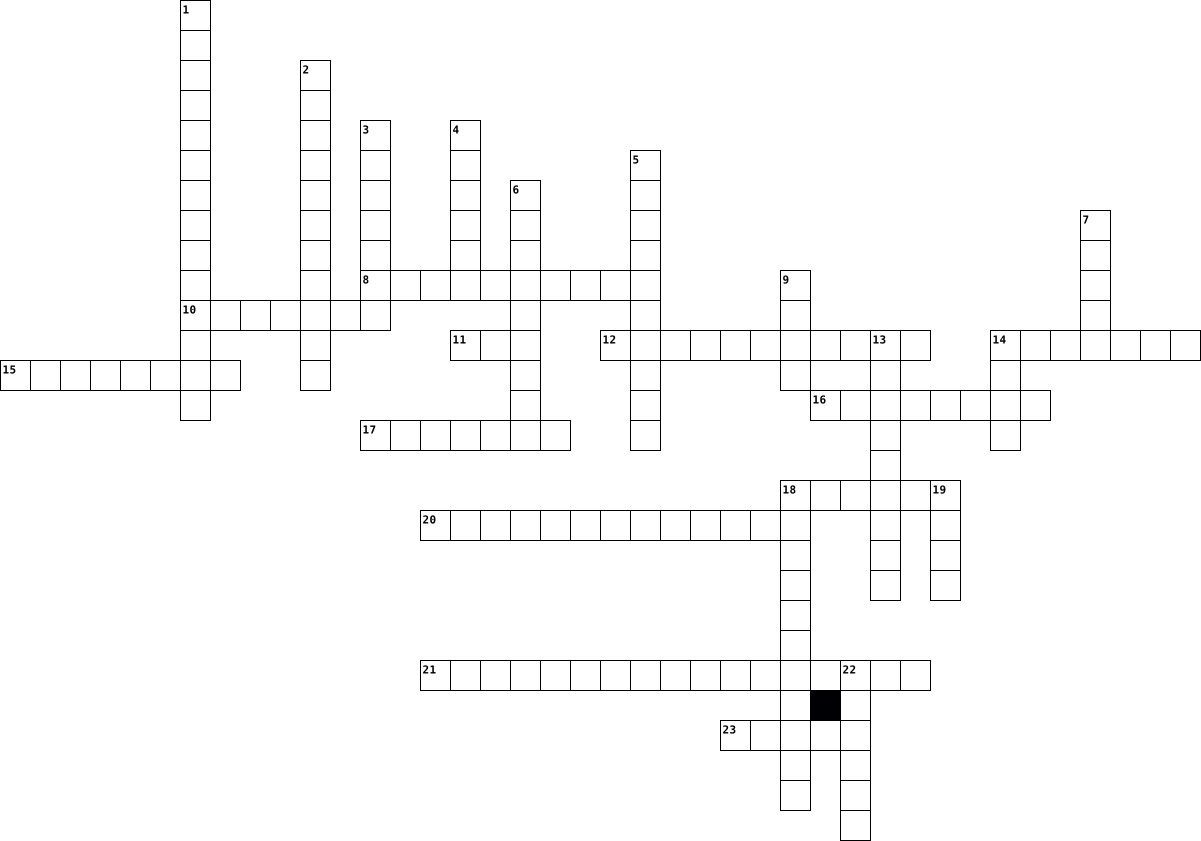
Across
- a molecule consisting of a nitrogen containing base
- pyrimidine base
- molecules inside cells that contains genetic information
- any event that changes genetic structure
- It is a type of purine
- Occurs when DNA gene is damaged or changed
- Pyrimidine base
- type of purine
- five carbon sugar found in RNA
- virus that infects bacteria
- genetic replication in which a double stranded molecule of nucleic acid separates into 2 single strands
- genetic alteration caused by the substitution of a single nucleotide for another nucleotide
Down
- DNA is transferred between microbial cells
- cell makes proteins using the genetic information carried in messenger RNA
- type of protein found in chromosomes
- Replaces thymine in RNA
- an insertion or deletion involving number of base pairs
- Substance made up of DNA or RNA and proteins
- Sequence of 3 consecutive nucleotides that codes for a specific amino acid
- nucleobase of a nucleotide involved in base pairing
- Trinucleotide sequence
- basic unit of heredity
- DNA replication
- sequence of DNA present in mature messenger RNA
- non coding sections of an RNA transcript
25 Clues: type of purine • pyrimidine base • Pyrimidine base • DNA replication • Trinucleotide sequence • It is a type of purine • basic unit of heredity • Replaces thymine in RNA • virus that infects bacteria • five carbon sugar found in RNA • type of protein found in chromosomes • any event that changes genetic structure • non coding sections of an RNA transcript • ...
biology 2021-12-10

Across
- another name for anaerobic respiration, a less efficient way for cells produce energy when oxygen is not present
- an organism that is unicellular or multicellular; protists, plants, animals, fungi
- An organelle, found in a plant, containing chlorophyll for photosynthesis.
- a solution with a lower concentration of solutes
- a group of individual organisms that interbreed and produce fertile, viable offspring
- the male reproductive organ of a flower,made up of the Anther and FIlament
- the diversity of life found in an area, ecosystem, or the planet
- regulate body temp internally
- diffusion through a cell membrane that requires energy
- macromolecule that makes up DNA, made up of the elements C, H, O, N, P, and its monomer is nucleotides
- pictures of an individual's chromosomes taken from a cell in their body
- a particular section, group, or type of people or animals living in an area or country
- the entire genetic makeup of an organism; the combination of genes for one or more specific traits
- "two way street", all the sugars get put into these vessels and get distributed, how all the cells get food
- a long source of energy, its elements are C,H,O, and its monomer is Fatty Acids and glycerol
- the movement of water through a semipermeable membrane
- similar structures in inherited chromosomes; TT or tt
- a species that is necessary to keeping an ecosystem alive
- Non-living
- macromolecule made up of the elements C, H, O, N, and its monomer is amino acids
- a process that happens in the chloroplast of a plant that takes CO2, water, and light energy and converts it to oxygen and sugar
- variations in the nucleotide sequence of a genome, can also occur because of damage to DNA
- organisms that are capable of sequestering (harvesting) nitrogen directly from atmospheric nitrogen (nitrogen in the atmosphere)
- a diagram that shows the occurrence and appearance of phenotypes of a particular gene or organism and its ancestors from one generation to the next
Down
- process through which messenger RNA forms on a template of DNA
- an organism that is unicellular
- cutting something apart by adding water
- an organism's observable traits
- symbiosis that is beneficial to both organisms involved.
- a macromolecule that is a fast source of energy, its elements are C, H, O, and its monomer is simple sugar
- proteins that make up the lipid bilayer on the cell membrane
- process through which RNA directs the protein's formation
- making something by taking water away
- a protein that is reusable and catalyzes chemical reactions
- a process that occurs in testes and ovaries that takes a diploid cell and converts it to haploid cells, which are sperm and egg cells
- the process whereby organisms better adapted to their environment tend to survive and produce more offspring; idea fully expounded by Charles Darwin
- The female reproductive organ of a plant that involves the ovary, the stigma, and the style
- the movement of substances across a cell membrane without the use of energy by the cell
- a "one way street" that carries water from roots to leaves; brings water in
- cellular respiration the process by which cells convert glucose and oxygen into energy, carbon dioxide, and water
- a condition in which an extra copy of a chromosome is present in the cell nuclei, causing developmental abnormalities
- living
- The state of steady internal, physical, and chemical conditions maintained by living systems
- the movement of particles from a higher concentration to a lower concentration
- a type of cell division where the nucleus is divided into nuclei, as well as the chromosomes
- regulate body temps with outside sources
- a solution of a higher concentration of solutes
- the holes in the leaf that is responsible for the gas exchange
- the powerhouse of the cell, where cellular respiration occurs
- the structure of DNA, two helixes intertwined
50 Clues: living • Non-living • regulate body temp internally • an organism that is unicellular • an organism's observable traits • making something by taking water away • cutting something apart by adding water • regulate body temps with outside sources • the structure of DNA, two helixes intertwined • a solution of a higher concentration of solutes • ...
Biology 2022-02-14
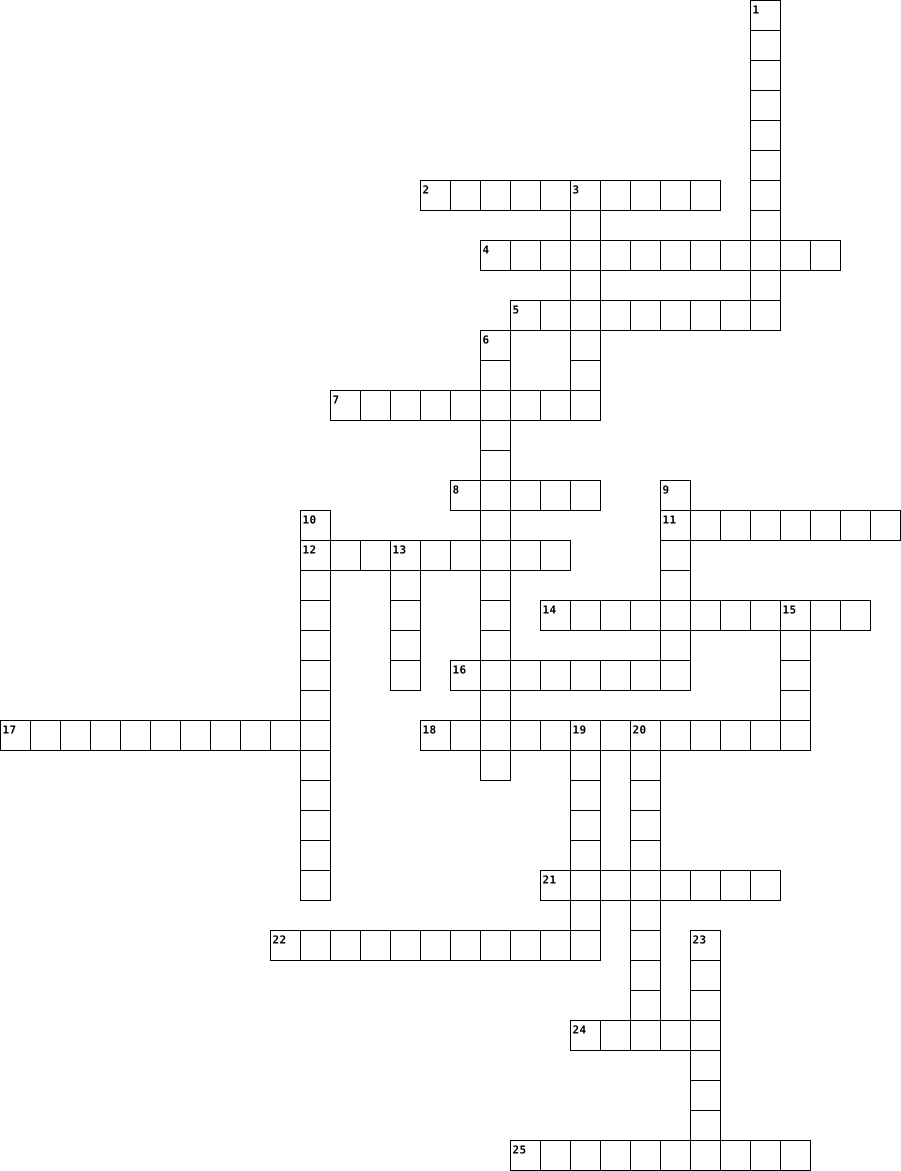
Across
- move food to the protozoan with help or without help
- unicellular and classified as protozoa
- forms filamentous colonies
- branchlike lichen with noticeable fruiting bodies
- all are photosynthetic with cell walls
- special cells that anchor the algae to something that appear rootlike
- hyphae that enters host cells to get nutrition from host cells
- floating protozoan or animals that eat phytoplankton
- hyphae that grow within the material the fungus is growing on and digest food and support the fungus
- green algae
- specilized cells are different in size and form
- simple colony of a slender chain of cells growing end to end
- sperm is produced in
- affect vegetative parts like leaves
- two identical specialized cells
Down
- golden algae stored food as oil
- gives shape to its body but doesn't have a cell wall
- most important group of algae in the open ocean and are main oxygen producers there
- body of a plantlike organism that does not have leaves, roots and stems
- tiny floating organisms that are mainly algae
- affect fruits like ears of corn
- show avoiding reactions and moves away from extreme temperatures but like acid
- nonmotile gametes or egg
- small pockets that hold up the thallus
- flat like growth lichens
25 Clues: green algae • sperm is produced in • nonmotile gametes or egg • flat like growth lichens • forms filamentous colonies • golden algae stored food as oil • affect fruits like ears of corn • two identical specialized cells • affect vegetative parts like leaves • unicellular and classified as protozoa • all are photosynthetic with cell walls • small pockets that hold up the thallus • ...
Biology 2022-02-14

Across
- regulation of water and elimination of excess water is done by organelle called
- is a unicellular fungus that causes dough to rise
- a representative ciliate is the
- spread by the tsetse fly which only lives in Africa
- can contaminate water and cause diarrhea
- short hair like structures
- some can change form, depending upon environment they are in- this ability is called
- all are one-celled
- histolytica that causes severe diarrhea called
- free swimming or fixed to an object
- which type of movement is it
Down
- its slipper shape is maintained by the flexible and firm outer covering called
- mouth pore through a short tube is called
- they can respond to a stimulus; this action is called
- in human history caused more deaths than any other disease
- reproduction also can be asexual by
- feed on dead organic material
- includes all organisms that are not animals, plants , or fungi
- indigestible wastes pass out of the ciliate by the
- feed on/in living organisms
- sexual reproduction called
- food gets swept into the indentation called
22 Clues: all are one-celled • short hair like structures • sexual reproduction called • feed on/in living organisms • which type of movement is it • feed on dead organic material • a representative ciliate is the • reproduction also can be asexual by • free swimming or fixed to an object • can contaminate water and cause diarrhea • mouth pore through a short tube is called • ...