
radiation biology Crossword Puzzles
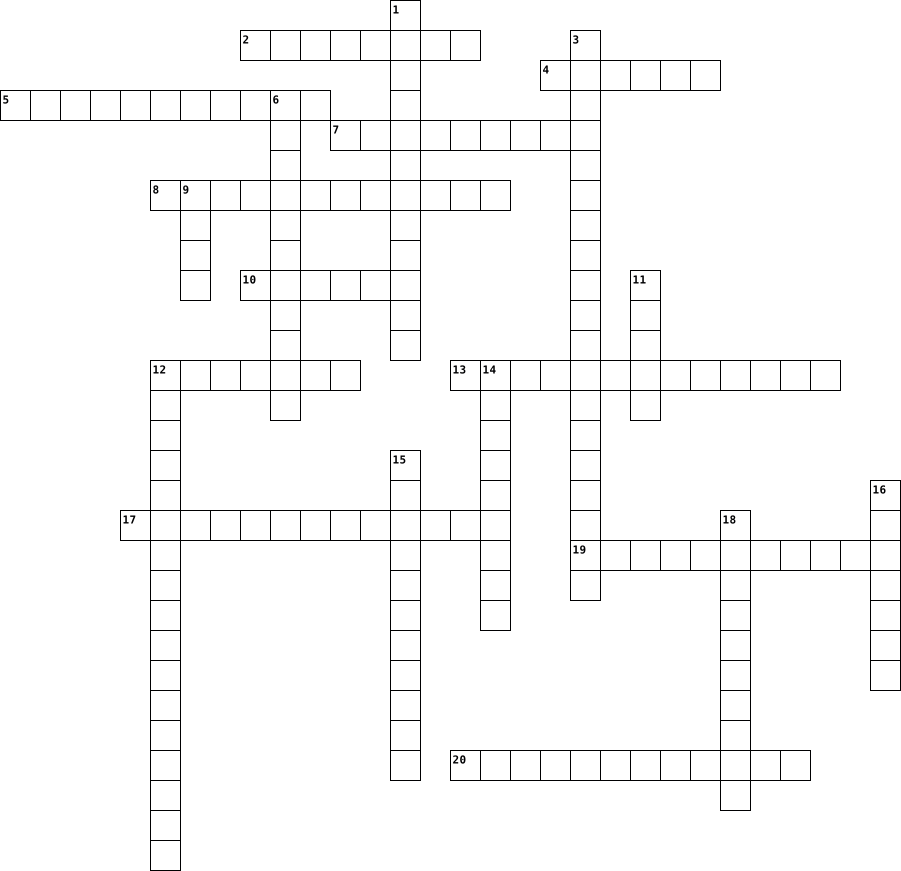
Biology Crossword 2023-11-15

Across
- a protein fiber that gives structure to the cell and supports it
- enclosed sacs used for storing water
- a part of only plant cells that provides structure
- organelle found in cells used for respiration and energy
- a cell without a nucleus
- generic material that makes up chromosomes
- any class of small organelles
- organelle in cytoplasm containing enzymes enclosed in a membrane
- Tiny like structures that make up protein
- flattened sac of membranes
- allows for the passage of materials through the cell membrane
Down
- a part of the cell that controls what goes in and out of the cell and provides it protection
- the par of the cell where photosynthesis occurs
- a part of the cell that stores starch
- round control center of the cell
- proteins that help chromosomes move
- single tail-like structure used for movement
- hair-like structures used for movement
- Jelly-like material filling the cell
- "True Nucleus" a cell with a nucleus
20 Clues: a cell without a nucleus • flattened sac of membranes • any class of small organelles • round control center of the cell • proteins that help chromosomes move • Jelly-like material filling the cell • "True Nucleus" a cell with a nucleus • enclosed sacs used for storing water • a part of the cell that stores starch • hair-like structures used for movement • ...
Biology Puzzle 2023-12-12

Across
- C₆H₁₂O₆
- sugar molecules, commonly found in bread
- Does not require oxygen
- Process in which glucose is broken down to make energy
- Requires Oxygen
- Whats formed from a chemical reaction
- a nutrient your body needs to grow and repair cells
- proteins that act as catalysts
- Carries genetic information
Down
- A molecule produced by a living organism
- A large molecule made of smaller chemical structures
- A chemical the body produces when when cells break down carbohydrates
- Large biomolecules in all cells and viruses
- glucose + enzymes = carbon dioxide + ethanol/lactic acid
- Smallest unit of matter
- A lipid with a phosphate group
- Also known as the Citric Acid cycle
- What plants do to get energy from the sun
- Abbreviation for adenosine triphosphate
- help with moving and storing energy
20 Clues: C₆H₁₂O₆ • Requires Oxygen • Smallest unit of matter • Does not require oxygen • Carries genetic information • A lipid with a phosphate group • proteins that act as catalysts • Also known as the Citric Acid cycle • help with moving and storing energy • Whats formed from a chemical reaction • Abbreviation for adenosine triphosphate • A molecule produced by a living organism • ...
Biology Crossword 2023-09-06

Across
- separates the interior of the cell from the outside environment
- the specific region of an enzyme where a substrate binds and catalysis takes place
- dynamic structure that serves many roles in the cell
- an organic compound such as sugar or starch, and is used to store energy
- a biological catalyst and is almost always a protein.
- process in which relatively small molecules, called monomers, combine chemically
- the membrane-enclosed organelle within a cell that contains the chromosomes
- plant cell organelles that convert light energy into relatively stable chemical energy
- the study of living things
- naturally-occurring phenomenon and does not require the cell to exert any of its energy to accomplish the movement
Down
- movement of water molecules from a solution with a high concentration of water molecules to a solution with a lower concentration
- atoms or the membrane-enclosed organelle within a cell that contains the chromosomes small molecules that bond together to form more complex structures
- helps process and package proteins and lipid molecules
- fatty, waxy, or oily compounds that are soluble in organic solvents and insoluble in polar solvents such as water
- generate most of the chemical energy needed to power the cell's biochemical reactions
- the smallest part of a living thing that can carry out the activities needed for life
- a structural layer surrounding some types of cells, just outside the cell membrane
- a process that involves the movement of molecules
- large biomolecules that play essential roles in all cells and viruses
- membrane-enclosed organelles that contain an array of enzymes capable of breaking down all types of biological polymers
20 Clues: the study of living things • a process that involves the movement of molecules • dynamic structure that serves many roles in the cell • a biological catalyst and is almost always a protein. • helps process and package proteins and lipid molecules • separates the interior of the cell from the outside environment • ...
Biology Revision 2023-09-08

Across
- fusing of a male gamete with a female gamete
- a cell in the retina that detects different colours of light
- Part of the brain that controls balance, posture and fine muscle movements
- different versions of the same gene
- A substance that contains genetic information
- change in a factor that is detected by receptors
- a small area of undifferentiated cells in a plant, such as near the shoot tips and root tips
- a single strand of RNA produced in transcription
- The movement of particles across a cell membrane from a region of lower concentration to a region of higher concentration
- allele that will always affect the phenotype
- Large bundle of neurones (and blood vessels)
Down
- A bright blue chemical reagent that turns orange or red when warmed with a solution of reducing sugars
- the process of cells dividing to produce two daughter cells that are genetically identical to the parent
- Uncontrolled cell division
- Liquid found in the permanent vacuole in a plant cell
- A substance that can speed up some processes in living things
- insulating covering around the axons of many neurones
- Describes a cell that has two sets of chromosomes
- the process by which the genetic code in one strand of DNA molecules is used to make mrna
- a scan in which a radioactive marker is uses to pinpoint certain areas in the body, such as very active cells
- a set of three cases found in DNA and RNA.
- lump formed of cancer cells
22 Clues: Uncontrolled cell division • lump formed of cancer cells • different versions of the same gene • a set of three cases found in DNA and RNA. • fusing of a male gamete with a female gamete • allele that will always affect the phenotype • Large bundle of neurones (and blood vessels) • A substance that contains genetic information • ...
Biology Basic 2023-08-23

Across
- measure of how acidic or basic a solution is; the scale ranges from below 0 to above 14
- small, basic sub-units
- basic unit of life
- production of offspring by an organism
- organism’s regulation of its internal environment to maintain conditions suitable for survival
- water-fearing; having the tendency to repel water
- inherited characteristic of a species that develops over time in response to an environmental factor, enabling a species to survive
- larger more complex structures made of monomers
- anything that possesses all the characteristics of life
- attraction of molecules of one kind for molecules of a different kind
- any substance that forms hydrogen ions (H+) in water and has a pH below 7.
- substance dissolved in a solvent
- any substance that forms hydroxide ions (OH-) in water and has a pH above 7.
Down
- ability of like molecules to stick together
- water-loving; having an affinity for water
- changes in traits of a populations of a species over time
- process that results in mass being added to an organism; may include formation of new cells or new structures
- a homogenous mixture formed when a substance is dissolved in another substance
- changes an organism undergoes in its lifetime before reaching its adult form
- an organism reaction to a stimulus
- large organic molecules (carbon-containing) that make up all living things
- the study of life that seeks to provide an understanding of the natural world
- property of the surface of a liquid that allows it to resist an external force, due to the cohesive nature of its molecules.
- ability to cause change; organisms use energy to perform biological functions.
- substance in which another substance is dissolved
25 Clues: basic unit of life • small, basic sub-units • substance dissolved in a solvent • an organism reaction to a stimulus • production of offspring by an organism • water-loving; having an affinity for water • ability of like molecules to stick together • larger more complex structures made of monomers • water-fearing; having the tendency to repel water • ...
Molecular Biology 2023-11-21

Across
- producing cellular energy without energy
- organism that makes its own food
- makes protien for the cells
- used to repair tissues
- the second step of photosynthesis
- breaking down glucose and other food molecules in the presence of oxygen
- breaks down complex molecules for energy
- producing cellular energy with oxygen
- powerhouse of the cell
- makes repair energy from the sun to make the repair
- organism that cant make its own food
- made of carbon, hydrogen, and oxygen
- control center of a cell
Down
- process of which cells release energy in the abscence of oxygen
- 6CO2+6H2O----->C6H12O6+6O2
- the inital sage of photosynthesis
- process of which the body breaks down substances and gets energy from food
- basic unit of life
- carries energy to where it needs to be
- source of nourishment
- minimum amount of energy required
- chemical reaction with oxygen
- found in plant cells and other organisms that use photosynthesis
- examples are fat, oil, and wax
- simple sugar
- major storage of energy
26 Clues: simple sugar • basic unit of life • source of nourishment • used to repair tissues • powerhouse of the cell • major storage of energy • control center of a cell • 6CO2+6H2O----->C6H12O6+6O2 • makes protien for the cells • chemical reaction with oxygen • examples are fat, oil, and wax • organism that makes its own food • the inital sage of photosynthesis • ...
Biology Vocab 2023-09-13

Across
- organelle used for structure in plants
- decides what comes in and out of the cell
- site of photosynthesis
- a region on an enzyme that binds to a protein or other substance during a reaction.
- the study of living things
- protein that speeds up biological reactions
- made of amino acids
- modifies, sorts and, packages proteins
- basic unit of structure in living things
- passive transport process
- source of energy for living things
Down
- process of building monomer to polymers
- holds our DNA
- type of cellular transport that requires energy
- type of cellular transport that requires no eneregy
- makes proteins
- organelle used to store substances
- made of glycerol and fatty acids
- full of enzymes to break down substances
- used to build polymer
20 Clues: holds our DNA • makes proteins • made of amino acids • used to build polymer • site of photosynthesis • passive transport process • the study of living things • made of glycerol and fatty acids • organelle used to store substances • source of energy for living things • organelle used for structure in plants • modifies, sorts and, packages proteins • ...
Biology Terms 2023-09-13

Across
- Full of enzymes to break down substances
- Process of building monomers into polymers
- Made of amino acids, used for enzyme transport
- Powerhouse of the cell
- Basic unit of structure
- Made of glycerol and fatty acids. Energy storage and membranes
- Modifies, sorts and packages proteins into vesicles
- Place on an enzyme that bonds to a substance
- Type of cellular transport that requires energy
Down
- Study of living things
- Control center of the cell, holds DNA
- Boundary of a cell, decides in and out
- Used to store substances
- Causes water to move toward the hypertonic side of a membrane
- Site of photosynthesis
- Small sub-unit, used to build polymers
- Used for structure and support in some cells
- Made of nucleotides, stores genetic info
- Type of cellular transport that does not require energy
- Makes proteins
20 Clues: Makes proteins • Study of living things • Site of photosynthesis • Powerhouse of the cell • Basic unit of structure • Used to store substances • Control center of the cell, holds DNA • Boundary of a cell, decides in and out • Small sub-unit, used to build polymers • Full of enzymes to break down substances • Made of nucleotides, stores genetic info • ...
Biology terms 2023-09-11

Across
- any substance with a pH greater than 7
- RNA (2 words, no space)
- Whole Molecule folding (just the ordinal number)
- A bond in which atoms share electrons in their valence shells
- organized array of all the elements
- any electrically charged atom or molecule
- "single-sugar'
- the number of protons in the nucleus of an atom (2 words, no space)
- a chemical bond that is formed by joining the carboxyl group of one amino acid to the amino group of another (2 words, no space)
- More than one polypeptide chain bonded together (just the ordinal number)
- a pill or procedure that has no effect that is inroduced into and experiment to measure the psychological effects of a pill or medicine.
- Sequence of amino acids in a chain (just the ordinal number)
- Local folding (just the ordinal number)
- monomers of DNA
Down
- a collection of beliefs or practices mistakenly regarded as being based on scientific method.
- "Many sugars"
- the approximate number of protons and electrons in an atom (2 words,no space)
- to destroy the characteristic properties of a substance by changing temperature, pH, or salinity greatly
- solution that can resist pH change to maintain homeostasis
- "Water-fearing)
- competes with substrate for binding to an active site (2 words, no space)
- proteins, lipids, and carbohydrates are all this type of particle
- A special protein that works as a catalyst to bring about certain reactions
- "Water-loving"
- any substance with a pH less than 7
25 Clues: "Many sugars" • "single-sugar' • "Water-loving" • "Water-fearing) • monomers of DNA • RNA (2 words, no space) • organized array of all the elements • any substance with a pH less than 7 • any substance with a pH greater than 7 • Local folding (just the ordinal number) • any electrically charged atom or molecule • Whole Molecule folding (just the ordinal number) • ...
Biology Terms 2023-09-11

Across
- macromolecule, made of amino acids, used for enzymes, transports, and cell structures
- organelle, site of photosynthesis, creates glucose
- organelle boundary of the cell, decides what comes in and out
- macromolecule, made of glycerol and fatty acids, used for energy storage and membranes
- basic unit of structure and function in living things
- passive transport process, causes water to move toward the hypertonic side of a membrane
- place on an enzyme that binds to a substrate
- type of cellular transport that does not require energy, includes diffusion, facilitated diffusion and osmosis
- organelle control center of the cell, holds DNA
- organelle, creates proteins, created in the nucleus
- macromolecule made of monnosaccarides, source of energy for living things
- protein that speeds up a biological reaction by lowering the activation energy
- organ site of cellular respiration, creates ATP
- organelle, used for structure and support in some cells, plants, and fungi
Down
- organelle used to store substances, plants have one large, animals have many small
- process of building monomers into polymers
- organelle full of enzymes to break down substances
- the type of cellular transport that requires energy, includes solute pumping, endocytosis, and exocytosis
- the study of living things
- small subunit, used to build polymers
20 Clues: the study of living things • small subunit, used to build polymers • process of building monomers into polymers • place on an enzyme that binds to a substrate • organelle control center of the cell, holds DNA • organ site of cellular respiration, creates ATP • organelle, site of photosynthesis, creates glucose • organelle full of enzymes to break down substances • ...
Biology vocabulary 2023-10-24

Across
- Cell that can divide for long periods of time while remaining undifferentiated
- Pattern of growth, DNA replication, and cell division that occurs in a eukaryotic cell.
- Process by which offspring are produced from a single parent
- Last phase of mitosis when a complete set of identical chromosomes is positioned at each pole of the cell.
- Substance that produces or promotes the development of cancer
- Second phase of mitosis when spindle fibers align the chromosomes along the cell equator
- Common name for a class of disease characterized by uncontrolled cell division
- Process by washing the cell cytoplasm divides
- To spread by transferring a disease-causing agent from the disease to other parts of the body
- Programmed cell death
Down
- Process by which unspecialized cell develop into their mature form and function
- Long, continuous thread of DNA that consists of numerous genes and regulatory information
- Canoes tumor in which cells break away and spread to other parts of the body, causing harm to the organism’s health
- Region of condescended chromosome that looks pinched; where spindle fibers attach during meiosis and mitosis
- Loose combination of DNA and proteins that is present during interphase
- First phase of mitosis when chromatin condenses, the nuclear envelope breaks down, the nucleolus disappears, and the centrosomes and centrioles migrate to opposite sides of the cell
- Process by which a cell divides its nucleus and contents
- Repeating nucleotide at the ends of DNA molecules that do not form genes and help prevent the loss of genes
- A sexual reproduction in which a cell divides into two equal parts
- Third phase of mitosis during which chromatids separate and are pulled to opposite sides of the cell
- Protein that organizes chromosomes and around which DNA wraps
- One half of a duplicated chromosome
- Broad group of proteins that stimulate cell division
- Having no dangerous effect on health
24 Clues: Programmed cell death • One half of a duplicated chromosome • Having no dangerous effect on health • Process by washing the cell cytoplasm divides • Broad group of proteins that stimulate cell division • Process by which a cell divides its nucleus and contents • Process by which offspring are produced from a single parent • ...
Marine Biology 2023-10-17
Across
- an organ that connects the developing fetus
- vertical
- derived from an outpocketing of the digestive tube.
- a non-vascular type of supporting connective tissue
- eggs that are encased by extra-embryonic
- body types
- asexual
- a highly evolved and specialized organ
- male and female
- is a hard covering that supports and protects the bodies of some types of animals.
- a skeleton that is on the inside of a body, like humans, dogs, or some fish
Down
- backbone
- a system of vessels in echinoderms
- cold blooded
- the shedding or casting off of an outer layer or covering and the formation of its replacement
- projecting growth
- opposite body types
- x equality
- warm blooded animals
- bottom of water
- deuterostomal animals
21 Clues: asexual • backbone • vertical • body types • x equality • cold blooded • bottom of water • male and female • projecting growth • opposite body types • warm blooded animals • deuterostomal animals • a system of vessels in echinoderms • a highly evolved and specialized organ • eggs that are encased by extra-embryonic • an organ that connects the developing fetus • ...
Biology crossword 2024-02-08

Across
- what means "a ball".
- What means "creeping thing".
- what translates to "earth pig".
- 85% of snakes are what.
- boas and pythons are what type of snakes.
- What is the largest living land animal.
- what is the name of all huffed animals.
- what translates to "the little armored one".
- What means "the lizard of the Nile".
- Lizard What does "El Legarto" mean
- what are limbless reptiles.
- What means "to roll".
- what are defined as large, tailless monkeys.
Down
- What is called "the spiny anteater".
- What are Alligators and crocodiles called.
- There are over 400 kinds of what type of snakes.
- what are wild, untamable, and bad-tempered beasts.
- What is sort of like a porcupine but with softer quills.
- what is the name of one of their four stomachs.
- what translates to "the pouched one".
- What are toothless reptiles in a shell.
- What are generally larger than rabbits.
- What is a Gila Monster.
- What means "flat foot".
- What translates to "to gnaw".
25 Clues: what means "a ball". • What means "to roll". • 85% of snakes are what. • What is a Gila Monster. • What means "flat foot". • what are limbless reptiles. • What means "creeping thing". • What translates to "to gnaw". • what translates to "earth pig". • What is called "the spiny anteater". • What means "the lizard of the Nile". • Lizard What does "El Legarto" mean • ...
Cell Biology 2023-10-17

Across
- - Powerhouse of the cell
- - Detoxification center
- - Digestive organelle
- - Cell eating
- - Cell's control center
- - Small sac for transport
- - Cell division
- - Cell's jelly-like substance
- - Genetic material
- - Cell membrane
- - Protein factory
- - Whip-like structure
- - No nucleus
- - Photosynthesis site
- - Nucleus present
Down
- - Enzyme-rich organelle
- - Rough or smooth
- - Tiny hair-like structures
- - Cell expelling contents
- - Protein packaging
- - Plant cell wall material
- - Storage organelle
- - Small DNA circle
- - Water movement
- - Surrounds the cell
- - Part of the cytoskeleton
- - Cell component
- - Cell's structural framework
28 Clues: - No nucleus • - Cell eating • - Cell division • - Cell membrane • - Water movement • - Cell component • - Rough or smooth • - Protein factory • - Nucleus present • - Small DNA circle • - Genetic material • - Protein packaging • - Storage organelle • - Surrounds the cell • - Digestive organelle • - Whip-like structure • - Photosynthesis site • - Enzyme-rich organelle • - Detoxification center • ...
Biology Crossword 2024-01-09

Across
- Where the arteries of the heart can't deliver enough oxygen-rich blood to the heart.
- A disease you get when your body is lacking of vitamin C.
- Your body uses this to make hemoglobin, a protein in red blood cells and myoglobin.
- A condition where you have uncomfortable or infrequent bowel movements.
- Breads, cereals and pasta contains ____
- A mineral your body needs to build and maintain strong bones.
- When your body lack of vitamin D or calcium.
- When your body mass index is over 30 it is...
- A stomach enzyme that helps to digest proteins found in ingested food.
- Good for building and maintaining healthy bones but is not calcium.
Down
- Elements on the earth and in foods that our bodies need to develop and function.
- A colorless, transparent liquid.
- They are composed of carbon, hydrogen and oxygen.
- A bone disease that develops when bone mineral density and bone mass decreases.
- Made up of one glycerol and three fatty acids.
- A long chains of amino acid.
- Amount of energy taken in is less then the amount of energy required to main an organism's life.
- Good for helping to protect cells and keeping them healthy.
- A condition where your body does not have enough.
- An enzyme that aids with digestion.
20 Clues: A long chains of amino acid. • A colorless, transparent liquid. • An enzyme that aids with digestion. • Breads, cereals and pasta contains ____ • When your body lack of vitamin D or calcium. • When your body mass index is over 30 it is... • Made up of one glycerol and three fatty acids. • They are composed of carbon, hydrogen and oxygen. • ...
Biology Crossword 2024-01-12

Across
- A complex carbohydrate composed of multiple sugar units.
- A branched form of starch composed of glucose units linked together.
- Pertaining to the linkage between sugar molecules.
- A linear arrangement of repeating units in a molecule.
- A chemical element with the symbol H; a key component in various biological molecules.
- A monosaccharide, commonly known as fruit sugar.
- The ability of a substance to dissolve in a solvent.
- A substance that triggers an immune response, often by producing antibodies.
- A polysaccharide found in plants, serving as a storage form of energy.
- The capacity to do work or produce heat, often derived from the metabolism of nutrients.
- A linear form of starch composed of glucose units linked in a straight chain.
- The simplest form of carbohydrates, consisting of a single sugar unit.
- A five-carbon monosaccharide, such as ribose.
- A sugar molecule that forms the backbone of RNA.
Down
- A polysaccharide that serves as a storage form of glucose in animals.
- The chemical breakdown of a compound due to reaction with water.
- A monosaccharide and a primary source of energy in living organisms.
- Relating to the arrangement and organization of parts in a biological or chemical system.
- The clumping together of particles or cells, typically due to the action of antibodies.
- A type of secondary protein structure, referring to a sheet-like arrangement of polypeptide chains.
- Long, thread-like structures, often referring to dietary components that promote digestive health.
- A polysaccharide found in plant cell walls, composed of glucose units linked in a linear fashion.
- A six-carbon monosaccharide, such as glucose.
- A protein molecule with attached carbohydrate chains.
- A type of secondary protein structure, referring to a helical arrangement of polypeptide chains.
- The accumulation and retention of substances for future use.
- A sugar molecule that forms the backbone of DNA.
- The presence of side chains or offshoots in a molecular structure.
28 Clues: A six-carbon monosaccharide, such as glucose. • A five-carbon monosaccharide, such as ribose. • A monosaccharide, commonly known as fruit sugar. • A sugar molecule that forms the backbone of DNA. • A sugar molecule that forms the backbone of RNA. • Pertaining to the linkage between sugar molecules. • The ability of a substance to dissolve in a solvent. • ...
Biology - General 2024-02-21

Across
- The small green discs in chloroplasts
- A human that relies mostly on photoreceptors
- The first step of cellular respiration
- "Stitch" adjacent cells together
- The tissue in plants that create dermal tissue
- The receptors that detect pain
- The cell "drinking" by engulfing liquids
- A limited nutrient explosion that causes rapid algae growth and causes dead zones
- A process used by cells that recycled damaged or faulty parts using Lysosomes
- Plant structural support that is inflexible
- The two nitrogen bases Adenine and Guamine (Structure)
- The spread of cancer cells from the origin site
- The randomness of the environment
Down
- Two of these functional groups react and form a cross-link that stabilize protein structure
- Molecules that are isomers in the way that horizontally mirrors another
- Release a very large amount of energy
- Plants do this when they have too much water
- Fungi that grow on a plant's roots to increase its surface area
- The thickest type of cytoskeleton
- The folds in mitochondria
- A process cells use to break apart molecules using water
- The thinnest type of cytoskeleton
- One gene affects many phenotypes
- Bridges between plant cells (Walls around the tunnels)
- The cork cambium makes this
25 Clues: The folds in mitochondria • The cork cambium makes this • The receptors that detect pain • "Stitch" adjacent cells together • One gene affects many phenotypes • The thickest type of cytoskeleton • The thinnest type of cytoskeleton • The randomness of the environment • The small green discs in chloroplasts • Release a very large amount of energy • ...
Biology Vocabulary 2016-04-06

Across
- first phase of cell division; DNA condenses, spindle fibers appear
- the study of living organisms
- organelle that makes proteins
- the theory that organisms change over time
- energy molecule used during cellular respiration
- macromolecule that provides the body with energy
- macromolecule responsible for the storage of genetic information (2 words, no space)
- the trait that is expressed in a phenotype
- monomer of lipids
- macromolecule responsible for long term energy storage, insulation, and cushioning
- the division of gametic cells
- chromosomes line up in the middle of the cell on spindle fibers
- the measure of how acidic or basic a substance is
- the trait that is often masked in a phenotype
Down
- macromolecule responsible for muscles, hormones, and chemical reactions
- molcule responsible for protein synthesis
- the genetic makeup of an individual
- biological molecules (proteins) that act as catalysts and help reactions occur everywhere in life
- genotype possess both dominant or both recessive alleles; RR or rr
- the site of photosynthesis
- monomer of carbohydrates
- monomer of proteins (2 words, no space)
- the site of cellular respiration
- genotype possesses a dominant and recessive alleles; Rr
- the scientific study of interactions between organisms and their environments, focusing on energy transfer
- monomer of nucleic acids
- the physical trait expression of an individual
- chromosomes become chromatin, cell begins to show signs of separation
- chromosomes split apart, sister chromatids move to opposite side of the cell
- the division of somatic cells
- site on transcription, the control center of the cell
31 Clues: monomer of lipids • monomer of carbohydrates • monomer of nucleic acids • the site of photosynthesis • the study of living organisms • organelle that makes proteins • the division of gametic cells • the division of somatic cells • the site of cellular respiration • the genetic makeup of an individual • monomer of proteins (2 words, no space) • ...
Biology Vocab. 2019-05-09

Across
- made of a single cell
- light energy into chemical energy
- cells in plants
- lives in pond water uses cilia to move
- controls what leaves and enters a cell
- System breaks down food
- senses sunlight
- System brings oxygen into body
- tiny cell carries functions in a cell
- uses pseudopods to move
- stores materials
- System removes waste from your body
- System group of organs working together
Down
- controls of the cell
- whip-like tail
- made of more than one cell
- group of small cells
- cells in animals
- powerhouse
- the outside of the cell
- round shape in packes
- System Heart, blood vessels, blood
- used for locomotion or engulfing food
- living thing
- bright green
- hairlike extends from the plasma membrane
26 Clues: powerhouse • living thing • bright green • whip-like tail • cells in plants • senses sunlight • cells in animals • stores materials • controls of the cell • group of small cells • made of a single cell • round shape in packes • System breaks down food • the outside of the cell • uses pseudopods to move • made of more than one cell • System brings oxygen into body • light energy into chemical energy • ...
Biology Vocab 2019-05-09

Across
- made up of cells that make up animals and plants
- plural: usually are sensory organelles
- a unicellular organism that can dangerously affect humans
- separates the interior of cells
- a unicellular organism that looks like a slipper
- the process of turning energy into food
- an organism with more than one cell (humans)
- acts like a filter for cells
- allows a cell to move around
- takes in oxygen and releases carbon dioxide
- replicates dna
- a life form
- helps to receive light
- usually found in plant cells
Down
- there are eleven contained in the body
- the powerhouse of the cell
- provide basic life in plants
- provide basic life in animals
- disposes of bodily waste
- an organism with only one cell
- converts food into energy
- structures within a cell
- contains the heart, blood, and blood vessels
- in the body usually with a specific purpose
- used to capture prey
- a type of algae with up 50,000 cells
- a unicellular organism that has over 800 species
27 Clues: a life form • replicates dna • used to capture prey • helps to receive light • disposes of bodily waste • structures within a cell • converts food into energy • the powerhouse of the cell • provide basic life in plants • acts like a filter for cells • allows a cell to move around • usually found in plant cells • provide basic life in animals • an organism with only one cell • ...
Biology Review 2019-05-08

Across
- Uses a flagellum
- Moves with cilia
- Lives in water or soil
- More than one cell organelle
- Collects waste and removes it from the body
- Only in a plant cell
- Has a cell membrane
- Takes in oxygen and gets rid of carbon dioxide
- Breaks down food
- Making food out of sunlight
- A group of tissues
- Living thing
- One- celled organelle
- Amoeba uses this to move
- Paramecium moves with this
Down
- Is in both animal and plant cell
- Example is amoeba and euglena
- Only has a cell wall
- Carries oxygen to the cells
- Like the boss in the cell
- Like a vacuum cleaner
- A group of cells
- Powerhouse of the cell
- collections of systems like brain and liver
- A group of algae
- Helps find the sunlight
- Euglena has one to move
27 Clues: Living thing • Uses a flagellum • Moves with cilia • A group of cells • Breaks down food • A group of algae • A group of tissues • Has a cell membrane • Only has a cell wall • Only in a plant cell • Like a vacuum cleaner • One- celled organelle • Lives in water or soil • Powerhouse of the cell • Helps find the sunlight • Euglena has one to move • Amoeba uses this to move • Like the boss in the cell • ...
Biology crossword 2019-05-06

Across
- an individual animal, plant, or single-celled life form.
- cell a cell in an animal
- a number of organized or specialized structures within a living cell.
- system a system of organs functioning in humans
- system the system that circulates blood and lymph through the body
- wall protects the cell and provides strength.
- system the system that removes waste from the body.
- any of the distinct types of material of which animals or plants are made
- cell a cell in a plant
- consisting of many cells
- single-celled animal
- the way and amoeba gets food
- system a group of organs that work together to perform one or more functions.
Down
- single-celled freshwater animal that has a characteristic slipper-like shape and is covered with cilia.
- system where food is digested
- light-sensitive pigmented spot
- produces energy.
- green single-celled freshwater organism with a flagellum
- sacs for storage digestion and waste removal
- consisting of a single cell
- slender threadlike structure
- short microscopic hairlike vibrating structure
- the process by which green plants and some other organisms use sunlight to make foods
- control center of the cell
- a single-celled aquatic organism
25 Clues: produces energy. • single-celled animal • cell a cell in a plant • consisting of many cells • cell a cell in an animal • control center of the cell • consisting of a single cell • slender threadlike structure • the way and amoeba gets food • light-sensitive pigmented spot • system where food is digested • a single-celled aquatic organism • ...
Biology II 2019-03-19

Across
- fish
- shape
- the concentration of particles in a fluid compared to the concentration of particles in the cytosol of a cell
- even
- passive movement of a substance from an area of high concentration to an area of low concentration
- process by which the body produces new cells for growth and replacement of worn out and damaged cells, the result is 2 new cells that are identical to the parent cell\
- cells that surround themselves with a nonliving extracellular matrix (2 words)
- cartilage
- cells with the ability to contract (2 words)
- the double set of chromosomes found in the cells of the body
- to eat
Down
- yeasts, molds and mushrooms
- the central point where two chromatids are joined
- stage of cell division where the cytoplasm pinches and divides
- joint
- double
- plants
- process in which the chromatids of homologous chromosomes exchange strands of DNA (2 words)
- "cell drinking" of liquids and dissolved substances
- movement of substances across a cell membrane that requires a carrier protein and ATP (2 words)
- animals
- process by which the body produces new cells for reproduction, the result is 4 new cells with half as many chromosomes as the parent cell
- uneven
- the clear, viscous fluid of the cell
24 Clues: fish • even • joint • shape • double • plants • uneven • to eat • animals • cartilage • yeasts, molds and mushrooms • the clear, viscous fluid of the cell • cells with the ability to contract (2 words) • the central point where two chromatids are joined • "cell drinking" of liquids and dissolved substances • the double set of chromosomes found in the cells of the body • ...
Biology I 2019-03-18

Across
- bacteria
- membrane bound sacs formed from other membranes
- whip-like appendages on the cell membrane
- life
- passive movement of a substance down a concentration gradient and across a membrane that requires a carrier protein (2 words)
- DNA in long, loose fibers
- foot
- digits
- cells that receive and transmit signals (2 words)
- a method of classifying organisms based upon their evolutionary relationships
- bone
Down
- flesh
- flat
- sheets of cells that cover or line other tissues (2 words)
- passive movement of water through a semi-permeable membrane from the dilute solution to more concentrated solution
- finger-like projections formed from the cell membrane
- algae and protozoans
- cell eating of large particles
- movement of fluids or particles out of the cell
- rabbit
- the site of protein synthesis
- the joining of the ovum and spermatozoon
- single set of chromosomes found in the gametes
- membrane bound sacs that contain hydrolytic enzymes
- the scientific study of living organisms
- worm
26 Clues: flat • life • foot • worm • bone • flesh • rabbit • digits • bacteria • algae and protozoans • DNA in long, loose fibers • the site of protein synthesis • cell eating of large particles • the joining of the ovum and spermatozoon • the scientific study of living organisms • whip-like appendages on the cell membrane • single set of chromosomes found in the gametes • ...
Biology Vocabulary 2019-01-03

Across
- a compound that releases a proton
- A jellylike fluid inside the cell in which the organelles are suspended
- a substance made of atoms of different elements bonded together in a certain ratio
- a mixture of substances that is the same through-out; a homogeneous mixture
- all of the chemical processes that build up or break down materials
- the maintenance of constant internal conditions in an organism
- the division of the cell nucleus and its contents
- the change in living things over time
- one particular type of atom that cannot be broken down into a simpler substance by ordinary chemical means
Down
- a substance that decreases the activation energy needed to start a chemical reaction. Speeds up a reaction
- infectious particle made of a strand of DNA or RNA surrounded by a protein coat
- the substances made by a chemical reaction. On the right side of equation
- catalysts for chemical reactions in living things.
- The powerhouse of the cell. Creates ATP by using chemical energy and oxygen.
- any individual living thing
- tool that provides an enlarged image of an object
- all organisms and the part of Earth where they exist
- the substances changed during a chemical reaction. On left side of equation
- the smallest basic unit of matter
- form of nuclear division that divides a diploid cell into a haploid cell; important in forming gametes for sexual reproduction.
20 Clues: any individual living thing • a compound that releases a proton • the smallest basic unit of matter • the change in living things over time • tool that provides an enlarged image of an object • the division of the cell nucleus and its contents • catalysts for chemical reactions in living things. • all organisms and the part of Earth where they exist • ...
Biology Vocabulary 2019-01-03

Across
- a substance made of atoms of different elements bonded together in a certain ratio
- one particular type of atom that cannot be broken down into a simpler substance by ordinary chemical means
- all organisms and the part of Earth where they exist
- a compound that releases a proton
- the maintenance of constant internal conditions in an organism
- the substances made by a chemical reaction. On the right side of equation
- all of the chemical processes that build up or break down materials
- the substances changed during a chemical reaction. On left side of equation
- a mixture of substances that is the same through-out; a homogeneous mixture
- infectious particle made of a strand of DNA or RNA surrounded by a protein coat
Down
- catalysts for chemical reactions in living things.
- A jellylike fluid inside the cell in which the organelles are suspended
- the smallest basic unit of matter
- The powerhouse of the cell. Creates ATP by using chemical energy and oxygen.
- any individual living thing
- tool that provides an enlarged image of an object
- a substance that decreases the activation energy needed to start a chemical reaction. Speeds up a reaction
- the change in living things over time
- form of nuclear division that divides a diploid cell into a haploid cell; important in forming gametes for sexual reproduction.
- the division of the cell nucleus and its contents
20 Clues: any individual living thing • the smallest basic unit of matter • a compound that releases a proton • the change in living things over time • tool that provides an enlarged image of an object • the division of the cell nucleus and its contents • catalysts for chemical reactions in living things. • all organisms and the part of Earth where they exist • ...
biology crossword 2019-10-26

Across
- to take air in and expel it out of the lungs.
- two bag-like organs that fill most of the chest. The lungs draw in air through the trachea and bronchi.
- a part of the respiratory system between the pharynx and the trachea. It houses the vocal cords.
- tiny blood vessels.
- a flap of tissue that prevents food from going down the trachea rather than the oesophagus.
- rate: the rate, or number of breaths per minute, at which we breathe.
- a large muscle below the ribs that helps a person breathe.
- a gas in air that humans and most living things need to live.
- cords: two folds of tissue in the larynx that vibrate when air passes over them and produce sound, including the basic sounds of speech.
- pair of tubes between the trachea and the lungs.
- the basic unit of any living thing. Some living things consist of only a single cell, while others are composed of trillions of cells
- breathe out.
Down
- one of the lung's smallest air passageways.
- the air passageway between the pharynx and the bronchi.
- tiny air sacs in the lungs.
- a sticky substance in the nose that traps dirt, dust and other particles.
- the tube that carries food from the back of the throat to the stomach.
- a breathing disorder in which the air passageways in the lungs constrict, causing shortness of breath.
- capacity: the volume of air that the lungs can hold.
- the movement of oxygen from the atmosphere to cells and carbon dioxide from cells to the atmosphere.
- hair-like structures found in the air passageways of the respiratory system.
- system: the group of organs that take in oxygen from the air and release carbon dioxide.
- a disease that damages the alveoli, making it difficult to get enough oxygen.
- dioxide: a gas that is a waste product of cells when they burn food.
- a cavity behind the nose and mouth that leads to the trachea and oesophagus.
- breathe in.
26 Clues: breathe in. • breathe out. • tiny blood vessels. • tiny air sacs in the lungs. • one of the lung's smallest air passageways. • to take air in and expel it out of the lungs. • pair of tubes between the trachea and the lungs. • capacity: the volume of air that the lungs can hold. • the air passageway between the pharynx and the bronchi. • ...
BIOLOGY 2 2019-07-09

Across
- Similar to vessels with narrower lumens and connected by pits.(rhsecdiat)
- Kinds of plants.(gopasnisemr)
- Provide strength because their walls are lignified.( irfesb)
- Allow molecules and substance to move back and forth as needed.( lpaomsedstmaa)
- Keep their body fluids isotonic to the eternal environment.( foesrmomnrocs)
- Cell with nucleus mitochondria, ribosomes, enzymes.( ponimcnoa lelc)
- vessels Consist of dead hallow cells.( mxlye slvsese)
- Closed system are said to be closed because they have vessels that contain the fluid.( SDCOLE ACLUIRCOTYR)
- Gas exchange by tiny forces.( mtosata)
- The balance inside the body of mammals.( ohsoemstasi)
- The widening of blood vessels.( tonidailsaov)
- Moderate water availability.(eosemthpys)
Down
- Transport blood to high pressure to the tissue away from the heart.( ertyra)
- Have nutrients and carbon dioxide reach cells in their body.(lnstap)
- They have a large number of stomata on their upper surface.(yhptsyedorh)
- Tubular cells that are connected end to end.( esiev uebt)
- Moves food substances from leaves to the rest of plants.( elhomp)
- Living in the severely dry terrestrial environment.(esepnxohty)
- The narrowing of blood vessels(itonvitrocsnasov)
- Living cells with thin cellulose walls.( myaerncpha)
- The animals which actively adjust their internal osmotic state according to external environment.(OSRTUALGOERMOS)
- Types of system is found in animals such as insects and some mollusk.( EONP OTYRURCICAL)
- Have nutrients and oxygen reach every cells in their body.(nmsalia)
- Xylem vessels and tracheids and phloem seive tubes.(LSIEDACIPES SUEBT)
- Blood pressure is low.( inev)
25 Clues: Kinds of plants.(gopasnisemr) • Blood pressure is low.( inev) • Gas exchange by tiny forces.( mtosata) • Moderate water availability.(eosemthpys) • The widening of blood vessels.( tonidailsaov) • The narrowing of blood vessels(itonvitrocsnasov) • Living cells with thin cellulose walls.( myaerncpha) • The balance inside the body of mammals.( ohsoemstasi) • ...
BIOLOGY VOCAB 2019-11-26

Across
- fluid
- it is a stack
- is the secound step in fermentaion
- creats yeasts
- the secound step in photosynthesis
- the breakdown of gloucose
- energy
- h2o
- power house of the cell
- holds all the organisums together
Down
- the first step in photosynthesis
- a process used by plants and other organisms to convert light energy into chemical energy
- dose not use oxygen
- co2
- makes bread rise
- a series of enzyme-mediated reactions where the product of one reaction is used as the substrate in the next.
- O2
- a simple sugar
- the third step in photosynthesis
- uses oxygen
- the biochemical process in which the cells of an organism obtain energy by combining oxygen and glucose, resulting in the release of carbon dioxide, water, and ATP
- involes latied
22 Clues: O2 • co2 • h2o • fluid • energy • uses oxygen • it is a stack • creats yeasts • a simple sugar • involes latied • makes bread rise • dose not use oxygen • power house of the cell • the breakdown of gloucose • the first step in photosynthesis • the third step in photosynthesis • holds all the organisums together • is the secound step in fermentaion • the secound step in photosynthesis • ...
Biology crossword 2019-11-25

Across
- The chemical breakdown of substances
- respiration use oxygen to produce food
- does not require oxygen
- uses light energy to make molecules needed for photosynthesis
- respiration and energy production occur here
- carries energy within the cell
- the breakdown of glucose, releases energy
- glucose and carbon are converted into cellular energy
Down
- Where light-dependent reaction takes place
- chain Transports electrons from NADH to oxygen
- produces oxygen and glucose
- The sequence of reactions which most cells get energy from
- a pathway with linked chemical reactions occuring in a cell
- odorless gas produced by repiration
- converts glucose, fructose, and sucrose into cellular energy
- vital for all known forms of life
- where photosynthesis takes place
- requires oxygen
- life-supporting component in the air
- a simple sugar which is an important energy source
- the supportive tissue of an organ
- Cycle refers to the light-independent reactions in photosynthesis
22 Clues: requires oxygen • does not require oxygen • produces oxygen and glucose • carries energy within the cell • where photosynthesis takes place • vital for all known forms of life • the supportive tissue of an organ • odorless gas produced by repiration • The chemical breakdown of substances • life-supporting component in the air • respiration use oxygen to produce food • ...
Science Biology 2019-11-26

Across
- organic acid. It has a molecular formula CH₃CHCOOH
- each of a number of flattened sacs inside a chloroplast
- light-independent reactions in photosynthesis that take place in three key steps
- h20
- what the amoeba sisters video was about
- first step in the cycle
- series of enzyme-mediated reactions where the product of one reaction is used as the substrate in the next
- Last step
- colorless fluid surrounding the grana within the chloroplast.
- powerhouse of cell
- simple alcohol with the chemical formula C. 2H. 6O.
Down
- use light energy to make two molecules needed for the next stage of photosynthesis
- sugar plants make
- requires oxygen
- what plants perform
- no oxygen needed
- what we breathe
- second step
- enrgy for cell
- c02
- what animals perform
- photosynthesis occurs here
22 Clues: h20 • c02 • Last step • second step • enrgy for cell • requires oxygen • what we breathe • no oxygen needed • sugar plants make • powerhouse of cell • what plants perform • what animals perform • first step in the cycle • photosynthesis occurs here • what the amoeba sisters video was about • organic acid. It has a molecular formula CH₃CHCOOH • simple alcohol with the chemical formula C. 2H. 6O. • ...
Biology Crossword 2019-11-26

Across
- Needs oxygen
- Product of alcoholic fermentation
- First step in photosynthesis
- Anaerobic process of respiration
- H2O
- Doesn't need oxygen
- Energy
- Where the last two steps of respiration happens
- A product of Lactic Fermentation
- O2
- Sugar
Down
- Place where the calvin cycle takes place
- Cycle of respiration
- CO2
- Process used by plants to make energy
- Chains of chemical reactions
- Third step of respiration
- Where photosythesis takes place
- A sac inside the chloroplast
- Second step of respiration
- Process used to turn sugar into energy
- First step of respiration
22 Clues: O2 • CO2 • H2O • Sugar • Energy • Needs oxygen • Doesn't need oxygen • Cycle of respiration • Third step of respiration • First step of respiration • Second step of respiration • Chains of chemical reactions • First step in photosynthesis • A sac inside the chloroplast • Where photosythesis takes place • Anaerobic process of respiration • A product of Lactic Fermentation • ...
Biology 2 2020-01-27

Across
- Inflammation; Allergies
- Part of the throat behind the mouth and nasal cavity, and above the esophagus and larynx
- Destroy bacteria and debris
- Tube that connects the bladder with the outside of the body
- Keeps the blood moving
- Promotes reabsorption of Na to the bloodstream
- Triggers the reabsorption of more water at the nephron and collecting duct
- Wall of Heart; thick layer
- It also causes Anemia
- Take in food; entry of food in the digestive tract
- Kills immune cells, can make the disease work leading to AIDS
- Major excretory organs in the urinary systems
- A disorder in which neither T cell nor B cells function
- Exchanges these gases with the environment
- Weakening of an artery wall that creates a bulge, or distention, of the artery
Down
- Vomit; Destroying intestines, esophagus and teeth
- Exchange water and dissolved substances with the fluid that surrounds the body's cells
- Attack infected or cancerous cell
- Life-threatening reaction in which mast cells release allergy mediators throughout the body
- Reaction in which the cells clump together
- Doesn't mix with interstitial fluid
- Contribute to the tendency of becoming overweight
- Two elastic bands of tissue that vibrate as air from the lungs
- Condition of having as refusal to maintain normal body weight
- Molecule that stimulates as immune reaction by B and T cells
- Physical and chemical breakdown of food
- One-cell-thick layer of squamous epithelium
- Measure of food's energy content
- Tiny sac with a wall of Epithelial tissue
- Basic structural unit of your kidneys and filter fluid
30 Clues: It also causes Anemia • Keeps the blood moving • Inflammation; Allergies • Wall of Heart; thick layer • Destroy bacteria and debris • Measure of food's energy content • Attack infected or cancerous cell • Doesn't mix with interstitial fluid • Physical and chemical breakdown of food • Tiny sac with a wall of Epithelial tissue • Reaction in which the cells clump together • ...
Biology 2 2020-01-27

Across
- Inflammation; Allergies
- Part of the throat behind the mouth and nasal cavity, and above the esophagus and larynx
- Destroy bacteria and debris
- Tube that connects the bladder with the outside of the body
- Keeps the blood moving
- Promotes reabsorption of Na to the bloodstream
- Triggers the reabsorption of more water at the nephron and collecting duct
- Wall of Heart; thick layer
- It also causes Anemia
- Take in food; entry of food in the digestive tract
- Kills immune cells, can make the disease work leading to AIDS
- Major excretory organs in the urinary systems
- A disorder in which neither T cell nor B cells function
- Exchanges these gases with the environment
- Weakening of an artery wall that creates a bulge, or distention, of the artery
Down
- Vomit; Destroying intestines, esophagus and teeth
- Exchange water and dissolved substances with the fluid that surrounds the body's cells
- Attack infected or cancerous cell
- Life-threatening reaction in which mast cells release allergy mediators throughout the body
- Reaction in which the cells clump together
- Doesn't mix with interstitial fluid
- Contribute to the tendency of becoming overweight
- Two elastic bands of tissue that vibrate as air from the lungs
- Condition of having as refusal to maintain normal body weight
- Molecule that stimulates as immune reaction by B and T cells
- Physical and chemical breakdown of food
- One-cell-thick layer of squamous epithelium
- Measure of food's energy content
- Tiny sac with a wall of Epithelial tissue
- Basic structural unit of your kidneys and filter fluid
30 Clues: It also causes Anemia • Keeps the blood moving • Inflammation; Allergies • Wall of Heart; thick layer • Destroy bacteria and debris • Measure of food's energy content • Attack infected or cancerous cell • Doesn't mix with interstitial fluid • Physical and chemical breakdown of food • Tiny sac with a wall of Epithelial tissue • Reaction in which the cells clump together • ...
Biology 2 2020-01-27

Across
- Inflammation; Allergies
- Part of the throat behind the mouth and nasal cavity, and above the esophagus and larynx
- Destroy bacteria and debris
- Tube that connects the bladder with the outside of the body
- Keeps the blood moving
- Promotes reabsorption of Na to the bloodstream
- Triggers the reabsorption of more water at the nephron and collecting duct
- Wall of Heart; thick layer
- It also causes Anemia
- Take in food; entry of food in the digestive tract
- Kills immune cells, can make the disease work leading to AIDS
- Major excretory organs in the urinary systems
- A disorder in which neither T cell nor B cells function
- Exchanges these gases with the environment
- Weakening of an artery wall that creates a bulge, or distention, of the artery
Down
- Vomit; Destroying intestines, esophagus and teeth
- Exchange water and dissolved substances with the fluid that surrounds the body's cells
- Attack infected or cancerous cell
- Life-threatening reaction in which mast cells release allergy mediators throughout the body
- Reaction in which the cells clump together
- Doesn't mix with interstitial fluid
- Contribute to the tendency of becoming overweight
- Two elastic bands of tissue that vibrate as air from the lungs
- Condition of having as refusal to maintain normal body weight
- Molecule that stimulates as immune reaction by B and T cells
- Physical and chemical breakdown of food
- One-cell-thick layer of squamous epithelium
- Measure of food's energy content
- Tiny sac with a wall of Epithelial tissue
- Basic structural unit of your kidneys and filter fluid
30 Clues: It also causes Anemia • Keeps the blood moving • Inflammation; Allergies • Wall of Heart; thick layer • Destroy bacteria and debris • Measure of food's energy content • Attack infected or cancerous cell • Doesn't mix with interstitial fluid • Physical and chemical breakdown of food • Tiny sac with a wall of Epithelial tissue • Reaction in which the cells clump together • ...
Biology Crossword 2020-03-01

Across
- an organism who creates their own food
- the input of harmful contaminants
- a relationship between different species where one benefits and the other is neutral
- a taxon in the highest rank of organisms
- a relationship between species where one lives on the host causing harm
- the maximum population size of the species that an environment can sustain
- the reduction of nitrates back into nitrogen gas
- a consumer who only eats plants
- where one species consumes members of another species
- the process where organic substances are broken down into simpler organic matter
- factors whose effects on the size depends on the population density
- an organism whose cell contains a nucleus within a membrane
- a large region of Earth that has a certain climate and types of biotic factors
- hardy species who first colonize barren environments
- a community where populations remain stable and exist in balance
- on a cladogram, shows the common ancestors of those descendants
- a tool that allows the user to determine the identity of items
- the process where the structure of a biological community evolves over time
- the exponential growth of biological organisms
- a grouping in a cladogram that includes a common ancestor and descendants
- an organism that feeds on tertiary consumers
- a diagram that shows how organisms transfer energy and nutrients through each other
- capable of being broken down by the action of microorganisms
- an autotroph who creates food based on inorganic materials
- a model of biomass present in a unit area through various trophic levels
- a consumer who cannot manufacture food on its own and must rely on others
- an organism that feeds on primary products
- food or any substance assimilated by an organisms and is required for growth
- the increase in earth’s average surface temperature due to greenhouse gasses
- an autotroph who creates food using the sun
- occurs when the growth rate decreases as the population reaches carrying capacity
- non-living components of a community
- a long term interaction between two different species
- the process of individuals moving into a range
- place where an organism or a community of organisms lives
- interaction between organisms of different species who both benefit
Down
- a consumer who consumes dead or decaying matter
- two species that compete for the same resource cannot coexist
- a consumer who eats meat
- a species that is at risk of becoming endangered
- a natural resource that cannot be replaced within a short period of time
- the number of organisms of the same species living in the same area
- the rate where plants produce organic compounds in an ecosystem
- the creation of organic compounds from inorganic chemicals
- an organism that feeds on primary consumers
- a model that shows the number of organisms at each trophic level
- a measure of the number of organisms that make up a population
- an organism that feeds on secondary consumers
- an organism that causes harm in a new environment where it isn't native
- the variability among living organisms
- the process of individuals moving out of the population's range
- living components of a community
- development that meets the needs of the present without compromising the future
- the position that an organism occupies in a food chain
- interacting groups of various species in a common location
- factor limiting the size of a population whose effects aren’t dependent on the individuals
- the process where certain harmful substances make their way up the food chain
- a consumer who eats both plants and meat
- a model that shows the flow of energy through trophic levels
- an organism who eats biotic organisms
- succession where the environment lacks soil
- the evolutionary history of an organism
- any species that is at risk of extinction
- the conversion of nitrogen gas into a combined form
- the process of transforming light energy into chemical energy
- a technique that uses the mutation rate to deduce the time when life forms diverged
- Succession where the environment has soil already
- when meaningful additions of an element increases in the rate of a biological process
- the way an organism fits into an ecological community
- process when water becomes enriched in nutrient then leads to overgrowth and depletion of oxygen
- a representation that shows the feeding relationships of groups of organisms
- a rapid increase in the population of algae in a water system
- the management of nature and of the earth's biodiversity to protect species
- unicellular organisms that lack a membrane-bound nucleus
- organisms who break down dead or decaying organisms and wastes
- the zone of air, land and water where organisms exist
- an interaction between organisms where both the species are harmed
- the study of the distribution and abundance, interaction, and their environment
- a system that includes all living organisms in an area
- a model that shows many food chains linked together
80 Clues: a consumer who eats meat • a consumer who only eats plants • living components of a community • the input of harmful contaminants • non-living components of a community • an organism who eats biotic organisms • an organism who creates their own food • the variability among living organisms • the evolutionary history of an organism • a taxon in the highest rank of organisms • ...
PLANT BIOLOGY 2020-04-01

Across
- Contains Ovules (eggs) which develop into seeds upon fertilization.
- The female reprodctive organ of a flower, holds the eggs.
- The male reproductive organ of a flower, prodces the pollen.
- Bright colored and usually shaped to attract pollinators.
- ring: These RINGS show the amoung of wood produced durning one growing season
- Archaeological artifacts by using the characteristic patterns of annunal growth rings in timber and tree trunks.
- A vascular pant that carries water & dissolved minerals from the roots UPWARDS
- flower: When the flower has all four floral parts, Sepal, Petal, Stamens and Carpels.
- Water is obsorbed by this.
- The part of a stamen that contains the pollen.
- A long slender stalk that connects the stigma and the ovary.
- Namely that the seed has two embryonic leaves or cotyledons.
- Are parts of plants that are consumed by humans or other animals as food.
Down
- Is the process by where haploid gametes, sperm and eggm unite to produce a genetically distint individual.
- Helps support the petals when it blooms.
- When pollen is transered from male to female part.
- Is the seed-bearing structure in flowering plants formed from the ovary after flowering.
- It's basically the egg sack or the eggs of the Ovary.
- A female part of the flower, its seen in the center of the flowers.
- The vascular tissue in plants that conducts sugars and other metabilic products DOWNWARDS from the leaves.
- Are the organs of a plant that typically lie below the surface of the soil.
- It has parallel leaf veins.
- Grows tips of the roots.
- flower: When the flower has both male and femal reproductive structures
- hair A Hair-forming cell on the epidermis of a plant ROOT.
25 Clues: Grows tips of the roots. • Water is obsorbed by this. • It has parallel leaf veins. • Helps support the petals when it blooms. • The part of a stamen that contains the pollen. • When pollen is transered from male to female part. • It's basically the egg sack or the eggs of the Ovary. • The female reprodctive organ of a flower, holds the eggs. • ...
Biology vocabulary 2020-09-24

Across
- release of substances out of a cell by the fusion of a vesicle with the membrane.
- having or consisting of many cells.
- bean shaped organelle that supplies energy to the cell and has its own ribosomes and DNA.
- membrane, made up of two lipid bilayer membranes which in eukaryotic cells surrounds the nucleus, which encases the genetic material.
- transport, energy requiring movement of molecules across a membrane from a region of lower concentration to higher concentration.
- organelle composer of numerous membranes that are used to convert solar energy into chemical energy contains chlorophyll.
- diffusion of water molecules across a semipermeable membrane from an area of high concentration to an area of lower water concentration.
- transport, movement of molecules across the cell membrane without energy input from the cell.
- cell that has a nucleus and other membrane-bound organelles.
- organelle that is used to store materials such as water food or enzymes that are needed by the cell.
- cell that does not have a nucleus or other membrane bound organelles.
- is an organism that consists of a single cell.
Down
- regulation and maintenance of constant internal conditions of an organism.
- the basic unit of life.
- is a type of biological or synthetic, polymeric membrane that will allow certain molecules or ions to pass through it by diffusion—or occasionally by more specialized processes of facilitated diffusion, passive transport or active transport.
- triphosphate, high energy molecule that contains within its bonds energy that cells can use.
- movement of dissolved molecules in a fluid or gas from a region of higher concentration to a region of lower concentration.
- membrane-bound structure that is specialized to perform a distinct process within a cell.
- uptake of liquids or large molecules into a cell by inward folding of the cell membrane.
- membrane, double layer of phospholipids that forms a boundary between a cell and the surrounding environment and controls the passage of materials into and out of the cell.
- organelle that links amino acids together to form proteins.
- wall, rigid structure that gives protection support and shape to cells in plants fungi algae and bacteria.
- diffusion, diffusion of molecules assisted by protein channels that pierce the membrane.
- uptake of a solid particle into the cell by engulfing the particle.
- organelle composed of double membrane that acts of a store space house for most cells’ DNA.
- gradient, difference in the concentration of a substance from one location to another.
26 Clues: the basic unit of life. • having or consisting of many cells. • is an organism that consists of a single cell. • organelle that links amino acids together to form proteins. • cell that has a nucleus and other membrane-bound organelles. • uptake of a solid particle into the cell by engulfing the particle. • ...
Biology Puzzle 2020-12-09

Across
- an organism deriving its nutritional requirements from complex organic substances
- a number of all the organisms of the same group or species who live in a particular geographical area
- interaction between two different organisms living in close physical association, typically to the advantage of both.
- relationship between two species of plants or animals in which one benefits at the expense of the other
- a biological community of interacting organisms and their physical environment.
- the natural home or environment of an animal, plant, or other organism.
- living creatures that eat organisms from a different population
- the branch of biology that deals with the relations of organisms to one another and to their physical surroundings.
- a group of organisms that can reproduce with one another in nature and produce fertile offspring
- an interacting group of various species in a common location
- a large naturally occurring community of flora and fauna occupying a major habitat, e.g. forest or tundra.
Down
- an organism that is able to form nutritional organic substances from simple inorganic substances such as carbon dioxide.
- heterotrophs that obtain nutrients by consuming detritus
- organisms capable of creating simple carbohydrates
- the preying of one animal on others.
- association between organisms of two different species in which each benefits
- describes the role an organism plays in a community. A species
- physical rather than biological; not derived from living organisms.
- a relationship between individuals of two species in which one species obtains food or other benefits from the other without either harming or benefiting the latter.
- relating to or resulting from living things, especially in their ecological relations.
- the regions of the surface, atmosphere, and hydrosphere of the earth (or analogous parts of other planets) occupied by living organisms.
- an individual animal, plant, or single-celled life form.
22 Clues: the preying of one animal on others. • organisms capable of creating simple carbohydrates • heterotrophs that obtain nutrients by consuming detritus • an individual animal, plant, or single-celled life form. • an interacting group of various species in a common location • describes the role an organism plays in a community. A species • ...
Biology Crossword 2024-05-13

Across
- single-celled organism lacking a nucleus; the class of cell that includes all bacteria
- organism whose cells contain nucleus
- a symbiotic relationship in which one organism benefits and the other is harmed; example: dog and heartworms
- animal that carries pathogens from person to person
- symbiotic relationship in which one member of the association benefits and the other is neither helped nor harmed
- anything that causes a mutation or change in DNA
- a symbiotic relationship between two organisms in which both organisms benefit; example: clown fish and sea anemone
- a substance needed for growth and repair
- A form of technology that uses living organisms, usually genes, to modify products, to make or modify plants and animals, or to develop other microorganisms for specific purposes.
- any microbe (virus, bacteria, fungus or organism) that can cause a disease
- an organism that lives on or in a host and causes it harm
- a tiny, nonliving particle that invades and then reproduces inside a living cell
Down
- a person who has some pathogen to which he is immune but who can pass it on to others
- an outbreak of a disease that affects many people in an area
- tiny one-celled organisms that lack a nucleus, some of which can cause diseases; come in three shapes (cocci, bacillus, and spirilia)
- a substance that has been shown to cause cancer
- an epidemic that spreads over a large area, or throughout the world
- the process by which plants capture energy in sunlight and uses it to make food
- the struggle between individuals of the same or different species for food, space, light, etc.
- an infectious disease that can be transmitted or spread from one organism to another
20 Clues: organism whose cells contain nucleus • a substance needed for growth and repair • a substance that has been shown to cause cancer • anything that causes a mutation or change in DNA • animal that carries pathogens from person to person • an organism that lives on or in a host and causes it harm • an outbreak of a disease that affects many people in an area • ...
Biology Vocab 2024-05-16

Across
- where an animal lives
- Spray that kills bugs to protect crops
- on land
- Living organisms in an environment
- Two organisms fighting for resources, mates, and land
- Nonliving organisms in an environment
- Making food from the sun
- Symbiotic relationship Where one organism benefits and one is not affected
- Needs to eat other organisms for food
- A treatment for a virus
Down
- The use of an organism to make a product or a process
- Ability to make its own food
- A treatment for bacteria
- Symbiotic relationship where both organisms benifit
- Spray that kills weeds
- fuel made by organic matter
- A organisms roll in an environment
- The amount of usable crops in a harvest
- in the water
- Symbiotic relationship Where one organism is harmed and one is benefited
20 Clues: on land • in the water • where an animal lives • Spray that kills weeds • A treatment for a virus • A treatment for bacteria • Making food from the sun • fuel made by organic matter • Ability to make its own food • Living organisms in an environment • A organisms roll in an environment • Nonliving organisms in an environment • Needs to eat other organisms for food • ...
Biology Vocab 2024-05-18

Across
- a tiny, nonliving particle that invades and then reproduces inside a living cell
- animal that carries pathogens from person to person
- capable of destroying or inhibiting the growth of disease-causing microorganisms
- an infectious disease that can be transmitted or spread from one organism to another
- whiplike structures used for movement in bacteria or protists
- a person who has some pathogen to which he is immune but who can pass it on to others
- organism that lives on or in a host and causes it harm
- single-celled organism lacking a nucleus
- tiny one-celled organisms that lack a nucleus, some of which can cause diseases
- the struggle between individuals of the same or different species for food, space, light, etc.
- The process by which cells obtain energy from glucose
Down
- organism whose cells contain nucleus
- epidemic that spreads over a large area, or throughout the world
- medicine that kills or slows the growth of bacteria
- a symbiotic relationship in which one organism benefits and the other is harmed; example: dog and heartworms
- any microbe (virus, bacteria, fungus or organism) that can cause a disease
- substance prepared from killed or weaken viruses; given to help immunity from the virus.
- outbreak of a disease that affects many people in an area
- anything that causes a mutation or change in DNA
- a trait that helps an organism survive in a particular environment
20 Clues: organism whose cells contain nucleus • single-celled organism lacking a nucleus • anything that causes a mutation or change in DNA • animal that carries pathogens from person to person • medicine that kills or slows the growth of bacteria • The process by which cells obtain energy from glucose • organism that lives on or in a host and causes it harm • ...
Cell Biology 2024-08-30

Across
- ribonucleic acid (in Caps.)
- protects the cell. (a barrier around the cell)
- center of the cell
- Inside plants. Makes photosynthesis.
- in the membrane of a cell. It holds the enzymes
- strong fiber found in plants. the structure and strength in the plant.
- when a parent cell decides from a daughter cell
- of the same substance in a mixture
- they fight infections. (type of cell)
- made of membrane bound organelles
Down
- they transport oxygen throughout the body
- the process of plants getting food from the sun.
- of separate mixtures in a subsistence. Ex: Oil and water)
- protein synthesis
- the energy current of the cell (In Caps.)
- gives the cell its shape. (hint: ----skeleton)
- of two or more mutated genes sometimes caused by a mutation
- filters waste products in the cell
- active in making all your features and characteristics (in Caps.)
- all the surrounding material around the nucleus and organelles
20 Clues: protein synthesis • center of the cell • ribonucleic acid (in Caps.) • made of membrane bound organelles • filters waste products in the cell • of the same substance in a mixture • Inside plants. Makes photosynthesis. • they fight infections. (type of cell) • they transport oxygen throughout the body • the energy current of the cell (In Caps.) • ...
Cell Biology 2024-08-30

Across
- Brian of the cell
- liquid inside of cell
- makes the plant green
- Inside of cells
- smallest living thing
- has a cell wall
- single strand of sugar backbone
- the human body has 23 pairs
Down
- gives the cell structure
- cell without nucleus
- sacs and tubes of membranes
- allows cell to move in water
- phase when cells split
- controls what goes in and out of the cell
- for photosynthesis
- used for storage in a cell
- women have 2 of these chromosomes
- makes ATP
- process of cell division
- males have 1 of these chromosomes
20 Clues: makes ATP • Inside of cells • has a cell wall • Brian of the cell • for photosynthesis • cell without nucleus • liquid inside of cell • makes the plant green • smallest living thing • phase when cells split • gives the cell structure • process of cell division • used for storage in a cell • sacs and tubes of membranes • the human body has 23 pairs • allows cell to move in water • ...
biology crossword 2024-08-31

Across
- - Structures made of different tissues working together.
- - The global ecological system integrating all living beings and their relationships.
- Connective tissue that stores fat.
- SYSTEM - Group of organs working together for a specific function.
- - Plant tissue responsible for photosynthesis, support, and transport.
- - Level of biological organization that comes after the organ system.
- - Basic unit of life.
- - The lowest level of biological organization.
- - Tissue in plants responsible for storage and photosynthesis.
Down
- - Group of similar cells working together.
- - Meristem responsible for secondary growth in plants.
- - Fundamental plant tissues essential for growth and development.
- - Connective tissue that is flexible and provides support.
- - Another term for epithelial tissue.
- - Type of connective tissue that circulates in the blood vessels.
- - A type of connective tissue providing structural support.
- - Tissue composed of tightly packed cells covering body surfaces.
- - Tissue with three types: skeletal, cardiac, and smooth.
- - Tissue type that includes bone, cartilage, and blood.
- - Tissue type responsible for movement.
20 Clues: - Basic unit of life. • Connective tissue that stores fat. • - Another term for epithelial tissue. • - Tissue type responsible for movement. • - Group of similar cells working together. • - The lowest level of biological organization. • - Meristem responsible for secondary growth in plants. • - Tissue type that includes bone, cartilage, and blood. • ...
Biology Vocab 2024-08-25

Across
- The idea that the environment is fragile
- The preservation and wise use of natural resources
- The building blocks of living nature
- The use of technology to enhance life
- A sampling of data
- Organisms being able to get energy to where it needs to be
- The study of living organisms
- When an organism increases in size and replaces its damaged cells
- The qualities of God reflected onto man
Down
- A testable statement that predicts the answer to a question
- God's command to fill the earth and have dominion over it
- A reaction to a change in environment
- The chemical process done by cells to break down food into energy
- A model that explains a set of observations
- A procedure that guides finding answers
- The study of ethics situation in biology
- A simplified representation of reality
- A model that describes why things happen to each other
- The production of offspring
- How a person sees the world
20 Clues: A sampling of data • The production of offspring • How a person sees the world • The study of living organisms • The building blocks of living nature • A reaction to a change in environment • The use of technology to enhance life • A simplified representation of reality • A procedure that guides finding answers • The qualities of God reflected onto man • ...
Biology Trivia 2024-05-16

Across
- What is the biggest animal on the planet?
- Which protein helps form hair, nails and your skin’s outer layer?
- What flexible tube-like structure connects a developing foetus to the placenta in the womb?
- What is the scientific term for the study of mushrooms?
- What is the natural compound present in green plants that gives them their color?
- What fine powder containing male reproductive cells of plants is typically transported by insects, wind, or water for fertilisation?
- How many months is the average gestation period for elephants?
- What hormone regulates blood sugar levels by allowing cells to absorb and use glucose for energy?
- What is the name for the male reproductive parts of a flower?
- What animal is created when a male lion and a tigress breed?
- Which organ remove wastes and extra fluid from your body?
- Where is the femur located?
- A swiss cheese plant is technically known as what?
- Which part of the body makes platelets?
- How many layers are there in a tree trunk?
- In degrees Celsius, what is the average body temperature of a healthy human?
Down
- Which organ stores bile?
- Which type of salamander is also known as a Mexican walking fish?
- Which plant tissue is responsible for transporting water and nutrients from the roots to the rest of the plant?
- What is the process called when a caterpillar develops into a butterfly?
- The fly agaric belongs to what kingdom?
- What is the name of the process used by bats to see objects using reflected sound?
- Phytotoxicology is the study of what?
- What viscous substance produced by various glands and cells in the body is commonly found in the respiratory, digestive, and reproductive systems?
- What is the name of the light-sensitive pigment found in the rod cells of the retina?
- What is the white area of the eye called?
- What is the largest muscle in the human body?
- Including wisdom teeth, how many permanent teeth does the average adult human have?
- Which gas do plants release during photosynthesis?
- Where would one find the smallest bone in the human body?
- Which British scientist is best known for his work with James Watson which led to the identification of the structure of DNA in 1953?
- What is the human body’s largest organ?
- What is the largest species of shark in the world?
- The movement of water molecules through a cell’s partially permeable membrane is known as what?
- What is the largest bone in the human skull?
35 Clues: Which organ stores bile? • Where is the femur located? • Phytotoxicology is the study of what? • The fly agaric belongs to what kingdom? • What is the human body’s largest organ? • Which part of the body makes platelets? • What is the biggest animal on the planet? • What is the white area of the eye called? • How many layers are there in a tree trunk? • ...
Biology Crossword 2024-04-05

Across
- a random change int he sequence of a gene
- linked to a phosphate
- ____ in tree (one of four base pairs)
- process by which DNA becomes RNA
- chromatids are pulled to opposite poles by spindle fibers
- type of punnet square with 16 boxes
- the first phase of mitosis
- process by which DNA becomes protein
- ___ in garage (one of four base pairs)
- the middle phase in the cell cycle
- A, T, C, G
- type of punnet square
- division of the cytoplasm
- the gene that is hidden and does not present in offspring
Down
- what 2 base pairs are to one another
- Helix DNA structure
- new nuclei form around each set of chromosomes
- when two alleles are the same
- longest phase in the cell cycle
- process by which RNA becomes a protein
- glucose
- the gene that presents in offspring and overrides the other
- car in _____ (one of four base pairs)
- contains 5 phases, results in two identical daughter cells
- apple in _____ (one of four base pairs
- when two alleles are different
- two growth phases in the cell cycle
- linked to a nucleotide
- genetic material
29 Clues: glucose • A, T, C, G • genetic material • Helix DNA structure • linked to a phosphate • type of punnet square • linked to a nucleotide • division of the cytoplasm • the first phase of mitosis • when two alleles are the same • when two alleles are different • longest phase in the cell cycle • process by which DNA becomes RNA • the middle phase in the cell cycle • ...
Biology crossword 2024-05-09

Across
- circulation of water
- the ph 7 is considered what
- short segment of DNA
- made of many cells
- component that dissolves dominant
- rr
- similar alleles
- green pigment in plant cells
- results in 2 daughter cells
- self-replicating material
- eats only meat
- blood protein
- formation of 2 new cells
- sprinkled with ribosomes
Down
- organism becomes a mature adult
- cleans cell
- stores food and water in the cell
- non-similar alleles
- eats plants and meat
- results in 4 daughter cells
- the number of chromosomes that a "normal" human has
- made of one cell
- RR
- eats only plants
- movement of molecules in cell membrane Carboncycle, series of events that moves carbon ground
- infective agent only seen by microscope
- species no longer exists
- central control area of body
- A thread of DNA
- water vapor turns to liquid
30 Clues: RR • rr • cleans cell • blood protein • eats only meat • similar alleles • A thread of DNA • made of one cell • eats only plants • made of many cells • non-similar alleles • circulation of water • eats plants and meat • short segment of DNA • species no longer exists • formation of 2 new cells • sprinkled with ribosomes • self-replicating material • the ph 7 is considered what • ...
Biology crossword 2024-05-09

Across
- made of many cells
- eats only meat
- central control area of body
- results in 4 daughter cells
- organism becomes a mature adult
- blood protein
- non-similar alleles
- sprinkled with ribosomes
- A thread of DNA
- formation of 2 new cells
- the ph 7 is considered what
- Series of events that moves carbon
- self-replicating material
- rr
- green pigment in plant cells
- stores food and water in the cell
- short segment of DNA
Down
- cleans cell
- infective agent only seen by microscope
- species no longer exists
- results in 2 daughter cells
- component that dissolves dominant
- circulation of water
- RR
- water vapor turns to liquid
- the number of chromosomes that a "normal" human has
- movement of molecules in cell membrane Carboncycle, series of events that moves carbon ground
- eats plants and meat
- similar alleles
- eats only plants
- made of one cell
31 Clues: RR • rr • cleans cell • blood protein • eats only meat • A thread of DNA • similar alleles • eats only plants • made of one cell • made of many cells • non-similar alleles • circulation of water • eats plants and meat • short segment of DNA • species no longer exists • sprinkled with ribosomes • formation of 2 new cells • self-replicating material • results in 2 daughter cells • ...
Biology Vocabulary 2024-04-02

Across
- The matching pair (for nitrogen bases)
- Part of a nucleotide
- A nitrogen-base and pairs with Thymine
- Turning DNA into mRNA
- Genetic Information
- Another way of saying DNA is double stranded
- A nitrogen-base and pairs with Guanine
- Turning mRNA into amino acids (protein)
- The last step of the cell cycle, division of cytoplasm, 2 new identical cells are formed
- Nuclear cell division process
- Turning DNA into protein (through transcription and translation)
- Cell growth in the cell cycle in interphase
- The second step of Mitosis (chromosomes line up in the middle, attached to spindle fibers)
- The fourth step of Mitosis (2 new nuclei form)
- The first step of Mitosis (chromosomes become visible and the nucleus disappears)
Down
- Monohybrid is 1 trait, Dihybrid is 2 traits
- A nitrogen-base and pairs with Cytosine
- The uppercase letter in a punnet square
- A random change in the sequence of a gene
- The third step of Mitosis (Chromosomes begin to separate)
- Same alleles (big big, little little)
- The lowercase letter in a punnet square, and needs 2 to express trait
- A nitrogen-base and pairs with Adenine
- Bases Part of a nucleotide
- A single unit that makes up DNA (Deoxyribose sugar, phosphate, 4 Nitrogen Bases)
- Different alleles (big small)
- A part of a nucleotide
- The longest stage of the cell cycle. Cell grows and prepares for M-phase
28 Clues: Genetic Information • Part of a nucleotide • Turning DNA into mRNA • A part of a nucleotide • Nuclear cell division process • Different alleles (big small) • Bases Part of a nucleotide • Same alleles (big big, little little) • The matching pair (for nitrogen bases) • A nitrogen-base and pairs with Thymine • A nitrogen-base and pairs with Guanine • ...
Biology Vocab 2024-04-14

Across
- base principle in DNA replication
- chromosomes line up
- division of cytoplasm *not mitosis*
- the process in which cells make protein
- DNA structure
- gas
- phase of the cell cycle
- made from nucleotide
- apple, tree, car, gas
- trait "stronger" than the other?
- first step in mitosis
- opposite traits
Down
- chromosomes are split up
- weaker trait?
- tree
- Duplication, deletion, insertion
- mRNA to protein
- M phase in the cell cycle
- car
- two nuclei form
- component in lipid bilayer of the cell membrane
- DNA to mRNA
- crosses involving one or two traits
- apple
- a carbohydrate
- same traits
- bases in DNA
- grow phases in the cell cycle
28 Clues: car • gas • tree • apple • DNA to mRNA • same traits • bases in DNA • weaker trait? • DNA structure • a carbohydrate • mRNA to protein • two nuclei form • opposite traits • chromosomes line up • made from nucleotide • apple, tree, car, gas • first step in mitosis • phase of the cell cycle • chromosomes are split up • M phase in the cell cycle • grow phases in the cell cycle • Duplication, deletion, insertion • ...
Molecular Biology 2024-07-09

Across
- Process of duplicating DNA
- Sequence of three nucleotides coding for an amino acid
- DNA region where RNA polymerase binds
- Coding region of a gene
- Gene that gets masked by a dominant gene
- Non-coding region of a gene
- Having two identical alleles of a gene
- Study of changes in gene expression without altering DNA sequence
- Entire set of proteins expressed by a genome
- Variant form of a gene
- Interaction between genes where one gene masks the effect of another
- All RNA molecules in one cell or a population of cells
- Gene that masks the effect of a recessive gene
Down
- Change in DNA sequence
- Process of synthesizing proteins from RNA
- Observable traits of an organism
- Genome editing technology
- Complete set of DNA in an organism
- Cell division resulting in two identical daughter cells
- Structure carrying genetic information
- Specific location of a gene on a chromosome
- Cell division producing gametes
- Cluster of genes under the control of a single promoter
- Having two different alleles of a gene
- Genetic makeup of an individual
- Basic unit of heredity
- Exchange of genetic material between chromosomes
- Process of copying a gene's DNA into RNA
- Trait controlled by multiple genes
- Study of an organism's entire genome
30 Clues: Change in DNA sequence • Basic unit of heredity • Variant form of a gene • Coding region of a gene • Genome editing technology • Process of duplicating DNA • Non-coding region of a gene • Cell division producing gametes • Genetic makeup of an individual • Observable traits of an organism • Complete set of DNA in an organism • Trait controlled by multiple genes • ...
Honors Biology 2024-09-11

Across
- used to store substances,plants have one large, animals have many small
- Basic unit of structure
- membrane organelle boundrie of the cell
- process of building monomers into polymers
- transport cellular transport that requires energy, includes solute pumping,endocytosis and exocytosis
- small subunit used to build polymers
- makes proteins, created in nucleus
- macromolecule made of glyceral and fatty acid
- cellular transport that does not require energy, includes diffusion and osmosis
- site of photosynthesis, creates glucose
- modifies,sorts,and packages proteins into vesicles
Down
- the study of living thing
- used for structure and support in some cells,plants and fungi
- place on a enzyme that binds to a substitute
- macromolecule made of nucleotides
- control center of the cell
- macromolecule mmonosaccharidesharides
- protein that speeds up biological sections by lowering the activation energy
- macromolecule made of amino acids
- site of cellular respiration creates atp
- passive transport process,moves water to hypersonic side of a membrane
- full of enzymes to break down substances
22 Clues: Basic unit of structure • the study of living thing • control center of the cell • macromolecule made of nucleotides • macromolecule made of amino acids • makes proteins, created in nucleus • small subunit used to build polymers • macromolecule mmonosaccharidesharides • membrane organelle boundrie of the cell • site of photosynthesis, creates glucose • ...
Biology 1 2024-09-14

Across
- Major inhibitory neurotransmitter that reduces neuronal excitability. GABA
- _____selection Process where traits that enhance survival are passed on. Natural
- _____arc Pathway for reflex actions. Reflex
- _____neurons Transmit commands from the CNS to muscles. Motor
- Neurotransmitter affecting mood, sleep, and appetite. Serotonin
- Controversial practice of improving genetic quality by selective breeding. Eugenics
- _____sclerosis Disease where the immune system attacks the myelin sheath of neurons. Multiple
- _____nervous system Promotes rest and digestion. Parasympathetic
- Drugs that block or reduce neurotransmitter effects. Antagonists
- _____cells Support and protect neurons. Glial
- ____neurotransmitters Chemicals that prevent neurons from firing. Inhibitory
- Controls involuntary bodily functions AKA The Autonomic nervous system. ANS
- Minimum stimulus needed to trigger an action potential. Threshold
- Hormone that stimulates appetite. Ghrelin
- _____nervous system Activates fight-or-flight response. Sympathetic
- _____transmission Process of sending signals between neurons. Neural
- Brain and spinal cord. AKA The Central nervous system CNS
- Genetic and biological factors influencing development. Nature
- _____perspective How natural selection influences behavior and mental processes. Evolutionary
- _____Drug that can act as a depressant, stimulant, or hallucinogen. Marijuana
- Hormone that regulates hunger and energy balance. Leptin
- _____Stimulant that increases dopamine levels. Cocaine
- Reabsorption of neurotransmitters by the sending neuron. Reuptake
- Neurotransmitters that act as natural painkillers and mood enhancers. Endorphins
- _____potential Electrical impulse traveling down a neuron. Action
- _____period Time after an action potential when a neuron can’t fire again. Refractory
- _____predisposition Increased likelihood of developing a condition based on genetics. Genetic
- Neurotransmitter involved in reward, motivation, and motor control. Dopamine
- _____Nerve cells transmitting information. Neurons
- _____studies Research comparing adopted children to their biological and adoptive parents. Adoption
- _____Drugs that increase neural activity and energy. Stimulants
- _____Drugs that decrease neural activity and slow body functions. Depressants
- Hormone involved in social bonding and childbirth. Oxytocin
- _____potential Electrical charge across the neuron membrane when not firing. Resting
- _____neurotransmitters Chemicals that stimulate neurons to fire. Excitatory
Down
- Neurotransmitter involved in muscle action, learning, and memory. Acetylcholine
- _____Stimulant that increases alertness. Caffeine
- Hormone that prepares the body for fight-or-flight response. Adrenaline
- _____Opioid that is highly addictive. Heroin
- Reduction in membrane potential making a neuron more likely to fire. Depolarization
- Hormone that regulates sleep-wake cycles. Melatonin
- _____studies Research comparing similarities between identical and fraternal twins. Twin
- _____or-nothing principle Neuron either fires completely or not at all. All
- _____Drugs that cause perceptual distortions. Hallucinogens
- _____Symptoms experienced when stopping or reducing drug use. Withdrawal
- Neurotransmitter involved in arousal and alertness. Norepinephrine
- _____Compulsive drug use despite harmful consequences. Addiction
- Chemical messengers released by glands to regulate bodily functions. Hormones
- _____neurons Transmit sensory information to the CNS. Sensory
- Major excitatory neurotransmitter involved in learning and memory. Glutamate
- Connect neurons within the CNS. Interneurons
- _____studies Research examining traits among family members. Family
- _____gravis Autoimmune disorder causing muscle weakness. Myasthenia
- Environmental factors influencing development. Nurture
- _____ inhibitors Drugs that block the reabsorption of neurotransmitters. Reuptake
- _____Depressant that affects motor skills and judgment. Alcohol
- _____nervous system Controls voluntary movements. Somatic
- Nerves outside the CNS. AKA The Peripheral nervous system PNS
- _____Reduced response to a drug after repeated use. Tolerance
- _____Drugs that relieve pain and produce euphoria. Opioids
- Transmission of traits from parents to offspring. Heredity
- Drugs that mimic or enhance neurotransmitter effects. Agonists
62 Clues: Hormone that stimulates appetite. Ghrelin • _____arc Pathway for reflex actions. Reflex • _____Opioid that is highly addictive. Heroin • Connect neurons within the CNS. Interneurons • _____cells Support and protect neurons. Glial • _____Stimulant that increases alertness. Caffeine • _____Nerve cells transmitting information. Neurons • ...
Biology 1 2024-09-14

Across
- Chemical messengers released by glands to regulate bodily functions.
- _____Drugs that cause perceptual distortions.
- Hormone involved in social bonding and childbirth.
- _____nervous system Promotes rest and digestion.
- _____transmission Process of sending signals between neurons.
- Controls involuntary bodily functions AKA The Autonomic nervous system.
- _____Symptoms experienced when stopping or reducing drug use.
- Neurotransmitter involved in reward, motivation, and motor control.
- _____arc Pathway for reflex actions.
- _____potential Electrical charge across the neuron membrane when not firing.
- _____neurons Transmit sensory information to the CNS.
- ____neurotransmitters Chemicals that prevent neurons from firing.
- _____potential Electrical impulse traveling down a neuron.
- _____period Time after an action potential when a neuron can’t fire again.
- _____nervous system Activates fight-or-flight response.
- Connect neurons within the CNS.
- _____Drugs that decrease neural activity and slow body functions.
- Hormone that stimulates appetite.
- Genetic and biological factors influencing development.
- _____selection Process where traits that enhance survival are passed on.
- _____predisposition Increased likelihood of developing a condition based on genetics.
- Drugs that mimic or enhance neurotransmitter effects.
- Neurotransmitter involved in muscle action, learning, and memory.
- Neurotransmitters that act as natural painkillers and mood enhancers.
- _____sclerosis Disease where the immune system attacks the myelin sheath of neurons.
- Neurotransmitter involved in arousal and alertness.
- _____nervous system Controls voluntary movements.
- _____cells Support and protect neurons.
- _____Stimulant that increases alertness.
- _____Depressant that affects motor skills and judgment.
- Drugs that block or reduce neurotransmitter effects.
- _____ inhibitors Drugs that block the reabsorption of neurotransmitters.
Down
- Neurotransmitter affecting mood, sleep, and appetite.
- _____studies Research comparing adopted children to their biological and adoptive parents.
- _____studies Research examining traits among family members.
- Brain and spinal cord. AKA The Central nervous system
- _____Drugs that increase neural activity and energy.
- Hormone that prepares the body for fight-or-flight response.
- Reabsorption of neurotransmitters by the sending neuron.
- Environmental factors influencing development.
- Major excitatory neurotransmitter involved in learning and memory.
- Transmission of traits from parents to offspring.
- _____Drugs that relieve pain and produce euphoria.
- Nerves outside the CNS. AKA The Peripheral nervous system
- ___P Neurotransmitter involved in pain perception.
- _____Opioid that is highly addictive.
- _____Compulsive drug use despite harmful consequences.
- _____neurons Transmit commands from the CNS to muscles.
- Reduction in membrane potential making a neuron more likely to fire.
- _____Drug that can act as a depressant, stimulant, or hallucinogen.
- Controversial practice of improving genetic quality by selective breeding.
- _____Stimulant that increases dopamine levels.
- Hormone that regulates sleep-wake cycles.
- _____studies Research comparing similarities between identical and fraternal twins.
- _____perspective How natural selection influences behavior and mental processes.
- Major inhibitory neurotransmitter that reduces neuronal excitability.
- Minimum stimulus needed to trigger an action potential.
- _____Reduced response to a drug after repeated use.
- Hormone that regulates hunger and energy balance.
- _____neurotransmitters Chemicals that stimulate neurons to fire.
- _____Nerve cells transmitting information.
- _____or-nothing principle Neuron either fires completely or not at all.
- _____gravis Autoimmune disorder causing muscle weakness.
63 Clues: Connect neurons within the CNS. • Hormone that stimulates appetite. • _____arc Pathway for reflex actions. • _____Opioid that is highly addictive. • _____cells Support and protect neurons. • _____Stimulant that increases alertness. • Hormone that regulates sleep-wake cycles. • _____Nerve cells transmitting information. • _____Drugs that cause perceptual distortions. • ...
Cell Biology 2024-06-04

Across
- A type of cloning using a patients own DNA and donor egg cells to produce stem cells
- Organelle which absorbs sunlight for photosynthesis
- The movement of water particles from a high to low concentration through a partially permeable membrane
- This stage of the cell cycle is when the nucleus divides
- Organelle that contains DNA
- A source of stem cells that can differentiate into most cell types
- A specialised animal cell that has a flagellum to help it to move
- A specialised plant cell that contains lots of chloroplast for photosynthesis
- This lens is used on a light microscope to change the magnification
- Organelle where aerobic respiration takes place
- A form of cell division forming two identical daughter cells
Down
- Organelle which provides the cell with structure and support
- The movement of particles from a high to low concentration
- Smaller cell that doesn't contain a true nucleus
- A cell with a particular function
- Larger cell that does contain a true nucleus
- The ability to distinguish between two separate points
- An undifferentiated cell that can become any type of cell
- How much bigger the image size is than the actual size
- This stage of the cell cycle is when the DNA replicates
20 Clues: Organelle that contains DNA • A cell with a particular function • Larger cell that does contain a true nucleus • Organelle where aerobic respiration takes place • Smaller cell that doesn't contain a true nucleus • Organelle which absorbs sunlight for photosynthesis • The ability to distinguish between two separate points • ...
General Biology 2023-01-23

Across
- cues
- the process by which plants use sunlight water and carbon dioxide to create oxygen and energy in the form of sugar.
- a bacterial a process that takes place during the production of numerous food products.
- a metabolite derived from glucose, fatty acid and amino acid catabolism.
- atoms or small molecules that bond together to form more complex structures such as polymers.
- the process of breathing in oxygen and breathing out carbon dioxide.
- proteins that help speed up metabolism, or the chemical reactions in our bodies.
- a reaction that releases free energy in the process of the reaction.
- the process by which the body utilizes the energy released by catabolism to synthesize complex molecules.
- a simple monocarboxylic acid containing two carbons
- chemical process by which molecules such as glucose are broken down anaerobically.
- the most common mechanism of regulating protein function and transmitting signals throughout the cell.
- a reaction that yields ATP through the catabolism of ketone bodies
- the main type of sugar in the blood and is the major source of energy for the body's cells.
- a series of reactions that extract energy from glucose by splitting it into two three-carbon molecules called pyruvates.
- The phosphate group is closest to the ribose sugar.
- the main source of energy for cells and an important part of aerobic respiration.
Down
- An important mechanism by which cells can respond to their environment and
- is a reaction that requires free energy to proceed.
- the act of bringing or coming together
- , A chemical compound that is used to make one of the building blocks of DNA and RNA.
- the main source of energy for cells and an important part of aerobic respiration.
- A substance present in all living cells that provides energy for many metabolic processes and is involved in making RNA.
- a type of fat (lipid) found in your blood.
- the stored form of glucose that's made up of many connected glucose molecules.
- a type of sugar normally made in the body from glucose.
- the movement of ions across a semipermeable membrane bound structure, down their electrochemical gradient.
- The primary phosphate group on the ATP molecules that is hydrolyzed when the
- the type of respiration through which cells can break down sugars to generate energy in the absence of oxygen
- A chemical process in which oxygen is used to make energy from carbohydrates.
- Extremely energetic electrons that are liberated from the inner nucleus.
- the part of the metabolic process that breaks down large complicated molecules into smaller ones in order to produce energy.
- the water-based solution which found inside of cells
- provide structure and function for all living things, from microorganisms to humans.
- component of the air.
- A nucleoside phosphate compromised of a ribonucleoside and two phosphate
- is needed to drive anabolic reactions.
- an organic acid that probably occurs in all living cells.
- a substance or material consisting of very large molecules called macromolecules, composed of many repeating subunits
- A colorless, odorless reactive gas, the chemical element of atomic number 8 and the
- the ability of a cell to receive, process and transmit signals with its environment and with itself.
41 Clues: cues • component of the air. • the act of bringing or coming together • is needed to drive anabolic reactions. • a type of fat (lipid) found in your blood. • is a reaction that requires free energy to proceed. • a simple monocarboxylic acid containing two carbons • The phosphate group is closest to the ribose sugar. • the water-based solution which found inside of cells • ...
Biology Review 2023-05-23

Across
- Process that releases energy by breaking down glucose and other food molecules in the presence of oxygen
- Process by which the sequence of bases of an mRNA is converted into the sequence of amino acids of a protein
- Cell organelle that stores materials such as water, salts, proteins, and carbohydrates
- Formation of a new species
- When comparing two solutions, the solution with the greater concentration of solutes
- Fertilized egg
- Dissolving substance in a solution
- Process of reproduction involving a single parent that results in offspring that are genetically identical to the parent
- Mass of rapidly dividing cells that can damage surrounding tissue
- Protein catalyst that speeds up the rate of a specific biological reaction
- Diffusion of water through a selectively permeable membrane
- Negatively charged particle; located in the space surrounding the nucleus
- Error in meiosis in which the homologous chromosomes fail to separate properly
- Cell organelle that breaks down polymers into small molecules that can be used by the rest of the cell
- Principle that bonds in DNA can form only between adenine and thymine and between guanine and cytosine
- Second stage of cellular respiration in which pyruvate is broken down into carbon dioxide in a series of energy-extracting reactions.
- Having two different alleles for a particular gene
- Property of biological membranes that allows some substances to pass across it while others cannot
Down
- Group of three nucleotide bases in mRNA that specify a particular amino acid to be incorporated into a protein
- One of two identical "sister" parts of a duplicated chromosome
- Specific characteristic of an individual
- Unicellular organism that lacks a nucleus
- Cell organelle consisting of RNA and protein found throughout the cytoplasm in a cell; the site of protein synthesis
- Process of copying DNA prior to cell division
- Situation in which one allele is not completely dominant over another allele
- Chemical or physical agents in the environment that interact with DNA and may cause a mutation
- Process used by plants and other autotrophs to capture light energy and use it to power chemical reactions that convert carbon dioxide and water into oxygen and energy-rich carbohydrates such as sugars and starches
- Saclike photosynthetic membranes found in chloroplasts
- The combination of chemical reactions through which an organism builds up or breaks down material
- Network of complex interactions formed by the feeding relationships among the various organisms in an ecosystem
- Phase of mitosis in which the distinct individual chromosomes begin to spread out into a tangle of chromatin
- Type of bond between atoms in which the electrons are shared
- Structure that is inherited from ancestors but has lost much or all of its original function
- Lower chamber of the heart that pumps blood out of heart to the rest of the body
- Synthesis of an RNA molecule from a DNA template
- Process that does not require oxygen
36 Clues: Fertilized egg • Formation of a new species • Dissolving substance in a solution • Process that does not require oxygen • Specific characteristic of an individual • Unicellular organism that lacks a nucleus • Process of copying DNA prior to cell division • Synthesis of an RNA molecule from a DNA template • Having two different alleles for a particular gene • ...
Biology puzzle 2023-05-23

Across
- cells.
- the term typically used to refer to the
- and classifying groups of biological organisms based on shared
- a biological membrane that separates
- free-living organisms often consisting
- of all the organisms and the
- is a membrane-bound organelle found in
- protects the interior of all cells
- change in heritable characteristics of
- kingdom Animalia
- branch of biology concerned with the
- forms
- eukaryotic organisms in the
Down
- level between cells and a complete organ.
- a historically derived biological
- is any biological living system that
- is the scientific study of naming,
- a close relationship between species, where
- populations over successive generations
- as an individual life form.
- organism
- of the structure of organisms and their parts
- part of an organism that is typically
- of people in a single area.
- basic structural and functional unit of
- one biological cell.
- unit of heredity which is transferred
- a parent to offspring
- environment with which they interact
29 Clues: forms • cells. • organism • kingdom Animalia • one biological cell. • a parent to offspring • as an individual life form. • of people in a single area. • eukaryotic organisms in the • of all the organisms and the • a historically derived biological • is the scientific study of naming, • protects the interior of all cells • is any biological living system that • ...
Biology EOC 2023-05-19

Across
- The process by which solar energy (sun) is used to chemically connect water and carbon dioxide into chemical energy
- Requires sunlight to make ATP & NADPH
- Type of transport involving the movement of water
- The need for an organism to maintain a constant or stable environment.
- Nucleus and can be in unicellular organisms and multicellular organisms
- Amino Acids; controls all cellular functions
- Collects, packages, and modifies materials to use in or out of the cell
- creates sugars using photosynthesis
- Convert chemical energy in food to chemical energy stored in ATP
- membrane Composed of phospholipid bilayer, controls what enters and exit the cell
- numbers of exact amounts
- Used by the cell for movement
- Gel-like substance that is site of chemical reactions inside the cell
- uses vesicles to move material out of cell
- Moves material using (aquaporins) special channels in phospholipids
- Deoxyribonucleic Acid
- Energy is released when the last phosphate group is removed
- Formula- C6H12O6 + 6O2 -----> 6CO2 + 6H2O
- Moves material between phospholipids
- descriptive word, based on opinion
- Does no require sunlight and uses ATP and NADPH to make sugar (Glucose)
- Ribonucleic Acid
- Homeostasis by controlling what enters and exits the cell
- what's being changed by the scientist
- Proteins that give the cell shape; support and movement
- enzymes can be denatured if they go outside the temp. range or pH range
Down
- Maintains proteins during protein synthesis, attached to the ER
- NO ENERGY needed, high to low, down concentration gradient
- Carries proteins to organelles or to other cells
- No nucleus and in only unicellular organisms.
- data being collected during the experiment
- a specific type of enzyme
- Moves material with the help from protein
- Used during cell division
- Breaks down and destroys worn out cell parts; “sick” cells
- water is concentrated outside the cell so it moves into the cell.
- Transports the materials throughout the cell
- A nonliving particle made up of a nucleic acid (DNA & RNA) and a protein
- Protein act as a pump to move materials
- Nucleotides; stores genetic information, carries energy for cells
- inhabit in an extreme environment like salty waters, sea, ocean,and hot spring
- enzymes only work at a specific temp and pH range
- 6CO2 +6H2O ----> C6H12O6 + 6O2
- Adenosine Triphosphate (a nitrogenous base (adenine), a sugar (ribose), 3 phosphate groups (energy stored in bonds)
- Creates energy (ATP) for cell functions; Cellular respiration
- Supports and protects cells
- Contains the chromosomes (DNA), controls all functions of the cell
- Triglyceride; long term energy, cushions organs & regulates body temperature
- Monosaccharide; short term energy supply
- use energy, low to high, against, up concentration gradient
- Stores supplies and waste for cell
- Water concentration is equal inside and outside of the cell. It moves equally in both directions.
- The process of copying DNA for cell division.
- uses vesicles to move material into cell
- water is concentrated inside the cell so it moves out of the cell.
- the smallest living unit in all organisms
- Living and having a nucleus. In all living things.
- inhabit everywhere like water soil, air, and inside bodies of living organisms
- a type of protein that speeds up chemical reactions
59 Clues: Ribonucleic Acid • Deoxyribonucleic Acid • numbers of exact amounts • a specific type of enzyme • Used during cell division • Supports and protects cells • Used by the cell for movement • 6CO2 +6H2O ----> C6H12O6 + 6O2 • Stores supplies and waste for cell • descriptive word, based on opinion • creates sugars using photosynthesis • Moves material between phospholipids • ...
Biology 2 2023-05-25

Across
- type of drug that is used to cure diseases or relieve symptoms
- how energy is called in food
- long strand of DNA that contains many genes
- sleeping throughout winter and conserving energy
- type of drug that is taken for pleasure
- a process that helps an animal survive
- type of digestion that chemically breaks down food into smaller molecules
- leaf used in cigarettes
- releases energy which your cells need
- something only plants compete for
- produced when tobacco burns
- moving somewhere with more food and a higher chance of survival
- preserved remains of organisms from millions of years ago
- when animals and plants fight for a limited supply of resources
- comes from parents
- the differences within a species
- type of tree that doesn't lose its leaves
- liquid which turns cloudy in the presence of carbon dioxide
- spaces which are open and closed via the guard cells
- part of the cell where DNA is stored
- type of drug that is very dangerous and can cause long-term damage
- the process in which plants produce food
- a chemical that contains all the information needed to make an organism
- cause of extinction created naturally
- cause of extinction created by humans
- more species in an area means more ...
- type of respiration that doesn't need oxygen
- when species depend on each other
Down
- only used in aerobic respiration and the more you have, the more enrgy is released
- where photosynthesis takes place
- type of digestion that makes the stomach churn
- helps keep food moving in the gut and helps to eliminate waste
- the main source of energy for the body
- used to make different food products such as bread and wine
- required for hydration and aiding digestion
- required for growth, development and functioning of our bodies
- produced from photosynthesis
- an animal that changes colour to keep them at the right temperature
- measurement of the quality of pure alcohol in a drink
- little to no food
- needed in small amounts to maintain health beginning with v
- type of respiration that only occurs when there is oxygen
- comes from external factors
- growth and repair
- needed in small amounts to maintain health starting with m
- a group of similar organisms
- eating too much
- not eating enough of important food
- type of digestion that happens in the mouth from chewing
- provide energy and insulate it against the cold
- section of DNA that holds the information to produce a characteristic
- population of organisms does not have the adaptations to survive in the environment
- illegal or legal substance that changed the way the body or mind works
- the addictive drug inside cigarettes
54 Clues: eating too much • little to no food • growth and repair • comes from parents • leaf used in cigarettes • comes from external factors • produced when tobacco burns • how energy is called in food • produced from photosynthesis • a group of similar organisms • where photosynthesis takes place • the differences within a species • something only plants compete for • ...
Science Biology 2023-06-19

Across
- The movement of blood through the body's blood vessels.
- The process by which plants convert sunlight into energy.
- A reproductive cell (sperm or egg) that fuses during fertilization.
- The ability of an organism to maintain internal stability.
- A specialized structure within a cell that carries out specific functions.
- The process by which organisms release energy from food.
- A community of living organisms in conjunction with their environment.
- The fusion of male and female gametes to form a zygote.
- The grouping of organisms based on shared characteristics.
- A protein that speeds up chemical reactions in living organisms.
- The process of combining simpler substances to form more complex ones.
- The production of offspring by a sexual or asexual process.
- An organelle that contains enzymes for digestion within cells.
Down
- A change in the DNA sequence that can lead to genetic variation.
- The ability of an organism to resist infection or disease.
- The control center of a cell, containing genetic material.
- Proteins produced by the immune system to fight off foreign substances.
- The hereditary material in organisms.
- The study of heredity and variation in living organisms.
- Chemical messengers that regulate bodily functions.
- Thread-like structures that carry genetic information in cells.
- A characteristic that helps an organism survive and reproduce in its environment.
- The process of breaking down food into simpler substances for absorption.
- Cell division that results in two identical daughter cells.
- The process of gradual change in species over time.
- Chemical messengers that regulate bodily functions.
- The movement of water across a semipermeable membrane.
- Cell division that results in four genetically unique daughter cells.
- The basic unit of life.
- The early stage of development in a multicellular organism.
30 Clues: The basic unit of life. • The hereditary material in organisms. • Chemical messengers that regulate bodily functions. • The process of gradual change in species over time. • Chemical messengers that regulate bodily functions. • The movement of water across a semipermeable membrane. • The movement of blood through the body's blood vessels. • ...
Biology Syllabus 2023-07-18

Across
- ______________ are part of the learning process.
- ______ are responsible for coming to me for your quiz, test, or lab.
- The instructions and rubric for Science Fridays will be posted here.
- Using another’s words or ideas without proper citation; submitting work created by another person; having another person complete work assigned to you.
- A necessary material for this class.
- Review class material ___________.
- Category of grading worth 55%.
- Even one instance of academic dishonesty can result in ___________.
- Topics for Science Friday need to be __________.
- As part of our class culture, we will be learning ______________.
Down
- Another example of academic dishonesty.
- During lectures you are expected to take __________.
- Each student is expected to bring a pen or _____________ to class every day.
- If these are not followed during a lab, the student may be asked to leave and receive a zero for the lab.
- What we will be exploring in Biology this year!
- Everyone in the classroom is to be treated with __________ and respect.
- What does NOT dismiss you from class.
- The focus of study according to Course Goal #2.
- Includes not detracting from learning.
- ____________ remove any part of the lab from the classroom.
- Late assignments will receive a _____ for a grade.
- The person responsible for the material covered while you were absent.
- How many people can use the restroom at a time.
23 Clues: Category of grading worth 55%. • Review class material ___________. • A necessary material for this class. • What does NOT dismiss you from class. • Includes not detracting from learning. • Another example of academic dishonesty. • What we will be exploring in Biology this year! • The focus of study according to Course Goal #2. • ...
Biology Vocabulary 2023-04-19

Across
- division of cytoplasm
- DNA unwinds and membranes come back
- genetic information
- building blocks of DNA
- different alleles
- mRNA is read to create amino acid chain
- pairs with thymine
- two strands of DNA
- preparation stage of cell division
- phosephate and nitrogen bases to make DNA
- DNA lines up and attaches to spindle fibers
- same alleles
- pairs with adenine
- DNA unwinds to make complementary mRNA
- DNA is yanked apart by spindle fibers
- pairs with guanine
Down
- sugar and phosphate to make DNA
- sugar and nitrogen bases to make DNA
- cell growth and DNA replication
- transcription and translation
- always expressed when allele is present
- 2 traits from 2 parents
- process of dividing nucleus making 2 identical cells
- pairs with cytosine
- 1 trait from 2 parents
- copy of genetic information
- Not identical but acts in the same way
- only expressed if both alleles are present
- Cell growth part 1
- change in DNA
- Cell growth part 2
31 Clues: same alleles • change in DNA • different alleles • pairs with thymine • two strands of DNA • Cell growth part 1 • Cell growth part 2 • pairs with adenine • pairs with guanine • genetic information • pairs with cytosine • division of cytoplasm • building blocks of DNA • 1 trait from 2 parents • 2 traits from 2 parents • copy of genetic information • transcription and translation • ...
Introducing Biology 2023-03-27

Across
- What was established in 19th century
- What is bios in English
- study of diseases of plants and animals
- Scientists are planning to create life, from lifeless materials using fatty acids and __________
- _______ was cultivated first in India
- Anthropos means _______ in English
- Science of growing fruits and vegetables
- Taxonomy is also called as
- Parasite which lives inside other organisms
- Rapidly advancing branch of biotechnology
Down
- _______ is the entire DNA sequence of an organism
- Hippocrates was father of ________
- Biology is also termed as ___________
- Animals who give birth to young ones are called Andaj or_______
- Father of botany
- Study of fishes
- science treatment and surgery of animals
- Science is an organized body of knowledge supported by observation and
- Management and analysis of biological information stored in database
- one of the newest science
20 Clues: Study of fishes • Father of botany • What is bios in English • one of the newest science • Taxonomy is also called as • Hippocrates was father of ________ • Anthropos means _______ in English • What was established in 19th century • Biology is also termed as ___________ • _______ was cultivated first in India • study of diseases of plants and animals • ...
Biology Review 2022-12-12

Across
- What category of macromolecule does DNA/RNA belong to?
- What is the process from DNA to RNA called?
- What is the process called from DNA-RNA-Amino Acids-Proteins-Traits?
- Who was the first person to take a picture of DNA? (last name)
- _____ proof reads and attaches the nitrogen bases and make sure that no mistakes have been made. (in DNA replication)
- During which phase of mitosis do the chromosomes line up/down the middle of the cell?
- Cytosine always bonds to...?
- Mistakes in genetic code are called?
- Where inside of the cell do we ALWAYS find DNA?
Down
- At the end of DNA replication, the result is two identical molecules of DNA, where on side is an original strand and on side is a new strand. This is called...?
- What sugar is found in DNA?
- What is the enzyme that opens up DNA during DNA replication?
- Which of the major phases of the cell cycle is the longest?
- What type of bond holds the nitrogen bases together?
- Adenine always bonds to....?
- Which of the major phases of the cell cycle means the division of the cytoplasm?
- What are the building blocks of nucleic acids?
- What is the complimentary strand of this strand of DNA TCCGAG
- Sections of our DNA code for specific things like eye color, what is this called?
- The strand that replicated in chunks or pieces is. known as ____ fragments.
20 Clues: What sugar is found in DNA? • Adenine always bonds to....? • Cytosine always bonds to...? • Mistakes in genetic code are called? • What is the process from DNA to RNA called? • What are the building blocks of nucleic acids? • Where inside of the cell do we ALWAYS find DNA? • What type of bond holds the nitrogen bases together? • ...
General Biology 2022-12-15

Across
- form a lipid bilayer with hydrophilic and hydrophobic head and tails
- the enzymes changes shape and the active site no longer matches the shape of the substrate molecule. The enzyme is...
- if the chromosomes break it can reattach
- DNA stands for ...
- processes proteins and packages them into transport vesicle
- What pairs with thymine?
- tissue that covers and protects the body
- made-up of chains of amino acids
- building blocks of RNA
- Where photosynthesis occurs. Contains chlorophyll
- biomolecules that contain large hydrophobic structures that are commonly not soluble in water
- basic unit of communication
- Conductor of water and minerals from roots to leaves
Down
- known as cell eating
- acid: building blocks to make proteins
- enzymes changes shape to bind closer to the substrate
- contains only single bonds in the fatty acid chain
- 3 letters of tyrosine
- meristem tissue that dig to the ground in search for water and nutrients
- portions of the DNA are called...
- provides calories and energy
- measures the kinetic energy of molecules
- Ala
- Responsible in the distribution of glucose and starch after photosynthesis to different parts of the plant
- eukaryotes are ...
- 3 letters of phenylalanine
- factors that prevent the formation of the enzyme substrate complex
- second main stage of mitotic face
- movement of water molecules through the membrane
- basic unit of life
30 Clues: Ala • DNA stands for ... • eukaryotes are ... • basic unit of life • known as cell eating • 3 letters of tyrosine • building blocks of RNA • What pairs with thymine? • 3 letters of phenylalanine • basic unit of communication • provides calories and energy • made-up of chains of amino acids • portions of the DNA are called... • second main stage of mitotic face • ...
Biology Vocab 2023-08-30

Across
- Classifies organisms whose numbers are so low they are close to extinction.
- The coldest biome, characterized by permafrost
- One organism is helped; the other is unaffected
- Cold biome characterized by conifer trees.
- Living factors in an ecosystem.
- One or more of the same organism.
- Eats only plants
- One individual.
- Nonliving factors in an ecosystem.
- Shows multiple pathways of energy flow
- The organism being hunted.
- Where an organism lives
Down
- Shows one pathway of energy flow
- Breaks down matter into nutrients
- Classifies organisms that no longer exist.
- One organism is harmed and the other benefits in the relationship
- Organisms are living under human control
- Both organisms benefit from a relationship
- The removal of a habitat
- Eats both meat and plants
- Eats only meat
- The organism hunting another for food.
- Must eat to gain energy aka consumers
- Make their own food aka producers
- All types of organisms in an area.
25 Clues: Eats only meat • One individual. • Eats only plants • Where an organism lives • The removal of a habitat • Eats both meat and plants • The organism being hunted. • Living factors in an ecosystem. • Shows one pathway of energy flow • Breaks down matter into nutrients • One or more of the same organism. • Make their own food aka producers • Nonliving factors in an ecosystem. • ...
Biology Vocab 2023-08-30

Across
- Classifies organisms whose numbers are so low they are close to extinction.
- The coldest biome, characterized by permafrost
- One organism is helped; the other is unaffected
- Cold biome characterized by conifer trees.
- Living factors in an ecosystem.
- One or more of the same organism.
- Eats only plants
- One individual.
- Nonliving factors in an ecosystem.
- Shows multiple pathways of energy flow
- The organism being hunted.
- Where an organism lives
Down
- Shows one pathway of energy flow
- Breaks down matter into nutrients
- Classifies organisms that no longer exist.
- One organism is harmed and the other benefits in the relationship
- Organisms are living under human control
- Both organisms benefit from a relationship
- The removal of a habitat
- Eats both meat and plants
- Eats only meat
- The organism hunting another for food.
- Must eat to gain energy aka consumers
- Make their own food aka producers
- All types of organisms in an area.
25 Clues: Eats only meat • One individual. • Eats only plants • Where an organism lives • The removal of a habitat • Eats both meat and plants • The organism being hunted. • Living factors in an ecosystem. • Shows one pathway of energy flow • Breaks down matter into nutrients • One or more of the same organism. • Make their own food aka producers • Nonliving factors in an ecosystem. • ...
Biology crossword 2024-11-13

Across
- Dogma The process by which genetic information flows from DNA to RNA to protein.
- The first growth phase of the cell cycle, where the cell grows and prepares for DNA replication.
- A chain of amino acids linked together, which folds into a functional protein.
- A type of RNA that carries the genetic instructions from DNA to the ribosome for protein synthesis.
- The process where mRNA is decoded to build a protein at the ribosome.
- A type of RNA that brings the correct amino acids to the ribosome during protein synthesis.
- The process where the cytoplasm divides, forming two separate daughter cells.
- A sugar molecule found in DNA nucleotides, differing from ribose by lacking one oxygen atom.
- The life cycle of a cell, consisting of phases of growth, DNA replication, and division.
- A sequence of three nucleotides on mRNA that codes for a specific amino acid.
- The process of copying DNA to produce two identical DNA molecules.
- The first stage of mitosis, where chromosomes condense, and the nuclear envelope begins to break down.
Down
- The stage of mitosis where sister chromatids are pulled apart to opposite poles of the cell.
- A process where proteins lose their structure and function due to factors like heat or pH changes.
- The final stage of mitosis, where two new nuclei form, and the chromosomes decondense.
- The process of copying a DNA sequence into mRNA.
- A disease caused by uncontrolled cell division due to disruptions in the cell cycle.
- A chemical reaction that absorbs heat.
- The phase of the cell cycle where the cell grows, replicates DNA, and prepares for mitosis.
- A resting phase where the cell is not dividing or preparing to divide.
- Part of the cell cycle where DNA synthesis (replication) occurs.
- The process of nuclear division in eukaryotic cells, resulting in two identical nuclei.
- A sequence of three nucleotides on tRNA that pairs with a codon on mRNA.
- Processes or organisms that require oxygen to function.
- Processes or organisms that do not require oxygen to function.
- A sugar molecule found in RNA nucleotides.
- Refers to the orientation of the two strands of DNA, which run in opposite directions.
- A chemical reaction that releases heat.
- Synthesis The process of creating proteins from the genetic code, involving transcription and translation.
29 Clues: A chemical reaction that absorbs heat. • A chemical reaction that releases heat. • A sugar molecule found in RNA nucleotides. • The process of copying a DNA sequence into mRNA. • Processes or organisms that require oxygen to function. • Processes or organisms that do not require oxygen to function. • Part of the cell cycle where DNA synthesis (replication) occurs. • ...
Biology Crossword 2024-11-20

Across
- A type of cell division that results in two daughter cells each having the same number and kind of chromosomes as the parent cell
- an organism that eats other plants or animals for energy and nutrients
- Structures that are like organs inside a cell
- Basic unit of matter
- A type of cell division that results in four daughter cells each with half the number of chromosomes of the parent cell
- Single set of DNA, no pairs (23 chromosomes)
- Deoxyribonucleic acid, is in every living organism and carries genetic info
- Nucleic acids are made of these
- The process by which plants use sunlight, water, and carbon dioxide to create oxygen and energy in the form of sugar
- The organelle that produces proteins
Down
- Pure substance made up of one type of atom
- an organism that can produce its own food
- The Chemistry of Biology
- The ability to do work
- These are a result of meiosis
- In this stage of mitosis chromosomes line up in middle of cell
- The process of copying a segment of DNA into RNA
- A tool used to see microscopic organisms and substances
- The basic building block of living things
- The organelle that produces energy for the cell
- Contain the complete pairs of DNA (46 chromosomes)
- The study of living organisms
- Ribonucleic acid, acts as a messenger carrying instructions from DNA to the ribosomes
- Organized way of gathering information about the world
- A statement, based on observation, that can be tested
25 Clues: Basic unit of matter • The ability to do work • The Chemistry of Biology • These are a result of meiosis • The study of living organisms • Nucleic acids are made of these • The organelle that produces proteins • an organism that can produce its own food • The basic building block of living things • Pure substance made up of one type of atom • ...
Biology Terms 2024-11-20

Across
- A single set of DNA with no pairs and 23 chromosomes
- Large and complex Cells with a nucleus, often plant and animal cells
- The protective layer of the cell
- A group of three nucleotides
- Some things can cross the membrane, and others can't
- Condensed strands of DNA
- An organism that gets its energy from the sun
- The main pigment used in plants
- Messenger RNA
- A process in cellular respiration that uses oxygen
- the organelle that is responsible for making proteins
- A set of DNA with 23 pairs and 46 chromosomes
- Adenosine Triphosphate, the basic form of energy in living organisms
- Germ, egg and sperm cells
- The process of creating more of the same cells
Down
- Powerhouse of the cell
- The process that converts sunlight into glucose
- Small, simple cells with no nucleus, often bacteria cells
- Sugar that is made during photosynthesis
- A carnivorous organism
- the organelle responsible for photosynthesis
- The process that turns one molecule into two molecules of pyruvate
- Water-loving, in this case, the water-loving part of the phospholipid
- The first part of the process of turning DNA into protein
- A type of reproduction that doesn't require a partner
- Light absorbing molecules in plant cells
26 Clues: Messenger RNA • Powerhouse of the cell • A carnivorous organism • Condensed strands of DNA • Germ, egg and sperm cells • A group of three nucleotides • The main pigment used in plants • The protective layer of the cell • Sugar that is made during photosynthesis • Light absorbing molecules in plant cells • the organelle responsible for photosynthesis • ...
Biology Unit 2025-01-29

Across
- A physical feature that helps an organism survive
- System Brings O2 into the body and to the blood
- Organism that survive and pass on their genes to their offspring
- Humans Select desired traits that they need
- Single cell
- System of organs use in producing an offspring
- Breaks down food and absorbs nutrients.
Down
- cant make thier own food
- Trait that helps a animal survive and reproduce
- Bidentical identical to parent
- Maintains heat, posture and produces heat
- Like the Guards of the Human body
- skin hairs nails
- Makes the proteins
- 2 Parents needed
- The heart,vein and the flow of blood
- Gets rid of nitrogen waste and regulates tacidcid balance
- Brain of the cell
- Basic unit of life
- Controls the creation hormones
20 Clues: Single cell • skin hairs nails • 2 Parents needed • Brain of the cell • Makes the proteins • Basic unit of life • cant make thier own food • Bidentical identical to parent • Controls the creation hormones • Like the Guards of the Human body • The heart,vein and the flow of blood • Breaks down food and absorbs nutrients. • Maintains heat, posture and produces heat • ...
Biology - Summary 2025-03-11

Across
- Enzyme that breaks down proteins into amino acids
- Organelle where photosynthesis takes place
- Organ that produces bile
- Substance which speeds up a reaction
- Molecule that stores energy from respiration
- Gas produced in photosynthesis and used in respiration
- Greenish fluid that emulsifies fats, produced by the liver
- Process by which plants make glucose using light energy
- Respiration without oxygen
- What happens when an enzyme loses its shape due to high temperature or pH
Down
- Enzyme that breaks down hydrogen peroxide into water and oxygen
- Green pigment in plants that absorbs light for photosynthesis
- Anaerobic process that produces alcohol or lactic acid
- Enzyme that breaks down fats into fatty acids
- Biological catalyst that speeds up chemical reactions in the body
- Organ that produces digestive enzymes and insulin
- Organelle where aerobic respiration occurs
- The molecule that an enzyme acts on
- Organ that breaks food down and produces hydrochloric acid
- Enzyme that breaks down starch into glucose
20 Clues: Organ that produces bile • Respiration without oxygen • The molecule that an enzyme acts on • Substance which speeds up a reaction • Organelle where photosynthesis takes place • Organelle where aerobic respiration occurs • Enzyme that breaks down starch into glucose • Molecule that stores energy from respiration • Enzyme that breaks down fats into fatty acids • ...
Biology Vocabulary 2025-04-04

Across
- Growth Phase
- Errors in the DNA
- A-T and C-G
- Genetic Code/Nucleic Acid
- FF/Ff
- Contains Adenine, Thymine, Cytosine, and Guanine
- Base that matches with Guanine
- A part of the nucleotide
- Crosses in alleles
- GG
- Carbohydrates
- Chromosomes align in the middle
- Process by which cells build proteins
- Cell Division process
Down
- Spindle fibers separate
- Base that matches with Cytosine
- Stage where cell grows
- Two daughter cells are formed
- Building blocks for DNA/RNA
- Copies DNA to make complementary strand of mRNA
- DNA
- Base that matches with Adenine
- Gg
- Final stage of mitosis
- Base that matches with Thymine
- ff
- The first stage of mitosis
- Reading mRNA to create Amino Acids
28 Clues: Gg • GG • ff • DNA • FF/Ff • A-T and C-G • Growth Phase • Carbohydrates • Errors in the DNA • Crosses in alleles • Cell Division process • Stage where cell grows • Final stage of mitosis • Spindle fibers separate • A part of the nucleotide • Genetic Code/Nucleic Acid • The first stage of mitosis • Building blocks for DNA/RNA • Two daughter cells are formed • Base that matches with Adenine • ...
Biology Vocab 2025-04-04

Across
- Carbohydrates
- the process by which cells create proteins(Transcription and Translation)
- A - T & C - G
- Cell division process
- Base that matches with Thymine
- 1st stage of mitosis
- Genetic Code/Nucleic Acid
- FF Ff
- A part of the nucleotide
- Cell grows in these stages
- 3rd stage/spindle fibers separate
- Base that matches with Guanine
- Base that matches with Adenine
- GG gg
- Helix DNA spirals
Down
- Bases Contains Adenine, Thymine, Cytosine, and Guanine
- Errors in Genetic Code
- After mitosis, 2 daughter cells are formed
- Reading MRNA to make amino acids
- 2nd stage of mitosis/chromosomes align in middle
- process by which a cell makes a complementary RNA copy of a piece of DNA
- Final stage of mitosis
- Building blocks for DNA/RNA
- ff
- Cell grows, synthesizes, grows (G1, S, G2
- Crosses in the alleles
- Gg
- Base that matches with Cytosine
28 Clues: ff • Gg • FF Ff • GG gg • Carbohydrates • A - T & C - G • Helix DNA spirals • 1st stage of mitosis • Cell division process • Errors in Genetic Code • Final stage of mitosis • Crosses in the alleles • A part of the nucleotide • Genetic Code/Nucleic Acid • Cell grows in these stages • Building blocks for DNA/RNA • Base that matches with Thymine • Base that matches with Guanine • ...
Biology Terms 2025-03-27

Across
- Cells Non-reproductive cells that make up the majority of the body's cells.
- 2 The second round of cell division in the reproductive cells, resulting in the production of gametes.
- The genetic makeup of an individual.
- Over The exchange of genetic material between homologous chromosomes during meiosis.
- An allele that will be expressed if an individual has one copy of the allele.
- The process of creating a complementary RNA copy from a DNA sequence.
- A stage of cell division where the chromosomes line up at the center of the cell.
- One of the two identical copies of DNA that make up a chromosome.
- Alleles A gene that has more than two alleles.
- The final stage of cell division, where the nuclear envelope reforms and the chromosomes uncoil.
- Deoxyribonucleic acid
- An allele that will only be expressed if an individual has two copies of the allele.
- An individual that has two different alleles of a gene.
- Having two different alleles of a gene.
- A thread-like structure that carries genetic information in the nucleus of a cell.
- The process of building a protein from an RNA sequence.
- A stage of cell division where the sister chromatids separate and move to opposite ends of the cell.
Down
- A variant of a gene that occupies a specific location on a chromosome.
- Programmed cell death, a process by which cells self-destruct.
- Cycle A series of events that take place in a cell, leading to its division and replication.
- 1 The first round of cell division in the reproductive cells, resulting in cells with half the number of chromosomes.
- The study of heredity, genes, and variation.
- The longest stage of the cell cycle, during which the cell grows, replicates its DNA, and prepares for cell division.
- Dominance A situation where one allele does not completely dominate the other allele.
- An allele that has an equal effect on the phenotype, resulting in a combination of the two alleles.
- A characteristic or feature of an individual.
- A process of cell division that results in two daughter cells with the same number of chromosomes as the parent cell.
- Having two copies of the same allele of a gene.
- The reproductive cells, such as sperm and egg cells, that contain half the number of chromosomes.
- physical and behavioral characteristics of an individual that result from the interaction of their genotype and the environment.
- Ribonucleic acid, a molecule that plays a crucial role in protein synthesis and other cellular processes.
- A unit of heredity that carries information from one generation to the next.
- Acid A building block of proteins that comes from mRNA (codon).
33 Clues: Deoxyribonucleic acid • The genetic makeup of an individual. • Having two different alleles of a gene. • The study of heredity, genes, and variation. • A characteristic or feature of an individual. • Having two copies of the same allele of a gene. • Alleles A gene that has more than two alleles. • An individual that has two different alleles of a gene. • ...
Biology Review 2025-04-03

Across
- Having one of each allele
- Random change in genes
- Nitrogen base that pairs with Thymine
- Two phases where cell grows and carries out functions
- RNA copy of the DNA being made
- Another name for protein duplication
- Process of cells dividing
- There are unique amounts in different DNA
- Ribose sugar base
- Opposite side of DNA is...
- Makes up the DNA
- Cross of only one gene
- What Deoxyribose and Ribose are
- Shape of DNA
Down
- First phase of mitosis
- Nitrogen base that pairs with adenine
- Cytoplasm dividing into two cells
- Phase where chromatids line up in middle
- RNA being changed into amino acids
- Final phase of mitosis that splits it into two cells
- What the capital allele is called
- Chromatids being pulled apart
- Nitrogen base that pairs with Guanine
- Nitrogen base that pairs with Cytosine
- Phase where cell grows and synthesizes
- Is part of DNA with the sugar and nitrogen
- Cross of two genes
- Having two of the same alleles
- Deoxyribose sugar base
- Opposite of dominant
30 Clues: Shape of DNA • Makes up the DNA • Ribose sugar base • Cross of two genes • Opposite of dominant • First phase of mitosis • Random change in genes • Cross of only one gene • Deoxyribose sugar base • Having one of each allele • Process of cells dividing • Opposite side of DNA is... • Chromatids being pulled apart • RNA copy of the DNA being made • Having two of the same alleles • ...
Cell Biology 2025-03-24

Across
- Jelly like substance in the cell
- These cells contract and relax to produce movement
- The process where cells replicate for growth and repair
- All living things are made of these
- DNA is stored in the nucleus as these
- Where adult stem cells differentiate into blood cells
- Where genetic information is stored in the cell
- Increased ________ _____:volume ratio allows for easier diffusion
- A cell without a nucleus or membrane bound organelles
- Movement of particles from low to high concentration
- A short section of DNA
- These cells can differentiate into any specialised cells
- A ball of cells that is formed after fertilisation
- Zooming in on an object
Down
- Movement of water from high to low concentration across a partially permeable membrane
- Movement of particles from high to low concentration
- These cells carry water around the plant
- These cells carry electrical signals around the body
- Distinguish between two closely spaced objects
- Where photosynthesis occurs
- These cells increase the surface area of the roots
- These cells carry sugars around the plant
- A microscope will often have 3 of these lenses
- The two cells produced by mitosis
- A term for reproductive cells
- Where protein synthesis occurs
- Filled with cell sap
- A cell with a nucleus and membrane bound organelles
28 Clues: Filled with cell sap • A short section of DNA • Zooming in on an object • Where photosynthesis occurs • A term for reproductive cells • Where protein synthesis occurs • Jelly like substance in the cell • The two cells produced by mitosis • All living things are made of these • DNA is stored in the nucleus as these • These cells carry water around the plant • ...
Tugas Biology 2025-03-20

Across
- Bagian hidung yang berfungsi menyaring udara adalah...
- Peradangan pada bronkus
- Alat pernapasan pada ikan
- Penyakit yang menimbulkan batuk berdahak yang parah sehingga dapat mengeluarkan darah.
- Proses menghirup udara disebut...
- Pertukaran gas terjadi di...
- Otot yang berperan dalam pernapasan pada perut adalah...
- Kondisi ketika otot kembali memanjang disebut...
- Saluran yang terdapat pita suara disebut...
Down
- Selain bernapas dengan paru-paru, katak juga bernapas dengan...
- Sistem pernapasan yang dilakukan dengan cara menghirup dan menghembuskan napas disebut...
- Sel yang menghangatkan dan menyaring udara disebut...
- Keadaan saat otot menegang dan memendek disebut...
- Proses menghembuskan udara disebut...
- Gas yang diambil saat bernapas adalah...
- Saluran yang menghubungkan hiding dengan paru-part disebut...
- Penyakit yang menyebabkan penyempitan saluran pernapasan adalah...
- Penyakit paru-paru akibat asap rokok disebut...
- Pelapis pada paru-paru disebut...
- Tempat masuk dan keluarnya udara.
20 Clues: Peradangan pada bronkus • Alat pernapasan pada ikan • Pertukaran gas terjadi di... • Proses menghirup udara disebut... • Pelapis pada paru-paru disebut... • Tempat masuk dan keluarnya udara. • Proses menghembuskan udara disebut... • Gas yang diambil saat bernapas adalah... • Saluran yang terdapat pita suara disebut... • Penyakit paru-paru akibat asap rokok disebut... • ...
Biology week 2025-04-12

Across
- Substance that stimulates immunity to a disease
- Single-celled organisms without a nucleus
- Molecule that carries genetic instructions
- A community of organisms and their environment
- A living thing
- Change in a species over time
- Unit of heredity passed from parent to offspring
- The process by which plants make food using sunlight
- Organelle that produces energy in the cell
- Division process that results in two identical daughter cells
- Small structure within a cell with a specific function
- A variant form of a gene
Down
- Basic unit of life
- Green pigment used in photosynthesis
- Process by which an organism becomes better suited to its environment
- Chemical messenger in the body
- Organelle that contains the cell's DNA
- Molecule made of amino acids
- A protein that speeds up chemical reactions
- Long-term weather patterns in a region
- Group of similar organisms that can breed and produce fertile offspring
21 Clues: A living thing • Basic unit of life • A variant form of a gene • Molecule made of amino acids • Change in a species over time • Chemical messenger in the body • Green pigment used in photosynthesis • Organelle that contains the cell's DNA • Long-term weather patterns in a region • Single-celled organisms without a nucleus • Molecule that carries genetic instructions • ...
Biology Crossword 2025-04-28

Across
- the science of naming
- management and analysis of biological information stored in database
- to improve the human race
- the technique of growing fish
- the study of animals
- the study of algae
- the science that deals with the phenomena and causes of immunity
- the art of growing fruits
- treatment and surgery of animals
- the study of viruses
- the study of parasites
- the study of reptiles
- the study of prehistoric forms
Down
- the technique of producing silk
- the study of form and structure
- the study of life else were in the universe
- the study of gross structure of the organs in the organism
- the study of insects
- the study of fungi
- the study of geographical distribution of plants and animals
- the study of origin
21 Clues: the study of fungi • the study of algae • the study of origin • the study of insects • the study of animals • the study of viruses • the science of naming • the study of reptiles • the study of parasites • to improve the human race • the art of growing fruits • the technique of growing fish • the study of prehistoric forms • the technique of producing silk • the study of form and structure • ...
Biology vocabulary 2025-04-28

Across
- the growth movement of a plant in response to light
- - the photosynthetic cells found in leaves of plants.
- organ of a plant that anchors it into the ground and takes in water and nutrients.
- - a tiny opening on the surface of a plant leaf or stem, surrounded by guard cells , which control the exchange of gases like carbon dioxide and oxygen between the plant and its environment.
- - the body system involved in breathing and gas exchange and includes the nasal passages, the pharynx, the larynx, the epiglottis, the trachea, bronchi, the lungs, and the diaphragm.
- - the body system that works to control and coordinate all bodily functions and includes nerve cells (neurons), the brain and the spinal cord.
- - body system that removes waste and excess water from the body and includes the lungs, skin, kidneys, and urinary bladder.
- - one of a pair of cells that function in the opening and closing of a plant’s stomata by changes in their shape.
- - the growth of plants in respect to gravity; roots are positive because they grow down and stems are negative because they grow up against gravity.
- the sticky, receptive surface at the top of a flower’s female reproductive organ where pollen grains land and begin the process of fertilization.
- organism’s reaction to a stimulus (a change in an organism’s environment)
- - the body’s largest organ that consists of skin, hair, and nails.
- - the above ground part of a plant, including stems, leaves, flowers, and fruits, which is responsible for photosynthesis, nutrient transport, and reproduction.
Down
- plant structure that develops into a seed when fertilized.
- - the body system involved in producing offspring
- - a network of tissues and vessels that carry blood and lymph through the body and includes the heart, arteries, veins and capillaries.
- - body system that works to protect the body from infection and disease and includes the skin, mucus, and white blood cells.
- - body system that functions as a communication system and includes the pituitary gland, the thyroid gland, the parathyroid gland, the thymus gland, the pineal gland, the pancreas, the adrenal glands, the ovaries, and the testes.
- part of the plant that supports leaves, flowers, and fruits, transports water and dissolved substances from the roots to other parts of the plant.
- vascular plant tissue that transports water and dissolved minerals away from the roots through the plant.
20 Clues: - the body system involved in producing offspring • the growth movement of a plant in response to light • - the photosynthetic cells found in leaves of plants. • plant structure that develops into a seed when fertilized. • - the body’s largest organ that consists of skin, hair, and nails. • organism’s reaction to a stimulus (a change in an organism’s environment) • ...
Biology Crossword 2025-04-28

Across
- a virus that infects a bacteria and reproduces inside of it.
- 1 half of the replicated/duplicated chromosome.
- Also called: primary producer, producer, or PLANT. The beginning of a food chain
- nonliving parts of the environment (i.e. temperature, soil, light, moisture, air currents
- The fertilized egg that has one set of alleles from mom and one set from dad. It is a diploid cell
- Differences in the sequences of genes between individuals. This is what makes organisms of the same species look different from each other.
- The way an organism looks or behaves •The observable traits such as hair color or eye color
- The ability of an organism to survive in its environment long enough to reproduce
- cell that has 2 complete sets of chromosomes, one setfrom each parent. These are somatic cells (body cells)
- Either of the two cells that are made during mitosisand cytokinesis. They are genetically identical to the parent cell.
- Another name for a biomolecule. Needed by all living things.
- organism that receives different genetic information from each parent
- the process of making something, such as a new molecule or protein.
- the three nucleotide sequence on a mRNA molecule that codesfor one amino acid.
- regulation of an organism’s internal environment to maintain conditions needed for life.
- The genetic makeup of an organism •The two alleles inherited for a particular gene
- a taxonomic group that includes multiple species that are closely related and share common characteristics
- Differences in the sequences of genes between individuals. This is what makes organisms of the same species look different from each other.
- Make a reaction start faster
- Type of consumer that eats dead plants, animals and other organisms
- the slow, gradual genetic change in an entire population of organisms over time
- the scientific study of interactions between organisms and their environments, focusing on energy transfer. The science of relationships
Down
- he semipermeable membrane that surrounds the cytoplasm.
- a sequence of 3 nucleotides on a tRNA molecule that capers with a complementary codon on the mRNA
- a cell that has only one set of chromosomes. These aregametes (egg or sperm cells)
- species evolve through small,sometimes hard to see, changes over long periods of time. Suggests that evolutionary processes are continuous
- A molecule that can be bonded to another identical molecule. The smallest part of a biomolecule.
- the place in which an organism lives out its life
- substance that is able to kill or inhibit the growth of bacteria.
- Passing of traits from parents to child •Genes on chromosomes control the traits that show up in an organism
- Fat tissues that help keep an organism warm.
- the plural for nucleus
- The four steps that a cell goes through in order todivide. Growth, replicating DNA, growing again, and actually dividing
- the central membrane-bound organelle that manages cellular functions and contains DNA
- part of the nucleotide sequence of DNA is copied into acomplementary strand of mRNA. This occurs in the nucleus of the cell
- a large molecule made up of monomers that are joined together.
- A molecule of DNA that is tightly coiled. Carries the genetic information of an individual. Humans have 46 (23 pairs) = ½ from father, ½ from mother
- a specific sequence of DNA located on a chromosome. Contains the instructions to make a specific protein, creating an organism’s traits.
- The process of copying DNA to make new DNA. DNA unzips, new nucleotides come in to create the complementary strand of DNA.
- unicellular organism with membrane-bound nucleus and organelles; generally larger and more complex than a prokaryote.
- in the heterozygous condition, both alleles are expressedequally with NO blending! Represented by using two DIFFERENT capital letters.
41 Clues: the plural for nucleus • Make a reaction start faster • Fat tissues that help keep an organism warm. • 1 half of the replicated/duplicated chromosome. • the place in which an organism lives out its life • he semipermeable membrane that surrounds the cytoplasm. • a virus that infects a bacteria and reproduces inside of it. • ...
Biology Vocabulary 2025-04-28

Across
- a tumor or growth that is not cancerous
- the growth movement of a plant in response to light
- substances found in all living things that are necessary for biological process
- organisms reaction to a stimulus
- the pair of homologous chromosomes that form in prophase 1 and separated in anaphase 1
- the slow gradual genetic change in a entire population of organisms over a long time
- the sticky receptive surface at the top of a flowers female reproductive organ where pollen grains land and begin the process of fetilization
- organ of a plant that anchors it into the ground and takes in water and nutrients
- long string of nucleotides in DNA that are code for a specific trait
Down
- also called primary producer
- a virus that infects a bacteria and reproduces inside of it
- RNA virus such as HIV with reverse transcript in its core
- Plant structures that develops into a seed when fertilized
- new species that appears suddenly in the fossil record
- vascular plant tissue that transports water and dissolved minerals away from the roots through the plants
- Make reactions occur faster
- when a cell is damaged beyond repair it destroys itself
- nonliving parts of the environment
- the three Nucleotide sequence on mRNA molecule that codes for one amino acid
- passing of traits from parents to child
20 Clues: Make reactions occur faster • also called primary producer • organisms reaction to a stimulus • nonliving parts of the environment • a tumor or growth that is not cancerous • passing of traits from parents to child • the growth movement of a plant in response to light • new species that appears suddenly in the fossil record • ...
Biology Project 2025-04-29

Across
- Releases energy by breaking down glucose and other foods in the presence of oxygen. Must know the formula:
- A restricted region of an enzyme molecule which binds to the substrate.
- (pop!)
- Substances found in all living things that are necessary for biological processes.
- a large molecule made up of monomers that are joined together.
- The minimum amount of energy required for a chemical reaction to occur
- The substance an enzyme acts on. They may be broken apart or put together.
- the process of making something, such as a new molecule or protein.
- of an enzyme by temperature or other factors.
- A molecule that has all the genetic information for an organism. Includes directions for development, growth and reproduction of the organism. Fatty Acid: An organic compound that is a major component of lipids and a building block for the fat in the body.
Down
- occurs within a cell or between cells that regulates cell function. Dehydration synthesis: A chemical reaction that joins two or more molecules together to form a larger molecule while also removing water. Occurs when monomers bond together to make polymers creating biomolecules.
- Another name for a biomolecule.Needed by all living things.
- Make a reaction start faster
- Proteins that act as a catalyst to accelerate a reaction. They are NOT permanently changed in the process, so they are reusable. The work with specific substrates. Their name end in -ASE
- Uses the energy of the sun to synthesize (make) organic compounds (sugars) from inorganic compounds (CO2 and water).
- Fat tissues that help keep an organism warm Macromolecule: Another name for a biomolecule. Needed by all living things. Monomer: A molecule that can be bonded to another identical molecule. The smallest part of a biomolecule.
- A molecule that can be bonded to another identical molecule. The smallest part of a biomolecule.
- When a cell is damaged beyond repair, it destroys
- A substance that is present at the start of a chemical reaction and is altered during the reaction. What is put together to make something new.
- An organic compound that is a major component of lipids and a building block for the fat in the body.
- the end result of a biological or chemical process, what was made or created.
21 Clues: (pop!) • Make a reaction start faster • of an enzyme by temperature or other factors. • When a cell is damaged beyond repair, it destroys • Another name for a biomolecule.Needed by all living things. • a large molecule made up of monomers that are joined together. • the process of making something, such as a new molecule or protein. • ...
Biology Vocabulary 2025-04-24

Across
- A molecule that can be bonded to another identical molecule, the smallest part of a biomolecule.
- the end result of a biological or chemical process, what was made or created.
- the body system involved in producing offspring
- - The plural of nucleus
- body system that works to protect the body from infection anddisease and includes the skin, mucus, and white blood cells.
- Fat tissues that help keep an organism warm
- Destruction of an enzyme by temperature or other factors.
- - Cells change from immature, unspecialized cells into specialized cells based on where in the body they are.
- the body system that removes waste and excess water from thebody, including the lungs, skin, kidneys, and urinary bladder.
- The cell divides into two daughter cells after the nucleus has split into nuclei.
- A large molecule made up of joined monomers.
- - A place in the cell cycle where the process can be halted until favorable conditions exist. Checkpoints also ensure the cell is ready to proceed to the next stage.
- one of a pair of cells that function in the opening and closing of a plant’sstomata by changes in their shape.
- The part of the cell cycle that divides the nucleus into two new identical nuclei occurs just before the cell divides. The newdaughter cells (the two new cells) are identical to the parent cell (the original cell); these are somatic (or body) cells.
- Either of the two cells made during mitosis and cytokinesis.They are genetically identical to the parent cell.
- the photosynthetic cells found in the leaves of plants.
- - A tumor or growth that is not cancerous.
- the body system involved in breathing and gas exchange andincludes the nasal passages, the pharynx, the larynx, the epiglottis, the trachea, bronchi,the lungs, and the diaphragm.
- The substance an enzyme acts on. They may be broken apart or put together. The reactant
Down
- Uses the energy from the sun to synthesize organic compounds from inorganic compounds
- - When a cell is damaged beyond repair, it destroys itself (pop!).This is a programmed cell death.
- - The membrane that surrounds the nucleus of eukaryotic cells.
- the growth of plants with respect to gravity; roots arepositive because they grow down and stems are negative because they grow up againstgravity.
- The old word for Mitosis. It comes from the Germanic Kernel,which means nucleus.
- the body’s largest organ that consists of skin, hair, and nails.
- - Substances or radiation that can increase the risk of mutations.
- body system that functions as a communication system and includes the pituitary gland, the thyroid gland, the parathyroid gland, the thymus gland,the pineal gland, the pancreas, the adrenal glands, the ovaries, and the testes.
- Movement
- – An environmental factor that can cause a mutation that results in cancer.
- - Attach to the sister chromatids at the centromere. Pull the chromatids to opposite ends of the cell.
- Proteins that act as a catalyst to accelerate a reaction. They are NOT permanently changed in the process, so they are reusable. The work with specific substrates. Their name ends in -ASE
- the growth movement of a plant in response to light
- - Mitosis - the nucleus divides before the cell divides, so the new cells will have a complete set of genetic material.
- the body system that controls and coordinates all bodily functionsand includes nerve cells (neurons), the brain, and the spinal cord.
- occurs within or between cells that regulate cell function.
- Make a reaction start faster
- Cell with two complete sets of chromosomes, one set from each parent. These are somatic cells (body cells)
- A cell that has only one set of chromosomes. These are gametes (egg or sperm cells)
- plant structure that develops into a seed when fertilized.
- A substance present at the start of a chemical reaction and altered during the reaction. What is put together to make something new.
40 Clues: Movement • - The plural of nucleus • Make a reaction start faster • - A tumor or growth that is not cancerous. • Fat tissues that help keep an organism warm • A large molecule made up of joined monomers. • the body system involved in producing offspring • the growth movement of a plant in response to light • the photosynthetic cells found in the leaves of plants. • ...
biology project 2025-04-29

Across
- pesticides
- a molecule of DNA
- plant
- species that are closely related
- egg or sperm cells
- genetic change
- behavioral change
- organisms
- one half of a replicated chromosomes
- plural for nuclei
Down
- a rock
- passing of traits
- new daughter cells
- different genetic information
- two complete sets
- slowly evolving
- specific characteristic of an organism
- one specific trait
- specific sequence of DNA
- genetic makeup
20 Clues: plant • a rock • organisms • pesticides • genetic makeup • genetic change • slowly evolving • a molecule of DNA • passing of traits • two complete sets • behavioral change • plural for nuclei • new daughter cells • egg or sperm cells • one specific trait • specific sequence of DNA • different genetic information • species that are closely related • one half of a replicated chromosomes • ...
Biology Project 2025-05-05

Across
- Type of consumer that eats dead plants, animals and other organisms
- Organ of a plant that anchors it into the ground and takes in water and nutrients
- Non living plants of the environment (temperature soil light moisture air currents)
- Also called primary producer, or plant. The begining of the food chain
- The place in which an organism lives out its life
- A restricted region of a enzyme molecule which binds to the substrate
- Body system that functions as a communication system and includes the pituitary gland, the pancreas, the adrenal glands the ovaries and the testes.
- Fat tissues than help the organism keep warm
- The end result of a biological or chemical process, what was made or created
- All living organisms inhabiting the Earth.
- organism's reaction to a stimulus (a change in a organisms environment)
- a rigid layer of polysaccharides lying outside the plasma membrane of the cells of plants, fungi, and bacteria.
Down
- the growth movement of a plant in response to light
- Plant structure that develops into a seed when fertilized
- Ingest(eat) food containing the suns energy. All herbivores carnivores omnivores decomposers.
- The total variety of organisms. The more different types of organisms= healthier ecosystems
- Make a reaction start faster
- Another name for a biomolecule needed by all living things
- Substances found in all living things that are necessary for biological processes
- the membrane-bound organelle in a cell that contains the cell's genetic material, DNA.
20 Clues: Make a reaction start faster • All living organisms inhabiting the Earth. • Fat tissues than help the organism keep warm • The place in which an organism lives out its life • the growth movement of a plant in response to light • Plant structure that develops into a seed when fertilized • Another name for a biomolecule needed by all living things • ...
Biology Vocab 2025-05-05

Across
- A set of nucleotide
- left side
- Away
- Keep away
- fights against
- Bonds weak bonds
- molecule living
- Green
- They make their own nutrients
- Stores and makes
- doesn't affect
- Can leave the nucleus
- population Too much
- change
- right side
- changing
- selection "survival of the fittest"
Down
- Isolation Mountains and rivers
- old strand paired with a new strand
- Like a printing machine
- fight
- doesn't require oxygen
- contains DNA
- Dogma DNA -> RNA -> Proteins
- many
- required for photosynthesis
- one/single
- requires oxygen
- same/similar
- cannot leave nucleus
30 Clues: Away • many • fight • Green • change • changing • left side • Keep away • one/single • right side • contains DNA • same/similar • fights against • doesn't affect • requires oxygen • Bonds weak bonds • molecule living • Stores and makes • A set of nucleotide • population Too much • cannot leave nucleus • Can leave the nucleus • doesn't require oxygen • Like a printing machine • required for photosynthesis • ...
Biology: DNA 2025-05-05

Across
- Deoxyribose Nucleic Acid
- One of four nitrogenous bases that make up the structure of DNA, notated by the letter A.
- Scientist who discovered that genes were a chemical substrate/factor, leading to transformation
- Place in the cell where genetic information is stored in the form of DNA.
- helix The structure of DNA, discovered by Franklin, Watson, and Crick.
- DNA makes a copy of itself
- bacteria strain changes into another
- Scientist who was left out of the discovery of the double helix structure of DNA by James Watson and Francis Crick.
- One of four nitrogenous bases that make up the structure of DNA, notated by the letter C.
- These bonds form between certain nitrogenous bases (a=t, c=g).
Down
- a distinct sequence of nucleotides forming part of a chromosome that determines traits passed from parent to offspring
- pairing hydrogen bonds can form only between certain bases in DNA using Chargaff’s rules (%a=%t and %C=%g).
- One of four nitrogenous bases that make up the structure of DNA, notated by the letter G.
- change in the genetic material
- A chemical made up of a deoxyribose, a phosphate group, and a nitrogenous base.
- decoding of an mRNA message into a protein
- virus that infects bacteria, used by Hershey and Chase to prove that DNA is in fact genetic material, not protein.
- Type of cell division that is important for sorting genetic information
- The scientist for whom the rules for base pairs (%a=%t and %C=%g) is named.
- Scientist whose team found that DNA is the most important molecule for transformation
- three parts: a deoxyribose sugar, a phosphate group, and a nitrogenous base
- cells become specialized in structure and function
- polymerase principal enzyme involved in DNA replication
- Type of cell division that copies genetic information
- One of four nitrogenous bases that make up the structure of DNA, notated by the letter T.
25 Clues: Deoxyribose Nucleic Acid • DNA makes a copy of itself • change in the genetic material • bacteria strain changes into another • decoding of an mRNA message into a protein • cells become specialized in structure and function • Type of cell division that copies genetic information • polymerase principal enzyme involved in DNA replication • ...
Biology Review 2025-05-06

Across
- Long period without rain/water
- When a cell splits twice
- Contains DNA and humans have 23 pairs
- Maintaining balance
- DNA sequence that has specific code
- A catalyst protein
- When a species gets replaced my another
- When a cell splits once
- Captures light energy and makes chemical energy
- Gradual changes in characteristics in organisms
- Smallest particle for living things
- Kills dangerous bacteria
- Destruction of forests
Down
- Organisms that use energy from the sun
- Same; BB, bb
- Weak gene, b
- Overflow of water
- Tolerance against something
- Quick energy
- Chemical reaction that uses oxygen
- DNA dupiclates itself
- When the ecosystem is stable
- When too many fishes are being caught
- Kills/repels pests
- speeds up chemical reactions
- when organisms depend on each other
- Different; Bb
- Strong Gene, B
- Chemical reaction that doesn't use oxygen
- Genetic information that stays in nucleus
30 Clues: Same; BB, bb • Weak gene, b • Quick energy • Different; Bb • Strong Gene, B • Overflow of water • Kills/repels pests • A catalyst protein • Maintaining balance • DNA dupiclates itself • Destruction of forests • When a cell splits once • When a cell splits twice • Kills dangerous bacteria • Tolerance against something • When the ecosystem is stable • speeds up chemical reactions • ...
Biology Terms 2025-05-06

Across
- The biogeochemical cycle that describes the transformation and translocation of phosphorous
- An organism, especially a soil bacteria, fungus, or invertebrate, that decomposes organic material
- traits that make an organism more likely to survive and reproduce in its environment
- The proportion or rate at which a specific allele appears within a population
- The phenomenon where complex systems exhibit properties or behaviors that are not present in their constituent parts alone, arising from their interactions and organization
- The movement of carbon atoms between earth's systems
- An organism's role and position within its ecosystem, encompassing its interactions with other species and its relationship with the environment
- One of 2 or more alternative forms of a gene that arise by mutation and are found at the same place on a chromosome
- A biogeochemical process through which nitrogen is converted into many forms
- The evolutionary process which makes a new species often through isolation and divergence
- Having 2 identical alleles if a particular gene or genes
- An organism's complete set of genes or the specific alleles of a gene that an individual carries for a particular trait
- The ability of an organism or species to live and thrive in its environment
- A temporary change in environmental conditions that causes a pronounced change in a community, often alerting the physical structure or arrangement of a biotic and abiotic elements
- Having inherited different versions of a genomic marker from each biological parent
- A Microorganisms inherit ability to withstand the effects of a antimicrobial agent without genetic modification due to characteristics
Down
- The observable characteristics or traits of an organism, resulting from the interaction of it's genotype with the environment
- A trait that is expressed in an individual, even if they only inherit one copy of the gene variant responsible for that trait
- When the number of individuals of a species exceeds the amount the environment can sustain
- The system of naming organisms
- an organism that eats other plants or animals for energy and nutrients
- The complete disappearance of a species from earth, either through natural causes or human activities
- A group of organisms that can reproduce with one another in nature and produce fertile offspring
- The removal and destruction of a forest or stand of trees from land that is then converted to a non-forest use
- Process where organisms better adapted to their environment survive and produce more offspring
- A taxonomic rank used to group closely related species, positioned between family and species in the hierarchy classification system
- A trait that is only expressed when an individual inherits 2 copies of the allele responsible for that trait
- The physical separation of populations of organisms from one another due geographic barriers
- An organism that is able to form nutritional organic substances from simple inorganic substances
- Enviormental factors that influence which individuals within a population are more likely to survive and reproduce, driving natural selection and shaping evolution of traits
30 Clues: The system of naming organisms • The movement of carbon atoms between earth's systems • Having 2 identical alleles if a particular gene or genes • an organism that eats other plants or animals for energy and nutrients • The ability of an organism or species to live and thrive in its environment • ...
Biology 7klassru 2025-05-21

Across
- мембранный пузырёк с клеточным соком
- внутренняя полужидкая среда клетки
- наружный защитный слой растений
- зелёный пигмент растений
- процесс газообмена у организмов
- наружная часть цветка, защищающая бутон
- зелёный органоид, осуществляющий фотосинтез
- организм, производящий органику из неорганики
Down
- высшее споровое растение с крупными листьями
- членистоногое с тремя парами ног
- пора в листе для газообмена и испарения
- класс позвоночных с чешуйчатой кожей
- симбиотический организм гриба и водоросли
- организм, питающийся разлагающейся органикой
- бактерия в форме палочки
- наука о классификации живых организмов
- организм, питающийся готовой органикой
- орган растения, содержащий семена
- одноклеточный организм с ложноножками
- процесс создания органических веществ на свету
20 Clues: зелёный пигмент растений • бактерия в форме палочки • наружный защитный слой растений • процесс газообмена у организмов • членистоногое с тремя парами ног • орган растения, содержащий семена • внутренняя полужидкая среда клетки • мембранный пузырёк с клеточным соком • класс позвоночных с чешуйчатой кожей • одноклеточный организм с ложноножками • ...
Biology Crossword 2025-06-13

Across
- The process by which cells convert nutrients into energy
- Acids, Building blocks of proteins
- The study of fungi
- The powerhouse of the cell
- Basic unit of life
- Process by which plants make food
- Study of ecosystems
- a liquid that fills the inside of a cell
- The science of heredity
- A group of similar organisms
- Smallest unit of an element
Down
- Organism that feeds on others
- Organism that makes its own food
- Genetic material
- Type of cell that lacks a nucleus
- The molecule that carries oxygen in the blood
- Structure that controls what enters and exits a cell
- The largest organ in the human body
- Organism that can’t make its own food
- he process of cell division
20 Clues: Genetic material • The study of fungi • Basic unit of life • Study of ecosystems • The science of heredity • The powerhouse of the cell • he process of cell division • Smallest unit of an element • A group of similar organisms • Organism that feeds on others • Organism that makes its own food • Type of cell that lacks a nucleus • Process by which plants make food • ...
Biology Crossword 2025-05-07

Across
- Capacity- Largest amount of living things (depends on resources)
- growth- When there are enough resources for population to grow quickly
- An in cell nucleus that contains DNA
- Factor- Anything keeping the population from growing
- Organisms that use energy from the sun
- New DNA molecules made of one original strand and one synthesized strand
- The building blocks of biomolecules
- When something copies itself
- Speed up a chemical reaction
- Dogma- The flow of genetic information between DNA, RNA, and Proteins
- The end formula
- Dependant on each other for survival (Some good, some bad)
- Multiple monomers connected together
- growth- Population growth slows as they reach full capacity
- A specific DNA sequence
- Maintaining ideal conditions
Down
- Chemical reactions that don’t require oxygen
- The beginning formula
- Energy sources
- What it looks like
- What it does/how it works
- Chlorophyll containing organelles
- Single stranded DNA that carries genetic information (A+T, C+G)
- Molecules that combine to make what’s called a double helix made up of base pairs (also genetic blueprint)
- Molecules that are needed for living things
- Where the amount of living things stays the same
- Chemical reactions that require oxygen
- Light absorbing pigment in plants some protists that require photosynthesis
- When plants and animals with time take over an area
- Bonds- The weak connection between nitrogen bases
30 Clues: Energy sources • The end formula • What it looks like • The beginning formula • A specific DNA sequence • What it does/how it works • When something copies itself • Speed up a chemical reaction • Maintaining ideal conditions • Chlorophyll containing organelles • The building blocks of biomolecules • An in cell nucleus that contains DNA • Multiple monomers connected together • ...
Biology Enrichment 2025-05-04

Across
- enzyme state when shape is permanently changed
- process where plants make glucose using sunlight
- red blood cell protein carrying oxygen
- hormone raising blood glucose
- structures involved in spindle formation in mitosis
- different version of a gene
- process where individuals better adapted survive
- small circular DNA in bacteria
- biological catalyst speeding up reactions
- organelle storing genetic material
- movement of particles from high to low concentration
- storage form of glucose in animals
- building block of proteins
Down
- polysaccharide making up plant cell walls
- cell division making identical cells
- molecule that an enzyme acts on
- green organelle containing chlorophyll
- enzyme breaking down starch into sugars
- fibers that separate chromosomes during mitosis
- movement of water across a partially permeable membrane
- jelly-like substance where reactions occur
- organelle where respiration happens
- hormone lowering blood glucose
- large storage sac in plant cells
- site of protein synthesis
25 Clues: site of protein synthesis • building block of proteins • different version of a gene • hormone raising blood glucose • small circular DNA in bacteria • hormone lowering blood glucose • molecule that an enzyme acts on • large storage sac in plant cells • organelle storing genetic material • storage form of glucose in animals • organelle where respiration happens • ...
Biology Project 2025-05-06

Across
- organism that receives different genetic information from each parent
- in the heterozygous condition, both alleles are expressedequally with NO blending! Represented by using two DIFFERENT capital letters.
- the end result of a biological or chemical process, what was made or created.
- Passing of traits from parents to child •Genes on chromosomescontrol the traits that show up in an organism
- The genetic makeup of an organism •The two alleles inherited fora particular gene
- a specific sequence of DNA located on a chromosome. Contains the instructions to make a specific protein, creating an organism’s traits
- a sequence of 3 nucleotides on a tRNA molecule thatcapers with a complementary codon on the mRNA
- A substance that is present at the start of a chemical reaction and is altered during the reaction. What is put together to make something new.
- a specific characteristic of an organism. Such as eye color, height, etc.
- Releases energy by breaking down glucose and other foods in the presence of oxygen. Must know the formula:
Down
- Substances found in all living things that are necessary for biological processes.
- Make a reaction start faster
- a tumor or growth that is not cancerous.
- also called RNA. Only has 1 strand. Can enter and
- a large molecule made up of monomers that are joined together.
- Proteins that act as a catalyst to accelerate a reaction. They are NOT permanently changed in the process, so they are reusable. The work with specific substrates. Their name end in -ASE
- A place in the cell cycle when the process can behalted until conditions are favorable. Checks to make sure the cell isready to go onto the next stage.
- The fertilized egg that has one set of alleles from mom and one setfrom dad. It is a diploid cell
- Destruction of an enzyme by temperature or other factors.
- Abnormal cell growth with the potential to invade orspread to other parts of the body. Occurs when cells begin dividingrapidly and are not stopped by the checkpoints. These are cells thatshould have gone through apoptosis but did not.
20 Clues: Make a reaction start faster • a tumor or growth that is not cancerous. • also called RNA. Only has 1 strand. Can enter and • Destruction of an enzyme by temperature or other factors. • a large molecule made up of monomers that are joined together. • organism that receives different genetic information from each parent • ...
Biology vocab 2025-05-19

Across
- a highly contagious upper respiratory disease caused by the SARS-CoV-2 virus.
- a specific sequence of DNA located on a chromosome. Contains the instructions to make a specific protein, creating an organism’s traits.
- the three nucleotide sequence on a mRNA molecule that codes for one amino acid.
- the place in which an organism lives out its life
- specialized structure that carries out a specific cell function in different parts of the cell at the same time.
- The ability of an organism to survive in its environment long enough to reproduce
- a virus that attacks the immune system, specifically the white blood cells.
- A substance used for destroying insects or other organisms. Overuse can kill beneficial organisms in the soil. Overuse can runoff into rivers and streams killing beneficial organisms in the water.
- microscopic, unicellular organism without a nucleus or other membrane-bound organelles.
Down
- plant structure that develops into a seed when fertilized.
- body system that functions as a communication system and includes the pituitary gland, the thyroid gland, the parathyroid gland, the thymus gland, the pineal gland, the pancreas, the adrenal glands, the ovaries, and the testes.
- the central membrane-bound organelle that manages cellular functions and contains DNA.
- one of a pair of cells that function in the opening and closing of a plant’s stomata by changes in their shape.
- the mRNA carries genetic information to the ribosomes. The Ribosomes use this information to form proteins. We use a codon chart to help us figure out what proteins are made.
- nonliving parts of the environment (i.e. temperature, soil, light, moisture, air currents)
- a specific characteristic of an organism. Such as eye color, height, etc.
- the slow, gradual genetic change in an entire population of organisms over time…a looooooooong time!
- a change in the nucleotide sequence of an organism’s DNA. May happen due to an error during replication or exposure to damaging agents.
- an organism that is infected with or fed upon by a parasitic or pathogenic organism.
- a taxonomic group that includes multiple species that are closely related
20 Clues: the place in which an organism lives out its life • plant structure that develops into a seed when fertilized. • a taxonomic group that includes multiple species that are closely related • a specific characteristic of an organism. Such as eye color, height, etc. • a virus that attacks the immune system, specifically the white blood cells. • ...