
science&title=crosswordlabs.com Crossword Puzzles
science 2021-08-26

Across
- model created by dalton where the atom is a solid sphere shape
- a group of elements with an overall charge
- a positive electrical charge
- atom with an overall charge consisting of one element
- model that has the nucleus in the middle and the electrons around it on rings
- left side of the stair step on the periodic table
- center part of the atom that contains protons and neutrons
- a negative electrical charge
- elements arranged in columns on the periodic table
Down
- number of protons in a element
- a neutral electrical charge
- outer part of the atom where electrons are found
- number of protons plus the number of neutrons in an element
- basic unit of a chemical element
- equipment used by thomson to study electric discharges
- right side of the stair step on the periodic table
- table full of all the elements
- atoms with the same protons but different neutrons
- along the stair step on the periodic table
- elements arranged horizontal on the periodic table
20 Clues: a neutral electrical charge • a positive electrical charge • a negative electrical charge • number of protons in a element • table full of all the elements • basic unit of a chemical element • a group of elements with an overall charge • along the stair step on the periodic table • outer part of the atom where electrons are found • ...
Science 2021-10-20

Across
- where lipids are synthesized, calcium levels are regulated, and toxic substances are broken down.
- controls what enters and exits the cell
- processes, modifies, and packages proteins for transports out of cell
- gel-like substance that is made of cytosol (water, minerals, & proteins) and found between the cell membrane and the nucleus
- protection and support for plants, fungi, bacteria, and some protists
- type of lipid that is a structural component in cell membranes and membrane-bound organelles.
- A network of microfilaments & microtubles that helps maintain cell integrity (shape), aids in the movement of materials inside the cell, and may help move chromosomes during cell division.
- has the ribosomes which makes it rough, transports and helps fold proteins for export out of cell.
- A membrane bound sac that contains materials involved in transport of the cell
Down
- makes ribosomes
- convert the chemical energy in our food into a more usable form of chemical energy called ATP by cellular respiration
- stores food, water, and waste (larger in plant cells than in animals cells)
- a long whip-like filament that helps in cell motility. Many bacteria are flagellated, and sperm are flagellated
- synthesizes proteins
- numerous hair-like projections on the cell surface used for locomotion or the movement of fluid over a cell
- a plastid that converts light energy from the sun into the chemical energy in sugar by photosynthesis
- found mainly in animal cells, digests old cell parts, the recycler of the cell
- organelle that organizes microtubles to help separate duplicated chromosmes during cell division in animal cells
- structure made of genes and proteins that stores information to make proteins
- stores and protects DNA in a eukaryote (controls cell activity)
20 Clues: makes ribosomes • synthesizes proteins • controls what enters and exits the cell • stores and protects DNA in a eukaryote (controls cell activity) • processes, modifies, and packages proteins for transports out of cell • protection and support for plants, fungi, bacteria, and some protists • stores food, water, and waste (larger in plant cells than in animals cells) • ...
Science 2021-10-12

Across
- One of the main metals in the Earth's core
- An oceanic plate which also happens to be the largest plate on Earth
- A shell mostly made up of solid rocks and minerals
- The state of matter where matter is most tightly packed
- The state of matter where matter is less tightly packed than a solid but not gaseous
- A group of islands scattered across a body of water
- The moving of Earth's magma, making tectonic plates too move
- One of the main metals in the Earth's core
- Lie along boundaries of tectonic plates where earthquakes occur frequently
- Beneath the crust and made mostly of rocks and mineral
- Scientist who proposed the continental drift theory
- The remains of dead animals and plants after long periods of time
Down
- The outer part of the Earth containing the crust and outer mantle
- The innermost layer of the Earth, comprised of mostly iron and nickel
- Deposit of dead plants compressed and heated over the course of millions of years
- Occur along divergent plate boundaries, where new ocean floor is made
- Occurs when two convergent plates collide
- Able to be shaped and molded easily
- At the border of divergent plates, and can occur both on land and under water
- The upper layer of the Earth below the Lithosphere
- Either created by erosion or by subduction
21 Clues: Able to be shaped and molded easily • Occurs when two convergent plates collide • One of the main metals in the Earth's core • One of the main metals in the Earth's core • Either created by erosion or by subduction • A shell mostly made up of solid rocks and minerals • The upper layer of the Earth below the Lithosphere • ...
science 2021-10-11

Across
- La Niña
- Hurricane
- Gulf stream
- Jet stream
- prevailing wind
- weather front
- energy transformation
- convection current
- weather patterns
- weather system
- Global winds
Down
- surface temperature
- air mass
- Easterlies
- storm system
- El Niño
- pressure system
- Coriolis effect
- Humidity
- climate
- ocean current
21 Clues: La Niña • El Niño • climate • air mass • Humidity • Hurricane • Easterlies • Jet stream • Gulf stream • storm system • Global winds • weather front • ocean current • weather system • prevailing wind • pressure system • Coriolis effect • weather patterns • convection current • surface temperature • energy transformation
science 2021-10-26

Across
- describing something in more detail
- what element has the chemical symbol Si
- what element has the chemical symbol Ne
- a potential danger
- what element has the chemical symbol S
- what element has the chemical symbol Ba
- a sign that it's dangers or has its property's
- what element has the chemical symbol O
- what element has the chemical symbol Zn
- what element has the chemical symbol Pb
- what element has the chemical symbol Na
- what element has the chemical symbol He
Down
- what element has the chemical symbol Ni
- what element has the chemical symbol Li
- what element has the chemical symbol Cu
- what element has the chemical symbol Fe
- what element has the chemical symbol C
- what element has the chemical symbol Ti
- what element has the chemical symbol Ag
- what element has the chemical symbol Au
- what element has the chemical symbol H
21 Clues: a potential danger • describing something in more detail • what element has the chemical symbol C • what element has the chemical symbol S • what element has the chemical symbol H • what element has the chemical symbol O • what element has the chemical symbol Ni • what element has the chemical symbol Li • what element has the chemical symbol Si • ...
Science 2021-10-28

Across
- Stored energy due to interactions between particles and objects
- The object that gains energy from an energy transfer
- An object that provides energy for an energy transfer
- is a system that exchanges matter with the environment
- a material through which thermal energy does not flow easily
- a material through which thermal energy flows easily
- The transfer of thermal energy between materials by collisions
- The movement of particles from an area of higher concentration
- total energy of a system
- the transfer of thermal energy from one material to another by electromagnetic waves
- liquid to a gas
- the study of heat
Down
- Particle motion decreases and causes the particles to occupy less volume temperature
- the amount of thermal energy transferred from a region of higher temperature to a region of lower temperature
- change of state from gas to a liquid
- when the temperatures of materials that are in contact are the same
- the transfer of thermal energy by the movement of particles from one part of a material to another
- the amount of thermal energy it takes to increase the temperature of 1 kg of a material by 1oC
- Motion energy
- Movement in all directions in different speeds
- Increase in volume of a material when particle motion increases
- A system that does not exchange matter or energy with the environment
- Measure of the value of kinetic energy
23 Clues: Motion energy • liquid to a gas • the study of heat • total energy of a system • change of state from gas to a liquid • Measure of the value of kinetic energy • Movement in all directions in different speeds • The object that gains energy from an energy transfer • a material through which thermal energy flows easily • An object that provides energy for an energy transfer • ...
Science 2021-11-03

Across
- chromosomes cut in half and separate to opposite poles. Now they're called sister chromatids
- an educated guess
- tiny dots in the rough endoplasmic reticulum
- caused Black Death
- packages compounds
- nucleolus disappears
- uses oxygen and glucose to make energy
- the result
- something that makes you go WHAT????
- turns sunlight into energy. Called photosynthesis
- thick solution
- the division of the cytoplasm of the cell to form two daughter cells
- individual chambers
- cell structure that performs a specific function
- the phase of making a cell
- makes nutrients into energy
- the thing that stays the same for each trail.
- nuclear membrane develops around the two new nucleus. It’s the final phase of mitosis.
- the formation of two daughter cells from a single parent cell.
- place in a cell
- the part of a chromosome where the chromatids are attached
Down
- one of two identical halves of a replicated chromosome
- is the thing in the experiment you change
- the brains of the cell
- chromosomes meet in the middle. The spindle fibers attach to the chromosomes. Specifically on the middle part called the centromere.
- breaks down things
- it spends most of its time in this phase. DNA is long strands.
- DNA strands in the nucleus during interphase
- a molecule that carries genetic information
- the thing surrounding the nucleus
- the thing surrounding a cell
- a cylindrical organelle in animal cells that is involved in cell division
- a structure formed from condensed chromatin
- creates the flu
34 Clues: the result • thick solution • creates the flu • place in a cell • an educated guess • breaks down things • caused Black Death • packages compounds • individual chambers • nucleolus disappears • the brains of the cell • the phase of making a cell • makes nutrients into energy • the thing surrounding a cell • the thing surrounding the nucleus • something that makes you go WHAT???? • ...
Science 2022-04-06

Across
- newest element
- we breath it
- first man made element
- alloy made with (FE) and (C)
- a tabular arrangement of the chemical elements
- strongest element
- a subatomic particle of about the same mass as a proton but without an electric charge
- What came after the Bronze Age? The___ age
- valuable material, the Aztecs were destroyed for it
- The smallest particle of a chemical element that can exist
- a negatively charged subatomic particle
- first name of the man who made the first periodic table
- very popular gem, very strong too
Down
- Used in bombs, similar to plutonium
- rarest element
- a complex arrangement of negatively charged electrons arranged in defined shells about a positively charged nucleus
- atomic symbol MG, atomic number 12
- key ingredient in gunpowder
- an elementary particle that is identical with the nucleus of the hydrogen atom
- Used in zeppelins
- atomic symbol PU, atomic number 94
- substance that cannot be broken down
- softest element
- an atom or molecule with a net electric charge due to the loss or gain of one or more electrons
24 Clues: we breath it • newest element • rarest element • softest element • Used in zeppelins • strongest element • first man made element • key ingredient in gunpowder • alloy made with (FE) and (C) • very popular gem, very strong too • atomic symbol MG, atomic number 12 • atomic symbol PU, atomic number 94 • Used in bombs, similar to plutonium • substance that cannot be broken down • ...
Science 2021-11-29

Across
- / atoms of the same element that contain the same number of protons and electrons but a different number of neutrons.
- / rate of flow of electric charges through a conducting medium
- / number of protons and electrons in the atom.
- / difference in energy between two parts of a circuit
- / negative part of an atom
- / two elements bond together
- / transfer of heat by electromagnetic waves
- / m/v
Down
- / what the periodic table is made of
- / the center of an atom
- / type of circuit were energy has more than one path to travel
- / imbalance of electric charges on the surface of a material
- / turning effect of a force
- / part of an atom with neutral charge
- / movement of heat by a fluid such as water or air
- / type of circuit were energy has just one path to travel
- / positive part of an atom
- / form of transfering energy from one molecule to another by direct contact (solids)
- / total number of protons and neutrons in the nucleus of an atom
- / charged atom or molecule, the number of electrons do not equal the number of protons in the atom.
20 Clues: / m/v • / the center of an atom • / positive part of an atom • / negative part of an atom • / turning effect of a force • / two elements bond together • / what the periodic table is made of • / part of an atom with neutral charge • / transfer of heat by electromagnetic waves • / number of protons and electrons in the atom. • / movement of heat by a fluid such as water or air • ...
Science 2021-12-06

Across
- what shoes you should wear during a lab
- organelle that supports the cell and is involved with structure
- A rigid layer of nonliving material that surrounds the cells of plants and some other organisms.
- The degree of hotness or coldness of a body or environment
- Makes proteins
- microscopic living organisms
- a living thing made up of one or more cells and able to carry on the activities of life
- The science class you normally take in 10th grade
- what you should put in your hair during a lab
- what you put your chemicals your testing in
- the carrier of genetic information
- the act of knowing and recording something
- you wear this on your eyes during lab
- organelle found in cells of plants and some other organisms that captures the energy from sunlight and converts it into chemical energy
- Power house of the cell
- A part of the cell containing DNA and RNA and responsible for growth and reproduction
- What you not allowed to wear during a lab
- A jellylike fluid inside the cell in which the organelles are suspended
- membrane surrounds the cell, is semipermeable
- what happens to make plants grow
- The guess you make to what you think will happen in an experience
Down
- the cell, is semipermeable
- small parts of the cell that do various works
- What you test
- Cell Membrane
- a cell that contains a nucleus and membrane bound organelles
- What you put your chemicals
- Internal membrane system found in eukaryotic cells
- A person who is engaged in and has expert knowledge of a science
- the decimal measuring system based on the meter, liter, and gram as units of length, capacity, and weight or mass
- complex organelle responsible for packaging, modifying and sending proteins
- A unicellular organism that lacks a nucleus and membrane bound organelles
- What you use to look at the tiny details of things such as bacteria
- What our bodies are made up of
- The results you get after you test something
35 Clues: What you test • Cell Membrane • Makes proteins • Power house of the cell • the cell, is semipermeable • What you put your chemicals • microscopic living organisms • What our bodies are made up of • what happens to make plants grow • the carrier of genetic information • you wear this on your eyes during lab • what shoes you should wear during a lab • ...
Science 2022-01-10

Across
- the colorless fluid part of blood, lymph, or milk, in which corpuscles or fat globules are suspended.
- A struct to support the shoulder
- the principal and most anterior part of the brain in vertebrates, located in the front area of the skull and consisting of two hemispheres, left and right, separated by a fissure. It is responsible for the integration of complex sensory and neural functions and the initiation and coordination of voluntary activity in the body.
- (in the body) a whitish fiber or bundle of fibers that transmits impulses of sensation to the brain or spinal cord, and impulses from these to the muscles and organs.
- to provide protection and structure to the brain
- a tubular structure carrying blood through the tissues and organs; a vein, artery, or capillary.
- red liquid that circulates in the arteries and veins of humans and other vertebrate animals, carrying oxygen to and carbon dioxide from the tissues of the body.
- to bear weight with the medial aspect of the tibia bearing the majority of the weight load
- _______is living tissue that makes up the body's skeleton
- to protect the knee joints
- an attachment to 13 muscle
- a thing or event that evokes a specific functional reaction in an organ or tissue.
- an organ in the human or animal body which secretes particular chemical substances for use in the body or for discharge into the surroundings.
- ____________ the main type of connective tissue seen throughout the body.
- a junction between two nerve cells, consisting of a minute gap across which impulses pass by diffusion of a neurotransmitter.
- the thick layer of living tissue below the epidermis which forms the true skin, containing blood capillaries, nerve endings, sweat glands, hair follicles, and other structures.
- the bony framework of the thoracic cavity
- works to protect the organs of your torso
- a transition from the axial skeleton
- an internal or external framework of bone, cartilage, or other rigid material supporting or containing the body of an animal or plant.
Down
- assists in mastication and from the lower jawline
- an organ that relaxes and contracts to allow movement is a lescum___________
- allow the wrist to move and rotate vertically
- each of the limbs on which a person or animal walks and stands.
- Protect and support the spinal cord
- each of the pair of organs situated within the rib cage, consisting of elastic sacs with branching passages into which air is drawn, so that oxygen can pass into the blood and carbon dioxide be removed. Lungs are characteristic of vertebrates other than fish, though similar structures are present in some other animal groups.
- the part of the brain at the back of the skull in vertebrates. Its function is to coordinate and regulate muscular activity.
- One of a pair of organs in the abdomen
- large V-shaped muscles that connect your arms to your vertebral column.
- the internal organ in which the major part of the digestion of food occurs, being (in humans and many mammals) a pear-shaped enlargement of the alimentary canal linking the esophagus to the small intestine.
- to assist with rotation
- the prominent structure between the eyes that serves as the entrance to the respiratory tract and contains the olfactory organ
- feeling of being overwhelmed or unable to cope with mental or emotional pressure.
- a short branched extension of a nerve cell, along which impulses received from other cells at synapses are transmitted to the cell body.
- Dentons attach muscles to bones________
- a regulatory substance produced in an organism and transported in tissue fluids such as blood or sap to stimulate specific cells or tissues into action.
- to combine with the tibia and provide stability to ankle joint
- assists in respiration
- complex organ that controls thought, memory, emotion, touch, motor skills, vision, breathing, temperature, hunger
- the part of the brainstem that links the medulla oblongata and the thalamus.
- weight bearing and stability of gait
41 Clues: assists in respiration • to assist with rotation • to protect the knee joints • an attachment to 13 muscle • A struct to support the shoulder • Protect and support the spinal cord • weight bearing and stability of gait • a transition from the axial skeleton • One of a pair of organs in the abdomen • Dentons attach muscles to bones________ • ...
Science 2022-02-20

Across
- W.H.G
- S.G.S
- T.T,R
- E.Y.F
- S.D
- T.O.G
- S.P.L
- T.T
- I.N.R
- D.P.R
- B.B.N
- F.U.N
Down
- W.H.B
- G.S.B
- B.E.K
- C.K.S
- E.V.D
- T.T.H
- P.P.T
- W.R.G
20 Clues: S.D • T.T • W.H.B • W.H.G • G.S.B • B.E.K • S.G.S • C.K.S • T.T,R • E.V.D • E.Y.F • T.T.H • T.O.G • P.P.T • S.P.L • W.R.G • I.N.R • D.P.R • B.B.N • F.U.N
Science 2022-02-27

Across
- Supercontinent that existed during the late Paleozoic and early Mesozoic eras
- the smallest unit of ordinary matter that forms a chemical element.
- The movement of magma onto the surface of the earth through volcano craters and cracks in the earth's crust, forming igneous rock.
- A supercontinent that existed during the late Paleozoic and early Mesozoic eras.
- The time taken for the radioactivity of a specified isotope to fall to half its original value.
- a group of extinct marine mollusc animals in the subclass Ammonoidea of the class Cephalopoda.
- A warm-blooded vertebrate animal of a class that is distinguished by the possession of hair or fur
- animal without a backbone
- a major division of time that is a subdivision of an eon and is itself subdivided into periods.
- A break in the Earth's crust
- Having no living members; no longer in existence
- History of life as documented by fossils
- An explanation of an aspect of the natural world and universe that has been repeatedly tested and corroborated in accordance with the scientific method, using accepted protocols of observation, measurement, and evaluation of results.
- 3.5 bya
- 260 mya
- an animal of a large group distinguished by the possession of a backbone or spinal column, including mammals, birds, reptiles, amphibians, and fishes.
Down
- Studies the changes in the Earth's rocks
- The gradual movement of the continents across the earth's surface through geological time.
- 65 mya
- The placement of one thing above or on top of another The principle used to determine whether one sedimentary rock is older than another
- Any animal or plant preserved in the rock record of the Earth that is characteristic of a particular span of geologic time or environment
- Studies the history of life on Earth
- A body of igneous (created under intense heat) rock that has crystallized from molten magma.
- 4.6 bya
- a pure substance consisting only of atoms that all have the same numbers of protons in their nuclei.
- 225 mya
26 Clues: 65 mya • 4.6 bya • 225 mya • 3.5 bya • 260 mya • animal without a backbone • A break in the Earth's crust • Studies the history of life on Earth • Studies the changes in the Earth's rocks • History of life as documented by fossils • Having no living members; no longer in existence • the smallest unit of ordinary matter that forms a chemical element. • ...
Science 2022-03-22

Across
- Atom that has lost or gain electrons
- one type of atoms that is a pure substance
- when two or more atoms share electrons
- electrons in a molecule that easily move between atoms
- in periodic table it is horizontal
- formed through covalent bonding
- Charge ion that have two or more atoms bonded with eachother
- the number of portons
- in periodic table it is vertical
- has the most protons
- show arrangement of electrons shell in atom
- a tiny group of elements with properties that are a combination of metals and non-metals
- the configuration of electrons in each of an atom's electron shells
- transition metals with the least amount of protons
- positively charge ion
Down
- Ion that is negatively charge
- List of elements in the periodic table's group 17
- found in left hand-side or periodic table
- in periodic table found in group 1
- Formed by positively charged and negatively charge cation
- the outer shell
- elements arrange into a table according to chemical elements
- small tube maybe by carful arrangement of carbon atoms
- found in group 18 that is a collection of gaseous
- in periodic table found in group 2
- consist two atoms that is a molecule
- Found between groups 3 to 12 in periodic table
- structure formed when manipulating individual atoms
- molecule formed by positively charged and negatively charged cation
- found in right hand side of periodic fable
30 Clues: the outer shell • has the most protons • the number of portons • positively charge ion • Ion that is negatively charge • formed through covalent bonding • in periodic table it is vertical • in periodic table found in group 1 • in periodic table it is horizontal • in periodic table found in group 2 • Atom that has lost or gain electrons • consist two atoms that is a molecule • ...
Science 2022-04-22

Across
- waves in which the vibration of the medium is parallel
- uppermost region of the Earth's atmosphere
- a thick, aqueous (water-based) solution in which the organelles are found
- latitude on the Earth 23.5 degrees south of the equator
- type of wind that blows from the ocean to the land
- imaginary line around the middle of a planet.
- means the moon is shrinking
- the lowest layer of Earth's atmosphere
- located inside the cytosol found in the plant cell and animal cell.
- latitude on the Earth at 66.5 degrees south
- a membrane-bound organelle that contains the DNA of the cell
- a scalar quantity that refers to "how much ground an object has covered" during its motion.
- a wave vibrating at right angles to the direction
Down
- line of latitude around the Earth, at 66°3 north
- When the Earth casts a shadow on the moon
- means the moon is growing
- layer of Earth's atmosphere that extends 311-621 Miles
- When the Moon casts a shadow on the Earth
- is a vector quantity that refers to "how far out of place an object is’’
- an instrument that can be use to observe small object
- extends from about 50 to 85 km (31 to 53 miles) above
- the cell's “garbage disposal.”
- type of wind that blows from the land to the ocean
- It is the second layer of the atmosphere
- the most northerly circle of latitude on Earth
- Platform where the slide with the specimen is placed
- adjustment knob Large knob used for focusing the image under low power
- source Provides light for viewing the specimen
- orbits the earth and reflects sunlight
- part of the microscope that connects the eyepiece tube to the base.
30 Clues: means the moon is growing • means the moon is shrinking • the cell's “garbage disposal.” • the lowest layer of Earth's atmosphere • orbits the earth and reflects sunlight • It is the second layer of the atmosphere • When the Earth casts a shadow on the moon • When the Moon casts a shadow on the Earth • uppermost region of the Earth's atmosphere • ...
science 2022-05-03

Across
- study of how sound interacts with structures
- rapid back and forth motion that can occur in solids,liquids,or gases
- waves that overlap combine forming a new wave
- passage of light through an object
- change of pitch when a sound source is moving in relation to an observer
- distance that transfers energy from one space to another without transferring matter
- lowest point on a transverse wave
- collection of reflected sounds from the surface in a closed space
- longitudinal waves that can only travel through matter
- perception of high or low a sound seems
- amount of sound energy that passes through a square meter of space in one second
Down
- animal uses to locate an object by means of reflected sounds
- highest point on a transverse wave
- longitudinal waves that can travel only through matter
- transfer of energy by a wave to the medium through which it travels
- bouncing of a wave off a surface
- region of a longitudinal wave where the particles are farthest apart
- system that uses direction of sound waves to find underwater objects
- reflected sound wave
- matter where a waves travel
20 Clues: reflected sound wave • matter where a waves travel • bouncing of a wave off a surface • lowest point on a transverse wave • highest point on a transverse wave • passage of light through an object • perception of high or low a sound seems • study of how sound interacts with structures • waves that overlap combine forming a new wave • ...
science 2022-05-03

Across
- collection of reflected sounds from the surface in closed space
- matter where a wave travels
- animal uses to locate an object by means of reflected sound
- system that uses direction of sound waves to find underwarter objects
- waves that overlap combine forming a new wave
- passage of light through an object
- reflected sound wave
- study of how sound interacts with structures
Down
- distance that transfers energy from one space to another without transferring matter
- amount of sound energy that passes through a square meter of space in one second
- region of a longitudinal wave where the particles are farthest apart
- perception of high or low a sound seems
- longitudinal waves that can only travel through matter
- rapid back and forth motion that can occur in solids, liquids, or gases
- transfer of energy by a wave to the medium through which it travels
- bouncing of a wave off a surface
- change of pitch when a sound source is moving in relation to an observer
- highest point on transverse wave
- a wave that can only travel through matter
- lowest point on transverse wave
20 Clues: reflected sound wave • matter where a wave travels • lowest point on transverse wave • bouncing of a wave off a surface • highest point on transverse wave • passage of light through an object • perception of high or low a sound seems • a wave that can only travel through matter • study of how sound interacts with structures • waves that overlap combine forming a new wave • ...
science 2022-06-02

Across
- the 7th planet
- the study of everything in the universe beyond Earth's atmosphere.
- a living thing made up of one or more cells
- solid material that is moved and deposited in a new location.
- the feel, appearance, or consistency of a surface or substance.
- the long-term pattern of weather in a particular area.
- the act of compacting or the state of being compacted
- existing only in theory
- facts about something that can be used in calculating, reasoning, or planning.
- the planet we live on
Down
- the study of the earth
- a magnifying glass that has a double convex lens with a short focal length.
- process in which earthen materials are worn away and transported by natural forces such as wind or water
- the preserved remains, or traces of remains, of ancient organisms.
- the process in which green plants use sunlight to make their own food.
- Who is the father of science
- a collection of elements or components
- an instrument that measures temperature
- to test or establish a hypothesis
- hot fluid or semifluid material below or within the earth's crust from which lava
20 Clues: the 7th planet • the planet we live on • the study of the earth • existing only in theory • Who is the father of science • to test or establish a hypothesis • a collection of elements or components • an instrument that measures temperature • a living thing made up of one or more cells • the act of compacting or the state of being compacted • ...
Science 2022-06-02

Across
- the front tooth
- supplies the body with glucose
- Stores GOOD bacteria
- digests food
- build and repair muscles and can also give energy
- are in food which is we need
- the main type of sugar in the body
- How we eat food and the other way to breath
- how you taste
- carry something while traveling
Down
- Where food is turned around with chemicals
- Where the blood from the stomach goes
- an organism that mostly eats plants
- organic molecule
- What you chew with
- Breaks down large food molecules
- A bunch of tissues
- Carries oxygen to the heart
- A bunch of cells
- the thin outer layer of a tooth
20 Clues: digests food • how you taste • the front tooth • organic molecule • A bunch of cells • What you chew with • A bunch of tissues • Stores GOOD bacteria • Carries oxygen to the heart • are in food which is we need • supplies the body with glucose • the thin outer layer of a tooth • carry something while traveling • Breaks down large food molecules • the main type of sugar in the body • ...
science 2022-05-11

Across
- division of body cells
- stored energy
- bring in oxygen releases co2
- where plant soaks sun for energy
- control center
- a living thing
- distance divided by time
- a force that pulls down
- speeds that's not uniform
- push or pull
Down
- alternate form of gene
- the steepness of the line on graph
- energy of motion
- rate velocity changes
- visible trait
- segment of dna that codes traits
- single strand of dna wrapped
- speed in a given direction
- passing of trait from parents
- single parent reproduces
20 Clues: push or pull • stored energy • visible trait • control center • a living thing • energy of motion • rate velocity changes • alternate form of gene • division of body cells • a force that pulls down • single parent reproduces • distance divided by time • speeds that's not uniform • speed in a given direction • single strand of dna wrapped • bring in oxygen releases co2 • ...
science 2022-05-09

Across
- Aluminum
- chloride of lime
- table sugar
- Aluminum chlorohydrate
- table salt
- Sodium
- Hydrogen Peroxide
- Calcium Carbonate
Down
- Sodium monofluorophosphate
- Acetic acid
- Barium
- Plutonium
- Chlorine
- Magnesium sulfate
- Calcium
- Silicon
- Naphthalene
- Ruthenium
- Silicon Dioxide
- Magnesium
- Copernicium
21 Clues: Barium • Sodium • Calcium • Silicon • Aluminum • Chlorine • Plutonium • Ruthenium • Magnesium • table salt • Acetic acid • table sugar • Naphthalene • Copernicium • Silicon Dioxide • chloride of lime • Magnesium sulfate • Hydrogen Peroxide • Calcium Carbonate • Aluminum chlorohydrate • Sodium monofluorophosphate
SCIENCE 2022-05-20

Across
- Nom du changement de phase de l’eau qui a lieu lorsque la glace atteint 0oC.
- Type de cellule entourée d’une paroi cellulosique.
- Je suis une contrainte de force qui écrase un objet.
- Nom du mouvement que fait la Terre autour du Soleil.
- Moment de l’année où la durée des jours et des nuits est égale.
- Dans l’expression « Giraffa camelopardalis », que représente le mot Giraffa?
- Type de reproduction ne nécessitant aucun partenaire.
- Type de guidage retrouvé sur une vis ou sur le goulot d’une bouteille.
- Organite spécifique aux végétaux contenant un pigment que l’on appelle la chlorophylle et responsable de capter la lumière du soleil.
- Unité de base des vivants.
- Nom du changement de l’état gazeux à l’état solide comme lors de la formation du givre.
- Organe reproducteur de la plante.
- Couleur que prennent les papiers tournesols lorsqu’on les trempe dans un liquide de nature acide.
- Ce sont des unicellulaires que l’on retrouve surtout dans l’eau et qui possèdent un noyau.
- Enveloppe solide de la Terre comprenant la croûte terrestre et la partie solide du manteau.
- Instrument qui sert à mesurer la masse d’un objet.
- Le bois, le sable, le pétrole sont des exemples de matières ? . (au pluriel)
- Nombre de phase(s) visible(s) dans un mélange homogène.
- Type de régime alimentaire caractérisé par une mâchoire avec un espace sans dents et de longues incisives.
- Synonyme de mélange homogène qui est composé d’un soluté dissous dans un solvant.
- L’action de verser un liquide tout en s’assurant que le résidu solide reste collé au fond du récipient afin de les séparer.
- Structure de la Terre dont la partie la plus près du noyau est liquide.
Down
- Nom du changement de phase qui se produit lorsque la glace fond.
- Règne contenant autant des espèces unicellulaires que pluricellulaires. Le règne des ? .
- Enveloppe de la Terre comprenant l’eau sous toutes ses formes.
- Gaz le plus abondant dans l’air.
- Technique utilisée en laboratoire pour trouver le volume d’un objet irrégulier. Le déplacement d’ ? .
- Lent processus par lequel un vivant subit des modifications avec le temps.
- Nous sommes des animaux qui possédons une colonne vertébrale.
- Méthode de séparation de mélange homogène permettant de récupérer les vapeurs d’un liquide.
- Nom donné à la membrane entourant toutes les cellules.
- Contrainte de force engendrée lorsque l’on ouvre un pot de confiture.
- Unités utilisées pour la masse d’un liquide (au pluriel).
- Mélange où l’on distingue au moins deux phases visibles.
- Les individus du règne animal ont une reproduction sexuée et un mode d’alimentation ? .
- Phénomène qui se produit lorsque le Soleil disparaît caché par la Lune alors qu’il était bien visible dans le ciel.
- Instrument qui sert à mesurer un volume précis de liquide.
- Partie externe de la Terre constituée de roches qui forment les continents et le fond des océans.
- Je représente un déplacement en ligne droite.
- Raison pour laquelle, à certains moments de l’année, l’hémisphère nord reçoit plus directement les rayons du Soleil et les journées sont plus longues. L’ ? de la Terre.
- Nom du changement de phase lorsque l’eau se change en glace.
- Les sabots, les ailes, pattes palmées ou nageoires sont toutes des adaptations ? .
- L’organe mâle de la fleur est l’ ? .
- Phénomène qui provoque l’alternance des jours et des nuits.
- Je suis un dessin sur lequel on retrouve des flèches de mouvements et de forces. On m’appelle le schéma de ?_.
45 Clues: Unité de base des vivants. • Gaz le plus abondant dans l’air. • Organe reproducteur de la plante. • L’organe mâle de la fleur est l’ ? . • Je représente un déplacement en ligne droite. • Type de cellule entourée d’une paroi cellulosique. • Instrument qui sert à mesurer la masse d’un objet. • Je suis une contrainte de force qui écrase un objet. • ...
Science 2022-05-19

Across
- divided into several lobes
- collects oxygen depleted blood as it comes back to heart from the body
- recycles red blood cells and makes white ones to fight diseases
- sticky and used to catch insects
- between the lungs
- stores bile
- fillters blood and removes waste
- the ridges in the mouth
- absorbs water from waste minerals before they exit the body
- nutrients from food are absorbed into the bloodstream to be transported throughout the body
Down
- squeezes blood out to both the body and the lungs
- take in air and facilitate diffusion of oxygen in carbon dioxide out of blood stream
- found in the upper jaw between and slightly behind the internal opening of the nostrils
- On both sides of the gullet near the jaw hinges
- spaghetti shaped structure
- responsible for most of the mechanical breakdown of food
- holds organs together
- bottom portion of large intestine
- makes insulin
- collects oxygen rich blood flowing back from the lungs
- carries food and liquid to stomach
21 Clues: stores bile • makes insulin • between the lungs • holds organs together • the ridges in the mouth • divided into several lobes • spaghetti shaped structure • sticky and used to catch insects • fillters blood and removes waste • bottom portion of large intestine • carries food and liquid to stomach • On both sides of the gullet near the jaw hinges • ...
Science 2022-09-04

Across
- A line 90 degrees from the area of reflection
- Rate which something occurs over time
- Straight line which streams from the sun or other sources of light
- Measurement of how loud something is
- Something which curves outwards
- The distance from rest point to the trough of the wave
- The distance from the crests of a wave
- Pupil is in the centre of this
- Unit of energy
- Changes size to let light into eye
Down
- Skin in the ear which is stretched tight and which vibrates when sound hits it
- Something which curves inwards
- Return of light/ sound from a surface
- Bending of a ray when it passes through a medium
- Comes from the sun
- Clear protective layer for the eye
- Disturbance when a transfer of energy occurs
- Ability to do work
- Light sensitive membrane at back of eye
- Vibrations that is heard when it reaches an ear
20 Clues: Unit of energy • Comes from the sun • Ability to do work • Something which curves inwards • Pupil is in the centre of this • Something which curves outwards • Clear protective layer for the eye • Changes size to let light into eye • Measurement of how loud something is • Return of light/ sound from a surface • Rate which something occurs over time • ...
science 2022-09-07

Across
- travels in a straight line
- the length of waves
- travel in rays
- the colour part of your eye
- curves outward
- the rate that something occurs
- the line that comes out at 90 degrees on a plane mirror
- what you hear
- transparent layer on the eye
- where the image is formed
- the maximum extent
- how you hear
- measurement of energy
Down
- bend the straight line to a angle
- this is the longer word for reflect
- used to power your phone
- curves inward
- measurement starting with d
- transfers energy progressively from point to point
- the black part of your eye
20 Clues: how you hear • curves inward • what you hear • travel in rays • curves outward • the maximum extent • the length of waves • measurement of energy • used to power your phone • where the image is formed • travels in a straight line • the black part of your eye • the colour part of your eye • measurement starting with d • transparent layer on the eye • the rate that something occurs • ...
science 2022-07-28

Across
- An organ that acts in response to a stimulus
- A part of the body that detects stimuli
- A cell that detects chemical changes in damaged cells
- Tissue in the eye that contains receptor cells for light
- Something an organism's nervous system can detect
- The part of a neuron that contains the nucleus
- Part of a neuron that receives messages from other neurons
- Tissue in the nose that contains receptor cells for smell
- A cell that detects temperature changes
- A cell that detects chemicals such as tastes and smells
- the gap between neurons where signals are sent from one to the other
- A cell that sends messages within the central nervous system
Down
- A cell that detects light
- All of the nerves extending from the brain and spinal cord
- A small pulse of electrical current that flows through a neuron
- A cell that sends messages from receptors to the central nervous system
- A cell that transmits electrical impulses
- The part of the nervous system that determines responses to a stimulus
- A cell that detects touch, pressure, sound and motion
- A bundle of fibres made up of neurons
- A cell that sends messages from the central nervous system to an effector
- the part of a neuron that carries impulses to other neurons
- nervous system The brain and spinal cord
- The body system that senses the environment and controls actions
24 Clues: A cell that detects light • A bundle of fibres made up of neurons • A part of the body that detects stimuli • A cell that detects temperature changes • nervous system The brain and spinal cord • A cell that transmits electrical impulses • An organ that acts in response to a stimulus • The part of a neuron that contains the nucleus • ...
SCIENCE! 2022-08-05

Across
- pills and thrills
- your uncle was a monkey!
- deeper than physics
- the study of experience
- for looking very, very close
- published in a scientific journal
- better if a robot does it
- where all the squigglies go
- the way it is done...
- anthropology, economics and psychology
- not real
- where did this apple come from?
- inventor of electricity?
- first tool ever
Down
- math, logic and computer science
- the sun is not at the centre!
- secret ways of doing things...
- 2+2=5
- smallest particles
- :(
- tools for life
- what medicine tries to produce
- where scientists work
- e=mc(2)
- physics, chemistry and biology
25 Clues: :( • 2+2=5 • e=mc(2) • not real • tools for life • first tool ever • pills and thrills • smallest particles • deeper than physics • the way it is done... • where scientists work • the study of experience • your uncle was a monkey! • inventor of electricity? • better if a robot does it • where all the squigglies go • for looking very, very close • the sun is not at the centre! • ...
Science 2022-06-07

Across
- allows large particles to enter the cell
- organisms with only one cell
- an organism that cannot make its own food
- an instrument that makes small objects appear larger.
- the diffusion of water molecules over a selectively permeable membrane
- contains the cells genetic material in the form of DNA, brain of cell
- a tiny cell structure that carry’s out a specific function
- organelle that store water, food, or other materials needed fir a cell
- the outer layer of a plant cell
- the process by which molecules move from one area of high concentration to an area of low concentration
- allows large particles to leave a cell
Down
- the recycling center of a cell, breaks down old cell parts and large food particles
- converts energy stored in food to energy the cell can use to live and function
- the process in which cells capture light energy in sunlight and use it to make food
- an organism that creates their own food in the form of glucose
- some substances can cross the membrane while others cannot
- organisms with more than one cell
- fills the region between the cell membrane and the nucleus
- the green pigment found in chloroplasts of plants
- receives proteins and distributes them to other parts of the cell
20 Clues: organisms with only one cell • the outer layer of a plant cell • organisms with more than one cell • allows large particles to leave a cell • allows large particles to enter the cell • an organism that cannot make its own food • the green pigment found in chloroplasts of plants • an instrument that makes small objects appear larger. • ...
science 2022-06-24

Across
- - the DNA-containing area of a prokaryotic cell
- – upward force exerted by water on an object
- – the rate of change of the velocity of an object with respect to time.
- – Atoms of the same element having different mass numbers
- – combining the capacity of an atom
- – Einstein gave the laws of
- - the number of occurrences of a repeating event per unit of time
- - long DNA molecules with part or all of the genetic material of an organism.
- – element with the symbol of Na
- – cell formed by fertilization of two gametes
- – a basic building block of matter
- - An organ that makes one or more substances, such as hormones, digestive juices, etc.
- – an object changing its position with respect to time.
- – substances that are basic in nature
Down
- – the persistence of sound in an auditorium
- – shortest distance from initial to the final point
- – amphibians of the plant kingdom
- – the ability of a material that can be hit or pressed into shape easily without breaking or cracking
- – these organisms do not have a well-defined nucleus or organelles
- - early stage of development of a multicellular organism
- – The movement of an anything from a higher concentration to a region of lower concentration
- – the speed with direction
- - fibrous connective tissue that attaches muscle to bone.
- - quantity of matter in a physical body
- – a powerhouse of the cell
- – fluid content inside the plasma membrane
- – change of solid directly to liquid
- - The motion of an object from one extreme end to another extreme end
- - the ability of a material to be drawn or plastically deformed without fracture.
- - the resistance of any physical object to a change in its velocity
30 Clues: – the speed with direction • – a powerhouse of the cell • – Einstein gave the laws of • – element with the symbol of Na • – amphibians of the plant kingdom • – a basic building block of matter • – combining the capacity of an atom • – change of solid directly to liquid • – substances that are basic in nature • - quantity of matter in a physical body • ...
science 2022-09-19

Across
- is a geophysical theory that explains the origin of the Earth's main magnetic field in terms of a self-exciting (or self-sustaining) dynamo.
- believed to be the one responsible for different rock behaviors in the mantle.
- largest layer of the earth.
- is a low-lying area of land situated between hills or mountains.
- are flat and broad land areas that have no great changes in elevation when measured with reference to the mean sea level.
- also known as table lands or flat-topped mountains, are portion of lands elevated thousands of feet above their surroundings.
- are those that rise higher than the rest of their surroundings.
- is a bend in a sinuous watercourse river.
- is a predominantly silt-sized sediment formed by the accumulation of windblown dust and a product of glacial activity in an area.
- outer solid part of the planet include earth's crust as well as the underlying cool, dense & rigid upper part of the upper mantle.
- are formed by the chemical and mechanical action of the wind, word derived from Greek god of the winds, aeolus.
- also called fluvioglacial, bodies of water associated to these landforms interacted with glaciers or ice caps.
- sometimes called gorge, is a deep ravine between cliffs that is often carved from the landscape by a river, wind or glacier.
- is the last & innermost layer which is seperated into liquid outer core & the solid inner core.
- also called byland or biland, is a piece of land that projects into a body of water and is connected to the mainland by isthmus.
- are defined as the natural physical features on the surface of earth.
Down
- is the scientific study of landforms and the processes that shape them.
- is detected using a compass.
- is typically a low-lying triangular area located at the mouth of the rivers where it meets an ocean, seas or estuaries.
- are those underwent sedimentation, erosion or deposition the river bed.
- are created from exclusively erosional and weathering activities.
- extends from just under the uppermantle to 2,200 km.
- outermost layer of earth, thinnest layer as it makes up only 1% of the earth.
- are elevated portions of lands that are formed by geologic activities such as faulting.
- are high rocky coast that plunge down to the edge of the sea.
- is almost similar to mesa as it has a flat-topped hill and steep sides and are formed in arid to semi-arid desert conditions.
- seen as higly viscous layer which lies between the crust and the lower mantle.
- are landforms that are controlled by geological processes that form them and continually act on them after their formation.
- study of the flow of matter primarily in the liquid state under conditions at which they respond with plastic flow rather than deforming elastically in response to an applied force.
29 Clues: largest layer of the earth. • is detected using a compass. • is a bend in a sinuous watercourse river. • extends from just under the uppermantle to 2,200 km. • are high rocky coast that plunge down to the edge of the sea. • are those that rise higher than the rest of their surroundings. • is a low-lying area of land situated between hills or mountains. • ...
Science 2022-09-19

Across
- A predominantly silt-sized sediment formed by the accumulation of windblown dust
- Portion of lands elevated thousands of feet above their surroundings
- Elevated portion of lands that are formed by geologic activities such as faulting
- Mounds or small hills made up of sand
- Is just underneath the upper mantle
- Defined as the natural physical features on the surface of the earth
- Created from exclusively erosional and weathering activities
- The innermost layer of the earth
- The outermost layer of the earth
Down
- Those that underwent sedimentation, erosion, or deposition on the river bed
- Formed by the chemical and mechanical action of the wind
- Those that rise higher than the rest of their surroundings
- Deep ravine between cliffs that is often carved from the landscape by a river, wind, or glacier
- Low-lying triangular area located at the mouth of rivers where it meets an ocean, seas, or estuaries
- Results of the actions of the glaciers
- A piece of land that projects into a body of water and is connected to the mainland by an isthmus
- Lies in between the crust and lower mantle
- High rocky coasts that plunge down to the edge of the sea
- Flat and broad land areas that have no great changes in elevation when measured with reference to the mean sea level
- Scientific study of landforms and the processes that shape them
20 Clues: The innermost layer of the earth • The outermost layer of the earth • Is just underneath the upper mantle • Mounds or small hills made up of sand • Results of the actions of the glaciers • Lies in between the crust and lower mantle • Formed by the chemical and mechanical action of the wind • High rocky coasts that plunge down to the edge of the sea • ...
Science 2022-09-19

Across
- A predominantly silt-sized sediment formed by the accumulation of windblown dust
- Portion of lands elevated thousands of feet above their surroundings
- Elevated portion of lands that are formed by geologic activities such as faulting
- Mounds or small hills made up of sand
- Is just underneath the upper mantle
- Defined as the natural physical features on the surface of the earth
- Created from exclusively erosional and weathering activities
- The innermost layer of the earth
- The outermost layer of the earth
Down
- Those that underwent sedimentation, erosion, or deposition on the river bed
- Formed by the chemical and mechanical action of the wind
- Those that rise higher than the rest of their surroundings
- Deep ravine between cliffs that is often carved from the landscape by a river, wind, or glacier
- Low-lying triangular area located at the mouth of rivers where it meets an ocean, seas, or estuaries
- Results of the actions of the glaciers
- A piece of land that projects into a body of water and is connected to the mainland by an isthmus
- Lies in between the crust and lower mantle
- High rocky coasts that plunge down to the edge of the sea
- Flat and broad land areas that have no great changes in elevation when measured with reference to the mean sea level
- Scientific study of landforms and the processes that shape them
20 Clues: The innermost layer of the earth • The outermost layer of the earth • Is just underneath the upper mantle • Mounds or small hills made up of sand • Results of the actions of the glaciers • Lies in between the crust and lower mantle • Formed by the chemical and mechanical action of the wind • High rocky coasts that plunge down to the edge of the sea • ...
Science 2022-09-19

Across
- Last and innermost layer of Earth.
- Elevated portions of lands that are formed by geologic activities.
- Outer solid part of the planet include Earth's crust as well as the rigid upper part of the mantle.
- Flat and broad land areas that have no great changes in elevation when measured with reference to the mean sea level.
- A flat-topped hill and steep sides and are formed in and to semi-arid desert conditions.
- A predominantly silt-sized sediment formed by the accumulation of windblown dust.
- scientific study of landforms and the processes that shape them.
- Low-lying triangular area located at the mouth of rivers.
- Outermost layer of the Earth.
- Largest layer of Earth.
- Small hills made up of sand measuring between 1-10m high.
Down
- A deep ravine between cliffs that is often carved from the landscape by a river, wind, or glacier.
- Piece of land that projects into a body of water and is connected to the mainland by an isthmus.
- Study of the flow of matter primarily in the liquid state.
- Natural physical features on the surface of Earth.
- Bend in a sinuous watercourse of river.
- Study of the current terrain features of a region.
- Landforms that area controlled by geological processes that form them and continually act on them after their formation.
- Low-lying area of land situated between hills or mountains.
- Also known as table lands or flat-topped mountains.
20 Clues: Largest layer of Earth. • Outermost layer of the Earth. • Last and innermost layer of Earth. • Bend in a sinuous watercourse of river. • Natural physical features on the surface of Earth. • Study of the current terrain features of a region. • Also known as table lands or flat-topped mountains. • Low-lying triangular area located at the mouth of rivers. • ...
Science 2022-09-15

Across
- The planet were we live
- Using one or more of the five senses
- A large volume of air that has nearly the same tem- perature and humidity at different locations at the
- Molten rock that reaches a planet’s surface through
- A cloud of gas and dust in space. Stars form in
- Compering an object or process to a standard
- celestial bodies moving in an elliptical orbit around a star.
- Information gathered
- study of the atmosphere
- Interpreting an observation or statement
- What is something you want to answer
- Test the hypothesis by designing a test
- Distance above sea level
- The point in its orbit where a planet is farthest from the Sun.
Down
- Study of the ocean
- the regions of the surface, atmosphere, and hydrosphere of the earth
- A measure of how much matter an object is made of.
- Rain that has become more acidic than normal due to
- inference about a future event
- Information and data you collect
- Study of space
- altitude.
- A small, solid, rocky body that orbits the Sun
- Educated guess that can be tested
- study of the surface and interior of the earth
- An organized set of steps
- Analyze the results
27 Clues: altitude. • Study of space • Study of the ocean • Analyze the results • Information gathered • The planet were we live • study of the atmosphere • Distance above sea level • An organized set of steps • inference about a future event • Information and data you collect • Educated guess that can be tested • Using one or more of the five senses • What is something you want to answer • ...
Science 2022-09-20

Across
- Dy
- Fe
- Hf
- Kr
- H
- Ac
- Xe
- Db
- Tc
Down
- F
- O
- He
- V
- Re
- Co
- Ne
- Np
- Ar
- Md
- Pb
20 Clues: F • O • V • H • Dy • Fe • He • Hf • Re • Co • Ne • Kr • Np • Ac • Ar • Md • Xe • Db • Pb • Tc
Science 2022-02-08

Across
- the smallest unit of an element
- A positively charged particle in the atom
- The variable that we change
- the protein factory in the cell
- the ability of one substance to dissolve in another
- the variable that changes because of what we change
- a scientific or educated guess
- cannot be separated or broken down by chemical means
- the name for parts of cells
- The control center of the cell
- shiny conduct heat and electricity
Down
- reduces the activation energy energy for a reaction
- the first step in the scientific method is to state the blank
- has a definite shape and volume
- do not react with other elements
- an example of a chemical property
- something that changes
- negatively charged particles surrounding the nucleus of the atom
- the ability to be rolled or pounded into sheets
- provides shape and structure to plant cells
- properties that can be observed or changed without changing the identity of the matter
- something that stays the same
- the site of photosynthesis in plant cells
- the ability to be drawn into wires
- particles with no charge in the atom
25 Clues: something that changes • The variable that we change • the name for parts of cells • something that stays the same • a scientific or educated guess • The control center of the cell • the smallest unit of an element • has a definite shape and volume • the protein factory in the cell • do not react with other elements • an example of a chemical property • ...
science 2021-12-02

Across
- a distinct group of organisms capable of interbreeding and producing fertile offspring.
- combat males will fight each other for access to breeding females.
- isolation reproductive isolation that keeps a sperm from fertilizing an egg.
- Cells with half the genetic information of the original cells.
- Cells with the full set of genetic information of the original cells.
- isolation species occupy different habitats
- when all organisms of a species have died.
- isolation gametes that meet do not fuse to form a zygote
- assortment different genes get sorted into gametes independently of one another.
- selection the process by which humans use animal breeding and plant breeding to select for specific traits.
- the branch of biology that groups and names organisms.
- isolation incompatible animal genitalia or plant floral structures
Down
- isolation courtship patterns for recognizing mates differ
- an organism exits an area.
- predator and prey live in the same habitat.
- – Levels of organization into which organisms are classified
- isolation reproductive isolation that keeps hybrid offspring from developing or breeding.
- isolation each reproduces at a different time.
- an organism moves into a new area.
- a permanent change in the nitrogen base sequence of a gene.
20 Clues: an organism exits an area. • an organism moves into a new area. • when all organisms of a species have died. • predator and prey live in the same habitat. • isolation species occupy different habitats • isolation each reproduces at a different time. • the branch of biology that groups and names organisms. • isolation gametes that meet do not fuse to form a zygote • ...
Science 2021-12-06

Across
- a phase transition from the liquid phase to the gas phase.
- point, temperature at which a liquid becomes a solid.
- a measure of a fluid's resistance to flow.
- the measurement of how tightly or loosely a given substance is packed into a given volume
- closely compacted in substance.
- properties, any property that is measurable, whose value describes a state of a physical system.
- substance, A substance that has a fixed chemical composition throughout.
- the basic unit of a chemical element.
- the physical property of a material associated with the ability to be hammered thin or stretched into wire without breaking.
- a substance or matter in a state in which it will expand freely to fill the whole of a container, having no fixed shape or volume.
- cause (a substance) to be deposited in solid form from a solution.
- a material made up of two or more different chemical substance/substances which are not chemically combined.
- point, the temperature at which a given solid will melt.
- a particle is a small, localized object to which can be ascribed several physical or chemical properties, such as volume, density, or mass.
- a group of atoms bonded together.
Down
- point, the temperature at which a liquid boil and turns to vapor.
- a state of matter in which the molecules are packed closely together and usually arranged in a regular pattern.
- a substance that flows freely but is of constant volume
- an ionized gas consisting of positive ions and free electrons in proportions resulting in no overall electric charge.
- when a gas turns to a liquid.
- the tendency of a substance to burn as a result of fire or chemical reaction.
- any substance composed of identical molecules consisting of atoms of two or more chemical elements.
- table, the organized array of all the chemical elements in order of increasing atomic number.
- the amount of 3D space a substance or object occupies.
- the state or power of being reactive or the degree to which a thing is reactive.
- anything that occupies space and has mass.
- A substance that cannot be broken down into simpler substance.
- change diagram, a graphical representation of the physical states of a substance under different conditions of temperature and pressure.
- properties, any of a material's properties that becomes evident during, or after, a chemical reaction.
- capable of being shaped or changed, whether physically or mentally.
30 Clues: when a gas turns to a liquid. • closely compacted in substance. • a group of atoms bonded together. • the basic unit of a chemical element. • a measure of a fluid's resistance to flow. • anything that occupies space and has mass. • point, temperature at which a liquid becomes a solid. • the amount of 3D space a substance or object occupies. • ...
Science 2021-12-17

Across
- Gravity, or gravitation, is a natural phenomenon by which all things with mass or energy—including planets, stars, galaxies, and even light—are attracted to one another. On Earth, gravity gives weight to physical objects, and the Moon's gravity causes the tides of the oceans.
- - is like a type of momentum that is like energy
- - a practical exhibition and explanation of how something works or is performed.
- the word constant can have multiple meanings. As an adjective, it refers to non-variance; as a noun, it has two different meanings: A fixed and well-defined number or other non-changing mathematical object.
- is the best for developing the theory of relativity.
- - Archimedes of Syracuse was a Greek mathematician, physicist, engineer, astronomer, and inventor. Although few details of his life are known, he is regarded as one of the leading scientists in classical antiquity.
- pendulum- Mechanical engineering is an engineering branch that combines engineering physics and mathematics principles with materials science to design, analyze, manufacture, and maintain mechanical systems. It is one of the oldest and broadest of the engineering branches.
- In science and engineering, the weight of an object is the force acting on the object due to gravity. Some standard textbooks define weight as a vector quantity, the gravitational force acting on the object. Others define weight as a scalar quantity, the magnitude of the gravitational force.
- Water is an inorganic, transparent, tasteless, odorless, and nearly colorless chemical substance, which is the main constituent of Earth's hydrosphere and the fluids of all known living organisms. It is vital for all known forms of life, even though it provides no calories or organic nutrients.
- Inertia is the resistance of any physical object to any change in its velocity. This includes changes to the object's speed, or direction of motion. An aspect of this property is the tendency of objects to keep moving in a straight line at a constant speed when no forces act upon them.
- bang - The Big Bang theory is the prevailing cosmological model explaining the existence of the observable universe from the earliest known periods through its subsequent large-scale evolution.
- "he vowed to take tougher action against persistent offenders"
Down
- In mathematics, two sequences of numbers, often experimental data, are proportional or directly proportional if their corresponding elements have a constant ratio, which is called the coefficient of proportionality or proportionality constant.
- such allergic reactions as hay fever and asthma"
- It is also a measure of the body's inertia, the resistance to acceleration (change of velocity) when a net force is applied. An object's mass also determines the strength of its gravitational attraction to other bodies.
- - the rate of change of the velocity of an object with respect to time.
- law- Scientific laws or laws of science are statements, based on repeated experiments or observations, that describe or predict a range of natural phenomena. The term law has diverse usage in many cases across all fields of natural science.
- measurements are given in metric form"
- of or based on the meter as a unit of length; relating to the metric system.
- Newton’s First law of motion states that an object will not change its motion unless a force acts on it.
20 Clues: measurements are given in metric form" • such allergic reactions as hay fever and asthma" • - is like a type of momentum that is like energy • is the best for developing the theory of relativity. • "he vowed to take tougher action against persistent offenders" • - the rate of change of the velocity of an object with respect to time. • ...
Science 2021-11-26

Across
- effect a force may cause an object to turn a pivot
- is the concentration of a force
- amount of motion than an object has
- negative charge on an atom
- turning effect of a force
- positive charge on an atom
- amount of space the objects takes up.
- transfer of heat by electromagnetic waves.
- how much material there is in something
- how heavy an object is on it's size.
Down
- main way that heat travels through liquids and gases.
- vertical column of the periodic table.
- electricity imbalance of electric charges.
- difference is a measure of the difference in energy between two parts of a circuit
- it’s symbol is A
- current the rate of flow of electric charge through a conducting medium with respect to time.
- transfer of energy from one molecule to another by direct contact.
- is a horizontal raw of the periodic table.
- element that has one proton.
- is a charge atom, it is charge because the number of electrons don’t not equal the number of protons in the atom.
20 Clues: it’s symbol is A • turning effect of a force • negative charge on an atom • positive charge on an atom • element that has one proton. • is the concentration of a force • amount of motion than an object has • how heavy an object is on it's size. • amount of space the objects takes up. • vertical column of the periodic table. • how much material there is in something • ...
Science 2022-11-12

Across
- A material in which a wave travels is called a?
- causes the particles in a medium to move parallel to the direction that the wave travels
- A space entirely devoid of matter
- Between about 20 Hz and 20,000 Hz.Frequencies above this range are called
- Is a wave that travels only through matter
- Top of the wave
- Bottom of the wave
- The amount of sound energy that passes through a square meter of space in one second
- Is a disturbance that transfers energy from one place to another without transferring matter
- A straight line at an angle of 90° to a given line, plane, or surface
- The regions where the particles are farthest apart are
Down
- The sections where the particles in the medium are closest together are
- Side by side and having the same distance continuously between them
- The maximum distance that the wave moves from its rest position
- Is a back-and-forth or an up-and-down movement of an object
- Is the number of times the pattern repeats in a given time
- The distance between one point on a wave to the same on the next wave is the
- A wave in which the disturbance is perpendicular to the direction the wave travels
- An earthquake wave is called a
- Is a longitudinal wave that can travel only through matter
- Friction between the wind at sea and the water form
- The perception of how high or low a sound seems is
- Intensity, or ?, decreases as distance increases
23 Clues: Top of the wave • Bottom of the wave • An earthquake wave is called a • A space entirely devoid of matter • Is a wave that travels only through matter • A material in which a wave travels is called a? • Intensity, or ?, decreases as distance increases • The perception of how high or low a sound seems is • Friction between the wind at sea and the water form • ...
science 2022-11-01

Across
- cells appear to rest
- a healthy internal balance of things
- the last part of cell division
- a reactant is ingredient
- the fourth part in cell division
- movement of substances (other than water)across membrane
- the third part in cell division
- the fifth part of cell division
- organisms are made of many cells
- a group of organs that work together to perform one or more functions
- process of getting rid of wastes
- process of taking in food
Down
- movement of water across membrane
- the second part of cell division
- makes body cells for growth and repair
- material made of cells
- process of breaking down food into usable forms
- multiple tissue coming together to do a job
- makes reproductive cells that have half the number of chromosomes
- food making process in plants
- organisms are made of only one cell
- chemical process where energy is stored
- something being produced
- an individual animal, plant, or single-celled life form.
- the basic building blocks of life
25 Clues: cells appear to rest • material made of cells • a reactant is ingredient • something being produced • process of taking in food • food making process in plants • the last part of cell division • the third part in cell division • the fifth part of cell division • the second part of cell division • the fourth part in cell division • organisms are made of many cells • ...
Science 2022-11-01

Across
- removal of waste
- an organism with multiple cells
- the nuclear membrane disintegrates
- groupings of organs
- taking food in
- a living thing made of cells
- the cell membrane splits
- groupings of tissues
- an organism with only 1 cell
- cell division into four gametes
- what comes out of a chemical formula
- the movement of water across the cellular membrane
- chromosomes line up in the middle of the cell
- cell division into two body cells
- the first stage of cell division, the cell's contents duplicate
Down
- converting food into usable energy
- what goes in a chemical formula
- converting light into food
- the movement of food across the cellular membrane
- breaking food into smaller pieces
- cytoplasm splits
- a healthy balance in the blood
- groupings of cells
- spindles pull one set of chromosomes to one side of the cell and the other set of chromosomes to the other side of the cell
- building blocks of life
25 Clues: taking food in • removal of waste • cytoplasm splits • groupings of cells • groupings of organs • groupings of tissues • building blocks of life • the cell membrane splits • converting light into food • a living thing made of cells • an organism with only 1 cell • a healthy balance in the blood • what goes in a chemical formula • an organism with multiple cells • ...
Science 2022-11-03

Across
- The net movement of water out of or into a cell
- The portion of the cell outside the nucleus
- Breaks down lipids, carbohydrates, and proteins
- Converts chemical energy stored in food molecules into compounds for the cell
- Where lipids are synthesized
- Water channel protein
- Modifies, sorts, and packages proteins and other materials
- The driving force behind the movement of many substances across the cell membrane
- Gives cell membranes a flexible structure
- Helps maintain the cell’s shape and is involved in movement
Down
- Some substances can pass across them and others cannot
- More Solute
- Small particles of RNA and protein found throughout cytoplasm
- The “organs” of the cell
- Captures energy from the sun and converts it into chemical energy for a plant cell
- Less Solute
- Same solute
- When molecules that cannot directly diffuse across the membrane pass through special protein channels
- Strong supporting layer around the membrane
- The diffusion of water through a selectively permeable membrane
- A state of relatively constant internal physical and chemical conditions
- Stores materials like water, salts, proteins and carbohydrates
22 Clues: More Solute • Less Solute • Same solute • Water channel protein • The “organs” of the cell • Where lipids are synthesized • Gives cell membranes a flexible structure • The portion of the cell outside the nucleus • Strong supporting layer around the membrane • The net movement of water out of or into a cell • Breaks down lipids, carbohydrates, and proteins • ...
Science 2022-09-30

Across
- - the relative size of things
- - temperature at which a substance changes from the liquid phase to the gas phase
- - matter with no definite shape but with a definite volume solid-phase in which matter has a definite shape and volume
- - a measure of how hot or cold something is
- - measurement of how much mass is contained in a given volume of an object; mass per unit volume
- - amount of space an object takes up
- - property that describes how a substance changes into a new substance
- - the scientific data and details that support your claim
- - a statement that answers the question
- - amount of matter in an object
- - a pull between two molecules that is always the same for a substance
- - change of a liquid to a gas
- - to provide evidence that goes against a claim
- - change of a liquid into a solid
- - vaporization that takes place at the surface of a liquid
- - explains "how" or "why the evidence supports the claim
- - matter that consists of two or more substances mixed but not chemically combined
- - change of a solid to a liquid
Down
- - phase in which matter has no definite shape or volume
- - the way molecules in a substance move around relative to each other
- - change of gas into a liquid
- - a group of atoms joined together in a particular way
- - process in which particles inside a liquid as well as those on the surface of a liquid change to a gas
- - change from the solid phase directly into the gas phase
- - anything that has mass and volume
- - a noticeably different form or state of the same substance
- - temperature at which a substance changes from the liquid phase to the solid phase
- - temperature at which a substance changed from the solid phase to the
- - process by which a substance becomes a new and different substance
- - the energy that an object has because it is moving
- - characteristic that distinguishes one type of matter from another and can be observed without changing the identity of the substance
- phase
- - measure of the force of attraction between objects due to gravity
33 Clues: phase • - change of gas into a liquid • - the relative size of things • - change of a liquid to a gas • - amount of matter in an object • - change of a solid to a liquid • - change of a liquid into a solid • - anything that has mass and volume • - amount of space an object takes up • - a statement that answers the question • - a measure of how hot or cold something is • ...
science 2022-11-10

Across
- A map that shows the surface features of earth
- A line that connects points of equal elevation on a map
- The difference between the highest and lowest elevations in a given area
- The rock material carried and deposited by glaciers
- An area of the shoreline that is made up of deposited sediments
- sediment from one place to another
- A low ridge of sand deposited along the shore of a lake or sea
- material laid down
- A large mass of ice that exists year round and moves overland
- The rapid mass movement of rock down a steep slope or cliff
- A mass of material deposited in a triangular or fan shape at the mouth of a river or stream
- The relationship between the measurements on a model, map, or diagram and the actual measurement or distance
- A network of satellites that orbit earth to measure positions on earth's surface
- The slow downhill movement of weathered rock material.
Down
- The water beneath earth's surface
- The flow of a mass of mudd or rock and soil mixed with a large amount of water
- A long ridge of sand or narrow island that lies parallel to shore
- The difference in elevation between one contour line and the next
- An automated system for capturing, storing, retrieving, analyzing, manipulating, and displaying geographic data.
- The sudden movement of rock and soil down a slope
- an area along the river with forms of sediment
- Fine grained sediments of quartz, feldspar, hornblende, mica, and clay deposited by the wind.
- A mound of wind deposited sand that moves as a result of the action of wind
- The process of gathering and analyzing information about an object without physically being in touch with the object
- On a map, a darker, heavier contour line that is usually every fifth line and that indicates a change in elevation
- fan shaped mass of material deposited by a stream when the slope of land decreases sharply
- The size and shape of the land surface features of a region, including its relief
- The boundary between land and a body of water
- A measure of the slant of a line; the ratio of rise over run
29 Clues: material laid down • The water beneath earth's surface • sediment from one place to another • The boundary between land and a body of water • A map that shows the surface features of earth • an area along the river with forms of sediment • The sudden movement of rock and soil down a slope • The rock material carried and deposited by glaciers • ...
Science 2021-04-26

Across
- a biological community of interacting organisms and their environment
- consumers: a herbivore
- a series of events that are regularly repeated in the same order
- a living thing that grows in the earth and had a stem, leaves, and roots, grows nutrients by photosynthesis using the green pigment and chlorophyll
- the surroundings or condition in which a person, plant, or animal lives in order to survive
- a large natural stream of water flowing in a channel to the sea, a lake, or another such stream.
- fixation: SJSU nitrogen is assimilated into organic compounds as part of the nitrogen cycle
- the state or process of rotting or decaying
- Consumers: a carnivore at the top of the food chain that feeders on other carnivores like secondary consumers
- of Water: Surface movement includes rivers, streams, creeks, lakes, ponds, and human-made "flood" control.
- nitrogen: the chemical processes by which atmospheric nitrogen is assimilated into organic compounds, especially by certain microorganisms as part of the nitrogen cycle.
- cells: produced when a cell, called the mother cell, divides into new cells called daughter cells.
- an individual animal, plant, or single-celled life form.
- ice pellets that is mixed with rain or snow from a form of precipitation
- a colorless, transparent, odorless liquid that forms the seas, lakes, rivers, and rain and is the basis of the fluids of living organisms. AKA H2O
- a substance diffused or suspended in the air, especially one normally liquid or solid.
- water which collects as droplets on a cold surface when air comes in contact with it
- the process by which natural electric discharge of a short duration and high voltage between a cloud and then ground make a bright flash typically followed by thunder
- a self replicating structure that is in all living organisms and is the main constituent of chromosomes. The fundamental and distinguishing characteristics of living things
- an animal that only eats plants
- flow or leak slowly through porous material or small holes.
- beneath the surface of the ground.
- water that flows over the land as surface water instead of evaporating or being absorbed into the ground
- all the inhabitants of a particular town, area, or country.
- the chemical elements of the atomic number 7, it is a nonmetallic element which is colorless, tasteless, odourless gas that is the most plentiful element in the universe and is constituent in all living matter
- a large expanse of sea that is divided geographically
- a continuous flow of liquid, air, or gas.
- cycle: a hydrological cycle that describes the continuous movement of the water cycle on, above, and below the surface of the Earth
- a substance that flows freely but is of constant volume, having a consistency like that of water or oil.
- processes: the basic functions performed by living beings to sustain themselves like digestion, respiration, reproduction, and circulation.
- the form of energy that is transferred between systems or objects with different temperatures
- cause to change in form, character or function
- pellets that are frozen rain and falls from cumulonimbus clouds
Down
- an organism that eats flesh/meat
- (of a fluid, gas, or electricity) move along or out steadily and continuously in a current or stream.
- Things: things that are now or once were alive.
- the process of turning liquid water into vapor
- an animal that cannot produce food on its own and must eat plants or other animals for energy
- moisture that is condensed from the atmosphere that becomes heavy enough to fall under gravity, also is a component of the water cycle
- become or cause to become less hot.
- a naturally occurring substance top amino acid joined by peptide bonds. Is present in all living organism and include many essential biological compounds such as enzymes, hormones, and antibodies
- a member of a large group of unicellular microorganisms which have cell walls but lack organelles and an organized nucleus, including some that can cause disease.
- strength required for physical or mental activity
- cause (something, especially an emotion or situation) to arise or come about.
- Cycle: the series of processes by which nitrogen and its compounds are interconverted in the environment and in living organisms, including nitrogen fixation and decomposition.
- the process by which cells of an organism obtain energy by combining oxygen and glucose which results in the release of carbon dioxide, water, and ATP
- the exhalation of water vapor through the stomata
- a substance or matter in a state in which it will expand freely to fill the whole of a container, having no fixed shape (unlike a solid) and no fixed volume (unlike a liquid).
- an organism that produces its own food
- water which collects droplets on a cold surface when humid air is in contact with it
- water that falls from the sky; rain, snow, hail, drizzle, etc
- Chain: a hierarchical series of organisms each dependent on the next as a source of food.
- pyramid: represents how much energy is retained or stored in each trophic level in an ecosystem
- water vapor from the atmosphere that is frozen into its crystals that falls in light white flakes and lay on the ground
- something that is composed of two or more separate elements, mixture
- water held underground in the soil of crevices in a rock
- the solid surface of the earth.
- Consumers: organisms that eat the first consumers, carnivores
- the upper layer of earth in which plants grow, a black or dark brown material typically consisting of a mixture of organic remains, clay, and rock particles.
- a horizontal plane or line with respect to the distance above or below a given point.
60 Clues: consumers: a herbivore • an animal that only eats plants • the solid surface of the earth. • an organism that eats flesh/meat • beneath the surface of the ground. • become or cause to become less hot. • an organism that produces its own food • a continuous flow of liquid, air, or gas. • the state or process of rotting or decaying • ...
Science 2021-03-18

Across
- carbohydrate in saliva(amylase)
- an equipment used to magnify objects (microscope)
- part of a cell that contains instruction to make new cells (nucleus)
- part of a plant cell that carries out photosynthesis chloroplasts)
- make reactions in a cell occur at a faster rate (enzymes)
- a single celled organism (amoeba)
- chemical that speed up a reaction (catalysts)
- enzymes that break down fats (lipases)
- the net movements of particles from area of high to low concentration (diffusion)
- group of tissues working together (organ)
Down
- the process of breaking down food molecules in the gut (digestion)
- in plant and animal cells respiration takes place in these (mitochondria)
- when animal cells swell and burst because of no cell walls (haemolysis)
- part of cell that controls chemical reaction(cytoplasm)
- a substance that dissolves a solute(solvent)
- type of sugar extracted from beet and sugar cane (sucrose)
- found in cells to help make proteins(ribosomes)
- tiny building blocks of living organism (cell)
- membrane are ______permeable(partially)
- two solutions of the same strength (isotonic)
20 Clues: carbohydrate in saliva(amylase) • a single celled organism (amoeba) • enzymes that break down fats (lipases) • membrane are ______permeable(partially) • group of tissues working together (organ) • a substance that dissolves a solute(solvent) • chemical that speed up a reaction (catalysts) • two solutions of the same strength (isotonic) • ...
Science 2021-06-04

Across
- the process of plants making food
- liquid burning to gas
- boiling points
- What planet is the farthest away from the sun but not a dwarf planet
- The closest panet to the sun
- what tide happens after a new moon and full moon
- Why are plants green
- sucking in all the light
- force to keep an object on the ground
- On the Periodic table
- energy energy that is generated by heat
Down
- energy of about to come down a hill
- reminder of the rainbow
- Dark and stormy cloud
- where plants and animals store their food
- D=m/v
- What planet has a red dot
- any kind of water that falls from the sky
- When water goes down a hill
- how many planets are in our solar system
- liqiud freezing
- H2O is what element
- Freezing point
- what matter does molecules float around freely
- takes shape of the container it is in
- The planet we live on
26 Clues: D=m/v • boiling points • Freezing point • liqiud freezing • H2O is what element • Why are plants green • Dark and stormy cloud • liquid burning to gas • On the Periodic table • The planet we live on • reminder of the rainbow • sucking in all the light • What planet has a red dot • When water goes down a hill • The closest panet to the sun • the process of plants making food • ...
Science 2021-07-05

Across
- solid to a gas
- particles moving closer together
- liquid to a solid
- the study of space
- the biggest planet in the solar system
- how many inner planets are there?
- the more the ---- the heavier
- the weight of something
- what all matter is made of
- how many planets are in the solar system?
- gas to a liquid
Down
- particles stay in a fixed shape
- liquid to a gas
- the study of earth/rocks
- what planet is third from the sun
- particles can move completely free
- how many dwarf planets are there?
- gas to a solid
- what is the sun
- solid to a liquid
- smallest planet
21 Clues: solid to a gas • gas to a solid • liquid to a gas • what is the sun • smallest planet • gas to a liquid • liquid to a solid • solid to a liquid • the study of space • the weight of something • the study of earth/rocks • what all matter is made of • the more the ---- the heavier • particles stay in a fixed shape • particles moving closer together • what planet is third from the sun • ...
Science 2021-02-01

Across
- Je suis un animal qui se nourrit de matières organiques mortes comme les plantes.
- Je suis un animal qui est chassé, puis tué puis mangé.
- Je suis un groupe de personnes vivant au même endroit ou qui a une caractéristique particulière en commun.
- Je suis un transfert d'énergie sous forme de nourriture d'un organisme à un organisme d'une manière très simple.
- Je suis un transfert d'énergie sous forme de nourriture d'un organisme à un organisme d'une manière plus définie.
- Je suis quelque chose qui te permet de bouger ou de faire fonctionner ton corps.
- Je fais ma propre nourriture de la photosynthèse.
- Je mange les plantes et les animaux.
- Je suis une communauté ou un groupe d'organismes vivants qui vivent et interagissent les uns avec les autres dans un environnement spécifique.
- Je suis un processus que les plantes utilisent pour fabriquer leur propre nourriture.
- Je suis un liquide qu'il faut boire pour vivre.
- Je suis des plantes ou des animaux qui se disputent les ressources de leur environnement.
- Je suis un animal qui se nourrit de chair pourrie d'un animal, de matière végétale morte ou de déchets.
Down
- Je suis un organisme qui partage des caractéristiques communes et est capable de se reproduire
- Je suis une matière composée de composés organiques provenant des restes d'organismes tels que les plantes, les animaux et leurs déchets dans l'environnement.
- Je suis quelque chose qui remplit toutes les conditions environnementales dont un organisme a besoin pour survivre.
- Je chasse d'autres animaux pour me nourrir.
- Je suis une interaction entre deux organismes différents qui en bénéficient généralement les deux.
- Je mange seulement les plantes.
- Je suis un gaz clair que tu inspires par tes poumons.
- Je suis un organisme qui décompose les organismes morts ou en décomposition.
- Je mange d'autres organismes.
- Je suis quelque chose que tu manges pour avoir du énergie.
- Je suis un groupe d'individus de la même espèce vivant et se reproduisant dans une zone donnée.
- Je mange seulement des autres animaux.
25 Clues: Je mange d'autres organismes. • Je mange seulement les plantes. • Je mange les plantes et les animaux. • Je mange seulement des autres animaux. • Je chasse d'autres animaux pour me nourrir. • Je suis un liquide qu'il faut boire pour vivre. • Je fais ma propre nourriture de la photosynthèse. • Je suis un gaz clair que tu inspires par tes poumons. • ...
Science 2020-11-18

Across
- scientific subject
- matter
- living things
- bones embedded in something
- keeps plants alive
- 9.8 on Earth
- living things
- helps fight infection
- not-alive
- explains
- force of gravity
- deadly to humans
- push, pull or a twist
- fights off infection
- using senses
- repetition
- help transport oxygen around the body
- pumps blood to and from the body
- motion and forces
- the finding of something
- scaled-down objects
- the movement of something
- cylinder measures liquids
- prediction
- keeps all animals alive
- same spot
- tests
- function
- to conclude the experiment
- understanding of something
- smallest thing in the universe
- energy
- universe
- earth
Down
- working with chemicals
- help blood to clot
- results-shown-on-x-y-axis
- something that does not change
- living things
- variables
- parts of a cell
- materials needed for experiment
- makes things easier to go through
- building-blocks-of-life
- study of the universe
- new norm.
- measurement of force
- measures temperature
- where information lies
- outcome
- heats up chemicals
- stores fluids
- something that you change
- combination of clouds and stars
- something that you measure
- stand
- elements
- plants make energy through...
- information collected
59 Clues: stand • tests • earth • matter • energy • outcome • explains • elements • function • universe • variables • not-alive • new norm. • same spot • repetition • prediction • 9.8 on Earth • using senses • living things • living things • living things • stores fluids • parts of a cell • force of gravity • deadly to humans • motion and forces • scientific subject • help blood to clot • keeps plants alive • heats up chemicals • ...
Science 2021-02-22

Across
- a supposition or proposed explanation made on the basis of limited evidence as a starting point for further investigation.
- -It's called “manipulated” because it's the one you can change. In other words, you can decide ahead of time to increase it or decrease it.
- the study of living organisms, divided into many specialized fields that cover their morphology, physiology, anatomy, behavior, origin, and distribution.
- the branch of science which deals with celestial objects, space, and the physical universe as a whole
- A controlled experiment is a scientific test that is directly manipulated by a scientist, in order to test a single variable at a time. The variable being tested is the independent variable, and is adjusted to see the effects on the system being studied.
- -A responding variable is a variable that the researcher predicts will change if the manipulated variable changes.
- a method of procedure that has characterized natural science since the 17th century, consisting in systematic observation, measurement, and experiment, and the formulation, testing, and modification of hypotheses.
- Mass is both a property of a physical body and a measure of its resistance to acceleration when a net force is applied.
- Scientific notation is a way of expressing numbers that are too large or too small to be conveniently written in decimal form.
- the sciences concerned with the study of inanimate natural objects,
Down
- advancement in devices
- Volume is the quantity of three-dimensional space enclosed by a closed surface, for example, the space that a substance or shape occupies or contains.
- the measurement or extent of something from end to end; the greater of two or the greatest of three dimensions of a body.
- Scientific laws or laws of science are statements, based on repeated experiments or observations, that describe or predict a range of natural phenomena.
- the branch of science that deals with the identification of the substances of which matter is composed
- The significant figures of a number written in positional notation are digits that carry meaningful contributions to its measurement resolution
- -the act of noticing something or a judgment or inference from something seen or experienced
- In a set of measurements, accuracy is closeness of the measurements to a specific value, while precision is the closeness of the measurements to each other.
- In pattern recognition, information retrieval and classification, precision is the fraction of relevant instances among the retrieved instances, while recall is the fraction of relevant instances that were retrieved.
- A scientific theory is an explanation of an aspect of the natural world that can be repeatedly tested and verified in accordance with the scientific method, using accepted protocols of observation, measurement, and evaluation of results. Where possible, theories are tested under controlled conditions in an experiment.
- the branch of science concerned with the nature and properties of matter and energy
- the science that deals with the earth's physical structure and substance, its history, and the processes that act on it.
- study of nature
- A model is an object that is used to depict another object or a system. It can be used to familiarize ourselves with non familiar objects.
- the degree of compactness of a substance.
25 Clues: study of nature • advancement in devices • the degree of compactness of a substance. • the sciences concerned with the study of inanimate natural objects, • the branch of science concerned with the nature and properties of matter and energy • -the act of noticing something or a judgment or inference from something seen or experienced • ...
Science 2021-05-13

Across
- -How reproductively successful an organism is in its environment
- -A sequence of DNA that codes for a particular trait
- selection -The process of selection conducted under human direction
- -The disappearance of a species from Earth
- isolation -a form of reproductive isolation that prevents two different species from interbreeding with one another.
- -“Change over time” a change in a populations gene pool over time.
- isolation -refers to a population of animals, plants, or other organisms that are separated from exchanging genetic material with other organisms of the same species.
- the remains or impression of a prehistoric organism preserved in petrified form or as a mold or cast in rock.
- -A heritable trait that increases an individuals fitness
- isolation -occurs when populations of the same species begin to develop different behaviors that are not recognized or preferred by members in another population.
- structure -the retention during the process of evolution of genetically determined structures or attributes that have lost some or all of the ancestral function in a given species.
Down
- selection -Traits that improve an organisms chances for survival and reproduction are passed on more frequently to future generations than those that do not
- drift -Biological evolution that occurs by chance
- isolation -occurs when two species that could interbreed do not because the species live in different areas
- divergence -the process in which two or more populations of an ancestral species accumulate independent genetic changes (mutations) through time
- -changes in DNA
- structure -are organs or skeletal elements of animals and organisms that, by virtue of their similarity, suggest their connection to a common ancestor.
- structure -features of different species that are similar in function but not necessarily in structure
- isolation -isolated in time,' so this is a mechanism that prevents species from mating because they breed at different times.
- of the fittest -suggested that organisms best adjusted to their environment are the most successful in surviving and reproducing.
- -Process by which new species is generated
21 Clues: -changes in DNA • -The disappearance of a species from Earth • -Process by which new species is generated • drift -Biological evolution that occurs by chance • -A sequence of DNA that codes for a particular trait • -A heritable trait that increases an individuals fitness • -How reproductively successful an organism is in its environment • ...
Science 2021-05-13

Across
- selection -The process of selection conducted under human direction
- -How reproductively successful an organism is in its environment
- -The disappearance of a species from Earth
- isolation -occurs when populations of the same species begin to develop different behaviors that are not recognized or preferred by members in another population.
- the remains or impression of a prehistoric organism preserved in petrified form or as a mold or cast in rock.
- drift -Biological evolution that occurs by chance
- isolation -a form of reproductive isolation that prevents two different species from interbreeding with one another.
- structure -are organs or skeletal elements of animals and organisms that, by virtue of their similarity, suggest their connection to a common ancestor.
- isolation -occurs when two species that could interbreed do not because the species live in different areas
Down
- -A heritable trait that increases an individuals fitness
- structure -the retention during the process of evolution of genetically determined structures or attributes that have lost some or all of the ancestral function in a given species.
- of the fittest -suggested that organisms best adjusted to their environment are the most successful in surviving and reproducing.
- isolation -refers to a population of animals, plants, or other organisms that are separated from exchanging genetic material with other organisms of the same species.
- selection -Traits that improve an organisms chances for survival and reproduction are passed on more frequently to future generations than those that do not
- -changes in DNA
- divergence -the process in which two or more populations of an ancestral species accumulate independent genetic changes (mutations) through time
- isolation -isolated in time,' so this is a mechanism that prevents species from mating because they breed at different times.
- structure -features of different species that are similar in function but not necessarily in structure
- -“Change over time” a change in a populations gene pool over time.
- -Process by which new species is generated
- -A sequence of DNA that codes for a particular trait
21 Clues: -changes in DNA • -The disappearance of a species from Earth • -Process by which new species is generated • drift -Biological evolution that occurs by chance • -A sequence of DNA that codes for a particular trait • -A heritable trait that increases an individuals fitness • -How reproductively successful an organism is in its environment • ...
Science 2023-12-14

Across
- The stratosphere contains the highest concentration of ozone.
- The hypothesis that continents have slowly moved to their current locations is called
- the hypothesis
- Most of the freshwater on Earth is found in glaciers.
- a hypothesis
- List the 3 ways in which movement of two blocks of rock along a fault causes an
- The point in Earth's interior where the energy release of an earthquake occurs is the focus.
- to occur
- The troposphere is the layer of the atmosphere nearest to Earth's surface.
- Water evaporates from oceans and lakes and rises into Earth's atmosphere as water vapor.
- What process takes rock to the inside of Earth? subduction
- Plates move apart at divergent boundaries.
- water
- sun light
- Drift.
- The process of liquid changing to a gas at the surface of the liquid is called evaporation.
- an experiment
- data
- Relative humidity is a measure of the amount of water vapor that air is holding compared to the amount needed for saturation at a specific temperature.
Down
- and record
- slip
- and record.
- The thermometer is used to measure temperature.
- List the 7 steps of the scientific method in order R F D T O A D
- A scientific law describes a pattern in nature.
- List the three things necessary for photosynthesis.
- The primary waves are the first to reach a seismograph after an earthquake.
- Water freezes at 0 °C.
- carbon dioxide
- a problem
- conclusions
- Areas of low-pressure usually have cloudy weather.
- a scientist has tested her hypothesis, the next step in scientific inquiry is to
- The boundary between cold and warm air masses is called a front.
- List the 3 things that distinguish atmospheric layers.
- A vast, underwater mountain chain is called a mid ocean ridge.
36 Clues: slip • data • water • Drift. • to occur • a problem • sun light • and record • and record. • conclusions • a hypothesis • an experiment • the hypothesis • carbon dioxide • Water freezes at 0 °C. • Plates move apart at divergent boundaries. • The thermometer is used to measure temperature. • A scientific law describes a pattern in nature. • Areas of low-pressure usually have cloudy weather. • ...
Science 2023-12-04

Across
- a current in a fluid that results from convention
- the part of earth that is south of the equator
- the four parts of the year in that each consists of different weather patterns
- the lowest region of the atmosphere
- the movement of a sloping position
- the wind that constantly blows towards the equator
- a time of inactivity or stagnation
- the part of the earth that is north of the equator
- the mid-latitude part of earths wind circulation
- to make larger
- the part of the atmosphere that is above the mesosphere
- a convention cell in which the air rises at the equator and sinks at the medium latitudes
- an agreement that can be written or spoken
- the part of earths atmosphere above the stratosphere and below the thermosphere
- the gasses that surround earth and other planets
Down
- the level of compactness of a substance
- the opposite direction that the clock turns
- a belt of strong upper level winds on top of the polar front
- the outer region of the planets atmosphere
- a belt of calm air and sea that is both in the north and south hemispheres
- one of the five primary wind zones known as wind belts
- the direction that The clock moves
- an imaginary line around the earth that is equally distant from both poles
- the degree of heat from a object or substance
- a layer of earths atmosphere above the troposphere
25 Clues: to make larger • the direction that The clock moves • the movement of a sloping position • a time of inactivity or stagnation • the lowest region of the atmosphere • the level of compactness of a substance • the outer region of the planets atmosphere • an agreement that can be written or spoken • the opposite direction that the clock turns • ...
Science 2023-12-04

Across
- a current in a fluid that results from convention
- the part of earth that is south of the equator
- the four parts of the year in that each consists of different weather patterns
- the lowest region of the atmosphere
- the movement of a sloping position
- the wind that constantly blows towards the equator
- a time of inactivity or stagnation
- the part of the earth that is north of the equator
- the mid-latitude part of earths wind circulation
- to make larger
- the part of the atmosphere that is above the mesosphere
- a convention cell in which the air rises at the equator and sinks at the medium latitudes
- an agreement that can be written or spoken
- the part of earths atmosphere above the stratosphere and below the thermosphere
- the gasses that surround earth and other planets
Down
- the level of compactness of a substance
- the opposite direction that the clock turns
- a belt of strong upper level winds on top of the polar front
- the outer region of the planets atmosphere
- a belt of calm air and sea that is both in the north and south hemispheres
- one of the five primary wind zones known as wind belts
- the direction that The clock moves
- an imaginary line around the earth that is equally distant from both poles
- the degree of heat from a object or substance
- a layer of earths atmosphere above the troposphere
25 Clues: to make larger • the direction that The clock moves • the movement of a sloping position • a time of inactivity or stagnation • the lowest region of the atmosphere • the level of compactness of a substance • the outer region of the planets atmosphere • an agreement that can be written or spoken • the opposite direction that the clock turns • ...
science 2023-12-13

Across
- in the nervous system and sends signals
- pumps blood throughout the whole body
- helps you smell
- body system full of bones
- brings blood away from the heart
- attached to muscles
- helps you eat, talk, etc
- body system in charge of blood
- cells in animals
- comes from the liver and helps digest food
Down
- helps you chew
- a long tube
- body system that helps you breath
- brings blood to the heart
- body system that contains nerves
- cells in plants
- body system that helps you eat
- has acids that break down food
- attached to bones
- helps you bend/move your limbs
20 Clues: a long tube • helps you chew • helps you smell • cells in plants • cells in animals • attached to bones • attached to muscles • helps you eat, talk, etc • brings blood to the heart • body system full of bones • body system that helps you eat • has acids that break down food • helps you bend/move your limbs • body system in charge of blood • body system that contains nerves • ...
Science 2024-01-02

Across
- - total quantity
- - colloidal solution
- - reproduction in normal cells
- -a quantity
- - a simple tissue
- -shortest distance
- - an organalle
- - principle
- -exchange of materials
- - positive ions
- -a scientist
- - law
Down
- -a muscle
- -an energy
- -of chemicals
- - chemical symbols
- a pure substance
- - unit of,energy
- of temp
- - connective tissue
20 Clues: - law • of temp • -a muscle • -an energy • -a quantity • - principle • -a scientist • -of chemicals • - an organalle • - positive ions • - total quantity • a pure substance • - unit of,energy • - a simple tissue • - chemical symbols • -shortest distance • - connective tissue • - colloidal solution • -exchange of materials • - reproduction in normal cells
Science 2023-11-13

Across
- a fact or an event that is not fully understood
- the activity of running and controlling a business or similar organization
- the condition of a person’s body or mind
- the practical use of something, especially a theory, discovery, etc.
- the scientific study of the mind and how it influences behaviour
- the scientific study of the life and structure of plants and animals
- connected with people
- a careful study of a subject, especially in order to discover new facts or information about it
- involving science; connected with science
- the scientific study of the sun, moon, stars, planets, etc.
- the study of how a society organizes its money, trade and industry
- the scientific study of the structure of substances, how they react when combined or in contact with one another, and how they behave under different conditions
- the relation of plants and living creatures to each other and to their environment; the study of this
Down
- the scientific study of the earth’s surface, physical features, divisions, products, population, etc.
- the subject of study that deals with how to teach
- the study of engineering as a subject /
- activity of applying scientific knowledge to the design, building and control of machines, roads, bridges, electrical equipment, etc.
- knowledge about the structure of the world, based on facts that you can prove
- the way that somebody behaves, especially towards other people
- the study of past events, especially as a subject at school or university
- the study of government
- the scientific study of matter and energy and the relationships between them, including the study of forces, heat, light, sound, electricity and the structure of atoms
- people in general, living together in communities
- the scientific study of the nature and development of society and social behaviour
24 Clues: connected with people • the study of government • the study of engineering as a subject / • the condition of a person’s body or mind • involving science; connected with science • a fact or an event that is not fully understood • the subject of study that deals with how to teach • people in general, living together in communities • ...
science 2023-11-16

Across
- medical care given to a patient for an illness or injury
- a disease that spreads across a large population of people, normally in a regional area.
- a person with a disease that they can pass on to other organisms.
- a preventive shot to yield immunity against a specific disease, usually employing a form of the disease agent in a weakened bacteria or viruses, to stimulate antibody production.
- any disease that is caused by a pathogen.
- any member of a large group of eukaryotic organisms that includes microorganisms such as yeasts and molds, as well as the more familiar mushrooms.
- a disease that cannot be spread from one organism to another.
- an epidemic that spreads more globally affecting a large geographical area.
- microscopic living organisms, usually one-celled, that can be dangerous (cause infection) or beneficial (such as in fermentation and in decomposition).
Down
- a microscopic single-celled organism that has neither a distinct nucleus with a membrane nor other specialized organelles
- any organism or near life form that cannot be seen with the naked eye.
- an organism that lives in or on another organism (its host) and benefits by deriving nutrients at the host's expense.
- a microbe that causes disease in an organism.
- the action of stopping something from happening or arising
- a particle consisting of DNA encased in a protein coat that must inject its DNA into a living cell in order to reproduce. A microbe that consists of nucleic acid enclosed within a protein shell that requires a living cell in order to reproduce. Scientists consider the virus to be not alive.
- a chemical substance made by the body to help destroy an invading pathogen
- any change that disrupts the normal function of one or more body systems.
- an animal that carries and transmits a disease.
- an organism whose cells contain a nucleus surrounded by a membrane
- a group of medicines used to kill or slow the growth of bacteria that cause disease.
20 Clues: any disease that is caused by a pathogen. • a microbe that causes disease in an organism. • an animal that carries and transmits a disease. • medical care given to a patient for an illness or injury • the action of stopping something from happening or arising • a disease that cannot be spread from one organism to another. • ...
science 2023-12-11

Across
- distance2
- see
- top
- sound
- requires a meduim
- 90 degrees
- music
- coils close
- yes
- distance
- how often
Down
- small again
- small
- coils far
- bottom
- dhks
- compression
- wave eners
- large
- Solid, liquid or gas that a wave uses to move
20 Clues: see • top • yes • dhks • small • sound • large • music • bottom • distance • distance2 • coils far • how often • wave eners • 90 degrees • small again • compression • coils close • requires a meduim • Solid, liquid or gas that a wave uses to move
science 2023-12-11

Across
- nonmetal and nonmetal
- cannot be undone
- before the yield symbol
- negative charge
- neutral charge
- ms servant and her friend at prom with dates
- not a permanent change
- reaction that has water and gas as a product
Down
- table of elements
- ms serventi and tom holland
- after the yield symbol
- right side of periodic table
- positive charge
- absorbs heat
- metal and nonmetal
- releases heat
- how compact something is
- middle and left side of periodic table
- undoes a synthesis reaction
- reverse decomposition reaction
20 Clues: absorbs heat • releases heat • neutral charge • positive charge • negative charge • cannot be undone • table of elements • metal and nonmetal • nonmetal and nonmetal • after the yield symbol • not a permanent change • before the yield symbol • how compact something is • ms serventi and tom holland • undoes a synthesis reaction • right side of periodic table • reverse decomposition reaction • ...
Science 2024-01-17

Across
- helps find your direction
- today
- attracts iron
- _____ pole
- iron
- red metal
- Is in a car
- Energy
- point on earth
- chemical element
- copper _____
Down
- _____ pole
- back up for power outage
- used in fans
- metal north
- Powers things
- type of metal
- Powers a bunch of stuff
- a region around a magnet
- small electric single
- coin
- Hammer into wood
22 Clues: iron • coin • today • Energy • red metal • _____ pole • _____ pole • metal north • Is in a car • used in fans • copper _____ • attracts iron • Powers things • type of metal • point on earth • Hammer into wood • chemical element • small electric single • Powers a bunch of stuff • back up for power outage • a region around a magnet • helps find your direction
Science 2023-11-13

Across
- law of action and reaction
- law of inertia
- Colliding objects bounces of another
- Speed or direction
- A push or pul
- Combination of all forces
- A physical quantity at every point
- Two objects apply to each other
- When an object is due of force
- A force that exists between all objects that have mass
- Location/placement
- The difference between initial,or starting point
- Gravitational force exerted on an object
- Changing position
- Distance in a amount of time
Down
- Point of reference
- A push or pull without contact
- law or force or acceleration
- A change in velocity
- Force without touching
- Force that pushes an other object’s surface
- Sliding motion of two surfaces
- Magnitude and Direction
23 Clues: A push or pul • law of inertia • Changing position • Point of reference • Speed or direction • Location/placement • A change in velocity • Force without touching • Magnitude and Direction • Combination of all forces • law of action and reaction • law or force or acceleration • Distance in a amount of time • A push or pull without contact • Sliding motion of two surfaces • ...
Science 2023-11-13

Across
- law of action and reaction
- law of inertia
- Colliding objects bounces of another
- Speed or direction
- A push or pul
- Combination of all forces
- A physical quantity at every point
- Two objects apply to each other
- When an object is due of force
- A force that exists between all objects that have mass
- Location/placement
- The difference between initial,or starting point
- Gravitational force exerted on an object
- Changing position
- Distance in a amount of time
Down
- Point of reference
- A push or pull without contact
- law or force or acceleration
- A change in velocity
- Force without touching
- Force that pushes an other object’s surface
- Sliding motion of two surfaces
- Magnitude and Direction
23 Clues: A push or pul • law of inertia • Changing position • Point of reference • Speed or direction • Location/placement • A change in velocity • Force without touching • Magnitude and Direction • Combination of all forces • law of action and reaction • law or force or acceleration • Distance in a amount of time • A push or pull without contact • Sliding motion of two surfaces • ...
science 2023-11-22

Across
- a number placed in front of an element symbol or chemical formula in an equation
- stored energy
- the amount of matter in an object
- occurs when one substance reacts to another
- the mass per unit volume of a substance
- a charachteristic of matter that can be observed
- could be hot or cold
- more energy is released when the products form than is required
- energy due to motion
- occurs when substances react with oxidizing agents changing it to a new substance
- the amount of force per unit area applied to an objects surface
- the amount of space an item takes up
- more energy is required to break the bonds of the reactants
Down
- the ability to burn
- matter with a composition that is always the same
- from a liquid to a gas
- two or more atoms that are held together by convalent bonds
- when atoms form new bonds
- a starting substance in a chemical reaction
- the energy released when atoms form bonds
- the result of the motipon of all the particles heating the substance up
- a substance produced by a chemical reaction
- a substance containing one or more different elements chemically bonded together
- smallest thing in the universe
- consists of only one type of atom
25 Clues: stored energy • the ability to burn • could be hot or cold • energy due to motion • from a liquid to a gas • when atoms form new bonds • smallest thing in the universe • the amount of matter in an object • consists of only one type of atom • the amount of space an item takes up • the mass per unit volume of a substance • the energy released when atoms form bonds • ...
science 2023-11-22

Across
- a number placed in front of an element symbol or chemical formula in an equation
- stored energy
- the amount of matter in an object
- occurs when one substance reacts to another
- the mass per unit volume of a substance
- a charachteristic of matter that can be observed
- could be hot or cold
- more energy is released when the products form than is required
- energy due to motion
- occurs when substances react with oxidizing agents changing it to a new substance
- the amount of force per unit area applied to an objects surface
- the amount of space an item takes up
- more energy is required to break the bonds of the reactants
Down
- the ability to burn
- matter with a composition that is always the same
- from a liquid to a gas
- two or more atoms that are held together by convalent bonds
- when atoms form new bonds
- a starting substance in a chemical reaction
- the energy released when atoms form bonds
- the result of the motipon of all the particles heating the substance up
- a substance produced by a chemical reaction
- a substance containing one or more different elements chemically bonded together
- smallest thing in the universe
- consists of only one type of atom
25 Clues: stored energy • the ability to burn • could be hot or cold • energy due to motion • from a liquid to a gas • when atoms form new bonds • smallest thing in the universe • the amount of matter in an object • consists of only one type of atom • the amount of space an item takes up • the mass per unit volume of a substance • the energy released when atoms form bonds • ...
science 2023-11-22

Across
- a number placed in front of an element symbol or chemical formula in an equation
- stored energy
- the amount of matter in an object
- occurs when one substance reacts to another
- the mass per unit volume of a substance
- a charachteristic of matter that can be observed
- could be hot or cold
- more energy is released when the products form than is required
- energy due to motion
- occurs when substances react with oxidizing agents changing it to a new substance
- the amount of force per unit area applied to an objects surface
- the amount of space an item takes up
- more energy is required to break the bonds of the reactants
Down
- the ability to burn
- matter with a composition that is always the same
- from a liquid to a gas
- two or more atoms that are held together by convalent bonds
- when atoms form new bonds
- a starting substance in a chemical reaction
- the energy released when atoms form bonds
- the result of the motipon of all the particles heating the substance up
- a substance produced by a chemical reaction
- a substance containing one or more different elements chemically bonded together
- smallest thing in the universe
- consists of only one type of atom
25 Clues: stored energy • the ability to burn • could be hot or cold • energy due to motion • from a liquid to a gas • when atoms form new bonds • smallest thing in the universe • the amount of matter in an object • consists of only one type of atom • the amount of space an item takes up • the mass per unit volume of a substance • the energy released when atoms form bonds • ...
science 2023-09-13

Across
- an acid-base is a what
- He is the symbol for?
- K is the symbol for?
- Al is the symbol for?
- Li is the symbol for?
- Cu is the symbol for?
- corrosion and what is another example of oxidation
- S is the symbol for?
- Be is the symbol for?
- To make something bubble you use Bi-Carb soda and
- Br is the symbol for?
- Synthesis and what reactions
- B is the symbol for?
- O is the symbol for?
Down
- Kr is the symbol for?
- Ti is the symbol for?
- Hg is the symbol for?
- Mg is the symbol for?
- Oxygen and what produces water
- How many main types of chemical reactions are there?
- U is the symbol for?
- Sodium and Chlorine together is Sodium
- As is the symbol for?
- I is the symbol for?
- N is the symbol for?
- Ca is the symbol for?
26 Clues: K is the symbol for? • U is the symbol for? • S is the symbol for? • I is the symbol for? • N is the symbol for? • B is the symbol for? • O is the symbol for? • Kr is the symbol for? • Ti is the symbol for? • He is the symbol for? • Hg is the symbol for? • Al is the symbol for? • Mg is the symbol for? • Li is the symbol for? • Cu is the symbol for? • As is the symbol for? • Be is the symbol for? • ...
Science 2023-10-05

Across
- fish and chips
- fire
- dioxide climate change
- keep in heat
- after experiment
- acid reacting with a base
- renewable
- lots of acid in a small amount of water
- organic indicator
- before the experiment
- found in foods
- coal
Down
- to determine pH level
- hydrogen and carbon compound
- oxygen
- soapy feeling
- used in cars
- yellow fruit
- acid eating away over time
- very low pH
- type of exothermic reaction
- pH lower than 7
- a base that dissolves in water
- biofuel
- release heat
- a scale to determine acidity
- sodium chloride
27 Clues: fire • coal • oxygen • biofuel • renewable • very low pH • used in cars • yellow fruit • keep in heat • release heat • soapy feeling • fish and chips • found in foods • pH lower than 7 • sodium chloride • after experiment • organic indicator • to determine pH level • before the experiment • acid reacting with a base • dioxide climate change • acid eating away over time • type of exothermic reaction • ...
SCIENCE 2023-09-22
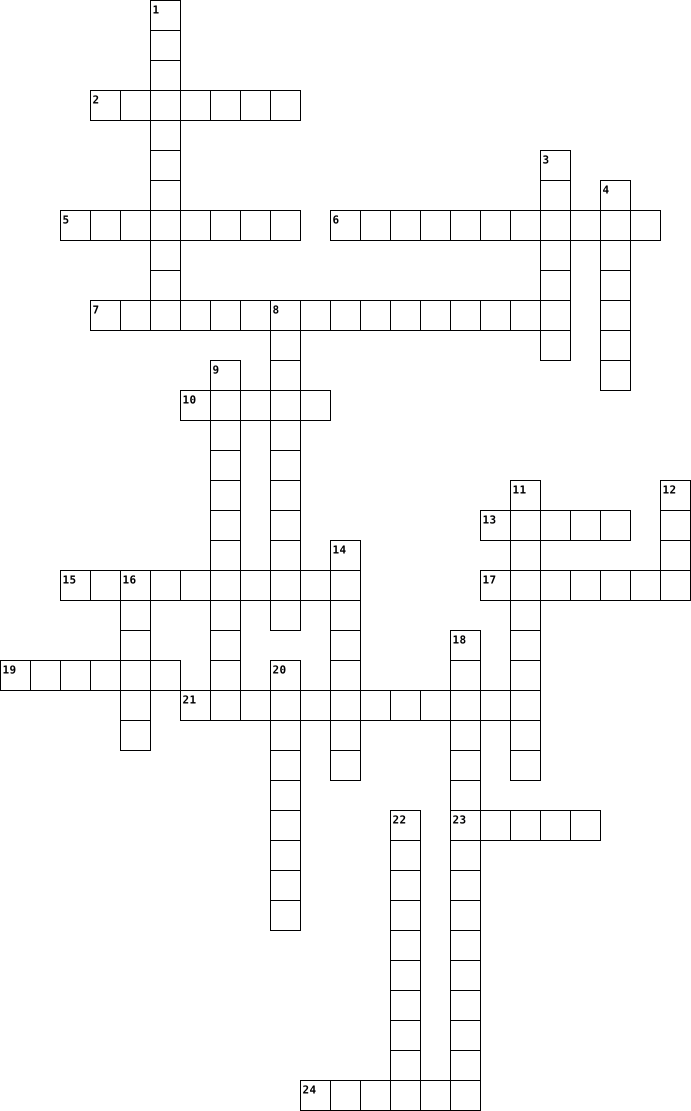
Across
- the 1st planet from the sun
- spinning on an axis!
- planets that are closer to the sun!
- A unit that measures the planets!
- Made of ice chunks, dust, and is called the dirty snowball!
- the 2nd planet from the sun known as earths sister planet
- the outer planets/ farther away from the sun!
- when meteorites enter earth's atmosphere it turns into ______!
- 7th planet from the sun and has cool colors!
- This is in the middle of mars and Jupiter
- this is keeping the planet from floating away!
- A body that orbits the sun!
Down
- a small planet that has other things in its orbit!
- keeps the planets in orbit
- the 8th planet from the sun
- planets that are farther away from the sun!
- the inner planets/ closer to the sun!
- cause craters when they land on earth
- the 4th planet from the sun with a pretty red color!
- made of rock and it orbits the sun!
- the 6th planet from the sun
- keeps plants growing
- made of debris and small rocks and metal!
- orbiting around another planet/body!
24 Clues: spinning on an axis! • keeps plants growing • keeps the planets in orbit • the 1st planet from the sun • the 8th planet from the sun • the 6th planet from the sun • A body that orbits the sun! • A unit that measures the planets! • planets that are closer to the sun! • made of rock and it orbits the sun! • orbiting around another planet/body! • the inner planets/ closer to the sun! • ...
Science 2023-10-03

Across
- transparent layer covering the front of the eyeball
- animal, which chews the cud
- insect blends in with the surroundings
- largest group of mammals
- the opening that allows light to enter the eye
- animals that are active
- the muscle that regulates the size of the people
- material that allows light to pass through it
- insect to move from place to place with the change of seasons
- light sensitive learning, covering the inside of the eyeball
- young insect, that looks exactly like the adults
- an object is black if all the colors are
- material that allows light to go through but you can’t see the object on the other side
- mirror bulges towards the viewer
- a male bee
- material that does not allow light to pass through it
- always travels in a straight line.
Down
- mirror bulges away from viewer
- structure behind the eyeball that refracts light
- vision type of vision in which both eyes were together
- odor of skunk
- bending of light rays as they enter new material
- nerve large bundle of fibers a carries messages to the brain
- chimpanzee, gorilla monkey
- light is a mixture of colored lights
- egg, laying mammal
- Edison inventor of the lightbulb
- nocturnal animals have an extra layer of cells in the eye
- animal that eats meat
- an insect with a straight line on its abdomen
- blue dress appears blue, because it reflects light
- the series of colored bands that are created when sunlight is separated
- animals in species, no longer exist
33 Clues: a male bee • odor of skunk • egg, laying mammal • animal that eats meat • animals that are active • largest group of mammals • chimpanzee, gorilla monkey • animal, which chews the cud • mirror bulges away from viewer • Edison inventor of the lightbulb • mirror bulges towards the viewer • always travels in a straight line. • animals in species, no longer exist • ...
Science 2023-09-26

Across
- the force pushing on a surface divided by the of that surface.
- Law/ temperature and volume of a gas at constant pressure.
- a liquid's resistance to flowing.
- Point/ the temperature from a liquid to a solid.
- Tension/ the result of an inward pull.
- Point/ the temperature from a solid to a liquid.
- two variables that are proportional if one is changed the other is also changed.
- the process by which molecules at the surface of a liquid absorb enough energy to change to a gas.
- state of matter that has a definite shape and volume.
- Law/ pressure and volume of a gas constant temperature
Down
- the change in state from a solid to a gas without going through the liquid state.
- Point/the temperature at which a liquid boil.
- how hot or cold something is, measure of average energy of motion of the particles of a substance, measure of average kinetic energy of the particles of a substance.
- a mixture in which particles can be seen and easily separated by a settling or filtration.
- state of matter that has no definite shape, but has a definite volume.
- the change in a state from a gas to a liquid.
- the change in state liquid to a gas.
- of matter that has no definite shape nor volume.
- Energy/ the total kinetic and potential energy of all the particles of an object
- and forth motion of particles.
20 Clues: and forth motion of particles. • a liquid's resistance to flowing. • the change in state liquid to a gas. • Tension/ the result of an inward pull. • Point/the temperature at which a liquid boil. • the change in a state from a gas to a liquid. • Point/ the temperature from a liquid to a solid. • Point/ the temperature from a solid to a liquid. • ...
Science 2023-10-30

Across
- blood pressure blood pressure when the ventricles of the heart contract
- are small blood vessels that connect arteries and veins
- gives the blood its color(red)
- artery taking the blood from the heart to the body
- lower chamber of the heart that pushes out the blood
- blood pressure blood pressure when the heart is as rest
- vein veins carrying blood from lungs to the heart
- vena cava brings blood to the lower right ventricle
- artery artery carrying blood from the heart to the lungs
Down
- cells that help to close wound
- system system of the heart, blood, and blood vessels that carry oxygen and nutrients throughout the body
- vena cava carries blood to the upper body
- pressure pressure placed on the walls of the blood vessels
- blood cell fights inflections and diseases
- form scabs
- carry blood towards the heart
- yellowish liquid that transports blood cells
- arteries blood vessels carrying oxygen rich blood to the heart muscle
- upper chamber in the heart that receives blood
- blood cell carries oxygen and nutrients to the cells
- carries blood away from the heart
21 Clues: form scabs • carry blood towards the heart • cells that help to close wound • gives the blood its color(red) • carries blood away from the heart • vena cava carries blood to the upper body • blood cell fights inflections and diseases • yellowish liquid that transports blood cells • upper chamber in the heart that receives blood • ...
science 2023-11-06

Across
- adding water to break a molecule apart
- breaking down glucose to produce energy
- environmental factors and inter-species relationships that influence the species
- carbohydrates, lipids, proteins, and nucleic acids
- plant eater
- carbohydrates that makes up plant cell wall
- meat eater
- number of calories burned (at rest or durning activity)
- chemical reaction that turns food into energy
- composed of very large molecules called macromolecules, which are simpler units called monomers
Down
- monomer or protien
- consisted of carbon, hydrogen, and oxygen atoms
- feeds on dead material
- part of the stomach that grinds food
- comparing what you get vs. what you put in
- complex molecules that play many important roles in the body
- meaning sugar
- monomer of a carbohydrate
- a pouch connected to the junctions of the small and large intestines
- atoms or small molecules that bond together to form complex structures such as polymers
20 Clues: meat eater • plant eater • meaning sugar • monomer or protien • feeds on dead material • monomer of a carbohydrate • part of the stomach that grinds food • adding water to break a molecule apart • breaking down glucose to produce energy • comparing what you get vs. what you put in • carbohydrates that makes up plant cell wall • chemical reaction that turns food into energy • ...
Science 2024-02-14

Across
- Transform: Dextral transform. Sinistral transform.
- A deep valley that forms where two plates move apart.
- The theory that the Earth's crust and upper mantle
- a fissure in the earth's crust through which gases erupt
- The continents we see today are fragments of that supercontinent
- movement of the edge of one tectonic plate under another.
- any long ditch cut in the ground. volcano. a fissure in the earth's crust
- A deep depression in the ocean floor caused by the convergence
- The uppermost division of the solid earth,
- system of connected underwater mountain ranges
- occurs when two tectonic plates move away from each other.
- movement of plat techonics
Down
- process that occurs at mid-ocean ridges
- hypothesis of continents used to be Pangea
- A mantle is a layer inside a planetary body bounded below by a core and above by a crust
- putty like layer
- study of magnetic fields recorded in rocks, sediment, or archeological materials
- vibration from underground
- the act of applying force
- a specialist in the history of the Earth recorded in rocks
20 Clues: putty like layer • the act of applying force • vibration from underground • movement of plat techonics • process that occurs at mid-ocean ridges • hypothesis of continents used to be Pangea • The uppermost division of the solid earth, • system of connected underwater mountain ranges • Transform: Dextral transform. Sinistral transform. • ...
Science 2024-02-14

Across
- Transform: Dextral transform. Sinistral transform.
- A deep valley that forms where two plates move apart.
- The theory that the Earth's crust and upper mantle
- a fissure in the earth's crust through which gases erupt
- The continents we see today are fragments of that supercontinent
- movement of the edge of one tectonic plate under another.
- any long ditch cut in the ground. volcano. a fissure in the earth's crust
- A deep depression in the ocean floor caused by the convergence
- The uppermost division of the solid earth,
- system of connected underwater mountain ranges
- occurs when two tectonic plates move away from each other.
- movement of plat techonics
Down
- process that occurs at mid-ocean ridges
- hypothesis of continents used to be Pangea
- A mantle is a layer inside a planetary body bounded below by a core and above by a crust
- putty like layer
- study of magnetic fields recorded in rocks, sediment, or archeological materials
- vibration from underground
- the act of applying force
- a specialist in the history of the Earth recorded in rocks
20 Clues: putty like layer • the act of applying force • vibration from underground • movement of plat techonics • process that occurs at mid-ocean ridges • hypothesis of continents used to be Pangea • The uppermost division of the solid earth, • system of connected underwater mountain ranges • Transform: Dextral transform. Sinistral transform. • ...
science 2024-02-09

Across
- harry hess
- when lithosphere plate collide
- below the lithosphere
- the liquid layer of the core
- plates under the earth that make the earth move
- putting together
- the last layer with 2 types
- go away from each other
- the layer below the earth
- between crust and mantle
- when thing get to close
- a reaction happens
Down
- above the lithosphere
- a fault line move horizantle
- when continent drift apart
- when land goes in
- when there's a line through the earth
- the opposite of the outer core
- the only layer humans can walk on
- sea floor is spreading
20 Clues: harry hess • putting together • when land goes in • a reaction happens • above the lithosphere • below the lithosphere • sea floor is spreading • go away from each other • when thing get to close • between crust and mantle • the layer below the earth • when continent drift apart • the last layer with 2 types • a fault line move horizantle • the liquid layer of the core • ...
science 2024-02-15

Across
- animals with hair on their body
- the region above and below the hottest region on Earth
- coldest regions on the Earth
- hottest region on the Earth
- the season between the months of April to June
- the season where the leaves from the trees fall
- line round the widest part of the Earth
- __________ is defined as the condition of the atmosphere of a given place at a given time of the day.
- strong and woody stem
Down
- part of the Earth lit by the moon
- Bears eat both plants and animals
- small plants with weak stem
- Objects __________ on water when the upward force applied is greater.
- milky glass that lets partial light pass
- trees that stay the same throughout the year.
- __________ is caused by force.
- curtains do not let light pass
- season where raincoats are worn.
- A force can change the __________________ of an object.
- creep along the floor
20 Clues: creep along the floor • strong and woody stem • small plants with weak stem • hottest region on the Earth • coldest regions on the Earth • __________ is caused by force. • curtains do not let light pass • animals with hair on their body • season where raincoats are worn. • part of the Earth lit by the moon • Bears eat both plants and animals • ...
Science 2024-02-08

Across
- the degree or intensity of heat
- the chemical breakdown of a substance by bacteria
- French guy
- And pepper
- Salad dressing
- a protein found in the wheat plant
- Cooks food
- On the PH scale greater than 7
- Liquid changing into a solid or semi-solid
- High to low concentration
- Repels water
- Makes dough rise
- Lemon has
Down
- why we cook meat
- Melted sugar
- a group of atoms bonded together
- Attracts water
- … would make things brown
- Butter is
- Membrane
20 Clues: Membrane • Butter is • Lemon has • French guy • And pepper • Cooks food • Melted sugar • Repels water • Salad dressing • Attracts water • why we cook meat • Makes dough rise • … would make things brown • High to low concentration • On the PH scale greater than 7 • the degree or intensity of heat • a group of atoms bonded together • a protein found in the wheat plant • ...
Science 2024-01-22

Across
- a good conductor
- in the air we breathe
- build up of atoms
- a neutral charged atom
- allows electricity to flow
- planet with ring
- Science teacher
- positively charged atom
- the study of life
- composed of atoms
Down
- negatively charged atom
- rubbing a balloon on head
- basic unit of a chemical element
- firm and stable state
- our planet
- North Star
- power from sun
- a circuit with multiple paths
- a circuit with one path
- centre of solar system
20 Clues: our planet • North Star • power from sun • Science teacher • a good conductor • planet with ring • build up of atoms • the study of life • composed of atoms • in the air we breathe • firm and stable state • a neutral charged atom • centre of solar system • negatively charged atom • positively charged atom • a circuit with one path • rubbing a balloon on head • allows electricity to flow • ...
science 2024-01-28

Across
- core The layer surrounding the inner core of the earth.
- The process through which heat is trapped near Earth's surface by substances.
- Large tubes that connect to your trachea (windpipe) and direct the air you breathe to your right and left lungs.
- core The innermost layer of the Earth.
- waves A type of electromagnetic radiation.
- The energy an object has because of its motion.
- The amount of matter or substance that makes up an object.
- Energy that is stored in an object due to its position or condition.
- The very small air sacs where the exchange of oxygen and carbon dioxide takes place.
- field The region around a magnetic material or a moving electric charge within which the force of magnetism acts.
- The mostly solid bulk of Earth's interior.
- The bending of light as it passes from one transparent substance into another.
- The change in position of an object with respect to its surroundings in a given interval of time.
Down
- Located beyond the visible spectrum at its violet end and having a wavelength shorter than those of visible light.
- A chemical element with an atomic number of 8.
- The speed in combination with the direction of motion of an object.
- The long-term pattern of weather in a particular area.
- A reflective surface that bounces off light, producing either a real image or a virtual image.
- Type of inheritance in which two versions (alleles) of the same gene are expressed separately to yield different traits in an individual.
- tectonics a scientific theory that explains how major landforms are created as a result of Earth's subterranean movements.
- An influence that can cause an object to change its velocity
- The rate of change of the velocity of an object with respect to time.
- dominance Form of Gene interaction in which both alleles of a gene at a locus are partially expressed, often resulting in an intermediate or different phenotype
- rays The smallest wavelengths and the most energy of any wave in the electromagnetic spectrum.
- A transmissive optical device that focuses or disperses a light beam by means of refraction.
- The state of the air and atmosphere at a particular time and place.
- Occurs when light traveling through one material bounces off a different material.
27 Clues: core The innermost layer of the Earth. • The mostly solid bulk of Earth's interior. • waves A type of electromagnetic radiation. • A chemical element with an atomic number of 8. • The energy an object has because of its motion. • The long-term pattern of weather in a particular area. • core The layer surrounding the inner core of the earth. • ...
Science 2023-10-27

Across
- Closet planet to the Sun
- Balls of burning nuclear energy
- The Red Planet
- Has a fixed volume, but no fixed shape
- Fastest thing in the universe
- Molecular motion
- Basic building block of a substance
- An icy ball of rock
- A satellite around a planet
- Has a fixed shape and volume
- Has a positive charge
- Gas giant
- Has no charge
Down
- Flow of electrons
- A singularity with extremely strong gravity
- Has no fixed volume
- The biggest planet in our solar system
- Building block of matter
- Has a negative charge
- Hottest planet in the solar system
- Anything that flows
- Farthest planet from the Sun
- A cluster of stars, dust, gas, etc.
- Dwarf planet
- The Jewel of the Solar System
25 Clues: Gas giant • Dwarf planet • Has no charge • The Red Planet • Molecular motion • Flow of electrons • Has no fixed volume • Anything that flows • An icy ball of rock • Has a negative charge • Has a positive charge • Closet planet to the Sun • Building block of matter • A satellite around a planet • Farthest planet from the Sun • Has a fixed shape and volume • Fastest thing in the universe • ...
SCIENCE 2023-12-20

Across
- Attracts certain materials like iron.
- Characteristics of things that grow, reproduce, and respond to their environment.
- The basic building block of living organisms.
- Eighth planet from the sun.
- Change in position over time.
- When one celestial body moves into the shadow of another.
- The basic unit of matter.
- Essential for life and exists in three states: solid, liquid, and gas.
- Force that opposes motion between two surfaces.
Down
- Rapid back-and-forth movement.
- A machine capable of carrying out tasks automatically.
- Small, six-legged arthropod.
- Related to the moon.
- An organism that makes its own food through photosynthesis.
- Cold-blooded aquatic vertebrate.
- Make something appear larger.
- A push or pull that can change the motion of an object.
- Source of energy from the sun.
- Solid material made up of minerals.
- Our home planet.
20 Clues: Our home planet. • Related to the moon. • The basic unit of matter. • Eighth planet from the sun. • Small, six-legged arthropod. • Change in position over time. • Make something appear larger. • Rapid back-and-forth movement. • Source of energy from the sun. • Cold-blooded aquatic vertebrate. • Solid material made up of minerals. • Attracts certain materials like iron. • ...
Science 2024-02-05

Across
- Subatomic particle with a negative charge
- Non-tented arch, loop and whorl are types
- A type of science used to investigate crime scenes
- Outermost layer of our atmosphere
- Measuring system used worldwide
- Popular modern scientist and science communicator
- Means 1,000
- Inventor of dynamite
- Study of the Earth
- The Earth's crust rides on this layer
- An arm bone or measurement of part of a circle
- A life saving drug nearly 100 years old
- The ___ table
- Classical scientist that didn't screw around
- Many tired students learn this way
- The standard that new inventions are compared to
- Study of the heavens
- Control center of living cells
- “Nothing is better than reading and gaining more and more knowledge.”
- Studies human history and prehistory through excavation
- "If I were not a physicist, I would probably be a musician."
- Rain clouds
- God of War and 4th planet
Down
- the first African-American woman to travel into space
- _____Resonance Imaging
- Also known as a caveman
- The first "apple" scientist
- Process that creates the oxygen we breathe
- Study of the atmosphere
- Lightning is a type of this
- Study of itty bitty life forms
- A fundamental or universal force
- Frogs are but snakes aren't
- A pioneer in radiology
- The Big Dipper is actually part of this constellation
- Her work helped us understand DNA,RNA and more
- Self-contained underwater breathing apparatus
- Not your average science guy
- Mathematical study of space
- Dinosaur with 3 horns on it's head
- Known for evolutionary biology
- Not animal life
- Inventory of the AC motor
43 Clues: Means 1,000 • Rain clouds • The ___ table • Not animal life • Study of the Earth • Inventor of dynamite • Study of the heavens • _____Resonance Imaging • A pioneer in radiology • Also known as a caveman • Study of the atmosphere • Inventory of the AC motor • God of War and 4th planet • The first "apple" scientist • Lightning is a type of this • Frogs are but snakes aren't • ...
Science 2024-02-22

Across
- water 3% of the earths water is
- what is another word for how cold or hot something is
- A region, which is closer to the sea
- a layer of gas or layers of gases that envelop a planet
- the cycle of processes by which water circulates between the earth's oceans, atmosphere, and land, involving precipitation as rain and snow, drainage in streams and rivers, and return to the atmosphere by evaporation and transpiration.
- another word for H₂O
- any significant accumulation of water on the surface of Earth or another planet
- long-term shifts in temperatures and weather patterns
- a storm with a violent wind, in particular a tropical cyclone in the Caribbean.
Down
- an area or ridge of land that separates waters flowing to different rivers, basins, or seas.
- NEAR A LARGE BODY OF WATER, IN A GREENHOUSE
- the maximum amount that something can contain
- also known as the hydrologic cycle or the hydrological cycl
- the action or process of precipitating a substance from a solution.
- the vapor into which water is converted when heated, forming a white mist of minute water droplets in the air.
- the upper surface of the zone of saturation
- firm and stable in shape; not liquid or fluid.
- a mass of ice overlying snow that moves slowly down a mountain slope under the influence of gravity
- a mass of ice that covers less than 50,000 km² of land area.
- THE ABILITY OF A MATERIAL TO ABSORB HEAT
- a mobile, destructive vortex of violently rotating winds having the appearance of a funnel-shaped cloud and advancing beneath a large storm system.
21 Clues: another word for H₂O • water 3% of the earths water is • A region, which is closer to the sea • THE ABILITY OF A MATERIAL TO ABSORB HEAT • NEAR A LARGE BODY OF WATER, IN A GREENHOUSE • the upper surface of the zone of saturation • the maximum amount that something can contain • firm and stable in shape; not liquid or fluid. • ...
Science 2020-07-08

Across
- the way that things works corectly.
- a organism made of many cells
- is the main and largest artery in the human body.
- blood vessels that carry blood low in oxygen from the body back to the heart.
- is a large vein that carries deoxygenated blood from the lower middle body.
- transport oxygen in your body.
- large shaped protein.
- Fluid comprising a mixture of substances, including pepsin and hydrochloric acid, secreted by glands of the stomach.
- theory of the cells.
- short eyeshlike that is numerous in tissues or cells.
Down
- Formation of blood clots; prevention of bleeding.
- like the skin
- organsim only of one cell.
- Transmission electron microscope image of a cross-section of a capillary occupied by a red blood cell.
- is a structural layer surrounding some types of cells.
- The arteries are the blood vessels that deliver oxygen-rich blood from the heart to the tissues of the body.
- are the cells of the immune system
- is the superior of the two venae cavae.
- is the spontaneous net movement of solvent molecules.
- Blood plasma is a 'yellowish liquid' component of blood that holds the blood cells of whole blood in suspension.
20 Clues: like the skin • theory of the cells. • large shaped protein. • organsim only of one cell. • a organism made of many cells • transport oxygen in your body. • are the cells of the immune system • the way that things works corectly. • is the superior of the two venae cavae. • Formation of blood clots; prevention of bleeding. • is the main and largest artery in the human body. • ...
Science 2020-06-17

Across
- lasts over a shorter period of time
- what are one of the two main types of loads?
- what is the change of state from solid to gas?
- what is the type of heat transfer for heat from the sun?
- the change of state from gas to solid
- what is one of the four types of obsolescence?
- when two or more substances are mixed and are physically changed
- what are primary consumers?
- what is the change of state from gas to liquid?
- what is the word for the ability to live in balance and exist or be used at the same level for a long period of time...
- what is one type of load within a live load?
- what feed off of the dead remains of the dead animals and doesn't kill?
- what is from manly about?
Down
- lowest level of interaction
- what is it called when there are peeks of heat and then the heat spreads out?
- liquid to solid
- which currents control 90 percent of the water?
- what is a kind of producer?
- what is functions manly about?
- liquid to gas
- 10 percent
- what has the highest level of interaction?
- a liquid that dissolves substances
- heat moving from place to place
- when there's rain, snow or hail
- when designers and manufacturers purposely make something with a limited “life” or number of uses.
- lasts over a longer period or time
- the layer of the planet that is in the middle
- what is the name of the consumer that eats the primary consumer?
- solid to liquid
- what is the second reason why the ecosystem changes?
31 Clues: 10 percent • liquid to gas • liquid to solid • solid to liquid • what is from manly about? • lowest level of interaction • what is a kind of producer? • what are primary consumers? • what is functions manly about? • heat moving from place to place • when there's rain, snow or hail • a liquid that dissolves substances • lasts over a longer period or time • ...
science 2020-05-04

Across
- a large body of matter
- a runny and wet substance
- a act of coming wider or larger
- the smallest part of a chemical elelment
- the amount of space the substance occupies
- events after a chemical reaction
- when a solid is over zero degrees
- higher or socially more acceptable activity
- to estimate
- when a liquid goes over 100 degrees
- when a liquid is below zero
Down
- the spreading of something more wildly
- firm and stable in shape
- can be observed and measured without changing
- energy which a body possesses
- the temperature at which the substance will melt
- when a liquid turns to gas
- an essential or characteristic
- a substance in the air
- water witch collects the droplets on a cold substance a particle kind of matter
20 Clues: to estimate • a large body of matter • a substance in the air • firm and stable in shape • a runny and wet substance • when a liquid turns to gas • when a liquid is below zero • energy which a body possesses • an essential or characteristic • a act of coming wider or larger • events after a chemical reaction • when a solid is over zero degrees • when a liquid goes over 100 degrees • ...
Science 2020-05-11

Across
- q
- r
- b
- o
- s
- d
- t
- m
- c
- j
- e
Down
- g
- p
- k
- l
- i
- n
- a
- h
- f
20 Clues: g • q • p • r • k • b • o • s • l • i • n • d • t • a • m • c • h • f • j • e
Science 2020-05-11

Across
- a narrow piece land
- the bowl shaped depression
- a natural flowing water way
- artificial waterway
- droplets of water that fall from the sky
- pushes rock together
- the actual plant or organism in the fossil
- a naturally formed narrow waterway
- show evidence of activities
- Cluster of islands
- the connected body of water
- the area above the focus
- underground area where molten rock collects
- where rock under stress breaks
- a place where water flows over a cliff
- A narrow body of water
- A broad inlet
- pulls rock apart
- a natural elevation that forms a peak
- Earth's weather and most clouds occur here
- folds down
- Frozen fain droplets
- This is in 20% of the atmosphere and it's plant life traps heat.
- Area filled with water
- a impression of a organism in rock
- a body of water enclosed by land
- a piece of sub-continental land
- Protects earth from getting hit from meteoroids
- a large underground chamber
- rates earthquake on damage
- folds up
- burns gasoline,adds smoke and other harmful gases to the air
- squeezes rock
- slides crust past each other
- gives out gases from chemicles to grow faster
- raised piece of land
- the channel in the neck
- Burns greenhouse gases,adds fossil fuels to the air,these places give out sulfer dioxide that makes acid rain.
Down
- a large rotating storm with high speeds
- a slowly moving mass of ice
- a vertical funnel of rapidly spinning air
- a natural feature of the earth's surface.
- the sound of lightning explosion
- pulls on crust
- rates earthquake on size
- waves that vibrate
- waves that expand and shake the ground
- the area where land meets sea
- a low area between hill or mountains
- any of the world's main lands
- Deep cleft between cliffs
- The Aurora Borealis occurs here
- molten flowing down the sides of the volcano
- the charge that jumps around in clouds
- an isolated hill
- a preserved remain
- Contains ozone layer and protects earth from UV rays
- a piece of land that is boarded by water on three sides
- make ground roll
- a mold
- This is basically 2% of the atmosphere forms ozone to protect us
- a rupture in the crust of Earth
- Raised area of land
- stress that that pushes rocks away
- tiny air born pieces of rock
- This is in 78% of the atmosphere and combines with Oxygen
- A steep rock face
- an extreme snowstorm
- smaller than oceans
- Satellites orbit the earth here
- an area of highland
71 Clues: a mold • folds up • folds down • A broad inlet • squeezes rock • pulls on crust • an isolated hill • pulls rock apart • make ground roll • A steep rock face • waves that vibrate • Cluster of islands • a preserved remain • a narrow piece land • artificial waterway • Raised area of land • smaller than oceans • an area of highland • pushes rock together • Frozen fain droplets • an extreme snowstorm • ...
Science 2016-06-23

Across
- Transmitting an electrical message
- Glowing white with heat
- Radiation visible to the human eye
- When light is thrown back when it hits an object
- Energy sources unable to be used again or unable to be regenerated over time
- Energy created by motion
- Small amount of matter
- Energy stored in an object
- The transfer of heat or electricity through wires
- Fuel: They are natural fuels made by fossils of dead things
- The core thing all matter is made of
- The quality of being efficient
- They are chemical cells used to power electrical devices
- The process of changing one thing into another
- Energy waves or particles
- Energy produced to operate things such as machines and the human body
Down
- Quality of glowing
- Energy generated by nuclear fusion
- The quality of an object able to go back to it’s original shape after being stretched or compressed
- Sun rays that are collected by solar panels
- Energy sources able to be used again or able to be regenerated over time
- A combustible dark rock used to provide heat and electricity
- The process of heat being transferred through liquid or gas
- Chemical name for ethyl alcohol
- A device or piece of equipment designed to used for a specific task
- When something sucks up another
- A non-conductive material that protects something from electricity
- A force that attracts something of an object of mass
- Power that is generated from chemicals or physical actions.
- Vibrating air particles that travel through the air
30 Clues: Quality of glowing • Small amount of matter • Glowing white with heat • Energy created by motion • Energy waves or particles • Energy stored in an object • The quality of being efficient • Chemical name for ethyl alcohol • When something sucks up another • Transmitting an electrical message • Energy generated by nuclear fusion • Radiation visible to the human eye • ...
Science 2016-03-20

Across
- Chart that shows all the possible combinations of alleles that can result from a genetic cross.
- In the next part of interphase, the cell makes an exact copy of the DNA in its nucleus in a process.
- The final stage of the cell cycle.- completes the process of cell division.
- The passing of physical characteristics from parents to offspring.
- One whose trait always shows up in the organism when the allele is present.
- A purebred organism is the offspring of many generations that have the same trait.
- A new organism begins to form when egg and sperm join in the process.
- The stage during which the cell’s nucleus divides into two new nuclei.
- The first stage of the cell cycle
- A number that describes how likely it is that an event will occur.
- The scientific study of heredity.
Down
- The different forms of a gene.
- Each different form of a characteristic, such as stem height or seed color.
- An organism that has two identical alleles for a trait.
- Hidden whenever the dominant allele is present.
- Genetic makeup, or allele combinations.
- During prophase, the threadlike chromatin in the nucleus condenses to form double-rod structures.
- cycle The regular sequence of growth and division that cells undergo.
- An organism that has two different alleles for a trait.
- A hybrid organism has two different alleles for a trait.
- An inheritance pattern.
- The factors that control a trait.
- Physical appearance, or visible traits.
23 Clues: An inheritance pattern. • The different forms of a gene. • The factors that control a trait. • The first stage of the cell cycle • The scientific study of heredity. • Genetic makeup, or allele combinations. • Physical appearance, or visible traits. • Hidden whenever the dominant allele is present. • An organism that has two identical alleles for a trait. • ...
Science 2016-06-07

Across
- Outside of plant cell, made of cellulose, provides structure and protection from injury.
- The brain of the cell.
- The pump in the circulatory system.
- System Heart,blood and vessels.
- Permits some materials into and out of the cell and provides support.
- Muscle in your mouth that used for pushing food around.
- The largest artery in the body.
- The vessels connect arteries to veins.
- The most important gas people need to breath in.
- A vessel that moves blood to the heart.
Down
- Mitosis and Cytokinesis
- The first part of Digestive system.
- intestine The place absorb Nutrients to the blood.
- Large,reddish,oval structure, make energy to the cell.
- A vessel that moves blood away from the heart.
- Reproduction, growth and repair.
- The organ in body used for hold food and churns food.
- The place where circulatory system exchanged gas.
- The liquid in your body.
- A structure composed of different tissues working together to perform a complex body function.
20 Clues: The brain of the cell. • Mitosis and Cytokinesis • The liquid in your body. • System Heart,blood and vessels. • The largest artery in the body. • Reproduction, growth and repair. • The first part of Digestive system. • The pump in the circulatory system. • The vessels connect arteries to veins. • A vessel that moves blood to the heart. • ...
science 2019-02-12

Across
- web a diagram that shows the feeding relationships between organisms in an ecosystem
- a badger or an owl
- dry and often hot biomes
- a biome in which the vegetation is mainly grasses, small planting flowers, and a few trees
- made up of all the populations of organisms that live in an area
- tiny producers that float near the surface of the ocean
- an area where from the ocean flows into the mouth of a stream or river
- zone the area of a lake or pond that extends from the littoral zone across the top of the water
- a group of individuals of the same species that live together
- the part of earth where life exists
- a wetland ecosystem in which producers such as trees and vines grow
- a symbiotic relationship in which one organism benefits while the other is harmed
- made up of a community of orgasms and their antic environment
- a treeless wetland ecosystem where producers such as grasses grow
- the organism that is eaten
- an area where the climate typically determines the plant community, which supports an animal community
- a biome that has a fairly dry climate but still receives only a little more rainfall that a dessert does
- factors of the environment
Down
- an area of land that is sometimes underwater or whose soil contains a great deal of moisture
- the organism that eats the prey
- a symbiotic relationship in which both organisms benefit
- a biome that has very cold temperatures and little rainfall
- a grasshopper or a bison
- a symbiotic relationship in which one organism benefits and the other is unaffected
- a close long term association between two or more species
- the study of interactions of organisms with one another and with their environment
- pyramid a diagram that shows an ecosystems loss of energy
- zone beneath the open-water zone where no sunlight reaches
- zone the area of water closest to the edge of a late or pond
- consumers that eat both plants and animals
- the kind of biome found in both places
- capacity the largest population that an environment can support
- factors of the environment that are dead
33 Clues: a badger or an owl • a grasshopper or a bison • dry and often hot biomes • the organism that is eaten • factors of the environment • the organism that eats the prey • the part of earth where life exists • the kind of biome found in both places • factors of the environment that are dead • consumers that eat both plants and animals • ...
Science 2018-12-05

Across
- an environmental factor that causes the population to decrease
- benefits both organisms
- number of things sharing a specific characteristic
- colonize previously biodiverse ecosystems
- an animal that eats meat
- organism that only eats plants
- an animal that eats already dead animal
- the behaviors and physical characteristics that allow organisms to live successfully in their environments
- an article or substance that is refined for sale
- preying of one animal on another
- what is used in a process
- an organism that eats both plants and animals
Down
- the powerhouse of the cell
- a relationship where one organism benefits the other is unaffected
- the process by which a plant converts light into energy
- moving abroad
- the act of coming to live somewhere
- the maximum number of organisms a certain place can hold
- large group of specific organisms that can reproduce with each other
- an organism that produces its own food
- the part of earth which life exists including land water and air or atmosphere
- contains chlorophyll
- interaction between two different organisms living in close physical association, typically to the advantage of both
- the process of creating cell energy
- a relationship when one organism benefits and the other is harmed
- organism that relies on other organisms for food
- a group of organisms that are different species
- a community were abiotic and biotic factors interact
- all the organisms in same group or species
29 Clues: moving abroad • contains chlorophyll • benefits both organisms • an animal that eats meat • what is used in a process • the powerhouse of the cell • organism that only eats plants • preying of one animal on another • the act of coming to live somewhere • the process of creating cell energy • an organism that produces its own food • an animal that eats already dead animal • ...
science 2018-12-11

Across
- have both metallic and non-metallic properties
- compounds are pure substances formed as a result of the attraction between particles of opposite charges, called ions.
- change occurs when two or more materials react and create new materials.
- combination of pure substances
- happens to your ice cream when you leave it in the sun
- new materials produced by the reaction are called
- when you leave water outside on a surface and then turns into steam
- another same as whims
- They are the most reactive non-metals.
- They react when exposed to air and water as well, but their reactivity is not as strong as that of the alkali metals
- the transition of a substance directly from the solid to the gas phase
- e substance is dissolved in another, creating what looks like one
- can be a solid or a gas.
- is also a cloudy mixture, but the particles of the suspended substance are so small that they cannot be easily separated out from the other substance.
- change is one in which a material changes from one state to another.
Down
- something you say that your are very cold
- when non-metals combine, a pure substance called a
- metals These are the most reactive of the metals.
- The most stable and nonreactive elements.
- something that will harm you or kill you
- mass is the mass of one atom of an element.
- something you should take precaution
- a cloudy mixture in which tiny particles of one substance are held within another.
- are a group of atoms acting as one.
- something that may hurt you or kill you
25 Clues: another same as whims • can be a solid or a gas. • combination of pure substances • are a group of atoms acting as one. • something you should take precaution • They are the most reactive non-metals. • something that may hurt you or kill you • something that will harm you or kill you • something you say that your are very cold • The most stable and nonreactive elements. • ...
Science 2019-02-27

Across
- The study of animals
- Study of Blood
- Someone who studies living things
- Someone who studies rocks
- The Study of Fish
- Study of Fossils
- Study of the weather
- someone who studies the stars
- The study of organisms
- studies birds
- Study of ants
- Study of matter and chemical reaction
Down
- Study of Bones
- Study of Bees
- Study of plants
- Study of Spiders
- Study of Butterflies
- The study of Soil 15
- The study of laws
- The study of ocean aspects
20 Clues: Study of Bees • studies birds • Study of ants • Study of Bones • Study of Blood • Study of plants • Study of Spiders • Study of Fossils • The Study of Fish • The study of laws • The study of animals • Study of Butterflies • The study of Soil 15 • Study of the weather • The study of organisms • Someone who studies rocks • The study of ocean aspects • someone who studies the stars • ...