
states and capitals Crossword Puzzles
Civil War Crossword 2024-04-16

Across
- - ________ was a general officer in the Confederate States Army during the American Civil War. He played a prominent role in nearly all military engagements in the Eastern theater of the war until his death.
- Run - ___ ____ was the first major battle of the American Civil War. It was also called the Battle of First Manassas by Confederate forces. The battle was fought in Prince William County, Virginia, just north of the city of Manassas and about thirty miles west-southwest of Washington, D.C
- - _______ was a major strategic city for the Confederacy that served as a railroad terminus, supply depot, and manufacturing hub.
- - ______ was an American general in the Union Army during the American Civil War and one of the principal commanders in the Western Theater.
- - _______ was a career United States Army officer who became a major general in the Confederate States Army during the American Civil War. He was also known for leading one of the worst war decisions in the Battle of Gettysburg.
- - ___________ was the largest and most famous of 150 military prisons of the Civil War, Camp Sumter, commonly known as Andersonville, was the deadliest landscape of the Civil War. Of the 45,000 Union soldiers imprisoned here, nearly 13,000 died.
- - _______ was an American Civil War general for the Union, chiefly remembered for his decisive defeat by Confederate General Robert E. Lee at the Battle of Chancellorsville in 1863.
- - ______ was an American military officer, politician, and the 18th president of the United States, who served from 1869 to 1877. He led the Union Army to victory in the American Civil War in 1865 and briefly served as U.S. Secretary of War
- - ________ was an American college professor from Maine who volunteered during the American Civil War to join the Union Army. He became a highly respected and decorated Union officer, reaching the rank of brigadier general.
- - __________ was one of the Confederate generals of the American Civil War and the principal subordinate to General Robert E. Lee, who called him his "Old War Horse".
- - _______ was a flag officer of the United States Navy during the American Civil War. He was the first rear admiral, vice admiral, and admiral in the United States Navy.
- Proclamation - The ________ _________ was issued by Abraham Lincoln on January 1, 1863, as the nation approached its third year of bloody civil war. The proclamation declared "that all persons held as slaves" within the rebellious states "are, and henceforward shall be free."
- - _______ was an American army officer and politician who became a senior Union general in the Civil War and three-time Governor of Rhode Island, as well as being a successful inventor and industrialist.
- - _______ or the Battle of Sharpsburg, took place during the American Civil War on September 17, 1862, between Confederate General Robert E. Lee's Army of Northern Virginia and Union Major General George B. McClellan's Army of the Potomac near Sharpsburg, Maryland, and Antietam Creek.
- - _______ was the final major military action in the Vicksburg campaign of the American Civil War.
- - _____ was a Cherokee chief who signed the treaty forcing tribal removal of the Cherokees from Georgia and who later served as brigadier general in the Confederate Army during the U.S. Civil War.
Down
- - ________ graduated from West Point and served in the Mexican War. He also led the Peninsular campaign during the Civil War. He served as govenor of New Jersery from 1878 to 1881
- Sumter - ____ ______ was bombarded near Charleston, South Carolina by the South Carolina militia. It ended with its surrender by the United States Army, beginning the American Civil War.
- - _____, also known as the Battle of Pittsburg Landing, was a major battle in the American Civil War. The fighting took place in southwestern Tennessee, which was part of the war's Western Theater
- - ________ was a three-day battle in the American Civil War fought between Union and Confederate forces, in and around Gettysburg, Pennsylvania.
- - _____ was an American politician, lawyer, and US Army officer. In his political career, he served in the U.S. House of Representatives from Illinois and later as a U.S. Senator from Oregon.
- - _________was one of the last battles of the American Civil War. It was the final engagement of Confederate General in Chief Robert E. Lee and his Army of Northern Virginia before they surrendered to the Union Army of the Potomac under the Commanding General Ulysses S. Grant.
- - ______ was a Confederate States Army general during the American Civil War. He was a cavalry commander known for his mastery of reconnaissance.
- - _________ was an American lawyer, politician, and statesman, who served as the 16th president of the United States, from 1861 until his assassination in 1865
- - _______ was an American soldier, businessman, educator, and author. He served as a general in the Union Army during the American Civil War, achieving recognition for his command of military strategy as well as criticism for the harshness against his troops.
- - ____ was a Confederate general during the American Civil War, toward the end of which he was appointed the overall commander of the Confederate States Army
- Plan - The ______ ____ was a military strategy proposed by Union General Winfield Scott early in the American Civil War. The plan was to cut off supplies to Confederate forces and divide and conquer their fighting force. Lastly, the end goal was to ambush and surround the Confederacy, leading to a Union victory.
- - The ________ was an ironclad warship built for the United States Navy during the American Civil War and completed in early 1862, the first such ship commissioned by the Navy.
- - ______ was the president of the Confederated States of America. He represented Mississippi in the United States Senate and the House of Representatives as a member of the Democratic Party before the American Civil War.
- - _______ was a career United States Army officer and a Union general in the American Civil War. He also has a poem written about him.
- - The _________ was a steam frigate, best known as the hull upon which the ironclad warship CSS Virginia was constructed during the American Civil War. The CSS Virginia then took part in the Battle of Hampton Roads in the first engagement between ironclad warships.
31 Clues: - _______ was the final major military action in the Vicksburg campaign of the American Civil War. • - _______ was a major strategic city for the Confederacy that served as a railroad terminus, supply depot, and manufacturing hub. • ...
We the People lessons 8-12 2022-11-15

Across
- Parts of the government
- The introduction to the Constitution. It states that the people establish the government and lists the purposes of the government
- Convention The meeting held in Philadelphia in 1787 at which the U.S Constitution was written
- Compromise The plan accepted at the Philadelphia Convention that called for Congress to have two houses. The Senate would have two senators from each state. The House of Representatives would have representatives from each state based on the population.
- Powers The authority to carry out and enforce the laws
- fairness; rightfulness
- Tranquility As used in the preamble to the constitution, this phrase means a peaceful situation without or within our country.
- To put an end to
- Powers Balancing the powers of government mean that no one Branch is given so much power that it can completely control thterm-17e other branches
- Fifths Clause The farmer's compromise about slavery that became part of the Constitution. It counted each slave as three-fifths of a person to determine how many representatives a state should have in Congress.
- Give official approval
- One house of Congress. Each state has two members in the Senate
Down
- Accept of the Constitution
- Welfare The good of all the people
- Defense Protection of the people from enemies
- The delegates to the Philadelphia Convention were called farmers because they "framed" the Constitution.
- States Supreme Court Highest court in the United States
- Trade The business of taking people from their homes in Africa and selling them in the colonies.
- Powers Limiting power
- War The was between the Northern and Southern States. It took place from 1861 to 1865 and ended slavery in the United States.
- of Powers The division of powers among the different branches of government. In the United States powers are divided among the legislative, executive and judicial branches.
- Of Liberty The gift of being free
- Power The authority to make laws and rules
- Powers The authority to settle disagreements about laws. This applies the laws and settles disputes.
- of Representatives One of two houses of Congress. The number of representatives from each state is based on its population.
25 Clues: To put an end to • Powers Limiting power • fairness; rightfulness • Give official approval • Parts of the government • Accept of the Constitution • Of Liberty The gift of being free • Welfare The good of all the people • Power The authority to make laws and rules • Defense Protection of the people from enemies • Powers The authority to carry out and enforce the laws • ...
PNW History 2020-06-05

Across
- a United States statute that permitted the entrance of Montana and Washington into the United States of America.
- A tunnel made by James T. Kingsbury in August 1882
- The native american guide of the Lewis and Clark expeditions
- A confrontation in 1859 between the United States and United Kingdom over the British–U.S. border in the San Juan Islands.
- A Greek Maritime pilot who discovered the straits that were named after him in Northwest Washington.
- Otherwise known as Harvey's Depot, this fort existed from 1859-1882
- A slogan by Polk used to advertise the expansion of Texas, California, and Oregon Territory
- Did missionary work with Native American peoples
- A conflict between the United States and the Sahaptian-speaking people of the Northwest Plateau
- British Officer of the Royal Navy. Famously explored the Pacific Northwest coast regions.
- The belief that Settlers were destined to come to Western America
- A conflict between the Spanish Empire, the Kingdom of Great Britain, and the United States of America
- An estimated 1,000 emigrants leave for Oregon Territory with John Gantt as their leader
- The encampment of the Lewis and Clark Expedition in the Oregon Country near the mouth of the Columbia River.
Down
- Has a town on the border of Idaho named after him. The town is right next to Lewiston.
- Has a town in Idaho on the border of Washington named after him. The town is right next to Clarkston.
- The city of Seattle is named after him
- A Spanish Basque explorer of the Pacific Northwest
- Major investor in the PNW Fur Trade
- The first non-native woman to climb Mt. Rainer
- Rivaled with the Northwest Company in the fur trade which caused the Pemmican War in 1816
- The term for the fur of an Otter
- A United States policy that opposed European colonialism in the Americas.
- An entrepreneur and politician regarded as the founder of Seattle
- Governor of the Territory of Washington from 1853 to 1857. First governor of Washington Territory.
25 Clues: The term for the fur of an Otter • Major investor in the PNW Fur Trade • The city of Seattle is named after him • The first non-native woman to climb Mt. Rainer • Did missionary work with Native American peoples • A Spanish Basque explorer of the Pacific Northwest • A tunnel made by James T. Kingsbury in August 1882 • ...
US history Crossword Puzzle 2015-02-25

Across
- war with the union and confederate
- armed white abolitionist that rebelled against slavery
- Forcing African Americans to work hard labor for free
- The bloodiest one day battle of the civil war
- Decision of supreme court that slave were property not u.s. citizens
- To break away
- A turning point of the war, a three day battle
- made Indians move to Oklahoma, was a law
- vice president and president argued about states rights
- period where people moved to cities to work in factories
- land west of the Mississippi river is now u.s. land doubled the size of the u.s.
- assassinated Abraham Lincoln
- network of safe houses slaves used to travel to freedom
- Federal law that allowed people of state determine if the state would be free or not
- those opposed to slavery
- Half of the states slave and the other free
- 3rd president of the united states
- Warned European nations to not intervene in the politics of north and south america
- machine cleaning seeds from cotton
- belief that America was destined to expand all the way westward
- runaway salves must be returned to their owners
- Abraham Lincolns speech
- moderation or abstinence from alcohol
Down
- war between u.s. and great Britain, second time
- was vice president did not like Andrew Jackson
- The states have free will or per say rights
- 16th vice president, 17th president of the u.s.
- Are separated into sections
- Invented the cotton gin and interchange parts
- 16th president, was for the union
- freed the slaves in confederate states
- he made sure the president didn't fight with the vice president
- south, was for slavery
- Great union general
- The north, was against slavery
- was a slave that rebelled happened in Virgina, killed people
- Exploration of Lewis and Clark west to the pacific ocean
- law that allowed people of Kansas to be free or slave
- right to vote
- war broke out with Mexico and the united states
40 Clues: To break away • right to vote • Great union general • south, was for slavery • Abraham Lincolns speech • those opposed to slavery • Are separated into sections • assassinated Abraham Lincoln • The north, was against slavery • 16th president, was for the union • war with the union and confederate • 3rd president of the united states • machine cleaning seeds from cotton • ...
Constitution Vocab 2024-11-18

Across
- The Constitution distributes power among the 3 branches
- Grants Congress the power to make laws to carry out the enumerated powers in a reasonable way
- the first ten amendments to the Constitution, which guarantee basic individual rights to all persons in the United States
- Favors a more expansive reading of the Constitution to give more power to the Federal government. If it doesn't say you can't do it then you might be able to do it's"
- Power is divided between national, state, and local governments
- Makes the Constitution the supreme law of the land as supremacy clause
- Favor a literal reading of the constitution in order to limit the power of the Federal government. If it doesn't say you can't do it,
- The Constitution and the Bill of Rights have protections against intrusions on people's rights
- All persons born or naturalized in the US and subject to its jurisdiction
- Powers given to the branches of government directly by the Constitution
- Having to do with commerce inside of a single state
- Power resides only in the national government (most other countries use this system)
- Power shared by national and state government (ex. taxes)
- The Constitution is the supreme law of the land and can't be overridden by local or state laws"
- Having to do with commerce between different states
- grants Congress the power to regulate trade with other nations and among the states
Down
- The people have the ultimate power through voting
- The official power to make legal decisions and judgments
- Sending someone accused of a crime back to the state or country in which the crime was committed
- The Constitution set up a system in which each branch has the power over another so that one branch does not get too much power
- Gives the states the Reserved powers
- Powers not given to the national government are retained by the states
- A court ruling that establishes a legal example that can be followed in the future
- Government and people have to follow the law
- Part of the Constitution that deals with the relationships among the states
25 Clues: Gives the states the Reserved powers • Government and people have to follow the law • The people have the ultimate power through voting • Having to do with commerce inside of a single state • Having to do with commerce between different states • The Constitution distributes power among the 3 branches • The official power to make legal decisions and judgments • ...
Taxes 2025-04-24

Across
- an exemption that lowers the amount of income tax your employer must deduct from your paycheck.
- a U.S. Citizenship and Immigration Services (USCIS) form used to verify that a new hire is authorized to work in the United States.
- a tax in which the tax rate increases as the taxable amount increases.
- a qualifying child or relative who relies on you for financial support.
- a tax imposed so that the tax rate is fixed, with no change as the taxable base amount increases or decreases.
- a tax imposed on individuals or entities in respect of the income or profits earned by them.
- a tax levied by the United States government on the annual earnings of individuals, corporations, trusts, and other legal entities.
- a tax form used in the United States to prepare and file an information return to report various types of income other than wages, salaries, and tips.
- a percentage of gross wages that most employees, employers and self-employed workers must pay to fund the federal program.
- a tax on the value of a property.
- an indirect tax on specific goods, services and activities.
Down
- an amount deducted from taxable income.
- a type of direct tax levied on the income or capital of corporations and other similar legal entities.
- taxes imposed on goods brought into one country from another.
- a tax form used in the United States to report wages paid to employees and the taxes withheld from them.
- a tax on sales or on the receipts from sales.
- a direct tax levied by a state on income earned in or from the state.
- a tax form used for personal federal income tax returns filed by United States residents.
- a tax charged to individuals in order to fund the Medicare system.
- a tax system where the tax burden is higher for lower-income individuals than for higher-income individuals.
- a tax form completed by an employee in the United States to indicate his or her tax situation to the employer.
- the ratio at which a business or person is taxed.
22 Clues: a tax on the value of a property. • an amount deducted from taxable income. • a tax on sales or on the receipts from sales. • the ratio at which a business or person is taxed. • an indirect tax on specific goods, services and activities. • taxes imposed on goods brought into one country from another. • ...
3rd 9 weeks study guide 2021-03-05

Across
- limited government is the concept of a government limited in power. It is a key concept in the history of liberalism.
- the habit or principle of being independent and self-reliant.
- a simple random sample is a subset of individuals chosen from a larger set.
- record the opinion or vote of.
- an amount (usually small) that is allowed for in case of miscalculation or change of circumstances.
- is a landmark United States Supreme Court case in which the Court unanimously held that in criminal cases states are required under the Sixth Amendment of the U.S. Constitution.
- is a landmark piece of federal legislation in the United States that prohibits racial discrimination in voting.
- the legal requirement that the state must respect all legal rights that are owed to a person. Due process balances the power of law of the land and protects the individual person from it.
- First 10 admendments
- is the case in which the United States Supreme Court found that Amish children could not be placed under compulsory education past 8th grade.
- was a landmark decision of the US Supreme Court concerning enforcement of the Espionage Act of 1917 during World War I.
- are changes in opinions or patterns of behavior that occur among most people at major point of their life like marriage, parenthood, or retirement.
- a political philosophy that advocates only minimal state intervention in the free market and the private lives of citizens.
- was a landmark United States Supreme Court case in which the Court ruled that it is unconstitutional for state officials to compose an official school prayer and encourage its recitation in public schools.
- the use of government revenue collection and expenditure to influence a country's economy.
- refers to an economy where the market determines prices, products, and services rather than the government. Businesses and services are free of government control.
- judicial suppression of material that would be published or broadcast, on the grounds that it is libelous or harmful. In US law, the First Amendment severely limits the ability of the government to do this.
- accompanies the Establishment Clause of the First Amendment to the United States Constitution.
Down
- is a landmark civil rights and labor law in the United States that outlaws discrimination based on race, color,ect..
- views prevalent among the general public.
- in United States law, is the doctrine by which portions of the Bill of Rights have been made applicable to the states.
- various macroeconomic scenarios about how economic output is strongly influenced by aggregate demand.
- is the case in which the United States Supreme Court found that Amish children could not be placed under compulsory education past 8th grade.
- individual rights protected by law from unjust governmental or other interference.
- a political and moral philosophy based on liberty, consent of the governed and equality before the law.
- "process by which individuals learn and frequently internalize a political lens framing their perceptions of how power is arranged and how the world around them is organized.
- a state of fairness in which individuals are treated similarly, unhampered by artificial barriers or prejudices or preferences, except when particular distinctions can be explicitly justified.
- is a federal civil rights law in the United States of America that was passed as part of the Education Amendments of 1972.
- the restriction of the arbitrary exercise of power by subordinating it to well-defined and established laws.
- part of the first section of the Fourteenth Amendment to the United States Constitution.
- the clause in the First Amendment of the US Constitution that prohibits the establishment of religion by Congress.
- a macroeconomic theory that postulates economic growth can be most effectively fostered by lowering taxes and decreasing regulation.
- commitment to traditional values and ideas with opposition to change or innovation.
- describes how a cohort of people born at a certain time are different from another cohort of people born at a different time.
- the policy adopted by the monetary authority of a nation to control either the interest rate payable for very short-term borrowing or the money supply.
- describes how culture impacts politics.
- the rights of citizens to political and social freedom and equality.
- was a landmark decision of the U.S. Supreme Court in which the Court ruled that the Constitution of the United States protects a pregnant woman's liberty to choose to have an abortion without excessive government restriction.
38 Clues: First 10 admendments • record the opinion or vote of. • describes how culture impacts politics. • views prevalent among the general public. • the habit or principle of being independent and self-reliant. • the rights of citizens to political and social freedom and equality. • a simple random sample is a subset of individuals chosen from a larger set. • ...
Auksė 3 T crossword 2023-04-24

Across
- Where is 99% of the world's fresh water?
- The official animal of this country is an unicorn
- Place with more than 3700 species of butterflies
- This country produces over 40% of all wine in the world
- What country has 27 capitals?
- Which country can't join the FIFA?
Down
- One third of the world's cows live here
- Second smallest country in the world
- The most visited place in Europe
- This country manufactures 70% of the world toys
- Television was illegal in this country until 1999.
- Country whose male residents are the tallest people in the world?
- You can buy square watermelons here
- No mosquitos at all.
14 Clues: No mosquitos at all. • What country has 27 capitals? • The most visited place in Europe • Which country can't join the FIFA? • You can buy square watermelons here • Second smallest country in the world • One third of the world's cows live here • Where is 99% of the world's fresh water? • This country manufactures 70% of the world toys • ...
Anna Crossword 2025-08-14

Across
- Curtis and _______
- What the man in our escape room was
- Action you did to me in our iconic States transition video
- My iXplore character
- Caught cuddling up at States awards
- Pierce and _______
- The villian in Bound by Greed
Down
- Sasha's definitely real home country
- Four nine two ________
- Duo that is party time excellent!
- Featuring lots of powder
- "Swing low, _______ chariot."
- "That _______ little jerk friend of yours!"
- "To the right, the Anglo-Saxons, to the left, the ______."
- Best member of the Saja Boys
- Movie we watched at States
- Drink gifted by Stella
17 Clues: Curtis and _______ • Pierce and _______ • My iXplore character • Four nine two ________ • Drink gifted by Stella • Featuring lots of powder • Movie we watched at States • Best member of the Saja Boys • "Swing low, _______ chariot." • The villian in Bound by Greed • Duo that is party time excellent! • What the man in our escape room was • Caught cuddling up at States awards • ...
states and changes of matter 2020-11-04

Across
- the change in state of a liquid into a gas
- vaporization that occurs only at the surface of a liquid
- MATTER THAT HAS DEFINITE SHAPE AND DEFINITE VOLUME
- the temperature at which boiling occurs in a liquid
- the measure of the average kinetic energy of all the particles in an object
- MATTER THAT HAS NO DEFINITE VOUME AND NO DEFINITE SHAPE
- MATTER WITH DEFINITE VOLUME WITH NO DEFINITE SHAPE
- the temperature at which matter changes from liquid state to solid state
- the total and potential kinetic energies of an object
- the change of state from a gas to a liquid
Down
- THE UNEVEN FORCES ACTING ON THE PARTICLES ON THE SURFACE OF A LIQUID
- GAS STATE OF A SUBSTANCE THAT IS NORMALLY A SOLID OR LIQUID AT ROOM TEMPERATURE
- the temperature in which a solid state changes to a liquid state
- the change of state from a solid to a gas without going through the liquid state
- the change od state of a gas to a solid without going through the liquid state
- MEASUREMENT OF LIQUIDS RESISTANCE TO FLOW
- the energy an object has due to its motion
17 Clues: MEASUREMENT OF LIQUIDS RESISTANCE TO FLOW • the change in state of a liquid into a gas • the energy an object has due to its motion • the change of state from a gas to a liquid • MATTER THAT HAS DEFINITE SHAPE AND DEFINITE VOLUME • MATTER WITH DEFINITE VOLUME WITH NO DEFINITE SHAPE • the temperature at which boiling occurs in a liquid • ...
Government Acronyms 2024-10-23

Across
- health, education, welfare
- Fannie Mae
- environmental protection agency
- Freddie Mae
- federal deposit insurance corporation
- federal communication commission
- housing urban development
- American Track
- Food drug administration
- United States department of agriculture
- national institute of standards and tech
- National Aeronautics and Space Administration
- Health human sources
- bill of rights
- Bridge investment program
- Transportation security administration
- Department of homeland security
Down
- Federal emergency management agency
- national oreanic atmospheric administration
- securities and exchange
- federal bureau of investigation
- department of defense
- Central Intelligence Agency
- federal aviation administration
- United States of America
- Record of decision
- department of transportation
- social security administration
- attorney general
- Veteren Assistance
- National institutes of health
- Secret service
- Supreme Court of the United States
- Small business association
- Department of justice
35 Clues: Fannie Mae • Freddie Mae • American Track • Secret service • bill of rights • attorney general • Record of decision • Veteren Assistance • Health human sources • department of defense • Department of justice • securities and exchange • United States of America • Food drug administration • housing urban development • Bridge investment program • health, education, welfare • Small business association • ...
FORMING A GOVERNMENT 2021-01-14

Across
- New federal constitution that would give sovereignty or supreme power to the central government
- People who opposed the Constitution and thought that the Constitutional Convention should not have created a new government
- Includes the president and the departments that help run the government
- Held in May 1787 in Philadelphia's Independence Hall to improve the Articles of Confederation held in May 1787 in Philadelphia's Independence Hall to improve the Articles of Confederation
- Opposed the Constitution and believed the guaranteeing individual rights
- commerce, Trade between two or more states
- The right to vote by allowing any white man who paid taxes to vote
- Land was split into townships which were 36 square miles divided into 36 lots of 640 acres
- He co-wrote The Federalist Papers co-founded the Democratic-Republican Party and served as the fifth United States Secretary of State from 1801 to 1809
- Occurs when there are increased prices for goods and services combined with the reduced value of money
- A living document for more than 200 years
- This document declared that no person could be forced to attend a particular church or be required to pay for a church with tax money
- Keeps any branch from becoming too powerful
Down
- Plan The plan gave each state an equal number of votes and thus an equal voice in the federal government
- Made up of all the national courts
- The Articles of Confederation and Perpetual Union was an agreement among the 13 original states of the United States of America that served as its first constitution
- Taxes on imports or exports.
- A document signed by King John in 1215, made the king subject to law.
- These essays supporting the Constitution were written by Alexander Hamilton James Madison and John Jay
- Protest high taxes and heavy debt
- Must be approved by two-thirds majority of both houses of Congress and then ratified by three-fourths of the states before taking effect
- The agreement to make two-house legislature
- A set of basic principles and laws that states the powers and duties of the government
- Included areas that are now Illinois Indiana Michigan Ohio Minnesota and Wisconsin
- Supporters of the Constitution
- A period of low economic activity combined with a rise in unemployment
26 Clues: Taxes on imports or exports. • Supporters of the Constitution • Protest high taxes and heavy debt • Made up of all the national courts • A living document for more than 200 years • commerce, Trade between two or more states • The agreement to make two-house legislature • Keeps any branch from becoming too powerful • ...
Divided Nation CrossWord 2023-04-16

Across
- First and only president of the Confederate States of America after the election of President Abraham Lincoln in 1860 led to the secession of many southern states
- Democratic candidate for president in 1852 and the 14th president of the United States.
- an American politician and pro-slavery nominee for president, he debated against Abraham Lincoln
- Sixteenth president of the United states, he opposed slavery and argues that African Americans had a right to "Life, Liberty, and the pursuit of happiness"
- a law that made it a crime to help runaway slaves; allowed for the arrest of escaped slaves in areas where slavery was illegal
- Senator from Tennessee, he supported the Union over slavery and helped found the Constitutional Union Part.
- the dude who beat Charles Sumner with a cane
- the dude who got beat by the cane
- a political party formed in the 1850s to stop the spread of slavery in the West
- a devotion to the interest of one geographic region over the interests of the country as a whole
- a proposal to outlaw slavery in the territory added to the United States by the Mexcian Cession
- an incident in which abolitionist John Brown and 21 other men captured a federal arsenal in Harpers Ferry, Virginia
Down
- a law that allowed voters in Kansas and Nebraska to choose whether to allow slavery.
- the nation formed by the southern states when the seceded from the union: also known as the Confederacy
- an incident in which abolitionist John Brown and seven other men murdered pro-slavery Kansas
- Henery Clays proposed agreement that allowed California to enter the union as a free state and divided the rest of the Mexican Cession into two territories
- a statement made by Stephen Douglas during the Lincoln-Douglas debates that pointed out how people could use popular sovereignty to determine if they wanted a free or slave state
- a political party formed in 1860 by a group of northerners and southerners who supported the Union, its laws, and the COnstitiution
- Enslaved African American who filed suit for his freedom stating that his time living in a free state made him a free man.
- a political party formed in 1848 by antislavery northerners who left the Whig and Democratic parties because neither addresses the slavery issue
20 Clues: the dude who got beat by the cane • the dude who beat Charles Sumner with a cane • a political party formed in the 1850s to stop the spread of slavery in the West • a law that allowed voters in Kansas and Nebraska to choose whether to allow slavery. • Democratic candidate for president in 1852 and the 14th president of the United States. • ...
Madison and Jackson Crossword Puzzle 2021-11-10

Across
- The greatest American victory led by future President
- President of the United States from 1825 to 1829,an American statesman, diplomat, lawyer
- one of the two major,political parties in the United States, founded around 1828 by supporters of Andrew Jackson
- a conflict fought between the United States and its Indigenous allies on one side and the United Kingdom
- 9th-century political philosophy in the United States that expanded suffrage to most white men
- a American attorney and statesman who represented Kentucky in both the U.S
- political history of the United States that reflected a sense of national purpose and a desire for unity
Down
- two political parties in United States
- To remove all native American tribesTrailofTears the forced relocation people were forced move on their way out west some of the suffered from exposer
- a political party active in the middle of the 19th century in the United States.
- the act of seizing for public use or of impressing into public service
- Somebody that became president in 1808
- a practice in which a political party, after winning an election, gives government jobs to its supporters
13 Clues: two political parties in United States • Somebody that became president in 1808 • The greatest American victory led by future President • the act of seizing for public use or of impressing into public service • a American attorney and statesman who represented Kentucky in both the U.S • ...
2nd Hr Gov Petrous 2022-01-07

Across
- The practice where members of interest groups talk with Congresspersons about bills.
- spending more money than taking in
- The head of the House of Reps.
- Powers clearly listed by the constitution
- The 2nd in command and leader of the Senate.
- A group of people with similar beliefs who run in elections.
- The lower house of Congress, where different states elect representatives by population.
- The upper house of Congress, where each state gets 2 senators.
- The Head of State of the United States.
- The branch that interprets the Constitution and handles legal/criminal cases.
- A municipal/county government, such as a City.
- The legislature of the United States.
Down
- Powers that are not listed by the constitution, but are necessary for the government to
- Groups that support certain legislation
- The head of the Military, also the President.
- A president shooting down a bill passed by Congress.
- Laws passed by State legislatures that apply only to their respective states.
- A form of government where citizens elect representatives to pass laws.
- A form of government where States and the Central government have equal power.
- 2 legislative bodies make up the legislature.
- Laws that apply everywhere in the country.
- how countries deal with issues outside of their borders.
- Approve/pass a new amendment to the Constitution.
- The executive of a state.
24 Clues: The executive of a state. • The head of the House of Reps. • spending more money than taking in • The legislature of the United States. • Groups that support certain legislation • The Head of State of the United States. • Powers clearly listed by the constitution • Laws that apply everywhere in the country. • The 2nd in command and leader of the Senate. • ...
Evelin 2024-05-07

Across
- What month did Justin and Evelin get engaged?
- What is Evelin’s favorite color?
- When is Evelin’s Birthday?
- Evelin's Favorite energy drink?
- Who is Justin's Favorite celebrity? (2 words)
- How old is Evelin?
- What is Justin’s favorite color?
- Where did Evelin and Justin go on their first trip?
- Where did Evelin and Justin meet?
- What is the name of their dog?
- What is Justin's favorite water activity? (2 words)
- First Movie Justin and Evelin watched together?
- What is Justin and Evelin's favorite activity on vacation?
- What is Justin’s favorite baseball team?
- What is Justin’s favorite mobile strategy game? (3 words)
- What is Evelin's Middle name?
- When is Justin’s Birthday?
- Justin and Evelin's favorite movie? (3 words)
- What City did Justin go to High School in?
- How old is Justin?
Down
- Evelin's Favorite candy? (2 words)
- What type of dog breed do they have?
- What month is their anniversary?
- Justin's Favorite energy drink?
- Justin’s Favorite football team? (2 words)
- What is Evelin’s favorite water activity?
- What City did Evelin go to High School in?
- Justin's favorite candy?
- What is Justin’s middle name?
- What is Justin’s Favorite hockey team?
- What year did Justin and Evelin meet? (2 words)
- What is Evelin’s favorite tea? (2 words)
- Who is Evelin's Favorite celebrity? (2 words)
- What is Justin’s nickname?
- Who made the first move?
35 Clues: How old is Evelin? • How old is Justin? • Justin's favorite candy? • Who made the first move? • When is Evelin’s Birthday? • What is Justin’s nickname? • When is Justin’s Birthday? • What is Justin’s middle name? • What is Evelin's Middle name? • What is the name of their dog? • Justin's Favorite energy drink? • Evelin's Favorite energy drink? • What month is their anniversary? • ...
Crossword 25: Iconic Hockey Captains 2024-12-16

Across
- - Edmonton’s generational talent and captain.
- - Legendary Penguins captain and owner.
- - Loyal captain of the Coyotes.
- - First American-born captain of the Canadiens.
- - Montreal Canadiens icon with multiple championships.
- - Current Penguins captain and three-time Cup winner.
- - Detroit’s steady defenseman and captain.
- - Beloved Calgary Flames captain.
- - Towering leader of the Boston Bruins.
- - Captained the Oilers to multiple Stanley Cups.
- - Defensive stalwart and Devils captain.
- - Co-captain of the Vancouver Canucks alongside brother Daniel.
- - Legendary captain for the Bruins before winning the Cup with Colorado.
Down
- - Longtime Flyers captain known for his consistency.
- - Ottawa Senators’ most iconic captain.
- - Only player to captain two different teams to Stanley Cups.
- - Longtime leader of the Anaheim Ducks.
- - Captain of Chicago’s modern dynasty.
- - Flyers leader during the 1990s.
- - Kings captain during their two Stanley Cup victories.
- - Informal leader and magician for the Red Wings.
- - Captain of the Maple Leafs known for his leadership.
- - Captain and face of the Dallas Stars franchise.
- - Original captain of the reborn Winnipeg Jets.
- - Fiery leader of the Broad Street Bullies Flyers.
- - Flames captain with a trademark mustache.
- - Longtime captain of the Detroit Red Wings.
- - Capitals captain who led them to their first Cup.
- - Led the Avalanche to two Stanley Cups.
- - San Jose Sharks leader for many years.
30 Clues: - Loyal captain of the Coyotes. • - Flyers leader during the 1990s. • - Beloved Calgary Flames captain. • - Captain of Chicago’s modern dynasty. • - Ottawa Senators’ most iconic captain. • - Longtime leader of the Anaheim Ducks. • - Legendary Penguins captain and owner. • - Towering leader of the Boston Bruins. • - Led the Avalanche to two Stanley Cups. • ...
Crossword 12: Famous NHL Coaches 2024-12-13

Across
- - Coached the Kings to two Cups.
- - Former NHL and international coach.
- - Known for defensive systems and longevity.
- - Architect of the Edmonton Oilers dynasty.
- - Coached the USA team in the Miracle on Ice.
- - Fiery personality and Cup-winning coach.
- - Led Vegas to a Cup Final in their first season.
- - Flyers’ coach during their Broad Street Bullies era.
- - Legendary coach with the most Stanley Cup wins.
- - Respected coach with a long NHL career.
- - Current coach known for developing young players.
- - Known for his long tenure with the Sabres.
- - Architect of Tampa Bay Lightning’s success.
- - Defensive mastermind with the Devils.
- - Known for his tenure with Detroit and Team Canada.
- - Experienced coach with multiple teams.
- - Controversial but successful Cup-winning coach.
- - Won a Cup with the Avalanche.
Down
- - Longtime NHL coach known for defense.
- - Modern coach with a focus on discipline and structure.
- - Regular season success with high-scoring teams.
- - Guided multiple teams deep into the playoffs.
- - Led the Bruins to a Cup in 2011.
- - New York Islanders dynasty coach.
- - Took teams like the Canucks deep into playoffs.
- - Canadian coach with international and NHL experience.
- - Legendary coach of the Canadiens.
- - Guided Chicago Blackhawks to three Cups.
- - Longtime coach known for adaptability.
- - Defensive specialist and Cup winner with the Capitals.
30 Clues: - Won a Cup with the Avalanche. • - Coached the Kings to two Cups. • - Led the Bruins to a Cup in 2011. • - New York Islanders dynasty coach. • - Legendary coach of the Canadiens. • - Former NHL and international coach. • - Longtime NHL coach known for defense. • - Defensive mastermind with the Devils. • - Longtime coach known for adaptability. • ...
Civil war vocabulary 2023-04-18

Across
- to leave or break away
- the nations top court it decides wether laws follow the united states constitution
- the u.s government that wanted the nation to remain a single country
- to do away with end or stop
- the U.S declared California a free state and allowed five new states to vote on the issue
- compromise that counted each slave as 3/5 of a person for representation
- the act declared that citizens could vote on whether new states would be free or slave states
- a national bestselling book that exposed the brutality of slavery
- a war between citizens of the same country
- the supreme court declared that all states must allow slavery
Down
- the 16th president of the U.S.
- the u.s split the Louisiana purchase, assigning half of Missouri as a slave state and the rest as a free state
- person elected to represent a state based on its population
- the government that the 11 seceded states formed
- a person who wanted to get rid of slavery
15 Clues: to leave or break away • to do away with end or stop • the 16th president of the U.S. • a person who wanted to get rid of slavery • a war between citizens of the same country • the government that the 11 seceded states formed • person elected to represent a state based on its population • the supreme court declared that all states must allow slavery • ...
Ch. 8 Vocab Project 2023-03-31

Across
- The head of the executive branch in a state or territory
- An order issued by the U.S. President Abraham Lincoln on January 1, 1863. It announced that the enslaved people in the rebelling confederate states were free
- The group of people that makes laws for our country. It has representatives from all territories and states. It is divided into two groups, the Senate and the House of Representatives
- The eleven southern states that seceded from the union during the civil war. Also called the Confederate States of America
- A written document outlining how the government of a state or country is organized
Down
- Somebody who encourages others to join a group or take action
- A system of government in which power is divided between a federal, or national, government and its various state governments
- A change to a government process or document steamboat: a boat powered by a steam engine. Steamboats were the main mode of travel for immigrants moving to Minnesota during the territorial period
- Someone who wants to end slavery
- A geographic area with boundaries, residents, and a government with a constitution and laws. The United States has 50 states, and they share some governing power with the federal government
- A person who comes into a country to live there
- To withdraw from an organization or country
- The United States of America often in reference to the northern states during the civil war
13 Clues: Someone who wants to end slavery • To withdraw from an organization or country • A person who comes into a country to live there • The head of the executive branch in a state or territory • Somebody who encourages others to join a group or take action • A written document outlining how the government of a state or country is organized • ...
Bestie Valentine Crossword 2024-02-12

Across
- where we are staying this summer
- you'll teach me one day
- the new host
- my major, for short
- our other trip was to this town
- map features i'm good at remembering
- "getting it on" in bestie-speak
- map features you're good at remembering
- the permanent marks we have in common
- your favorite type of energy drink (2/2)
- apparently, he's a shitbird
- your major, for short
- i'm confident you can get this degree
- we each have a side
- one of our favorite bars in Pville
- affectionate acronym
- what these guys frequently do?
Down
- they stamp your hand at this place
- late canadian treasure?
- tabletop game we body
- where our band will be? (first, you have to ask me)
- location of our first kiss
- our first couple vacation was to this city
- kiss, hug, kiss
- affectionate name we say
- the first video game we played together
- america's favorite trivia game show
- winston, smudge, and zeke
- your favorite type of energy drink (1/2)
- the first thing i poked on you
30 Clues: the new host • kiss, hug, kiss • my major, for short • we each have a side • affectionate acronym • tabletop game we body • your major, for short • late canadian treasure? • you'll teach me one day • affectionate name we say • winston, smudge, and zeke • location of our first kiss • apparently, he's a shitbird • the first thing i poked on you • what these guys frequently do? • ...
Geography Crossword 2025-03-03

Across
- Where is the Mariana Trench located?
- What continent is USA located in?What co
- What is the tallest mountain in Sri Lanka
- What is China's most famous wall?
- What are the coordinates of the Sigiriya Rock Fortress?
- True or False? Is the Yangtze river 6500 km long
- What is the population density of India?
- What tsunami killed 227,898 people in 2004?
Down
- What are the capitals of Sri Lanka?
- What is the largest lake in China
- What was the first flag associated with China?
- Where were fortune cookies first made?
- What is the first name of Sri Lanka's Prim Minister?
- What hemisphere is India located in?
- How many people live in the Vatican City
- What is the tallest mountain in China?
- What is the average temperature in India?
- What is the circumference of the world minus the combined length of the Great wall of China and the depth of the Mariana Trench in meters
- How many tourism places are in India?
- How many languages are spoken in India?
20 Clues: What is the largest lake in China • What is China's most famous wall? • What are the capitals of Sri Lanka? • Where is the Mariana Trench located? • What hemisphere is India located in? • How many tourism places are in India? • Where were fortune cookies first made? • What is the tallest mountain in China? • How many languages are spoken in India? • ...
The US Expansionism and Democracy in the 1800s - Events 2025-05-04

Across
- Conflict from 1861–1865 between the Union and the Confederacy.
- Southern states' withdrawal from the Union before the Civil War.
- The 1803 land deal with France that doubled U.S. size.
- This territory was acquired from Spain in 1819.
- Labor strike tied to railroad car manufacturing.
- The1823 policy warning Europe not to interfere in the Americas.
- Post–Civil War era rebuilding the South and integrating freed slaves.
- Reformers who fought for changes like child labor laws.
- Political group that pushed for labor and farmer reforms.
Down
- Movement expanding voting rights to most white men.
- Monopoly founded by John D. Rockefeller.
- Southern states that seceded during the Civil War.
- Complete control of an industry or product by one company or person.
- 1863 declaration freeing Confederate slaves.
- Belief in U.S. expansion across North America.
- Activists working to end slavery.
- The right to vote, including women’s suffrage achieved in 1920.
- The Northern states that fought to preserve the United States.
18 Clues: Activists working to end slavery. • Monopoly founded by John D. Rockefeller. • 1863 declaration freeing Confederate slaves. • Belief in U.S. expansion across North America. • This territory was acquired from Spain in 1819. • Labor strike tied to railroad car manufacturing. • Southern states that seceded during the Civil War. • ...
Government 2024-01-17

Across
- a vote taken to pass a bill again after it has been vetoed by the President
- the smaller upper assembly in the US Congress, most US states, France, and other countries
- 1 describes the design of the legislative branch of US Government -- the Congress.
- The distribution of seats in the house of representatives among the states
- Compromise established the United States legislature as a bicameral, or two-house law-making body
- groups a group of people that seeks to influence public policy on the basis of a particular common interest or concern
Down
- and Balances A system in which each branch of government is able to limit the power of the other branches
- the People” all the citizens of the United States of America
- The people of a particular geographic area who are represented by a lawmaking body
- Consisting of two houses
- The process of charging officials in the executive and judicial branches with wrongdoing and bringing them to trail
- A congressional act or bill that sets aside funds for a specific purpose
- and Consent is a power of the United States Senate to be consulted on and approve treaties signed and appointments made by the president of the United States to public positions
- The power of congress to check up on the executive branch and to make sure it is following the laws congress has passed
- of Representatives Representatives makes and passes federal laws
15 Clues: Consisting of two houses • the People” all the citizens of the United States of America • of Representatives Representatives makes and passes federal laws • A congressional act or bill that sets aside funds for a specific purpose • The distribution of seats in the house of representatives among the states • ...
Ruby's Grammar Crossword 2024-11-17

Across
- strong words eg,must,should
- a sentence that makes someone yelling
Down
- a word that describing a noun
- doing word
- a letter at the start of the word
- a person,place or thing
6 Clues: doing word • a person,place or thing • strong words eg,must,should • a word that describing a noun • a letter at the start of the word • a sentence that makes someone yelling
Nationalism/Unification Assignment 2018-02-26

Across
- was an Italian statesman and a leading figure in the movement toward Italian unification
- a Polish theatre and film actor, notable for his roles in two of the most popular Polish television series
- was the King of Sardinia from 1849 until 17 March 1861. At that point, he assumed the title of King of Italy and became the first king of a united Italy since the 6th century, a title he held until his death in 1878
- a prominent historical German state originating out of the Duchy of Prussia and the Margraviate of Brandenburg
- agreement that secured commercial and diplomatic privileges for the United States in Japan and constituted the basis for Western economic penetration of Japan
- white supremacist paramilitary groups that were active in the late 19th century in the last years and after the end of the Reconstruction era of the United States
- the Japanese government, opening the ports of Shimoda and Hakodate to American trade and permitting the establishment of a U.S. consulate in Japan
- was fought between the Qing Empire and the Empire of Japan, primarily over influence of Korea
- The war of 1870–71 between France (under Napoleon III) and Prussia, in which Prussian troops advanced into France and decisively defeated the French at Sedan. The defeat marked the end of the French Second Empire.
- a conservative Prussian statesman who dominated German and European affairs from the 1860s until 1890
- war between Prussia on the one side and Austria, Bavaria, Saxony, Hanover, and certain minor German states on the other. It ended in a Prussian victory, which meant the exclusion of Austria from Germany
- a system of politics or principles based on practical rather than moral or ideological considerations
Down
- is the German word for "emperor"
- Commodore of the United States Navy and commanded a number of ships. He served in several wars, most notably in the Mexican-American War and the War of 1812
- the period when Japan was ruled by the emperor Meiji Tenno, marked by the modernization and westernization of the country
- Italian politician, journalist, activist for the unification of Italy and spearhead of the Italian revolutionary movement.
- a senior state or legal official
- was an agreement between the United States and the Empire of Japan negotiated between United States Secretary of State Elihu Root and Japanese Ambassador to the United States Takahira Kogorō
- fought between the Russian Empire and the Empire of Japan over rival imperial ambitions in Manchuria and Korea
- the name given to a speech made by Otto von Bismarck given on 30 September 1862, at the time when he was Minister President of Prussia, about the unification of the German territories
- Patriotic feeling, principles, or efforts
- Italian general, politician and nationalist who played a large role in the history of Italy
22 Clues: is the German word for "emperor" • a senior state or legal official • Patriotic feeling, principles, or efforts • was an Italian statesman and a leading figure in the movement toward Italian unification • Italian general, politician and nationalist who played a large role in the history of Italy • ...
Government Review 2017-02-03

Across
- Missouri has _____ United States Representatives.
- A ______ starts out as a bill.
- Eric ________ is the governor of Missouri.
- The Vice President of the United States is ___________.
- The __________ can vet laws, make treaties and is head of the armed forces.
- The ________ is head of the executive branch for the state government.
- The senate is one of the two houses that make up congress. The other is called ____.
- The _______ Branch interprets or evaluates the laws.
- ______ means to remove from office.
Down
- This court is the highest court in the United States.
- Congress can override the President's veto by a _______ vote.
- The _______ is part of the executive branch and includes 15 secretaries.
- The ____ Branch carries out or enforces the laws.
- The _______ Branch creates or makes the laws.
- Missouri has ____ United States Senators in Washington DC.
- The house of Representatives and the Senate make up ________ and work in the legislative branch.
- A _____ is an idea that may become a law.
17 Clues: A ______ starts out as a bill. • ______ means to remove from office. • A _____ is an idea that may become a law. • Eric ________ is the governor of Missouri. • The _______ Branch creates or makes the laws. • Missouri has _____ United States Representatives. • The ____ Branch carries out or enforces the laws. • The _______ Branch interprets or evaluates the laws. • ...
Social Studies Vocabulary Review 2026-04-21

Across
- citizen soldiers who could be ready to fight at a minutes notice
- a person who wanted to end slavery
- a person who supported the British during the American Revolution
- a tax on imported goods
- the freeing of slaves
- the forced removal of Cherokees and their transportation to Oklahoma
- treaty that ended the Spanish American War
- the channeling of a nation's entire resources in a war effor
- document that declared the United States a free country
- territory in western United States purchased from France in 1803
Down
- 1800s belief that Americans had the right to spread across the continent
- balanced free and slave states to keep peace in America
- the first constitution of the United States
- a law that allowed voters in Kansas and Nebraska to choose whether to allow slavery or not
- law that taxed printed goods like playing cards, documents, and newspapers
- to leave or withdraw from a country
- act passed by the British that allowed British troops to live in the homes of colonists
17 Clues: the freeing of slaves • a tax on imported goods • a person who wanted to end slavery • to leave or withdraw from a country • treaty that ended the Spanish American War • the first constitution of the United States • balanced free and slave states to keep peace in America • document that declared the United States a free country • ...
Module 6 & 7 Crossword 2023-11-01

Across
- the U.S. policy of using the nation’s economic power to exert influence over other countries
- a series of provisions that, in 1901, the United States insisted Cuba add to its new constitution, commanding Cuba to stay out of debt and giving the United States the right to intervene in the country and the right to buy or lease Cuban land for naval and fueling stations
- the policy of extending a nation’s authority over other countries by economic, political, or military means
- a volunteer cavalry regiment, commanded by Leonard Wood and Theodore Roosevelt, that served in the Spanish-American War
- an association of nations established in 1920 to promote international cooperation and peace
- a country whose affairs are partially controlled by a stronger power
- a United States naval base built in Hawaii in 1887 that became a coaling station for refueling American ships
- a promise by Germany in World War I not to sink merchant vessels “without warning and without saving human lives”
- an extension of the Monroe Doctrine, announced by President Theodore Roosevelt in 1904, under which the United States claimed the right to protect its economic interests by means of military intervention in the affairs of Western Hemisphere nations.
- an artificial waterway cut through the Isthmus of Panama to provide a shortcut between the Atlantic and Pacific oceans, opened in 1914
- messages sent by Secretary of State John Hay in 1899 to Germany, Russia, Great Britain, France, Italy, and Japan, asking the countries not to interfere with U.S. trading rights in China
- a kind of biased communication designed to influence people’s thoughts and actions
- the policy of building up armed forces in aggressive preparedness for war and their use as a tool of diplomacy
- an agency established during World War I to increase efficiency and discourage waste in war-related industries
Down
- a devotion to the interests and culture of one’s nation
- a message sent in 1917 by the German foreign minister to the German ambassador in Mexico, proposing a German- Mexican alliance and promising to help Mexico regain Texas, New Mexico, and Arizona if the United States entered World War I
- Queen of the Hawaiian Islands; she opposed annexation by the United States but lost power in a U.S.-supported revolt, which led to the installation of a new government in Hawaii
- American sugar tycoon; he helped overthrow Queen Liliuokalani and later served as president and governor of Hawaii
- the principles making up President Woodrow Wilson’s plan for world peace following World War I
- the 1919 peace treaty at the end of World War I which established new nations, borders, and war reparations
- the site of a key victory by the American infantry during the 1898 conflict in Cuba with Spain.
- a British passenger ship that was sunk by a German U-boat on May 7, 1915.
- the use of sensationalized and exaggerated reporting by newspapers or magazines to attract readers
- the right of people to choose their own political status
- a U.S. warship that mysteriously exploded and sank in the harbor of Havana, Cuba, on February 15, 1898
- two laws, enacted in 1917 and 1918, that imposed harsh penalties on anyone interfering with or speaking against U.S. participation in World War I
- the treaty ending the Spanish-American War, in which Spain freed Cuba, turned over the islands of Guam and Puerto Rico to the United States, and sold the Philippines to the United States for $20 million
- United States Secretary of State under presidents Abraham Lincoln and Andrew Johnson; he negotiated the purchase of Alaska from Russia
- the large-scale movement of African Americans from the South to northern cities in the early 20th century
29 Clues: a devotion to the interests and culture of one’s nation • the right of people to choose their own political status • a country whose affairs are partially controlled by a stronger power • a British passenger ship that was sunk by a German U-boat on May 7, 1915. • a kind of biased communication designed to influence people’s thoughts and actions • ...
The Constitution 2024-09-16

Across
- Rebellion led by Daniel Shays of farmers in western Massachusetts in 1786-1787, protesting mortgage foreclosures. It highlighted the need for a strong national government just as the call for the Constitutional Convention went out.
- Compromise agreement by states at the Constitutional Convention for a bicameral legislature with a lower house in which representation would be based on population and an upper house in which each state would have two senators.
- The set of arrangements, including checks and balances, federalism,
- The principle of a two-house legislature.
- Congress appropriates funds for a specific purpose, such as school lunches or for building airports and highways.
- Constitutional grant of powers that enables each of the three branches of government to check some acts of the others and therefore ensure that no branch can dominate.
- Congress appropriates a certain sum, which is allocated to state and local units and sometimes to nongovernmental agencies, based on applications from those who wish to participate.
- Opponents of ratification of the Constitution and of a strong central government, generally
- Government in which citizens vote on laws and select officials directly.
- A government that enforces recognized limits on those who govern and allows the voice of the people to be heard through free, fair, and relatively frequent
- rule of law due process, and a bill of rights, that requires our leaders to listen, think, bargain, and explain before they act or make laws. We then hold them politically and legally accountable for how they exercise their powers.
- Compromise between northern and southern states at the Constitutional Convention that three-fifths of the slave population would be counted for determining direct taxation and representation in the House of Representatives.
Down
- Supporters of ratification of the Constitution and of a strong central government.
- Constitutional division of powers among the legislative, executive, and judicial branches, with the legislative branch making law, the executive applying and enforcing the law, and the judiciary interpreting the law.
- Governance according to the expressed preferences of the majority.
- Proposal at the Constitutional Convention made by William Paterson of New Jersey for a central government with a single-house legislature in which each state would berepresented equally.
- Government by the people, both directly or indirectly, with free and frequent
- Initial proposal at the Constitutional Convention made by the Virginia delegation for a strong central government with a bicameral legislature dominated by the big states.
- Procedure whereby a certain number of voters may, by petition, propose a law or constitutional amendment and have it submitted to the voters.
- Procedure for submitting to popular vote measures passed by the legislature or proposed amendments to a state constitution
- Clause in the Constitution (Article 4, Section 1) requiring each state to recognize the civil judgments rendered by the courts of the other states and to accept their public records and acts as valid.
- Legal process whereby an alleged criminal offender is surrendered by the officials of one states to officials of the state in which the cri
- These are broad state grants to states for whatever it wants
- Government in which the people elect those who govern and pass laws; also called a republic.
- The first governing document of the confederated states drafted in1777, ratified in 1781, and replaced by the present Constitution in 1789.
- Views the Constitution as giving a limited list of powers—primarily foreign policy and national defense—to the national government, leaving the rest to the sovereign states.
26 Clues: The principle of a two-house legislature. • These are broad state grants to states for whatever it wants • Governance according to the expressed preferences of the majority. • The set of arrangements, including checks and balances, federalism, • Government in which citizens vote on laws and select officials directly. • ...
Unit 1 Federalism 2022-04-19

Across
- distinguished the two governing spheres, delegated powers, reserved powers, and concurrent powers
- one who believes the Constitution should be interpreted literally
- powers the Constitution delegates to the federal government
- Jefferson's belief that 13 sovereign states could judge its overstepping its jurisdiction
- powers given to states to create and enforce laws on health, safety, and morals
- burdened distillers protest against a federal whiskey tax
Down
- giving some of the federal responsibilities assumed by the federal government back to the states
- made public sector buildings an transportation systems accessible for disabled individuals
- a state's right to declare null and void any federal law that is thought to violate the Constitution
- expands Congress's reach of regulation
- powers held by authorities at state and federal levels
- a doctrine asserting that only Congress may regulate when the commodity requires a national uniform rule
- type of government with a single governing authority in the central capital with uniform law throughout the land
- require states to comply with a federal directive
- Congress collects federal tax revenue to distribute the funds to states
15 Clues: expands Congress's reach of regulation • require states to comply with a federal directive • powers held by authorities at state and federal levels • burdened distillers protest against a federal whiskey tax • powers the Constitution delegates to the federal government • one who believes the Constitution should be interpreted literally • ...
Crossword 2020-02-04

Across
- is feelings of pride and loyalty to a nation
- was the first road built by the federal government
- In 1819 the two countries signed the ... which settled all border disputes between Spain and the United States
- set the border between the United States and Canada at 49°N latitude as far west as the Rocky Mountains
- from 1815 to 1825 the United States enjoyed the... an era of peace, pride, and progress
- which settled the conflict that had arisen from Missouri's application for statehood
- president
Down
- a series of measures intended to make the United States economically self-sufficient
- was an exclusive statement of American policy warning European powers not to interfere with the Americas
- a strong supporter in U.S. Representative from Kentucky
- which naval power on the Great Lakes for both the United States and British Canada
- disagreements between the different region
- elected in 1816, had sent U.S. troops to secure the U.S.Florida border
- which ran from Albany to Buffalo, New York
- called the Liberator, led many of these struggles for independence.
15 Clues: president • disagreements between the different region • which ran from Albany to Buffalo, New York • is feelings of pride and loyalty to a nation • was the first road built by the federal government • a strong supporter in U.S. Representative from Kentucky • called the Liberator, led many of these struggles for independence. • ...
Jeffersonian era 2024-03-19

Across
- an agreement to balance free and slave states
- ended the war of 1812
- group that John C. Calhoun and Henry Clay were a part of
- stated America was for Americans
- the devotion to the culture and interest of ones own country
- invented by Eli Whitney
- made up of the presidents Jefferson, Monroe, and Madison
- allowed merchants to trade only with countries other than France and England
- explored the Louisiana purchase
Down
- standardized parts that could be used in place of one another
- the third president of the united states
- invented in 1807 by Robert Fulton
- famous Indian guide who helped Lewis and Clark
- the forcible seizure of sailors into the royal navy
- stretched from Georgia to Illinois
- doubled the size of the united states in 1803
- an agreement to cease fire
- a tax on incoming of goods
- was a supreme court justice for over 30 years
- the sinking of this boat lead to the battle of 1812
20 Clues: ended the war of 1812 • invented by Eli Whitney • an agreement to cease fire • a tax on incoming of goods • explored the Louisiana purchase • stated America was for Americans • invented in 1807 by Robert Fulton • stretched from Georgia to Illinois • the third president of the united states • an agreement to balance free and slave states • ...
vocab unit 3 2017-11-09

Across
- a proposal by Randolph for a bicameral legislative branch.
- outlined the process for states to count slaves as part of the population in order to determine representation and taxation for the federal government.
- an agreement that large and small states reached during the Constitutional Convention of 1787 that in part defined the legislative structure .
- a person who advocates or supports a system of government .
- The first 10 amendments to the Constitution make up the Bill of Rights
- resolution in operation by providing a mechanism for selling and settling the land, while the Northwest Ordinance of 1787 addressed political needs.
- A law passed in 1787 to regulate the settlement of the Northwest Territory, which eventually was divided into several states of the Middle West.
- sign or give formal consent to (a treaty, contract, or agreement), making it officially valid.
Down
- a state in which supreme power is held by the people and their elected representatives.
- a movement that opposed the creation of a stronger U.S. federal government .
- a writ requiring a person under arrest to be brought before a judge or into court.
- First american constitution passed in 1777 which created a loose alliance of 13 independent states.
- A fundamental principle of the United States government, whereby powers and responsibilities are divided among the legislative branch, executive branch, and judicial branch.
- A document that sets out laws, principles,organization, and process of a government
- a proposal for the structure of the United States Government
- make minor changes in (a text) in order to make it fairer.
- a charter of liberties to which the English barons forced King John to give his assent in June 1215 at Runnymede.
17 Clues: a proposal by Randolph for a bicameral legislative branch. • make minor changes in (a text) in order to make it fairer. • a person who advocates or supports a system of government . • a proposal for the structure of the United States Government • The first 10 amendments to the Constitution make up the Bill of Rights • ...
Westward Expansion Crossword Puzzle 2023-01-23

Across
- A 2,170-mile east–west, large-wheeled wagon route and emigrant trail in the United States that connected the Missouri River to valleys in Oregon.
- The invasion of tissues by
- Occurs when an organism gets too few or too many nutrients.
- Pushes boundaries to advance a cause or idea or break a record.
- The 1,300-mile long route from Illinois to Utah that members of the Church of Jesus Christ of Latter-day Saints traveled for 3 months.
- A historical trade route that connected the northern New Mexico settlements of Santa Fe, New Mexico with those of Los Angeles, California and southern California.
- An armed conflict between the United States and Mexico from 1846 to 1848.
- An emigrant trail of about 1,600 miles across the western half of the North American continent from Missouri River towns to what is now the state of California.
- Railroad that crosses a continental land mass.
- Encompasses the folklores that have evolved in the present-day United States since Europeans arrived in the 16th century.
- A state in the Midwestern region of the United States.
- A lack of total body water.
- A 19th-century route through central North America that connected Franklin, Missouri, with Santa Fe, New Mexico.
- A statute enacted by the United States Congress in late 1850.
Down
- A major land route for immigration into California from the eastern United States that followed the Santa Fe Trail to New Mexico during the California Gold Rush.
- A Kingdom of the Spanish Empire and New Spain.
- A significant push toward the west coast of North America
- A gold rush that began on January 24,
- A continent in the Northern Hemisphere and almost entirely within the Western Hemisphere.
- The advancing border that marked those lands that had been settled by Europeans.
- A country primarily located in North America.
- a broad expanse of flatland in North America.
22 Clues: The invasion of tissues by • A lack of total body water. • A gold rush that began on January 24, • A country primarily located in North America. • a broad expanse of flatland in North America. • A Kingdom of the Spanish Empire and New Spain. • Railroad that crosses a continental land mass. • A state in the Midwestern region of the United States. • ...
Civil War Crossword 2024-04-16

Across
- - ________ was a general officer in the Confederate States Army during the American Civil War. He played a prominent role in nearly all military engagements in the Eastern theater of the war until his death.
- Run - ___ ____ was the first major battle of the American Civil War. It was also called the Battle of First Manassas by Confederate forces. The battle was fought in Prince William County, Virginia, just north of the city of Manassas and about thirty miles west-southwest of Washington, D.C
- - _______ was a major strategic city for the Confederacy that served as a railroad terminus, supply depot, and manufacturing hub.
- - ______ was an American general in the Union Army during the American Civil War and one of the principal commanders in the Western Theater.
- - _______ was a career United States Army officer who became a major general in the Confederate States Army during the American Civil War. He was also known for leading one of the worst war decisions in the Battle of Gettysburg.
- - ___________ was the largest and most famous of 150 military prisons of the Civil War, Camp Sumter, commonly known as Andersonville, was the deadliest landscape of the Civil War. Of the 45,000 Union soldiers imprisoned here, nearly 13,000 died.
- - _______ was an American Civil War general for the Union, chiefly remembered for his decisive defeat by Confederate General Robert E. Lee at the Battle of Chancellorsville in 1863.
- - ______ was an American military officer, politician, and the 18th president of the United States, who served from 1869 to 1877. He led the Union Army to victory in the American Civil War in 1865 and briefly served as U.S. Secretary of War
- - ________ was an American college professor from Maine who volunteered during the American Civil War to join the Union Army. He became a highly respected and decorated Union officer, reaching the rank of brigadier general.
- - __________ was one of the Confederate generals of the American Civil War and the principal subordinate to General Robert E. Lee, who called him his "Old War Horse".
- - _______ was a flag officer of the United States Navy during the American Civil War. He was the first rear admiral, vice admiral, and admiral in the United States Navy.
- Proclamation - The ________ _________ was issued by Abraham Lincoln on January 1, 1863, as the nation approached its third year of bloody civil war. The proclamation declared "that all persons held as slaves" within the rebellious states "are, and henceforward shall be free."
- - _______ was an American army officer and politician who became a senior Union general in the Civil War and three-time Governor of Rhode Island, as well as being a successful inventor and industrialist.
- - _______ or the Battle of Sharpsburg, took place during the American Civil War on September 17, 1862, between Confederate General Robert E. Lee's Army of Northern Virginia and Union Major General George B. McClellan's Army of the Potomac near Sharpsburg, Maryland, and Antietam Creek.
- - _______ was the final major military action in the Vicksburg campaign of the American Civil War.
- - _____ was a Cherokee chief who signed the treaty forcing tribal removal of the Cherokees from Georgia and who later served as brigadier general in the Confederate Army during the U.S. Civil War.
Down
- - ________ graduated from West Point and served in the Mexican War. He also led the Peninsular campaign during the Civil War. He served as govenor of New Jersery from 1878 to 1881
- Sumter - ____ ______ was bombarded near Charleston, South Carolina by the South Carolina militia. It ended with its surrender by the United States Army, beginning the American Civil War.
- - _____, also known as the Battle of Pittsburg Landing, was a major battle in the American Civil War. The fighting took place in southwestern Tennessee, which was part of the war's Western Theater
- - ________ was a three-day battle in the American Civil War fought between Union and Confederate forces, in and around Gettysburg, Pennsylvania.
- - _____ was an American politician, lawyer, and US Army officer. In his political career, he served in the U.S. House of Representatives from Illinois and later as a U.S. Senator from Oregon.
- - _________was one of the last battles of the American Civil War. It was the final engagement of Confederate General in Chief Robert E. Lee and his Army of Northern Virginia before they surrendered to the Union Army of the Potomac under the Commanding General Ulysses S. Grant.
- - ______ was a Confederate States Army general during the American Civil War. He was a cavalry commander known for his mastery of reconnaissance.
- - _________ was an American lawyer, politician, and statesman, who served as the 16th president of the United States, from 1861 until his assassination in 1865
- - _______ was an American soldier, businessman, educator, and author. He served as a general in the Union Army during the American Civil War, achieving recognition for his command of military strategy as well as criticism for the harshness against his troops.
- - ____ was a Confederate general during the American Civil War, toward the end of which he was appointed the overall commander of the Confederate States Army
- Plan - The ______ ____ was a military strategy proposed by Union General Winfield Scott early in the American Civil War. The plan was to cut off supplies to Confederate forces and divide and conquer their fighting force. Lastly, the end goal was to ambush and surround the Confederacy, leading to a Union victory.
- - The ________ was an ironclad warship built for the United States Navy during the American Civil War and completed in early 1862, the first such ship commissioned by the Navy.
- - ______ was the president of the Confederated States of America. He represented Mississippi in the United States Senate and the House of Representatives as a member of the Democratic Party before the American Civil War.
- - _______ was a career United States Army officer and a Union general in the American Civil War. He also has a poem written about him.
- - The _________ was a steam frigate, best known as the hull upon which the ironclad warship CSS Virginia was constructed during the American Civil War. The CSS Virginia then took part in the Battle of Hampton Roads in the first engagement between ironclad warships.
31 Clues: - _______ was the final major military action in the Vicksburg campaign of the American Civil War. • - _______ was a major strategic city for the Confederacy that served as a railroad terminus, supply depot, and manufacturing hub. • ...
United States 2014-05-18

Across
- areas that they influence
- a place where buyers and sellers deal for grain
- artificial waterways
- communication by electronic means
- a dark-colored organic material
- the band of Southern states from Carolina to Southern California
- a very large city
- an imaginary line between the Appalachian Mountains and the Atlantic coastal plain
Down
- the average number of days between the last frost of spring and the first frost of fall
- large pipes that carry water over long distances
- tall building equipped with machinery for loading, cleaning, mixing, and storing grain
- a dry, treeless plain that sprouts grasses and mosses only in the summer
- the marshy inlets of lakes and rivers
- rank
- tropical trees that grow in swampy areas
15 Clues: rank • a very large city • artificial waterways • areas that they influence • a dark-colored organic material • communication by electronic means • the marshy inlets of lakes and rivers • tropical trees that grow in swampy areas • a place where buyers and sellers deal for grain • large pipes that carry water over long distances • ...
States & Countries 2023-11-20

Across
- Redwood forests
- Lemons and pasta
- Just south of Washington
- Blueberries and lobster
- Montana, and Washington border it
- The fabulous Las Vegas, ______
- The big apple
- People often falsely think D.C. is in it
Down
- Indianapolis is in it
- Known for cheese
- Dallas, Houston, Corpus Christi
- Famous for Casablanca
- Better known by its initials, LA
- Struck Pearl Harbor during WW2
- Mummies and cats
15 Clues: The big apple • Redwood forests • Known for cheese • Lemons and pasta • Mummies and cats • Indianapolis is in it • Famous for Casablanca • Blueberries and lobster • Just south of Washington • Struck Pearl Harbor during WW2 • The fabulous Las Vegas, ______ • Dallas, Houston, Corpus Christi • Better known by its initials, LA • Montana, and Washington border it • ...
USA States 2023-05-18

Across
- This state has the grand canyon in it
- Cleveland is in this state
- This state is known as the gem state
- Houston is in this state
- Martin Luther King was born in this state
- This state was home of the many American founding fathers
- York The Yankees play for this state
- This state is sometimes called The last Frontier
Down
- The state is shaped like a gun
- This country is known for its dairy farms
- This state is known or called the pelican state
- D.C Declaration of Independence is in this state
- Venice Beach
- The second driest state in America
- This states capital is Frankfort
15 Clues: Venice Beach • Houston is in this state • Cleveland is in this state • The state is shaped like a gun • This states capital is Frankfort • The second driest state in America • This state is known as the gem state • York The Yankees play for this state • This state has the grand canyon in it • This country is known for its dairy farms • Martin Luther King was born in this state • ...
US states 2023-01-12

Across
- Known for fried chicken
- Where the grand canyon is
- Bought from Russia
- Founded by a quaker
- Birthplace of jazz
- Named after queen Elizabeth I
Down
- State with the most lighthouses
- The 50th state
- Home to mount Rushmore
- The lone star state
- Named after a US president
- Home to Hollywood
- First state to join the union
- Common place to go for retirement
- State with the same flag as Northern Ireland
15 Clues: The 50th state • Home to Hollywood • Bought from Russia • Birthplace of jazz • The lone star state • Founded by a quaker • Home to mount Rushmore • Known for fried chicken • Where the grand canyon is • Named after a US president • First state to join the union • Named after queen Elizabeth I • State with the most lighthouses • Common place to go for retirement • ...
U.S. States 2025-11-01

Across
- west coast state known for its sunshine
- for its potatoes
- to the Grand Canyon
- largest state by area
- as the Hoosier State
- to Chicago and Springfield
Down
- State, home to Atlanta
- First State
- for its many beaches and theme parks
- to Rocky Mountain National Park
- of New England, known for Yale University
- as the Heart of Dixie
- State, known for corn production
- only state made up entirely of islands
- as The Natural State
15 Clues: First State • for its potatoes • to the Grand Canyon • as The Natural State • as the Hoosier State • as the Heart of Dixie • largest state by area • State, home to Atlanta • to Chicago and Springfield • to Rocky Mountain National Park • State, known for corn production • for its many beaches and theme parks • only state made up entirely of islands • ...
German States 2026-02-27

Across
- State surrounding Berlin, capital is Potsdam.
- Northeastern state known for its Baltic coast and lakes.
- Eastern state with Dresden as its capital.
- Eastern state, capital is Magdeburg.
- Southwestern state known for its high-tech industry and Stuttgart.
- Often called the "green heart" of Germany, capital Erfurt.
Down
- Known for the Rhine Gorge, wine production, and Mainz.
- Northernmost state, located between the North and Baltic Seas.
- Rhine-Westphalia Most populous state, containing Cologne and the Ruhr area.
- Largest state by area; home to Munich, beer gardens, and the Alps.
- Smallest city-state, consisting of two cities: Bremen and Bremerhaven
- Capital city-state surrounded entirely by Brandenburg.
- State featuring Frankfurt, Germany's financial hub.
- Saxony Large state surrounding Bremen, with Hanover as its capital.
- Major northern city-state known for its massive port.
15 Clues: Eastern state, capital is Magdeburg. • Eastern state with Dresden as its capital. • State surrounding Berlin, capital is Potsdam. • State featuring Frankfurt, Germany's financial hub. • Major northern city-state known for its massive port. • Known for the Rhine Gorge, wine production, and Mainz. • Capital city-state surrounded entirely by Brandenburg. • ...
Ancient Greece 2025-02-23

Across
- Macedonian king and military genius. Never lost a battle.
- An open meeting place and market
- The god thought to watch over a particular city-state
- Raised area of last defense
- Outdoor arena for sporting events
- Athens' alliance of city-states.
- Greece's climate type
Down
- Individual city that acts as its own country
- Superpower of the ancient world. Attempted to conquer Greece, but failed.
- Type of government in Ancient Athens. Used in the United States today.
- Place to perform plays
- Sparta's alliance of city-states.
- "Brawny" city-state that valued strength and loyalty
- "Brainy" city-state that valued art and education
- Conquered people turned to slaves in Sparta
- Ancient Athenian thinkers who used logic and reason to try to understand the world
- Used in ancient Greece for cosmetics, cooking, medicine, etc.
- Greek myths, legends, and beliefs about their gods and heroes.
18 Clues: Greece's climate type • Place to perform plays • Raised area of last defense • An open meeting place and market • Athens' alliance of city-states. • Sparta's alliance of city-states. • Outdoor arena for sporting events • Conquered people turned to slaves in Sparta • Individual city that acts as its own country • "Brainy" city-state that valued art and education • ...
America: The Ugly Duckling 2024-10-15

Across
- U.S. foreign secretary
- Rebellion is ____ to governance according to Jefferson
- The American colonies lacked ____ from foreign powers
- Washington initially declined the invitation to attend the ______ Convention
- Jefferson viewed monarchy as a ___
- Americans had to forge British protection papers to protect themselves from Mediterranean _____
- rule by the masses
- “___ to the Union”
- New York taxed ____ from Connecticut
- The British still enforced ____ Laws post-revolution
- Amendments to the Articles required ____ approval, which was nearly impossible
Down
- Washington supports creating a more energetic national government with _____ legislative, executive, and judicial branches.
- Uprising of western farmers and Revolutionary War veterans who faced debt, unfair taxes, and foreclosures
- In the ____ system, states raised money to pay for the national government. Overall, it failed as states refused to pay and diminish their power.
- Which country loosened ties with the states and restricted American trade
- Jefferson thinks rebellious groups should face ____ punishments
- Jefferson says ___ is always better than tyranny, even if it comes with instability
- States began issuing this semi-worthless depreciated paper currency, leading to inflation.
- Where did the Spanish fortify positions, leading to land disputes with colonies?
- Washington fears the government might ____ if the proper changes are not made
- _____ over foreign affairs motivated Americans to desire a strong central government
21 Clues: rule by the masses • “___ to the Union” • U.S. foreign secretary • Jefferson viewed monarchy as a ___ • New York taxed ____ from Connecticut • The British still enforced ____ Laws post-revolution • The American colonies lacked ____ from foreign powers • Rebellion is ____ to governance according to Jefferson • Jefferson thinks rebellious groups should face ____ punishments • ...
us capitals 2022-03-01

Across
- Kentucky
- maine
- Washington
- South Dakota
- Rhode Island
Down
- Alabama
- Wisconsin
- Vermont
- Florida
- Pennsylvania
- Nebraska
11 Clues: maine • Alabama • Vermont • Florida • Kentucky • Nebraska • Wisconsin • Washington • Pennsylvania • South Dakota • Rhode Island
European capitals 2019-03-19

Across
- Capital of France
- Capital of Letonia
- Capital of Norway
- Capital of Malta
- Capital of Finland
- Capital of Switzerland
Down
- Capital of Iceland
- Capital of Ireland
- Capital of Belgium
- Capital of Italy
- Capital of Greece
11 Clues: Capital of Italy • Capital of Malta • Capital of France • Capital of Greece • Capital of Norway • Capital of Iceland • Capital of Ireland • Capital of Belgium • Capital of Letonia • Capital of Finland • Capital of Switzerland
European capitals 2019-03-19

Across
- Capital of France
- Capital of Italy
- Capital of Belgium
- Capital of Iceland
- Capital of Ireland
Down
- Capital of Norway
- Capital of Greece
- Capital of Malta
- Capital of Finland
- Capital of Switzerland
- Capital of Letonia
11 Clues: Capital of Malta • Capital of Italy • Capital of Norway • Capital of France • Capital of Greece • Capital of Finland • Capital of Belgium • Capital of Letonia • Capital of Iceland • Capital of Ireland • Capital of Switzerland
State Capitals 2013-01-30

Across
- Capital of Vermont
- Capital of Massachusetts
- Capital of Pennsylvania
- Capital of Maryland
- Capital of Maine
- Capital of New Jersey
- Capital of New Hampshire
Down
- Capital of Delaware
- Capital of Rhode Island
- Capital of Connecticut
- Capital of New York
11 Clues: Capital of Maine • Capital of Vermont • Capital of Delaware • Capital of Maryland • Capital of New York • Capital of New Jersey • Capital of Connecticut • Capital of Rhode Island • Capital of Pennsylvania • Capital of Massachusetts • Capital of New Hampshire
State Capitals 2013-05-18

Across
- The state capital of Texas
- The state capital of Georgia
- The state capital of Kentucky
- The state capital of Colorado
- The state capital of Nebraska
Down
- The state capital of Maine
- The state capital of Maryland
- The state capital of North Carolina
- The state capital of Virginia
- The state capital of Oregon
- The state capital of Montana
11 Clues: The state capital of Texas • The state capital of Maine • The state capital of Oregon • The state capital of Georgia • The state capital of Montana • The state capital of Maryland • The state capital of Kentucky • The state capital of Virginia • The state capital of Colorado • The state capital of Nebraska • The state capital of North Carolina
WORLD CAPITALS 2023-11-05

Across
- Neighboring Ghana
- Land of the Sahara Desert
- Home to Mount Kilimanjaro
- Capital is Addis Ababa
- Largest African country
- Coast West African cocoa producer
- Formerly Abyssinia
Down
- Located on the Equator
- East African island nation
- Horn of Africa nation
- Africa The "Rainbow Nation"
- Known for the pyramids
12 Clues: Neighboring Ghana • Formerly Abyssinia • Horn of Africa nation • Located on the Equator • Capital is Addis Ababa • Known for the pyramids • Largest African country • Land of the Sahara Desert • Home to Mount Kilimanjaro • East African island nation • Africa The "Rainbow Nation" • Coast West African cocoa producer
U.S. Capitals 2024-10-11

Across
- Kentucky
- Ohio
- Virginia
- Connecticut
- Georgia
- Topeka
- Tennessee
Down
- Mississippi
- Washington
- Massachusetts
- Hawaii
11 Clues: Ohio • Hawaii • Topeka • Georgia • Kentucky • Virginia • Tennessee • Washington • Mississippi • Connecticut • Massachusetts
Northeastern Capitals 2022-10-04

Across
- Albany
- Augusta
- Boston
- Trenton
- Dover
- Montpelier
Down
- Concord
- Harrisburg
- Providence
- Hartford
- Annapolis
11 Clues: Dover • Albany • Boston • Concord • Augusta • Trenton • Hartford • Annapolis • Harrisburg • Providence • Montpelier
Spanish capitals! 2025-01-28

Across
- capital of Paraguay
- capital of Nicaragua
- capital of Venezuela
- capital of Peru
Down
- capital of Cuba
- capital of Columbia
- capital of Honduras
- capital of Equatorial Guinea
- capital of Bolivia
- capital of Urugary
- capital of Spain
11 Clues: capital of Cuba • capital of Peru • capital of Spain • capital of Bolivia • capital of Urugary • capital of Columbia • capital of Honduras • capital of Paraguay • capital of Nicaragua • capital of Venezuela • capital of Equatorial Guinea
World capitals 2025-11-02

Across
- capital of Denmark
- capital of New Zealand
- capital of Norway
- capital of Australia
- capital of Bulgaria
- capital of Turkey
- capital of Romania
Down
- capital of China
- capital of Algeria
- capital of Canada
- capital of Philippines
11 Clues: capital of China • capital of Norway • capital of Canada • capital of Turkey • capital of Denmark • capital of Algeria • capital of Romania • capital of Bulgaria • capital of Australia • capital of New Zealand • capital of Philippines
GOVERNMENT CROSSWORD PUZZLE 2023-12-05

Across
- Committees that may receive unlimited contributions from individuals, corporations, labor unions and other PACs for the purpose of financing independent expenditures.
- An official count or survey of a population, typically recording various details of individuals.
- The process of dividing seats for the House among the 50 states following the decennial census.
- A strategy by which organized interests seek to influence the passage of legislation by exerting direct pressure on members of the legislature or bureaucracy.
- A body of people representing the states of the US, who formally cast votes for the election of the president and vice president.
- A legislative act referred for final approval to a popular vote by electorate.
- Direct group involvement in the electoral process.
- Mandated racial segregation in all public facilities in the states of the former Confederate States of America.
- A small organized dissenting group within a larger one, especially in politics.
- A published false statement that is damaging to a person's reputation; a written defamation.
Down
- A condition or system in which two or more states, groups, principles, sources of authority, etc., coexist.
- A meeting of local party members to choose party officials or candidates for public office and to decide the platform.
- A person sent or authorized to represent others, in particular an elected representative sent to a conference.
- Contributions made outside the limits and prohibitions of federal law.
- All the people in a country or area who are entitled to vote in an election.
- The right to vote in political elections.
- Granted women the right to vote.
- The power to control appointments to office or the right to privileges.
- A person who advocates or supports a system of government in which several states unite under a central authority.
19 Clues: Granted women the right to vote. • The right to vote in political elections. • Direct group involvement in the electoral process. • Contributions made outside the limits and prohibitions of federal law. • The power to control appointments to office or the right to privileges. • All the people in a country or area who are entitled to vote in an election. • ...
Cold War - Vocabulary 2024-04-02

Across
- A Wall built by East Germany (Soviet Union) to divide the city of Berlin into a east and west side controlled by the Soviet Union.
- A 327-day operation in which the U.S. and British planes flew food and supplies into West Berlin after the Soviets blockaded
- The worlds first artificial satellite is created by the Soviet Union & launched in to space.
- Imaginary boundary dividing Europe into two separate areas from the end of World War II in 1945 until the end of the Cold War
- A period in 1962 in which the Soviet Union had placed nuclear missiles in Cuba to annoy and scare the United States.
- The conflict between Communist North Korea and Non-Communist South Korea.
- It was a policy which stated that the US would give aid to any country threatened by communism.
- An ongoing political rivalry between the United States and the Soviet Union and their respective allies that developed after
Down
- An unsuccessful attempted invasion by armed Cuban exiles in southwest Cuba, planned and funded by the United States.
- This man became the leader of the Chinese Communist Party and remained its leader until his death.
- Soviet statesman whose foreign policy brought an end to the Cold War and whose domestic policy introduced major reforms.
- A war (1954-1975) between the communist armies of North Vietnam who were supported by the Soviet Union and the armies of South Vietnam who were supported by the United States and Australia.
- The United States tried to stop the spread of communism by creating alliances and helping weak countries to resist Soviet Control.
- These were nations that were aligned with, but also under the influence and pressure of, the Soviet Union.
- A competition of space exploration between the United States and Soviet Union.
- A pattern of competitive acquisition of military capability between two or more countries.
- A military alliance between Communist countries in East Europe to counter the threat of Capitalism in Europe.
- A U.S. program providing aid to Western Europe following the devastation of World War II.
18 Clues: The conflict between Communist North Korea and Non-Communist South Korea. • A competition of space exploration between the United States and Soviet Union. • A U.S. program providing aid to Western Europe following the devastation of World War II. • A pattern of competitive acquisition of military capability between two or more countries. • ...
The Bill of Rights 2024-05-19

Across
- Quartering of
- Due process, double jeopardy, self-
- Number of amendments in the Bill of Rights
- Common law
- Search and
- Rights not
Down
- To protect individual rights and limit the powers of the federal
- Freedom of religion, speech, press, assembly
- The United States Bill of Rights comprises the first ten amendments to the United States
- Wrote the Bill of Rights
- Demanded addition of Bill of Rights to the Constitution
- Excess bail or fines, cruel and unusual
- Jury trial, right to
- Right to bear
- Powers reserved to
15 Clues: Common law • Search and • Rights not • Quartering of • Right to bear • Powers reserved to • Jury trial, right to • Wrote the Bill of Rights • Due process, double jeopardy, self- • Excess bail or fines, cruel and unusual • Number of amendments in the Bill of Rights • Freedom of religion, speech, press, assembly • Demanded addition of Bill of Rights to the Constitution • ...
Citizenship VPC Chapters 1 & 2 Read & Write 2023-03-09

Across
- What country is north of the United States?
- When is Flag Day?
- What is the capital of the United States?
- What state has the most people?
- What country is south of the United States?
- The flag has red and white ________.
- How many states are in the United States?
Down
- What is the largest state?
- What was the first U.S. capital?
- The flag is red, white, and ________.
- The __________of the flag are red, white and blue.
11 Clues: When is Flag Day? • What is the largest state? • What state has the most people? • What was the first U.S. capital? • The flag has red and white ________. • The flag is red, white, and ________. • What is the capital of the United States? • How many states are in the United States? • What country is north of the United States? • What country is south of the United States? • ...
TEST PREP 2020-10-23

Across
- The Preamble to the United States Constitution illustrates the principle that __________ are the true source of political power.
- The Constitution gives the __________ the power to initiate all revenue bills.
- Federalism, separation of powers, and checks and balances are constitutional principles that reduce the __________ of governmental power.
- Congress established a minimum wage for workers and regulations on radio broadcasts by combining its delegated power to regulate interstate __________ with the elastic clause.
- The tradition that allows for unlimited debate in the Senate and prevents a vote from taking place unless __________ Senators agree is called a filibuster
- The single most important advantage for someone trying to get elected to Congress is being an _________.
- In 1790, the first census of the United States was taken in order to determine each state’s __________ in Congress.
- If there is a 50 / 50 tie in the US Senate the __________ casts the tiebreaking vote.
- To prevent tyranny, the authors of the Constitution drew on Montesquieu’s concept of separation of __________.
- A __________form of government is described as one in which representatives are elected by the people.
- __________ can be used by a political party to draw boundary lines to control as many congressional districts as possible.
Down
- The __________ powers belong to the United States Government.
- The __________ is a technique used in the Senate to prolong debate in order to kill a bill.
- When the House and the Senate pass different versions of the same bill a __________ committee is appointed to resolve differences
- “Congress shall have power . . . to make all laws which shall be necessary and proper for carrying into execution the foregoing powers. . . . ” This statement from the United States Constitution is referred to as the __________ clause.
- According to the United States Constitution, the federal __________ is used to determine the apportionment of members in the House of Representatives.
- The United States Constitution corrected a weakness of the Articles of Confederation by creating three __________ of government.
- The United States __________ confirms presidential nominations and ratifies treaties.
- The main criticism of the Articles of Confederation was that they failed to provide adequate powers for the __________ government.
- During the Constitutional Convention of 1787, the plans for __________ proposed by delegates from New Jersey and Virginia differed mainly over the issue of equal state representation or proportionate state representation.
- House and Senate __________ all have a majority of members from the majority party in that chamber.
- A presidential veto of a bill can be overridden by a __________ vote of both houses of Congress.
- I The structure of the legislative branch of government is set out in __________ of the Constitution.
- While redistricting for congressional representation, a group of Republican politicians decides to split the voters in an urban area among several suburban districts. In the next election, Republican candidates win in all the affected districts.
- __________ of President Donald Trump by the US House of Representatives is an example of the use of checks and balances.
- The term __________ is best defined as the division of power between the states and the national government.
26 Clues: The __________ powers belong to the United States Government. • The Constitution gives the __________ the power to initiate all revenue bills. • The United States __________ confirms presidential nominations and ratifies treaties. • If there is a 50 / 50 tie in the US Senate the __________ casts the tiebreaking vote. • ...
TEST 4 - REVIEW [PERIOD 3] 2021-01-05
![TEST 4 - REVIEW [PERIOD 3] crossword puzzle](/image/4028352.svg?size=30&stroke_width=1)
Across
- One immediate result of Alexander Hamilton’s financial plan was the creation of a national __________________
- The __________________ expedition (1803–1806) was important because it increased understanding of the area included in the Louisiana Purchase
- President Thomas Jefferson decided to purchase the _______________ Territory in 1803 because it gave U.S. full control of the port of New Orleans and the Mississippi River
- ____________________ Convention supported the movement for women’s rights.
- Holding a cabinet meeting at the White House is an example of the use of the __________________ constitution
- Because the __________________ Ocean provided a buffer from European interference United States was able to maintain a foreign policy of neutrality throughout most of the 19th century
- A principle of government that is stated in the Preamble to the United States Constitution is that the power of government comes from the ___________________
- President George Washington’s leadership during the __________________ Rebellion (1794) was important because it showed the ability of the new government to enforce federal law
- The United States government is creating memorials along the ____________________ because it was the location of injustices against many Native American Indians.
- The system of __________________ was developed to prevent the accumulation of all powers, legislative, executive, and judiciary, in the same hands
- One reason President George Washington called for a policy of ______________ in the 1790s was to avoid United States participation in European wars
- At the Constitutional Convention of 1787, the ___________________ and the Three-fifths Compromise both involved the issue of how individual states would be represented in the national government
- The main reason the ___________________ wanted to replace the Articles of Confederation was that the national government was too weak to solve the nation’s problems
- the federal courts by establishing the principle of __________________
- During the presidency of George Washington, disagreements between Alexander Hamilton and Thomas Jefferson over the interpretation of the Constitution contributed to the formation of __________________
Down
- A major reason for the issuance of the ____________________ Doctrine (1823) was to limit European influence in the Western Hemisphere
- During the 1840s, supporters of ____________________ favored acquiring Texas and California.
- In the 1830s, President Andrew Jackson supported the Indian removal policy because white settlers desired the land on which ____________________ lived.
- Secretary of the Treasury __________________ supported the creation of the Bank of the United States because it would help ensure the economic stability of the new nation
- The Kentucky and Virginia Resolutions (1798) held that states could __________________ the Alien and Sedition Acts because these laws violated the Constitution
- A goal that was established at the Seneca Falls Convention of 1848 was achieved in 1920 by the adoption of national woman’s ___________________.
- On the issue of creating a national bank, Secretary of State Thomas Jefferson and Secretary of the Treasury Alexander Hamilton differed on whether to apply a strict or loose interpretation of the __________________
- The Supreme Court decision in Marbury v. Madison (1803) increased the power
- President Andrew Jackson used the ____________________ system to reward supporters with United States government jobs.
- The Supreme Court decision in __________________ (1803) strengthened the constitutional principle of separation of powers by establishing the Court’s right to review the constitutionality of federal laws
- Purchasing the Louisiana Territory from France was in conflict with Jefferson’s belief in a _________________ interpretation of the Constitution
- In his Farewell Address, President George Washington warned U.S. “to steer clear of permanent alliances with any portion of the foreign world” because alliances could draw the United States into __________________
- ___________________ is best defined as sharing of Power between the national government and the states
- The War of 1812 has been called the “Second War for American Independence” primarily because the __________________ had never fully respected the United States as a free nation
- ___________________ opposed ratification of the United States Constitution until they were assured that a bill of rights would be added to the original document
- In the 1840s, President James K. Polk’s belief in Manifest Destiny led to a war with ____________________.
- Lewis and Clark expedition used __________________ systems to help them on their journey
- President Washington creating the first __________________ illustrates the use of the unwritten constitution
33 Clues: the federal courts by establishing the principle of __________________ • ____________________ Convention supported the movement for women’s rights. • The Supreme Court decision in Marbury v. Madison (1803) increased the power • Lewis and Clark expedition used __________________ systems to help them on their journey • ...
Declaration of Conscience 2023-08-18

Across
- One of the two chambers of the United States Congress, responsible for representing states equally and providing a counterbalance to the House of Representatives.
- Relating to a congress, which is a formal meeting or assembly, especially a legislative body. In the context of the United States, it often refers to the activities or matters related to the United States Congress.
- Refers to the United States Constitution, the fundamental law of the country that outlines the structure of the government and the rights of its citizens.
- The inner sense of what is right or wrong in one's conduct or motives, leading to feelings of guilt or moral responsibility when one's actions do not align with their ethical beliefs.
- Taking advantage of circumstances for personal gain or advantage, often without concern for principles or ethics.
- A term used to refer to qualities, beliefs, or practices considered characteristic of the United States or its culture.
- A statement or claim that someone has done something wrong or committed a crime, often without direct evidence.
- Involving careful consideration, discussion, and debate, often used in the context of decision-making processes.
- Declared wrong, unacceptable, or deserving punishment or disapproval.
Down
- Reduced in quality, value, or moral standards.
- A term used to describe a political ideology or regime characterized by authoritarianism, extreme nationalism, suppression of dissent, and often led by a dictatorial leader.
- The state of being united or joined together as a whole, often referring to a group of people who work together or share common goals.
- Fluent, persuasive, and effective speaking or writing.
- A formal or explicit statement or announcement, often conveying intentions, opinions, or facts.
- A supporter or adherent of communism, a socio-economic ideology advocating for common ownership of the means of production and the absence of social classes.As a noun: A member of a communist party or someone who promotes communist principles.
- A place, physical or virtual, where ideas, opinions, and information can be exchanged or discussed.
- A member or supporter of the Republican Party, one of the two major political parties in the United States.
- Hidden, concealed, or made difficult to see or understand.
- The act of initiating and carrying out legal proceedings against someone, typically in a court of law, to accuse them of committing a crime and seek their punishment.
- Intense or strong negative emotions, often involving resentment, anger, or disappointment.
20 Clues: Reduced in quality, value, or moral standards. • Fluent, persuasive, and effective speaking or writing. • Hidden, concealed, or made difficult to see or understand. • Declared wrong, unacceptable, or deserving punishment or disapproval. • Intense or strong negative emotions, often involving resentment, anger, or disappointment. • ...
Chapter 9 Key Terms & People 2025-10-20

Across
- The _______ of Tears forced Native Americans west.
- The _______ of 1837 was a major economic depression.
- The “______ system” gave jobs to loyal supporters.
- The “______ of Abominations” angered the South.
- Idea that a state can ignore a federal law
- The Missouri _______ kept the balance between slave and free states.
- became president as a reulsto the corrupt bargain
- Jackson vetoed the Second _______ of the United States.
- Mary _______; early women’s rights advocate.
Down
- French term meaning “let it be”; government should stay out of the economy.
- Internal _______ meant building roads and canals.
- Political party that opposed Andrew Jackson.
- A founder of the democrats and Jackson’s ally.
- John _______; became president after Harrison’s death.
- The American _______ promoted roads, canals, and tariffs.
- The _______ Removal Act moved tribes west of the Mississippi.
- The right to vote in elections.
- President known for the “spoils system” and the Indian Removal Act
- known for the “American System.”
- supported states’ rights and nullification.
20 Clues: The right to vote in elections. • known for the “American System.” • Idea that a state can ignore a federal law • supported states’ rights and nullification. • Political party that opposed Andrew Jackson. • Mary _______; early women’s rights advocate. • A founder of the democrats and Jackson’s ally. • The “______ of Abominations” angered the South. • ...
Unit Three: Crossword 2024-03-14

Across
- The winner of the Election of 1860
- The social reform movement that tried to ban alcohol
- To leave the union
- Forcing sailors to join the navy
- Someone that wanted to end slavery
- The system of roads, railways, and other public works
- The event that drew an imaginary line between Free States and Slave States
- The religious-social reform movement
- The section of states that left the union
- A machine that helped clean cotton
Down
- A law that forced all Native Americans to move West
- An escaped slave that spoke out against slavery
- The hero of the Battle of New Orleans
- The belief that the United States should spread across the continent.
- A series of hideouts and paths that slaves used to run away
- A conductor of the Underground Railroad that rescued more than 300 slaves.
16 Clues: To leave the union • Forcing sailors to join the navy • The winner of the Election of 1860 • Someone that wanted to end slavery • A machine that helped clean cotton • The religious-social reform movement • The hero of the Battle of New Orleans • The section of states that left the union • An escaped slave that spoke out against slavery • ...
States of matter/phase changes 2021-05-14

Across
- Solid to liquid
- Has no definite shape, definite volume
- Physical forms in which a substance can exist
- Solid to gas
- States that energy can neither be created nor destroyed
- Gas to liquid
- Energy of an object due to its motion
- Like a gas,this state lacks a fixed volume and shape
Down
- Liquid to gas
- Has a definite shape and volume
- The rate a temperature changes
- A liquid's resistance to flow
- States that the pressure of a given mass of gas varies directly with the absolute temperature of the gas when volume is kept constant.
- Has no definite shape or volume
- States that as the temperature of a gas increases, its volume increases by the same amount
- States that as the pressure of a gas increases, its volume decreases by the same amount
- The ability to dissolve into another substance
- Liquid to solid
18 Clues: Solid to gas • Liquid to gas • Gas to liquid • Solid to liquid • Liquid to solid • A liquid's resistance to flow • The rate a temperature changes • Has a definite shape and volume • Has no definite shape or volume • Energy of an object due to its motion • Has no definite shape, definite volume • Physical forms in which a substance can exist • ...
The 1700's and 1800's 2023-04-21

Across
- The war in which the North and South fought each other.
- A domestic terrorist organization founded shortly after the Civil War.
- The side that had more states during the Civil War.
- How many states were there before the Civil war?
- The last state that slaves gained freedom in.
- The last state to surrender in the Civil War.
- What the South was known for.
- Something that the North hated and the South loved.
- Which amendment allowed black Americans to vote.
Down
- The number of years the Civil War lasted.
- The state that the Union wanted because of their gold.
- Opposed Slavery.
- The amendment that abolishes slavery in the United States.
- Supported Slavery.
- What the slave states were called.
- Another reason why the South was angry at the North, other than wanting to end slavery.
- The side that won the Civil War.
- How many states seceded from the Union?
- What the North was known for.
- The day the Civil War ended.
20 Clues: Opposed Slavery. • Supported Slavery. • The day the Civil War ended. • What the North was known for. • What the South was known for. • The side that won the Civil War. • What the slave states were called. • How many states seceded from the Union? • The number of years the Civil War lasted. • The last state that slaves gained freedom in. • ...
Math Vocab 2023-09-21

Across
- Can't be written as a fraction and is not repeating
- Can be written as a fraction, and is repeating
- the inverse that states its a number that is the opposite of what gets you zero
- The length around an object
- 3 or more numbers in any order
- This property states that you have to divide or multiply by the same number
- The number in front of the variable
- (0, 0)
- Answer to a multiplication problem
Down
- Add or multiply 2 numbers in any order
- This property states that you have to add or subtract the same number from each side
- 2 numbers (x, y) that mark a location
- The amount of space inside an object
- Piece of an expression
- The inverse that states it has two numbers that when you multiply it gets you zero
- A corner of a grid
- Answer to an addition problem
- A number with no variable
18 Clues: (0, 0) • A corner of a grid • Piece of an expression • A number with no variable • The length around an object • Answer to an addition problem • 3 or more numbers in any order • Answer to a multiplication problem • The number in front of the variable • The amount of space inside an object • 2 numbers (x, y) that mark a location • Add or multiply 2 numbers in any order • ...
Math Vocab 2023-09-21

Across
- Can't be written as a fraction and is not repeating
- Can be written as a fraction, and is repeating
- the inverse that states its a number that is the opposite of what gets you zero
- The length around an object
- 3 or more numbers in any order
- This property states that you have to divide or multiply by the same number
- The number in front of the variable
- (0, 0)
- Answer to a multiplication problem
Down
- Add or multiply 2 numbers in any order
- This property states that you have to add or subtract the same number from each side
- 2 numbers (x, y) that mark a location
- The amount of space inside an object
- Piece of an expression
- The inverse that states it has two numbers that when you multiply it gets you zero
- A corner of a grid
- Answer to an addition problem
- A number with no variable
18 Clues: (0, 0) • A corner of a grid • Piece of an expression • A number with no variable • The length around an object • Answer to an addition problem • 3 or more numbers in any order • Answer to a multiplication problem • The number in front of the variable • The amount of space inside an object • 2 numbers (x, y) that mark a location • Add or multiply 2 numbers in any order • ...
Constitution Vocabulary 2022-10-31

Across
- The people exercise their power by voting for their political representatives.
- an addition to a formal document such as the Constitution
- 1st Constitution of the U.S.
- A system in which power is divided between the national and state governments
- basic rights people are born with, also called unalienable rights
- A government in which the people rule.
- trade between two or more states
- independent power
- Formal approval
- The power of the courts to declare laws unconstitutional
- The US government's power is limited by the US Constitution.
Down
- the division of power among the legislative, executive, and judicial branches of government
- A government in which the people rule.
- Ordinance a law that established a procedure for the admission of new states to the Union
- an agreement between opposing sides
- the supreme law of the United States
- complaint
- an alliance of states created for a common purpose
- Two house legislature
19 Clues: complaint • Formal approval • independent power • Two house legislature • 1st Constitution of the U.S. • trade between two or more states • an agreement between opposing sides • the supreme law of the United States • A government in which the people rule. • A government in which the people rule. • an alliance of states created for a common purpose • ...
Chapter 20 and 21 2014-03-05

Across
- Individuals and businesses have to pay this
- Passed by president Taft this reduced tariff rates
- A speech made by Roosevelt that set his policy apart from the years before and moved him into a more progressive platform
- Gave more decision making power over the railroads to the government
- President Taft intervened in this country's revolution
- Was created by Roosevelt's state go the union address
- The United States government took control of this countries finances
- Gave the united states significant control over Cuba
- A law passed to deter underage child labor
- Peace and trading agreement
Down
- Political party created when Roosevelt was rejected as the republican nominee
- Went in pursuit of Villa threw the Mexican boarder
- The United States maintained a military presence in this country from 1915 to 1934
- Supported the growth of agriculture threw federal aid
- Dispute between head of forest service and secretary of the department of interior resulting in fraud charges
- Helped create financial stability in other regions while expanding americans commercial interests
- Lieutenant responsible for 33 American deaths
- A mexican port seized by the United States government
- Helped keep businesses in line with the laws expectations
- Sixteen American Navy battleships
- This linked the Pacific and the Atlantic
- Woodrow Wilson's progressive program
22 Clues: Peace and trading agreement • Sixteen American Navy battleships • Woodrow Wilson's progressive program • This linked the Pacific and the Atlantic • A law passed to deter underage child labor • Individuals and businesses have to pay this • Lieutenant responsible for 33 American deaths • Went in pursuit of Villa threw the Mexican boarder • ...
7th Year End Review 2023-06-05

Across
- Branch of government that enforces laws, includes the President
- Country that borders the United States to the North
- Belief that American expansion was justified and inevitable
- Branch of government that judges laws, includes the Supreme Court
- Type of source that was created after an event, like a textbook
- Branch of government that makes laws, includes Congress
- Movement to end the drinking of alcohol
- Type of source that is a first hand account, like a letter or journal
- War between north and south US
- Major reason that colonists were angry at Britian
- War between US and Britain
- Early exchange of goods between the old world and new world
- right that was demanded the most by women
- Native lifestyle where people move around for food
- Mountain Range in the east, original border of the 13 colonies
Down
- Ocean on the west coast of the United States
- Ocean on the east coast of the United States
- Individual who wanted to end slavery
- Trade between Europe, Africa and the Americas
- Religion that European explorers were spreading around the world
- to leave or withdraw
- Country that bordered the United States to the South
- measures north to south
- Day that the Declaration of Independence was adopted
- measures east to west
25 Clues: to leave or withdraw • measures east to west • measures north to south • War between US and Britain • War between north and south US • Individual who wanted to end slavery • Movement to end the drinking of alcohol • right that was demanded the most by women • Ocean on the west coast of the United States • Ocean on the east coast of the United States • ...
The constitution 2026-06-29

Across
- Support the ratification of the constitution
- Passing something
- All officials have to swear an oath to follow it
- powers include: making treaties and running the military
- Amount of states needed for the ratification of the constitution
- defined as having Land,people, and sovereignty
- Preamble
- future generations can ____ the constitution
Down
- The institution that a society makes and enforces its policy
- Not in support of the ratification of the constitution
- Senates and house of representatives
- Amount of times the constitution has been amended
- Are equal to each other
- Most powerful court
- amount of states that ratified the constitution
15 Clues: Preamble • Passing something • Most powerful court • Are equal to each other • Senates and house of representatives • Support the ratification of the constitution • future generations can ____ the constitution • defined as having Land,people, and sovereignty • amount of states that ratified the constitution • All officials have to swear an oath to follow it • ...
New American Borders 2023-03-24

Across
- the eigth president of the United States; the presidential nominee for Jackson's supporters
- the importance of regional and state identity
- the ninth president of the United States; died a month after his inauguration
- method of electing a candidate based on a majority of votes
- road built connecting Cumberland, Maryland to Vandalia, Illinois
- nicknamed "Old Hickory", the seventh president of the United States
Down
- a demilitarized border between the U.S. and Canada
- the right to vote
- the tenth president, took office after Harrison died
- American foreign policy established in 1823
- stated that all future applications for statehood, slavery would be illegal north of the southern border of Missouri
- the fifth president of the United States
- patriotism; a sense of national identity
- the sixth president of the United States
- another word for a line of latitude
15 Clues: the right to vote • another word for a line of latitude • the fifth president of the United States • patriotism; a sense of national identity • the sixth president of the United States • American foreign policy established in 1823 • the importance of regional and state identity • a demilitarized border between the U.S. and Canada • ...
AP QUIZ 2022-02-14

Across
- He is the reasons behind hastening of globalization. In 334 B.C.
- This kind of transportation was flourished including the use of telephone and postal mail.
- What trade was expanded in the 21th century which ushered the Information Age?
- This is also known as International Bank for Reconstruction and Development (IBRD).
- What happened during Spaniards colonization year 1565-1815?
- World bank loans helped rebuild countries devastated by what war?
- This is the trade route between China and other countries during the 207 - 220 B.C.E.
- How much is the minimum wage in Metro Manila?
- One country that dominated WTO.
- This refers to the advocacy system or theory of protecting domestic producers
- What is CNN, BBC and Al Jazeera?
- This includes call center.
- Multinational corporation bring to our country not only material goods as well as their?
- this started on October 24, 1945. Before they only have 51 members but now it has 193 member.
- This refers to extensive mechanization in the production system
- Caused by the capital being brought to the country by the large foreign investors, a number of Filipinos became employed, being employed.
- Two countries trading products, services and capitals between them eventually form cooperation of a political nature.
- Who wrote the book entitled “ Australia and the Politics of Globalization.”
- A mentality deeply engraved in every Filipino as a result of country’s colonization
- how many benefits of economic integration can be categorized?
- Another aspect that influenced the activities and beliefs of people in other countries.
Down
- They have a lay of capital and have many corporations but only limited market for the large amount of product.
- Who colonized the Philippines?
- Creates employment and job opportunities.
- Where did the catholic missionaries from Europe spread Catholicism in 1492?
- Formerly known as GATT
- This is the result of all the activities of peoples and government around the world.
- an organization working to faster global monetary cooperation, secure financial stability
- What culture is the combination of the western and eastern culture?
- INVESTORS , Investors who lose a lot because they need to pay higher tax to the government.
- This is referred to as exchange of goods, services and capitals.
- When did the catholic missionaries spread Catholicism in the Philippines?
- What is the main source of fuel?
- This aspect focuses on transnational Corporations or Multinational companies lead globalization.
- Another aspect of globalization that focuses to the improvements of transportation.
- This is one of the aspects of globalization which Information technology has paved the way to cultural globalization.
- One of the goals of of European was to bring and spread of what religion?
- How many members does WTO has?
- What did the Filipinos harvested during the colonization of the Spaniards?
- Where did the Filipinos sent their harvested Tobacco?
- What kind of Freedom that gives problem to the world like spreading of diseases?
41 Clues: Formerly known as GATT • This includes call center. • Who colonized the Philippines? • How many members does WTO has? • One country that dominated WTO. • What is the main source of fuel? • What is CNN, BBC and Al Jazeera? • Creates employment and job opportunities. • How much is the minimum wage in Metro Manila? • Where did the Filipinos sent their harvested Tobacco? • ...
U.S. States 2021-04-02

Across
- Golden Gate Bridge
- Red Sox
- Deep Dish Pizza
- U.S. Space and Rocket Center
- World of Coca Cola
- Yale University
- Grand Canyon
- The Garden State
- Waikiki Beach
Down
- Mall of America
- Walt Disney World
- The Liberty Bell
- Mount Rushmore
- Denali National Park and Preserve
- Empire State Building
15 Clues: Red Sox • Grand Canyon • Waikiki Beach • Mount Rushmore • Mall of America • Deep Dish Pizza • Yale University • The Liberty Bell • The Garden State • Walt Disney World • Golden Gate Bridge • World of Coca Cola • Empire State Building • U.S. Space and Rocket Center • Denali National Park and Preserve
US States 2021-12-09

Across
- theme parks
- deep dish pizza
- skiing
- surfing
- the grand canyon
- potatoes
- Mount Rushmore
- the northern lights
Down
- The Mall of America
- hollywood
- Broadway
- cheese
- college football
- The Wizard of Oz
- peaches
15 Clues: cheese • skiing • surfing • peaches • Broadway • potatoes • hollywood • theme parks • Mount Rushmore • deep dish pizza • college football • The Wizard of Oz • the grand canyon • The Mall of America • the northern lights
United States 2022-01-17

Across
- a type of cut from a deer or elk
- Caifornia styled dishes
- puppies deep fried cornbread
- a time of where gold was a popular find
- an area or region within a area
- Loaves of bread and meat
- Milk, cheeses, and butters
- Tex-Mex
- a rich, thick soup with lobster/shellfish
Down
- a spicy chicken or seafood stew
- Cajun and creole cuisines
- a cajun dish with rice,shrimp,and veggies
- Salad dressing from the pacific coast
- a rich soup
- a oven baked stew
15 Clues: Tex-Mex • a rich soup • a oven baked stew • Caifornia styled dishes • Loaves of bread and meat • Cajun and creole cuisines • Milk, cheeses, and butters • puppies deep fried cornbread • a spicy chicken or seafood stew • an area or region within a area • a type of cut from a deer or elk • Salad dressing from the pacific coast • a time of where gold was a popular find • ...
The States 2024-02-06

Across
- Lots of paddle-wheel boats
- Smallest state
- Surrounded by the Great Lakes
- Location of Lincoln's grave
- Produces the most peanuts
- Capital is Montgomery
- Capital is known as Music City
Down
- Capital is Boston
- Home of the liberty bell
- This state is the headquarters for Walmart
- Capital is Jefferson City
- The pelican state
- Is the first state
- State flower is the white pine cone and tassel
- Capital is Des Moines
15 Clues: Smallest state • Capital is Boston • The pelican state • Is the first state • Capital is Des Moines • Capital is Montgomery • Home of the liberty bell • Capital is Jefferson City • Produces the most peanuts • Lots of paddle-wheel boats • Location of Lincoln's grave • Surrounded by the Great Lakes • Capital is known as Music City • This state is the headquarters for Walmart • ...
United states 2023-03-15

Across
- state capital is Columbus
- state capital
- capital is Jefferson City
- state capital is Ottawa
- state capital Sacramento
- state capital is Madrid
- state capital is Austin
Down
- state capital is Tallahassee
- state capital is Phoenix
- capital is Jackson
- Walmart is there
- state capital is Brasília
- state capital is Oslo
- state capital is Indianapolis
- state capital is Mexico City
15 Clues: state capital • Walmart is there • capital is Jackson • state capital is Oslo • state capital is Ottawa • state capital is Madrid • state capital is Austin • state capital is Phoenix • state capital Sacramento • state capital is Columbus • capital is Jefferson City • state capital is Brasília • state capital is Tallahassee • state capital is Mexico City • state capital is Indianapolis
INDIAN STATES 2024-03-03

Across
- NITISH
- Pradesh AR
- KA
- RAIPUR
- KAR
- JKD
- Pradesh MP
- 5WORDS
Down
- MODI STATE
- HR
- Pradesh. AP
- MH
- PANJI
- Pradesh HP
- MNI
15 Clues: HR • MH • KA • KAR • MNI • JKD • PANJI • NITISH • RAIPUR • 5WORDS • MODI STATE • Pradesh HP • Pradesh MP • Pradesh AR • Pradesh. AP
United States 2025-05-16

Across
- ten percent tariffs on what country
- female vice president
- agreement brokered by the U.S between india and pakistan
- everyone is afraid of project
- life saving drug for overdose
- name of the new U.S attorney
- economic measures the U.S imposed on chinese goods
- last name of a tech billionaire
- public demonstrations against something
Down
- U.S announced military control
- immigration policy issue
- state affected by wildfires over forty thousand acres
- last name of the new vice president
- devastation in Los Angeles
- newest president
15 Clues: newest president • female vice president • immigration policy issue • devastation in Los Angeles • name of the new U.S attorney • life saving drug for overdose • U.S announced military control • everyone is afraid of project • last name of a tech billionaire • last name of the new vice president • ten percent tariffs on what country • public demonstrations against something • ...
Typography! 2014-05-30

Across
- The art of arranging data or processing data and printing from it
- The portion of a lower-case letter that extends past the baseline
- The consistent space between all the characters
- The delivery mechanism of a typeface
- The portion of a lower-case letter that extends past the midline
- A small stroke at the top or bottom of a letter, usually thinner than the rest of the letter
Down
- A shape or typeface that is used to represent a letter
- A collection of letters that are without serifs
- The line where most letters sit, but where descenders extend past
- The design of the type
- Adjusting the spacing between certain characters, usually between capitals to lower-case
- Smooth transformation of images, like in a movie
- Spacing between the baselines
13 Clues: The design of the type • Spacing between the baselines • The delivery mechanism of a typeface • A collection of letters that are without serifs • The consistent space between all the characters • Smooth transformation of images, like in a movie • A shape or typeface that is used to represent a letter • The portion of a lower-case letter that extends past the midline • ...
Causes of WWII 2023-10-31

Across
- This is the president at the end of WWII
- The way the United States supported Great Britain
- The dictator of Italy
- This country is invaded to start WWII
- United States, Great Britain, Soviet Union
- The political philosophy marked by racism and extreme nationalism
- The event that lead to the United States joining WWII
- The Dictator of the Soviet Union
Down
- The Germany fighting style of all out bombardment
- Prices are increasing
- An agreement that two nations will not engage in combat
- The General who became prime minister of Japan
- The Prime Minister of Great Britain
- The president of the United States at the start of WWII
- The dictator of Germany
- Japan, Italy, and Germany
16 Clues: Prices are increasing • The dictator of Italy • The dictator of Germany • Japan, Italy, and Germany • The Dictator of the Soviet Union • The Prime Minister of Great Britain • This country is invaded to start WWII • This is the president at the end of WWII • United States, Great Britain, Soviet Union • The General who became prime minister of Japan • ...
American Revolution 2020-04-18

Across
- commodities bought from a foreign country
- Washington 1st President of the United States
- Convention the convention of United States statesmen who drafted the United States Constitution in 1787
- of Rights a statement of fundamental rights and privileges
- and Concord The first battle of the American Revolution (April 19, 1775)
- Tea Party demonstration (1773) by citizens of Boston who (disguised as Native Americans) raided three British ships in Boston harbor and dumped hundreds of chests of tea into the harbor; organized as a protest against taxes on tea
- Act an act passed by the British Parliament in 1756 that raised revenue from the American Colonies by a duty in the form of a stamp required on all newspapers and legal or commercial documents; opposition by the Colonies resulted in the repeal of the act in 1766 Tariff- a government tax on imports or exports
- a statement that is added to a proposal or document
- the legislature of the United States government
- of Confederation a written agreement ratified in 1781 by the thirteen original states; it provided a legal symbol of their union by giving the central government no coercive power over the states or their citizens
- a friendly nation
- charge against a citizen's person or property or activity
- Hamilton United States statesman and leader of the Federalists
- and Indian War a war in North America between France and Britain
- of Independence the document recording the proclamation of the second Continental Congress- (4 July 1776) asserting the independence of the Colonies from Great Britain
- provide housing for military personnel
Down
- Hill the first important battle of the American War of Independence (1775) which was fought at Breed's Hill; the British defeated the colonial forces
- one who settles or establishes a settlement in a new region
- British soldier; so-called because of his red coat Revolution the overthrow of a government by those who are governed
- III King of Great Britain and Ireland from 1760 to 1820
- Revere American silversmith remembered for his midnight ride (celebrated in a poem by Longfellow) to warn the colonists in Lexington and Concord that British troops were coming (1735-1818)
- a geographical area controlled by a distant country
- Congress the legislative assembly composed of delegates from the rebel colonies who met during and after the American Revolution; they issued the Declaration of Independence and framed Articles of Confederation
- of Saratoga a battle during the American Revolution
- Franklin printer whose success as an author led him to take up politics; he helped draw up the Declaration of Independence and the Constitution; he played a major role in the American Revolution and negotiated French support for the colonists; as a scientist he is remembered particularly for his research in electricity (1706-1790)
- a written agreement between two states or sovereigns
- one who loves and defends his or her country
- Adams American Revolutionary leader and patriot
- freedom from control or influence of another or others
- in 1781 the British under Cornwallis surrendered after a siege of three weeks by American and French troops; the surrender ended the American Revolution
30 Clues: a friendly nation • provide housing for military personnel • commodities bought from a foreign country • one who loves and defends his or her country • Washington 1st President of the United States • the legislature of the United States government • Adams American Revolutionary leader and patriot • a geographical area controlled by a distant country • ...
Causes of the Civil War 2023-03-16

Across
- to withdraw from a union
- a place where guns are stored
- right to vote
- the new country founded by the Southern states when they left the United States.
- strong feelings for your country
- a strong feeling for your region of the country instead of the country as a whole
- North, U.S. Republic, Federals- All refer to the United States or North
- People who snuck into Kansas and voted illegally
Down
- to reach an agreement by both sides giving something up
- refers to the Confederate States of America
- a runaway
- national, belonging to the whole country
- person who wants to abolish slavery
- Land owned by the United States, but not owned by a state
- the act of withdrawing from the Union
- a war between groups in the same country
- Act of giving something up
- Destiny- The idea that the U.S. should extend from the Atlantic Ocean to the Pacific Ocean
18 Clues: a runaway • right to vote • to withdraw from a union • Act of giving something up • a place where guns are stored • strong feelings for your country • person who wants to abolish slavery • the act of withdrawing from the Union • national, belonging to the whole country • a war between groups in the same country • refers to the Confederate States of America • ...
Cold War - Vocabulary 2024-04-02

Across
- A Wall built by East Germany (Soviet Union) to divide the city of Berlin into a east and west side controlled by the Soviet Union.
- A 327-day operation in which the U.S. and British planes flew food and supplies into West Berlin after the Soviets blockaded
- The worlds first artificial satellite is created by the Soviet Union & launched in to space.
- Imaginary boundary dividing Europe into two separate areas from the end of World War II in 1945 until the end of the Cold War
- A period in 1962 in which the Soviet Union had placed nuclear missiles in Cuba to annoy and scare the United States.
- The conflict between Communist North Korea and Non-Communist South Korea.
- It was a policy which stated that the US would give aid to any country threatened by communism.
- An ongoing political rivalry between the United States and the Soviet Union and their respective allies that developed after
Down
- An unsuccessful attempted invasion by armed Cuban exiles in southwest Cuba, planned and funded by the United States.
- This man became the leader of the Chinese Communist Party and remained its leader until his death.
- Soviet statesman whose foreign policy brought an end to the Cold War and whose domestic policy introduced major reforms.
- A war (1954-1975) between the communist armies of North Vietnam who were supported by the Soviet Union and the armies of South Vietnam who were supported by the United States and Australia.
- The United States tried to stop the spread of communism by creating alliances and helping weak countries to resist Soviet Control.
- These were nations that were aligned with, but also under the influence and pressure of, the Soviet Union.
- A competition of space exploration between the United States and Soviet Union.
- A pattern of competitive acquisition of military capability between two or more countries.
- A military alliance between Communist countries in East Europe to counter the threat of Capitalism in Europe.
- A U.S. program providing aid to Western Europe following the devastation of World War II.
18 Clues: The conflict between Communist North Korea and Non-Communist South Korea. • A competition of space exploration between the United States and Soviet Union. • A U.S. program providing aid to Western Europe following the devastation of World War II. • A pattern of competitive acquisition of military capability between two or more countries. • ...
Unit 9 Vocab 2025-04-24

Across
- a system that keeps different groups separate from each other, normally through social pressures and/or laws
- the period of rebuilding social, economic, and political systems after the Civil War
- a white southerner who collaborated with northern republicans during reconstruction often for personal profit
- a law passed in 1867 that limited the power of the president to remove certain federal officials
- a term in the 14th amendment requiring that states guarantee the same rights privileges, and protections to all people
- defined us citizen, which receives due process and equal protection under the law
- the right to vote
- abolished slavery
Down
- rising to an important position
- the rights of all people to social, economic and political freedom and equality
- the right of a citizen to be treated fairly by the government when laws are made and enforced
- a republican favoring drastic and usually repressive measures against the southern states in the period following the Civil War
- a system of beliefs and practices in which white people are considered to be superior to people of other racial backgrounds that is maintained through discrimination
- laws that enforced racial segregation in the untied states from the post civil war era until the 1960
- a person from the northern states who went to the south after the civil war to profit from the reconstruction
- to reject; to refuse a law made by legislature
- agreement between southern democrats and the republicans to settle the result of the 1876 presidential election and marked the end of the reconstruction era
- murder, usually a secret attack for political reasons
- a fixed sum tax levied o all persons
- the status of being a legal citizen of a country and entitled to certain rights
- a proposal by president abraham lincoln to readmit confederate states to the union the plan was based on the idea that 10% of a 1860 voters must swear loyalty to the union
- males could vote regardless of color
22 Clues: the right to vote • abolished slavery • rising to an important position • a fixed sum tax levied o all persons • males could vote regardless of color • to reject; to refuse a law made by legislature • murder, usually a secret attack for political reasons • the rights of all people to social, economic and political freedom and equality • ...
The new frontier and the great society 2022-02-17

Across
- Political slogan used by JFK
- 36th president of the United States
- Former President of Cuba
- Helped families to try and end poverty
- banned prayer in public schools and
- Verbal battle between presidential candidates
- state-required loyalty oaths unconstitutional
- Man who killed Oswald
- the way in which states redraw election
- Election Kennedy became president
- National Aeronautics and Space Administration
- JFK's killer
- Failed landing operation on Cuba
- served as 30th governor of California
- 35th president of the United States, was assassinated on Friday, November 22, 1963
Down
- American politician, statesman, businessman,
- Contact between Washington and Moscow
- Former president of the soviet union
- Volunteers in Service to America
- 35th president of the USA
- Missiles in Cuba threaten the US
- based on the changing number of people in them.
- “promote world peace and friendship"
- First person to walk on the moon
- Lyndon B. Johnson defeated Barry Goldwater
- Race between soviets and USA
- States Air Force officer, and author
- Banning Nuclear Weapon Tests in the Atmosphere
- Wall surrounding east Berlin
- 37th president of the USA
30 Clues: JFK's killer • Man who killed Oswald • Former President of Cuba • 35th president of the USA • 37th president of the USA • Political slogan used by JFK • Race between soviets and USA • Wall surrounding east Berlin • Volunteers in Service to America • Missiles in Cuba threaten the US • First person to walk on the moon • Failed landing operation on Cuba • ...
Philosophy 2021-12-05

Across
- A systematically organized body of knowledge on a particular subject.
- The process of considering or reasoning about something
- One of the ancient European capitals, the home city of Cicero and Marcus Aurelius.
- A seemingly absurd or contradictory statement or proposition which when investigated may prove to be well founded or true.
Down
- Enigmatic philosopher from ancient Athens, who was sentenced to death.
- The state of things as they actually exist
- A person's ability to think and reason; the intellect.
- The power or right to act, speak, or think as one wants.
8 Clues: The state of things as they actually exist • A person's ability to think and reason; the intellect. • The process of considering or reasoning about something • The power or right to act, speak, or think as one wants. • A systematically organized body of knowledge on a particular subject. • Enigmatic philosopher from ancient Athens, who was sentenced to death. • ...
CROSSWORD - COMMUNICATION ETHICS 2023-05-05

Across
- are moral guideline that are used to assist people in making decisions, to tell the difference between right and wrong.
- the principle governing communication.
- ethical principle which states that people should strive to protect privacy.
- it emphasizes characters as opposed to duty or consequences.
- the most frequented basis of our decisions making process, expressing a commitment to the most basic principles.
- the ethical principle that states that people should be treated with respect and dignity.
- threatens the quality of all communication and consequently the well-being of individuals and the society.
Down
- refers to communication with another person.
- the act or process of communicating; fact of being communicated.
- ethical principle which states that people should act honestly and truthfully.
- a system of moral principle.
- the ethical principle which states that people should act in ways that promote good.
- focuses on the result and whether or not it would benefit the majority.
- used to describe the various means by which individuals and entities relay information through mass media to large segments of the population at the same time.
- ethical principle which states that people should act in ways that do not cause harm.
15 Clues: a system of moral principle. • the principle governing communication. • refers to communication with another person. • it emphasizes characters as opposed to duty or consequences. • the act or process of communicating; fact of being communicated. • focuses on the result and whether or not it would benefit the majority. • ...
Constitution Revew 2023-04-22

Across
- To approve
- This group had more power under the Articles of Confederation.
- A change to the Constitution is called a(n) _____.
- The Senate and House of Representatives make up ______.
- Which amendment guarantees freedom of the press, speech and religion?
- The idea of sharing powers between the state and fedearl government.
- Which amendment protects us from illegal searches and seizures?
- Which amendment guarantees a speedy and public trial?
- How many branches are there in the government of the United States?
- King of England during the American Revolution
- Introduction to the Constitution
- Who is head of the executive branch?
- The President in the _____ in chief.
Down
- It is the duty of Legislative branch to make _____.
- A group which wanted a strong central government.
- Powers given to the Federal government are called ___ powers.
- A two-house system.
- The Bill of Rights makes up the first ____ amendments.
- The supreme law of the land.
- How many senators are elected from each state?
- The United States president is elected for _____ years.
- Powers given to the states are called ____ powers.
- Congress is called the _______ Branch.
- A way the Executive Branch can "check" the Legislative Branch.
- This Compromise resulted in a two-house Legislature.
25 Clues: To approve • A two-house system. • The supreme law of the land. • Introduction to the Constitution • Who is head of the executive branch? • The President in the _____ in chief. • Congress is called the _______ Branch. • How many senators are elected from each state? • King of England during the American Revolution • A group which wanted a strong central government. • ...
Americas Benchmark 2017-04-20

Across
- Which of the following was an effect of the "Dirty War" in Argentina?
- Simon Bolivar helped several South American countries gained independence from?
- Temperatures in Caribbean South America remain warm year-round because of the regions location near the?
- Canada's capital,Ottawa, is located in?
- NAFTA is a trade agreement among the United States, Mexico, and?
- States About 60 percent pf Canada's imported goods come from which country?
- Which of the following statements about Argentina is true?
- What Colombian city was a major naval base and commercial port in the Spanish empire?
- The United States and Canada share which physical feature?
- What is the most important part of the economy of Paraguay?
- The physical geography of the Guiana's includes?
Down
- People who are bilingual speak how many languages?
- In which country do most people speak Portuguese?
- What is Venezuela's economy is based on?
- What resource in Canada provides pulp and newsprint?
- Which region known for its dense population?
- Canada's prime minister oversees the country's?
- What physical feature does the Mississippi River and its tributaries drain?
- What major river flows through northwestern Brazil?
- Many Canadians moved from farms to cities to find?
- What country did the United States gain independence from?
- What valuable natural resource were the Chibcha known for using?
22 Clues: Canada's capital,Ottawa, is located in? • What is Venezuela's economy is based on? • Which region known for its dense population? • Canada's prime minister oversees the country's? • The physical geography of the Guiana's includes? • In which country do most people speak Portuguese? • People who are bilingual speak how many languages? • ...
Tea's Japanese Vocabulary #1 2020-10-02

Across
- Culture. Trends and fads that society makes.
- Emperor makes these laws for the people.
- The people of Japan were the emperors ________.
- A woman trained to entertain and serve men.
- People who grew crops to sell, a very important role in Japan.
- Japan did this to fit the popular culture better.
- Citizens at the bottom of society, people of different ethnicities.
- The leader of Japan.
- Citizens who lived on the streets and had to beg for food.
- Japan had control over different countries, these countries were ________.
- Men and Women in Japan who formed the core of Japans middle class.
- A group of young men who perform on the streets.
- The government in each domain ruled by the daimyo.
- The leader of the Bakufu.
Down
- Military of Japan lead by the Shogun.
- A sense of what is beautiful, Gardens in Japan.
- The leader of Japan had ___________ over Japan.
- The leader of the Han.
- What the Japanese are in from the rest of the world.
- Craftsmen and Carpenters who made and sold goods.
- A system where a group or person is ranked higher than the other.
- Japan changed its ways to fit popular culture.
- The higher class people in Japanese society.
- An important city to the country is a part of. i.e; Capitals.
- Military of Japan.
- A Japanese form of measurement.
26 Clues: Military of Japan. • The leader of Japan. • The leader of the Han. • The leader of the Bakufu. • A Japanese form of measurement. • Military of Japan lead by the Shogun. • Emperor makes these laws for the people. • A woman trained to entertain and serve men. • Culture. Trends and fads that society makes. • The higher class people in Japanese society. • ...
Chapter 13 2014-01-05

Across
- / Any candidate who seeks the party's Presidential nomination wins at least 15 percent of the votes cast in a primary gets the number of that States democratic convention delegates.
- / Abolishes the electoral college system.
- / A proposal to bring the direct popular election of the President.
- / Ceremonial head of the government.
- / Leader of the political party that controls the executive branch.
- / Holds the Executive power.
- / When a Presidential absence is filled.
- / Presidential candidates recieve a share of each States electoral vote equal, to his or her share of that states popular vote.
- / Seperated the Presidential and Vice Presidential elections.
Down
- / A group of people chosen from each state to select the President and Vice President.
- / Have not made up their mind about their own political stance.
- / Where the delegates select their Presidential and Vice Presidential candidates.
- / States in which the outcome is too close to call, either candidate could win.
- / The Speaker of the House and then the President pro temore of the senate are next in line after a presidential succession
- / Presidential candidate chooses a running mate who can stregthen the chance of being elected.
- / A party's voters choose some of a States party organizations delegates.
- / The candidate who wins preference vote automatically wins support of the delegates chosen.
- / Glorifies the party, its history, its leaders, etc.
- / Every State chooses its electors as much as it chooses its members of Congress.
- / Formal statement of basic principles, stands on politcal matters, and objectives for the campaign.
20 Clues: / Holds the Executive power. • / Ceremonial head of the government. • / When a Presidential absence is filled. • / Abolishes the electoral college system. • / Glorifies the party, its history, its leaders, etc. • / Seperated the Presidential and Vice Presidential elections. • / Have not made up their mind about their own political stance. • ...
crossword 2023-09-06

Across
- States slaves were to be counted as ⅗ of a person
- Ensures one branch does not become too powerful.
- Met between May and September of 1787 to address the problems of the weak central government that existed under the Articles of Confederation
- Supported the constitution as is; no need for additional protections
- Each branch has their individual roles and responsibilities
- Showed the weakness of the Articles; armed rebellion regarding taxes
- Avoid tyranny; the majority can't be allowed to dictate or violate the rights of the minorities.
- The supreme law of the United States of America.
- The power of the judicial branch to declare laws unconstitutional.
- War between Britain and France over territory in the Ohio River Valley
Down
- The first democratically elected legislative body in the U.S
- Written in 1776, declared us independent of GB
- People directly vote for what they want
- The governing body that declared us independent of GB
- Carta Limited the power of the king
- Established direct democracy, first form of self government in the U.S
- The nation’s first constitution; it failed due to giving the states too much power
- Rule by the people, consent of the governed
- States no one is above the law
- A compromise that stated the HOR= based off population and Senate= equal in proportion.
- Government that only has those powers delegated to it by law, often through a written constitution.
- Bill of Rights Where we got some of our BOR from, gave us the idea of representative government
- Wanted additional protections for people and states.
23 Clues: States no one is above the law • Carta Limited the power of the king • People directly vote for what they want • Rule by the people, consent of the governed • Written in 1776, declared us independent of GB • Ensures one branch does not become too powerful. • The supreme law of the United States of America. • States slaves were to be counted as ⅗ of a person • ...
American revolution Crossword Puzzle 2022-06-08

Across
- Hill - the first battle of the American Revolution, actually fought on Breed's Hill, next to Bunker Hill, near Boston, on June 17, 1775.
- - a large commercial organization owned or controlled by one person or group.
- Ticonderoga - strong military building for defence
- used as a friendly greeting
- of confederation - the original constitution of the US, ratified in 1781, which was replaced by the US Constitution in 1789.
- a small hand-picked elite force which were required to be highly mobile and able to assemble quickly.
- Burr - United States politician who served as vice president under Jefferson
- 4th - the Continental Congress formally adopted the Declaration of Independence
- - a card game resembling solo whist.
Down
- Washington - 1st President of the United States; commander-in-chief of the Continental Army during the American Revolution (1732-1799)
- the armed forces of a country.
- - eurys, meaning “wide,” and ops, meaning “face” or “eye,”
- - “land of the franks”
- Act- regulated currency, abolishing the colonies' paper currency in favor of a system based on the pound sterling.
- George III - The king of Britain during the American Revolutionary War
- york - in honor of the Duke of York, brother of Charles II.
- - engage in a war.
- America - continent containing the United States, Canada, Greenland, Mexico, and Central America.
- Jay- United States diplomat and jurist who negotiated peace treaties with Britain and served as the first chief justice of the United States Supreme Court
- Taxation Without - a opulace that is required to pay taxes to a government authority without having any say in that government's policies.
20 Clues: - engage in a war. • - “land of the franks” • used as a friendly greeting • the armed forces of a country. • - a card game resembling solo whist. • Ticonderoga - strong military building for defence • - eurys, meaning “wide,” and ops, meaning “face” or “eye,” • york - in honor of the Duke of York, brother of Charles II. • ...
Unit 2: Key Vocab Crossword 2023-01-31

Across
- political activist, philosopher, political theorist, and revolutionary
- established “a firm league of friendship” among the States
- impose a tax
- founding father and appears on $100 bill
- formal approval
- established the critical idea that the monarchy’s power was not absolute
- oppose ratification
- a joining of several groups for a common purpose
- prohibited a standing army in peace-time, except with the consent of Parliament and required that all parliamentary election be free
Down
- a government that exists only with the consent of the governed, limited government, civil rights and liberties, separation of powers, and checks and balances
- the creation of an annual congress of delegates from each of the 13 colonies
- the supreme law of the United States of America
- a ceremonial induction into office
- a majority
- favored ratification
- first British parliamentary attempt to raise revenue through direct taxation to the colonies
- a refusal to buy or sell certain goods
- American statesman, attorney, diplomat, writer, and Founding Father who served as the second president of the United States from 1797 to 1801
- many outstanding delegates
- idea that the government should serve the will of the people
- to cancel
- representative
- a written grant of authority from the king
- Founding Father who served as the third president of the United States from 1801 to 1809
24 Clues: to cancel • a majority • impose a tax • representative • formal approval • oppose ratification • favored ratification • many outstanding delegates • a ceremonial induction into office • a refusal to buy or sell certain goods • founding father and appears on $100 bill • a written grant of authority from the king • the supreme law of the United States of America • ...
Missouri Compromise/The Monroe Doctrine 2026-02-17

Across
- one of the New Independent States in South America
- Types of States America recognized as established
- it was created to keep the balance of free and slave states
- The Missouri and this state were part of the compromise
- What the Northern states had done with slavery
- The hemisphere Monroe closed to Europeans
- Any attempt to colonize would be thought of as this act
Down
- Clay known to be a good one
- The French Army did this for the King of Spain's power
- The Northwest had this policy on slavery
- This type of economy was doing well
- Another way of saying slavery was allowed
- The group that Monroe communicated to announcing new Independent states
- The "Era of Good Feelings produced this with Americans
14 Clues: Clay known to be a good one • This type of economy was doing well • The Northwest had this policy on slavery • Another way of saying slavery was allowed • The hemisphere Monroe closed to Europeans • What the Northern states had done with slavery • Types of States America recognized as established • one of the New Independent States in South America • ...
One Whole Year 2022-11-10

Across
- card game
- Little Boy In A Big City
- A quantity of love
- NBA Finals Game Number We Watched
- Cold Week End Treat
- Mimi's First Big Girl Job
- love our ___
- Country With Three Capitals
- Shoe Doctor
- Grandma
- Brief slumber
- _sanity
- Baby Stopper
- Late Summer Lion
- Dairy Metropolis
- Nervous Hands
- App where we first met (kinda)
- Shared Academia abrv.
- Fragile Palace?
- Baby Tatum
- salivating ingredient
- First Date Location
- Rochester Hospital
- Mac and Cheese brand
- Murder the Dragon (or an outfit)
- Chocolate Treat
Down
- Yellowtail for One
- atwater serenade
- Jenner or Roye
- What We Both Got
- Best Dining Hall
- Sloppy
- HBO family drama
- Dirt Drink
- Favorite Club
- Hottest Girl in Coff Circa 2021-22
- Uncooked Delicacy
- Spring Home
- Capital of Zimbabwe
- Oldest Dorm In Vermont
- Sexiest Girl at Midd
- Noise of a Cat or College Girl
- Summer Occupation
- Gossip Girl
- college
- Your Sexual Identity
- GIS daddy
- Dirty Drink
- Boston Basketball
- Dunkin
- Owner of the Biggest Schlong Around Town
51 Clues: Sloppy • Dunkin • Grandma • _sanity • college • card game • GIS daddy • Dirt Drink • Baby Tatum • Spring Home • Shoe Doctor • Gossip Girl • Dirty Drink • love our ___ • Baby Stopper • Favorite Club • Brief slumber • Nervous Hands • Jenner or Roye • Fragile Palace? • Chocolate Treat • atwater serenade • What We Both Got • Best Dining Hall • HBO family drama • Late Summer Lion • Dairy Metropolis • Uncooked Delicacy • ...
GENERAL KNOWLEDGE 2022-11-11
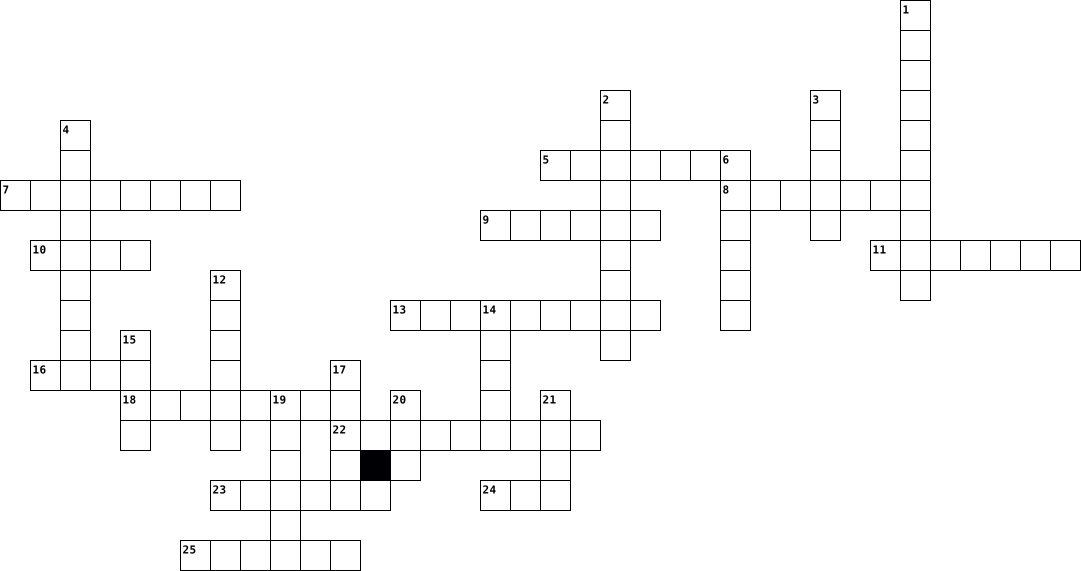
Across
- THE PROPHET WHO DIED TWO TIMES
- THE INVENTOR OF THEORY OF RELATIVITY.
- THE REAL NAME OF ABUBAKR
- CAPITAL CITY OF CANADA
- ADOPTED SON OF PROPHET MUHAMMED S
- BIGGEST PLANET IN SOLAR SYSTEM
- THE CAPITAL CITY OF NORTH KOREA
- THE CONGLOMERATE FIRM OF FACEBOOK, WHATSAPP, INSTAGRAM
- THE CHAPTER IN QURAN IN WHICH THE WORD ALLAH IS MENTIONED IN EVERY VERSE.
- MCG IS LOCATED IN ----
- CAPITAL CITY OF IRAN
- THE CROWN PRINCE OF SAUDI ARABIA
- THE COUNTRY WHICH MAKES REVENUE BY SELLING WEB DOMAINS TV
Down
- THE FOOD PIPE
- AUHTOR OF HARRY POTTER SERIES
- THE LAST GAZWA PROPHET TOOK PART IN
- THE SILICON VALLEY OF INDIA
- THE PRESIDENT OF FRANCE
- THE LAND OF MIDNIGHT SUN
- SMALLEST REPUBLIC IN THE WORLD
- THE CHAPTER OF QURAN IN WHICH VERSE "BISMILLAH" IS MENTIONED TWO TIMES.
- THE SAHABI KNOWN AS LION OF ALLAH (ASADULLAH)
- THE STATE WITH 26 DISTRICTS AND THREE CAPITALS.
- THE FLAGBEARER IN THE BATTLE OF BADR
- THE BOY WHO SERVED PROPHET FOR TEN YEARS
25 Clues: THE FOOD PIPE • CAPITAL CITY OF IRAN • CAPITAL CITY OF CANADA • MCG IS LOCATED IN ---- • THE PRESIDENT OF FRANCE • THE REAL NAME OF ABUBAKR • THE LAND OF MIDNIGHT SUN • THE SILICON VALLEY OF INDIA • AUHTOR OF HARRY POTTER SERIES • THE PROPHET WHO DIED TWO TIMES • BIGGEST PLANET IN SOLAR SYSTEM • SMALLEST REPUBLIC IN THE WORLD • THE CAPITAL CITY OF NORTH KOREA • ...
Unit II Crossword 2021-10-02

Across
- Federalist; founding son of the new government. Fought in Revolutionary War as Washington's 'right hand man'. Secretary of the Treasury who advocated a National Bank.
- The most important Chief Justice of the Supreme Court and Federalist office holder.
- Treaty between the US and Spain in 1819 that ceded Florida to the United States and defined the boundary between the United States and Spanish Mexico.
- Federalist Justice; only Supreme to ever be impeached; showed too much bias.
- Constitution proposed at the Philadelphia convention that favored big states and created a strong central government.
- New Capital to the US; relocated to the south, from NYC in order to appease the adoption of the bank of the US which was not written explicitly in the Constitution.
- Father of Constitution; wrote it down and helped mediate issues between Federalists and Anti-Federalists. Bill of Rights was needed to order to put a check on the government when dealing with its citizens. This was needed to appease the Anti-Federalists who wanted a strict interpretation of the Constitution.
- Compromise made by Constitutional Convention in which states would have equal representation in one house of the legislature and representation based on population in the other house.
- Sets a precedent for future Presidents; warned of entangling alliances and staying neutral in European wars of issues.
- A system defined by private property, competition, profit motive, and voluntary exchange.
- The first Secretory of State & creator of the Democratic-Republican Party.
- Pro-constitution propaganda written by Hamilton, Madison, and Jay.
Down
- Federalists attempt to curb opposition to their policies by the Democratic Republicans.
- President James Monroe's declaration to Congress that the American continents would be thenceforth closed to European colonization, and that the United States would not interfere in European affairs.
- Farmers harvested many crops; most valued crop was tobacco which was heavily produced in the South.
- Corps of Discovery: First Americans to explore past the Mississippi River into the newly acquired Louisiana Purchase.
- Most power held in the states; 1 branch of government (legislative branch had few powers); no checks and balances; money problems (inflation, printing too much money); foreign power with Britain and Spain with importing (closed borders, high tariffs).
- Skilled manual workers, craftspeople, organized outwork manufacturing system with merchants.
- Attempt by Massachusetts farmer Daniel Shays and 1,200 compatriots, seeking debt relief through issurance of paper currency and lower taxes, to prevent counts from seizing property from indebted farmers.
- Another tool to get the point across about different political views; especially prevalent during Adams/Jefferson. administration.
- 9 out of 13 states approval; 2/3rds of Congress must approve proposing an amendment to the Constitution; 3/4ths of states voting in either special elections or state conventions must vote to approve an amendment to the Constitution.
- First frame of government for the United States; in effect from 1781 to 1788, it provided for a weak central authority and was soon replaced by the Constitution.
- Ended the War of 1812, did not address grievances that led to the war (stalemate for both sides).
- Defeat of Little Turtle's forces; leads to Treaty of Greenville which gives most of Ohio and Indiana to the new nation.
- Settlement made at the constitutional convention to resolve the problem of how to count slaves for taxation and representational purposes.
- Hated the bank, thought it was against the Constitution and that only the wealthy would have money, not small farmers.
- Andrew Jackson major victory that actually occurred after the treaty ending the War of 1812 had already been signed.
- Meeting of New England Federalists to protest the War of 1812; proposed seven constitutional amendments, but the war ended before Congress could respond.
- Between United States and Great Britian; did not stop impressment; leads to the War of 1812; greaty angered Thomas Jefferson
- A period in the political history that reflected a sense of national purpose and a desire for unity among Americans in the aftermath of the War of 1812.
- US attempt to disrupt English and French trade by not allowing US products to be sold there.
31 Clues: Pro-constitution propaganda written by Hamilton, Madison, and Jay. • The first Secretory of State & creator of the Democratic-Republican Party. • Federalist Justice; only Supreme to ever be impeached; showed too much bias. • The most important Chief Justice of the Supreme Court and Federalist office holder. • ...