
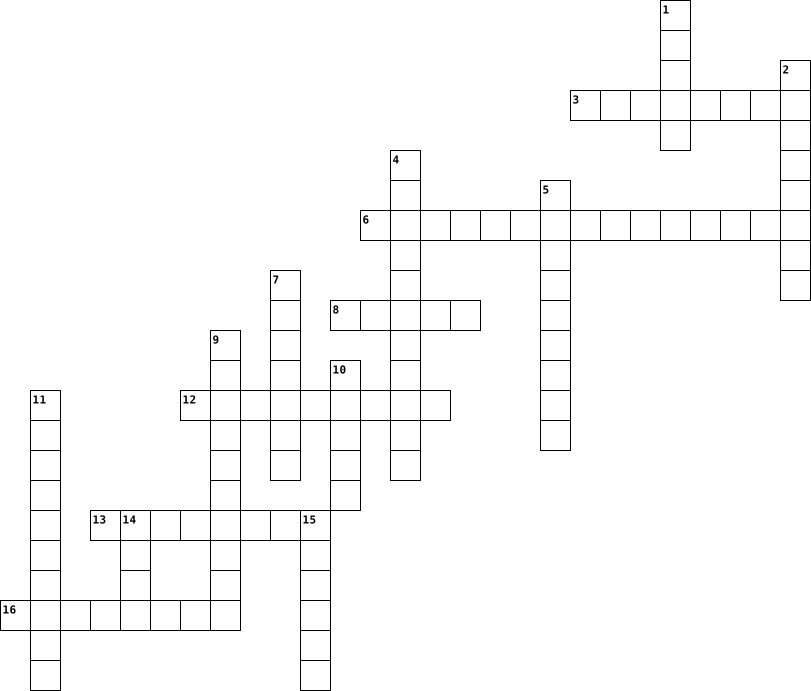
states and capitals Crossword Puzzles
Nationalism/Unification Assignment 2018-02-26

Across
- is the German word for "emperor"
- a conservative Prussian statesman who dominated German and European affairs from the 1860s until 1890
- Commodore of the United States Navy and commanded a number of ships. He served in several wars, most notably in the Mexican-American War and the War of 1812
- agreement that secured commercial and diplomatic privileges for the United States in Japan and constituted the basis for Western economic penetration of Japan
- a system of politics or principles based on practical rather than moral or ideological considerations
- the Japanese government, opening the ports of Shimoda and Hakodate to American trade and permitting the establishment of a U.S. consulate in Japan
- Patriotic feeling, principles, or efforts
- Italian politician, journalist, activist for the unification of Italy and spearhead of the Italian revolutionary movement.
- a senior state or legal official
- The war of 1870–71 between France (under Napoleon III) and Prussia, in which Prussian troops advanced into France and decisively defeated the French at Sedan. The defeat marked the end of the French Second Empire.
- war between Prussia on the one side and Austria, Bavaria, Saxony, Hanover, and certain minor German states on the other. It ended in a Prussian victory, which meant the exclusion of Austria from Germany
- a Polish theatre and film actor, notable for his roles in two of the most popular Polish television series
Down
- white supremacist paramilitary groups that were active in the late 19th century in the last years and after the end of the Reconstruction era of the United States
- was the King of Sardinia from 1849 until 17 March 1861. At that point, he assumed the title of King of Italy and became the first king of a united Italy since the 6th century, a title he held until his death in 1878
- was an agreement between the United States and the Empire of Japan negotiated between United States Secretary of State Elihu Root and Japanese Ambassador to the United States Takahira Kogorō
- the name given to a speech made by Otto von Bismarck given on 30 September 1862, at the time when he was Minister President of Prussia, about the unification of the German territories
- a prominent historical German state originating out of the Duchy of Prussia and the Margraviate of Brandenburg
- was fought between the Qing Empire and the Empire of Japan, primarily over influence of Korea
- Italian general, politician and nationalist who played a large role in the history of Italy
- fought between the Russian Empire and the Empire of Japan over rival imperial ambitions in Manchuria and Korea
- was an Italian statesman and a leading figure in the movement toward Italian unification
- the period when Japan was ruled by the emperor Meiji Tenno, marked by the modernization and westernization of the country
22 Clues: is the German word for "emperor" • a senior state or legal official • Patriotic feeling, principles, or efforts • was an Italian statesman and a leading figure in the movement toward Italian unification • Italian general, politician and nationalist who played a large role in the history of Italy • ...
Camping, Nations, and States 2021-03-08

Across
- A U.S. state you plan to move later this year
- Language Idrie took in school while in Switzerland
- A country Dep State assigned your family to
- Arabic for Mountain
- The kind of brake on your mountain bike
- A candy the Swiss take pride is making
- Carolina Where Cisco might retire so he can be a docent at the Biltmore Estate
Down
- A country Dep State assigned your family to
- Your home state
- A country Dept State assigned your family to
- The color and type of bean you use in tacos
- graham crackers, chocolate, and marshmallows
- The item that provides shelter during the night while camping
13 Clues: Your home state • Arabic for Mountain • A candy the Swiss take pride is making • The kind of brake on your mountain bike • A country Dep State assigned your family to • A country Dep State assigned your family to • The color and type of bean you use in tacos • A country Dept State assigned your family to • graham crackers, chocolate, and marshmallows • ...
Manifest Destiny 2014-11-11

Across
- To take property
- War between the United States and Mexico.
- American religious leader and founder of Mormonism.
- A person, especially a prospector, who went to California in 1849 during the gold rush.
- Agreement between the United States and Mexico finalized in 1854.
- Widely held belief in the United States the Americans setting were destined to expand throughout the continent.
- Was an American political and soldier, best known for his role in bringing Texas into the United States as a constituent state.
- American leader in the Latter Day Saint
- A member of a self-appointed group of citizens who undertake law enforcement in their community without legal authority, typically because the legal agencies are thought to be inadequate.
- Mission in San Antonio, Texas that was used a a fort during the Texas Revolution.
Down
- Discovery of gold nuggets in the Sacramento Valley in early 1848.
- Religious and cultural group related to Mormonism.
- A meeting at an agreed time and place, typically between 2 people.
- 2,200 mile historic east - west large wheeled wagon rout and emigrant trail that connected the Missouri River to the valleys in Oregon.
- Father of Texas.
- Area of the present day United States the Mexico agreed to give up as part of the Treaty of Guadalupe.
- Men that lived in the mountains for 6 months at a time.
17 Clues: To take property • Father of Texas. • American leader in the Latter Day Saint • War between the United States and Mexico. • Religious and cultural group related to Mormonism. • American religious leader and founder of Mormonism. • Men that lived in the mountains for 6 months at a time. • Discovery of gold nuggets in the Sacramento Valley in early 1848. • ...
Lauryn Smith b3 2021-11-02

Across
- The 3rd president of the united states
- A large land with no water and lots of sand
- The only state that has 1 border
- The coldest biome of all on earth
- Something that covers 3 percent of earth's surface something we can touch and see
- the 16th president of the united states
- the capital of maine
Down
- The town that has msad#53
- A big tower located in paris
- ocean lies between The specific and indian ocean in the southern hemisphere
- Has 6 eastern states
- the second smallest continent in size but the third largest in population
- the town that has the eiffeltower
- A state the whitehouse in is
- the 32ed president for the united states
15 Clues: Has 6 eastern states • the capital of maine • The town that has msad#53 • A big tower located in paris • A state the whitehouse in is • The only state that has 1 border • the town that has the eiffeltower • The coldest biome of all on earth • The 3rd president of the united states • the 16th president of the united states • the 32ed president for the united states • ...
civil war 2023-05-12

Across
- battle fought in pensylvania
- the decision that decided once a slave always a slave
- act that made north have to return slaves even if it isn't theirs.
- Amendment granted citizenship to all persons born or naturalized in the United States
- the compromise that made northern states free states and southern slave states
- northern side
- fight in kansas between pro & anti slavery groups
Down
- amendment that abolished slavery
- restricted black people's right to own property, conduct business, buy and lease land, and move freely through public spaces.
- general for the north
- general for the south
- race won't affect your right to vote
- laws to keep african americans in slavery
- president elected in 1860
- southern side
15 Clues: southern side • northern side • general for the north • general for the south • president elected in 1860 • battle fought in pensylvania • amendment that abolished slavery • race won't affect your right to vote • laws to keep african americans in slavery • fight in kansas between pro & anti slavery groups • the decision that decided once a slave always a slave • ...
North and East Africa and Middle Eastern Capitals 2021-03-09

Across
- capital Bumsko
- capital Algiers
- Porto-Novo
- capital Ankara
- capital Amman
- capital Niamey
- capital Nicosia
- defacto capital Ramallah
- Leone capital Freetown
- capital Tripoli
- Faso capital Ouagadougou
- capital Tehran
- capital Manama
- capital Cairo
- Accra
- capital Khartoum
- Verde capital Praia
- capital Nouakchott
- capital Sana'a
- capital Dakar
- capital Lomo
- capital Tunis
- Arab Emirates capital Abu Dhabi
Down
- capital Jerusalem
- capital Bissau
- capital Kuwait City
- Coast capital Yamoussoukro
- Arab Republic capital Damascus
- Monrovia
- capital Doha
- capital Banjul
- Helens capital Jamestown
- Arabia capital Riyadh
- Abuja
- capital Rabat
- capital Conakry
- capital Muscat
- capital Bagdad
- capital Beirut
39 Clues: Abuja • Accra • Monrovia • Porto-Novo • capital Doha • capital Lomo • capital Amman • capital Cairo • capital Rabat • capital Dakar • capital Tunis • capital Bissau • capital Bumsko • capital Ankara • capital Niamey • capital Banjul • capital Tehran • capital Manama • capital Muscat • capital Beirut • capital Sana'a • capital Algiers • capital Nicosia • capital Tripoli • capital Conakry • capital Bagdad • capital Khartoum • ...
antoinettes history crossword 2024-04-17

Across
- A white southerner who supported the reconstruction
- When a land owner lets a tenant plant on said land for a share of the crops
- an act that provided clothes, food, shelter, medical services and land to southerners including freed slaves
- He was the senator of Mississippi
- the process of charging a government official for wrongdoing
- Republicans that wanted immediate and permanent eradication
- took place after the civil war
- states all persons born or naturalized in the United States is a legal US citizen
Down
- laws passed by the southern states to enforce racial segregation
- a disruptive northerner who comes to the southern states
- this gave African Americans who resided in the United States the right to vote
- it created a framework for reconstruction and the re-admittance of the southern states
- the 17th president of the US
13 Clues: the 17th president of the US • took place after the civil war • He was the senator of Mississippi • A white southerner who supported the reconstruction • a disruptive northerner who comes to the southern states • Republicans that wanted immediate and permanent eradication • the process of charging a government official for wrongdoing • ...
Capitals: World Part 1 2021-03-03

Across
- Capital of The Gambia
- Capital of Sudan
- Capital of Gabon
- Capital of Honduras
- Capital of Burundi
- Capital of Bosnia and Herzegovina
- Capital of Cameroon
- Capital of Ghana
- Capitals of South Africa
- Capital of Portugal
- Capital of Marshall Islands
- Capital of Eswatini
- Capital of Fiji
- Capital of Djibouti
- Capital of Central African Republic
- Capital of El Salvador
- Capital of Venezuela
- Capital of Nigeria
- Capital of Cuba
- Capital of Belize
- Capital of Liberia
- Capital of Spain
- Capital of St Vincent and the Grenadines
- Capital of Niger
- Capital of Mozambique
- Capital of Ireland
- Capital of Mauritania
- Capital of St. Kitts and Nevis
- Capital of Tunisia
- Capital of Senegal
- Capital of Costa Rica
- Capital of Lesotho
- Capital of Guatemala
- Capital of Mexico
- Capital of Peru
- Capital of Greenland
- Capital of Lome
- Capital of The Bahamas
- Capital of Guinea
- Capital of Botswana
- Capital of Italy
- Capital of Republic of the Congo
- Capital of Kenya
- Capital of Madagascar
- Capital of Comoros
- Capital of Angola
- Capital of Monaco
- Capital of Croatia
- Capital of Canada
- Capital of New Zealand
- Capital of Switzerland
- Capital of Nicaragua
- Capital of Belgium
- Capital of Chile
- Capital of Vanuatu
- Capital of Anguilla
- Capital of Solomon Islands
- Capital of United Kingdom
- Capital of San Marino
Down
- Capital of Germany
- Capital of Ecuador
- Capital of Slovenia
- Capital of Malawi
- Capital of Australia
- Capital of Colombia
- Capital of Papua New Guinea
- Capital of Mali
- Capital of Mauritius
- Capital of Tuvalu
- Capital of Netherlands
- Capital of Brazil
- Capital of Tonga
- Capital of Democratic Republic of the Congo
- Capital of Uruguay
- Capital of Tanzania
- Capital of Barbados
- Capital of Vatican City
- Capital of Puerto Rico
- Capital of France
- Capital of Morocco
- Capital of St.Lucia
- Capital of Antigua and Barbuda
- Capital of Suriname
- Capital of Uganda
- Capital of Panama
- Capital of Guinea-Bissau
- Capital of Eritrea
- Capital of Jamaica
- Capital of Burkina Faso
- Capital of Côte d'Ivoire
- Capital of Namibia
- Capital of Argentina
- Capital of Equatorial Guinea
- Capital of Grenada
- Capital of Dominica
- Capital of Trinidad and Tobago
- Capital of Ethiopia
- Capital of Cape Verde
- Capital of United States
- Capital of Paraguay
- Capital of Guyana
- Capital of Algeria
- Capital of Rwanda
- Capital of Luxembourg
- Capital of Sierra Leone
- Capital of Zimbabwe
- Capital of Haiti
- Capital of Chad
- Capital of Dominican Republic
- Capital of South Sudan
- Capital of São tome and Principe
- Capital of Zambia
- Capital of Somalia
- Capital of Federated States of Micronesia
- Capital of Benin
- Capital of Kiribati
- Capital of Libya
- Capital of Bolivia
- Capital of Nauru
119 Clues: Capital of Mali • Capital of Fiji • Capital of Cuba • Capital of Peru • Capital of Lome • Capital of Chad • Capital of Sudan • Capital of Gabon • Capital of Ghana • Capital of Tonga • Capital of Spain • Capital of Niger • Capital of Haiti • Capital of Italy • Capital of Kenya • Capital of Benin • Capital of Libya • Capital of Chile • Capital of Nauru • Capital of Malawi • Capital of Tuvalu • Capital of Brazil • ...
Nationalism/Unification Assignment 2018-02-26

Across
- a Polish theatre and film actor, notable for his roles in two of the most popular Polish television series
- was fought between the Qing Empire and the Empire of Japan, primarily over influence of Korea
- the name given to a speech made by Otto von Bismarck given on 30 September 1862, at the time when he was Minister President of Prussia, about the unification of the German territories
- agreement that secured commercial and diplomatic privileges for the United States in Japan and constituted the basis for Western economic penetration of Japan
- is the German word for "emperor"
- a system of politics or principles based on practical rather than moral or ideological considerations
- white supremacist paramilitary groups that were active in the late 19th century in the last years and after the end of the Reconstruction era of the United States
- the Japanese government, opening the ports of Shimoda and Hakodate to American trade and permitting the establishment of a U.S. consulate in Japan
- was the King of Sardinia from 1849 until 17 March 1861. At that point, he assumed the title of King of Italy and became the first king of a united Italy since the 6th century, a title he held until his death in 1878
- a prominent historical German state originating out of the Duchy of Prussia and the Margraviate of Brandenburg
- Italian general, politician and nationalist who played a large role in the history of Italy
Down
- a senior state or legal official
- Commodore of the United States Navy and commanded a number of ships. He served in several wars, most notably in the Mexican-American War and the War of 1812
- was an agreement between the United States and the Empire of Japan negotiated between United States Secretary of State Elihu Root and Japanese Ambassador to the United States Takahira Kogorō
- fought between the Russian Empire and the Empire of Japan over rival imperial ambitions in Manchuria and Korea
- war between Prussia on the one side and Austria, Bavaria, Saxony, Hanover, and certain minor German states on the other. It ended in a Prussian victory, which meant the exclusion of Austria from Germany
- The war of 1870–71 between France (under Napoleon III) and Prussia, in which Prussian troops advanced into France and decisively defeated the French at Sedan. The defeat marked the end of the French Second Empire.
- Patriotic feeling, principles, or efforts
- the period when Japan was ruled by the emperor Meiji Tenno, marked by the modernization and westernization of the country
- a conservative Prussian statesman who dominated German and European affairs from the 1860s until 1890
- Italian politician, journalist, activist for the unification of Italy and spearhead of the Italian revolutionary movement.
- was an Italian statesman and a leading figure in the movement toward Italian unification
22 Clues: a senior state or legal official • is the German word for "emperor" • Patriotic feeling, principles, or efforts • was an Italian statesman and a leading figure in the movement toward Italian unification • Italian general, politician and nationalist who played a large role in the history of Italy • ...
Jackson Era 2014-03-31

Across
- Withdrawing formally from a membership.
- The leader of Fox and Sauk indians.
- This group met in the kitchen of the white house.
- A severe economic depression.
- 800 mile forced march
- A represinative for others.
- This is a patriotic feeling for your country.
- A man who argued that the US was one nation, not a pact among independent states.
- Cherokee who created a notation for writing the Cherokee language.
- A nickname given to Andrew Jackson.
- This is a party formed in 1830 to oppose presidnet jackson.
- U.S. land in what is now Oklahoma.
- One of the two major parties in the US.
Down
- The right to vote.
- Established the principals of the United States Law.
- Party members choose canidates.
- Slave states in the south, free states in the north.
- This system gives government jobs to people.
- Term for state banks selected by the U.S. department of treasury.
- American Indian people of the southeastern US, now living on reservations in Oklahoma and North Carolina.
20 Clues: The right to vote. • 800 mile forced march • A represinative for others. • A severe economic depression. • Party members choose canidates. • U.S. land in what is now Oklahoma. • The leader of Fox and Sauk indians. • A nickname given to Andrew Jackson. • Withdrawing formally from a membership. • One of the two major parties in the US. • ...
Civil War 2025-01-31

Across
- President of the Confederate States of America
- Turning point battle that stopped Lee’s invasion
- Law that officially ended slavery in the U.S.
- The site where Lee surrendered to Grant
- Lincoln's 1863 proclamation freeing enslaved people
- Deep differences between North and South
- Run First major battle of the war, also called Manassas
- Fundamental change in ideas after the war
- Length of the Civil War
- President of the U.S. during the Civil War
Down
- Siege that gave the Union control of the Mississippi River
- The Southern states that seceded from the Union
- Destructive Union campaign through Georgia
- Bloodiest single day in U.S. history
- Sumter Site of the first shots of the Civil War
- Confederate commander who surrendered at Appomattox
- Union general who led the North to victory
- Post-war period of rebuilding and reintegration
- Movement to end slavery in the United States
- System of forced labor that divided the nation
- The Northern states that fought to preserve the U.S.
21 Clues: Length of the Civil War • Bloodiest single day in U.S. history • The site where Lee surrendered to Grant • Deep differences between North and South • Fundamental change in ideas after the war • Destructive Union campaign through Georgia • Union general who led the North to victory • President of the U.S. during the Civil War • Movement to end slavery in the United States • ...
Spelling Challenge-Week of 1 Feb 2021-02-03

Across
- A deceptive appearance or impression.(i8)
- Synonym of “prospective” (p9)
- We are currently learning about “how _______ can combat global challenges”.(e9)
- Adding salt to food improves its _____________ (f7)
- Unlawful or illegal are synonym of ______. (i7)
- We begin the formal letter by writing the sender's _______ (a7)
- 82.37% is the current ______rate of India. (i10)
- To make someone feel ashamed or shy. (e9)
Down
- A room for several people to sleep in, especially in a school or other institution. (d9)
- A ____________ is a container which is used for making butter. (c5)
- The United Nations talks about the 17 ______ development goals, to curb the global issues.(s11)
- A conclusion reached on prior knowledge and evidences from the text.(i9)
- A picture or image that is used to decorate or clarify a text.(i12)
- You can use italics or capitals to ___________ a word in a piece of writing.(e9)
- Inability to read or write is being _____. (i10)
15 Clues: Synonym of “prospective” (p9) • A deceptive appearance or impression.(i8) • To make someone feel ashamed or shy. (e9) • Unlawful or illegal are synonym of ______. (i7) • Inability to read or write is being _____. (i10) • 82.37% is the current ______rate of India. (i10) • Adding salt to food improves its _____________ (f7) • ...
civil war 2023-01-30

Across
- an American lawyer, diplomat, and politician who served as the 15th president of the United States from 1857 to 1861
- the fifth chief justice of the United States, holding that office from 1836 until his death in 1864
- empowered slaveowners to seize runaway slaves, ordered state and federal authorities to help capture and return runaway slaves, and fined those who assisted runaway slaves
- a town in west virginia
- an American lawyer, politician, and statesman who served as the 16th president of the United States from 1861 until his assassination in 1865
Down
- he principle that the authority of a state and its government are created and sustained by the consent of its people
- an American author and abolitionist
- territorial organic act that created the territories of Kansas and Nebraska
- a conservative political party that existed in the United States during the middle 19th century
- one of the two major contemporary political parties in the United States
- an American explorer, military officer, and politician
- political party in the pre-Civil War period of American history that opposed the extension of slavery into the western territories.
- established a boundary between Texas and the United States, called for the abolition of slave trade in Washington, DC, and amended the Fugitive Slave Act
- one of two nominees of the badly split Democratic Party for president in the 1860 presidential election
14 Clues: a town in west virginia • an American author and abolitionist • an American explorer, military officer, and politician • one of the two major contemporary political parties in the United States • territorial organic act that created the territories of Kansas and Nebraska • ...
USA States Crossword Puzzle #2 2024-01-26

Across
- Borders Mexico and New Mexico.
- Borders Minnesota to the north and Missouri to the south.
- Only borders 3 states.
- Borders New Hampshire and New York.
- Borders Tennessee and Indiana.
- Borders Michigan and Lake Michigan.
- Borders Kansas and Nebraska.
- Borders Canada and South Dakota.
- The smallest state.
- Borders New Jersey and Maryland
- Borders Colorado and Missouri.
- Borders Iowa and Colorado.
- Borders Kentucky and Maryland.
- West of Idaho and borders Canada.
- Borders 8 different states.
- Borders Kentucky and Pennsylvania.
- Borders Ohio and Maryland.
- Borders the Pacific Ocean.
- Borders Mexico and Louisiana.
- Borders Utah and Nebraska.
- Borders Idaho and New Mexico.
- Borders Lake Michigan and Kentucky.
- Borders every state that starts with the letter T.
- Borders Mexico and Oklahoma.
- Borders 8 other states.
Down
- Borders Mexico and the Pacific Ocean.
- Borders Texas and Arkansas.
- Borders North Carolina and the Atlantic Ocean.
- Has the largest border with Canada.
- Borders the Atlantic Ocean and Tennessee.
- Borders California and the Pacific Ocean.
- Borders Massachusetts and New York.
- Borders Iowa and North Dakota.
- Borders Nevada and Colorado.
- Borders Minnesota and Nebraska.
- Borders Mississippi and Arkansas.
- Borders Lake Ontario.
- Borders the Atlantic Ocean and New York
- Borders Delaware and the Atlantic Ocean.
- Borders the Gulf of Mexico and Georgia.
- Only borders 1 other state.
- Borders Florida and South Carolina.
- The largest state.
- Only borders 2 other states.
- Borders Lake Michigan and Minnesota.
- Borders Canada and Oregon.
- Borders both Vermont and Maine.
- Borders Arkansas and the Gulf of Mexico.
- Borders Wisconsin and Ohio.
- Borders New York and Pennsylvania.
50 Clues: The largest state. • The smallest state. • Borders Lake Ontario. • Only borders 3 states. • Borders 8 other states. • Borders Iowa and Colorado. • Borders Ohio and Maryland. • Borders Canada and Oregon. • Borders the Pacific Ocean. • Borders Utah and Nebraska. • Borders Texas and Arkansas. • Only borders 1 other state. • Borders 8 different states. • Borders Wisconsin and Ohio. • ...
Ch9-10 APUSH Crossword 2023-11-14

Across
- Limiting the government's role in the economy
- "Ain't I a women?"
- 6th President of the United States
- Opposition to Democrats
- 7th President of the United States (last name)
- gold and silver to buy land
- Chief Justice under Jackson (last name)
Down
- "Tippecanoe and _____ Too!"
- Issued Ordinance of Nullification (last name)
- Important invention made by Eli Whitney
- Women reformer focused on mentally ill
- The Great Compromiser (last name)
- President of the BUS (last name)
- Movement against alcohol
- Winner-takes-all election format
- Prioritizing Americans over immigrants
- 8th President of the United States
- Movement dedicated against slavery
18 Clues: "Ain't I a women?" • Opposition to Democrats • Movement against alcohol • "Tippecanoe and _____ Too!" • gold and silver to buy land • President of the BUS (last name) • Winner-takes-all election format • The Great Compromiser (last name) • 6th President of the United States • 8th President of the United States • Movement dedicated against slavery • ...
Andrew Jackson 2023-10-18

Across
- the forced westward migration of American Indian tribes from the South and Southeast.
- authorizing the president to grant unsettled lands west of the Mississippi in exchange for Indian lands within existing state borders.
- John Caldwell Calhoun was an American statesman and political theorist who served as the seventh vice president of the United States from 1825 to 1832. Born in South Carolina, he adamantly defended American slavery and sought to protect the interests of white Southerners.
- the right to vote in political elections
- a financial crisis which affected the global economy.
- Andrew “Old Hickory” Jackson (1767-1845) was the seventh president of the United States.
- The Whig Party was a conservative political party that existed in the United States during the mid-19th century
- Martin Van Buren was an American lawyer, diplomat, and statesman who served as the eighth president of the United States from 1837 to 1841
- William Henry Harrison was an American military officer and politician who served as the ninth president of the United States. Harrison died just 31 days after his inauguration as president in 1841, making his presidency the shortest in U.S. history.
Down
- John Marshall was an American statesman, lawyer, and Founding Father who served as the fourth chief justice of the United States from 1801 until his death in 1835.
- encompass the present states of Oklahoma, Kansas, Nebraska, and part of Iowa
- relating to the Cherokee or their language
- championed greater rights for the common man and was opposed to any signs of aristocracy in the nation
- Republicans who favored a national bank as well as federal funding of internal improvements—roads, canals, and bridges—became known as National Republicans.
- because Jackson's political allies ran them.
15 Clues: the right to vote in political elections • relating to the Cherokee or their language • because Jackson's political allies ran them. • a financial crisis which affected the global economy. • encompass the present states of Oklahoma, Kansas, Nebraska, and part of Iowa • the forced westward migration of American Indian tribes from the South and Southeast. • ...
Constitution 2019-10-14

Across
- a country governed by elected representatives.
- Ordinance a law passed by Congress that stated how western lands would be governed.
- Sovereignty the idea that the government's authority comes from the people.
- of Rights a formal listing of the basic rights of U.S.citizens.
- Shays a hero of the Battle of Bunker Hill.
- fifty five men from 12 states who attended the Constitutional Convention.
- Convention a meeting held in Philadelphia in 1787 at which delegates from the states wrote the Constitution.
- Madison known as the "Father of the Constitution".
Down
- College the group established by the Constitution to elect the president and vice president.
- the number of delegates that left the convention before it ended and did not sign the Constitution.
- the "Age of Reason".
- of Confederation articles created a firm league of friendship.
- of Secrecy is when delegates wanted to feel free to speak their minds without causing alarm among the general public.
- of Friendship a loose union of 13 states cooperated for a common purposes.
- designed Congress to balance the rights of large and small states.
- Branch the president is the head of this branch.
- Branch the part of government, consisting of the Supreme Court and lower federal courts, that interprets the laws.
- people who could not earn enough to pay their debts or taxes.
- Federalist Papers a series of essays written by James Madison, Alexander Hamilton and John Jay in support of the ratification of the Constitution by the states.
19 Clues: the "Age of Reason". • Shays a hero of the Battle of Bunker Hill. • a country governed by elected representatives. • Branch the president is the head of this branch. • Madison known as the "Father of the Constitution". • people who could not earn enough to pay their debts or taxes. • of Confederation articles created a firm league of friendship. • ...
civil war project 2019-04-30

Across
- The long metal tube on a gun through which a projectile is fired.
- To rush towards the enemy.
- Land within the mainland boundaries of the country that had not yet become a state by 1861.
- A region or area where fighting takes place
- Today called mines, Civil War torpedoes were mostly used by the Confederates.
- A crop such as tobacco or cotton which was grown to be sold for cash
- Also called the Confederacy, the Confederate States of America, or (by Northerners) the Rebel states, the South incorporated the states that seceded from the United States of America to form their own nation.
- A branch of the military using ships to conduct warfare.
- A state of bondage in which African Americans (and some Native Americans) were owned by other people, usually white, and forced to labor on their behalf
- An overwhelming, advancing force that crushes or seems to crush everything in its path.
- Also called the Union or the United States the North was the part of the country that remained loyal to the Federal government during the Civil War.
Down
- Essential to firing a percussion rifle-musket, a cap is a tiny brass shell that holds fulminate of mercury.
- The largest organizational group of soldiers, made up of one or more corps.
- The effort by the North to keep ships from entering or leaving Southern ports.
- A new way of conducting war appeared during the Civil War.
- Someone who does something because they want to, not because they need to.
- This doctrine held the powers of the individual states as greater than the powers of the Federal government.
- Blanket or other bedding rolled up and carried over the shoulder by a soldier.
- A branch of the military mounted on horseback.
- Also called the North or the United States, the Union was the portion of the country that remained loyal to the Federal government during the Civil War.
20 Clues: To rush towards the enemy. • A region or area where fighting takes place • A branch of the military mounted on horseback. • A branch of the military using ships to conduct warfare. • A new way of conducting war appeared during the Civil War. • The long metal tube on a gun through which a projectile is fired. • ...
Civil War Crossword 2026-06-18

Across
- Given by Lincoln to reassure Americans why they were fighting
- Democrates that advocated peace with the south
- Name for Northern States during the Civil Wa
- Turning point of the Civil War
- one of only two Confderate holdouts preventing the Union from taking complete control of the Mississippi River
- Confederate General
- the bloodiest single day in American military history, resulting in approximately 23,000 casualties
- A soldier who was wounded, killed, or missing in action.
- Loyal to the Confederate States
- Republic formed by 11 Southern states that seceded from the United States between 1860 & 1861
- President during the Civil War
- Person who shot & killed President Lincoln
- Last name of Union nurse who cared for the sick
- Someone who wishes to abolish or get rid of slavery
- Recieving foreign aid - recognition of southern independence
Down
- Term often used to describe the United States of America before the outbreak of the Civil War.
- The favoring of Native-born Americans over immigrants
- a secret network of people and safe houses that helped enslaved Black people escape the American South to free states and Canada before and during the Civil War.
- Sunk off the Coast of Virginia in 1861
- Wrote Uncle Tom's Cabin
- Church where Grant gathered his troops
- Two major clashes fought in Virginia
- All slaves living in areas under Conderfate control are now free
- Lee surrenced to Grant here on April 9, 1865
- A series of laws passed by Congress to settle disputes over slavery in new western territories. I
- Formal withdrawal of a State from the Union
- A court order that requires authorieis to bring a person held in jail before the court to determine why he (or she) is being jailed
- A Northerner; someone loyal to the Federal government of the United States
- Organized in 1834, pro-business, divided on slavery
- Union General
30 Clues: Union General • Confederate General • Wrote Uncle Tom's Cabin • Turning point of the Civil War • President during the Civil War • Loyal to the Confederate States • Two major clashes fought in Virginia • Sunk off the Coast of Virginia in 1861 • Church where Grant gathered his troops • Person who shot & killed President Lincoln • Formal withdrawal of a State from the Union • ...
Dane's Crossword puzzle 2024-11-17

Across
- noun phrase
- a word that names something
- always at the of the sentence
- person place or thing
Down
- giving a not living object a human characteristic
- action word
- Use commas after introductory clauses, phrases, or words
7 Clues: noun phrase • action word • person place or thing • a word that names something • always at the of the sentence • giving a not living object a human characteristic • Use commas after introductory clauses, phrases, or words
Outer 2022-08-02

Across
- Baptist minister and activist who became the most visible spokesman and leader in the civil rights movement from 1955 until his assassination in 1968
- It was a revolutionary organization with an ideology of Black nationalism socialism and armed self-defense particularly against police brutality
- the Supreme Court ruled that separating children in public schools on the basis of race was unconstitutional
- Its members waged an underground campaign of intimidation and violence directed at white and Black Republican leaders
- March 7th 1965 around 600 people crossed the Edmund Pettus Bridge in an attempt to begin the Selma to Montgomery march
- of violent confrontations between Los Angeles police and residents of Watts and other predominantly African American neighborhoods of South Central Los Angeles
- the separation or isolation of a race class or ethnic group by enforced or voluntary residence in a restricted area, by barriers to social intercourse by separate educational facilities or by other discriminatory means
- civil rights organization in the United States formed in 1909 as an interracial endeavor to advance justice for African Americans by a group including W. E. B. Du Bois Mary White Ovington Moorfield Storey and Ida B. Well
- the Supreme Court ruled that separating children in public schools on the basis of race was unconstitutional
- the mother of the civil rights movement" Rosa Parks invigorated the struggle for racial equality when she refused to give up her bus seat to a white man in Montgomery Alabama
- political and social protest campaign against the policy of racial segregation on the public transit system of MontgomeryAlabama
- a movement in support of rights and political power for black people especially prominent in the US in the 1960s and 1970s
- a series of violent clashes during which mobs of U.S. servicemen off-duty police officers and civilians brawled with young Latinos and other minorities in Los Angeles
Down
- he first African American students to enter Little Rock's Central High School
- chosen identity for many Mexican Americans in the United States
- labor leader and civil rights activist
- American politician and academic who served as the 28th president of the United States from 1913 to 1921. A member of the Democratic Party Wilson served as the president of Princeton University and as the governor of New Jersey before winning the 1912 presidential election
- a landmark 1896 U.S. Supreme Court decision that upheld the constitutionality of racial segregation under the “separate but equal” doctrine
- a social and political movement in the United States inspired by prior acts of resistance among people of Mexican descent
- a religious and political organization founded in the United States by Wallace Fard Muhammad in 1930
- 14-year-old African American boy who was abducted tortured and lynched in Mississippi in 1955, after being accused of offending a white woman Carolyn Bryant in her family's grocery store
- political movement and campaign from 1954 to 1968 in the United States to abolish institutional racial segregation discrimination and disenfranchisement throughout the United States
- civil rights protest that started in 1960 when young African American students staged a sit in at a segregated Woolworth's lunch counter in Greensboro North Carolina and refused to leave after being denied service
- state and local laws enforcing racial segregation in the Southern United States
- the ancestral home of the Aztec peoples
- African American Muslim minister and human rights activist who was a prominent figure during the civil rights movement
26 Clues: labor leader and civil rights activist • the ancestral home of the Aztec peoples • chosen identity for many Mexican Americans in the United States • he first African American students to enter Little Rock's Central High School • state and local laws enforcing racial segregation in the Southern United States • ...
Kate + Carly Crossword 2024-04-08

Across
- Jackson's tattoo for Madi
- Worst SAS stop, and our wine tour guide's personal vendetta
- My last boat bae
- The TV show of Deltopia
- Person with disease, not a leprechaun derivative
- My most questionable kiss
- The best type of bar
- My South African instrument of choice
- The best mart in Malaysia, and the world
- The best soft serve flavor
- My favorite dress of yours
- Old guy in the bar, new friend in Athens
- City in Germany, awesome ship dinner spot
- We know our state _____
- Talent show partner
- The best buffet in all of Spain
- The best gyros in the world are made by
- One who scrapbooks
Down
- No one values this
- My instagram debut on @______-mee-tambun
- Victim of drunk cliff-jumping
- Gibby hat
- Beachside snack in Mallorca
- Competitive trivia subject
- The ____ World of Tambun
- Anything I can do, she wants to do better
- Worth the 8am reservation
- Lumberjack
- Hannah's boat beau
- The Nest
- Hardest working taxi driver in the biz
- Ship Halloween costume
- The taxi ride to the Parthenon was the eye of the ____
33 Clues: The Nest • Gibby hat • Lumberjack • My last boat bae • No one values this • Hannah's boat beau • One who scrapbooks • Talent show partner • The best type of bar • Ship Halloween costume • The TV show of Deltopia • We know our state _____ • The ____ World of Tambun • Jackson's tattoo for Madi • My most questionable kiss • Worth the 8am reservation • Competitive trivia subject • ...
Georgia in World War I 2019-03-28

Across
- An aircraft company that made bombers for the U.S. Army Air Force.
- A racist governor of Georgia who opposed many New Deal programs. Georgians loved him because he fought for farmers and their interests.
- The day stocks began to drop to their true worth and people sold their stocks for a cheaper price.
- A New Deal program that paid farmers not to produce certain crops so that farm prices could be raised.
- An event that marked the beginning of the Great Depression in which stock prices dropped rapidly.
- A New Deal program that gave men aged 18 to 25 jobs.
- An act in which Congress allowed president Roosevelt to lend or lease arms to the British.
- A New Deal program that provided government benefits such as retirement pay for retired workers.
- Longest period of unemployment and low economic activity starting in 1929.
Down
- A New Deal program that offered low-interest loans to companies to build power lines in rural areas.
- President Roosevelt's plan to use government programs to help the United States recover from the Great Depression.
- The Japanese bombed this place which resulted in the United States declaring war on them.
- Insect that destroyed the cotton crop.
- A United States senator from Georgia who was instrumental in boosting the defense budget. He also served on the Appropriations Committee.
- The 32nd President of the United States. He introduced the "New Deal" programs which helped the United States get out of the Great Depression.
- A long period of time with little to no rain.
- A native Georgian who worked with President Roosevelt to increase the United States' military readiness. He also served as chairman of the House Naval Affairs Committee.
- A war in which Britain, France, Russia, Italy, and United States went against Germany, Austria-Hungary, the Ottoman Empire, and Bulgaria.
18 Clues: Insect that destroyed the cotton crop. • A long period of time with little to no rain. • A New Deal program that gave men aged 18 to 25 jobs. • An aircraft company that made bombers for the U.S. Army Air Force. • Longest period of unemployment and low economic activity starting in 1929. • ...
CHAPTER 4 VOCABULARY 2013-11-12

Across
- A secret organization that used terrorist tactics in an attempt to restore white supremacy in the Southern after the Civil War
- American statesman; president of the Confederate States of America during the American Civil War
- A creek in northeastern Virginia where two battles were fought in the American Civil Wa
- A white Southerner who joined the Republican Party of the Civil War
- A system in which the residents vote to decide an issue
- U.S. clergyman, educator, and politician: first black senator 1870–71
- Scene of a crucial battle during the American Civil War, in which Meade's Union forces defeated Lee's Confederate army; site of the national cemetery dedicated by President Lincoln
- A system in which landowners give farm workers land, seed, and tools in return for a part of the crops they raise
- An amendment to the U.S Constitution, adopted in 1865, that has abolished slavery and involuntary servitude
- 14th President of the United States
- American general who led the Confederate Armies in the American Civil War
- The Confederate States of America, a confederation formed in 1861 by the Southern states after their secession from the Union
- An executive order issued by Abraham Lincoln on January 1, 1863, freeing the slaves in all regions behind the Confederate lines
- The period of rebuilding that followed the Civil War, during which the defeated Confederate states were readmitted to the Union
- A tax on earnings
- A system of routes along which runaway slaves were helped to escape to Canada or to safe areas in the free states
- A famous speech delivered by Abraham Lincoln in November 1863, at the dedication of a national cemetery on the site of the Battle of Gettysburg
- During the Civil War, this city was besieged from 1862 to 1863 and finally captured by troops led by Ulysses S. Grant
- An amendment to the U.S. constitution, ratified in 1870, prohibiting the restriction of voting rights “on account of race, color, or previous condition of servitude
- A faction of American politicians within the Republican Party from about 1854 (before the American Civil War) until the end of Reconstruction in 1877
- 17th President of the United States
- U.S abolitionist that became a famous conductor on the Underground Railroad leading other slaves to freedom in the North
Down
- United States actor and assassin of President Lincoln
- A fort in SE South Carolina, in the harbor of Charleston: its bombardment by the Confederates opened the Civil War on April 12, 1861
- 18th President of the United States; commander of the Union armies in the American Civil War
- United States writer of a novel about slavery that advanced the abolitionists' cause
- Town near Appomattox, Virginia, where Lee surrendered to Grant on April 9, 1865
- United States politician who proposed that individual territories be allowed to decide whether they would have slavery; he engaged in a famous series of debates with Abraham Lincoln
- An amendment to the U.S Constitution, adopted in 1868, that makes all persons born or naturalized in the U.S - including former slaves - citizens of the country and guarantees equal protection of the laws
- 16th President of the United States; saved the Union during the American Civil War and emancipated the slaves; was assassinated by Booth
- General in the Confederate Army during the American Civil War whose troops at the first Battle of Bull Run stood like a stone wall
- American administrator who did battlefield relief work during the Civil War and organized the American Red Cross
- United States slave who sued for liberty after living in a non-slave state; caused the Supreme Court to declare the Missouri Compromise unconstitutional
- United States general who was commander of all Union troops in the West; he captured Atlanta and led a destructive march to the sea that cut the Confederacy in two
- The drafting of citizens for military service
- A Northerner who moved to the South after the Civil War
- A federal agency set up help former slaves after the Civil War
- The formal withdrawal of a state from the union
- A creek in NW Maryland, flowing into the Potomac: scene of a Civil War battle, in which the Confederate forces of General Robert E. Lee were defeated
39 Clues: A tax on earnings • 14th President of the United States • 17th President of the United States • The drafting of citizens for military service • The formal withdrawal of a state from the union • United States actor and assassin of President Lincoln • A system in which the residents vote to decide an issue • A Northerner who moved to the South after the Civil War • ...
Crossword 2022-05-24

Across
- An American white supremacist terrorist and hate group whose primary targets are African Americans, Jews, Latinos, Asian Americans, Catholics, Native Americans as well as immigrants, leftists, homosexuals, Muslims, and atheists.
- A man who tried to lead a revolt of armed slaves.
- A long gun with a smooth bore that soldiers shot from the shoulder.
- A person who wanted to eliminate or "abolish" slavery.
- A commonly used way to get cotton containing African American labor.
- Large caliber firearms like cannons and mortars.
- A nickname for the Confederate States of America or the Confederacy.
Down
- When a person is murdered for a political reason.
- A long sharp knife attached to the end of a musket.
- A large farm in the southern United States. Before the Civil War many of the workers on plantations were enslaved.
- This fort was where forces from the Confederate States of America attacked the United States military garrison.
- African Americans used as property for work.
- This battle was one of the most bloodiest battles ever and at this battle many sat on a hill having a picnic as they watch this battle.
- The northern states of the United States, also called the Union.
- A war between the North and South over the right to own slaves.
15 Clues: African Americans used as property for work. • Large caliber firearms like cannons and mortars. • When a person is murdered for a political reason. • A man who tried to lead a revolt of armed slaves. • A long sharp knife attached to the end of a musket. • A person who wanted to eliminate or "abolish" slavery. • ...
civil war crossword 2020-09-30

Across
- the surrender at Yorktown, or the german battle, ending on october 19, 1781, at yorktown, virginia, was a decisive victory by a combined force of american continental army troops led by general george washington and french army troops led by the comte de rochambeau.
- american Revenue Act 1764 or the american duties act, was a revenue-raising act passed by the parliament of great britain on 5 April 1764.
- a proposal to the united states constitutional convention for the creation of a supreme national government with three branches and a bicameral legislature.
- february 2, 1848 ended the war between the united states and mexico.
- american political leader, military general, statesman, and founding father who served as the first president of the United States from 1789 to 1797.
- railroad 1,912-mile continuous railroad line constructed between 1863 and 1869 that connected the existing eastern U.S. rail network at council bluffs, iowa with the pacific coast at the oakland long wharf on san francisco bay.
- pitted the colonies of british america against those of new france, each side supported by military units from the parent country and by native american allies.
Down
- pronouncement adopted by the second continental congress meeting in philadelphia, pennsylvania, on July 4, 1776.
- a proposal for the structure of the United states government presented by william paterson at the constitutional convention on June 15, 1787.
- also known in the united states as the mexican war and in mexico as the intervención estadounidense en méxico, was an armed conflict between the united states and mexico from 1846 to 1848.
- a person who favors the abolition of a practice or institution, especially capital punishment or (formerly) slavery.
- a gentleman.
- denying a citizen the right to vote based on that citizen's race, color, or previous condition of servitude.
- the lakota and other plains indians as the battle of the greasy grass and also commonly referred to as custer's last stand, was an armed engagement between combined forces of the lakota, northern cheyenne, and arapaho tribes and the 7th cavalry regiment of the united states army.
- an american statesman, diplomat, lawyer, architect, philosopher, and founding father who served as the third president of the united states from 1801 to 1809.
- a colony.
16 Clues: a colony. • a gentleman. • february 2, 1848 ended the war between the united states and mexico. • denying a citizen the right to vote based on that citizen's race, color, or previous condition of servitude. • pronouncement adopted by the second continental congress meeting in philadelphia, pennsylvania, on July 4, 1776. • ...
Pre Civil War 2026-08-20

Across
- of 1850
- Southern states feared slavery’s end.
- denied jury trial to alleged fugitive
- temporary solution to balance free states and slave states
- Series of debates for Illinois Senate race.
- supported by Stephen A. Dongles
- Attracted many former Whigs and Free-Soilers.
Down
- Jefferson Davis elected President of Confederacy.
- Proposed by Stephen A. Douglas.
- Violence between proslavery and antislavery settlers in Kansas.
- Increased sectional tensions.
- Planned to start a slave revolt
- first state to secede from union
- exposed the cruelty of slavery
- First shots of the Civil War.
- led raid on Harper's Ferry
16 Clues: of 1850 • led raid on Harper's Ferry • Increased sectional tensions. • First shots of the Civil War. • exposed the cruelty of slavery • Proposed by Stephen A. Douglas. • Planned to start a slave revolt • supported by Stephen A. Dongles • first state to secede from union • Southern states feared slavery’s end. • denied jury trial to alleged fugitive • ...
Civil War Vocab 2024-04-11

Across
- The process of building military defenses, such as forts or defensive structures, to protect an area from attack.
- A military operation in which enemy forces surround a fortified location, cutting off essential supplies and communications until the defenders surrender.
- The freeing of enslaved people, particularly referring to Abraham Lincoln's Emancipation Proclamation during the Civil War.
- The Southern states that seceded from the Union and formed their own government during the Civil War.
- A person who actively campaigned for the abolition or outlawing of slavery.
- The use of naval forces to prevent ships or goods from entering or leaving a port or region, often used as a strategy during wartime.
- Soldiers who fight on horseback, often used for reconnaissance, skirmishes, or rapid movement during battles.
- The withdrawal of a state from the Union, such as the secession of Southern states before the Civil War.
Down
- Large-caliber weapons, such as cannons or mortars, used in warfare to launch projectiles over long distances.
- Foot soldiers who fight on foot, typically armed with rifles or other small arms.
- The period following the Civil War during which the United States attempted to rebuild and reconcile the Southern states.
- The area or location where a battle or military engagement takes place.
- War: A war fought between the Northern and Southern states of the United States from 1861 to 1865.
- To yield to the power, control, or possession of another, often used to describe the act of capitulating in war.
- The Northern states that remained loyal to the United States government during the Civil War.
15 Clues: The area or location where a battle or military engagement takes place. • A person who actively campaigned for the abolition or outlawing of slavery. • Foot soldiers who fight on foot, typically armed with rifles or other small arms. • The Northern states that remained loyal to the United States government during the Civil War. • ...
Civil War 2023-10-12

Across
- - When a person is murdered for political reasons
- - A long blade or knife attached to the end of a musket. Soldiers would use it like a spear in close combat
- - An attempt to stop people and supplies from going in or out of a port.
- - A soldier that is wounded or killed during battle.
- - A term meaning "before war". It was often used to describe the United States before the Civil War.
- - A nickname for northerners who were against the Civil War.
- - A nickname for the South.
- - An ankle high shoe worn by soldiers during the Civil War.
- Scott decision - A decision made by the Supreme Court that said Congress could not outlaw slavery and that people of African descent were not necessarily U.S. citizens.
Down
- - Another name for the Confederate States of America or the South. The Confederacy was a group of states that left the United States to form their own country.
- - Large caliber firearms like cannons and mortars.
- - A person who wanted to eliminate or "abolish" slavery
- - A commutation was when a person could pay a fee rather than be drafted into the army. This angered poorer people who could not pay the fee and had no choice but to fight.
- - A northerner who moved to the South during the reconstruction in order to become rich.
- states - These states were slave states that did not leave the Union, but largely supported the cause of the Confederates. They included Missouri, Kentucky, Maryland, and Delaware.
15 Clues: - A nickname for the South. • - When a person is murdered for political reasons • - Large caliber firearms like cannons and mortars. • - A soldier that is wounded or killed during battle. • - A person who wanted to eliminate or "abolish" slavery • - An ankle high shoe worn by soldiers during the Civil War. • ...
Geography of the United States vocabulary words 2017-09-05

Across
- a model of the earth
- an imaginary line that circles the globe halfway between North and South poles
- Map a map that shows geographic features of a place such as mountains valleys and bodies of water
- Direction a direction such as northwest that is between two cardinal directions
- Scale a line drawn on a map that shows the relationship between a unit of measurement on the map and the real distance on earth
- Map a map that shows information such as borders capitals and important cities
- lines that measure the distances east and west of the prime meridian
- a unit measure there are 360 degrees of latitude and longitude to used to locate places
Down
- a collection or book of maps
- the distance above or below sea level
- lines that measure distance north and west of the equator
- Direction one of the four main compass points north south east and west
- Meridian the starting point for measuring longitude
- half of a sphere
- a thing that stands for or represents something else
- Rose a symbol on a map that shows directions
- a system of lines that cross each other to form a pattern of squares and on a map used to locate places
17 Clues: half of a sphere • a model of the earth • a collection or book of maps • the distance above or below sea level • Rose a symbol on a map that shows directions • a thing that stands for or represents something else • Meridian the starting point for measuring longitude • lines that measure distance north and west of the equator • ...
Crossword 2024-03-08

Across
- add (territory) to one's own territory by appropriation.
- a person who favors the abolition of a practice or institution, especially capital punishment or (formerly) slavery.
- a league or alliance, especially of confederate states.; the south
- Granted citizenship to all persons born in the United states, grants equal protection and due process under the law
- The Fugitive Slave Act of 1850 was part of the Compromise of 1850. The act required that slaves be returned to their owners, even if they were in a free state.
- admission of California as a "free state," provided for a territorial government for Utah and New Mexico, established a boundary between Texas and the United States, called for the abolition of slave trade in Washington, DC, and amended the Fugitive Slave Act.
- political party of former national republicans. Focused on expanding the federal government, industrial and commercial development, and centralized economy.
- fair treatment through the normal judicial system
- Granted African American Men the right to vote
Down
- The north; non-seceded states in the US Civil war
- admitted Missouri as a slave state and Maine as a non-slave state at the same time. It also outlawed slavery above the 36° 30' latitude line in the remainder of the Louisiana Territory, allowed slavery below the line.
- repealed the Missouri Compromise, created two new territories (Kansas and Nebraska) allowed for states to decide slavery status on the basis of popular sovereignty. Led to bleeding Kansas.
- legal order for an inquiry to determine whether a person has been lawfully imprisoned.
- Government subject to the will of the people
- the action or process of gradually reducing the strength or effectiveness of someone or something through sustained attack or pressure.
- the withdrawal of eleven southern states from the Union in 1860, leading to the Civil War.
- abolished slavery and banned the practice of slavery/ involuntary/ indentured servitude.
- free from slavery.
18 Clues: free from slavery. • Government subject to the will of the people • Granted African American Men the right to vote • The north; non-seceded states in the US Civil war • fair treatment through the normal judicial system • add (territory) to one's own territory by appropriation. • a league or alliance, especially of confederate states.; the south • ...
Mexican-American War 2023-11-28

Across
- a purchase that acquired part of Arizona and New Mexico for United States
- a river that became the boundary of Mexico and the United States
- surrendering land by agreement
- president of Mexico during Mexican-American War
- a state that caused the Mexican-American War
- the Mexican capital and center
- an area separating two regions
Down
- second largest territory acquired from the Mexican-American War
- a belief that the United States was justified to expand west
- a country that annexed Texas on December 29, 1845
- a legal agreement between two or more parties
- a treaty that ended the Mexican-American War
- a hostile advance into a territory
- claiming a territory
- president of the United States during Mexican-American War
15 Clues: claiming a territory • surrendering land by agreement • the Mexican capital and center • an area separating two regions • a hostile advance into a territory • a treaty that ended the Mexican-American War • a state that caused the Mexican-American War • a legal agreement between two or more parties • president of Mexico during Mexican-American War • ...
7. The Articles of Confederation 2026-02-05

Across
- The first person chosen to lead Congress under the Articles of Confederation.
- The first plan of government for the United States that joined the states together in a loose friendship.
- Buying and selling goods between states or countries.
- Money that people or states must pay to help run the government.
- The new plan of government that replaced the Articles and created a stronger government for the United States.
- A group of Native American nations who worked together to stay strong and peaceful.
Down
- A group of leaders from the states who meet to make decisions and laws for the country.
- When people agree by giving up some things so everyone can work together.
- A group of citizens trained to act as soldiers to protect their state.
- People or groups joining together to work toward a common goal.
- A leader of the Onondaga Nation who believed that unity and friendship made people strong.
- A group of states that work together but keep most of their own power.
12 Clues: Buying and selling goods between states or countries. • People or groups joining together to work toward a common goal. • Money that people or states must pay to help run the government. • A group of citizens trained to act as soldiers to protect their state. • A group of states that work together but keep most of their own power. • ...
The Federalist Era 2022-09-21

Across
- Things Washington did that became examples for other to follow.
- Miami Chief
- Attorney General
- Established three levels of federal courts and defined their powers.
- Favoring on faction over another.
- Where Anthony Wayne defeated Native Americans leading to the Treaty of Greenville.
- Popular treaty re-opened the Mississippi and settled the border with Spain.
- John Adams' Vice President
- Jefferson and Madison led this political party which liked limited government.
Down
- Washington warned people about political factions and foreign entanglements.
- Statements made by Virginia and Kentucky suggesting states could nullify rules they felt were unconstitutional.
- The concept that a state can repeal or overturn laws they feel are unconstitutional.
- Department heads who serve as advisors to the president.
- protested the tax on American-made whiskey.
- Adams and Hamilton led this political party which favored a strong federal government.
- Belief that states gave federal government its' power.
- Washington's policy to stay out of other countries conflicts or entanglements.
- Secretary of War
- Treaty with England that didn't end impressment and wasn't popular.
- Secretary of the Treasury with plan to repay debts.
- French diplomats demand a bribe just to talk.
- Taking Americans and making them serve in the Royal Navy.
- Second President of the United States
23 Clues: Miami Chief • Secretary of War • Attorney General • John Adams' Vice President • Favoring on faction over another. • Second President of the United States • protested the tax on American-made whiskey. • French diplomats demand a bribe just to talk. • Secretary of the Treasury with plan to repay debts. • Belief that states gave federal government its' power. • ...
12-2 Review 2022-02-07
Across
- Which nationalists were angered by the Spain/United States treaty and felt betrayed because the United States now controlled their land?
- The nickname of the 9th & 10th African American cavalries that played a major role in winning the Battle of San Juan Hill
- Where was the peace treaty between Spain and the United States signed in 1898?
- Type of journalist that made the public aware of issues and tried to push for reform/change.
- The last name of the President who signed the declaration of war against Spain in 1898.
- In the Spanish-American War, what caused the most American deaths (5000+)
Down
- Which country still controlled Cuba in the late 1800s?
- It was not until 19_____ that the United States allowed the Filipinos to govern themselves.
- Name of Roosevelt's volunteer cavalry regiment that fought in Cuba
- Resigned his position as Assistant Secretary of the Navy to fight in the Spanish-American War
- Which act gave Puerto Rico limited say in their own affairs?
- How long did the Spanish-American war last?
- Name of the US ship that exploded; yellow journalists pinned the blame on Spain
- The _____________ - American war was the first, all-out Asian war in which the United States fought for years.
- Which country gained its independence as a result of the treaty between Spain and the United States in 1989?
- Type of journalism that relies on sensational stories and reporting to sell newspapers; stories told were often biased and untrue
16 Clues: How long did the Spanish-American war last? • Which country still controlled Cuba in the late 1800s? • Which act gave Puerto Rico limited say in their own affairs? • Name of Roosevelt's volunteer cavalry regiment that fought in Cuba • In the Spanish-American War, what caused the most American deaths (5000+) • ...
Cold War Vocabulary 2016-04-05

Across
- a competition between nations for superiority in the development of weapons especially between the US and the Soviet Union
- the wall that separated communist east Germany from Democratic West Germany
- a policy of preventing the expansion of communism to other countries by creating alliances or providing economic or military support to countries threatened by a communist take-over
- he reduced the use of terror and released millions of political prisoners
- When the United States and the Soviet Union competed with one another to conquer outer space
- an organization consisting of the United States, Canada, Great Britain and other European countries for the purpose of collective security
- US President Harry Truman’s policy of providing economic and military aid to any country threatened by ideology
- a United States program (1948-1952) providing financial aid to Western European countries for reconstruction after World War 11
- effort by the United States, Great Britain and France to thwart the Blockade of Berlin by flying supplies to West Berlin
Down
- a military alliance established in 1955 of Eastern European countries, including the Soviet Union, Bulgaria, Czechoslovakia, East Germany, Poland, and Romania for the purpose of collective security
- countries controlled by a more powerful nation
- period in 1958, in which the Soviet Union blockaded all land and rail routes into West Berlin in an attempt to create a unified East Germany by forcing the US, Great Britain and France to turn over control of West Berlin
- the term for an invisible political line, divided Europe
- European economic community
- Southeast Treaty Organization, an alliance that included the United States, Great Britain, France, Pakistan, Thailand, the Philippines, Australia, and New Zealand
- Central Treaty Organization had six members--Turkey, Iraq, Iran, Pakistan, Great Britain, and the United States
16 Clues: European economic community • countries controlled by a more powerful nation • the term for an invisible political line, divided Europe • he reduced the use of terror and released millions of political prisoners • the wall that separated communist east Germany from Democratic West Germany • ...
27 Amendments 2022-12-19

Across
- Prohibition
- Congressional Compensation
- Jury Trial
- Rights Reserved to States
- Federal Income Tax
- Search and Seizure
- Repeal of the 18th Amendment
- Voting Rights to all races
- Protections against Excessive Bail, Cruel and Unusual Punishment
- Women's Right to Vote
- Protections against Excessive Bail, Cruel and Unusual Punishment
- Grand Jury, Double Jeopardy, Self-Incrimination, Due Process
Down
- Rights of Accused in Criminal Prosecutions: Rights to Jury Trial, to Confront Opposing Witnesses, and to Counsel
- Rights to Religion, Speech, Press, Assembly, Petition
- Abolition of Poll Tax Requirement in Federal Elections
- Election of President and Vice-President
- Abolition of Slavery and Involuntary Servitude
- Two-Term Limitation on President
- Right to Vote at Age 18
- Election of Senators
- Suits Against a State
- Quartering of Soldiers
- Right to Bear Arms
- District of Columbia Presidential Vote
- Protects rights against state infringements, defines citizenship, prohibits states from interfering with privileges and immunities, requires due process and equal protection, punishes states for denying vote, and disqualifies Confederate officials and debts
- Commencement of the Presidential Term and Succession
- Presidential Vacancy, Disability and Inability
27 Clues: Jury Trial • Prohibition • Right to Bear Arms • Federal Income Tax • Search and Seizure • Election of Senators • Suits Against a State • Women's Right to Vote • Quartering of Soldiers • Right to Vote at Age 18 • Rights Reserved to States • Congressional Compensation • Voting Rights to all races • Repeal of the 18th Amendment • Two-Term Limitation on President • ...
chapter 15 words 2024-10-29

Across
- - setting a fire
- railroad - a series of roads, houses, river crossings, and people who helped southern slaves, mainly from border states, escape to the north
- - farm-centered
- of 1850 - legislation passed by congress by which california entered the union as a free state, slave trading was ended in the district of columbia, texas gave up its claims to new mexico in exchange for money, residents of the territories of new mexico and utah would be able to determine whether they wanted slavery, and a stronger fugitive slave act was enacted
- - the idea that slavery should not be interfered with where it already existed and that the national government had the right to keep it from spreading to new territories
- - an older slave that a plantation owner thought was loyal and who supervised other slaves
- - the period before the civil war
- rights - the belief that all powers not specifically given to the national government in the U.S. constitution or specifically denied to the states remain with the states
- state - a state that did NOT allow slavery
- compromise - legislation passed in 1820 by which Maine entered the union as a free state, Missouri entered the union as a slave state, and slavery was prohibited north of the southern border of Missouri in the rest of the Louisiana purchase land
- - to add on, such as adding territory to an existing town, city, or state
- act - 1854 legislation that created the territories of nebraska and kansas and that contained a clause on popular sovereignty that negated the compromise of 1850
Down
- states - free states that share borders.
- - extreme loyalty given to a particular region in the belief that their ideas and interests must be protected from other regions
- state - a state that allowed slavery
- - the idea of voiding and not following national laws within a state
- - a tax on imported goods
- destiny - the belief that the United States was destined to expand from the Atlantic to the Pacific ocean.
- sovereignty - the ability of the people of an area to decide upon an issue, such as whether they would allow slavery
- - one who wanted to do away with something, particularly slavery in the 1800s
- platform - a document issued by a state convention in 1850 that accepted the compromise of 1850 but agreed to resist if the north didn't live up to its obligations or if it hindered slavery
- - city-centered
22 Clues: - farm-centered • - city-centered • - setting a fire • - a tax on imported goods • - the period before the civil war • state - a state that allowed slavery • states - free states that share borders. • state - a state that did NOT allow slavery • - the idea of voiding and not following national laws within a state • ...
Friday Activity Suzuki 2019-08-26

Across
- Right of states to invalidate acts of Congress they believe to be illegal.
- Government structure that authorizes each branch of government (executive, legislative, and judicial) to share powers with the other branches, thereby holding some scrutiny of and control over the other branches.
- Authority of courts to declare laws passed by Congress and acts of the executive branch to be unconstitutional.
- Gives Congress the power to pass all laws necessary and proper to the powers enumerated in section 8.
- Broad coalitions of interests organized to win elections in order to enact a commonly supported set of public policies.
- Compromise over slavery at the Constitutional Convention that granted states extra representation in the House of Representatives based on their number of slaves at the ratio of three-fifths.
- System of government in which ultimate authority rests with the regional governments.
- Gives Congress the power to tax to provide for the general welfare.
- To formally withdraw from a nation-state.
- Required states to return runaway slaves; negated by the Thirteenth Amendment
- First ten amendments to the Constitution, which provide basic political rights.
- Meeting in 1787 at which twelve states intended to revise the Articles of Confederation but ended up proposing an entirely new Constitution.
- Initial governing authority of the United States, 1781-88
- Powers held by both the national and state government in a federal system.
- System of government in which sovereignty is constitutionally divided between national and state governments.
- System of government in which ultimate authority rests with the national government.
- Formal process of changing the Constitution
Down
- Form of government in which power derives from citizens, but public officials make policy and govern according to existing law.
- Government structure in which authority is divide among branches (executive, legislative, and judicial), with each holding separate and independent powers and areas of responsibility.
- Powers not expressly granted to Congress but added through the necessary and proper clause.
- Document or set of documents that establish the basic rules and procedures for how a society shall be governed.
- Those who opposed the new proposed Constitution during the ratification period.
- Powers expressly granted to Congress by the Constitution.
- The 1776 document declaring American independence from Great Britain and calling for equality, human rights, and citizen participation.
- Initially, those who supported the Constitution during the ratification period; later, the name of the political party established by supporters of Alexander Hamilton.
- Compromise on legislative representation whereby the lower chamber is base on population, and the upper chamber provides equal representation to the states.
- Powers retained by the states under the constitution.
- Authority of the president to block legislation passed by Congress. Congress can override a veto by two-thirds majority in each chamber.
- The presidential electors, selected to represent the votes of their respective states, who meet every four years to cast the electoral votes for president and vice president.
- Rule by the people.
30 Clues: Rule by the people. • To formally withdraw from a nation-state. • Formal process of changing the Constitution • Powers retained by the states under the constitution. • Powers expressly granted to Congress by the Constitution. • Initial governing authority of the United States, 1781-88 • Gives Congress the power to tax to provide for the general welfare. • ...
Unit 4 Vocab 2021-09-22

Across
- government assistance in maintaining the levels of market prices regardless of supply or demand
- One of the 3 R´s in the new deal
- the Agricultural Adjustment Act (AAA) was a United States federal law of the New Deal era designed to boost agricultural prices by reducing surpluses.
- Tennessee Valley Authority, was established in 1933 as one of President Roosevelt's Depression-era New Deal programs
- a law that implemented protectionist trade policies in the United States
- October 29, 1929, the stock market crashed and the start of the great depression
- effort to help the one-third of the population that was hardest hit by the depression. Relief was also aimed at providing temporary help to suffering and unemployed Americans
- the buyer pays as little as 10% of the purchase price of the stock and borrows the rest from a broker
- Roosevelt only increased the deficit by $3 billion a year to fight the Great Depression
Down
- He asked individuals to tighten their belts and work harder, and he asked the business community to voluntarily help sustain the economy by retaining workers and continuing production.
- suffered severe dust storms during a dry period in the 1930s. As high winds and choking dust swept the region from Texas to Nebraska, people and livestock were killed and crops failed across the entire region.
- recovery began in early 1933, but the U.S. did not return to 1929 GNP for over a decade and still had an unemployment rate of about 15% in 1940, albeit down from the high of 25% in 1933.
- Securities Exchange Act of 1934, which created the SEC, the legislation was designed to help investors feel more comfortable about putting their money back into the stock market
- President Franklin Roosevelt declared a "banking holiday," ordering all banks in the United States closed until government audits declared them solvent. During the Great Depression, banks throughout the United States faced a financial crisis
- a Canadian-American Roman Catholic priest who was based in the United States near Detroit. He was the founding priest of the National Shrine of the Little FlowerHuey Long, a governor and later United States Senator from Louisiana. To stimulate the economy, the Share Our Wealth program called for massive federal spending, a wealth tax, and wealth redistribution
- a series of the evening radio addresses given by Franklin D. Roosevelt, the 32nd President of the United States, between 1933 and 1944. ... On radio, he was able to quell rumors, counter conservative-dominated newspapers and explain his policies directly to the American people
- to buy stock with the assumption that it can always be sold at a profit
- people started to be able to buy things with payments over time and not have to pay a flat out fee
- went to those in immediate and desperate need; however, work relief.
- Public Works Administration (PWA), part of the New Deal of 1933, was a large-scale public works construction agency in the United States headed by Secretary of the Interior Harold L. Ickes
20 Clues: One of the 3 R´s in the new deal • went to those in immediate and desperate need; however, work relief. • to buy stock with the assumption that it can always be sold at a profit • a law that implemented protectionist trade policies in the United States • October 29, 1929, the stock market crashed and the start of the great depression • ...
Vocab for mod 10 2025-02-13

Across
- An informal group of advisors to President Andrew Jackson who met regularly to discuss political issues, often bypassing the official cabinet.
- A prominent American politician and theorist from South Carolina known for advocating states' rights and the doctrine of nullification.
- An influential American statesman and orator who argued for a strong federal government and against the states' rights doctrine.
- Meetings where political party members nominate candidates for office and establish party platforms.
- The forced relocation of Native American tribes, particularly the Cherokee, resulting in suffering and significant loss of life during their journey to Indian Territory.
- A political philosophy emphasizing greater democracy for the common man and increased participation in government during the era of Andrew Jackson.
- A Cherokee scholar who created a written syllabary for the Cherokee language, promoting literacy and cultural preservation.
- A leader of the Sauk tribe who resisted U.S. removal policies, leading his people in the 1832 Black Hawk War.
- A practice of appointing supporters to government positions by the political party in power, often regardless of their qualifications.
- A major political party in the United States that evolved from the Democratic-Republican Party and supports populist principles associated with Andrew Jackson.
- A political party that arose in the 1830s in opposition to Andrew Jackson's policies, advocating for a strong legislative branch and economic modernization.
- A political confrontation in the early 1830s centered on South Carolina's attempt to nullify federal tariffs, leading to tensions with the federal government.
Down
- The political theory claiming that individual states have the right to govern themselves and invalidate federal laws they consider unconstitutional.
- A law enacted in 1830 that authorized the forced relocation of Native American tribes from their homelands to designated Indian Territory.
- The 8th President of the United States and a key figure in the founding of the Democratic Party, known for his response to the Panic of 1837.
- The 9th President of the United States, known for dying just 31 days into his presidency, making it the shortest in U.S. history.
- Land set aside by the U.S. government in the 19th century for the relocation of Native American tribes, primarily located in present-day Oklahoma.
- A government agency established in 1824 to oversee relations with Native American tribes and administer Indian policies.
- The Tariff of 1828, which imposed high duties on imported goods and was opposed by Southern states for favoring Northern interests.
- A leader of the Seminole tribe during the Second Seminole War who fought against U.S. attempts to remove his people from Florida, symbolizing Native American resistance.
- A landmark Supreme Court case (1819) affirming the federal government’s implied powers and establishing federal supremacy over state laws.
- A financial crisis that triggered a severe economic depression in the United States due to bank failures, land speculation, and declining international trade.
- A Supreme Court case (1832) ruling that the state of Georgia could not impose its laws on Cherokee territory, affirming Native American sovereignty.
23 Clues: Meetings where political party members nominate candidates for office and establish party platforms. • A leader of the Sauk tribe who resisted U.S. removal policies, leading his people in the 1832 Black Hawk War. • A government agency established in 1824 to oversee relations with Native American tribes and administer Indian policies. • ...
Goverment 2024-01-22

Across
- large states believed that because their states contributed proportionally more to the nation's financial and defensive
- The legislative branch has the power to approve Presidential nominations, control the budget, and can impeach the President and remove him or her from office
- The Senate of the United States shall have power to make treaties, and to appoint Ambassadors, and Judges of the Supreme Court
- of Representatives fixed by law at no more than 435, proportionally representing the population of the 50 states.
- provides each branch of government with individual powers to check the other branches and prevent any one branch from becoming too powerful.
- the people that live within and area
Down
- a group of people that seeks to influence public policy on the basis of a particular common interest or concern.
- the preamble to the united states
- use one's authority to reject or cancel
- of a legislative body, having two branches or chambers.
- an unintentional failure to notice or do something.
- composed of 100 Senators, 2 for each state
- the distribution of house seats among the states based on population
- Impeachment is the process of bringing charges against a government official for wrongdoing. A trial may be held, and the official may be removed from office.
14 Clues: the preamble to the united states • the people that live within and area • use one's authority to reject or cancel • composed of 100 Senators, 2 for each state • an unintentional failure to notice or do something. • of a legislative body, having two branches or chambers. • the distribution of house seats among the states based on population • ...
Building a New Nation 2020-04-10

Across
- A path that starts in Cumberland,Maryland and ends in Vandalia,Illinois.
- British soldiers kidnapped American’s and forced Americans to serve in Britain’s army.
- Known for writing judicial review.
- Wrote the lyrics to the National Anthem.
- The United States National Anthem.
- The third President of the early United States.
- A tax used the used to pay for exports or imports.
- Spanish America the land in 1845.
- A treaty that ended the war of 1812 between the Britain and America.
- Charged America troops into the western part of Florida that the Spanish had invaded.
- A purchased that doubled the size of the United States.
Down
- A part of a Louisiana that was at the mouth of the Mississippi River.
- Father of the Constitution and was the fourth president.
- A water route from the Northwest to New York and the Great Lakes.
- Saved George Washington’s portrait when the White House was set on fire.
- A Native American woman who helped Louis and Clark around the northern west United States.
16 Clues: Spanish America the land in 1845. • Known for writing judicial review. • The United States National Anthem. • Wrote the lyrics to the National Anthem. • The third President of the early United States. • A tax used the used to pay for exports or imports. • A purchased that doubled the size of the United States. • Father of the Constitution and was the fourth president. • ...
American History 4th Hour 2020-12-17

Across
- an ideological basis of french colonial policy
- a spokesman for democracy was an American founding father
- the first U.S armed conflict fought on foreign soil
- regulated land rights on tribal territories
- a person who sought to abolish slavery during the 19th century
- was the bloodiest battle of the civil war
- a widely held American imperialist cultural belief
- provided federal government support for building the first transcontinental railroad
- was a proposal for the structure of the united states government
- one of America's most influential founding fathers
- was king of Britain and king of Ireland
- social reformer, abolitionist, writer, and statesman
Down
- A representative democracy except it has a written constitution
- emancipating all black slaves in states
- a political and mercantile protest by the sons of liberty
- the purchase doubled the size of the united states
- led the united states through the civil war
- colony or new settlement
- a battle that was fought along the ridges of little bighorn
- tax on sugar, molasses, coffee, and indigo
- large-wheeled wagon route
- was a massacre of Cheyenne and Arapaho people by the U.S army in the American Indian wars
- a representative democracy except it has a written constitution of basic rights
- the commander in chief of the continental army during the american revolution
- Issued by the British at the end of the French war
- conflict fought between the United States
- a series of forced relocations of approximately 60,000 native Americans
- long series of English laws
- series of military engagements between Britain and France
- a tax on the legal recognition of documents
- the economic theory that trade generates wealth and is stimulated by the accumulation of profitable balances
31 Clues: colony or new settlement • large-wheeled wagon route • long series of English laws • emancipating all black slaves in states • was king of Britain and king of Ireland • was the bloodiest battle of the civil war • conflict fought between the United States • tax on sugar, molasses, coffee, and indigo • led the united states through the civil war • ...
CH3 crossword 2024-09-18

Across
- political powers granted to the United States government that aren't explicitly stated in the Constitution.
- a change or addition to the terms of a contract, law, government regulatory filing, or other documents.
- a formally concluded and ratified agreement between countries.
- a term used for laws that confer legal powers to someone or something
- the official way to confirm something, usually by vote.
- sums of money awarded to fund a specific project or the production of a particular deliverable.
- the power of one department or branch of a government to forbid an action of another department or branch.
- a principle under which all persons, institutions, and entities are accountable to laws that are
- a formal process where one government requests another government to surrender an individual to them.
Down
- laws that are not specifically given to the national government and are reserved for the states.
- a group of important people in a government, who normally represent the head of government
- the powers of the national government explicitly listed in the Constitution.
- fourth chief justice of the United States and principal founder of the U.S. system of constitutional law.
- having, consisting of, or based on two legislative chambers
- those powers granted to the national government under the United States Constitution.
- the division and sharing of power between the national and state governments.
- powers shared by both states and the federal government.
- powers of a state or branch of government that are not expressly written in a Constitution.
- relating to an established set of principles governing a state.
- federal funds earmarked for specific state or local programs
20 Clues: the official way to confirm something, usually by vote. • powers shared by both states and the federal government. • having, consisting of, or based on two legislative chambers • federal funds earmarked for specific state or local programs • a formally concluded and ratified agreement between countries. • ...
Ratifying the Constitution - Federalists vs. Antifederalists 2024-10-31

Across
- A series of _____ essays written by John Jay, James Madison, And Alexander Hamilton
- Melcam Smith was against the _______
- It was important for Virginia and New York to agree since they had a ____ ______
- Federalists argued that a strong national government was actually necessary to protect the ___________ rights from being dominated by the majority
- Anti Federalists disliked the idea of having an ________ branch since it feels similar to a monarch.
- Smith said that "Therefore, the number of representatives should be so large that both rich and poor people will choose to be representatives.” Hamilton replied saying that Greece followed that idea and it became run by mobs and the government was a ________.
- The new constitution required ____ out of 13 states to ratify, while the AOC required all thirteen.
- The federalists favored shared powers among the _________ branches of government
- The last two states to agree to the Constitution were _______ and New York
- The federalists promised to create a ___ __ _______ in order to get the rest of the antifederalist states to agree.
- The federalists thought that the ______ _________ should have more power that the state governments
Down
- They also argued that _________ is shared between the national government and state governments.
- Antifederalists wanted the _________ branch to have the most power.
- At the end, all __ states agreed to the ratification of the constitution
- In order to get people to form their own opinion of the Constitution, it was printed in ________
- The Constitution was based on the principle of _______
- One of the concerns of the Antifederalists was that the ________ were losing power
- The Federalist Papers argue that the _________ is better than the Articles of Confederation
- The largest contributor to the Federalist Papers, having wrote 51/86 essays was _________ ___________
- Antifederalists thought that the constitution would strip the people of their __________
20 Clues: Melcam Smith was against the _______ • The Constitution was based on the principle of _______ • Antifederalists wanted the _________ branch to have the most power. • At the end, all __ states agreed to the ratification of the constitution • The last two states to agree to the Constitution were _______ and New York • ...
Constitution STAAR Review 2022-03-31

Across
- Federalists such as Alexander _____ wanted to ratify (approve) of the Constitution BEFORE the Bill of Rights was added.
- amendment that states you have the right to due process
- the "father of the constitution" is considered to be james _____
- group that believes in a strong, federal government
- anti-federalists believe in _____ having shared power with the federal government
- our two houses of congress were formed when the Great _____ established one house based on equality and the other house based on state population
- the people have power to elect representatives in a government based on _____ sovereignty
- amendment that represents federalism, powers shared between the states and federal government
- amendment that gives you the right to a fair and speedy trial
- amendment that protects your rights not mentioned in the Constitution
- the Bill of Rights was included in the Constitution as a result of George _____ arguing the states would be too weak without it.
Down
- branch of government that received the power of judicial review as a result of Marbury v. Madison
- amendment that protects you from cruel and unusual punishment
- the bill of rights is the section of the Constitution that focuses on your individual freedoms
- amendment that gives you the right to a jury
- document written in 1787 that created our three branches of government and includes the Bill of Rights
- amendment that protects you from quartering soldiers
- amendment that protects your freedom of speech and ability to worship freely
- amendment that protects you from unlawful search and seizure
- amendment that protects your right to bear arms
- this is the number of states it took to agree to pass new legislation according to the Articles of Confederation
21 Clues: amendment that gives you the right to a jury • amendment that protects your right to bear arms • group that believes in a strong, federal government • amendment that protects you from quartering soldiers • amendment that states you have the right to due process • amendment that protects you from unlawful search and seizure • ...
constitution 2023-02-16

Across
- an agreement worked out at the Constitutional Convention stating that only three-fifths of the slaves in a state would count when determining a state’s population for representation in the lower house of Congress
- increased prices for goods and services combined with the reduced value of money
- people who opposed ratification of the Constitution
- a system established by the Constitution that prevents any branch of government from becoming too powerful
- the division of the federal government that includes the president and the administrative departments; enforces the nation’s laws
- the division of the government that proposes bills and passes them into laws
- American statesman, he was a delegate to the Constitutional Convention, the fourth president of the United States, the author of some of the Federalist Papers, and is called the "father of the Constitution" for his proposals at the Constitutional Convention. He led the United States through the War of 1812.
- U.S. system of government in which power is distributed between a central government and individual states
- a meeting held in Philadelphia at which delegates from the states wrote the Constitution
Down
- the first 10 amendments to the Constitution; ratified in 1791
- a set of basic principles that determines the powers and duties of a government
- a steep drop in economic activity combined with rising unemployment
- official change, correction, or addition to a law or constitution
- the division of the federal government that is made up of the national courts; interprets laws, punishes criminals, and settles disputes between states
- people who supported ratification of the Constitution
- a proposal to create a unicameral legislature with equal representation of states rather than representation by population; rejected at the Constitutional Convention
- voting rights
- an agreement worked out at the Constitutional Convention establishing that a state’s population would determine representation in the lower house of the legislature, while each state would have equal representation in the upper house of the legislature
- a tax on imports or exports
- the plan for government proposed at the Constitutional Convention in which the national government would have supreme power and a legislative branch would have two houses with representation determined by state population
- people who supported ratification of the Constitution
- official change, correction, or addition to a law or constitution
22 Clues: voting rights • a tax on imports or exports • people who opposed ratification of the Constitution • people who supported ratification of the Constitution • people who supported ratification of the Constitution • the first 10 amendments to the Constitution; ratified in 1791 • official change, correction, or addition to a law or constitution • ...
Civil War Vocabulary 2020-02-02

Across
- First major surrender took place here, between Gen. Lee and Gen. Grant
- In 1820 and 1850, the U.S. agreed to admit free and slave states
- Debates between two politicians over whether to expand slavery West
- _____ Compromise; Missouri admitted a slave state, Maine a free state
- First shots of the Civil War fired here
- U.S. Army, consists of Northern and border states
- Largest Confederate surrender took place here, in North Carolina!
- ____ Proclamation, issued by Lincoln in 1863, freed slaves in rebelling states
Down
- State admitted as free due to Compromise of 1850
- The People Choose, in this case over whether to allow slavery
- Last major battle fought in Civil War, in Johnston County!
- Battle was turning point in war, Union won
- To leave a country; 11 Southern states did this in 1861
- Eleven Southern rebelling states tried to form their own country
14 Clues: First shots of the Civil War fired here • Battle was turning point in war, Union won • State admitted as free due to Compromise of 1850 • U.S. Army, consists of Northern and border states • To leave a country; 11 Southern states did this in 1861 • Last major battle fought in Civil War, in Johnston County! • ...
City states 2021-10-15

Across
- in venice the ruler was a duke or ____
- Florence became rich by trading cloth, mainly wool from _______ though
- means city
- most famous city of Renaissance
- believed that rulers should do anything to keep their power and to protect their city
- richest family in florence
Down
- these families moved to cities
- Niccolo machiavelli wrote a book called ___ ______ in 1513
- in florence lorenzo de' medici the city fron 1469 to 1492 and was known as the ___________
- a government controlled by its citizens
- The art of making agreements with other countries
- sons and daughter of nobles and rich merchants blended together to create this
- many city-states were this at first
- cities on small islands
- transportation in Venice was affected by this
15 Clues: means city • cities on small islands • richest family in florence • these families moved to cities • most famous city of Renaissance • many city-states were this at first • in venice the ruler was a duke or ____ • a government controlled by its citizens • transportation in Venice was affected by this • The art of making agreements with other countries • ...
Changing States 2023-06-15

Across
- process where a Liquid turns into gas
- anything that has weight and takes up space
- synonym for Vaporization
- a substance added to a liquid to prevent freezing
- has fixed shape and fixed volume
- phase between a gas and a solid
- a unit of measurement to measure temperature
- has no fixed shape and no fixed volume
- material or matter of which something is made
- a state where liquids don't solidify even below their normal freezing point
Down
- when a solid becomes a gas without turning into Liquid first
- Substances that don't come from an animal or plant
- important Substances you get from food that helps your body survive and grow
- when has changes into Liquid
- to heat to a higher temperature than the normal boiling point of water
15 Clues: synonym for Vaporization • when has changes into Liquid • phase between a gas and a solid • has fixed shape and fixed volume • process where a Liquid turns into gas • has no fixed shape and no fixed volume • anything that has weight and takes up space • a unit of measurement to measure temperature • material or matter of which something is made • ...
U.S. States 2022-04-22

Across
- 2nd biggest US state
- opposite of north dakota
- next to WA and OR
- theres a song about it
- cheese state
- above Tennessee
- opposite of south Carolina
Down
- below new york
- opposite of north carolina
- starts with a u
- Biggest US state
- opposite of south dakota
- islands
- NY
- We live in this state
15 Clues: NY • islands • cheese state • below new york • starts with a u • above Tennessee • Biggest US state • next to WA and OR • 2nd biggest US state • We live in this state • theres a song about it • opposite of south dakota • opposite of north dakota • opposite of south Carolina • opposite of north carolina
US States 2026-08-20

Across
- Mall of America
- Pikas
- Harvard and MIT
- very hot
- name of 1st president
- lobster roles
- corn
Down
- Chicago
- Yellow Stone national park
- white house (not a state)
- the Grand Canyon
- you can spell it
- big U shaped statue
- Naval Academy
- peaches
15 Clues: corn • Pikas • Chicago • peaches • very hot • Naval Academy • lobster roles • Mall of America • Harvard and MIT • the Grand Canyon • you can spell it • big U shaped statue • name of 1st president • white house (not a state) • Yellow Stone national park
Sports Psychology - Arousal, Anxiety and Aggression 2022-06-09

Across
- This theory states that high cognitive arousal and high somatic arousal causes sudden dramatic drop in performance
- This theory states that any blocking of goals that an individual is trying to reach increases an individual’s drive, thus increasing aggression
- This theory states that as arousal increases so does quality of performance
- This theory states that aggression is learned by observation of others behaviour
- Forceful behaviour within the laws of an event
- The ‘energised state’ or the ‘readiness for action’ that motivates us to behave in a particular way
- This type of anxiety is the worry or apprehension experienced during a competition
- Relates to the changing psychological state of the body. E.g. increases in anxiety
- The negative aspect of experiencing stress and can be caused by worry, apprehension or fear of failure
Down
- The intent to harm or injure outside the rules of the game
- This theory states that as arousal increases so does the quality of performance. After the optimal point, the performer becomes over aroused and performance deteriorates
- This theory states that for aggression to occur, certain stimuli must be present
- Relates to the changing physiological state of the body. E.g. increased heart rate
- This type of anxiety relates to personality. A performer with this is likely to feel anxious in any stressful situation, such as exams or interviews
- This theory states that aggression a natural response, innate and instinctive
15 Clues: Forceful behaviour within the laws of an event • The intent to harm or injure outside the rules of the game • This theory states that as arousal increases so does quality of performance • This theory states that aggression a natural response, innate and instinctive • This theory states that for aggression to occur, certain stimuli must be present • ...
Unit 2 Review 2023-10-15

Across
- This step in the amendment process always happens at the national level
- Powers that are shared by both the national and state levels of government
- Powers of the national government that exists because all countries have these powers
- System that allows the branches to restrain the powers of other branches
- Change to the written words of the Constitution
- This branch interprets and applies laws
- Powers of the national government that are actually written in the Constitution
- Another name for the Connecticut Compromise
- government No government is all powerful
- First capital of the United States
- Anti-federalists wanted this added to the Constitution
- This was replaced by the Constitution
- This step in the amendment process always happens at the state level
- This branch enforces the laws
Down
- The Constitution is divided into seven _____
- People are the source of any and all government power
- System in which government powers are divided between state and central government
- Author of the Virginia Plan
- This Constitutional plan called for equal representation of states in Congress
- Number of states needed to ratify the Constitution
- The power of the court to determine the Constitutionality of a government action
- Powers of the national government that are reasonably suggested by the Constitution
- The 3/5 Compromise handled how slaves would be counted toward _____
- Powers that are not given to the national government and not denied to the states
- This branch makes the laws
- Group that supported the ratification of the new Constitution
- States the purpose of the Constitution
27 Clues: This branch makes the laws • Author of the Virginia Plan • This branch enforces the laws • First capital of the United States • This was replaced by the Constitution • States the purpose of the Constitution • This branch interprets and applies laws • government No government is all powerful • Another name for the Connecticut Compromise • ...
unit 4 APHUG crossword 2024-04-17

Across
- A state whose territory is nearly circular
- Transfer of powers from central to local government
- Foreign territory enclave within state, outside its jurisdiction
- State with disjointed, isolated territory parts
- Describing a state that lacks a sea coast
- Boundary based on coordinates, not natural features
- State's forceful expansion to spread culture, governance
- State with autonomous provinces, like United States model
- Country controls, occupies, and exploits another territory economically
- Region with autonomy, free from external control
- Coordinate-based boundary, not reliant on natural features
- Redrawing districts for electoral advantage, impacting democratic representation
- economic, social forces attract businesses to city centers
- State's self-governance right recognized by other states
- A state whose territory is long and narrow.
- Culturally distinctive group unified by shared ethnicity, beliefs
- Economic, social forces drive suburban migration from cities
- Strategic waterway where states can block rival shipping
Down
- Boundary set before area became densely populated
- Exclusive zone extends 200 nautical miles from coastal state
- Geographical study of election organization and district design
- Unity, loyalty, identification with state and its goals
- Dissident minority seeks independence from existing state
- Global hubs of economic power, wealth, innovation, technology
- nation A nation that stretches across borders and across states
- Recognized right to self-governance as sovereign state
- Boundary aligns with cultural division, like religion or language
- Border disagreement between neighboring states over policy application
- Region of potential conflict between major powers
- Analysis of spatial relations shaping political activities
30 Clues: Describing a state that lacks a sea coast • A state whose territory is nearly circular • A state whose territory is long and narrow. • State with disjointed, isolated territory parts • Region with autonomy, free from external control • Boundary set before area became densely populated • Region of potential conflict between major powers • ...
Midterm Review- US History The Early Nation 2026-01-27

Across
- This president was the first Democratic Republican president
- This political party pretty much ended after the War of 1812
- This was given more power from Marbury v Madison
- This branch is responsible for creating laws
- The group (NOT necessarily political party) that promoted a strong federal/central government and did not want a large government
- The group that wanted a Bill of Rights and protection of the people/states over a powerful central government
- Freedom of speech, freedom of religion, freedom of the press, freedom to assemble, freedom to petition
- What was written during the bombing of Fort McHenry
- This was promoted in Washington's Farewell Address
- Right to own guns
Down
- The Louisiana Purchase was an example of _____ interpretation
- This branch is made up of the president and vice president
- Right to remain silent
- The nation we fought in the War of 1812
- _______ review allows the courts to determine if laws are constitutional, making the judicial branch equally powerful to the other branches
- The Shawnee leader who was organizing indigenous nations against American expansion before and during the War of 1812
- The last name of the third president of the United States
- What was a requirement in most states for white males to vote?
- The last name of the fourth president of the United States
- The last name of the second president of the United States
- This act banned speaking against the president and his party
- This branch is responsible for evaluating if laws are constitutional
- The last name of the first president of the United States
- The Democratic Republican Party believed in this form of Constitutional interpretation
- This president was the first elected Federalist
25 Clues: Right to own guns • Right to remain silent • The nation we fought in the War of 1812 • This branch is responsible for creating laws • This president was the first elected Federalist • This was given more power from Marbury v Madison • This was promoted in Washington's Farewell Address • What was written during the bombing of Fort McHenry • ...
Northeast Capitals 2021-01-27

Across
- Pennsylvania
- Connecticut
- Vermont
- Massachusetts
- New Hampshire
Down
- Main
- Maryland
- New York
- Rhode Island
- New Jersey
- Delaware
11 Clues: Main • Vermont • Maryland • New York • Delaware • New Jersey • Connecticut • Pennsylvania • Rhode Island • Massachusetts • New Hampshire
state Capitals 2023-10-12

Across
- Delaware
- New Hampshire
- Connecticut
- Maryland
- Massachusetts
Down
- Vermont
- New Jersey
- Pennsylvania
- New York
- Rhode Island
- Maine
11 Clues: Maine • Vermont • Delaware • New York • Maryland • New Jersey • Connecticut • Pennsylvania • Rhode Island • New Hampshire • Massachusetts
India capitals 2024-10-19

Across
- capital of Karnataka
- capital of Uttarakhand
- capital of Punjab and Haryana
- capital of Rajasthan
- capital of Goa
Down
- capital of Uttar Pradesh
- capital of Maharashtra
- capital of Madhya Pradesh
- capital of Gujarat
- capital of Telangana
- capital of Chhattisgarh
11 Clues: capital of Goa • capital of Gujarat • capital of Karnataka • capital of Telangana • capital of Rajasthan • capital of Maharashtra • capital of Uttarakhand • capital of Chhattisgarh • capital of Uttar Pradesh • capital of Madhya Pradesh • capital of Punjab and Haryana
Countries & Capitals. 2022-08-17

Across
- Held the latest olympic games.
- the Capital of a country who has the maple leaf on it's flag.
- The Bundesliga is the top tier football league of this country and this is it's capital.
- the Capital of one of the biggest countries in the world,it's also a neighbour of india.
- The home of the white house.
Down
- Capital of Iceland.
- The home of the world's richest football club.
- Capital of india.
- The clue lies in the name of its country:Brazil.
- Capital of the country with the most time zones.
- The Capital of country that recently was in a war.
11 Clues: Capital of india. • Capital of Iceland. • The home of the white house. • Held the latest olympic games. • The home of the world's richest football club. • The clue lies in the name of its country:Brazil. • Capital of the country with the most time zones. • The Capital of country that recently was in a war. • the Capital of a country who has the maple leaf on it's flag. • ...
USA capitals 2023-01-09

Across
- Texas
- Massachusetts
- Montana
- Illinois
- Georgia
- Mississippi
Down
- Tennessee
- Alabama
- Colorado
- New York
- California
11 Clues: Texas • Alabama • Montana • Georgia • Colorado • New York • Illinois • Tennessee • California • Mississippi • Massachusetts
Countries/ Capitals 2026-04-21

Across
- capital de venezuela
- capital de nicaragua
- capital de españa
- capital de ecuador
- capital de chile
Down
- capital de honduras
- capital de peru
- capital de colombia
- capital de paraguay
- capital de cuba
- capital de uruguay
11 Clues: capital de peru • capital de cuba • capital de chile • capital de españa • capital de uruguay • capital de ecuador • capital de honduras • capital de colombia • capital de paraguay • capital de venezuela • capital de nicaragua
HISTORY 2016-04-19

Across
- the elected executive head of a state of the United States
- a note or guarantee issued by the government
- one of the constituent states of the newly established United Mexican States under its 1824 Constitution
- the term for the fact that the powers of government are divided into three different branches
- an addition to a formal document such as a constitution
- the judicial authorities of a country; judges collectively
- any of various legislative or governing bodies
Down
- in comparative federalism and comparative constitutionalism reserved powers
- a series of laws in a constitution that protect specific rights of citizens
- the lower house of the United States
- system is regulated, typically those ensuring that political power is not concentrated in the hands of individuals or groups.
- a type of government in witch powers and duties between the states and the national government are shared
- a document that outlines fundamental laws and principals of law
- the highs court of the United State
- the legislative body of a country or state
- having the power to put plans, powers, actions, or laws into affect
16 Clues: the highs court of the United State • the lower house of the United States • the legislative body of a country or state • a note or guarantee issued by the government • any of various legislative or governing bodies • an addition to a formal document such as a constitution • the elected executive head of a state of the United States • ...
Reconstruction Vocabulary Crossword 2024-09-29

Across
- To withdraw or break away from a group, like when Southern states left the United States.
- a war fought between two or more sides within the same country, for example, A war between the Northern and Southern states in the United States (1861-1865).
- A fee that people had to pay to vote, which often kept poor people from voting.
- The act of ending slavery.
- People who were formerly enslaved but are now free
- A person from the North who moved to the South after the Civil War to make money and help rebuild the South
- To withdraw or break away from a group, like when Southern states left the United States.
- A person who is injured or killed in a war or accident.
Down
- A system where farmers work land owned by someone else and share the crops with the landowner.
- The time after the Civil War when the United States worked to rebuild the South and integrate freed slaves into society.
- To set someone free from slavery.
- A person who wanted to end slavery.
- state and local laws in the Southern United States that enforced racial segregation. This means they created rules that separated Black people from white people in public places like schools, restaurants, and buses.
- Laws that restricted the rights of Black people after the Civil War.
- A group in Congress that wanted to change the South and help Black people after the Civil War.
- A test that people had to pass to show someone could read and write, often used unfairly to limit voting rights.
- A person who escapes from the law, especially a runaway slave.
17 Clues: The act of ending slavery. • To set someone free from slavery. • A person who wanted to end slavery. • People who were formerly enslaved but are now free • A person who is injured or killed in a war or accident. • A person who escapes from the law, especially a runaway slave. • Laws that restricted the rights of Black people after the Civil War. • ...
South America Nations CROSSWORD 2024-02-07

Across
- The only nation in South America that borders Panama, which links to North America
- The nation that is famous for beach and soccer players such as Luis Suarez, Federico Valverde and Darwin Nunez
- The nation with the world's highest waterfall and have the capital Caracas
- The biggest nation in South America
- The nation with the capital Buenos Aires
Down
- One of the only two inland nations in South America with the famous salt desert and very high highland and have two "capitals" La Paz and Sucre
- The nation with the capital Lima and famous Machu Picchu
- An inland nation in South America with the capital Asuncion
- The only nation in South America that speak English and have the world's tallest single-drop waterfall
- The nation that borders Argentina and with Pacific Ocean
- The only nation in South America that speak Dutch and the smallest independent nation in South America
- Nation with the famous Galapagos Islands, with a lot of unique animals live there
12 Clues: The biggest nation in South America • The nation with the capital Buenos Aires • The nation with the capital Lima and famous Machu Picchu • The nation that borders Argentina and with Pacific Ocean • An inland nation in South America with the capital Asuncion • The nation with the world's highest waterfall and have the capital Caracas • ...
Constitution Crossword - Term Project 2021-09-24

Across
- How often are members of the House of Representatives chosen (in years)?
- In all cases except impeachment, who rules the trial?
- Senators and Representatives are bound by the ____ or Affirmation.
- Who gives consent?
- “... but shall be delivered up on Claim of the _____”
- “The Congress shall have Power to declare the _________ of Treason...”
- What does the United States have to protect each state from?
- Full ____ and Credits is given in each state
- Amendment 1 provides us freedom of ____?
- In what month does Congress assemble?
- In the preamble to the Constitution, we want to “secure the blessings of ___?
- Who is the executive power vested in
- “Before he enter of the Execution of his Office, he shall take the following Oath or ______:”
- “The Congress shall have Power to ______ of and make all needful Rules and Regulations...”
- What are citizens of each state entitled to (½)?
- “No tax or _____ shall be laid on Articles exported from any State.”
- “To borrow ______ on the credit of the United States;”
- “We the People of the United States, in order to form a more perfect ____…"
- “All _____ contracted and Engagements entered int, before the ADoption of the Constitution....”
- What is the last name of the representative from New York
- What power does the Supreme Court hold?
- No Bill of _________ or ex post facto Law shall be passed
- What state is James Madison Jr. Representing?
Down
- “...respecting the ______ or other Property belonging to the United States...”
- “The Senators and Representatives shall receive a _________ for their Services...”
- All Bills for raising Revenue shall originate where (First Letter of each word)
- “The powers not delegated to the United States by the Constitution, nor _____ by it to the States, are reserved to the States respectively, or to the people.
- “The President shall be _____ in Chief of the Army and Navy of the United States...”
- What can happen as a result of treason, bribery, or other high Crimes and Misdemeanors?
- What are citizens of each state entitled to (2/2)?
- How long must you be a citizen of the US before you can become a representative (in years)?
- Which clauses cannot be affected by amendments made after 1808 (no spaces)?
- Who admits new states into this Union
- “No ______ shall, in time of peace be quartered in any house, without the consent of the Owner, nor in time of war, but in a manner to be prescribed by law.”
- How many votes does each senator get?
- Congress, when both houses agree, can propose what to this Constitution?
- No new state can be formed withing the _____ of any other state.
- When a person is charged with a crime and flees, they are charged in the state which they ____.
- What does Congress have to provide and maintain?
- “To provide for calling forth the ______ to execute the Laws of the Union, suppress Insurrections and repel Invasions;
40 Clues: Who gives consent? • Who is the executive power vested in • Who admits new states into this Union • In what month does Congress assemble? • How many votes does each senator get? • What power does the Supreme Court hold? • Amendment 1 provides us freedom of ____? • Full ____ and Credits is given in each state • What state is James Madison Jr. Representing? • ...
Constitution 2022-10-06

Across
- the provisions in the U.S. Constitution that prevent any branch of the U.S. government from dominating the other two branches.
- an opponent of a strong central government
- the branch of government that administers and enforces the laws.
- the Constitutional Convention's agreement to count three-fifths of a state's slaves as population for purposes of representation and taxation.
- a government that has a two-house legislative system, such as the House of Representatives and the Senate
- establishes that the federal constitution, and federal law generally, take precedence over state laws, and even state constitutions.
- to formally charge an official with misconduct in office. the process of accusing a public official of wrongdoing
- the official approval of the constitution, or of an amendment, by the states.
- James Madison's plan proposed bicameral, or two-house, legislature with membership or representation based on population
- the branch of government that interprets the laws and the Constitution.
- the upper chamber in a bicameral legislature each state has equal number of members
Down
- the Supreme Court's power to declare an act of Congress unconstitutional
- The power of the President to refuse to approve a bill or joint resolution and thus prevent its enactment into law
- William Patterson's Plan which proposed a single-house congress in which states had an equal vote
- the Constitutional Convention's agreement to establish a two-house national legislature, with all states having equal representation in one house and each state having representation based on its population in the other house.
- the branch of government that makes laws.
- a series of essays defending and explaining the Constitution, written by alexander Hamilton, James Madison, and john Jay.
- he lower chamber of the United States Congress, states' number of members is based off of population
- the first ten amendments to the U.S. Constitution, added in 1791 and consisting of a formal list of citizens' rightsand freedoms
- a group selected by the states to elect the president and the vice-president, in which each state's number of electors is equal to the number of its senators and representatives in Congress.
- a change or addition to the constitution
- supporters of the Constitution and of a strong national government.
- the group of department heads who serve as the president's chief advisers.
23 Clues: a change or addition to the constitution • the branch of government that makes laws. • an opponent of a strong central government • the branch of government that administers and enforces the laws. • supporters of the Constitution and of a strong national government. • the branch of government that interprets the laws and the Constitution. • ...
Building a New Nation 2020-04-10

Across
- A path that starts in Cumberland,Maryland and ends in Vandalia,Illinois.
- British soldiers kidnapped American’s and forced Americans to serve in Britain’s army.
- Known for writing judicial review.
- Wrote the lyrics to the National Anthem.
- The United States National Anthem.
- The third President of the early United States.
- A tax used the used to pay for exports or imports.
- Spanish America the land in 1845.
- A treaty that ended the war of 1812 between the Britain and America.
- Charged America troops into the western part of Florida that the Spanish had invaded.
- A purchased that doubled the size of the United States.
Down
- A part of a Louisiana that was at the mouth of the Mississippi River.
- Father of the Constitution and was the fourth president.
- A water route from the Northwest to New York and the Great Lakes.
- Saved George Washington’s portrait when the White House was set on fire.
- A Native American woman who helped Louis and Clark around the northern west United States.
16 Clues: Spanish America the land in 1845. • Known for writing judicial review. • The United States National Anthem. • Wrote the lyrics to the National Anthem. • The third President of the early United States. • A tax used the used to pay for exports or imports. • A purchased that doubled the size of the United States. • Father of the Constitution and was the fourth president. • ...
Civil War Crossword 2024-08-27

Across
- In 1846 David Wilmot attempted to ban slavery in newly acquired territory from the Mexican-American War.
- The primary cause of the American Civil War.
- What the South did to the North.
- Removing the shackles.
- The group of northern states that remained after the South seceded.
- A large government that watches over a number of smaller territories or states.
Down
- States were given popular sovereignty after the admission of California as a free state.
- The group of states that seceded from the northern states.
- The boundary established when the Missouri Compromise was passed.
- Repealed the Missouri Compromise.
- Enslaved people were not citizens and therefore no rights protected by the Constitution.
- Tried to strike a balance between slave a free states.
- Harriet Beecher Stowe wrote a book that supported the cause.
- RIGHTS The belief that state laws should override federal laws.
- Prohibited public discussion of slavery in Congress.
15 Clues: Removing the shackles. • What the South did to the North. • Repealed the Missouri Compromise. • The primary cause of the American Civil War. • Prohibited public discussion of slavery in Congress. • Tried to strike a balance between slave a free states. • The group of states that seceded from the northern states. • ...
Civil War - Mason Harrell 2019-12-02

Across
- president of the confederacy
- lincoln's killer
- the river the union and confederacy fought over
- the bloodiest battle of the civil war
- slave states that remained loyal to the union
- capital of the confederacy
- exempt slave owners with 20 slaves or more from the war
- prisoner-of-war camp
- last battle of the civil war
- the bloodiest single day fighting in the war
- commander of the confederate army
- president of the Union
Down
- meeting place of grant and lee to discuss surrender
- first battle of the civil war
- turning point of the civil war
- conflict between the Union and Confederacy
- march of destruction led by william sherman
- commander of the union army
- freed the slaves in the confederate states
- southern cotton was traded to these nations
- seven states seceded and formed the
- where lincoln was assasinated
22 Clues: lincoln's killer • prisoner-of-war camp • president of the Union • capital of the confederacy • commander of the union army • president of the confederacy • last battle of the civil war • first battle of the civil war • where lincoln was assasinated • turning point of the civil war • commander of the confederate army • seven states seceded and formed the • ...
EU Question 2024-05-14

Across
- resolves human rights disputes between European states.
- President of European Council
- A free trade area consisting of European countries
- one of the predecessors of the EU
- The process and outcome of the United Kingdom's departure from the European Union
- alliance of Europe and North America
- The headquarters of the European Union
- a single economic market within the EU
- Represents the EU internationally
Down
- the legislative body of the European Union
- European Coal and Steel Community
- European Environment Agency
- European Central Bank
- European Union
- the official currency of the European Union
- the latest country to join the EU in 2013
- EU member states that use the euro as their official currency.
- Legal systems of EU member States
- goods that can be bought and sold in trade.
- NoT a member of the EU
20 Clues: European Union • European Central Bank • NoT a member of the EU • European Environment Agency • President of European Council • European Coal and Steel Community • one of the predecessors of the EU • Legal systems of EU member States • Represents the EU internationally • alliance of Europe and North America • The headquarters of the European Union • ...
Slave Narratives 2023-12-12

Across
- A system of cooperation to aid and house enslaved people who had escaped.
- Plantation manager
- A work Stoppage by employees as a protest
- the trade of enslaved people among states of the united states
- A device that used electric signals to send messages
- An extreme shortage of food
- An African American religious folk song
- Person opposed to immigration.
Down
- A system of dots and dashes that represented the alphabet
- Unfair opinion not based on facts.
- Farmer who owns a small town
- group of workers with the same trade
- the 17th president of the United States
- Laws in a southern state that controlled enslaved people.
- American abolitionist and social activist
- Permitted by law.
- Lead the rebellion in Vergina.
- Ship with sleek hulls and tall sails
- The ownership of a person as property, especially in regard to their labor.
- Unfair Treatment Towards Women
20 Clues: Permitted by law. • Plantation manager • An extreme shortage of food • Farmer who owns a small town • Lead the rebellion in Vergina. • Unfair Treatment Towards Women • Person opposed to immigration. • Unfair opinion not based on facts. • group of workers with the same trade • Ship with sleek hulls and tall sails • the 17th president of the United States • ...
Government 2020-12-02

Across
- Links people and government.
- A structure within a society.
- Factions are bad, but a necessary evil.
- Interest groups causing political chaos.
- Powers to the National Gov and States.
- Grants of federal money to the states.
- Powers exercised by the National Gov’t alone.
- Manages party affairs on daily basis.
- Belong only because the U.S. is sovereign.
- Voting for candidates from multiple parties.
Down
- Influence government policy.
- Most interest groups do not have.
- Agreements among States.
- A criticism of interest groups.
- Found directly within the Constitution.
- Powers that National and State Gov’t have.
- Support all candidates for one party.
- Drive or effort put forth.
- Writes the laws.
- People who share common interest.
- Interprets the constitution.
- Proposes laws.
- Not expressly stated in the Constitution.
- Presidential pop. effects congress elections.
- American Association of Retired People
25 Clues: Proposes laws. • Writes the laws. • Agreements among States. • Drive or effort put forth. • Influence government policy. • Links people and government. • Interprets the constitution. • A structure within a society. • A criticism of interest groups. • Most interest groups do not have. • People who share common interest. • Support all candidates for one party. • ...
The Constitution 2024-06-18

Across
- Amendment process
- Judicial branch
- Executive branch
- States' rights
- Election of senators
- Presidential elections
- Equal protection under the law
- Federal income tax
- No cruel and unusual punishment
- Freedom of speech
- Rights of the accused
- Right to vote at age 18
- Legislative branch
- Rights retained by the people
- Right to a fair trial
- Abolition of slavery
- Right to bear arms
Down
- States' powers
- Federal power
- Trial by jury
- Repeal of Prohibition
- Presidential succession
- Women's suffrage
- Prohibition of alcohol
- Two-term limit for President
- Search and seizure
- Right to vote
- Terms of President and Congress
- Ratification
- Congressional pay raises
- Lawsuits against states
- Washington D.C. electoral votes
- No quartering of soldiers
- Abolition of poll taxes
34 Clues: Ratification • Federal power • Trial by jury • Right to vote • States' powers • States' rights • Judicial branch • Executive branch • Women's suffrage • Amendment process • Freedom of speech • Search and seizure • Federal income tax • Legislative branch • Right to bear arms • Election of senators • Abolition of slavery • Repeal of Prohibition • Rights of the accused • Right to a fair trial • ...
Geography of the United States vocabulary words 2017-09-05

Across
- lines that measure distance north and west of the equator
- a collection or book of maps
- Meridian the starting point for measuring longitude
- Rose a symbol on a map that shows directions
- lines that measure the distances east and west of the prime meridian
- half of a sphere
- Map a map that shows geographic features of a place such as mountains valleys and bodies of water
- the distance above or below sea level
- Direction one of the four main compass points north south east and west
- a model of the earth
Down
- Scale a line drawn on a map that shows the relationship between a unit of measurement on the map and the real distance on earth
- Direction a direction such as northwest that is between two cardinal directions
- an imaginary line that circles the globe halfway between North and South poles
- a thing that stands for or represents something else
- a system of lines that cross each other to form a pattern of squares and on a map used to locate places
- Map a map that shows information such as borders capitals and important cities
- a unit measure there are 360 degrees of latitude and longitude to used to locate places
17 Clues: half of a sphere • a model of the earth • a collection or book of maps • the distance above or below sea level • Rose a symbol on a map that shows directions • a thing that stands for or represents something else • Meridian the starting point for measuring longitude • lines that measure distance north and west of the equator • ...
KINE P215 Assignment 3 2024-04-02

Across
- A set of attributes or characteristics that people have or achieve that relates to the ability to perform physical activity.
- A type of stretching when the muscle is slowly and gently stretched and then held in the stretched position.
- A self-rated scale to rate exercise intensity.
- This resistance training adaptation primarily occurs at 85% or more of 1 rep max.
- A type of stretching that uses reflexes initiated by both muscle and joint nerves to achieve greater training effects.
- This principle states, "in order to see improvements, the stimulus must be increased over time."
- The one foot stand test is an example of a _____ test.
- This principle states, "everybody is different and responds differently to the same training."
- Instrument used to measure an angle at a joint.
- The _____ model describes behavior change across 5 stages.
- A type of exercise involving motor skills, proprioceptive exercise training and multifaceted activities to improve physical function.
Down
- _____ interviewing is a client-centered approach for facilitating behavior change.
- This principle states, "training effects are specific to exercise being performed."
- The time required to initiate a response to a given stimulus.
- The functional capacity of the joints to move through a full range of motion.
- one’s belief in their ability to execute behavior.
- The _____ theory states, an individual will be more likely to engage in a behavior if it satisfies their basic psychological needs.
- This principle states, "if you don’t use it, you lose it."
- The vertical jump test measures _____.
- The 6-12 rep range (strength training) primarily targets this training adaptation.
20 Clues: The vertical jump test measures _____. • A self-rated scale to rate exercise intensity. • Instrument used to measure an angle at a joint. • one’s belief in their ability to execute behavior. • The one foot stand test is an example of a _____ test. • This principle states, "if you don’t use it, you lose it." • ...
Reconstruction Era 2025-04-02

Across
- granted citizenship to all persons born or naturalized in the United States.
- States had to ____ the 14th amendment to rejoin the Union.
- was established to help newly freed slaves
- Abolished slavery
- Republicans in Congress took a more active role.
- States also had to hold new ______.
- Spanned from 1865-1877
Down
- prohibited denying the right to vote based on race
- States were also required to write new ________ to rejoin the Union.
- Amendments passed during this era
- The focus was on _____ Confederate states into the Union.
- Reconstruction began when the ______ war ended.
- Came from the North to the South
- restrict the rights and freedoms of African Americans
- Who vetoed the Reconstruction Act?
- The Civil Rights ___ of 1866 granted citizenship to African Americans
- White Southerner that collaborated with Northern Repulicans
17 Clues: Abolished slavery • Spanned from 1865-1877 • Came from the North to the South • Amendments passed during this era • Who vetoed the Reconstruction Act? • States also had to hold new ______. • was established to help newly freed slaves • Reconstruction began when the ______ war ended. • Republicans in Congress took a more active role. • ...
20th Century Crossword Puzzle 2023-02-08

Across
- The Wall Street crash on October 28, 1929, which led to the United States have its great depression.
- This is the act established by the United States that let America rent or lend materials and war supplies to countries that are deemed to be vital to the protection of the U.S.
- This is the event where Japan bombed Hawaii on December 7th. 1941, which lead to the U.S. declaring war on Germany and the axis powers.
- This acronym describes the second World War, where Germany had gotten fed up of being put to blame for WWI by other countries, leading them become allies with Italy and Japan, and then declaring war on Poland and France.
- This is the word that describes the over usage of farm crops during the 1920's to where there were more crops produced than used/consumed.
- This is the president that brought the United States out of the Great Depression with his New Deal policies.
- This is the name of the telegram that was supposed to be sent to Mexico from Germany, stating that they should join forces and declare war on the United States.
- This is the British ship that got sunk down by a German U-boat and is one of the contributing factors of why the United States joined World War One.
Down
- This was a series of acts, programs, and projects established by FDR that brought the United States out of the Great Depression.
- This act established electricity in rural areas, including farms and small villages.
- This is the person who reorganized Georgia's bureaucracy and helped Georgia regain it's economy by encouraging economical development.
- This was the period during the 1930's where numerous dust storms hit the southern plains of the United States, damaging the agricultural economy of the United States.
- He was the 67th governor of Georgia who served from 1933 to 1946.
- He was the person who served as a representative in the house for Georgia, and is known for influencing the expansion of the U.S. navy.
- This is the word that describes a specific time where the weather is exceedingly dry
- He was the insect/pest that had been brought upon the cotton belt by multiple dust storms. This insect thrived on cotton pollen, destroying cotton crops.
- This is the acronym that described the first world war, where Germany, the Austria-Hungarian empire, and their allies invade France and their allies over a political assassination.
17 Clues: He was the 67th governor of Georgia who served from 1933 to 1946. • This act established electricity in rural areas, including farms and small villages. • This is the word that describes a specific time where the weather is exceedingly dry • The Wall Street crash on October 28, 1929, which led to the United States have its great depression. • ...
Geo Intro to Proofs 2023-10-24

Across
- If E is between F and G, then FE + EG = _____
- An _____ angle measures between 90 and 180 degrees (not inclusive)
- If M is between L and O, then LM + MO = _____
- <ABC is congruent to <ABC is justified by the _____ Property of Congruence
- A _____ is a statement that is accepted as true without proof
- m<ABC means "_____ of <ABC"
- Vertical Angles Theorem states that vertical angles are _____
- Perpendicular lines intersect at a _____ angle
- A _____ of a segment is the point at which the segment is split into two congruent segments
- The measures of complementary angles add to _____ degrees
- An _____ angle measures less than 90 degrees
- AAP stands for "_____ Addition Postulate"
Down
- A segment _____ intersects with a segment at the midpoint
- _____ can be congruent, not equal
- The _____ POE states: If a=b, then b=a
- In "big-->small" proofs, the _____ POE is generally used
- Parallel lines have the same _____
- A _____, as opposed to a postulate, is a statement that we can prove
- _____ Pair Theorem states that the measures of a linear pair of angles add up to 180 degrees
- SAP stands for "_____ Addition Postulate"
- The _____ POE states: If a=b, then ac=bc
- A _____ angle measures 180 degrees
- POE stands for "Property of _____"
- In "small-->big" proofs, the _____ POE is generally used
- The _____ POE states: If a=b and c doesn't equal 0, then a/c = b/c
- Numbers can be _____, not congruent
26 Clues: m<ABC means "_____ of <ABC" • _____ can be congruent, not equal • Parallel lines have the same _____ • A _____ angle measures 180 degrees • POE stands for "Property of _____" • Numbers can be _____, not congruent • The _____ POE states: If a=b, then b=a • The _____ POE states: If a=b, then ac=bc • SAP stands for "_____ Addition Postulate" • ...
Alana Riddell: Our Puzzling Government #2 | Federalism 2022-11-18

Across
- an organization of government administrators
- powers which are refused to all forms of government
- court case which ruled that between a state and national government, the national one is superior
- Powers given to the states if not given specifically to the government
- act An act that allows a territory wishing to become a state to prepare a constitution
- One of the last two states admitted to the USA
- a type of tax that is put on the money that you make
- powers held by both the national and state governments
- state and local governments making their own policies
- Powers are not directly stated but can be inferred from other expressed powers
- a law that requires checking government agencies from time to time to see if they are still needed
- Powers the Constitution grants to the national government
Down
- to return criminals from other states to their state of origin after committing a crime
- Clause which allows the powers of Congress to stretch if need be
- laws relating to disputes between people, groups or the state itself (not criminal)
- a type of compact made between two different states
- Clause which states that the constitution is the supreme law of the land
- law which prohibits public officials from holding closed/secret meetings
- a position taken on how federalism should run which leans toward national action
- refers to documents such as mortgages, birth certificates, leases, and deeds
- Powers directly stated in the Constitution by the founders
21 Clues: an organization of government administrators • One of the last two states admitted to the USA • powers which are refused to all forms of government • a type of compact made between two different states • a type of tax that is put on the money that you make • state and local governments making their own policies • ...
Goverment 2024-01-22

Across
- large states believed that because their states contributed proportionally more to the nation's financial and defensive
- The legislative branch has the power to approve Presidential nominations, control the budget, and can impeach the President and remove him or her from office
- The Senate of the United States shall have power to make treaties, and to appoint Ambassadors, and Judges of the Supreme Court
- of Representatives fixed by law at no more than 435, proportionally representing the population of the 50 states.
- provides each branch of government with individual powers to check the other branches and prevent any one branch from becoming too powerful.
- the people that live within and area
Down
- a group of people that seeks to influence public policy on the basis of a particular common interest or concern.
- the preamble to the united states
- use one's authority to reject or cancel
- of a legislative body, having two branches or chambers.
- an unintentional failure to notice or do something.
- composed of 100 Senators, 2 for each state
- the distribution of house seats among the states based on population
- Impeachment is the process of bringing charges against a government official for wrongdoing. A trial may be held, and the official may be removed from office.
14 Clues: the preamble to the united states • the people that live within and area • use one's authority to reject or cancel • composed of 100 Senators, 2 for each state • an unintentional failure to notice or do something. • of a legislative body, having two branches or chambers. • the distribution of house seats among the states based on population • ...
Cold War Vocabulary 2016-04-05

Across
- the wall that separated communist east Germany from Democratic West Germany
- a United States program (1948-1952) providing financial aid to Western European countries for reconstruction after World War 11
- he reduced the use of terror and released millions of political prisoners
- an organization consisting of the United States, Canada, Great Britain and other European countries for the purpose of collective security
- Central Treaty Organization had six members--Turkey, Iraq, Iran, Pakistan, Great Britain, and the United States
- countries controlled by a more powerful nation
- When the United States and the Soviet Union competed with one another to conquer outer space
Down
- period in 1958, in which the Soviet Union blockaded all land and rail routes into West Berlin in an attempt to create a unified East Germany by forcing the US, Great Britain and France to turn over control of West Berlin
- effort by the United States, Great Britain and France to thwart the Blockade of Berlin by flying supplies to West Berlin
- US President Harry Truman’s policy of providing economic and military aid to any country threatened by ideology
- a policy of preventing the expansion of communism to other countries by creating alliances or providing economic or military support to countries threatened by a communist take-over
- the term for an invisible political line, divided Europe
- a military alliance established in 1955 of Eastern European countries, including the Soviet Union, Bulgaria, Czechoslovakia, East Germany, Poland, and Romania for the purpose of collective security
- Southeast Treaty Organization, an alliance that included the United States, Great Britain, France, Pakistan, Thailand, the Philippines, Australia, and New Zealand
- European economic community
- a competition between nations for superiority in the development of weapons especially between the US and the Soviet Union
16 Clues: European economic community • countries controlled by a more powerful nation • the term for an invisible political line, divided Europe • he reduced the use of terror and released millions of political prisoners • the wall that separated communist east Germany from Democratic West Germany • ...
Paddock AH U2b: Crossword Puzzle 2023-01-04

Across
- Stephen Douglas' attempt to allow popular sovereignty to decide the slavery issue in the territories in exchange for the Trans-Continental Railroad linking California and Illinois.
- United States abolitionist who published an anti-slavery newspaper called The Liberator
- Lewis Cass' idea that locals should decide whether they wanted slavery or not.
- Abolitionist who was hanged after leading an unsuccessful raid at Harper's Ferry, Virginia (1800-1858)
- Required that northern states pay to arrest runaways, put them on a commissioner trial and return them to slavery.
- United States abolitionist who escaped from slavery and became an influential writer and lecturer in the North (1817-1895)
- Term that refers to guides on the Underground Railroad
- United States slave who sued for liberty after living in a non-slave state
- Former slave who helped slaves escape on the Underground Railroad
- First state to secede from the Union
- 1857 Supreme Court decision ruling that a slave who had escaped to a free state enjoyed no rights as a citizen and that Congress had no authority to ban slavery in the territories.
- Laws passed by Northern state governments to counteract the Fugitive Slave Acts and protect escaped slaves, by giving them the right to a jury trial.
Down
- Movement to end slavery
- Site of a federal arsenal where a militant abolitionist attempted to start a slave rebellion
- California = free state, popular sovereignty for Utah and New Mexico, slave trade abolished in DC, and Fugitive Slave Law
- Author of Uncle Tom's Cabin
- A network of Southern Abolitionists that helped slaves escape to freedom in the North
- An agreement in 1820 that new states would be introduced as pairs of pro and anti slavery in order to keep the Senate balanced.
- Novel which portrayed slavery as brutal and immoral and kept Great Britain from supporting the Confederacy (South) during the US Civil War.
- Lincoln, the Republican candidate, won because the Democratic party was split over slavery. As a result, the South no longer felt like it has a voice in politics and a number of states seceded from the Union.
- Leader of a slave rebellion in 1831 in Virginia. Revolt led to stricter restrictions on slaves and a "gag rule" in Congress that forbid discussion of slavery.
21 Clues: Movement to end slavery • Author of Uncle Tom's Cabin • First state to secede from the Union • Term that refers to guides on the Underground Railroad • Former slave who helped slaves escape on the Underground Railroad • United States slave who sued for liberty after living in a non-slave state • ...
Civil War 2022-05-24

Across
- word meaning "place of peace" in hebrew
- the confederacy had an abundance of this natural resource
- people who came from other countries to hopefully settle down and start a better life in America
- the general of the union in the battle of Chancellorsville
- the bloodiest single day of war in history
- nickname for the general who helped robert e. lee through several battles of the war
- America's 16th president who fought to stop the spread of slavery
- the strategy used by the confederacy to fight the war against the union
- the government of the southern states in America
- the confederacy had less of these people to help them fight in the war due to smaller population
- the youngest general in the union army
- place of battle where the union had 3 times as many casualties as the confederacy
- the action of withdrawing formally from membership of a federation or body, especially a political state.
Down
- the government of the northern states in America
- the place of battle where there were 0 American casualties
- the south had a limited amount of these due to lack of factories and access to manufacturing
- general during the battle of Fredericksburg and the creator of sideburns
- the most significant commander of the United States Confederacy
- states that were not part of the union or the confederacy (neutral states including Missouri, Kentucky, Maryland, and Delaware)
- the amount of years the civil war lasted
- the battle that took place in tennessee led by U.S. Grant for the Union and Albert Sidney Johnston for the Confederacy. (bloodiest battle in american history)
- the amount of hours the battle of Antietam lasted
- the south was known for having these people work on farms and in households. President Lincoln wanted them to be free after the civil war.
- the nickname for the body of water known for being the disposal of dead and injured bodies after the battle of shiloh
- region that had the advantage of manufacturing and railroads during the war
- a group of individuals who were against the spread of slavery in the states
26 Clues: the youngest general in the union army • word meaning "place of peace" in hebrew • the amount of years the civil war lasted • the bloodiest single day of war in history • the government of the northern states in America • the government of the southern states in America • the amount of hours the battle of Antietam lasted • ...
"We the People" Lessons 8-12 2022-11-03

Across
- Parts of the government
- The introduction to the Constitution. It states that the people establish the government and lists the purposes of the government
- Convention The meeting held in Philadelphia in 1787 at which the U.S Constitution was written
- Compromise The plan accepted at the Philadelphia Convention that called for Congress to have two houses. The Senate would have two senators from each state. The House of Representatives would have representatives from each state based on the population.
- Powers The authority to carry out and enforce the laws
- fairness; rightfulness
- Tranquility As used in the preamble to the constitution, this phrase means a peaceful situation without or within our country.
- To put an end to
- Powers Balancing the powers of government mean that no one Branch is given so much power that it can completely control thterm-17e other branches
- Fifths Clause The farmer's compromise about slavery that became part of the Constitution. It counted each slave as three-fifths of a person to determine how many representatives a state should have in Congress.
- Give official approval
- One house of Congress. Each state has two members in the Senate
Down
- Accept of the Constitution
- Welfare The good of all the people
- Defense Protection of the people from enemies
- The delegates to the Philadelphia Convention were called farmers because they "framed" the Constitution.
- States Supreme Court Highest court in the United States
- Trade The business of taking people from their homes in Africa and selling them in the colonies.
- Powers Limiting power
- War The was between the Northern and Southern States. It took place from 1861 to 1865 and ended slavery in the United States.
- of Powers The division of powers among the different branches of government. In the United States powers are divided among the legislative, executive and judicial branches.
- Of Liberty The gift of being free
- Power The authority to make laws and rules
- Powers The authority to settle disagreements about laws. This applies the laws and settles disputes.
- of Representatives One of two houses of Congress. The number of representatives from each state is based on its population.
25 Clues: To put an end to • Powers Limiting power • fairness; rightfulness • Give official approval • Parts of the government • Accept of the Constitution • Of Liberty The gift of being free • Welfare The good of all the people • Power The authority to make laws and rules • Defense Protection of the people from enemies • Powers The authority to carry out and enforce the laws • ...
U.S. History 2021-01-03

Across
- a state in the southeastern region in the U.S.
- a peaceful agreement made between two parties
- states, the 13 states that permitted slavery between 1820 and 1860
- Purchase, a land deal that was made between the United States and France in the year 1803
- annexation
- American War, an armed conflict between the United States and Mexico
- and Clark expedition, an expedition used to find a waterway from the US to the Pacific Ocean
Down
- Hidalgo, a peace treaty that ended the war between the United States and Mexico
- compromise, an agreement passed by the U.S. Congress in 1820
- York City, the most populous city in the United States
- the ability to move things from one place to another by boat
- Canal, a waterway that was built to create a navigable water route from New York City and the Atlantic Ocean to the Great Lakes
12 Clues: annexation • a peaceful agreement made between two parties • a state in the southeastern region in the U.S. • York City, the most populous city in the United States • compromise, an agreement passed by the U.S. Congress in 1820 • the ability to move things from one place to another by boat • states, the 13 states that permitted slavery between 1820 and 1860 • ...
unit 2 2023-08-29

Across
- limited power to king
- Showed the weakness of the Articles; armed rebellion regarding taxes.
- Division of power among different levels of government
- The first democratically elected legislative body in the U.S
- States slaves were to be counted as ⅗ of a person
- War between Britain and France over territory in the Ohio River Valley
- Each branch has their individual roles and responsibilities
- Met between May and September of 1787 to address the problems of the weak central government that existed under the Articles of Confederation.
- Established direct democracy, first form of self government in the U.S
- Government that only has those powers delegated to it by law, often through a written constitution.
- Rule by the people, consent of the governed
- Where we got some of our BOR from, gave us the idea of representative government
- Supported the constitution as is; no need for additional protections
- The nation’s first constitution; it failed due to giving the states too much power.
Down
- Ensures one branch does not become too powerful.
- Avoid tyranny; the majority can't be allowed to dictate or violate the rights of the minorities.
- A compromise that stated the HOR= based off population and Senate= equal in proportion.
- States no one is above the law
- People directly vote for what they want
- Written in 1776, declared us independent of GB.
- The supreme law of the United States of America.
- The governing body that declared us independent of GB.
- Wanted additional protections for people and states.
- The power of the judicial branch to declare laws unconstitutional.
24 Clues: limited power to king • States no one is above the law • People directly vote for what they want • Rule by the people, consent of the governed • Written in 1776, declared us independent of GB. • Ensures one branch does not become too powerful. • The supreme law of the United States of America. • States slaves were to be counted as ⅗ of a person • ...
US CULTURE 2024-09-02

Across
- seat of the United States congress
- American coffee chain
- : complex which was hit by a terrorist attack on September 2001
- name of the first black president of the U.S.A
- the city that never sleeps
- event celebrated on 4th of July
- The overturn of roe vs wade in June 2022 enabled a number of states to make it illegal
- last name of the running democrat candidate for 2024 presidential Elections
- public holiday and celebration on the fourth Thursday of November
Down
- number of stripes on the American Flag
- what does the stars stand for on the flag ?
- Movement that became viral with the accusations of sexual abuse against a famous film director
- the American president who abolished slavery
- nickname if the American flag
- national emblem of the U.S.A
- Emblematic non violent figure of fight against racism
- house official residence and workplace of the president of the United States and his family
- victim of an assassination attempt this summer, he was shot in the right ear
18 Clues: American coffee chain • the city that never sleeps • national emblem of the U.S.A • nickname if the American flag • event celebrated on 4th of July • seat of the United States congress • number of stripes on the American Flag • what does the stars stand for on the flag ? • the American president who abolished slavery • name of the first black president of the U.S.A • ...
chapter 5 vocabulary 2024-02-12

Across
- all the citizens of the United States of America
- Consisting of two houses
- a vote taken to pass a bill again after it has been vetoed by the President
- established the United States legislature as a bicameral, or two-house law-making body
- A system in which each branch of government is able to limit the power of the other branches
- a group of people that seeks to influence public policy on the basis of a particular common interest or concern
- is a power of the United States Senate to be consulted on and approve treaties signed and appointments made by the president of the United States to public positions
Down
- A congressional act or bill that sets aside funds for a specific purpose
- Representatives makes and passes federal laws
- The process of charging officials in the executive and judicial branches with wrongdoing and bringing them to trail
- The power of congress to check up on the executive branch and to make sure it is following the laws congress has passed
- The distribution of seats in the house of representatives among the states
- the smaller upper assembly in the US Congress, most US states, France, and other countries
- The people of a particular geographic area who are represented by a lawmaking body
- describes the design of the legislative branch of US Government -- the Congress.
15 Clues: Consisting of two houses • Representatives makes and passes federal laws • all the citizens of the United States of America • A congressional act or bill that sets aside funds for a specific purpose • The distribution of seats in the house of representatives among the states • a vote taken to pass a bill again after it has been vetoed by the President • ...
Unit 4 Assessment 1 Review 2024-02-28

Across
- People in the _____________ Party supported slavery.
- To ______ is to formally leave a group/entity
- Another word for moral/trying to reduce harm
- A _____________ narrative is something that is widely believed in a society.
- Lincoln was against the ___________ of slavery.
- The states' _________ ideology is that individual states should have the power to make decisions for their state (instead of the federal government).
- President ___________ was the head of the Republican Party.
- The ________ Party was against slavery.
- The ___________ Compromised, proposed in 1860, would have made slavery permanent in the southern states.
- When southern states seceded, they formed the __________.
- The ___________-Nebraska Act allowed those two territories to choose whether they would have slavery or not.
Down
- The ___________ Slave Act was a horrible law that required all people to kidnap people who had escaped slavery.
- Southern states seceded because they wanted to preserve _______.
- After the __________-American War, the US took a lot of land from that other country.
- A ____________ narrative is different from what the majority of people think or assume.
- This US state used to be part of Mexico and seceded from Mexico in large part due to Mexico's abolition of slavery.
- ___________ sovereignty is the idea that individual states could vote on whether they'd have slavery or not.
- Free Soilers were against slavery for ________ reasons.
- Another word for the United States
- Lewis ________ is an example of someone who resisted against pro-slavery laws and tried to protect freedom-seekers in Boston.
- A _________ hunter is someone who made money from kidnapping freedom-seekers.
- When reasoning is focused on efficiency or logic
- In the Supreme Court's decision in the ________ Scott case, the Court ruled that Black people didn't have rights anywhere in the US.
- ________________ were against slavery for ethical reasons.
24 Clues: Another word for the United States • The ________ Party was against slavery. • Another word for moral/trying to reduce harm • To ______ is to formally leave a group/entity • Lincoln was against the ___________ of slavery. • When reasoning is focused on efficiency or logic • People in the _____________ Party supported slavery. • ...
Civil War Crossword 2024-04-16

Across
- - ________ was a general officer in the Confederate States Army during the American Civil War. He played a prominent role in nearly all military engagements in the Eastern theater of the war until his death.
- Run - ___ ____ was the first major battle of the American Civil War. It was also called the Battle of First Manassas by Confederate forces. The battle was fought in Prince William County, Virginia, just north of the city of Manassas and about thirty miles west-southwest of Washington, D.C
- - _______ was a major strategic city for the Confederacy that served as a railroad terminus, supply depot, and manufacturing hub.
- - ______ was an American general in the Union Army during the American Civil War and one of the principal commanders in the Western Theater.
- - _______ was a career United States Army officer who became a major general in the Confederate States Army during the American Civil War. He was also known for leading one of the worst war decisions in the Battle of Gettysburg.
- - ___________ was the largest and most famous of 150 military prisons of the Civil War, Camp Sumter, commonly known as Andersonville, was the deadliest landscape of the Civil War. Of the 45,000 Union soldiers imprisoned here, nearly 13,000 died.
- - _______ was an American Civil War general for the Union, chiefly remembered for his decisive defeat by Confederate General Robert E. Lee at the Battle of Chancellorsville in 1863.
- - ______ was an American military officer, politician, and the 18th president of the United States, who served from 1869 to 1877. He led the Union Army to victory in the American Civil War in 1865 and briefly served as U.S. Secretary of War
- - ________ was an American college professor from Maine who volunteered during the American Civil War to join the Union Army. He became a highly respected and decorated Union officer, reaching the rank of brigadier general.
- - __________ was one of the Confederate generals of the American Civil War and the principal subordinate to General Robert E. Lee, who called him his "Old War Horse".
- - _______ was a flag officer of the United States Navy during the American Civil War. He was the first rear admiral, vice admiral, and admiral in the United States Navy.
- Proclamation - The ________ _________ was issued by Abraham Lincoln on January 1, 1863, as the nation approached its third year of bloody civil war. The proclamation declared "that all persons held as slaves" within the rebellious states "are, and henceforward shall be free."
- - _______ was an American army officer and politician who became a senior Union general in the Civil War and three-time Governor of Rhode Island, as well as being a successful inventor and industrialist.
- - _______ or the Battle of Sharpsburg, took place during the American Civil War on September 17, 1862, between Confederate General Robert E. Lee's Army of Northern Virginia and Union Major General George B. McClellan's Army of the Potomac near Sharpsburg, Maryland, and Antietam Creek.
- - _______ was the final major military action in the Vicksburg campaign of the American Civil War.
- - _____ was a Cherokee chief who signed the treaty forcing tribal removal of the Cherokees from Georgia and who later served as brigadier general in the Confederate Army during the U.S. Civil War.
Down
- - ________ graduated from West Point and served in the Mexican War. He also led the Peninsular campaign during the Civil War. He served as govenor of New Jersery from 1878 to 1881
- Sumter - ____ ______ was bombarded near Charleston, South Carolina by the South Carolina militia. It ended with its surrender by the United States Army, beginning the American Civil War.
- - _____, also known as the Battle of Pittsburg Landing, was a major battle in the American Civil War. The fighting took place in southwestern Tennessee, which was part of the war's Western Theater
- - ________ was a three-day battle in the American Civil War fought between Union and Confederate forces, in and around Gettysburg, Pennsylvania.
- - _____ was an American politician, lawyer, and US Army officer. In his political career, he served in the U.S. House of Representatives from Illinois and later as a U.S. Senator from Oregon.
- - _________was one of the last battles of the American Civil War. It was the final engagement of Confederate General in Chief Robert E. Lee and his Army of Northern Virginia before they surrendered to the Union Army of the Potomac under the Commanding General Ulysses S. Grant.
- - ______ was a Confederate States Army general during the American Civil War. He was a cavalry commander known for his mastery of reconnaissance.
- - _________ was an American lawyer, politician, and statesman, who served as the 16th president of the United States, from 1861 until his assassination in 1865
- - _______ was an American soldier, businessman, educator, and author. He served as a general in the Union Army during the American Civil War, achieving recognition for his command of military strategy as well as criticism for the harshness against his troops.
- - ____ was a Confederate general during the American Civil War, toward the end of which he was appointed the overall commander of the Confederate States Army
- Plan - The ______ ____ was a military strategy proposed by Union General Winfield Scott early in the American Civil War. The plan was to cut off supplies to Confederate forces and divide and conquer their fighting force. Lastly, the end goal was to ambush and surround the Confederacy, leading to a Union victory.
- - The ________ was an ironclad warship built for the United States Navy during the American Civil War and completed in early 1862, the first such ship commissioned by the Navy.
- - ______ was the president of the Confederated States of America. He represented Mississippi in the United States Senate and the House of Representatives as a member of the Democratic Party before the American Civil War.
- - _______ was a career United States Army officer and a Union general in the American Civil War. He also has a poem written about him.
- - The _________ was a steam frigate, best known as the hull upon which the ironclad warship CSS Virginia was constructed during the American Civil War. The CSS Virginia then took part in the Battle of Hampton Roads in the first engagement between ironclad warships.
31 Clues: - _______ was the final major military action in the Vicksburg campaign of the American Civil War. • - _______ was a major strategic city for the Confederacy that served as a railroad terminus, supply depot, and manufacturing hub. • ...
States 2023-08-25

Across
- Gandhinagar is my capital
- Smallest state of the U.S.
- Largest state of Argentina
- Largest state in India.
- The largest state of the U.S.
Down
- another word for rhode island.
- God's own country.
- Largest state in the world.
- New Delhi used to be a part of me.
9 Clues: God's own country. • Largest state in India. • Gandhinagar is my capital • Smallest state of the U.S. • Largest state of Argentina • Largest state in the world. • The largest state of the U.S. • another word for rhode island. • New Delhi used to be a part of me.
States 2022-08-23

Across
- has a trail
- is a girl's name
- where Huck Finn takes place
- Hampshire the opposite of old
Down
- a dessert area
- has a connection to cut
- looks like Kansas
- has a man's name in the beginning
- someone may be sick in the beginning
9 Clues: has a trail • a dessert area • is a girl's name • looks like Kansas • has a connection to cut • where Huck Finn takes place • Hampshire the opposite of old • has a man's name in the beginning • someone may be sick in the beginning
Nations, States & Nation States 2022-10-25

Across
- Ability of a state (country) to govern its territory free from control of other countries.
- A state in which a nation's (group of similar people) homeland corresponds exactly to a state's territory.
- Japan is an example of this.
- The group of people who control and make decisions for a country, state, etc.
- Puerto Rico is an example of this.
- A practice by which a country increases its power by gaining control over other areas of the world.
- Common group of people who may share a common ancestry, religion, language, behavior, and history.
- the USA is an example of this.
- An area of land that is part of a country but is not officially a province or state of that country.
Down
- Elimination or forced removal of a specific ethnic group of people.
- A group of people who have a common language, culture, and set of values.
- Identity with a group of people who share citizenship and personal allegiance to a particular country.
- The capital of the USA.
- A strong feeling of pride in and devotion to an aspect of a person's identity (country, language, religion, ethnic group).
- Independent, defined borders, internationally recognized, full sovereignty (control over land and people), includes different nations (groups).
15 Clues: The capital of the USA. • Japan is an example of this. • the USA is an example of this. • Puerto Rico is an example of this. • Elimination or forced removal of a specific ethnic group of people. • A group of people who have a common language, culture, and set of values. • The group of people who control and make decisions for a country, state, etc. • ...
crossword creation 2021-05-26

Across
- the 38th president
- a sport that requires you to pounch others with gloves
- the chiefs are a _____ team
- the 35th president
- the 34th president of the united states
- belfast is the capital.
- you play this sport with a bat and a ball
- Edinburgh is the capital city.
- hitler led them
- he was the leader of the nazis
Down
- made up of england scotland wales and Northern Ireland.
- the plane that dropped the atomic bomb
- the 33rd president of the united states.
- the mass murder of the jewish people
- was an American five-star general and Field Marshal of the Philippine Army.
- cardiff is the capital city.
- the leader of france in ww2
- London is in what.
- led the soviet union through post war reconstruction
- the 32nd president of the united states
20 Clues: hitler led them • the 38th president • the 35th president • London is in what. • belfast is the capital. • the chiefs are a _____ team • the leader of france in ww2 • cardiff is the capital city. • Edinburgh is the capital city. • he was the leader of the nazis • the mass murder of the jewish people • the plane that dropped the atomic bomb • the 34th president of the united states • ...
Ashley & Skylar thanksgiving 2016-11-18

Across
- first president with no political experience
- 2016 Vice President
- United States senator
- First Lady of the United States
- First Lady with bill Clinton
- the first African American President
- make America great again
- 1600 Pennsylvania Ave Nw, Washington, DC 20500
Down
- A system by which a state or community is controlled
- selects the president and Vice President of the United States
- A legislative chamber in the bicameral legislature of the United States
- longest-serving independent in U.S. congressional history
- Hillary Clinton's running mate
- First Lady of United States 2017
- A system of rules that are enforced through social institutions to govern behavior
15 Clues: 2016 Vice President • United States senator • make America great again • First Lady with bill Clinton • Hillary Clinton's running mate • First Lady of the United States • First Lady of United States 2017 • the first African American President • first president with no political experience • 1600 Pennsylvania Ave Nw, Washington, DC 20500 • ...
4.1(a) - Events Leading to War 2024-03-25

Across
- The Supreme Court ruled in the ________ ________ case that black men, or any persons descended from imported slaves, could not be citizens and had no standing in Federal courts.
- After the election of Abraham Lincoln, many southern states believed they should _________ from the Union and form their own country.
- At the start of the American Civil War, the states in the north relied mostly on ____________ for their economy.
- Due to the rivalries between states over slavery, the United States found itself in a ________ war amongst itself.
- After the passage of the Kansas-Nebraska Act, violence between anti and pro-slavery forces erupted in Kansas. This became known as ____________ Kansas.
- During the Lincoln-Douglas debates, Abraham Lincoln argued that all men, including enslaved men, were entitled to certain basic __________ and freedoms.
- In a speech during 1858, Abraham Lincoln said "a house _________ against itself cannot stand", calling for the country to either be all free or all slave.
- When Abraham Lincoln was elected, the Southern States feared that he would __________ slavery in the south.
- In 1859, John Brown and 21 other men led a raid on __________ __________ to seize the federal armory and incite a slave rebellion.
- At the beginning of the American Civil War, the states in the south relied on slave labor for ______________ to drive their economy.
Down
- During the Election of 1860, there was increasing _____________ in American politics, due to major shifts in which political parties voters were loyal to.
- Part of the Compromise of 1850 was the __________ _________ Act, which forced any runaway slaves caught in free states to be returned to the slave owner they escaped from.
- During his 1st Inaugural Address, Abraham Lincoln promised that he would let states determine their own institutions, signaling he would not try to abolish __________ in states where it already existed.
- Northern Democrats, Whigs, and Free Soil Westerners came together to form the _____________ Party and resist the spread of slavery to new territories.
14 Clues: When Abraham Lincoln was elected, the Southern States feared that he would __________ slavery in the south. • At the start of the American Civil War, the states in the north relied mostly on ____________ for their economy. • Due to the rivalries between states over slavery, the United States found itself in a ________ war amongst itself. • ...
6th - Civil War 2026-01-21

Across
- The eleven Southern states that seceded from the Union during the Civil War. Also called the Confederate States of America.
- The 16th president of the United States.
- This compromise was established and revised in 1820 and 1850, respectively.
- A change to a government process or document.
- This amendment abolishes slavery. *hint the number is fully written out*
Down
- An order issued by U.S. president Abraham Lincoln on January 1, 1863. It announced that the enslaved people in the rebelling Confederate states were free.
- This abolitionist and his supporters hoped to start an armed slave rebellion during this raid.
- This amendment provided citizenship to all people born in the United States.
- Fifteen-year-old who volunteered for the Civil War.
- The was a prominent figure in the Dred Scott v Sandford court case.
- The United States of America, often in reference to the Northern states during the Civil War.
- Someone who wants to end slavery.
- To withdraw from an organization or a country.
13 Clues: Someone who wants to end slavery. • The 16th president of the United States. • A change to a government process or document. • To withdraw from an organization or a country. • Fifteen-year-old who volunteered for the Civil War. • The was a prominent figure in the Dred Scott v Sandford court case. • ...
The Executive Branch Crossword 2026-06-05

Across
- The ceremony where a newly elected President officially takes office.
- The branch of government led by the President.
- Cabinet department responsible for foreign affairs and relations with other countries.
- The elected official who takes over if the President can no longer serve.
- Cabinet department responsible for the nation's education policies and programs.
- The President's power to forgive a federal crime.
- The minimum age required to become President of the United States.
- Maximum number of terms a President can serve.
- A representative of the United States in a foreign country.
- The head of the executive branch and leader of the United States.
- The process of selecting Cabinet members and other government officials.
- Number of years in one presidential term.
Down
- Cabinet department that supports farmers and oversees food and farming programs.
- The President's role as leader of the nation's armed forces.
- The group of advisors that helps the President make decisions.
- The process by which citizens choose the President.
- The President's annual address to Congress about the nation's condition and goals.
- The President's power to reject a bill passed by Congress.
- Cabinet department responsible for national defense and military affairs.
- The process that determines who becomes President if the current President cannot serve.
- The President's main office in the White House.
- Cabinet department responsible for managing federal finances and collecting taxes.
- A formal agreement between the United States and another country.
- The official residence and workplace of the President.
24 Clues: Number of years in one presidential term. • The branch of government led by the President. • Maximum number of terms a President can serve. • The President's main office in the White House. • The President's power to forgive a federal crime. • The process by which citizens choose the President. • The official residence and workplace of the President. • ...