
states and capitals Crossword Puzzles
Mexican National Era 2024-10-15

Across
- priest from Dolores, Mexico who was a leader in the fight for Mexican independence
- white settlers from the United States
- a law that further opened Texas to settlement and immigration by giving land to new settlers
- this battle was by Gutierrez-Magee lost but encouraged others to revolt against the Spanish rule
- a deal in which France sold Louisiana to the United States for $15 million
- Texas settlers of Spanish descent
- a rebel from Mississippi who fought unsuccessfully for Texas
- a businessman who first got permission from Mexico to bring Anglo settlers to Texas
- agreement signed by Spain and the United States in 1819 which set the boundary between their territories
- a horse trader killed by Spanish soldiers after entering Texas illegally
Down
- Guiterrez and Magee's expedition was known as
- officials who represent countries in foreign affairs
- widow of filibuster James Long who held her own land grant in Austin’s colony
- the original 297 families and single men who received land grants in Stephen Austin’s first colony
- son of Moses Austin, he established a colony of settlers in Texas and was called the Father of Texas
- military adventurers who tried to stir up rebellion in other countries
- the territory between the Sabine River and the Arroyo Hondo declared by the Spanish and the United States to be neutral
- ended the Mexican war for Independence
18 Clues: Texas settlers of Spanish descent • white settlers from the United States • ended the Mexican war for Independence • Guiterrez and Magee's expedition was known as • officials who represent countries in foreign affairs • a rebel from Mississippi who fought unsuccessfully for Texas • military adventurers who tried to stir up rebellion in other countries • ...
gov vocab 2021-01-21

Across
- king/queen controls all aspect of life
- believed in natural rights- life, liberty and property
- each branch of government is subject to a number of constitutional restraints
- division of the powers in our government among the legislative, executive, and judicial branches; no one branch has too much power
- government attempts to control all facets of the lives of its citizens
- considered intelligent and decisive
Down
- government is defined by law and serves the people
- “Father of the Constitution” and fourth president of the United States
- he distribution of power between the national government and the states within a union
- belief that monarchs were chosen by God
- first ten amendments to the Constitution
- compromise reached in writing the Constitution to satisfy both small and large states by having one house of Congress with an equal number of representatives
- 3rd president of the United States and author of the Declaration of Independence
13 Clues: considered intelligent and decisive • king/queen controls all aspect of life • belief that monarchs were chosen by God • first ten amendments to the Constitution • government is defined by law and serves the people • believed in natural rights- life, liberty and property • “Father of the Constitution” and fourth president of the United States • ...
World Maps Crossword 2023-10-05

Across
- This country has Machu Picchu.
- This is both a country and a continent.
- This country is north of the United States.
- This is where Ronaldo is from.
- In this country, they speak Chinese
- The capital of this country is Brasilia.
- This is where Messi is from.
- This continent has penguins!
Down
- This country has pupusas.
- This country has pizza and pasta.
- This country has sushi.
- This country has 50 states.
- The capital of this country is Guatemala.
- This is where Shakira is from.
- This country has five stars on its flag.
- This country is south of the United States.
16 Clues: This country has sushi. • This country has pupusas. • This country has 50 states. • This is where Messi is from. • This continent has penguins! • This country has Machu Picchu. • This is where Ronaldo is from. • This is where Shakira is from. • This country has pizza and pasta. • In this country, they speak Chinese • This is both a country and a continent. • ...
Famous People of the Civil War Era 2020-12-02

Across
- served as the sixth President of the United States
- American Author, Wrote the Liberator
- He led Union forces in crushing campaigns through the South, marching through Georgia and the Carolinas
- known for his command of Fort Sumter at the start of the war.
- his division was decimated during a massive frontal assault that became known as “Pickett's Charge.” After Gettysburg, Pickett commanded troops in North Carolina and later participated in the defense of Petersburg.
- He had a brief stint in the Western Theater, but he is best known for his defeat at the Second Battle of Bull Run
- was a United States Army officer, notable for his leadership in the Mexican–American War and American Civil War.
- was a Confederate general who led the South's attempt at secession during the Civil War
- inspired hundreds of thousands more African Americans to enlist for the Union helping to turn the tide of the war to its ultimate victory
- won the lottery and bought his freedom for $600
- U.S. politician, leader of the Democratic Party, and orator who espoused the cause of popular sovereignty
- enslaved black man who tried to sue for his freedom against Sandford
- helped distribute needed supplies to the Union Army during the Civil War and later founded the disaster relief organization, the American Red Cross.
- entered the war in 1861 and was promoted to full general after General Albert Sidney Johnston's death at the Battle of Shiloh in 1862.
- was a war hero and one of the South's most successful generals during the American Civil War (1861-65). After a difficult childhood, he graduated from the U.S. Military Academy at West Point, New York, in time to fight in the Mexican War
Down
- the wife of the 16th President of the United States, Abraham Lincoln
- he believed that states had an unquestionable right to leave the Union.
- radical abolitionist whose fervent hatred of slavery led him to seize the United States arsenal at Harpers Ferry
- Wrote Uncle Tom's Cabin
- helped ease border tensions with Britain through negotiations of the Webster-Ashburton Treaty in 1842.
- started a slave rebellion in Southampton County
- Former slave who petitioned for slave and womens rights
- led the Union Armies to victory over the Confederacy in the American Civil War
- Secretary of John Quincy Adams; "Great Pacificator"
- become an agent for the American Anti-Slavery Society, recruiting and training people to work for the cause
- an escaped slave who became a prominent activist, author and public speaker. He became a leader in the abolitionist movement.
- shot President Abraham Lincoln in the head and killed him
- Her efforts on behalf of the mentally ill and prisoners helped create dozens of new institutions across the United States
- escaped slavery and led hundreds of slaves to freedom using the underground railroad
- was the 16th president of the United States and is regarded as one of America's greatest heroes due to his role as savior of the Union and emancipator of enslaved people.
30 Clues: Wrote Uncle Tom's Cabin • American Author, Wrote the Liberator • started a slave rebellion in Southampton County • won the lottery and bought his freedom for $600 • served as the sixth President of the United States • Secretary of John Quincy Adams; "Great Pacificator" • Former slave who petitioned for slave and womens rights • ...
Lesson 10 Vocab Review 2024-02-08

Across
- a meeting held in Philadelphia in 1787 at which delegates from the states wrote the U.S. Constitution
- an agreement made at the Constitutional Convention stating that enslaved persons would be counted as three-fifths of a person when determining a state's population for representation in the House of Representatives
- a law passed by Congress in 1787 that specified how western lands would be governed
- a country governed by elected representatives
- the "Age of Reason" in 17th- and 18th-century Europe. Enlightenment thinkers emphasized using rational thought to discover truths about nature and society.
- the plan of government adopted at the Constitutional Convention that established a two-house Congress. In the House of Representatives, representation from each state is based on state population. In the Senate, each state is represented by two senators.
- supporters of ratifying the U.S. Constitution. They favored the creation of a strong federal government that shared power with the states.
- a region of the United States bounded by the Ohio and Mississippi rivers and the Great Lakes. The region was given to the United States by the Treaty of Paris in 1783.
Down
- opponents of ratifying the U.S. Constitution. They favored the loose association of states established under the Articles of Confederation.
- a series of essays written by James Madison, Alexander Hamilton, and John Jay in support of the ratification of the Constitution by the states
- the group established by the Constitution to elect the president and vice president. Voters in each state choose their electors when they vote for president.
- the first written plan of government for the United States. A confederation is an association of states that cooperate for a common purpose
- to formally approve a plan or an agreement. The process of approval is called ratification.
13 Clues: a country governed by elected representatives • a law passed by Congress in 1787 that specified how western lands would be governed • to formally approve a plan or an agreement. The process of approval is called ratification. • a meeting held in Philadelphia in 1787 at which delegates from the states wrote the U.S. Constitution • ...
Urbanization, Progressivism, Prohibition and Sufferage 2023-10-05

Across
- leader of the Progressive movement, and he championed his "Square Deal" domestic policies, promising the average citizen fairness, breaking of trusts, regulation of railroads, and pure food and drugs.
- A political and social reform movement that aimed to address societal issues and improve government through various reforms.
- changed the nation's economic policies and led the United States into World War I in 1917. He was the leading architect of the League of Nations.
- A crowded, often run-down, multi-family housing unit in urban areas, typically inhabited by low-income families.
- The employment of children in factories and other industries, which was a significant issue during the early stages of industrialization and urbanization.
- Located on the West Coast, served as the point of entry to the United States for Asia.
- The swift growth of cities and towns, often due to industrialization and population migration.
- The process of breaking up large monopolistic corporations, especially those with unfair business practices, to promote competition and protect consumers.
- Located on the East Coast, served as the point of entry to the United States for Europe.
- The preservation and sustainable use of natural resources, a key focus of Theodore Roosevelt's administration.
- secret drinking establishments that operated during the Prohibition era
- The fight for women's right to vote, which gained momentum during the late 19th and early 20th centuries and had an impact on urban politics.
- The process of transforming an economy based on agriculture and handicrafts into one based on industry and machine manufacturing.
- a set of beliefs favoring the interests of established inhabitants against those of immigrants
- provided an absolute 10-year ban on Chinese laborers immigrating to the United States.
Down
- Journalists and writers who exposed corruption, social injustices, and political misconduct through investigative reporting.
- came to the United States in the years 1820-1890 and were from Northwestern Europe
- President Theodore Roosevelt's domestic policy that aimed to balance the interests of labor, business, and consumers, promoting fairness and equality.
- Democratic reforms that allowed citizens to propose and vote on laws
- the influx of Catholic and Jewish immigrants from southern and eastern Europe. (1880's and later)
- The first women's rights convention held in 1848 in Seneca Falls, New York, which marked the beginning of the women's suffrage movement in the United States.
- This religious group, led by women was founded in 1873, was one of the most influential organizations advocating for prohibition.
- A religious movement that emphasized social reform and addressing societal ills as a Christian duty.
- Organizations formed by workers to advocate for better wages, working conditions, and labor rights, often with a significant presence in urban industrial centers.
- The period of time during which the production and sale of alcohol were banned, a reform movement often associated with Progressivism.
- Succeeded President Roosevelt, placated conservatives and prompted Roosevelt to run again, on the new "progressive party" ballot
26 Clues: Democratic reforms that allowed citizens to propose and vote on laws • secret drinking establishments that operated during the Prohibition era • came to the United States in the years 1820-1890 and were from Northwestern Europe • Located on the West Coast, served as the point of entry to the United States for Asia. • ...
We Love School! 2018-02-23

Across
- An object in which students copy what the teacher writes and says in class.
- A place where students have lunch or a snack.
- An object on which students put their folders, pencil case, computer, etc.
- A place where students can borrow books to take home.
Down
- Subject in which students learn about countries, capitals, the climate, etc.
- Subject in which students make experiments.
- The result of an exam. Students get a letter (A-F) or a number (1-10)
- An object placed on a wall that the teacher uses to write information.
8 Clues: Subject in which students make experiments. • A place where students have lunch or a snack. • A place where students can borrow books to take home. • The result of an exam. Students get a letter (A-F) or a number (1-10) • An object placed on a wall that the teacher uses to write information. • ...
The U.S. Constitution 2020-11-09

Across
- Which Article describes how amendments are made?
- Changes in the Constitution?
- How many goals are in the Preamble?
- How many Articles are there?
- Which Article describes how states must respect other states laws, court decisions, and records?
- What describes the structure of the Constitution?
- Intro that states the goals of the government
- The necessary and proper clause gives _______ the power to do things not listed in the Constitution.
- What congressional powers are called
- First ten amendments to the Constitution?
- Which Article stated that when 9 states ratified the Constitution, it would go into effect.
Down
- How we can change the Constitution other that amendments?
- Which branch is Article III?
- Which branch is Article II?
- How many amendments are there?
- How many parts does the Constitution have?
- Which branch is Article I?
- The two steps in making an amendment are __________ and ratification.
- Which Article states that the Constitution is the Supreme law of the land?
19 Clues: Which branch is Article I? • Which branch is Article II? • Which branch is Article III? • Changes in the Constitution? • How many Articles are there? • How many amendments are there? • How many goals are in the Preamble? • What congressional powers are called • First ten amendments to the Constitution? • How many parts does the Constitution have? • ...
Civil War Crossword Puzzle Answer Key 2015-04-22

Across
- The Russian czar frees_____.
- The first battle of bull run, the Civil War’s first major land battle, took place in this Southern state.
- Won the Civil War
- President of the united states during the Civil War.
- President Lincoln issued the ______________Proclamation after the Battle of Antietam, freeing all slaves in rebellious states.
- The war also put this to an end in the United States.
- Attended the United States Military Academy at West Point.
- ____ beat back the Confederates and won the battle of Shiloh.
Down
- Is the belief that one race is by nature superior to another.
- In April 1861,_____ slave states were still in the union.
- Site where General Lee surrender on April 9th of 1865.
- The First major battle of the war takes place at_____ on July 21.
- Color of the union uniforms
- The battle of ________ ends the Confederate drive into the North.
- In September 1862, General Lee took the offensive and marched his troops North into_______.
15 Clues: Won the Civil War • Color of the union uniforms • The Russian czar frees_____. • President of the united states during the Civil War. • The war also put this to an end in the United States. • Site where General Lee surrender on April 9th of 1865. • In April 1861,_____ slave states were still in the union. • Attended the United States Military Academy at West Point. • ...
Key Terms & People Chapter 7 Crossword 2019-02-20

Across
- claim to most Indian lands
- could not side with any European countries that were at war
- Native American chief
- First U.S president
- First Lady
- farmers lashed
- wanted to limit the federal government's power
- aide for Washington and a delegate to four Continental Congress
- the people who buy items at low prices and hope the value will rise
- Constitution specifically says it can do
- groups that helped elect people
- money owed by the United States
Down
- first national bank
- Constitution does not specifically forbid
- settled the border and trade disputes with Spain
- disagreed with how Hamilton's idea cheated bond holders out of money
- wanted a stronger federal government
- argued the Alien and Sedition Acts were unconstitutional
- rebellion of french people
- a body of electors
- settled the disputes that had arisen between the United States and Great Britain
- three levels of federal courts
- Native Americans fought Wayne's troops
- certificates of debt
- private ships
- laws passed to protect the United States
- an action or decision that later served as an example
27 Clues: First Lady • private ships • farmers lashed • a body of electors • first national bank • First U.S president • certificates of debt • Native American chief • rebellion of french people • claim to most Indian lands • three levels of federal courts • groups that helped elect people • money owed by the United States • wanted a stronger federal government • ...
Science Crossword Puzzle 2023-04-11

Across
- one of the three states of matter that can change in shape and volume
- a group of combined atoms
- the amount of space something takes up
- a celestial body that of which is in orbit of the sun, and has enough mass for self-gravity
- the amount of heat in something or somewhere
- anything that takes up space
- something made from multiple different elements that are chemically combined
- one of the three states of matter,has a fixed shape and volume
- particle with a positive electric charge
- a common state of matter, an electrically charged gas
- an atom and or molecule containing a net charge
- the amount of mass in something
Down
- found in nature, it cannot be broken or changed
- the most basic unit of matter
- organelle that contains chromosomes
- particle with a negative charge
- a material that is able to be easily reformed
- particle with a neutral charge
- the force (invisible) that pulls/keeps things together
- one of the three states of matter that can change and adapt in shape but volumes stays the same
20 Clues: a group of combined atoms • anything that takes up space • the most basic unit of matter • particle with a neutral charge • particle with a negative charge • the amount of mass in something • organelle that contains chromosomes • the amount of space something takes up • particle with a positive electric charge • the amount of heat in something or somewhere • ...
Civil War 2026-09-10

Across
- Battle of Bull Run – July 21, 1861,First major battle of the Civil War
- Emancipation Proclamation
- War Soldiers Soldiers enlisted because of loyalty, patriotism, excitement, or fear of being called cowards
- first, Lincoln did not make ending slavery an official goal of the war.
- included:• He especially worried about the reaction of the slaveholding border states.
- Wanted to become an independent nation
- Monitor and Merrimack fought on March 9,1862
- of the North Larger population
- took effect January 1,1863
- Capitol of the south
- in the West,The Union wanted control of the Mississippi River and its tributaries.
- Battle fought in Tenneessee.
Down
- in the east, Capitol of confederacy
- of Antietam , Robert E,lee invaded Maryland
- Orleans April 25,1862. The union navy captured New Orleans
- the Mississippi would:Allow Union troops and ships to move deeper into the South.
- confederate victories in the east included,second battle of bull run
- Henry and Fort Donelson,• Captured by Union forces in early 1862.
- States • Slavery was legal in all four border states.
- Wanted to restore and preserve the union
- Union strategy
- successful military leaders. Knowledge of the terrain
- E.lee and Stonewall,Jackson were two of the south's
- of the South Strong military leadership
24 Clues: Union strategy • Capitol of the south • Emancipation Proclamation • took effect January 1,1863 • Battle fought in Tenneessee. • of the North Larger population • in the east, Capitol of confederacy • Wanted to become an independent nation • of the South Strong military leadership • Wanted to restore and preserve the union • of Antietam , Robert E,lee invaded Maryland • ...
Reconstruction Crossword 2023-04-20

Across
- the process by which a legislative body or legally constituted tribunal initiates charges against a public official for misconduct
- The 17th President of the United States
- restricted black peoples right to own property, conduct business, buy and ease land and move freely through public spaces
- a faction within the republican party originating from the parties founding in 1854
- all persons born or naturalized in the United States, and subject to the jurisdiction there of, are citizens of the United States and of the state where they reside.
- An act to establish a bureau for the relief of freemen and refugees
- a person from the northern states who went to the south after the civil war to profit
- A bill to guarantee to certain states whose governments have been usurped or overthrown a republican form of Government
Down
- the first African american senator in 1870
- granted African american men the right to vote
- The historic period in which the United States grappled with the question of how to integrate millions of newly freed African Americans into social, political and labor systems
- a white southerner who collaborated with northern republicans during reconstruction
- a system where the landlord/planter allows a tenant to use the land in exchange for a share of the crop
13 Clues: The 17th President of the United States • the first African american senator in 1870 • granted African american men the right to vote • An act to establish a bureau for the relief of freemen and refugees • a white southerner who collaborated with northern republicans during reconstruction • ...
Histroy 2024-03-06

Across
- closed U.S. ports to all exports and restricted imports from Britain
- type of tobacco
- serve as a spokesperson or mediators for God
- The incumbent is the current holder of an office or position. In an election, the incumbent is the person holding or acting in the position that is up for election, regardless of whether they are seeking re-election
- A document or order that directs any form of action from a court
- Former Governor-General of Saint-Domingue
- City in Virginia
- any of the expansionists primarily composed of young Southerners and Westerners elected to the U.S. Congress in 1810
- American statesman, lawyer, and Founding Father who served as the fourth chief justice of the United States
Down
- American explorer
- expanded federal jurisdiction, eliminated Supreme Court justices' circuit court duties, and created 16 federal circuit court judgeships
- a very rare cause of illness in U.S. travelers
- the home from 1770 until his death in 1826, of Thomas Jefferson
- 3rd president
- a pattern of behavior that is followed by members of a particular culture
- a state in the southern United States
- Capital of the United States of America
- City in Louisiana
- Former Emperor of the French
- encompassed 530,000,000 acres of territory in North America that the United States purchased from France in 1803 for $15 million.
20 Clues: 3rd president • type of tobacco • City in Virginia • American explorer • City in Louisiana • Former Emperor of the French • a state in the southern United States • Capital of the United States of America • Former Governor-General of Saint-Domingue • serve as a spokesperson or mediators for God • a very rare cause of illness in U.S. travelers • ...
The Union in Peril-Chapter 10 2013-11-18

Across
- A political party that was founded by anti-slavery activists.
- Everything that was gained from Mexico was slave-free territory.
- A slave who sued his master for his freedom because he was brought into a free-state.
- A book written by Harriet Beecher Stowe to try and aware everyone of the awfulness of slavery.
- A battle fought on September 12–15, 1862, as part of the Maryland Campaign of the American Civil War.
- The author of "Uncle Tom's Cabin."
- When they favored natural-born Americans over the immigrants.
Down
- A series of violent confrontations involving anti-slavery Free-Staters and pro-slavery things that took place in Kansas.
- A political party whose main purpose was opposing the expansion of slavery into the western territories.
- The main "conductor" of the Underground Railroad.
- Separating from; or breaking away from something.
- The right for states to decide if they are slave states, or free states.
- A route made for slaves to safely escape to freedom in the North.
- When runaway slaves were found in the North, they were to be returned to their owners in the South.
- An anti-slavery man from Nebraska who died by being hung.
- A party where the membership was limited to Protestant males.
- An act that divided Kansas and Nebraska into territories.
- The President of the Confederate States of America during the entire Civil War.
- Slavery could be prevented from any territory by the refusal of the people living in that territory to pass laws favorable to slavery.
- Senator from Illinois who helped with The Compromise of 1850.
- California was a free state; & all runaway slaves found in the North, would be returned to the owners in the South.
- A government set up in 1861 by several slave states of the Lower South that had declared their secession from the United States.
22 Clues: The author of "Uncle Tom's Cabin." • The main "conductor" of the Underground Railroad. • Separating from; or breaking away from something. • An anti-slavery man from Nebraska who died by being hung. • An act that divided Kansas and Nebraska into territories. • A political party that was founded by anti-slavery activists. • ...
Civil war 2022-06-01

Across
- an uphill battle against the confederacy. Burnsides fought with a knowing disadvantage and retreated, causing the war to extend.
- another term for abolitionist
- A term used to describe marauding or foraging soldiers.
- took shilohs place as bloodiest battle in history, where stonewall was shot by his own men and died within the next two weeks
- Nickname of Confederate general Thomas J. Jackson.
- single bloodiest day in american history to today(roughly 6,000 dead, 16000 wounded) impactfull because 1)because the union won, britain decided not to get involved in the war, 2) it caused lincoln to change his mind(demolish slavery instead of just stoping the spread)
- Blue Flag” : very popular Confederate song named after the first flag of the Confederacy(one white star on a blue background) The lyrics listed each state in the order they removed themselves from the Union.
- sumter: Kickoff battle for the civl war
- : one of the most incompetant leaders in american history
- Grant: the man who lead the Union side in the battle of Shiloh, the 18th US President
- the bloodiest battle in American history at the time. Means place of peace in hebrew.
Down
- battle of Bull Run: the Confederate side lead by Jckson Stonewall, The Defeat for the north made them realize they needed a larger, better trained army.
- confederate capital
- the Northern
- states: what the southern states are called, pro-slavery
- Pond: Legend that there were so many casualties, the nearby pond was stained red
- Someone who wishes to abolish or get rid of slavery.
- Union general who led during the battle of Chanslorville.
- States: The states of Maryland, Delaware, Kentucky, and Missouri. Although these states did not officially join the Confederacy, many of their citizens supported the South.
- term used to describe the United States before the outbreak of the Civil War.
20 Clues: the Northern • confederate capital • another term for abolitionist • sumter: Kickoff battle for the civl war • Nickname of Confederate general Thomas J. Jackson. • Someone who wishes to abolish or get rid of slavery. • A term used to describe marauding or foraging soldiers. • states: what the southern states are called, pro-slavery • ...
Daily Union Crossword Puzzle 2024-04-02

Across
- Union general known for his cautious approach during battles
- Union general who later became president and accepted Lee's surrender
- Lincoln's vice president who became president after Lincoln's assassination
- Assassin of President Lincoln
- Site of the first major battle of the Civil War in Virginia
- Only President of the
- Union general known for his aggressive tactics in the Shenandoah Valley
- Mandatory military service or the draft
- Name of the southern states that seceded from the Union during the Civil War
- Union general who led the Army of the Potomac at Gettysburg
- Bloodiest single-day battle in American history
- Congressional faction advocating for civil rights and Reconstruction after the Civil War
Down
- Confederate general known for his steadfastness in battle
- Confederate general who commanded the Army of Northern Virginia
- Civil unrest in New York City against conscription during the Civil War
- Lincoln's executive order freeing slaves in Confederate-held territories
- States that were technically slave states but did not secede from the Union during the Civil War
- Turning point battle of the Civil War fought in Pennsylvania
- Union victory that gave them control of the Mississippi River
- Union campaign of total warfare through Georgia led by General Sherman
- 16th President of the United States during the Civil War
- Famous African American Civil War unit led by Colonel Robert Gould Shaw
- Armored warships used during the Civil War
- Location of the opening shots of the Civil War in South Carolina
- Celebration of the emancipation of slaves in Texas on June 19th
- States of America
- Address Lincoln's famous speech given at the dedication of the Gettysburg battlefield
- Location where General Lee surrendered to General Grant, effectively ending the Civil War
- Paper currency issued by the United States during the Civil War
- Union strategy to defeat the Confederacy by blockading ports and controlling the Mississippi River
30 Clues: States of America • Only President of the • Assassin of President Lincoln • Mandatory military service or the draft • Armored warships used during the Civil War • Bloodiest single-day battle in American history • 16th President of the United States during the Civil War • Confederate general known for his steadfastness in battle • ...
Week 28: The Constitution 2026-03-26

Across
- The ______ Amendment states that powers not delegated to the U.S. are reserved for states.
- The Third Amendment is in direct response to the __________ Acts of Parliament.
- A judge will issue a search warrant after reasonable ___________ is presented.
- Written permit that allows law enforcement to search and seize private property that could be deemed evidence.
- A major crime
- The ________ Amendment states that the government cannot make a law that requires extreme amounts of money for fines, or use punishments that are cruel, humiliating, or cause physical suffering.
- A written order
- The Supreme ________ determines whether a law is constitutional.
- The ______ ________ Clause states that the government cannot stop people from following their religion.
- The _______ Amendment protects the rights of those accused in a crime.
- A group of people randomly selected to hear evidence of a legal issue, then make a decision based on the evidence.
- The Fourth Amendment protects peoples _________.
- “Abridging” means to ______.
- The __________ Clause states that that government can make no law requiring its citizens to practice a specific religion.
- Guns, pistols, or rifles are also known as ______.
- Which amendment gives people the right to “keep and bear arms.”
Down
- Punished
- The Second Amendment states “…being necessary to the security of a free state.” What does this protect the people from?
- Who wanted a list of protections for the people?
- According to the Fifth Amendment, how many times can a person be tried for the same crime?
- To look through private property.
- The government can’t take any private property without paying for it.
- To take private property based on evidence.
- A lawyer
- Which amendment grants us the freedom of religion, speech, press, assembly, and petition.
- Who introduced the first 12 amendments?
- The Fifth Amendment protects the right to be _________.
- Following legal procedures is called _____ _________.
28 Clues: Punished • A lawyer • A major crime • A written order • “Abridging” means to ______. • To look through private property. • Who introduced the first 12 amendments? • To take private property based on evidence. • Who wanted a list of protections for the people? • The Fourth Amendment protects peoples _________. • Guns, pistols, or rifles are also known as ______. • ...
Particles and States of Matter 2021-01-09

Across
- The collective term for gases and liquids.
- The force of gas particles hitting their container's walls.
- A liquid becoming a gas at any temperature.
- A state of matter with a fixed arrangement of particles.
- A gas becoming a liquid.
- A solid becoming a gas.
Down
- A liquid becoming a solid.
- A state of matter which will flow and fill the bottom of its container.
- The collective term for atoms and molecules.
- A gas becoming a soild.
- A liquid becoming a gas below its boiling point.
- A solid becoming a liquid.
- An ionized gas, sometimes considered a fourth state of matter.
- An element which sublimes rather than melting.
- A state of matter that will expand to fill its whole container.
15 Clues: A gas becoming a soild. • A solid becoming a gas. • A gas becoming a liquid. • A liquid becoming a solid. • A solid becoming a liquid. • The collective term for gases and liquids. • A liquid becoming a gas at any temperature. • The collective term for atoms and molecules. • An element which sublimes rather than melting. • A liquid becoming a gas below its boiling point. • ...
Physical Description and Emotional States 2025-02-25

Across
- ugly
- Big
- Short (length)
- curly hair
- happy
- Short (height)
Down
- long (length)
- Obese
- straight hair
- pretty
- tall (height)
- handsome; good-looking
- young
- blonde
- Bald
15 Clues: Big • ugly • Bald • Obese • young • happy • pretty • blonde • curly hair • long (length) • straight hair • tall (height) • Short (length) • Short (height) • handsome; good-looking
South American Countries and Capitals 2023-02-28

Across
- Bolivia
- Suriname
- Chile
- Ecuador
- Columbia
- Brazil
Down
- Peru
- Venezuela
- Guyana
- Argentina
- Uruguay
- Paraguay
12 Clues: Peru • Chile • Guyana • Brazil • Bolivia • Uruguay • Ecuador • Suriname • Paraguay • Columbia • Venezuela • Argentina
MARLEYS CROSSWORD 2026-03-17

Across
- Traditional Japanese soup often made with miso
- Japanese art of paper folding
- Seaweed commonly used in Japanese cooking
- Policy that isolated Japan from most foreign influence
- Traditional code of honor followed by samurai
- Tea ceremony emphasizing harmony and respect
- System of rule where land is exchanged for loyalty and service
- System of exchange without money
- Samurai trained in stealth and espionage (often confused with ninja)
- Rice wine used in ceremonies and cooking
- Strict code of laws enforced by the shogunate
- Female warrior of the samurai class
- Merchant class in feudal Japan
- Council of elders advising the shogun (Tokugawa period)
- Staple grain of Japan, often used as currency in feudal times
Down
- Emperor’s court system centered in early capitals like Nara and Kyoto
- Military ruler who held real power in feudal Japan
- Main good exchanged by early Japanese merchants, often rice
- Fermented soybean paste used in soups
- Silk route trading partner of ancient Japan
- Japanese port city active in early foreign trade
- High-ranking samurai lord serving a shogun
- Elite Japanese warrior bound by bushido code
- Traditional Japanese poetry form with 17 syllables
- Raw fish dish served over rice (early form)
- Classical Japanese drama with masks and slow movement
- Indigenous spiritual belief system of Japan
- Hereditary ruler of Japan, considered divine in ancient times
- Valuable imported fabric from mainland Asia
- Masterless samurai who wandered feudal Japan
30 Clues: Japanese art of paper folding • Merchant class in feudal Japan • System of exchange without money • Female warrior of the samurai class • Fermented soybean paste used in soups • Rice wine used in ceremonies and cooking • Seaweed commonly used in Japanese cooking • High-ranking samurai lord serving a shogun • Silk route trading partner of ancient Japan • ...
Unit 4: The Fragile Union- Innovations, Sectionalism, and the Struggle for Reconciliation 2024-12-11

Across
- Location where Lee surrendered to Grant in 1865.
- (De Jure/De Facto)Separation of races by law or social practice.
- All-Black Union regiment that fought bravely at Fort Wagner.
- Lincoln’s 1863 order declaring freedom for slaves in Confederate states.
- Equal” Doctrine established by Plessy v. Ferguson.
- Union victory that helped ensure Lincoln’s reelection in 1864.
- Process of charging a public official with misconduct; Andrew Johnson faced this.
- Amendment granting citizenship and equal protection under the law.
- v. Ferguson Supreme Court case that upheld “separate but equal” segregation laws.
- Murder of a prominent figure; Lincoln was killed this way.
- First major battle of the Civil War, also known as the Battle of Manassas.
- Bell Presidential candidate for the Constitutional Union Party in 1860 who sought to maintain the Union.
- African Americans who migrated west for better opportunities after the Civil War.
- Lincoln's speech dedicating a battlefield cemetery, stating the war tested democracy.
- Period after the Civil War focused on rebuilding the South and reintegrating states.
- Plan dividing the South into districts governed by Union generals.
- President who ended Reconstruction with the Compromise of 1877.
- Secret group that used violence to suppress African Americans and Reconstruction.
- Government formed by Southern states after seceding from the Union.
- Depriving someone of the right to vote, often through poll taxes or literacy tests.
- Union general known for his "March to the Sea."
- Speech Famous speech by Abraham Lincoln stating, “A house divided against itself cannot stand.”
- Legal requirement that the government respect all legal rights of individuals
- Turning point battle fought in Pennsylvania in 1863.
- Farming Farming system that often kept freedmen in debt and poverty.
Down
- Term for Southern states breaking away from the Union before the Civil War.
- (South v. North) Political party that split over slavery, with Northern and Southern factions nominating different candidates in 1860.
- Federal agency providing aid to former enslaved people and poor Southerners.
- Conflict between the Union and Confederacy from 1861–1865.
- Union general who accepted Robert E. Lee’s surrender.
- Southern whites who supported Reconstruction policies.
- Military strategy targeting not just armies but also resources and morale.
- Northerners who moved South during Reconstruction to seek opportunities.
- Amendment abolishing slavery in the United States.
- Union strategy to blockade Southern ports and divide the Confederacy.
- Laws enforcing racial segregation in the South after Reconstruction.
- Political party in 1860 focused on preserving the Union and avoiding secession.
- Actor who assassinated Abraham Lincoln.
- President before Lincoln, often criticized for failing to prevent the Civil War.
- Union siege that gave control of the Mississippi River to the North.
- Debates Series of seven debates in 1858 focusing on slavery and states' rights.
- Capital city of the Confederacy during the Civil War.
- Amendment Amendment granting African American men the right to vote.
- Location where Abraham Lincoln was assassinated in 1865.
- Codes Laws restricting the rights of African Americans in the South after the Civil War.
- Party Political party formed in the 1850s that opposed the expansion of slavery into new territories.
- Reconstruction plan requiring 10% of voters to pledge loyalty to the Union.
- Bloodiest single-day battle in American history.
- Sherman’s campaign of destruction through Georgia to weaken the South’s will to fight.
- Southern Democratic candidate in the 1860 presidential election who supported slavery.
- President of the Confederate States of America.
- 16th President of the United States who opposed the expansion of slavery.
- Illinois Senator known for debating Abraham Lincoln and supporting popular sovereignty.
- Leading general of the Confederate Army.
54 Clues: Actor who assassinated Abraham Lincoln. • Leading general of the Confederate Army. • Union general known for his "March to the Sea." • President of the Confederate States of America. • Location where Lee surrendered to Grant in 1865. • Bloodiest single-day battle in American history. • Equal” Doctrine established by Plessy v. Ferguson. • ...
Unit 8 Vocabulary 2018-04-16

Across
- -any of the slave states that bordered the northern free states during the US Civil War
- - an agreement over slavery by which California joined the Union as a free state and a strict fugitive slave law was passed
- - a northerner who opposed using force to keep the southern states in the Union
- - a law passed in 1850 that required all citizens to aid in the capture of runaway slaves
- - an 1863 declaration by President Lincoln freeing enslaved African Americans in Confederate territory
- - the speech made by President Lincoln in 1863 after the Battle of Gettysburg
- - a law passed in 1846 that banned slavery in any territories won by the United States from Mexico
- - rule by the military instead of an elected government
- - a Virginian general who led the Confederate Army.
- - a law that requires people of a certain age to perform military service
- - a military blockade or encirclement of an enemy town or position with the purpose of forcing it to surrender
- - to withdraw from membership in a group
Down
- - a political party established in the United States in 1854 with the goal of keeping slavery out of the wester n territories
- - an 1857 Supreme Court case that brought into question the federal power over slavery in the territories
- - an 1854 law that established the territories of Nebraska and Kansas, giving the settlers of each territory the right of popular sovereignty to decide on the issue of slavery
- - government by consent of the governed
- - an agreement, proposed in 1819 by Henry Clay, to keep the number of slave and free states equal
- - the failed Confederate charge during the third day of the Battle of Gettysburg
- - an all-out war that affects civilians at home as well as soldiers in combat
- - a person who takes advantage of a crisis to make money
20 Clues: - government by consent of the governed • - to withdraw from membership in a group • - a Virginian general who led the Confederate Army. • - rule by the military instead of an elected government • - a person who takes advantage of a crisis to make money • - a law that requires people of a certain age to perform military service • ...
Founding Fathers 2026-06-01

Across
- Second President of the United States.
- Opponent concerned about federal power.
- Morris who helped write the Constitution.
- City where many founding debates occurred.
- Principle promoted in the Constitution.
- United group of states.
- First ten amendments to the Constitution.
- Formal approval of the Constitution.
- Protections demanded by many citizens.
- Word completing the phrase Founding ___.
- Lasting influence of the Founding Fathers.
- Meeting where the Constitution was written.
- Change added to the Constitution.
- Virginian who influenced the Bill of Rights.
- Principle championed by the Founding Fathers.
- First Secretary of the Treasury.
- Institution created by the founders.
- Inventor, diplomat, and statesman Benjamin ___.
- Conflict that produced the new nation.
- Father of the Constitution.
- Principal author of the Declaration of Independence.
- First Chief Justice of the United States.
- Legislative body of the new nation.
- Supporter of the Constitution.
- System based on the voice of the people.
- Men who helped create the United States.
- People who guided the nation’s beginning.
Down
- Representative sent to a convention.
- Long-term plan for the country's future.
- First President and Revolutionary War leader.
- Form of government they established.
- Supporter of American independence.
- Subject in which they are prominently studied.
- Document announcing independence.
- Virginia patriot known for "Give me liberty or give me death."
- Quality many founders believed citizens should possess.
- Political entity created after independence.
- Nation created by the founders.
- Goal of the American Revolution.
- State home to Philadelphia.
- Patriot known for his large signature.
- Supreme law of the United States.
- Member of a nation.
- Name written on an official document.
- Last name of Gouverneur Morris.
- Political units forming the Union.
- Last name of Patrick Henry.
- Representative who negotiates between nations.
- Future President and Revolutionary veteran James ___.
- Freedom from British rule.
50 Clues: Member of a nation. • United group of states. • Freedom from British rule. • State home to Philadelphia. • Last name of Patrick Henry. • Father of the Constitution. • Supporter of the Constitution. • Nation created by the founders. • Last name of Gouverneur Morris. • Goal of the American Revolution. • First Secretary of the Treasury. • Document announcing independence. • ...
Cultural Geography - Chpater 17 - Middle East 2026-03-25

Across
- IRAN'S GOVERNMENT
- PILLAR OF ISLAM THAT STATES MULSIMS MUST GIVE ALMS TO THE POOR TO INDICATE ALLAH OWNS EVERYTHING
- ISLAM'S HOLY BOOK
- THE CITY IN WHICH MUHAMMAD WAS BORN
- RELIGION OF THE JEWS
- PILLAR OF ISLAM THAT DECLARES "THERE IS NO OTHER GOD BUT ALLAH, AND MUHAMMAD IS THE FINAL PROPHET OF ALLAH"; FAITH
- DRY STREAMBED THAT FILLS WITH WATER AFTER A RAINSTORM
- 5TH PILLAR OF ISLAM THAT STATES A MUSLIM MUST MAKE A PILGRAMAGE TO MECCA AT LEAST ONCE IN A LIFETIME
- GOVERNMENT OF UNITED ARAB EMIRATES
- TOWERS FROM WHICH MUSLIMS ARE CALLED TO THEIR DAILY PRAYERS
- RUB AL KHALI
- RIVER BETWEEN ISRAEL AND JORDAN
Down
- ISLAMIC WORSHIP BUILDING
- TWO RIVERS THAT ARE CENTRAL TO THE MIDDLE EASTERN
- MAJORITY OF IRANIAN MUSLIMS
- PILLAR OF ISLAM THAT STATES MUSLIMS MUST FAST FROM DURING DAYLIGHT HOURS IN THE MONTH OF RAMADAN
- THE MONTH IN WHICH MUSLIMS ARE REQUIRED TO FAST
- ETHNIC MINORITY GROUP THAT DISPERSED FROM IRAN TO TURKEY, IRAQ, AND SYRIA
- THE HOLY BOOK OF JEWS
- PILLAR OF ISLAM THAT STATES MUSLIMS MUST PRAY FIEV TIMES A DAY FACING MECCA
- THE PROCESS WHERE SALT IS REMOVED FROM SALTWATER
- THE COUNTRY IN WHICH MECCA, THE CITY OF ISLAM, IS LOCATED
- A COLLECTIVE COMMUNITY IN ISRAEL WHERE LABOR, HOUSING, AND RESOURCES ARE SHARED
- ALSO KNOWN AS ISLAMIC LAW
- HOLY WAR
25 Clues: HOLY WAR • RUB AL KHALI • IRAN'S GOVERNMENT • ISLAM'S HOLY BOOK • RELIGION OF THE JEWS • THE HOLY BOOK OF JEWS • ISLAMIC WORSHIP BUILDING • ALSO KNOWN AS ISLAMIC LAW • MAJORITY OF IRANIAN MUSLIMS • RIVER BETWEEN ISRAEL AND JORDAN • GOVERNMENT OF UNITED ARAB EMIRATES • THE CITY IN WHICH MUHAMMAD WAS BORN • THE MONTH IN WHICH MUSLIMS ARE REQUIRED TO FAST • ...
Logan Morella Constitution Crossword 2026-03-19

Across
- Articles of Confederation gave us too much ____.
- What does the _______ Amendment say about power.
- What problems did the ______ have with each other?
- What does it mean that the Constitution is a living _________?
- Our first constitution was called the ______ of _________.
- What is the ________ of _______?
- What does the _________ ___________ of the United States do if it finds a law unconstitutional?
- What are the three branches of the U.S. government, and what is the _________ ________ of each? job
- What are the main _______ of The Articles of Confederation?
- Why was the artices of confederation a thing?
- What did the Three-Fifths ________ decide?
- Who came up with the Bill of Rights?
- What does the _______ Amendment protect people from?
Down
- who created the constitutional convention?
- What is _________?
- What are the three ________ of government?
- Why was the Bill of Rights added to the __________ ?
- Why did the _________ want a stronger government?
- Who created the new jersey plan?
- What powers does the President have in the _________ branch?
- What was the first ___________ of The United States called?
- Why was the national government under the Articles of Confederation considered _____?
- What are ______ and balances, and why are they important?
- How is the United States ________ divided, and how many members are in each part?
- Where did the ____________ Convention take place?
- _______ Madison created the 3 branches of government.
26 Clues: What is _________? • Who created the new jersey plan? • What is the ________ of _______? • Who came up with the Bill of Rights? • who created the constitutional convention? • What are the three ________ of government? • What did the Three-Fifths ________ decide? • Why was the artices of confederation a thing? • Articles of Confederation gave us too much ____. • ...
"Sexy" by Jhumpa Lahiri 2025-04-08

Across
- The item Miranda buys at the department store due to her own insecurity
- Rohin’s definition of “sexy” is “loving someone you ____ know
- What clothing does Miranda purchase at the department store to make herself more noticeable?
Down
- The city where Miranda lives and the story takes place
- Rohin's obsession with these helps him feel a sense of control in a world so uncertain
- Miranda's co-worker, who often talks about her cousin's marriage problems
- Miranda meets him at a department store
7 Clues: Miranda meets him at a department store • The city where Miranda lives and the story takes place • Rohin’s definition of “sexy” is “loving someone you ____ know • The item Miranda buys at the department store due to her own insecurity • Miranda's co-worker, who often talks about her cousin's marriage problems • ...
NORTH AMERICA COUNTRIES AND CAPITAL 2019-09-11

Across
- Canada
- Sint Eustatius
- Trinidad and Tobago
- British Virgin Islands
- Guatemala
- Honduras
- Saint Kitts and Nevis
- Sint Maarten
- Bonaire
- Guadeloupe
- Costa Rica
- Greenland
- Nicaragua
- Martinique
- Montserrat
- United States
- Cuba
- Cayman Islands
- Barbados
- Saint Vincent and the Grenadines
- Nueva Esparta
- The Bahamas
- Mexico
Down
- Jamaica
- Saba
- Dominica
- Belize
- Saint Lucia
- Saint Pierre and Miquelon
- Haiti
- Curaçao
- San Andrés and Providencia
- Bermuda
- Saint Barthélemy
- Puerto Rico
- CityPanama
- United States Virgin Islands
- El Salvador
- Grenada
- Dominican Republic
- Antigua and Barbuda
- Federal Dependencies of Venezuela
- Saint Martin
- TownTurks and Caicos Islands
44 Clues: Saba • Cuba • Haiti • Belize • Canada • Mexico • Jamaica • Curaçao • Bermuda • Bonaire • Grenada • Dominica • Honduras • Barbados • Guatemala • Greenland • Nicaragua • Guadeloupe • Costa Rica • CityPanama • Martinique • Montserrat • Saint Lucia • Puerto Rico • El Salvador • The Bahamas • Sint Maarten • Saint Martin • United States • Nueva Esparta • Sint Eustatius • Cayman Islands • Saint Barthélemy • Dominican Republic • Trinidad and Tobago • ...
Aubrey McCarthy 2025-05-16

Across
- The fort where the 1st battle of the Civil War took place
- The 16th president of the United States
- Iron warships
- A law that allowed Kansas and Nebraska to choose whether to be slave states or not
- The General of the Union
- The Confederate General
- A small village where the Confederacy surrendered to the Union
- The 7th president of the United States
Down
- A march through the South where Union soldiers destroyed everything
- A person who wants to stop slavery
- A law that decided if new US states would be slaves states or not
- Declared that all enslaved people in the Confederacy are free
- Laws that limited free African American's rights
- The government's power comes from the people
- Separate from a group or country
15 Clues: Iron warships • The Confederate General • The General of the Union • Separate from a group or country • A person who wants to stop slavery • The 7th president of the United States • The 16th president of the United States • The government's power comes from the people • Laws that limited free African American's rights • ...
Chapter 3: The Consitution 2015-11-02

Across
- Any law or government action that is found to violate a part of the Constitution.
- of powers The principle that states that the duties of governing are divided among three branches: legislative, executive, and judicial.
- A group of advisers consisting of the heads of the executive departments.
- The principle that states that the powers of government are distributed between the national government and state governments.
- of Law The concept that every member of society, including the ruler of government, must obey the law and is never above it.
- To cancel or revoke by a legislative act.
Down
- Sovereignty The concept that government gets its authority from the people and that ultimate political power remains with the people.
- and balances Refers to the system that gives each branch of government the power to change or cancel acts of another branch.
- A majority - such as three-fifths, two-thirds, or three-fourths - that is larger than a simple majority.
- Inability to govern effectively due to Separation of Powers.
- Party An organized group that seeks to win elections in order to influence the activities of government.
- Government The principle that states that the powers and functions of government are restricted by the United States Constitution and other laws.
- Review Power to determine whether the actions of the legislative and executive branches of government are constitutional.
- To reject
- agreements Agreements or compacts with foreign leaders or foreign governments - even though the power is found nowhere in the Constitution's text.
- College The body of 538 people elected from the 50 states and the District of Columbia.
16 Clues: To reject • To cancel or revoke by a legislative act. • Inability to govern effectively due to Separation of Powers. • A group of advisers consisting of the heads of the executive departments. • Any law or government action that is found to violate a part of the Constitution. • ...
Civics Final:Wars 2024-05-03

Across
- War Fought from 1861 to 1865; first application of Industrial Revolution to warfare; resulted in abolition of slavery in the United States and reunification of North and South.
- I (1914 - 1918) European war in which an alliance including Great Britain, France, Russia, Italy, and the United States defeated the alliance of Germany, Austria-Hungary, Turkey, and Bulgaria.
- A prolonged war (1954-1975) between the communist armies of North Vietnam who were supported by the Chinese and the non-communist armies of South Vietnam who were supported by the United States. Caused CULTURAL DIVIDE in the U.S.
- Allied commander in WW2 in Europe; helped plan the D-Day invasion at Normandy; 34th President
- (1846-1848) The war between the United States and Mexico in which the United States acquired one half of the Mexican territory.
- President of the US during Great Depression and World War II
- War fought from 1939 to 1945 between the Allies and the Axis, involving most countries in the world. The United States joined the Allies in 1941, helping them to victory.
Down
- President during World War I
- Who the U.S. fought in WWII Japan, Germany, and Italy
- a system by which men ages 18 through 25 register with the U.S. government for military service
- Conflict between the U.S. and the Soviet Union. U.S. goal to defeat COMMUNISM
- In 1898, a conflict between the United States and Spain, in which the U.S. supported the Cubans' fight for independence
12 Clues: President during World War I • Who the U.S. fought in WWII Japan, Germany, and Italy • President of the US during Great Depression and World War II • Conflict between the U.S. and the Soviet Union. U.S. goal to defeat COMMUNISM • Allied commander in WW2 in Europe; helped plan the D-Day invasion at Normandy; 34th President • ...
Civil War 2023-10-12

Across
- - A nickname for northerners who were against the Civil War.
- - A soldier that is wounded or killed during battle.Casualty - A soldier that is wounded or killed during battle.
- - A person who wanted to eliminate or "abolish" slavery.
- - A commutation was when a person could pay a fee rather than be drafted into the army. This angered poorer people who could not pay the fee and had no choice but to fight.
- - Another name for the Confederate States of America or the South. The Confederacy was a group of states that left the United States to form their own country.
- - An attempt to stop people and supplies from going in or out of a port.
- - A nickname for the South.
Down
- - When a person is murdered for political reasons.
- - Large caliber firearms like cannons and mortars.
- - A long blade or knife attached to the end of a musket
- - A northerner who moved to the South during the reconstruction in order to become rich.
- - A term meaning "before war". ...
- states - These states were slave states that did not leave the Union, but largely supported the cause of the Confederates. They included Missouri, Kentucky, Maryland, and Delaware.
- - An ankle high shoe worn by soldiers during the Civil War.
14 Clues: - A nickname for the South. • - A term meaning "before war". ... • - When a person is murdered for political reasons. • - Large caliber firearms like cannons and mortars. • - A long blade or knife attached to the end of a musket • - A person who wanted to eliminate or "abolish" slavery. • - An ankle high shoe worn by soldiers during the Civil War. • ...
The Iron Curtain 2022-03-13

Across
- a state of tension between 2 or more nations with no actual fighting.
- the policy of not allowing communism to spread to any more nations.
- Aid program to assist European countries with post-war reconstruction.
- Launched by the Soviet Union - the first artificial satellite put into Earth's orbit.
- A collective defense treaty among the Soviet Union and seven other Soviet satellite states in Central and Eastern Europe during the Cold War.
- A wall built by the Soviet Union to separate East Berlin from West Berlin in 1961.
- The practice of of making accusations of disloyalty, treason, or subversion without regard to evidence.
- The theory that if one nation in Asia falls to communism, the rest will follow.
- A large system of limited-access (highway) roads in the United States that includes almost all major US cities.
Down
- a political system in which citizens vote for their representatives and their wishes.
- The method of fighting that includes ambushes, raids, and the element of surprise to overtake the enemy.
- an economic system based on private ownership of business
- A peace-keeping organization created at the end of WW2 in hopes of preventing future military conflict.
- a political system in which one leader or a small group of leaders holds absolute power.
- Provided college or vocational training and one year of unemployment assistance for veterans returning from WW2.
- a battle between two or more countries to create the most and best weaponry.
- A military alliance including the five Treaty of Brussels states (Belgium, the Netherlands, Luxembourg, France, and the United Kingdom) plus the United States, Canada, Portugal, Italy, Norway, Denmark, and Iceland.
- A term indicating the imaginary boundary dividing Europe into two separate areas.
- an economic system based on community or government ownership of business.
- A statement from President Truman promising aid to Greece and Turkey in order to prevent communist takeover in these nations.
- Southern Vietnamese that fought against the United States and the South Vietnamese Government.
21 Clues: an economic system based on private ownership of business • the policy of not allowing communism to spread to any more nations. • a state of tension between 2 or more nations with no actual fighting. • Aid program to assist European countries with post-war reconstruction. • an economic system based on community or government ownership of business. • ...
Slavery and Sectionalism 2018-11-14

Across
- a package of five separate bills passed by the United States Congress in September 1850, which defused a four-year political confrontation between slave and free states on the status of territories acquired during the Mexican–American War
- Harriet Beecher Stowe is the author of this book
- a person who favors the abolition of a practice or institution, especially capital punishment or (formerly) slavery.
- an effort by Congress to defuse the sectional and political rivalries triggered by the request of Missouri late in 1819 for admission as a state in which slavery would be permitted
- a system where work was based on time
- was passed by the U.S. Congress on May 30, 1854. It allowed people in the territories of Kansas and Nebraska to decide for themselves whether or not to allow slavery within their borders.
- restriction of interest to a narrow sphere; undue concern with local interests or petty distinctions at the expense of general well-being.
- append or add as an extra or subordinate part, especially to a document.
- a network of secret routes and safe houses established in the United States during the early to mid-19th century, and used by African-American slaves to escape into free states and Canada with the aid of abolitionists and allies who were sympathetic to their cause.
- a system of labor under slavery characteristic in the Americas.
Down
- an idea that allows the people in a new territory to decide an issue, such as whether to allow slavery
- the idea of voiding and not following national laws within a state
- william lloyd garrison founded this newspaper
- setting a fire on purpose
- older slaves the plantation owner thought were loyal
- the rights and powers held by individual US states rather than by the federal government.
- those that allowed slavery
- an American abolitionist and political activist.
- those that no longer allowed slavery or were in the process of abolishing it
- occurring or existing before a particular war, especially the American Civil War.
20 Clues: setting a fire on purpose • those that allowed slavery • a system where work was based on time • william lloyd garrison founded this newspaper • Harriet Beecher Stowe is the author of this book • an American abolitionist and political activist. • older slaves the plantation owner thought were loyal • a system of labor under slavery characteristic in the Americas. • ...
Unit 6 Constitution 2026-02-12

Across
- A compromise that created a two-chambered system of government, where one chamber has equal state representation and another represents states by population.
- America's first form of government, which was relatively weak.
- A representation plan that would have given states with large populations more representation.
- This branch enforces laws, is lead by the President, and is established by Article 2 of the Constitution.
- This amendment protects you from cruel or unusual punishments.
- A rebellion of unpaid veterans who exposed the weakness of the Articles of Confederation.
- This amendment gives you the right to a lawyer and the right to a speedy trial.
- Someone who supported a strong, central government.
- This amendment acknowledges that you have other rights besides those listed in the Constitution.
- This amendment protects you from unreasonable searches and seizures.
- A compromise in which slaveowning states could count 3/5ths of their slaves towards their total population.
- Chapters or sections of a document.
Down
- A system in which each branch of government has a little power over the others, so that no one branch gets too powerful.
- To reject or refuse to sign.
- Someone who supported a weak central government and strong state governments.
- To hold a trial to remove someone from office.
- This amendment gives you the right to a jury in a civil case.
- A group of pirates exposed the weakness of the Articles of Confederation.
- This branch interprets laws, is lead by the Supreme Court, and is established by Article 3 of the Consitution.
- A word meaning "two houses" or "two chambers."
- The law-making branch of government, lead by Congress and established by Article 1 of the Constitution.
- A representation plan that would have given all states equal representation.
- This amendment gives powers not listed in the Constitution to the States, and then the people.
- This amendment protects the right to bear arms.
- This amendment protects you from self-incrimination and Double Jeopardy, and gives you due process.
- This amendment protects you from being forced to quarter soldiers.
- This amendment protects freedom of speech.
27 Clues: To reject or refuse to sign. • Chapters or sections of a document. • This amendment protects freedom of speech. • To hold a trial to remove someone from office. • A word meaning "two houses" or "two chambers." • This amendment protects the right to bear arms. • Someone who supported a strong, central government. • ...
Unit#3 Division Notes Crossword 2025-12-04

Across
- Allowed voters in Kansas to decide through a popular vote if they would enter the union as a free or slave state.
- In the 1800s, the most widely used form of lamp oil and machinery oil was __________.
- an extremely unpopular part of the Compromise of 1850 in the North, that saw California join the union as a free state. Allowed Southern slave holders to hire bounty hunters to find and imprison African Americans in the North.
- With increased demand and profitability of cotton production and westward migration did tension between free states and slave states increased or decreased? Pick one.
- He led a raid on the federal weapons depot at Harper’s Ferry that ultimately failed. He was eventually put on trial and executed. Opinion of his actions further divide the nation.
- Many states in the South did this after Lincoln wins the election of 1860. Slave holding border states of: Delaware, Maryland, West Virginia, Kentucky, Missouri all stay in the union.
- This port city at the mouth of the Hudson river benefited socially, politically and economically from the Eerie Canal.
- This man was the 1860 nominee from the newly created Republican party. His candidacy was so opposed in the south, that his name was not even on the ballot in numerous states.
Down
- This machine was invented by Eli Whitney and mechanized the process of sorting the seeds out of cotton. Efficiency in cotton harvesting was greatly increased, thereby increasing its profitability
- He became a prominent leader in the abolitionist movement: Meeting with elected officials, writing and publishing an abolitionist newspaper, making speeches and organizing supporters.
- Prior to the Civil War, there were this many slaves in the United States of America
- Due to increased demand and increased efficiency cotton became the United State’s most valuable_______________. (when you send good for sale to another country).
- ________ were primarily employed to work in the early textile factories in the Northeastern United States in the 1800s. Many would join labor causes and other social reform efforts, instrumental to changes taking place in the 1800s in the U.S.
- This public construction project link the Hudson river by water with Lake Eerie.
- This supreme court decision answered the question of freedom and state lines for slaves. It declared that a former slave ________could not be free regardless of where he lived as it would deny his slave holders right to his property. Also, declared the Missouri Compromise of 1820 unconstitutional. Politically, it meant there was no point or room for further compromise between free state and slave states in Congress.
15 Clues: This public construction project link the Hudson river by water with Lake Eerie. • Prior to the Civil War, there were this many slaves in the United States of America • In the 1800s, the most widely used form of lamp oil and machinery oil was __________. • ...
New Nation II Crossword Puzzle 2024-05-10

Across
- Henry Clay's idea that included a series of measures intended to make the United States' economy self-sufficient.
- The law that banned trade with only Britain and France.
- The power to declare an act of Congress unconstitutional.
- The direction the United States expanded after the American Revolution.
- The peace treaty that ended the War of 1812.
- The president who purchased the Louisiana Territory.
- The act of forcing people into the army or navy.
Down
- The treaty in which Spain gave the United States eastern Florida.
- The Amendment that established the electoral college would vote for presidents on separate ballots (number).
- A large region in North America, previously owned by France and sold to the United States.
- Two explorers Thomas Jefferson sent to explore the Louisiana Territory in 1804 (last names).
- The law that banned United States trade with all foreign countries.
- Feelings of pride and loyalty towards a nation.
13 Clues: The peace treaty that ended the War of 1812. • Feelings of pride and loyalty towards a nation. • The act of forcing people into the army or navy. • The president who purchased the Louisiana Territory. • The law that banned trade with only Britain and France. • The power to declare an act of Congress unconstitutional. • ...
Social Studies Vocab 2023-12-04

Across
- an act of vesting the legislative, executive, and judicial powers of government in separate bodies.
- a person who advocates or supports a system of government in which several states unite under a central authority
- a body of fundamental principles or established precedents according to which a state or other organization is acknowledged to be governed
- Representative democracy is a form of democracy in which people vote for representatives who then vote on policy initiatives
- a cruel and oppressive ruler the tyrant was deposed by popular demonstrations
- establish a federal system of government under which the people would be governed by both the state and national governments
- someone who is opposed to a system of government in which power is divided between a single central government and several regional ones
- right to govern themselves
- creates laws
- A convention of delegates from all the states except Rhode Island met in Philadelphia Pennsylvania in May of 1787
- the first ten amendments to the US Constitution, ratified in 1791 and guaranteeing such rights as the freedoms of speech, assembly, and worship.
Down
- The Plan called for each state to have one vote in Congress instead of the number of votes being based on population
- sign or give formal consent to (a treaty, contract, or agreement), making it officially valid
- The United States House of Representatives is the lower chamber of the United States Congress, with the Senate being the upper chamber.
- counterbalancing influences by which an organization or system is regulated, typically those ensuring that political power is not concentrated in the hands of individuals or groups
- the upper chamber in a bicameral legislature
- of confederation
- Judge laws
- loose friendship of states
- a minor change or addition designed to improve a text, piece of legislation, etc
- Enforces laws
21 Clues: Judge laws • creates laws • Enforces laws • of confederation • loose friendship of states • right to govern themselves • the upper chamber in a bicameral legislature • a cruel and oppressive ruler the tyrant was deposed by popular demonstrations • a minor change or addition designed to improve a text, piece of legislation, etc • ...
T14: Nationalism, France, Germany 2024-04-30

Across
- Goal of Creating Own Homeland
- This Empire dominated the southeastern region of Europe, including the Balkans by the 1800s.
- Marxist ideology includes reorganizing property ownership of the means of production.
- A period of temporary economic decline during which trade and industrial activity are reduced
- French middle class
- Got independence from the Ottomans by 1830.
- War A six-month year war in 1870 by which Bismarck defeated Napoleon III
- Belief in Liberty, Equality, and Property
- German Kaiser who made the shocking decision of forcing Bismarck to resign.
- self-rule
- A seven-week war in 1866 by which Prussia annexed several northern German-states under the North German Confederation.
- Phillipe King of France who Favored the bourgeoisie over the workers. Known as “Citizens King”
- A weak alliance created during the Congress of Vienna gathering the German states and headed by Austria
- Faire Economic Policy Supported by Liberals (10 letters)
Down
- III After being elected as president during the Second Republic, he self-proclaimed Emperor and ruled during the Second French Empire.Defeated during the Franco-Prussian War
- Known as ‘the Iron Chancellor’ applied realpolitik to unify the German States.
- They supported the monarchy system instead of a constitutional republic.
- Title given to the Emperor of Germany.
- Ethnic Group in the Balkans
- System Supported by Conservatives to Suppress Revolutionary Ideas
- The _____________________Confederation, a group of German states annexed Prussia after the Austro-Prussian War.
- Realistic politics based on the needs of the state rather than moral or ideological considerations.
- Metternich's Nation
- Supporter of Serbs' rebellions to get independence from the Ottomans
- Agreement between Prussia, Austria, England, and Russia to work together to reestablish peace signed in the Congress of Vienna
- I German Kaiser who unified German states under Prussian leadership.
- Political Ideology Opposing Monarchies and Established Churches
27 Clues: self-rule • French middle class • Metternich's Nation • Ethnic Group in the Balkans • Goal of Creating Own Homeland • Title given to the Emperor of Germany. • Belief in Liberty, Equality, and Property • Got independence from the Ottomans by 1830. • Faire Economic Policy Supported by Liberals (10 letters) • Political Ideology Opposing Monarchies and Established Churches • ...
United States and Canada Crossword Puzzle 2022-11-11

Across
- Capitol of Canada.
- Market Is an economic system in which prices are determined by unrestricted competition between privately owned businesses.
- A native or citizen of the United States.
- United States Is a country of 50 states covering a vast swath of North America, with Alaska in the northwest and Hawaii extending the nation’s presence into the Pacific Ocean.
- market Is one that incorporates the principles of a capitalist free market to allow for private economic freedoms but attempts to compensate for its negative effects to ensure or improve the social good.
- Is a country in North America. Its ten provinces and three territories extend from the Atlantic Ocean to the Pacific Ocean and northward into the Arctic Ocean.
- Mountains A system of mountains in eastern to northeastern North America.
- A nation or territory considered as an organized political community under one government.
- Falls Is a Canadian city at the famous waterfalls of the same name, linked with the U.S. by the Rainbow Bridge.
- A native or inhabitant of Canada.
- An economic and political system in which a country's trade and industry are controlled by private owners for profit, rather than by the state.
Down
- America Is a continent in the Northern Hemisphere and almost entirely within the Western Hemisphere.
- The North American Free Trade Agreement.
- Relating to or supporting democracy or its principles.
- D.C Capitol of the United States.
- The major political units of Canada.
- Lakes A series of large interconnected freshwater lakes with certain sea-like characteristics in the mid-east region of North America that connect to the Atlantic Ocean via the Saint Lawrence River.
- Canyon Has layered bands of red rock revealing millions of years of geological history.
- The language of England, widely used in many varieties throughout the world.
- Mountains Massive mountain ranges that stretch from Canada to central New Mexico.
20 Clues: Capitol of Canada. • A native or inhabitant of Canada. • D.C Capitol of the United States. • The major political units of Canada. • The North American Free Trade Agreement. • A native or citizen of the United States. • Relating to or supporting democracy or its principles. • The language of England, widely used in many varieties throughout the world. • ...
civil war crossword 2021-10-27

Across
- racism
- deadliest war in U.S history
- Southern states
- 1st battle of civil war
- to get rid of
- military leader in civil war
- Northern states
Down
- leader of confederate states
- how Harriet Tubman freed 100s of slaves
- 16th president of the U.S
- Fort was attacked on April 1861
- leading cause of civilwar
- slave who could read and right
- election of 1860
14 Clues: racism • to get rid of • Southern states • Northern states • election of 1860 • 1st battle of civil war • 16th president of the U.S • leading cause of civilwar • leader of confederate states • deadliest war in U.S history • military leader in civil war • slave who could read and right • Fort was attacked on April 1861 • how Harriet Tubman freed 100s of slaves
AICE US History Review 2018-12-17

Across
- Land we won in the Mexican American War
- authorized the President of the United States to survey Native American tribal land and divide it into allotments for individual Native Americans. Those who accepted allotments and lived separately from the tribe would be granted United States citizenship.
- was an agency of the United States Department of War to "direct such issues of provisions, clothing, and fuel, as he may deem needful for the immediate and temporary shelter and supply of destitute and suffering refugees and freedmen and their wives and children."
- Missouri as a slave state and Maine as a free state. Furthermore, with the exception of Missouri, this law prohibited slavery in the Louisiana Territory north of the 36° 30´ latitude line.
- laws passed by the United States Congress during the Civil War with the intention of freeing the slaves still held by the Confederate forces in the South.
- attempt by Radical Republicans and others in the U.S. Congress to set Reconstruction policy before the end of the Civil War.
- Signed into law in 1862 by Abraham Lincoln after the secession of southern states, this Act turned over vast amounts of the public domain to private citizens. 270 millions acres, or 10% of the area of the United States was claimed and settled under this act.
- name of the region that was gained from the Treaty of Guadelope-Hildalgo
- President from 1845-1849, avid expansionist, hope to acquire Mexico, California, and Oregon
- a package of five separate bills passed by the United States Congress in September 1850, which defused a four-year political confrontation between slave and free states on the status of territories acquired during the Mexican–American War (1846–1848).
- minor but influential political party in the pre-Civil War period of American history that opposed the extension of slavery into the western territories. Fearful of expanding slave power within the national government, Representative David Wilmot of Pennsylvania in 1846 introduced into Congress his famous Wilmot Proviso, calling for the prohibition of slavery in the vast southwestern lands that had been newly acquired from Mexico.
- This allowed us to purchase Alaska
Down
- Volunteer Infantry was an infantry regiment that saw extensive service in the Union Army during the American Civil War. The unit was the first African-American regiment organized in the northern states during the Civil War. Authorized by the Emancipation Proclamation, the regiment consisted of African-American enlisted men commanded by white officers.
- passed by the U.S. Congress on May 30, 1854. It allowed people in the territories of Kansas and Nebraska to decide for themselves whether or not to allow slavery within their borders. The Act served to repeal the Missouri Compromise of 1820 which prohibited slavery north of latitude 36°30´.
- Peace Democrat, during the American Civil War, pejoratively, any citizen in the North who opposed the war policy and advocated restoration of the Union through a negotiated settlement with the South.
- Paid Mexico $15 million dollars and established the Rio Grande River as the boarder
- diplomatic crisis that took place between the United States and Great Britain from November to December 1861, during the U.S. Civil War (1861-65).
- American Civil War, naval engagement at Hampton Roads, Virginia, a harbour at the mouth of the James River, notable as history’s first duel between ironclad warships
- Belief we owned all the lands from the Atlantic to the Pacific Ocean
- offers pardon and restoration of property -- except slaves -- to Confederates who swear allegiance to the Union and agree to accept emancipation. Known as the 10 Percent Plan, it requires only 10% of a former Confederate state's voters to pledge the oath before the state can begin the process of readmission into the Union.
- the action of a state impeding or attempting to prevent the operation and enforcement within its territory of a law of the U.S.
- a writ requiring a person under arrest to be brought before a judge or into court, especially to secure the person's release unless lawful grounds are shown for their detention.
- American naval engagement at Hampton Roads, Virginia, a harbour at the mouth of the James River, notable as history’s first duel between ironclad warshipsinted provisional president of the Cnfederacy
- A failed amendment to purchase Mexico
- a member of the cavalry unit in which Theodore Roosevelt fought during the Spanish-American War.
25 Clues: This allowed us to purchase Alaska • A failed amendment to purchase Mexico • Land we won in the Mexican American War • Belief we owned all the lands from the Atlantic to the Pacific Ocean • name of the region that was gained from the Treaty of Guadelope-Hildalgo • Paid Mexico $15 million dollars and established the Rio Grande River as the boarder • ...
AP US GOV 2025-01-30

Across
- Sovereignty the principle that the government’s power comes from the consent of the governed, usually through elections.
- Review the power of courts to declare laws or executive actions unconstitutional.
- Powers powers not explicitly listed but necessary to carry out enumerated powers.
- Powers powers shared by both the federal and state governments.
- Action Committee (PAC) an organization that raises and distributes funds to support political candidates or causes.
- Groups organizations that aim to influence public policy in favor of specific causes or issues.
- the upper house of Congress, with each state having two senators regardless of population.
- Clause a clause in the U.S. Constitution establishing that federal law takes precedence over state law when they conflict.
- Committee a permanent committee in Congress that focuses on specific policy areas and handles most legislative work.
- and Balances a system ensuring no government branch becomes too powerful by allowing each to limit the others.
- a system where power is shared between a central government and smaller political units like states.
- the redistribution of congressional seats among the states based on population changes, usually after a census.
- Leader the leader of the majority party in a legislative body, responsible for guiding the party’s legislative agenda.
- Powers powers not granted to the federal government or prohibited to states, which are reserved for the states or people.
- System the division of legislative work into specialized committees that focus on specific policy areas.
- the practice of exchanging favors, especially in legislative votes.
- the legislative branch of the U.S. government, consisting of the Senate and the House of Representatives.
- a form of government where citizens elect representatives to make decisions on their behalf.
- the transfer of authority and responsibilities from the federal government to state or local governments.
- the body of voters or residents represented by an elected official.
- Faith and Credit Clause a provision requiring states to recognize the public records, acts, and judicial decisions of other states.
- Federalism a political philosophy that advocates for a shift of power from the federal government to the states.
- Leader the leader of the minority party in a legislative body, responsible for representing their party’s interests.
Down
- Clause a provision granting Congress the power to regulate trade between states and with other nations.
- Federalism a system where state and federal governments work together to address issues.
- a tactic used in the Senate to delay or prevent a vote, typically by speaking for an extended time.
- a document that outlines the fundamental laws and principles of a nation.
- United v. FEC a landmark Supreme Court decision that allowed unlimited corporate and union spending in elections.
- PAC a type of PAC that can spend unlimited funds but cannot directly coordinate with candidates or campaigns.
- Barrel Legislation government spending on local projects to benefit a specific area or gain political favor.
- Clause (Necessary and Proper Clause) a clause allowing Congress to pass laws necessary to execute its enumerated powers.
- the manipulation of district boundaries to favor one party or group over another.
- Legislature a legislature divided into two chambers or houses, like the U.S. Congress.
- and Immunities Clause a clause ensuring that states do not discriminate against citizens of other states in certain legal matters.
- Advantage the benefits current officeholders have over challengers, such as name recognition and access to campaign funds.
- Mandates regulations requiring state or local governments to perform actions without providing funds.
- a procedure to end a filibuster in the Senate, usually requiring a 60-vote majority.
- Parties organized groups of individuals with similar political beliefs that seek to influence government policy.
- Contract the theory that people consent to be governed in exchange for protection of their rights.
- the process of redrawing electoral district boundaries to reflect changes in population.
- Liberties basic rights and freedoms protected from government infringement, such as free speech and religious freedom.
- Federalism a system where state and federal governments operate in separate spheres of influence.
- of Powers the division of government responsibilities into distinct branches (executive, legislative, judicial) to prevent concentration of power.
- of Representatives the lower house of Congress, where representation is based on state population.
- Rights the rights of individuals to be free from discrimination and to have equal treatment in all areas of life.
- of Rights the first ten amendments to the U.S. Constitution, guaranteeing individual freedoms and limiting government powers.
- Powers powers specifically granted to Congress in the Constitution.
- the act of attempting to influence government officials’ decisions on specific issues.
- a member of Congress responsible for ensuring party discipline and vote counting.
49 Clues: Powers powers shared by both the federal and state governments. • the practice of exchanging favors, especially in legislative votes. • Powers powers specifically granted to Congress in the Constitution. • the body of voters or residents represented by an elected official. • a document that outlines the fundamental laws and principles of a nation. • ...
Interim Review Crossword Puzzle 2023-11-27

Across
- canada & U.S boundary
- purchase from France
- consent to treaty
- recognition of louisiana and florida
- rebellion against gov.
- Louis&Clark
- First judicial review
- farmers against foreclosure
- against strong gov.
- birthplace of National anthem
Down
- before constitution
- ratification of constitution
- federal or state power
- recruitment by force
- legislative & Rep structure of states
- New states/Rights
- Constitutional or not
- Napoleon leader
- National anthem
- 10 amendments
20 Clues: Louis&Clark • 10 amendments • Napoleon leader • National anthem • New states/Rights • consent to treaty • before constitution • against strong gov. • purchase from France • recruitment by force • canada & U.S boundary • Constitutional or not • First judicial review • federal or state power • rebellion against gov. • farmers against foreclosure • ratification of constitution • ...
Section 3 - Structure of the Constitution 2014-01-14

Across
- Article that establishes the executive, or law-enforcing, branch headed by a president and vice president.
- Article that states that the Constitution would take effect when nine states ratify it.
- Opening section of the Constitution.
- Landmark Supreme Court case that established the “Necessary and Proper” clause, _______________ v. Maryland.
- The power of the courts to declare laws and actions of the local and state governments or the national government invalid if they are found to contradict the US Constitution.
- This court is the highest court in the land and is the final say in interpreting the Constitution.
- Once proposed, an amendment must be ratified by __________ of the states.
- The amendment process involves two steps: _________ and ratification.
- An amendment may be proposed by a vote of ___________ of both houses of Congress or State Legislature.
- These Seven parts of the Constitution explain how government is to work.
- Article that says that all states must respect one another’s laws and explains the process of creating new states.
- Article that specifies how the Constitution can be amended.
- Article that describes the legislative branch as two houses with lawmaking authority.
Down
- way to “Promote the general welfare.”
- Article that establishes the judicial branch to interpret and apply the laws.
- Branch that carries out the laws.
- Branch that interprets the laws.
- powers specifically listed in the constitution.
- means for future generations, “To ourselves and our ____________________.”
- the creation of these will help “Establish Justice.”
- Term for a change to the Constitution.
- This document is the highest authority in the nation.
- Number of amendments that have become law.
- The first 10 amendments of the Constitution.
- Landmark supreme court case that established “Judicial Review,” _______ v. Madison.
- type of powers not specifically listed in the constitution.
- A vote to approve.Legislative/Branch that makes the laws.
- Article that declares that the Constitution is “the supreme Law of the Land” and federal law prevails over state law; known as the Supremacy Clause.
- who “We the People” refers to.
29 Clues: who “We the People” refers to. • Branch that interprets the laws. • Branch that carries out the laws. • Opening section of the Constitution. • way to “Promote the general welfare.” • Term for a change to the Constitution. • Number of amendments that have become law. • The first 10 amendments of the Constitution. • powers specifically listed in the constitution. • ...
Hobbit Words 2023-2024 Week 14 2022-11-01

Across
- trace mineral our bodies use to send nerve signals and keep water balanced in the body
- legal decree by president Abraham Lincoln declaring all slaves in the southern states free
- US government organization overseeing food and drug safety
- system used to remove minerals from water
- the twelve years of political and physical changes it took to ease the South back into the Union
- water that contains dissolved minerals, especially calcium and magnesium
- processed salt that doesn't have any extra minerals in it
- natural salt that contains trace minerals
- how many servings are in the container, and the size of a serving
Down
- famous speech given by president Abraham Lincoln at the site of a famous battlefield to dedicate it as a cemetery for the fallen
- how many individual servings are in the entire container of food
- those group of states that withdrew from the Union and drafted their own constitution allowing individual states the right to decide if the state wanted to allow the practice of slavery
- measure of the ability of a substance to conduct electricity
- in the civil war, those that remained as part of the United States
- scaly deposits formed by precipitation of calcium and magnesium
- measure of the amount of salt dissolved in water
- the percentage of each nutrient in one serving if you are eating 2,000 calories per day
- allowing particles that are suspended to settle out of the suspension
- printed information on the packaging of manufactured foods
19 Clues: system used to remove minerals from water • natural salt that contains trace minerals • measure of the amount of salt dissolved in water • processed salt that doesn't have any extra minerals in it • US government organization overseeing food and drug safety • printed information on the packaging of manufactured foods • ...
Constitution 2023-09-25

Across
- the governing body of a nation, state, or community.
- the action of signing or giving formal consent to a treaty, contract, or agreement, making it officially valid.
- firmly established the principles of frequent parliaments, free elections and freedom of speech within Parliament
- an agreement among the 13 states of the United States, formerly the Thirteen Colonies, that served as the nation's first frame of government
- government based on consent of the people
- is a royal charter of rights agreed to by King John of England
- support for a republican system of government
- Free to communicate
- a nation under cruel and oppressive government
- Free to have any religion
Down
- the federal principle or system of government.
- rights that are required to live a free and equitable life and cannot be interfered with or denied by the government or other individuals.
- a person who opposed the adoption of the U.S. Constitution.
- 1st President
- precedents that constitute the legal basis of a polity, organization or other type of entity, and commonly determines how that entity is to be governed
- method for admitting new states to the Union
- Author of the Declaration of Independence
- fundamental principle that communication and expression through various media, including printed and electronic media, especially published materials, should be considered a right to be exercised freely
- a person who advocates or supports a system of government in which several states unite under a central authority
19 Clues: 1st President • Free to communicate • Free to have any religion • government based on consent of the people • Author of the Declaration of Independence • method for admitting new states to the Union • support for a republican system of government • the federal principle or system of government. • a nation under cruel and oppressive government • ...
American Government: Unit 4 Review 1 2026-05-12

Across
- Style of government where the national government has all the power.
- Powers stated in the Constitution.
- Rules that govern federal grants.
- What a county in Louisiana is called.
- The act of one state honoring the civil laws and court decisions of other states.
- Effort to return more decision making power to the states.
- The largest unit of local government.
- When someone receives the most votes in an election, but does not win more than half.
- Written plan which sets up a form of government.
- Federalism where the central government works with the states to alleviate economic woes or problems.
- To add an area or region to a state, a county, or a city.
- The belief that states could invalidate laws they considered unconstitutional.
- Federalism in which government is independent & exercises its power without assistance of other governments.
- When a federal law supersedes or overrides a similar state law.
- Where most of the original states' constitutions were ratified.
- Method of legislative voting that permanently records a legislator's vote.
Down
- Local or state government possesses all political power.
- Monies given to state/local governments for some purpose.
- National Guard is generally deployed by this executive.
- This state possesses the oldest written constitution in force.
- Surrendering of an accused or convicted felon to the state from which he/she fled.
- Type of federalism that issues more penalties than incentives to force implementation of federal programs.
- Style of government that divides political power between national and state governments.
- Courts where the overwhelming majority of court cases in a state are heard.
- Powers that both national and state governments exercise.
- Type of repbublic that the United States is.
- An officer in a court of law that helps the judge maintain order in the court room.
- Minor change to a state constitution.
- Short introductory statement telling why a constitution was written.
- Powers not expressly stated in the Constitution.
30 Clues: Rules that govern federal grants. • Powers stated in the Constitution. • What a county in Louisiana is called. • The largest unit of local government. • Minor change to a state constitution. • Type of repbublic that the United States is. • Written plan which sets up a form of government. • Powers not expressly stated in the Constitution. • ...
Government Chapter 3 and 4 2024-10-17

Across
- A formal change to the basic document.
- The ______ Branch is responsible for interpreting laws and applying justice.
- The case Marbury v. _______ was the first court case that helped to originate the power of the United States Supreme Court. .
- The power of the U.S. Supreme court is given. They are tasked with looking over laws and actions from Congress and the President to determine whether or not they are in-line with the Constitution.
- The ______ of the Constitution explain the functions of the three branches of American government.
- The _____ Branch is responsible for enforcing the law.
- Responsibilities that are held separately but equally by both state and national governments.
- Declares the Constitution, laws, and treaties of the federal government to be the highest law of the land to which judges in every state are bound regardless of state law.
- The introduction to the Constitution. It lists the major goals that the American government should strive for and explains what the founders hoped the laws would accomplish.
Down
- The _____ ______ ____ ______ Clause requires states to recognize one another’s laws and court decisions.
- Responsibilities that are given to the national government even though they are not expressly presented in the Constitution.
- The ________ ____ ________ Clause prevents states from discriminating against citizens of other states.
- The ______ Branch is responsible for creating laws.
- A ______ government describes a form of government in which the people are governed by elected representatives.
- States that all people and institutions are subject to and accountable to law that is fairly applied and enforced.
15 Clues: A formal change to the basic document. • The ______ Branch is responsible for creating laws. • The _____ Branch is responsible for enforcing the law. • The ______ Branch is responsible for interpreting laws and applying justice. • Responsibilities that are held separately but equally by both state and national governments. • ...
Creating a New Nation 2022-12-07

Across
- System where states are granted a certain number of votes based on the combined number of representatives and senators it has
- People who were in favor of ratification of the Constitution
- What branch of government does Congress fall under
- These allow all of the branches to make sure the other branches are doing their jobs
- Compromise for Congress that gave us the Congress that we have today
- The official plan of the United States; lays out the power of the Federal government
- People who were against ratification of the Constitution
- Plan for Congress that favored the large states
Down
- What branch of government do the courts fall under
- The highest court in America; deals with federal court cases
- Compromise that counted slaves as three-fifths a person and two-fifths property
- What branch of government does the president fall under
- A change to the Constitution
- Plan for Congress that favored the small states
- Taxes on imports and exports to a country
- The first 10 amendments to the Constitution
- The official plan of the United States; lays out the power of the Federal government
17 Clues: A change to the Constitution • Taxes on imports and exports to a country • The first 10 amendments to the Constitution • Plan for Congress that favored the small states • Plan for Congress that favored the large states • What branch of government do the courts fall under • What branch of government does Congress fall under • ...
World War II 2017-05-18

Across
- City where the first atomic Bomb was dropped
- Japanese attack on the United States which led to the entry of the U.S. intro the war
- Forced relocation of Japanese-Americans to detention centers
- Day that the war came to an end in Europe
- Alliance between Great Britain, the United States, and Russia
- The murder of 6 million jews, and 3 million others by the Nazis
- Turning point in the war, invasion of France
- Country whose invasion started World War II in Europe
- Alliance between Germany, Japan, and Italy
Down
- a walled off part of the city where the Jewish populations were forced to live
- City where the Russians stopped the German advance
- President of the United States for most of World War II
- Famous girl whose diary is read in schools around the world
- Plane that dropped the first atomic bomb
- City where the second atomic bomb was dropped
- President of the United States for the end of World War II
16 Clues: Plane that dropped the first atomic bomb • Day that the war came to an end in Europe • Alliance between Germany, Japan, and Italy • City where the first atomic Bomb was dropped • Turning point in the war, invasion of France • City where the second atomic bomb was dropped • City where the Russians stopped the German advance • ...
William Hamilton's Crossword Puzzle Final Project 2022-01-10

Across
- The head of the executive branch.
- A specific group of congress that addresses certain bills.
- The part of congress that represents the people
- An edit or adition to the constitution.
- A group that hopes to achieve a goal in government.
- No person can disobey the law, not even the government.
- The second form of government of the united states.
- the highest court level.
- The branch of government that makes the laws
- The branch of government that interprets the laws.
- The head of the department of justice.
- The part of congress that represents the states.
- The amount of Supreme Court Justices.
- A government ruled by the people.
Down
- the court system for people in the military
- Powers the states do not have, as stated by the constitution.
- The heads of the executive branches' departments
- The branch of government that enforce the laws
- When other parts of a government keep each other in check, and makes sure they don't have too much power.
- The declaration that the united states are no longer part of great britain.
- Privileges everyone deserves.
- The group of people that decide criminal and civil cases.
- When the president rejects a bill.
- To accept an amendment and put into place.
- Duties and roles given to parts of government.
25 Clues: the highest court level. • Privileges everyone deserves. • The head of the executive branch. • A government ruled by the people. • When the president rejects a bill. • The amount of Supreme Court Justices. • The head of the department of justice. • An edit or adition to the constitution. • To accept an amendment and put into place. • ...
U.S. History 2026-04-28

Across
- Agreement signed aboard the Mayflower establishing self-government
- Compromise that counted enslaved people as 3/5 of a person for representation
- Economic system where colonies exist to benefit the mother country
- Belief that the U.S. was destined to expand across the continent
- First plan of government for the United States
- Pamphlet, by Thomas Paine that encouraged independence
- Group that sailed on the Mayflower seeking religious freedom
- Reform movement to end slavery
- Event where colonists dumped tea into Boston Harbor in protest
- Order issued by Abraham Lincoln freeing enslaved people in Confederate states
- Forced relocation of Native Americans in the 1830s
- Case that established judicial review
- Period of rebuilding the South after the Civil War
Down
- First ten amendments to the Constitution
- The first permanent English settlement in North America (1607)
- Purchase in 1803 that doubled the size of the United States
- System that divides power between national and state governments
- War fought between Britain and France in North America (1754–1763)
- Document declaring independence from Britain (1776)
- Law requiring citizens to return escaped enslaved people
- Compromise that admitted California as a free state and strengthened the Fugitive Slave Act
- Tax on printed materials that angered colonists in 1765
- War between the North and South (1861–1865)
- Amendment that abolished slavery in the United States
24 Clues: Reform movement to end slavery • Case that established judicial review • First ten amendments to the Constitution • War between the North and South (1861–1865) • First plan of government for the United States • Forced relocation of Native Americans in the 1830s • Period of rebuilding the South after the Civil War • Document declaring independence from Britain (1776) • ...
POTBS Crossword 2020-08-07

Across
- THE GUILDS THAT MAKE THE GAMES CLANS
- THE NAME FOR CUSTOM SAILS AND FLAGS (4/7)
- GOVERNORS TO BE USE THIS!
- THE PORT OF DAILY REPTILES
- WHALEHUNTERS!!(5/6)
- SCOT GOT HIS REVENGE WHEN HE BUILT THIS SHIP
- THE PLACE TO SEE THE WORKS OF MICHAELANGELO, DONATELLO, RAPHAEL AND LEONARDO (8/3)
- THE PLAYER MADE SKILL PLANNER
- FOREVER GROUNDED, IN LIFE AND GAME
- SEE ME BEFORE GOING TO SEA!
- OF WAR, COMES VICTORY, THEN TRADE CAN HAPPEN...
- THIS MAN IS ALWAYS IN HIGH SPIRITS..! (8/9)
- NOT ANTIGUA!
- THIS LUCKY BIRD CAN HEAL YOUR WOUNDED
- THE YOUNG LAD IS A REAL LEADER
- TO BE A REAL SPEED DEMON, YOU NEED THIS! (4/6)
Down
- TORTUGA, PORT ROYAL, SAN JUAN AND PITRE ARE ALL THESE!
- THE HIDDEN ISLAND OF RUM!(5/5)
- NEED A REZ? NEED THESE FIRST!(8/5)
- THE PORT OF TULIPS AND CLOGS!
- SHIP PART PIRATES
- THE COPACABANA IS IN THE HOTTEST SPOT NORTH OF HERE
- THIS LITTLE SHIP CARRIES A TON OF REPAIRS
- THE BRONZE CANNON SHIP THAT HELPS OTHERS
- NOT ROBERTS!!
- GOLIATH GETS STABBED!!! (5/2/5)
- HIGHLY ACCURATE CHARTS WOULD SURELY LEAD YOU HERE (2/1/4)
- THE YELLOW METAL SHINES IN THE POND (6/4)
- THE GOTO FOR PERMANENT SPEED FITTINGS (7/4)
- KINGS AND QUEENS FLOCK TO THE DOCKS (4/5)
- 2V1, 3V2 ETC.
- THIS SHIPS GUNS ARE EXPERIMENTAL
- THE PRACTICE ROOM
33 Clues: NOT ANTIGUA! • NOT ROBERTS!! • 2V1, 3V2 ETC. • SHIP PART PIRATES • THE PRACTICE ROOM • WHALEHUNTERS!!(5/6) • GOVERNORS TO BE USE THIS! • THE PORT OF DAILY REPTILES • SEE ME BEFORE GOING TO SEA! • THE PORT OF TULIPS AND CLOGS! • THE PLAYER MADE SKILL PLANNER • THE HIDDEN ISLAND OF RUM!(5/5) • THE YOUNG LAD IS A REAL LEADER • GOLIATH GETS STABBED!!! (5/2/5) • THIS SHIPS GUNS ARE EXPERIMENTAL • ...
Civil War 2024-04-24

Across
- The first shots of the Civil War were fired here; Charleston, SC.
- The compulsory enlistment or drafting of individuals into military service.
- Related to the production, distribution, and consumption of goods and services in a society.
- adding a territory or region into the country, often by force or agreement.
- A bloody battle in Tennessee that marked a turning point in the war
- This battle's first major conflict ended with a Confederate victory; Virginia
- A system of government where power is shared between a central authority (federal government) and individual states.
- The act of declaring a law or action of the government invalid and unconstitutional.
- A decisive battle in Pennsylvania often referred to as the turning point of the Civil War
- A strong sense of loyalty, pride, or devotion to one's own nation or country.
- The act of setting someone free from slavery
- The site where Confederate General Robert E. Lee surrendered, effectively ending the Civil War.
- This Confederate stronghold surrendered after a long siege, giving the Union control of the Mississippi River.
Down
- The loyalty or support for one's own region or section of a country; North vs. South.
- A situation where a single company or entity has exclusive control or ownership over a particular product, service, or industry.
- The principle that the federal government has ultimate power and authority over the states in the United States.
- This refers to the period of time before a war, specifically in the context of the United States, the period before the Civil War.
- A group or alliance of states that have joined together for a common purpose or goal.
- The bloodiest single-day battle in American history; Maryland
- March: A devastating military campaign through Georgia and the Carolinas led by Union General William Tecumseh Sherman.
- The act of using naval forces to prevent goods or people from entering or leaving a specific area
- The movement to end or abolish the institution of slavery.
22 Clues: The act of setting someone free from slavery • The movement to end or abolish the institution of slavery. • The bloodiest single-day battle in American history; Maryland • The first shots of the Civil War were fired here; Charleston, SC. • A bloody battle in Tennessee that marked a turning point in the war • ...
Get to know the Arboretum Team 2023-08-29

Across
- _____ wanted to be a ballerina growing up
- ________ was brave enough to jump off the Belle Isle suspension bridge into the James River
- 1 ride on a segway was enough for ______
- _____ loves the Dallas Cowboys
- Bobby Brown was _____'s first concert
- _____ wanted to be a NASCAR driver growing up
- ______ want to learn how to play the piano
- ____ would love to attend a Beyonce concert.
- ______ is pet parent to Meech, June, Dashie, Pinky, and Larry
- _____ would love to be able to talk to cats
- On a Wednesday night you'll probably find _____ at Rico's Mexican Grill
- _____ drove to New York to spend 7 hours there and immediately drove back to RVA. WOW!
- ____ stayed away 3 days straight for a contest. WOW!
Down
- _____ is a Washington Capitals fan
- ____ would like to get into rock climbing
- _____ wanted to be a journalist growing up
- _____ loves snacking on fruit
- I bet you didn't know _____ is ambidextrous
- If _____ could have super powers he would pick time traveling
- _____ would ok with rice as her only meal for the rest of her life
- _____ has a beautiful singing voice
- What leader was born in Japan?
- __________ will never go camping again
- ____ went to Hamburger University
24 Clues: _____ loves snacking on fruit • _____ loves the Dallas Cowboys • What leader was born in Japan? • ____ went to Hamburger University • _____ is a Washington Capitals fan • _____ has a beautiful singing voice • Bobby Brown was _____'s first concert • __________ will never go camping again • 1 ride on a segway was enough for ______ • _____ wanted to be a ballerina growing up • ...
American Revolution 2013-12-08

Across
- to not use a certain product
- military
- patriots ______ tea of the British ships
- Giving consent to a bill to make it valid
- supported the king
- Conventional ________ in 1787
- rights:the rights conceded to the states by the United States constitution
Down
- and Indian War: a war between the french and Indians
- having two branches
- of independence: declared independence
- didn't support the king
- Transfer a case to a higher court
- tax
13 Clues: tax • military • supported the king • having two branches • didn't support the king • to not use a certain product • Conventional ________ in 1787 • Transfer a case to a higher court • of independence: declared independence • patriots ______ tea of the British ships • Giving consent to a bill to make it valid • and Indian War: a war between the french and Indians • ...
Gio Duong 2023-03-13

Across
- land, labor, capital and entrepreneurship
- the loss of potential gain from other alternatives when one alternative is chosen.
- the state of being scarce or in short supply; shortage.
- necessity.
- a graph that shows all the different combinations of output of two goods that can be produced using available resources and technology.
Down
- capital; plural noun: capitals; noun: capital city; plural noun: capital cities; noun: capital town; plural noun: capital towns; noun: capital letter; plural noun: capital letters
- a thing that motivates or encourages one to do something.
- have a desire to possess or do (something); wish for.
- the activity of setting up a business or businesses, taking on financial risks in the hope of profit.
- work, especially hard physical work.
- a balance achieved between two desirable but incompatible features; a compromise.
- the part of the earth's surface that is not covered by water, as opposed to the sea or the air.
12 Clues: necessity. • work, especially hard physical work. • land, labor, capital and entrepreneurship • have a desire to possess or do (something); wish for. • the state of being scarce or in short supply; shortage. • a thing that motivates or encourages one to do something. • a balance achieved between two desirable but incompatible features; a compromise. • ...
History 2022-10-02
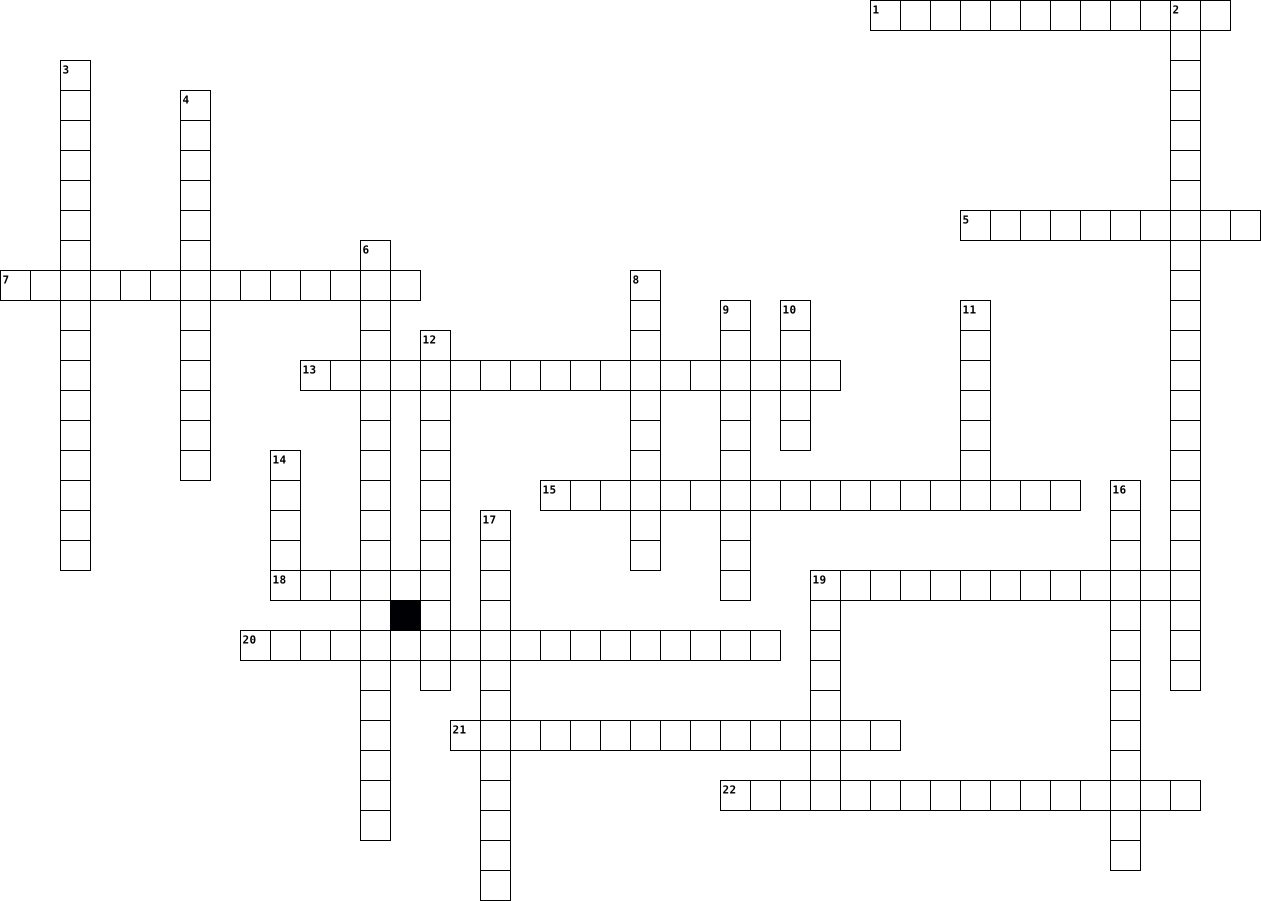
Across
- The first 10 amendments in the constitution
- American inventor, widely known for inventing the cotton gin
- principle of US policy, originated by President James Monroe in 1823, that any intervention by external powers in the politics of the Americas is a potentially hostile act against the US
- Political powers that are granted to the government but aren’t really stated in the constitution
- Contained 15 u.s. states and 2 Canadian providence’s
- withdraw formally from membership of a federal union, an alliance, or a political or religious organization
- the constitutional theory that individual states can invalidate federal laws or judicial decisions they deem unconstitutional
- a law that tried to address growing sectional tensions over the issue of slavery
- the idea that the United States is destined—by God, its advocates believed—to expand its domin and spread democracy and capitalism across the entire North American continent
- Powers that are granted to the federal government
Down
- Protestant religious revival in the United States from about 1795 to 1835
- The purchase of imperial rights to the western half of the Mississippi River
- Political powers that are granted to the government but aren’t really stated in the constitution
- the process of change from an agrarian and handicraft economy to one dominated by industry and machine manufacturing.
- an organized association of workers, often in a trade or profession, formed to protect and further their rights and interests.
- abstinence from alcoholic drink
- member of the British reforming and constitutional party that sought the supremacy of Parliament and was eventually succeeded in the 19th century by the Liberal Party.
- A role that advises the president on any subject
- the difficult journeys that the Five Tribes took during their forced removal from the southeast during the 1830s and 1840s
- a meeting at which local members of a political party register their preference among candidates running for office or select delegates to attend a convention
- the practice of a successful political party giving public office to its supporters
- the Senate's most prominent states' rights advocate
- the policy of protecting the interests of native-born or established inhabitants against those of immigrants
23 Clues: abstinence from alcoholic drink • The first 10 amendments in the constitution • A role that advises the president on any subject • Powers that are granted to the federal government • the Senate's most prominent states' rights advocate • Contained 15 u.s. states and 2 Canadian providence’s • American inventor, widely known for inventing the cotton gin • ...
Notable Battles and Figures of the Civil War 2022-03-10

Across
- The Battle of _________ _________ led to the capture of several islands off the coast of South Carolina.
- Robert ________ was an escaped slave who took a ship of slaves across the Harbor of Charleston. He later became a Representative for South Carolina.
- the first land battle of the Civil War and was an attempt by the Union to take out the Confederate Army near Manassas Creek in Virginia
- Ulysses S. ________ was the general and commander of the Union forces.
- The name of the Confederate ironclad ship
- The 54th ____________ Infantry was the first all-black Union army.
- Draft dodgers and soldiers who fled from the Confederate Army hid in the Greenville area called the "Dark ______"
- Blockade _______ were small ships that were easily maneuverable and used to get supplies past the Union blockade
- William T. __________ led the deadly "March to the Sea" to Savannah, Georgia
- States that were part of the Union, but were slave states
Down
- The name of the Union ironclad ship
- General of the Union Army who was chosen to lead the Union troops to victory by Lincoln, but he stalled to train his men for many months instead of going to battle.
- The Battle of _______ was Lee's second attempt to attack a northern city and Union victory, which led to an address by Abraham Lincoln at this site.
- The first battle that the Confederates sought to win in the Union territory
- Andrew ________ was the President of the Confederate States of America.
- The general and the commander of the overall Confederate armies
- The Battle of ________ Courthouse ended the war with General Lee's surrender to the Union forces.
- The Battle of __________ was for the remaining battlement along the Mississippi River and gave control of the Mississippi to the Union forces.
- _____________ Proclamation freed the slaves in all Confederate controlled states, but allowed states that were part of the Union to keep their slaves.
- This fort, when it was lost to the Union army led to the surrender of Charleston after 567 of firing on the city
- _________ Jackson was a famous general who led a Confederate victory at the Battle of Manassas
- the first battle of the Civil War that was fought in the waters off Charleston
- _______ Lincoln was the President of the United States of America during the Civil War.
23 Clues: The name of the Union ironclad ship • The name of the Confederate ironclad ship • States that were part of the Union, but were slave states • The general and the commander of the overall Confederate armies • The 54th ____________ Infantry was the first all-black Union army. • Ulysses S. ________ was the general and commander of the Union forces. • ...
The civil war 2023-12-11

Across
- Organization that helped freed slaves
- Gift for Abraham
- Abolished Slavery
- Has a trunk
- dividing from the laws of other states
- The states not loyal to America
Down
- Man's best friend
- Place full of railroads
- Era after the Civil War
- Process of being free, with equal rights
- Large marsupial
- diving from a state
- The states loyal to America
- Transportation of resources and people
14 Clues: Has a trunk • Large marsupial • Gift for Abraham • Man's best friend • Abolished Slavery • diving from a state • Place full of railroads • Era after the Civil War • The states loyal to America • The states not loyal to America • Organization that helped freed slaves • Transportation of resources and people • dividing from the laws of other states • ...
Government Crossword 2024-11-15

Across
- all three levels of government have the power to collect these
- only the national government has the power to declare this
- there are three of these: Executive, Legislative, and Judicial
- the introduction to the Constitution
- this type of government is in charge of the country
- where the Judicial Branch works
- to deny a bill or law; a power of the President
- the first postmaster of the United States
- where the president lives
- The first three words of the Preamble
Down
- the agreement reached by the states at the Constitutional Convention
- the leader of a state
- this type of government is in charge of states
- this type of government is in charge of cities
- the first president of the United States
- the leader of a city or town
- the number of judges in the supreme court
- to charge someone in power with misconduct
- where congress works
19 Clues: where congress works • the leader of a state • where the president lives • the leader of a city or town • where the Judicial Branch works • the introduction to the Constitution • The first three words of the Preamble • the first president of the United States • the number of judges in the supreme court • the first postmaster of the United States • ...
The Antebellum South 2023-01-13

Across
- had nine new slave states enter between 1789 adn 1860.
- an owner of slaves.
- what the slave states were known as.
- of free blacks were light skinned women.
- known for use of slavery.
- the state of being a slave.
- a boat powered by steam.
- Planters projected the amount of cotton they could harvest based on the number of slaves under their control.
- a person who is owned and has no rights,
Down
- led the 2nd rebellion.
- what most slaves were used for.
- extension of the states territory by encroaching on that of the other nations.
- people against slavery.
- banned the further importation of slaves beginning in 1808.
- formally put an end to the system, practice, or institution.
- wrote Uncle Toms Cabin.
- people for slavery.
- any southern states in the US in which slavery was legal before the civil war.
- a person who is killed for religious beliefs
19 Clues: an owner of slaves. • people for slavery. • led the 2nd rebellion. • people against slavery. • wrote Uncle Toms Cabin. • a boat powered by steam. • known for use of slavery. • the state of being a slave. • what most slaves were used for. • what the slave states were known as. • of free blacks were light skinned women. • a person who is owned and has no rights, • ...
Test Review - Civil War & Reconstruction 2021-03-02

Across
- The principle of popular sovereignty was an important part of the __________-Nebraska Act.
- The practice of slavery was officially ended in the United States with passage of the __________ Amendment.
- One way in which Frederick Douglass, William Lloyd Garrison, and Sojourner Truth are similar is that they all supported the __________ movement.
- Throughout the Civil War, an important advantage the North had over the South was that the North had greater __________ capabilities.
- After the Civil War, many owners of large plantations in the South responded to the loss of enslaved labor by creating tenant farms and __________.
- Slave owners benefited most directly from the Supreme Court decision in __________ v. Sanford?
- Implementation of the __________ Codes was an attempt by southern state governments after the Civil War to limit the rights of African Americans?
- When President __________ was inaugurated several southern states had already seceded from the Union.
- After the Civil War, the most common occupations for freedmen were sharecroppers and __________ farmers.
- After the Civil War, a significant cause of the conflict between President Andrew __________ and the Radical Republicans in Congress was disagreement over the plans for restoring Southern states to the Union.
- One major result of the __________’s victory in the Civil War was that the supremacy of the national government was upheld?
- … In your hands, my dissatisfied fellow countrymen, and not in mine, is the momentous issue of civil war. The government will not assail you. You can have no conflict without being yourselves the aggressors. You have no oath registered in Heaven to destroy the government, while I shall have the most solemn one to “preserve, protect, and defend it.” … President Lincoln made this statement in an effort to urge Congress to convince __________ that he posed no threat to their way of life.
Down
- The common goal of the 13th, 14th, and 15th amendments to the United States Constitution was to grant basic ___________ to formerly enslaved persons.
- … The whole military force of the State is at the service of a Mr. Suttle, a slaveholder from Virginia, to enable him to catch a man whom he calls his property; but not a soldier is offered to save a citizen of Massachusetts from being kidnapped! The author of this statement is expressing dissatisfaction with the __________ -slave law, a provision included in the Compromise of 1850.
- election of Abraham Lincoln as president led directly to the ___________ of several Southern states from the Union?
- President Abraham Lincoln believed that secession is unlawful and treasonous. Everything possible must be done to preserve the ___________.
- The __________ formed during Reconstruction with the purpose of keeping African-Americans from exercising rights.
- Abraham Lincoln’s 1858 warning that “a house divided against itself cannot stand” referred to sectional differences over the issue of __________.
- Poll taxes, literacy tests, and grandfather clauses were used in the South after 1890 to deny __________ rights to African Americans.
- As a result of the Missouri Compromise (1820) the ___________ of power between free and slave states was maintained.
- Missouri Compromise, Compromise of 1850, and Kansas-Nebraska Act all contributed to the rise of __________ in the United States.
- The Compromise of 1877 brought an end to Radical Reconstruction by providing for the removal of federal __________ from Southern states.
- At the start of the Civil War, President Abraham Lincoln stated that the major reason for fighting the war was to uphold the Constitution by preserving the __________.
- During the late 1800s, most __________ voters in the South solidly supported the Democratic Party primarily because Democrats disliked the Reconstruction programs of the Republicans.
24 Clues: The principle of popular sovereignty was an important part of the __________-Nebraska Act. • Slave owners benefited most directly from the Supreme Court decision in __________ v. Sanford? • When President __________ was inaugurated several southern states had already seceded from the Union. • ...
Definitions Galore 2015-11-17

Across
- the square footage inside your object
- the answer to a addition promblem
- to get more
- the numerals used to write a number
- states that when you multiply any number by zero, the product is zero
- when you round to get close answer to your problem not the exact answer
- states that multiplying a sum or a difference by a number is the same as multiplying each number in the sum or the difference by the number and adding or subtracting the products
- it states that the order of factorscan be changed, but the product stays the same
- the answer to a division promblem
- is a process that determines wich multiple of ten, hundred, thousands, and so on, a number is closet to
- to get less
Down
- states that you can change the grouping of the factors and the product stays the same
- the answer to a division problem
- a group of three digits, separated by commas, starting from the right.
- the length around the object
- products found by breaking one factor in a multiplication promblem into ones, tens, hundreds, and so on. Then multiplying each of these by the factor
- contains numbers and at least one operation
- a number written as the sum of the values of its digits
- a picture that shows a model of the problem you are solving
19 Clues: to get more • to get less • the length around the object • the answer to a division problem • the answer to a addition promblem • the answer to a division promblem • the numerals used to write a number • the square footage inside your object • contains numbers and at least one operation • a number written as the sum of the values of its digits • ...
Vmath D - Module 4 2022-02-28
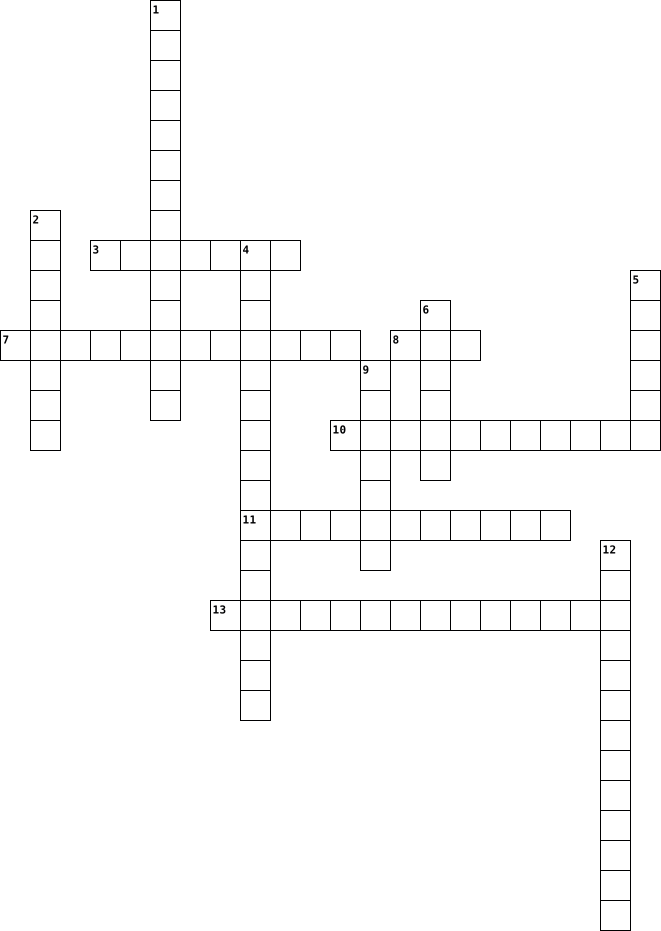
Across
- numbers that are multiplied to find a product
- property that states the product of two numbers can be written as the sum of the products of one number and the addends of the other (ex: 3x9=3x5+3x4)
- horizontal arrangement of numbers or objects
- property of multiplication states that the order of the factors can be changed without affecting the product
- property of multiplication states that the grouping of factors does not change the product
- multiplication property that states any number multiplied to zero is zero
Down
- repeated addition
- the product of a given number and another number
- a group of number or objects arranged into equal rows and columns
- a product that can be written as twice as many
- a vertical arrangement of numbers or objects
- the number that is the result or answer to a multiplication problem
- multiplication property that states anything times one is itself
13 Clues: repeated addition • a vertical arrangement of numbers or objects • horizontal arrangement of numbers or objects • numbers that are multiplied to find a product • a product that can be written as twice as many • the product of a given number and another number • multiplication property that states anything times one is itself • ...
Review: Challenges to an Emerging Nation 2013-12-11

Across
- He wrote the Star-Spangled Banner.
- She was a Native American who helped the Lewis and Clark expedition.
- They led an expedition into the Louisiana territory to explore and find a water route to the Pacific Ocean.
- Which country did the United States fight against in the War of 1812?
- He was the fourth president of the United States.
- The Lewis and Clark expedition lasted for _____years.
- Federalists in _______________(part of the country) did not want to go to war with Britain.
- During the War of 1812, the British burned the _______________and most of Washington D.C.
Down
- He was the third president of the United States and he bought the Louisiana territory from France.
- He sold the Louisiana Territory to the United States in 1803.
- What city in Missouri did the Lewis and Clark expedition leave from?
- This person explored the __________________ region of the United States in the early 1800’s.
12 Clues: He wrote the Star-Spangled Banner. • He was the fourth president of the United States. • The Lewis and Clark expedition lasted for _____years. • He sold the Louisiana Territory to the United States in 1803. • She was a Native American who helped the Lewis and Clark expedition. • What city in Missouri did the Lewis and Clark expedition leave from? • ...
Crime & Punishment 2023-03-23

Across
- hundred, Even though the murder rate fell by 20% in the 1990's, network news stories about murder increased ____ %.
- Laws, Laws that criminalized being homeless and jobless.
- minimum, ________ sentences require judges to administer prison terms for a specific period of times based on the crime
- strikes law, If you have 2 prior felonies, your third sentence will be life in prison.
- Rates, Remained the same, and even decreased while the prison boom happened.
- ________policies were responsible for 88% of the prison boom.
- Overall, high school drug use has _____ since the 1980's.
- Collar Crime, Examples of _________ include fraud, identity theft, environmental law violations, embezzlement, and money laundering.
- 85% of Americans think the country is ____ on crime.
Down
- States, Country with the highest incarceration rates in the world.
- Immigrants make the United States ______.
- Economy, Selling tacos on the street, working as a babysitter, and selling drugs are all part of the ________.
- 2,300 _____ men, women and children who were lynched.
- Between 1980 and 2011, the number of _____ in prison increased by 587 percent.
- Americans, have been portrayed as terrorists in the United States.
- leasing, Southern states leased prisoners to private companies for state profit.
- Even though crime rates have been falling, 60% of Americans believe they are _____.
- Starting in the 1970's, politicians began using _____ as a focal point to get into office
- Between 1970 and 2003, the number of prisons grew.
19 Clues: Immigrants make the United States ______. • Between 1970 and 2003, the number of prisons grew. • 85% of Americans think the country is ____ on crime. • 2,300 _____ men, women and children who were lynched. • Laws, Laws that criminalized being homeless and jobless. • Overall, high school drug use has _____ since the 1980's. • ...
Bill of rights/7 principles of Gov. crossword 2022-02-12

Across
- certain power separated into different states
- Limit on punishment, and bail
- Cannot be taken away
- Carry & Bear arms
- Rights to be informed, jury, lawyer
- More rights not on Constitution
- People have the power
Down
- Balances between branches
- No quartering
- 3 different branches
- Representative for you
- Everyone under Law
- Jury trials 4 civil cases
- Rights for someone accused
- Ability for speech and religion
- Powers to States and people not federal government
- No unusual searches or Arrests
17 Clues: No quartering • Carry & Bear arms • Everyone under Law • 3 different branches • Cannot be taken away • People have the power • Representative for you • Balances between branches • Jury trials 4 civil cases • Rights for someone accused • Limit on punishment, and bail • No unusual searches or Arrests • Ability for speech and religion • More rights not on Constitution • ...
U.S. History 2012-11-28

Across
- a harbor near Honolulu, on S Oahu, in Hawaii
- the United States Navy's second commissioned battleship and the first U.S. Navy ship to be named after the state of Maine
- notes Submitted by U.S. Secretary of State, John Hay, September 6, 1899
- an amendment to a joint resolution of the United States Congress, replacing the earlier Teller Amendment
- a corollary to the Monroe Doctrine that was articulated by President Theodore Roosevelt in his State of the Union Address in 1904
- Cuban patriot and writer.
- Secretary of State 1861–69.
- was a leading figure in the Mexican Revolution, which broke out in 1910
- president of Republic of Hawaii 1894–98
- was an eminent writer in the period after the American Revolution as a diplomat negotiated a number of treaties that include his name
Down
- signed on September 3, 1783, ended the American Revolutionary War
- connects the Atlantic Ocean (via the Caribbean Sea) to the Pacific Ocean
- the name bestowed on the 1st United States Volunteer Cavalry
- was an admiral of the United States Navy.
- better known by his pseudonym Francisco Villa
- ) was a Filipino general, politician, and independence leader
- a decisive battle of the Spanish-American War
- use of financial power in diplomacy: the use of financial resources to facilitate foreign relations
- a proto- nationalist movement by the Righteous Harmony Society in China
- A Spanish general who was a Captain General of Cuba
- the type of journalism that relies on sensationalism and lurid exaggeration to attract readers
- officially known as the Organic Act of 1900
- the relation of a strong state toward a weaker state or territory that it protects and partly controls.
- U.S. naval officer and writer on naval history
- the policy of extending the rule or authority of an empire or nation over foreign countries
- was a general officer in the United States Army who led the American Expeditionary Forces in World War I.
26 Clues: Cuban patriot and writer. • Secretary of State 1861–69. • president of Republic of Hawaii 1894–98 • was an admiral of the United States Navy. • officially known as the Organic Act of 1900 • a harbor near Honolulu, on S Oahu, in Hawaii • better known by his pseudonym Francisco Villa • a decisive battle of the Spanish-American War • ...
Unit 1-3 Terms 2016-04-07

Across
- What are back country farmers called?
- Which plan supported the larger states' idea of bicameral legislature and equal representation?
- Small adobe villages
- When South Carolina passed an "Ordinance of Nullification."
- What act allowed states to utilize popular sovereignty?
- Who was the philosopher that believed all men were equal?
- Favoritism toward native-born Americans.
- Codes that were passed in Southern States to prevent blacks from their rights.
- Workers who were contracted to work for a period of time to pay back debt.
- The 1st Constitution of the United States.
- What were the Native Americans most valued crop?
- A person whose mixed with black and white ancestry.
- Who was the key African American abolitionist who escaped slavery?
- Nationwide railroad strike in the United States in 1894.
- A situation or event that creates a sudden increase in wealth.
- A farmer who farms land that's owned by someone else.
- Wealthy Spanish built these large estates.
Down
- Which rebellion was led by angry Massachusetts farmers?
- Which Native Americans built mounds?
- A conflict between colonists and Indians under the leadership of Chief Metacomet.
- Which compromise entered Maine as a free state and Missouri as a slave state?
- What did settlers in New England call themselves?
- Trade route between Africa, the West Indies, and Colonial New England.
- Ben Franklin created this to discuss the threats on the western frontiers made by the French.
- What was the forced removal of Native Americans from the South to Oklahoma called?
- What act stated that neither slavery nor indentured servitude shall exist in territories gained from Mexico?
- What famous book did Harriet Beecher Stowe write?
- What rebellion started when whiskey was taxed?
- Frontiersmen who formed a vigilante group to retaliate against local peaceful Native Americans.
- Disagreements about water rights and property lines in the West.
30 Clues: Small adobe villages • Which Native Americans built mounds? • What are back country farmers called? • Favoritism toward native-born Americans. • The 1st Constitution of the United States. • Wealthy Spanish built these large estates. • What rebellion started when whiskey was taxed? • What were the Native Americans most valued crop? • ...
Aisha Daftani Sec #3 X-Word 2024-03-23

Across
- The British had a head start in industrializing, they could make and sell goods more cheaply than __________?
- The Negro Fort was built along the Apalachicola River, in the _______ territory of Florida.
- After the War of _______ twelve, leaders like Calhou, Webster, and Clay had to deal with serious economic issues.
- Henry Clay a leader of the War Hawks spoke for the ________?
- In the year of 1821, the United States gained _________? (which state)
- Webster’s view on slavery was ________?
- Spain agreed to give Florida to the United States in exchange for $5 _________?
- The northerners, westerners, and southerners were _________ that Americans felt loyal to?
- Since 1700s, Spanish officals had protected slaves who fled from plantation in ________ and South Carolina.
- Monroe hoped to create a new sense of national unity, One new paper that was written was called “era of good ___________?”
- The Republican candidate for President, James Monroe, easily defeated the Federalist, Senator Rufus King of ________?
- John __________, of The South was a Sectional leader, who supported slavery.
Down
- _______ would play key roles in Congress for more than 30 years, as well as serving in other offices. (a number)
- The policy that President James Monroe declare in 1823 was called Monroe ________?
- In 1821, the people of Central American declared independence from Spain, which then they formed the United ________ of Central America?
- In the case of McCulloch v. ____________ (1819), the Court rules that states had no right to interfere with federal institutions.
- Only the federal government had the power to regulate ________) commerce, or trade between different states.
- While tariffs remained high, Conngress spent little on ____________ improvements for roads, bridges, and canals.
- ___________ McCulloch, the bank cashier, who refused to pay tax.
- Spain lost another one of its colonies, Florida - not to ________________ but to the US.
- Purpose of a protective ___________ is to protect country’s industries from foreign competition.
- In the early of 1800s, the ________ Act and then the War of 1812 kept most British good outs of the United States.
22 Clues: Webster’s view on slavery was ________? • Henry Clay a leader of the War Hawks spoke for the ________? • ___________ McCulloch, the bank cashier, who refused to pay tax. • In the year of 1821, the United States gained _________? (which state) • John __________, of The South was a Sectional leader, who supported slavery. • ...
Geography 2023-05-07
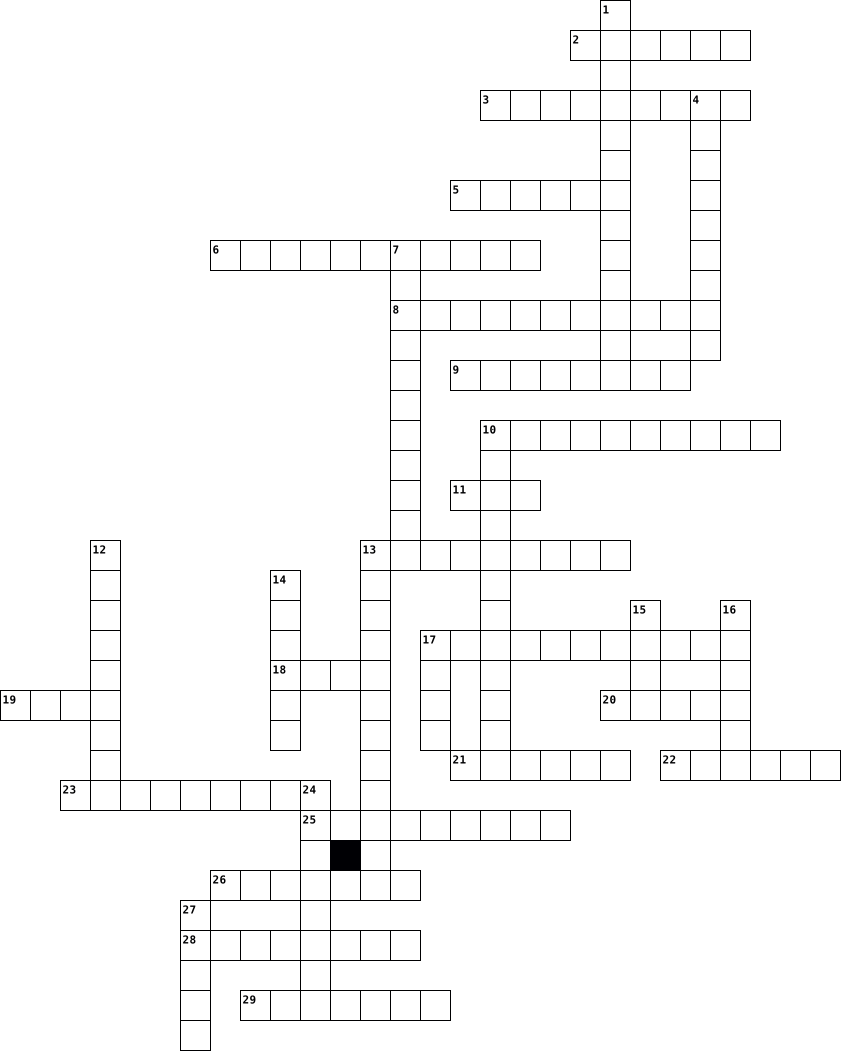
Across
- The ocean north of Europe
- The largest river that empties into the Pacific Ocean
- The place where a river begins
- The mountain range that runs through the eastern United States
- The longest river in the United States
- The four main points on a compass are called the ________points
- The river that runs northeast from Lake Ontario into the Atlantic Ocean
- A large body of salt water that is smaller than an ocean
- the study of natural surroundings and how we interact with them
- The large flatland between the Rocky Mountains and the Mississippi River
- The river just west of the Appalachian Mountains that runs into the Mississippi
- The largest continent
- Soil deposited at the mouth of a river
- A low area between ranges of mountains or hills
- The ocean that lies to the south of Asia
- Land with water on three sides
- A river or stream that flows into a main river
- the line at 0 degrees latitude
- lines on a map that circle the Earth from east to west
- The ocean that lies off the west coast of the United States
Down
- the line at 0 degrees longitude
- The smallest continent
- The symbol on a map that shows directions
- The high mountains in the western US with a Spanish name
- The river that forms part of the border between Mexico and the United States
- The body of water between Texas and Florida
- The continent north of Africa
- A point or extension of land jutting into the water that is skinnier than a peninsula
- A body of land that is smaller than a continent and surrounded by water
- The name given to a large area of sea or ocean that is partially enclosed and is larger than a bay
- The ocean off the East coast of the United States
- the most accurate map of Earth
32 Clues: The largest continent • The smallest continent • The ocean north of Europe • The continent north of Africa • The place where a river begins • Land with water on three sides • the line at 0 degrees latitude • the most accurate map of Earth • the line at 0 degrees longitude • The longest river in the United States • Soil deposited at the mouth of a river • ...
Chapter 2 Definitions - American Gov 2025-09-29

Across
- a highly decentralized form of government; sovereign states form a union for purposes such as mutual defense
- a form of government where power is divided between state gov. and a national gov.
- a legislature with only one house, like the Confederation Congress or the legislature proposed by the New Jersey Plan.
- a system that allows one branch of government to limit exercising the power by another branch; requires different parts of gov. to work together
- the powers given explicitly to the federal government by the Constitution
- powers not prohibited by the constitution or delegated to the national gov; powers reserved to the states and denied to the federal gov
- a compromise between the Virginia plan and the New Jersey plan that created a two House Congress; representation is based on population in the House of Representatives and equal representation of states in the Senate.
- the right to life liberty and property; believed to be given by God; no government may take away
- a document written in 1776 in which the American colonists proclaimed their independence from Great Britain and listed their grievances against the British king - King George III
Down
- a compromise btw northern + southern states that called for counting of all states free population and 60 percent of its slave population for both fed taxation and representation in Congress
- a form of government in which political power lies in the hands of the people, not a monarch, and is exercised by elected officials
- the first basis for the nation's government, adopted in 1781; created an alliance of sovereign states held together by a weak central government
- an agreement between people and government in which citizens consent to be governed so long as the government protects their natural rights
- a plan that called for a one house national legislature; each state receives one vote
- the sharing of powers among three separate branches of gov
- statement in Article 6 of the Constitution; that fed law is superior to laws passed by state legislature.
- a legislature with two houses such as the US Congress
17 Clues: a legislature with two houses such as the US Congress • the sharing of powers among three separate branches of gov • the powers given explicitly to the federal government by the Constitution • a form of government where power is divided between state gov. and a national gov. • ...
Hunter's Grammar Crossword 2024-11-19

Across
- Used for list
- Goes at a start of a sentence
- Doing or action word
Down
- A person, place or thing
- extra information about a noun
5 Clues: Used for list • Doing or action word • A person, place or thing • Goes at a start of a sentence • extra information about a noun
Atoms and States of Matter 2023-02-06

Across
- The physicist who discovered the electron using a cathode ray tube.
- The change of state from solid directly into gas. (Dry ice does this!)
- A negatively charged particle that is found in atoms.
- The state change were a gas turns into a liquid.
- The state change from liquid to gas.
- Schrodinger used this scientist's uncertainty principle to show that electrons exist in a cloud with a probability of being found in different parts. (Also Walter White's alias in Breaking Bad!)
- The state of matter where particles (or molecules) are close together, but can glide over each other.
- Electrons exist in orbits at certain energy levels in this model of the atom.
- The subatomic within atoms that has a zero charge.
Down
- The state of matter with the lowest energy.
- The centre of an atom, made up of protons and neutrons.
- The basic building block of matter, according to Democritus and Dalton.
- There are different types of atoms. Each type of atom is called a(n) _______________.
- The charge of a proton.
- The scientist who discovered that atoms must have a positively charged nucleus.
15 Clues: The charge of a proton. • The state change from liquid to gas. • The state of matter with the lowest energy. • The state change were a gas turns into a liquid. • The subatomic within atoms that has a zero charge. • A negatively charged particle that is found in atoms. • The centre of an atom, made up of protons and neutrons. • ...
States and Properties of Matter 2025-02-05

Across
- _______ point: 100ºC in the case water
- When liquid evaporates it changes into this
- When liquid turns to gas
- _______ point: the temperature at which a substance melts (and freezes)
- When a substance dissolves in liquid
- The solid part of a solution
- _____variable: the part of an experiment you keep the SAME
- For example, sand. Substances that do not dissolve
- The liquid part of a solution
Down
- When gas turns into liquid (Clouds are made of this)
- The smallest parts of any substance that move and vibrate if heated
- _____variable: the part of an experiment that you MEASURE
- When a gas loses energy and condenses it turns into this
- The mixture that is made when we dissolve a substance in liquid
- What particles need to start moving and separating
15 Clues: When liquid turns to gas • The solid part of a solution • The liquid part of a solution • When a substance dissolves in liquid • _______ point: 100ºC in the case water • When liquid evaporates it changes into this • What particles need to start moving and separating • For example, sand. Substances that do not dissolve • When gas turns into liquid (Clouds are made of this) • ...
Chapter 27 2014-04-14

Across
- a series of laws and diplomatic agreements
- Salk discovered and developed the first successful inactivated polio vaccine
- any period marked by a largely increased birth rate
- 33rd president
- policy to grant Native Americans all the rights and privileges of citizenship, and to reduce their dependence on a bureaucracy whose mismanagement had been documented
- an ambitious set of proposals put forward by Truman
- Short lived segregationist political party
- an independent agency of the United States government to regulate interstate and international communications by radio, television, wire, satellite, and cable in all 50 states, the District of Columbia and U.S. territories
- a program of land redevelopment in areas of moderate to high density urban land use
- Post American war writers making books about things
Down
- Provided benefits for returning WW2 veterans
- is a combination of two or more corporations engaged in entirely different businesses that fall under one corporate group
- Part of a urban area
- a policy of planning or designing a product with a limited useful life
- social and economic order that encourages the acquisition of goods and services in ever-greater amounts
- a right or privilege
- diversified media technologies that are intended to reach a large audience by mass communication
- a genre of popular music that originated and evolved in the United States during the late 1940s and early 1950s, primarily from a combination of African-American genres such as blues, jump blues, jazz, and gospel music, together with Western swing and country music
- a type of African-American music that originated in the late nineteenth and early twentieth century in the Southern United States as a combination of European harmony and forms with African musical elements
19 Clues: 33rd president • Part of a urban area • a right or privilege • a series of laws and diplomatic agreements • Short lived segregationist political party • Provided benefits for returning WW2 veterans • any period marked by a largely increased birth rate • an ambitious set of proposals put forward by Truman • Post American war writers making books about things • ...
History 2023-05-04

Across
- this state decided in the civil war
- the devide between slave states and Free states
- These states wanted slavery
- these debates led towards the Lincoln stopping slavery
Down
- slaves were mainly taken from this country
- these leaders sold their enemies for weaponry
- this was a war that ended slavery
- This book influenced the civil war
- These people wanted slavery
- this invention raised slavery rates
- These states wanted to abolish slavery
- Many Slaves Used The ______ to Escape
- these people wanted to abolish slavery
- This shaped Americas economy
14 Clues: These people wanted slavery • These states wanted slavery • This shaped Americas economy • this was a war that ended slavery • This book influenced the civil war • this state decided in the civil war • this invention raised slavery rates • Many Slaves Used The ______ to Escape • These states wanted to abolish slavery • these people wanted to abolish slavery • ...
The Civil War/Free slaves 2024-04-08

Across
- Someone who advertised something to get people to come
- Someone who wants to end Slavery
- A change a government
- A group of people who make laws for the united states
- What people used to get around
- Proclamation An order issued by Abraham Lincoln
Down
- A system of government in which power is divided
- Head of an executive branch
- Eleven southern states
- A written document of the United States
- To Break away from
- The United States of America
- A geographic area with boundaries and a secure government
- Someone from another county
14 Clues: To Break away from • A change a government • Eleven southern states • Head of an executive branch • Someone from another county • The United States of America • What people used to get around • Someone who wants to end Slavery • A written document of the United States • Proclamation An order issued by Abraham Lincoln • A system of government in which power is divided • ...
The Civil War/Free slaves 2024-04-08

Across
- Someone who advertised something to get people to come
- Someone who wants to end Slavery
- A change a government
- A group of people who make laws for the united states
- What people used to get around
- Proclamation An order issued by Abraham Lincoln
Down
- A system of government in which power is divided
- Head of an executive branch
- Eleven southern states
- A written document of the United States
- To Break away from
- The United States of America
- A geographic area with boundaries and a secure government
- Someone from another county
14 Clues: To Break away from • A change a government • Eleven southern states • Head of an executive branch • Someone from another county • The United States of America • What people used to get around • Someone who wants to end Slavery • A written document of the United States • Proclamation An order issued by Abraham Lincoln • A system of government in which power is divided • ...
6th Math Vocabulary 2021-12-03

Across
- To round the parts of a problem to get an approximate answer
- The property that states any number plus 0 is itself
- The property that states that any number times 0 is 0
- smallest shared multiple between two or more numbers
- largest shared factor between two or more numbers
- A number with only 2 factors, 1 and itself
Down
- The property that states that the grouping doesn't matter
- Two fractions that name the same number
- The property that states that the order doesn't matter
- When you divide two whole numbers and the remainder is 0
- A number with more than 2 factors
- When 1 is the only common factor of the numerator and denominator
- Any number divisible by 2
- A type of fraction where the numerator is greater than the denominator
- The formal name for the "flip" of a fraction
15 Clues: Any number divisible by 2 • A number with more than 2 factors • Two fractions that name the same number • A number with only 2 factors, 1 and itself • The formal name for the "flip" of a fraction • largest shared factor between two or more numbers • The property that states any number plus 0 is itself • smallest shared multiple between two or more numbers • ...
George Washington's Presidency 2014-03-13

Across
- Tax on a good brought into the country.
- The farmers of western Pennsylvania were angry about a government tax on __________.
- The Secretary of the __________ enforces tax laws.
- A settlement in which each side gives up some of its demands to reach an agreement.
- 1st President of the United States. (last name)
- Blue Jacket was defeated at this battle by Major General Anthony Wayne. (no space)
- Act or decision that sets an example for others to follow.
- Debt owed to private citizens and American businesses.
- This Act, passed in 1789, created the Federal Court System.
- Native American tribes joined together and formed the Western __________.
- Pinckney's Treaty was made between the US and __________.
Down
- The US signed Jay's treaty with what country?
- The Secretary of state advises the President on _________ affairs.
- Pinckney's treaty allowed the US to trade through this port. (No space)
- The __________ General serves as the chief lawyer of the United States.
- The biggest economic problem faced by the United States is the __________ debt.
- Cabinet members give the President __________.
- Thomas Jefferson believed the National Bank was __________.
- The Secretary of War advises the President on __________ affairs.
- Hamilton wanted to pay off all of the __________ debts along with the National debt.
- Pinckney's Treaty gave the US free navigation of this major river.
- Another word for money.
- Alexander Hamilton wanted to create a national _________.
- Southern states would support Hamilton's plan if Northern States supported a plan to locate the nations __________ in the south.
- Head of the Supreme Court is called the _________ Justice.
25 Clues: Another word for money. • Tax on a good brought into the country. • The US signed Jay's treaty with what country? • Cabinet members give the President __________. • 1st President of the United States. (last name) • The Secretary of the __________ enforces tax laws. • Debt owed to private citizens and American businesses. • ...
SCOTUS Crossword Puzzle 2024-03-01

Across
- the highest court in the federal judiciary of the United States
- the 6th Amendment requires states to provide attorneys to criminal defendants who can't afford their own
- the quality of being just, impartial, or fair
- establishes that the federal constitution, and federal law generally, take precedence over state laws, and even state constitutions
- prohibits government from "establishing" a religion
- American courts have the power to strike down laws and statutes they find to violate the Constitution of the United States
- criminal suspects have the right to counsel during police interrogations
- Something that is somewhere that represents something
- rights of student journalists are not violated when school officials prevent the publication of certain articles in the school newspaper
Down
- a agreement by all people in a given situation
- Federal Government had the right and power to set up a Federal bank and that states did not have the power to tax the Federal Government
- the ability of the Court to declare a Legislative or Executive act in violation of the Constitution
- a legal document submitted by a person who is not involved directly in the particular action
- Supreme Court that recognized the First Amendment rights of students in U.S. public schools
- the freedom of speech protection afforded in the U.S. Constitution's First Amendment could be restricted if the words spoken or printed represented to society a “clear and present danger.
- A unanimous Court struck down state laws banning marriage between individuals of different races
- burning the Flag of the United States was protected speech under the First Amendment to the U.S. Constitution
- prevents prosecutors from using evidence in court that was obtained illegally
18 Clues: the quality of being just, impartial, or fair • a agreement by all people in a given situation • prohibits government from "establishing" a religion • Something that is somewhere that represents something • the highest court in the federal judiciary of the United States • criminal suspects have the right to counsel during police interrogations • ...
Test Review - Civil War & Reconstruction 2021-03-02

Across
- The principle of popular sovereignty was an important part of the __________-Nebraska Act.
- The practice of slavery was officially ended in the United States with passage of the __________ Amendment.
- One way in which Frederick Douglass, William Lloyd Garrison, and Sojourner Truth are similar is that they all supported the __________ movement.
- Throughout the Civil War, an important advantage the North had over the South was that the North had greater __________ capabilities.
- After the Civil War, many owners of large plantations in the South responded to the loss of enslaved labor by creating tenant farms and __________.
- Slave owners benefited most directly from the Supreme Court decision in __________ v. Sanford?
- Implementation of the __________ Codes was an attempt by southern state governments after the Civil War to limit the rights of African Americans?
- When President __________ was inaugurated several southern states had already seceded from the Union.
- After the Civil War, the most common occupations for freedmen were sharecroppers and __________ farmers.
- After the Civil War, a significant cause of the conflict between President Andrew __________ and the Radical Republicans in Congress was disagreement over the plans for restoring Southern states to the Union.
- One major result of the __________’s victory in the Civil War was that the supremacy of the national government was upheld?
- … In your hands, my dissatisfied fellow countrymen, and not in mine, is the momentous issue of civil war. The government will not assail you. You can have no conflict without being yourselves the aggressors. You have no oath registered in Heaven to destroy the government, while I shall have the most solemn one to “preserve, protect, and defend it.” … President Lincoln made this statement in an effort to urge Congress to convince __________ that he posed no threat to their way of life.
Down
- The common goal of the 13th, 14th, and 15th amendments to the United States Constitution was to grant basic ___________ to formerly enslaved persons.
- … The whole military force of the State is at the service of a Mr. Suttle, a slaveholder from Virginia, to enable him to catch a man whom he calls his property; but not a soldier is offered to save a citizen of Massachusetts from being kidnapped! The author of this statement is expressing dissatisfaction with the __________ -slave law, a provision included in the Compromise of 1850.
- election of Abraham Lincoln as president led directly to the ___________ of several Southern states from the Union?
- President Abraham Lincoln believed that secession is unlawful and treasonous. Everything possible must be done to preserve the ___________.
- The __________ formed during Reconstruction with the purpose of keeping African-Americans from exercising rights.
- Abraham Lincoln’s 1858 warning that “a house divided against itself cannot stand” referred to sectional differences over the issue of __________.
- Poll taxes, literacy tests, and grandfather clauses were used in the South after 1890 to deny __________ rights to African Americans.
- As a result of the Missouri Compromise (1820) the ___________ of power between free and slave states was maintained.
- Missouri Compromise, Compromise of 1850, and Kansas-Nebraska Act all contributed to the rise of __________ in the United States.
- The Compromise of 1877 brought an end to Radical Reconstruction by providing for the removal of federal __________ from Southern states.
- At the start of the Civil War, President Abraham Lincoln stated that the major reason for fighting the war was to uphold the Constitution by preserving the __________.
- During the late 1800s, most __________ voters in the South solidly supported the Democratic Party primarily because Democrats disliked the Reconstruction programs of the Republicans.
24 Clues: The principle of popular sovereignty was an important part of the __________-Nebraska Act. • Slave owners benefited most directly from the Supreme Court decision in __________ v. Sanford? • When President __________ was inaugurated several southern states had already seceded from the Union. • ...
1800-1848 2024-01-01

Across
- The United States and what other country were having a women’s rights movement in this time period
- Name of tribe that refused to move
- Who did the United States make a big land purchase from in 1803
- What did Jackson open for increased trade with Britain
- How much money did the US government pay for the Louisiana Purchase
- What group of people made most of the transcontinental railroad system
- The United States in this time period abolished this in 1808
- What was the Act called that forced Native Americans to move: Indian ____ Act
Down
- At the end of the Mexican-American war how much did the United States pay to Mexico
- What was the movement that forced Native Americans to leave their homes
- What was the territory that was the cause of the Mexican-American war
- What was what the British Navy were doing to the United States Sailors called
- Name of purchase that allowed the southern transcontinental railroad to form
- What President declared war on the British in 1812
- The United States acquired New Mexico, Utah, Nevada, Arizona, _______, Texas, and western Colorado from the Mexican-American war
- The acquisition of Florida was from the Adam-Onis treaty. What country gave Florida to the US in exchange for 5 million dollars.
16 Clues: Name of tribe that refused to move • What President declared war on the British in 1812 • What did Jackson open for increased trade with Britain • The United States in this time period abolished this in 1808 • Who did the United States make a big land purchase from in 1803 • How much money did the US government pay for the Louisiana Purchase • ...
CH 15 RECONSTRUCTION (REBUILDING AFTER CIVIL WAR) 2025-05-15

Across
- Laws passed in the Southern states after the Civil War that limited the rights of African Americans
- To formally accuse a public official of wrongdoing, which could lead to their removal from office
- A white Southerner who supported Reconstruction and the Republican Party. They were often seen as traitors by other white Southerners
- The process of bringing different groups of people together, especially different races, so they have equal opportunities and are not separated
- The period after the Civil War (1865-1877) when the United States worked to rebuild the South and bring the Confederate states back into the Union
- Formerly enslaved people who were freed after the Civil War
- A system where a farmer rents land and pays the landowner with a share of the crops they grow. This often kept formerly enslaved people in poverty
- The right to vote
- Unfair treatment of a person or group based on things like race, religion, or gender
- The United States of America as one country. During the Civil War, it referred to the states that remained loyal to the federal government
- When the army controls an area, often used in the South during Reconstruction to enforce new laws
- A test of reading and writing skills that was sometimes required before people could vote. These tests were often unfairly used to prevent African Americans from voting
Down
- The act of bringing people or groups back together after a conflict
- A change or addition to the U.S. Constitution
- A Northerner who moved to the South after the Civil War, sometimes to help with Reconstruction but often seen as trying to profit from the situation
- A federal agency created to help formerly enslaved people with things like food, housing, education, and medical care after the Civil War
- A secret organization that used violence and intimidation to prevent African Americans from exercising their rights
- The act of separating people based on race or other differences
- The status of being a legal member of a country, with rights and responsibilities
- A group of Republicans in Congress who believed the South should be punished for the Civil War and that African Americans should have full equality
- The group of 11 Southern states that seceded (left) the United States and formed their own government during the Civil War
- An official pardon (forgiveness) for people who have committed a crime, often used for large groups of people
- The act of ending slavery
- The basic rights that all citizens have under the law, such as freedom of speech and the right to vote
- To officially approve or accept a document, like an amendment to the Constitution
- A fee that people had to pay in order to vote. This was used to prevent poor African Americans from voting
26 Clues: The right to vote • The act of ending slavery • A change or addition to the U.S. Constitution • Formerly enslaved people who were freed after the Civil War • The act of separating people based on race or other differences • The act of bringing people or groups back together after a conflict • ...
American Government: Chp. 4 - The Constitution 2025-02-06

Across
- Provided for the surveying of western lands in the Northwest Territory and the orderly sale of the land to settlers.
- Powers not given to the federal government, but left to the states.
- The man who literally wrote the final draft of the Constitution.
- State that proposed a unicameral legislature with each state receiving equal representation.
- A formal agreement or contract between two or more parties.
- The only state to NOT send delegates to the Constitutional Convention.
- Also known as the Pennsylvania State House and the site of the Constitutional Convention.
- Territory that was bounded by the Ohio and Mississippi rivers and also the Great Lakes.
- System where areas of authority were divided between the states and the national government.
- The youngest delegate to the Constitutional Convention.
- System with officials chosen to represent the people and the states.
- Rebellion in Massachusetts that attempted to stop governmental foreclosure on debt-ridden farms.
- The only branch of government in the Articles of Confederation.
- Chosen to be the "president" of the Constitutional Convention proceedings.
- This state's constitution was written by delegates sent to a constitutional convention.
- The oldest delegate to the Constitutional Convention.
- This branch of government is to interpret laws and try cases involving federal laws.
- Powers given to the national government by the Constitution.
Down
- This branch of government's duty is to enforce laws, make appointments, command the armed forces.
- Two house legislature
- Began writing essays in NY newspapers promoting the passage of the Constitution.
- The Great Compromise is sometimes called this compromise due to the work of this state's delegation.
- The last state to ratify the ARTICLES OF CONFEDERATION.
- This compact can be called the forerunner of the written constitution in America.
- State that proposed a two-house legislature system.
- Abbreviation for the city which was a temporary home for the new government formed by the Constitution.
- Abbreviated name for the lower house of the U.S. Congress.
- Compromise on how slaves were to be counted for representation and taxation.
- Upper house of the United States Congress.
- Supporters of the new Constitution.
- Central government is subordinate to state governments and has only the powers which the states grant it.
- Said that the greatest enemy to liberty is tyranny.
- Emphasized the relationship between the king and the colonies.
- Introduction to the Constitution.
- Number of states that attended the Annapolis Convention in 1786.
35 Clues: Two house legislature • Introduction to the Constitution. • Supporters of the new Constitution. • Upper house of the United States Congress. • State that proposed a two-house legislature system. • Said that the greatest enemy to liberty is tyranny. • The oldest delegate to the Constitutional Convention. • The last state to ratify the ARTICLES OF CONFEDERATION. • ...
The Great Depression 2021-01-30

Across
- an American politician who served as the 32nd president of the United States
- guaranteeing payment in case loss or damage occurs.
- A collective action taken during the auction of a foreclosed property to force the sale of the property at a low price, then returning the property to its previous owner.
- Ratified, repealing the 18th Amendment and bringing an end to the era of national prohibition of alcohol in America.
- a shanty town built during the Great Depression by the homeless in the United States.
- an American author and the 1962 Nobel Prize in Literature winner
Down
- a government corporation administered by the United States Federal Government between 1932 and 1957 that provided financial support to state and local governments and made loans to banks and other businesses.
- the forming of a theory or conjecture without firm evidence.
- a law that implemented protectionist trade policies in the United States
- a 1928 international agreement in which signatory states promised not to use war to resolve conflicts
- an American documentary photographer and photojournalist
- an American physician who was best known for his revolving old-age pension proposal during the Great Depression
- World War I veterans, together with their families and affiliated groups who gathered in Washington, D.C. in mid-1932 to demand early cash redemption of their service certificates.
- A period of severe dust storms that damaged american and canadian prairies in the 1930’s.
- far-right, authoritarian ultranationalism characterized by dictatorial power
- borrowing money from a broker in order to purchase stock.
16 Clues: guaranteeing payment in case loss or damage occurs. • an American documentary photographer and photojournalist • borrowing money from a broker in order to purchase stock. • the forming of a theory or conjecture without firm evidence. • an American author and the 1962 Nobel Prize in Literature winner • ...
Our United States History Review 2026-09-27

Across
- This explorer was given credit for "discovering" America.
- This war began in Europe in 1914 and the United States joined the war in 1917.
- God created humanity and told them to, "Be fruitful, and ___________________ " on the earth.
- This is the term for colonists who opposed British rule in the colonies.
- During The Great ______________________, most Americans lost their jobs and struggled to feed their families.
- This branch of the federal government carries out the laws. It includes the President and the Vice President.
- The US ______________________ is a document that was signed on September 17, 1787 to form the federal government.
- This man was president of the United States during the Civil War and was opposed to slavery.
- These explorers were the first Europeans to discover America, but they did not tell anyone else about their discovery.
- The United States joined Operation Desert ____________________ to attack the Iraqi forces in Kuwait.
- In some places in America, laws were passed to __________________________ black people, or to keep them separate from white people.
- The first European settlements in America were called: _____________________.
- Some Native Americans came from ______________ and then through Alaska to America.
- In a _______________________, citizens elect representatives to run their government.
- World War II began in 1939 in Europe. The United States joined the war after Japan attacked the US Navy in _______________ _________________, Hawaii.
Down
- The Bible says in Genesis 1:27 that __________ people are created in God's image, and therefore must be treated with equal kindness and respect.
- This tribe of Native Americans were forced to leave their land and walk the "Trail of Tears".
- By negotiating the ________________________ Purchase, Thomas Jefferson helped the United States double its amount of land.
- European settlers came to live in America because they were looking to make more money and have ____________________ freedom.
- Dicey _____________________ was a young girl who warned her brother and other Patriot soldiers about an enemy attack.
- This is the term for British soldiers in the colonies.
- The _________________ of Paris officially ended the Revolutionary War and America won the right to govern itself.
- This organization consists of many nations around the world that work together trying to keep world peace.
- This branch of the federal government interprets the laws. It includes the Supreme Court.
- The United States gained the territory of Florida from this European country.
- ___________________________ rights are given to all Americans by the Constitution, but in the years after World War II, many black Americans were not being given these rights.
- This country, led by Saddam Hussein, invaded the small country of Kuwait to get oil and make lots of money.
- The United States fought a Civil War over the issues of government power and ______________________.
- This terrorist organization attacked American on September 11, 2001 because they believed their god, Allah, wanted them to punish America.
- This branch of the federal government makes laws. It includes the House of Representatives and the Senate.
- This is the first name of the explorer America is named after.
- __________________ of religion is guaranteed to Americans through the first amendment in the Bill of Rights.
32 Clues: This is the term for British soldiers in the colonies. • This explorer was given credit for "discovering" America. • This is the first name of the explorer America is named after. • This is the term for colonists who opposed British rule in the colonies. • The United States gained the territory of Florida from this European country. • ...
Unit 1 Foundations of Government 2020-07-26

Across
- In a democratic system of government, the people rule.
- Served as a model for the Bill of Rights of the Constitution of the United States.
- Citizens give authority to the government in exchange for the protection of their rights.
- Stated freedom of religious beliefs and opinions.
- Government is not all-powerful and may only do those things the people have given it the power to do.
- Guaranteed the rights of the Englishmen to the colonists.
- In a representative system of government, the people elect public officeholders to make laws and conduct government on the people’s behalf.
- Established for the first time the principle that everyone including the king was subject to the law, and gave Englishmen basic rights and freedoms.
- first ten (1-10) amendments to the U.S. Constitution. They were influenced by the Virginia Declaration of Rights.
- A change to the U.S. Constitution.
Down
- An attempt to initiate some type of action.
- Established the structure of the United States government.
- Introduction to the U.S. Constitution which states its goals or purposes.
- Document adopted in 1776 that declared the colonies’ independence from Great Britain.
- Document that established the first form of national government for the United States and created a weak central government.
- Everyone, including government officials, must follow the law.
- Rights that cannot be taken away (life, liberty, and the pursuit of happiness).
- To approve.
18 Clues: To approve. • A change to the U.S. Constitution. • An attempt to initiate some type of action. • Stated freedom of religious beliefs and opinions. • In a democratic system of government, the people rule. • Guaranteed the rights of the Englishmen to the colonists. • Established the structure of the United States government. • ...
Unit 9 Vocab 2024-04-30

Across
- the belief that the power of the states should be greater than the power of the federal government
- be on each or on one side of
- a collection of weapons and military equipment stored by a country, person, or group
- a system of required service in the armed forces
- the boundary between Maryland and Pennsylvania, taken as the northern limit of the slave-owning states before the abolition of slavery.
- Between roughly 1855 and 1859, Kansans engaged in a violent guerrilla war between pro-slavery and anti-slavery forces
- a person who is killed because of their beliefs.
- military strategy proposed by Union General Winfield Scott early in the American Civil War. The plan called for a naval blockade of the Confederate littoral, a thrust down the Mississippi, and the strangulation of the South by Union land and naval forces.
- the art and science of achieving a political objective through the military instrument of national power
Down
- a group of northern Democrats who opposed abolition and sympathized with the South during the Civil War
- States of America the nation formed by the southern states when they seceded from the Union; also known as the Confederacy
- enroll or be enrolled in the armed services.
- a law that made it a crime to help runaway slaves; allowed for the arrest of escaped slaves in areas where slavery was illegal, and required their return to slaveholders
- to formally withdraw from the Union
- an order issued by President Abraham Lincoln freeing the slaves in areas rebelling against the Union; took effect January 1, 1863
- sovereignty the idea that political authority belongs to the people
- pull away/withdraw -the withdrawal of eleven southern states from the Union in 1860, leading to the Civil War.
- a devotion to the interests of one geographic region over the interests of the country as a whole
- a law that allowed voters in Kansas and Nebraska to choose whether to allow slavery
- a war between citizens of the same country.
20 Clues: be on each or on one side of • to formally withdraw from the Union • a war between citizens of the same country. • enroll or be enrolled in the armed services. • a system of required service in the armed forces • a person who is killed because of their beliefs. • sovereignty the idea that political authority belongs to the people • ...
Latin American Countries and Capitals 2013-11-18

Across
- The capital of Chile
- The capital of Mexico
- This country is long and narrow, it is in the West of South America and has a long Pacific coast
- The country of Che Guevara revolution
- The capital of Cuba
- The country between The USA and Guatemala
Down
- The capital of Argentina
- The capital of Brazil
- The land of tango
- The country between Chile and Ecuador
- The land of soccer
- The capital of Peru
12 Clues: The land of tango • The land of soccer • The capital of Peru • The capital of Cuba • The capital of Chile • The capital of Brazil • The capital of Mexico • The capital of Argentina • The country between Chile and Ecuador • The country of Che Guevara revolution • The country between The USA and Guatemala • ...
South America Countries and Capitals 2023-02-28

Across
- Peru
- Paz Bolivia
- Guyana
- Uruguay
- Brasil
- Venezuela
- Ecuador
Down
- Suriname
- Columbia
- Chile
- Aires Argentina
- Paraguay
12 Clues: Peru • Chile • Guyana • Brasil • Uruguay • Ecuador • Suriname • Columbia • Paraguay • Venezuela • Paz Bolivia • Aires Argentina
South America Countries and Capitals 2023-02-28

Across
- Peru Capital
- Argentina Capital
- Guyana Capital
- Brazil Capital
- Suriname Capital
- Columbia Capital
Down
- Uruguay Capital
- Bolivias Capital\
- Ecuadors Capital
- Paraguay Capital
- Chile Capital
- Venezuela Capital
12 Clues: Peru Capital • Chile Capital • Guyana Capital • Brazil Capital • Uruguay Capital • Ecuadors Capital • Paraguay Capital • Suriname Capital • Columbia Capital • Bolivias Capital\ • Argentina Capital • Venezuela Capital
Civil War Era 2017-05-23

Across
- Leading general for the Union
- Who assassinated Lincoln?
- What states were fighting to get rid of slavery?
- Turning point of the CW in the east
- Name of the slave who sued for his freedom
- Lincoln's speech to free slaves in territories of rebellion
- Where were most battles fought in the CW?
- First state to secede
- First African American to receive Medal of Honor
- President of the Confederate States during the Civil War
- Lincoln's speech in November 1863(named after a battle)
- What states were fighting to keep slaves?
- Leader of the South's Army
- General who was nicknamed "Stonewall"
Down
- Bloodiest battle of the CW
- First battle of the Civil War
- Where did Lee surrender to Grant?
- How many years was the CW?
- President of the United States during the Civil War
- Turning point of the CW in the west
- First Hispanic to receive Medal of Honor
- Main reason North and South were fighting
- How did Lincoln die?
- What country was fighting in the CW?
- What did Lincoln want to maintain between the states after the CW?
25 Clues: How did Lincoln die? • First state to secede • Who assassinated Lincoln? • Bloodiest battle of the CW • How many years was the CW? • Leader of the South's Army • Leading general for the Union • First battle of the Civil War • Where did Lee surrender to Grant? • Turning point of the CW in the east • Turning point of the CW in the west • What country was fighting in the CW? • ...
Naturalization Test Vocabulary 2025-07-17

Across
- Which country does California share a border with?
- Which state was the first to sign the Declaration of Independence?
- When is Flag Day?
- Washington state borders which country?
- What piece of money has a picture of George Washington on it?
- What is the capital of the United States?
- How many stars are there on the American Flag?
- Who was the second President of the United States?
- When is Presidents' Day?
- Each state elects two _______.
- Which holiday celebrates the adoption of the American flag?
- Indians Who lived in the United States before colonists arrived?
- When do U.S. citizens elect the President?
- George Washington is often called the________.
Down
- _______ have the right to vote in the United States
- Which holiday celebrates George Washington and Abraham Lincoln?
- What is one right guaranteed by the Constitution?
- Which president emancipated the slaves in the South?
- When is Independence Day
- What is the largest city in the United States?
- Which holiday is often celebrated on the last Thursday of November?
- We pay ________ to the U.S. government.
- Harrisburg is the _________ of Pennsylvania
- Which holiday is often called Indigenous peoples' day?
- ________ is the Father of our Country
25 Clues: When is Flag Day? • When is Independence Day • When is Presidents' Day? • Each state elects two _______. • ________ is the Father of our Country • Washington state borders which country? • We pay ________ to the U.S. government. • What is the capital of the United States? • When do U.S. citizens elect the President? • Harrisburg is the _________ of Pennsylvania • ...
AOC & Constitutional Convention 2025-12-15

Across
- Process for adopting or approving the Articles
- Congress couldn't regulate this type of commerce
- Location of the Constitutional Convention
- Was added to the Constitution in 1791 (3 words)
- Two-house legislature
- Opposed the Constitution, wanted a bill of rights
- Montesquieu believed in the ___ of power to prevent abuse
- Changes; required unanimous consent
- Congress couldn't effectively collect ___ from states
- Main problem with the national government under the AOC
- Congress couldn't ___ its laws
- Agreement between large and small states regarding representation (2 words)
- Farmers' revolt, showed the AOC's weaknesses (2 words)
- President of the Convention
- Compromise counted a portion of enslaved persons for representation/taxes
Down
- Plan for representation by population
- Document that replaced the AOC
- System to prevent abuse of power (3 words)
- Single-house legislature created by the Articles
- Representatives sent to Congress
- Supported the Constitution
- Plan for equal representation
- Oldest branch of our government, existed under the AOC
- set rules for creating new states
- "Father of the Constitution," took detailed notes
- Most power resided with these, not the central government
- States feared a ___ central power
27 Clues: Two-house legislature • Supported the Constitution • President of the Convention • Plan for equal representation • Document that replaced the AOC • Congress couldn't ___ its laws • Representatives sent to Congress • set rules for creating new states • States feared a ___ central power • Changes; required unanimous consent • Plan for representation by population • ...
Manifest Destiny 2025-03-11

Across
- Agreements made during the Constitutional Convention to appease different factions and ensure the Constitution's ratification.
- The 1803 acquisition of the Louisiana territory from France, which doubled the size of the United States.
- Territory that was the final destination of the Oregon Trail.
- Territory that was settled by Brigham Young and the Mormon pioneers.
- The meeting in 1787 where the United States Constitution was drafted.
- The political party founded by Thomas Jefferson and James Madison that opposed the Federalists.
Down
- The rebellion of colonists from the United States and Tejanos in putting up armed resistance to the centralist government of Mexico.
- The original constitution of the US, ratified in 1781, which was replaced by the US Constitution in 1789.
- The early 19th-century expedition commissioned by President Jefferson to explore the newly acquired western territory.
- The belief that the expansion of the US throughout the American continents was both justified and inevitable.
- The 1830 law that authorized the forced removal of Native American tribes from their ancestral lands.
- The political party that supported a strong central government and the ratification of the Constitution.
- Territory that had a population boom thanks to the Gold Rush in 1854.
- The first ten amendments to the United States Constitution.
- The war between the United States and Mexico from 1846 to 1848, leading to the Treaty of Guadalupe Hidalgo.
15 Clues: The first ten amendments to the United States Constitution. • Territory that was the final destination of the Oregon Trail. • Territory that was settled by Brigham Young and the Mormon pioneers. • Territory that had a population boom thanks to the Gold Rush in 1854. • The meeting in 1787 where the United States Constitution was drafted. • ...