
triangles Crossword Puzzles
Test 2021-05-17

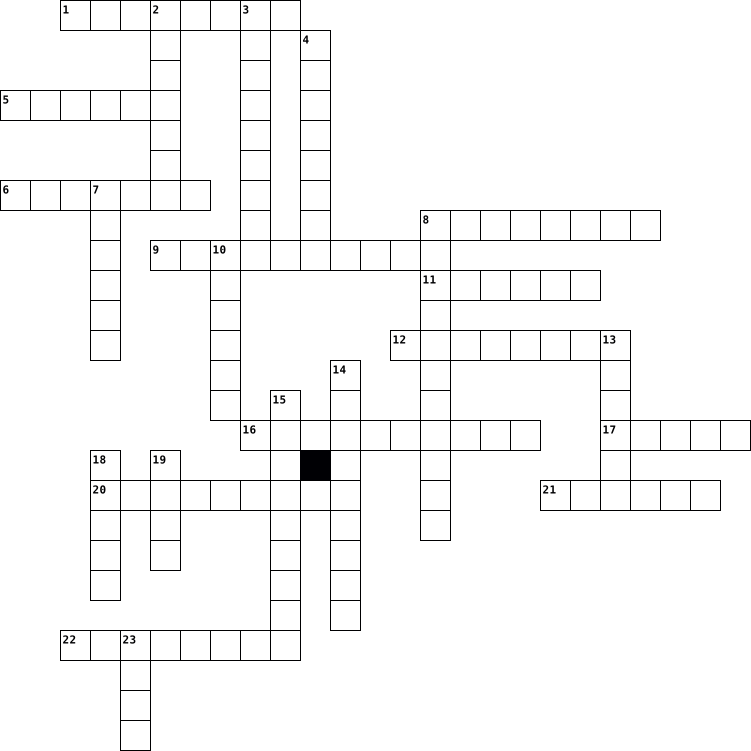
Across
- /an algebraic expression of the sum or the difference of two terms.
- /joined together especially in pairs
- /a numerical or constant quantity placed before and multiplying the variable in an algebraic expression.
- number /a number that can be expressed in the form a + bi, where a and b are real numbers
- /a single mathematical expression. It may be a single number (positive or negative), a single variable a letter.
- /Numbers that correspond to points on a graph in the form (x , y).
- /An expression is a sentence with a minimum of two numbers and at least one math operation.
- /Both capacity and volume are used to measure three-dimensional spaces.
- /a statement that the values of two mathematical expressions are equal
- /the branch of mathematics dealing with the relations of the sides and angles of triangles and with the relevant functions of any angles.
Down
- /The y-axis is the vertical number line on a rectangular coordinate system.
- /A sentence that states one expression is greater than or equal to, less than, less than or equal to another expression
- /a constant is a number on its own, or sometimes a letter such as a, b or c to stand for a fixed number.
- /The relationship between two sets (e.g., sets of numbers) in which each element of one set has one assigned element in the other set.
- /The number of times the base occurs as a factor.
- /A mathematical sentence
- /a symbol (usually a letter) standing in for an unknown numerical value in an equation.
- /The likelihood of an event happening.
- /The incline of a line, defined by the ratio of the change in units on the vertical axis to the change in one unit on the horizontal axis.
- /The x-axis is the horizontal number line on a rectangular coordinate system.
20 Clues: /A mathematical sentence • /joined together especially in pairs • /The likelihood of an event happening. • /The number of times the base occurs as a factor. • /Numbers that correspond to points on a graph in the form (x , y). • /an algebraic expression of the sum or the difference of two terms. • /a statement that the values of two mathematical expressions are equal • ...
Bridge Crossword Puzzle 2021-12-07

Across
- supported roadway on a bridge
- a force applied or distributed over an area
- a force that causes parts of a material to slide past one another in opposite directions
- Bridge a curved structure that converts the downward force of its own weight, and any weight pressing down on top of it, into an outward force along its side and base
- a rigid, usually horizontal, structural element
- a bridge or channel for conveying water, usually over long distances
- a change in shape from normal or desired
- to bend under compression
- the distance a bridge extends between two supports
- Bridge a simple type of bridge, composed of horizontal beams with vertical posts
- a stretching force that pulls on a material
Down
- A structure built over an obstacle, such as a river or a road.
- a push or pull; any action that tends to maintain or alter the position of a structure
- characteristic of a structure that collapses or deforms under a realistic load
- ability to resist collapse and deformation; stability (n.) characteristic of a structure that is able to carry a realistic load without collapsing or deforming significantly
- a vertical, structural element, strong in compression
- an action that twists a material
- (n) a structural support; (v) to strengthen and stiffen a structure to resist loads
- a rigid frame composed of short, straight pieces joined to form a series of triangles or other stable shapes
- a pressing force that squeezes things, or a thing, together
- weight distribution throughout a structure; loads caused by wind, earthquakes, and gravity, for example, affect how weight is distributed throughout a structure
- a device connecting two or more adjacent parts of a structure; a roller joint allows adjacent parts to move controllably past one another; a rigid joint prevents adjacent parts from moving or rotating past one another
- ability to resist deformation when subjected to a load
23 Clues: to bend under compression • supported roadway on a bridge • an action that twists a material • a change in shape from normal or desired • a force applied or distributed over an area • a stretching force that pulls on a material • a rigid, usually horizontal, structural element • the distance a bridge extends between two supports • ...
CROSSWORD PUZZLE 2019-09-21

Across
- the unit of plane angle adopted under the Systeme International d'Unites
- ratio of the length of the side opposite the given angle to the length of the hypotenuse of a right-angled triangle
- having a common boundary or edge
- the space between two lines or planes that intersect
- The circle whose center is at the origin and whose radius is one.
- a tiny slice of a circle
- ratio of the adjacent side to the hypotenuse of a right-angled triangle
- ratio of the adjacent to the opposite side of a right-angled triangle
- The part of a function that dictates the exact correspondence between the elements of one set and the elements of another set
- a function obtained by expressing the dependent variable of one function as the independent variable of another
- The set of all possible inputs of a function
Down
- The set of all possible outputs of a function.
- the vertical stretch of a function.
- lines representing undefined values for trigonometric functions.
- a line that touches a curve at only one point
- The positive acute angle formed between the terminal side of an angle and the x-axis.
- ratio of the hypotenuse to the opposite side of a right-angled triangle
- A function that repeats itself in regular intervals; it follows this equation: f (x + c) = f (x), where c is a constant
- of or relating to or according to the principles of trigonometry
- The repeating interval of a periodic function; the period of a function is a real number
- a branch of mathematics that studies relationships between side lengths and angles of triangles.
- an angle measured clockwise from due north to a vector.
- a straight line that intersects a curve at two or more points
- An operation that assigns a correspondence from elements of one set to elements of another set.
24 Clues: a tiny slice of a circle • having a common boundary or edge • the vertical stretch of a function. • The set of all possible inputs of a function • a line that touches a curve at only one point • The set of all possible outputs of a function. • the space between two lines or planes that intersect • an angle measured clockwise from due north to a vector. • ...
PT3 Math Crossword 2019-10-01

Across
- Find the highest Common Factor (HCF) of 24,36 and 72
- Refer to diagram , PQR and TUS are right angled triangles. Calculate the perimeter in cm of the shaded region.
- Refer diagram where it shows an object P with its image P’. the diagram applied a transformation of?
- Find the sum of the largest and the smallest integer of: 3,6,-2,0,-10
- Comparison of two numbers
- A polygon with 7 sides is known as?
- Badrul drives his car from town M to town N at a distance of 120km in 2 hours. Ahmad takes 30 minutes more than Badrul for the same journey. Calculate the average speed, in km/h, of Ahmad’s car.
- Find the Lowest Common Multiple (LCM) of 16 and 40
- Answer to a multiplication problem
- A student has rounded off 732 648 to the nearest ……… as she gets 733 000
Down
- It is given that m:n=2:7 and n-m=45
- Coordinates of P is (-4,-2) and coordinates of Q is (2,-2). Coordinates of midpoint of staright line PQ is (x,y). find value of x.
- The act of taking away one number from another
- How many multiples of 24 that are less than 100
- A box contains 6 apples, 4 mangoes and a number of oranges. A mango is chosen at random from the box. The probability of getting a mango is 2/9. Find the number of oranges in the box.
- Given (x+8)/2=9, find the value of x.
- A bag contains 40 blue cards, 24 yellow cards and 16 red cards. If a card is selected at random from the bag, find the probability that a red card is chosen.
- Based on the diagram ,if the volume is 20 cm2, find the height of the pyramid, in cm.
- Refer to table that shows the number of ferry passengers at Pulau Pangkor jetty in March. Calculate the median
- Another word for total
20 Clues: Another word for total • Comparison of two numbers • Answer to a multiplication problem • It is given that m:n=2:7 and n-m=45 • A polygon with 7 sides is known as? • Given (x+8)/2=9, find the value of x. • The act of taking away one number from another • How many multiples of 24 that are less than 100 • Find the Lowest Common Multiple (LCM) of 16 and 40 • ...
Pre-Cal Vocab 2013-02-18

Across
- The range is the set of all real numbers the function ƒ(x) takes on for allowed values of x.
- Horizontal shift for a periodic function.
- Circle of radius one unit whose center is at the origin of a rectangular coordinate system.
- If f(-x)=-f(x) for all x in its domain.
- The arc of the circle through which the terminal sides moves.
- The angle of less than 360 degrees that corresponds to an angle of over 360 degrees.
- A function that undoes another function.
- Value of x for which f(x)=0.
- When the terminal side is the x-axis or y-axis.
- An angle whose vertex lies at the center of the circle.
- The length of the vector.
- Solution of the equation f(x)=0.
- A unit of angle, equal to an angle at the center of a circle whose arc is equal in length to the radius.
- Region bounded by a central angle and the intercepted arc.
- The number of degrees taken to complete one cycle.
Down
- Triangles with no right angle.
- The distance to which a sinusoid rises and falls above and below its axis.
- If f(-x)=f(x) for all x in its domain.
- Every y-value coresponse to no more than one x-value.
- The domain is the set of all real numbers the independent variable x can take on.
- Two angles in standard position that have the same terminal side.
- Statement of equality between two expressions that is true for all values of the variable for which the expression is defined.
- The side that the measurement of an angle ends at.
- A line or curve that the graph of a relation approaches more and more closely the further the graph is followed.
- A direct line segment.
25 Clues: A direct line segment. • The length of the vector. • Value of x for which f(x)=0. • Triangles with no right angle. • Solution of the equation f(x)=0. • If f(-x)=f(x) for all x in its domain. • If f(-x)=-f(x) for all x in its domain. • A function that undoes another function. • Horizontal shift for a periodic function. • When the terminal side is the x-axis or y-axis. • ...
ALGEBRA FINAL 2013-05-23

Across
- . A polygon with six sides
- An assertion that can be proved true using the rules of logic. A theorem is proven from axioms, postulates, or other theorems already known to be true
- Straight up and down
- A polyhedron with eight faces
- The top part of a fraction
- An equation, graph, or data that can be modeled by a degree 2 polynomial
- A set of ordered pairs
- Corresponding in size or amount to something else
- Like a line. A description of any graph or data that can be modeled by a linear polynomial
- A geometric figure in three dimensions excluding interior points, if any
- A line segment between two points on the circle or sphere which passes through the center
Down
- The study of geometric figures in two dimensions (plane geometry) and three dimensions (solid geometry). It includes the study of points, lines, triangles, quadrilaterals, other polygons, circles, sp
- A polygon with seven sides
- Two distinct coplanar lines that do not intersect
- The product of a given integer and all smaller positive integers.
- Half a circle. That is, a 180°
- The result of dividing two numbers or expressions. For example, the 40 divided by 5 has a quotient of 8
- A mathematical sentence built from expressions using one or more of the symbols <, >, ≤, or ≥.
- A curve usually expressed in polar coordinates that resembles a figure eight.
- The mathematics of working with variables
- Another word for average. Mean almost always refers to arithmetic mean. In certain contexts, however, it could refer to the geometric mean, harmonic mean, or root mean square.
- The distance around the outside of a plane figure. For a polygon, the perimeter is the sum of the lengths of the sides.
- The part left over after long division
- The matrix formed by taking the transpose of the cofactor matrix of a given original matrix
24 Clues: Straight up and down • A set of ordered pairs • . A polygon with six sides • A polygon with seven sides • The top part of a fraction • A polyhedron with eight faces • Half a circle. That is, a 180° • The part left over after long division • The mathematics of working with variables • Two distinct coplanar lines that do not intersect • ...
lets test yo mine ? pre algebra 2013-05-09

Across
- can be measured by the number of cubic units needed to fill a space
- a ratio that compares a number to 100
- money a salesperson earns based on sales
- numbers that are expressed using Exponents are called
- a symbol that indicates a positive or a nonnegative square root
- to divide powers that have the same base, subtract their exponents. The base will remain the same
- closed figures formed by three or more lines segment called sides vertex
- to express fractions as percent and to solve percent problems
- is a product of the numerator of one fraction and the denominator of another fraction
- a ration of two quantities with different units
- the four divided number lines on a graph
- polygons with three sides and three angles
- a graph that shows the relationship between two sets of data
- to raise a power to a power multiply the exponents
- the number of times a base is used as a factor
Down
- an equation stagnating that two ratios are equivalent
- to multiply powers that have the same base, add their exponents. The base will remain the same
- exponent that are used to express a number less then one
- a four sided polygon
- one of two equal factors of a number
- is an equation of a form
- ordered pairs are graphed on
- opposite sides equal in length ; opposite sides parallel
- the relationship between the number of touchdowns and the number of points can be expressed by
- the two number lines intersect at the point where each line is zero
- the measure of the surface enclosed by a geometric figure
- starting amount of money
- money earned on a bank account or money paid toward a bank loan
- a comparison of two quantities by division
29 Clues: a four sided polygon • is an equation of a form • starting amount of money • ordered pairs are graphed on • one of two equal factors of a number • a ratio that compares a number to 100 • money a salesperson earns based on sales • the four divided number lines on a graph • a comparison of two quantities by division • polygons with three sides and three angles • ...
Math Terms 2013-09-16

Across
- Shows you how many times the number is to be used in a multiplication.
- Is used as a quick way of saying "square root".
- A point or dot used to separate the whole number part from the fractional part of a number.
- The result obtained by adding several quantities together and then dividing this total by the number of quantities.
- A 3-dimensional object shaped like a ball.
- A ruler with a sliding central strip, marked with logarithmic scales
- A symbol representing an unknown quantity.
- Are numbers you can multiply together to get another number.
- When two or more fractions have the same denominator.
- Mathematics.
- Is the study of 'Rates of Change'.
- To increase the amount, number, or degree of.
- Is a flat surface with no thickness. It extends forever
- A tool used to rule straight lines and measure distances.
- A point where two or more straight lines meet
- An exact location.
Down
- A line that just touches a curve at one point, without cutting across it.
- The part of mathematics in which letters and other general symbols.
- A closed figure consisting of three line segments linked end-to-end.
- A line bounding a plane figure.
- An instrument used in measuring or drawing angles
- Something used for making mathematical calculations.
- The longest side of a triangle.
- to draw out or lengthen, especially in time; extend the duration of; prolong.
- Special name given to triangles that tell how many sides (or angles) are equal.
- Is the highest (or lowest) value of a math function on an interval.
- A coordinate system in which the coordinates of a point are its distances from a set of perpendicular lines that intersect at an origin.
- The act of solving a problem.
- A long thin mark made by a pen, pencil, etc.
29 Clues: Mathematics. • An exact location. • The act of solving a problem. • A line bounding a plane figure. • The longest side of a triangle. • Is the study of 'Rates of Change'. • A 3-dimensional object shaped like a ball. • A symbol representing an unknown quantity. • A long thin mark made by a pen, pencil, etc. • To increase the amount, number, or degree of. • ...
BOWLING 2015-03-13

Across
- RETURN, The physical part of the equipment upon which the ball sits after being sent back to you after a delivery.
- LINE, The line that separates the approach area from the beginning of the playing surface.
- FIRST LAW OF MOTION, "An object in motion will remain in motion. An object at rest will remain at rest unless acted upon by an outside force.
- HUNDRED (300) GAME, A perfect game.
- FRAME, A frame having neither a spare or strike.
- Resetting the pins to a new full rack due to a perceived miss-spotting of one or more pins.
- PIN, The 5-pin. I
- Three consecutive strikes.
- To knock down the remaining pins standing left after the first throw with the second throw.
- Semicircular grooves or drop-off area on each side of the bowling surface.
- Crossing or touching the foul line at delivery.
- OF BOUNDS, An area from which the ball can't get to the pocket with its usual break.
- DECK, Area on which the pins are set.
Down
- SPINNER, A machine that is used to spin a ball in a container so that the user can apply ball polish or sand the ball down more quickly.
- THROUGH, What your arm does after the ball leaves your hand.
- An adjustment in scores in order to equalize competition by adding pins on a predetermined basis.
- Knocking down all 10 pins with the first effort.
- PIN, The 1 pin.
- OF GRAVITY, The heaviest part of a bowling ball.
- game of 200 or more.
- The triangles embedded on the lane used in aiming the throw.
- The space extending back from the foul line used to make the steps and delivery.
- Various combinations of pins standing after a first throw where one or more pins have been knocked down creating a space between standing pins and thus a harder spare
- PACK, Six strikes in a row.
- GAME, A game of all strikes--twelve strikes in a row--resulting in bowling's maximum score of 300.
- SECOND LAW OF MOTION , "The acceleration of an object is proportional to the force and inversely proportional to the mass acting on it.”
26 Clues: PIN, The 1 pin. • PIN, The 5-pin. I • game of 200 or more. • Three consecutive strikes. • PACK, Six strikes in a row. • HUNDRED (300) GAME, A perfect game. • DECK, Area on which the pins are set. • Crossing or touching the foul line at delivery. • Knocking down all 10 pins with the first effort. • OF GRAVITY, The heaviest part of a bowling ball. • ...
Pivot Point Chapter 10 Hairstyling (2) 2015-01-29
Across
- The ? of the curl will be determined by the diameter of the tool or pincurl.
- ? shapes or sections include circles, ovals and oblongs.
- ? are created using parallel curved distribution.
- With a square shape, the hair is usually distributed ? from the center of the shape.
- A center part on a round or square face will ? the roundness or squareness.
- As a general rule, ? parts work well with an oval face shape but not with a round, square or long, thin facial shape.
- ? are lines that subdivide shapes or sections to help distribute and control the hair.
- ? shapes have radial or parallel distribution.
- Correctly placed ? will enhance the appearance of your client's hairstyle.
- When two oblongs ?, they create an S shaped movement or a wave.
- Once straight or curved shapes have been sectioned, the hair can be set with rollers or pincurls to produce the final desired ?.
- Before beginning to set the hair, you'll need to subdivide the head into major areas or ?.
Down
- ? or shaping is the process of combing wet hair into the desired position.
- On a long face, a center part will ? the length.
- The most common ? shapes are the square, rectangle and triangle.
- A single ? creates a C shaped movement.
- ? shapes are used to move the hair in one direction, generally away from the face.
- A ? requires the use of radial distribution.
- An entire design or hairstyle will always be composed of some combination of ?.
- ? shapes have parallel distribution.
- ? and squares can be used with radial or parallel distribution.
- Subsections are often called ?.
- The ? is the hair between the scalp and the first turn around the roller, thermal iron or round brush.
- The ? base is the area between partings within a shape or, the section of hair on which the roller, thermal iron or round brush is placed.
24 Clues: Subsections are often called ?. • ? shapes have parallel distribution. • A single ? creates a C shaped movement. • A ? requires the use of radial distribution. • ? shapes have radial or parallel distribution. • On a long face, a center part will ? the length. • ? are created using parallel curved distribution. • ? shapes or sections include circles, ovals and oblongs. • ...
Math Rap 2014-06-08

Across
- of a function is the set of "input" or argument values for which the function is defined
- the principal or horizontal axis of a system of coordinates, points along which have a value of zero for all other coordinates.
- any mathematical condition relating each argument (input value) to the corresponding output value.
- all trigonometric functions have this graph shape
- As the x-values increase, the Y-values reach this.. sometimes in a graph
- The point at which two or more lines intersect
- a diagram showing the relation between variable quantities, typically of two variables, each measured along one of a pair of axes at right angles
- the distance between the curve and the line approaches zero as they tend to infinity.
- a whole number; a number that is not a fraction
- a graphs domain that goes on forever
- a numerical quantity that is not a whole number (e.g., 1/2, 0.5)
Down
- a set of values that show an exact position
- The y-value decreases as the x-value increases
- take away (a number or amount) from another to calculate the difference
- an arithmetical value, expressed by a word, symbol, or figure, representing a particular quantity and used in counting and making calculations and for showing order in a series or for identification
- the branch of mathematics dealing with the relations of the sides and angles of triangles and with the relevant functions of any angles
- y-value increases as the x-value increases
- often denoted by the letter m. The direction of a line is either increasing, decreasing, horizontal or vertical.
- the trigonometric function that is equal to the ratio of the side opposite a given angle (in a right triangle) to the hypotenuse.
- the secondary or vertical axis of a system of coordinates, points along which have a value of zero for all other coordinates.
20 Clues: a graphs domain that goes on forever • y-value increases as the x-value increases • a set of values that show an exact position • The y-value decreases as the x-value increases • The point at which two or more lines intersect • a whole number; a number that is not a fraction • all trigonometric functions have this graph shape • ...
Lydia Chapter 1 - Workplace Safety & Health Requirements 2016-04-07

Across
- and Rectangles - emergency and information signs
- rapidly
- in new personnel
- - Eliminating the hazard or physically removing it is the most effective hazard control.
- or Medium - it is likely that you need to take further steps to lower the risk
- - then your existing precautions are likely to be adequate
- Hazards - Occur when the type of work, body positions and working conditions put strain on your body.
- - mandatory action
- Hazards - dust created when using grinding machinery
- new processes or working practices
- - sign that provides information or instruction
- working with new substances
- Hazards - workshop's layout
- Controls - These do not eliminate hazards, but rather isolate people from hazards.
- Hazards - Occur due to improper handling of electrical equipment.
Down
- or moves premises
- Hazards - Occur when a worker is exposed to any chemical preparation in the workplace in any form (solid, liquid or gas).
- - prohibition
- - Involves replacing something that produces a hazard with something that does not produce a hazard.
- and Mechanical Hazards - Are factors within the environment that can harm the body without necessarily touching it.
- - prohibitions and instructions
- - your workshop
- an accident or near-miss
- - caution
- Controls - Administrative controls are changes to the way people work. Examples of administrative controls include procedure changes, employee training, and installation of signs and warning labels. Administrative controls do not remove hazards, but limit or prevent people's exposure to the hazards
- - positive action
- Protective Equipment - Ensuring workers use the PPE without risking their health. PPE is the least effective means of controlling hazards because of the high potential for damage to render PPE ineffective. Personal protective equipment(ppe)includes gloves, respirators, hard hats, safety glasses, high-visibility clothing, and safety footwear.
- Hazards - Associated with working with animals, people or infectious plant materials.
- - warnings
- Hazards - grinding
- Assessment if your business :
31 Clues: rapidly • - caution • - warnings • - prohibition • - your workshop • in new personnel • or moves premises • - positive action • - mandatory action • Hazards - grinding • an accident or near-miss • working with new substances • Hazards - workshop's layout • Assessment if your business : • - prohibitions and instructions • new processes or working practices • ...
Math 2023-10-26

Across
- The angle formed by the line of sight with the horizontal line when the object is below the horizontal level is known as the angle of ______.
- sin (90°-A) and cos A are ____ in value.
- The section in a co-ordinate plane formed by horizontal and vertical lines determing the postion of a point is called ________
- A linear equation in two variables has ______ many solutions.
- The measure (in degrees) of the angle of elevation of the top of the tower 75√3m high from a point at a distance of 75m from the foot of the tower in a horizontal plane is _______.
- The first and last terms of an A.P. are 1 and 11. If the sum of its terms is 36, then the number of terms (in words) will be ____.
- The quadratic equation 2x² -6x +17 has ___ roots.
- State whether true or false: A polynomial whose graph interests the x axis at one point has two zeroes.
- In △ABC, right angled at B, the value of sin(A + C) = ______ (in words).
- The graph of a linear equation is a ___ line.
Down
- If there are two separate circles drawn apart from each other, then the maximum number of common points they have (in words) are ______.
- A number that cannot be expressed as a fraction is known as a/an ________.
- Two figures with the same size and shape are said to be ___.
- State whsether true or false: 4 is the only root of the equation x² -20x +64.
- Tangent lines at the end points of a diameter are _______.
- The decimal expansion of the rational number ¹⁴⁵⁸⁷⁄₁₂₅₀ will terminate after ____ decimal place/places.
- How many two-digit numbers are divisible by three? (Provide your answer in words.)
- Another name for a co-ordinate plane is a ______ plane.
- What type of triangle is always similar to other triangles of its kind?
- A quadratic polynomial has at ___ two zeroes.
20 Clues: sin (90°-A) and cos A are ____ in value. • A quadratic polynomial has at ___ two zeroes. • The graph of a linear equation is a ___ line. • The quadratic equation 2x² -6x +17 has ___ roots. • Another name for a co-ordinate plane is a ______ plane. • Tangent lines at the end points of a diameter are _______. • ...
Do you know geometry? 2024-02-29

Across
- prism, has a lateral faces are all rectangles
- a polyhedron with four faces
- a quantity tat has both magnitude and direction
- form, the form of a vector that lists the vertical and horizontal change from the initial point to the terminal point
- cylinder, has a base that are aligned directly above one another
- right triangle, a 45 -45 -90 degree triangle or 30 -60- 90 degree triangle
- circles, two coplanar circles that intersect at exactly one point
- vector, represents the sum of two given vectors
- area, the total area of all faces and curved surfaces of a three-dimensional shape
- ratio, a ratio of two sides of a right triangle
- circles, coplanar circles with the came center
- of equations, a set of two or more equations that have two or more variables
Down
- transformation, see isometry
- perspective, a perspective drawing with two vanishing points
- of rotation, the point around which a figure is rotated
- of an angle, in a right triangle, the ratio of the length of the leg opposite the angle to the length of the hypotenuse
- a diagram of the faces of a three-dimensional figure
- the study of the properties of a geometric figure that do not change under stress
- of a cone, the flat circular surface of the cone
- cone, a cone where the altitude intersects the center of the base
- circle, a circle with a radius of one, centered at the origin
- pyramid, base is a regular polygon and whose lateral faces are congruent isosceles triangles
- of the cone, the point opposite the base of the cone
- a change in the position, size, or shape of a figure or graph
- a quantity that is completely expressed by its magnitude and has no direction
- polygon, a polygon whose sides are all tangent to the same circle
- tangent, a line that is tangent or two circles
- geometry, a system of geometry defined on a sphere
28 Clues: transformation, see isometry • a polyhedron with four faces • prism, has a lateral faces are all rectangles • tangent, a line that is tangent or two circles • circles, coplanar circles with the came center • a quantity tat has both magnitude and direction • vector, represents the sum of two given vectors • ratio, a ratio of two sides of a right triangle • ...
Monster high pip 2024-03-25

Across
- The environmentally friendly ghoul
- Freaky fabulous fashion designer
- The ghoul behind the ghostly gossip
- Daughter of the moth-man, from Boo Jersey
- Ghoulia's crush
- 13 wishes
- Frights, camera, action ghoul with blue hair
- The artist of "Love is like a storm tonight"
- Spider Ghoul
- The ghouls tried to find her the whole frights, camera, action movie.
- Headmistress of monster high
- Spectra's love interest from "Haunted"
- Lagoona's main love interest
- Looks like he's bringing you to flavortown
- Stubborn centaur and harpy fusion ghoul
- Daughter of the boogie man
- Frights, camera action ghoul with pink hair
- Perhaps Cleo's biggest enemy
- Vegan, short like baby yak
- Daughter of the Grim Reaper, helps the ghouls travel to the ghost world
- Torelai's white haired minion
- Chinese fire-breathing fashion-designing dragon
- One of Frankie's love triangles
- Frankie's other love triangle
- A fashion-designing skeleton from Hexico
- The Fearleading captain
- An anxious butterfly-skeleton fusion ghoul
Down
- The slyest kitty
- Torelai's black haired minion
- An easily distractable ghost-mermaid fusion ghoul
- Clumsy zombie-unicorn fusion manster
- Daughter of Victor Frankenstein
- Clawdeens big sister
- Draculaura's boyfriend and Clawdeen's brother
- The smartest ghoul in the whole school
- Who Cleo thought Deuce was cheating on her with
- The first crossover to ever after high
- French werecat
- Cold doesn't bother her anyway
- Daughter of Hexiciah Steam, Skulltimate Roller maze professional
- Cleo's boyfriend
- Clawdeen's younger sister
- Casketball player and performer of freak du chic
- That one mean vampire girl that's also friends with torelai
- Hypnotic vampire who breaks girl's hearts
- Australian ghoul
- Frankie's beastly crush
- Gargoyle chic
- Comet alien appearing in Boo York, Boo York
49 Clues: 13 wishes • Spider Ghoul • Gargoyle chic • French werecat • Ghoulia's crush • The slyest kitty • Cleo's boyfriend • Australian ghoul • Clawdeens big sister • Frankie's beastly crush • The Fearleading captain • Clawdeen's younger sister • Daughter of the boogie man • Vegan, short like baby yak • Headmistress of monster high • Lagoona's main love interest • Perhaps Cleo's biggest enemy • ...
Engineering 2024-05-30

Across
- An object will not change its motion unless acted on by an unbalanced force.
- The twisting force.
- What perspective drawing has 2 vanishing points on the horizon.
- The force that squeezes and pushes material inward.
- The bridge styles with interlocking triangles.
- What software allows for you to drawing in 3D.
- What is the aerodynamic principle of slowing something down.
- What is the aerodynamic principle of something being lifted up into the air and then staying there.
- The bridge style that consists of vertical piers and horizontal beams.
- What aircraft has no engine.
- A spilt level and high ranch home.
- What perspective drawing has 3 vanishing points.
- The force that is applied when two opposing forces act on the same point.
- A two-story home.
- The colors cyan,, magenta and yellow.
- The bridge style that has an abutment.
- Which Newton's Law is for every action, there is an equal and opposite reaction.
Down
- A farm ranch or 1.5 story home.
- What aircraft has an engine.
- A 2-D graph drawing that shows the basic layout of a property in scale.
- What product provides societal needs like occupancy and security while also providing historical memories.
- What drawing type displays three different views of an object?
- The colors orange, chartreus, green, spring green, azure, violet and rose.
- Which Newton's Law is force equals mass times acceleration.
- Scales used for drawing structures or buildings.
- A diagram styles that consists of roughly drawn bubbles connected by various line types.
- The colors red, green and blue
- What perspective drawing has 1 vanishing point.
- The force that pulls and stretches material in opposite directions.
- The bridge styles with cables stretching over two towers.
- What software allows for you to drawing in 2D.
- What is the aerodynamic principle of gravity pulling things down.
- What is the aerodynamic principle of something being thrusted up into the air.
- A one-story home.
34 Clues: A two-story home. • A one-story home. • The twisting force. • What aircraft has an engine. • What aircraft has no engine. • The colors red, green and blue • A farm ranch or 1.5 story home. • A spilt level and high ranch home. • The colors cyan,, magenta and yellow. • The bridge style that has an abutment. • The bridge styles with interlocking triangles. • ...
Math 2024-06-13

Across
- everyone's favorite calculus unit
- never ending
- goat
- 8th derivative of position
- implies continuity
- where the mailman's body is decomposing
- totally copied taylor
- best subject
- finding max/min
- sandwich theorem
- unknown or changing
- A,B,C,or D?
- someone who dislikes calculus?
- has a method and a number (and a formula, equation, identity...)
- italian mathematician who adopted a french name, what an error
- add
- there are two of them in this class
- ?
- what one might do for a loan (sp?) or a trig function
- the dog that knows calculus
- antiderivative of secxtanx
- here
- have 3d fields
- the study of triangles and somehow circles?
- antiderivative of position
- how the series test was curved
- t
- rude integrals?
- rates of change
Down
- amount of change
- derivative of acceleration
- your ap score
- differentiation technique
- are volume and time cousins?
- prove existence of a max theorem
- the foundational concept of calculus
- least nice theorem
- the most important rule of calculus
- integration technique for products
- one of 6 on the exam
- coordinate system a bear might use
- rotational or cross-sectional
- one output per input
- maxima and minima, collectively
- NYTimes-provided morning class activity
- mascot
- + - + -
- _____ series
- when a limit equals a function value
- don't forget it
- nickname of jaime escalante
- -1derivative of cosine
- inverses of exponential functions
- go off on a
- discovered a way to evaluate indeterminate limits
- one of the fathers of calculus
- comparison, alternating, limit comparison, etc
- lodihi...
- test for determining radius of convergence
- one of the fathers of calculus
- *remember your "-cises"
- there are two of them in this class
- the study of change
- derivative at a point
- what you need when life gets tough
- large italian people are known to consume
66 Clues: ? • t • add • goat • here • mascot • + - + - • lodihi... • A,B,C,or D? • go off on a • never ending • best subject • _____ series • your ap score • have 3d fields • finding max/min • don't forget it • rude integrals? • rates of change • amount of change • sandwich theorem • implies continuity • least nice theorem • unknown or changing • the study of change • one of 6 on the exam • one output per input • totally copied taylor • ...
Flags 2022-08-23

Across
- horizontal stripes of blue, thin white, red, thin white, and blue; on the left is a white circle with a red star in the center
- 14 alternating red and white stripes and a blue rectangle on the top-left with a moon and a 14-point star
- three horizontal stripes of orange, white, and green, and navy blue wheel in the center
- red flag and white flower with 5 petals in the center
- dark green flag with a red circle at the center
- red flag with yellow star in the center
- red with a large star in the top-left and four smaller stars on the right of the big star
- white flag with two horizontal blue stripes and a 6-point star
- yellow and green rectangle on the left and a maroon rectangle on the right with a golden lion with sword
- one black and one white diagonal stripes, and a central red and yellow coat of arms
- five horizontal stripes of red, white, blue, white and red
- red flag with a blue border around two connected triangles
Down
- two horizontal stripes with red and white, and a white crescent moon beside 5 white stars on the top-left
- white flag, a red and blue circle in the center, and four black trigrams in each corner of the flag
- horizontal stripes of blue and red, and a white triangle on the left with a sun and three stars
- horizontal stripes of yellow, green, and red with a white star in the center
- two horizontal stripes of red and white
- white flag with a red circle at the center
- three horizontal stripes of blue, red, and blue, with a white circle in the centre
- three horizontal stripes of blue, red, and blue, and white temple in the center
20 Clues: two horizontal stripes of red and white • red flag with yellow star in the center • white flag with a red circle at the center • dark green flag with a red circle at the center • red flag and white flower with 5 petals in the center • five horizontal stripes of red, white, blue, white and red • red flag with a blue border around two connected triangles • ...
Geometry cross word 2022-05-26

Across
- Only 3D shape that doesn't have a lateral area. Uses 4/3πr³ to find the volume.
- Uses πrl for lateral area. For volume it uses ⅓ πr²h
- Only has one base, and all triangles come from each edge that connect at one point at the top. To find the lateral area use
- Used to calculate the area of a circle. Has an infinite number of digits.
- Its the incline from a horizontal or vertical line; slant up or down. To find it use rise over run.
- Is a 3D shape with 6 faces. All faces are squares.
- the trigonometric function is equal to the ratio of the side opposite a given angle (in a right triangle) to the hypotenuse. Opposite over hypotenuse.
- the trigonometric function that is equal to the ratio of the side adjacent to an acute angle (in a right-angled triangle) to the hypotenuse. Adjacent over hypotenuse
- A straight line or plane that touches a curve or curved surface at a point, but if extended does not cross it at that point. Always creates a right angle.
- It is a 2D shape. Only has 3 sides.
- The area of all the side except for the base. Doesn’t include the base.
Down
- Uses ph to find the lateral area. Has two bases
- Two circle bases. Has a volume formula of πr²h.
- The distance around the edge of a shape. Uses addition
- The area of all the sides of a 3D figure. Includes the base.
- Has a single circle base. Has 1/3 of the room of a cylinders.
- The intersection point of two sides of a plane figure. The highest point; the top or apex.
- a polygon with 5 sides. Also has 5 angles
- the amount of space within the perimeter of a 2D shape. Uses multiplication.
- the amount of space that a substance or object occupies. The amount of space inside an enclosed area
20 Clues: It is a 2D shape. Only has 3 sides. • a polygon with 5 sides. Also has 5 angles • Uses ph to find the lateral area. Has two bases • Two circle bases. Has a volume formula of πr²h. • Is a 3D shape with 6 faces. All faces are squares. • Uses πrl for lateral area. For volume it uses ⅓ πr²h • The distance around the edge of a shape. Uses addition • ...
Geometry 2025-04-23

Across
- the midpoint of the diameter of the circle.
- Changes the size of a figure but does not change it’s shape which mean it change size but not shape.
- A mirror image of the shape or known as a flip.
- straight line segment that passes through the centre of the circle and whose endpoints lie on the circle.
- the part or segment of the circumference of a circle.
- the point that divides the segment into two equal parts, effectively placing it exactly halfway.
- calculating area, perimeter, volume, and other properties of shapes.
- a straight line segment connecting two points on the circumference of a circle.
- Movement of a figure from one position to another on a plane without changing its size or shape.
Down
- a way, especially one of several possible variations, in which a set or number of things can be ordered or arranged.
- have the same shape and size or are the same.
- a set of points, such that for any point of the set the distance to a fixed point , the focus, is equal to the distance to a fixed line.
- a point that marks the end of a line segment or the starting point of a ray.
- a straight line segment that connects the center of a circle or sphere to any point on its circumference or surface.
- Transformation that turns a figure around a fixed point called the center of rotation.
- shapes are the points where two or more line segments or edges meet
- a way of selecting items from a set where the order of selection doesn't matter.
- a statement or an educated guess about a geometric property or relationship that is believed to be true but has not yet been proven.
- A mnemonic device used to remember the trigonometric ratios in right triangles
- a part of a circle made of the arc of the circle along with its two radii.
20 Clues: the midpoint of the diameter of the circle. • have the same shape and size or are the same. • A mirror image of the shape or known as a flip. • the part or segment of the circumference of a circle. • shapes are the points where two or more line segments or edges meet • calculating area, perimeter, volume, and other properties of shapes. • ...
Our vocabulary words 2025-09-30

Across
- a document or other record of past events created by someone who was present during the events or the time period in which they occured
- someone who searches for information on a particular sight
- the laws and regulations that determine how problems can be solved in response to social issues
- a close estimate
- the characteristics of an object’s surface that can be identified by feeling or viewing it
- an expert who studies the past by examining objects
- the position that researchers take about a particular based on the evidence they have gathered
- relating to a ceremony,such as a religious ceremony
- in history,the process of exploring the answers to questions about a certain time and place
- a personal leaning or a preference for a particular outlook
- a document or record of past events created by someone who was not present during the events or the time period in which they occurred
- an important part or characteristic of something
Down
- all of the physical surroundings,including land,water,animals,plants,and climate
- information that can be used to prove a statement or support a conclusion
- having a form composed of one or a number of simple shapes such as triangles,squares,or circles
- before written history
- an expert who studies and creates maps of Earths natural and human made features
- a question that does not have a simple or direct answer and requires some thought and investigation to answer
- an object made or used by people in the past
- a question that has a concrete answer based on factual information that can be researched and proven; supporting questions will help answer compelling questions
- to make sure or certian
- a written work that contains important information
- an expert who studies and records the past
23 Clues: a close estimate • before written history • to make sure or certian • an expert who studies and records the past • an object made or used by people in the past • an important part or characteristic of something • a written work that contains important information • an expert who studies the past by examining objects • relating to a ceremony,such as a religious ceremony • ...
7th. Danger! This Mission to Mars Could Bore You to Death! 2026-03-19

Across
- —a serious attempt to do something hard. SYNONYMS: effort, attempt, mission. ñ: esfuerzo / empresa
- —something that causes a reaction in a living thing. SYNONYMS: trigger, signal, prompt. ñ: estímulo
- —reminding you of something from the past. SYNONYMS: similar to, suggestive of, like. ñ: reminiscente / que recuerda a
- —painfully; to an extreme and unbearable degree. SYNONYMS: painfully, terribly, agonizingly. ñ: dolorosamente / de manera insoportable
- —in a panicked, desperate, or rushed way. SYNONYMS: desperately, wildly, urgently. ñ: frenéticamente / desesperadamente
- —a tiny single-celled creature that changes shape to move. SYNONYMS: microorganism, single-celled organism. ñ: ameba
- —has a connection or relationship with something else. SYNONYMS: connects, links, relates. ñ: se correlaciona / está relacionado
- —naturally part of something; always there. SYNONYMS: built-in, natural, inborn. ñ: inherente / propio
- —lasting a long time or happening again and again. SYNONYMS: ongoing, constant, persistent. ñ: crónico
- —related to thinking and mental processes. SYNONYMS: mental, intellectual, thinking. ñ: cognitivo
Down
- —done without being fully aware of it. SYNONYMS: unknowingly, automatically, instinctively. ñ: subconscientemente / sin darse cuenta
- —being kept in a small or limited space. SYNONYMS: imprisonment, isolation, restriction. ñ: confinamiento / encierro
- —extremely tiring and hard to endure. SYNONYMS: exhausting, brutal, punishing. ñ: agotador / extenuante
- —something notable that happens or is observed. SYNONYMS: event, occurrence, marvel. ñ: fenómeno
- —relating to a dome-shaped structure built from triangles. SYNONYMS: curved, dome-shaped. ñ: geodésico
- —to push or drive something forward with force. SYNONYMS: launch, thrust, drive. ñ: propulsar / empujar
- —a scary or threatening possibility; also means ghost. SYNONYMS: ghost, threat, shadow. ñ: espectro / fantasma
- —in a wild, uncontrolled, or frantic way. SYNONYMS: frantically, wildly, obsessively. ñ: frenéticamente / maníacamente
- —confused and unable to think clearly. SYNONYMS: confused, puzzled, disoriented. ñ: confundido / aturdido
- —dull sameness; no change or variety. SYNONYMS: boredom, repetition, routine. ñ: monotonía
20 Clues: —dull sameness; no change or variety. SYNONYMS: boredom, repetition, routine. ñ: monotonía • —something notable that happens or is observed. SYNONYMS: event, occurrence, marvel. ñ: fenómeno • —related to thinking and mental processes. SYNONYMS: mental, intellectual, thinking. ñ: cognitivo • ...
Math Vocab Crossword 2026-01-20

Across
- The point where a graph’s line crosses through the y-axis
- notation A way to write decimal numbers as a simple number and an exponent
- numbers Any number that can’t be expressed as a fraction
- Type of number that can be written as a fraction
- Starting value of a function
- A device that does helps you do math
- The measure of a three-dimensional shape
- plots A graph which values of two variables are plotted on two axes
- Numbers that are above zero
- of change This shows how one number changes as another number changes
- Plot points that are in a straight line are _____
- The answer you get after using an operation on an input
- Plot points that are NOT in a straight line are _____
Down
- A number that can be positive or negative or 0
- A figure that you put points on and it extends forever
- theorem An operation to solve right triangles
- root A number when multiplied by itself twice equals the same number
- A number that shows how many times to multiply the base by that number
- value The starting point of a function
- A part of a whole
- A chart that shows the inputs turning into outputs
- The measurement inside a shape
- The length of a line going through a circle
- root A number when multiplied by itself three twice equals the same number
- To try and guess the value of a number
- relationship Two numbers that change at the same rate
- Numbers that are below zero
- A rule that uses an input and uses an operation for only one output
- The number that measures a line’s steepness
- square Number gotten from multiplying a number by itself
30 Clues: A part of a whole • Numbers that are above zero • Numbers that are below zero • Starting value of a function • The measurement inside a shape • A device that does helps you do math • value The starting point of a function • To try and guess the value of a number • The measure of a three-dimensional shape • The length of a line going through a circle • ...
Mother Day Crossword 2026-05-10

Across
- mom and dad’s OG lovie pack
- a red seasonal soda
- device for catching small deposits of calcium oxalate
- you have to talk with a twang when you make this kind of cake
- the name of Nan and Pa’s boat
- a fundamental geometry theorem of right triangles
- handheld simple machine that wedges open insect housing
- place to jump off rocks
- long 2 adjectives to describe chum’s arm
- initials to describe a point in the process of making a pioneer hairstyle
- a dry heat bath
- small vessel for riding swift waters
- spice used in an elite Finnish bread
- this kind of mother makes us do shoe jobs
- superhuman power mom experienced as a child
- Moms favorite band from the 90s
Down
- mom’s preferred method of winter skiing
- the inanimate object mom and dad refer to each other as
- wind instrument mom plays
- the ingredient in making a fire that you need to burn in order to burn more of said thing
- a word often used to describe the raging, turbulent sea by Addie
- a semi-permanent canvas structure
- number code associated with dad’s break from work
- a building eatableshmemt whose colloquial name got longer whenever you drove by it
- turkey sandwich from gerb to gerb with smashed avocado
- appetizer eaten biannually while watching religious leaders
- Ellie has one of these
- sport named after a popular condiment
- once you're in — you're in
- a to-scale extraterrestrial body owned by an elp
- literally tryna
- platonic shape containing 20 faces (commonly found in a magic 8 ball)
- word periodically banned from speech by your oldest grandchild
- it's time to grind some ______
- bird after which dad’s spoon works are named
- mom’s fancy ballet workout
36 Clues: literally tryna • a dry heat bath • a red seasonal soda • Ellie has one of these • place to jump off rocks • wind instrument mom plays • once you're in — you're in • mom’s fancy ballet workout • mom and dad’s OG lovie pack • the name of Nan and Pa’s boat • it's time to grind some ______ • Moms favorite band from the 90s • a semi-permanent canvas structure • ...
Geometry Spring 2026 2026-05-11

Across
- This Law is used to solve for sides in a non-right triangle.
- Represents the adjacent over the hypotenuse in a right triangle.
- Name for part of the area of a circle (not the whole circle). It's like a pizza slice.
- Property that says, if A=B and B=C, then A=C.
- Name of chicken fast food restaurant where you can order "The Caniac Combo".
- In a circle, the measure of the inscribed angle is _________ the intercepted arc.
- Last name of the actor in the lead male role in Project Hail Mary.
- This is Steven Spielberg's first major blockbuster from 1975.
- In probability, this is the operation used when you have the intersection of two events.
- Scrumptious cookie brand where the company releases new flavors that rotate week to week.
- Heya...let's see who's here ________!
- Just think...24 hours from now, we'll be staring at ________.
Down
- This Vancouver mathketball team is the one Mr. Carnes used to play for.
- Number of sides in a heptagon.
- A __________ arc has a measure less than 180 degrees.
- Type of transformation where the size of the shape changes by multiplying or dividing.
- Abbreviation for the Side-Angle-Side Congruence Theorem.
- Dave Portnoy, the owner of Barstool Sports, does these types of food reviews.
- The other course Mr. Carnes currently teaches.
- Term used for a segment or line that skims a circle at one point.
- Last name of the genius movie director who's releasing The Odyssey this summer.
- The Pythagorean Theorem only applies to ________ triangles.
- Last name of the GOAT of the NBA.
- Mr. Carnes favorite band is ________ Bridge.
- Number that represents the circumference divided by the diameter in any circle.
- Mr. Carnes brought donuts in from The ______ Batter shop.
- Mr. Carnes uses a Homework _____ to help him to decide when to check homework.
27 Clues: Number of sides in a heptagon. • Last name of the GOAT of the NBA. • Heya...let's see who's here ________! • Mr. Carnes favorite band is ________ Bridge. • Property that says, if A=B and B=C, then A=C. • The other course Mr. Carnes currently teaches. • A __________ arc has a measure less than 180 degrees. • Abbreviation for the Side-Angle-Side Congruence Theorem. • ...
Shapes 2023-06-12

Across
- It's the shape of multiple triangles meeting. You can find it in Christmas tree decorations and decorations.
- Closed curves with the same distance from the center to all points. You can find it in many things, such as wheels, coins, and the sun.
- a shape that symbolizes love, in which two semicircles meet and a V-shape below. You can see it a lot on cards and gift wrapping paper.
- a closed curve with more than three sides. Complex shapes belong to this. For example, you can see it in the shape of a petal or on a road signs.
- shaped by slightly extending or spreading one side of the circle. You can find it in eggs and balls.
Down
- all three sides are straight. It's a pretty shape that you can see at the vertex of a mountain or figure.
- all four sides are right angles, shaped equal in width and height. This shape is often seen around books, windows, doors, etc.
- A pair of parallel sides of a rectangle. This shape mainly has the shape of a bridge.
8 Clues: A pair of parallel sides of a rectangle. This shape mainly has the shape of a bridge. • shaped by slightly extending or spreading one side of the circle. You can find it in eggs and balls. • all three sides are straight. It's a pretty shape that you can see at the vertex of a mountain or figure. • ...
Mathematics Crossword Puzzle 2021-02-10

Across
- a process or set of rules to be followed in calculations or other problem-solving operations, especially by a computer
- the continuous line forming the boundary of a closed geometrical figure
- the branch of mathematics dealing with the properties and manipulation of numbers.
- the extent to which an event is likely to occur, measured by the ratio of the favourable cases to the whole number of cases possible
- a rule in algebra or other branches of mathematics expressed by symbols or formulae
- the value that occurs most frequently in a given set of data
- Angle of __________ denotes the angle from the horizontal downward to an object
- Father or Founder of Geometry
Down
- an expression of more than two algebraic terms, especially the sum of several terms that contain different powers of the same variable(s)
- a straight line or plane that touches a curve or curved surface at a point, but if extended does not cross it at that point
- the branch of mathematics dealing with the relations of the sides and angles of triangles and with the relevant functions of any angles.
- any of the more or less distinct parts into which something is or may be divided or from which it is made up
- the amount of space that a substance or object occupies, or that is enclosed within a container.
- denoting or relating to a value or quantity lying at the midpoint of a frequency distribution of observed values or quantities, such that there is an equal probability of falling above or below it
14 Clues: Father or Founder of Geometry • the value that occurs most frequently in a given set of data • the continuous line forming the boundary of a closed geometrical figure • Angle of __________ denotes the angle from the horizontal downward to an object • the branch of mathematics dealing with the properties and manipulation of numbers. • ...
2D Motion 2023-10-24

Across
- an object that is thrown or launched into the air with a particular initial velocity and follows a curved path under the action of gravity.
- a symmetrical open plane curve formed by the intersection of a cone with a plane parallel to its side. The path of a projectile under the influence of gravity ideally follows a parabolic trajectory.
- the rate at which an object changes its velocity. It is a vector quantity, meaning it has both magnitude and direction.
Down
- a branch of mathematics that deals with the relationships between the sides and angles of triangles and the calculations based on them.
- the size or extent of something, usually measured in terms of length, area, or volume.
5 Clues: the size or extent of something, usually measured in terms of length, area, or volume. • the rate at which an object changes its velocity. It is a vector quantity, meaning it has both magnitude and direction. • a branch of mathematics that deals with the relationships between the sides and angles of triangles and the calculations based on them. • ...
News Paper Letter issue #5 2026-05-11

Across
- The process of cell division where a single eukaryotic cell splits its replicated chromosomes to produce two genetically identical daughter cells.
- A musical symbol placed at the beginning of a staff to indicate higher-pitched notes. (2 words)
- The type of chemical bond formed through the electrostatic attraction between oppositely charged ions, created when a metal transfers electrons to a non-metal.
- Changes color when added to a solution to determine its acidity or basicity. (2 words)
- The formal process by which a legislative body (such as the U.S. House of Representatives) accuses a public official, including the President, Vice President, or federal judges.
Down
- Fundamental principles stating that certain measurable, scalar, or vector properties of an isolated system remain constant as the system evolves over time, meaning they cannot be created or destroyed. (3 words)
- A visual representation of data or relationships, commonly used to show how variables change or to model connections between objects.
- The psychological theory focusing on observable, measurable behaviors rather than internal mental states, positing that all behaviors are acquired through environmental conditioning.
- The branch of mathematics studying relationships between the side lengths and angles of triangles.
- The unspoken or less obvious meaning hidden beneath the surface of dialogue, actions, or written text.
10 Clues: Changes color when added to a solution to determine its acidity or basicity. (2 words) • A musical symbol placed at the beginning of a staff to indicate higher-pitched notes. (2 words) • The branch of mathematics studying relationships between the side lengths and angles of triangles. • ...
Game on! 2025-03-31

Across
- a picture stuck onto wood or cardboard and cut into pieces of different shapes that must be joined together correctly to form the picture again
- a game in which small, thin objects with a sharp point that is thrown by handare at a circular board
- a game for two people in which you throw dice and move circular pieces around a special board with a pattern of narrow triangles
- a game played by two people on a square board, in which each player has 16 pieces that can be moved on the board in different ways
Down
- a game played by two people on a table covered in soft cloth, in which a cue (= a long stick) is used to hit balls against each other and into pockets around the table
- a game using small, rectangular objects with dots on it
- a children's game in which small, round glass balls are rolled along the floor
- a game played on a board covered in squares in which players win points by creating words from letters with different values and connecting these words with ones already on the board
8 Clues: a game using small, rectangular objects with dots on it • a children's game in which small, round glass balls are rolled along the floor • a game in which small, thin objects with a sharp point that is thrown by handare at a circular board • ...
lalala 2012-08-23

Across
- 12. An important feature of a parabola is that it is symmetric about a vertical line called axis of ___________.
- 27. In the __________ system, measuring angles is based on the relation between the radius and the circumference of a circle.
- 15. If a polynomial f(x) is divided by x – c, the remainder is equal to f(c) , this is called _________________ theorem
- 20. It is the exponent of the power of the base that is equal to the number.
- 38. It is a subset of r elements selected out of n distinct elements without regard to order.
- 37. It is the arrangement of n objects in a definite order.
- 17. If f(-x) = -f(x), the curve is symmetric through the origin; it is an _____ function
- 34. The sine and cosine functions are called?
- 10. A function defined by a polynomial expression of degree 2 is referred to as a ____________ function in x.
- 19. ________________ function – is a function of the form y=ax where a is a fixed number, a > 0 and x is any real number
- 23. Logarithm of a _________ of a number is the product of the exponent and the logarithm of the number.
- 32. The distance that one graph must be shifted to the left to coincide with another graph is called _______ shift
- 9. Two distinct line with equal slopes are ________
- 8. A line has a __________ slope if it falls from left to right
- 35. When 2 sides of a triangle and an angle opposite one of them are unknown, the law of sines can be used to solve the triangle. However, there may be more than one solution. This is known as the ________________ case
- 5. ________ function is a function whose graph is a straight line
- 31. _________ functions are useful in many practical applications, especially in electrical engineering, physics, and economics.
- 25. Is the figure formed by the rotation of the ray around its point
- 7. A line has s ____ slope if its parallel to the x-axis
- 30. _____ circle is a circle drawn on a rectangular coordinate plane with center at the origin and with a radius one unit long
Down
- 39. The product of consecutive number from one to n denoted by n! is commonly known as __________
- 4. A relation in which every abscissa is associated to exactly one ordinate
- 2. The set of all the first members/coordinates of the ordered pairs
- 14. A shorter and simpler method of dividing a polynomial by binomial in the form x – r is called _______ Division
- 26. In ___________ system, an angle is measured by the number of revolution or fractions of a revolution made by terminal side in relation to the initial side.
- 18. A __________ or related angle for an angle is the positive acute angle made by the terminal side of an angle and the x-axis.
- 32. The distance that one graph must be shifted to the left to coincide with another graph is called _______ shift
- 24. Is a branch of mathematics which deals with the properties and application of particular ratios associated with angles known as circular functions
- 1. It is a set of ordered pairs
- 16. It is called ______________ theorem if a polynomial f(x) has a factor x – c if and only if f(c) = 0
- 28. Angles which have the same initial sides and the same terminal side are called __________ angles
- 29. Angles in standard position having their terminal side along the x-axis or y-axis are called _______________ angles
- 3. The set of all second members/coordinates of the ordered pairs
- 40. The ___________ function is not defined for all real number and its graph is not like the graphs of the sine and cosine functions
- 11. Graph of a quadratic function
- 13. Turning point of a parabola
- 22. Logarithm of a _________ is the difference of the logarithms of the factors
- 6. Is a numerical measure of the steepness of a line with respect to the x-axis
- 36. A second property of triangles that is important in solving oblique triangles is called law of ___________
- 21. Logarithm of a _________ is the sum of the logarithms of the factors
40 Clues: 1. It is a set of ordered pairs • 13. Turning point of a parabola • 11. Graph of a quadratic function • 34. The sine and cosine functions are called? • 9. Two distinct line with equal slopes are ________ • 7. A line has s ____ slope if its parallel to the x-axis • 37. It is the arrangement of n objects in a definite order. • ...
Famous landmarks 2023-07-18

Across
- Mahal A beautiful white marble building in India that was built as a monument of love by a king for his wife.
- Wall of China A very long wall in China built a long time ago to protect the country from invaders.
- Everest The highest mountain in the world, located in the Himalayas between Nepal and China.
- of Egypt Huge structures in Egypt made of stone, shaped like triangles, and built as tombs for ancient pharaohs.
- Tower A tall iron tower in Paris, France, that is a famous symbol of the city and offers a great view from the top.
- An ancient amphitheater in Rome, Italy, where gladiator fights and other events used to take place.
- Ben A famous clock tower in London that tells the time and is one of the city's iconic landmarks.
Down
- Picchu An ancient Inca city in Peru, high in the mountains, known for its remarkable stone buildings and beautiful views.
- A hill in Athens, Greece, with ancient ruins including the Parthenon, which was a temple dedicated to the goddess Athena. Louvre A famous museum in Paris that houses many famous artworks, including the Mona Lisa.
- A mysterious circle of big stones in England that was built a long time ago and its purpose is still unknown.
10 Clues: Everest The highest mountain in the world, located in the Himalayas between Nepal and China. • Ben A famous clock tower in London that tells the time and is one of the city's iconic landmarks. • Wall of China A very long wall in China built a long time ago to protect the country from invaders. • ...
Elements of Art and Principles of Design 2026-04-16

Across
- The area around, within, or between objects. Artists show space using overlap, size change, placement, and perspective
- How visual weight is arranged. Balance can be symmetrical, asymmetrical, or radial.
- How something feels or looks like it would feel. Texture can be actual (real) or implied (drawn to look textured).
- Making one part of an artwork stand out. The emphasized area becomes the focal point the viewer notices first.
- The difference between elements (light vs. dark, rough vs. smooth, big vs. small). Contrast helps parts of an artwork look clearly different from each other.
- When all parts of the artwork look like they belong together. Unity makes a composition feel complete and harmonious.
- A 3D object that has height, width, and depth. Forms can be geometric or organic and appear in both sculptures and drawings that look 3-dimensional.
Down
- The lightness or darkness of a color. Artists use value to show depth, create shadows, and make shapes look 3-dimensional.
- A flat, enclosed area created by a line. Shapes can be geometric (circles, squares, triangles) or organic (free-form shapes).
- How the viewer’s eye travels through the artwork. Artists use lines, shapes, and placement to guide the eye.
- A repeated line, shape, or color used to create or decoration or unity in an artwork.
- A mark made by a pointed tool. Lines can be long, short, thick, thin, straight, curved, zigzag, or implied.
- The visual quality created by light. Color includes hue, value (light/dark), and intensity (brightness).
- A visual beat created by repeating elements with small changes. It makes the artwork feel active or flowing.
14 Clues: How visual weight is arranged. Balance can be symmetrical, asymmetrical, or radial. • A repeated line, shape, or color used to create or decoration or unity in an artwork. • The visual quality created by light. Color includes hue, value (light/dark), and intensity (brightness). • ...
Systems 1 Crossword 2023-05-02

Across
- conversations during counseling sessions in which two or more family members talk directly with each other—rather than to the counselor—about household events and interactions.
- occurs when the anxiety in a dyad is relieved by involving a third party who either takes sides or provides a detour for the anxiety.
- statements that allow the client the opportunity to expand on an idea or select a topic for discussion.
- when the listener withdraws from their partner by shutting down and closing himself or herself off from the other person.
- the emotional merging of family members, so that the children may not mature, separate, or have individuality from the parents becomes difficult
Down
- bind, a situation in which an individual receives conflicting messages from another person.
- to manipulate another person into doubting his or her experiences or understanding of something.
- Cutoff, emotional distancing—often in an extreme manner, regardless of whether the it takes the form of internal means or actual physical detachment
- perhaps one of the most important concepts in establishing a therapeutic relationship with a client.. the ability of one person to put themselves in the shoes of another.
- a concept which identifies dividers that are present between family subsystems. They are set by the implicit rules defining who participates, and how, within each subsystem.
10 Clues: bind, a situation in which an individual receives conflicting messages from another person. • to manipulate another person into doubting his or her experiences or understanding of something. • statements that allow the client the opportunity to expand on an idea or select a topic for discussion. • ...
Science Crossword 2023-01-20

Across
- - The variety of life on earth, including the variety of species, ecosystems, and genetic variation within species.
- - The branch of physics that deals with the relationships between heat, energy, and work, and the laws that govern these interactions.
- - The process by which autotrophic organisms convert light energy into chemical energy in the form of glucose and other organic compounds.
- - The branch of biology that deals with the structure and organization of living organisms, including the relationships between different parts of the body and their functions.
Down
- - A branch of mathematics that deals with the relationships between the sides and angles of triangles, and the calculations based on them.
- - Energy of motion, it is the energy that an object possesses because of its motion.
- - The branch of science that deals with the study of the earth's surface, including the physical features of the land and water, the distribution of plant and animal life, and the patterns of human activity and settlement.
- - The process of gradual change in the inherited characteristics of biological populations over successive generations.
- - Genetic material that carries the instructions for the development and function of all living organisms.
- - The branch of science that deals with the properties of matter and energy, and the fundamental laws that govern the behavior of the physical universe.
10 Clues: - Energy of motion, it is the energy that an object possesses because of its motion. • - Genetic material that carries the instructions for the development and function of all living organisms. • - The variety of life on earth, including the variety of species, ecosystems, and genetic variation within species. • ...
Famous landmarks 2023-07-18

Across
- A hill in Athens, Greece, with ancient ruins including the Parthenon, which was a temple dedicated to the goddess Athena. Louvre A famous museum in Paris that houses many famous artworks, including the Mona Lisa.
- Mahal A beautiful white marble building in India that was built as a monument of love by a king for his wife.
- Ben A famous clock tower in London that tells the time and is one of the city's iconic landmarks.
- An ancient amphitheater in Rome, Italy, where gladiator fights and other events used to take place.
- Tower A tall iron tower in Paris, France, that is a famous symbol of the city and offers a great view from the top.
Down
- of Egypt Huge structures in Egypt made of stone, shaped like triangles, and built as tombs for ancient pharaohs.
- A mysterious circle of big stones in England that was built a long time ago and its purpose is still unknown.
- Everest The highest mountain in the world, located in the Himalayas between Nepal and China.
- Picchu An ancient Inca city in Peru, high in the mountains, known for its remarkable stone buildings and beautiful views.
9 Clues: Everest The highest mountain in the world, located in the Himalayas between Nepal and China. • Ben A famous clock tower in London that tells the time and is one of the city's iconic landmarks. • An ancient amphitheater in Rome, Italy, where gladiator fights and other events used to take place. • ...
Famous landmarks 2023-07-18

Across
- Everest The highest mountain in the world, located in the Himalayas between Nepal and China.
- A hill in Athens, Greece, with ancient ruins including the Parthenon, which was a temple dedicated to the goddess Athena. Louvre A famous museum in Paris that houses many famous artworks, including the Mona Lisa.
- Tower A tall iron tower in Paris, France, that is a famous symbol of the city and offers a great view from the top.
- Picchu An ancient Inca city in Peru, high in the mountains, known for its remarkable stone buildings and beautiful views.
Down
- A mysterious circle of big stones in England that was built a long time ago and its purpose is still unknown.
- An ancient amphitheater in Rome, Italy, where gladiator fights and other events used to take place.
- of Egypt Huge structures in Egypt made of stone, shaped like triangles, and built as tombs for ancient pharaohs.
- Mahal A beautiful white marble building in India that was built as a monument of love by a king for his wife.
- Ben A famous clock tower in London that tells the time and is one of the city's iconic landmarks.
9 Clues: Everest The highest mountain in the world, located in the Himalayas between Nepal and China. • Ben A famous clock tower in London that tells the time and is one of the city's iconic landmarks. • An ancient amphitheater in Rome, Italy, where gladiator fights and other events used to take place. • ...
lalala 2012-08-23

Across
- 25. Is the figure formed by the rotation of the ray around its point
- 21. Logarithm of a _________ is the sum of the logarithms of the factors
- 11. Graph of a quadratic function
- 28. Angles which have the same initial sides and the same terminal side are called __________ angles
- 24. Is a branch of mathematics which deals with the properties and application of particular ratios associated with angles known as circular functions
- 26. In ___________ system, an angle is measured by the number of revolution or fractions of a revolution made by terminal side in relation to the initial side.
- 20. It is the exponent of the power of the base that is equal to the number.
- 27. In the __________ system, measuring angles is based on the relation between the radius and the circumference of a circle.
- 40. The ___________ function is not defined for all real number and its graph is not like the graphs of the sine and cosine functions
- 36. A second property of triangles that is important in solving oblique triangles is called law of ___________
- 35. When 2 sides of a triangle and an angle opposite one of them are unknown, the law of sines can be used to solve the triangle. However, there may be more than one solution. This is known as the ________________ case
- 14. A shorter and simpler method of dividing a polynomial by binomial in the form x – r is called _______ Division
- 23. Logarithm of a _________ of a number is the product of the exponent and the logarithm of the number.
- 22. Logarithm of a _________ is the difference of the logarithms of the factors
- 3. The set of all second members/coordinates of the ordered pairs
- 18. A __________ or related angle for an angle is the positive acute angle made by the terminal side of an angle and the x-axis.
- 1. It is a set of ordered pairs
- 4. A relation in which every abscissa is associated to exactly one ordinate
- 8. A line has a __________ slope if it falls from left to right
- 13. Turning point of a parabola
Down
- 19. ________________ function – is a function of the form y=ax where a is a fixed number, a > 0 and x is any real number
- 29. Angles in standard position having their terminal side along the x-axis or y-axis are called _______________ angles
- 16. It is called ______________ theorem if a polynomial f(x) has a factor x – c if and only if f(c) = 0
- 37. It is the arrangement of n objects in a definite order.
- 10. A function defined by a polynomial expression of degree 2 is referred to as a ____________ function in x.
- 34. The sine and cosine functions are called?
- 38. It is a subset of r elements selected out of n distinct elements without regard to order.
- 32. The distance that one graph must be shifted to the left to coincide with another graph is called _______ shift
- 12. An important feature of a parabola is that it is symmetric about a vertical line called axis of ___________.
- 6. Is a numerical measure of the steepness of a line with respect to the x-axis
- 30. _____ circle is a circle drawn on a rectangular coordinate plane with center at the origin and with a radius one unit long
- 2. The set of all the first members/coordinates of the ordered pairs
- 15. If a polynomial f(x) is divided by x – c, the remainder is equal to f(c) , this is called _________________ theorem
- 17. If f(-x) = -f(x), the curve is symmetric through the origin; it is an _____ function
- 31. _________ functions are useful in many practical applications, especially in electrical engineering, physics, and economics.
- 32. The distance that one graph must be shifted to the left to coincide with another graph is called _______ shift
- 7. A line has s ____ slope if its parallel to the x-axis
- 5. ________ function is a function whose graph is a straight line
- 39. The product of consecutive number from one to n denoted by n! is commonly known as __________
- 9. Two distinct line with equal slopes are ________
40 Clues: 1. It is a set of ordered pairs • 13. Turning point of a parabola • 11. Graph of a quadratic function • 34. The sine and cosine functions are called? • 9. Two distinct line with equal slopes are ________ • 7. A line has s ____ slope if its parallel to the x-axis • 37. It is the arrangement of n objects in a definite order. • ...
Geometry Final Review Crossword Puzzle 2014-06-15

Across
- Every regular polygon and all triangles can be described as this, that is there is a circle that contains all of the shape's vertices.
- This theorem states that three cevians, AY, BZ, and CX, of triangle ABC (where X,Y, and Z are points on the triangle's sides) are concurrent iff AX/XB * BY/YC * CZ/ZA = 1.
- If angle 1 and angle 2 have a sum of 90 degrees, then angle 1 is a _____ of angle 2 and vice versa.
- b is the geometric mean between a and c if a/b = b/c
- In a triangle, this is the point in which the lines containing its altitudes are concurrent.
- According to this theorem, if given, A-B-C, then, AB + BC = AC.
- The angles in a linear pair are _____, that is, their sum is 180 degrees.
- In a plane, two points equidistant from a line segment's endpoint determine the _____ _____ of that line segment.
- According to this theorem, if a line parallel to one side of a triangle intersects the other two sides, it divides the sides in the same ratio. According to the corollary of this theorem, we can also know that in the figure, AD/AB = AE/AC and DB/AB = EC/AC
- These are used to visualize how conditional statements relate to each other.
- A figure has this with respect to a point iff it coincides with its rotation image through less than 360 degrees about the point.
- Two angles form a _____ _____ iff they have a common side and their sides are opposite rays
- If two angles of one triangle are equal to two angles of another triangle, you can't prove congruence but you can prove this.
- The _____ of a parallelogram bisect each other.
- If the angles in a linear pair are equal, then their sides are _____.
- Euclid described this as, "that which has no part."
- The _____ area of a sphere is 4 pi * the square of its radius
- To find the area of a parallelogram one would find the product of any base and its corresponding one of these.
- In a regular polygon, this is a perpendicular line segment from its center to one of its sides.
Down
- By interchanging the hypothesis and conclusion of a conditional statement (changing a-->b to b-->a), you form its _____.
- It is important to remember that when using the ASA or SAS postulates, you must use the _____ side for ASA and angle for SAS.
- the angle bisectors of a triangle can be described as this.
- A figure has this type of rotation symmetry if the smallest angle through which it can be turned to look exactly the same is 360 degrees/6.
- This theorem states that if two angles are supplementary to the same third angle, them they are equal.
- This is the point in a pyramid where the lateral edges meet.
- You can describe lines as _____ if you have equal alternate interior angles, supplementary interior angles on the same side of a transversal, two lines perpendicular to a third line (in a plane), or equal corresponding angles.
- In a circle, this is the region bounded by an arc of the circle and two radii, extending to the endpoints of that arc.
- Two angles are _____ _____ iff the sides of one angle are opposite rays to the sides of the other.
- This transformation maintains the distance and angle measures.
- Three of these type of points determine a plane.
- Vertical angles are always _____ to each other.
- This is parallel to the third side of a triangle and half as long as it too.
- In a triangle, the point in which the medians are concurrent
- You can prove that two triangles are _____ if two angles and one of their opposite sides are equal to the corresponding parts of another triangle.
- A/An _____ angle of a triangle is equal to the sum of the remote interior angles.
35 Clues: Vertical angles are always _____ to each other. • The _____ of a parallelogram bisect each other. • Three of these type of points determine a plane. • Euclid described this as, "that which has no part." • b is the geometric mean between a and c if a/b = b/c • the angle bisectors of a triangle can be described as this. • ...
Geometry Final Review Crossword Puzzle 2014-06-15

Across
- This transformation maintains the distance and angle measures.
- If the angles in a linear pair are equal, then their sides are _____.
- Two angles are _____ _____ iff the sides of one angle are opposite rays to the sides of the other.
- It is important to remember that when using the ASA or SAS postulates, you must use the _____ side for ASA and angle for SAS.
- If angle 1 and angle 2 have a sum of 90 degrees, then angle 1 is a _____ of angle 2 and vice versa.
- b is the geometric mean between a and c if a/b = b/c
- In a plane, two points equidistant from a line segment's endpoint determine the _____ _____ of that line segment.
- In a triangle, the point in which the medians are concurrent
- These are used to visualize how conditional statements relate to each other.
- the angle bisectors of a triangle can be described as this.
- If two angles of one triangle are equal to two angles of another triangle, you can't prove congruence but you can prove this.
- In a circle, this is the region bounded by an arc of the circle and two radii, extending to the endpoints of that arc.
- A figure has this type of rotation symmetry if the smallest angle through which it can be turned to look exactly the same is 360 degrees/6.
- According to this theorem, if a line parallel to one side of a triangle intersects the other two sides, it divides the sides in the same ratio. According to the corollary of this theorem, we can also know that in the figure, AD/AB = AE/AC and DB/AB = EC/AC
- Vertical angles are always _____ to each other.
Down
- Two angles form a _____ _____ iff they have a common side and their sides are opposite rays
- In a triangle, this is the point in which the lines containing its altitudes are concurrent.
- A figure has this with respect to a point iff it coincides with its rotation image through less than 360 degrees about the point.
- Three of these type of points determine a plane.
- You can prove that two triangles are _____ if two angles and one of their opposite sides are equal to the corresponding parts of another triangle.
- You can describe lines as _____ if you have equal alternate interior angles, supplementary interior angles on the same side of a transversal, two lines perpendicular to a third line (in a plane), or equal corresponding angles.
- This theorem states that three cevians, AY, BZ, and CX, of triangle ABC (where X,Y, and Z are points on the triangle's sides) are concurrent iff AX/XB * BY/YC * CZ/ZA = 1.
- This theorem states that if two angles are supplementary to the same third angle, them they are equal.
- According to this theorem, if given, A-B-C, then, AB + BC = AC.
- The angles in a linear pair are _____, that is, their sum is 180 degrees.
- A/An _____ angle of a triangle is equal to the sum of the remote interior angles.
- By interchanging the hypothesis and conclusion of a conditional statement (changing a-->b to b-->a), you form its _____.
- Euclid described this as, "that which has no part."
- The _____ of a parallelogram bisect each other.
- To find the area of a parallelogram one would find the product of any base and its corresponding one of these.
- This is parallel to the third side of a triangle and half as long as it too.
- Every regular polygon and all triangles can be described as this, that is there is a circle that contains all of the shape's vertices.
- In a regular polygon, this is a perpendicular line segment from its center to one of its sides.
- The _____ area of a sphere is 4 pi * the square of its radius
- This is the point in a pyramid where the lateral edges meet.
35 Clues: The _____ of a parallelogram bisect each other. • Vertical angles are always _____ to each other. • Three of these type of points determine a plane. • Euclid described this as, "that which has no part." • b is the geometric mean between a and c if a/b = b/c • the angle bisectors of a triangle can be described as this. • ...
Amazing Algebra 2026-04-14

Across
- In the Pythagorean Theorem, sides a and b are first _______ and then added to equal c _______.
- To solve for 4x=52 and isolate x, ____ by four on both sides.
- True or False: To make a boxplot you just line up the original numbers (sorted from least to greatest) even if the difference between neighbor numbers is unequal (ex. 3, 7, 8, 20)
- In linear equations it can be described by “rise over run” and represented by the letter m (as in the equation y = mx + b)
- A coin is flipped in class. The probability of landing on tails three times can be calculated and written as a fraction. What is the denominator of this fraction? (Hint: the numerator is one).
- The hypotenuse is directly ______ from the 90° angle.
- The _____ extreme is to the right of Q3 and connected by a “whisker”.
- The point where the x-axis crosses the y-axis is called this. The point is represented by the coordinates (0,0).
- The _____ of a circle is half the length of the diameter.
- On the coordinate plane, y-values go up or down. The y-axis is the _______ axis.
- A star (polygon) has five points; points A and B are at (1,0) and (2,1). If the star is moved and points A’ and B’ are at (1, 2) and (2,3) what type of transformation occurred?
- True or False: To find the median, Q1, and Q3 of a boxplot, the data first has to be sorted from least to greatest.
- Area of a rectangle is equal to length times _____.
- The area of this shape is equal to ½ bh.
- In the equation y=11x+12, what is the y-intercept?
- The square root of 44 lies between two whole numbers- which numbers are they? Exclude the word “and” from your response. (Hint: 4, 9, 16, 25, 36, 49, 64, 81, 100, 121, 144 are perfect squares)
- The area between the lower ________ (Q1) and the median represents 25% of the data.
- If there is an even number of data the middle two numbers are ________ when identifying the first quartile and third quartile.
- This category of numbers is similar to natural numbers but includes zero.
- Sides a and b in a right triangle are also called the ____
Down
- A type of transformation (moving a shape) on the coordinate plane also called a flip.
- If a number has a decimal that repeats forever in the same pattern, or a decimal that ends, it belongs to which category: natural, whole, integer, rational, or irrational? Ex. 0.125, 0.3333333…., 0.4.
- The x-axis is the horizontal axis, x-values go from ____ to ____.
- Natural numbers are also called positive ________ because they exclude negative numbers and zero.
- The line x=0 is the same line as this (_-____)
- To solve the equation 3x+5=8, the first step might be to _______ 5 from both sides.
- The square root of 64.
- If a bag has four clear marbles, two pink marbles, and five green marbles, which color is most likely to be randomly drawn?
- What percent of the data lie in between Q1 and Q3 of a boxplot?
- The point where a line crosses the y-axis is called the y-________. Represented by the letter b in the linear equation y=mx+b. The coordinate is located at (0, b).
- If there is an even number of data, then the median is the _______ of the middle two numbers (after the data is sorted from least to greatest).
- A polygon corner lies at (3, 7) on the coordinate plane. If the polygon is reflected across the y-axis, which coordinate will change signs? Write out the number of the x- or y-coordinate.
- Triangles with a 90° angle are called _____ triangles.
- To find the area of a composite figure, identify the individual shapes within it and then ___ the area of those shapes.
- How many sides are on a number cube?
- True or False: If a student flips a coin and then rolls a pair of number cubes (dice) the events are considered independent.
- The area of this shape is equal to pi times the radius squared.
- In the equation y=11x+12, what is the slope?
38 Clues: The square root of 64. • How many sides are on a number cube? • The area of this shape is equal to ½ bh. • In the equation y=11x+12, what is the slope? • The line x=0 is the same line as this (_-____) • In the equation y=11x+12, what is the y-intercept? • Area of a rectangle is equal to length times _____. • The hypotenuse is directly ______ from the 90° angle. • ...
Famous landmarks 2023-07-18

Across
- Everest The highest mountain in the world, located in the Himalayas between Nepal and China.
- of Egypt Huge structures in Egypt made of stone, shaped like triangles, and built as tombs for ancient pharaohs.
- A hill in Athens, Greece, with ancient ruins including the Parthenon, which was a temple dedicated to the goddess Athena. Louvre A famous museum in Paris that houses many famous artworks, including the Mona Lisa.
- Picchu An ancient Inca city in Peru, high in the mountains, known for its remarkable stone buildings and beautiful views.
- Tower A tall iron tower in Paris, France, that is a famous symbol of the city and offers a great view from the top.
Down
- An ancient amphitheater in Rome, Italy, where gladiator fights and other events used to take place.
- Wall of China A very long wall in China built a long time ago to protect the country from invaders.
- A mysterious circle of big stones in England that was built a long time ago and its purpose is still unknown.
- Mahal A beautiful white marble building in India that was built as a monument of love by a king for his wife.
- Ben A famous clock tower in London that tells the time and is one of the city's iconic landmarks.
10 Clues: Everest The highest mountain in the world, located in the Himalayas between Nepal and China. • Ben A famous clock tower in London that tells the time and is one of the city's iconic landmarks. • An ancient amphitheater in Rome, Italy, where gladiator fights and other events used to take place. • ...
Math Crossword 2014-01-10

Across
- The number which indicates no quantity, size, or magnitude. ______ is neither negative nor positive. Note: ______ is the additive identity.
- The entire set of cases or individuals under consideration in a statistical analysis.
- A corner point of a geometric figure. For a polygon, vertices are where adjacent sides meet. For an angle, the ______ is where the two rays making up the angle meet.
- Another word for average.
- The ______ of a set of numbers is the value for which half the numbers are larger and half are smaller. If there are two middle numbers, the ________ is the arithmetic mean of the two middle numbers.
- A set of possible outcomes resulting from a particular experiment.
- A line of symmetry for a graph. The two sides of a graph on either side of the ____________ look like mirror images of each other.
- For acute angles, can be found by the SOHCAHTOA definition.
- The number that occurs the most often in a list.
- The collective term for the first quartile and third quartile of a set of data. That is, the 25th and 75th percentiles.
- A single, specific possible result of an experiment
Down
- The set of y-values of a function or relation. More generally, the range is the set of values assumed by a function or relation over all permitted values of the independent variable(s).
- The study of triangles, with emphasis on calculations involving the lengths of sides.
- The set of all possible outcomes of an experiment.
- SOHCAHTOA definition
- A data point that is distinctly separate from the rest of the data.
- A method of __________________ in which interest is computed from the up-to-date balance. That is, interest is earned on the interest and not just on original balance.
- The side of a right triangle opposite the right angle.
- two angles in a plane which share a common vertex and a common side but do not overlap.
19 Clues: SOHCAHTOA definition • Another word for average. • The number that occurs the most often in a list. • The set of all possible outcomes of an experiment. • A single, specific possible result of an experiment • The side of a right triangle opposite the right angle. • For acute angles, can be found by the SOHCAHTOA definition. • ...
Geometry Definitions By Allan Amaya 2017-05-24

Across
- The middle value in a list of numbers. The total numbers have to be odd to
- Angle An angle that is less than 90 degrees but more than 0 degrees. This angle is also smaller than a right angle.
- Polygons Two congruent sides in a polygon
- A line segment through a vertex
- A line that has a origin and continues on in any direction.
- You can use cross multiply when solving these.These also utilized fraction and geometric means
- Lines Two lines that are the same distance apart and never touch each other. These also have the same slope, therefore they will never intersect.
- A four sided polygon.
- Every point of the shape must moved in the same direction and the same distance as the original image.
- The distance between two points. This also has a formula to finding the middle distance between two points.
Down
- Triangle A triangle that has two congruent sides. The two sides have to be the same length
- Something that can be described as a flip. The original image and the flipped image are congruent.
- Angle An angle that is greater than 90 degrees but smaller than 180 degrees. This angles is larger that both a right angle and a acute angle individually
- Angles Two angles that add up to 180 degrees.
- The side opposite of the right angle box. This is the C squared in to pythagorean theorem
- Bisector Passes through a midpoint. Usually passes through the middle of a line
- Theorem A formula used to figure out the length of a specific side. This is used with right angles.
- Triangles An angle that has a 90 degrees. This angle is used when performing the Pythgerorem Theorem
- When a point turns a certain amount of degrees around the center.
19 Clues: A four sided polygon. • A line segment through a vertex • Polygons Two congruent sides in a polygon • Angles Two angles that add up to 180 degrees. • A line that has a origin and continues on in any direction. • When a point turns a certain amount of degrees around the center. • The middle value in a list of numbers. The total numbers have to be odd to • ...
Geometry 2024-03-11

Across
- A flat surface made up of points. It extends in all directions
- An equation that states two ratios are equal. It can be written as a/b = c/d
- Pair Adjacent angles that are supplementary combined. They form a straight line add up to 180
- The study of triangle measurements. 3 of the trigonometric's are Sine, Cosine, and Tangent
- A closed figure formed by three or more line segments, called sides. Use S=(n-2)180 to find interior angles.
- Angles Two angles directly across from each other on intersecting lines. These angles are always congruent
- Lines Two lines that never intersect. The symbol would be II
- Midsegment A segment connecting the midpoints of two sides of the triangles. Written as DE - on top.
- A quadrilateral in which both pairs of opposite sides are parallel. Opposite sides are congruent.
- Theory It is used to find missing side length on a right triangle. Formula is a^2 + b^2=C^2
Down
- A _______ is a location with no size or shape. You can name a ___with one Uppercase letter.
- The intersection of two rays at an endpoint. It can be written as <ABC
- angles Two angles with measures that sum to 90 degrees. They do not have to be adjacent.
- A comparison of two quantities. Can be represented by a/b, a:b, and a to b
- A ____ is made up of points with no thickness or width. You can name a __ with two uppercase letters
- A line that extends indefinitely in one direction. It is written like this EF with → on top
- angles Two angles with measures that sum to 180 degrees. They do not have to be adjacent.
- Polygon Polygons with the same shape but different size. Corresponding angles are congruent
- Angles Two angles directly across from each other on intersecting lines. These angles are always congruent
- The common endpoint of an angle. Where the sides intersect
20 Clues: The common endpoint of an angle. Where the sides intersect • Lines Two lines that never intersect. The symbol would be II • A flat surface made up of points. It extends in all directions • The intersection of two rays at an endpoint. It can be written as <ABC • A comparison of two quantities. Can be represented by a/b, a:b, and a to b • ...
Key Words and Theorems 2025-11-12

Across
- this states that if two angles are complementary to the same angle or to congruent angles, then the two angles are congruent to each other
- this a ray or a line segment that divides an angle into two equal, or congruent, angles
- states that if two angles are supplementary to the same angle or to congruent angles, then the two angles are congruent to each other
Down
- this property allows you to replace a geometric value, such as a length, angle measure, or segment, with another that is known to be equal
- this property says that if shape A is congruent to shape B, and shape B is congruent to shape C, then shape A is also congruent to shape C
- this states that if two angles in one triangle are congruent (equal) to two angles in another triangle, then the third angles of both triangles are also congruent
- this definition tell says that two or more objects have the exact same shape and size
- this states that two angles that form a linear pair are supplementary
- this states that the measure of an exterior angle of a triangle is equal to the sum of the two remote interior angles
- this is a point that divides a segment into two congruent segments
10 Clues: this is a point that divides a segment into two congruent segments • this states that two angles that form a linear pair are supplementary • this definition tell says that two or more objects have the exact same shape and size • this a ray or a line segment that divides an angle into two equal, or congruent, angles • ...
math crossword - Kevin Lee 2020-12-15

Across
- surface
- surface
- the space occupied by a flat shape or the surface of an object. measured in square units such as square centimeters, square feet, square inches, etc.
- solid
- pyramid
- a triangle that has two sides of equal length. Sometimes it is specified as having exactly two sides of equal length.
- a part of a circle made of the arc of the circle along with its two radii. It is a portion of the circle formed by a portion of the circumference (arc) and radii of the circle at both endpoints of the arc.
- volume
- is the distance measured along a lateral face from the base to the apex along the "center" of the face. In other words, it is the altitude of the triangle comprising a lateral face.
- a ___ of a circle or sphere is any of the line segments from its center to its perimeter. It is half of the circle.
- a simple quadrilateral with two pairs of parallel sides. The opposite or facing sides are equal in length.
Down
- is a branch of mathematics that studies relationships between side lengths and angles of triangles. IT helps us find angles and distances, and is used a lot in science, engineering, video games, and more.
- is a numerical measurement of how far apart objects or points are. may refer to a physical length or an estimation based on other criteria.
- cylinder
- angles that are opposite to each other when two lines cross. It is also known as vertical angles.
- edge
- is a connected subset of a differentiable curve. it is also called segments or rays, depending on whether they are bounded or not.
- vertex
- hem
- is a transparent optical element with flat, polished surfaces that refract light. At least one surface must be angled.
20 Clues: hem • edge • solid • vertex • volume • surface • surface • pyramid • cylinder • angles that are opposite to each other when two lines cross. It is also known as vertical angles. • a simple quadrilateral with two pairs of parallel sides. The opposite or facing sides are equal in length. • ...
Geometry Definitions 2017-05-24

Across
- The distance between two points. This also has a formula to finding the middle distance between two points.
- A four sided polygon.
- Angles Two angles that add up to 180 degrees.
- You can use cross multiply when solving these.These also utilized fraction and geometric means
- Polygons Two congruent sides in a polygon
- Every point of the shape must moved in the same direction and the same distance as the original image.
- When a point turns a certain amount of degrees around the center.
- Triangle A triangle that has two congruent sides. The two sides have to be the same length
- Angle An angle that is greater than 90 degrees but smaller than 180 degrees. This angles is larger that both a right angle and a acute angle individually
- Angle An angle that is less than 90 degrees but more than 0 degrees. This angle is also smaller than a right angle.
Down
- Triangles An angle that has a 90 degrees. This angle is used when performing the Pythgerorem Theorem
- Theorem A formula used to figure out the length of a specific side. This is used with right angles.
- Bisector Passes through a midpoint. Usually passes through the middle of a line
- Something that can be described as a flip. The original image and the flipped image are congruent.
- Lines Two lines that are the same distance apart and never touch each other. These also have the same slope, therefore they will never intersect.
- The side opposite of the right angle box. This is the C squared in to pythagorean theorem
- A line that has a origin and continues on in any direction.
- A line segment through a vertex
- The middle value in a list of numbers. The total numbers have to be odd to
19 Clues: A four sided polygon. • A line segment through a vertex • Polygons Two congruent sides in a polygon • Angles Two angles that add up to 180 degrees. • A line that has a origin and continues on in any direction. • When a point turns a certain amount of degrees around the center. • The middle value in a list of numbers. The total numbers have to be odd to • ...
Math Cross Word Puzzle 2021-01-29

Across
- A quantity that may assume any one of a set of values
- A numerical representation indicating the quotient of two numbers
- The limit of the ratio of the change in a function to the corresponding change in its independent variable as the latter change approaches zero
- Extending in the same direction, everywhere equidistant, and not meeting
- A number that has a fixed value in a given situation or universally or that is characteristic of some substance or instrument
- A formula, proposition, or statement in mathematics or logic deduced or to be deduced from other formulas or propositions
- A branch of mathematics dealing with the collection, analysis, interpretation, and presentation of masses of numerical data
- Equally distant
- The ratio of the number of outcomes in an exhaustive set of equally likely outcomes that produce a given event to the total number of possible outcomes
- A symbol written above and to the right of a mathematical expression to indicate the operation of raising to a power
- The study of the properties of triangles and trigonometric functions and of their applications
- Any of the natural numbers, the negatives of these numbers, or zero
Down
- The perimeter of a circle
- A method of computation or calculation in a special notation (as of logic or symbolic logic)
- Any equation containing one term in which the unknown is squared and no term in which it is raised to a higher power
- The figure formed by two lines extending from the same point
- The exponent that indicates the power to which a base number is raised to produce a given number
- A usually formal statement of the equality or equivalence of mathematical or logical expressions
- A branch of mathematics that deals with the measurement, properties, and relationships of points, lines, angles, surfaces, and solids
19 Clues: Equally distant • The perimeter of a circle • A quantity that may assume any one of a set of values • The figure formed by two lines extending from the same point • A numerical representation indicating the quotient of two numbers • Any of the natural numbers, the negatives of these numbers, or zero • ...
Map 2023-07-12

Across
- A large area covered with trees, often depicted as green patches on a map.
- A tool on a map that indicates the relationship between distances on the map and actual distances in the real world.
- A natural flowing watercourse, often shown as a wavy line on a map.
- A prominent or easily recognizable feature of a landscape or area, often used as a reference point on a map.
- Large landforms that rise steeply above the surrounding area, often depicted as peaks or triangles on a map.
- A place where airplanes take off, land, and are serviced, often shown as an airplane symbol on a map.
- An area of land set aside for public enjoyment and recreation, often depicted as green spaces on a map.
Down
- A key or explanatory guide that explains the symbols and colors used on a map to represent different features or objects.
- A device that shows the four main directions (north, south, east, west) to help navigate on a map or in the real world.
- A structure that connects two areas separated by a body of water or other obstacles, often depicted as a line or symbol.
- A piece of land surrounded by water, often shown as a smaller landmass with water around it on a map.
- A large body of water surrounded by land, usually depicted as a blue shape on a map.
- A visual representation of an area, often showing its geographical features, landmarks, and directions.
- A large and important human settlement, often marked as a dot or symbol on a map.
- A route or path connecting different places, often shown as lines or highways on a map.
15 Clues: A natural flowing watercourse, often shown as a wavy line on a map. • A large area covered with trees, often depicted as green patches on a map. • A large and important human settlement, often marked as a dot or symbol on a map. • A large body of water surrounded by land, usually depicted as a blue shape on a map. • ...
Roof Framing 2020-11-25

Across
- Exterior trim of a structure at the meeting of a roof and wall. It usually consists of panels, boards and moldings. Also, an inclusive term for all of the parts that enclose or finish off the overhang of a roof at the eaves.
- One of a series of structural members of a roof designed to support roof loads.
- Incline of a roof.
- The distance a rafter extends upward above the wall plate.
- A framed structure extending from and fastened to a roof slope and having a roof of its own. It provides a wall surface for installing a window.
- Boards or prefabricated panels that are attached to the exterior studding or rafters of a structure.
- Structural member that supports the soffit and runs between the lower end of a rafter and the outside wall.
Down
- A wood member nailed to the ends of the rafters and lookouts and used for the outer face of a box cornice.
- A slight arch in a beam or other horizontal member so the bottom of the member is straight when under load.
- A structural unit consisting of such members as beams, bars and ties arranged to form triangles. Provides rigid support over wide spans with a minimal amount of material. Used to support roofs and joists.
- The side of a right triangle opposite of the right angle. In roof framing, the length of the rafter is this.
- The horizontal line at the junction of the top edges of two roof surfaces.
- A plywood or steel plate fastened to the outside of a joint to give the joint strength.
- The horizontal distance of rafters from the outer edge of the wall plate to the center of the ridge.
- Horizontal roof members used to support rafters between the plate and the ridge board.
15 Clues: Incline of a roof. • The distance a rafter extends upward above the wall plate. • The horizontal line at the junction of the top edges of two roof surfaces. • One of a series of structural members of a roof designed to support roof loads. • Horizontal roof members used to support rafters between the plate and the ridge board. • ...
Japanese Words 2024-12-11

Across
- a style of Japanese comic books and graphic novels, typically aimed at adults as well as children.
- a Japanese dish consisting of small balls or rolls of vinegar-flavored cold cooked rice served with a garnish of raw fish, vegetables, or egg.
- a form of entertainment, offered typically by bars and clubs, in which people take turns to sing popular songs into a microphone over prerecorded backing tracks.
- a sport of unarmed combat derived from jujitsu and intended to train the body and mind. It involves using holds and leverage to unbalance the opponent.
- a long high sea wave caused by an earthquake, submarine landslide, or other disturbance.
- a portable cooking apparatus consisting of a small grill over a brazier.
- a style of Japanese film and television animation, typically aimed at adults as well as children.
- a Japanese quilted mattress rolled out on the floor for use as a bed.
- A character, usually a girl, who has an obsessive and possessive side in regards to their crush, ready to use violent and murderous means to maintain an exclusive bond.
Down
- a member of a powerful military caste in feudal Japan, especially a member of the class of military retainers of the daimyos.
- the Japanese art of folding paper into decorative shapes and figures.
- a small digital image or icon used to express an idea, emotion, etc.
- a Japanese dish consisting of small balls or triangles of rice stuffed with a pickled or salted filling, and typically wrapped in dried seaweed.
- foxes that possess paranormal abilities that increase as they get older and wiser.
- a room or hall in which judo and other martial arts are practiced.
15 Clues: a room or hall in which judo and other martial arts are practiced. • a small digital image or icon used to express an idea, emotion, etc. • the Japanese art of folding paper into decorative shapes and figures. • a Japanese quilted mattress rolled out on the floor for use as a bed. • a portable cooking apparatus consisting of a small grill over a brazier. • ...
math 2024-06-13

Across
- Plane: A two-dimensional plane formed by the intersection of a horizontal number line (x-axis) and a vertical number line (y-axis).
- A mathematical sentence that compares two expressions using symbols like < (less than), > (greater than), ≤ (less than or equal to), ≥ (greater than or equal to).
- Equation: An equation between two variables that forms a straight line when graphed.
- Equation: An equation of the form ax^2 + bx + c = 0, where x represents an unknown variable and a, b, and c are constants.
- The likelihood of an event occurring, often expressed as a fraction or percentage.
- Formula : A formula used to solve quadratic equations of the form ax^2 + bx + c = 0, where x = [-b ± √(b^2 - 4ac)] / 2a.
- of Equations: A set of two or more equations with the same variables. The solution is the set of values that satisfy all the equations simultaneously.
- A relation between a set of inputs (domain) and a set of possible outputs (range) where each input is related to exactly one output.
- Theorem: In a right triangle, the square of the length of the hypotenuse is equal to the sum of the squares of the lengths of the other two sides (a^2 + b^2 = c^2).
- and Proportions: Understanding and solving problems involving ratios and proportions.
Down
- A number that shows how many times a base number is multiplied by itself.
- A relation between a set of inputs (domain) and a set of outputs (range) where each input is related to exactly one output.
- The measure of the steepness of a line. It is calculated as the change in y-coordinates divided by the change in x-coordinates.
- The branch of mathematics that deals with the relationships between the angles and sides of triangles.
- Working with exponent rules and simplifying radical expressions.
- To express a number or algebraic expression as a product of its factors.
- The amount of space inside a shape. It is typically measured in square units.
17 Clues: Working with exponent rules and simplifying radical expressions. • To express a number or algebraic expression as a product of its factors. • A number that shows how many times a base number is multiplied by itself. • The amount of space inside a shape. It is typically measured in square units. • ...
Shapes 2023-07-05
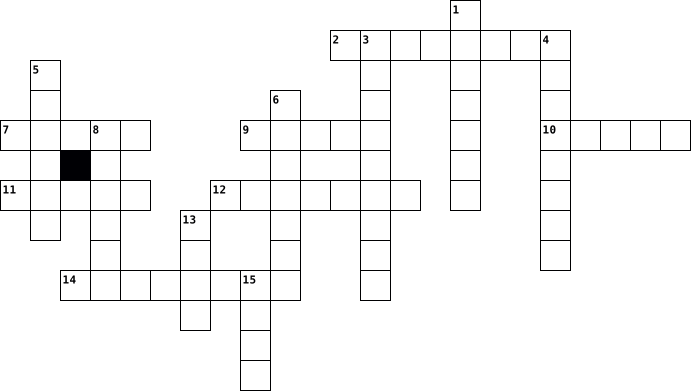
Across
- A shape that looks like a curved moon. It has a rounded shape with pointed ends.
- A shape with two lines that intersect each other at a right angle. It is often seen as a symbol in religion.
- A shape that looks like the symbol of love. It has a rounded bottom and two curves at the top.
- A shape with a straight body and a pointed end. It is used to show direction, like on signs or in drawings.
- A shape that is fluffy and irregular, like the clouds we see in the sky. It can be big or small and change shape.
- A shape that looks like two triangles joined together. It has four sides and four corners.
- A shape with five sides and five corners. It looks like a house or a shield.
Down
- A shape with eight sides and eight corners. It looks like a stop sign or a big nut.
- A shape with four sides and four right angles. It looks like a door or a picture frame.
- A shape with three sides and three corners. It looks like a slice of pizza or a road sign.
- A shape that is perfectly round like a ball or a coin. It has no corners or edges.
- A shape with six sides and six corners. It looks like a stop sign or a beehive.
- A shape with four equal sides and four right angles. It looks like a box or a piece of paper.
- A shape with many points, like a star in the night sky. It has lines that connect to form a unique pattern.
- A shape that is elongated and rounded, like an egg or a rugby ball. It is like a stretched-out circle.
15 Clues: A shape with five sides and five corners. It looks like a house or a shield. • A shape with six sides and six corners. It looks like a stop sign or a beehive. • A shape that looks like a curved moon. It has a rounded shape with pointed ends. • A shape that is perfectly round like a ball or a coin. It has no corners or edges. • ...
Chapter 14 Developing Geometric Thinking and Spatial Sense 2020-11-17

Across
- one whose interior angles are all less than 180°; that is, any two points in a figure can be connected by a line segment that will be completely within the figure and all diagonals will remain inside the figure.
- the study of the properties of figures that stay the same even under distortions, except tearing or cutting.
- A nonconvex polygonal region
- the movement of a figure about a line outside the figure, on a side of the figure, or intersecting with a vertex.
- the points where edges of the shape meet
- a flat region being covered with repetitions of the same figure without any overlapping.
Down
- a seven-piece puzzle consisting of five triangles (2 large, 1 medium, and 2 small), one square, and one parallelogram cut from a square. These parts can be arranged to create different shapes, such as a rectangle, a large triangle, a boat, or a building.
- two-dimensional figures with straight-line segments.
- a movement along a straight line
- a foundational subject to many other areas of mathematics, such as algebraic thinking involving patterns and problem-solving activities involving area and perimeter of geometric shapes. It also is about developing spatial sense—the ability to build and manipulate mental representations of two-and three-dimensional objects and perceive them accurately from different perspectives
- three-dimensional shapes with faces consisting of polygons
- changing an object. They can be achieved by twisting, bending, stretching, and shrinking
12 Clues: A nonconvex polygonal region • a movement along a straight line • the points where edges of the shape meet • two-dimensional figures with straight-line segments. • three-dimensional shapes with faces consisting of polygons • changing an object. They can be achieved by twisting, bending, stretching, and shrinking • ...
NECK 2022-09-10

Across
- CERVICALIS IT'S ROOTS ARE C1,2,&3
Down
- IT DIVIDES THE NECK INTO ANTERIOR AND POSTERIOR TRIANGLES
2 Clues: CERVICALIS IT'S ROOTS ARE C1,2,&3 • IT DIVIDES THE NECK INTO ANTERIOR AND POSTERIOR TRIANGLES
Trigonometric Ratio Vocabulary 2025-02-03

Across
- A ratio is a comparison of two quantities that expresses how much of one value exists in relation to another.
- A right triangle is a triangle that has one angle measuring 90 degrees.
- The hypotenuse is the longest side of a right triangle, opposite the right angle.
- A trigonometric ratio is a ratio of the lengths of two sides of a right triangle, used to relate the angles of the triangle to the sides.
- Adjacent refers to the side of a right triangle that is next to a specific angle, excluding the hypotenuse.
Down
- The properties of an angle refer to the characteristics that define its measure, including its vertex, the two rays that form it, and the space between them, which can be classified as acute, right, obtuse, or reflex.
- The opposite side in a right triangle is the side that is across from a specific angle.
- Cosine is a trigonometric ratio that compares the length of the adjacent side to the hypotenuse in a right triangle.
- Theta is a symbol (θ) commonly used to represent an unknown angle in a triangle or geometric figure.
- Tangent is a trigonometric ratio that compares the length of the opposite side to the adjacent side in a right triangle.
- is a branch of mathematics that studies the relationships between the angles and sides of triangles.
- Sine is a trigonometric ratio that compares the length of the opposite side to the hypotenuse in a right triangle.
12 Clues: A right triangle is a triangle that has one angle measuring 90 degrees. • The hypotenuse is the longest side of a right triangle, opposite the right angle. • The opposite side in a right triangle is the side that is across from a specific angle. • Theta is a symbol (θ) commonly used to represent an unknown angle in a triangle or geometric figure. • ...
Blah blah 2019-10-01

Across
- MIT grad student led the creation of a new algorithm to produce the first-ever image of a black hole
- African-American Mathematics professor who said "My entire career has been devoted to increasing the number of African American women in mathematics and mathematics-related careers."
- Albert Einstein called this woman "the most significant creative mathematical genius thus far produced since the higher education of women began."
- Self-taught Indian mathematician who proved over 3,000 theorems
- Russian Mathematician who was the first developer of a non-Euclidean Geometry
- Culmination of Chinese “magic” squares, circles and triangles,and earlier version of Pascal’s Triangle of binomial co-efficients
- Persian mathematician who advocated for the Hindu numerals 1 to 9 and 0 in Islamic world and discovered key foundations of modern algebra
- Inventor of natural logarithms who popularized the use of the decimal point
- 1st African American woman to earn PhD
Down
- This English woman is now acknowledged as the world's first computer programmer.
- Surname of George and Katherine, the Nigerian Father-Daughter duo who both earned PhD’s in mathematics (1972 & 1991)
- This mathematician is quoted as saying "it is impossible to be a mathematician without being a poet in soul"
- Egyptian mathematician was the first woman to make a substantial contribution to the development of mathematics.
- Mathematician who became the first Iranian and only Woman to win the Fields Medal in Mathematics.
- Hungarian who developed a non-Euclidean Geometry at the same time as ***
- This mathematician submitted mathematical papers under a male name, but was later able to reveal her identity and became the first woman to win a prize from the French Academy of Sciences.
- Chinese mathematician who solved linear equations using a matrices and calculated value of π correct to five decimal places in 3rd century
- considered the mathematician who collaborated with the most other mathematicians. There is a number named after him that describes the collaborative distance of other math professors.
18 Clues: 1st African American woman to earn PhD • Self-taught Indian mathematician who proved over 3,000 theorems • Hungarian who developed a non-Euclidean Geometry at the same time as *** • Inventor of natural logarithms who popularized the use of the decimal point • Russian Mathematician who was the first developer of a non-Euclidean Geometry • ...
Module 9 DBA 2022-05-10

Across
- an angle of 90°, as in a corner of a square or at the intersection of two perpendicular straight lines
- the trigonometric function that is equal to the ratio of the sides (other than the hypotenuse) opposite and adjacent to an angle in a right triangle
- a circle whose radius is equal to 1
- the space between two intersecting lines or surfaces at or close to the point where they meet
- a high school math student
- the trigonometric function that is equal to the ratio of the side opposite a given angle (in a right triangle) to the hypotenuse
- the trigonometric function that is equal to the ratio of the side adjacent to an acute angle (in a right-angled triangle) to the hypotenuse
- the branch of mathematics dealing with the relations of the sides and angles of triangles and with the relevant functions of any angles
- a unit of measurement of angles, one three-hundred-and-sixtieth of the circumference of a circle
Down
- a straight line passing from side to side through the center of a body or figure, especially a circle or sphere
- lines that intesect at a right angle
- are angles in standard position that have a common terminal side
- a meeting point of two lines that form an angle
- the conceptual operation of turning a system around an axis
- a unit of angle, equal to an angle at the center of a circle whose arc is equal in length to the radius
- the ratio of the hypotenuse to the shorter side adjacent to an acute angle (in a right-angled triangle); the reciprocal of a cosine
- the ratio of the hypotenuse (in a right-angled triangle) to the side opposite an acute angle; the reciprocal of sine
- a straight line from the center to the circumference of a circle or sphere
18 Clues: a high school math student • a circle whose radius is equal to 1 • lines that intesect at a right angle • a meeting point of two lines that form an angle • the conceptual operation of turning a system around an axis • are angles in standard position that have a common terminal side • a straight line from the center to the circumference of a circle or sphere • ...
word study q3 2023-01-27

Across
- paralysis of all four limbs; tetraplegia.
- not able to occur, exist, or be done.
- a group of four people playing music or singing together.
- forbidden by law, rules, or custom.
- all existing matter and space considered as a whole; the cosmos. The universe is believed to be at least 10 billion light years in diameter and contains a vast number of galaxies; it has been expanding since its creation in the Big Bang about 13 billion years ago.
- a Nordic skiing event in which the competitors combine cross-country skiing and rifle shooting.
- continuously multiplying by five.
- not connected with or relevant to something.
- manage (something) badly or wrongly.
- an eight-line section in a poem, song or psalm. The most notable example is found in Psalm 119 In the French renaissance the octonaire became a form of moralizing chanson. It can also mean of 8th rank or order.
Down
- (in surveying) the tracing and measurement of a series or network of triangles in order to determine the distances and relative positions of points spread over a territory or region, especially by measuring the length of one side of each triangle and deducing its angles and the length of the other two sides by observation from this baseline.
- a metric unit of length, equal to one tenth of a meter.
- not candid or sincere, typically by pretending that one knows less about something than one really does.
- a continuing sound, especially of a person's voice, that is unchanging in pitch and without intonation.
- a metric unit of length, equal to one hundredth of a meter.
- not known or familiar.
- in a state of mind which prevents normal perception, behavior, or social interaction; seriously mentally ill.
- a line of verse consisting of five metrical feet, or (in Greek and Latin verse) of two halves each of two feet and a long syllable.
18 Clues: not known or familiar. • continuously multiplying by five. • forbidden by law, rules, or custom. • manage (something) badly or wrongly. • not able to occur, exist, or be done. • paralysis of all four limbs; tetraplegia. • not connected with or relevant to something. • a metric unit of length, equal to one tenth of a meter. • ...
Bridge Vocabulary 2025-12-12

Across
- A beam fabricated by riveting or welding steel plates together, often used as the main load-bearing element in bridges.
- The science that studies the movement of air and how it interacts with solid objects, like a bridge deck.
- The side-to-side and rotational movement of a bridge deck, often caused by wind.
- The distance between two intermediate supports or the distance covered by a single bridge section.
- The unsteady separation of airflow creating swirling eddies, which can cause lateral bridge motion, famously affecting the Tacoma Narrows Bridge.
- A long projecting beam or structure anchored at only one end, used to support a bridge deck.
Down
- A temporary wooden framework used to support the stones of an arch or dome while it is being built.
- A vertical support structure, often in the middle of a river, that holds up the bridge superstructure.
- The simplest and oldest type of bridge, essentially a rigid horizontal structure supported at its ends
- A rigid framework, usually below the deck of a suspension bridge, added to resist bending and twisting.
- A type of bridge where the deck hangs from vertical cables, which are themselves supported by large main cables slung between towers.
- A type of bridge where the deck is directly supported by cables running from one or more towers.
- The specific rate at which an object will vibrate if disturbed and allowed to oscillate freely.
- A bridge built with projecting structures that are supported at one end and carry the span between them.
- A bridge whose main support structure is a framework of interconnected triangles.
- A phenomenon where an external force matching an object's intrinsic frequency causes dangerously large vibrations.
- A repetitive motion, back and forth or up and down, around a central point.
- A bridge that is shaped like a curved support, transferring the load outward to the abutments on either side
18 Clues: A repetitive motion, back and forth or up and down, around a central point. • The side-to-side and rotational movement of a bridge deck, often caused by wind. • A bridge whose main support structure is a framework of interconnected triangles. • A long projecting beam or structure anchored at only one end, used to support a bridge deck. • ...
Crime Scene Terms 2022-09-21

Across
- Close up photography refers to a tightly cropped shot that shows a subject (or object) up close and with significantly more detail than the human eye usually perceives.
- Should consist of the item of evidence, the fixed feature and the undistorted or un-skewed distance between.
- A method in which the crime scene is divided into smaller sections and team members are assigned to search each section.
- Their purpose is to show exactly where the scene was and to show all boundaries of the scene.
Down
- is called the midpoint rule. , each rectangle touches the graph of the function at the top right corner of the rectangle.
- Often used to find a particular object at a crime scene.
- Function as the first full visual prototype. They're produced quickly and without much concern for composition or even aesthetics
- calculating depreciation and amortization, the process of expensing an asset over a longer period of time than when it was purchased.
- a tuning technique that attempts to compute the optimum values of hyperparameters.
- Shows the direction of magnetic north
- the wording on a map or diagram explaining the symbols used.
- A sequential search algorithm that starts at one end and goes through each element of a list until the desired.
- the tracing and measurement of a series or network of triangles in order to determine the distances and relative positions of points spread over a territory or region, especially by measuring the length of one side of each triangle and deducing its angles and the length of the other two sides by observation from this baseline.
13 Clues: Shows the direction of magnetic north • Often used to find a particular object at a crime scene. • the wording on a map or diagram explaining the symbols used. • a tuning technique that attempts to compute the optimum values of hyperparameters. • Their purpose is to show exactly where the scene was and to show all boundaries of the scene. • ...
Elements of Art 2025-08-27

Across
- This element is the lightness or darkness of a color or the work of art.
- This kind of shape is a two-dimensional form created with precise, mathematical measurements and clear boundaries, such as circles, squares, and triangles.
- This kind of shape is organic and found often in nature. This shape is irregular and does not usually look symmetrical or the same on all sides.
- These building blocks that make up a work of art.
- This element is a path made by a moving point through space. It can be curvy, zigzag, or straight.
Down
- These flat areas are enclosed by lines and are two-dimensional.
- This is the name of pure color from the color wheel that all colors are made out of.
- Artists create these three-dimensional elements that have multiple sides. Artists use line and value to create this element.
- This element allows artists to show what the feeling of a surface looks like.
- This texture is created when artists use lines and value to make their work look like it has texture, but it feels flat.
- Artists use this element to create the illusion of depth within an artwork. This makes it look like some objects are closer or further away from the front of the work of art.
- This element is light reflecting off a surface into our eyes.
- Artists create this kind of texture that viewers can feel when they touch a work of art. This texture can be like the roughness of sand mixed into the artwork or the bumps on the surface.
13 Clues: These building blocks that make up a work of art. • This element is light reflecting off a surface into our eyes. • These flat areas are enclosed by lines and are two-dimensional. • This element is the lightness or darkness of a color or the work of art. • This element allows artists to show what the feeling of a surface looks like. • ...
Chapter 6-7 Vocab 2026-01-14

Across
- - "Equiangular" is a fancy geometry word that just means a shape has all of its angles the same size.
- The centroid is a special spot in the exact middle of an object. You can think of it as the balance point or center of gravity.
- - its a long square
- - The incenter is a special spot in the middle of any triangle. You can think of it as the perfect center for a circle that fits perfectly inside the triangle, touching all three sides.
- - a perfect triangle same side length and angles (60)
- - its a kite
- - its a weird looking rectangle with the triangles one on each side
- - In geometry, altitude is just a fancy word for height.
- - diamond
Down
- - its a square
- - Imagine a triangle is like a tent, and the orthocenter is a special spot related to its height. It's where the "height lines" of the triangle all meet up.
- - A perpendicular bisector is a special line that cuts another line segment into two equal parts and makes a perfect square corner (a right angle) where they cross.
- Bisector - line that cuts an angle exactly in half, making two smaller angles that are perfectly equal
- - A parallelogram is a special four-sided flat shape where the sides opposite each other are parallel (like train tracks that never cross!) and are also the same length.
- - The circumcenter is a special "center" of a triangle, which is just a fancy word for its balance point if you're trying to draw a circle that goes around its outside.
- - The median is the middle number in a list of numbers that has been put in order from smallest to largest.
- - "Equidistant" is a big word that just means "the same distance".
- - A diagonal is a straight line that connects two opposite corners of a shape. It's like drawing a line that cuts across the middle instead of going along the sides.
18 Clues: - diamond • - its a kite • - its a square • - its a long square • - a perfect triangle same side length and angles (60) • - In geometry, altitude is just a fancy word for height. • - "Equidistant" is a big word that just means "the same distance". • - its a weird looking rectangle with the triangles one on each side • ...
Maddox Rivero Trigonometry CA#3 2026-01-20

Across
- a direction as an angle measured from a reference point, typically moves clockwise from North, used for navigation and spatial problems
- Negative b plus/minus square root of b squared minus 4ac all divided by 2a
- triangle with one 90-degree angle
- with the same shape but different sizes, meaning their corresponding angles are equal, and their corresponding sides are proportional (in the same ratio)
- which are always positive and acute, that represent the smallest angle between the terminal side of an angle and the x-axis, simplifying trigonometric calculations
- rotation of a ray around the vertex to a new position, measured in degrees or radians
- directed line segment that has a magnitude and a direction. Also has a given length, and an arrow indicating direction
- longest side of a right-angled triangle, always located directly opposite the 90-degree angle
- unit for measuring angles, defined as the angle at the center of a circle that subtends an arc whose length is equal to the circle's radius
- angle greater than 0 degrees but less than 90 degrees
- involving trigonometric functions that are used to simplify expressions and solve equations
Down
- trigonometric functions at special angles using a circle on a coordinate plane
- trick to quickly find exact sine, cosine, and tangent values for special angles (0°, 30°, 45°, 60°, 90°) using your hand
- theorem attributed to Pythagoras that the square of the hypotenuse of a right triangle is equal to the sum of the squares of the other two sides.
- in standard position that lies exactly on the x-axis or y-axis
- roots of numbers, indicating what number multiplied by itself (or itself 'n' times) yields the radicand (the number inside)
- unit for measuring angles
- process of rewriting an expression or equation as a product of simpler ones
18 Clues: unit for measuring angles • triangle with one 90-degree angle • angle greater than 0 degrees but less than 90 degrees • in standard position that lies exactly on the x-axis or y-axis • Negative b plus/minus square root of b squared minus 4ac all divided by 2a • process of rewriting an expression or equation as a product of simpler ones • ...
Geometry 2022-07-19

Across
- triangle a triangle that has one of its interior angles equal to 90 degrees or any one angle is a right angle.
- a polygon with 3 sides.
- angles nonadjacent angles formed by intersecting lines.
- a theorem that states that if two angles and the non-included side of one triangle are congruent to the corresponding two angles and side of a second triangle.
- exactly equal in size and shape.
- in the same location in two or more objects.
- a postulate that states that if two angles and the included side of one triangle are congruent to the corresponding two angles and included side of a second triangle.
- two rays that share a common endpoint, referred to as a vertex from an angle; the rays form the sides of the angle.
- in a right triangle the sides opposite the acute angles.
- a postulate that states that if three sides of one triangle are congruent to three sides of a second triangle.
Down
- a theorem that states that if the hypotenuse and leg of one right triangle are congruent to the hypotenuse and leg of a second triangle.
- a pair of non-overlapping angles that have a common vertex and a common ray
- a side between two angles or the angle between two sides.
- line segment that joins two vertices in a shape.
- statement two triangles are said to be congruent if one can be placed over the other so that they coincide.
- in a right triangle, the side opposite the right angle.
- a side or angle that isn't between two things.
- a postulate that states that if two sides and the included angle of one triangle are congruent to the corresponding two sides and included angle of a second triangle.
18 Clues: a polygon with 3 sides. • exactly equal in size and shape. • in the same location in two or more objects. • a side or angle that isn't between two things. • line segment that joins two vertices in a shape. • angles nonadjacent angles formed by intersecting lines. • in a right triangle, the side opposite the right angle. • ...
Module 9 DBA 2022-05-10

Across
- an angle of 90°, as in a corner of a square or at the intersection of two perpendicular straight lines
- the trigonometric function that is equal to the ratio of the sides (other than the hypotenuse) opposite and adjacent to an angle in a right triangle
- a circle whose radius is equal to 1
- the space between two intersecting lines or surfaces at or close to the point where they meet
- a high school math student
- the trigonometric function that is equal to the ratio of the side opposite a given angle (in a right triangle) to the hypotenuse
- the trigonometric function that is equal to the ratio of the side adjacent to an acute angle (in a right-angled triangle) to the hypotenuse
- the branch of mathematics dealing with the relations of the sides and angles of triangles and with the relevant functions of any angles
- a unit of measurement of angles, one three-hundred-and-sixtieth of the circumference of a circle
Down
- a straight line passing from side to side through the center of a body or figure, especially a circle or sphere
- lines that intesect at a right angle
- are angles in standard position that have a common terminal side
- a meeting point of two lines that form an angle
- the conceptual operation of turning a system around an axis
- a unit of angle, equal to an angle at the center of a circle whose arc is equal in length to the radius
- the ratio of the hypotenuse to the shorter side adjacent to an acute angle (in a right-angled triangle); the reciprocal of a cosine
- the ratio of the hypotenuse (in a right-angled triangle) to the side opposite an acute angle; the reciprocal of sine
- a straight line from the center to the circumference of a circle or sphere
18 Clues: a high school math student • a circle whose radius is equal to 1 • lines that intesect at a right angle • a meeting point of two lines that form an angle • the conceptual operation of turning a system around an axis • are angles in standard position that have a common terminal side • a straight line from the center to the circumference of a circle or sphere • ...
Module 9 DBA 2022-05-10

Across
- the conceptual operation of turning a system around an axis
- the space between two intersecting lines or surfaces at or close to the point where they meet
- the ratio of the hypotenuse (in a right-angled triangle) to the side opposite an acute angle; the reciprocal of sine
- the trigonometric function that is equal to the ratio of the side opposite a given angle (in a right triangle) to the hypotenuse
- a high school math student
- a straight line from the center to the circumference of a circle or sphere
- an angle of 90°, as in a corner of a square or at the intersection of two perpendicular straight lines
- the ratio of the hypotenuse to the shorter side adjacent to an acute angle (in a right-angled triangle); the reciprocal of a cosine
- a unit of measurement of angles, one three-hundred-and-sixtieth of the circumference of a circle
- the trigonometric function that is equal to the ratio of the side adjacent to an acute angle (in a right-angled triangle) to the hypotenuse
Down
- a unit of angle, equal to an angle at the center of a circle whose arc is equal in length to the radius
- lines that intesect at a right angle
- the branch of mathematics dealing with the relations of the sides and angles of triangles and with the relevant functions of any angles
- are angles in standard position that have a common terminal side
- the trigonometric function that is equal to the ratio of the sides (other than the hypotenuse) opposite and adjacent to an angle in a right triangle
- a meeting point of two lines that form an angle
- a circle whose radius is equal to 1
- a straight line passing from side to side through the center of a body or figure, especially a circle or sphere
18 Clues: a high school math student • a circle whose radius is equal to 1 • lines that intesect at a right angle • a meeting point of two lines that form an angle • the conceptual operation of turning a system around an axis • are angles in standard position that have a common terminal side • a straight line from the center to the circumference of a circle or sphere • ...
Spelling and Vocabulary Puzzle- List #73 2023-07-31

Across
- "Now children," said the wise, old man, "always remember that you have to ______________________ money by working hard before you are able to save any money."
- "If you recall," said Mrs. Hutton, "we learned about triangles in our _____________________ lesson, and today we are going to learn about squares."
- "I am hopeful that some day my ______________________ will be enough to support my family," stated the responsible young man.
- "McDonald's is my favorite _______________________, Mommy!" said the annoying little girl.
- After the boy's mom told him to do his homework, make his bed, brush his teeth and clean the dishes, he rolled his eyes and said, "________________________."
- "Technology can be very _______________________ in life," stated the computer teacher, "but you have to know how to use it correctly."
- "The price of ____________________ varies greatly depending on where it is located," explained the real estate agent.
Down
- "In the animal kingdom," explained Mrs. Arnold, "__________________ and female animals often look very different from one another."
- "If you want to live a healthy life," said the Health teacher, "you need to eat healthy foods, get enough sleep and ________________________ a few times a week."
- It is difficult for people born after the year 2000 to ___________________ life without the Internet.
- "I am just getting too old to ____________________ computers and cell phones efficiently," complained the 92 year old woman.
- The World Studies teacher explained to the class that in parts of Northern Russia it gets _____________________ at 2:00 in the afternoon during the winter.
- "Now that we are starting our review for the final exam," stated the teacher, "Let us _________________ upon all we have learned this year."
13 Clues: "McDonald's is my favorite _______________________, Mommy!" said the annoying little girl. • It is difficult for people born after the year 2000 to ___________________ life without the Internet. • "The price of ____________________ varies greatly depending on where it is located," explained the real estate agent. • ...
Elements of Art! 2025-08-27

Across
- This element is the lightness or darkness of a color or the work of art.
- This kind of shape is a two-dimensional form created with precise, mathematical measurements and clear boundaries, such as circles, squares, and triangles.
- This kind of shape is organic and found often in nature. This shape is irregular and does not usually look symmetrical or the same on all sides.
- These building blocks that make up a work of art.
- This element is a path made by a moving point through space. It can be curvy, zigzag, or straight.
Down
- These flat areas are enclosed by lines and are two-dimensional.
- This is the name of pure color from the color wheel that all colors are made out of.
- Artists create these three-dimensional elements that have multiple sides. Artists use line and value to create this element.
- This element allows artists to show what the feeling of a surface looks like.
- This texture is created when artists use lines and value to make their work look like it has texture, but it feels flat.
- Artists use this element to create the illusion of depth within an artwork. This makes it look like some objects are closer or further away from the front of the work of art.
- This element is light reflecting off a surface into our eyes.
- Artists create this kind of texture that viewers can feel when they touch a work of art. This texture can be like the roughness of sand mixed into the artwork or the bumps on the surface.
13 Clues: These building blocks that make up a work of art. • This element is light reflecting off a surface into our eyes. • These flat areas are enclosed by lines and are two-dimensional. • This element is the lightness or darkness of a color or the work of art. • This element allows artists to show what the feeling of a surface looks like. • ...
Elements of Art 2025-08-28

Across
- Artists create this kind of texture that viewers can feel when they touch a work of art. This texture can be like the roughness of sand mixed into the artwork or the bumps on the surface.
- This element is light reflecting off a surface into our eyes.
- Artists use this element to create the illusion of depth within an artwork. This makes it look like some objects are closer or further away from the front of the work of art.
- When an artist places a barrier in front of paint to prevent it from sticking to paper, they are creating this.
- This kind of shape is organic and found often in nature. This shape is irregular and does not usually look symmetrical or the same on all sides.
- This element is a path made by a moving point through space. It can be curvy, zigzag, or straight.
Down
- This element is the lightness or darkness of a color or the work of art.
- These building blocks that make up a work of art.
- This kind of shape is a two-dimensional form created with precise, mathematical measurements and clear boundaries, such as circles, squares, and triangles.
- This element allows artists to show what the feeling of a surface looks like.
- These flat areas are enclosed by lines and are two-dimensional.
- This texture is created when artists use lines and value to make their work look like it has texture, but it feels flat.
- Artists create these three-dimensional elements that have multiple sides. Artists use line and value to create this element.
- This is the name of pure color from the color wheel that all colors are made out of.
14 Clues: These building blocks that make up a work of art. • This element is light reflecting off a surface into our eyes. • These flat areas are enclosed by lines and are two-dimensional. • This element is the lightness or darkness of a color or the work of art. • This element allows artists to show what the feeling of a surface looks like. • ...
Quadrilaterals 2023-04-28

Across
- is a quadrilateral with two pairs of parallel sides. The opposite sides of a parallelogram are equal in length, and the opposite angles are equal in measure
- is a quadrilateral with reflection symmetry across a diagonal
- is a quadrilateral with one pair of opposite sides parallel.
- quadrilateral is a four sided shape that can be inscribed into a circle
- cross known as "crossbuck" is used as the conventional road sign used to indicate the point at which a railway line intersects a road at a level crossing, called a in this context.
- Quadrilateral: a four-sided shape where no sides are equal in length and no internal angles are the same.
- are quadrilaterals with 4 congruent sides and 4 right angles, and they also have two sets of parallel sides.
- trapezoid is a trapezoid in which the top and bottom sides are parallel, while the remaining two non-parallel sides have the same length
Down
- trapezium is a trapezium in which the non-parallel sides are equal in measure. In other words, the bases are parallel and the legs are equal in measure
- is a quadrilateral in which all angles are right angles. A rectangle is a parallelogram, so its opposite sides are equal.
- Describes a quadrilateral or polygon that has a cavity, or a cave.
- of the quadrilateral bisect each other. The diagonals divide the quadrilateral into two pairs of congruent triangles. The intersection point of the diagonals is also the intersection point of the lines connecting the midpoints of the opposite sides of the quadrilateral (Figure 4).
- Describes a quadrilateral or polygon that doesn't have a cavity.
- is a quadrilateral with one pair of parallel opposite sides
- is a quadrilateral whose all four sides are equal in length and opposite sides are parallel to each other
15 Clues: is a quadrilateral with one pair of parallel opposite sides • is a quadrilateral with one pair of opposite sides parallel. • is a quadrilateral with reflection symmetry across a diagonal • Describes a quadrilateral or polygon that doesn't have a cavity. • Describes a quadrilateral or polygon that has a cavity, or a cave. • ...
Food 2023-03-02

Across
- you can slice in triangles and order it
Down
- nugget you can order it on Macdonalds,Max and burger king
2 Clues: you can slice in triangles and order it • nugget you can order it on Macdonalds,Max and burger king
Shapes 2023-11-09

Across
- A rounded or elliptical shape resembling a flattened circle. Ovals are often used in design and can be found in various objects, like mirrors.
- A four-sided polygon with all sides of equal length and all angles of 90 degrees. Squares are commonly used in building blocks and tiles.
- A round, two-dimensional figure with all points equidistant from the center. Circles are often found in nature and man-made objects, such as wheels.
- A three-sided polygon with three angles. Triangles can vary in size and shape, and they are fundamental in geometry.
- A five-sided polygon with five angles. Pentagons are used in geometry and can be found in designs of certain buildings and symbols.
Down
- A four-sided figure with equal opposite angles but not necessarily equal sides. Diamonds are often used in playing cards and jewelry.
- A four-sided polygon with opposite sides of equal length and all angles of 90 degrees. Rectangles are commonly used in frames and book covers.
- A shape with multiple pointed ends, often associated with celestial bodies. Stars are commonly used in flags and festive decorations.
- A six-sided polygon with six angles. Hexagons are often seen in beehives and can be used in patterns and designs.
- A symbol or shape representing love or affection, often with a curved top and two lobes at the bottom. Hearts are commonly used in decorations and art.
10 Clues: A six-sided polygon with six angles. Hexagons are often seen in beehives and can be used in patterns and designs. • A three-sided polygon with three angles. Triangles can vary in size and shape, and they are fundamental in geometry. • ...
Pandemonium Elims 2 2021-12-06

Across
- Find the slope of a line that passes through the points(2,0)and(2,3).
- A number is greater than 3 but less than 8. Also, the number is greater than 6 but less than 10. What is the number?
- An object is heated to 838◦ and then allowed to cool in air that is 70◦ Suppose that it takes 2 hours to cool the object to 313◦. Then it takes minutes to cool the object to 646◦ Hint: Use Newton’s law of cooling.
- If the largest angle in a triangle is 70o, what is least possible value of the smallest angle of the triangle?
- If tan^4θ + tan^2θ = 1, then the value of cos^4θ + cos^2θ is
Down
- The maximum value achieved by x + 2y + 4z on the sphere x^2+y^2+z^2=7 is a √3 where a =
- How many equal sides do Icosahedrons have?
- Find the slope of the line tangent to f(x) at x=3. f(x)=x^2−6x+9
- Consider an equilateral triangle of a side of unit length. A new equilateral triangle is formed by joining the mid-points of one, then a third equilateral triangle is formed by joining the mid-points of second. The process is continued. The perimeter of all triangles, thus formed is
- What is the measure of in radius of the triangle whose sides are 24, 7 and 25?
10 Clues: How many equal sides do Icosahedrons have? • If tan^4θ + tan^2θ = 1, then the value of cos^4θ + cos^2θ is • Find the slope of the line tangent to f(x) at x=3. f(x)=x^2−6x+9 • Find the slope of a line that passes through the points(2,0)and(2,3). • What is the measure of in radius of the triangle whose sides are 24, 7 and 25? • ...
Vocabulary Quiz 10/4/23 2023-10-03

Across
- are formed when a transversal intersects two other lines. These angle pairs are on the same side of the transversal and are outside the other two lines
- states that if two angles of one triangle are congruent to the corresponding angles of another triangle, then the triangles are similar
- one in which the ratio of the inputs to the outputs is constant. For a relationship to illustrate a proportional relationship, all the ratios y/x or x/y must represent the same constant
- are on opposite sides of the transversal and are outside the other two lines
- in a proportional relationship, the ratio of all y-values to their corresponding x-values is constant. This specific ratio, y/x, is called the constant of proportionality. Generally, the variable K is used to represent the constant of proportionality.
- the rate of change for a situation describes the amount that the dependent variable changes compared with the amount that the independent variable changes
Down
- are formed when a transversal intersects two other lines. These angle pairs are on the same side of the transversal and are between the other two lines
- are on opposite sides of the transversal and are between the two other lines
- a line that intersects two or more lines
9 Clues: a line that intersects two or more lines • are on opposite sides of the transversal and are between the two other lines • are on opposite sides of the transversal and are outside the other two lines • states that if two angles of one triangle are congruent to the corresponding angles of another triangle, then the triangles are similar • ...
Food 2023-03-02

Across
- you can slice in triangles and order it
Down
- nugget you can order it on Macdonalds,Max and burger king
2 Clues: you can slice in triangles and order it • nugget you can order it on Macdonalds,Max and burger king
Food 2023-03-02

Across
- you can slice in triangles and order it
Down
- you can order it on Macdonalds,Max and burger king
2 Clues: you can slice in triangles and order it • you can order it on Macdonalds,Max and burger king
Famous landmarks 2023-07-18

Across
- Picchu An ancient Inca city in Peru, high in the mountains, known for its remarkable stone buildings and beautiful views.
- A mysterious circle of big stones in England that was built a long time ago and its purpose is still unknown.
- of Egypt Huge structures in Egypt made of stone, shaped like triangles, and built as tombs for ancient pharaohs.
- Everest The highest mountain in the world, located in the Himalayas between Nepal and China.
- An ancient amphitheater in Rome, Italy, where gladiator fights and other events used to take place.
- Mahal A beautiful white marble building in India that was built as a monument of love by a king for his wife.
- Louvre A famous museum in Paris that houses many famous artworks, including the Mona Lisa.
- Tower A tall iron tower in Paris, France, that is a famous symbol of the city and offers a great view from the top.
Down
- Opera House A unique building in Australia shaped like sails on a boat, where concerts and performances take place.
- Wall of China A very long wall in China built a long time ago to protect the country from invaders.
- the Redeemer A large statue of Jesus with open arms located in Rio de Janeiro, Brazil, and is a symbol of peace and welcome.
- A hill in Athens, Greece, with ancient ruins including the Parthenon, which was a temple dedicated to the goddess Athena.
- Rushmore A mountain in the United States with huge carved faces of four American presidents on it.
- of Liberty A big statue in New York City that represents freedom and welcomes people from all over the world.
- Ben A famous clock tower in London that tells the time and is one of the city's iconic landmarks.
15 Clues: Louvre A famous museum in Paris that houses many famous artworks, including the Mona Lisa. • Everest The highest mountain in the world, located in the Himalayas between Nepal and China. • Ben A famous clock tower in London that tells the time and is one of the city's iconic landmarks. • ...
Famous landmarks 2023-07-18

Across
- A hill in Athens, Greece, with ancient ruins including the Parthenon, which was a temple dedicated to the goddess Athena.
- Everest The highest mountain in the world, located in the Himalayas between Nepal and China.
- Louvre A famous museum in Paris that houses many famous artworks, including the Mona Lisa.
- the Redeemer A large statue of Jesus with open arms located in Rio de Janeiro, Brazil, and is a symbol of peace and welcome.
- Opera House A unique building in Australia shaped like sails on a boat, where concerts and performances take place.
- An ancient amphitheater in Rome, Italy, where gladiator fights and other events used to take place.
- Mahal A beautiful white marble building in India that was built as a monument of love by a king for his wife.
Down
- Wall of China A very long wall in China built a long time ago to protect the country from invaders.
- of Egypt Huge structures in Egypt made of stone, shaped like triangles, and built as tombs for ancient pharaohs.
- A mysterious circle of big stones in England that was built a long time ago and its purpose is still unknown.
- Ben A famous clock tower in London that tells the time and is one of the city's iconic landmarks.
- Rushmore A mountain in the United States with huge carved faces of four American presidents on it.
- Tower A tall iron tower in Paris, France, that is a famous symbol of the city and offers a great view from the top.
- of Liberty A big statue in New York City that represents freedom and welcomes people from all over the world.
- Picchu An ancient Inca city in Peru, high in the mountains, known for its remarkable stone buildings and beautiful views.
15 Clues: Louvre A famous museum in Paris that houses many famous artworks, including the Mona Lisa. • Everest The highest mountain in the world, located in the Himalayas between Nepal and China. • Ben A famous clock tower in London that tells the time and is one of the city's iconic landmarks. • ...
8th Grade Math Vocabulary 2025-08-26

Across
- Applying the Pythagorean theorem to find distances between points in the coordinate plane
- Solving problems involving two linear equations with two variables, both algebraically and via graphing for solutions or determining no solution (e.g., 3x + 2y = 5 vs. 3x + 2y = 6)
- Using root symbols to represent solutions for equations like x2=px^2 = px2=p or x3=px^3 = px3=p and evaluating small perfect squares or cubes; recognizing that 2\sqrt{2}2 is irrational
- Understanding relationships between proportional relationships, graphing proportional data as straight lines (slope as unit rate), using similar triangles to explain slope consistency, and writing equations like y=mxy = mxy=mx or y=mx+by = mx + by=mx+b
- Writing and interpreting very large or very small numbers in the form "single digit × power of 10" (e.g., world population ≈ 7 × 10⁹)
Down
- – Verifying that these transformations preserve shape (lines to lines, segments to equal segments, angles to angles) experimentally
- Using properties of integer exponents to create equivalent expressions (e.g., 32×3−5=3−33^2 \times 3^{-5} = 3^{-3}32×3−5=3−3)
- Stating and using the formulas for volumes of these three-dimensional figures in real-world mathematical problems
- Two figures are congruent if one can be obtained from the other through rotations, reflections, or translations
9 Clues: Applying the Pythagorean theorem to find distances between points in the coordinate plane • Two figures are congruent if one can be obtained from the other through rotations, reflections, or translations • Stating and using the formulas for volumes of these three-dimensional figures in real-world mathematical problems • ...
VE3 2025-01-01

Across
- As part of our visual arts lesson, our class visited the Hong Kong Art _________.
- The pie had cherry filling and a golden _________. I wondered what it was doing in the middle of the exhibition.
- I thanked the man for giving me _________. Thankfully, I met up with my classmates without embarrassing myself.
- I had to _________.
Down
- Although we were supposed to stay together as a group, I saw something interesting in one corner - a slice of pie enclosed in a glass container. I went over because my _________ was too much to handle.
- The pie was in fact an exhibit! Amidst my shock, I realized that I could not find my classmates anywhere. I walked and walked in the _________ halls, tears welling up in my eyes.
- Suddenly, a man with a thick _________, which made him look like Santa, came up to me and asked, “Kid, are you lost? I think I saw your classmates on the second floor. Take the stairs right around the corner.”
- the sides of a pyramid are triangles and its _________ is a square.
- I imagined that the pie would have a tarty, fragrant, slightly sweet _________. Then I noticed a label on the glass saying “Cherry Pie - Simon Hignell(2020)”.
- The first painting we saw was of an _________ pyramid. All I could think of when I saw the painting was what we learnt in maths class -
10 Clues: I had to _________. • the sides of a pyramid are triangles and its _________ is a square. • As part of our visual arts lesson, our class visited the Hong Kong Art _________. • I thanked the man for giving me _________. Thankfully, I met up with my classmates without embarrassing myself. • ...
XNA 3D Game Development- Chapter 2 Key Terms 2014-03-10

Across
- A method call used to cause the graphics device to interpret the vertex buffer and output the triangles it contains to the graphics card
- holds a list of 3D vertices that can be sent to the graphics card in a single push.
- If you hold your hands with your palms facing up, and curl your fingers 90 degrees up from your palm, your palm points along the positive X axis, and your fingers point along the positive Y axis. If you point your thumb out away from your hand, the thumb points along the positive Z axis, relative to X and Y.
- Requires the use of 3 coordinates to calculate locations along the x, y and the z axis.
- It is a camera that is placed in the location of the character's eyes
- describes to the graphics card how to translate (or project) 3D objects onto the 2D viewing area of the screen
Down
- tells the Visual Studio IDE that these sections of the code can be collapsed as a unit to hide the details while we work on other sections of the code
- is a two-dimensional array of numbers used to transform points in 3D space
- Effects are constructed with a mini-programming language that can produce a wide variety of surfaces and special effects
- defines the position and direction from which the camera views the 3D world
- defines the point, past which objects in the 3D world will no longer be displayed
11 Clues: It is a camera that is placed in the location of the character's eyes • is a two-dimensional array of numbers used to transform points in 3D space • defines the position and direction from which the camera views the 3D world • defines the point, past which objects in the 3D world will no longer be displayed • ...
Mathematics 2013-02-04

Across
- two triangles are exactly the same in terms of area and sides
Down
- a triangle with one angle equal to 90
2 Clues: a triangle with one angle equal to 90 • two triangles are exactly the same in terms of area and sides
Math 2023-12-05

Across
- the process or skill of calculating the total of two or more numbers or amounts
- the process of taking a matrix, vector, or other quantity away from another under specific rules to obtain the difference
- the ratio of the hypotenuse (in a right-angled triangle) to the side opposite an acute angle; the reciprocal of sine
- (in a right-angled triangle) the ratio of the side (other than the hypotenuse) adjacent to a particular acute angle to the side opposite the angle
- the process of combining matrices, vectors, or other quantities under specific rules to obtain their product
- a straight line or plane that touches a curve or curved surface at a point, but if extended does not cross it at that point
- the action of separating something into parts or the process of being separated.
- the factor that we multiply by itself three times to get that number
Down
- the branch of mathematics dealing with the relations of the sides and angles of triangles and with the relevant functions of any angles
- the trigonometric function that is equal to the ratio of the side adjacent to an acute angle (in a right-angled triangle) to the hypotenuse
- the quantitative relation between two amounts showing the number of times one value contains or is contained within the other
- the ratio of the hypotenuse to the shorter side adjacent to an acute angle (in a right-angled triangle); the reciprocal of a cosine
- a small or tiny part, amount, or proportion of something.
- a person skilled in mathematics
- the trigonometric function that is equal to the ratio of the side opposite a given angle (in a right triangle) to the hypotenuse
- It expresses the ratio of the circumference to the diameter of a circle and appears in many mathematical expressions
- a number which produces a specified quantity when multiplied by itself.
17 Clues: a person skilled in mathematics • a small or tiny part, amount, or proportion of something. • the factor that we multiply by itself three times to get that number • a number which produces a specified quantity when multiplied by itself. • the process or skill of calculating the total of two or more numbers or amounts • ...
unit 3 2016-05-05

Across
- circle:s the largest possible circle that can be drawn on the inside of a plane figure. For a polygon, each side of the polygon must be tangent to the circle. All triangles and regular polygons have circumscribed and inscribed circles.
- part of the circumference of a circle or other curve.
- a straight line segment whose endpoints both lie on the circle. A secant line, or just secant, is the infinite line extension of a chord. More generally, a chord is a line segment joining two points on any curve, for instance an ellipse.
- line:s a straight line that touches a function at only one point
Down
- of a sector: A "pie-slice" part of a circle - the area between two radiuses and the connecting arc of a circle.
- plane figure enclosed by two radii of a circle or ellipse and the arc between them.
- measure:In a circle, the length of an arc is a portion of the circumference.
- of tangenA line which touches a circle or ellipse at just one point. Below, the blue line is a tangent to the circle c. Note the radius to the point of tangency is always perpendicular to the tangent line.cy:
8 Clues: part of the circumference of a circle or other curve. • line:s a straight line that touches a function at only one point • measure:In a circle, the length of an arc is a portion of the circumference. • plane figure enclosed by two radii of a circle or ellipse and the arc between them. • ...
Branches of Math 2021-05-29

Across
- It is a branch of mathematics and a subfield of algebra. It studies lines, planes, and subspaces. It is concerned with vector spaces and linear mappings between those spaces.
- It is concerned with the axioms dealing with real numbers and real-valued functions of a real-variable.
- It is the study of positive integers, their relationships, and properties. It is sometimes referred to as “The Queen of Mathematics” because of its foundational function in the subject.
- It is the discipline in mathematics that studies formal languages, formal reasoning, the nature of mathematical proof, probability of mathematical statements, computability, and other aspects of the foundations of mathematics.
- It is used to combine objects following rules of arranging those objects.
Down
- It is any equation that contains either ordinary derivatives or partial derivatives.
- It is the branch of mathematics calculating the chances of some things to take place based on the number of the possible cases to the whole number of cases possible.
- It is the mathematics concerned with questions of shape, size, positions, and properties of space.
- It is the study the sides and angles, and their relationship in triangles.
- It is an advanced branch of mathematics concerned in finding and properties of derivatives and integrals of functions. It is the study of rates of change and deals with finding lengths, areas, and volumes.
- It uses variable (letters) and other mathematical symbols to represent numbers in equations. It is basically completing and balancing the parts on the two sides of the equation.
- Are the collection, analysis, measurement, interpretation, presentation and summarization of data.
12 Clues: It is used to combine objects following rules of arranging those objects. • It is the study the sides and angles, and their relationship in triangles. • It is any equation that contains either ordinary derivatives or partial derivatives. • It is the mathematics concerned with questions of shape, size, positions, and properties of space. • ...
Geometry 2018-05-10

Across
- Similarity shortcut in which triangles are similar if all three sides in one triangle are in the same proportion to the corresponding sides in the other.
- A 2 word term for the total area of the surface of a three-dimensional object.
- A 2 word term for a method to express the likelihood that something will occur. It is calculated by dividing the number of favorable outcomes by the total possible outcomes.
- A 2 word term for the distance measured along a lateral face from the base to the apex along the "center" of the face.
Down
- A 2 word term for A transformation consisting of a translation combined with a reflection about a plane parallel to the direction of the translation.
- Any of the line segments of a circle that go from its center to its perimeter. Also half of the diameter of the circle.
- The angle of _________ of an object as seen by an observer is the angle between the horizontal and the line from the object to the observer's eye (the line of sight).
- A 2 word Term for the reduced ratio of any two corresponding sides of similar polygons
- An arc on a circle that is greater than 180°
- A line from the center of a regular polygon at right angles to any of its sides.
- A Transformation in which a figure grows larger or smaller
- In a right angled triangle, the _______ of an angle is the length of the opposite side divided by the length of the adjacent side.
12 Clues: An arc on a circle that is greater than 180° • A Transformation in which a figure grows larger or smaller • A 2 word term for the total area of the surface of a three-dimensional object. • A line from the center of a regular polygon at right angles to any of its sides. • A 2 word Term for the reduced ratio of any two corresponding sides of similar polygons • ...
Maths Portfolio 2022-05-23

Across
- is a shape consisting of all points in a plane that are at a given distance from a given point, the centre.
- is the part of cone when it is cut by a plane into two parts
- the branch of mathematics concerning numerical descriptions of how likely an event is to occur, or how likely it is that a proposition is true
- refers generally to the elementary aspects of the theory of numbers, arts of mensuration, and numerical computation
- is a line that intersects a curve at a minimum of two distinct points
- A proven statement used for proving another statement
- a quantity that may assume any one of a set of values
- is a branch of mathematics that studies relationships between side lengths and angles of triangles.
Down
- are a set of values which helps to show the exact position of a point in the coordinate plane.
- is a number or any symbol representing a constant value that is multiplied by the variable of a single term or the terms of a polynomial.
- of any given object is the area or region occupied by the surface of the object.
- are algebraic expressions that consist of variables and coefficients.
- a branch of applied mathematics that involves the collection, description, analysis, and inference of conclusions from quantitative data.
- the sum (total) of all the values in a set of data, such as numbers or measurements, divided by the number of values on the list
- is said to be a part of a circle made of the arc of the circle along with its two radii
- a rule or principle, especially in mathematics, that can be shown to be true
- meeting a curve or surface in a single point if a sufficiently small interval is considered straight line tangent to a curve
- is a branch of mathematics that studies the sizes, shapes, positions angles, and dimensions of things
- is a mathematical quantity that shows the amount of three-dimensional space occupied by an object or a closed surface
- The middle number; found by ordering all data points and picking out the one in the middle
20 Clues: A proven statement used for proving another statement • a quantity that may assume any one of a set of values • is the part of cone when it is cut by a plane into two parts • are algebraic expressions that consist of variables and coefficients. • is a line that intersects a curve at a minimum of two distinct points • ...
Math 2 Vocabulary 2023-01-04

Across
- the sum of an number that has been times its self
- a number multiplied by a variable.
- a line that splits an angle into two equal angles.
- the circular movement of an object around a centre
- the opposite of an exponent that is represented with a symbol '√' also known as root.
- a term that is used to compare two or more numbers.
- the set of values that we are allowed to plug into our function
- Two triangles are similar if they have the same ratio of corresponding sides and equal pair of corresponding angles.
- the opposite of an exponent that is represented with a symbol '√' also known as root.
- The value inside the radical symbol.
- the line that divides a shape or an object into two equal and symmetrical parts.
- is the number in a set of numbers that appears the most often.
- the difference between the highest and lowest values.
- a general term for four specific ways to manipulate the shape and/or position of a point, a line, or geometric figure.
Down
- lines that intersect at a right (90 degrees) angle.
- an expression which is composed of variables, constants and exponents, that are combined using mathematical operations such as addition, subtraction, multiplication and division
- a formula that gives the solutions of the general quadratic equation ax2 + bx + c = 0 and that is usually written in the form x equals 1/2a times (-b ± the square root of b2 - 4ac)
- the numbers that are expressed in the form of a+ib where, a,b are real numbers and 'i' is an imaginary number called “iota”
- lines in a plane that are always the same distance apart.
- the whole which is to be divided into different equal parts.
- the numbers when squared it gives the negative result
- numbers that can be written in the form pq, where p and q are integers and q≠0.
- the result of adding two or more numbers together.
- The "average" number; found by adding all data points and dividing by the number of data points.
- the power or exponent which is raised to a number or a variable.
25 Clues: a number multiplied by a variable. • The value inside the radical symbol. • the sum of an number that has been times its self • a line that splits an angle into two equal angles. • the circular movement of an object around a centre • the result of adding two or more numbers together. • lines that intersect at a right (90 degrees) angle. • ...
Math Crossword 2015-04-08

Across
- expression of more than two algebraic terms, especially the sum of several terms that contain different powers of the same variable(s)
- polynomial with only one term
- branch of mathematics dealing with the relations of the sides and angles of triangles and with the relevant functions of any angle
- A line through a shape so that each side is a mirror image
- a line that passes through two lines in the same plane at two distinct points
- either of two angles whose sum is 90°
- a mathematical phrase that can contain ordinary numbers, variables and operators
- transformation of the plane that slides every point of a figure the same distance in the same direction
- polynomial consisting of three terms or monomials
- a trigonometric function of an angle;it is the ratio of the length of the side that is opposite that angle to the length of the longest side of the triangle
- trigonometric function that is equal to the ratio of the side adjacent to an acute angle to the hypotenuse
Down
- An expression that has a square root, cube root, etc. The symbol is √
- either of two angles whose sum is 180°
- having a common vertex and a common side
- transformation that produces an image that is the same shape as the original, but is a different size
- transformation in which a geometric figure is reflected across a line, creating a mirror image
- where the highest exponent of the variable is a square
- the angles opposite each other when two lines cross
- any pair of angles each of which is on the same side of one of two lines cut by a transversal and on the same side of the transversal
- A notation for representing an interval as a pair of numbers
- the locus of points such that the distance to the focus equals the distance to the directrix
- polynomial which is the sum of two terms, which are monomials
- length of the opposite side divided by the length of the adjacent side
23 Clues: polynomial with only one term • either of two angles whose sum is 90° • either of two angles whose sum is 180° • having a common vertex and a common side • polynomial consisting of three terms or monomials • the angles opposite each other when two lines cross • where the highest exponent of the variable is a square • ...
Meteorology II Crossword Review 2016-03-14

Across
- temperature gets ________ as altitude increases in the troposphere
- mass large body of air that has the same temperature and humidity as the area over which it forms
- this frontal boundary results when cold air catches up to the front of a warm air mass and pushes it all off of the ground
- layered or flat clouds that cover most of the sky
- means humid air that hovered over an ocean for awhile
- this front is made of half circles on a weather map and pushes into cooler air
- what type of air mass forms over the North Atlantic bringing cold air to Stroudsburg
- the frontal boundary where neither cold nor warm air dominates the other
- thunderstorms form when warm, humid air does this quickly
- dry air that moves into the U.S. from Canada or Mexico
- precipitation and storms occur in this type of system that consists of lighter than average air
- a violent, whirling wind that moves in a narrow path and is capable of catastrophic destruction
Down
- Puffy clouds that indicate fair weather
- layered or flat cloud that brings all-day precipitation
- the most dangerous result of a hurricane, occurs at the coast
- the heaviest air, represented as a line with triangles on a weather map
- the boundary line between two different air masses
- motion of air around a high pressure system in the northern hemisphere
- upper tropospheric wind that separates polar and tropical air and pushes storm systems around the planet
- the largest storm on Earth, gains it's strength from warm ocean waters
- tall, puffy thunderstorm cloud which can drop hail, heavy rain, lightning, and tornadoes
- wind speed (mph) of the weakest possible hurricane
- middle part of the U.S. where most tornadoes occur
- a line of equal air pressure on a weather map
- this is the location of the strongest winds in a hurricane
- clouds form when air cools to this temperature
- another name for a cold air mass
- these high-altitude clouds indicate fair weather today and precipitation soon because they form at the leading edge of storms
28 Clues: another name for a cold air mass • Puffy clouds that indicate fair weather • a line of equal air pressure on a weather map • clouds form when air cools to this temperature • layered or flat clouds that cover most of the sky • the boundary line between two different air masses • wind speed (mph) of the weakest possible hurricane • ...
Crossword Review 2016-03-15

Across
- precipitation and storms occur in this type of system that consists of lighter than average air
- wind speed (mph) of the weakest possible hurricane
- another name for a cold air mass
- the heaviest air, represented as a line with triangles on a weather map
- what type of air mass forms over the North Atlantic bringing cold air to Stroudsburg
- the most dangerous result of a hurricane, occurs at the coast
- thunderstorms form when warm, humid air does this quickly
- dry air that moves into the U.S. from Canada or Mexico
- these high-altitude clouds indicate fair weather today and precipitation soon because they form at the leading edge of storms
- motion of air around a high pressure system in the northern hemisphere
- the largest storm on Earth, gains it's strength from warm ocean waters
- upper tropospheric wind that separates polar and tropical air and pushes storm systems around the planet
- Puffy clouds that indicate fair weather
Down
- temperature gets ________ as altitude increases in the troposphere
- tall, puffy thunderstorm cloud which can drop hail, heavy rain, lightning, and tornadoes
- a violent, whirling wind that moves in a narrow path and is capable of catastrophic destruction
- means humid air that hovered over an ocean for awhile
- middle part of the U.S. where most tornadoes occur
- large body of air that has the same temperature and humidity as the area over which it forms
- layered or flat cloud that brings all-day precipitation
- clouds form when air cools to this temperature
- a line of equal air pressure on a weather map
- this is the location of the strongest winds in a hurricane
- this frontal boundary results when cold air catches up to the front of a warm air mass and pushes it all off of the ground
- the boundary line between two different air masses
- the frontal boundary where neither cold nor warm air dominates the other
- layered or flat clouds that cover most of the sky
- this front is made of half circles on a weather map and pushes into cooler air
28 Clues: another name for a cold air mass • Puffy clouds that indicate fair weather • a line of equal air pressure on a weather map • clouds form when air cools to this temperature • layered or flat clouds that cover most of the sky • wind speed (mph) of the weakest possible hurricane • middle part of the U.S. where most tornadoes occur • ...
Pomegranate 2017-10-27

Across
- A person who has control or direction of an institution, business, etc., or of a part, division, or phase of it.
- To meddle, especially for the purpose of altering, damaging, or misusing.
- Any article of clothing:
- Juxtaposition or partial superimposition of several shots to form a single image.
- A substance that, because of the reactions it causes, is used in analysis and synthesis.
- To feel sorry, self-reproachful, or contrite for past conduct.
- A colour that is made by mixing red and yellow.
- A five-pointed, star-shaped figure made by extending the sides of a regular pentagon until they meet.
- A purplish red.
- Violent or excited behavior that is reckless, uncontrolled, or destructive.
- Given name.
- A Chinese puzzle consisting of a square cut into five triangles, a square, and a rhomboid, which can be combined so as to form a great variety of other figures.
- Plant-eating aquatic mammals
- A person who exercises the ruling power in a kingdom during the minority, absence, or disability of the sovereign.
Down
- One million tons.
- Far apart
- To work, perform, or function, as a machine does.
- A particular state of mind or feelings.
- To reproduce.
- Someone of exceptional merit.
- The financial support or business provided to a store, hotel, or the like, by customers, clients, or paying guests.
- The strength of an electric current measured in amperes.
- To deny the existence, evidence, or truth of.
- A deep-red color.
- The state or relation of a parent; parenthood.
- An identification tag or label showing one's name
- A person who is a customer, client, or paying guest, especially a regular one, of a store, hotel, or the like.
- A show or exhibition, especially one consisting of a succession of participants or events.
- A person under the patronage, protection, or care of someone interested in his or her career or welfare.
- Violent in action or spirit; raging; furious
- elaborately or sumptuously adorned
31 Clues: Far apart • Given name. • To reproduce. • A purplish red. • One million tons. • A deep-red color. • Any article of clothing: • Plant-eating aquatic mammals • Someone of exceptional merit. • elaborately or sumptuously adorned • A particular state of mind or feelings. • Violent in action or spirit; raging; furious • To deny the existence, evidence, or truth of. • ...
KRISHIV MATH 2018-02-15

Across
- a quadrilateral having angle more than 180 degree
- a triangle having two sides with equal length
- a polygon with three sides
- the meeting point of a pair of sides
- a the equally divided circle
- two angles of quadrilateral with common sides
- a figure which ends at the starting point
- a triangle with only one side of greater then ninety degree
- the line segments that make the polygon
- a diameter that is dividing the circle
- a quadrilateral having only one pair of parallel lines
- a triangle having all sides equal
- a simple closed figure formed by three or more line segments
- a line passing through the circle
- a figure which does not end at the starting point
- two angles of quadrilateral without common sides
- a triangle with a angle of ninety degree
- a polygon with four sides
- a closed figure does not intersect itself
- two or more circles with same centre
- any part of the circle
- a quadrilateral having both sides of parallel
- a parallelogram with all sides equal
- a polygon with six sides
Down
- a parallelogram with all right angle
- a quadrilateral having two sides equal
- any two sides of a polygon having a common end point
- a line segment with its end points lying on the circle
- a polygon with seven sides
- a quadrilateral in which the measure of the angle measure less than one-eighty degree
- a triangle having angles below ninety degree
- a polygon with 8 sides
- a line segment joining two non-adjacent sides
- a polygon with ten sides
- two triangles are said to be congruent if every angle of the triangle is equal
- the area inside quadrilateral
- THE PERIMETER OF A CIRCLE
- the area bounded by a arc
- a parallelogram with all sides equal
- the sides of a quadrilateral which do not have any common endpoint
- a polygon with nine sides
- a triangle having all sides with different length
- a collection all points on the plane
- a polygon with five sides
- SEGMENT THAT DIVIDES THE CIRCLE
45 Clues: a polygon with 8 sides • any part of the circle • a polygon with ten sides • a polygon with six sides • THE PERIMETER OF A CIRCLE • the area bounded by a arc • a polygon with nine sides • a polygon with four sides • a polygon with five sides • a polygon with seven sides • a polygon with three sides • a the equally divided circle • the area inside quadrilateral • ...
Geometry Crossword - 2 2022-03-08

Across
- the total distance around the outside of a polygon. This distance is obtained by adding together the units of measure from each side.
- to arrange (something or someone) again in a different way
- is the number of square units that covers all the faces of the polyhedron, without any gaps or overlaps.
- is a line drawn from the center of any polygon to the midpoint of one of the sides
- is a type of polyhedron that has two bases that are identical copies of each other. The bases are connected by rectangles or parallelograms.
- for each side of a triangle, there is one vertex that is not on that side.
- a triangle with two sides of equal length
- two lines or line segments intersecting to form a right angle.
- a unit of measure describing how much space a substance occupies or the capacity of a container, provided in cubic units.
- the shortest distance from the base of the shape to the opposite side (for a parallelogram) or opposite vertex (for a triangle). We can show it in more than one place, but it will always be perpendicular to the chosen base.
- is the number of square units that covers a two-dimensional region, without any gaps or overlaps.
- a triangle with one right angle.
- is a two-dimensional figure that can be folded to make a polyhedron
Down
- each straight side of a polygon
- is a point where two or more edges meet.
- means “take apart.”
- is a type of polygon that has 4 sides.
- means “put together.”
- is a type of polyhedron that has one base. All the other faces are triangles, and they all meet at a single vertex.
- is a closed, two-dimensional shape with straight sides that do not cross each other.
- an angle equal to 90°.
- is a type of quadrilateral that has two pairs of parallel sides.
- each flat side of a polyhedron
- a triangle with three unequal sides.
- is a closed, three-dimensional shape with flat sides.
- is the space inside of a shape.
26 Clues: means “take apart.” • means “put together.” • an angle equal to 90°. • each flat side of a polyhedron • each straight side of a polygon • is the space inside of a shape. • a triangle with one right angle. • a triangle with three unequal sides. • is a type of polygon that has 4 sides. • is a point where two or more edges meet. • a triangle with two sides of equal length • ...
Unit 5 Crossword Puzzle 2022-04-26

Across
- The formula used to find the space between two points is called the ______ Formula.
- This is the equation used to find the missing legs of triangles. It encompasses two legs and the hypotenuse
- Pairs of opposite angles formed by two intersecting lines are called ______ angles
- Adjacent angles that add to equal 180 degrees are called _____
- When using the Pythagorean Theorem, a^2 and b^2 represent the ______ of a triangle.
- Angles formed on the opposite sides of the transversal and inside the two lines the transversal crosses are classified as _______
- Angles formed on the same side of the transversal and outside the two lines the transversal crosses are classified as _______
- When two angles add to equal to 180 degrees, they are considered ______. This applies to both con. exterior and con. interior angles
- When two angles are equal to one another, they are considered ______. This applies to both alt. exterior and alt. interior angles
- A ________ turns the preimage around a fixed point. The center of this may be any point, including the origin
- A ________ is a flip over the line of ________. The preimage and image are congruent, but they are mirror images of each other
Down
- Angles formed on the opposite sides of the transversal and outside the two lines the transversal crosses are classified as _______
- Two lines that never intersect are called ________
- Angles that occupy the same relative position at each intersection made by a transversal crossing two lines are classified as _______
- The formula used to find the halfway point between two points is called the ______ Formula
- Angles formed on the same side of the transversal and inside the two lines the transversal crosses are classified as _______
- Rotations, reflections, and translations all fall under this category
- The longest side of the triangle, usually opposite the 90 degree angle, is called the ______
- A line that cuts through two lines to make several different angles with several different properties
- A transformation that moves all points of a figure by the same amount in a given direction. Moving a set of points five units downward will subtract 5 from the y of a point
20 Clues: Two lines that never intersect are called ________ • Adjacent angles that add to equal 180 degrees are called _____ • Rotations, reflections, and translations all fall under this category • Pairs of opposite angles formed by two intersecting lines are called ______ angles • The formula used to find the space between two points is called the ______ Formula. • ...
Inventions and Technology Unit 2 Vocabulary Review 2023-09-22

Across
- movement of an airplane up and down as it moves forward
- combination of rocket fuel and oxidizer in a rocket engine
- for every action there is an equal and opposite reaction
- a quick burning or explosion of fuel
- stone at the top of an arch bridge
- backward force generated by friction with air molecules
- an airplane moving right or left
- upward force generated by air flowing faster over the top of a wing than under it
- downward force generated by gravity
- series of blades that turn when hot gases push against them
- as a fluid increases in velocity it decreases in pressure
- shape whose top surface is rounded and thus longer than the bottom surface
- power needed to move an aircraft forward
- scientific instruments sent to explore objects in space
- train that travels underground
Down
- fuels that are liquid only at extremely low temperatures under great pressure
- bridge that uses a series of triangles to spread out the force
- material that supplies oxygen for combustion
- movement of airplane wheels tipping side to side
- use of repelling magnets to move a train (MagLev)
- fourth stroke of an internal combustion engine that pushes out any unburned fuel and gases that resulted from the combustion
- bridge that splits and can be lifted up to allow traffic to pass beneath the bridge
- an aircraft that flies without a pilot
- official term for a drone
- second stroke of an internal combustion engine that compresses the air/fuel mixture
- official term for a drone and its control system
- first stroke of an internal combustion engine that takes in fuel mixed with air
- any vehicle fuel not derived from petroleum (i.e. not gasoline or diesel)
- fuels composed of two chemicals that ignite when they come in contact with each other
- train that travels on rails built above the ground
- third stroke of an internal combustion engine that forces the piston down as the fuel explodes
- material that reduces friction
- anything in a regular orbit around the earth
33 Clues: official term for a drone • material that reduces friction • train that travels underground • an airplane moving right or left • stone at the top of an arch bridge • downward force generated by gravity • a quick burning or explosion of fuel • an aircraft that flies without a pilot • power needed to move an aircraft forward • material that supplies oxygen for combustion • ...
Grade 5 Spelling List Week 24 2025-02-26

Across
- a half of a circle or of its circumference.
- the process of being united or made into a whole.
- (of a person) speaking two languages fluently.
- a punctuation mark (;) indicating a pause, typically between two main clauses, that is more pronounced than that indicated by a comma.
- any of several muscles having two points of attachment at one end.
- a plane figure with three straight sides and three angles.
- occurring twice a year; half-yearly.
- simultaneous performance of action or utterance of speech.
- denoting minerals which can be used as gems but are considered to be less valuable than precious stones.
- the distinctive clothing worn by members of the same organization or body or by children attending certain schools.
- an educational institution designed for instruction, examination, or both, of students in many branches of advanced learning, conferring degrees in various faculties, and often embodying colleges and similar institutions.
- combining public and private elements.
Down
- a pair of eyeglasses having lenses with two parts with different focal lengths.
- a vehicle similar to a bicycle, but having three wheels, two at the back and one at the front.
- of, affecting, or done by all people or things in the world or in a particular group; applicable to all cases.
- a mythical animal typically represented as a horse with a single straight horn projecting from its forehead.
- receiving payment for an activity but not relying entirely on it for a living.
- existing in three copies or examples.
- an early type of aircraft with two pairs of wings, one above the other.
- divide into two parts.
- (of food) only slightly sweetened.
- a game or round immediately preceding the final, the winner of which goes on to the final.
- the branch of mathematics dealing with the relations of the sides and angles of triangles and with the relevant functions of any angles.
- an instance of two or more people coming together again after a period of separation.
- the two-hundredth anniversary of a significant event.
25 Clues: divide into two parts. • (of food) only slightly sweetened. • occurring twice a year; half-yearly. • existing in three copies or examples. • combining public and private elements. • a half of a circle or of its circumference. • (of a person) speaking two languages fluently. • the process of being united or made into a whole. • ...
Everyday Things, Animals, Food 2026-02-26

Across
- A big farm animal that gives us milk and says "moo."
- A warm, round food cut into triangles, usually with cheese and tomato sauce.
- You use this to call or text your family and friends.
- A large, fast animal that people can put a saddle on and ride.
- You use this to wash your hands and make bubbles.
- You sleep on this at night to get rest.
- You look at this to see what time it is.
- A sweet, crunchy fruit that can be red or green.
- A long, crunchy orange vegetable that rabbits love to eat.
- A bird that swims in a pond and says "quack."
- You put paste on this to clean your teeth in the morning.
- A cold white drink that you pour on your cereal.
- A white or brown food with a yellow center that chickens lay.
- A pink farm animal with a curly tail that says "oink."
- This animal has wings, builds a nest, and flies in the sky.
Down
- This animal lives in the water and uses fins to swim.
- A clear, healthy drink you need when you are very thirsty.
- You wear these on your feet when you go outside.
- A huge gray animal with big ears and a long trunk.
- A yellow or white food that you can put on burgers or crackers.
- A sweet baked treat, often made with chocolate chips.
- This has pages with words and pictures for you to read.
- A pet that says "meow" and likes to purr.
- You use two slices of this to make a sandwich.
- You sit on this at a desk or at the dinner table.
- A big wild cat that lives in the jungle and has a loud roar.
- A furry pet that barks and wags its tail when it is happy.
- You drink water or juice out of this.
- A long yellow fruit that you have to peel before you eat it.
- You use this metal item to unlock a door.
30 Clues: You drink water or juice out of this. • You sleep on this at night to get rest. • You look at this to see what time it is. • A pet that says "meow" and likes to purr. • You use this metal item to unlock a door. • A bird that swims in a pond and says "quack." • You use two slices of this to make a sandwich. • You wear these on your feet when you go outside. • ...