
cells Crossword Puzzles
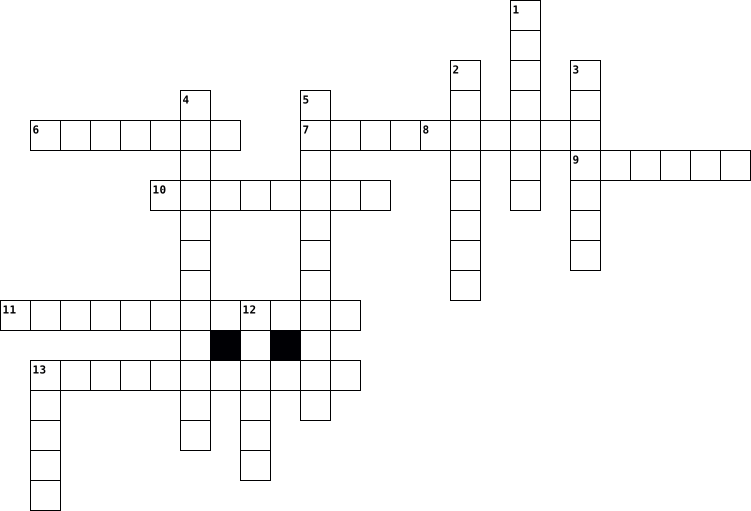
The Cell Cycle 2021-02-10

Across
- cells replicate (copy) their DNA
- also known as mitosis; time when cells divide their DNA(chromosomes) and distribute that DNA into two new daughter cells
- process cells use to grow, replicate their DNA, and divide to create new cells
- form of DNA when it is condensed and easy to move
- name given to DNA after replication when the chromosomes are duplicated
- cell growth and DNA replication occurs during this time in the cell cycle
Down
- scientific name for body cells
- time when the cytoplasm divides to create two new daughter cells
- cells increase in size, make proteins, and do their normal cell jobs
- DNA division occurs during this time in the cell cycle
- form of DNA when it is long and thin
- cells continue to briefly grow prior to cell division
- number of chromosomes found in human body cells
13 Clues: scientific name for body cells • cells replicate (copy) their DNA • form of DNA when it is long and thin • number of chromosomes found in human body cells • form of DNA when it is condensed and easy to move • cells continue to briefly grow prior to cell division • DNA division occurs during this time in the cell cycle • ...
Final exam crossword puzzle 2023-12-08

Across
- a molecule that carries energy within cells.
- membrane what are cells surrounded by?
- property of molecules that do not mix with water.
- group the group that is being tested is called?
- the amount of energy required to turn liquid into gas
- what is the organelle that is found only in animal cells
- what are cells that have DNA enclosed in a nucleus called?
- the attraction between molecules of the same substance.
Down
- what are cells that do not have a nucleus called?
- when a person's body gets cold it's an example of?
- a chemical compound with the chemical formula CO2
- a selective barrier
- is a molecule that carries energy within with?
- a__is a group of cells that perform a particular function
- what are living things made out of?
15 Clues: a selective barrier • what are living things made out of? • membrane what are cells surrounded by? • a molecule that carries energy within cells. • is a molecule that carries energy within with? • what are cells that do not have a nucleus called? • a chemical compound with the chemical formula CO2 • property of molecules that do not mix with water. • ...
Final exam crossword puzzle 2023-12-08

Across
- a molecule that carries energy within cells.
- membrane what are cells surrounded by?
- property of molecules that do not mix with water.
- group the group that is being tested is called?
- the amount of energy required to turn liquid into gas
- what is the organelle that is found only in animal cells
- what are cells that have DNA enclosed in a nucleus called?
- the attraction between molecules of the same substance.
Down
- what are cells that do not have a nucleus called?
- when a person's body gets cold it's an example of?
- a chemical compound with the chemical formula CO2
- a selective barrier
- is a molecule that carries energy within with?
- a__is a group of cells that perform a particular function
- what are living things made out of?
15 Clues: a selective barrier • what are living things made out of? • membrane what are cells surrounded by? • a molecule that carries energy within cells. • is a molecule that carries energy within with? • what are cells that do not have a nucleus called? • a chemical compound with the chemical formula CO2 • property of molecules that do not mix with water. • ...
Chances Crossword puzzle 2022-10-04

Across
- brain of cell
- a body's internal healthy state of balance
- cells with no nucleus
- captures sunlight to make food
- semi-permeable skin of all cells
- cells are made of many cells
Down
- jelly-like fluid
- organisms are made of only one cell
- makes energy
- stores food, water, and waste
- cells with a nucleus
- hard outside shell of many cells
- passage way to transport materials
13 Clues: makes energy • brain of cell • jelly-like fluid • cells with a nucleus • cells with no nucleus • cells are made of many cells • stores food, water, and waste • captures sunlight to make food • hard outside shell of many cells • semi-permeable skin of all cells • passage way to transport materials • organisms are made of only one cell • a body's internal healthy state of balance
Immune & Respiratory Crossword 2013-02-22

Across
- A special protein that helps fight infection
- Body's resistance to disease-carrying agents
- A thick secretion
- cell Cells that destroy pathogens
- system This system provides body cells with oxygen
- Structure on the left side of your abdomen that filters foreign matter from the blood and nymph
- Microscopic air sacs
Down
- The throat
- Two tubes through which air moves to the lungs
- Small tubes that go to the alveoli
- a flap that covers the entrance to the throat
- gland Structure that causes white blood cells to become t cells
- cell Cells that produce antibodies
- membrane A type of tissue that lines body cavities
- The tube that moves air
- system This protects the body from pathogens
- Hair-like structures that remove dust and other particles from the air
- node Structure that filters and destroys pathogens
- Main organ of the respiratory system
19 Clues: The throat • A thick secretion • Microscopic air sacs • The tube that moves air • cell Cells that destroy pathogens • Small tubes that go to the alveoli • cell Cells that produce antibodies • Main organ of the respiratory system • A special protein that helps fight infection • Body's resistance to disease-carrying agents • system This protects the body from pathogens • ...
Cancer 2014-08-29

Across
- destructive to cells
- extremely toxic or pathogenic
- given in smaller amounts and more frequently
- the science of dealing with cancer
- treatment using radiation
- a new growth, either a begnign or malignant tumor
- capable of invading surrounding tissues and metatasizing to distant organs
- in cancer pathology, a classification of the rate of growth of cancer cells
Down
- cancer-producing agent
- denoting the nonmalignant character of a neoplasm or illness
- a malignant and invasive epithelial tumor
- spread of disease from one part of the body to another
- extremely toxic or pathogenic
- treatment using chemical agents
- cancer arising from teh cells lining the pleura or peritoneum
- use of light-sensitive drug with a laser beam to destroy cells
- a cancer arising from glandular epithelial cells
- to increase in number through reproduction
- a malignant tumor originating in connective tissue
- process of determination of the extent of the distribution of a neoplasm
20 Clues: destructive to cells • cancer-producing agent • treatment using radiation • extremely toxic or pathogenic • extremely toxic or pathogenic • treatment using chemical agents • the science of dealing with cancer • a malignant and invasive epithelial tumor • to increase in number through reproduction • given in smaller amounts and more frequently • ...
Unit 9.Meiosis 2020-03-03

Across
- (Stage 4)Spindle Fibers pull on the chromosomes
- Cells join together during sexual reproduction to make a zygote
- (Stage 6)Chromosomes reorganize, Spindles start to form between centromeres
- (Stage 9)Two Diplod cells divide into 4 haploid cells
- Part of both Stage 5 and 9
- Two parents unite to form a new organism
- Homologus Chromosomes join together
- (Stage 5)Chromosomes at poles, and cytokineses occurs
- two complete sets of chromosomes
- (Stage 2)Dna Coils Itself,Crossing over occurs
- (Stage 7)Spindles formed again and attach to centromeres
Down
- (Stage 8)Spindles pull sister chromatid apart
- Any cell of a living organism other then the reproductive cells
- (Stage 3)Spindle Fibers attach to the centromere
- a diplod from two haploid gametes; fertilized ovum
- Father and Mother Match
- (Stage 1)Dna in Chromatin Form,Dna Replicates
- Creates 4 Haploid gamete cells from a diploid Cell
- single set of chromosomes
19 Clues: Father and Mother Match • single set of chromosomes • Part of both Stage 5 and 9 • two complete sets of chromosomes • Homologus Chromosomes join together • Two parents unite to form a new organism • (Stage 8)Spindles pull sister chromatid apart • (Stage 1)Dna in Chromatin Form,Dna Replicates • (Stage 2)Dna Coils Itself,Crossing over occurs • ...
Skeletal system 2020-10-05

Across
- huge cells made up of so many monocytes(wbc)
- Thyroid gland-promotes osteoblasts activity and the synthesis of bone matrix
- stem cells-unspecialized
- too much calcium in the blood
- pituitary gland-controls bone growth and increases calcium retention
- abnormally low levels of calcium
- mature bone cells-main cells
- kidneys-stimulates the absorption of calcium de phosphate form the digestive track
- bone shaft or body
- line the medullary cavity
Down
- thin layer of hyaline cartilage covering epiphyses
- parathyroid gland-stimulates osteoclasts proliferation and activity
- girls-ovaries boys-testes responsable for growth spurt that occurs during adolescence
- composed of outer fibrous layer
- bone building cells-extracelluar matrix
- hollow cylindrical space within diaphysis
- thyroid gland-inhibits osteoclasts activity and stimulates calcium uptake by the bones
- proximal and distal end of the bone
- growing bone,contains growth plate
19 Clues: bone shaft or body • stem cells-unspecialized • line the medullary cavity • mature bone cells-main cells • too much calcium in the blood • composed of outer fibrous layer • abnormally low levels of calcium • growing bone,contains growth plate • proximal and distal end of the bone • bone building cells-extracelluar matrix • hollow cylindrical space within diaphysis • ...
Skin crossword 2021-10-07

Across
- dark brown or balck pigment produced by melanocytes
- lines closed internal body cavities
- thin pliable sheetlike type of extracellular matrix
- whitsh, flexible connector tissue
- covering or coating
- specialized cells involved in detection and destruction of bacteria
- most inner lining of some organs and body cavities
- tough, strong tissue
- resident cell of cartilage
- rigid tissue that constitutes part of the skeleton
Down
- layer of connective tissue that lines joint, tendon sheaths, and bursae cavities
- type of cartilage present in pinnae (auricles) of ear
- glass like translucent cartilage
- describes cells producing protein called keratin
- most common cells in connective tissue
- composed of cells that produce movement
- group of cells that have similar structures that function together as a unit
- longest living bone
- chief structural unit of compact (cortical) bone
19 Clues: covering or coating • longest living bone • tough, strong tissue • resident cell of cartilage • glass like translucent cartilage • whitsh, flexible connector tissue • lines closed internal body cavities • most common cells in connective tissue • composed of cells that produce movement • describes cells producing protein called keratin • ...
CT Terminology 2024-01-29

Across
- term for red blood cell
- name of cells within ACT
- name of cells within CCT
- CT which provides gas transport, immune system function, and wound clotting
- specific macromolecule that all fibers of CT are made of
- CT which is highly vascularized; the 'feeding' tissue
- depression within CT where chondrocytes are found
- name of cells within RCT
- connects bone to muscle
- CT which stores energy and provides thermal insulation
- connects bone to bone
Down
- term for white blood cell
- stain of CT
- major component of CT, consisting of ground substance and fibers
- CT which supports lymphatic organs
- CT which is rigid and flexible for support, structure, and friction reduction in joints
- CT which provides rigid support, structure, movement, and mineral storage
- name of cells within Bone CT
- cell surface modifications of bone cells which allows for nutrient diffusion
19 Clues: stain of CT • connects bone to bone • term for red blood cell • connects bone to muscle • name of cells within ACT • name of cells within CCT • name of cells within RCT • term for white blood cell • name of cells within Bone CT • CT which supports lymphatic organs • depression within CT where chondrocytes are found • CT which is highly vascularized; the 'feeding' tissue • ...
Cell Vocab Review 2024-02-23

Across
- The pressure exerted on the wall of a cell due to the amount of water in the vacuole.
- Cell membranes have a bilayer of this special kind of molecule
- jelly-like substance that fills the empty areas within the cell, holds everything in place
- have chlorophyll
- only bacteria cells have these
- these specialized cells form a network to send messages quickly
- is selectively permeable
- store water. Especially large in plant cells
- these specialized cells contain a lot of mitochondria
Down
- powerhouse of the cell, makes ATP
- these specialized cells transport oxygen in the body
- structures within a cell that each have a specific function
- attracted to water molecules
- small fibers that help the cell keep its shape
- takes care of waste and toxins in the cell
- packages substances for transport (also called apparatus)
- make proteins
- controls all functions of the cell
- repels water water molecules
19 Clues: make proteins • have chlorophyll • is selectively permeable • attracted to water molecules • repels water water molecules • only bacteria cells have these • powerhouse of the cell, makes ATP • controls all functions of the cell • takes care of waste and toxins in the cell • store water. Especially large in plant cells • small fibers that help the cell keep its shape • ...
Cancer Cells 2018-09-01

Across
- Which system can cancer cells hide from?
- Most malignant tumours that have lost what?
- On a global scale, what organ is cancer cells commonly found among men?
- Cancer cells are what type of cells?
- In comparison to normal cells, cancer cells need more of what?
- On a global scale, what organ is cancer cells commonly found among women?
Down
- Which cancer cell originates in bone marrow?
- What allows cancer cells to spread from one area to another?
- What cell dividing process do cancer cells undergo?
- What is one method used by doctors to kill cancer cells?
- The word 'cancer' relates to which Greek word's meaning?
- What does too many cancer cells suppressed in a specific area create?
12 Clues: Cancer cells are what type of cells? • Which system can cancer cells hide from? • Most malignant tumours that have lost what? • Which cancer cell originates in bone marrow? • What cell dividing process do cancer cells undergo? • What is one method used by doctors to kill cancer cells? • The word 'cancer' relates to which Greek word's meaning? • ...
Chapter 8 Crossword Puzzle 2021-03-31

Across
- the process by which lymphocyte progenitors in the thymus and bone marrow differentiate into mature lymphocytes
- process because of which each B cell can express an Ig heavy chain from only one of the two inherited parental alleles
- enzymes that remove nucleotides from V, D, and J gene segments at the sites of recombination
- lymphoid-specific enzyme that is essential for the somatic recombination of V and J, or of V, D, and J, gene segments
- receptor responsible for greatest proliferation of developing lymphocytes
- selection facilitating the survival of potentially useful lymphocytes (no need to write the word ‘selection’)
Down
- tolerance that is developed in the generative lymphoid organs (no need to write the word ‘tolerance’)
- hematopoietic stem cells mature into these cells and then these cells give rise to B cells, T cells, and innate lymphoid cells
- name of the process by which developing T or B cells are eliminated if they bind with high affinity to self-antigens.
- transcription factor for T cell maturation (no need to include hyphen)
- t cells that are the least developed progenitors in the thymus
- last name of the scientist who elucidated the mechanism for B- and T-cell receptor diversity
- organ responsible for B-1 cells in a fetus
- events that preserve cells that have produced functional antigen receptor proteins and eliminate potentially dangerous cells (no need to include the word ‘events’)
- gene segment that only occurs in the Ig heavy-chain and TCR β-chain loci
15 Clues: organ responsible for B-1 cells in a fetus • t cells that are the least developed progenitors in the thymus • transcription factor for T cell maturation (no need to include hyphen) • gene segment that only occurs in the Ig heavy-chain and TCR β-chain loci • receptor responsible for greatest proliferation of developing lymphocytes • ...
Cancer Cells 2018-09-01

Across
- Which system can cancer cells hide from?
- Most malignant tumours that have lost what?
- On a global scale, what organ is cancer cells commonly found among men?
- Cancer cells are what type of cells?
- In comparison to normal cells, cancer cells need more of what?
- On a global scale, what organ is cancer cells commonly found among women?
Down
- Which cancer cell originates in bone marrow?
- What allows cancer cells to spread from one area to another?
- What cell dividing process do cancer cells undergo?
- What is one method used by doctors to kill cancer cells?
- The word 'cancer' relates to which Greek word's meaning?
- What does too many cancer cells suppressed in a specific area create?
12 Clues: Cancer cells are what type of cells? • Which system can cancer cells hide from? • Most malignant tumours that have lost what? • Which cancer cell originates in bone marrow? • What cell dividing process do cancer cells undergo? • What is one method used by doctors to kill cancer cells? • The word 'cancer' relates to which Greek word's meaning? • ...
Cell Theory 2023-09-01

Across
- primitive cells; do not contain a nucleus
- smallest structural and functional unit of an
- complex cells, contains a nucleus and membranebound organelles
- perceiving and responding to changes in the
- concluded all animals are made from cells
- keeps conditions in the organism within tolerable limits (balance)
Down
- comprised of three parts; all living things are made of cells, cells are the basic unit of life, all cells come from preexisting cells
- chemical reactions inside the cell
- determined cells come from preexisting cells
- improved the microscope, first person to view live
- concluded all plants are made from cells
- gave us the term cell, observed the bark of a cork
12 Clues: chemical reactions inside the cell • concluded all plants are made from cells • primitive cells; do not contain a nucleus • concluded all animals are made from cells • perceiving and responding to changes in the • determined cells come from preexisting cells • smallest structural and functional unit of an • improved the microscope, first person to view live • ...
Meiosis Crossword 2020-03-03

Across
- Mature haploid cells
- DNA becomes visible chromosomes
- Spindles are formed again, attach to centromeres.
- cell w/ single set of chromosomes, single set of genes
- Cells non-reproductive cells
- Spindle fibers pull on chromosomes, which head towards separate poles
- Matching chromosomes from mother and father
- Nuclear membranes form around chromosomes again
Down
- a fertilized ovum
- Type of reproduction where haploids from two parents unite
- DNA in chromatin form, replicates
- spindles pull sister chromatids apart (again)
- Completely formed spindle fibers attach to centromeres of homologous chromosomes
- Creates 4 haploid gamete cells from a diploid cell
- Nuclear membranes form, chromosomes become chromatin. Cells split.
- containing two complete sets of chromosomes, one from each parent
- Homologous chromosomes conjoin and may share genetic information.
- This process is part of the Telophase (stage 5) and Telophase II (stage 9)
- chromosomes reorganize and nuclear membranes dissolve again
19 Clues: a fertilized ovum • Mature haploid cells • Cells non-reproductive cells • DNA becomes visible chromosomes • DNA in chromatin form, replicates • Matching chromosomes from mother and father • spindles pull sister chromatids apart (again) • Nuclear membranes form around chromosomes again • Spindles are formed again, attach to centromeres. • ...
Cell Crossword 2021-08-26

Across
- a network of protein filaments that gives shape and support
- small units of nucleic acids
- cells with a nucleus
- cells without nucleus
- the smallest unit of a substance that maintains the properties of the substance
- membrane surrounds the cell, and controls what comes in
- a sphere shaped organelle that produces the protein
- molecules including fats, oils, waxes, and phospholipids
- (plant cells only) organelle that goes through photosynthesis
- a membrane bound organelle that stores water and waste
- small round membrane enclosed organelle that breaks down materials so they can be reused
Down
- Flattened sacs or tubes that receive the proteins
- gel like liquid that fills the cell
- the organelle that creates and stores the energy
- small structures inside cells
- the smallest unit of living things
- molecules including sugars, starches and fibers
- as your body digests proteins they break into ________ _______.
- instructions for the cell processes
- When these were invented it was the first time we saw cells
20 Clues: cells with a nucleus • cells without nucleus • small units of nucleic acids • small structures inside cells • the smallest unit of living things • gel like liquid that fills the cell • instructions for the cell processes • molecules including sugars, starches and fibers • the organelle that creates and stores the energy • Flattened sacs or tubes that receive the proteins • ...
7th Chapters 15/16 2022-03-15

Across
- the result of feeling the blood pump through the arteries
- tiny sacs in the spongy tissue of the lungs
- breathing involves movement of what and the ribs
- two lower chambers of the heart
- windpipe
- air enters the nose to the what
- these filter dead cells bacteria virusus and other particles
- two upper chambers of the heart
- white blood cells are made up of what
Down
- red blood cells are made up of what
- the pressure of circulating blood against the walls of the arteries
- helps prevent backflow of blood through veins
- main organ of the respiratory system
- Transports nutrients, minerals, proteins through the body
- recycles worn out red blood cells and produces white blood cells
- this organ is active in youth and shrinks in teen years
- made of muscle and cartilage
- connects the passageway from the nose to the mouth
- the heart has how many chambers
19 Clues: windpipe • made of muscle and cartilage • two lower chambers of the heart • air enters the nose to the what • the heart has how many chambers • two upper chambers of the heart • red blood cells are made up of what • main organ of the respiratory system • white blood cells are made up of what • tiny sacs in the spongy tissue of the lungs • ...
Pathology 2023-09-02

Across
- Cancer arising from epithelial tissues.
- Enlarged lymph nodes due to infection, inflammation, or cancer
- Inflammation of the gallbladder.
- Cancer of the blood-forming tissues, leading to abnormal production of white blood cells.
- Collection of blood outside blood vessels.
- Removal of tissue for examination to diagnose diseases.
- Fungal infection caused by Candida species.
- Skin infection involving underlying tissues.
- Process of normal cells becoming cancerous.
- Thickened white patches on mucous membranes, often found in the mouth or throat.
- Disorder involving excess histiocytes (immune cells).
Down
- Dilated airways in the lungs, often leading to infection.
- Inflammation of the liver, often due to viral infection.
- Presence of gallstones in the gallbladder.
- Cancer originating from immature cells.
- Liver scarring often due to chronic disease.
- Excessive bleeding from blood vessels.
- An increase in the number of white blood cells in the blood.
- Presence of blood in urine.
19 Clues: Presence of blood in urine. • Inflammation of the gallbladder. • Excessive bleeding from blood vessels. • Cancer arising from epithelial tissues. • Cancer originating from immature cells. • Presence of gallstones in the gallbladder. • Collection of blood outside blood vessels. • Fungal infection caused by Candida species. • Process of normal cells becoming cancerous. • ...
Spreadsheet vocabulary 2025-10-10

Across
- tradition that is used for recording data in rows and columns
- column width/row and height
- vertical series of cells
- equation that performs calculations in cells
- rule that tells you if it's true or false
- results, data, or information given by the user to use or display
- horizontal group of cells that could be identified as a number
- Key
- way text, pictures, etc. are organized
Down
- sum function
- electronic document in which data is arranged
- intersecting row or column on a spreadsheet
- a text string representing a number to a number
- predefined formula that performs a specific calculation
- Adding numbers within a spreadsheet
- value formatting output manual input common formatting
- label that allows you to switch worksheets
- tab conditions columns rows conditional formatting
- that changes the appearance of cells, rows, or columns
19 Clues: Key • sum function • vertical series of cells • column width/row and height • Adding numbers within a spreadsheet • way text, pictures, etc. are organized • rule that tells you if it's true or false • label that allows you to switch worksheets • intersecting row or column on a spreadsheet • equation that performs calculations in cells • ...
Cell Theory 2026-04-02

Across
- The energy currency of the cell
- Complex cells with a nucleus
- A widely tested and accepted explanation of a set of observations
- In multicellular organisms, cell are organized into a _____________.
- Organisms that have many cells
- The powerhouse of the cell that produces ATP
- A kind of respiration without oxygen
- The organelle where photosynthesis takes place
- Cells without a defined nucleus where genetic material floats freely
- Organisms that only have one cell
- Cellular ______ respiration is the process that animal cells go through to produce carbon dioxide, water, and energy
Down
- The process plants go through to create sugars and oxygen
- Where DNA is stored in a eukaryotic cell
- When cells form tissues to work together
- Every cell has a cell _____ that controls what substances flow in and out.
- The basic building block of life
- _________ make enzymes and proteins
- The structures within a cell
- When organs work together they form a ______.
19 Clues: Complex cells with a nucleus • The structures within a cell • Organisms that have many cells • The energy currency of the cell • The basic building block of life • Organisms that only have one cell • _________ make enzymes and proteins • A kind of respiration without oxygen • Where DNA is stored in a eukaryotic cell • When cells form tissues to work together • ...
Cells Science Study Guide Menu +1 2018-10-28

Across
- Concluded that all animals are made of cells.
- Studied bacteria in teeth plack and pond scum.
- Absorbs sunlight to produce sugar (glucose); photosynthesis happens here.
- Surrounds, supports, and suspends organelles throughout the cell.
- Created the term "cells" after looking at a cork slice.
- The powerhouse of the cell that makes energy usable.
- The control center, or "brain" of the cell; contains DNA.
- Controls what substances enter and exit the cell.
Down
- Concluded that all plants are made of cells.
- The temporary storage area that is large in plant cells and small in animal cells.
- The delivery system for the cell.
- Produces proteins by hooking amino acids together.
- Discovered that all cells come/came from previously living cells.
- Protective layer that gives a shape to plant cells and provides it with a rigid structure and support.
14 Clues: The delivery system for the cell. • Concluded that all plants are made of cells. • Concluded that all animals are made of cells. • Studied bacteria in teeth plack and pond scum. • Controls what substances enter and exit the cell. • Produces proteins by hooking amino acids together. • The powerhouse of the cell that makes energy usable. • ...
Cells Science Study Guide Menu +1 2018-10-26

Across
- Produces proteins by hooking amino acids together.
- Absorbs sunlight to produce sugar (glucose); photosynthesis happens here.
- Concluded that all plants are made of cells.
- The delivery system for the cell.
- Studied bacteria in teeth plack and pond scum.
- Discovered that all cells come/came from previously living cells.
Down
- Surrounds, supports, and suspends organelles.
- Controls what substances enter and leave the cell.
- The temporary storage area that is large in plant cells and small in animal cells.
- The control center, or "brain" of the cell; contains DNA.
- Created the term "cells" after looking at a cork slice.
- The powerhouse of the cell that makes energy usable.
- Concluded that all animals are made of cells.
- Protective layer that gives a shape to plant cells and provides it with a rigid structure and support.
14 Clues: The delivery system for the cell. • Concluded that all plants are made of cells. • Surrounds, supports, and suspends organelles. • Concluded that all animals are made of cells. • Studied bacteria in teeth plack and pond scum. • Controls what substances enter and leave the cell. • Produces proteins by hooking amino acids together. • ...
Bacteria and fungal cells 2023-10-11

Across
- - fungi, plants and animal cells have this. Releases energy.
- - bacteria, fungi and plant cells have this.
- - small ring of DNA in bacteria
- - bacteria, fungi, plants and animal cells have this. Chemical reactions happen
- - variable kept same in experiment
- - variable changed in experiment
- - variable measured in experiment
Down
- - cells that do not have a nucleus
- - part of the cell that contains DNA
- - bacteria, fungi, plants and animal cells have this.
- - cells that have a nucleus
- - where photosynthesis happens in plants.
- - bacteria, fungi, plants and animal cells have this. Makes proteins
13 Clues: - cells that have a nucleus • - small ring of DNA in bacteria • - variable changed in experiment • - variable measured in experiment • - cells that do not have a nucleus • - variable kept same in experiment • - part of the cell that contains DNA • - where photosynthesis happens in plants. • - bacteria, fungi and plant cells have this. • ...
Cellular Process Review 2025-09-25

Across
- contains a complete set of chromosomes, one chromosome from each parent.
- a thread-like structure made of DNA.
- the process of plants converting the sun’s energy to make food for themselves.
- sugar/glucose
- Movement of molecules from an area of high concentration to an area of low concentration.
- a process of cell division that results in four daughter cells, known as gametes.
- exactly alike.
- contains a single set of unpaired chromosomes.
Down
- Carbon Dioxide
- diffusion of water from an area of high water concentration to an area of low water concentration.
- process of cell division that results in two daughter cells that are genetically identical to the parent cell.
- haploid sperm or egg cells, also known as reproductive cells.
- process where the sperm and egg cells combine to form a diploid cell, known as a zygote.
- cells, cells that result after a single cell undergoes cell division.
- Oxygen
- Respiration, The process of converting sugar to energy in the mitochondria.
16 Clues: Oxygen • sugar/glucose • Carbon Dioxide • exactly alike. • a thread-like structure made of DNA. • contains a single set of unpaired chromosomes. • haploid sperm or egg cells, also known as reproductive cells. • cells, cells that result after a single cell undergoes cell division. • contains a complete set of chromosomes, one chromosome from each parent. • ...
David 6 2022-11-10

Across
- making a mini me
- chromosomes pulled to opposite sides
- chromosomes form nucleus disappears
- cell grows and copies DNA
- regrows missing part
- gel in cell split
- nucleus reforms and chromosomes unwind
Down
- DNA comes from one organism
- cells become specialized
- add more cells
- cell without nucleus divides
- chemical controls cell functions
- cells with nucleus split
- replace cells or cell parts
- chromosomes line up in middle
- tightly wound DNA
16 Clues: add more cells • making a mini me • gel in cell split • tightly wound DNA • regrows missing part • cells become specialized • cells with nucleus split • cell grows and copies DNA • DNA comes from one organism • replace cells or cell parts • cell without nucleus divides • chromosomes line up in middle • chemical controls cell functions • chromosomes form nucleus disappears • ...
Intro To Cells 2022-07-07

Across
- Prokaryotes and Eukaryotes have this
- Cell membrane also called a ____ membrane
- Humans are ________, not unicellular
- Makes glucose using light energy
- Animal cells are ____
- Cells get energy from this
- People have ________ of these
Down
- Pond water has them
- Type of cells humans have
- Prokaryotes don't have this
- Plant cells have a cell _____
- Plant cells are _____
- DNA codes for this
- Smallest living unit in all organisms
14 Clues: DNA codes for this • Pond water has them • Plant cells are _____ • Animal cells are ____ • Type of cells humans have • Cells get energy from this • Prokaryotes don't have this • Plant cells have a cell _____ • People have ________ of these • Makes glucose using light energy • Prokaryotes and Eukaryotes have this • Humans are ________, not unicellular • ...
Differences Between Animal and Plant Cells Puzzle 2014-11-10

Across
- Only animal cells have them, barrel shaped
- The plant cell has two unlike the animal cell, processes and transports materials out of cell
- Both cells have them however plant cells' are much larger, stores food and water
- Only plant cells have them, create food out of light energy
- Both cells have one, keep cytoplasm inside
- Both cells have one, fluid that surrounds the organelles
Down
- Only plant cells have this, it provides strength and is the outermost layer
- Both cells have them surrounding the Nucleus, packs up proteins
- Both cells contain one (mostly in the center) contains the cell's DNA
- The animal cells' is more oval shaped than the plants, breaks down food molecules to release energy
- Both cells have them, abundant and tiny, create proteins
- Only in animal cells, destroy unneeded things
12 Clues: Only animal cells have them, barrel shaped • Both cells have one, keep cytoplasm inside • Only in animal cells, destroy unneeded things • Both cells have them, abundant and tiny, create proteins • Both cells have one, fluid that surrounds the organelles • Only plant cells have them, create food out of light energy • ...
Unit 9.Meiosis 2020-03-03

Across
- single set of chromosomes
- (Stage 9)Two Diplod cells divide into 4 haploid cells
- a diplod from two haploid gametes; fertilized ovum
- two complete sets of chromosomes
- (Stage 3)Spindle Fibers attach to the centromere
- (Stage 4)Spindle Fibers pull on the chromosomes
- (Stage 5)Chromosomes at poles, and cytokineses occurs
- Two parents unite to form a new organism
- Any cell of a living organism other then the reproductive cells
Down
- Part of both Stage 5 and 9
- (Stage 6)Chromosomes reorganize, Spindles start to form between centromeres
- (Stage 8)Spindles pull sister chromatid apart
- Father and Mother Match
- (Stage 2)Dna Coils Itself,Crossing over occurs
- Cells join together during sexual reproduction to make a zygote
- (Stage 1)Dna in Chromatin Form,Dna Replicates
- (Stage 7)Spindles formed again and attach to centromeres
- Homologus Chromosomes join together
- Creates 4 Haploid gamete cells from a diploid Cell
19 Clues: Father and Mother Match • single set of chromosomes • Part of both Stage 5 and 9 • two complete sets of chromosomes • Homologus Chromosomes join together • Two parents unite to form a new organism • (Stage 8)Spindles pull sister chromatid apart • (Stage 1)Dna in Chromatin Form,Dna Replicates • (Stage 2)Dna Coils Itself,Crossing over occurs • ...
Fat and Skin Cell 2025-04-10

Across
- producing keratin.
- ll The process of breaking down
- The skin's ability to repair
- process of creating and
- stored within fat cells.
- fat (triglycerides) in fat cells for
- fat in fat cells.
- that produce melanin,
- A protein that provides structure
- fat storage in adipocytes.
Down
- outermost layer of the skin,
- composed of skin cells.
- main type of cell in the
- This is the scientific name for
- support to the skin.
- renew itself through cell division.
- These are the main form of
- for skin pigmentation and UV
- A hormone that plays a key role in
19 Clues: fat in fat cells. • producing keratin. • support to the skin. • that produce melanin, • composed of skin cells. • process of creating and • main type of cell in the • stored within fat cells. • These are the main form of • fat storage in adipocytes. • outermost layer of the skin, • The skin's ability to repair • for skin pigmentation and UV • ll The process of breaking down • ...
Integumentary System Pt1 2020-03-01

Across
- tiny living things, like bacteria, viruses, and fungi
- merkel cells and nerve cells are responsible for your sense of:
- the process of regulating body temperature
- _____ cells are pressure sensitive cells that combine with nerve endings to create a receptor for touch
- blood vessels ______ to release heat if it's too warm
- sweat glands secrete sweat onto the surface of the skin to transfer ____ out of the body if it's too warm
- cells that create melanin
- heat, cold, and pain are all examples of:
- __________ cells detect invaders and communicate their presence to T-cells
Down
- blood vessels ______ to retain heat if it's cold
- flexible material that helps skin absorb pressure and shock
- can shield the head from physical damage and sunburn
- the foundation of the integumentary system
- when you touch something, your _____ send a signal to the brain
- this body system includes skin, hair, nails, and specialized glands and nerves
- gives skin its color and provides protection from UV rays
16 Clues: cells that create melanin • heat, cold, and pain are all examples of: • the foundation of the integumentary system • the process of regulating body temperature • blood vessels ______ to retain heat if it's cold • can shield the head from physical damage and sunburn • tiny living things, like bacteria, viruses, and fungi • ...
Cell Biology 2024-01-11

Across
- All cells come from other cells through cell ________.
- Cells that lack a nucleus and organelles.
- All living things are made up of 1 or more of these.
- The "trash cans" of the cell, eliminates the waste of the cell.
- Passageways or "hallways" where materials can move within the cell.
- Small structures in the cell that make proteins.
Down
- To be made of many cells.
- To be made of 1 cell.
- The "refrigerator" of the cell, stores food, water, and minerals for the cell.
- Cells are the smallest working _____ of all living things.
- Cells that have a nucleus and organelles.
- The gel-like fluid where the organelles are found.
- Where chemicals are stored and released in the cell.
- The "gates/fence" of the cell, controls what can enter or leave the cell.
- The control center or "brain" of the cell, stores the DNA.
- The "powerhouse of the cell", makes and releases food for the cell.
16 Clues: To be made of 1 cell. • To be made of many cells. • Cells that have a nucleus and organelles. • Cells that lack a nucleus and organelles. • Small structures in the cell that make proteins. • The gel-like fluid where the organelles are found. • All living things are made up of 1 or more of these. • Where chemicals are stored and released in the cell. • ...
Immunity - Humoral / Cell mediated 2015-04-13

Across
- ________ is the complex biological response of vascular tissues to harmful stimuli, such as pathogens, damaged cells, or irritants.
- ________ cells are cells of the immune system that secrete large amounts of antibodies.
- A ________ is an abnormal growth or mass of tissue.
- Natural ________ cells are a form of cytotoxic lymphocyte which constitute a major component of the innate immune system.
- A ________ T cell belongs to a subgroup of T lymphocytes which are capable of inducing the death of infected somatic or tumor cells.
- Monocytes and ________s are phagocytes, acting in both innate immunity as well as cell-mediated immunity of vertebrate animals.
- A ________ or immunogen is a molecule that stimulates an immune response.
- Antigen ________ is a process in the body's immune system by which macrophages, dendritic cells and other cell types capture antigens and then show them for recognition by T-cells.
- A ________ is the detrimental.
- ________s are a family of small, signaling proteins and glycoproteins particularly important in both innate and adaptive immune responses.
- The ________ system is a complex network of lymphoid organs, lymph nodes, lymph ducts, tissues, lymph capillaries and lymph vessels that produce and transport lymph fluid from tissues to the circulatory system.
- The T cell ________ is a molecule found on the surface of T lymphocytes that is generally responsible for recognizing antigens bound to major histocompatibility complex molecules.
- ________ B cells are a B cell subtype that are formed following primary infection. They remember the same pathogen for faster antibody production in future infections.
Down
- The major ________ complex (MHC) is a large gene family found in most vertebrates, the most gene-dense region of the mammalian genome, which plays an important role in the immune system, autoimmunity, and reproductive success.
- ________ or immunoglobulins are proteins used by the immune system to identify and neutralize foreign objects, such as bacteria and viruses.
- With no cytotoxic or phagocytic activity, T ________ cells are a sub-group of lymphocytes playing an important role in establishing and maximizing the capabilities of the immune system.
- The ________ system is a collection of mechanisms within the body that protects against disease by identifying and killing pathogens and tumor cells.
- A ________ is a cell that ingests and destroys foreign matter such as microorganisms or debris.
- The ________ immune response provides the vertebrate immune system with the ability to recognize and remember specific pathogens.
- The ________ immune response is the aspect of immunity that is mediated by antibodies, produced by the cells of the B lymphocyte lineage.
20 Clues: A ________ is the detrimental. • A ________ is an abnormal growth or mass of tissue. • A ________ or immunogen is a molecule that stimulates an immune response. • ________ cells are cells of the immune system that secrete large amounts of antibodies. • A ________ is a cell that ingests and destroys foreign matter such as microorganisms or debris. • ...
Electrochemistry crossword puzzle 2015-02-09

Across
- ---------------is the anode during discharging process in a Lead acid battery
- Primary cell in which Zinc and carbon rod are used as electrodes -------------------
- Two or more electrochemical cells when connected in series electrically form a -----------------------
- Ni-Cd cell is an example of -------------------cell
- Units of conductance
- test solution.
- --------Gas is liberated at cathode in Ni-Cd cell.
- The most commonly used secondary battery among lithium cells---------------------------
- In an electrolytic cell Redox reactions are -------------------
- In primary cells the cell becomes ----- when all the reactants are converted
- Example of Fuel cell ------------------------------
- Does the cells work when the EMF of the cell is negative?
- Conductance of a solution increases with increase in --------------------
- Flow of charge in a material is called
- LaF3 crystal is used as a solid membrane in ----------electrode.
- Anode in Ni-Cd cell -------------------------
- cell reactions are made --------------by passing current in opposite direction.
- Dilute sulphuric acid is used as --------------------in lead acid storage battery.
- Recharge batteries are also called as ----------------cells
- light weight Primary cell with 3V capacity ---------------
- Number of lead acid cells used to run a car-----------------
Down
- Specific Conductance of a solution decreases with increase in --------------------------- Name of the Secondary reference electrode -------------------
- Battery commonly used in cars --------------------------------
- When 6 lead acid cells are connected in series the voltage produced is-------
- In electrochemical series electrodes are arranged in the increasing order of their standard
- Primary reference electrode example in short ----------
- Ion selective electrodes are sensitive to a ---------------------------------ion. ---------- solution is used as electrolyte in lead acid battery.
- The useful product obtained by the usage of fuel cells in space ships is ------------------------
- The Ion selective electrode which is sensitive to Hydrogen ion concentration
- Solar cells convert ---------------energy into electrical energy
- The electrode potential can be determined by _______________equation.
- Example of typical electrochemical cell ------------------
- Electrolyte used in Ni-Cd cell -----------------.
- products.
- In dry cells MnO2 acts as an ---------------------------
- The cells in which high energy conversion takes place and are ecofreindly ------------------
- The main application of electrochemical cells is to generate ---------energy.
- in which cell reactions are not reversible are called
- Electrodes used in Methanol –oxygen Fuel cell -------------
- The potential difference between two electrodes in an electrochemical cell gives -------of the cell.
- Ni-Cd cell is preferred because of its --------------------voltage.
- The ---------------------------------difference developed at the glass membrane is a measure of pH of
- Li-MnO2 cell is an example of lithium cell with ----------------cathode.
- A Good battery should have ---------------------capacity.
44 Clues: products. • test solution. • Units of conductance • Flow of charge in a material is called • Anode in Ni-Cd cell ------------------------- • Electrolyte used in Ni-Cd cell -----------------. • --------Gas is liberated at cathode in Ni-Cd cell. • Ni-Cd cell is an example of -------------------cell • Example of Fuel cell ------------------------------ • ...
Electrochemistry crossword puzzle 2015-02-09

Across
- ---------------is the anode during discharging process in a Lead acid battery
- Primary cell in which Zinc and carbon rod are used as electrodes -------------------
- Two or more electrochemical cells when connected in series electrically form a -----------------------
- Ni-Cd cell is an example of -------------------cell
- Units of conductance
- test solution.
- --------Gas is liberated at cathode in Ni-Cd cell.
- The most commonly used secondary battery among lithium cells---------------------------
- In an electrolytic cell Redox reactions are -------------------
- In primary cells the cell becomes ----- when all the reactants are converted
- Example of Fuel cell ------------------------------
- Does the cells work when the EMF of the cell is negative?
- Conductance of a solution increases with increase in --------------------
- Flow of charge in a material is called
- LaF3 crystal is used as a solid membrane in ----------electrode.
- Anode in Ni-Cd cell -------------------------
- cell reactions are made --------------by passing current in opposite direction.
- Dilute sulphuric acid is used as --------------------in lead acid storage battery.
- Recharge batteries are also called as ----------------cells
- light weight Primary cell with 3V capacity ---------------
- Number of lead acid cells used to run a car-----------------
Down
- Specific Conductance of a solution decreases with increase in --------------------------- Name of the Secondary reference electrode -------------------
- Battery commonly used in cars --------------------------------
- When 6 lead acid cells are connected in series the voltage produced is-------
- In electrochemical series electrodes are arranged in the increasing order of their standard
- Primary reference electrode example in short ----------
- Ion selective electrodes are sensitive to a ---------------------------------ion. ---------- solution is used as electrolyte in lead acid battery.
- The useful product obtained by the usage of fuel cells in space ships is ------------------------
- The Ion selective electrode which is sensitive to Hydrogen ion concentration
- Solar cells convert ---------------energy into electrical energy
- The electrode potential can be determined by _______________equation.
- Example of typical electrochemical cell ------------------
- Electrolyte used in Ni-Cd cell -----------------.
- products.
- In dry cells MnO2 acts as an ---------------------------
- The cells in which high energy conversion takes place and are ecofreindly ------------------
- The main application of electrochemical cells is to generate ---------energy.
- in which cell reactions are not reversible are called
- Electrodes used in Methanol –oxygen Fuel cell -------------
- The potential difference between two electrodes in an electrochemical cell gives -------of the cell.
- Ni-Cd cell is preferred because of its --------------------voltage.
- The ---------------------------------difference developed at the glass membrane is a measure of pH of
- Li-MnO2 cell is an example of lithium cell with ----------------cathode.
- A Good battery should have ---------------------capacity.
44 Clues: products. • test solution. • Units of conductance • Flow of charge in a material is called • Anode in Ni-Cd cell ------------------------- • Electrolyte used in Ni-Cd cell -----------------. • --------Gas is liberated at cathode in Ni-Cd cell. • Ni-Cd cell is an example of -------------------cell • Example of Fuel cell ------------------------------ • ...
Skeletal System 2021-03-29

Across
- a tough sheath of dense irregular connective tissue & its associated blood vessels that surrounds the bone surface wherever it is not covered by articular cartilage
- the addition of minerals and collagen fibers to bone by osteoblasts
- contains the bones of the upper and lower limbs, or appendages, that connect the limbs to the axial skeleton
- cells that digest protein and mineral components of bone extracellular matrix (resorption) which is part of the normal development, growth, maintenance, and repair of bone
- the distal and proximal ends of the bone
- "soft spots" that are found between cranial bones at birth
- have complex shapes and cannot be grouped into any other bone categories
- a hollow, cylindrical space within the diaphysis that contains fatty yellow bone marrow in adults -- also known as the marrow cavity
- mature bone cells that are the main cells in bone tissue and maintain its daily metabolism
- contains few spaces and is arranged in repeating structural units called osteons
- a thin layer of hyaline cartilage covering the part of the epiphysis where the bone forms an articulation (joint) with another bone
- loss of bone minerals
Down
- process of producing red blood cells, white blood cells, & platelets
- an immovable joint, which in most cases in an adult holds the skull bones together
- somewhat cube-shaped and nearly equal in length and width
- generally thin, provide considerable protection, & provide extensive surfaces for muscle attachment
- the removal of minerals and collagen fibers from bone by osteoclasts
- unspecialized stem cells that are the only bone cells to undergo cell division
- bone-building cells
- does not contain osteons; is composed of irregular latticeworks of thin columns of bone
- consists of the bones that lie around the longitudinal axis of the human body
- produces red blood cells, white blood cells, & platelets
- the process by which bone forms
- a thin membrane that lines the medullary cavity
- the bone's shaft or body -- the long, cylindrical, main portion of the bone
- regions in a mature bone where the diaphysis joins the epiphysis
- consists mainly of adipose cells, which store triglycerides
- the site of the growth plate; once bone growth in length stops, the epiphyseal line is the bony structure that replaces the cartilage that was once present
- the process by which bone tissue hardens
- have greater length than width and consist of a shaft and variable number of ends
- any break in a bone
31 Clues: bone-building cells • any break in a bone • loss of bone minerals • the process by which bone forms • the distal and proximal ends of the bone • the process by which bone tissue hardens • a thin membrane that lines the medullary cavity • produces red blood cells, white blood cells, & platelets • somewhat cube-shaped and nearly equal in length and width • ...
Cell Cycle and Mitosis 2020-10-29

Across
- Cells divide to make new individuals.
- One reason cells divide
- The first phase of mitosis where the chromosomes form and the nuclear membrane breaks down
- The phase of mitosis where the chromosomes split apart
- Mitosis forms 2 new _________ cells
- In order for a cell to split in 2, a new ______ needs to be formed
Down
- The phase the cells are in when not dividing
- The actual separating of the newly divided cells
- Coiled up DNA that forms an "X" shape
- Cells divide to allow an organism to ________ (get larger)
- The phase of mitosis where the chromosomes line up in the middle
- The phase of mitosis where the cells start to pinch apart and the nuclear membranes reform
- The daughter cells are ______ to the parent cell
- The steps needed to form a new nucleus
14 Clues: One reason cells divide • Mitosis forms 2 new _________ cells • Coiled up DNA that forms an "X" shape • Cells divide to make new individuals. • The steps needed to form a new nucleus • The phase the cells are in when not dividing • The actual separating of the newly divided cells • The daughter cells are ______ to the parent cell • ...
Skeletal System 2021-03-29

Across
- have greater length than width and consist of a shaft and variable number of ends
- a thin membrane that lines the medullary cavity
- a thin layer of hyaline cartilage covering the part of the epiphysis where the bone forms an articulation (joint) with another bone
- mature bone cells that are the main cells in bone tissue and maintain its daily metabolism
- consists of the bones that lie around the longitudinal axis of the human body
- the site of the growth plate; once bone growth in length stops, the epiphyseal line is the bony structure that replaces the cartilage that was once present
- consists mainly of adipose cells, which store triglycerides
- cells that digest protein and mineral components of bone extracellular matrix (resorption) which is part of the normal development, growth, maintenance, and repair of bone
- "soft spots" that are found between cranial bones at birth
- bone-building cells
- the distal and proximal ends of the bone
- the removal of minerals and collagen fibers from bone by osteoclasts
- the process by which bone tissue hardens
- process of producing red blood cells, white blood cells, & platelets
- regions in a mature bone where the diaphysis joins the epiphysis
- have complex shapes and cannot be grouped into any other bone categories
- the addition of minerals and collagen fibers to bone by osteoblasts
- produces red blood cells, white blood cells, & platelets
Down
- loss of bone minerals
- any break in a bone
- an immovable joint, which in most cases in an adult holds the skull bones together
- a hollow, cylindrical space within the diaphysis that contains fatty yellow bone marrow in adults -- also known as the marrow cavity
- somewhat cube-shaped and nearly equal in length and width
- the process by which bone forms
- contains the bones of the upper and lower limbs, or appendages, that connect the limbs to the axial skeleton
- unspecialized stem cells that are the only bone cells to undergo cell division
- generally thin, provide considerable protection, & provide extensive surfaces for muscle attachment
- contains few spaces and is arranged in repeating structural units called osteons
- the bone's shaft or body -- the long, cylindrical, main portion of the bone
- does not contain osteons; is composed of irregular latticeworks of thin columns of bone
- a tough sheath of dense irregular connective tissue & its associated blood vessels that surrounds the bone surface wherever it is not covered by articular cartilage
31 Clues: any break in a bone • bone-building cells • loss of bone minerals • the process by which bone forms • the distal and proximal ends of the bone • the process by which bone tissue hardens • a thin membrane that lines the medullary cavity • produces red blood cells, white blood cells, & platelets • somewhat cube-shaped and nearly equal in length and width • ...
Unit 3 Vocab 2021-10-21

Across
- cell organelle that stores materials such as water, salts, proteins, and carbohydrates
- a process by which liquid droplets are ingested by living cells; it is one type of endocytosis
- a microscope with high magnification that uses electron beams in place of light
- cell organelle that breaks down lipids, carbohydrates, and proteins into small molecules that can used by the rest of the cell
- strong, supporting layer around the cell membrane in some cells
- the process by which cells move materials from within the cell into the extracellular fluid.
- the process by which cells move materials out of the cell
- weak attraction between a hydrogen atom and another atom
- process of diffusion in which molecules pass across the membrane through cell membrane channels
- the amount of heat needed to raise the temperature of 1 gram of a substance 1 degree Celsius
- in a molecule, uneven distribution of electrons (results in (+) and (-) poles) ex. water
- process by which solids are ingested by living cells; it is another type of endocytosis
- organism whose cells contain a nucleus
- tendency of water to rise in a thin tube
- force of attraction between different kinds of molecules
Down
- unicellular organism that lacks a nucleus
- all living things are composed of cells, cells are the basic units of structure and function in living things, and that new cells are produced from existing cells
- network of protein filaments in a eukaryotic cell that gives the cell its shape and internal organization and is involved in movement
- diffusion of water through a selectively permeable membrane
- process by which particles tend to move from an area where they are more concentrated to an area where they are less concentrated
- when the concentration of two solutions is the same
- fluid portion of the cell outside the nucleus
- property of biological membranes that allows some substances to pass across it while others cannot; also called semi permeable membrane
- microscope that uses multiple lenses and light to enlarge the image of a sample
- thin, flexible barrier that surrounds all cells; regulates what enters and leaves the cell
- attraction between molecules of the same substance
- cellular transport where substances move against a concentration gradient. (requires energy)
- when comparing two solutions, the solution with the greater concentration of solutes
- tiny sacs that transport material within or outside the cell.
- when comparing two solutions, the solution with the lesser concentration of solutes
30 Clues: organism whose cells contain a nucleus • tendency of water to rise in a thin tube • unicellular organism that lacks a nucleus • fluid portion of the cell outside the nucleus • attraction between molecules of the same substance • when the concentration of two solutions is the same • weak attraction between a hydrogen atom and another atom • ...
Electrochemistry crossword puzzle 2015-02-09

Across
- ---------------is the anode during discharging process in a Lead acid battery
- Primary cell in which Zinc and carbon rod are used as electrodes -------------------
- Two or more electrochemical cells when connected in series electrically form a -----------------------
- Ni-Cd cell is an example of -------------------cell
- Units of conductance
- test solution.
- --------Gas is liberated at cathode in Ni-Cd cell.
- The most commonly used secondary battery among lithium cells---------------------------
- In an electrolytic cell Redox reactions are -------------------
- In primary cells the cell becomes ----- when all the reactants are converted
- Example of Fuel cell ------------------------------
- Does the cells work when the EMF of the cell is negative?
- Conductance of a solution increases with increase in --------------------
- Flow of charge in a material is called
- LaF3 crystal is used as a solid membrane in ----------electrode.
- Anode in Ni-Cd cell -------------------------
- cell reactions are made --------------by passing current in opposite direction.
- Dilute sulphuric acid is used as --------------------in lead acid storage battery.
- Recharge batteries are also called as ----------------cells
- light weight Primary cell with 3V capacity ---------------
- Number of lead acid cells used to run a car-----------------
Down
- Specific Conductance of a solution decreases with increase in --------------------------- Name of the Secondary reference electrode -------------------
- Battery commonly used in cars --------------------------------
- When 6 lead acid cells are connected in series the voltage produced is-------
- In electrochemical series electrodes are arranged in the increasing order of their standard
- Primary reference electrode example in short ----------
- Ion selective electrodes are sensitive to a ---------------------------------ion. ---------- solution is used as electrolyte in lead acid battery.
- The useful product obtained by the usage of fuel cells in space ships is ------------------------
- The Ion selective electrode which is sensitive to Hydrogen ion concentration
- Solar cells convert ---------------energy into electrical energy
- The electrode potential can be determined by _______________equation.
- Example of typical electrochemical cell ------------------
- Electrolyte used in Ni-Cd cell -----------------.
- products.
- In dry cells MnO2 acts as an ---------------------------
- The cells in which high energy conversion takes place and are ecofreindly ------------------
- The main application of electrochemical cells is to generate ---------energy.
- in which cell reactions are not reversible are called
- Electrodes used in Methanol –oxygen Fuel cell -------------
- The potential difference between two electrodes in an electrochemical cell gives -------of the cell.
- Ni-Cd cell is preferred because of its --------------------voltage.
- The ---------------------------------difference developed at the glass membrane is a measure of pH of
- Li-MnO2 cell is an example of lithium cell with ----------------cathode.
- A Good battery should have ---------------------capacity.
44 Clues: products. • test solution. • Units of conductance • Flow of charge in a material is called • Anode in Ni-Cd cell ------------------------- • Electrolyte used in Ni-Cd cell -----------------. • --------Gas is liberated at cathode in Ni-Cd cell. • Ni-Cd cell is an example of -------------------cell • Example of Fuel cell ------------------------------ • ...
Unit 2 Crossword 2022-12-07

Across
- Person often called “the father of modern pathology”, he said that all cells come from preexisting cells
- Solution causing water to diffuse out of a membrane, making a cell shrink
- Where cells exchange information via a hollow bridge
- What fermentation produces in muscle cells
- The first step in cellular respiration, aerobic or anaerobic
- Prokaryotes that don’t have peptidoglycan in their cell walls
- Lipid made of four fused carbon rings
- Enzymes that break down macromolecules in lysosomes
- Size of a eukaryotic ribosome
- A motor protein that can walk along the cytoskeleton
- A thick internal wall that encloses DNA and a portion of the cytoplasm
- Common electron carrier
- Type of organelles that prokaryotes don’t have
- What forms during cytokinesis in animal cells
- The first stage of the Calvin cycle, where carbon combines with other carbon compounds
- Prokaryotes using light as an energy source and organic compounds as a carbon source
- When particles move across a membrane until equilibrium is reached
- Hydrophilic head, hydrophobic tail
- Cell signaling to itself
- Cell-surface receptor that opens a transmembrane channel
- Face of the golgi apparatus that “ships” out
- Signaling molecule that binds to a receptor
Down
- Cell drinking
- Type of asexual reproduction in which an organism replicates its DNA and divides in half
- Prefix meaning cluster of cells
- Second stage of cell signaling
- C6H12O6
- Type of microscope that can be used at over 1,000,000x magnification
- Cells produced by meiosis with one pair of chromosomes
- What Pyruvate is converted to to prepare for the Krebs cycle
- Person who first discovered cells when looking at cork
- Protrusions that increase surface area on mitochondria
- ___ fibers (microtubules on centrioles)
- Number of transmembrane regions in a G-protein coupled receptor
- Color of a gram-negative stain
- Organelle that transports, forms by pinching off of other organelles
- Amount of ATP produced by each turn of the Krebs cycle
- A stack of thylakoids
- Amount of times the Krebs cycle turns per glucose
- The 3rd stage of mitosis, where the chromosomes are separated
- Approximate amount of ATP generated by Electron Transport Chain
- Type of light microscope that can view 3-d images with around 7-20x magnification
- Compartment within inner membrane in mitochondria
- Cells that are non-reproductive
- Organelle that stores materials, there’s one central one in plant cells
- What microfilaments are made of
- “Tail” used for movement in cells
47 Clues: C6H12O6 • Cell drinking • A stack of thylakoids • Common electron carrier • Cell signaling to itself • Size of a eukaryotic ribosome • Second stage of cell signaling • Color of a gram-negative stain • Prefix meaning cluster of cells • Cells that are non-reproductive • What microfilaments are made of • “Tail” used for movement in cells • Hydrophilic head, hydrophobic tail • ...
Anatomy and Physiology Exam II Review Part I 2025-06-12

Across
- Fibers Allow stretch and recoil
- Strong intercellular connections via cadherins
- Involved in blood clotting
- Blood Cells that transport oxygen
- Contains blood vessels in bone, _____ canal
- Cartilage cells in lacunae
- Fibers Provide strength in connective tissue
- Absorbs nutrients in the digestive tract, simple _______
- Secretion involves apex of cell
- Glands Secrete substances through ducts
- Tissue stretches in bladder and ureters
- Tissue that covers surfaces and forms glands
- The skin membrane
- Membrane that lubricates joints
- Glands Release hormones into blood
- Fluid for immune surveillance
- Involuntary, non-striated, spindle-shaped Muscle
- Squamous tissue in alveoli for diffusion
- Blastocyst attaches to endometrium
- Cells that produce collagen fibers
- Fat storing cells
- Connective tissue found in arteries
- Connective tissue in dermis, dense ______
- Connective tissue in tendons, dense ______
- Blood Cells that provide immunity
- Outer fibrous bone layer
- Fibers Form branched supportive network
- Anchor basal cells to extracellular matrix
- Hollow ball of cells at day 5 of prenatal development
- Tissue that fills spaces, supports, and stores energy
- Clear layer of basement membrane, ______ Lamina
Down
- Squamous tissue that protects skin and mouth from abrasion
- Dense collagen fiber layer in basement membrane, ______ Lamina
- Junctions that allow ion passage between cells
- Forms muscle, skeleton, and blood
- Secretion via exocytosis
- Bone that contains trabeculae aligned with stress
- Membrane that lines digestive and respiratory tracts
- Cells that engulf pathogens and debris
- Support and protect neurons
- Cartilage that supports flexible joints and ribs
- Conduct electrical signals
- Involuntary, striated, branched Muscle
- Shock absorber in spine and knee, type of cartilage
- Found in glands and kidney tubules, simple _______
- Junctions that seal adjacent epithelial cells
- Voluntary and striated Muscle
- Connect actin cytoskeletons of cells, ______ belts
- Forms digestive and respiratory organs
- Body’s response to injury
- Columnar Moves mucus in respiratory tract
- Whole cell bursts to release secretion
- Forms epidermis and nervous system
- Connective tissue storing fat
- Small channels connecting osteocytes
- Tissue responsible for contraction and movement
- Surface of epithelial tissue anchored to basal lamina
- Loose connective tissue packing material
- Membrane that lines body cavities
- Surface of epithelial tissue that often has cilia or microvilli
- Fascia containing areolar and adipose under skin
- Tissue that conducts impulses and processes information
- Fascia between serous membranes and deep fascia
- Cartilage found in ear and epiglottis
- Membrane that anchors epithelial tissue to connective tissue
- Structural units of compact bone
- Fascia with dense irregular connective tissue around muscles
67 Clues: The skin membrane • Fat storing cells • Secretion via exocytosis • Outer fibrous bone layer • Body’s response to injury • Involved in blood clotting • Cartilage cells in lacunae • Conduct electrical signals • Support and protect neurons • Voluntary and striated Muscle • Fluid for immune surveillance • Connective tissue storing fat • Fibers Allow stretch and recoil • ...
Characteristics of Life / Life Functions 2021-10-19

Across
- Forming of offspring similar to the parent
- Formed during reproduction; Similar to the parent
- Moving molecules into and out of cells
- How the organism gets food
- Individuals that study living things
- when an organism replaces damaged or missing cells
- The elimination of chemical waste from cells or an entire organism
- Combination of all chemical reactions that happen in an organism
Down
- Building molecules within cells
- The ability to respond or adapt to changes in the environment
- How organisms change food into usable energy
- Living things
- When organisms make new cells from old cells in order to get bigger
- The study of living things
- Maintaining equilibrium or stability
15 Clues: Living things • The study of living things • How the organism gets food • Building molecules within cells • Maintaining equilibrium or stability • Individuals that study living things • Moving molecules into and out of cells • Forming of offspring similar to the parent • How organisms change food into usable energy • Formed during reproduction; Similar to the parent • ...
Rose 2017-02-23
Across
- cells produced by thymus,actively participates in immune response
- immunity Immunity that occurs naturally
- neutralize pathogens
- organ responsible for the production and removal of blood cells
- immunity immunity that develops after exposure to a suitable agent
- fluid fluid that surrounds tissue cells
- form of small leukocyte
Down
- two small masses of lymphoid tissue in the throat
- duct largest lymphatic vessel
- acquired immunity immunization by the injection of antibodies
- stimulate an individual's immune system to develop adaptive immunity to a pathogen.
- white blood cell in connective tissue
- cells produces antibodies
- produces T cells for the immune system
- vessel network of thin tubes that carry lymph and white blood cells
15 Clues: neutralize pathogens • form of small leukocyte • cells produces antibodies • duct largest lymphatic vessel • white blood cell in connective tissue • produces T cells for the immune system • immunity Immunity that occurs naturally • fluid fluid that surrounds tissue cells • two small masses of lymphoid tissue in the throat • ...
Cell Cycle Vocab 2022-11-07

Across
- chromsomes move away
- asexual reproduction in which a new organism is formed
- cancer that spreads
- cell death in which series of molecular steps in a cell
- cells that end of cell divison mitosis 2 diploid cell and meiosis 4 haploid cell
- naturally occuring substance that promote growth
- process by which unspecified cells acquire specific function
- a single cell splits in half creating two cells
Down
- reproduction from two parents
- body cell
- replacing damaged or missing cells
- abnormal growth tissue
- Only one parent organism
- bodys raw materials cells from which all other cell specialized function
- cells skip check points and divide uncontrollably
15 Clues: body cell • cancer that spreads • chromsomes move away • abnormal growth tissue • Only one parent organism • reproduction from two parents • replacing damaged or missing cells • a single cell splits in half creating two cells • naturally occuring substance that promote growth • cells skip check points and divide uncontrollably • ...
Sources and Sinks 2021-12-01

Across
- energy Convention currents district
- Circulation is more vigorous near
- Convection cells circulate air, moisture, and heat around the.
- solar energy is absorbed by
- cells We call the equatorial cells
- each gram of evaporating water absorbs 580
- of energy as it transforms from _____ to gas
- dense Warmed air expands, becomes _____ than the cooler air above it
Down
- moving water vapor, later heat can warm and accelerate rising air currents in
- We call the mid-latitude and polar cells _____
- Convection cells expand and shift how often
- What happens when cells meet
- Solar energy absorbed by the ground eventually re-radiates as long waves infrared energy or ____.
- where does the sunshine directly overhead
- Warm air
15 Clues: Warm air • solar energy is absorbed by • What happens when cells meet • Circulation is more vigorous near • cells We call the equatorial cells • energy Convention currents district • where does the sunshine directly overhead • each gram of evaporating water absorbs 580 • Convection cells expand and shift how often • of energy as it transforms from _____ to gas • ...
Tissues 2021-06-28

Across
- specialized connective tissue found in the tip of the nose
- tissue that connects bone to bone
- muscle present in the heart
- the gland that secretes enzymes,earwax,oil and milk
- the fluid matrix of the blood
Down
- the small projections found epithelium of PCT
- the type of epithelium found that bear Cilia at the tip
- cells of the bone
- contains cells specialized for storing fat
- structural proteins secreted by cells of connective tissue
- isolated glandular cells that are present in the alimentary canal
- simple flat layer cells
- loose connective tissue for the frame work of epithelium
- connects skeletal muscles to the bones
- fluid filled cavity in which bone cells are kept
15 Clues: cells of the bone • simple flat layer cells • muscle present in the heart • the fluid matrix of the blood • tissue that connects bone to bone • connects skeletal muscles to the bones • contains cells specialized for storing fat • the small projections found epithelium of PCT • fluid filled cavity in which bone cells are kept • ...
Science Key Terms Crossword Puzzle 2024-10-22

Across
- provides support and structure for the cell {only found in plant cells}
- cell without a nucleus DNA is stored in cytoplasm
- cell with nucleus
- first part of cell theory
- Selectively Permeable surrounds the cell
- Said cells can only come from other cells
- the brain of the cell
- recycles proteins breaks down food waste and foreign invaders
- Powerhouse of the cell breaks down food molecoules
- Said all biotic organisms are made from cells
- 2nd part of cell theory
Down
- 3rd part of cell theory
- Said cells are the fundamental building blocks of life
- jelly like substance surrounds organelles but lets them move around
- where photosynthesis takes place [only found in plant cells]
15 Clues: cell with nucleus • the brain of the cell • 3rd part of cell theory • 2nd part of cell theory • first part of cell theory • Selectively Permeable surrounds the cell • Said cells can only come from other cells • Said all biotic organisms are made from cells • cell without a nucleus DNA is stored in cytoplasm • Powerhouse of the cell breaks down food molecoules • ...
Blood Vocabulary 2024-02-01

Across
- name tag on the cell surface
- another white blood cell
- A has A antigens on the red blood cells
- red blood cells
- B has B antigens on the red blood cells
- hormone that stimulates RBC's production
- inflammatory reaction that blows up
- the percentage of blood and plasma
- platelets
- O can donate red blood cells to everybody
- Active phagocyte that neutralize bacteria
Down
- without grains
- the process by which a blood clot is formed
- white blood cells
- attacks parasites
- granny cytoplasm
- two particles that have clumped together
- immune protein that circulates the body,protecting you
- factor Rhesus monkey and it makes it + and -
- eat dead cells
- AB can receive from everybody
21 Clues: platelets • without grains • eat dead cells • red blood cells • granny cytoplasm • white blood cells • attacks parasites • another white blood cell • name tag on the cell surface • AB can receive from everybody • the percentage of blood and plasma • inflammatory reaction that blows up • A has A antigens on the red blood cells • B has B antigens on the red blood cells • ...
Blood Vocabulary 2024-02-01

Across
- name tag on the cell surface
- another white blood cell
- A has A antigens on the red blood cells
- red blood cells
- B has B antigens on the red blood cells
- hormone that stimulates RBC's production
- inflammatory reaction that blows up
- the percentage of blood and plasma
- platelets
- O can donate red blood cells to everybody
- Active phagocyte that neutralize bacteria
Down
- without grains
- the process by which a blood clot is formed
- white blood cells
- attacks parasites
- granny cytoplasm
- two particles that have clumped together
- immune protein that circulates the body,protecting you
- factor Rhesus monkey and it makes it + and -
- eat dead cells
- AB can receive from everybody
21 Clues: platelets • without grains • eat dead cells • red blood cells • granny cytoplasm • white blood cells • attacks parasites • another white blood cell • name tag on the cell surface • AB can receive from everybody • the percentage of blood and plasma • inflammatory reaction that blows up • A has A antigens on the red blood cells • B has B antigens on the red blood cells • ...
Skeletal System 2026-02-16

Across
- Cells that build bone
- Rings of bone matrix
- Center of osteon
- Structural unit of compact bone
- Cells that maintain bone
- Structures that connect bone to muscle
- Site of bone growth
- Stem cells that give rise to osteoblasts
- Shaft of a long bone
Down
- Cells that dissolve or carve bone
- Spaces between lamella that contain osteocytes
- Membrane around bone's outer surface
- Membrane that lines the medullary cavity
- Tiny canals in osteons
- Center of diaphysis that stores marrow
- Ends of long bones
- Process of bone formation
- Structures that connect bone to bone
18 Clues: Center of osteon • Ends of long bones • Site of bone growth • Rings of bone matrix • Shaft of a long bone • Cells that build bone • Tiny canals in osteons • Cells that maintain bone • Process of bone formation • Structural unit of compact bone • Cells that dissolve or carve bone • Membrane around bone's outer surface • Structures that connect bone to bone • ...
Cell/Organelle Worksheet 2016-11-01

Across
- They beat rhythmically to move the cell or to move fluid or mucus over the surface.
- A long, thread-like structure that functions as an organ.
- Produces and makes protein for all the cells.
- A gel-like substance where many different organelles are found.
- Controls substances coming in and out of the cells.
- Stores and transports protein and other materials to other cells.
Down
- Serves as a protective barrier and maintains the shape of a cell.
- A specialized part of a cell having some specific function.
- Carries material and protein from one part of the cell to another.
- A microscopic organism that has neither a distinct nucleus and other organelles.
- Takes waste from outside the cells and puts them into little compounds.
- Cells that contain a distinct membrane-bound nucleus.
- A basic structural unit of a living organism.
- Known as the "brain" of a cell and directs all cells activities.
- Converts nutrients and oxygen into energy.
- Captures energy from sunlight and uses it to produce food for cells.
16 Clues: Converts nutrients and oxygen into energy. • A basic structural unit of a living organism. • Produces and makes protein for all the cells. • Controls substances coming in and out of the cells. • Cells that contain a distinct membrane-bound nucleus. • A long, thread-like structure that functions as an organ. • ...
Chapter 12 2026-03-18

Across
- enzyme found in saliva and tears that is hostile to microbes
- Physical barrier made of chitin in insects
- Defense system found only in vertebrates that is specific and memory-based
- "sensors" on white blood cells that constantly looking for PAMPS
- the body system that protects organisms from infection
- type of white blood cell that is considered first responders
- general defense found in all animals that acts immediately upon infection
- a life-threatening condition caused by an overwhelming inflammatory response
Down
- cells involved in allergic and anti-helminth responses
- Cells that detect and kill abnormal cells lacking MHC I
- specific "markers" germs have, but human cells do not abbrev.
- cells that have long arms that make them excellent at capturing and presenting antigens to the immune system
- provide innate defense, interfering with viruses and helping activate macrophages
- agents that have potential to cause disease, including some bacteria and viruses
- chemical released by mast cells that causes blood vessels to dilate
- ingestion and break down of foreign substances including bacteria
16 Clues: Physical barrier made of chitin in insects • cells involved in allergic and anti-helminth responses • the body system that protects organisms from infection • Cells that detect and kill abnormal cells lacking MHC I • enzyme found in saliva and tears that is hostile to microbes • type of white blood cell that is considered first responders • ...
Unit 3 Science 2021-10-22

Across
- in a molecule, uneven distribution of electrons
- cell organelle that stores materials such as water, salts, proteins,and carbohydrates
- a process by which liquid droplets are ingested by living cells; it is another type of endocytosis
- fluid portion of the cell outside the nucleus
- tendency of water to rise in a thin tube
- process by which solids are ingested by living cells; it is another type of endocytosis
- process of diffusion in which molecules pass across the membrane through cell membrane channels
- cell organelle that breaks down lipids, carbohydrates, and proteins into small molecules that can used by the rest of the cell
- weak attraction between a hydrogen atom and another atom
- network of protein filaments in a eukaryote cell that gives the cell its shape and internal organization and is involved in movement
- unicellular organism that lacks a nucleus
- tiny sacs that transport material within or outside the cell
- when comparing two solutions, the solution with the greater concentration of solutes
- property of biological membranes that allows some substances to pass across it while others cannot also called semi permeable substance
- the process by which cells move materials from within the cell into the extracellular fluid
- thin, flexible barrier that surrounds all cells; regulates what enters and leaves the cell
- fundamental concept of biology that states that all living things are composed of cells: that cells are the basic units of structure and function in living things, and that new cells are produced from existing cells
Down
- microscope that uses multiple lenses and light to enlarge the image of a sample
- the process by which cells move materials out of the cell
- strong, supporting layer around the cell membrane in some cells
- when the concentration of two solutions is the same
- when comparing two solutions, the solution with the lesser concentration of solutes
- attraction between molecules of the same substance
- force of attraction Between different kinds of molecules
- cellular transport where substances move against a concentration gradient
- process by which particles tend to move from an area where they are more concentrated to an area where they are less concentrated
- diffusion of water through a selectively permeable membrane
- a microscope with high magnification that uses electron beams in place of light
- the amount of heat needed to raise the temperature of 1 gram of a substance 1 degree celsius
- organism whose cells contain a nucleus
30 Clues: organism whose cells contain a nucleus • tendency of water to rise in a thin tube • unicellular organism that lacks a nucleus • fluid portion of the cell outside the nucleus • in a molecule, uneven distribution of electrons • attraction between molecules of the same substance • when the concentration of two solutions is the same • ...
Lyndee 2023-03-08

Across
- is the resting phase between successive mitotic divisions of a cell or between the first and second divisions of meiosis.
- differentiation of cells has occurred.
- is the stage of meiotic or mitotic cell division in which the chromosomes move away from one another to opposite poles of the spindle.
- the first stage of cell division
- is the death of cells that occurs as a regular and controlled part of an organism's growth or development.
- is the region of a chromosome to which the microtubules of the spindle attach via the kinetochore during cell division.
- Offspring produced by sexual reproduction inherit some of their genetic information from each parent.
- the second stage of cell division between prophase and anaphase during which the chromosomes become attached to the spindle fibers
- stem cell capable of giving rise to any cell type
- stem cells have the ability to differentiate into all cell types within one particular lineage
- are undifferentiated cell of a multicellular organism which is capable of giving rise to indefinitely more cells of the same type and from which certain other kinds of cells arise by differentiation.
- the action or process
- process in which a cell divides
- are threadlike structures of nucleic acids and proteins found in the nucleus of most living cells carrying genetic information in the form of genes.
Down
- is the cytoplasmic division of a cell at the end of mitosis or meiosis bringing about the separation into two daughter cells.
- any of a number of proteins associated with the cycle of cell division which is thought to initiate specific processes of mitosis.
- the final phase of cell division
- the production of genetically identical offspring from a single parent is known as asexual reproduction
- a substance such as a vitamin or a hormone which is required to stimulate growth in living cells.
- capable of giving rise to several different cell types
- is a series of events that takes place in a cell as it grows and divides
- organelle near the nucleus in animal cells
- each of the two threadlike strands into which a chromosome divides longitudinally during cell division.
- disorder is where body cells lose the ability to grow
- in the process of development
- a type of cell division that results in two daughter cells each having the same number and kind of chromosomes as the parent nucleus typical of normal tissue growth.
- swelling of a part of the body generally without inflammation caused by an abnormal growth of tissue.
27 Clues: the action or process • in the process of development • process in which a cell divides • the final phase of cell division • the first stage of cell division • differentiation of cells has occurred. • organelle near the nucleus in animal cells • stem cell capable of giving rise to any cell type • disorder is where body cells lose the ability to grow • ...
Module 11 Cardiovascular System 2020-02-12

Across
- Small veins that do not have three tunics, but instead have only an endothelium, a basement membrane, and a few smooth muscle cells
- The process by which the formed elements of blood are made in the body
- A small protein, synthesized by the liver
- Cell fragments in blood that help prevent blood loss
- Passage of white blood cells through pores in blood vessels to get into the tissue spaces
- Carries "blue" blood out of the right ventricle toward the lungs
- Made of three sheets of thin connective tissue, ensures one way blood flow
- Microscopic, thin-walled blood vessels that allow the exchange of gases and nutrients between the blood and body cells
- Rhesus Monkey
- Brings "blue" blood from the upper body tissues to the right atrium
- Circulation of the blood around the alveoli (air sacs) of the lints
- The phase of the cardiac cycle in which the ventricles relax
- The smallest arteries that still have three tunics
- The phase of the cardiac cycle in which the ventricles contract
- Attraction of cells to chemical stimuli
Down
- The resistance to flow and alteration of shape due to cohesion
- Red blood cells that carry the oxygen in blood
- Literally, cell-eating. The process by which a cell engulfs and ingests a foreign or dead cell or cell part
- The fluid portion of the blood, which is mostly water, about 55% by volume
- Blood vessels that carry blood back to the heart
- Test to determine how much hemoglobin is in the RBCs
- The process by which the body stops blood loss
- A protein or other molecule that, when introduced into the body, triggers the production of an antibody
- Type O blood
- Circulation of the blood through the other tissues of the body
- White blood cells that perform defensive functions in blood
- Proteins in blood plasma that help initiate the blood coagulation process
- Blood vessels that carry blood away from the heart
- The red blood cells, white blood cells, and cell fragments called fragments called platelets, about 45%by volume
- conduct action potentials from one cell to another, connect cells of cardiac muscle tissue
- Tests the percentage of RBCs in the blood
- One complete round of diastole and systole
- transport medium, regulatory tissue, protective tissue
- A mixture of dead or dying white blood cells, foreign cells such as bacteria, and fluid
34 Clues: Type O blood • Rhesus Monkey • Attraction of cells to chemical stimuli • A small protein, synthesized by the liver • Tests the percentage of RBCs in the blood • One complete round of diastole and systole • Red blood cells that carry the oxygen in blood • The process by which the body stops blood loss • Blood vessels that carry blood back to the heart • ...
BIO 281 Exam 3 2025-12-10

Across
- Disease caused by a toxin that prevents muscle relaxation
- Molecule that scavenges iron for bacterial growth
- Slimy outer layer that helps bacteria resist phagocytosis
- All genetic material of microbes in a community
- Number of microbes needed to infect 50% of exposed individuals
- Protein made by B cells that binds antigens
- Slower, learned immune response with memory
- Feature of a healthy microbiome that makes it stable and resilient
- Common foodborne pathogen that can survive inside phagocytes
- Idea that reduced microbe exposure increases allergies
- Severe diarrheal disease caused by Vibrio cholerae toxin
- Innate receptor that recognizes common microbial patterns
- Toxin with an active part and a binding part
- Key antigen-presenting cell that activates T cells
- Treatment that introduces healthy gut microbes to restore balance
- Immune cell that engulfs and destroys microbes
- Strategy where microbes change their surface proteins to evade immunity
- Foreign molecule that triggers an immune response
- Theory that humans need exposure to beneficial ancestral microbes
- Long-lived cells that allow a rapid response upon re-exposure
Down
- Dietary fibers that feed beneficial microbes
- Animals raised without microbes that develop weak immune systems
- Molecule on all nucleated cells showing internal antigens
- Immune cell that activates B cells and coordinates immunity
- Walled-off pocket where bacteria can hide from the immune system
- Live microbes in foods that may benefit gut health
- Molecule on antigen-presenting cells that activates helper T cells
- Toxin that causes massive water loss from intestinal cells
- Community of microbes attached to surfaces like teeth or skin
- Immune cell that kills virus-infected or abnormal cells
- Most common white blood cell; fast-acting phagocyte
- The severity of disease a microbe can cause
- First line of defense preventing pathogen entry
- Hair-like structures bacteria use to attach to host cells
- Foodborne bacterium with a very low infectious dose
- LPS from Gram-negative bacteria that triggers fever and inflammation
- Exposure to antigens that prepare the immune system for future infection
- Microbes living in or on the human body
- Fast, nonspecific immune defenses you are born with
- Gene used as a barcode to identify bacterial species
- Study of all microbial DNA directly from an environmental sample
- Secreted protein toxin that damages host cells
- Disease caused by a toxin that prevents muscle contraction
- Infection caused when antibiotics reduce gut microbial diversity
44 Clues: Microbes living in or on the human body • The severity of disease a microbe can cause • Protein made by B cells that binds antigens • Slower, learned immune response with memory • Dietary fibers that feed beneficial microbes • Toxin with an active part and a binding part • Secreted protein toxin that damages host cells • Immune cell that engulfs and destroys microbes • ...
CBC and Blood Morphology: Slides 33-79 2024-10-22

Across
- Chronic ______ disease (CGD) is caused by genetic defects that alter enzymes and proteins involved in neutrophil production of reactive oxygen species (by NADPH oxidase) to kill bacteria
- _____ granules stain a dark bluish color. They are lysosomes that usually contain acid hydrolase enzymes. Common to ALL types of leukocytes
- matrix _______ are enzymes that allow neutrophils to travel through connective tissue
- Granules of _____ contain several factors specifically directed against parasitic worms and protozoans
- aka MPO enzyme system, contained within some azurophilic granules. Convert peroxides into bacteria-destroying hypochlorous acid --> metabolized into hypochlorite (BLEACH!) and chlorine
- natural ____ lymphocytes directly kill virally infected cells. But they do not need to recognize MHC I complexes on a target cell to do so
- Platelets are also known as ______
- Platelets are particularly sensitive, and readily adhere to exposed _______ (protein)
- After ejecting its nucleus, this RBC precursor cell still retains a small amount of ribosomes (only a methylene blue stain will show the ribosomes)
- B lymphocytes develop into _____ cells following activation
Down
- The most common type of leukocyte in the blood are _____. They have a multi-lobed nucleus and secretory granules (that stain poorly), so the lobed nucleus is the most prominent feature of this cell type
- (often) branched cytoplasmic processes that megakaryocytes extend towards vascular sinusoids when producing platelets
- B and T _____ are the only cells able to recognize specific epitopes
- aka white blood cells. They are nucleated and born in the bone marrow. Divided into granulocytes and agranulocytes
- ______ erythroblasts are RBC precursor cells that have not yet ejected their nuclei
- aka granulomere; the inner region of a platelet where darkly-staining organelles and granules are located
- The branch of leukocytes that include neutrophils, eosinophils, and basophils. They have multi-lobed nuclei and contain numerous secretory granules in their cytoplasms
- The developmental stage just prior to a mature neutrophil is known as a band cell or ____ cell. Has elongated nucleus
- Granules of _____ contain heparin, histamine, and leukotriene, which are also released by mast cells
- _____ granules have special functions and stain differently for each type of granulocyte
- The outer, lightly staining portion area of a platelet; contains highly glycosylated plasma membrane, ring of microtubules for shape, and a system of actin and myosin filaments
- Platelets are produced by specialized cells in the bone marrow called ______
- _____ are the precursor cells to macrophages. They exert no effects while in the blood
- T cells become _____ T cells after activation (or T memory cells)
24 Clues: Platelets are also known as ______ • B lymphocytes develop into _____ cells following activation • T cells become _____ T cells after activation (or T memory cells) • B and T _____ are the only cells able to recognize specific epitopes • Platelets are produced by specialized cells in the bone marrow called ______ • ...
Immune Systems 2023-03-17

Across
- _____ acquired immunity happens when exposure to a disease triggers the immune system to produce antibodies to that disease.
- _____ cells are the cells of the immune system that are protect the body against infectious diseases.
- cells that protect the body by ingesting harmful foreign particles, bacteria, and dead or dying cells.
- _____ immunity is when the body is given immunity to a disease by intentional exposure to small quantities of it.
- the _____ line of defense is a group of cells, tissues and organs that work together to protect the body.
- the _____ line of defense includes physical and chemical barriers, like the skin, that are always ready and prepared to defend the body from infection.
- the _____ line of defense is specific resistance.
- the _____ system is a network of organs, cells and proteins that defends the body against infection.
- a type of white blood cell that helps your immune system fight germs and protect you from disease.
- a type of white blood cell that makes antibodies.
- the protection your body creates against a germ once you've been infected with it.
Down
- proteins produced by the immune system in response to infection.
- a type of white blood cell that surrounds and kills, removes dead cells, and stimulates the action of other immune system cells.
- a type of immune cell that is made in the bone marrow and is found in the blood and in lymph tissue.
- antibiotic _____ occurs when bacteria change in response to the use of medicines.
- introducing a vaccine into the body to produce protection from a specific disease.
- _____ acquired immunity happens when a person is given antibodies to a disease rather than producing them through their own immune system.
- immune _____ help the body fight infections and other diseases.
18 Clues: the _____ line of defense is specific resistance. • a type of white blood cell that makes antibodies. • immune _____ help the body fight infections and other diseases. • proteins produced by the immune system in response to infection. • antibiotic _____ occurs when bacteria change in response to the use of medicines. • ...
unit 3 vocab 2022-10-19

Across
- cell organelle that stores materials such as water, salts, proteins, and carbohydrates
- a process by which liquid droplets are ingested by living cells; it is one type of endocytosis
- a microscope with high magnification that uses electron beams in place of light
- cell organelle that breaks down lipids, carbohydrates, and proteins into small molecules that can used by the rest of the cell
- strong, supporting layer around the cell membrane in some cells
- the process by which cells move materials from within the cell into the extracellular fluid.
- the process by which cells move materials out of the cell
- weak attraction between a hydrogen atom and another atom
- process of diffusion in which molecules pass across the membrane through cell membrane channels
- the amount of heat needed to raise the temperature of 1 gram of a substance 1 degree Celsius (°C)
- in a molecule, uneven distribution of electrons (results in (+) and (-) poles) ex. water
- process by which solids are ingested by living cells; it is another type of endocytosis
- organism whose cells contain a nucleus
- tendency of water to rise in a thin tube
- force of attraction between different kinds of molecules
Down
- unicellular organism that lacks a nucleus
- fundamental concept of biology that states that all living things are composed of cells; that cells are the basic units of structure and function in living things; and that new cells are produced from existing cells
- network of protein filaments in a eukaryotic cell that gives the cell its shape and internal organization and is involved in movement
- diffusion of water through a selectively permeable membrane
- process by which particles tend to move from an area where they are more concentrated to an area where they are less concentrated
- when the concentration of two solutions is the same
- fluid portion of the cell outside the nucleus
- property of biological membranes that allows some substances to pass across it while others cannot; also called semi permeable membrane
- microscope that uses multiple lenses and light to enlarge the image of a sample
- thin, flexible barrier that surrounds all cells; regulates what enters and leaves the cell
- attraction between molecules of the same substance
- cellular transport where substances move against a concentration gradient. (requires energy)
- when comparing two solutions, the solution with the greater concentration of solutes
- tiny sacs that transport material within or outside the cell.
- when comparing two solutions, the solution with the lesser concentration of solutes
30 Clues: organism whose cells contain a nucleus • tendency of water to rise in a thin tube • unicellular organism that lacks a nucleus • fluid portion of the cell outside the nucleus • attraction between molecules of the same substance • when the concentration of two solutions is the same • weak attraction between a hydrogen atom and another atom • ...
Biology Vocab Unit 3 2021-10-22

Across
- property of biological membranes that allows some substances to pass across it while others cannot; also called semi permeable membrane
- a process by which liquid droplets are ingested by living cells; it is one type of endocytosis
- unicellular organism that lacks a nucleus
- network of protein filaments in a eukaryotic cell that gives the cell its shape and internal organization and is involved in movement
- microscope that uses multiple lenses and light to enlarge the image of a sample
- when comparing two solutions, the solution with the lesser concentration of solutes
- diffusion of water through a selectively permeable membrane
- fundamental concept of biology that states that all living things are composed of cells; that cells are the basic units of structure and function in living things; and that new cells are produced from existing cells
- process by which particles tend to move from an area where they are more concentrated to an area where they are less concentrated
- fluid portion of the cell outside the nucleus
- in a molecule, uneven distribution of electrons (results in (+) and (-) poles) ex. water
- process by which solids are ingested by living cells; it is another type of endocytosis
Down
- cell organelle that breaks down lipids, carbohydrates, and proteins into small molecules that can used by the rest of the cell
- when the concentration of two solutions is the same
- organism whose cells contain a nucleus
- the process by which cells move materials from within the cell into the extracellular fluid.
- when comparing two solutions, the solution with the greater concentration of solutes
- force of attraction between different kinds of molecules
- cellular transport where substances move against a concentration gradient. (requires energy)
- a microscope with high magnification that uses electron beams in place of light
- cell organelle that stores materials such as water, salts, proteins, and carbohydrates
- process of diffusion in which molecules pass across the membrane through cell membrane channels
- the amount of heat needed to raise the temperature of 1 gram of a substance 1 degree Celsius (°C)
- weak attraction between a hydrogen atom and another atom
- thin, flexible barrier that surrounds all cells; regulates what enters and leaves the cell
- tiny sacs that transport material within or outside the cell.
- attraction between molecules of the same substance
- the process by which cells move materials out of the cell
- strong, supporting layer around the cell membrane in some cells
- action tendency of water to rise in a thin tube
30 Clues: organism whose cells contain a nucleus • unicellular organism that lacks a nucleus • fluid portion of the cell outside the nucleus • action tendency of water to rise in a thin tube • attraction between molecules of the same substance • when the concentration of two solutions is the same • force of attraction between different kinds of molecules • ...
Cell Structure and Function Crossword 2017-01-24

Across
- Breaking down food into smaller molecules that can be used by the cell
- Storage area around a cell
- Withing the cell things are moving in and out
- Internal control center of cell
- The cell membrane ___ what enters and what leaves the cell
- First to see and describe microorganisms under a microscope
- The site of protein synthesis
- May be sexual or asexual
- Removal of solid wste from the cell
- The movement of water across a membrane from a region of high concentration to a region of low concentration
- Chloroplasts are only found in plant cells and other unicellular organisms that do ____
- German botanist who said all plants are made of cells
- Filled with very strong digestive enzymes
- "Powerhouse" of the cell
- Substance made in one place, but used in another
- First used in late 1665 by Robert Hooke
- Engulfing of large food particles
- Taking in of food and water
- Producers who make their own food
- Removal of liquid waste from the cell
- Movement of materials inside a cell
- Chromosomes are made of ___
Down
- Specialized structures found within a cell
- Homeostasis is a ___ that organisms maintain through self-regulating adjustments
- Made of thousands of tiny, empty chambers
- Burning food for energy, release of energy from food
- The nucleus manufactures the ___ that makes up ribosomes
- Microfilaments also helps cells ___
- Organisms composed of a single cell example bacteria
- Using the energy from food for growth and repair
- Nucleus us surrounded by a cell ____
- Zoologist who said all animals are made of cells
- Prokaryotic cells are generally smaller and ___ than Eukaryotic cells
- Eukaryotic cells are generally larger and more ____ than prokaryotic cells
- A group of similar cells all performing a similar activity
- Chloroplasts is a type of ____
- Absorb the energy from the sun and convert it to the chemical energy of a molecule of glucose and sugar
- Solid, threadlike, protein structures
- Consumers who can not make their own food
- Said cells could only arise from pre-existing cells
- The spreading out of molecules from a region of high concentration to a region of low concentration
- Portion of the cell outside of the nucleus, separates interior and exterior parts of cell
- Responding to a stimulus
- Means color
- Group of several tissues functioning as a unit and performing the same function
45 Clues: Means color • May be sexual or asexual • "Powerhouse" of the cell • Responding to a stimulus • Storage area around a cell • Taking in of food and water • Chromosomes are made of ___ • The site of protein synthesis • Chloroplasts is a type of ____ • Internal control center of cell • Engulfing of large food particles • Producers who make their own food • ...
Immune Systems 2023-03-17

Across
- _____ acquired immunity happens when exposure to a disease triggers the immune system to produce antibodies to that disease.
- _____ cells are the cells of the immune system that are protect the body against infectious diseases.
- cells that protect the body by ingesting harmful foreign particles, bacteria, and dead or dying cells.
- _____ immunity is when the body is given immunity to a disease by intentional exposure to small quantities of it.
- the _____ line of defense is a group of cells, tissues and organs that work together to protect the body.
- the _____ line of defense includes physical and chemical barriers, like the skin, that are always ready and prepared to defend the body from infection.
- the _____ line of defense is specific resistance.
- the _____ system is a network of organs, cells and proteins that defends the body against infection.
- a type of white blood cell that helps your immune system fight germs and protect you from disease.
- a type of white blood cell that makes antibodies.
- the protection your body creates against a germ once you've been infected with it.
Down
- proteins produced by the immune system in response to infection.
- a type of white blood cell that surrounds and kills, removes dead cells, and stimulates the action of other immune system cells.
- a type of immune cell that is made in the bone marrow and is found in the blood and in lymph tissue.
- antibiotic _____ occurs when bacteria change in response to the use of medicines.
- introducing a vaccine into the body to produce protection from a specific disease.
- _____ acquired immunity happens when a person is given antibodies to a disease rather than producing them through their own immune system.
- immune _____ help the body fight infections and other diseases.
18 Clues: the _____ line of defense is specific resistance. • a type of white blood cell that makes antibodies. • immune _____ help the body fight infections and other diseases. • proteins produced by the immune system in response to infection. • antibiotic _____ occurs when bacteria change in response to the use of medicines. • ...
Immunology Exam 1 Prep 2022-10-11

Across
- is the component of blood that contains water, proteins, nutrients, and hormones
- the unique capability of stem cells which make daughter cells that continue to be stem cells is called self- _____
- IFN-a and IFN-b are considered proteins that can ready cells for _________ attack
- ______’s job is to serve as a sentinel that watches for invaders and signals other cells
- type of feedback system that the complement cascade is
- molecules whose purpose is communication among different cells
- where complement proteins are primarily produced
Down
- portion of the antibody that binds to the antigen is called the _______ region
- all immune cells are initially formed in the bone _______
- gram ______ bacterial cell walls have a thick layer of peptidoglycan
- type of B cells and T cells that don’t die after proliferation
- an individual antibody binds to one specific
- vesicle inside of a phagocyte that houses powerful chemicals and enzymes that can destroy bacteria
- MHC II molecules provide information about problems occurring ______ the cell
- what potential invader is considered a prokaryote
15 Clues: an individual antibody binds to one specific • where complement proteins are primarily produced • what potential invader is considered a prokaryote • type of feedback system that the complement cascade is • all immune cells are initially formed in the bone _______ • type of B cells and T cells that don’t die after proliferation • ...
steven, layan, sarah best group ever 2025-04-10

Across
- type of bipolar cell cells that collects input from between 15 and 30 rod spherules in the outer plexiform layer
- limiting membrane What is the innermost layer of the retina
- nuclear layer that contains cell bodies of bipolar cells, horizontal cells, amacrine cells, interplexiform neurons and muller cells
- Nerve that carries visual information from the retina to the brain
- what is the outmost layer of the retina
- Pigment in photoreceptor cells that react to light
- Central part of the retina responsible for sharp central vision
- A small shallow depression that's about 1.5mm diameter in the center of the macula
- Amacrine cells make _____ in the inner plexiform layer
Down
- Are almost entirely cones in the fovea
- part of the ganglion cells that travel in the nerve fiber layer to exit the eye as the optic nerve.
- the thin limiting membrane consists of muller gilia and astrocytes
- Goes through the "what pathway"
- This line marks the termination of the photoreceptor cells of the retina anteriorly
- Foveal_____ zone is a 0.5mm diameter area in the center of the macular region.
15 Clues: Goes through the "what pathway" • Are almost entirely cones in the fovea • what is the outmost layer of the retina • Pigment in photoreceptor cells that react to light • Amacrine cells make _____ in the inner plexiform layer • limiting membrane What is the innermost layer of the retina • Central part of the retina responsible for sharp central vision • ...
Biology Unit 3 Organelles 2022-04-05

Across
- Stores food, water, and wastes
- Converts glucose into energy for cell
- Largest organelle in plant cells
- Transports materials and produces proteins
- Makes proteins and lipids/detoxifies
- Extra protection for plant cells
- modifies and packages proteins
- Allows materials to move through it
- Where microtubules are made during mitosis
- Contains nucleolus and DNA
Down
- Semipermeable, allows few substances in
- Contains chlorophyll that traps sunlight
- Gives the nucleus and cell its shape
- Makes proteins through protein synthesis
- Surrounds the nucleus
- Breaks down and recycles worn out cells
- Contains organelles
- Inside nucleus, produces cells
18 Clues: Contains organelles • Surrounds the nucleus • Contains nucleolus and DNA • Stores food, water, and wastes • Inside nucleus, produces cells • modifies and packages proteins • Largest organelle in plant cells • Extra protection for plant cells • Allows materials to move through it • Gives the nucleus and cell its shape • Makes proteins and lipids/detoxifies • ...
Biology 2018-01-31
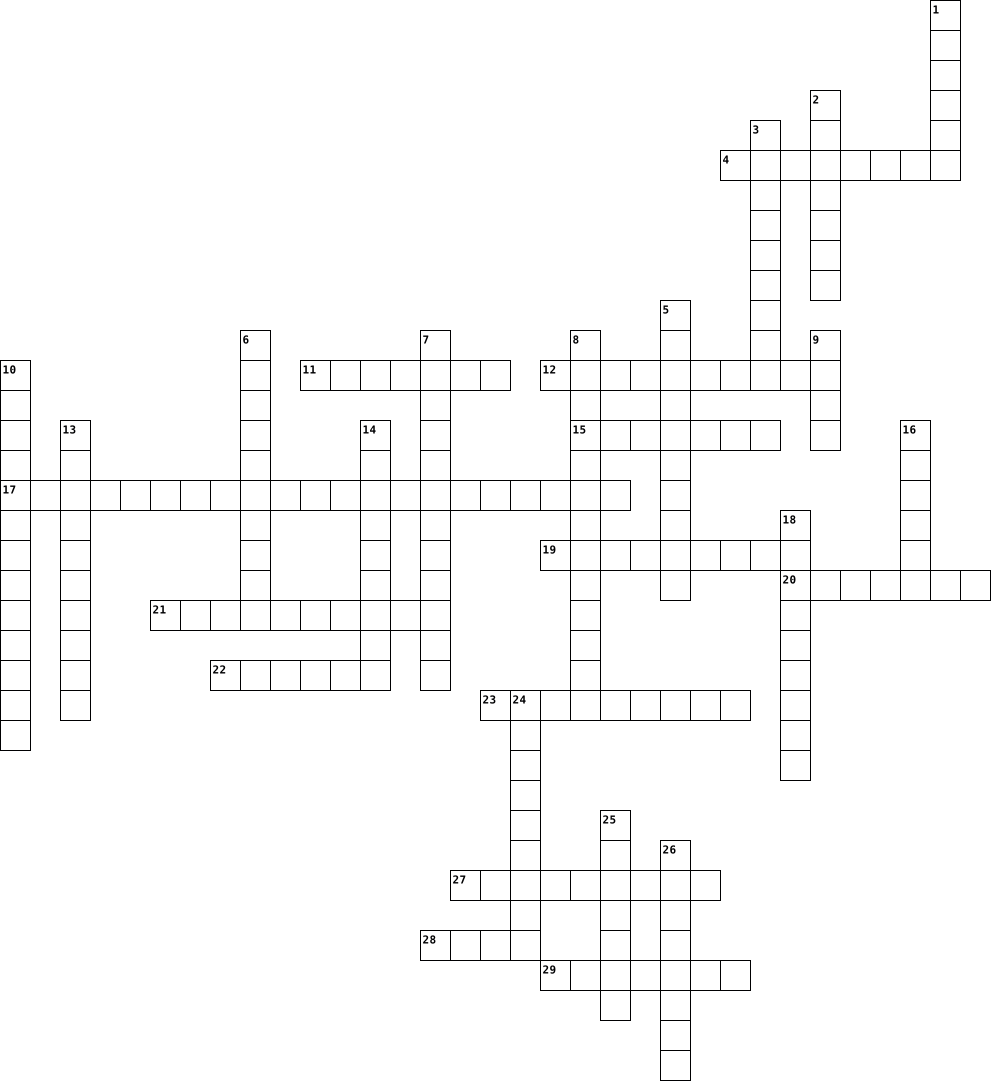
Across
- first phase of mitosis.
- cell or nucleus having a single set of unpaired chromosomes.
- the region of a chromosome to which the microtubules of the spindle attach, via the kinetochore, during cell division.
- a type of cell division that results in two daughter cells each having the same number and kind of chromosomes as the parent nucleus, typical of ordinary tissue growth.
- Double helix looking
- the second stage of cell division
- an organelle found in eukaryotic cells that is functioning like a brain.
- phase of the cell cycle in which a typical cell spends most of its life.
- haploid set of chromosomes in a gamete or microorganism
- structural layer surrounding some types of cells
- the death of cells which occurs as a normal and controlled part of an organism's growth or development.
- sequence of DNA or RNA which codes for a molecule that has a function.
- a type of cell division that results in four daughter cells each with half the number of chromosomes of the parent cell, as in the production of gametes and plant spores.
Down
- a mature haploid male or female germ cell.
- cell or nucleus containing two complete sets of chromosomes, one from each parent.
- one of several structures with specialized functions, suspended in the cytoplasm of a eukaryotic cell.
- a test to identify and evaluate the size, shape, and number of chromosomes in a sample of body cells.
- a thread-like structure of nucleic acids and protein found in the nucleus of most living cells, carrying genetic information in the form of genes.
- any cell of a living organism other than the reproductive cells.
- the cellular lineage of a sexually reproducing organism from which eggs and sperm are derived
- the basic structural, functional, and biological unit of all known living organisms.
- form a protein structure that divides the genetic material in a cell
- a unicellular organism that lacks a membrane-bound nucleus,
- the final phase of cell division.
- a variant form of a gene
- each of a pair of minute cylindrical organelles near the nucleus in animal cells, involved in the development of spindle fibres in cell division.
- any organism whose cells have a cell nucleus and other organelles enclosed within membranes.
- can be distinguished from fats and carbohydrates by containing nitrogen.
- complex molecular machine, found within all living cells
29 Clues: Double helix looking • first phase of mitosis. • a variant form of a gene • the final phase of cell division. • the second stage of cell division • a mature haploid male or female germ cell. • structural layer surrounding some types of cells • haploid set of chromosomes in a gamete or microorganism • complex molecular machine, found within all living cells • ...
AP Bio Vocab Crossword 2023-12-13

Across
- the first phase of mitosis, the process that separates the duplicated genetic material carried in the nucleus of a parent cell into two identical daughter cells
- leading them to stop growing when the density of cells reaches a certain point
- threadlike structures made of protein and a single molecule of DNA
- cancerous and can spread cancer cells throughout one's body through the blood or lymphatic system
- the portion of the cell cycle that is not accompanied by visible changes under the microscope, and includes the G1, S and G2 phases
- signaling at cell division is largely dedicated to completing a decision made in G1 phase—to initiate and complete a round of mitotic cell division
- the third subphase of interphase in the cell cycle directly preceding mitosis
- the complete set of genetic information in an organism
- a series of events that takes place in a cell as it grows and divides
- a protein structure that divides the genetic material in a cell
Down
- the physical process of cell division, which divides the cytoplasm of a parental cell into two daughter cells
- protein kinases characterized by needing a separate subunit - a cyclin - that provides domains essential for enzymatic activity
- the region where the cell's spindle fibers attach
- the nucleus dissolves and the cell's chromosomes condense and move together, aligning in the center of the dividing cell
- the cyclin-Cdk complex that was discovered first in frog eggs
- the fourth phase of mitosis, the process that separates the duplicated genetic material carried in the nucleus of a parent cell into two identical daughter cells
- cyclin-dependent kinase activity promotes DNA replication and initiates G1-to-S phase transition
- an organism's reproductive cells.
- a complex of DNA and proteins that forms chromosomes within the nucleus of eukaryotic cells
- the cells in the body other than sperm and egg cells
- the process that separates the duplicated genetic material carried in the nucleus of a parent cell into two identical daughter cells
- a cellular structure involved in the process of cell division
- one of the two identical halves of a chromosome that has been replicated in preparation for cell division
- the regulatory subunits of kinases that control progress through the cell cycle
- surveillance mechanisms that monitor the order, integrity, and fidelity of the major events of the cell cycle
- the presence of two complete sets of chromosomes in an organism's cells, with each parent contributing a chromosome to each pair
26 Clues: an organism's reproductive cells. • the region where the cell's spindle fibers attach • the cells in the body other than sperm and egg cells • the complete set of genetic information in an organism • the cyclin-Cdk complex that was discovered first in frog eggs • a cellular structure involved in the process of cell division • ...
Nervous system 2 2019-11-23

Across
- cells Form the myelin sheaths around nerve fibres in the PNS ______
- Carries impulses from the CNS to effector organs, the muscles and gland
- Neuroglia also called as
- only palms will ______ during parasympathetic
- Cells that defend CNS cells
- blood vessel will constrict during _______
- lungs will be in _______ during sympathetic
Down
- heart rate and force of contraction will ______ during parasympathetic
- Satellite cells act _________, cushioning cells for peripheral neuron cell bodies
- Supporting cells in the CNS?
- The sensory division also call as ____
- _______ is to maintain daily necessary body functions
- _______ glands will stimulate secretion during sympathetic and parasympathetic
- The activity of smooth muscles, cardiac muscle and glands is the ______ nervous system
- parasympathetic-housekeeping activities refer to ______
15 Clues: Neuroglia also called as • Cells that defend CNS cells • Supporting cells in the CNS? • The sensory division also call as ____ • blood vessel will constrict during _______ • lungs will be in _______ during sympathetic • only palms will ______ during parasympathetic • _______ is to maintain daily necessary body functions • ...
Circulatory System 2021-12-05

Across
- Upper chambers of the heart
- System that carries nutrients and oxygen throughout the body
- Bottom chambers of the heart
- Your blood is 55% of this
- A type of gas waste your veins carry to get rid of
- Cell that connects to other platelets to form a scab
Down
- Cells that fight off germs
- Tubes where arteries drop off and veins pick up red blood cells
- Act as "Doors" for the heart
- Red blood cells carry this
- Organ that pumps blood throughout the body
- Cell that carries oxygen
- Red blood cells collect oxygen from these
- Tube that transports red blood cells to the heart
- Tube that transports red blood cells away from the heart
15 Clues: Cell that carries oxygen • Your blood is 55% of this • Cells that fight off germs • Red blood cells carry this • Upper chambers of the heart • Act as "Doors" for the heart • Bottom chambers of the heart • Red blood cells collect oxygen from these • Organ that pumps blood throughout the body • Tube that transports red blood cells to the heart • ...
Introduction to Blood 2019-11-13

Across
- Also known as leukocytes, these are ..... blood cells
- Carried by haemoglobin in red blood cells
- Red blood cells carry this, it is our oxygen transportation system
- Fragments of cells that act as plugs to stop bleeding
- Also known as erythrocytes, these are ... blood cells
- Red and white cells are made in the bone......
- This system fights infection using white blood cells
Down
- Because it increases surface area, this shape allows red blood cells to carry more oxygen.
- This component is 95%.........
- Formed by platelets where there is damage to blood vessels
- There are ..... types of white blood cell, all fight infection in different ways
- About 55% of total blood volume, this is a straw coloured liquid
- White cells make up .......of total blood volume
13 Clues: This component is 95%......... • Carried by haemoglobin in red blood cells • Red and white cells are made in the bone...... • White cells make up .......of total blood volume • This system fights infection using white blood cells • Also known as leukocytes, these are ..... blood cells • Fragments of cells that act as plugs to stop bleeding • ...
Cells and Tissues 2016-09-25

Across
- / the phase in cell division when the cell is resting and the chromosomes replicate themselves.
- Fibrosis / an inherited condition in which chloride ion pumps in the plasma membrane are missing.
- / All living material inside of the cell.
- / Diffusion of water across a permeable membrane when some of the solutes cannot cross the membrane.
- Pump / A protein structure in the cell membrane called a carrier.
- / Process when double-stranded DNA molecule separate or unwind, and mRNA are formed.
- Transport / Uphill movement of a substance through a living cell membrane.
- / Incorporates fluids or dissolved substances into cells by trapping them in a pocket of plasma membrane that pinches off inside the cell.
- / The synthesis of a protein by ribosomes.
- / Cells that are taller than they are wide.
- Membrane / Membrane that encloses the cytoplasm and form the outer boundary of the cell.
- / Cube shaped cells.
Down
- / process when the cell membrane forms a pocket around the material to be moved into the cell.
- / Movement of water and solutes through a membrane because of a greater pushing force on one side of the membrane than on the other side.
- / Cells that are varied in shapes and can be stretched.
- / Process by which substances scatter evenly throughout available space.
- Replication / process when cells can make copies of themselves.
- Tissue / Covers the body and many of its parts.
- / Flat and scalelike cells.
- / A bacterial infection that causes cells lining the intestines to leak chloride ions.
20 Clues: / Cube shaped cells. • / Flat and scalelike cells. • / All living material inside of the cell. • / The synthesis of a protein by ribosomes. • / Cells that are taller than they are wide. • Tissue / Covers the body and many of its parts. • / Cells that are varied in shapes and can be stretched. • Replication / process when cells can make copies of themselves. • ...
Science Vocabulary 2017-10-02

Across
- The process by which molecules move from an area of higher concentration to an area of lower concentration
- The organelle that controls all of the cells activities
- An instrument that makes small objects look larger
- The rigid layer that surrounds plant cells
- The organelle only found in plant cells that turns energy from the sun into food and gives the plant its green color
- The organelles that contain substances that break down large food particles into smaller ones
- The organelle that converts the energy stored in food to energy the cell can use to live and function
- The widely accepted explanation of the relationship between cells and living things
- Made of many cells
- The organelle that stores water, food, and other materials that the cell needs
Down
- Tiny objects that make up and function inside organisms
- A tiny cell structure that has its own special job in the cell
- The fluid inside cells that holds all of the organelles together
- Made of one cell
- The organelle that receives, packages, and distributes proteins and other materials to other parts of the cell
- The organelle with a network of membranes that produces many substances
- The diffusion of water molecules across a selectively permeable membrane
- The grain-shaped organelle that produces protein
- Any substance that cannot be broken down into simpler substances
- The organelle that decides what enters and exits the cell
20 Clues: Made of one cell • Made of many cells • The rigid layer that surrounds plant cells • The grain-shaped organelle that produces protein • An instrument that makes small objects look larger • Tiny objects that make up and function inside organisms • The organelle that controls all of the cells activities • The organelle that decides what enters and exits the cell • ...
Circulatory System Karla Arnold 2013-05-21

Across
- small veins.
- living cells in the blood that transports oxygen to all living cells in the body.
- lower left section of the heart,which pumps bllood to all parts of the body.
- adenosine triphoshate: a form or eneryg released during cellural respiration that proves cells with the energy.
- the organ for breathing air .
- living cells that fight bacteria and viruse.
- special cells that detct energy and convert it to electrical energy that is sent to the brain.
- Respiration the chemical reaction involing oxygen that moves the energy in glucose into the compound ATP
- the red liquid that circulates through the body.
- blood vessels that carry blood to the heart.
Down
- circuit component that has resistance.
- the body system that circulates oxygen in the blood to allthe cells of the body.
- lower right section of the heart, which pumps deoxygenated blood to the lungs.
- large vein leading into the top right chamber of the heart.
- a small cavity, usually filled with fluid.
- upper left section of the heart where oxygenated blood from the lungs enters the heart.
- a muscular organ that pumps blood through the circulatory system so that oxygen and nutreints can be transported to the bodys cells and waste can be transported away.
- a gas in the air ( and water ) that animals need to breathe.
- a simple carbohydrate and the simplest form of sugar.
- largest gland in the body.
20 Clues: small veins. • largest gland in the body. • the organ for breathing air . • circuit component that has resistance. • a small cavity, usually filled with fluid. • living cells that fight bacteria and viruse. • blood vessels that carry blood to the heart. • the red liquid that circulates through the body. • a simple carbohydrate and the simplest form of sugar. • ...
chapter 12: cell cycle 2021-10-23

Across
- joined copies of the original chromosome
- accounts for ~90% of the cycle
- the life of a cell from the time it first formed during division of a parent cell until its own division into two daughter cells
- a control point where stop and go-ahead signals can regulate the cycle
- reproductive cells
- an enzyme that activate or inactivate other proteins by phosphorylating them
- the entire complex of DNA and proteins that is the building material of chromosomes
- the division of genetic material in the nucleus
- reproduction of cells
- an imaginary plate rather than an actual cell structure; a plane located midway between the spindle's two poles
- a subcellular region containing material that functions throughout the cell cycle to organize the cell's microtubules
Down
- a protein released by certain cells that stimulates other cells to divide
- the division of the cytoplasm
- includes both mitosis and cytokinesis
- a cell's DNA, its genetic information
- protein that gets its name from its cyclically fluctuating concentration in the cell
- consists of fibers made of microtubules and associated proteins
- "division in half," refers to this process and tho the asexual reproduction of single-celled eukaryotes
- DNA molecules are packaged into these structures
- a structure made up of protiens that have assembled on specific sections of DNA at each centromere
- all body cells (not reproductive cells)
- a region made up of repetitive sequences in the chromosomal DNA where the chromatid is attached most closely to its sister chromatid
22 Clues: reproductive cells • reproduction of cells • the division of the cytoplasm • accounts for ~90% of the cycle • includes both mitosis and cytokinesis • a cell's DNA, its genetic information • all body cells (not reproductive cells) • joined copies of the original chromosome • the division of genetic material in the nucleus • DNA molecules are packaged into these structures • ...
Immunology Exam#1 Review 2021-01-20

Across
- Chemicals produced by T helper cells to stimulate other white blood cells.
- Nonspecific cytokine that warns neighboring cells when infected by a virus.
- Type of T cells which kills infected cells.
- An immunological disorder in which the immune system turns against self (2 words).
- A type of protein that inserts itself into the membrane of pathogens, creating a pore.
- Induces heat, redness, swelling and pain.
- A long-lived lymphocyte that responds to the reintroduction of a specific antigen long after initial exposure is a .... cell.
- Y-shaped proteins produced by B lymphocytes.
Down
- Phagocytic cell that is derived from a monocyte.
- Programmed cell death.
- The organelle in phagocytes containing enzymes that digest and destroy ingested pathogens.
- Type of immunity that has a fast response.
- Injection of a killed or weakened pathogen or pathogen part that stimulates the production of antibodies.
- A white blood cell that can engulf and absorb bacteria by phagocytosis.
- Small thin-walled blood vessels from which white blood cells can leave the blood to enter the tissues.
- Bean-shaped glands found in the lymphatic system containing white blood cells (2 words).
- Place where B lymphocytes maturation occurs (2 words).
- Self markers that bind with with foreign antigen.
- Gland where T lymphocytes mature.
- A disease-causing organism including bacteria, virus and fungus.
- The most common form of white blood cell.
- Type of immunity that has a slow response.
22 Clues: Programmed cell death. • Gland where T lymphocytes mature. • Induces heat, redness, swelling and pain. • The most common form of white blood cell. • Type of immunity that has a fast response. • Type of immunity that has a slow response. • Type of T cells which kills infected cells. • Y-shaped proteins produced by B lymphocytes. • ...
Muscular system 2024-01-12

Across
- denoting a dense band that connects cardiac muscle cells
- protein thick muscle filaments
- wavelike motion which helps force the contents of tubular organs along, e.g. intestines
- muscles which work together to complete a movement
- relatively immovable end of skeletal muscle
- type of muscle cells which twitch for longer than skeletal muscle cells
- functional unit of muscle contraction; causes striation
- process by which the forces of individual twitches combine
- threadlike structures within the sarcoplasm
- denoting sustained muscular contraction
- movement which increases the angle
- layer of connective tissue that separate muscle tissue into fascicles
- layer of thin connective tissue
- increase in the number of motor units being activated during a contraction
- movement which decreases the angle
- linkages formed between actin and myosin
Down
- breaks down acetylcholine
- protein in muscle cells that help maintain oxygen availability
- agent which causes movement
- recording of an electrically stimulated isolated muscle
- type of self-exciting smooth muscle displaying rhythmicity
- agent which oppose a movement
- denoting material within a muscle fiber
- type of muscle cells containing less organized filaments of actin and myosin
- bundles of skeletal muscle fibers
- single contraction reflecting stimulation of a muscle fiber
- relatively movable end of skeletal muscle
- thin muscle filaments
- signal which stimulates a skeletal muscle fiber
- protein which stops stem cells from developing into muscle cells
- layer of connective tissue that closely surrounds each skeletal muscle
- broad fibrous sheets of connective tissue
32 Clues: thin muscle filaments • breaks down acetylcholine • agent which causes movement • agent which oppose a movement • protein thick muscle filaments • layer of thin connective tissue • bundles of skeletal muscle fibers • movement which increases the angle • movement which decreases the angle • denoting material within a muscle fiber • denoting sustained muscular contraction • ...
CELL 2020-04-29

Across
- wall In plant cells there is a outer layer that protects the cell
- This membrane protects the cell from it’s surroundings and it is composed of phospholipids
- Responsible for cellular storage, has three types; central, contractile, food
- Death of certain cells in a programmed way
- The infoldings that happen in the inner membrane of mitochondria
- Little tunnels in nuclear envelope that allows transportation to nucleus
- Some cells have those in order to move around more easily such as sperms
- The organelle that makes cellular aerobic respiration possible that's why it is mostly found in muscle and nerve cells
- apparatus This organelle packages proteins and transports lipids
- An organelle which recycles damaged organalles, in deficiency tay sach disease emerges
- A membrane bound that is found in plant cells, algae and some eukaryotic cells
- system It is called to a group of membranes which cooperate to modify, package and transport lipids and proteins
Down
- The part in the nucleus that contains DNA
- and lipids
- Helps The cell to get attached to places
- It oxidifies H2O2, found mostly in liver, detoxifies alcohol for that reason
- envelope The layer that lines between cytoplasm and nucleus
- reticulum Has two types rough and smooth. Rough ones can synthesize ribosome while smooth synthesizes
- The place in the plant cell that photosynthesis happen
- The destruction of cells by the enzymes within the cell usually by lysosomes
- An organelle that is responsible for protein synthesis
21 Clues: and lipids • Helps The cell to get attached to places • The part in the nucleus that contains DNA • Death of certain cells in a programmed way • The place in the plant cell that photosynthesis happen • An organelle that is responsible for protein synthesis • envelope The layer that lines between cytoplasm and nucleus • ...
Veterinary Medical Practices: Blood Samples 2023-04-19

Across
- known as thrombocytes; are responsible for clotting and increase with
- two large veins near the thigh on the hind leg
- blood cell count problem with red blood cell productionHemoglobin
- loss of water from the body
- Blood Count (CBC) determines the number and type of blood cells presentPlasma
- marrow soft, fatty tissue within the bone which is a major area for blood cell production Autoimmune
- any of the three large veins in the neck
- blood cells also known as erythrocytes; are produced in bone marrow and carry oxygen to
- decreases blood flow
- Saphenous small vein located on the inside hind leg
- deficiency of hemoglobin reducing the number of red blood cells; causes
- immune response which attacks an animals own tissues and cellsPacked Cell Volume
- relating to the thorax which is the cavity enclosed within the ribs and sternum
Down
- redness, swelling or pain on an area of the body
- arrangement of blood cells within the body
- liquid portion of blood
- Inlet opening at the top of the thoracic cavity
- nodes gland masses of tissue which contain cells
- vein located on the front leg
- carries oxygen to the red blood cells and helps move them to other tissues
- form of cancer of the bone marrow which prevents an animal from producing a
- small hole on the needle which allows the blood to blow into the syringe
- determination of the cause or nature of a conditionComplete Blood Count (CBC)
- blood cells defend the body from invading organismsPlatelets
- level of red and white blood cells and platelets
- weakness
26 Clues: weakness • decreases blood flow • liquid portion of blood • loss of water from the body • vein located on the front leg • any of the three large veins in the neck • arrangement of blood cells within the body • two large veins near the thigh on the hind leg • Inlet opening at the top of the thoracic cavity • redness, swelling or pain on an area of the body • ...
Blood Flow Crossword Puzzle 2022-12-14

Across
- when people have permanent high blood pressure.
- when people have super low blood pressure usually with illness.
- three factors that can affect blood pressure are strong emotions, stress and _______. Something you could do for weight loss.
- people who are in danger of heart attack or stroke have high/low (pick one) permanent blood pressure.
- blood ______ is when blood pushes against the wall of an artery.
- _______ pressure-occurs when the left ventricle of the heart contracts.
- _______ adult blood volume is 5L.
- a system that is both the _________ and respiratory systems combined.
- white blood cells can survive from 24 hours to several years.
- primary parts of the cardiovascular system are the lungs, _______, and blood vessels.
- found in bone marrow and are smallest forms of blood cells.
- blood cells that make up 99% of our blood.
Down
- carries oxygen from lungs to the rest of the body.
- ______ pressure-occurs when the left ventricle relaxes.
- blood pressure decreases as your distance ________ from the heart.
- there are ____ types of white blood cells.
- thickness of blood and flow.
- platelets help repair damaged _______.
- makes up 55% of our blood while 55% is blood cells.
- blood with high ______ can cause resistance making the heart work harder.
- The less elastic the arteries the _____ blockages that reduce blood flow.
- contraction phase of the heart
- type of blood cells biggest cells in all blood.
- ______ makes up 6-8% of our total weight.
- plasma is the cellular material in ____.
25 Clues: thickness of blood and flow. • contraction phase of the heart • _______ adult blood volume is 5L. • platelets help repair damaged _______. • plasma is the cellular material in ____. • ______ makes up 6-8% of our total weight. • there are ____ types of white blood cells. • blood cells that make up 99% of our blood. • when people have permanent high blood pressure. • ...
Chapter 2-6 2025-02-05

Across
- Specialized junctions that anchor cells together, providing mechanical strength to tissues.
- Breaks down fatty acids and detoxifies harmful substances.
- Studded with ribosomes; involved in protein synthesis and modification.
- Organizes microtubules and contains centrioles (in animal cells); important in cell division.
- The powerhouse of the cell, generates ATP through cellular respiration.
- Thin fibers of actin involved in cell shape, movement, and muscle contraction.
- Selectively permeable barrier made of phospholipids and proteins that separates the interior of the cell from the outside environment.
- Modifies, sorts, and packages proteins and lipids for secretion or delivery to other organelles.
- Found in plant cells; performs photosynthesis.
Down
- Network of fibers that provide structural support, shape, and facilitate cell movement.
- Synthesizes lipids, detoxifies drugs, metabolizes carbohydrates.
- Hollow tubes of tubulin that help maintain cell structure and shape.
- Found inside nucleus; site of rRNA synthesis and ribosome assembly.
- Site of protein synthesis; can be free in the cytoplasm or attached to rough ER.
- Contains cell’s genetic material and controls cell activities.
- ________ Filaments - Provide mechanical strength to cells and anchor organelles in place.
- Contain digestive enzymes for breaking down macromolecules, debris, and foreign substances.
- _____ Junctions - Channels that allow direct communication between adjacent animal cells, facilitating the exchange of ions and small molecules.
- Large vesicle used for storage, waste disposal, and maintaining cell turgor in plant cells.
- _____ Junctions - Seal gaps between adjacent cells, preventing the leakage of extracellular fluids.
20 Clues: Found in plant cells; performs photosynthesis. • Breaks down fatty acids and detoxifies harmful substances. • Contains cell’s genetic material and controls cell activities. • Synthesizes lipids, detoxifies drugs, metabolizes carbohydrates. • Found inside nucleus; site of rRNA synthesis and ribosome assembly. • ...
Unit 4 2025-03-28

Across
- molecule involved in energy transfer within cells, acting as a precursor to ATP
- obtain their food by consuming other organisms
- the natural compound present in green plants that gives them their color
- requires oxygen and produces significantly more energ
- occurs without oxygen and yields less energy
- a tiny opening or passageway in a surface, membrane, or structure, allowing for the passage of liquids, gases, or other substances
- the primary energy-carrying molecule in cells
- the process by which plants change the energy in sunlight to kinds of energy that can be stored for later use
- the capacity or ability to do work or cause chang
- an important heat-trapping gas, also known as a greenhouse gas
Down
- process where yeast, bacteria, or other microorganisms convert sugars into alcohol
- produce their own food from inorganic sources
- a simple sugar, the primary source of energy for the body's cells
- process in which sugars are transformed into a new product through chemical reactions carried out by microorganisms
- organelles found in plant cells that are responsible for photosynthesis
- a chemical your body produces when your cells break down carbohydrates for energ
- is the chemical reactions in the body's cells that change food into energy.
- a series of chemical reactions that break down glucose to produce ATP
- The cells and tissues that support and give structure to organs, glands, or other tissues in the body
- an organic compound that gives color to plant or animal tissue
20 Clues: occurs without oxygen and yields less energy • produce their own food from inorganic sources • the primary energy-carrying molecule in cells • obtain their food by consuming other organisms • the capacity or ability to do work or cause chang • requires oxygen and produces significantly more energ • an organic compound that gives color to plant or animal tissue • ...
Immune System 2023-03-16

Across
- / preparation that is used to help the body immune response against diseases.
- / when the body is given immunity to a disease from small quantities.
- / substances that cause the body to make an immune response against the substance.
- / cells that are part of the immune system that help fight infections and other diseases.
- / helps kill tumor cells and help control immune responses
- / a type of white blood that kills microorganisms and removes dead cells
- / reproduction of viruses using a cell to manufacture more of the viruses
- / method of a virus can replicate its DNA using a cell
Down
- / owns and manages risks
- / when a disease triggers the immune system to produce antibodies to the disease.
- / when antibodies are given to someone, then produce it through the immune system.
- / antibody protection the body creates against germs that the bodies have been infected with.
- / when the bacteria defeats the antibiotic that is meant to kill the bacteria
- / network of organs, cells and proteins to help fight the body against infections.
- / an immune system that surround and kill microorganisms and ingest foreign material
- / type of blood cells that are made in bone marrow and found the blood and lymph tissue
- / protein made by plasma cells that respond to antigen.
- / overseees risks or control and compliance
- / drugs that are used to treat infections that are caused by bacteria.
- / microorganism that infects cells and can cause diseases
20 Clues: / owns and manages risks • / overseees risks or control and compliance • / method of a virus can replicate its DNA using a cell • / protein made by plasma cells that respond to antigen. • / microorganism that infects cells and can cause diseases • / helps kill tumor cells and help control immune responses • ...
Integumentary Crossword 2025-02-20

Across
- Cell shape that is tall and cylindrical.
- The skin is also called the cutaneous membrane.
- The outermost layer of the skin.
- Modified cells containing secretory vesicles that produce large quantities of mucus.
- Substance that gives hair and skin its color.
- Gland that secretes its product into ducts.
- Type of cell that can differentiate into a number of different cells.
- Oily substance produced by sebaceous glands.
- Inflammation of the skin characterized by itching and redness.
- The most widespread and most varied of all the tissues.
- The inner, deeper layer of the skin.
- Flattened cells making up the skin’s outermost layer.
Down
- Dense, cord-like tissues that attach muscles to bones.
- Excessive hair loss.
- Dense connective tissue band or sheet that binds organs and muscles together.
- Gland that secretes its product directly into the bloodstream.
- Tissue that lacks blood vessels and depends on underlying connective tissue for oxygen and nutrients.
- Dead tissue resulting from a burn.
- Key component of connective tissue.
- Ear wax.
- The body’s most abundant protein.
- Cord-like tissues that attach bones to bones.
- Cell shape that is flat and plate-like.
- The outermost layer of the epidermis is called the stratum corneum.
- Tissue that has multiple layers in which some cells don’t touch the basement membrane.
- Tissue dominated by fat cells.
- Groups of cells that perform a common function.
27 Clues: Ear wax. • Excessive hair loss. • Tissue dominated by fat cells. • The outermost layer of the skin. • The body’s most abundant protein. • Dead tissue resulting from a burn. • Key component of connective tissue. • The inner, deeper layer of the skin. • Cell shape that is flat and plate-like. • Cell shape that is tall and cylindrical. • Gland that secretes its product into ducts. • ...
Module 2 - Lesson 2.1 Daily Assignment 1: Integumentary Crossword 2025-02-26

Across
- Cell shape that is tall and cylindrical.
- The skin is also called the cutaneous membrane.
- The outermost layer of the skin.
- Modified cells containing secretory vesicles that produce large quantities of mucus.
- Substance that gives hair and skin its color.
- Gland that secretes its product into ducts.
- Type of cell that can differentiate into a number of different cells.
- Oily substance produced by sebaceous glands.
- Inflammation of the skin characterized by itching and redness.
- The most widespread and most varied of all the tissues.
- The inner, deeper layer of the skin.
- Flattened cells making up the skin’s outermost layer.
Down
- Dense, cord-like tissues that attach muscles to bones.
- Excessive hair loss.
- Dense connective tissue band or sheet that binds organs and muscles together.
- Gland that secretes its product directly into the bloodstream.
- Tissue that lacks blood vessels and depends on underlying connective tissue for oxygen and nutrients.
- Dead tissue resulting from a burn.
- Key component of connective tissue.
- Ear wax.
- The body’s most abundant protein.
- Cord-like tissues that attach bones to bones.
- Cell shape that is flat and plate-like.
- The outermost layer of the epidermis is called the stratum corneum.
- Tissue that has multiple layers in which some cells don’t touch the basement membrane.
- Tissue dominated by fat cells.
- Groups of cells that perform a common function.
27 Clues: Ear wax. • Excessive hair loss. • Tissue dominated by fat cells. • The outermost layer of the skin. • The body’s most abundant protein. • Dead tissue resulting from a burn. • Key component of connective tissue. • The inner, deeper layer of the skin. • Cell shape that is flat and plate-like. • Cell shape that is tall and cylindrical. • Gland that secretes its product into ducts. • ...
Biology Ch. 11 & 12 2025-03-03

Across
- Green algae
- Mass of intertwined hyphae visible without magnification
- End result of the fusion of gametes
- Hyphae that actually enter host cells to get nutrition from cytoplasm of host cells
- Brown algae
- Two filaments line up next to each other forming a type of tube connecting adjacent cells
- Simple colony of a slender chain of cells growing end to end
- Gives shape to its body in replace of a cell wall
- Hyphae that "stand" up above the medium and get oxygen, produce spores and spread the fungus
- Small air-filled pockets and holds up the thallus (two words)
- Special cells that anchor the algae to something and appear rootlike
Down
- Two identical specialized cells
- Red algae
- Golden algae
- The diatom s
- Product from red algae used in pudding and gelatin shells of capsules
- Specialized cells that are different in size and form
- Hyphae that grow within the material the fungus is growing on
- Where the motile gametes (sperm) are produced
- "Body" of a fungus is composed of slender filaments
- All are unicellular with two flagella; one is in a groove around the cell and the other is for movement
- Aerial hyphae that connect groups of hyphae together
- Hyphae branches that produce spores
- Where a nonmotile gamete or egg (ovum) is produced
- Body of a plantlike organism that does not have leaves, roots, or stems
25 Clues: Red algae • Green algae • Brown algae • Golden algae • The diatom s • Two identical specialized cells • End result of the fusion of gametes • Hyphae branches that produce spores • Where the motile gametes (sperm) are produced • Gives shape to its body in replace of a cell wall • Where a nonmotile gamete or egg (ovum) is produced • ...
cats 2 2025-11-18

Across
- A tunnel-like extension for enzyme secretion from bone-destroying cells.
- Process where vesicles fuse with the plasma membrane to release contents.
- A type of metabolism that breaks down molecules for energy.
- Side by side location, often said of cells with gap junctions.
- Binding in the active site leads to this kind of enzyme activation.
- DNA plus proteins, packaged but not condensed.
- The phase where chromosomes arrive at poles and nuclear envelopes reform.
- Produced in abundance by certain ovarian cells.
- A molecule that shuttles proteins into the nucleus.
- The fusion of gametes to form a zygote.
- A type of infection that generates immune responses even without producing virions.
- A strong cell–cell adhesion structure composed of dense plaques.
- The process by which a cell becomes specialized.
- The final physical separation of two daughter cells.
Down
- A bond that helps stabilize tertiary structure.
- Stage where the three germ layers first appear.
- What you get when cells keep dividing after compaction.
- A process that allows an increase in cell number.
- A direct passageway for ions and molecules between cells.
- An enzyme that unwinds the DNA double helix.
- Some cells secrete molecules that turn around and act on themselves.
- A structure that organizes the mitotic spindle.
- Embryonic tissue layer that will form muscle and bone.
- Regulation of gene expression without altering DNA sequence.
- Event needed to turn a chromosome into a visible structure.
25 Clues: The fusion of gametes to form a zygote. • An enzyme that unwinds the DNA double helix. • DNA plus proteins, packaged but not condensed. • A bond that helps stabilize tertiary structure. • Stage where the three germ layers first appear. • A structure that organizes the mitotic spindle. • Produced in abundance by certain ovarian cells. • ...
Cells, COL, and CER 2025-09-16

Across
- Simple cells that lack most of the organelles described(NO nucleus)
- converts glucose into cellular energy (ATP)
- Compromised of at least one unit of life; may have groups of those units that share the same units
- Gives cells their shape and structure and facilitates movement of materials within the cell
- Regulates cell division/replication
- Hold excess water for the plant cell
- In taking energy in one form and converts it to a usable form; removes waste
- The barrier to the outside environment and holds important gatekeeping protiens
- Makes proteins and is found in the cytoplasm
- Where ribosomes are made out of RNA
- Packages proteins and other biomolecules for transport across the cell
- Staging area for ribosomes to make protiens
- Makes Lipids for the cell
Down
- Increases in size or number of cells; functionality of cells can change over time
- Regulates internal environment involuntarily
- Where the DNA is stored
- Ability to produce more of itself/New life(Fertile Offspring)
- Digests macromolecules and stores them for future use in the cell
- Cells that have most or all of the organelles described(Plant and animal cells)
- Interacts with surroundings to various degrees;aids in survival
- Enable photosynthesis to happen;Converts light energy into suagrs
- Traits are passed on and inherited by subsequent generations; change in genetic material
- supports the cell and gives structure to the plant overall;Made of cellulose
- contains the organelles and allows a place for important chemical reactions to occur
24 Clues: Where the DNA is stored • Makes Lipids for the cell • Regulates cell division/replication • Where ribosomes are made out of RNA • Hold excess water for the plant cell • converts glucose into cellular energy (ATP) • Staging area for ribosomes to make protiens • Regulates internal environment involuntarily • Makes proteins and is found in the cytoplasm • ...
Biology 2014-09-23

Across
- a short, microscopic, hairlike vibrating structure
- apparatus a complex of vesicles and folded membranes within the cytoplasm of most eukaryotic cells, involved in secretion and intracellular transport
- an organelle in the cytoplasm of eukaryotic cells containing degradative enzymes enclosed in a membrane
- membrane a microscopic membrane of lipids and proteins that forms the external boundary of the cytoplasm of a cell or encloses a vacuole, and that regulates the passage of molecules in and out of the cytoplasm
- any of a number of organized or specialized structures within a living cell
- an organelle found in large numbers in most cells, in which the biochemical processes of respiration and energy production occur
- a dense organelle present in most eukaryotic cells, typically a single rounded structure bounded by a double membrane, containing the genetic material
- a part of an organism that is typically self-contained and has a specific vital function
- any of the distinct types of material of which animals or plants are made, consisting of specialized cells and their products
- any organism whose cells contain a nucleus and other structures enclosed within membranes
- reticulum a network of membranous tubules within the cytoplasm of a eukaryotic cell, continuous with the nuclear membrane
- small dense spherical structure in the nucleus of a cell during interphase
Down
- a minute particle consisting of RNA and associated proteins, found in large numbers in the cytoplasm of living cells
- the material or protoplasm within a living cell, excluding the nucleus
- the aqueous component of the cytoplasm of a cell, within which various organelles and particles are suspended
- a microscopic single-celled organism that has neither a distinct nucleus with a membrane nor other specialized organelles
- a threadlike structure of nucleic acids and protein found in the nucleus of most living cells, carrying genetic information in the form of genes
- envelope the double lipid bilayer membrane which surrounds the genetic material and nucleolus in eukaryotic cells
- a microscopic network of protein filaments and tubules in the cytoplasm of many living cells, giving them shape and coherence
19 Clues: a short, microscopic, hairlike vibrating structure • the material or protoplasm within a living cell, excluding the nucleus • small dense spherical structure in the nucleus of a cell during interphase • any of a number of organized or specialized structures within a living cell • ...
CELL 2020-04-29

Across
- wall In plant cells there is a outer layer that protects the cell
- This membrane protects the cell from it’s surroundings and it is composed of phospholipids
- Responsible for cellular storage, has three types; central, contractile, food
- Death of certain cells in a programmed way
- The infoldings that happen in the inner membrane of mitochondria
- Little tunnels in nuclear envelope that allows transportation to nucleus
- Some cells have those in order to move around more easily such as sperms
- The organelle that makes cellular aerobic respiration possible that's why it is mostly found in muscle and nerve cells
- apparatus This organelle packages proteins and transports lipids
- An organelle which recycles damaged organalles, in deficiency tay sach disease emerges
- A membrane bound that is found in plant cells, algae and some eukaryotic cells
- system It is called to a group of membranes which cooperate to modify, package and transport lipids and proteins
Down
- The part in the nucleus that contains DNA
- and lipids
- Helps The cell to get attached to places
- It oxidifies H2O2, found mostly in liver, detoxifies alcohol fort hat reason
- envelope The layer that lines between cytoplasm and nucleus
- reticulum Has two types rough and smooth. Rough ones can synthesize ribosome while smooth synthesizes
- The place in the plant cell that photosynthesis happen
- The destruction of cells by the enzymes within the cell usually by lysosomes
- An organelle that is responsible for protein synthesis
21 Clues: and lipids • Helps The cell to get attached to places • The part in the nucleus that contains DNA • Death of certain cells in a programmed way • The place in the plant cell that photosynthesis happen • An organelle that is responsible for protein synthesis • envelope The layer that lines between cytoplasm and nucleus • ...
Microscopes and Cells 2021-06-15

Across
- Converts light energy within a plant.
- The cell that sends signals to our brain
- The top layer of our skin.
- Part of a plant that moves water.
- First person to observe a microorganism.
- Holds water within a cell.
- The cells that help move oxygen.
- The group mushrooms belong to.
- Organism made from more than one cell.
- What is stored inside a vacuole
- The genetic code of organisms
- The science guy.
- Provides structure to plant cells.
- What we observe under a microscope
- The process of cells splitting in 2.
- Methylene...
- The first type of organisms on earth
- The type of microscope we use at school.
- Jelly like substance inside a cell.
- The 5 groups organisms belong to.
- The cell that surrounds our body.
Down
- The brain of the cell.
- The unit of measurement for cells.
- The outside layer of a cell.
- The process of light energy conversion.
- The building blocks of all life.
- a billionth of a metre
- An organism that consists of one cell.
- The greek word for small
- Special cells in plants.
- The cells that help us move.
- The various structures inside a cell.
- The group of organisms trees belong to.
- The group of organisms humans belong to.
- The kingdom that starts with E.
- What we call the dye on a slide.
36 Clues: Methylene... • The science guy. • The brain of the cell. • a billionth of a metre • The greek word for small • Special cells in plants. • The top layer of our skin. • Holds water within a cell. • The outside layer of a cell. • The cells that help us move. • The genetic code of organisms • The group mushrooms belong to. • What is stored inside a vacuole • The kingdom that starts with E. • ...
cell cycle 2021-10-23

Across
- joined copies of the original chromosome
- accounts for ~90% of the cycle
- the life of a cell from the time it first formed during division of a parent cell until its own division into two daughter cells
- a control point where stop and go-ahead signals can regulate the cycle
- reproductive cells
- an enzyme that activate or inactivate other proteins by phosphorylating them
- the entire complex of DNA and proteins that is the building material of chromosomes
- the division of genetic material in the nucleus
- reproduction of cells
- an imaginary plate rather than an actual cell structure; a plane located midway between the spindle's two poles
- a subcellular region containing material that functions throughout the cell cycle to organize the cell's microtubules
Down
- a protein released by certain cells that stimulates other cells to divide
- the division of the cytoplasm
- includes both mitosis and cytokinesis
- a cell's DNA, its genetic information
- protein that gets its name from its cyclically fluctuating concentration in the cell
- consists of fibers made of microtubules and associated proteins
- "division in half," refers to this process and tho the asexual reproduction of single-celled eukaryotes
- DNA molecules are packaged into these structures
- a structure made up of protiens that have assembled on specific sections of DNA at each centromere
- all body cells (not reproductive cells)
- a region made up of repetitive sequences in the chromosomal DNA where the chromatid is attached most closely to its sister chromatid
22 Clues: reproductive cells • reproduction of cells • the division of the cytoplasm • accounts for ~90% of the cycle • includes both mitosis and cytokinesis • a cell's DNA, its genetic information • all body cells (not reproductive cells) • joined copies of the original chromosome • the division of genetic material in the nucleus • DNA molecules are packaged into these structures • ...
Plant/Animal Cell 2021-09-09

Across
- deoxyribonucleic acid, a molecules that is present in all living cells and that contains info that determines traits
- the arrangement of parts in an organism
- describes the basic characteristics of all cells and organs
- gel-like fluid inside a cell; helps the cell maintain shape and is about 80% water
- makes protein
- one of the structures in the nucleus that are made up of dna and protein
- the smallest functional and structual unit of living things
- cells with no nucleus
- structures within a cell that have special functions to keep working
- packages and distributes materials within or out of the cell
- the special, normal, or proper activity of an organ or part
- cells with a nucleus
Down
- where genetic material is stored and controls the cells growth and reproduction
- a fluid-filled vesicle that contains food, water, and waste. Plant ells have a large central vacuole that stores water
- a system of ideas that explains many related observations and is supported by a body of evidence acquired by scientific investigation
- produces enzymes that digest wastes, cell parts, and foreign invaders
- protective, flexible barrier that controls what goes in and out of the cell
- processes and transports proteins and makes lipids
- an organelle dound in plant and algae cells where photosynthesis occurs
- rigid structure that surrounds the cell membrane in plant cells; provides structure and support
- the site of a cellular respiration, which releases energy for use by the cell
21 Clues: makes protein • cells with a nucleus • cells with no nucleus • the arrangement of parts in an organism • processes and transports proteins and makes lipids • describes the basic characteristics of all cells and organs • the smallest functional and structual unit of living things • the special, normal, or proper activity of an organ or part • ...
Biology Crossword 2018-01-29

Across
- Divide into four daughter cells
- Cells that have a membrane-bound nucleus
- any of a number of organised or specialised structures within a living cell
- Having a set of unpaired chromosomes (half)
- The death of a cell
- Clusters of microtubules
- Turn into gametes
- A unit of heredity which is transferred from a parent to offspring carried on a chromosome
- Any cell or organism without a membrane-bound nucleus
- Different forms of the same gene
- Help in forming spindle fibres, which separate chromosomes during mitosis
- Long strand of DNA
- Stage of mitosis in which new nuclear membranes form around the separated groups of chromosomes
- Stage of mitosis where the chromosomes become visable
- Divide into two daughter cells
Down
- Containing the genetic material DNA
- Eggs or sperm cells
- Visual appearance of the chromosomes
- Stage of mitosis during which chromosomes align around the equator of a spindle
- The full word for DNA
- Cells of the body other then germline cells
- The resting phase between the first and second division of mitosis
- The smallest structural and functional unit of an organism
- A layer which sits outside the cell membrane (not found in animal cells)
- A cell containing 2 complete sets of chromosomes
- An organism's full set of DNA (including genes)
- Position where the chromatids are held together in a chromosome
- Organelle containing RNA and sometimes stick to RER
- Macromolecules built of amino acid
29 Clues: Turn into gametes • Long strand of DNA • Eggs or sperm cells • The death of a cell • The full word for DNA • Clusters of microtubules • Divide into two daughter cells • Divide into four daughter cells • Different forms of the same gene • Macromolecules built of amino acid • Containing the genetic material DNA • Visual appearance of the chromosomes • ...
Chapter 21 The Lymphatic and Immune System 2012-06-14

Across
- WBCs that transform into macrophages
- immunity where lymphocytes directly attack and destroy foreign cells or diseased host cells
- local defensive response to tissue injury
- cells that phagocytize tissue debris, antigen presenting cell
- body's largest lymphatic organ
- any molecule that triggers an immune response
- tonsils found on each side of the root of the tongue
- tonsil on the wall of the pharynx just behind the nasal cavity
- when a lymph node becomes swollen and painful to the touch when it's under challenge from a foreign antigen
- lymphocytes and macrophages congregated in dense masses
- lymphocytes that differentiate into plasma cells
- WBCs that phagocytize, digest, and kill bacteria
- clear, colorless fluid, similar to blood plasma but low in protein
- leukocytes that crawl through the endothelial cells
- secreted when infected leukocytes are infected with a virus
- a vaccine is a type of artificial ____________ immunity
Down
- leukocyte adhesion to the vessel wall
- lymphatic tissue where lymphocytes are scattered rather then densely clustered
- when an activated T cell undergoes repeated mitosis
- cells that attack and destroy bacteria
- dead cells, tissue debris, and tissue fluid that form a pool of yellowish fluid
- process in which antibodies link antigen molecules together
- immunity where antibodies tag a pathogen for destruction
- lymphatic nodules found at the distal portion of the small intestine
- excessive, harmful immune reaction to antigens that most people tolerate
- lymphocytes that mature in the thymus
- class of antibodies that crosses the placenta
27 Clues: body's largest lymphatic organ • WBCs that transform into macrophages • leukocyte adhesion to the vessel wall • lymphocytes that mature in the thymus • cells that attack and destroy bacteria • local defensive response to tissue injury • any molecule that triggers an immune response • class of antibodies that crosses the placenta • ...
Blood, Lymph and tissue fluid by Graciella 2015-03-24

Across
- It prevents too much blood loss and stops pathogens getting into your body through breaks in the skin.
- It is a substances that is collect into the lymphatic capillary.
- Where is red blood cells made from?
- It is to transport oxygen and small amount of carbon dioxide.
- It is mostly water and many substances are dissolved in it such as glucose, amino acids, salts, hormones, blood proteins and antibodies.
- It is where hormones are made.
- These are cells which can move around the body, engulfing and destroying phathogens.
- It is removed by the kidneys.
- Platelets help blood to?
- It is the red pigment that carries oxygen.
- It is very important, it supplies cells with all their requirements such as oxygen and nutrients.
- It is a type of lymphocyte and phagocyte cells.
- It is where digestive food is absorb.
Down
- It is a pathogen that destroy a particular pathogen.
- It secreted into the blood by endocrine glands.
- A small fragments formed from special cells in the bone marrow.
- In which they respond to pathogens by producing antibodies.
- It is a flat disc that has been pinched in on both sides.
- Tissue fluid is ...... plasma.
- Red blood cells only live for?
- It is combines with the haemoglobin (Hb) to form?
- It produce chemicals called antibodies.
- It is a waste substance that is made in the liver.
- It is made in the liver.
- What do the white blood cells fight?
25 Clues: Platelets help blood to? • It is made in the liver. • It is removed by the kidneys. • Tissue fluid is ...... plasma. • Red blood cells only live for? • It is where hormones are made. • Where is red blood cells made from? • What do the white blood cells fight? • It is where digestive food is absorb. • It produce chemicals called antibodies. • ...
Immune System 2016-10-13

Across
- Name for the virus that causes AIDS
- ___ shock: severe reaction to an allergen; may result in death
- Weakened or dead form of a disease
- Any substance the body cannot recognize
- When a disease affects an unusual number of people in a region at the same time
- Infection of the immune system caused by HIV
- When a disease is prevalent throughout the world
- Swelling and redness at the site of an infection
- When a disease is at a constant, “normal” occurrence
- ____ contact: being near an infected person who sneezes without covering their mouth
- Sweat and oil on your skin are slightly _____, preventing some pathogens from growing
- ____Line of defence; includes skin and the linings of body systems
Down
- Unusually high sensitivity to some substance
- Immune response that is quick, general and non-specific
- Chemical the body releases to fight invaders such as allergens
- Process of receiving a vaccine
- White blood cells that search for invader cells and swallows them
- Drug used to treat allergies
- ____ T cells: activate in the presence of antigens and signal B cells to make antibodies
- The severity of a disease caused by a virus
- Any substance that causes an allergic reaction
- Disease-causing invader, or “germ”
- ____ T cells: destroy the body’s own cells that are infected by viruses, bacteria, or cancer
- ____ contact: shaking hands, or sharing drinking containers
- Cells that produce antibodies
25 Clues: Drug used to treat allergies • Cells that produce antibodies • Process of receiving a vaccine • Weakened or dead form of a disease • Disease-causing invader, or “germ” • Name for the virus that causes AIDS • Any substance the body cannot recognize • The severity of a disease caused by a virus • Unusually high sensitivity to some substance • ...
Skin Cancer (article) crossword 2024-01-12

Across
- To relieve a person of the symptoms of a disease or condition.
- radiation with shorter wave lengths than visible light
- precancerous skin growths that are rough, scaly, dark pink-to-brown patches..
- forms in your squamous cells in the outside layer of your skin.
- forms in cells called melanocytes.
- A doctor who examines skin
- a sample of tissue is removed and sent to a laboratory where a pathologist examines it under a microscope.
- oncologist gives you medications to train your immune system to kill cancer cells.
Down
- dermatologist uses liquid nitrogen to freeze skin cancer.
- A disease that involves the growth of abnormal cells in your skin tissues.
- forms in your basal cells in the lower part of your epidermis (the outside layer of your skin).
- Non cancerous, Doesn’t spread or cause harm
- blistering and peeling of the skin caused by overexposure to the ultraviolet rays of the sun.
- an operation in which an organ or tissue is transplanted.
- produce melanin, a brown pigment that gives your skin its color and protects against some of the sun’s damaging UV rays.
- The travel and spread of cancer cells
- strong beams of energy to kill cancer cells or keep them from growing and dividing.
- a small, often slightly raised blemish on the skin made dark by a high concentration of melanin.
- A lotion that is rubbed on the skin to protect it from the sun
- Light from the sun
20 Clues: Light from the sun • A doctor who examines skin • forms in cells called melanocytes. • The travel and spread of cancer cells • Non cancerous, Doesn’t spread or cause harm • dermatologist uses liquid nitrogen to freeze skin cancer. • radiation with shorter wave lengths than visible light • ...
Module 3 Cell Structure 2023-10-02

Across
- The barrier around cells that protects them from the outside.
- A solution whose concentration of solute is lower than inside the cell.
- The process of making molecules by using absorbed molecules.
- Water fearing
- Organelles that make proteins.
- Cells that don't have a nucleus nor any membrane-bound organelles.
- ER that has many ribosomes attached to it.
- A solution whose concentration has a higher concentration of solute than inside the cell.
- The state of being equal or even.
- cells that contain a nucleus and membrane-bound organelles.
- A type of plastid that performs photosynthesis.
- The movement of molecules from an area of higher concentration to an area of lower concentration.
Down
- The property of a membrane to only allow certain substances to pass across it.
- A mode of transport that does not require the cell to use any energy.
- A complex network of proteins that strengthen the cell and keep it from rupturing.
- A cell organelle which manufactures the cells energy molecule, ATP.
- Microtubules that help pull the DNA apart during cell division.
- A storage "sack" in the cytoplasm that holds food or wastes.
- vesicles that contain enzymes to break stuff down, animal cells only
- Water loving
- structure in the nucleus which assembles ribosomes
- Units inside all cells which perform certain functions/tasks.
- stores the DNA.
- A solution whose concentration of solute is the same as inside the cell.
- The study of cells.
25 Clues: Water loving • Water fearing • stores the DNA. • The study of cells. • Organelles that make proteins. • The state of being equal or even. • ER that has many ribosomes attached to it. • A type of plastid that performs photosynthesis. • structure in the nucleus which assembles ribosomes • cells that contain a nucleus and membrane-bound organelles. • ...
3rd Quarter Project Crossword 2025-02-28

Across
- Where the motile gametes (sperm) are produced
- Hyphae that "stand" up above the medium and get oxygen, produce spores and spread the fungus
- Red algae
- Hyphae that grow within the material the fungus is growing on
- Gives shape to its body in replace of a cell wall
- Golden algae
- Body of a plantlike organism that does not have leaves, roots, or stems
- Two identical specialized cells
- Specialized cells that are different in size and form
- Simple colony of a slender chain of cells growing end to end
Down
- Product from red algae used in pudding and gelatin shells of capsules
- Small air-filled pockets and holds up the thallus (two words)
- The diatom s
- Hyphae that actually enter host cells to get nutrition from cytoplasm of host cells
- Green algae
- Brown algae
- Aerial hyphae that connect groups of hyphae together
- All are unicellular with two flagella; one is in a groove around the cell and the other is for movement
- Hyphae branches that produce spores
- Special cells that anchor the algae to something and appear rootlike
- "Body" of a fungus is composed of slender filaments
- End result of the fusion of gametes
- Two filaments line up next to each other forming a type of tube connecting adjacent cells
- Mass of intertwined hyphae visible without magnification
- Where a nonmotile gamete or egg (ovum) is produced
25 Clues: Red algae • Green algae • Brown algae • The diatom s • Golden algae • Two identical specialized cells • Hyphae branches that produce spores • End result of the fusion of gametes • Where the motile gametes (sperm) are produced • Gives shape to its body in replace of a cell wall • Where a nonmotile gamete or egg (ovum) is produced • ...