
cells Crossword Puzzles
Metabolism Vocabulary 2022-12-01

Across
- Organ where nutrients from digested food are absorbed into the body; it is lined with tiny villi for better absorption.
- This body system breaks down the large molecules in food into smaller molecules that can be absorbed by cells.
- This molecule is small enough to be absorbed by cells, and is what you get when starch is digested.
- We breathe in this essential molecule that likes to travel in pairs (O₂).
- This molecule is too large to be absorbed by cells, so it is digested into individual amino acid molecules for absorption.
- This structure inside the small intestine helps our bodies tiny nutrient molecules. The structure looks like tiny fingers with capillaries throughout so nutrients can be transported directly into cells.
- This waste gas leaves cells and is carried to the alveoli through capillaries, and finally exhaled from the lungs.
- Organ is where H₂O from digested food is absorbed into the body.
- This structure inside the lungs helps our bodies exchange CO₂ for O₂. It looks like a cluster of grapes and has capillaries throughout so gases can be transported to and from cells through blood.
Down
- This body system transports nutrients and gases all over the body, to and from each body cell.
- All cells have this special “skin” that allows molecules to pass in and out of the cell. It is “selectively permeable” - meaning that it “selects” which molecules permeate (pass through).
- This molecule is small enough to be absorbed by cells, and is what you get when protein is digested.
- chemical reaction in which glucose and oxygen react to form oxygen and water, releasing energy for the cell in the process.
- The smallest unit of living things.
- The chemical processes that occur within a living organism in order to maintain life.
- This organ includes the alveoli.
- This body system allows gas exchange (oxygen in, and carbon dioxide out).
- This molecule is too large to be absorbed by cells, so it is digested into smaller glucose molecules for absorption..
- site of cellular respiration in cells.
19 Clues: This organ includes the alveoli. • The smallest unit of living things. • site of cellular respiration in cells. • Organ is where H₂O from digested food is absorbed into the body. • This body system allows gas exchange (oxygen in, and carbon dioxide out). • We breathe in this essential molecule that likes to travel in pairs (O₂). • ...
Jordon.S,Circulatory System 2013-05-21

Across
- a muscular organ that pumps blood through the circulatory system so that oxygen and nutrients can be transported to the body's cells and wastes can be transported away
- the organ for breathing air
- a large artery through which oxygenated blood is pumped at high pressure from the left ventricle of your heart to your body
- the chemical reaction involving oxygen that moves the energy in glucose into the compound ATP
- move blood away from the heart
- large vein leading into the top right chamber of the heart
- organic nutrients required in small amounts
- a simple carbohydrate and the simplest for of sugar
- upper left section of the heart
- makes up most of the blood
Down
- living cells in the blood that transport oxygen to all other living cells in the body
- narrow tube from the mouth to the lungs through which air moves
- largest gland in the body
- minute tubes carrying blood to body cells
- the body system that circulates oxygen in blood to all cells of the body
- upper right section of the heart
- a form of energy released during cellular respiration that provides cells with the energy needed to perform their functions
- a gas in the air that animals need to breathe
- move blood back to the heart
- special cells that detect energy and convert it to electrical energy that is sent to the brain
- through the heart in a specific pathway
21 Clues: largest gland in the body • makes up most of the blood • the organ for breathing air • move blood back to the heart • move blood away from the heart • upper left section of the heart • upper right section of the heart • through the heart in a specific pathway • minute tubes carrying blood to body cells • organic nutrients required in small amounts • ...
Cells, Cell Theory and the Microscope 2016-09-17

Across
- (surname) concluded that cells self-reproduce
- is used to study internal structures of cells through sectioned specimens
- the book where Hooke published the verified findings of Leeuwenhoek
- also known as the dissecting microscope
- he identified a dark-stained structure at the center of every cell he observed which he referred as nucleus
- known today as protozoa
- Confocal Scanning Microscope uses this to scan across the specimen without actually breaking them
- commonly used in schools is equipped with lenses that can enlarge the view of objects up to several hundred times their original size
Down
- (surname) observed and proposed that all animals are made up of cells
- objects examined under microscopes can be photographed or be viewed on television or computer screens
- a photographic image taken under and by a microscope
- Used to examine highly transparent objects such as unstained cells
- the branch of biology that deals with the study of cells
- coined the term "cell"
- is used to examine the surfaces or shapes of objects such as viruses
- dyes Fluorescent Microscope uses this to illuminate objects
- is a tool used to examine objects, tissues, and cells that are too small to be seen with the naked eye
- Microscope uses streams of electrons to enlarge objects up to 250 000 times their original size
- (surname) invented the first microscope
- (surname) proposed that all plants are made up of cells
- the basic structural, functional, and reproductive unit of all organisms
21 Clues: coined the term "cell" • known today as protozoa • also known as the dissecting microscope • (surname) invented the first microscope • (surname) concluded that cells self-reproduce • a photographic image taken under and by a microscope • (surname) proposed that all plants are made up of cells • the branch of biology that deals with the study of cells • ...
Prokaryotes vs Eukaryotes 2023-05-24

Across
- Process sed by animal to process energy
- Found in plants for structure
- Small structures in a cell are found in the cytoplasm
- The large network consisting of protein fibers and other molecules that gives shape and structure to cells in the body
- The gelatinous liquid that fills the inside of a cell
- A network of sac-like structures and tubes in the cytoplasm of a cell
- Name for many celled organism
- A cell that have a nucleus
- a membrane
- Named for one celled organism
- A cellular structure involved in the process of cell division
- The membrane found in all cells that separates the interior of the cell from the outside environment
Down
- A stack of small flat sacs formed by membranes inside the cells's cytoplasm
- an organelle in the cytoplasm of eukaryotic cells containing degradative enzymes enclosed
- Process used by plants to produce energy
- Makes protein and RNA contains DNA
- A cell that doesn't have a cell
- A narrow, hollow tube-like structure found in the cytoplasm
- The semipermeable membrane surrounding the cytoplasm of a cell
- basic unit of organism
- Organelles used in photosynthesis
- Organelle found in both prokaryotic and eukaryotic cells
- Only example of a prokaryote
- Short, hair-like structures on the cell surface of prokaryotes cells
- Largest organelle in most plant cells
- A long whiplike structure by which some tiny plants and animals move
- A membrane-bound cell organelle
27 Clues: a membrane • basic unit of organism • A cell that have a nucleus • Only example of a prokaryote • Found in plants for structure • Name for many celled organism • Named for one celled organism • A cell that doesn't have a cell • A membrane-bound cell organelle • Organelles used in photosynthesis • Makes protein and RNA contains DNA • Largest organelle in most plant cells • ...
Paper 1 & 2 Crossword 4 2024-05-21

Across
- The jelly-like substance within a cell, containing organelles.
- Cell that carries oxygen around the body.
- Cell responsible for photosynthesis in plants.
- Cell that helps in blood clotting.
- A cell organelle that contains chlorophyll and is the site of photosynthesis.
- A group of similar cells that perform a specific function.
- Plant cell that regulates the opening and closing of stomata.
- Structures made of DNA that contain the genes.
- Specialized plant cell that transports sugars.
- Cell that transmits signals from the brain to muscles.
- A type of blood vessel that carries blood back to the heart.
- A type of reproduction involving only one parent, resulting in identical offspring.
- A rigid layer that provides support and protection to plant cells.
Down
- The liquid-filled space inside plant cells that stores nutrients and waste products.
- The organ that stores and concentrates bile.
- The process by which cells obtain energy from glucose.
- The cell that aids in the absorption of water and nutrients in plants.
- A gland in the neck that regulates metabolism.
- The process by which cells divide to form two identical daughter cells.
- Cell in the bone marrow that gives rise to all blood cells.
- Cell that contracts to enable movement.
- The structure where protein synthesis occurs.
- The smallest blood vessels where gas exchange occurs.
- Specialized plant cell that transports water.
- A type of blood vessel that carries blood away from the heart.
25 Clues: Cell that helps in blood clotting. • Cell that contracts to enable movement. • Cell that carries oxygen around the body. • The organ that stores and concentrates bile. • The structure where protein synthesis occurs. • Specialized plant cell that transports water. • Cell responsible for photosynthesis in plants. • A gland in the neck that regulates metabolism. • ...
Module 3 Cell Structure 2023-10-02

Across
- The barrier around cells that protects them from the outside.
- A solution whose concentration of solute is lower than inside the cell.
- The process of making molecules by using absorbed molecules.
- Water fearing
- Organelles that make proteins.
- Cells that don't have a nucleus nor any membrane-bound organelles.
- ER that has many ribosomes attached to it.
- A solution whose concentration has a higher concentration of solute than inside the cell.
- The state of being equal or even.
- cells that contain a nucleus and membrane-bound organelles.
- A type of plastid that performs photosynthesis.
- The movement of molecules from an area of higher concentration to an area of lower concentration.
Down
- The property of a membrane to only allow certain substances to pass across it.
- A mode of transport that does not require the cell to use any energy.
- A complex network of proteins that strengthen the cell and keep it from rupturing.
- A cell organelle which manufactures the cells energy molecule, ATP.
- Microtubules that help pull the DNA apart during cell division.
- A storage "sack" in the cytoplasm that holds food or wastes.
- vesicles that contain enzymes to break stuff down, animal cells only
- Water loving
- structure in the nucleus which assembles ribosomes
- Units inside all cells which perform certain functions/tasks.
- stores the DNA.
- A solution whose concentration of solute is the same as inside the cell.
- The study of cells.
25 Clues: Water loving • Water fearing • stores the DNA. • The study of cells. • Organelles that make proteins. • The state of being equal or even. • ER that has many ribosomes attached to it. • A type of plastid that performs photosynthesis. • structure in the nucleus which assembles ribosomes • cells that contain a nucleus and membrane-bound organelles. • ...
The Integumentary System 2024-09-07

Across
- main cells of the epidermis
- layer of the epidermis that provides the stratum basale with blood supply
- muscle attached to hair follicle
- most superficial layer of skin
- term that describe fine body hair
- protein filament that grows from a follicle located in the dermis
- deep layer of the dermis
- sweat glands that become active at puberty
- another word for earwax
- nerve cells that sense gentle touch
- detected by free nerve endings
- inner layer of hair made of loosely packed cells
- keratinized plate that grows from the end of each finger and toe
- layer of the epidermis where mitosis occurs
- sweat glands that are active for the entire lifespan
- glands that are associated with hair follicles and secrete an oily substance onto the surface of the skin
Down
- cells ______ as the move toward the surface of the skin
- outer layer of hair made of dead, keratinized cells
- tissues embedded in the dermis that detect firm pressure
- cells that secrete melanin (pigment)
- the largest organ in the body; covers the entire body
- deeper than the dermis; not technically a part of skin
- immune cells found in the skin
- most superficial layer of the epidermis
- term that describes fully developed hair found on the head and in the axilary (armpit) and pubic regions
- tubular appendages of the integument; secrete sweat, cerumen and sebum
- middle layer of skin
- main part of hair
28 Clues: main part of hair • middle layer of skin • another word for earwax • deep layer of the dermis • main cells of the epidermis • most superficial layer of skin • immune cells found in the skin • detected by free nerve endings • muscle attached to hair follicle • term that describe fine body hair • nerve cells that sense gentle touch • cells that secrete melanin (pigment) • ...
Reproduction Crossword 2025-10-06

Across
- division of cytoplasm in meiosis and mitosis that results in two daughter cells.
- reproductive cells, such as sperm and egg.
- a type of cell division that results in two daughter cells each having the same number and kind of chromosomes as the parent nucleus
- having only one chromosome of each type.
- a threadlike structure of nucleic acids and protein found in the nucleus of most living cells, carrying genetic information(DNA)
- Unfertilized egg cells grow into a new organism.
- having two sets of chromosomes of each type.
- parent cell splits into two identical daughter cells
- reproduction in which two parents are involved.
Down
- Parent organism breaks into fragments or pieces, each piece develops into a new organism.
- is a process in which plants reproduce from stems, roots and leaves.
- Union of 2 gametes (sperm and egg) that produce diploid zygote.
- the product of the fusion of an egg and a sperm. The first cell.
- the exchange of DNA between homologous chromosomes.
- each of the two threadlike strands into which a chromosome divides vertically during cell division
- the formation of an outgrowth (bud) from an organism.
- a type of cell division that results in four daughter cells each with half the number of chromosomes of the parent cell
- the ability to make the next generation.
- organs that produce eggs or sperm.
- reproduction involves a single parent; results in offspring genetically identical to parent
20 Clues: organs that produce eggs or sperm. • having only one chromosome of each type. • the ability to make the next generation. • reproductive cells, such as sperm and egg. • having two sets of chromosomes of each type. • reproduction in which two parents are involved. • Unfertilized egg cells grow into a new organism. • the exchange of DNA between homologous chromosomes. • ...
IB Biology Midterm 2023 2022-12-30

Across
- white blood cells that make antibodies proteins made by the plasma cells to match with antigens
- medicines that kill bacteria but not viruses because viruses are non-living
- when a nerve is at rest, maintained by the sodium potassium pump
- polysaccharide made of glucose, stored in the liver
- protein in muscles that grab actin to complete contraction
- occurs in the matrix of the mitochondria to pump protons
- inactive protein converted to thrombin in blood clotting
- the functional unit of the kidney
- a hormone made to regulate the level of water reabsorption in the collecting duct
- fingerlike projections lining the small intestine to increase surface area for absorption
- a protein that speeds up chemical reactions by lowering the energy needed
- invaders of the body, such as a virus or bacteria
Down
- uses proteins to move molecules from high to low concentration
- type of white blood cell that makes antibodies, includes memory cells
- nerve impulse transmitted down a axon
- hormone made by fat (adipose) to control appetite
- a hormone made by the beta cells of the pancreas to lower glucose levels
- diagram used to show evolutionary relationships
- membrane protein made of Hydrophilic phosphate groups and hydrophobic fatty acids
- cells made by fusing plasma cells with tumor cells, makes monoclonal antibodies to treat cancer or detect pregnancy
- meiotic process to create four haploid sperm in the seminiferous tubules
- phylum composed of segmented worms
22 Clues: the functional unit of the kidney • phylum composed of segmented worms • nerve impulse transmitted down a axon • diagram used to show evolutionary relationships • hormone made by fat (adipose) to control appetite • invaders of the body, such as a virus or bacteria • polysaccharide made of glucose, stored in the liver • ...
CELL 2020-04-29

Across
- reticulum Has two types rough and smooth. Rough ones can synthesize ribosome while smooth synthesizes
- apparatus This organelle packages proteins and transports lipids
- system It is called to a group of membranes which cooperate to modify, package and transport lipids and proteins
- It oxidifies H2O2, found mostly in liver, detoxifies alcohol fort hat reason
- The place in the plant cell that photosynthesis happen.
- An organelle which recycles damaged organalles, in deficiency tay sach disease emerges
- This membrane protects the cell from it’s surroundings and it is composed of phospholipids
- The destruction of cells by the enzymes within the cell usually by lysosomes
- Responsible for cellular storage, has three types; central contractile, food
- Some cells have those in order to move around more easily such as sperms
Down
- The part in the nucleus that contains DNA
- The organelle that makes cellular aerobic respiration possible that's why it is mostly found in muscle and nerve cells
- little tunnels in nuclear envelope that allows transportation to nucleus
- An organelle that is responsible for protein synthesis
- and lipids
- Death of certain cells in a programmed way
- Helps The cell to get attached to places
- The infoldings that happen in the inner membrane of mitochondria
- wall In plant cells there is a outer layer that protects the cell
- envelope The layer that lines between cytoplasm and nucleus
- A membrane bound that is found in plant cells, algae and some eukaryotic cells.
21 Clues: and lipids • Helps The cell to get attached to places • The part in the nucleus that contains DNA • Death of certain cells in a programmed way • An organelle that is responsible for protein synthesis • The place in the plant cell that photosynthesis happen. • envelope The layer that lines between cytoplasm and nucleus • ...
Plant/Animal Cell Project 2021-09-08

Across
- the special, normal, or proper activity of an organ or part
- where genetic material is stored and controls the cells growth and reproduction
- protective, flexible barrier that controls what goes in and out of the cell
- a cell without a nucleus
- processes and transports proteins and makes lipids
- structures within a cell that have special unctions to keep working
- rigid structure that surrounds the cell membrane in plant cells; provides structure and support
- one of the structures in the nucleus that are made up of DNA and protein
- deoxyribonucleic acid, a molecules that is present in all living cells and that contains info that determines traits
- a system of ideas that explains many related observations and is supported by a body of evidence acquired by scientific investigation
- cells with a nucleus
Down
- describes the basic characteristics of all cells and organisms
- the arrangement of parts in an organism
- an organelle found in plant and algae cells where photosynthesis occurs
- a fluid-filled vesicle that contains food, water, and waste. Plant cells have a large central vacuole that stores water
- gel-like liquid inside a cell; helps cell maintain shape and is about 80% water
- the smallest functional and structural unit of living things
- packages and distributes materials within or out of the cell
- produces enzymes that digest wastes, cell parts, and foreign invaders
- makes protein
- the site of cellular respiration, which releases energy for use by the cell
21 Clues: makes protein • cells with a nucleus • a cell without a nucleus • the arrangement of parts in an organism • processes and transports proteins and makes lipids • the special, normal, or proper activity of an organ or part • the smallest functional and structural unit of living things • packages and distributes materials within or out of the cell • ...
Chapter 6 crossword puzzle 2021-02-13

Across
- burn Destroys the epidermis and accessory structure of the skin
- glands Contains groups of specialized epithlial cells and are usually associated with hair follicles
- Sweat Glands Respond throughout life to the body temperature elevated by environmental heat or physical excerise
- corpusle Responds to vibration
- Corpusle responds to touch
- Classified by the extent of tissue damage
- burn Destroys some epidermis as well as underlying dermis
- granulosum Three to five layers of flattened granular cells that contains shrunken fibers
- Cell cancer Skin cancer that begins in the basal cells
- cell carcinoma Caused by uncontrolled growth od abnormal squamous cells
- burn This degree only injures the epidermis
Down
- Strands of tough fibrous, waterproof kratin proteins are synthesized and stored in the cell
- follicle A group of hail develops from a group of epidermal stem cells at the base of a tubelike depression
- The outer layer and is composed of the stratified squamous epithelium
- The most serious type of skin cancer that starts in cells known as melanocytes
- The layer that is below the dermis and connects the skin to the underlying fascia
- The half moon-shaped region at the base of the nail plate
- Cancer An out of control growth of abnormal cells inn the epidermis
- The inner layer that is thicker than the epidermis
- layer Insulates and conserves body heat, and it contains the major blood vessels that supply the skin
20 Clues: Corpusle responds to touch • corpusle Responds to vibration • Classified by the extent of tissue damage • burn This degree only injures the epidermis • The inner layer that is thicker than the epidermis • Cell cancer Skin cancer that begins in the basal cells • The half moon-shaped region at the base of the nail plate • ...
Histology 2014-05-15

Across
- ___ cell, inflammatory cell secretes histamine
- ___-blast, cell actively producing cartilage
- space inside hollow organ or vessel
- ___ muscle, involuntary striated muscle tissue
- light/dark banding pattern in some muscle tissue
- ___-crine, duct-glands
- tree-ring like layers of bone cells
- death of tissues from lack of blood and often with infection
- fibrosis results in this abnormal healing result
- multi-layered epithelium
- ___ muscle, voluntary striated muscle tissue
- sheath of connective tissue around cartilage
- ___ cell, produces mucus
- ___ cartilage, forms structure of nose, trachea, joint surfaces
- tall shaped cells
- pathological death of tissue
- tissue forming linings and glands
- programmed cell death
- dry protein on skin surface
- ___-blast, cell that produces collagen
Down
- ___-cyte, fat cell
- ___ muscle, involuntary non-striated muscle tissue
- square/roundish shaped cells
- ___-cyte, white blood cell
- study of tissues
- ___ holes or cavities where cartilage or bone cells reside
- single-layered epithelium
- most common primary tissue type
- most abundant protein in body
- material that cells and fibers are embedded in
- ___ cells, protect and nourish neurons
- ___-oma, tumor of connective tissue origin
- flat-shaped cells
- ___-cyte, red blood cell
- neuronal cell branch/process that acts as transmitter
- ground substance in cartilage
- ___-crine, glands that secrete hormones
- ___-oma, tumor of epithelial tissue origin
- tissue damage due to lack of blood supply
- shrinkage of tissue
- liquid ground substance of blood
- ___-cyte, mature bone cell
42 Clues: study of tissues • flat-shaped cells • tall shaped cells • ___-cyte, fat cell • shrinkage of tissue • programmed cell death • ___-crine, duct-glands • multi-layered epithelium • ___-cyte, red blood cell • ___ cell, produces mucus • single-layered epithelium • ___-cyte, white blood cell • ___-cyte, mature bone cell • dry protein on skin surface • square/roundish shaped cells • ...
Routt Cells III Mitochondria and Chloroplasts 2024-01-29

Across
- The cristae increase the _____ _____ of the inner membrane.
- _____ are found in eukaryotic cells that perform photosynthesis.
- Mitochondria and chloroplasts are made of a _____ membrane.
- Organelles are made of _____.
- Cell which use more energy have _____ mitochondria.
- Plants and _____ have chloroplasts.
- The matrix contains _____ and DNA.
- The release of energy in cells is called _____ _____.
- Green pigment.
- process where material is wrapped by a piece of membrane as it enters a cell.
- The energy source for photosynthesis.
- What we call the DNA inside a mitochondrion.
- This is the semi-fluid material inside a chloroplast.
- The disc-like sacs of chloroplasts' inner-most membrane are called _____.
- The inner membrane of the mitochondria is for attachment of _____.
Down
- The chloroplasts' double membrane surrounds a _____ inner-most membrane.
- If a cell is like a city, then a chloroplast is like a _____ _____.
- Only _____ cells have organelles.
- The double membranes are arranged _____ and outer.
- _____ gas is a byproduct of photosynthesis.
- Mitochondria and Chloroplasts are _____.
- This is a stack of thylakoids.
- Fat cells have _____ mitochondria than other cells.
- Chloroplasts perform _____.
- A fold in the inner membrane of the mitochondria.
- Mitochondria release _____.
- Organelles are _____ of cells.
- Almost _____ eukaryotic cells have mitochondria.
- situation in which one organism lives inside another organism.
- The mitochondrion is the "_____" of the cell.
- The semi-fluid material inside a mitochondrion.
- What sugar is a product of photosynthesis?
32 Clues: Green pigment. • Chloroplasts perform _____. • Mitochondria release _____. • Organelles are made of _____. • This is a stack of thylakoids. • Organelles are _____ of cells. • Only _____ cells have organelles. • The matrix contains _____ and DNA. • Plants and _____ have chloroplasts. • The energy source for photosynthesis. • Mitochondria and Chloroplasts are _____. • ...
Skin Cancer (article) crossword 2024-01-12

Across
- Cancer A disease that involves the growth of abnormal cells in your skin tissues.
- A lotion that is rubbed on the skin to protect it from the sun
- a small, often slightly raised blemish on the skin made dark by a high concentration of melanin.
- oncologist gives you medications to train your immune system to kill cancer cells.
- therapy strong beams of energy to kill cancer cells or keep them from growing and dividing.
- keratosis precancerous skin growths that are rough, scaly, dark pink-to-brown patches..
- blistering and peeling of the skin caused by overexposure to the ultraviolet rays of the sun.
- Light from the sun
- produce melanin, a brown pigment that gives your skin its color and protects against some of the sun’s damaging UV rays.
- To relieve a person of the symptoms of a disease or condition.
Down
- dermatologist uses liquid nitrogen to freeze skin cancer.
- a sample of tissue is removed and sent to a laboratory where a pathologist examines it under a microscope.
- forms in cells called melanocytes.
- radiation with shorter wave lengths than visible light
- A doctor who examines skin
- an operation in which an organ or tissue is transplanted.
- The travel and spread of cancer cells
- cell carcinoma forms in your basal cells in the lower part of your epidermis (the outside layer of your skin).
- Noncancerouserous, Doesn’t spread or cause harm
- cell carcinoma forms in your squamous cells in the outside layer of your skin.
20 Clues: Light from the sun • A doctor who examines skin • forms in cells called melanocytes. • The travel and spread of cancer cells • Noncancerouserous, Doesn’t spread or cause harm • radiation with shorter wave lengths than visible light • dermatologist uses liquid nitrogen to freeze skin cancer. • an operation in which an organ or tissue is transplanted. • ...
Skeletal Muscles 2024-07-12

Across
- Bundles of muscle cells
- Vesicles inside the axon terminal containing acetylcholine
- Protein in thin filaments
- Middle of each Aband
- Part of the motor neuron connecting to the muscle fiber
- Polarized state of a muscle fiber when not being stimulated
- Connective tissue between bones and muscles
- Connective tissue around the entire muscle
- Connective tissue around fascicles
- Connect neighboring filaments
- tubes of the sarcolemma extending deep into the cell
- Second name for muscle cells
- Plasma membrane of a muscle cell
- Contains myofilaments; contractile unit of a muscle cell
- Elongated cells with multiple nuclei with visible striations
- Space between the axon terminal and the motor end plate of the sarcolemma
- Areas of thick filaments; dark in color
- Spindle shaped cells with a single, central nucleus and no visible striations
Down
- Electric impulse that depolarizes a muscle fiber and causes it to contract
- Endoplasmic reticulum of a muscle cell; surrounds myofibrils
- Intracellular fluid
- Thick and thin filaments in myofibrils
- Folded part of the sarcolemma that interacts with the motor neuron
- In thin filaments; connects myofibrils
- In between two Z lines
- Sacs of calcium ions
- Connective tissue around muscle cells; electrically insulates cells from one another
- T tubule between two adjacent terminal cisternae
- Areas of thin filaments; light in color
- Branching cells with a single peripheral nucleus and visible striations
- Neuron that stimulates contraction of muscle fibers
- Protein in thick filaments
32 Clues: Intracellular fluid • Middle of each Aband • Sacs of calcium ions • In between two Z lines • Bundles of muscle cells • Protein in thin filaments • Protein in thick filaments • Second name for muscle cells • Connect neighboring filaments • Plasma membrane of a muscle cell • Connective tissue around fascicles • Thick and thin filaments in myofibrils • ...
Neuron Information 2026-03-20

Across
- This is the receiving end of a Neuron
- This division of the nervous system controls the "Fight or Flight" responses of the body
- This division of the Nervous system directs sensory input
- The Main Cell of the Nervous System
- These cells make the blood brain barrier
- These cells insulate axons in the central nervous system
- This is the Chemical that re-locks the Sodium Ligan Channels
- These cells insulate motor neurons in the Peripheral Nervous System
- this ion is most commonly found inside of resting Neurons
- When Neurons become more negatively charged
- These cells are macrophages of the central nervous system
- These cells secrete cerebrospinal fluid in the brain
- This Ion is most commonly found outside of resting Neurons
Down
- This is the Key that unlocks Sodium Ligand Channels
- These voltage gates are found on the axon terminals
- This division of the Nervous system controls the "rest and Digest" functions of the body
- When Neurons become more positively charged
- -35mv is when a Neuron will initiate an action potential
- The spaces between Schwann Cells are called nodes of _
- These cells support neurons
- This division of the Nervous system directs motor output
- When Neurons are resetting their sodium and potassium levels and can't send other action potentials
- This division of the Nervous system includes the brain and spinal cord
- This division of the Nervous system includes the nerves
- this is the transmitting end of a Neuron
25 Clues: These cells support neurons • The Main Cell of the Nervous System • This is the receiving end of a Neuron • These cells make the blood brain barrier • this is the transmitting end of a Neuron • When Neurons become more positively charged • When Neurons become more negatively charged • This is the Key that unlocks Sodium Ligand Channels • ...
Blood Spatter Crossword 2023-01-11

Across
- drop formed when some blood breaks free from the main contact drop of blood
- a 3 dimensional view formed using lines of convergence and angles of impact of at least 2 different drops of blood to identify the source and location of blood spatter
- donut-shaped cells that carry oxygen throughout the body
- a reaction in which antibodies attach to specific antigens
- Blood cells have neither A nor b antigen proteins
- Blood cells have B antigen proteins
- a two-dimensional view of the intersec-tion of lines formed by drawing a line through the main axis of at least 2 drops of blood that indicates the general area of the source of blood spatter
- carry oxygenated blood from the heart to various parts of the body
- the clumping of molecules or cells caused by an antigen–antibody reaction
Down
- any foreign substance or cell in the body that reacts with antibodies
- proteins secreted by white blood cells
- cells that police the body by destroying foreign materials.
- proteins embedded in the cell membrane
- Blood cells have A antigen proteins
- blood cells containing the Rh antigen are Rh_________
- carry deoxygenated blood towards the heart
16 Clues: Blood cells have A antigen proteins • Blood cells have B antigen proteins • proteins secreted by white blood cells • proteins embedded in the cell membrane • carry deoxygenated blood towards the heart • Blood cells have neither A nor b antigen proteins • blood cells containing the Rh antigen are Rh_________ • donut-shaped cells that carry oxygen throughout the body • ...
Week 3 Exam Review 2021-07-06

Across
- most abundant type of granulocytes
- specialized cells involved in the detection, phagocytosis and destruction of bacteria and other harmful organisms
- ensures that each antibody generates an appropriate immune response for a given antigen, and the constant region which determines how the antibody will function
- restrains the immune system from overreacting
- use their hydrolytic enzymes to destroy pathogens
- where white blood cells are formed
- found on surface of pathogens, and aids in colonizing and invading hosts
- substance that is capable of stimulating an immune response, specifically activating lymphocytes
Down
- region on an antibody that binds to antigens
- recruited by macrophages and are part of the innate immune system that serve to contain viral infections
- important cells in adaptive immunity; help activate B cells to secrete antibodies and macrophages; activate cytotoxic T cells to kill infected target cells
- found in bone marrow and eventually becomes monocytes and three other forms of granular leukocytes
- process by which certain living cells called phagocytes ingest or engulf other cells or particles
- mature into monocytes which eventually become macrophages
- physiologic role in initiating the adhesion of leukocytes and platelets during the inflammatory and hemostatic responses
- regulate cellular growth, proliferation, migration, signaling, and cytokine activation
16 Clues: most abundant type of granulocytes • where white blood cells are formed • region on an antibody that binds to antigens • restrains the immune system from overreacting • use their hydrolytic enzymes to destroy pathogens • mature into monocytes which eventually become macrophages • found on surface of pathogens, and aids in colonizing and invading hosts • ...
Week 3 Exam Review 2021-07-06

Across
- most abundant type of granulocytes
- specialized cells involved in the detection, phagocytosis and destruction of bacteria and other harmful organisms
- ensures that each antibody generates an appropriate immune response for a given antigen, and the constant region which determines how the antibody will function
- restrains the immune system from overreacting
- use their hydrolytic enzymes to destroy pathogens
- where white blood cells are formed
- found on surface of pathogens, and aids in colonizing and invading hosts
- substance that is capable of stimulating an immune response, specifically activating lymphocytes
Down
- region on an antibody that binds to antigens
- recruited by macrophages and are part of the innate immune system that serve to contain viral infections
- important cells in adaptive immunity; help activate B cells to secrete antibodies and macrophages; activate cytotoxic T cells to kill infected target cells
- found in bone marrow and eventually becomes monocytes and three other forms of granular leukocytes
- process by which certain living cells called phagocytes ingest or engulf other cells or particles
- mature into monocytes which eventually become macrophages
- physiologic role in initiating the adhesion of leukocytes and platelets during the inflammatory and hemostatic responses
- regulate cellular growth, proliferation, migration, signaling, and cytokine activation
16 Clues: most abundant type of granulocytes • where white blood cells are formed • region on an antibody that binds to antigens • restrains the immune system from overreacting • use their hydrolytic enzymes to destroy pathogens • mature into monocytes which eventually become macrophages • found on surface of pathogens, and aids in colonizing and invading hosts • ...
Stem Cell Biology 2023-10-27

Across
- a group of genes that is inherited together
- star-shaped glial cells in the brain
- mature bone cells that are derived from osteoblasts
- The process of blood cell formation
- cartilage cells that play a role in the development and maintenance of cartilage, which serves as a precursor to bone in endochondral ossification.
- Self-organized three-dimensional structures that are typically derived from stem cells
- Persons or animals that have some living cells in their body that came from another person or animal.
- a tool for precision gene editing
Down
- a material derived from a donor of the same species as the recipient
- when it is converted into a new cell type to take on specialized functions
- an abbrev for a rare mitochondrial disorder
- An inactive treatment that is used as a comparison
- To describe ells with the ability to give rise to all the cells of the body and cells
- A benign tumor that usually consists of several types of tissue cells
- most abundant cell type in connective tissue, secretes protein fibers and matrix into the extracellular space
- A structure in the back of the retina responsible for central vision.
16 Clues: a tool for precision gene editing • The process of blood cell formation • star-shaped glial cells in the brain • an abbrev for a rare mitochondrial disorder • a group of genes that is inherited together • An inactive treatment that is used as a comparison • mature bone cells that are derived from osteoblasts • ...
Cells & Life Vocabulary 2023-09-08

Across
- This type of microscope uses a magnetic field to focus a beam through an object or onto an object’s surface.
- How an organism maintains steady internal conditions.
- The smallest unit of life.
- This type of microscope use a bulb and lens to enlarge an image.
- A sample of these cells were taken during our lab "A Closer Look at Life"
- This organism is made of only one cell.
- The last name of the English scientist that discovered cells.
- This material was used in the "Magnify it" Lab.
- How new organisms are produced.
Down
- A person that studies living things too small to seen with the unaided eye.
- A blue whale has approximately this many cells.
- This organism is made up of two or more cells.
- A paramecium has this many cells.
- This Dutch merchant made improvements to the first microscope.
- Cell theory states that all living things are made of one or more cells, the cell is the ________ unit of life, and all new cells come from preexisting cells.
- The item that was questioned to be living or not at the beginning of lesson by 4 different friends.
16 Clues: The smallest unit of life. • How new organisms are produced. • A paramecium has this many cells. • This organism is made of only one cell. • This organism is made up of two or more cells. • A blue whale has approximately this many cells. • This material was used in the "Magnify it" Lab. • How an organism maintains steady internal conditions. • ...
Unit 2 Review 2022-12-13

Across
- Process where a cell gets divided into identical daughter cells
- Transport that has molecules moving from higher conc to lower using no energy
- When one cell divides into 2 cells
- Last stage of cell division where chromosomes move to different ends of the cell and 2 nuclei are made
- Communication between cells
Down
- Transport that has the molecules moving from lower conc to higher conc using energy.
- Where protein synthesis takes place
- Third stage of cell division where the chromosomes go to opposite sides of the spindles
- Process where a cell divides twice into 4 cells
- First stage of cell division where the nuclear envelope disappears
- Phase of mitotic process where the cell grows and replicates chromosomes (longest phase)
- Second stage of cell division where chromosomes attach to spindle fibers
- Cells are the basic unit of life, all cells come from other living cells, cells are the basic unit of life
- Ability to make a cell or lose and get water
- The movement of water molecules from a solution with high concentration to a solution with low concentration
- The powerhouse of the cell...
16 Clues: Communication between cells • The powerhouse of the cell... • When one cell divides into 2 cells • Where protein synthesis takes place • Ability to make a cell or lose and get water • Process where a cell divides twice into 4 cells • Process where a cell gets divided into identical daughter cells • First stage of cell division where the nuclear envelope disappears • ...
Endocrine System 2014-10-06

Across
- secreting externally via a duct
- hormones that cause chemical changes in other body cells
- movement of glucose across the plasma membrane
- a tissue that is affected by a specific hormone
- metabolic pathway which results in the generation of glucose
- second messenger used for intracellular signal transduction
- a liver cell
- chemical compounds which have physiological roles in the endocrine system
- of langerhans pancreatic cells that sense blood sugar levels and release insulin to maintain normal levels
- enzyme catalyzes the formation of cyclic AMP from ATP
- hormone produced by beat cells, regulates metabolism of carbohydrates
Down
- chemical messengers
- hormone that triggers a biochemical reaction at a site removed from its release
- a molecule which responds specifically to a particular neurotransmitter/substance
- intracellular signalling molecules released by the cell to trigger physiological changes
- cells in the pancreas repsonsible for synthesizing and secreting glucagon
- the breakdown of glycogen to glucose
- cells cells in the pancreas which produce/store/release insulin
- the process of glycogen synthesis
- collection of glands secrete hormones into bloodstream
- cell a cell which has a specific receptor for an antigen/antibody/hormone/drug
- secretes noradrenaline and adrenaline
- feedback a process which ensures changes are reversed and returned back to the set level
- a polysccaharide thats serves as a form of energy storage in animals and fungi
- hormone produced by alpha cells of the pancreas, raises conc of glucose in bloodstream
- hormone/neurotransmitter produced in high stress situations
26 Clues: a liver cell • chemical messengers • secreting externally via a duct • the process of glycogen synthesis • the breakdown of glycogen to glucose • secretes noradrenaline and adrenaline • movement of glucose across the plasma membrane • a tissue that is affected by a specific hormone • enzyme catalyzes the formation of cyclic AMP from ATP • ...
Chapter 2 Vocabulary 2023-09-18

Across
- means toward the lower part of the body
- cavity, surrounds and protects the heart and lungs
- stem cell, also known as somatic stem cells
- cavity, the space formed by the hip bones
- cavity, surrounds and protects the spinal cord
- the direction or toward the side of the body
- the microscopic study of the structure
- region, located below the stomach
- controls the activities of the cell & helps the cell divide
- connective tissue, supports both nerve cells and blood cells
- right upper quadrant
- the specialized epithelial tissue that forms the epidermis
- the study of the structures of the body
- the study of the anatomy, physiology, pathology and chemistry of the cell
- tissue, contains cells with specialized ability to contact and relax
Down
- refers to the back of the organ or body
- situated farthest from the midline or beginning of a body structure
- cavity, located within the skull, surrounds & protects the brain
- toward the head, opposite of caudal
- cavity, contains the major organs of digestion.
- situated in the front
- tissue, contains cells with the specialized ability to conduct electrical impulses
- study of the functions of the structures of the body
- genetic structure located within the nucleus of each cell
- process of maintaining constant internal environment
- uppermost, above, or toward the head
- the material within the cell membrane
- gene, inherited from either parent & offspring will inherit
- stem cells, these cells can grow rapidly
- tissue, also known as fat
30 Clues: right upper quadrant • situated in the front • tissue, also known as fat • region, located below the stomach • toward the head, opposite of caudal • uppermost, above, or toward the head • the material within the cell membrane • the microscopic study of the structure • refers to the back of the organ or body • means toward the lower part of the body • ...
Exam #2 Review 2023-08-09

Across
- travel to lymph nodes to activate virgin T cells
- activated Th cells or CTLs
- concept of how some class I MHC molecules can present exogenous antigens
- process that increases the affinity of BCRs for their cognate antigen
- signaling proteins that only act locally
- process in which CTL kills target cell with the help of IgG antibody
- class I MHC molecules display fragments of _____ proteins
- protein chippers
- default antibody class
- class II MHC molecules display fragments of _____ proteins
- amplifies signal from TCRs to nucleus
- enzymatic contents of cell are released into surroundings
- dendritic cells belong to the _____ immune system
Down
- process in which B cell antibody type changes
- control the movements of lymphocytes in a lymph node
- complex of proteins with cytoplasmic tails for signaling
- secondary lymphoid organ that filters blood
- cell that has properties of both NK and T cells
- test performed by cTECs in thymus
- cell that displays tissue-specific proteins
- occurs when virgin T cell does not receive second co-stimulatory signal
- type of CD4 Th cell that dampens the immune response
- MALT that contains M cells
- enzymatic contents are enclosed in vesicles
- test performed by either mTECs or TDCs in thymus
- occurs through BCR clustering
- clip onto class II MHC molecules to assist helper T cells
- secondary lymphoid follicle
- clip onto class I MHC molecules to assist killer T cells
29 Clues: protein chippers • default antibody class • activated Th cells or CTLs • MALT that contains M cells • secondary lymphoid follicle • occurs through BCR clustering • test performed by cTECs in thymus • amplifies signal from TCRs to nucleus • signaling proteins that only act locally • secondary lymphoid organ that filters blood • cell that displays tissue-specific proteins • ...
Biofilms 2023-11-11

Across
- 2nd, bacteria gather on a surface and secrete EPS
- growth when cells in a dying colony consume the dead for nutrients
- 3rd, bacteria multiply and the EPS grows
- another name for a biofilm (we see it on our teeth)
- one cell splitting into two cells (vertical gene transfer)
- 4th, bacteria start to break off from the colony to form new biofilms
- 2nd phase of growth, when bacteria are multiplying exponentially
- in this 3rd phase of growth, the # of new cells = # of dying cells
- 1st phase after inoculation, when bacteria are making the proteins they need to survive on a surface
- bacteria communicate this way
- 4th phase of growth, when a bacterial colony runs out of nutrients
Down
- made of repeating macromolecules, composed of many repeating molecules
- a group of bacteria attached to each other and to a surface
- cells in a biofilm can induce this to make their colony light up
- the population density necessary to get something done as a group
- stationary, fixed in one place
- a sticky substance made of proteins, polysaccharides, and nucleic acids
- cells in a biofilm can signal each other to start this process of making endospores
- outside the cell
- a molecule that can "turn on" an operon by changing the shape of a repressor protein
- 1st, bacteria stop swimming and settle on a surface
- proteins that cells in a biofilm can induce each other to make
- free-floating or swimming (like algae do)
23 Clues: outside the cell • bacteria communicate this way • stationary, fixed in one place • 3rd, bacteria multiply and the EPS grows • free-floating or swimming (like algae do) • 2nd, bacteria gather on a surface and secrete EPS • another name for a biofilm (we see it on our teeth) • 1st, bacteria stop swimming and settle on a surface • ...
ESGUERRA, Growth Disturbances and Neoplasia 2022-04-04

Across
- Generally consist of acini, sheets, columns, or cords of epithelial tumour cells.
- Malignant tumor of the testis.
- Is the ectopic islands of normal tissue; a congenital anomaly consisting of a heterotopic rest of cells.
- Agents which can induce tumors
- Is lack of differentiation and is a characteristic feature of most malignant tumors.
- A benign tumor arising in fibrous tissue.
- When two types of tumors are combined in the same tumor
- Defined as the gross and microscopic degree of differentiation of the tumor.
- It means new growth.
- This have mesenchymal tumor cells arranged as interlacing bundles, fasicles or whorls, lying separated from each other usually by the intercellular matrix substance such as hyaline material in leiomyoma.
Down
- Often have none or little stromal support.
- Just like cellular pleomorphism, the nuclei too, show variation in size and shape in malignant tumor cells.
- A benign tumor arising from cartilages.
- A group of malignant tumors which arise from embryonal or partially differentiated cells which would normally form blastema of the organs and tissue during embryogenesis.
- Carcinomas that grow in a glandular pattern.
- Malignant neoplasms of epithelial cells
- Means extent of spread of the tumor within the patient.
- Is benign tumor which is made of mature but disorganized cells of tissues indigenous to the particular organ
- The branch of science dealing with the study of neoplasms or tumors; (oncos=tumor, logos=study).
- The common or collective term used for all malignant tumors.
20 Clues: It means new growth. • Malignant tumor of the testis. • Agents which can induce tumors • A benign tumor arising from cartilages. • Malignant neoplasms of epithelial cells • A benign tumor arising in fibrous tissue. • Often have none or little stromal support. • Carcinomas that grow in a glandular pattern. • Means extent of spread of the tumor within the patient. • ...
Module 2 - Lesson 2.1 Daily Assignment 1: Integumentary Crossword 2025-02-26

Across
- Cell shape that is tall and cylindrical.
- The skin is also called the cutaneous membrane.
- The outermost layer of the skin.
- Modified cells containing secretory vesicles that produce large quantities of mucus.
- Substance that gives hair and skin its color.
- Gland that secretes its product into ducts.
- Type of cell that can differentiate into a number of different cells.
- Oily substance produced by sebaceous glands.
- Inflammation of the skin characterized by itching and redness.
- The most widespread and most varied of all the tissues.
- The inner, deeper layer of the skin.
- Flattened cells making up the skin’s outermost layer.
Down
- Dense, cord-like tissues that attach muscles to bones.
- Excessive hair loss.
- Dense connective tissue band or sheet that binds organs and muscles together.
- Gland that secretes its product directly into the bloodstream.
- Tissue that lacks blood vessels and depends on underlying connective tissue for oxygen and nutrients.
- Dead tissue resulting from a burn.
- Key component of connective tissue.
- Ear wax.
- The body’s most abundant protein.
- Cord-like tissues that attach bones to bones.
- Cell shape that is flat and plate-like.
- The outermost layer of the epidermis is called the stratum corneum.
- Tissue that has multiple layers in which some cells don’t touch the basement membrane.
- Tissue dominated by fat cells.
- Groups of cells that perform a common function.
27 Clues: Ear wax. • Excessive hair loss. • Tissue dominated by fat cells. • The outermost layer of the skin. • The body’s most abundant protein. • Dead tissue resulting from a burn. • Key component of connective tissue. • The inner, deeper layer of the skin. • Cell shape that is flat and plate-like. • Cell shape that is tall and cylindrical. • Gland that secretes its product into ducts. • ...
Cells and Neurons 2021-06-11

Across
- small structures that play different roles in keeping the cell alive
- are the sites of protein production
- a white, fatty covering that helps insulate the axon of one neuron from others
- generate most of the chemical energy needed to power the cell's functions
- tiny structures which are also found in the cytoplasm.
- organisms whose cells are organized into complex structures by internal membranes and a cytoskeleton
- contains DNA, which controls the cell's activities. Is the control centre of the cell
- transport network of sacs that manufactures, processes, and transports chemical compounds
- break down cellular waste products and debris from outside the cell
- Extension of a neuron that receives information from other neurons and transmits it to the soma
- the gap between neurons, the synapse includes the axon terminals from the presynaptic neuron all the way down to the dendrites of the post synaptic neuron
- The important job of carrying oxygen from the lungs to all parts of the body is done by
- non-neuronal cells that do not produce electrical impulses. They maintain homeostasis, form myelin and provide support and protection for neurons.
Down
- Combines the neural information from dendrites and sends it to the axon
- is a cell that sends and receives information in the form of electrochemical signals
- The important job of absorbing the water is performed by specialized cells called
- an unconscious, involuntary and automatic response to certain stimuli. This is done without the involvement of the brain
- Transmits message from Soma to other cells in body (neurons, organs, muscles)
- carries messages away from the central nervous system, towards the muscles
- cells found only in the CNS that act as a
- that detects and sends messages from the sense organs and sense receptor sites to higher brain centres
- organisms without a cell nucleus, or any other membranebound organelles
- a permeable membrane that provides protection for the cell
- storing the energy from food for future use
- the body's raw materials — cells from which all other cells with specialized functions are generated
- distribution and shipping department for the cell's chemical products
26 Clues: are the sites of protein production • cells found only in the CNS that act as a • storing the energy from food for future use • tiny structures which are also found in the cytoplasm. • a permeable membrane that provides protection for the cell • break down cellular waste products and debris from outside the cell • ...
Cells and Heredity 2021-06-02

Across
- similar structures that related species have inherited from a common ancestor
- the process that occurs in the mitochondria
- the factors that may change in an experiment
- a well-tested concept that explains a wide range of observations
- an organism's physical appearance
- a group of organs working together to perform a specific job
- Yeast cells go through _____________________ fermentation.
- the method used by scientists to determine the actual age of fossils
- the energy source used in photosynthesis
- genetic engineering involves the transfer of this substance from one organism into another.
- Base that pairs with thymine in DNA.
- All organic compounds contain the element ____________________.
- main animal Darwin used to come up with his theory of evolution
Down
- a trait that helps an organism survive and reproduce
- the process by which water diffuses across a membrane
- The raw materials of photosynthesis are water and _____________.
- The _____________________was an important invention because it allowed scientists to see and learn about cell.
- one tool that helps scientists understand how extinct organisms looked and evolved
- the organelle that packages and releases materials out of the cell
- The part of the cell that provides structural support for the plant cell is the ______________ ________________.
- Yy, Mm, and Tt represent ______________ genotypes
- a possible explanation for a set of observations
- composed of cells working together to perform a particular job
- the part of the cell responsible for protein synthesis
- When two or more elements combine chemically, they form a __________________________.
- the process responsible for producing most of the world's oxygen
- composed of tissues working together to perform a specific job
- The basic unit of structure and function in a living organism is called a _______________.
- When the cell’s energy is required to move materials through a cell membrane, this type of transport is called:_____________________.
- Base that pairs with cytosine in DNA.
30 Clues: an organism's physical appearance • Base that pairs with thymine in DNA. • Base that pairs with cytosine in DNA. • the energy source used in photosynthesis • the process that occurs in the mitochondria • the factors that may change in an experiment • a possible explanation for a set of observations • Yy, Mm, and Tt represent ______________ genotypes • ...
cells genetics&biotech 2022-12-09

Across
- breeding
- carcinoma
- neuron
- cultivar
- progeny
- heritable
- polymorphism
- bleeding
- antibody
- intron
- clastogen
- epistasis
- mutagen
- offspring
- metabolome
- inbreeding
- cytology
- mutation
- genophore
Down
- bacteriophage
- albino
- omics
- karyotype
- cancer
- exon
- necrosis
- lymphoma
- metagenome
- immunization
- apoptosis
- antigen
- gynandromorph
- dominance
- epigenetics
- malignancy
- histology
- pleiotropy
- carcinogen
38 Clues: exon • omics • albino • neuron • cancer • intron • progeny • antigen • mutagen • breeding • cultivar • necrosis • lymphoma • bleeding • antibody • cytology • mutation • karyotype • carcinoma • heritable • apoptosis • dominance • histology • clastogen • epistasis • offspring • genophore • metagenome • malignancy • pleiotropy • metabolome • inbreeding • carcinogen • epigenetics • polymorphism • immunization • bacteriophage • gynandromorph
cells genetics&biotech 2022-12-09

Across
- clastogen
- immunization
- histology
- epistasis
- antibody
- intron
- bacteriophage
- epigenetics
- mutation
- antigen
- progeny
- lymphoma
- bioinformatics
- cancer
- malignancy
- omics
- cytology
- bleeding
- exon
Down
- genophore
- neuron
- offspring
- inbreeding
- cultivar
- metagenome
- polymorphism
- heritable
- breeding
- pleiotropy
- gynandromorph
- carcinoma
- apoptosis
- mutagen
- necrosis
- carcinogen
- dominance
- albino
- karyotype
- metabolome
39 Clues: exon • omics • neuron • intron • cancer • albino • antigen • mutagen • progeny • cultivar • antibody • breeding • mutation • necrosis • lymphoma • cytology • bleeding • genophore • clastogen • offspring • heritable • histology • epistasis • carcinoma • apoptosis • dominance • karyotype • inbreeding • metagenome • pleiotropy • carcinogen • malignancy • metabolome • epigenetics • immunization • polymorphism • bacteriophage • gynandromorph • bioinformatics
cells genetics&biotech 2022-12-09

Across
- bacteriophage
- breeding
- dominance
- cultivar
- lymphoma
- mutation
- histology
- exon
- antibody
- offspring
- pleiotropy
- immunization
- inbreeding
- mutagen
- cytology
- bleeding
- cancer
- epigenetics
- metagenome
- carcinoma
- antigen
Down
- carcinogen
- albino
- metabolome
- polymorphism
- intron
- progeny
- heritable
- clastogen
- genophore
- gynandromorph
- omics
- malignancy
- karyotype
- necrosis
- bioinformatics
- neuron
- epistasis
- apoptosis
39 Clues: exon • omics • albino • intron • neuron • cancer • progeny • mutagen • antigen • breeding • cultivar • lymphoma • mutation • antibody • necrosis • cytology • bleeding • dominance • histology • heritable • clastogen • genophore • offspring • karyotype • epistasis • apoptosis • carcinoma • carcinogen • metabolome • pleiotropy • malignancy • inbreeding • metagenome • epigenetics • polymorphism • immunization • bacteriophage • gynandromorph • bioinformatics
CELLS AND MICROSCOPES 2022-09-30

Across
- PRODUCES RIBOSOMES
- ALLOWS MATERIALS TO PASS IN AND OUT
- PROTECTS THE NUCLEUS
- PRODUCES PROTEINS
- LOOKED AT CORK WITH HIS OWN MICROSCOPES
- ALLOWS ONE TO VIEW A SPECIMEN INITIALLY
- THE GOOP THAT HOLDS CONTENTS OF THE CELL
- WHO SAID PLANTS ARE MADE OF CELLS
- CONVERTS FOOD INTO ATP
- CONCLUDED THAT CELLS COME FROM OTHER CELLS
- CONTAINS INFORMATION ABOUT AN ORGANISM
- PACKAGES AND MOVES MATERIALS
- ALL LIVING THINGS ARE MADE OF THESE
- MOVES MATERIALS AROUND THE CELL
Down
- ALLOWS SWITCHING OF COMPOUND LENSES
- THIS HOLDS THE SPECIMEN YOU ARE VIEWING
- SUPPORTS THE BODY OF A MICROSCOPE
- THE MATERIAL HOEK LOOKED AT
- STORES MATERIALS OF THE CELL
- WHO SAID THAT ANIMALS ARE MADE OF CELLS
- LOOKED AT HIS OWN TEETH WITH HIS MICROSCOPE
- TURNS SUNLIGHT INTO USABLE ENERGY
- BREAKS DOWN LARGE FOOD PARTICLES
- WHERE THE SLIDE GOES FOR STABILITY
- ALLOWS ONE TO LOOK THROUGH THE MICROSCOPE
- HOLDS THE SLIDE IN PLACE
26 Clues: PRODUCES PROTEINS • PRODUCES RIBOSOMES • PROTECTS THE NUCLEUS • CONVERTS FOOD INTO ATP • HOLDS THE SLIDE IN PLACE • THE MATERIAL HOEK LOOKED AT • STORES MATERIALS OF THE CELL • PACKAGES AND MOVES MATERIALS • MOVES MATERIALS AROUND THE CELL • BREAKS DOWN LARGE FOOD PARTICLES • SUPPORTS THE BODY OF A MICROSCOPE • TURNS SUNLIGHT INTO USABLE ENERGY • WHO SAID PLANTS ARE MADE OF CELLS • ...
Cells and Transports 2019-03-12

Across
- small sac used for storage inside the cell
- cell part where sugars are broken down and energy is stored for cell use
- substances that cannot pass through a membrane
- membrane system inside the cell, makes lipid membranes and aids in protein production
- hair-like structures on some cells made of microtubules that help the cell move
- cell parts
- the diffusion of water across a membrane
- the amount of solute in a solution
- process of particles moving from high to low concentration
- cell parts storing chemicals needed for photosynthesis
- structure that "reads" DNA and assembles the protein
- when the concentration is the same on both sides of a membrane
- small structure containing enzymes, used to break down old organelles, or waste in the cell
- cell containing a nucleus and organelles
- strong structure made of sugar that surrounds some cells for added strength
Down
- area outside the nucleus
- thin fibers making up the cytoskeleton
- substances able to pass through a membrane
- stack of membranes that take newly made proteins and modify and package proteins
- cell lacking a nucleus and organelles
- cell part where photosynthesis takes place
- cell part that rids of toxins
- support structure and transport system in cells, maintain the cell shape
- envelope membrane that separates the nucleus from the rest of the cell
- area inside the nucleus where ribosomes are made
- tail-like structures on some cells made of microtubules that help a cell move
- "center" of cell, contains DNA
27 Clues: cell parts • area outside the nucleus • cell part that rids of toxins • "center" of cell, contains DNA • the amount of solute in a solution • cell lacking a nucleus and organelles • thin fibers making up the cytoskeleton • the diffusion of water across a membrane • cell containing a nucleus and organelles • small sac used for storage inside the cell • ...
Cells and Organelles 2019-09-16

Across
- contains the cell's genetic material.
- helps fill out the cell and keep organelles in place.
- transporting molecules into the cell by engulfing it with its membrane.
- a structure that helps cells maintain their shape and internal organization.
- holds materials and waste in the cell.
- recieves proteins and lipids from the rough endoplasmic reticulum.
- contains digestive enzymes.
- the round stucture/body located inside the nucleus of a eukaryotic cell.
Down
- the stacks of thylakoids within the chloroplast.
- Gives plant cells strength and structure.
- surrounds the grana within the chloroplast.
- a structure that performs a specific function within a cell.
- its function is to produce proteins.
- involved in cell division.
- the site of the light-dependent photosynthesis reactions in chloroplasts.
- when water droplets are ingested by living cells.
- hollow shafts that help support and give shape to the cell.
- when phagocytes ingest or engulf other cells or particles.
- breaks down fatty acids to form membranes.
- the basic unit of life
20 Clues: the basic unit of life • involved in cell division. • contains digestive enzymes. • its function is to produce proteins. • contains the cell's genetic material. • holds materials and waste in the cell. • Gives plant cells strength and structure. • breaks down fatty acids to form membranes. • surrounds the grana within the chloroplast. • ...
Cells Crossword Puzzle 2020-11-12

Across
- Also known as the powerhouse of the cell, it breaks down food and releases energy (ATP)
- controls what goes in and out of the cell
- a tissue or molecule in the cell membrane that can sense external things and sends signals to the nerve
- Does not have a nucleus, simple
- contributes to cell division
- 3 parts of the theory: organisms are made up of one or more cell, the basic unit of life, cells come from preexisting cells
- packaging for the materials that are being transported
- maintains the cell's shape
- an organelle that store food and water
- Synthesizes enzymes for respiration. Smooth ER does not have ribosomes attached and rough do,
Down
- Transports proteins
- Takes waste out of the cell
- an organelle synthesizes protein, made up of RNA and protein
- helps cells maintain their shape and internal organization, and is involved in cell movement
- a type of fat that contains phosphorus
- a substructure that has a special function in the cell
- The gooey substance that holds the organelles in a cell
- an organelle that controls activities within the cell, also known as the brain of the cell, contains DNA
- part of the cell membrane that allows certain molecules to go in or out of the cell
- Has a true nucleus, complex
20 Clues: Transports proteins • maintains the cell's shape • Takes waste out of the cell • Has a true nucleus, complex • contributes to cell division • Does not have a nucleus, simple • a type of fat that contains phosphorus • an organelle that store food and water • controls what goes in and out of the cell • a substructure that has a special function in the cell • ...
Cells and Organelles 2020-11-19

Across
- literally means "good/proper kernel"
- let's things in/out of cell; protects the cell
- suicid-sac. Enzymes break down old worn out cell parts.
- control center of the cell contains DNA
- organism made up of one cell
- "power house" of the cell
- gel-like material that fills inside of cell
- they store food, water and waste inside the cell
- process whereby autotrophic organisms make their own food
- folded membrane. "highway" of the cell
Down
- literally means "before kernel"
- genetic material found inside the nucleus
- organism made up of more than 1 cell
- green organelles that look like beans
- outer covering of the nucleus
- means "self-feeding"
- rigid outer structure of a plant cell
- responsible for protein synthesis
- "little nucleus"
- important during cell division only in heterotrophic cells
20 Clues: "little nucleus" • means "self-feeding" • "power house" of the cell • organism made up of one cell • outer covering of the nucleus • literally means "before kernel" • responsible for protein synthesis • organism made up of more than 1 cell • literally means "good/proper kernel" • green organelles that look like beans • rigid outer structure of a plant cell • ...
Biology Vocab - Cells 2020-09-17

Across
- a long, hairlike structure that grows out of a cell and enables the cell to move
- a fiber found inside eukaryotic cells that is composed mainly of the protein actin and that has a role in cell structure and movement
- a hairlike structure arranged in tightly packed rows that projects from the surface of some cells
- an organelle of plant cells that contains specific substances and performs specific functions for the cell
- a large cavity or sac that is found in plant cells or protozoans and that contains air or partially digested food
- a rigid structure that surrounds the cell membrane and provides support to the cell
- the theory that states that all living things are made up of cells, that cells are the basic units of organisms, that each cell in a multicellular organism has a specific job, and that cells come only from existing cells
- a cell organelle that contains digestive enzymes
- one of the small, tubular fibers composed of the protein tubulin that are found in the cytoplasm of eukaryotic cells, that compose the cytoskeleton, and that play a role in cell structure and movement
- a cell organelle that helps make and package materials to be transported out of the cell
- one of the small bodies that are found in the cytoplasm of a cell and that are specialized to perform a specific function
- a system of membranes that is found in a cell's cytoplasm and that assists in the production, processing, and transport of proteins and in the production of lipids
- or cell membrane, the cell's outer boundary
- the region of the cell within the membrane that includes the fluid, the cytoskeleton, and all of the organelles except the nucleus
- in a eukaryotic cell, one of the structures in the nucleus that are made up of DNA and protein; in a prokaryotic cell, the main ring of DNA
- a double layer of phospholipids that makes up plasma and organelle membranes
Down
- the cytoplasmic network of protein filaments that plays an essential role in cell movement, shape, and division
- a group of organs that accomplish related tasks
- an organelle that is active during mitosis
- in eukaryotic cells, the cell organelle that is surrounded by two membranes and that is the site of cellular respiration, which produces ATP
- a cell organelle composed of RNA and protein; the site of protein synthesis
- in biology, the smallest unit that can perform all life processes; cells are covered by a membrane and contain DNA and cytoplasm
- the soluble portion of the cytoplasm, which includes molecules and small particles, such as ribosomes, but not the organelles covered with membranes
- an organism made up of cells that have a nucleus enclosed by a membrane, multiple chromosomes, and a mitotic cycle; eukaryotes include protists, animals, plants, and fungi but not archaea or bacteria
- a single-celled organism that does not have a nucleus or membrane-bound organelles; examples are archaea and bacteria
- an organelle found in plant and algae cells where photosynthesis occurs
- a green pigment that is present in most plant and algae cells and some bacteria, that gives plants their characteristic green color, and that absorbs light to provide energy for photosynthesis
- the part of the eukaryotic nucleus where ribosomal RNA is synthesized
- a group of similar cells that perform a common function
- the double membrane that surrounds the nucleus of a eukaryotic cell
- a collection of tissues that carry out a specialized function of the body
- in physical science, an atom's central region, which is made up of protons and neutrons
- a membrane system found within chloroplasts that contains the components for photosynthesis
33 Clues: an organelle that is active during mitosis • or cell membrane, the cell's outer boundary • a group of organs that accomplish related tasks • a cell organelle that contains digestive enzymes • a group of similar cells that perform a common function • the double membrane that surrounds the nucleus of a eukaryotic cell • ...
CELLS AND MICROSCOPES 2021-08-27

Across
- a wall that surrounds an animal cell but lets things in and out of the cell
- an organism with one cell
- a wall that surrounds a plant cell and gives the cell a rectangular shape.
- his focus knob is to only be used on the 100X
- many similar cells working together to create ______
- a part of an organism which performs a specific function.
- a group of organs working together to perform a specific function
- the control centre of the cell which holds DNA as well.
- the process of a cell dividing after doubling its DNA
Down
- this lens is the most important lens on the microscope
- this focus knob is to be used on every objective lens except 100X
- a jelly-like substance that inhabits the inside of a cell.
- an unicellular organism which is a Prokaryote
- confine oneself to providing a particular product or service.
- this part of the microscope is where the specimen you are gonna be identifying will be situated (is glass)
- the building blocks of life
- a living thing
- an organism with two or more cells
- this piece of equipment is on top of your slide
- the organelle inside a cell which creates most of its energy
- a organelle in a cell that holds waste and fluid
- this lens is the lens you look through
22 Clues: a living thing • an organism with one cell • the building blocks of life • an organism with two or more cells • this lens is the lens you look through • an unicellular organism which is a Prokaryote • his focus knob is to only be used on the 100X • this piece of equipment is on top of your slide • a organelle in a cell that holds waste and fluid • ...
Cells to Seeds 2023-02-02

Across
- Male parts of a flower
- Flower that has male and female parts
- The entire leaf
- Scar where a leaf was attached
- Food tube
- Holds up the anther
- How the plant makes food
- Produces the pollen
- Contains the pollen tube
- Attracts insects
- Transports water and food in the leaf
- Scar where the bud was at
- Allows the leaf to breath
- Bud for outward growth
- Two cotyledons
- How a flower gets pollen
- Flower that has sepal, petals, stamen and pistils
- Protects the bud
Down
- Cell Division occurs here in the root
- First leaves
- Collects the pollen
- Protects the root
- Gives plants their green color
- Water tube
- First stem
- One cotyledons
- Contains the eggs
- Skin of the leaf
- Food in a monocot
- Bud that is for upward growth
- Where the plant absorbs water
- DNA is located here
- Protects the seed
- Outside edge of the leaf
- Female part of a flower
- Breathing pores on stems
- First roots
- Space between nodes
38 Clues: Food tube • Water tube • First stem • First roots • First leaves • One cotyledons • Two cotyledons • The entire leaf • Skin of the leaf • Attracts insects • Protects the bud • Protects the root • Contains the eggs • Food in a monocot • Protects the seed • Collects the pollen • Holds up the anther • DNA is located here • Produces the pollen • Space between nodes • Male parts of a flower • Bud for outward growth • ...
Cells and Organelles 2023-04-04

Across
- is a structural layer surrounding some types of cells
- organisms whose cells lack a nucleus and other organelles.
- molecular structure that facilitates DNA translation into protein
- the movement of molecules on the concentration gradient
- powerhouse of a cell
- a thin polar membrane made of two layers of lipid molecules
- the pressure required to stop the net movement of water across a permeable membrane that divides the solvent and solution
- is the gel-like fluid inside the cell
- control center
- having or consisting of a single cell.
- is the diffusion of water through a selectively permeable membrane towards the side of the membrane with a higher solute
- hair-like structures involved in the locomotion of a cell
- is a solution that has a higher osmotic pressure than another solution
- water-hating or water-loving layer interior
- dispersion of substances in a gas or liquid
- a substance that minimizes changes in pH when a strong acid or base is added to a solution
- composed of more than one cell
Down
- fear of water
- made up of proteins and DNA organized into genes
- are one of many membrane-enclosed structures that are found in the cytosol of eukaryotic cells, each with its own specific function
- love of water
- the amount of a dissolved substance per unit volume of a solution
- transport that moves substances from an area of greater concentration to an area of lesser concentration
- structure found only in plant cells
- a membrane bound cell organelle
- membrane found in all cells that separate the interior of the cell from the outside environment.
- makes up all living organisms and the tissues of the body.
- is a solution that has the same osmotic pressure an another solution
- a protein that serves the function of moving other materials within an organism.
- small, circular molecules of DNA that have the ability to replicate on their own.
30 Clues: fear of water • love of water • control center • powerhouse of a cell • composed of more than one cell • a membrane bound cell organelle • structure found only in plant cells • is the gel-like fluid inside the cell • having or consisting of a single cell. • water-hating or water-loving layer interior • dispersion of substances in a gas or liquid • ...
Cells in Action 2012-11-27

Across
- respiration the process by which cells use oxygen to produce energy from food.
- a living thing; anything that can carry out life processes independently
- the breakdown of food without the use of oxygen.
- cell organelle composed of RNA and protein; the site of pro- tein synthesisendoplasmic reticulum a sys- tem of membranes that is found in a cell’s cytoplasm and that assists in the production, processing, and transport of proteins and in the production of lipids
- in eukaryotic cells, the cell organelle that is surrounded by two membranes and that is the site of cellular respiration
- a phospholipid layer that covers a cell’s surface; acts as a barrier between the inside of a cell and the cell’s environment
- the process by which plants, algae, and some bacteria use sunlight, carbon dioxide, and water to make food.
- are structures that perform specific functions within the cell.
- the movement of substances across a cell mem- brane without the use of energy by the cell
- an organism made up of cells that have a nucleus enclosed by a membrane; eukaryotes include animals, plants, and fungi, but not archaea or bacteria.
- a cell organelle that con- tains digestive enzymes
- a group of similar cells that perform a common function
Down
- is the smallest unit that can perform all the processes necessary for life
- a group of organs that work together to perform body functions
- the process by which a cell membrane surrounds a particle and encloses the particle in a vesicle to bring the particle into the cell.
- is the arrangement of parts in an organism.
- a sys- tem of membranes that is found in a cell’s cytoplasm and that assists in the production, processing, and transport of proteins and in the production of lipids
- a collection of tissues that carry out a specialized function of the body
- in a eukaryotic cell, a membrane-bound organelle that contains the cell’s DNA and that has a role in processes such as growth, metabolism, and reproduction
- the movement of par- ticles from regions of higher density to regions of lower density
- a rigid structure that surrounds the cell membrane and provides support to the cell
- the movement of substances across the cell membrane that requires the cell to use energy
- is the job the part does. For example, the structure of the lungs is a large, spongy sac.
- a small cavity or sac that contains materials in a eukaryotic cell.
- are single-celled organisms that do not have a nucleus or membrane-bound organelles.
- cell organelle that helps make and package materials to be transported out of the cell
- the diffusion of water through a semipermeable membrane
27 Clues: is the arrangement of parts in an organism. • the breakdown of food without the use of oxygen. • a cell organelle that con- tains digestive enzymes • the diffusion of water through a semipermeable membrane • a group of similar cells that perform a common function • a group of organs that work together to perform body functions • ...
Crossword Puzzle : Cells 2013-05-10

Across
- organelle found in large numbers in most cells, in which the biochemical processes of respiration and energy production occur. It has a double membrane, the inner layer being folded inward to form layers (cristae)
- system-a group of organs that work together to perform a certain task. Common systems
- activity or purpose natural to or intended for a person or thing
- a member of a large group of unicellular microorganisms that have cell walls but lack organelles and an organized nucleus, including some that can cause disease.
- reticulum-a network of membranous tubules within the cytoplasm of a eukaryotic cell, continuous with the nuclear membrane. It usually has ribosomes attached and is involved in protein and lipid synthesis.
- characterized by the formation or presence of a single cell or cells.
- part or aspect of something abstract, esp. one that is essential or characteristic
- a feature or quality belonging typically to a person, place, or thing and serving to identify it
- makes up a living object
- central and most important part of an object
- plastid that contains chlorophyll and in which photosynthesis takes place.
- set of connected things or parts forming a complex whole, in particular a set of things working together as parts of a mechanism or an interconnecting network
- material or protoplasm within a living cell, excluding the nucleus.
- space or vesicle within the cytoplasm of a cell, enclosed by a membrane and typically containing fluid.
- optical instrument used for viewing very small objects, such as mineral samples or animal or plant cells, typically magnified several hundred times
Down
- structure or arrangement of something
- or consisting of many cells.
- microscopic single-celled organism that has neither a distinct nucleus with a membrane nor other specialized organelles
- of a number of organized or specialized structures within a living cell.
- minute particle consisting of RNA and associated proteins, found in large numbers in the cytoplasm of living cells.
- slender threadlike structure, esp. a microscopic whiplike appendage that enables many protozoa, bacteria, spermatozoa, etc., to swim.
- of the distinct types of material of which animals or plants are made, consisting of specialized cells and their products
- tendency toward a relatively stable equilibrium between interdependent elements, esp. as maintained by physiological processes.
- short, microscopic, hairlike vibrating structure. Cilia occur in large numbers on the surface of certain cells, either causing currents in the surrounding fluid, or, in some protozoans and other small organisms, providing propulsion.
- - a netlike structure of animal cells structure
- wall- outside the membrane od the cells of
26 Clues: makes up a living object • or consisting of many cells. • structure or arrangement of something • wall- outside the membrane od the cells of • central and most important part of an object • - a netlike structure of animal cells structure • activity or purpose natural to or intended for a person or thing • ...
Crossword Puzzle : Cells 2013-05-10

Across
- organelle found in large numbers in most cells, in which the biochemical processes of respiration and energy production occur. It has a double membrane, the inner layer being folded inward to form layers (cristae)
- system-a group of organs that work together to perform a certain task. Common systems
- activity or purpose natural to or intended for a person or thing
- a member of a large group of unicellular microorganisms that have cell walls but lack organelles and an organized nucleus, including some that can cause disease.
- reticulum-a network of membranous tubules within the cytoplasm of a eukaryotic cell, continuous with the nuclear membrane. It usually has ribosomes attached and is involved in protein and lipid synthesis.
- characterized by the formation or presence of a single cell or cells.
- part or aspect of something abstract, esp. one that is essential or characteristic
- a feature or quality belonging typically to a person, place, or thing and serving to identify it
- makes up a living object
- central and most important part of an object
- plastid that contains chlorophyll and in which photosynthesis takes place.
- set of connected things or parts forming a complex whole, in particular a set of things working together as parts of a mechanism or an interconnecting network
- material or protoplasm within a living cell, excluding the nucleus.
- space or vesicle within the cytoplasm of a cell, enclosed by a membrane and typically containing fluid.
- optical instrument used for viewing very small objects, such as mineral samples or animal or plant cells, typically magnified several hundred times
Down
- structure or arrangement of something
- or consisting of many cells.
- microscopic single-celled organism that has neither a distinct nucleus with a membrane nor other specialized organelles
- of a number of organized or specialized structures within a living cell.
- minute particle consisting of RNA and associated proteins, found in large numbers in the cytoplasm of living cells.
- slender threadlike structure, esp. a microscopic whiplike appendage that enables many protozoa, bacteria, spermatozoa, etc., to swim.
- of the distinct types of material of which animals or plants are made, consisting of specialized cells and their products
- tendency toward a relatively stable equilibrium between interdependent elements, esp. as maintained by physiological processes.
- short, microscopic, hairlike vibrating structure. Cilia occur in large numbers on the surface of certain cells, either causing currents in the surrounding fluid, or, in some protozoans and other small organisms, providing propulsion.
- - a netlike structure of animal cells structure
- wall- outside the membrane od the cells of
26 Clues: makes up a living object • or consisting of many cells. • structure or arrangement of something • wall- outside the membrane od the cells of • central and most important part of an object • - a netlike structure of animal cells structure • activity or purpose natural to or intended for a person or thing • ...
The Cells Processes 2013-11-20

Across
- The last stage of the cell cycle.
- The first phase of mitosis.
- The DNA ladder rung that pairs with C.
- Another name for energy in the respiration equation.
- The DNA ladder rung that pairs with T.
- A process a cell uses to make energy without oxygen.
- In the photosynthesis equation, what word is above the arrow?
- Stem cells use __________ to change.
- The DNA ladder rung that pairs with A.
Down
- A stage of the cell cycle that has phases.
- The process in which cells transfer oxygen to energy.
- The DNA ladder rung that pairs with G.
- Cells undergo a sequence of events to split, called the cell _____.
- How do plants obtain food?
- _____ is found in chromatin.
- The third phase of mitosis.
- An animal that cannot make its own food.
- The phase of mitosis where the chromosomes line up at the middle of the cell.
- The stage of the cell cycle where the nuclear membrane dissolves.
- The phase of mitosis where the cell splits.
20 Clues: How do plants obtain food? • The first phase of mitosis. • The third phase of mitosis. • _____ is found in chromatin. • The last stage of the cell cycle. • Stem cells use __________ to change. • The DNA ladder rung that pairs with G. • The DNA ladder rung that pairs with C. • The DNA ladder rung that pairs with T. • The DNA ladder rung that pairs with A. • ...
Cells and DNA 2014-04-13

Across
- organelle that makes food in plant cells
- three-letter sets that code for a specific part of a protein
- replacement in mRNA for thymine
- organelle that stores food/waste in the cell
- to have two different alleles for a trait (ex: Ee)
- organelle that releases sugars' stored energy
- organelle that packages molecules
- To find the probability of genotypes/phenotypes of the offspring of two parents, scientists use ______ squares
- cell division process that makes four genetically different haploid cells
- A(n) ________ inheritance pattern means if the organism is heterozygous for a trait, both alleles' phenotypes are evenly displayed
- organelle that makes proteins in the cell
- nitrogen base that pairs with thymine
Down
- A(n) _______ inheritance pattern means if the organism is heterozygous for a trait, the phenotype is a blend of the two alleles' phenotypes
- A _____ cell has a half set of DNA
- Watson & ______ are credited with figuring out the structure of DNA
- _____ alleles only appear when they are the only ones present in a genotype, otherwise they are masked by the other allele
- A _____ cell has a full set of DNA
- to have two of the same alleles for a trait (ex: EE)
- _______ alleles always appear when present
- 1 phosphate + 1 sugar + 1 nitrogen base
- nitrogen base that pairs with cytosine
- cell division process that makes two genetically the same diploid cells
22 Clues: replacement in mRNA for thymine • organelle that packages molecules • A _____ cell has a half set of DNA • A _____ cell has a full set of DNA • nitrogen base that pairs with thymine • nitrogen base that pairs with cytosine • 1 phosphate + 1 sugar + 1 nitrogen base • organelle that makes food in plant cells • organelle that makes proteins in the cell • ...
Cells and tissues. 2014-04-20

Across
- When the nucleus divide, each _______cell ends up with exactly the same genetic info.
- Cells shaped like columns
- Cells which are flattened like fish scales.
- Less hard and more flexible than bone.
- Lining, covering, and glandular tissue of the body.
- Cells which are cube-shaped like dice.
- Out of the cell.
- Group of cells that are similar in structure and function.
- Chromatid held together by small buttonlike body called ____?
- Cells which produce a lubricating mucus.
- Anaphase is over when chromosomes stop ______.
Down
- Division of the cytoplasm
- The slick membranes that line the ventral body cavity and cover the organs.
- if well nourished, epithelial cells_____themselves easily.
- The lower surface of an epithelium rest on a ____membrane.
- Two nuclei
- What provides a scaffolding for the attachment and movement of the chromosomes.
- No blood supply of their own.
- One of the epithelial functions.
- Epithelial membranes that line body cavities open to the body exterior.
20 Clues: Two nuclei • Out of the cell. • Division of the cytoplasm • Cells shaped like columns • No blood supply of their own. • One of the epithelial functions. • Less hard and more flexible than bone. • Cells which are cube-shaped like dice. • Cells which produce a lubricating mucus. • Cells which are flattened like fish scales. • Anaphase is over when chromosomes stop ______. • ...
Cells and Genetics 2014-05-25

Across
- body, a flattened, layered, sac-like organelle that finishes processing the proteins made by the ribosomes and “packages” them to transport to where they are needed in the cell
- gene that is expressed in an individual when paired with a recessive gene in inheritance
- an organelle within the nucleus
- a green pigment, present in all green plants, responsible for the absorption of light to provide energy for photosynthesis
- the process by which green plants use sunlight to synthesise nutrients from carbon dioxide and water
- physical or observable features of an organism
- the gene that is masked or not expressed in the presence of a dominant gene
- where proteins are created that the cell needs
- each of two forms of a gene that are found together on a chromosome
- fluid-filled, membrane-surrounded cavities inside a cell. It fills with food being digested and waste material that is on its way out of the cell and also breaks down old and damaged parts of the cell and also store chemicals that the cell needs
Down
- the fluid of the cell that all the cell’s organelles are contained within
- genetic information for a trait
- the smallest structural and functional unit of an organism
- only in plant cells, these organelles convert solar energy to chemical energy that the cell can use
- spherical to rod-shaped organelles - the energy centre of the cell. Converts food energy into chemical energy the cell can use
- round organelles surrounded by a membrane and containing digestive enzymes. Digests the cell’s food and wastes
- the study of heredity and the variation of inherited characteristics
- thin layer of protein and fat that surrounds the cell
- the control centre of the cell. It controls many of the chemical reactions that occur within the cytoplasm.
- a self-replicating material which is present in nearly all living organisms as the main constituent of chromosomes, and the carrier of genetic information
20 Clues: genetic information for a trait • an organelle within the nucleus • physical or observable features of an organism • where proteins are created that the cell needs • thin layer of protein and fat that surrounds the cell • the smallest structural and functional unit of an organism • each of two forms of a gene that are found together on a chromosome • ...
Cells and Body 2014-05-22

Across
- Gelatinous, semi-transparent fluid that fills most cells.
- The amount of energy your body burns to maintain itself.
- The production of offspring by a sexual or asexual process.
- When an organism is not capable of making it's own food.
- Long fibers that are connected to a complex base that rotates.
- Minute living structure of a cell with a specific function.
- Removes cellular wastes from the blood and sends them out of the body.
- The main organ in this system is the heart.
- Double membrane of the nucleus that encloses genetic material in eukaryotic cells.
- Have no nucleus.
- Process in which plants use the energy of sunlight to produce food.
- The energy house of a cell.
- The combination of organs and tissues which add to the digestion of food taken orally.
- Group of cells that work together to perform a specific function.
- Have a nucleus.
- When an organism can make it's own food.
- Basic building blocks of all living things.
- Little pockets in the cytoplasm of a cell where a cell stores food.
- Short fibers that are use for attachment to surfaces.
Down
- Contains chlorophyll which is needed for photosynthesis.
- Composed of the brain and spinal cord.
- The process by which an organism maintains the constant internal conditions necessary for life.
- Group of tissues that work together to perform many specialized functions.
- Combination of many specialized organs working together to maintain the overall homeostasis of a particular system.
- Generally includes tubes, such as the bronchi, used to carry air to the lungs, where gas exchange takes place.
- The gas exchange where you take in oxygen and release carbon dioxide.
- Protects the cell and gives it structure.
- The process of eliminating waste products of materials that are of no use.
- Complexes of RNA and protein that are found in all cells.
- A scientific theory which describes the properties of cells.
- "False-Foot"
- Any living biological entity, such as an animal, plant, fungus, or bacterium.
- Senses light and orients the cell for maximum rates of photosynthesis.
- Protective barrier that surrounds the cell membrane of plant and prokaryotic cells.
- Separates the part of the cell containing the DNA from the rest of the cell.
35 Clues: "False-Foot" • Have a nucleus. • Have no nucleus. • The energy house of a cell. • Composed of the brain and spinal cord. • When an organism can make it's own food. • Protects the cell and gives it structure. • The main organ in this system is the heart. • Basic building blocks of all living things. • Short fibers that are use for attachment to surfaces. • ...
Cells & Body Systems. 2015-01-13

Across
- the basic unit of life
- thick-walled blood vessels that take blood from the body away from the heart to the rest of the body
- the system that supplies blood with oxygen from the outside air and removes carbon dioxide from your blood
- a group of organs working together to perform a certain task
- the system that breaks down food you eat into smaller pieces to be absorbed as nutrients
- long extension of a neuron's cell body that transmits information to other cells next to it
- specialized cells of the nervous system that receive and transmit information
- neurons in the central nervous system that connect sensory neurons to motor neurons
- division of the peripheral nervous system that controls automatic responses in the body, such as heat rate
- the system that covers the surface of the body and internal organs (hint: think skin)
- outer covering of a cell that provides strength and support- only found in plant cells
- supports and connects different parts of the body
- substance created by the body to carry out chemical digestion
- the system that allows movement
- transport system reaching every cell in the body that carries nutrients, blood, and waste
- large muscle beneath the lungs that helps the lungs move air in and out of them
- waste removal
Down
- breakdown of large food particles into smaller pieces by enzymes
- the system that removes chemical and gaseous wastes
- the part of the nervous system that is composed of cranial and spinal nerves
- the disease in the lungs that causes the growth of tumours, which take up space in the lungs, making breathing difficult
- coordinates and controls all organs and organ system- manages stimuli
- nerve that leads from the retina to the brain
- the part of the nervous system composed of the brain and spinal cord
- a group of tissues working together to perform a certain task
- tiny blood vessels that connect arteries to veins
- thin structure that encloses all the contents of plant and animal cells
- two main branches of the trachea that lead into the lungs
28 Clues: waste removal • the basic unit of life • the system that allows movement • nerve that leads from the retina to the brain • tiny blood vessels that connect arteries to veins • supports and connects different parts of the body • the system that removes chemical and gaseous wastes • two main branches of the trachea that lead into the lungs • ...
Cells and Genetics 2014-10-05

Across
- How we describe genes
- Goo inside of the cell that the other organelles float in
- Simple cell-no membrane bound nucleus
- Converts chemical energy into energy that can be used
- Contains DNA and carries genes
- Changes in the DNA of the chromosomes-can be good or bad
- Known as a packaging organelle
- Involved in protein synthesis
- Known as the warehouse of the cell
Down
- Sophisticated cell-membrane bound nucleus
- Makes proteins for the cell
- Makes the plant hard and rigid
- Decides what can go in and out of the cell
- Physical features of an organism
- Allows photosynthesis to occur
- Help the cell divide
- Control centre of the cell
- Will only be expressed if there are two of these genes
- This gene will always be expressed
- Makes cell membranes and proteins for the cell
20 Clues: Help the cell divide • How we describe genes • Control centre of the cell • Makes proteins for the cell • Involved in protein synthesis • Makes the plant hard and rigid • Allows photosynthesis to occur • Contains DNA and carries genes • Known as a packaging organelle • Physical features of an organism • This gene will always be expressed • Known as the warehouse of the cell • ...
Cells C. P. 2014-11-27

Across
- lacks a nucleus; no membrane bound structures; have cell membranes,cytoplasm, and DNA
- lower concentration of solute and higher concentration of water than in the cell
- loves water
- movement of large particles out of the cell
- basic unit of life
- movement of large particles into the cell
- solution that contains the same concentration of solute and water as the cell
- a scientific theory which describes the properties of cells
- does not require energy
Down
- certain nucleus; have membrane bound; can be unicellular or multicellular
- cell drinking
- dislikes water
- movement of particles from a area of high concentration to low concentration
- a solution that has higher concentration of solute and a lower concentration of water than in the cell
- cell eating
- a layer of tissue that surrounds a cell
- makes plants green
- requires energy
- movement of water across a cell membrane
- the outermost layer of cells in plants, bacteria, fungi, and many algae that gives shape to the cell and protects it from infection
20 Clues: loves water • cell eating • cell drinking • dislikes water • requires energy • basic unit of life • makes plants green • does not require energy • a layer of tissue that surrounds a cell • movement of water across a cell membrane • movement of large particles into the cell • movement of large particles out of the cell • a scientific theory which describes the properties of cells • ...
Cells and BodySystems 2015-01-21

Across
- Purpose or task.
- A physical characteristic or behavior of a species that increase the species'chances of survival in a particular environment.
- foot-like projections on an amoeba;used for movement and capturing food.
- Tiny tissue vessels that connect arteries to veins:one cell layer thick and extremely narrow.
- An individual living thing in life.
- An individual cell that looks like an elongated slipper.But it moves like a cila.
- chemical and gaseous waters from the body;involves organs from other bodily systems.
- Optical device used for viewing very small objects;has at least two lenses;the objective lens and the eyepiece lens.
- To keep certain types of species living.
- Contents of the cell inside the cell membrane excluding the nucleus;contains nutrients the cell need to survive.
- Tissue of a brain,spinal cord,and nerves.
- An organ system not mentioned in the endocrine.
- Organelle that directs all the activities in a cell.
Down
- A group of specialized cells.
- Protects body's internal environment from the external environment.
- Supplies blood with oxygen from the outside air and removes carbon dioxide from your blood.
- A group of tissues that work together to perform a certain task.
- A group of organs working to perform a certain task or thing.
- blood cells specialzed to fight infection.
- wall Outer covering of a cell that provides strength and support;Found only in plant cells.
- Tissues connecting or serving the muscle with a bone or part.
- A living thing.
- Coordinates and controls all the organs and organs systems;detects ,processes,and responds to the stimuli.
- Organelles that store water and other substances required by a cell.
- painful sores on the stomach lining often caused by the micro-organism.
25 Clues: A living thing. • Purpose or task. • A group of specialized cells. • An individual living thing in life. • To keep certain types of species living. • Tissue of a brain,spinal cord,and nerves. • blood cells specialzed to fight infection. • An organ system not mentioned in the endocrine. • Organelle that directs all the activities in a cell. • ...
Cells and microorganisms 2014-11-06

Across
- A multi or single celled organism that lives by decomposing and absorbing nutrients around them
- Supports and protects a plant cell
- Contains info about the cell
- Holds a cell together and separates it from it's surroundings
- A single-celled or multi-celled organism that shares traits with plants or animals
- A group of organs that work together to do a job for the body
- Release energy from food
- A group of cells that work together to perform a certain function
- A group of tissues that work together to perform a certain function
Down
- Stores food, water, or wastes
- The basic unit of structure in all living things
- Makes food for the cell
- A jellylike substance containing chemicals that help the cell stay healthy
- An organism that is too small to be seen with the unaided eye
- Directs a cell's activities
- A fungus that makes bread rise
- A kind of fungus
- A certain type of microorganism that can be harmful or helpful
- It is made by a mold and kills many harmful bacteria
- A living thing
20 Clues: A living thing • A kind of fungus • Makes food for the cell • Release energy from food • Directs a cell's activities • Contains info about the cell • Stores food, water, or wastes • A fungus that makes bread rise • Supports and protects a plant cell • The basic unit of structure in all living things • It is made by a mold and kills many harmful bacteria • ...
Cells and BodySystems 2015-01-29

Across
- large muscle below the lungs that helps move air in and out of the lungs
- pumps blood threw your body
- allows movement
- organelles that convert energy the cell receives
- breakdown of large food particles to smaller particles of enzyme
- the basic unit of life
- supplies blood with oxygen from outside air and removes carbon dioxide from your blood.
- two main branches of the trachea that lead into the lungs
- Removes chemical and gaseous wastes from body
- provides a mobile support from for the body
- Thin structure that encloses all contents of plant and animal cells
- usually unicellular organisms that can be seen only through a microscope
- growth of tumors, which take up space in the lungs
- tissue of the brain, spinal chord, and nerves
Down
- fight off infection in your body
- covers the surface of the body and internal organs
- breaks down the food you eat into smaller parts
- tiny blood vessels that connect arteries to veins
- division of the nervous system composed of the brain and spinal cord
- moves bones, and organs that contains muscle tissue
- made of more than one cell
- outer covering of a cell that provides strength and support
- cell fragments in the blood that help stop bleeding and cuts
- thick-walled blood vessels that take blood away from the body and the heart
- coordinates and controls all organs and organ systems
25 Clues: allows movement • the basic unit of life • made of more than one cell • pumps blood threw your body • fight off infection in your body • provides a mobile support from for the body • Removes chemical and gaseous wastes from body • tissue of the brain, spinal chord, and nerves • breaks down the food you eat into smaller parts • organelles that convert energy the cell receives • ...
White Blood Cells 2015-03-19

Across
- One type of an Agranular Leukocyte that help fight diseases.
- a platelet
- Step 3 in hemostasis
- The type of white blood cell with out grains...
- a escape of blood from a ruptured blood vessel
- Step 2 in hemostasis
- spasm step 1 in hemostasis
- blood clotting inside a blood vessel
- Condition where the White Blood Cell count is abnormally HIGH
- Which granular leukocyte has a BLUE stain?
- Which granular leukocyte does have a stain?
- Which granular leukocyte has a multi-lobed nucleus?
Down
- A form of cancer often diagnosed with children
- parts of the blood that help the blood clot
- Aka "White Blood Cells"
- A type of white blood cell filled with microscopic granules (tiny sacs) containing enzymes that digest microorganisms.
- also known as megakaryocyte growth and development factor
- The process in which a Phangocyte engulf a particle
- The ability to stop bleeding
- White blood cell that attacks foreign invaders inside the body.
- Condition where the White Blood Cell count is abnormally LOW
21 Clues: a platelet • Step 3 in hemostasis • Step 2 in hemostasis • Aka "White Blood Cells" • spasm step 1 in hemostasis • The ability to stop bleeding • blood clotting inside a blood vessel • Which granular leukocyte has a BLUE stain? • parts of the blood that help the blood clot • Which granular leukocyte does have a stain? • A form of cancer often diagnosed with children • ...
Cells and Tissues 2015-11-14

Across
- Fibrous protein of connective tissue
- Single celled fungi
- Epithelial tissue of blood vessels and alveoli of lung
- Single celled primitive organism that lack well defined nucleus
- Flexible bone made up of CHondriotin sulfate found in nose tips and ear pinna
- Staining procedure that separates eubacteria into two groups
- Locomotory cellular structure
- Meninges and spinal cord tissue
- A z striations with multinucleus
- Site of packaging of protein
- Branched extension of a nerve cell
- An Advanced bacteria also called extremophiles
- Non membrane bound organelle even present in prokaryote
- Spindle shaped muscle cell
- Liquid connective tissue
- Smallest bacteria
- Fatty tissue
Down
- Involves in bacterial sexual reproduction
- Cell wall component of fungi
- Any complex organism whose cells contain a nucleus and other organelles enclosed within membranes
- A fusion of smooth and skeletal muscle found only in heart
- Extensions of nuclear membrane
- Skin is made up of several layers
- Photosynthetic protist
- NAG Cell wall component of bacteria
- Loose connective Tissue provides cushioning for organs
- Bowman's capsule is made up of this epithelial tissue
- Blueprint of life genes are located here
- A protist with pseudopodia
- Nerve cell
- Epithelial tissue of respiratory tract
- Invaginations of bacterial plasma membrane
- cell Found in myelinated neuron
33 Clues: Nerve cell • Fatty tissue • Smallest bacteria • Single celled fungi • Photosynthetic protist • Liquid connective tissue • A protist with pseudopodia • Spindle shaped muscle cell • Cell wall component of fungi • Site of packaging of protein • Locomotory cellular structure • Extensions of nuclear membrane • Meninges and spinal cord tissue • cell Found in myelinated neuron • ...
Cells and Tissues 2016-09-06

Across
- bond sharing electrons in the outer shell
- specialization of cells during development
- blueprint for protein synthesis
- splitting of one cell into two identical daughter cells
- abnormal new growth; tumor
- little organs of the cell
- weak bond between slightly positive and negative ends
- attaches bone to bone
- spreading of cancer cells
- contract cells to cause movement
- smallest unit of an element with that element's chemical characteristics
Down
- most abundant tissue; connects the parts of the body
- tumor
- tissue that forms skin and outer surface of the body
- chemical reactions necessary for the use of raw materials
- makes up brain, spinal cord, and nerves
- energy transfer molecule
- spreading tumor
- two or more atoms bonded together
- muscles to bones
20 Clues: tumor • spreading tumor • muscles to bones • attaches bone to bone • energy transfer molecule • little organs of the cell • spreading of cancer cells • abnormal new growth; tumor • blueprint for protein synthesis • contract cells to cause movement • two or more atoms bonded together • makes up brain, spinal cord, and nerves • bond sharing electrons in the outer shell • ...
Cells and Microscopes 2016-10-12

Across
- the smallest structural and functional unit of an organism
- a living cell by invagination of its membrane to form a vacuole.
- fousus on image and magnifies the image (there are two types on a microscope)
- something that already exits of one the things that makes up the cell theory
- increase magnification
- 0.0001
- self destruction
- an inventor of the microscope
- have a cell wall
- very long and shaped like a star at the end
- where reactions happen
- carries oxygen and is a small size
- controls the cell's activities
- first person to invent a compound microscope
- controls the amount of light on the side of specimen/slide
- uses forced light and lenses to magnify a specimen
Down
- on a microscope, what you look in to
- symbol = nm
- supports the slide/specimen
- cell reproduction
- magnifies objects
- produces energy
- where photosynthesis occurs
- plants taking energy from the sun to form food
- keeps the cell firm used for storage of food and waste
- keeps substance in the cell and is on the outside
- contains three parts and part of the word is also on this word search
- supports the cell
- have long tails
29 Clues: 0.0001 • symbol = nm • produces energy • have long tails • self destruction • have a cell wall • cell reproduction • magnifies objects • supports the cell • increase magnification • where reactions happen • supports the slide/specimen • where photosynthesis occurs • an inventor of the microscope • controls the cell's activities • carries oxygen and is a small size • ...
Cells and Microscopes 2016-10-12

Across
- fousus on image and magnifies the image (there are two types on a microscope)
- supports the cell
- carries oxygen and is a small size
- controls the amount of light on the side of specimen/slide
- keeps substance in the cell and is on the outside
- increase magnification
- where photosynthesis occurs
- an inventor of the microscope
- uses forced light and lenses to magnify a specimen
- something that already exits of one the things that makes up the cell theory
- produces energy
- plants taking energy from the sun to form food
- where reactions happen
Down
- controls the cell's activities
- have a cell wall
- contains three parts and part of the word is also on this word search
- 0.0001
- magnifies objects
- on a microscope, what you look in to
- symbol = nm
- the smallest structural and functional unit of an organism
- a living cell by invagination of its membrane to form a vacuole.
- first person to invent a compound microscope
- supports the slide/specimen
- very long and shaped like a star at the end
- have long tails
- self destruction
- cell reproduction
- keeps the cell firm used for storage of food and waste
29 Clues: 0.0001 • symbol = nm • have long tails • produces energy • have a cell wall • self destruction • supports the cell • magnifies objects • cell reproduction • increase magnification • where reactions happen • supports the slide/specimen • where photosynthesis occurs • an inventor of the microscope • controls the cell's activities • carries oxygen and is a small size • ...
Cells and Microscope 2016-09-12

Across
- A measurement smaller then a millimetre but larger than a nanometer
- A process plants use to turn light energy into chemical energy
- Creator of the Compound Microscope in the 1600's
- Controls the amount of light on the slide/specimen
- A three part theory explanation of the fundamentals of cells
- Existing from an earlier time.
- Organelle in the cell where chemical reactions take place.
- Microscope that uses light and lenses to examine a small specimen.
- The building block of life that are functioning units with specialised jobs and what all living things are made of.
- Magnifies the specimens image
- Part of the microscope that increases magnification of a specimen.
- Organelle found in a plant cell made up of cellulose to provide the cell with structure.
- One function of a cell where cells divide
- A Cell function where cells absorb things outside there membrane.
Down
- One of the cells function that involves the cells self destructing.
- Scientist that came up with the term "The Cell" after seeing pieces of cork under a microscope.
- Organelle in a cell made up of Fats that controls what goes in and out of a cell.
- Organelle of the cell that supplies energy and is the powerhouse of the cell.
- Organelle of a cell that contains DNA and controls what the cell does.
- A microscope which uses a lenses close to the object being observed to collect light.
- Type of blood cell that carries oxygen.
- Organelle found in plant cells that contains cell sap and keeps the cell firm.
- Type of cell that makes up plants
- Part of a microscope that increases the magnification
- Cells that make up the nerves system.
- Where the specimen is placed on the microscope.
- Organelle found in a plant cell that contains chlorophyll needed for photosynthesis and what makes plants green
- A measurement smaller than a micrometer and equals one billionth of a meter
- A cell of the male used for reproduction
29 Clues: Magnifies the specimens image • Existing from an earlier time. • Type of cell that makes up plants • Cells that make up the nerves system. • Type of blood cell that carries oxygen. • A cell of the male used for reproduction • One function of a cell where cells divide • Where the specimen is placed on the microscope. • Creator of the Compound Microscope in the 1600's • ...
Cells and Organelles 2016-01-28

Across
- Short whip-like extensions of the plasma membrane surface which propels outside substances.
- Cellular phase for final division of the cell, indicated by the prominent cleavage furrow of the cell membrane.
- Condensed chromatin used in replication of the cell.
- Cellular phase for stages outside of mitosis.
- Gel-like substance that fills the cell's interior.
- Packages proteins for transport inside and outside of the cell.
- Translates mRNA from the nucleus to synthesize proteins.
- Second stage of mitosis; chromosomes are pulled to the midline of the cell.
- Cellular phase for replication.
Down
- Projections of the plasma membrane which were developed to increase the cell's surface area.
- Appear when cells must undergo mitosis.
- The "powerhouse" of the cell; where ATP is synthesized.
- Extensions of the plasma membrane surface that can propel the cell.
- Organelle that includes a "smooth" region for lipid synthesis and a "rough" region for protein synthesis.
- Site where rRNA (ribosomes) are synthesized.
- Main site for chromatin and mRNA synthesis.
- The "suicide sac" that contributes to cellular digestion and metabolism.
- Can neutralize free radicals because of the catalase and oxidase enzymes it contains.
- Fourth stage of mitosis; nuclear membrane begins to develop around the de-condensing chromosomes.
- Third stage of mitosis; chromosomes are pulled away from the midline of the cell.
- First stage of mitosis; condensing of the chromatin and breakdown of the nuclear membrane.
21 Clues: Cellular phase for replication. • Appear when cells must undergo mitosis. • Main site for chromatin and mRNA synthesis. • Site where rRNA (ribosomes) are synthesized. • Cellular phase for stages outside of mitosis. • Gel-like substance that fills the cell's interior. • Condensed chromatin used in replication of the cell. • ...
Microscopes and Cells 2017-10-11
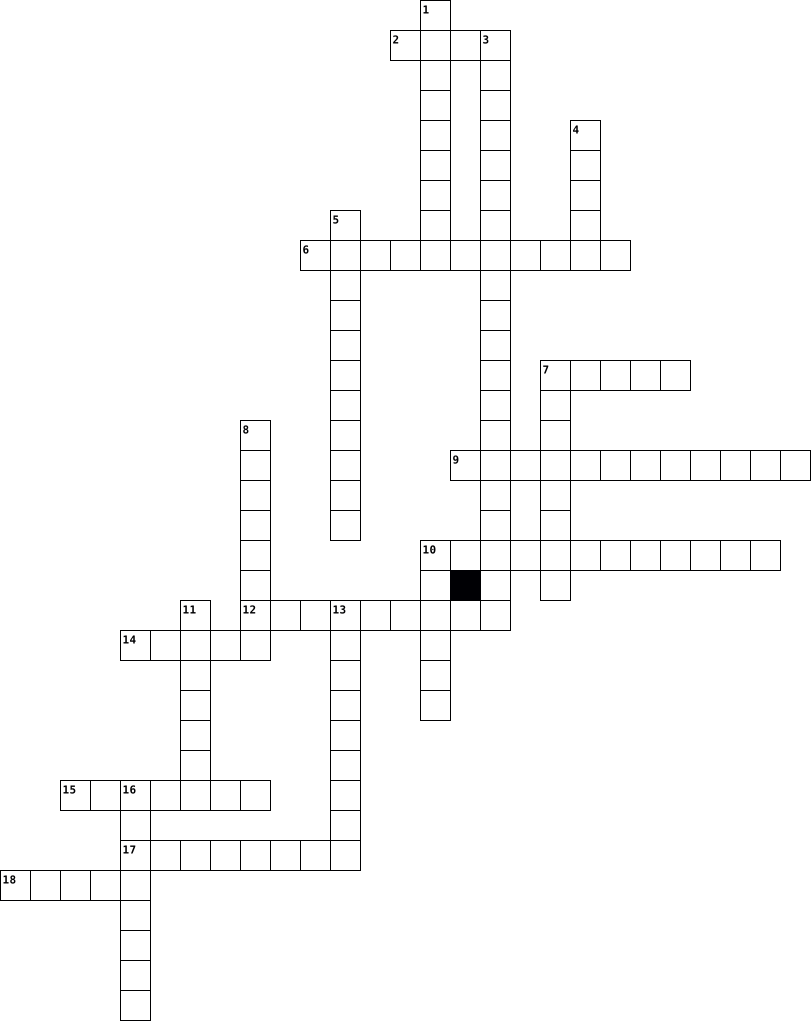
Across
- Small adjustment knob on the microscope
- contain DNA and pass on traits
- used to draw labeling lines on a scientific drawing
- produces energy for the cell
- allows materials into and out of the cell
- jelly-like fluid that fills the cell
- on a microscope it supports the slide
- the control center of the cell
- gets rid of waste for the cell
- magnification determined by multiplying two lenses
Down
- Controls the amount of light on a microscope
- Passageways for transporting materials in the cell
- made 1st microscope and discovered cells
- found only in plant cells
- where proteins are put together in the cell
- contains a 10x lens
- Large adjustment knob on the microscope
- storage tank of the cell
- means tiny organs
- protects and supports the plant cell
20 Clues: means tiny organs • contains a 10x lens • storage tank of the cell • found only in plant cells • produces energy for the cell • contain DNA and pass on traits • the control center of the cell • gets rid of waste for the cell • jelly-like fluid that fills the cell • protects and supports the plant cell • on a microscope it supports the slide • ...
Introduction to Cells 2017-10-02

Across
- explanation of the relationship between cells and living things
- important for insulation
- grain sized organelles that produce proteins
- my category includes genetic materials
- organelle with a network of membranes that produce many substances, sometimes ribosomes get stuck
- basic unit of structure and function in living things
- layer that surrounds plants and some other organisms
- magnify's an image or object to make it look larger than it appears
- a group of specific cells that work together for one function
- large roll in muscle development
Down
- receives materials from the endoplasmic recticulum, packages them up, and distributes them to other parts of the cell
- captures energy from sunlight , changes it, forms energy cells can use to make food(hint: animal cells do not have them)
- green pigmented presented in plants
- controls the cell
- controls the substances coming in and out of a cell
- carry out specific functions within a cell
- I am useful for a fast energy source
- converts energy stored in food to energy a cell can use to function
- stores needed materials for a cell such as food and water
- gel like substance that fills the region between the necleous and the cell membrane
- contain substances that break down larger particles into smaller particles
21 Clues: controls the cell • important for insulation • large roll in muscle development • green pigmented presented in plants • I am useful for a fast energy source • my category includes genetic materials • carry out specific functions within a cell • grain sized organelles that produce proteins • controls the substances coming in and out of a cell • ...
Cells & Microscope Crossword 2016-08-08

Across
- Cells the move through veins.
- Most simple microscope
- Storage in cells.
- Inventor of the microscope.
- Organelle found in a plant that makes light into sugar.
- Instrument that uses visible light and magnifying lenses to look at very small objects.
- Division process cell.
- The central of the cell
- The simplest optical microscope is the magnifying glass
- A neutron
- Makes up much of a cell inside the cell membrane. (Jellylike material)
- The main muscle of breathing.
Down
- Unit of spatial measurement that is 10-6 meter.
- Process of a living cell takes up molecules bound to its surface.
- Process that a plant makes its food.
- Instrument that is used to magnify small objects.
- Cell that helps digest.
- English Philosopher, architect and polymath
- Describes that something has existed before.
- Small things making up a plant.
- Genetically controlled process that leads to death of cells.
- First layer of a plant cell.
- A transparent material.
- Small things making up living things.
- A cell that comes from the male sexual organ.
- Thin flexible layer around the cell.
- Describes the properties of cells.
- Unit of spatial measurement that is 10-9 meter.
- Point, period, or step in a process.
29 Clues: A neutron • Storage in cells. • Most simple microscope • Division process cell. • Cell that helps digest. • A transparent material. • The central of the cell • Inventor of the microscope. • First layer of a plant cell. • Cells the move through veins. • The main muscle of breathing. • Small things making up a plant. • Describes the properties of cells. • ...
Cells And Transport 2022-03-16

Across
- covers the nucleus
- function of proteins in CM
- father of cells
- stores water and waste
- janitors of the cell
- has a water loving and water hating end
- movement of water
- requires energy
- powers the cell
- all cells come from other cells
- supports cell organelles
- has no nucleus
- waterloving
- makes proteins
- solar energy provider
- movt of stuff from high to low concentration
Down
- type of cell that has a cell wall
- function of the CM
- cell identification
- UPS center
- absorbs the solar energy
- stores DNA
- more concentrated
- cell drinking
- in between nucleus & CM
- stuff leaves the cell
26 Clues: UPS center • stores DNA • waterloving • cell drinking • has no nucleus • makes proteins • father of cells • requires energy • powers the cell • more concentrated • movement of water • function of the CM • covers the nucleus • cell identification • janitors of the cell • stuff leaves the cell • solar energy provider • stores water and waste • in between nucleus & CM • absorbs the solar energy • ...
Cells/Mitosis/Meiosis 2022-04-02

Across
- cells without a nucleus
- apparatus of stack membranes that processes and sorts proteins
- controls movement of materials in and out of cell
- first stage of mitosis and chromosomes condense
- type of reproduction, offspring are identical
- chromosome uncoil and nuclear membrane reforms
- jelly-like substance site of cell metabolism
- fluid filled sac that stores materials
- cells with a nucleus
- division of cell cytoplasm
- chromosomes along cell equator
- process by which cell divides its nucleus
Down
- long thread of DNA made of many genes
- longest cell phase preparing for division
- chromatids separate
- interconnected membranes for transport
- egg and sperm
- type of reproduction with 2 parents
- fertilized egg cell
- basic unit of life
- surrounds plant membrane made of cellulose
- storehouse for genetic information
- carries out photosynthesis
- energy powerhouse
- disease with uncontrolled cell division
- process forming gametes
26 Clues: egg and sperm • energy powerhouse • basic unit of life • chromatids separate • fertilized egg cell • cells with a nucleus • cells without a nucleus • process forming gametes • carries out photosynthesis • division of cell cytoplasm • chromosomes along cell equator • storehouse for genetic information • type of reproduction with 2 parents • long thread of DNA made of many genes • ...
Cells/Mitosis/Meiosis 2022-04-02

Across
- cells without a nucleus
- apparatus of stack membranes that processes and sorts proteins
- controls movement of materials in and out of cell
- first stage of mitosis and chromosomes condense
- type of reproduction, offspring are identical
- chromosome uncoil and nuclear membrane reforms
- jelly-like substance site of cell metabolism
- fluid filled sac that stores materials
- cells with a nucleus
- division of cell cytoplasm
- chromosomes along cell equator
- process by which cell divides its nucleus
Down
- long thread of DNA made of many genes
- longest cell phase preparing for division
- chromatids separate
- interconnected membranes for transport
- egg and sperm
- type of reproduction with 2 parents
- fertilized egg cell
- basic unit of life
- surrounds plant membrane made of cellulose
- storehouse for genetic information
- carries out photosynthesis
- energy powerhouse
- disease with uncontrolled cell division
- process forming gametes
26 Clues: egg and sperm • energy powerhouse • basic unit of life • chromatids separate • fertilized egg cell • cells with a nucleus • cells without a nucleus • process forming gametes • carries out photosynthesis • division of cell cytoplasm • chromosomes along cell equator • storehouse for genetic information • type of reproduction with 2 parents • long thread of DNA made of many genes • ...
Cells/Organisms review 2022-01-07

Across
- surrounds plant (and fungi) cells and gives them structure
- scientific name = _________ + species
- the organ system that contains the heart, blood, and blood vessels
- eats other organisms for food
- relying on each other like plants and animals
- waste gas produced by photosynthesis
- different tissues working together
- controls what enters and exits the cell
- an organism whose DNA is contained in a nucleus
- single-celled organism with no nucleus
- an organism that uses the sun to make its own food
- similar, specialized cells working together
- life process: making offspring
- life process: getting food
- food produced by photosynthesis
- important producer in the ocean
Down
- turning food into energy in the cell; all cells do it
- the green substance crucial to photosynthesis
- part of a cell
- source of energy for most processes on Earth
- the life process controlled by the endocrine system in humans
- chemical energy produced by respiration
- where respiration happens in the cell
- ingredients for a chemical reaction
- life process: getting rid of waste
- produces proteins in the cell
- the classification of living organisms into groups
- kingdom that contains amoeba, euglena and paramecium
- consumer which eats producers only
- organisms that can mate and produce fertile offspring
- consumer which eats other consumers
- part of the cell that contains chlorophyll
32 Clues: part of a cell • life process: getting food • eats other organisms for food • produces proteins in the cell • life process: making offspring • food produced by photosynthesis • important producer in the ocean • life process: getting rid of waste • different tissues working together • consumer which eats producers only • ingredients for a chemical reaction • ...
Science - Cells Vocab 2022-04-27

Across
- a self-replicating material
- controls and regulates the cell
- a membrane-bound organelle containing digestive enzymes
- organisms whose cell lacks a nucleus or other organelles
- Helps sequester waste
- the smallest unit that can live on its own and that makes up all living organisms
- The liquid that fills the inside of the cell
- Keeps toxic substances out of the cell
- Helps transport materials that the organism needs
- The protein substances of the cell
Down
- threadlike strand of DNA that carries genes
- _____reticulum
- A cell that possesses a clearly defined nucleus
- cell a cell produced through hematopoiesis
- _____apparatus
- a small anatomically normal sac or bladder like structure
- a lash-like appendage used for locomotion
- enzymes substances that help you digest your food
- wall a layer around the cell that protects the cell
- Helps maintain cell shape
- Generates the cells energy
- lacking affinity for water
- _____membrane
23 Clues: _____membrane • _____reticulum • _____apparatus • Helps sequester waste • Helps maintain cell shape • Generates the cells energy • lacking affinity for water • a self-replicating material • controls and regulates the cell • The protein substances of the cell • Keeps toxic substances out of the cell • a lash-like appendage used for locomotion • ...
microscope and cells 2023-09-05

Across
- course
- eukaryotic
- ribosome
- clips
- fine
- endoplasmic
- reticulum
- golgi
- vaculoe
- lysosome
Down
- eyepiece
- arm
- membrane
- mitochondria
- body
- light
- prokaryotic
- base
- objective
- diaphragm
- stage
- nucleolus
- nucleus
- chloroplast
- wall
25 Clues: arm • body • base • fine • wall • light • clips • stage • golgi • course • nucleus • vaculoe • eyepiece • membrane • ribosome • lysosome • objective • diaphragm • nucleolus • reticulum • eukaryotic • prokaryotic • endoplasmic • chloroplast • mitochondria
Macromolecules and Cells 2023-09-13

Across
- Signifying over, above, high, beyond, excessive, above normal
- combining form. variants or sacchari- or saccharo sugar.
- A suffix is used to form the names of enzymes.
- Forming words regarding or pertaining to cells
- any of a class of natural or synthetic organic compounds characterized by a molecular structure of 17 carbon atoms arranged in four rings.
- the movement of molecules or ions across a cell membrane from a region of lower concentration to a region of higher concentration—against the concentration gradient
- the main type of sugar in the blood and is the major source of energy for the body's cells
- low, under, beneath, down, or below normal
- the medical term used to describe the destruction of red blood cells.
- The suffix used in biochemistry to form the names of sugars
- quantitative measure of the acidity or basicity of aqueous or other liquid solutions
- membrane-bound cell organelles that generate most of the chemical energy needed to power the cell's biochemical reactions
- a term used to refer to having a greater degree of tone, tension, or tonicity
- A combining form or prefix denoting many, multiplicity
- A carbohydrate is a biomolecule consisting of carbon, hydrogen and oxygen atoms- found in most foods
- a naturally occurring, extremely complex substance that consists of amino acid residues joined by peptide bonds
- one that has the same osmolarity, or solute concentration, as another solution
Down
- the process by which biological fuels are oxidised in the presence of an inorganic electron acceptor, such as oxygen, to drive the bulk production of adenosine triphosphate, which contains energy
- the membrane found in all cells that separates the interior of the cell from the outside environment.
- the unfolding or breaking up of a protein, modifying its standard three-dimensional structure
- a type of membrane transport that does not require energy to move substances across cell membranes. Instead of using cellular energy, like active transport, passive transport relies on the second law of thermodynamics to drive the movement of substances across cell membranes
- Prefix means small
- the surface on which an organism lives or the substance on which an enzyme can act
- the molecule that carries genetic information for the development and functioning of an organism
- a process in which a cell takes in materials from the outside by engulfing and fusing them with its plasma membrane
- Prefix refers to blood
- a prefix applied to the various phospholipids to indicate the removal of one of the two fatty acids
- a term used to refer to having a greater degree of tone, tension, or tonicity.
- proteins act as biological catalysts by accelerating chemical reactions
- the process by which cells move materials from within the cell into the extracellular fluid
- the stored form of glucose that's made up of many connected glucose molecules.
- a combining form with the meanings “sugar,” “glucose and its derivatives,
32 Clues: Prefix means small • Prefix refers to blood • low, under, beneath, down, or below normal • A suffix is used to form the names of enzymes. • Forming words regarding or pertaining to cells • A combining form or prefix denoting many, multiplicity • combining form. variants or sacchari- or saccharo sugar. • The suffix used in biochemistry to form the names of sugars • ...
Cells & Cell Structures 2023-11-10

Across
- type of cell without a nucleus or organelles
- gel-like fluid of water and nutrients inside the cell
- short, numerous, hair-like projections that aid in cell movement
- type of cell with a nucleus and organelles
- small, round membrane bound structures that help to move substances within the cell
- control center of the cell that contains DNA
- Thick, rigid wall that surrounds the outside of the plasma membrane
- outer boundary of the cell that regulates what enters and leaves
- structure found inside the nucleus that makes ribosomes
- modifies, sorts, and packages proteins and other cell products
- organelle that produces energy for the cell
- small structures that make proteins
Down
- contains ribosomes and is involved in making proteins
- organelle found in plant cells that performs photosynthesis
- filled with digestive enzymes to break down materials for the cell
- supporting network of protein fibers that help to support the cell, anchor organelles, and move substances
- stores water, nutrients, and wastes for plant cells
- long, whip-like projections that aid in cell movement
- smallest unit of life
- does not contain ribosomes and is involved in making lipids
20 Clues: smallest unit of life • small structures that make proteins • type of cell with a nucleus and organelles • organelle that produces energy for the cell • type of cell without a nucleus or organelles • control center of the cell that contains DNA • stores water, nutrients, and wastes for plant cells • contains ribosomes and is involved in making proteins • ...
Cells: Unit 3 2023-12-01

Across
- converts sunlight into energy for plants
- used in cell membranes
- "junk drawer" of cells
- external solution yielding no NET movement of water or solutes into or out of cells
- transport through the cell membrane requiring energy
- movement of water
- external solution with low water concentration and high solute concentration, water goes out of the cell
- will allow some diffusion
- "Packaged" items inside a cell
- two layers
Down
- made easier
- transport system in the cells, comes as rough or smooth
- hard divider between inside and outside
- cells eject material using the vesicles fused into the cell membrane
- movement of substances from high concentration to low concentration
- external solution with high water concentration and low solute concentration, water goes into the cell
- contains most of the DNA in a cell
- an item made up of smaller pieces
- Cell with organelles
- balance in chemical reactions or diffusion
- cells engulf external material using the cell membrane
- divides inside the cell from extracellular matrix
- the "powerhouse" of the cell
- smallest unit of life
24 Clues: two layers • made easier • movement of water • Cell with organelles • smallest unit of life • used in cell membranes • "junk drawer" of cells • will allow some diffusion • the "powerhouse" of the cell • "Packaged" items inside a cell • an item made up of smaller pieces • contains most of the DNA in a cell • hard divider between inside and outside • ...
Cells and Intro 2023-05-09

Across
- packing & shipping plants in the cell
- Cells that produce protein fibers found in CT that also help in wound healing
- cell part that is the protein factory
- 2 or more tissues performing a specific function
- Fibrous CT that is also known as fat
- control center of cell that contains DNA & RNA
- placed at the beginning of a main word
- power plant organelle in a cell
- cell roadway; network of sacs
- moving substances out of a cell
- substance that makes up to 80% of all cells
- suffix that means pain
- pneumonic that reminds you of the characteristics of inflammation
- study of disease
- structures in cells that carry out a specific function
- ability for internal environment to remain relatively constant
- a full, living entity
- moving of molecules from high to low concentration
- fingerlike projections used in absorption in GI tract
- the movement across the cell membrane that does not require energy
- type of cartilage that is between vertebrae
- prefix that means cell
- found on ends of bones at articulating surfaces; type that connects ribs to sternum
- also called visceral muscle; involuntary; found within tubes
- cell eating
- Fibrous CT that is arranged in parallel rows and supports in 1 or 2 directions
Down
- breaks down old cell parts and pathogens in cell
- moving of molecules across cell membrane that requires energy
- fibrous CT that is strong & thick and supports in multiple directions
- network of microfilaments & microtubules in cell
- another name for horizontal plane
- energy molecule used to supply energy needs made in cell (full name)
- lines closed body cavities and secretes a watery fluid
- word that means heart
- intracellular fluid name
- hairlike projections; many found in respiratory tract
- means opposite or against
- end of word, after main part
- means related to the same side of the body
- main part of a word
- moving of water across a cell membrane from low to high concentration
- the study of function of the body
- organization level that is considered not living
- word ending that means inflammation
- the outer boundary of the cell; gatekeeper
- the movement of water & molecules across the cell membrane due to pressure
- study of structures in the body
- membrane that lines the brain & spinal cord
- cell part needed for cell division to occur
- whiplike projection on a cell for locomotion; ex- sperm cell
- carrier molecules in cell membrane used to transport larger substances
- cell drinking
52 Clues: cell eating • cell drinking • study of disease • main part of a word • word that means heart • a full, living entity • suffix that means pain • prefix that means cell • intracellular fluid name • means opposite or against • end of word, after main part • cell roadway; network of sacs • power plant organelle in a cell • moving substances out of a cell • study of structures in the body • ...
Cells CW 1 2024-02-14

Across
- a stack of membranes that collects, modifies, and packages chemical compounds.
- a tiny structure where proteins are synthesized
- a hair-like organelle that helps a cell move.
- a round body in the center of the cell that contains DNA and regulates gene expression.
- a region inside a bacterial cell that contains genetic material. Unlike in plant and animal cells, the nucleoid in bacteria is not surrounded by a nuclear membrane.
- a double-layered membrane that surrounds and protects the nucleus.
- living things are made of one or more cells; the cell is the smallest unit of life; new cells come from preexisting cells
- the outermost layer of a bacterial cell that prevents harmful materials from entering, keeps the cell from drying out, and protects the bacterial cell from the immune cells of other organisms.
- a cell structure that performs a specific function.
- series of chemical reactions that convert energy in food molecules into ATP
- The chemical process in which stored energy is broken down so it can be used by an organism to survive when there is no food source available.
- Genetic material that holds information for making more cells.
- A nonliving protective shell with genetic material inside of it.
- a small body in the nucleus where ribosomes are synthesized.
- a bundle of microtubules that helps organize the movement of chromosomes during cell division.
- a double-layered membrane that surrounds the cell. Also called the plasma membrane, it regulates what enters and leaves the cell.
- a network of passageways in which chemical compounds are manufactured, processed, and transported.
Down
- a jelly-like substance, composed mainly of water, occupying most of the space between the cell membrane and the nucleus.
- a small, sac-like package of nutrients, proteins, or water created by the Golgi apparatus. Types of vesicles include vacuoles and lysosomes.
- made of one cell
- the rigid, porous outer layer of a plant cell.
- made of many cells
- an organelle that uses oxygen to convert nutrients into energy that can be used by the cell.
- an organelle that converts the radiant energy of the Sun into chemical energy through the process of photosynthesis.
- a small, circular piece of DNA separate from the genetic material in the nucleoid of a bacterial cell. Plasmids often contain genes that provide an advantage to the cell, like antibiotic resistance.
- series of reactions that convert light energy, water, and CO2 into glucose and give off oxygen
- A type of single-celled organism found almost everywhere on Earth.
- a small structure that can store food (leucoplast) or pigment (chromoplast).
- filaments, including actin, microtubules, and microfilaments, that aid in cell movement and give the cell its shape.
- a hair-like structure that helps bacterial cells adhere to surfaces. Some pili are able to transfer genetic material to other cells.
- The chemical process in which carbon dioxide and water combine, using energy from the Sun, to make sugar and oxygen.
- a small sac, or vesicle, that contains digestive chemicals
- The basic unit of all living things.
- a type of vesicle that stores water, nutrients, and other chemicals. The large vacuole found in plant cells helps the cells maintain their shape.
34 Clues: made of one cell • made of many cells • The basic unit of all living things. • a hair-like organelle that helps a cell move. • the rigid, porous outer layer of a plant cell. • a tiny structure where proteins are synthesized • a cell structure that performs a specific function. • a small sac, or vesicle, that contains digestive chemicals • ...
Viruses and Cells 2025-10-01

Across
- Protein shell of a virus
- Outer boundary of a cell
- Single-stranded genetic material
- Jellylike substance inside cells
- Organism a virus infects
- Nonliving particle that infects cells
- Disease-causing agent
- Site of protein synthesis
- Double-helix genetic material
- Copying genetic material
Down
- Virus that causes the flu
- Cell type without a nucleus
- Organelle that holds DNA
- Cell type with a nucleus
- Process of making new organisms
- Prokaryotic microbes
- Protective covering
- Virus that attacks immune cells
- Tiny cell structures with jobs
- Basic unit of life
20 Clues: Basic unit of life • Protective covering • Prokaryotic microbes • Disease-causing agent • Protein shell of a virus • Organelle that holds DNA • Cell type with a nucleus • Outer boundary of a cell • Organism a virus infects • Copying genetic material • Virus that causes the flu • Site of protein synthesis • Cell type without a nucleus • Double-helix genetic material • ...
Viruses and Cells 2025-10-01

Across
- Tiny cell structures with jobs
- Protein shell of a virus
- Site of protein synthesis
- Cell type with a nucleus
- Protective covering
- Basic unit of life
- Organelle that holds DNA
- Copying genetic material
- Single-stranded genetic material
- Disease-causing agent
Down
- Process of making new organisms
- Nonliving particle that infects cells
- Outer boundary of a cell
- Cell type without a nucleus
- Virus that causes the flu
- Prokaryotic microbes
- Organism a virus infects
- Jellylike substance inside cells
- Double-helix genetic material
- Virus that attacks immune cells
20 Clues: Basic unit of life • Protective covering • Prokaryotic microbes • Disease-causing agent • Outer boundary of a cell • Protein shell of a virus • Cell type with a nucleus • Organism a virus infects • Organelle that holds DNA • Copying genetic material • Site of protein synthesis • Virus that causes the flu • Cell type without a nucleus • Double-helix genetic material • ...
Animal & Plant Cells 2024-09-01

Across
- strengthen seed coats and are responsible for gritty-textured flesh of some fruits
- surround all the nerve fibers and produce myelin sheath similar to the oligodendrocytes
- responsible for the production of the myelin sheath
- cells that are mostly responsible for the synthesis and storage of plant food
- a type of connective tissue that has more flexible matrix than bone
- prevents loss of water and invasion of disease-causing microorganisms
- groups of cells that work together to perform a specialized function
- composed of sieve-tube elements that help in the transport of nutrients throughout the plant’s body
- muscles that are found in the walls of hollow organs such as intestines, stomach, bladder, blood vessels, and uterus
Down
- a meristematic tissue that responsible for the primary growth of plants
- covers the whole body of nonwoody and young woody plants and is protected by a waxy cuticle
- a type of epithelial cell that has more than two layers
- cells that provide a furnishing flexible support to immature parts of plants
- used in transportation of substance, immune response, and blood clotting
- slit-like structures on the lower epidermis of leaves which aids in the exchange of gases between plants and the environment
- organisms that belong to the same species and live in the same area
- the basic unit of the nervous system that consists of structures that can conduct electrochemical signals as a form of information
- specialized structures that regulate the opening and closing of stomata
- a type of animal tissue that forms the inner and outer lining of organs, the covering in surfaces, and the primary glandular tissue of the body
- a part of lateral meristem that gives rise to cork cells which replaces epidermis of plants once they mature
20 Clues: responsible for the production of the myelin sheath • a type of epithelial cell that has more than two layers • organisms that belong to the same species and live in the same area • a type of connective tissue that has more flexible matrix than bone • groups of cells that work together to perform a specialized function • ...
cells and organelles 2025-06-05

Across
- The absence of polarity makes them not interact with water.
- – Cell division forming two identical cells. Used for growth and tissue repair.
- – Simple cells without a nucleus, like bacteria. DNA is found in the cytoplasm.
- – Builds proteins from amino acids. Found in the cytoplasm or on the endoplasmic reticulum.
- A cellular structure involved in the process of cell division.
- – Controls cell activities and contains DNA. It regulates growth, metabolism, and reproduction.
- – Basic units of life that perform essential functions. They can exist independently or as part of multicellular organisms.
- – Movement of molecules from high to low concentration. It helps substances cross cell membranes.
- – Produces energy (ATP) through cellular respiration. Known as the cell’s powerhouse.
- APPARATUS A series of flattened sacs that sort and package cellular materials.
Down
- Membrane enclosed organelles that contain an array of enzymes capable of breaking down all types of biological polymers.
- – Cell division producing four unique cells with half the chromosomes. Essential for sexual reproduction.
- a complex of DNA, proteins, and RNA that makes up the genome in eukaryotic cells.
- – Complex cells with a nucleus and organelles. Found in animals, plants, fungi, and protists.
- PROTEIN It move molecules across a membrane within a cell. Responsible for moving materials into and out of the cell.
- Folds in the inner mitochondrial membrane. Increase the surface area of the mitochondrial membrane.
- Specialized structures within cells that perform specific functions.
- – Movement of water from high to low concentration. Occurs through a selectively permeable membrane.
- MEMBRANE An outermost envelope-like membrane or a structure. Controls the entry and exit of substances.
- These molecules easily interact with and dissolve in water.
20 Clues: The absence of polarity makes them not interact with water. • These molecules easily interact with and dissolve in water. • A cellular structure involved in the process of cell division. • Specialized structures within cells that perform specific functions. • APPARATUS A series of flattened sacs that sort and package cellular materials. • ...
Cells- Alyssa M 2024-11-22

Across
- rectangular shape
- makes ATP
- lacks organelles no nucleus ex. bacteria
- folded membrane, transports
- site of photosynthesis
- scientific name for a living thing
- common lab stain
- selectively permeable
- Diffusion of water
- one cell
- digests waste
Down
- Our scientific name
- has organelles ex. humans
- group of tissues working together
- packing and secreting of proteins
- supports and protects the plant
- small structures inside a cell
- a group of cells
- where ribosomes are made
- in animal cells, for cell division
- small sacs for digestion
- in plant cells only,watery
- movement of materials with ATP
- discovered the cell nucleus
- group of organs working together
25 Clues: one cell • makes ATP • digests waste • a group of cells • common lab stain • rectangular shape • Diffusion of water • Our scientific name • selectively permeable • site of photosynthesis • where ribosomes are made • small sacs for digestion • has organelles ex. humans • in plant cells only,watery • folded membrane, transports • discovered the cell nucleus • small structures inside a cell • ...
DNA, Mutations & Cells 2025-03-26

Across
- the basic building block of DNA and RNA, consisting of a sugar molecule, a phosphate group, and a nitrogen-containing base
- change in a gene or chromosome
- breaks down food molecules
- helps with cell division
- build proteins
- stores water, nutrients and waste
- characteristic of an organism
- controls chlorophyll to help the plant trap sunlight to make food
- brain of the cell
- the carrier of all genetic material
Down
- transports proteins
- long DNA strand
- reticulum carry materials within the cell
- instructions for a specific protein or segment of DNA
- controls the movement of material in and out of the cell
- powerhouse of the cell
- form of a gene
- jelly like material that contains organelles
- surrounds the cell and gives it shape
- acts as a messenger for instructions from DNA to the proteins
20 Clues: build proteins • form of a gene • long DNA strand • brain of the cell • transports proteins • powerhouse of the cell • helps with cell division • breaks down food molecules • characteristic of an organism • change in a gene or chromosome • stores water, nutrients and waste • the carrier of all genetic material • surrounds the cell and gives it shape • ...
Enzymes & Cells Questions 2025-04-23

Across
- SI unit for enzymes activity.
- a substrate binds to an active site and both change shape slightly, creating an ideal fit for catalysis.
- the DNA is enclosed within a membrane-bound nucleus.
- enzymes are made of ....
- is basic fundamental unit of life.
- What cells release insulin when glucose level elevate in the body?
- captures energy from light (photosynthesis).
- .... is an enzyme that breaks down complex carbohydrates, like starch, into simpler sugars, primarily glucose, during digestion.
- ...contains DNA of the cell.
- A cell organelle that is present in animal cells but not in plant cells is?
- Light energy converted to chemical energy by photosynthesis and is stored in ....
- The .... is a spesific region on enzymes where substrate binds and the reaction occurs.
Down
- The theory of enzyme action that explains how enzymes fit their substrate.
- Organelle involved in spindle fibre formation in animal cell is?
- Nature of enzymes is ....
- is known as the suicide bag of a cell.
- The term of cell was given by...
- .... provides protection for a cell.
- The stage in the life cycle of a cell where the cell grows and DNA is replicated.
- Makes ATP.
- Organelle made up of RNA protein complex that makes protein is?
- .... is an enzyme that breaks down complex carbohydrates, like starch, into simpler sugars, primarily glucose, during digestion.
- An enzymes is a biological .... which can alter or speed up a chemical reaction.
- Types of enzymes that breaks down proteins.
- What enzymes bind together or break down called?
- Organelle inolved in membrane and secretory protein synthesis is?
26 Clues: Makes ATP. • enzymes are made of .... • Nature of enzymes is .... • ...contains DNA of the cell. • SI unit for enzymes activity. • The term of cell was given by... • is basic fundamental unit of life. • .... provides protection for a cell. • is known as the suicide bag of a cell. • Types of enzymes that breaks down proteins. • captures energy from light (photosynthesis). • ...
Cells Part 1 2024-09-30

Across
- a homogenous mixture of two or more components.
- difference in hydrostatic (fluid) pressure that drives filtration.
- the substance present in the largest amount in a solution.
- the division of the cell nucleus; often followed by division of the cytoplasm of a cell.
- a small fluid-filled sac formed by membrane.
- tiny, hairlike projections on cell surfaces that move in a wavelike manner.
- the diffusion of water (a solvent) through a membrane from a dilute solution into a more concentrated one.
- the scientific theory stating that a cell is the structural and functional unit of life, the activity of an organism depends on the activities of its cells, a cell's structure determines its functions, and cells are the basis for reproduction.
- the ingestion of solid particles by cells.
- refers to molecules, or portions of molecules, that interact only with nonpolar molecules.
- area where plasma membranes of neighboring cells are tightly bound together, forming an impermeable barrier.
- the passive process by which molecules and ions move from areas of high concentration to areas of low concentration.
- below normal tone or tension.
- passive transport process driven by a concentration gradient and requiring a membrane protein to act as a carrier or channel.
- method for the movement of substances from the cell interior to the extracellular space as a secretory vesicle fuses with the plasma membrane.
- having a uniform tension; of the same tone.
- the passive process of forcing water and solutes through a membrane using a fluid pressure gradient.
Down
- the nucleic acid that contains ribose; acts in protein synthesis.
- a barrier, such as a membrane, allows some substances through and excludes others.
- excessive, above normal, tone or tension.
- a difference in amount of a substance between two areas.
- means by which fairly large extracellular molecules or particle enter cells.
- the engulfing of extracellular fluid by cells.
- long, whiplike extensions of the cell membrane of some bacteria and sperm; serve to propel the cell.
- the process of making a second copy of cellular DNA before the cell divides.
- refers to molecules, or portions of molecules, that interact with water and charged particles.
- net movement of a substance across a membrane against a concentration or electrical gradient; requires release and use of cellular energy.
- the dissolved substance in a solution.
- the spreading of particles in a gas or solution with a movement toward uniform distribution of particles; also called simple diffusion.
- the phase of a cell's life cycle when it reproduces itself.
30 Clues: below normal tone or tension. • the dissolved substance in a solution. • excessive, above normal, tone or tension. • the ingestion of solid particles by cells. • having a uniform tension; of the same tone. • a small fluid-filled sac formed by membrane. • the engulfing of extracellular fluid by cells. • a homogenous mixture of two or more components. • ...
Cells and Organelles 2024-11-01

Across
- stores food, water, and waste
- Consisting of many cells
- Wolves and dogs
- ONLY in a plant cell and this helps protect the plant.
- is a tiny cell structure that carries out specific functions within the cell
- made of a single cell
- more in common like fur
- a living thing
- gel-like fluid that helps the organelles to flow easily around the cell
- deliver the proteins
- the condition in which an organisms internal environment is kept stable
- a passageway that carries/transports protein to the organelles.
- an action or change in behavior that occurs as a result of a stimulus
- the process of grouping things based on their similarities
Down
- Controls what goes in and out of the cell
- The “brain” of the cell. The organelle controls what the cell does and how it functions.
- physical change
- Energy for the cell
- the basic unit of function and structure in living things
- Lys is LATIN means (to breakdown) breakdown waste.
- first part of the Latin name
- produces the proteins
- the idea that living things come from non-living things
- any change or signal in the environment that can make a organism react
- ONLY in a plant cell. Photosynthesis happens and sugars are produced
25 Clues: a living thing • physical change • Wolves and dogs • Energy for the cell • deliver the proteins • produces the proteins • made of a single cell • more in common like fur • Consisting of many cells • first part of the Latin name • stores food, water, and waste • Controls what goes in and out of the cell • Lys is LATIN means (to breakdown) breakdown waste. • ...
Cells - Crossword Review 2024-10-28

Across
- jelly-like material that fills the cell and surrounds the organelles; contains nutrients the cell needs to survive
- describes living things made of a single cell (e.g., diatom, amoeba, paramecium)
- that can be easily permeated or penetrated (by air or water, for example)
- movement of particles from an area of higher concentration to an area of lower concentration
- process by which a cell divides into two new cells (2 words)
- process by which mitochondria provides energy by transforming oxygen and sugar into carbon dioxide and water (2 words)
- membrane-bound organelles that break down food particles and release their stored energy into a form that the cell can use to fuel all of its activities; powerhouses of the cell
- movement of substances into and out of a cell; involves several different processes, such as diffusion and osmosis (2 words)
- process by which the chlorophyll in chloroplasts uses the Sun's energy to convert carbon dioxide and water into sugar and oxygen
- the cell is the basic unit of life; all organisms are made up of one or more cells; (3) all cells come from existing cells (2 words)
- organelle that breaks down food and digests wastes
- small structure (part) inside a cell that performs a specific function to meet the cell’s basic needs to survive and reproduce
- organism that can only be seen under a microscope (e.g., bacteria, amoebas, and certain algae and fungi
- large, membrane-bound, sac-like organelles that stores excess food, waste, and other substances required by the cell
- thin structure that separates an interior environment from its exterior surroundings (e.g., cell membrane); organelle membranes keep different parts of the cell separate from one another
- membrane-bound organelle of a plant cell that contains a green substance (pigment) called chlorophyll; chlorophyll uses the Sun's energy to convert carbon dioxide and water into sugar and oxygen in a process called photosynthesis
Down
- refers to the property of a barrier, such as a cell membrane, that allows only certain substances to pass through it (2 words)
- describes living things made of more than one cell that rely on a variety of types of cells (specialized cells) to perform cellular functions
- basic structural unit of an organism and the building block of life; all living things are made of cells
- tiny organelles in the cell’s cytoplasm that helps make proteins
- folded organelle that combines proteins made by the endoplasmic reticulum and delivers them to the rest of the cell and outside the cell
- rigid structure that surrounds the cell membrane of plant cells; provides strength and support for a plant cell (2 words)
- folded organelle in a cell that makes proteins
- that cannot be passed through (by air or water, for example)
- large organelle that controls all the activities in a cell, such as growth, repair, and reproduction
- thin covering that holds the cytoplasm and organelles inside a cell and controls the passage of materials in or out of the cell (2 words)
- microscope that uses light focussed through several different lenses, which make up the eyepiece and the objective lenses, to form a magnified image of a specimen (3 words)
- special kind of diffusion in which a fluid (usually water) moves through a selectively permeable membrane from an area of higher concentration to an rea of lower concentration
28 Clues: folded organelle in a cell that makes proteins • organelle that breaks down food and digests wastes • process by which a cell divides into two new cells (2 words) • that cannot be passed through (by air or water, for example) • tiny organelles in the cell’s cytoplasm that helps make proteins • ...
Cells Crossword Puzzle 2025-11-18

Across
- An organelle that links amino acids together to make proteins.
- An instrument that can be used to observe small objects, even cells.
- The bottom, stable part that supports the entire Microscope.
- The lens at the top of the Microscope often having a 10x magnification.
- An Organelle that stores water and other materials.
- A selectively permeable barrier that encloses all cells.
- A network of membranes within a cell that helps transport proteins and lipids.
- Metal or plastic clips that hold a glass slide in place on the stage.
- Organelles that capture energy form the sun to make food for the cell.
- The cells recycling centers.
Down
- The area inside a cell that is between the Nucleus and the Cell membrane.
- A tiny cell structure that carries a specific function within a cell.
- A set of lenses providing low, medium, and high magnification.
- An Organelle that breaks down food molecules.
- The platform where the specimen slide is placed for observation.
- The fundamental structural and functional unit of all living organisms.
- The part you hold the microscope by.
- The control center of a cell.
- The barrier surrounding the cell membrane which is only found in plant cells.
- A tube that connects the eyepiece to the objectives.
20 Clues: The cells recycling centers. • The control center of a cell. • The part you hold the microscope by. • An Organelle that breaks down food molecules. • An Organelle that stores water and other materials. • A tube that connects the eyepiece to the objectives. • A selectively permeable barrier that encloses all cells. • ...
Unit 3: Cells 2025-09-24

Across
- ships proteins out to other organelles and found on rough ER
- study of molecules and chemical processes in metabolism
- light-capturing pigment in the chloroplasts
- converts fuel particles into usable energy for the cell through cellular respiration
- measure of the clarity of the image
- movement of particles from high to low concentration
- membrane system of folded sacs and interconnected channels that serves as site for protein and lipid synthesis
- part of plant cell that captures light and converts it into chemical energy during photosynthesis
- when concentration becomes uniform and remains the same
- solution that has concentration of water and solute the same inside and outside the cell
- describes the phospholipids in the bilayer as a "sea"
- membrane-bound sac used for temporary storage in animal cells
- thick, rigid mesh of fibers that surrounds outside of plasma membrane to support and protect plant cell
- stores water, provides structural support and aids in photosynthesis in plant cells
- flattened stack of membranes that modifies, sorts, and packages proteins
- move molecules across cell membranes by binding to specific molecules and changing shape
- vesicles that contain hydrolytic enzymes used to digest and destroy
- short, numerous projections used for short movement that look like hair
- process by which a cell engulfs and destroys foreign substances or dead cells
- site where lipids are made and metabolizes carbohydrates
- site where proteins are made for other processes outside the cell
- thin protein threads that enable the cell to move
- ratio of an object's image size to its real size
- theory that proposes that a symbiotic relationship formed between two prokaryotic cells
Down
- double membrane that surrounds the nucleus
- process by which cell uses enzymes to recycle own organelles and macromolecules
- movement of molecules down its concentration gradient through a transport protein
- solution with lower concentration of solutes inside vs outside the cell
- process that allows cell to move large materials from inside to outside of the cell using vesicles
- long, hollow protein cylinders that help move substances within the cell
- semifluid material where organelles float
- movement of water molecules from low to high solute concentration
- make proteins for the cell and found floating in cytoplasm
- process that brings in materials from outside the cell by forming new vesicles from the plasma membrane
- solution with higher concentration of solute inside vs outside the cell
- help move certain larger substances and wastes through the membrane
- specialized structures that perform specific cell functions
- regulation of the internal environment of a cell to maintain conditions suitable for life
- projection that moves in a whip-like motion allowing cell to move quickly
- allows some substances to enter the cell while keeping other out
- stores information used to make proteins that determine cell's growth, function, and reproduction
- visible differences in parts of the sample
- pumping of solutes against concentration gradients
- create pores in cell membrane to allow specific molecules to pass through
- atom(s) with a positive or negative electric charge
- regulate the movement of materials inside and outside the cell
- network of long, thin protein fibers that provide structural support and shape
- one of the fundamental ideas of modern biology
- study of cell structures
- orderly structure shown by living things
50 Clues: study of cell structures • measure of the clarity of the image • orderly structure shown by living things • semifluid material where organelles float • double membrane that surrounds the nucleus • visible differences in parts of the sample • light-capturing pigment in the chloroplasts • one of the fundamental ideas of modern biology • ...
Cells and Tissue 2025-11-06

Across
- Contain digestive enzymes to break down waste
- Connective tissue that stores fat
- Flexible tissue that reduces friction in joints
- Tissue that covers internal and external body surfaces
- Thick protein fibres that give connective tissue strength
- Tissue that sends electrical messages around the body
- Type of muscle found in the heart
- Basic unit of all living organisms
- Tiny structures where proteins are made
- Hard tissue providing structure and protection
- Site of energy release by respiration
- Found in ciliated epithelium, helps sweep mucus away
- Hair-like projections that move substances across epithelial surfaces
Down
- Makes and transports lipids and hormones
- Type of muscle that moves under conscious control
- Jelly-like substance where chemical reactions occur
- Controls movement of substances in and out of the cell
- Packages and transports proteins around the cell
- Connective tissue that connects muscle to bone
- Cell that carries electrical impulses
- Controls all cell activities and contains genetic material
- Type of muscle found in the gut and blood vessels
- Connective tissue that connects bone to bone
23 Clues: Connective tissue that stores fat • Type of muscle found in the heart • Basic unit of all living organisms • Cell that carries electrical impulses • Site of energy release by respiration • Tiny structures where proteins are made • Makes and transports lipids and hormones • Connective tissue that connects bone to bone • Contain digestive enzymes to break down waste • ...
Plant & Animal Cells 2025-11-06

Across
- The "powerhouse" of the cell
- Type of cell that contains lysosomes
- Process that converts sunlight into chemical energy
- Hair-like structures that help a cell move
- Tail-like structure used for movement
- Small structures inside a cell with specialized jobs
- Found only in animal cells; helps with cell division
- Jelly-like interior of the cell
- Small membrane-bound sacs that transport materials
- Organelle that digests waste
- Stores materials like water and nutrients
- The cell's control center
Down
- Rigid outer layer found only in plant cells
- Transports proteins—can be smooth or rough
- Where photosynthesis happens in plant cells
- Genetic material inside the nucleus
- Type of cell that contains chloroplasts
- Tiny dots responsible for making proteins
- Protective barrier that controls what enters and leaves the cell
- Packages and ships proteins
20 Clues: The cell's control center • Packages and ships proteins • The "powerhouse" of the cell • Organelle that digests waste • Jelly-like interior of the cell • Genetic material inside the nucleus • Type of cell that contains lysosomes • Tail-like structure used for movement • Type of cell that contains chloroplasts • Tiny dots responsible for making proteins • ...
Cells & Macromolecules 2 2025-12-11

Across
- Name of process where RNA gets changed into protein
- The _____ signal (part that tells RNA polymerase to stop) is removed during Pre-mRNA processing.
- relieves overwinding strain ahead of replication forks by breaking, swiveling, and rejoining DNA strands
- bit of a bacteria that’s used as a tiny taxi service to deliver gene-editing tools like Cas9 protein and guide RNA into cells for gene editing
- The 5' end of the mRNA is the ____ of the protein
- unwinds and separates parental DNA strands
- Short _____ repeats – clusters of repeating DNA that can be used to identify individual humans, often for crime reasons.
- ______ enzymes are bacterial proteins that cut DNA at specific palindromic sequences.
- The physical division of the plasma membrane into two distinct units
- Initiator tRNA
- ______ aquaticus, a bacterium that lives in hot springs and hydrothermal vents, providing the heat-tolerant TAQ polymerase that makes PCR possible.
- The spliceosome removes ______ but does not remove exons.
- Cell type that is undifferentiated and can become basically anything it wants (basically what millennials thought we were until we were hit with the crippling realities of late-stage capitalism).
- RNA type that clearly hates mRNA, wants to silence or destroy it after it’s done all the hard work of transcribing the DNA.
- A 5’ ____ is added to pre-mRNA in its processing.
- Protein coat on a virus.
- Combination of protein and nucleic acids capable of infecting cells, chaotic evil, relationship with being alive: it’s complicated. A strangling vine on the tree of life.
- What is the word describing the tendency of many different codons coding for a single amino acid?
- Infectious protein that causes your proteins to misfold, resulting in neurological symptoms and death.
- How many letters make a codon?
- binding protein Stabilizes unwound parental DNA strands
- _______ Chain Reaction: a method able to vastly increase the amount of a specific section of DNA from a nucleic acid sample.
- _____ of histone tails makes them looser and more open for business (i.e. translation)
- What shape are prokaryotic chromosomes?
- Non-coding pieces of RNA removed during pre-mRNA processing.
Down
- Beginning of transcription process.
- removes RNA nucleotides of primer from 5’ end and replaces them with DNA nucleotides (roman numerals)
- protein production facility.
- Aminoacyl-tRNA ______ ensure that the proper amino acids are added to build proteins.
- How many points of replications does a prokaryote chromosome have?
- fragments on the lagging strand
- Combination of proteins and RNA that cuts and ligates the mRNA molecule.
- A ____ tail is added to pre-mRNA in its processing.
- A word describing the *multiple* powers of stem cells.
- For millennia, humans have conducted _____ breeding of plants and animals to increase desired traits.
- every time the PCR sequence is repeated, the amount of target DNA ______
- How many codons make an amino acid?
- Using parental DNA as a template, makes new DNA by adding nucleotides to an RNA primer or a preexisting DNA strand (roman numerals)
- Name of process where DNA gets changed into RNA
- A ____ sequence is used to initiate the process of RNA polymerase attaching to DNA.
- Dividing the cell’s components in two
- Where RNA primers start
- A three-nucleotide sequence on a transfer RNA (tRNA) molecule that pairs with a complementary codon on a messenger RNA (mRNA) during protein synthesis (translation) to ensure the correct amino acid is added to a growing protein chain.
- A eukaryotic promoter commonly includes a ____ box.
- A type of immune system DNA from previous viral infections stored in the bacterial genome that has been co-opted for genetic modification of other species by humans in labs
- Repairs the nicks (unfinished sugar-phosphate bonds) on the newly synthesized strands
- How many amino acids do humans produce?
- The study of heritable characteristics in future cells/organisms not directly related to changes in genes.
- _____RNA brings the appropriate amino acid to the protein production facility.
- A protein shaped like a tRNA that frees the polypeptide from the ribosome
- Protective cap of repeating DNA at the end of our chromosomes
- Synthesizes RNA primers, using parental DNA strand as a template
52 Clues: Initiator tRNA • Where RNA primers start • Protein coat on a virus. • protein production facility. • How many letters make a codon? • fragments on the lagging strand • Beginning of transcription process. • How many codons make an amino acid? • Dividing the cell’s components in two • How many amino acids do humans produce? • What shape are prokaryotic chromosomes? • ...
Integumentary and Cells 2025-12-12

Across
- Contagious fungal infection
- Reproduction
- Outermost covering of skin
- Sight of protein synthesis
- Growth and maintenance
- Sensory receptors for touch
- Most common type of cancer
- A solid particle that has dissolved within a fluid
- Coordinated cells death
- Diffusion of water through a permeable membrane
- Acute inflammatory and skin disorder in babies and children
- Cell eating
Down
- Non contagious inflammation of the skin
- Stores ATP
- True skin
- A large vesicle can be called?
- Acute or chronic inflammation of the skin
- Painful, blistering rash
- Accumulation of dried sebum
- Unprogrammed cell death
- Also known as a plasma membrane
- Papule sized lesion filled with pus
- What provides a watery environment for organelles
- Center for cellular digestion
- Viral skin infection seen by a blister
25 Clues: True skin • Stores ATP • Cell eating • Reproduction • Growth and maintenance • Unprogrammed cell death • Coordinated cells death • Painful, blistering rash • Outermost covering of skin • Sight of protein synthesis • Most common type of cancer • Contagious fungal infection • Sensory receptors for touch • Accumulation of dried sebum • Center for cellular digestion • ...
Chapter 2 Cells 2026-04-27

Across
- diffusion of water across membrane
- product of alcoholic fermentation and cellular respiration
- __ acid fermentation makes yogurt, cheese, milk
- invented by Hans and Zacharias Janssen
- cell lacking nucleus
- these are embedded in cell membrane
- type of fat in cell membrane
- endocytosis and exocytosis are __ types of transport
- eukaryotic cell was probably created on day __
- first stage of cellular respiration
- whip-like tail
- most of cellular respiration occurs in the __.
- fluid __ model (used to describe cell membranes)
- discovered first cell in 1665
Down
- the __ endoplasmic reticulum makes fat for membrane
- body's main source of energy; macromolecule
- .cellular respiration that does not require oxygen
- makes proteins for cell
- green pigment in autotrophs
- __ diffusion is a type of __ transport
- eukaryotic organisms that can be plant-like, animal-like, etc.
- gel-like substance inside cells
22 Clues: whip-like tail • cell lacking nucleus • makes proteins for cell • green pigment in autotrophs • type of fat in cell membrane • discovered first cell in 1665 • gel-like substance inside cells • diffusion of water across membrane • these are embedded in cell membrane • first stage of cellular respiration • invented by Hans and Zacharias Janssen • ...
ANIMAL CELLS AND PLANT CELLS 2025-04-09

Across
- CELLS CONTRACT AND RELAX TO ENABLE MOVEMENT
- DESTROY FOREIGN PARTICLES
- CONSIST OF ONE CELLS
- CELLS THAT ABSORB WATER AND NUTRIENT IN SOIL
- CELLS ALLOW GASEOUS EXCHANGE
- BICONCAVE DISC SHAPED
- CELLS CONTROL OPEN AND CLOSE OF STOMA
Down
- CONSIST OF MORE THAN ONE CELLS
- CELLS THAT CONTAIN CHLOROPYLL
- CELLS PROTECT ORGANS
- EXAMPLE OF UNICELLULAR CELLS IN ANIMAL KINGDOM
11 Clues: CONSIST OF ONE CELLS • CELLS PROTECT ORGANS • BICONCAVE DISC SHAPED • DESTROY FOREIGN PARTICLES • CELLS ALLOW GASEOUS EXCHANGE • CELLS THAT CONTAIN CHLOROPYLL • CONSIST OF MORE THAN ONE CELLS • CELLS CONTROL OPEN AND CLOSE OF STOMA • CELLS CONTRACT AND RELAX TO ENABLE MOVEMENT • CELLS THAT ABSORB WATER AND NUTRIENT IN SOIL • EXAMPLE OF UNICELLULAR CELLS IN ANIMAL KINGDOM
Paige Friedman's Organelles Puzzle 2018-11-06

Across
- The job or task the object completes
- follows orders to make protein chains
- only in plant cells and supports the cell helping give it shape
- store nutrition,water and wast
- Able to perform all the necessary functions to stay alive in a cell
- these cells are shaped like rectangles
- Lysosome
- It's the "brain" of the cell
- The physical description of the object(shape,size,etc)
- shaped like a kidney bean and the powerhouse of a cell
- Found on signal celled organisms
- provides structure for cell
- controls what enters and leaves
- digest's the nutrition for a cell
Down
- these cells are shaped like circles
- Combines simple molecules into more complex ones
- instructions for other cells to follow usually in reproduction
- like a package system
- provides the glucose/food for plants
- Cell wall
- has one or more tails attached to a cell
- fills inside of a cell and uses acids to devolve things like sugar for cells use as needed
22 Clues: Lysosome • Cell wall • like a package system • provides structure for cell • It's the "brain" of the cell • store nutrition,water and wast • controls what enters and leaves • Found on signal celled organisms • digest's the nutrition for a cell • these cells are shaped like circles • The job or task the object completes • provides the glucose/food for plants • ...
Skeletal System: Bone Tissue, Anatomy of Long Bone 2013-10-04

Across
- bone tissue lattice-like appearance; also called cancellous bone
- building up of bone tissue
- ends of long bone
- thin layer of hyaline cartilage at end of long bone; decreases wear & tear
- fibrous connective tissue sheet that covers outer surface of bone
- growth plate; cartilaginous region in metaphysis
- breakdown of bone tissue
- where diaphysis meets epiphysis
- cells that build bone
- thin membrane lining of medullary cavity
Down
- cells that maintain bone tissue
- cells that break down bone
- another name for bone tissue
- cells that all other bone cells are generated from
- shaft of long bone
- houses yellow bone marrow
- the process of self-destruction and then reformation of bone
- bone tissue that is dense, with hard matrix
- one of the functions of skeletal system; gives bones their strength
- small structural beams in cancellous bone; creates a "lattice-work"
- unit of bone tissue; consists of concentric rings (lamellae) around a central canal (haversion canal)
21 Clues: ends of long bone • shaft of long bone • cells that build bone • breakdown of bone tissue • houses yellow bone marrow • cells that break down bone • building up of bone tissue • another name for bone tissue • cells that maintain bone tissue • where diaphysis meets epiphysis • thin membrane lining of medullary cavity • bone tissue that is dense, with hard matrix • ...
Introduction to Forensic Serology 2014-04-13

Across
- type of antibodies found in the serum of a type A individual
- the liquid component of unclotted blood
- identical antibodies that react with only one antigen site
- a substance that stimulates antibody production in the body
- technique using drugs labeled with radioactive tags
- white blood cells
- the type of testing immunoassays are considered
- the study of antigen and antibody reactions
Down
- cells made from a combination of tumor cells and spleen cells
- also known as the D antigen
- technique of testing blood or urine against specific antibodies
- the clumping of blood cells seen during blood typing
- red blood cell
- the classification system for blood types
- protein that destroys an antigen
- the founder of blood types
- the liquid that separates from blood when it clots
- typical animal used to produce antibodies for drug testing, etc
- antibodies with a variety of antigen sites they respond to
- enzyme multiplied immunoassay technique
- one of most common tests using EMIT technology
21 Clues: red blood cell • white blood cells • the founder of blood types • also known as the D antigen • protein that destroys an antigen • the liquid component of unclotted blood • enzyme multiplied immunoassay technique • the classification system for blood types • the study of antigen and antibody reactions • one of most common tests using EMIT technology • ...
The Cell 2014-11-10

Across
- helps organize the cell for division
- breaks down and recycles material, cleans up the cell
- basic unit of life
- found in plant cells, provides support
- internal membranes that help assemble lipids
- more complex cell, DNA is enclosed in a membrane
- small particles of RNA that assemble proteins
- first primitive cell, DNA is not enclose by a membrane
- structures that work like specialized organs
- hair-like projections that help the cell move
Down
- used to store materials such as water, proteins, lipids
- converts solar energy into chemical energy
- contains the DNA of a cell, controls the cells activities
- living material inside the cell, fluid part
- cells produce cells, all living things are made of cells
- converts stored chemical energy into usable compounds
- regulates what can enter and leave the cell
- organelle that modifies,sorts,packages proteins
- made up of protein filaments, supports cell's shape
- largest portion of the nucleus, make ribosomes
20 Clues: basic unit of life • helps organize the cell for division • found in plant cells, provides support • converts solar energy into chemical energy • living material inside the cell, fluid part • regulates what can enter and leave the cell • internal membranes that help assemble lipids • structures that work like specialized organs • ...