
chemistry/ Crossword Puzzles
Chemistry Crossword 2023-09-19

Across
- The study of the properties of matter and how matter changes.
- A change in matter that forms one or more new substances.
- The smallest particle of an element.
- In Chemistry, a one-letter or two-letter set of characters used to identify an element.
- A solid that forms from solution during a chemical reaction.
- The fact that during a chemical reaction, matter cannot be created or destroyed, only rearranged into new substances.
- A number placed in front of a chemical formula.
- A change that alters the form or appearance of a material but does not convert the material into a new substance.
- The force holding atoms together.
- The materials you have at the beginning of a chemical reaction.
Down
- In a chemical formula, the number of atoms of an element in a molecule.
- A shorter, easier way to show chemical reactions using symbols instead of words.
- Anything that has mass and takes up space.
- A well mixed mixture.
- A particle made of two or more atoms bonded together.
- The materials you have at the end of a chemical reaciton.
- A combination of symbols that represent the elements in a compound.
- A substance made of two or more elements chemically combined.
- A substance that cannot be broken down into any other substances.
- Consists of two or more pure substances that are in the same place but are not chemically combined.
20 Clues: A well mixed mixture. • The force holding atoms together. • The smallest particle of an element. • Anything that has mass and takes up space. • A number placed in front of a chemical formula. • A particle made of two or more atoms bonded together. • A change in matter that forms one or more new substances. • The materials you have at the end of a chemical reaciton. • ...
Chemistry Midterm 2023-12-14

Across
- A negatively charged, fast-moving particle
- The extremely small, positively charged, dense center of an atom
- A neutral, subatomic particle in an atom’s nucleus
- Describes a relationship in nature that is supported by many experiments
- A highly reactive group 17 element
- A tentative, testable, statement or prediction about what has been observed
- The sum of protons and neutrons
- A transition of matter from one state to another
- Electrons on the outermost energy level
- The amount of heat required to raise the temperature of a given substance by one degree Celsius
- An explanation supported by many experiments
- A subatomic particle in an atom’s nucleus that has a positive charge
Down
- A 3-d region around the nucleus
- The amount of mass per unit volume
- A vertical column of elements in the periodic table arranged in order of increasing atomic number
- Group 1 elements
- An extremely unreactive group 18 element
- Gaseous state of a substance that is a liquid or a solid at room temperature
- The SI unit of heat and energy
- A pure substance that cannot be broken down into simpler substances
- Atoms of the same element with different numbers of neutrons
- The smallest particle of an element
- The study of matter and the changes it undergoes
- A horizontal row of elements in the modern periodic table
24 Clues: Group 1 elements • The SI unit of heat and energy • A 3-d region around the nucleus • The sum of protons and neutrons • The amount of mass per unit volume • A highly reactive group 17 element • The smallest particle of an element • Electrons on the outermost energy level • An extremely unreactive group 18 element • A negatively charged, fast-moving particle • ...
General Chemistry 2024-01-01
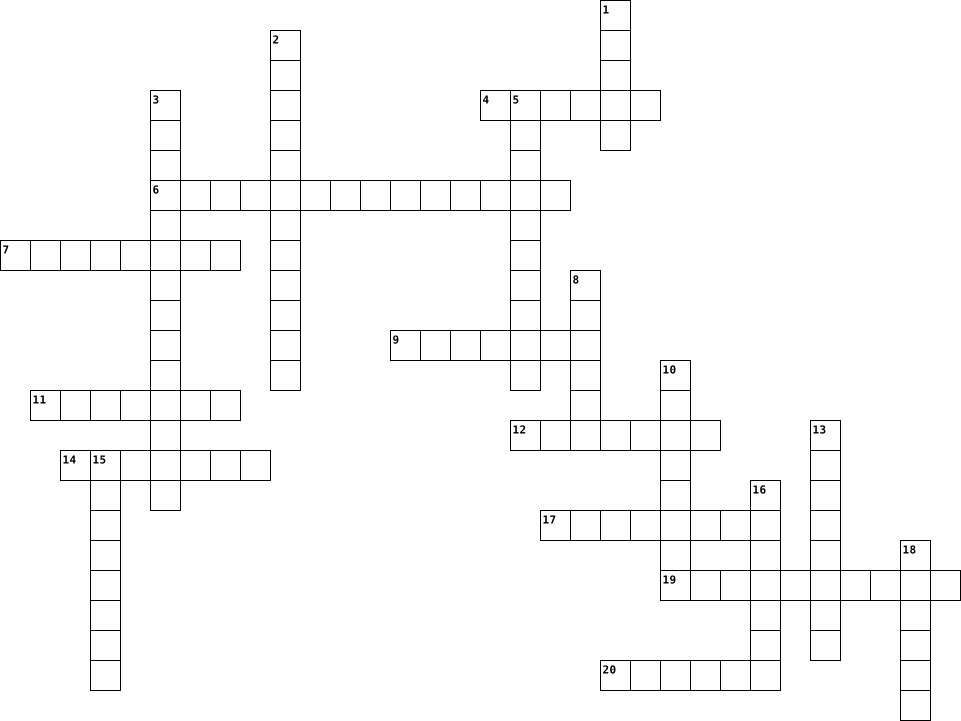
Across
- What is a group of elements with similar properties called?
- What are the properties of metalloids on the periodic table?
- Which element has the highest electronegativity?
- Where are the lanthanides and actinides placed in the periodic table?
- What does the block of an element in the periodic table indicate?
- What are the properties of nonmetals on the periodic table?
- What is ionization energy?
- What trend does ionization energy follow down a group?
- What are elements in the same group known for?
- What are the vertical columns in the periodic table called?
Down
- What is the last group in the periodic table?
- What are the properties of metals on the periodic table?
- What is the periodic table?
- What is electronegativity?
- What are the elements in Group 1 of the periodic table called?
- What are the elements in Group 17 of the periodic table called?
- What trend does ionization energy follow across a period?
- How many groups are there in the periodic table?
- What are the horizontal rows in the periodic table called?
- number How are elements arranged in the periodic table?
20 Clues: What is electronegativity? • What is ionization energy? • What is the periodic table? • What is the last group in the periodic table? • What are elements in the same group known for? • Which element has the highest electronegativity? • How many groups are there in the periodic table? • What trend does ionization energy follow down a group? • ...
Chemistry Basics 2024-01-02

Across
- atomic mass (rounded) minus atomic number
- when an atom has a charge
- similar to how magnets attract to opposite poles
- measured in atomic mass units
- charge of a nucleus
- held together by the strong force
- charge of 2/3
- elements with the same number of protons but a different number of neutrons
- number of protons and electrons
- atoms are illustrated using this model
Down
- holds quarks together
- electrons are shared
- chemical combination of two or more elements in definite proportions
- charge of -1/3
- a pure substance that consists entirely of one type of atom
- outer most orbital
- positive charge
- negative charge
- made of protons, neutrons, and electrons
- electrons are transferred or given away
20 Clues: charge of 2/3 • charge of -1/3 • positive charge • negative charge • outer most orbital • charge of a nucleus • electrons are shared • holds quarks together • when an atom has a charge • measured in atomic mass units • number of protons and electrons • held together by the strong force • atoms are illustrated using this model • electrons are transferred or given away • ...
chemistry vocab 2024-05-13

Across
- the area of the ocean beyond the surface
- underground bed or water
- small river or stream that flows into the river basin
- a underwater motor that can explore that ocean
- tiny algae animals that eat up germs
- free swiming aniamls that can swim anywhere they want
- the amount of water in a given space
- water that fills the crack in open spaces
- tension the tightness around the surface
- vents where hot gases escapes the earths atmospshere
Down
- the movemnt of deep cold water
- molecules stick to each other b
- the tendecny to stick to other substances
- the merge of fresh water going with salt water
- heat the amount of energy needed to raise the temp
- solvent the quality that makes it able to dissolve
- the devise that determines that distance between objects and humans
- area of land that is drained out
- organsim that live on the bottom of the ocean
- basin the area drained by river hydrates
20 Clues: underground bed or water • the movemnt of deep cold water • molecules stick to each other b • area of land that is drained out • tiny algae animals that eat up germs • the amount of water in a given space • the area of the ocean beyond the surface • tension the tightness around the surface • basin the area drained by river hydrates • the tendecny to stick to other substances • ...
Chemistry Vocab 2024-05-08

Across
- the tendency of water to stick to other substances
- The tendency of water molecules to stick to each other
- an underwater vehicle built of strong materials to resist pressure at depth
- A device that determines the distance of an object under water by recording echoes of sound waves
- the area drained by a river and its tributaries
- small river or stream that flows into a large river or stream; a branch of the river
- the area where a freshwater stream or river merges with the ocean. Often a nursery for young
- area of the ocean beyond the edge of the continental shelf. Most diverse organisms live near the surface
- an organism that makes its own food
- term that describes an organism that lives on land
- free-swimming animals that can move throughout the water column
Down
- the movement of deep, cold, and nutrient-rich water to the surface
- water that fills the cracks and spaces in underground soil and rock layers
- organisms that live on the bottom of the ocean or other body of water; bottom-dwellers
- the area of land that is drained by a water system
- underground bed or layer yielding ground water for wells and springs etc
- the amount of matter in a given space; mass per unit volume
- term that describes an organism that lives in water
- spots on the ocean floor where hot gases and minerals escape from earth's interior into the water
- Tiny algae and animals that float in water and are carried by waves and currents
20 Clues: an organism that makes its own food • the area drained by a river and its tributaries • the area of land that is drained by a water system • the tendency of water to stick to other substances • term that describes an organism that lives on land • term that describes an organism that lives in water • The tendency of water molecules to stick to each other • ...
Chemistry Vocabulary 2024-05-08

Across
- Less than 7 on the pH scale
- The substance that is doing the dissolving when making a solution
- matter that has the same chemical composition through-
- A process that separates materials based on the size of their particles
- positively charged particle
- a mixture in which substances are evenly distributed;
- anything that takes up space and has mass
- Smallest particle of an element
- a pure substance that forms when two or more elements join chemically in a fixed proportion
- an element that is a poor conductor of heat and electricity
- an element that has properties of both metals and non-metal
- The substance that is dissolved when making a solution.
- matter made up of two or more substances that are not joined chemically
- chemically unreactive
Down
- a change in a substance that does not involve a change in the identity of the substance
- division of geologic time into which eras are subdivided
- a change that occurs when one or more substances change into entirely new substances with different properties
- an element in group 1 of the periodic table
- and cannot be separated into its parts by physical
- a mixture in which substances are not distributed evenly;
- Measure of the amount of matter in a substance
- examples: elements and compounds
22 Clues: chemically unreactive • Less than 7 on the pH scale • positively charged particle • Smallest particle of an element • examples: elements and compounds • anything that takes up space and has mass • an element in group 1 of the periodic table • Measure of the amount of matter in a substance • and cannot be separated into its parts by physical • ...
Chemistry Bonus 2024-05-10

Across
- smallest particle of a covalently bonded compound
- positive ions
- Atoms of the same element with different number of neutrons
- what do you find with a graduated cylinder
- Length measured with a ruler
- Who discovered the proton
- Mass measured with a balance
- negative ions
- a mixture containing particles
- when 2 liquids do not mix
- a type of colloid; a colloid between 2 liquids that are immiscible
Down
- substances that are volatile vaporize easily
- microscopic particles that are dispersed evenly in another substance
- substance that is dissolved
- Atoms are what in chemical reactions
- Atoms of an element are what
- What is matter composed of
- substance that does the dissolving
- a combination of 2 or more pure substances in which each substance retains its individual chemical properties
- Time measured with a clock or stopwatch
20 Clues: positive ions • negative ions • Who discovered the proton • when 2 liquids do not mix • substance that is dissolved • What is matter composed of • Atoms of an element are what • Length measured with a ruler • Mass measured with a balance • a mixture containing particles • substance that does the dissolving • Atoms are what in chemical reactions • ...
Chemistry Bonus 2024-05-10

Across
- substances that are volatile vaporize easily
- Atoms of the same element with different number of neutrons
- Atoms are what in chemical reactions
- substance that does the dissolving
- Length measured with a ruler
- when 2 liquids do not mix
- positive ions
- negative ions
- What is matter composed of
- microscopic particles that are dispersed evenly in another substance
Down
- smallest particle of a covalently bonded compound
- a type of colloid; a colloid between 2 liquids that are immiscible
- what do you find with a graduated cylinder
- substances that can be dissolved
- Atoms of an element are what
- a mixture containing particles
- Who discovered the proton
- Mass measured with a balance
- a combination of 2 or more pure substances in which each substance retains its individual chemical properties
- Time measured with a clock or stopwatch
- substance that is dissolved
21 Clues: positive ions • negative ions • Who discovered the proton • when 2 liquids do not mix • What is matter composed of • substance that is dissolved • Atoms of an element are what • Mass measured with a balance • Length measured with a ruler • a mixture containing particles • substances that can be dissolved • substance that does the dissolving • Atoms are what in chemical reactions • ...
Chemistry Crossword 2024-05-17

Across
- The vertical columns in the periodic table
- Area around a nucleus where electrons are mostly found
- Have a pH less than 7
- Two elements replace another to make a product
- Atoms of the same element that have different numbers of neutrons
- Amount of product actually obtained from a chemical reaction
- 2 or more substances that combine to make another
- Force of attraction between opposite charges
- Substances that are made
- Electron
- Horizontal rows of elements
- Mixture in which different materials can easily be distinguished
Down
- Substances that react
- Contains 2 or more gases, liquids, or solids substances blended evenly
- A table filled with elements in order of atomic numbers
- One substance breaks down, into 2 more
- One element replaces another to make a product
- Number of protons in an atom is equal to a number called blank
- Scattering of light by colloidal particles
- Positively or negatively charged, covalently bonded group
- Two protons and two neutrons
- Attraction formed when elements share electrons
- Substance reacts with oxygen to make heat and light
- produces OH- ions
- A substance in which the atoms of 2 or more elements are combined
- Numbers in front of each substance in an equation
26 Clues: Electron • produces OH- ions • Substances that react • Have a pH less than 7 • Substances that are made • Horizontal rows of elements • Two protons and two neutrons • One substance breaks down, into 2 more • The vertical columns in the periodic table • Scattering of light by colloidal particles • Force of attraction between opposite charges • ...
Cooking chemistry 2024-02-06

Across
- what happens to wine to make it alcoholic
- the production of CO2 in resting doughs
- you bloom it in water before using
- mayo, vinaigrette
- what you do to egg whites and other things to incorporate air
- Jello
- an extreme on the pH scale, is in lemons
- what happens when you use baking soda or baking powder
Down
- happens to things if not consumed within a period of time
- water moving through meat or vegetables
- using yeast to make things rise
- The adding of structure to dough when you kneed it
- its in most foods or dishes to add silky texture and flavor
- Necessary to cook
- needs to happen to have edible protein
- it happens when you season meat before cooking
- what happens to cookies and other goods to make them brown
- used in almost everything to add flavor, only found from ocean
- happens when heating milk
- Browning of sugars
20 Clues: Jello • Necessary to cook • mayo, vinaigrette • Browning of sugars • happens when heating milk • using yeast to make things rise • you bloom it in water before using • needs to happen to have edible protein • water moving through meat or vegetables • the production of CO2 in resting doughs • an extreme on the pH scale, is in lemons • what happens to wine to make it alcoholic • ...
Materials Chemistry 2024-04-15

Across
- Manipulates atoms to construct useful objects
- Common example of an elastomer
- Made from styrene monomers
- Type of phone made by ceramic technology
- Regular repeating units found in ceramics
- General category of advanced ceramics
- A much finer ceramic made in AD600
- Bones made of ceramics in medicine
- Substance that makes pottery from ground
- More than 40 ______ pounds of this polymer used annually
- Polymers that are elastic
- Nonmetallic and inorganic materials
- Large molecules that make up polymers
- From the Greek word meaning many parts
- Element used in nanotechnology
- Modern ceramics are made using sol-gel _____
Down
- Due to their extreme ______ ceramics are used in drill bits
- Made of ceramics in orthodontics and dentistry
- A type of ceramics found in pottery
- A common type of plastic
- Polymers can be classified on the basis of how they _____
- Polymers can be classified into this group
- An example of a condensation polymers
- Made from monomers of ester groups
- Where pottery is fired
- A type of bond found in ceramics
- Dynasty that created blue and white pottery
- Takes years to breakdown in dumps
- Ceramics made in the 20th century
29 Clues: Where pottery is fired • A common type of plastic • Polymers that are elastic • Made from styrene monomers • Common example of an elastomer • Element used in nanotechnology • A type of bond found in ceramics • Takes years to breakdown in dumps • Ceramics made in the 20th century • A much finer ceramic made in AD600 • Made from monomers of ester groups • ...
Chemistry Bonus 2024-04-22

Across
- writing numbers as a product by stating to the power of
- absorbs heat
- state of being exact
- ion capable of accepting a proton
- made up of two or more separate elements
- converting units of measure into another
- basic unit of a chemical element
- a chemical bond formed when two atoms share electrons
- state of being correct
- relationship of substances reacting or forming a compound
- form in which something exist in
Down
- releases heat
- representation of a chemical reaction
- table of chemical elements
- electrons in the outermost shell of an atom
- chemical bond formed when an element gives up one or more electrons to another
- amount of substance containing the same number of chemical units
- heat involved during a chemical reaction
- hydrogen capable of giving a proton
- digits that mean something in a number
20 Clues: absorbs heat • releases heat • state of being exact • state of being correct • table of chemical elements • basic unit of a chemical element • form in which something exist in • ion capable of accepting a proton • hydrogen capable of giving a proton • representation of a chemical reaction • digits that mean something in a number • made up of two or more separate elements • ...
Chemistry Vocabulary 2024-05-10

Across
- the tightness across the surface of water that is caused by the polar molecules pulling on one another
- the tendency of water to stick to other substances
- amount of heat required to increase the temperature of water
- term that describes an organism that lives on land
- A device that determines the distance of an object under water by recording echoes of sound waves
- water that fills the cracks and spaces in underground soil
- free-swimming animals that can move throughout the water column
- organisms that live on the bottom of the ocean or other body of water
Down
- the tendency of water molecules to stick to each other
- small river or stream that flows into a large river or stream
- an underwater vehicle built of strong materials to resist pressure at depth
- term that describes an organism that lives in water
- the amount of matter in a given space
- underground bed or layer yielding ground water for wells
- the movement of deep, cold, and nutrient-rich water to the surface
- the area of land that is drained by a water system
- the area drained by a river and its tributaries
- the quality of water that makes it able to dissolve more substances than any other solvent can
- Tiny algae and animals that float in water and are carried by waves and currents
- the area where a freshwater stream or river merges with the ocean
20 Clues: the amount of matter in a given space • the area drained by a river and its tributaries • the tendency of water to stick to other substances • the area of land that is drained by a water system • term that describes an organism that lives on land • term that describes an organism that lives in water • the tendency of water molecules to stick to each other • ...
Chemistry Vocabulary 2024-05-13

Across
- two or more atoms held together by a bond
- Man-made, not natural
- Horizontal row of the Periodic table of Elements
- Waters ability to stick to other substances
- The point where a solid turns to a liquid
- Level of how acidic a base is
- The ability to dissolve in another substance
- Organism that can't make their own food
- The quality of water that makes it dissolve more substances than any other solvent
Down
- Medicine that kills or slows the growth of bacteria
- Simplest substance
- Measure of matter in a substance
- Waters ability to stick to itself
- Organism that can make it's own food
- An organism that lives underwater
- The amount of matter in a given space
- Column in the Periodic table of Elements
- Measure of how clear the water is
- The point where a liquid turns to a gas
- The amount of space something takes up
20 Clues: Simplest substance • Man-made, not natural • Level of how acidic a base is • Measure of matter in a substance • Waters ability to stick to itself • An organism that lives underwater • Measure of how clear the water is • Organism that can make it's own food • The amount of matter in a given space • The amount of space something takes up • The point where a liquid turns to a gas • ...
Inorganic Chemistry 2024-07-08

Across
- Substances that absorb moisture but does not dissolve in it
- Hypothetical alkali metal
- Combination type of solution that can dissolve gold
- Which complex is inhibited by cyanide?
- Most abundant isotope of H
- Teratogenic effect of lithium
- Reduces iodine
- Other name for Magnesium oxide
- DOC for Anaphylactic shock
- First element to be discovered by spectroscopy
- Element present in Grignard Reagent
- CuFeS2
- Vitamin D enhances the absorption of this metal
- Potassium permanganate is also known as
Down
- Primary standard for KFR
- This element is present in insulin
- Sal volatile
- General use of Au
- DOC for eclampsia
- Lactated Ringer's
- Lithium salt for bipolar disorder
- Lithos
- DOC for systemic acidosis
- Active form of Methenamine
- Alloys of mercury
- Adverse effect of Barium sulfate
- Most abundant extracellular cation
- Table salt
- Calcium sulfate dihydrate
- C/I route for KCl
30 Clues: Lithos • CuFeS2 • Table salt • Sal volatile • Reduces iodine • General use of Au • DOC for eclampsia • Lactated Ringer's • Alloys of mercury • C/I route for KCl • Primary standard for KFR • Hypothetical alkali metal • DOC for systemic acidosis • Calcium sulfate dihydrate • Most abundant isotope of H • Active form of Methenamine • DOC for Anaphylactic shock • Teratogenic effect of lithium • ...
Chemistry Review 2024-02-09

Across
- The number of protons in the element.
- A diagram that shows only the valence electrons.
- Two or more different atoms bonded together.
- The Law of ____ of mass says that matter cannot be created or destroyed.
- A pure substance that cannot be broken down to simpler substances.
- An element with 25 protons.
- Materials that allow heat to easily flow through.
- The number of protons plus neutrons.
- A particle in the nucleus with no charge.
- A change that only changes how something looks.
- A drawing of each ring of electrons.
- In covalent bonds, the elements _____ electrons.
- Elements with 7 valence electrons.
- An element with 114 neutrons.
- The inner shell can hold ___ electrons.
- The Earth Metals in the second group.
- Every living thing is mainly made of these 4 elements.
Down
- The electrons on the outermost shell.
- A bond between a metal and non-metal.
- New substances are formed in a _____ reaction.
- Elements that do not react with anything.
- How shiny an element is.
- This element was once called Wolfram.
- A negative particle orbiting the nucleus.
- Two or more different elements combined.
- Can be separated.
- Metals that are the most reactive.
- An atom of the same element with a different number of neutrons.
- An element with 74 neutrons.
- One or two letters that represent an element.
- ______ are made of mostly four elements.
- The chemical found in hot peppers.
- A bond between two non-metals.
- A particle in the nucleus with a positive charge.
- Elements found on the "stairs" of the table.
- Carbon in its ordinary form is _____
- The person who created the Periodic Table.
37 Clues: Can be separated. • How shiny an element is. • An element with 25 protons. • An element with 74 neutrons. • An element with 114 neutrons. • A bond between two non-metals. • Metals that are the most reactive. • The chemical found in hot peppers. • Elements with 7 valence electrons. • The number of protons plus neutrons. • A drawing of each ring of electrons. • ...
Cooking chemistry 2024-02-09

Across
- Level of sourness
- sour
- a way to create acids
- Substances transferring from an area of high concentration to a low one
- Form of fat that comes from a plant
- Substances traveling from a low concentration to high concentration through a smei-permeable membrane
- A reaction that is reversible
- Comes from ocean
- dough rising due to yeast
- Cooks food
- form of fat coming from an animal
- The process of proteins becoming amino acids
Down
- Uses acids and bases
- Boiling sugar
- A substance that helps mix two or more liquids that normally dont
- Bacon gives off when cooked
- Browns and creates nutty flavor
- Two or more substances interacting to create a different product
- uses mechanical means
- when a molecule has both a positive and negative side
20 Clues: sour • Cooks food • Boiling sugar • Comes from ocean • Level of sourness • Uses acids and bases • a way to create acids • uses mechanical means • dough rising due to yeast • Bacon gives off when cooked • A reaction that is reversible • Browns and creates nutty flavor • form of fat coming from an animal • Form of fat that comes from a plant • The process of proteins becoming amino acids • ...
Cooking Chemistry 2024-02-08

Across
- browning magic
- Is a group that reacts with sugar dry or wet
- Small droplets of liquid that go into another liquid
- Switch out one element
- The steam that forms in moist batter
- It breaks the weak
- marbles in food
- enhances flavor
- High to low
- Makes meat more tender
Down
- something that’s called yeast baking lighter
- Produces carbon dioxide
- To take something apart
- Causing them to swell and burst
- kills bacteria
- When grape juice is left over time to make wine
- To make something
- A smell
- has a ph below 7
- Water across membrane
20 Clues: A smell • High to low • browning magic • kills bacteria • marbles in food • enhances flavor • has a ph below 7 • To make something • It breaks the weak • Water across membrane • Switch out one element • Makes meat more tender • Produces carbon dioxide • To take something apart • Causing them to swell and burst • The steam that forms in moist batter • something that’s called yeast baking lighter • ...
Cooking chemistry 2024-02-08

Across
- baking soda and acid in a bake good
- Carbs
- gelatinization Heating up a mixture of starch and water to create a thicker consistency.
- Gives you energy
- denaturation molecules unfolding from heat
- when 2 thing don’t mix then something makes it mix
- Yeast eating sugar reaction
- Heating sugar
- kills bacterias
- savory or meaty taste
Down
- Process that transforms liquid food into a solid state.
- point The temperature at which a compound transitions from a solid to a liquid
- concentration to low concentration diffusion
- Gliadin+ Glutenin
- tenderizes food
- a sugar
- enhances
- low concentration to high concentration
- when you eat the taste is decided as…
- heat+ amino acids+sugar
20 Clues: Carbs • a sugar • enhances • Heating sugar • tenderizes food • kills bacterias • Gives you energy • Gliadin+ Glutenin • savory or meaty taste • heat+ amino acids+sugar • Yeast eating sugar reaction • baking soda and acid in a bake good • when you eat the taste is decided as… • low concentration to high concentration • denaturation molecules unfolding from heat • ...
chemistry G 2023-10-05

Across
- the number of protons in an element
- atoms of an element with different numbers of neutrons
- protons & neutrons are in this
- mass/volume
- Liquid phase-->gas phase
- have +1 charge
- Type of radiation very high in energy
- Plum pudding model
- decay results in reduction of atomic number by 2
- have no charge
- Gas phase --> liquid phase
- have a -1 charge
- Most elements are this
- has 92 protons
- Gas phase-->Solid phase
- a packet of energy that can interact with atoms/electons
Down
- experiment conducted by Rutherford
- a charged atom
- Uncertainty principle
- Liquid phase --> solid phase
- Solid phase-->gas phase
- electrons can be thought of as particles or waves
- type of radiation very low in energy
- the 4 electron orbitals in order
- refers to electrons & energy levels
- can act as metal or nonmetal
- smallest unit of an element
- decay result in increase of atomic number by 1
- has 2 protons
- first scientific model
30 Clues: mass/volume • has 2 protons • a charged atom • have +1 charge • have no charge • has 92 protons • have a -1 charge • Plum pudding model • Uncertainty principle • first scientific model • Most elements are this • Solid phase-->gas phase • Gas phase-->Solid phase • Liquid phase-->gas phase • Gas phase --> liquid phase • smallest unit of an element • Liquid phase --> solid phase • ...
Chemistry Crossword 2023-10-28

Across
- the scientific study of the composition structure and properties of matter and the changes that matter undergoes
- a substance that contains two or more elements chemically combined in fixed position
- Protective garment worn over the front of one's clothes and tied in the back.
- Protective eyewear that surrounds the eyes in order to prevent chemical splashes or small, fast-moving objects from coming into contact with the eyes.
- place it ontop of a test tube to keep liquid inside while mixing
- Temperature,This is a temperature reading made relative to absolute zero(kelvins).
- Safety Diamond
- a horizontal row of elements in a periodic table
- the simplest form of matter that has a unique set of properties an element cannot be broken down into simpler substances by chemical means
Down
- and physical
- risky or dangerous
- A machine to heat up beakers of substances
- the amount of matter within a certain volume
- a tall narrow container with a volume scale used especially for measuring liquids.
- a vertical column of elements in the periodic table the constituent elements of a group have similar
- a measurement of how much of a solute can dissolve in a liquid.
- a cylindrical container with a flat bottom
- a physical blend of two or more substances that are not chemically combined
- small tube that you can put samples in usually does not have measurements on the side
- Personal Protection Equipment
20 Clues: and physical • Safety Diamond • risky or dangerous • Personal Protection Equipment • A machine to heat up beakers of substances • a cylindrical container with a flat bottom • the amount of matter within a certain volume • a horizontal row of elements in a periodic table • a measurement of how much of a solute can dissolve in a liquid. • ...
Chemistry Crossword 2024-04-21

Across
- Substances that are formed by a chemical change in a reaction
- The top point of a wave
- An equality statement in fraction form that helps you convert between units
- A shape of molecule where there are 3 electron domains around the central atom
- A type of reaction where a hydrocarbon reacts with oxygen gas to produce carbon dioxide and water vapor
- The distance between two consecutive points on a wave
- The amount of moles in volume of solution
- A shape of molecule where there are 4 electron domains around the central atom
- A region on the central atom of a molecule where electrons are most likely to be found (bonding and nonbonding electrons)
- A type of reaction that involves two ionic compounds where the cations switch places
- The unit of particles for an ionic compound
- A type of chemical reaction in which multiple substances form a single product
- The number of particles present in one mole of substance
- A shape of molecule where there are 3 bonds and 1 lone pair of electrons on the central atom
- A chemical substance that releases H+ ions in aqueous solutions
- A type of chemical reaction that involves a single element and an ionic compound where the single element switches places with the like element in the compound
- A bond formed when electrons are shared between two atoms
- A chemical substance that releases OH- ions in aqueous solutions
- The rate of occurrence of a wave
- The acronym that stands for Valence Shell Electron Pair Repulsion Theory
- A solution in which a solid is dissolved in water
- The geometry of where atoms are in relation to a central atom, only taking into account the bonding electrons
Down
- A solid that forms from a reaction between two aqueous solutions
- A type of electron that participates in bonding
- A number that indicates how many atoms are present in a molecule
- A type of chemical reaction in which a single substance breaks down into multiple substances
- A shape of molecule where there are 2 electron domains around the central atom
- The breakdown of ions in an aqueous solution
- Substances that are destroyed by a chemical change in a reaction
- A chart used to predict the states of matter of compounds
- A bond formed when electrons are transferred from one to another
- The arrangement of electrons in orbitals around the nucleus
- The unit of particles for an element
- A chemical reaction in which an acid and base react with one another to produce water and a salt solution
- The mass of a substance in grams
- A chart used to predict if a single replacement reaction will occur
- Electrons follow these pathways around the nucleus of the atom
- A number that indicates the charge of an ion
- Diagram that shows the valence electrons of an atom
- A number that indicates how many moles of a substance are present in a balanced chemical reaction
- A pair of electrons on the central atom of a molecule that do not participate in bonding
- The height of the wave
- The geometry of where atoms are in relation to a central atom, taking into account both bonds and lone pairs of electrons
- Reducing the number of moles of solute per unit volume of solution
- The bottom point of a wave
- The unit of particles for a covalent compound
46 Clues: The height of the wave • The top point of a wave • The bottom point of a wave • The mass of a substance in grams • The rate of occurrence of a wave • The unit of particles for an element • The amount of moles in volume of solution • The unit of particles for an ionic compound • The breakdown of ions in an aqueous solution • A number that indicates the charge of an ion • ...
Chemistry crossword 2024-06-17

Across
- Type of electromagnetic radiation that can be perceived by the human eye.
- Name that is the reference for the value of the mole.
- Has two shells and the same number of valence electrons of chlorine.
- Protons and neutrons particles.
- Has a greenish light with the flame test.
- Father of modern chemistry.
- Level of energy when electrons orbit.
- Every element has a specific mass as a signature.
- Electrons located on the outermost shell
- Variant of a same element.
Down
- Discovered the positive nucleus in the atom.
- Unit that represents a large set of particles.
- An unstable isotope that will start a chain reaction.
- First known as "better air".
- Radiation that shows the highest level of energy on the spectrum.
- Electrons located on the first shell(s) but not the last one.
- An old concept that was believed to be a fluid taken or added during combustion.
- From its Latin origin "Aurum"
- Radiation that shows the lowest level of energy on the spectrum.
- Has a mass of 56 amu.
- Has two shells of energy and only four valence electrons.
- Isotope of hydrogen with an extra two neutrons
- Discover the levels of energy for the electrons.
23 Clues: Has a mass of 56 amu. • Variant of a same element. • Father of modern chemistry. • First known as "better air". • From its Latin origin "Aurum" • Protons and neutrons particles. • Level of energy when electrons orbit. • Electrons located on the outermost shell • Has a greenish light with the flame test. • Discovered the positive nucleus in the atom. • ...
Y11 Chemistry 2024-06-19

Across
- Atoms of an element with the same number of protons and electrons but different number of neutrons.
- An insoluble solid formed from 2 solutions reacting
- Different physical forms of the same element in the same state
- Removing salt from seawater.
- In a metal, these slide over each other without disrupting the bonding.
- Positive particle in an atom
- Another term for free electrons
- A salt that is formed when sulfuric acid reacts with another chemical element.
- A block of metals, usually giving rise to coloured compounds
- Group 2, The alkaline _____________ metals
- Produces hydrogen ions when dissolved in water
- Word used to describe the structure of ionic and metallic substances
- A mixture designed for a useful purpose
- Produced when the hydrogen in an acid is replaced by a metal
- The number of protons is the _________________ number
- Water that is safe to drink
- When a more reactive halogen takes the place of a less reactive one.
- Scientist responsible for the development of the periodic table
- A charged particle
- A narrow glass tube used for measuring liquid or for moving small amounts of liquid from one place to another, particularly 25cm3
- Most of an atoms mass is here
- Bonding between a metal and non-metal
- Method of potassium or sodium salt production
- A small mammal, but also the name given to approx 6x10e23 particles
- __________________ copper(II) sulfate, used to test for water
- Diamond and graphite have this type of structure
Down
- The colour of bromine in water
- The type of bond found within metal
- Colour of solutions formed by group 1 and 2 compounds
- A metal compound that reacts with acid to form salt, water and carbon dioxide
- Chlorination kills these, when making water safe to drink
- Method to separate and retain both the solute and its solvent - simple ___________________
- A soluble base
- A bond made from a shared pair of electrons, between non-metals
- A type of covalent structure, small, with a definite start and end
- Used to measure and record a volume of liquid very accurately, with a tap
- Solution of sodium or ammonium _________________ used to identify metal ions
- Total number of protons and neutrons is the ________________ number
- General name for liquid that passed through the filter paper
- The group of elements - fluorine, chlorine, bromine, iodine, and astatine.
- A very small particle that has no electrical charge
- Metals get more reactive down their group as the outer ____________ gets further from the attractive nucleus
- Elements with the same number of electrons in the outer shell are in the same ________________
- Smaller than an atom, describes the particles that make up an atom.
- An element that forms diamond, graphite and graphene.
- A type of model for the atom, based on a pudding.
- Method to separate coloured dyes for analysis - paper ______________________
- A positively charged ion.
48 Clues: A soluble base • A charged particle • A positively charged ion. • Water that is safe to drink • Removing salt from seawater. • Positive particle in an atom • Most of an atoms mass is here • The colour of bromine in water • Another term for free electrons • The type of bond found within metal • Bonding between a metal and non-metal • A mixture designed for a useful purpose • ...
Chemistry Fun! 2024-05-20

Across
- All single bonds
- Q
- Reduction occurs here
- Converting moles of one substance to moles of another
- Charged atom
- Dispersion depends on these
- Everyone's favorite unit in chemistry
- Favored entropy sign
- Close to an amine but with a double bonded O
- Stable number of particles in a nucleus
- Favored electrochemical cell
- Strongest IMF
- Atomic size ____ across the PT
Down
- Particle involved in bonding
- Same Temperature, Same ______
- One of the quantum numbers
- The rate-determining step in a mechanism
- A high energy electron
- Color of light with the longest wavelength
- Describes how a reaction will shift when stressed
- Type of alloy
- The ultimate deciding factor for a process
- Most basic particle of matter
- Bond angle of 120
- Forward and reverse rates are equal
- Oxygen in a carbon chain
26 Clues: Q • Charged atom • Type of alloy • Strongest IMF • All single bonds • Bond angle of 120 • Favored entropy sign • Reduction occurs here • A high energy electron • Oxygen in a carbon chain • One of the quantum numbers • Dispersion depends on these • Particle involved in bonding • Favored electrochemical cell • Same Temperature, Same ______ • Most basic particle of matter • ...
Chemistry Final 2024-06-07

Across
- The most maximum concentration point in which the leftover solute is dissolved again.
- A substance that is dissolved in a solution.
- Amount of a substance per defined space.
- The process of reducing the concentration of a solute in a solution.
- A chemical type that gives protons or hydrogen ions and/or accepts electrons.
- A type of homogeneous mixture in which the dispersed particles do not settle out.
- When two substances cannot mix together to form a solution.
- A component of a solution that is the most amount in the solution.
- A bond where an unequal amount of charge is distributed.
- Not able to be dissolved in a solvent.
- A substance which forms ions in an aqueous solution.
Down
- A chemical solution in which the solute concentration is lower than its equilibrium solubility.
- A homogeneous mixture of two or more substances.
- No separation of charge, so no positive or negative poles are formed.
- A concentration unit, defined to be the number of moles of solute divided by the number of liters of solution.
- A substance that doesn't exist in an ionic form in an aqueous solution.
- Any solution in which water is the solvent.
- When mixed, it's able to form a solution.
- How much can be dissolved.
- The maximum concentration point in which no more solute can be dissolved, with a little bit of solute left over.
- A chemical type that gives electrons or hydroxide ions or that accepts protons.
- Can easily be dissolved.
22 Clues: Can easily be dissolved. • How much can be dissolved. • Not able to be dissolved in a solvent. • Amount of a substance per defined space. • Any solution in which water is the solvent. • When mixed, it's able to form a solution. • A substance that is dissolved in a solution. • A homogeneous mixture of two or more substances. • ...
Chemistry Crossword 2024-09-05

Across
- positive charge
- you can only shorten your notation if you put your noble gas in _____
- a principle in which electrons occupy the lowest energy shells first
- the least frequent wavelength
- to what power is 3.00 to when referring to the speed of light
- where do electrons “possibly” store themselves?
- what does energy emit when it returns back to its original state
- a principle in which electrons can only occupy the same orbital if they have the different spin
- negative charge
- if there are five orbitals, how many electrons can fit (MAXIMUM)
- what does E=h*v mean
- how many rows are in a periodic table
- to know the ______ you need to know the frequency
- what is the highest point in the wavelength called
- what is the lowest point in the wavelength called
- how should you write the frequency formula in your calculator?
- how many electrons can fit into one orbital?
- types of electrons that occupy the outer energy shell
- electrons have to occupy ____ before they can pair up
- what block is Helium in on the periodic table
- a section in the periodic table that has 2 rows of 14 elements
- what is the element that Zn represents
Down
- unit for measuring energy
- if it is row 4 in the S block, what row is it in the D block?
- the most frequent wavelength
- what is the name of h/6.626*10^-34?
- what are the subshells (or “blocks”) electrons are grouped into IN ALPHABETICAL ORDER!
- what should the number of electrons be equal to?
- ____ model is a model that displays the structure of an atom, but is slightly inaccurate (also used frequently in present day science classrooms)
- also known as the atomic number
- if all of sulfur’s exponents add up to 16, what is sulfur’s atomic number?
- to what power is 6.626 to when referring to energy
- what state is energy in when it gets to an excited state
- where electrons could POSSIBLY be
- the units for frequency
- no charge
- what block is Zn in?
- have a different number of neutrons, but same number of protons
38 Clues: no charge • positive charge • negative charge • what does E=h*v mean • what block is Zn in? • the units for frequency • unit for measuring energy • the most frequent wavelength • the least frequent wavelength • also known as the atomic number • where electrons could POSSIBLY be • what is the name of h/6.626*10^-34? • how many rows are in a periodic table • ...
Basic Chemistry 2024-09-10

Across
- Subatomic particle with a positive electric charge(pg.25)
- Two or more atoms bonded together(pg.25)
- Electron hungry and attract electrons very strongly(pg.34)
- The measure of hydrogen ion concentration of a solution(pg.40)
- Electrons forming the electron cloud around the nucleus of an atom occupy regions of space called?(pg.31)
- Single-ring structure containing three to seven carbon atoms(pg.43)
- Energy in action (pg.24)
- Net negative charge(pg.32)
- Average of the relative weights( mass number)of all the isotopes of an element(pg.28)
- Weak bonds formed between one hydrogen atom, covalently linked to an electronegative atom and another electronegative atom(pg.34)
- Anything that occupies space and has mass(pg.24)
- Chemical bond between atoms formed by the transfer of one or more electrons from one atom to another(pg.32)
- Building blocks of protein molecules(pg.47)
- Universal energy compound of body cells(pg.55)
- Basic structural material of the body9PG.47)
- Globular proteins that act as a biological catalyst(pg.51)
- Sum of protons and neutrons(pg.27)
- Large arrays of cation and anions held together by ionic bonds(pg.32)
- Energy involved in moving matter (pg.24)
- When chemical bonds are formed, rearranged or broken(pg.35)
- Unstable chemical element that releases radiation and their atoms decompose spontaneously into more stable forms(pg.28)
- Subatomic particle with a negative charge(pg.25)
- A combination of two or more atoms held together by chemical bonds(pg.28)
- When atoms or molecules combine to form a larger, more complex molecule(pg.36)
- Substance that release hydrogen ions(proton donors)(pg.39)
Down
- Polymers of simple sugars linked together by dehydration synthesis(pg.43)
- building blocks of elements (pg.27)
- Formed when two pair of electrons is shared between two atoms(pg.32)
- Homogeneous mixture of components that may be gases, liquids, or solids(pg.29)
- Formed when two monosaccharides are joined by dehydration synthesis(pg.43)
- The capacity to do work, or to put matter into motion (pg.24)
- Unique substances that cannot be broken down into simplier substances by ordinary chemical bonds (pg.25)
- Energy stored in chemical bonds(pg.24)
- Energy Stored (pg.24)
- Net positive charge(pg.32)
- A group of molecules that includes sugars and starches(pg.43)
- Substances composed of two or more components physically intermixed(pg.29)
- The number of protons in the nucleus of an atom(pg.27)
- Flat molecules made up of four interlocking hydrocarbon rings(pg.47)
- Organic compounds insoluble in water but soluble in other lipids and in organic solvents(pg.43)
- Single most abundant compound in the body(pg.38)
- Study of the chemical compositions and reactions of living matter(pg.38)
- Same number of protons(and electrons)but different number of neutrons(pg.27)
- An atoms outermost energy level(pg.31)
- Proton acceptors(pg.39)
- Heterogeneous mixture containing dispersed or suspended particles in the dispersion medium(pg.30)
- Heterogenous mixture with large, often visible solutes ta tend to settle out(pg.30)
- A substance formed from two or more different elements chemically bonded(pg.28)
- Atoms combining with other atoms to form chemical compounds(pg.31)
- Ionic compounds that dissolve in water an acts as electrolytes(g.39)
50 Clues: Energy Stored (pg.24) • Proton acceptors(pg.39) • Energy in action (pg.24) • Net positive charge(pg.32) • Net negative charge(pg.32) • Sum of protons and neutrons(pg.27) • building blocks of elements (pg.27) • Energy stored in chemical bonds(pg.24) • An atoms outermost energy level(pg.31) • Two or more atoms bonded together(pg.25) • Energy involved in moving matter (pg.24) • ...
Basic Chemistry 2024-09-13

Across
- Located in the nucleus of the atom and bear a neutral charge. Page 25
- To change reversibly from a fluid (sol) state to a more solid (gel)state. Page 30
- Energy that is directly involved in moving matter. Page 24
- When atoms with 6 or 7 valence electrons attracts electrons strongly. Page 34
- Unequal electron pair sharing. Page 34
- To express the concentration of a solution. Page 29
- A listing of the known elements and helps to explain their properties. Page 25
- The atom that gains one or more electrons is the electron acceptor. Page 32
- Energy in action. Page 24
- Located in the nucleus of the atom and bear a positive charge. Page 25
- The atom that loses electrons is the electron donor. Page 32
- A sentence describing what happens in a reaction. Page 35
- Substances present in smaller amounts. Page 29
- They are the basis of all reactions in which food fuels are broken down for energy. Page 36
- Atom that has the same number of protons but different numbers of neutrons. Page 27
- Electrons forming the electron cloud around the nucleus of an atom that occupy regions. Page 31
- A chemical bond between atoms formed by the transfer of one or more electrons from one atom to the other. Page 32
- Homogeneous mixtures of components that may be gases, liquid or solids. Page 29
- Substances present in the greatest amount. Page 29
- Stored in the bonds of chemical substances. Page 24
- Formed when a hydrogen atom, is linked to an electronegative atom. Page 34
- The sum of masses of its protons and neutrons. Page 27
- Each element designates by one or two letter. Page 25
- Substances compound of two or more compounds. Page 29
- Anything that occupies space and has mass. Page 24
Down
- results from the movement of charged particles. Page 24
- Energy that travels in waves. Page 24
- When smaller particles are bonded to form complex molecules. Page 36
- Energy is stored and inactive. Page 24
- To convert energy from one form to another. Page 24
- Reacting substances in a chemical reaction. Page 35
- Substances that increases the rate of chemical reactions without becoming chemically charged. Page 38
- When bonds are broken in larger molecules, resulting in smaller, less complex molecules. Page 36
- Located in the centre of the atoms and consist of protons and neutrons. Page 25
- bonds - An energy relationship between the electrons of the reacting atoms, and it is made or brake in trillionth of a second. Page 31
- Atoms with one or two valence shell electrons. Page 34
- Isotopes that exhibit reactivity behavior. Page 28
- Regions around the nucleus in which a given electron or electron pair is likely to be found. Page 26
- An average of the relative weights (mass numbers) of all the isotopes of an element. Page 28
- Molecules that are formed from covalent bonds and are electronically balanced. Page 33-34
- Clusters of even smaller particles called protons, neutrons and electrons. Page 24
- A combination of two or more atoms held together by chemical bond. Page 28
- Located on the shell of the atom and has a negative charge. Page 25
- Heterogeneous mixtures, which means that the composition is dissimilar in different arears of the mixture. Page 30
- Heterogenous mixtures with large, often visible solutes that tend to settle out. Page 30
- Equal to the number of protons in its nucleus. Page 27
- When two or more different kinds of atoms bond. Page 28
- Electron sharing produces molecules. Page 32
- The process of the atomic decay. Page 28
- Equal to its atomic weight or molecular weight. Page 29
- Predicting the chemical behavior of atoms. Page 26
51 Clues: Energy in action. Page 24 • Energy that travels in waves. Page 24 • Energy is stored and inactive. Page 24 • Unequal electron pair sharing. Page 34 • The process of the atomic decay. Page 28 • Electron sharing produces molecules. Page 32 • Substances present in smaller amounts. Page 29 • Isotopes that exhibit reactivity behavior. Page 28 • ...
Basic Chemistry 2024-09-13

Across
- two or more atoms held together by chemical bonds.
- full set of protein made by the body
- homogenous components that may be gases, liquids or solids.
- proteins, proteins that are extended and strand like.
- energy in action
- acids, they are DNA and RNA
- isotopes that is radioactive.
- composed of two or more components physically intermixed.
- anything that occupies space and has mass
- stored energy
- a single chain structures containing three to seven carbon atoms
- formed when two monosaccharides are joined by dehydration synthesis
- number, number of protons and neutrons
- have a negative charge
- an ionic compound containing cations
- number, number of protons
- have a positive charge
- substances that conduct an electrical current solution
- same number pf protons but different number of neutrons
- bonds, a chemical bond between atoms formed by a transfer of one or more electrons.
- substance present in smaller amounts in a solution
- the capacity to do work
- triphosphate, energy release during glucose catabolism
- they are protons acceptors
- group of molecules that include sugar and starches
Down
- polymers of simple sugars linked by dehydration synthesis
- a substance that releases hydrogen ions
- unique substances that cannot be broken down into simpler substances.
- are know as neutral fats
- heterogenous mixtures with often visible solutes that tend to settle out.
- the substance on which enzyme acts
- any element or compound is equal to its molecular weight
- bonds, sharing of electrons to achieve stability.
- substance present in the greatest amount in a solution
- energy, energy that travels in waves.
- smallest unit of a chemical element consisting of protons, neutrons and electrons
- insoluble in water but dissolve readily in other lipids and organic solvents.
- they are called emulsions.
- energy, the amount ofc energy needed to break the bonds of reactants
- bonds, bonding between dipoles such as water molecules
- energy, energy formed between chemical bonds.
- energy, energy directly involved in matter,
- flat molecules made of four interlocking hydrocarbon bonds
- innermost layer of an atom
- when two or more different kinds of atom binds
- they are neutral
- a globular protein that acts as a biological catalysts
- acids, building block of proteins
- shell, outside of an atom around the atomic nucleus.
- bonds, energy that results from the movement of charged particles.
50 Clues: stored energy • energy in action • they are neutral • have a negative charge • have a positive charge • the capacity to do work • are know as neutral fats • number, number of protons • they are called emulsions. • innermost layer of an atom • they are protons acceptors • acids, they are DNA and RNA • isotopes that is radioactive. • acids, building block of proteins • ...
Basic Chemistry 2024-09-11

Across
- Positively charge pg25
- He, Ne and Ar are all what? pg 31
- Substances that increase rate of chemical reactions without chemically changing pg38
- Has an electrically balanced molecule pg34
- The average of the relative weights pg28
- Energy in action p24
- Larger solute particles are found in pg30
- Contains both protons and neutrons 25
- C6H12O6 is pg30
- Anything that takes up space and has mass pg 24
- Smallest building blocks pg25
- The region around the nucleus pg26
- An element or compound that equals to its atomic weight pg29
- A negatively charge ion pg32
- Has a mass of 1/2000 pg25
- Has no charge pg25
- The opposite of Gas pg24
- Transferred of Electrons pg32
- A strong attracted electron is called pg34
- Full outer shell is known as pg31
- Sum mass of proton and neutrons pg27
- Modern model of atomic structure pg26
- There are 118 of them pg25
- The letter for an element is called an pg25
- Two or more atoms held together by chemical bonds is called pg28
- An atom occupies regions of space pg31
- Stored energy pg24
Down
- What molecule has a paired of unequal sharing? pg34
- When water has two poles of charge pg34
- A primary compound of all organic molecules pg26
- An atom that is equal to the same # of protons is? pg27
- Great for teeth and bones pg26
- NaCl pg29
- When atom combine with other atoms, they are held together by pg31
- Two or more structural variations is an pg27
- Shared electrons pg32
- Water in a solution is called a pg29
- Two or more different kind of atom bind together is called pg28
- Isotopes that exhibit radioactivity behavior pg28
- The energy that is released when fuel molecules are oxidized pg37
- H2O pg34
- Ability to do work. pg24
- Need to make functional thyroid hormones pg26
- A mixture of composition is called a? pg29
- Two or more components that physical intermixed pg29
- A mixture of sand and water is a pg30
- Occurs when ionic compounds are formed pg36
- Has neither shape nor volume pg24
- Salt is an example of which solution pg29
- Simplest and smallest atom pg27
50 Clues: H2O pg34 • NaCl pg29 • C6H12O6 is pg30 • Has no charge pg25 • Stored energy pg24 • Energy in action p24 • Shared electrons pg32 • Positively charge pg25 • Ability to do work. pg24 • The opposite of Gas pg24 • Has a mass of 1/2000 pg25 • There are 118 of them pg25 • A negatively charge ion pg32 • Smallest building blocks pg25 • Transferred of Electrons pg32 • Great for teeth and bones pg26 • ...
Chemistry Craze 2024-05-06

Across
- mixture where the individual particles cannot be distinguished at all
- a solution where the solvent is water
- requires input of energy (heat)
- transition from solid to gas
- elements that do not exist naturally as a single atom, however, is bonded together by two elements
- number of digits that are known to some degree of reliability ( ____ for life)
- where a solution is boiled in order to separate liquids
- whenever two liquids do not mix with each other
- the study of how heat is affects matter and how it is converted to and from other forms of energy
- a biological catalyst that speeds up the rate of reactions that occur in the body
- a principle under the conditions of equal pressure and temperature, as well as, equal volumes of all gases that contain the same number of particles
- the energy that is required to remove an electron from an atom
Down
- releases heat
- a negative ion
- a point where H3O+ ions from the acid equals the moles of OH- from the base and is determined from a graph of the titration
- diffusion that is through a tiny opening
- a mixture that contains particles, which will settle out if it is left undisturbed
- when a base accpets a hydrogen atom from an acid; species produced
- a rule that means atoms will gain, lose, or share valence electrons to attain all 8 valence electrons
- the mixture is poured through a filter to separate liquids and solids
20 Clues: releases heat • a negative ion • transition from solid to gas • requires input of energy (heat) • a solution where the solvent is water • diffusion that is through a tiny opening • whenever two liquids do not mix with each other • where a solution is boiled in order to separate liquids • the energy that is required to remove an electron from an atom • ...
chemistry bonus 2024-05-01

Across
- point where two phases of a substance becomes indistinguishable from each other
- a compound that can act as either an acid or a base
- the minimum amount of energy that must be applied to a system to initiate a chemical change
- strong acids and bases ____ in water
- NaOH, KOH, Ca(OH)2, Ba(OH)2 are examples of ___
- the species produced when a base accepts a hydrogen ion (H+) from an acid
- to find the concentration of a basic solution, titrate with a known ___
- the change in heat of the products from the reactants
- monoprotic acid donates ___ proton per molecule
- to find the concentration of an acidic solution, titrate with a known ___
Down
- neutralization is what type of reaction
- solid to gas
- a procedure in which the concentration of a solution is determined by comparing it to a solution of known concentration
- as temperature _____ increases according to Gay-Lussac's law.
- HCl, HNO3, H2So4 are examples of ____
- the total amount of energy; movement
- the point at which the indicator used in a titration changes color.
- gas to a solid
- salt is what type of compound
- a substance that speeds up a chemical reaction without itself undergoing any chemical change
20 Clues: solid to gas • gas to a solid • salt is what type of compound • the total amount of energy; movement • strong acids and bases ____ in water • HCl, HNO3, H2So4 are examples of ____ • neutralization is what type of reaction • NaOH, KOH, Ca(OH)2, Ba(OH)2 are examples of ___ • monoprotic acid donates ___ proton per molecule • a compound that can act as either an acid or a base • ...
chemistry crossword 2024-05-08

Across
- the horizontal rows of the periodic table.
- the force of attraction between 2 atoms in a molecule.
- the smallest unit of an element.
- elements on the periodic table that are usually brittle, do not conduct electricity, and are sometimes gases.
- elements on the periodic table that are mostly silver, shiny and conduct electricity.
- the liquid that dissolves a solute.
- the solid that dissolves in a solvent.
- a mixture of 2 or more metals.
- 2 or more atoms bonded together.
- change of state from a solid to a liquid.
- does dissolve.
- another word for particles bumping into each other or hitting the sides of a container.
- made up of one type of atom.
- the vertical columns of the periodic table.
- what happens to a solute when you mix it with a solvent. the solute __________.
- when a particle cannot move around other particles, but it can still shake back and forth.
- NaOH, HCl, H2O, CO2, O2, N2 are examples of these.
- change of state from a liquid to a gas.
Down
- cannot see through.
- a shorter way to write an element's name.
- a lot of solute in a solution.
- this is caused by particles hitting the side of a container.
- can see through.
- when a liquid or gas spreads out.
- an impure substance.
- this can be solid, liquid, gas.
- these are shorter ways of writing the name of an element. e.g. Mg = magnesium.
- not much solute in a solution.
- does not dissolve.
- this can come in the form of kinetic, heat, light, chemical, potiential.
- made up of a solute and solvent.
- the separation of colours on filter paper.
- made up of two or more different types of atoms bonded together.
33 Clues: does dissolve. • can see through. • does not dissolve. • cannot see through. • an impure substance. • made up of one type of atom. • a lot of solute in a solution. • a mixture of 2 or more metals. • not much solute in a solution. • this can be solid, liquid, gas. • the smallest unit of an element. • 2 or more atoms bonded together. • made up of a solute and solvent. • ...
Chemistry Review 2025-02-12

Across
- the smallest amount of an individual element you can have
- this property of a substance tells us whether it is a solid or liquid at room temperature
- during this type of change, the size and shape of something is changed
- these are subatomic particles found in the nucleus that have NO electrical charge
- the smallest amount of a compound is one
- during this type of change a completely new substance is formed
- the substances that go into a chemical reaction on the left side of a chemical equation
- this number tells us the number of protons plus the number of neutrons
- this property of a substance tells us whether it is a liquid or a gas at room temperature
- elements in the same group/family have similar chemical and physical
- a tool you can use to separate Iron from other substances
Down
- these are subatomic particles found outside the nucleus of an atom and has a negative charge
- what is produced in a chemical reaction and found on the right side of a chemical reaction
- Salt water is this type of mixture because it looks the same throughout
- pure individual substances which is the ingredients to everything in the universe
- this is the universal solvent because it is the base of almost every liquid solution
- salad is this type of mixture because you can see the individual parts
- these types of substances are good conductors of heat and electricity
- two or more different elements chemically combined
- a mixture of metals melted into each other
- in group eight we have a collection of very unreactive gases like Neon which we call the
- these are subatomic particles found inside the nucleus of an atom and have a positive charge
- this number on the P.T.O.E tells us the number of protons and electrons in an atom
23 Clues: the smallest amount of a compound is one • a mixture of metals melted into each other • two or more different elements chemically combined • the smallest amount of an individual element you can have • a tool you can use to separate Iron from other substances • during this type of change a completely new substance is formed • ...
Chemistry Vocabulary 2025-01-15

Across
- evenly mixed substances(same consistency)
- composed of more than one different elements
- contains two atoms
- no definite shape or volume
- solid to liquid
- composed of more than one same or different element
- smallest unit of matter
- study of matter and its changes
- energy of position (stored)
- educated guess
- solid to gas
- liquid to solid
- energy of motion
Down
- definite shape, definite volume
- liquid to gas
- composed of only one type of element or compound
- gas to solid
- substance made of only one type of atom
- unevenly mixed substances (different consistency)
- contains more than one substance not in a fixed ratio
- describes how and why something happens
- gas to liquid
- describes what happens
- has mass and takes up volume
- definite volume, no definite shape
25 Clues: gas to solid • solid to gas • liquid to gas • gas to liquid • educated guess • solid to liquid • liquid to solid • energy of motion • contains two atoms • describes what happens • smallest unit of matter • no definite shape or volume • energy of position (stored) • has mass and takes up volume • definite shape, definite volume • study of matter and its changes • ...
Chemistry laboratory 2025-02-15

Across
- – A cabinet where glass equipment like beakers and test tubes are kept.
- – A machine that gives electricity to lab equipment.
- – A long table in the lab where experiments are done.
- – A big table in the middle of the lab where students or scientists work.
- – The surface of a table where experiments are done.
- – A special station with water to clean your eyes if something dangerous gets in them.
- – A small cart with wheels used to carry lab equipment.
- – A cabinet where medicines and important lab chemicals are stored.
- – A chair used in the lab, often for sitting at a desk.
- – A machine that removes dangerous gases from the lab air.
Down
- – A shower used to wash off dangerous chemicals from the body.
- – A special cabinet for storing acids safely.
- – A cabinet for storing liquids that can dissolve other substances.
- – A desk in the lab used for writing or small tasks.
- – A sink in the lab for washing hands, equipment, and chemicals.
- – A special cabinet that removes dangerous gases and smells from experiments.
- – A tap that gives water in the lab.
- – Places where lab equipment and chemicals are kept safely.
- – A tall seat used for working at a lab bench.
- – A machine that moves air around to keep the lab fresh.
20 Clues: – A tap that gives water in the lab. • – A special cabinet for storing acids safely. • – A tall seat used for working at a lab bench. • – A machine that gives electricity to lab equipment. • – A desk in the lab used for writing or small tasks. • – The surface of a table where experiments are done. • – A long table in the lab where experiments are done. • ...
Chemistry Vocab 2024-11-27

Across
- The smallest units of chemical elements.
- Groups of atoms bonded together.
- A group of atoms responsible for a compound's properties.
- Small localized objects like atoms and molecules.
- Neutral subatomic particles in an atom's nucleus.
- Equipment used to produce a single open gas flame.
- Enclosed workstations designed to ventilate toxic fumes.
- Positively charged subatomic particles.
- A substance that increases hydrogen ion concentration.
- Pure substances consisting of only one type of atom.
- A material burned to produce energy.
- Characteristics of a substance.
- A strong acidic compound often used in labs.
- Tools used to grind and mix substances.
- Form of energy related to the movement of particles.
- A substance that reduces hydrogen ion concentration.
- A metal that readily reacts with other substances.
- Process that transforms one set of substances into another.
- The lightest and most abundant chemical element.
Down
- Devices for measuring liquid volumes precisely.
- Substances composed of two or more elements chemically bonded.
- Hydrocarbons with at least one double bond.
- Combinations of two or more substances not chemically bonded.
- Instruments used to measure temperature.
- Material composed of antiparticles of normal matter.
- A set used to build molecular structures.
- A chemical compound found in rocks and shells.
- Containers with narrow necks used to hold and heat liquids.
- A compound formed by the reaction of an acid and a base.
- Negatively charged subatomic particles.
- Apparatus used to hold or support laboratory equipment.
- A squeeze bottle used to rinse laboratory glassware.
- Shallow cylindrical lidded dishes used to culture cells.
- Scale used to specify acidity or basicity of a solution.
- Anything that occupies space and has mass.
- Relating to compounds containing carbon.
- Cylindrical containers used for mixing and heating liquids.
- A tool for guiding liquids or powders into containers.
- A device for holding objects tightly together.
- The capacity to do work or cause change.
- An atom or molecule with a net electric charge.
- Hydrocarbons with single bonds only.
- Chemical reaction that involves burning.
43 Clues: Characteristics of a substance. • Groups of atoms bonded together. • A material burned to produce energy. • Hydrocarbons with single bonds only. • Positively charged subatomic particles. • Negatively charged subatomic particles. • Tools used to grind and mix substances. • The smallest units of chemical elements. • Instruments used to measure temperature. • ...
Environmental Chemistry 2024-12-04

Across
- nutrients needed in large amounts by an organisms
- the "Potential of Hydrogen" or the scale that rates how acidic a substance is
- substance with a bitter taste, turns litmus paper blue, pH of more than 7
- inorganic molecules that are used to help enzymes function
- Human made pollutant, used as propellants in aerosol cans, persistent pollutant that destroys ozone layer
- organic molecule in which energy is stored and includes fats, oil, and waxes
- increase in a contaminant's concentration at each level of the food chain
- increase in a contaminant's concentration in an individual organism
- substances with a pH of 7
- a chemical used to kill unwanted plants
- organic molecule made up of amino acids and are the building blocks of body tissue, they help repair tissue and build muscle
Down
- dense metal or metalloid that can cause environmental concern
- organisms that can infer the health of an ecosystem
- Prevents UV rays from reaching Earth's surface
- a chemical used to kill unwanted pests, example is DDT
- organic sugar molecule that provides energy for organisms
- a substance used to enrich soil by providing nutrients that are missing (main sources nitrogen & phosphorus)
- nutrients needed in small amounts by an organism
- any alteration of the environment producing a condition that is harmful to living things
- a substance with a sour taste, turns litmus paper red, has a pH value of less than 7
- chemical used to kill unwanted insects
- elements and compounds that organisms need for living, growing and reproducing
- dichlorodiphenyltrichloroethane - used to kill unwanted insects such as lice during WWII, used to kill mosquitoes to stop the spread of malaria
23 Clues: substances with a pH of 7 • chemical used to kill unwanted insects • a chemical used to kill unwanted plants • Prevents UV rays from reaching Earth's surface • nutrients needed in small amounts by an organism • nutrients needed in large amounts by an organisms • organisms that can infer the health of an ecosystem • a chemical used to kill unwanted pests, example is DDT • ...
Nuclear Chemistry 2024-12-05

Across
- the beta particle comes from this
- when an element changes into another element
- particle with a negative charge
- a positive beta particle
- an isotope that is unhappy
- elements of an atom with a different mass
- where protons and neutrons can be found
- this can be found in an orbital
- particle with a mass of 4 amu
- a reaction that release energy
- anything that has mass and takes up space
Down
- a mixture with a uniform mix
- a beta positive
- this defines the element. The atomic _____
- an unstable isotope lets out
- weight
- Stored energy
- Point 100 degrees
- the study of matter
- The nucleus has a _____ charge
- no mass and no charge
21 Clues: weight • Stored energy • a beta positive • Point 100 degrees • the study of matter • no mass and no charge • a positive beta particle • an isotope that is unhappy • a mixture with a uniform mix • an unstable isotope lets out • particle with a mass of 4 amu • The nucleus has a _____ charge • a reaction that release energy • particle with a negative charge • this can be found in an orbital • ...
Nuclear Chemistry 2024-11-15

Across
- A nuclear reaction where the fission process rapidly continues without any control, causing a large amount of energy to be released almost instantaneously.
- The reaction in which small nuclei are forced together by extreme heat and pressure to form a larger nuclei.
- A type of radioactive decay that releases a beta particle.
- The radioactive material that falls to Earth after a nuclear explosion.
- A nuclear reaction where the rate of fission is carefully managed, allowing for a sustained release of energy at a controlled level.
- The type of radioactive decay that releases energy from an excited nucleus in order to change its energy state.
- The spontaneous nuclear transformation of an atom.
- The most common fuel used in nuclear reactors.
- The emission of particles or electromagnetic waves from an unstable nucleus.
- A device used to detect radiation by measuring the ionization it produces in a gas.
- The type of radioactive decay that changes a neutron into a proton and releases an electron and increases the atomic number of the atom by one.
Down
- A fundamental particle of electromagnetic radiation and light.
- The SI unit for radiation.
- The product of a reaction is used to start another reaction.
- The reaction where a large unstable nucleus is struck by a neutron and splits into smaller nuclei.
- A process in which the structure of an atomic nucleus is altered through release of energy or mass or by being broken apart.
- The type of Radioactive decay that changes a proton into a neutron and releases a positron and decreases the atomic number of the atom by one.
- An electron or Positron
- A type of radioactive decay that releases an Alpha particle.
- A device used to initiate and control a fission nuclear chain reaction.
- The use of sustained nuclear fission to generate light and heat.
- A particle that is released during radioactive decay that consists of two protons and two neutrons (Helium Nucleus)
- A high-energy photon
- a byproduct of nuclear reactors, fuel processing plants, hospitals, and research facilities.
- The site of the worst nuclear disaster in history.
25 Clues: A high-energy photon • An electron or Positron • The SI unit for radiation. • The most common fuel used in nuclear reactors. • The spontaneous nuclear transformation of an atom. • The site of the worst nuclear disaster in history. • A type of radioactive decay that releases a beta particle. • The product of a reaction is used to start another reaction. • ...
Chemistry Basics 2024-11-22

Across
- change that doesn't create any new chemicals
- the atom with electron configuration 2,6
- has no charge
- this atom has 7 protons
- change that creates new chemicals
- the materials produced by a chemical reaction
- the rule that determines how many electrons fill the outermost shell of an atom
- negative part of the atom
- this atom has an atomic mass of 7
- atoms found on the right of the periodic table
- metals ______ electrons
- centre of the atom
Down
- the number that tells how many protons and neutrons are in the nucleus
- name for electrons found in the outermost shell
- an atom that has an overall charge
- has atomic number 79
- nonmetals _______ electrons
- a vertical column on the periodic table
- name for a negative ion
- makes up all matter
- the number that tells how many protons an atom has
- positive subatomic particle
- a row on the periodic table
- name for a positive ion
- number of electrons that fit in the first shell
- the materials used up in a chemical reaction
- number of electrons that fit in the second electron shell
- types of atoms found on the left of the periodic table
28 Clues: has no charge • centre of the atom • makes up all matter • has atomic number 79 • name for a negative ion • this atom has 7 protons • name for a positive ion • metals ______ electrons • negative part of the atom • nonmetals _______ electrons • positive subatomic particle • a row on the periodic table • change that creates new chemicals • this atom has an atomic mass of 7 • ...
Chemistry Crossword 2024-12-20

Across
- change where atoms are rearranged to form new substances
- name of group 18 elements with full valence shells
- attraction an element has for electrons
- have no charge, located in the nucleus
- covalent bond with an equal sharing of electrons
- type of decay that emits a particle with the largest mass
- nuclear energy produced when One larger nuclei splits into 2 smalle
- Compound made when a metal transfers electrons to a nonmetal
- when bonds are ________, energy is absorbed
- Charge of a metal ion
- 2 atoms with the same number of protons, but different number of neutrons
- covalent bond with an unequal sharing of electrons
Down
- amount of time it takes for half a radioisotope to decay
- electrons in the outer shell of an atom
- nuclear energy produced when 2 smaller nuclei combine to make a bigger one
- Compound made when two Nonmetals share electrons
- Charge of a nonmetal ion
- state when one electron jumps from an inner to an outer shell
- atomic number is the number of _________ in an atom
- protons + neutrons
- when an atom gains or loses electrons it forms a _____
- two or more atoms chemically combined in a fixed proportion
22 Clues: protons + neutrons • Charge of a metal ion • Charge of a nonmetal ion • have no charge, located in the nucleus • electrons in the outer shell of an atom • attraction an element has for electrons • when bonds are ________, energy is absorbed • Compound made when two Nonmetals share electrons • covalent bond with an equal sharing of electrons • ...
general chemistry 2025-03-05

Across
- solids has discrete covalently bonded molecules at each of its latrice points.
- exist between polar molecules.
- have a boiling point of 78.3"C and a molar heat vaporization of 39.3 KJ/mol.
- dipole exist between an ion and a polar molecule
- is three dimensional system of points designating the positions of the components that makes up crystal
- is the most common technique used to separate mixtures into pure components.
- have a molar heat vaporization of 26 KJ/mol
- the resistance of a liquid to flow.
- has definite shape
- energy dependent on the temperature of the substance
- property of a liquid to resist an external force.
- SOLIDS: have a highly regular arrangement of particles
- solids have ions at different points of the latrice
- have a boiling point of 100°C
- polar molecules have zero dipole moment
- have a more defined hexagonal arrangement than water.
- molecular model explains the properties of solids and liquids in terms of the intermolecular forces of attraction and the kinetic energy of the individual particles
Down
- exist only in molecules that contains hydrogen atom bonded to a small, highly electronegative atom.
- have a molar heat vaporization of 9.2KJ/mol.
- point is the temperature at which its vapor pressure is equal to the external or atmospheric pressure
- Boiling Point the temperature at which a liquid boils under an atmospheric pressure of 760mm Hg
- solids have considerable disorder in their structure
- molecule has a bent shape vith two partially positive hydrogen atoms and a partially negative oxygen atom
- have definite shape but no definite volume
- means that the phase change from phase A and Phase B occurs at the same rate as the phase change from phase B to phase A.
- molecules each of them has unequal electron densities
- Force attractive forces between neighboring particles
- pressure the pressure exerted by its vapor when in equilibrium with its liquid
- dipole also called temporary dipole,
- have a boiling point of--186. O°C.
30 Clues: has definite shape • have a boiling point of 100°C • exist between polar molecules. • have a boiling point of--186. O°C. • the resistance of a liquid to flow. • dipole also called temporary dipole, • polar molecules have zero dipole moment • have definite shape but no definite volume • have a molar heat vaporization of 26 KJ/mol • have a molar heat vaporization of 9.2KJ/mol. • ...
Chemistry Vocabulary 2025-03-06

Across
- Point, the temperature a liquid changes to a solid
- a reaction that causes electrons to be lost (rusting)
- the vaporization that occurs at the surface of a liquid
- the change in state of matter from a liquid to a gas
- Point, the temperature that boiling occurs
- what is created from a chemical reaction
- the substance that does the dissolving in a solution
- changing from a ga to a solid without becoming a liquid
- the most basic particle of an element
- a reaction that absorbs energy or heat
- changing from a solid to a gas without becoming a liquid
- a pure substance that can't be broken down into simple substances
Down
- a reaction that releases energy or heat
- a mixture of two or more substances that are evenly dispersed
- the substance that dissolves in a solution
- the substances that are combined in a chemical reaction
- when gas changes to a liquid
- well molecules stick together (tension)
- Point, the temperature that a solid changes into a liquid
- a substance that is made of two or more elements
- two or more substances that are together in the same place
- Change, a change in physical properties (ie: shape, size, color, etc.)
- Change, a new substance is formed in a chemical reaction
23 Clues: when gas changes to a liquid • the most basic particle of an element • a reaction that absorbs energy or heat • a reaction that releases energy or heat • well molecules stick together (tension) • what is created from a chemical reaction • the substance that dissolves in a solution • Point, the temperature that boiling occurs • ...
Chemistry Review 2025-02-22

Across
- A group of elements missing an electron in their outermost shell
- The name for having more or fewer electrons than protons
- Another name for an energy level
- A substance that increases the rate of a chemical reaction
- A solution in which the solvent is water
- A positively charged ion
- The ‘inventor’ of the modern Periodic Table
- The location of electrons
- a pattern of gradual change
- the rule describing the tendency of atoms to react in order to obtain a full outer shell
- A positively charged sub-atomic particle
- A column of elements in the periodic table
- Protons + Neutrons
- A neutral compound consisting of anions and cations
- A substance in which two or more elements are bonded together
- An element with a full valence shell of electrons
- The number of protons in the nucleus of an atom
- The relationship between the mass of a substance and the space it takes up
Down
- The bond formed between two non-metals
- A group of atoms bonded together
- Any element in the d-block (groups 3 – 12) of the periodic table
- An element in Group 1 of the Periodic Table
- An atom with a specific number of protons
- electrons involved in chemical bond formation
- A bond in which electrons are shared
- When elements/compounds exist together but without chemical bonds
- A negatively charged sub-atomic particle
- A sub-atomic particle with no charge
- The horizontal rows of the Periodic Table
- The bond formed between a metal and a non-metal in which electrons are transferred
- The arrangement of the nucleus and electrons
- An atom which has gained or lost an electron
- A negatively charged ion
33 Clues: Protons + Neutrons • A positively charged ion • A negatively charged ion • The location of electrons • a pattern of gradual change • A group of atoms bonded together • Another name for an energy level • A bond in which electrons are shared • A sub-atomic particle with no charge • The bond formed between two non-metals • A solution in which the solvent is water • ...
chemistry crossword 2025-02-23

Across
- a element with the atomic number 'ZN'
- group of atoms joined by covalent bonds
- neutral particle in the nucleus in an atom
- an element with the atomic symbol 'RN'
- an element with the atomic symbol of 'H'
- an element with the atomic symbol 'B'
- the group in the periodic table between metals and non metals
- positively charged particle in an atom
- mass of one element calculated from the total number of protons
- horizontal row of elements on periodic table
- atom that has become electrically charged because it lost or gained electrons
- the centre of an atom
- pure substance that can not be broken down and made up of only one atom
- makes up all living things that occupy space
- an element with the atomic symbol 'AU'
Down
- combination of pure substances
- the most reactive non metals on the periodic table
- negatively charged atom that goes around the nucleus
- slow chemical change that occurs when oxygen reacts with metal
- chemical reaction that absorbs energy
- a table where all the elements are organized
- chemical reaction where oxygen reacts with a substance to from new substance and give off energy
- a material that electrical charge can pass through easily
- the smallest part of an element that makes up all living things
- a vertical column of elements on the periodic table
- shiny, malleable, ductile elements that conduct electricity
26 Clues: the centre of an atom • combination of pure substances • a element with the atomic number 'ZN' • chemical reaction that absorbs energy • an element with the atomic symbol 'B' • an element with the atomic symbol 'RN' • positively charged particle in an atom • an element with the atomic symbol 'AU' • group of atoms joined by covalent bonds • ...
Chemistry Review 2025-02-24

Across
- (*6th space should be a blank) the ratio of grams to moles for a specific substance
- breaking a reactant into smaller products
- element that will almost bond to itself to form a pair (ex: Oxygen
- reaction which has O2 as a reactant and CO2+H2O as products
- type of element likely to lose electrons
- an atom with a charge
- shape formed when a molecule has 2 bonds and some unshared electrons on the central atom
- putting together reactants to form a single product
- a covalent bond in which the bonded atoms have an electronegativity difference less than 0.4
- the set of rules that dictate the 3 dimensional shape of molecules
- substance held together by an ionic bond
- a written chemical equation in which atoms of each are present on each side in equal quantities
Down
- a covalent bond in which the bonded atoms have an electronegativity difference greater than 0.4 but less than 2.0
- an atom's desire for more electrons
- a specific number of atoms selected by Avogadro to be used as a standard for counting
- substance formed by bonding two different elements
- bond in which electrons are transferred
- (*5th space should be a blank) distance between nuclei of two bonded atoms
- (*8th space should be a blank) quantity describing the difficulty of breaking a molecule apart
- shape formed when a molecule has 2 bonds and no unshared electrons on the central atom
- shape formed when a molecule has 4 bonds and no unshared electrons on the central atom
- type of element likely to gain electrons
- bond in which electrons are shared
23 Clues: an atom with a charge • bond in which electrons are shared • an atom's desire for more electrons • bond in which electrons are transferred • type of element likely to lose electrons • type of element likely to gain electrons • substance held together by an ionic bond • breaking a reactant into smaller products • substance formed by bonding two different elements • ...
organic chemistry 2025-03-04

Across
- main constituent of natural gas
- a reaction needs UV light
- CnH2n+1COOH
- a reaction in which a H in an alkane is replaced by a Cl atom
- CnH2n+2
- a familiy of similar compounds with same general formula and functional group
- the molecules used to make natural polymer with amide link
- natural polymer with amide link
Down
- type of polymerisation using alkenes
- molecules contain C and H only
- the property of how easily a liquid evaporates
- a reaction has only one product formed
- type of polymerisation to make PET and nylon
- small molecules used to make polymers
- the process to make ethanol from glucose
- 可生物降解的
- CnH2n+1OH
- CnH2n
- molecules with same moleular formula, but different structural formulae
- the name of process to separate pertroleum
- a reaction has a larger molecule and a small molecule(H2O) formed
21 Clues: CnH2n • 可生物降解的 • CnH2n+2 • CnH2n+1OH • CnH2n+1COOH • a reaction needs UV light • molecules contain C and H only • main constituent of natural gas • natural polymer with amide link • type of polymerisation using alkenes • small molecules used to make polymers • a reaction has only one product formed • the process to make ethanol from glucose • the name of process to separate pertroleum • ...
Construction Chemistry 2025-01-26

Across
- Бетоны үндсэн хэсэг бөгөөд маш жижиг хэсгүүдтэй байгалийн материал
- Барилгын материалд өргөн хэрэглэгддэг шохой ба шаврын холимог
- Шохой нь ямар элементийн нэгдлүүдээс бүрддэг вэ?
- Материал гадаад хүчний нөлөөнд хэлбэрээ өөрчилж буцаах чадварыг юу гэдэг вэ?
- Бетоны химийн урвалын дараах эзэлхүүний багасалт
- Цементийн чулуунцарт агуулагддаг үндсэн 4-н эрдсийн нэг
- Цементийн химийн урвалыг эхлүүлэхэд зайлшгүй шаардлагатай шингэн
- Бетоны бат бэхийг нэмэгдүүлэхэд ашигладаг ган төмөр
- Кальцийн нэгдлүүдээс бүрдэх барилгын болон үйлдвэрлэлийн материал
- Барилгын материалын масс ба эзэлхүүний харьцаа
- Шаврыг өндөр температурт шатааж гарган авдаг, дулаалга хийх дуу чимээ тусгаарлахад давуу талтай материал
Down
- Дунджаар 5-20 мм ширхэглэл бүхий хольцыг шатаасны дараа үүсэх биет
- Элс, хайрга, ус, цементээс бүрдэх барилгын үндсэн материал
- Цемент, ус хоёрын урвалаар үүсэх химийн процесс
- Барилгын хавтан, тоосго хийхэд ашигладаг өндөр температурт боловсруулсан материал
- Арматур зэврэхэд нөлөөлдөг химийн нэгдэл
- Цемент үйлдвэрлэхийн тулд түүхий эдийг өндөр температурт .... хэрэгтэй.
- Цементийн барьцалдах хугацааг тохируулахын тулд нэмдэг эрдэс
- Элс, ус, цементээс бүрдэх барилгын материал
- Бетонд дүүргэгч болгон ашигладаг байгалийн чулуу
20 Clues: Арматур зэврэхэд нөлөөлдөг химийн нэгдэл • Элс, ус, цементээс бүрдэх барилгын материал • Барилгын материалын масс ба эзэлхүүний харьцаа • Цемент, ус хоёрын урвалаар үүсэх химийн процесс • Шохой нь ямар элементийн нэгдлүүдээс бүрддэг вэ? • Бетоны химийн урвалын дараах эзэлхүүний багасалт • Бетонд дүүргэгч болгон ашигладаг байгалийн чулуу • ...
Chemistry Vocabulary 2025-01-21

Across
- A substance that speeds up a chemical reaction by lowering the activation energy without being consumed in the process.
- A symbolic representation of a chemical reaction, showing the reactants and products with their quantities.
- The solid part of Earth, including rocks, soil, and fossil fuels.
- A weak bond formed between the slightly positive hydrogen atom of one molecule and the slightly negative atom (like oxygen) of another molecule.
- A principle stating that energy cannot be created or destroyed; it can only be transferred or transformed.
- The part of Earth where life exists, including all living organisms.
- A process in which reactants are transformed into products by breaking and forming chemical bonds.
- A chemical reaction that absorbs energy, often resulting in a cooling effect. Example Photosynthesis.
- The layer of gases surrounding Earth, including nitrogen, oxygen, and carbon dioxide.
- The starting substances in a chemical reaction that undergo a change to form products.
Down
- The minimum energy required to start a chemical reaction.
- The movement of carbon through Earth’s four spheres (atmosphere, biosphere, hydrosphere, geosphere) via processes like photosynthesis, respiration, and combustion.
- A chemical reaction that releases energy, usually as heat or light. Example Combustion.
- A principle stating that mass cannot be created or destroyed in a chemical reaction; the mass of the reactants equals the mass of the products.
- A force that holds atoms together in a molecule. Types include covalent, ionic, metallic, and hydrogen bonds.
- All of Earth’s water, including oceans, lakes, rivers, and groundwater.
- A molecule with an uneven distribution of charge, creating a positive side and a negative side. Water is a polar molecule.
- A group of two or more atoms chemically bonded together. Molecules can consist of the same type of atom (e.g., O₂) or different types (e.g., H₂O).
- The smallest unit of an element that retains its chemical properties. Atoms consist of a nucleus made of protons and neutrons, surrounded by electrons.
- The substances formed as a result of a chemical reaction.
20 Clues: The minimum energy required to start a chemical reaction. • The substances formed as a result of a chemical reaction. • The solid part of Earth, including rocks, soil, and fossil fuels. • The part of Earth where life exists, including all living organisms. • All of Earth’s water, including oceans, lakes, rivers, and groundwater. • ...
Chemistry Terms 2024-12-16

Across
- neutrally charged subatomic particle
- horizontal category on the periodic table
- elements in group 2
- elements in group 18
- element with the symbol Mg
- elements that are between metals and nonmetals
- verticle category on the periodic table
- elements in groups 3-12
- a substance with a definite shape and volume
- basic unit of a chemical element
Down
- negatively charged subatomic particle
- The symbol for this element is Ag
- element with the symbol K
- bond between two nonmetals in which electrons are shared
- positively charged subatomic particle
- The symbol for this element is Au
- elements in group 17
- elements in group 1
- the outermost electron in an atom
- bond between a metal and a nonmetal in which electrons are transferred
20 Clues: elements in group 2 • elements in group 1 • elements in group 17 • elements in group 18 • elements in groups 3-12 • element with the symbol K • element with the symbol Mg • basic unit of a chemical element • The symbol for this element is Ag • The symbol for this element is Au • the outermost electron in an atom • neutrally charged subatomic particle • ...
Advanced Chemistry 2025-03-13

Across
- - organic compounds that consist of single-bonded carbon and hydrogen atoms.
- - the tendency of an atom to attract electron/s toward itself
- - formed between two or more atoms of same elements
- - subatomic particles found inside the nucleus of every atom
- - requires that electrons must occupy singly firs before pairing occurs
- - any class of organic compounds in which a carbon atom is bonded to an oxygen atom by a double bond and to a hydroxyl group -OH by a single bond
- - are formed by the sidewise positive (same phase) overlap of atomic orbitals along a direction perpendicular
- - an atom is most stable when there are eight electrons in its valence shell
- - it is also known as olefins
- - set of numbers use to locate and describe the most probable location (main energy level, sublevel, and orbital) and spin of an electron of an atom
- - the attraction usually forms between a metal and non-metal
- - region at the center of the atom
- - are forces that holds atom together to make compounds or molecules
- - the smallest unit/particle of an element that takes part in a chemical reaction
- - the class of hydrocarbons having a ring-like structure
- - formed between two or more atoms of different elements
- - compounds in which an oxygen atom is bonded to a carbon atom, which is itself bonded to two or more carbon atoms.
- - a flammable, colorless, and odorless gas with the chemical formula C3H8
- - a volume of space within an atom where electrons are most lively to be found
- - it's an international organization that sets standards for chemistry, including nomenclature, measurement, and atomic weights
- - it states that hydrogen and helium may have no more than two electrons in their valence shell
- - are class of organic compounds that contains an ether group- an oxygen atom connected to two alkyl or aryl groups
Down
- - a hydrocarbon that is a primary component of natural gas.
- - comprised of carbon and hydrogen atoms and is the derivative of alkanes
- - any organic compound in which the hydroxyl fuctional group (-OH) is bound to a saturated carbon atom
- - this type of covalent bond formed a by head on positive (same phase) overlap of atomic orbitals along the internuclear axis
- - orbit where electrons spin around the nucleus of an atom
- - a class of chemical bonds where valence electrons are shared between atoms
- - are electrons occupying the outermost energy level of an atom
- - an organic compound consisting of hydrogen and carbon
- - generally compounds that include carbon atoms, and typically hydrogen-carbon bonds.
- - a colorless, flammable, and volatile organic compound that's made up of six carbon atoms and 14 hydrogen atoms
- - a naturally abundant, nonmetallic element that occurs in all organic compounds and can be found in all known forms of life
- - it is also known as Alkanal
- - a subatomic particle with a positive electrical charge
- - is the bonding of atoms of the same element into a series called chain
- - a subatomic particle with a negative electrical charge
- - are the atoms of the same element that have different masses
- - shows molecules using the element symbol to represent the nucleus and core electrons of each atom, lines to represent electron pairs and dot for unbonded electrons
- - is chemical compound derived from an acid in which at least one -OH hydroxyl group is replaced by an -O-alkyl group
40 Clues: - it is also known as olefins • - it is also known as Alkanal • - region at the center of the atom • - formed between two or more atoms of same elements • - an organic compound consisting of hydrogen and carbon • - a subatomic particle with a positive electrical charge • - a subatomic particle with a negative electrical charge • ...
Chemistry Crossword 2025-04-15

Across
- Mixture in which one substance is evenly mixed with another substance
- a substance containing only one type of atom;it cannot be broken down into another substance, in a chemical reaction
- an insoluble chemical produced during a chemical reaction
- Use of chemical to make the particles in a suspension clump together
- Suspension of two liquids
- Substance in which solute dissolves
- suspension in which the particles are permanently suspended
- A substance that can be dissolved in a solvent to make a solution
- Is a material formed by chemically bonding two or more chemical elements
- Neither acidic or basic
- A reaction with acid that gives water as well as salt
- Solution form when a solute dissolves in a solvent
Down
- Two or more substances that have been mixed together but not chemically combined
- A charge atoms or group of atoms formed by the gain or loss of one or more electrons
- Able to dissolve
- Smallest part of a substance that has all the properties of the substance matter
- Term for a weak solution
- A measure of how fast or slow something is
- Material that blocks light
- Substance that react with metals to release hydrogen
- Substance formed when metals react with water
- Term for a strong solution
- Metals that have the physical property of being softer than most metals, light than most metals (low density), and low melting points
- cloudy mixture of two or more substances that settle on standing
- Go into solution
- Negative ion is made up of one atom of hydrogen and one atom of oxygen
- Paper that can be used to identify an acid or base
- Not able to dissolve
- Chemical formula NaCL
- elements are made up atoms, which contains protons, neutrons, and electrons
- Substance that changes color in acids and bases
31 Clues: Able to dissolve • Go into solution • Not able to dissolve • Chemical formula NaCL • Neither acidic or basic • Term for a weak solution • Suspension of two liquids • Material that blocks light • Term for a strong solution • Substance in which solute dissolves • A measure of how fast or slow something is • Substance formed when metals react with water • ...
CHEMISTRY CROSSWORD 2025-04-27

Across
- A particle with a charge of 1- and almost no mass, in an atom
- A regular arrangement of particles
- A metal oxide or hydroxide; a base will neutralize an acid to form a salt and water
- Has a pH less than 7; an acidic solution contains H+ ions
- Indicator paper that changes color to show if a solution is acidic or alkalin
- Electron configuration: How electrons in an atom are arranged in electron shells; it is shown for example as 2,8,3
- The physical change in which a gas turns into a liquid on cooling
- The liquid in which a solute is dissolved, to make a solution
- Elements are made up of atoms, which contain protons, neutrons, and electrons
- The amount of solute that will dissolve in 100 grams of solvent, at a given temperature
- destroy the structure of an enzyme by heat, or change in p
- Takes in energy from the surroundings
- A particle with a charge of 1+ and a mass of 1 unit, found in the nucleus of an atom
- A byproduct of anaerobic respiration in muscles
- The process in which crystals form, as a saturated solution cools
Down
- Shows the elements in order of increasing proton number; similar elements are in columns called groups
- A strong acid, meaning it completely dissociates in water
- : A particle with no charge and a mass of 1 unit, found in the nucleus of an atom
- Gives out energy
- A soluble base; for example sodium hydroxide
- The temperature at which a substance boil
- The temperature at which a solid substance melt
- Test to identify metal cation from the colours shown when their compounds are heated in a Bunsen flame
- A unit of two or more atoms held together by covalent bonds
- A chemical that shows by its colour whether a substance is acidic or alkaline
- A mixture obtained when a solute is dissolved in a solvent
- The bond formed between ions of opposite charge
- Contains two or more substances that are not chemically combined
- A compound made of atoms joined by covalent bonds
- A weak organic acid, naturally found in citrus fruits
30 Clues: Gives out energy • A regular arrangement of particles • Takes in energy from the surroundings • The temperature at which a substance boil • A soluble base; for example sodium hydroxide • The temperature at which a solid substance melt • The bond formed between ions of opposite charge • A byproduct of anaerobic respiration in muscles • ...
Chemistry Vocabualry 2025-04-28

Across
- anything that occupies space and has mass.
- a group of atoms held together by covalent bonds.
- consist of atoms of two or more elements that are joined to chemical bonds.
- a substance that cannot be broken down chemically into simpler kinds of matter.
- having a regular, repeating pattern.
- substance that is doing the dissolving.
- elements that are dull (not shiny) and that are poor conductors of thermal energy and electric current.
- the ability of one substance to dissolve another.
- an atom with an electrical charge (+ or -).
- a mixture that appears to be a single substance but is composed of particles of two or more substances that are distributed evenly amongst each other.
Down
- elements that are shiny and are good conductors of thermal energy and electric current.
- each vertical row of elements on a periodic table.
- two or more substances mixed together whose composition is not fixed.
- the part of an atom that has no electrical charge.
- each horizontal row of elements on a periodic table.
- substance that is being dissolved
- the fundamental unit of matter that contains a nucleus, protons, neutrons, and electrons.
- atoms of the same element that differ in the number of neutrons they contain.
- the part of an atom that has a positive electrical charge.
- the part of an atom that has a negative electrical charge.
- semiconductors that are elements that have properties of both metals and nonmetals.
21 Clues: substance that is being dissolved • having a regular, repeating pattern. • substance that is doing the dissolving. • anything that occupies space and has mass. • an atom with an electrical charge (+ or -). • a group of atoms held together by covalent bonds. • the ability of one substance to dissolve another. • each vertical row of elements on a periodic table. • ...
Chemistry vocab 2025-04-25

Across
- attraction between atoms
- smallet unit
- study of matter
- type of measurement
- unit of measurement
- cant be broken
- 3 dimensional space
- solid liquid gas
- 2 Atoms connected by chemicals
- changing substance chemical
- substance changes
- substance converted to different
- increase over time
Down
- physical process
- help chemical reaction
- Everything that takes up space
- elements bond together
- 2 or more substance
- helps do work
- form of energy
- interacts with substance
- chemical reaction
- act state or process
- starting substance
24 Clues: smallet unit • helps do work • cant be broken • form of energy • study of matter • physical process • solid liquid gas • chemical reaction • substance changes • starting substance • increase over time • type of measurement • 2 or more substance • unit of measurement • 3 dimensional space • act state or process • help chemical reaction • elements bond together • attraction between atoms • ...
Chemistry crossword 2025-04-26

Across
- A regular arrangement of particles
- Bond formed between ions of opposite charge
- The particles with a charge of 1 – and almost no mass in an atom
- Molecules containing 2 atoms joined by a covalent bond
- Not part of the desired chemical composition
- Another name for positive ion
- A unit of two or more atoms held in together covalent bonds
- A column of the Periodic Table containing element with similar properties
- Process in which particles mix by colliding randomly with each other and bouncing off
- React with substances it comes into contact with
- Can be bend or hammered into a shape
- Can easily be drawn out into a wire
- A substance in which two or more elements are chemically combined
- Measure of how fast or slow something is
- Halogens reacting with metals to form compounds
Down
- A physical change from a solid to liquid
- Tells you how much of one substance is dissolved in another substance
- Another name for negative ion
- Soluble bases; Hydroxides
- Atoms of the same element, that have a different numbers of neutron
- The center part of an atom, made up of protons and neutrons
- A compound formed between oxygen and other element
- There is only one substance in it
- A chemical made in a chemical reaction
- The liquid in which a solute is dissolved to make a solution
- A starting chemical for a reaction
- A solution of a slightly soluble compound calcium hydroxide
- Makes a ringing sound when struck
- The mass of a substance per unit volume
- A substance containing only one type of atom; it cannot be broken
30 Clues: Soluble bases; Hydroxides • Another name for negative ion • Another name for positive ion • There is only one substance in it • Makes a ringing sound when struck • A regular arrangement of particles • A starting chemical for a reaction • Can easily be drawn out into a wire • Can be bend or hammered into a shape • A chemical made in a chemical reaction • ...
Chemistry crossword 2025-04-14

Across
- go into solution
- is a substance containning only one atom
- is a starting chemical reaction
- contains two or more substances that arenot chemically combined
- is the number of protons in the nucleus of an atom
- is a chemical made in a chemical reactant
- is something without colour
- is a measure of the concentration of hydrogen or hydroxyl ions in a solution
- is the psychical change in which a gas turns into a liquid in cooling
- is a minute portion of matter
- is a weak solution
- is a substance in which two or more elements are chemically combined
- is the bond formed between ions of opposite charge
- is a temperature at which a liquid changes to gas
Down
- the equipment used for a specific purpose, mainly experiments. ex. laboratory gown, test tube, beaker, etc.
- is the idea that for particles to react, they must collide
- is a group Vii
- is how electrons in an atom are arranged in electron shells
- is proteins made by living cells, that act as biological catalyst
- is a chemical formula (H2O)
- is a molecule contains two atoms joined by a covalent bond
- is a charged atom or group of atoms formed by the gain or loss of one or more electrons
- is a compound made up of ions, joined by ionic bonds
- is tells you how much of one substance is dissolved in another
- is where liquid turns into a gas at a temperature below its boiling point, taking place at the surface of the liquid
- is how fast a reaction is
- increase the rate of a reaction and is unchanged
- is a cloudy mixture of two or more substances that settle on standing
- elements are made up of atoms, which contain protons, neutrons, and electron
- tells how light or heavy a substance is, using mass and volume
30 Clues: is a group Vii • go into solution • is a weak solution • is how fast a reaction is • is a chemical formula (H2O) • is something without colour • is a minute portion of matter • is a starting chemical reaction • is a substance containning only one atom • is a chemical made in a chemical reactant • increase the rate of a reaction and is unchanged • ...
Chemistry Vocabulary 2025-08-29

Across
- Scientist nicknamed "father of the periodic table"
- The name of your chemistry teacher
- Where the elections of an atom are housed.
- Total number of Protons + Total number of Neutrons
- Type of bond where atoms share electrons
- A negatively charged particle
- Electrons in the outer most shell of an atom
- Notation of how we are used to writing numbers
- An atoms total number of Protons
- Scientist who conducted a gold foil experiment with alpha particles
- State of matter with no definite shape, but a definite volume.
- Two or more elements bonded together.
Down
- A substance that can accept a proton
- A pure substance that cannot be broken down into a simper substance
- Scientist who is responsible for the Atomic Theory
- State of matter with not definite shape nor volume.
- Type of bond where one atoms loses electrons and another atom gains electrons
- A combination of two or more substances.
- Anything that has mass and takes up space.
- The study of matter
- A positively charged particle.
- Some of the element symbols are in this language
- A particle with no charge.
- Two or more atoms joined together.
- Notation that allows us to write really large or small numbers in a concise way.
- Where the protons and neutrons of an atom are housed
- A substance that can donate a proton
- The force that holds atoms or ions together.
- State of matter with a definite shape and volume.
- The smallest unit of matter
30 Clues: The study of matter • A particle with no charge. • The smallest unit of matter • A negatively charged particle • A positively charged particle. • An atoms total number of Protons • The name of your chemistry teacher • Two or more atoms joined together. • A substance that can accept a proton • A substance that can donate a proton • Two or more elements bonded together. • ...
chemistry crossword 2025-08-28

Across
- amount of matter in an object
- the way a substance reflects light
- rusting and tarnishing
- amount of space an object occupies
- gaseous state that is a liquid/solid
- react with water
- substance that can be measured/observed
- properties change but composition of material doesn't
- separates a solid from liquid
- contains two or more elements chemically combined
- physical blend of two or more components
- composition is not uniform throughout
- a chemical change
- fills its container
- the average kinetic energy of particles in a substance
- substance present at the start of the reaction
- substance produced in the reaction
- solid that forms and settles out a liquid measure
- substance to be hammered flat and retain shape
- matter that has uniform and definite composition
Down
- how substance looks and feels
- liquid is boiled to produce a vapor condenses to a liquid
- composition is uniform throughout
- ratio of mass to volume
- amount of matter in a sample
- simplest form of matter with unique set of properties
- takes shape of container
- produced matter with different composition than original matter
- type of matter in a sample
- describe any part of a sample with uniform composition and properties
- keeps its shape
- ability of substance to undergo a specific chemical change
- ability of a substance to be stretched into wire
- how the object absorbs and reflects
34 Clues: keeps its shape • react with water • a chemical change • fills its container • rusting and tarnishing • ratio of mass to volume • takes shape of container • type of matter in a sample • amount of matter in a sample • how substance looks and feels • amount of matter in an object • separates a solid from liquid • composition is uniform throughout • the way a substance reflects light • ...
Chemistry Revision 2025-05-29

Across
- Subatomic particle that has a mass of 1 and a positive 1 charge (6)
- Snails and electrons both exist in these (6)
- Type of radiation that has a mass of 4 (5)
- Type of radiation that is an electromagnetic wave (5)
- A type of exothermic reaction that you are doing right now (8-11)
- The part of an atom that contains most of the mass (7)
- The combination of the protons and neutrons (4-6)
- Type of radiation that can penetrate through thin aluminium (4)
- These substances release hydrogen ions (5)
- The type of energy stored in the bonds of molecules (8)
- The acid with the formula HNO3 (6)
- Subatomic particle that has a mass of 1 and no charge (7)
- A atom that has a unusual number of neutrons (7)
- How many protons in any element (6-6)
- In this type of reaction the products have more energy than the reactants (11)
- All reactions will start this these (9)
- This type of reaction releases energy from the system to the surroundings (10)
Down
- If a solution had a pH of 7 it would be this (7)
- A type of atom that emits radiation (12)
- The process by which an unstable nucleus changes into a more stable nucleus (7-5)
- The acid with the formula HCl (12)
- These substances can be hydroxides or oxides (5)
- Subatomic particle that has almost no mass and a negative 1 charge (8)
- If hydrogen was produced from an acid reaction then this was added to the acid (5)
- Acids and carbonates make this gas (6-7)
- A radioisotope that has a half-life of 5730 years (6-8)
- The acid with the formula H2SO4 (8)
- To carbon date a material it had to once be this (5)
- The acid that has the formula H2CO3 (8)
- A substance made of only one type of atom (7)
- This reactions that creates glucose in plants from water and carbon dioxide (14)
- All acid reactions will produce this (4)
32 Clues: The acid with the formula HCl (12) • The acid with the formula HNO3 (6) • The acid with the formula H2SO4 (8) • How many protons in any element (6-6) • The acid that has the formula H2CO3 (8) • All reactions will start this these (9) • A type of atom that emits radiation (12) • Acids and carbonates make this gas (6-7) • All acid reactions will produce this (4) • ...
Chemistry ch3 2025-10-08

Across
- Student of thompson, Used Alpha beam (+) discovered the nucleus and the proton.
- used different wavelengths of lightwaves to discover the presence of neutrons & electrons travel Specific distances from the nucleus
- the sum of the masses of the protons neutrons and electrons
- Law of ____ proportions- When 2 or more combinations of the same elements are possible, they still form Whole number ratios. (the smaller the ratio is the more double bonds there are)
- Crookes - invented the cathode ray tube. (the cathode ray tube was a technology used to discover the parts of an atom.)
- measurement from crest to trough Controls Color & visibility
- the number of protons in the atom
- Cathode ray bent when exposed to a negative charge. He discovered the election theorized that must have positive charge holding it together. Plum pudding model
- neutral particle in the nucleus
- electrons the outer shell electrons that are involved with chemical reactions
- he developed a model discovered that electrons can Change orbitals. (He discovered that when energy is put into an atom he would see sparks.
Down
- negative particle in or it around the nucleus
- presents s as both a wave and a particle.
- Matter is made of pieces so tiny they cannot be cut into smaller pieces.
- has the same mass as a proton +1amu)
- barely have any mass ( .0018 amu)
- particles are the particles that make up an atom
- cloud the place in the atom where we can expect to find an electron
- unit that is = to the mass of 1 proton
- how close the crests are or how many Crest per distance
- lor more electrons from I atom to the other the atoms are now Charged & stick to each other ion-any charged atom
- is the wave length center to crest of trough
- positive particle in the nucleus
- 4 point atomic theory (17005)
- state-lowest energy level that is open/available
25 Clues: 4 point atomic theory (17005) • neutral particle in the nucleus • positive particle in the nucleus • barely have any mass ( .0018 amu) • the number of protons in the atom • has the same mass as a proton +1amu) • unit that is = to the mass of 1 proton • presents s as both a wave and a particle. • is the wave length center to crest of trough • ...
Chemistry #1 2025-07-06

Across
- if an atom has five protons, then the identity of the atom is the element ________
- If a hydrogen atom has one neutron, how many "u" does the atom have?
- mass is the amount of "______" in an object
- In order to find the amount of "u" that an atom has, you _____ up the number of protons and number of electrons
- a pure substance that can't be chemically broken into smaller parts
- if an atom has three protons, then the identity of the atom is the element ________
- In order for an atom to be neutral, it must have an ______ amount of protons and electrons
- atoms that have the same amount of protons but different amounts of neutrons
- In the ______ foil experiment, particles were shot at a strip of foil
- particles that are smaller than an atom are called ___atomic particles
- How many neutrons does Oxygen-17 have?
- the gold foil experiment showed that most of an atom is composed of ______ space
- your sister's name
- How many neutrons does Lithium-7 have?
- How many neutrons does Carbon-12 have?
- if an atom has eleven protons, then the identity of the atom is the element ________
- How many neutrons does Oxygen-18 have?
Down
- a proton has a charge of ______ one
- when it comes to electrical charge, opposites ______
- How many protons does an oxygen atom have?
- protons and neutrons are found in the _______ of an atom
- the identity of an atom is determined by its number of ______
- Your birthday is in the month of _______ (I think)
- the gold foil experiment showed that most of an atom's _____ is in the nucleus
- the smallest unit of an element that can still be identified as that element
- In order for a lithium atom to be neutral, it must have _____ electrons
- subatomic particles that are NOT found in the nucleus
- an electron as a charge of ______ one
- Next year, you will be a _______ in high school
- Does a neutron have a charge?
30 Clues: your sister's name • Does a neutron have a charge? • a proton has a charge of ______ one • an electron as a charge of ______ one • How many neutrons does Oxygen-17 have? • How many neutrons does Lithium-7 have? • How many neutrons does Carbon-12 have? • How many neutrons does Oxygen-18 have? • How many protons does an oxygen atom have? • ...
Chemistry Vocab 2025-08-29

Across
- takes the shape of its container (indefinite shape)
- Made of 2 or more atoms
- an element
- Periodic Table of...
- Usually observed or measured
- takes up space and has mass
- can be in any phase
- a compund
Down
- related to the behaviors of substances
- Ratio of objects' mass to volume
- Physical blending of 2 or more pure substances
- branch of science that deals with the properties, composition, and structure of elements and compounds
- made of 2 or more elements
- a type of pure matter with a consistent, uniform composition and unique properties
- has distinct phases
- Amount of 3D space a substance takes up
- "Stuff"
- can fill any volume (indefinite volume)
- glass container used for holding, heating, mixing, and transferring liquids
- not compressible (definite volume)
- Building Blocks
21 Clues: "Stuff" • a compund • an element • Building Blocks • has distinct phases • can be in any phase • Periodic Table of... • Made of 2 or more atoms • made of 2 or more elements • takes up space and has mass • Usually observed or measured • Ratio of objects' mass to volume • not compressible (definite volume) • related to the behaviors of substances • Amount of 3D space a substance takes up • ...
Chemistry Panel 2025-10-03

Across
- If ALP >>> GGT, ___ disease is likely.
- An increase in this enzyme is indicative of renal disease
- This is used to measure USG.
- It is important to look at how ___ the reference interval is in determining how significant a change is.
- ___ is a definition of increased BUN (and possibly creatinine also).
- The best indicator for cholestasis
- Is an enzyme indicative of cholestasis
- This is the process of breaking down glycogen in the liver.
- ___ stimulates glucose to be taken up by tissues to use for energy to carry out their normal processes.
Down
- A more accurate measurement of glomerular filtration
- A ____ consists of a serum chemistry, urinalysis, and complete blood count
- ___ azotemia is characterized by elevated BUN and creatinine with variable USG.
- This is the synthesis of glucose from amino acids or fats.
- ___ azotemia is characterized by increased BUN with normal creatinine and appropriate urine concentration.
- A ___ value comes from two standard deviations above and below the mean = 95% of tested animals.
- ____ azotemia is characterized by elevated BUN and creatinine with poorly concentrated urine.
- Is an enzyme indicative of hepatocyte damage
- ___ can be used to further characterize azotemia into pre-renal, renal, and post-renal.
- Small elevations in ALP are more significant in this species
- If GGT >>> ALT, ____ tract disease is likely.
20 Clues: This is used to measure USG. • The best indicator for cholestasis • If ALP >>> GGT, ___ disease is likely. • Is an enzyme indicative of cholestasis • Is an enzyme indicative of hepatocyte damage • If GGT >>> ALT, ____ tract disease is likely. • A more accurate measurement of glomerular filtration • An increase in this enzyme is indicative of renal disease • ...
Chemistry Molecules 2025-10-15

Across
- the smallest unit of matter that still has the properties of an element
- describes a bond or molecule where electrons are shared unequally, creating partial charges
- the ability to do work or cause change, often involved in making or breaking bonds
- an atom or group of atoms that has gained or lost electrons and has a charge
- a substance formed as a result of a chemical reaction
- a measure of how strongly an atom attracts electrons in a bond
- a type of bond formed when one atom transfers electrons to another
- the arrangement of atoms in a molecule, including bond angles and shape
- a type of bond formed when two atoms share electrons
- a force that holds atoms together in a molecule or compound
- a type of bond found in metals where atoms share a sea of electrons
Down
- describes a bond or molecule where electrons are shared equally between atoms
- a type of reaction where one element takes the place of another in a compound
- a chemical reaction where one compound breaks down into simpler substances
- a process where substances change into new substances with different properties
- a chemical reaction in which a substance reacts with oxygen and releases energy as heat and light
- a chemical reaction where two or more substances combine to form one product
- a substance made of two or more different elements chemically combined
- a starting material that takes part in a chemical reaction
- two or more atoms bonded together that act as a single unit
- the number of electrons an atom can share, lose, or gain when bonding
- the process by which atoms are joined together to form compounds
22 Clues: a type of bond formed when two atoms share electrons • a substance formed as a result of a chemical reaction • a starting material that takes part in a chemical reaction • two or more atoms bonded together that act as a single unit • a force that holds atoms together in a molecule or compound • a measure of how strongly an atom attracts electrons in a bond • ...
Chemistry vocabulary 2025-09-08

Across
- Two or more atoms chemically bonded together; it’s the smallest unit of a compound that still has the compound’s properties.
- A substance that reduces hydrogen ion concentration or produces hydroxide ions (OH⁻) in water; proton acceptor; pH greater than 7.
- Atoms of the same element (same protons) that have different numbers of neutrons, and thus different masses.
- A measure of how acidic or basic a solution is, based on the concentration of hydrogen ions; ranges from 0 (very acidic) to 14 (very basic).
- A process where substances (reactants) are transformed into new substances (products) by breaking and forming chemical bonds.
- A physical combination of two or more substances that are not chemically bonded and can often be separated (e.g., sand and iron filings).
- A pure substance made of only one kind of atom, defined by its number of protons (atomic number).
- A neutral subatomic particle in the nucleus that contributes to an atom’s mass and to nuclear stability.
- A substance formed when atoms of different elements are chemically bonded in fixed ratios (e.g., H₂O, CO₂).
- A substance that speeds up a chemical reaction by lowering the activation energy, without being consumed.
Down
- A uniform mixture where one substance (solute) is completely dissolved in another (solvent), such as salt water.
- The combining capacity of an atom, determined by the number of electrons it can lose, gain, or share in bonding.
- A negatively charged subatomic particle that occupies regions around the nucleus and is key to chemical bonding.
- A positively charged subatomic particle in the nucleus; its number determines the element’s identity.
- Arranged in recurring patterns; the periodic table organizes elements so that properties repeat at regular intervals with atomic number.
- An atom or molecule with a net electrical charge because it has lost or gained electrons.
- A connection between atoms in a molecule, formed when they share or transfer electrons.
- The capacity to do work or produce change; in chemistry, often involved as heat, light, or stored in chemical bonds.
- A substance that increases the concentration of hydrogen ions (H⁺) in water; proton donor; pH less than 7.
- The smallest unit of an element that retains that element’s chemical properties; made of a nucleus (protons and neutrons) and electrons.
20 Clues: A connection between atoms in a molecule, formed when they share or transfer electrons. • An atom or molecule with a net electrical charge because it has lost or gained electrons. • A pure substance made of only one kind of atom, defined by its number of protons (atomic number). • ...
Cryptic Chemistry 2025-09-03

Across
- A group of elements too reactive to hang out
- This reaction is hot stuff
- How many protons are in the club?
- What you do to a sick chemist?
- Moving things along but not getting involved
- This gas could make you moan in pain
- Lightweight metal spelled different in the US
- Perfectly neutral
- In a spaced out state
Down
- Orderly Desk
- Share nicely
- Quizzing cylinder
- Toil and trouble but no magic here
- Don't melt the messenger
- Feeling positive
- Citric and acetic to name a few
- They're essential. SO Am I?
- Policeman involved in plumbing
- Heavy dogs leash
- Disordered Moat
20 Clues: Orderly Desk • Share nicely • Disordered Moat • Feeling positive • Heavy dogs leash • Quizzing cylinder • Perfectly neutral • In a spaced out state • Don't melt the messenger • This reaction is hot stuff • They're essential. SO Am I? • What you do to a sick chemist? • Policeman involved in plumbing • Citric and acetic to name a few • How many protons are in the club? • ...
Basic chemistry 2025-11-07

Across
- mixture – non-uniform distribution of particles ex.
- elements or compounds; elements important for good health
- change -occurs whenever new substances with different
- salt, water, magnesium
- change – involve changing shape, physical state, size,
- ex. Milk has calcium and salt
- Compound - contain hydrogen and oxygen; all the sources
- – one kind of atom; food processing can strip some foods
- substance – is matter in which all the basic units are the same;
- – is the study of the makeup, structure, and properties of
- Bonds – Is formed when atoms share one or more pairs of
- Compound - are made up of minerals your body needs –
Down
- – are substances that are put together but not chemically
- soup
- it causes both atoms to have a charge
- and the changes that occur to them.
- mixture – uniform distribution of particles throughout
- Bonds – Electrons are transferred from one atom to another
- Tea or soft drinks
- energy in your diet – carbohydrates, fats, proteins
- without changing the chemical identity.
- and physical properties are formed.
- these vital elements – iron, calcium, potassium
23 Clues: soup • Tea or soft drinks • salt, water, magnesium • ex. Milk has calcium and salt • and the changes that occur to them. • and physical properties are formed. • it causes both atoms to have a charge • without changing the chemical identity. • these vital elements – iron, calcium, potassium • mixture – non-uniform distribution of particles ex. • ...
Chemistry crossword 2025-11-24

Across
- Metals make up the ______ of the periodic table.
- Are Shiny, brittle, and semi-conductive.
- ____-____ are the outermost electrons.
- Nonmetals become negative ions, which are called_____.
- Metalloids sit on the diagonal ______ between metals and nonmetals in the periodic table.
- Are malleable, conductive, ductile, solid, and have luster.
- Nonmetal accept(____) electrons.
- ____ are the most reactive nonmetals, posses 7 valence electrons, have a charge of -1, and have high electronegativity.
- Halogens belong to group ____.
- Nonmetals tend to gain ______ to form negative ions (anions).
- Transition metals belong to groups ____-____.
- Are Dull, poor conductors, brittle, and have low density.
- ____-____ are extremely soft silvery gray metals that posses 1 valence electron, have a charge of +1, & are the most reactive metals.
- The modern periodic table is organized in increasing _____-_____.
- Are Actinides grouped into a row or column?
Down
- How many elements are classified as Lanthanides? (Hint: they range from atomic number 57 to atomic number 71).
- ____-____ are Ductile & malleable, have multiple oxidation states(charges), & have different color compounds.
- ____-____ have full valence electron shells, are colorless, tasteless, odorless, and are essentially nonreactive; inert.
- Metals become positive ions, which are called _____.
- Are Alkaline earth metals more or less reactive than Alkali metals?
- ____-____-____ are relatively soft gray white metals, oxidize in air, posses a 2 valence electrons, & have a charge of +2.
- Alkali metals react with ____ water to make strong bases.
- Alkali metals belong Group ____.
- Noble gases belong to group ____.
- Alkaline earth metals belong group ____.
- Metals donate(____) electrons.
- The modern periodic table is also organized in _____&_____.
- Who is credited with designing the first periodic table?
- The ____-____-____ provides a way to visualize an atom's structure & potential to bond.
- _______ are also known as rare-earth metals, react violently with nonmetals, and have high melting & boiling points.
- _______ are ALL reactive electropositive metals.
31 Clues: Metals donate(____) electrons. • Halogens belong to group ____. • Alkali metals belong Group ____. • Nonmetal accept(____) electrons. • Noble gases belong to group ____. • ____-____ are the outermost electrons. • Are Shiny, brittle, and semi-conductive. • Alkaline earth metals belong group ____. • Are Actinides grouped into a row or column? • ...
chemistry crossword 2025-11-12

Across
- what is the name of the table of elements
- what is a pure substance
- What group is the noble gases
- type of between a metal and a non-metal
- what ion does oxygen form
- What are the columns called on the table of elements
- what are the elements called in the middle of the table of elements
- what is multiple differant compounds in one place
- what structure do covalent bonds make
- giant ionic ..........
- acronym for metalic bonding
- what connects atoms
- what did neils bohr descover about electrons
- What group is francium in
Down
- what forces hold together molecules
- what do the dots represent in a dot and cross diagram
- What are the rows called on the table of elements
- bonding between non-metals
- what structure is diamond
- things electons sit on
- what is rutherford's model called
- What is mass / relative atomic mass
- What group is the Halogens
- What is the chemical formula for francium fluoride
24 Clues: what connects atoms • things electons sit on • giant ionic .......... • what is a pure substance • what ion does oxygen form • what structure is diamond • What group is francium in • bonding between non-metals • What group is the Halogens • acronym for metalic bonding • What group is the noble gases • what is rutherford's model called • what forces hold together molecules • ...
medicinal chemistry 2025-11-12

Across
- Another term for adrenergic antagonist; blocks effects of sympathetic neurotransmitters.
- A compound that binds to a receptor but does not activate it, blocking the effect of an agonist.
- The fraction of an administered dose that reaches the systemic circulation in active form.
- Chemical groups with similar physical or chemical properties that produce similar biological effects.
- Inactive compounds that become active after metabolic conversion inside the body.
- Peptide involved in vasoconstriction and blood pressure regulation.
- The study of how the body absorbs, distributes, metabolizes, and excretes drugs.
- Widening of blood vessels resulting from relaxation of smooth muscle in vessel walls, leading to increased blood flow and reduced blood pressure.
- The process by which drugs move from the bloodstream to tissues and organs.
- Include hydrogen bonds, ionic bonds, Van der Waals, and hydrophobic interactions that stabilize drug–target binding.
- The biochemical modification of drugs, mainly in the liver, to facilitate excretion.
Down
- Drugs that mimic the action of acetylcholine, stimulating parasympathetic responses.
- The movement of a drug from its site of administration into the bloodstream.
- A molecule that binds to a receptor and activates it to produce a biological response.
- Drugs that increase urine formation and help reduce blood pressure and edema.
- Refers to drugs or receptors related to adrenaline and noradrenaline actions.
- Enzyme that plays a key role in the Renin-Angiotensin-Aldosterone pathway controlling blood pressure.
- Condition treated with drugs that enhance cardiac output and reduce workload.
- Drugs that block the action of acetylcholine in parasympathetic nerves.
- Drugs that inhibit calcium ion entry into cardiac and smooth muscle, leading to relaxation.
- Specific biological sites, such as enzymes or receptors, that drugs bind to in order to exert their effects.
21 Clues: Peptide involved in vasoconstriction and blood pressure regulation. • Drugs that block the action of acetylcholine in parasympathetic nerves. • The process by which drugs move from the bloodstream to tissues and organs. • The movement of a drug from its site of administration into the bloodstream. • ...
Chemistry Review 2025-12-09

Across
- Positively charged sub-atomic particle
- Anything that has mass and takes up space
- This mixture has the same make-up and appearance throughout
- A definite volume but no fixed shape
- Color change, temperature change and odor are some of the indicators of this type of reaction
- How much stuff is in a certain amount of space
- The one or two letter code representing an element
- Two or more different elements chemically combined
- A pure substance consisting of only one type of atom
- Made of electrically charged particles
- A combination of two or more substances that aren't the same throughout
Down
- The neutrally charged sub-atomic particle
- Represents the number of protons in an element on the periodic table
- No definite shape or volume
- It dissolves the solute
- Horizontal rows on the periodic table
- Negatively charged sub-atomic particle
- Size, shape and state change are all indicators of this type of reaction
- Vertical columns on the periodic table
- The basic building blocks of all matter
- Definite shape and volume
- Two or more of the same or different elements combined
- It gets dissolved in another substance
23 Clues: It dissolves the solute • Definite shape and volume • No definite shape or volume • A definite volume but no fixed shape • Horizontal rows on the periodic table • Positively charged sub-atomic particle • Negatively charged sub-atomic particle • Vertical columns on the periodic table • Made of electrically charged particles • It gets dissolved in another substance • ...
Thanksgiving Chemistry 2025-11-20

Across
- indefinite volume and indefinite shape
- fluorine, chlorine, bromine, iodine
- 1s2 2s2 2p6 3s2 3p5
- dihydrogen monoxide
- definite volume and indefinite shape
- cooked inside a turkey
- center of the atom
- smallest unit of matter
- definite volume and definite shape
- 11 protons
- measures temperature
- covalent compound
- region where electrons may be located
- atoms of the same element with different masses
- atom that has lost electron(s)
- solid product
- negatively charged subatomic particle
- amount of matter
- unit to measure distance
Down
- unit to measure mass
- measures liquid
- helium, neon, argon
- positively charged subatomic particle
- bond in which electrons are shared
- 6 protons
- opposite of metal
- subatomic particle with no charge
- measures mass
- atom that has gained electron(s)
- shape of an "s" orbital
- Thanksgiving weekday
- lithium, sodium, potassium
- Thanksgiving game
- [Ar] 4s2
- unit to measure volume
- side dish served at Thanksgiving
- Thanksgiving pie
- bond in which electrons are transferred
38 Clues: [Ar] 4s2 • 6 protons • 11 protons • measures mass • solid product • measures liquid • Thanksgiving pie • amount of matter • opposite of metal • Thanksgiving game • covalent compound • center of the atom • 1s2 2s2 2p6 3s2 3p5 • helium, neon, argon • dihydrogen monoxide • unit to measure mass • measures temperature • Thanksgiving weekday • cooked inside a turkey • unit to measure volume • ...
Chemistry Vocab 2026-01-05

Across
- Bond A chemical bond resulting from the attraction between oppositely charged ions
- bond a covalent bond in which two atoms share one pair of electrons
- ions ions formed from a single atom
- A positively charged ion
- Rule Hydrogen and Helium only want two electrons
- A charged atom
- Electrons Electrons on the outermost energy level of an atom
- the basic unit of a chemical element
- An ionic compound whose aqueous solution conducts an electric current
- A negatively charged ion
- bond A chemical bond formed when atoms share two pairs of electrons
- bond A chemical bond that involves sharing a pair of electrons between atoms in a molecule
- bond a bond formed by the attraction between positively charged metal ions and the electrons around them
Down
- State the condition of an atom expressed by the number of electrons that the atom needs to reach its elemental form
- structures diagrams that show the bonding between atoms of a molecule and the lone pairs of electrons that may exist in the molecule.
- metal and nonmetal elements join together.
- formula gives the simplest whole number ratio of the ions which form an ionic compound
- compound a compound that is composed of molecules
- formula bonding at least two nonmetals and have an electromagnetically difference
- Bond The attractive force that holds atoms or ions together
- ion A charged group of covalently bonded atoms
- bond A chemical bond formed when atoms share three pairs of electrons
- A substance made up of atoms of two or more different elements joined by chemical bonds
- Rule States that atoms lose, gain or share electrons in order to acquire a full set of eight valence electrons
24 Clues: A charged atom • A positively charged ion • A negatively charged ion • the basic unit of a chemical element • ions ions formed from a single atom • metal and nonmetal elements join together. • ion A charged group of covalently bonded atoms • Rule Hydrogen and Helium only want two electrons • compound a compound that is composed of molecules • ...
Chemistry Definitions 2026-01-06

Across
- Heat is equal on both sides
- the minimum energy needed to start a reaction
- Expressed by the variable (J), this unit is used to measure mechanical energy
- Solid to gas
- Heat (energy) is transferred from the surroundings to the system
- a unit of energy equal to the amount of energy needed to raise 1g of water to 1 degree Celsius
- a measurement of thermal energy
- energy stored in the atom's nucleus
- Energy can neither be created or destroyed
Down
- The energy in heat necessary to vaporize a liquid
- The amount of energy in heat necessary to raise 1g of a substance by 1 Kelvin
- Heat (energy) is transferred from the system to the surroundings
- energy caused by the random motion of atoms (heat)
- Everything outside of the system that exchanges energy with it
- The energy that occurs based on the object's location/position
- Multiple objects being studied
- The energy in heat necesssary to convert a solid to a liquid
- The energy of an object in motion
- The Science of heat or energy flow in a chemical reaction
- force applied over a distance
20 Clues: Solid to gas • Heat is equal on both sides • force applied over a distance • Multiple objects being studied • a measurement of thermal energy • The energy of an object in motion • energy stored in the atom's nucleus • Energy can neither be created or destroyed • the minimum energy needed to start a reaction • The energy in heat necessary to vaporize a liquid • ...
Things Dad Loves 2021-04-19

Across
- Rod and reel sport
- Spouse
- Woodwork
- Rink game
- Physics or chemistry
- Chess and checkers
- Jogging gear
- Workshop items
- Mowing site
Down
- Kids
- Pals
- Plays on words
- Household animals
- Summer game
- Vegetable plot
- Coupes and convertibles
- Fall weekend game
- Afternoon snooze
18 Clues: Kids • Pals • Spouse • Woodwork • Rink game • Summer game • Mowing site • Jogging gear • Plays on words • Vegetable plot • Workshop items • Afternoon snooze • Household animals • Fall weekend game • Rod and reel sport • Chess and checkers • Physics or chemistry • Coupes and convertibles
Las asignaturas 2020-12-13

Across
- la física
- el dibujo
- la biología
- el inglés
- la tecnología
- el arte dramático
- la religión
- las empresariales
- las matemáticas
- la educación física
Down
- la informática
- la historia
- las ciencias
- la química
- las asignaturas
- los idiomas
- la geografía
- el español
18 Clues: la física • el dibujo • el inglés • la química • el español • la historia • la biología • los idiomas • la religión • las ciencias • la geografía • la tecnología • la informática • las asignaturas • las matemáticas • el arte dramático • las empresariales • la educación física
June- Things Dad Loves 2024-05-28

Across
- Woodwork
- Summer game
- Rod and reel sport
- Physics or chemistry
- Rink game
- Workshop items
- Vegetable plot
- Plays on words
Down
- Afternoon snooze
- Coupes and convertibles
- Kids
- Mowing site
- Household animals
- pals
- Spouse
- Chess and checkers
- Jogging gear
- Fall weekend game
18 Clues: Kids • pals • Spouse • Woodwork • Rink game • Mowing site • Summer game • Jogging gear • Workshop items • Vegetable plot • Plays on words • Afternoon snooze • Household animals • Fall weekend game • Rod and reel sport • Chess and checkers • Physics or chemistry • Coupes and convertibles
TỪ MỚI 2022-10-13

Across
- giờ học
- nói
- dùng, sử dụng
- Tiếng Tây Ban Nha
- làm vỡ
- thích
- khác nhau
- học
- môn hoá
- thực hành
Down
- màu, tô màu
- vở
- yêu thích
- được gợi ý
- chắc chắn rồi
- tranh
- leson giờ mĩ thuật
- môn vật lí
18 Clues: vở • nói • học • thích • tranh • làm vỡ • giờ học • môn hoá • yêu thích • khác nhau • thực hành • được gợi ý • môn vật lí • màu, tô màu • dùng, sử dụng • chắc chắn rồi • Tiếng Tây Ban Nha • leson giờ mĩ thuật
科目 2017-09-26

Across
- 中语
- 音乐
- 地理
- 科目
- 数学
- 戏剧
- 生物
- 美术
Down
- 菲语
- 体育
- 英语
- 科学
- 历史
- 化学
- 电脑
- 物理
16 Clues: 菲语 • 体育 • 英语 • 中语 • 音乐 • 地理 • 科目 • 科学 • 历史 • 化学 • 数学 • 电脑 • 物理 • 戏剧 • 生物 • 美术
Unit 2 crossword puzzle 2022-02-04

Across
- pele(dators)
- bioloģija
- lietotājvārds
- gudrais telefons
- 2+2=4
- atklāt
- Photo
Down
- potions
- Solar sistem
- izgudrot
- jumping(not on the moon)
- Einstine
- stars and moon's
- *******(security)
14 Clues: 2+2=4 • Photo • atklāt • potions • izgudrot • Einstine • bioloģija • pele(dators) • Solar sistem • lietotājvārds • stars and moon's • gudrais telefons • *******(security) • jumping(not on the moon)
STOICHIO 2024-11-30

Across
- I am like the main ingredient in a recipe. If you run out of me, the cooking (reaction) stops. Who am I?
- I am like a grocery receipt that shows how many items you bought. In chemistry, I tell you how many particles are in a given amount of substance. Who am I?
- I am like the amount of cake you expect to bake if everything goes perfectly. In chemistry, I represent the maximum amount of product possible. Who am I?
- I am like the extra ketchup packets you have left after a meal. In chemistry, I represent what is left over after the reaction ends. Who am I?
- I am like a dozen donuts in a box, but instead of 12, I represent 6.022 × 10²³ of something. Who am I?
Down
- I am like a shopping scale, helping you figure out how many apples you’re buying by their weight. In chemistry, I help you calculate the number of moles from mass. Who am I?
- I am like a balloon. My size changes with the amount of gas inside. In chemistry, I represent the volume of gas at standard conditions. Who am I?
- I am like the actual number of cookies you bake, which may be less than expected due to mistakes. Who am I?
- I am like the standard size of a soda can, but for gases. At standard conditions, I represent the space occupied by one mole of gas. Who am I?
- I am like a recipe that tells you exactly how much sugar and flour you need to bake a cake. In chemistry, I tell you the ratio of reactants and products in a reaction. Who am I?
10 Clues: I am like a dozen donuts in a box, but instead of 12, I represent 6.022 × 10²³ of something. Who am I? • I am like the main ingredient in a recipe. If you run out of me, the cooking (reaction) stops. Who am I? • I am like the actual number of cookies you bake, which may be less than expected due to mistakes. Who am I? • ...
Staff Subjects - Do you know? 2024-04-25

Across
- - Mrs Gibbons
- - Mr Kaye
- - Mr McGuinness
- - Mrs Gillespie
- - Mrs Bennett
- - Mr Parkinson
- - Mrs Barson
Down
- - Mrs Whitehead
- - Mr Nixon
- - Mr A Williams
- - Mrs Clark
- - Mr Conchie
- - Mrs Donlevy
- - Mr Cook
- - Miss Hill
- - Mr Allan
16 Clues: - Mr Kaye • - Mr Cook • - Mr Nixon • - Mr Allan • - Mrs Clark • - Miss Hill • - Mr Conchie • - Mrs Barson • - Mrs Gibbons • - Mrs Donlevy • - Mrs Bennett • - Mr Parkinson • - Mrs Whitehead • - Mr A Williams • - Mr McGuinness • - Mrs Gillespie
my favorite subjects 2022-06-08

Across
- musica
- leyes
- historia
- actuacion
- ciencias
- fisica
- ingenieria
Down
- psicologia
- matematicas
- estudios empresariales
- quimica
11 Clues: leyes • musica • fisica • quimica • historia • ciencias • actuacion • psicologia • ingenieria • matematicas • estudios empresariales
SUBJECTS 2024-07-10

Across
- arte
- geografia
- biologia
- historia
- teatro
- ingles
Down
- matematica
- quimica
- fisica
- musica
- educação fisica
11 Clues: arte • fisica • teatro • musica • ingles • quimica • biologia • historia • geografia • matematica • educação fisica
Subjects 2023-09-27

Across
- Biologia
- Inglés
- Educacion fisica
- Ciencias
- Artes
- Quimica
Down
- Literatura
- Fisica
- Matematicas
- Geografia
- historia
11 Clues: Artes • Fisica • Inglés • Quimica • Biologia • Ciencias • historia • Geografia • Literatura • Matematicas • Educacion fisica
Las asignaturas / Subjects 2025-04-16

Across
- SCIENCE
- BIOLOGY
- MATHEMATICS
- CHEMISTRY
- SPANISH
- ENGLISH
- MUSIC
Down
- HISTORY
- PHISICAL EDUCATION
- ART
- TECHNOLOGY
11 Clues: ART • MUSIC • HISTORY • SCIENCE • BIOLOGY • SPANISH • ENGLISH • CHEMISTRY • TECHNOLOGY • MATHEMATICS • PHISICAL EDUCATION
school subjects 2024-11-09

Across
- химия
- немецкий
- французский
- математика
- биология
- физика
Down
- география
- музыка
- история
- экономика
- информационный технологии
11 Clues: химия • музыка • физика • история • немецкий • биология • география • экономика • математика • французский • информационный технологии
subjects 2023-03-07

Across
- 歴史
- 物理
- 数学
- 音楽
- 英語
- 理科
- 考古学
- 化学
- 社会
Down
- 体育
- 地学
- 心理学
- 薬学
- 生物学
- 経済学
- 美術
- 哲学
- 天文学
18 Clues: 体育 • 地学 • 歴史 • 物理 • 薬学 • 数学 • 音楽 • 英語 • 美術 • 理科 • 化学 • 哲学 • 社会 • 心理学 • 生物学 • 経済学 • 考古学 • 天文学
chemistry for dummies 2020-05-07

Across
- compound
- acid
- dioxine
- fuel
- kg/m3
Down
- chemistry
- cement
- mole
- C2H2
- hydrocarbon
- C6H6
11 Clues: mole • C2H2 • acid • C6H6 • fuel • kg/m3 • cement • dioxine • compound • chemistry • hydrocarbon
French subjects spellings 2016-04-20

Across
- Maths
- Geography
- Chemistry
- P.E
- Bioligy
- Physics
Down
- Music
- English
- Religious Studies
- Science
- French
11 Clues: P.E • Music • Maths • French • English • Science • Bioligy • Physics • Geography • Chemistry • Religious Studies
El Colegio 2021-09-14

Across
- physical Education
- science
- geometry
- geography
- history
Down
- liteture
- Chemistry
- spanish
- mathematics
- Biology
- english
11 Clues: spanish • Biology • science • english • history • liteture • geometry • Chemistry • geography • mathematics • physical Education
Branches of Sience 2023-09-27

Across
- study of the earth
- living thing
- anything that has mass and takes up space
- kind of matter with uniform properties
Down
- study of bodyly structure of organisms
- study of organisms
- sciences biology, geology, physics, chemistry
- similar to weight
- study of the composition of matter the and interaction of substances
9 Clues: living thing • similar to weight • study of organisms • study of the earth • study of bodyly structure of organisms • kind of matter with uniform properties • anything that has mass and takes up space • sciences biology, geology, physics, chemistry • study of the composition of matter the and interaction of substances
Science 2024-02-13

Across
- yeast
- salty
- savory
- fat/salt/acid assist
- olive oil
- molecules rearranging
- oven
- oxygen+heat+fuel=fire
- scientific study of chemicals
- protein strands unfolding
Down
- making food
- charing or caramelization
- water+gluten
- exchange of hydrogen atoms
- exchange of hydrogen atoms
- browning
- water and oil
- whipping or steaming
- heat+sugar
- sour
20 Clues: oven • sour • yeast • salty • savory • browning • olive oil • heat+sugar • making food • water+gluten • water and oil • fat/salt/acid assist • whipping or steaming • molecules rearranging • oxygen+heat+fuel=fire • charing or caramelization • protein strands unfolding • exchange of hydrogen atoms • exchange of hydrogen atoms • scientific study of chemicals
school 2025-02-03

Across
- you write with
- y=mx+b
- you write with
- mixing mixtures
- reading passages
- essays
- you write on
- newspaper
- your body
- studies history
Down
- phases
- como te llamas
- military
- triangle theorem
- has multiple sheets of paper
- 1+1xy_5
- you get graded for
- 1+1
- mythology
- sci waves
20 Clues: 1+1 • phases • y=mx+b • essays • 1+1xy_5 • military • newspaper • your body • mythology • sci waves • you write on • como te llamas • you write with • you write with • mixing mixtures • triangle theorem • reading passages • studies history • you get graded for • has multiple sheets of paper
school subjects 2018-01-04

Across
- ének-zene
- nyelvtan
- irodalom
- ...studies: hittan!
- education testnevelés
- ...language idegen nyelv
Down
- rajz
- kémia
- matek
- földrajz
- biológia
- természettudomány
12 Clues: rajz • kémia • matek • nyelvtan • földrajz • irodalom • biológia • ének-zene • természettudomány • ...studies: hittan! • education testnevelés • ...language idegen nyelv
Chemistry Crossword 2012-02-19

Across
- A reaction where energy is released as head (reactants have more energy than products).
- For the SnS compound the classical method of naming would be Stannous sulfide while the ____ method would be Tin (II) Sulfide.
- This type of radiation is high energy electromagnetic radiation that often accompanies alpha or beta particle emission. It has a very short wavelength and is therefore the most dangerous type of radioactive emission.
- An ion that contains more than one atom.
- This word is defined as the amount of solute that can dissolve in a solvent at a given temperature.
- Atoms of the same element with different atomic masses are called.
- The measure of an atom’s electron attracting ability for bonding pair.
- The lightest noble gas.
- Heaviest (highest atomic mass) synthetic element.
- JJ____ proposed the raisin bun in a plum pudding theory of the atom (with electrons embedded in a positively charged sphere)
- ___Principle said that orbitals are always filled from the lowest to the highest energy level
Down
- London dispersion forces occur because the motion of the electrons in an atom causes a fluctuating charge distribution that varies from moment to moment. This leads to an induced ____.
- ____ ‘s number is 6.02 * 10^23
- These forces must be overcome for phase changes.
- A type of bonding formed through electrostatic attraction between an anion and a cation
- Common name of Calcium Oxide
- A reaction where energy is drawn out of the environment (Products have more energy than reactants).
- A section of chemistry dealing with relative quantities of both reactants and products in chemical reactions
- Heaviest (highest atomic mass) naturally occurring element.
- The principal quantum number(n)represents the number of ____s.
- The ______ formula of a compound is the smallest whole number ratio of the elements in the compound.
- Both a furry animal and a unit of measurement in chemistry
- Common name of Potassium Carbonate
- The name of NO3
24 Clues: The name of NO3 • The lightest noble gas. • Common name of Calcium Oxide • ____ ‘s number is 6.02 * 10^23 • Common name of Potassium Carbonate • An ion that contains more than one atom. • These forces must be overcome for phase changes. • Heaviest (highest atomic mass) synthetic element. • Both a furry animal and a unit of measurement in chemistry • ...