
chemistry Crossword Puzzles
Chemistry Crossword Puzzle 2020-05-07

Across
- object or material that allows the flow of an electric current in one or more directions.
- greek word that means uncut
- it is the lightest element in the periodic table.
- a negatively charged ion
- it is a variant of a particular chemical element which differs in the number of neutrons present in the nucleus.
- he is a greek philosopher who believed all elements are made of fire, water, earth and air.
- anything that occupies space.
- soft gray metal,with an atomic number of 20.
- it is a chemical substance that dissolves metals, typically a corrosive or sour-tasting liquid.
- change that takes place without any changes in molecular composition.
- a stable subatomic particle, with a positive electrical charge equal in magnitude to that of an electron
- the medieval version of chemistry
- the product of the random distribution of one substance through another without any chemical reaction, as distinct from a compound.
- it is a special type of homogeneous mixture composed of two or more substances.
- it uses heat to separate substances.
- a stable subatomic particle with a charge of negative electricity, primary carrier of electricity.
- it is a measure of the space occupied by an object.
- measure of mass per volume.
- these elements are odorless, colorless, monatomic gases with very low chemical reactivity.
- any object or material that allows the flow of an electric current in one or more directions.
- it is a mixture where particles are distributed non-uniformly.
- ability to dissolve.
- it is distinguished by its atomic number.
- it is an outer shell electron that is associated with an atom, and that can participate in the formation of a chemical bond if the outer shell is not closed.
Down
- how many states of matter are there?
- a positively charged ion
- it is a property of physical matter that is a measure of its resistance to acceleration when a net force is applied.
- most abundant element in the earth's crust
- digits that carry meaningful contributions to its measurement resolution
- a substance that dissolves solute.
- a separation method that uses a porous or perforated device or material in order to separate out any solid matter.
- a subatomic particle of about the same mass as a proton but without an electric charge.
- As solid matter is heated it eventually melts or changes into a liquid state.
- he introduced the atomic theory.
- a mixture of metals or a metal and another substance.
- it is a substance formed from two or more elements chemically united in fixed proportions.
- a unit (symbol: mol) that measures the amount of a substance in terms of the absolute number of particles or entities composing the substance.
- it is a precious metal, it is also edible, its atomic symbol is Au.
- change that takes place with changes in molecular composition.
- any chemical element which is a good conductor of both electricity and heat and which readily forms cations and ionic bonds with non-metals.
- he created the plum pudding model.
- a compound made of sodium and chlorine.
- it is a mixture where particles are distributed uniformly.
- basic unit of a chemical element.
- the change of one or more substances into one or more different substances.
- the creator of the periodic table.
- the branch of science that deals with the identification of the substances of which matter is composed
- the action or process of filtering something.
- any persistent attraction between atoms, ions, or molecules that enables the formation of chemical compounds.
49 Clues: ability to dissolve. • a positively charged ion • a negatively charged ion • greek word that means uncut • measure of mass per volume. • anything that occupies space. • he introduced the atomic theory. • the medieval version of chemistry • basic unit of a chemical element. • a substance that dissolves solute. • he created the plum pudding model. • ...
GENERAL CHEMISTRY 1 2020-04-20

Across
- quantity of matter in the object
- second is the unit
- transition from the solid phase to the gas phase without passing through an intermediate liquid phase
- ratio of the mass of an object to the volume it occupies
- process of a substance in a liquid state changing to a gaseous state due to an increase in temperature or pressure
- process by which a mixture is separated by distributing its components between two phases
- amount of space occupied by a substance
- process that allows the mixture of two immiscible liquids to settle and separate by gravity
- state of matter consisting of particles that have neither a defined volume or defined shape
- meter is the unit
- process of determining the extent of the dimensions, quantity or extent of something
- state of matter characterized by particles are free to flow and does not have a definite shape
- figures digits in any measurement that are known with certainty with an additional one digit which is uncertain
Down
- process of heating a liquid to create vapor which is collected when cooled separate from the original
- notation is a system in which an ordinary decimal number is expressed as the product of a number between 1 and 10 times 10 raised to a power
- process used for separation of superfine suspensions and under the influence of centrifugal force
- state of matter characterized by particles arranged such that their shape and volume are relatively stable
- consistency of a result; how the values agree closely with one another
- SEPARATION process in which magnetically susceptible material is extracted from a mixture using a magnetic force
- determined when a certain quantitative value is relatively close to the true value
- tells how hot or cold an object is
- an effect has the ability to scatter the beam of light that passes through it
- process by which a substances changes from the solid phase to the liquid phase
- process used to separate solids from liquids or gases using a filter medium
- depend and affected by size and amount of sample
25 Clues: meter is the unit • second is the unit • quantity of matter in the object • tells how hot or cold an object is • amount of space occupied by a substance • depend and affected by size and amount of sample • ratio of the mass of an object to the volume it occupies • consistency of a result; how the values agree closely with one another • ...
GENERAL CHEMISTRY 1 2020-04-20

Across
- quantity of matter in the object
- state of matter characterized by particles are free to flow and does not have a definite shape
- tells how hot or cold an object is
- process by which a mixture is separated by distributing its components between two phases
- ratio of the mass of an object to the volume it occupies
- an effect has the ability to scatter the beam of light that passes through it
- process of a substance in a liquid state changing to a gaseous state due to an increase in temperature or pressure
- FIGURES digits in any measurement that are known with certainty with an additional one digit which is uncertain
- state of matter characterized by particles arranged such that their shape and volume are relatively stable
- process by which a substances changes from the solid phase to the liquid phase
- process that allows the mixture of two immiscible liquids to settle and separate by gravity
- process used to separate solids from liquids or gases using a filter medium
Down
- process of heating a liquid to create vapor
- determined when a certain quantitative value is relatively close to the true value
- NOTATION is a system in which an ordinary decimal number is expressed as the product of a number between 1 and 10 times 10 raised to a power
- amount of space occupied by a substance
- consistency of a result; how the values agree closely with one another
- state of matter consisting of particles that have neither a defined volume nor defined shape
- transition from the solid phase to the gas phase without passing through an intermediate liquid phase
- process used for separation of superfine suspensions and under the influence of centrifugal force
- SEPARATION process in which magnetically susceptible material is extracted from a mixture using a magnetic force
- an analysis of process in which a conversion factor written in a form of ratio is used to change the units given in the data to the units desired
- process of determining the extent of the dimensions
- meter is the unit
- second is the unit
25 Clues: meter is the unit • second is the unit • quantity of matter in the object • tells how hot or cold an object is • amount of space occupied by a substance • process of heating a liquid to create vapor • process of determining the extent of the dimensions • ratio of the mass of an object to the volume it occupies • ...
Chemistry Crossword Puzzle 2020-05-19

Across
- basic unit of length
- method of heating a liquid to create vapor which is collected when cooled separate from the original liquid
- study of the composition, structure, and properties of matter
- unit of thermodynamic temperature
- energy released when a compound undergoes complete combustion with oxygen
- amount of matter in an object
- characteristic that can be determinedby changing a substance’s molecular structure
- composed of loosely packed particles and has an indefinite shape
- study of the properties and behaviour of inorganic compounds
- degree to which a chemical substance can damage an organism
- any standard used for making comparisons in measurements
- quantity of three-dimensional space occupied by a liquid, solid, or gas
- unit of amount in chemistry
- tendency of a substance to undergo chemical reaction to release energy.
- quantity of energy of motion of the component particles
- quality of a substance with respect to light reflected by the object
- substance formed when two or more chemical elements are chemically bonded together
- ratio between mass and volume or mass per unit volume
- homogeneous mixture of two or more substances
- science of obtaining, processing, and communicating information about the composition and structure of matter
- property that does not change as the amount of matter changes
- composed of tightly packed particles
- process of a substance in a liquid state changing to a gaseous state due to an increase in temperature and/or pressure.
- process used to separate solids from liquids or gases using a filter
- material made up of two or more different substances which are physically combined
- material that has a constant composition and has consistent properties
- chemically the simplest substances, composed of one atom
Down
- property that changes when the amount of matter changes
- study of the structure, properties, and preparation of chemical compounds
- mixture that has the same proportions of its components
- type of phase transition, or a change in a state of matter, just like melting, freezing, and evaporation
- study of chemical reactions that take place in living things
- study of the quantitative relationships between two or more substances undergoing a physical change or chemical change
- chemical reaction that involves the moving of electrons
- particles have a great deal of space between them and have high kinetic energy
- substance microscopically dispersed evenly throughout another substance
- the basic unit of mass
- measurement of the extent of something along its greatest dimension
- mixture consists of visibly different substances or phases
- study of the effect of chemical structure on the physical properties of a substance
- characteristic that can be determined without changing the substance’s chemical identity
- temperature at which the solid and liquid phases of a substance are in equilibrium at a specified pressure
- unit of electric current equal to one coulomb per second
- ability of a chemical to burn or ignite, causing fire or combustion
- temperature at which the vapor pressure of a liquid equals the external pressure surrounding the liquid
- any non-zero digits or trapped zeros
- method by which a mixture is separated by distributing its components between two phases
- emission of radiation in the form of particles or high energy photons
- smallest unit of matter
- unit of luminous intensity
50 Clues: basic unit of length • the basic unit of mass • smallest unit of matter • unit of luminous intensity • unit of amount in chemistry • amount of matter in an object • unit of thermodynamic temperature • any non-zero digits or trapped zeros • composed of tightly packed particles • homogeneous mixture of two or more substances • ratio between mass and volume or mass per unit volume • ...
Chemistry Crossword Puzzle 2020-05-19

Across
- substance microscopically dispersed evenly throughout another substance
- process used to separate solids from liquids or gases using a filter
- composed of loosely packed particles and has an indefinite shape
- unit of thermodynamic temperature.
- ratio between mass and volume or mass per unit volume
- quantity of energy of motion of the component particles
- study of the effect of chemical structure on the physical properties of a substance
- science of obtaining, processing, and communicating information about the composition and structure of matter
- smallest unit of matter
- degree to which a chemical substance can damage an organism
- ability of a chemical to burn or ignite, causing fire or combustion
- property that does not change as the amount of matter changes
- any standard used for making comparisons in measurements
- quality of a substance with respect to light reflected by the object
- chemical reaction that involves the moving of electrons
- unit of electric current equal to one coulomb per second
- any non-zero digits or trapped zeros
- process of a substance in a liquid state changing to a gaseous state due to an increase in temperature and/or pressure.
- energy released when a compound undergoes complete combustion with oxygen
- amount of matter in an object
- method of heating a liquid to create vapor which is collected when cooled separate from the original liquid
- unit of amount in chemistry
- temperature at which the solid and liquid phases of a substance are in equilibrium at a specified pressure
- measurement of the extent of something along its greatest dimension
- method by which a mixture is separated by distributing its components between two phases
Down
- characteristic that can be determinedby changing a substance’s molecular structure
- property that changes when the amount of matter changes
- study of chemical reactions that take place in living things
- unit of luminous intensity
- temperature at which the vapor pressure of a liquid equals the external pressure surrounding the liquid
- basic unit of length
- emission of radiation in the form of particles or high energy photons
- chemically the simplest substances, composed of one atom
- quantity of three-dimensional space occupied by a liquid, solid, or gas
- composed of tightly packed particles
- mixture consists of visibly different substances or phases
- study of the properties and behaviour of inorganic compounds
- study of the quantitative relationships between two or more substances undergoing a physical change or chemical change
- type of phase transition, or a change in a state of matter, just like melting, freezing, and evaporation
- material that has a constant composition and has consistent properties
- particles have a great deal of space between them and have high kinetic energy
- material made up of two or more different substances which are physically combinedSolution homogeneous mixture of two or more substances
- characteristic that can be determined without changing the substance’s chemical identity
- the basic unit of mass
- tendency of a substance to undergo chemical reaction to release energy.
- mixture that has the same proportions of its components
- study of the composition, structure, and properties of matter
- substance formed when two or more chemical elements are chemically bonded together
- study of the structure, properties, and preparation of chemical compounds
49 Clues: basic unit of length • the basic unit of mass • smallest unit of matter • unit of luminous intensity • unit of amount in chemistry • amount of matter in an object • unit of thermodynamic temperature. • composed of tightly packed particles • any non-zero digits or trapped zeros • ratio between mass and volume or mass per unit volume • ...
Chemistry behind Respiration 2021-04-13

Across
- true/false: pressure in one part of a container is equal to all other parts of a container
- change in lung volume / change in pressure
- law stating pressure is proportional to temperature
- factor that must be constant in amonton's law
- reciprocal of compliance
- during _______, pressure of lung is less than pressure of atmosphere
- contributes ~47mmHg to total pressure
- represented by 'Q'
- air is pushed out of lungs by elastic ______
- air moves because it flows down a _________
Down
- Air flow depends on pressure gradient and ______ of tube
- inspired air is humidified so not to disrupt ______ body temperature
- decreased compliance means lungs are _______; they require more pressure to expand
- measure of particles' kinetic energy
- at rest, pressure of lungs is ______ to pressure of atmosphere
- law stating pressure is inversely proportional to volume
- during ________, pressure of lung is greater than pressure of atmosphere
- law stating volume is proportional to temperature when pressure constant
- force (N)/area (m^2)
- airflow resistance determined mainly by _______ of tube
20 Clues: represented by 'Q' • force (N)/area (m^2) • reciprocal of compliance • measure of particles' kinetic energy • contributes ~47mmHg to total pressure • change in lung volume / change in pressure • air moves because it flows down a _________ • air is pushed out of lungs by elastic ______ • factor that must be constant in amonton's law • ...
Aromatic chemistry crossword 2021-05-11

Across
- Which intermediate is produced during the electrophilic substitution on aromatic hydrocarbons
- A reduction reaction that uses ACIDIC conditions to convert an aldehyde or ketone to an alkane
- What ion is required as the electrophile for a Friedel-Crafts acylation reaction
- Benzene diazonium chloride reaction with fluoroboric acid gives fluoro benzene
- What substitution reaction is favoured when the starting compound is anisole?
- At which position does indole primarily undergo electrophilic substitution?
- a very unreactive aromatic imine and foul smelling
- Used to show the movement of an electron pair
- What is the name of the property which enables to identify the stability of a product
- A heterocylic aromatic compound consisting of 4 carbon atoms and 1 oxygen atom
- Identify the property that consists of dynamic isomerism
- What is the electrophile used in the nitration reaction
- Name the property which requires a cyclic system be fully conjugated
Down
- Groups that tend to increase the rate of electrophillic aromatic substitution
- The number rule that will estimate whether a planar, cyclic and conjugated compound will exhibit aromatic properties
- Overlap of more than 2p orbitals in an acyclic or cyclic system
- Compounds that can undergo polybromination with the addition of Br2
- The mechanism for the Nitration of Benzene
- What describes the reaction between the diazonium ion reacting with cuprous salts?
- Which reaction can be used to reduce a carbonyl group using basic conditions to form an alkylation product
- How many total pi electrons does pyrrole have ?
- In a slow reaction of a mono substituted benzene with an electron withdrawing group attached, what product would be formed
22 Clues: The mechanism for the Nitration of Benzene • Used to show the movement of an electron pair • How many total pi electrons does pyrrole have ? • a very unreactive aromatic imine and foul smelling • What is the electrophile used in the nitration reaction • Identify the property that consists of dynamic isomerism • ...
Chemistry Lab Equipment 2020-09-08

Across
- picture4
- picture25
- picture24
- picture8
- picture22
- picture19
- picture11
- picture17
- picture5
Down
- picture16
- picture1
- picture21
- picture14
- picture18
- picture7
- picture3
- picture2
- picture15
- picture6
- picture10
- picture20
- picture13
- picture9
- picture12
- picture23
25 Clues: picture1 • picture7 • picture3 • picture2 • picture4 • picture8 • picture6 • picture9 • picture5 • picture16 • picture21 • picture14 • picture18 • picture25 • picture24 • picture15 • picture10 • picture22 • picture20 • picture13 • picture12 • picture19 • picture11 • picture23 • picture17
Chemistry final Crossword 2020-06-12

Across
- relating to the nucleus of an atom.
- of great significance or value; likely to have a profound effect on success, survival, or well-being.
- as great, high, or intense as possible or permitted.
- an amount of space between two things or people.
- the available body of facts or information indicating whether a belief or proposition is true or valid.
- relating to or consisting of molecules.
- stable.
- a container, typically made of glass or plastic and with a narrow neck, used for storing drinks or other liquids.
- a colorless, odorless, highly flammable gas, the chemical element of atomic number 1.
Down
- the emission of energy as electromagnetic waves or as moving subatomic particles, especially high-energy particles which cause ionization.
- the central and most important part of an object, movement, or group, forming the basis for its activity and growth.
- able to be used or obtained; at someone's disposal.
- over a large expanse of space or time.
- a verbal or written answer.
- emitting or relating to the emission of ionizing radiation or particles.
- of great significance or value; likely to have a profound effect on success, survivalthe available body of facts or information indicating whether a belief or proposition is true or valid.
- set (a boat) in motion by pushing it or allowing it to roll into the water.
- the external form or appearance characteristic of someone or something. the outline of an area or figure.
- the measurement or extent of something from end to end; the greater of two or the greatest of three dimensions of a body.
- a stable subatomic particle occurring in all atomic nuclei, with a positive electric charge equal in magnitude to that of an electron, but of opposite sign.
- the space (usually measured in degrees) between two intersecting lines or surfaces at or close to the point where they meet.
21 Clues: stable. • a verbal or written answer. • relating to the nucleus of an atom. • over a large expanse of space or time. • relating to or consisting of molecules. • an amount of space between two things or people. • able to be used or obtained; at someone's disposal. • as great, high, or intense as possible or permitted. • ...
Chemistry final Crossword 2020-06-12

Across
- relating to the nucleus of an atom.
- of great significance or value; likely to have a profound effect on success, survival, or well-being.
- as great, high, or intense as possible or permitted.
- an amount of space between two things or people.
- the available body of facts or information indicating whether a belief or proposition is true or valid.
- relating to or consisting of molecules.
- stable.
- a container, typically made of glass or plastic and with a narrow neck, used for storing drinks or other liquids.
- a colorless, odorless, highly flammable gas, the chemical element of atomic number 1.
Down
- the emission of energy as electromagnetic waves or as moving subatomic particles, especially high-energy particles which cause ionization.
- the central and most important part of an object, movement, or group, forming the basis for its activity and growth.
- able to be used or obtained; at someone's disposal.
- over a large expanse of space or time.
- a verbal or written answer.
- emitting or relating to the emission of ionizing radiation or particles.
- of great significance or value; likely to have a profound effect on success, survivalthe available body of facts or information indicating whether a belief or proposition is true or valid.
- set (a boat) in motion by pushing it or allowing it to roll into the water.
- the external form or appearance characteristic of someone or something. the outline of an area or figure.
- the measurement or extent of something from end to end; the greater of two or the greatest of three dimensions of a body.
- a stable subatomic particle occurring in all atomic nuclei, with a positive electric charge equal in magnitude to that of an electron, but of opposite sign.
- the space (usually measured in degrees) between two intersecting lines or surfaces at or close to the point where they meet.
21 Clues: stable. • a verbal or written answer. • relating to the nucleus of an atom. • over a large expanse of space or time. • relating to or consisting of molecules. • an amount of space between two things or people. • able to be used or obtained; at someone's disposal. • as great, high, or intense as possible or permitted. • ...
Chemistry Final Crossword 2020-06-13

Across
- he action or process of observing something or someone carefully.
- a circumstance, fact, or influence that contributes to a result or outcome.
- a chemical reaction between a fuel and oxygen
- the amount of time occupied by something
- basic description of the variability of a distribution
- a course along which someone or something moves
- the action of departing from an established course
- a position on a real or imaginary scale of amount, quantity, extent, or quality.
- the action of predicting something
- quantitative observation of the size, extent or amount of an object.
- anything having mass and taking up space
- done in the same way over time, especially so as to be fair or accurate.
Down
- the rate at which someone or something is able to move
- standard reference experiment done under parallel or identical conditions.
- numbers with a contextual meaning
- how far something is
- useable power such as heat or electricity
- the basic unit of matter
- the area of variation between upper and lower limits on a particular scale.
- the substances that combine in a chemical reaction
- able to be changed or adapted
- start or set in motion
- a substance made from a chemical reaction
- rearrangement of atom into new substances
- Pure substance that cannot be broken down into simpler substances by a chemical reaction.
25 Clues: how far something is • start or set in motion • the basic unit of matter • able to be changed or adapted • numbers with a contextual meaning • the action of predicting something • the amount of time occupied by something • anything having mass and taking up space • useable power such as heat or electricity • a substance made from a chemical reaction • ...
Chemistry Final Crossword 2020-06-13

Across
- rearrangement of atom into new substances
- anything having mass and taking up space
- useable power such as heat or electricity
- the amount of space
- the action of predicting something
- done in the same way over time, especially so as to be fair or accurate.
- a course along which someone or something moves
- a substance made from a chemical reaction
- numbers with a contextual meaning
- the action of departing from an established course
- oil that is burned to produce heat or power
- a circumstance, fact, or influence that contributes to a result or outcome.
- a chemical reaction between a fuel and oxygen
Down
- a position on a real or imaginary scale of amount, quantity, extent, or quality.
- the amount of time occupied by something
- the basic unit of matter
- the substances that combine in a chemical reaction
- able to be changed or adapted
- start or set in motion
- basic description of the variability of a distribution
- quantitative observation of the size, extent or amount of an object.
- the area of variation between upper and lower limits on a particular scale.
- the rate at which someone or something is able to move
- how far something is
- of the action or process of observing something or someone carefully.
- standard reference experiment done under parallel or identical conditions.
- Pure substance that cannot be broken down into simpler substances by a chemical reaction.
27 Clues: the amount of space • how far something is • start or set in motion • the basic unit of matter • able to be changed or adapted • numbers with a contextual meaning • the action of predicting something • the amount of time occupied by something • anything having mass and taking up space • rearrangement of atom into new substances • useable power such as heat or electricity • ...
Chemistry Final Crossword 2020-06-13

Across
- the amount of space that a substance or object occupies, or that is enclosed within a container, especially when great.
- (of an object or structure) not likely to give way or overturn; firmly fixed.
- of very great extent or quantity; immense.
- a straight line from the center to the circumference of a circle or sphere.
- a coherent, typically large body of matter with no definite shape.
- an explosive warhead carried by a missile.
- break or cause to break forcibly into parts, especially into halves or along the grain.
- a minute portion of matter.
- the curved path of a celestial object or spacecraft around a star, planet, or moon, especially a periodic elliptical revolution.
- a colorless, odorless, highly flammable gas, the chemical element of atomic number 1.
- produce and discharge (something, especially gas or radiation).
- a part or aspect of something abstract, especially one that is essential or characteristic.
- a subatomic particle of about the same mass as a proton but without an electric charge, present in all atomic nuclei except those of ordinary hydrogen.
Down
- of, worked by, charged with, or producing electricity.
- prone to change, fail, or give way; not stable.
- a stable subatomic particle occurring in all atomic nuclei, with a positive electric charge equal in magnitude to that of an electron, but of opposite sign.
- relating to the nucleus of an atom.
- a continuous area or expanse which is free, available, or unoccupied.
- an amount of space between two things or people.
- represent (something) in graphic form.
- able to be seen.
- atoms as a source of nuclear energy.
- the external form or appearance characteristic of someone or something; the outline of an area or figure.
- the strength and vitality required for sustained physical or mental activity.
- the space (usually measured in degrees) between two intersecting lines or surfaces at or close to the point where they meet.
25 Clues: able to be seen. • a minute portion of matter. • relating to the nucleus of an atom. • atoms as a source of nuclear energy. • represent (something) in graphic form. • of very great extent or quantity; immense. • an explosive warhead carried by a missile. • prone to change, fail, or give way; not stable. • an amount of space between two things or people. • ...
Chemistry final project 2020-06-11

Across
- in agreement with something
- The act process or accident of varying in condition character or degree
- used as container.
- mass of a unit volume of material substance.
- An atom is the smallest constituent unit of ordinary matter that constitutes a chemical element.
- A diagram showing the relation between variable quantities
- Haw far something is
- The longest extent of anything as measured from end to end
- Size of an item or product.
- Two surfaces that are close to the point where they need.
- anything having mass and taking up space .
- Slot onto same place
Down
- an action which is influenced by other action
- a rearrangement of atoms into new substances.
- Pieces of information.
- the degree of loudness or the intensity of a sound
- Introducing velocity saving time and money everyday
- as the form of an object .
- the largest value assumed by a real valued continuous function defined on a closed interval .
- Carrying capacity of an aircraft or launch.
- Useable power such as electricity
- how hot or cold something is
- The distance traveled per unit of time
- Sharp end or tool
- A form of address for a woman
25 Clues: Sharp end or tool • used as container. • Haw far something is • Slot onto same place • Pieces of information. • as the form of an object . • in agreement with something • Size of an item or product. • how hot or cold something is • A form of address for a woman • Useable power such as electricity • The distance traveled per unit of time • anything having mass and taking up space . • ...
chemistry final crossword 2020-06-10

Across
- : send into the air .
- : the degree of compactness of a substance .
- : has a definite shape and a definite volume .
- : a set of connected things or p arts forming a
- : how far something is .
- : the degree or intensity of heat present in a
- : a body of permeable rock that can contain or
- : chemical reaction between a fuel and oxygen .
- : not allowing fluid to pass through .
- : are found in the nucleus of the atom .
- or object .
Down
- : directed behind or to the rear .
- or mental activity .
- : an instance of growing or making greater .
- : testable statement .
- : the basic unit of a chemical element .
- : a substance made from a chemical reaction .
- : a state in which opposing forces or influences are
- : a book forming part of a work or series .
- : anything that has mass and takes up space .
- groundwater .
- : has a definite volume but no shape of its own .
- shape .
- : the strength and vitality required for sustained
- : a substance made by mixing other substances
- : change from a liquid to a solid .
- : a coherent, typically large body of matter with no
- .
- whole in particular .
- : a fluid that can change volume very easily .
- : made up or consisting of several parts or element in
31 Clues: . • shape . • or object . • groundwater . • or mental activity . • : send into the air . • whole in particular . • : testable statement . • : how far something is . • : directed behind or to the rear . • : change from a liquid to a solid . • : not allowing fluid to pass through . • : the basic unit of a chemical element . • : are found in the nucleus of the atom . • ...
cohens chemistry crossword 2020-08-31

Across
- liquid called water
- goes from solid to liquid caused by heat
- what happens to salt when in water
- particles are spread appart
- Ne on the periodic table
- F on the periodic table
- most valuable element
- increase of temperature
- joined together to make molecules
Down
- C+o2
- measured using balance
- a gas that makes your voice high pitch
- Na on the periodic table
- gas that smells bad
- particles are compacted together
- takes shape of container
- amount of space an object takes up
- the gas you breath
- a solid that is in your pencil
- solid that a cocacola can is made up of
20 Clues: C+o2 • the gas you breath • liquid called water • gas that smells bad • most valuable element • measured using balance • F on the periodic table • increase of temperature • Na on the periodic table • takes shape of container • Ne on the periodic table • particles are spread appart • a solid that is in your pencil • particles are compacted together • joined together to make molecules • ...
Chemistry Final Crossword 2020-06-09

Across
- How far something is
- The basic unit of matter
- As the form of an object
- Useable power such as electricity
- Mass of a unit volume of material substance
- Size of an item or product
- Sharp end or tool
- Slot onto same place
- Anything having mass and taking up space
- Used as a container
- The distance traveled per unit of time
- A change or difference in condition
- A rearrangement of atoms into new substances
Down
- How much space an object takes up
- Pieces of information
- An action which is influenced by other action
- Two surfaces that are close to the point where they need
- In a particular direction how fast something moves
- Carrying capacity of an aircraft or launch vehicle.
- How hot or cold something is
- In agreement with something
- The highest value
- Anything having mass and taking up space
- A diagram showing the relation between variable quantities.
- Distance from one end to the other end.
25 Clues: Sharp end or tool • The highest value • Used as a container • How far something is • Slot onto same place • Pieces of information • The basic unit of matter • As the form of an object • Size of an item or product • In agreement with something • How hot or cold something is • How much space an object takes up • Useable power such as electricity • A change or difference in condition • ...
Chemistry final crossword 2020-06-10

Across
- anything having mass and taking up space
- one of states of matter
- spectrum chemical element or chemical compound
- fusion when two or more nuclei together
- able to be changed
- something becomes a liquid by heat
- bang how the universe began
- when water become a solid
- how far is it from starting cycle to ending cycle
- are dark planet -sized regions that appear on the sun
- one complete performance of a periodic process
- light from the sun
- having a PH of less than 7
Down
- the basic unit of matter
- a rearrangement of atoms into new substances
- lighter elements sometimes have too many neutrons
- mountain or hill which having lava
- matter and space as a whole
- type of rocks
- atoms of same elements having a different mass
- all atoms with more than 82 protons are radioactive
- the relative amount of solute
- table of chemical elements
- microwave type of big bang theory
- send into the air
25 Clues: type of rocks • send into the air • able to be changed • light from the sun • one of states of matter • the basic unit of matter • when water become a solid • table of chemical elements • having a PH of less than 7 • matter and space as a whole • bang how the universe began • the relative amount of solute • microwave type of big bang theory • mountain or hill which having lava • ...
chemistry final crossword 2020-06-10

Across
- a steady force upon a surface
- something hot or cold
- a change or difference in condition, amount, or level
- condition of eroding
- harm or injury that makes something less valuable or useful
- volcanic fissure
- able to seen
- brought into being
- an amount of space between two things or people.
- containing poison
- the process joining two or more things together to form a single entity
- instance of erupting
Down
- the area of variation between upper and lower limits
- the entire range of wavelengths of electromagnetic radiation.
- an extreme degree of something
- move something to another place
- something that has no form
- relating to the emission of ionizing radiation
- the distance between successive crests of a wave
- rock, ash and gases are forced out
- the emission of energy as electromagnetic waves
- a way in something from
- the degree of compactness of a substance.
- capable of registering physical quantities
- answer of a problem
25 Clues: able to seen • volcanic fissure • containing poison • brought into being • answer of a problem • condition of eroding • instance of erupting • something hot or cold • a way in something from • something that has no form • a steady force upon a surface • an extreme degree of something • move something to another place • rock, ash and gases are forced out • ...
chemistry final crossword 2020-06-10

Across
- as a source of nuclear energy.
- container, typically made of glass or plastic
- photon is a type of elementary particle helium hydride:Description The helium hydride ion or hydroxide helium ion or helium is a cation with the chemical formula HeH⁺.
- series of events that are regularly repeated in the same order.
- stable subatomic particle with a charge of negative electricity
- :Payload is the carrying capacity of an aircraft or launch vehicle,
- chemical element of atomic number 6.
- wind:the continuous flow of charged particles from the sun which permeates the solar system.
- to change, fail, or give way; not stable.
- particular place or point.
- strength and vitality required for sustained physical or mental activity.
- separate and distinct.
- measure of the amount of matter contained in or constituting a physical body.
Down
- imparting or exchanging of information or news..
- change which is a result or consequence of an action or other cause.
- emission of energy as electromagnetic waves or as moving subatomic particles.
- colorless, odorless reactive gas
- stable isotope of hydrogen with a mass approximately twice that of the usual isotope.
- chemical element of atomic number 2
- :a subatomic particle of about the same mass as a proton but without an electric charge,
- Fission:is a process in nuclear physics in which the nucleus of an atom splits into two or more smaller nuclei as fission products,
- radioactive isotope of hydrogen with a mass approximate hydrogen:is the chemical element with the symbol H and atomic number 1.
- close to; almost.
23 Clues: close to; almost. • separate and distinct. • particular place or point. • as a source of nuclear energy. • colorless, odorless reactive gas • chemical element of atomic number 2 • chemical element of atomic number 6. • to change, fail, or give way; not stable. • container, typically made of glass or plastic • imparting or exchanging of information or news.. • ...
chemistry final crossword 2020-06-10

Across
- Fission:is a process in nuclear physics in which the nucleus of an atom splits into two or more smaller nuclei as fission products,
- chemical element of atomic number
- series of events that are regularly repeated in the same order.
- chemical element of atomic number 2
- as a source of nuclear energy.
- the chemical element with the symbol H and atomic number 1.
- emission of energy as electromagnetic waves or as moving subatomic particles.
- radioactive isotope of hydrogen with a mass approximately
- particular place or point.
- hydride:DescriptionThe helium hydride ion or hydroxide helium ion or helium is a cation with the chemical formula HeH⁺.
- to change, fail, or give way; not stable.
Down
- close to; almost.
- separate and distinct.
- measure of the amount of matter contained in or constituting a physical body.
- :a subatomic particle of about the same mass as a proton but without an electric charge,
- stable subatomic particle with a charge of negative electricity
- strength and vitality required for sustained physical or mental activity.
- change which is a result or consequence of an action or other cause.
- imparting or exchanging of information or news..
- container, typically made of glass or plastic
- :Payload is the carrying capacity of an aircraft or launch vehicle,
- wind:the continuous flow of charged particles from the sun which permeates the solar system.
- stable isotope of hydrogen with a mass approximately twice that of the usual isotope.
- photon is a type of elementary particle
- colorless, odorless reactive gas
25 Clues: close to; almost. • separate and distinct. • particular place or point. • as a source of nuclear energy. • colorless, odorless reactive gas • chemical element of atomic number • chemical element of atomic number 2 • photon is a type of elementary particle • to change, fail, or give way; not stable. • container, typically made of glass or plastic • ...
Chemistry final word 2020-06-10

Across
- a colorless, odorless reactive gas
- a particular place or point
- Payload is the carrying capacity of an aircraft or launch vehicle,
- a stable subatomic particle with a charge of negative electricity
- The photon is a type of elementary particle
- the strength and vitality required for sustained physical or mental activity.
- the emission of energy as electromagnetic waves or as moving subatomic particles.
- separate and distinct.
- prone to change, fail, or give way; not stable.
- a container, typically made of glass or plastic
- the imparting or exchanging of information or news
Down
- series of events that are regularly repeated in the same order
- wind the continuous flow of charged particles from the sun which permeates the solar system
- a stable isotope of hydrogen with a mass approximately twice that of the usual isotope.
- a change which is a result or consequence of an action or other cause
- a subatomic particle of about the same mass as a proton but without an electric charge
- the chemical element of atomic number 6
- Fission is a process in nuclear physics in which the nucleus of an atom splits into two or more smaller nuclei as fission products,
- very close to; almost.
- a measure of the amount of matter contained in or constituting a physical body
- hydride:DescriptionThe helium hydride ion or hydroxide helium ion or helium is a cation with the chemical formula HeH⁺
- is the chemical element with the symbol H and atomic number 1.
- a radioactive isotope of hydrogen with a mass approximately
- the chemical element of atomic number 2
- atoms as a source of nuclear energy
25 Clues: very close to; almost. • separate and distinct. • a particular place or point • a colorless, odorless reactive gas • atoms as a source of nuclear energy • the chemical element of atomic number 6 • the chemical element of atomic number 2 • The photon is a type of elementary particle • prone to change, fail, or give way; not stable. • ...
Chemistry Basic Terms 2020-10-18

Across
- Mixtures of 2 or more pure substances
- two or more substances that have joined together
- Can not be reversed
- Can the substance rust or corrode
- substances bade up of one type of atom
- An irreversible change
- The particles cannot change places as they are held together very tightly in a regular arrangement
- Atoms are the smallest part of matter
- The state that matter is in
- Two or more atoms that have bonded together
- These particles touch each other in a random arrangement
- Barrier with holes
- Its ability to let heat pass through it
- The point at which something boils
- Acid (e.g. vinegar), base (e.g. bicarbonate), neutral (e.g. water)
Down
- Wether it is colourful, textured, shaped, shiny, dull
- Can be reversed
- The point at which something freezes
- Can the substance burn or explode
- The rate at the substance reacts
- Its ability to let electricity pass through it
- crumbles easily
- If it dissolves in different liquids
- A material that is composed of only one type of particle
- Anything that takes up space (has volume) and has mass
- These particles are spaced far apart in a random arrangement
- Barrier with small holes
- We use the term particle to describe the smallest units of matter
- How heavy it is for its size
- A reversible change
30 Clues: Can be reversed • crumbles easily • Barrier with holes • Can not be reversed • A reversible change • An irreversible change • Barrier with small holes • The state that matter is in • How heavy it is for its size • The rate at the substance reacts • Can the substance rust or corrode • Can the substance burn or explode • The point at which something boils • ...
Solutions Chemistry Crossword 2021-04-06

Across
- is a compound which produces ions when dissolved in a solution such as water.
- two liquids that combine in any ratio to form a homogeneous solution. Liquids which have little or no mutual solubility are immiscible.
- a homogeneous combination of two or more compounds.
- a distinct state of matter in a system; matter with the same chemical structure and physical state that is separated from all substance by a phase boundary.
- is a heterogeneous mixture of a finely distributed solid in a liquid.
- is the amount of a substance in a certain volume of solution.
- not saturated
- metallic substance composed of two or more elements, as either a compound or a solution.
- Unstable emulsions eventually separate into two liquid layers.
- is a collection of solid particles or liquid droplets dispersed in air. Examples include smoke, fog, sea spray and pollution particles from vehicles.
- A mixture in which the composition is uniform throughout the mixture. mixture
- no more solute can be dissolved in the solvent.
Down
- substance, ordinarily a liquid, in which other materials dissolve to form a solution.
- The 'crowding' of the solute particles is measured by a solution. The more particles a solution contains in a given amount, the more concentrated it is.
- is a ratio of the number of moles of solute per kilogram of solvent.
- They do not dissolve in each other, and do not form. a homogeneous solution with any canola oil
- by contrast, a mixture that is uniform in composition is a homogeneous mixture.
- Mixtures in which substances are dispersed as relatively large solid particles
- effect scattering of a beam of light by a medium containing small suspended particles
- the substance that dissolves in a solvent to produce a homogeneous mixture.
20 Clues: not saturated • no more solute can be dissolved in the solvent. • a homogeneous combination of two or more compounds. • is the amount of a substance in a certain volume of solution. • Unstable emulsions eventually separate into two liquid layers. • is a ratio of the number of moles of solute per kilogram of solvent. • ...
Halloween and Chemistry 2021-10-27

Across
- Trick or _______
- Dracula sleeps here
- water is made of oxygen and
- two nonmetals form this bond
- number of valence electrons oxygen has
- Some legends say a vampire turns into a
- most electronegative element
- A halloween movie
- soap is both _______ and nonpolar
- You might carve these orange things
- What trick or treaters want to get
- Mr. O'Lantern
- number of valence electrons nitrogen has
- usually symmetrical and not charged
Down
- Month that Halloween is in
- Made of bones
- rides on a broom
- negative ion
- positive ion
- A witch might cook spells in this
- number of electrons chlorine wants to have
- what a ghost might say
- Craves blood
- a metal and a nonmetal form this type of bond
- negatively charged part of the atom
- web creator
- largest element on the periodic table
27 Clues: web creator • negative ion • positive ion • Craves blood • Made of bones • Mr. O'Lantern • rides on a broom • Trick or _______ • A halloween movie • Dracula sleeps here • what a ghost might say • Month that Halloween is in • water is made of oxygen and • two nonmetals form this bond • most electronegative element • A witch might cook spells in this • soap is both _______ and nonpolar • ...
Kitchen Chemistry Crossword 2021-05-14

Across
- An indicator (like red cabbage juice) changes ___ to tell you the pH of a substance.
- Acids taste ___.
- Bases have a pH of ___ 7.
- When sugar disappears in water we say it ___ in water.
- Solid, liquid, gas refers to a substance's ___.
- Clues that a chemical change has happened include a ___ colour or smell.
- Acids have a pH of ___ 7.
- Tearing paper is a physical change. It is a change of ___ or size.
- Bubbles are seen when baking soda mixes with vinegar. This is a ___ change.
- Vinegar is an example of an ___.
- "Paper burns easily" describes which property?
- Substances that have a pH of 7 are consider ___.
Down
- Ice melting is an example of a ___ change
- Bases generally feel ___.
- Both acids and bases can be ___ (eat away at things).
- Which property describes how shiny or dull something is?
- Old milk is sour describes which property?
- Baking soda is an example of a ___.
- Mixing an acid and base together is called ___.
- Bases taste ___.
20 Clues: Acids taste ___. • Bases taste ___. • Bases generally feel ___. • Bases have a pH of ___ 7. • Acids have a pH of ___ 7. • Vinegar is an example of an ___. • Baking soda is an example of a ___. • Ice melting is an example of a ___ change • Old milk is sour describes which property? • "Paper burns easily" describes which property? • Solid, liquid, gas refers to a substance's ___. • ...
GCSE ORGANIC CHEMISTRY 2021-05-19

Across
- toxic gas produced by incomplete hydrocarbon combustion
- number of carbon atoms in butane
- name of series' of compounds, such as alkanes
- smallest alkane
- burning is also called ...
- crude oil is a ... of hydrocarbons
- alkene with 3 carbons
- there are two types of cracking: thermal and ...
- combustion without enough oxygen
- the larger the alkane, the ... the boiling point
Down
- group of unsaturated hydrocarbons (have double bonds)
- the breaking down of long chain hydrocarbons
- bromine water goes ... when mixed with alkenes
- a 'gloopy' liquid has a high...
- group of saturated hydrocarbons
- a compound made from hydrogen and carbon only
- in distillation, the mixture is first heated so the crude oil ...
- CnH2n is the ... of the alkenes
- in fractional ... crude oil is separated
- larger alkanes are ... flammable than smaller alkanes
20 Clues: smallest alkane • alkene with 3 carbons • burning is also called ... • a 'gloopy' liquid has a high... • group of saturated hydrocarbons • CnH2n is the ... of the alkenes • number of carbon atoms in butane • combustion without enough oxygen • crude oil is a ... of hydrocarbons • in fractional ... crude oil is separated • the breaking down of long chain hydrocarbons • ...
PS: Chemistry P1 2021-09-10

Across
- (Atomic)The average mass of all the naturally-occurring isotopes of an element
- A weak bond between 2 molecules.
- A process of making a solution less concentrated by adding more solvent, such as water, to the original solution
- A substance that consists of two or more elements chemically bonded together in definite proportion.
- In a solution, the substance present in a larger amount that interacts with the solute.
- 8 - 14 on the pH Scale
- 0 - 6 on the pH Scale
- Smallest particle of two or more atoms chemically bonded.
- A heterogeneous mixture that contains fine solid or liquid particles in a fluid that will separate spontaneously
- The smallest part of a chemical element that retains the properties of the element
- A substance that cannot be broken down into simpler substances by chemical means. Composed of atoms with identical atomic numbers
- A mixture that is a combination of two or more similar substances
Down
- A mixture that is a combination of two or more different substances
- Power of Hydrogen
- A charged atom
- A bond formed when electrons are transferred from one atom to another atom
- A homogenous mixture that consists of a solvent and at least one solute
- A solution that has the maximum amount of solute that can be dissolved at a given temperature and pressure
- (Atomic)Determined by adding the mass of protons and neutrons of the atom
- A chemical bond formed by the sharing of a single pair, 2 pairs, or 3 pairs of electrons between the 2 atoms.
- 7 on the pH Scale
- A substance in lesser concentration that interacts with a solvent to form a solution.
- (Atomic)One or more letters that represent each element in the periodic table
- (Atomic)The number of protons contained in an element
24 Clues: A charged atom • Power of Hydrogen • 7 on the pH Scale • 0 - 6 on the pH Scale • 8 - 14 on the pH Scale • A weak bond between 2 molecules. • (Atomic)The number of protons contained in an element • Smallest particle of two or more atoms chemically bonded. • A mixture that is a combination of two or more similar substances • ...
Chemistry List 3 2021-10-02

Across
- organic compounds containing an amino group and a carboxylic acid group
- an amino acid containing sulfur that is found in most proteins; oxidizes on exposure to air to form cystine
- (in a solution) a measure of the amount of dissolved substance contained per unit of volume
- a measuring stick one meter long that is marked off in centimeters and usually millimeters
- a metric unit of length equal to one billionth of a meter
- the act or process of dehydrating
- a non-superimposable set of two molecules that are mirror image of one another. The existence of these molecules are determined by concept known as chirality
- a fibrous scleroprotein in bone and cartilage and tendon and other connective tissue; yields gelatin on boiling
- is a substance (fuel) or sometimes a phenomenon (energy system) that contains energy that can be later converted to other forms such as mechanical work or heat or to operate chemical or physical processes
- is the overall three-dimensional structure of a polypeptide, is primarily due to interactions between the R groups of the amino acids that make up the protein
- a simple sugar found in honey and in many ripe fruits
- an amino acid which is a constituent of most proteins
- purine base found in DNA and RNA; pairs with thymine in DNA and with uracil in RNA
- made up of, containing, or resembling fat
- any of a class of carbohydrates whose molecules contain chains of monosaccharide molecules
- a ruler or tape that is three feet long
- any of a series of volatile hydroxyl compounds that are made from hydrocarbons by distillation
- a division or subdivision of the stem or axis of a tree, shrub, or other plant
- a sugar derived from ribose by replacing a hydroxyl group with hydrogen
- any of various similar substances, esp. ones made up of hydrocarbons, fats, or oils
- any of a class of carbohydrates whose molecules contain chains of monosaccharide molecules
- a polysaccharide that is the chief constituent of all plant tissues and fibers
- is a three-dimensional structure, and atoms or groups are attached to it by spatially directed bonds
- is a nucleotide containing ribose as its pentose component. It is considered a molecular precursor of nucleic acids
- is any compound that serves to transmit a message
- any of the class of sugars that cannot be hydrolyzed to give a simpler sugar
Down
- an ester formed from glycerol and three fatty acid groups, are the main constituents of natural fats and oils
- refers to the further stabilization of the protein molecule by bonding with one or more similar tertiary structures
- amide combining the amino group of one amino acid with the carboxyl group of another; usually obtained by partial hydrolysis of protein
- a phosphoric ester of a nucleoside; the basic structural unit of nucleic acids (DNA or RNA)
- a sweet syrupy trihydroxy alcohol obtained by saponification of fats and oils
- the process of changing from a gaseous to a liquid or solid state
- the most common way of representing the three-dimensional structure of carbon compounds on a flat sheet of paper
- a white crystalline sugar formed during the digestion of starches
- the chemical breakdown of a compound due to reaction with water
- a nanometer is a unit of measurement for length just as you have with meters and centimeters
- the primary linkage of all protein structures; the chemical bond between the carboxyl groups and amino groups that unites a peptide
- a compound found in living tissue as a constituent base of RNA. In DNA its place is taken by thymine
- not saturated; having the power to dissolve still more of a substance
- any of various macromolecules composed of nucleotide chains that are vital constituents of all living cells
- a base found in DNA (but not in RNA) and derived from pyrimidine; pairs with adenine
- a hydrophilic amino acid which is a constituent of most proteins
- a complex carbohydrate found chiefly in seeds, fruits, tubers, roots and stem pith of plants, notably in corn, potatoes, wheat, and rice
- two or more atoms of the same element, usually carbon, attached as in a chain
- collection of general statements that together as principles explain some fact or group of facts
- a carboxylic acid consisting of a hydrocarbon chain and a terminal carboxyl group
- any of a variety of carbohydrates that yield two monosaccharide molecules on complete hydrolysis
- (of a solution) containing the maximum amount of solute capable of being dissolved under given conditions
- a soft greasy substance occurring in organic tissue and consisting of a mixture of lipids (mostly triglycerides)
- an oily organic compound insoluble in water but soluble in organic solvents; essential structural component of living cells (along with proteins and carbohydrates)
- the combination of ideas into a complex whole
- a common mechanism used in nature to stabilize many proteins, are often found among extracellular proteins that are secreted from cells
- anything composed of parts arranged together in some way; an organization
- the smallest unit that can live on its own and that makes up all living organisms and the tissues of the body
- the no crystallizable form of starch, consisting of branched polysaccharide chains
- a base found in DNA and RNA and derived from pyrimidine; pairs with guanine
- any of several complex proteins that are produced by cells and act as catalysts in specific biochemical reactions
- a spiral structure in a macromolecule that contains a repeating pattern
58 Clues: the act or process of dehydrating • a ruler or tape that is three feet long • made up of, containing, or resembling fat • the combination of ideas into a complex whole • is any compound that serves to transmit a message • a simple sugar found in honey and in many ripe fruits • an amino acid which is a constituent of most proteins • ...
Chemistry Crossword Puzzle 2021-10-14

Across
- a change that alters the form or appearance of a substance but doe not convert the mater into a new substance
- a combination of symbols that represent the elements in a compound
- the relationship between mass and volume of an object
- a change in matter that forms one or more new substances
- a way to show chemical reactions using element symbols instead of words
- anything that has mass and takes up space
- a substance that consists of two or more pure elements, compounds or both that are in the same place but NOT chemically combined
- the force that holds atoms together
- a substance that cannot be broken down into any other substances by chemical or physical means
- the amount of space that matter occupies
- Reaction occur when chemical bonds are made or broken and new bonds form making new substances
- a particle made of tow or more atoms chemically bonded together
- a type of chemical reaction when one element replaces another in a compound or when two elements in different compounds trade places
- a type of chemical reaction when two or more substances combine to make a more complex substance
- a type of chemical reaction when chemical bonds break compounds into simpler substances
Down
- a type of chemical reaction that absorbs energy from its environment
- the materials or substances at the beginning of a chemical reaction
- a solid that forms from solution during a chemical reaction
- a one or two letter set of characters used to identify an element
- numbers in a chemical formula that show the number of atoms of an element in that molecule or the ratio of elements in a compound
- the law that states that matter cannot be created or destroyed only transformed
- a biological catalyst in cells
- the amount of one material in a given volume of another material
- the minimum amount of energy needed to start a chemical reaction
- the materials or substances that results from a chemical reaction
- the measurement of how much matter in an object
- the number placed in front of a chemical formula in a chemical equation
- a material used to decrease the rate of a chemical reaction
- a type of chemical reaction that releases energy in the form of heat
- the measure of energy in the environment
- the measure of the force of gravity on an object
- a material that increases the rate of a reaction by lowering the activation energy
- the smallest particle of an element
- a substance made of two or more elements chemically combined in a specific ratio or proportion
- a well mixed mixture
- the study of the properties of matter and how the matter changes
36 Clues: a well mixed mixture • a biological catalyst in cells • the force that holds atoms together • the smallest particle of an element • the measure of energy in the environment • the amount of space that matter occupies • anything that has mass and takes up space • the measurement of how much matter in an object • the measure of the force of gravity on an object • ...
Chemistry Word Puzzle 2021-06-08

Across
- It involves pyrolysis of hydrocarbons such as acetylene at 7000C in the presence of Fe-silica or Fegraphite catalyst under inert conditions.
- are chemical substances or materials that are manufactured and used at a very small scale.
- The strength of the plastic
- biological systems often feature natural, functional nanomaterials.
- In this type of crystal periodicity is not maintained throughout the body.
- The huge market for large area, high brightness, flat-panel displays, as used in television screens and computer monitors, is driving the development of some nanomaterials.
- Nanotechnology has been a boon in medical field by delivering drugs to specific cells using nanoparticles.
- shortened to "Nanotech", it is the study of manipulating matter on an atomic and molecular scale.
- chemical that damages chromosome.
- When two or more different monomers together to polymerize their result.
- Nanotechnology can be applied in the production, processing, safety and packaging of food.
- An infinite periodic array of points in a space “
- In general, nanoparticles have a high surface area, and hence provide higher catalytic activity.
- nanomaterials have been deliberately engineered and manufactured by humans to have certain required properties.
- In this type of crystal periodicity is maintained throughout the body
- the extent to which the polymer chains are arranged in a regular structure instead of a random fashion.
- The ability of the plastic to resist abrasion and wear.
- The amount of exposure to a chemical is the single most significant factor of concern. There is a level of exposure for most chemicals below which no adverse effects are likely to be observed.
- having the property of becoming permanently hard and rigid when heated.
- Chemicals vary widely in how toxic (poisonous) they are. Exposure to small amounts of highly toxic chemicals can be a greater danger than exposure to large amounts of less toxic chemicals.
- Nanotechnology has the potential to make construction faster, cheaper and safer.
Down
- A group of one or more atoms, located in a particular way with respect to each other and associated with each point.
- The extent to which the plastic affects light as it passes through the polymer.
- The traditional chemical UV protection approach suffers from its poor long-term stability.
- breathing in contaminated air.
- are high polymers, which have elastic properties and can be stretched upto about 300 percent.
- Applications of nanotechnology have the potential to change the entire agriculture sector and food industry from production to conservation, processing, packaging, transportation, and even waste treatment.
- are very large molecules made when hundreds of monomers join together to form long chains.
- combine nanoparticles with other nanoparticles or with larger, bulk-type materials.
- The most advanced nanotechnology projects related to energy are: storage, conversion, manufacturing improvements by reducing materials and process rates, energy saving and enhanced renewable energy sources.
- are synthesized from a single type of monomer.
- are a class of high polymers which can be molded into any desired form by heat and pressure.Resins are actually the binders used for plastics and these two terms are used synonymously.
- These nanomaterials are nanosized polymers built from branched units.
- The tendency of a polymer to pass extraneous materials.
- With the growth in portable electronic equipment (mobile phones, laptop computers, remote sensors), there is great demand for lightweight, highenergy density batteries.
- Atoms or group of atoms forming a building block of the smallest acceptable size of the whole volume of a crystal .
- chemical that causes birth defects.
- Incorporating nanoparticles in paints could improve their performance, for example by making them lighter and giving them different properties.
- may be incidentally produced as a byproduct of mechanical or industrial processes.
- is any solid material with its atoms, or smallest units of matter, organized in a repeating pattern
40 Clues: The strength of the plastic • breathing in contaminated air. • chemical that damages chromosome. • chemical that causes birth defects. • are synthesized from a single type of monomer. • An infinite periodic array of points in a space “ • The tendency of a polymer to pass extraneous materials. • The ability of the plastic to resist abrasion and wear. • ...
Chemistry so far... 2021-10-22

Across
- mixture
- mix, 2+ sub uniformly spread out
- neutral charge subatomic particle in nucleus
- positive charge subatomic particle in nucleus
- smallest unit of chem compound,retain properties
- NaCl
- CH4
- negative charge subatomic particle in cloud
- uncuttable
- elementary particle, makes up protons & neutrons
- core of atom, made up of protons & neutrons
- element found in all living things
Down
- 2+ substances, can be separated by phys means
- two or more elements chemically combined
- mix, diff material can be distinguished
- matter composed of only one type of atom
- gas, Makes up 78% of the atmosphere
- anything that has mass and takes u space
- not matter
- H20
- matter, cannot be separated by phys means
- Calcium
22 Clues: CH4 • H20 • NaCl • mixture • Calcium • not matter • uncuttable • mix, 2+ sub uniformly spread out • element found in all living things • gas, Makes up 78% of the atmosphere • mix, diff material can be distinguished • two or more elements chemically combined • matter composed of only one type of atom • anything that has mass and takes u space • matter, cannot be separated by phys means • ...
Chemistry Unit Crossward 2021-10-22

Across
- A vertical column of elements
- A horizontal row of elements
- A kind of statement can be observed roughly
- A short form of Workspace Hazardous Materials Information System
- The smallest particle of an element
- A kind of pure substances that made of two particles
- The particles that on energy level
- On the left side of the periodic table
- Use the fact that the 2 types of particles have different particle sizes
- In between metals and non-metals
- Smell
- Atoms loses e- to from
- The protons and neutron that in the middle of an atom
- Group 1 Period 2 on the periodic table
- Use the fact that the 2 types of particles have different magnetic properties
- Electrons - Protons
- Easiness to be stretched into a wire
- Mass/Volume
- Group 16 Period 2
Down
- When gas transforms to liquid
- When solid transforms to gas
- Use the fact that the 2 types of particles have different boiling points
- When gas transforms to solid
- Same as the atomic numbers
- Ability of a substance(solute) to dissolve in a solvent such as water
- A kind of statement can be observed by specific states
- The outer most shell of a orbit
- Easiness to bend or shape
- Shininess
- A kind of mixture that can't be observed as two kind of matters
- Atoms gains e- to from
31 Clues: Smell • Shininess • Mass/Volume • Group 16 Period 2 • Electrons - Protons • Atoms loses e- to from • Atoms gains e- to from • Easiness to bend or shape • Same as the atomic numbers • When solid transforms to gas • A horizontal row of elements • When gas transforms to solid • When gas transforms to liquid • A vertical column of elements • The outer most shell of a orbit • ...
Grade 9 Chemistry 2021-10-22

Across
- Elements that are usually gases, not malleable or ductile, and poor conductors
- How much matter is inside of an object
- The process of boiling a mixture to separate its components
- The most stable group of elements
- The element in group 11, period 5
- The group of elements with atomic numbers 89-103
- There are two types of observations, ______ and quantitative
- This chemical property is measured in the LD50 of a substance
- The type of substance that is made up of only 1 type of non-metal
- For at least how many minutes should you rinse your eyes if a chemical gets inside them?
- A compound of two different elements sharing electrons
- The chemical NAME for potassium combined with chlorine
- The type of electrons located on the outer shell of the atom
- The property substance that describes the appearance of being clear(examples: clear, translucent, opaque)
- The element with an atomic number of 114
- The element with 88 neutrons
- The number that describes how many protons and neutrons combined an atom has
- The most reactive non-metal
- Which year did Canada update WHMIS most recently?
- The element with a "W" for its symbol
- The shape around an HHPS symbol that denotes that the product is dangerous, not the container
Down
- The subatomic particle with a neutral(0) charge
- The physical properties that can be measured with an instrument
- Metals tend to ____ their electrons to gain stability
- The danger that the WHMIS symbol with a flame over a circle represents
- The chemical NAME for magnesium combined with oxygen
- The element in group 10, period 5
- The property of a substance that describes the feel of a surface(examples: rough, smooth, bumpy, fine)
- The 17th group of elements
- This equals mass over volume
- An element with a different number of neutrons than is most commonly found of that element
- A test used to determine if carbon dioxide is present
- A negatively charged ion
- The state of matter with the least amount of energy and space between particles
- The subatomic particle that is outside of the nucleus
- The number of valence electrons Manganese has
- The chemical FORMULA for Calcium Bromide(hint: the calcium goes first, also think about how valence electrons interact)
- How much space an object takes up
- The variable that the researcher changes during an experiment
- The name of JJ Thomson's atomic theory
- The process in which a gas turns into a solid
- A pure substance with multiple different types of particles
- The property of a substance that describes how easy a liquid flows
- The surname of the spouse of our dear science teacher :3
44 Clues: A negatively charged ion • The 17th group of elements • The most reactive non-metal • This equals mass over volume • The element with 88 neutrons • The element in group 10, period 5 • The most stable group of elements • The element in group 11, period 5 • How much space an object takes up • The element with a "W" for its symbol • How much matter is inside of an object • ...
Carbonyl Chemistry Crossword 2022-03-17

Across
- how many carbonyl stretches do Anhydrides usually give.
- which reagent is destroyed by water
- An acid’s pKa depends on the stability of which base?
- what compounds differ from acids by having a leaving group (L) in place of the OH functionality.
- what chemical compound is widely used to methylate carboxylic acids?
- what is the name of the affect that reduces double bond character of a carbonyl group.
- what classification of alcohol is formed from the reaction between formaldehyde and CH3Li?
- is it true or false that ketones react more readily with alcohols than the same reaction between aldehydes and alcohols.
- what is the name of a reagent that is added to a ketone or aldehyde, to form a tertiary or secondary alcohol.
- two acids minus a molecule of H2O =
- is the C=O double bond is longer/ weaker or shorter/stronger than C=C double bond.
Down
- what is the name of a naturally occurring organic compound with the formula CH₂O.
- which group has strong signals around
- is the c=o bond short or long.
- Carboxylic acids are made from which gas in the presence of Grignard reagents.
- Esters and amides are more stable than which other organic compound.
- what physical property results in a higher boiling point.
- is the ketone more or less reactive than the parent compound (the ester) in terms of further reactivity.
- what type of spring has a strong bond, therefore hard to stretch, therefore takes more energy?
- which values are rationalized based on starting material and product stability.
- what is the term used to show a number that shows how weak or strong an acid is?
21 Clues: is the c=o bond short or long. • which reagent is destroyed by water • two acids minus a molecule of H2O = • which group has strong signals around • An acid’s pKa depends on the stability of which base? • how many carbonyl stretches do Anhydrides usually give. • what physical property results in a higher boiling point. • ...
Carbonyl Chemistry Crossword 2022-03-17

Across
- how many carbonyl stretches do Anhydrides usually give.
- which reagent is destroyed by water
- An acid’s pKa depends on the stability of which base?
- what compounds differ from acids by having a leaving group (L) in place of the OH functionality.
- what chemical compound is widely used to methylate carboxylic acids?
- what is the name of the affect that reduces double bond character of a carbonyl group.
- what classification of alcohol is formed from the reaction between formaldehyde and CH3Li?
- is it true or false that ketones react more readily with alcohols than the same reaction between aldehydes and alcohols.
- what is the name of a reagent that is added to a ketone or aldehyde, to form a tertiary or secondary alcohol.
- two acids minus a molecule of H2O =
- is the C=O double bond is longer/ weaker or shorter/stronger than C=C double bond.
Down
- what is the name of a naturally occurring organic compound with the formula CH₂O.
- which group has strong signals around
- is the c=o bond short or long.
- Carboxylic acids are made from which gas in the presence of Grignard reagents.
- Esters and amides are more stable than which other organic compound.
- what physical property results in a higher boiling point.
- is the ketone more or less reactive than the parent compound (the ester) in terms of further reactivity.
- what type of spring has a strong bond, therefore hard to stretch, therefore takes more energy?
- which values are rationalized based on starting material and product stability.
- what is the term used to show a number that shows how weak or strong an acid is?
21 Clues: is the c=o bond short or long. • which reagent is destroyed by water • two acids minus a molecule of H2O = • which group has strong signals around • An acid’s pKa depends on the stability of which base? • how many carbonyl stretches do Anhydrides usually give. • what physical property results in a higher boiling point. • ...
chemistry of life 2021-09-15

Across
- molecules composed of many monomers; makes up molecules
- acid macromolecules containing hydrogen, oxygen, nitrogen, carbon, and phosphorus
- pure substance that consists entirely of one type of atom
- negatively charged particle that orbits the nucleus in the electron cloud
- electron electron found in the outermost shell of an atom helps to determine bonding
- small chemical unit that makes up a polymer
- the basic unit of matter
- macromolecule made mostly from carbon and hydrogen atoms includes fats, oils, and waxes
- compound with an amino group on one end and a carboxyl group on the other end
- reaction- a reaction that releases energy
- a large organic molecule made up of many atoms
- mass equal to the total number of protons and neutrons in the nucleus of an atom
- positively charged particle found in the nucleus of an atom
Down
- macromolecule made up of amino acids
- reaction- a reaction that absorbs energy
- symbol one or two-letter abbreviation for a chemical element name
- compound made up of carbon, hydrogen, and oxygen atoms type of nutrient that is the major source of energy for the body
- a combination of 2 or more elements connected by bonds
- reactant of an enzyme-catalyzed reaction
- biological catalysts
- bond type of bond between atoms in which the electrons are shared
- energy- energy that is needed to get a reaction started
- substance formed as a result of a chemical reaction
- particle found in the nucleus that has no charge
- number the number of protons in the nucleus of an atom, which determines the chemical properties of an element and its place in the periodic table (also equals the number of electrons in an element)
- substance that speeds up the rate of a chemical reaction
- elements or compounds that enter into a chemical reaction
27 Clues: biological catalysts • the basic unit of matter • macromolecule made up of amino acids • reaction- a reaction that absorbs energy • reactant of an enzyme-catalyzed reaction • reaction- a reaction that releases energy • small chemical unit that makes up a polymer • a large organic molecule made up of many atoms • particle found in the nucleus that has no charge • ...
Chemistry Redox Crossword 2021-08-26

Across
- What word can you make with Cobalt,Oxygen,Potassium,Iodine,Einsteinium?
- A substance that speeds up a reaction
- What is NH4 called?
- An element in group 8 of the periodic table
- A substance with the symbol Fe
- An element in group 7 of the periodic table
- The chemical reaction between Iron oxide and Aluminium
- What is C6H8O7 called?
- A way to remember redox
- A substance gaining valence electrons
- The reaction between an acid and an alkali
Down
- A substance with a PH level above 7
- Herr Szartowicz's favourite beach
- A chemical reaction which releases heat
- what is H2SO4 called?
- A substance losing valence electrons
- A chemical reaction which uses up more heat than it produces
- An element in group 1 of the periodic table
- What is the most common element in the universe?
- A measurement of a substance's acidity
- A substance with a PH level below 7
21 Clues: What is NH4 called? • what is H2SO4 called? • What is C6H8O7 called? • A way to remember redox • A substance with the symbol Fe • Herr Szartowicz's favourite beach • A substance with a PH level above 7 • A substance with a PH level below 7 • A substance losing valence electrons • A substance that speeds up a reaction • A substance gaining valence electrons • ...
Chemistry CW 3 2021-12-06

Across
- A positively charged subatomic particle located at the center of an atom.
- Area around an atomic nucleus where an electron is most likely to be found.
- Cd
- P
- Pb
- matter that has a definite volume and a definite shape
- occurring without external force or cause
- Ti
- I
- Two or more atoms bonded together.
- C
- N
- B
- change of state from a gas to a liquid
- Fe
- vaporization that occurs only at the surface of a liquid
- Zn
- U
- Rh
- Be
- Cr
- O
- Na
- sum of the number of protons and neutrons in an atom
- Ne
- change of state of a liquid into a gas
- decay process that occurs when an unstable atomic nucleus changes into another more
- Mn
- any of two or more atoms of the same element that have different numbers of neutrons
- Li
- Zr
- F
- Kr
- The basic unit of an element. All matter is made up of atoms.
Down
- Co
- A chart of all known elements that scientists reference when working with atoms or molecules.
- Hg
- Au
- A subatomic particle of an atom that is negatively charged and orbits the nucleus extremely fast.
- Nd
- S
- Al
- Bi
- Cl
- gas state of a substance that is normally a solid or a liquid at room temperature
- Ag
- H
- Anything that has mass and takes up space.
- matter that has no definite volume and no definite shape
- A subatomic particle with no charge located at the center of an atom.
- Ar
- Ca
- the number of protons in an atom of an element
- Protons and neutrons clump together at the center of an atom to form the nucleus of an atom.
- Xe
- Ba
- Sn
- Br
- As
- Pt
- Cu
- Mg
- Ni
- atom that is no longer neutral because it has gained or lost electrons
- matter with a definite volume but no definite shape
- Ga
- describes elements that spontaneously emit radiation stable nucleus by emitting radiation
- He
- K
- W
- Si
- Rn
72 Clues: S • P • H • I • C • N • B • U • O • K • W • F • Co • Hg • Au • Nd • Al • Bi • Cd • Cl • Ag • Pb • Ar • Ti • Ca • Xe • Ba • Sn • Br • As • Pt • Cu • Mg • Fe • Ni • Zn • Ga • Rh • Be • Cr • Na • He • Ne • Mn • Si • Li • Zr • Rn • Kr • Two or more atoms bonded together. • change of state from a gas to a liquid • change of state of a liquid into a gas • occurring without external force or cause • Anything that has mass and takes up space. • the number of protons in an atom of an element • ...
Chemistry Semester 1 2021-12-09

Across
- evenly mixed mixture
- tells e- location
- idea supported with evidence
- Eats away/burns
- size of a wave of energy
- large nucleus that loses particles
- does not depend on amount
- same element different mass
- Metal + Non-metal bond
- gives off energy
- solid, liquid, gas
- multiple atoms bonded together with a charge
- positively charged atom
- a guess based on research
- shows valence e-
- metals, delocalized e-
- can be observed or measured
- reactivity or chemical composition
- energy it takes to remove an electron
- 2 or more substances physically combined
- e- falls back to original level
- physical property that depends on amount
Down
- a range of wave lengths of energy
- a diamond that tells the reaction of a chemical to different things
- nonmetals, shared e-
- cant be seperated physically
- table with elements on it
- size of atom
- unevenly mixed mixture
- charged atom
- emits (alpha) particle
- can dissolve
- e- gains energy and jumps to higher e- levels
- negatively charged atom
- unstable isotope that will decay
- how badly an atom wants e- in a bond
- small nuclei combined to form one bigger nucleus
- Sheet with hazards and properties of a chemical bond
38 Clues: size of atom • charged atom • can dissolve • Eats away/burns • gives off energy • shows valence e- • tells e- location • solid, liquid, gas • evenly mixed mixture • nonmetals, shared e- • unevenly mixed mixture • emits (alpha) particle • Metal + Non-metal bond • metals, delocalized e- • negatively charged atom • positively charged atom • size of a wave of energy • table with elements on it • ...
Chemistry Major Topics 2021-12-10

Across
- determines the mass of an atom
- positive charged atom
- quantum mechanics
- mass, volume, and size
- an educated guess
- solid, liquid, and gas
- atom's tendency to attract bonding electrons
- energy it takes to remove an electron
- energy added to make an electron jump
- NH4+
- not uniform mixture
- "Little Boy" and "Fat Man"
- list safety and health hazards
- size of an atom
- 6 step solving process
- same element with different masses
- meters, liters, and grams
- length of the wave
- hydrogen bombs
Down
- element with a charge
- more than one possible arrangement of valence electrons
- does not depend on the amount
- determines the charge of an atom
- non-reactive elements
- unstable isotope that will decay
- uniform mixture
- determines the element
- gives off energy
- common name of Dihydrogen monoxide
- negative charged atom
- property that is measured or observed
- electron jumps back down to original energy level
- lowest energy color
- makes up everything
- OH
- ability to dissolve
- strongest type of bond
- eat away at a substance if comes into contact
- does not involve particles
- highest energy color
- cathode ray tube
- two non-metals bonded
42 Clues: OH • NH4+ • hydrogen bombs • uniform mixture • size of an atom • gives off energy • cathode ray tube • quantum mechanics • an educated guess • length of the wave • lowest energy color • makes up everything • ability to dissolve • not uniform mixture • highest energy color • element with a charge • positive charged atom • non-reactive elements • negative charged atom • two non-metals bonded • ...
Chemistry crossword puzzle 2022-02-10

Across
- continuous physical force exerted on or against an object by something in contact with it
- electrically neutral particles
- negatively charged ion
- a reaction accompanied by the absorption of heat
- a science experiment that involves the use of fire
- having a pH lower than 7
- formula of a chemical compound is the simplest whole number ratio of atoms present in a compound
- the emission of energy as electromagnetic waves or as moving subatomic particles
- the degree or intensity of hotness or coldness present in a substance or object, especially as expressed according to a comparative scale
- formed by the electrostatic attraction of oppositely charged ions
Down
- a collection of particles called protons, which are positively charged, and neutrons, which are electrically neutral
- the amount of space that a substance or object occupies
- volume × density=
- negatively charged particles
- positively charged particles
- ideal gas law
- a measure of the attraction of an atom for bonding electrons in molecules compared to that of other atoms
- rings that hold electrons
- a reaction accompanied by the release of heat
- a positively charged ion
20 Clues: ideal gas law • volume × density= • negatively charged ion • having a pH lower than 7 • a positively charged ion • rings that hold electrons • negatively charged particles • positively charged particles • electrically neutral particles • a reaction accompanied by the release of heat • a reaction accompanied by the absorption of heat • ...
physics/chemistry crossword 2022-02-10

Across
- system the sun and planets
- a positively charged ion
- giant a large reddish star late life
- part of the electromagnetic spectrum that you can see heat through
- waves hold the universe together
- a atom with the same number of protons, neutrons, and electrons
- the change in the illuminated area of one celestial body as seen from another celestial body
- waves part of the electromagnetic spectrum and something that people use to listen to music
- a particle with no charge in the nucleus
- a atom or molecule with a charge
Down
- a positively charged particle in the nucleus of an atom
- any of the nine bodies that orbit the sun
- part of the electromagnetic spectrum but is also a key part of your kitchen
- dwarf a small hot dim star that is leftover center of old star
- a negatively charged ion
- a negatively charged particle in the rings of a atom
- potential of hydrogen
- table a table of the chemical elements arranged in order of atomic number
- the basic unit of a chemical element
- an event that a shadow of one celestial body on another
20 Clues: potential of hydrogen • a negatively charged ion • a positively charged ion • system the sun and planets • waves hold the universe together • a atom or molecule with a charge • giant a large reddish star late life • the basic unit of a chemical element • a particle with no charge in the nucleus • any of the nine bodies that orbit the sun • ...
Chemistry Q3 WW 2022-02-11

Across
- is the only kind of mixture that has all the particles of the solute completely and evenly spread out at the atomic level. This is the only truly homogeneous (same throughout) mixture
- this type of chemical reaction the bonds holding together a compound are broken to make two or more different elements
- in water
- (composition)—In this type of chemical reaction two or more different elements are combined to make 1 new compound.
- specific very large number – 602,000,000,000,000,000,000,000
- is the most common unit used to talk about how much solute is dissolved in a solvent. It is the number of mol solute dissolved per liters of solution
- two different kinds of matter are combined but do not react to make new chemical bonds, they form a mixture. The matter that goes into them keep their original properties. There are three kinds
- (air, of a gas)—the force exerted against a surface by the weight of the air above the surface. Caused by gas particles colliding with objects
- replacement—In this type of chemical reaction part of a compound is replaced by 1 new element
- proportional—A relationship between two variables in an equation where the value of one variable increasing results in the other variable also increasing
Down
- is the process of solute particles spreading out in the solvent to form a solution. It is also referred to as dissolving
- is the name for what does the dissolving when making a solution. When dissolving sugar in water, water is the solvent
- space occupied by an object
- mixture that has unequal amounts or unequal distribution of the components that make it
- proportional—A relationship between two variables in an equation where the value of one variable increasing results in the other variable decreasing
- is the process of solute particles spreading out in the solvent to form a solution
- mixture that has equal amounts and equal distribution of the components that make it
- is the name for what gets dissolved when making a solution. When dissolving sugar in water, sugar is the solute and sugar-water will be the solution
- measurement of the internal heat of a substance
- is the limit to how much solute can be dissolved by a specific solvent at a given temperature. Different solute and solvent combinations can dissolve different amounts. For instance, water can dissolve more sugar than salt at room temperature
20 Clues: in water • space occupied by an object • measurement of the internal heat of a substance • specific very large number – 602,000,000,000,000,000,000,000 • is the process of solute particles spreading out in the solvent to form a solution • mixture that has equal amounts and equal distribution of the components that make it • ...
Carbonyl Chemistry Crosswork 2022-03-09
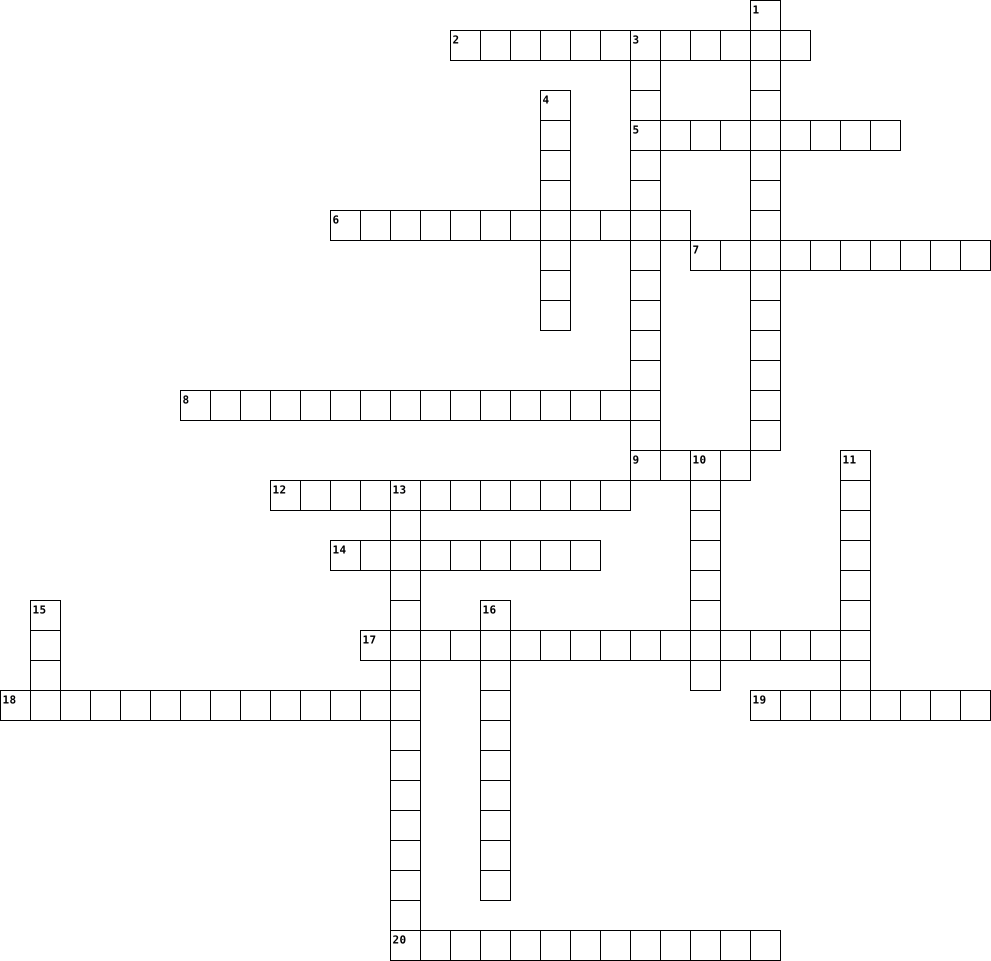
Across
- addition/An addition reaction where in a chemical compound a pi bond is removed from by the creation of two new covalent bonds by the addition of a nucleophile
- many resonance forms does diazomethane exist in ?
- type of alcohol is formed from the reaction between formaldehyde and CH3Li ?
- can destroy the organometallic reagent in a reaction with a carbonyl?
- reduces double bond characters of a carbonyl group
- Fischer/Who is the scientist behind the Fischer Esterification reaction ?
- reacts more readily with alcohols than the same reaction between aldehydes and alcohols
- alcohol/An alcohol in which the hydroxyl group is bonded to the secondary carbon atom
- is the simplest carbonyl compound?
- function group has the structure CHO?
- salt/When an amine is reacted with a carboxylic acid what is produced ?
- physical property can result in a higher boiling point?
Down
- bonds result in more energy needed to excite the vibration but how does that affect the wavenumber?
- addition of a proton to an atom, molecule or ion
- many acyl compounds are there ?
- Spectroscopy/The measurement of the interaction of infrared radiation with matter by absorption, emission or reflection
- drawbacks associated with diazomethane are that it is explosive and can only methylate what is the third ?
- 1 of an addition-elimination reaction of an ester from a carboxylic acid can generate a methylating agent and a new ... ?
- compound/Type of compound that differs from acids by having a leaving group in place of the OH functionality
- Acid/An organic acid which contains the carboxyl group (-COOH)
20 Clues: many acyl compounds are there ? • is the simplest carbonyl compound? • function group has the structure CHO? • addition of a proton to an atom, molecule or ion • many resonance forms does diazomethane exist in ? • reduces double bond characters of a carbonyl group • physical property can result in a higher boiling point? • ...
Carbonyl Chemistry Crosswork 2022-03-09

Across
- The addition of a proton to an atom, molecule or ion
- What reacts more readily with alcohols than the same reaction between aldehydes and alcohols
- An addition reaction where in a chemical compound a pi bond is removed from by the creation of two new covalent bonds by the addition of a nucleophile
- Which function group has the structure CHO?
- What type of alcohol is formed from the reaction between formaldehyde and CH3Li ?
- / Who is the scientist behind the Fischer Esterification reaction ?
- An organic acid which contains the carboxyl group (-COOH)
- how many acyl compounds are there ?
- The measurement of the interaction of infrared radiation with matter by absorption, emission or reflection
- Stronger bonds result in more energy needed to excite the vibration but how does that affect the wavenumber?
Down
- What reduces double bond characters of a carbonyl group
- What is the simplest carbonyl compound?
- step 1 of an addition-elimination reaction of an ester from a carboxylic acid can generate a methylating agent and a new ... ?
- An alcohol in which the hydroxyl group is bonded to the secondary carbon atom
- What physical property can result in a higher boiling point?
- Type of compound that differs from acids by having a leaving group in place of the OH functionality
- What can destroy the organometallic reagent in a reaction with a carbonyl?
- / how many resonance forms does diazomethane exist in ?
- two drawbacks associated with diazomethane are that it is explosive and can only methylate what is the third ?
- When an amine is reacted with a carboxylic acid what is produced ?
20 Clues: how many acyl compounds are there ? • What is the simplest carbonyl compound? • Which function group has the structure CHO? • The addition of a proton to an atom, molecule or ion • What reduces double bond characters of a carbonyl group • / how many resonance forms does diazomethane exist in ? • An organic acid which contains the carboxyl group (-COOH) • ...
Chemistry Vocab Test 2022-02-25

Across
- A neutrally charged particle found the nucleus and makes up half of the mass of an atom.
- A positively charged particle found the nucleus and makes up half of the mass of an atom.
- A substance produced in a chemical reaction
- The area surrounding the nucleus of an atom; where the electrons are found
- A substance made up of atoms of two or more different elements joined by chemical bonds
- A negatively charged particle found the electron cloud and has very little mass
- Chemical formulas and symbols written to represent a reaction
- A pure substance made of only one kind of atom and cannot be broken down
- The electrons in the outermost energy level of an atom that influence the reactivity of the element
Down
- A number in front of a chemical formula that shows how many molecules or atoms are present
- The number of protons in the nucleus of a single atom
- A number written to the bottom right of a chemical symbol that shows how many atoms of that element are in a compound.
- The columns on a Periodic Table that arrange the elements by the number of valence electrons in the outermost shell.
- The mass of an atom, approximately equal to the number of protons and neutrons in the atom
- A combination of symbols that represent the elements in a compound
- The rows in a Periodic Table that classify the elements by the number of electron shells/energy levels
- The tiny, very dense, positively charged region in the center of an atom; made up of protons and neutrons
- A chemical substance that is present at the start of a chemical reaction
- A group of atoms bonded together forming the smallest fundamental unit of a pure substance
- The basic unit of an element and makes up everything
20 Clues: A substance produced in a chemical reaction • The basic unit of an element and makes up everything • The number of protons in the nucleus of a single atom • Chemical formulas and symbols written to represent a reaction • A combination of symbols that represent the elements in a compound • A chemical substance that is present at the start of a chemical reaction • ...
Fossils and Chemistry 2022-02-16

Across
- Tells us about the habitat of an animal such as a burro tracks or foot prints
- When minerals seep into a mold fossil and harden to form a copy of the original
- The basic partical of all matter
- When an element combines with itself to become more stable
- 2 Or more elements join together that have no charge
- When an organism decays and leaves a hollow form of itself
- Study of fossils
- Hardened tree sap that can contain ancient DNA
Down
- Portions of the body that remain but not the whole structure such as teeth claws and bones
- The exact real plant or animal traped/preserved in amber ice or tar
- The remains of plants and animals that lived long ago
- Hot sticky substance that can trap things preserving them for a short amount of time before it melts from heat
- an object trapped in layers of sediment pressed to make the film of carbon
- Radio waves that create an image of internal body flesh
- fossil A fossil that has all the water in it replaced by minerals and turned into stone
- Computer assisted tomography
- Atom with a charge
- A spot where Archaeologists look in for fossils
- Blueprint of life
- A spesific number of protons netrons and electrons
20 Clues: Study of fossils • Blueprint of life • Atom with a charge • Computer assisted tomography • The basic partical of all matter • Hardened tree sap that can contain ancient DNA • A spot where Archaeologists look in for fossils • A spesific number of protons netrons and electrons • 2 Or more elements join together that have no charge • ...
Chemistry Choice HW 2022-03-10

Across
- An example of a physical change and is a solution as well (HINT: This was the solvent and solute in another answer!)
- The substance that is doing the dissolving
- This is the solute and it is used in a solution to make rock candy
- water is commonly known as this because it can dissolve almost anything and act as both an acid and as a base
- this determines if something is acidic, basic, or neutral. Acidic is red, basic is blue, and neutral doesn't change the color
- this is a property of some bases and it is difficult to hold firmly. EX. Ice and soap
- The substance that is being dissolved
- this is an acid, an aqueous solution, and many people think it smells and tastes bad
- this has a pH from 1-6 and it releases hydronium ions (OH-)
- this is used as agricultural fertilizer and it is an example of a base
- This helps the solute in a solvent dissolve faster (This is the independent variable in an experiment)
- this is a property of some bases and it has a sharp or bad taste or smell. EX. Soap
- it can harm the environment by too much exposure to humans and the environment.
- this is determined by a scale and it is the amount of matter in an object
- Can’t be reversed and a new substance is formed.
Down
- The measurement of thermal energy within an object and is one of three factors that affects the rate of solubility
- this is a very powerful base and it is a cleaning product. This can seriously hurt your skin as well.
- this has a pH from 8-14 and it releases hydroxide ions (H+)
- Can be reversed and doesn’t change what a substance is
- this is a property of some acids and it can chemically destroy exposed body tissues
- This is an example of a chemical change and it usually occurs when metal is exposed to moisture and it is then left out for long periods of time
- A mixture of two or more substances that is the same throughout
- many acids have this taste. Ex. Lemon and Vinegar
- this contains a natural pH indicator that changes color depending on the acidity of a solution
- a solvent that has as much solute in it as it can dissolve
- when there is more solute in a solvent than can be dissolved
- this is an acid, a fruit, and there is a large debate on whether this or the color came first
- this tells the pH of some substances by changing the color of the strip. Red means acidic and blue means basic.
- this is an example of a base and it is used to clean other things or yourself
- Something to determine whether something is an acid, a base, or neutral on a scale of 0-14
- this is an acid, a fruit, it has seeds, and it is commonly used in cooking
- This is the solvent and it can act as both an acid and a base
32 Clues: The substance that is being dissolved • The substance that is doing the dissolving • Can’t be reversed and a new substance is formed. • many acids have this taste. Ex. Lemon and Vinegar • Can be reversed and doesn’t change what a substance is • a solvent that has as much solute in it as it can dissolve • this has a pH from 8-14 and it releases hydroxide ions (H+) • ...
Chemistry Crossword Puzzle 2021-06-08

Across
- Used to weigh substances
- Representation of a substance using symbols
- Cl
- Positively charged particle
- S
- Aqueous (liquid) mixture of substances
- A test in the laboratory
- Two or more elements joined together
- Includes eyepiece, lens, and stage
- Bunsen _______
- Hand protection
- Cu
Down
- Cylindrical glass container
- Negatively charged ion
- Negatively charged particle
- Eye protection
- OH-
- Combination of two or more atoms
- Might be calibrated in Fahrenheit or Celsius
- Has no net electric charge
- Consists of a nucleus surrounded by an electron cloud
- An atom or molecule with a net electrical charge
- A substance that cannot be broken down by chemical means
- Matter with no defined volume or shape
- K
25 Clues: S • K • Cl • Cu • OH- • Eye protection • Bunsen _______ • Hand protection • Negatively charged ion • Used to weigh substances • A test in the laboratory • Has no net electric charge • Cylindrical glass container • Negatively charged particle • Positively charged particle • Combination of two or more atoms • Includes eyepiece, lens, and stage • Two or more elements joined together • ...
Chemistry Performance Work 2021-12-25

Across
- relating to the nucleus of an atom.
- is a list of ingredients with which something is made.
- a substance that causes slight inflammation or other discomfort to the body.
- having a pH of less than 7.
- easily set on fire
- is a very small piece of matter with a positive electrical charge that is found in the nucleus of all atoms
- a particular kind of matter with uniform properties
- a thing that is composed of two or more separate elements
- having a pH of more than 7.
Down
- father of chemistry in Islamic Civilization
- combines with oxygen and makes things burn,
- element with atomic number 1
- the process of taking something ordinary and turning it into something extraordinary
- an atom or molecule with a net electric charge due to the loss or gain of one or more electrons.
- is a very small particle of matter that has a negative charge
- a particle of matter that uniquely defines achemical element
- a place for labor or work
- substances that are poisonous
- tending to cause corrosion.
- a usually round part of most cells that is enclosed in a double membrane, controls the activities of the cell
- electric charge of atom
21 Clues: easily set on fire • electric charge of atom • a place for labor or work • having a pH of less than 7. • tending to cause corrosion. • having a pH of more than 7. • element with atomic number 1 • substances that are poisonous • relating to the nucleus of an atom. • father of chemistry in Islamic Civilization • combines with oxygen and makes things burn, • ...
Chemistry Unit 2 2021-12-17

Across
- form of electromagnetic radiation, high frequency and energy of high-energy photons
- electron emission, absorbs enough energy to be completely ejected.
- 18th group, stable
- outermost electrons, chemical bond
- opposite spins, 2 max electrons
- form of electromagnetic radiation, high energy and very short wavelengths
- form of electromagnetic radiation, antennas
- energy level, 1s 2s 3s
- minimum energy ,remove the loosest electron
- height, origin to the crest
- minimum amount of energy, gained or lost
- form of energy, wavelike behavior
- form of electromagnetic radiation, microwaves
Down
- electrons, lowest energy 1st
- the arrangement of electrons, block, p block, d block
- measure of the tendency of an atom, bonding pair
- #waves per sec, hertz
- small particle, negative charge
- tiny particle, comprises waves of electromagnetic radiation
- pairing up, one electron
- form of electromagnetic radiation, thermal vision
- shortest distance, waves
- form of energy, no mass but has wave characteristics
- distance, nucleus to outer shell
- electron configuration, boxes
- form of electromagnetic radiation, sun rays
26 Clues: 18th group, stable • #waves per sec, hertz • energy level, 1s 2s 3s • pairing up, one electron • shortest distance, waves • height, origin to the crest • electrons, lowest energy 1st • electron configuration, boxes • small particle, negative charge • opposite spins, 2 max electrons • distance, nucleus to outer shell • form of energy, wavelike behavior • ...
Chemistry Vocab #1 2022-01-10

Across
- System of electrons surrounding the nucleus of an atom
- A solid that is produced by a chemical reaction in solution
- Experimental value minus the accepted value, divided by the accepted value and then multiplied by 100
- Atoms with same number of protons but not the same number of neutrons
- Data in words rather than in numbers
- atom that has gained or lost one or more electrons
- Group 18 in the periodic table with a full outer shell
- Mass per unit of volume
- Number of protons in the nucleus in an atom
- Reaction in which the nuclei of one atom combines with the nuclei of another to form a larger nuclei
Down
- The heat required to raise the temperature of the mass of a given substance by given amount
- Method that expresses the number multiplied by 10 and the appropriate power
- Smallest particle of a substance that can exist by itself
- Element with the properties of both metals and nonmetals
- Numerical measurements rather than its words
- The quality of being exact
- The ability to work without mistakes
- A science that deals with the structure and properties
- a number that express a magnitude to a specified degree of accuracy
- Sum of the protons and neutrons in the nucleus of an atom
20 Clues: Mass per unit of volume • The quality of being exact • The ability to work without mistakes • Data in words rather than in numbers • Number of protons in the nucleus in an atom • Numerical measurements rather than its words • atom that has gained or lost one or more electrons • System of electrons surrounding the nucleus of an atom • ...
PS: Chemistry P2 2021-09-28

Across
- Any change that doesn’t change the identity. Observed with senses. Determined without changing matter.
- The transition of a substance directly from the solid to the gas state, without passing through the liquid state
- A chemical reaction where energy is released from the system to the surroundings
- The outside of the atom. Where electron's are located.
- One of the fundamental states of matter. A high-energy state of atoms and molecules.
- A substance that speeds up a chemical reaction, but itself does not undergo any permanent chemical change
- An element or compound produced by a chemical reaction.
- The center of the atom. Where the Proton and neutron are located.
- A reaction in which two nuclei combine to form a nucleus.
- A neutral particle located in the nucleus with a charge of zero.
Down
- A reaction in which the nucleus of an atom splits into two or more smaller, lighter nuclei.
- Any change that does change the identity. Indicates how substance reacts with something else. Matter will be changed into a new substance
- Atoms combined in fix quantities. Atoms can be separated only by destroying substance.
- Energy in chemical reactions, it is the energy required to break chemical bonds to allow the reaction to proceed to products
- Physical change of matter that are reversible.
- An element or compound that enters into a chemical reaction.
- A positively charged subatomic particle located in the nucleus of an atom.
- One of the fundamental states of matter in which the molecules have both a fixed volume but not a fixed shape
- One of the fundamental states of matter in which the molecules do not have a fixed volume or shape. Molecules move the fastest.
- A negatively charged subatomic particle located outside of the nucleus of the atom.
- Atoms of the same element with identical atomic numbers but different atomic masses due to different number of neutrons in the nucleus
- One of the fundamental states of matter in which the molecules have both a fixed volume and a fixed shape. Molecules move the slowest.
- A chemical reaction where energy is absorbed by the system from the surroundings
23 Clues: Physical change of matter that are reversible. • The outside of the atom. Where electron's are located. • An element or compound produced by a chemical reaction. • A reaction in which two nuclei combine to form a nucleus. • An element or compound that enters into a chemical reaction. • A neutral particle located in the nucleus with a charge of zero. • ...
Chemistry Chapter 9 2022-04-25

Across
- N2
- Cu is known as
- a procedure for rebalancing equations using moles
- element that is soluble in water
- another name for limiting reactant
- the amount of product calculated
- sodium chloride
- written equation when elements are combined
- mass of products and reactants in an equation
- equation must be ____ before using mole ratio
- number written before the element
- amount of product actually obtained
- O2
- H2O
Down
- contains relative amounts of reactants
- comparison of actual yield to theoretical
- H2O is an example of a _____
- equal to number of carbon atoms
- collection of atoms bonded together
- the reactant that runs out first
- the unit moles are written in
- the materials that will be combined
- element that is not soluble
- the result after reactants are combined
- O2 is usually a type of ____
25 Clues: N2 • O2 • H2O • Cu is known as • sodium chloride • element that is not soluble • H2O is an example of a _____ • O2 is usually a type of ____ • the unit moles are written in • equal to number of carbon atoms • element that is soluble in water • the reactant that runs out first • the amount of product calculated • number written before the element • another name for limiting reactant • ...
Chapter 9 chemistry 2022-04-25

Across
- water
- a state that has molecules with least energy
- propane
- the answer to a problem
- 6.02x10^23
- N2
- a positively charged ion
- what the reactants combine to make products
- CO2
- reactant that runs out first
- an equation that has equal # of atoms on each side
- used to calculate moles
Down
- contains relative amounts of reactants
- comparison of number of products/reactants
- used to calculate percent yield
- a negatively charged ion
- number representing number of atoms in molecule
- a substance that dissolves in water
- used to calculate masses of moles
- equals actual yield/theoretical yield
- used to represent a chemical reaction
- most basic form of element
- comparison of two numbers
- a state which has the most energy
- a state that has volume but no shape
25 Clues: N2 • CO2 • water • propane • 6.02x10^23 • the answer to a problem • used to calculate moles • a negatively charged ion • a positively charged ion • comparison of two numbers • most basic form of element • reactant that runs out first • used to calculate percent yield • used to calculate masses of moles • a state which has the most energy • a substance that dissolves in water • ...
pH & Water Chemistry 2017-05-08

Across
- forms when electrons are shared between atoms
- (chemicals being created) are written on the right side of a chemical equation.
- mixtures of water and non-dissolved materials
- found in the nucleus with no charge
- a solution that contains a higher concentration of H+ ions than pure water and has a pH value below 7
- a substance formed by the chemical combination of two or more elements in definite proportions
- water slowly heats and resists temperature change
- Water is attracted to other molecules/substances
- is a measure of the concentration of H+ ions in a solution
Down
- formed when one or more electrons are transferred from one atom to another
- When molecules are close together, a slight attraction can form between the oppositely charged regions of nearby molecules
- found circling the nucleus with a positive charge
- (chemicals being combined) are written on the left side of a chemical equation.
- material composed of two or more elements or compounds that are physically mixed together, but not chemically combined
- a pure substance that consists entirely of one type of atom
- weak acids or bases that react with strong acids and bases to keep pHs within a certain range
- a mixture where a solid is dissolved into a liquid.
- found in the nucleus with a positive charge
- the smallest particles of an element that still have all the properties of an element
- Water is attracted to water (makes water “sticky!!”).
- when the electrons Between atoms in a molecule are shared unequally
- atoms of the same element that have the same number of protons but a different number of neutrons
- a solution that contains a lower concentration of H+ ions than pure water and has a pH value above 7
23 Clues: found in the nucleus with no charge • found in the nucleus with a positive charge • forms when electrons are shared between atoms • mixtures of water and non-dissolved materials • Water is attracted to other molecules/substances • found circling the nucleus with a positive charge • water slowly heats and resists temperature change • ...
Chemistry Crossword Puzzle 2017-01-25

Across
- The dissolved particles in a solution.
- A solution containing the maximum amount of solute for a given amount of solvent.
- A scale expressing the acidity or alkalinity of a solution; 7 is neutral, whereas lower numbers are more acidic and higher numbers are more basic.
- A mixture whose size of particles are between those in a suspension and a true solution.
- A substance that is slippery to the touch and tastes bitter; classified by numbers larger than 7 on the pH scale.
- The process by which an atom or a molecule acquires a negative or positive charge by gaining or losing electrons to form ions, often in conjunction with other chemical changes.
- A chemical compound that changes color and structure when exposed to certain conditions and is therefore useful for chemical tests.
- A process in which molecules separate or split into smaller particles such as atoms.
- The measurement of the amount of solute that is dissolved in a given quantity of solvent.
- The concentration of solute in a solution measured in moles of solute per liter of solution.
Down
- The dissolving medium in a solution.
- An object that does not have a positive or negative charge; a liquid that is not exceedingly basic or acidic.
- An acid that dissociates incompletely, releasing only some of its hydrogen atoms into the solution.
- The amount of a substance that dissolves in a given quantity of solvent at specific conditions.
- A mixture whose size of particles are large enough to settle out.
- The ion H3O+.
- Any acid that ionizes completely in solutions.
- A solution that contains more solute than it can theoretically hold.
- A combination of a solvent and a solute.
- A technique where a solution of known concentration is used to determine the concentration of an unknown solution.
- The concentration of solute in a solution measured in moles of solute per kilogram of solvent.
- A chemical substance that neutralizes bases, dissolves some metals; a corrosive or sour-tasting liquid.
22 Clues: The ion H3O+. • The dissolving medium in a solution. • The dissolved particles in a solution. • A combination of a solvent and a solute. • Any acid that ionizes completely in solutions. • A mixture whose size of particles are large enough to settle out. • A solution that contains more solute than it can theoretically hold. • ...
8th Chemistry Vocabulary 2018-03-07

Across
- A negatively charged subatomic particle founding the electron cloud and has very little mass
- A positively charged subatomic particle founding the nucleus and makes up about half of the mass of an atom.
- The tiny, very dense, positively charged region in the center of an atom; made up of protons and neutrons
- Majority of the elements on the periodic table are solid, shiny, malleable, and good conductors of heat and electricity.
- A substance produced during a chemical reaction
- A pure substance made of only one kind of atom
- A group of atoms bonded together; Can be the same elements or different elements
- The process by which one or more substances change to produce one or more different substances.
- A substance that takes part in and undergoes change during a reaction
- The electrons in the outermost energy level of an atom that influence the reactivity of the element
- A small number written below and to the right of a chemical symbol that shows the number of a specific type of atom present.
- Matter is neither created nor destroyed. Therefore, mass of all reactants must equal the mass of all products.
- The smallest particle of an element, made of electrons, protons, and neutrons
- A number placed in front of a chemical symbol or formula in order to balance the equation.
- A substance made of two or more elements chemically combined; must be more than one type of element
Down
- A table showing the chemical elements arranged according to their atomic numbers
- The rows in a Periodic Table that classify the elements by the number of electron shells/energy levels
- The columns on a Periodic Table that arrange the elements by the number of valence electrons in the outermost shell.
- A solid that forms from two liquids in a solution during a chemical reaction.
- the area surrounding the nucleus of an atom; where the electrons are found
- the mass of an atom, approximately equal to the number of protons and neutrons in the atom
- Chemical formulas and symbols written to represent a reaction
- Elements that have properties of both metals and non-metals; sometimes referred to as semiconductors
- Elements not shiny, usually a gas or brittle solid, not malleable, and poor conductors of heat and electricity
- A combination of symbols that represent the elements in a compound
- the number of protons in the nucleus of a single atom
- A neutrally charged subatomic particle founding the nucleus and makes up about half of the mass of an atom.
27 Clues: A pure substance made of only one kind of atom • A substance produced during a chemical reaction • the number of protons in the nucleus of a single atom • Chemical formulas and symbols written to represent a reaction • A combination of symbols that represent the elements in a compound • A substance that takes part in and undergoes change during a reaction • ...
Dylan Caughey Chemistry 2017-09-25

Across
- / the smallest component of an element
- of state / physical changes in matter.
- property / An intensive property is a property of matter that does not change as the amount of matter changes.
- / an element whose properties are intermediate between those of metals and solid nonmetals
- / substance formed when two or more chemical elements are chemically bonded together.
- / same kind; alike.
- / a solid material that is typically hard, shiny, malleable, fusible, and ductile,
- / a substance that takes part in and undergoes change during a reaction.
- substance / substances that are made of only one type of atom or only one type of molecule
- / a substance produced during a natural, chemical, or manufacturing process.
- / an ionized gas consisting of positive ions and free electrons in proportions resulting in more or less no overall electric charge,
- / An element is composed of atoms that have the same atomic number
- / a number of people or things that are located close together or are considered or classed together.
Down
- property / Properties that do change tha chemical nature of matter.
- / a means of solving a problem or dealing with a difficult situation.
- / a length or portion of time
- / is a measure of the amount of matter in an object.
- reaction / a process that involves rearrangement of the molecular or ionic structure of a substance, as opposed to a change in physical form or a nuclear reaction.
- / diverse in character or content.
- / he branch of science that deals with the identification of the substances of which matter is composed;
- / an element or substance that is not a metal.
- / everything around you.
- / an airlike fluid substance which expands freely to fill any space available, irrespective of its quantity.
- / strongly built or made of strong materials; not flimsy or slender.
- / a group consisting of parents and children living together in a household.
- property / bulk property, meaning that it is a physical property of a system that does not depend on the system size or the amount of material in the system.
- / a substance that flows freely but is of constant volume, having a consistency like that of water or oil.
- / a substance made by mixing other substances together.
28 Clues: / same kind; alike. • / everything around you. • / a length or portion of time • / diverse in character or content. • / the smallest component of an element • of state / physical changes in matter. • / an element or substance that is not a metal. • / is a measure of the amount of matter in an object. • / a substance made by mixing other substances together. • ...
Chemistry Crossword Puzzle 2017-11-12

Across
- The most common ____________ is created by the IUPAC.
- 6Mg + P4 → 2Mg3P2 is an example of a __________ equation.
- Humans release ________________ when they breathe out.
- _________________ is an ionic compound also known as table salt.
- __________ is a molecular compound that contains one carbon atom and four hydrogen atoms.
- B2H4 is an example of a _______ bond.
- The _____________ diagram shows the amount of electrons on an element's last shell.
- A ________________ is used to tell you which chemicals are reacting with each other.
Down
- _________ is the first element in the halogen group.
- _______ compounds are made of non-metals.
- A ________________ uses the formulas to show which elements were used to create the chemical reaction.
- Oxygen has a ________ of 2.
- Sodium carbonate is an example of a _______ bond.
- An ______ dissolves in water to release hydrogen ions in aqueous solutions.
- ________ is when 2 or more reactants combine to form 1 product.
- ___________ is when a reactant is broken down into two or more products.
- A ______ dissolves in water to release hydroxide ions in aqueous solutions.
- When light is produced, a chemical _________ has taken place.
- NH4+ is an example of a ____________ ion.
- A ________ compound consists of exactly 2 elements.
20 Clues: Oxygen has a ________ of 2. • B2H4 is an example of a _______ bond. • _______ compounds are made of non-metals. • NH4+ is an example of a ____________ ion. • Sodium carbonate is an example of a _______ bond. • A ________ compound consists of exactly 2 elements. • _________ is the first element in the halogen group. • ...
Motion and Chemistry 2017-10-31

Across
- what you measure in the results for an experiment(d_________ variable)
- measured in m/s2 or ms-2 (a______________)
- substance made of one type of atom only (e____________)
- the things that need to be the same in experiments (c_______ variables)
- acid + base --> salt + w_____________
- another name for a chemical change (r__________)
- the one thing that you change in an experiment (i________ variable)
- element with formula Cl
- the tendency of an object to keep its motion (i___________)
- substance made of 2 or more different atoms (c____________)
- force is calculated by m______ x acceleration
Down
- Newton's Law that says force depends on acceleration and mass (s_______)
- name of compound CuO
- acid + metal --> salt + h____________
- speed is calculated by the formula distance divided by __________
- Newton's law number which describes inertia (f_______)
- a force that stops or slows down an object (f________)
- acid + carbonate --> salt + water + c_______________
- Newtons law number that says 'Forces have an equal and opposite force'(t____)
- speed is measured in __________ per second
- scientist with 3 laws of motion (N______)
- element with formula Fe
- forces are measured in N_________
23 Clues: name of compound CuO • element with formula Fe • element with formula Cl • forces are measured in N_________ • acid + base --> salt + w_____________ • acid + metal --> salt + h____________ • scientist with 3 laws of motion (N______) • measured in m/s2 or ms-2 (a______________) • speed is measured in __________ per second • force is calculated by m______ x acceleration • ...
Chemistry Crossword Puzzels 2018-11-06

Across
- he discover neturons in 1932
- Baking a cake is _____ change
- good conductors of head and electricity
- he was known as the father of modern chemistry
- a region in space in which there is high probability of finding an e-
- average mass of all the atomic masses of the isotopes of that atom
- elements in this family are fluorine, chlorine, bromine, iodine and astatine
- describing without numbers
- poor conductors of heat and electricity
- refers to how many protons an atoms of that elements has
- shape of dumbbell, holds 2 electrons in each orbital
- Longest wavelength, 700nm
- columns of elements is called______
- are bundles of light energy that emitted by e- as they go from higher energy level to lower levels
- the amount of energy required to move an e- from one energy level to another
Down
- table that organizes the elements is particular way
- ______have the same number of electrons and protons
- e- in the outer energy level of an atom
- making orange juice is ______ change
- shortest wavelength 400nm
- they are horizontal; rows of elements is called______
- using numbers to describe
- they are the most reactive metals, always bonded with another elements
- levels S,P,D,F are the ______
- Plum pudding model
- they are colorless gases that are extremely un-reactive
- have properties of both metal and nonmetal
- a part or aspect of something abstract, especially one that is essential or characteristic
- ____are atoms that have an unequal number of electrons and protons
- the energy level are like the ____ of a ladder but not equally spaced
30 Clues: Plum pudding model • shortest wavelength 400nm • using numbers to describe • Longest wavelength, 700nm • describing without numbers • he discover neturons in 1932 • Baking a cake is _____ change • levels S,P,D,F are the ______ • columns of elements is called______ • making orange juice is ______ change • e- in the outer energy level of an atom • ...
Chemistry Comprehensive Review 2016-06-21

Across
- Electrochemical technique that measure the electrical charge passing between two electrodes in a cell, the passing charge is directly proportional to oxidation or reduction of substance at one of the electrodes
- heme-containing protein found in red skeletal muscle, release after AMI
- Principle Actions of hormone: Increased calcium reabsorption, inhibits phosphate reabsorption
- Sodium, Potassium, Calcium, Magnesium, Chloride, bicarbonate, etc are all __________.
- Deficiency in Lipoprotein Lipase Activity is a hyperchylomicronemia Type ____ .
- Principle Actions of hormone: stimulation of thyroid formation and secretion
- The enzyme whose principal source is the heart and skeletal muscles
- Key cell membrane component in animals, carried by LDL and HDL
- The enzyme whose principal source is the liver
- The temperature measurement used for ABG in CVOR
- The end result of uncontrolled hyperglycemia in a Type-1 Diabetic
- A change greater than normal variance between today's value and previous value
- Main end-product of norepinephrine and epinephrine metabolism that is excreted in the urine
- Chemical and Environmental Factors influencing _____ , food or coadministered drugs affecting extent and rate of _____
- A mathematical equation that states that concentration of a substance is directly porportional to the amount of light absorbed, A= abc
- chief storage of iron in the body
- This cycle is how lactate is converted by the liver back into glucose
Down
- The enzyme whose principal source is the pancreas
- A function-curve that describes the relationship between instrument signal and concentration of analyte
- protein that is produced by the prostate, used for screening for prostate cancer
- Protein hormone that maintains blood glucose concentration by increasing glucose levels through glycogenolysis
- Principle Actions of hormone: oxygen consumption and metabolic rate of tissues
- Detection and measurement of a decrease in intensity of an incident beam of light as it passes thru a solution
- pH= pK' + log (cCHO3-/cHCO3-), _____ equation
- Marker for Glomerular Filtration Rate
- Principle Actions of hormone: Water reabsorption
- Principle Actions of hormone: Regulation of blood volume and pressure, must be performed in a 4 hour limit due to short half life
- Principle Actions of hormone: Salt and Water Balance
- Factors-errors that affect specimens before tests are performed and that can lead to error if not controlled
- protein produced by the fetal yolk, liver, etc. elevated in hepatocellular carcinomas, etc.
- The proportion of subjects with disease who have a positive laboratory test result
- Disorder of a transmembrane conductance regulator protein (CFTR), increased Chloride levels in sweat
- group of mainly inherited metabolic disorders that result from partial deficiencies of the enzymes of heme biosynthesis
- The 95% reference range is based off a _____ curve
- yellow bile pigment that is a breakdown product of heme
- Copper ions complex with peptide bonds in protein when exposed to alkaline conditions. Binding changes copper's absorption and leads to a color change. Directly proportional
- The fraction of bilirubin that reacts with the diazo reagent in the absence of alcohol
- Old term used to report results of a urea assay
- Form of an enzyme that originates from gene, but is distinguished by certain physical properties
39 Clues: chief storage of iron in the body • Marker for Glomerular Filtration Rate • pH= pK' + log (cCHO3-/cHCO3-), _____ equation • The enzyme whose principal source is the liver • Old term used to report results of a urea assay • Principle Actions of hormone: Water reabsorption • The temperature measurement used for ABG in CVOR • ...
Chemistry basics review 2016-09-20

Across
- can cause serious or long term effects or even death
- used to heat chemicals in an experiment
- prediction of what is going to happen
- can catch on fire easily
- where a gas mask when around this
- can cause severe burns to skin resulting in permanent damage
- someone's clothing is on fire
- workplace hazardous materials information system
- worn on eyes during all lab experiments
- used to keep chemicals off of skin and clothing
- use to pick up test tubes
Down
- can go under extreme hazardous material
- material that is a bacteria that can cause disease
- can decompose easily to release an oxidizing substance
- curved upper surface level in a tube
- a glass cylinder for lab use
- use fire extinguisher on
- a measured amount of matter in an object
- person who teaches us our chemistry class
- should be worn when dealing with chemicals to protect your hands
20 Clues: can catch on fire easily • use fire extinguisher on • use to pick up test tubes • a glass cylinder for lab use • someone's clothing is on fire • where a gas mask when around this • curved upper surface level in a tube • prediction of what is going to happen • can go under extreme hazardous material • used to heat chemicals in an experiment • ...
Chemistry of Life 2016-09-27

Across
- Covalent Bond Electrons are shared equally
- ph above 7 are
- Combination of two or more elements
- 1 main function of carbohydrates
- ph below 7 are
- are made from giant molecules
- what is formed when electrons are gained or lost
- building blocks of nucleic acid
- of Sugar Carbohydrates are classified by
- Proteins that speed up the chemical reaction
- Basic Unit of Matter
Down
- Name 1 kind of mixture
- only found in plants
- Molecule molecule that is positive at one end and negative on the other
- what is known as quick energy
- to eight ph of most human cells should be between
- This does the dissolving
- Bonds atoms that compose compounds are held together by?
- name something that energy
- Name 1 of the 4 groups of Organic Compounds
- example of a lipid
- name 1 part of a solution
- name 1 kind of nucleic acid
- pure substance with the same atoms
24 Clues: ph above 7 are • ph below 7 are • example of a lipid • only found in plants • Basic Unit of Matter • Name 1 kind of mixture • This does the dissolving • name 1 part of a solution • name something that energy • name 1 kind of nucleic acid • what is known as quick energy • are made from giant molecules • building blocks of nucleic acid • 1 main function of carbohydrates • ...
Chemistry: Olivia 9C 2018-12-12

Across
- an air like fluid substance which expands freely to fill any space available, irrespective of its quantity
- Characteristics that can be used to describe a substance
- shininess of a substance
- Octagon Danger
- Element Hydrogen
- Diamond warning
- stretched into a long wire
- Numerical prefixes for 2
- a solid material that is typically hard, shiny, malleable, fusible, and ductile
- Change When material changes state, doesn't change composition, reversible
- number the number of protons in the nucleus of an atom
- a substance that flows freely but is of constant volume, having a consistency like that of water or oil
- Metals an element or substance that is not a metal
Down
- Substances made up of one type of matter and has a unique set of characteristics
- An element whose properties are intermediate between those of metals and solid nonmetals
- Change When two or more substances react to form a new substance, Non reversible
- a body or geometric figure having three dimensions
- Numerical prefixes for 4
- Conduct electricity or heat
- Table a table of the chemical elements arranged in order of atomic number
- Element Helium
- chemical combination of two or more elements in a specific ratio
- Triangle Caution
- point Liquid changes to a gas
- point Changes from solid to liquid
25 Clues: Octagon Danger • Element Helium • Diamond warning • Element Hydrogen • Triangle Caution • Numerical prefixes for 4 • shininess of a substance • Numerical prefixes for 2 • stretched into a long wire • Conduct electricity or heat • point Liquid changes to a gas • point Changes from solid to liquid • a body or geometric figure having three dimensions • ...
Chemistry Terminology II 2019-02-25

Across
- adenosine triphosphate
- a chemical substance that resists changes in the pH of a solution
- P
- the basic structural components of proteins (2 words)
- subatomic particle that orbits around the nucleus of an atom and has a negative charge
- any atom that has lost or gained one or more electrons
- K
- C
- the combined weight of protons and neutrons for a given atom (2 words)
- a molecule consisting of chains of hundreds or thousands of amino acids
- the orbital paths of electrons found at varying distances from the nucleus of an atom (2 words)
- H
- molecules that contain carbon and are the principle materials that makeup living things
- O
Down
- H2O
- molecules that when dissolved in water dissociate into cations and anions
- chemical reaction in which large organic molecules are formed from smaller units by the removal of water
- matter composed entirely of atoms of the same kind
- Cl
- a substance that influences the rate of a chemical reaction but is not altered during the reaction
- a blood pH that is below 7.35
- Zn
- the number of protons within an atom (2 words)
- NaCl
24 Clues: P • K • C • H • O • Cl • Zn • H2O • NaCl • adenosine triphosphate • a blood pH that is below 7.35 • the number of protons within an atom (2 words) • matter composed entirely of atoms of the same kind • the basic structural components of proteins (2 words) • any atom that has lost or gained one or more electrons • a chemical substance that resists changes in the pH of a solution • ...
Chemistry crossword 001 2019-07-15

Across
- All radioactive elements decay to become this element
- Most common element in the universe
- Rekha's Dream office (also names compounds)
- 100th on the list
- Tetrahedral-Tetra Valent
- The only element named after a person living presently
- Positively charged electron
- This element killed the person who discovered it
- Discovered by a university named after the state
- Stannum
- Heaviest element
- "No" symbol discovered by the Nobel Institute
- sub-atomic particle not present in all atoms
Down
- Was the standard for relative atomic mass till 1961 before C-12
- a Helium ion
- First Man-Made element
- Lights up your day
- Costly extremely rare element with the highest boiling point of all the elements
- 1 of the 2 liquid elements at room temperature
- Most electronegative element
- Element Dual Valency
- Hydrogyrum
22 Clues: Stannum • Hydrogyrum • a Helium ion • Heaviest element • 100th on the list • Lights up your day • Element Dual Valency • First Man-Made element • Tetrahedral-Tetra Valent • Positively charged electron • Most electronegative element • Most common element in the universe • Rekha's Dream office (also names compounds) • sub-atomic particle not present in all atoms • ...
Basically Chemistry Stuff 2019-09-29

Across
- molecules attract to different substance
- living organism are made up of cells
- all organisms have proteins found within mRNA strands
- part of metabolism, breaking molecules to smaller molecules
- slightly postive or negatively charge
- physical changes that can be observed during or after chemical reaction
- amount of energy that must be added to liquid substanceto transform a quantity of that substance into a gas.
- the sum of all chemical processes that occur in an organism
- slightly positive hyrgen and slightly negative atom
- water molecules sticking to each other
- oppositely charged ions
Down
- constant/maintenance internally(temp.=cold, body heats)
- no charge
- materials become evident during or after chemical reaction
- amount of heat to be supplied to a given mass of a material to produce a unit change in its temperature.
- moisture carried from plant leaves (evaporation)
- atoms of elements in organisms bonded
- part of metabolism, building molecules
- outer shell of electron
- atoms shar a pair of electrons
- atom, radical, or molecule that has gained or lost one or more electrons and has - or + charge
21 Clues: no charge • outer shell of electron • oppositely charged ions • atoms shar a pair of electrons • living organism are made up of cells • atoms of elements in organisms bonded • slightly postive or negatively charge • part of metabolism, building molecules • water molecules sticking to each other • molecules attract to different substance • ...
Chemistry Crossword Puzzle 2019-04-27

Across
- The mass of a substance divided by its volume.
- A group of atoms held together by bonds.
- The particle of an element.
- A change where the substance themselves are changed.
- A compound of a non-metal and metal.
- A homogeneous mixture.
- An acid other than oxyacid.
- Can be bent or hammered into shape.
- A mixture which is a solution.
- The change of state from liquid to gas.
- A base and acid form together.
- A particle that has gained or lost an electron.
- A mixture where the components are easily seen, and are able to be physically separated.
- A subatomic particle with a positive charge.
- The number of protons in an element.
- When two or more atoms join together, they form _______s.
Down
- An element that loses electrons when forming bonds.
- A scale which shows how acidic or basic a substance is.
- Positively Charged Ion.
- The sum of the numbers of protons and neutrons in an atom.
- A subatomic particle with a negative charge.
- A medium or volume that allows heat or electricity to pass through it.
- An indicator which shows whether a substance is acidic or basic.
- This is the eighth element on the periodic table.
- The sharing of electrons between two atoms when bonding together.
- Negatively Charged Ion.
- The amount of one type of substance in a medium.
- An acid containing polyatomics.
- A bond of two non-metals.
- The change of state from liquid to solid.
30 Clues: A homogeneous mixture. • Positively Charged Ion. • Negatively Charged Ion. • A bond of two non-metals. • The particle of an element. • An acid other than oxyacid. • A mixture which is a solution. • A base and acid form together. • An acid containing polyatomics. • Can be bent or hammered into shape. • A compound of a non-metal and metal. • The number of protons in an element. • ...
Connor Thomas - chemistry 2019-10-17

Across
- a negatively charged particle
- materials mixed together
- what we end with
- atoms bonded together
- reaction where clouds form
- a particle with no charge
- chemicals combine in specific amounts
- the number of protons in the nucleus of an atom
Down
- a positive particle
- a property of a substance that is observed during a chemical reaction
- a chemist who developed the periodic table of the chemical elements
- a substance that cannot be broken down into simpler substances
- you can experience with your 5 senses
- mass of an atom
- smallest part of any element
- materials does change
- materials dont change
- mixture is the same
- a table of elements
- materials we start with
20 Clues: mass of an atom • what we end with • a positive particle • mixture is the same • a table of elements • atoms bonded together • materials does change • materials dont change • materials we start with • materials mixed together • a particle with no charge • reaction where clouds form • smallest part of any element • a negatively charged particle • you can experience with your 5 senses • ...
Chemistry and Food! 2012-10-30

Across
- prefix meaning “many”
- the suffix meaning “sugar”
- the type of sugar that circulates in the bloodstream
- a symptom of kwashiorkor
- pertaining to having a need for food.
- a deficiency disease caused from a lack of proteins and vitamins
- prefix meaning “three”
- a class of food
- a type food that contains no cholesterol
- capable of being consumed
- chemical equation
- prefix meaning “one”
- prefix meaning “two”
- C6H12O6
- a chain of amino acids
- suspension of a liquid in another liquid
- a carbohydrate that is a necessary part of a balanced diet
- prefix meaning “egg”
Down
- sustenance
- an organic compound that contains sugar
- a sweet chemical
- a vegetarian diet that contains some animal products such as fish and dairy
- disease of the arteries
- a salt compound that forms a protective coating around tiny oil droplets to keep them from coming together in digestion
- the main component of fats
- the tissue where fats are stored
- to split using water.
- a protein that is nonanimal
- a vegetarian diet that contains no animal product
- made from the amino acids in protein
30 Clues: C6H12O6 • sustenance • a class of food • a sweet chemical • chemical equation • prefix meaning “one” • prefix meaning “two” • prefix meaning “egg” • prefix meaning “many” • to split using water. • prefix meaning “three” • a chain of amino acids • disease of the arteries • a symptom of kwashiorkor • capable of being consumed • the suffix meaning “sugar” • the main component of fats • ...
CHEMISTRY QUIZ- 10TH 2012-12-05

Across
- Most unreactive group
- Early chemists tried to perfom this nuclear reaction.
- One synthetic element named after a prize.
- They react with water to form alkaline solutions.
- When a star dies.
- Energy requiered to remove an electron
- Atomic radius _______ as you move down a group.
- Particle accelerator for superheavy elements.
- These are revealed by the arrangement of the periodic table
Down
- Most elements are __________
- Original explosion of the universe according to theories.
- All are radioactive
- It decreases as you move down a group.
- Symbol of one element found in the spectra of stars
- Another name for group 17
- It is formed when you mix metals.
- Elements created by men.
- Here we can find nuclear reactions today.
- It is in a class by itself
- One of the basic 6 elements
20 Clues: When a star dies. • All are radioactive • Most unreactive group • Elements created by men. • Another name for group 17 • It is in a class by itself • One of the basic 6 elements • Most elements are __________ • It is formed when you mix metals. • It decreases as you move down a group. • Energy requiered to remove an electron • Here we can find nuclear reactions today. • ...
CHEMISTRY QUIZ- 10TH 2012-12-05

Across
- It is in a class by itself
- It decreases as you move down a group.
- Elements created by men.
- Here we can find nuclear reactions today.
- Original explosion of the universe according to theories.
- Most unreactive group
- It is formed when you mix metals.
Down
- One of the basic 6 elements
- Particle accelerator for superheavy elements.
- One synthetic element named after a prize.
- When a star dies.
- Most elements are __________
- Early chemists tried to perfom this nuclear reaction.
- They react with water to form alkaline solutions.
- Energy requiered to remove an electron
- Atomic radius _______ as you move down a group.
- These are revealed by the arrangement of the periodic table
- All are radioactive
- Another name for group 17
- Symbol of one element found in the spectra of stars
20 Clues: When a star dies. • All are radioactive • Most unreactive group • Elements created by men. • Another name for group 17 • It is in a class by itself • One of the basic 6 elements • Most elements are __________ • It is formed when you mix metals. • It decreases as you move down a group. • Energy requiered to remove an electron • Here we can find nuclear reactions today. • ...
Fourth Quarter Chemistry 2013-02-27

Across
- In the splitting of molten salts, cations are ___ and anions are ___.
- In the qualitative analysis for metallic elements, Group 4 cations form insoluble ___s.
- The external power source ___ electrons from the anode, so it is ___.
- In the qualitative analysis for metallic elements, Group 2 cations form ___-insoluble sulfides.
- The ion with the lowest __ in mixed molten salts will be oxidized.
- Half cell reduction potential values is not applicable for molten salts because they are for ___ ions.
- ___ always takes place at the cathode.
- In the electrolysis of aqueous ionic solutions, either an ion is oxidized or ___ gas is formed.
- Electrolysis of water usually occurs in ___ conditions.
- In the qualitative analysis for metallic elements, the alkali metal ions and ___ ions remain dissolved.
- To determine the cell potential for the electrolysis of pure water at room temperature, the ___ equation is used.
- In the qualitative analysis for metallic elements, Group 3 cations form ___-insoluble sulfides and hydroxides.
- The external power source ___ electrons from the anode, so it is ___.
- The electrons come from the external power source, which ___ them to the cathode, so it is ___.
- The SI unit for current is the ___.
Down
- The ion with the ___ ionization energy in mixed molten salts will be reduced.
- In the qualitative analysis for metallic elements, Group 1 cations form insoluble __s.
- The splitting of a substance using electricity is called ___.
- In the electrolysis of aqueous ionic solutions, either an ion is reduced or ___ gas is formed.
- ___ Law of Electrolysis states that electrical charge is proportional to the amount of product.
- In an ___ cell, electrical energy from an external source drives a nonspontaneous reaction.
- The central nonmetal in ___s are in their highest oxidation states, and cannot be further oxidized.
- The electrons come from the external power source, which ___ them to the cathode, so it is ___.
- The increment above the expected voltage due to the production of some gases is called ___.
- ___ always takes place at the anode.
- In the splitting of molten salts, cations are ___ and anions are ___.
- In the electrolysis of aqueous ionic solutions, ___ competes with the ions for reaction.
27 Clues: The SI unit for current is the ___. • ___ always takes place at the anode. • ___ always takes place at the cathode. • Electrolysis of water usually occurs in ___ conditions. • The splitting of a substance using electricity is called ___. • The ion with the lowest __ in mixed molten salts will be oxidized. • ...
Chemistry Revision Crossword 2013-03-23

Across
- Has no charge and party makes up the nucleus of an atom.
- Characteristic of a material.
- An alloy may be _ _ _ _ _ because it has an advanced feature such as shape memory alloys.
- A method of separating a mixture of chemicals, this can be done with filter paper and a solvent or with a gas in a solid column.
- When a substance has single bonds.
- Speeds up chemical reactions without being used up in the process.
- A liquid capable of dissolving another substance, used in paper chromatography to separate dyes.
- Atoms of the same element that have different numbers of neutrons so also have a change of mass.
- Electrons that have come away from their nucleus in metallic bonding.
- A reaction that releases energy from burning a fuel.
- A mixture of two elements, one of which is a metal.
- An allotrope of carbon with a very high melting point, it is extremely hard and each atom is joined to four others by strong covalent bonds in a giant covalent structure.
Down
- A conductor through which an electrical current enters or leaves, used in electrolysis.
- A large molecule with many bonds that causes it to have a huge network.
- Occupies shells around the nucleus of the atom and are negatively charged.
- A mass _ _ _ _ _ _ _ _ _ _ _ _ is the detector used in gas chromatography.
- Relative _ _ _ _ _ _ mass is the large number shown with an element in the periodic table to represent the element's mass as it's actual mass it too small to measure.
- Positively charges and partly makes up the nucleus of an atom.
- _ _ _ _ _ _ _ _ bonds are shared pairs of electrons.
- _ _ _ _ _ bonds can be formed when a metal and a non metal react together and either gain or lose electrons caused by the strong electrostatic forces between oppositely charged ions.
20 Clues: Characteristic of a material. • When a substance has single bonds. • A mixture of two elements, one of which is a metal. • A reaction that releases energy from burning a fuel. • _ _ _ _ _ _ _ _ bonds are shared pairs of electrons. • Has no charge and party makes up the nucleus of an atom. • Positively charges and partly makes up the nucleus of an atom. • ...
Core Chemistry Keywords 2012-06-01

Across
- The number of neutrons in Lithium
- The number of hydrogen atoms in propane
- the number of carbon atoms in the other molecule when C2H4 is produced from cracking C4H10
- A measure of the 'runny-ness' of a substance
- A process used to separate mixtures with different boiling points.
- an oil with no double bonds (or an alkane)
- The type of processes which create heat in the Earth's core
- A hydrocarbon with the general formula CnH2n
- The type of currents created in the mantle
- This chap proposed the idea of tectonic plates and mountain formation
- This type of bond is formed between metals and non-metals
- A mixture of a few hydrocarbons with similar boiling points
- The repeating unit in a polymer
Down
- These gasses have a complete outer shell of electrons
- A metal which reacts with water to form hydrogen and it's hydroxide. Quite hard to cut.
- This, in water, turns from orange to colourless when it reacts with a double bond.
- A large molecule made from lots of smaller ones joined together.
- These plates are much larger than the ones used at lunch
- An atom that has lost, or gained an electron.
- An compound which contains only the elements hydrogen and carbon
- a substance which contains any number of compounds or elements, in the same container, but not chemically joined
- an oil with some double bonds (or an alkene)
- The number of hydrogen atoms in propene
- A hydrocarbon with the general formula CnH2n+2
- These are fromed from non-metal atoms joining together
- A process used to break large hydrocarbon molecules into smaller ones
- a substance which contains more than one type of atom, chemically joined together
27 Clues: The repeating unit in a polymer • The number of neutrons in Lithium • The number of hydrogen atoms in propane • The number of hydrogen atoms in propene • an oil with no double bonds (or an alkane) • The type of currents created in the mantle • A measure of the 'runny-ness' of a substance • an oil with some double bonds (or an alkene) • ...
Organic Chemistry Revision 2012-04-25

Across
- Sweet smelling homologous series
- OIL The raw material
- How to produce alcohol the natural way
- Alkenes will decolourise this
- Alkene with three carbons
- The ease at which a substance evaprorates
- Breaking up long chain hydrocarbons to short chain ones
- These properties gradually change in a homologous series
- Combustion product of hydrocarbons
- Same molecular formula, different structural formula
- A catalyst used in alcohol production
Down
- Acid catalyst for hydration of ethene
- No C=C double bonds
- Geometry of a methane carbon atom
- Alcohol
- Simplest homologous series
- A fraction of the raw material
- Type of formula showing all the bonds
- Resistance to flow
- Ethanoic acid
20 Clues: Alcohol • Ethanoic acid • Resistance to flow • No C=C double bonds • OIL The raw material • Alkene with three carbons • Simplest homologous series • Alkenes will decolourise this • A fraction of the raw material • Sweet smelling homologous series • Geometry of a methane carbon atom • Combustion product of hydrocarbons • Acid catalyst for hydration of ethene • ...
LabWeek in Chemistry 2013-04-21

Across
- the easiest way to prevent the spread of disease
- a measure of kidney function
- cardiac marker
- device that would be used to measure 100 mls
- opposite of base
- liver function test
- test needed in an emergency
- common test depleated by EDTA
- analyte depleted with exposure to red blood cells
- material safety data sheet
Down
- follicle stimulating hormone
- type of fluid
- Dilantin
- additive to prevent the blood from clotting
- destroyed red cells
- iron stores
- test that can be diagnostic for congestive heart failure
- Life threatening results
- quality control
- preventative maintenance
- PPE
- continuing education credit
22 Clues: PPE • Dilantin • iron stores • type of fluid • cardiac marker • quality control • opposite of base • destroyed red cells • liver function test • Life threatening results • preventative maintenance • material safety data sheet • test needed in an emergency • continuing education credit • follicle stimulating hormone • a measure of kidney function • common test depleated by EDTA • ...
8th Grade Chemistry 2013-06-12

Across
- negatively charged particles in atoms
- joining of atoms to form new substances
- smallest particle of matter and cannot be separated
- pure substance that can't be separated into simpler substances
- chemical and physical properties of elements are periodic functions of their atomic number
- center of the atom in a positively charged region
- a change a substance undergoes that changes its properties
- representation of an object or system
- vertical columns on the periodic table
- regular repeating pattern
- force of attraction that holds two atoms together
- good conductors, malleable, ductile, and shiny
- horizontal rows on the periodic table
Down
- description of a chemical reaction using chemical symbols and formulas
- notation for a compound that uses chemical symbols and numbers
- starting materials in a chemical reaction
- outermost energy level in an atom
- poor conductors, dull
- ending substance in a chemical reaction
- semi conductors, have properties of metals and nonmetals
20 Clues: poor conductors, dull • regular repeating pattern • outermost energy level in an atom • negatively charged particles in atoms • representation of an object or system • horizontal rows on the periodic table • vertical columns on the periodic table • joining of atoms to form new substances • ending substance in a chemical reaction • starting materials in a chemical reaction • ...
Chemistry Crossword Puzzle 2013-05-24

Across
- force that holds atoms together in a molecule
- atoms of an element that have different numbers of neutrons
- the ablility of an atom to remove an electron from another atom
- force exerted by a gas on a surface
- 2 or more elements chemically combined
- insoluble solid that is produced when 2 salt solutions are reacted
- bonds where electrons are not shared equally
- no definite shape or volume
- molar concentration (M)
- study of the relationship between products amd reactants in a chemical reaction
- instrument that measures atmospheric pressure
- charged atom
- simplest forms of matter
- no definite shape but definite volume
- measure of how close a measurement is to the actual value
- same throughout
- what is being dissolved
- the way of measuring concentration (m)
- movement of particles from high to low concentration
Down
- process by which a gas escapes through a tiny hole in its container
- the ability to do work or produce heat
- negative ion
- definite shape and volume
- relies on size of particle
- the transfer of energy from one object to anotherdue to a temperature difference
- relies on solubility
- measure of the movement of heat energy
- anything that has mass and takes up space
- no matter at all in a space
- made of 2 or more different particles
- relies on boiling
- positive ion
- mass per unit volume
- bonds where electrons are shared equally
- wat is doing the dissolving
- measure of how close measurements are to one another
- element that has properties of metals and non metals
37 Clues: negative ion • positive ion • charged atom • same throughout • relies on boiling • relies on solubility • mass per unit volume • molar concentration (M) • what is being dissolved • simplest forms of matter • definite shape and volume • relies on size of particle • no definite shape or volume • no matter at all in a space • wat is doing the dissolving • force exerted by a gas on a surface • ...
Chemistry Vocab Terms 2013-06-16

Across
- Neutral charged particle
- Positively charged particle
- Two or more elements that are joined by chemical bonds
- Reaction absorbs energy
- Outermost electrons
- Good conductor of heat and electricity
- Once called "Inert"
- An atom with a negative or positive charge
- Has seven valence electrons
- Negatively charged particle
Down
- Vertical rows on the periodic table
- Reaction loses energy
- Separation of elements in a reaction
- Semi-Conductor
- Bond between metals
- A pure substance that can't be broken down
- First group
- Where electrons are found in atoms
- Alternating pattern of negative and positive ions
- Two elements required for reactions
20 Clues: First group • Semi-Conductor • Bond between metals • Outermost electrons • Once called "Inert" • Reaction loses energy • Reaction absorbs energy • Neutral charged particle • Positively charged particle • Has seven valence electrons • Negatively charged particle • Where electrons are found in atoms • Vertical rows on the periodic table • Two elements required for reactions • ...
Chemistry Wood Search 2013-05-30

Across
- A change in which one or more new substances are produced or they'res a change in the starting substance.
- Any property of a substance that does not have a numerical number is a ______ property such as colour or odour.
- A change in which no new substances are formed and the substance remains unaltered.
- The temperature at which a substance changes state from a liquid to a gas.
- The elements found in the upper right portion of the periodic table are called ______.
- A negatively charged particle in an atom that orbits the nucleus.
- An ____ is a pure element that cannot be broken down in, by any physical or chemicals means.
- The ____ of a substance is a ratio of its mass to its volume.
- A positively charged ion.
- The ____ number is the number of protons and neutrons in an atom's nucleus.
Down
- The temperature at which a substance changes state ffrom a liquid to a solid.
- A _____ substance is a substance that is made up of only one type of particle.
- The ____ gases are named this because of their stable nature and unreactivity.
- A _____ bond is a bond formed when two non-metal atoms share electrons.
- A _____ is two or more atoms of the same or different elements that are chemically joined together.
- A pure substance composed of two or more elements that have been chemically joined.
- A substance with two different types of particles is known as a ______.
- The smallest unit of an element.
- An _____ is a solid solution made up of two or more moetals.
- A row on the periodic table is called a _____.
- Potassium, Calcium, and Lithium are all on the periodic table and are all examples of ______.
- A particle that has became charged. Either positively or negatively.
22 Clues: A positively charged ion. • The smallest unit of an element. • A row on the periodic table is called a _____. • An _____ is a solid solution made up of two or more moetals. • The ____ of a substance is a ratio of its mass to its volume. • A negatively charged particle in an atom that orbits the nucleus. • ...
Chemistry of Life 2013-09-20

Across
- a substance that participates in a chemical reaction
- biomolecule made of sugars
- a mixture in which molecules of one or more substances are evenly distributed
- a fat molecule made of carbon and hydrogen
- a molecule made up of sugar, base and phosphate group
- chains of amino acids that twist and fold into certain shapes that determine what proteins do
- single sugar
- a molecule that acts as a catalyst in biochemical reactions
- water can not dissolve substances
- smallest unit of matter
- material that contains information that determines inherited characteristics
- a compound that forms extra OH- ions
- a substance that forms in a chemical reaction
- an organic molecule that acts as the main energy source for cell processes
Down
- the site that attaches to a substrate
- compound that forms extra H+ ions
- the minimum amount of energy required to start a chemical reaction
- acid a long chain of nucleotide units
- the reactant in reactions catalyzed by enzymes
- building blocks that link to form proteins
- a value that is used to express the acidity or basicity of a system
- water is a substance
22 Clues: single sugar • smallest unit of matter • biomolecule made of sugars • water is a substance • compound that forms extra H+ ions • a compound that forms extra OH- ions • the site that attaches to a substrate • acid a long chain of nucleotide units • water can not dissolve substances • a fat molecule made of carbon and hydrogen • ...
Chemistry Period 3 2013-10-13

Across
- bond a chemical bond in which three pairs of electrons are shared between two atoms
- a group of atoms bonded together, representing the smallest fundamental unit of a chemical compound
- forces force that holds together the atoms making up a molecule or compound
- an atom with electric charge due to the loss or gain of one or more electrons
- attraction electrostatic interaction between electrically charged particles
- pairs valence electron pair without bonding or sharing with other atoms
- electron an electron in the outer shell of an atom which can combine with other atoms to form molecules
- ion is a charged chemical species (ion) composed of two or more atoms
- bond a chemical bond in which one atom loses an electron to form a positive ion
- dot structures diagrams that show the bonding between atoms
- bond a chemical bond in which two pairs of electrons are shared between two atoms
- lattice the symmetrical three-dimensional arrangement of atoms inside a crystal
Down
- a set of chemical symbols showing the elements
- bond a chemical bond in which electrons are shared over many nuclei and electronic conduction occurs
- a negatively charged ion
- forces forces of attraction or repulsion which act between neighboring particles
- bond a chemical bond in which one pair of electrons is shared between two atoms
- name et of rules to generate systematic names for chemical compounds
- bond a chemical bond that involves sharing a pair of electrons between atoms in a molecule
- a positively charged ion
- stable group of eight electrons occupying a single shell in an atom
- a mutual attraction between two atoms
22 Clues: a negatively charged ion • a positively charged ion • a mutual attraction between two atoms • a set of chemical symbols showing the elements • dot structures diagrams that show the bonding between atoms • stable group of eight electrons occupying a single shell in an atom • name et of rules to generate systematic names for chemical compounds • ...
Terminologies in Chemistry 2013-11-02

Across
- It is anything that occupies space and has mass
- The SI unit for luminous intensity
- A tentative explanation to a problem
- a kind of mixture wherein its particle size is larger than 1000nm
- A molecular geometry in which molecules form a 180-degree angle
- The SI unit for electric current
- A branch of analytic chemistry that tells the elements/compounds present
- Contains the dispersed particle and dispersing medium
- a belief, policy, or procedure proposed as a basis of action
- A molecular geometry in which molecules form a 109.5-degree angle
- The mass of an object per unit volume
- Average kinetic energy
- Bonding formed when two or more elements share electrons
- The SI unit for mass
- The force exerted by an object per unit area
Down
- A kind of gas law where the quantities amount of substance and temperature are involved
- electrons in the outermost energy level of an atom
- The proposed fifth state of matter
- A kind of gas law where the quantities pressure and temperature are involved
- A kind of gas law where the quantities pressure and volume are involved
- The number of moles of solute per liter of solution
- a fluid colloidal system
- Bonding formed when a metal transfers its electron(s) to the nonmetal
- The SI unit for temperature
- A branch of analytic chemistry that tells how much is present
- The negatively charged particle
- Bonding formed between metals in their uncharged elemental state
- The massive positive center of an atom
- A principle stating that the electron configuration of elements must be arranged in increasing energy level
- A covalent bond formed when electrons are unequally shared between two atoms
- The positively charged particle
31 Clues: The SI unit for mass • Average kinetic energy • a fluid colloidal system • The SI unit for temperature • The negatively charged particle • The positively charged particle • The SI unit for electric current • The proposed fifth state of matter • The SI unit for luminous intensity • A tentative explanation to a problem • The mass of an object per unit volume • ...
Chemistry Revision Crossword 2014-01-21

Across
- The space an electron occupies is called an
- What is the seventh element in the periodic table.
- Transition can be hammered into shape without breaking. They are ……
- One of the allotropes of carbon which is used in jewellery
- The elements between the groups 2 and 3 are called the
- This is one of the types of subatomic particle
- A type of bonding where the electrons are shared
- If transition metal ions are present in a solution a coloured solution will be formed when we add…
- This element is used to make nuclear power
- The emission of energy as electromagnetic waves or moving subatomic particles
- What is the common name for CaCO3
- The fourth alkali metal
- Which gas turns limewater milky?
- A type of bonding where electrons are transferred from one atom to another
- Hydrogen burns with a……
- A radioactive isotope used in the treatment of cancer
Down
- Plants can create most of the world’s free oxygen through this process
- This process is used to find the age of dead organisms by comparing the amounts of two isotopes of carbon.
- The time it takes for half of the atoms of a substance to decay
- Elements with the same number or protons and electrons but different numbers of….
- Oxygen and nitrogen can be obtained from liquid air by a process called…
- The ore that pure uranium and pure radium can be obtained from.
- He discovered the electron
- woman discovered radium?
- The series of processes by which nitrogen and its compounds are interconverted in the environment and in living organisms, including nitrogen fixation and decomposition
- What is the flame colour for potassium
- What are the group seven elements called?
- The atoms of halogens are……
- What is the flame colour for copper
29 Clues: The fourth alkali metal • Hydrogen burns with a…… • woman discovered radium? • He discovered the electron • The atoms of halogens are…… • Which gas turns limewater milky? • What is the common name for CaCO3 • What is the flame colour for copper • What is the flame colour for potassium • What are the group seven elements called? • This element is used to make nuclear power • ...
Organic Chemistry Quiz 2013-12-17

Across
- The type of isomerism shown by 1-chloropropane and 2-chloropropane.
- What are the position-indicating numbers in a systematic name called?
- What is the systematic name for diethyl ether (the anaesthetic)?
- Common name given to the medicine derived from 2-hydroxybenzoic acid (salicylic acid).
- The colour of bromine water after shaking with a liquid alkene for a few minutes.
- What do we call the 109½° angle?
- The name given to a type of alcohol where the hydroxyl group is attached to a carbon attached to two other carbon atoms.
- The systematic name for the alkane with a chain of nine carbon atoms.
Down
- In (E)-1,2-dibromopentene, on which side of the C=C bond do the bromine atoms lie?
- The name of the ring structure found in the penicillin family of antibiotics?
- For what kind of series do successive members differ by CH2?
- What type of compound has the condensed formula CH3CH(CH3)COCH3?
- The type of bond formed when the atomic orbitals of two atoms overlap axially (on the line of their centres)?
- The name given to the process whereby s and p orbitals of an atom combine to form new orbitals with a different spatial arrangement.
- The name given to the bonded atom pair found in aldehydes, ketone and carboxylic acids.
- The name given to stereoisomers whoch are mirror images.
- The systematic name for wood alcohol.
- Common name for propane-1,2,3-triol?
- What is the systematic name for acetylene (C2H2)?
- The organic product of the reaction between an acid chloride and an alcohol.
20 Clues: What do we call the 109½° angle? • Common name for propane-1,2,3-triol? • The systematic name for wood alcohol. • What is the systematic name for acetylene (C2H2)? • The name given to stereoisomers whoch are mirror images. • For what kind of series do successive members differ by CH2? • What type of compound has the condensed formula CH3CH(CH3)COCH3? • ...
Physical Science - Chemistry 2015-05-28

Across
- two or more substances physically combined
- a substance that enters into a chemical reaction
- a negatively charged particle in an atom
- a reaction in which elements in different compounds trade places
- solids with particles not arranged in a pattern
- going directly from a solid to a gas
- name of group 1 metals
- a mixture of a metal and another element
- a compound that consists of positive and negative ions
- a single type of matter that is pure
- the number before a chemical formula in an equation
- the measure of the amount matter in an object
- an atom with the same number of protons and a different number of neutrons
- a chemical bond formed by sharing electrons
- ionic compound formed in a reaction between n acid and a base
Down
- the basic particle of a compound
- a substance that produces hydroxide ions in water
- the attraction that holds two atoms together
- a substance made of two or more elements combined
- a class of elements that are shiny
- type of change that forms new substances
- going directly from a liquid to a gas
- solids with particles arranged in patterns
- an element with some properties of both metals and nonmetals
- an electrically charged atom
- the study of matter
- the number in a chemical formula showing the ratio of atoms in a compounds
- symbols that show the type and number of atoms in a compound
- an element without the properties of a metal
- an element in group 17
- the basic particle of an element
- a substance that produces hydrogen ions in water
32 Clues: the study of matter • name of group 1 metals • an element in group 17 • an electrically charged atom • the basic particle of a compound • the basic particle of an element • a class of elements that are shiny • going directly from a solid to a gas • a single type of matter that is pure • going directly from a liquid to a gas • a negatively charged particle in an atom • ...
Chemistry Crossword Puzzle 2015-08-30

Across
- A substance containing two or more types of atoms chemically combined.
- The change in state from solid to liquid
- A solid formed when two solutions are mixed.
- The mass of a substance divided by its volume
- The flow of electric current through a substance. Conduction is due to moving electrons in metals and moving ions in ionic solutions/melts. (two words)
- The solid obtained on the filter paper when carrying out filtration.
- Neither acidic nor alkaline. A solution that has pH 7.
- Burning(usually in a reaction with oxygen gas)
- Can be pulled out into wires
Down
- A soluble base. An alkaline solution which has a pH above 7.
- A method of separating a liquid from a mixture by boiling the mixture then condensing the vapours.
- A negatively charged particle found in electron shells outside the nucleus.
- A positively charged particle in the nucleus of an atom. Also used as a term for a hydrogen ion
- An atom or group of atoms that has become positively charged or negatively charged.
- A substance containing only one type of atom
- The liquid that truns through the filter paper when carrying out filtration
- Two or more substance mixed together but not chemically combined.
- The change of a gas to a liquid.
- A mixture of two ore more metals or (less often) a metal with a non-metal.
- A particle made up of two ore more atoms held together by covalent bonds
20 Clues: Can be pulled out into wires • The change of a gas to a liquid. • The change in state from solid to liquid • A solid formed when two solutions are mixed. • A substance containing only one type of atom • The mass of a substance divided by its volume • Burning(usually in a reaction with oxygen gas) • Neither acidic nor alkaline. A solution that has pH 7. • ...
Chemistry Crossword Puzzle 2015-11-17

Across
- When 2 non-metals combine to make a pure substance
- The most stable and unreactive elements
- The mass of an one atom in a element
- Groups of atoms acting as one
- A neutral particle in the nucleus of an atom
- A column of elements on the Periodic Table
- NaCl
- A column of elements in the periodic table
- A very valuable element usually used for jewelry
- The number of protons and electrons in the nucleus of on atom of an element.
- The most reactive non-metals
Down
- Shiny,malleable, ductile element that conducts electricity
- Combination of symbols that represent a compound.Identifies the elements and the amount of each.
- Pure substance formed when at least on metal and one non-metal combvines
- A row of elements on the Periodic Table
- Element that has both metallic and non-metallic properties
- Anything that has mass and occupies space
- A table in which the elements are organized by their physical and chemical properties
- Atom that has become electrically charged because it has lost or gained electrons.
- Has 1 proton, 1 electron and an atomic mass of 1
- The most reactive of the metals
- A negatively charged particle that orbits the nucleus of an atom
- When a metal and non-metal combine to make a pure substance
- A positive particle in the nucleus of an atom
- The smallest part of an element with a nucleus containing protons and neutrons
- Dull,brittle element that does not conduct electricity
26 Clues: NaCl • The most reactive non-metals • Groups of atoms acting as one • The most reactive of the metals • The mass of an one atom in a element • A row of elements on the Periodic Table • The most stable and unreactive elements • Anything that has mass and occupies space • A column of elements on the Periodic Table • A column of elements in the periodic table • ...
Chemistry Crossword Puzzle 2015-11-29

Across
- Determines pH of a solution.
- HI
- Elements with atomic numbers from 90 to 103.
- A+O2 yields B
- A conversion factor that relates to the amount of moles in any substance.
- Quantity of energy released or used during a reaction.
- Any substance that has a composition.
- The number of protons in the nucleus as found on the periodic table.
- Greek prefix for three.
- Total number of protons and neutrons.
- Formed from a single atom.
- A general term for isotopes.
- A mutual attraction between the atoms that binds them together.
- An explanation of how data or information is related.
- Represents with symbols of the reactants and products.
- Sharing from the electron pairs.
- How much of something there is.
- An uneven distribution of charges.
- HCl
- The study of the structure and changes that matter goes through.
- Ionic compound composed of a cation and an anion.
- When the product is the reactant in the equation.
- Greek prefix for one.
- A measure of how much something weighs.
- Deals with mass relationships of compounds.
- Greek prefix for two.
- Anything that has mass and takes up space.
- Arrangement of elements in order of their atomic numbers.
- Greek prefix for five.
- Energy absorbed or released as heat in a reaction.
- When water molecules produce hydronium and hydroxide.
- A substance made of any one type of atom.
- Greek prefix for four.
- Extra substance that is not used in the reaction.
- Study of the transfers of energy as heat in a reaction.
- L known times L unknown divided by L known=L unknown
- Polyatomic ions that contain oxygen.
- A+B yields AB
- Elements with atomic numbers from 58 to 71.
- A specific portion of matter in a space.
- An approach to solving problems by observing data.
- Physical and chemical properties of the elements of atomic numbers.
- Q=mass times delta Hp
- SI unit of heat.
- H2SO4
Down
- Q=mass times delta T times Cp
- HBr
- HClO4
- Chemical reaction that involves large numbers of cations and anions.
- The amount of a substance that contains as many particles as there are atoms.
- The smallest unit there is.
- (mass)(%)+(mass)(%) divided by 100.
- Unequal attraction among the shared electrons.
- The pairs are equally shared among bonded atoms.
- Composed of two different elements
- Given mol times mol unknown times molar mass divided by mol known and 1 mol unknown=mass unknown.
- Bonds that hold particles together.
- -log
- The pH range when an indicator changes color.
- A generalization that explains factual evidence.
- Mass relationships between reactants and products.
- MF mass divided by EF mass=n
- Elements from Group 2.
- A reactant that limits the amounts of other reactants from forming.
- mass of element divided by total mass times 100.
- Atoms of the same element that have different masses.
- Indicates general distribution of electrons among atoms that are bonded.
- Amount of energy required to raise the temperature of a substance.
- Naming system.
- Uses the formulas of the chemicals instead of symbols or words.
- Substances who are sensitive to pH.
- A solid that is formed out of a chemical reaction.
- Elements from Group 1.
- Similar to a chemical equation, but uses words instead of symbols.
- A statement that can be tested.
- Measure of kinetic energy.
- A whole number used to balance an equation.
- -log[OH-]
78 Clues: HI • HBr • HCl • -log • HClO4 • H2SO4 • -log[OH-] • A+O2 yields B • A+B yields AB • Naming system. • SI unit of heat. • Greek prefix for one. • Greek prefix for two. • Q=mass times delta Hp • Elements from Group 2. • Greek prefix for five. • Elements from Group 1. • Greek prefix for four. • Greek prefix for three. • Formed from a single atom. • Measure of kinetic energy. • The smallest unit there is. • ...
Chemistry of life 2015-09-21

Across
- any of a class of nitrogenous organic compounds that consist of large molecules composed of one or more long chains of amino acids and are an essential part of all living organisms, especially as structural components of body tissues such as muscle, hair, collagen, etc., and as enzymes and antibodies
- any of a large group of organic compounds occurring in foods and living tissues and including sugars, starch, and cellulose
- move many substances throughout the body. An example is hemoglobin that transports oxygen from the lungs to the other parts of the body to be used by cells in cellular respiration
- protein that accelerates the speed of chemical reactions such as digestive enzymes which break down food in the digestive tract
- a molecule that binds to an enzyme and decreases its activity
- transformation of one molecule to a different molecule inside a cell and mediated by enzymes
- form the basic structural unit of a nucleic acid
- the chemical processes that occur within a living organism in order to maintain life.
- a substance that has a molecular structure consisting chiefly or entirely of a large number of similar units bonded together
- a figure expressing the acidity or alkalinity of a solution on a logarithmic scale on which 7 is neutral, lower values are more acid, and higher values more alkaline
- a molecule containing a very large number of atoms, such as a protein, nucleic acid, or synthetic polymer.
- a complex organic substance present in living cells, especially DNA or RNA, whose molecules consist of many nucleotides linked in a long chain.
Down
- a simple organic compound containing both a carboxyl (—COOH) and an amino (—NH2) group.
- used for support such as connective tissue and keratin that forms hair and finger nails.
- any of a class of organic compounds that are fatty acids or their derivatives and are insoluble in water
- coordinate body activities such as insulin which regulates the amount of sugar in the blood.
- help control movement such as proteins in the muscles which help control contraction.
- the minimum quantity of energy that the reacting species must possess in order to undergo a specified reaction.
- (of a reaction or process) accompanied by or requiring the absorption of heat.
- an attraction between atoms that allows the formation of chemical substances that contain two or more atoms
- a substance produced by a living organism that acts as a catalyst to speed up a specific biochemical reaction.
- (of a reaction or process) accompanied by the release of heat.
- the process of breaking down food by mechanical and enzymatic action into substances that can be used by the body.
- a molecule that can be bonded to other identical molecules to form a polymer.
24 Clues: form the basic structural unit of a nucleic acid • a molecule that binds to an enzyme and decreases its activity • (of a reaction or process) accompanied by the release of heat. • a molecule that can be bonded to other identical molecules to form a polymer. • (of a reaction or process) accompanied by or requiring the absorption of heat. • ...
CARBON-CHEMISTRY CROSSWORD 2015-12-01

Across
- Of, relating to, or denoting compounds that are not organic(broadly, compounds not containing carbon)
- The fatty oil obtained from the coconut and used in cosmetics
- Hydrocarbon molecule with only single bonds
- (of an organic compound esp. a fat)Saturated except for one multiple bond
- Unsaturated hydrocarbon that contains at least one triple bond.
- Ester of glycerol and three fatty acids; general term for fats and oils
- Triglyceride that is a solid at room temperature and that contains mainly saturated fatty acids
- Triglyceride that is solid at room temperature and that contains mainly unsaturated fatty acids
- Food and Drug Administration
- Description of a solution that contains as much as dissolved solute as it can under existing conditions
Down
- Of, relating to, or derived from living matter
- Vegetable oil made from rapeseed; it is high in monounsaturated fatty acids
- Organic molecule containing only carbon and hydrogen
- oil from the fruits of certain plats esp. the west African oil palm
- (of an organic compound, esp. a fat or oil molecule) containing several double or triple bonds between carbon atoms.
- A CARBOXYLIC ACID CONSISTING OF A hydrocarbon chain and a terminal carboxyl group, esp. Any of those of those occurring as esters in fats and oils.
- Addition of a hydrogen molecule to a double or triple bond
- Description of a solution that contains less dissolved solute that it can under existing conditions
- A substance found in animal tissues and various foods that influences metabolism
- Unsaturated hydrocarbon that contains at least one double bond.
20 Clues: Food and Drug Administration • Hydrocarbon molecule with only single bonds • Of, relating to, or derived from living matter • Organic molecule containing only carbon and hydrogen • Addition of a hydrogen molecule to a double or triple bond • The fatty oil obtained from the coconut and used in cosmetics • ...
Basic Chemistry Crossword 2014-10-07

Across
- / All of the chemical reactions that occur in the body
- / Short term energy storage
- / Cell membrane component
- / Stores excess energy long term
- / Complex carbohydrate
- / Made of one polynucleotide chains
- bond/A week bond between 2 molecules
- acids / Building blocks are nucleotides
- / Contains genetic information needed to make proteins
- / Many of these make a polynucleotide
- / Plant structural carb
- / Used as a cellular fuel source
Down
- / Their compounds are polymers (made of many parts)
- / Simple sugar
- / Proteins that speed up a chemical reaction
- / Water has an unequal distribution of charges
- / Two monos covalently bonded together
- / Reactions make them
- / Plant energy storage
- / Can form 4 covalent bonds
- / Reactions break them
- / chemical bonds holds the molecule together
- Bond / Strong bond, is the sharing of electrons
- / Animal energy storage
- / Most are Metals, Non-metal examples are H,O
25 Clues: / Simple sugar • / Reactions make them • / Complex carbohydrate • / Plant energy storage • / Reactions break them • / Animal energy storage • / Plant structural carb • / Cell membrane component • / Short term energy storage • / Can form 4 covalent bonds • / Stores excess energy long term • / Used as a cellular fuel source • / Made of one polynucleotide chains • ...
CHEMISTRY OF LIFE 2015-01-09

Across
- What is the amino acid that make disulfide bond
- Apart from small size why carbohydrate is suitable for carry energy around the body
- This is can be use many time without changing structure
- this is not one of four main molecules but it also vital to live
- Type of bonding when there is water as the product
- Fibrous proteins are made from what type of polypeptide chains
- Type of tissue keep your body warm which act as insulation
- Tertiary structure
- Lipids which are solid usually make from this chain
- The only macromolecule which not polymerize
Down
- Same number and type of atoms but bond in different forms
- the reason body keep your body temperature at 37 is to protect enzymes from?
- Can find in every living organism
- Reactions made by each enzyme are?
- One type of protein which has spherical shape
- What make triglycerides and phospholipids different
- Type of amino acids depends on?
- Hard insoluble proteins
- The property that make hydrophilic head for phospholipids
- Most of digestive enzymes work best in normal pH (7) but this special enzyme can work well in low pH
- lipid is only soluble in which kind of solvent
21 Clues: Tertiary structure • Hard insoluble proteins • Type of amino acids depends on? • Can find in every living organism • Reactions made by each enzyme are? • The only macromolecule which not polymerize • One type of protein which has spherical shape • lipid is only soluble in which kind of solvent • What is the amino acid that make disulfide bond • ...
Chemistry Crossword 2 2014-12-16

Across
- A particle of electromagnetic radiation having zero rest mass and carrying a quantum of energy.
- Together, all the forms of electromagnetic radiation form the ___________.
- A state in which an atom has a higher potential energy than it has in its ground state.
- Defined as the number of waves that pass a given point in a specific time, usually one second.
- the weighted average of the atomic masses of the naturally occurring isotopes of an element
- an element that is a good conductor of heat and electricity
- The distance between corresponding points on adjacent waves.
- atoms of the same element that have different masses
- an element that has some characteristics of metals and some characteristics of nonmetals
- the mass of one mole of a pure substance
- number of protons in a nucleus
- The minimum quantity of energy that can be lost or gained by an atom.
Down
- Refers to the emission of electrons from a metal when light shines on the metal.
- general term of any isotope of any element
- The lowest energy state of an atom
- A form of energy that exhibits wavelike behavior as it travels through space.
- the symbol of y
- The amount of a substance that contains as many particles as there are atoms in exactly 12 g of carbon-12.
- wave length symbol
- the smallest particle of an element that retains the chemical properties of that element
20 Clues: the symbol of y • wave length symbol • number of protons in a nucleus • The lowest energy state of an atom • the mass of one mole of a pure substance • general term of any isotope of any element • atoms of the same element that have different masses • an element that is a good conductor of heat and electricity • The distance between corresponding points on adjacent waves. • ...
chemistry unit B 2014-11-06

Across
- system - one experiment in which all reactants and all products of a chemical reaction are accounted for
- compound pure substance formed when at least when one metal and non-metal combine
- positive charge
- shiny malleable ductile element that conduct electricity
- chemical reactions that occurs when oxygen reacts with a substance
- element has both metallic and non metal properties
- metals group 1 element in the periodic table
- slow chemical change that occurs when oxygen in the air reacts with a metal
- system experiment in which products can escape a chemical reaction
- -ability to pound into sheets
- workplace hazardous materials information system
- negative charge
- respiration chemical reaction that takes place in a cell
Down
- -horizontal row of elements in the periodic table
- gases -group 18 of the periodic table
- substance that helps a reaction to proceed more quickly
- neutral particle in the nucleus of an atom
- vertical column of elements in the periodic table
- ions groups of atoms acting as one
- compounds pure substance formed when non metals combine
- metal dull brittle element that does not conduct electricity
- anything that has mass and occupies space
- catalyst involved in chemical reaction in living things
- reaction when two or more substances react to form a new substance
- number the sum of the number of protons and neutrons in an atom
25 Clues: positive charge • negative charge • -ability to pound into sheets • ions groups of atoms acting as one • gases -group 18 of the periodic table • neutral particle in the nucleus of an atom • anything that has mass and occupies space • metals group 1 element in the periodic table • workplace hazardous materials information system • ...
Chemistry Crossword Puzzle 2014-11-29

Across
- a form of matter that flows to conform to the shape of its container and fills the entire volume
- a _________ property is the abilty of a substanceto combine with or change into one or more other substances
- the conversation of an atom of one element to an atom of another element
- a _________ property is a characteristic that can be observed or measured without changeing the sample's composition
- a subatomic particle with a negitive charge
- Half ______ is the time it takes for Half of the radioactive nuclei to decay to the most stable nuclei
- a subatomic particle with no charge
- a ratio that compares the mass of an object to its volume
- the colums on the periodic table of elementsli
Down
- Group __ elements only have one valence electron
- a form of matter that has its own definite shape and volume
- refers to how close a measured value is to an accepted value
- a russian chemist who sorted the elements by atomic mass
- refers to how close a series of measurement are to one another
- a form of matter that flows, has a contant volume,and takes the shape of its container
- the rows on the periodic table of elements
- a subatomic particle with a positive charge
- Properties of _______ : ductile,conduct of electricty,conduct of heat,have luster,and malleable
- a german chemist sorted the elements by atomic number
- anything that has mass and takes up space
20 Clues: a subatomic particle with no charge • anything that has mass and takes up space • the rows on the periodic table of elements • a subatomic particle with a negitive charge • a subatomic particle with a positive charge • the colums on the periodic table of elementsli • Group __ elements only have one valence electron • ...