
discoveries and inventions Crossword Puzzles
The Freezing Day 2 Round 1 2018-12-12

Across
- Haha! My inventions are ahead of their time! Come! Take a look at the fruits of my genius!
- So how do you like Luna? Here they've got many delicious foods that you can try.
- Have you seen the one who holds the necklace with the red gem among the corrupt Sikukus?
- I love my animals, they are adorable~
- Do not disregard the power of Ikaness. The day of repentance is coming!
- To endure the cold in Luna, it's essential to drink alcohol. Frequently, I might add.
- My mother saw an alien. She said that it had white skin and a big head and eyes.
- Don't you wanna try this? It's oh so delicious~
Down
- I know much about the mysterious power of magic. Would you like to know anything?
- Sometimes a glass of wine can refresh you energy. But be careful not to drink too much.
- There is no one who can help you here. You've got to protect yourself.
- People need a beautiful place with fresh air where they can live. Do you want to live here?
- I've heard that monsters are recently coming to invade Junon Polis. But so long as I'm here, they'll fail!
- My happiest moments are when I'm busy creating something. Don't you feel the same way?
- You should wear clothing suited to your class since it can improve your efficiency in battle.
- God bless the Akram Kingdom. How many I help you?
- Hey, hey. Why are you still here?
- Don't look down on me just because of my age. I've got a good understanding of the changes in market.
18 Clues: Hey, hey. Why are you still here? • I love my animals, they are adorable~ • Don't you wanna try this? It's oh so delicious~ • God bless the Akram Kingdom. How many I help you? • There is no one who can help you here. You've got to protect yourself. • Do not disregard the power of Ikaness. The day of repentance is coming! • ...
Globalization at its Finest 2020-03-04

Across
- services Prominent targets of privatization
- Foundations of modern republics.
- and imports Liberalize policies and taxation on trade has led to growth of ________and______
- refers to the cultural influences that exist at a global level, between and among various nations.
- exploitation transglobal connectivity is being advanced, and to provide opportunities for capitalist to accumulate profit
- is closely related to the phenomena of liberalizations as both are part of a broader scheme to widen the flow of capital
- makes way for foreign Direct Investments (FDI) or the process of investing in a firm in a different country with the intention to gain control over its operation
- Corporations Major players of global economy
- Is a phenomenon wherein a colonial power established formal mechanism to run the internal affairs of its colonized country.
- plays a crucial role in the process through international political relations.
- Involves employing a wide range of methods to gain territorial, political, and economic control over the subjugated countries.
- Weber famous theorist to adopt such view that material factors are the main drivers of globalization
- nations ________no longer rely on military forces and direct political control.
- Economic Forum Is a non profit organization founded in 1971 with the motto “entrepreneurship in the global interest
Down
- Cultural imperialism or _________
- Foreign investors face a lot of _______ like tax laws, accounting regulations, and other investment restriction.
- is a process involving expansions beyond national barriers and growing linkages at the global level.
- Monetary Fund They provide policy advice and financing assistance to their members with economic difficulties.
- leaders Composed of __________ and elites with at least $1 billion in annual turnover or capital.
- it forces relationships between and among countries
- for Economic Cooperation and Development As the club for the world’s richest countries.
- Industrial Revolution gave rise to the internet which has connected people all over the world faster and in a more direct way.
- Revolution brought us discoveries in the fields of astronomy, mechanics, physics and shipping.
- Summits APEC was formed in 1989 in the _________
- Industrial Revolution “new technologies” such as cars, airplanes, and transportations
- organization focuses on liberalizing trade in services which has put it in the center of economic globalization.
- Direct Investments involves investing in a firm in a different country with the intention to gain control over its operation.
- Around the world
- of Southeast Asian Nations committed to promoting collaboration on matters of common interest in a broad variety of fields, economic, social, cultural, technical, scientific and administrative, with the aim of accelerating economic growth, social progress and cultural development in the region.
- Agreement on Tariffs and Trade, Is a forum for state representative that came into existence in 1947.
- forces Capitalist nations no longer rely on __________and direct political control.
31 Clues: Around the world • Foundations of modern republics. • Cultural imperialism or _________ • services Prominent targets of privatization • Corporations Major players of global economy • Summits APEC was formed in 1989 in the _________ • it forces relationships between and among countries • plays a crucial role in the process through international political relations. • ...
2017 B1 vocabulary 2022-04-23

Across
- the result you get by adding two or more amounts together and dividing the total by the number of amounts
- (the study and knowledge of) the practical, especially industrial, use of scientific discoveries
- to want something, especially strongly
- a person who corrects or changes pieces of text or films before they are printed or shown, or a person who is in charge of a newspaper or magazine
- an occasion when something gets better or when you make it better
- to start a company or organization that will continue for a long time
- feeling or opinion about something or someone, or a way of behaving that is caused by this
- still; until the present time
- happening or existing before something or someone else
- extremely interesting
- being the largest amount or number allowed or possible
- all the people of about the same age within a society or within a particular family
- the activity of buying and selling goods and services
- a stone or post at the side of the road that shows the distance to various places, especially to the nearest large town
Down
- something difficult or unpleasant that you have to deal with or worry about
- positioned or fixed firmly and correctly and therefore not likely to move, fall, or break
- in addition; more importantly
- very much; more than usual or more than other people or things
- someone's way of living; the things that a person or particular group of people usually do
- the fact that you own something
- a large group of people who live together in an organized way, making decisions about how to do things and sharing the work that needs to be done. All the people in a country, or in several similar countries, can be referred to as a society
- the act of choosing someone or something
- an occasion or situation that makes it possible to do something that you want to do or have to do, or the possibility of doing something
- to form or have a mental picture or idea of something
- involving a lot of different parts, in a way that is difficult to understand
- relating to advice about jobs and training
- a period of ten years
- great comfort, especially as provided by expensive and beautiful things
- the ability to learn, understand, and make judgments or have opinions that are based on reason
29 Clues: extremely interesting • a period of ten years • in addition; more importantly • still; until the present time • the fact that you own something • to want something, especially strongly • the act of choosing someone or something • relating to advice about jobs and training • to form or have a mental picture or idea of something • ...
RU ITEC411 2026-02-26

Across
- Short amount of text shown by a search engine for a query
- Law from 1998 that stops bypassing digital copy protection, created rules for safe harbor
- Legally protects website from being liable when users post copyrighted content
- Doctrine that allows the buyer of a copy to be able to sell or lend it without infringing on the copyright of the holder
- Taking credit for someone else's work or ideas without crediting them
- Legal protection for brands names, logos, and anything symbolizing the brand
- Inventions are protected using this by allowing only the creator to utilize it
- The programmer/activist responsible for founding the free software movement, and GNU project
- A violation of the exclusive rights a copyright holder has without permission
- Installing unauthorized software on a device by bypassing the built-in restrictions
- The type of software where the source code is able to be viewed or modified freely
- This term is used when software copies are traded online or on bulletin boards without permission
Down
- A form of nonprofit flexible licensing allowing creators to share works how they want
- When protected work is copied or distributed on a large commercial level
- This doctrine establishes limited copying of certain protected work for education, commentary, or research purposes
- When a work no longer falls under being copyright protected and becomes free to use
- Legally protects creators of original work like code, software, and documentation
- Peer-to-peer music site that was shut down after the loss of a major copyright lawsuit
- The small low res image displayed in search engine results, follows fair use
- Last name of Finnish programmer who made the Linux kernel, sharing it freely
- This company was found liable for encouraging users to infringe on copyrights, a file sharing company
- Tech used by owners of content to restrict how digital media can be seen or copied
- This web service was used to store and share larger files, often times used for distribution of unauthorized content
- A form of licensing that requires derivative work remain available freely in the same way the original work was
24 Clues: Short amount of text shown by a search engine for a query • Taking credit for someone else's work or ideas without crediting them • When protected work is copied or distributed on a large commercial level • The small low res image displayed in search engine results, follows fair use • Last name of Finnish programmer who made the Linux kernel, sharing it freely • ...
The International Times 2018-03-08

Across
- The doctrine that actions are right if they are useful or for the benefit of a majority
- The process of making an area more urban.
- Relating to or believing the principle that all people are equal and deserve equal rights and opportunities.
- A piece of land held by an owner.
- It included 3.4 billions new inventions. Such as the steam engine.
- Workers or working-class people, regarded collectively
- Hit forcibly and deliberately with one's hand or a weapon or other implement.
- Philosopher, economist historian, political, theorist, sociologist, journalist, and revolutionary socialist.
- Characteristic of the middle class, especially in attaching importance to convention, security and material comfort.
- The principles or movement of a party of Political reformers chiefly workingmen, in England from 1838 to 1848 that contained a statement of their principles and demands.
- Is the role of private property
- A person who organizes and operates a businesses, taking on a greater than normal financial risks in order to do so.
- The middle class typically with reference to it's perceived materialistic values or conventional attitudes
- A machine for separating cotton from its seeds
Down
- A person opposed to increase industrialization or new technology.
- A policy or attitude of letting things take their own course without interfering.
- The development of industries in a country or region on a wide scale.
- Was the first women's right convention.
- The goods or merchandise kept on the premises of a business or warehouse and available for sale or distribution.
- A political and economic theory of social organization that advocates, that means of production, distribution and exchange should be owned or regulated by the community as a whole.
- Negotiation of wages and other conditions of employment by an organized body of employees.
- An imagined place or state of things in which everything is perfect.
- An economic and political system in which a country's trade and industry are controlled by private owners for profit, rather then by state.
- A company or a group of people authorized to act as a single entity and recognized as such in law.
- German philosopher, social scientist, journalist, and businessman.
- The right to vote in political elections.
- The theory that certain diseases are caused by the invasion of the body by microorganisms too small to be seen except through a microscope.
- An organized association of workers, often in a trade of profession formed to protect and further their rights and interests.
28 Clues: Is the role of private property • A piece of land held by an owner. • Was the first women's right convention. • The process of making an area more urban. • The right to vote in political elections. • A machine for separating cotton from its seeds • Workers or working-class people, regarded collectively • A person opposed to increase industrialization or new technology. • ...
Entrepreneurship Vocab 2024-09-09

Across
- legal rights granted for creations of the mind, such as inventions, trademarks, and copyrights
- the difference between revenue and the cost of goods sold(expressed as a percentage of revenue)
- plan a detailed document outlining a business’s objectives, strategies, financial projections, and market analysis
- model the plan for a company will make money and sustain itself
- the total profit of a company after all expenses, taxes, and costs that have been deducted from revenue
- the cost associated with acquiring a new customer
- the value of ownership in the company, calculated as assets minus liabilities
- the movement of money into and out of a business
- the total income generated from business activities before expense
- the process of evaluating your competitors to understand their strengths and weaknesses
- the capability of a business to grow and expand without being hampered by its structure and available resources
- The process that guides potential customers through different stages leading to a purchases
- A significant change in business strategy to adapt to market demands or improve performance
- an individual who provides capital to startups in exchange for ownership equity or convertible debt
Down
- the specific group of people a business aims to reach with its products or services
- a methodology for developing businesses and products that focus on iterative product releases and validated learning
- The creation and management of a company’s brand, including its name, logo, and reputation
- The total revenue expected from a customer over their entire relationship with the business
- the amount of time a business can continue operating before it needs additional funding
- a plan for promoting and selling products or services
- a plan for how an entrepreneur will exit the business, whether through ,sale, merger or public offering
- the rate at which a company spends its available capital before reaching profitability
- A new business venture typically focused on innovation and growth
- Metrics used to evaluate the success of a business in achieving its objectives
- A statement that explains why a customer should choose your product over competitors
- the process of gathering and analyzing information about customers’ needs and preferences
- a presentation or proposal designed to persuade potential investors or customers
- the financial obligations or debts a business owe
- the financial gain obtained when revenue exceeds expenses
- funding provided to startups and small businesses with high growth potential in exchange for equity
30 Clues: the movement of money into and out of a business • the cost associated with acquiring a new customer • the financial obligations or debts a business owe • a plan for promoting and selling products or services • the financial gain obtained when revenue exceeds expenses • A new business venture typically focused on innovation and growth • ...
inventions in 20th century 2017-11-01

Across
- William Kellogg invented them
- Jack Kilby and Robert Noyce both invented it in 1959
- most popular kind of doll
- game invented by Arthur Wynne. you're playing it now
Down
- it is invented by Count Ferdinand von Zeppelin.
- The first handheld thing that doe's some simple math for you.
- edward Binney and Harold Smith in 1903 invented specific kind of drawing tools
- alcohol that was now made for the first time canned.
- Charles Strite invented a thing that cooks your bread.
9 Clues: most popular kind of doll • William Kellogg invented them • it is invented by Count Ferdinand von Zeppelin. • Jack Kilby and Robert Noyce both invented it in 1959 • alcohol that was now made for the first time canned. • game invented by Arthur Wynne. you're playing it now • Charles Strite invented a thing that cooks your bread. • ...
Inventions by Laura Saavedra 2021-11-27

Across
- What invention was created by Edouard Benedictus?
- The first name of the proyect that Nick East made
- Is a solution to monitornthe movents of elderly people in their ownhomes.
- His project was related to the effect of nutrient starvation and salt stress on antibiotic tolerance in...
Down
- Benjamin Gibson when he did the project developed a system of safely...
- Can be dangerous and crate viruses when you press fake cancel or close buttons
- Is the first virtual assistant that exists everyone knows his name
- Who declared the second sunday in may mother's day?
- Was the first technology company to present a virtual assistant
9 Clues: What invention was created by Edouard Benedictus? • The first name of the proyect that Nick East made • Who declared the second sunday in may mother's day? • Was the first technology company to present a virtual assistant • Is the first virtual assistant that exists everyone knows his name • Benjamin Gibson when he did the project developed a system of safely... • ...
inventions in ancient china 2023-08-20

Across
- a type of paper invented by the Egyptians and made out of smashed reeds
- something that connects one place to another, like over a canyon or river
- something you can write or draw on
- made from cocoons of worms and turned into clothes
- can be used to light candles or fire. Comes in a box
Down
- an explosive powder that is used in bombs and fireworks, among other things
- the act of giving one thing for another, sometimes for money
- something that tells you where north is
- what you use to keep rain off of you
9 Clues: something you can write or draw on • what you use to keep rain off of you • something that tells you where north is • made from cocoons of worms and turned into clothes • can be used to light candles or fire. Comes in a box • the act of giving one thing for another, sometimes for money • a type of paper invented by the Egyptians and made out of smashed reeds • ...
the secret of inventions 2024-05-31

Across
- BİYO KELİMESİ NE ANLAMA GELİR?
- BİYOMİMİKLRİNİN AŞAMALARINDAN BİRİ.
- DENİZALTINA İLHAM VEREN DENİZ CANLISI.
- HAREKETLİ GÜNEŞ PANELLERİNE İLHAM VEREN BİTKİ.
Down
- YUNUSLARIN VE YARASALARIN İNSAN KULAGININ DUYAMADIGI SESLERİ ALGILAMA YETENEGİ NEYİN İCADINA İLHAM VERMİSTİR?
- AYAK YAPUISI İLE KAR AYAKKABISINA İLHAM VEREN HAYVAN.
- DERİSİ YÜZÜCÜ MAYOLARINA İLHAM VEREN BALIK.
- BİYOMİMİKRİNİN BAĞLANTILI OLDUĞU BİLİM DALLARINDAN BİRİ.
- BİYOMİMİKRİNİN 3 TEMEL KURALINDAN BİRİ.
9 Clues: BİYO KELİMESİ NE ANLAMA GELİR? • BİYOMİMİKLRİNİN AŞAMALARINDAN BİRİ. • DENİZALTINA İLHAM VEREN DENİZ CANLISI. • BİYOMİMİKRİNİN 3 TEMEL KURALINDAN BİRİ. • DERİSİ YÜZÜCÜ MAYOLARINA İLHAM VEREN BALIK. • HAREKETLİ GÜNEŞ PANELLERİNE İLHAM VEREN BİTKİ. • AYAK YAPUISI İLE KAR AYAKKABISINA İLHAM VEREN HAYVAN. • BİYOMİMİKRİNİN BAĞLANTILI OLDUĞU BİLİM DALLARINDAN BİRİ. • ...
INTRODUCTION TO FLUID MECHANICS 2025-02-09

Across
- PHYSICS - A branch of physics that studies the properties of matter at the atomic scale. (12 letters)
- MECHANICS - A theory that deals with the interactions between matter and electromagnetic radiation. (15 letters)
- - A branch of physics that deals with the study of the earth using the principles of physics. (10 letters)
- - A branch of physics that deals with the study of the relationship between electricity and magnetism. (15 letters)
- - A Swiss mathematician and physicist whose work on hydrodynamics demonstrated that pressure in a fluid decreases as the velocity of fluid flow increases. (9 letters)
- - A British engineer, physicist, and educator best known for his work in hydraulics and hydrodynamics. (8 letters)
- - A German fluid dynamicist, physicist, and aerospace scientist who was a pioneer in the development of rigorous systematic mathematical analyses. (7 letters)
- PHYSICS - A branch of physics that deals with the behavior and properties of fully ionized plasma. (13 letters)
- - A theory that describes objects moving nearly at the speed of light. (10 letters)
- - An English mathematician who contributed to the field of mathematical physics and coined the word "vorticity." (5 letters)
Down
- - A branch of physics that deals with the study of motion of macroscopic bodies. (9 letters)
- - A branch of mechanics that deals with the behavior of objects under the action of external forces. (7 letters)
- - A British physicist and mathematician noted for his studies of the behavior of viscous fluids. (6 letters)
- - A branch of physics that deals with the study of the physical properties of light and its nature and behavior. (6 letters)
- - The scientific study of the relationship between force, matter, and energy. (8 letters)
- PHYSICS - A branch of physics that deals with the study of the structure, properties, and reactions of atomic nucleus. (14 letters)
- - A French philosopher, mathematician, and physicist who contributed to the study of atmospheric pressure. (6 letters)
- - A branch of physics that deals with the study of heat transfer and the changes that result from it. (14 letters)
- - A branch of mechanics that deals with the description of motion without regard to the forces present. (9 letters)
- - A British applied mathematician known for his pioneering work in the field of aeroacoustics. (9 letters)
- - A British physicist and mathematician who made important discoveries in fluid mechanics. (6 letters)
- - A Greek mathematician and inventor known for formulating Archimedes' Principle, also known as the law of buoyancy. (10 letters)
- - A French physician and physiologist who formulated a mathematical expression for the flow rate for the laminar flow of fluids in circular tubes. (9 letters)
23 Clues: - A theory that describes objects moving nearly at the speed of light. (10 letters) • - The scientific study of the relationship between force, matter, and energy. (8 letters) • - A branch of physics that deals with the study of motion of macroscopic bodies. (9 letters) • ...
Geography of Europe 2024-02-14

Across
- peninsula in the southwest made up of Spain and Portugal with the Atlantic Ocean to the west and the Mediterranean Sea to the East
- a German monk who started the Protestant Reformation
- Nevada mountain range in Spain
- military leader of Macedonia who created one of the largest empires in history
- made up several islands including Britain (England, Scotland, and Wales) and Ireland (Northern Ireland and Ireland)
- boot-shaped peninsula made up of Italy jutting out into the Mediterranean Sea
- city-state in Greece which was the birthplace of democracy and philosophy
- peninsula made up of Greece; juts out into the Mediterranean Sea
- a person (like a noble) in the Middle Ages who used someone else's land with the promise they would fight for them
- a person (like a king) in the Middle Ages who owned land and let another person use it as long as they would fight for them
Down
- peninsula in the northernmost part of Europe with the North Sea to the southwest and the Baltic Sea to the southeast; made up of Norway and Sweden
- a breaking from the Catholic Church sparked by Martin Luther
- the piece of land that was owned by a lord but used by a vassal
- a period of renewed interested in learning and discovering in Europe resulting from the rediscovery of ancient books written by the Greeks and Romans; means "re-birth"
- discovered America for Europe
- a period in which many new inventions were made that allowed for greater production of goods and for better travel
- mountains which runs down the boot Italy
- a system in Europe in the Middle Ages where a lord let vassal use his land as long as he would fight for him
- mountains which separate Spain from France
- the largest island (non-continent) in the world; geographically a part of North America but often grouped with Western Europe for political and cultural reasons
- a series of wars fought from 1000s to 1200s Christian and Muslims for control of the Holy Lands
- a peasant in the Middle Ages who farmed their lord's land and could not leave it
- mountains found in France, Switzerland, Austria, and Italy; separates Italy from the rest of Europe
- city-state in Greece which was known for their military greatness
- Roman emperor who
- a period of time in which European countries explored to find new lands
26 Clues: Roman emperor who • discovered America for Europe • Nevada mountain range in Spain • mountains which runs down the boot Italy • mountains which separate Spain from France • a German monk who started the Protestant Reformation • a breaking from the Catholic Church sparked by Martin Luther • the piece of land that was owned by a lord but used by a vassal • ...
Ch. 11, L. 1-3 East Asia Review 2025-09-22

Across
- he unified Japanese clans against Chinese invasion; wanted rulers to be viewed as divine
- Mongol leader who united the clans and conquered the world's largest land empire
- the emperor with the last name of the dynasty which completed the Grand Canal
- man-made waterway which connected the two major rivers of China and northern and southern China
- name of the first Mongol dynasty in China
- Korean dynasty which arose after the Silla; adopted Chinese government ideas to unify; later suffered under Mongol rule
- Minamoto Yoritomo formed a centralized government with a shogun as leader
- a fine fabric made in China
- man-made barrier on land to protect China from invaders
- a chain of islands
- educated ruling class; a group of people who controlled much of the land and produced most of the candidates for civil service
- a trade route between southeast and southwest Asia; the Mongols protected it; it was a reason for the Mongol Empire's prosperity and trade
- empress of the Tang Dynasty
- a common theme in the arts and literature during the Song Dynasty
- a popular drink from southeast Asia, as the leaves to make it are grown there
- Italian merchant who traveled to China, was in Kublai Khan's court, then wrote a book about his travels
Down
- a device which helped China become a great sea power
- a device which showed which direction earthquakes were coming from
- fine ceramic made of high-fired clay
- these people overthrew the Song Dynasty
- Korean dynasty which emerged as the leader over the three early dynasties
- flammable powder, used in fireworks and weapons
- a merit-based system of exams which allowed men to advance in government careers and which created an intelligent, capable, and literate ruling class
- an early form of printing using carved blocks and ink
- the samurai warrior code
- means "those who serve," Japanese warriors and bodyguards for their lords and wealthy families
- lightweight, printed currency
- a strong metal, the product of mixing cast iron and wrought iron
- Chinese dynasty with a Golden Age of inventions and cultural growth
- Japanese military leader or general who held the power of a dictator
- Mongol ruler who united China for the first time in 300 years; established the first Mongol dynasty in China and the capital at Khanbalik
- family under which Japan was first unified
32 Clues: a chain of islands • the samurai warrior code • a fine fabric made in China • empress of the Tang Dynasty • lightweight, printed currency • fine ceramic made of high-fired clay • these people overthrew the Song Dynasty • name of the first Mongol dynasty in China • family under which Japan was first unified • flammable powder, used in fireworks and weapons • ...
Chapter 15: 2nd Industrial Revolution 2023-10-16

Across
- Millionaire known for producing steel.
- To be denied a job because you are a member of a union.
- "Survival of the fittest."
- Economy where people and businesses make their own choices.
- Invented the compressed air brake for trains.
- Telegraph company that specialized in sending telegraphs for people.
- Name of the oil company founded by John Rockefeller.
- Oil/kerosene started to replace oil retrieved from this creature.
- To donate large sums of money to charities.
- __________ Antitrust Act.
- Chicago incident where anarchists detonated a bomb to kill police officers.
- State where Thomas Edison lived.
- Country where the 1st steam-powered horseless carriage was built.
- Inventor of the typewriter.
- North Carolina town where the Wright Brothers flew their first plane.
- Time period of new machinery and inventions.
- When one business or corporation is the only seller of a good.
- Natural resource that was abundant in western PA and West Virginia that helped make steel.
- American author that became well known for his "rags to riches" stories and books and helped to create the "American Dream."
Down
- What the government gives an inventor of a product to protect their invention so only they can sell it.
- _________ __________; group of workers fighting for better money and working conditions.
- Built tons of railroads in the US...especially in the South.
- A person that risks their money and invests it into a business.
- Labor union created for only white men in 1869.
- Utah town where the Transcontinental Railroad get completed at in 1869?
- Inventor of the telegraph.
- Process used to make steel.
- Brothers Charles and Frank __________ built the first practical horseless carriage.
- A large business.
- Invented the first practical incandescent lightbulb.
- French phrase that means "hands off"--the government leaves businesses alone.
- Built the first modern oil well in Pennsylvania.
- Inventor of the telephone.
- Thomas Edison's nickname.
- State where the Wright Brothers flew their first airplane.
- When a labor union and workers refuse to go to work until their demands are met.
- Where did Andrew Carnegie immigrate from when he moved to the US?
- PA city that was the center of the steel industry.
- PA town that was home to the first modern oil well.
39 Clues: A large business. • __________ Antitrust Act. • Thomas Edison's nickname. • "Survival of the fittest." • Inventor of the telegraph. • Inventor of the telephone. • Process used to make steel. • Inventor of the typewriter. • State where Thomas Edison lived. • Millionaire known for producing steel. • To donate large sums of money to charities. • ...
7.3 Legal Issues & Business Ownership 2022-04-12

Across
- legally binding agreement between two or more persons or parties.
- is the grant of a property right to an inventor to exclude others from making, using, or selling his or her invention.
- takes legal action against any business it believes has tried to monopolize an industry.
- States and Local Governments require businesses to have these
- ban other types of business activities that do not promote competition.
- this law makes it illegal for competitors to get together and set prices on the products or services they sell.
- a relationship that allows one party to act in a way that legally binds another party.
- name, symbol, or special mark used to identify a business or brand of product.
- Laws Local governments often establish these to control what types of buildings can be built in specific areas.
- Food and Drug Administration- has the power to force producers to stop manufacturing products that are unsafe.
- This law bans unfair or deceptive actions or practices by businesses that may cause an unfair competitive advantage. False advertising is an example.
- this law protects small business from unfair pricing practices.
- a wrong against people or organizations for which the law grants a remedy.
Down
- form of intellectual property law that protects original works of authorship, including literary, dramatic, musical, and artistic works.
- A variety of laws and government agencies that protect the public from harmful products.
- deals with issues that touch the economic life of every American. Administers most of the laws dealing with fair competition and pursues vigorous and effective law enforcement.
- this law states that it is illegal for a business to require a customer to buy exclusively from it or to purchase one good in order to be able to purchase another good.
- proof that the breach caused the injury
- the original, creative work of an artist or inventor and may include such things as songs, novels, artistic designs, and inventions.
- a harm that is recognized by the law
- a violation of the duty
- a legal obligation to do or not to do something
- the person who authorizes another person, the agent, to enter into legal relationships on their behalf.
23 Clues: a violation of the duty • a harm that is recognized by the law • proof that the breach caused the injury • a legal obligation to do or not to do something • States and Local Governments require businesses to have these • this law protects small business from unfair pricing practices. • legally binding agreement between two or more persons or parties. • ...
BRANDPLAY 2021-02-02

Across
- Started in 2013 as a coffee-table conversation, it named its first model as the Flagship Killer.
- Which food brand specifically created round tables in order to make the customers feel less lonely.
- A luxury-heritage hotel brand that restores ruins of heritage buildings to convert them into hotels. The most prominents ones can be found in Rajasthan and Punjab.
- The device got its fruity name because someone noted the keys resembled groups of seeds.
- In light of the Me Too scandals, this brand launched a campaign called 'We believe:the best men can be'.
- Started as a wood mill in Finland.
- Founded by the former Managing Director of Kotak Mahindra Bank, this brand is one of the leading brands in the beauty and wellness sector.
Down
- A mainstream hollywood movie is named after this brand, starring Emily Blunt.
- This brand was named after the greek goddess of victory.
- This brand was recognised by the Guinness book of world records as one of the greatest inventions of the 20th century.
- A Delhi-based startup, this audio brand has big names like KL Rahul, Shreyas Iyer, Kartik Aryan as its brand ambassadors.
- It was invented as a chocolate substitute due to rationing in World War.
- Which brand's logo is primarily blue in colour because it's owner suffers from red-green colour blindness and blue is the colour he sees best.
- The logo of this car manufacturing company is a tribute to their aviation heritage.
- Which brand holds the Guinness World Record for the most expensive pair of jeans costing $3134.
- A news media company founded by a husband-wife duo from Kolkata.
16 Clues: Started as a wood mill in Finland. • This brand was named after the greek goddess of victory. • A news media company founded by a husband-wife duo from Kolkata. • It was invented as a chocolate substitute due to rationing in World War. • A mainstream hollywood movie is named after this brand, starring Emily Blunt. • ...
Globalization at its Finest 2020-03-04

Across
- and imports Liberalize policies and taxation on trade has led to growth of ________and______
- it forces relationships between and among countries
- Direct Investments involves investing in a firm in a different country with the intention to gain control over its operation.
- exploitation transglobal connectivity is being advanced, and to provide opportunities for capitalist to accumulate profit
- Monetary Fund They provide policy advice and financing assistance to their members with economic difficulties.
- services Prominent targets of privatization
- Foreign investors face a lot of _______ like tax laws, accounting regulations, and other investment restriction.
- is closely related to the phenomena of liberalizations as both are part of a broader scheme to widen the flow of capital
- makes way for foreign Direct Investments (FDI) or the process of investing in a firm in a different country with the intention to gain control over its operation
- leaders Composed of __________ and elites with at least $1 billion in annual turnover or capital.
- Involves employing a wide range of methods to gain territorial, political, and economic control over the subjugated countries.
- for Economic Cooperation and Development As the club for the world’s richest countries.
- Weber famous theorist to adopt such view that material factors are the main drivers of globalization
Down
- Corporations Major players of global economy
- Agreement on Tariffs and Trade, Is a forum for state representative that came into existence in 1947.
- organization focuses on liberalizing trade in services which has put it in the center of economic globalization.
- Revolution brought us discoveries in the fields of astronomy, mechanics, physics and shipping.
- of Southeast Asian Nations committed to promoting collaboration on matters of common interest in a broad variety of fields, economic, social, cultural, technical, scientific and administrative, with the aim of accelerating economic growth, social progress and cultural development in the region.
- Industrial Revolution gave rise to the internet which has connected people all over the world faster and in a more direct way.
- nations ________no longer rely on military forces and direct political control.
- is a process involving expansions beyond national barriers and growing linkages at the global level.
- Cultural imperialism or _________
- Foundations of modern republics.
- Is a phenomenon wherein a colonial power established formal mechanism to run the internal affairs of its colonized country.
- plays a crucial role in the process through international political relations.
- refers to the cultural influences that exist at a global level, between and among various nations.
- Summits APEC was formed in 1989 in the _________
- Industrial Revolution “new technologies” such as cars, airplanes, and transportations
- Economic Forum Is a non profit organization founded in 1971 with the motto “entrepreneurship in the global interest
- forces Capitalist nations no longer rely on __________and direct political control.
30 Clues: Foundations of modern republics. • Cultural imperialism or _________ • services Prominent targets of privatization • Corporations Major players of global economy • Summits APEC was formed in 1989 in the _________ • it forces relationships between and among countries • plays a crucial role in the process through international political relations. • ...
Vocab #7 2024-03-19

Across
- the central religious text of Islam, believed by Muslims to be a revelation from God
- The Hijrah or Hijra was the journey the Islamic prophet Muhammad and his followers took from Mecca to Medina.
- an Islamic shrine at the center of the Al-Aqsa mosque compound on the Temple Mount in the Old City of Jerusalem.
- the belief in a supernatural power that organizes and animates the material universe.
- an important battle during the Umayyad invasion of Gaul.
- a desert valley in western Saudi Arabia, is Islam’s holiest city, as it’s the birthplace of the Prophet Muhammad and the faith itself.
- a kingdom in East Africa and South Arabia from Classical antiquity to the Middle Ages.
- a place of worship for Muslims
- a triangular sail set on a long yard mounted at an angle on the mast
- Hajj is an annual Islamic pilgrimage to Mecca, Saudi Arabia, the holiest city for Muslims
- a tall slender tower, typically part of a mosque, with a balcony from which a muezzin calls Muslims to prayer.
Down
- Islamic canonical law based on the teachings of the Koran and the traditions of the Prophet (Hadith and Sunna), prescribing both religious and secular duties and sometimes retributive penalties for lawbreaking. It has generally been supplemented by legislation adapted to the conditions of the day, though the manner in which it should be applied in modern states is a subject of dispute between Islamic fundamentalists and modernists.
- a person regarded as an inspired teacher or proclaimer of the will of God.
- a struggle or fight against the enemies of Islam
- a central figure in the early days of the Portuguese Empire and in the 15th-century European maritime discoveries and maritime expansion
- an astronomical instrument dating to ancient times
- the believer (called a Muslim, from the active particle of islām) accepts surrender to the will of Allah
- a stone building at the center of Islam's most important mosque and holiest site, the Masjid al-Haram in Mecca, Saudi Arabia
- Shahada (profession of faith), Salah (prayer), Zakat (almsgiving), Sawm (fasting), and Hajj (pilgrimage). Each Muslim is expected to fulfill each of these duties providing that they are physically able.
- The Hijrah or Hijra was the journey the Islamic prophet Muhammad and his followers took from Mecca to Medina.
- the larger of the two main branches of Islam, which differs from Shia in its understanding of the Sunna, its conception of religious leadership, and its acceptance of the first three caliphs.
- one of the two main branches of Islam, followed especially in Iran, that rejects the first three Sunni caliphs and regards Ali, the fourth caliph, as Muhammad's first true successor.
- Islam is an Abrahamic monotheistic religion centered on the Quran and the teachings of Muhammad, the religion's founder.
23 Clues: a place of worship for Muslims • a struggle or fight against the enemies of Islam • an astronomical instrument dating to ancient times • an important battle during the Umayyad invasion of Gaul. • a triangular sail set on a long yard mounted at an angle on the mast • a person regarded as an inspired teacher or proclaimer of the will of God. • ...
Review Unit 2 HFJ Inventions 2017-12-11

Across
- New Year's Eve stuff.
- Mini computer.
- Every car needs this.
- It makes many copies of identical pages.
- Thomas A. Edison.
- Iron, gold, chopper, silver.
- R2-D2 and 3-CPO (Star Wars)
Down
- Can operate a machine from a distance.
- Flat at the front of TV or computer.
- iphone X.
- White wax.
- It's usually round.
12 Clues: iphone X. • White wax. • Mini computer. • Thomas A. Edison. • It's usually round. • New Year's Eve stuff. • Every car needs this. • R2-D2 and 3-CPO (Star Wars) • Iron, gold, chopper, silver. • Flat at the front of TV or computer. • Can operate a machine from a distance. • It makes many copies of identical pages.
EPSY 1281 Group 2 Crossword 2021-09-24

Across
- (Example) Things like flat Earth theory or cocaine curing Covid-19. They are fixed ideas that lack peer review and select only favorable outcomes.
- (Example) Ice cream sales go up when temperatures rise. One of them is the result of the other.
- (Definition) Group of people taken out of a population to gather information on, and then make conclusions about.
- (Definition) The group of people that the researchers want to gather information about.
- (Example) What to call how many hours the participants studied outside of class when the study focused on the connection between hours slept and test results.
- (Definition) When the population is divided into strata (groups) based on a similar characteristic between them. Then a certain amount is taken from each group through SRS to get the full sample. This makes the sample more equally diverse.
Down
- (Definition) When studying things that have already happened or are happening without interference. One can observe relationships between data this way.
- (Definition) Studies that actively observe relationships based on a variable, but that variable is not controlled through random assignment. This is used when studying something that can not be manipulated like married versus single people.
- (Example) What the connection between ice cream sales and sunglasses sales both going up in Summer is called. They both go up at the same time without directly influencing each other.
- (Example) What to call how well the participants do on a test after sleeping X hours. What researchers look at during and/or after the study to see results.
- (Example) What pulling names out of a hat would be called.
- (Example) What to call how long a participant sleeps. What researchers initially alter to affect data.
- (Definition) Studies that have willingness to change with new evidence, a ruthless peer review, and take account of all new discoveries.
- (Definition) Studies used when the researcher introduces variables on the participants in order to study the results of placing those variables.
14 Clues: (Example) What pulling names out of a hat would be called. • (Definition) The group of people that the researchers want to gather information about. • (Example) Ice cream sales go up when temperatures rise. One of them is the result of the other. • (Example) What to call how long a participant sleeps. What researchers initially alter to affect data. • ...
inventions of the industrial revolution 2021-03-04

Across
- spun yarn
- it sewed clothes
- travel across the us faster
- a process used to make steel
- carried goods
- carried people on boats from one place to another at way faster speeds
Down
- a way for people to spool multiple materials simultaneously
- making things were faster and easier
- clean out seeds from cotton
- break up tough soil
- a horse drawn machine that mowed wheat faster than any man could
- sends electric signals along a wire
12 Clues: spun yarn • carried goods • it sewed clothes • break up tough soil • clean out seeds from cotton • travel across the us faster • a process used to make steel • sends electric signals along a wire • making things were faster and easier • a way for people to spool multiple materials simultaneously • a horse drawn machine that mowed wheat faster than any man could • ...
IST 2024-02-09

Across
- protects new inventions/creations
Down
- protects original work
- protects logos/slogans/brands
3 Clues: protects original work • protects logos/slogans/brands • protects new inventions/creations
IST 2024-02-09

Across
- protects new inventions/creations
Down
- protects original work
- protects logos/slogans/brands
3 Clues: protects original work • protects logos/slogans/brands • protects new inventions/creations
Civics Vocab Crossword 2023-01-04

Across
- when a bill is pushed aside and not considered
- field of law; government regulations on trading
- party with a large number of members
- “All legislative powers . . . shall be vested in a Congress to the United States”
- house in the bicameral legislature based off population
- a prolonged speech that obstructs progress
- when a bill is put to final vote
- a country’s military forces (army and navy)
- written proposal for law
- the formal act by which a country or state announces war against another
- commerce between one country or its states
- buying and selling and trading of goods and services
- highest officer position in the U.S.
- where a bill is considered line-by-line
- meeting of members of a political party or legislature
- establish the truth or correctness
- house in the bicameral legislature based off equality
- permanent committee that meets regularly
- when a bill comes out of committee and is introduced for debate
- government regulations on intake of people into country and the processes of that
- the process of making money
- a formally concluded and ratified agreement between countries or bodies of government
- exclusive right to their writings for a limited period of time
- high-ranking senator
Down
- when a bill is assigned a number and entered into record
- action of investigating something or someone
- a procedure for ending debate and taking a vote
- two houses in legislature
- the power of Senate to consult and approve treaties
- head of minority party
- discuss
- count or mention a number
- indirect veto of a bill by a President or Governer
- suggested not explicitly
- a committee appointed by legislature to resolve disagreements on a bill
- relations between the U.S. and other countries
- exclusive rights to use and lease and sell their inventions for a limited period of time
- allows Congress to enact laws that are necessary (previously called the Necessary and Proper Clause)
- entrust a task to someone else
- a writ ordering a person to attend court
- head of majority party
- an annual address delivered by the President
- committee that is appointed to perform a special function
- rules used for the process of someone becoming a U.S. citizen
- speaker of assembly or legislature
- unintentional failure to notice or action of overseeing
46 Clues: discuss • high-ranking senator • head of minority party • head of majority party • suggested not explicitly • written proposal for law • two houses in legislature • count or mention a number • the process of making money • entrust a task to someone else • when a bill is put to final vote • establish the truth or correctness • speaker of assembly or legislature • ...
Gilded Age Vocabulary Crossword Puzzle 2023-10-11

Across
- George ___ who alternating current/transformers made home use safer/cheaper
- The ___ process Manufacturing made steel production more efficient and cheaper
- Sarah ___ who invented a folding cabinet bed to fit in small homes
- ___ Pullman who was an American engineer and industrialist and he designed and manufactured the Pullman sleeping car which offered comfort and luxury to passengers
- Madam C. J. ___ was an African American entrepreneur who revolutionized the hair care and cosmetics industry for African American women
- The development that drove the American Industrial Revolution in the 1820s
- ___ Antitrust Act was federal law forbidding businesses from monopolizing a market or limiting free trade
- ___ Morse who contributed to the invention of a single-wire telegraph system
- The political system which controlled by private owners
- The ___ industrial revolution which the electricity became popular for the primary source of power
- The integration that bringing together many firms in the same business
- The communication which has morse code
- One business has complete control of a product or service
- ___ Howard Latimer was an American inventor and patent draftsman
- ___ Carnegie who wrote the article of "The Gospel of Wealth"
- Henry ___ who was an American industrialist and a founder of Standard Oil, which was first based in Ohio.
Down
- Jan Ernst ___ who was inventing a shoe manufacturing machine
- A person or small group who starts a business in the hope of making a profit
- J.P. ___ who known for banking
- The integration that gaining control of all steps that it takes to create a product
- ___ Morgan was a self-taught inventor and entrepreneur who improved public safety with his inventions
- It refers to monopolies in the United States during the Second Industrial Revolution
- ___ D. Rockefeller was who standard the oil trust
- ___ McCoy was a Canadian American engineer of African American descent who invented lubrication systems for steam engines
- ___ cable that were undersea cables running under the Atlantic Ocean for telegraph communications
- Thomas ___ who created the invention of the light bulb
- ___ Graham Bell who created the invention of telephone
- ___-order house made customers were able to order by mail for the first time
- ___ and Orville Wright were American inventors and pioneers of aviation(industry of aircraft)
- ___ economy, the economic system where private individuals and businesses produce and exchange goods and services using money in 19th centry
- The new things like telegraph and telephone
- A security that represents a fractional ownership in a company
32 Clues: J.P. ___ who known for banking • The communication which has morse code • The new things like telegraph and telephone • ___ D. Rockefeller was who standard the oil trust • Thomas ___ who created the invention of the light bulb • ___ Graham Bell who created the invention of telephone • The political system which controlled by private owners • ...
Module 1 Vocabulary 2023-07-24

Across
- the study of Earth's oceans
- a satellite navigation system that allows users to locate their approximate position on Earth
- the distance in degrees east or west of the prime meridian
- uses a database of information gathered by scientists, professionals, and students from around the world to create layers of information that can be placed on top of the other to create a comprehensive map
- lines on a map running parallel to the equator
- the difference in elevation between two side-by-side contour lines
- contour lines with hachures to represent areas of lower elevation that surrounding areas
- the use of sound waves to detect and measure objects underwater
- shows changes in elevation of Earth's surface; uses lines, symbols, and colors to represent changes in elevation & features on Earth's surface
- the study of materials that make up Earth, the processes that form and change these materials, and the history of the planet and its life-forms since its origin
- the application of scientific discoveries
- serves as the transition line for calendar days; the 180 degree meridian that runs through the Pacific Ocean
- the area from the surface of Earth down to its center; divided into 3 main parts - crust, mantle, and core
- all the water on Earth, including the water in the atmosphere
- explains what map symbols represent
- the study of interactions among organisms and their surroundings
Down
- includes all organisms on Earth and the environments in which they live
- record reflected wavelengths of energy from Earth's surface
- the study of objects beyond Earth's atmosphere
- represents 0 degrees longitude
- used to show the distribution, arrangement, and type of rocks located below the soil
- contour lines that are marked by numbers to represent their elevations
- made by projecting points and lines from a globe onto a piece of paper that touches the globe at a single point
- the study of forces and processes that cause the atmosphere to change and produce weather
- made by projecting points and lines from a globe onto a paper cone
- the region of permanently frozen water on Earth
- a map that has parallel lines of latitude and longitude
- the science of mapmaking
- connects points of equal elevation on topographic maps
- the process of gathering data about Earth using instruments mounted on satellites, airplanes, or ships
- the blanket of gases that surrounds Earth
- horizontally circles Earth halfway between the North and South Poles
- the ratio between distances on a map and actual distances on the surface of the Earth
33 Clues: the science of mapmaking • the study of Earth's oceans • represents 0 degrees longitude • explains what map symbols represent • the application of scientific discoveries • the blanket of gases that surrounds Earth • the study of objects beyond Earth's atmosphere • lines on a map running parallel to the equator • the region of permanently frozen water on Earth • ...
Tutorial 5 Crossword Puzzle 2023-11-13

Across
- Where did the contamination originate from in the microbial ecology project?
- If labs are not able to gain access to the patented resources they need they may use the technology without _______. Which may result in the labs being sued
- Name of the second largest produce of research materials in late 1990s
- What is reading 2 mainly about (2 words, no space)
- What Mertonian norms does patenting go against.
- The researchers were looking for a strain of bacteria that produced __________ A enzyme
- what is the name of Alanna's pineapple plant
- The paper concludes that ______ is at fault in the fatty acid example (between the Henderson Lab or the company)
- A process that speeds up research by providing scientists with an array of task specific tools they can purchase
- Describes the scientists lack of understanding of the “behind the scenes” of companies involvement
Down
- What would Bill Hockett not have been able to discover if it wasn’t for intellectual property
- Handelsman and other scientists are concerned that kids will cause new scientists to be less ________ because of commercialized kits
- What did university of California have to surrender to oxford if they developed inventions with the genetic material
- What kind of threat did the company in the fatty acid example use to silence the lab?
- What must we be attentive to in patent disputes. p116
- The Henderson lab challenged the companies _________ by doubting the results of their tests
- Handelsman suggests that this need to patent may be “more important as an _______ than as a reality.”
- what are people worried about there being an increase in due to intellectual property in science. p117
- There is a power and resource __________ between labs and companies
- What scientific technique represented the black-box in the fatty acid analysis section
- If a scientist simply follows the “beautiful ________” without understanding the limitations of the kit, the results will be affected
- What is there on the product when someone has a product patent and they are restricting production and controlling pricing.
22 Clues: what is the name of Alanna's pineapple plant • What Mertonian norms does patenting go against. • What is reading 2 mainly about (2 words, no space) • What must we be attentive to in patent disputes. p116 • There is a power and resource __________ between labs and companies • Name of the second largest produce of research materials in late 1990s • ...
RU ITEC411 - Chapter 4: IP 2026-02-26

Across
- Doctrine that allows the buyer of a copy to be able to sell or lend it without infringing on the copyright of the holder
- Legal protection for brands names, logos, and anything symbolizing the brand
- When a work no longer falls under being copyright protected and becomes free to use
- A violation of the exclusive rights a copyright holder has without permission
- This doctrine establishes limited copying of certain protected work for education, commentary, or research purposes
- Short amount of text shown by a search engine for a query
- The type of software where the source code is able to be viewed or modified freely
- Taking credit for someone else's work or ideas without crediting them
- A form of nonprofit flexible licensing allowing creators to share works how they want
- Inventions are protected using this by allowing only the creator to utilize it
- When protected work is copied or distributed on a large commercial level
Down
- This company was found liable for encouraging users to infringe on copyrights, a file sharing company
- Law from 1998 that stops bypassing digital copy protection, created rules for safe harbor
- The programmer/activist responsible for founding the free software movement, and GNU project
- Tech used by owners of content to restrict how digital media can be seen or copied
- Peer-to-peer music site that was shut down after the loss of a major copyright lawsuit
- Last name of Finnish programmer who made the Linux kernel, sharing it freely
- Legally protects website from being liable when users post copyrighted content
- This term is used when software copies are traded online or on bulletin boards without permission
- Installing unauthorized software on a device by bypassing the built-in restrictions
- Legally protects creators of original work like code, software, and documentation
- The small low res image displayed in search engine results, follows fair use
- This web service was used to store and share larger files, often times used for distribution of unauthorized content
- A form of licensing that requires derivative work remain available freely in the same way the original work was
24 Clues: Short amount of text shown by a search engine for a query • Taking credit for someone else's work or ideas without crediting them • When protected work is copied or distributed on a large commercial level • Legal protection for brands names, logos, and anything symbolizing the brand • Last name of Finnish programmer who made the Linux kernel, sharing it freely • ...
Industrialization and Development 2023-04-02

Across
- The link between basic sector jobs and non-basic sector job growth.
- Economic activities that the government taxes and monitors.
- A series of links connecting the places involved in the production and distribution of a final product.
- Manufacturing facilities in Mexico that are often built right across the border from the US.
- Manufacturing and transforming raw materials into more useful things would be part of the ________ sector.
- Where the Industrial Revolution began.
- The part of the economy that is not taxed or regulated by the government.
- Taxes on imported goods.
- High-income countries have most of their jobs in this economic sector.
- A development measure that blends life expectancy, education, and GNI per capita.
- Phrase used when describing a statistic whose value has been divided by a place's population.
- Innovations and inventions that brought large-scale economic changes in agriculture, urbanization, and manufacturing in late 18th century Europe.
Down
- Highest-level decision-makers like CEOs, Senators, and the like would be part of the ____ sector.
- A statistic that compares the size of the working-age population with the number of older or younger people in the society who aren't contributing to the country's economy.
- The continuation of colonial relationships after former colonialism ends.
- Miners, farmers, and loggers would be employed in the _______ sector.
- The UN has proposed seventeen _________ development goals to be achieved by 2030 to help improve the conditions of people in countries with the lowest standards of human development.
- Developer of World Systems Theory that says the world is divided into a capitalist three-tier system of countries in the core, periphery, and semiperiphery.
- An economic measure of development that includes the total value of goods and services produced inside and outside of a country as well as income from investments.
- A massive aid package from the US to Europe after WWII to help Europe get back on its feet--and cement a strong Transatlantic relationship between the two.
- Once strong industrial region in the US that's in decline.
- Developer of the least cost theory, where companies try to minimize costs, especially transportation.
- Country with the world's highest old-age dependency ratio.
- This development model proposed by Rostow looked at the development paths of European and North American countries and sought to apply certain stages of development to less well-off countries.
- Jobs in this sector are primarily for those living outside the region and are a big engine of economic growth.
25 Clues: Taxes on imported goods. • Where the Industrial Revolution began. • Once strong industrial region in the US that's in decline. • Country with the world's highest old-age dependency ratio. • Economic activities that the government taxes and monitors. • The link between basic sector jobs and non-basic sector job growth. • ...
Cody Jacoby Renaissance and Reformation crossword puzzle 2025-10-20

Across
- A pardon sold by the Catholic Church that released a sinner from performing the penalty that a priest imposed for sins.
- A member of a Christian church founded on the principles of the Reformation.
- A person who provides financial support to artists, writers
- The native language or dialect of a specific country or region
- rebirth
- Members of the Society of Jesus, a Roman Catholic order of priests founded by St. Ignatius Loyola in 1534, known for their missionary and educational work.
- An Italian sculptor, painter, architect, and poet of the High Renaissance who created the statue of David and painted the ceiling of the Sistine Chapel.
- A French theologian and pastor during the Protestant Reformation who developed the system of Christian theology called Calvinism.
- A series of meetings of Roman Catholic leaders, held between 1545 and 1563, to discuss and reform the Catholic Church's doctrines and practices in response to the Protestant Reformation.
- human potential and achievements
- An Italian polymath of the High Renaissance known for his paintings, such as the Mona Lisa and The Last Supper, and his notebooks filled with inventions and scientific studies.
Down
- To set aside or invalidate a marriage, as if it never took place.
- A 1555 treaty signed in Augsburg, Germany, which declared that the religion of each German state would be decided by its ruler.
- An invention by Johannes Gutenberg
- the kings spouse that lived 1533-1536
- A German inventor who is credited with inventing the printing press
- A 16th-century movement in which the Roman Catholic Church sought to make changes in response to the Protestant Reformation.
- Relating to the Church of England, which was established by King Henry VIII.
- the illusion of three-dimensional space on a flat surface.
- A German monk and theologian whose questioning of the Catholic Church's practices led to the Protestant Reformation
- An Italian sculptor from Florence during the early Renaissance, known for his work in bas-relief and his bronze statue of David.
- The king's first daughter.
- not bound by religious rule
- A 16th-century movement for religious reform that led to the founding of Christian churches that rejected the Pope's authority.
- What king had 8 wives.
- An Italian painter and architect of the High Renaissance, celebrated for the clarity of his forms and his ease of composition, and for his frescoes in the Vatican Palace.
26 Clues: rebirth • What king had 8 wives. • The king's first daughter. • not bound by religious rule • human potential and achievements • An invention by Johannes Gutenberg • the kings spouse that lived 1533-1536 • the illusion of three-dimensional space on a flat surface. • A person who provides financial support to artists, writers • ...
Review for Final 7th Grade Science Test 2016-05-10

Across
- Biome with permafrost
- Islands where Darwin made his most stunning discoveries.
- The way an organism looks or acts due to genetics.
- Biome dominated by biodiversity.
- Darwin's Ship.
- If there were more predators than prey, the predators would die off because they would __.
- When two genes cause a mixed result. i.e. A blue gene and a red gene making a purple individual.
- An organism that makes its own food.
- Molecule that codes for our traits.
- An organism that eats a primary consumer.
- Changing the genes in a population by controlling which organisms get to breed.
- Genetically Modified Organism
- A tool for calculating phenotypes using genotypes.
- For a food chain to be stable, there needs to be more organisms at the __ of it than at the end.
- Biome dominated by monocots.
- Biome dominated by cacti.
- Biome of Virginia, covered with angiosperms.
- A gene that can be dominated, an individual needs to copies for it to show.
- A progression of one organism eating another connected with arrows.
- Types of animals in deciduous and rainforest biomes.
- Grasslands mostly have animals that live in large __ so they can protect themselves.
- Something that only eats animals.
Down
- Traits that an individual got during their life, non-genetic.
- Tundra and Taiga mostly have large __ living in them.
- There needs to be more prey than predators so that some can be eaten and they can still __.
- The most __ organisms will reproduce more and have more offspring with their __ traits.
- The guy who figured out that natural selection shapes the way organisms look and act.
- A group of a single species living in an area.
- Something that only eats plants.
- Biome dominated by gymnosperms.
- An organism that eats a producer.
- Something that eats anything.
- Actually changing the DNA of an organism directly for a desired result.
- A gene that is always shown.
- Traits that are based on DNA and parents.
- An organism that eats dead organisms to recycle their nutrients.
- This process causes changes in the population due to reproduction of the fittest.
- Plant species that led Mendel to his initial ideas.
- Deserts are filled with animals adapted to live where it is __.
- Bird species that led Darwin to his initial ideas.
- A random change in DNA.
- Food chains and webs almost always start with the __.
- The guy who first figured out that there are dominant and recessive genes.
43 Clues: Darwin's Ship. • Biome with permafrost • A random change in DNA. • Biome dominated by cacti. • A gene that is always shown. • Biome dominated by monocots. • Something that eats anything. • Genetically Modified Organism • Biome dominated by gymnosperms. • Something that only eats plants. • Biome dominated by biodiversity. • An organism that eats a producer. • ...
Sensation and Perception (Key People) 2013-12-08

Across
- / researcher that used the visual cliff experiment to determine when human infants can perceive depth
- / perception researcher that discovered that groups of neurons in the visual cortex respond to different types of visual images (1924-present)
Down
- / psychophysicist that contributed to the discoveries of weber's law
- / perception researcher that discovered that groups of neurons in the visual cortex respond to different types of visual images (1926-present)
- / psychophysicist that created weber's law to compute to the difference threshold
5 Clues: / psychophysicist that contributed to the discoveries of weber's law • / psychophysicist that created weber's law to compute to the difference threshold • / researcher that used the visual cliff experiment to determine when human infants can perceive depth • ...
Ch 6 The Young Nation Grows 2024-03-06

Across
- became president in 1845
- a period in America where there was a change in the manufacturing process due to the many inventions developed in the late 1700s and early 1800s
- a national program of Henry Clay's that called for a national bank, high tariffs on imported goods, and more roads and canals.
- an inventor who developed the idea of interchangeable parts and invented the cotton gin
- the inventor of the reaper
- an inventor who was the first person to patent a sewing machine
- a false belief that God wanted America to possess all the land westward to the Pacific coast
- a belief that man could find truth through feelings and senses rather than God
- a great revival in America influenced by Timothy Dwight in the early 1800s
Down
- a man who was seen as a leader who understood the problems of the common man, was popular with the American people, did not always uphold the law, was a war hero, and who did not respect Native Americans
- a man who had been a senator and a secretary of state; had a record of doing what he believed was right; was a reserved man; set up the American System; served as America's 6th president
- political party started by Andrew Jackson that did not want a strong federal government, supported only a small revenue tax, favored an economy primarily based on agriculture, a violated the rights of American Indians
- a political party that separated from the Democratic-Republican party; also known as the National Republican Party
- a bill that allowed the national government to relocate Indians
- a mill owner who organized a village for young female factory workers
- the inventor of the steel plow
- name for the large amount of western territory ceded to the United States from Mexico
- identical part of a product that can be replaced with a new part if broken
- to make invalid
- the event when the United States forced thousands of Cherokee people to march west to Oklahoma Territory
- a man who used his knowledge of building and operating machines used in Britain to manage the first American factory
- an attitude held by some that placed man's reason above the truth of God's Word
- a way to send messages alone a wire using electrical pulses
23 Clues: to make invalid • became president in 1845 • the inventor of the reaper • the inventor of the steel plow • a way to send messages alone a wire using electrical pulses • a bill that allowed the national government to relocate Indians • an inventor who was the first person to patent a sewing machine • a mill owner who organized a village for young female factory workers • ...
The Age of Exploration 2021-08-27

Across
- What word means ocean going or connected to the sea?
- What was the dominant Native American empire at the time of the Spanish arrival in Mexico?
- Who was the explorer who laid claims to the North American coastline for England?
- The __________ Revolution is the term for the period of competition between maritime powers that followed the discoveries of new lands and trade routes that led to the emergence of the modern economy.
- Who was Portuguese leader sponsored voyages of exploration known as the Navigator?
- What disease ravaged the Native American population due to their lack of immunities?
- What was the first European country to take the lead in exploration?
- Who was the European explorer who discovered the Americas?
- What was the first country to have sailors sail west rather than east to find a route to Asia?
- Who was the explorer for France who would lay claim to territories in North America that would one day be Canada?
- What did the Portuguese institute that would have calamitous results in the future?
- What was the first permanent English settlement in North America?
- What city fell to the Ottoman Empire in 1453 that served as a factor for exploration?
- Whose crew was the first to circumnavigate the globe?
- The Middle ____________ is the term for the forced voyage of captured African slaves across the Atlantic.
Down
- Who was the conquistador who defeated the Inca of South America?
- Who was the English sea dog whose ships preyed on the Spanish and circumnavigated the globe in 1577?
- What was the dominant Native American empire at the time of the Spanish arrival in Peru?
- What queen established a joint stock company that would ultimately become the most powerful company on Earth and dominate India and Southeast Asia, known as the East India Company?
- What conquistador successfully defeated the Aztecs and oversaw the murder of their emperor?
- What was the transatlantic mercantile pattern that emerged following the settlement of the New World?
- What device was imported from China and used by navigators?
- ___________ Exchange was the global transfer of plants, animals, diseases, and people.
- What was the economic theory that stated a nation’s power was dependent on its wealth and a favorable trade balance and thus promoted the establishment of colonies?
- What trade good from Southeast Asia was highly valued by Europeans?
- Who was the first European navigator to reach India by the Indian Ocean?
26 Clues: What word means ocean going or connected to the sea? • Whose crew was the first to circumnavigate the globe? • Who was the European explorer who discovered the Americas? • What device was imported from China and used by navigators? • Who was the conquistador who defeated the Inca of South America? • ...
Reading Eggs 5.20 2025-04-01

Across
- What do we call a place where scientists do experiments?
- What do we call a land area with its own government?
- What is a big school where people can take advanced classes?
- What is another word for lawyers?
- What is the word for the way a person acts, thinks, and feels?
- What is the word for skills or talents that someone is good at?
- What do we call things that are alike in some way?
- What are short pieces of writing about a topic?
- What do we call trips from one place to another?
- What is another word for challenges or hardships?
- What is the word that describes who a person is?
- What are rules that help guide decisions in certain situations?
- What is another word for punishments given for breaking rules?
- What is something that gives power to people or machines?
- What are large roads built for fast-moving cars and trucks?
- What do we call chances to achieve something new or better?
Down
- What do we call businesses owned by people who share responsibility for them?
- What do we call all the people and animals living in the same place?
- What do we call new things or ideas that people find or learn about?
- What do we call a person who is second in command?
- What is the word for money paid regularly to workers?
- What is the word for people who are hurt or killed in an accident or war?
- What do we call a series of shots fired at the same time?
- What do we call amounts of something?
- What are duties or tasks that people are expected to do?
- What do we call things that might happen or could be done?
- What do we call countries that work together to fight a common enemy?
- What is the word for a large group of people meeting for a common purpose?
- What do people hold to show support for a cause?
- What is a fake object used to trick or distract?
30 Clues: What is another word for lawyers? • What do we call amounts of something? • What are short pieces of writing about a topic? • What do we call trips from one place to another? • What is the word that describes who a person is? • What do people hold to show support for a cause? • What is a fake object used to trick or distract? • ...
DOSSIER 8 2026-04-26

Across
- Action de découper un marché en plusieurs groupes de clients ayant des besoins similaires.
- Ensemble des produits ou services proposés à la vente par les entreprises.
- Organisme français qui s’occupe de protéger les inventions, les marques et les créations (brevets, logos…).
- Amélioration ou nouveauté apportée à un produit, un service ou une méthode.
- Ensemble des personnes qui veulent acheter un produit ou un service.
Down
- Personne qui achète et utilise un produit ou un service.
- Document officiel qui protège une invention. Il donne à son créateur le droit d’être le seul à l’utiliser pendant un certain temps.
- Création totalement nouvelle qui n’existait pas avant.
- Situation où plusieurs entreprises se disputent les mêmes clients.
- Entreprise qui occupe la première place sur un marché (la plus connue ou celle qui vend le plus).
- Lieu (réel ou virtuel) où se rencontrent l’offre (vendeurs) et la demande (acheteurs).
11 Clues: Création totalement nouvelle qui n’existait pas avant. • Personne qui achète et utilise un produit ou un service. • Situation où plusieurs entreprises se disputent les mêmes clients. • Ensemble des personnes qui veulent acheter un produit ou un service. • Ensemble des produits ou services proposés à la vente par les entreprises. • ...
Black History Month Crossword 2025-02-08

Across
- Morgan – Inventor of the traffic signal and gas mask.
- Wonder – Iconic singer, songwriter, and producer.
- Hughes – Poet, social activist, and leading figure of the Harlem Renaissance.
- Abloh – Fashion designer and founder of Off-White, artistic director for Louis Vuitton’s men’s wear.
- Chisholm – First African American woman elected to the U.S. Congress.
- Smith – Actor, producer, and musician.
- Armstrong – Legendary jazz musician and trumpet player.
- Patricia Bath – Pioneering ophthalmologist who invented a device for cataract surgery.
- Ali – Boxing champion and civil rights activist.
- John Henrik Clarke – Historian and scholar of African history and culture.
- Winfrey – Talk show host, philanthropist, and media mogul.
- and Innovation
- Johnson – Mathematician and physicist known for her work at NASA.
- James – NBA superstar and philanthropist.
- Van Brittan Brown – Invented the home security system.
- Jemison – First African American woman astronaut.
- Marshall – First African American Supreme Court Justice.
- X – Civil rights leader and advocate for Black empowerment.
- Bassett – Actress and activist.
- Washington Carver – Agricultural scientist and inventor.
- Latimer – Invented the carbon filament for light bulbs and worked with Thomas Edison.
- Garvey – Political leader and founder of the Universal Negro Improvement Association.
- Franklin – Queen of Soul, known for hits like “Respect.”
- Dan (Daniel Day) – Iconic fashion designer, known for blending luxury fashion with streetwear.
- Du Bois – Civil rights activist and co-founder of the NAACP.
- Simone – Singer, songwriter, and civil rights activist.
- West – Philosopher, political activist, and public intellectual.
Down
- Johnson – First African American model to appear on the cover of Vogue.
- hooks – Feminist theorist, cultural critic, and author.
- Morrison – Novelist and essayist, won the Nobel Prize in Literature.
- Johnson – Inventor of the Super Soaker water gun and various other patents in engineering.
- Poitier – First African American to win the Academy Award for Best Actor.
- and Thought Leaders
- St. Elmo Brady – First African American man to earn a Ph.D. in chemistry in the U.S.
- Rudolph – Olympic sprinter and the first American woman to win three gold medals in a single Olympiad.
- Charles Drew – Pioneer in blood storage and the development of blood banks.
- and Politics
- Luther King Jr. – Civil rights leader and advocate for non-violent protest.
- Parks – Civil rights activist known for her role in the Montgomery Bus Boycott.
- and Science
- Wintour – Fashion icon who’s been pivotal in shaping modern fashion, though often linked to criticism of exclusive fashion.
- Robinson – Broke the color barrier in Major League Baseball.
- Hendrix – Revolutionary rock guitarist.
- Williams – Tennis champion with 23 Grand Slam singles titles.
- Neale Hurston – Author and anthropologist known for Their Eyes Were Watching God.
- Lorde – Poet, essayist, and activist.
- Baldwin – Novelist and social critic known for his works on racial and sexual issues.
- Reese – Designer known for her colorful and elegant collections.
- and Arts
- Boseman – Actor best known for portraying Black Panther.
- and Design
51 Clues: and Arts • and Design • and Science • and Politics • and Innovation • and Thought Leaders • Bassett – Actress and activist. • Lorde – Poet, essayist, and activist. • Smith – Actor, producer, and musician. • Hendrix – Revolutionary rock guitarist. • James – NBA superstar and philanthropist. • Ali – Boxing champion and civil rights activist. • ...
AWH 2023-10-02

Across
- a cave in Lascaux, France, discovered in 1940 and containing exceptionally fine Paleolithic wall paintings and engravings thought to date to Magdalenian times
- Ancient technological or cultural stage characterized by the use of rudimentary chipped stone tools.
- were people who lived by hunting and collecting food rather than by farming.
- she discovered the skull of an early hominin
- was the first of our relatives to have human-like body proportions, with shorter arms and longer legs relative to its torso. It was also the first known hominin to migrate out of Africa, and possibly the first to cook food.
- a stone of great size, especially in ancient construction work, as the Cyclopean masonry, or in prehistoric Neolithic remains, as dolmens or menhirs.
- an extinct species of upright East African hominin having some advanced humanlike characteristics,
- the study of human history and prehistory through the excavation of sites and the analysis of artifacts and other physical remains.
- the critical transition that resulted in the birth of agriculture
- final stage of cultural evolution or technological development among prehistoric humans.
- of, relating to, or characteristic of nomads.
- a broad group in society having common economic, cultural, or political status.
Down
- an ancient mummified human body that was found by a German tourist
- an extinct genus of small-brained, large-toothed bipedal hominins that lived in Africa between one and four million years ago
- any member of the family Hominidae, consisting of all modern and extinct humans and great apes
- one of the key sites for understanding human Prehistory
- any object made by human beings, especially with a view to subsequent use.
- all are considered equal, regardless of gender, race, religion, or age.
- human history in the period before recorded events, known mainly through archaeological discoveries, study, research,
- the spreading out of culture, culture traits, or a cultural pattern from a central point.
- a person skilled in a utilitarian art, trade, or craft, especially one requiring manual skill
- a strait between Alaska and the Russian Federation in Asia, connecting the Bering Sea and the Arctic Ocean.
- a production process in which a worker or group of workers is assigned a specialized task in order to increase efficiency.
- a 3.2 million-year old fossil skeleton of a human ancestor
- the species of bipedal primates to which modern humans
- the permanent change of residence by an individual or group
- the act or process of taming an animal for human use or companionship
- the science that deals with the origins, physical and cultural development, biological characteristics, and social customs and beliefs of humankind.
28 Clues: she discovered the skull of an early hominin • of, relating to, or characteristic of nomads. • the species of bipedal primates to which modern humans • one of the key sites for understanding human Prehistory • a 3.2 million-year old fossil skeleton of a human ancestor • the permanent change of residence by an individual or group • ...
Age of Realism and Modernism Test 2017-04-27

Across
- The first significant artistic movement of African Americans
- Used clear, direct language to present ordinary everyday events
- "Design"
- Who wrote: "In this state I appeared before my master, humbly entreating him to interpose his authority for my protection."
- Finding beauty in ordinary life and not fooling ourselves that there could be something more
- "To Build a Fire"
- "Love Song of J. Alfred Prufrock"
- Post Civil War change where the country saw an increase in wealth and new status as a world power but produced unsettling social problems
- "Song of Myself"
- Type of writing that looked at the inner workings of the human mind
- Who wrote: "But she saw beyond that bitter moment a long procession of years to come that would belong to her absolutely"
- Breaking from this was a big part of the modernism literary movement
- Literature that captures local vernacular
- Who wrote: "When a piece was fired, a red streak as round as a log flashed low in the heavens, like a monstrous bolt of lightening"
- An artistic movement that represented the struggle many had with the way that new ideas and discoveries challenged their previous lives during a time when tradition didn't seem important anymore
- The problem with WWI
Down
- Who wrote: "The road to Sand Bar...consequently seemed to offer some invitation to the emigrants--lay over a steep mountain range"
- Style of writing to paint local scenes. Contains interesting, eccentric characters, and whimsical humor
- Post Civil War change where people saw land and the potential for farms, ranches, and mines
- Did not want to write to entertain, but rather write to preach or teach readers.
- Post Civil War change when in response to the problems of industrialization, crowded cities, and inequality labor union formed and 'trust busters' broke up corporate monopolies
- Youth culture who no longer felt patriotic, content, or safe
- Anti-slavery activist, abolitionist, and supporter of women's rights and suffrage
- What characteristic of regionalism is contained in the following quote: "'It's agin justice,' said Jim Wheeler, 'to let this yer young man...carry away our money'"?
- Post Civil War change when U.S. population grew from 50 to 76 million by 1914
- Changed his name after hearing someone announcing a water depth of two fathoms
- Man is no longer centered around idealism and intuition, but now the frailty of life and the themes of ordinary life
- Who wrote: "The trouble with him was that he was without imagination. He was quick and alert in the things of life, but only in the things, and not the significances."
- Who wrote: "That man over there says that women need to be helped into carriages, and lifted over ditches, and to have the best place everywhere. Nobody ever helps me...!”
- An important change that sent the world into a tailspin
- Nature is powerful and shows no mercy
- Literature in modernism has what tone?
- "Much of a what of a which of a wind"
33 Clues: "Design" • "Song of Myself" • "To Build a Fire" • The problem with WWI • "Love Song of J. Alfred Prufrock" • Nature is powerful and shows no mercy • "Much of a what of a which of a wind" • Literature in modernism has what tone? • Literature that captures local vernacular • An important change that sent the world into a tailspin • ...
Year 6 crossword 2026-05-18

Across
- a decorative, fastened bunch of flowers or herbs.
- is an adjective that describes something that is not moving, is fixed in one place, or is unchanging in condition, quantity, or value.
- to do something special or enjoyable—like throwing a party, having a feast, or gathering with loved ones—to honor and mark a happy, important occasion.
- to provide amusement or enjoyment, to act as a host to guests, or to hold an idea in one's mind.
- is an adjective that describes something expected, foreseen, or looked forward to.
- to stay in a particular place, state, or condition
- a straight line segment from the center of a circle or sphere to its edge.
- to cause something to continue in its current state, keep it in good condition, or support it.
- commercially manufactured writing materials, including cut paper, envelopes, writing implements, continuous form paper, and other office supplies.
- the period of time during which a monarch (such as a king or queen) rules a nation.
- the act or result of joining separate parts, items, or elements together.
- the combined sensory impression of food or drink.
Down
- a person who lives, or a thing that is located, near or immediately next to another.
- a state of complete disorder, confusion, or utter lack of organization.
- to hold back, limit, or prevent someone or something from acting or going to extremes.
- the capacity to endure delay, trouble, or hardship calmly and without complaint.
- the cognitive ability to form mental images, sensations, and concepts that are not present to the senses.
- a definite or formal expression of something in speech or writing.
- to determine a number, amount, or outcome by using mathematical methods (like addition, subtraction, multiplication, or division) or through logical reasoning and careful estimation.
- any navigable body of water used for travel or transport.
- the act of traveling through or carefully examining an unfamiliar area, subject, or system to learn about it and make new discoveries.
- a small, informal dining and drinking establishment that specializes in coffee, tea, and light refreshments such as baked goods or sandwiches.
- any recipient of healthcare services—often an individual who is ill, injured, or receiving routine checkups—who is under the care and treatment of a medical professional, such as a doctor, dentist, or nurse.
- a planned, organized series of actions designed to achieve a specific goal.
- processed, organized, or contextualized data that has been given meaning.
25 Clues: a decorative, fastened bunch of flowers or herbs. • the combined sensory impression of food or drink. • to stay in a particular place, state, or condition • any navigable body of water used for travel or transport. • a definite or formal expression of something in speech or writing. • a state of complete disorder, confusion, or utter lack of organization. • ...
Ancient Roman Inventions Used Today 2014-05-02

Across
- a type of fashion footwear
- printed media in the form of folded papers
- a raised channel that transports water
- a romantic day in Febuary
- an operation to deliver a baby
- a cover that holds book pages together
Down
- cars drive on these
- a place to borrow books
- a Roman leader
- gives days and months
- a strong building material
- a loo for everyone to use
12 Clues: a Roman leader • cars drive on these • gives days and months • a place to borrow books • a loo for everyone to use • a romantic day in Febuary • a type of fashion footwear • a strong building material • an operation to deliver a baby • a raised channel that transports water • a cover that holds book pages together • printed media in the form of folded papers
Inventions in the mystery countries 2013-07-29

Across
- Steve ..., U.S., invented the personal computer in 1976.
- In the ...s, Dr David Warren, an Australian scientist, invented the black box flight. It is a machine that records the voices and instrument readings in the cockpit of an airplane.
- John Joly is an Irish inventor known for the invention of color ... in 1894.
- In ...,in 1897, John Philip Holland created the first submarine used in the military.
- David Edward Hughes was ... and he invented the microphone.
Down
- New Zealand referee William Atack became the first sports referee in the world to use a ... to stop a game in 1884.
- The ... was invented in Canada by Joseph-Armand Bombardier in 1937.
- The ... is a unique Australian invention. It was originally used for hunting.
- The first pneumatic tire was made by ... inventor John Boyd Dunlop
- A.J.... created bungy jumping in New Zealand after learning of a traditional practice in Vanuatu where participants leap from wooden structures attached to vines.
- The first refrigerator was demonstrated by William Cullen at the University of ... in 1748.
- Robert Recorde came from ... and he was the first person to use the modern equals (=) and plus (+) signs in a publication.
12 Clues: Steve ..., U.S., invented the personal computer in 1976. • David Edward Hughes was ... and he invented the microphone. • The first pneumatic tire was made by ... inventor John Boyd Dunlop • The ... was invented in Canada by Joseph-Armand Bombardier in 1937. • John Joly is an Irish inventor known for the invention of color ... in 1894. • ...
inventions of the Progressive Era 2021-12-23

Across
- he invented phrases like "rain or shine" and "get the show on the road" with his traveling circus
- steam powered, the first was invented in 1875, carved by German Charles Looff
- known as 'fairy floss' it was invented by a dentist, first sold in 1904
- the Hurley Machine Company invented this helpful machine in 1908 (2 words)
- this stuffed toy was named after Teddy Roosevelt
- a place to put ice cream when bowls ran short, the ice cream ______ was first sold in 1904 at the World's Fair by a Syrian American, Ernest Hamwi
- James Naismith invented this sport in 1891 in Springfield, Massachusetts!
Down
- Orville and Wilbur ___________ took the 1st successful flight in Kitty Hawk, NC in 1903
- Penny Farthing was the original name for this invention that allowed for outside exercise and liberated women
- Frank Epperson invented this cool treat in 1905 (by accident!)
- known as the "Great American Chocolate Bar" it was first sold in 1900
- with assembly lines and mass production, he brought a new mode of transportation to America
12 Clues: this stuffed toy was named after Teddy Roosevelt • Frank Epperson invented this cool treat in 1905 (by accident!) • known as the "Great American Chocolate Bar" it was first sold in 1900 • known as 'fairy floss' it was invented by a dentist, first sold in 1904 • James Naismith invented this sport in 1891 in Springfield, Massachusetts! • ...
Inventions of the Industrial Revolution 2021-03-02

Across
- made taking seeds out of cotton easier
- Helped create steel at a low price
- Took water and made it into power
- It helped people to make new clothing
- Mowed Wheat and other grains
- Sent electrical messages over long distances
- It transported goods and people from different places
Down
- This increased the speed of sailboats
- This broke up soil and made plowing land faster
- Allowed unskilled workers to produce large numbers of weapons quickly
- Spun wool or Cotton
- This was an invention that made water travel and shipping faster
12 Clues: Spun wool or Cotton • Mowed Wheat and other grains • Took water and made it into power • Helped create steel at a low price • This increased the speed of sailboats • It helped people to make new clothing • made taking seeds out of cotton easier • Sent electrical messages over long distances • This broke up soil and made plowing land faster • ...
Inventions of the Industrial Revolution 2021-03-02

Across
- machine that could sew much faster than by hand
- factory that Allowed for cloth to be made by machines
- Made steel be able to be made faster
- allowed for fast land transportation
Down
- Separated the seed from the cotton fibers
- Used a steam powered engine to propel the boat
- Produced multiple spools of yarn at once
- Horse drawn and cut the wheat
- Used electrical signals of dots and dashes to communicate over distances
- Allowed unskilled workers to produce products much faster
- Small, fast sailboats that had 3 sails
- Wooden plows kept breaking so he made one on steel
12 Clues: Horse drawn and cut the wheat • Made steel be able to be made faster • allowed for fast land transportation • Small, fast sailboats that had 3 sails • Produced multiple spools of yarn at once • Separated the seed from the cotton fibers • Used a steam powered engine to propel the boat • machine that could sew much faster than by hand • ...
Inventions of the Industrial Revolution 2021-03-05

Across
- What thing changed the economy of the South?
- What did James Hargreaves make?
- What did Donald McKay make?
- What did Samuel Slater make?
- What did George Stephenson make?
Down
- What is another thing Eli Whitney make that changed the industrial revolution a lot?
- What did Eli Whitney make?
- What is a room or a set of rooms forming a separate residence within a house or block of apartments.
- What did Cyrus Mcormick make?
- What did Robert Fulton make?
- What did Samuel Morse make?
- What did John Deere make?
12 Clues: What did John Deere make? • What did Eli Whitney make? • What did Donald McKay make? • What did Samuel Morse make? • What did Robert Fulton make? • What did Samuel Slater make? • What did Cyrus Mcormick make? • What did James Hargreaves make? • What did George Stephenson make? • What thing changed the economy of the South? • ...
Inventions of the 1700's 2021-11-14

Across
- Military Submarine
- This Benjamin Franklin invention heated homes
- Eli Whitney invented this at the home of Mrs. Marshall's Great gr gr gr gr gr Grandmother
- Document that says a person invented something
- He invented the Turtle Submarine
- Invented in Pennsylvania to help colonists move west
- These lenses have two different strengths
Down
- Wheels with grooves cut into their edges that are used to move objects
- This factory used a waterwheel to move pulles and belts to process grain
- Invented the Steam Engine
- Metal pole that attracts lightning
- Thomas Jefferson invented this to send secret messages
12 Clues: Military Submarine • Invented the Steam Engine • He invented the Turtle Submarine • Metal pole that attracts lightning • These lenses have two different strengths • This Benjamin Franklin invention heated homes • Document that says a person invented something • Invented in Pennsylvania to help colonists move west • Thomas Jefferson invented this to send secret messages • ...
Inventions of the Industrial Revolution 2019-05-12

Across
- First created by Wilbur and Orville Wright in 1903
- Created by James Watt in 1775
- Made mass production of clothes possible
- Made cotton more profitable for farmers
- Made instant communication possible
- Introduced by Jean Lenoir, used in mass transportation
- Allowed people to listen to music anywhere
Down
- Made the production of yarn faster and easier
- Introduced by Edmund Cartwright in 1874
- Allowed workers to spin more wool at one time
- Inexpensive process for mass production of steel
- Invented by Alexander Graham Bell in 1876
12 Clues: Created by James Watt in 1775 • Made instant communication possible • Introduced by Edmund Cartwright in 1874 • Made cotton more profitable for farmers • Made mass production of clothes possible • Invented by Alexander Graham Bell in 1876 • Allowed people to listen to music anywhere • Made the production of yarn faster and easier • ...
George Washington Carver's Peanut Inventions 2025-03-12

Across
- used for washing clothes (two words)
- something that you use to wash your hands
- this makes your skin soft (two words)
- something that you put in your car
- Something to take when you are sick
Down
- butter something that you spread on toast
- Babies drink this.
- things can be made of this
- You can draw on it.
- something that you drink in the morning
- this is sweet
- something that you use to stick wih
12 Clues: this is sweet • Babies drink this. • You can draw on it. • things can be made of this • something that you put in your car • something that you use to stick wih • Something to take when you are sick • used for washing clothes (two words) • this makes your skin soft (two words) • something that you drink in the morning • butter something that you spread on toast • ...
Geography of Europe 2016-04-13

Across
- peninsula made up of Greece; juts out into the Mediterranean Sea
- city-state in Greece which was the birthplace of democracy and philosophy
- a person (like a king) in the Middle Ages who owned land and let another person use it as long as they would fight for them
- city-state in Greece which was known for their military greatness
- a system in Europe in the Middle Ages where a lord let vassal use his land as long as he would fight for him
- the largest island (non-continent) in the world; geographically a part of North America but often grouped with Western Europe for political and cultural reasons
- military leader of Macedonia who created one of the largest empires in history
- mountains found in France, Switzerland, Austria, and Italy; separates Italy from the rest of Europe
- a period in which many new inventions were made that allowed for greater production of goods and for better travel
- a period of time in which European countries explored to find new lands
- a German monk who started the Protestant Reformation
- peninsula in the northernmost part of Europe with the North Sea to the southwest and the Baltic Sea to the southeast; made up of Norway and Sweden
- a peasant in the Middle Ages who farmed their lord's land and could not leave it
- mountains which separate Spain from France
- mountains which runs down the boot Italy
Down
- peninsula in the southwest made up of Spain and Portugal with the Atlantic Ocean to the west and the Mediterranean Sea to the East
- a period of renewed interested in learning and discovering in Europe resulting from the rediscovery of ancient books written by the Greeks and Romans; means "re-birth"
- a person (like a noble) in the Middle Ages who used someone else's land with the promise they would fight for them
- boot-shaped peninsula made up of Italy jutting out into the Mediterranean Sea
- a breaking from the Catholic Church sparked by Martin Luther
- a series of wars fought from 1000s to 1200s Christian and Muslims for control of the Holy Lands
- Nevada mountain range in Spain
- the piece of land that was owned by a lord but used by a vassal
- discovered America for Europe
- made up several islands including Britain (England, Scotland, and Wales) and Ireland (Northern Ireland and Ireland)
- Roman emperor who
26 Clues: Roman emperor who • discovered America for Europe • Nevada mountain range in Spain • mountains which runs down the boot Italy • mountains which separate Spain from France • a German monk who started the Protestant Reformation • a breaking from the Catholic Church sparked by Martin Luther • the piece of land that was owned by a lord but used by a vassal • ...
Great Discoveries and Amazing Adventures Vocabulary 2025-05-06

Across
- Damaging something while looking for something
- Outer edges of a town, furthest away from the center
- Someone who shows no concern for other people and is very cruel
Down
- Something that has value and should be treated with care
- People in charge, who have the power to make decisions or give orders
5 Clues: Damaging something while looking for something • Outer edges of a town, furthest away from the center • Something that has value and should be treated with care • Someone who shows no concern for other people and is very cruel • People in charge, who have the power to make decisions or give orders
Jobs 2023-06-19

Across
- This is someone who grows food on a farm. Farmers plant seeds, take care of plants and animals, and harvest crops like fruits and vegetables. They work with the land and animals to provide us with fresh and healthy food. Farmers help feed the world and take care of nature around us.
- This is someone who helps us learn new things. Teachers work in schools and classrooms. They teach us how to read, write, do math, and discover the world around us. They are patient and make learning fun. Teachers are like guides who help us grow and become smarter every day.
- This is someone who loves sports and physical activities. Athletes can run, jump, swim, or play team sports like soccer or basketball. They train hard and compete in games to show their skills. Athletes inspire us to stay active and have fun while being healthy and strong. They are our role models in sports.
- This is someone who travels to space. Astronauts wear special suits and helmets to protect them in outer space. They go on rockets and explore planets and stars. Astronauts are like adventurers who discover new worlds and teach us about the universe. They dream big and reach for the stars.
- This is someone who flies airplanes. Pilots wear uniforms and sit in the cockpit of the plane. They take off and land safely, and they make sure everyone on the plane has a smooth and comfortable journey. Pilots help us travel to different places and see the world from high up in the sky.
- This is someone who takes care of books in the library. Librarians organize books on shelves, help us find the books we want, and recommend exciting stories to read. They create a peaceful and quiet space where we can explore different worlds through books. Librarians are like book guardians who share the joy of reading.
- This is someone who helps put out fires and keeps us safe. Firefighters wear special gear and use big hoses to spray water on fires. They are brave and strong. When there's an emergency, firefighters rush to help and rescue people and animals. They are our heroes who protect us from danger.
Down
- This is someone who takes care of animals. Veterinarians love animals and make sure they are healthy. They can give them medicine, check their teeth, and even perform surgeries. Veterinarians work in clinics and hospitals for animals. They are like animal doctors who make our pets feel better.
- This is someone who creates beautiful things using their imagination. Artists use paints, brushes, and other tools to make colorful paintings or sculptures. They can also be actors, dancers, or musicians. Artists express their feelings and show us the world in a different way through their art.
- This is someone who drives big ships across the ocean. Pilots wear captain hats and steer the ship using a big wheel. They make sure the ship sails safely to different ports around the world. Ship captains are like navigators who explore the vast seas and bring goods to different countries. They are masters of the ocean.
- This is someone who helps people feel better when they are sick or hurt. Doctors wear a white coat and use special tools to examine their patients. They are kind and caring and work in hospitals or clinics. Doctors are like real-life superheroes who save lives and make us feel better.
- This is someone who loves to discover and learn about the world. Scientists ask questions and conduct experiments to find answers. They study plants, animals, and even the stars. Scientists help us understand how things work and make new inventions. They are curious explorers who unlock the secrets of the universe.
- Officer This is someone who keeps our community safe. Police officers wear uniforms and badges. They help catch bad guys and make sure people follow the rules. They patrol the streets in police cars and help when there's an emergency. Police officers are our friends who make us feel safe and secure.
- This is someone who cooks delicious food. Chefs wear aprons and use knives, pots, and pans in the kitchen. They create tasty recipes and make meals that make our tummies happy. Chefs can be found in restaurants or even on TV shows. They make food exciting and enjoyable for everyone.
- This is someone who designs and builds things. Engineers use their creativity and knowledge to create structures like buildings, bridges, and even robots. They use tools and work with a team to turn ideas into reality. Engineers help make the world a better place with their inventions and problem-solving skills.
15 Clues: This is someone who helps us learn new things. Teachers work in schools and classrooms. They teach us how to read, write, do math, and discover the world around us. They are patient and make learning fun. Teachers are like guides who help us grow and become smarter every day. • ...
Jobs 2023-06-19

Across
- This is someone who grows food on a farm. Farmers plant seeds, take care of plants and animals, and harvest crops like fruits and vegetables. They work with the land and animals to provide us with fresh and healthy food. Farmers help feed the world and take care of nature around us.
- This is someone who helps us learn new things. Teachers work in schools and classrooms. They teach us how to read, write, do math, and discover the world around us. They are patient and make learning fun. Teachers are like guides who help us grow and become smarter every day.
- This is someone who loves sports and physical activities. Athletes can run, jump, swim, or play team sports like soccer or basketball. They train hard and compete in games to show their skills. Athletes inspire us to stay active and have fun while being healthy and strong. They are our role models in sports.
- This is someone who travels to space. Astronauts wear special suits and helmets to protect them in outer space. They go on rockets and explore planets and stars. Astronauts are like adventurers who discover new worlds and teach us about the universe. They dream big and reach for the stars.
- This is someone who flies airplanes. Pilots wear uniforms and sit in the cockpit of the plane. They take off and land safely, and they make sure everyone on the plane has a smooth and comfortable journey. Pilots help us travel to different places and see the world from high up in the sky.
- This is someone who takes care of books in the library. Librarians organize books on shelves, help us find the books we want, and recommend exciting stories to read. They create a peaceful and quiet space where we can explore different worlds through books. Librarians are like book guardians who share the joy of reading.
- This is someone who helps put out fires and keeps us safe. Firefighters wear special gear and use big hoses to spray water on fires. They are brave and strong. When there's an emergency, firefighters rush to help and rescue people and animals. They are our heroes who protect us from danger.
Down
- This is someone who takes care of animals. Veterinarians love animals and make sure they are healthy. They can give them medicine, check their teeth, and even perform surgeries. Veterinarians work in clinics and hospitals for animals. They are like animal doctors who make our pets feel better.
- This is someone who creates beautiful things using their imagination. Artists use paints, brushes, and other tools to make colorful paintings or sculptures. They can also be actors, dancers, or musicians. Artists express their feelings and show us the world in a different way through their art.
- This is someone who drives big ships across the ocean. Pilots wear captain hats and steer the ship using a big wheel. They make sure the ship sails safely to different ports around the world. Ship captains are like navigators who explore the vast seas and bring goods to different countries. They are masters of the ocean.
- This is someone who helps people feel better when they are sick or hurt. Doctors wear a white coat and use special tools to examine their patients. They are kind and caring and work in hospitals or clinics. Doctors are like real-life superheroes who save lives and make us feel better.
- This is someone who loves to discover and learn about the world. Scientists ask questions and conduct experiments to find answers. They study plants, animals, and even the stars. Scientists help us understand how things work and make new inventions. They are curious explorers who unlock the secrets of the universe.
- Officer This is someone who keeps our community safe. Police officers wear uniforms and badges. They help catch bad guys and make sure people follow the rules. They patrol the streets in police cars and help when there's an emergency. Police officers are our friends who make us feel safe and secure.
- This is someone who cooks delicious food. Chefs wear aprons and use knives, pots, and pans in the kitchen. They create tasty recipes and make meals that make our tummies happy. Chefs can be found in restaurants or even on TV shows. They make food exciting and enjoyable for everyone.
- This is someone who designs and builds things. Engineers use their creativity and knowledge to create structures like buildings, bridges, and even robots. They use tools and work with a team to turn ideas into reality. Engineers help make the world a better place with their inventions and problem-solving skills.
15 Clues: This is someone who helps us learn new things. Teachers work in schools and classrooms. They teach us how to read, write, do math, and discover the world around us. They are patient and make learning fun. Teachers are like guides who help us grow and become smarter every day. • ...
Foundations of Health Care Final 2017-12-12

Across
- National Institutes of Health
- consists of many professionals, with different levels of education, ideas, backgrounds, and interests, working together for the benefit of the patient
- can be defined as the body’s reaction to any stimulus that requires a person to adjust to a changing environment
- Health diet, rest, exercise, good posture, and avoiding tobacco and drugs
- contracts obligations that are understood without verbally expressed terms
- century the inventions of the stethoscope was during __?
- are amounts that must be paid by the patient for medical services before the policy begins to pay
- the use of audio, video, and computers to provide health care form a distance
- is a method that can be used to determine whether communication was successful
- dilemmas Aborted fetuses and research, Euthanasia, Genetic research, and cloning are examples of
- agencies provide care for terminally ill persons who usually have life expectancies of 6 months or less
- In ancient times, the average lifespan was 20 to __years.
- fallopius described the tympanic membrane in the ear and the fallopian tubes of a female
- is treatment and prevention of diseases of the gums, bone, and structures supporting the teeth
- rome The first hospitals were established in
Down
- must be clean, neat, and in good repair
- individual who leads or guides others, or who is in charge or in command of others
- occurs when false statements either cause a person to be ridiculed or damage the person’s reputation
- examine patients, obtain medical histories, order tests, make diagnoses, perform surgery, treat diseases/disorders, and teach preventative health
- degree degree is awarded by a career/technical school or community college after completion of a prescribed two-year course of study
- administers medications to cause loss of sensation or feeling during surgery or treatments
- US Department of Health and Human Services
- care that results in physical harm, pain, or mental anguish
- failure to give care that is normally expected of a person in a particular position, resulting in injury to another person
- an individual who organizes, manages, and assumes the risk of a business
- pays for the health care of individuals with low incomes, children who qualify for public assistance, and individuals who are physically disabled or blind
- a set of principles relating to what is morally right or wrong
- World Health Organization
- the process whereby a government agency authorizes individuals to work in a given occupation
- barton the founder of the Red Cross
30 Clues: World Health Organization • National Institutes of Health • must be clean, neat, and in good repair • barton the founder of the Red Cross • US Department of Health and Human Services • rome The first hospitals were established in • century the inventions of the stethoscope was during __? • In ancient times, the average lifespan was 20 to __years. • ...
Unit 2: Econ Vocab 2023-09-07

Across
- the increase in the value of a capital asset when it is sold
- an entity which has the ability to translate inventions or technologies into products and services
- an interdependence of nations around the globe fostered through free trade.
- a government-imposed trade restriction that limits the number or monetary value of goods that a country can import or export during a particular period.
- the voluntary exchange of goods or services between economic actors.
- a mandatory payment or charge collected by local, state, and national governments from individuals or businesses to cover the costs of general government services, goods, and activities
- occurs when expenses exceed revenues, imports exceed exports, or liabilities exceed assets
- the compensation a business must pay to its employees for a set period or on a given date
- studies the decisions of individuals and firms to allocate resources of production, exchange, and consumption
- a government order prohibiting the departure or arrival of merchant ships in its ports
- the study of whole economies
- money or value that an individual or business entity receives in exchange for providing a good or service or through investing capital.
- the power of the government to take private property and convert it into public use
- the economic valuation of all the investments, assets, and interests of an individual
Down
- public-sector jobs are generally within a government agency, while private-sector jobs are those where employees work for non-governmental agencies.
- the regulation of the concentration of economic power, particularly in regard to monopolies and other anticompetitive practices
- a relative price of one currency expressed in terms of another currency (or group of currencies)
- requirements the government imposes on private firms and individuals to achieve government's purposes.
- a set of actions to control a nation's overall money supply and achieve economic growth.
- the situation where two or more parties (individuals, businesses, companies, countries, etc.) depend upon each other for the exchange of goods and the fulfillment of their necessities.
- used to offset market failures and externalities to achieve greater economic efficiency
- the set of products protected under laws associated with copyright, patent, trademark, industrial design, and trade secrets.
- a market structure where a single seller or producer assumes a dominant position in an industry or a sector
- the business of protecting money for others.
- the use of government spending and taxation to influence the economy
25 Clues: the study of whole economies • the business of protecting money for others. • the increase in the value of a capital asset when it is sold • the voluntary exchange of goods or services between economic actors. • the use of government spending and taxation to influence the economy • an interdependence of nations around the globe fostered through free trade. • ...
Mesopatamia 2022-11-22

Across
- did Mesopotamia begin? Flooding
- did Mesopotamia fall? Dust Storms
Down
- long did Mesopatamia last? 3,000 years
- founded Mesopotamia? Sumerians
- is Mesopotamia so famous? Important inventions
5 Clues: founded Mesopotamia? Sumerians • did Mesopotamia begin? Flooding • did Mesopotamia fall? Dust Storms • long did Mesopatamia last? 3,000 years • is Mesopotamia so famous? Important inventions
Scientists of Electricity 2023-04-27

Across
- Famous for his theory of electromagnetism, which showed that light was electromagnetic radiation.
- He discovered that electricity could be generated chemically and made to flow evenly through a conductor in a closed circuit. He built a battery, known as a Voltaic pile.
- He formulated a law of electromagnetism that describes the magnetic force between two electric currents.
- American diplomat and natural philosopher, who proved that lightning and electricity were the same. He invented the odometer, glass armonica, the long arm and bifocal eye glasses, the lightning rod amongst others.
- Has contributing inventions such as the incandescent light bulb, the phonograph, and the motion picture camera, as well as improving the telegraph and telephone.
Down
- He succeeded in producing mechanical motion by means of a permanent magnet and an electric current. Also, he converted magnetic force into electrical force, thus inventing the world's first electrical generator.
- He discovered that electricity and magnetism are linked. He showed by experiment that an electric current flowing through a wire could move a nearby magnet.
- Invented the world's first electrostatic generator. This device could produce sparks by rubbing it as it rotated, and was one of the first steps towards creating electric light.
- Concluded that there was a type of electrical fluid inherent in the body, which he dubbed animal electricity. According to him, the nervous system delivered animal electricity to muscle tissue.
- Well known for his formulation of a law, describing the mathematical relationship between electrical current, resistance and voltage.
10 Clues: Famous for his theory of electromagnetism, which showed that light was electromagnetic radiation. • He formulated a law of electromagnetism that describes the magnetic force between two electric currents. • Well known for his formulation of a law, describing the mathematical relationship between electrical current, resistance and voltage. • ...
35 Famous Physics 2020-02-21

Across
- The ………… effect theory is the foundation for the sonar and radar. The theory says, that the observed frequency of any type of waves is dependent on the speed of the source and observer.
- is famous for advancement of the 1st and 2nd laws of thermodynamics. Developed absolute thermometric scale.
- is famous for providing a mathematical analysis of the relationship between astronomy and physics.
- is famous for the discovery of radioactivity nature of thorium, polonium and radium.
- The everyday household mercury thermometer was developed by him.
- is famous for the formulation of the quantum theory.
- As a tribute to his work, a constant was named after him. ………’s constant or number is the number of elementary entities like the atoms, ions, molecules present in 1 mole of a substance.
- is famous for his contribution to quantum theory, nuclear reactions and nuclear fission.
- Rightly known as the Father of Electrodynamics, the SI unit for measuring current is named after him. He was the one who laid the foundation of electrodynamics.
- is famous for inventing the first electric battery.
Down
- is famous for explaining Hooke’s Law of Elasticity.
- is famous for work on Path integral formulation on quantum mechanics, particle physics, theory of quantum electrodynamics and, superfluidity.
- is best known for his contributions to the design of the modern alternating current (AC) electricity supply system.
- He not only formulated the first and second Law of Thermodynamics, but also had improved the reliability of the mariner’s compass.
- originator of the Theory of Relativity.
- is Famous For his work on the Theory of Electromagnetism and the Kinetic theory of gases
- is famous for explaining the theories of gravity and mechanics.
- originator of the Quantum Theory.
- established the equation of state for liquids and gases that describes the behavior of gases and their condensation on the liquid phase.
- is famous for Showing the existence of the electron.
- is famous for the Discovery of electromagnetic induction and came up with the idea for first electrical transformer.
- is famous for explaining Black holes and Advances on the General Theory of Relativity and Quantum mechanics.
- He became a household name today for his most important contribution, the ….’s Law. The law states that ‘applied voltage is directly proportional to the resultant electric current divided by the resistance of the material’.
- He was the pioneer who proved the existence of electromagnetic waves.
- His inventions include the first calculation machine know.
- The SI unit of power, ‘…….’, is named after him, the concept of ‘horsepower’ was also his brainchild.
26 Clues: originator of the Quantum Theory. • originator of the Theory of Relativity. • is famous for explaining Hooke’s Law of Elasticity. • is famous for inventing the first electric battery. • is famous for Showing the existence of the electron. • is famous for the formulation of the quantum theory. • His inventions include the first calculation machine know. • ...
Women Inventors 2025-03-13

Across
- Honduran-Italian microbiologist, she co-led a team that developed a patent-free COVID-19 vaccine
- she's known for 110 inventions and 49 patents, and the American inventor profited from all of them.
- first woman to file a patent
- the first female self-made millionaire in the United States
- invented the windshield wiper
- the inventor of the e-book
- invented the life raft
- the author of a groundbreaking 1972 book, Is My Baby All Right?
- invented the dishwasher
- 1949, she had four patents for her "boater" diaper cover, including one that used plastic snaps rather than diaper pins, but her initial attempts to sell to manufacturers were unsuccessful, so she hired a company to make them for her and started selling them through Saks Fifth Avenue
- The researcher initiated the development of molecular biology and made important contributions on how DNA works
Down
- working on an alternative for steel in radial car tires when she developed a fiber credited with saving thousands of lives: Kevlar
- designing a "space bumper" that could protect satellites and manned craft from space debris and meteorites.
- decided to create an inflatable, waterproof, and solar-powered light, the LuminAID Solar Light.
- invented the chocolate chip cookie
- Cuban-American scientist who has made numerous scientific achievements, including being the youngest person to build and pilot her own aircraft.
- French naturalist was famous in her day for an invention that allowed people to study marine life more easily: the aquarium
- invented the paper bag
- A two-way microphone allowed conversation with someone outside, and buttons could sound an alarm or remotely unlock the door. The Browns received a patent for their security system in 1969, and Brown received an award from the National Science Committee for her truly innovative idea
- was the first black person to serve as an ophthalmology resident at New York University and the first woman on staff at the Jules Stein Eye Institute
- The American chemist left university to take a secret position for a munitions factory during World War II, improving explosives and ordinance for use at the front.
- decided to create an inflatable, waterproof, and solar-powered light, the LuminAID Solar Light.
- the process of finding and fixing errors or "bugs" in software code, involving identifying the problem, isolating the source, and correcting or finding workarounds
- invented the coffee machine
- used to make bullet-proof vest
- the first Hispanic woman in space
26 Clues: invented the paper bag • invented the life raft • invented the dishwasher • the inventor of the e-book • invented the coffee machine • first woman to file a patent • invented the windshield wiper • used to make bullet-proof vest • the first Hispanic woman in space • invented the chocolate chip cookie • the first female self-made millionaire in the United States • ...
plate tectonic 2024-02-09

Across
- - Name of the supercontinent in the idea of continental drift that our continents today were all joined together to form. Covered about one third of Earth’s surface.
- - When the force of gravity moves a plate downward and away from the ridge.
- Convection (Current) - The movement of a fluid in the mantle, caused by differences in density and temperature, that transfers heat from one part of the fluid to another. Drives tectonic plate motion.
- The layer of hot, solid material between Earth's crust and core. contains more dense elements than the crust such as magnesium and iron.
- the division division of the Earth into different layers based on their physical properties. lithosphere, asthenosphere, mesosphere, outer core, inner core of the Earth into different layers based on their physical properties. lithosphere, asthenosphere, mesosphere, outer core, inner core
- Zone - an area where oceanic crust sinks beneath continental crust at a deep-ocean trench and back into the mantle at a convergent plate boundary.
- the rigid outer part of the earth, consisting of the crust and upper mantle. broken into pieces called tectonic plates.
- - Gravitational force pulling a tectonic plate as it subducts deep into the mantle.
- The soft viscous layer of the upper mantle on which the lithosphere floats.
- of Plate Tectonics - States that Earth’s lithosphere is broken into huge, moving slabs of rock driven by convection currents in the mantle.
Down
- Reversal - A switch in the direction of Earth’s magnetic field so that the magnetic north pole becomes the magnetic south pole and the magnetic south pole becomes the magnetic north pole.
- - The geologist that used sonar to discover seafloor spreading at a mid ocean ridge.
- - (1880-1930): Continental drift (1915) hypothesized that the continents were slowly drifting around the Earth. His hypothesis was not accepted until the 1950’s, when numerous discoveries provided conclusive evidence (plate tectonics).
- The strong, lower part of the mantle between the asthenosphere and the outer core
- - The hypothesis that today’s continents were once part of a single land mass (Pangaea) and drifted to their present day location.
- The central part of the earth below the mantle, contains the most dense elements of Earth's interior.
- Spreading - The process by which new oceanic lithosphere forms as magma rises toward the surface and solidifies.
- Earth's outermost layer, made of primarily less dense materials called silicates. Classified as oceanic and continental crust.
- crust, mantle, core based on chemical makeup of matter
- - Slabs of continental and oceanic crust that move slowly on top of the asthenosphere.
20 Clues: crust, mantle, core based on chemical makeup of matter • - When the force of gravity moves a plate downward and away from the ridge. • The soft viscous layer of the upper mantle on which the lithosphere floats. • The strong, lower part of the mantle between the asthenosphere and the outer core • ...
Electromagnetic spectrum 2021-05-12

Across
- relating to sight
- measure of the overall opposition of a circuit to current
- branch of science concerned with the nature and properties of matter and energy.
- violet end of the visible spectrum
- is any source of potential damage
- form of magnetism whereby some materials are weakly attracted by an externally applied magnetic field
- flow of electrical charge carriers, usually electrons or electron-deficient atoms.
- as the first Secretary of the Smithsonian Institution
- a device that converts motive power into electrical power
- is the rate at which current changes direction per second
- type of transformer that is used to reduce or multiply an alternating current
- an English scientist, developed a scientific theory to explain electromagnetic waves. An electromagnetic wave exists when the changing magnetic field causes a changing electric field
- the production of an electrical
- quantum mechanical effect that occurs in all materials
- high temperature
- roughly circular line, route, or movement that starts and finishes at the same place.
- a disturbance that moves energy
- wavelength from about 800 nm to 1 mm
- states that the current induced in a circuit due to a change in a magnetic field
- the force that attracts a body toward the center of the earth
- defined as the opposition to the flow of current from a circuit element
- sound that is deep and rich.
Down
- general laws from particular instances
- passive electrical device that transfers electrical energy
- the SI base unit of electrical current
- the output (secondary) voltage is greater than its input (primary) voltage
- is checking for fractures
- a stable subatomic particle with a charge of negative electricity
- appear to radiate from a bright object.
- interrelation of electric currents
- means to supply with energy or force.
- makes things visible.
- wavelength in the range 0.001–0.3 m
- ratio of the amount of electric charge stored on a conductor to a difference in electric potential
- typically consists of an insulated wire wound into a coil.
- His main discoveries include the principles underlying electromagnetic induction, diamagnetism and electrolysis.
- type of magnetism in solids such as manganese oxide (MnO) in which adjacent ions that behave as tiny magnets
- has more primary windings than the secondary side.
- means caused by or related to heat or temperature.
39 Clues: high temperature • relating to sight • makes things visible. • is checking for fractures • sound that is deep and rich. • the production of an electrical • a disturbance that moves energy • is any source of potential damage • violet end of the visible spectrum • interrelation of electric currents • wavelength in the range 0.001–0.3 m • wavelength from about 800 nm to 1 mm • ...
Electromagnetic spectrum 2021-05-12

Across
- typically consists of an insulated wire wound into a coil.
- type of magnetism in solids such as manganese oxide (MnO) in which adjacent ions that behave as tiny magnets
- is the rate at which current changes direction per second
- is any source of potential damage
- His main discoveries include the principles underlying electromagnetic induction, diamagnetism and electrolysis.
- has more primary windings than the secondary side.
- means caused by or related to heat or temperature.
- defined as the opposition to the flow of current from a circuit element
- as the first Secretary of the Smithsonian Institution
- wavelength in the range 0.001–0.3 m
- form of magnetism whereby some materials are weakly attracted by an externally applied magnetic field
- flow of electrical charge carriers, usually electrons or electron-deficient atoms.
- roughly circular line, route, or movement that starts and finishes at the same place.
- quantum mechanical effect that occurs in all materials
- the production of an electrical
- branch of science concerned with the nature and properties of matter and energy.
- makes things visible.
- is checking for fractures
- high temperature
- a stable subatomic particle with a charge of negative electricity
Down
- ratio of the amount of electric charge stored on a conductor to a difference in electric potential
- relating to sight
- wavelength from about 800 nm to 1 mm
- means to supply with energy or force.
- appear to radiate from a bright object.
- violet end of the visible spectrum
- a disturbance that moves energy
- passive electrical device that transfers electrical energy
- interrelation of electric currents
- sound that is deep and rich.
- the SI base unit of electrical current
- measure of the overall opposition of a circuit to current
- the force that attracts a body toward the center of the earth
- the output (secondary) voltage is greater than its input (primary) voltage
- general laws from particular instances
- states that the current induced in a circuit due to a change in a magnetic field
- type of transformer that is used to reduce or multiply an alternating current
- an English scientist, developed a scientific theory to explain electromagnetic waves. An electromagnetic wave exists when the changing magnetic field causes a changing electric field
- a device that converts motive power into electrical power
39 Clues: high temperature • relating to sight • makes things visible. • is checking for fractures • sound that is deep and rich. • a disturbance that moves energy • the production of an electrical • is any source of potential damage • violet end of the visible spectrum • interrelation of electric currents • wavelength in the range 0.001–0.3 m • wavelength from about 800 nm to 1 mm • ...
Robert Goddard 2013-05-08

Across
- made in world war one
- made in world war two
Down
- one of his inventions
3 Clues: made in world war one • one of his inventions • made in world war two
Renaissance Puzzle 2023-05-26

Across
- French word meaning rebirth, now used in English to describe the great revival of art that took place in Italy from about 1400 under the influence of the rediscovery of classical art and culture.
- Secular denoting attitudes, activities, or other things that have no religious or spiritual basis.
- family Medici Family a wealthy and powerful family of Italian bankers and merchants
- Humanism His findings encouraged him to speak out for the Copernican view that the earth revolved around the sun. However, his views were considered heretical, and he was placed under house arrest.
- Michelangelo di Lodovico Buonarroti Simoni, known as Michelangelo, was an Italian sculptor, painter, architect, and poet of the High Renaissance. Born in the Republic of Florence, his work was inspired by models from classical antiquity and had a lasting influence on Western art.
- a cosmological model in which the Sun is assumed to lie at or near a central point (e.g., of the solar system or of the universe) while the Earth and other bodies revolve around it.
- SilkRoad a network of paths connecting civilizations in the East and West
Down
- Perspective the art of drawing solid objects on a two-dimensional surface so as to give the right impression of their height, width, depth, and position in relation to each other when viewed from a particular point.
- While today we often focus on the artist who made an artwork, in the renaissance it was the patron—the person or group of people paying for the image—who was considered the primary force behind a work's creation.
- Johann Gutenberg's invention of movable-type printing quickened the spread of knowledge, discoveries, and literacy in Renaissance Europe. The printing revolution also contributed mightily to the Protestant Reformation that split apart the Catholic Church.
- Polo Marco Polo was an Italian merchant, explorer and writer from the Republic of Venice who traveled through Asia along the Silk Road between 1271 and 1295.
- Classical relating to ancient Greek or Latin literature, art, or culture.
12 Clues: Classical relating to ancient Greek or Latin literature, art, or culture. • SilkRoad a network of paths connecting civilizations in the East and West • family Medici Family a wealthy and powerful family of Italian bankers and merchants • Secular denoting attitudes, activities, or other things that have no religious or spiritual basis. • ...
chapter 18 sec 1,2,3 word puzzle 2022-12-02

Across
- was a Scottish-born inventor,scientist and engineer who is credited with patenting the first practical telephone. He also co-founded the American Telephone and Telegraph Company in 1885.
- “invention factory” at Menlo Park NJ light bulb and hundreds more inventions
Down
- was an American industrialist, business magnate, founder of the Ford Motor Company, and chief developer of the assembly line technique of mass production.
- a document giving someone the sole right to make and sell an invention/product
- line:An assembly line is a production process that breaks the manufacture of a good into steps that are completed in a pre-defined sequence. Assembly lines are the most commonly used method in the mass production of products.
5 Clues: “invention factory” at Menlo Park NJ light bulb and hundreds more inventions • a document giving someone the sole right to make and sell an invention/product • was an American industrialist, business magnate, founder of the Ford Motor Company, and chief developer of the assembly line technique of mass production. • ...
Sensation and Perception (Key People) 2013-12-08

Across
- psychophysicist that contributed to the discoveries of weber's law
- psychophysicist that created weber's law to compute to the difference threshold
Down
- perception researcher that discovered that groups of neurons in the visual cortex respond to different types of visual images (1924-present)
- perception researcher that discovered that groups of neurons in the visual cortex respond to different types of visual images (1926-present)
- researcher that used the visual cliff experiment to determine when human infants can perceive depth
5 Clues: psychophysicist that contributed to the discoveries of weber's law • psychophysicist that created weber's law to compute to the difference threshold • researcher that used the visual cliff experiment to determine when human infants can perceive depth • ...
Countries 2023-06-19

Across
- | A country in South Asia known for its rich history, diverse culture, and delicious food. It is famous for the Taj Mahal, yoga, and Bollywood.
- Kingdom | A country in Europe consisting of England, Scotland, Wales, and Northern Ireland. It is known for its rich history, castles, and the city of London.
- | A country in North America known for its vast wilderness, beautiful landscapes, and friendly people. It is also famous for maple syrup and ice hockey.
- | A country in North Africa known for its ancient civilization, pyramids, and the Nile River. It is famous for landmarks like the Great Sphinx and the Valley of the Kings.
- | A country in Oceania known for its unique wildlife, stunning beaches, and the Great Barrier Reef. It is home to kangaroos, koalas, and the Sydney Opera House.
- | A country in East Asia known for its ancient civilization, iconic landmarks like the Great Wall, and delicious cuisines like dim sum and Peking duck.
- Africa | A country located at the southernmost tip of Africa known for its wildlife safaris, beautiful coastlines, and cultural diversity.
Down
- | A country in South America known for its vibrant culture, beautiful beaches, and the Amazon rainforest. It is also known for its soccer passion.
- | A country in Asia known for its technological advancements, rich history, and unique traditions. It is famous for sushi, cherry blossoms, and anime.
- | A country in Europe known for its art, history, and delicious food. It is famous for landmarks like the Colosseum, the Leaning Tower of Pisa, and pizza.
- States | A large country in North America known for its diverse culture and many famous landmarks like the Statue of Liberty and the Grand Canyon.
- | A country in North America known for its vibrant fiestas, delicious cuisines like tacos and guacamole, and ancient ruins like Chichen Itza.
- | A country in Europe famous for its art, culture, and cuisine. It is known for landmarks like the Eiffel Tower, the Louvre Museum, and delicious pastries.
- | A country spanning Eastern Europe and Northern Asia known for its vast size, diverse landscapes, and famous landmarks like the Red Square and the Kremlin.
- | A country in Europe known for its engineering prowess, castles, and Oktoberfest. It is famous for inventions like the automobile and the printing press.
15 Clues: Africa | A country located at the southernmost tip of Africa known for its wildlife safaris, beautiful coastlines, and cultural diversity. • | A country in North America known for its vibrant fiestas, delicious cuisines like tacos and guacamole, and ancient ruins like Chichen Itza. • ...
35 Famous scientists 2020-02-21

Across
- The ………… effect theory is the foundation for the sonar and radar. The theory says, that the observed frequency of any type of waves is dependent on the speed of the source and observer.
- is famous for advancement of the 1st and 2nd laws of thermodynamics. Developed absolute thermometric scale.
- is famous for providing a mathematical analysis of the relationship between astronomy and physics.
- is famous for the discovery of radioactivity nature of thorium, polonium and radium.
- The everyday household mercury thermometer was developed by him.
- is famous for the formulation of the quantum theory.
- As a tribute to his work, a constant was named after him. ………’s constant or number is the number of elementary entities like the atoms, ions, molecules present in 1 mole of a substance.
- is famous for his contribution to quantum theory, nuclear reactions and nuclear fission.
- Rightly known as the Father of Electrodynamics, the SI unit for measuring current is named after him. He was the one who laid the foundation of electrodynamics.
- is famous for inventing the first electric battery.
Down
- is famous for explaining Hooke’s Law of Elasticity.
- is famous for work on Path integral formulation on quantum mechanics, particle physics, theory of quantum electrodynamics and, superfluidity.
- is best known for his contributions to the design of the modern alternating current (AC) electricity supply system.
- He not only formulated the first and second Law of Thermodynamics, but also had improved the reliability of the mariner’s compass.
- originator of the Theory of Relativity.
- is Famous For his work on the Theory of Electromagnetism and the Kinetic theory of gases
- is famous for explaining the theories of gravity and mechanics.
- originator of the Quantum Theory.
- established the equation of state for liquids and gases that describes the behavior of gases and their condensation on the liquid phase.
- is famous for Showing the existence of the electron.
- is famous for the Discovery of electromagnetic induction and came up with the idea for first electrical transformer.
- is famous for explaining Black holes and Advances on the General Theory of Relativity and Quantum mechanics.
- He became a household name today for his most important contribution, the ….’s Law. The law states that ‘applied voltage is directly proportional to the resultant electric current divided by the resistance of the material’.
- He was the pioneer who proved the existence of electromagnetic waves.
- His inventions include the first calculation machine know.
- The SI unit of power, ‘…….’, is named after him, the concept of ‘horsepower’ was also his brainchild.
26 Clues: originator of the Quantum Theory. • originator of the Theory of Relativity. • is famous for explaining Hooke’s Law of Elasticity. • is famous for inventing the first electric battery. • is famous for Showing the existence of the electron. • is famous for the formulation of the quantum theory. • His inventions include the first calculation machine know. • ...
Business Puzzle (CHAT) 2021-10-28

Across
- Regulates air emissions.
- Enacted to give the EPA the ability to track the 75,000 industrial chemicals currently produced in or imported into the US.
- a person employed for wages or salary, especially at non executive level.
- refers to the obligation that individuals or businesses have to help solve social problems.
- Large marsupial
- a place or large building which is used to make or provide a particular product or service
- a person who organizes and operates a business or businesses, taking on greater than normal financial risks in order to do so.
- the activity of setting up a business or businesses, taking on financial risks in the hope of profit
- to become larger in size, amount, or number, or to make something larger in size, amount, or number
- a financial document showing the amount of money earned and spent in a particular period of time by a company
- the quality of being fair and impartial
Down
- the wealth and resources of a country or region, especially in terms of the production and consumption of goods and services
- Gives the EPA the authority to set standards on the type and quantity of pollutants that industries can put into bodies of water.
- Refers to ownership of ideas, such as inventions, books, movies, and computer programs.
- Man's best friend
- the state of being united or kept together as one whole, and therefore strong, unit.
- a list of goods sent or services provided, with a statement of the sum due for these
- an amount of money owed by a business to a supplier, lender, or other creditor
- Has a trunk
- a list of goods sent or services provided, with a statement of the sum due for these;a bill.
- an arrangement in which a company gives a business in the right to sell its goods or services in return for payment or a share of the profits
- send (goods or services) to another country for sale.
- an amount paid by a borrower to a lender, for example to a bank by someone borrowing money for a loan, or by a bank to a depositor
- to design and develop new and better products.
- moral rules or principles of behavior that should guide members of a profession or organization and make them deal honestly and fairly with each other and with their customers
- Likes to chase mice
- Flying mammal
27 Clues: Has a trunk • Flying mammal • Large marsupial • Man's best friend • Likes to chase mice • Regulates air emissions. • the quality of being fair and impartial • to design and develop new and better products. • send (goods or services) to another country for sale. • a person employed for wages or salary, especially at non executive level. • ...
Our increasingly integrated world 2024-08-04

Across
- The dispersion, or spread, of different cultural elements between countries and peoples
- The process through which individuals and groups of different cultural backgrounds acquire the basic habits, attitudes, and modes of a dominant culture
- The modification of a culture to incorporate aspects of another culture
- A place where a variety of peoples, cultures or individuals assimilate into a cohesive whole
- Considered to be more mainstream than high culture; it is associated with light forms of entertainment, such as sporting events, television, comics and rock music; also called pop culture
- An economic system of supply and demand
- A public endorsement and recognition of cultural diversity
- A political ideology characterised by an emphasis on free-market capitalism and interventionist foreign policy
- A policy of extending a country's power and influence through colonisation, use of military force, or other means
- Technology-based items that combine elements of different technologies
- The acceptance and integration of different cultural elements into one's own
- The supreme, unrestricted power to govern a state
Down
- The process by which businesses or other organisations develop international influence or start operating on an international scale
- Asserting the interests of a nation, viewed as separate from the interests of other nations; extreme and fanatical devotion to one's own nation
- The circumstances that arise when people from one culture adopt elements of another culture while maintaining their own culture
- A set of shared experiences, norms, symbols and ideas that unite people at the global level
- Using ideas, knowledge or inventions as a means of gaining material wealth through a business enterprise; specialised knowledge of how a product works creates jobs in areas such as information technology (IT) support
- The removal or reduction of restrictions or barriers on the free exchange of goods between nations
- The sequence of processes involved in sourcing raw materials, their transformation of resources into usable inputs, the production of manufactured components, and the assembly of finished products from source to the point of consumption
- Taxes or duties on imports
- Haven A country or territory where resident individuals or resident companies pay little or no tax
- The centres of global economic and cultural authority
- When elements considered to be of lasting value, such as art, literature, theatre, ballet, opera and classical music are incorporated; some critics consider its content to be 'highbrow' or 'intellectual' when compared with popular culture
23 Clues: Taxes or duties on imports • An economic system of supply and demand • The supreme, unrestricted power to govern a state • The centres of global economic and cultural authority • A public endorsement and recognition of cultural diversity • Technology-based items that combine elements of different technologies • ...
U4 Making Everything Legal 2022-11-30

Across
- A document that shows the sales tax number for your business and proves you have the right to collect sales tax; Also referred to as a seller's permit or a sales tax permit.
- A business owned by one or more people who own shares (or stock) in the company.
- An official document from a government agency or other certified body to practice a certain occupation or profession.
- A business owned by 75 or less shareholders that is not subject to double taxation, but cannot sell stock publicly.
- Taxes owed to the city, county, or state on every sale of certain products and services.
- A business owned by one person only.
- A form used to register a business name; tells who is "doing business as" (or operating under) the assumed name.
- A name other than a person's birth name; a fictitious name.
- A business owned by an unlimited number of shareholders where stock is issued either privately or publicly.
- An organization that has received official approval from the IRS to operate as a charity and is tax exempt.
- A business owned by two or more people who share responsibilities.
- Local offices of the SBA that provide assistance to small business owners.
Down
- A business having an unlimited number of private owners that have limited liability and are not subject to double taxation.
- An independent agency of the federal government that aids, counsels, assists, and protects small businesses.
- A formal or official evaluation or examination of a business location and premises to ensure that all health and safety regulations are being followed.
- A person that chooses to use his or her entrepreneurial abilities and business skills to solve social needs.
- A gift of money that does not have to be repaid, but must be used for a specified purpose.
- Local ordinances that designate certain areas of the city as residential, commercial, industrial, or public and control the use of buildings and property in those areas.
- A law or rule prescribed by an authority.
- Creations of the mind including inventions, literary and artistic works, and names, logos, symbols, figures, or marks used to represent a business.
- An authoritative or official certificate of permission to operate a business
- Obligated by law to pay for possible damages.
- A name, symbol, figure, or mark that makes a business and/or its products distinguishable from others and is legally protected. copyright The exclusive legal right to publish, make copies, sell, or license a literary or artistic work.
23 Clues: A business owned by one person only. • A law or rule prescribed by an authority. • Obligated by law to pay for possible damages. • A name other than a person's birth name; a fictitious name. • A business owned by two or more people who share responsibilities. • Local offices of the SBA that provide assistance to small business owners. • ...
Unit 5. Three Fun Inventions 2022-09-13
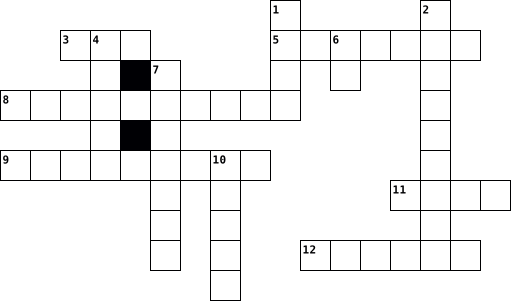
Across
- 광선, 선
- 상상하다
- 학교운동장
- 과학자
- 타다
- 발명하다
Down
- 종류
- 발명품
- ~보다 위에, 위로
- a time 한 번에
- 파리통, 파리 잡는 기계
- 쏘다
12 Clues: 종류 • 쏘다 • 타다 • 발명품 • 과학자 • 상상하다 • 발명하다 • 광선, 선 • 학교운동장 • ~보다 위에, 위로 • a time 한 번에 • 파리통, 파리 잡는 기계
Inventions of the Industrial Revolution 2021-03-02

Across
- What was the name of the invention of the transportation of the locomotive?
- What invention produced multiple spools of thread simultaneously?
- What invention is used to break up tough soil?
- What long vessel ship did Donald McKay invent?
- Who invented the steamboat?
- Who invented the sewing machine?
- Who created the Water Powered Textile Mill?
Down
- What did Cyrus McCormick invent?
- Who created the Cotton Gin?
- Who made the most important technique for making steel in the 19th century?
- What invention was used to send electrical signals along a wire?
- What invention made it to where different gun parts could be switched?
12 Clues: Who created the Cotton Gin? • Who invented the steamboat? • What did Cyrus McCormick invent? • Who invented the sewing machine? • Who created the Water Powered Textile Mill? • What invention is used to break up tough soil? • What long vessel ship did Donald McKay invent? • What invention was used to send electrical signals along a wire? • ...
Military Inventions Around the World 2023-09-14

Across
- Invented by British scientists in 1935.
- Developed in the 9th century Tang dynasty by alchemists looking for immortality.
- Vegetable that the UK government spread a rumor about, saying that they improve eyesight.
- Hungarian physicist who invented the first infrared-sensitive camera.
- Invented by Greeks in Sicily to destroy walls from above.
- Developed the most precise tide-predicting machine.
- Chinese Dynasty that developed the first gunpowder bombs, firearms, and land mines.
Down
- Earliest firearm in the world
- Inventor of a system of mirrors that reflected sunlight onto Roman ships.
- Developed from weapons such as Greek Fire.
- Byzantine inventor that invented anti-tank technology around 120 BC.
- Chinese Dynasty that developed the first naval mines for use against pirates.
12 Clues: Earliest firearm in the world • Invented by British scientists in 1935. • Developed from weapons such as Greek Fire. • Developed the most precise tide-predicting machine. • Invented by Greeks in Sicily to destroy walls from above. • Byzantine inventor that invented anti-tank technology around 120 BC. • ...
LTW 6 U7 GREAT INVENTIONS 2026-03-18

Across
- - MEJORAR
- - DARSE CUENTA
- - AHORRO DE TIEMPO
- - DESCUBRIR
- - AHORRO DE DINERO
- - INVESTIGAR
Down
- - EFECIENTE
- - REPARAR
- - FÁCIL DE USAR
- - DESARROLLAR
- - ESTIMAR
- - AHORRO DE ENERGÍA
12 Clues: - REPARAR • - MEJORAR • - ESTIMAR • - EFECIENTE • - DESCUBRIR • - INVESTIGAR • - DESARROLLAR • - DARSE CUENTA • - FÁCIL DE USAR • - AHORRO DE TIEMPO • - AHORRO DE DINERO • - AHORRO DE ENERGÍA
Inventions that Changed the World 2025-03-26

Across
- The ability of this invention, which 'stores' electrical charge, led to the invention of thousands of other useful electrical devices and machines
- This invention provided a revolutionary way for wooden structures to be held together securely
- Thanks to this invention, people could navigate and explore the world
- For the first time people could reliably keep food in their house fresh without it going bad quickly
- Before this invention, mud and straw were usually used for building
- For the first time you could speak to somebody who wasn't in the same room as you
- Without this invention there would be no cars, bicycles or roller skates
Down
- This 15th century invention meant that multiple copies of books could be made for the first time
- This invention allowed people to travel across the world in less than a day
- This invention allows us to find information about anything in the world
- For the first time, people could control the amount of light around them, including inside their home
- This invention allowed people to see tiny things that they never knew existed before
12 Clues: Before this invention, mud and straw were usually used for building • Thanks to this invention, people could navigate and explore the world • This invention allows us to find information about anything in the world • Without this invention there would be no cars, bicycles or roller skates • ...
Renaissance crossword 2016-11-28

Across
- _____ caused many innovators to experience setbacks
- A form of purchasing a path to heaven condemned and damned by Luther
- The feudal system caused many to have a very poor _______
- The era we live in now is know is the _____
- Wrote many books including the prince
- Before scientific discoveries celestial bodies had an impact on natural affairs. Da vinci had a horoscope of Aries.
- Caused the protestant reformation
- Non-Religious way of doing things. Many artists during the Renaissance created Secular pieces of art. Raphael created Secular pieces of art
- The first to introduced Linear perspective into artwork
- After the Renaissance the European population increased greatly because of the ______ of previously uninhabited areas
- World The Renaissance occurred here
- This is different to every person and there are different types of it. Da Vinci was the first to create artwork that incorporated ________
- Was greatly changed after the Renaissance took place
- The theory of the universe followed by the Church before the theory of heliocentrism was proven by Galileo and other astronomers.
- Created the heliocentric theory
- Office of the church
Down
- When there’s a ruling class. The Medici is an example
- Depending on one’s _____ the might have contributed differently than others to Renaissance.
- A woman author in the French Renaissance who was the French princess
- Copernicus invented this theory
- Luther challenged the church and this happened
- Was invented by Gutenberg
- Many philosophers and innovators believed that people had the right to express themselves and shape their own lives.
- Expanded on a theory about heliocentrism
- Luther loathed a journey that people would take to spiritually significant place. Those who would take this journey had a specific name.
- This faith played a dominant role in the 2 routes that ran across the Western World. These routes caused a deadly plague.
- Worked with Luther to translate the bible into the vernacular creating new versions on his own invention
- Played a large role in the English Renaissance creating plays and pieces of literature that would be forever remembered
- Depending on the status of one on the feudal system you might have different ____?
- A author of mixed cultures who played a role in the French and Italian Renaissance
- The rise of the merchant class led to the downfall of a specific system
- The bible had to be printed in the ______ of the people so that ordinary people could read it
32 Clues: Office of the church • Was invented by Gutenberg • Copernicus invented this theory • Created the heliocentric theory • Caused the protestant reformation • World The Renaissance occurred here • Wrote many books including the prince • Expanded on a theory about heliocentrism • The era we live in now is know is the _____ • Luther challenged the church and this happened • ...
Mesopatamia 2022-11-22

Across
- did Mesopotamia begin? Flooding
- did Mesopotamia fall? Dust Storms
Down
- long did Mesopatamia last? 3,000 years
- founded Mesopotamia? Sumerians
- is Mesopotamia so famous? Important inventions
5 Clues: founded Mesopotamia? Sumerians • did Mesopotamia begin? Flooding • did Mesopotamia fall? Dust Storms • long did Mesopatamia last? 3,000 years • is Mesopotamia so famous? Important inventions
plate tectonic 2024-02-09

Across
- - Name of the supercontinent in the idea of continental drift that our continents today were all joined together to form. Covered about one third of Earth’s surface.
- - When the force of gravity moves a plate downward and away from the ridge.
- Convection (Current) - The movement of a fluid in the mantle, caused by differences in density and temperature, that transfers heat from one part of the fluid to another. Drives tectonic plate motion.
- The layer of hot, solid material between Earth's crust and core. contains more dense elements than the crust such as magnesium and iron.
- the division division of the Earth into different layers based on their physical properties. lithosphere, asthenosphere, mesosphere, outer core, inner core of the Earth into different layers based on their physical properties. lithosphere, asthenosphere, mesosphere, outer core, inner core
- Zone - an area where oceanic crust sinks beneath continental crust at a deep-ocean trench and back into the mantle at a convergent plate boundary.
- the rigid outer part of the earth, consisting of the crust and upper mantle. broken into pieces called tectonic plates.
- - Gravitational force pulling a tectonic plate as it subducts deep into the mantle.
- The soft viscous layer of the upper mantle on which the lithosphere floats.
- of Plate Tectonics - States that Earth’s lithosphere is broken into huge, moving slabs of rock driven by convection currents in the mantle.
Down
- Reversal - A switch in the direction of Earth’s magnetic field so that the magnetic north pole becomes the magnetic south pole and the magnetic south pole becomes the magnetic north pole.
- - The geologist that used sonar to discover seafloor spreading at a mid ocean ridge.
- - (1880-1930): Continental drift (1915) hypothesized that the continents were slowly drifting around the Earth. His hypothesis was not accepted until the 1950’s, when numerous discoveries provided conclusive evidence (plate tectonics).
- The strong, lower part of the mantle between the asthenosphere and the outer core
- - The hypothesis that today’s continents were once part of a single land mass (Pangaea) and drifted to their present day location.
- The central part of the earth below the mantle, contains the most dense elements of Earth's interior.
- Spreading - The process by which new oceanic lithosphere forms as magma rises toward the surface and solidifies.
- Earth's outermost layer, made of primarily less dense materials called silicates. Classified as oceanic and continental crust.
- crust, mantle, core based on chemical makeup of matter
- - Slabs of continental and oceanic crust that move slowly on top of the asthenosphere.
20 Clues: crust, mantle, core based on chemical makeup of matter • - When the force of gravity moves a plate downward and away from the ridge. • The soft viscous layer of the upper mantle on which the lithosphere floats. • The strong, lower part of the mantle between the asthenosphere and the outer core • ...
JOBS IN SCIENCE 2024-05-06

Across
- An __________ is a person who makes new inventions, devices that perform some kind of function
Down
- A person who designs, builds, or maintains engines, machines, or structures.
- A person engaged in chemical research or experiments.
- A person who is qualified to treat people who are ill.
- A person who sets up a business or businesses, taking on financial risks in the hope of profit.
5 Clues: A person engaged in chemical research or experiments. • A person who is qualified to treat people who are ill. • A person who designs, builds, or maintains engines, machines, or structures. • An __________ is a person who makes new inventions, devices that perform some kind of function • ...
Element Names B 2022-11-04

Across
- The last name of Lise Meitner's nephew who was also a famous scientist
- One of the major problems that E.Lawrence and the rest of the scientists on the Manhattan Project had was to solve a way to ___________ the 2 forms of Uranium
- ___________ Oganessian is the person for which the element Og is named for
- Seaborg also helped to develop the extraction process used to isolate the plutonium fuel for the ___________ __________ bomb.
- Enrico Fermi helped orchestrate the first controlled __________ __________
- the name of Hassium is derived from the German state of ___________ where Hassium was first made
- To create his first periodic table, Mendeleev wrote the _____________ of the known 63 elements on cards that he could move around to look for patterns
- Lise Meitner worked with this famous scientist (last name only)
- Georgy Flerov was a s__________ physicist
- ___________ is a super-heavy element synthetically made with a half-life of less than a thousandth of a second which makes it difficult to figure out if it can be used for anything practical.
- Curie actively promoted the use of this to treat pain and suffering (an element)
- At Hanford, Fermi inserted the first _________ fuel slug into the B Reactor. (an element)
- Dynamite, a stabilized form of ____________ was invented in 1867 by Alfred Nobel
- Dmitri Mendeleev's book
Down
- Meitner and her nephew used the idea of Bohr's ___________ ____________ to explain nuclear behavior
- the ACTUAL person who discovered radioactivity
- Glenn Seabog was awarded the Nobel Prize in Chemistry for "discoveries in the chemistry of the ______________ elements."
- This is the place in Tennessee where they separated the Uranium and Plutonium
- _____________ discovered the x-ray
- Flerov helped discover spontaneous __________
- In 1921, President __________, on behalf of the women of America, presented Marie Curie with one gram of one of the elements that she co-discovered in recognition of her contributions to science
- Nobel, finally, found a way to stabilize the compound that is used to make dynamite by adding k___________
- Glenn Seaborg and his colleagues were the first to MAKE this synthetic element
- Enrico Fermi's nickname
- Meitner was the first person to realize that Einstein's idea of making mass into __________ could be used in fission
25 Clues: Enrico Fermi's nickname • Dmitri Mendeleev's book • _____________ discovered the x-ray • Georgy Flerov was a s__________ physicist • Flerov helped discover spontaneous __________ • the ACTUAL person who discovered radioactivity • Lise Meitner worked with this famous scientist (last name only) • The last name of Lise Meitner's nephew who was also a famous scientist • ...
Tristan's Cesar's Lesson 13 Puzzle 2015-01-22

Across
- The famous author Samuel Clemens was known for using a _____ as Mark Twain.
- The ______ bear was sniffing the dead deer looking for food through the blood.
- The first Fluhr who came to America was Oswald, we are _______ because we share the same blood line.
- The man who helped the old lady carry her groceries to her apartment got 10 dollars as a __________ for helping her.
- My family decided to ________ my kitchen because we needed a new refrigerator, our old one broke.
- The murderer gave the ________ because he admitted he knew that he murdered the innocent elder on purpose.
Down
- My dad was the ________ of the raffle of Pacers tickets at his work because of his good sales trip.
- An __________ kid sprayed bug spray all over the campfire so it crackled and started a wildfire on purpose so he could get credit because he put the fire out.
- There was a ______ of sounds before my band concert because everyone was getting ready.
- Leonardo da Vinci made a ______of new inventions that exists today like army weapons.
10 Clues: The famous author Samuel Clemens was known for using a _____ as Mark Twain. • The ______ bear was sniffing the dead deer looking for food through the blood. • Leonardo da Vinci made a ______of new inventions that exists today like army weapons. • There was a ______ of sounds before my band concert because everyone was getting ready. • ...
Unit 2 The Rise of Civilization 2025-11-14

Across
- someone who is trained in a particular career
- for a limited time
- the way a civilization is organized
- a person who writes
- to train a wild animal to be useful to humans
- the later part of the Stone Age, called the New Stone Age, lasted from around 8000 to 3000 B.C.E.
- a Neolithic town discovered in central Turkey
- a means of supplying land with water
- a person who makes money by selling goods
- to provide the means or ability to do something
- an early city that was like a small, independent country with its own laws and government
- an area in southern Mesopotamia where cities first appeared
- an interconnected system of channels or lines
- one of the two largest rivers in Southwest Asia that flow from the mountains in Turkey to the Persian Gulf
- working well; producing very little waste
- in ancient times, the geographic area located between the Tigris and Euphrates rivers
- one who moves from place to place with no permanent home
- an arc-shaped region in Southwest Asia, with rich soil
- to build; usually some kind of structure, such as a house
Down
- the first period of the Stone Age, called the Old Stone Age, from about 2 million years ago to around 8000 B.C.E.
- the business of farming; growing crops and raising animals
- writing that uses wedge-shaped characters
- an ancient Mesopotamian temple tower with outside staircases and a shrine at the top
- a society marked by developed arts, sciences, government, and social structure
- very important
- a symbol that stands for an object
- one of the two largest rivers in Southwest Asia that flow from the mountains in Turkey to the Persian Gulf
- fine particles of rock
- a task or problem that tests a person’s abilities
- a wall of earth built to prevent a river from flooding its banks
- to keep something in good condition by making necessary repairs
- a substance that lies between or above other things
- a characteristic of civilization that includes the beliefs and behaviors of a society or group of people
- a strong disagreement
- arranged in a difficult way
- a craftsperson
- something that can be used to fulfill a need
- the business of buying and selling or exchanging items
- the use of tools and other inventions for practical purposes
39 Clues: very important • a craftsperson • for a limited time • a person who writes • a strong disagreement • fine particles of rock • arranged in a difficult way • a symbol that stands for an object • the way a civilization is organized • a means of supplying land with water • writing that uses wedge-shaped characters • a person who makes money by selling goods • ...
35 Famous Physics 2020-02-21

Across
- The SI unit of power, ‘…….’, is named after him, the concept of ‘horsepower’ was also his brainchild.
- is famous for his contribution to quantum theory, nuclear reactions and nuclear fission.
- His inventions include the first calculation machine know.
- Rightly known as the Father of Electrodynamics, the SI unit for measuring current is named after him. He was the one who laid the foundation of electrodynamics.
- As a tribute to his work, a constant was named after him. ………’s constant or number is the number of elementary entities like the atoms, ions, molecules present in 1 mole of a substance.
- The everyday household mercury thermometer was developed by him.
- is famous for work on Path integral formulation on quantum mechanics, particle physics, theory of quantum electrodynamics and, superfluidity.
- is famous for explaining Black holes and Advances on the General Theory of Relativity and Quantum mechanics.
- is famous for advancement of the 1st and 2nd laws of thermodynamics. Developed absolute thermometric scale.
- is famous for explaining the theories of gravity and mechanics.
- is Famous For his work on the Theory of Electromagnetism and the Kinetic theory of gases
- is famous for explaining Hooke’s Law of Elasticity.
- He was the pioneer who proved the existence of electromagnetic waves.
Down
- is best known for his contributions to the design of the modern alternating current (AC) electricity supply system.
- The ………… effect theory is the foundation for the sonar and radar. The theory says, that the observed frequency of any type of waves is dependent on the speed of the source and observer.
- is famous for the Discovery of electromagnetic induction and came up with the idea for first electrical transformer.
- He not only formulated the first and second Law of Thermodynamics, but also had improved the reliability of the mariner’s compass.
- established the equation of state for liquids and gases that describes the behavior of gases and their condensation on the liquid phase.
- is famous for Showing the existence of the electron.
- originator of the Theory of Relativity.
- is famous for the discovery of radioactivity nature of thorium, polonium and radium.
- is famous for the formulation of the quantum theory.
- is famous for providing a mathematical analysis of the relationship between astronomy and physics.
- originator of the Quantum Theory.
- is famous for inventing the first electric battery.
- He became a household name today for his most important contribution, the ….’s Law. The law states that ‘applied voltage is directly proportional to the resultant electric current divided by the resistance of the material’.
26 Clues: originator of the Quantum Theory. • originator of the Theory of Relativity. • is famous for inventing the first electric battery. • is famous for explaining Hooke’s Law of Elasticity. • is famous for Showing the existence of the electron. • is famous for the formulation of the quantum theory. • His inventions include the first calculation machine know. • ...
Our increasingly integrated world 2024-08-04

Across
- The dispersion, or spread, of different cultural elements between countries and peoples
- The process through which individuals and groups of different cultural backgrounds acquire the basic habits, attitudes, and modes of a dominant culture
- The modification of a culture to incorporate aspects of another culture
- A place where a variety of peoples, cultures or individuals assimilate into a cohesive whole
- Considered to be more mainstream than high culture; it is associated with light forms of entertainment, such as sporting events, television, comics and rock music; also called pop culture
- An economic system of supply and demand
- A public endorsement and recognition of cultural diversity
- A political ideology characterised by an emphasis on free-market capitalism and interventionist foreign policy
- A policy of extending a country's power and influence through colonisation, use of military force, or other means
- Technology-based items that combine elements of different technologies
- The acceptance and integration of different cultural elements into one's own
- The supreme, unrestricted power to govern a state
Down
- The process by which businesses or other organisations develop international influence or start operating on an international scale
- Asserting the interests of a nation, viewed as separate from the interests of other nations; extreme and fanatical devotion to one's own nation
- The circumstances that arise when people from one culture adopt elements of another culture while maintaining their own culture
- A set of shared experiences, norms, symbols and ideas that unite people at the global level
- Using ideas, knowledge or inventions as a means of gaining material wealth through a business enterprise; specialised knowledge of how a product works creates jobs in areas such as information technology (IT) support
- The removal or reduction of restrictions or barriers on the free exchange of goods between nations
- The sequence of processes involved in sourcing raw materials, their transformation of resources into usable inputs, the production of manufactured components, and the assembly of finished products from source to the point of consumption
- Taxes or duties on imports
- Haven A country or territory where resident individuals or resident companies pay little or no tax
- The centres of global economic and cultural authority
- When elements considered to be of lasting value, such as art, literature, theatre, ballet, opera and classical music are incorporated; some critics consider its content to be 'highbrow' or 'intellectual' when compared with popular culture
23 Clues: Taxes or duties on imports • An economic system of supply and demand • The supreme, unrestricted power to govern a state • The centres of global economic and cultural authority • A public endorsement and recognition of cultural diversity • Technology-based items that combine elements of different technologies • ...
Sensation and Perception (Key People) 2013-12-08

Across
- perception researcher that discovered that groups of neurons in the visual cortex respond to different types of visual images (1924-present)
- perception researcher that discovered that groups of neurons in the visual cortex respond to different types of visual images (1926-present)
- researcher that used the visual cliff experiment to determine when human infants can perceive depth
Down
- psychophysicist that contributed to the discoveries of weber's law
- psychophysicist that created weber's law to compute to the difference threshold
5 Clues: psychophysicist that contributed to the discoveries of weber's law • psychophysicist that created weber's law to compute to the difference threshold • researcher that used the visual cliff experiment to determine when human infants can perceive depth • ...
A camera of her own — BRUCKERT 2022-08-23

Across
- (n.) a person who takes pictures usually to get paid
- (adj.) said of a person who is the first to do something such as scientific discoveries or theories
Down
- (n.) in two words, a type of shot that focus on the subject’s face to show its emotions
- (v.) synonyme; increase
- (v.) a piece -usually made of glass- that is use on a camera or others optical instruments to form an image by focusing rays of light
5 Clues: (v.) synonyme; increase • (n.) a person who takes pictures usually to get paid • (n.) in two words, a type of shot that focus on the subject’s face to show its emotions • (adj.) said of a person who is the first to do something such as scientific discoveries or theories • ...
Inventions Created During The Industrial Revolution 2014-01-06

Across
- Let’s a person to communicate with someone far over who also has one of this
- Preserves food over a long duration
- A man made device that emits light
- a series of pictures projected on a screen in rapid succession with objects shown in successive positions slightly changed so as to produce the optical effect of a continuous picture in which the objects move
- a building or group of buildings in which electricity for a large area is produced Moving
- People were able to travel around much more efficiently with the car that was successfully improved
- loss of feeling in a person's body or part of the body through the use of drugs
- Enables a person to play back a record
Down
- a business machine that usually has a money drawer, indicates the amount of each sale, and records the amount of money received.
- a flow of energy charge that would periodically reverse its direction of flow
- Camera Takes images and pictures, and can be used upto 100 snaps of the shutter
- a substance that is usually injected into a person or animal to protect against a particular disease
- a pen containing a reservoir that automatically feeds the writing point with ink
- Allowed sewing to be done faster, creating large sewing factories
- an aircraft vehicle that allowed air travel
- Made it safer to blow up things than simply lighting black powder
16 Clues: A man made device that emits light • Preserves food over a long duration • Enables a person to play back a record • an aircraft vehicle that allowed air travel • Allowed sewing to be done faster, creating large sewing factories • Made it safer to blow up things than simply lighting black powder • ...
Parliaments Financial Aims 2013-02-10

Across
- Parliament wished to abolish this which James agreed to for an annual income of £200,000. Although this failed it became notable that the royal prerogative could be bought.
- Parliament were reluctant to give James additional income as they felt it would lead to loosing their power over James.
- Parliament created the statute of monopolies which meant that Monopolies not concerned with new inventions were seen as illegal.
- Parliament sent a petition to the James concerning Purveyance which after a tactful reply from James, led to the Lords proposing an end to Purveyance.
- The Commons attempt to ‘Buy Out’ Wardship along with the attempt to abolish the Court of Wards as the officers of the Court of Wards had turned the system into corruption.
- Rights – James’ rights as king including purveyance which caused disagreement leading to the dismissal of parliament
- The Crown’s right to buy goods for the royal household at a discounted price.
Down
- Parliament’s attempt to assert their rights to James which included the right of free speech and freedom from arrest.
- Originally a right for inventors which soon developed into a way of rewarding courtiers which was resented by the merchants and the general public.
- Lasting a few weeks the parliament took place to discuss views between James and Parliament. Parliament used this to present petitions about impositions.
- Parliament agreed to fund war only if it was fought at sea.
- Parliament’s success in gaining freedom from arrest excluding treason, felony or breach of peace.
- Parliament wanted to ensure James knew their rights from the start of his reign
- James’ extravagant spending was a main cause of debt which Parliament consistently attempted to lower.
- The Crown’s right to land if the original landowner died without any children over the age of 21.
15 Clues: Parliament agreed to fund war only if it was fought at sea. • The Crown’s right to buy goods for the royal household at a discounted price. • Parliament wanted to ensure James knew their rights from the start of his reign • Parliament’s success in gaining freedom from arrest excluding treason, felony or breach of peace. • ...
P6 2021 2021-08-19

Across
- I've been ice skating for 7-ish? years
- I am relatively normal, however I am slightly color blind.
- I am currently a black belt in taekwondo.
- i like achieving things
- I like to collect sneakers.
- I've been programming for several years, and, on a different note, I aspire to learn multiple spoken languages.
- I love art! I've been doing it since I was little and I've worked with all kinds of mediums including oil paint, acrylic, watercolors, gouache, pencil/charcoal, and colored pencils.
- My baking specialty is cookies and the various types of cookies.
- I've been to almost every continent
- I've been to 10 different countries.
- My two greatest interests are computer science and physics.
- I have played competitive hockey since I was 4, and skated since I was 2. I am a big fan of professional sports, specifically soccer and hockey, and my favorite sports team are the Boston Bruins.
- I lived in Belize for three years
- I am on the redondo wrestling team.
- I play the saxophone and I am in marching band.
- I was born in Denver, Colorado.
Down
- I am currently involved with the schools cross country team and a pretty good runner.
- I know how to use Command Blocks in Minecraft (It's Java based)
- I've been playing guitar since sixth grade off and on.
- In 8th grade I was nominated to go to an all girls stem activity in orange county to represent parras middle school
- I love traveling because I can try all these different foods while doing it.
- I know how to ride a unicycle! Not very well, but I can ride one!
- It's my 3rd year on the surf team.
- I started rollerskating this year.
- I'm learning 2 languages, Spanish and Japanese
- I have done Taekwondo for about 9 years
- I've had the same haircut for 5 years
- I designing specific inventions to solve interesting problems that I face, like making a device that cleans off a used eraser.
- I have been playing the saxophone for 5 years. In the beginning of August, I had my first gig with a jazz trio at a restaurant called Creme de la Crepe in PV. It was very nerve racking, and I was glad when it ended but proud I did it.
- I built a my own computer
- I have tried to go to Greece every year over the summer since I was 3.
31 Clues: i like achieving things • I built a my own computer • I like to collect sneakers. • I was born in Denver, Colorado. • I lived in Belize for three years • It's my 3rd year on the surf team. • I started rollerskating this year. • I've been to almost every continent • I am on the redondo wrestling team. • I've been to 10 different countries. • I've had the same haircut for 5 years • ...
Industrial Revolution 2024-02-16

Across
- founder of modern communism and writer of Communist Manifesto
- Utilization of scientific advancements to boost productivity, including enclosure and crop rotations, resulting in fewer farmers needed
- An economist who explained the concept of free enterprise in his book 'The Wealth of Nations' and advocated for laissez-faire economics
- Inventions that caused a significant increase in manufactured goods, such as the Spinning Jenny and James Watt's improved steam engine
- Scottish engineer and inventor whose improvements in the steam engine led to its wide use in industry (1736-1819).
- First industry to undergo changes in manufacturing during the Industrial Revolution, particularly in clothing production
- The possession of colonies and a large amount of raw materials that facilitated England's industrial dominance
- Essential elements for industrialization: land, labor, and capital
- An economic system based on private ownership and investments for profit, leading to the rise of capitalism
- Geographical advantages such as harbors, rivers, and abundant coal that contributed to England's leading role in the Industrial Revolution
- A very stable economic environment in England during the Industrial Revolution
- A scientist who improved Industrial Revolution conditions by pioneering the heating of liquids to kill germs and identifying the role of germs in diseases
- The movement of people from rural areas to cities due to the decreased need for farmers, resulting in crowded and unsanitary urban environments
- A new social class of merchants, bankers, and landowners that emerged as a result of the Industrial Revolution
Down
- Worsening conditions in factories, characterized by very low pay, long hours, and the exploitation of young children
- An activist who worked to abolish slavery in the British Empire
- An ideology based on Karl Marx's ideas, advocating for the abolition of social classes and private property, and the replacement of competition with cooperation
- The presence of a powerful middle class and the adoption of free enterprise, which brought capital and labor together
- A system where work was done in homes by women before the transition to the factory system
- Fundamental change in the way goods are made, characterized by factors of production: land, labor, and capital
- Advancements Advances such as trains and steam engines that accelerated the Industrial Revolution and made transportation faster and more efficient
- Movements aimed at addressing the social, political, and economic issues arising from the Industrial Revolution, starting in England and then spreading to Europe
- A political movement in response to the injustices of industrial workers, advocating for government ownership and control of the means of production and distribution of goods
- A system where all workers and products were centralized in one building, with machines replacing workers
- A scientist who studied radioactivity, discovered radium, and became the first woman to win a Nobel Prize
25 Clues: founder of modern communism and writer of Communist Manifesto • An activist who worked to abolish slavery in the British Empire • Essential elements for industrialization: land, labor, and capital • A very stable economic environment in England during the Industrial Revolution • ...
Tristan's Cesar's Lesson 13 Puzzle 2015-01-21

Across
- The ______ bear was sniffing the dead deer looking for food through the blood.
- There was a ______ of sounds before my band concert because everyone was getting ready.
- My family decided to ________ my kitchen because we needed a new refrigerator, our old one broke.
- The first Fluhr who came to America was Oswald, we are _______ because we share the same blood line.
- An __________ kid sprayed bug spray all over the campfire so it crackled and started a wildfire on purpose so he could get credit because he put the fire out.
Down
- My dad was the ________ of the raffle of Pacers tickets at his work because of his good sales trip.
- Leonardo da Vinci made a ______of new inventions that exists today like army weapons.
- The man who helped the old lady carry her groceries to her apartment got 10 dollars as a __________ for helping her.
- The famous author Samuel Clemens was known for using a _____ as Mark Twain.
- The murderer gave the ________ because he admitted he knew that he murdered the innocent elder on purpose.
10 Clues: The famous author Samuel Clemens was known for using a _____ as Mark Twain. • The ______ bear was sniffing the dead deer looking for food through the blood. • Leonardo da Vinci made a ______of new inventions that exists today like army weapons. • There was a ______ of sounds before my band concert because everyone was getting ready. • ...
Geo-discoveries 2024-11-23

Across
- Веспуччи
Down
- да Гама
- Колумб
3 Clues: Колумб • да Гама • Веспуччи
Mesopatamia 2022-11-22

Across
- did Mesopotamia begin? Flooding
- did Mesopotamia fall? Dust Storms
Down
- long did Mesopatamia last? 3,000 years
- founded Mesopotamia? Sumerians
- is Mesopotamia so famous? Important inventions
5 Clues: founded Mesopotamia? Sumerians • did Mesopotamia begin? Flooding • did Mesopotamia fall? Dust Storms • long did Mesopatamia last? 3,000 years • is Mesopotamia so famous? Important inventions
Mesopatamia 2022-11-22

Across
- did Mesopotamia begin? Flooding
- did Mesopotamia fall? Dust Storms
Down
- long did Mesopatamia last? 3,000 years
- founded Mesopotamia? Sumerians
- is Mesopotamia so famous? Important inventions
5 Clues: founded Mesopotamia? Sumerians • did Mesopotamia begin? Flooding • did Mesopotamia fall? Dust Storms • long did Mesopatamia last? 3,000 years • is Mesopotamia so famous? Important inventions
Foundations of Health Care Final 2017-12-12

Across
- contracts obligations that are understood without verbally expressed terms
- Health diet, rest, exercise, good posture, and avoiding tobacco and drugs
- examine patients, obtain medical histories, order tests, make diagnoses, perform surgery, treat diseases/disorders, and teach preventative health
- dilemmas Aborted fetuses and research, Euthanasia, Genetic research, and cloning are examples of
- must be clean, neat, and in good repair
- is treatment and prevention of diseases of the gums, bone, and structures supporting the teeth
- the use of audio, video, and computers to provide health care form a distance
- barton the founder of the Red Cross
- the process whereby a government agency authorizes individuals to work in a given occupation
- century the inventions of the stethoscope was during __?
- are amounts that must be paid by the patient for medical services before the policy begins to pay
- pays for the health care of individuals with low incomes, children who qualify for public assistance, and individuals who are physically disabled or blind
- occurs when false statements either cause a person to be ridiculed or damage the person’s reputation
- a set of principles relating to what is morally right or wrong
- consists of many professionals, with different levels of education, ideas, backgrounds, and interests, working together for the benefit of the patient
Down
- is a method that can be used to determine whether communication was successful
- administers medications to cause loss of sensation or feeling during surgery or treatments
- National Institutes of Health
- agencies provide care for terminally ill persons who usually have life expectancies of 6 months or less
- care that results in physical harm, pain, or mental anguish
- US Department of Health and Human Services
- In ancient times, the average lifespan was 20 to __years.
- degree degree is awarded by a career/technical school or community college after completion of a prescribed two-year course of study
- an individual who organizes, manages, and assumes the risk of a business
- can be defined as the body’s reaction to any stimulus that requires a person to adjust to a changing environment
- individual who leads or guides others, or who is in charge or in command of others
- failure to give care that is normally expected of a person in a particular position, resulting in injury to another person
- World Health Organization
- fallopius described the tympanic membrane in the ear and the fallopian tubes of a female
- rome The first hospitals were established in
30 Clues: World Health Organization • National Institutes of Health • must be clean, neat, and in good repair • barton the founder of the Red Cross • US Department of Health and Human Services • rome The first hospitals were established in • century the inventions of the stethoscope was during __? • In ancient times, the average lifespan was 20 to __years. • ...
Midterm review 2024-02-27

Across
- protects symbols, names and slogans used to identify goods and services
- to be released from criminal charges
- a minor wrongdoing
- a person harmed, injured, or killed as a result of a crime, accident, or other event or action
- a system of law concerned with the punishment of those who commit crimes
- the system of law concerned with private relations between members of a community rather than criminal, military, or religious affairs.
- the words carved above the entrance to the Supreme Court of the United States are
- an individual, company, or institution sued or accused in a court of law
- agreement between the plaintiff and the defendant to end the dispute
- includes the right of each party to obtain and present witnesses and evidence
- exclusive legal right, given to an originator or an assignee to print, publish, or perform material, and authorize others to do the same
- responsible for deciding what is true in a case and in a criminal case, deciding whether or not the defendant has committed a crime:
- a person, especially a public official, who institutes legal proceedings against someone
- a neutral panel established by government agencies to settle a variety of disputes among different parties of people and businesses
Down
- a violation or infringement of a law or agreement
- a public official appointed to decide cases in a court of law
- law deals with rules for securing and enforcing legal rights to original ideas and inventions
- all laws, decisions, rules, regulations, or other state action having the effect of law, of any state
- an action or omission that constitutes an offense that may be prosecuted by the state and is punishable by law
- protects new and improved products
- punishment of execution, administered to someone legally convicted of a capital crime
- a series of formal, written statements in which the plaintiff and defendant both state claims for defense regarding the matter being disputed
- first official court appearance for the defendant
- a crime, typically one involving violence, regarded as more serious than a misdemeanor, and usually punishable by imprisonment for more than one year or by death.
- having control or authority over someone or something
- contains the fundamental laws of the United States
- court officer responsible for giving out subpoenas, escorting defendants from jail to the courtroom, protecting safety of all in the courtroom
- civil wrong that causes a claimant to suffer loss or harm, resulting in legal liability for the person who commits the tortious act
28 Clues: a minor wrongdoing • protects new and improved products • to be released from criminal charges • a violation or infringement of a law or agreement • first official court appearance for the defendant • contains the fundamental laws of the United States • having control or authority over someone or something • a public official appointed to decide cases in a court of law • ...
X-Country X-Word -- State Meet Hype Edition!!! 2024-10-31

Across
- Coffee joint, for short
- Where you stand to get some hardware
- Lake Boys XC Legend
- Victory, for short
- Any given autumn Thursday
- School with a Lake XC legend commit
- To kill while chill
- Captivating quality
- Shelter at the meet
- Long run meetup site (abbr.)
- XC camp venue of yore
- Dani's next team
- Food as a noun; eat as a verb
- Not to boast, but her Hoka's even better than the shoe
- Chant heard often Dani's freshman year
- Take nourishment; or, excel at a race
- Flatulent sounding workout
- Dani's place in Lake Girls XC history
- Recurring sod stomps
- Grimly gap competitors
- Could mean feeling weird, freaking out, etc.
- "I'm all set to compete"
- Run somewhere, turn around, return the way you came
Down
- Uniontown vs. Hartville matchup
- Look up your results here
- Go-to trail run site
- Lake park loop
- Big-time PR
- The app that's always watching your runs
- Run these to shave fractions off the curves
- Hill training neighborhood
- State meet venue
- Dani nickname
- Coach who's run every day since before the Civil War
- Lumber salesman; or, regionals site
- There's 5,000 of these on a course
- Where to catch the bus on race day
- Where amazing discoveries happen
- Coach that called up to the big leagues this year
- Coach in flannel
- Tedrick's MS successor
- What a superb race gets you
42 Clues: Big-time PR • Dani nickname • Lake park loop • Dani's next team • State meet venue • Coach in flannel • Victory, for short • Lake Boys XC Legend • To kill while chill • Captivating quality • Shelter at the meet • Go-to trail run site • Recurring sod stomps • XC camp venue of yore • Grimly gap competitors • Tedrick's MS successor • Coffee joint, for short • "I'm all set to compete" • ...
HSC Biology Module 7 2024-07-24

Across
- Protein produced by B cells that binds to specific antigens.
- Disorder of structure or function in an organism.
- Process by which a cell engulfs particles or pathogens.
- Large phagocytic cell that engulfs pathogens and debris.
- Acute diarrheal illness caused by Vibrio cholerae.
- Epidemic that spreads across countries or continents.
- Process of spreading a disease from one individual to another.
- Study of the distribution and determinants of health-related states.
- Infectious protein that causes neurodegenerative diseases.
- Total number of cases of a disease in a population at a given time.
- Widespread occurrence of a disease in a community at a particular time.
- Substance that triggers an immune response.
- Virus that attacks the immune system and causes AIDS.
- Single-celled eukaryotes, some of which cause disease.
- Molecule on antigen-presenting cells that presents antigens to T cells.
- Single-celled microorganisms that can cause disease.
- Body's outer protective barrier against pathogens.
- Disease caused by the SARS-CoV-2 virus.
- Preparation that stimulates an immune response to prevent disease.
- Scientist known for postulates proving the germ theory of disease.
- Organisms that include yeasts and molds, some of which cause disease.
- B cell that remembers a previous infection and responds quickly.
- Process by which an immune cell proliferates in response to an antigen.
- Fungal infection of the skin, also known as ringworm.
- Small parasitic organisms, such as protozoa and fungi.
Down
- Viral infection causing fever, cough, and body aches.
- Bacterial infection causing a thick covering in the throat.
- Scientist known for his discoveries in vaccination and microbial fermentation.
- Plant cells become fortified against attack.
- Eradicated viral disease known for causing severe skin lesions.
- Type of white blood cell involved in inflammation and phagocytosis.
- Hair-like structures that move mucus and trapped particles out of the respiratory tract.
- Number of new cases of a disease in a population over a specific period.
- Substance that inhibits the replication of viruses.
- Type of T cell that kills infected or cancerous cells.
- Body's response to injury or infection, causing redness and swelling.
- Organism that transmits a pathogen from one host to another.
- Ability of an organism to resist infection.
- B cell that produces and secretes antibodies.
- Sticky substance that traps pathogens and particles.
- Substance that kills or inhibits the growth of bacteria.
- Organism that causes disease.
- Type of T cell that helps activate other immune cells.
- Disease caused by Plasmodium parasites, transmitted by mosquitoes.
- Pioneer of epidemiology known for his work on cholera.
- Type of white blood cell that produces antibodies.
46 Clues: Organism that causes disease. • Disease caused by the SARS-CoV-2 virus. • Substance that triggers an immune response. • Ability of an organism to resist infection. • Plant cells become fortified against attack. • B cell that produces and secretes antibodies. • Disorder of structure or function in an organism. • Acute diarrheal illness caused by Vibrio cholerae. • ...
Imperialism 2013-02-20

Across
- Orders given to complete/follow actions, normally given by a leader
- During the industrial revolution, England sent their criminals to an English colony in this country
- The order to influence/direct people or countries
- A country discovers by Captain Cook
- the power of being superior, or being superior over someone or a group of people
- A person who has committed a crime and must serve time in jail, or be transported to work in America
- In the Victorian era, Queen Victoria was named Empress of this country
- A leader/head of an elected governments. E.g, Julia Gillard
- A large group of people, united by a common decent, history, language or culture/beliefs
- To control and conduct the actions and affairs of a state/country
- A leader/ruler of certain counrties who is of royal blood
- A monarch/leader of a country has very much of this. E.g, similar to being rich
- A crime committed against a Monarch or leader which normally lead to terrible punishments in the industrial revolution
- During the Victorian era, many countries where found by Captain Cook. What is another word for found, associated with countries or land?
- A male monarch is a....
- The ability to have authority over objects and people
- An armed conflict between countries over a disagreement or prejudice
Down
- A powerful policy that enables a nation to have authority over other nations (normally gained by war and aggressive behaviour
- In the industrial revolution, one third of this country was controlled by England
- A country or part of a country owned by another nation/country or countries
- A country or nation which is linked with other nations or countries around the world
- A leader of a republican state
- When a country fights a war for freedom. This type of war is called a war for...
- During the industrial revolution, when a convict had committed a crime, they would be sent away to America. This is called?
- During the Victorian era, imperialistic countries gained this from other their people and other countries, for being brave and courageous
- The rule of a king or queen, as Queen Victoria did during the Victorian era
- A nation with its own government, and occupies its own land. E.g, Australia, China, Italy
- A country which is not run by a single monarch, but by a group of people/politicians
- Different countries under the rule of one main nation
- A female monarch is a....
30 Clues: A male monarch is a.... • A female monarch is a.... • A leader of a republican state • A country discovers by Captain Cook • The order to influence/direct people or countries • Different countries under the rule of one main nation • The ability to have authority over objects and people • A leader/ruler of certain counrties who is of royal blood • ...