
energy Crossword Puzzles
Thermodynamics 2024-04-23

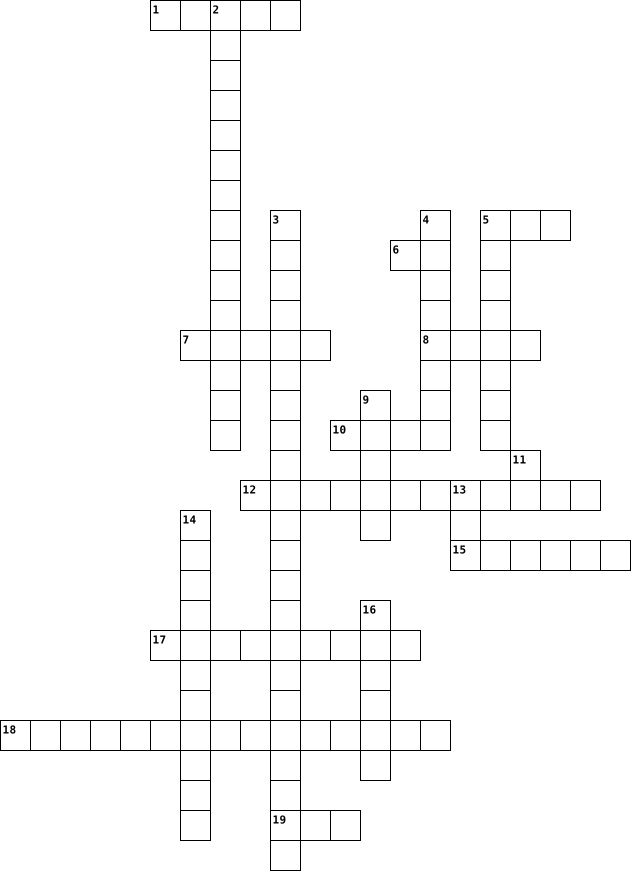
Across
- relating to, or marked by equality of pressure
- State The state of a system in which properties have definite, unchanged values as long as external conditions are unchanged
- Reaction or process of the absorption of heat
- the space between two molecules
- The energy that is transferred from one body to another as the result of a difference in temperature
- Process by which heat is transferred by movement of a heated fluid such as air or water
- the measure of the average heat of the molecules in a substance that gives the degree of hotness or coldness of the substance
- A property that describes how much energy is needed to change the temperature of a material
- a system that can only exchange energy with its surroundings
- The heat required for an object to change phase (melt, boil, freeze, etc)
- a region in space that is of interest
- Thermal energy refers to the energy contained within a system that is responsible for its temperature
- a type of fluid that cannot change its volume under varying pressure
- Relating to or caused by heat or by changes in temperature
- The transfer of thermal energy between two objects by direct contact
- thermodynamic quantity equivalent to the total heat content of a system It is equal to the internal energy of the system plus the product of pressure and volume
- The amount of heat energy required to raise the temperature of one kilogram of the substance by one degree Celsius
- A value from a set of values of total energy for a subatomic particle confined by a force
Down
- a system that cannot exchange either matter or energy with its surroundings
- the energy transferred to or from an object using force along a displacement
- relating to, or marked by volume which remains constant
- two or more atoms connected by chemical bonds
- The degree of disorder within a system or the amount of energy that can’t be used for work
- energy contained in a system
- A form of matter that is uniform throughout in both chemical composition and physical state
- the tendency of matter to change its shape, area, volume, and density in response to a change in temperature
- relating to, or marked by equality of temperature
- the transfer of energy without transfer of heat or mass to the surrounding
- a region outside the system
- a type of fluid that can change its volume under varying pressure
- The study of the relations between heat, work, temperature, and energy
- An instrument that measures temperature
- a system that can exchange matter and energy with its surroundings
- forces between molecules
- The movement of heat from one substance or material to another due to temperature differences
- a region where matter and energy can flow
- The physical process where matter moves from one state to another
- Reaction or process of the release of heat
- The transfer of heat through electromagnetic radiation without any contact between materials
39 Clues: forces between molecules • a region outside the system • energy contained in a system • the space between two molecules • a region in space that is of interest • An instrument that measures temperature • a region where matter and energy can flow • Reaction or process of the release of heat • two or more atoms connected by chemical bonds • ...
Energy Transfer Vocabulary part 1 2023-01-29

Across
- Anything that has mass and takes up space
- Flow of thermal energy from warmer to cooler objects
- A measure of how hot or cold something is
- Energy of moving particles in matter;heat
- Energy that is stored in substances
- Energy you can hear
- Energy you can see;radiant energy
Down
- Stored energy
- Energy of motion
- The ability to cause motion or other changes
- Energy of charged particles
- The force when one object rubs against another
- Energy of moving objects
13 Clues: Stored energy • Energy of motion • Energy you can hear • Energy of moving objects • Energy of charged particles • Energy you can see;radiant energy • Energy that is stored in substances • Anything that has mass and takes up space • A measure of how hot or cold something is • Energy of moving particles in matter;heat • The ability to cause motion or other changes • ...
Electricity Revision Crossword 2016-02-01

Across
- transfers electrical energy into light and heat energy
- measures current
- conducts electricity around the circuit
- thin peace of wire in a lamp
- can make current stop in a circuit and also can make it flow if it is on
- measures voltage
- electro motive force
- something that has very high resistance
- transfers electrical energy into kinetic energy
- resistor that depends on heat
- the thing that is measured by an ameter
- device where electricity can only pass in one way
- altrnating current
Down
- energy devided by time
- where the current goes into two ways
- can be adjusted to change the amount of current in a circuit
- a device that protects another electrical device from electrical shock and fire
- makes current in the circuit smaller
- unit of electric charge
- pushes electrons around the circuit and gives them energy
- current times time
- direct current
22 Clues: direct current • measures current • measures voltage • current times time • altrnating current • electro motive force • energy devided by time • unit of electric charge • thin peace of wire in a lamp • resistor that depends on heat • where the current goes into two ways • makes current in the circuit smaller • conducts electricity around the circuit • ...
Sciencing The Kelp Forest 2023-11-22

Across
- movement of water across a membrane
- type of impact seen immediately
- effect from a stressor
- lower the pH of the ocean
- simplest energy model
- molecules before a chemical reaction
- capacity or number in a population for an area
- outward appearance or result of genetic trait
- type of factor that stops population growth
- type of transport that uses energy
- type of selection attached to random chance
Down
- reaction makes carbon carbon bonds
- species like elephants moving acacia seeds
- type of impact distant in space or time
- cycles like nitrogen
- cellular reaction that makes ATP
- living factor, like prey
- type of transport that does not use energy
- energy molecule for cells
- what shifts or changes in evolution
- energy model that quantifies trophic levels
- most complex model of energy flow
- molecules after a chemical reaction
- nonliving factor
- type of selection attached to an advantage
25 Clues: nonliving factor • cycles like nitrogen • simplest energy model • effect from a stressor • living factor, like prey • lower the pH of the ocean • energy molecule for cells • type of impact seen immediately • cellular reaction that makes ATP • most complex model of energy flow • reaction makes carbon carbon bonds • type of transport that uses energy • ...
physics 2021-11-18
Across
- A push or pull on an object
- physical representation of an object and its interactions in the environment
- Sum of KE and PE
- equation is W/t or Fv
- SI units for power
- Transfer of energy to or from an object
- change in distance of an object
- ability to perform work
- Sum of all forces acting on an object
- what is K in the EPE equation
- potential energy in relation to position on Earth's surface
Down
- equation is -kx
- Energy cannot be created nor destroyed
- Sum of all work being done on an object
- force that occurs when microscopic irregularities of two objects get caught
- SI units for work/energy
- Energy of an object in motion
- equation is 1/2kx^2
- Force needed to stretch/compress a spring increases proportionally with amount of stretch
- Work, Power, KE, and EPE are all these quantities
20 Clues: equation is -kx • Sum of KE and PE • SI units for power • equation is 1/2kx^2 • equation is W/t or Fv • ability to perform work • SI units for work/energy • A push or pull on an object • Energy of an object in motion • what is K in the EPE equation • change in distance of an object • Sum of all forces acting on an object • Energy cannot be created nor destroyed • ...
Photosynthesis 2025-02-26

Across
- Principle energy-supply molecule for cellular functions of all living cells
- Making of ATP using the energy from and H+ ion gradient
- Flattened sac inside the chloroplast
- Inside space of a tubular structure
- Electron donor involved in energy transfers
- The process where NADPH and ATP are used to create G3P
- Reaction that requires chlorophyll and occur on the thylakoid membranes
- Allows plants top absorb energy from light
- Connects granum
Down
- Atom or molecule loses electrons
- The decomposition or separation of molecules by the action of light
- Atom or molecule gains electrons
- Going from a higher concentration to lower concentration
- Stack of thylakoids
- Transport molecule
- Packet of light energy
- Reactions from the Calvin Cycle
- Molecule involved in transfering and provides cells with energy
- Protein-rich gel that fills the membranes interior space
- Crucial structure inside the plant cell
20 Clues: Connects granum • Transport molecule • Stack of thylakoids • Packet of light energy • Reactions from the Calvin Cycle • Atom or molecule loses electrons • Atom or molecule gains electrons • Inside space of a tubular structure • Flattened sac inside the chloroplast • Crucial structure inside the plant cell • Allows plants top absorb energy from light • ...
America Recycles Day 2023-10-18

Across
- Reduce, Reuse,
- Alternate energy source
- Cups and plates that may NEVER fully decompose
- Recycling reduces carbon _________
- 2 natural resources are Air and ________
- April 22 Holiday, _______ Day
- Car pooling reduces the use of
- Has many precious metals that are recycled
- Energy produced from the sun
- Convert yard waste into
- America Recycles Day brought to you by the _____ Team.
Down
- Can be recycled endlessly without loss in quality
- Biden just committed 7 Billion to development of this energy source
- Energy produced by windmills
- Commonly recycled metal
- Number of checkpoints at ORD
- Place where waste is dumped
- Red Solo cup is made of
- Turn out the lights to save
- Lower this a few degrees to save energy
- Office product often recycled
- These boxes cannot be recycled
- Recycle bins at ORD color
- Green living helps protect our
- Buy as rechargeable instead of disposable
25 Clues: Reduce, Reuse, • Commonly recycled metal • Red Solo cup is made of • Alternate energy source • Convert yard waste into • Recycle bins at ORD color • Place where waste is dumped • Turn out the lights to save • Energy produced by windmills • Number of checkpoints at ORD • Energy produced from the sun • Office product often recycled • April 22 Holiday, _______ Day • ...
PHOTOSYNTHESIS 2014-09-21

Across
- the part of the plant that takes in water
- a source of energy for photosynthesis
- the parts of the plant that collect sunlight
- the capacity of a system to do work
- energy from the sun
- what the leaves take in
- the part of the leaf that captures light energy
- what is released through the stomata in groups of 2
- when plant cells capture energy to make food
- an organism,such as a flower,that does photosynthesis
- where carbon dioxide enters the plant
Down
- the color chlorophyll that leaves the plant in Autumn
- organism that can't make its own food
- type of energy stored in cells
- a type of sugar
- what the roots take in
- organism that can make its own food
- the part of the plant where glucose and oxygen are created
- another word for glucose
- the number of stages in photosynthesis
20 Clues: a type of sugar • energy from the sun • what the roots take in • what the leaves take in • another word for glucose • type of energy stored in cells • the capacity of a system to do work • organism that can make its own food • organism that can't make its own food • a source of energy for photosynthesis • where carbon dioxide enters the plant • ...
photosynth & cellular res 2022-03-16

Across
- what is the energy-carrying molecule called
- where chlorophyll is found
- broken down into oxygen and hydrogen
- in humans and animals where do we get glucose
- what simple sugar is broken down in mitochondria
- light-dependant reactions
- light-independent reactions
- pulled from the atmosphere
- what other molecule is needed for the process to happen
- ATP synthase adds _____ to make ADP which makes ATP
- in what organelle does the process happen
- primary pigment used in photosynthesis
Down
- structures that hold the pigments which absorb light energy
- what is the process called
- organisms that get energy from food instead of directly from sunlight
- they make their own chem energy
- the first step of cellular respiration
- what types of cells would need more mitochondria
- the process that plants use to make energy
- organisms that get their energy from the sun
20 Clues: light-dependant reactions • what is the process called • where chlorophyll is found • pulled from the atmosphere • light-independent reactions • they make their own chem energy • broken down into oxygen and hydrogen • the first step of cellular respiration • primary pigment used in photosynthesis • in what organelle does the process happen • ...
Physics 2025-07-17

Across
- In a series circuit, current is the ______ everywhere
- Scientist who proposed the nuclear model
- unit of mass
- when a solid goes straight to a gas
- has magnitude only
- The energy stored in a stretched spring
- Energy needed to change state without changing temperature
- rate of flow of charge
- Energy stored in a moving object Kinetic
Down
- Energy transferred per unit charge potential-difference
- Energy stored due to an object’s position above the ground
- Scientist who proposed the plum pudding model
- The rate of flow of electric charge Current
- how far from original position
- Unit of electrical resistance
- Type of current supplied by batteries DC
- device that melts when too much current flows
- has magnitude and direction
- how far travelled in total
- The state of matter with the least kinetic energy
- a measure of how hard it is for current to flow
21 Clues: unit of mass • has magnitude only • rate of flow of charge • how far travelled in total • has magnitude and direction • how far from original position • Unit of electrical resistance • when a solid goes straight to a gas • Scientist who proposed the nuclear model • Energy stored in a moving object Kinetic • Scientist who proposed the plum pudding model • ...
science words 2022-10-14

Across
- a substance that flows freely
- the degree of compactness of a substance
- heat and energy is through direct contact
- the measure of hotness or coldness
- activity involving mental or physical effort
- travels through space at the speed of light
- that heat is transferred by movement of a heated liquid
- the energy contained within a system.
- a speed of something in a given direction
- firm and stable in shape
Down
- a substance of which does not allow the passage of heat or sound
- stored energy
- physical substance in general
- energy that is transferred from one thing to another
- energy of motion
- a set of things that work together
- a minute portion of matter
- move from one place to another
- the strength required for sustained for physical or mental activity
- a substance of matter that will expand
20 Clues: stored energy • energy of motion • firm and stable in shape • a minute portion of matter • a substance that flows freely • physical substance in general • move from one place to another • the measure of hotness or coldness • a set of things that work together • the energy contained within a system. • a substance of matter that will expand • the degree of compactness of a substance • ...
Biology unit 2 crossword. 2022-09-14

Across
- What is used to make ATP & NADPH?
- What type of enzymes work within optimal ranges of photosynthesis?
- Adenosine Triphosphate
- uses what to split up H2O?
- Dark reactions require no what?
- Organisms need to maintain what?
- Energy is stored in ATP by adding what?
- When a plant has more light intensity it will produce ____ photosynthesis.
- Energy is released when Phosphate is what?
- What is the light reactions location?
Down
- Plants operate within a specific range of what?
- This can cause the plant to decay if it has too much.
- What occurs in chloroplast?
- Dark environments(ocean trenches) have what type of autotrophs?
- use light energy to convert CO2 and HO2 into glucose and oxygen.
- Adenosine Diphosphate
- All organisms get their energy from the ___?
- What is the dark reactions location?
- eat autotrophs to get energy.
- ADP & NADP+ are ____ to be used again.
20 Clues: Adenosine Diphosphate • Adenosine Triphosphate • uses what to split up H2O? • What occurs in chloroplast? • eat autotrophs to get energy. • Dark reactions require no what? • Organisms need to maintain what? • What is used to make ATP & NADPH? • What is the dark reactions location? • What is the light reactions location? • ADP & NADP+ are ____ to be used again. • ...
Unit 3 Pre AP Cell Energy 2013-10-27

Across
- A catabolic process that makes a limited amount of ATP from glucose without an electron transport chain and that produces a characteristic end product, such as ethyl alcohol or lactic acid.
- A complex set of chemical reactions involving an energy transformation where potential chemical energy in the bonds of "food" molecules is released and partially captured in the bonds of adenosine triphosphate (ATP) molecules; creating energy or ATP from glucose and oxygen
- An organism that obtains organic food molecules by eating other organisms or substances derived from them.
- Membranes in chloroplasts that are arranged in flattened sacs and make up the grana, the site of the light reactions
- A molecule used to store energy temporarily in organisms. The molecule is broken down to release energy to drive metabolic processes; 3 phosphate groups, 1 ribose, 1 adenine---hydrolyzed to make ADP and release energy
- An organelle found in large numbers in most cells, in which the biochemical processes of respiration and energy production occur.
- a process used by plants and other autotrophs to capture light and energy and use it to power chemical reactions that convert carbon dioxide and water into oxygen and energy-rich carbohydrates, such as sugars and starches.
- An organelle found in plant and algae cells where photosynthesis occurs
- A biochemical pathway of photosynthesis in which carbon dioxide is converted into glucose using ATP and NADPH.
- The steps in photosynthesis that occur on the thylakoid membranes of the chloroplast and that convert solar energy to the chemical energy of ATP and NADPH, evolving oxygen in the process.
- (with oxygen) glucose is completely oxidized to carbon dioxide and water the total oxidation allows for the maximum amount of energy to be released.
Down
- a type of fermentation; the process used by yeast cells and some bacteria to produce carbon dioxide and ethyl alcohol
- acetyl groups from the pyruvic acids (produced by glycolysis) are broken down to carbon dioxide, accompanied by the formation of ATP and electron carriers; occurs in the matrix of mitochondria.
- Fluid within a chloroplast that contains enzymes involved in the synthesis of carbohydrates during photosynthesis.
- A sequence of electron carrier molecules (membrane proteins) that shuttle electrons during the redox reactions that release energy used to make ATP
- Green pigment in plants that absorbs light energy used to carry out photosynthesis.
- A process in chloroplasts and mitochondria in which the movement of protons down their concentration gradient across a membrane is coupled to the synthesis of ATP
- a type of fermentation; the chemical breakdown of carbohydrates that produces lactic acid as the main end product, can cause muscle soreness
- the three-carbon compound that is produced during glycolysis and needed for both the aerobic and anaerobic pathways
- An organism that makes its own food
- A metabolic process that breaks down carbohydrates and sugars through a series of reactions to either pyruvic acid or lactic acid and release energy for the body in the form of ATP
- A part of light-dependent reactions that contains a light-harvesting complex and a reaction-center complex.
- (without oxygen) Break down of carbohydrates without oxygen where less energy is produced
- An energy-carrying coenzyme produced by glycolysis and the Krebs cycle and carries energy to the electron transport chain, where it is stored in ATP.
24 Clues: An organism that makes its own food • An organelle found in plant and algae cells where photosynthesis occurs • Green pigment in plants that absorbs light energy used to carry out photosynthesis. • (without oxygen) Break down of carbohydrates without oxygen where less energy is produced • ...
Unit 6 Work, Energy, and Momentum Key Terms 2023-01-11

Across
- States that in a closed, isolated system, energy is not created or destroyed, but rather, is conserved.
- Kinetic energy of a system due to its rotational motion, proportional to the system's moment of inertia and the square of its angular velocity.
- A device that makes work easier (but does not change the amount of work) by changing the magnitude or the direction of the force exerted to do work.
- The product of a rotating object's moment of inertia and its angular velocity; measured in kg m^2/s
- The energy of a system that is associated with its motion.
- A type of collision in which the kinetic energy after the collision is less than the kinetic energy before the collision.
- The rate at which energy is transformed.
- For an ideal machine, is equal to the displacement of the effort force divided by displacement of the resistance force.
- Stored energy due to the interactions between objects in a system.
- The stored energy in a system resulting from the gravitational force between objects; represented by the symbol GPE.
- States that the impulse on an object equals the object's final momentum minus the object's initial momentum.
- The sum of kinetic energy and potential energy of the objects in a system.
- States that the momentum of any closed, isolated system does not change.
- The product of the average net force on an object and the time interval over which the force acts.
- The ratio of resistance force to effort force
- A machine consisting of two or more simple machines that are connected so that the resistance force of one machine becomes the effort force of the second machine.
- Stored energy due to an object's change in shape.
Down
- A type of collision in which the kinetic energy before and after the collision remains the same.
- States that when work is done on a system, a change in energy occurs.
- States that the angular impulse on an object is equal to the change in the object's angular momentum.
- The energy of a system due to the system's change in position.
- States that if there are no net external torques on a closed system, then its angular momentum is conserved.
- The force exerted by a machine.
- A closed system on which the net external force is zero.
- The ability of a system to produce a change in itself or in the world around it; represented by the symbol E.
- Unit of power; 1 J of energy transferred in 1 s.
- A system that does not gain or lose mass.
- The force a user exerts on a machine.
- The ratio of output work to input work.
- The position where gravitational potential energy is defined as zero.
- The product of the object's mass and the object's velocity; measure in kg m/s.
- the transfer of energy that occurs when a force is applied through a distance; equal to the product of the system's displacement and the force applied to the system in the direction of displacement.
- The sum of the kinetic energies and potential energies of the particles in a system.
33 Clues: The force exerted by a machine. • The force a user exerts on a machine. • The ratio of output work to input work. • The rate at which energy is transformed. • A system that does not gain or lose mass. • The ratio of resistance force to effort force • Unit of power; 1 J of energy transferred in 1 s. • Stored energy due to an object's change in shape. • ...
Henry crossword science vocab nm3 2023-03-31

Across
- heat transfer through a gas or liquid
- the amount of possible energy
- transfer of kinetic energy
- an item that creates heat
- transfer of heat through direct contact
- energy contained in a system that changes the temp
- an item that does not regularly allow a passage of airflow
Down
- A measure of thermal energy
- The ability to do work
- when an object shrinks
- energy being released
- A body of water or gas moving in one direction
- transfer of heat through waves
- when an object gets larger
14 Clues: energy being released • The ability to do work • when an object shrinks • an item that creates heat • transfer of kinetic energy • when an object gets larger • A measure of thermal energy • the amount of possible energy • transfer of heat through waves • heat transfer through a gas or liquid • transfer of heat through direct contact • A body of water or gas moving in one direction • ...
Forms of Energy 2025-04-03

Across
- the _____ and object moves, the more kinetic energy it has (227)
- every magnet has a north and a ____ pole (231)
- a form of energy that is not causing any changes now, but could cause changes in the future (226)
- a type of potential energy that uses something like a stretched rubber band or compressed spring (226)
- potential energy is also called ____ energy (226)
- when a lightning bub lights up, it changes chemical energy into _____ energy (230)
- a lightning bug uses this form of energy to make light (230)
- the ability to do work or cause change (225)
Down
- the more _____ a moving object has, the more kinetic energy it has (227)
- energy cannot be made or _______ (230)
- energy can change from one ____ to another (225)
- energy that is due to motion (227)
- a force that pushes or pulls on other objects (231)
- a type of potential energy that depends on the position of an object relative to earth (226)
14 Clues: energy that is due to motion (227) • energy cannot be made or _______ (230) • the ability to do work or cause change (225) • every magnet has a north and a ____ pole (231) • energy can change from one ____ to another (225) • potential energy is also called ____ energy (226) • a force that pushes or pulls on other objects (231) • ...
Science Vocab 2022-09-29

Across
- is kinetic energy caused by the transfer of the vibrating particles in the material such as steel, water, etc
- is a form of potential energy related to energy stored in atoms
- the momentum of an object to another
- Is the sum of an object's kinetic energy and potential energy
- related to the potential energy stored in bonds between particles of an atom
- electromagnetic waves being transmitted to space that can cause
- unit of measure for energy
Down
- the amount of energy you get from any type of system
- the kinetic energy of its particles the particles can move faster at a higher temperature than lower.
- is energy that results from the position or motion of charged particles
- is stored energy that an object has due to its position
- energy of an object due to its motion
- the ability to be able to do work or cause LawofConservationofenergy can neither be created nor destroyed
- energy sources that are constantly being replenish,such as sunlight, water,and wind
14 Clues: unit of measure for energy • the momentum of an object to another • energy of an object due to its motion • the amount of energy you get from any type of system • is stored energy that an object has due to its position • Is the sum of an object's kinetic energy and potential energy • is a form of potential energy related to energy stored in atoms • ...
Vocabulary contract #7 2017-01-26

Across
- Positively charged particle of an atom.
- Table where elements are organized by increasing atomic number.
- A fossil fuel refined from natural gas and Petroleum.
- Substance made up of atoms with the same identity.
- Energy sources replenished in a short amount of time.
- Energy sources replenished slower than they are used.
- Looks like a black liquid also known as crude oil.
- Used in nuclear power plants to perform fission which spits the atoms creating energy.
Down
- Energy created by the force of moving water.
- Stored energy and the energy of position.
- Energy of motion; motion of waves, electrons, atoms, molecules, and substances.
- Heat energy from the Earth.
- A solid, black, fossil fuel used for energy.
- Energy from natural matter that was once living.
- A colorless and odorless fossil fuel, made of mostly methane.
15 Clues: Heat energy from the Earth. • Positively charged particle of an atom. • Stored energy and the energy of position. • Energy created by the force of moving water. • A solid, black, fossil fuel used for energy. • Energy from natural matter that was once living. • Substance made up of atoms with the same identity. • Looks like a black liquid also known as crude oil. • ...
Science Vocabulary 2017-02-09

Across
- when light passes outward through space without the need for solids, liquids, or gases
- when heat transfers due to contact
- Resources that people use up faster than nature can replace them
- energy that is doing work or has the potential to do work
- energy from inside the nucleus of an atom
- energy from the electrons of the atom
- another form of energy from vibrating particles
Down
- when heat rises because it is lighter than colder materials
- stored energy that is released when chemicals combine
- energy from the vibrations of atoms called compressions and rarefactions
- energy that is stored
- Natural resources that can be replaced by natural processes in fewer than 100 years
- the ability to cause change
- energy in the form of motion
- energy that travels in the form of a wave
15 Clues: energy that is stored • the ability to cause change • energy in the form of motion • when heat transfers due to contact • energy from the electrons of the atom • energy that travels in the form of a wave • energy from inside the nucleus of an atom • another form of energy from vibrating particles • stored energy that is released when chemicals combine • ...
Electricity Crossword 2021-05-02

Across
- the SI unit for energy
- uses the potential energy in a circuit
- all in the same pathway
- full name for the unit of measure for electric current
- not to be confused with the person who leads an orchestra
- in class this was electricity concept was explained as being similar to amount of water flowing from a hose
- a complete pathway through which electricity can flow
- useful energy out over total energy in
- hour amount of energy used by a 1000 W appliance running for one hour
- you get 120 of these from a standard wall outlet
Down
- slows the flow of electrons
- also called potential difference
- often looks like a striped pill shaped object!
- used to measure different electricity values!
- This is defined as the ability to do work
- Point a fork in the road
- to each their own....pathway
- a battery is one of these
- defined as 1 joule of energy per second
19 Clues: the SI unit for energy • all in the same pathway • Point a fork in the road • a battery is one of these • slows the flow of electrons • to each their own....pathway • also called potential difference • uses the potential energy in a circuit • useful energy out over total energy in • defined as 1 joule of energy per second • This is defined as the ability to do work • ...
Engineer Crosswords A-Z 2015-02-09

Across
- Creating electronical products
- The study of the characteristics and uses of the various materials, such as metals, ceramics, and plastics, that are employed in science and technology.
- A field were engineers find energy that is renewable.
- Create energy through heat.
- Engineering focused on energy storage and usage
- Kill bacteria in water facilities.
- Created IPad
- the branch of engineering concerned with the application of the breakdown (fission)
- Surveying a professional working within the construction industry concerned with construction costs and contracts.
- Construct buildings to be fire retardant
- "let there be light"
- Analyze Seismic activities
- Design luxury "boats"
Down
- Design Structures
- The study of oscillations that occur at an equilibrium point.
- The purification of oxygen
- Involved in the design of products.
- Innovate aerodynamic designs
- In information technology and on the Internet, infrastructure is the physical hardware used to interconnect computers and users.
- Innovate machines that can make viewing bones from the inside possible.
- Studies kinetic energy
- Create Java products.
- is a field of engineering concerned with the activities related to the production of hydrocarbons
- Concerned with the engineering behavior of earth materials
- the branch of geology concerned with water occurring underground or on the surface of the earth.
- deals with the design, construction, and maintenance of the physical and naturally built environment,
26 Clues: Created IPad • Design Structures • "let there be light" • Create Java products. • Design luxury "boats" • Studies kinetic energy • The purification of oxygen • Analyze Seismic activities • Create energy through heat. • Innovate aerodynamic designs • Creating electronical products • Kill bacteria in water facilities. • Involved in the design of products. • ...
Biology Unit 2 2023-09-28

Across
- is an essential nutrient for animals and plants
- end substances after a biological process has occurred
- is the breaking down of sugar molecules into simpler compounds to produce substances that can be used in making chemical energy
- is the process by which green plants and certain other organisms transform light energy into chemical energy
- are organisms that can produce their own food using light, water, carbon dioxide, or other chemicals
- generate most of the chemical energy needed to power the cell's biochemical reactions
- is an organism that eats other plants or animals for energy and nutrients
- the total amount of water on a planet
- is widely distributed forming organic compounds when combined with hydrogen, oxygen, etc
- is a mixture of gases that surrounds the Earth
- plant cell organelles that convert light energy into relatively stable chemical energy via the photosynthetic process
Down
- does not use oxygen to produce energy
- organism that breaks down dead organic material
- includes the rocks and minerals on Earth
- is the process in which glucose is broken down to produce energy
- is a naturally occurring element that is essential for growth and reproduction in both plants and animals
- is the region of the earth that encompasses all living organisms: plants, animals, and bacteria
- anything that takes up space and can be weighed
- is a pigment present in all green plants and a few other organisms
- Requiring air or oxygen for life or survival, used especially to refer to aerobic bacteria
20 Clues: does not use oxygen to produce energy • the total amount of water on a planet • includes the rocks and minerals on Earth • is a mixture of gases that surrounds the Earth • organism that breaks down dead organic material • is an essential nutrient for animals and plants • anything that takes up space and can be weighed • ...
Science Vocabulary Review 2024-09-09

Across
- a place where plants and animals live that have certain weather patterns, temperature, and amounts of rain
- the lack of rainfall in a specific area for a long period of time
- an organism that makes its own food
- an animal that eats only other animals
- a natural disaster that starts over warm water and has an eye
- chain, a diagram that shows how energy is transferred from one organism to the next
- tiny openings on the underside of a leaf that lets carbon dioxide in and oxygen out
- a system of all living and nonliving things that work together
- disaster, a catastrophic event caused by nature
- energy, energy created from the sun
- Resources, things that we get from nature that use on a daily basis
- a giant wave usually caused by an earthquake
- an organism that breaks down dead organisms for energy
- a living thing
- an animal that eats only plants
Down
- energy, energy created from heat from the earth
- the animal that is being hunted
- the green pigment found in plants that captures sunlight
- an animal that eats both plants and other animals
- the animal that is hunting
- energy, energy created from running water
- fuel, made from dead plants and animals that have been buried underground for thousands of years
- a natural disaster that comes from violent shaking of the ground
- an excessive amount of rainfall that causes water to rise over banks
- the sugar that plants make for themselves for energy
25 Clues: a living thing • the animal that is hunting • the animal that is being hunted • an animal that eats only plants • an organism that makes its own food • energy, energy created from the sun • an animal that eats only other animals • energy, energy created from running water • a giant wave usually caused by an earthquake • energy, energy created from heat from the earth • ...
Photosynthesis & Cellular Respiration 2024-04-29

Across
- Site of photosynthesis.
- Sugar that is broken down during respiration to release energy.
- _________ fermentation can occur in yeast and bacteria cells when oxygen levels are low. Ethanol is produced.
- The molecules produced in a chemical reaction are called _________.
- Decreasing light intensity will most likely ________ the rate of photosynthesis.
- Gas that is needed for cellular respiration.
- The prefix photo means _____.
- Pigment molecule stored in the chloroplast that absorb light energy.
- Cellular respiration occurs in ______ and animals.
- An organism that eats other plants and animals for energy.
- C6H12O6 + O2 --> H2O + ATP + _?_
- Site of cellular respiration.
Down
- Increasing CO2 will most likely ________ the rate of photosynthesis.
- An organism that can form its own food through processes like photosynthesis.
- The process of using light energy to form sugar molecules (chemical energy/food)
- The process of converting energy found in food, like sugar, into ATP
- _________ fermentation can occur in muscle cells when oxygen levels are low. An acid is produced.
- Gas needed for photosynthesis.
- The starting molecules of a chemical reaction are called _________.
- _______ respiration occurs when oxygen is present and produces over 30 ATP molecules.
- ______ respiration occurs when there is no oxygen is present and produces only 2 ATP molecules.
- Energy needed to "power" photosynthesis.
- Chlorophyll absorbs red and _____ wavelengths of light the best.
- Energy molecule formed during respiration.
- CO2 + __?__ + Light --> C6H12O6 + O2
- "Uncharged" or "dead" battery (energy molecule)
26 Clues: Site of photosynthesis. • The prefix photo means _____. • Site of cellular respiration. • Gas needed for photosynthesis. • C6H12O6 + O2 --> H2O + ATP + _?_ • CO2 + __?__ + Light --> C6H12O6 + O2 • Energy needed to "power" photosynthesis. • Energy molecule formed during respiration. • Gas that is needed for cellular respiration. • ...
Ecosystems, Environment, and Energy 2024-04-19

Across
- all of the interactions between energy sources in an ecosystem
- a representation of a real object, idea, or concept that scientists use to explain something.
- a model that shows all the different ways that energy can travel.
- the envelope of gases that surround the Earth
- a combination of two or more atoms in a particular way.
- are organisms that eat meat.
- a model that representS one path by which energy can travel through an ecosystem.
- organisms that eat producers, primary consumers, and secondary consumers.
- are organisms that break down dead material and return the nutrients to the soil.
- the process of turning energy from the sun into food for plants.
- all the water in the Earth in all its forms.
- a pyramid where the base of the pyramid represents the producers in a food chain or a food web while each level above represents each group of consumers.
- organisms that eat dead things
Down
- water in all its forms in the Earth.
- an organism that can produce its own energy.
- organisms that eat both plants and animals.
- in every step of the energy pyramid, only ten per cent of the original energy available in that energy level can be used in the next level.
- are organisms that eat plants.
- all the land and rocks in the Earth.
- organisms that are able to make their own food.
- the ability or capacity to do work.
- the system in which all living things in the Earth exist.
22 Clues: are organisms that eat meat. • are organisms that eat plants. • organisms that eat dead things • the ability or capacity to do work. • water in all its forms in the Earth. • all the land and rocks in the Earth. • organisms that eat both plants and animals. • an organism that can produce its own energy. • all the water in the Earth in all its forms. • ...
Kinetic and Potential Energy 2014-10-19

Across
- energy The total amount of potential and kinetic energy in a system is called __________.
- Carbohydrates and proteins each supply about __________ Calories of energy per gram.
- __________ is energy stored by things that stretch or compress.
- a unit of energy that depends on both an object's mass and velocity
- Potential energy can be broken into two types: gravitational and ________.
- Gravitational potential energy depends upon _______ and height.
Down
- potential energy Energy stored in chemical bonds is __________.
- The energy of motion is known as __________ energy.
- When heat from a stove is used to boil water in a saucepan, this is an example of ______.
- Kinetic energy depends upon mass and ________.
- __________ is the ability to cause change.
- Without changing the mass of a moving object, doubling its velocity will __________ its kinetic energy.
- energy __________ is the energy stored in an object due to its position.
13 Clues: __________ is the ability to cause change. • Kinetic energy depends upon mass and ________. • The energy of motion is known as __________ energy. • potential energy Energy stored in chemical bonds is __________. • __________ is energy stored by things that stretch or compress. • Gravitational potential energy depends upon _______ and height. • ...
science 2023-12-07

Across
- carried by electromagnetic waves
- states that energy can be transformed from one form into another or transferred from one region t another,but energy cannot be created or destroyed
- stored energy due to interactions between objects or particles
- due to motion
- carried by an electric current
- transnmitted by electromagnetic waves
Down
- total energy an object or group of objects due to large-scale motions and interactions
- sum of kinetic and potential energy on the particles in matter due to their random motion
- stored in the nucleus of an atom
- carried by sound
- ability to cause damage
- force that resists the motion of two surfaces that are touching
- energy transfer to an object by a force, making the object move in the direction of the force
13 Clues: due to motion • carried by sound • ability to cause damage • carried by an electric current • carried by electromagnetic waves • stored in the nucleus of an atom • transnmitted by electromagnetic waves • stored energy due to interactions between objects or particles • force that resists the motion of two surfaces that are touching • ...
Honors Biology Crossword 2022-12-08

Across
- A cell structure that forms a maze of passageways in which proteins and other materials are carried from one part of the cell to another.
- molecule with an unequal distribution of charge, resulting in the molecule having a positive end and a negative end
- Conversion of light energy from the sun into chemical energy
- Basic unit of matter
- structure made of spindle fibers, centrioles, and aster fibers that is involved in moving and organizing chromosomes before the cell divides
- the powerhouse of the cell
- the study of the transfer of energy
- macromolecule containing hydrogen, oxygen, nitrogen, carbon, and phosphorus
- compound made up of carbon, hydrogen, and oxygen atoms; major source of energy for the human body
- enzyme to which cyclin binds during interphase and mitosis, triggering and controlling activities during the cell cycle
- Movement of specific molecules across cell membranes through protein channels
- Process that releases energy by breaking down glucose and other food molecules in the presence of oxygen
Down
- first step in releasing the energy of glucose, in which a molecule of glucose is broken into two molecules of pyruvic acid
- Clusters of DNA, RNA, and proteins in the nucleus of a cell
- compound used by cells to store and release energy
- A flattened membrane sac inside the chloroplast, used to convert light energy into chemical energy.
- fluid portion of the chloroplast; outside of the thylakoids
- the chemical processes that occur within a living organism in order to maintain life.
- the ability to do work
- repeating subunit of chromatin fibers, consisting of DNA coiled around histones
- programmed cell death
- The form of native DNA, referring to its two adjacent polynucleotide strands wound into a spiral shape
22 Clues: Basic unit of matter • programmed cell death • the ability to do work • the powerhouse of the cell • the study of the transfer of energy • compound used by cells to store and release energy • Clusters of DNA, RNA, and proteins in the nucleus of a cell • fluid portion of the chloroplast; outside of the thylakoids • ...
Earth Day Terms 2023-04-14

Across
- the effect of higher temperatures due to greenhouse gases; another term for climate change
- Three ways to decrease waste include reduce, reuse, and ___.
- the type of energy produced by capturing the sun's rays
- April 22nd, a day to celebrate conservation efforts that protect the planet
- the senator who created the first Earth Day to increase awareness of pollution
- energy-efficient vehicles that are not powered by gas
- the type of energy produced by burning organic material like agricultural waste
- absorbs carbon dioxide and stores it in their biomass; beneficial to the Earth if more are planted
- a diet based on these instead of meat conserves resources and energy
- the type of energy converted by wind turbines
- any harmful substance introduced into the air, soil, or water environments
- any living plant or animal that can be harmed by pollutants
Down
- kilowatt-hours of this can be saved by turning off lights and using energy-efficient lightbulbs
- the energy-efficient vehicle's car part made from lithium, nickel, and cobalt that has a negative impact on the Earth to source
- a measure of the amount of carbon dioxide released into the atmosphere by human activity
- where waste goes to be buried
- the remains of ancient plants and animals (organic material) in the Earth's crust; burning these releases harmful pollutants
- the type of energy captured by moving water
- the category of energy sources that won't run out and produce little to no harmful effects
- The government agency created to help the environment is the Environmental ___ Agency.
- the type of energy produced by the Earth's natural heat
- gallons of this is wasted in homes due to inefficient use and leaky faucets
- fertilizer that food scraps and yard waste can be turned into
23 Clues: where waste goes to be buried • the type of energy captured by moving water • the type of energy converted by wind turbines • energy-efficient vehicles that are not powered by gas • the type of energy produced by capturing the sun's rays • the type of energy produced by the Earth's natural heat • any living plant or animal that can be harmed by pollutants • ...
Solar Energy Crossword Puzzle 2020-04-26

Across
- the unit of electric power, or amount of work (J), done in a unit of time. One ampere of current flowing at a potential of one volt produces one watt of power.
- rate of flow of electric charge, measured in amperes.
- (1) of or pertaining to the sun. (2) utilizing, operated by, or depending on solar energy. (3) manufacturing or providing solar power.
- photovoltaic modules connected together to provide a single electrical output.
- measure of solar radiation energy received on a given surface area in a given time.
- method of harnessing solar energy for thermal energy (heat).
- basic unit of a photovoltaic panel.
- ratio of light reflected from a surface.
- distribution of energy emitted by the sun arranged in order of wavelengths.
- light from the sun; also called solar radiance.
Down
- energy from the sun that is converted into thermal or electrical energy.
- an electric current in which electrons flow in one direction only.
- potential energy that makes the electrical current flow in a circuit by pushing the electrons around (pressure).
- a solar array that follows the path of the sun to maximize the solar radiation incident on the photovoltaic surface.
- an electric current that reverses direction at regular intervals.
- device that converts DC electricity into AC electricity.
- unit of electric current (refers to flow of current)
- standard unit of voltage; one volt produces one ampere of current when acting a resistance of one ohm.
- energy derived from the sun in the form of solar radiation.
- height of the sun above the horizon.
- interconnected assembly of solar cells; also called a panel.
21 Clues: basic unit of a photovoltaic panel. • height of the sun above the horizon. • ratio of light reflected from a surface. • light from the sun; also called solar radiance. • unit of electric current (refers to flow of current) • rate of flow of electric charge, measured in amperes. • device that converts DC electricity into AC electricity. • ...
Life Stages and Energy Requirements 2021-10-13

Across
- The mineral involved in thyroid balance for cats and dogs.
- The first milk a puppy or kitten receives.
- An animal with a BCS 9/9 would be this.
- All energy – energy lost in feces – Energy lost in urine and gases is _________ energy.
- These factors are a mathematical “guesstimate” of how much energy is in a diet.
- The 11th essential amino acid for cats.
- Regulatory bodies have no standardized nutrient profiles available when it comes to this lifestage.
- This life stage lasts between week 3 to week 8.
- Racing sled dogs would do best on a diet that is high in this nutrient.
- This nutrient is ESSENTIAL in the diet for the mother during lactation (when she is producing milk).
- Another word for starving.
- Four fat-soluble vitamins in alphabetical order.
- Milk sugar.
- Stage of life with the highest energy requirement.
- The smallest unit of a carbohydrate.
Down
- The "first milk" a puppy or kitten receives is rich in protein, minerals, and _______________?
- Essential fatty acid for cats.
- This macronutrient provides 9 kcal/gram.
- Dogs and cats should have a maximum of 10% of these in their diet per day.
- Protein ______ indicates the diversity and content of different amino acids in a protein source.
- 1000 calories.
- The diets of racing greyhounds should have increased amounts of this nutrient due to their need of sudden bursts of speed.
- Muscle mass loss in senior animals.
- The energy needed to increase the temperature of one gram (1g) of water 1 degree.
- The first lifestage in a cat or dog's life.
- This molecule is the most important energy source for all organisms.
- __________ energy is all potential the energy in a food.
- _________ proteins contain all 20 essential amino acids.
- The breakdown of protein is called _________.
- The basic building block of protein.
- __________ breed dogs reach adulthood at 24 months old.
31 Clues: Milk sugar. • 1000 calories. • Another word for starving. • Essential fatty acid for cats. • Muscle mass loss in senior animals. • The basic building block of protein. • The smallest unit of a carbohydrate. • An animal with a BCS 9/9 would be this. • The 11th essential amino acid for cats. • This macronutrient provides 9 kcal/gram. • The first milk a puppy or kitten receives. • ...
Ecology Crossword 2022-05-13

Across
- include algae.
- are the first producers of energy-rich compounds that are later used by other organisms.
- show the relative amount of energy or matter contained within each trophic level in a given food chain or food web.
- only a small portion of the energy that passes through any given trophic level is ultimately stored in the bodies of organisms at the next level.
- is a series of steps in which organisms transfer energy by eating and being eaten.
- are animals whose diets usually include both plants and animals.
- feed by chemically breaking down organic matter.
- feed on detritus particles.
- are organisms that rely on other organisms for energy and nutrients.
- the scientific study of interactions among organisms and their physical environment.
- is the use of chemical energy to produce carbohydrates.
Down
- is any living part of the environment with which an organism might interact.
- shows the relative number of individual organisms at each trophic level in an ecosystem.
- obtain energy and nutrients by eating plant leaves, roots, seeds, or fruits.
- captures light energy and uses it to power chemical reactions that convert carbon dioxide and water into oxygen and energy-rich carbohydrates.
- kill and eat other animals.
- is any nonliving part of the environment.
- the total amount of living tissue within a given trophic level.
- include Krill.
- consume the carcasses of other animals that have been killed by predators or have died of other causes.
- have feeding relationships that are much more complicated.
- can capture energy from sunlight or chemicals and convert it into forms that living cells can use.
22 Clues: include algae. • include Krill. • kill and eat other animals. • feed on detritus particles. • is any nonliving part of the environment. • feed by chemically breaking down organic matter. • is the use of chemical energy to produce carbohydrates. • have feeding relationships that are much more complicated. • the total amount of living tissue within a given trophic level. • ...
Ecology 2022-05-10

Across
- physical,or nonliving, factor that shapes an ecosystem.
- first producer of energy-rich compounds that are later used by other organisms.
- organism that is able to capture energy from sunlight or chemicals and use it to produce its own food from inorganic compounds; also called a producer.
- Organism that obtains energy by eating animals.
- any living part of the environment with which an organism might interact.
- Organism that breaks down and obtains energy from dead organic matter.
- Organism that obtains energy by eating only plants.
- All the organisms that live in a place, together with their nonliving environment.
- process which chemical energy is used to produce carbohydrates.
- A group of ecosystems that share similar climates and typical organisms.
Down
- Part of Earth in which life exists including land, water, and air or atmosphere.
- Series of steps in an ecosystem in which organisms transfer energy by eating and being eaten.
- Assemblage of different populations that live together in a defined area.
- Organism that relies on other organisms for its energy and food supply; also called a heterotroph.
- Organism that obtains food by consuming other living things; also called a consumer.
- process used by plants and other autotrophs to capture light energy and use it to power chemical reactions
- Group of individuals of the same species that live in the same area.
- Animal that consumes the carcasses of other animals.
- Organism that obtains energy by eating both plants and animals.
- A group of similar organisms that can breed and produce fertile offspring.
- Scientific study of interactions among organisms and between organisms and their environment.
21 Clues: Organism that obtains energy by eating animals. • Organism that obtains energy by eating only plants. • Animal that consumes the carcasses of other animals. • physical,or nonliving, factor that shapes an ecosystem. • Organism that obtains energy by eating both plants and animals. • process which chemical energy is used to produce carbohydrates. • ...
Science 8 Energy Crossword By: Akay Onat 2022-06-02

Across
- a long bar that can be used to move a heavy object (simple machine)
- the lowest point in the wave
- for every action there is an equal and opposite reaction
- an inclined surface (simple machine)
- The energy of light
- the amount of crests that past a point in one second
- The force on an object is equal to its acceleration times its mass
- Acronym used to remember types of energy
- The potential to move
- The positive particle in an atom
- The highest point in the wave
- a nail with a thread that can be used to hold two objects together (simple machine)
- A wheel is combined with an axle (simple machine)
- Energy can not be created or destroyed
- The negative particle in an atom
Down
- the capacity to gain speed over time
- color with the shortest wavelength
- The energy of heat
- Formula for speed
- The use of nuclear reactions to produce energy
- a large triangular object that can be used to split an object (simple machine)
- cloud Where the elctrons are located
- Where the proton and nuetron are located
- The action of exerting force to complete a task
- the neutral particle in an atom
- color with the longest wavelength
- The energy of motion
- The energy made of the movement of electrons
- unit of force
- unit of energy
- The distance between two crests
- Energy that is stored inside of atomic bonds
- acronym used to remeber colors
- This is wave that sound travels in
- unit of energy
- The conversion of one form of energy to another
- a object will not change its motion unless a force acts upon it
- a wheel and a rope is combined to lift heavy objects (simple machine)
38 Clues: unit of force • unit of energy • unit of energy • Formula for speed • The energy of heat • The energy of light • The energy of motion • The potential to move • the lowest point in the wave • The highest point in the wave • acronym used to remeber colors • the neutral particle in an atom • The distance between two crests • The positive particle in an atom • The negative particle in an atom • ...
New Solar Panels for 2024 - Renewable Energy" 2024-05-21

Across
- - A system that is not connected to the public electricity grid is referred to as ________.
- - A new material being researched for its potential in solar panels.
- - What kind of system uses batteries to store excess solar energy?
- - Energy source that is naturally replenished, such as solar or wind.
- - What is the term for solar energy systems that use mirrors or lenses to concentrate sunlight?
- 90%of the World's solar panels are made from this material
- - A type of solar panel made from a single silicon crystal is called ________ silicon.
- - A type of solar panel made from silicon crystals, typically less efficient but more affordable than monocrystalline panels.
Down
- - The community-owned solar energy projects that allow multiple people to invest are called ________.
- - What do we call the reduction of greenhouse gas emissions from using solar energy?
- - Technology used in solar panels to convert sunlight into electricity.
- - A large-scale installation of solar panels is often referred to as a solar ________.
- - What is the common term for the panels installed on rooftops to harness solar energy?
- - What is the term for the cost savings generated by using solar energy instead of traditional energy sources?
- - A key metric indicating the percentage of sunlight converted into usable energy.
- - The financial incentive for installing solar panels provided by the government is called a ________.
- - A unit of power measurement used to quantify the output of solar panels.
- - A common material used in traditional solar panels.
- - The material used in solar cells that improves efficiency but is expensive is called ________.
- - The term for when solar energy production exceeds consumption and is stored is ________.
20 Clues: - A common material used in traditional solar panels. • 90%of the World's solar panels are made from this material • - What kind of system uses batteries to store excess solar energy? • - A new material being researched for its potential in solar panels. • - Energy source that is naturally replenished, such as solar or wind. • ...
Cell Energy Ch. 8 & 9 2023-10-16

Across
- Process by which cells release energy in the absence of oxygen
- First step in releasing the energy of glucose
- The principal pigment of plants that captures light energy
- Saclike photosynthetic membrane found in chloroplasts
- Reactions of PSN that use energy from light to produce ATP and waste oxygen
- A light absorbing molecule
- A shortage of _______ can affect the rate of the light reactions of PSN
- One of the principal chemical compounds that living things use to store and release energy
- Second stage of cellular respiration in which pyruvate is broken down into CO2 and ATP
- Process that does not require oxygen
- Process that requires oxygen
- A product that is produced by muscle cells when there isn't enough oxygen present
- Organism that can capture energy from the sun and use it to produce its own food
- A product that is produced in yeast when oxygen isn't present
- Differing temperatures can affect _____ and slow down or speed up the rate of PSN.
Down
- The organelle in which PSN takes place
- Process by which plants and some other organisms use light energy to convert CO2 and water into glucose and oxygen
- The organelle in which cellular respiration takes place
- Process that releases energy by breaking down glucose in the presence of oxygen
- Two of these are created at the end of glycolysis
- ATP is often compared to a fully charged _______
- Organism that obtains energy from foods it consumes
- Reactions of PSN in which CO2 and ATP from light reactions is used to make glucose
- A shortage of ______ can affect the rate of the Calvin cycle
- Plants use ____ energy from the sun to produce food
25 Clues: A light absorbing molecule • Process that requires oxygen • Process that does not require oxygen • The organelle in which PSN takes place • First step in releasing the energy of glucose • ATP is often compared to a fully charged _______ • Two of these are created at the end of glycolysis • Organism that obtains energy from foods it consumes • ...
Matter Energy in Ecosystems 2026-04-01

Across
- A part of the cell where the cellular respiration happens
- This makes up all of a Ecosystems dead and alive organisms
- This is when organism make there own food
- this is made from to different atoms called carbon and oxygen
- The result after a process
- This is a reaction when oxygen and glucose release energy into the cells
- A certain energy storage molecule
- This is a energy storage molecule that is made of glucose molecules joined together
- This is a molecule that organisms need to survive
- A organism that needs to feast on other organism in-order to get energy storage molecules
- This is a atom that makes up molecules like energy storage molecules and carbon dioxide
- when two or more things link together
- Living things,such as plants, and animals
Down
- All of the nonliving parts of a ecosystem
- This is a inclosed area that was made by humans
- This is in all animals and humans the fat serves as energy
- The ending substance after a reaction
- This is when plants use sunlight to get energy to change
- This is all living and nonliving things within a area
- Something that requires a process
- This is a part where photosynthesis happen within a cell
- A group of atoms that are together in there own way
- This is a organism that get energy by breaking down dead matter
- This is the ability to make something change or move
- The molecule that release energy that is made of oxygen and carbon hydrogen
- the building blocks of all matter (everything has matter)
26 Clues: The result after a process • Something that requires a process • A certain energy storage molecule • The ending substance after a reaction • when two or more things link together • All of the nonliving parts of a ecosystem • This is when organism make there own food • Living things,such as plants, and animals • This is a inclosed area that was made by humans • ...
Creating An Energy Plan 2024-12-01

Across
- Coal mining is a dangerous job that doesn't earn much ___.
- Power plants are connected to a huge network of infrastructure called the ___.
- One example of ___ are power lines that stand along the sides of streets.
- The steam molecules are hot and under intense pressure, so they have lots of ___ energy.
- Coal has lots of ___ energy stored in it.
- The electromagnet spins at high speeds within a ___ coil.
- We bring coal to a power plant and ___ it into a powder.
- The spinning turbine has lots of ___ energy.
- Infrastructure is stuff the ___ builds to make society run more efficiently.
- Coal comes from the ___.
- The thermal energy from the burning coal is ___ to the water.
- Electricity is the ___ of electrons.
- When we burn coal, its potential energy is turned into ___ energy.
Down
- Inside the generator there is a big ___.
- The grid transports electricity from producers, like DTE, to ___ like homes, hospitals, schools, and restaurants.
- Electrons are tiny balls of energy that ___ around atoms.
- Moving electrons produce a ___ field.
- Once it has been ground into a powder, then we ___ it in a furnace.
- Most electricity in the US comes from ___.
- The spinning electromagnet converts mechanical energy to ___ energy.
- Burning coal produces a lot of air ___.
- The turbine causes a ___ to spin.
- The spinning electromagnet causes the ___ within the copper coil to move.
- The steam blows like hot wind onto a big fan called a ___, causing it to spin.
- Above the furnace where the coal is burned, there is a boiler filled with ___.
- When water gains enough thermal energy, it turns into ___.
26 Clues: Coal comes from the ___. • The turbine causes a ___ to spin. • Electricity is the ___ of electrons. • Moving electrons produce a ___ field. • Burning coal produces a lot of air ___. • Inside the generator there is a big ___. • Coal has lots of ___ energy stored in it. • Most electricity in the US comes from ___. • The spinning turbine has lots of ___ energy. • ...
SCIENCE REVIEW 2025-07-09

Across
- intestine, This long organ is where most of our food is broken down into nutrients
- Earth's crust is broken up into huge __________________________ plates
- Thermal energy transfer from traveling heat waves
- This pair of organs clean your blood and produce urine
- The largest organ in the human body
- The _________________ system sends messages from your brain via the nerves
- This organ holds our urine until we are ready to go the the bathroom
- A smaller river that leads into a larger or main river
- The _______________________ system is what holds our body upright
- The two large sacks part of the respiratory system
- Thermal energy transfer when touching
- The fastest moving type of kinetic energy
- Thermal energy transfer through air or water
- This organ is super important to the Egyptians
- The ______________________ cord protects all the nerves leading to your brain
Down
- A natural bend in a river caused by erosion
- These red blood vessels carry blood away from the heart
- One type of energy moving from one object to another is called an energy _____________________
- This is stored energy that is waiting to become kinetic energy.
- When energy changes from one form to another
- A rock type made from cooled magma
- ________________ energy is vibrations traveling through the air to our ears
- This landform has a wide flat top and steep cliffs
- The ________________________ systems fights diseases and stops bad bacteria
- The long pipe from your mouth to your lungs
- Another word for a key on a map
- This type of map uses contour lines to show how high or low the land is
27 Clues: Another word for a key on a map • A rock type made from cooled magma • The largest organ in the human body • Thermal energy transfer when touching • The fastest moving type of kinetic energy • A natural bend in a river caused by erosion • The long pipe from your mouth to your lungs • When energy changes from one form to another • ...
science crossword puzzle 2023-01-07

Across
- magnetic forces
- potential energy
- transfer
- kinetic energy
- gravity
Down
- magnetic field line
- magnetic field
- model
- force
- isolate
- convert
- attract
- repel
- energy
- refute
15 Clues: model • force • repel • energy • refute • isolate • convert • attract • gravity • transfer • magnetic field • kinetic energy • magnetic forces • potential energy • magnetic field line
Chapter 8 2020-11-13

Across
- unit of power us the joule per second or?
- rate at the time which work is done
- energy energy of motion
- the pivot point
- energy energy due to the position of something or the movement of something
- something that enables an object to do work
- device used to multiply forces or change direction of forces
Down
- the resulting unit of work(also called the newton-meter)
- energy energy that is stored and held in readiness
- force x distance
- fusion high temperature welding of atomic nuclei
- of conservation of energy energy cant be created nor destroyed
- potential energy weight times height
- one of the simplest machines
14 Clues: the pivot point • force x distance • energy energy of motion • one of the simplest machines • rate at the time which work is done • potential energy weight times height • unit of power us the joule per second or? • something that enables an object to do work • fusion high temperature welding of atomic nuclei • energy energy that is stored and held in readiness • ...
Chem 2024-09-25

Across
- is a variant of a chemical element that has the same number of protons but a different number of neutrons in its nucleus. This means isotopes of an element have the same atomic number but different atomic masses
- is a measure of the average kinetic energy of the particles in matter. If you heat an object or substance by transferring energy to it, the atoms will move more vigorously, and its temperature will increase.
- are regions around the nucleus of an atom where electrons are most likely to be found
- kinetic energy, is the mathematical average of the individual kinetic energies of all the particles in a substance or object.
- refers to the process by which heat or electricity is transmitted through a substance
- of conservation of mass, mass is conserved and can neither be created nor destroyed in a physical change or chemical reaction.
- is an ion that has a positive charge, formed when an atom or molecule loses one or more electrons. Since electrons are negatively charged, losing them results in a net positive charge
- is the capacity to move, do work, change matter, or produce heat.
- energy, is the total kinetic energy possessed by all of the individual particles that make up an object or substance.
- Energy, The energy stored within a system due to the positions of its parts
- refers to the transfer of heat through the movement of fluids (liquids or gases)
- are held together by chemical bonds, which form through the electrical attraction between protons and electrons.
- refers to the number of complete waves, or cycles, that pass a given point in a specific amount of time, usually per second
- number, the number of protons in the nucleus of an atom, which determines the chemical properties of an element and its place in the periodic table.
- reaction, heat is absorbed from the surroundings because the reaction products are at a higher energy level than the reactants.
- heat, expressed as j/kg•K. Specific heat varies for different materials.
- is energy that transfers from one object to another because of a temperature difference between the objects. Heat flows spontaneously from a warmer object to a cooler object.
- is an atom or molecule that has gained or lost one or more electrons, resulting in a net electric charge. If an atom loses electrons, it becomes a positively charged ion (cation), and if it gains electrons, it becomes a negatively charged ion
- Potential Energy, A hammer raised by a cam on a turning wheel gains gravitational potential energy. When it drops, potential energy is converted to kinetic energy.
Down
- Energy, The energy of an object's motion is called kinetic energy.
- reaction, heat is released to the surroundings because the reaction products are at a lower energy level than the reactants.
- flow, is the rate at which heat moves from one substance to another. The rate that a substance or a system warms during a chemical reaction can be measured in watts.
- electron, in chemistry refers to the outermost electron(s) of an atom that are involved in chemical bonding
- is a negatively charged ion
- refers to the emission and transmission of energy in the form of waves or particles through space or a medium
- refers to the distance between two consecutive peaks or troughs in a wave
- potential energy, The energy stored in chemical bonds
- configuration, refers to the arrangement of electrons in an atom or molecule
- table, is a tabular arrangement of chemical elements organized by increasing atomic number, which is the number of protons in an atom's nucleus
- typically refers to the maximum extent of a wave's displacement from its rest position
- is a term that describes a property of a substance or object that is large enough to see or measure without magnification, or an observation scale that does not require magnification.
- is the study of energy changes that happen during chemical reactions and changes in state.
- Potential Energy,
33 Clues: Potential Energy, • is a negatively charged ion • potential energy, The energy stored in chemical bonds • is the capacity to move, do work, change matter, or produce heat. • Energy, The energy of an object's motion is called kinetic energy. • heat, expressed as j/kg•K. Specific heat varies for different materials. • ...
Week 27 Bellringer 2021-03-01

Across
- if distance is decreased this means things are getting ___ together
- kinetic energy is energy of ___
- if distance is ___ the force of attraction increases
- these particles lose potential energy while they gain kinetic energy
- opposite charges ___
- *if I wanted to attract something with a negative charge, I would need to put it beside a ___ charge
- negative/positive is an example of what kind of charges (2 words)
- like charges ___
- if distance is increased this means things are getting ___ apart
- if the force of attraction decreases it means the attraction is getting ___
- potential energy is ___ energy
Down
- one factor that increases the strength of an electromagnet is to increase the ___
- negative/negative is an example of what kind of charges (2 words)
- these can produce electric currents by spinning inside a coil of wire
- *if I wanted to repel something with a negative charge, I would need to put it beside a ___ charge
- if distance is ___ the force of attraction decreases
- forces affect each other over a ___
- these particles gain potential energy while they lose kinetic energy
- one factor that increases the strength of an electromagnet is to increase the number of ___
- if the force of attraction increases it means the attraction is getting ___
20 Clues: like charges ___ • opposite charges ___ • potential energy is ___ energy • kinetic energy is energy of ___ • forces affect each other over a ___ • if distance is ___ the force of attraction increases • if distance is ___ the force of attraction decreases • if distance is increased this means things are getting ___ apart • ...
Physics 2017-02-27
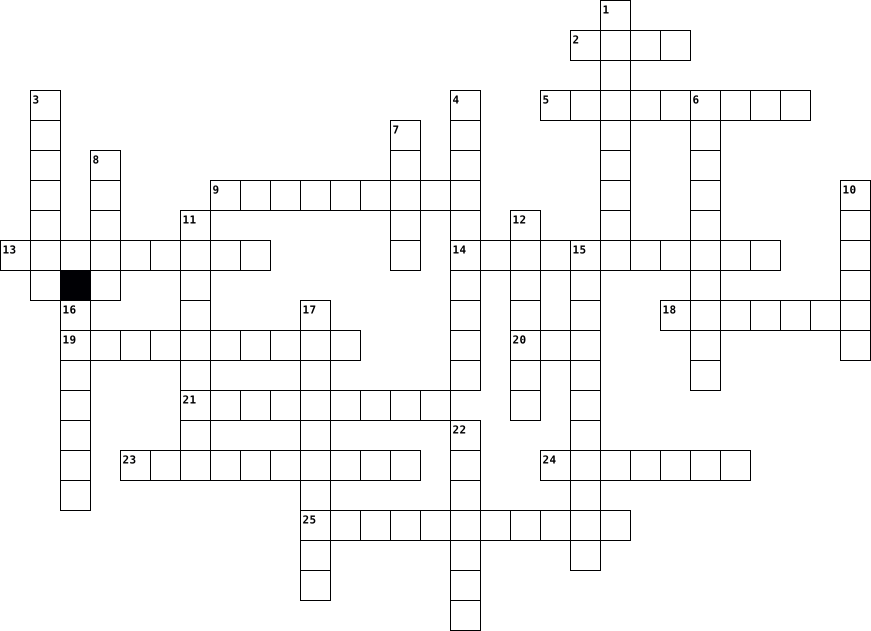
Across
- What most appliances produce, which is wasted energy
- The number of waves that pass a certain point each second
- Maximum displacement of a wave
- A type of radiation used for communication that can also be used to heat foods
- Energy of moving electrons
- The heart of a nuclear power station
- Sound that is too high frequency to hear
- An atom that does not have a neutral charge
- A conclusion based from observations using reasoning skills and previous experiences
- A decision reached by reasoning based from evidence
- The fuel for nuclear power stations
- A type of electromagnetic radiation that can cause sunburn and skin cancer
Down
- Turns kinetic energy into electrical energy
- Movement energy
- The distance between two equal parts of a wave
- A method of testing different hypotheses
- The unit of energy
- Fundamental subatomic particle
- A set of well tested hypotheses or principals that explains observations
- Heat transferred by infra-red waves
- This reduces when a material gets hotter and leads to convection
- Changes the voltage of electricity
- What kind of energy Energy stored in the central part of atoms
- Sound that is too low frequency to hear
- The force of attraction between objects with mass
25 Clues: Movement energy • The unit of energy • Energy of moving electrons • Fundamental subatomic particle • Maximum displacement of a wave • Changes the voltage of electricity • Heat transferred by infra-red waves • The fuel for nuclear power stations • The heart of a nuclear power station • Sound that is too low frequency to hear • A method of testing different hypotheses • ...
Y9 Physics 2024-01-09

Across
- Energy from the Sun.
- Energy transferred via electrons moving.
- Unit of speed where the time is in hours and the distance is in kilometers
- A point about which something turns.
- A machine where the load is bigger than the effort.
- An energy resource that will not run out on a human timescale (e.g. solar power.)
- Balance.
- How fast something moves.
- Unit representing the strength of a force.
- Energy stored in moving things.
- Fuels formed from decomposed organic material over millions of years.
- An upward force in fluids; also called buoyancy.
Down
- The ratio of wasted to used energy.
- A device that generates electricity when exposed to light.
- The conversion of kinetic energy to heat between two objects in contact
- Energy stored in e.g. food, fuel, batteries
- A form of drag in an atmosphere.
- Change speed.
- A type of wave involving moving particles in a fluid.
- Slows things down in a fluid.
- Unit of speed where the time is in seconds and the distance is in metres.
- A form of energy transfer via waves. Usually refers to its visible frequency range (420 THz to 750 THz).
- Unit used to represent the moment of a force.
23 Clues: Balance. • Change speed. • Energy from the Sun. • How fast something moves. • Slows things down in a fluid. • Energy stored in moving things. • A form of drag in an atmosphere. • The ratio of wasted to used energy. • A point about which something turns. • Energy transferred via electrons moving. • Unit representing the strength of a force. • ...
Physics 2022-08-30
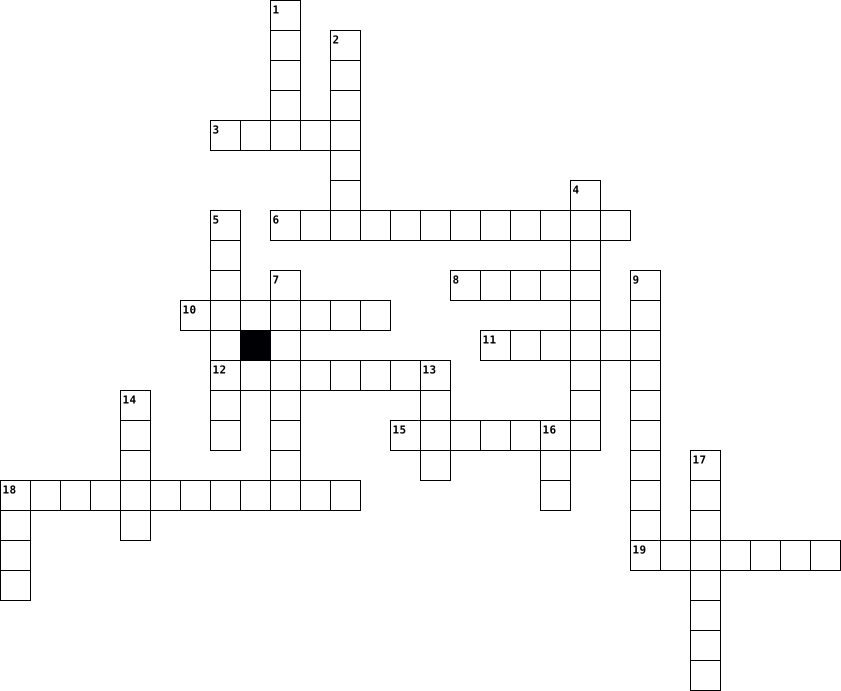
Across
- the push or pull measurement of an object
- how a change in velocity is measured
- A complete vibration
- measurement describing the randomness of a
- how force is measured (think Isaac Newton)
- zero Theoretical lowest temperature
- energy energy that heat generates
- The change in the position of an object in a particular direction is called displacement
- A pure chemical substance that cannot be broken down into anything simpler by chemical or physical means; there are over 100 known elements, the fundamental materials of which all matter is made
Down
- rate or measurement at which work is done
- energy energy in an object in motion
- energy energy stored in an object
- The division between two regions of differing physical properties
- force pushing on an object
- Alternate name for the Celsius scale
- A reflected sound that can be distinguished from the original sound, which usually arrives 0.1 sec or more after the original sound
- Metric unit used to measure work and energy; can also be used to measure heat; equivalent to newton-meter
- Unit of electric current. It is equivalent to coulomb/sec.
- how mass in motion is measured
- energy gravity countering theoretical repulsive force which causes gravity to expand quickly
20 Clues: A complete vibration • force pushing on an object • how mass in motion is measured • energy energy stored in an object • energy energy that heat generates • zero Theoretical lowest temperature • energy energy in an object in motion • how a change in velocity is measured • Alternate name for the Celsius scale • rate or measurement at which work is done • ...
Symbiotic relationships 2025-04-03

Across
- an animal that eats another animal.
- A more realistic and complex way of interconnecting food chains, showing how energy moves.
- an animal that eats only meat/other animals.
- an organism (usually a plant) that makes its own food.
- A simple way of showing the flow of energy through consumption.
- A symbiotic relationship in which all organisms benefit, ex clownfish and anemones.
- an animal that eats both plants and animals.
- The third level on the energy pyramid, eats primary consumers and/or producers.
- The amount of energy lost as heat.
- A symbiotic relationship in which one organism benefits and one organism is harmed, ex humans and tapeworm.
- An organism that consumes or break downs dead matter.
Down
- The top level on the energy pyramid, the top predator with no natural enemies.
- an animal that only eats plants.
- A long term interaction between two or more organisms.
- The levels on an energy pyramid.
- an animal that gets eaten by another animal.
- The second level on the energy pyramid, eats consumers.
- A symbiotic relationship where one organism is benefitted and one is unharmed, Ex whales and whale barnacles.
- The amount of energy that is passed on to the next trophic level.
- an organism (usually an animal) that eats other organisms (usually plants).
20 Clues: an animal that only eats plants. • The levels on an energy pyramid. • The amount of energy lost as heat. • an animal that eats another animal. • an animal that gets eaten by another animal. • an animal that eats only meat/other animals. • an animal that eats both plants and animals. • An organism that consumes or break downs dead matter. • ...
Chapter 12 - Respiration 2024-12-05

Across
- number of molecule of ethanol and carbon dioxide as the product of anaerobic respiration in yeast
- number of molecule of carbon dioxide and water as the product of aerobic respiration
- the chemical breakdown of food molecules in the presence of oxygen to release a large amount of energy
- the chemical breakdown of food molecules in the absence of oxygen.
- gas product of anaerobic respiration in yeast to create bubble in the bread
- an organ where lactic acid been broken down and energy being released
- example of energy needed for
- insufficient oxygen to meet the demands of the vigorous muscular contraction.
- an organelle where energy or ATP being process
Down
- anaerobic respiration in yeast
- product of anaerobic respiration in yeast
- belong to kingdom of fungi where the anaerobic respiration needs in bread making
- all respiration needs
- amount of energy or ATP in aerobic respiration
- product of anaerobic respiration in the muscle
- type of biological molecule where the sugar needs for respiration
- need to remove oxygen debt or lactic acid
- product of aerobic respiration
- the breakdown of food molecules with the release of energy in living cells
- amount of energy or ATP in anaerobic respiration
- form of energy release in respiration
21 Clues: all respiration needs • example of energy needed for • anaerobic respiration in yeast • product of aerobic respiration • form of energy release in respiration • product of anaerobic respiration in yeast • need to remove oxygen debt or lactic acid • amount of energy or ATP in aerobic respiration • product of anaerobic respiration in the muscle • ...
Science - Chapter 2 Vocabulary 2025-09-10

Across
- the amount of material in an object
- ______________ energy - energy related to temperature of on object or a substance
- a material that reduces or stops the flow of energy
- the ability to dissolve in a liquid substance
- Iron is ____________.
- a state of matter that has a definite volume but no definite shape
- Aluminum is ___________.
- a state of matter that does not have its own shape or definite volume
- to _____________ - to cover or surround with a material that reduces or stops the flow of energy
- anything that has mass and takes up space
- to ____________ - to allow the passage of energy through or along a path
- a term that describes whether an object sinks or floats when compared to water
Down
- characteristics that can be observed, measured, or tested
- a state of matter that has a definite shape and volume
- the state of matter a substance is in at a certain temperature
- the measure of how much space an object takes up
- ______________ energy - a form of energy that gives some things the power to work
- the ability of a material to be attracted to a magnet without needing to be a magnet itself
- a specific kind of matter
- to ___________ - to mix completely in liquid
- a material that carries energy easily
21 Clues: Iron is ____________. • Aluminum is ___________. • a specific kind of matter • the amount of material in an object • a material that carries energy easily • anything that has mass and takes up space • to ___________ - to mix completely in liquid • the ability to dissolve in a liquid substance • the measure of how much space an object takes up • ...
Symbiotic relationships 2026-01-30

Across
- an animal that eats another animal.
- A more realistic and complex way of interconnecting food chains, showing how energy moves.
- an animal that eats only meat/other animals.
- an organism (usually a plant) that makes its own food.
- A simple way of showing the flow of energy through consumption.
- A symbiotic relationship in which all organisms benefit, ex clownfish and anemones.
- an animal that eats both plants and animals.
- The third level on the energy pyramid, eats primary consumers and/or producers.
- The amount of energy lost as heat.
- A symbiotic relationship in which one organism benefits and one organism is harmed, ex humans and tapeworm.
- An organism that consumes or break downs dead matter.
Down
- The top level on the energy pyramid, the top predator with no natural enemies.
- an animal that only eats plants.
- A long term interaction between two or more organisms.
- The levels on an energy pyramid.
- an animal that gets eaten by another animal.
- The second level on the energy pyramid, eats consumers.
- A symbiotic relationship where one organism is benefitted and one is unharmed, Ex whales and whale barnacles.
- The amount of energy that is passed on to the next trophic level.
- an organism (usually an animal) that eats other organisms (usually plants).
20 Clues: an animal that only eats plants. • The levels on an energy pyramid. • The amount of energy lost as heat. • an animal that eats another animal. • an animal that gets eaten by another animal. • an animal that eats only meat/other animals. • an animal that eats both plants and animals. • An organism that consumes or break downs dead matter. • ...
Unit 8: Matter and Energy in Ecosystems 2026-03-09

Across
- an organism that gets its energy from eating other organisms
- any living thing
- many overlapping food chains linked together
- shows the amount of energy moving from one feeding level (trophic level) to another
- Waste any substance that is biodegradable and comes from a plant or animal
- an organism that breaks down dead organisms and waste
- chemical substances found in every living thing on Earth
- organisms that eat producers; herbivores
- the process by which food (sugar) is transformed into energy within cells
- the ability to meet the needs of an ecosystem through the transfer of energy and the recycling of matter and nutrients
- made up of the parts of Earth where life exists
- shows the path of energy from one organism to another
Down
- carnivores that eat primary and secondary consumers
- an organism that hunts and kills another organism for food
- an organism that eats primary consumers; can be an omnivore or a carnivore
- anything that has mass and takes up space
- the position an organism occupies in a food chain, food web, or energy pyramid
- an organism that is able to make its own food through the process of photosynthesis
- the process used by producers to convert light energy into chemical energy
- an organism that is hunted and eaten by a predator
20 Clues: any living thing • organisms that eat producers; herbivores • anything that has mass and takes up space • many overlapping food chains linked together • made up of the parts of Earth where life exists • an organism that is hunted and eaten by a predator • carnivores that eat primary and secondary consumers • an organism that breaks down dead organisms and waste • ...
Water/Steam properties 2017-09-05

Across
- Increases or decreases in ________ can change the state of water or steam.
- Thermal energy is used to produce _____ which moves onto the turbines.
- The boiler converts fuel energy to _______ Energy.
- ________ content can be described as the percentage of water in the steam/water mixture.
- This type of pressure changes depending on elevation, but at sea level it is 17.7psia.
- Where the final energy conversion takes place(mechanical energy to electrical energy).
- This type of heat uses more BTU's.
- On this temperature scale water freezes at 0 degrees.
- It takes less ____ to increase the temperature of steam than it does to increase the temperature of subcooled water.
Down
- Specific heat is measured in ___'s.
- The ___________ of saturated water and saturated steam are the same in the transition zone.
- On this temperature scale water boils at 212 degrees.
- Water that is just about to boil is said to be _________ temperature.
- What is pressure measured as in a gauge?
- The energy flow path is a ______ loop that converts Chemical energy into steam energy.
- ________ heat is the amount of heat needed to raise the temperature of one pound of water 1 degree Fahrenheit.
- The amount of heat content, or thermal energy in one pound of a substance.
- Specific ______ is the measurement of the amount of space occupied by one pound of a subject.
18 Clues: This type of heat uses more BTU's. • Specific heat is measured in ___'s. • What is pressure measured as in a gauge? • The boiler converts fuel energy to _______ Energy. • On this temperature scale water boils at 212 degrees. • On this temperature scale water freezes at 0 degrees. • Water that is just about to boil is said to be _________ temperature. • ...
Physics Crossword 2022-08-30

Across
- gravity countering theoretical repulsive force which causes gravity to expand quickly (2 words)
- A body's tendency to resist
- Energy that comes from electrical charge (2 words)
- Measurement of medium and direction of movement of magnitude
- measurement describing the randomness of a system
- attraction force between objects, bodies, and masses in the universes
- helium nucleas radioactive substances emit (2 words)
- When an atom is split by impact with another particle or spontaneously (2 words)
- measurement of magnitude
- Energy that generates heat (2 words)
Down
- energy in an object due to its motion or position (2 words)
- Measurement describing the randomness of a system
- Motion resistance from objects rubbing against each other
- How change in velocity is measured
- Energy stored in an object (2 words)
- Unit used to measure electrical energy
- Energy in an object in motion (2 words)
- The minimum energy needed for any object to be attracted to each other
- The change in an object's position
- When an object emits ionizing radiation
20 Clues: measurement of magnitude • A body's tendency to resist • How change in velocity is measured • The change in an object's position • Energy stored in an object (2 words) • Energy that generates heat (2 words) • Unit used to measure electrical energy • Energy in an object in motion (2 words) • When an object emits ionizing radiation • ...
thermo 2023-05-04

Across
- act of measuring changes in state to determine heat transfer
- heat transferred through direct contact
- type of kinetic energy dealing with heat
- si unit of energy
- si base unit of thermodynamic temperature
- branch of chemistry dealing with temperature
- heat caused when liquid rises and becomes gas
- start of reaction
- amt of energy that must be added to a solid substance to transform it to a gas
Down
- amt of energy that must be added to a liquid substance to transform it to a gas
- heat required to raise the temperature of the unit mass of a given substance by one degree
- releasing heat
- energy made by being in motion
- scale based on water
- absorbing heat
- energy contained within a system responsible for its temperature
- heat sent out in waves
- unit of energy equivalent to amt of heat needed to raise 1 gram of water by 1 degree celsius
- end of reaction
19 Clues: releasing heat • absorbing heat • end of reaction • si unit of energy • start of reaction • scale based on water • heat sent out in waves • energy made by being in motion • heat transferred through direct contact • type of kinetic energy dealing with heat • si base unit of thermodynamic temperature • branch of chemistry dealing with temperature • ...
technology vocabulary 2017-06-14

Across
- Omh's law and has three quantities and this is one of them
- energy can't be created or ruined but it can be converted from one ____ to another
- energy is energy associated with motion
- energy is defined as the ability to do ___
- energy generation creates dangerous waste by-products
- terrariums and hydroponics stations are the most common types of artificial ___
- technology for converting the sun's radiant energy
- any technology no one has thought of before
- use of different modes of transportation
- construction is the systematic act or process of ____
Down
- method of incremental improvement
- a renewable energy source
- is a working model of a product or system
- use of living organisms to improve foods, medicines, and products
- systematic search for the source of a problem so that it can be solved
- very fast trains that have magnets that repel eachother
- generally includes primary and secondary processing
- activity would not be classified as materials processing
- it has to do with structures and a number of requirements
19 Clues: a renewable energy source • method of incremental improvement • energy is energy associated with motion • use of different modes of transportation • is a working model of a product or system • energy is defined as the ability to do ___ • any technology no one has thought of before • technology for converting the sun's radiant energy • ...
Food chains and Food webs 2022-02-08

Across
- percent the amount of energy passed on to the next trophic level
- all members of one species in particular area
- an organism that only eats producers
- primary source of energy for the ecosystems
- web several overlapping food chains linked together
- indicate the direction of the energy flow
- chain where organisms eat other organisms for energy
- an organism that makes its own food
- an organism hunts other organisms for energy
- an organism that eats dead organisms
Down
- an organism that breaks down dead decaying organisms
- consumers an organism that eat secondary consumers mostly carnivores or top predators
- an organism that is hunted
- an organism that eats both plants and animals
- process where plants make their own food
- an organism that eat only meat
- pyramid a diagram that shows the flow of energy from one tropic level to the next
- an organism that ears other organisms for energy
- consumer an organism that consumes producers
- consumer an organism that consumes primary consumers, usually they are omnivores
20 Clues: an organism that is hunted • an organism that eat only meat • an organism that makes its own food • an organism that only eats producers • an organism that eats dead organisms • process where plants make their own food • indicate the direction of the energy flow • primary source of energy for the ecosystems • consumer an organism that consumes producers • ...
Chem. Menu 6 Crossword puzzle 2024-01-31

Across
- delta H equals one mole of a compound
- the sum of the delta H of the individual reaction
- Form Kinetic energy related to random motion of particles
- the substance undergoing chemical or physical change
- process that releases heat energy to the surroundings
- Amount of heat required to raise temperature of a substance
- The capacity to do work or transfer heat
- the process of measuring the amount of heat released or absorbed during a chemical reaction
- lots of movement "hot"
Down
- insulated device used for measuring heat changes in chemical and physical process
- picture or words to describe something
- Everything outside the system
- process that absorbs heat energy from the surroundings
- less movement "cold"
- quantitative measurements of "hot" or "cold"
- used to describe the amount of something
- Energy in and physical changes in terms of the flow and measurement of the energy
- a thermodynamic quantity equivalent to the total heat content of a system
- transfer of energy
19 Clues: transfer of energy • less movement "cold" • lots of movement "hot" • Everything outside the system • delta H equals one mole of a compound • picture or words to describe something • used to describe the amount of something • The capacity to do work or transfer heat • quantitative measurements of "hot" or "cold" • the sum of the delta H of the individual reaction • ...
isaiah 2025-01-24

Across
- a substance that cannot be broken down chemiccaly
- a solid that is formed by precipitation
- substances that exhibit properties of mentals and not metals
- measure of the average kinetic energy of the particles in something
- every living thing has it
- the distance traveled by an object in a certain amount of time
- living things
- energy the stored energy of a substance
- all of the populations sharing a region
- all of the members sharing a specific place
Down
- a substance with all three matter and have physical of luster and a lot of other stuff
- non living things
- energy the energy contained in a moving mass
- a measurement of speed and direction
- the ability to cause change and do work
- a measure of how much matter is in a substance volume
- transfer of the average kinetic energy between things that have different temperature
- resources anything anything that can be used by a source of energy to do work
- boundary a region where two lithospheric plates meet
- a substance made by chemically mixing two elements together
20 Clues: living things • non living things • every living thing has it • a measurement of speed and direction • a solid that is formed by precipitation • the ability to cause change and do work • energy the stored energy of a substance • all of the populations sharing a region • all of the members sharing a specific place • energy the energy contained in a moving mass • ...
Physical Science Crossword 2024-05-08

Across
- Stored energy
- Energy in the form of motion
- Metric temperature scale from 0-100
- The measurable outcome of an experiment
- Heat transfer through open space
- The average kinetic energy of an object’s particles
- The amount of matter in an object
- The amount of energy needed to do a certain amount of work or cause a certain amount of change
- Transfer When energy moves from one object to another object with different temperatures
- Customary temperature scale 32-212
Down
- Heat transfer through a fluid
- Heat transfer through touching
- The variable the scientist controls
- The parts of an experiment that need to stay the same
- The amount of heat needed to raise the temperature of a mass (1 gram) by one degree
- A force that causes some of your kinetic energy to transfer air particles that gradually slows you down
- The energy an object has because of the movement of its molecules
- Speed in a given direction
- Distance with respect to time
19 Clues: Stored energy • Speed in a given direction • Energy in the form of motion • Heat transfer through a fluid • Distance with respect to time • Heat transfer through touching • Heat transfer through open space • The amount of matter in an object • Customary temperature scale 32-212 • The variable the scientist controls • Metric temperature scale from 0-100 • ...
Interdependence of Organisms Crossword 2024-04-23

Across
- shows only one path of energy transfer in an ecosystem
- organisms that get energy from breaking down the nutrients of dead organisms
- organisms that make their own energy from sunlight
- "different nourishment": organisms that rely on other organisms for energy
- organisms that eats only other consumers (animals)
- "self nourishment": organisms that make their own food for energy
- factors in an ecosystem that will limit it's growth
- third level of consumer that eats secondary consumer
- organisms that eats both producers (plants) & consumers (animals)
- relationship where one organism benefits & the other is harmed
- relationship where the predator hunts the prey
- shows multiple paths of energy transfers in an ecosystem
- first level consumer that eats producers
Down
- organisms that eat for energy
- relationship where one organism benefits & the other is unbothered
- relationship where both organisms benefit
- organisms that eats only producers (plants)
- relationship where two organisms compete for resources
- second level consumer that eats primary consumers
19 Clues: organisms that eat for energy • first level consumer that eats producers • relationship where both organisms benefit • organisms that eats only producers (plants) • relationship where the predator hunts the prey • second level consumer that eats primary consumers • organisms that make their own energy from sunlight • organisms that eats only other consumers (animals) • ...
Energy By: Ruhi Patel 2017-01-12

Across
- The amount of matter an object has.
- Move from one place to another.
- An incidental or secondary product made in the synthesis of something else.
- The act of changing physical location or position.
- energy Stored energy.
- A unit of energy (J).
- energy Energy in motion.
Down
- A set of principles or procedures according to which something is done; an organized scheme or method.
- of conservation of energy Energy cannot be created nor destroyed.
- Not existing or not real.
- energy The sum of potential and kinetic energy, and the energy of an object due to its motion or position.
- Make a thorough or dramatic change in the form or appearance.
- The measurement from base to top, or with humans, from head to foot.
- Cause to change in form or function; synonym of transform.
- The action of being moved.
15 Clues: energy Stored energy. • A unit of energy (J). • energy Energy in motion. • Not existing or not real. • The action of being moved. • Move from one place to another. • The amount of matter an object has. • The act of changing physical location or position. • Cause to change in form or function; synonym of transform. • ...
Energy Vocabulary Crossword. 2026-02-10

Across
- Organelle where photosynthesis occurs in plant cells.
- organism that breaks down dead matter and recycles nutrients.
- the primary source of energy for most ecosystems.
- A community of organisms interacting with their environment.
- the ability to do work or cause change.
- process that converts light energy into chemical energy stored as glucose.
- A molecule that stores and provides usable energy for cells.
- An organism that gets energy by eating other organisms.
Down
- Organelle where cellular respiration produces ATP.
- a diagram showing interconnected food chains in an ecosystem.
- The position an organism occupies in a food chain or food web.
- Sugar molecule made during photosynthesis that stores energy.
- An organism that makes its own food using sunlight.
- Process cells use to release energy from glucose.
- form of energy that is lost during energy transfer.
15 Clues: the ability to do work or cause change. • Process cells use to release energy from glucose. • the primary source of energy for most ecosystems. • Organelle where cellular respiration produces ATP. • An organism that makes its own food using sunlight. • form of energy that is lost during energy transfer. • Organelle where photosynthesis occurs in plant cells. • ...
Energy Flow Crosswords 2026-02-10

Across
- Process of light energy turning into chemical energy stored as glucose
- Organism which gets it's energy from others
- Organelle where cellular respiration is done
- Organelle where photosynthesis is done
- An organism that makes it's own food of light energy
- form of energy which is also used to talk about warmth
Down
- The community of organisms interacting with the enviroment
- The molecule which is made from light energy after photosynthesis
- A diagram showing the food chain.
- the process of glucose getting turned into usable cell energy.
- The primary source of energy and where it all starts
- organism which breaks down matter and uses those nutrients and recycles them
- the energy which is used for cells
- The position of an organism on the food chain
- the source of being able to do anything
15 Clues: A diagram showing the food chain. • the energy which is used for cells • Organelle where photosynthesis is done • the source of being able to do anything • Organism which gets it's energy from others • Organelle where cellular respiration is done • The position of an organism on the food chain • The primary source of energy and where it all starts • ...
Energy and its forms: Part 2 2022-02-02

Across
- Mechanical Energy/ energy stored in objects by the application of a force. Compressed springs and stretched rubber bands are examples of this type of energy.
- Energy/ the type of energy produced when a force causes an object or substance to vibrate. The energy is transferred through the substance in a longitudinal wave.
- a device that transforms kinetic energy (mechanical energy) into electrical energy.
- Resources/ can’t be used up by humans. The sun is an example.
- cell/ a device that transforms radiant energy directly into electrical energy. (Also known as a solar cell.)
- the average kinetic energy of the individual particles of a substance.
- Energy/ the energy of position or place. The higher up something is, the more of this type of energy there is.
- of Conservation of Energy/ states that energy is never created or destroyed. Energy changes form, but the total amount of energy in the universe stays the same.
Down
- Resources/ resources that are renewable and cause less harm to the environment. Examples of these resources are solar energy, wind energy, and geothermal energy.
- Plants convert radiant energy from the sun into chemical energy in the form of glucose (sugar).
- a device with blades, which is turned by a force like wind, water, or steam. The mechanical energy of the spinning turbine is converted into electricity by a generator.
- resources/ are used up much faster than they can be replaced. Fossil fuels and uranium are nonrenewable resources.
- resources/ are energy sources that are replaced continually. These include hydropower, solar, wind, geothermal, and biomass.
13 Clues: Resources/ can’t be used up by humans. The sun is an example. • the average kinetic energy of the individual particles of a substance. • a device that transforms kinetic energy (mechanical energy) into electrical energy. • Plants convert radiant energy from the sun into chemical energy in the form of glucose (sugar). • ...
Science 8 Terms Definitions Crossword 2022-05-24

Across
- said in newton's third law that every action has an equal and opposite________
- a simple machine that has a wheel that has a groove on the outside edge
- this wave has compressions and rarefactions
- a simple machine that is a large wheel connected to a cylinder
- using a force to move an object a distance
- this type of energy is
- this is the product of mass and acceleration
- what type of force picture 2 represents
- a simple machine that is a sloping surface like a ramp
- what picture 4 represents in a circuit
- what picture 5 represents in a circuit
- what picture 3 represents in a circuit
- the measurement used to measure energy
- this type of energy is always lost in transfers because of the law of thermodynamics
Down
- when visible light travels, it travels in the form of this type of wave
- this is the acronym that is used to remember energy types
- this type of energy is the result of the flow of electrical charges
- this type of energy comes from the sun
- the rate at which work is done
- what picture 6 represents in a circuit
- this type of energy is when something has the potential to do something
- a simple machine that has a straight rod or board that moves on a fulcrum
- a simple machine that is two inclined planes joined back to back
- a disturbance that carries energy from place to place
- this type of energy is used in batteries
- a simple machine that is an inclined plane wrapped around a cylinder
- what type of force picture 1 represents
- this type of energy is stored in the nuclei of atoms
28 Clues: this type of energy is • the rate at which work is done • this type of energy comes from the sun • what picture 6 represents in a circuit • what picture 4 represents in a circuit • what picture 5 represents in a circuit • what picture 3 represents in a circuit • the measurement used to measure energy • what type of force picture 1 represents • ...
Chapter 4: Energy and Heat 2022-12-13

Across
- involved in cooking on a stovetop and eating a popsicle
- _________, bridges, and roads have spaces in between them to allow for thermal expansion
- two sets of doors with air space in between them provide __________ from outside temperatures
- ___________ is the measure of the average kinetic energy of the particles in a substance
- _______ energy is the energy that an object has because of its motion
- the ability to do work
- the ability of a substance's particles to move faster and expand without changing states
- A _________ allows heat to move through it easily
- heat is controlled by special gold paint, fluid-filled tubes, aerogel, and heaters
- metric system of measurement of temperature
- _______ energy is the total kinetic energy of the particles in a substance
- the amount of thermal energy needed to raise the temperature of 1 gram of water 1°Celsius
- as the space shuttle reentered the earth's atmosphere, extreme temperatures were caused by ________
- the transfer of thermal energy from a warmer substance to a cooler substance
Down
- heat is controlled by a blanket of insulation and ammonia-filled pipes
- heat is controlled by waterproof glass cloth and ceramic tiles
- involved in boiling water or heating a room
- As you increase the temperature of a substance, the speed of its particles _________
- temperature is measured with a ___________
- When most particles are heated they
- imperial system of measurement of temperature
- heat transfer that occurs when there are no particles to carry the energy
- Controlling heat during space travel is necessary to protect astronauts from exposure to _______ temperatures
- a substance that releases energy when it burns
- heat flows from ______ objects to cooler objects
25 Clues: the ability to do work • When most particles are heated they • temperature is measured with a ___________ • involved in boiling water or heating a room • metric system of measurement of temperature • imperial system of measurement of temperature • a substance that releases energy when it burns • heat flows from ______ objects to cooler objects • ...
Cycles 2014-12-02

Across
- All the organisms on Earth
- Ways that matter or energy is moved through a cycle
- Describes a change where energy is taken away - deposition, freezing, condensation
- Going directly from solid to gas
- The energy that drives all the water cycle.
- Reservoir that stores 2% of water on Earth as solid water
- Type of change that creates a new substance, a reaction occurs.
- Rain, hail, snow, sleet.
- The system that includes the Earth's crust, mantle, and core
- One of the processes that moves water from the biosphere to the atmosphere; evaporation from plants.
- When water falls on the crust and goes into the Earth
- The type of matter with the highest kinetic energy; particles fly freely.
- Change in size, shape or state.
- A state change; water to water vapor.
Down
- Places where matter or energy is stored in a cycle
- Gaseous state of water.
- Evaporation of water from animals.
- The system that protects the Earth; a layer of gases like a blanket.
- Process in plants that takes water from the atmosphere into the biosphere and uses it to create energy.
- Reservoir that stores the majority of water on Earth as salt water.
- Series of repeating events that move energy and/or matter through a system - no beginning or end
- Describes a change where energy is added - melting, sublimation, or evaporation.
- All the water on the planet.
- Process that forms clouds.
- Going directly from water vapor to solid, like frost.
- Water that has infiltrated the crust and is stored there.
- Drives the cycles.
- Solid state of water
- Water that falls on land and moves to reservoirs.
- The type of matter with the lowest kinetic energy; particles just vibrate in place.
- H2O
31 Clues: H2O • Drives the cycles. • Solid state of water • Gaseous state of water. • Rain, hail, snow, sleet. • All the organisms on Earth • Process that forms clouds. • All the water on the planet. • Change in size, shape or state. • Going directly from solid to gas • Evaporation of water from animals. • A state change; water to water vapor. • The energy that drives all the water cycle. • ...
Unit 6 vocab 2022-03-24

Across
- a material in which charges cannot move freely
- an element or compound
- a coil that has a soft iron core
- a reason where a magnetic force can be detected
- any region in which a physical force has an effect
- a device that increases or decreases the voltage of alternating current
- the force that opposes the movement of two surfaces
- the sum of an object's kinetic energy and potential energy due to gravity or elastic deformation, does not include chemical energy or nuclear energy
- the energy of an object that is due to the object's motion
- the force of attraction or repulsion
- a force parallel to the velocity of the flow
- any material that attracts iron or materials containing iron
- the path that a body follows
Down
- the force that resists the start of sliding
- a coil of wire with an electric current in it
- the process of creating a current in a circuit by changing the magnetic field
- a material in which charges can move freely
- the energy that an object has because of the position, condition, or chemical composition of the object
- the interaction between electricity and magnetism
- electric charge at rest
- one or two points such as the ends of a magnet
- a device that converts mechanical energy into electric energy
- a fundamental property
- push or pull
- a force of attraction
- the motion of a body
- a device that converts electrical energy into mechanical energy
- the tendency of an object to resist a change in motion
- the combination of all of the forces acting on an object
29 Clues: push or pull • the motion of a body • a force of attraction • an element or compound • a fundamental property • electric charge at rest • the path that a body follows • a coil that has a soft iron core • the force of attraction or repulsion • the force that resists the start of sliding • a material in which charges can move freely • a force parallel to the velocity of the flow • ...
Module 5 Cellular Energy 2023-11-16

Across
- organelle where the Calvin cycle takes place
- fold in the mitochondrial membrane
- first stage of cellular respiration where glucose is split
- energy transfer in phosphorylation when this group is moved between molecules
- technique using a solvent to separate mixtures of compounds onto filter paper
- cellular process producing ATP without oxygen
- this cycle uses CO2 to complete the breakdown of pyruvic acid molecules, releasing energy
- an organic compound giving a specific color to plant or animal cells
- stacks of thylakoids
- organism which uses fermentation in bread making
- organelle where the Krebs cycle takes place
- gel-like fluid found inside inner membrane of a chloroplast
- this is needed for photosynthesis and allows absorption of energy from light
- disk-shaped sac suspended in the stroma of chloroplasts; site of light reactions in photosynthesis
Down
- pigments in plants that absorb light-energy in the blue-green and violet wavelengths and reflect yellow/orange
- requiring oxygen
- process by which green plants use sunlight energy and simple chemicals to produce their own food
- this reaction converts pyruvic acid to acetyl coenzyme A
- without oxygen
- pigments in plants that absorb blue, blue-green, green light and reflect red
- blue pigments in cyanobacteria that reflect blue light
- abbreviation for the series of electron-carrying molecules within a membrane that transfer electrons, releasing energy
- location where glycolysis takes place
- energy unit produced in cellular respiration
- total number of ATP produced with cellular respiration
- this cycle takes CO2 and converts it to sugar
- cluster of chlorophyll in the thylakoid membrane that absorbs light energy
- this is the reaction that converts sun energy into chemical energy
28 Clues: without oxygen • requiring oxygen • stacks of thylakoids • fold in the mitochondrial membrane • location where glycolysis takes place • organelle where the Krebs cycle takes place • organelle where the Calvin cycle takes place • energy unit produced in cellular respiration • cellular process producing ATP without oxygen • this cycle takes CO2 and converts it to sugar • ...
Matter and Energy in Ecosystems 2025-02-09

Across
- a type of energy storage molecule.
- an organism that needs to eat in order to get energy storage molecules.
- a group of atoms joined together in particular way.
- respiration the chemical reaction between oxygen and glucose that release energy into cells.
- a type of energy storage molecule.
- something that results from a process.
- a set of interacting parts forming a complex whole.
- matter that makes up the living and dead organisms in an ecosystem.
- the tiny pieces that all matter-all the stuff in the world-is made of.
- living things, such as plants, animals and bacteria.
- dioxide a molecule made of carbon and oxygen atoms.
- something that is required for a process.
- storage molecule a molecule that organisms can use to release the energy they need to survive.
Down
- the ability to make things move or change
- the process by which plants and other producers use energy from sunlight to change carbon dioxide and water into oxygen and glucose.
- the part of cell where photosynthesis happens.
- to link two or more things.
- an ending substance that is made during a chemical reaction.
- an organism that gets energy storage molecules (such as glucose) by breaking down dead matter.
- that part of a cell where cellular respiration happens.
- a molecule that organisms can use to release energy, and that is made of carbon, hydrogen, and oxygen atoms.
- a type of atom (a tiny piece) that makes up molecules such as carbon dioxide and energy storage molecules.
- a closed ecosystem made by humans.
- a type of energy storage molecule made of many glucose molecules connected together.
- all the living and nonliving things interacting in a particular area.
- a starting substance that is part of chemical reaction.
- matter that makes up the nonliving parts of an ecosystem, such as air, water, and rocks.
- an organim that can make its own energy storage molecules (such as glucose)
28 Clues: to link two or more things. • a type of energy storage molecule. • a closed ecosystem made by humans. • a type of energy storage molecule. • something that results from a process. • the ability to make things move or change • something that is required for a process. • the part of cell where photosynthesis happens. • a group of atoms joined together in particular way. • ...
Unit 7.2 Chemical Reactions and Energy 2025-01-15

Across
- Individuals or groups who have a vested interest in a particular project or decision
- Chemical reaction that needs a constant input of energy to continue because it takes more energy to break bonds in the reactants than is released when new bonds form in the products.
- Law stating that energy cannot be created or destroyed in chemical reactions.
- An apparatus in which environmental conditions, such as temperature and humidity, can be controlled
- The series of effects that result from a single action or decision
- Process in which some substances, called reactants, change chemically into different substances, called products
- Change in matter that occurs when matter changes chemically into an entirely different substance with different chemical properties.
- To make something as effective as possible
- The relocation of energy from one place to another, usually in a different form.
- substance that starts a chemical reaction
- Factors that limit or restrict what can be done or achieved
- A set of standards or rules used to evaluate or judge something
- Chemical reaction that releases energy because it takes less energy to break bonds in the reactants than is released when new bonds form in the product.
- Transfer of thermal energy between objects that have different temperatures.
- Change in one or more of matter’s physical properties.
Down
- The compromises or sacrifices made when choosing between two or more options
- preliminary version of a product or a system used for testing and evaluation
- Law stating that matter cannot be created or destroyed in chemical reactions.
- Energy Total kinetic energy of all the atoms that make up an object.
- Best or ideal
- Average kinetic energy of particles of matter.
- Substance that is produced in a chemical reaction.
22 Clues: Best or ideal • substance that starts a chemical reaction • To make something as effective as possible • Average kinetic energy of particles of matter. • Substance that is produced in a chemical reaction. • Change in one or more of matter’s physical properties. • Factors that limit or restrict what can be done or achieved • ...
Chemistry chapter 5 word puzzle 2025-10-14

Across
- the pattern of colored lines, it turned out to be unique for each element
- states that no two identical fermions can occupy the same quantum state simultaneously
- they are the outermost shell in the atom which are involved in chemical bonding
- are dots that represent the valence electrons involve only the outer s and p electrons
- a shorthand for writing an element's electron configuration where the symbol of the noble gas that comes immediately before the element is placed in brackets
- states that electrons must fill the lowest energy sublevel before any can be placed higher
- electrons with the lowest energy state, and can only go up to 7 energy levels.
- an atom or group of atoms with a nonzero charge is an ion
- is the fundamental property of all submicroscopic systems that cannot be avoided
Down
- that have absorbed energy and moved some of their electrons to higher energy levels.
- are the distance of an electron from the nucleus corresponding to a particular energy level
- identifies the principle or main energy level of an electron
- The arrangement of electrons in an atom of an element in its ground state
- Negative ion
- used to illustrate the electron configuration of an atom
- are mass less light particles
- it states that electrons are both particles and waves which is a dual nature
- states that as electrons fill a sublevel, all orbitals receive one electron with the same spin before electrons begin to pair up
- Positive ion
- it divides the orbits and tells how many electrons a orbit can have
20 Clues: Negative ion • Positive ion • are mass less light particles • used to illustrate the electron configuration of an atom • an atom or group of atoms with a nonzero charge is an ion • identifies the principle or main energy level of an electron • it divides the orbits and tells how many electrons a orbit can have • ...
UNIT 9 RENEWABLE ENERGY 2015-04-28

Across
- the study of the choices people make as they use and distribute limited resources
- energy sources that are stil in development
- the energy within the nucles of an atom
- saving energy
- crumbly materials made from plant and animal matter that is spread on gardens and feilds to enrich soil
- a pond that has a sealed bottom
- the energy from heat in te eath's crust
- liquid that has passed through compacted solid waste in a landfill
- energy producefrommoving waer
- states the needs for a project, its impact on the eviroment and how any negaive effect can be minimized
- any dicarded solid material
- waste produced by household an buisnesses
- the process of reusing materials
- organic matter that is used as an energy source
- oil deposits that can be extracted profitably at current technology
- a permanent waste-disposal facility where waste are put into the ground and covered each day with a layer of soil and plastic
Down
- any waste that i a risk to the health of humans or other living things
- a machine that converts mechanical energy into electrical energy
- gathering of solar energy by colectors that are used to heat water or heat a building
- an organized attempt to influence the decisions of lawmakers
- any change in dsighn, manufacture, purchase or use of materials or products to reduce their amount or toxicity before they become municipal waste
- using the suns energy to heat something directly
- lightweight atomic nuclei combine to form a heavier nucleus and releases large amounts of energy
- collisions that cause the nuclei to split
- wastes get dumped into the ground
- any combustible organic material, as oil, coal, or natural gas, derived from the remains of former life
- oil that is pumped from the ground
- can be broen down by biological processes
- device tht produces electricity chemically by combining hydrogen fuel with oxygen frm the air
29 Clues: saving energy • any dicarded solid material • energy producefrommoving waer • a pond that has a sealed bottom • the process of reusing materials • wastes get dumped into the ground • oil that is pumped from the ground • the energy within the nucles of an atom • the energy from heat in te eath's crust • collisions that cause the nuclei to split • ...
UNIT 6 APES CROSSWORD 2023-05-10

Across
- star: Certification for energy efficiency
- Use of resources
- solar: System that converts solar energy into electricity
- fuels: Non-renewable sources of energy
- standards: Regulations for energy efficiency
- footprint: Measure of carbon emissions
- Element essential to life on Earth
- cell: Device that converts chemical energy into electricity
- Sedimentary rock that contains oil or gas
- Vehicle powered by electricity
- Powered by water flow
- Powered by the sun
- Protection and preservation of natural resources
- Fossil fuel extracted from underground
- Using Earth's internal heat
- Release of gases into the atmosphere
- Simultaneous production of electricity and useful heat
- Organic matter used as fuel
- Fuels derived from biomass
- Element with potential as a clean fuel source
- Relating to ocean waves
- Relating to atomic energy
- Form of energy produced by moving electrons
- Powered by moving air
Down
- Structure for growing plants
- Fossil fuel formed from plants
- metering: System that credits excess solar power back to the grid
- Material used to prevent heat loss
- Ability to use resources effectively
- Rate at which work is done
- Long-term weather patterns
- Substance used for energy generation
- Fossil fuel in gaseous form
- Process of extracting oil or gas from shale rock
- sands: Mixture of sand, water, and oil
- Form of energy transfer
- Use of natural light to illuminate indoor spaces
- audit: Evaluation of energy use
- Partially decayed plant matter used as fuel
- Type of electric vehicle
- Production of energy
- Biofuel made from corn or other crops
- solar: Design that utilizes natural light and heat
- Capable of being replenished
- grid: Advanced electricity distribution system
- Result or consequence
- Biofuel made from vegetable oils or animal fats
- Process of becoming different
- Relating to the tide
49 Clues: Use of resources • Powered by the sun • Production of energy • Relating to the tide • Powered by water flow • Result or consequence • Powered by moving air • Form of energy transfer • Relating to ocean waves • Type of electric vehicle • Relating to atomic energy • Rate at which work is done • Long-term weather patterns • Fuels derived from biomass • Fossil fuel in gaseous form • ...
7th Grade Science Vocabulary Words and Definitions 2024-01-03

Across
- Anything that has mass and takes up space.
- A type of reaction when the small nuclei combine to form larger nuclei. This happens inside the sun.
- The energy an object has because of its position; also the internal stored energy of an object such as energy stored in chemical bonds.
- A small particle in the nucleus of an atom, with no electrical charge.
- The splitting of an atom's nucleus into two nuclei, which releases a great deal of energy.
- An arrangement of the elements showing the repeating pattern of their properties.
- A French chemist who proved that matter is not created or destroyed in any chemical or physical change.
- A characteristic of a substance that describes its ability to change into different substances.
- A change in which one or more substances combine or break apart to form new substances.
- Kinetic or potential energy associated with the motion or position of an object.
Down
- A form of energy that is stored in chemical bonds between atoms.
- The number of protons in the nucleus of an atom.
- A neutral group of two or more atoms held together by covalent bonds.
- The energy of electric charges.
- A reaction that releases energy, usually in the form of heat.
- A tiny particle that moves around the outside of the nucleus of an atom. It has a negative charge.
- The average mass of all the isotopes of an element.
- A reaction that absorbs energy.
- A small, positively charged particle that is found in the nucleus of an atom.
- Energy that depends on the height of an object.
- Energy that an object has due to its motion.
- The basic particle from which all elements are made; the smallest particle of an element that has the properties of that element.
22 Clues: The energy of electric charges. • A reaction that absorbs energy. • Anything that has mass and takes up space. • Energy that an object has due to its motion. • Energy that depends on the height of an object. • The number of protons in the nucleus of an atom. • The average mass of all the isotopes of an element. • ...
Biology Unit 3: Matter and Energy in Living Systems 2023-10-12

Across
- A community of organisms where there are several interrelated food chains
- A group of ecosystems that share similar climates and typical organisms
- An organism that can make its own food.
- Process that releases energy by breaking down glucose and other food molecules in the presence of oxygen
- process in which elements, chemical compounds, and other forms of matter are passed from one organism to another and from one part of the biosphere to another
- An electron carrier involved in photosynthesis. Light drives electrons from chlorophyll to NADP+, forming NADPH, which provides the high-energy electrons for the reduction of carbon dioxide to sugar in the Calvin cycle.
- All the different populations that live together in an area
- total amount of living tissue within a given trophic level
- An organism that obtains energy by feeding on other organisms
- Coal, oil, natural gas, and other fuels that are ancient remains of plants and animals.
Down
- A diagram that shows the amount of energy that moves from one feeding level to another in a food web
- the variety of life in the world or in a particular habitat or ecosystem.
- A group of individuals that belong to the same species and live in the same area
- organelle found in cells of plants and some other organisms that captures the energy from sunlight and converts it into chemical energy
- Process that does not require oxygen
- A biological community of interacting organisms and their physical environment.
- Process that requires oxygen
- Cell organelle that converts the chemical energy stored in food into compounds that are more convenient for the cell to use
- process by which plants and some other organisms use light energy to convert water and carbon dioxide into oxygen and high-energy carbohydrates such as sugars and starches
- (adenosine triphosphate) main energy source that cells use for most of their work
- A series of steps in which organisms transfer energy by eating and being eaten
21 Clues: Process that requires oxygen • Process that does not require oxygen • An organism that can make its own food. • total amount of living tissue within a given trophic level • All the different populations that live together in an area • An organism that obtains energy by feeding on other organisms • ...
Unit 1 Crossword (William Smith) 2025-05-19

Across
- Northern forest biome with conifers
- Cycle without a gaseous phase
- Total mass of living matter
- Diagram showing energy levels
- Breaks down dead material
- Level of feeding in a food chain
- Water soaking into the ground
- Cycle moving CO₂ through systems
- One species hunts and eats another
- Species used to assess ecosystem health
- Tendency toward energy disorder
- One species benefits, one is harmed
- Converts nitrates to nitrogen gas
- Feeds on dead organic matter
- Symbiosis where both species benefit
- Interacting system of living and nonliving things
- Role and position in the environment
- Makes its own food using sunlight
- Long-term relationship between species
- Forest with four seasons and broadleaf trees
- Species with large ecosystem impact
- Energy available to consumers after losses
- Cycle involving fixation and denitrification
- Eats other organisms for energy
Down
- Where river meets the sea
- Nonliving part of an ecosystem
- Converts sunlight into chemical energy
- Law stating energy can't be created or destroyed
- Total amount of energy captured by producers
- Complex network of food chains
- Water that flows over land surfaces
- Struggle for limited resources
- Linear path of energy flow
- Process converting N₂ to ammonia
- Converts ammonia to nitrates
- Cycle moving H₂O through ecosystems
- Physical environment where species live
- Rule stating energy transfer between levels
- Hot, humid biome with high biodiversity
- Long-term weather patterns in a region
- Group of similar organisms that reproduce
- Living part of an ecosystem
- Reef ecosystem with high marine diversity
- One species benefits, other unaffected
- Nutrient uptake by organisms
- Releases energy by breaking down food
- Region with specific climate and life
- Percent of energy transferred up a food chain
- Measure of variety in life forms
- Tropical grassland with scattered trees
- Dry biome with sparse vegetation
- Non-native and harmful species
- Cold, treeless biome with permafrost
53 Clues: Where river meets the sea • Breaks down dead material • Linear path of energy flow • Total mass of living matter • Living part of an ecosystem • Converts ammonia to nitrates • Feeds on dead organic matter • Nutrient uptake by organisms • Cycle without a gaseous phase • Diagram showing energy levels • Water soaking into the ground • Nonliving part of an ecosystem • ...
Section 2- Group 3: Crossword_ Mechanics 2020-01-13

Across
- energy ends up as ______
- length in metric system
- HP stands for
- meters joules equal
- length in english system
- My name is
- force due to gravity
- system which system is preferred by physicists
Down
- example of simple machine
- area divided by force
- energy stored up energy
- My teacher calls himself
- weight divided by time
- energy energy of speed
- ______ alone is not constant.
15 Clues: My name is • HP stands for • meters joules equal • force due to gravity • area divided by force • weight divided by time • energy energy of speed • length in metric system • energy stored up energy • energy ends up as ______ • My teacher calls himself • length in english system • example of simple machine • ______ alone is not constant. • system which system is preferred by physicists
Charged by the Sun Crossword 2026-04-21

Across
- – stacked membrane structures that contain chlorophyll
- – the organelle where photosynthesis takes place
- – the source of energy for photosynthesis
- – the high-energy molecule formed after NADP⁺ gains electrons
- – the green pigment that absorbs sunlight
- – the state of a molecule after gaining electrons
- – the sugar produced by plants for energy
- – the gas taken in by plants from the air
- – the fluid surrounding the thylakoids inside the chloroplast
Down
- – the process plants use to convert light energy into chemical energy
- – the form of energy stored in glucose
- – an electron carrier that accepts high-energy electrons
- – particles that gain energy when light is absorbed
- – the gas released as a byproduct of photosynthesis
- – a representation showing the reactants and products of photosynthesis
15 Clues: – the form of energy stored in glucose • – the source of energy for photosynthesis • – the green pigment that absorbs sunlight • – the sugar produced by plants for energy • – the gas taken in by plants from the air • – the organelle where photosynthesis takes place • – the state of a molecule after gaining electrons • – particles that gain energy when light is absorbed • ...
Work and Energy 2014-01-13

Across
- Power is _____ divided by time interval
- Potential energy is ______ energy
- Machines with ______ power ratings do the same work in _____ time intervals
- gravutational potential energy depends on _____ times free-fall acceleration times height
- The principle that total mechanical energy remains the same in the absence of friction.
- In the absence of friction, mechanical energy is _______.
- The rate at which energy is transferred
Down
- the energy associated with an object due to the position of the object
- the _____ symbol is called the spring constant
- Kinetic energy depends on ______ and mass
- The net work done on an object is equal to the change in the kinetic energy of the object.
- the energy of an object due to its motion.
- the potential energy in a stretched or compressed elastic object
- energy that depends on height from a zero level
14 Clues: Potential energy is ______ energy • Power is _____ divided by time interval • The rate at which energy is transferred • Kinetic energy depends on ______ and mass • the energy of an object due to its motion. • the _____ symbol is called the spring constant • energy that depends on height from a zero level • In the absence of friction, mechanical energy is _______. • ...
Unit 4-EnergyTransfer/Conductor/Insulator/Circuit 2024-11-17

Across
- to move in one direction
- energy of motion
- controls the flow of electricity
- energy of charge particle
- allow energy to flow
- common material for conductors
- the ability to do work
Down
- a pattern of motion that transfers energy from one place to another
- power source
- heat energy
- slow or stop energy to flow
- path along which an electrical current flows
- to pass from one place to another
- energy we can hear
14 Clues: heat energy • power source • energy of motion • energy we can hear • allow energy to flow • the ability to do work • to move in one direction • energy of charge particle • slow or stop energy to flow • common material for conductors • controls the flow of electricity • to pass from one place to another • path along which an electrical current flows • ...
Chemistry Crossword 2015-11-05

Across
- represented by "h" and is used to find energy of a quantum
- half the total height of a wave
- A particle that produces a photoelectric effect
- The form of energy that was originally thought of in waves only
- represented by "v" and expressed in waves per second
- λ=h/mv
- special electrons that determine chemical properties of an element
- increments of energy discovered by Planck
- Hydrogen's ___ has a radius of .0529 with a quantum number of n=1
Down
- related to size of orbital and excited state of an electron
- represented by "λ" measured in nano meters
- Used to convert energy of light to electrical energy in a calculator
- Hydrogen's ___ shows only four certain frequencies of light
- .B. .N.
- A specific spectrum from 10^4 v to 10^22 v
- how electrons are arranged in the atoms's orbitals
- electrons must start off as close to ground state
- a rule that distributes electrons in equal-energy orbitals
- an electron's most probable location
- a principal energy level 2 consists of two ____
20 Clues: λ=h/mv • .B. .N. • half the total height of a wave • an electron's most probable location • increments of energy discovered by Planck • represented by "λ" measured in nano meters • A specific spectrum from 10^4 v to 10^22 v • A particle that produces a photoelectric effect • a principal energy level 2 consists of two ____ • electrons must start off as close to ground state • ...
Crossword Puzzle 1.1-1.5 Vocab. Created By Rebecca Schumann 2020-09-02

Across
- absorbs energy
- study of macroscopic properties atomic properties and phenomena in chemical systems
- philosophy and science that had both practical and mystical aspects
- study of chemical processes that occur in living things
- study of the composition of matter
- study of the composition of matter and the changes that matter undergoes
- study of chemicals containing carbon
- coal natural gas oil
- has mass and takes up space
- releases energy
Down
- cars trucks airplanes trains and other vehicles
- study of chemicals not containing carbon
- substance that was capable of being used to turn base metals into gold
- substances and objects that can be seen touched and measured directly
- advance mankind’s understanding of chemistry
- specific practical goal or application
- he created dynamite
- major source of energy produced by chemical reactions
- energy, energy stored in the bonds of chemical compounds
- require energy or release energy
- useful tools could be made that would last a long time.
- small particles that make up all matter
- coal natural gas oil burned to produce heat
23 Clues: absorbs energy • releases energy • he created dynamite • coal natural gas oil • has mass and takes up space • require energy or release energy • study of the composition of matter • study of chemicals containing carbon • specific practical goal or application • small particles that make up all matter • study of chemicals not containing carbon • ...
Student Choice Crossword 2020-06-16

Across
- when the kinetic energy in all the molecules in an object are at an equal state
- what happens when the kinetic energy in an object overcomes the molecular attraction
- the average kinetic energy an object's molecules have
- force that opposes movement
- something that can be changed and sometimes measured
- the attraction between molecules in a substance
- Required to change the velocity of an object
- the total kinetic energy an object has because it's molecules are moving
- the moment when to object hit each other
- to push objects away from each other
Down
- the energy something has because it is moving
- to apply a force to something
- The energy something has if it can make things move or change in the future
- to pull objects towards each other
- a group of atoms bonded together
- The area around a magnet in which magnetic forces can act on objects
- two or more things working together to perform a function
- one of the two opposite ends of a magnet
- Makes things move or change
- to move from one place to another
20 Clues: force that opposes movement • Makes things move or change • to apply a force to something • a group of atoms bonded together • to move from one place to another • to pull objects towards each other • to push objects away from each other • one of the two opposite ends of a magnet • the moment when to object hit each other • Required to change the velocity of an object • ...
Digestion crossword puzzle 2022-02-25

Across
- fats are the most _____ form of food energy
- saturated fats are usually _____ at room temperature
- what is one of the groups of vitamins?
- different _____ of energy is needed for all organisms
- food source of unsaturated fats
- Complex carbohydrates, also known as _____
- this type of fat is strongly linked to heart disease
- cellulose cannot be broken down in our bodies, therefor turns into _____
- how many different amino acids are there?
Down
- What are the smaller molecules called that are made into polymers?
- what can extra proteins in your diet be used for?
- the body's main source of energy comes from _____
- Unsaturated fats are ______ at room temperature
- an essential nutrient
- a type of carbohydrates, also known as a sugar
- Energy depends on different factors. ____ is a factor of energy. (Two words combined)
- Is the sum of all chemical reactions in your body... (HINT: some people have faster _____, others have slower ________)
- the food you eat is a source of....
- what are large molecules usually called?
- what helps build materials for energy?
20 Clues: an essential nutrient • food source of unsaturated fats • the food you eat is a source of.... • what is one of the groups of vitamins? • what helps build materials for energy? • what are large molecules usually called? • how many different amino acids are there? • Complex carbohydrates, also known as _____ • fats are the most _____ form of food energy • ...
Electricity Vocab 2022-02-28

Across
- Diagram Diagram that shows how to construct a circuit
- Gas Power gas gets extracted from earth
- Space in the circuit so electricity can NOT flow
- Power Fossil furl decomposing over years found underground
- Allow electrons to move freely
- Set of compounds that allows electricity to flow
- breaker opens circuit when current is too strong
- Power energy from the wind
- Complete circuit so electricity can flow
- Power fission that produces it
- How fast the current is pushed
- energy produced by moving water
Down
- power wood waste that burns into energy
- How fast electrical energy is converted to other energy forms
- Fired Power burning coal to produce power
- Does not allow electrons to flow
- power heat within the earth and that produces energy
- Power uses energy from the sun generated the solar panels
- Movement of electrons
- Slows down the flow of electricity
- If current is too strong, metal inside breaks
- An amount of electricity flowing through a circuit
- Law Used to find current, resistance, voltage and power in a circuit
23 Clues: Movement of electrons • Power energy from the wind • Allow electrons to move freely • Power fission that produces it • How fast the current is pushed • energy produced by moving water • Does not allow electrons to flow • Slows down the flow of electricity • power wood waste that burns into energy • Gas Power gas gets extracted from earth • ...
Biology Crossword Puzzle 2025-02-25

Across
- The mass of living biological organisms in a given area or ecosystem at a given time.
- An organism that mostly feeds on plants.
- Organisms that receive their energy from primary consumers.
- A community of living organisms.
- An organism that eats both plants and animals.
- An organism that must eat other organisms to gain energy.
- An organism that can produce its own food.
- The position it occupies in a food web.
- An organism that eats plants (producers).
- The rate at which energy is added to the bodies of organisms in the form of biomass.
Down
- Any organism that breaks down or eats decaying material.
- An organism that mostly eats meat/flesh.
- Animals that consume other animals to obtain energy from them.
- Living components of an ecosystem.
- The ability of a living organism to perform work or cause change.
- Organisms that can create their own food.
- An organism that eats dead animals/plants.
- A model that shows the flow of energy from one trophic level to another.
- Organisms that consume other organisms for energy.
- Non-living components of an ecosystem.
20 Clues: A community of living organisms. • Living components of an ecosystem. • Non-living components of an ecosystem. • The position it occupies in a food web. • An organism that mostly eats meat/flesh. • An organism that mostly feeds on plants. • Organisms that can create their own food. • An organism that eats plants (producers). • An organism that eats dead animals/plants. • ...
Electrical Terms - 3 2023-10-29
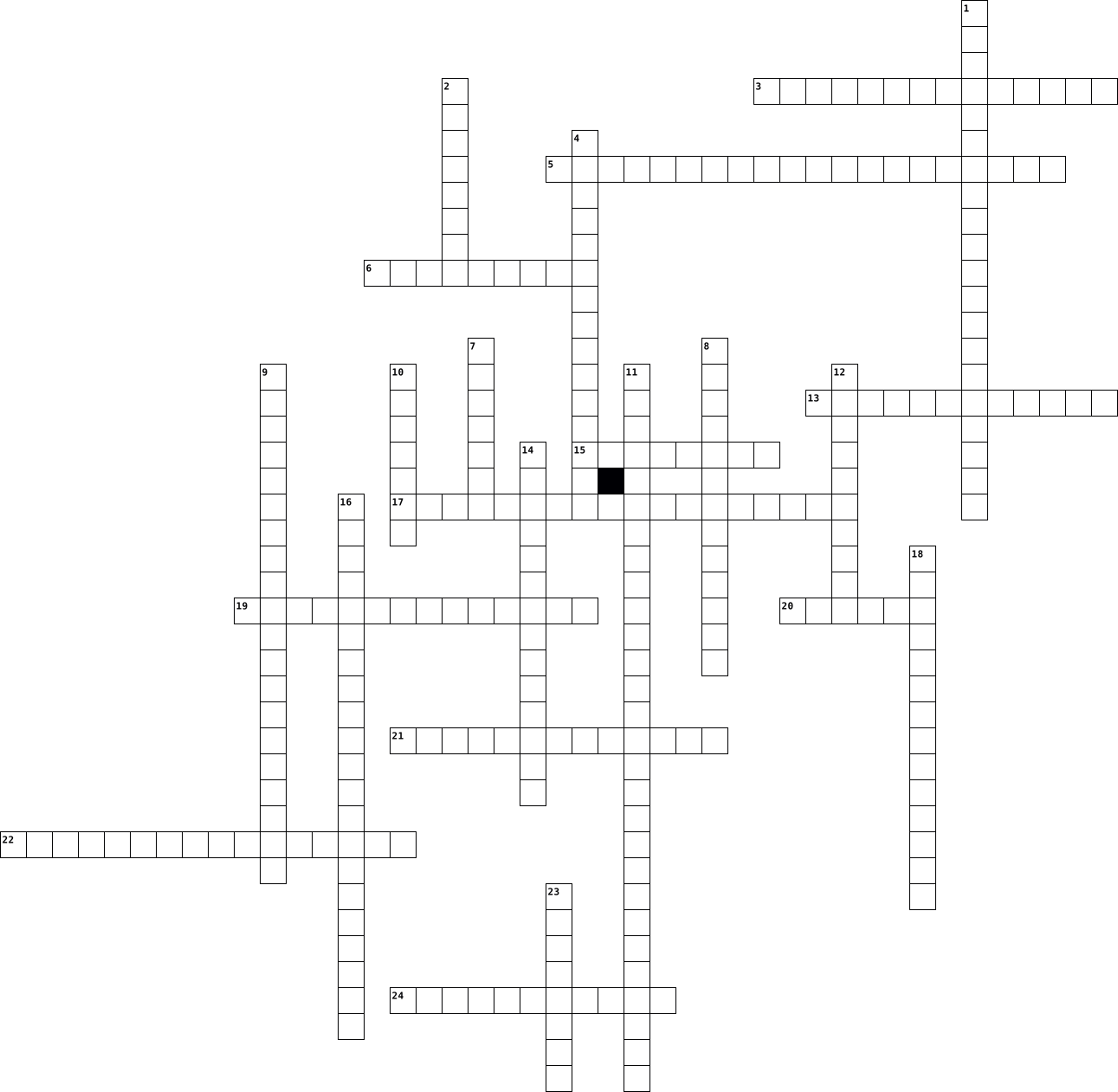
Across
- quantity of electricity
- convert small amounts of voltage, current or power to a larger amount of output
- device which transfers electricity
- capacity to transmit electricity, heat, etc.
- negatively charged atomic
- electrical current which reverses its direction
- convert electrical energy into mechanical energy
- force which causes rotation by twisting or turning
- electrical current which never changes direction
- supply power to the spark plugs for fuel ignition
- physical property allowing a material to resist the flow of electricity
Down
- opposition to flow of an electrical current
- coil of wire which acts as a magnet when electricity passes through
- flow of electric charge
- force required to move electrons
- electronic devices which supply energy to electrical loads
- convert mechanical energy from the engine into electrical energy
- explains the relationship among voltage,
- convert electrical energy into alternating electrical energy
- attachment connected to the armature or generator where electrical connection
- connects to the starter and battery
- convert a power supply’s direct current input waveform
- anything requiring electricity to operate
- copper wires wrapped around an iron core focusing the magnetic field
24 Clues: quantity of electricity • flow of electric charge • negatively charged atomic • force required to move electrons • device which transfers electricity • connects to the starter and battery • explains the relationship among voltage, • anything requiring electricity to operate • opposition to flow of an electrical current • capacity to transmit electricity, heat, etc. • ...
Work and Energy Vocabulary Crossword 2024-01-25

Across
- the metric unit for work and energy; equal to 1 newton meter (N∙m)
- stored energy
- the metric unit of power; equivalent to joules per second
- a machine that makes work easier by changing the amount or direction of force required to move an object
- the number of times the input force is multiplied
- force multiplied by distance
- kinetic or potential energy
- a simple machine consisting of a rod fixed to the center of a wheel
- a simple machine consisting of two back-to-back inclined planes
- output force multiplied by the distance over which it acts
Down
- states that energy is neither created nor destroyed
- energy acquired by doing work against gravity
- a simple machine consisting of a rigid arm that pivots on a fulcrum
- a simple machine consisting of a slope
- output work divided by input work
- a simple machine consisting of a spiral inclined plane
- the rate at which work is done
- energy of motion
- the ability to do work
- effort force multiplied by the distance over which it is applied
20 Clues: stored energy • energy of motion • the ability to do work • kinetic or potential energy • force multiplied by distance • the rate at which work is done • output work divided by input work • a simple machine consisting of a slope • energy acquired by doing work against gravity • the number of times the input force is multiplied • ...
Energy Crossword Puzzles 2021-08-19

Across
- 1/2 x mass x speed2
- distance/time
- Stored energy
- Consists of Photons,which are produced when an object´s atoms heat up.Is the only form of energy visible to the human eye.
- Is the energy stored in objects.As objects move faster more energy is stored
- Is the energy stored in the nucleus of atoms. this energy is released when the nuclei is combined or spit apart.
- Is a form of potential energy that is stored in an elastic object. Such as a coiled spring or a stretched elastic band.
- is a form of potential energy.It is an energy associated with gravity or gravitational force.
- the amount of matter
Down
- Is a type of kinetic energy that travels through waves.Likes the sun,x-rays, and radio waves
- Energy in motion
- anything that takes up spaces
- Is the movement of energy through substances.It move in waves and is produced when a force makes on object vibrate.
- Is the movement of electrons. Electrons that move through a wire is called electricity.
- Is stored in the atoms and molecules.It is the energy that hold these particles together.
- Is created from the vibrations of atoms molecules Within substances. The faster they move the hotter they get
16 Clues: distance/time • Stored energy • Energy in motion • 1/2 x mass x speed2 • the amount of matter • anything that takes up spaces • Is the energy stored in objects.As objects move faster more energy is stored • Is the movement of electrons. Electrons that move through a wire is called electricity. • ...
Work and Energy 2022-12-05

Across
- The rate at which energy is converted.
- The ratio of output work to input work.
- Anything around which you can imagine a boundary.
- Energy that is stored by compressing or stretching an object.
- The sum of the kinetic energy and potential energy of the objects in a system.
- The energy due to motion.
- The ratio of the output force to input force.
- Energy that is due to the gravitational forces between objects.
Down
- The energy that is stored due to the interactions between objects.
- The ability to cause change.
- Energy that is due to chemical bonds.
- States that cannot be created or destroyed.
- A combination of two or more simple machines.
- A device that changes the force or increases the motion from work.
- A machine that does work with only one movement of the machine.
- Force applied through a distance.
16 Clues: The energy due to motion. • The ability to cause change. • Force applied through a distance. • Energy that is due to chemical bonds. • The rate at which energy is converted. • The ratio of output work to input work. • States that cannot be created or destroyed. • A combination of two or more simple machines. • The ratio of the output force to input force. • ...
P-Flack 2018-02-26

Across
- What energy uses water
- A substance that provides energy
- flowing water
- A dangerous condition in which fuel rods inside a nuclear reactor melt
- Coming together
- Traps or air to help block the transfer of heat
- Oil is separated
- Compounds made of oil
- Power Source that uses the most coal in the U.S.
- Rod A cadmium rod used in a nuclear reactor to absorb neutrons from fission reactions
- What uses the most electricity in the U.S.
- A resource that is either always available or is naturally replaced in a relatively short time
- carbons Chemicals that contain carbon and hydrogen
- Mixing alcohols to gasoline makes it
- Plant parts, manure, food, and wood wastes that can be used as fuels
Down
- What uses the most oil in the U.S.
- Breaking apart
- The percentage of energy that is used
- The process of burning a fuel
- energy Heat from the Earth's interior
- A natural resource that is not replaced in a useful time frame
- Fuels An energy rich substance formed from the remains of organisms
- Liquid fossil fuel oil
- Vessel The part of a nuclear reactor where nuclear fission occurs
- Conservation Reducing energy use
- a subatomic particle of about the same mass as a proton but without an electric charge, present in all atomic nuclei except those of ordinary hydrogen.
- Energy The original source of energy in wind
- How wind, flowing water, and tides are used to produce electricity
28 Clues: flowing water • Breaking apart • Coming together • Oil is separated • Compounds made of oil • What energy uses water • Liquid fossil fuel oil • The process of burning a fuel • A substance that provides energy • Conservation Reducing energy use • What uses the most oil in the U.S. • Mixing alcohols to gasoline makes it • The percentage of energy that is used • ...
Science Crossword 2023-05-10

Across
- a type of energy storage molecule.
- all the living and nonliving things interacting in a particular area.
- Storage Molecule: a molecule that organisms can use to release the energy they need to survive.
- the part of a cell where photosynthesis happens.
- Dioxide: a molecule made of carbon and oxygen atoms.
- a group of atoms joined together in a particular way.
- Respiration: the chemical reaction between oxygen and glucose that releases energy into cells.
- a type of atom (a tiny piece) that makes up molecules such as carbon dioxide and energy storage molecules.
- a closed ecosystem made by humans.
- the part of a cell where cellular respiration happens.
- something that is required for a process.
Down
- living things, such as plants, animals, and bacteria.
- a type of energy storage molecule.
- an organism that gets energy storage molecules (such as glucose) by breaking down dead matter.
- a molecule that organisms can use to release energy, and that is made of carbon, hydrogen, and oxygen atoms.
- to link two or more things.
- an organism that needs to eat in order to get energy storage molecules (such as starch and fat).
- Matter: matter that makes up the nonliving parts of an ecosystem, such as air, water, and rocks.
- the tiny pieces that all matter—all the stuff in the world—are made of.
- the ability to make things move or change.
- Matter: matter that makes up the living and dead organisms in an ecosystem.
21 Clues: to link two or more things. • a type of energy storage molecule. • a type of energy storage molecule. • a closed ecosystem made by humans. • something that is required for a process. • the ability to make things move or change. • the part of a cell where photosynthesis happens. • Dioxide: a molecule made of carbon and oxygen atoms. • ...
Final Physics Exam Vocabulary Review 2015-03-23

Across
- Acceleration depends on the object’s mass and net forces acting upon it.
- The energy that travels in waves with some electrical properties and some magnetic properties such as sun light and microwaves.
- The energy of machines (including humans) due to motion and position.
- The form of mechanical energy based on the ability of the object to stretch
- A place or object used for comparison to determine if something is in motion.
- of Conservation of Energy Energy can be neither created nor destroyed, it can ONLY change between the different forms.
- The ability to do work or cause change.
- Any change in speed or direction (also know as velocity)
- When the forces acting on an object in all directions are ALL equal. Also, when the net force = 0. NO motion occurs when balanced forces act on an object.
- The energy associated with the movement of particles inside an object generating HEAT.
Down
- The stored energy that results from the position or shape of an object.
- When the forces acting on an object in opposite directions are NOT equal. Also, when the net force does not equal 0. Motion occurs when unbalanced forces act on an object.
- For every action there is an opposite and equal reaction.
- The distance an object travels per unit of time with no direction. It is calculated as distance divided by time.
- A object at rest stays at rest or a object in motion stays in motion until another unbalanced force acts on it.
- The energy an object has due to its motion.
- The form of mechanical energy based on the height of the object
- The speed of an object in a given direction.
- The combination of all forces (pushes and pulls) acting on an object.
- The energy that comes from electrical currents or charges such as electricity
- Occurs when the distance from one object to another object is changing.
- The energy stored in the bonds that hold compounds together such as in foods and fuel.
22 Clues: The ability to do work or cause change. • The energy an object has due to its motion. • The speed of an object in a given direction. • Any change in speed or direction (also know as velocity) • For every action there is an opposite and equal reaction. • The form of mechanical energy based on the height of the object • ...
Biology Unit Two 2021-09-20

Across
- The conversion of pyruvate to lactate with no release of carbon dioxide
- Transport Chain uses the high-energy electrons from the Krebs cycle to convert ADP into ATP, takes place in the mitochondria, produces the most ATP of any of the processes (34 ATP)
- Produced by fermentation and oxidation of natural carbohydrates is called vinegar
- Process by which cells release energy in the absence of oxygen
- The fluid of the chloroplast surrounding the thylakoid membrane; involved in the synthesis of organic molecules from carbon dioxide and water (Calvin/Dark reaction)
- Organisms that make their own food
- The movement of phosphorus atoms from rocks through the biosphere and hydrosphere and back to rocks.
- respiration Respiration that requires oxygen
- reactions of photosynthesis that use energy from light to produce ATP and NADPH, also produces O2
- respiration Respiration that does not require oxygen
Down
- organelle that is the site of ATP (energy) production
- organism that obtains energy from the foods it consumes; also called a consumer
- second stage of cellular respiration, in which pyruvic acid is broken down into carbon dioxide, takes place in the mitochondria, produces ATP and NADH
- a cluster composed of hundreds of chlorophyll molecules and accessory pigments used to harvest light molecules for photosynthesis
- the passage of energy through the components of the ecosystem
- Process that releases energy by breaking down glucose and other food molecules in the presence of oxygen, takes place in plants and animals, happens in 3 processes
- A process used by yeast cells and some bacteria to produce carbon dioxide and ethyl alcohol
- A flattened membrane sac inside the chloroplast, used to convert light energy into chemical energy, site of the light reactions
- An organelle found only in plant and algae cell, site of photosynthesis occurs
- process by which plants and some other organisms use light energy to convert water and carbon dioxide into oxygen and high-energy carbohydrates such as sugars and starches steps include: capture light, light dependent reactions, calvin cycle.
- Green pigment in plants that absorbs light energy used to carry out photosynthesis, found in the thylakoid of the chloroplast
21 Clues: Organisms that make their own food • respiration Respiration that requires oxygen • respiration Respiration that does not require oxygen • organelle that is the site of ATP (energy) production • the passage of energy through the components of the ecosystem • Process by which cells release energy in the absence of oxygen • ...
Biology Unit Two 2021-09-20

Across
- The conversion of pyruvate to lactate with no release of carbon dioxide
- Transport Chain uses the high-energy electrons from the Krebs cycle to convert ADP into ATP, takes place in the mitochondria, produces the most ATP of any of the processes (34 ATP)
- Produced by fermentation and oxidation of natural carbohydrates is called vinegar
- Process by which cells release energy in the absence of oxygen
- The fluid of the chloroplast surrounding the thylakoid membrane; involved in the synthesis of organic molecules from carbon dioxide and water (Calvin/Dark reaction)
- Organisms that make their own food
- The movement of phosphorus atoms from rocks through the biosphere and hydrosphere and back to rocks.
- respiration Respiration that requires oxygen
- reactions of photosynthesis that use energy from light to produce ATP and NADPH, also produces O2
- respiration Respiration that does not require oxygen
Down
- organelle that is the site of ATP (energy) production
- organism that obtains energy from the foods it consumes; also called a consumer
- second stage of cellular respiration, in which pyruvic acid is broken down into carbon dioxide, takes place in the mitochondria, produces ATP and NADH
- a cluster composed of hundreds of chlorophyll molecules and accessory pigments used to harvest light molecules for photosynthesis
- the passage of energy through the components of the ecosystem
- Process that releases energy by breaking down glucose and other food molecules in the presence of oxygen, takes place in plants and animals, happens in 3 processes
- A process used by yeast cells and some bacteria to produce carbon dioxide and ethyl alcohol
- A flattened membrane sac inside the chloroplast, used to convert light energy into chemical energy, site of the light reactions
- An organelle found only in plant and algae cell, site of photosynthesis occurs
- process by which plants and some other organisms use light energy to convert water and carbon dioxide into oxygen and high-energy carbohydrates such as sugars and starches steps include: capture light, light dependent reactions, calvin cycle.
- Green pigment in plants that absorbs light energy used to carry out photosynthesis, found in the thylakoid of the chloroplast
21 Clues: Organisms that make their own food • respiration Respiration that requires oxygen • respiration Respiration that does not require oxygen • organelle that is the site of ATP (energy) production • the passage of energy through the components of the ecosystem • Process by which cells release energy in the absence of oxygen • ...
biology 2023-10-05

Across
- 6
- An organism that makes its own food
- a substance that takes part in and undergoes change during a reaction.
- process by which plants and some other organisms use light energy to convert water and carbon dioxide into oxygen and high-energy carbohydrates such as sugars and starches
- is the type of respiration that converts glucose to energy without oxygen
- P 15
- requires oxygen
- respiration- Process that releases energy by breaking down glucose and other food molecules in the presence of oxygen
- the solid part of the earth consisting of the crust and outer mantle
- all the waters on the earth's surface, such as lakes and seas, and sometimes including water over the earth's surface, such as clouds.
- organelles that convert chemical energy stored in food into compounds more convenient
- first step in releasing the energy of glucose, in which a molecule of glucose is broken into two molecules of pyruvic acid
- an organism, especially a soil bacterium, fungus, or invertebrate, that decomposes organic material.
Down
- site of photosynthesis
- anything that takes up space and has mass
- A thin layer of gases surrounding Earth
- A green pigment found in the chloroplasts of plants, algae, and some bacteria
- (Adenosine Diphosphate) The compound that remains when a phosphate group is removed from ATP, releasing energy
- a substance that forms in a chemical reaction
- reactions- Reactions of photosynthesis that do not require light but use energy produced and stored during light reactions to make glucose
- the part of Earth where life exists
- reactions- The steps in photosynthesis that occur on the thylakoid membranes of the chloroplast and that convert solar energy to the chemical energy of ATP and NADPH, evolving oxygen in the process.
- an organism deriving its nutritional requirements from complex organic substances.
- cycle- second stage of cellular respiration, in which pyruvic acid is broken down into carbon dioxide in a series of energy-extracting reactions
- process that does not require oxygen
- N 7
- chain transport -describes a situation in which oxygen is not present
- main energy source that cells use for most of their work
28 Clues: 6 • N 7 • P 15 • requires oxygen • site of photosynthesis • An organism that makes its own food • the part of Earth where life exists • process that does not require oxygen • A thin layer of gases surrounding Earth • anything that takes up space and has mass • a substance that forms in a chemical reaction • main energy source that cells use for most of their work • ...
Third Year Revision Crossword 2021-05-20

Across
- Heat transfer that can travel through a vacuum
- Can be evenly spread using static charge
- Transfers Electrical energy to sound
- Energy store inside the Sun
- Speed divided by frequency
- Height of a wave
- One divided by frequency
- Heat transfer that allows a hot air balloon to work
- Painful effect of electricity
- Negative particle
- Radiation used by mobile phones
- Proper name for a single 'battery'
- Football boots are a device that uses ______ pressure
- Bright light during discharge
- Unit of moment
- Stationary charge
- Pressure times area
- Hot objects have a large amount of this energy store
- Mass divided by volume
- Unit for energy
- Weight in N of 2kg
- The force due to gravity
- gives a reading in volts
- Unit of weight
- The type of material that is a good thermal conductor
- Useful energy of a moving car
- Energy direction and vibration are this with a longitudinal wave
- Used to see the internal structure of objects
- All electromagnetic waves are this type of wave
Down
- Pressure in a liquid acts in all __________
- transfers sound energy to electrical energy
- Most _____ are more dense than liquids
- Feeling this is a way of detecting IR
- How well energy is used
- Used to find the volume of a irregular object
- Can cause sun burns
- A group of waves including light
- Measured in Amps
- Also known as the turning effect of a force
- Pressure __________ with depth
- The fastest constant speed of an object
- Ammeters are connected this way in a circuit
- Highest frequency electromagnetic wave
- Unit for frequency
- Substance that stops current
- What like charges do
- Stored energy in food
- Electromagnetic waves can travel through this
- A type of energy diagram
- Charge in C with 5A for 12s
50 Clues: Unit of moment • Unit of weight • Unit for energy • Measured in Amps • Height of a wave • Negative particle • Stationary charge • Unit for frequency • Weight in N of 2kg • Can cause sun burns • Pressure times area • What like charges do • Stored energy in food • Mass divided by volume • How well energy is used • One divided by frequency • The force due to gravity • gives a reading in volts • ...
Y9 Revision Crossword 2019-06-05

Across
- When two forces have the same size, act in opposite direction and act on the same object they are...
- A substance placed between two moving surfaces to reduce the friction between them.
- The maximum distance a particle moves away from its resting position when a wave passes.
- The energy store in a moving object.
- Waves in which the oscillations are parallel to the direction of motion.
- Used to measure forces.
- The principle of the conservation of energy states that energy can never be created or destroyed only ...
- A line drawn at right angles to a block or surface.
- When an object changes speed or direction it ...
- The force due to gravity.
- ... = frequency x wavelength
- Objects with a larger amplitude will sound...
- Thermal ... A number which states how good a material is a transferring energy by heating.
- The total force acting on an object (including a direction!).
Down
- The ... mass is a measure of how hard it is to change the velocity of an object (i.e. accelerate it).
- The energy store in food.
- The change in direction of a wave when it passes from one medium to another.
- A force ... is the area around an object where the effect of its force can be felt.
- A diagram used to show energy transfers. The wider the arrow, the more energy transferred.
- The value of gravitational field strength on earth.
- A pair of forces which have the same size, opposite direction and act on different objects (2 words).
- A force which acts when two objects touch.
- The ratio of useful energy output to total energy input.
- The energy transfer in a liquid or gas. Hot air rises and cold air sinks to take its place.
- The time for one complete wave.
- The energy transfer which allows us to see.
- The unit of frequency.
27 Clues: The unit of frequency. • Used to measure forces. • The energy store in food. • The force due to gravity. • ... = frequency x wavelength • The time for one complete wave. • The energy store in a moving object. • A force which acts when two objects touch. • The energy transfer which allows us to see. • Objects with a larger amplitude will sound... • ...
Unit 2 Crossward 2021-09-16

Across
- Type of fermentation: vinegar, kombucha
- Type of fermentation: yogurt, saurakrat
- Principle chemical compound cells use to store & release energy. Made of adenine, 5 carbon sugar, and 3 phosphate groups.
- Made of adenine, 5 carbon sugar, and 2 phosphate groups.
- Type of fermentation: bacillus subtilis, used in southeast asia
- 6CO2(Carbon Dioxide) + 6H2O(Water) + ATP(Solar Energy) = C6H12O6(Glucose) + 6O2(Oxygen)
- Series of electron transporters, embedded in inner mitochondrial membrane, function is to shuttle electrons from NADH & FADH2, produces most ATP(34).
- Large complexes of proteins & pigments (light absorbing molecules) that are used to harvest light, 2 types (PSI & PSII).
- Type of fermentation: yeast
- "Solar Energy Plant"-Captures energy from the sunlight & converts it into chemical energy in a process called photosynthesis, only found in plants.
- "Energy Plant"-Converts chemical energy stored in food into compounds that are more usable for the cell, cite for cellular respiration.
Down
- Site of the Calvin Cycle (Dark Reaction), in chloroplasts.
- takes place in cytoplasm, first step in breakdown of glucose to extract energy for cellular metabolism, glucose breaks down into 2-3 carbon molecules called pyruvate, same last step in both organism requiring O2(aerobic) & organisms not requiring O2(anaerobic).
- Takes place in mitochondria, also known as citric acid cycle, breaks down pyruvate into CO2, produces 2ATP & 6NADH.
- Opposite of photosynthesis reaction, releases energy by breaking down food molecules, takes place in plants & animals, happens in 3 processes.
- Plants produce what animals use, and animals produce what plants use, so plants and animals are _______ to each other.
- Stack of thylakoids, in chloroplasts.
- Uses light energy to make 2 molecules needed for the next stage of photosynthesis, energy storage molecule ATP & electron carrier NADPH, also creates oxygen, takes place in thylakoid membrane.
- Also known as Calvin Cycle, no light needed, takes place in stroma, creates sugar, creates NADP & ADP.
- Site of light dependent reactions, in chloroplasts.
- Process of fermenting things.
21 Clues: Type of fermentation: yeast • Process of fermenting things. • Stack of thylakoids, in chloroplasts. • Type of fermentation: vinegar, kombucha • Type of fermentation: yogurt, saurakrat • Site of light dependent reactions, in chloroplasts. • Made of adenine, 5 carbon sugar, and 2 phosphate groups. • Site of the Calvin Cycle (Dark Reaction), in chloroplasts. • ...