
forms of energy Crossword Puzzles
Renewable & Nonrenewable Energy 2017-03-06

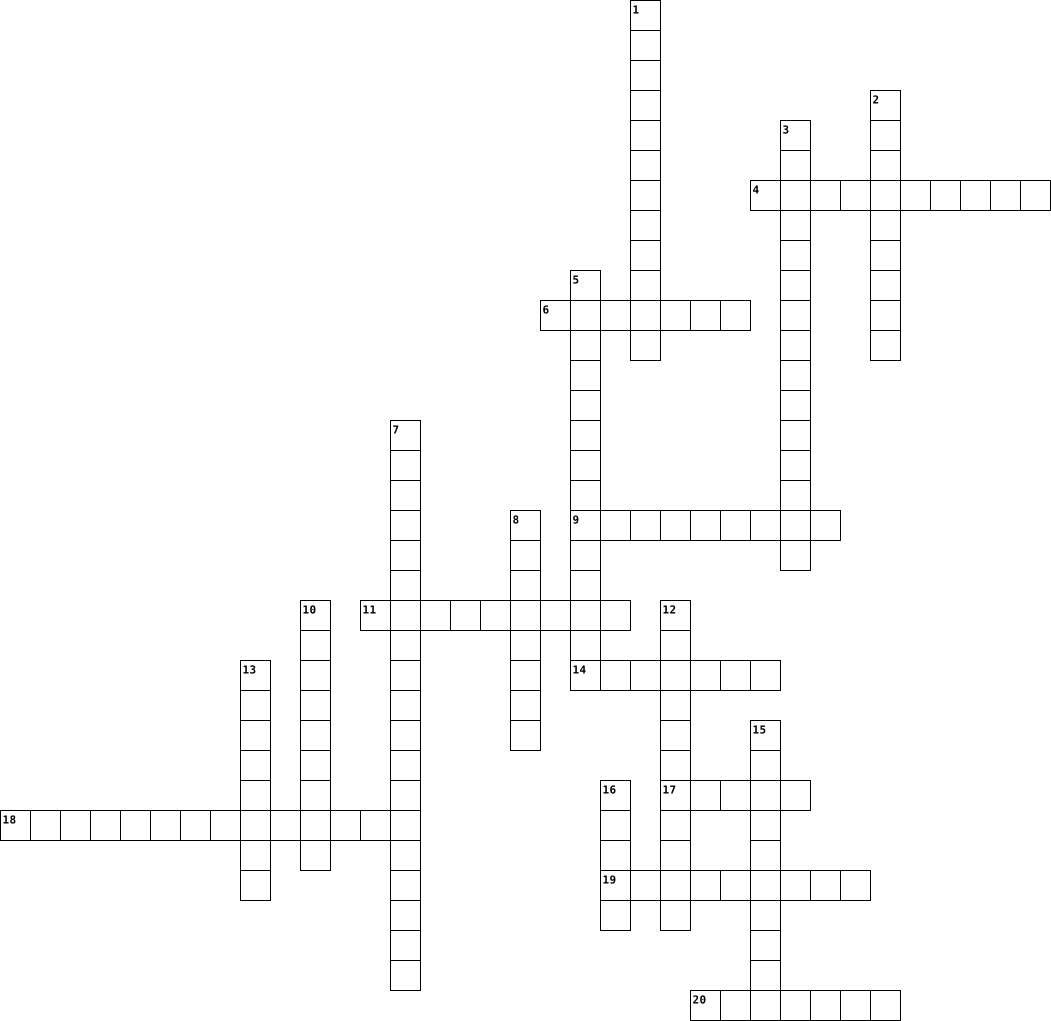
Across
- The production of two useful forms of energy from the same fuel source.
- A device used to initiate and control a sustained nuclear chain reaction. Surrounded by thick pressure vessel that is filled with a cooling liquid. The pressure vessel contains any products in case of an accident.
- Oil that is pumped from the ground, or crude oil.
- A mixture of gasoline and ethanol which produces less air pollution than fossil fuels.
- The energy within the nucleus of an atom, which fuels nuclear power plants.
- Electricity produced in a small stream without having to build a big dam. This uses instruments such as floating turbines.
- This uses the temperature difference in surface and deep ocean waters in the tropics to generate electricity.
- Energy from the sun that is gathered by collectors and used to heat water or to heat a building.
- A wheel that changes the force of a moving gas or liquid into energy that can do work.
- Energy that comes from sources that will eventually run out, or will not be replenished in our lifetimes.
- Uses sun's energy to heat something directly.
- Tidal movement from oceans are used to generate electricity much like a hydroelectric dam. High tides trap water behind a dam, and when the water is released during low tide it turns a turbine producing electricity.
- A long loop of piping that circulates fluid underground to warm and cool homes. In summer it cools a home and in winter it warms a home.
- The percentage of energy put into a system that does useful work.
Down
- The movement of wind is converted into electrical energy, and it the fastest growing source of of energy in the world
- Energy sources that are still in development. For it to be viable it must prove to be cost effective and have acceptable environmental impacts.
- Energy from sources that are constantly being formed.
- Solar cells that convert the sun's energy into electricity.
- Saving energy by using energy-efficient devices, wasting less energy, etc.
- Energy produced from moving water, a renewable energy resource that accounts for 20% of the earth's electricity.
- Plant material, manure, and any other organic matter that is used as an energy source.
- Energy from the heat in the earth's crust is used to generate electricity.
- A machine that converts mechanical energy, or motion, into electrical energy.
- Electricity is produced chemically by combining hydrogen fuel with oxygen from the air.
- A natural resource that comes from the remains of ancient organisms that changed into coal, oil, or natural gas.
25 Clues: Uses sun's energy to heat something directly. • Oil that is pumped from the ground, or crude oil. • Energy from sources that are constantly being formed. • Solar cells that convert the sun's energy into electricity. • The percentage of energy put into a system that does useful work. • The production of two useful forms of energy from the same fuel source. • ...
Chapter 8: Photosynthesis 2023-09-08

Across
- Plants' principle pigment
- One of the four main ways that cells use energy provided by ATP, to respond to chemical _________ at the cell surface
- The key to ATP's ability to store and release energy
- These break up each water molecule into 2 electrons, 2 hydrogen ions, and 1 oxygen atom during photosynthesis
- Process that uses the energy of sunlight to convert water and carbon dioxide into high-energy sugars and oxygen
- One of the three most important factors that affect photosynthesis, light _________.
- Organisms that make their own food
- One of the three most important factors that affect photosynthesis, the availability of _________.
- Reactions in which no light is required to power the reaction
- One of the four main ways that cells use energy provided by ATP, to carry out ___________.
- Clusters of chlorophyll and proteins in thylakoids
- Photosynthesis begins when pigments in photosystem II absorb light and transfer the energy to _______ in the pigments
- One of the four main ways that cells use energy provided by ATP, to power ___________.
- One of the four main ways that cells use energy provided by ATP, the __________ __ __________.
- A compound that can accept a pair of high-energy electrons and transfer them, along with most of their energy, to another molecule
- Energy comes in many forms, including light, heat, electricity, and can be stored in _____________.
Down
- Saclike photosynthetic membranes contained in chloroplasts
- Plants use the energy from these to produce complex carbohydrates such as starches, and to provide energy for the synthesis of other compounds, including proteins and lipids
- These use energy from light to reenergize the electrons in photosystem I
- The more common name of the light-independent reactions in photosynthesis
- The organelles in which photosynthesis takes place
- Without the ability to obtain and use energy, _____ would cease to exist
- One of the most important compounds that cells use to store and release energy
- Nearly all life on Earth depends on the ability of autotrophs to capture the energy of sunlight and store it in the molecules that make up _________.
- A compound in which energy is stored when nicotinamide adenine dinucleotide phosphate accepts and holds 2 high-energy electrons, along with a hydrogen ion
- Energy from the sun travels to Earth in what form?
- Organisms that obtain food by consuming other living things
- Reactions that require the direct involvement of light and light-absorbing pigments
- A series of electron carrier proteins that shuttle high-energy electrons during ATP-generating reactions
- The ability to do work
- The fluid portion of the chloroplast, outside of the thylakoids
- One of the three most important factors that affect photosynthesis
- A protein that allows hydrogen ions to pass through and rotates, binding ADP and a phosphate group together to produce ATP
33 Clues: The ability to do work • Plants' principle pigment • Organisms that make their own food • The organelles in which photosynthesis takes place • Energy from the sun travels to Earth in what form? • Clusters of chlorophyll and proteins in thylakoids • The key to ATP's ability to store and release energy • Saclike photosynthetic membranes contained in chloroplasts • ...
IOT TERMS 2024-03-14

Across
- power devices enabling them to
- A communication protocol which
- into different forms of energy such as
- or pressure.
- Anything that has the capability to affect
- transform electrical signals (energy,
- One way for an application to present itself
- of application resources
- physical entity, like changing its state or
- enables fl exible and rapid scale-up and
- that they can interact with it
- Ipv6 packages for small,
- capabilities located in a data center
Down
- description, or location.
- it.
- to access the IoT data without
- transported by air, electric current, or
- within the IoT.
- a mechanism that will enable an
- another, typically remote, applications
- need to know the actual source of data,
- Highly scalable computer storage and
22 Clues: it. • or pressure. • within the IoT. • of application resources • Ipv6 packages for small, • description, or location. • power devices enabling them to • to access the IoT data without • A communication protocol which • that they can interact with it • a mechanism that will enable an • Highly scalable computer storage and • capabilities located in a data center • ...
W13-CHEM1B-Kinetics 2025-04-15

Across
- Time it takes for a reactant’s concentration to decrease by half.
- Reaction order where the rate quadruples when concentration doubles.
- A factor that affects rate by increasing particle energy and collisions.
- A factor that determines whether a reaction occurs, regardless of energy.
- Reaction order where the rate doubles when concentration doubles.
- Speeds up a reaction without being consumed.
- A diagram that shows the energy changes during a reaction.
- A factor that affects how fast a reaction occurs—and what you need to finish this puzzle! 😉
- A simple theory that explains how reactions happen through particle interactions.
- A biological catalyst.
- A species that forms in one step and is used up in another.
- What increases when a catalyst is added to a reaction.
Down
- Our class motto! 💙
- One of our favorite scientists!
- What the half-life of a first-order reaction is (but not for second-order).
- The step-by-step sequence of elementary reactions in an overall process.
- High-energy state where old bonds are partially broken and new bonds are partially formed.
- – The proportionality factor in the rate law.
- Describes the energy peak at the transition state.
- A reaction order that is independent of concentration.
- The minimum threshold energy required for a reaction to occur.
- Rate law that expresses concentration as a function of time.
- The study of reaction rates.
- What decreases when a catalyst is used (two words, no space).
24 Clues: Our class motto! 💙 • A biological catalyst. • The study of reaction rates. • One of our favorite scientists! • Speeds up a reaction without being consumed. • – The proportionality factor in the rate law. • Describes the energy peak at the transition state. • A reaction order that is independent of concentration. • What increases when a catalyst is added to a reaction. • ...
Earth and Space Science - Q1, Ch. 4 - 13 2023-03-06

Across
- relating to material that comes from a volcano
- fossil fuels consist of these
- the largest of the two supercontinents that made up Pangaea
- the remains and traces of prehistoric life
- the fuel for fission nuclear reactions
- Pangaea broke up and reptiles become dominant
- this type of weathering changes a rock's composition
- these make up 97% of the earth's water
- the release of elastic energy in the earth
- the lowest level at which a stream can erode
- a thick mass of ice that forms above the snowline
Down
- mountains will one day erode down to sea level
- the period of time before the boom in life
- a deposit of windblown silt that forms a landscape
- the spontaneous decaying of nuclei
- a large piece of pyroclastic material; can kill someone
- "seismic sea wave"
- the composition of this determines volcanoes
- the many different ways that mountains are formed
- holds 2/3 of the world's freshwater
- having to do with earthquake waves
21 Clues: "seismic sea wave" • fossil fuels consist of these • the spontaneous decaying of nuclei • having to do with earthquake waves • holds 2/3 of the world's freshwater • the fuel for fission nuclear reactions • these make up 97% of the earth's water • the period of time before the boom in life • the remains and traces of prehistoric life • ...
Braden 2023-02-09

Across
- the idea that new crust is forming at ridges in the sea floor
- the idea that a supercontinent split apart into the continents
- a steep sided cone that forms from explosive eruptions
- heat from below earths surface
- hot,molten rock below Earth's surface
- the idea that Earth's surface is broken into plates that slide slowly across the mantle
- a huge crack in earth's crust
- magma that reaches the surface
- shaking of earth's crust after a earthquake
- the layer beneath Earth's crust
- a sensitive device that detects the shaking of earths crust during an earthquake
- a cuplike hollow that forms at the top of a volcano around the vent
- the central opening in a volcanic area
Down
- a very hot part of earth's surface
- the idea that many kinds of rocks form flat, horizontal layers
- a wide, gently sloped cont that forms from flows of lava
- the sliding of a denser ocean plate under another plate when they collide
- a cone formed from explosive eruptions
- the amount of energy released by an earthquake
- a vibration that spreads out away from a focus of an earthquake
- Earths solid, rocky surface containing the continents and ocean floor
- the point where an earthquake starts
- the point on directly above the focus
23 Clues: a huge crack in earth's crust • heat from below earths surface • magma that reaches the surface • the layer beneath Earth's crust • a very hot part of earth's surface • the point where an earthquake starts • hot,molten rock below Earth's surface • the point on directly above the focus • a cone formed from explosive eruptions • the central opening in a volcanic area • ...
6th Grade Review 2025-12-01

Across
- amount of matter in an object
- color, phase change, boiling point, DOES NOT change into different matter
- to change from one type of measurement to another
- fast moving particles that don't have definite shape or definite volume
- definite volume but no definite shape
- anything that has mass and takes up space
- force of an outward push
- how many forms of energy have we learned about
- made of 2 or more different atoms
- heat energy is released
- action of moving or being moved
- ability to do work or cause change
- a push or pull on an object
Down
- measure of a mass or material in a given volume
- amount of space an object occupies
- potential of motion
- describes it's ability to become something new substance, burnt wood becoming ash
- heat energy is absorbed
- 2 or more atoms held together by bonds
- 2 or more substances together in the same place
- motion
- has shape, volume and vibrating particles
- basic unit of all matter
- measure of the force of gravity on an object
- single kind of matter that always had a specific make-up
- pure substance, only what type of atom
- rate at which work is done and equals the amount of work done on the object
27 Clues: motion • potential of motion • heat energy is absorbed • heat energy is released • force of an outward push • basic unit of all matter • a push or pull on an object • amount of matter in an object • action of moving or being moved • made of 2 or more different atoms • amount of space an object occupies • ability to do work or cause change • definite volume but no definite shape • ...
ATP Hydrolysis 2024-10-30

Across
- The ' in ∆Gº' is pronounced as...
- Water forms these with the products of ATP Hydrolysis, stabilizing them
- The sugar in ADP is...
- The ∆Gº' of ATP is _____ compared to other "High-Energy" molecules in metabolism
- The sign (+ or -) of ∆Gº' in ATP Hydrolysis is...
- A measure of how strongly a group is attached to a molecule
- A main energy requiring processes that involves movement
- Reactions that requires energy to build reactions are described as...
- Bonds between phosphates are called...
Down
- Negative ∆G values show that the _______ of a reaction are favored
- Negative charges on the phosphate group lead to this reason for high phosphoryl-transfer potential
- The use of energy to drive protons across a membrane results in a...
- A reaction with a (-) ∆G is described as...
- ATP Hydrolysis results in more molecules and therefore an increase in...
14 Clues: The sugar in ADP is... • The ' in ∆Gº' is pronounced as... • Bonds between phosphates are called... • A reaction with a (-) ∆G is described as... • The sign (+ or -) of ∆Gº' in ATP Hydrolysis is... • A main energy requiring processes that involves movement • A measure of how strongly a group is attached to a molecule • ...
Glossary: Energy (Insights 7) 2020-11-12

Across
- A synonym to word "decrease"
- It's used in cars to keep them moving
- It's produced by organic matters
- A structure built to block the flow of water
- Energy coming from the sun
- Rain that includes sulfuric or nitric acid
- Turf; the organic matter in bogs
- Machinery that drills, for example, oil and natural gas
Down
- Sustainable energy forms
- Shows the amount of carbon dioxide produced by one person
- An artificial lake
- A place where there are lots of windmills
- A rechargeable item
13 Clues: An artificial lake • A rechargeable item • Sustainable energy forms • Energy coming from the sun • A synonym to word "decrease" • It's produced by organic matters • Turf; the organic matter in bogs • It's used in cars to keep them moving • A place where there are lots of windmills • Rain that includes sulfuric or nitric acid • A structure built to block the flow of water • ...
Stump 2023-12-19

Across
- Molecules are full of energy, zoom around anywhere
- Comes out of a volcano as lava
- Composed of multiple elements
- When two plates slide against each other
- Depicts the amount of energy in an object
- Contains Iron and Nickel
- The thinnest layer of the Earth
- Describes something coming from this earth
Down
- Everything in the earth is composed of these
- Made of molten-hot minerals
- Located at the center of the earth
- The many different forms a rock can assume
- Molecules are more loose & spread apart
- Molecules are packed densely together
14 Clues: Contains Iron and Nickel • Made of molten-hot minerals • Composed of multiple elements • Comes out of a volcano as lava • The thinnest layer of the Earth • Located at the center of the earth • Molecules are packed densely together • Molecules are more loose & spread apart • When two plates slide against each other • Depicts the amount of energy in an object • ...
UNIT XI 2014-03-13

Across
- ammeter it is used to measure the current flowing in one part of a circuit , a current
- it is the electrical phenomenon which opposes a change in voltage that converts some of the energy of current electricity into stored electrostatic energy
- voltage it is the voltage which is supplied to the external circuit
- it is the rate at which electrical energy is converted to other forms of energy
- wire wound resistor it is the exact resistant value
- circuit it is a circuit where resistances are place one after the other
- R. Kirchhoff he extended the ohms law
- is a device used to measure the current flowing through a part of an electric circuit
- this word means two or more cells connected to each other
Down
- it is the unit of current
- law it gives the relationship between voltage, current and resistance
- it is the electrical phenomenon which opposes a each in electric current that converts some of the energy of current electricity into stored electromagnetic energy
- circuit it is the most commonly used circuit
- diagram it is a represent action which uses symbols to represent the different components in a physical electric circuit
- circuit it is a closed path along which electrical charges
- it is consumed at a rate of one watt second
- it is the path ion which electrons move
17 Clues: it is the unit of current • R. Kirchhoff he extended the ohms law • it is the path ion which electrons move • it is consumed at a rate of one watt second • circuit it is the most commonly used circuit • wire wound resistor it is the exact resistant value • this word means two or more cells connected to each other • ...
forms of government- Trayten 2020-09-17

Across
- having or relating to a system of government in which several states form a unity but remain independent in internal affairs.
- a particular session of the US Congress.
- form of government in which one person or a small group possesses absolute power without effective constitutional limitations.
- the highest class in certain societies, especially those holding hereditary titles or offices.
- a body of fundamental principles or established precedents according to which a state or other organization is acknowledged to be governed.
- the members of parliament for a particular period, especially between one dissolution and the next.
- a system of government by the whole population or all the eligible members of a state, typically through elected representatives.
Down
- a small group of people having control of a country, organization, or institution.
- a system of government in which priests rule in the name of God or a god.
- a group with a certain equality between its members.
- relating to or denoting a confederation.
- a form of government with a monarch at the head.
- relating to a system of government that is centralized and dictatorial and requires complete subservience to the state.
- typical of a class, group, or body of opinion.
- the elected head of a republican state.
- denoting attitudes, activities, or other things that have no religious or spiritual basis.
- a system of government by one person with absolute power.
- forming a single or uniform entity.
18 Clues: forming a single or uniform entity. • the elected head of a republican state. • relating to or denoting a confederation. • a particular session of the US Congress. • typical of a class, group, or body of opinion. • a form of government with a monarch at the head. • a group with a certain equality between its members. • ...
Forms of bullying - vocabulary 2020-09-23

Across
- exact, correct
- - something that helps you guess or predict something
- - only
- to include
- - a habit, a thing that you typically do
- to think / see / understand something
- - to make worse or to annoy
- - to show, to become seen
- - a negative effect
- to bring together, link or join
Down
- to make a concept or idea
- - to stop, prevent or interrupt something
- a person hurt by a crime, accident or event (bullying)
- to keep out, to not let something be apart of something else
- to include, to cover, to surround
- without being affected by (even though)
- - to see the differences or similarity between things
- spoken words
18 Clues: - only • to include • spoken words • exact, correct • - a negative effect • to make a concept or idea • - to show, to become seen • - to make worse or to annoy • to bring together, link or join • to include, to cover, to surround • to think / see / understand something • without being affected by (even though) • - a habit, a thing that you typically do • ...
Forms of Government-Athena 2020-09-17

Across
- The central government gets its authority from the independent states
- rule by people
- a small group of people having control of a country, organization, or institution
- no individual freedom and seeks to subordinate all aspects of individual life to the authority of the state
- supreme political power to direct all the activities of the state is concentrated in the hands of one person, whose decisions are subject to neither external legal restraints nor regularized mechanisms of popular control
- a military hierarchy in which a ruler or lord offers mounted fighters a fief (medieval beneficium), a unit of land to control in exchange for a military service.
- type of democracy founded on the principle of elected officials representing a group of people, as opposed to direct democracy.
- King or queen in charge
- the principle of the separation of government institutions and persons mandated to represent the state from religious institutions and religious dignitaries
- a system of government in which priests rule in the name of God or a god
- three distinct branches: legislative , executive , and judicial , whose powers are vested by the U.S. Constitution in the Congress, the President, and the Federal courts, respectively
- a single central government has total power over all of its other political subdivisions
Down
- people vote for others to run the government
- economic and social systems characterised by social ownership of the means of production and workers' self-management of enterprises
- a system in which the powers of the executive and legislative branches are intertwined as opposed to being held separate as a check against each other's power
- the highest class in certain societies, especially those holding hereditary titles or offices
- Has absolute authority in any sphere
- existence of a constitution—which may be a legal instrument or merely a set of fixed norms or principles
18 Clues: rule by people • King or queen in charge • Has absolute authority in any sphere • people vote for others to run the government • The central government gets its authority from the independent states • a system of government in which priests rule in the name of God or a god • a small group of people having control of a country, organization, or institution • ...
Forms of Government -Liberty 2020-09-18

Across
- system of government that is centralized and dictatorial and requires complete subservience to the state
- no government
- most of the power is with the government
- legislative body of government
- system of government in which several states form a unity but remain independent in internal affairs
- god appoints the ruler
- high social class
Down
- set of rules and laws
- the people have the power
- monarchy ruled by king and queen that are kept in check by rules/regulations
- ruled by king and queen
- people vote for others to represent them and their opinions
- system of government by one person with absolute power power lies with one person
- someone the people choose to represent them
- small group of people have the power
- association of independent states
- not subject or bound by religious rule
- ruled by one individual using force
18 Clues: no government • high social class • set of rules and laws • god appoints the ruler • ruled by king and queen • the people have the power • legislative body of government • association of independent states • ruled by one individual using force • small group of people have the power • not subject or bound by religious rule • most of the power is with the government • ...
Chapter 3 Vocabulary 2025-08-30

Across
- process of converting nitrogen gas into nitrogen compounds that plans can absorb and use
- process by which bacteria convert nitrates into nitrogen gas
- process used by plants and other autotrophs to capture light energy and use it to power chemical reactions that convert carbon dioxide and water into oxygen and energy-rich carbohydrates such as sugars and starches
- network of complex interactions formed by the feeding relationships among the various organisms in an ecosystem
- organism that is able to capture energy from sunlight or chemicals and use it to produce it’s own food from inorganic compounds
- organism that obtains food by consuming other living things
- model of the relative amounts of energy or matter contained within each trophic level in a given food chain or food web
- producer first producer of energy-rich compounds that are later used by other organisms
- total amount of living tissue within a given trophic level
- chemical substance that an organism needs to sustain life
- organism that relies on other organisms for its energy and food supply
Down
- a natural feature (such as landmass, forest, or ocean) that stores carbon
- single essential nutrient that limits productivity in an ecosystem
- process in which elements, chemical compounds, and other forms of matter are passed from one part of the biosphere to another
- a series of steps in an ecosystem in which organisms transfer energy by eating and being eaten
- process in which chemical energy is used to produce carbohydrates
- material made up of decaying bits of plant and animal material
- photosynthetic algae found near the surface of the ocean
- level each step in a food chain or food web
19 Clues: level each step in a food chain or food web • photosynthetic algae found near the surface of the ocean • chemical substance that an organism needs to sustain life • total amount of living tissue within a given trophic level • organism that obtains food by consuming other living things • process by which bacteria convert nitrates into nitrogen gas • ...
ch 2 part 1 cross word 2025-12-08

Across
- the last stage of the cell cycle the cell splits
- c6h12o6+602-6h20+6co2+atp
- the second stage of the cell cycle
- eats sugars for energy
- new nuclear envelope forms
- how many divisions does it take to get to 64 daughter cells
- does photosynthesis to make food
- doubled rods of condensed chromatin
- fibers connect to the centrioles
- how many chromosomes does our body contain
Down
- what is a chromosome made of
- DNA condenses into separate chromosomes
- the process in which DNA copies
- 6h20+6co2+light-c6h12o6+602
- a green pigment found in the chloroplast
- the first stage of the cell cycle
- all living things need this for energy
- how many stages in photosynthesis
- the series of events in which a cell grows and divides
- phase chromosomes attach to spindle fibers
20 Clues: eats sugars for energy • c6h12o6+602-6h20+6co2+atp • new nuclear envelope forms • 6h20+6co2+light-c6h12o6+602 • what is a chromosome made of • the process in which DNA copies • does photosynthesis to make food • fibers connect to the centrioles • the first stage of the cell cycle • how many stages in photosynthesis • the second stage of the cell cycle • ...
Chemistry of Life 2022-10-19

Across
- The carbohydrate found in fruits
- The main energy source of our bodies
- A carbohydrate made up of 3 or more sugar molecules
- this hormone is used to regulate blood sugar, many diabetic people have to get shots of this hormone
- A carbohydrate made up of a single sugar molecule
- The storage form of glucose in animals
- This carbohydrate is used in the fermentation of beer
Down
- This carbohydrate links together using phosphates to form the back bone of DNA, is a monosaccharide
- A carbohydrate made up of 2 sugar molecules
- This carbohydrate links together using phosphates to form the back bone of DNA
- this is the only organ that solely relies on glucose for energy except when fasting
- Disaccharides are broken down into mono saccharides though ___________
- This carbohydrate forms cell walls, cannot be digested by humans, and is commonly referred to as fibre
- Disaccharides are formed by __________ synthesis
- the process that plants use to create glucose and oxygen using only sunlight, water, and carbon dioxide
- The carbohydrate used in cellular respiration
- A portion of the population cannot digest this carbohydrate found in dairy.
- This complex carbohydrate is stored in amyloplasts
- When a glucose molecule bonds with this carbohydrate it forms lactose, and this carbohydrate is said to be involved in brain development
- Table sugar, made from glucose and fructose
20 Clues: The carbohydrate found in fruits • The main energy source of our bodies • The storage form of glucose in animals • A carbohydrate made up of 2 sugar molecules • Table sugar, made from glucose and fructose • The carbohydrate used in cellular respiration • Disaccharides are formed by __________ synthesis • A carbohydrate made up of a single sugar molecule • ...
moonas crossword 2020-11-13

Across
- = Burns' energy
- = not real pool
- = poison rain
- = you need to load it
- = no lights
- = beavers build this
Down
- = they use wind
- = one of the biggest greenhouse gasses
- = when you use something bad
- = flows
- = it forms in the bottom of swamp
- = fuel and battery
- = organic fuel
13 Clues: = flows • = no lights • = poison rain • = organic fuel • = they use wind • = Burns' energy • = not real pool • = fuel and battery • = beavers build this • = you need to load it • = when you use something bad • = it forms in the bottom of swamp • = one of the biggest greenhouse gasses
science energy 2025-02-04

Across
- This is also a potential energy.
- energy is also known as stored energy that can be changed to other forms of energy.
- This is a potential energy
Down
- This also a potential energy
- energy is usually generated in power stations.
- is the main source of energy.
- This is a good renewable energy.
- Can also be an alternative energy source other than running water, food and fossil fuels.
8 Clues: This is a potential energy • This also a potential energy • This is also a potential energy. • is the main source of energy. • This is a good renewable energy. • energy is usually generated in power stations. • energy is also known as stored energy that can be changed to other forms of energy. • ...
Grade 5 2023-07-31

Across
- A small body that orbits around a larger one
- A large body of water surrounded by land
- A word that has the same meaning as another word
- The process by which plants make their food
- The smallest unit of an element
- A line that divides a circle into two equal parts
- A book containing words and their meanings
- A measurement of how hot or cold something is
- The study of past events through remains and artifacts
- Mammal known for its black and white stripes
- A machine that converts mechanical energy into electrical energy
Down
- A structure that holds back water
- A group of planets that orbit around a star
- A type of rock that forms from magma
- The force that pulls objects towards the center of the Earth
- A device that measures the Earth's shaking during an earthquake
- A system of government by the whole population
- A long period without rain
- A reptile with a hard shell
- A type of energy that comes from the movement of particles
- The process of turning a liquid into a gas
21 Clues: A long period without rain • A reptile with a hard shell • The smallest unit of an element • A structure that holds back water • A type of rock that forms from magma • A large body of water surrounded by land • A book containing words and their meanings • The process of turning a liquid into a gas • A group of planets that orbit around a star • ...
Science 2021-05-24

Across
- plate boundary that occurs when two plates slide past each other
- an educated guess
- force that acts between two surfaces that are touching/ moving past each other
- plate boundary where two plates collide
- d=m/v
- powerhouse of the cell
- all water on earth
- anything that has mass and takes up space
- a diamond is an example of this
Down
- the measure of the average kinetic energy in an object
- rock type that forms due to high heat and pressure
- attractive force that acts between all objects that have mass
- rock type that forms when molten material cools
- these can be found on the periodic table
- a push or pull on an object
- anything that has all characteristics of life
16 Clues: d=m/v • an educated guess • all water on earth • powerhouse of the cell • a push or pull on an object • a diamond is an example of this • plate boundary where two plates collide • these can be found on the periodic table • anything that has mass and takes up space • anything that has all characteristics of life • rock type that forms when molten material cools • ...
Weather 2024-04-03
Across
- a local wind system characterized by a flow from land to water late at night.
- the energy contained within a system that is responsible for its temperature.
- The forward edge of an advancing mass of cold air that pushes under a mass of warm air.
- the transition zone where a warm air mass is replacing a cold air mass
- the location within a hurricane where the most damaging winds and intense rainfall is found.
- a type of kinetic energy that is made from the vibration of matter.
- a change in properties such as texture, shape, or state
- a severe tropical storm with high winds and heavy rain.
- the energy of motion, observable as the movement of an object or subatomic particle.
Down
- A system causing clear skies and sunshine.
- experienced in the daytime when cool air from the sea blows towards the land.
- forms when a cold front or warm front stops moving against eachother.
- a change of materials into another, new materials with different properties and one or more than one new substances are formed.
- the energy stored in an object due to its height above the Earth
- a roughly circular area of comparatively light winds and fair weather found at the center of a severe tropical cyclone.
- type of energy that is stored in an object due to its position relative to other objects.
- A system causing precipitation and cloudy skies.
- energy stored in the bonds of chemical compounds, like atoms and molecules.
- the process of transferring heat through air or liquid currents.
- energy with the ability to make types of light visible to human eyes.
20 Clues: A system causing clear skies and sunshine. • A system causing precipitation and cloudy skies. • a change in properties such as texture, shape, or state • a severe tropical storm with high winds and heavy rain. • the energy stored in an object due to its height above the Earth • the process of transferring heat through air or liquid currents. • ...
Art Studies 191 2015-05-26
Across
- sea serpent prevalent in SEA Art
- dominant force dictating culture at present (Globalization)
- vitality; energy of things (Japanese Art)
- painting is a ritual that embodies the cosmic force of order (Chinese Art)
- challenge to pure or authentic identity (Colonial Art)
- criticizes emptiness of Japanese consumer culture (Japanese Art)
- analysis of the legacy of colonialism and imperialism
- Philippine aesthetic of brightness of space (Philippine Art)
- Chinese philosopher, author of the Five Classics (Chinese Art)
Down
- Proponent of postcolonialism; Edward ____
- a return to traditional/ native forms in architecture (Philippine Art)
- pioneering art historian of india (Indian Art)
- Japanese variant of Buddhism emphasizing simplicity (Japanese Art)
- depiction of Non-Western culture by the West
- essence; energy (Chinese Art)
- perception of beauty or taste
- simple sophistication (Japanese Art)
- acceptance of transience or imperfection (Japanese Art)
- essence; dominant mental state (Indian art)
- highest form of Chinese painting (Chinese Art)
20 Clues: essence; energy (Chinese Art) • perception of beauty or taste • sea serpent prevalent in SEA Art • simple sophistication (Japanese Art) • Proponent of postcolonialism; Edward ____ • vitality; energy of things (Japanese Art) • essence; dominant mental state (Indian art) • depiction of Non-Western culture by the West • pioneering art historian of india (Indian Art) • ...
Spelling 2023-01-10

Across
- A structure that goes over water.
- A large African mammal with a long neck.
- Soft or delicate.
- Exceeding most other things in amount or size.
- To rub or wipe in a smeary way.
- A machine for converting forms of energy into mechanical force.
- Different from what is usual or ordinary.
Down
- Very large or extensive.
- Usable power.
- A chemical element that is in the air.
- A kind of spice.
- Something that keeps items cold.
- A fence formed by a row of shrubs.
- A narrow flat surface or shelf.
- To touch or push gently.
15 Clues: Usable power. • A kind of spice. • Soft or delicate. • Very large or extensive. • To touch or push gently. • A narrow flat surface or shelf. • To rub or wipe in a smeary way. • Something that keeps items cold. • A structure that goes over water. • A fence formed by a row of shrubs. • A chemical element that is in the air. • A large African mammal with a long neck. • ...
Thermal Energy 2023-04-17

Across
- used to represent real-life phenomena.
- energy caused by molecule movement through the air.
- A tool to prevent temperature loss or transfers.
- the process when heat is transferred from one matter to another.
- energy caused by molecule interaction.
Down
- energy present due to the motion of particles.
- One of the distinct forms in which matter can exist
- the particles of matter do this when they are excited.
- equipment is used to measure the temperature of matter.
- energy caused by direct touch.
10 Clues: energy caused by direct touch. • used to represent real-life phenomena. • energy caused by molecule interaction. • energy present due to the motion of particles. • A tool to prevent temperature loss or transfers. • One of the distinct forms in which matter can exist • energy caused by molecule movement through the air. • ...
EPM crossword 2018-01-22

Across
- energy: heat energy generated and stored in the Earth.
- Hydroelectricity is the term referring to electricity generated by hydropower; the production of electrical power through the use of the gravitational force of falling or flowing water.
- An action to make something move.
- energy: the energy released during nuclear fission or fusion, especially when used to generate electricity.
Down
- the branch of physics or technology concerned with the mechanical properties of gases.
- energy: a form of hydropower that converts the energy of tides into useful forms of power – mainly electricity. Although not yet widely used, tidal power has potential for future electricity generation.
- the action of getting things done.
- advantage: the ratio of the force produced by a machine to the force applied to it, used in assessing the performance of a machine.
- One of a set of toothed wheels that work together to alter the relation between the speed of a driving mechanism.
- Energy: A renewable energy source from living or recently living plant and animal materials which can be used as fuel.
- a rigid bar resting on a pivot, used to help move a heavy or firmly fixed load with one end when pressure is applied to the other.
- energy: Energy from wind.
- energy: Energy from the sun or light.
13 Clues: energy: Energy from wind. • An action to make something move. • the action of getting things done. • energy: Energy from the sun or light. • energy: heat energy generated and stored in the Earth. • the branch of physics or technology concerned with the mechanical properties of gases. • ...
IOT TERMS 2024-03-14

Across
- power devices enabling them to
- A communication protocol which
- into different forms of energy such as
- or pressure.
- Anything that has the capability to affect
- transform electrical signals (energy,
- One way for an application to present itself
- of application resources
- physical entity, like changing its state or
- enables fl exible and rapid scale-up and
- that they can interact with it
- Ipv6 packages for small,
- capabilities located in a data center
Down
- description, or location.
- it.
- to access the IoT data without
- transported by air, electric current, or
- within the IoT.
- a mechanism that will enable an
- another, typically remote, applications
- need to know the actual source of data,
- Highly scalable computer storage and
22 Clues: it. • or pressure. • within the IoT. • of application resources • Ipv6 packages for small, • description, or location. • power devices enabling them to • to access the IoT data without • A communication protocol which • that they can interact with it • a mechanism that will enable an • Highly scalable computer storage and • capabilities located in a data center • ...
Earth's Systems Vocabulary List 2023-04-14

Across
- occurs when divergent plates separate; convection currents cause less dense material to rise; creates new ocean floor
- survival specialists
- layer that lies between the Earth's crust and core.
- tectonic plates collide
- movement is caused within a liquid when the hotter, less dense material rises and cooler, denser material sinks
- made from remains of plants and animals
- forms under extreme heat and pressure; appears twisted
- no longer existing
- core innermost layer of the earth; divided into two parts, liquid outer and solid inner
- move side to side through solids only; travel slower than P
- outer part of the earth
- boundary where tectonic plates divide
- compress and squeeze through solids and liquids; travels faster than S
Down
- tectonic plates slide past each other
- Hawaiian islands creation
- sudden release of energy in the lithophere
- the solid, outermost layer of the Earth, lies above the mantle
- water held in the soil in deep reservoirs
- the study of the Earth
- large pieces of lithosphere
- below the lithosphere
- a tool that measures/records details of earthquakes
- forms at convergent boundaries; lava and magma
- forms from pre-existing rocks and fossils; appears layered
- group of animals that occupy an area
- when heat, pressure, cooling, melting, and weathering cause rocks to change from one type to another over time
- lower part of the Earth's mantle, below the asthenosphere
- a solid inorganic material found in nature
- the study of earthquakes and related phenomena
- supercontinent
- forms when molten rock crystallizes and solidifies; appears glassy
31 Clues: supercontinent • no longer existing • survival specialists • below the lithosphere • the study of the Earth • tectonic plates collide • outer part of the earth • Hawaiian islands creation • large pieces of lithosphere • group of animals that occupy an area • tectonic plates slide past each other • boundary where tectonic plates divide • made from remains of plants and animals • ...
Sugar! 2022-10-19

Across
- The carbohydrate found in fruits
- The main energy source of our bodies
- A carbohydrate made up of 3 or more sugar molecules
- this hormone is used to regulate blood sugar, many diabetic people have to get shots of this hormone
- A carbohydrate made up of a single sugar molecule
- The storage form of glucose in animals
- This carbohydrate is used in the fermentation of beer
Down
- This carbohydrate links together using phosphates to form the back bone of DNA, is a monosaccharide
- A carbohydrate made up of 2 sugar molecules
- This carbohydrate links together using phosphates to form the back bone of DNA
- this is the only organ that solely relies on glucose for energy except when fasting
- Disaccharides are broken down into mono saccharides though ___________
- This carbohydrate forms cell walls, cannot be digested by humans, and is commonly referred to as fibre
- Disaccharides are formed by __________ synthesis
- the process that plants use to create glucose and oxygen using only sunlight, water, and carbon dioxide
- The carbohydrate used in cellular respiration
- A portion of the population cannot digest this carbohydrate found in dairy.
- This complex carbohydrate is stored in amyloplasts
- When a glucose molecule bonds with this carbohydrate it forms lactose, and this carbohydrate is said to be involved in brain development
- Table sugar, made from glucose and fructose
20 Clues: The carbohydrate found in fruits • The main energy source of our bodies • The storage form of glucose in animals • A carbohydrate made up of 2 sugar molecules • Table sugar, made from glucose and fructose • The carbohydrate used in cellular respiration • Disaccharides are formed by __________ synthesis • A carbohydrate made up of a single sugar molecule • ...
Weather Unit Crossword Puzzle 2024-06-03

Across
- Cold, sinking sinking air has this type of air pressure.
- This state change process releases energy into the air.
- Warm, rising air has this type of pressure.
- Created when particles of air collide with objects.
- The name for the boundary between two air masses.
- Transfer of thermal energy by collision of particles.
Down
- The total amount of kinetic energy of an objects particles.
- This state change process requires energy to be absorbed.
- A tool for measuring air pressure.
- This is caused when air moves from high to low pressure.
- When warm air moves into replace cold air.
- When cold air moves into replace warm air.
- A large body of air that takes on the humidity and temperature of the area over which it forms.
13 Clues: A tool for measuring air pressure. • When warm air moves into replace cold air. • When cold air moves into replace warm air. • Warm, rising air has this type of pressure. • The name for the boundary between two air masses. • Created when particles of air collide with objects. • Transfer of thermal energy by collision of particles. • ...
Biochemistry Test 2021-01-13

Across
- Type of enzyme regulation in which a site of a protein is affected due to binding on a separate site
- Not a true polymer since it is not made up of monomers that repeat themselves
- An enzyme acts upon this substance
- Has a 2:1 hydrogen-oxygen ratio and is a quick source of energy for animals
- Where the competitive inhibitor binds to prevent substrate binding to enzyme
- A lipid that forms a protective coating over plants
- Anabolic reaction that involves the absorption of free energy
Down
- Polysaccharide also known as fiber
- Has an R-group component that differs with each monomer
- DNA and RNA is this type of macromolecule.
- Bent in shape and has one or more carbon double bonds in the hydrocarbon chain. Liquid at room temperature.
- Aldehyde sugar that is used for quick energy
- The structure of this molecule affects the folding, which affects the overall function of the molecule.
- Means sugar
- Type of lipid composed of carbon rings
- Made up of two polynucleotides that are antiparallel
- Type of protein that catalyzes reactions by lowering the activation energy
17 Clues: Means sugar • Polysaccharide also known as fiber • An enzyme acts upon this substance • Type of lipid composed of carbon rings • DNA and RNA is this type of macromolecule. • Aldehyde sugar that is used for quick energy • A lipid that forms a protective coating over plants • Made up of two polynucleotides that are antiparallel • ...
Chapter 24 2026-06-04

Across
- The careful use and protection of water resources.
- Contamination of water by harmful substances.
- An area of land that drains into a particular river, lake, or other body of water.
- The process of removing salt from seawater to produce freshwater.
- Liquid fossil fuel commonly called crude oil.
- Any material or substance that occurs in nature and can be used by humans.
- A region of the stratosphere containing high concentrations of ozone that absorbs harmful ultraviolet radiation.
- The layer of gases surrounding Earth.
- Energy-rich substances formed from the remains of ancient organisms.
- An underground layer of permeable rock or sediment that stores and transmits groundwater.
- Energy derived from heat within Earth.
- Water that contains very low concentrations of dissolved salts.
- The process by which water is added back into an aquifer.
- A mineral containing metals that can be extracted and used.
- A gaseous fossil fuel composed mainly of methane.
- Water that has been used and contains dissolved or suspended wastes.
- A mixture of pollutants that forms a haze in the atmosphere.
- The most abundant gas in Earth's atmosphere.
- Rain, snow, or other precipitation made acidic by air pollutants.
- A fossil fuel formed from ancient plant remains.
- Planning and controlling the use of natural resources to ensure their availability in the future.
- Water containing high concentrations of dissolved salts.
Down
- Contamination of the atmosphere by harmful substances.
- Water located beneath Earth's surface in soil and rock.
- Energy generated by moving air.
- The amount of a renewable resource that can be used without reducing its availability in the future.
- A mineral that does not contain metals and is used for various industrial purposes.
- The upper surface of the zone of saturation.
- Water found on Earth's surface, such as rivers, lakes, and streams.
- A gas essential for most living organisms and combustion.
- A mineral or rock containing enough valuable substances to be mined profitably.
- The effect that human activities have on the natural environment.
- Energy produced by moving water.
- A resource that forms much more slowly than it is used and cannot be replaced quickly.
- The warming of Earth's atmosphere caused by certain gases trapping heat.
- Energy from the Sun.
- A resource that can be replenished naturally in a relatively short period of time.
- The process of removing minerals and other resources from Earth's crust.
- The careful use and management of natural resources.
- Energy released from the nucleus of an atom.
40 Clues: Energy from the Sun. • Energy generated by moving air. • Energy produced by moving water. • The layer of gases surrounding Earth. • Energy derived from heat within Earth. • The upper surface of the zone of saturation. • Energy released from the nucleus of an atom. • The most abundant gas in Earth's atmosphere. • Contamination of water by harmful substances. • ...
weather & air masses- alannah 2023-09-15

Across
- example is a ball thrown between 2 people on a merrygoround makes it look like the ball curves
- forms when air is forced to cool when it risesover relief features
- used to measure atmospheric pressure
- forms in the atlantic ocean
- sunshine hours per day
- low pressure air masses
Down
- the opposite to a depression
- if they are close it shows high wind speeds
- used to measure precipitation
- warm atlantic currant
- detached individual cauliflower-shaped clouds
- like depressions but more energy
- boundary seperating 2 different types of air
- biogeochemical cycle that explains the movement of water
- used to measure wind speed
- blows consistently in a given direction
16 Clues: warm atlantic currant • sunshine hours per day • low pressure air masses • used to measure wind speed • forms in the atlantic ocean • the opposite to a depression • used to measure precipitation • like depressions but more energy • used to measure atmospheric pressure • blows consistently in a given direction • if they are close it shows high wind speeds • ...
Unit 2 choice board Biology 2024-09-19

Across
- describes a situation in which oxygen is present
- adenosine triphosphate, charged energy storage molecule with 3 phosphorus groups
- sphere of earth, all living things on earth
- type of organism that must eat other organisms to obtain energy
- type of organism that is able to make its own food, base of the food chain
- organelle- site of photosynthesis
- adenosine diphosphate, uncharged energy storage molecule with 2 phosphates
- type of organism that breaks down biotic compounds into abiotic compounds, recyclers
- sphere of earth all the soil and rocks on earth
- anything that has mass and takes up space
Down
- first step of aerobic respiration, breaks down glucose into pyruvate, makes some nadh
- nutrient, forms the backbone for all macromolecules in living things
- substances at the beginning of a chemical reaction, changed in products
- organelle, site of steps 2 and 3 of aerobic cellular respiration
- pigment in chloroplasts, used to trap light energy during photosynthesis
- substances created during a chemical reaction, made from reactants
- sphere of earth, all the water on earth
- nutrient, used in phosphates of nucleic acids, and phospholipids of membranes, often limited
- describes a situation in which oxygen is not present
- sphere of earth, all the gasses surrounding earth
20 Clues: organelle- site of photosynthesis • sphere of earth, all the water on earth • anything that has mass and takes up space • sphere of earth, all living things on earth • describes a situation in which oxygen is present • sphere of earth all the soil and rocks on earth • sphere of earth, all the gasses surrounding earth • ...
review chapter 2-4 2025-09-11

Across
- transport that moves against concentration gradient
- this is a dual pump and is an example of primary active transport
- control center of the cell
- has two components the cytosol and organelles
- play a role recognizing of infected cells
- the study of energy transformation
- when a phosphate group is added
- molecules move down concentration gradient does not use energy neither a protein carrier
- the only macromolecule that does not have monomer
Down
- is also known as "Cell drinking"
- type of bond found in DNA that forms its "backbone"
- control what substance can cross freely.
- powerhouse of the cell
- reaction with an input of energy
- the only step in cellular respiration that does NOT required oxygen.
- this process makes ATP
- is also known as "cell eating"
- the smallest structural and functional unit of life
- the universal solvent
- is a type of the protein that is expose outside of the vesicle that mean is contaminated.
- compund that lack carbon
- has amino acid as its monomer
- a solution becomes acidic when more of these ions are added
23 Clues: the universal solvent • powerhouse of the cell • this process makes ATP • compund that lack carbon • control center of the cell • has amino acid as its monomer • is also known as "cell eating" • when a phosphate group is added • is also known as "Cell drinking" • reaction with an input of energy • the study of energy transformation • control what substance can cross freely. • ...
c,..Chemical Reaction Vocabulary 2022-02-03

Across
- small amount of energy that is needed to start a reaction
- substance formed from a reaction
- energy released in a chemical reaction
- a solid that is produced from a chemical reaction in a solution
- mass cannot be created or destroyed
- Zn+2HCl->ZnCl2+H2
- amount that can speed up the rate of reaction
- 2Na+Cl2->2NaCl
- separates formulas of the reactants from the products
- speeds up a chemical reaction
- the amount of atoms in a chemical symbol
- chemical symbols and numbers that represent a substance
- a number that is placed in the front of a chemical symbol or a formula
Down
- H2CO3->H2O+CO2
- slows down a chemical reaction
- uses chemical symbols and formulas to describe a chemical reaction
- energy cannot be created or destroyed
- the starting materials in a chemical reaction
- gas that forms from a chemical reaction
- energy absorbed in a chemical reaction
- NaCl+AgF->NaF+AgCl
- a substance or material's color gets changed
- separates two or more compounds in the reactants and products
- one or more substances change to make one or more new substances
24 Clues: H2CO3->H2O+CO2 • 2Na+Cl2->2NaCl • Zn+2HCl->ZnCl2+H2 • NaCl+AgF->NaF+AgCl • speeds up a chemical reaction • slows down a chemical reaction • substance formed from a reaction • mass cannot be created or destroyed • energy cannot be created or destroyed • energy released in a chemical reaction • energy absorbed in a chemical reaction • gas that forms from a chemical reaction • ...
Jimmy's Puzzle 2022-03-18

Across
- A substance that enters into a chemical reaction
- A solid that forms from a solution during a chemical reaction
- A characteristic of of a substance that describes its ability to change into different substances
- A short, easy way to show a chemical reaction, using symbols
- A material that decreases the rate of a reaction
- Anything that has mass and occupies space
- The principle stating that matter is not created or destroyed during a chemical reaction
- A rapid reaction between oxygen and fuel that results in fire
- A characteristic of a substance that can be observed without changing the substance into another substance
- A material that releases energy when it burns
- A reaction that absorbs energy in the form of heat
Down
- The minimum amount of energy needed to get a chemical reaction started
- A substance formed as a result of a chemical reaction
- The amount of one material in a certain volume of another material
- A system in which no matter is allowed to enter or leave
- A material that increases the rate of a reaction by lowering the activation energy
- A reaction that releases energy in form of heat
- A change that alters the form or appearance of a material but does not make the material into another substance
- A biological catalyst that lowers the activation energy of reactions in cells
- The process in which substances undergo chemical changes that result in the formation of new substances
- The study of properties of matter and how matter changes
21 Clues: Anything that has mass and occupies space • A material that releases energy when it burns • A reaction that releases energy in form of heat • A substance that enters into a chemical reaction • A material that decreases the rate of a reaction • A reaction that absorbs energy in the form of heat • A substance formed as a result of a chemical reaction • ...
Muscular/Skeletal System 2024-12-03

Across
- Our skeletal system forms what types of cells?
- Muscles need this to contract.
- Where two or more bones come together is called?
- What reduces friction between bones and absorbs shock?
- We either use or _____ our muscles.
- What connect muscles to bones?
- What bone layer has a large open space making it lightweight?
- What bone layer forms a strong outer layer?
- Muscles normally come in?
Down
- What attaches bone to bone?
- Muscles that you cannot control are?
- What is the main purpose of the Muscular System?
- Muscles that you can control are?
13 Clues: Muscles normally come in? • What attaches bone to bone? • Muscles need this to contract. • What connect muscles to bones? • Muscles that you can control are? • We either use or _____ our muscles. • Muscles that you cannot control are? • What bone layer forms a strong outer layer? • Our skeletal system forms what types of cells? • ...
Energy of Body 2020-10-13

Across
- It is a protective nutrient
- An example of energy giving food
- A body building nutrient
- We get theses from plants
- We should check this before eating packed food
- We keep our leftover food here
- We get this from cows, buffaloes and goats
- We should do this with our hands before and after eating
- Helps in proper functioning of digestive system
Down
- A method of preserving food
- An energy giving nutrient
- Help in the formation on bones and blood
- Too much of this nutrient is harmful for our health
- An example of junk food
- They make our food tasty
- Three-fourths of our weight is made of this
- We should store food in this type of containers
- It has all the nutrients in the right amount
- We get this from seeds of groundnut plant
- We get this from hens and ducks
- An example of body building food
21 Clues: An example of junk food • They make our food tasty • A body building nutrient • An energy giving nutrient • We get theses from plants • A method of preserving food • It is a protective nutrient • We keep our leftover food here • We get this from hens and ducks • An example of energy giving food • An example of body building food • Help in the formation on bones and blood • ...
Conservation of Energy 2022-05-20

Across
- of disorder in the substance
- energy
- energy is ? from one from to another
- what is the SI unit for work
- the rate which work is done or energy is
- system Total Mechanical Energy is an ? system
- energy over time
- neither created nor destroyed
- isolated system has no energy or ?
- scale Kelvin is an ? scale
Down
- remain constant
- the rate work is done or energy transformed
- mechanical energy includes the sum of ? and
- SI unit for power
- moves in liquids and gases
- what system cannot exchange matter
- closed systems does not allow ? of matter
- a thermodynamic property associated with the
- what system transfer energy and matter in
- Latent heat is also called
- ? of energy total energy of an isolated
- boundaries
- heat energy ? flows from a warmer to cooler
- force is applied to an object
- specific latent heat of ? change a solid into
25 Clues: energy • boundaries • remain constant • energy over time • SI unit for power • moves in liquids and gases • Latent heat is also called • of disorder in the substance • what is the SI unit for work • neither created nor destroyed • force is applied to an object • scale Kelvin is an ? scale • what system cannot exchange matter • isolated system has no energy or ? • ...
Types of Energy 2023-12-11

Across
- uses electrical, radiant, thermal, and sound energy
- uses thermal, radiant, and electric energy
- the energy of electrons
- uses chemical energy to produce thermal and mechanical
- uses electrical energy to produce radiant and sound energy
- uses electrical energy to produce radiant and thermal energy
- the energy of vibrations through matter
- the result of potential energy being released
- uses electrical energy to produce mechanical, thermal,the and sound energy
- uses mechanical energy to produce sound energy
- uses chemical energy to produce thermal,and radiant
Down
- the energy stored within an object
- the energy stored within the nucleus of an atom
- the Energy of heat
- the energy in moving objects
- Used to amply vibrations through matter
- uses mechanical energy to produce sound energy
- the ability to do work or cause damage
- the energy stored in the bonds of molecules
- the energy of light
- the biggest source of nuclear energy in our solar system
21 Clues: the Energy of heat • the energy of light • the energy of electrons • the energy in moving objects • the energy stored within an object • the ability to do work or cause damage • the energy of vibrations through matter • Used to amply vibrations through matter • uses thermal, radiant, and electric energy • the energy stored in the bonds of molecules • ...
Types of energy 2023-12-07

Across
- A form of energy that is stored in chemicals that link atoms.
- Vibrations from an object.
- Energy in the nucleus of an atom.
- Consists of waves that make up the electromagnetic spectrum.
- This is an example of sound energy (you listen to it)
- Energy is based on motion and position.
- Energy within moving objects.
- light energy.
- When energy is in motion.
Down
- Energy consisting of gravity and gravitational force.
- Contains chemical energy (you eat it)
- A form of kinetic energy that has the transfer of charge through an electric conductor.
- Energy in materials that eventually bounce back to their starting position.
- This is an example of heat or thermal energy
- Heat energy is when molecules are in motion.
- Elastic example, stretching.
- Chemical energy, energy being stored.
- Stored energy.
- Energy is stored in something that creates a magnetic field.
- The capacity of being able to do work.
20 Clues: light energy. • Stored energy. • When energy is in motion. • Vibrations from an object. • Elastic example, stretching. • Energy within moving objects. • Energy in the nucleus of an atom. • Contains chemical energy (you eat it) • Chemical energy, energy being stored. • The capacity of being able to do work. • Energy is based on motion and position. • ...
Flow of Energy 2024-03-20

Across
- Organisms that returns nutrients to the soil and breaks down dead organisms.
- The series of changes that occur in an area where the ecosystem has been disturbed, but where soil and organisms still exist. (Ex: Wild Fire)
- A relationship in which both organisms benefit.
- A symbiotic relationship where two species are competing for the same resources.
- A series of events in which one organism eats another. (A representation of feeding relationships.)
- The series of changes that occur in an area where NO SOIL or organisms exist.
- A consumer that eats both plants and animals.
- Organisms that eats only other animals.
- A close relationship between two species in which at least one of the organisms benefits.
- An organism that cannot make its own food. (Organisms that consume other organisms)
- The relationship in which one organism benefits and the other is unaffected.
- A diagram that shows the amount of energy that moves from one feeding level to another in a food web. (Shows 10% Rule)
Down
- An organism that can make its own food.
- An organism that eats only plants.
- On an energy pyramid, which organisms consumes secondary consumers? (3rd level of consumers)
- A species on which other species in an ecosystem largely depend, such that if it were removed the ecosystem would change drastically.
- An animal that the predator feeds upon. (Animals that are hunted and killed.)
- The pattern of overlapping food chains in an ecosystem. (A network of connected food chains that shows all the energy relationships in a ecosystem.)
- An organism that does the hunting. (Animals that feed on other animals.)
- On an energy pyramid, which organism consumers autotrophs? (1st level of consumers)
- Any class of organisms that occupy the same position in a food chain, as primary consumers, secondary consumers, and tertiary consumers.
- On an energy pyramid, which organisms consumes primary consumers? (2nd level of consumers)
- A relationship in which one organism benefits and the other is harmed.
- An organism that eats dead or decaying plant or animal matter.
24 Clues: An organism that eats only plants. • An organism that can make its own food. • Organisms that eats only other animals. • A consumer that eats both plants and animals. • A relationship in which both organisms benefit. • An organism that eats dead or decaying plant or animal matter. • A relationship in which one organism benefits and the other is harmed. • ...
Sources of Energy 2026-04-28

Across
- source of energy that will never run out
- is the heat from the within of the earth
- produces electricity in power stations
- when the water rushes down from dam, it has ... energy
- solar panel converts light energy to ...
- use this instead of AC
- one source of energy that is not renewable
- the main source of energy
- one of the sources of biofuels
- fossil fuels are
Down
- a calculator can be powered by a ...
- we should ... energy
- has kinetic energy when spinning
- a shoot of hot water and steam on the earth surface
- from the sun that keeps us warm
- biofuels can be ... and will not run out
- ride this instead of motorbike to reduce the use of fossil fuels
- have blades that help to grind grains
- a large open area where there are a lot of wind turbines
- nuclear energy comes from this
- built across a river to produce electricity
21 Clues: fossil fuels are • we should ... energy • use this instead of AC • the main source of energy • one of the sources of biofuels • nuclear energy comes from this • from the sun that keeps us warm • has kinetic energy when spinning • a calculator can be powered by a ... • have blades that help to grind grains • produces electricity in power stations • ...
Atmosphere Crossword 2026-05-20

Across
- a massive ball of plasma ejected into the solar wind
- lower atmosphere
- Southern light
- a star emitting tons of radiation and heat
- a unique reservoir that forms a protective boundary between outer space and the biosphere
- small bursts of energy in the form of light
- contains the exo base
- low of -90 degrees
- high 2000 degrees celsius
- emits energy as short wavelenghts in the form of light
Down
- contains the ozone layer which has highest concentration of ozone
- formed by the earth’s magnetic currents
- the outermost layer of the sun’s atmosphere
- a layer that absorbs the sun's ultraviolet radiation
- Northern lights
15 Clues: Southern light • Northern lights • lower atmosphere • low of -90 degrees • contains the exo base • high 2000 degrees celsius • formed by the earth’s magnetic currents • a star emitting tons of radiation and heat • small bursts of energy in the form of light • the outermost layer of the sun’s atmosphere • a massive ball of plasma ejected into the solar wind • ...
SOURCES OF ENERGY 2022-03-06

Across
- (adj) [ɪnˈtaɪə] toàn bộ
- (adj) [ɪgˈzɔːstɪd] cạn kiệt
- (adj) [rɪˈnjuːəbl] tái tạo được
- (n/v) [rɪˈliːs] sự giải phóng, phóng ra
- (n/adj) [pəˈtenʃəl] tiềm năng, có khả năng
- (n) [dæm] đập nước
- (adj) [ɪˈnɔːməs] khổng lồ, to lớn
- (n) [ˌreɪdɪˈeɪʃən] Phóng xạ
- (n) [ɪlekˈtrɪsɪti] điện
- (n) (adj) [ˈfɒsl] hóa thạch
- (n) [ˌhaɪdrəʊɪlekˈtrɪsɪti] thủy điện
Down
- (n) [ˌʤiːəʊˈθɜːməl] địa nhiệt
- (n) [ˈsəʊlə] [ˈpænl] tấm pin năng lượng mặt trời
- (adj) [ˈplentɪf(ə)l] dồi dào
- (v) [rɪˈzɜːv] dự trữ, giữ gìn
- (n) [ˈenəʤi] năng lượng
- (n) [ri(ː)ˈæktə] lò phản ứng
- (adj) [ɔːlˈtɜːnətɪv] thay thế
- (adj) [əˈveɪləbl] sẵn có
- (adj) [ˈɪnfɪnɪt] vô tận, vô hạn
- (adj) [ˈnjuːklɪə] (thuộc) hạt nhân
- (n) [ɪˈkɒləʤi] sinh thái học
22 Clues: (n) [dæm] đập nước • (adj) [ɪnˈtaɪə] toàn bộ • (n) [ˈenəʤi] năng lượng • (n) [ɪlekˈtrɪsɪti] điện • (adj) [əˈveɪləbl] sẵn có • (adj) [ɪgˈzɔːstɪd] cạn kiệt • (n) [ˌreɪdɪˈeɪʃən] Phóng xạ • (n) (adj) [ˈfɒsl] hóa thạch • (adj) [ˈplentɪf(ə)l] dồi dào • (n) [ri(ː)ˈæktə] lò phản ứng • (n) [ɪˈkɒləʤi] sinh thái học • (n) [ˌʤiːəʊˈθɜːməl] địa nhiệt • (v) [rɪˈzɜːv] dự trữ, giữ gìn • ...
Types of Energy 2023-12-07

Across
- This has thermal and radiant energy and is used when we are cold
- We use turbines to turn this into mechanical energy which is then turned into electrical
- This gives us the ability to interact with sound energy
- Energy of movement
- Stored energy
- Energy of heat
- Energy from a chemical reaction
- Energy that you hear
- This subject has a lot of chemical energy due to chemical reactions
- the energy of light
Down
- The energy of gravity
- This blocks out radiant energy from the sun
- Energy cannot be destroyed or created, only...
- Energy that is stored using bonds
- These give us the ability to use energy specifically mechanical
- Energy in motion
- This object makes a lot of sound and through arrow dynamics defies gravitational energy
- Radioactive energy
- We use dams to turn this into electrical energy
- is the strength and vitality required for sustained physical or mental activity.
20 Clues: Stored energy • Energy of heat • Energy in motion • Energy of movement • Radioactive energy • the energy of light • Energy that you hear • The energy of gravity • Energy from a chemical reaction • Energy that is stored using bonds • This blocks out radiant energy from the sun • Energy cannot be destroyed or created, only... • We use dams to turn this into electrical energy • ...
Types of Energy 2023-12-13

Across
- Energy created by the strength of a magnetic field
- Example of solar energy
- a kind of kinetic energy with the ability to make types of lighGravitational human eyes
- Energy carried by light waves
- Vibration of particles with matter
- Example of sound energy
- Gives off light energy
- a nuclear reaction in which a heavy nucleus splits spontaneously or on impact with another particle, with the release of energy.
- Has chemical energy in it
- Energy of a moving object
- Collects energy from the Sun
Down
- Energy stored in the nucleus of an atom
- Energy that is still
- Has protein and chemical energy
- Moving energy
- energy stored in an object due to a force that temporarily changes its shape, such as squashing or stretching
- the energy stored in an object due to its height above the Earth
- Movement of electrons (electricity)
- Radiant energy from the Sun
- Energy stored in chemical bonds between atoms/molecules
- Vibration of waves through matter
- the strength and vitality required for sustained physical or mental activity
22 Clues: Moving energy • Energy that is still • Gives off light energy • Example of solar energy • Example of sound energy • Has chemical energy in it • Energy of a moving object • Radiant energy from the Sun • Collects energy from the Sun • Energy carried by light waves • Has protein and chemical energy • Vibration of waves through matter • Vibration of particles with matter • ...
Types of Energy 2023-12-13

Across
- the energy in moving objects
- Chemical to thermal and radiant
- Released energy
- Gains more potential the higher it is
- The energy locked in the nucleus of an atom
- Energy cannot be created or destroyed
- Radiant to electrical
- Light energy
- Electrical to thermal to mechanical and sound
- The energy from vibrations in matter
- Mechanical to sound
Down
- The change of energy from one to another
- Energy Stored in the bounds of molecules
- Energy that is stored
- The energy of heat
- The energy of moving Electrons
- energy stored in bending or twisting
- Nuclear to thermal, mechanical, and electrical
- Mechanical to Electrical
- The ability to work and cause change
20 Clues: Light energy • Released energy • The energy of heat • Mechanical to sound • Energy that is stored • Radiant to electrical • Mechanical to Electrical • the energy in moving objects • The energy of moving Electrons • Chemical to thermal and radiant • energy stored in bending or twisting • The ability to work and cause change • The energy from vibrations in matter • ...
Types of Energy 2024-05-17

Across
- Potential energy stored in a stretched or compressed material
- Energy from falling or flowing water, like in a dam
- Heat energy from within the Earth, used for heating and power
- Energy stored in organic matter, released through combustion
- Energy of motion, like a rolling ball
- Energy carried by ocean waves, captured by special devices
- Energy from the splitting or joining of atomic nuclei
- Kinetic energy from moving air, can be harnessed by turbines
- Energy from moving electrons, powers our devices
- Energy from moving parts, like in a car engine
Down
- Energy due to the position of an object in a gravitational field
- Energy from the sun, captured by plants and solar panels
- Energy generated by the rise and fall of ocean tides
- Energy stored in bonds between atoms, like in batteries
- Stored energy, ready to be released
- Energy from the interaction of magnetic fields
- Energy carried by vibrations through a medium, like air
- Energy from heat, like a warm sunbeam
- Energy from the remains of ancient organisms, like coal and oil
- Radiant energy that travels in waves, like sunlight
20 Clues: Stored energy, ready to be released • Energy of motion, like a rolling ball • Energy from heat, like a warm sunbeam • Energy from the interaction of magnetic fields • Energy from moving parts, like in a car engine • Energy from moving electrons, powers our devices • Energy from falling or flowing water, like in a dam • ...
Unit of Energy 2025-04-01

Across
- source of power
- earth
- release
- save
- delivery
- impactful
- liquid
- change
- animal and rubbish
- inexhaustible
Down
- last long
- walk
- long time ago
- produce
- invisible
- cost
- the sun
- reborn
- digestion
- pricy element
- hard and black
21 Clues: walk • cost • save • earth • reborn • liquid • change • produce • release • the sun • delivery • last long • invisible • digestion • impactful • long time ago • pricy element • inexhaustible • hard and black • source of power • animal and rubbish
Types of Energy 2025-08-08

Across
- The energy stored within the nucleus of an atom, specifically the bonds holding the protons and neutrons together
- Energy derived from natural resources that are replenished at a higher rate than they are consumed
- Energy that comes from the sun
- A sedimentary deposit composed predominantly of carbon that is readily combustible
- Energy as electromagnetic waves
- Stored energy that an object possesses due to its position, shape, or condition
- Vibrations that travel through the air and can be heard when they reach a person's or animal's ear
- The ability to be able to resume its normal shape spontaneously after being stretched or compressed
- The heating of a substance using convection currents
- A natural fuel such as coal or gas, formed in the geological past from the remains of living organisms
- Giving off light; bright or shining
- The act of moving something from one place to another
- When something is absorbed in another
- How much something does for the time taken
- The force that attracts a body towards the centre of the earth, or towards any other physical body having mass
Down
- Energy sources that exist in limited quantities and are not replenished at a rate comparable to their consumption
- Emitting light as a result of being heated
- Energy created by the movement of objects
- The process where energy changes from one form to another
- A substance that does not allow heat or sound through
- The ability to do work
- The heating of a substance using physical touch
- A container consisting of one or more cells, in which chemical energy is converted into electricity and used as a source of power
- A device or piece of equipment designed to perform a specific task
- The building blocks of the universe
- A colourless volatile flammable liquid which is produced by the natural fermentation of sugars; alcohol
- The natural agent that stimulates sight and makes things visible
- A minute portion of matter
- The process of changing or causing something to change from one form to another
- The throwing back by a body or surface of light, heat, or sound without absorbing it
- The ability or capacity to do something or act in a particular way
31 Clues: The ability to do work • A minute portion of matter • Energy that comes from the sun • Energy as electromagnetic waves • The building blocks of the universe • Giving off light; bright or shining • When something is absorbed in another • Energy created by the movement of objects • Emitting light as a result of being heated • How much something does for the time taken • ...
Conservation of Energy 2026-03-18

Across
- Energy transferred by a force acting over a distance
- Sum of kinetic and potential energy
- System A system where matter is fixed but energy can transfer
- Ratio of useful energy output to total energy input
- Energy cannot be created or destroyed, only transformed
- Rate at which energy is transferred or converted
- Energy from electric charge movement
- State where energy is evenly distributed and net change is zero
- Potential energy stored due to height in a gravitational field (mgh)
- Einstein's E = mc²; mass and energy are interconvertible
- Energy carried by electromagnetic waves (light)
- SI unit of energy (J)
- Conversion of energy from one form to another
Down
- Energy of motion (½mv²)
- Internal energy from particle motion (heat)
- Energy stored in atomic nuclei
- Loss of usable energy, typically to heat or sound
- The principle that a quantity remains constant in a closed system
- Energy stored in molecular bonds
- The capacity to do work or cause change
- A dissipative force that converts mechanical energy to heat
- System A system with no energy exchange with surroundings
- Stored energy due to position or configuration
- Measure of energy disorder or unavailability in a system
- Potential energy stored in a stretched or compressed object (½kx²)
25 Clues: SI unit of energy (J) • Energy of motion (½mv²) • Energy stored in atomic nuclei • Energy stored in molecular bonds • Sum of kinetic and potential energy • Energy from electric charge movement • The capacity to do work or cause change • Internal energy from particle motion (heat) • Conversion of energy from one form to another • Stored energy due to position or configuration • ...
Nutrition 2021-09-07

Across
- symptoms of this include weakness, rapid breathing, and a weak heartbeat
- vitamins found in fruit and vegetables
- converted to a starch called glycogen
- serve as a source of energy and help with the growth of your body's tissues
- longs chains of proteins
- helps prevent constipation
- from animal sources and contains essential amino acids
- maintains water balance in the body and lowers blood pressure
- help protect healthy cells from the damage caused by the normal aging process
Down
- waxy, fat like substance found only in animal products
- the process of maintaining a steady state inside your body
- vitamins that can be stored in the body to be used later
- the units of measurement to measure the amount of energy release when nutrients are broken down
- necessary for healthy red blood cells
- supply your body with energy and helps forms cells; maintains body temperature and protects your nerves
- the chemical process by which you body breaks down food to release energy
16 Clues: longs chains of proteins • helps prevent constipation • necessary for healthy red blood cells • converted to a starch called glycogen • vitamins found in fruit and vegetables • waxy, fat like substance found only in animal products • from animal sources and contains essential amino acids • vitamins that can be stored in the body to be used later • ...
8 Matter and Energy U3 L3 Electrons and Chemical Boding 2025-04-16

Across
- Electrons found in the outermost energy level of an atom are called ____ ____
- How many electrons does an oxygen atom have ____
- A ____ ____ molecule forms when a bond is made between a hydrogen atom and a chlorine atom
- Chemical changes ____ the identity of substances
- This model ____ ____ shows how electrons are found in a region around the nucleus
- ____ ____ allows atoms to fill their outermost energy level
- This model shows atoms represented as solid spheres ____ ____
- Each ____ level can hold a specific number of electrons
Down
- This is an interaction that holds atoms or ions together ____ ____
- In order for atoms to be ____ chemical bonds have to be formed or broken
- This can show the number of valence electrons ____ ____
- Atoms join together to form ____ bonds
- This is one of the three models used to represent atoms
- In a ____ molecule, 2 of these molecules are connected by bond
- This is the energy level furthest from the nucleus ____
- This is a group of atoms that are held together by chemical bonds
16 Clues: Atoms join together to form ____ bonds • How many electrons does an oxygen atom have ____ • Chemical changes ____ the identity of substances • This can show the number of valence electrons ____ ____ • This is one of the three models used to represent atoms • This is the energy level furthest from the nucleus ____ • ...
Chemisty Vocabulary - Test 1 2024-09-12

Across
- a suffix meaning sugar, a combination of two sugars, or a mixture of multiple types of sugar
- a type of energy that is stored in food
- a single strand sugar that the body can quickly use for energy. All sugars are converted into this kind of sugar so the body can use them.
- a time in history when the dominant economy went from being rural to urban manufacturing centers
- Greek for one, alone or single
- Greek for many
- Greek for two, twice or double
Down
- settling or establishing control over someone else's land without their consent
- to change in Greek
- Latin for Land
- one of the 12 atoms found in a monosaccharide
- a naturally abundant element that can be found in all forms of life
- the body process that converts food into energy
- energy that is stored in human cells
- reaction, when the atoms that make a up a molecule get rearranged
- a community whose economy is based on producing and maintaining crops and farmland
16 Clues: Latin for Land • Greek for many • to change in Greek • Greek for one, alone or single • Greek for two, twice or double • energy that is stored in human cells • a type of energy that is stored in food • one of the 12 atoms found in a monosaccharide • the body process that converts food into energy • reaction, when the atoms that make a up a molecule get rearranged • ...
Nutrition Notes Crossword Puzzle 2023-01-25

Across
- Functions heart-water balance
- Repairs tissue and grows the body
- Maintains water balance in the body
- Iron deficiency in the body
- Nutrients that occur in rocks and soil
- Supply energy to your body, complex or simple
- Regulates cell processes
- Necessary for healthy red blood cells
Down
- Can be stored in the body and used later
- Supplies the body with energy, forms cells
- A steady state of the body
- Fat/water soluble
- 65% of your body concentration
- Symptoms include: Weakness, Weak heartbeat
- Helps with bodies maintenance of bones and teeth
15 Clues: Fat/water soluble • Regulates cell processes • A steady state of the body • Iron deficiency in the body • Functions heart-water balance • 65% of your body concentration • Repairs tissue and grows the body • Maintains water balance in the body • Necessary for healthy red blood cells • Nutrients that occur in rocks and soil • Can be stored in the body and used later • ...
Health crossword 2022-06-08

Across
- is how trans fats are made
- what carbs are broken down into
- All life forms need to live
- helps avoid anemia
- cannot be digested but is important
- fatty substance that doesn't dissolve in water
- microorganisms that reside in the digestive system
- necessary for energy
Down
- unhealthy type of fat
- eating foods high in calcium avoids this
- where a person eats continuously
- warped depiction of the appearance
- secondary source of energy
- An eating disorder in which a person eats a great amount at one time.
- how fats carbs and proteins are categorized
15 Clues: helps avoid anemia • necessary for energy • unhealthy type of fat • is how trans fats are made • secondary source of energy • All life forms need to live • what carbs are broken down into • where a person eats continuously • warped depiction of the appearance • cannot be digested but is important • eating foods high in calcium avoids this • ...
Energy Sources 2021-04-28

Across
- This renewable energy source includes plants, animals and waste.
- This is a fossil fuel that comes from deep underground
- This energy source is often called "hydro" and uses dams to generate electricity.
- This means heat from the ground.
- This energy source gets energy from atoms.
Down
- Energy of the sun.
- This energy source forms around pockets of oil and coal.
- Turbines catch the wind in this renewable energy source.
- This is a fossil fuel which is formed by rocks under pressure for millions of years.
9 Clues: Energy of the sun. • This means heat from the ground. • This energy source gets energy from atoms. • This is a fossil fuel that comes from deep underground • This energy source forms around pockets of oil and coal. • Turbines catch the wind in this renewable energy source. • This renewable energy source includes plants, animals and waste. • ...
Chapter 2 Essential Vocabulary Crossword 2022-09-27

Across
- negative ion formed by an atom gaining one or more electron
- positively charged particle that resides in the atom's nucleus
- anything that has mass and occupies space
- substance composed of molecules consisting of atoms of at least two different elements
- 1 of 118 substances that can't break down into smaller substances
- power derived from the utilization of physical or chemical resources, especially to provide light & heat or to work machines
- molecule that takes part in a chemical reaction
- negatively charged subatomic particle that resides outside the nucleus in electron orbital
- condition in the course of a reversible chemical reaction in which no net change in amounts of reactants & products occurs
- chemical bond that forms between ions with opposite charges
- 1 or more forms of an element that have different numbers of neutrons
- a strong bond formed between two atoms of the same of different elements; forms when electrons are shared between atoms
- stored energy that depends upon the relative position of various parts of a system
- ability of some elements to attract electrons, acquiring partial negative charges in molecules & creating partial positive charges on the hydrogen atoms
Down
- outermost shell of an atom
- chemical bond in which two pairs of electrons are shared between two atoms
- the smallest unit of matter that retains all the chemical properties of an element
- a formula which shows the arrangement of atoms in the molecule of a compound
- positive ion formed by an atom losing one or more electrons
- very weak interaction between molecules due to temporary charges attracting atoms that are very close together
- molecule that is result of chemical reaction
- weak bond between slightly positively charged hydrogen atoms & slightly negatively charged atoms in other molecules
- 2 or more atoms chemically bonded together
- atom or chemical group that doesn't contain equal numbers of protons & electrons
24 Clues: outermost shell of an atom • anything that has mass and occupies space • 2 or more atoms chemically bonded together • molecule that is result of chemical reaction • molecule that takes part in a chemical reaction • negative ion formed by an atom gaining one or more electron • positive ion formed by an atom losing one or more electrons • ...
Electrical Terms Crossword 2016-10-29

Across
- the SI derived unit of electrical resistance
- the rate at which electrical energy is transferred by an electric circuit
- connected along a single path, so the same current flows through all of the components
- states that the current through a conductor between two points is directly proportional to the potential difference across the two points
- defined as useful power output divided by the total electrical power consumed (a fractional expression), typically denoted by the Greek letter small Eta
- is the derived unit for electric potential
- electric potential difference, electric pressure or electric tension. It is the difference in electric potential energy between two points per unit electric charge.
- the energy newly derived from electric potential energy or kinetic energy
- the degree to which a substance or device opposes the passage of an electric current
- electrical component or portion of a circuit that consumes electric power
- is a property of objects which can be transferred to other objects or converted into different forms
- the transfer of energy from one object to another
Down
- the SI unit of electric current
- components are connected so the same voltage is applied to each component
- a complete and closed path around which a circulating electric current can flow
- the production of an electromotive force across a conductor exposed to time varying magnetic fields
- set of physical phenomena associated with the presence and flow of electric charge
- a material or device that conducts or transmits heat, electricity, or sound
- a flow of electric charge. In electric circuits this charge is often carried by moving electrons
19 Clues: the SI unit of electric current • is the derived unit for electric potential • the SI derived unit of electrical resistance • the transfer of energy from one object to another • components are connected so the same voltage is applied to each component • the rate at which electrical energy is transferred by an electric circuit • ...
Electricity Words Crossword 2016-10-30

Across
- Electric potential difference, electric pressure or electric tension. It is the difference in electric potential energy between two points per unit electric charge.
- The rate at which electrical energy is transferred by an electric circuit.
- A complete and closed path around which a circulating electric current can flow.
- The energy newly derived from electric potential energy or kinetic energy.
- Defined as useful power output divided by the total electrical power consumed (a fractional expression), typically denoted by the Greek letter small Eta.
- A flow of electric charge. In electric circuits this charge is often carried by moving electrons.
- Connected along a single path, so the same current flows through all of the components.
- Electrical component or portion of a circuit that consumes electric power.
- States that the current through a conductor between two points is directly proportional to the potential difference across the two points.
- Is a property of objects which can be transferred to other objects or converted into different forms.
Down
- The production of electromotive force across a conductor exposed to time varying magnetic fields.
- Components are connected so the same voltage is applied to each component.
- Is the derived unit for electric potential.
- A material or device that conducts or transmits heat, electricity, or sound.
- Set of physical phenomena associated with the presence and flow of electric charge.
- The transfer of energy from one object to another.
- The degree to which a substance or device opposes the passage of an electric current.
- The SI derived unit of electrical resistance.
- The SI unit of electric current.
19 Clues: The SI unit of electric current. • Is the derived unit for electric potential. • The SI derived unit of electrical resistance. • The transfer of energy from one object to another. • Components are connected so the same voltage is applied to each component. • The rate at which electrical energy is transferred by an electric circuit. • ...
Photosynthesis Student Taught 2023-09-27

Across
- happen in the thylakoid membrane of the chloroplasts and occur in the presence of sunlight.
- sugar that is made in photosynthesis
- Green pigment in plants that absorb light energy used to carry out photosynthesis
- set of reactions in photosynthesis that do not require light; energy from ATP and NADPH is used to build high-energy compounds such as sugar; also called the Calvin cycle
- Important energy molecule found in all forms of life
- An organism that makes its own food
- Equal parts of carbon dioxide and water that react with energy gathered from light to form glucose and oxygen.
Down
- Powerhouse of the cell, organelle that is the site of ATP (energy) production
- site of photosynthesis
- An organism that cannot make its own food
- Breaking down matter for energy
11 Clues: site of photosynthesis • Breaking down matter for energy • An organism that makes its own food • sugar that is made in photosynthesis • An organism that cannot make its own food • Important energy molecule found in all forms of life • Powerhouse of the cell, organelle that is the site of ATP (energy) production • ...
4 Forms of Government 2024-03-25

Across
- A member of a society.
- Rich/Prosperous.
- A person who speaks or acts for a group or community.
- Government where a few people have power.
- One person inherits power.
- Greek word that means one.
- Greek work that means to rule.
- Greek word that means to rule.
Down
- Last tyrant of Athens.
- A wealthy land owner.
- One person takes power by force.
- Leader of a monarchy.
- Someone who sells goods.
- Greek word that means people.
- A gathering of people.
- Something passed down to you from your family.
- People share the power.
- Leader of a Tyranny
18 Clues: Rich/Prosperous. • Leader of a Tyranny • A wealthy land owner. • Leader of a monarchy. • Last tyrant of Athens. • A member of a society. • A gathering of people. • People share the power. • Someone who sells goods. • One person inherits power. • Greek word that means one. • Greek word that means people. • Greek work that means to rule. • Greek word that means to rule. • ...
Interactions and Ecosystems 2020-10-29

Across
- How H2O moves and changes forms in a regular pattern
- A biological community of living and non living things.
- _________ footprint. A measure of our individual impact on the environment. Includes our use of resources, energy, and space.
- The first organism to move into a barren area
- An organisms that eats other organisms.
- The simple pathway that shows how energy flows in an ecosystem.
- The act of one animal killing another animal for food.
- When a species is at risk of dieing out permanently.
- Organism that feeds on flesh and plant matter
- Process that uses energy from the sun to make sugar and oxygen
Down
- Features that allow an organism to survive and reproduce.
- A non living thing or factor
- Symbiosis that is beneficial to both organisms
- The predictable changes in species that live in an area over time
- When no more of an organism is found on the Earth
- An organisms that can make it's own food.
- A type of consumers that gets their energy from consuming the remains of other animals.
- An organism that can break down dead organisms and return nutrients to the ecosystem
- An organism that feeds on a prey species.
19 Clues: A non living thing or factor • An organisms that eats other organisms. • An organisms that can make it's own food. • An organism that feeds on a prey species. • The first organism to move into a barren area • Organism that feeds on flesh and plant matter • Symbiosis that is beneficial to both organisms • When no more of an organism is found on the Earth • ...
Photosynthesis 2013-01-13

Across
- This is the product of cyclic photophosphorylation
- The number of carbon atoms the acceptor in the light-independent stage has
- Photosynthesis converts light energy into energy in this form
- The name given to the theory of ATP synthesis caused by hydrogen ion movements
- The main photosynthetic tissue in a leaf
- Photosynthesis is an example of this type of nutrition
- This photosystem is the first one involved in non-cyclic photophosphorylation
- The carbon dioxide acceptor in the light-independent reaction
- These photosynthetic pigments absorb light wavelegnths that are not well absorbed by chlorophylls
- The initial electron donar of non-cyclic phosphorylation
- This metal ion forms an essential part of the structure of cholophyll
Down
- This is the process of splitting water using light energy
- The electrons are said to be ______ when light energy is absorbed by the photosystems
- This is where chlorophyll is located in a chloroplast
- The light-independent reactions occur here
- These light-harvesting clusters contain primary and accessory pigments
- This type of spectrum shows the light absorption against wavelegnth of light
- The waste product of the light-dependent stage
- The other name used to describe the light-independent stage
- This type of spectrum shows the rate of photosynthesis against wavelegnth of light
20 Clues: The main photosynthetic tissue in a leaf • The light-independent reactions occur here • The waste product of the light-dependent stage • This is the product of cyclic photophosphorylation • This is where chlorophyll is located in a chloroplast • Photosynthesis is an example of this type of nutrition • The initial electron donar of non-cyclic phosphorylation • ...
Chapter 7 terms 2021-10-22

Across
- the process by which the nucleus of a heavy atom splits into two or more fragments; the process releases neutrons and energy.
- a resource that forms at a rate that is much slower than the rate at which it is consumed.
- a mineral, rock, or organic material that can be used as jewelry or an ornament when it is cut and polished.
- the preservation and wise use of natural resources.
- a deposit that contains a valuable mineral that has been concentrated by mechanical action.
- a mineral deposit within a rock formation.
- the energy produced by heat within Earth.
- plant material, manure, or any other organic matter that is used as an energy source.
- the process of recovering valuable or useful materials from waste or scrap.
- more massive nuclei.
Down
- the process by which
- electrical energy produced by the flow of water.
- of small atoms combine to form
- a natural resource that can be replaced at the same rate at which the resource is consumed.
- the energy received by Earth from the sun in the form of radiation.
- a natural material whose concentration of economically valuable minerals is high enough for the material to be mined profitably.
- a nonrenewable energy resource that formed from the remains of organisms that lived long ago.
17 Clues: the process by which • more massive nuclei. • of small atoms combine to form • the energy produced by heat within Earth. • a mineral deposit within a rock formation. • electrical energy produced by the flow of water. • the preservation and wise use of natural resources. • the energy received by Earth from the sun in the form of radiation. • ...
CHEMICAL REACTIONS CROSSWORD 2021-07-19

Across
- reaction that takes in energy in the form of heat
- chemical reaction in which a single compound breaks down into two or more elements or compounds
- substances that participate in a chemical reaction
- reaction that gives out energy in the form of heat
- energy minimum amount of energy needed for a reaction to take place
- substance formed as a result of a chemical reaction
Down
- factor affecting the rate of reactions
- reaction between an acid and base forming water and salts
- reaction in which one element replaces another within a compound
- gain of oxygen by a substance during a chemical reaction
- solid that forms from a solution during a chemical reaction
- substance which slows dow or stops a chemical reaction
- substance that speeds up a reaction without being consumed
- chemical link that holds molecules together
14 Clues: factor affecting the rate of reactions • chemical link that holds molecules together • reaction that takes in energy in the form of heat • substances that participate in a chemical reaction • reaction that gives out energy in the form of heat • substance formed as a result of a chemical reaction • substance which slows dow or stops a chemical reaction • ...
Photosynthesis and Cellular Respiration name :Corinne calvin 2017-09-21

Across
- the absorption of light to provide energy
- A saclike membrane that contains the chlorophyll
- a plastid that contains chlorophyll
- the chemical breakdown of a substance by bacteria
- an absence of free oxygen
- breaks down glucose and forms pyruvate
- Cycle The citric acid cycle
Down
- They are organelles that act like a digestive system
- Acid normally in blood and muscle tissue as a product of the anaerobic metabolism of glucose
- Respiration take place in the cells of organisms
- using energy derived from reactions involving inorganic chemicals
- Cycle reactions that occur in the stroma of chloroplasts
- short for adenosine diphosphate
- adenosine phosphate
- relating , involving, or requiring oxygen
15 Clues: adenosine phosphate • an absence of free oxygen • Cycle The citric acid cycle • short for adenosine diphosphate • a plastid that contains chlorophyll • breaks down glucose and forms pyruvate • the absorption of light to provide energy • relating , involving, or requiring oxygen • A saclike membrane that contains the chlorophyll • ...
CH 4 Vocab 2023-01-02

Across
- level - each step in a food chain or food web
- - organism that relies on other organisms for its energy and food supply
- - organism that is able to capture energy from sunlight or chemicals and us it to produce its own food from inorganic compounds
- producer - first producer of energy-rich compounds that are later used in other organisms
- fixation - process of converting nitrogen gas into nitrogen compounds
- - organism that obtains food by consuming other living things
- pyramid - illustration of the relative amounts of energy or matter contained within each trophic level
- - the total amount of living tissue within a given trophic level
- - process by which bacteria convert nitrates into nitrogen gas
Down
- - process used by plants and other autotrophs to capture light energy and use it to power chemical reactions that convert co2 and water into oxygen and energy-rich carbohydrates such as sugars and starch
- - process in which chemical energy is used to produce carbohydrates
- - chemical substance that an organism needs to sustain life
- chain - a series of steps in an ecosystem in which organisms transfer energy by eating and being eaten
- - photosynthesis algae
- - small pieces of dead or decaying plants or animal remains
- web - network of complex interactions formed by feeding relationships among the various organisms in an ecosystem
- cycle - process in which elements chemical compounds and other forms of matter are passed from one organism to another and from one part of the biosphere to another
17 Clues: - photosynthesis algae • level - each step in a food chain or food web • - chemical substance that an organism needs to sustain life • - small pieces of dead or decaying plants or animal remains • - organism that obtains food by consuming other living things • - process by which bacteria convert nitrates into nitrogen gas • ...
Nutrition Crossword 2023-10-31

Across
- These substances can be found on the periodic table
- I do not provide energy (calories) but you need 13 different forms of me everyday
- This is the body's main source of energy
- The food we eat
- The chemical compounds that make up proteins
- Our bodies can produce all it needs, you also get this from animal food products you eat
- Balance, Variety and this is the framework of the MyPlate Guide
- Helps build, maintain and repair body tissues
- A unit to measure the energy your body uses and the energy it receives from food
- These types of fats come from vegetables, fish, olives and seed oils
- Eating disorder where a person has a pattern of binge and purging
- The most concentrated form of food energy
Down
- This type of carb has a bad reputation because they are high in calories and low in nutritional value
- These types of fats are from animal sources and tropical oils
- Vitamins A,D,E and K are known to be
- This is the plant material that doesn't break down when you digest food
- This occurs when your body doesn't get enough nutrients
- Eating disorder that uses self starvation
- This helps carry nutrients to the body's sells and helps regulate body temp
- The substances found in the food we eat
20 Clues: The food we eat • Vitamins A,D,E and K are known to be • The substances found in the food we eat • This is the body's main source of energy • Eating disorder that uses self starvation • The most concentrated form of food energy • The chemical compounds that make up proteins • Helps build, maintain and repair body tissues • ...
Water and life, periodic table, energy 2025-03-20

Across
- – The process of heat transfer in fluids due to differences in density.
- – Short forms used to represent chemical elements in the periodic table.
- – The green pigment in plants that helps in photosynthesis.
- – The transfer of heat energy through electromagnetic waves without needing a medium.
- – A lightweight metal essential for plant chlorophyll and human bones.
- – Subatomic particles found in the nucleus with no electrical charge.
- – The part of a plant that supports leaves and transports nutrients.
- – A vertical column in the periodic table containing elements with similar properties.
- – Essential nutrients made of amino acids that help in body growth and repair.
- – A reaction that absorbs heat energy from its surroundings.
Down
- – A material that reduces heat transfer, keeping things warm or cool.
- Metals – A group of highly reactive metals found in Group 1 of the periodic table.
- – A horizontal row in the periodic table where properties change progressively.
- – The measure of how hot or cold an object or environment is.
- – A reactive metal essential for nerve function and found in bananas.
- – A device used to measure energy in joules.
- – The process by which water evaporates from plant leaves.
- – The tissue in plants that transports water from roots to leaves.
- Energy – The total energy of moving particles in a substance.
- Mendeleev – The scientist who arranged elements in the first periodic table.
20 Clues: – A device used to measure energy in joules. • – The process by which water evaporates from plant leaves. • – The green pigment in plants that helps in photosynthesis. • – A reaction that absorbs heat energy from its surroundings. • – The measure of how hot or cold an object or environment is. • Energy – The total energy of moving particles in a substance. • ...
Science Crossword 2025-03-22

Across
- Scientific name for the kneecap
- Stores food, water, waste, and other materials.
- Forms a barrier between the cytoplasm and the environment outside the cell.
- Controls all of the cells activities.
- Carries materials from one part of the cell to another.
- Convert light energy into chemical energy (sugars) using chlorophyll
Down
- Provides structural support, shape, and protection to the cell.
- Contains chemicals that break down food particles and worn-out cell parts.
- Small structures inside of cells
- Makes energy.
- Produces proteins, may be attached to the ER, or they may float in the cytoplasm.
- Produce and assemble the cell's ribosomes.
- Organizes microtubules in the cytoplasm.
- A gel-like fluid in which many different organelles are found.
- Receives materials + send them to other parts.
- Scientific name for the tailbone
16 Clues: Makes energy. • Scientific name for the kneecap • Small structures inside of cells • Scientific name for the tailbone • Controls all of the cells activities. • Organizes microtubules in the cytoplasm. • Produce and assemble the cell's ribosomes. • Receives materials + send them to other parts. • Stores food, water, waste, and other materials. • ...
Chapter 2 2022-03-18

Across
- A short, easy way to show a chemical reaction, using symbols
- The amount of one material in a certain volume of another material
- A system in which no matter is allowed to enter or leave
- A characteristic of a substance that can be observed without changing the substance into another substance
- A reaction that absorbs energy in the form of heat
- A substance that enters into a chemical reaction
- A material that releases energy when it burns
- A material that decreases the rate of a reaction
Down
- A reaction that releases energy in form of heat
- The minimum amount of energy needed to get a chemical reaction started
- The principle stating that matter is not created or destroyed during a chemical reaction
- A characteristic of of a substance that describes its ability to change into different substances
- The process in which substances undergo chemical changes that result in the formation of new substances
- A solid that forms from a solution during a chemical reaction
- The study of properties of matter and how matter changes
- A rapid reaction between oxygen and fuel that results in fire
- A substance formed as a result of a chemical reaction
- A biological catalyst that lowers the activation energy of reactions in cells
- A change that alters the form or appearance of a material but does not make the material into another substance
- Anything that has mass and occupies space
- A material that increases the rate of a reaction by lowering the activation energy
21 Clues: Anything that has mass and occupies space • A material that releases energy when it burns • A reaction that releases energy in form of heat • A substance that enters into a chemical reaction • A material that decreases the rate of a reaction • A reaction that absorbs energy in the form of heat • A substance formed as a result of a chemical reaction • ...
Energy 2025-10-12

Across
- the height of a wave from the origin to a crest, or from the origin to a trough
- a three-dimensional region around the nucleus of an atom that describes an electron's probable location
- a set of frequencies of electromagnetic waves given off by atoms of an element; consists of a series of fine lines of individual colors
- the shortest distance between equivalent points on a continuous wave; is usually expressed in meters, centimeters, or nanometers
- electromagnetic radiation which shows both the properties of waves and particles
- the energy levels contained within a principal energy level
- the number of waves that pass a given point per second
Down
- includes all forms of electromagnetic radiation; the types of radiation differ in their frequencies and wavelengths
- a phenomenon in which photoelectrons are emitted from a metal's surface when light of a certain frequency shines on the surface
- the lowest allowable energy state of an atom
- a particle of electromagnetic radiation with no mass that carries a quantum of energy
- a periodic disturbance that moves through space
- the minimum amount of energy that can be gained or lost by an atom
- a state of physical system (such as an atomic nucleus, an atom, or a molecule) that is higher in energy than the ground state
- the capacity to do do work or produce heat; exists as potential energy, which is stored in an object due to its composition or position, and kinetic energy, which is the energy of motion
15 Clues: the lowest allowable energy state of an atom • a periodic disturbance that moves through space • the number of waves that pass a given point per second • the energy levels contained within a principal energy level • the minimum amount of energy that can be gained or lost by an atom • the height of a wave from the origin to a crest, or from the origin to a trough • ...
BIOL 180 CrossWord Puzzle 2023-09-16

Across
- Provide energy for metabolism
- solutions have a higher concentration of nonpenetrating solutes as normal extracellular fluid
- Oxidation of pyruvate forms this molecule
- end product of a metabolic pathway inhibits an enzyme early in the pathway
- pressure needed to be applied to one side of a membrane to prevent pure water from flowing in
- process in glycolysis that generates most atp
Down
- glucose is often called
- an enzyme that directly generates adenosine triphosphate (ATP) during the process of cellular respiration
- process in which glucose is broken down to create energy
- involves non-penetrating solutes
- 1st protein used in first step of glycolysis
- The region of a protein to which a ligand binds
- breakdown of molecules; releases energy
- Substances dissolved in a liquid are called
- reduced form of NAD+
- total solute concentration
- occurs only under aerobic conditions, but does not directly require oxygen
- solutions have a lower concentration of nonpenetrating solutes as normal extracellular fluid
18 Clues: reduced form of NAD+ • glucose is often called • total solute concentration • Provide energy for metabolism • involves non-penetrating solutes • breakdown of molecules; releases energy • Oxidation of pyruvate forms this molecule • Substances dissolved in a liquid are called • 1st protein used in first step of glycolysis • process in glycolysis that generates most atp • ...
SCIENCE 2023-03-17

Across
- a decrease in size
- a change of state where a gas is cooled and forms a liquid
- measures how much space is occupied by a substance
- the change in state from a solid to a liquid
- a minute portion of matter.
- describes a process that gives off energy in the form of heat, light or sound
- the change of state where a liquid changes to a gas at the surface of the liquid
- the change of state when a solid is heated and forms a liquid
- a change of state from gas to solid
- a mixture where the substances are mixed on the atomic level
- a simplified representation of solids, liquids and gases
- a change in state from a solid to a gas
- a change that does not result in a new substance being produced
Down
- a change in state where a liquid is heated and changes to a gas within the liquid
- measures how much matter is in a substance
- increase in size
- a change that results in a new substance being formed
- when atoms rearrange to form new substances
- a solid formed during a chemical change
- describes a process that absorbs energy from the surroundings
- a process where two liquids or two gases mix due to the motion of their particles
21 Clues: increase in size • a decrease in size • a minute portion of matter. • a change of state from gas to solid • a solid formed during a chemical change • a change in state from a solid to a gas • measures how much matter is in a substance • when atoms rearrange to form new substances • the change in state from a solid to a liquid • ...
Math State Testing Week 8th 2026-04-24

Across
- oxidation that occurs inside the cells of living organisms in order to create energy
- have positive electrical charges
- extremely tiny and have almost no mass
- the building blocks of life
- occurs when a substance changes into another kind of substance, and the change can’t be reversed
- the quantity of matter something has
- splitting an atom’s nucleus
- iron oxide molecules formed when oxygen and iron combine
- living things
- an atom with a positive or negative electrical charge
- matter with the least amount of energy
- having one particular task or purpose
- the energy of motion; if the rock begins rolling downhill, its potential energy will have changed into kinetic energy
- the process of combining chemically with oxygen
- a weight hanging from a string that swings back and forth
- a soft, flexible layer; a cell membrane allows some fluids and solids to pass through it
- developed or changed over time
Down
- this energy released by isotopes
- are neutral
- the matter may look different and change, but is still the same at an atomic level
- the structures inside a cell that do certain tasks
- stored energy that is created by the force of gravity; for example, a rock on a hill has potential energy
- one complete swing back and forth
- a process that produces a chemical change
- the organelle that is in charge of reproduction and makes proteins
- matter where particles have the most energy and spread out
- substances that increase the speed of chemical reactions
- matter where particles have more energy and can move more
- energy is neither created nor destroyed, it just changes forms; this is the First Law of Thermodynamics
- squeeze together or become smaller
- the natural disintegration of an isotope’s nucleus
- the compound that gives vinegar its smell and taste
- the central part of an atom that contains protons and neutrons
- atoms that have more or less neutrons than other atoms of the same element
- ready to break apart, change, or react
- a very steady rate at which radioactive decay happens
- when particles are closer together
37 Clues: are neutral • living things • the building blocks of life • splitting an atom’s nucleus • developed or changed over time • this energy released by isotopes • have positive electrical charges • one complete swing back and forth • squeeze together or become smaller • when particles are closer together • the quantity of matter something has • having one particular task or purpose • ...
Biology Unit 2 CB 2024-10-03

Across
- Organelle - site of photosynthesis
- all the water on earth
- First step of photosynthesis uses sunlight to split h2o and make ATP and nadph, o2 is released
- Charged Energy storage molecule with 3 phosphorus groups
- All the gases surrounding the earth
- Process of using light energy to make glucose, starts with co2 and H20 and ends with c2h12o6 and o2
- Describes a situation in which oxygen is present
- Describes a situation in which oxygen is not present
Down
- Process of breaking down glucose to make ATP, starts with c2h12o6 and o2 and ends with co2 and h20
- Organelle site of steps 2 and 3 of aerobic cellular respiration
- Pigment in chloroplasts, used to trap light energy during photosynthesis
- Nutrient, forms the backbone for all macromolecules in living things
- all the soil and rocks on earth
- Uncharged energy storage molecule with 2 phosphates
- Sphere of all living things on earth
- Anything that has mass and takes up space, makes up everything
16 Clues: all the water on earth • all the soil and rocks on earth • Organelle - site of photosynthesis • All the gases surrounding the earth • Sphere of all living things on earth • Describes a situation in which oxygen is present • Uncharged energy storage molecule with 2 phosphates • Describes a situation in which oxygen is not present • ...
Nutrients 2023-11-21

Across
- Source of energy stored under the skin
- Allows your body to absorb carbohydrates giving you energy
- Helps the body absorb Calcium
- Body's main source of energy
Down
- Used to aid vision in dim light
- Growth and repair of cells and tissues
- Helps keep your digestive system moving
- Helps boost your immune system
- Helps the oxygen in your blood travel around your body
- Forms strong bones and teeth
10 Clues: Forms strong bones and teeth • Body's main source of energy • Helps the body absorb Calcium • Helps boost your immune system • Used to aid vision in dim light • Growth and repair of cells and tissues • Source of energy stored under the skin • Helps keep your digestive system moving • Helps the oxygen in your blood travel around your body • ...
WS Energy 2025-10-13

Across
- The capacity to do work or produce heat.
- Includes all forms of electromagnetic radiation; the types of radiation differ in their frequencies and wavelength.
- A set of frequencies of electromagnetic waves given off by an atom of an element consists of a series of fine lines of individual colors.
- The number of waves that pass a given point per second.
- The lowest allowable energy state of an atom.
- The height of a wave from the origin to a crest, or from the origin to a trough.
- A physical phenomenom characterized by its frequency, wavelength, and amplitude.
- The shortest distance between equivalent points on a continuous wave.
Down
- The minimum amount of energy that can be gained or lost by an atom.
- The state of a system higher than that of the ground state.
- A particle of electromagnetic radiation with no mass that carries a quantum of energy.
- When photoelectrons are emitted from a metalś surface when light of a certain frequency shines on the surface.
- Electromagnetic radiation that can be detected by the human eye
- The energy levels contained within a principle energy level.
- A three-dimensional region around the nucleus of an atom that describes an electron's probable location.
15 Clues: The capacity to do work or produce heat. • The lowest allowable energy state of an atom. • The number of waves that pass a given point per second. • The state of a system higher than that of the ground state. • The energy levels contained within a principle energy level. • Electromagnetic radiation that can be detected by the human eye • ...
Photosynthesis Student Taught 2023-09-27

Across
- happen in the thylakoid membrane of the chloroplasts and occur in the presence of sunlight.
- sugar that is made in photosynthesis
- Green pigment in plants that absorb light energy used to carry out photosynthesis
- set of reactions in photosynthesis that do not require light; energy from ATP and NADPH is used to build high-energy compounds such as sugar; also called the Calvin cycle
- Important energy molecule found in all forms of life
- An organism that makes its own food
- Equal parts of carbon dioxide and water that react with energy gathered from light to form glucose and oxygen.
Down
- Powerhouse of the cell, organelle that is the site of ATP (energy) production
- site of photosynthesis
- An organism that cannot make its own food
- Breaking down matter for energy
11 Clues: site of photosynthesis • Breaking down matter for energy • An organism that makes its own food • sugar that is made in photosynthesis • An organism that cannot make its own food • Important energy molecule found in all forms of life • Powerhouse of the cell, organelle that is the site of ATP (energy) production • ...
Organic and inorganic substances of the cell 2025-11-11

Across
- simple sugar, energy source (organic)
- forms cell membranes and stores energy (organic)
- main source of energy (organic)
- speeds up chemical reactions (organic)
Down
- regulates osmotic balance (inorganic)
- needed for respiration (inorganic)
- stores genetic information (organic)
- builds enzymes and cell structures (organic)
- the main solvent in cells (inorganic)
9 Clues: main source of energy (organic) • needed for respiration (inorganic) • stores genetic information (organic) • simple sugar, energy source (organic) • regulates osmotic balance (inorganic) • the main solvent in cells (inorganic) • speeds up chemical reactions (organic) • builds enzymes and cell structures (organic) • forms cell membranes and stores energy (organic)
Radiology Concepts and Properties 2025-08-12

Across
- Describes radiation that is emitted equally in all directions from a point source.
- The electrical potential used to accelerate electrons in the x-ray tube. Higher kV = more penetrating x-rays.
- The height of the wave, related to the intensity or strength of the wave.
- A form of energy that travels in waves and includes visible light, x-rays, and radio waves. X-rays are a type of electromagnetic energy.
Down
- The number of wave cycles per second (measured in Hertz). Higher frequency = higher energy.
- When x-ray photons bounce off tissues in a new direction, potentially causing image blur or radiation exposure to staff.
- Electromagnetic energy that is emitted or reflected in the form of waves or particles. X-rays are a form of radiant energy.
- Refers to the energy or penetrating power of the x-ray beam (related to kVp).
- The distance between two peaks of a wave. Shorter wavelengths = higher energy.
- When x-ray photons pass through tissues without interaction, reaching the detector to form the image.
- Refers to the number of x-ray photons produced (related to mAs).
- When x-ray photons are stopped by tissues, transferring their energy and contributing to image contrast.
- A packet of electromagnetic energy. X-rays are made of photons.
- The ability to do work; it exists in various forms including potential and kinetic. In radiology, energy is used to generate x-rays.
- Energy made available by the flow of electric charge through a conductor. It powers the x-ray machine.
- Wilhelm Roentgen discovered x-rays in 1895. The unit “Roentgen” is also used to measure exposure to ionizing radiation.
16 Clues: A packet of electromagnetic energy. X-rays are made of photons. • Refers to the number of x-ray photons produced (related to mAs). • The height of the wave, related to the intensity or strength of the wave. • Refers to the energy or penetrating power of the x-ray beam (related to kVp). • ...
Cellular Respiration Crossword 2024-10-03

Across
- Adenosine ________ is created by the mitochondria
- The electron transport chain is the _______ step in respiration
- This chemical is the result of ATP losing a phosphate group
- How many steps are there in aerobic respiration?
- Aerobic respiration nets this many ATP molecules
- When respiration occurs with no oxygen, this forms
- Mitochondria breaks this down to recharge ADP
- This the cell's usable energy
- A ___________ reaction is a reaction where energy is released
- The step or respiration that occurs in the cytoplasm
Down
- This chemical is created in the muscles as result of not having oxygen
- This step of respiration occurs 2nd
- ATP has three phosphate groups attached to this molecule
- The site of cellular respiration
- ___________ and glucose are the reactants in the cellular respiration equation
- This type of organism is able to create its own sugars
- Chemical bonds can be used to store __________
17 Clues: This the cell's usable energy • The site of cellular respiration • This step of respiration occurs 2nd • Mitochondria breaks this down to recharge ADP • Chemical bonds can be used to store __________ • How many steps are there in aerobic respiration? • Aerobic respiration nets this many ATP molecules • Adenosine ________ is created by the mitochondria • ...
Forms of transportation 2024-02-23

Across
- A boat that carries people or goods typically over a short distance
- A fancy bus
- A light motorcycle
- A large balloon that floats in the sky
- Two or more people paddling in the water
- Public transportation on 4 wheels
Down
- This transportation travels on tracks built on the road
- A metro system below ground
- Used to go up mountains or tall heights
- Avion
- Carriages connected via railway for either long or short distances
- Very large boat
12 Clues: Avion • A fancy bus • Very large boat • A light motorcycle • A metro system below ground • Public transportation on 4 wheels • A large balloon that floats in the sky • Used to go up mountains or tall heights • Two or more people paddling in the water • This transportation travels on tracks built on the road • Carriages connected via railway for either long or short distances • ...
Forms of Government 2025-02-20

Across
- a system of government in which citizens vote
- All the Citizens of a particular town, area, or country
- A system of government led by the religious leaders of the civilization
- A monarchy in which the King or queen is a figurehead without real power
- A system of government in which citizens directly vote for their leaders and laws
- A particular attitude toward or way of seeing something
Down
- A system of government in which people elect leaders who make all the decisions and laws for the country
- A Monarchy in which the King or queen has complete power, and rules by loyalty to the crown
- Biased or false promotional information used to mislead citizens into supporting a specific political cause
- a system of government where power is inherited
- A system of government in which the leader has supreme power and rules through force
- A sudden, violent, and unlawful seizure of power from a government
12 Clues: a system of government in which citizens vote • a system of government where power is inherited • All the Citizens of a particular town, area, or country • A particular attitude toward or way of seeing something • A sudden, violent, and unlawful seizure of power from a government • A system of government led by the religious leaders of the civilization • ...
Forms of Transport 2025-10-22

Across
- — Long-distance bus used for travel or tours.
- — A large boat used for holidays or racing.
- — Aircraft that flies using wings and engines.
- — Two-wheeled vehicle powered by an engine.
- Ship — Large vessel used for holiday voyages.
- — Boat that carries people or vehicles across water regularly.
- — Electric vehicle running on tracks through city streets.
- — A vehicle used to carry goods or a small group of people
Down
- — Board with wheels used for rolling and performing tricks.
- — Small two-wheeled vehicle, often electric or motorized.
- — Aircraft that flies using spinning blades.
- — Train system that runs beneath a city.
12 Clues: — Train system that runs beneath a city. • — A large boat used for holidays or racing. • — Two-wheeled vehicle powered by an engine. • — Aircraft that flies using spinning blades. • — Long-distance bus used for travel or tours. • Ship — Large vessel used for holiday voyages. • — Aircraft that flies using wings and engines. • ...
Jimmy's Puzzle 2022-03-18

Across
- A substance that enters into a chemical reaction
- A solid that forms from a solution during a chemical reaction
- A characteristic of of a substance that describes its ability to change into different substances
- A short, easy way to show a chemical reaction, using symbols
- A material that decreases the rate of a reaction
- Anything that has mass and occupies space
- The principle stating that matter is not created or destroyed during a chemical reaction
- A rapid reaction between oxygen and fuel that results in fire
- A characteristic of a substance that can be observed without changing the substance into another substance
- A material that releases energy when it burns
- A reaction that absorbs energy in the form of heat
Down
- The minimum amount of energy needed to get a chemical reaction started
- A substance formed as a result of a chemical reaction
- The amount of one material in a certain volume of another material
- A system in which no matter is allowed to enter or leave
- A material that increases the rate of a reaction by lowering the activation energy
- A reaction that releases energy in form of heat
- A change that alters the form or appearance of a material but does not make the material into another substance
- A biological catalyst that lowers the activation energy of reactions in cells
- The process in which substances undergo chemical changes that result in the formation of new substances
- The study of properties of matter and how matter changes
21 Clues: Anything that has mass and occupies space • A material that releases energy when it burns • A reaction that releases energy in form of heat • A substance that enters into a chemical reaction • A material that decreases the rate of a reaction • A reaction that absorbs energy in the form of heat • A substance formed as a result of a chemical reaction • ...
Periodic Table Crossword 2022-01-18

Across
- group 2 of the periodic table| forms +2 ions
- element with the electron configuration of 2-8-18-1
- amount of energy that is needed to take a electron away from an atom
- group 1 of the periodic table| forms +1 ions
- group 17 of the periodic table| most reactive nonmetal
- element found at period 6, group 14
- element with the electron configuration of 2-1
- element with an atomic number of 19
- element with an atomic number of 35
- element with the electron configuration 2-8-10-2
Down
- the first element in period 1
- element with an atomic mass of 32.065
- amount of attraction an atom has to other electrons
- elements that have an atomic number higher than 92| not found in nature
- the most reactive nonmetal
- group that has an octet and does not react
- element found at period 5, group 1
- element with an electron configuration of 2-8-7
- the most reactive metal
- element with the symbol Na
20 Clues: the most reactive metal • the most reactive nonmetal • element with the symbol Na • the first element in period 1 • element found at period 5, group 1 • element found at period 6, group 14 • element with an atomic number of 19 • element with an atomic number of 35 • element with an atomic mass of 32.065 • group that has an octet and does not react • ...
Macronutrients 2020-05-01

Across
- derived from lactose
- building blocks of protein are called ______ acids
- a unit that is used to measure energy.
- glucose, fructose, and galactose are all examples
- _________ proteins are lacking or low in one or more amino acids
- Building and repairing body tissues, regulation of body processes and forms antibodies to fight infection are all __________ of protein
- must be digested and broken down into glucose
- Keeps bowel movements regular, maintains healthy body weight, lowers risk of heart disease, and some cancers
- carbohydrates, sugar, fibre, fat and protein are all ________
- fruit sugar in honey and fruits and vegetables
- Can occur naturally in very small amounts in dairy or meat.
Down
- Protein ______ is when extra protein is not stored in the body
- nuts, bread, cereal, milk, cheese, meat, peas and beans are all ______of protein
- essential for survival
- _______ protein must be eaten within a few hours of each other
- _______ carbohydrates must be digested and broken down into glucose, which happens more slowly
- simple sugar in fruit and vegetables
- severe lack of protein is a source of ________ disease
- builds and repairs body tissues, forms antibodies to fight infection and supplies energy.
- What is composed of small chains of sugar
- ________ proteins contains all 9 essential amino acids
- ________ occurs when you lose more fluid than you take in.
22 Clues: derived from lactose • essential for survival • simple sugar in fruit and vegetables • a unit that is used to measure energy. • What is composed of small chains of sugar • must be digested and broken down into glucose • fruit sugar in honey and fruits and vegetables • glucose, fructose, and galactose are all examples • building blocks of protein are called ______ acids • ...
Types of Energy 2014-02-24

Across
- The rate at which work is done
- Energy is _____: it is not lost in a closed system
- The unit of work
- To conditions for work to be done (use a slash)
- Comes from the sun, for example.
- When an exothermic reaction is undergone, this type of energy is converted into heat.
- This is the ability to do work
- If a tree falls and nobody is around, this type of energy is still present.
- This type of energy is equal to one half the mass times the velocity squared.
Down
- This equals the sum of the kinetic energy and gravitational potential energy
- This equals the change in energy
- This type of force is caused by the mass of the earth.
- Is equal to the product of the power and time.
- Stored energy
- What type of energy is represented by the product of the mass, heat capacity, and change in temperature.
- Is increased by decreasing the atomic radius and/or the shielding in an atom
- Einstein's famous equation represents this
- The "chaotic" form of energy
- Dependent on the _____ force and the region over which this force is experienced.
- This type of energy can is related to Hooke's Law for springs and examples include trampolines and rubber bands.
20 Clues: Stored energy • The unit of work • The "chaotic" form of energy • The rate at which work is done • This is the ability to do work • This equals the change in energy • Comes from the sun, for example. • Einstein's famous equation represents this • Is equal to the product of the power and time. • To conditions for work to be done (use a slash) • ...
sources of energy 2023-03-26

Across
- the reason why something, especially something bad, happens
- damage caused to water, air, etc. by harmful substances or waste
- to make information available to people, especially in a book, magazine, or newspaper, or to produce and sell a book, magazine, or newspaper
- liquid can produce energy
- to spread a natural or chemical substance on land or plants, in order to make the plants grow well
- to find or discover the exact position of something
- to find and stop a person or animal that is trying to escape
- to keep something, especially money, for use in the future:
- farm a group of wind turbines (= tall structures with blades that are blown by the wind) that are used for producing electricity
- there is a lot of it available
- a detailed study of a subject, especially in order to discover (new) information or reach a (new) understanding
- the power and ability to be physically and mentally active
- up to invent something, such as an excuse or a story, often in order to deceive
- the period of time that is happening now
- more than enough
- able to be bought or used
- energy energy that uses the power of the sun to produce electricity
- a structure that divides two areas of land, similar to a wall but made of wood or wire and supported with posts
- to make it possible for something to be seen:
- to provide a view of, especially from above
- a drawing that shows information in a simple way, often using lines and curves to show amounts
- a wall built across a river that stops the river's flow and collects the water, especially to make a reservoir
- turbine a tall structure with blades that are blown round by the wind and produce power to make electricity
- run out of
- movement to an improved or more developed state, or to a forward position
- to be everywhere around something
- a form of energy that can be produced in several ways and that provides power to devices that create light, heat, etc.
- the act of keeping something or a supply of something until it is needed, or a supply that you keep
- to allow a substance to flow out from somewhere
- suitable for your purposes and needs and causing the least difficulty
- extremely large
- a form of energy that comes from a nuclear reaction and that can be very dangerous to health
- to move behind someone or something and go where he, she, or it goes
- a test done in order to learn something or to discover if something works or is true
Down
- bad for someone/something
- panel a device that changes energy from the sun into electricity
- a building or structure with large blades on the outside that, when turned by the force of the wind, provide the power for getting water out of the ground or crushing grain
- to take the place of something, or to put something or someone in the place of something or someone else
- energy,energy comes from nuclear power
- fuel, fuels, such as gas, coal, and oil, that were formed underground from plant and animal remains millions of years ago
- have no limit
- the act of using, eating, or drinking something
- one that you can use if you do not want to use another one
- not harmed or damaged
- can be reuse,renew
- the surface of the earth that is covered by water
- the amount you get when several smaller amounts are added together:
- out to finish, use, or sell all of something, so that there is none left
- reactor, a large machine that uses nuclear fuel to produce power
- very unusual, special, unexpected, or strange
- a set of rooms for living in, especially on one floor of a building
- the surface of the earth that is not covered by water
- a person who studies the natural relationships between the air, land, water, animals, plants, etc.
- the relationships between the air, land, water, animals, plants, etc., usually of a particular area, or the scientific study of this
- to organize and perform a particular activity:
- a low, green plant that grows naturally over a lot of the earth's surface, having groups of very thin leaves that grow close together in large numbers
- electricity produced by the force of fast-moving water such as rivers or waterfalls
- to get to a particular level, especially a high one
- heat,heat comes inside the earth
- hard,black substance that is dug from the earth in pieces, and can be burned to produce heat or power
- the amount of money needed to buy,
61 Clues: run out of • have no limit • extremely large • more than enough • can be reuse,renew • not harmed or damaged • bad for someone/something • liquid can produce energy • able to be bought or used • there is a lot of it available • heat,heat comes inside the earth • to be everywhere around something • the amount of money needed to buy, • energy,energy comes from nuclear power • ...
Conservation of Energy 2022-05-20

Across
- degree of disorder in the substance
- liquid
- moves in liquids and gases
- the rate work is done or energy transformed
- specific latent heat of ? change a solid
- energy is ? from one from to another
- energy
- isolated system has no energy or ?
- force is applied to an object
- what system transfer energy and matter in
- SI unit for power
- remain constant
- what system cannot exchange matter
Down
- boundaries
- Latent heat is also called
- what is the SI unit for work
- a thermodynamic property associated with
- mechanical energy includes the sum of ? and
- ? total energy of an isolated
- the rate which work is done or energy is
- closed systems does not allow ? of matter
- energy over time
- neither created nor destroyed
- system Total Mechanical Energy is an ?
- heat energy ? flows from a warmer to cooler
- Kelvin is an ? scale
26 Clues: liquid • energy • boundaries • remain constant • energy over time • SI unit for power • Kelvin is an ? scale • Latent heat is also called • moves in liquids and gases • what is the SI unit for work • ? total energy of an isolated • neither created nor destroyed • force is applied to an object • isolated system has no energy or ? • what system cannot exchange matter • ...
Types of energy 2023-12-07

Across
- A form of energy that is stored in chemicals that link atoms.
- Vibrations from an object.
- Energy in the nucleus of an atom.
- Consists of waves that make up the electromagnetic spectrum.
- This is an example of sound energy (you listen to it)
- Energy is based on motion and position.
- Energy within moving objects.
- light energy.
- When energy is in motion.
Down
- Energy consisting of gravity and gravitational force.
- Contains chemical energy (you eat it)
- A form of kinetic energy that has the transfer of charge through an electric conductor.
- Energy in materials that eventually bounce back to their starting position.
- This is an example of heat or thermal energy
- Heat energy is when molecules are in motion.
- Elastic example, stretching.
- Chemical energy, energy being stored.
- Stored energy.
- Energy is stored in something that creates a magnetic field.
- The capacity of being able to do work.
20 Clues: light energy. • Stored energy. • When energy is in motion. • Vibrations from an object. • Elastic example, stretching. • Energy within moving objects. • Energy in the nucleus of an atom. • Contains chemical energy (you eat it) • Chemical energy, energy being stored. • The capacity of being able to do work. • Energy is based on motion and position. • ...
Types of energy 2023-12-07

Across
- The force felt between 2 surfaces
- The energy in the nucleus/core of an atom
- vibrations moving through something
- Movement of molecules within an object/substance
- When one atom is divided into 2
- stored energy and energy of position
- Changing energy from one type to another
- Energy of an object from its motiontransformation The change of energy from one type to another
- process of battery losing voltage
Down
- The movement of electrons between atoms
- Force that pulls 2 masses to each other
- Forces/effects produced from an electric current
- When energy can not be created nor destroyed
- Energy stored in object due to force that changes its shape
- Charge of electrons in different particles
- Energy transferred from one body to another
- The energy of motion
- Energy transmitted without mass
- Energy stored in the bonds of chemical compounds
- Circle path that electricity flows through
20 Clues: The energy of motion • When one atom is divided into 2 • Energy transmitted without mass • The force felt between 2 surfaces • process of battery losing voltage • vibrations moving through something • stored energy and energy of position • The movement of electrons between atoms • Force that pulls 2 masses to each other • Changing energy from one type to another • ...
Types Of energy 2023-12-13

Across
- an everyday object that emits light energy from electricity
- an object that holds chemical energy
- something used in everyday life, there are multiple types of this.
- a type of mechanical force where when another force suddenly pushes an object in a certain direction
- this is the process of splitting an atom apart, the opposite of fusion
- It is energy inside moving objects and is the energy of motion or position, it can be either kinetic or potential
- rotating objects used in other objects that are needed do function, it also makes chemical energy
- Used in powering the appliances,homes, and jobs we use in daily life`````
- It travels in waves in a straight line, which is caused from light and electromagnetic energy
- the energy of vibration is used in producing noise and need matter to travel
- Energy that is stored based on an objects position above the surface of a planet
Down
- energy that comes from stretching or compressing a material, like a rubber band
- a push or a pull that causes movement or change in motion, different from thrust
- The human body uses these skills to perform certain actions
- The energy of heat that cause the particles of an object to move faster than when an object is cooled
- Energy that is of moving electrons or electric charges, it is also used in homes
- The energy that is locked inside of the nucleus of an atom.
- the process of violently combining or fusing two or more atoms to create a larger atom
- waves of energy vibrations in matter and can travel through solid liquids and gasses.
- It is stored in the bonds of molecules and is involved when CHEMICAL reactions take place
20 Clues: an object that holds chemical energy • The human body uses these skills to perform certain actions • an everyday object that emits light energy from electricity • The energy that is locked inside of the nucleus of an atom. • something used in everyday life, there are multiple types of this. • this is the process of splitting an atom apart, the opposite of fusion • ...
Type of energy 2023-12-14

Across
- energy with an electric charge that lets work be accomplished
- when electrons are gained
- what law states energy cannot be destroyed?
- the type of energy released during nuclear fission
- when you rub your clothes together it creates what type of energy?
- energy The sum of potential energy
- the presence and/ or flow of electric charges
- a measure of system's ability to, change or create change in other systems
- the energy that moves energy extremely rapid
- the potential energy related to an object's height
Down
- copper and aluminum are examples of ______
- a roller coaster at the top of a hill is an example top of a hill is an example of ________ energy
- a ball rolling down a hill is an example of ________ energy
- potential energy fireworks is an example of ________ energy
- the potential energy associated its objects that can be stretched
- relations to the interrelation of electric currents and magnetic fields
- when electrons are lost
- an example of static electricity being released
- a change from one form of energy to another is energy _______
- energy that is generated and measured by heat
20 Clues: when electrons are lost • when electrons are gained • energy The sum of potential energy • copper and aluminum are examples of ______ • what law states energy cannot be destroyed? • the energy that moves energy extremely rapid • the presence and/ or flow of electric charges • energy that is generated and measured by heat • an example of static electricity being released • ...
Transfer of Energy 2022-03-29

Across
- Transfer of heat within fluids
- A center rod or axel joined to a wheel
- Energy based on motion of the particles
- A bar that pivots around a fixed point or fulcrum
- Energy stored in electrical charges
- Energy due to the mass and height of objects
- Inclined plane used to raise heavy objects
- Flow of thermal energy
- Transfer of heat through collisions of atoms
- Transfer of energy when a force makes an object move
- Energy stored in things that stretch
- Energy cannot be created or destroyed, only transferred
- Measurement of thermal energy
- A rope that fits into a groove in a wheel
Down
- Energy stored in the nuclei of atoms
- Stored energy
- Ability to cause change or do work
- Inclined plane used to change direction of force
- Machine that does work with only one movement
- Machine made of more than one simple machine
- Energy stored in chemical bonds
- Device that makes doing work easier
- The rate at which work is done
- Energy in motion
- Transfer of heat by electromagnetic waves
25 Clues: Stored energy • Energy in motion • Flow of thermal energy • Measurement of thermal energy • Transfer of heat within fluids • The rate at which work is done • Energy stored in chemical bonds • Ability to cause change or do work • Energy stored in electrical charges • Device that makes doing work easier • Energy stored in the nuclei of atoms • Energy stored in things that stretch • ...