
forms of energy Crossword Puzzles
Microbe Cross 2026-02-19

Across
- Help with decay, cycling nutrients back into the environment
- Open water primary producers
- Stores genetic material as single stranded RNA
- Produces own food
- Incredibly important for producing O2
- flagellated , spherical cells of calcium carbonate
- Obtains energy from producer
- Outer shell of a virus
- Two words, no space. A type of virus that induces its nucleic acid into the DNA of the host cell
- Can infect other microbes
Down
- Smallest of true living organisms and the oldest forms of life
- Marine protozoans with calcium carbonate shell
- Protozoan with hair-like cilia for locomotion and feeing
- Formed by cyanobacterias
- Protozoan that secretes glass skeleton
- Star-shaped internal skeleton made of silica
- Two flagella and lack a skeleton
- Two words, no space. A short chain of genetic material
- Two words, no space. Burrow into calcareous rocks and coral skeletons
- Produces “red tides” and other harmful algal blooms
20 Clues: Produces own food • Outer shell of a virus • Formed by cyanobacterias • Can infect other microbes • Open water primary producers • Obtains energy from producer • Two flagella and lack a skeleton • Incredibly important for producing O2 • Protozoan that secretes glass skeleton • Star-shaped internal skeleton made of silica • Marine protozoans with calcium carbonate shell • ...
Kuljeet- 8-20-18 Spelling and vocabulary Crossword 2018-08-21

Across
- When you have more than you need, especially in relation to food
- A period of time with not enough rain or snow to help grow crops
- The region between the Tigris and Euphrates rivers and it is located in Southwest Asia
- A softer layer of Earth’s interior that forms further below the crust
- the amount of force that presses on an area
Down
- Vibrations that carry energy that is released in an earthquake as they travel through Earth
- A rigid layer that forms near the crust in Earth's interior
- A layer of hot, solid material that is between Earth's crust and core
- A climate with very little rainfall and warm temperatures
- Fertile soil is the result of flooding waters and is great for growing crops
10 Clues: the amount of force that presses on an area • A climate with very little rainfall and warm temperatures • A rigid layer that forms near the crust in Earth's interior • When you have more than you need, especially in relation to food • A period of time with not enough rain or snow to help grow crops • ...
nikole's crossward 2018-08-23

Across
- waves vibrations that carry energy that is released in an earthquake as they travel through earth.
- A climate with very little rainfall and warm temperatures.
- A period of time with not enough rain or snow to help grow crops.
- A rigid layer that forms near the crust in earth's interior.
- The region between the Tigris and rivers.
- A layer of hot solid material that is between earth's crust and core.
Down
- When you have more than you need,especially in relation to food.
- A softer layer of earth's interior that forms farther below the crust.
- Fertile soil that is the result of flooding waters and is great for growing crops.
- The amount of force that presses on a area.
10 Clues: The region between the Tigris and rivers. • The amount of force that presses on a area. • A climate with very little rainfall and warm temperatures. • A rigid layer that forms near the crust in earth's interior. • When you have more than you need,especially in relation to food. • A period of time with not enough rain or snow to help grow crops. • ...
08-24-18 Ian Hall 2018-08-24

Across
- :Fertile soil that is the result of flooding waters and is great for growing crops
- :A softer layer of Earth's interior that forms further below the crust
- :When you have more than you need, especially, in relation to food
- :A climate with very little rainfall and warm temperatures
- :A layer of hot, solid material that is between Earth's crust and core
Down
- :A rigid layer that forms near the crust in Earth's interior
- :A period of time with not enough rain or snow to help grow crops
- :The region between the Tigris and Euphrates river
- :The amount of force that presses on an area
- waves :Vibrations that carry energy that is released in an earthquake as they travel through Earth
10 Clues: :The amount of force that presses on an area • :The region between the Tigris and Euphrates river • :A climate with very little rainfall and warm temperatures • :A rigid layer that forms near the crust in Earth's interior • :A period of time with not enough rain or snow to help grow crops • :When you have more than you need, especially, in relation to food • ...
Energy Year 7 2015-05-09

Across
- Renewable energy from deep underground (10)
- Carbon dioxide causes Global _ _ _ _ _ _ (7)
- An atomic weapon has lots of this type of energy (7)
- Equipment used for measuring temperature (10)
- A lightning storm has lots of this type of energy (10)
- A hot pan has lots of this type of energy (7)
- = Useful Output Energy / Total Input Energy x 100% (10)
- A climber on a mountain has lots of this type of energy (9)
- One type of Renewable energy from the sea. (4)
- A fast car has lots of this type of energy (7)
- Renewable energy from sunlight (5)
- One type of renewable energy from the sea. (5)
Down
- The unit of energy (5)
- This is related to the average kinetic energy of particles (11)
- Renewable energy from fast moving air (4)
- The word used to describe energy sources that won't run out (9)
- A mars bar has lots of this type of energy (8)
- A unit of temperature (7)
- This fossil fuel is formed in the same way as oil (3)
- Used as a source of chemical energy in cars (6)
- A fossil fuel formed from dead plants (4)
- A fossil fuel formed from dead sea creatures (3)
22 Clues: The unit of energy (5) • A unit of temperature (7) • Renewable energy from sunlight (5) • Renewable energy from fast moving air (4) • A fossil fuel formed from dead plants (4) • Renewable energy from deep underground (10) • Carbon dioxide causes Global _ _ _ _ _ _ (7) • Equipment used for measuring temperature (10) • A hot pan has lots of this type of energy (7) • ...
Earth & Space Science Crossword 2022-03-25

Across
- the theory of the universes beginning
- a point of no return
- a cloud of gas and dust in outer space
- the creation of new atomic nuclei
- a young star still gathering mass
- a system of stars
- earths only natural satellite
- relating to stars
- consists of positive and neutral neutrons
- protons and neutrons
Down
- all of space and time and their contents
- a large astronomical body that is neither a star nor a stellar remnant
- an essential or characteristic part of something abstract
- a fixed luminous point in the night sky which is a large
- the curved path of a celestial object
- relating to the universe or cosmos
- a type of energy that is all around us and takes many forms
17 Clues: a system of stars • relating to stars • a point of no return • protons and neutrons • earths only natural satellite • the creation of new atomic nuclei • a young star still gathering mass • relating to the universe or cosmos • the theory of the universes beginning • the curved path of a celestial object • a cloud of gas and dust in outer space • ...
Climate change 2022-02-20

Across
- the bottom layer of the Atmosphere
- a chemical element that forms diamond and graphite
- layer that the aurora happens
- Energy released in the form of particle or electromagnetic waves
- Layer that meteorites burn
- One of the four spheres that contains animals
Down
- Layer that contains the ozone layer
- layer of gases surrounding the earth
- a marked effect or influence.
- move steadily and continuously in a current or stream
10 Clues: Layer that meteorites burn • a marked effect or influence. • layer that the aurora happens • the bottom layer of the Atmosphere • Layer that contains the ozone layer • layer of gases surrounding the earth • One of the four spheres that contains animals • a chemical element that forms diamond and graphite • move steadily and continuously in a current or stream • ...
CrossWord 2024-04-17

Across
- The study of the relationships between different forms of animals and their natural surroundings
- Ability to do work
- Living things depend in nature and each other
- Same about of births and deaths in a area
Down
- 2 animals that fight for food
- Where plants and animals interact
- Both species benefit from interaction
- The material structure of an individual life form
- Food Chains
- Eats it and gets eaten
10 Clues: Food Chains • Ability to do work • Eats it and gets eaten • 2 animals that fight for food • Where plants and animals interact • Both species benefit from interaction • Same about of births and deaths in a area • Living things depend in nature and each other • The material structure of an individual life form • ...
Fifth Six Weeks Crossword Vocab Puzzle 2026-02-24

Across
- too many organisms in one place for the resources available
- plants use the sun's energy to convert water and carbon dioxide into sugars
- stages in the life of an organism as it grows
- bending of light as it passes at an angle from one medium to another. Changes Image. Prism,
- causes tides on Earth
- an organism that can make its own food by using energy from the Sun. PLANTS
- a community of biotic and abiotic elements. Forest, Grasslands, Desert, Artic tundra
- movement of an object around another object. 1 year
- place where an organism lives ( Home)
- Gas to liquid. Forms clouds
- an organism that eats producers. Eats first.
- to rely on someone or something else
- spinning of Earth on its axis. 24 hours
- an organism that breaks down wastes and dead organisms and puts nutrients back into the
- loss of water from a plant through its leaves
- the way something works or what it can do
- fossil fuel formed in swamps by peat
- dropping off of sediment in one location. Dunes, deltas
- A mixture that forms when one substance dissolves another.
- a consumer that eats both plants and animals
- a consumer that eats only plants.
- in the EAST ( AM)
- bouncing back of light when it hits a surface through which it cannot pass. Image DOES not
Down
- tundra super cold; no trees
- a living organism that is made when a plant or animal reproduces.
- growing or living in water
- behaviors and characteristics that are not genetically inherited from parents
- a body part that does a certain "job" for an organism
- movement from one place to another in search of food, water, or different temperature
- a system of interlocking and interdependent food chains.
- a characteristic that is passed from parent to offspring. Eye & Hair color
- All Metals and Glass
- Liquid to gas
- a phase of minimal activity
- an organism that eats other organisms for food. cannot make its own food
- a representation of the flow of energy from the Sun through producers to consumers and
- gives energy to
- a consumer that eats only animals/meat
- Caused by the tilt of Earth on its axis as it revolves around the Sun
- an animal that hunts other animals for food
- an organism that eats primary consumers. Eats second
- a characteristic that helps a plant or animal survive
- an animal that is hunted and killed by another for food
- a treeless grassy plain
- fossil fuels formed in ancient oceans from plants & animals
- one type of organism, group of the same kind
- a behavior that an organism inherits and knows how to do without being taught. Breathing
- All Metals and Water
- a living thing
- A combination of two or more substances that are not chemically combined
50 Clues: Liquid to gas • a living thing • gives energy to • in the EAST ( AM) • All Metals and Glass • All Metals and Water • causes tides on Earth • a treeless grassy plain • growing or living in water • tundra super cold; no trees • a phase of minimal activity • Gas to liquid. Forms clouds • a consumer that eats only plants. • to rely on someone or something else • ...
set-2 2016-10-16

Across
- Help us to prevent certain diseases
- Protects our heart and lungs
- The fuel can only burn if the _________ is sufficiently high
- Fire can only burn if there is plenty of ________.
- A rich source of fats
- Essential for strong bones and teeth
- A simple machine which has two inclined planes put together
- Is the ability of capacity to work
Down
- Last 2 pairs at the bottom of the ribcage
- 33 of them forms the backbone
- Is also a breastbone
- Excessive intake of food rich in fats makes us this
- A substance that can burn
13 Clues: Is also a breastbone • A rich source of fats • A substance that can burn • Protects our heart and lungs • 33 of them forms the backbone • Is the ability of capacity to work • Help us to prevent certain diseases • Essential for strong bones and teeth • Last 2 pairs at the bottom of the ribcage • Fire can only burn if there is plenty of ________. • ...
Chemical and Physical Reactions of Matter 2021-12-09

Across
- These molecules are free flowing and spread far apart.
- There are 3 forms of conductivity; Heat, Sound and ______
- When 2 molecules combined to make something new.
- Mass/Volume=
- The ability of molecules to pass energy.
Down
- The ability of molecules to transfer energy.
- When no new Chemical is created.
- If matter sinks in water it would be ________ than water
- The states of matter are Gas, Solid and ________.
- Elements are made of these tiny pieces.
- Everything in the universe is made of this.
- These molecules are tightly packed together.
- 3/4 of all Elements are in this category.
- Combining 2 or more elements together is called a _________
14 Clues: Mass/Volume= • When no new Chemical is created. • Elements are made of these tiny pieces. • The ability of molecules to pass energy. • 3/4 of all Elements are in this category. • Everything in the universe is made of this. • The ability of molecules to transfer energy. • These molecules are tightly packed together. • When 2 molecules combined to make something new. • ...
Science Stuff 2022-03-18

Across
- A change in matter that produces one or more new substances
- a reaction in which energy is absorbed
- a reaction that releases energy in the form of heat
Down
- any change that alters the form or appearance of a substance.
- The study of matter and how matter changes
- anything that has mass and takes up space
- a characteristic of a substance that can be observed without changing the substance into another substance
- a characteristic of a substance that describes its ability to change into other substances
- A solid that forms from solutions during a chemical reaction
9 Clues: a reaction in which energy is absorbed • anything that has mass and takes up space • The study of matter and how matter changes • a reaction that releases energy in the form of heat • A change in matter that produces one or more new substances • A solid that forms from solutions during a chemical reaction • ...
ok lol 2024-11-14

Across
- A push or pull that can cause an object to accelerate, measured in newtons (N).
- A force that resists the relative motion between two surfaces in contact.
- The ratio of the output force to the input force, indicating how much a machine multiplies the applied force.
- The total length of the path traveled by an object, regardless of direction, usually measured in meters.
- The force of attraction that pulls objects toward the center of a planet or other celestial body.
Down
- The transfer of energy that occurs when a force causes an object to move a certain distance.
- A flat surface tilted at an angle to the horizontal, used to reduce the amount of force needed to lift an object.
- The unit of energy or work in the International System of Units, equivalent to the energy transferred when a force of one newton displaces an object by one meter.
- The capacity to do work, existing in various forms like kinetic, potential, or thermal energy.
- The amount of matter in an object, typically measured in kilograms (kg), which determines its resistance to acceleration.
- A simple machine consisting of a rigid bar that pivots around a fixed point (fulcrum) to lift or move a load with less effort.
- The unit of force in the International System of Units, defined as the force required to accelerate a one-kilogram mass by one meter per second squared.
12 Clues: A force that resists the relative motion between two surfaces in contact. • A push or pull that can cause an object to accelerate, measured in newtons (N). • The transfer of energy that occurs when a force causes an object to move a certain distance. • The capacity to do work, existing in various forms like kinetic, potential, or thermal energy. • ...
Electricity Circuits 2024-10-18

Across
- a circuit that works
- a steady flow of electricity
- stops the flow of heat, electricity or sound
- 5 forms of energy
- a small electrical generator
Down
- a circular path for electricity to follow
- allows heat, electricity, sound to go through
- a circuit that has a gap and doesn't work
- charge particles that can flow through conductors
9 Clues: 5 forms of energy • a circuit that works • a steady flow of electricity • a small electrical generator • a circular path for electricity to follow • a circuit that has a gap and doesn't work • stops the flow of heat, electricity or sound • allows heat, electricity, sound to go through • charge particles that can flow through conductors
Year 8 Energy 2016-03-15

Across
- the ability to do things or make things happen
- moving energy
- when energy soaks into a material
- a type of chemical potential energy
- how good a converter is at producing the desired type of energy
- energy stored above the earth's surface (2 words)
- energy cannot be created or ....
- energy in an atom
- a material that easily allows heat or electricity to pass through
- the units for electrical energy
Down
- type of energy in a rubber band
- the ability for a form of energy to pass through a material
- a material that does not allow heat or electricity to pass through easily
- transforms energy from one form to another
- energy that is stored in some form
- the energy that is released by a luminous object
- when two materials rub against each other and convert kinetic energy into heat energy
- when energy bounces off a surface
- a type of energy also known as heat energy
- energy that is associated with vibrating air particles
20 Clues: moving energy • energy in an atom • type of energy in a rubber band • the units for electrical energy • energy cannot be created or .... • when energy soaks into a material • when energy bounces off a surface • energy that is stored in some form • a type of chemical potential energy • transforms energy from one form to another • a type of energy also known as heat energy • ...
Energy transfers 2021-01-11

Across
- Noisy energy form
- Energy is always ______
- What comes out of a process or a device
- Shocking energy form
- Needed to do work
- Stretching energy
- Energy unit
- Stored energy in food
- A form of PE
- What goes into a process or device
- How well energy is used
- To go from one to another
Down
- Converts electrical to sound energy
- Energy source inside the Sun
- Law of _______ of energy
- The energy wanted from a device
- Also known as heat energy
- Can be elastic or gravitational
- Maximum efficiency
- Energy form produced because of friction
- Movement energy
- Useful energy produced by a lamp
- Max percentage efficiency
- Percentage efficiency if only one fifth is useful
- Makes electrical energy from sound
25 Clues: Energy unit • A form of PE • Movement energy • Noisy energy form • Needed to do work • Stretching energy • Maximum efficiency • Shocking energy form • Stored energy in food • Energy is always ______ • How well energy is used • Law of _______ of energy • Also known as heat energy • Max percentage efficiency • To go from one to another • Energy source inside the Sun • ...
67 2026-01-15

Across
- fungi that decompose organic matter
- the interaction between organisms in an ecosystem
- the variety of living things in a place
- repeated forms in nature
- the science that studies living things
- related to the molecules of life
- living beings that feed on other organisms
- the molecule that contains genetic information
- the capacity of a living being to perform vital functions
Down
- the set of conditions that surround a living being
- an individual living being
- single-celled microorganisms
- a rapid change in biological processes
- related to the structure of the body
- study based on observation and experimentation
- working together to achieve a biological goal
- a microscopic agent that infects cells
- the condition that allows growth reproduction and response to the environment
18 Clues: repeated forms in nature • an individual living being • single-celled microorganisms • related to the molecules of life • fungi that decompose organic matter • related to the structure of the body • a rapid change in biological processes • the science that studies living things • a microscopic agent that infects cells • the variety of living things in a place • ...
Day 1 Review: Themes 1-2, & 6 2015-12-01

Across
- animals that eat producers (plants).
- any heritable trait that improves the ability of an individual organism to survive and reproduce at a higher rate that other individuals in a population.
- a group of organisms that have distinctive traits and can reproduce fertile offspring.
- the living biological parts of an ecosystem (plants and animals).
- the process whereby earth's life changes overtime though changes in the genetic characteristics of populations.
- the highest rate at which a renewable resource can be used indefinitely without reducing its available supply.
- can eat plants and other animals.
- the 3 principles of sustainability are Biodiversity, Solar energy, and _______.
- exist in an infinite quantity.
- is the natural resources and natural services that keep us and other forms of life alive and support our economies natural resources.
- also know as self feeders or autotrophs because they make the nutrients they need.
- feed on the wastes or dead bodies of other organisms.
- the nonliving parts of an ecosystem (water, air, rocks).
- is contamination of the environment by a chemical or other agent such as noise or heat.
- animals that feed on the flesh of other animals (meat eaters).
- mineralized or petrified replicas of skeletons, bones, teeth, shells, leaves, and seeds, or impressions of such items found in rocks.
Down
- random changes in the DNA molecules of a gene in any cell.
- process of obtaining energy used by most producers which involves capturing light and turing it into energy.
- theory that states that all species descended form earlier, ancestral species.
- are materials and energy in nature that are essential or useful to humans.
- is the variety of the earth's species, the genes they contain, the ecosystems in which they live and the ecosystem processes of energy flow and nutrient cycling that sustain all life.
- the biological science that studies how organisms, or living things, interact with one another and with their environment.
- the fundamental structural and functional unit of life.
- process in which individuals with certain traits are more likely to survive and reproduce under a particular set of environmental conditions.
- also called consumers because they obtain their energy by consuming other organisms.
- populations of different species living in a particle place, and potentially interacting with each other.
- are consumers that release nutrients from the dead bodies of plans and animals and return them to the soil, water, and air.
27 Clues: exist in an infinite quantity. • can eat plants and other animals. • animals that eat producers (plants). • feed on the wastes or dead bodies of other organisms. • the fundamental structural and functional unit of life. • the nonliving parts of an ecosystem (water, air, rocks). • random changes in the DNA molecules of a gene in any cell. • ...
Chemical Bonds 2020-04-21

Across
- the positively charged particles in an atom
- an interaction that holds atoms or ions
- electrons found in the outermost energy level of an atom
- a group of atoms held together by chemical bonds
- forms between metal atoms when their outermost energy levels overlap
Down
- a particle with a positive or negative charge
- the small, dense center of an atom that has a positive charge and is surrounded by moving electrons
- the smallest particle into which an element can be divided and still be the same element
- when atoms share one or more pairs of electrons
- a force that brings oppositely charged ions together
10 Clues: an interaction that holds atoms or ions • the positively charged particles in an atom • a particle with a positive or negative charge • when atoms share one or more pairs of electrons • a group of atoms held together by chemical bonds • a force that brings oppositely charged ions together • electrons found in the outermost energy level of an atom • ...
Water cycle 2024-02-01

Across
- During condensation water _____ down and turns into liquid water
- what process is it when molecules at the surface of liquid water absorb heat energy to turn into gas
- what forms when water vapor cools
- Is the water on earth today the SAME or DIFFERENT from when Earth was first dated
- T/F Soil and water are two things water evaporates from
- how many types of precipitation are there
Down
- The process of water being evaporated through plants and leaves is?
- T/F sunlight is a type of precipitation
- the water cycle is a _____ process
- What process is it when Water droplets release energy and gravity pulls them down to Earth
10 Clues: what forms when water vapor cools • the water cycle is a _____ process • T/F sunlight is a type of precipitation • how many types of precipitation are there • T/F Soil and water are two things water evaporates from • During condensation water _____ down and turns into liquid water • The process of water being evaporated through plants and leaves is? • ...
Coy Frederick - Chemistry Crossword 2024-04-23

Across
- created the atomic theory
- a device that is used to measure the energy absorbed or released when a chemical reaction takes place
- Taste sour, pH level is less then 7, Aqueous Solutions that conduct Electrticy and can react with some metals to produce gas are properties of ____
- created the planetary model of atoms and said the electron orbits the nucleus
- Being a conductor, ductile and lustruoius are properties of ___________
- the effusion rate for a gas inversely proportional to the square root to its molar mass
- the closeness of a measured value to a standard value
- a volume of a gas at constant pressure is directly proportional to the Kelvin temperature
- is the changthe er of heat of the substance from the reactants
- discovered electrons by using a cathode ray tube
- Being dull, an insulator, a non-conductor, and brittle are properties of _______
- discovered the nucleus by taking gold foil and hit it with Alpha particles
Down
- Heat is measured in ____
- the study of heat that is converted to and from other forms of energy
- Tastes bitter, feels slippery, pH level is higher than 7, litmusns limtus paper blue are all properties of ____
- the volume of a becomes inversely proportional to the pressure when the temperature is being held constant
- this law states that the enthalpy change for a reaction is carried out in many steps that becmose equal to the sum of the enthalpy change for each individual step.
- a substance that increases the concentration of hydrogen ions in aqueous solutions
- The closeness of two or more measurements to each other
- a substance that can speed up chemical reactions without going under any chemical change. This is done through the use of lowering the activation energy.
20 Clues: Heat is measured in ____ • created the atomic theory • discovered electrons by using a cathode ray tube • the closeness of a measured value to a standard value • The closeness of two or more measurements to each other • is the changthe er of heat of the substance from the reactants • the study of heat that is converted to and from other forms of energy • ...
Cells 2013-10-29

Across
- Organism whose cells contains nuclei
- Modifies, sorts, and packages proteins form the endoplasmic reticulum
- Helps the cell maintain its shape
- Double-layered sheet that forms the core of nearly all cell membranes
- This prefixmeans "within"
- Organelle in plant cells that converts sunlight into usable energy
- Consists if DNA tightly coiled around proteins
- Structure that performs a job within the cell
- Small particle in cell on which proteins are assembled
- This prefix means "external"
Down
- Diffusion of water through a selectively permeable membrane
- Process by which a cell releases large amounts of material
- Layer of 2 membranes that surround the nucleus of a cell
- This prefix means "loosening,decomposition"
- This prefix means "color"
- Helps the cells divide
- Single-celled organism lacking a nucleus
- When the concentration of 2 solutions is the same
- Group of similar cells that perform a particular function
- Basic unit of all life
20 Clues: Helps the cells divide • Basic unit of all life • This prefixmeans "within" • This prefix means "color" • This prefix means "external" • Helps the cell maintain its shape • Organism whose cells contains nuclei • Single-celled organism lacking a nucleus • This prefix means "loosening,decomposition" • Structure that performs a job within the cell • ...
Isabel & Olivia Chemistry Crossword Puzzle 2022-03-24

Across
- gas to solid
- the study of matter
- 4th state of matter
- this class subject
- smallest unit of matter that forms a chemical element
- ex: smoke
- one or more visible boundaries
- two or more different atoms/elements that are chemically combined
- anything that has mass and volume
- the ability to do work or cause change in matter
- two or more atoms chemically combined that dont have to be different
- an atom or molecule with electrical charge
Down
- liquid to gas
- solid to gas
- solid to liquid
- amount of atoms in matter
- ex: water
- gas to liquid
- liquid to solid
- no visible boundaries
- periodic table of _
- small particle with a negative charge of electricity flow of charge
- two or more substances combined, but not combined chemically
- ex: rock
- the amount of space an object ocupies
25 Clues: ex: rock • ex: water • ex: smoke • gas to solid • solid to gas • liquid to gas • gas to liquid • solid to liquid • liquid to solid • this class subject • the study of matter • 4th state of matter • periodic table of _ • no visible boundaries • amount of atoms in matter • one or more visible boundaries • anything that has mass and volume • the amount of space an object ocupies • ...
Science 2025-12-05

Across
- — Heat transfer through fluids (liquid or gas).
- — Speed with direction.
- — A force that opposes motion between surfaces.
- — The amount of mass in a given volume.
- — A change that forms a new substance.
- — The measure of how hot or cold something is.
- — The force that pulls objects toward the Earth.
- — A push or pull on an object.
- — Heat transfer through waves, not touching anything.
Down
- — A change in velocity over time.
- — Heat transfer through direct contact.
- — Matter with no definite shape but definite volume.
- — The amount of space an object occupies.
- — A state of matter with definite shape and volume.
- — The ability to do work.
- — The tendency of an object to resist a change in motion.
- — A state of matter with no definite shape or volume.
- — Anything that has mass and takes up space.
- — The smallest unit of matter.
- — The amount of matter in an object.
20 Clues: — Speed with direction. • — The ability to do work. • — The smallest unit of matter. • — A push or pull on an object. • — A change in velocity over time. • — The amount of matter in an object. • — A change that forms a new substance. • — Heat transfer through direct contact. • — The amount of mass in a given volume. • — The amount of space an object occupies. • ...
Energy Stores 2024-11-15

Across
- Unit of power
- Energy store found in stretched or compressed objects
- Another way of saying energy transferred
- Energy can only be ______
- Energy cannot be created or ______
- Energy transferred from hotter to colder objects
- Energy transferred due to forces acting on it
- Energy stored in nuclei of atoms
- Anything that can release energy by a chemical reaction
- Anything with an electric charge that interacts with an opposite electric charge
Down
- If you _____ your house, you reduce unwanted energy transfers
- ____ potential found in objects that have mass and inside a gravitational field
- Single or group of objects
- Rate of energy transfer
- ____ systems do not allow energy to escape
- Unit of energy
- Energy transferred by waves
- Energy transferred due to charge and potential difference
- Energy store in moving objects
- The hotter the object the more of this energy store it has
- Anything magnetic interacting with another magnet
- Specific heat ____ refers to the energy needed to raise the temperature of 1kg of a substance by 1C
22 Clues: Unit of power • Unit of energy • Rate of energy transfer • Energy can only be ______ • Single or group of objects • Energy transferred by waves • Energy store in moving objects • Energy stored in nuclei of atoms • Energy cannot be created or ______ • Another way of saying energy transferred • ____ systems do not allow energy to escape • ...
Apologia Biology Module 1 Vocabulary 2015-05-26

Across
- reporduction accomplished by a single organism
- organisms that eat only plants
- the science of classifying organisms
- a cell that has no distinct, membrane-bound organelles
- process by which green plants use energy of sunlight and simple chemicals to produce its own food
- organisms that are able to make their own food
- a hypothesis that has been tested with a significant amount of data
- process by which physical and biological characteristics are transmitted from the parent (or parents) to the offspring
- organisms that break down the dead remains of other organisms
- all processes in an organism which CONVERT energy and matter to use to sustain its life
- unit of one or more populations of indiviuals that can reproduce under normal conditions, produce fertile offspring, and are reproductively isolated from other such units
- organisms that produce their own food
Down
- an abrupt and marked difference in the DNA of an organism compared to its parents
- organisms that depend on other organisms for their food
- special structures that allow living organisms to sense the conditions of their internal or external environment
- all processes in an organism which BREAK DOWN chemical to produce energy and simple chemical building blocks
- a cell with distinct, membrane-bound organelles
- living creatures that are too small to see with the naked eye
- all processes in an organism which use energy and simple chemical building blocks to produce large chemicals and structures necessary for life
- organisms that eat living producers and/or other consumers for food
- organisms that eat both plants and other organisms
- the idea that, long ago, very simple life forms spontaneously appeared through random chemical reactions
- organisms that eat only organisms other than plants
- an educated guess that attempts to explain an observation or answer a question
- a theory that has been tested by and is consistent with generations of data
25 Clues: organisms that eat only plants • the science of classifying organisms • organisms that produce their own food • reporduction accomplished by a single organism • organisms that are able to make their own food • a cell with distinct, membrane-bound organelles • organisms that eat both plants and other organisms • organisms that eat only organisms other than plants • ...
Vocabulary Chapter 6 2022-11-17

Across
- partial or total inability to digest lactose
- deficiency of glucose in the bloodstream.
- food claimed to have an additional function by adding new ingredients or more of existing ingredients
- an odorless, tasteless white substance occurring widely in plant tissue and obtained chiefly from cereals and potatoes
- made up of sugar molecules that are strung together in long, complex chains.
- Dietary fiber or roughage is the portion of plant-derived food that cannot be completely broken down by human digestive enzymes
- a hormone produced in the pancreas by the islets of Langerhans, which regulates the amount of glucose in the blood. The lack of insulin causes a form of diabetes.
- A measure of the increase in the level of blood glucose (a type of sugar) caused by eating a specific carbohydrate (food that contains sugar)
Down
- includes the parts of plant foods your body can't digest or absorb
- something that completes or enhances something else when added to it
- isolated or purified carbohydrates that are non digestible, absorbed in the small intestine, and have beneficial physiological effects in humans
- any substance that is composed of two molecules of simple sugars (monosaccharides) linked to each other.
- any of the class of sugars
- a substance deposited in bodily tissues as a store of carbohydrates. It is a polysaccharide which forms glucose on hydrolysis.
- a group of diseases that affect how the body uses blood sugar (glucose).
- The most common and abundant forms are sugars, fibers, and starches.
- a regulatory substance produced in an organism and transported in tissue fluids such as blood or sap to stimulate specific cells or tissues into action.
- abundant carbohydrates found in food.
- a simple sugar which is an important energy source in living organisms and is a component of many carbohydrates.
- a sweet crystalline substance obtained from various plants, especially sugar cane and sugar beet
- broken down quickly by the body to be used as energy.
- tooth decay or dental cavities
22 Clues: any of the class of sugars • tooth decay or dental cavities • abundant carbohydrates found in food. • deficiency of glucose in the bloodstream. • partial or total inability to digest lactose • broken down quickly by the body to be used as energy. • includes the parts of plant foods your body can't digest or absorb • ...
Chapter Three Crossword puzzle 2019-11-18

Across
- the force that makes objects fall toward earth's center
- a very small fragment of a much larger object
- heat transfer between materials that are touching
- a group of parts that work together as a whole
- contains all of Earth's water
- transfer of energy that is carried in rays
- uppermost mantle
- has three main parts
Down
- a layer of hot rock
- a rock that is a light color and has coarse grains
- a natural power that acts on an object
- the thin envelope of gases that forms Earth's outermost layer
- heat transfer by the movement of a fluid
- soft layer below the lithosphere
- a dark fine grained rock
15 Clues: uppermost mantle • a layer of hot rock • has three main parts • a dark fine grained rock • contains all of Earth's water • soft layer below the lithosphere • a natural power that acts on an object • heat transfer by the movement of a fluid • transfer of energy that is carried in rays • a very small fragment of a much larger object • ...
Fun with Chemistry 2022-05-03

Across
- type of replacement reaction where 2 ions switch places between compounds
- unit of measurement for large quantities of small items
- reaction where one element replaces another in a compound
- reaction involving oxygen that produces energy
- another name for an acid-base reaction
- substances formed in chemical reactions
- numbers used to balance chemical equations
- Italian scientist who worked with molecular theory
- what the arrow in a chemical equation means
- 2 reactants form 1 product
Down
- reaction where one element loses electrons and another gains electrons
- solid compound that forms when 2 or more aqueous substances react
- one reactant breaks down into 2 or more products
- numbers after element symbol indicating number of atoms
- math for chemistry
- quantity of matter in grams
- comparison of coefficients
- mixed with water
- substances that will form products
19 Clues: mixed with water • math for chemistry • comparison of coefficients • 2 reactants form 1 product • quantity of matter in grams • substances that will form products • another name for an acid-base reaction • substances formed in chemical reactions • numbers used to balance chemical equations • what the arrow in a chemical equation means • ...
Chemistry 2020-11-06

Across
- electrode where electricity moves into
- the loss of electrons
- using electricity to coat one metal with another
- a volatile flammable liquid
- characteristic shown by size of flame and evaporation
- the process in which the enzymes in yeast break down sugars to form ethanol
- a family of unsaturated hydrocarbons containing a double bond
Down
- reaction that forms long-chains of alkenes
- reactions in which long chains of hydrocarbons are broken down to shorter
- process of separating petroleum into groups of compounds by fractional distillation
- chemical decomposition using electricity
- a compound made only of carbon and hydrogen
- a family of saturated hydrocarbons
- a fossil fuel formed millions of years ago
- electrode where electricity is given out
- a substance we use to provide energy
- a liquid that conducts electricity
17 Clues: the loss of electrons • a volatile flammable liquid • a family of saturated hydrocarbons • a liquid that conducts electricity • a substance we use to provide energy • electrode where electricity moves into • chemical decomposition using electricity • electrode where electricity is given out • reaction that forms long-chains of alkenes • ...
Chemical Basis of Life 2022-08-31

Across
- The formula that represents the arrangement of atoms in a molecule.
- A reaction of molecules separating into smaller ones.
- Composed of simple sugars.
- The bond that forms between polar molecules.
- The bond that forms when atoms share an electron unequally.
- The formula that depicts the number of each type of atom in a molecule.
- Substances that combine with hydrogen ions.
- Substances that release ions in water.
- Fats, oils, and waxes.
Down
- A reaction of atoms combining into larger molecules.
- Atoms that gain or lose an electron(s)
- The bond that forms when one atom takes an electron from another.
- The starting materials a chemical reaction.
- Atoms with the same atomic number but different atomic weights.
- A scale indicating how acidic or basic a solution is.
- The resulting materials of a chemical reaction.
- The bond that forms when atoms share an electron.
- Electrolytes that release hydrogen ions H+.
- A "replacement" reaction. Atoms of different molecules trading positions in the other molecule.
- Acids that RNA and DNA are composed of.
- Composed of amino acids.
21 Clues: Fats, oils, and waxes. • Composed of amino acids. • Composed of simple sugars. • Atoms that gain or lose an electron(s) • Substances that release ions in water. • Acids that RNA and DNA are composed of. • The starting materials a chemical reaction. • Substances that combine with hydrogen ions. • Electrolytes that release hydrogen ions H+. • ...
Chemical Basis of Life 2022-08-31

Across
- Composed of simple sugars.
- The resulting materials of a chemical reaction.
- The starting materials a chemical reaction.
- Composed of amino acids.
- The bond that forms between polar molecules.
- A scale indicating how acidic or basic a solution is.
- Electrolytes that release hydrogen ions H+.
- Atoms with the same atomic number but different atomic weights.
- Fats, oils, and waxes.
- A "replacement" reaction. Atoms of different molecules trading positions in the other molecule.
- A reaction of atoms combining into larger molecules.
Down
- Acids that RNA and DNA are composed of.
- The formula that represents the arrangement of atoms in a molecule.
- The bond that forms when atoms share an electron unequally.
- Atoms that gain or lose an electron(s)
- A reaction of molecules separating into smaller ones.
- Substances that release ions in water.
- The bond that forms when atoms share an electron.
- The formula that depicts the number of each type of atom in a molecule.
- Substances that combine with hydrogen ions.
- The bond that forms when one atom takes an electron from another.
21 Clues: Fats, oils, and waxes. • Composed of amino acids. • Composed of simple sugars. • Atoms that gain or lose an electron(s) • Substances that release ions in water. • Acids that RNA and DNA are composed of. • The starting materials a chemical reaction. • Electrolytes that release hydrogen ions H+. • Substances that combine with hydrogen ions. • ...
Waves Erosion-Diego Ayala. 2022-05-17

Across
- Formed when sea caves on either side of a headland join
- Waves can also erode by _______.
- One way waves can erode is by ______.
- A _____________ forms when storm waves pile up large amounts of sand above sea level, forming a long narrow island parallel to the coast
- The _________ is where a body of water
Down
- A _______ is a long ridge of sand parallel to the shore
- Eroded rock particles deposited on the shoreline form a_______.
- As the sea cliff continues to be eroded, the buildup of rocks, sand, and silt forms a flat platform the base of the cliff.
- The energy in waves comes from ____ that blows across the water’s surface.
- When the wave hits land, the sediment wears away rock like _______.
- _______ are beaches that projects like a finger out into the water
- ________ are a part of the shore that sticks out into the ocean
- As waves repeatedly hit the beach, some of the beach sediment moves down the beach with the current called _______.
- What does the wave pick up when it moves towards shallow water?
14 Clues: Waves can also erode by _______. • One way waves can erode is by ______. • The _________ is where a body of water • A _______ is a long ridge of sand parallel to the shore • Formed when sea caves on either side of a headland join • Eroded rock particles deposited on the shoreline form a_______. • ________ are a part of the shore that sticks out into the ocean • ...
PLANT AND ANIMAL HISTOLOGY 2016-08-07

Across
- A muscle that forms the contractile wall of the heart.
- A multinucleated muscle
- Cell that are secrete matrix for cartilage.
- Relay signals from cell to cell during heartbeat
- The type of body tissues that covers body surface, lines body cavity and forms a gland.
- Transmit nerves impulse from the central nervous system to the effector
- A cell that contains pigment for transportation of oxygen and carbon dioxide.
- The muscle that lined the wall of arteries
- One location where ciliated columnar epithelia can be found
- Modified parenchyma, that contain chloroplast to carry out photosynthesis.
- Connect the lacunae to each other
- Living plant cells which are loosely packed
- This cell secrete mucus to facilitate the movement of food along the small intestine
Down
- An epithelial tissue that lined the alveoli of lungs
- Plant tissues that are actively undergoing mitosis process.
- Paired structures found in animal cells, involved in cell division
- Living cells with moderately but unevenly thickened primary cell walls.
- One of the component of cell wall of parenchyma cells
- Speed up the transmission of impulse
- Young bone cell
- Dead cells and provide mechanical strength and rigidity to the plant
- A fiber that helps to strengthen the bone matrix
- A type of white blood cell.
- A type of connective tissue
- A cell which is a component of phloem that helps to supply energy to load sugar produced in the leaf
25 Clues: Young bone cell • A multinucleated muscle • A type of white blood cell. • A type of connective tissue • Connect the lacunae to each other • Speed up the transmission of impulse • The muscle that lined the wall of arteries • Cell that are secrete matrix for cartilage. • Living plant cells which are loosely packed • Relay signals from cell to cell during heartbeat • ...
Energy Types and Transformation 2023-12-13

Across
- Energy of motion.
- Energy that is locked in the nucleus of an atom.
- A guitar requires a hand to run across the strings of the guitar.
- A hairdryer plugs into an outlet and uses electric energy.
- Energy stored in bending, twisting, or stretching of an object.
- Energy of light, Travels in waves.
- Energy measured in units.
- Energy of heat.
- The nuclear power plants steam is used to produce mechanical energy to spin a turbine.
Down
- An object gains more potential energy as its height or mass increases.
- Energy of moving electrons or electric charges.
- A campfire uses chemical energy stored within wood
- Solar panels use radiant (light) energy from the Sun.
- The ability to do work or cause change.
- Energy in moving objects.
- Energy stored in bonds in molecules.
- Energy from vibrations in matter.
- The change of energy from one form to another.
- Stored energy or energy of position.
19 Clues: Energy of heat. • Energy of motion. • Energy in moving objects. • Energy measured in units. • Energy from vibrations in matter. • Energy of light, Travels in waves. • Energy stored in bonds in molecules. • Stored energy or energy of position. • The ability to do work or cause change. • The change of energy from one form to another. • ...
Chapter 1 Crossword 2021-05-12

Across
- Branch of the health sciences dealing with radioactive substances and radiant energy and with the diagnosis and treatment of disease by means of both ionizing and nonionizing radiation
- Electromagnetic radiation of shorts wavelength that is produced when electrons moving at high velocity are suddenly stopped
- Physician who specializes in the use of x-rays and other forms of both ionizing and nonionizing radiation in the diagnosis and treatment of disease.
- Visualization of deep structures of the body by recording the reflections of pulses of ultrasonic waves directed into the tissue.
- Capacity to operate or work.
- (PET) Creation of sectional images of the body that demonstrate the physiologic function of various organs and systems.
- Branch of radiology involved in the treatment of disease by means of x-rays or radioactive substances.
- An advanced-level radiographer who extends the capacity of the radiologist in the diagnostic imaging environment, thereby enhancing patient care
- Branch of Radiology that involves the introduction of radioactive substances into the body for both diagnostic and therapeutic purposes.
- Synonym for x-ray
Down
- Neutral atom gains or loses an electron, acquiring a net charge.
- Recording of a predetermined plane in the body using an x-ray beam that is measured, recorded, and then processed by a computer for display on a monitor.
- Process of using a magnetic field and radiofrequencies to create sectional images of the body
- Energy transmitted by waves through space or through a medium.
- Measurement of bone density using dual-energy x-ray absorptiometry to detect osteoporosis.
- Making of records of internal structures of the body by passing x-rays or gamma rays through the body to act on specially sensitized film or an imaging plate or system.
16 Clues: Synonym for x-ray • Capacity to operate or work. • Energy transmitted by waves through space or through a medium. • Neutral atom gains or loses an electron, acquiring a net charge. • Measurement of bone density using dual-energy x-ray absorptiometry to detect osteoporosis. • ...
Kuljeet- 8-20-18 Crossword 2018-08-21

Across
- Fertile soil is the result flooding waters and growin crops
- A climate with viery little rainfall and warm tempatures
- A layer of hot, solid material that is between Earth’s crust and core
- The region between the Tigris and Euphrates rivers and it is located in Southwest Asia
- A rigid layer that forms near the crust of Earth's interior
- When you have more than you need, especially in relation to food
Down
- waves Vibrations that carry energy that is released in an earthquake as they travel through Earth
- A softer layer of Earth’s interior that forms further below the crust
- A period of time with not enough rain or snow to grow crops
- The amount of force that presses on an area
10 Clues: The amount of force that presses on an area • A climate with viery little rainfall and warm tempatures • Fertile soil is the result flooding waters and growin crops • A period of time with not enough rain or snow to grow crops • A rigid layer that forms near the crust of Earth's interior • When you have more than you need, especially in relation to food • ...
Energy Stores 2024-11-15

Across
- Unit of power
- Energy store found in stretched or compressed objects
- Another way of saying energy transferred
- Energy can only be ______
- Energy cannot be created or ______
- Energy transferred from hotter to colder objects
- Energy transferred due to forces acting on it
- Energy stored in nuclei of atoms
- Anything that can release energy by a chemical reaction
- Anything with an electric charge that interacts with an opposite electric charge
Down
- If you _____ your house, you reduce unwanted energy transfers
- ____ potential found in objects that have mass and inside a gravitational field
- Single or group of objects
- Rate of energy transfer
- ____ systems do not allow energy to escape
- Unit of energy
- Energy transferred by waves
- Energy transferred due to charge and potential difference
- Energy store in moving objects
- The hotter the object the more of this energy store it has
- Anything magnetic interacting with another magnet
- Specific heat ____ refers to the energy needed to raise the temperature of 1kg of a substance by 1C
22 Clues: Unit of power • Unit of energy • Rate of energy transfer • Energy can only be ______ • Single or group of objects • Energy transferred by waves • Energy store in moving objects • Energy stored in nuclei of atoms • Energy cannot be created or ______ • Another way of saying energy transferred • ____ systems do not allow energy to escape • ...
CrossWord 2024-04-17

Across
- The study of the relationships between different forms of animals and their natural surroundings
- Ability to do work
- Living things depend in nature and each other
- Same about of births and deaths in a area
Down
- 2 animals that fight for food
- Where plants and animals interact
- Both species benefit from interaction
- The material structure of an individual life form
- Food Chains
- Eats it and gets eaten
10 Clues: Food Chains • Ability to do work • Eats it and gets eaten • 2 animals that fight for food • Where plants and animals interact • Both species benefit from interaction • Same about of births and deaths in a area • Living things depend in nature and each other • The material structure of an individual life form • ...
Meiosis 2024-02-08

Across
- division of cell at end of meiosis
- Reproductive cell
- female
- Biological variation that occurs in people
- Contains 2 sets of chromosomes
- Made from 1 single chromosome
- Prophase 1
- align on opposite poles
- Contains 1 set of chromosomes
- cell divides and forms 2at the end of cells
- divide again making 4 cells
Down
- Cell replicates DNA
- homologous chromosomes separate
- make haploid cells
- number of cells doubled but not chromosomes
- Made up of chromosome pairs
- Two genes split into daughter cells
- male
- The 2 sister chromatids pulled to opposite sides
- a spindle apparatus forms nuclear envelope breaks down
- Cell Divison Makes 2 Daughter Cells
- chromosomes move to the middle
- forms into chromosomes start to crossover
23 Clues: male • female • Prophase 1 • Reproductive cell • make haploid cells • Cell replicates DNA • align on opposite poles • Made up of chromosome pairs • divide again making 4 cells • Made from 1 single chromosome • Contains 1 set of chromosomes • Contains 2 sets of chromosomes • chromosomes move to the middle • homologous chromosomes separate • division of cell at end of meiosis • ...
Annual Safety Refresher Training 2018 2018-01-08

Across
- head PPE
- type of energy 1
- type of energy 8
- inspection type 2 words
- vehicle PPE 2 words
- feet PPE 2 words
- face PPE 2 2 words
- pinch point safety
- visual safety
- type of energy 5
- type of training 2
Down
- face PPE 1
- edge warning
- type of training 3
- emergency care 2 words
- type of energy 4
- type of energy 6
- health warning source
- type of training 1
- type of energy 7
- type of energy 3
- type of energy 2
- type of energy 9
23 Clues: head PPE • face PPE 1 • edge warning • visual safety • type of energy 4 • type of energy 1 • type of energy 6 • type of energy 8 • type of energy 7 • type of energy 3 • feet PPE 2 words • type of energy 2 • type of energy 9 • type of energy 5 • type of training 3 • type of training 1 • face PPE 2 2 words • pinch point safety • type of training 2 • vehicle PPE 2 words • health warning source • ...
Cells Crossword 2024-01-23

Across
- Moving things inside and outside of the cell membrane.
- In plant cells only, they are organelles that produce food. Chlorophyll is a green pigment that makes plants look green and also uses energy from the sun to change water and carbon dioxide into glucose, a simple sugar.
- The cell’s transport organelle, processing and moving materials throughout the cell.
- Cells found in animals
- Plants, algae, fungi and some bacteria have an extra computer layer that is very rigid and tough, that helps protect the cell and give it shape.
- The basic structural and functional unit of all forms of life; they are able to replicate independently.
- Organelle that contains digestive chemicals that break down food, cell waste, and foreign particles that enter the cell
- The cell’s powerhouse, releasing energy in food by carrying out a reaction with oxygen.
- The cell’s “control center”, housing the cell’s chromosomes.
- Temporary storage bubbles for the cell, storing food, water, or waste.
- transport requires energy to move a substance into and out of a cell.
- A small structure found inside the nucleus that makes ribosomes and transports them to the cytoplasm.
- Organisms that exist that are composed of a single cell
- there is a layer on the outside of the cell that holds the cell together, and controls the flow of material in and out of the cell
- Another chemical reaction where energy is released through the breakdown of food; occurs where oxygen is not present. One waste product is Lactic Acid (which causes muscles to cramp when it builds up).
Down
- Cells found in plants
- The parts of a cell. They process and release energy, destroy and digest materials, and replicate genetic information.
- Much more complex types of cells (containing a membrane-bound nucleus, mitochondria, and organelles) found in protists, fungi, animals and plants.
- The chemical reaction a plant carries out in order to produce energy from sunlight. Chlorophyll uses the sun’s energy to convert carbon dioxide and water into energy (glucose). Oxygen is released as a waste product.
- Organism that is composed of many cells, and many different types of cells that perform different tasks throughout the organism.
- Jelly-like substance in the cell containing all the organelles in the cell. It helps to maintain the structure of the cell.
- The cell’s packaging, sorting, and distributing organelle. They sort proteins from the Endoplasmic Reticulum and then distribute them to where they need to go.
- Glucose in food reacts with oxygen, producing carbon dioxide, water and energy in the mitochondria; waste products are carbon dioxide and water.
- A protective double membrane surrounding the nucleus that controls the flow of materials in and out of the nucleus.
- All organisms are made of cells (one or more);The cell is the basic building block of life (in structure and function);Every cell comes from another existing cell (cells divide to form new cells)
- Very simple, single-celled bacteria that do not have a membrane-bound nucleus, mitochondria, or organelles.
- The movement of things in and out of the cell without the use of energy.
- Protein-making factories in a cell.
28 Clues: Cells found in plants • Cells found in animals • Protein-making factories in a cell. • Moving things inside and outside of the cell membrane. • Organisms that exist that are composed of a single cell • The cell’s “control center”, housing the cell’s chromosomes. • transport requires energy to move a substance into and out of a cell. • ...
Biochemistry part 2 2012-01-24

Across
- Having an aversion to water
- Polysaccharide that is used for storing energy in human muscle and liver cells is?
- The unraveling or loss of shape of a protein due to altered environmental conditions
- Lipids that form the main structural component of cell membranes are?
- Polymers of amino acids
- Chemical agents that selectively speed up chemical reactions without being consumed by the reaction
- Protein molecules are polymers of these molecules because they consist of one or more polypeptides into specific conformations
- The type of bond that forms to join monomers into monomers is this because they are strongly bonded to each other through the loss of a water molecule
- Fat that consists of three fatty acids linked to one glycerol molecule
- Cellulose is this and therefore this because it is constructed from monosaccharide glucose monomers
- Fatty acids are joined to glycerol by these linkages
- Specialized proteins that speed up chemical reactions in cells
Down
- These simple sugar molecules, stored in polysaccharides such as glycogen in animals, are a major energy source for cellular work
- An organic molecule consisting of only carbon and hydrogen
- Having an affinity for water
- Major energy storage compound of plant seeds
- What is the process by which monomers are linked together to form polymers?
- Compounds that mix poorly, if at all, with water
- A covalent bond joining amino acids together to form a polypeptide
- Huge molecules of these three classes- carbohydrates, proteins, and nucleic acids.
- Protein molecule that assists in the proper folding of other proteins
- The subunit that serves as the building block of a polymer
- Compounds that have the same number of atoms of the same numbers of elements but different structures and hence different properties
23 Clues: Polymers of amino acids • Having an aversion to water • Having an affinity for water • Major energy storage compound of plant seeds • Compounds that mix poorly, if at all, with water • Fatty acids are joined to glycerol by these linkages • An organic molecule consisting of only carbon and hydrogen • The subunit that serves as the building block of a polymer • ...
General Chemistry 2 Chapter 2 2025-02-16

Across
- The chemical reaction that forms a polymer.
- The negatively charged electrode in electrolysis.
- The ability of an atom to attract electrons in a bond.
- The energy stored in chemical bonds
- The theory that explains how gases behave.
- The movement of electrons from one substance to another
- The most abundant gas in the atmosphere.
- The breaking of a chemical bond using water.
- The natural tendency of systems to move towards disorder.
- The pressure exerted by the atmosphere at sea level.
- The process of heat transfer through direct contact.
- A positively charged ion.
- A state of matter with definite volume but no fixed shape.
- The pH of a neutral solution
- A solution that resists changes in pH
- A reaction that occurs when substances combine with oxygen to release energy.
- A solid formed in a solution during a chemical reaction.
- A gas law that relates pressure and temperature
Down
- The number of protons in an atom.
- The ability of a substance to undergo a chemical change
- A phase change from gas to liquid.
- A measure of the amount of matter in an object.
- The law stating that mass is neither created nor destroyed in a chemical reaction
- A reaction where two substances combine to form one product.
- The type of bond formed by the transfer of electrons.
- The study of the composition, structure, properties, and reactions of matter.
- The force that holds atoms together in a molecule.
- The SI unit of energy
- The smallest particle of a chemical compound that retains its properties.
- A mixture with uniform composition throughout.
30 Clues: The SI unit of energy • A positively charged ion. • The pH of a neutral solution • The number of protons in an atom. • A phase change from gas to liquid. • The energy stored in chemical bonds • A solution that resists changes in pH • The most abundant gas in the atmosphere. • The theory that explains how gases behave. • The chemical reaction that forms a polymer. • ...
What is an engineer 2025-01-14

Across
- changes natural or synthetic materials into usable products
- giving or exchanging information
- builds structures that support loads and protect us from the environment
- the ability or capacity to do work
- the development of materials with outstanding combinations of mechanical, chemical, and electrical properties that make other advances possible.
- create our designed world
- creates tools to minimize the effects of technology on the development of living things.
- allows us to send signals around the world.
Down
- transforms living things into products or new forms of produce cultural produces plants and animals for food, fiber and fuel
- manipulating materials on an atomic or molecular level
- Investigate our natural world
- use numbers and symbols to solve problems.
- provides a way for people, animals, products, and materials to be moved from one place to the next.
- is the manufacturing of physical goods on an assembly line and the construction of structures on a job site
- apply science and math to designs
- the rate at which energy is transformed from one form to another
- Working together to solve problems based on societal needs and wants
- creates tools to treat disease and injury
18 Clues: create our designed world • Investigate our natural world • giving or exchanging information • apply science and math to designs • the ability or capacity to do work • creates tools to treat disease and injury • use numbers and symbols to solve problems. • allows us to send signals around the world. • manipulating materials on an atomic or molecular level • ...
Energy Crossword Puzzle 2023-11-29

Across
- Ability to do work.
- A type of kinetic energy with the ability to make light visible.
- energy acquired by an object because of a change in its position.
- Stored energy in an object.
- Unit of energy.
- Energy changing from one form to another.
- Energy in the nucleus/core of an atom.
- Energy responsible for temperature.
Down
- Energy from atoms charged particles.
- The use of using less energy.
- energy that is stored in objects by their position.
- How tall an object is.
- Energy stored as a result of applying force to an elastic object.
- Energy that is stored in atoms and molecules.
- Law that states "energy can neither be created nor destroyed only converted from one form of energy."
- Large body of matter with no definite shape.
- Energy in motion.
- Energy made from vibrations moving through objects.
- Speed of object in a given direction.
19 Clues: Unit of energy. • Energy in motion. • Ability to do work. • How tall an object is. • Stored energy in an object. • The use of using less energy. • Energy responsible for temperature. • Energy from atoms charged particles. • Speed of object in a given direction. • Energy in the nucleus/core of an atom. • Energy changing from one form to another. • ...
Energies Crossword Puzzle 2023-11-07

Across
- ____ energy- stored in an object due to a force that temporarily changes its shape such as squashing or stretching
- negatively charged particles existing on the outside of the atom
- _____ energy- electric and magnetic waves that travel through space with varying energies
- ______ kinetic Energy- the energy generated by the movement of electrons from one point to another
- _____ energy- energy that can be released through a chemical reaction
- ______ energy an object possess because of its position of height
- _______ panel designed to absorb the sun's rays as a source of energy for generating electricity or heating
- the atom
- positively charged particles contained in the MIDDLE nucleus of the atom
Down
- the smallest unit of matter
- _____ energy- the energy of moving items like wind-powered turbines
- contains proton and neutrons
- law of _____ of energy- no energy today can be created or destroyed, just transformed
- ______ potential energy- energy between non-moving electric charges
- _____ kinetic energy- when atoms move faster, you get more heat in this energy
- neutral particles contained in the MIDDLE nucleus
- ____potential energy- the potential energy of the particles inside an atomic nucleus
- ______ Energy- a kind of kinetic energy with the ability to make types of light visible to the human eye
- _____ energy- displacement of air molecules by an object's vibrations
19 Clues: the atom • the smallest unit of matter • contains proton and neutrons • neutral particles contained in the MIDDLE nucleus • negatively charged particles existing on the outside of the atom • ______ energy an object possess because of its position of height • _____ energy- the energy of moving items like wind-powered turbines • ...
Derivatives Quiz 2023-11-03

Across
- What type of indices are commonly used in weather derivatives?
- What values are measured by Heating Degree Days (HDD)?
- What market do exotic options usually trade in?
- What risks do weather derivatives help organizations hedge against?
- What tools do energy derivatives provide to industrial companies?
- What role do midstream companies play in the oil industry?
Down
- Name an exotic option allowing the investor to choose between a put or call at a specific time.
- What are weather derivatives derived from?
- What is the most actively traded commodity on MCX?
- What are Cooling Degree Days (CDD) used to measure?
- Which industry focuses on refining crude oil into various forms such as petrol or diesel?
- Name the two most commonly traded energy commodities.
- What type of option has a fixed pay-out regardless of the degree the asset has risen above the strike price.
- How are settlement values determined for weather derivatives?
14 Clues: What are weather derivatives derived from? • What market do exotic options usually trade in? • What is the most actively traded commodity on MCX? • What are Cooling Degree Days (CDD) used to measure? • Name the two most commonly traded energy commodities. • What values are measured by Heating Degree Days (HDD)? • ...
Weather and climate 2026-03-30

Across
- carbon based energy sources such as coal, oil, and natural gas
- dense air sinks, causing dry and clear weather
- less dense air rises, causing wet and overcast weather
- tectonic plates slide past each other, causing earthquakes
- the process that moves carbon between the biosphere, hydrosphere, geosphere, and atmosphere
- layer of the Earth that we live on
- forms over land when a cool, dry high-pressure air mass collides with a warm low-pressure air mass
- brings rainstorms and leaves humid, warm weather behind
Down
- burning that releases carbon dioxide into the atmosphere
- soaking in, or taking greenhouse gases out of the atmosphere
- day-to-day conditions in the atmosphere
- continuous movement of water between the ocean, atmosphere, and land
- brings thunderstorms and leaves overcast and colder weather behind
- the circular motion of liquids or gases caused by density differences in the wind in the atmosphere, ocean currents, and asthenosphere
- gases being released into the atmosphere can result from deforestation, meteor impacts, and cellular respiration
- ocean current that brings warm water from the equator
- building or expanding cities to accommodate the increasing population
- tropical cyclone that forms in areas of low pressure over warm tropical oceans
- tectonic plates move toward each other, volcanic islands, and trenches
- tectonic plates move away from each other, creating rifts and ridges
- Fast narrow air current that blows from west to east
21 Clues: layer of the Earth that we live on • day-to-day conditions in the atmosphere • dense air sinks, causing dry and clear weather • Fast narrow air current that blows from west to east • ocean current that brings warm water from the equator • less dense air rises, causing wet and overcast weather • brings rainstorms and leaves humid, warm weather behind • ...
Rates and Types of Chemical Reactions 2025-09-12

Across
- When a more reactive element pushes out a less reactive one from a compound.
- Reaction where one compound breaks down into simpler substances.
- How quickly reactants turn into products.
- Sometimes released in a reaction, observed as bubbling or fizzing.
- Reaction between acid and base to form salt and water.
- Reaction where two compounds swap parts to form two new compounds.
- When particles must bump into each other to react.
- A chemical reaction written using words, e.g. hydrogen + oxygen → water.
- Increasing this by crushing a solid speeds up a reaction.
- Smallest particle of an element.
- Substances formed after a chemical reaction.
- Reaction where two or more substances combine to form a new compound.
- The type of energy particles gain when heated.
- Mass is neither created nor destroyed in a chemical reaction.
- Shows the ratio of atoms in a molecule or compound.
- A substance that speeds up a reaction without being used up.
- energy Minimum energy needed for a reaction to start.
- Has the same number of atoms of each element on both sides.
Down
- Two or more atoms bonded together.
- Tiny entities that collide to make chemical reactions happen.
- When one element replaces another in a compound.
- Pure substance made of one type of atom.
- Reaction that forms an insoluble solid in solution.
- Reaction of a substance with oxygen, often releasing heat and light.
- Raising this gives particles more energy and increases reaction speed.
- A reaction written using chemical symbols and formulas.
- More particles per volume leads to faster reactions.
- Small number in a chemical formula showing how many atoms are present.
- Number placed before a formula to balance an equation.
- Increasing this in gases pushes particles closer, making reactions faster.
- Two or more different atoms bonded together.
- Combination of substances not chemically bonded.
- Starting substances in a chemical reaction.
33 Clues: Smallest particle of an element. • Two or more atoms bonded together. • Pure substance made of one type of atom. • How quickly reactants turn into products. • Starting substances in a chemical reaction. • Substances formed after a chemical reaction. • Two or more different atoms bonded together. • The type of energy particles gain when heated. • ...
Forms of corruption 2022-08-05

Across
- the act of imitating products or currency
- making illegal copies of CDs , books ...etc to sell them
- hiding the original source of money
- giving unfair advantages to your family members
Down
- the crime of giving and accepting bribes
- avoiding paying taxes
- employing young people below the legal age of employment
- stealing money from the bank
8 Clues: avoiding paying taxes • stealing money from the bank • hiding the original source of money • the crime of giving and accepting bribes • the act of imitating products or currency • giving unfair advantages to your family members • employing young people below the legal age of employment • making illegal copies of CDs , books ...etc to sell them
Forms of Imperialism 2022-11-06

Across
- country conquers another country
- colony in East Africa
- control. provide for their needs but no rights
- control. local ruler accept the authority
Down
- sphere of influence of the USA
- exclusive investment
- internal government controlled from outside
- governed internally by a foreign power
8 Clues: exclusive investment • colony in East Africa • sphere of influence of the USA • country conquers another country • governed internally by a foreign power • control. local ruler accept the authority • internal government controlled from outside • control. provide for their needs but no rights
Forms of Matter 2020-10-20

Across
- Matter is made of these tiny particles
- As they can flow they are also called as fluids
- Gaseous form of water
- They are present in molecules
- Solid form of water
Down
- Can be compressed
- Do not change their shape even if they are moved
- Anything that occupies space and has mass
8 Clues: Can be compressed • Solid form of water • Gaseous form of water • They are present in molecules • Matter is made of these tiny particles • Anything that occupies space and has mass • As they can flow they are also called as fluids • Do not change their shape even if they are moved
FORMS OF ART 2020-04-08

Across
- a form of literature expression in verse
- Sight for sore eyes some might say..''Mona Lisa''
- When you hear good news you say it's like ...to my ears!
- Actors are ivolved in it
Down
- Take a good shot!Selfie is a type of this
- You can find many on Netflix to watch
- Classical or modern? come on..move your body
- ''kouros''is a notorious piece of Greek ....
8 Clues: Actors are ivolved in it • You can find many on Netflix to watch • a form of literature expression in verse • Take a good shot!Selfie is a type of this • Classical or modern? come on..move your body • ''kouros''is a notorious piece of Greek .... • Sight for sore eyes some might say..''Mona Lisa'' • When you hear good news you say it's like ...to my ears!
Forms of government 2023-03-10

Across
- citizens vote for people to pass laws they would approve of
- every citizen votes for each important law; not very practical for large populations
- cooperation is encouraged over competition; private businesses are allowed, but highly regulated; free healthcare & education
- the government decides how resources are allocated; private ownership of land or business is not allowed
Down
- a few rich, powerful people are in charge of everyone else
- a king or queen makes decisions; their children will be king or queen too
- a god is the highest ruler; religious leaders are in charge and everybody follows religious laws
- one person rules everything; they use threats and violence to maintain power
8 Clues: a few rich, powerful people are in charge of everyone else • citizens vote for people to pass laws they would approve of • a king or queen makes decisions; their children will be king or queen too • one person rules everything; they use threats and violence to maintain power • every citizen votes for each important law; not very practical for large populations • ...
FORMS OF ENTERTAINMENT 2023-05-20

Across
- a type of entertainment in that people can watch different art expressions like sculptures and paintings.
- a show that has different performances and kids usually enjoy it with their families.
- a (type of) show that is intentionally funny either in its characters or its action
- a type of show makes for kids and the main characters are puppets.
- a type of performance that people can watch from home.
Down
- a type of show that is full of music and people move their bodies and feet to music.
- a performance of music by one or more musicians or singers
- a type of performance that a group of people carry out in a theatre.
8 Clues: a type of performance that people can watch from home. • a performance of music by one or more musicians or singers • a type of show makes for kids and the main characters are puppets. • a type of performance that a group of people carry out in a theatre. • a (type of) show that is intentionally funny either in its characters or its action • ...
Forms of Government 2014-01-13

Across
- Decisions are made by unelected state officials
- Government by one absolute leader
- Government by the people and elected officials
- People or groups are ranked according to status or authority
- God or a diety is recognized as supreme ruler
Down
- The absence of government
- Government ruled by privileged upper class
- Small group of people have control
8 Clues: The absence of government • Government by one absolute leader • Small group of people have control • Government ruled by privileged upper class • God or a diety is recognized as supreme ruler • Government by the people and elected officials • Decisions are made by unelected state officials • People or groups are ranked according to status or authority
Forms of Government 2014-01-09

Across
- God or a diety is recognized as supreme civil ruler
- One person rules with absolute power
- People or groups are ranked according to status/authority
- Important decision are made by nonelected state officials
- Government by the people through elected representatives
- The lack of government or law
Down
- Power is all in one dominant clique or class
- Power is held by the nobility
8 Clues: Power is held by the nobility • The lack of government or law • One person rules with absolute power • Power is all in one dominant clique or class • God or a diety is recognized as supreme civil ruler • Government by the people through elected representatives • People or groups are ranked according to status/authority • ...
Forms of Government 2026-01-29

Across
- small group of rich people lead
- leader has unlimited power
- leader dismisses due process
- government owns and controls goods and services
- no social classes
- single ruler such as a king
Down
- citizens vote directly for laws
- similar to Mr M's family cleaning the house
- rule by force, no civil liberties
- Citizens can vote
- each gives what they can and gets what they need
11 Clues: Citizens can vote • no social classes • leader has unlimited power • single ruler such as a king • leader dismisses due process • citizens vote directly for laws • small group of rich people lead • rule by force, no civil liberties • similar to Mr M's family cleaning the house • government owns and controls goods and services • each gives what they can and gets what they need
the weather 2014-03-10

Across
- energy that travels across distances as certain types of waves
- winds that travel long distance in steady patterns over several week’s
- large volume of air that forms over land
- the condition of earth’s atmosphere at a particular time and place
- a tropical low- pressure system with sustained winds of 120 kilometers per hour or more
- the outer layer of gases of a large in space , such as a planet or star the mixture of gases the surrounds the solid earth one of four parts of the earth system
- the horizontal movement of air caused by differences in air pressure
- warmer air rises over land during the day and cooler air blows in from water
- a violently rotating column of air stretching from a cloud to the ground
Down
- layer of the atmosphere nearest the earth’s surface
- changes daily in a regular pattern like sea breezes and mountain breezes
- large volume of air that forms over water
- the processed by which certain gases in a planet’s atmosphere absorb and emit infrared radiation resulting in and increase in surface temperature
- cooler air blows out from land and warmer air rises over water at night
- the boundary between air masses
15 Clues: the boundary between air masses • large volume of air that forms over land • large volume of air that forms over water • layer of the atmosphere nearest the earth’s surface • energy that travels across distances as certain types of waves • the condition of earth’s atmosphere at a particular time and place • ...
Heat and Temperature 2017-04-06

Across
- example of poor conductors...
- high temperature.
- when an object is heated, it undergoes an expansion, increasing in...
- give 2 example of 'source of heat'
- measurement of the degree of 'hotness' of an object.
Down
- ...of heat can change the state of matter.
- an instrument used to measure temperatures accurately.
- temperature is measured in units called...
- example of good conductors...
- a forms of energy which flows from a hotter objects to a cooler object.
10 Clues: high temperature. • example of poor conductors... • example of good conductors... • give 2 example of 'source of heat' • ...of heat can change the state of matter. • temperature is measured in units called... • measurement of the degree of 'hotness' of an object. • an instrument used to measure temperatures accurately. • ...
Kayla's science crossword 2013-08-15

Across
- The Biosphere is the collective interaction of all the biomes on the Earth.
- all the organisms in a particular area at a given time
- the total dry weight of the organisms in a level
- a relationship where two types of organisms compete for the same resource
- a plant eater
- Web a network of interrelated food chains in a given areas
- and Tidal Power can be used to generate electricity from the rise and fall of the waves and the tides
- energy is energy harnessed in areas of the earth that are near volcanoes or hot springs
- the relationship in which one organism that hunts and eats another
- shows the reusing of certain elements and compounds (e.g. water, carbon, oxygen, nitrogen, phosphorus) in different forms in ecosystems.
- change allows of sunlight to reach the earths surface
- Energy from windmills can be used to generate electricity by turning turbines in the same way
Down
- Magnification is the accumulation in body tissues of certain chemicals
- Factors- living factors e.g. amount of food, predators, parasites, competitors
- - a form of symbiosis in which one organism helps the other organism, but there is no benefit or harm done in return
- Explosion is the rapid increase in population in developing countries causing famine
- Species are species of plants or animals that have migrated or been brought to Australia
- – the study of the interrelationships of living organisms and their environment.
- people that make the things (eg; fruits )
- Pollution release into the atmosphere of excessive amounts of harmful gases
- Rain When gases such as sulphur dioxide and nitrogen oxides react with water
21 Clues: a plant eater • people that make the things (eg; fruits ) • the total dry weight of the organisms in a level • change allows of sunlight to reach the earths surface • all the organisms in a particular area at a given time • Web a network of interrelated food chains in a given areas • the relationship in which one organism that hunts and eats another • ...
A MapleRose Puzzle 2023-10-24

Across
- all the waters on the earth's surface, such as lakes and seas, and sometimes including water over the earth's surface, such as clouds
- an organelle found in large numbers in most cells, in which the biochemical processes of respiration and energy production occur.
- the process of burning something.
- anything that takes up space and can be weighed
- the regions of the surface, atmosphere, and hydrosphere of the earth (or analogous parts of other planets) occupied by living organisms.
- relating to or resulting from living things, especially in their ecological relations
- a non-living part of an ecosystem that shapes its environment
- any of the almost spherical concentric regions of matter that make up the earth and its atmosphere, as the lithosphere and hydrosphere.
- the rigid outer part of the earth, consisting of the crust and upper mantle.
- a natural fuel such as coal or gas, formed in the geological past from the remains of living organisms
- the ability to do work
- rocks and sediments
- THE PROCESS WHICH Plants USE SUNLIGHT TO MAKE FOOD
- anything that absorbs more carbon from the atmosphere than it releases
Down
- a pigment that gives plants their green color
- the envelope of gases surrounding the earth or another planet.
- this type of cellular respiration does not use oxygen to produce energy
- a series of chemical reactions that break down glucose to produce ATP
- a plastid that contains chlorophyll and in which photosynthesis takes place
- A naturally abundant, nonmetallic element that occurs in all organic compounds and can be found in all known forms of life
- the act or process of breathing
21 Clues: rocks and sediments • the ability to do work • the act or process of breathing • the process of burning something. • a pigment that gives plants their green color • anything that takes up space and can be weighed • THE PROCESS WHICH Plants USE SUNLIGHT TO MAKE FOOD • a non-living part of an ecosystem that shapes its environment • ...
Science vocab 2021-10-19

Across
- Double bound-membrane organelle found in most eukaryotic organisms
- the process of chemicals changing into something else
- The biogeochemical exchange
- A sugar plants make
- more than one atom
- organelles that help conduct photosythesis
Down
- A small structure that performs a lot of jobs
- The smallest unit that forms into a chemical unit
- A green pigment found in mesosomes
- something plants make and the thing we breathe in
- energy
- The air we breathe out and the thing that helps plants
12 Clues: energy • more than one atom • A sugar plants make • The biogeochemical exchange • A green pigment found in mesosomes • organelles that help conduct photosythesis • A small structure that performs a lot of jobs • The smallest unit that forms into a chemical unit • something plants make and the thing we breathe in • the process of chemicals changing into something else • ...
Human Anatomy and Physiology Crossword 2023-09-03

Across
- A long, cylindrical, contractile cell that forms muscles.
- A flexible tissue connecting bones at joints.
- The body's main artery.
- The process by which cells release energy from glucose.
- The powerhouse of the cell.
- The tiny sacs in the lungs where gas exchange occurs.
Down
- The fluid-filled sac surrounding the heart.
- The pigment responsible for skin, hair, and eye colour.
- The body's largest organ.
- The brain's outermost layer.
- The system responsible for gas exchange in the body.
- The smallest unit of an element.
12 Clues: The body's main artery. • The body's largest organ. • The powerhouse of the cell. • The brain's outermost layer. • The smallest unit of an element. • The fluid-filled sac surrounding the heart. • A flexible tissue connecting bones at joints. • The system responsible for gas exchange in the body. • The tiny sacs in the lungs where gas exchange occurs. • ...
Energy Stores 2024-11-15

Across
- Unit of power
- Energy store found in stretched or compressed objects
- Another way of saying energy transferred
- Energy can only be ______
- Energy cannot be created or ______
- Energy transferred from hotter to colder objects
- Energy transferred due to forces acting on it
- Energy stored in nuclei of atoms
- Anything that can release energy by a chemical reaction
- Anything with an electric charge that interacts with an opposite electric charge
Down
- If you _____ your house, you reduce unwanted energy transfers
- ____ potential found in objects that have mass and inside a gravitational field
- Single or group of objects
- Rate of energy transfer
- ____ systems do not allow energy to escape
- Unit of energy
- Energy transferred by waves
- Energy transferred due to charge and potential difference
- Energy store in moving objects
- The hotter the object the more of this energy store it has
- Anything magnetic interacting with another magnet
- Specific heat ____ refers to the energy needed to raise the temperature of 1kg of a substance by 1C
22 Clues: Unit of power • Unit of energy • Rate of energy transfer • Energy can only be ______ • Single or group of objects • Energy transferred by waves • Energy store in moving objects • Energy stored in nuclei of atoms • Energy cannot be created or ______ • Another way of saying energy transferred • ____ systems do not allow energy to escape • ...
Earth Science 2015-05-25

Across
- the gaseous phase of water
- the formation larger droplets
- a destructive rotating column of air
- forms when cold air retreats from one area
- uppermost layer of atmosphere
- and form of water that falls to earths surface
- develops over warm, tropical oceans
- heavy storm with rain, thunder, lighting and strong winds
- gas molecule made up of 3 oxygen atoms
- two thermometers mounted together
- composed of ice crystals with the highest altitude of any cloud in the sky
- when a substance is cooled to below freezing
- mixture of gasses sounding earth
- water vapor that has condensed very close to earths surface
- blows east to west from 30 degrees latitude to equator
- stands for radio detection
- measures temperature, you use when you feel sick.
- thee transfer of heat energy as heat through a material
Down
- the movement of matter due to differences in density
- a gradual increase in the average global temperatures
- when solid changes right into a gas
- fluffy looking object in the sky
- when raindrops are smaller than 0.5 mm in diameter
- an instrument that measures atmospheric pressure
- blows in upper troposphere
- scientist that study past and present climate
- measures wind speed
- lowest layer of atmosphere
- cloud with a dark bottom and top that looks like cotton ball
- how direction of the wind is determined
- forms when cold air masses overtake a warm air mass
31 Clues: measures wind speed • the gaseous phase of water • blows in upper troposphere • lowest layer of atmosphere • stands for radio detection • the formation larger droplets • uppermost layer of atmosphere • fluffy looking object in the sky • mixture of gasses sounding earth • two thermometers mounted together • when solid changes right into a gas • develops over warm, tropical oceans • ...
Geoscience 2023-05-24

Across
- a soft, crystalline form of carbon
- force by which a planet or other body draws objects toward its center
- a stress which stretches rocks in two opposite directions
- a giant cloud of dust and gas in space
- third planet from the Sun and the only place known in the universe where life has originated and found habitability
- the force applied to an object
- forms a dramatic backdrop to the Bay of Naples
- openings, or vents where lava, tephra (small rocks), and steam erupt onto the Earth's surface
- the movement of particles through a substance, transporting their heat energy from hotter areas to cooler areas
- consists of our star, the Sun, and everything bound to it by gravity
- compressive stress and forms particular textures
Down
- a regular, repeating path that one object takes around another object or center of gravity
- a web of processes that outlines how each of the three major rock types—igneous, metamorphic, and sedimentary
- an idea or proposition that can be tested by observations or experiments, about the natural world
- when two blocks of the earth suddenly slip past one another
- a place in space where gravity pulls so much that even light can not get out
- ____, paper, scissors shoot!
- the movement of air, caused by the uneven heating
- the angle between the axis of the feature and the strike of the plane containing the axis
- a push or pull upon an object resulting from the object's interaction with another object
20 Clues: ____, paper, scissors shoot! • the force applied to an object • a soft, crystalline form of carbon • a giant cloud of dust and gas in space • forms a dramatic backdrop to the Bay of Naples • compressive stress and forms particular textures • the movement of air, caused by the uneven heating • a stress which stretches rocks in two opposite directions • ...
BONES AND MUSCLES 2023-05-08

Across
- lip up
- muscles
- Draws the muscles of the mouth back when laughing
- Forming the lower part of the jaw
- Forms the roof and upper sides of the cranium
- Depresses down the sides of the tongue and retract it
- Suspends itself between the mandible and larynx and acts as support for the tounge and
- Located on the bridge of the nose
- Back of the cranium
- Forms part of the anterior base of the skull
- A nasal cavity; has a superior, middle, and inferior
- Helps with swallowing and bringing the tongue backwards
- Often injured by dental assistants due to improper posture
Down
- Raises and wrinkles the skin of the chin and pushes
- Comes from muscles around the mouth; not attached to bone
- Muscle that raises the mandible and closes the jaw
- Creates the floor of the cranium
- Base of the septum
- elevates and retracts the hyoid bone
- Two of these bones make up the upper jaw
- Elevates the Hyoid bone and tongue.
- Makes tongue move upward or backward
- Pushes cheeks against teeth
- Depresses the mandible and elevates the hyoid bone
- Forms the bridge of the nose
- Two bones near the inner angle of the eye
- Forms the forehead
- Joins at the mid line of the mouth and forms the floor of the mouth
- Depresses the tounge and makes it protrude
- One bone located on either side of the face
30 Clues: lip up • muscles • Base of the septum • Forms the forehead • Back of the cranium • Pushes cheeks against teeth • Forms the bridge of the nose • Creates the floor of the cranium • Forming the lower part of the jaw • Located on the bridge of the nose • Elevates the Hyoid bone and tongue. • elevates and retracts the hyoid bone • Makes tongue move upward or backward • ...
CEC Science Final 2021-01-19

Across
- a series of living things in which each uses the one below it as a food source.
- a tiny structural unit in an organism typically consisting of cytoplasm and organelles. In animals they are enclosed by a membrane and in plants by a cell wall.
- an animal that has a backbone. Mammals birds fish reptiles and amphibians are all examples.
- water that falls from the sky to the ground as rain snow sleet or hail.
- the part of a plant that grows underground. They get water and holds the plant in place.
- a large group of stars and matter held together by gravity.
- the series of changes a living thing passes through.
- the rocky outer layer of a planet or moon; the layer of the Earth above the mantle.
- an influence or power that can cause a change in an object or system.
- heat or light energy sent out in the form of waves. Some forms can be dangerous.
- to arrange something into groups according to similarities.
- the process act or result of changing place or position.
- a form of energy created by motion.
- any audible vibration; anything that is heard.
- the movement of small pieces of rock or sediment due to wind water gravity and other natural forces.
- the usual weather of a certain area.
- a group of all organisms and their environment.
- a simple machine in which a wheel or set of wheels is used with a rope or chain to lift heavy objects.
- a part of a chromosome in a cell that controls a particular characteristic such as height or eye color. They are passed from parents to their offspring.
Down
- water that falls from the sky to the ground as rain snow sleet or hail.
- to change from a gas or vapor to a liquid.
- an object such as a piece of iron or steel that has the ability to attract certain metals. They may be naturally occurring or manufactured.
- of rocks formed from sediments deposited by water or air.
- a tropical cyclone storm that forms in the Atlantic and Northeast Pacific Oceans bringing winds over 74 miles per hour rain thunder and lightning.
- the passing on of genetic traits from parents to children or offspring.
- the curved form some types of energy such as heat light and sound take as they move through space.
- a shaking of part of the Earth's surface.
- the physical substance that everything is made of.
- molten rock that erupts from a volcano or vent; also the solid rock that forms when this substance cools.
- the collection of planets and their moons along with other celestial bodies that orbit the sun. Also a similar system orbiting a different star.
- composed of more than one element ingredient or part.
- in the electromagnetic spectrum the invisible waves next to violet light that have shorter wavelengths than those of violet light. This type of ray can cause suntan and sunburn.
- in biology changes that happen over time in the gene pool of a population.
- a measurement of the amount of matter something has.
- an animal that lacks a backbone.
- the system that provides structure and support to the body stores minerals creates blood cells protects your internal organs and helps the body move.
- fuel that contains carbon and that is formed in the Earth over millions of years from plant and animal remains. Oil and natural gas are examples.
37 Clues: an animal that lacks a backbone. • a form of energy created by motion. • the usual weather of a certain area. • a shaking of part of the Earth's surface. • to change from a gas or vapor to a liquid. • any audible vibration; anything that is heard. • a group of all organisms and their environment. • the physical substance that everything is made of. • ...
Weather and climate 2024-03-26

Across
- Air ___ when it cools down
- Forms as one solid ball of ice
- Air masses rise and becomes a low-pressure mass
- Measures air pressure
- A wall constructed to limit rising sea levels during hurricanes
- Large storm that forms over the ocean
- Air ___ when it gets warm
- Matter that falls from the sky
Down
- A wall that blocks or redirects water
- Air mass sink and becomes a high-pressure mass
- The feeling of hot versus cold air
- Air pressure ____ as an object travels upwards.
- Rotating column of air that forms in the atmosphere over land
- Forms when water melting and refreezes as it falls
- The air pressure at the top of Everest is ___ than it is in Denver
- Frozen water in light, airy shapes
- A thin layer of air that surrounds Earth
- The measure of weather patterns in a certain area over a long period of time
- Liquid form of water, can be hot or cold
19 Clues: Measures air pressure • Air ___ when it gets warm • Air ___ when it cools down • Forms as one solid ball of ice • Matter that falls from the sky • The feeling of hot versus cold air • Frozen water in light, airy shapes • A wall that blocks or redirects water • Large storm that forms over the ocean • A thin layer of air that surrounds Earth • ...
Alternative energy 2015-04-11

Across
- resource/resources that are sustainable because their formations don't takes billions of years.
- resource/resources that are not sustainable because their formation takes billions of years.
- a recyclable materials into something else
- power/electric or motive power generated by a nuclear reactor.
- turbine/ a turbine having a large vaned wheel rotated by the wind to generate electricity.
- rays/waves emitted by the sun
- source pollution/pollutants that have no specific origin
- fuel/a natural fuel such as coal or gas, formed in the geological past from the remains of living organisms and take billions of years to replenish
- panels/a panel designed to absorb the sun's rays as a source of energy for generating electricity or heating.
- gas/ flammable gas occurring naturally underground and used as fuel.
Down
- warming/a gradual increase in the overall temperature of the earth's atmosphere generally attributed to the greenhouse effect caused by increased levels of carbon dioxide
- power/the harvesting of the earths underground heat for power.
- protection, or restoration of the natural environment, natural ecosystems, vegetation, and wildlife
- power/ the production of electrical power through the use of the gravitational force of falling or flowing water.
- resources/materials or substances such as minerals, forests, water, and fertile land that occur in nature
- gases/a gas that contributes to the greenhouse effect by absorbing infrared radiation
- power/ a form of hydropower that converts the energy of tides into useful forms of power
- power/power obtained by harnessing the energy of the wind.
- source pollution/pollutants that have an identifiable origin
- power/power obtained by harnessing the energy of the sun's rays.
20 Clues: rays/waves emitted by the sun • a recyclable materials into something else • source pollution/pollutants that have no specific origin • power/power obtained by harnessing the energy of the wind. • source pollution/pollutants that have an identifiable origin • power/the harvesting of the earths underground heat for power. • ...
Energy Crossword 2024-01-11

Across
- turns hydroelectric plant blades
- fuel for combustion engines
- reducing energy use
- energy from flowing water
- energy stored in an object's position
- unit of electrical power
- cannot be created or destroyed conservation of energy principle
- energy from the sun
- propels wind turbines
Down
- releases energy in a reaction
- main component of natural gas
- stores energy in an electric car
- rotating part of an electrical generator
- flow of electrical power
- engine converts thermal energy to mechanical
- heat primary source of geothermal energy
- Earth's internal heat as energy
- opposite of kinetic energy
- energy converted by solar panels
- measure of energy effectiveness
20 Clues: reducing energy use • energy from the sun • propels wind turbines • flow of electrical power • unit of electrical power • energy from flowing water • opposite of kinetic energy • fuel for combustion engines • releases energy in a reaction • main component of natural gas • Earth's internal heat as energy • measure of energy effectiveness • turns hydroelectric plant blades • ...
Vocabulary 2016-03-04

Across
- Earth as well as the processes and history that have shaped it.
- the violent actions of volcanoes and earthquakes or by the
- and are a result of an earthquake
- means having one each of two different alleles.
- One of two or more versions of a gene.
- dominant or recessive, they are homozygous.
- forces: Processes that build up the Earth's surface to
- waves: waves of energy that travel through the Earth's
- flow of a river.
Down
- An individual's collection of genes.
- When an individual has two of the same allele,
- square: A DIAGRAM USED TO PREDICT THE OUTCOME OF TWO PARENTS
- or traits
- scientist who studies the solid and liquid matter that constitutes
- Working subunits of DNA.
- sediments and create new land forms.
- forces: Processes that break down the Earth, either
- mass per unit volume
18 Clues: or traits • flow of a river. • mass per unit volume • Working subunits of DNA. • and are a result of an earthquake • An individual's collection of genes. • sediments and create new land forms. • One of two or more versions of a gene. • dominant or recessive, they are homozygous. • When an individual has two of the same allele, • means having one each of two different alleles. • ...
Science electricity 2021-01-08

Across
- another word for hyper
- some runners do these
- a robot need ps this in order to work
- a force
- forms in the sky with clouds and rain
- total loss of electricity
Down
- someone who comes when you have a problem with your electricity
- draws other metal things to it
- when your phone dies you need to ———- it
- shock you get this from a Type of fence
- helps you see in the dark
- panel sits on your roof
12 Clues: a force • some runners do these • another word for hyper • panel sits on your roof • helps you see in the dark • total loss of electricity • draws other metal things to it • a robot need ps this in order to work • forms in the sky with clouds and rain • shock you get this from a Type of fence • when your phone dies you need to ———- it • ...
Science electricity 2021-01-08

Across
- another word for hyper
- some runners do these
- a robot need ps this in order to work
- a force
- forms in the sky with clouds and rain
- total loss of electricity
Down
- someone who comes when you have a problem with your electricity
- draws other metal things to it
- when your phone dies you need to ———- it
- shock you get this from a Type of fence
- helps you see in the dark
- panel sits on your roof
12 Clues: a force • some runners do these • another word for hyper • panel sits on your roof • helps you see in the dark • total loss of electricity • draws other metal things to it • a robot need ps this in order to work • forms in the sky with clouds and rain • shock you get this from a Type of fence • when your phone dies you need to ———- it • ...
Vocab 2021-11-18

Across
- A factor that measures some properties.
- Reaction A chemical reaction in which heat energy is released.
- A substance that speeds up a chemical reaction but isn't a permanent change.
- Substance that forms as a result of a chemical reaction.
- reaction A process that produces chemical change, resulting in new substances.
Down
- A substance that exists before a chemical reaction begins.
- A substance that slows down a chemical reaction.
- A letter or number that is printed slightly below or the side of another character.
- equation A symbolic representation of a chemical reaction.
- Reaction A chemical reaction in which heat energy is absorbed.
10 Clues: A factor that measures some properties. • A substance that slows down a chemical reaction. • Substance that forms as a result of a chemical reaction. • A substance that exists before a chemical reaction begins. • equation A symbolic representation of a chemical reaction. • Reaction A chemical reaction in which heat energy is released. • ...
Chapter 7: Staying Healthy on Your Own 2025-09-15

Across
- everything that a person eats or drinks regularly.
- the amount of a certain food usually eaten at one time.
- food that is treated in some way so it will last longer.
- types of nutrients your body needs to stay healthy; examples include vitamins A,E,D.
- what is in food that the body needs to grow and stay healthy.
- foods that provide your body with what it needs to stay healthy.
- tiny life forms that can cause disease.
Down
- the parts of a mixture; what things are in a packaged food.
- units that measure the amount of energy your body gets from food.
- an activity of 20 minutes or more that makes the heart work harder.
- a chance that something harmful might happen.
- the process of taking food into your body and using it for energy and growth.
- physical dependence on a drug
13 Clues: physical dependence on a drug • tiny life forms that can cause disease. • a chance that something harmful might happen. • everything that a person eats or drinks regularly. • the amount of a certain food usually eaten at one time. • food that is treated in some way so it will last longer. • the parts of a mixture; what things are in a packaged food. • ...
Work, Energy, and Simple Machines Ch. 4 & 5 2023-02-10

Across
- a material through which thermal energy moves slowly
- a machine that does work with only one movement of the machine
- a combination of two or more simple machines
- the ratio of the output force to input force
- the ability to cause change
- the transfer of energy by electromagnetic waves, such as light and microwaves
- states that if the mechanical energy of a system is constant, the increase in thermal energy of that system equals the sum of the thermal energy transfer into that system and the work done on that system
- energy that is stored by compressing or streching an object
- the amount of heat needed to raise the temperature of 1kg of that material by 1 degree Celcius
- the sum of the kinetic energy and potential energy of the objects in a system
- a heat engine that burns fuel inside a set of cylinders
- anything around which you can imagine a boundary
Down
- the study of relationships between thermal energy, heat, and work
- energy that is stored due to interactions between objects
- a device that converts some thermal energy into mechanical energy
- is energy that is due to chemical bonds
- a device that changes the force or increases the motion from work
- energy that is due to the gravitational forces between objects
- energy that is transferred between objects due to a temperature difference between those objects
- a device that transforms radiant energy from the sun into thermal energy
- force applied through a distance
- states that energy cannot be created or destroyed
- the rate at which energy is converted
- states that energy spontaneously spreads from regions of higher concentration to regions of lower concentration
- the ratio of output work to input work
- the transfer of thermal energy by collisions of between particles that make up matter
- the sum of the kinetic energy and the potential energy of all the particles that make up that object
- the transfer of thermal energy in a fluid by the movements of warmer and cooler fluid
- energy due to motion
29 Clues: energy due to motion • the ability to cause change • force applied through a distance • the rate at which energy is converted • the ratio of output work to input work • is energy that is due to chemical bonds • a combination of two or more simple machines • the ratio of the output force to input force • anything around which you can imagine a boundary • ...
Group A4 Crossword 2016-07-27

Across
- Genetic material for cells
- Molecule which most of a cell consists
- Polymer of amino acids
- Monomers of DNA
- Energy currency of a cell
- Reverse of condensation
- Nitrogenous base with a ring containing 4 carbons and 2 nitrogens
- Macromolecule formed when lipids bond to a protein
- Fatty acid containing 1 or more carbon double bonds
- Group of atoms which give a property to molecules
- Carbohydrate used for structure in plant cell walls
- Process where a molecule changes
- Fats with 3 tails
- Smallest unit of life
- Reaction where small subunits combine and water is formed
- Property of fatty acid tails which contributes to the formation of a bilayer
- Formed when 2 Monosaccharides combine
- Polysaccharide used as energy storage in animal cells
- Energy storage molecule used in plant cells
Down
- Nitrogen base which pairs with Guanine in DNA
- Monomer with a varying r group
- Cells which do not have a nucleus
- Structural polysaccahride containing nitrogen
- Dictates function
- When a protein is deformed and unable to carry out its function
- Group of atoms bonding together
- Replaces thymine in RNA
- The bonds between amino acids
- Compound consisting of hydrogen and carbon
- Protein found in blood
- Macromolecule formed when sugars bond to a protein
- Monomer of a ploysaccharide
- Consists of a phosphate head and 2 fatty acid tails
- The process in cells where molecules are broken up or broken down
- Organic molecules contain a backbone of this atom
- Bond that forms the secondary structure of proteins
- Cells with a nucleus
- Structure formed from multiple polypeptide chains
- Lipid with 4 carbon rings and no tails
- Amino acid whose r group consists of a single hydrogen
40 Clues: Monomers of DNA • Dictates function • Fats with 3 tails • Cells with a nucleus • Smallest unit of life • Polymer of amino acids • Protein found in blood • Replaces thymine in RNA • Reverse of condensation • Energy currency of a cell • Genetic material for cells • Monomer of a ploysaccharide • The bonds between amino acids • Monomer with a varying r group • Group of atoms bonding together • ...
C3 - Chemical Economics 2016-02-17

Across
- A subatomic particle with a positive electric charge.
- Percentage of reactants changed to useful products.
- the heat required to raise the temperature of a particular substance by one degree.
- A substance that increases the rate of a chemical reaction without itself undergoing any permanent chemical change.
- The amount of space on a substance has to react.
- A manufacturing process that runs all the time.
- The idea that the rate of a chemical reaction depends on the frequency of successful collisions.
- A reaction which takes in energy, usually in the form of heat. This is shown by a drop in temperature.
- A reaction which gives out energy, usually in the form of heat. This is shown by a rise in temperature.
- A subatomic particle with no electric charge.
Down
- The centre of an ATOM that contains the PROTON and NEUTRON.
- A manufacturing process that only occurs at certain times.
- The mass of a NUCLEUS of an ATOM.
- The number of particles in a particular space.
- Any compound manufactured for use as a medicinal drug.
- An experiment used to measure how much energy a fuel supplies.
- The smallest particle of a chemical element that can exist.
- How quick or slow a reaction is progressing.
- The force between two atoms that are chemically joined.
- The different physical forms of an element. For example, carbon can appear as graphite, fullerenes, and diamond.
- a technique for the separation of a mixture by passing it in solution or suspension through a medium in which the components move at different rates.
- A comparison between the actual yield of a reaction and the predicted yield, expressed a percentage.
- A subatomic particle with a negative electric charge.
23 Clues: The mass of a NUCLEUS of an ATOM. • How quick or slow a reaction is progressing. • A subatomic particle with no electric charge. • The number of particles in a particular space. • A manufacturing process that runs all the time. • The amount of space on a substance has to react. • Percentage of reactants changed to useful products. • ...
A MapleRose Puzzle 2023-10-24

Across
- all the waters on the earth's surface, such as lakes and seas, and sometimes including water over the earth's surface, such as clouds
- an organelle found in large numbers in most cells, in which the biochemical processes of respiration and energy production occur.
- the process of burning something.
- anything that takes up space and can be weighed
- the regions of the surface, atmosphere, and hydrosphere of the earth (or analogous parts of other planets) occupied by living organisms.
- relating to or resulting from living things, especially in their ecological relations
- a non-living part of an ecosystem that shapes its environment
- any of the almost spherical concentric regions of matter that make up the earth and its atmosphere, as the lithosphere and hydrosphere.
- the rigid outer part of the earth, consisting of the crust and upper mantle.
- a natural fuel such as coal or gas, formed in the geological past from the remains of living organisms
- the ability to do work
- rocks and sediments
- THE PROCESS WHICH Plants USE SUNLIGHT TO MAKE FOOD
- anything that absorbs more carbon from the atmosphere than it releases
Down
- a pigment that gives plants their green color
- the envelope of gases surrounding the earth or another planet.
- this type of cellular respiration does not use oxygen to produce energy
- a series of chemical reactions that break down glucose to produce ATP
- a plastid that contains chlorophyll and in which photosynthesis takes place
- A naturally abundant, nonmetallic element that occurs in all organic compounds and can be found in all known forms of life
- the act or process of breathing
21 Clues: rocks and sediments • the ability to do work • the act or process of breathing • the process of burning something. • a pigment that gives plants their green color • anything that takes up space and can be weighed • THE PROCESS WHICH Plants USE SUNLIGHT TO MAKE FOOD • a non-living part of an ecosystem that shapes its environment • ...
STEM Crossword #3 2015-03-19
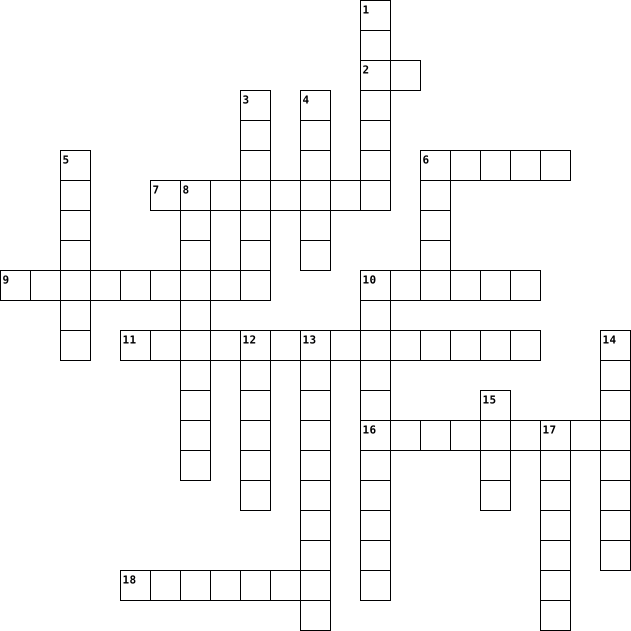
Across
- Bone: is a root
- Mother: is a root
- Politeness: the suffix -ity is used; the state/quality of
- Full of danger: the suffix -ous is used; full of
- To be born: is a root
- The act of disappointing: the suffix -ment is used; indicates an action
- Free from violation: the prefix in- is used; means "not"
- To make sharp: the suffix -en is used; forms verbs
Down
- The study of life: the suffix -logy is used; means "the study of"
- Of grave or somber character: the suffix -ious is used; having the quality of
- Die: is a root
- Human: is a root
- Hand: is a root
- Not possible: the prefix im- is used; means "not"
- Does not exist: the prefix non- is used; means "not"
- To make pure: the suffix -ify is used; forms verbs
- Almighty: the prefix omni- is used; means "all"
- Youthful: the suffix -ile is used; forms adjectives/nouns
- Death: is a root
- Of or derived from acylic acid: the suffix -ic is used; forms adjectives/nouns
20 Clues: Die: is a root • Bone: is a root • Hand: is a root • Human: is a root • Death: is a root • Mother: is a root • To be born: is a root • Almighty: the prefix omni- is used; means "all" • Full of danger: the suffix -ous is used; full of • Not possible: the prefix im- is used; means "not" • To make pure: the suffix -ify is used; forms verbs • ...
Andy's Physics Crossword 2014-02-24

Across
- the energy of motion
- magnetic force when using gravitational pull
- energy required to remove one electron
- unit that power is measured in. joules divided by seconds
- disturbance of vibration of matter
- energy of atomic nucleus. exothermic process
- rate at which energy transforms and work is done. work divided by time
- total energy of a system remains unchanged
- when there needs to be an addition of energy in order to be able to reuse
- energy that is stored and waiting to happen
- ability to do work
- part of total energy. results in temperature of system
Down
- energy associated with gravitational field. attraction of masses of objects to mass of earth
- energy of electromagnetic wave
- when energy is easily reused
- energy stored in material or system, e.g. rubber band
- force times distance. how an object gains or loses energy
- transformation through chemical reaction
- unit that work is measured in
- absorbed or delivered by an electrical current. moving electrons in electrical conductor
20 Clues: ability to do work • the energy of motion • when energy is easily reused • unit that work is measured in • energy of electromagnetic wave • disturbance of vibration of matter • energy required to remove one electron • transformation through chemical reaction • total energy of a system remains unchanged • energy that is stored and waiting to happen • ...
List 3 Vocabulary 2024-09-30

Across
- a person who will legally receive the property of someone who dies; or who will become king or queen after the current king or queen dies or steps down
- a tradition or way of doing something
- a person who buys and sells goods to earn money
- (energy) all the energy something has due to its movement and position
- the edge of a country, or of an area; its outside limits
- a raised canal that carries water from place to another
- (energy) energy that allows us to see
- (energy) energy resulting from the flow of electric charge through a conductor
- what is needed to do work or cause change
- not advanced socially or culturally; wild
Down
- (energy) energy that is stored
- (energy) the energy an object has because of its motion
- (energy) energy that causes a transfer of heat between materials
- a person with special knowledge about a subject
- related to the beliefs on the teachings of Jesus of Nazareth
- a person or group that comes into a country by force
- (energy) energy generated by the sun
- a group of countries controlled by a single authority
- (energy) energy that travels as waves through the air or water and vibrates the eardrum upon contact
- (energy) energy stored as food or fuel
20 Clues: (energy) energy that is stored • (energy) energy generated by the sun • a tradition or way of doing something • (energy) energy that allows us to see • (energy) energy stored as food or fuel • what is needed to do work or cause change • not advanced socially or culturally; wild • a person with special knowledge about a subject • ...
Energy Vocabulary 2025-12-11

Across
- sum of kinetic and potential energy in a system
- energy energy in the form of motion
- to low How heat travels
- energy stored in objects above the Earth's surface
- the ability to cause change
- cell phones are examples of this type of energy
- transfer of energy when a force makes an object move
- transfer of energy through electromagnetic waves
Down
- transfer of energy through movement of particles
- Good examples of conductors
- light energy
- Transfer of energy through direct contact
- sum of kinetic and potential energy in particles of an object
- food is an example of this potential energy
- Wood is an example of this
- energy stored in compressed or stretched objects
- energy stored energy
- amount of work done in a certain amount of time
18 Clues: light energy • energy stored energy • to low How heat travels • Wood is an example of this • Good examples of conductors • the ability to cause change • energy energy in the form of motion • Transfer of energy through direct contact • food is an example of this potential energy • sum of kinetic and potential energy in a system • amount of work done in a certain amount of time • ...
mega and micro 2024-05-17

Across
- an integrated circuit that contains all the functions of a central processing unit.
- a very large amount of money.
- the branch of science that deals with microorganism.
- film containing micro photographs of a newspaper.
- an instrument for converting sound waves into electrical energy.
- A unit of information equal to one million bytes.
- a unit of data size or network speed.
- is a large stone that forms a prehistoric monument.
Down
- is very small.
- A tiny wafer of semiconducting material.
- a microorganism, especially a bacterium casing disease.
- a unit of power equal to one million watts.
- an electromagnetic wave.
- obsession with the exercise of power.
- is an optical instrument used for viewing very small objects.
- A very well-known person.
- a large funnel-shaped device for amplifying noise.
17 Clues: is very small. • an electromagnetic wave. • A very well-known person. • a very large amount of money. • obsession with the exercise of power. • a unit of data size or network speed. • A tiny wafer of semiconducting material. • a unit of power equal to one million watts. • film containing micro photographs of a newspaper. • A unit of information equal to one million bytes. • ...
Kinetic Energy 2022-09-15

Across
- the energy of motion
- the ability to do work
- visible light, x-rays, radio waves are examples of this form of energy
- force applied over a distance
- sum of the potential and kinetic energy of an object
- what the scientist measures
- these variables stay the same for the entire experiment
- stored energy
- this happens to the energy when the mass is doubled
- this happens to the energy when the velocity is doubled
- the amount of matter in an object
- energy stored in the bonds between molecules
Down
- the variable a scientist changes, tests
- a push or a pull
- speed with a direction
- energy of moving electrons
- unit of force
- energy stored in the nucleus of atoms
- the unit of energy
- form of energy that travels through matter by vibrations
- this is often called heat energy
- distance divided by time
22 Clues: unit of force • stored energy • a push or a pull • the unit of energy • the energy of motion • speed with a direction • the ability to do work • distance divided by time • energy of moving electrons • what the scientist measures • force applied over a distance • this is often called heat energy • the amount of matter in an object • energy stored in the nucleus of atoms • ...
Energy Crossword- Lauren Kelly 2014-02-24

Across
- the ability to do work
- energy waiting to be used
- the potential mechanical energy when objects are compressed and stretched
- law that says that the amount of energy remains constant
- energy newly derived from electrical potential energy
- the part of the total energy of an object that results in the system temperature
- the minimum amount of energy required to remove an electron from an atom or molecule
- energy that is easily reused
- the potential of a chemical substance to undergo a transformation through a chemical reaction
- rate at which work is done
Down
- the work of magnetic force on re-alignment of the vector of the magnetic dipole movement
- when work is done, there will be an equal change in energy
- the potential energy associated with the gravitational field
- form of energy associated with the vibration or disturbance of matter
- use of exothermic nuclear processes to generate useful heat and electricity
- need to add energy to reuse
- energy that a body possesses by virtue of being in motion
- unit of power (J/s)
- the energy of electromagnetic waves
- how an object gains or loses energy
20 Clues: unit of power (J/s) • the ability to do work • energy waiting to be used • rate at which work is done • need to add energy to reuse • energy that is easily reused • the energy of electromagnetic waves • how an object gains or loses energy • energy newly derived from electrical potential energy • law that says that the amount of energy remains constant • ...
Energy Vocabulary: The Flow of Energy 2026-02-04

Across
- Organelle where photosynthesis occurs
- Gas taken in during photosynthesis and used in cellular respiration
- Organelle where ATP is produced (in Eukaryotic cells)
- Energy from the sun
- Animals that eat both meat and vegetation are:
- Organisms that cannot make their own food and eat other plants/animals
- Process in which light energy is turned into glucose
Down
- Organisms that make their own energy/food
- Process in which glucose is turned into usable energy (ATP)
- dioxide Gas released during cellular respiration and taken in during photosynthesis
- Shows the flow of energy through different paths and animals
- Rule of energy transfer that states only 10% of energy is transferred from one level to another
- Shows a single flow of energy
- Molecule of sugar that stores chemical energy, broken down in cellular respiration
- The main energy currency of the body that powers various biological functions.
15 Clues: Energy from the sun • Shows a single flow of energy • Organelle where photosynthesis occurs • Organisms that make their own energy/food • Animals that eat both meat and vegetation are: • Process in which light energy is turned into glucose • Organelle where ATP is produced (in Eukaryotic cells) • Process in which glucose is turned into usable energy (ATP) • ...
Chapter 5 Crossword Puzzle Part 2 2025-01-08

Across
- The movement of materials through a cell membrane using the cell's energy (usually from an area of low concentration to an area of high concentration).
- Movement of specific molecules across cell membranes through protein channels (does not require energy, from an area of high concentration to an area of low concentration).
- Makes ribosomes and stores RNA and proteins. (dark area in nucleus on diagrams
- A thin, flexible barrier around every cell; regulates what enters and leaves the cell.
- An type of vacuole, an organelle containing digestive enzymes.
- Found only in eukaryotic cells; controls actions of the cell and contains genetic material (DNA).
- Tiny hairlike extensions that move together in a sweeping motion to move the cell or move items like mucus past the cell.
- Transforms energy from sugars into usable energy (ATP) for the cell.
- The movement of substances across a cell membrane without the use of energy by the cell (from an area of high concentration to an area of low concentration).
Down
- The maintenance of stable internal conditions.
- A system of membranes that modifies and packages proteins for export by the cell (post office of cell).
- A solution that is less concentrated than the cytoplasm in the cell (low solute concentration, higher water concentration).
- The double-layered sheet that forms the core of nearly all cell membranes made of lipids (water-fearing tails facing inward toward other water-fearing tails and water-loving heads on the inside and outside of the watery environment of the cell).
- A control mechanism that causes the process to slow down or stop.
- A storage container for starches in plants.
- Clusters of DNA, RNA, and proteins in the nucleus of a cell.
- found in both animal and plant cells; builds parts for cytoskeleton
- When the cell and solution that they are in the same concentration of solutes so same concentration of water.
- A control mechanism that occurs when a substance causes the process to speed up.
- The rigid outer layer of a cell (outside the cell membrane) that provides strength and rigidity.
- A solution that is more concentrated than the cytoplasm in the cell (high solute concentration, lower water concentration).
- Diffusion of water through a selectively permeable membrane (movement from an area of high water concentration/low solute concentration to low water concentration/high solute concentration).
22 Clues: A storage container for starches in plants. • The maintenance of stable internal conditions. • Clusters of DNA, RNA, and proteins in the nucleus of a cell. • An type of vacuole, an organelle containing digestive enzymes. • A control mechanism that causes the process to slow down or stop. • found in both animal and plant cells; builds parts for cytoskeleton • ...
Will Mason Physics Crossword 2014-03-18

Across
- The measuring unit of kinetic energy
- Energy that it takes to remove an electron from an atom in the gaseous state
- The process by which nuclei combine to form a new atom
- Type of energy made by the flow of electric charge through a corridor
- Energy traveling as electromagnetic waves
- Type of energy relating to gravity
- A form of energy much like electric energy
- Energy released by a nuclear reaction, either fission or fusion
- Energy in the form of heat
Down
- The rate at which work is done
- Stored energy of position
- Type of energy stored in the bonds of chemical compounds
- Energy relating to motion
- When a nucleus splits into two smaller nuclei
- The law that establishes the presence of a constant amount of energy in a system
- Energy involving movement through substances in longitudinal waves
- Ability to do an object of work
- Energy Theorem when work is done there is an equal change in energy
- Type of energy that is stored as a result of deformation
19 Clues: Stored energy of position • Energy relating to motion • Energy in the form of heat • The rate at which work is done • Ability to do an object of work • Type of energy relating to gravity • The measuring unit of kinetic energy • Energy traveling as electromagnetic waves • A form of energy much like electric energy • When a nucleus splits into two smaller nuclei • ...
General Science 1 (Semester 2 Vocabulary) 2026-06-01

Across
- — Refers to feeding levels in an energy pyramid
- — A non-native species that disrupts a new ecosystem
- — Natural disaster most common on the west side of the Americas
- — Plate boundary where plates move apart
- — Long underwater mountain chain where seafloor spreads apart
- — Natural disaster common in the central plains
- — Limitations on a design, like time or materials
- — Synthetic material made from oil
- — An animal hunted for food (like a moose)
- — Organism that eats other organisms for energy
- — Preserved remains that provide evidence for continental drift
- — Synthetic material made from heating sand
- — Requirements a design must meet
- — Type of species that has a major impact on its ecosystem (e.g., elephants)
- — Natural disaster that forms over warm ocean water
- — The variety of all species, genes, and ecosystems
Down
- — The process of breaking rocks down into smaller bits called sediment
- — A first model built to test a design (like one made of spaghetti and a marshmallow)
- — Molten rock beneath the Earth's surface
- — Relationship where one organism benefits and the other is harmed
- — The movement of sediment from one place to another by wind, water, or gravity
- — Process plants use to make energy from the sun, water, and carbon dioxide
- — The modern science describing how plates move (formerly continental drift)
- — An animal that hunts another for food (like a wolf)
- — Rock formed from cooled lava or magma
- — What flows through a food web, decreasing up each level
- — Organism in a food web that makes its own food
- — Relationship where both organisms benefit
- — Plate boundary where plates collide, forming mountains
- — Small bits of broken-down rock
- — Rock formed from compacted and cemented bits of sediment
- — When a species no longer exists
- — Deep feature of the ocean floor formed where plates meet
33 Clues: — Small bits of broken-down rock • — Requirements a design must meet • — When a species no longer exists • — Synthetic material made from oil • — Rock formed from cooled lava or magma • — Plate boundary where plates move apart • — Molten rock beneath the Earth's surface • — An animal hunted for food (like a moose) • — Relationship where both organisms benefit • ...
Science electricity 2021-01-08

Across
- another word for hyper
- some runners do these
- a robot need this in order to work
- a force
- forms in the sky with clouds and rain
- total loss of electricity
Down
- someone who comes when you have a problem with your electricity
- draws other metal things to it
- when your phone dies you need to ———- it
- A shock you get from a Type of fence
- helps you see in the dark
- A panel sits on your roof
12 Clues: a force • some runners do these • another word for hyper • helps you see in the dark • A panel sits on your roof • total loss of electricity • draws other metal things to it • a robot need this in order to work • A shock you get from a Type of fence • forms in the sky with clouds and rain • when your phone dies you need to ———- it • ...
WED Vocabulary 2023-08-22

Across
- movement & transportation of rock, soil and minerals
- type of weathering that does not change the chemistry of an item
- the placing down of rock, soil and minerals
- chemical breakdown due to water
- scraping and wearing away
- type of energy that involves motion
Down
- melting and refreezing of water creating cracks in rocks
- chemical breakdown due to oxygen
- type of weathering that forms a new substance
- breakdown of rock, soil and minerals
10 Clues: scraping and wearing away • chemical breakdown due to water • chemical breakdown due to oxygen • type of energy that involves motion • breakdown of rock, soil and minerals • the placing down of rock, soil and minerals • type of weathering that forms a new substance • movement & transportation of rock, soil and minerals • ...
Ch 16 Vocab Review 2023-05-08

Across
- Bacteria and fungi
- After passing through a plant, water moves into the atmosphere by evaporating through leaves
- process of combining nitrogen with hydrogen to form ammonia.
- pathway that forms when a substance enters living organisms such as trees from the atmosphere
- A somewhat regular progression of species replacement
- One of the steps in a food chain or food pyramid
- Animals that eat plants or other primary producers
- The many different species that live together in a habitat
- The variety of organisms, their genetic differences, and the communities and ecosystems in which they occur
- Animals that eat other animals
- Animals that eat plants and animals
- Living organisms in a habitat
- Water retained beneath the surface of the Earth
- Succession that occurs where life has not existed before
- Study of the interactions of living organisms with one another and with their physical environment
Down
- A diagram in which each trophic level is represented by a block
- Include worms, fungi and bacterial decomposers
- first organisms to live in a new habitat where soil is present. (small, fast-growing plants)
- path of energy through the trophic levels of an ecosystem
- All other organisms in an ecosystem that consume plants or organisms to obtain energy to build their molecules.
- The physical aspects of a habitat (non-living)
- The rate at which organic material is produced by photosynthetic organisms in an ecosystem
- place where a particular population of a species lives
- Succession that occurs in areas where there has been previous growth
- dry weight of tissue and other organic matter found in a specific ecosystem
- Complicated, interconnected group of food chains
- Organisms that first capture energy
- Consists of a community and all the physical aspects of its habitat
28 Clues: Bacteria and fungi • Living organisms in a habitat • Animals that eat other animals • Animals that eat plants and animals • Organisms that first capture energy • Include worms, fungi and bacterial decomposers • The physical aspects of a habitat (non-living) • Water retained beneath the surface of the Earth • One of the steps in a food chain or food pyramid • ...
Sustainable World and Environmental Resource Geography 2025-12-12

Across
- 17 ______ goals are also known as Sustainable Development Goals which are adopted by the United Nations to protect the planet and ensure that all people enjoy peace and prosperity.
- is the measurement of distance north or south of the Equator.
- is any liquid or frozen water that forms in the atmosphere and falls back to the earth.
- is an imaginary line around the middle of the earth, dividing the earth into 2 hemispheres.
- are areas that receive very little precipitation and with cold or hot climates.
- ________ energy is created by nuclear fusion that takes place in the sun.
- Less than three percent of our planet's water is __________.
- is the harvesting of wildlife from the sea at rates too high for species to replace themselves.
- is often defined as a group of organisms that can reproduce naturally with one another.
Down
- is heat that is generated within Earth.
- _______ energy is a form of renewable energy that uses the power of moving water to generate electricity.
- are tiny plastic particles that result from both commercial product development and the breakdown of larger plastics.
- _________ fishing guarantees there will be populations of ocean and freshwater wildlife for the future.
- is the measurement east or west of the Prime Meridian.
- an environment where an organism lives throughout the year
- an area of the planet that can be classified according to the plants and animals that live in it.
- the statistical study of human populations.
- ecosystems are treeless regions found in the Arctic and on the tops of mountains.
- ______ Khalifa is the tallest building in the world and a platinum LEED building since 2024.
- __________ forests are also known as Taigas and is one of the largest biomes in the world. Found in North America and Siberia.
20 Clues: is heat that is generated within Earth. • the statistical study of human populations. • is the measurement east or west of the Prime Meridian. • an environment where an organism lives throughout the year • Less than three percent of our planet's water is __________. • is the measurement of distance north or south of the Equator. • ...
energy types/transformations Crossword puzzle 2023-12-11

Across
- Potential- an object gains more potential energy as its height or mass increases
- energy- Stored energy
- transformation- When one type of energy is converted into another; like when dammed water is released and the kinetic energy is converted into electrical energy.
- energy- Energy of motion
- Potential – energy stored in bending, twisting, or stretching of an object
- energy- Movement of electrons (electricity)
- panel- Radiant → electrical
- Unit for energy
- ability to do work or cause change
Down
- Energy- Energy of a moving object
- Radiant → chemical
- energy-A Energy carried by light waves
- Transfer - The process by which energy is moved from one area to another.
- A measure of energy transfer that occurs when an object is moved over a distance by an external force.
- power plant- Nuclear → thermal → mechanical → electrical
- energy-A Energy stored in chemical bonds between atoms/molecules
- of conservation of energy- Energy is not created nor destroyed
- energy-A Energy store in the nucleus of an atom
- energy- Vibration of waves through matter
- energy- Vibration of particles with matter
20 Clues: Unit for energy • Radiant → chemical • energy- Stored energy • energy- Energy of motion • panel- Radiant → electrical • Energy- Energy of a moving object • ability to do work or cause change • energy-A Energy carried by light waves • energy- Vibration of waves through matter • energy- Vibration of particles with matter • energy- Movement of electrons (electricity) • ...
Energy Recap 2025-01-07

Across
- A transfer of energy associated with motion
- The energy transferred out of a system in the way intended
- A transfer of energy
- Radiators store this type of energy
- The energy transferred into a system
- The energy transferred out of a system which isn't useful
- A way of representing the energy transfers in a system
- A store of energy to do with movement
- Energy cannot be created or ...
- Energy is measured in
Down
- A match stores this type of energy
- The output energy when a person climbs a set of stairs
- The energy stored in a rubber band
- The total amount of energy is always ...?
- The rate of transfer of energy
- The proportion of useful energy to total input energy
- Transfer of energy in a torch
- Power is measured in
18 Clues: A transfer of energy • Power is measured in • Energy is measured in • Transfer of energy in a torch • The rate of transfer of energy • Energy cannot be created or ... • A match stores this type of energy • The energy stored in a rubber band • Radiators store this type of energy • The energy transferred into a system • A store of energy to do with movement • ...
CHEM 111 SI Crossword Puzzle 2022-03-31

Across
- study of the interconversion of heat and
- measurement of heat changes
- energy of position
- does not exchange either mass or energy with its surroundings.
- gains an electron
- part of the universe not of interest
- allows the transfer of energy but not mass
- energy for the random motion of molecules
- heat is transferred from the system to the surroundings
- part of the universe of specific interest
Down
- loses an electron
- to the system
- SI energy unit
- heat is transferred from the
- thermodynamic quantity equivalent to the total heat content of a system. It is equal to the internal energy of the system plus the product of pressure and volume.
- energy of motion
- transfer of thermal energy
- can exchange mass and
- kinds of energy
- with the surroundings
- energy stored in bonds
21 Clues: to the system • SI energy unit • kinds of energy • energy of motion • loses an electron • gains an electron • energy of position • can exchange mass and • with the surroundings • energy stored in bonds • transfer of thermal energy • measurement of heat changes • heat is transferred from the • part of the universe not of interest • study of the interconversion of heat and • ...