
forms of energy Crossword Puzzles
Energy Conceptual Physics 2026-04-29

Across
- James Joule's middle name
- The unit for Force in the International System of Units
- Amount of matter in an object
- Objects that are in motion have ______ energy
- A stretched rubber band has ______ potential energy
- In the equation E=mc^2, c stands for the speed of ______ in a vacuum
- Energy can only be transferred or ______
- The ______ an object is moving, the more kinetic energy it has
- Energy can't be created nor ______
- The unit for Energy used on food labels
Down
- Objects that have the capacity for motion have ______ energy
- The ______ of energy is when energy moves from one object to another
- Fnet = ______
- Unit for energy used on electricity bills, abbr.
- Newton's First Law is also called the Law of ______
- Light waves can travel in a vacuum, but ______ waves cannot
- The force that transforms kinetic energy into thermal energy
- The Law of ______ of Energy
- The type of potential energy that is based on an object's height
- The unit for Energy in the International System of Units
- distance/time
- The hotter an object is, the more ______ energy it has
22 Clues: Fnet = ______ • distance/time • James Joule's middle name • The Law of ______ of Energy • Amount of matter in an object • Energy can't be created nor ______ • The unit for Energy used on food labels • Energy can only be transferred or ______ • Objects that are in motion have ______ energy • Unit for energy used on electricity bills, abbr. • ...
Chapter 14 & 15 vocabulary 2023-05-10

Across
- energy - energy that travels in waves
- energy - energy that is stored as a result of position or shape
- conversion - the process of changing energy from one form to another
- energy - the energy associated with electric charges
- energy - the energy associated with the motion and position of everyday objects
- energy - energy dealing with temperature
- energy - the energy an object has due to its motion
- plane - a slanted surface along which a force moves an object to a different elevation
- and axle - a simple machine that consists of two rigidly attached disks or cylinders, each one with a different radius
- - the rate of doing work
Down
- - a V-shaped object whose sides are two inclined planes sloped toward each other
- - an inclined plane wrapped around a cylinder
- potential energy - potential energy that depends upon an object’s height above a reference point
- energy - the energy stored in chemical bonds
- - a simple machine that consists of a rope that fits into a groove in a wheel
- energy - the energy stored in atomic nuclei
- - a rigid bar that is free to move around a fixed point
- - a device that changes a force & helps you do work
- potential energy - the potential energy of an object that is stretched or compressed
- - the ability to do work
- - the product of distance and the force in the direction an object moves
21 Clues: - the ability to do work • - the rate of doing work • energy - energy that travels in waves • energy - energy dealing with temperature • energy - the energy stored in atomic nuclei • energy - the energy stored in chemical bonds • - an inclined plane wrapped around a cylinder • - a device that changes a force & helps you do work • ...
Chapter 5 2021-01-12

Across
- A change of state from a gas to a liquid
- The physical forms that matter can exist in.
- The transfer of heat energy in the form of waves
- The change in state from a solid to a liquid
- A state of matter that has a definite shape and volume.
- The temperature at which a liquid turns into a solid when cooled
- Occurs when there is a transfer of heat energy through direct contact
- The temperature at which a solid turns into a liquid
Down
- Occurs when there is a difference in temperature between two parts of a liquid or gas
- A change of state from a liquid to a gas
- A change of state from a solid directly to a gas
- A change of state from a gas directly to a solid
- Anything that has mass and takes up space. Makes up everything in the universe.
- The energy that comes from heat. This heat is generated by the movement of tiny particles within an object. The faster these particles move, the more heat is generated.
- A physical change that occurs when matter changes from one state to another.
- Small particles found in all matter.
- The temperature at which a liquid turns into a gas
- The change of state from a liquid to a solid
- A state of matter that is like a superheated gas. Can be found in lightning, flames, and the Northern Lights.
- A state of matter that has a definite volume, but does not have a definite shape.
- A state of matter with no definite shape or volume.
21 Clues: Small particles found in all matter. • A change of state from a liquid to a gas • A change of state from a gas to a liquid • The physical forms that matter can exist in. • The change of state from a liquid to a solid • The change in state from a solid to a liquid • A change of state from a solid directly to a gas • A change of state from a gas directly to a solid • ...
Trinity Lee's Ecology Crossword Puzzle 2024-04-30

Across
- the position of an organism in the food chain
- the role an organism plays in a community
- the chemical element with an atomic number of 6 and is widely distributed forming organic compounds when combined with hydrogen or oxygen
- consisting of living organisms
- kill,repel,or control forms of animal and plant life considered to damage or be a nuisance in agriculture and domestic life
- anything that constrains a populations size and slows or stops it from growing
- an organism that can produce its own food using light,water,carbon dioxide,or other chemicals
- an organism that cannot produce its own food and must eat other plants and/or animals to get energy
- a species that is able to thrive in a wide variety of conditions and can make use of a variety of different resources
- small animals in the planktonic community
Down
- the increasing build up of toxic substances within organisms that happens at each stage of the food chain
- an organism that eats other plants or animals for energy and nutrients
- the variety of all living things and their interactions
- an organism that eats dead or decaying plants or animals as food
- not associated with or derived from living things
- a unit of work or energy equal to the work done by a force of one newton acting through a distance of one meter
- matter that has come from a recently living organism
- microscopic organisms that live in watery environments,both salty and fresh
- an interaction between organisms or species in which both require a resource that is in limited supply
- a place where an organism makes its home
- the study of the relationships between living organisms including humans and their physical environment
21 Clues: consisting of living organisms • a place where an organism makes its home • the role an organism plays in a community • small animals in the planktonic community • the position of an organism in the food chain • not associated with or derived from living things • matter that has come from a recently living organism • ...
AP Biology 2012-11-26

Across
- chemical agent that speeds up a chemical reaction
- spontaneous chemical reaction in which there is a net release of free energy
- use of energy released from exergonic reaction to power endergonic reaction-energy _____
- energy available in molecules for release in chemical reaction
- temporary complex formed when a catalyst binds to substrate
- study of energy transformations that occur in a collection of matter
- energy amount of energy needed to begin reaction
- capacity to cause change
Down
- metabolic pathway that synthesizes complex molecules
- law of thermodynamics that states all energy in universe is conserved
- study of energy flow through organism
- series of chemical reactions that either builds or breaks down a complex molecule
- metabolic pathway that breaks down complex molecules
- type of energy that is a result of location or spatial arrangement
- the law of thermodynamics that states each chemical reaction increases entropy
- total amount of kinetic energy of molecules, also called thermal energy
- non spontaneous chemical reaction in which free energy is absorbed from surroundings
- totality of an organism's chemical reactions
- type of energy associated with motion
- macromolecule serving as a catalyst
20 Clues: capacity to cause change • macromolecule serving as a catalyst • study of energy flow through organism • type of energy associated with motion • totality of an organism's chemical reactions • energy amount of energy needed to begin reaction • chemical agent that speeds up a chemical reaction • metabolic pathway that synthesizes complex molecules • ...
Energy Crossword 2024-07-30

Across
- Energy stored in stretched or compressed materials
- Visible energy that travels in waves
- Energy that runs through wires and powers devices
- Energy of motion
- Transfer of heat through direct contact
- Type of potential energy related to height above the ground
- Energy we hear
- Another term for thermal energy
- Energy in a car or a person riding a bike
- Energy stored in bonds of molecules
- Fuel source we extract from the ground and burn to release energy
Down
- Stored energy that can later be released
- Needed to make things happen
- Material that we put in our houses to reduce heat transfer
- Transfer of energy through space without particles
- Energy stored inside an atom
- Devices that convert sunlight into electricity
- Path for electric current to flow around
- Tools and machines that help solve problems
- Transfer of heat by fluid movement
- How well energy is converted without waste
21 Clues: Energy we hear • Energy of motion • Needed to make things happen • Energy stored inside an atom • Another term for thermal energy • Transfer of heat by fluid movement • Energy stored in bonds of molecules • Visible energy that travels in waves • Transfer of heat through direct contact • Stored energy that can later be released • Path for electric current to flow around • ...
Earthquakes 2021-10-21

Across
- -the point beneath earth's surface where rock breaks under stress and causes an earthquake.
- -a large wave produced by an earthquake on the ocean floor.
- -the process by which an earthquake's violent movement suddenly turns lose soil into liquid mud.
- - a device that records ground movement caused by seismic waves as they move through Earth.
- isolated building - a building mounted on bearings designed to absorb the energy of an earthquake.
- -s waves are seismic waves that vibrate from side to side to side as well as up and down.
- -squeezes rock until it folds or breaks.
- -the shaking that results from the movement of rock beneath earths surface.
- fault -a type of fault where the hanging wall slides upward caused by compression in the crust.
- wall - the block that forms the upper half of a fault.
- -an upward fold in rock formed by compression of earth's crust.
- - the measurement of an earthquake's strength based on seismic waves and movement along faults.
- wall -the block of rock that forms the lower half of a fault.
- fault -In a normal fault,the fault is at an angle,so one block of rock lies above the fault while the other block lies below the fault.
Down
- -pulls on the crust, stretching rock so that it becomes thinner in the middle.
- fault -a type of fault in which rocks on either side move past each other sideways with little up or down motion.
- - a large area of flat land elevated high above sea level.
- -a force that acts on rock to change its shape or volume.
- -a type of seismic wave and that compresses and expands the ground.
- - a downward fold in rock formed by compression in earth's crust.
- scale -A scale that rates earthquakes according to there intensity and how much damage they cause at a particular place.
- magnitude scale - a scale that rates earthquakes by estimating the total energy released by an earthquake.
- -shearing can cause rock to break and slip apart or to a change its shape.
- waves -A type of seismic wave that forms when p waves and s waves reach earth's surface.
- -the record of an earthquake's seismic waves produced by a seismograph.
- -the point on earth's surface directly above an earthquake's focus.
- scale - a scale that rates an earthquake's magnitude based on the size of its seismic waves.
- - the force that opposes the motion of one surface as it moves across another surface
- -an earthquake that occurs after a larger earthquake in the same area.
29 Clues: -squeezes rock until it folds or breaks. • wall - the block that forms the upper half of a fault. • -a force that acts on rock to change its shape or volume. • - a large area of flat land elevated high above sea level. • -a large wave produced by an earthquake on the ocean floor. • wall -the block of rock that forms the lower half of a fault. • ...
CLIL TEST 2025-01-29

Across
- FUEL PRODUCED MILLIONS OF YEARS AGO
- CONSISTING OF CH4, C2H6, C3H8, C4H10, IT IS USED AS A HIGH ENERGY FUEL
- ANY FORM OF PRECIPITATION WITH pH<6 THAT FALLS TO THE GROUND FROM THE ATMOSPHERE IN WET OR DRY FORM
- PRODUCTION OF ELECRICITY USING MATERIALS THAT CAN BE REPLACED OR REGENERATED WITHIN A SHORT TIME SPAN
Down
- GLOBAL OIL PRODUCTION AT ITS MAXIMUM RATE
- HYDRAULIC FRACTURING
- THE CYCLING OF S IN ITS VARIOUS CHEMICAL FORMS FROM THE ENVIRONMENT TO LIVING ORGANISMS AND BACK
- THE UNIT OF POWER. EQUAL TO 1 JOULE OF ENERGY PER SECOND
- SEDIMENTARY ROCK, CONSISTING PRIMARILY OF C
- LIQUID THAT WAS FORMED FROM THE BURIED REMAINS OF PLANKTONIC ORGANISMS
10 Clues: HYDRAULIC FRACTURING • FUEL PRODUCED MILLIONS OF YEARS AGO • GLOBAL OIL PRODUCTION AT ITS MAXIMUM RATE • SEDIMENTARY ROCK, CONSISTING PRIMARILY OF C • THE UNIT OF POWER. EQUAL TO 1 JOULE OF ENERGY PER SECOND • CONSISTING OF CH4, C2H6, C3H8, C4H10, IT IS USED AS A HIGH ENERGY FUEL • LIQUID THAT WAS FORMED FROM THE BURIED REMAINS OF PLANKTONIC ORGANISMS • ...
Science Girl Cell Crossword 2016-12-09

Across
- A cell that contains a nucleus and membrane bound organelles
- when comparing two solutions, the solution with the lesser concentration of solutes
- The outside boundary of a cell that controls which substances can enter or leave a cell (Two words)
- They contain chemicals that break down large food particles and old cell parts
- whiplike tails found in one-celled organisms to aid in movement
- double-layered sheet that forms the core of nearly all cell membranes (Hyphenated)
- when comparing two solutions, the solution with the greater concentration of solutes
- The bulk of the cell that contains all the organelles
- They capture energy from sunlight and use it to produce food for the cell (Plant cell only)
- They produce most of the energy cell needs to carry out its function
- packages materials for the cell (Two words)
- A material in cells that contains DNA and carries genetic information
- A rigid layer of nonliving material that surrounds the cells of plants and some other organisms (Two words)
Down
- Tiny grain-like structures used to make proteins
- The cell's control center, it directs all cell activities
- A unicellular organism that lacks a nucleus and membrane bound organelles
- a minute cylindrical organelle near the nucleus in animal cells, occurring in pairs and involved in the development of spindle fibers in cell division
- The tiny parts within a cell that carry out specific functions within the cell
- surrounds the nucleus. assembles the cell membrane and modifies proteins (Two words)
- network of protein filaments within some cells that helps the cell maintain its shape and is involved in many forms of cell movement
- the site of ribosome production considered the little nucleus
- They store food, water, and waste materials in cells
- This says that 1. all living things are made of cells, 2. cells are the basic unit of structure and function and 3. cells only come from other cells (Two words)
- process by which molecules tend to move from an area where they are more concentrated to an area where they are less concentrated
- when the concentration of two solutions is the same
25 Clues: packages materials for the cell (Two words) • Tiny grain-like structures used to make proteins • when the concentration of two solutions is the same • They store food, water, and waste materials in cells • The bulk of the cell that contains all the organelles • The cell's control center, it directs all cell activities • ...
Review Crossword 2024-09-26

Across
- transfer of thermal energy by the movement of particles from one part of the material to another
- balanced, equal parts
- stored energy due to interactions between objects or particles
- energy carried by electrical current
- sum of the potential energy and kinetic energy in a system
- Energy cannot be created or destroyed
- the smallest unit of a chemical compound
- energy carried by an electromagnetic wave
- solid, liquid, and gas
- heat energy used by molecular motion
Down
- energy due to motion
- the transfer of thermal energy due to collisions between particles
- the transfer of thermal energy by electromagnetic waves
- a measure of the amount of matter in an object
- the movement of heat from hot to cold
- energy that is contained in chemical bonds
- the measure of the average kinetic energy of the particles in a material
- the conversion of one form of energy to another
- movement of thermal energy from a region of high temp to a region of low temp
19 Clues: energy due to motion • balanced, equal parts • solid, liquid, and gas • energy carried by electrical current • heat energy used by molecular motion • the movement of heat from hot to cold • Energy cannot be created or destroyed • the smallest unit of a chemical compound • energy carried by an electromagnetic wave • energy that is contained in chemical bonds • ...
Chemistry Revision 2025-03-07

Across
- a ______ change doesn't create a new substance
- nitric acid + lithium --> _______ + hydrogen
- heat energy released
- sulfate sulfuric acid + calcium --> _______ + hydrogen
Down
- a ------ change forms a new substance
- heat energy absorbed
- hydrochloric acid + sodium --> _______ + hydrogen
7 Clues: heat energy absorbed • heat energy released • a ------ change forms a new substance • nitric acid + lithium --> _______ + hydrogen • a ______ change doesn't create a new substance • hydrochloric acid + sodium --> _______ + hydrogen • sulfate sulfuric acid + calcium --> _______ + hydrogen
Chemistry Revision 2025-03-07

Across
- a ______ change doesn't create a new substance
- nitric acid + lithium --> _______ + hydrogen
- heat energy released
- sulfate sulfuric acid + calcium --> _______ + hydrogen
Down
- a ------ change forms a new substance
- heat energy absorbed
- hydrochloric acid + sodium --> _______ + hydrogen
7 Clues: heat energy absorbed • heat energy released • a ------ change forms a new substance • nitric acid + lithium --> _______ + hydrogen • a ______ change doesn't create a new substance • hydrochloric acid + sodium --> _______ + hydrogen • sulfate sulfuric acid + calcium --> _______ + hydrogen
Rock Crossword 2018-02-21

Across
- 90% of Earth's crust Chemical Composition
- mineral grain reign to form bands because of pressure
- Chemical composition
- the breaking down of rocks at the Earth's surface (used to form sedimentary rocks)
- made from cemented sediments
- forms when molten rock cools and hardens
- made from animal debris
- Forms because of pressure and temperature change
- the series of processes in which rocks change from one type to another
Down
- solid geometric formed with atoms or molecules
- made from evaporated water
- magma cools slowly making large crystals
- has no bands
- forms when sediment mashed together and forms a rock using a paste like susbstane
- a naturally occurring, solid mixture of one or more minerals
- the movement of rocks from one place to another (used to form sedimentary rocks)
- Magma cools quickly making small crystals
17 Clues: has no bands • Chemical composition • made from animal debris • made from evaporated water • made from cemented sediments • magma cools slowly making large crystals • forms when molten rock cools and hardens • 90% of Earth's crust Chemical Composition • Magma cools quickly making small crystals • solid geometric formed with atoms or molecules • ...
Crossword Project 2021-10-20

Across
- The thin and solid outermost layer above the mantle.
- A series in which rock forms changes from one state to another is destroyed, and it forms again.
- The solid outer layer of the Earth consists of the crust and rigid upper part of the mantle.
- The solid plastic layer of the mantle beneath the lithosphere: made of mantle rock that flows very slowly, which allows tectonic plates to move on top of it.
- core The central part of Earth below the mantle.
Down
- A natural formed inorganic solid crystaline structure.
- The movement of matter due to the differences in density that are caused by temperature variations can result in energy transfer as heat.
- The strong lower part of the mantle between the asthenosphere and the outer core.
- The layer of rock between the Earth's crust and core.
- The central part of earth below the mantle.
- core The central part of the Earth below the mantle.
11 Clues: The central part of earth below the mantle. • core The central part of Earth below the mantle. • The thin and solid outermost layer above the mantle. • core The central part of the Earth below the mantle. • The layer of rock between the Earth's crust and core. • A natural formed inorganic solid crystaline structure. • ...
Science Crossword 2015-04-23

Across
- a copy of the object formed by reflected or refracted rays of light
- this forms when light rays actually meet
- a transverse wave that involves the transfer of electric and magnetic energy
- a material that reflects or absorbs all of the light that strikes it
- when light causes an electron to move so much that it is knocked out of metal
- each packet of light energy
- occurs when parallel rays of light hit an uneven surface
- light waves as straight lines
- a flat sheet of glass that has a smooth, silver colored coating on one side
- the point at which rays parallel to the optical axis reflect and meet
- a material that scatters the light that passes through it
- when the three primary colors of light are combined in equal amounts
- an imaginary line that divides a mirror in half
Down
- the image you see in a plane mirror
- two primary colors combine in equal amounts to produce this
- colored substances that are used to color other materials
- the energy that electromagnetic waves transfer through matter or space
- a mirror with a surface that curves inward like the inside of a bowl
- a mirror with a surface that curves out-ward
- a color that is produced when the three primary colors of pigments are combined in equal amounts
- any two colors that combine to form white light are called this
- this occurs when parallel rays of light hit a smooth surface
- a material that transmits most of the light that strikes it
- three colors that can combine to make any other color
- the light that passes through a polarized filter
25 Clues: each packet of light energy • light waves as straight lines • the image you see in a plane mirror • this forms when light rays actually meet • a mirror with a surface that curves out-ward • an imaginary line that divides a mirror in half • the light that passes through a polarized filter • three colors that can combine to make any other color • ...
Nutrition 2024-05-29

Across
- A well-balanced diet improves a person’s overall ___.
- ___ provide numerous essential nutrients that are frequently underconsumed.
- A state of extreme physical or mental fatigue.
- When an athlete loses their interest or passion for their sport due to long-term physical and emotional exhaustion.
- When an athlete doesn’t consume enough ___ they are putting their mental and physical health at risk.
- ___ rehydrate athletes quicker and can help them stay hydrated for longer.
- A molecule made up of amino acids, all of which the human body cannot make on its own.
- Your body needs to be well ___ in order to function at its best.
- The process of fulfilling the body’s nutritional needs.
- A meal that should never be skipped.
- The body’s primary type of sugar and is a major source of energy for our cells.
- The nutrients that protect bodily cells from damage.
- Poor nutrition causes the body to lack ___.
Down
- Sugar molecules—one of the three main nutrients that our bodies need.
- An athlete is more prone to ___ if they are underfueling their body.
- ___ are a good source of dietary fiber.
- Consuming a wide variety of foods in appropriate amounts is what makes a ___ diet.
- The process of breaking down food into their simplest forms so that the body can use them for energy, growth, and repair.
- Fruits and vegetables are examples of ___ foods.
- ___ foods contain substances that are important for a person’s growth and development and overall health.
- ___ are so important because they boost our immune systems.Natural Fats Found in avocados, vegetable oils, nut butters, fish, seeds, etc.
- Not eating enough food or not eating the right types of food.
- The act of sustaining life through healthy foods and drinks.
- A healthy diet enhances your ___.
24 Clues: A healthy diet enhances your ___. • A meal that should never be skipped. • ___ are a good source of dietary fiber. • Poor nutrition causes the body to lack ___. • A state of extreme physical or mental fatigue. • Fruits and vegetables are examples of ___ foods. • The nutrients that protect bodily cells from damage. • A well-balanced diet improves a person’s overall ___. • ...
The energy stored in an object because of a) its height above the Earth or b) the stretching, compressing, or distorting a material that will spontaneously return to its original shape. c) chemical bonds 2023-12-13

Across
- Energy Energy that is stored within an atom’s nucleus. Nuclear reactions including fusion, fission, and radioactive decay are sources of this type of energy.
- Potential Energy Energy stored due to an object’s position above the surface of a planet.
- Transformation When one type of energy is converted into another; like when dammed water is released and the kinetic energy is converted into electrical energy.
- Energy/Radiant Energy Energy (both visible and nonvisible light) resulting from the release of electromagnetic radiation; which does not require a medium and is released in all directions.
- Energy The energy of an object has a result of its motion (can be on an atomic level).
- A type of mechanical force where a sudden force pushes an object in a specific direction.
- The unit of measurement used to describe the amount of energy that is in a system or that is being used/released in a system.
- Transfer The process by which energy is moved from one area to another.
- Energy Energy stored in the chemical bonds of atoms and molecules.
Down
- Energy Energy that is possessed by an object due to its motion
- A push or a pull that causes movement or a change in motion.
- The ability to do work
- Energy The energy stored in an object because of its height above the earth.
- A measure of energy transfer that occurs when an object is moved over a distance by an external force.
- energy
- Energy Energy resulting from the movement of charged particles (usually electrons) from one point to another.
- Potential Energy Energy stored from stretching, compressing, or distorting a material that spontaneously returns to its original shape; like springs or rubber bands.
- Energy energy that is transferred by electromagnetic radiation
- Energy Energy resulting from the movement of atoms and molecules in a system, causing them to collide with each other. Faster moving particles results in higher temperatures and slower moving particles results in lower temperatures.
- result when a force, either sound or pressure, makes an object or substance vibrate.
- of Conservation of Energy The theory that energy can only transfer between objects and change form; it is never created or destroyed.
21 Clues: energy • The ability to do work • A push or a pull that causes movement or a change in motion. • Energy Energy that is possessed by an object due to its motion • Energy energy that is transferred by electromagnetic radiation • Energy Energy stored in the chemical bonds of atoms and molecules. • ...
severe weather 2024-12-05

Across
- air rises and forms a cumulus cloud
- an intense local storm
- tornadoes form between cool, __________ and warm humid air
- an electric discharge
- destructive rotating column of air with high wind speed
- move up and down to build up electrical charge
- alley includes Iowa, Kansas, Nebraska and Ohio
- tornado forms when a thunderstorm meets horizontal winds at a _______
- block warm air from moving up
- type of cloud distinctive to a tornado
Down
- hurricane that forms over the Indian ocean
- a hurricane is a ______________ system
- as the funnel reaches the ground, the higher-pressure air rushes into the _____ area
- formed in the first stage of thunderstorm
- heard after a lightning
- huge mass of ocean water pushed by hurricanes
- Thunderstorm bring wind, heavy rain, and sometimes _____________
- ____________ winds are produced by tornadoes
- hurricane that forms over the western Pacific Ocean
19 Clues: an electric discharge • an intense local storm • heard after a lightning • block warm air from moving up • air rises and forms a cumulus cloud • a hurricane is a ______________ system • type of cloud distinctive to a tornado • formed in the first stage of thunderstorm • hurricane that forms over the Indian ocean • ____________ winds are produced by tornadoes • ...
Energy and Heat 2024-02-20

Across
- the conversion of energy from one form to another
- materials that “slow” heat transfer
- energy cannot be created or destroyed but it can be transformed
- both work and energy are measured in this unit
- energy that an object has due to its motion
- the loss of energy
- energy associated with temperature
- the “stuff” that makes up the universe
- materials that allow heat to transfer without slowing down
- applying a force to move or change something
- the movement of energy from one place to another or object
- energy stored in the bonds between atoms
- energy stored in food is measured in this unit
- energy carried by sound
- the movement of thermal energy
- heat transfer between solid objects
- stored energy
Down
- potential energy an object has because of its hight
- the measure of heat
- temperature can be measured in Fahrenheit, Celcius, or _________
- heat transfer into or out of moving fluids
- heat ALWAYS flows from hot to _____
- the temperature at which ALL particles stop moving
- energy carried by charged particles
- the ability to do work
- energy of motion
- energy carried by the sun
- heat transfer due to packets of energy that can travel through many substances
- potential energy stored in objects that can stretch or compress
- energy flows
- energy is stored within the nucleus
31 Clues: energy flows • stored energy • energy of motion • the loss of energy • the measure of heat • the ability to do work • energy carried by sound • energy carried by the sun • the movement of thermal energy • energy associated with temperature • materials that “slow” heat transfer • heat ALWAYS flows from hot to _____ • energy carried by charged particles • ...
HENRY'S ENERGY STUDY GUIDE 2024-11-20

Across
- the energy of charged particles
- Energy can be transferred from place to place by sound, light, heat, and electric ___ or from object to object through collisions.
- The __ an object moves, the more energy it possesses.
- is the energy released by an object's vibrations
- pass from one object to another
- motion energy
- when an object is moving, it is in __
- Kinetic energy depends on an object's __ and speed.
- the energy of heat
- a kind of kinetic energy with the ability to make types of ___ visible to human eyes.
- __ is the ability to do work or cause change. A relationship exists between the speed of an object and the energy of that object.
- heat and light energy from the sun
Down
- The push or pull on an object with mass causes it to change its ___.
- When a moving object collides with a stationary object, some of the motion energy of one is ___ to the other.
- rapid back-and-forth movements
- the transfer of energy from a high-temperature body to a lower-temperature one.
- the energy of motion, or the energy of an object that moves.
- means to change
- an energy source that will eventually run out
- __ energy can be changed, or transferred, into motion energy.
- the energy contained within a system that is responsible for its temperature.
- Some of the ___ energy is changed, or transferred to the surrounding air, and as a result, the air gets heated and sound is produced.
- energy source that will never run out
- stored energy
24 Clues: motion energy • stored energy • means to change • the energy of heat • rapid back-and-forth movements • the energy of charged particles • pass from one object to another • heat and light energy from the sun • energy source that will never run out • when an object is moving, it is in __ • an energy source that will eventually run out • ...
AP Biology Quarter 1 2021-10-05

Across
- monomer of nucleic acids
- the scientific study of life
- organelle found in plants and photosynthetic protists that converts sunlight to chemical energy
- substance that increases the hydrogen ion concentration of a solution
- a metabolic pathway that consumes energy to synthesize molecules
- the variable whose value is measured to see if it is influenced by another factor
- monomer of carbohydrates
- steroid that forms an essential component of animal cell membranes
- a macromolecule serving as a catalyst without being consumed in the reaction
- storage polysaccharide in anmials
- membrane-enclosed sac of hydrolytic enzymes found in animal cells
- organelle where cellular respiration takes place
- having an affinity for water
- region of an enzyme where the substrate binds
Down
- a substance that reduces the hydrogen ion concentration in a solution
- structural polysaccharide of plant cells
- a metabolic pathway that releases energy by breaking down molecules
- non-membrane-enclosed area in a prokaryote where its chromosomes are located
- storage polysaccharide in plants
- monomer of proteins/polypeptides
- the reactant on which an enzyme works
- process in which a protein loses its native shape
- a type of strong bond where two atoms share one or more pairs of electrons
- these are synthesized by the rough ER
- having no affinity for water
- the linking of like molecules, often by hydrogen bonds
- these are synthesized by the smooth ER
- chemical reaction that breaks bonds between 2 molecules by adding water
- the variable that is manipulated or changed to reveal effects on another factor
- complex of rRNA and protein molecules where protein synthesis takes place
- the clinging of one substance to another by hydrogen bonds
31 Clues: monomer of nucleic acids • monomer of carbohydrates • the scientific study of life • having no affinity for water • having an affinity for water • storage polysaccharide in plants • monomer of proteins/polypeptides • storage polysaccharide in anmials • the reactant on which an enzyme works • these are synthesized by the rough ER • these are synthesized by the smooth ER • ...
Life Processes Crossword - Amaya Jeter 2022-11-02

Across
- Inputs/Raw Materials/Ingredients
- Cytoplasm pinches in and results in two new daughter cells. The new cells are identical to each other and to the original cell (like clones).
- Taking food into the body or cell membrane.
- Different tissues working together to do a specific job.
- Makes reproductive cells that have half the number of chromosomes as the parent cell (similar process to mitosis).
- All the levels together, highest level of organization.
- A chemical process in plant cells where sunlight is used to make food (stored energy).
- Nuclear membrane disintegrates and centrioles appear at poles (sides).
- Cell appears to rest and grow a bit. Cell makes a copy of DNA (DNA replication).
- Organisms that are made of only one cell.
- movement of water across the cell membrane.
Down
- Organisms that are made of many cells.
- Removal of waste matter.
- Groups of similar cells organized to do a specific job.
- Breaking down food into smaller pieces.
- Groups of organs working together to perform a specific job.
- movement of substances (other than water) across the cell membrane.
- Nuclear membrane forms around each new nucleus.
- Makes body cells for growth and repair that are identical to the parent cell (same number of chromosomes).
- A healthy internal balance of things like temperature, sugar, etc.
- Outputs/By-products
- Chromosomes line up in the middle of the cell.
- The smallest unit of life. In the body, they are specialized to do certain things.
- Chromosomes separate (pull apart), and chromatids (legs) move to opposite poles (sides).
- Releases the stored energy from food eaten or made into usable energy (ATP). Occurs in the cell's mitochondria.
25 Clues: Outputs/By-products • Removal of waste matter. • Inputs/Raw Materials/Ingredients • Organisms that are made of many cells. • Breaking down food into smaller pieces. • Organisms that are made of only one cell. • Taking food into the body or cell membrane. • movement of water across the cell membrane. • Chromosomes line up in the middle of the cell. • ...
Energy 2 2020-01-25

Across
- rate at which energy is transferred
- unit for measuring energy
- measure of how hot something is
- when a force acts on an object
- internal energy due to temperature
- law the states energy cannot be created or destroyed only transferred
- the amount of energy needed to raise the temp of 1kg by 1C
- the amount of matter in an object
- energy store such as food or fuel
- transfer of thermal energy through fluids
- potential energy store up high
Down
- picture where colour represents temperature
- a store of energy
- transfer of thermal energy through solids
- 'pull'0f the force of gravity
- useful output divide by total input
- force of gravity acting on a mass
- potential energy store in a spring
- when energy spreads into the surroundings
- reduces heat transfer from hot objects
- energy due to movement
- reduces friction in moving parts
22 Clues: a store of energy • energy due to movement • unit for measuring energy • 'pull'0f the force of gravity • when a force acts on an object • potential energy store up high • measure of how hot something is • reduces friction in moving parts • force of gravity acting on a mass • the amount of matter in an object • energy store such as food or fuel • internal energy due to temperature • ...
APES Unit 6 Energy 2023-02-05

Across
- The time taken for radioactivity of a specific isotope to fall to half of its original value.
- The movement of objects and substances from place to place is ____ energy.
- Release CO2, particulate matter, SOx, and NOx when combusted.
- Hot water tanks used to passively collect and store energy or an example of ______ power.
- Process through which plants convert radiant energy from the sun into chemical energy stored in carbohydrates.
- Clean fuel that can be generated through the hydrolysis of water.
- Highest rank of coal.
- Energy harnessed from heat produced in the Earth's core by the slow decay of naturally-occurring radioactive particles.
- Trap sediments and prevent fish from reaching spawning grounds.
- The vibration and movement of atoms and molecules with substances is called _____ energy.
- The scientific rule that states that energy cannon be created or destroyed is called the Law of _______ of energy.
- Vehicles powered by an internal combustion engine and one or more electric motors.
- A hydropower reservoir is an example of _____ potential energy.
Down
- The movement of electrons is ___ energy.
- Nonrenewable energy source, the Middle East and Venezuela have huge reserves.
- Generation of electricity and other energy jointly.
- Cheapest and cleanest way to produce electricity.
- Fission and fusion are examples of _____ energy.
- country with largest reserve of coal
- Any organic material that can be used for its energy content.
- Stored energy and the energy of position are _____ energy.
- Nonrenewable, although methane produced from landfill gas is classified as renewable.
- Energy source that is not derived directly or indirectly from solar energy.
- The most polluting fossil fuel.
- Currently proven global reserves are expected to be largely exhausted within the next 50 years.
- Used to produce about 33 percent of electricity in the US.
- Another term for kinetic energy is _____ energy
- Electromagnetic energy traveling in transverse waves is ____ energy.
28 Clues: Highest rank of coal. • The most polluting fossil fuel. • country with largest reserve of coal • The movement of electrons is ___ energy. • Another term for kinetic energy is _____ energy • Fission and fusion are examples of _____ energy. • Cheapest and cleanest way to produce electricity. • Generation of electricity and other energy jointly. • ...
Energy crossword 2025-10-23

Across
- a type of charge with a attractive force.
- a moving energy
- The energy stored in the nucleus of an atom
- Energy that you can hear
- what do you measure energy in
- A form of energy that is related to warmth and the movement of atoms
- A type of charge with a repulsive force
- The energy of moving electrons
- energy that pulls down to earth
- Visible energy that travels in waves
- Energy stored in the bonds of molecules
- A resource formed from the remains of living organisms
Down
- What a power plant turns turbines with to create electricity
- Stored energy, for example, in a stretched rubber band
- Energy related to the vibration of objects
- This is a reusable energy source
- Energy from the sun
- The ability to do work or cause change
- The combination of kinetic and potential energy
- A type of energy that is generated from heat, for example, from the Earth's interior
20 Clues: a moving energy • Energy from the sun • Energy that you can hear • what do you measure energy in • The energy of moving electrons • energy that pulls down to earth • This is a reusable energy source • Visible energy that travels in waves • The ability to do work or cause change • A type of charge with a repulsive force • Energy stored in the bonds of molecules • ...
Review Crossword 2024-09-26

Across
- transfer of thermal energy by the movement of particles from one part of the material to another
- balanced, equal parts
- stored energy due to interactions between objects or particles
- energy carried by electrical current
- sum of the potential energy and kinetic energy in a system
- Energy cannot be created or destroyed
- the smallest unit of a chemical compound
- energy carried by an electromagnetic wave
- solid, liquid, and gas
- heat energy used by molecular motion
Down
- energy due to motion
- the transfer of thermal energy due to collisions between particles
- the transfer of thermal energy by electromagnetic waves
- a measure of the amount of matter in an object
- the movement of heat from hot to cold
- energy that is contained in chemical bonds
- the measure of the average kinetic energy of the particles in a material
- the conversion of one form of energy to another
- movement of thermal energy from a region of high temp to a region of low temp
19 Clues: energy due to motion • balanced, equal parts • solid, liquid, and gas • energy carried by electrical current • heat energy used by molecular motion • the movement of heat from hot to cold • Energy cannot be created or destroyed • the smallest unit of a chemical compound • energy carried by an electromagnetic wave • energy that is contained in chemical bonds • ...
Chemistry Revision 2025-03-07

Across
- a ______ change doesn't create a new substance
- nitric acid + lithium --> _______ + hydrogen
- heat energy released
- sulfate sulfuric acid + calcium --> _______ + hydrogen
Down
- a ------ change forms a new substance
- heat energy absorbed
- hydrochloric acid + sodium --> _______ + hydrogen
7 Clues: heat energy absorbed • heat energy released • a ------ change forms a new substance • nitric acid + lithium --> _______ + hydrogen • a ______ change doesn't create a new substance • hydrochloric acid + sodium --> _______ + hydrogen • sulfate sulfuric acid + calcium --> _______ + hydrogen
Physics Crossword Puzzle 2022-06-14

Across
- a electrical component that limits or regulates the flow of electrical current in a circuit.
- a quantity that has both magnitude and direction; also known as a character from Despicable Me.
- the tendency to resist changes in their state of motion.
- the unit of energy.
- a force acting upon an object for some duration of time.
Down
- the smallest unit of ordinary matter that forms a chemical element.
- a net force that acts on an object to keep it moving along a circular path.
- a circuit that has only ONE path for electricity to flow.
- a form of energy that an object or a particle has by reason of its motion.
- the rate of doing work.
10 Clues: the unit of energy. • the rate of doing work. • the tendency to resist changes in their state of motion. • a force acting upon an object for some duration of time. • a circuit that has only ONE path for electricity to flow. • the smallest unit of ordinary matter that forms a chemical element. • ...
Y9 Energy 2025-12-13

Across
- The energy stored in the bonds of chemical compounds, released during a chemical reaction.
- The rate at which work is done or energy is transferred.
- The movement of energy from one place or object to another.
- The process of energy transfer that happens when a force moves an object.
- An assessment of energy use to find ways to save energy and improve efficiency.
- The stored energy in an object based on its position
- A measure of how much useful energy is produced compared to the total energy input
- The energy released during nuclear reactions, such as splitting or combining atomic nuclei.
- The total energy of an object due to its motion (kinetic) and position (potential)
- Energy that meets current needs without harming future generations.
- Fuels, naturally occurring substances, formed from the remains of ancient organisms, used as a source of energy.
Down
- The energy produced by electric charges and their movement
- The network for delivering electricity from producers to consumers.
- The process of changing energy from one form to another.
- The Physics Law that states energy cannot be created or destroyed, only transformed from one form to another.
- The capacity to do work or produce change
- The energy that comes from the temperature of matter; it is the energy of moving particles.
- The energy an object has because it is moving
- Energy from sources that can be replenished naturally over time.
- Energy from sources that cannot be replenished in a short period of time.
20 Clues: The capacity to do work or produce change • The energy an object has because it is moving • The stored energy in an object based on its position • The process of changing energy from one form to another. • The rate at which work is done or energy is transferred. • The energy produced by electric charges and their movement • ...
Physical Science Vocabulary Terms -- Atoms 2021-10-27

Across
- The fixed amount of energy that a system described by quantum mechanics, such as a molecule, atom, nueclei, ect can have.
- The positively charged center of the atom consisting of protons and neutrons.
- A positively charged elementary particle that is a fundamental constituent of all atomic nuclei.
- an atomic nucleus, atom, or molecule is its lowest energy state.
- Mathematical function describing the wave-like behavior of an electron in an atom.
- A stable negatively charged component of an atom.
Down
- is the total number of protons and neutrons
- The particle in the atomic nucleus with a mass of one and a charge of zero.
- the arrangement of electrons around the nucleus of a particular atom or molecule
- The number of a chemical element in the periodic system, whereby the elements are arranged.
- Cloud The system of electrons surrounding the nucleus of an atom.
- Two or more forms of the same element that contain equal protons but different neutrons in their nuclei
12 Clues: is the total number of protons and neutrons • A stable negatively charged component of an atom. • an atomic nucleus, atom, or molecule is its lowest energy state. • Cloud The system of electrons surrounding the nucleus of an atom. • The particle in the atomic nucleus with a mass of one and a charge of zero. • ...
Cell Processes Crossword 2025-01-30

Across
- requiring air to live
- a three-carbon molecule containing RuBisCo
Down
- the phase that does not require sunlight; also called the Calvin Cycle
- the phase involving capturing sunlight energy
- the first step in respiration; the release of energy to form ATP
- the process all organisms use to get energy from food
- the cycle that takes smaller molecules from glycolysis and forms cytric acid
7 Clues: requiring air to live • a three-carbon molecule containing RuBisCo • the phase involving capturing sunlight energy • the process all organisms use to get energy from food • the first step in respiration; the release of energy to form ATP • the phase that does not require sunlight; also called the Calvin Cycle • ...
Vocabulary Crossword (Units 1 & 2) 2022-02-16

Across
- Instruments can produce a type of energy called _______ .
- Energy is measured in units called _____.
- A type of physical and chemical power that can never be destroyed but change from one form to another.
- This type of energy is used in microwaves, xray, and radio. It travels in the form of waves.
- You subtract the final velocity with the initial and divide it by time to find ______ of an object.
- Everything is made up of ____.
- This source of energy is used to power the houses.
- Potential energy, Kinetic energy, chemical energy, light energy, etc. are all considered _______.
- You divide mass by density to find the _____ of an object.
- Used often in math and science to put together an expression.
- Chemical energy transforming into mechanical energy is an example of _____.
- Describe how fast certain objects move.
- A process when a nucleus is split in two smaller ______.
- This is the type of stored energy an object has when it’s at rest.
- Sound waves are an example of _______.
- Type of energy that holds us onto the ground on Earth, and not floats.
Down
- This type of energy runs through a cable to power machines.
- The sum of potential energy and kinetic energy.
- You divide displacement by time to find the _____ of an object.
- Every object has a _____ that can be weighted.
- A potential energy that’s stored and releases _____ when a chemical reaction occurs.
- A single form of nucleus is called _____.
- A process of two nuclei combining to form a larger nucleus.
- A power plant produces this kind of energy to provide electricity.
- An energy travel in a form of _____.
- Moving an object in a straight line without changing its direction.
- This source of energy comes from the sun.
- A pot on the stove gives off _____ energy.
- Describe movement or the action of an object.
- This type of energy an object has when it’s in motion.
30 Clues: Everything is made up of ____. • An energy travel in a form of _____. • Sound waves are an example of _______. • Describe how fast certain objects move. • Energy is measured in units called _____. • A single form of nucleus is called _____. • This source of energy comes from the sun. • A pot on the stove gives off _____ energy. • ...
THE ENERGY OF LIFE 2026-03-16

Across
- The "powerhouse" of the cell where cellular respiration is completed to create energy.
- The chain formed by amino acids.
- The main sugar (C6H12O6) produced during photosynthesis and broken down in glycolysis.
- The source of energy that plants use to start the process of photosynthesis.
- The metabolic pathway that breaks down glucose into two molecules of pyruvate.
- The piece of DNA that encodes a certain protein.
Down
- The process cells use to get energy from glucose when there is no oxygen.
- The green pigment in plants that captures sunlight for photosynthesis.
- Organisms, like plants, that can produce their own food using light or chemical energy.
- Cell division.
- Can be malignant or benign.
- Along with CO_2, plants need this liquid to perform photosynthesis.
- The main "energy molecule" created during cellular respiration.
- The gas produced by plants as a waste product, which humans need to breathe.
- The place in the cell where Glycolysis happens.
- Set of genes.
- CODE The set of triplets to which certain amino acids correspond.
- The main "organ" of the plant where photosynthesis usually takes place.
18 Clues: Set of genes. • Cell division. • Can be malignant or benign. • The chain formed by amino acids. • The place in the cell where Glycolysis happens. • The piece of DNA that encodes a certain protein. • The main "energy molecule" created during cellular respiration. • CODE The set of triplets to which certain amino acids correspond. • ...
Weather & Climate Crossword Puzzle 2021-10-28

Across
- sphere is liquid water
- the direction that winds blows
- water changing from a liquid to a gas
- the amount of thermal energy in an air mass
- water falling from clouds in 4 forms
- amount of density in the air
- 2 things that come together to make a change
- the amount of water vapor in the air
- sphere of air
Down
- sphere of rock or ground
- water that moves over land in to a body of water
- how fast the wind moves from one area to another
- water that seeps into the ground
- water changing from a liquid to a gas from plants
- water changing from a gas to a liquid
- sphere of ice
- Cycle water changing in to the 3 states of matter through the spheres
- water falling to earth from clouds in 4 potential forms
- sphere of life
19 Clues: sphere of ice • sphere of air • sphere of life • sphere is liquid water • sphere of rock or ground • amount of density in the air • the direction that winds blows • water that seeps into the ground • water falling from clouds in 4 forms • the amount of water vapor in the air • water changing from a gas to a liquid • water changing from a liquid to a gas • ...
Let's See What You (Hopefully) Learned 2017-05-18

Across
- discipline of classifying organisms and assigning each organism a universally accepted name
- the "father of genetics"
- change in a kind of organism over time
- _______ and Crick are given credit for discovering the overall structure of a DNA molecule
- site of protein synthesis within the cell
- decoding of a mRNA message to ultimately make a protein
- scientific study of interactions among organisms and between organisms and their environment
- person who came up with the theory of evolution by means of natural selection
- situation in which both alleles of a gene contribute to the phenotype of the organisms
- part of eukaryotic cell division during which the cell nucleus divides
- change in a DNA sequence that affects genetic information
Down
- group of individuals of the same species that live in the same area
- process by which cells release energy in the absence of oxygen
- person who came up with the process of assigning all organisms a universal scientific name
- the study of life
- term used to an organism that has two identical alleles for a particular trait
- set of chemical reactions through which an organism builds up or breaks down materials as it carries out life processes
- one product of photosynthesis
- basic unit of all life forms
- ultimate source of chemical energy
- deoxyribonucleic acid
- sequence of DNA that codes for a protein and thus determines a trait
22 Clues: the study of life • deoxyribonucleic acid • the "father of genetics" • basic unit of all life forms • one product of photosynthesis • ultimate source of chemical energy • change in a kind of organism over time • site of protein synthesis within the cell • decoding of a mRNA message to ultimately make a protein • change in a DNA sequence that affects genetic information • ...
Energy(Ch. 15.1 & 15.2) 2024-02-28

Across
- E=mc2 says that energy and mass are _______
- The ability to do work
- The PE of an object that is stretched or compressed
- A form of energy consisting of changing electric and magnetic fields
- The kinetic energy of a moving object depends on its ____ and speed
- The energy associated with electric charges
- Law of conservation of energy states energy can't be created or ____
- The energy stored in atomic nuclei
Down
- The energy associated with the motion and position of everyday objects
- The gravitational PE of an object is converted to KE as it ____
- The process of changing energy from one form to another
- PE that depends upon an object's height above a reference point
- The energy an object has due to its motion
- The total potential and kinetic energy of all the particles in an object
- An objects gravitation PE depends on its mass, ____ and gravity
- This is a transfer of energy
- Energy that is stored as a result of position or shape
- When a musician does this to her string it gains potential energy
- A speed skater's skate is slowed down on the ice by this force
- The energy stored in chemical bonds
20 Clues: The ability to do work • This is a transfer of energy • The energy stored in atomic nuclei • The energy stored in chemical bonds • The energy an object has due to its motion • E=mc2 says that energy and mass are _______ • The energy associated with electric charges • The PE of an object that is stretched or compressed • ...
DO NOW: Forms of Media 2018-09-10

Across
- Originally created for Harvard students, this is still one of the largest social media websites in the world. ANSWER:________________________
- Activities associated with the governance of a country or other area, especially the debate or conflict among individuals or parties having or hoping to achieve power. ANSWER:______________
- CNN, Fox News and MSNBC are all examples of this type of media. ANSWER:__________________
- A printed publication (usually issued daily or weekly) consisting of folded unstapled sheets and containing news, feature articles, advertisements, and correspondence. ANSWER:___________________
- A form of social media that was created for users to post pictures with different filters. ANSWER:__________________________
- The information superhighway that connects people around the world in a digital worldwide web. ANSWER:_____________________
- A system for transmitting visual images and sound that are reproduced on screens, chiefly used to broadcast programs for entertainment, information, and education. ANSWER:________________________
Down
- ____________ broadcasts in AM and FM and now you can also purchase a satellite version of this.
- Not a film but a ________________.
- A written or printed work consisting of pages glued or sewn together along one side and bound in covers. ANSWER:_____________________
- The activity or profession of producing ways to promote a business or product. ANSWER:______________________
- A digital audio file made available on the Internet for downloading to a computer or mobile device, typically available as a series, new installments of which can be received by subscribers automatically. ANSWER:__________________
- A form of social media that lets users send pictures that disappear shortly after they are seen. ANSWER:_________________
- A periodical publication containing articles and illustrations, typically covering a particular subject or area of interest. ANSWER:_________________________
- A form of social media that allows you to type status updates but only in 280 characters. ANSWER:_____________________
- Not a movie but a ________________.
16 Clues: Not a film but a ________________. • Not a movie but a ________________. • CNN, Fox News and MSNBC are all examples of this type of media. ANSWER:__________________ • ____________ broadcasts in AM and FM and now you can also purchase a satellite version of this. • ...
Forms and Systems of Government 2023-03-21

Across
- rule by the people
- Monarchy where king or queen has all power
- legislative branch has most power/chooses prime minister
- central or national government has all power
- a religious government
- rule by one tyrannical leader
- another name for a representative democracy
- the central government shares power with the states
Down
- One person rule
- states have all power/ central government weak
- government controls the entire economy/ workers revolt
- rule by a king or queen/power passed through family
- democracy where people rule through elected officials
- democracy where people vote on every issue and law
- government controls parts of economy/people own resources
- rule by a small group
16 Clues: One person rule • rule by the people • rule by a small group • a religious government • rule by one tyrannical leader • Monarchy where king or queen has all power • another name for a representative democracy • central or national government has all power • states have all power/ central government weak • democracy where people vote on every issue and law • ...
Crossword fro week 02-05-17 Ryan Le 2017-02-09

Across
- of the Muses: A place where many examples of the arts and sciences were stored.
- the crust.
- surface.
- A significant Egyptian city that was a center of learning.
- the Great: The ruler of a large empire that stretched through
- & Vocabulary Words For Week of 01-30-17
- A mass of rock that forms when a large body of magma cools
- A huge hole that is left behind after a volcano collapses.
Down
- Asia.
- of rock.
- A slab of volcanic rock that forms when magma squeezes between
- An igneous rock layer that forms when magma hardens beneath
- A culture that combined Greek, Persian, Egyptian, and Indian
- A military machine that threw stones at enemy forces and
- A slab of volcanic rock that forms when magma forces itself across
- layers.
16 Clues: Asia. • layers. • of rock. • surface. • the crust. • & Vocabulary Words For Week of 01-30-17 • A military machine that threw stones at enemy forces and • A significant Egyptian city that was a center of learning. • A mass of rock that forms when a large body of magma cools • A huge hole that is left behind after a volcano collapses. • ...
Plate Tectonics 2014-03-03

Across
- the direct transfer of energy through space by electromagnetic waves
- a large stream of moving water that flows through the oceans
- a rigid layer made up of the uppermost part of the mantle and the crust
- a usually light-colored rock that is found in continental crust
- the theory that pieces of Earth's lithosphere are in constant motion, driven by continental currents in the mantle
- the process by which molten material adds new oceanic crust to the ocean floor
- a dark, dense, igneous rock with a fine texture, found in oceanic crust
- the amount of mass of a substance in a given volume; mass per unit volume
- a plate boundary where two plates move past each other in opposite directions
- the direct transfer of thermal energy from one substance to another substance that it's touching
- the layer of hot, solid material between Earth's surface and core
Down
- the hypothesis that the continent slowly move across Earth's surface
- a plate boundary where two plates move away
- the force exerted on a surface divided by the total area over which the force is exerted
- a plate boundary where two plates move toward each other
- Vibrations that travel through Earth carrying the energy released during an earthquacke
- the soft layer of the mantle on which the lithosphere floats
- a break or crack in Earth's lithosphere along which the rocks move
- the name of the single landmass that broke apart 200 million years ago and broke into today's continents
- a well-tested concept that explains a wide range of observations
- the layer of rock that forms Earth's outer surface
21 Clues: a plate boundary where two plates move away • the layer of rock that forms Earth's outer surface • a plate boundary where two plates move toward each other • a large stream of moving water that flows through the oceans • the soft layer of the mantle on which the lithosphere floats • a usually light-colored rock that is found in continental crust • ...
Science Crossword 2015-04-23

Across
- this forms when light rays actually meet
- the point at which rays parallel to the optical axis reflect and meet
- colored substances that are used to color other materials
- a copy of the object formed by reflected or refracted rays of light
- the energy that electromagnetic waves transfer through matter or space
- a flat sheet of glass that has a smooth, silver colored coating on one side
- a color that is produced when the three primary colors of pigments are combined in equal amounts
- this occurs when parallel rays of light hit a smooth surface
- a material that scatters the light that passes through it
- a material that transmits most of the light that strikes it
- two primary colors combine in equal amounts to produce this
- a mirror with a surface that curves out-ward
Down
- the image you see in a plane mirror
- light waves as straight lines
- when the three primary colors of light are combined in equal amounts
- each packet of light energy
- an imaginary line that divides a mirror in half
- when light causes an electron to move so much that it is knocked out of metal
- any two colors that combine to form white light are called this
- a transverse wave that involves the transfer of electric and magnetic energy
- a mirror with a surface that curves inward like the inside of a bowl
- occurs when parallel rays of light hit an uneven surface
- the light that passes through a polarized filter
- a material that reflects or absorbs all of the light that strikes it
- three colors that can combine to make any other color
25 Clues: each packet of light energy • light waves as straight lines • the image you see in a plane mirror • this forms when light rays actually meet • a mirror with a surface that curves out-ward • an imaginary line that divides a mirror in half • the light that passes through a polarized filter • three colors that can combine to make any other color • ...
Negative forms 2022-04-06

Across
- não(condicional futuro)
- não(verbo to be para he, she, it no presente)
- não(futuro)
- não(passado para todas as pessoas)
- não(verbo to be para I no presente)
- não deveria
- não(presente simples para as pessoas he, she, it)
Down
- não(to be para you, we, they no passado)
- não dever
- não(to be no passado para I, he, she, it no passado)
- não podia
- não(verbo to be para you, we, they no presente)
- não poder
- não(presente simples para as pessoas I, you, we, they)
14 Clues: não dever • não podia • não poder • não(futuro) • não deveria • não(condicional futuro) • não(passado para todas as pessoas) • não(verbo to be para I no presente) • não(to be para you, we, they no passado) • não(verbo to be para he, she, it no presente) • não(verbo to be para you, we, they no presente) • não(presente simples para as pessoas he, she, it) • ...
Dosage Forms 2022-10-23

Across
- solid dosage form placed inside the cheek
- solid dosage form enclosed in gelatin shell
- semi solid dosage form with heat releasing effect
- solid dosage form placed under the tongue
- solid dosage form placed on tongue
- a tablet shaped like a capsule
- liquid dosage from where active ingredient is dissolved
Down
- semi solid dosage form thick in consistency
- solid dosage form rectally administered
- liquid dosage form in which the active ingredient is dispersed
- liquid dosage form that contains oil
- liquid dosage form that contains H20, glucose, and alcohol
- liquid dosage form made of sugar and water
- liquid dosage form that dries to make a film
14 Clues: a tablet shaped like a capsule • solid dosage form placed on tongue • liquid dosage form that contains oil • solid dosage form rectally administered • solid dosage form placed inside the cheek • solid dosage form placed under the tongue • liquid dosage form made of sugar and water • semi solid dosage form thick in consistency • solid dosage form enclosed in gelatin shell • ...
ing forms 2024-05-17

Across
- olvas
- áll
- beszél
- sétál
- tanulmányoz
- tanul
- táncol
Down
- menni
- eszik
- ír
- üt
- alud
- iszik
- vezet
14 Clues: ír • üt • áll • alud • olvas • menni • eszik • sétál • iszik • tanul • vezet • beszél • táncol • tanulmányoz
Land Forms 2024-11-18

Across
- l
- e
- bank d
- m
- a
- Gully g
- i
Down
- b
- n
- j
- Wall f
- h
- ground o
- c
- k
15 Clues: b • n • j • l • h • e • c • m • k • a • i • Wall f • bank d • Gully g • ground o
Plural forms 2025-07-15

Across
- man
- baby
- box
- wolf
- watch
- mouse
- tooth
Down
- person
- foxes
- bus
- book
- woman
- child
- tomato
14 Clues: man • bus • box • baby • book • wolf • foxes • watch • woman • child • mouse • tooth • person • tomato
land forms 2025-10-08

Across
- commonly known as flatland
- an elongated low area often running between hills or mountains
- a steep face of rock an soil
- a mound and hills of sand
- tectonic plates coming together
- an elevated portion of the Earth's crust
- a large hole in the side of a hill or a mountainn
- running water
Down
- gorge or chasm, is a deep cleft
- lava pouring out, and lightning shooting
- a piece surrounded by all sides of water
- continents are pulled apart, creating new land and sometimes leading to the formation of oceans
- along lasting slowly melting ice land
- a small Body of water surrounded by all sides of land
14 Clues: running water • a mound and hills of sand • commonly known as flatland • a steep face of rock an soil • gorge or chasm, is a deep cleft • tectonic plates coming together • along lasting slowly melting ice land • lava pouring out, and lightning shooting • a piece surrounded by all sides of water • an elevated portion of the Earth's crust • ...
Kylas energy crossword 2024-05-29

Across
- light energy is a _____.
- is stored by an object when it is in a particular state.
- carried by sound is _______ . Sound energy_
- is the SI unit for energy .
- in sound waves energy is transferred through __________ of air particles .
- energy stored in the nucleus of an atom is?
- the amount of heat in an object .
- energy from the sun is .
- thermal energy is also called ______ energy
- is the type of energy stored in batteries , food , fuels etc.
- Energy can only be ___________ .
Down
- Mangoes hanging in a tree is an example of ___________ .
- The ability to do work is ?
- energy can neither be created nor _________ .
- is The energy of motion .
- Another term for saving energy is to _______ energy .
- change from one energy to another ___________.
- energy from the movement from the electrons __________.
- kinetic energy is _______ in heavier objects .
- energy is stored in a stretched rubber band ___________
20 Clues: light energy is a _____. • is The energy of motion . • energy from the sun is . • The ability to do work is ? • is the SI unit for energy . • Energy can only be ___________ . • the amount of heat in an object . • carried by sound is _______ . Sound energy_ • energy stored in the nucleus of an atom is? • thermal energy is also called ______ energy • ...
P2 Key Word Crossword 2023-05-19

Across
- The energy of movement
- the unit of energy
- A non-sustainable gas resource that can be burned for energy
- An energy resource that uses the movement of rivers
- the unit of Power
- An energy resource that uses radiation from the Sun
- The energy that increases as you gain height
- Energy that is not useful in a process
- Can be used to increase or decrease the voltage of an electric current
- An energy resource that uses the movements of the sea
- The energy inside a nucleus
Down
- When an energy resource can be used indefinitely
- A non-sustainable solid resource made from ancient plants
- The network of power stations and pylons that provides electricity
- A substance that can help lower friction in a system
- An energy resource that uses the heat deep underground
- The energy of heat
- Induces an electric current by moving a magnetic field over coils of wire
- An energy resource that uses the daily cycle of the tides
- An energy resource that uses the movement of the wind
- the rate at which energy is transferred
- A non-sustainable liquid resource made from ancient animals
- A measure of how well something produces useful energy
- The energy within compounds and molecules
24 Clues: the unit of Power • the unit of energy • The energy of heat • The energy of movement • The energy inside a nucleus • Energy that is not useful in a process • the rate at which energy is transferred • The energy within compounds and molecules • The energy that increases as you gain height • When an energy resource can be used indefinitely • ...
Chapter 14/15 2023-05-26

Across
- the product of distance and the force in the direction an object moves
- potential energy the potential energy of an object that is stretched or compressed
- energy energy that is stored as a result of position or shape
- energy the energy associated with electric charges
- an inclined plane wrapped around a cylinder
- energy the energy associated with the motion and position of everyday objects
- the ability to do work
- plane a slanted surface along which a force moves an object to a different elevation
- energy the energy stored in atomic nuclei
- energy energy that travels in waves
- a rigid bar that is free to move around a fixed point
Down
- energy energy dealing with temperature
- energy the energy an object has due to its motion
- and axle a simple machine that consists of two rigidly attached disks or cylinders, each one with a different radius
- the rate of doing work
- energy the energy stored in chemical bonds
- a simple machine that consists of a rope that fits into a groove in a wheel
- a device that changes a force & helps you do work
- potential energy potential energy that depends upon an object’s height above a reference point
- a V-shaped object whose sides are two inclined planes sloped toward each other
20 Clues: the rate of doing work • the ability to do work • energy energy that travels in waves • energy energy dealing with temperature • energy the energy stored in atomic nuclei • energy the energy stored in chemical bonds • an inclined plane wrapped around a cylinder • energy the energy an object has due to its motion • a device that changes a force & helps you do work • ...
Vocab 14 & 15 2024-01-03

Across
- - the rate of doing work
- energy - the energy stored in atomic nuclei
- energy - energy dealing with temperature
- - a V-shaped object whose sides are two inclined planes sloped toward each other
- - the ability to do work
- energy - the energy associated with the motion and position of everyday objects
- plane - a slanted surface along which a force moves an object to a different elevation
- - a rigid bar that is free to move around a fixed point
- potential energy - the potential energy of an object that is stretched or compressed
- - the product of distance and the force in the direction an object moves
- - a device that changes a force & helps you do work
- - a simple machine that consists of a rope that fits into a groove in a wheel
- energy - the energy associated with electric charges
Down
- energy - energy that is stored as a result of position or shape
- energy - the energy stored in chemical bonds
- energy - energy that travels in waves
- and axle - a simple machine that consists of two rigidly attached disks or cylinders, each one with a different radius
- - an inclined plane wrapped around a cylinder
- energy - the energy an object has due to its motion
- potential energy - potential energy that depends upon an object’s height above a reference point
20 Clues: - the rate of doing work • - the ability to do work • energy - energy that travels in waves • energy - energy dealing with temperature • energy - the energy stored in atomic nuclei • energy - the energy stored in chemical bonds • - an inclined plane wrapped around a cylinder • energy - the energy an object has due to its motion • ...
Physical Science Vocabulary Terms -- Atoms 2021-10-27

Across
- The fixed amount of energy that a system described by quantum mechanics, such as a molecule, atom, nueclei, ect can have.
- The positively charged center of the atom consisting of protons and neutrons.
- A positively charged elementary particle that is a fundamental constituent of all atomic nuclei.
- an atomic nucleus, atom, or molecule is its lowest energy state.
- Mathematical function describing the wave-like behavior of an electron in an atom.
- A stable negatively charged component of an atom.
Down
- is the total number of protons and neutrons
- The particle in the atomic nucleus with a mass of one and a charge of zero.
- the arrangement of electrons around the nucleus of a particular atom or molecule
- The number of a chemical element in the periodic system, whereby the elements are arranged.
- Cloud The system of electrons surrounding the nucleus of an atom.
- Two or more forms of the same element that contain equal protons but different neutrons in their nuclei
12 Clues: is the total number of protons and neutrons • A stable negatively charged component of an atom. • an atomic nucleus, atom, or molecule is its lowest energy state. • Cloud The system of electrons surrounding the nucleus of an atom. • The particle in the atomic nucleus with a mass of one and a charge of zero. • ...
science crossword 2023-03-31

Across
- invisible rays that comes from the sun
- potential energy energy related to gravitational force
- effect heat is trapped with in earths surface
- energy stored in compounds
- energy atoms that has to cause a action or movement in a object
- energy of
- The ability to do work
- something that has unit or volume
- something that has charge
- theory the life of matter
- something that's positively charged
- energy that comes from a force
- heat that's transfored through sharing atoms
- a form of energy released from the nucleus
- of conservation of energy energy that can't be created or stored
- one of the very small things of matters
Down
- energy stored
- wavelength longer than visible light
- light electromagnetic spectrum to humans
- energy energy with temperature
- something that's negatively charged
- a substance made of either a liquid, solid, or gas
- potential energy energy that you have to apply force with
- budget the balance between the radiant energy
- the structure in a cell
- heat is transfored by movement
- a particle that defines a chemical element or substance
- energy energy that's tranform to electromagnetic waves
- energy a object that stores energy
- zero The lowest temperature there is
- something that is measured by a thermometer
- something found in the nucleus
32 Clues: energy of • energy stored • The ability to do work • the structure in a cell • something that has charge • theory the life of matter • energy stored in compounds • energy energy with temperature • heat is transfored by movement • energy that comes from a force • something found in the nucleus • something that has unit or volume • energy a object that stores energy • ...
Energy 6.4abcd 2021-01-14

Across
- The sun is the Earth's main energy ______.
- Surface of the Earth least likely to absorb the Sun's energy
- Heat being transferred around through world through winds in the atmosphere
- A way to keep track of energy transfers into and out of the Earth's system
- A plant converts the sun's light energy into ____.
- Solar Panels Convert ____ energy into electrical energy.
- They absorb energy from Earth's surface and keep that energy in the atmosphere
- Solar panels convert the sun's energy into ____ energy.
- The correct pathway of energy is sun to plants to _____ _____.
Down
- Solar panels use the _____'s energy and converts it into electricity.
- The flow of energy through touch.
- A flashlight turns ____ energy into radiant energy.
- An increase in greenhouse gases and smaller _____ disrupts Earth's energy budget.
- A doorbell circuit converts electrical energy into mechanical energy. The mechanical energy is in the form of vibrations that ultimately produce _____ energy.
- Energy from a fire reaches people standing around the fire through _______.
- A fan uses electrical energy and converts it into ____ energy.
- This type of plant receives it's energy directly from the sun.
- A Black bring becomes hot from the sun. The energy is transferred into the brick through ___.
- The greenhouse effect is when heat is _____ in the atmosphere
- The sun is the Earth's original source of ____.
20 Clues: The flow of energy through touch. • The sun is the Earth's main energy ______. • The sun is the Earth's original source of ____. • A plant converts the sun's light energy into ____. • A flashlight turns ____ energy into radiant energy. • Solar panels convert the sun's energy into ____ energy. • Solar Panels Convert ____ energy into electrical energy. • ...
Exercise Science Terms 2023-12-12

Across
- System of hormones, which are chemicals released into the blood by glands called endocrine glands.
- Study of the function of the body. Is concerned on how the body works.
- Control of movement by way of the skeletal muscles which are voluntary control
- A very accessible and easy to perform method of estimating body composition is through measuring body circumference.
- We get this from breakdown of food from our diet
- Study of the function of the body.
- Primarily responsible for creating movement
- is physical exercise of low to high intensity that depends primarily on the aerobic energy-generating process.
- measure of body fat based on height and weight
Down
- An acute or short-term change (adjustment)in the body associated with exercise.
- Transports Blood, Oxygen, & Nutrients to the tissues of the body
- the customary beliefs, social forms, and material traits of a racial, religious, or social group
- Fights off pathogens and infections
- Exchanges Oxygen and Carbon Dioxide between the air and blood
- Serves as a structural framework and prove levers for movements with contraction of muscles from the muscular system.
- Involves a long-term change in the body due to exercise training.
- Scientific study of old age, the process of aging, and the particular problems of oldpeople.
- has long been the method of limiting minority athletes participation in American sports
- also known as underwater weighing, is one of the more accurate forms of body composition assessment
- occurs as a result of a disruption to blood flow to an area of the brain.
20 Clues: Study of the function of the body. • Fights off pathogens and infections • Primarily responsible for creating movement • measure of body fat based on height and weight • We get this from breakdown of food from our diet • Exchanges Oxygen and Carbon Dioxide between the air and blood • Transports Blood, Oxygen, & Nutrients to the tissues of the body • ...
Matter 2021-02-16
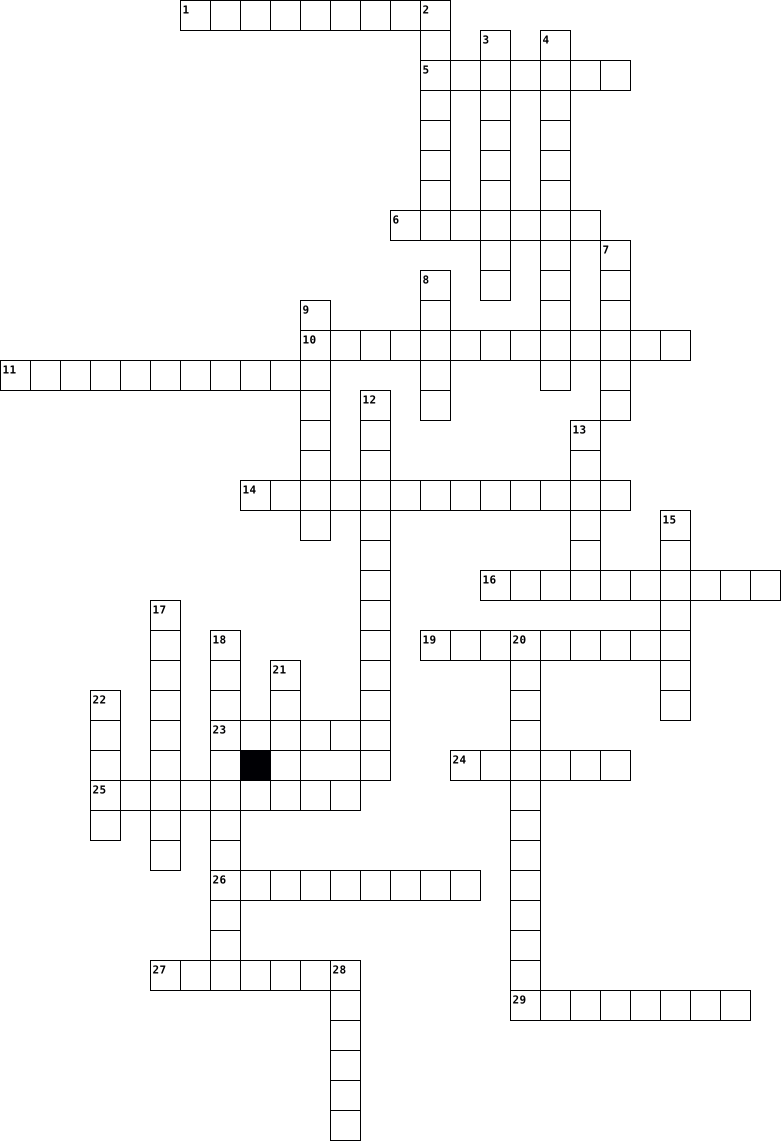
Across
- the act of spreading or allowing to spread freely
- subatomic particl that is constituent of every atomic nucleus except ordinary hydrogen
- a substance consisting only of atoms that all have the same numbers of protons in their atomic nuclei
- six chemical elements in group 2 of the periodic table
- any of the 6 chemical element that make up group 1 of the periodic table
- the amount of substance in a defined space
- the sum of the numbers of protons in the nucleus of an atom
- a substance formed when two or more chemical elements are chemically bonded together
- a substance that has mass and can take up space
- a stable subatomic particle that has a positive charge
- an electrical neutral group of atoms joined together by chemical bonds
- a nonmetal that in combination with a metal forms an alloy
- the horizantal row on the periodic table
- the negatively charged particles of an atom
Down
- a chemical element that mostly lacks the characteristics of a metal
- a particle smaller than an atom
- the number of protons found in the nucleus of every atom of that element
- the capacity of doing work
- a metallic substances composed of two or more elements,as either a compound or a solution
- the group in the periodic table consisting of five chemically related elements
- a fundamental theory of matter that explains physical properties in terms of the motion of atoms and molecules
- a column in the periodic table of the chemical elements
- the movement of a solvent(e.g water)through a semipermeable membrane(e.g a living cell)from a less concentrated solution into a more concentrated one
- a small portion of matter
- the number of protons in the nucleus of an atom
- an organised array of all the chemical elements in order of increasing atomic number
- an element that readily forms positive icons and has metallic bonds
- the smallest unit of ordinary matter that forms a chemical element
- a notation of one or two letters representing a chemical element
29 Clues: a small portion of matter • the capacity of doing work • a particle smaller than an atom • the horizantal row on the periodic table • the amount of substance in a defined space • the negatively charged particles of an atom • the number of protons in the nucleus of an atom • a substance that has mass and can take up space • the act of spreading or allowing to spread freely • ...
Energy(Ch. 15.1 & 15.2) 2024-02-28

Across
- The energy stored in atomic nuclei
- The energy an object has due to its motion
- Energy that is stored as a result of position or shape
- The energy associated with the motion and position of everyday objects
- The process of changing energy from one form to another
- A form of energy consisting of changing electric and magnetic fields
- A speed skater's skate is slowed down on the ice by this force
- PE that depends upon an object's height above a reference point
- The kinetic energy of a moving object depends on its ____ and speed
- The ability to do work
Down
- The energy stored in chemical bonds
- The energy associated with electric charges
- The PE of an object that is stretched or compressed
- The total potential and kinetic energy of all the particles in an object
- An objects gravitation PE depends on its mass, ____ and gravity
- When a musician does this to her string it gains potential energy
- Law of conservation of energy states energy can't be created or ____
- The gravitational PE of an object is converted to KE as it ____
- This is a transfer of energy
- E=mc2 says that energy and mass are _______
20 Clues: The ability to do work • This is a transfer of energy • The energy stored in atomic nuclei • The energy stored in chemical bonds • The energy an object has due to its motion • The energy associated with electric charges • E=mc2 says that energy and mass are _______ • The PE of an object that is stretched or compressed • ...
Vocabulary 2024-03-11

Across
- gene that is expressed only in the homozygous state.
- smallest unit of living things.
- genotypes made of two different alleles.
- genotypes made of two same alleles.
Down
- a process in which sunlight energy is used to make glucose.
- gene that is always expressed.
- ATP is produced as a result of a flow of electrons.
- organell which produces protein
- fluid filled space outside the grana.
- different forms of genes for a single trait.
10 Clues: gene that is always expressed. • organell which produces protein • smallest unit of living things. • genotypes made of two same alleles. • fluid filled space outside the grana. • genotypes made of two different alleles. • different forms of genes for a single trait. • ATP is produced as a result of a flow of electrons. • ...
Elements and rocks crossword vocab b 2023-02-16

Across
- the process by which sediments are pressed together under their own weight
- rock texture characterized by large, well-formed crystals surrounded by finer-grained crystals of the same or different mineral
- The chemical and physical processes that break down rock at Earth's surface.
- Magma that reaches Earth's surface
- Molten rock beneath the earth's surface
- Sedimentary rock that forms when fragments of preexisting rocks are compacted or cemented together.
- rock A type of rock that forms when particles from other rocks or the remains of plants and animals are pressed and cemented together
- A series of processes on the surface and inside Earth that slowly changes rocks from one kind to another
- Rock a type of rock that forms from the cooling of molten rock at or below the surface
Down
- Rock that forms when magma cools above the surface of Earth
- A type of rock that forms from an existing rock that is changed by heat, pressure, or chemical reactions.
- Sedimentary rock that forms when minerals precipitate from a solution or settle from a suspension.
- Loose materials such as rock fragments, mineral grains, and bits of shell that have been moved by wind, water, ice, or gravity
- Process in which sediment is laid down in new locations.
- rock formed from the cooling and solidification of magma beneath Earth's surface
- describes magma or igneous rock that is rich in magnesium and iron and that is generally dark in color
- A naturally occurring solid mixture of one or more minerals or organic matter.
- The process by which dissolved minerals crystallize and glue particles of sediment together into one mass.
- The process by which wind, water, ice, or gravity transports soil and sediment from one location to another
19 Clues: Magma that reaches Earth's surface • Molten rock beneath the earth's surface • Process in which sediment is laid down in new locations. • Rock that forms when magma cools above the surface of Earth • the process by which sediments are pressed together under their own weight • The chemical and physical processes that break down rock at Earth's surface. • ...
feilds of science 2013-05-20
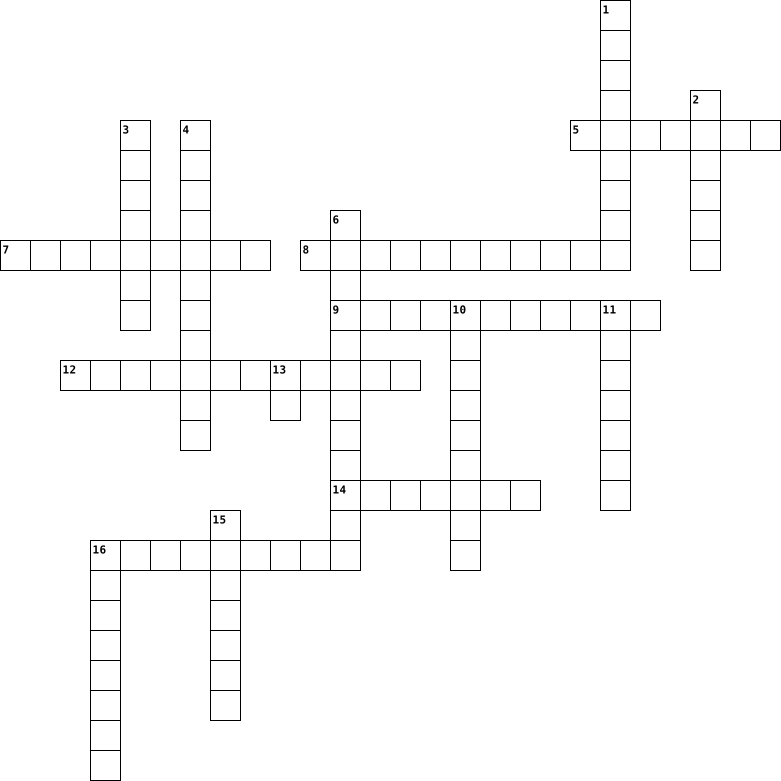
Across
- the science of life and living matter
- the science that deals with nature
- the science that deals with fish
- the study of science in the prehistoric times
- the science of forms of life
- the science that deals with matter energy motion and force
- the science that deals with the universe beyond the earth
Down
- the science that deals with compistion and the substances
- the science of plants
- the science that deals with the human bodys organisms
- the science that deals with climate and weather
- the science that deals with the ocean
- the science that deals with sound and sound waves
- the science that deals with the earth and its changes
- matter
- the science of dealing with animals
- the science that deals with soil
17 Clues: matter • the science of plants • the science of forms of life • the science that deals with fish • the science that deals with soil • the science that deals with nature • the science of dealing with animals • the science of life and living matter • the science that deals with the ocean • the study of science in the prehistoric times • ...
Ch. 14,15 2024-01-03

Across
- - the rate of doing work
- energy - the energy stored in atomic nuclei
- energy - energy dealing with temperature
- - a V-shaped object whose sides are two inclined planes sloped toward each other
- - the ability to do work
- energy - the energy associated with the motion and position of everyday objects
- plane - a slanted surface along which a force moves an object to a different elevation
- - a rigid bar that is free to move around a fixed point
- potential energy - the potential energy of an object that is stretched or compressed
- - the product of distance and the force in the direction an object moves
- - a device that changes a force & helps you do work
- - a simple machine that consists of a rope that fits into a groove in a wheel
- energy - the energy associated with electric charges
Down
- energy - energy that is stored as a result of position or shape
- energy - the energy stored in chemical bonds
- energy - energy that travels in waves
- and axle - a simple machine that consists of two rigidly attached disks or cylinders, each one with a different radius
- - an inclined plane wrapped around a cylinder
- energy - the energy an object has due to its motion
- potential energy - potential energy that depends upon an object’s height above a reference point
20 Clues: - the rate of doing work • - the ability to do work • energy - energy that travels in waves • energy - energy dealing with temperature • energy - the energy stored in atomic nuclei • energy - the energy stored in chemical bonds • - an inclined plane wrapped around a cylinder • energy - the energy an object has due to its motion • ...
08-21-18 Crossword #2 Steven Vazquez 2018-08-21

Across
- A period of time with not enough rain or snow to help crops grow.
- The amount of force that presses down on an area.
- The region between the Tigris and Euphrates rivers.
- A rigid layer that forms near the crust in earth's interior.
Down
- When you have more than you need, especially in relation to food.
- A softer layer in earth's interior that forms below the crust.
- waves Vibrations that carry energy that is released in a earthquake as they travel through earth.
- A layer of hot, solid material that is between earth's crust and core.
- Fertile soil that is a result of flooding waters and is great for growing crops.
- A climate with very little rainfall and warm temperatures.
10 Clues: The amount of force that presses down on an area. • The region between the Tigris and Euphrates rivers. • A climate with very little rainfall and warm temperatures. • A rigid layer that forms near the crust in earth's interior. • A softer layer in earth's interior that forms below the crust. • When you have more than you need, especially in relation to food. • ...
Amazing Leafs! 2025-05-20

Across
- The main part of a plant that carries out photosynthesis.
- The movement of molecules from high to low concentration.
- Where photosynthesis occurs in a cell.
- What protects a leaf surface, like a waxy film.
- Word for various forms or types.
- The "X" in the structure that carries water.
- A leaf's outside edge.
- The opposite of "thick" for a leaf.
- The primary color of many leaves.
- The "P" in the process of making food.
- DIOXIDE Gas plants take in for photosynthesis.
- The energy source for photosynthesis.
Down
- What plants need to survive (besides light and carbon dioxide).
- Tiny openings on a leaf surface.
- Another word for "plant's home."
- A sweet sugar produced by plants.
- What pine trees have instead of broad leaves.
- What plants produce during photosynthesis besides glucose.
- What leaves can be for some trees that are poky.
- Process plants are used to make food.
20 Clues: A leaf's outside edge. • Tiny openings on a leaf surface. • Another word for "plant's home." • Word for various forms or types. • A sweet sugar produced by plants. • The primary color of many leaves. • The opposite of "thick" for a leaf. • Process plants are used to make food. • The energy source for photosynthesis. • Where photosynthesis occurs in a cell. • ...
Unit 5 Crossword Puzzle (Energy, Heat, & Waves) 2024-04-11

Across
- Transfer of energy in or out of the system (Fd)
- Total KE & PE in the system
- SI unit of energy and work (Nm)
- laws about heat,work,temperature, nd energy
- Energy categories: Gravitational,Elastic,Chemistry
- The ability to do work
- organized by lowest to highest wave frequency
- transfer of thermal energy from higher to lowertempterature
- Number of waves that pass a point in a second
- Amount of energy needed to raise 1g 1degree C
Down
- Measurement of the energy of a wave
- average kinetic energy of the particles
- The distance between two crests or troughs of a wave
- waves that do not need a medium to travel
- total kinetic energy of the particles based on mass and temper
- Energy transfer through vibrations
- mgh
- Force that converts energy into thermal
- 1/2mv^2
- material through which a wave travels
- Waves that require a medium to travel
21 Clues: mgh • 1/2mv^2 • The ability to do work • Total KE & PE in the system • SI unit of energy and work (Nm) • Energy transfer through vibrations • Measurement of the energy of a wave • material through which a wave travels • Waves that require a medium to travel • average kinetic energy of the particles • Force that converts energy into thermal • ...
Plate Tectonics 2014-03-03

Across
- the force exerted on a surface divided by the total area over which the force is exerted
- Vibrations that travel through Earth carrying the energy released during an earthquacke
- the layer of rock that forms Earth's outer surface
- a plate boundary where two plates move toward each other
- a large stream of moving water that flows through the oceans
- a break or crack in Earth's lithosphere along which the rocks move
- a rigid layer made up of the uppermost part of the mantle and the crust
- the soft layer of the mantle on which the lithosphere floats
- the theory that pieces of Earth's lithosphere are in constant motion, driven by continental currents in the mantle
- a dark, dense, igneous rock with a fine texture, found in oceanic crust
- the amount of mass of a substance in a given volume; mass per unit volume
- a well-tested concept that explains a wide range of observations
- the layer of hot, solid material between Earth's surface and core
- a usually light-colored rock that is found in continental crust
Down
- a plate boundary where two plates move past each other in opposite directions
- the name of the single landmass that broke apart 200 million years ago and broke into today's continents
- the process by which molten material adds new oceanic crust to the ocean floor
- a plate boundary where two plates move away
- the direct transfer of energy through space by electromagnetic waves
- the hypothesis that the continent slowly move across Earth's surface
- the direct transfer of thermal energy from one substance to another substance that it's touching
21 Clues: a plate boundary where two plates move away • the layer of rock that forms Earth's outer surface • a plate boundary where two plates move toward each other • a large stream of moving water that flows through the oceans • the soft layer of the mantle on which the lithosphere floats • a usually light-colored rock that is found in continental crust • ...
Plate Tectonics 2014-03-03

Across
- a rigid layer made up of the uppermost part of the mantle and the crust
- the soft layer of the mantle on which the lithosphere floats
- a break or crack in Earth's lithosphere along which the rocks move
- the direct transfer of energy through space by electromagnetic waves
- the hypothesis that the continent slowly move across Earth's surface
- the layer of hot, solid material between Earth's surface and core
- a plate boundary where two plates move toward each other
- a plate boundary where two plates move past each other in opposite directions
- a plate boundary where two plates move away
- a well-tested concept that explains a wide range of observations
- the amount of mass of a substance in a given volume; mass per unit volume
- a usually light-colored rock that is found in continental crust
Down
- the theory that pieces of Earth's lithosphere are in constant motion, driven by continental currents in the mantle
- the direct transfer of thermal energy from one substance to another substance that it's touching
- a large stream of moving water that flows through the oceans
- Vibrations that travel through Earth carrying the energy released during an earthquacke
- the force exerted on a surface divided by the total area over which the force is exerted
- a dark, dense, igneous rock with a fine texture, found in oceanic crust
- the name of the single landmass that broke apart 200 million years ago and broke into today's continents
- the process by which molten material adds new oceanic crust to the ocean floor
- the layer of rock that forms Earth's outer surface
21 Clues: a plate boundary where two plates move away • the layer of rock that forms Earth's outer surface • a plate boundary where two plates move toward each other • a large stream of moving water that flows through the oceans • the soft layer of the mantle on which the lithosphere floats • a usually light-colored rock that is found in continental crust • ...
Science Crossword 2015-04-23

Across
- the point at which rays parallel to the optical axis reflect and meet
- each packet of light energy
- the image you see in a plane mirror
- when light causes an electron to move so much that it is knocked out of metal
- the energy that electromagnetic waves transfer through matter or space
- a mirror with a surface that curves inward like the inside of a bowl
- two primary colors combine in equal amounts to produce this
- a mirror with a surface that curves out-ward
- this forms when light rays actually meet
Down
- the light that passes through a polarized filter
- occurs when parallel rays of light hit an uneven surface
- this occurs when parallel rays of light hit a smooth surface
- any two colors that combine to form white light are called this
- a material that scatters the light that passes through it
- a material that transmits most of the light that strikes it
- a flat sheet of glass that has a smooth, silver colored coating on one side
- three colors that can combine to make any other color
- an imaginary line that divides a mirror in half
- a transverse wave that involves the transfer of electric and magnetic energy
- a copy of the object formed by reflected or refracted rays of light
- when the three primary colors of light are combined in equal amounts
- a material that reflects or absorbs all of the light that strikes it
- light waves as straight lines
- a color that is produced when the three primary colors of pigments are combined in equal amounts
- colored substances that are used to color other materials
25 Clues: each packet of light energy • light waves as straight lines • the image you see in a plane mirror • this forms when light rays actually meet • a mirror with a surface that curves out-ward • an imaginary line that divides a mirror in half • the light that passes through a polarized filter • three colors that can combine to make any other color • ...
Atomic Structure Crossword Puzzle 2022-09-09

Across
- A code to identify a specific element in the periodic table.
- Atomic Emission Spectra
- Smaller sub-atomic particles than protons and neutrons with a -1 charge and a tiny mass.
- Atomic mass of cobalt.
- The minimum amount of energy that can be gained or lost by an atom.
- Electrons that are normally at the ground state.
- What is the energy if the frequency is 1.60x10^14 1/s.
- The state of lowest energy for that electron
- Speed of light including units.
- Radiant energy that includes different types of rays, which differ in their frequencies and wavelengths.
- Atoms with a negative charge have more electrons than protons.
- Atoms are made of _____________ particles.
- The model proved that the positive charge and most of the mass of an atom is concentrated in an extremely small volume.
- The number of waves that pass a certain point in a specified amount of time (ν).
- The minimum value of downward displacement within a wave.
- An atom that has no charge
- A tabular arrangement of chemical elements that is arranged by increasing atomic number and groups elements according to recurring properties.
- The maximum value of upward displacement within a wave.
- Planck’s Equation.
- The displacement of a wave from zero.
- A tiny particle that comprises waves of electromagnetic radiation.
- A tiny object made entirely of protons and neutrons.
Down
- A phenomenon that occurs when light shone onto a metal surface causes the ejection of electrons from that metal.
- The determination of non-numerical information.
- The number of a chemical element in the periodic system, whereby the elements are arranged in order of increasing number of protons in the nucleus.
- Planck’s constant including units
- The distance between any given point and the same point in the next wave cycle.
- An ion that has lost one or more electrons, giving it a net positive charge, or that has gained one or more electrons, giving it a net negative charge.
- The atoms with diferent numbers of protons that are different.
- the number of protons plus the number of neutrons added up
- The amount of energy exerted when a force of one newton is applied over a displacement of one meter.
- Sub-atomic particles with a +1 charge and a mass of about 1 atomic mass unit.
- The determination of numerical information.
- Atoms with a positive charge have fewer electrons than protons.
- atomic mass unit.
- The innermost shell of electrons surrounding an atomic nucleus and constituting the lowest available energy level for the electrons.
- An atom that has enough binding energy to hold the nucleus together permanently.
- Sub-atomic particles with a zero charge and a mass of about 1 atomic mass unit
- An atom or group of atoms in which the number of electron(s) is different from the number of proton(s).
- Atoms absorb energy and become _______
- a function describing the location and wave-like behavior of an electron in an atom
- The segment of the electromagnetic spectrum that the human eye can view.
- The _______ an electron has that is above ground state.
- Atoms with the same number of protons but different numbers of neutrons.
- The smallest unit of ordinary matter that forms a chemical element.
45 Clues: atomic mass unit. • Planck’s Equation. • Atomic mass of cobalt. • Atomic Emission Spectra • An atom that has no charge • Speed of light including units. • Planck’s constant including units • The displacement of a wave from zero. • Atoms absorb energy and become _______ • Atoms are made of _____________ particles. • The determination of numerical information. • ...
Atomic Structure Crossword Puzzle 2022-09-09

Across
- A code to identify a specific element in the periodic table.
- Atomic Emission Spectra
- Smaller sub-atomic particles than protons and neutrons with a -1 charge and a tiny mass.
- Atomic mass of cobalt.
- The minimum amount of energy that can be gained or lost by an atom.
- Electrons that are normally at the ground state.
- What is the energy if the frequency is 1.60x10^14 1/s.
- The state of lowest energy for that electron
- Speed of light including units.
- Radiant energy that includes different types of rays, which differ in their frequencies and wavelengths.
- Atoms with a negative charge have more electrons than protons.
- Atoms are made of _____________ particles.
- The model proved that the positive charge and most of the mass of an atom is concentrated in an extremely small volume.
- The number of waves that pass a certain point in a specified amount of time (ν).
- The minimum value of downward displacement within a wave.
- An atom that has no charge
- A tabular arrangement of chemical elements that is arranged by increasing atomic number and groups elements according to recurring properties.
- The maximum value of upward displacement within a wave.
- Planck’s Equation.
- The displacement of a wave from zero.
- A tiny particle that comprises waves of electromagnetic radiation.
- A tiny object made entirely of protons and neutrons.
Down
- A phenomenon that occurs when light shone onto a metal surface causes the ejection of electrons from that metal.
- The determination of non-numerical information.
- The number of a chemical element in the periodic system, whereby the elements are arranged in order of increasing number of protons in the nucleus.
- Planck’s constant including units
- The distance between any given point and the same point in the next wave cycle.
- An ion that has lost one or more electrons, giving it a net positive charge, or that has gained one or more electrons, giving it a net negative charge.
- The atoms with diferent numbers of protons that are different.
- the number of protons plus the number of neutrons added up
- The amount of energy exerted when a force of one newton is applied over a displacement of one meter.
- Sub-atomic particles with a +1 charge and a mass of about 1 atomic mass unit.
- The determination of numerical information.
- Atoms with a positive charge have fewer electrons than protons.
- atomic mass unit.
- The innermost shell of electrons surrounding an atomic nucleus and constituting the lowest available energy level for the electrons.
- An atom that has enough binding energy to hold the nucleus together permanently.
- Sub-atomic particles with a zero charge and a mass of about 1 atomic mass unit
- An atom or group of atoms in which the number of electron(s) is different from the number of proton(s).
- Atoms absorb energy and become _______
- a function describing the location and wave-like behavior of an electron in an atom
- The segment of the electromagnetic spectrum that the human eye can view.
- The _______ an electron has that is above ground state.
- Atoms with the same number of protons but different numbers of neutrons.
- The smallest unit of ordinary matter that forms a chemical element.
45 Clues: atomic mass unit. • Planck’s Equation. • Atomic mass of cobalt. • Atomic Emission Spectra • An atom that has no charge • Speed of light including units. • Planck’s constant including units • The displacement of a wave from zero. • Atoms absorb energy and become _______ • Atoms are made of _____________ particles. • The determination of numerical information. • ...
Physics Crossword Puzzle 2022-06-14

Across
- the unit of energy.
- the tendency to resist changes in their state of
- a electrical component that limits or regulates the flow of electrical current in a circuit.
- a quantity that has both magnitude and direction; also known as a character from Despicable Me.
- the smallest unit of ordinary matter that forms a chemical element.
Down
- a form of energy that an object or a particle has by reason of its motion.
- the rate of doing work.
- a force acting upon an object for some duration of
- a net force that acts on an object to keep it moving along a circular path.
- a circuit that has only ONE path for electricity to flow.
10 Clues: the unit of energy. • the rate of doing work. • the tendency to resist changes in their state of • a force acting upon an object for some duration of • a circuit that has only ONE path for electricity to flow. • the smallest unit of ordinary matter that forms a chemical element. • a form of energy that an object or a particle has by reason of its motion. • ...
Water Cycle 2023-02-21

Across
- The repeated flow of water on Earths surface
- Water that soaks into the soil and stores underground.
- Another name for gas
- When clouds get too full of water this happens; Rain, hail, sleet or snow
- The process of which liquid water turns to a gas.
- Provides thermal energy for the water cycle.
Down
- Solid, Liquid and Gas
- An artificial or manmade lake that's used for water storage.
- form from condensation
- The process of which water vapor cools and forms clouds.
- The liquid form of precipitation
11 Clues: Another name for gas • Solid, Liquid and Gas • form from condensation • The liquid form of precipitation • The repeated flow of water on Earths surface • Provides thermal energy for the water cycle. • The process of which liquid water turns to a gas. • Water that soaks into the soil and stores underground. • The process of which water vapor cools and forms clouds. • ...
Science Vocab Crossword 2014-05-27

Across
- the energy stored in atomic nuclei
- energy stored in chemical bonds
- the energy of an object that is compressed or stretched
- chemical energy stored in the body converted into thermal energy/energy conservation/finding ways to use less energy or to use energy more efficiently
- resources that can be replaced in a relatively short period of time
- energy from flowing water
- the energy that depends on an objects height
- energy that is stored as a result of position or space
- formed underground from the remains of once living organisms
Down
- energy associated with the motion and position of everyday objects
- form of energy that travels through space in the form of waves
- energy associated with electric charges
- energy from sunlight converted into usable energy
- energy existing in limited quantity and once used can't be replaced except for over millions of years
- energy of motion
- thermal energy from beneath Earth's surface
- total potential and kinetic energy related to the motion of microscopic particles
- ability to do work
18 Clues: energy of motion • ability to do work • energy from flowing water • energy stored in chemical bonds • the energy stored in atomic nuclei • energy associated with electric charges • thermal energy from beneath Earth's surface • the energy that depends on an objects height • energy from sunlight converted into usable energy • ...
Work, Power, Energy Crossword Puzzle 2013-11-18

Across
- energy stored in chemical bonds
- average KE of particles in an object due to random motions through space
- total potential and kinetic energy of all microscopic particles in an object
- transfer of thermal energy by collisions between particles in matter
- energy associated with electrical energy
- energy that is stored as a result of position or shape
- a transfer of energy
- potential energy that depends on an object's height
- a transfer of thermal energy
- transfer of energy when particles of a fluid move from one place to another
Down
- energy stored in atomic nuclei
- transfer of energy by electromagnetic waves
- potential energy of an object that is stretched or compressed
- energy that travels through space in the form of waves
- energy associated with the motion and positon of everyday objects
- the ability to do work
- energy of motion
- the rate of doing work
18 Clues: energy of motion • a transfer of energy • the ability to do work • the rate of doing work • a transfer of thermal energy • energy stored in atomic nuclei • energy stored in chemical bonds • energy associated with electrical energy • transfer of energy by electromagnetic waves • potential energy that depends on an object's height • ...
Earthquakes 2021-10-21

Across
- -the point beneath earth's surface where rock breaks under stress and causes an earthquake.
- -a large wave produced by an earthquake on the ocean floor.
- -the process by which an earthquake's violent movement suddenly turns lose soil into liquid mud.
- - a device that records ground movement caused by seismic waves as they move through Earth.
- isolated building - a building mounted on bearings designed to absorb the energy of an earthquake.
- -s waves are seismic waves that vibrate from side to side to side as well as up and down.
- -squeezes rock until it folds or breaks.
- -the shaking that results from the movement of rock beneath earths surface.
- fault -a type of fault where the hanging wall slides upward caused by compression in the crust.
- wall - the block that forms the upper half of a fault.
- -an upward fold in rock formed by compression of earth's crust.
- - the measurement of an earthquake's strength based on seismic waves and movement along faults.
- wall -the block of rock that forms the lower half of a fault.
- fault -In a normal fault,the fault is at an angle,so one block of rock lies above the fault while the other block lies below the fault.
Down
- -pulls on the crust, stretching rock so that it becomes thinner in the middle.
- fault -a type of fault in which rocks on either side move past each other sideways with little up or down motion.
- - a large area of flat land elevated high above sea level.
- -a force that acts on rock to change its shape or volume.
- -a type of seismic wave and that compresses and expands the ground.
- - a downward fold in rock formed by compression in earth's crust.
- scale -A scale that rates earthquakes according to there intensity and how much damage they cause at a particular place.
- magnitude scale - a scale that rates earthquakes by estimating the total energy released by an earthquake.
- -shearing can cause rock to break and slip apart or to a change its shape.
- waves -A type of seismic wave that forms when p waves and s waves reach earth's surface.
- -the record of an earthquake's seismic waves produced by a seismograph.
- -the point on earth's surface directly above an earthquake's focus.
- scale - a scale that rates an earthquake's magnitude based on the size of its seismic waves.
- - the force that opposes the motion of one surface as it moves across another surface
- -an earthquake that occurs after a larger earthquake in the same area.
29 Clues: -squeezes rock until it folds or breaks. • wall - the block that forms the upper half of a fault. • -a force that acts on rock to change its shape or volume. • - a large area of flat land elevated high above sea level. • -a large wave produced by an earthquake on the ocean floor. • wall -the block of rock that forms the lower half of a fault. • ...
Energy and motion 2021-05-24

Across
- of conservation of energy, Energy cannot be created or destroyed
- Energy, The energy of motion
- resistance to change
- acceleration, center of a curved or circular path
- energy, Sum of kinetic energy and potential energy
- The speed of an object
- product of mass and velocity
- machine, combination of two or more simple machines
- Rate of change
- Ratio of output to input
Down
- Force applied through distance
- A change in an object's position
- Unit of force
- The length of a path between two points
- The length and direction of a straight line between starting and ending points
- The ability to do work or create change
- Energy, Energy that is stored
- a push or pull
- a device that changes the force
- the amount of matter and energy the object has
20 Clues: Unit of force • a push or pull • Rate of change • resistance to change • The speed of an object • Ratio of output to input • Energy, The energy of motion • product of mass and velocity • Energy, Energy that is stored • Force applied through distance • a device that changes the force • A change in an object's position • The length of a path between two points • ...
Geological Record CW 1 2023-12-11

Across
- a solid copy of the shape of an organism
- fossils in which minerals replace all of an organism, or a part, such as a dinosaur bone
- the geologic principle that states that in horizontal layers of sedimentary rock, each layer is older than the layer above it and younger than the layer below it
- a standard time scale of the geologic events and life forms in Earth’s history
- a break in Earth’s crust long which rocks move
- the process of measuring the absolute age of geologic material by measuring the concentrations of radioactive isotopes and their decay products
- a hollow area in sediment in the shape of an organism or part of an organism
- a drill core of ice that can help tell the climates of the past
- fossils of widely distributed organisms that lived during a geologically short period
- the time it takes for half of the atoms of a radioactive element to decay
- these fossils provide evidence of the activities of ancient organisms
- the age of rock compared to the ages of other rock
- rock that forms when melted material hardens inside Earth or on the surface
- type of fossil that is an extremely thin coating of carbon on rock
Down
- when many types of living things become extinct at the same time
- an igneous rock layer formed when lava flows onto Earth’s surface and hardens
- a gap in the geologic record that shows where rock layers have been lost due to erosion
- the age of a rock given as the number of years since the rock formed
- scientists who study fossils
- A description of surface features of land.
- a bend in rock that forms where part of Earth's crust is compressed
- an igneous rock layer formed when magma hardens beneath Earth’s surface
- a term referring to all water that is temporarily frozen in polar ice caps, snow, permafrost, and glaciers
- the process in which the nuclei of radioactive elements break down, releasing fast-moving particles and energy
24 Clues: scientists who study fossils • a solid copy of the shape of an organism • A description of surface features of land. • a break in Earth’s crust long which rocks move • the age of rock compared to the ages of other rock • a drill core of ice that can help tell the climates of the past • when many types of living things become extinct at the same time • ...
Processes that Change Earth 2024-05-30

Across
- Earth's places move when the _______ mantle moves.
- The Earth's _______ core is made of liquid iron.
- ___________volcanoes are wide with fairly steep slopes and have explosive eruptions of rock and ash.
- Pressure and heat can turn granite, an igneous rock, into gneiss, a _______________ rock.
- Sandstone is a type of ______________ rock where you would most likely to find a fossil.
- You would expect to find sediment ____________ where a faster river enters a slower river.
- A _____ forms as running water erodes the surrounding rock.
- An example of a _____________ resource is soil.
- An ____________ occurs when earth's plates push against each other.
- About 225 million years ago, all of Earth's landmasses were joined in one huge landmass called ________. Then it broke into two pieces before breaking further into smaller pieces.
- Plants can also cause weathering and _________.
- A mineral's ability to resist being scratched.
- Crop ____________ is the changing of planted crops from year to year.
- The color of the powder left behind when you rub a mineral against a rough white tile.
Down
- ___________ means all kinds of landforms in a place.
- When lava, or melted rock, cools quickly, it hardens ________ crystals can grow large so it becomes igneous rock with small or no crystals.
- Each rock layer is younger than the one beneath it describes the law of ________________.
- A ________ is a type of landform made by a glacier.
- __________ sediment forms a type of rock called sedimentary rock.
- To __________ water, the government can develop a park with native grasses, flowering plants, and shrubs.
- Communities with a shortage of water or energy may require people to _________ their use of water or energy.
- The point on Earth's surface directly above the focus of an earthquake.
- A _______ is the preserved remains or traces of a living thing.
- A naturally occurring, nonliving solid that has a specific chemical makeup and a repeating structure.
- When farmers ____________, they plant different crops near each other to keep soil healthy.
- The way a mineral's surface reflects light.
26 Clues: The way a mineral's surface reflects light. • A mineral's ability to resist being scratched. • An example of a _____________ resource is soil. • Plants can also cause weathering and _________. • The Earth's _______ core is made of liquid iron. • Earth's places move when the _______ mantle moves. • A ________ is a type of landform made by a glacier. • ...
Energy Crossword 2022-05-29

Across
- Convection energy transfers across these
- Energy store between two poles
- Energy store where charged attract or repel
- ______ energy is often transferred to the thermal store of the surroundings
- Heat transferred by infrared waves
- Energy store of something hot
- Efficiency is _______ energy divided by total energy
- The potential energy of a taught bow string
- Energy transferred across solids
- The conservation of energy tells us energy cannot be __________ or destroyed
- The type of energy you would find in a battery
Down
- An __________ is good at stopping heat transfer
- Energy transfer between objects of different temperatures
- The unit of energy
- If you kick a ball the energy is transferred this way
- _______ Potential Energy is the energy of something high up
- A type of energy that something has when it is in motion
- A measure of how well energy is transferred usefully
18 Clues: The unit of energy • Energy store of something hot • Energy store between two poles • Energy transferred across solids • Heat transferred by infrared waves • Convection energy transfers across these • Energy store where charged attract or repel • The potential energy of a taught bow string • The type of energy you would find in a battery • ...
Photosynthesis Terms 2023-03-01

Across
- Accessory pigment used in the light reactions, yellow to orange pigment.
- phase two of the calvin cycle
- Organisms that produce their own food
- early prokaryotes capable of photosynthesis
- enzyme involved in the phosphorylation of ATP
- cells that form multicellular organisms
- phase one of the calvin cycle
- Organisms unable to make their own food so they live off of other organisms
- photosystem in the thylakoids that absorbs P700
Down
- photosystem in the thylakoids that absorbs P680
- enzyme that catalysis the attached of CO2 to RuBP
- aqueous internal fluid of the chloroplast
- known as the early cell that forms a unicellular organisms
- Primary pigment used in the light reaction, Blue to green in color.
- Stacked thylakoids
- phase three of the calvin cycle
- A form of chemical energy
- Broaden the spectrum of colors that drive photosynthesis Yellow/orange pigment
- sites where the light reactions of photosynthesis occur
19 Clues: Stacked thylakoids • A form of chemical energy • phase two of the calvin cycle • phase one of the calvin cycle • phase three of the calvin cycle • Organisms that produce their own food • cells that form multicellular organisms • aqueous internal fluid of the chloroplast • early prokaryotes capable of photosynthesis • enzyme involved in the phosphorylation of ATP • ...
Work, Energy, and Power-Kaitlin Di Cesare 2014-02-24

Across
- energy of motion
- the energy released during nuclear fission or fusing
- add energy to renew, light bulb
- measures how hard it is to stop a moving object
- energy associated with the vibration or disturbance of matter
- total energy remains constant but its form may change
- energy that comes from heat
- how an object gains/loses energy
- change in momentum
- energy that causes different types of metals to attract or repel each other
- energy visible to the human eye, transmitted in the form of electromagnetic radiation
Down
- when work is done there will be an equal change in energy
- energy lost in collision
- an interaction between two or more objects
- easily renewed energy, spring
- little to no energy lost in collision
- potential energy associated with a gravitational field
- energy that is a result of a chemical reaction
- rate at which work is done
- ability to do work
20 Clues: energy of motion • change in momentum • ability to do work • energy lost in collision • rate at which work is done • energy that comes from heat • easily renewed energy, spring • add energy to renew, light bulb • how an object gains/loses energy • little to no energy lost in collision • an interaction between two or more objects • energy that is a result of a chemical reaction • ...
energy crossword #1 2021-04-20

Across
- the type of potential energy dependent on an object's height off the ground
- Joule = Newton*_____
- the laypeople's unit for energy
- The amount of chemical potential energy that a molecule has depends on the relative _____ of its atoms
- James Joule lived from 1818-18__
- the SI unit for energy
- Uranium-235 has a lot of _____ potential energy
- According to Newton's First Law, objects in motion remain in motion ____ ____ ____ unless an unbalanced force acts on them
- Are the transfer of energy and the transformation of energy the same thing?
- According to Richard Feynman, can energy be quantified?
- a molecule that is _______ has a lot of chemical potential energy
- Gas in a car has a lot of _____ potential energy
- According to Richard Feynman, can energy be defined?
Down
- Energy can't be created or destroyed; it can only be transferred or ______
- Fnet = ___
- the number of blocks that Dennis the Menace had
- Joule's first and middle names
- Is energy a vector, or is it a scalar?
- Isaac Newton lived from 1643-17__
- Dennis the Menace's friend
- the receptacle into which Dennis the Menace threw some blocks
- Law of _____ of Energy
- The amount of elastic potential energy that an object has depends on its position relative to its _____ position
- _____ energy is the energy of motion
- potential energy is energy based on _______
- True or false: energy can be created
- When a rubber band is stretched, it has _____ potential energy
27 Clues: Fnet = ___ • Joule = Newton*_____ • the SI unit for energy • Law of _____ of Energy • Dennis the Menace's friend • Joule's first and middle names • the laypeople's unit for energy • James Joule lived from 1818-18__ • Isaac Newton lived from 1643-17__ • _____ energy is the energy of motion • True or false: energy can be created • Is energy a vector, or is it a scalar? • ...
Energy Vocabulary 2025-11-03

Across
- natural resources that are limited in supply and cannot be replaced as quickly as they are used up.
- energy that travels through space as electrical and magnetic waves.
- Potential energy due to an object’s shape
- the ability to move or change matter in some other way.
- natural resources that can be replaced in a relatively short period of time or are virtually limitless in supply.
- the energy of movement.
- energy that is stored in the nuclei of atoms because of the strong forces that hold the nucleus together.
- energy of an object in motion.
- materials or elements that can be used to produce energy.
- The energy in sunlight
- energy of moving atoms of matter.
- The stored chemical energy in organic matter or wastes
Down
- form of mechanical energy that starts with a vibration in matter.
- anything people can use that comes from nature.
- energy that is stored in the bonds between the atoms of compounds.
- The mechanical energy of rapidly flowing water which can turn a turbine and generate electricity
- process in which one form of energy changes into another form.
- energy that is stored in a person or object.
- is thermal (“heat”) energy from below Earth’s surface.
- Potential energy due to the position of an object above Earth’s surface
- the energy of moving electrons.
21 Clues: The energy in sunlight • the energy of movement. • energy of an object in motion. • the energy of moving electrons. • energy of moving atoms of matter. • Potential energy due to an object’s shape • energy that is stored in a person or object. • anything people can use that comes from nature. • is thermal (“heat”) energy from below Earth’s surface. • ...
ecosystems 2016-03-17

Across
- animal that eats both plants and animals
- all the members of one kind of plant or animal
- animal eats only animals
- an animal that eats plants
- living thing that breaks down the remains of dead things
- all living things in an ecosystem
- process of making ones own kind
- tiny living thing
- animal feeds on remains of dead animals
- gets energy by eating producers
- makes its own food
Down
- web when two or more food chains overlap
- animal that hunts other animals for food
- an animal that helps plants make seeds
- living things depend on others to meet their needs
- everything that surrounds and affects living things
- all living and non living things
- zone temperature doesn't get hot or cold
- an animal that is hunted for food
- breaking down materials into different forms
- matter remains of plants and animals
21 Clues: tiny living thing • makes its own food • animal eats only animals • an animal that eats plants • process of making ones own kind • gets energy by eating producers • all living and non living things • all living things in an ecosystem • an animal that is hunted for food • matter remains of plants and animals • an animal that helps plants make seeds • ...
Dzie! 2016-05-20

Across
- sediments deposited directly by a glacier
- ability to do work
- process that breaks down rocks and other materials at Earths surface
- an environment area where a particular species lives
- Earth's solid rock outer layer
- all life on Earth
- Dark-colored organic material in soil
- fossil fuel when an organism buried in sediment dissolves, leaving hollow area
- wind erosion that removes surface materials
- land form with high elevation and high relief
Down
- plate boundaries that forms the Himalayas
- one lithospheric plate collides and plunges down into the mantle
- a fossil that provides evidence of the activities of ancient organisms
- a larger stream
- force that pulls rock and soil down slopes
- my favorite food starts with a G
- movement of individuals out of a population
- all the populations of different species that live in the same area and interact with one another
- super continent
- amount of sediment in a river
20 Clues: a larger stream • super continent • all life on Earth • ability to do work • amount of sediment in a river • Earth's solid rock outer layer • my favorite food starts with a G • Dark-colored organic material in soil • plate boundaries that forms the Himalayas • sediments deposited directly by a glacier • force that pulls rock and soil down slopes • ...
I♥♫ Nathan C. Argue 2016-05-20

Across
- is wind erosion off earths surface.
- flows over earths surface.
- is earths materials.
- is particals of clay and silt.
- is a loop in a river/stream.
- is one of four spheres into which scientists divide.
- is a mass of moving ice and snow.
- is when rivers flow into a river or ocean or lake and forms a fan like pattern.
Down
- is sediment deposit form a glacier.
- breaks down earths surface.
- is a thick mass of grass roots and soil.
- is a unit of geological time.
- is a large channel formed by erosion.
- is sediment in a river or stream.
- is connected air spaces that water can get through.
- is a layer of rock beneath the soil.
- is the ability to do work.
- is a dark colored material in the soil.
- is Nathans favorite color.
- is a large stream.
- copies a shape in a mold.
21 Clues: is a large stream. • is earths materials. • copies a shape in a mold. • flows over earths surface. • is the ability to do work. • is Nathans favorite color. • breaks down earths surface. • is a loop in a river/stream. • is a unit of geological time. • is particals of clay and silt. • is sediment in a river or stream. • is a mass of moving ice and snow. • ...
Ch14&15 2024-05-10

Across
- the rate of doing work
- energy the energy stored in atomic nuclei
- energy energy dealing with temperature
- a V-shaped object whose sides are two inclined planes sloped toward each other
- the ability to do work
- energy the energy associated with the motion and position of everyday objects
- plane a slanted surface along which a force moves an object to a different elevation
- a rigid bar that is free to move around a fixed point
- potential energy the potential energy of an object that is stretched or compressed
- the product of distance and the force in the direction an object moves
- a device that changes a force & helps you do work
- a simple machine that consists of a rope that fits into a groove in a wheel
- energy the energy associated with electric charges
Down
- energy energy that is stored as a result of position or shape
- energy the energy stored in chemical bonds
- energy energy that travels in waves
- and axle a simple machine that consists of two rigidly attached disks or cylinders, each one with a different radius
- an inclined plane wrapped around a cylinder
- energy the energy an object has due to its motion
- potential energy potential energy that depends upon an object’s height above a reference point
20 Clues: the rate of doing work • the ability to do work • energy energy that travels in waves • energy energy dealing with temperature • an inclined plane wrapped around a cylinder • energy the energy stored in chemical bonds • energy the energy stored in atomic nuclei • a device that changes a force & helps you do work • ...
Ch 14 15 2024-05-15

Across
- - the rate of doing work
- energy - the energy stored in atomic nuclei
- energy - energy dealing with temperature
- - a V-shaped object whose sides are two inclined planes sloped toward each other
- - the ability to do work
- energy - the energy associated with the motion and position of everyday objects
- plane - a slanted surface along which a force moves an object to a different elevation
- - a rigid bar that is free to move around a fixed point
- potential energy - the potential energy of an object that is stretched or compressed
- - the product of distance and the force in the direction an object moves
- - a device that changes a force & helps you do work
- - a simple machine that consists of a rope that fits into a groove in a wheel
- energy - the energy associated with electric charges
Down
- energy - energy that is stored as a result of position or shape
- energy - the energy stored in chemical bonds
- energy - energy that travels in waves
- and axle - a simple machine that consists of two rigidly attached disks or cylinders, each one with a different radius
- - an inclined plane wrapped around a cylinder
- energy - the energy an object has due to its motion
- potential energy - potential energy that depends upon an object’s height above a reference point
20 Clues: - the rate of doing work • - the ability to do work • energy - energy that travels in waves • energy - energy dealing with temperature • energy - the energy stored in atomic nuclei • energy - the energy stored in chemical bonds • - an inclined plane wrapped around a cylinder • energy - the energy an object has due to its motion • ...
Chapter 14&15 2023-05-10

Across
- potential energy - the potential energy of an object that is stretched or compressed
- energy - energy that travels in waves
- - a device that changes a force & helps you do work
- - a rigid bar that is free to move around a fixed point
- potential energy - potential energy that depends upon an object’s height above a reference point
- - a V-shaped object whose sides are two inclined planes sloped toward each other
- energy - the energy associated with electric charges
- - an inclined plane wrapped around a cylinder
Down
- energy - the energy stored in chemical bonds
- energy - the energy an object has due to its motion
- - a simple machine that consists of a rope that fits into a groove in a wheel
- energy - the energy associated with the motion and position of everyday objects
- energy - energy that is stored as a result of position or shape
- plane - a slanted surface along which a force moves an object to a different elevation
- and axle - a simple machine that consists of two rigidly attached disks or cylinders, each one with a different radius
- energy - energy dealing with temperature
- - the rate of doing work
- energy - the energy stored in atomic nuclei
- - the ability to do work
- - the product of distance and the force in the direction an object moves
20 Clues: - the rate of doing work • - the ability to do work • energy - energy that travels in waves • energy - energy dealing with temperature • energy - the energy stored in atomic nuclei • energy - the energy stored in chemical bonds • - an inclined plane wrapped around a cylinder • energy - the energy an object has due to its motion • ...
Vocabulary 2023-01-09

Across
- and axle - a simple machine that consists of two rigidly attached disks or cylinders, each one with a different radius
- - a V-shaped object whose sides are two inclined planes sloped toward each other
- - the product of distance and the force in the direction an object moves
- - a device that changes a force & helps you do work
- energy - the energy an object has due to its motion
- energy - the energy stored in atomic nuclei
- potential energy - the potential energy of an object that is stretched or compressed
- energy - energy dealing with temperature
- - an inclined plane wrapped around a cylinder
- energy - the energy associated with electric charges
- - a rigid bar that is free to move around a fixed point
Down
- energy - energy that travels in waves
- potential energy - potential energy that depends upon an object’s height above a reference point
- - the rate of doing work
- plane - a slanted surface along which a force moves an object to a different elevation
- energy - energy that is stored as a result of position or shape
- energy - the energy stored in chemical bonds
- - a simple machine that consists of a rope that fits into a groove in a wheel
- - the ability to do work
- energy - the energy associated with the motion and position of everyday objects
20 Clues: - the rate of doing work • - the ability to do work • energy - energy that travels in waves • energy - energy dealing with temperature • energy - the energy stored in atomic nuclei • energy - the energy stored in chemical bonds • - an inclined plane wrapped around a cylinder • - a device that changes a force & helps you do work • ...
Chapter 14/15 2023-01-09

Across
- the rate of doing work
- energy the energy stored in atomic nuclei
- energy energy dealing with temperature
- a V-shaped object whose sides are two inclined planes sloped toward each other
- the ability to do work
- energy the energy associated with the motion and position of everyday objects
- plane a slanted surface along which a force moves an object to a different elevation
- a rigid bar that is free to move around a fixed point
- potential energy the potential energy of an object that is stretched or compressed
- the product of distance and the force in the direction an object moves
- a device that changes a force & helps you do work
- a simple machine that consists of a rope that fits into a groove in a wheel
- energy the energy associated with electric charges
Down
- energy energy that is stored as a result of position or shape
- energy the energy stored in chemical bonds
- energy energy that travels in waves
- and axle a simple machine that consists of two rigidly attached disks or cylinders, each one with a different radius
- an inclined plane wrapped around a cylinder
- energy the energy an object has due to its motion
- potential energy potential energy that depends upon an object’s height above a reference point
20 Clues: the rate of doing work • the ability to do work • energy energy that travels in waves • energy energy dealing with temperature • energy the energy stored in atomic nuclei • energy the energy stored in chemical bonds • an inclined plane wrapped around a cylinder • energy the energy an object has due to its motion • a device that changes a force & helps you do work • ...
Ologies vocab #3 2026-05-12

Across
- Study of Earth's moon and its geology
- Study of parasites
- Study of earthquakes and seismic waves
- Study of all aspects of diseases and possible causes of death
- Study of the functions of the structures of the body
- Study of the bones and the disorders and diseases of the skeletal system
Down
- Study of nerves
- Study of natural occuing chemical compounds and their properties
- Study of volcanoes and volcano-related phenmena
- Study of animals with backbones and everything about them
- Study of fossilized plants and animal remains to gain clues about Earth's past
- study of microscopic life forms
- Study of fungi and yeasts
- Study of matter and energy interactions between the two through forces and motion.
- Study of viruses and viral diseases
15 Clues: Study of nerves • Study of parasites • Study of fungi and yeasts • study of microscopic life forms • Study of viruses and viral diseases • Study of Earth's moon and its geology • Study of earthquakes and seismic waves • Study of volcanoes and volcano-related phenmena • Study of the functions of the structures of the body • ...
Physical Science 2025-11-21

Across
- energy, energy made by vibrations
- a particle with a negative charge
- the smallest piece of matter
- a magnet made using electricity
- a force that pulls objects together
- energy, energy of motion
- energy, energy due to motion or position
- field, the area around a magnet where magnetic forces act
Down
- the center of an atom
- a particle in the nucleus with a positive charge
- a push or a pull
- a particle in the nucleus with no charge
- energy, energy from moving charges
- energy, energy stored in chemicals
- energy, stored energy
- field, the area around a charged object
- energy, energy carried by light
- energy, heat energy
- transformation, when energy changes from one form to another
- an area where a force acts without touching
20 Clues: a push or a pull • energy, heat energy • the center of an atom • energy, stored energy • energy, energy of motion • the smallest piece of matter • energy, energy carried by light • a magnet made using electricity • energy, energy made by vibrations • a particle with a negative charge • energy, energy from moving charges • energy, energy stored in chemicals • ...
Emma Skeletal System Vocabulary A+P 2023-09-14

Across
- thin layer of cartilage that reduces friction
- AKA the growth plate
- where two bone surfaces come together
- functions as a lever
- stores fat
- provides stability and support
- primary cell of mature bone
- protects internal organs
- forms new bone
- the membranous lining of the medullary cavity
Down
- hard, dense connective tissue that forms most of the adult skeleton
- the shaft that runs between the proximal and distal part of the bone
- semi rigid form of connective tissue that provides flexibility
- does not fit any classification
- forms in tendons
- breaks down bone
- the production of blood cells
17 Clues: stores fat • forms new bone • forms in tendons • breaks down bone • AKA the growth plate • functions as a lever • protects internal organs • primary cell of mature bone • the production of blood cells • provides stability and support • does not fit any classification • where two bone surfaces come together • thin layer of cartilage that reduces friction • ...
Atomic Structure Crossword Puzzle 2022-09-09

Across
- Atomic mass of cobalt.
- What is the energy if the frequency is 1.60x10^14 1/s.
- The displacement of a wave from zero.
- Planck’s Equation.
- atomic mass unit.
- The model proved that the positive charge and most of the mass of an atom is concentrated in an extremely small volume.
- Atoms with a negative charge have more electrons than protons.
- A phenomenon that occurs when light shone onto a metal surface causes the ejection of electrons from that metal.
- An atom or group of atoms in which the number of electron(s) is different from the number of proton(s).
- The minimum amount of energy that can be gained or lost by an atom.
- The state of lowest energy for that electron
- The determination of numerical information.
- The maximum value of upward displacement within a wave.
- An atom that has no charge
- A code to identify a specific element in the periodic table.
- The number of a chemical element in the periodic system, whereby the elements are arranged in order of increasing number of protons in the nucleus.
- The determination of non-numerical information.
- A tiny object made entirely of protons and neutrons.
- A tabular arrangement of chemical elements that is arranged by increasing atomic number and groups elements according to recurring properties.
- Planck’s constant including units
- The amount of energy exerted when a force of one newton is applied over a displacement of one meter.
Down
- Speed of light including units.
- Atoms with the same number of protons but different numbers of neutrons.
- The amount of protons in gold
- The atoms with diferent numbers of protons that are different.
- Radiant energy that includes different types of rays, which differ in their frequencies and wavelengths.
- The distance between any given point and the same point in the next wave cycle.
- The minimum value of downward displacement within a wave.
- Sub-atomic particles with a +1 charge and a mass of about 1 atomic mass unit.
- Atoms absorb energy and become _______
- a function describing the location and wave-like behavior of an electron in an atom
- Sub-atomic particles with a zero charge and a mass of about 1 atomic mass unit
- the number of protons plus the number of neutrons added up
- The segment of the electromagnetic spectrum that the human eye can view.
- An ion that has lost one or more electrons, giving it a net positive charge, or that has gained one or more electrons, giving it a net negative charge.
- A tiny particle that comprises waves of electromagnetic radiation.
- The number of waves that pass a certain point in a specified amount of time (ν).
- Atoms with a positive charge have fewer electrons than protons.
- Atoms are made of _____________ particles.
- An atom that has enough binding energy to hold the nucleus together permanently.
- The _______ an electron has that is above ground state.
- The innermost shell of electrons surrounding an atomic nucleus and constituting the lowest available energy level for the electrons.
- Smaller sub-atomic particles than protons and neutrons with a -1 charge and a tiny mass.
- Electrons that are normally at the ground state.
- Atomic Emission Spectra
- The smallest unit of ordinary matter that forms a chemical element.
46 Clues: atomic mass unit. • Planck’s Equation. • Atomic mass of cobalt. • Atomic Emission Spectra • An atom that has no charge • The amount of protons in gold • Speed of light including units. • Planck’s constant including units • The displacement of a wave from zero. • Atoms absorb energy and become _______ • Atoms are made of _____________ particles. • ...
Cyclones 2024-12-13

Across
- moisture in the air forming tiny droplets of water.
- violent Atlantic tropical storm.
- effect due to the Earth’s rotation causing air and currents to change direction.
- distance of a place north or south of the earth's equator.
- boundary separating air masses for which several characteristics differ, such as air density, wind, temperature, and humidity.
- difference between warm & cold water or warm & cold air. Why cold is heavier than warm.
- the part of the land near the ocean; the edge of the land.
- great circle of the earth that is everywhere equally distant from the two poles and divides the earth.
- driven by differences in density and pressure.
- stream a fast, narrow current of air flowing from west to east that encircles the globe.
- gasses held around planet earth by gravity, filtering what is allowed in and out.
Down
- violent Pacific tropical storm.
- energy moving in a persistent and predictable direction.
- a circular storm that forms over warm oceans with winds that can destroy buildings and rip out trees by their roots.
- large body of air with similar temperature and humidity characteristics that covers a wide area.
- how much water is in the air.
- effect of temperatures fluctuating less where land is adjacent to larger bodies of water.
- horizontal movement of air.
- to make denser.
- cloud on the ground
- take in or soak up energy.
21 Clues: to make denser. • cloud on the ground • take in or soak up energy. • horizontal movement of air. • how much water is in the air. • violent Pacific tropical storm. • violent Atlantic tropical storm. • driven by differences in density and pressure. • moisture in the air forming tiny droplets of water. • energy moving in a persistent and predictable direction. • ...
Energy 2023-03-10

Across
- the energy of something moving
- the state of matter where particles zoom around and are far apart
- the state of matter where particles are stacked on top of each other
- when heat moves outward without touching anything
- the measurement of heat
- when a solid becomes a liquid
- when heat transfers between objects that are touching
- the fourth state of matter
Down
- when heat moves through a liquid - hotter rises and colder sinks
- the state of matter where particles slide and rotate across each other
- when a liquid becomes a gas
- the ability to do work or cause change
- the complete absence of heat
- what everything is made of
- the vibration of molecules and particles
- when a liquid becomes a solid
- the energy of something based on its location or position
17 Clues: the measurement of heat • what everything is made of • the fourth state of matter • when a liquid becomes a gas • the complete absence of heat • when a liquid becomes a solid • when a solid becomes a liquid • the energy of something moving • the ability to do work or cause change • the vibration of molecules and particles • when heat moves outward without touching anything • ...
ENERGY 2016-12-13

Across
- stored energy
- energy to hear
- Rotates
- water stored to produce electrical energy
- Energy from the inner core of the Earth
- energy soted in batteries
- cells Energy from the Sun
Down
- allways available source of energy
- device to convert to electrical energy
- energy from animals dropps
- energy asociated to motion
- energy energy from electrical charge in motion
- Non renovable energy
- energy from Wind
- energy from the nucleus of the atom
- energy due to steam
- energy to see
17 Clues: Rotates • stored energy • energy to see • energy to hear • energy from Wind • energy due to steam • Non renovable energy • energy soted in batteries • cells Energy from the Sun • energy from animals dropps • energy asociated to motion • allways available source of energy • energy from the nucleus of the atom • device to convert to electrical energy • Energy from the inner core of the Earth • ...
Energy 2021-12-14

Across
- the reason why the pencil bent
- the colors combined creating white light
- what sound energy needs to travel
- red is the longest one
- acronym for 5 basic types of energy
- what black cars do to light energy
- heat energy transferred through liquids/gases
- heat energy
- energy caused by vibrations
Down
- a type of thermal energy that can cause harm
- triangular thing used to refract light
- what mirrors, water & screens do with light
- place that is silent
- the ability to do work
- energy we have to actually do ourselves
- our main source of light & thermal energy
- the flow of them causes our most used energy
17 Clues: heat energy • place that is silent • the ability to do work • red is the longest one • energy caused by vibrations • the reason why the pencil bent • what sound energy needs to travel • what black cars do to light energy • acronym for 5 basic types of energy • triangular thing used to refract light • energy we have to actually do ourselves • ...
energy 2022-02-16

Across
- do the job we want it to do.
- energy due to movement
- Energy stored in something that is stretched or squashed
- Energy due to heat
- transfer to other energy stores
- Stays the same, does not increase or decrease.
- energy energy that is useful because it helps the
- The ability to do work - eg. lifting an object.
Down
- Energy stores that we can not see or feel, but
- Energy that is wasted because it is transferred
- Energy stored in food and fuels
- Energy due to height above the earth
- The object or objects we are talking about
- Anything that is not the object or objects we are
- the surroundings
- store The form of an energy that an object has.
- The movement of energy from one store to another
- about
18 Clues: about • the surroundings • Energy due to heat • energy due to movement • do the job we want it to do. • Energy stored in food and fuels • transfer to other energy stores • Energy due to height above the earth • The object or objects we are talking about • Energy stores that we can not see or feel, but • Stays the same, does not increase or decrease. • ...
Energy 2025-01-28

Across
- Energy – The sum of kinetic and potential energy in an object.
- Energy – Energy caused by vibrations that travel through a medium (like air or water).
- Energy – Energy caused by the movement of electrons.
- Fuels – Energy sources formed from the remains of ancient plants and animals, like coal, oil, and natural gas.
- Energy – Energy that comes from resources that are naturally replenished (like solar, wind, or hydro energy).
- Energy – Energy related to the temperature of an object (heat energy).
- – The transfer of heat or electricity through a material.
- – The movement of heat in a fluid (liquid or gas) caused by the rising of warm and sinking of cool parts.
- Efficiency – Using less energy to perform the same task.
- Transfer – The movement of energy from one object or system to another.
Down
- Energy – Energy that can be seen (like from the sun or light bulbs).
- Energy – Energy stored in the bonds of atoms and molecules (like in food or fuel).
- Energy – Energy of motion.
- Energy – Stored energy based on position or condition.
- Circuit – A path through which electric current flows.
- Energy – Energy from the sun.
- Energy – Energy from the movement of air (wind).
- – The ability to do work or cause change.
- Energy – Energy from sources that can’t be easily replaced once used (like coal, oil, and natural gas).
- Conservation – The practice of using less energy or using energy more efficiently.
20 Clues: Energy – Energy of motion. • Energy – Energy from the sun. • – The ability to do work or cause change. • Energy – Energy from the movement of air (wind). • Energy – Energy caused by the movement of electrons. • Energy – Stored energy based on position or condition. • Circuit – A path through which electric current flows. • ...