
greys anatomy Crossword Puzzles
Anatomy Quarter Review Crossword 2014-01-15

Across
- The tibia and fibula form a hinge joint when they articulate at the ...
- The prefix "myo" refers to
- The femur is an example of what type of bone
- Canal that is perpendicular to the central canal and carries blood vessels and nerves
- The only skull bone that is involved in a movable joint
- Connective tissue that covers muscle cells
- The connective tissue that covers many cells
- The prefix "sarco" refers to
- Type of bone that is homogeneous
- The process to interpret sensory input
- Acronym for the part of nervous system that contains the brain and spinal cord
- Type of bone that has many open spaces
- Type of output response to integrated stimuli
Down
- 206 is the number ... the adult body has
- Connective tissue that connects muscle to the bone
- Rings around the central canal
- Flat sheet of tendon
- Subdivision of the skeleton that contains the skull, vertebral column, and bony thorax
- Unit of bone containing central canal and matrix rings
- Muscle is classified as skeletal, cardiac, or ...
20 Clues: Flat sheet of tendon • The prefix "myo" refers to • The prefix "sarco" refers to • Rings around the central canal • Type of bone that is homogeneous • The process to interpret sensory input • Type of bone that has many open spaces • 206 is the number ... the adult body has • Connective tissue that covers muscle cells • The femur is an example of what type of bone • ...
Insect external anatomy review 2021-02-03

Across
- Inward-projecting ridges in the insect integument that provide additional structural support and attachment points for muscles, etc.
- Type of insect leg specialized for digging.
- Structures on many insects that work much like rear antennae.
- Distal portion of the labium which functions much like a lower lip in preventing food from sliding ventrally away from the mouth
- The middle section of the insect thorax.
- Type of insect eye in which light entering any ommatidium is only focused on its rhabdom and not able to diffuse to the surrounding ommatidia
- Sclerotized region on the maxilla of insects that aids in grasping and manipulating food items.
- Type of protein found in insects and other arthropods that provides elasticity, like a rubber band.
- Type of insect metamorphosis that has at least 4 main developmental stages (egg, larva, pupa, adult)and is also known as complete metamorphosis.
Down
- Insect forewings that are hardened and work as protective coverings of the hindwings.
- Type of insect antennae that appear as “pearls on a string”.
- Proximal portion of the insect leg that articulates with the body.
- A tube down which some female insects lay their eggs.
- General term for structures either on the maxillae or labium that function in tasting and manipulating food.
- First segment of the insect antenna that articulates with the head.
- One of the ventral hardened plates on an insect.
- The general term for a hardened plate of the insect integument.
- Simple insect eye mainly sensitive to light and dark.
- Polysaccharide of which insect exoskeletons are mainly composed.
- The dorsal plate on the prothorax.
20 Clues: The dorsal plate on the prothorax. • The middle section of the insect thorax. • Type of insect leg specialized for digging. • One of the ventral hardened plates on an insect. • A tube down which some female insects lay their eggs. • Simple insect eye mainly sensitive to light and dark. • Type of insect antennae that appear as “pearls on a string”. • ...
Anatomy of Frogs n'stuff 2021-06-03

Across
- Uses bile to help finish digestion
- Country in Europe, first established by the Romans
- The climate zone between the Tropic of Capricorn and Tropic of Cancer.
- stores red blood cells.
- Ribbit
- Allows a frog to see(please get this one right)
- Helps aid digestion by mixing food with enzymes.
- Help the frog breathe.
- Flow blood back to the heart.
- Stores indigested food.
- helps finish digesting food
Down
- The largest organ covers the frog's body. Also breathes through this sometimes.
- pumps the blood through the frog's veins.
- Dart Frog You don't want to touch this bad boy.
- Not a tree, in the vascular plants category though. Family name is Aracaecae
- Where the food travels down to the stomach.
- Shoots out quickly to catch a frog's prey. Lies in the frog's mouth, and is quite sticky.
- Removes waste from body
- Help a frog leap in the air.
- People often confuse these with frogs, if you do I will slap you, Haha.
20 Clues: Ribbit • Help the frog breathe. • stores red blood cells. • Removes waste from body • Stores indigested food. • helps finish digesting food • Help a frog leap in the air. • Flow blood back to the heart. • Uses bile to help finish digestion • pumps the blood through the frog's veins. • Where the food travels down to the stomach. • Dart Frog You don't want to touch this bad boy. • ...
Anatomy and Physiology Revision 2021-05-21

Across
- - The largest volume of air that can be forcibly expired after the deepest possible inspiration.
- - normal amount of air inhaled or exhaled per breath. Increases with exercise.
- - Arteries become smaller to restrict the flow of blood during exercise.
- - These allow for gross (large) movements
- - the name given for someone who has a lower resting heart rate (particularly below 60BPM.
- - Volume of blood ejected from the heart in one minute. Worker out by multiplying heart rate by stroke volume.
- - When the chambers of the heart contract and empty
- - Very strong, non elastic type cord that connects muscle to bone
- - Elastic type fibre that connects bone to bone
- - meet at a joint to produce movement
- - A function of the skeleton to ensure safety of the vital organs
Down
- - exercise in the presence of oxygen.
- - Movement of bone or limb closer to the midline of the body
- - An example of a ball and socket joint.
- - Arteries become wider to allow a higher volume of blood to pass through to the working areas during exercise.
- - Movement of bone or limb away from the body
- - gradually reducing intensity of an exercise session, completing some light jogging and gentle stretching. One type of recovery.
- - An example of this is the knee and elbow
- - when the chambers of the heart fill with blood
- - Acts as a tough buffer between bones to stop friction.
- - process where oxygen and carbon dioxide diffuse between blood, the capillaries and alveoli.
- - exercise without/or with very little oxygen.
- - Circular movement that occurs around an axis (joint)
23 Clues: - exercise in the presence of oxygen. • - meet at a joint to produce movement • - An example of a ball and socket joint. • - These allow for gross (large) movements • - An example of this is the knee and elbow • - Movement of bone or limb away from the body • - exercise without/or with very little oxygen. • - Elastic type fibre that connects bone to bone • ...
Intro to Anatomy Crossword 2021-08-18

Across
- Has parts called the hammer and the stirrup
- Controls all body systems
- Moves blood throughout the body
- Stores bile made by the liver
- Where vitamins and minerals from your food pass into your blood
- Take in oxygen from the air and transfer it to your blood
- Can't function without light
- Filters liquid in your body, producing excess liquid called urine
- Organ that helps with the first part of digestion
- Move your bones
- There are five types of these, including the pivot and the hinge
Down
- This mixes and churns food into a paste called chyme
- Large and brown and located right above the stomach
- When this muscle pulls down, lungs expand
- Helps to digest sugars
- Pipe that leads from mouth to stomach
- Outer part is called epidermis, keeps germs out of your body
- Responsible for most of taste, among other things
- Pipe that leads to your lungs
- Made of watery plasma with red and white cells floating in it
- Coiled around the outside of the small intestine
- This type of cell looks a bit like a tree
22 Clues: Move your bones • Helps to digest sugars • Controls all body systems • Can't function without light • Stores bile made by the liver • Pipe that leads to your lungs • Moves blood throughout the body • Pipe that leads from mouth to stomach • When this muscle pulls down, lungs expand • This type of cell looks a bit like a tree • Has parts called the hammer and the stirrup • ...
Anatomy and Physiology Terminology 2021-08-19

Across
- farther from the organ of a body part
- area of spinal column
- glands secrete hormones that are released into the blood and it controls body activities
- close to the origin of the body part
- area between hips
- contains the stomach, liver, intestines, and other organs
- divides the body into anterior and posterior parts
- toward or at the backside of the body; behind
Down
- dome-shaped muscle of respiration located below the lungs
- away from the midline of the body; on the outer side
- curve of shoulder formed by large deltoid muscle
- the smallest units of all living things.
- extends from the cranial cavity nearly to the end of the vertebral column
- divides the body or organ into superior and inferior parts
- forehead
- anterior body trunk inferior to ribs
- lateral part of leg
- area of back between ribs and hips, the loin
- The study of the structure and shape of the body, parts, and relationships between one another.
- area overlying the pelvis anteriorly
20 Clues: forehead • area between hips • lateral part of leg • area of spinal column • close to the origin of the body part • anterior body trunk inferior to ribs • area overlying the pelvis anteriorly • farther from the organ of a body part • the smallest units of all living things. • area of back between ribs and hips, the loin • toward or at the backside of the body; behind • ...
Anatomy Head, neck, thorax 2021-11-13

Across
- Preganglionic sympathetic fibers to abdomen
- Blood supply to dura and calvaria
- Location of parasympathetic CN III synapse
- Between internal and innermost intercostals
- Superior vena cava, inferior vena cave, coronary sinus dump into
- CN VII and CN IX share this function ()
- Longest, most medial infrahyoid muscle
- Travel in cervical transverse foramen and unite as basilar
- Omohyoid, sternohyoid, sternothyroid innervation
- Muscle of mastication with unique function when compared to the 3 others
- R brachicephalic, L common carotid, L subclavian artery origin
- Located between the transverse sinus and internal jugular vein
- Location of synapse of neurons from IML innervating intercostal muscles
- Diagastric, geniohyoid, mylohyoid, stylohyoid region
- Ventral Rami T1-T11
- Location of preganglionic sympathetic cell bodies
- Relative to viscera, especially abdominal
Down
- Muscle fibers travels superiorly and laterally and located on the posterior aspect anterior chest wall
- Foramen ovale
- Origin of Internal thoracic a, vertebral a, thyrocervical trunk, costocervical a, dorsal scapular a
- L AV Valve
- Lobes and lobular brochi on the R
- Ventral rami of C1-C4, C5-T1, T12-S4
- Origin of anterior intercostal arteries
- From scapula to superficial anterior neck
- The communicating connector between the posterior cerebral artery and internal carotid artery
- Related to breathing and is located anterior to anterior scalene
- Location of pre ganglionic cell bodies of sympathetic nerve fibers traveling to head
- More inferior of the deep neck flexors
- Relating to the viscera or internal organs, especially those of the abdomen
- CN VII: Submandibular as CN IX:______
- Cranial nerve to close eye
- Collateral venous circulatory system of thoracic wall
- Region of directional change of L recurrent laryngeal nerve
34 Clues: L AV Valve • Foramen ovale • Ventral Rami T1-T11 • Cranial nerve to close eye • Lobes and lobular brochi on the R • Blood supply to dura and calvaria • Ventral rami of C1-C4, C5-T1, T12-S4 • CN VII: Submandibular as CN IX:______ • Longest, most medial infrahyoid muscle • More inferior of the deep neck flexors • Origin of anterior intercostal arteries • ...
Hayman - Leaf Anatomy Crossword 2021-11-04

Across
- which refers to a condition where leaves and buds are not spaced far enough apart to be called alternate nor perfectly opposite.
- is a skin like layer of cells found on both the top and the bottom surface of the leaf.
- Monocots have leaves with
- A leaf that has only one blade on its
- Other leaves have several dominant veins branching out from the petiole.
- leaf has all its leaflets attached to a common point.
- When three or more leaves and buds are attached at a node
- These standing cells are responsible for most of the photosynthesis in the leaf
Down
- forms air spaces that hold raw materials to be used and products of photosynthesis.
- When leaves and buds are arranged directly across from each other on a stem
- Leaves and buds that are spaced along a stem in an alternating fashion
- The opening and closing is controlled by
- leaf has multiple leaflets attached along a rachis or axis
- The main sun-collecting structure on the leaf is a large broad flat surface
- can open and close
- Veins in a branching pattern are called
- The blade is held away from the stem and supported by a leaf stem
- leaf A leaf with multiple blades
- Many leaves are organized with one main vein running down the middle of the blade
- leaf has multiple leaflets attached along a rachis or axis
- On top of the leaf is a waxy non-cellular layer
21 Clues: can open and close • Monocots have leaves with • leaf A leaf with multiple blades • A leaf that has only one blade on its • Veins in a branching pattern are called • The opening and closing is controlled by • On top of the leaf is a waxy non-cellular layer • leaf has all its leaflets attached to a common point. • When three or more leaves and buds are attached at a node • ...
Anatomy & Physiology Pt. 1 2021-11-15

Across
- extensor muscles of the wrist, are involved in bending the wrist
- or chest
- muscle extending along side the chin. Pulls down the corners of the mouth.
- bones of the fingers
- muscle that draws the corner of mouth out and back. As in grinning
- breastbone
- a flat, thin bone that forms part of the nasal septum
- cranium is made up of how many bones
- bones that form the upper jaw
- light, spongy bone between the eye sockets that forms part of the nasal cavities
- muscle of the cheek expels air between the lips, as in when blowing a whistle
- bone that forms the forehead
- uppermost and larger bone of the arm
- hindmost bone of the skull;it forms the back of the skull above the nape
- voluntary muscles
- the palm
- bones that form the sides and crown of the cranium
- smaller bone in the forearm. Same side as thumb
- involuntary or smooth muscles
- systems that covers, shapes, and supports skeletal tissue
- muscle that draws the scalp backward
- muscles covers the bridge of the nose, lowers the eyebrows, and causes wrinkles across bridge of the nose
- joins all the bones of the cranium together
Down
- also know as malar bones form the prominence of the cheeks, or cheekbones.
- middle part of the muscle
- the connection between two or more bones
- involuntary muscle that makes up the heart
- bones that form the bridge of nose
- broad muscle that covers top of skull
- part that does not move
- muscle that draws eyebrow down and wrinkles the forehead vertically
- muscle that elevates the lower lip and raises and wrinkles the skin of the chin
- muscles that straighten the wrist, hand, and fingers to form a straight line
- smallest and most fragile bones of the face, are situated at the front inside part of the eye socket
- bone that forms the sides of the head in the ear region
- inner and larger bone of the forearm.on the side of the little finger
- muscle covers the back of the neck and upper and middle region of the back. Shrugs shoulders
- a U-shaped bone at the base of the tongue that supports the tongue and it’s muscles
- bones that form the hard palate of the mouth
- forms the lower jawbone, the largest and strongest bone of the face
- muscle rotates the radius outward and the palm upward
- amount of the bones of the face
- the wrist
- muscle responsible for lowering the lower jaw and lip
44 Clues: or chest • the palm • the wrist • breastbone • voluntary muscles • bones of the fingers • part that does not move • middle part of the muscle • bone that forms the forehead • bones that form the upper jaw • involuntary or smooth muscles • amount of the bones of the face • bones that form the bridge of nose • cranium is made up of how many bones • uppermost and larger bone of the arm • ...
Anatomy Review 1 - PH 2022-04-05

Across
- the top third of the tooth that can be seen
- this muscle narrows the tongue
- the palate formed by the maxilla bone
- cavity space between cheeks and teeth
- how many surfaces the teeth have
- the muscle that has the most control over the tongue
- muscle that tenses while eating to keep food inside the teeth, rather than the cheeks
- beneath the tooth's enamel
- how many types of teeth there are
Down
- on which bone is the crista galli
- the type 1 occlusion that is ideal
- the part of the tongue in the mouth
- portion of the tongue that touches the teeth
- the bone that the tongue attaches to
- this muscle is in the same place as the transverse muscle
- which bone has greater and lesser wings
- the back of the tongue under the soft palate
- part of the tooth below the gums
- porous plate on ethmoid bone
- the lingual _________ connects the tongue to the mandible
20 Clues: beneath the tooth's enamel • porous plate on ethmoid bone • this muscle narrows the tongue • part of the tooth below the gums • how many surfaces the teeth have • on which bone is the crista galli • how many types of teeth there are • the type 1 occlusion that is ideal • the part of the tongue in the mouth • the bone that the tongue attaches to • ...
Lower Extremity Anatomy Terms 2022-03-28

Across
- The Pubic _____ is the cartilage wedge that sits along the midline between the two anterior pelvic bones.
- The muscles/tendons on the anterior/dorsal aspect of the ankle produce ankle:
- Absorbs shock in the feet.
- The formal name for the hip socket.
- The muscles/tendons on the ____ aspect of the foot produce toe extension.
- Five bones of the foot, in line with each toe.
- The _____ tendon connects the kneecap to the Tibial tuberosity.
- The cartilage ring that surrounds the socket of the hip.
- Band of tissue that runs between the Tibia & Fibula.
- Bone that creates a mechanical advantage at the knee.
- The thigh bone.
- The number of toe bones in each foot.
- Tendon which connects the calf muscles to the heel.
- Ligament which keeps the Tibia from sliding backwards in the knee.
- The Hip Flexors are on the ____ aspect of the hip.
- The 5th toe.
- Ligament which connects the Femur to the Tibia and keeps the knee from buckling inward.
- The muscles/tendons that produce plantarflexion pass ____ to the ankle.
- This group of muscles produces hip adduction.
- Medial & larger shin bone.
- This group of muscles produces knee flexion and hip extension.
- This group of muscles produces hip extension & abduction.
- The heel bone.
- The Tibias bear what percent of the body's weight?
- Bones of the toes.
Down
- The ankle turning inward.
- The most anterior bones of the pelvis.
- How many bones in each small toe?
- The most inferior and posterior bones of the pelvis.
- Lateral & smaller shin bone.
- The ball of hip is called the Femoral:
- The Plantar _____ runs along the bottom of the foot and supports the arch.
- The largest and most superior bones of the pelvis.
- The ankle turning outward.
- The additional bone of each small toe is described using which term?
- This group of muscles produces knee extension and hip flexion.
- Bone that sits on top of the heel, and between the Tibia & Fibula.
- Group of 7 bones that make up the posterior foot and the ankle.
- The calf muscles produce ankle:
- How many Quadriceps muscles in each leg.
- The muscles/tendons that produce inversion pass ____ to the ankle.
- The Femoral ____ sits between the ball and shaft of the Femur.
- Ligament which keeps the Tibia from sliding forward in the knee.
- How many bones in each Big Toe?
- Descriptive term for the bones at the tip of the toes.
- The muscles/tendons on the ____ aspect of the foot produce toe flexion.
- Descriptive term for the bones at the base of the toes.
- The muscles/tendons that produce eversion pass ____ to the ankle.
- The round cartilage wedges in the knee that absorb shock and provide stability.
- How many hamstring muscles in each leg.
- Ligament which connects the Femur to the Fibula and keeps the knee from buckling outward.
51 Clues: The 5th toe. • The heel bone. • The thigh bone. • Bones of the toes. • The ankle turning inward. • Absorbs shock in the feet. • The ankle turning outward. • Medial & larger shin bone. • Lateral & smaller shin bone. • The calf muscles produce ankle: • How many bones in each Big Toe? • How many bones in each small toe? • The formal name for the hip socket. • ...
Anatomy & Physiology Crossword 2022 2022-04-29

Across
- When red bone marrow ages, it is replaced with this type of marrow.
- (2 words) The space between two neurons, where neurotransmitters are released.
- Our anatomy teacher's last name!
- The "Little beams" that are found in spongy bone, that protect from compression.
- (3 words) The space between myelin sheaths.
- A doctor that specializes in the skin.
- The muscle located on the shoulder.
- (2 words) Another name for the bicuspid valve.
- Through the use of a negative feedback loop, the body attempts to return itself to this state.
- Another name for "skull".
- The "control center" of a cell.
- The kind of tissue that adipose is.
- A shape classification for epithelial tissue that is tall and skinny.
- This measure of blood pressure should be at 120.
- The thin, protective layer of tissue that surrounds the heart.
Down
- (2 words) The process that forms ATP.
- Bone cells that break down bone.
- The nervous system made up of cranial and spinal nerves.
- The longest bone in the human body.
- A small gland that commonly contains hairs.
- (2 words) The liquid inside of joint capsules.
- The name for epithelial tissue with multiple layers.
- The chamber at the top of the heart.
- The type of bone the patella is classified as.
- The part of the brain that regulates breathing and sleep.
- Bone cells that produce new bone.
- The layer of the skin that produces pigment.
- A suffix that means "the study of", commonly paired with bio- or geo-.
- A disease that causes rapid cell division.
- The word, relating to cardiac tissue, that means "striped".
30 Clues: Another name for "skull". • The "control center" of a cell. • Bone cells that break down bone. • Our anatomy teacher's last name! • Bone cells that produce new bone. • The longest bone in the human body. • The muscle located on the shoulder. • The kind of tissue that adipose is. • The chamber at the top of the heart. • (2 words) The process that forms ATP. • ...
Anatomy & Physiology Crossword 2022 2022-05-03

Across
- A suffix that means "the study of", commonly paired with bio- or geo-.
- The part of the brain that regulates breathing and sleep.
- The kind of tissue that adipose is.
- This measure of blood pressure should be at 120.
- A shape classification for epithelial tissue that is tall and skinny.
- (2 words) The space between two neurons, where neurotransmitters are released.
- The word, relating to cardiac tissue, that means "striped".
- (2 words) The process that forms ATP.
- A doctor that specializes in the skin.
- The type of bone the patella is classified as.
- Another name for "skull".
- The "Little beams" that are found in spongy bone, that protect from compression.
- The longest bone in the human body.
- The layer of the skin that produces pigment.
- Our anatomy teacher's last name!
Down
- Through the use of a negative feedback loop, the body attempts to return itself to this state.
- The muscle located on the shoulder.
- Bone cells that break down bone.
- A small gland that commonly contains hairs.
- (2 words) The liquid inside of joint capsules.
- The nervous system made up of cranial and spinal nerves.
- (2 words) Another name for the bicuspid valve.
- The name for epithelial tissue with multiple layers.
- Bone cells that produce new bone.
- When red bone marrow ages, it is replaced with this type of marrow.
- (3 words) The space between myelin sheaths.
- The chamber at the top of the heart.
- The thin, protective layer of tissue that surrounds the heart.
- The "control center" of a cell.
- A disease that causes rapid cell division.
30 Clues: Another name for "skull". • The "control center" of a cell. • Bone cells that break down bone. • Our anatomy teacher's last name! • Bone cells that produce new bone. • The muscle located on the shoulder. • The kind of tissue that adipose is. • The longest bone in the human body. • The chamber at the top of the heart. • (2 words) The process that forms ATP. • ...
Heart anatomy and physiology 2022-05-06

Across
- deoxygenated blood from systemic circulation
- heart muscle receives blood from the two
- associated disorder of pulse rate
- AV valves closes
- refers to pericarditis
- recording of electrical event of the heart
- splits into two pathways in inter-ventricularseptum
- positioned between the right atrium and ventricle
- sudden, complete blockage of an artery
- pace maker cells
- inflammation of the myocardium
Down
- much thicker than atria myocardium
- muscle layer that contract
- last phase of cardiac cycle
- corresponds to atrial myocardium depolarization
- period of atrial relaxation
- atria are physically separated from each other by the
- between the thoracic cavity
- brings oxygen poor blood to right atrium
- the heart double layer sac
20 Clues: AV valves closes • pace maker cells • refers to pericarditis • muscle layer that contract • the heart double layer sac • last phase of cardiac cycle • period of atrial relaxation • between the thoracic cavity • inflammation of the myocardium • associated disorder of pulse rate • much thicker than atria myocardium • sudden, complete blockage of an artery • ...
Bone Anatomy & Physiology Review 2022-02-09

Across
- Another name for the growth plate
- Bone with open space
- Disorder characterized by loss of articular cartilage
- Red blood cell formation
- Immovable joint
- Another name for a simple fracture
- Shaft of a long bone
- Number of synovial joints
- The only bone that does not articulate with another bone
- Low bone mass
- Makes red blood cells
- Freely moveable joint
- Fracture where the bone breaks the skin
- Bone characterized by dense tissue that looks smooth and homogeneous
- Covers the epiphyses of long bones
Down
- Fracture where the broken ends are forced into each other
- End of a long bone
- Fracture where the bone breaks into 3 or more pieces
- Bone builder
- An autoimmune disorder that affects joints
- Ability to maintain a stable internal environment
- Slightly moveable joint
- Skeletal division containing girdles and limbs
- Indicates a long bone has finished growing
- Cancerous growth on a bone
- Stores fat
- Forerunner to bone tissue in a fetus
- Break down bone
- Secretes calcitonin
- Skeletal division containing skull, bony thorax, vertebral column
30 Clues: Stores fat • Bone builder • Low bone mass • Immovable joint • Break down bone • End of a long bone • Secretes calcitonin • Bone with open space • Shaft of a long bone • Makes red blood cells • Freely moveable joint • Slightly moveable joint • Red blood cell formation • Number of synovial joints • Cancerous growth on a bone • Another name for the growth plate • Another name for a simple fracture • ...
Plant Anatomy and Function 2022-01-16

Across
- Term to describe plants that contain chemicals in which they affect the nervous system
- Thin-walled cells that are living at maturity and is the location of where photosynthesis occurs and where water is stored
- Thin-walled cells that are living at maturity. Conducts sugars throughout the plant and are composed of Seive Tubes
- Type of tissue that consist of undifferentiated cells found where growth takes place
- Type of tissues that perform cellular processes to support growth and development, store carbohydrate, especially starch, and support/protect the plant body
- The photosynthetic middle layer of cells in the leaf of a terrestrial plant
- Plant growth that primarily focuses on the growth of the thickness of the plant (diameter)
- One of the major divisions of plants that start with a V
- The site of photosynthesis and gas exchange
- A protective tissue that replaces the epidermis during secondary growth providing a water-repellant coating
- The opening in leaves through which gases pass in and out of the leaves
- Type of tissues that transport water and nutrients and also support the plant body
- The main source of the chemical energy plants need for growth, maintenance, and development
- The outermost cell layer of the plant
Down
- The major region of the plant help the area of growth with relation to length
- Tissues that produce secondary cell walls and are dead at maturity. Makes the plant rigid and strong and are composed of lignin and cellulose
- The part of the plant that includes all the root material
- One of the major divisions of plants that start with a N
- Plant growth that produces the body parts of the plants and primarily focuses on the growth of length
- Thick-walled cells that are dead at maturity. Is responsible for transporting water and minerals throughout the plant
- A process ALL plants go through to obtain nutrients from the sun
- Type of tissues that protect against injury, herbivores, disease, and water loss
- The main molecule that all cell walls of plants are made out of
- Thick-walled cells for greater flexibility that are living at maturity and help strengthen the plant
- The major region of the plant that help produce cells within the roots and shoot that contribute to the diameter of the plant for growth
- The part of the plant that includes the leaves and stem
- Tissue composed of loosely packed parenchyma cells with large pores. Usually found in aquatic plants
- Kidney-shaped cells that control the opening and closing of the stoma
- A waxy layer that covers the epidermis and protects the plant from water loss and invading microbes
29 Clues: The outermost cell layer of the plant • The site of photosynthesis and gas exchange • The part of the plant that includes the leaves and stem • One of the major divisions of plants that start with a N • One of the major divisions of plants that start with a V • The part of the plant that includes all the root material • ...
Language of Anatomy Review 2021-02-22

Across
- up when antebrachial is supinated
- carpal
- tarsus
- cranial
- shoulder
- Line that divides superior from inferior
- keep this shut, please
- Cut that divides anterior from posterior
- pertaining to the eye area
- another name for anterior in humans
- one fossa with lots of apocrine glands
- top of your head relative to your nose
- back of body
- buccal
- laying on your posterior side
- belly button
- kneecap
- low back
- your're sitting on it
- heel
- your umbilicus relative to your sternum
- your olecranon process relative to your carpus
Down
- calf
- line that divides left from right
- palms in the anatomical position
- olecranon
- cervical
- away from the midline
- upper surface, back of quadrupeds
- position standing fully extended with palms facing forward
- front of body
- fossa where blood is drawn
- synonymous with anterior in bipeds
- chest
- bottom of foot
- your tarsus relative to your patella
- humerus area
- laying on your anterior side
- Body in the anatomical position
- having to do with the head
- back of knee
- toward the midline
- thigh
43 Clues: calf • heel • chest • thigh • carpal • tarsus • buccal • cranial • kneecap • cervical • shoulder • low back • olecranon • humerus area • back of body • back of knee • belly button • front of body • bottom of foot • toward the midline • away from the midline • your're sitting on it • keep this shut, please • fossa where blood is drawn • pertaining to the eye area • having to do with the head • laying on your anterior side • ...
Anatomy & Physiology: Respiration Unit 2021-02-22

Across
- The lower respiratory tract consists of the trachea, primary bronchi, and this.
- This type of pressure is the point of reference when discussing respiration.
- A set of muscles that oppose movements.
- This is the subdivision of the total amount of air the lungs can contain.
- This is composed of fused coccygeal vertebrae.
- The upper respiratory tract is composed of the nasal cavity, oral cavity, pharynx, and this.
- This type of tissue is very strong and elastic.
- This type of lining covers the lungs and allows for smooth contact for rough lung tissue.
- This substance that is secreted inside the Type II pneumocyte reduces surface tension and gives lubrication.
Down
- Blood flow to lung capillaries.
- This leads to the digestive system and opens for food.
- The cells are spread out in this type of tissue; most abundant type of tissue.
- Increased pressure is _______ pressure.
- This vertebrae reflects the stress placed on these for lifting and walking.
- Conducting airways grow in diameter and length until the _____ reaches its adult size.
- This type of volume is the amount of air remaining in the lungs after a forced exhalation.
- These of the lungs are the most dense in the body.
- Ribs attach at the _____ spots.
- This is also known as the "windpipe."
- Air molecules will flow from areas of high concentration to areas of low concentration to maintain _______.
- The 3 classes of ribs are true ribs, false ribs, and these type of ribs.
21 Clues: Blood flow to lung capillaries. • Ribs attach at the _____ spots. • This is also known as the "windpipe." • Increased pressure is _______ pressure. • A set of muscles that oppose movements. • This is composed of fused coccygeal vertebrae. • This type of tissue is very strong and elastic. • These of the lungs are the most dense in the body. • ...
Anatomy & Physiology: Respiration Unit 2021-02-22

Across
- These of the lungs are the most dense in the body.
- This is the exchange of gas between an organism and its environment.
- This type of tissue is very strong and elastic.
- This is a term for a set of muscles that oppose movements.
- This type of lining covers the lungs and allows for smooth contact for rough lung tissue.
- Ribs attach at the _____ spots.
- This type of pressure is the point of reference when discussing respiration.
- This type of vertebrae reflects the stress for lifting and walking.
- Increased pressure is called _______ pressure.
- This term is coined for blood flow to lung capillaries.
- The upper respiratory tract is composed of the nasal cavity, oral cavity, pharynx, and this.
- The 3 classes of ribs are true ribs, false ribs, and these type of ribs.
- This type of joint is the least mobile between two bones.
Down
- The cells are spread out in this type of tissue; most abundant type of tissue.
- The ______ girdle is skeletal support for upper extremities.
- Within the cervical vertebrae, the ____ rests and pivots on C2.
- This type of volume is the amount of air remaining in the lungs after a forced exhalation.
- The lower respiratory tract consists of the trachea, primary bronchi, and this.
- This leads to the digestive system and opens for food.
- This is composed of fused coccygeal vertebrae.
- This substance is secreted inside the Type II pneumocyte that reduces surface tension and gives lubrication.
- This is also known as the "windpipe."
- This is also known as the collar bone.
- Air molecules will flow from areas of high concentration to areas of low concentration to maintain _______.
- The vertebral column consists of these many sacral vertebrae.
- Conducting airways grow in diameter and length until the _____ reaches its adult size.
- This is the subdivision of the total amount of air the lungs can contain.
27 Clues: Ribs attach at the _____ spots. • This is also known as the "windpipe." • This is also known as the collar bone. • This is composed of fused coccygeal vertebrae. • Increased pressure is called _______ pressure. • This type of tissue is very strong and elastic. • These of the lungs are the most dense in the body. • This leads to the digestive system and opens for food. • ...
Anatomy & Physiology: Respiration Unit 2021-02-22

Across
- These of the lungs are the most dense in the body.
- This is the exchange of gas between an organism and its environment.
- This type of tissue is very strong and elastic.
- This is a term for a set of muscles that oppose movements.
- This type of lining covers the lungs and allows for smooth contact for rough lung tissue.
- Ribs attach at the _____ spots.
- This type of pressure is the point of reference when discussing respiration.
- This type of vertebrae reflects the stress for lifting and walking.
- Increased pressure is called _______ pressure.
- This term is coined for blood flow to lung capillaries.
- The upper respiratory tract is composed of the nasal cavity, oral cavity, pharynx, and this.
- The 3 classes of ribs are true ribs, false ribs, and these type of ribs.
- This type of joint is the least mobile between two bones.
Down
- The cells are spread out in this type of tissue; most abundant type of tissue.
- The ______ girdle is skeletal support for upper extremities.
- Within the cervical vertebrae, the ____ rests and pivots on C2.
- This type of volume is the amount of air remaining in the lungs after a forced exhalation.
- The lower respiratory tract consists of the trachea, primary bronchi, and this.
- This leads to the digestive system and opens for food.
- This is composed of fused coccygeal vertebrae.
- This substance is secreted inside the Type II pneumocyte that reduces surface tension and gives lubrication.
- This is also known as the "windpipe."
- This is also known as the collar bone.
- Air molecules will flow from areas of high concentration to areas of low concentration to maintain _______.
- The vertebral column consists of these many sacral vertebrae.
- Conducting airways grow in diameter and length until the _____ reaches its adult size.
- This is the subdivision of the total amount of air the lungs can contain.
27 Clues: Ribs attach at the _____ spots. • This is also known as the "windpipe." • This is also known as the collar bone. • This is composed of fused coccygeal vertebrae. • Increased pressure is called _______ pressure. • This type of tissue is very strong and elastic. • These of the lungs are the most dense in the body. • This leads to the digestive system and opens for food. • ...
Anatomy of the Heart 2022-09-29

Across
- Tiny vessels connecting arteries and veins
- The heart has four of these
- One of the upper heart chambers
- Chambers that collect blood as it enters the heart
- Carries oxygen-poor blood from the body to the heart (2 words)
- The arteries blood to the head and neck regions of the body
- Valve between the right atrium and right ventricle
- One of these is felt to find a pulse
- Carry blood that is oxygen-poor
- Valve between the right ventricle and the pulmonary artery
- The arteries supply oxygenated blood to the arms
- When ventricles pump blood out of the heart
- The inner layer of the heart
Down
- Cardiac _____ is the rate at which the heart conducts electrical impulses
- Common ______ arteries carry oxygenated blood from the abdominal aorta to the legs and feet
- A section of nodal tissue that sets the rate of contraction for the heart
- These arteries carry oxygenated and nutrient filled blood to the heart muscle
- Valve between the left atrium and left ventricle
- Fluid-filled sac that surrounds the heart arterioles The smallest arteries
- The muscular middle layer of the wall of the heart
- The bundle of fibers that carry cardiac impulses
- One of the lower chambers of the heart
- The outer layer of the wall of the heart
- When ventricles relax and fill with blood
- Fiber branches that extend from the atrioventricular bundle
- Valve between the left ventricle and the aorta
- Chambers that pump blood to the lungs
- The sound made when valves open and close
28 Clues: The heart has four of these • The inner layer of the heart • One of the upper heart chambers • Carry blood that is oxygen-poor • One of these is felt to find a pulse • Chambers that pump blood to the lungs • One of the lower chambers of the heart • The outer layer of the wall of the heart • When ventricles relax and fill with blood • The sound made when valves open and close • ...
Human Anatomy 13. Repro 2022-10-30

Across
- has a “hairy” brush border
- makes up part of hemorrhoidal plexus
- most inferior branch in the pelvis is superior rectal artery
- most “famous” portal system
- abdominal aorta bifurcates into left and right these
- inferior to bladder in males only, urethra passes through it
- branches of this include middle and inferior rectal arteries
- right one travels posterior to aorta
- left one travels anterior to aorta
Down
- Network of venules
- glands “hats” on top of kidney
- transition between columnar and stratified squamous epithelium
- outer layer of kidney
- muscular layer of bladder
- main filtration organ of the body
- carries urine into bladder
- has branches SMA, IMA
- inner layer of kidney
- structure that stores urine
- carries urine out of bladder
- “ball” of tightly coiled capillaries
- initial urine drainage vessels of kidney
- within medulla, triangular, contains loops of henle
23 Clues: Network of venules • outer layer of kidney • has branches SMA, IMA • inner layer of kidney • muscular layer of bladder • has a “hairy” brush border • carries urine into bladder • most “famous” portal system • structure that stores urine • carries urine out of bladder • glands “hats” on top of kidney • main filtration organ of the body • left one travels anterior to aorta • ...
Plant Anatomy and Taxonomy 2023-09-19

Across
- Latin/Scientific Name for rhododendron
- converts sugars and starches into energy
- old inactive phloem
- open and close stomates
- Latin/Scientific Name for Fig
- thin, green, actively growing tissue located between bark and wood and produces all new stem cells
- Green parts that cover and protect flower bud before it opens
- The male part of the flower that holds up the anther
- the edge of the leaf
- the large, flat part of the leaf
- plant stems have the phloem layer and xylem layer separated by cambium (In rings)
- Latin/Scientific Name for Pine
- long root with few branched ones more difficult to transplant
- are really leaves that are modified to attract insects for flower pollination, the pretty part that we call flowers
- old inactive xylem
- Latin/Scientific Name for Maple
- Latin/Scientific Name for dogwood
- bud on side of stem
- leaves or stems have a smooth non-hairy feel
- Female Part of flower
- Female part of the flower that is in in between the ovary and stigma
- A internal passageway that carries food and sugar down the plant
- The bottom portion of pistil, protected by flower and is what helps a flower reproduce
- the large center vein
- small openings under the leaf for breathing or transpiration
- branched shallow roots that are easier to transplant
Down
- green particles that contain chlorophyll
- release of water vapor from the leaves of plants
- are modified leaves and a example of these are poinsettias
- -show where terminal buds have been located
- plant stems have vascular bundles that contain both xylem and phloem in each bundle
- The sticky top part of the pistil
- bud on the end of a stem
- the structural framework of the leaf
- Male part of flower
- leaf stalk or part that connects the leaf to the stem
- breathing pores
- The top portion of the male flower part that contains all the pollen
- process by which plants capture sunlight and use it to convert carbon dioxide and water into food
- show where leaves were attached
- leaves or stems have a hairy feel
- A internal passageway that carries water and nutrients up
- Latin/Scientific Name for Holly
- new active xylem
- Latin/Scientific Name for oak
45 Clues: breathing pores • new active xylem • old inactive xylem • old inactive phloem • Male part of flower • bud on side of stem • the edge of the leaf • Female Part of flower • the large center vein • open and close stomates • bud on the end of a stem • Latin/Scientific Name for Fig • Latin/Scientific Name for oak • Latin/Scientific Name for Pine • Latin/Scientific Name for Maple • ...
External Anatomy of Horses 2023-09-19

Across
- The area of horse anatomy where the saddle goes (dorsal)
- The area between the tibia (bone that forms gaskin) meets the femur
- Hard foot made out of keratin (protein our hair and nails are made out of)
- Also known as the carpal joint is located only in the front legs and is anatomically similar to the human wrist (plain joint with sliding movement)
- Located where the jaw and windpipe intersect
- A part of the hind leg between the Stifle and the Hock
- The area right behind the saddle that's going from the last rib to the croup
- Underneath the Cannon, where the foot bends
- The ridge between the shoulder bones in a horse
- The fleshy part of the side between the ribs and the hip
- It's Directly vertical (up and down) down the side of a horse from behind the shoulder to the stomach
- Consists of the muscles and the skin covering the coccygeal vertebrae
- The area behind the girth area next to the flank
- The usual long nose and mouth of an animal
Down
- The part of the foot of the horse between the fetlock and the top of the hoof
- The ridge or upper surface of the neck from which the mane erupts
- The joint or region of the joint that unites tarsal bones in the hind limb and that corresponds to the human ankle but is elevated and bends backwards
- The area immediately behind the ears
- A bone in hoofed mammals that extends from the knee or hock to the fetlock
- The bony point of the pelvis at the topmost part of the flank
- Consists of two parts the dock and the shirt (used to knock away flies)
- The space between the withers and the point of shoulder
- A tuft of hair on the back of the leg of a horse just above the hoof
- A hard, bony area surrounded by heavy muscle located on the front-most part of the horse's chest
- Where The femur(big leg bone) is located
25 Clues: The area immediately behind the ears • Where The femur(big leg bone) is located • The usual long nose and mouth of an animal • Underneath the Cannon, where the foot bends • Located where the jaw and windpipe intersect • The ridge between the shoulder bones in a horse • The area behind the girth area next to the flank • ...
Anatomy and Physiology Crossword 2023-09-27

Across
- Horizontal division of a body creating a top and bottom portion
- The "organs" of cells
- Below, under
- Groups of cells that serve a specialized function
- DNA, RNA, Proteins, Carbohydrates, Lipids
- This is what makes up atoms
- Toward the side, away from the mid-line
- Bodily structure made of tissue
- Away from, farther from the origin
- Above, over
Down
- Animal, Plant, Bacteria, Fungi
- Vertical division of a body creating a left and right portion
- Made up of atoms
- Toward the bottom, toward the belly
- Vertical division of a body creating a front and back portion
- Near the upper surface, toward the back
- Toward the mid-line, middle, away from the side
- Near, closer to the origin
- The smallest division of life
- Group of organs that help maintain homeostasis
- The basic unit of a chemical element
- In front of, front
- Behind, back
23 Clues: Above, over • Below, under • Behind, back • Made up of atoms • In front of, front • The "organs" of cells • Near, closer to the origin • This is what makes up atoms • The smallest division of life • Animal, Plant, Bacteria, Fungi • Bodily structure made of tissue • Away from, farther from the origin • Toward the bottom, toward the belly • The basic unit of a chemical element • ...
Auditory Nerve Anatomy Crossword 2024-02-15

Across
- Nerve responsible for transmitting vestibular and auditory information
- 8 of the Type 1 fibers have synaptic connections with
- Type 2 neurons are also called
- Percentage of “Type 1”afferent nerve fibers in the eighth nerve
- Type 2 fibers cross the
- Fibers from what part of the cochlea are found at the core of the auditory nerve
- Lateral olivocochlear neurons send collaterals primarily on which side?
- The vestibulocochlear nerve is cranial nerve number
- Both parts of the nerve take separate paths through the central nervous system beginning at the
- How the vestibulocochlear nerve is organized
- The outside of the auditory nerve contains fibers from what part of the cochlea
- Type 2 fibers connect with
- Nerve cell bodies are collectively called
- Type 1 fibers are larger in diameter and covered in
- The vestibular portion of the nerve begins at the ________ contained within the vestibule and semicircular canals
- Auditory nerves enter the spiral lamina via holes in the bone called
Down
- Neurons from the auditory nerve that ascend towards the brain are
- The cochlear portion of the 8th nerve joins the vestibular portion in the
- The cochlear part of the eighth nerve is referred to as the
- Medial olivocochlear neurons send collaterals (axon branches) to many OHCS primarily to which side?
- Type 1 neurons are also called
- The outside of the eighth nerve has what kind of frequencies?
- The medial olivocochlear neurons and the lateral olivocochlear neurons are two types of efferent auditory neurons that collectively make up the
- Auditory nerves project toward the center of the modiolus into a channel called
- Eighth nerve fibers run through the center of the
- The core of the eighth nerve has what kind of frequencies?
- Neurons from the auditory nerve that that exit the brain and go towards the cochlea are
27 Clues: Type 2 fibers cross the • Type 2 fibers connect with • Type 1 neurons are also called • Type 2 neurons are also called • Nerve cell bodies are collectively called • How the vestibulocochlear nerve is organized • Eighth nerve fibers run through the center of the • The vestibulocochlear nerve is cranial nerve number • Type 1 fibers are larger in diameter and covered in • ...
Ch.9-10 Anatomy 2024-01-23

Across
- pigment containing iron and a protein
- white blood cells
- the outermost layer of the heart
- innermost layer of the heart
- bridge between the external & internal environments
- passage of blood cells through capillary walls into the tissues
- the study of veins
- clear straw colored liquid
- the study of blood
- does not have granules in the cell
- a process the heart goes through to pump blood
- the smallest blood vessels
Down
- green pigment
- platelets
- movement of oxygen and carbon dioxide by red blood cells
- contains small granules within a cell
- smallest blood cells
- provides the blood supply to the head and neck
- carries blood towards the heart
- middle layer of the heart
- serves to drain face and brain
- study of the circulatory system
- the dilation of the cardiac cycle
- reddish-brown pigment
- carries blood away from the heart
25 Clues: platelets • green pigment • white blood cells • the study of veins • the study of blood • smallest blood cells • reddish-brown pigment • middle layer of the heart • clear straw colored liquid • the smallest blood vessels • innermost layer of the heart • serves to drain face and brain • carries blood towards the heart • study of the circulatory system • the outermost layer of the heart • ...
Anatomy of a Cat 2023-12-21

Across
- The system that contains muscles and bones
- What is responsible for the regulation of blood glucose levels
- System that breaks down food and processes it
- System that allows animal to reproduce
- Contains eggs for reproduction
- Filters blood, performs protein synthesis
- What attaches "false ribs" to sternum
- Largest organ in the body
- Has many arteries that branch off
- The organ that regulates everything in the body
- Where a fetus is grown
Down
- Organ that allows air into the lungs
- The long pieces of hair on face; used to feel and sense their environment
- What organ expands with air and allows respiration
- What we has to cut through in order to see bone (Ex. Deltoid, Pectoral)
- Remove waste and produce urine
- The system that contains the brain/spinal cord
- The sack that holds the urine
- System that balances fluid and removes toxins
- The body system in which the skin is classified
- What holds the food while it's being digested
- What transports food through the digestive system
- Where blood passes through
23 Clues: Where a fetus is grown • Largest organ in the body • Where blood passes through • The sack that holds the urine • Remove waste and produce urine • Contains eggs for reproduction • Has many arteries that branch off • Organ that allows air into the lungs • What attaches "false ribs" to sternum • System that allows animal to reproduce • Filters blood, performs protein synthesis • ...
Human Anatomy Crossword Puzzle 2019-01-15

Across
- All the thoracic vertebrae articulate with these.
- Antecubital refers to the front of the ___.
- The human brain is made of 85% of this substance.
- Most people call this bone the shoulder blade.
- The largest and strongest bone in the body is the ____.
- The true ribs articulate anteriorly with the _____.
- This is the attachment of the biceps brachii.
- In children, long bone growth occurs mainly at the ____ plate.
- The ___ of the scapula articulates with the clavicle.
- Pollex refers to the ____.
Down
- It takes 17 muscles to smile, but it takes 43 to ____.
- Women burn ____ more slowly than men, by the rate of about 50 calories a day.
- There are 45 miles of ____ in the skin of the human body.
- There are 60,000 miles of blood ____ in the human body.
- The medial forearm bone is called the ___.
- Organic compounds all contain this element.
- The left lung is smaller than the right lung to make room for this organ.
- The heads of the metacarpals articulate with the _____.
- The scaphoid, lunate, triquestral, pisiform, trapezium, ____,capitate and hamate form the wrist.
- This cartilage covers the ends of long bones.
- The medial ____ is actually part of the tibia.
- Every time you lick a stamp, you're comsuming 1/10 of a ___.
22 Clues: Pollex refers to the ____. • The medial forearm bone is called the ___. • Antecubital refers to the front of the ___. • Organic compounds all contain this element. • This cartilage covers the ends of long bones. • This is the attachment of the biceps brachii. • Most people call this bone the shoulder blade. • The medial ____ is actually part of the tibia. • ...
Outer/Middle Ear Anatomy 2019-01-30

Across
- part of the ear whose functions include amplification, localization, and protection
- smallest muscle in the body located in the ear
- ring-shaped ligament surrounding the tympanic membrane
- also referred as the ear canal
- outer fold of the pinna
- part of the malleus that is attached to the tympanic membrane
- lowest part of the pinna
- smallest bone in the body located in the middle ear
- loose part of the tympanic membrane that makes the tympanic membrane act like a piston
- equalizes pressure in the middle ear
Down
- muscle in ear that is innervated by the trigeminal nerve
- part of the ear whose functions include impedance matching, selective oval window stimulation, and pressure equalization.
- ear wax
- stretched part of the tympanic membrane responsible for sound transmission
- instrument used to examine the tympanic membrane
- known as the anvil of the ossicles
- bony portion of the ear canal
- air -filled cavity where the ossicles are located in
- ear drum
- small bones in the middle ear that transmit energy to the inner ear
- referred as the "hammer" of the ossicles
- deepest groove in the pinna that leads to the opening of the ear canal
22 Clues: ear wax • ear drum • outer fold of the pinna • lowest part of the pinna • bony portion of the ear canal • also referred as the ear canal • known as the anvil of the ossicles • equalizes pressure in the middle ear • referred as the "hammer" of the ossicles • smallest muscle in the body located in the ear • instrument used to examine the tympanic membrane • ...
Anatomy and Physiology 1 2019-03-10

Across
- "I 8 10 Eggs At 12" "E" stands for what
- "The last thing at a dysfunction part & first thing to leave"
- "S1 on the _______"
- You eat at "7, 12 & 5" the number "7" stands for what vertebrae
- Cell type that is considered a "builder"
- Movement of the forearm thats like "holding a cup of soup"
- Type of exercise that makes you "count the minutes"
- "Please Baby Love My Groin" "L" stands for what
- Contraction of Muscle increases circulation & "Gives you goose bumps"
- Vena Cava "I 8 10 Eggs At 12" "I" stands for what
- Alba "The first scar you have in life [part of the ren line]"
- "Corny Luice's Grannie Spins Basil" "B" stands for what
- The "G" in "Sargent Muscles"
- "Evil takes your soul [of foot] out"
- Cell type that is considered a "digger"
- The "Sar" in "Sargent Muscles"
- "Corny Luice's Grannie Spins Basil" "S" stands for what
- Nervous Cells that "Get it Done," like "glue"
- "Please Baby Love My Groin" "M" stands for what
- "Corny Luice's Grannie Spins Basil" "L" stands for what
- You eat at "7, 12 & 5" the number "5" stands for what vertebrae
Down
- You eat at "7, 12 & 5" the number "12" stands for what vertebrae
- "Please Baby Love My Groin" "B" stands for what
- Muscle used in Jane Fanda's "Clam Shells"
- "______ Act & Muscles React"
- "Goose Foot Tendon"
- "Corny Luice's Grannie Spins Basil" "C" stands for what
- "L5 on the _________"
- "I Love My Spine!" "I" stands for what
- The "Ent" in "Sargent Muscles"
- "Please Baby Love My Groin" "P" stands for what
- "I Love My Spine" "S" stands for what
- "I Love My Spine" "L" stands for what
- "Corny Luice's Grannie Spins Basil" "G" stands for what
- "C3, C4, & C5 keeps the ________ alive!"
- "______ is on the spine!"
- "I 8 10 Eggs At 12" "A" stands for what
37 Clues: "Goose Foot Tendon" • "S1 on the _______" • "L5 on the _________" • "______ is on the spine!" • "______ Act & Muscles React" • The "G" in "Sargent Muscles" • The "Ent" in "Sargent Muscles" • The "Sar" in "Sargent Muscles" • "Evil takes your soul [of foot] out" • "I Love My Spine" "S" stands for what • "I Love My Spine" "L" stands for what • "I Love My Spine!" "I" stands for what • ...
Anatomy of a Cell 2019-11-18

Across
- transportation and storage of substances between organelles and cells, found in both plant and animal cells
- digestion and removal of waste, found in both plant and animal cells
- Stores DNA, coordinates all the cells activities, found in both plant and animal cells
- double layer of phospholipids, makes up the membrane
- stores food for later use, waste for removal, and acts as a storage container, only found in the plant cells
- makes up the plasma membrane, special layer of lipids
- Turn sunlight, water, and carbon dioxide into food for the cell, found in plant cells
- makes cellular products such as hormones and lipids found in both plant and animal cells
- no nucleus, 99% unicellular, older and smaller
- makes protein, found on the Rough ER
- type of prokaryotic cell that lacks membranes bound organelles, but is considered its own domain; usually found in extreme conditions
Down
- makes proteins and transports them around the cell, covered with ribosomes, found in both plant and animal cells
- make up the cell membrane, and allow it to be semipermeable
- responsible for giving shape to the cell, jellylike substance that contains all the other organelles, found in both plant and animal cells
- receives, modifies, sorts, concentrates, and packs proteins, found in both plant and animal cells
- makes proteins, found within the nucleus, found in both plant and animal cells
- allows some substances to pass, but keeps others out, found in both plant and animal cells
- the powerhouse of the cell, found in both plant and animal cells
- provides structure to the cell, only found in plant cells
- looked at a sliver of a cork in a microscope, and discovered cells
20 Clues: makes protein, found on the Rough ER • no nucleus, 99% unicellular, older and smaller • double layer of phospholipids, makes up the membrane • makes up the plasma membrane, special layer of lipids • provides structure to the cell, only found in plant cells • make up the cell membrane, and allow it to be semipermeable • ...
Anatomy of a Cell 2019-11-18

Across
- the powerhouse of the cell, where cellular energy is produced
- gives the cell strength, protection, and structure
- is surrounding the nucleus
- makes lipids and hormones
- this type of cell is typically older
- helps guard the cell from unwanted intruders
- packages the proteins and sends them to the right place in the cell
- stores DNA and is the control center for the cell
Down
- keeps the organelles inside the cell
- type of prokaryotic cell that obtain energy through photosynthesis
- packages proteins and sends them to the Golgi body
- stores water and nutrients for the cell
- makes proteins for the cell
- non-cancerous cells
- produces food for the cell, this process is called photosynthesis
- this person named cells
- carries waste away from the cell
- the definition of organelles
- cells that do not have a nucleus
- transports materials around the cell and to the cell membrane
20 Clues: non-cancerous cells • this person named cells • makes lipids and hormones • is surrounding the nucleus • makes proteins for the cell • the definition of organelles • carries waste away from the cell • cells that do not have a nucleus • keeps the organelles inside the cell • this type of cell is typically older • stores water and nutrients for the cell • ...
Eye Anatomy and Physiology 2020-03-26

Across
- fan & block
- from birth
- if lost- forever
- bend
- outside
- drain
- regulate
- lens missing
- cones
- vitreous
- normal
- 40+
Down
- bleeding
- cones
- red eye
- almost funny
- involuntary movement
- blind
- myopia risk
- focus
- oil
- logmar
22 Clues: oil • 40+ • bend • cones • blind • drain • focus • cones • normal • logmar • red eye • outside • bleeding • regulate • vitreous • from birth • fan & block • myopia risk • almost funny • lens missing • if lost- forever • involuntary movement
Chapter 4 (Comparative Anatomy) 2020-04-30

Across
- one eye
- a thing's overall dimensions or magnitude.
- an individual animal, plant, or single-celled life form.
- two eyes
- study of size and its consequences.
- a warm-blooded vertebrate animal of a class.
- the amount of space that a substance or object occupies.
- insect with long hind legs.
- force of attraction that exists between any two masses.
- the study of the mechanical laws.
- the branch of biology that deals with ontogenesis.
- is force divided by the area.
- world's tallest mammal.
- the outline of an area or figure.
- the ability to move from one place to another.
- farsightedness.
- the life-supporting component of the air.
- concerned with questions of shape, size and the properties of space.
- describes growth in which the proportions remain constant.
- relating to the eye or vision.
- the general physiological process of reabsorption.
Down
- hard whitish tissue that making up the skeleton in vertebrates.
- groups of cells that act together to perform a specific function.
- cell division and proliferation under stress.
- balloonings of blood
- the measurement or extent of something from end to end.
- devices that transfer forces.
- change in shape in correlation with a change in size.
- change from one type to
- the rate of change in its velocity.
- the tendency of a body to resist a change in its state of motion.
- a concept of the flow of events.
- the quantity of matter which a body contains.
- tendency of a submerged object in a fluid to sink or to rise.
- the rate of change in an object’s position.
- the rate at which work gets done.
- at weak spots in the vessel wall.
- describes the effects of one body acting on another.
- tissue tends to increase in prominence.
- nearsightedness.
- is the force applied to an object.
- a mass divided by volume.
42 Clues: one eye • two eyes • farsightedness. • nearsightedness. • balloonings of blood • change from one type to • world's tallest mammal. • a mass divided by volume. • insect with long hind legs. • devices that transfer forces. • is force divided by the area. • relating to the eye or vision. • a concept of the flow of events. • the study of the mechanical laws. • the outline of an area or figure. • ...
Anatomy Study Cross Word 2024-04-30

Across
- Muscles become small & weak due to disuse
- Thick filaments/ fibers that help create contractions
- also known the as heart muscle, a single nucleus
- more & more fibers contract as the intensity of stimulus increases
- sustained contraction of individual fibers, even when muscle us at rest
- Neuron transmitter that crosses synaptic gap & causes the muscle to contract
- result of not having enough oxygen which causes lactic acid to accumulate in muscles which leads to soreness
- Muscle disease that cause cholinestine to not break down that acetylcholine in the synapse, usually caused by rusty metal cuts
- muscle moves on its own
- gap between the neuron & motor end plate
Down
- we control it'itsvement
- folded area of sarcolemma where the muscle & neurons communicate
- pacemaker cells of our hearts
- Enlargement of muscle
- Sends information
- found in the walls of hollow organs, long weak contractions
- attaches muscle to bone
- minimal amount of stimulus required to cause a contraction
- thin filaments/ fibers that help create contractions
- produced by cellular respiration
20 Clues: Sends information • Enlargement of muscle • we control it'itsvement • attaches muscle to bone • muscle moves on its own • pacemaker cells of our hearts • produced by cellular respiration • gap between the neuron & motor end plate • Muscles become small & weak due to disuse • also known the as heart muscle, a single nucleus • thin filaments/ fibers that help create contractions • ...
Anatomy & Physiology Chapter 18 2024-05-10

Across
- Tissue type that consists mainly of fat cells
- The study of how the body and its individual parts function in normal body processes
- Outer region of an organ
- Synthesizes proteins and fats/lipids, then packs and stores them
- The last and most complex level of organization
- The first and simplest level of organization
- Tissue type that covers external and internal structures
- Is manufactured by Mitochondria to supply energy to a cell
- Tissue type that forms the framework for organs and glands and for the body as a whole
- The biochemical processes that occur within a living organism to maintain life
- Is a cell's "garbage disposal", removing cellular debris, pathogens, and unneeded proteins
- The process of achieving homeostasis through physiologic and behavioral changes
- Inner region of an organ
- Process of moving a substance inside a cell
- "Cell drinking"
- "Cell eating"
- Tissue type that is found in the brain, spinal cord, and nerves
- Is the cell's power plant
Down
- The movement of molecules from an area of high concentration to an area of low concentration
- The study of the structures of the human body and their positional relationships to one another
- The movement of water across a cell membrane from an area of low concentration to an area of high concentration
- The movement of water and molecules across a cell membrane due to pressure
- Functions as the cell's "roadways", transporting materials as needed
- The constant and stable internal environment within a narrow range despite changes that occur in the external environment
- Liquid contained within a cell
- Facilitates the exchange of nutrients and wastes, allowing substances into and out of a cell
- Process of moving a substance outside a cell
- Tissue Type that is found in hollow organs and tubes, and is attached to bones
- Fibrous connective tissue that is the most widely distributed and functions like elastic glue, connecting structures to each other while still permitting movement
- Directs most activities in the cell and contains DNA and RNA
30 Clues: "Cell eating" • "Cell drinking" • Outer region of an organ • Inner region of an organ • Is the cell's power plant • Liquid contained within a cell • Process of moving a substance inside a cell • The first and simplest level of organization • Process of moving a substance outside a cell • Tissue type that consists mainly of fat cells • ...
Anatomy Final Exam Review 2024-05-03

Across
- where the trachea branches off
- blue discoloration of the skin
- largest part of the brain
- muscles found between the ribs
- receiving chambers of the heart
- shoulder blade
- plane that divides body into right and left halves
- reflex that controls skeletal muscles
- caused by an increase in the amount of stomach acid
- "master gland" of the body
Down
- cavity containing the heart and lungs
- gap between two nerve cells
- functional unit of the kidney
- caused by an insufficient amount of rbcs
- extra heart sound indicating a valve problem
- condition caused by inflammation of the joints
- produced by the liver
- collarbone
- powerhouse of the cell
- muscle that is found in the stomach and bladder
- connect bone to bone
- armpit region
- cells that aid in blood clotting
23 Clues: collarbone • armpit region • shoulder blade • connect bone to bone • produced by the liver • powerhouse of the cell • largest part of the brain • "master gland" of the body • gap between two nerve cells • functional unit of the kidney • where the trachea branches off • blue discoloration of the skin • muscles found between the ribs • receiving chambers of the heart • ...
Anatomy Egg Hunt 🐣 2024-03-22

Across
- muscle that helps in breathing
- organ that produces bile to aid in digestion
- muscle that spans the back of the shoulder joint and is responsible for adduction, extension, and internal rotation of the arm
- smallest bone in human body
- medical term for "shinbone"
- muscle group, located on the posterior side of the upper arm, which is responsible for extending the elbow joint
- anatomical name for "kneecap"
- name of the cranial nerve that carries taste sensations from the anterior two-thirds of the tongue
- the only bone in the human body that does not articulate with any other bone
- longest bone in body
Down
- name of the structure that connects the two cerebral hemispheres of the brain
- name of the artery that supplies oxygenated blood to the heart muscle
- name of the cranial nerve responsible for face sensation and chewing
- name of the largest salivary gland
- hormone that is produced by the pineal gland and regulates sleep-wake cycles
- largest muscle in the human body
- name of the small, triangular bone located at the base of the spine
- anatomy professor whose last name makes your heart race
- largest organ in the human body
- name of a bone in human body that is often referred to as the "funny bone"
20 Clues: longest bone in body • smallest bone in human body • medical term for "shinbone" • anatomical name for "kneecap" • muscle that helps in breathing • largest organ in the human body • largest muscle in the human body • name of the largest salivary gland • organ that produces bile to aid in digestion • anatomy professor whose last name makes your heart race • ...
Word bank for anatomy 2024-08-21

Across
- bone - Part of the pelvis.
- - The collarbone.
- - The forearm bone on the thumb side.
- - The voice box.
- - The breastbone.
- - The muscles in the front of the upper arm.
- muscles - The muscles between the ribs.
- muscles - The muscles that extend a joint.
- - The shoulder blade.
- - The thigh bone, the longest bone in the body.
- - The forearm bone on the pinky side.
- - The kneecap bone.
Down
- - The muscle involved in facial expression, particularly smiling.
- - The tailbone.
- - The smaller of the two bones in the lower leg.
- - The heel bone.
- bone - The bone at the back and base of the skull.
- bone - The complex bone at the base of the skull.
- - The large muscle in the back that helps move the shoulder blades.
- - The muscles in the back of the upper arm.
- - The long bones in the foot.
- muscles - The muscles in the chest.
- - The bones in the ankle.
- muscles - The muscles that flex a joint.
24 Clues: - The tailbone. • - The heel bone. • - The voice box. • - The collarbone. • - The breastbone. • - The kneecap bone. • - The shoulder blade. • - The bones in the ankle. • bone - Part of the pelvis. • - The long bones in the foot. • muscles - The muscles in the chest. • - The forearm bone on the thumb side. • - The forearm bone on the pinky side. • muscles - The muscles between the ribs. • ...
anatomy Tic Tac Toe 2023-02-10

Across
- the bony structure of the head
- small veins
- the brain and the spinal cord
- egg-producing organs
- the ankle bones
- sac on underside of the liver
- the breastbone
- voice box
- moving gases between the cells and the blood
- the male organs of reproduction
- the outer layer of the skin
Down
- the shoulder blade
- any blood vessel that returns blood to the heart
- used as a reservoir for urine
- nose bones
- when the left ventricle contracts
- vessel that carries blood away from heart
- the upper arm bone
- the medial bone of the forearm
- inner layer of skin
20 Clues: voice box • nose bones • small veins • the breastbone • the ankle bones • the shoulder blade • the upper arm bone • inner layer of skin • egg-producing organs • the outer layer of the skin • used as a reservoir for urine • the brain and the spinal cord • sac on underside of the liver • the bony structure of the head • the medial bone of the forearm • the male organs of reproduction • ...
Anatomy & Physiology of Respiration 2023-01-30

Across
- this is a flexible tube that sits in front of the esophagus, it is made up of hyaline cartilage rings that open in the back
- this nerve is responsible for the parasympathetic control of the heart and the digestive tract
- the right lung has three of these whereas the left lung only has two
- this type of tissue includes blood, bone, and cartilage, and is strong, dense, and elastic
- two types of this lining are found in our lungs, one that primarily makes up the walls and another that secretes surfactant
- this muscle spans the gap that is created by the opening of the tracheal rings, and it can relax in order to let more air in
- these kinds of levator costarum muscles begin on the transverse processes of T7-T11, they insert into the rib below the point of origin
- you have 5 of these vertebrae, which have a large corpus and provide support for the abdominal muscles
Down
- these types of vertebrae are found at the uppermost part of the vertebral column; two of them are called the atlas and the axis due to their role in supporting the skull
- these are responsible for connecting bone to bone, bone to cartilage, or cartilage to cartilage, and can be categorized by the degree of movement they permit
- this ‘girdle’ forms the skeletal support for the lower extremities and is made up of the ilium, sacrum, public bone, and ischium
- a cycle made up of the two processes of inhalation and exhalation, the exchange of gas between an organism and its environment
- this tube leads to the digestive system and opens for a bolus
- this lining covers the lungs, and there is both visceral and parietal kinds
- these intercostals are the second most important muscle for respiration, they course downward and inward
- this kind of muscle is involved in involuntary/nonvolitional muscle movements, meaning that it is not consciously controlled by the individual
- this bone can be further divided into three components, the manubrium, the corpus/body, and the xiphoid process
- these bones can be divided into 3 classes which are true, false, and floating
- this area of study looks at the structure of organisms and the relations of their parts
- this pressure is the force exerted on walls of a chamber by molecules of air
20 Clues: this tube leads to the digestive system and opens for a bolus • the right lung has three of these whereas the left lung only has two • this lining covers the lungs, and there is both visceral and parietal kinds • this pressure is the force exerted on walls of a chamber by molecules of air • ...
Ch. 11 Anatomy Terms 2023-07-10

Across
- packed cell volume.
- calcium.
- potassium.
- the iron-containing pigment in RBC
- mean corpuscular hemoglobin.
- the stoppage of bleeding.
- formation, production.
- erythrocyte sedimentation rate.
- complete blood count.
- decrease, deficiency.
- substance that separates into charges
- white blood count.
- hematocrit.
- oxygen.
- the protein that forms a clot in the blood.
Down
- blood clotting.
- condition of blood.
- red blood count.
- the state of being protected by disease.
- immunity.
- blood.
- white blood cell.
- iron.
- nitrogenous compounds.
- the fluid that circulates in the cardio sys.
- sodium.
- a substance that induces the formation.
- mean corpuscular volume.
- blood clot.
- hemoglobin.
30 Clues: iron. • blood. • sodium. • oxygen. • calcium. • immunity. • potassium. • blood clot. • hematocrit. • hemoglobin. • blood clotting. • red blood count. • white blood cell. • white blood count. • packed cell volume. • condition of blood. • complete blood count. • decrease, deficiency. • nitrogenous compounds. • formation, production. • mean corpuscular volume. • the stoppage of bleeding. • ...
Inner Ear Anatomy Project 2023-06-22

Across
- protein bridges that interconnect the stereocillia
- number of rows of stereocillia on the outer hair cells
- the ____membrane separates the scala vestibuli and the scala media
- shape of the inner hair cells
- membrane that makes contact with the tallest tips of the outer hair cell stereocilia
- the opening at the apex of the cochlea through which the scala tympani and scala vestibuli communicate
- the stria ____ is a membrane running along the lateral wall of the scala media that has numerous blood vessels
- the reticular ____ is the surface of the organ of Corti
- the fibers of the auditory nerve join together and form a trunk here after leaving the organ of Corti
Down
- the ____ part of the temporal bone is filled with air pockets
- the ____ spiral lamina makes up the "floor" of the scala media
- the spiral ____ is the tissue that connects the basilar membrane to the lateral wall of the cochlea
- support the outer hair cells
- found in the scala vestibuli and the scala tympani, high in sodium
- the ____ membrane is about 3 times wider at the apex of the cochlea than at the base
- there are 40 to 60 of these on each inner hair cell
- shape of the outer hair cells
- the ____ part of the temporal bone is dense and contains the cochlea
- the stereocilia of the outer hair cells are tallest at the ____ of the cochlea
- contains endolymph
- the ____ labyrinth is located within the bony labyrinth and follows all of its curves and coils
21 Clues: contains endolymph • support the outer hair cells • shape of the outer hair cells • shape of the inner hair cells • protein bridges that interconnect the stereocillia • there are 40 to 60 of these on each inner hair cell • number of rows of stereocillia on the outer hair cells • the reticular ____ is the surface of the organ of Corti • ...
Anatomy / Physiology Term Crossword 2023-03-29

Across
- abbreviation for intravenous
- abbreviation for intradermal
- providing relief but no cure
- a cut
- visual examination
- the body's defenses against infectious disease
- a filled sac or pouch
- using a stethoscope to listen to the body's sounds
- another word for swelling
- death of tissue
- prediction of a disease's course and outcome
- invasive tumor that can spread
- an organism that causes disease
- bluish discoloration of the skin due to lack of oxygen
- abbreviation for three times a day
- having a short course
- injury characterized by pain, redness, and swelling
Down
- examining by placing hands or fingers on the surface of the body
- affecting many people in a given region at the same time
- the cause of a disease
- disease prevalent throughout an entire region or the world
- progressing slowly
- a tumor that does not spread
- abbreviation for capsule
- tapping the body to evaluate tissue according to sound produced
- the process of classifying malignant tumors
- to unite parts by stitching
- abbreviation for intramuscular
- poison
- the process of determining the cause and nature of a disease
- abbreviation for non steroidal anti-inflammatory drug
- uncontrolled growth of tissue
- abbreviation for two times a day
33 Clues: a cut • poison • death of tissue • progressing slowly • visual examination • a filled sac or pouch • having a short course • the cause of a disease • abbreviation for capsule • another word for swelling • to unite parts by stitching • abbreviation for intravenous • abbreviation for intradermal • providing relief but no cure • a tumor that does not spread • uncontrolled growth of tissue • ...
1st Block Anatomy 2025 2025-01-07

Across
- We used #19 as an example on Tuesday
- Likes Princess and the Frog and all types of music
- Takes ROTC and asked about atomic mass on the first day
- likes Princess and the Frog and any music besides country!
- (DreK)
- Likes the movie Friday and is the last person alphabetically in class
- Enjoys walking her dog and Freddy Kreuger movies
- Likes Tangled, favorite subject History, left of the empty desk
- This artistic person likes to make clothes
- This student is from Florida and crochets
- loves basketball, doesn't love his place in the seating chart
- Favorite movie = Spiderman, sits near lab table 7
Down
- second to last classmate, alphabetically
- Loves history and sits near lab table #1
- told us he was a Georgia fan but actually likes the Crimson Tide
- likes Biomed, Coraline and running
- Favorite movie is Tangled and likes English, close to Lab Station 3
- KV can skateboard!
- This artistic person's favorite subject is English and can sing
- This name is heaven
- likes hooping, favorite subject is math and right now he's front row
- likes Despicable Me, History and $
- Rearranging the letters of his name makes a car part that connects wheels
23 Clues: (DreK) • KV can skateboard! • This name is heaven • likes Biomed, Coraline and running • likes Despicable Me, History and $ • We used #19 as an example on Tuesday • second to last classmate, alphabetically • Loves history and sits near lab table #1 • This student is from Florida and crochets • This artistic person likes to make clothes • ...
Anatomy and Physiology review 2024-10-10

Across
- - Newton's First Law: The tendency of a body to resist changes in its state of motion.
- - These structures prevent backflow of blood in veins
- - The ability to exert force quickly, often enhanced by the stretch-shortening cycle.
- - The node that delays electrical impulses between the atria and ventricles
- - Blood component involved in clotting.
- - Liquid component of blood, made mostly of water.
- - Movement of the arm away from the midline in the horizontal plane
- - Phase where the muscle lengthens under tension during the stretch-shortening cycle.
- - Movement away from the midline of the body.
- volume - The amount of blood pumped out by the heart in one contraction
- - Increasing the angle between two bones at a joint.
- - Natural pacemaker of the heart located in the right atrium
- - Newton's Second Law: Force equals mass times this term.
- - Movement around an axis, such as turning the head.
- - Blood vessel that carries deoxygenated blood back to the heart.
- Output - The total amount of blood the heart pumps in one minute
- - Phase where the muscle shortens and produces force in the stretch-shortening cycle.
- Cava - The largest vein in the body, returning blood to the heart.
- - Newton's Third Law: For every action, there is an equal and opposite.
- - Movement that decreases the angle between the foot and the shin, as in pulling the toes up toward the shin.
- - Decreasing the angle between two bones at a joint.
- - Movement of the arm across the body in the horizontal plane from an extended position.
- - Small arteries that lead to capillaries, controlling blood flow to tissues
Down
- - Structure in veins that prevents the backflow of blood.
- - Bundle of fibers that transmits electrical impulses from the AV node to the ventricles
- - Circular movement
- - Small vessel that controls blood flow into capillaries.
- - Electrical fibers that cause the ventricles to contract
- - Rotating the forearm so the palm faces downwards.
- - Relaxation phase of the heart when it refills with blood
- - Movement that increases the angle between the foot and the shin, as in pointing the toes.
- - Rotating the forearm so the palm faces upwards.
- - Narrowing of blood vessels to reduce blood flow to certain areas
- - Phase where the ventricles contract and pump blood out of the heart
- - Blood vessel that carries oxygenated blood away from the heart.
- - The process of widening blood vessels to increase blood flow
- - A push or pull that can change the motion of an object, central to Newton's Second Law.
- - The brief period between the eccentric and concentric phases in the stretch-shortening cycle.
- - The largest artery in the body, delivering blood from the heart.
- - Movement toward the midline of the body.
- - Air sacs in the lungs where oxygen and carbon dioxide are exchanged.
- The phase where the heart muscle relaxes, and the ventricles fill with blood
- - Tiny blood vessel where the exchange of gases and nutrients occurs.
43 Clues: - Circular movement • - Blood component involved in clotting. • - Movement toward the midline of the body. • - Movement away from the midline of the body. • - Rotating the forearm so the palm faces upwards. • - Liquid component of blood, made mostly of water. • - Rotating the forearm so the palm faces downwards. • - Increasing the angle between two bones at a joint. • ...
Neuron and Brain Anatomy 2024-03-25

Across
- The body of the neuron that contains the nucleus and other cell organelles.
- This part of the CNS is inferior to the brain and attaches to the PNS.
- This lobe of the brain is responsible for controlling sensory information such as pressure, heat, and pain.
- This is part of the PNS that controls skeletal muscle movement.
- The gap between the presynaptic and postsynaptic neuron. (2 words, no spaces)
- This lobe of the brain is responsible for controlling vision.
- This part of the brain controls things like hunger and temperature regulation.
- This part of the brain signals other endocrine glands to grow or function. (2 words, no spaces)
- This part of the CNS is found within the cranium.
- This is part of the PNS that controls glands and involuntary muscle movement.
- This part of the brain controls basic functions such as breathing and heartbeat. (2 words, no spaces)
- This part of the brain controls balance and coordination.
- The entire folded region on the outer brain. (2 words, no spaces)
Down
- Which neuron receives the impulse from a neighboring neuron?
- The axon termination buds could also be called this.
- The electrical impulse that travels through a neuron. (2 words, no spaces)
- The long, cable-like structure on an neuron that carry the action potential.
- This part of the brain controls sleep and wakefulness.
- This lobe is responsible for controlling judgement, emotion, and abstract reasoning.
- This lobe is responsible for controlling hearing and language.
- Arms branching off of the cell body that can receive signals from neighboring neurons.
- The insulating cover on the axon? (2 words, no spaces)
- This is a chemical messenger that is released into the synaptic cleft.
23 Clues: This part of the CNS is found within the cranium. • The axon termination buds could also be called this. • This part of the brain controls sleep and wakefulness. • The insulating cover on the axon? (2 words, no spaces) • This part of the brain controls balance and coordination. • Which neuron receives the impulse from a neighboring neuron? • ...
Anatomy and Physiology Terms 2025-04-01

Across
- Toward the sides of the body
- Skeletal Muscle is classified as a .... muscle
- These more delicate coverings function to electrically insulate the muscle fibers
- Leg
- This Fibrous tissue ensheathes the entire skeletal muscle to protect and support it like a tough leather sleeve
- These tough, fibrous connective tissue sleeves also provide protection and support, but to each bundle of muscle fibers
- It binds oxygen when the muscle is at rest and releases it for use during muscular contraction
- A thick, cordlike structure composed of dense regular connective tissue
- Foot
- Toward the middle of the body
- Arm(Upper arm)
Down
- This plane divides the body or an organ vertically into right and left sides
- Contractile proteins that are bundled within myofibrils
- Cheek
- An organ composed of a cablelike bundle of axons, connective tissue layers, and blood vessels, and it is a component of the peripheral nervous system
- The specific location where a neuron is functionally connected to either another neuron or an effector (muscle or gland)
- A thin, flattened sheet of dense regular connective tissue
- Position Body standing upright, with the feet at shoulder width and parallel, toes forward
- Hip
- Largest cavity in the body
- Approximately 80% of the volume of a skeletal muscle fiber is composed of long, cylindrical structures termed...
- A cluster of neuron cell bodies within the peripheral nervous system
- Tend to be relatively short, small, tapering processes that branch off the cell body
- Back of Knee
- Thigh
- Groin
- Toward the front of the body
- Front of elbow
- Calf
29 Clues: Hip • Leg • Foot • Calf • Cheek • Thigh • Groin • Back of Knee • Front of elbow • Arm(Upper arm) • Largest cavity in the body • Toward the sides of the body • Toward the front of the body • Toward the middle of the body • Skeletal Muscle is classified as a .... muscle • Contractile proteins that are bundled within myofibrils • A thin, flattened sheet of dense regular connective tissue • ...
Foot injury and anatomy 2025-03-25

Across
- arch in foot has fallen, caused by genetics
- metatarsal that only has 2 bones
- small crack in bone that is worsened overtime
- thick white band of fibrous tissue, protects foot from downward forces
- causes a very painful first step in the morning, caused by excess activity
- The weight bearing arch
- fungus on foot, caused by the continuous wearing of wet shoes or socks
- tarsal bone towards back of foot,round in shape
- happens in the big toe, causes deformity, caused by arthritis, poor foot wear, or genetics
- caused by a pull on the peroneus brevis tendon during inversion
Down
- sprain of the MTP joint in the big toe, hyper-extension injury
- there are 3 in the foot, they are at the base of the first 3 metatarsals
- considered ball of foot
- bones below the metatarsals
- long toe bones in foot
- caused by overuse, occurs in the 5th metatarsal, unable to walk due to extreme pain
- the fifth metatarsal
- infection caused by nail growing into skin
- inflammation on the growth plate on the heel of children, caused by continuous stress on heel
- nerve gets squeezed between 3rd and 4th metatarsal cussing numbness, and tingling
- puffy,plasma filled, caused by friction and improper foot wear
- caused by genetics, poor shock absorption, high arch
- short toe bones in the foot, the hallux only has 2
23 Clues: the fifth metatarsal • long toe bones in foot • considered ball of foot • The weight bearing arch • bones below the metatarsals • metatarsal that only has 2 bones • infection caused by nail growing into skin • arch in foot has fallen, caused by genetics • small crack in bone that is worsened overtime • tarsal bone towards back of foot,round in shape • ...
Foot injuries and anatomy 2025-03-25

Across
- Puffy plasma filled caused by friction and improper footwear
- A small boat shaped bone in-between the talus and cuneiforms
- First digit
- An infection caused by the nail growing into the surrounding skin
- Swelling of the nerve caused by compression
- Commonly known as the heel bone
- A small, irregularly shaped bone located on the lateral (outer) side of the foot
- The smallest metatarsal
- Three wedge-shaped bones located in the midfoot, forming part of the tarsal bones and playing a crucial role in foot arch support and articulation with the metatarsals
- Occurs just distal to the base of the 5th metatarsal
- A flat or “fallen” medial longitudinal arch.
Down
- A structural element that runs along the inner side of the foot, from the heel to the ball of the foot
- The flatter of the two longitudinal arches and lies on the ground in the standing position
- An inflammation of the growth plate on the calcaneus
- Commonly known as Athlete's foot
- Caused by an overload of physical activity causing tension on plantar fascia causing inflammation
- Commonly known as a bunion
- When a ligament or tendon pulls a small piece of bone away from the main bone structure.
- (Also known as the Metatarsal arch) a structural component of the foot that runs perpendicular to the longitudinal arches
- Hyperextension injury
- Caused by overuse
- High arch in the foot
- Large bone in the ankle
23 Clues: First digit • Caused by overuse • Hyperextension injury • High arch in the foot • The smallest metatarsal • Large bone in the ankle • Commonly known as a bunion • Commonly known as the heel bone • Commonly known as Athlete's foot • Swelling of the nerve caused by compression • A flat or “fallen” medial longitudinal arch. • An inflammation of the growth plate on the calcaneus • ...
Anatomy of the Shoulder 2025-03-20

Across
- This ligament helps stabilize the shoulder joint by preventing excessive anterior translation of the humeral head.
- This large muscle covering the upper back is divided into upper, middle, and lower fibers.
- This rotator cuff muscle assists in initiating arm abduction.
- This muscle works with the latissimus dorsi to extend, adduct, and internally rotate the arm.
- This muscle elevates the scapula and is named for its function.
- This deep back muscle group retracts the scapula and consists of major and minor portions.
- This small rotator cuff muscle is responsible for external rotation of the shoulder.
- This rotator cuff muscle is responsible for shoulder internal rotation.
- This ligament connects both clavicles across the top of the sternum, aiding in clavicular stabilization.
- This ligament is divided into conoid and trapezoid portions and plays a crucial role in preventing vertical displacement of the clavicle.
- This three-headed muscle extends the elbow.
Down
- This two-headed muscle flexes the elbow and assists in shoulder flexion.
- This deep muscle originates on the coracoid process and helps flex and adduct the arm.
- This head of the biceps brachii originates from the supraglenoid tubercle.
- This muscle runs along the ribs and helps protract the scapula.
- This large, triangular muscle covers the shoulder and is responsible for arm abduction.
- This ligament runs between the first rib and the clavicle, limiting excessive elevation of the clavicle.
- This chest muscle has upper and lower fibers and plays a role in shoulder flexion and adduction.
- This small chest muscle lies beneath the pectoralis major and helps stabilize the scapula.
- This ligament forms an arch over the humeral head, helping to prevent superior displacement of the shoulder joint.
- This rotator cuff muscle assists with external rotation and is located below the supraspinatus.
- This strong ligament reinforces the joint where the clavicle meets the sternum, aiding in stability of the shoulder girdle.
- This broad back muscle extends, adducts, and internally rotates the humerus.
- This head of the triceps originates from the infraglenoid tubercle of the scapula.
24 Clues: This three-headed muscle extends the elbow. • This rotator cuff muscle assists in initiating arm abduction. • This muscle runs along the ribs and helps protract the scapula. • This muscle elevates the scapula and is named for its function. • This rotator cuff muscle is responsible for shoulder internal rotation. • ...
All About Human Anatomy 2025-04-21

Across
- relationship between pressure and volume of gases
- protein that is dysfunctional in cystic fibrosis patients
- type of growth that modifies bone length
- region that is inferior to the lung
- two or more layers
- volume normal air taken in during respiratory cycle
- chemical digestion of materials by acid and enzymes; mechanical digestion through muscular contractions
- prevents Fe absorption and blocks iron release from stores
- WBC that plays a role in allergic reactions and releases histamines
- The biggest artery in the human body
- bone resorption and formation should be ___
- center of, and is the initiator of the bone remodeling process
- disease of impaired bone mineralization in children
- pair of terminal cisternae and t-tubule
- membrane around each muscle fiber
- released by posterior pituitary in response to increased osmolarity of plasma
- most dangerous type of skin cancer
- prevents food from entering the trachea
Down
- type of hematoma that has a concave shape and is caused by damage to the bridging veins
- multiprotein complex that degrades cellular proteins
- chronic inflammation; characterized by irreversible damage resulting in dilatation
- neuron type where dendrites and axons are continuous
- non-ossified large membrane covered spaces between the developing skull bones
- maintain BBB and provides structural support
- secreted by chief cells in the stomach
- anchoring junctions bind adjacent cells together
- valve in-between the left atrium and left ventricle
- Deepest skin layer
- LH binds to the receptors on this cell type
- bone type that forms within tendons
- cell type that surrounds neuron cell bodies in ganglia
31 Clues: two or more layers • Deepest skin layer • membrane around each muscle fiber • most dangerous type of skin cancer • region that is inferior to the lung • bone type that forms within tendons • The biggest artery in the human body • secreted by chief cells in the stomach • pair of terminal cisternae and t-tubule • prevents food from entering the trachea • ...
Unit 3 Anatomy Review 2023-04-03

Across
- internal fold of ventricular muscle that gives attachment to chord tendinae
- The fluid filtered out of the blood capillaries exceeds that reabsorbed
- closes during contraction of the right ventricle
- Air passes through
- Small arteries that arise via branching of large arteries
- A vessel that carries blood away from the heart
- Small veins formed by the junction of a number of capillaries
- Structure that contains the tongue, teeth, and openings of the salivary glands
- Supplies the pancreas
- One part of a lymph node
- sac that encloses the heart
- Present in the neck, inguinal regions, and axilla
- flaps of connective tissue
- Receives oxygen poor blood
- Also known as alimentary canal
- valve guards the opening of the aorta
- irregular ridge-like projections of muscle
- The space within the blood vessel
Down
- Enters the hilus of the lung
- Opening between the stomach and the first part of the duodenum
- guards the left atrioventricular opening
- major difference between the right and left ventricle walls
- Connections between arterioles and venules
- Contains the peritoneum
- surface adjacent to the medial surface of the lungs
- Valve that exits the right atrium
- System of the body that breaks down food, absorption nutrients, and eliminates the waste
- the only organ the right ventricle pumps blood to
- A vessel formed by the junction of a number of venules
- Opening between the cavity of the esophagus and the cavity of the stomach
- The right lung has this many fissures
31 Clues: Air passes through • Supplies the pancreas • Contains the peritoneum • One part of a lymph node • flaps of connective tissue • Receives oxygen poor blood • sac that encloses the heart • Enters the hilus of the lung • Also known as alimentary canal • Valve that exits the right atrium • The space within the blood vessel • The right lung has this many fissures • ...
Blood Anatomy Crossword Puzzle 2023-04-04

Across
- Protien in red blood cells that allows blood to carry oxygen and carbon dioxide
- Responsible for allergic responses
- The formation of all blood cells
- Red blood cells
- Responsible for your main immune responses, are catagorized into three cell types.
- Fights off parasites in your body
- The formation of white blood cells
- Protien the body produces to fight off foreign materials
- The formation of platelets
Down
- Profesional trained to draw blood
- Platelets
- Horomone that stimulates red blood cell production
- Protien that does not belong in the body
- Are located in the blood and tissue and perform phagocytosis
- A lack of oxygen carrying capacity in the blood
- First WBC on the site of infection
- White blood cells
- Houses an iron molecule
- When blood is dark red and low in oxygen
- Machine used to seperate blood by spinning it
20 Clues: Platelets • Red blood cells • White blood cells • Houses an iron molecule • The formation of platelets • The formation of all blood cells • Profesional trained to draw blood • Fights off parasites in your body • Responsible for allergic responses • First WBC on the site of infection • The formation of white blood cells • Protien that does not belong in the body • ...
Anatomy of the Forearm 2025-01-22

Across
- Helps some muscles on the pinky side.
- Helps tighten the skin on the palm and bend the wrist.
- Helps turn the palm up.
- Helps bend the fingers.
- Helps Bend the Wrist and Fingers
- Helps move the thumb away from the hand.
- Helps straighten the wrist.
- Helps bend the fingertips.
- Helps all the muscles in the back.
- Helps most of the muscles in the front.
- Helps bend the elbow.
- Helps straighten the thumb.
- Helps straighten the wrist and move it toward the thumb.
- Helps turn the palm down.
Down
- Helps straighten the thumb.
- Helps turn the palm down.
- Helps straighten the pinky finger.
- Helps bend the wrist and move it toward the pinky.
- Helps straighten the wrist and move it toward the pinky.
- Helps bend the thumb.
- Helps bend the wrist and move it toward the thumb.
- Helps straighten the index finger.
- Helps Straighten the Wrist and Fingers
- Helps straighten the fingers.
24 Clues: Helps bend the thumb. • Helps bend the elbow. • Helps turn the palm up. • Helps bend the fingers. • Helps turn the palm down. • Helps turn the palm down. • Helps bend the fingertips. • Helps straighten the thumb. • Helps straighten the wrist. • Helps straighten the thumb. • Helps straighten the fingers. • Helps Bend the Wrist and Fingers • Helps straighten the pinky finger. • ...
Anatomy and Physiology Review 2025-02-12

Across
- the best treatment for osteosarcomas
- function
- the bodies first line of defense
- spaying and neutering prevents diseases in this system
- why modified monogastric need a longer cecum
- moving the distal part of the limb towards the body
- a modified monogastric animal
- moving the limb away from the medial plane
- rolling, kicking at belly, frequently getting up and down
- first chamber of heart
- a fracture that breaks the bone into two pieces
- the body system that has involuntary ones and voluntary ones
- the kind of immunity you get from a vaccine
- brain and spinal cord system
- a hairline fracture
- mostly healthy animal but has lumps on its throat
- cause of hip dysplasia
- skin hair and nails system
Down
- third chamber of heart
- a monogastric animal
- an infected uterus
- structure
- the overproduction of T3 and T4 in thyroid
- a ruminant animal
- treatment is to cover their nose and rub their throat
- the system that removes waste
- last set of vertebrae
- last chamber of heart
- the organ that is overstimulated after eating chocolate for dogs
- the part of the skeleton that has the head, spinal column and ribs
- second chamber of heart
- system that kills bacteria
32 Clues: function • structure • a ruminant animal • an infected uterus • a hairline fracture • a monogastric animal • last set of vertebrae • last chamber of heart • third chamber of heart • first chamber of heart • cause of hip dysplasia • second chamber of heart • system that kills bacteria • skin hair and nails system • brain and spinal cord system • the system that removes waste • ...
Anatomy of the Violin 2025-02-20

Across
- a three-ply black, white, and black piece of wood that goes around the entire edge of the top and bottom plates to a depth of about 2 millimeters.
- the pieces of wood that make up the sides of violins, violas and cellos, between the outer edges of the top and bottom plates and enclosing the box of the instrument body.
- a small piece of wood that supports the strings and transfers their vibrations to the violin's body.
- long flexible structures on violins that produce sound through vibration.
- the aesthetic projections on the sides of the violin.
- marks one end of the vibrating length of each open string, sets the spacing of the strings across the neck, and usually holds the strings at the proper height from the fingerboard.
- an oblong piece of wood, fixed lengthwise inside the belly of the various instruments belonging to the violin-tribe, running in the same direction with the strings, below the lowest string , and acting as a beam or girder to strengthen the belly against the pressure of the left foot of the bridge , as the sound-post does against that of the right foot
- thin strips of wood along the top and bottom of the inside of the ribs
- an extension of the back wood and helps to anchor the neck into the body of the instrument.
- a small rectangular block of wood, often crafted of ebony, which helps relieve pressure exerted on the violin's body by the force of the string tension. It is found at the end of the violin under or next to the chin rest and supports the tailgut.
Down
- a shaped piece of wood (or plastic) attached to the body of a violin or a viola to aid in the positioning of the player's jaw or chin on the instrument.
- a long, thin strip of ebony that runs along the front of the neck and is used to play notes.
- connects the violin strings to the end of the instrument
- Ebony dowel that hold the strings into the pegbox.
- a small, adjustable screw on a violin's tailpiece that adjusts the tension of the strings.
- a structural support for an archtop instrument, transfers sound from the top plate to the back plate and alters the tone of the instrument by changing the vibrational modes of the plates.
- The openings on both sides of the body of the violin. these serve to transmit to the outside air the vibrations within the body caused by the body's resonance, ringing out with a rich tone.
- The narrow section between the fingerboard and the scroll. Has four holes drilled through which hold the pegs securely in place to tune the instrument.
- a loop of material that attaches a violin's tailpiece to the end pin.
- The thin piece of wood that protrudes near the end of both sides of the F Hole.
- Placed at the stop measurement, this part of the F Hole helps the luthier line up the bridge in the bridge in the correct spot.
- The decorative carving at the top of the neck of a violin
- the outer rim of the violin
23 Clues: the outer rim of the violin • Ebony dowel that hold the strings into the pegbox. • the aesthetic projections on the sides of the violin. • connects the violin strings to the end of the instrument • The decorative carving at the top of the neck of a violin • a loop of material that attaches a violin's tailpiece to the end pin. • ...
Anatomy of a Violin 2025-01-13

Across
- The thin wooden sides that wrap around the violin, holding it all together.
- The four lines that vibrate to create music, each with its own voice.
- The long, slender part of the violin connecting the scroll to the body.
- A hidden wooden stick inside the violin that helps the sound travel.
- The smooth black surface where notes come alive as you press the strings.
- A triangular part that anchors the strings at the bottom of the violin.
- These are twisted to make the strings sing in the right pitch.
- A wooden space where the violin's strings take their first winding steps.
Down
- The strong and flexible wooden backbone of the bow.
- A comfy spot for your chin to rest while you play.
- The two curvy cutouts in the top of the violin that let the violin’s sound escape and fill the room.
- A tiny wooden guide that lines up the strings as they leave the pegbox.
- Smooth strands of horse hair stretched along the bow that make the strings sing.
- Tiny screws for making small adjustments to the strings’ pitch.
- The part of the bow at the base where the hair is held and adjusted.
- A wooden piece that holds up the strings like a little arch.
- The front face of the violin that helps project the music outward.
- The uppermost point of the bow where the bow hair is secured.
- A special textured section of the bow that helps you hold it firmly.
- The fancy top of the violin, often spiraled like a snail’s shell.
20 Clues: A comfy spot for your chin to rest while you play. • The strong and flexible wooden backbone of the bow. • A wooden piece that holds up the strings like a little arch. • The uppermost point of the bow where the bow hair is secured. • These are twisted to make the strings sing in the right pitch. • Tiny screws for making small adjustments to the strings’ pitch. • ...
Anatomy Unit 1 Crossword 2025-01-26

Across
- Junction between two nerve cells (1E)
- Directional term meaning away from the body's midline (1B)
- System that allows movement and maintains posture (1A)
- Supinates forearm at elbow (1I)
- A bone in which the length equals the width (1B)
- Connects muscles to bones (1A)
- Refers to connections between components of the skeletal system (1F)
- Part of scapula that divides the surface into the infraspinous and supraspinous fossa (1E)
- 2 holes located on your mandible bone (1D)
- One vertical plane passing through the body, dividing it into equal right and left parts (1A)
- Cartilage cell that maintains the cartilage matrix (1B)
- Bending joint making the angle become acute (1F)
- Working in opposing pairs (1G)
- Organ system that transports nutrients and oxygen to cells, and removes waste molecules that are excreted from the body (1A)
- Type of rib that connects to the sternum via its own costal cartilage (1D)
- Make up our wrist (1E)
- Makes up 20% of our skins thickness (1B)
Down
- Spongy bone tissue located at the junction of the diaphysis and the epiphyseal disc (1C)
- A type of biology concerned with morphology, structure and form of the body (1A)
- Tissue that connects bone to bone (1F)
- Inflammation of the bursa (1F)
- Derived from epidermis and goes down to dermis and subcutaneous tissue (1B)
- Part of the skeleton that comprises the appendages (1C)
- The process of blood cell formation in the bone marrow (1C)
- Dense bone tissue that forms the outer layer of bone (1D)
- Inflammation of the joints (1F)
- Attaches muscle to bone (1G)
- Membrane lining the abdominal cavity (1I)
- Has a total of 5 vertebrae (1D)
- Has a deltoid tuberosity (1E)
- Outer layer of an organ or structure (1C)
- Closest to your upper end nearer to your head (1A)
- Mature bone cell embedded in the bone matrix (1G)
- Small connective tissue sac that is lined with synovial membrane and synovial fluids (1F)
- Layer deep to the epidermis and is composed of dense, irregular connective tissue
- Directional term meaning closer to the center of the body (1B)
36 Clues: Make up our wrist (1E) • Attaches muscle to bone (1G) • Has a deltoid tuberosity (1E) • Inflammation of the bursa (1F) • Connects muscles to bones (1A) • Working in opposing pairs (1G) • Supinates forearm at elbow (1I) • Inflammation of the joints (1F) • Has a total of 5 vertebrae (1D) • Junction between two nerve cells (1E) • Tissue that connects bone to bone (1F) • ...
Anatomy Vocab Crossword Review 2024-11-25

Across
- The skull, which protects the brain.
- Tissue responsible for the movement of the body.
- A band of connective tissue that connects bones to other bones.
- The organ system that circulates blood throughout the body, consisting of the heart and blood vessels.
- The framework of bones that supports the body.
- A protein that strengthens hair, nails, and the outer layer of skin.
- Flexible connective tissue found in various parts of the body. Avascular. Found connecting the ribs to the sternum and on the tip of the nose
- Tissue that makes up the brain, spinal cord, and nerves.
- The part of the skeleton that includes the limbs and pelvic girdle.
- The outermost layer of skin.
- A thin, clear layer of dead skin cells found in the epidermis, typically only in thick skin.
- The layer of skin beneath the epidermis that contains blood vessels and nerves.
Down
- The outermost layer of the epidermis composed of dead skin cells.
- The organ system that includes the skin, hair, and nails.
- Tissue that lines the surfaces and cavities of organs.
- The layer of tissue beneath the dermis, also known as subcutaneous tissue.
- A type of tissue that supports, binds together, and protects other tissues and organs.
- A point where two bones meet, allowing for movement.
- Bones that form the rib cage, protecting the thoracic cavity.
- The soft spot on a baby's skull where the bones have not yet fused.
- A type of connective tissue that stores fat.
- The bone of the upper arm or forelimb.
- The bony structure located at the base of the spine that supports the upper body.
- The individual bones that make up the vertebral column.
- The part of the skeleton that consists of the skull, vertebral column, and rib cage.
- A fibrous connective tissue that connects muscles to bones.
- A lubricating fluid found in joints.
- A pigment found in the skin that determines its color.
- A mature bone cell that maintains bone tissue.
- The longest bone in the human body, located in the thigh.
30 Clues: The outermost layer of skin. • The skull, which protects the brain. • A lubricating fluid found in joints. • The bone of the upper arm or forelimb. • A type of connective tissue that stores fat. • The framework of bones that supports the body. • A mature bone cell that maintains bone tissue. • Tissue responsible for the movement of the body. • ...
Anatomy Exam 1 Terms 2026-02-06

Across
- Bone at your hips that supports your body
- Hard part of your body that gives you shape
- The upper arm bone between shoulder and elbow
- Liquid your skin makes to help cool your body
- What a muscle does when it loosens and rests
- Hard covering at the tips of fingers and toes
- Front upper arm muscle that bends your elbow
- All the bones in your body together
- Strong muscle that pumps blood through your body
- To bend a joint or tighten a muscle
- Place where two bones meet and can move
- Tough band that connects muscle to bone
Down
- Row of bones in your back that helps you stand up
- Curved bones that protect your heart and lungs
- Tiny holes in your skin where sweat comes out
- Tissue in your body that pulls to help you move
- The thick inner layer of your skin under the top
- Back upper arm muscle that straightens your elbow
- Outer covering of your body that protects you
- What a muscle does when it gets shorter to pull
- Bone that protects your brain
- How strong your muscles are
- Grows from your skin and helps keep you warm
- The long bone in your upper leg
- Small body part that makes sweat or other fluids
25 Clues: How strong your muscles are • Bone that protects your brain • The long bone in your upper leg • All the bones in your body together • To bend a joint or tighten a muscle • Place where two bones meet and can move • Tough band that connects muscle to bone • Bone at your hips that supports your body • Hard part of your body that gives you shape • ...
Anatomy Exam 1 Terms 2026-02-06

Across
- Bone at your hips that supports your body
- Hard part of your body that gives you shape
- The upper arm bone between shoulder and elbow
- Liquid your skin makes to help cool your body
- What a muscle does when it loosens and rests
- Hard covering at the tips of fingers and toes
- Front upper arm muscle that bends your elbow
- All the bones in your body together
- Strong muscle that pumps blood through your body
- To bend a joint or tighten a muscle
- Place where two bones meet and can move
- Tough band that connects muscle to bone
Down
- Row of bones in your back that helps you stand up
- Curved bones that protect your heart and lungs
- Tiny holes in your skin where sweat comes out
- Tissue in your body that pulls to help you move
- The thick inner layer of your skin under the top
- Back upper arm muscle that straightens your elbow
- Outer covering of your body that protects you
- What a muscle does when it gets shorter to pull
- Bone that protects your brain
- How strong your muscles are
- Grows from your skin and helps keep you warm
- The long bone in your upper leg
- Small body part that makes sweat or other fluids
25 Clues: How strong your muscles are • Bone that protects your brain • The long bone in your upper leg • All the bones in your body together • To bend a joint or tighten a muscle • Place where two bones meet and can move • Tough band that connects muscle to bone • Bone at your hips that supports your body • Hard part of your body that gives you shape • ...
Anatomy Crossword- Final Section 2026-02-05

Across
- immune response that is specific to a certain pathogen
- white blood cells grow out of control
- the act of giving birth
- black portion of eye that regulates the flow of light into the retina
- part of the nervous system made up of the brain and spinal cord
- "true skin" layer
- primary reproductive organ of a male, produces sperm
- immune response that is not specific to a certain pathogen
- a cloudy film in the lens of the eyes which blocks light
- bacterial disease which causes abortion of fetuses in livestock
- organ responsible for detecting light and converting it into electrical impulses
- transmits electrical impulses from eyes to brain
Down
- body system made up of skin, glands, haircoat, hooves, and horns
- body system responsible for transmitting signals between body parts
- body system responsible for the reproduction of the organism
- Outer layer of skin, protects body from UV radiation
- the length of a pregnancy
- infection of the fluid and membranes around the brain
- body system responsible for recognizing foreign substances in the body and destroying them
- difficult birth
- primary reproductive organ of a female, produces eggs
- Significant loss of hair caused by burrowing mites. Zoonotic disease
22 Clues: difficult birth • "true skin" layer • the act of giving birth • the length of a pregnancy • white blood cells grow out of control • transmits electrical impulses from eyes to brain • Outer layer of skin, protects body from UV radiation • primary reproductive organ of a male, produces sperm • infection of the fluid and membranes around the brain • ...
anatomy lecture 3 exam 2025-09-23

Across
- suture between temporal bone and parietal bones
- plane and hinge joints
- scaphoid, lunate, triquetrum, pisiform
- central canal
- consists of skull bones/auditory ossicles/hyoid/vertebral column/thoracic cage
- tarsal bones beneath the base of metatarsals: medial, intermediate, lateral
- immovable joint
- elbow and knee joints
- tarsal bone that forms the heel
- consists of limbs/pectoral girdle/pelvic girdle
- C1
- suture between the nasal and frontal bone
- suture between frontal bone and parietal bones
- tarsal bone that forms the ankle
- pubic angle less than 90 degrees
- pronation/supination
- ellipsoid and saddle joints
- suture between occipital bone and parietal bones
- freely movable joint
- distance from left iliac crest to right iliac crest
- consists of clavicle and scapula
- suture between parietal bones
- 12 (T1-T12)
- ball-and-socket joints
- shoulder and hip joint
Down
- joint capsule, articular cartilages, joint cavity with synovial fluid, synovial membrane, accessory structures, sensory nerves and blood vessels
- knuckle joint
- slight movable joint
- entrance into the ear canal
- hip bones: ilium, pubis, ischium
- base of thumb joint
- clavicle, manubrium, tarsals joints
- trapezium, trapezoid, capitate, hamate
- the ribs
- bones: lacrimal, frontal, sphenoid, maxilla, palatine, zygomatic, ethmoid
- area inferior to iliopectineal line
- fibrous, cartilage, bone
- two bones gliding past each other
- circular manner
- inversion/eversion, dorsiflexion/plantar flexion, lateral flexion, protraction/retraction, opposition, depression/elevation
- holds the pituitary gland
- menisci, ligaments, bursae
- 5 (L1-L5)
- pubic angle greater than 100 degrees
- C2
- smaller, thinner leg bone
- bones: occipital, parietal, frontal, temporal, ethmoid, sphenoid
- internal bone of the skull containing crista galli, cribriform plate, cribriform plate foramina
- abduction/adduction, flexion/extension
- greater, thicker leg bone
- 7 (C1-C7)
- C1&C2, radial head and capitulum joints
52 Clues: C2 • C1 • the ribs • 5 (L1-L5) • 7 (C1-C7) • 12 (T1-T12) • knuckle joint • central canal • immovable joint • circular manner • base of thumb joint • slight movable joint • pronation/supination • freely movable joint • elbow and knee joints • plane and hinge joints • ball-and-socket joints • shoulder and hip joint • fibrous, cartilage, bone • holds the pituitary gland • smaller, thinner leg bone • ...
Anatomy of Plants: Terms 2026-02-19

Across
- Tube-like structures in a leaf that transport water and nutrients.
- Colorful part of a flower that attracts pollinators.
- Plant structure that performs photosynthesis.
- Root System, A root system made up of many small, branching roots.
- The process by which plants use sunlight, water, and carbon dioxide to make food.
- The part of the stamen that produces pollen.
- The green pigment in plants that captures light energy.
- The broad, flat part of a leaf where photosynthesis occurs.
- The tube-like structure that connects the stigma to the ovary.
- The stalk that attaches a leaf blade to the stem.
- Powder-like substance that contains male reproductive cells.
- Plant tissue that transports water and minerals upward from the roots.
Down
- The stalk that supports the anther.
- Sticky tip of the pistil that receives pollen.
- The reproductive structure of a flowering plant.
- The female reproductive part of a flower.
- A single, large main root that grows straight down.
- The part of the pistil that contains ovules and develops into fruit.
- Plant structure that anchors the plant and absorbs water and nutrients from the soil.
- The male reproductive part of a flower.
- Plant structure that supports the plant and transports water, nutrients, and sugars.
- A mature fertilized ovule that can grow into a new plant.
- Plant tissue that transports sugars and food throughout the plant.
- A mature ovary that protects seeds.
- Structure inside the ovary that develops into a seed after fertilization.
- Leaf-like structure that protects the flower bud before it opens.
- Layer of tissue that produces new xylem and phloem.
27 Clues: The stalk that supports the anther. • A mature ovary that protects seeds. • The male reproductive part of a flower. • The female reproductive part of a flower. • The part of the stamen that produces pollen. • Plant structure that performs photosynthesis. • Sticky tip of the pistil that receives pollen. • The reproductive structure of a flowering plant. • ...
Butterfly Anatomy and Physiology 2025-10-24

Across
- Chemical signals between insects
- Disguised to avoid detection
- Resembling another to avoid predation
- Make their own chemicals
- Species where males and females look different
- Mimicry where harmful species have similar warning signals
- Mimicry where harmless species copies harmful one
- change Long-term change in weather patterns
- Non-native harmful species
- Dormancy period in insects
- No longer in existence
Down
- Change in form
- Shedding of integument
- Seasonal movement between regions
- Ability to feed on one host
- Natural enemies developing inside insects
- Ability to feed on multiple hosts
- Behavior where butterflies drink from substrates containing sodium
- Chemical poisons to kill pests
- Natural home or environment
- At risk of extinction
- Stage of caterpillars
22 Clues: Change in form • At risk of extinction • Stage of caterpillars • Shedding of integument • No longer in existence • Make their own chemicals • Non-native harmful species • Dormancy period in insects • Ability to feed on one host • Natural home or environment • Disguised to avoid detection • Chemical poisons to kill pests • Chemical signals between insects • ...
Liver Anatomy and Physiology 2025-10-23

Across
- Small lobe of the liver located near the inferior vena cava.
- Blood vessel supplying oxygenated blood to the liver.
- Network of veins that carries blood from the digestive organs to the liver before it reaches the heart.
- Pigment formed from the breakdown of hemoglobin; excreted in bile.
- Tiny channels between hepatocytes that collect bile and carry it toward bile ducts.
- Major function of the liver involving conversion of harmful substances into less toxic forms.
- The hexagonal structural unit of the liver
- Point where the common bile duct and pancreatic duct join before entering the duodenum.
- Inflammation of the liver.
- Vessels that drain blood from the liver into the inferior vena cava.
- Muscular valve controlling the release of bile and pancreatic juice into the duodenum.
- Macrophages in the liver that remove debris and old red blood cells from the blood.
- Condition caused by increased pressure in the portal venous system, often due to cirrhosis.
- Vessel carrying nutrient-rich but deoxygenated blood from the gastrointestinal tract to the liver
- Chronic liver disease characterized by fibrosis and nodular regeneration.
- Part of the lesser omentum that contains the portal triad.
Down
- Vessel located at the center of each liver lobule that collects blood from sinusoids.
- The main functional cell of the liver responsible for metabolism, detoxification, and protein synthesis.
- Formed by the union of the right and left hepatic ducts.
- Function of the liver involving glycogen, vitamins, and minerals.
- Process by which bile breaks large fat droplets into smaller ones for enzyme action.
- Small lobe of the liver located near the gallbladder.
- Formed by the union of the common hepatic and cystic ducts; carries bile to the duodenum.
- Duct joining the common bile duct before entering the duodenum.
- The main functional cell of the liver responsible for metabolism, detoxification, and protein synthesis.
- Larger lobe of the liver.
- Ligament that separates the right and left lobes of the liver and attaches it to the anterior abdominal wall.
- Molecules derived from cholesterol that help emulsify fats for digestion.
- Duct that connects the gallbladder to the common bile duct.
- Smaller lobe of the liver.
- Substance used by the liver to produce bile salts.
- Process by which the liver produces glucose from non-carbohydrate sources.
- Organ that stores and concentrates bile.
- Structure at each corner of a hepatic lobule consisting of a bile duct, hepatic artery branch, and portal vein branch.
34 Clues: Larger lobe of the liver. • Inflammation of the liver. • Smaller lobe of the liver. • Organ that stores and concentrates bile. • The hexagonal structural unit of the liver • Substance used by the liver to produce bile salts. • Small lobe of the liver located near the gallbladder. • Blood vessel supplying oxygenated blood to the liver. • ...
ACRS anatomy of breathing 2026-03-08

Across
- Chest muscle assisting forced inspiration when arms are fixed. (2 words)
- Vertical abdominal muscle assisting expiration and coughing. (2 words)
- Portion of the internal intercostal muscle active during inspiration.
- Bronchus supplying a bronchopulmonary segment.
- Distance the diaphragm moves during breathing.
- Movement of air into and out of the lungs.
- Breastbone forming the anterior thoracic wall.
- Intercostal muscle active during inspiration.
- Movement of gases across alveolar walls.
- Intercostal muscle involved mainly in expiration.
- Muscle type present in bronchioles.
- Phase of breathing when air leaves the lungs.
Down
- Artery accompanying a segmental bronchus.
- Neck muscle that elevates the rib cage during forced inspiration.
- Portion of the internal intercostal muscle active during expiration.
- Neck muscles that elevate the first two ribs.
- Cartilaginous ridge at the tracheal bifurcation.
- Body position where diaphragm sits highest.
- Type of cartilage forming tracheal rings
- Phase of breathing when air enters the lungs.
- Point where trachea divides into two bronchi
- Bronchus supplying a lung lobe.
- Microscopic air sacs where gas exchange occurs.
- Nerve supplying the diaphragm (C3–C5)
- Organ where gas exchange occurs.
25 Clues: Bronchus supplying a lung lobe. • Organ where gas exchange occurs. • Muscle type present in bronchioles. • Nerve supplying the diaphragm (C3–C5) • Type of cartilage forming tracheal rings • Movement of gases across alveolar walls. • Artery accompanying a segmental bronchus. • Movement of air into and out of the lungs. • Body position where diaphragm sits highest. • ...
Luis Flores LATHE ANATOMY 2026-03-30

Across
- Drives the main spindle and rotates the workpiece
- spindle to securely hold and rotate a workpiece,
- or to make small adjustments,
- main, stationary housing located on the left side of the machine, provides
- power to the workpiece
- critical, movable component positioned on the bedway opposite the
- Secures the tool rest assembly to the lathe
- a clamping mechanism, typically a lever or screw,
- used to remove or install chucks,
- 2 - 4-pronged, sharp-pointed accessory inserted into the
- mechanism used to immobilize the spindle—and prevent it from rotating.
- point,
Down
- adjustable, T-shaped metal support
- secures the tailstock assembly in a fixed position on
- lathe accessory inserted into the tailstock that features a
- heavy, adjustable casting that sits on the bed of a lathe.
- primary function
- Allows the operator to turn the workpiece slowly by hand for
- lathe,
- located at the rear of the tailstock. Used to turn an internal screw
- primary, precision-engineered rotating shaft located within the
- main foundation and structural base of a lathe machine,
22 Clues: lathe, • point, • primary function • power to the workpiece • or to make small adjustments, • used to remove or install chucks, • adjustable, T-shaped metal support • Secures the tool rest assembly to the lathe • spindle to securely hold and rotate a workpiece, • Drives the main spindle and rotates the workpiece • a clamping mechanism, typically a lever or screw, • ...
Human Anatomy Unit 2 2026-03-06

Across
- One way to divide the abdominopelvic region is to separate it into four ____.
- Closer to the attachment point or origin. Specific to limbs.
- In the nine region pattern, the middle left and right portions are named the ____ regions.
- The pelvic, abdominal, and _____ cavities of the body make up the ventral cavities.
- In the nine region pattern, the exact center portion is named the ____ region.
- System responsible for hormone production.
- The upper horizontal line dividing the nine region pattern is the ____ line.
- This plane separates the body into anterior and posterior portions.
- System involved with the breakdown and absorption of nutrients.
- Directly on the midline.
- Further from the surface.
- Directional term for upper part of body or structure.
- The lower limb contains the _____, the thigh, the leg, and the foot.
- Toward the midline.
- In the nine region pattern, the lower left and right portions are named the ____ regions.
- In ____ position, a person stands straight up, facing forwards, feet shoulder length apart and forwards, with the arms at the sides and palms forward.
- This plane separates the body into superior and inferior portions.
- This position is laying face down.
- Directional term for toward the back of body or structure.
- Posterior, but specific to the back.
- System in charge of control, regulation, and coordination of other systems (includes sensation and memory).
- In the nine region pattern, the lower middle portion is named the ____ region.
- Directional term for toward the front of body or structure.
- System with a key role in blood cell production and body movement.
- The nine region pattern is divided vertically by the ____ lines.
- System containing the nose, pharynx, larynx, and trachea.
- System producing body movement and heat production.
- Another name for the frontal plane.
- The chest.
- The neck.
- Superior, but specific to the head.
Down
- Away from the midline.
- Closer to the surface.
- This plane separates the body into EQUAL right and left parts (the division is directly on the median).
- System with distinctly different anatomy between males and females.
- In the nine region pattern, the upper left and right portions are named the ____ regions.
- System containing the heart, arteries, veins, and capillaries.
- System regulating fluid balances, blood volume and blood pressure.
- This position is laying face up.
- The cranial cavity and ____ canal of the body make up the dorsal cavities.
- Refers to the functions of the body.
- This plane separates the body into right and left parts.
- The upper limb contains the ____, the brachium, the antebrachium, and the hand.
- System containing hair, skin, and nails.
- In the nine region pattern, the upper middle portion is named the ____ region.
- A cross section taken at an angle.
- Anterior, but specific to the stomach.
- Refers to the form of the body.
- The lower horizontal line dividing the nine region pattern is the ____ line.
- System transporting and storing immune cells.
- Another name for the transverse plane.
- Directional term for lower part of body or structure.
- Further from the attachment point or origin. Specific to limbs.
- Inferior, but specific to the tail.
54 Clues: The neck. • The chest. • Toward the midline. • Away from the midline. • Closer to the surface. • Directly on the midline. • Further from the surface. • Refers to the form of the body. • This position is laying face up. • A cross section taken at an angle. • This position is laying face down. • Another name for the frontal plane. • Inferior, but specific to the tail. • ...
Eye Anatomy and Physiology 2026-04-17

Across
- Concave lenses help treat nearsightedness by moving the focal point further _____ and forcing the light to spread out and diverge
- This tunic is the composed of the retina and is the site of photoreception and it absorbs light...
- In order to see things _____ away, the ciliary body must relax
- In order to see things ______ up, the ciliary body must contract tightly
- The ______ centralis is the "sweet spot" of our vision and allows us to see things extremely clearly (small dot where visioned SHOULD be focused)
- When the eye is in darker conditions, it undergoes _____ in order to let more light in
- This tunic includes the iris, ciliary body, and choroid and helps in focusing images, providing nutrients, regulating the AMOUNT of light entering the eye etc...
- The ______ humor is a thick jelly that is responsible for pressing the retina against the internal eye and keeping the circular shape of the eye
- When the eye is in bright conditions, it undergoes ______ in order to reduce the amount of light entering
- The macula _____ is the yellow are surrounding the fovea centralis and absorbs extra light so our eye does not become damaged
- When a lens is thick in the center but thinner at the edges it is considered...
- This highly vascularized layer of the eye delivers oxygen and nutrients to the retina...
- Convex lenses help treat farsightedness by moving the focal point _____ and forces the light to converge inward quicker
- A young girl is said to have a focal point that converges in front of the retina as her eye is elongated. Her doctor calls her nearsighted which is also called...
- The ______ body is the muscles behind the lens that help change its thickness
- The part of the eye that contains color and is responsible for dilating and contracting the eye
- The ______ of the ganglion are long and run all the way to the optic nerve in the back of the eye to be processed
- The part of the eye that is responsible for changing its shape and thickness in order to allow people to see things farther or closer away
Down
- The signal gets sent all the way to the front of the eye to the _______, which is another word for a cluster of nerve cells
- When the pupil constricts, it causes the lens to _____
- These receptors help us see green, blue, and red pigment
- The fluid that sits behind the cornea is called ____ and is responsible for helping the cornea keep its shape and delivers nutrients to both the lens and cornea
- The _____ phase refers to the first phase of sight in which light hits the rods and cones and creates a signal
- The layer of the eye that contains photoreceptors to see color and creates impulses that get sent out the optic nerve to the brain
- These receptors help us see the colors of grey and in the dark...
- Once the rods and cones get excited, the signal gets sent back to the front of the eye via a bunch of different cells that create a ______
- The ______ nerve is responsible for sending all the visual stimuli to the brain
- A young man is said to have a focal point that converges behind the retina as his eye is too short. His doctor calls him farsighted which is also called...
- This tunic includes the sclera and cornea, and its job is to protect and shape the eye while also providing a place for muscle attachment...
- The bending of light rays is referred to as...
- The clear covering of the eye that helps refract light through the pupil toward the back of the eye...
- The hole in the eye that allows light to pass through it is called...
- The optic _____ is the eye's blind spot where all the nerves of the retina meet up to be connected and sent out the optic nerve
- When a lens is thick at the edges but thinner at the center it is considered...
- The outer white layer of the eye that plays a key job in protection as well as providing a play for the eye muscles to attach is called the...
35 Clues: The bending of light rays is referred to as... • When the pupil constricts, it causes the lens to _____ • These receptors help us see green, blue, and red pigment • In order to see things _____ away, the ciliary body must relax • These receptors help us see the colors of grey and in the dark... • ...
Anatomy and Physiology terminology 2026-05-17

Across
- the chest cavity containing the lungs and heart
- imaginary flat surface that passes through body parts
- further from the point of attachment
- the membrane surrounding each lung
- nearer to the back of the body
- cuts the body into unequal left and right sides
- Towards the head or upper part of the body
- near to the midline of the body
- the body cavity that contains the brain
- the central region within the thoracic cavity
- towards the feet or the lower part of the body
- further from the body's midline
- the body cavity containing the spinal cord
Down
- toward or on the body surface
- nearer to the attachment of a limb to the trunk
- the lower central region the of the abdomen
- the region above the stomach area
- the cavity extending from the diaphragm to the groin
- the plane diving the body into upper and lower portions
- the body sections cut at an angle
- the vertical plane dividing the body into anterior and posterior portions
- the body cavity containing digestive organs
- the membrane around the heart
- nearest to the front of the body
- the plane dividing the body into right and left sides
- region located around the navel
- away from the surface of the body
- the body region that includes the chest and the abdomen
- the body region between the head and the trunk
- the thin membrane lining body cavities
30 Clues: toward or on the body surface • the membrane around the heart • nearer to the back of the body • near to the midline of the body • region located around the navel • further from the body's midline • nearest to the front of the body • the region above the stomach area • the body sections cut at an angle • away from the surface of the body • the membrane surrounding each lung • ...
Anatomy & Physiology Review Crossword 2026-05-21

Across
- endings of a neuron that release neurotransmitters
- neuron parts that receive incoming signals
- brain region responsible for coordination and balance
- muscle or gland that carries out a response
- connective tissue that connects bone to bone
- maintenance of stable internal body conditions
- anvier gaps in myelin that speed nerve impulses
- small bones of the wrist
- connective tissue that connects muscle to bone
- lifting the foot toward the shin
- brain structure involved in memory formation
- clear front surface of the eye
- area of sharpest vision in the retina
- upper jaw bone
- fatty insulation around axons
- largest part of the brain responsible for thinking and memory
- movement of a limb away from the midline of the body
- muscle that flexes the elbow/forearm
- lower jaw bone
- skull bone forming the sides and top of the skull..the ______bone
- change in membrane potential making a neuron less likely to fire
- cavity that contains the brain
- collarbone
- involuntary muscle in internal organs
- fluid-filled sacs that reduce friction near joints
- voltage level needed to trigger an action potential
- movement of a limb toward the midline of the body
- calf muscle that points the foot downward
- region of the neck
- bundles of actin and myosin (contractile fibers) inside muscle cells
Down
- joint movement when pointing toes downward
- muscle that extends the forearm/elbow
- cells that break down bone
- muscle group in the anterior thigh region
- vascular layer of the eye that supplies nutrients
- straightening of a hinge joint
- photoreceptors responsible for color vision
- structure connecting the two cerebral hemispheres
- joint that allows bending in one plane is a ________joint.
- voluntary muscle attached to bones…..a ______muscle.
- bone at the back of the skull is the _____bone
- bones of the ankle and heel
- neuron that sends signals to muscles is a _________neuron
- return of neuron membrane to resting state
- structural units of compact bone
- breastbone
- neuron that carries signals from receptors to CNS….a _____________neuron.
- small cavities in bone containing osteocytes
- mature bone cells
- neurotransmitter released at the neuromuscular junction
- bending of a hinge joint
- central canal in compact bone containing blood vessels is called the _______ canal
- lower back region
- body region of the navel (belly button)
- rapid electrical signal that travels along a neuron
- growth plate where bone lengthening occurs at the _________plate
- photoreceptors for low-light vision
- bone forming the very back of the skull
- membrane that covers the eye and inner eyelid
- white outer layer of the eye
- small neuron in the spinal cord that is part of a reflex arc
- shaft of a long bone
62 Clues: breastbone • collarbone • upper jaw bone • lower jaw bone • mature bone cells • lower back region • region of the neck • shaft of a long bone • small bones of the wrist • bending of a hinge joint • cells that break down bone • bones of the ankle and heel • white outer layer of the eye • fatty insulation around axons • straightening of a hinge joint • clear front surface of the eye • ...
SMT Crossword 1 2022-11-11

Across
- It's also called the hypodermis layer.
- The use of touch to examine the body and determine its needs.
- Could be a lantern fly or form of touch.
- The most superficial layer of skin.
Down
- A belief that body, mind, and spirit are connected.
- The number of core influential factors that influence an individual’s interpretation of touch.
- Tactile sensations that create a physical experience.
- Touch that conveys awareness and empathy.
- Anatomy, physiology, and pathology are studies in this field.
- A craft, skill, technique, or talent.
- The largest organ of the body.
11 Clues: The largest organ of the body. • The most superficial layer of skin. • A craft, skill, technique, or talent. • It's also called the hypodermis layer. • Could be a lantern fly or form of touch. • Touch that conveys awareness and empathy. • A belief that body, mind, and spirit are connected. • Tactile sensations that create a physical experience. • ...
Seventh/Eighth Hour Create Your Own Cartoon Vocab. 2023-05-05

Across
- not conceivable, unimaginable; unthinkable, unbelievable, incredible
- Branch of science dealing with the form and structure of body parts
- important; famous
- showing or exercising mercy
Down
- marked by lack of plan, order direction
- to not understand a difficult problem; unable to comprehend
- intending to cause harm
- in a disturbed state of mind resulting from illness or intoxication and characterized by restlessness
- having or showing a strong desire and determination to succeed
- to look upon or treat with contempt; despise; scorn
- eager or quick to argue or fight; aggressively defiant
11 Clues: important; famous • intending to cause harm • showing or exercising mercy • marked by lack of plan, order direction • to look upon or treat with contempt; despise; scorn • eager or quick to argue or fight; aggressively defiant • to not understand a difficult problem; unable to comprehend • having or showing a strong desire and determination to succeed • ...
Leonardo Da Vinci: The Renaissance Man! 2026-06-18

Across
- = Leonardo's most famous painting
- = Leonardo was skilled at designing machines and structures
- = Leonardo is most famous for being a Renaissance ______
- = The process of cutting open a body to study its internal structure
- = An early flying machine designed by Leonardo
Down
- = The city where Leonardo worked for many years
- = The musical instrument Leonardo was known for playing
- = An art technique used to create depth and distance
- = The study of the structure of the human body
- = Leonardo made many detailed sketches of these animals
- = The French king who invited Leonardo to live in France
11 Clues: = Leonardo's most famous painting • = The study of the structure of the human body • = An early flying machine designed by Leonardo • = The city where Leonardo worked for many years • = An art technique used to create depth and distance • = The musical instrument Leonardo was known for playing • = Leonardo made many detailed sketches of these animals • ...
A Person I Admire 2023-11-08

Across
- How old was Da Vinci when he died?
- The study of the human body.
- The Salvator Mundi was sold for $450 _________ dollars in 2017.
- One thing invented by Da Vinci.
- The king of which country held Leonardo when he died?
Down
- Da Vinci’s most famous painting.
- The city Da Vinci was born in.
- Da Vinci is famous for his _________, ideas and inventions.
8 Clues: The study of the human body. • The city Da Vinci was born in. • One thing invented by Da Vinci. • Da Vinci’s most famous painting. • How old was Da Vinci when he died? • The king of which country held Leonardo when he died? • Da Vinci is famous for his _________, ideas and inventions. • The Salvator Mundi was sold for $450 _________ dollars in 2017.
2022 BIG TV Conference: Emmy Nominees Crossword Puzzle 2022-07-12

Across
- Christina from Grey's Anatomy
- Spin-off of ace attorney turned chemist-turned-meth dealer
- Live comedy show, late night
- ''I do not have time for this, I do not have time for you''
- Cooking competition
Down
- Neighbors bond over a shared love of true crime
- Received the second most Emmy nominations for 2022
- Singer turned actress with major drug addiction on Euphoria
8 Clues: Cooking competition • Live comedy show, late night • Christina from Grey's Anatomy • Neighbors bond over a shared love of true crime • Received the second most Emmy nominations for 2022 • Spin-off of ace attorney turned chemist-turned-meth dealer • Singer turned actress with major drug addiction on Euphoria • ''I do not have time for this, I do not have time for you''
AGILE APV 4 2020-04-07

Across
- Aneurysm repair with Heli-FX
- Describe challenging anatomy at the aortic neck
- Registry-something used to park a ship
- The motorized component of the Heli-FX
Down
- Heli-FX has limitation when there is heavy _______.
- Bigger diameter in the distal compared to the proximal neck
- Best abdominal stent graft system in the market
7 Clues: Aneurysm repair with Heli-FX • Registry-something used to park a ship • The motorized component of the Heli-FX • Describe challenging anatomy at the aortic neck • Best abdominal stent graft system in the market • Heli-FX has limitation when there is heavy _______. • Bigger diameter in the distal compared to the proximal neck
A&P Chapter 1 2023-05-21

Across
- When a patient is placed on his or her side to allow the easy drainage of fluids from the mouth; also called the left lateral recumbent position.
- Particles made up of two or more joined atoms.
- Turning the palms upward (toward the sky).
- The bending of a joint resulting in the distal segment moving away from the proximal segment. Typically results in straightening of the limb at the joint.
- A type of lipid molecule that comprises the cell membrane.
- An imaginary line where the body is cut into top and bottom parts.
- The position of reference in which the patient stands facing you, arms at the side, with the palms of the hands forward.
- The position in which the body is supine with the head lower than the feet.
- The study of the structure of an organism and its parts.
- Above a body part or nearer to the head.
Down
- A chemical bond where atoms complete their outer electron shells by sharing electrons.
- An imaginary plane dividing the body into left and right parts.
- Atoms that either gain or lose electrons.
- An imaginary vertical line drawn from the middle of the forehead through the nose and the umbilicus (navel) to the floor; also called the midline.
- The study of body functions of a living organism in an abnormal state.
- The measure of acidity or alkalinity of a solution.
- An imaginary line drawn through the midportion of the axilla to the waist that is parallel to the midline.
- An ion that contains an overall negative charge.
- Molecules made up of different bonded atoms.
- In anatomy, parts of the body that lie farther from the midline; also called outer structures.
- The study of the body functions of the living organism.
- Protein molecules consisting of amino acids held together by peptide bonds.
- The study of body parts that are visible to the naked eye, such as bones, muscles, and organs.
- Rotating the segment of the extremity distal to the joint toward the midline.
- The bending of a joint resulting in the distal segment moving toward the proximal segment.
25 Clues: Above a body part or nearer to the head. • Atoms that either gain or lose electrons. • Turning the palms upward (toward the sky). • Molecules made up of different bonded atoms. • Particles made up of two or more joined atoms. • An ion that contains an overall negative charge. • The measure of acidity or alkalinity of a solution. • ...
The Scientific Revolution & The Enlightenment Review Activity (Period 7) 2026-05-13

Across
- Your class period.
- The idea of dividing a government so that no one person has total control.
- Known as the "Father of Modern Chemistry" for his work with oxygen and combustion.
- A logical process of testing, observing, and analyzing data to find the truth.
- He argued that all people are born with "Natural Rights" like life, liberty, and property.
- When a government or church bans and burns books to stop "dangerous" ideas.
- The editor who spent years collecting Enlightenment ideas for the 28-volume Encyclopédie.
- A German philosopher who lived a very strict life and believed reason has specific limits.
- A style of writing that uses humor and exaggeration to criticize those in power.
- The astronomer who first proposed the heliocentric (sun-centered) theory in 1543.
- The old, incorrect belief that the Earth sits at the center of the universe.
- He wrote Leviathan and believed people were naturally selfish and needed a strong king.
- Enlightenment thinkers used this "tool" (logic and facts) to solve the world's problems.
- A Renaissance belief that people can use learning to improve life on Earth.
- Rights that Locke said you are born with, rather than rights a king gives you.
- This scientist discovered the laws of gravity and motion (and even invented calculus!).
- He believed government should be split into Executive, Legislative, and Judicial branches.
Down
- The founder of modern anatomy who wrote the first detailed book on the human body's structure.
- An agreement where people follow a government to ensure a just and equal society.
- The scientific theory that the Sun is the center of the universe.
- A person who goes against the official teachings of the Church (Galileo was labeled this).
- He wrote The Social Contract and believed the community's needs come before the individual's.
- A witty writer who used satire to poke fun at the government and the Catholic Church.
- The study of the human body’s structure (Vesalius was the expert here!).
- The medical doctor who discovered how the heart pumps blood through the body.
- He used a telescope to see Jupiter’s moons, but was sentenced to house arrest for it.
26 Clues: Your class period. • The scientific theory that the Sun is the center of the universe. • The study of the human body’s structure (Vesalius was the expert here!). • The idea of dividing a government so that no one person has total control. • When a government or church bans and burns books to stop "dangerous" ideas. • ...
Anatomy Crossword 2021-01-04

Across
- protects the brain
- study of the human body
- helping people who are hurt
Down
- pumps blood through the body
- needed to breathe
5 Clues: needed to breathe • protects the brain • study of the human body • helping people who are hurt • pumps blood through the body
taleas 2024-05-29

Across
- What did he revolutionize?
- What was Modern?
- Where was he born?
Down
- What is he the founder of?
- What did he invent?
5 Clues: What was Modern? • Where was he born? • What did he invent? • What is he the founder of? • What did he revolutionize?
RA Mixer - Get To Know Me Edition 2022-08-15

Across
- My Favorite animal is a shark!
- I’ve Been On TV 4 Times!
- I am an Aries!
- My Favorite Candy is Peach Rings!
- My Favorite Music Group is Mindless Behavior!
- My Favorite Superhero is Catwoman!
- I play soccer for Bloomfield College!
Down
- My favorite quote is "oh yes, the past can hurt. But you can either run from it, or learn from it." - Rafiki, The Lion King
- My Middle name is Alexus!
- My Favorite colors are yellow and pink!
- I Love watching Anime and Asian Dramas!
- My Favorite food is Thai.
- I was born the year of 2003 in Florida!
- My Favorite Cartoon Character is Penny Proud!
- My favorite hobby is yoga!
- I was raised in Jamaica!
- My favorite TV Show is Grey's Anatomy!
- My Favorite Restaurant is PF Chang's!
18 Clues: I am an Aries! • I’ve Been On TV 4 Times! • I was raised in Jamaica! • My Middle name is Alexus! • My Favorite food is Thai. • My favorite hobby is yoga! • My Favorite animal is a shark! • My Favorite Candy is Peach Rings! • My Favorite Superhero is Catwoman! • I play soccer for Bloomfield College! • My Favorite Restaurant is PF Chang's! • My favorite TV Show is Grey's Anatomy! • ...
Leonardo Da Vinci 2016-03-09

Across
- The method that he used to investigate a subject
- What Leonardo is most famous for
- Who Vinci was influenced by
- A scientific drawing that is based on architect Vitruvius
- Particularly interesting for Vinci
Down
- What many of his drawings were of
- An artist, scientist, architect, engineer and inventor
- Where the term "Renaissance man" comes from fifteenth-century
- A devise made by Vinci that lets you slowly go to the ground from high distances
- played a large role in his inventions
10 Clues: Who Vinci was influenced by • What Leonardo is most famous for • What many of his drawings were of • Particularly interesting for Vinci • played a large role in his inventions • The method that he used to investigate a subject • An artist, scientist, architect, engineer and inventor • A scientific drawing that is based on architect Vitruvius • ...
Movie and TV 2022-12-07

Across
- Comedy sketch show on NBC
- The only actor to receive an Oscar nomination for acting in a Lord of the Rings movie
- Netflix's highest-rated show
- highest-grossing R-rated movie of all time
- dying words of Charles Foster Kane in Citizen Kane
Down
- the Alfred Hitchcock thriller notorious for the "shower scene"
- coffee shop in Friends
- Where Grey's Anatomy takes place
- Tom Hanks got his first Academy Award nomination for this movie
- South Park takes place in this state
10 Clues: coffee shop in Friends • Comedy sketch show on NBC • Netflix's highest-rated show • Where Grey's Anatomy takes place • South Park takes place in this state • highest-grossing R-rated movie of all time • dying words of Charles Foster Kane in Citizen Kane • the Alfred Hitchcock thriller notorious for the "shower scene" • ...
Movie and TV 2022-12-07
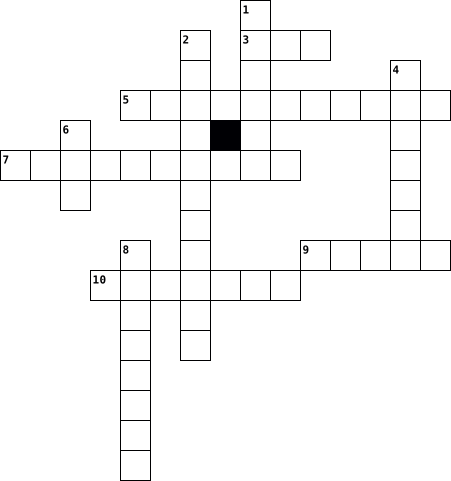
Across
- Comedy sketch show on NBC
- The only actor to receive an Oscar nomination for acting in a Lord of the Rings movie
- Netflix's highest-rated show
- highest-grossing R-rated movie of all time
- dying words of Charles Foster Kane in Citizen Kane
Down
- the Alfred Hitchcock thriller notorious for the "shower scene"
- coffee shop in Friends
- Where Grey's Anatomy takes place
- Tom Hanks got his first Academy Award nomination for this movie
- South Park takes place in this state
10 Clues: coffee shop in Friends • Comedy sketch show on NBC • Netflix's highest-rated show • Where Grey's Anatomy takes place • South Park takes place in this state • highest-grossing R-rated movie of all time • dying words of Charles Foster Kane in Citizen Kane • the Alfred Hitchcock thriller notorious for the "shower scene" • ...
Cellular Organization 2022-11-03

Across
- A writing example of an organ system
- This is made when multiple organs work together for a common purpose/function
- When a living thing has multiple organ systems it is called an ______
- The word for Anatomy, what it's made of
- The smallest unit of living organisms
Down
- Many tissues working together make an ______
- An instrumental example of an organism
- The word for Physiology, what it does
- When multiple cells come together they form a ____
- A building version of a cell
10 Clues: A building version of a cell • A writing example of an organ system • The word for Physiology, what it does • The smallest unit of living organisms • An instrumental example of an organism • The word for Anatomy, what it's made of • Many tissues working together make an ______ • When multiple cells come together they form a ____ • ...
Crossword Puzzle - Technology versus Biology 2018-06-26

Across
- Study of microscopic living things
- Adjective to describe a cell phone as opposed to a non-portable phone
- Study of the structure of a body
- Flowers belong to this kingdom
Down
- Electronic and visual multimedia
- Electrically excitable cell that receives, processes, and transmits information through electrical and chemical signals
- The exploitation of biological processes for industrial and other purposes
- General term for the various kinds of programs used to operate computers
- Other word for numerical
- Bird belongs to this kingdom
10 Clues: Other word for numerical • Bird belongs to this kingdom • Flowers belong to this kingdom • Electronic and visual multimedia • Study of the structure of a body • Study of microscopic living things • Adjective to describe a cell phone as opposed to a non-portable phone • General term for the various kinds of programs used to operate computers • ...
Scien ific Revoluiton 2023-12-13

Across
- Did not accept the Copernican heliocentric .
- Every object in the universe attracts every other object… gravity
- Used Brahe’s data to formulate laws to describe planetary motion.
- The first to use a telescope to study the stars (1610)
- Developed the heliocentric system
Down
- Believed that a better understanding of the natural world
- Believed that scientists needed to reject old assumptions
- American public official, scientist, inventor, and writer
- Considered the father of modern anatomy
- Disproved many of Galen’s hypotheses (worked with apes and dogs in the 2nd century)
10 Clues: Developed the heliocentric system • Considered the father of modern anatomy • Did not accept the Copernican heliocentric . • The first to use a telescope to study the stars (1610) • Believed that a better understanding of the natural world • Believed that scientists needed to reject old assumptions • American public official, scientist, inventor, and writer • ...
Basanese, Kate (3) Game 2 2024-09-13

Across
- Above, toward the head end of the body; upper
- Joints that are immovable
- When one bone as a rounded end that fits into a concave cavity of another bone
- Away from the surface of further into the body
- Formed where bones can move about one another in many directions, but cannot rotate
- Away from the midline of the body
Down
- Freely Movable joints
- Thoracic,Adominal, Pelvic
- Allows only Extension and flexion due to its anatomy
- A joint in which the bones are connected by ligaments
10 Clues: Freely Movable joints • Thoracic,Adominal, Pelvic • Joints that are immovable • Away from the midline of the body • Above, toward the head end of the body; upper • Away from the surface of further into the body • Allows only Extension and flexion due to its anatomy • A joint in which the bones are connected by ligaments • ...
xxx 2026-02-15

Across
- Welcher amerikanische Bundesstaat ist auch der Vorname einer Figur aus Grey's Anatomy?
- Welcher Knochen steht in Beziehung zum Besteigen eines Reittiers?
- Welche Zutat in Studentenfutter erfüllt Wünsche?
- Welche Sportart enthält den Feingehalt von Gold?
- Wer wird in einem Theaterstück gesucht?
- Die Königin welcher Nation wird bei einer Kurvendiskussion berechnet?
Down
- Wie viele Augen hatte das Huhn in deinem Zimmer?
- Wie hätte ich heißen sollen?
- Wie nennt man die Zahl, die an einen englischen Kuchen erinnert, noch?
- Wer malt die schönsten Tiere in den schönsten Farben?
10 Clues: Wie hätte ich heißen sollen? • Wer wird in einem Theaterstück gesucht? • Wie viele Augen hatte das Huhn in deinem Zimmer? • Welche Zutat in Studentenfutter erfüllt Wünsche? • Welche Sportart enthält den Feingehalt von Gold? • Wer malt die schönsten Tiere in den schönsten Farben? • Welcher Knochen steht in Beziehung zum Besteigen eines Reittiers? • ...
Introduction to the Human Body 2024-08-31

Across
- Another term for anterior view
- The study of the body’s function
- A type of planes that divide the body into left and right sections
- A position or direction that is toward the side of the body
Down
- The maintenance of a stable internal environment despite external changes
- Separates the thoracic cavity to the abdominopelvic cavity
- A position closer to the point of attachment of a limb
- The movement of substance or molecule
- It determines the direction of flow
- The study of the body’s structure
10 Clues: Another term for anterior view • The study of the body’s function • The study of the body’s structure • It determines the direction of flow • The movement of substance or molecule • A position closer to the point of attachment of a limb • Separates the thoracic cavity to the abdominopelvic cavity • A position or direction that is toward the side of the body • ...
vocab 2024-10-17

Across
- extremely small
- I had to be _______ to be apart of the clun at school
- The water slide was a _____ space for the girl.
- occurring beginning of someting
- In anatomy class the teacher wants us to use proper _______ when talking about a bodypart.
Down
- the power or opportunity to do something before others do.
- many people enjoyed the _____ of the show
- the doctors told the man that his sickness was _________
- I had _____ amount of storage on my phone
- he was advised to terminate the concract
10 Clues: extremely small • occurring beginning of someting • he was advised to terminate the concract • many people enjoyed the _____ of the show • I had _____ amount of storage on my phone • The water slide was a _____ space for the girl. • I had to be _______ to be apart of the clun at school • the doctors told the man that his sickness was _________ • ...
Introduction to anatomy and physiology 2025-04-29

Across
- Divides the body into upper and lower parts
- The region of the chest
- Toward the front of the body
- The region of the abdomen
- The study of the function of body parts
- Divides the body into front and back parts
Down
- Divides the body into left and right halves
- Toward the mid-line of the body or away from the side of a structure
- Toward the head or situated above another structure
- The study of the structure of body parts
10 Clues: The region of the chest • The region of the abdomen • Toward the front of the body • The study of the function of body parts • The study of the structure of body parts • Divides the body into front and back parts • Divides the body into left and right halves • Divides the body into upper and lower parts • Toward the head or situated above another structure • ...
INTODUCING BIOLOGY 2025-06-09

Across
- Classification of living organisms.
- The study of prehistoric forms of life through fossils of plants and animals.
- The study of tissues at the microscopic level.
- Controlling human traits through selective breeding.
Down
- Study of the immune system and body defenses.
- Study of life beyond Earth.
- The study of the structure of organisms and their organisms.
- The breeding and farming of fish.
- First person to study animals in sufficient detail.
- The study chemicals and reactions that take place inside the living things.
10 Clues: Study of life beyond Earth. • The breeding and farming of fish. • Classification of living organisms. • Study of the immune system and body defenses. • The study of tissues at the microscopic level. • First person to study animals in sufficient detail. • Controlling human traits through selective breeding. • The study of the structure of organisms and their organisms. • ...
Chapter 5 2013-04-08

Across
- a rounded roof built on a circular base (4)
- Family that ruled Florence in the 1400s (2,6)
- The painter of the School of Athens (7)
- Known as the 'Father of modern anatomy' (8)
- Sketches on a piece of wood (8)
- A famous Renaissance painter from outside Italy (9)
- Sketches on a copper plate (9)
- Self governing staes in Italy in the 15th Century (4,6)
- This is the point where all lines of perspective come from (9,5)
- The study of the structure of humans, animals and plants (7)
- A famous Greek physician who dissected animals in an effort to understand more about the human body (5)
- A famous painter and sculptor who painted the roof of the Sistine chapel (12)
- Able to use clever yet dishonest/deceitful ways to achieve goals (13)
- A polish astronomer who studied the movement of the sun, moon and stars (10)
- A famous Florentine painter (2,5)
- A sculpture which mens sorrow in English (5)
- A magnifying lens invented in 1608 by Jan Lippershey (9)
- Inventor of the Printing Press (9)
- A method of painting directly on to we plaster (6)
Down
- A popular belief developed during the Renaissance that involved enjoying life, having personal independence and expressing emotions through art (8)
- To cut open a corpse inorder to examine it (9)
- Rhyming poems of 14 lines
- An acient cure of cutting a sick persons bodyto release bad blood (12)
- Probably the most famous painting in the world (4,4)
- The everyday language of people in each country (10)
- First work printed from the moveable type printing press (5)
- A wealthy person who supported artists by commissioning their work (6)
- Method of mass poducing lierary works (8,5)
- The period in europe between 1400-1700 (11)
- A technique to show space and distance between oblects inpaintings (11)
- A painting that blurs lines to create a smoky effect (7)
- Persecuted by the Catholic Church for not believing that the sun orbited the earth (7)
- the study of plants (6)
33 Clues: the study of plants (6) • Rhyming poems of 14 lines • Sketches on a copper plate (9) • Sketches on a piece of wood (8) • A famous Florentine painter (2,5) • Inventor of the Printing Press (9) • The painter of the School of Athens (7) • a rounded roof built on a circular base (4) • Known as the 'Father of modern anatomy' (8) • Method of mass poducing lierary works (8,5) • ...
evolution 2023-11-29

Across
- gdfgdg
- dfgdgd
- sddg
Down
- oihibi
4 Clues: sddg • oihibi • gdfgdg • dfgdgd
:) 2020-06-28

Across
- Brushwood or thicket or name of a populated area on Swedish Island of Gotland
- To sharpen a blade or perfect something over time
- Con artists won't give you a fair one
- Thorough information, slangily
- What you get tattooed in prison if you murder someone
- Enter the auction
Down
- "Oh no! She ___ her ACL!"
- The shape of a witch's hat
- Name of the doctor who dies first on the shooting episode of "Grey's Anatomy"
- A brood or nest of pheasants
- "_____ T for Teen"
- Lingo specific to the construction community meaning to plaster
- What Tiger Woods did before hitting the first stroke
- My least favorite song from Disney's "Descendents" titled "Rotten to the ___"
14 Clues: Enter the auction • "_____ T for Teen" • "Oh no! She ___ her ACL!" • The shape of a witch's hat • A brood or nest of pheasants • Thorough information, slangily • Con artists won't give you a fair one • To sharpen a blade or perfect something over time • What Tiger Woods did before hitting the first stroke • What you get tattooed in prison if you murder someone • ...