
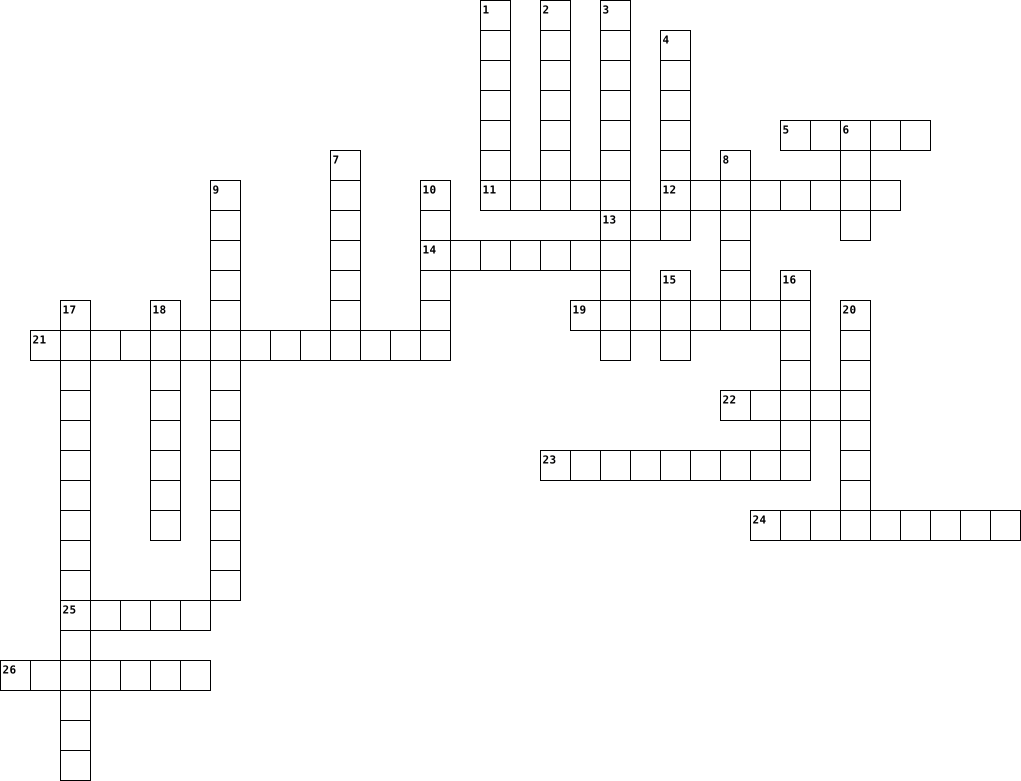
periodic table Crossword Puzzles
The Periodic Table 2023-10-23

Across
- This elements symbol is Kr
- Found in bananas
- Found in the iphone 15 pro
- Collums on the Periodic table
- Is found in salt
- first element to be made artificially
- Found in the alkaline earth metals
- Used to make rubbers
- This element helps activate enzymes
- Flourine can be found in this group
- It's atomic number is one
Down
- Can be found in vitamins
- Groups 3-12 are called
- Created the periodic table
- Element named after Thor
- Rows on the Periodic table are called
- Found in Ballons
- The last element in the periodic table
- It's atomic number is six
- Neon is found in this group
20 Clues: Found in bananas • Is found in salt • Found in Ballons • Used to make rubbers • Groups 3-12 are called • Can be found in vitamins • Element named after Thor • It's atomic number is six • It's atomic number is one • This elements symbol is Kr • Found in the iphone 15 pro • Created the periodic table • Neon is found in this group • Collums on the Periodic table • ...
Periodic Table Crossword 2024-04-30

Across
- Elements put below the Periodic Table
- NiCl
- Most reactive family
- Atomic number for Barium
- How many groups are on the Periodic Table
- Arranged the Periodic Table how it is today
- Neutral particles
- Gas One of the five families on the Periodic Table
- charge of +1
- Not very accurate atom model
Down
- Mr. Machu's favorite element
- Along the stair step line
- Has the chemical symbol C
- The mass number for cobalt (rounded)
- Nonmetal left of the stair step line
- Negatively charged particles
- made up of like atoms
- Center of the atom
- one of the smallest particles of an element
- Atom model with electron rings
20 Clues: NiCl • charge of +1 • Neutral particles • Center of the atom • Most reactive family • made up of like atoms • Atomic number for Barium • Along the stair step line • Has the chemical symbol C • Mr. Machu's favorite element • Negatively charged particles • Not very accurate atom model • Atom model with electron rings • The mass number for cobalt (rounded) • ...
The Periodic Table 2023-10-23

Across
- This elements symbol is Kr
- Found in bananas
- Found in the iphone 15 pro
- Collums on the Periodic table
- Is found in salt
- first element to be made artificially
- Found in the alkaline earth metals
- Used to make rubbers
- This element helps activate enzymes
- Flourine can be found in this group
- It's atomic number is one
Down
- Can be found in vitamins
- Groups 3-12 are called
- Created the periodic table
- Element named after Thor
- Rows on the Periodic table are called
- Found in Ballons
- The last element in the periodic table
- It's atomic number is six
- Neon is found in this group
20 Clues: Found in bananas • Is found in salt • Found in Ballons • Used to make rubbers • Groups 3-12 are called • Can be found in vitamins • Element named after Thor • It's atomic number is six • It's atomic number is one • This elements symbol is Kr • Found in the iphone 15 pro • Created the periodic table • Neon is found in this group • Collums on the Periodic table • ...
Vocab 5 Crossword 2024-03-20

Across
- - an arrangement of elements in columns, based on a set of properties that repeat from row to row
- - a column of elements in a periodic table
- - the pattern of repeating properties displayed by elements in the periodic table
- - elements that are good conductors of heat and electric current
- - elements that are poor conductors of heat and electric current
- - an electron that is in the highest occupied energy level of an atom
- - one twelfth the mass of a carbon-12 atom
Down
- - the elements in group 1A of the periodic table, not including hydrogen
- - the elements in group 2A of the periodic table
- - the elements in group 8A of the periodic table
- - elements with properties that fall between those of metals and nonmetals
- - the elements in group 7A of the periodic table
- - metals that form a bridge between elements on the left and right sides of the periodic table
- - a row in a periodic table of elements
14 Clues: - a row in a periodic table of elements • - a column of elements in a periodic table • - one twelfth the mass of a carbon-12 atom • - the elements in group 2A of the periodic table • - the elements in group 8A of the periodic table • - the elements in group 7A of the periodic table • - elements that are good conductors of heat and electric current • ...
Science Vocab Unit#1 2017-01-31

Across
- a region of space around the nucleus where an electron is likely to be found
- an electron that is in its highest occupied energy level of an atom
- elements with properties that fall between those of metals and nonmetals
- the sum of the number of protons and neutrons in the nucleus of an atom
- a neutral subatomic particle that is found in the nucleus of an atom
- elements that are poor conductors of heat and electric current
- the possible energies that electrons in an atom can have
- the arrangement of electrons in the orbitals of an atom
- a visual model of the most likely locations for the electrons in an atom
- the elements in Group 1A of the periodic table, not including hydrogen
- a row in a periodic table of elements
- elements that are good conductors of heat and electrical current
Down
- a positively charged subatomic particle that is found in the nucleus of an atom
- the elements in Group 7A of the periodic table
- the elements in group 2A of the periodic table
- atom of an element that has a number of neutrons different from that of other atoms of the same element
- a state in which all the electrons in an atom have the lowest possible energies
- the center of the atom which contains the protons and neutrons, in cells, structure that contains the cells genetic material(DNA and controls the cells activities
- the pattern of repeating properties displayed by elements in the periodic table
- one twelfth the mass of a carbon-12 atom
- an arrangement of elements in columns, based on a set of properties that repeat from row to row
- elements that form a bridge between elements on the left and right sides of the periodic table
- the elements in group 8A of the periodic table
- a unique number foread element that equals the number of protons in an atom of that element
- a column of elements in a periodic table
- negatively charged particle located outside the atomic nucleus
26 Clues: a row in a periodic table of elements • one twelfth the mass of a carbon-12 atom • a column of elements in a periodic table • the elements in Group 7A of the periodic table • the elements in group 2A of the periodic table • the elements in group 8A of the periodic table • the arrangement of electrons in the orbitals of an atom • ...
Chemical properties of matter 2023-06-13

Across
- Verticals in the periodic table
- An element with an atomic number of 51
- Period number of uranium
- Period number of potassium
- Made up of elements chemically combined together through a chemical reaction
- Group number of iron
- Group 13 period 2 in the periodic table
- Substances combined only through physical means
- Group 2 Period 4 in the periodic table
Down
- Elements that occur as gases or liquids and not capable of conducting electricity
- Horizontals in the periodic table
- Group 1 Period 1 in the periodic table
- Basic unit of matter
- An element with 79 electrons
- An element with 16 protons
- Period number of rubidium
- Elements which are good conductors
17 Clues: Basic unit of matter • Group number of iron • Period number of uranium • Period number of rubidium • Period number of potassium • An element with 16 protons • An element with 79 electrons • Verticals in the periodic table • Horizontals in the periodic table • Elements which are good conductors • An element with an atomic number of 51 • Group 1 Period 1 in the periodic table • ...
Elements Quiz 2014-02-27

Across
- a horizontal row in the periodic table
- A small particle in the nucleus of the atom, with no charge
- the elements are organized, on the periodic table, by increasing this number
- I have a family all of my own
- element with atomic number 20
- I have 26 protons
- an atom with a different number of neutrons from another atom of the same element
- term used for metals who transfer heat and electricity
- term used for the ability of an element to be pulled into wire
- I am a nobel gas in period 6
- elements in group 1 of the periodic table
Down
- the subatomic particle found in the energy level and orbitals surrounding the nucleus
- a vertical row in the periodic table
- element with atomic mass of 15.9994
- elements found in group 17 of the periodic table
- an element found in Groups 3-12 of the periodic table
- an element that is dull, doesnt conduct electricity, and is fragile
- the combined number of protons and neutrons in an atom
- Term that describes an element that can be pounded into a thin sheet
- I am an alkali-earth metal in period 2
20 Clues: I have 26 protons • I am a nobel gas in period 6 • I have a family all of my own • element with atomic number 20 • element with atomic mass of 15.9994 • a vertical row in the periodic table • a horizontal row in the periodic table • I am an alkali-earth metal in period 2 • elements in group 1 of the periodic table • elements found in group 17 of the periodic table • ...
Chapter 5 Vocabulary 2023-11-13

Across
- All gaseous elements in group 18 on the periodic table.
- All elements within group IA on the periodic table.
- All elements within group IIA on the periodic table.
- A column, or vertical line, in the periodic table.
- Any metals within the central block of the periodic table.
- A law stating that when elements are arranged in increasing atomic number, they demonstrate similar physical and chemical properties.
- Any elements on the periodic table that are not metals.
- The arrangement of chemical elements by increasing atomic number.
Down
- A horizontal row in the periodic table.
- Electrons located on the farthest shell of the nucleus in an atom.
- Opaque, lustrous elements that are good conductors of heat and electricity.
- Elements that display both metal and nonmetal properties.
- Very reactive, non-metal elements located in group 17 on the periodic table.
- The unit of mass used to express atomic and molecular weights.
14 Clues: A horizontal row in the periodic table. • A column, or vertical line, in the periodic table. • All elements within group IA on the periodic table. • All elements within group IIA on the periodic table. • All gaseous elements in group 18 on the periodic table. • Any elements on the periodic table that are not metals. • ...
Test 4 (Notes) 2023-01-22

Across
- unreactive gases found in Group VIIIA (18) of the periodic table.
- the Group A (1, 2, 13-18) elements of the periodic table.
- of protons.
- every orbital in a sublevel is singly occupied (with same spin) before any orbital is double occupied.
- (1911) discovered proton; gold foil experiment said atom mostly empty space with + center & random
- elements that have properties of metals and nonmetals.
- Group B (3-12) elements on the periodic table.
- any metal in Group IA (1) of the periodic table.
- (460 BC) first suggested the existence of the atom.
- electronegativity values increase to the right and decrease as you go down the periodic
- subatomic particle with no charge, a mass of 1 amu, and found in the nucleus; mass number is the sum of
- any metal in Group IIA (2) of the periodic table.
- property of metals that allows them to be hammered into a foil.
- ionization energy values increase to the right and decrease as you go down the periodic table.
- arrangement of elements in increasing atomic number with similar properties in same columns;
- a horizontal row on the periodic table.
- elements in the sixth period with atomic numbers 57-71 found above the actinides, located underneath the main body of the periodic table.
- an orbital has a maximum of 2 electrons, with opposite spins.
- size of atoms decrease to the right and increase as you go down the periodic table.
Down
- elements in the seventh period with atomic numbers 89-103 found below the lanthanides, located underneath the main body of the periodic table.
- - shorthand notation of the arrangement of electrons in an atom according to increasing energy (spdf shapes: circle, figure 8, cloverleaf/and know where spdf blocks are on P Table)
- element that tends to be a poor conductor of heat and electricity.
- elements from Group VIIA (17) on the periodic table.
- metal property that allows it to be drawn into a wire.
- (1913) solar system atom where electrons traveled in orbits around nucleus.
- negatively charged subatomic particle (with a mass of 1/1836 amu) that orbits the nucleus.
- a positively charged subatomic particle with a mass of 1 amu, found in the nucleus; atomic number is the
- vertical column on the periodic table whose elements have similar properties.
- electrons occupy orbitals of lowest energy first.
- (1897) discovered the electron; plum pudding model of atom.
- (1926) electron cloud model of atom.
- (1800) believed in atoms/atoms were solid spheres.
- + neutrons.
- elements that are ductile, malleable, shiny, and good conductors of heat and electricity.
- (1932) discovered the neutron.
- atoms of same element (same number of protons) but different atomic masses due to different number of
- (384 BC) taught that all materials were not made of atoms but of the 4 elements: earth, fire, water, and air.
37 Clues: of protons. • + neutrons. • (1932) discovered the neutron. • (1926) electron cloud model of atom. • a horizontal row on the periodic table. • Group B (3-12) elements on the periodic table. • any metal in Group IA (1) of the periodic table. • electrons occupy orbitals of lowest energy first. • any metal in Group IIA (2) of the periodic table. • ...
Grouping Elements 2021-10-11

Across
- Elements found on the right hand side of the periodic table.
- Elements that can behave like both metals and non-metals.
- Can be drawn into wires.
- The diagram used to group elements, (8,5).
- Able to be bent.
- Will shatter when hit.
- The middle section of the periodic table (10,6).
- Most of the elements are this state of matter.
- Group 8 on the periodic table (5,5).
Down
- The shine on metals.
- Will carry electricity well.
- Group 1 on the periodic table 6,6).
- The Russian credited with developing the periodic table.
- The most common type of element.
- Group 7 on the periodic table.
15 Clues: Able to be bent. • The shine on metals. • Will shatter when hit. • Can be drawn into wires. • Will carry electricity well. • Group 7 on the periodic table. • The most common type of element. • Group 1 on the periodic table 6,6). • Group 8 on the periodic table (5,5). • The diagram used to group elements, (8,5). • Most of the elements are this state of matter. • ...
Periodic table 2026-04-27

Across
- highly reactive metal group
- 2 elements chemically combined
- carbon dioxide
- visual representation of a atom
- O
- water
- positive charge
- pure substance on its own
- negative charge
Down
- visual representation of valence electrons in atom
- sum of protons and nuetrons
- Rows on periodic table
- atoms on outer ring
- where do you find elements?
- C
- group 18 on periodic table
- group 17
- slt
- protons in nucleous
- Collums on periodic table
20 Clues: C • O • slt • water • group 17 • carbon dioxide • positive charge • negative charge • atoms on outer ring • protons in nucleous • Rows on periodic table • Collums on periodic table • pure substance on its own • group 18 on periodic table • sum of protons and nuetrons • where do you find elements? • highly reactive metal group • 2 elements chemically combined • visual representation of a atom • ...
Cameron Smith - 11/12/24 - Chapter 4 Vocab Crossword Puzzle - PS211-A1 2024-11-13

Across
- An element in Group 17 of the periodic table having seven valence electrons. It easily gains an electron, forming a 1 − anion, which causes it to be highly reactive.
- An element in Group 18 on the periodic table having eight valence electrons that fill the outer energy level. (Helium is an exception with only two.) With a full outer energy level, it is inert (i.e., nonreactive).
- Another word for family
- An element with characteristics between those of metals and nonmetals; also called semiconductors; located between metals and nonmetals on the periodic table.
- A measure of an element’s ability to attract and hold electrons when bonded to other atoms.
- An element that typically has four or more valence electrons and that does not exhibit the general properties of metals; located on the right side of the periodic table.
- An element that is typically dense, solid, ductile, malleable, highly conductive, and chemically reactive, especially in the presence of nonmetal elements. Metals are located on the left end of the periodic table.
- A representation of an atom consisting of its chemical symbol with surrounding dots representing its valence electrons.
- Any of Groups 13–16 in the periodic table; so named because they contain metals, nonmetals, and metalloids. These groups are often named for the first element in the family.
- (1) A row in the periodic table of the elements; also called a series. (2) The time interval (T) for one complete cycle of periodic motion.
- A column of elements in the periodic table having similar valence electron arrangement, resulting in similar chemical properties; also known as a group.
- Any elements in Groups 3–12 of the periodic table, typically having one or two valence electrons, which it easily loses, resulting in cations with charges of 1 + or 2 + .
Down
- An element in Group 2 of the periodic table, having two valence electrons that it tends to lose easily to become a 2 + cation, making it very reactive.
- Any electron in the outermost energy level of a neutral atom. Unpaired valence electrons are usually involved in chemical bonding.
- A table of the chemical elements arranged to display their periodic properties in relation to their atomic numbers.
- The distance from the center of an atom’s nucleus to its outermost energy level.
- An element from either of two rows usually placed below the periodic table; a member of either the lanthanide or actinide series. It typically has two valence electrons.
- An element in Group 1 of the periodic table, having one valence electron that it can easily lose to form a 1 + cation, making it extremely reactive; the most reactive of all the metals
- The law that states that the properties of the elements vary with their atomic numbers in a regular, repeated pattern.
19 Clues: Another word for family • The distance from the center of an atom’s nucleus to its outermost energy level. • A measure of an element’s ability to attract and hold electrons when bonded to other atoms. • A table of the chemical elements arranged to display their periodic properties in relation to their atomic numbers. • ...
Physical Science Chapter 4 Vocabulary 2024-11-13

Across
- An element that typically has four or more valence electrons and that does not exhibit the general properties of metals; located on the right side of the periodic table
- An element in Group 17 of the periodic table having seven valence electrons. It easily gains an electron, forming a 1 - anion, which causes it to be highly reactive
- A representation of an atom consisting of its chemical symbol with surrounding dots representing its valence electrons
- An element that is typically dense, solid, ductile, malleable, highly conductive, and chemically reactive, especially in the presence of nonmetal elements. Metals are located on the left end of the periodic table.
- A table of the chemical properties of the elements arranged to display their periodic properties in relation to their atomic numbers
- Also a family
- (1) A row in the periodic table of the elements; also called a series. (2)The time interval (T) for one complete cycle of periodic motion
- An element in Group 1 of the periodic table, having one valence electron that it can easily lose to form a 1 + cation, making it extremely reactive; the most reactive of all the metals
- A column of elements in the periodic table having similar valence electron arrangement, resulting in similar chemical properties; also known as a group
- Any elements in Groups 3-12 of the periodic table, typically having one or two valence electrons, which it easily loses, resulting in cations with charged of 1+ or 2+
Down
- The law that states that the properties of the elements vary with their atomic numbers in a regular, repeated pattern
- Any electron in the outermost energy level of a neutral atom. Unpaired valence electrons are usually involved in chemical bonding
- An element in Group 18 on the periodic table having eight valence electrons that fill the outer energy level. (Helium is an exception with only two.) With a full outer energy level, it is inert (i.e., nonreactive).
- An element from either of two rows usually placed below the periodic table; a member of either the lanthanide or actinide series. It typically has two valance electrons
- The distance from the center of an atom's nucleus to its outermost energy level
- Any of Groups 13-16 in the periodic table; so named because they contain metals, nonmetals, and metalloids. These groups are often named for the first element in the family.
- An element with characteristics between those of metals and nonmetals; also called semiconductors; located between metals and nonmetals on the periodic table
- An element in Group 2 of the periodic table, having two valence electrons that it tends to lose easily to become a 2 + cation, making very reative
- A measure of an element's ability to attract and hold electrons when bonded to other atoms
19 Clues: Also a family • The distance from the center of an atom's nucleus to its outermost energy level • A measure of an element's ability to attract and hold electrons when bonded to other atoms • The law that states that the properties of the elements vary with their atomic numbers in a regular, repeated pattern • ...
Ryan Brown November 13,2024 PS211 Chapter 4 Crossword 2024-11-13

Across
- An element in Group 17 of the periodic table having seven valence electrons. It easily gains an electron, forming a 1 − anion, which causes it to be highly reactive.
- An element in Group 18 on the periodic table having eight valence electrons that fill the outer energy level. (Helium is an exception with only two.) With a full outer energy level, it is inert (i.e., nonreactive).
- See family.
- An element with characteristics between those of metals and nonmetals; also called semiconductors; located between metals and nonmetals on the periodic table.
- A measure of an element’s ability to attract and hold electrons when bonded to other atoms.
- An element that typically has four or more valence electrons and that does not exhibit the general properties of metals; located on the right side of the periodic table.
- An element that is typically dense, solid, ductile, malleable, highly conductive, and chemically reactive, especially in the presence of nonmetal elements. Metals are located on the left end of the periodic table.
- A representation of an atom consisting of its chemical symbol with surrounding dots representing its valence electrons.
- Any of Groups 13–16 in the periodic table; so named because they contain metals, nonmetals, and metalloids. These groups are often named for the first element in the family.
- (1) A row in the periodic table of the elements; also called a series. (2) The time interval (T) for one complete cycle of periodic motion.
- A column of elements in the periodic table having similar valence electron arrangement, resulting in similar chemical properties; also known as a group.
- Any elements in Groups 3–12 of the periodic table, typically having one or two valence electrons, which it easily loses, resulting in cations with charges of 1 + or 2 + .
Down
- An element in Group 2 of the periodic table, having two valence electrons that it tends to lose easily to become a 2 + cation, making it very reactive.
- Any electron in the outermost energy level of a neutral atom. Unpaired valence electrons are usually involved in chemical bonding.
- A table of the chemical elements arranged to display their periodic properties in relation to their atomic numbers.
- The distance from the center of an atom’s nucleus to its outermost energy level.
- An element from either of two rows usually placed below the periodic table; a member of either the lanthanide or actinide series. It typically has two valence electrons.
- An element in Group 1 of the periodic table, having one valence electron that it can easily lose to form a 1 + cation, making it extremely reactive; the most reactive of all the metals.
- The law that states that the properties of the elements vary with their atomic numbers in a regular, repeated pattern.
19 Clues: See family. • The distance from the center of an atom’s nucleus to its outermost energy level. • A measure of an element’s ability to attract and hold electrons when bonded to other atoms. • A table of the chemical elements arranged to display their periodic properties in relation to their atomic numbers. • ...
Cell parts and the periodic table By Jacob Leach 2021-03-19

Across
- ribonucleic acid
- carries genetic information
- encases the cytoplasm
- only on plant cells
- first row on the periodic table
- conducts electricity and heat
- columns on the periodic table
- a cloud that contains negative particles
- inert gas
- holds protons and neutrons
- holds components of the cell
- packages proteins and lipid molecules
- negative
- powerhouse of the cell
Down
- aren't metals or nonmetals
- positive
- doesn't conduct electricity and heat
- building block of life
- contains RNA and proteins
- brain of the cell
- electron in the outermost shell
- neutral
- second row in the periodic table
- Deoxyribonucleic acid
- rows on the periodic table
25 Clues: neutral • positive • negative • inert gas • ribonucleic acid • brain of the cell • only on plant cells • encases the cytoplasm • Deoxyribonucleic acid • building block of life • powerhouse of the cell • contains RNA and proteins • aren't metals or nonmetals • holds protons and neutrons • rows on the periodic table • carries genetic information • holds components of the cell • ...
The Periodic Table 2023-10-23

Across
- This elements symbol is Kr
- Found in bananas
- Found in the iphone 15 pro
- Collums on the Periodic table
- Is found in salt
- first element to be made artificially
- Found in the alkaline earth metals
- Used to make rubbers
- This element helps activate enzymes
- Flourine can be found in this group
- It's atomic number is one
Down
- Can be found in vitamins
- Groups 3-12 are called
- Created the periodic table
- Element named after Thor
- Rows on the Periodic table are called
- Found in Ballons
- The last element in the periodic table
- It's atomic number is six
- Neon is found in this group
20 Clues: Found in bananas • Is found in salt • Found in Ballons • Used to make rubbers • Groups 3-12 are called • Can be found in vitamins • Element named after Thor • It's atomic number is six • It's atomic number is one • This elements symbol is Kr • Found in the iphone 15 pro • Created the periodic table • Neon is found in this group • Collums on the Periodic table • ...
The Periodic Table 2023-10-23

Across
- This elements symbol is Kr
- Found in bananas
- Found in the iphone 15 pro
- Collums on the Periodic table
- Is found in salt
- first element to be made artificially
- Found in the alkaline earth metals
- Used to make rubbers
- This element helps activate enzymes
- Flourine can be found in this group
- It's atomic number is one
Down
- Can be found in vitamins
- Groups 3-12 are called
- Created the periodic table
- Element named after Thor
- Rows on the Periodic table are called
- Found in Ballons
- The last element in the periodic table
- It's atomic number is six
- Neon is found in this group
20 Clues: Found in bananas • Is found in salt • Found in Ballons • Used to make rubbers • Groups 3-12 are called • Can be found in vitamins • Element named after Thor • It's atomic number is six • It's atomic number is one • This elements symbol is Kr • Found in the iphone 15 pro • Created the periodic table • Neon is found in this group • Collums on the Periodic table • ...
The Periodic Table 2023-10-23

Across
- This elements symbol is Kr
- Found in bananas
- Found in the iphone 15 pro
- Collums on the Periodic table
- Is found in salt
- first element to be made artificially
- Found in the alkaline earth metals
- Used to make rubbers
- This element helps activate enzymes
- Flourine can be found in this group
- It's atomic number is one
Down
- Can be found in vitamins
- Groups 3-12 are called
- Created the periodic table
- Element named after Thor
- Rows on the Periodic table are called
- Found in Ballons
- The last element in the periodic table
- It's atomic number is six
- Neon is found in this group
20 Clues: Found in bananas • Is found in salt • Found in Ballons • Used to make rubbers • Groups 3-12 are called • Can be found in vitamins • Element named after Thor • It's atomic number is six • It's atomic number is one • This elements symbol is Kr • Found in the iphone 15 pro • Created the periodic table • Neon is found in this group • Collums on the Periodic table • ...
metals and non-metals crossword 2025-11-25

Across
- A substance used up in a chemical reaction.
- Two or more substances mixed, but not joined together.
- Can bend without breaking.
- Group 1 in the periodic table.
- The tiny spheres that make up everything.
- A substance made in a chemical reaction.
- – Shininess.
- The chemical name of reactions involving burning in oxygen.
- Group 0 in the periodic table.
- A shortened way to describe what is going on in a chemical reaction. Eg: hydrogen + oxygen → water.
Down
- When one or more substances change into new substances – you may see a colour change, a gas given off or heat produced.
- A row in the periodic table.
- A group of metals in the periodic table between Group 2 and Group 3. They are hard, strong and not very reactive.
- Group 7 in the periodic table.
- Reaction of water, oxygen and iron to make a brown solid.
- Goes “ding” when you hit it.
- A substance made of just one type of atom.
- A column in the periodic table.
- Two or more elements joined together and so can’t be separated easily.
19 Clues: – Shininess. • Can bend without breaking. • A row in the periodic table. • Goes “ding” when you hit it. • Group 7 in the periodic table. • Group 1 in the periodic table. • Group 0 in the periodic table. • A column in the periodic table. • A substance made in a chemical reaction. • The tiny spheres that make up everything. • A substance made of just one type of atom. • ...
Periodic Table Vocab 2026-01-22

Across
- oxidation number of nitrogen in NO2
- row in the periodic table
- elements in the same column share the same number of __________
- outermost shell of an atom
- symbol for lead
- name of elements in group 2A
- positively charged ion
- located on the right side of the periodic table
- positively charged subatomic particle
- neutral subatomic particle
- located on the left side of the periodic table
- represented by Hg
Down
- loss of electrons
- number of valence electrons halogen atoms contain
- elements in the same group share similar __________ properties
- symbol for iron
- column in the periodic table (aka family)
- name of elements in group 8A
- name of elements in group 1A
- location of protons and neutrons in an atom
- represents the number of protons on the periodic table
- negatively charged subatomic particle
- large block of elements at the center of the periodic table
- negatively charged ion
- represented by Na
- name of the group of elements that has a charge of -1 when ionized
- number of valence electrons noble gas atoms contain
- gain of electrons
- oxidation number of Fluorine in F2
29 Clues: symbol for iron • symbol for lead • loss of electrons • represented by Na • gain of electrons • represented by Hg • negatively charged ion • positively charged ion • row in the periodic table • outermost shell of an atom • neutral subatomic particle • name of elements in group 8A • name of elements in group 1A • name of elements in group 2A • oxidation number of Fluorine in F2 • ...
Periodic Table Crossword Puzzle 2013-11-21

Across
- These can have one or two letters that represent an element.
- This element's symbol is Ar.
- The rows of elements on the periodic table are called _________.
- What scientists and people call the element by is their _______.
- The group of atoms next to the zigzag line is called __________.
- When two or more element are chemically combined, it makes a ________.
- The basic unit of an element is called an _________.
- This is a pure substance that cannot be broken down into anything else.
- This is the mass of a ny element on the periodic table.
- The weight of an object is also called its __________.
- The number that arranges the elements on the periodic table is called an _____.
- This element’s atomic number is 8.
Down
- This element’s symbol is H.
- This element’s symbol is N.
- A chart of elements is called the ______________.
- The columns of the periodic table are called ________.
- Elements found on the right side of the periodic table are called ________.
- Everything that has mass and takes up space is _________.
- The biggest group of elements on the periodic table is called _________.
- This element’s atomic number is 17.
20 Clues: This element’s symbol is H. • This element’s symbol is N. • This element's symbol is Ar. • This element’s atomic number is 8. • This element’s atomic number is 17. • A chart of elements is called the ______________. • The basic unit of an element is called an _________. • The columns of the periodic table are called ________. • ...
Elements Quiz 2014-02-27

Across
- element with atomic number 20
- I have a family all of my own
- elements in group 1 of the periodic table
- I have 26 protons
- an atom with a different number of neutrons from another atom of the same element
- term used for the ability of an element to be pulled into wire
- the elements are organized, on the periodic table, by increasing this number
- A small particle in the nucleus of the atom, with no charge
- elements found in group 17 of the periodic table
- the combined number of protons and neutrons in an atom
Down
- term used for metals who transfer heat and electricity
- I am an alkali-earth metal in period 2
- an element found in Groups 3-12 of the periodic table
- I am a nobel gas in period 6
- a vertical row in the periodic table
- a horizontal row in the periodic table
- element with atomic mass of 15.9994
- Term that describes an element that can be pounded into a thin sheet
- an element that is dull, doesnt conduct electricity, and is fragile
- the subatomic particle found in the energy level and orbitals surrounding the nucleus
20 Clues: I have 26 protons • I am a nobel gas in period 6 • element with atomic number 20 • I have a family all of my own • element with atomic mass of 15.9994 • a vertical row in the periodic table • I am an alkali-earth metal in period 2 • a horizontal row in the periodic table • elements in group 1 of the periodic table • elements found in group 17 of the periodic table • ...
Elements Quiz 2014-02-27

Across
- the elements are organized, on the periodic table, by increasing this number
- the subatomic particle found in the energy level and orbitals surrounding the nucleus
- I have 26 protons
- term used for metals who transfer heat and electricity
- I am a nobel gas in period 6
- the combined number of protons and neutrons in an atom
- elements in group 1 of the periodic table
- a horizontal row in the periodic table
- I am an alkali-earth metal in period 2
- term used for the ability of an element to be pulled into wire
- a vertical row in the periodic table
Down
- element with atomic mass of 15.9994
- Term that describes an element that can be pounded into a thin sheet
- I have a family all of my own
- A small particle in the nucleus of the atom, with no charge
- an element found in Groups 3-12 of the periodic table
- an element that is dull, doesnt conduct electricity, and is fragile
- elements found in group 17 of the periodic table
- element with atomic number 20
- an atom with a different number of neutrons from another atom of the same element
20 Clues: I have 26 protons • I am a nobel gas in period 6 • I have a family all of my own • element with atomic number 20 • element with atomic mass of 15.9994 • a vertical row in the periodic table • a horizontal row in the periodic table • I am an alkali-earth metal in period 2 • elements in group 1 of the periodic table • elements found in group 17 of the periodic table • ...
Elements 2024-05-16

Across
- Elements in group 18 of the periodic table, known for being inert.
- Two or more atoms bonded together.
- A vertical column in the periodic table.
- A subatomic particle with a negative charge.
- Elements in group 1 of the periodic table.
- The tendency of an atom to attract electrons.
- Metals in groups 3-12 of the periodic table.
- elements, along with their concepts, to create a crossword puzzle.
- Elements in the f-block, atomic numbers 57-71.
Down
- Atoms of the same element with different numbers of neutrons.
- The process of removing an electron from an atom.
- A subatomic particle with a positive charge found in the nucleus of an atom.
- Elements with properties intermediate between metals and nonmetals.
- Elements in group 17 of the periodic table.
- The central part of an atom, containing protons and neutrons.
- A subatomic particle with no charge, found in the nucleus of an atom.
- Elements in the f-block, atomic numbers 89-103.
- The number of electrons in the outer shell of an atom.
- A horizontal row in the periodic table.
- The amount of matter in an object, often referring to atomic mass.
- The basic unit of a chemical element.
21 Clues: Two or more atoms bonded together. • The basic unit of a chemical element. • A horizontal row in the periodic table. • A vertical column in the periodic table. • Elements in group 1 of the periodic table. • Elements in group 17 of the periodic table. • A subatomic particle with a negative charge. • Metals in groups 3-12 of the periodic table. • ...
Physical Science Vocabulary Chapter 4 2023-10-17

Across
- an element that is typically dense, solid, ductile, malleable, highly conductive, and chemically reactive, especially in the presence of nonmetal elements; metals are located on the left end of the periodic table
- any elements in Groups 3-12 of the periodic table, typicallyy having one or two valence electrons, which it easily loses, resulting in cations with charges of 1+ or 2+
- a representation of an atom consisting of its chemical symbol with surrounding dots representing its chemical symbol with surrounding dots representing its valence electrons
- an element in Group 17 of the periodic table having seven valence electrons; it easily gains an electron, forming a 1- anion, which causes it to be highly reactive
- an element with characteristics between those of metals and nonmetals; also called semi-conductors; located between metals and nonmetals on the periodic table
- any electron in the outermost energy level of a neutral atom; unparied valence electrons are usually involved in chemical bonding
- the distance from the center of an atom's nucleus to its outermost energy level
- an element from either of two rows usually placed below the periodic table; a member of either the lanthanide or actinide series; it typically had two valence electrons
- see family
- a row in the periodic table of the elements; also called a series
- a column of elements in the periodic table having similar valence electron arrangement, resulting in similar chemical properties; also known as a group
Down
- an element in Group 2 of the periodic table, having two valence electrons that it tends to lose easily to become a 2+ cation, making it very reactive
- an element in Group 1 of the periodic table, having one valence electron that it can easily lose to form a 1+ cation, making it extremely reactive; the most reactive of all the metals
- an element in Group 18 on the periodic table having eight valence electrons that fill the outer energy level (helium is an exception with only two); With a full outer energy level, it is inert (nonreactive)
- a measure of an element's ability to attract and hold electrons when bonded to other atoms
- a table of the chemical elements arranged to display their periodic properties in relation to their atomic numbers
- an element that typically has four or more valence electrons and that does not exhibit the general properties of metals; located on the right side of the periodic table
- any of Groups 13-16 in the periodic table; so named because they contain metals, nonmetals, and metalloids; these groups are often named for the first element in the family
- the law that states that the properties of the elements vary with their atomic numbers in a regular, repeated pattern
19 Clues: see family • a row in the periodic table of the elements; also called a series • the distance from the center of an atom's nucleus to its outermost energy level • a measure of an element's ability to attract and hold electrons when bonded to other atoms • ...
Periodic Table/Atoms Crossword Puzzle 2018-01-30

Across
- Elements that are able to form anions, acidic oxides,acids,and stable compounds with Hydrogen,carbon is an example of this
- The number of protons in an element's atom,determines place on the Periodic Table
- The average added weight of protons and neutrons of an elements isotopes
- Particles smaller than an atom
- Table of chemical elements arranged by atomic number
- Group 18 on the Periodic Table,made up of gases,have a "full outer shell".
- Subatomic particles with a positive charge,found I an atom's nucleus
- Vertical columns on the Periodic Table
- Elements that form cations and have metallic bonds,iron is an example of this
- Electrons on "outer shell" that can form bonds with other elements
- Positively charged ions
- The center of an atom,made up of protons and neutrons
Down
- Another name for groups
- Negatively charged ions
- Group 1 on the Periodic Table, highly reactive,has 1 valence electron
- Group 2 on the Periodic Table,slightly less reactive than group 1,has 2 valence electrons
- The elements when arranged in order of atomic number show periodic variation of atomic structure and most of their properties
- Atom's of elements where the number of neutrons change
- Subatomic particles with no charge,found inside an atom's nucleus
- Elements whose characteristics fall between metals and solid nonmetals,boron is an example of this.
- Horizontal rows on the Periodic Table
- Atom of an element where the charge of the particle changes
- Subatomic particles with a negative charge
- Group 17 on the Periodic Table, highly reactive, has 7 valence electrons
- Smallest unit of chemical matter
25 Clues: Another name for groups • Negatively charged ions • Positively charged ions • Particles smaller than an atom • Smallest unit of chemical matter • Horizontal rows on the Periodic Table • Vertical columns on the Periodic Table • Subatomic particles with a negative charge • Table of chemical elements arranged by atomic number • ...
Elements, Compounds and Mixtures (2) LSS 2020-07-12

Across
- the only liquid non-metal
- a vertical column in the Periodic Table
- the only liquid metal
- elements in the Periodic Table are arranged in order of increasing ___ numbers
- ___ or light is involved in the formation of a compound
- element in Group I and Period 3 of the Periodic Table
- the Periodic Table comprises metallic and non-metallic ___
- ___ are stronger than pure metals
- __ steel is used to make car bodies and girders for bridges
Down
- a horizontal row in the Periodic Table
- element in Group V and Period 2 of the Periodic Table
- ___ steel is used to make utensils and surgical instruments
- a ___ does not have a fixed composition of constituents
- a ___ has a fixed proportion by mass of its constituent elements
- a mixture ___ the properties of its constituents
- sodium chloride can be obtained from seawater by ___ method called evaporation
- magnesium oxide can be separated into magnesium and oxygen by ___ methods e.g. electrolysis
- elements in the same group have ___ chemical properties hence undergo similar chemical reactions
- a compound has properties ___ from those of its constituent elements
19 Clues: the only liquid metal • the only liquid non-metal • ___ are stronger than pure metals • a horizontal row in the Periodic Table • a vertical column in the Periodic Table • a mixture ___ the properties of its constituents • element in Group V and Period 2 of the Periodic Table • element in Group I and Period 3 of the Periodic Table • ...
Periodic Trends Vocab 2024-09-30

Across
- Solids, liquids or gases found in the periodic table
- A positively charged ion
- Elements occupying Group 2A of the periodic table
- Elements arranged in order of increasing atomic number and periodic pattern
- Chemical elements whose physical and chemical properties fall in between the metal and non-metal categories
- a chemical property that describes the tendency of an atom or a functional group to attract electrons toward itself
- The amount of energy required to remove an electron from an isolated atom or molecule
Down
- True to their general properties
- Gasous elements
- He published a table of elements organized by increasing atomic weight
- A column in the periodic table
- An element that form positive ions and has metallic bonds
- Elements occupying Group 1A of the periodic table
- Unstable metals that display transitional behaviors
- The elements in group 7A
- A negatively charged ion
- Horizontal row found on the periodic table
- An element or atom with a net electric charge
- The total distance from an atom's nucleus to the outermost orbital of electron.
19 Clues: Gasous elements • A positively charged ion • The elements in group 7A • A negatively charged ion • A column in the periodic table • True to their general properties • Horizontal row found on the periodic table • An element or atom with a net electric charge • Elements occupying Group 1A of the periodic table • Elements occupying Group 2A of the periodic table • ...
Michelle De Jesus Garcia: The Periodic Table and its Trends 2025-05-05

Across
- The most reactive column of elements (think group 17.)
- This can be positive or negative and this pattern stretches across the periodic table from + to neutral.
- The horizontal rows on the periodic table.
- The right side of the periodic table is this. They’re not conductors of electricity.
- The first column in the table. They are highly reactive.
- The electrons on the outer level of the electron shell are called this.
- The second column in the table. Still highly reactive but less than the first column.
- The creator of the first and most recognized periodic table.
Down
- The vertical columns on the periodic table.
- This is what changes when you go down a column on the periodic table.This property increases.
- Semiconductors of electricity. These few elements fall near the staircase on the periodic table.
- The middle part of the periodic table is this(think groups 3-12.)
- Most elements on the periodic table are this. These elements are excellent conductors of electricity.
- The number at the top right of an element that indicates how many protons it contains.
- The column of elements with full outer electron shells and little to no reactivity (think group 18.)
15 Clues: The horizontal rows on the periodic table. • The vertical columns on the periodic table. • The most reactive column of elements (think group 17.) • The first column in the table. They are highly reactive. • The creator of the first and most recognized periodic table. • The middle part of the periodic table is this(think groups 3-12.) • ...
Elements Quiz 2014-02-27

Across
- an element found in Groups 3-12 of the periodic table
- an element that is dull, doesnt conduct electricity, and is fragile
- element with atomic number 20
- the combined number of protons and neutrons in an atom
- the subatomic particle found in the energy level and orbitals surrounding the nucleus
- a vertical row in the periodic table
Down
- Term that describes an element that can be pounded into a thin sheet
- I am an alkali-earth metal in period 2
- I have a family all of my own
- elements found in group 17 of the periodic table
- term used for metals who transfer heat and electricity
- I am a nobel gas in period 6
- elements in group 1 of the periodic table
- I have 26 protons
- term used for the ability of an element to be pulled into wire
- a horizontal row in the periodic table
- the elements are organized, on the periodic table, by increasing this number
- element with atomic mass of 15.9994
- an atom with a different number of neutrons from another atom of the same element
- A small particle in the nucleus of the atom, with no charge
20 Clues: I have 26 protons • I am a nobel gas in period 6 • I have a family all of my own • element with atomic number 20 • element with atomic mass of 15.9994 • a vertical row in the periodic table • I am an alkali-earth metal in period 2 • a horizontal row in the periodic table • elements in group 1 of the periodic table • elements found in group 17 of the periodic table • ...
Periodic Table Crossword Puzzle 2023-05-09

Across
- what the periodic table is named
- the horizontal lines on the periodic table
- what determines an elements neutrons
- The amount of electrons on the last shell
- the atomic mass of oxygen
- Where the electrons are, just outside of the nucleus
Down
- who created the periodic table
- the least reactive of the elements
- majority of the periodic table
- The vertical lines on the periodic table
- the most reactant halogen
- the elements found on the staircase on the periodic table
- what determines protons and electrons
- what is the atomic symbol for Iron
14 Clues: the most reactant halogen • the atomic mass of oxygen • who created the periodic table • majority of the periodic table • what the periodic table is named • the least reactive of the elements • what is the atomic symbol for Iron • what determines an elements neutrons • what determines protons and electrons • The vertical lines on the periodic table • ...
Science Crossword by Charles Kajmowicz 2022-01-12

Across
- with hydrogen they constitute group 1
- positively charged sub-atomic particle
- a column of elements on the periodic table
- same element and different # of neutrons
- large range of complex ions
- atomic numbers 89-103
- occupies group 17 on the table
- a row of elements on the periodic table
- zero-charged sub atomic particles
- up a small portion of the periodic table
- create group 2 on the table
- decay unstable atomic nucleus loses energy
Down
- center of the atom
- negatively charged sub-atomic particle
- the mass of an atom
- makes up most of the periodic table
- ion Ion with a net negative charge
- number the # of protons in an atom
- doesnt undergo chemical reaction
- ion ion with a net positive charge
- Electrons not equal to the protons
- atomic numbers 57-71
- what semiconductors are made of
- atoms spontaneously decay each second
24 Clues: center of the atom • the mass of an atom • atomic numbers 57-71 • atomic numbers 89-103 • large range of complex ions • create group 2 on the table • occupies group 17 on the table • what semiconductors are made of • doesnt undergo chemical reaction • zero-charged sub atomic particles • ion Ion with a net negative charge • number the # of protons in an atom • ...
periodic table 2021-05-16

Across
- we need this to survive
- third on the periodic table
- symbol is Na
- symbol is K
- symbol is C
- symbol is Ne
- symbol is Al
- the symbol is He
- 20th on the periodic table
- first on the periodic table
Down
- symbol is P
- after carbon
- symbol is Si
- Symbol is Mg
- symbol is F
- symbol is B
- symbol is Be
- in pools
- symbol is S
- symbol is Ar
20 Clues: in pools • symbol is P • symbol is F • symbol is B • symbol is K • symbol is C • symbol is S • after carbon • symbol is Si • symbol is Na • Symbol is Mg • symbol is Be • symbol is Ne • symbol is Al • symbol is Ar • the symbol is He • we need this to survive • 20th on the periodic table • third on the periodic table • first on the periodic table
Periodic table 2021-12-10

Across
- A element on the periodic table that is shiny and has a mass of 197u
- A element on the periodic table that is used to blow up balloons and has an atomic number of 2
- A element that is the exact opposite of metals
- A horizontal row on the periodic table
- A element that is a mixture of metals and nonmetals
- Someone who had the idea and designed the periodic table
- A soft and silver element on the periodic table that has a mass of 23u
- A chemical on the periodic table that goes by the atomic number 5
Down
- The number above an element on the periodic table(Also symbolizes which element is which)
- A vertical collum on the periodic table
- is A element that is colorless, odorless and has an atomic number of 1 on the periodic table
- The total amount of protons and neutrons in a neuclus
- A hard material with the following qualities: Shiny, solid, malleable, and used a lot in our lives
- A type of substance located somewhere on the periodic table
14 Clues: A horizontal row on the periodic table • A vertical collum on the periodic table • A element that is the exact opposite of metals • A element that is a mixture of metals and nonmetals • The total amount of protons and neutrons in a neuclus • Someone who had the idea and designed the periodic table • A type of substance located somewhere on the periodic table • ...
crossword puzzle 2023-01-17

Across
- positively charged particle
- atoms of the same element that have a different number of neutrons
- metals, group 1 periodic table metals that are very reactive
- cloud, group of electrons circulating around a nucleus
- (inert) gases, gases that almost never reactive with other metals
- metals, group 2 periodic table metals that are more reactive then most other metals
- uncharged particle
- the elements in a column of the periodic table
- very reactive nonmetals in group 17 of the periodic table that form compounds called salts with other metals
- 90-103 elements that are set apart from the rest of the periodic table
- ion, an atom that is larger then an atom that formed it
- decay, the change in the number of protons of an atom
- the total number of protons and neutrons in an atoms nucleus
- metals, elements in group 3-2 of the periodic table that are less reactive than most other metals
- combination of a proton and neutron
Down
- ion, an atom that is smaller than the atom that formed it
- number, identity of an atom determined by the number of protons in its nucleus
- elements that have properties of both metals and nonmetals
- are rare earth metals that are actually not that rare
- an atom that gained or lost electrons
- shiny and solid element that conduct electricity and heat well
- elements on the right side of the periodic table that are gases or liquids
- each horizonal row in a periodic table
- the process by which atoms produce energy and particles
- negatively charged particle that moves around the nucleus
25 Clues: uncharged particle • positively charged particle • combination of a proton and neutron • an atom that gained or lost electrons • each horizonal row in a periodic table • the elements in a column of the periodic table • are rare earth metals that are actually not that rare • decay, the change in the number of protons of an atom • ...
Periodic Table Project Puzzle 4 2025-12-01

Across
- A metal period three
- This group is silvery gray and extremely soft
- Electrons found in the outermost shell and represent the dots in the Lewis Dot Structure are called __________ ___________
- The number of dots on the Lewis Dot Structure for Nitrogen
- An alkali metal
- These elements are colorless, tasteless, and odorless
- Alkaline earth metals have a charge of _____________
- Moseley organized the periodic table based on increasing atomic ______.
- He created the first periodic table, but it went unpublished for "incompleteness"
- These elements are radioactive and many are man-made
- Organized the periodic table based on atomic mass and was published in 1969
- Metals become positive ions called _________
- Lanthanides _________ when exposed to air
- Copper can be found in this periodic table group
- Transition metals are very good _________ of heat and electricity
- The only nonmetal to the left of staircase
- Most reactive nonmetal group
Down
- This group is what Calcium is classified as
- Uranium is an element in this group
- Nonmetals become negative ions called ________
- The most reactive metal
- Noble gases are essentially __________, inert
- Fluorine is found in this periodic table group
- These type of elements contain properties of both metals and nonmetals
- These type of elements are poor conductors, dull
- These type of elements are good conductors, shiny
- Oxygen has an ionic charge of ________.
- Ionic charge for potassium
- A metalloid on the periodic table
- Neon is found in this periodic table group
30 Clues: An alkali metal • A metal period three • The most reactive metal • Ionic charge for potassium • Most reactive nonmetal group • A metalloid on the periodic table • Uranium is an element in this group • Oxygen has an ionic charge of ________. • Lanthanides _________ when exposed to air • Neon is found in this periodic table group • The only nonmetal to the left of staircase • ...
Chapter 4 Vocab 2023-10-19

Across
- An element in Group 17 of the periodic table having seven valence electrons. It easily gains an electron, forming a 1- anion, which causes it to be highly reactive.
- An element in Group 18 on the periodic table having eight valence electrons that fill the outer energy level. (Helium is an exception with only two.) With a full outer energy level, it is inert (i.e., nonreactive).
- See family.
- An element with characteristics between those of metals and nonmetals; also called semiconductors; located between metals and nonmetals on the periodic table.
- A measure of an element’s ability to attract and hold electrons when bonded to other atoms.
- An element that typically has four or more valence electrons and that does not exhibit the general properties of metals; located on the right side of the periodic table.
- An element that is typically dense, solid, ductile, malleable, highly conductive, and chemically reactive, especially in the presence of nonmetal elements. Metals are located on the left end of the periodic table.
- A representation of an atom consisting of its chemical symbol with surrounding dots representing its valence electrons.
- Any of Groups 13-16 in the periodic table; so named because they contain metals, nonmetals, and metalloids. These groups are often named for the first element in the family.
- (1) A row in the periodic table of the elements; also called a series. (2) The time interval (T) for one complete cycle of periodic motion.
- A column of elements in the periodic table having similar valence electron arrangement, resulting in similar chemical properties; also known as a group.
- Any elements in Groups of 3-12 of the periodic table, typically having one or two valence electrons, which it easily loses, resulting in cations with charges of 1+ or 2+.
Down
- An element in Group 2 of the periodic table, having two valence electrons that it tends to lose easily to become 2+ cation, making it very reactive.
- Any electron in the outermost energy level of a neutral atom. Unpaired valence electrons are usually involved in chemical bonding.
- A table of the chemical elements arranged to display their periodic properties in relation to their atomic numbers.
- The distance from the center of an atom’s nucleus to its outermost energy level.
- An element from either of two rows usually placed below the periodic table; a member of either the lanthanide or actinide series. It typically has two valence electrons.
- An element in Group 1 of the periodic table, having one valence electron that it can easily lose to form a 1+ cation, making it extremely reactive; the most reactive of all the metals.
- The law that states that the properties of the elements vary with their atomic numbers in a regular, repeated pattern.
19 Clues: See family. • The distance from the center of an atom’s nucleus to its outermost energy level. • A measure of an element’s ability to attract and hold electrons when bonded to other atoms. • A table of the chemical elements arranged to display their periodic properties in relation to their atomic numbers. • ...
Science Chapter 4 Vocabulary 11/14/24 Yeoone Im PS211B 2024-11-19

Across
- A measure of an element’s ability to attract and hold electrons when bonded to other atoms.
- An element that typically has four or more valence electrons and that does not exhibit the general properties of metals; located on the right side of the periodic table.
- An element in Group 17 of the periodic table having seven valence electrons. It easily gains an electron, forming a 1 − anion, which causes it to be highly reactive.
- An element with characteristics between those of metals and nonmetals; also called semiconductors; located between metals and nonmetals on the periodic table.
- An element from either of two rows usually placed below the periodic table; a member of either the lanthanide or actinide series. It typically has two valence electrons.
- An element that is typically dense, solid, ductile, malleable, highly conductive, and chemically reactive, especially in the presence of nonmetal elements. Metals are located on the left end of the periodic table.
- Any of Groups 13–16 in the periodic table; so named because they contain metals, nonmetals, and metalloids. These groups are often named for the first element in the family.
- A column of elements in the periodic table having similar valence electron arrangement, resulting in similar chemical properties; also known as a group.
Down
- A representation of an atom consisting of its chemical symbol with surrounding dots representing its valence electrons.
- An element in Group 1 of the periodic table, having one valence electron that it can easily lose to form a 1 + cation, making it extremely reactive; the most reactive of all the metals.
- Any electron in the outermost energy level of a neutral atom. Unpaired valence electrons are usually involved in chemical bonding.
- See family.
- Any elements in Groups 3–12 of the periodic table, typically having one or two valence electrons, which it easily loses, resulting in cations with charges of 1 + or 2 + .
- A table of the chemical elements arranged to display their periodic properties in relation to their atomic numbers.
- The law that states that the properties of the elements vary with their atomic numbers in a regular, repeated pattern.
- (1) A row in the periodic table of the elements; also called a series. (2) The time interval (T) for one complete cycle of periodic motion.
- The distance from the center of an atom’s nucleus to its outermost energy level.
- An element in Group 2 of the periodic table, having two valence electrons that it tends to lose easily to become a 2 + cation, making it very reactive.
- An element in Group 18 on the periodic table having eight valence electrons that fill the outer energy level. (Helium is an exception with only two.) With a full outer energy level, it is inert (i.e., nonreactive).
19 Clues: See family. • The distance from the center of an atom’s nucleus to its outermost energy level. • A measure of an element’s ability to attract and hold electrons when bonded to other atoms. • A table of the chemical elements arranged to display their periodic properties in relation to their atomic numbers. • ...
Elizabeth Powell, PS211B 11/14/2024, Chapter 4 Crossword 2024-11-13

Across
- An element in Group 17 of the periodic table having seven valence electrons. It easily gains an electron, forming a 1 − anion, which causes it to be highly reactive.
- An element in Group 18 on the periodic table having eight valence electrons that fill the outer energy level. (Helium is an exception with only two.) With a full outer energy level, it is inert (i.e., nonreactive).
- see family
- An element with characteristics between those of metals and nonmetals; also called semiconductors; located between metals and nonmetals on the periodic table.
- A measure of an element’s ability to attract and hold electrons when bonded to other atoms.
- An element that typically has four or more valence electrons and that does not exhibit the general properties of metals; located on the right side of the periodic table.
- An element that is typically dense, solid, ductile, malleable, highly conductive, and chemically reactive, especially in the presence of nonmetal elements. Metals are located on the left end of the periodic table.
- A representation of an atom consisting of its chemical symbol with surrounding dots representing its valence electrons.
- Any of Groups 13–16 in the periodic table; so named because they contain metals, nonmetals, and metalloids. These groups are often named for the first element in the family.
- (1) A row in the periodic table of the elements; also called a series. (2) The time interval (T) for one complete cycle of periodic motion.
- A column of elements in the periodic table having similar valence electron arrangement, resulting in similar chemical properties; also known as a group.
- Any elements in Groups 3–12 of the periodic table, typically having one or two valence electrons, which it easily loses, resulting in cations with charges of 1 + or 2 + .
Down
- An element in Group 2 of the periodic table, having two valence electrons that it tends to lose easily to become a 2 + cation, making it very reactive.
- Any electron in the outermost energy level of a neutral atom. Unpaired valence electrons are usually involved in chemical bonding.
- A table of the chemical elements arranged to display their periodic properties in relation to their atomic numbers.
- The distance from the center of an atom’s nucleus to its outermost energy level.
- An element from either of two rows usually placed below the periodic table; a member of either the lanthanide or actinide series. It typically has two valence electrons.
- An element in Group 1 of the periodic table, having one valence electron that it can easily lose to form a 1 + cation, making it extremely reactive; the most reactive of all the metals.
- The law that states that the properties of the elements vary with their atomic numbers in a regular, repeated pattern.
19 Clues: see family • The distance from the center of an atom’s nucleus to its outermost energy level. • A measure of an element’s ability to attract and hold electrons when bonded to other atoms. • A table of the chemical elements arranged to display their periodic properties in relation to their atomic numbers. • ...
Science Chapter 1 Vocab 2021-10-28

Across
- Elements : the elements in group three through twelve on the periodic table
- Earth Metals : the elements in group two on the periodic table
- : a column on the periodic table
- : an element that is generally shiny. It is easily pulled into wires or hammered into thin sheets.
- : the ability of a substance to be hammered or rolled into sheets
- : conducts electricity at high temperatures, but not at low temperatures
- : elements that have no metallic properties
- : the rows on the periodic table
Down
- : an element in group seventeen of the periodic table
- : the ability to be pulled into thin wires
- Gases : the elements in group eighteen of the periodic table
- Metals : the elements in group one on the periodic table
- ; an element that has physical and chemical properties of both metals and nonmetals
- Table : a chart of the elements arranged into rows and columns according to their physical and chemical properties
- : the ability of a metal to reflect light
15 Clues: : a column on the periodic table • : the rows on the periodic table • : the ability of a metal to reflect light • : the ability to be pulled into thin wires • : elements that have no metallic properties • : an element in group seventeen of the periodic table • Metals : the elements in group one on the periodic table • ...
Chemistry Vocabulary 2025-05-09

Across
- father of the periodic table
- type of elements located on the right side of the periodic table
- positively charged ion formed by electron loss
- atoms with same atomic number but different mass
- subatomic particle located in energy levels
- family name for series of period seven elements located at the bottom of the periodic table
- scientist that proposed that electrons moved in fixed orbits around the nucleus
- another name for covalent compounds
- a educated guess based on observations
Down
- a measure of an atom's ability to attract electrons in a bond
- ionized gas found in lightning
- type of elements on the staircase on the periodic table
- mass per unit volume
- type of bond formed when electrons are shared
- a positively charged particle
- type of bond formed through the transfer of electrons
- family name for series of period six elements located at the bottom of the table
- negatively charged ion formed by electron gain
- type of elements located on the left side of the periodic table
- smallest unit of an element
20 Clues: mass per unit volume • smallest unit of an element • father of the periodic table • a positively charged particle • ionized gas found in lightning • another name for covalent compounds • a educated guess based on observations • subatomic particle located in energy levels • type of bond formed when electrons are shared • positively charged ion formed by electron loss • ...
Elements Crossword 2014-12-14

Across
- [Ar] 4s2 3d7
- In milk
- The 87th element
- [Ne] 3s2 3p3
- Used in matches
- the 22 element on the Periodic Table
- in group 13 and period 3
- [Ne] 3s2 3p6
- the 12th element on the periodic table
- used for jewelry containing a sterling finish
- Peroxide
- produces borosilicate glass
- its molar mass is 15.999
Down
- the first element of the periodic table
- the 36th element on the periodic table
- [Ar] 4s2 3d1
- Element used in toothpaste
- The fourth element of the periodic Table
- Used in salt
- the fifth element
- Bananas contain a lot of this element
- Atomic mass of 72.59
- Has the mass of 6.938
- Used for nuclear fuel
- Has the atomic symbol N
- Used in glow sticks
- used to clean pools
- Has the mass of 55.847
- Used in electron tubes
- More precious mineral than Silver and is used in jewelry
30 Clues: In milk • Peroxide • [Ar] 4s2 3d7 • [Ar] 4s2 3d1 • Used in salt • [Ne] 3s2 3p3 • [Ne] 3s2 3p6 • Used in matches • The 87th element • the fifth element • Used in glow sticks • used to clean pools • Atomic mass of 72.59 • Has the mass of 6.938 • Used for nuclear fuel • Has the mass of 55.847 • Used in electron tubes • Has the atomic symbol N • in group 13 and period 3 • its molar mass is 15.999 • ...
Chemistry 2020-12-20
Across
- Physical property
- Conducts electricity and heat
- Chemical property
- 3rd element is oxygen
- Made of only one type of atom
- Gas to liquid
- A change in which no new substance is produced
- Column of periodic table
- A group of atoms joining together
- Where gas turns into liquid in distilation
- Metal mixtures
- 3rd element of periodic table
Down
- 20th element of periodic table
- A new substance made in a reaction
- Way to seperate two liquid
- Two or more elements not chemically bonded
- A tiny particle of matter
- Uses chemical symbols to show how many atom pf different elements are present in a molecule of an element or compound
- 6th element of periodic table
- Way to seperate colors
- Liquid to Solid
- When two element form a compound name often ends with
- Rows of periodic table
- A change in which new substances are produced
- Makes up 78% of air
- Two or more element chemically bonded
26 Clues: Gas to liquid • Metal mixtures • Liquid to Solid • Physical property • Chemical property • Makes up 78% of air • 3rd element is oxygen • Way to seperate colors • Rows of periodic table • Column of periodic table • A tiny particle of matter • Way to seperate two liquid • 6th element of periodic table • Conducts electricity and heat • Made of only one type of atom • ...
Atoms and Elements 2022-01-04

Across
- This is made up of elements
- Which subatomic particles has no mass
- Protons and neutrons added together
- Name of period 7 on periodic table
- Atoms that have the same atoms atomic number but different atomic mass
- Who created the current periodic table
- Electron configuration of 1s2 2s2 2p6 3s2 3p6
- Electrons move around the nucleus, "Who's theory"
- Electron configuration of 1s2 2s2 2p6 3s2 3p6 4s2 3d10 4p6 5s2 4p2
- A element that has a additional electron or one fewer electron
- What is the rarest element on earth
- No Charge
Down
- Name of Group 18 on the periodic table
- what is the isotope of carbon with 6 protons and 8 neutron
- Different pieces of the atom
- What type of element is Silicon
- Electron configuration for [Kr] 5s2 4d4
- Found in the top left of each box in the periodic table
- what is between groups 2 and 13
- What number is unique to every element on the periodic table
20 Clues: No Charge • This is made up of elements • Different pieces of the atom • What type of element is Silicon • what is between groups 2 and 13 • Name of period 7 on periodic table • Protons and neutrons added together • What is the rarest element on earth • Which subatomic particles has no mass • Name of Group 18 on the periodic table • Who created the current periodic table • ...
Periodic Table of Elements 2024-02-09

Across
- Number 7 which can also be a liquid.
- Part of Actinides group number 98.
- Used to make batteries.
- Number 64. Part of Lanthanides group.
- Nonmetallic element represented by C
- The most common and abundant element on the periodic table.
- The rarest element on the table. It is very unstable.
- One of the creators.
- Metal represented by the symbol Mg.
- Largest group of elements on the periodic table
- Number 11. White metal in the alkai group.
Down
- Atomic number 115 part of unknown properties.
- Number 4 part of alkine earth materials.
- Creator of the Periodic Table
- The first group of elements on the periodic metals
- Atomic number 33 which occurs in minerals.
- Very important element which humans breathe
- Highly radioactive transition metal
- Element with highest atomic number on the table.
- Another important creator of the table.
20 Clues: One of the creators. • Used to make batteries. • Creator of the Periodic Table • Part of Actinides group number 98. • Highly radioactive transition metal • Metal represented by the symbol Mg. • Number 7 which can also be a liquid. • Nonmetallic element represented by C • Number 64. Part of Lanthanides group. • Another important creator of the table. • ...
The periodic table 2022-12-15

Across
- Ionization energy ________as you move from left to right, across a period on the periodic table.
- The element that requires the most energy to remove an electron from group 13.
- the minimum energy required to remove an electron from the ground state of an atom
- The element Pr is in this group.
- The smallest atom in group 17
- The rows on the periodic table (horizontal).
- A measure of the size of an atom, and is generally defined as the distance from the nucleus to the outermost electron orbit
- Earth Group 2 on the periodic table.
Down
- Group 17 on the periodic table.
- the tendency of an atom to attract electrons and acquire a negative charge
- The largest atom in the periodic table.
- Which is the most electronegative atom from the list Sc, Ti, V, Cr, and Mn?
- The columns on the periodic table (vertical).
- Which has the largest ionic size, F, Cl, Br, or I?
- Group 1 on the periodic table.
- The largest atom in period 3
16 Clues: The largest atom in period 3 • The smallest atom in group 17 • Group 1 on the periodic table. • Group 17 on the periodic table. • The element Pr is in this group. • Earth Group 2 on the periodic table. • The largest atom in the periodic table. • The rows on the periodic table (horizontal). • The columns on the periodic table (vertical). • ...
The periodic table 2025-02-23

Across
- Ionization energy ________as you move from left to right, across a period on the periodic table.
- The element that requires the most energy to remove an electron from group 13.
- the minimum energy required to remove an electron from the ground state of an atom
- The element Pr is in this group.
- The smallest atom in group 17
- The rows on the periodic table (horizontal).
- A measure of the size of an atom, and is generally defined as the distance from the nucleus to the outermost electron orbit
- Earth Group 2 on the periodic table.
Down
- Group 17 on the periodic table.
- the tendency of an atom to attract electrons and acquire a negative charge
- The largest atom in the periodic table.
- Which is the most electronegative atom from the list Sc, Ti, V, Cr, and Mn?
- The columns on the periodic table (vertical).
- Which has the largest ionic size, F, Cl, Br, or I?
- Group 1 on the periodic table.
- The largest atom in period 3
16 Clues: The largest atom in period 3 • The smallest atom in group 17 • Group 1 on the periodic table. • Group 17 on the periodic table. • The element Pr is in this group. • Earth Group 2 on the periodic table. • The largest atom in the periodic table. • The rows on the periodic table (horizontal). • The columns on the periodic table (vertical). • ...
Unit 8 Vocabulary 2024-01-30

Across
- conducts electricity at high temperatures but not at low temperatures
- is an element that has properties of both nonmetals and metals
- (two words) the first group of the periodic table
- elements that have no metallic properties
- (two words) chart of the elements arranged into rows and columns according to their physical and chemical properties
- the 17th group of the periodic table
- ability to be hammered or rolled into sheets
Down
- a column on the periodic table sorted together by chemical similarities
- an element that is generally shiny, easily pulled into wire, pounded into sheets, and is a good thermal and electrical conductor
- ability to be pulled into thin wires
- the first creator of a working periodic table
- (two words) the 18th group of element, characterized by their lack of reactivity with any other element
- (three words) the second group of the periodic table
- (two words) groups 3 through 12 of the periodic table
- a row in the periodic table
- ability to reflect light
16 Clues: ability to reflect light • a row in the periodic table • ability to be pulled into thin wires • the 17th group of the periodic table • elements that have no metallic properties • ability to be hammered or rolled into sheets • the first creator of a working periodic table • (two words) the first group of the periodic table • ...
Ch. 5 Choice Assignment Crossword 2021-11-17

Across
- the third group on the periodic table
- group three on the periodic table
- group 14 on the periodic table
- group two on the periodic table
Down
- found in row six on the periodic table
- group 15 on the periodic table
- group one on the periodic table
- group 17 on the periodic table
- group 16 on the periodic table
- group 18 on the periodic table
- group 13 on the periodic table
11 Clues: group 15 on the periodic table • group 17 on the periodic table • group 16 on the periodic table • group 18 on the periodic table • group 13 on the periodic table • group 14 on the periodic table • group one on the periodic table • group two on the periodic table • group three on the periodic table • the third group on the periodic table • found in row six on the periodic table
Chapter 4 Vocabulary 2024-11-13

Across
- An element that typically has four or more valence electrons and that does not exhibit the general properties of metals; located on the right side of the periodic table
- The distance from the center of an atom's nucleus to its outermost energy level
- An element in Group 18 in the periodic table having eight valence electrons that fill the outer energy level. (Helium is an expectation with only two.) With a full outer energy level. it is inert (i,e., nonreactive
- The law that states that the properties of the elements vary with their atomic numbers in a regular, repeated pattern
- A row in the periodic table of the elements; also called a series (2) The time interval (T) for one complete cycle of a periodic motion
- An element that is typically dense, solid, ductile, malleable, highly conductive, and chemically reactive, especially in the presence of nonmetal elements. Metals are located on the left end of the periodic table
- Any elements in Groups 3-12 of the periodic table, typically having one or two valence electrons, which it easily loses, resulting in cations with charges 1+ or 2+
- A table of the chemical elements arranged to display their periodic properties in relation to their atomic numbers
- An element from either of two rows usually placed below the periodic table; a member of either the lanthanide or actinide series. It typically has two valence electrons
- A representation of an atom consisting of its chemical symbol with surrounding dots representing its valence electrons
- Any of Groups 13-16 in the periodic table so named because they contain metals, nonmetals, and metalloids. These groups are often named for the first element in the family
Down
- An element in Group 17 of the periodic table having seven valence electrons. It easily gains an electron, forming a 1- anion, which causes it to be highly reactive
- An element in Group 2 of the periodic table, having two valence electrons that it tends to lose easily to become a 2+ cation, making it very reactive
- Has the same definition as family
- A measure of an element's ability to attract and hold electrons when bonded to other atoms
- A column of elements in the periodic table having similar valence electron arrangement, resulting in similar chemical properties; also known as a group
- An element with characteristics between those of metals and nonmetals; also called semiconductors; located between metals and nonmetals on the periodic table
- Any electron in the outermost energy level of a neutral atom. Unpaired valence electrons are usually involved in chemical bonding
- An element in Group 1 of the periodic table, having one valence electron that it can easily lose to form a 1+ cation, making it extremely reactive; the most reactive of all the metals
19 Clues: Has the same definition as family • The distance from the center of an atom's nucleus to its outermost energy level • A measure of an element's ability to attract and hold electrons when bonded to other atoms • A table of the chemical elements arranged to display their periodic properties in relation to their atomic numbers • ...
Vocab 4 - PS211A - Taniyah Elder 2024-11-14

Across
- An element in Group 17 of the periodic table having seven valence electrons. It easily gains an electron, forming a 1 − anion, which causes it to be highly reactive.
- An element in Group 18 on the periodic table having eight valence electrons that fill the outer energy level. (Helium is an exception with only two.) With a full outer energy level, it is inert (i.e., nonreactive).
- See family.
- An element with characteristics between those of metals and nonmetals; also called semiconductors; located between metals and nonmetals on the periodic table.
- A measure of an element’s ability to attract and hold electrons when bonded to other atoms.
- An element that typically has four or more valence electrons and that does not exhibit the general properties of metals; located on the right side of the periodic table.
- An element that is typically dense, solid, ductile, malleable, highly conductive, and chemically reactive, especially in the presence of nonmetal elements. Metals are located on the left end of the periodic table.
- A representation of an atom consisting of its chemical symbol with surrounding dots representing its valence electrons.
- Any of Groups 13–16 in the periodic table; so named because they contain metals, nonmetals, and metalloids. These groups are often named for the first element in the family.
- (1) A row in the periodic table of the elements; also called a series. (2) The time interval (T) for one complete cycle of periodic motion.
- A column of elements in the periodic table having similar valence electron arrangement, resulting in similar chemical properties; also known as a group.
- Any elements in Groups 3–12 of the periodic table, typically having one or two valence electrons, which it easily loses, resulting in cations with charges of 1 + or 2 + .
Down
- An element in Group 2 of the periodic table, having two valence electrons that it tends to lose easily to become a 2 + cation, making it very reactive.
- Any electron in the outermost energy level of a neutral atom. Unpaired valence electrons are usually involved in chemical bonding.
- A table of the chemical elements arranged to display their periodic properties in relation to their atomic numbers.
- The distance from the center of an atom’s nucleus to its outermost energy level.
- An element from either of two rows usually placed below the periodic table; a member of either the lanthanide or actinide series. It typically has two valence electrons.
- An element in Group 1 of the periodic table, having one valence electron that it can easily lose to form a 1 + cation, making it extremely reactive; the most reactive of all the metals.
- The law that states that the properties of the elements vary with their atomic numbers in a regular, repeated pattern.
19 Clues: See family. • The distance from the center of an atom’s nucleus to its outermost energy level. • A measure of an element’s ability to attract and hold electrons when bonded to other atoms. • A table of the chemical elements arranged to display their periodic properties in relation to their atomic numbers. • ...
Chapter 2 2025-09-28

Across
- Anything with mass or volume
- Has the chemical symbol Fe
- Has the chemical symbol Au
- The atomic number for Hydrogen is
- Chemical formula for table salt (Sodium Chloride)
- Type of chemical reaction when a compound breaks down into elements
- Has the chemical symbol Pb
- Substance made of one type of molecule
Down
- Is made of two hydrogen atoms bonded to one oxygen atom
- Elements to the left side of the staircase on the periodic table
- Horizontal Rows of the Periodic Table
- Scientist known as the father of the periodic table
- Elements touching the staircase of the periodic table - they have properties of both metals and non-metals
- Substance made of one type of atom
- Property of non-metals -Can break or shatter if bent
- Name of apparatus used to decompose water
- Vertical columns of the periodic table
- All metals are this state at room temperature except for mercury
18 Clues: Has the chemical symbol Fe • Has the chemical symbol Au • Has the chemical symbol Pb • Anything with mass or volume • The atomic number for Hydrogen is • Substance made of one type of atom • Horizontal Rows of the Periodic Table • Vertical columns of the periodic table • Substance made of one type of molecule • Name of apparatus used to decompose water • ...
Perodic Table and Trends 2024-05-03

Across
- Number 3 on the periodic table
- the rows of chemical elements
- Has a atomic mass of 12
- In group 18 of the periodic table
- The first column of the peroidic table
- on the left
Down
- Has a atomic mass of 32
- Has a letter of FE
- Columns of the chemical elements
- The elements that are on the staircase
- The last column of the periodic table
- Number 20 on the periodic table
- Has a atomic mass of 16
- Number 16 on the perodic table
- Number 82 on the perodic table
15 Clues: on the left • Has a letter of FE • Has a atomic mass of 32 • Has a atomic mass of 12 • Has a atomic mass of 16 • the rows of chemical elements • Number 3 on the periodic table • Number 16 on the perodic table • Number 82 on the perodic table • Number 20 on the periodic table • Columns of the chemical elements • In group 18 of the periodic table • The last column of the periodic table • ...
Keith Vinston-November 13, 2024-PS 211 B-Chapter 4 Vocab 2024-11-13

Across
- an element in Group 17 of the periodic table having seven valence electrons; it easily gains an electron, forming a 1- anion, which causes it to be highly reactive
- an element in Group 18 on the periodic table having eight valence electrons that fill the outer energy level (helium is an exception with only two); with a full outer energy level, it is insert (i.e., nonreactive)
- see family
- an element with characteristics between those of metals and nonmetals; also called semi-conductors; located between metals and nonmetals on the periodic table
- a measure of an element's ability to attract and hold electrons when bonded to other atoms
- an element that typically has four or more valence electrons and that does not exhibit the general properties of metals; located on the right side of the periodic table
- an element that is typically dense, solid, ductile, malleable, highly conductive, and chemically reactive, especially in the presence of nonmetal elements; metals are located on the left end of the periodic table
- a representation of an atom consisting of its chemical symbol with surrounding dots representing its valence electrons
- any of Groups 13-16 in the periodic table; so named because they contain, metals, nonmetals, and metalloids; these groups are often named for the first element in the family
- a row in the periodic table of elements, also called a series; the time interval (T) for one complete cycle of periodic motion
- a column of elements in the periodic table having similar valence electron arrangement, resulting in similar chemical properties; also known as a group
- any elements in Groups 3-12 of the periodic table, typically having one or two valence electrons, which it easily loses, resulting in cations with charges of 1+ or 2+
Down
- an element in Group 2 of the periodic table, having two valence electrons that it tends to lose easily to become a 2+ cation, making it very reactive
- any electron in the outermost energy level of a neutral atom; unpaired valence electrons are usually involved in chemical bonding
- a table of the chemical elements arranged to display their periodic properties in relation to their atomic numbers
- the distance from the center of an atom's nucleus to its outermost energy level
- an element from either of two rows usually placed below the periodic table; a member of either the lanthanide or actinide series; it typically has two valence electrons
- an element in Group 1 of the periodic table, having one valence electron that it can easily lose to form a 1+ cation, making it extremely reactive; the most reactive of all the metals
- the law that states that the properties of the elements vary with their atomic numbers in a regular, repeated pattern
19 Clues: see family • the distance from the center of an atom's nucleus to its outermost energy level • a measure of an element's ability to attract and hold electrons when bonded to other atoms • a table of the chemical elements arranged to display their periodic properties in relation to their atomic numbers • ...
Periodic Table 2018-06-23

Across
- Hydrogen is located in period ______ of the periodic table.
- In the modern periodic table, elements are arranged according to their _______ number
- The atomic number equals number of ________ in an atom.
- Cu
- Person who wrote the first periodic table
- Elements in Groups 3-12 are called _________ metals.
- What state of matter are carbon, lead, and aluminum?
- A substance with unique properties that is composed of only 1 type of atom is called a(n) _______
- Columns of the Periodic Table
Down
- Element with 20 protons
- Most abundant element in air
- He, Ne, Ar, Kr, Xe, Rn are ________ gases
- Alkaline Earth Metals have how many valence electrons
- An element is a substance composed of a single kind of _______
- Chlorine has _______ number of neutrons
- Rows of the Periodic Table
- Element with an atomic number of 47
- Shiny, highly conducting solids such as sodium, tin, and lead
- The symbol for the element Mercury is ______
19 Clues: Cu • Element with 20 protons • Rows of the Periodic Table • Most abundant element in air • Columns of the Periodic Table • Element with an atomic number of 47 • Chlorine has _______ number of neutrons • He, Ne, Ar, Kr, Xe, Rn are ________ gases • Person who wrote the first periodic table • The symbol for the element Mercury is ______ • ...
Periodic Table 2025-02-22

Across
- the number of protons in an atom's nucleus
- group 18, generally very stable, colorless, and odorless
- physical properties and appearances like metals, chemical properties like non-metals
- able to be stretched into a thin wire
- table of the chemical elements arranged in order of atomic number
- average quantity of matter that an atom of that element contains
- groups 3 through 12 and the lanthanides and actinides
- vertical column of elements in the periodic table
- the tendency of a substance to undergo chemical reaction by losing or gaining electron(s)
- conduct heat and electricity, are shiny, and can be hammered into sheets or drawn into a wire
- notation of one or two letters that represents a chemical element
- 'fixer' of the periodic table, organised it by atomic number
Down
- group 17 of the periodic table
- horizontal row of the periodic table
- the second group of the periodic table
- able to be shaped or flattened into a thin sheet
- another word for group
- substance composed of atoms with different atomic numbers
- first group of the periodic table
- maker of the periodic table, but organised it by mass
- the principle that the properties or characteristics of the elements recur periodically as their atomic numbers increase
- substance composed of atoms with the same atomic number
- determines the number of valence electrons
- material that conducts heat or electricity
- chemicals that do not conduct heat and electricity, are not shiny, and cannot be hammered into sheets or drawn into a wire
25 Clues: another word for group • group 17 of the periodic table • first group of the periodic table • horizontal row of the periodic table • able to be stretched into a thin wire • the second group of the periodic table • the number of protons in an atom's nucleus • determines the number of valence electrons • material that conducts heat or electricity • ...
chemistry 2014-11-06
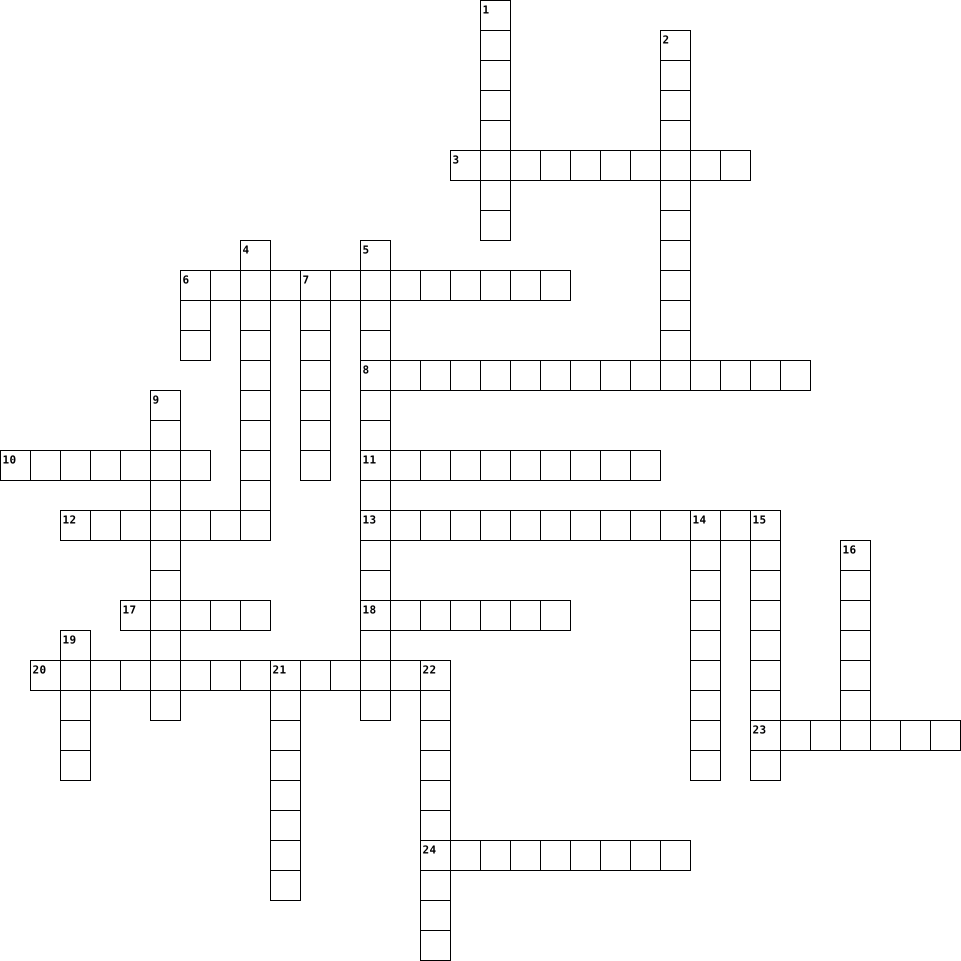
Across
- metalic and non-metalic
- metal and non-metal
- combination of symbols that represent a compound
- horizontal rows on the periodic table
- how much an atom weights(amu)
- positively charged particals
- non-reversible
- vertical columns on the periodic table
- new substance
- reversible
- neutral partical in the nucleus of an atom
- substances that react with another
Down
- group 17 on the periodic table
- the number of protons
- group 18 in the periodic table
- non-metal and non-metal
- lost or gain of electrons
- cloudy mixture, cannot be separated
- absorbs heat
- gas or liquid
- negative charge
- pure substances
- workplace hazardous materials info system
- combination of two or more elements
- releases heat
25 Clues: reversible • absorbs heat • gas or liquid • new substance • releases heat • non-reversible • negative charge • pure substances • metal and non-metal • the number of protons • metalic and non-metalic • non-metal and non-metal • lost or gain of electrons • positively charged particals • how much an atom weights(amu) • group 17 on the periodic table • group 18 in the periodic table • ...
Periodic Table 2025-02-23

Across
- A column in the Periodic Table.
- The sixth element in the Periodic Table.
- Creator of the modern Periodic Table in the 1900s.
- The weight of an element, found at the bottom of the elemental key.
- The first element in the Periodic Table.
- Creator of the original Periodic Table in 1869.
- A chart containing the 118 elements.
Down
- A row in the Periodic Table.
- The eighth element in the Periodic Table.
- These elements share metal and nonmetal characteristics.
- The number found at the top of the key which increases as you go through the Periodic Table.
- The abbreviation of the element found below the atomic number.
- This subgroup makes up two thirds of the elements.
13 Clues: A row in the Periodic Table. • A column in the Periodic Table. • A chart containing the 118 elements. • The sixth element in the Periodic Table. • The first element in the Periodic Table. • The eighth element in the Periodic Table. • Creator of the original Periodic Table in 1869. • Creator of the modern Periodic Table in the 1900s. • ...
The Atom and Periodic Table 2024-10-28

Across
- Atomic mass of about 207 amu
- Atomic number 8
- Contains 22 electrons
- Created the first periodic table based on atomic mass
- Protons plus neutrons; atomic ________
- Atomic mass of 20
- First element on the periodic table
- Contains both protons and neutrons
Down
- Element symbol Au
- contains 87 electrons
- Group #17 on the periodic table
- Negatively charged subatomic particle
- Created the modern periodic table based on atomic number
- Atomic mass of about 119 amu
- 86 protons
- The number of protons an element has; atomic _________
- Positively charged subatomic particle
- Element symbol Y
18 Clues: 86 protons • Atomic number 8 • Element symbol Y • Element symbol Au • Atomic mass of 20 • contains 87 electrons • Contains 22 electrons • Atomic mass of about 207 amu • Atomic mass of about 119 amu • Group #17 on the periodic table • Contains both protons and neutrons • First element on the periodic table • Negatively charged subatomic particle • Positively charged subatomic particle • ...
Ch. 5 Choice Assignment Crossword 2025-02-23

Across
- the third group on the periodic table
- group three on the periodic table
- group 14 on the periodic table
- group two on the periodic table
Down
- found in row six on the periodic table
- group 15 on the periodic table
- group one on the periodic table
- group 17 on the periodic table
- group 16 on the periodic table
- group 18 on the periodic table
- group 13 on the periodic table
11 Clues: group 15 on the periodic table • group 17 on the periodic table • group 16 on the periodic table • group 18 on the periodic table • group 13 on the periodic table • group 14 on the periodic table • group one on the periodic table • group two on the periodic table • group three on the periodic table • the third group on the periodic table • found in row six on the periodic table
Science chapter 4 2024-11-20

Across
- An element from either of two rows usually placed below the periodic table; a member of either the lanthanide or actinide series. It typically has two valence electrons.
- Any electron in the outermost energy level of a neutral atom. Unpaired valence electrons are usually involved in chemical bonding.
- Any elements in Groups 3–12 of the periodic table, typically having one or two valence electrons, which it easily loses, resulting in cations with charges of 1 + or 2 + .
- An element in Group 17 of the periodic table having seven valence electrons. It easily gains an electron, forming a 1 − anion, which causes it to be highly reactive.
- An element that typically has four or more valence electrons and that does not exhibit the general properties of metals; located on the right side of the periodic table.
- An element in Group 1 of the periodic table, having one valence electron that it can easily lose to form a 1 + cation, making it extremely reactive; the most reactive of all the metals.
- An element that is typically dense, solid, ductile, malleable, highly conductive, and chemically reactive, especially in the presence of nonmetal elements. Metals are located on the left end of the periodic table.
- A measure of an element’s ability to attract and hold electrons when bonded to other atoms.
- The distance from the center of an atom’s nucleus to its outermost energy level.
Down
- An element with characteristics between those of metals and nonmetals; also called semiconductors; located between metals and nonmetals on the periodic table.
- See family.
- A column of elements in the periodic table having similar valence electron arrangement, resulting in similar chemical properties; also known as a group.
- An element in Group 18 on the periodic table having eight valence electrons that fill the outer energy level. (Helium is an exception with only two.) With a full outer energy level, it is inert (i.e., nonreactive).
- (1) A row in the periodic table of the elements; also called a series. (2) The time interval (T) for one complete cycle of periodic motion.
- A representation of an atom consisting of its chemical symbol with surrounding dots representing its valence electrons.
- A table of the chemical elements arranged to display their periodic properties in relation to their atomic numbers.
- An element in Group 2 of the periodic table, having two valence electrons that it tends to lose easily to become a 2 + cation, making it very reactive.
- Any of Groups 13–16 in the periodic table; so named because they contain metals, nonmetals, and metalloids. These groups are often named for the first element in the family.
- The law that states that the properties of the elements vary with their atomic numbers in a regular, repeated pattern.
19 Clues: See family. • The distance from the center of an atom’s nucleus to its outermost energy level. • A measure of an element’s ability to attract and hold electrons when bonded to other atoms. • A table of the chemical elements arranged to display their periodic properties in relation to their atomic numbers. • ...
Science Chapter 4 Vocabulary 11/14/24 Andy Choi PS211B 2024-11-14

Across
- An element that typically has four or more valence electrons and that does not exhibit the general properties of metals; located on the right side of the periodic table.
- An element in Group 17 of the periodic table having seven valence electrons. It easily gains an electron, forming a 1 − anion, which causes it to be highly reactive.
- A representation of an atom consisting of its chemical symbol with surrounding dots representing its valence electrons.
- An element that is typically dense, solid, ductile, malleable, highly conductive, and chemically reactive, especially in the presence of nonmetal elements. Metals are located on the left end of the periodic table.
- A table of the chemical elements arranged to display their periodic properties in relation to their atomic numbers.
- See family.
- (1) A row in the periodic table of the elements; also called a series. (2) The time interval (T) for one complete cycle of periodic motion.
- An element in Group 1 of the periodic table, having one valence electron that it can easily lose to form a 1 + cation, making it extremely reactive; the most reactive of all the metals.
- A column of elements in the periodic table having similar valence electron arrangement, resulting in similar chemical properties; also known as a group.
- Any elements in Groups 3–12 of the periodic table, typically having one or two valence electrons, which it easily loses, resulting in cations with charges of 1 + or 2 + .
Down
- The law that states that the properties of the elements vary with their atomic numbers in a regular, repeated pattern.
- Any electron in the outermost energy level of a neutral atom. Unpaired valence electrons are usually involved in chemical bonding.
- An element in Group 18 on the periodic table having eight valence electrons that fill the outer energy level. (Helium is an exception with only two.) With a full outer energy level, it is inert (i.e., nonreactive).
- An element from either of two rows usually placed below the periodic table; a member of either the lanthanide or actinide series. It typically has two valence electrons.
- The distance from the center of an atom’s nucleus to its outermost energy level.
- Any of Groups 13–16 in the periodic table; so named because they contain metals, nonmetals, and metalloids. These groups are often named for the first element in the family.
- An element with characteristics between those of metals and nonmetals; also called semiconductors; located between metals and nonmetals on the periodic table.
- An element in Group 2 of the periodic table, having two valence electrons that it tends to lose easily to become a 2 + cation, making it very reactive.
- A measure of an element’s ability to attract and hold electrons when bonded to other atoms.
19 Clues: See family. • The distance from the center of an atom’s nucleus to its outermost energy level. • A measure of an element’s ability to attract and hold electrons when bonded to other atoms. • A table of the chemical elements arranged to display their periodic properties in relation to their atomic numbers. • ...
Periodic Trends Vocabulary 2022-09-20

Across
- The size of the atom; the total distance from an atoms's nucleus to the outermost orbital of electron
- Elements in which all the inner shells are complete but outer shell is incomplete.
- The amount of energy needed to remove an electron from an atom.
- The second group of the periodic table, including Beryllium and Calcium, along with others. They are slightly less reactive than the Alkali Metals.
- The chemical elements present in the 17th group of the periodic table. They tend to be very reactive.
- A positively charged ion.
- A group of mostly inert gases on the far right side of the table.
- A substance with high malleability and luster, as well as being conductive of heat and electricity.
- Law that states that the elements when arranged in the order of their atomic numbers show a periodic variation of atomic structure and of most of their properties.
- The opposite of metals
Down
- A group of metallic elements in the center of the periodic table.
- A Russian chemist; considered the Father of the Periodic Table
- Also known as family, a column in the periodic table with similar properties and valence electron counts.
- A negatively charged ion.
- A section of atoms with similar properties in between those of the metals and the nonmetals.
- The tendency of an atom or a functional group to attract electrons toward itself.
- The first group of the periodic table, including elements like Lithium and Sodium. They are highly reactive and electropositive.
- An atom with a charge
- The horizontal rows on the periodic table.
19 Clues: An atom with a charge • The opposite of metals • A negatively charged ion. • A positively charged ion. • The horizontal rows on the periodic table. • A Russian chemist; considered the Father of the Periodic Table • The amount of energy needed to remove an electron from an atom. • A group of metallic elements in the center of the periodic table. • ...
chem study guide part 2: chapter 2 2023-12-11

Across
- represented by helium, lithium, beryllium, boron, carbon, nitrogen, oxygen, and fluorine
- any of the six elements of Group 1 of the periodic table
- Elements and compounds can exist as solids, liquids, or gases called a _______
- encompasses the 14 metallic chemical elements with atomic numbers from 89 to 102
- used to describe a substance which dissolves and forms a clear mixture with water
- any of the series of fifteen metallic elements from lanthanum to lutetium in the periodic table.
- A substance with high electrical conductivity, luster, and malleability, which readily loses electrons to form positive ions (cations)
- any of the six chemical elements that comprise Group 2 of the periodic table
- a way of presenting information about the chemical proportions of atoms that constitute a particular chemical compound or molecule, using chemical element symbols and numbers
- naturally occurring members of group 18 of the periodic table
- the building materials of all matter
- the weighted average mass of the atoms in a naturally occurring sample of the element
- the short columns in the center of the periodic table, between Group 2A and Group 3A
Down
- element that mostly lacks metallic properties
- states that mass cannot be gained or lost in a chemical reaction
- a group in the periodic table consisting of six chemically related elements: fluorine, chlorine, bromine, iodine (I), astatine,
- atomic mass is measured using _____________
- the whole number in each elements square on the periodic table
- The table Mendeleyev created, with elements organized into rows and columns
- represent an element using letters on a periodic table
- The horizontal rows of the periodic table
- type of chemical element which has a preponderance of properties in between, ormixture of, those of metals and nonmetals
- evidence of new substances forming during an experiment
- numbered 1–18 from left to right
- chemical substance composed of many identical molecules containing atoms from more than one chemical element held together by chemical bonds
- property that describes how easily an element will combine with other substances to form new compounds
- The mass of an atom
27 Clues: The mass of an atom • numbered 1–18 from left to right • the building materials of all matter • The horizontal rows of the periodic table • atomic mass is measured using _____________ • element that mostly lacks metallic properties • represent an element using letters on a periodic table • evidence of new substances forming during an experiment • ...
Mineral Hunt- Sophia Kopp 2019-12-09

Across
- silicon dioxide on quartz
- from argentite and tetrahedrite
- used for the anodes of lithium-ion batteries
- in speakers and vibration unit, Nd 60 on table
- naturally occuring, inorganic, crystalline structure
- in vibration unit, Dy 66 on table
- from mineral source sphalerite and conducts electricity
- source of lithium along with subsurface brines
- tantalum is from source mineral
- source of tungsten
- the source of indium
- used to produce magnets
- copper conducts electricity and heat from which mineral
- silicon produces this
- rare earth metal, Y 39 on periodic table
- Pr 59 on periodic table
- Ce 58 on periodic table
Down
- rare earth metal, La 57 on periodic table
- in color screen, Eu 63 on table
- primary source of gallium
- from more than 100 different minerals
- from mineral sources langbeinite and sylvite
- in phone circuitry, Gd 64 on table
- primary source of tin
- source of arsenic
- from mineral source amblyonite, petalite, lepidolite
- primary source of silver
- in color screen, Tb 65 on table
- from mineral source sphalerite and transparent
29 Clues: source of arsenic • source of tungsten • the source of indium • primary source of tin • silicon produces this • used to produce magnets • Pr 59 on periodic table • Ce 58 on periodic table • primary source of silver • silicon dioxide on quartz • primary source of gallium • in color screen, Eu 63 on table • from argentite and tetrahedrite • tantalum is from source mineral • ...
Samantha Angel 11/14/24 PS211A Vocab Ch. 4 2024-11-14

Across
- A representation of an atom consisting of its chemical symbol with surrounding dots representing its valence electrons.
- An element in Group 17 of the periodic table having seven valence electrons. It easily gains an electron, forming a 1 − anion, which causes it to be highly reactive.
- A column of elements in the periodic table having similar valence electron arrangement, resulting in similar chemical properties; also known as a group.
- An element that is typically dense, solid, ductile, malleable,highly conductive, and chemically reactive,especially in the presence of nonmetal elements. Metals are located on the left end of the periodic table.
- An element that typically has four or more valence electrons and that does not exhibit the general properties of metals; located on the right side of the periodic table.
- An element with characteristics between those of metals and nonmetals; also called semiconductors; located between metals and nonmetals on the periodic table.
- An element in Group 18 on the periodic table having eight valence electrons that fill the outer energy level. (Helium is an exception with only two.) With a full outer energy level, it is inert (i.e., nonreactive).
- a measure of an elements ability to attract and hold electrons when bonded to other atoms
- A column of elements in the periodic table having similar valence electron arrangement, resulting in similar chemical properties; also known as a group.
- An element in Group 2 of the periodic table, having two valence electrons that it tends to lose easily to become a 2 + cation, making it very reactive.
- (1) A row in the periodic table of the elements;also called a series. (2) The time interval (T) for one complete cycle of periodic motion.
Down
- An element in Group 1 of the periodic table, having one valence electron that it can easily lose to form a 1 + cation, making it extremely reactive; the most reactive of all the metals.
- A table of the chemical elements arranged to display their periodic properties in relation to their atomic numbers.
- Any elements in Groups 3–12 of the periodic table, typically having one or two valence electrons, which it easily loses, resulting in cations with charges of 1 + or 2 + .
- An element from either of two rows usually placed below the periodic table; a member of either the lanthanide or actinide series. It typically has two valence electrons.
- The distance from the center of an atom’s nucleus to its outermost energy level
- Any of Groups 13–16 in the periodic table; so named because they contain metals, nonmetals, and metalloids. These groups are often named for the first element in the family.
- Any electron in the outermost energy level of a neutral atom. Unpaired valence electrons are usually involved in chemical bonding.
- The law that states that the properties of the elements vary with their atomic numbers in a regular, repeated pattern.
19 Clues: The distance from the center of an atom’s nucleus to its outermost energy level • a measure of an elements ability to attract and hold electrons when bonded to other atoms • A table of the chemical elements arranged to display their periodic properties in relation to their atomic numbers. • ...
The periodic table and it's trends 2024-05-02

Across
- The group farthest to the right on the periodic table
- Dioxide What we exhale
- Has an atomic number of 78 on the periodic table
- What your bones are made of
- Element that shares a name with Superman's home planet
- The most reactive element on the periodic table
- The most chemical element on Earth
Down
- used in public pools
- What we inhale to breath
- Symbol is a K on the periodic table
- Symbol is Na on the periodic table
- Has the lowest boiling point
- The most reactive non-metal chemical family
- Forms more compounds than any other element
- Symbol is an H on the periodic table
15 Clues: used in public pools • Dioxide What we exhale • What we inhale to breath • What your bones are made of • Has the lowest boiling point • Symbol is Na on the periodic table • The most chemical element on Earth • Symbol is a K on the periodic table • Symbol is an H on the periodic table • The most reactive non-metal chemical family • Forms more compounds than any other element • ...
Periodic Table 2018-10-24

Across
- the number of protons in an atom's nucleus
- group 18, generally very stable, colorless, and odorless
- physical properties and appearances like metals, chemical properties like non-metals
- able to be stretched into a thin wire
- table of the chemical elements arranged in order of atomic number
- average quantity of matter that an atom of that element contains
- groups 3 through 12 and the lanthanides and actinides
- vertical column of elements in the periodic table
- the tendency of a substance to undergo chemical reaction by losing or gaining electron(s)
- conduct heat and electricity, are shiny, and can be hammered into sheets or drawn into a wire
- notation of one or two letters that represents a chemical element
- 'fixer' of the periodic table, organised it by atomic number
Down
- group 17 of the periodic table
- horizontal row of the periodic table
- the second group of the periodic table
- able to be shaped or flattened into a thin sheet
- another word for group
- substance composed of atoms with different atomic numbers
- first group of the periodic table
- maker of the periodic table, but organised it by mass
- the principle that the properties or characteristics of the elements recur periodically as their atomic numbers increase
- substance composed of atoms with the same atomic number
- determines the number of valence electrons
- material that conducts heat or electricity
- chemicals that do not conduct heat and electricity, are not shiny, and cannot be hammered into sheets or drawn into a wire
25 Clues: another word for group • group 17 of the periodic table • first group of the periodic table • horizontal row of the periodic table • able to be stretched into a thin wire • the second group of the periodic table • the number of protons in an atom's nucleus • determines the number of valence electrons • material that conducts heat or electricity • ...
Extra Credit Project 2022-12-15

Across
- bonds
- atom with positive charge
- combining capacity
- of conservation
- columns on periodic tabel
- atom with negative charge
- ion
- bonds
- changes what it is
- dot plot
Down
- ice
- connecting
- bonding
- rows on periodic table
- steam
- atom with no charge
- Table
- water
- goes around
- changes how it looks
20 Clues: ice • ion • bonds • steam • Table • water • bonds • bonding • dot plot • connecting • goes around • of conservation • combining capacity • changes what it is • atom with no charge • changes how it looks • rows on periodic table • atom with positive charge • columns on periodic tabel • atom with negative charge
Vocab 4 2023-10-17

Across
- An element that typically has four or more valence electrons that does not exhibit the general properties of metals; located on the right side of the periodic table
- An element of Group 17 of the periodic table having seven valence electrons. It easily gains an electron, forming a 1- anion, which causes it to be highly reactive
- A representation of an atom consisting of its chemical symbol with surrounding dots representing its valence electrons
- An element that is typically dense, solid, ductile, malleable, highly conductive, and chemically reactive, especially in the presence of nonmetal elements. Metals are located on the left end of the periodic table.
- A table of chemical elements arranged to display their periodic properties in relation to their atomic numbers
- A column of elements in the periodic table having similar valence electron arrangement, resulting in similar chemical properties; also known as a group
- (1) a row in the periodic table of elements; also called a series (2) the time interval (T) for one completely cycle of periodic motion
- An element in Group 1 of the periodic table, having one valence electron that i can easily lose to form a 1+ cation, making it extremely reactive; the most reactive of all metals
- A column of elements in the periodic table having similar valence electron arrangement, resulting in similar chemical properties; also known as a group
- Any elements in Groups 3-12 of the periodic table, typically having one or two valence electrons, which easily loses, resulting in cation with changes of 1+ or 2+
Down
- the law that states that the properties of the elements vary with their atomic numbers in a regular, repeated pattern
- any electron in the outermost energy level of a neutral atom. Unpaired valence electrons are usually involved in chemical bonding
- An element in Group 18 on the periodic table having eight valence electrons that fill the outer energy level. (Helium is an expedition with only two). WIth a full outer energy level, it is inert (I.e., non reactive).
- An element from either of two rows usually placed below the periodic table; a member of either the lanthanide or actinide series. It typically has two valence electrons
- The distance from the center of an atom’s nucleus to its outermost energy level.
- Any of groups 13-16 in the periodic table; so named because they contain metals, nonmetals,and metalloids. These groups are often named for the first element in the family
- An element with characteristics between those of metals and nonmetals; also called semiconductors; located between metals and nonmetals on the periodic table
- An element in Group 2 of the periodic table, having two valence electrons that tends to lose easily to become a 2+ cation, making it very reactive
- A measure of an element’s ability to attract and hold electrons when bonded to other atoms
19 Clues: The distance from the center of an atom’s nucleus to its outermost energy level. • A measure of an element’s ability to attract and hold electrons when bonded to other atoms • A table of chemical elements arranged to display their periodic properties in relation to their atomic numbers • ...
Cameron James November 14, 2024 | Science PSA-211 Chapter 4 Key Terms Crossword Puzzle 2024-11-13

Across
- A measure of an element’s ability to attract and hold electrons when bonded to other atoms.
- The law that states that the properties of the elements vary with their atomic numbers in a regular, repeated pattern.
- Any electron in the outermost energy level of a neutral atom. Unpaired valence electrons are usually involved in chemical bonding.
- Any of Groups 13–16 in the periodic table; so named because they contain metals, nonmetals, and metalloids. These groups are often named for the first element in the family.
- An element from either of two rows usually placed below the periodic table; a member of either the lanthanide or actinide series. It typically has two valence electrons.
- A table of the chemical elements arranged to display their periodic properties in relation to their atomic numbers.
- An element that typically has four or more valence electrons and that does not exhibit the general properties of metals; located on the right side of the periodic table.
- An element in Group 1 of the periodic table, having one valence electron that it can easily lose to form a 1 + cation, making it extremely reactive; the most reactive of all the metals.
- An element that is typically dense, solid, ductile, malleable, highly conductive, and chemically reactive, especially in the presence of nonmetal elements. Metals are located on the left end of the periodic table.
- An element in Group 2 of the periodic table, having two valence electrons that it tends to lose easily to become a 2 + cation, making it very reactive.
Down
- (1) A row in the periodic table of the elements; also called a series. (2) The time interval (T) for one complete cycle of periodic motion.
- Any elements in Groups 3–12 of the periodic table, typically having one or two valence electrons, which it easily loses, resulting in cations with charges of 1 + or 2 + .
- A representation of an atom consisting of its chemical symbol with surrounding dots representing its valence electrons.
- An element in Group 18 on the periodic table having eight valence electrons that fill the outer energy level. (Helium is an exception with only two.) With a full outer energy level, it is inert (i.e., nonreactive).
- A column of elements in the periodic table having similar valence electron arrangement, resulting in similar chemical properties; also known as a group.
- An element in Group 17 of the periodic table having seven valence electrons. It easily gains an electron, forming a 1 − anion, which causes it to be highly reactive.
- The distance from the center of an atom’s nucleus to its outermost energy level.
- An element with characteristics between those of metals and nonmetals; also called semiconductors; located between metals and nonmetals on the periodic table.
- A column of elements in the periodic table having similar valence electron arrangement, resulting in similar chemical properties; also known as a group.
19 Clues: The distance from the center of an atom’s nucleus to its outermost energy level. • A measure of an element’s ability to attract and hold electrons when bonded to other atoms. • A table of the chemical elements arranged to display their periodic properties in relation to their atomic numbers. • ...
macy vocab 2025-02-23

Across
- the ability to be pulled into thin wires.
- table- a chart of the elements arranged into rows and columns according to their physical and chemical properties.
- element- an element in groups 3-12 on the periodic table.
- gas-an element in group 18 on the periodic table.
- element in group 17 on the periodic table.
- earth metal- an element in group 2 on the periodic table.
- a row on the periodic table.
- metal- an element in group 1 on the periodic table.
Down
- a substance that conducts electricity at high temperatures but not at low temperatures.
- element that has no metallic table.
- way a mineral reflects or absorbs light at its surface.
- a column on the periodic table.
- element that is generally shiny, is easily pulled into wires or hammered into thin sheets, and is a good conductor of electricity and thermal energy.
- the ability of a substance to be hammered or rolled into sheets.
- element that has physical and chemical properties of both metals and nonmetals.
15 Clues: a row on the periodic table. • a column on the periodic table. • element that has no metallic table. • the ability to be pulled into thin wires. • element in group 17 on the periodic table. • gas-an element in group 18 on the periodic table. • metal- an element in group 1 on the periodic table. • way a mineral reflects or absorbs light at its surface. • ...
macy vocab 2023-11-02

Across
- the ability to be pulled into thin wires.
- table- a chart of the elements arranged into rows and columns according to their physical and chemical properties.
- element- an element in groups 3-12 on the periodic table.
- gas-an element in group 18 on the periodic table.
- element in group 17 on the periodic table.
- earth metal- an element in group 2 on the periodic table.
- a row on the periodic table.
- metal- an element in group 1 on the periodic table.
Down
- a substance that conducts electricity at high temperatures but not at low temperatures.
- element that has no metallic table.
- way a mineral reflects or absorbs light at its surface.
- a column on the periodic table.
- element that is generally shiny, is easily pulled into wires or hammered into thin sheets, and is a good conductor of electricity and thermal energy.
- the ability of a substance to be hammered or rolled into sheets.
- element that has physical and chemical properties of both metals and nonmetals.
15 Clues: a row on the periodic table. • a column on the periodic table. • element that has no metallic table. • the ability to be pulled into thin wires. • element in group 17 on the periodic table. • gas-an element in group 18 on the periodic table. • metal- an element in group 1 on the periodic table. • way a mineral reflects or absorbs light at its surface. • ...
Periodic Table 2024-04-29

Across
- lightest gas of the noble gases
- a gas with an AMU of 16 that is essential for life
- silicon's AMU is about half of this elements AMU
- metals used in our everyday lives
- basic unit of all matter
- an element that has 4 neutrons
- horizontal rows on the periodic table
- two or more chemically bonded elements
- nonreactive/colorless/odorless gases
- first person to organize the periodic table of elements
- transition metal that liquid at room temperature
- elements that are right of the stair case
- vertical columns on the periodic table
- a group found in period 7 that is rare and radioactive
- number of periods on the periodic table
- pure as they contain only one type of atom
- the mass or weight of an element
- this element is the second most reactive halogen
- AMU minus the atomic number
Down
- second most reactive metal group
- organization of elements by group and period
- these elements are found on the staircase
- this element is a liquid and found in the halogen group
- total the number of groups on the periodic table
- most reactive nonmetal group
- the number of A groups on the periodic table
- this element is found in group 6A/period 3
- elements with metal and nonmetal characteristics
- most reactive nonmetal element
- most reactive metal on the periodic table
- this element has an AMU of 238
- Group 1A/lightest gas in the universe
- elements that are left of the stair case
- number of gases on the periodic table other than the 8A group
- orbital paths found around the nucleus of an atom
- this element is found on the stair case but isn't a metalloid
- a group found in period 6 that is rare and radioactive
- most reactive metal group on the table
38 Clues: basic unit of all matter • AMU minus the atomic number • most reactive nonmetal group • an element that has 4 neutrons • most reactive nonmetal element • this element has an AMU of 238 • lightest gas of the noble gases • second most reactive metal group • the mass or weight of an element • metals used in our everyday lives • nonreactive/colorless/odorless gases • ...
Atoms 2021-12-10

Across
- have 2 protons
- Point at which a liquid is turned into
- A row of elements is called a ______.
- Al on the periodic table
- N on the periodic table
- Where are electrons found?
- The point at which a solid turns to a
- An atom is made up of mostly
- 18 electrons
- 9 protons
- Need this element to surive
- Neutrons have ___________charge
Down
- Be on the periodic table
- things that have mass and volume
- Diagram of Elements
- Protons have a ____________ charge
- Electrons are found on the __________ of the atoms
- the electrons in the outermost energy level of an atom are called _______ _________.
- Li on the periodic table
- The total number of protons and neutrons in a nucleus
- Electrons have a _____________ charge
- Everything is made from ___________, including elements
- 6 protons, 6 nuetrons and 6 electrons
- the Periodic Table the number above the letters tell you how many ______________ are in an atom of that element
- Number 1 on the atomic scale
25 Clues: 9 protons • 18 electrons • have 2 protons • Diagram of Elements • N on the periodic table • Be on the periodic table • Al on the periodic table • Li on the periodic table • Where are electrons found? • Need this element to surive • Number 1 on the atomic scale • An atom is made up of mostly • Neutrons have ___________charge • things that have mass and volume • ...
The Fundamentals of Chemistry 2023-01-14

Across
- elements in groups 3 to 12
- opposite of metals; right of the periodic table
- an accurate model of an electron's place
- atoms of the same element that have a different number of neutrons
- elements 90 to 103 in periodic table
- combination of protons and neutrons
- elements in group 17
- a change in the amount of an atom's protons
- number of protons in a nucleus
- elements with properties of metals and nonmetals
- horizontal row in the periodic table
Down
- elements 58 to 71 in the periodic table
- an uncharged particle
- when an atom loses an electron
- earth metals in group 2
- inert gases in group 18
- vertical column in the periodic table
- process by which atoms produce energy
- positively charged particle
- reactive metals in group 1
- a negatively charged particle
- when an atom gains an electron
- formed when an atom loses or gains an electron
- the approximate mass of a proton or neutron
- elements that are shiny and good conductors
25 Clues: elements in group 17 • an uncharged particle • earth metals in group 2 • inert gases in group 18 • elements in groups 3 to 12 • reactive metals in group 1 • positively charged particle • a negatively charged particle • when an atom gains an electron • number of protons in a nucleus • when an atom loses an electron • combination of protons and neutrons • ...
Periodic table vocab crosswor 2025-02-22

Across
- what is chemical formula of carbon dioxide
- A positive ion that loses e-
- A non-metal from the periodic table
- What is neither created nor destroyed while a chemical reaction
- A negative ion that gains e-
- A negative charge particle moves around the nucleus
- Horizontal row of the periodic table
- A positive charge particle in a nucleus
- compund a substance formed by a chemical combination of 2 or more element
Down
- Formed when one or more electrons are transferred from another
- what is chemical formula of water
- A metal from the periodic table
- A neutral charge particle in a nucleus
- Formed when electrons are shared
- Vertical row of the periodic table
- num The number of e- gained or lose
- the structure that results when atoms are joined together
- A Matelloid from the periodic table
- num The total number of protons and neutrons in a nucleus
- What is chemicaql formula of Chlorine
20 Clues: A positive ion that loses e- • A negative ion that gains e- • A metal from the periodic table • Formed when electrons are shared • what is chemical formula of water • Vertical row of the periodic table • A non-metal from the periodic table • A Matelloid from the periodic table • Horizontal row of the periodic table • What is chemicaql formula of Chlorine • ...
Periodic Table Crossword 2021-12-06

Across
- Vertical row on the periodic table
- Element symbol for gold
- Can be hammered down
- Atomic number represents the number of...
- Number under element symbol
- Form a staircase on the periodic table
- Can be made into wire
- Symbol that represents element name
Down
- Center of an atom
- Easily shatters or breaks
- On the right side of the periodic table
- On the left side of the periodic table
- Horizontal row on the periodic table
- Number above element symbol
- Part of an atom with no charge
15 Clues: Center of an atom • Can be hammered down • Can be made into wire • Element symbol for gold • Easily shatters or breaks • Number above element symbol • Number under element symbol • Part of an atom with no charge • Vertical row on the periodic table • Symbol that represents element name • Horizontal row on the periodic table • On the left side of the periodic table • ...
Periodic Table of Elements Crossword Puzzle 2014-12-19

Across
- Metals are found on the ____ of the table.
- The bottom row of rare Earth metals.
- The periodic table is arranged by _____ (vertically)
- Table was made by __________.
- This is number of protons and electrons.
- There are 6 of these known to exist; smaller particles that make up protons and neutrons
- Nonmetals are very ____ solids; the opposites of metals.
- The periodic table was published in 18__.
- Transition metalsare found in ______.
- Most common element in the universe.
- Nonmetals form compounds called ____.
- Gas used to make bright city lights.
Down
- The periodic table is arranged by _____ (horizontally)
- Nonmetals are found on the ____ of the table.
- Average of all of the elements isotopes.
- The top row of rare Earth metals.
- Metalloids are most often used in ____.
- ________ arranged the elements by atomic number
- This is the abbreviation for the element.
- Metals are elements that conduct ___ very well.
- There are ___ number of groups in the periodic table.
21 Clues: Table was made by __________. • The top row of rare Earth metals. • The bottom row of rare Earth metals. • Most common element in the universe. • Gas used to make bright city lights. • Transition metalsare found in ______. • Nonmetals form compounds called ____. • Metalloids are most often used in ____. • Average of all of the elements isotopes. • ...
Periodic Table Crossword 2018-10-24

Across
- determines the number of valence electrons
- the principle that the properties or characteristics of the elements recur periodically as their atomic numbers increase
- the number of protons in an atom's nucleus
- substance composed of atoms with different atomic numbers
- conduct heat and electricity, are shiny, and can be hammered into sheets or drawn into a wire
- groups 3 through 12 and the lanthanides and actinides
- average quantity of matter that an atom of that element contains
- notation of one or two letters that represents a chemical element
- physical properties and appearances like metals, chemical properties like non-metals
- horizontal row of the periodic table
- able to be shaped or flattened into a thin sheet
Down
- material that conducts heat or electricity
- group 18, generally very stable, colorless, and odorless
- table of the chemical elements arranged in order of atomic number
- substance composed of atoms with the same atomic number
- another word for group
- chemicals that do not conduct heat and electricity, are not shiny, and cannot be hammered into sheets or drawn into a wire
- 'fixer' of the periodic table, organised it by atomic number
- maker of the periodic table, but organised it by mass
- the tendency of a substance to undergo chemical reaction by losing or gaining electron(s)
- first group of the periodic table
- metals the second group of the periodic table
- group 17 of the periodic table
- vertical column of elements in the periodic table
- able to be stretched into a thin wire
25 Clues: another word for group • group 17 of the periodic table • first group of the periodic table • horizontal row of the periodic table • able to be stretched into a thin wire • material that conducts heat or electricity • determines the number of valence electrons • the number of protons in an atom's nucleus • metals the second group of the periodic table • ...
Periodic Table 2020-03-03

Across
- A column in the Periodic Table.
- The sixth element in the Periodic Table.
- Creator of the modern Periodic Table in the 1900s.
- The weight of an element, found at the bottom of the elemental key.
- The first element in the Periodic Table.
- Creator of the original Periodic Table in 1869.
- A chart containing the 118 elements.
Down
- A row in the Periodic Table.
- The eighth element in the Periodic Table.
- These elements share metal and nonmetal characteristics.
- The number found at the top of the key which increases as you go through the Periodic Table.
- The abbreviation of the element found below the atomic number.
- This subgroup makes up two thirds of the elements.
13 Clues: A row in the Periodic Table. • A column in the Periodic Table. • A chart containing the 118 elements. • The sixth element in the Periodic Table. • The first element in the Periodic Table. • The eighth element in the Periodic Table. • Creator of the original Periodic Table in 1869. • Creator of the modern Periodic Table in the 1900s. • ...
Periodic Table 67 2025-11-24

Across
- Lightest Alkali Metal
- Element with symbol Fe
- Group 1 family name
- Soft yellow nonmetal found in volcanic
- Have characteristic colors when excited
- Only nonmetal that is liquid at room temperature
- Horizontal row of the periodic table
- Vertical column of the periodic table
- Gas essential for combustion
- Most abundant gas in earth's atmosphere
- All are radioactive
- contain properties of both metals and nonmetals
- Silvery Gray Metals
- First element on the periodic table
- Metalloid used In electronics and computers
- Jewelry metal with atomic number 47
Down
- Element symbol K
- Only metal that is liquid at room temperature
- come from ores in the Earth's crust
- Element symbol Ca
- Group 17 family name
- React violently with most nonmetals
- didn't get credit for creating the first periodic table
- Poor conductors of heat and electricity
- Most reactive non metals
- Coinage metal with atomic number 29
- Group 18 family name
- Good conductors of heat and electricity
- Noble gas used in bright advertising signs
- Created the first periodic table
30 Clues: Element symbol K • Element symbol Ca • Group 1 family name • All are radioactive • Silvery Gray Metals • Group 17 family name • Group 18 family name • Lightest Alkali Metal • Element with symbol Fe • Most reactive non metals • Gas essential for combustion • Created the first periodic table • come from ores in the Earth's crust • React violently with most nonmetals • ...
The Periodic Table 2021-11-01

Across
- can be beaten into sheets
- groups 1, 2, and 13-18
- have properties of both metals and nonmetals and are located along the staircase
- group 1
- the affinity an atom has for electrons shared in a bond
- rows on the periodic table
- Russian chemist who devised the arrangement of the periodic table
- located on the left side of the periodic table, they tend to lose electrons
Down
- outer electrons
- group 2
- group 17
- columns on the periodic table with similar reactivity
- d-block elements
- on the right side of the periodic table, they tend to gain electrons
- group 18
- can be drawn into wires
16 Clues: group 2 • group 1 • group 17 • group 18 • outer electrons • d-block elements • groups 1, 2, and 13-18 • can be drawn into wires • can be beaten into sheets • rows on the periodic table • columns on the periodic table with similar reactivity • the affinity an atom has for electrons shared in a bond • Russian chemist who devised the arrangement of the periodic table • ...
The Periodic Table 2025-02-23

Across
- particle with a negative charge
- Horizontal rows on the periodic table
- symbol on the periodic table is U
- Group 18 on the periodic table
- particle with a neutral charge
Down
- particle with a positive charge
- Atomic number is 1
- Atomic number 19
- the number of protons in an atom
- Atomic number is 82
- symbol on the periodic table is C
- symbol on the periodic table is O
- vertical columns on the periodic table
13 Clues: Atomic number 19 • Atomic number is 1 • Atomic number is 82 • Group 18 on the periodic table • particle with a neutral charge • particle with a positive charge • particle with a negative charge • the number of protons in an atom • symbol on the periodic table is U • symbol on the periodic table is C • symbol on the periodic table is O • Horizontal rows on the periodic table • ...
Perodic Table and Trends 2025-02-23

Across
- Number 3 on the periodic table
- the rows of chemical elements
- Has a atomic mass of 12
- In group 18 of the periodic table
- The first column of the peroidic table
- on the left
Down
- Has a atomic mass of 32
- Has a letter of FE
- Columns of the chemical elements
- The elements that are on the staircase
- The last column of the periodic table
- Number 20 on the periodic table
- Has a atomic mass of 16
- Number 16 on the perodic table
- Number 82 on the perodic table
15 Clues: on the left • Has a letter of FE • Has a atomic mass of 32 • Has a atomic mass of 12 • Has a atomic mass of 16 • the rows of chemical elements • Number 3 on the periodic table • Number 16 on the perodic table • Number 82 on the perodic table • Number 20 on the periodic table • Columns of the chemical elements • In group 18 of the periodic table • The last column of the periodic table • ...
Atoms and Elements 2022-01-04
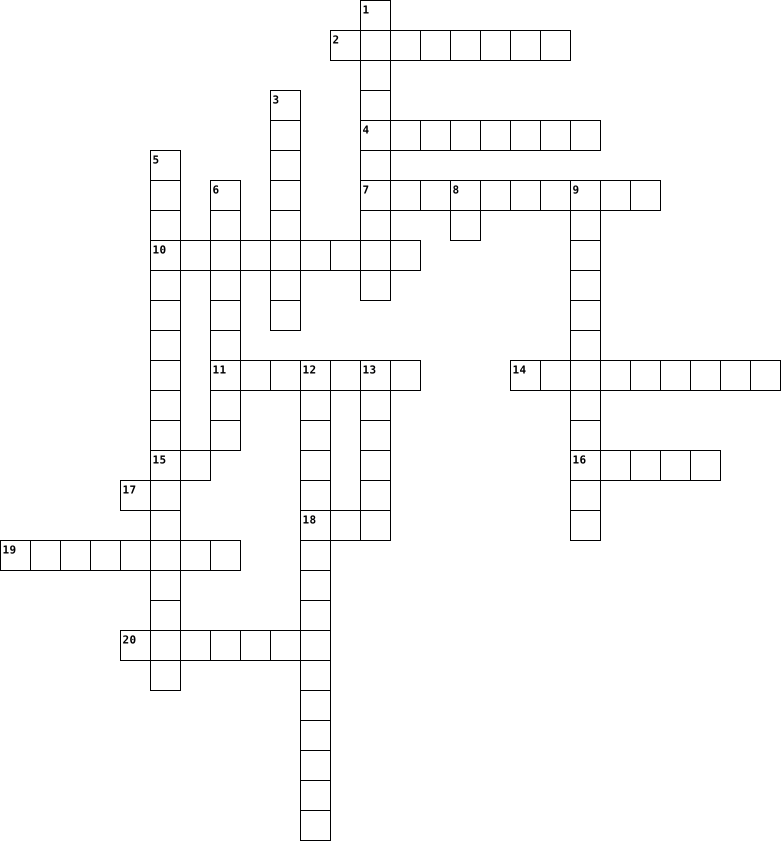
Across
- This is made up of elements
- Which subatomic particles has no mass
- Protons and neutrons added together
- Name of period 7 on periodic table
- Atoms that have the same atoms atomic number but different atomic mass
- Who created the current periodic table
- Electron configuration of 1s2 2s2 2p6 3s2 3p6
- Electrons move around the nucleus, "Who's theory"
- Electron configuration of 1s2 2s2 2p6 3s2 3p6 4s2 3d10 4p6 5s2 4p2
- A element that has a additional electron or one fewer electron
- What is the rarest element on earth
- No Charge
Down
- Name of Group 18 on the periodic table
- what is the isotope of carbon with 6 protons and 8 neutron
- Different pieces of the atom
- What type of element is Silicon
- Electron configuration for [Kr] 5s2 4d4
- Found in the top left of each box in the periodic table
- what is between groups 2 and 13
- What number is unique to every element on the periodic table
20 Clues: No Charge • This is made up of elements • Different pieces of the atom • What type of element is Silicon • what is between groups 2 and 13 • Name of period 7 on periodic table • Protons and neutrons added together • What is the rarest element on earth • Which subatomic particles has no mass • Name of Group 18 on the periodic table • Who created the current periodic table • ...
Periodic Table Vocabulary 2013-11-20

Across
- element whose symbol is N
- element whose symbol is He
- one or two letters that represent and element
- number of protons in the nucleus of that element's atom
- the group of elements on the right side of the periodic table
- the columns in a periodic table
- element whose symbol is Fe
- the mass of the nucleus of an atom which includes the protons an neutrons
- pure substances that cannot be broken down by chemical or physical means
Down
- element whose symbol is O
- element whose symbol is K
- the rows in a periodic table
- element whose symbol is H
- the diagonal line of elements in the periodic table
- element whose symbol is S
- element whose symbol is Ni
- element whose symbol is Mg
- element whose symbol is Ne
- element whose symbol is Si
- the group of elements on the left side of the periodic table
- element whose symbol is C
21 Clues: element whose symbol is O • element whose symbol is K • element whose symbol is N • element whose symbol is H • element whose symbol is S • element whose symbol is C • element whose symbol is He • element whose symbol is Ni • element whose symbol is Mg • element whose symbol is Ne • element whose symbol is Si • element whose symbol is Fe • the rows in a periodic table • ...
Chemistry Crossword 2015-10-04

Across
- State without charge
- A particle carrying light
- The last shell in the electron config.
- A negatively charged ion
- The building blocks of the universe
- Name of elements in the middle
- Number of protons plus electrons
- A particle circling the atom
- The centre of an atom
- Elements 57-71
- Electrons in the last electron shell
- An atom with more/less electrons
- Group 18 on the periodic table
- Group 17 in Periodic table
Down
- An element with more/less neutrons
- Number of protons
- The charged state of an atom
- Rows in the Periodic Table
- Elements with mixtures of metals and non metals
- Transfer of valence electrons
- Group 1 of the periodic table
- Two bonded elements
- The setup of electrons
- Current model of atom
- Columns in the periodic table
- Elements 89-103
- The space around an atom that electrons travel in
- Simplest form of a substance
- Positively charged ion
- Subatomic particle with no charge
30 Clues: Elements 57-71 • Elements 89-103 • Number of protons • Two bonded elements • State without charge • Current model of atom • The centre of an atom • The setup of electrons • Positively charged ion • A negatively charged ion • A particle carrying light • Rows in the Periodic Table • Group 17 in Periodic table • The charged state of an atom • Simplest form of a substance • ...
mia 2022-05-18

Across
- on the right side of the periodic table
- the atomic weight is 56
- a symbol which determines the chemical
- vertical columns on a periodic table
- atomic weight of 7
- any group of rare gases
- gas in the periodic table
- average mass of an atom of an element
- a family that has 5 electrons
- something that can be found in milk
- the atomic weight is 4
Down
- something that has groups and periods
- subatomic particle
- inert gas
- metals that make up the first column (group) of the periodic table
- horizontal rows on a periodic table
- The number of protons in a nucleus
- Number of protons and neutrons in a nucleus
- atomic weight is 1
- chemical symbol is mg
- inert gas
- chemical symbol is TI
- A complex consisting of two atoms.
- substance composed of atoms with identical atomic number.
- atomic weight is 11
- has the atomic number of 5
- A taxon (group of organisms) made up of related genera.
- on the left side of the periodic table
28 Clues: inert gas • inert gas • subatomic particle • atomic weight is 1 • atomic weight of 7 • atomic weight is 11 • chemical symbol is mg • chemical symbol is TI • the atomic weight is 4 • the atomic weight is 56 • any group of rare gases • gas in the periodic table • has the atomic number of 5 • a family that has 5 electrons • The number of protons in a nucleus • A complex consisting of two atoms. • ...
Atoms 2025-02-22

Across
- have 2 protons
- Point at which a liquid is turned into
- A row of elements is called a ______.
- Al on the periodic table
- N on the periodic table
- Where are electrons found?
- The point at which a solid turns to a
- An atom is made up of mostly
- 18 electrons
- 9 protons
- Need this element to surive
- Neutrons have ___________charge
Down
- Be on the periodic table
- things that have mass and volume
- Diagram of Elements
- Protons have a ____________ charge
- Electrons are found on the __________ of the atoms
- the electrons in the outermost energy level of an atom are called _______ _________.
- Li on the periodic table
- The total number of protons and neutrons in a nucleus
- Electrons have a _____________ charge
- Everything is made from ___________, including elements
- 6 protons, 6 nuetrons and 6 electrons
- the Periodic Table the number above the letters tell you how many ______________ are in an atom of that element
- Number 1 on the atomic scale
25 Clues: 9 protons • 18 electrons • have 2 protons • Diagram of Elements • N on the periodic table • Be on the periodic table • Al on the periodic table • Li on the periodic table • Where are electrons found? • Need this element to surive • Number 1 on the atomic scale • An atom is made up of mostly • Neutrons have ___________charge • things that have mass and volume • ...
Periodic Table Vocabulary 2025-02-22

Across
- element whose symbol is N
- element whose symbol is He
- one or two letters that represent and element
- number of protons in the nucleus of that element's atom
- the group of elements on the right side of the periodic table
- the columns in a periodic table
- element whose symbol is Fe
- the mass of the nucleus of an atom which includes the protons an neutrons
- pure substances that cannot be broken down by chemical or physical means
Down
- element whose symbol is O
- element whose symbol is K
- the rows in a periodic table
- element whose symbol is H
- the diagonal line of elements in the periodic table
- element whose symbol is S
- element whose symbol is Ni
- element whose symbol is Mg
- element whose symbol is Ne
- element whose symbol is Si
- the group of elements on the left side of the periodic table
- element whose symbol is C
21 Clues: element whose symbol is O • element whose symbol is K • element whose symbol is N • element whose symbol is H • element whose symbol is S • element whose symbol is C • element whose symbol is He • element whose symbol is Ni • element whose symbol is Mg • element whose symbol is Ne • element whose symbol is Si • element whose symbol is Fe • the rows in a periodic table • ...
Periodic Table Crossword 2024-12-11

Across
- First element in the periodic table
- ________is found in the bones and teeth.
- Smallest element in Period 4.
- Biggest element in Group 2.
- Has a symbol "Bi."
- Metalloid in Period 3.
- Has a symbol "Ge."
- Biggest element in period 4.
- Smallest element in the periodic table
- Refers to horizontal rows in the periodic table
Down
- Has atomic number 80.
- Refers to vertical columns in the periodic table
- Located in Period 3, Group 5.
- Has a symbol "Rb."
- Dmitri _________ is the father of modern periodic table.
15 Clues: Has a symbol "Rb." • Has a symbol "Bi." • Has a symbol "Ge." • Has atomic number 80. • Metalloid in Period 3. • Biggest element in Group 2. • Biggest element in period 4. • Located in Period 3, Group 5. • Smallest element in Period 4. • First element in the periodic table • Smallest element in the periodic table • ________is found in the bones and teeth. • ...
Periodic Table Crossword 2025-02-23

Across
- First element in the periodic table
- ________is found in the bones and teeth.
- Smallest element in Period 4.
- Biggest element in Group 2.
- Has a symbol "Bi."
- Metalloid in Period 3.
- Has a symbol "Ge."
- Biggest element in period 4.
- Smallest element in the periodic table
- Refers to horizontal rows in the periodic table
Down
- Has atomic number 80.
- Refers to vertical columns in the periodic table
- Located in Period 3, Group 5.
- Has a symbol "Rb."
- Dmitri _________ is the father of modern periodic table.
15 Clues: Has a symbol "Rb." • Has a symbol "Bi." • Has a symbol "Ge." • Has atomic number 80. • Metalloid in Period 3. • Biggest element in Group 2. • Biggest element in period 4. • Located in Period 3, Group 5. • Smallest element in Period 4. • First element in the periodic table • Smallest element in the periodic table • ________is found in the bones and teeth. • ...
Periodic Table Crossword 2020-05-18

Across
- Bonds with oxygen to form carbon dioxide
- chemical symbol for sodium
- Precious metal, symbol is Au
- Chemical symbol is Fe
- Named after France
- 5th element in the periodic table
- Smelly yellow element, 16th in the table
- Bonds with oxygen to form water
- 3rd element in the periodic table
- 12th element in the periodic table
Down
- Precious metal, symbol is Ag
- 18th element in the periodic table
- Makes your bones strong
- Chemical symbol is Hg (this element is named after a planet and is very toxic)
- Chemical symbol is K
- Chemical symbol is Pb (toxic, used to be used to make water pipes)
- chemical symbol is Si
- This element is put into swimming pools to kill bacteria
- We breathe in this element to survive
- This element is used to fill up party balloons
20 Clues: Named after France • Chemical symbol is K • Chemical symbol is Fe • chemical symbol is Si • Makes your bones strong • chemical symbol for sodium • Precious metal, symbol is Ag • Precious metal, symbol is Au • Bonds with oxygen to form water • 5th element in the periodic table • 3rd element in the periodic table • 18th element in the periodic table • 12th element in the periodic table • ...
Chemistry 2022-12-08

Across
- electricty and heat passes through it
- only 8 of these elements of the periodic table
- electrons Electrons on the outside energy level
- can be pulled into a wire
- Rows that go across the periodic table
- Subatomic particle with positive charge
- where the electrons are located
- elements that have opposite properties of metals
- Electricity and heat do not pass through
- rings rings electrons are placed on
Down
- The scientific table with elements
- can be bent or hammered
- Found on left side of periodic table
- Subatomic particle with neutral charge
- the smallest part of a element
- Subatomic particle with negative charge
- Shatters easily
- Where protons and neutrons are located
- Rows that go up and down on the periodic table
- Reflects light
- unit of measurement to weigh atoms
21 Clues: Reflects light • Shatters easily • can be bent or hammered • can be pulled into a wire • the smallest part of a element • where the electrons are located • The scientific table with elements • unit of measurement to weigh atoms • rings rings electrons are placed on • Found on left side of periodic table • electricty and heat passes through it • ...
Science Puzzle 2022-03-22

Across
- negatively charged particles
- a bond between a negatively charged anion and a positively charged cation
- electrons on the outermost shell
- group 3-12
- the gas we breath
- Used to consider how electrons are placed in a atom
- the law of the periodic table
- elements on the right side of the periodic table
- outermost shell
- positively charged particles
- the table with all the elements
- a molecule that contains 2 or more different atoms bonded together
- have characteristics of both metal and non metals
- 1 electron
- group 1
Down
- a molecule made up of a negatively charged anion and a positively charged cation
- group of 2 or more atoms
- the first creator of the periodic table
- Positively charged ion
- number of protons in a atom
- gases at room temperature
- won two noble prizes
- elements on the left side of the periodic table
- vertical lists of element
- Horizontal rows in the periodic table
- group 2
- a negativly charged ion formed when an atom gains electron
27 Clues: group 2 • group 1 • group 3-12 • 1 electron • outermost shell • the gas we breath • won two noble prizes • Positively charged ion • group of 2 or more atoms • gases at room temperature • vertical lists of element • number of protons in a atom • negatively charged particles • positively charged particles • the law of the periodic table • the table with all the elements • ...
Chemical Reaction Crossword Puzzle 2024-01-26

Across
- emits radiation
- elements number of element on the table
- undergoes change
- on the top right of the metalloids
- group two on the periodic table
- two or more reactants combine
- group one on the periodic table
- bond when an atom is given up
- Compound Breaks down
- organized table of all of the elements
- element is substituted
- group 13-16 on the periodic table
- mass of an element
- Burning reaction
Down
- group 17 on the period table
- atoms ability to attract electrons to itself
- reactants that are left out of the product
- Acid is reacted
- in the D-block
- electrons in the outermost shell
- bond when an atom is shared
- number of atoms is equal on the two sides of the equation
- made from reactants
- chemical equation for water
- have eight valence electrons
- Two substances react by exchanging ions
- symbolic representation of a chemical reaction
- row of elements on the pericolumntable
- column of elements on the periodic table
- the periodic consists of a lot of these
- chemical equation for carbon dioxide
31 Clues: in the D-block • emits radiation • Acid is reacted • undergoes change • Burning reaction • mass of an element • made from reactants • Compound Breaks down • element is substituted • bond when an atom is shared • chemical equation for water • group 17 on the period table • have eight valence electrons • two or more reactants combine • bond when an atom is given up • ...
chemistry 2014-11-06

Across
- pure substances
- combination of symbols that represent a compound
- how much an atom weights(amu)
- reversible
- positively charged particals
- non-reversible
- neutral partical in the nucleus of an atom
- lost or gain of electrons
- vertical columns on the periodic table
Down
- gas or liquid
- absorbs heat
- cloudy mixture, cannot be separated
- metalic and non-metalic
- group 17 on the periodic table
- new substance
- substances that react with another
- releases heat
- non-metal and non-metal
- workplace hazardous materials info system
- metal and non-metal
- the number of protons
- group 18 in the periodic table
- combination of two or more elements
- negative charge
- horizontal rows on the periodic table
25 Clues: reversible • absorbs heat • gas or liquid • new substance • releases heat • non-reversible • pure substances • negative charge • metal and non-metal • the number of protons • metalic and non-metalic • non-metal and non-metal • lost or gain of electrons • positively charged particals • how much an atom weights(amu) • group 17 on the periodic table • group 18 in the periodic table • ...
ELEMENT CROSSWORD PUZZLE 2020-04-01

Across
- atomic number is 69
- atomic number is 1
- sometimes called “quicksilver”
- directly underneath helium on the periodic table
- element with the symbol S
- atomic number is 82
- atomic number is 8
- atomic number is 13
- directly underneath lithium on the periodic table
- atomic number is 79
Down
- the first in the noble gas group in the periodic table
- directly to the right of potassium on the periodic table
- exhibits the highest electrical conductivity, thermal conductivity, and reflectivity of any metal.
- atomic number is 50
- symbol is Rn
- symbol is Kr and has an atomic number of 36
- atomic number is 28
- symbol is Br
- element with the symbol C
- atomic number is 18
20 Clues: symbol is Rn • symbol is Br • atomic number is 1 • atomic number is 8 • atomic number is 69 • atomic number is 50 • atomic number is 28 • atomic number is 82 • atomic number is 18 • atomic number is 13 • atomic number is 79 • element with the symbol C • element with the symbol S • sometimes called “quicksilver” • symbol is Kr and has an atomic number of 36 • ...
Chemistry Crossword 2023-10-23

Across
- The number that appears in the upper left corner
- Equal protons, varying neutrons
- Ion with a negative charge
- Group with both properties of metals and nonmetals
- Fluorine and chlorine are…
- Vertical columns on the periodic table
- Subatomic particle with a positive charge
- Atomic numbers 89-103
- First group on periodic table
- Subatomic particle that exists in the nucleus and does not have a charge
- Scientist who innovated the periodic table
Down
- Ion with a positive charge
- Element associated with dairy
- Horizontal rows on the periodic table
- Atomic number 12
- Atomic numbers 57-71
- Atomic number 5
- Sum of the number of protons and neutrons in an atom
- Heaviest stable halogens
- Symbol Pt
20 Clues: Symbol Pt • Atomic number 5 • Atomic number 12 • Atomic numbers 57-71 • Atomic numbers 89-103 • Heaviest stable halogens • Ion with a positive charge • Ion with a negative charge • Fluorine and chlorine are… • Element associated with dairy • First group on periodic table • Equal protons, varying neutrons • Horizontal rows on the periodic table • Vertical columns on the periodic table • ...