
periodic table Crossword Puzzles
The Periodic Table of Elements! 2024-10-02

Across
- The most common element on the periodic table
- K a metal straight from the Periodic Table of Elements
- Hg the only liquid metal at room temperature
- How many non-metals are on the Periodic Table of Elements
- How many metalloids are on the Periodic Table of Elements
- No luster Not malleable Not ductile
- H the only Non-metal on the metal side
Down
- As the least common element on earth
- The different boxes on the Periodic Table of Elements
- O the most common element on earth
- Has both properties of a metal and nonmetal
- How many metals are on the Periodic Table of Elements
- B a metalloid straight from the Periodic Table of Elements
13 Clues: O the most common element on earth • No luster Not malleable Not ductile • As the least common element on earth • H the only Non-metal on the metal side • Has both properties of a metal and nonmetal • Hg the only liquid metal at room temperature • The most common element on the periodic table • The different boxes on the Periodic Table of Elements • ...
Vocab 5 2023-03-15

Across
- gases - the elements in group 8A of the periodic table
- mass unit (amu) - one twelfth the mass of a carbon-12 atom
- law - the pattern of repeating properties displayed by elements in the periodic table
- earth metals - the elements in group 2A of the periodic table
- - elements with properties that fall between those of metals and nonmetals
- electron - an electron that is in the highest occupied energy level of an atom
- metals - metals that form a bridge between elements on the left and right sides of the periodic table
Down
- - elements that are poor conductors of heat and electric current
- metals - the elements in group 1A of the periodic table, not including hydrogen
- - the elements in group 7A of the periodic table
- table - an arrangement of elements in columns, based on a set of properties that repeat from row to row
- - a column of elements in a periodic table
- - elements that are good conductors of heat and electric current
- - a row in a periodic table of elements
14 Clues: - a row in a periodic table of elements • - a column of elements in a periodic table • - the elements in group 7A of the periodic table • gases - the elements in group 8A of the periodic table • mass unit (amu) - one twelfth the mass of a carbon-12 atom • earth metals - the elements in group 2A of the periodic table • ...
Chapter 4 2023-03-15

Across
- electron - an electron that is in the highest occupied energy level of an atom
- - elements with properties that fall between those of metals and nonmetals
- metals - metals that form a bridge between elements on the left and right sides of the periodic table
- - the elements in group 7A of the periodic table
- - elements that are good conductors of heat and electric current
- mass unit (amu) - one twelfth the mass of a carbon-12 atom
- law - the pattern of repeating properties displayed by elements in the periodic table
- - a row in a periodic table of elements
Down
- - elements that are poor conductors of heat and electric current
- metals - the elements in group 1A of the periodic table, not including hydrogen
- gases - the elements in group 8A of the periodic table
- earth metals - the elements in group 2A of the periodic table
- - a column of elements in a periodic table
13 Clues: - a row in a periodic table of elements • - a column of elements in a periodic table • - the elements in group 7A of the periodic table • gases - the elements in group 8A of the periodic table • mass unit (amu) - one twelfth the mass of a carbon-12 atom • earth metals - the elements in group 2A of the periodic table • ...
Ch 5 2024-03-20

Across
- gases - the elements in group 8A of the periodic table
- mass unit (amu) - one twelfth the mass of a carbon-12 atom
- law - the pattern of repeating properties displayed by elements in the periodic table
- earth metals - the elements in group 2A of the periodic table
- - elements with properties that fall between those of metals and nonmetals
- electron - an electron that is in the highest occupied energy level of an atom
- metals - metals that form a bridge between elements on the left and right sides of the periodic table
Down
- - elements that are poor conductors of heat and electric current
- metals - the elements in group 1A of the periodic table, not including hydrogen
- -the elements in group 7A of the periodic table
- table - an arrangement of elements in columns, based on a set of properties that repeat from row to row
- - a column of elements in a periodic table
- - elements that are good conductors of heat and electric current
- - a row in a periodic table of elements
14 Clues: - a row in a periodic table of elements • - a column of elements in a periodic table • -the elements in group 7A of the periodic table • gases - the elements in group 8A of the periodic table • mass unit (amu) - one twelfth the mass of a carbon-12 atom • earth metals - the elements in group 2A of the periodic table • ...
Chapter 5 vocab 2024-03-19

Across
- gases the elements in group 8A of the periodic table
- mass unit (amu) one twelfth the mass of a carbon-12 atom
- law the pattern of repeating properties displayed by elements in the periodic table
- earth metals the elements in group 2A of the periodic table
- elements with properties that fall between those of metals and nonmetals
- electron an electron that is in the highest occupied energy level of an atom
- metals metals that form a bridge between elements on the left and right sides of the periodic table
Down
- elements that are poor conductors of heat and electric current
- metals the elements in group 1A of the periodic table, not including hydrogen
- the elements in group 7A of the periodic table
- table an arrangement of elements in columns, based on a set of properties that repeat from row to row
- a column of elements in a periodic table
- elements that are good conductors of heat and electric current
- a row in a periodic table of elements
14 Clues: a row in a periodic table of elements • a column of elements in a periodic table • the elements in group 7A of the periodic table • gases the elements in group 8A of the periodic table • mass unit (amu) one twelfth the mass of a carbon-12 atom • earth metals the elements in group 2A of the periodic table • ...
Chapter 5 2025-12-10

Across
- gases - the elements in group 8A of the periodic table
- mass unit (amu) - one twelfth the mass of a carbon-12 atom
- law - the pattern of repeating properties displayed by elements in the periodic table
- earth metals - the elements in group 2A of the periodic table
- - elements with properties that fall between those of metals and nonmetals
- electron - an electron that is in the highest occupied energy level of an atom
- metals - elements that form a bridge between elements on the left and right sides of the periodic table
Down
- - elements that are poor conductors of heat and electric current
- metals - the elements in group 1A of the periodic table, not including hydrogen
- - the elements in group 7A of the periodic table
- table - an arrangement of elements in columns, based on a set of properties that repeat from row to row
- - a column of elements in a periodic table
- - elements that are good conductors of heat and electric current
- - a row in a periodic table of elements
14 Clues: - a row in a periodic table of elements • - a column of elements in a periodic table • - the elements in group 7A of the periodic table • gases - the elements in group 8A of the periodic table • mass unit (amu) - one twelfth the mass of a carbon-12 atom • earth metals - the elements in group 2A of the periodic table • ...
Chapter 5 2025-12-12

Across
- gases - the elements in group 8A of the periodic table
- mass unit (amu) - one twelfth the mass of a carbon-12 atom
- law - the pattern of repeating properties displayed by elements in the periodic table
- earth metals - the elements in group 2A of the periodic table
- - elements with properties that fall between those of metals and nonmetals
- electron - an electron that is in the highest occupied energy level of an atom
- metals - elements that form a bridge between elements on the left and right sides of the periodic table
Down
- - elements that are poor conductors of heat and electric current
- metals - the elements in group 1A of the periodic table, not including hydrogen
- - the elements in group 7A of the periodic table
- table - an arrangement of elements in columns, based on a set of properties that repeat from row to row
- - a column of elements in a periodic table
- - elements that are good conductors of heat and electric current
- - a row in a periodic table of elements
14 Clues: - a row in a periodic table of elements • - a column of elements in a periodic table • - the elements in group 7A of the periodic table • gases - the elements in group 8A of the periodic table • mass unit (amu) - one twelfth the mass of a carbon-12 atom • earth metals - the elements in group 2A of the periodic table • ...
Vocab 2024-12-06

Across
- gases - the elements in group 8A of the periodic table
- mass unit (amu) - one twelfth the mass of a carbon-12 atom
- law - the pattern of repeating properties displayed by elements in the periodic table
- earth metals - the elements in group 2A of the periodic table
- - elements with properties that fall between those of metals and nonmetals
- electron - an electron that is in the highest occupied energy level of an atom
- metals - metals that form a bridge between elements on the left and right sides of the periodic table
Down
- - elements that are poor conductors of heat and electric current
- metals - the elements in group 1A of the periodic table, not including hydrogen
- - the elements in group 7A of the periodic table
- table - an arrangement of elements in columns, based on a set of properties that repeat from row to row
- - a column of elements in a periodic table
- - elements that are good conductors of heat and electric current
- - a row in a periodic table of elements
14 Clues: - a row in a periodic table of elements • - a column of elements in a periodic table • - the elements in group 7A of the periodic table • gases - the elements in group 8A of the periodic table • mass unit (amu) - one twelfth the mass of a carbon-12 atom • earth metals - the elements in group 2A of the periodic table • ...
Periodic Table 2013-11-05

Across
- the state or power of being reactive or the degree to which a thing is reactive.
- an atom or molecule with a net electric charge due to the loss or gain of one or more electrons.
- group 1 of the periodic table.
- a negatively charged ion.
- group 18 of the periodic table.
- group 2 of the periodic table.
- distance from the nucleus to the boundary of the surrounding cloud of electrons.
- an element or substance that is not a metal.
- a positively charged ion.
- a solid material that is typically hard, shiny, malleable, fusible, and ductile, with good electrical and thermal conductivity.
Down
- the principle that chemical properties of the elements are periodic functions of their atomic numbers.
- the set of chemical properties that are associated with the elements classified as metals in the periodic table.
- an element whose properties are intermediate between those of metals and solid nonmetals.
- the amount of energy released when an electron is added to a neutral atom or molecule to form a negative ion.
- the amount of energy required to remove an electron from the atom.
- the tendency of an atom to attract electrons in the formation of an ionic bond.
- groups 4-12 of the periodic table.
- group 17 of the periodic table.
18 Clues: group 2 of the periodic table. • groups 4-12 of the periodic table. • group 1 of the periodic table. • group 18 of the periodic table. • a positively charged ion. • a negatively charged ion. • group 17 of the periodic table. • an element or substance that is not a metal. • ...
The Periodic Table 2024-05-01

Across
- Atomic number 79
- This element makes up about 21% of the earth's atmosphere
- They are reactive nonmetallic elements that form strongly acidic compounds with hydrogen from which simple salts can be made
- Symbol "Sr" on the periodic table
- Greenish-yellow gas
- Brittle, dull, semiconductors
- Members of a family of an element that all have the same number of protons, but different number of neutrons
- The second noble gas on the periodic table
- an atom or molecule with a net electric charge due to the loss or gain of one or more electrons
- Rows on the periodic table
Down
- Water is made up of ________ and oxygen
- Columns on the periodic table
- Typically gasses at room temperature
- The smallest unit into which matter can be divided
- Found in group 14, period 2
- Malleable, ductile, good conductors of heat
- Used in toothpaste
- Determine that atomic number of an element
- There are about 90 of these found in nature
- Transition metal with the atomic number 23
- _______ metals are found in the first group on the periodic table
21 Clues: Atomic number 79 • Used in toothpaste • Greenish-yellow gas • Rows on the periodic table • Found in group 14, period 2 • Columns on the periodic table • Brittle, dull, semiconductors • Symbol "Sr" on the periodic table • Typically gasses at room temperature • Water is made up of ________ and oxygen • Determine that atomic number of an element • ...
periodic table intro1 2021-09-28

Across
- can neither gain nor lose electrons to gain stability
- last element of second group
- area of the periodic table which have elements with the ability to form positive ions
- particles present in energy levels
- yellow lustrous least reactive metal
- radioactive element of seventeenth group
- lightest element in the periodic table
- number of electrons in the valence shell to make an atom stable
- distribution of electrons
- the smallest particle which has the properties of an element
- representative element of group V-A
- area of periodic table having man made elements only
Down
- occupy single position in the periodic table
- cannot have complete octet even after sharing three electron pairs
- arrangement of elements by atomic numbers
- charge which cannot be gained by chlorine
- element requiring two electrons in second shell to complete it
- forms positive ion most easily
- stable element which follows duplet rule
- the number of protons in the nucleus of an atom which determines the chemical properties
- column in the periodic table of elements where atoms have identical valence electrons
- longest row of elements
22 Clues: longest row of elements • distribution of electrons • last element of second group • forms positive ion most easily • particles present in energy levels • representative element of group V-A • yellow lustrous least reactive metal • lightest element in the periodic table • radioactive element of seventeenth group • stable element which follows duplet rule • ...
Physical Science 2021-04-27

Across
- the first element on the periodic table
- liquids sometimes combine to form this solid
- symbol Ag
- a measure of a liquids resistance to flow
- measure of the amount of matter in a object
- the amount of space an object takes up
- found on the periodic table
- right side of the periodic table
- atomic number 79
- product of photosynthesis
Down
- changes form but not chemical identity
- a characteristic of a substance that can be observed without changing identity
- the temperature where a object changes from solid to liquid
- base for all life on earth
- left side of the periodic table
- atoms are close together and barely moving
- results from a chemical reaction
- a sign of a chemical reaction
- Vibrate and move past each other
- the same as the atomic number
- group 18 of the periodic table
- sign of a chemical reaction
- the amount of mass in a given space
- Vibrate and move freely
- calculate by subtracting atomic number from atomic mass
25 Clues: symbol Ag • atomic number 79 • Vibrate and move freely • product of photosynthesis • base for all life on earth • found on the periodic table • sign of a chemical reaction • a sign of a chemical reaction • the same as the atomic number • group 18 of the periodic table • left side of the periodic table • results from a chemical reaction • right side of the periodic table • ...
Atomic Structure & Periodic Table Vocab. 2021-05-03

Across
- consist of electrons that surround the nucleus
- the name of the element
- rows on the periodic table; represent amount of energy levels
- the number of protons in the nucleus of an atom
- 1 or 2 letters that determine the element
- columns on the periodic table; tells how many valence electrons in an atom
- electrons in the outermost energy level; looking to form chemical bonds
- model of an atom
- groups of elements based off similarities they share
Down
- the center of an atom with protons and neutrons
- how much the atom weighs
- particle with negative charge
- the elements between metal and non-metal
- the elements on the periodic table in the far upper right corner of it
- shows the valence electrons of an element
- particle with positive charge
- smallest building block
- what most of the elements in the periodic table are classified as
- particle with no charge
- a place where all the elements are located
20 Clues: model of an atom • the name of the element • smallest building block • particle with no charge • how much the atom weighs • particle with negative charge • particle with positive charge • the elements between metal and non-metal • 1 or 2 letters that determine the element • shows the valence electrons of an element • a place where all the elements are located • ...
Periodic Table 2020-09-24

Across
- Noble gases are very because their outer shells are completely full
- most of the metals have 2 valence electrons and are in the middle of the table
- completely unlike metals; take up the right side of the periodic table
- earth metals make up group 2A
- the amount of on the outer shell grows as you move to the right of the periodic table
- are extremely reactive because they only need one more electron to complete the last shell
- Halogens, alkali metals, and hydrogen are all extremely
- the periodic table has periods
Down
- the amount of electron determines the period of an element
- take up most of the left side, are hard, and have high melting points
- range from atomic # 89-103 and most of them must be synthesized
- Metalloids look sort of like a shape on the periodic table
- gases are non-reactive and are on the right side
- a group of elements that are like both metals and nonmetals
- amount of columns on the periodic table
- The amount of electrons is what determines groups on the periodic table
- elements in the same group are often very , or alike
- elements ranging from 57 to 71; inner transition metals
- horizontal rows; determined by # of electron shells
- most, if not all, of the elements in the same family, have that are alike or close
- The state of matter of most elements is .
21 Clues: earth metals make up group 2A • the periodic table has periods • amount of columns on the periodic table • The state of matter of most elements is . • gases are non-reactive and are on the right side • horizontal rows; determined by # of electron shells • elements in the same group are often very , or alike • elements ranging from 57 to 71; inner transition metals • ...
Periodic Table Crossword 2013-04-20

Across
- An element that tends to be shiny, easily shaped, and a good conductor of electricity and heat.
- one of the most reactive families on the periodic table, group 7.
- A table of the elements arranged by the atomic number, that shows the pattern in their properties.
- Likely to undergo chemical change.
- The number of protons in the nucleus of an atom.
- An atom or group of atoms that has a positive or negative electric charge.
- one of the most reactive families on the periodic table, group 1.
- A particle that has no electric charge and is located in an atom's nucleus.
- The shortened Latin name of an element, how it is identified on the periodic table.
- An element that is not a metal and has properties generally opposite to a metal.
Down
- A positively charged particle in an atom's nucleus.
- A vertical column in the periodic table of elements.
- Valence electrons are on the _______ shell.
- The process by which the nucleus of an atom of an element releases energy and particles.
- A negatively charged particle found outside an atom's nucleus.
- An element that has properties of both a metal and a nonmetal.
- What family of elements on the periodic table are stable with full valences?
- The central region of an atom where most of the atom's mass is found in protons and neutrons.
- A horizontal row in the periodic table of elements.
- The averages of an atom's isotopes.
20 Clues: Likely to undergo chemical change. • The averages of an atom's isotopes. • Valence electrons are on the _______ shell. • The number of protons in the nucleus of an atom. • A positively charged particle in an atom's nucleus. • A horizontal row in the periodic table of elements. • A vertical column in the periodic table of elements. • ...
midterm puzzle 2022-12-07

Across
- makes up objects
- consists of all atoms
- left side of the periodic table
- shiny
- fragile
- neutral charge
- positive charge
- negative charge
- left side of the periodic table
- not shiny
- number of electrons and protons
Down
- can be shaped into any shape
- in the middle of metals and nonmetal
- number neutrons and protons
- columns on the periodic table
- can be bent into wire
- the letter that represents the atom
- row on the periodic table
- energy can not pass through
- energy can pass through
20 Clues: shiny • fragile • not shiny • neutral charge • positive charge • negative charge • makes up objects • can be bent into wire • consists of all atoms • energy can pass through • row on the periodic table • number neutrons and protons • energy can not pass through • can be shaped into any shape • columns on the periodic table • left side of the periodic table • left side of the periodic table • ...
Applied Chemistry Review Crossword 2018-12-10

Across
- Scientist who developed the modern Periodic Table based on increasing atomic mass
- A change in which the identity of a given substance IS NOT CHANGED
- Metals in Groups 3 through 12 on the Periodic Table
- Increases from left to right across the Periodic Table
- Energy to remove one valence electron from an element in ground state
- Group 17 on the Periodic Table also called "salt formers"
- The vertical columns on the Periodic Table
- Measure of the strength of attraction that an atom has for its electrons
- A change that occurs in which the identity of a given substance IS CHANGED
Down
- Group 1 - very reactive metals that don't combined with other elements in nature
- A measurable property of a given substance that NEVER CHANGES
- Group 2 - very reactive metals, but not as reactive as Group 1
- Located around the "stair steps" on the Periodic Table - can act like both metals and nonmetals
- The measure of the size of an atom of an element
- The horizontal rows on the Periodic Table
- Group 18 - very unreactive because they have a full valence shell of 8 electrons
- The maximum number of electrons that an atom can have in its valence shell - a Stable Octet
17 Clues: The horizontal rows on the Periodic Table • The vertical columns on the Periodic Table • The measure of the size of an atom of an element • Metals in Groups 3 through 12 on the Periodic Table • Increases from left to right across the Periodic Table • Group 17 on the Periodic Table also called "salt formers" • ...
Periodic table crossword 2022-04-05

Across
- the strongest metal
- when two elements share an electron
- the main metal used in wires
- used in armor by knights
- when an electron is transferred between electrons
- the last element on the periodic table
- something that can be positively charged or negatively charged
- the first element in the periodic table
- the most reactive element
- a negatively charged ion
- the thing that the world is made up of
- used in pencils
- the thing you breath
Down
- the rarest element
- very valuable metal
- the name for rows in the periodic table
- the chemicals commonly found in pool water
- a positively charged ion
- the element with the electron configuration 2,8,1
- the element with a valence shell of 5
- number 10 of the periodic table
- the first noble gas in the periodic table
- the name for the coloumns
- a substance that has metal like properties but is not a metal
- the name of the electrons on the most outer layer
- the trees breath this in
26 Clues: used in pencils • the rarest element • the strongest metal • very valuable metal • the thing you breath • used in armor by knights • a positively charged ion • a negatively charged ion • the trees breath this in • the name for the coloumns • the most reactive element • the main metal used in wires • number 10 of the periodic table • when two elements share an electron • ...
The Periodic Table 2012-12-11

Across
- discovered a pattern to the elements
- elements in Group 2
- the properties of this element are not like any single group
- most elements are classified as this; found on the left of the table
- used in thermometers and the only transition metal that is liquid at room temperature
- states that repeating chemical and physical properties of elements change periodically with the atomic numbers of the elements
- found to the right in the Periodic Table
- happening at regular intervals
Down
- one of the elements of group 17; combines with most metals to form salts
- also called semiconductors
- unreactive nonmetals in Group 18
- elements in Group 1
- group 3-12 in the Periodic Table
- shiny reactive metals that are in the same row as lanthanum
- forms a wide variety of compounds such as proteins, fats, and carbohydrates
- makes up 20% of air
- makes up 80% of the air we breathe
- radioactive atoms that are in the same row as actinium
- a vertical column of elements in the periodic table
- a horizontal row of elements in the periodic table
20 Clues: elements in Group 2 • elements in Group 1 • makes up 20% of air • also called semiconductors • happening at regular intervals • unreactive nonmetals in Group 18 • group 3-12 in the Periodic Table • makes up 80% of the air we breathe • discovered a pattern to the elements • found to the right in the Periodic Table • a horizontal row of elements in the periodic table • ...
Chemistry 2017-02-08
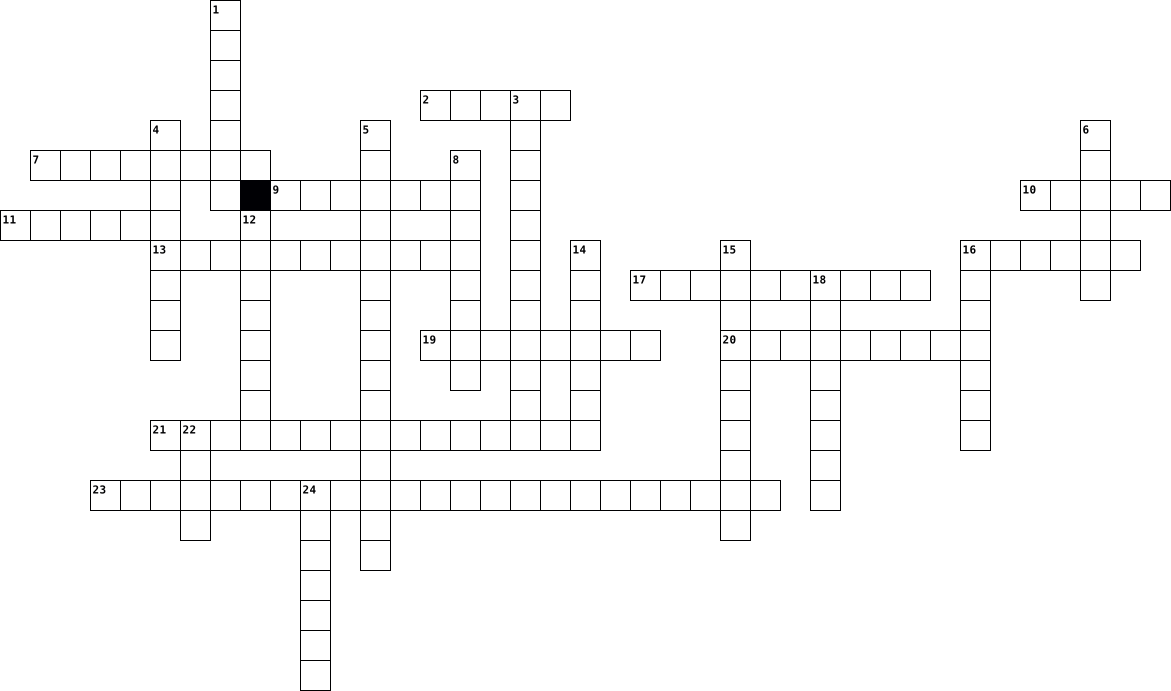
Across
- conductors of heat and electricity, malleable, ductile
- two elements mixed together to create a new substance
- the shells of an atom
- metal, nonmetal, and metalloid _____
- the letters that represent the element name
- a cold reaction
- row(s) of periodic table
- a hot or heated reaction
- not conductive, malleable, or ductile
- share properties of metals and nonmetals
- number of electrons in outer shell
- all elements that go into reactions come out of the reaction with the same number
Down
- pure substance on the periodic table
- number of protons and electrons
- a full outer shell, far right side of periodic table
- creator of the periodic table
- carries a positive charge
- negative charge and found in all atoms
- a group of atoms
- carries negative charge
- located below the symbol on the periodic table, add up protons and electrons
- the outcome of a chemical reaction
- the start of a chemical reaction, what creates a product
- even smaller than a molecule
- the center of all molecules
25 Clues: a cold reaction • a group of atoms • the shells of an atom • carries negative charge • row(s) of periodic table • a hot or heated reaction • carries a positive charge • the center of all molecules • even smaller than a molecule • creator of the periodic table • number of protons and electrons • the outcome of a chemical reaction • number of electrons in outer shell • ...
mia 2025-02-22

Across
- horizontal rows on a periodic table
- on the right side of the periodic table
- atomic weight is 1
- average mass of an atom of an element
- on the left side of the periodic table
- the atomic weight is 4
- atomic weight of 7
- chemical symbol is mg
- inert gas
- the atomic weight is 56
- a symbol which determines the chemical
- Number of protons and neutrons in a nucleus
- has the atomic number of 5
- inert gas
Down
- subatomic particle
- metals that make up the first column (group) of the periodic table
- any group of rare gases
- A complex consisting of two atoms.
- atomic weight is 11
- compound composed of a metal and oxygen.
- a family that has 5 electrons
- something that has groups and periods
- A taxon (group of organisms) made up of related genera.
- vertical columns on a periodic table
- chemical symbol is TI
- The number of protons in a nucleus
- something that can be found in milk
- substance composed of atoms with identical atomic number.
- gas in the periodic table
29 Clues: inert gas • inert gas • subatomic particle • atomic weight is 1 • atomic weight of 7 • atomic weight is 11 • chemical symbol is mg • chemical symbol is TI • the atomic weight is 4 • any group of rare gases • the atomic weight is 56 • gas in the periodic table • has the atomic number of 5 • a family that has 5 electrons • A complex consisting of two atoms. • The number of protons in a nucleus • ...
Changes in Matter Quiz Review 2025-02-22

Across
- The smallest unit of a chemical element
- The columns on the periodic table, move up and down
- Composed of one type of atom
- Element in period 6 and group 2
- Element in group 7 and period 3
- Two or more atoms that have been chemically combined
- The eleventh element in period 5
- Tells the number of atoms of each element in a chemical formula
- First metalloid in period 3
- Element with the atomic number 19
- The last metal in period 5
Down
- Changes that create a new substance
- Found along the bolded staircase line on the periodic table
- Found on the right side of the periodic table
- Changes that only alter the form or appearance of matter
- Element in group 2 and period 2
- Element in period 3 and group 8
- The rows on the periodic table, move side to side
- Found on the left side and center section of the periodic table
- The first nonmetal in period 5
- Composed of two or more different types of atoms
- Element in group 3 and period 2
22 Clues: The last metal in period 5 • First metalloid in period 3 • Composed of one type of atom • The first nonmetal in period 5 • Element in group 2 and period 2 • Element in period 3 and group 8 • Element in period 6 and group 2 • Element in group 7 and period 3 • Element in group 3 and period 2 • The eleventh element in period 5 • Element with the atomic number 19 • ...
The Periodic Table 2025-02-22

Across
- Atomic number 79
- This element makes up about 21% of the earth's atmosphere
- They are reactive nonmetallic elements that form strongly acidic compounds with hydrogen from which simple salts can be made
- Symbol "Sr" on the periodic table
- Greenish-yellow gas
- Brittle, dull, semiconductors
- Members of a family of an element that all have the same number of protons, but different number of neutrons
- The second noble gas on the periodic table
- an atom or molecule with a net electric charge due to the loss or gain of one or more electrons
- Rows on the periodic table
Down
- Water is made up of ________ and oxygen
- Columns on the periodic table
- Typically gasses at room temperature
- The smallest unit into which matter can be divided
- Found in group 14, period 2
- Malleable, ductile, good conductors of heat
- Used in toothpaste
- Determine that atomic number of an element
- There are about 90 of these found in nature
- Transition metal with the atomic number 23
- _______ metals are found in the first group on the periodic table
21 Clues: Atomic number 79 • Used in toothpaste • Greenish-yellow gas • Rows on the periodic table • Found in group 14, period 2 • Columns on the periodic table • Brittle, dull, semiconductors • Symbol "Sr" on the periodic table • Typically gasses at room temperature • Water is made up of ________ and oxygen • Determine that atomic number of an element • ...
Menu Project-Science 2023-04-04

Across
- balance in the body
- changed into a new substance
- changes in appearance
- found in the periodic table
- 2 or more elements combined
Down
- B on the periodic table
- the inability to move in the face of fear
- O on the periodic table
- the urge to run
- C on the periodic table
- He the on the periodic table
- Ne on the periodic table
12 Clues: the urge to run • balance in the body • changes in appearance • B on the periodic table • O on the periodic table • C on the periodic table • Ne on the periodic table • found in the periodic table • 2 or more elements combined • changed into a new substance • He the on the periodic table • the inability to move in the face of fear
Menu Project-Science 2025-02-23

Across
- balance in the body
- changed into a new substance
- changes in appearance
- found in the periodic table
- 2 or more elements combined
Down
- B on the periodic table
- the inability to move in the face of fear
- O on the periodic table
- the urge to run
- C on the periodic table
- He the on the periodic table
- Ne on the periodic table
12 Clues: the urge to run • balance in the body • changes in appearance • B on the periodic table • O on the periodic table • C on the periodic table • Ne on the periodic table • found in the periodic table • 2 or more elements combined • changed into a new substance • He the on the periodic table • the inability to move in the face of fear
Periodic Table 2020-05-05

Across
- an element's letter
- metals that can be hammered, pounded, or pressed
- this makes of 75% of the elements in the periodic table
- positively charged
- there are 17 of these types of elements in the periodic table
- total number of protons and neutrons
- the number of protons in an atom
- elements in a column
- the lanthanide elements and actinide elements
- group 1
Down
- has protons and neutrons in it
- elements can be grouped in families by this
- elements in each family will do this differently with other elements
- their properties have characteristics that are in between metals and nonmetals
- negatively charged
- zero charge
- these include metals, nonmetals, and metalloids
- group 3
- horizontal rows of the periodic table
- each family has this to differentiate itself from other families on the periodic table
20 Clues: group 3 • group 1 • zero charge • negatively charged • positively charged • an element's letter • elements in a column • has protons and neutrons in it • the number of protons in an atom • total number of protons and neutrons • horizontal rows of the periodic table • elements can be grouped in families by this • the lanthanide elements and actinide elements • ...
Chem Vocab 2022-12-07

Across
- when proton and neutrons added together it's the-
- two parts of an atom that equal the same
- how the periodic table is arranged
- negative charge
- electrons are located in-
- the staircase elements
- positive charge
- the structure of an atom
- different words for rows and columns on a periodic table
- a representation of an atom
Down
- no charge
- in the middle of an atom
- the study of the makeup of chemical elements and their structure
- the number of protons and electrons
- smallest part of an element
- the mass of an atom
- how an element is identified
- something made up of one type of atom
- right side of the periodic table
- left side of the periodic table
- rows and columns of substances organized by an atomic number
21 Clues: no charge • negative charge • positive charge • the mass of an atom • the staircase elements • in the middle of an atom • the structure of an atom • electrons are located in- • smallest part of an element • a representation of an atom • how an element is identified • left side of the periodic table • right side of the periodic table • how the periodic table is arranged • ...
Vocabulary 2022-10-26

Across
- gases - the elements in group 8A of the periodic table
- mass unit (amu) - one twelfth the mass of a carbon-12 atom
- law - the pattern of repeating properties displayed by elements in the periodic table
- earth metals - the elements in group 2A of the periodic table
- - elements with properties that fall between those of metals and nonmetals
- electron - an electron that is in the highest occupied energy level of an atom
- metals - elements that form a bridge between elements on the left and right sides of the periodic table
Down
- - elements that are poor conductors of heat and electric current
- metals - the elements in group 1A of the periodic table, not including hydrogen
- - the elements in group 7A of the periodic table
- table - an arrangement of elements in columns, based on a set of properties that repeat from row to row
- - a column of elements in a periodic table
- - elements that are good conductors of heat and electric current
- - a row in a periodic table of elements
14 Clues: - a row in a periodic table of elements • - a column of elements in a periodic table • - the elements in group 7A of the periodic table • gases - the elements in group 8A of the periodic table • mass unit (amu) - one twelfth the mass of a carbon-12 atom • earth metals - the elements in group 2A of the periodic table • ...
Chapter 5 vocab crossword puzzle 2022-10-31

Across
- gases the elements in group 8A of the periodic table
- mass unit (amu) one twelfth the mass of a carbon-12 atom
- law the pattern of repeating properties displayed by elements in the periodic table
- earth metals the elements in group 2A of the periodic table
- elements with properties that fall between those of metals and nonmetals
- electron an electron that is in the highest occupied energy level of an atom
- metals elements that form a bridge between elements on the left and right sides of the periodic table
Down
- elements that are poor conductors of heat and electric current
- metals the elements in group 1A of the periodic table, not including hydrogen
- the elements in group 7A of the periodic table
- table an arrangement of elements in columns, based on a set of properties that repeat from row to row
- a column of elements in a periodic table
- elements that are good conductors of heat and electric current
- a row in a periodic table of elements
14 Clues: a row in a periodic table of elements • a column of elements in a periodic table • the elements in group 7A of the periodic table • gases the elements in group 8A of the periodic table • mass unit (amu) one twelfth the mass of a carbon-12 atom • earth metals the elements in group 2A of the periodic table • ...
Chapter 5 vocabulary 2022-10-26

Across
- law the pattern of repeating properties displayed by elements in the periodic table
- earth metals the elements in group 2A of the periodic table
- metals elements that form a bridge between elements on the left and right sides of the periodic table
- a row in a periodic table of elements
- electron an electron that is in the highest occupied energy level of an atom
- elements that are poor conductors of heat and electric current
Down
- metals the elements in group 1A of the periodic table, not including hydrogen
- elements with properties that fall between those of metals and nonmetals
- table an arrangement of elements in columns, based on a set of properties that repeat from row to row
- the elements in group 7A of the periodic table
- gases the elements in group 8A of the periodic table
- a column of elements in a periodic table
- mass unit one twelfth the mass of a carbon-12 atom
- elements that are good conductors of heat and electric current
14 Clues: a row in a periodic table of elements • a column of elements in a periodic table • the elements in group 7A of the periodic table • mass unit one twelfth the mass of a carbon-12 atom • gases the elements in group 8A of the periodic table • earth metals the elements in group 2A of the periodic table • elements that are poor conductors of heat and electric current • ...
Chapter 5 vocabulary 2022-11-30

Across
- gases the elements in group 8A of the periodic table
- mass unit one twelfth the mass of a carbon-12 atom
- law the pattern of repeating properties displayed by elements in the periodic table
- earth metals the elements in group 2A of the periodic table
- elements with properties that fall between those of metals and nonmetals
- electron an electron that is in the highest occupied energy level of an atom
- metals elements that form a bridge between elements on the left and right sides of the periodic table
Down
- elements that are poor conductors of heat and electric current
- metals the elements in group 1A of the periodic table, not including hydrogen
- the elements in group 7A of the periodic table
- table an arrangement of elements in columns, based on a set of properties that repeat from row to row
- a column of elements in a periodic table
- elements that are good conductors of heat and electric current
- a row in a periodic table of elements
14 Clues: a row in a periodic table of elements • a column of elements in a periodic table • the elements in group 7A of the periodic table • mass unit one twelfth the mass of a carbon-12 atom • gases the elements in group 8A of the periodic table • earth metals the elements in group 2A of the periodic table • elements that are poor conductors of heat and electric current • ...
Chapter 5 vocab 2023-03-15

Across
- gases - the elements in group 8A of the periodic table
- mass unit (amu) - one twelfth the mass of a carbon-12 atom
- law - the pattern of repeating properties displayed by elements in the periodic table
- earth metals - the elements in group 2A of the periodic table
- - elements with properties that fall between those of metals and nonmetals
- electron - an electron that is in the highest occupied energy level of an atom
- metals - metals that form a bridge between elements on the left and right sides of the periodic table
Down
- - elements that are poor conductors of heat and electric current
- metals - the elements in group 1A of the periodic table, not including hydrogen
- - the elements in group 7A of the periodic table
- table - an arrangement of elements in columns, based on a set of properties that repeat from row to row
- - a column of elements in a periodic table
- - elements that are good conductors of heat and electric current
- - a row in a periodic table of elements
14 Clues: - a row in a periodic table of elements • - a column of elements in a periodic table • - the elements in group 7A of the periodic table • gases - the elements in group 8A of the periodic table • mass unit (amu) - one twelfth the mass of a carbon-12 atom • earth metals - the elements in group 2A of the periodic table • ...
Chapter 5 Vocab 2023-10-20

Across
- gases the elements in group 8A of the periodic table
- mass unit one twelfth the mass of a carbon-12 atom
- law the pattern of repeating properties displayed by elements in the periodic table
- earth metals the elements in group 2A of the periodic table
- elements with properties that fall between those of metals and nonmetals
- electron an electron that is in the highest occupied energy level of an atom
- metals metals that form a bridge between elements on the left and right sides of the periodic table
Down
- elements that are poor conductors of heat and electric current
- metals the elements in group 1A of the periodic table, not including hydrogen
- the elements in group 7A of the periodic table
- table an arrangement of elements in columns, based on a set of properties that repeat from row to row
- a column of elements in a periodic table
- elements that are good conductors of heat and electric current
- a row in a periodic table of elements
14 Clues: a row in a periodic table of elements • a column of elements in a periodic table • the elements in group 7A of the periodic table • mass unit one twelfth the mass of a carbon-12 atom • gases the elements in group 8A of the periodic table • earth metals the elements in group 2A of the periodic table • elements that are poor conductors of heat and electric current • ...
Periodic Table: Crossword Puzzle 2012-06-06

Across
- The number of groups on the periodic table
- The person who created the periodic table in 1869 to show trends between elements
- The second group of the periodic table
- Description of the elements on the left side of the periodic table
- The number of noble gases on the periodic table
- Radii from left to right and increases from top to bottom
Down
- The number of periods there are on the periodic table
- The element with an atomic number of 1
- Description of the elements on the right side of the periodic table
- increases from left to right and decreases from top to bottom
- The first group of the periodic table
- The number of elements on the periodic table that occur in nature
12 Clues: The first group of the periodic table • The element with an atomic number of 1 • The second group of the periodic table • The number of groups on the periodic table • The number of noble gases on the periodic table • The number of periods there are on the periodic table • Radii from left to right and increases from top to bottom • ...
The Periodic Table of Elements! 2024-10-02

Across
- The most common element on the periodic table
- K a metal straight from the Periodic Table of Elements
- Hg the only liquid metal at room temperature
- How many non-metals are on the Periodic Table of Elements
- How many metalloids are on the Periodic Table of Elements
- No luster Not malleable Not ductile
- H the only Non-metal on the metal side
Down
- As the least common element on earth
- The different boxes on the Periodic Table of Elements
- O the most common element on earth
- Has both properties of a metal and nonmetal
- How many metals are on the Periodic Table of Elements
- B a metalloid straight from the Periodic Table of Elements
13 Clues: O the most common element on earth • No luster Not malleable Not ductile • As the least common element on earth • H the only Non-metal on the metal side • Has both properties of a metal and nonmetal • Hg the only liquid metal at room temperature • The most common element on the periodic table • The different boxes on the Periodic Table of Elements • ...
The Periodic Table of Elements! 2024-10-02

Across
- The most common element on the periodic table
- K a metal straight from the Periodic Table of Elements
- Hg the only liquid metal at room temperature
- How many non-metals are on the Periodic Table of Elements
- How many metalloids are on the Periodic Table of Elements
- No luster Not malleable Not ductile
- H the only Non-metal on the metal side
Down
- As the least common element on earth
- The different boxes on the Periodic Table of Elements
- O the most common element on earth
- Has both properties of a metal and nonmetal
- How many metals are on the Periodic Table of Elements
- B a metalloid straight from the Periodic Table of Elements
13 Clues: O the most common element on earth • No luster Not malleable Not ductile • As the least common element on earth • H the only Non-metal on the metal side • Has both properties of a metal and nonmetal • Hg the only liquid metal at room temperature • The most common element on the periodic table • The different boxes on the Periodic Table of Elements • ...
Chem vocab 2021-08-19

Across
- An element found in group 17 of the periodic table
- how easy elements lose valence electrons
- wave function describing the behavior of electrons
- property of the elements that can be predicted
- region of an atom in which like electrons are found
- element that has properties of both metals and nonmetals
- A horizontal row of elements in the periodic table
- groups 13-18
- arrangements of electrons in an atom
- energy that happens when an electron is taken]
- half the distance from the radius to the edge of an atom
- an element that conducts heat and electricity poorly
Down
- nonmetals descriptions
- energy required to remove an electron from an atom
- Metallic elements of group 2
- a vertical column of elements in the periodic table
- Unreactive gases
- an element that is shiny and conducts heat and conducts
- an atoms electromagnetic strength
- groups 3-12
- Table A chart of the elements
- groups 1 and 2
- the 14 elements at the bottom of the table
23 Clues: groups 3-12 • groups 13-18 • groups 1 and 2 • Unreactive gases • nonmetals descriptions • Metallic elements of group 2 • Table A chart of the elements • an atoms electromagnetic strength • arrangements of electrons in an atom • how easy elements lose valence electrons • the 14 elements at the bottom of the table • property of the elements that can be predicted • ...
Atomic Practice 2023-04-21

Across
- The only only nonmetal found in the same Group as the Alkali Metal Family
- Equal to the number of protons (2 words, no space)
- Element in Halide Family found in Period 4
- Protons + Neutrons = _______
- The name of the element with the symbol W
- Element named after largest U.S west coast state
- Row on the periodic table
- Mass(amu) of protons and neutrons (write number as word)
- Element in Group 4 and Period 5
- Elements to the right of the 'staircase' on the periodic table
Down
- Particle located in the nucleus with a positive charge
- The center of the atom
- Particle located in the nucleus with no charge
- Fe is the chemical ________ for iron.
- Elements located on the 'staircase' on the periodic table
- Particle outside the nucleus with a negative charge
- The name of the element with the symbol Na
- Elements to the left of the 'staircase' on the periodic table
- Family of elements in Group 14
- The name of the element with the symbol Cu
- Column on the periodic table
21 Clues: The center of the atom • Row on the periodic table • Protons + Neutrons = _______ • Column on the periodic table • Family of elements in Group 14 • Element in Group 4 and Period 5 • Fe is the chemical ________ for iron. • The name of the element with the symbol W • The name of the element with the symbol Na • Element in Halide Family found in Period 4 • ...
Chemistry 2017-02-08
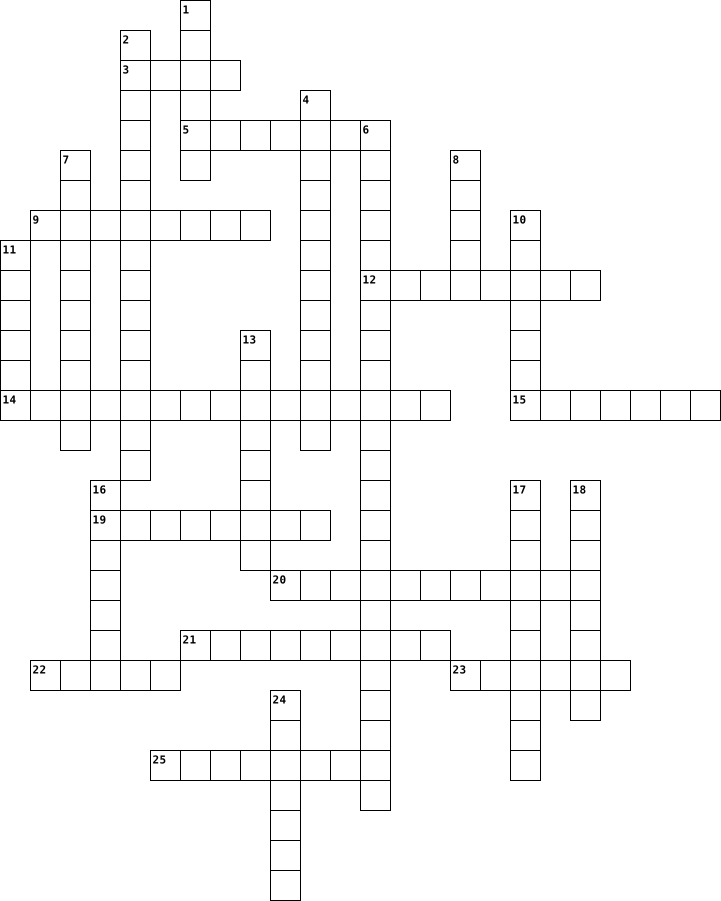
Across
- even smaller than a molecule
- the shells of an atom
- a group of atoms
- two elements mixed together to create a new substance
- creator of the periodic table
- the center of all molecules
- the start of a chemical reaction, what creates a product
- a cold reaction
- share properties of metals and nonmetals
- conductors of heat and electricity, malleable, ductile
- the letters that represent the element name
- a full outer shell, far right side of periodic table
Down
- carries a positive charge
- number of electrons in outer shell
- number of protons and electrons
- all elements that go into reactions come out of the reaction with the same number
- a hot or heated reaction
- metal, nonmetal, and metalloid _____
- carries negative charge
- row(s) of periodic table
- not conductive, malleable, or ductile
- the outcome of a chemical reaction
- located below the symbol on the periodic table, add up protons and electrons
- negative charge and found in all atoms
- pure substance on the periodic table
25 Clues: a cold reaction • a group of atoms • the shells of an atom • carries negative charge • a hot or heated reaction • row(s) of periodic table • carries a positive charge • the center of all molecules • even smaller than a molecule • creator of the periodic table • number of protons and electrons • number of electrons in outer shell • the outcome of a chemical reaction • ...
Chemistry 2017-02-08

Across
- the outcome of a chemical reaction
- carries negative charge
- negative charge and found in all atoms
- the shells of an atom
- all elements that go into reactions come out of the reaction with the same number
- conductors of heat and electricity, malleable, ductile
- the start of a chemical reaction, what creates a product
- located below the symbol on the periodic table, add up protons and electrons
- metal, nonmetal, and metalloid _____
- number of electrons in outer shell
- row(s) of periodic table
- share properties of metals and nonmetals
- a hot or heated reaction
Down
- a full outer shell, far right side of periodic table
- the center of all molecules
- carries a positive charge
- creator of the periodic table
- a cold reaction
- not conductive, malleable, or ductile
- even smaller than a molecule
- a group of atoms
- pure substance on the periodic table
- number of protons and electrons
- the letters that represent the element name
- two elements mixed together to create a new substance
25 Clues: a cold reaction • a group of atoms • the shells of an atom • carries negative charge • row(s) of periodic table • a hot or heated reaction • carries a positive charge • the center of all molecules • even smaller than a molecule • creator of the periodic table • number of protons and electrons • the outcome of a chemical reaction • number of electrons in outer shell • ...
Periodic Trends 23-24 2023-12-04

Across
- three unpaired d electrons
- a column on the periodic table
- particles responsible for increasing size going from top to bottom of the periodic table
- type of attraction between charged particles
- d block element with six electrons in that subshell
- atomic property measuring attraction for electrons
- full s and p subshells, period 5
- in the same period, but smaller than phosphorus
- group 17 period 3
- largest predicted element in group 2
- highest predicted ionization energy in group 16
- largest predicted atom on the periodic table
Down
- predicted electron configuration ending d^9
- highest predicted ionization energy in period 3
- noble gas smaller than neon
- particles responsible for decreasing size going from left to right on the periodic table
- five unpaired electrons, d^1 d^1 d^1 d^1 d^1
- energy to remove an electron from an atom
- a row on the periodic table
- period 6, two unpaired p electrons
- largest period 2 element
- group 11 period 6
- in the same group, but bigger than rubidium
- group 17 element with highest predicted ionization energy
24 Clues: group 11 period 6 • group 17 period 3 • largest period 2 element • three unpaired d electrons • noble gas smaller than neon • a row on the periodic table • a column on the periodic table • full s and p subshells, period 5 • period 6, two unpaired p electrons • largest predicted element in group 2 • energy to remove an electron from an atom • ...
Elements Vocabulary Review 2018-10-07

Across
- the electric charge of the electron cloud
- the d orbital contains this many electrons
- area surrounding the nucleus
- name of a model we use to draw an atom
- family in the periodic table in the second column
- 118 known
- family in the periodic table that moves up one energy level
- negative subatomic particle found outside of the nucleus
- the s orbital contains this many electrons
- the p orbital contains this many electrons
- have properties of both metals and nonmetals
- the number of more or less electrons than protons an ion has
- neutral subatomic particle found in the nucleus
- the electric charge of an atom
Down
- another name of a column that describes the similar physical traits and element has to the other elements in that column on the periodic table
- another name for a row of elements on the periodic table
- the number of protons found in an atom
- another name for row on the periodic table that describes how many rings are around the nucleus of the atom
- an organized chart containing all of the elements
- the electric charge of the nucleus
- a symbolic way to describe how electrons are arranged around the nucleus of an atom
- the center area of an atom
- the first family found in the periodic table
- positive subatomic particle found in the nucleus
- the smallest thing that still contains all of the properties of an element
- area where an electron is most likely found, described by s, d, p, or f
- the f orbital contains this many electrons
- the number of protons and neutrons found in an atom
- an atom with an electric charge
- another name for the up and down columns on the periodic table
30 Clues: 118 known • the center area of an atom • area surrounding the nucleus • the electric charge of an atom • an atom with an electric charge • the electric charge of the nucleus • the number of protons found in an atom • name of a model we use to draw an atom • the electric charge of the electron cloud • the d orbital contains this many electrons • ...
Chem Crossword 1/24 2023-01-23

Across
- the attraction the nucleus exerted on an electron; the effective form of this measures "true" attraction
- ions with a central metal ion bonded to other ions or molecules
- elements found in group 18 that are typically nonreactive
- phenomenon in which inner electrons block the attraction between outer or valence electrons and the nucleus
- elements occupying the center of periodic table
- molecules that bind to a central metal atom in a coordinate complex
- aka. actinides; occupy the bottom of the periodic table and have a 5f subshell
- magnetism caused by an external applied magnetic field causing atoms to align with said magnetic field
Down
- columns of the periodic table, numbered 1-18
- group 1 of the periodic table; these elements are highly reactive
- the phenomenon of elements behaving similar in groups along the periodic table
- catalyst in a different phase of matter than the reactants and products
- number of atoms a central atom holds in a compound
- rows of the periodic table, currently numbered 1-7
- visual representation of the elements orderd by atomic number; shows trends in atomic and ionic radii, ionization energy, electron affinity, electronegativity, etc.
- ligands that form two or more separate coordinate bonds with a central metal atom
- aka. lanthanides; occupy the bottom of the periodic table and have a 4f subshell
- phenomenon in which uncharged materials exhibit a magnetic field
- elements lacking 1 electron to form octet valence shell
- magnetism caused by an applied magnetic field that goes in reverse of the one applied; has a small magnetic moment
- catalyst in the same phase of matter as the reactants and products
21 Clues: columns of the periodic table, numbered 1-18 • elements occupying the center of periodic table • number of atoms a central atom holds in a compound • rows of the periodic table, currently numbered 1-7 • elements lacking 1 electron to form octet valence shell • elements found in group 18 that are typically nonreactive • ...
Science 2022-06-03

Across
- Negatively charged Ion
- Group 1A of Periodic table
- Iron is part of the ... Metals
- Fe
- A+B->AB
- Surname of man who invented Atomic theory
- Go vertical on the Table
- AB->A+B
- Is the product of two elements
- When reaction has fire or heat
- Go horizontal on the Table
- Amount of Protons in Hydrogen
- Periodic Table of..?
Down
- When a metal meets oxygen
- Is the sign/word for radiation
- CO2
- Amount of Protons in Fe
- H2O
- Something Bohr
- Copper is good at ... Electricity
- Smallest Atom
- Ag
- Au
- Cu
- Positvely charged Ion
- First period has, how many atoms?
- Who invented the Periodic table?
27 Clues: Fe • Ag • Au • Cu • CO2 • H2O • A+B->AB • AB->A+B • Smallest Atom • Something Bohr • Periodic Table of..? • Positvely charged Ion • Negatively charged Ion • Amount of Protons in Fe • Go vertical on the Table • When a metal meets oxygen • Group 1A of Periodic table • Go horizontal on the Table • Amount of Protons in Hydrogen • Is the sign/word for radiation • Iron is part of the ... Metals • ...
Periodic Table 2023-11-02

Across
- These types of elements make up the majority of the periodic table
- A highly reactive metal in the third row of the alkali metals
- The first group on the periodic table
- Rows on the Periodic Table
- These types of elements can be found the the right of the metalloids
- The second group on the periodic table
Down
- This group of metals are quite reactive and have two valence electrons
- Columns on the Periodic Table
- This element doesn't really have a family, but fits best above the alkali metals.
- These elements have properties of both metals and nonmetals.
- The group furthest right on the periodic table
- The second-to-last group on the periodic table
- This element is a noble gas and has its eight valence electrons in the third energy level
- This group of nonmetals are very reactive and have seven valence electrons
- Atomic symbol for the only metal that is liquid at room temps
15 Clues: Rows on the Periodic Table • Columns on the Periodic Table • The first group on the periodic table • The second group on the periodic table • The group furthest right on the periodic table • The second-to-last group on the periodic table • These elements have properties of both metals and nonmetals. • A highly reactive metal in the third row of the alkali metals • ...
The Periodic Table 2020-12-18

Across
- Columns in a periodic table.
- There are ... known elements on the periodic table.
- Element with the chemical symbol of Na
- The man who invented the periodic table
- Rows in a periodic table.
- There are ... non-metals in the first 20 elements of the periodic table
- ... atoms has the highest mass
Down
- The heaviest element
- There are ... metals in the first 20 elements of the periodic table
- The atoms of the elements increase in ... as you read across each row.
- What do we call the table that shows all the elements?
- One or Two letters that represent an element.
- Number of protons an atom contains
13 Clues: The heaviest element • Rows in a periodic table. • Columns in a periodic table. • ... atoms has the highest mass • Number of protons an atom contains • Element with the chemical symbol of Na • The man who invented the periodic table • One or Two letters that represent an element. • There are ... known elements on the periodic table. • ...
Periodic Table 2020-09-24

Across
- Noble gases are very because their outer shells are completely full
- most of the metals have 2 valence electrons and are in the middle of the table
- completely unlike metals; take up the right side of the periodic table
- earth metals make up group 2A
- the amount of on the outer shell grows as you move to the right of the periodic table
- are extremely reactive because they only need one more electron to complete the last shell
- Halogens, alkali metals, and hydrogen are all extremely
- the periodic table has periods
Down
- the amount of electron determines the period of an element
- take up most of the left side, are hard, and have high melting points
- range from atomic # 89-103 and most of them must be synthesized
- Metalloids look sort of like a shape on the periodic table
- gases are non-reactive and are on the right side
- a group of elements that are like both metals and nonmetals
- amount of columns on the periodic table
- The amount of electrons is what determines groups on the periodic table
- elements in the same group are often very , or alike
- elements ranging from 57 to 71; inner transition metals
- horizontal rows; determined by # of electron shells
- most, if not all, of the elements in the same family, have that are alike or close
- The state of matter of most elements is .
21 Clues: earth metals make up group 2A • the periodic table has periods • amount of columns on the periodic table • The state of matter of most elements is . • gases are non-reactive and are on the right side • horizontal rows; determined by # of electron shells • elements in the same group are often very , or alike • elements ranging from 57 to 71; inner transition metals • ...
Periodic Table Crossword Puzzle 2023-04-30

Across
- ion formed when there are more electrons than protons
- these subatomic particles are found in the nucleus of an atom and are positively charged
- the way elements are arranged on the periodic table going from right to left
- kind of gas that do not bond with other elements because they have a fuller outer orbital
- arrangement of elements on periodic table according to number of orbitals
- subatomic particle that occupy space around nucleus
- bond formed by two nonmetals where they share the valence electrons
- a malleable and ductile element
- this kind of ion can be formed whenever there are more protons than electrons
- type of electron that is on the outermost orbital of an atom
Down
- most reactive group of metals found on the periodic table
- atoms of an element that have different masses
- arrangement of elements on periodic table according to valence electrons
- English scientist that perfected the arrangement of the periodic table because he knew of the discovery of electrons
- this Russian scientist was the first person to ever organize the periodic table accurately
- dull and brittle elements
- scientist that proposed atoms contain electrons
- these subatomic particles account for some of the elements mass and are electrically neutral
- smallest particle of an element that retains the element's properties
- elements that are extremely reactive and are mostly found in seawater
20 Clues: dull and brittle elements • a malleable and ductile element • atoms of an element that have different masses • scientist that proposed atoms contain electrons • subatomic particle that occupy space around nucleus • ion formed when there are more electrons than protons • most reactive group of metals found on the periodic table • ...
4A and 4B Crossword Puzzle 2024-11-14

Across
- Any of Groups 13–16 in the periodic table; so named because they contain metals, nonmetals, and metalloids. These groups are often named for the first element in the family.
- Any electron in the outermost energy level of a neutral atom. Unpaired valence electrons are usually involved in chemical bonding.
- The law that states that the properties of the elements vary with their atomic numbers in a regular, repeated pattern.
- An element in Group 18 on the periodic table having eight valence electrons that fill the outer energy level. (Helium is an exception with only two.) With a full outer energy level, it is inert (i.e., nonreactive).
- (1) A row in the periodic table of the elements; also called a series. (2) The time interval (T) for one complete cycle of periodic motion.
- A column of elements in the periodic table having similar valence electron arrangement, resulting in similar chemical properties; also known as a group.
- Any elements in Groups 3–12 of the periodic table, typically having one or two valence electrons, which it easily loses, resulting in cations with charges of 1 + or 2 + .
- An element that is typically dense, solid, ductile, malleable, highly conductive, and chemically reactive, especially in the presence of nonmetal elements. Metals are located on the left end of the periodic table.
Down
- An element in Group 2 of the periodic table, having two valence electrons that it tends to lose easily to become a 2 + cation, making it very reactive.
- An element that typically has four or more valence electrons and that does not exhibit the general properties of metals; located on the right side of the periodic table.
- See family.
- An element with characteristics between those of metals and nonmetals; also called semiconductors; located between metals and nonmetals on the periodic table.
- An element from either of two rows usually placed below the periodic table; a member of either the lanthanide or actinide series. It typically has two valence electrons.
- A table of the chemical elements arranged to display their periodic properties in relation to their atomic numbers.
- An element in Group 1 of the periodic table, having one valence electron that it can easily lose to form a 1 + cation, making it extremely reactive; the most reactive of all the metals.
- An element in Group 17 of the periodic table having seven valence electrons. It easily gains an electron, forming a 1 − anion, which causes it to be highly reactive
16 Clues: See family. • A table of the chemical elements arranged to display their periodic properties in relation to their atomic numbers. • The law that states that the properties of the elements vary with their atomic numbers in a regular, repeated pattern. • ...
Periodic table crossword puzzle 2022-05-04

Across
- substances cannot be simpler substances
- rows going sideways on the periodic table
- positive particles
- rows going down on the periodic table
- group 18 on periodic table
- relating to atoms
- basic unit of a chemical element
- center of atom
- atom with a net electric charge
- negatively charged
- using ions
Down
- positively charged ion
- anything that isn't a metal
- material that is usually solid, conductor
- model made by niels bohr
- table of organized elements
- neutral particles
- model made my ernest rutherford
18 Clues: using ions • center of atom • relating to atoms • neutral particles • positive particles • negatively charged • positively charged ion • model made by niels bohr • group 18 on periodic table • anything that isn't a metal • table of organized elements • model made my ernest rutherford • atom with a net electric charge • basic unit of a chemical element • ...
Periodic Table Crossword Puzzle 2022-05-05

Across
- substances cannot be simpler substances
- rows going sideways on the periodic table
- positive particles
- rows going down on the periodic table
- group 18 on periodic table
- relating to atoms
- basic unit of a chemical element
- center of atom
- atom with a net electric charge
- negatively charged
- using ions
Down
- positively charged ion
- anything that isn't a metal
- material that is usually solid, conductor
- model made by niels bohr
- table of organized elements
- neutral particles
- model made my ernest rutherford
18 Clues: using ions • center of atom • relating to atoms • neutral particles • positive particles • negatively charged • positively charged ion • model made by niels bohr • group 18 on periodic table • anything that isn't a metal • table of organized elements • model made my ernest rutherford • atom with a net electric charge • basic unit of a chemical element • ...
Chemistry Crossword 2015-11-17

Across
- positively charged particle in the nucleus of an atom
- element that has both metallic and non-metallic properties
- vertical column of elements in the periodic table of elements
- group 2 elements in the periodic table
- no additional material is allowed to enter or leave
- abbreviation of atomic mass
- a chemical reaction that absorbs heat energy
- neutral particle in the nucleus of an atom
- most stable and unattractive elements
Down
- when two or more materials react and crate new materials
- the most reactive metal on the table of elements
- when a material changes from one state to another
- the sum of the number of protons and neutrons in an atom
- slow chemical change that occurs when oxygen in the air reacts with a metal
- a chemical reaction that takes place in the cells in your body
- vertical column of elements in the periodic table
- combination of symbols that represent a compound
- group 17 elements in the periodic table
- a chemical reaction that occurs when oxygen reacts with a substance to form a new substance and give off energy
- group one in the periodic table
- dull, brittle element that does not conduct electricity
- a chemical reaction that releases heat energy
- horizontal row of elements in the periodic table
- shiny, malleable, ductile element that conducts electricity
- invisible negatively charged particle that orbits the nucleus of an atom
25 Clues: abbreviation of atomic mass • group one in the periodic table • most stable and unattractive elements • group 2 elements in the periodic table • group 17 elements in the periodic table • neutral particle in the nucleus of an atom • a chemical reaction that absorbs heat energy • a chemical reaction that releases heat energy • ...
Applied Chemistry Review Crossword 2018-12-10

Across
- Group 1 - very reactive metals that don't combined with other elements in nature
- The maximum number of electrons that an atom can have in its valence shell - a Stable Octet
- Energy to remove one valence electron from an element in ground state
- Increases from left to right across the Periodic Table
- Group 2 - very reactive metals, but not as reactive as Group 1
- The vertical columns on the Periodic Table
- Located around the "stair steps" on the Periodic Table - can act like both metals and nonmetals
- A measurable property of a given substance that NEVER CHANGES
- A change that occurs in which the identity of a given substance IS CHANGED
- The measure of the size of an atom of an element
Down
- A change in which the identity of a given substance IS NOT CHANGED
- The horizontal rows on the Periodic Table
- Scientist who developed the modern Periodic Table based on increasing atomic mass
- Group 18 - very unreactive because they have a full valence shell of 8 electrons
- Measure of the strength of attraction that an atom has for its electrons
- Metals in Groups 3 through 12 on the Periodic Table
- Group 17 on the Periodic Table also called "salt formers"
17 Clues: The horizontal rows on the Periodic Table • The vertical columns on the Periodic Table • The measure of the size of an atom of an element • Metals in Groups 3 through 12 on the Periodic Table • Increases from left to right across the Periodic Table • Group 17 on the Periodic Table also called "salt formers" • ...
chemistry 2023-10-21

Across
- The process by which a solid becomes a liquid
- Different atoms of the same element
- The process by which a gas becomes a solid
- The vertical column in the periodic table
- The seventh major group of the periodic table
- Electrically neutral subatomic particle found in the nucleus
- A substance containing 2 or more elements which are chemically combined
- number The total number of protons and neutrons in a nucleus
- A substance containing 2 or more elements which are not chemically combined
- The ability of metal to shape has something to do with it
- A substance consisting of atoms which are all the same
- Made of only one type atom
- A horizontal row in the periodic table
Down
- The process by which a solid becomes a gas
- Negatively charged subatomic particle found in the shells around the nucleus
- The first element in the periodic table
- Positively charged subatomic particle found in the centre of the nucleus
- Have the similar meanings to element
- The smallest particle of a chemical element
- 2 or more atoms joined together by covalent bond
- metal The first major group of the periodic table
- The 17th element in the periodic table
- Metal's ability to stretch and shorten has something to do with it
- Substances with this property do not remain at a fixed temperature when molten in a solid-liquid mixture
24 Clues: Made of only one type atom • Different atoms of the same element • Have the similar meanings to element • The 17th element in the periodic table • A horizontal row in the periodic table • The first element in the periodic table • The vertical column in the periodic table • The process by which a solid becomes a gas • The process by which a gas becomes a solid • ...
Periodic Table Crossword 2023-12-01

Across
- Come from ores in earth's crust
- Low melting point; breaks easily
- This group's elements are not found alone in nature
- The law that states elements listed in order of their atomic numbers will fall into groups
- Good conductor; can corrode
- Contains properties of both metals and nonmetals
- Nonmetals become this when they are ions
- Aluminum and Gallium have an ionic charge of positive _____
- Radioactive and manmade
- most reactive nonmetal of the periodic table
- All alkaline earth metals are in this group on the periodic table
- Colorless, odorless, and tasteless
- This element is among the Halogen group
- Creator of the first periodic table
- Metals _____ electrons when transferring
- Groups three through ______ on the periodic table are transition metals
- Used to visualize an atom's valence electrons
Down
- Alkali metals react with water to make these
- Most reactive metals in the periodic table
- Most reactive nonmetals
- Poisonous metalloid
- One of the alkaline earth metals
- A.K.A rare earth metals
- This group number is also known as noble gases
- Metals become this when they are ions
- Organized the modern periodic table
- _________ electrons are in the highest energy level
- Sodium, silver, and strontium are examples of this
- The number of valence electrons in the Alkali metal group
- Nonmetal often used in signs
30 Clues: Poisonous metalloid • Most reactive nonmetals • A.K.A rare earth metals • Radioactive and manmade • Good conductor; can corrode • Nonmetal often used in signs • Come from ores in earth's crust • Low melting point; breaks easily • One of the alkaline earth metals • Colorless, odorless, and tasteless • Organized the modern periodic table • Creator of the first periodic table • ...
Chem Crossword 2022-09-06

Across
- Valence Electrons are most commonly in what state?
- What is the Atomic # for Fermium?
- What is the Element name for Ti on the periodic table?
- What is the Atomic # for Magnesium?
- # of Protons + # of Neutrons.
- What is the Element name for O on the periodic table?
- Atoms are made up of how many various Subatomic particles?
- The observed colors when a substance is heated may be used as_____.
- Wavelength X by frequency =?
- Positively charged atoms with fewer Electrons than Protons.
- Minimum amount of energy that can be gained or lost by an atom.
- What is the Element name for Ca on the periodic table?
- What is made of protons and neutrons?
- Displays the wavelength and frequency.
- element of an atom with the same number of Protons, but different number of Neutrons.
- Subatomic particles with a +1 charge.
- What is the Atomic # for Zirconium?
- What is the Atomic # for Indium?
- Amplitude.
- The straight line that goes through the center of a circle is called the _____.
- Atoms are made up of what type of particles?
Down
- What is the Atomic # for Zinc?
- What is the Element name for Po on the periodic table?
- Unstable Isotopes are commonly referred to as______.
- Atoms are mainly____.
- What is the Element name for H on the periodic table?
- What is the Atomic # for Argon?
- Depends on # of Protons, Neutrons and Electrons.
- A shell that can hold Electrons.
- What is the Element name for Rn on the periodic table?
- An atom that has gained or lost one or more electrons.
- Atoms absorb energy and become____.
- What is the Element name for Y on the periodic table?
- What is the Element name for Dy on the periodic table?
- Atoms mainly consist of_____.
- What is the Atomic # for Ytterbium?
- What absorbs the energy from a flame when a substance is heated?
- Subatomic particles with zero charge.
- What is the Atomic # for Sodium?
- Every atom has it/entirely of Protons and Neutrons.
- What is the Element name for Pb on the periodic table?
- Negatively charged atoms with more Electrons than Protons.
- Smallest subatomic particles with -1 charge.
- An electron makes a what from a higher energy level to a lower energy level?
- What is the Element name for Na on the periodic table?
- The amount of waves per second is called_____.
- The atomic number is usually given as the atomic____.
- Neutral atoms have zero_____.
48 Clues: Amplitude. • Atoms are mainly____. • Wavelength X by frequency =? • # of Protons + # of Neutrons. • Atoms mainly consist of_____. • Neutral atoms have zero_____. • What is the Atomic # for Zinc? • What is the Atomic # for Argon? • A shell that can hold Electrons. • What is the Atomic # for Sodium? • What is the Atomic # for Indium? • What is the Atomic # for Fermium? • ...
periodic table 2022-06-14

Across
- He on the periodic table
- NA on the periodic table
- cl on the periodic table
- C on the periodic table
- S on the periodic table
Down
- p on the periodic table
- H on the periodic table
- CA on the periodic table
- B on the periodic table
- AG on the periodic table
10 Clues: p on the periodic table • H on the periodic table • C on the periodic table • B on the periodic table • S on the periodic table • He on the periodic table • NA on the periodic table • cl on the periodic table • CA on the periodic table • AG on the periodic table
Periodic Trends Crossword 2021-11-16

Across
- This scientist organized the periodic table by atomic number.
- A negatively charged particle.
- An atom that has gained electrons and has a negative charge.
- A positively charged particle.
- This type of element conducts electricity, has luster, and is malleable.
- The type of metal that makes up the d orbital.
- The most reactive nonmetal group.
- The most reactive metal group.
- The name of the rows on the periodic table.
- The ability of an atom to attract electrons.
Down
- The ability of an element to undergo a chemical change.
- This scientist discovered the relationship between chemical and physical properties of elements and atomic mass.
- This type of element has properties of both metals and nonmetals.
- These elements make up the last row of the periodic table.
- This type of electron is in the outermost energy level of an atom.
- This type of element does not conduct electricity well, is dull, and brittle.
- These elements make up the second to last row of the periodic table.
- These gases are the most stable, containing 8 valence electrons.
- This type of energy is the amount of energy required to remove a valence electron from an atom.
- This scientist moved the lanthanides and actinides below the periodic table.
- An atom that has lost electrons and has a positive charge.
- The name of the columns on the periodic table.
22 Clues: A negatively charged particle. • A positively charged particle. • The most reactive metal group. • The most reactive nonmetal group. • The name of the rows on the periodic table. • The ability of an atom to attract electrons. • The type of metal that makes up the d orbital. • The name of the columns on the periodic table. • ...
Periodic Table KS3 2024-04-17

Across
- This group 7 element kills bacteria in swimming pools. (8)
- The reactivity of these elements _______________ as you go down the group. (9)
- These elements are all good conductors of electricity. (6)
- This physical property means metals can be hammered into shape. (9)
- This gas is used in respiration. (6)
- The alkaline product formed when sodium reacts with water. (6,9)
- This element is in periodic 4 and group 7. (8)
- The vertical columns are called _________. (6)
- Elements found in Group 1 of the periodic table. (6,6)
- The horizontal rows are called _________. (7)
Down
- Elements in the periodic table are arranged by _______ ________. (6,6)
- The surname of the scientist who rearranged the order of elements in the periodic table. (9)
- This metal is used in electrical wiring. (6)
- Elements found in Group 7 of the periodic table. (8)
- Group 0 elements have this property because their atoms have full outer energy levels(shells). (9)
- This metal is used to make jewellery. (4)
- This group 0 element is used in party balloons. (6)
- This physical property means metals can be drawn into wires. (7)
- This chemical property decreases as you go down Group 7. (10)
- Elements found in Group 0 of the periodic table. (5,5)
20 Clues: This gas is used in respiration. (6) • This metal is used to make jewellery. (4) • This metal is used in electrical wiring. (6) • The horizontal rows are called _________. (7) • This element is in periodic 4 and group 7. (8) • The vertical columns are called _________. (6) • This group 0 element is used in party balloons. (6) • ...
Periodic-Mash-Up 2023-05-10

Across
- An element that cant touch found in the nucleus.(2pts)
- Vertical columns of the periodic table.(2pts)
- What is a trend? Think of something that happens again and again in an order.(2pts)
- What are the horizontal rows on the periodic table are called?(2pts)
- Creators name/Kyle.(2pts)
- What type of elements tend to be on the left of a periodic table?(2pts)
- Protons have a ______ charge.(2pts)
- An element with a negative charge and is in every atom.(2pts)
- What is the first element on the periodic table.(2pts)
- An element with a positive charge moving around the nucleus.(2pts)
Down
- What are the elements in the middle of the periodic table called.(2pts)
- What element do we breath in.(2pts)
- The "brain" of a cell.(2pts)
- What is a chemical called when it is not in a compound but by itself?(2pts)
- What kind of frequency do gamma rays have? High or Low.(2pts)
- What is waters chemical compound?(2pts)
- Which element has the most ionization energy; Lithium or Carbon?(2pts)
- What tends to be on the far left of the periodic table.(!HINT!There is a - in the word.)(2pts)
18 Clues: Creators name/Kyle.(2pts) • The "brain" of a cell.(2pts) • What element do we breath in.(2pts) • Protons have a ______ charge.(2pts) • What is waters chemical compound?(2pts) • Vertical columns of the periodic table.(2pts) • An element that cant touch found in the nucleus.(2pts) • What is the first element on the periodic table.(2pts) • ...
Periodic Table Crossword 2024-02-09

Across
- elements that are usually dull in appearance, poor conductors of heat and electricity, gases at room temperature
- metallic elements in group 2 of the periodic table which are harder than the alkali metals and are also less reactive
- A negatively charged ion
- A horizontal row of elements in the periodic table
- A regular periodic variation of properties of elements with atomic number and position in the Periodic Table.
- An elment that is solid at room temperature, a good conductor of heat and electricity, and generallyis shiny, most metals are ductile and mallerable
- Elements of group 7A. Have a charge of -1. Fluorine, Chlorine, Bromine, Iodine. Form compounds with sodium in the form NaX
- The average mass of all the isotopes of an element.
- An atom or group of atoms that has gained or lost one or more electrons, thus acquiring a charge.
- Elements of group 1A. Have a charge of +1. Lithium, Sodium, Potassium, Rubidium, Cesium. React with water to form hydrogen gas and a metal hydroxide (MOH) + H2. Also from compounds with the halogens in the form MX. Ex. NaCl.
Down
- 14 elements with atomic number 58-71 (shiny metals similar in reactivity to to alkaline earth metals)
- A positively charged ion
- Groups 3-12, 1-2 electrons in the outer energy level, less reactive than alkali-earth metals, shiny, good conductor of thermal energy and electrical current, high density
- the law that states that the repeating chemical and physical properties of elements change periodically with the atomic numbers of the elements
- A Russian chemist. He is credited as being the primary creator of the first version of the periodic table of elements.
- Arranged elements in order of increasing ATOMIC NUMBER
- A column on the periodic table
- Number of protons in the nucleus of an atom
- A series of elements that follow actinium in Period 7 of the periodic table and that are typically placed separately at the bottom of the periodic table
- Elements in group 8A of the periodic table. Have no charge and are gases under normal conditions
20 Clues: A positively charged ion • A negatively charged ion • A column on the periodic table • Number of protons in the nucleus of an atom • A horizontal row of elements in the periodic table • The average mass of all the isotopes of an element. • Arranged elements in order of increasing ATOMIC NUMBER • ...
Atoms and The Periodic Table 2023-10-17

Across
- How many valence electrons do transition elements have?
- What does group 18 show on the periodic table?
- This consists of protons and neutrons combined
- What part of an atom contains the protons and neutrons?
- This consists of protons only
- Which element is disconnected from where you think it would be?
Down
- What type of element does the bottom section of the periodic table consist of?
- On the periodic table what shows you how many valence electrons are in the outer shell?
- What are positively charged subatomic particles called?
- What are the parts of the periodic table?
- On the periodic table what shows you how many shells an element has?
- How many groups are in the periodic table?
- What subatomic particles have a negative charge?
- What subatomic particles have no charge?
- What is Hydrogen's atomic number?
15 Clues: This consists of protons only • What is Hydrogen's atomic number? • What subatomic particles have no charge? • What are the parts of the periodic table? • How many groups are in the periodic table? • What does group 18 show on the periodic table? • This consists of protons and neutrons combined • What subatomic particles have a negative charge? • ...
TicTacToe ChoiceBoard 2022-12-05

Across
- has an atomic number of 33
- The first element of the periodic table
- has the chemical symbol Cu
- the first element of the lanthanides period
- the 50th element of the periodic table
- the only metalloid in group 13
- the lightest element of the noble gases
- the first element of the Actinides period
- has an atomic mass of 107.87
- has an atomic mass of 55.847
Down
- the 100th element of the periodic table
- has an atomic number of 79
- the only metalloid in period 3
- the first element in period 4
- the only nonmetal in period 6
- the first metal on the periodic table
- the only nonmetal in period 7
- has a chemical symbol of W
- the only metalloid in group 17
- the only nonmetal in period 6
20 Clues: has an atomic number of 79 • has an atomic number of 33 • has the chemical symbol Cu • has a chemical symbol of W • has an atomic mass of 107.87 • has an atomic mass of 55.847 • the first element in period 4 • the only nonmetal in period 6 • the only nonmetal in period 7 • the only nonmetal in period 6 • the only metalloid in period 3 • the only metalloid in group 13 • ...
Chemistry Crossword 2023-12-27

Across
- A negatively charged particle.
- These types of metals are found in the middle of The Periodic Table of Elements.
- These are good conductors of heat and electricity. They also make up the majority of The Periodic Table of Elements.
- Metals are considered this if they can be made into sheets.
- The type of bonding where atoms share free electrons.
- Water (H₂O) is an example of a ______________.
- The name for the vertical columns on The Periodic Table of Elements.
- The positively charged dense center of an atom.
- A positively charged particle.
- The type of bonding where an atom gains or loses electrons, forming ions.
- Element #19 on The Periodic Table of Elements.
Down
- Hydrogen (H) is an example of an ____________.
- The name for the horizontal rows on The Periodic Table of Elements.
- Atoms always have the same number of protons and electrons, called the _____________ number.
- These are brittle and are poor conductors of electricity. They also can be solid, liquid, or gas at room temperature.
- The nucleus has almost all of the ________ of the atom.
- Electrons in the outer-most shell.
- Abbreviation for Atomic Mass Units.
- They have properties of both metals and nonmetals.
- A particle with no charge.
- Organic compound consisting entirely of hydrogen and carbon.
- Element #6 on The Periodic Table of Elements.
22 Clues: A particle with no charge. • A negatively charged particle. • A positively charged particle. • Electrons in the outer-most shell. • Abbreviation for Atomic Mass Units. • Element #6 on The Periodic Table of Elements. • Hydrogen (H) is an example of an ____________. • Water (H₂O) is an example of a ______________. • Element #19 on The Periodic Table of Elements. • ...
periodic table 2025-02-23

Across
- He on the periodic table
- NA on the periodic table
- cl on the periodic table
- C on the periodic table
- S on the periodic table
Down
- p on the periodic table
- H on the periodic table
- CA on the periodic table
- B on the periodic table
- AG on the periodic table
10 Clues: p on the periodic table • H on the periodic table • C on the periodic table • B on the periodic table • S on the periodic table • He on the periodic table • NA on the periodic table • cl on the periodic table • CA on the periodic table • AG on the periodic table
Periodic Table 2026-04-28

Across
- H2O
- Ca
- Gases Group 18 nonmetals
- Na
- Rows on the periodic table
- NaCl
- The smallest particle of an element that retains the element's properties
- Number Number of protons and neutrons in the nucleus
- Number The number of protons an atom has
- Atoms of the same element that have different numbers of neutrons
- Metal In the 2nd group on the periodic table
- Particles in the nucleus that are electrically neutral
Down
- Columns on the periodic table that share chemical properties
- Cl
- Particles with a negative charge
- Positively charged center of an atom
- Most are gases at room temperature
- Metal The 1st group on the periodic table
- The kind of electrons on the outer orbital
- Particles in the nucleus with a charge of +1
- Group 17
21 Clues: Cl • Ca • Na • H2O • NaCl • Group 17 • Gases Group 18 nonmetals • Rows on the periodic table • Particles with a negative charge • Most are gases at room temperature • Positively charged center of an atom • Number The number of protons an atom has • Metal The 1st group on the periodic table • The kind of electrons on the outer orbital • Particles in the nucleus with a charge of +1 • ...
Chemistry Unit Crossword 2023-10-05

Across
- Made up of more than one element
- Building blocks
- Makes up molecules
- Not chemically combined with other substances
- Electrons on the outermost shell
- In group 8
- 18 of them in the periodic table
- Protons+Atoms
- Substance that can't be broken into other substances
- 8 of them in the periodic table
Down
- Atomic number 1
- Helium, Oxygen, Hydrogen, etc
- Metal and Nonmetal characteristic
- Make up most of the periodic table
- He created the Periodic table
15 Clues: In group 8 • Protons+Atoms • Atomic number 1 • Building blocks • Makes up molecules • Helium, Oxygen, Hydrogen, etc • He created the Periodic table • 8 of them in the periodic table • Made up of more than one element • Electrons on the outermost shell • 18 of them in the periodic table • Metal and Nonmetal characteristic • Make up most of the periodic table • ...
Periodic table 2023-01-16

Across
- chemical symbol Li
- when two or more substances are chemically bonded
- ____ metals. Most reactive group in the periodic table
- group 8 in the periodic table
- chemical symbol He
- columns
- made the modern periodic table
Down
- Used in nuclear power plants
- group 7 in the periodic table
- rows
- chemical symbol C
- ____ earth metals group 2
- how many oxygen atoms does Carbon Dioxide contain
- atomic number 1
- A substance that is made of two or more substances not chemically bonded
15 Clues: rows • columns • atomic number 1 • chemical symbol C • chemical symbol Li • chemical symbol He • ____ earth metals group 2 • Used in nuclear power plants • group 7 in the periodic table • group 8 in the periodic table • made the modern periodic table • when two or more substances are chemically bonded • how many oxygen atoms does Carbon Dioxide contain • ...
words 2022-06-23

Across
- used to measure
- the 6th element of the periodic table
- the most important town in a country
- clever or impressive
- there are 62.8T decimals known
- a competition
- something that is used to support something
- the 3rd element of the periodic table
Down
- the 4th element of the periodic table
- to make someone think of something
- where something is
- legal agreement
- the 8th element of the periodic table
- right now
- a metal tube
15 Clues: right now • a metal tube • a competition • used to measure • legal agreement • where something is • clever or impressive • there are 62.8T decimals known • to make someone think of something • the most important town in a country • the 4th element of the periodic table • the 6th element of the periodic table • the 8th element of the periodic table • the 3rd element of the periodic table • ...
Periodic And Atom Crossword Puzzle 2022-01-07

Across
- Takes up 80 percent of the Periodic Table
- negative
- 10 protons
- 87 protons
- The number on top of the on the first row
- 1 noble gas
- Takes up 5 percent of the Periodic Table
Down
- Groups 3-12
- positive
- neutral
- Takes up 15 percent of the Periodic Table
- 49 protons
- The row all the way to the right of the Periodic table
- Tells how many energy shells you will have
- 2n squared
15 Clues: neutral • positive • negative • 49 protons • 10 protons • 87 protons • 2n squared • Groups 3-12 • 1 noble gas • Takes up 5 percent of the Periodic Table • Takes up 80 percent of the Periodic Table • Takes up 15 percent of the Periodic Table • The number on top of the on the first row • Tells how many energy shells you will have • The row all the way to the right of the Periodic table
chemistry vocab 2021-12-08

Across
- smallest part of element
- negatively charged particle
- when an element has metals in it
- a set of at least two atoms
- right side of periodic table is ______
- left side of the periodic table is ______
- rows go from left to right on periodic table
- anything that takes up space and has mass
- atomic number is 1
- a pure substance that consists of one kind of atom
Down
- when a element has no metals
- outside of energy rings
- in nucleus and have positive charge
- the big letters on an element card
- has neutral charge and is about the same mass of proton
- run up and down on periodic table
- how much something weighs
- electrons arrange into these rings
- the small number on an element
- when heat and light do not pass through
20 Clues: atomic number is 1 • outside of energy rings • smallest part of element • how much something weighs • negatively charged particle • a set of at least two atoms • when a element has no metals • the small number on an element • when an element has metals in it • run up and down on periodic table • the big letters on an element card • electrons arrange into these rings • ...
chapter 4 vocab 2023-10-18

Across
- an element in group 1 of the periodic table, having one valence electron that it can easily lose to form a 1+ cation, making it extremely reactive; the most reactive of all the metals
- An element that is typically dense, solid, ductile, malleable, highly conductive and chemically reactive, especially in the presence of nonmetal elements; metals are located on the left end of the periodic table.
- a column of elements in the periodic table having similar valence electron arrangement, resulting in similar chemical properties; also known as a group
- an element in group 17 of the periodic table having seven valence electrons; it easily gains an electrons, forming an 1- anion, which causes it to be highly reactive
- an element in group 18 on the periodic table having eight valence electrons that fill the outer energy level(helium is an exception with only two); With a full outer energy level, it is insert(nonreactive)
- the law that states that properties of the elements vary with their atomic numbers in a regular; repeated pattern
- an element that typically has four or more valence electrons and that does not exhibit the general properties of metals; located on the right side of the periodic table
- any elements in groups 3-12 of the periodic table, typically having one or two valence electrons, which it easily loses, resulting on cations with charges of 1+ or 2+
- an element in groups of 2 of the periodic table, having two valence electrons that it tends to lose easily to become a 2+ cation, making it very reactive.
Down
- an element from either two rows usually placed below the periodic table; a member of either the lanthanide or actinide series; it typically had two valence electrons
- the distance form the center of an atom's nucleus to its outermost energy level
- any electron in the outermost energy level of a neutral atom; unpaired valence electrons are usually involved in chemical bonding
- an element with characteristics between those metals and nonmetals
- a representation of an atom consisting of its chemical symbol with surrounding dots representing its chemical symbol with surrounding dots representing its valence electrons
- a row on the periodic table of elements; also called a series
- a measure of an element's ability to attract and hold electrons when bonded to other atoms
- a table of chemical elements arranged to display their periodic properties in relation to their atomic numbers
- any of groups 13-16 in the periodic table; so named because they contain metals metals, nonmetals and metalloids; these groups are often named for the first elements in the family
18 Clues: a row on the periodic table of elements; also called a series • an element with characteristics between those metals and nonmetals • the distance form the center of an atom's nucleus to its outermost energy level • a measure of an element's ability to attract and hold electrons when bonded to other atoms • ...
Chemistry crossword puzzle 2025-05-07

Across
- ______metals any of the six chemical elements that make up Group 1 (Ia) of the periodic table
- there are ____ blocks on the periodic table
- is a group of highly reactive nonmetal elements in group 17 of the periodic table
- there are ___________ groups in the periodic table
- ____metals metallic elements that serve as a bridge, or transition, between the two sides of the periodic table.
- the basic unit of matter and the smallest particle that retains the chemical properties of an element.
- chemical element, often lustrous, hard, and malleable, that is a good conductor of heat and electricity.
- is the amount of space a three-dimensional object occupies
- a subatomic particle that has a negative charge
- is a silver-white soft waxy ductile element of the alkali metal group with atomic number 11 that
Down
- a chemical element; it has symbol C and atomic number 6.
- equals the mass of the substance divided by its volume
- __________number 6.023 X 10²³
- is a unit of measurement that is the amount of a pure substance containing the same number of chemical units
- is the process by which an unstable atomic nucleus loses energy by radiation
- are substance with a defined chemical composition, meaning it's always made up of the same components.
- is a branch of natural science that deals principally with the properties of substances, the changes they undergo, and the natural laws that describe these changes.
- there are ______ periods in the periodic table
- a naturally occurring metal found in the earth's crust and can be toxic to humans and animals.
- Gases are a group of elements in Group 18 of the periodic table
20 Clues: __________number 6.023 X 10²³ • there are ____ blocks on the periodic table • there are ______ periods in the periodic table • a subatomic particle that has a negative charge • there are ___________ groups in the periodic table • equals the mass of the substance divided by its volume • a chemical element; it has symbol C and atomic number 6. • ...
Revision 2019-02-11

Across
- Group one metals are also called the _____ metals.
- Non-metals gain electrons to form _____ ions.
- Horizontal rows in the Periodic Table.
- Vertical columns in the Periodic Table.
- Elements in the same group all have similar chemical _______.
- The group number tells you how many ______ are in the outer shell.
- This halogen is a green gas.
Down
- Mendeleev sorted his periodic table by Atomic ____.
- Group 7 are also called the ______.
- The melting point of group 1 metals _____ as you go down the group.
- This halogen is a red liquid.
- Mendeleev left ____ in his periodic table, for undiscovered elements.
- Alkali metals react violently with ____, often with a coloured flame.
- Non-metals are found on the ____ side of the Periodic Table.
- Metals can conduct ______.
- These form positive ions.
16 Clues: These form positive ions. • Metals can conduct ______. • This halogen is a green gas. • This halogen is a red liquid. • Group 7 are also called the ______. • Horizontal rows in the Periodic Table. • Vertical columns in the Periodic Table. • Non-metals gain electrons to form _____ ions. • Group one metals are also called the _____ metals. • ...
Periodic Table 2024-09-11

Across
- How many valence electrons does the 2nd column have
- What are the "staircase" elements called?
- How many valence electrons does the 4th column of the periodic table have
- Metals on the periodic table are good ______
- Metalloids are good ____-Conductors
- What are the elements on the left/middle side of the periodic table called?
- The elements in the 2nd column of the periodic table are called _____ Earth Metals
- Nonmetals are non_______
Down
- How many valence electrons does the 3rd column have
- The elements in the middle of the periodic table are called _____ metals
- What is the family on the final column on the periodic table called?
- What are the elements on the right of the periodic table called?
- How many valence electrons does the first column have
- The elements in the column with Li down to Fr are called _____ Metals
14 Clues: Nonmetals are non_______ • Metalloids are good ____-Conductors • What are the "staircase" elements called? • Metals on the periodic table are good ______ • How many valence electrons does the 3rd column have • How many valence electrons does the 2nd column have • How many valence electrons does the first column have • ...
periodic table of elements 2020-12-17

Across
- , has the symbol Kr
- , has the symbol F
- , has the symbol P
- , has the symbol O
- , has the symbol Ru
- , a shiny gray semimetal
- , has the symbol B
- , a dark red fuming toxic liquid with a choking, irritating smell.
- , a soft silvery-white metal
- , has the symbol Si
- , a brittle steel-gray metalloid
- , 21st element in the periodic table
- , has the symbol Nb
- , has the symbol Rh
- , 10th element in the periodic table
- , has the symbol Ar
- , 24th element in the periodic table
- , a rare soft silvery reactive metal of the alkali metal group.
- , has the symbol Cd
- , has an atomic number of 4
- , has the symbol Tc
- , has the symbol N
Down
- , a silvery-white metal that is a constituent of brass
- , has an atomic number of 26
- , has the symbol Pd
- , has the symbol S
- , has the symbol Cl
- , 23rd element in the periodic table
- , has an atomic number of 39
- , has the symbol Ag
- , 1st element in the periodic table
- , has a weight of 39.09
- , has the symbol C
- , has an atomic number of 3
- , has an atomic number of 29
- , has an atomic number of 38
- , a gray crystalline nonmetal
- , has the symbol Mo
- , has an atomic number of 2
- , has the symbol Al
- , has an atomic number 12
- , has an atomic number of 28
- , has the symbol Zr
- , has an atomic number of 11
- , has the symbol In
- , 25th element in the periodic table
- , has a weight of 40.08
- , has the symbol Sn
- , has an atomic number of 27
- , 22nd element in the periodic table
50 Clues: , has the symbol S • , has the symbol F • , has the symbol P • , has the symbol O • , has the symbol C • , has the symbol B • , has the symbol N • , has the symbol Kr • , has the symbol Pd • , has the symbol Cl • , has the symbol Ag • , has the symbol Ru • , has the symbol Mo • , has the symbol Al • , has the symbol Si • , has the symbol Zr • , has the symbol In • , has the symbol Nb • ...
Atoms and Elements 2018-07-16

Across
- Highly-reactive nonmetals in group 7A of the periodic table
- A negatively charged particle
- Atoms with the same number of protons but different numbers of neutrons
- Found in lower left side and middle of periodic table; good conductors of heat and electricty
- A charged particle
- One- or two-letter abbreviation identifying unique atoms
- Core of an atom
- Element found in the d-block of periodic table; properties tend to be less predictable
- Positively charged particle
- Element found on the boundary between metals and nonmetals; exhibits properties of both
- Negatively charged particle
- Group of organic compounds with the same functional group
- Dalton's thoughts that shape modern chemistry
Down
- Fairly reactive metals in group 2A of the periodic table
- Element found in s- or p-blocks of periodic table; properties tend to be predictable
- Z; number of proton's in an atom's nucleus
- Found on upper right side of periodic table; poor conductors; gain electrons during chemical change
- 6.02214 x 10e23
- Average mass in amu of the atoms of a particular elements based on the relative abundance of the various isotopes
- A; sum of protons and neutrons
- Mass in grams of one morel of atoms of an element; numerically equivalent to the atomic mass in amu
- Highly reactive metals in group 1A of the periodic table
- 1/12 the mass of a carbon atom; approx. mass of proton or neutron
- Neutral particles within the nucleus
- Material with intermediate electrical conductivity that can be changed or controlled
- Group 8A elements which are largely unreactive due to stable, filled p orbitals
- A positively charged particle
- Unit defined as the amount of material containing Avogadro's number of particles
28 Clues: 6.02214 x 10e23 • Core of an atom • A charged particle • Positively charged particle • Negatively charged particle • A negatively charged particle • A positively charged particle • A; sum of protons and neutrons • Neutral particles within the nucleus • Z; number of proton's in an atom's nucleus • Dalton's thoughts that shape modern chemistry • ...
C1.1 2017-05-26

Across
- When a substance lets heat or electricity through it easily.
- Inventor of the modern periodic table
- When 1 thing goes around another in a circle shape
- A substance made of only 1 type of atom
- with both metal and non-metal properties
- Horizontal rows on the periodic table
- Positively charged centre of an atom
Down
- Vertical columns on the periodic table
- The temperature at which a liquid becomes a gas
- on the right of the periodic table
- The temperature at which a solid becomes a liquid
- Being able to hammer or press a substance into a shape.
- The basic building blocks of all substances
- Negatively charged particle found on the outside of the atom
- Elements on the left of the periodic table
- A compacted and heavy substance.
- Being able to make a substance into a thin wire
17 Clues: A compacted and heavy substance. • on the right of the periodic table • Positively charged centre of an atom • Inventor of the modern periodic table • Horizontal rows on the periodic table • Vertical columns on the periodic table • A substance made of only 1 type of atom • with both metal and non-metal properties • Elements on the left of the periodic table • ...
Reference table crossword 2024-05-20

Across
- name for symbol J
- Atomic number
- 45 grams of blank at 60 degrees celcius
- highest vapor pressure at 50 degrees celcius
- 5th column on table s
- standard pressure
- prefix for 7 carbon atoms
- SCN on table E
- the name for a homologous series with the formula CnH2n-2
- element 79
- prefix for 10^3
- specific heat is 4.18
- Group 1 on the periodic table
Down
- a synonym for fusion
- Sodiums electrons
- name for ClO3
- group 17 on the periodic table
- element with an atomic mass of 63.546
- Calcium on the periodic table
- palladiums oxidation state
- element in period 4 with a +3 oxidation state
- bromcresol green pH less than 3
- least reactive on table J
- reactive element above magnesium
- prefix followed by anol
25 Clues: element 79 • Atomic number • name for ClO3 • SCN on table E • prefix for 10^3 • name for symbol J • Sodiums electrons • standard pressure • a synonym for fusion • 5th column on table s • specific heat is 4.18 • prefix followed by anol • prefix for 7 carbon atoms • least reactive on table J • palladiums oxidation state • Calcium on the periodic table • Group 1 on the periodic table • ...
Atomic theory and the periodic table 2021-02-17

Across
- The number on the Periodic Table that tells you the number of protons.
- The name of the elements on the right hand side of the Periodic Table.
- Subatomic particle found in the nucleus of an atom.
- Two or more atoms chemically bonded together.
- This family of elements are chemically inert.
- The element with the symbol Fe.
- What elements in the same column are called because they have similar chemical properties.
- The element with the symbol K.
Down
- The columns in the Periodic Table.
- The rows in the Periodic Table.
- The Periodic Table contains all the different types of atoms, which are called __________.
- The mass number, also called the atomic weight is the average number of protons and __________.
- The element with the atomic number 9.
- A negatively charged subatomic particle.
- The name of the elements on the left hand side of the Periodic Table.
- Two or more atoms from different elements chemically bonded together.
16 Clues: The element with the symbol K. • The rows in the Periodic Table. • The element with the symbol Fe. • The columns in the Periodic Table. • The element with the atomic number 9. • A negatively charged subatomic particle. • Two or more atoms chemically bonded together. • This family of elements are chemically inert. • Subatomic particle found in the nucleus of an atom. • ...
Unit 3 2025-10-02

Across
- the reduction of the attractive force between a nucleus and its outer electrons due to the blocking effect of the inner electrons
- The amount of energy required to remove an electron from an atom
- An atom's ability to attract electrons and form negative ions.
- Group 1A, 1 valence electron in outer level, very reactive, soft, silver, shiny, low density; Lithium, Sodium, Potassium, Rubidium, Cesium, Francium. Lose 1 electron to form positive ions.
- Atom's ability to attract and hold electrons.
- Along with the inner transition metals these make up group B of the periodic table. These are placed in the middle of the periodic table.
- Group 6A, contain 6 valence electrons. Gain 2 electrons to form negative ions.
- A vertical column of elements in the periodic table; elements in a group share chemical properties.
- A horizontal row of elements in the periodic table
- Group 2A, 2 valence electrons in outer level. Lose 2 electrons to form positive ions.
Down
- Resulting positive nuclear charge an outer electron senses after accounting for the shielding effect of inner core electrons. Increases from left to right, and bottom to top on the Periodic Table.
- Element that has properties of both metals and no metals. Located along the "stair-step" of the periodic table
- Elements that are solid at room temperature; shiny, malleable, ductile; left side of the periodic table; conduct heat and electricity
- One half the distance between the nuclei of two atoms of the same element when the atoms are joined
- States that when the elements are arranged by increasing atomic number, there is a periodic repetition of their chemical and physical properties
- Elements in group 8A of the periodic table. Have no charge and are gases under normal conditions. (Helium, Neon, Argon, Krypton, Xenon, Radon)
- Group 7A, Contains nonmetals, 7 valence electrons in it's outermost energy level. Very reactive. Gain 1 electron to form negative ions.
- Element that usually is a gas or brittle solid at room temperature, is not a malleable or ductile, is a poor conductor of heat and electricity, and typically is not shiny. Located on right side of periodic table.
18 Clues: Atom's ability to attract and hold electrons. • A horizontal row of elements in the periodic table • An atom's ability to attract electrons and form negative ions. • The amount of energy required to remove an electron from an atom • Group 6A, contain 6 valence electrons. Gain 2 electrons to form negative ions. • ...
Periodic Table Properties Crossword 2021-01-28

Across
- A mixture of free electrons and atomic nuclei
- Rule Has 8 valene electrons
- Elements with Rare Earth Metals
- Elements found in Group 17 on the periodic table
- Two or more elements combined together (CO)
- Number below to the right of the element determines the number of atoms in a compound
- Produced the first periodic table
- Gases Elements found in Group 18 on the periodic table
- Element found on the periodic table (Fe)
Down
- Are found in the "F" sublevls
- Properties of metals and non-metals
- An object be pulled into a long wire
- Most abundant (common) element found in the universe
- Element found on the periodic table (Cu)
- Law of Octaves
15 Clues: Law of Octaves • Rule Has 8 valene electrons • Are found in the "F" sublevls • Elements with Rare Earth Metals • Produced the first periodic table • Properties of metals and non-metals • An object be pulled into a long wire • Element found on the periodic table (Cu) • Element found on the periodic table (Fe) • Two or more elements combined together (CO) • ...
8th Science Crossword Puzzle 2020-09-15

Across
- Pure forms are shiny and silvery, Group 2
- Small piece of something
- Energy level showing the distance between an electron and the nucleus
- (+) charge
- Negatively charged space around the nucleus
- Subatomic particle with a positive charge
- Very reactive family in the Periodic Table, Group 1
- Smallest unit of an element
- Center of the atom, filled with protons and neutrons
Down
- Extremely non-reactive, Group 18
- Usually shiny, hard, malleable,good conductors
- (o) charge
- (-) charge
- Subatomic particle with a neutral charge
- Horizontal lanes in the Periodic Table
- Largest family in the Periodic Table
- Partial conductors, share properties of both metals and non-metals
- Usually brittle, not ductile, poor conductors
- Vertical lanes in the Periodic Table
- Subatomic particle with a negative charge
- Very reactive with 1 and 2 groups, Group 17
21 Clues: (o) charge • (-) charge • (+) charge • Small piece of something • Smallest unit of an element • Extremely non-reactive, Group 18 • Largest family in the Periodic Table • Vertical lanes in the Periodic Table • Horizontal lanes in the Periodic Table • Subatomic particle with a neutral charge • Pure forms are shiny and silvery, Group 2 • Subatomic particle with a negative charge • ...
ELEMENTS 2016-11-27

Across
- Horizontal arrangement of elements in the periodic table
- Sanskrit word that means "first"
- classification of elements that exhibit properties of both metals and nonmetals
- first word of the collective name for the elements in Group 8A
- elements found in the longer columns of the periodic table; also called A groups
- elements found in the shorter columns of the periodic table; also called B groups
- English chemist who proposed the law of octaves
- term used for the electrons in the outermost shell of the atom
- vertical arrangements of elements in the periodic table
- classification of elements that tend to form cations
Down
- number of electrons in the outermost shell of a carbon atom
- first element in alkali metals
- collective name for the elements with atomic numbers 57-81
- collective name for the elements in Group 7A
- Russian chemist who proposed the arrangement of elements based on increasing atomic masses
- an atom or a group of atoms that has a net positive or negative charge
- word that describes the repeating chemical properties of elements
- Element that belongs to Group 3A, Period 2
- particles found in the nucleus aside from neutrons
- first element in group 5A
- another term for the horizontal arrangement of elements in the periodic table
21 Clues: first element in group 5A • first element in alkali metals • Sanskrit word that means "first" • Element that belongs to Group 3A, Period 2 • collective name for the elements in Group 7A • English chemist who proposed the law of octaves • particles found in the nucleus aside from neutrons • classification of elements that tend to form cations • ...
Ch 5 Vocab 2023-03-15

Across
- - the elements in group 7A of the periodic table
- - elements with properties that fall between those of metals and nonmetals
- gases - the elements in group 8A of the periodic table
- table - an arrangement of elements in columns, based on a set of properties that repeat from row to row
- - elements that are good conductors of heat and electric current
- metals - the elements in group 1A of the periodic table, not including hydrogen
- law - the pattern of repeating properties displayed by elements in the periodic table
- electron - an electron that is in the highest occupied energy level of an atom
Down
- - a row in a periodic table of elements
- earth metals - the elements in group 2A of the periodic table
- - a column of elements in a periodic table
- - elements that are poor conductors of heat and electric current
- mass unit (amu) - one twelfth the mass of a carbon-12 atom
- metals - metals that form a bridge between elements on the left and right sides of the periodic table
14 Clues: - a row in a periodic table of elements • - a column of elements in a periodic table • - the elements in group 7A of the periodic table • gases - the elements in group 8A of the periodic table • mass unit (amu) - one twelfth the mass of a carbon-12 atom • earth metals - the elements in group 2A of the periodic table • ...
Periodic Crossword 2017-01-19

Across
- electrically charged atom
- second to last group on periodic table
- a chemical element and is elements lies between metals and nonmetals
- vertical row on the periodic table
- horizontal row on the periodic table
- a substance which its identity is changed
- its what you call things that have been mixed
- the right side of he periodic table
- a negative charged atom
- an atom can be a positive, or negative charged _______
- a positive charged atom
- group of elements with similar chemical properties
Down
- the center of an atom
- a mixture in which its identity doesn't change
- a neutral charged atom
- holds protons,nucleus,electrons
- the number of protons in the nucleus
- a substance that hold atoms
- mass mass of an atom
19 Clues: mass mass of an atom • the center of an atom • a neutral charged atom • a negative charged atom • a positive charged atom • electrically charged atom • a substance that hold atoms • holds protons,nucleus,electrons • vertical row on the periodic table • the right side of he periodic table • the number of protons in the nucleus • horizontal row on the periodic table • ...
Periodic table 2024-05-08

Across
- the number of protons in the nucleus
- the vertical column in which the elements are grouped.
- member of the carbon group,(group 14)
- in the d-block of the periodic table, this means that their highest energy subshell is always a d
- a member of the nitrogen group of elements
- on the left of the periodic table
- on the left of the noble gases on the periodic table
- the first column of the periodic table
Down
- A small group of elements whose members touch the zigzag line
- a row of chemical elements
- element a temporary name that is based on the atomic number as a root
- on the right side toward the upper right corner.
- the average mass of the protons, neutrons, and electrons in an atom.
- the far right of the periodic table and were previously referred to as the inert gases
- a column of elements in the periodic table
15 Clues: a row of chemical elements • on the left of the periodic table • the number of protons in the nucleus • member of the carbon group,(group 14) • the first column of the periodic table • a member of the nitrogen group of elements • a column of elements in the periodic table • on the right side toward the upper right corner. • ...
Periodic Table Crossword 2024-01-24

Across
- a horizontal row on the Periodic Table
- element with the chemical symbol O
- the seventh element on the Periodic Table
- a vertical column on the Periodic Table
- element with the chemical symbol Si
- a substance made of only one type of atom
- elements on the left side of the Periodic Table
Down
- element with the chemical symbol C
- the first element on the Periodic Table
- element with the chemical symbol Au
- element with the chemical symbol Ne
- particles that make up all matter
- elements on the right side of the Periodic Table
13 Clues: particles that make up all matter • element with the chemical symbol C • element with the chemical symbol O • element with the chemical symbol Au • element with the chemical symbol Ne • element with the chemical symbol Si • a horizontal row on the Periodic Table • the first element on the Periodic Table • a vertical column on the Periodic Table • ...
Metal and periodic table crossword 2021-06-09

Across
- the chemical that is in most swimming pools but also the second halogen in the periodic table
- The frame on the old apple watches
- the element that spells 'Uuh' On the periodic table
- The first semimetal in the periodic table
- The general name for all of the previous answers
- it says Sn for it on the periodic table
Down
- A type of glossy, shiny metal
- term 84 on the periodic table
- A black metal
- term 80 in the Periodic table
- the only unknown noble gas on the periodic table
- The metal you get when you become 3rd place
12 Clues: A black metal • A type of glossy, shiny metal • term 84 on the periodic table • term 80 in the Periodic table • The frame on the old apple watches • it says Sn for it on the periodic table • The first semimetal in the periodic table • The metal you get when you become 3rd place • the only unknown noble gas on the periodic table • ...
1st 9 Weeks Science Test Reveiw 2016-10-03

Across
- Two or more elements combined are a ________?
- An element's properties can be predicted from its ____________ on the Periodic Table.
- An element's atomic ____________ shows the number of protons in its nucleus.
- What are good conductors of heat and electricity?
- ____________ means written below.
- What is the building block of all matter?
- The number of periods on the Periodic Table.
- A _________ has a negative charge.
- A _________ has a positive charge.
- The __________ Model claimed that electrons moved around the nucleus in orbits.
- Protons and neutrons are located in the __________.
Down
- Groups on the Periodic Table are arranged in ________.
- ______________, ability to be pounded into shape, is a property of a metal.
- Which are found on the right of the zigzag line of the Periodic Table?
- Dimitri Mendeleev created the first ____________ Table.
- When two liquids are combined and form something new, it is called a _________?
- A _________ has a neutral charge.
- When two liquids are combined and they do not form something new, it is called a _________?
18 Clues: ____________ means written below. • A _________ has a neutral charge. • A _________ has a negative charge. • A _________ has a positive charge. • What is the building block of all matter? • The number of periods on the Periodic Table. • Two or more elements combined are a ________? • What are good conductors of heat and electricity? • ...
Chapter 5 vocab 2024-12-10

Across
- a row in a periodic table of elements
- the elements in group 2A of the periodic table
- a column of elements in a pri
- the elements in group 1A of the periodic table, not including hydrogen
- metals that form a bridge between elements on the left and right sides of the periodic table
- the elements in group 8A of the periodic table
- elements that are poor conductors of heat and electric current
Down
- the elements in group 7A of the periodic table
- elements with properties that fall between those of metals and nonmetals
- an electron that is in the highest occupied energy level of an atom
- the pattern of repeating properties displayed by elements in the periodic table
- an arrangement of elements in columns, based on a set of properties that repeat from row to row
- elements that are good conductors of heat and electric current
- one twelfth the mass of a carbon-12 atom
14 Clues: a column of elements in a pri • a row in a periodic table of elements • one twelfth the mass of a carbon-12 atom • the elements in group 7A of the periodic table • the elements in group 2A of the periodic table • the elements in group 8A of the periodic table • elements that are good conductors of heat and electric current • ...
Periodic Table Crossword 2016-01-31

Across
- What element has 11 protons?
- What group is oxygen located in?
- What is the mass number of Magnesium?
- shell What is another name for the outer shell?
- What is the 13th element?
- Which group in the periodic table are the noble gases found?
- In which group are the alkali metals found?
- What side of the table are the nonmetals located on?
- How many electrons does Chlorine have in its outer shell?
Down
- How many shells does Calcium have?
- What is another name for a column?
- What group of the periodic table are the halogens found?
- Who modernized the periodic table?
- Who created the first periodic table?
- What metals are stored under oils?
- Where are the protons and neutrons located?
- What does the mass number subtract the atomic number equal?
- What side of the table are the metals located on?
18 Clues: What is the 13th element? • What element has 11 protons? • What group is oxygen located in? • How many shells does Calcium have? • What is another name for a column? • Who modernized the periodic table? • What metals are stored under oils? • Who created the first periodic table? • What is the mass number of Magnesium? • Where are the protons and neutrons located? • ...
The Periodic Table and The Elements 2021-05-28

Across
- What family of elements is in the leftmost column of the Periodic Table? (6, 6)
- An ________ is a negatively charged subatomic particle.
- The majority of the elements in the periodic table are _______.
- A vertical column in the periodic table is called a _______.
- What is the name of the family of elements that has a full outer shell of electrons? (5, 5)
- What is the abbreviation used in the Periodic Table for helium?
- What are the horizontal rows of the Periodic Table called?
Down
- Elements in the Periodic Table are listed in order of their ________.
- Who is the scientist usually credited with inventing the Periodic Table? (6, 10)
- These elements, like alkali metals, are very reactive.
- The _______ is a subatomic particle which has a mass equal to that of a proton.
- An atom or molecule with a negative electric charge due to the loss or gain of one or more electrons.
- The atomic number of an atom is the number of ______ in the atom's nucleus.
- Which of the following is the abbreviation for the element gold?
- What is the capacity of the first electron shell?
15 Clues: What is the capacity of the first electron shell? • These elements, like alkali metals, are very reactive. • An ________ is a negatively charged subatomic particle. • What are the horizontal rows of the Periodic Table called? • A vertical column in the periodic table is called a _______. • The majority of the elements in the periodic table are _______. • ...
Chemistry Vocab 2021-12-09

Across
- Rows on the periodic table.
- A table in which organizes all of the known elements.
- Has properties of both nonmetals and metals.
- An object in motion, stays in motion unless acted upon by another force.
- Speed or direction change.
- A push or pull measured by Newtons.
- One of the 5 key evidences in which includes bubbles, steam, smell, and smoke.
- A change that doesn't alter the chemical composition.
- A law in which states that matter cannot be created nor destroyed.
Down
- Can be pulled into a wire.
- Distance an object travels divided by time.
- Takes up most of the periodic table.
- The amount of key evidences that a chemical reaction has happened.
- Columns on the periodic table.
- How reactive something is.
- Speed and a direction.
- Brittle, insulator, dull, and is found on the right side of the periodic table.
- Can bend.
- The more of this, the more stable an element is.
- A change that permanently alters the chemical composition.
20 Clues: Can bend. • Speed and a direction. • Can be pulled into a wire. • How reactive something is. • Speed or direction change. • Rows on the periodic table. • Columns on the periodic table. • A push or pull measured by Newtons. • Takes up most of the periodic table. • Distance an object travels divided by time. • Has properties of both nonmetals and metals. • ...
Chemistry Crossword puzzle 2022-12-07

Across
- Different words for the rows and columns on the periodic table
- How an element is identified
- Located in in electron cloud and has a negative charge
- Substances that are located on the stairs of the periodic table
- The mass of an elements atom
- Two parts of a atom that are equal to eachother
- Located in the nucleus and has a positive charge
- How the periodic table is arranged
Down
- Substances located on the right side of the periodic table
- Substances located on the left side of the period table
- Something made up of one type of atom
- The number of protons in a nucleus
- The structure of an atom
- The study of the makeup of chemical elements and their structure
- The center of an atom
- Rows and collumns of substances organized by atomic number
- A group of electrons surrounding the nucleus
- A representation of an atom
- Smallest part of an element
- Located in the nucleus and has a negative charge
20 Clues: The center of an atom • The structure of an atom • A representation of an atom • Smallest part of an element • How an element is identified • The mass of an elements atom • The number of protons in a nucleus • How the periodic table is arranged • Something made up of one type of atom • A group of electrons surrounding the nucleus • ...
Chemistry Vocab 2022-12-07

Across
- In a atom and has a negative charge
- Verticle columns in the periodic table
- Horozontal row in the periodic table
- Protons and nutrons inside
- # of protons and electrons in a element
- Same mass as a proton
- New substance formed
- Table of elements ordered by atomic #
- Change in size,shape,or state of matter
- Tells # of molecules
Down
- Mix of metal and non-metal
- Outer layer of electrons
- Goupe of electrons circling the nucleus
- Atom with a positive charge
- Shows the # of atoms
- Brittle,dull,insulator
- Majority of the periodic table
- Levles of electrons
- New substance and properties
19 Clues: Levles of electrons • Shows the # of atoms • New substance formed • Tells # of molecules • Same mass as a proton • Brittle,dull,insulator • Outer layer of electrons • Mix of metal and non-metal • Protons and nutrons inside • Atom with a positive charge • New substance and properties • Majority of the periodic table • In a atom and has a negative charge • ...
Unit 2 Study 2023-10-27

Across
- poor conductors of electricity `
- what kind of metal is magnesium?
- negatively charged ion
- what are the columns called on a periodic table?
- very reactive
- how many electrons does chlorine have?
Down
- created the modern periodic table
- positively charged ion
- what are the rows called on a periodic table?
- created the first periodic table
- very low reactivity rate
- Semiconductors
- how many protons does germanium?
- what kind of element is bromine?
- what kind of element is Einsteinium?
15 Clues: very reactive • Semiconductors • positively charged ion • negatively charged ion • very low reactivity rate • poor conductors of electricity ` • created the first periodic table • what kind of metal is magnesium? • how many protons does germanium? • what kind of element is bromine? • created the modern periodic table • what kind of element is Einsteinium? • ...
Chapter 5 vocab 2022-11-17

Across
- - elements that are poor conductors of heat and electric current
- electron - an electron that is in the highest occupied energy level of an atom
- metals - elements that form a bridge between elements on the left and right sides of the periodic table
- - a column of elements in a periodic table
- metals - the elements in group 1A of the periodic table, not including hydrogen
- law - the pattern of repeating properties displayed by elements in the periodic table
- - the elements in group 7A of the periodic table
Down
- table - an arrangement of elements in columns, based on a set of properties that repeat from row to row
- gases - the elements in group 8A of the periodic table
- earth metals - the elements in group 2A of the periodic table
- - elements that are good conductors of heat and electric current
- - elements with properties that fall between those of metals and nonmetals
- - a row in a periodic table of elements
- mass unit (amu) - one twelfth the mass of a carbon-12 atom
14 Clues: - a row in a periodic table of elements • - a column of elements in a periodic table • - the elements in group 7A of the periodic table • gases - the elements in group 8A of the periodic table • mass unit (amu) - one twelfth the mass of a carbon-12 atom • earth metals - the elements in group 2A of the periodic table • ...
Periodic Table Crossword 2026-04-27

Across
- Positively charged particle
- All the elements organized together
- Columns on the periodic table
- Symbol of the element
- All on the periodic table
- Number of protons found in an element
Down
- Found on the "Stair step"
- Compound symbol is H2O
- Negatively charged particle
- Mass of a element
- First element on the periodic table
- Rows on the periodic table
- Foundation to everything
- Elements without metal
14 Clues: Mass of a element • Symbol of the element • Compound symbol is H2O • Elements without metal • Foundation to everything • Found on the "Stair step" • All on the periodic table • Rows on the periodic table • Positively charged particle • Negatively charged particle • Columns on the periodic table • All the elements organized together • First element on the periodic table • ...
TicTacToe ChoiceBoard 2025-02-22

Across
- has an atomic number of 33
- The first element of the periodic table
- has the chemical symbol Cu
- the first element of the lanthanides period
- the 50th element of the periodic table
- the only metalloid in group 13
- the lightest element of the noble gases
- the first element of the Actinides period
- has an atomic mass of 107.87
- has an atomic mass of 55.847
Down
- the 100th element of the periodic table
- has an atomic number of 79
- the only metalloid in period 3
- the first element in period 4
- the only nonmetal in period 6
- the first metal on the periodic table
- the only nonmetal in period 7
- has a chemical symbol of W
- the only metalloid in group 17
- the only nonmetal in period 6
20 Clues: has an atomic number of 79 • has an atomic number of 33 • has the chemical symbol Cu • has a chemical symbol of W • has an atomic mass of 107.87 • has an atomic mass of 55.847 • the first element in period 4 • the only nonmetal in period 6 • the only nonmetal in period 7 • the only nonmetal in period 6 • the only metalloid in period 3 • the only metalloid in group 13 • ...