
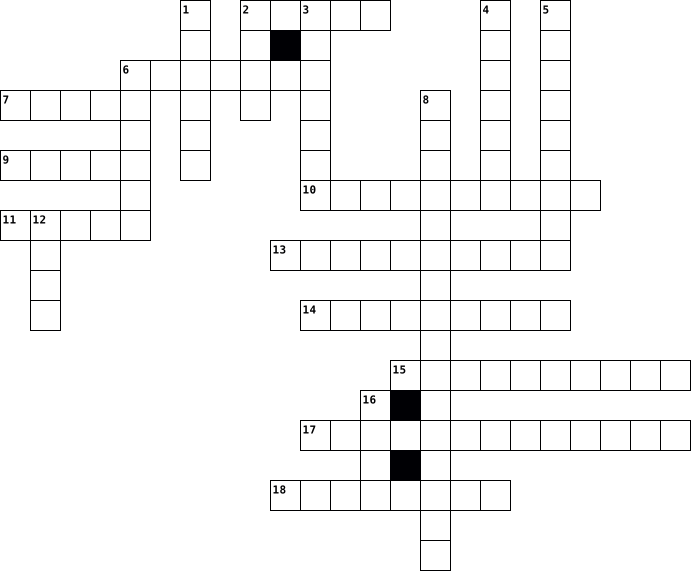
plate tectonics Crossword Puzzles
Makayla's VOCAB puzzle 2025-10-16

Across
- magma that reaches Earth's surface
- A liquid's resistance to flowing -or- the thickness of a liquid
- the process by which plate tectonics produces new oceanic lithosphere at ocean ridges
- the rigid outer part of the earth, consisting of the crust and upper mantle.
- loose particles created by weathering and erosion of rock
- rock formed from the weathered products of preexisting rocks that have been transported, deposited, compacted and cemented.
- A plate boundary where two plates move toward each other.
- a concentration of heat in the mantle capable of producing magma, which rises to Earth's surface
- the point on the Earth's surface directly above the focus of an earthquake
- the point beneath Earth's surface where rock breaks under stress and causes an earthquake
- A natural resource that can be replaced at the same or below rate at which the resource is consumed
- A plate boundary where two plates move past each other in opposite directions
- A natural resource that is consumed faster or above the rate in which it is replaced.
Down
- the point on the Earth's surface directly above the focus of an earthquake
- A body of molten rock found at depth, including any dissolved gases and crystals.
- A device that records ground movements caused by seismic waves as they move through Earth
- The soft upper layer of the mantle just below the lithosphere. Lithospheric plates float on top of it.
- vibrations that travel through Earth carrying the energy released during an earthquake
- A plate boundary where two plates move away from each other.
- the transportation of material by a mobile agent, such as wind, water, or ice
- a naturally occurring, inorganic solid that has a crystal structure and a definite chemical composition
- a rock formed by the crystallization of molten magma
- A naturally occurring solid mixture of one or more minerals or organic matter
- The process in which rock is broken down by chemical reactions; changes the rock's molecular composition
- rock formed by the alteration of preexisting, solid rock deep within the Earth by heat, pressure, and/or chemically active fluids
- The process in which rock is physically broken into smaller pieces; no change in rock composition.
26 Clues: magma that reaches Earth's surface • a rock formed by the crystallization of molten magma • loose particles created by weathering and erosion of rock • A plate boundary where two plates move toward each other. • A plate boundary where two plates move away from each other. • A liquid's resistance to flowing -or- the thickness of a liquid • ...
earth's layers crossword by: Abby 2021-05-17

Across
- The transfer of thermal energy inside the Earth and is the driving force for plate tectonics.
- The layer inside Earth between the mantle and inner core which is made up mostly of molten iron and nickel.
- The first layer of the continental crust which is made of granite like igneous rock.
- the outermost layer of the earth
- crust The thin part of the Earth's crust located under the oceans.
- The second layer of the continental crust made up of basalt rock.
- The innermost layer of the earth made of solid iron and nickel.
Down
- The outermost layer of Earth's surface which is rocky and solid and includes the rigid part of the upper mantle.
- The boundary between Earth's crust and mantle. It is also known as the "Moho."
- The thickest layer of Earth, under the crust, in which plate movement is generated.
10 Clues: the outermost layer of the earth • The innermost layer of the earth made of solid iron and nickel. • The second layer of the continental crust made up of basalt rock. • crust The thin part of the Earth's crust located under the oceans. • The boundary between Earth's crust and mantle. It is also known as the "Moho." • ...
Earth Layers 2021-09-02

Across
- Earth's thickest layer made of hot rock and is less dense than the core, less hot, and has less pressure on it
- A layer of molten (liquid-like) iron and nickel that surrounds the inner core of Earth
- Thin outermost layer of earth. Made up mainly of granite and basalt
- The makeup of something
- A dense sphere of solid iron and nickel at the center of the earth and has the highest temperature and most pressure
- How tightly packed the matter in a substance is
Down
- Current in Earth's mantle that transforms heat in Earth's interior and is the driving force for plate tectonics
- A measure of the amount of matter in an object
- Earthquakes and tectonic plate movement create seismic waves.
- The layer of the earth located at the center of the earth and in made of 2 parts
10 Clues: The makeup of something • A measure of the amount of matter in an object • How tightly packed the matter in a substance is • Earthquakes and tectonic plate movement create seismic waves. • Thin outermost layer of earth. Made up mainly of granite and basalt • The layer of the earth located at the center of the earth and in made of 2 parts • ...
Let's learn Earth & Space 2020-11-26

Across
- layer of earth.
- Method-method that is used to locate the epicenter of an earthquake.
- mantle.
- floor spreading-proccess which happens when ocean plates move apart and magma rises from the mantle and create new areas of oceanic crust.
- waves-A seismic wave that travels through the Earth rather than across
- the instrument used to mapped the mid-ocean ridges
- time-time difference between the P-waves and S-waves.
- type of plate boundary that are sliding past each other.
- layer of the earth where magma comes from.
- molten material that rises from the mantle to the crust.
- Convection- the very slow creeping motion of Earth's solid silicate mantle caused by convection currents carrying heat from the interior to the
- boundary between the crust and mantle, as inferred from
- change in the speed of body waves
- to through it.
- very large wave that is caused by earthquake.
- point within the Earth where the actual movement takes
- geologist who proposed the theory of sea-floor spreading.
- surface
- Plumes-an upwelling of superheated rock from the mantle.
- tectonics theory-a theory that states that the Earth's crust is divided into several plates.
- theory.
- Waves-A seismic wave that travels across the surface of the Earth as
- crust.
- one who made the continental
- arc-formed when two oceanic crusts collide.
- type of plate boundary that plates are moving away from each other.
Down
- an earthquake.
- surface.
- earthquake.
- point on the surface directly above the focus.
- process happens when the oceanic crust sinks beneath the continental crust.
- and S-waves at the surface of the Earth that move with a rolling motion.
- Drift Theory-a theory that states that there was a big continent before.
- recording device that is used to locate the earthqiake's epicenter.
- to be the supercontinent 250 million years ago.
- type of plate boundary that collides with each other.
- geologic feature that may form when plates are moving away from each other.
- Pull-other possible cause of plate movements which the weight of the subducting plate pulls the trailing slab into the subduction zone just like a tablecloth slipping off the table and pulling items with it.
- waves-A surface seismic wave generated by the interaction of P-
- Spot-a concentration of heat in the mantle capable of creating magma
- is formed when a continental plate and an ocean plate collides.
- ranges-a geologic feature that happens when two continental plates collide.
- waves-A wave of energy that travels through the Earth as a result of
- may happen during divergence or convergence of plates because of the movement of plates.
- Push-one of the possible cause of plate movements which the ridge pushes the old sea-floor towards the trench and it will subduct.
- valley-a geologic feature that happens when two continental plates move apart from each other.
- part of earth.
- waves-A surface seismic wave that cause horizontal shifting of the Earth
48 Clues: crust. • mantle. • surface • theory. • surface. • earthquake. • an earthquake. • to through it. • part of earth. • layer of earth. • one who made the continental • change in the speed of body waves • layer of the earth where magma comes from. • arc-formed when two oceanic crusts collide. • very large wave that is caused by earthquake. • point on the surface directly above the focus. • ...
Zoe's Science crossword 2021-04-19

Across
- The outer part of the earth, consisting of the crust and upper mantle.
- Waves surface seismic waves that cause horizontal shifting of the Earth during an earthquake
- An opening in the earth’s crust through which molten magma and gases erupt.
- The supercontinent
- boundaries an area on Earth where two or more lithospheric plates collide.
- core The center of the earth
- Group of volcanic islands formed from ocean crust convergence
- ductile region of the upper mantle of Earth.
- Waves are pressure waves that travel faster than other waves
- Convergent Two ocean plates collide and one goes under the other.
- crust Makes up less than 1% of the total volume of the earth.
Down
- Waves A type of seismic body wave in which rock particles vibrate at right angles to the direction of wave travel.
- Spots Not part of a plate boundary but has continual volcanic geothermic activity.
- Plates - regions of Earth's crust and upper mantle that are fractured into plates that move across a deeper plasticine mantle
- Drift The gradual movement of the continents across the earth.
- Tectonics The earth’s crust and upper mantle are broken into sections called plates.
- Zone A complex area which little is known about.
- an area of relatively level high ground.
- Waves type of surface wave that travels near the surface of solids
- Mantle Lies between Earth's dense, super-heated core and its thin outer layer, the crust.
20 Clues: The supercontinent • an area of relatively level high ground. • ductile region of the upper mantle of Earth. • core The center of the earth • Zone A complex area which little is known about. • Group of volcanic islands formed from ocean crust convergence • Waves are pressure waves that travel faster than other waves • ...
Geography 2016-04-12
Across
- batman has one as a secret lair
- an inorganic or non living natural solid compound
- hot liquid rock beneath earth's surface
- a fraction of earth's overall mass and the edges of bread
- the birth of mountains
- inclined surface also used to ski
- the denser one goes under
- measure of energy released from earthquake
- a shaking of the earth due to plate tectonics
- the study of earth's surface landforms
- a depression or something you can fall into
Down
- the big supercontinent believed to have existed once
- a third of the earth's mass but only a sixth of its volume and rhymes with shore
- an angry mountain that spews lava
- second most prevalent greenhouse gas produced by human activities and livestock
- rusting may make this familiar
- 80 percent of earth's total volume
- the study of earth's past climates and starts with a p
- rhymes with java
- assemblage of minerals bound together or Dwayne Johnson's wrestling name
20 Clues: rhymes with java • the birth of mountains • the denser one goes under • rusting may make this familiar • batman has one as a secret lair • an angry mountain that spews lava • inclined surface also used to ski • 80 percent of earth's total volume • the study of earth's surface landforms • hot liquid rock beneath earth's surface • measure of energy released from earthquake • ...
Science Lunar Cycle Project 2023-03-02

Across
- the force that attracts a body toward the center of the earth
- (in general use) weight.
- how many days does it take the moon to orbit earth?
- 1st and 3rd quarter
- is The only habitable planet
- break apart or becomes separated through faulting caused by plate tectonics.
- the state of the tide when at its lowest level.
- new and full moon
- of, determined by, or resembling the moon
- relating to the structure of the earth's crust and the large-scale processes which take place within it.
Down
- the alternate rising and falling of the sea, usually twice in each lunar day
- Which planet is the closest to the sun?
- Consistent weather
- something that repeated
- the state of the tide when at its highest level.
- revolves around Earth
- It causes seasons
- is the brightest star in our solar system
- It causes day and night
- Are on the periodic table
- How many planets are in our Solar System?
21 Clues: It causes seasons • new and full moon • Consistent weather • 1st and 3rd quarter • revolves around Earth • something that repeated • It causes day and night • (in general use) weight. • Are on the periodic table • is The only habitable planet • Which planet is the closest to the sun? • is the brightest star in our solar system • How many planets are in our Solar System? • ...
Earth Science 2025-12-17

Across
- Shaking of the ground.
- Vent for erupting magma.
- Rock formed from accumulation of particles.
- Process of moving sediment.
- Rock changed by heat and pressure.
- Molten rock found beneath the Earth's surface.
- Large wave caused by quake.
- Theory of moving plates.
- Solid with ordered atomic structure.
- Gas that blocks UV rays.
- Preserved remains of ancient organisms.
- Effect that traps heat.
- Layer containing ozone.
- Naturally occurring inorganic solid.
- Liquid turning to vapor.
Down
- Layer of gases surrounding Earth.
- The center of the Earth.
- All water on Earth.
- Breakdown of rocks.
- Magma that reaches the Earth's surface.
- Moving mass of ice.
- One plate moving under another.
- Rain, snow, sleet, or hail.
- Measures air pressure.
- Rock formed from cooling magma or lava.
- The outer layer of the Earth.
- Rigid outer part of the earth.
- Lowest atmospheric layer.
- The layer between the crust and core.
- Underground water layer.
30 Clues: All water on Earth. • Breakdown of rocks. • Moving mass of ice. • Shaking of the ground. • Measures air pressure. • Effect that traps heat. • Layer containing ozone. • Vent for erupting magma. • The center of the Earth. • Theory of moving plates. • Gas that blocks UV rays. • Liquid turning to vapor. • Underground water layer. • Lowest atmospheric layer. • Process of moving sediment. • ...
EARTH VOCAB 2026-01-07

Across
- Movement of magma in the mantle caused by temperature changes that move the lithospheric plates above
- The processes that change the surface of Earth through the movement of the lithospheric plates
- Rock that forms when existing rocks change due to heat and/or pressure
- Where two plates move together to form volcanoes, islands, and other large landforms
Down
- Rock that forms when pebbles, sand, shells, and other pieces are cemented together overtime
- When one tectonic plate pushes beneath another into the mantle where it melts
- When two plates separate causing seafloor spreading, creating chains and rifts
- Rock that forms when magma cools on the surface or underground
- When plates scrape past each causing strong earthquakes
- The formation of new areas of oceanic crust mid ocean ridges and its movement on either side
10 Clues: When plates scrape past each causing strong earthquakes • Rock that forms when magma cools on the surface or underground • Rock that forms when existing rocks change due to heat and/or pressure • When one tectonic plate pushes beneath another into the mantle where it melts • When two plates separate causing seafloor spreading, creating chains and rifts • ...
Tectonic Plates 2022-10-20

Across
- occurs when two plates collide at a convergent boundary, and one plate is driven beneath the other, back into the Earth's interior
- occurs when tectonic processes put stress on a rock, and the rock bends, instead of breaking.
- Steno A Danish scientist who studied the relative positions of sedimentary rocks.
- that separate igneous or metamorphic rocks from overlying sedimentary rocks.
- dating a method of arranging geological events based on the rock sequence.
- a layer or a series of layers of rock in the ground.
- are those where an older package of sediments has been tilted
- has a short half-life only 5,730 years.
- shift is the movement of the plates that make up Earth crust
- dating a method used to determine the age of rocks by measuring its radioactive decay
Down
- refer to faults that are formed by shearing as transfirm faults in the ocean
- age of rocks are determined by?
- Slide past each other
- rocks are the most common rocks exposed on Earth's surface
- slight changes in particle size or composition result in the formation of layers, also called?
- a gap in the sequence of rock layers is called an
- tectonics is the scientific theory explaining the movement of the earth’s crust
- folds shaped like an arch
- when two continental plates are shoved together
- is the process that turns sediment into rock.
20 Clues: Slide past each other • folds shaped like an arch • age of rocks are determined by? • has a short half-life only 5,730 years. • is the process that turns sediment into rock. • when two continental plates are shoved together • a gap in the sequence of rock layers is called an • a layer or a series of layers of rock in the ground. • ...
Plate Tectonics pt. 1 Vocab 2024-03-04

Across
- a vent or fissure in the Earth's surface through which magma and gasses are expelled
- under the crust where it is hot and rock begins to melt, move and shift
- a crack in rock (or the Earth's crust) where movement can happen
- where 2 tectonic plates move towards each other
- plate material containing less dense granite usually underground on our continental land
- the movement of bedrock caused by plates getting suck on each other and then roughly moving past each other
- point on Earth's surface directly above an earthquake's focus
- downward measurement from a surface
- where 2 tectonic plates slide past each other
Down
- where 2 tectonic plates move away from each other
- the section of the crust between earthquake lines
- the measure of the energy released during an earthquake
- liquidy rock found below or within the Earth's crust
- the surface of the Earth
- how deep, or how far down into the Earth an earthquake is occuring
- liquidy rock that flows out of a volcano onto the Earth's surface
- plate material containing denser basalt rock that is usually found under the ocean
17 Clues: the surface of the Earth • downward measurement from a surface • where 2 tectonic plates slide past each other • where 2 tectonic plates move towards each other • where 2 tectonic plates move away from each other • the section of the crust between earthquake lines • liquidy rock found below or within the Earth's crust • ...
Earth Science 2024-01-11

Across
- The alteration of rocks through changes in temperature, pressure, or mineral composition, often occurring deep within the Earth's crust
- The vertical elevation of Earth's surface, often associated with tectonic processes
- The process by which eroded materials settle or come to rest, leading to the formation of new landforms
- The accumulation and settling of sediments, typically in bodies of water, leading to the formation of sedimentary rocks
- Current era, marked by flourishing mammalian dominance and notable ice age episodes
- The eruption of molten rock, ash, and gases from the Earth's interior, often resulting in the formation of volcanic landforms
- The gradual wearing away of the Earth's surface by natural forces, such as wind, water, or ice
- Large-scale movements and deformation of the Earth's crust, often associated with plate tectonics
- The process of ice formation, movement, and melting, shaping landscapes through the action of glaciers
- A raised block of the Earth's crust lying between two fault lines
- The study of the Earth's lithosphere and the large-scale processes that shape it, including plate movements
Down
- The longest geological era, encompassing the time from Earth's formation to the beginning of the Paleozoic era
- Pre-Phanerozoic era, marked by diverse eukaryotes and a substantial surge in atmospheric oxygen
- The sinking or downward displacement of a part of the Earth's crust
- The breakdown of rocks into smaller particles through physical, chemical, or biological processes
- The bending or curving of rock layers due to compressional forces in the Earth's crust
- The physical and chemical changes that occur in sediments after deposition but before lithification, transforming them into sedimentary rocks
- Era of abundant life, three distinct periods, characterized by the Cambrian Explosion - a pivotal phase marked by a rapid diversification of complex life forms
- The lateral movement of rock masses along a fault, usually in opposite horizontal directions
- The breaking and movement of rock along fractures in the Earth's crust
- The balancing of the Earth's lithosphere on the denser, semi-fluid asthenosphere
- A block of the Earth's crust that has dropped relative to the blocks on either side, forming a depressed structure
- Dominance of dinosaurs, comprising the Triassic, Jurassic, and Cretaceous periods
- processes, Formation of rocks from molten magma, involving cooling and solidification
- Faulting, A type of fault where rocks are pushed over each other at a low angle
25 Clues: A raised block of the Earth's crust lying between two fault lines • The sinking or downward displacement of a part of the Earth's crust • The breaking and movement of rock along fractures in the Earth's crust • Faulting, A type of fault where rocks are pushed over each other at a low angle • ...
Pink Q3W1 Crossword 2024-12-18

Across
- A crack in Earth's crust where two plates meet and move
- Tectonics The scientific idea that Earth's surface is made of plates that move.
- The layer of solid rock under Earth's crust.
- A deep valley in the ocean floor where one plate goes under another.
Down
- A crack or split in Earth's crust where the plates are pulling apart
- The hard, outer layer of Earth that includes the crust and the upper part of the mantle.
6 Clues: The layer of solid rock under Earth's crust. • A crack in Earth's crust where two plates meet and move • A crack or split in Earth's crust where the plates are pulling apart • A deep valley in the ocean floor where one plate goes under another. • Tectonics The scientific idea that Earth's surface is made of plates that move. • ...
Jamille Gargoles’ Crossword Puzzle 2024-10-07

Across
- Molten rock that erupts from a volcano
- The scale used to measure the magnitude of earthquakes
- A type of volcano characterized by gentle slopes and lava flows
- The process of molten rock rising to the surface
- A type of volcano that erupts explosively
- A tectonic plate boundary where plates collide
- A boundary where two tectonic plates move apart
- The movement of tectonic plates
- A seismic wave that travels through the Earth
Down
- The fast-moving mixture of gas and volcanic material that flows down a volcano
- The layer of the Earth beneath the crust
- The molten rock beneath the Earth’s surface
- The boundary where two tectonic plates meet
- The scientific study of earthquakes
- The hot, semi-fluid rock in the Earth’s mantle
- The outermost layer of the Earth, where tectonic plates are located
- The solid outer layer of the Earth
17 Clues: The movement of tectonic plates • The solid outer layer of the Earth • The scientific study of earthquakes • Molten rock that erupts from a volcano • The layer of the Earth beneath the crust • A type of volcano that erupts explosively • The molten rock beneath the Earth’s surface • The boundary where two tectonic plates meet • A seismic wave that travels through the Earth • ...
Science Vocab 2025-10-27

Across
- boundaries- The boundary between two plates that slide past each other
- boundary- The boundary between two plates that move away from each other.
- The moving of weathered material, or sediment, from one location to another
- The process in which the weight of the layers of sediment force out fluids and decreases the space between sediment grains
- The mechanical and chemical process that change Earth's surface over time
- drift - Wegener's hypothesis that all continents were once connected in a single large landmass that broke apart about 200 million years ago and drifted slowly to their current positions.
- The laying down or settling of eroded material
- rock- igneous rock that forms as magma that cools underground
- A naturally occurring solid composed of minerals, rock fragments, and sometimes other materials such as organic matter
Down
- The process that occurs when one tectonic plate moves under another tectonic plate
- rock- igneous rock that forms when volcanic material erupts, cools, and crystallizes on Earth's surface.
- tectonics - Theory that Earth's surface is broken into large rigid pieces that move with respect to each other
- a process in which minerals dissolved in water crystallize between sediment grains.
- the process through which sediment turns into rock
- boundary - The boundary between two plates that move toward each other
- a naturally occurring, inorganic solid that has a crystal structure and a definite chemical composition
- cycle- the series of processes that change one type of rock into another type of rock
- spreading -The process by which new oceanic crust forms along a mid-ocean ridge and older oceanic crust moves away from the ridge.
18 Clues: The laying down or settling of eroded material • the process through which sediment turns into rock • rock- igneous rock that forms as magma that cools underground • boundaries- The boundary between two plates that slide past each other • boundary - The boundary between two plates that move toward each other • ...
Earthquakes 2019-04-04

Across
- Measures size of seismic waves during an earthquake.
- Scale used to measure the amount of damage caused by earthquakes.
- Sudden shockwave caused by plate tectonics being under stress.
- Records earth movements.
Down
- A scale on a graph where the numbers increase exponentially.
- The region where two or more tectonic plates meet.
- Scale that was used to measure the power of earthquakes.
- The point on the Earth's surface directly above the focus of an earthquake.
8 Clues: Records earth movements. • The region where two or more tectonic plates meet. • Measures size of seismic waves during an earthquake. • Scale that was used to measure the power of earthquakes. • A scale on a graph where the numbers increase exponentially. • Sudden shockwave caused by plate tectonics being under stress. • ...
Plate Tectonics Vocab 2025-01-15

Across
- Canadian Scientist who developed the theory of plate tectonics
- Proposed the theory of sea-floor spreading
- The man who investigated continental drift
Down
- Creates new ocean floor at mid-ocean ridges
- A supercontinent, containing all of Earth's land together
- Circular currents in the mantle caused by magma
6 Clues: Proposed the theory of sea-floor spreading • The man who investigated continental drift • Creates new ocean floor at mid-ocean ridges • Circular currents in the mantle caused by magma • A supercontinent, containing all of Earth's land together • Canadian Scientist who developed the theory of plate tectonics
green sheet 2023-09-03

Across
- field - The area of magnetic force around a magnet
- crust - The portion of the earth's crust that primarily contains basalt, is more dense than continental crust, and is about 6 - 7 km thick.
- - A dark, dense, igneous rock with a fine texture, found in oceanic crust.
- ridge - An undersea mountain chain where new ocean floor is produced, a divergent plate boundary.
- spreading - The process that creates new sea floor as plates move away from each other at the mid-ocean ridges.
- trench - a deep valley along the ocean floor through which oceanic crust slowly sinks towards the mantle in a process known as subduction.
- - The preserved remains or traces of an organism that lived in the past.
- plates - Sections of the Earth's crust that move due to convection currents.
Down
- crust - The portion of the earth's crust that primarily contains granite, is less dense than oceanic crust, and is 20-50 km thick.
- - A supercontinent containing all of Earth's land that existed about 225 million years ago.
- drift - The hypothesis that states that the continents once formed a single landmass, broke up, and drifted to their present locations.
- - A usually light-colored igneous rock that is found in continental crust.
- - The process by which oceanic crust sinks beneath a deep-ocean trench and back into the mantle at a convergent plate boundary.
- of Plate Tectonics - A theory stating that Earth's lithosphere is broken into huge plates that move and change in size over time.
- Hess - Proposed the theory of seafloor spreading.
- Wegener - A German scientist who proposed the theory of continental drift.
16 Clues: Hess - Proposed the theory of seafloor spreading. • field - The area of magnetic force around a magnet • - The preserved remains or traces of an organism that lived in the past. • - A usually light-colored igneous rock that is found in continental crust. • - A dark, dense, igneous rock with a fine texture, found in oceanic crust. • ...
Science Vocab 2025-10-28

Across
- naturally occurring solid composed of minerals, rock fragments, and sometimes other materials such as organic matter.
- laying down or seducing of eroded material.
- Rock-Igneous rock that forms as magma cools underground.
- process in which minerals dissolved in water crystallize between sediment grains.
- Tectonics-Theory that Earth’s surface is broken into large, ridged pieces that move with respect for each other.
- moving of one material or sediment from one location to another.
- Rock-Ignerious rock that forms when volcanic material erupts, cools, and crystalizes on Earth’s surface.
- cycle-The series of process that change one type of rock into another type of rock.
- naturally occurring, inorganic solid that has a crystal structure and a definite chemical composition.
- process that occurs when one tectonic plate moves under the another tectonic plate.
Down
- process in which the weight from the layers of sediment forces out fluids and decreases the space between the sediment grains.
- process through which sediment turns into rock.
- Drift-Wegener’s hypothesis that all continents were once connected in a single large landmass that broke apart about 200 million years ago and drifted slowly to their current positions.
- Boundary-The boundary between two plates that move away from each other.
- Boundary-The boundary between two plates that move toward each other.
- Boundaries-The boundary between two plates that slide past each other.
- mechanical and chemical process that change Earth;s surface over time.
- Spreading-the process by which new oceanic crust forms along a mid-ocean ridge and older oceanic crust moves away from the ridge.
18 Clues: laying down or seducing of eroded material. • process through which sediment turns into rock. • Rock-Igneous rock that forms as magma cools underground. • moving of one material or sediment from one location to another. • Boundary-The boundary between two plates that move toward each other. • Boundaries-The boundary between two plates that slide past each other. • ...
Layers of the earth 2021-10-20

Across
- thin uppermost layer found under the oceans.
- the outermost layer of earth, made up of igneous,metamorphic,and sedimentary rocks.
- Always stays a solid, made up of iron is also really hot.
- lubricates plate tectonics
- the most solid and bulky part of earths interior.
Down
- Consist of the mountains,rocks,top soil,stones and sand.
- made up of granitic,sedimentary,and metamorphic rocks,5-10 km thick
- 1,355 miles thick 4th layer in earth.
8 Clues: lubricates plate tectonics • 1,355 miles thick 4th layer in earth. • thin uppermost layer found under the oceans. • the most solid and bulky part of earths interior. • Consist of the mountains,rocks,top soil,stones and sand. • Always stays a solid, made up of iron is also really hot. • made up of granitic,sedimentary,and metamorphic rocks,5-10 km thick • ...
Dynamic Earth Crossword 2023-05-19

Across
- The last name of the meteorologist who proposed the "Theory of Plate Tectonics"
- The maori name for volcano
- Thickest layer of the earth
- The maori word for tsunami
- These boundaries occur when two plates slide past each other
- The point directly above the focus on the earths surface
- Natural disaster that can occur after an earthquake
Down
- Instrument used to record seismic waves from earthquakes
- The channel or pipe that carries magma from a reservoir or chamber to the vent where it is erupted
- The maori name for White Island
- Outermost layer of the earth
- The ring of what is the region where many earthquakes, volcanoes and tsunamis occur
- The outer layer of the earths's surface
13 Clues: The maori name for volcano • The maori word for tsunami • Thickest layer of the earth • Outermost layer of the earth • The maori name for White Island • The outer layer of the earths's surface • Natural disaster that can occur after an earthquake • Instrument used to record seismic waves from earthquakes • The point directly above the focus on the earths surface • ...
Natural Systems Crossword 2013-11-04

Across
- Rock Rock formed from consolidated clay sediments
- Rock Rock formed by the solidification of molten magma
- The daily conditions of temperature, precipitation, wind, humidity, and cloud in the atmosphere.
- Weather conditions at a certain place or region averaged over a long period of time.
- Tectonics The study of plate movements to understand the formation of mountains, volcanoes, and earthquakes.
- was a supercontinent that existed during the late Paleozoic and early Mesozoic eras, forming about 300 million years ago
Down
- Glacier A glacier that spreads out from a central mass of ice.
- zone A large geographical area in which human activities interact with the natural world.
- Rock Rock altered by pressure and heat.
- Season The average period of the year during in which temperatures are higher than 6 Celsius (the temperature at which plants grow)
- Glacier A glacier that moves down from a high valley.
- A slowly moving mass or river of ice formed by the accumulation and compaction of snow on mountains.
- Hot molten or semi-fluid rock erupted from a volcano.
13 Clues: Rock Rock altered by pressure and heat. • Rock Rock formed from consolidated clay sediments • Glacier A glacier that moves down from a high valley. • Hot molten or semi-fluid rock erupted from a volcano. • Rock Rock formed by the solidification of molten magma • Glacier A glacier that spreads out from a central mass of ice. • ...
Terrestrial Planets 2024-04-19

Across
- The classification given to the four outermost planets which retained large amounts of hydrogen, helium, and other light elements in gas form
- The coming together and cohesion of matter under the influence of gravitation to form larger bodies
- area under the rocky layer of crust where magma is hotter than surrounding magma
- plate boundary where oceanic crust descends beneath a plate with thicker crust
- A stream of charged particles radiating outward from the sun at high speed
Down
- the classification given to the four innermost planets composed mostly of metals and silicate rocks
- The giant canyon on Mars approximately 10 times longer and six times wider than the Grand Canyon
- the largest plain, crowned by the largest mountain on Mars
- The process by which hydrogen is converted to helium in the core of a star
- The speed a particle needs to reach to leave a planet's gravity
- source of the Earth's internal energy based on unstable isotopes
- term used to describe venusian tectonics because it is dominated by the rising and sinking of its mantle and crust
- The largest mountain in the solar system
13 Clues: The largest mountain in the solar system • the largest plain, crowned by the largest mountain on Mars • The speed a particle needs to reach to leave a planet's gravity • source of the Earth's internal energy based on unstable isotopes • The process by which hydrogen is converted to helium in the core of a star • ...
Terrestrial Planets 2024-04-19

Across
- The process by which hydrogen is converted to helium in the core of a star
- The largest mountain in the solar system
- the classification given to the four innermost planets composed mostly of metals and silicate rocks
- The classification given to the four outermost planets which retained large amounts of hydrogen, helium, and other light elements in gas form
- the largest plain, crowned by the largest mountain on Mars
- term used to describe venusian tectonics because it is dominated by the rising and sinking of its mantle and crust
- source of the Earth's internal energy based on unstable isotopes
Down
- plate boundary where oceanic crust descends beneath a plate with thicker crust
- area under the rocky layer of crust where magma is hotter than surrounding magma
- A stream of charged particles radiating outward from the sun at high speed
- The speed a particle needs to reach to leave a planet's gravity
- The giant canyon on Mars approximately 10 times longer and six times wider than the Grand Canyon
- The coming together and cohesion of matter under the influence of gravitation to form larger bodies
13 Clues: The largest mountain in the solar system • the largest plain, crowned by the largest mountain on Mars • The speed a particle needs to reach to leave a planet's gravity • source of the Earth's internal energy based on unstable isotopes • The process by which hydrogen is converted to helium in the core of a star • ...
EARTHQUAKES 2022-11-02

Across
- WAVES, SHOCK WAVES FROM AN EARTHQUAKE THAT TRAVEL THROUGH THE GROUND
- LINES, ARE AREAS OF STRESS IN THE EARTH
- RING OF FIRE IS THE, HOTZONE
- TECTONICS, ARE WHERE CONTINENTS MOVE FROM ONE PLACE TO THE NEXT THAT BRAKE APART CRASHING INTO EACH OTHER
- SMALLER EARTHQUAKES THAT HAPPENS BEFORE LARGE EARTHQUAKE
- IS A MACHINE USED TO MEASURE STRENGTH AND LENGTH OF AN EATHQUAKE
- HAD THE MOST POWERFUL EARTHQUAKE
- TELLS WHAT SIZE THE WAVE IS
- IS WHERE THE EARTHQUAKE STARTS BELOW THE SURFACE OF THE EARTH
Down
- ARE SUDDEN AND QUICK SHOCK OF THE EARTH'S SURFACE
- SMALLER EARTHQUAKE THAT HAPPENS AFTER A LARGE EARTHQUAKE
- PLACE DIRECTLY AOUVE THIS ONTHE SURFACE IS CALLED, EPICENTER
- MAGNITUDE SCALE, TELLS THE STRENGHT OF AN EARTHQUAKE
- SCALE MESSURE, THE STRENGTH OF AN EARTHQUAKE
- CAN TRAVEL THROUGH BOTH SOLID AND LIQUID
15 Clues: TELLS WHAT SIZE THE WAVE IS • RING OF FIRE IS THE, HOTZONE • HAD THE MOST POWERFUL EARTHQUAKE • LINES, ARE AREAS OF STRESS IN THE EARTH • CAN TRAVEL THROUGH BOTH SOLID AND LIQUID • SCALE MESSURE, THE STRENGTH OF AN EARTHQUAKE • ARE SUDDEN AND QUICK SHOCK OF THE EARTH'S SURFACE • MAGNITUDE SCALE, TELLS THE STRENGHT OF AN EARTHQUAKE • ...
Climate Change 2023-10-20

Across
- A warming of the lower atmosphere caused by certain gases
- Plate tectonics and volcanic eruptions are _______.
- Coal, oil and natural gas are
- This greenhouse gas comes from cows
- Low amounts of carbon dioxide in the atmosphere can cause cooling events called
- Carbon dioxide and water vapor are ___________.
- Since 1880 Earth's temperature and carbon dioxide levels have been
Down
- These come from Antarctica and look like glass rods and contain air bubbles.
- Humans eat too much ______ like cows, pigs and chickens.
- Global warming is caused by ____ _____ such as burning fossil fuels and cutting down trees
- Scientists learn about Earth's past climates through tree rings, ice cores and
- This is a sudden or gradual change in Earth’s climate.
- Large __________ eruptions can either or warm Earth
- The increase in Earth's average temperature
14 Clues: Coal, oil and natural gas are • This greenhouse gas comes from cows • The increase in Earth's average temperature • Carbon dioxide and water vapor are ___________. • Plate tectonics and volcanic eruptions are _______. • Large __________ eruptions can either or warm Earth • This is a sudden or gradual change in Earth’s climate. • ...
vocab words 2023-09-10

Across
- the process by which the oceanic crust sinks beneath a deep-ocean trench
- of plate tectonics a theory stating that Earth's lithosphere is broken into huge plates
- trench a deep valley along the ocean floor
- crust is 6-7 km thick
- oceanic crust is made up of this
Down
- continental crust is made up of this
- ridge an undersea mountain chain where new ocean floor is produced
- crust a crust 20-50 km thick
8 Clues: crust is 6-7 km thick • crust a crust 20-50 km thick • oceanic crust is made up of this • continental crust is made up of this • trench a deep valley along the ocean floor • ridge an undersea mountain chain where new ocean floor is produced • the process by which the oceanic crust sinks beneath a deep-ocean trench • ...
Ch. 7 Crossword Puzzle 2021-02-08

Across
- rising regions of te Earth's crust to higher elevations
- boundary- boundary between 2 tectonic plates moving away from each other
- plates- a block of lithosphere tha consists of the crust and the rigid, outer part of the mantle
- thin and solid outermost layer
- the strong, lower part of the mantle below
- stress that occurs when forces act to squeeze an object
- boundary- the boundary formed by a collsion of two lithosphereic plates
- tectonics- the theory that large pieces of land move
Down
- the sinking of regions of Earth's crust to lower elevations
- stress that occurs when forces act to squeeze an object
- and the outer core
- central part of the Earth, below the mantle
12 Clues: and the outer core • thin and solid outermost layer • the strong, lower part of the mantle below • central part of the Earth, below the mantle • tectonics- the theory that large pieces of land move • stress that occurs when forces act to squeeze an object • rising regions of te Earth's crust to higher elevations • stress that occurs when forces act to squeeze an object • ...
25-26 ESci Final Review 2026-06-02

Across
- Earth's spinning motion on its axis
- Preserved remains or traces of ancient organisms
- Fracture in Earth's crust where movement has occurred
- Plate boundary where plates move apart
- Transfer of heat through the movement of material in the mantle
- Naturally occurring inorganic solid with a definite chemical composition and crystal structure
- Rigid outer layer consisting of the crust and upper mantle
- Icy body that develops a tail when near the Sun
- Distance light travels in one year
- Process that glues sediments together into rock
- Process that creates new ocean crust at mid-ocean ridges
- Mineral that splits into thin flexible sheets
- Most abundant mineral group in Earth's crust
- Process in which sediments are dropped in a new location
- Scientist who proposed the theory of continental drift
- Plate boundary where plates slide past one another
- Average distance between Earth and the Sun
- Study of magnetic patterns preserved in ocean-floor rocks
- Naturally occurring solid made of one or more minerals
- Zone of frequent earthquakes and volcanoes around the Pacific Ocean
- Sudden shaking caused by movement along faults
Down
- Soft, plastic-like layer beneath the lithosphere
- Fine-grained extrusive igneous rock common in ocean crust
- Rocky object orbiting the Sun, usually between Mars and Jupiter
- Lightweight igneous rock full of gas bubbles
- Plate boundary where plates move toward each other
- Process in which one tectonic plate sinks beneath another
- Process that breaks rocks into smaller pieces
- Movement of weathered material from one place to another
- Earth's movement around the Sun
- Common rock-forming mineral containing silicon and oxygen
- Streak of light produced when a meteoroid enters Earth's atmosphere
- Metamorphic rock formed from shale
- Metamorphic rock formed from limestone
- Rock formed from cooling magma or lava
- Process that squeezes sediments together
- Volcanic glass formed by rapid cooling
- Rock formed from compacted sediments or chemical precipitation
- Molten rock that reaches Earth's surface
- Sedimentary rock often formed from marine organisms. Caves are commonly formed from this rock.
- Banded metamorphic rock formed under intense heat and pressure
- Plate ____________- Study of the movement and deformation of Earth's crust
- Scientist who proposed sea-floor spreading
- Rock changed by heat, pressure, or hot fluids
- Deep depression formed where one plate subducts beneath another
- Underwater mountain chain formed at divergent boundaries
- Molten rock beneath Earth's surface
- Coarse-grained intrusive igneous rock. What continents are made of.
- Ancient supercontinent that existed about 250 million years ago
49 Clues: Earth's movement around the Sun • Metamorphic rock formed from shale • Distance light travels in one year • Earth's spinning motion on its axis • Molten rock beneath Earth's surface • Plate boundary where plates move apart • Metamorphic rock formed from limestone • Rock formed from cooling magma or lava • Volcanic glass formed by rapid cooling • ...
EARTHQUAKES 2022-11-02

Across
- WAVES, SHOCK WAVES FROM AN EARTHQUAKE THAT TRAVEL THROUGH THE GROUND
- LINES, ARE AREAS OF STRESS IN THE EARTH
- RING OF FIRE IS THE, HOTZONE
- TECTONICS, ARE WHERE CONTINENTS MOVE FROM ONE PLACE TO THE NEXT THAT BRAKE APART CRASHING INTO EACH OTHER
- SMALLER EARTHQUAKES THAT HAPPENS BEFORE LARGE EARTHQUAKE
- IS A MACHINE USED TO MEASURE STRENGTH AND LENGTH OF AN EATHQUAKE
- HAD THE MOST POWERFUL EARTHQUAKE
- TELLS WHAT SIZE THE WAVE IS
- IS WHERE THE EARTHQUAKE STARTS BELOW THE SURFACE OF THE EARTH
Down
- ARE SUDDEN AND QUICK SHOCK OF THE EARTH'S SURFACE
- SMALLER EARTHQUAKE THAT HAPPENS AFTER A LARGE EARTHQUAKE
- PLACE DIRECTLY AOUVE THIS ONTHE SURFACE IS CALLED, EPICENTER
- MAGNITUDE SCALE, TELLS THE STRENGHT OF AN EARTHQUAKE
- SCALE MESSURE, THE STRENGTH OF AN EARTHQUAKE
- CAN TRAVEL THROUGH BOTH SOLID AND LIQUID
15 Clues: TELLS WHAT SIZE THE WAVE IS • RING OF FIRE IS THE, HOTZONE • HAD THE MOST POWERFUL EARTHQUAKE • LINES, ARE AREAS OF STRESS IN THE EARTH • CAN TRAVEL THROUGH BOTH SOLID AND LIQUID • SCALE MESSURE, THE STRENGTH OF AN EARTHQUAKE • ARE SUDDEN AND QUICK SHOCK OF THE EARTH'S SURFACE • MAGNITUDE SCALE, TELLS THE STRENGHT OF AN EARTHQUAKE • ...
EARTHQUAKES 2022-11-02

Across
- RING OF FIRE IS THE, HOTZONE
- TECTONICS, ARE WHERE CONTINENTS MOVE FROM ONE PLACE TO THE NEXT THAT BRAKE APART CRASHING INTO EACH OTHER
- CAN TRAVEL THROUGH BOTH SOLID AND LIQUID
- LINES, ARE AREAS OF STRESS IN THE EARTH
- IS WHERE THE EARTHQUAKE STARTS BELOW THE SURFACE OF THE EARTH
- HAD THE MOST POWERFUL EARTHQUAKE
- IS A MACHINE USED TO MEASURE STRENGTH AND LENGTH OF AN EATHQUAKE
- TELLS WHAT SIZE THE WAVE IS
- MAGNITUDE SCALE, TELLS THE STRENGHT OF AN EARTHQUAKE
Down
- ARE SUDDEN AND QUICK SHOCK OF THE EARTH'S SURFACE
- SMALLER EARTHQUAKE THAT HAPPENS AFTER A LARGE EARTHQUAKE
- SMALLER EARTHQUAKES THAT HAPPENS BEFORE LARGE EARTHQUAKE
- PLACE DIRECTLY AOUVE THIS ONTHE SURFACE IS CALLED, EPICENTER
- SCALE MESSURE, THE STRENGTH OF AN EARTHQUAKE
- WAVES, SHOCK WAVES FROM AN EARTHQUAKE THAT TRAVEL THROUGH THE GROUND
15 Clues: TELLS WHAT SIZE THE WAVE IS • RING OF FIRE IS THE, HOTZONE • HAD THE MOST POWERFUL EARTHQUAKE • LINES, ARE AREAS OF STRESS IN THE EARTH • CAN TRAVEL THROUGH BOTH SOLID AND LIQUID • SCALE MESSURE, THE STRENGTH OF AN EARTHQUAKE • ARE SUDDEN AND QUICK SHOCK OF THE EARTH'S SURFACE • MAGNITUDE SCALE, TELLS THE STRENGHT OF AN EARTHQUAKE • ...
EARTHQUAKES 2022-11-02

Across
- RING OF FIRE IS THE, HOTZONE
- TECTONICS, ARE WHERE CONTINENTS MOVE FROM ONE PLACE TO THE NEXT THAT BRAKE APART CRASHING INTO EACH OTHER
- CAN TRAVEL THROUGH BOTH SOLID AND LIQUID
- LINES, ARE AREAS OF STRESS IN THE EARTH
- IS WHERE THE EARTHQUAKE STARTS BELOW THE SURFACE OF THE EARTH
- HAD THE MOST POWERFUL EARTHQUAKE
- IS A MACHINE USED TO MEASURE STRENGTH AND LENGTH OF AN EATHQUAKE
- TELLS WHAT SIZE THE WAVE IS
- MAGNITUDE SCALE, TELLS THE STRENGHT OF AN EARTHQUAKE
Down
- ARE SUDDEN AND QUICK SHOCK OF THE EARTH'S SURFACE
- SMALLER EARTHQUAKE THAT HAPPENS AFTER A LARGE EARTHQUAKE
- SMALLER EARTHQUAKES THAT HAPPENS BEFORE LARGE EARTHQUAKE
- PLACE DIRECTLY AOUVE THIS ONTHE SURFACE IS CALLED, EPICENTER
- SCALE MESSURE, THE STRENGTH OF AN EARTHQUAKE
- WAVES, SHOCK WAVES FROM AN EARTHQUAKE THAT TRAVEL THROUGH THE GROUND
15 Clues: TELLS WHAT SIZE THE WAVE IS • RING OF FIRE IS THE, HOTZONE • HAD THE MOST POWERFUL EARTHQUAKE • LINES, ARE AREAS OF STRESS IN THE EARTH • CAN TRAVEL THROUGH BOTH SOLID AND LIQUID • SCALE MESSURE, THE STRENGTH OF AN EARTHQUAKE • ARE SUDDEN AND QUICK SHOCK OF THE EARTH'S SURFACE • MAGNITUDE SCALE, TELLS THE STRENGHT OF AN EARTHQUAKE • ...
Vocab day 2 2024-06-14

Across
- drifting of the land
- German climatologist, geologist, geophysicist, meteorologist, and polar researcher
- invisible without a microscope
- geological process in which the oceanic lithosphere and some continental lithosphere is recycled into the Earth's mantle
- bizarre fossils whose biological origins were debated until only a few decades ago
- another word to call a living creature
- earths mega structure of land
Down
- a type of gas that was abundant is early earth history
- weather in an area
- seafloor mountain system formed by plate tectonics
- the bottom of the sea
- phylum of autotrophic gram-negative bacteria that can obtain biological energy via oxygenic photosynthesis
- remains of a dead organism preserved over time
- cells that have specific structures and functions in the body
14 Clues: weather in an area • drifting of the land • the bottom of the sea • earths mega structure of land • invisible without a microscope • another word to call a living creature • remains of a dead organism preserved over time • seafloor mountain system formed by plate tectonics • a type of gas that was abundant is early earth history • ...
Continental Drift 2024-11-11

Across
- What is the semi-fluid layer beneath the lithosphere called?
- What discovery later helped to validate Wegener’s theory of continental drift?
- What term describes the movement of continents over Earth's surface?
- What theory explains the movement of Earth's outer shell into plates?
- What is Earth's outer shell, divided into moving plates?
- What is the hypothesis stating that continents have shifted over time?
- What lies beneath tectonic plates and is denser than the plates themselves?
- What type of evidence includes similar rock formations and fossils across continents?
Down
- What was the supercontinent called, which existed 300 million years ago?
- Who proposed the theory of continental drift?
- What occurs at tectonic plate borders?
- What process causes tectonic plates to move over time?
- What is the gradual movement of tectonic plates over millions of years called?
- How many tectonic plates are on Earth?
- What drives convection currents in the mantle?
15 Clues: What occurs at tectonic plate borders? • How many tectonic plates are on Earth? • Who proposed the theory of continental drift? • What drives convection currents in the mantle? • What process causes tectonic plates to move over time? • What is Earth's outer shell, divided into moving plates? • What is the semi-fluid layer beneath the lithosphere called? • ...
Continental Drift 2024-11-11

Across
- What is the semi-fluid layer beneath the lithosphere called?
- What discovery later helped to validate Wegener’s theory of continental drift?
- What term describes the movement of continents over Earth's surface?
- What theory explains the movement of Earth's outer shell into plates?
- What is Earth's outer shell, divided into moving plates?
- What is the hypothesis stating that continents have shifted over time?
- What lies beneath tectonic plates and is denser than the plates themselves?
- What type of evidence includes similar rock formations and fossils across continents?
Down
- What was the supercontinent called, which existed 300 million years ago?
- Who proposed the theory of continental drift?
- What occurs at tectonic plate borders?
- What process causes tectonic plates to move over time?
- What is the gradual movement of tectonic plates over millions of years called?
- How many tectonic plates are on Earth?
- What drives convection currents in the mantle?
15 Clues: What occurs at tectonic plate borders? • How many tectonic plates are on Earth? • Who proposed the theory of continental drift? • What drives convection currents in the mantle? • What process causes tectonic plates to move over time? • What is Earth's outer shell, divided into moving plates? • What is the semi-fluid layer beneath the lithosphere called? • ...
rocks 2016-06-09

Across
- high amounts of this are caused by layers of rock pushing down
- the building up of rock in an area, usually the sea
- type of rock made from magma or lava, contains crystals
- the breaking down of rock into smaller pieces
- a rock made by layers of sediment buried on the sea floor
- molten rock above the earth's surface
Down
- the russian scientist who came up with the theory of plate tectonics
- the outside layer of the earth
- these can be big or small depending on how quickly the rock has cooled
- rock created by high temperature and pressure
- the movement of weathered rock from one place to another
- small grains of rock
- the inner part of the earth
- the crust is made of several of these plates
- molten rock inside the earth
15 Clues: small grains of rock • the inner part of the earth • molten rock inside the earth • the outside layer of the earth • molten rock above the earth's surface • the crust is made of several of these plates • rock created by high temperature and pressure • the breaking down of rock into smaller pieces • the building up of rock in an area, usually the sea • ...
DynamicEarth 2017-10-26

Across
- Sections of the crust move relative to each other.
- Plates that slide against each other.
- Plates that push away from each other.
- Data recorded by a seismograph.
- Map that shows the details of Earth.
Down
- Underwater mountain range, formed by plate tectonics.
- a fluid layer of earth mostly made of iron and nickel.
- Two tectonic plates interact, there are three types.
- A mathematical analysis for length, mass, etc.
- Where the hanging wall has moved upward relative to the footwall.
- Wave that travels through the interior of the earth.
- Layer of earth that is made of fluid rock.
- Currents in fluid.
- Where the hanging wall has moved downward relative to the footwall.
- Wave motion in a solid medium where the medium moves perpendicular to the direction of the travel of the wave.
15 Clues: Currents in fluid. • Data recorded by a seismograph. • Map that shows the details of Earth. • Plates that slide against each other. • Plates that push away from each other. • Layer of earth that is made of fluid rock. • A mathematical analysis for length, mass, etc. • Sections of the crust move relative to each other. • Two tectonic plates interact, there are three types. • ...
Kennedy's crossword on Plate Tectonics 2021-12-10

Across
- Theory of plate _________.
- _______ rocks are created when magma/ lava cool and crystallize.
- ________ are created when two plates pull apart at a divergent boundary.
- When convergent boundaries push towards each other and the crust bends upwards, it creates ________.
- ___________ rocks that are created from heat and pressure.
- Boundary where plates move away from each other.
- Plates move under one another, creates a trench.
- The theory that new rock is being created at the same time it is being destroyed. Conservation of ______.
Down
- Transform boundaries can create ___________, which can destroy buildings and structures on the earths surface.
- __________ current
- ____________ rocks are created by the cementation and compaction of sediments.
- Convergent and Divergent boundaries create _________ where volcanic ash and gases are released.
- Boundary where plates move towards each other.
- Floats on the asthenosphere.
- Boundary where plates move alongside each other.
15 Clues: __________ current • Theory of plate _________. • Floats on the asthenosphere. • Boundary where plates move towards each other. • Boundary where plates move alongside each other. • Boundary where plates move away from each other. • Plates move under one another, creates a trench. • ___________ rocks that are created from heat and pressure. • ...
Plate tectonics Vocab 2021-12-03

Across
- Pieces of crust on the upper mantle
- Two plates that collide
- Molten rock below the earths crust
- One plate that slide under the other
- The transfer of heat from one place to another
Down
- Two plates that slide against each other
- Two plates that move away from each other
- A crack or seperation
8 Clues: A crack or seperation • Two plates that collide • Molten rock below the earths crust • Pieces of crust on the upper mantle • One plate that slide under the other • Two plates that slide against each other • Two plates that move away from each other • The transfer of heat from one place to another
Plate Tectonics Vocabulary 2022-10-19

Across
- - when a less dense plate goes under the denser plate
- - a mountain that has magma and is caused by a convergent
- - hot rock or liquid/lava
- - Tectonic plates sliding past each other
- - An object splitting or separating from each other
Down
- - Tectonic plates moving toward each other
- - Tectonic moving away from each other
- - Shaking in the ground made by transform
8 Clues: - hot rock or liquid/lava • - Tectonic moving away from each other • - Shaking in the ground made by transform • - Tectonic plates sliding past each other • - Tectonic plates moving toward each other • - An object splitting or separating from each other • - when a less dense plate goes under the denser plate • - a mountain that has magma and is caused by a convergent
Plate Tectonics Crossword 2022-04-20

Across
- A theory that explains how pieces of Earth’s surface (plates) move.
- A region on Earth’s surface that is broken and where movement occurs
- The point on Earth’s surface right above the focus of an Earthquake.
- The idea that continents move around on Earth’s surface
- The movement of the Earth’s crust resulting from the release of built up potential energy between two stuck tectonic plates
Down
- Think tectonic plates that are made of basalt and form the ocean floor; denser than continental plates
- Thick tectonic plates that are made from andesite and granite and form the continents; less dense than oceanic plates.
- An ancient huge landmass composed of earlier forms of today’s continents; an ancient supercontinent.
8 Clues: The idea that continents move around on Earth’s surface • A theory that explains how pieces of Earth’s surface (plates) move. • A region on Earth’s surface that is broken and where movement occurs • The point on Earth’s surface right above the focus of an Earthquake. • ...
the plate tectonics 2023-01-19

Across
- boundary where plates slide past each other
- a supercontinent that form millions of years ago called the continental drift
- crust and upper mantle
- shifting of the tectonic plates felt on the crust
Down
- under the lithosphere and is full of convection
- the inside of the ear made out of nickel and iron
- liquid layer of the earth
- on top of the outercore and below the crust
8 Clues: crust and upper mantle • liquid layer of the earth • boundary where plates slide past each other • on top of the outercore and below the crust • under the lithosphere and is full of convection • the inside of the ear made out of nickel and iron • shifting of the tectonic plates felt on the crust • ...
Convection & Plate tectonics 2026-03-24

Across
- oceanic plate sinking
- upper mantle
- circular movement
Down
- rigid outercrust
- a plume of hot material
- Heat transfer
- radioactive decay
- stress that pulls rocks apart
8 Clues: upper mantle • Heat transfer • rigid outercrust • radioactive decay • circular movement • oceanic plate sinking • a plume of hot material • stress that pulls rocks apart
Plate tectonics crossword 2026-01-21

Across
- when a plate with a lower density sink
- where two plates slide past eachother
- what moves the plates
- boiling hot liquid under the earth's surface
Down
- the plates that cover the earth
- where two plates seperate
- this forms at a divergent plate boundary
- where two plates collide
8 Clues: what moves the plates • where two plates collide • where two plates seperate • the plates that cover the earth • where two plates slide past eachother • when a plate with a lower density sink • this forms at a divergent plate boundary • boiling hot liquid under the earth's surface
Continental Drift 2024-11-11

Across
- What is the semi-fluid layer beneath the lithosphere called?
- What discovery later helped to validate Wegener’s theory of continental drift?
- What term describes the movement of continents over Earth's surface?
- What theory explains the movement of Earth's outer shell into plates?
- What is Earth's outer shell, divided into moving plates?
- What is the hypothesis stating that continents have shifted over time?
- What lies beneath tectonic plates and is denser than the plates themselves?
- What type of evidence includes similar rock formations and fossils across continents?
Down
- What was the supercontinent called, which existed 300 million years ago?
- Who proposed the theory of continental drift?
- What occurs at tectonic plate borders?
- What process causes tectonic plates to move over time?
- What is the gradual movement of tectonic plates over millions of years called?
- How many tectonic plates are on Earth?
- What drives convection currents in the mantle?
15 Clues: What occurs at tectonic plate borders? • How many tectonic plates are on Earth? • Who proposed the theory of continental drift? • What drives convection currents in the mantle? • What process causes tectonic plates to move over time? • What is Earth's outer shell, divided into moving plates? • What is the semi-fluid layer beneath the lithosphere called? • ...
Tectonics 2014-01-16

Across
- The rock that oceanic plates are made of, which is heavier than granite.
- Directly below the epicenter of an earthquake
- Another word for margins.
- Magma moves through the mantle due to ……………………… currents.
- Movements of the Earth's surface caused by motion of tectonic plates; diverging, converging or moving alongside
- Mountains caused by converging plates margins where the
- The strength of an earthquake.
- Being pushed apart.
- When a volcano is not extinct but not erupting.
- Where the heavier oceanic crust is pushed below the lighter continental crust.
- The surface of the Earth.
- margins Where two tectonic plates meet.
- waves (2 words) Waves in the surface of the Earth caused by plate movement.
- Soft, grey powder created when something is burnt which spews out of volcanoes when they erupt.
- The oceanic plate is for the most part ………………………the sea.
- A type of volcano occurring on convergent plate boundaries where there is subduction.
- Molten rock, rock that is so hot that it has melted.
Down
- ……………….. plate margins move alongside each other either in the same or opposite directions.
- When the top of a volcano explodes off.
- A type of volcano formed at divergent plate margins.
- The name of a scale used to measure earthquakes.
- crust is crushed and folded.
- plate What the crust is made of.
- Pushed together.
- Oceanic plates are……………………..than continental plates.
- The continental plate is largely ………………………………. the sea.
- Where two transform plate boundaries meet.
- The layer around the core of molten magma.
- Mountains which erupt occurring when plates converge or diverge.
- The rock that continental plates are made of.
- To go to the bottom of a liquid.
- Molten rock which flows from erupting volcanoes.
- The centre of the Earth.
- Huge ocean waves caused by under-sea earthquakes or volcanic eruptions.
34 Clues: Pushed together. • Being pushed apart. • The centre of the Earth. • Another word for margins. • The surface of the Earth. • crust is crushed and folded. • The strength of an earthquake. • plate What the crust is made of. • To go to the bottom of a liquid. • When the top of a volcano explodes off. • margins Where two tectonic plates meet. • ...
TECTONICS 2020-11-03

Across
- the mostly-solid bulk of Earth's interior.
- the region of transition from the land to the deep seafloor
- a geological process that takes place at convergent boundaries.
- two tectonic plates move away from each other
- "the movement of ______ plates."
- the outermost layer that is found under the oceans.
- semi-fluid material below earth's crust that comes out as lava.
- a rupture in the crust that allows hot lava to escape to the surface.
- rigid outer part of the earth, consisting of the crust and upper mantle.
- semi-fluid material below or within the earth's crust
Down
- a massive, irregularly shaped slab of solid rock.
- a system of ideas intended to explain something
- an astronomical body orbiting a star.
- the substance of the land surface; soil.
- the movement of the plates that make up Earth's crust.
- a type of fault in which two tectonic plates slide past one another.
- the outermost layer of Earth's lithosphere that makes up the planet's land.
- two plates are moving towards each other
- when rock underground suddenly breaks along a fault.
- significant displacement as a result of rock-mass movement.
20 Clues: "the movement of ______ plates." • an astronomical body orbiting a star. • the substance of the land surface; soil. • two plates are moving towards each other • the mostly-solid bulk of Earth's interior. • two tectonic plates move away from each other • a system of ideas intended to explain something • a massive, irregularly shaped slab of solid rock. • ...
tectonics 2023-02-03

Across
- tectonic plates that lie under surface land mass
- study of many different kinds of earth science
- long crack where earthquakes usually occur
- German meteorologist
- when two plates move away from each other
- thicker line marking every 5th contour line of a map
- plates that are at the bottom of the ocean seafloor spreading across the mid Atlantic
- difference between two contour lines
- when two plates slide against each other
- Super continent
Down
- when two tectonic plates move toward each other
- when a denser plate is pushed down
- study of earths surface
- pictures taken of earth from space
- distance above sea level
- fragments of weathered rocks are moved and dropped into a new place
- process to remove and transport sediments
- line on a map that connects points ith the same elevation
- map showing the elevation of earth using lines
- process that breaks down rocks
- natural physical features of earths surface
21 Clues: Super continent • German meteorologist • study of earths surface • distance above sea level • process that breaks down rocks • when a denser plate is pushed down • pictures taken of earth from space • difference between two contour lines • when two plates slide against each other • process to remove and transport sediments • when two plates move away from each other • ...
Tectonics 2025-02-11

Across
- The point on the earth's surface vertically above the hypocenter (or focus), point in the crust where a seismic rupture begins
- go down below the surface of something, especially of a liquid; become submerged.
- The act, state or process of changing, such as in form or structure; the conversion from one form to another
- the term for how heavy an object is for its size
- Trench a crescent-shaped scar in Earth's crust that measures more than 1,500 miles (2,550 kilometers) long and 43 miles (69 kilometers) wide on average
- the solid, outer part of the Earth.
- the moving of something from its original
- a long, narrow, elevated landform, structural feature, or a combination of both separated from the surrounding terrain by steep sides
- the mostly solid bulk of Earth's interior
- the liquid or molten rock found beneath Earth's surface
- The outer shell of the planet
- fracture or zone of fractures between two blocks of rock
Down
- the amount of space that a substance or object occupies, or that is enclosed within a container, especially when great.
- an elastic wave in the earth produced by an earthquake or other means.
- instruments used to record the motion of the ground during an earthquake
- the innermost layer of the Earth and is located at the direct center of the Earth
- pieces of rock that have been transported from their original location by natural processes like glaciers, rivers, or landslides
- a point where two tectonic plates are moving apart from each other, causing new crust to form as magma rises from the Earth's mantle to fill the gap between the plates
- measures the energy released at the source of the earthquake
- the sudden release of strain energy in the Earth's crust, resulting in waves of shaking that radiate outwards from the earthquake source
20 Clues: The outer shell of the planet • the solid, outer part of the Earth. • the moving of something from its original • the mostly solid bulk of Earth's interior • the term for how heavy an object is for its size • the liquid or molten rock found beneath Earth's surface • fracture or zone of fractures between two blocks of rock • ...
Michael Bickett 2015-04-30

Across
- magnetic polarization acquired by the minerals in a rock at the time the rock was deposited or solidified.
- pole is near the geographic North Pole and sometimes near the South Pole in Antarctica.
- a line on an isotope ratio diagram denoting a suite of rock or mineral
- subsea chasm extending along the crest of a mid-ocean ridge
- is a process that occurs at mid-ocean ridges
- states that Earth's lithosphere is broken into many pieces tectonic plates
- The molten magma that rises at a mid-ocean ridge is very hot and heats the rocks around it.
- the lateral movement of continents resulting from the motion of crustal plates.
- is the process that takes place at convergent boundaries
Down
- is the portion of motion of a tectonic plate that can be accounted for by its subduction.
- are measurement instruments used for two general purposes
- is a linear feature that exists between two tectonic plates that are moving away from each other.
- a major geologic discontinuity or suture marking the juncture of lithospheric plates that have been joined by plate tectonics.
13 Clues: is a process that occurs at mid-ocean ridges • is the process that takes place at convergent boundaries • are measurement instruments used for two general purposes • subsea chasm extending along the crest of a mid-ocean ridge • a line on an isotope ratio diagram denoting a suite of rock or mineral • ...
Tectonic Plates Puzzel 2016-05-16
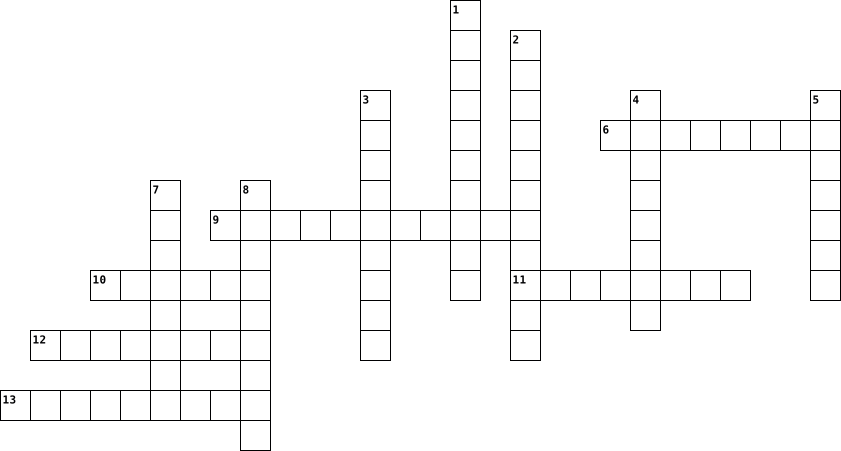
Across
- Record The Layers of rock deposits laid down by volcanoes or weathering that contain a record of Earth's past history.
- The rigid outer layer of Earth.
- Tectonics The Earth’s lithosphere is composed of seven or eight major plates and many minor plates.
- Plate Earth's rigid outer crust that is broken into moving sections or plates.
- Formation of rock being broken apart.
- Ridge An underwater mountain system formed by plate tectonic movement.
Down
- Boundary A place where two or more tectonic plates move towards each other and collide.
- Drift The gradual movement of the continents across the earth’s surface through geological time.
- Boundaries A place where two tectonic plates move horizontally in either direction.
- Spreading A process that occurs at mid-ocean ridges, where new oceanic crust is formed through volcanic activity and then gradually moves away from the ridge.
- Trenches long narrow depressions on the seafloor, they are the deepest parts of the oceans.
- Striping At spreading centres, this crust is separated into parallel bands of rock by successive waves of emergent magma.
- Boundary A place where two tectonic plates move away from each other.
13 Clues: The rigid outer layer of Earth. • Formation of rock being broken apart. • Boundary A place where two tectonic plates move away from each other. • Ridge An underwater mountain system formed by plate tectonic movement. • Plate Earth's rigid outer crust that is broken into moving sections or plates. • ...
Morgan's Plate Tectonic puzzle 2023-11-17

Across
- energy that is transferred by electromagnetic
- large piece of land that is pushed up flat
- pushes rocks together
- When all the plates were combined
- molten mixture of rock forming substances from the mantle
- stretches out rock so it can become thinner in the middle
- how much mass of a substance is contained is volume
- of fire volcanoes that rims the pacific ocean and is also a major belt
- traces of a organism that lived in the past
- current liquid that is moving and is caused by differences in the temperature
Down
- spot deep within the mantle melts through the crust above it
- transfer the thermal energy from one particle of matter to another particle
- transfer of thermal energy
- fault footwall goes up and hanging wall goes down
- rocks sliding beside eachother
- tectonics pieces of earths lithosphere are in constant motion
- breaks the earths crust
- change of shape or volume that acts on rocks
- weak spot where magma has come to the surface from the crust
- valley valley that forms when 2 plates come apart
20 Clues: pushes rocks together • breaks the earths crust • transfer of thermal energy • rocks sliding beside eachother • When all the plates were combined • large piece of land that is pushed up flat • traces of a organism that lived in the past • change of shape or volume that acts on rocks • energy that is transferred by electromagnetic • ...
South Asia Review 2026-04-27

Across
- Stringed instrument performed by Ravi Shankar
- The language in which the Vedas were written
- Famous building built by an emperor in memory of his wife
- Nickname for the Hindi film industry based in Mumbai
- Area of fertile soil deposited by floodwaters
- Site of early civilization in what is now Pakistan
- Name given to the British imperialist rule over India
- Highest mountain in the world
Down
- The belief that actions in this life can affect one’s next life
- Mountain range created by plate tectonics
- Religion followed by most Pakistanis
- Ruler whose empire was greatly impacted by Buddhism
- Opening in mountain range between Afghanistan and Pakistan
- Seasonal wind pattern that affects rainfall
- Hindu belief in the rebirth of a soul in another body
- Ancient Aryan poetic texts
- Large, swirling storm that can cause devastation
- Period considered a Golden Age of technology and medicine in India
- Social classes in which people are assigned strict roles and tasks
19 Clues: Ancient Aryan poetic texts • Highest mountain in the world • Religion followed by most Pakistanis • Mountain range created by plate tectonics • Seasonal wind pattern that affects rainfall • The language in which the Vedas were written • Stringed instrument performed by Ravi Shankar • Area of fertile soil deposited by floodwaters • ...
Plate Tectonics Vocabulary 2014-01-23

Across
- zone area where an oceanic plate goes down into the mantle
- boundary boundary between two plates that are moving apart
- boundary place where two plates move together
- plasticlike layer of Earth’s surface below the crust and a part of the upper mantle
- outermost layer of Earth’s surface
Down
- current cycle of heating, rising, cooling, and sinking
- rigid layer of Earth’s surface made up of
- boundary plate boundary that occurs when two plates sections of Earth’s crust and upper mantle
8 Clues: outermost layer of Earth’s surface • rigid layer of Earth’s surface made up of • boundary place where two plates move together • current cycle of heating, rising, cooling, and sinking • zone area where an oceanic plate goes down into the mantle • boundary boundary between two plates that are moving apart • ...
the plate tectonics 2023-01-19

Across
- boundary where plates slide past each other
- a supercontinent that form millions of years ago called the continental drift
- crust and upper mantle
- shifting of the tectonic plates felt on the crust
Down
- under the lithosphere and is full of convection
- the inside of the ear made out of nickel and iron
- liquid layer of the earth
- on top of the outercore and below the crust
8 Clues: crust and upper mantle • liquid layer of the earth • boundary where plates slide past each other • on top of the outercore and below the crust • under the lithosphere and is full of convection • the inside of the ear made out of nickel and iron • shifting of the tectonic plates felt on the crust • ...
Plate tectonics crossword 2025-04-03

Across
- boundary where 2 plates collide
- a valley created through the divergent boundary
- a zone created by different density of plates
- a layer under Earth's crust
Down
- boundary where 2 plates move away from eachother
- currents found in the upper mantle.
- pieces of Earth's crust
- molten rock
8 Clues: molten rock • pieces of Earth's crust • a layer under Earth's crust • boundary where 2 plates collide • currents found in the upper mantle. • a zone created by different density of plates • a valley created through the divergent boundary • boundary where 2 plates move away from eachother
1st 9 weeks vocab 2017-04-24

Across
- process of one plate being pulled beneath another
- theory that the continents are moving apart
- tectonics theory that all continents were once connected and have moved apart over time
Down
- tallest, longest mountain chain in the world, formed at a divergent boundary in the ocean
- the name for the supercontinent that was made of all current landmasses
5 Clues: theory that the continents are moving apart • process of one plate being pulled beneath another • the name for the supercontinent that was made of all current landmasses • tectonics theory that all continents were once connected and have moved apart over time • tallest, longest mountain chain in the world, formed at a divergent boundary in the ocean
Earths Structure and Plate Tectonics 2025-11-27

Across
- cycle Continuous process
- rock Formed when magma cools and solidifies
- Two additional layers
- boundary Plates that slide past each other
- Trembling and shaking of the earth
- Made up of two layers
- Outermost layer
Down
- Lava erupts from it
- rock Compaction and cementation
- boundary They crash into each other
- boundary moves apart from each other
- Thickest layer
- plates Several large slabs
- boundary The meeting point of two tectonic plates
- building Forms mountains
- Rock Formed by extreme heat and pressure
16 Clues: Thickest layer • Outermost layer • Lava erupts from it • Two additional layers • Made up of two layers • building Forms mountains • plates Several large slabs • Trembling and shaking of the earth • cycle Continuous process • rock Compaction and cementation • boundary They crash into each other • boundary moves apart from each other • ...
Chapter 12 Earth Science 2024-02-12

Across
- this type of ridge is a mountain chain on the ocean floor
- theory that earth's crust is made up of large sections that move
- single landmassfrom which the continents separated
- deep crack in the ocean floor
- these type of currents have circular motions of gas or liquid as it heats
- the inner most layer of the Earth, it is solid because of the pressure
Down
- this layer is mostly liquid and around 2200km thick
- last name of the person the came up with the theory of Pangea
- large section of Earth's crust that moves
- the layer of Earth that surrounds the core
- the top layer of the Earth
11 Clues: the top layer of the Earth • deep crack in the ocean floor • large section of Earth's crust that moves • the layer of Earth that surrounds the core • single landmassfrom which the continents separated • this layer is mostly liquid and around 2200km thick • this type of ridge is a mountain chain on the ocean floor • ...
Morgan's Plate Tectonic puzzle 2023-11-17

Across
- energy that is transferred by electromagnetic
- large piece of land that is pushed up flat
- pushes rocks together
- When all the plates were combined
- molten mixture of rock forming substances from the mantle
- stretches out rock so it can become thinner in the middle
- how much mass of a substance is contained is volume
- of fire volcanoes that rims the pacific ocean and is also a major belt
- traces of a organism that lived in the past
- current liquid that is moving and is caused by differences in the temperature
Down
- spot deep within the mantle melts through the crust above it
- transfer the thermal energy from one particle of matter to another particle
- transfer of thermal energy
- fault footwall goes up and hanging wall goes down
- rocks sliding beside eachother
- tectonics pieces of earths lithosphere are in constant motion
- breaks the earths crust
- change of shape or volume that acts on rocks
- weak spot where magma has come to the surface from the crust
- valley valley that forms when 2 plates come apart
20 Clues: pushes rocks together • breaks the earths crust • transfer of thermal energy • rocks sliding beside eachother • When all the plates were combined • large piece of land that is pushed up flat • traces of a organism that lived in the past • change of shape or volume that acts on rocks • energy that is transferred by electromagnetic • ...
Grade 6 2026-02-07

Across
- A push or pull that can change an object’s motion.
- How plants make food using sunlight, water, and air.
- Layers The crust, mantle, and core of Earth.
- How much mass is in a given volume.
- A substance made from two or more different elements.
- Living and nonliving things interacting in one area.
- Change A change that forms a new substance.
- Two or more atoms bonded together.
- The ability to cause change or do work.
Down
- The breaking down of rocks into smaller pieces.
- Change A change that does not create a new substance.
- Tectonics The movement of large plates on Earth’s surface.
- Any living thing.
- The movement of rock or soil by wind, water, or ice.
- The smallest unit of matter that makes up all substances.
- A pure substance made of only one type of atom.
- Anything that has mass and takes up space.
- The smallest unit of living things.
- Cycle The process that forms and changes rocks over time.
19 Clues: Any living thing. • Two or more atoms bonded together. • How much mass is in a given volume. • The smallest unit of living things. • The ability to cause change or do work. • Anything that has mass and takes up space. • Change A change that forms a new substance. • Layers The crust, mantle, and core of Earth. • The breaking down of rocks into smaller pieces. • ...
PLATE TECTONICS BY FOSTER SELF 2019-11-12

Across
- Dense ball of solid material at the center of the Earth
- Layer of molten iron and nickel that surrounds the inner core of the Earth
- Plate boundary where two plates grind against each other, moving it different directions
- Cause the plates to move; between the lithosphere and the asthenosphere
- Thickest layer of the Earth; it consists of two layers - the lithosphere and the asthenosphere
- Plate boundary where two plates move away from each other
- Soft layer of the mantle on which the lithosphere floats
Down
- German Scientist who developed the Theory of the Continental Drift in 1912.
- Layer of rock that forms the Earth's outer surface
- Rigid layer made up of the uppermost part of the mantle and the crust
- Break or crack in the Earth's lithosphere along which rocks move
- Plate boundary where two plates move toward each other
- Alfred Wegener's hypothesis that the continents were once one huge land mass but have since then drifted apart
- Single landmass that broke apart about 225 million years ago
- Theory that pieces of the Earth's lithosphere are in motion driven by convection currents in the mantle
- Deep canyon on the ocean floor
16 Clues: Deep canyon on the ocean floor • Layer of rock that forms the Earth's outer surface • Plate boundary where two plates move toward each other • Dense ball of solid material at the center of the Earth • Soft layer of the mantle on which the lithosphere floats • Plate boundary where two plates move away from each other • ...
Plate Tectonics pt. 2 Vocab 2024-03-04

Across
- 2 things or events happening together or at the same time, but not causing one another
- loose earth materials, such as sand, soil, and rocks, found on the surface of the Earth
- the process where sediment is pressed together
- valuable minerals found in rock layers that are extracted through different processes
- how much an area of land is pushed up over time
- the process where sediment is moved to a new location
- the process where sediments are "glued" together
Down
- at type of rock that forms when an existing rock undergoes intense heat and pressure
- the time taken for the process by which wind, water, ice, or gravity transports soil and sediment from one location to another
- a type of rock that formed when layers of sediment are compressed by heavy layers of sediment above
- to build up (divergent plate boundary is an example)
- the reason something has occurred or is occurring
- a type of rock that forms when magma or lava cools
- to cause damage or destroy (convergent plate boundary is an example)
- solid rock found everywhere on the Earth, often under sediments, such as soil, sand, dirt, and broken rocks
- the process where rocks are broken down into sediment
16 Clues: the process where sediment is pressed together • how much an area of land is pushed up over time • the process where sediments are "glued" together • the reason something has occurred or is occurring • a type of rock that forms when magma or lava cools • to build up (divergent plate boundary is an example) • the process where rocks are broken down into sediment • ...
Joshua's Crossword Week of 9/18/17 2017-09-15

Across
- tectonics the theory that pieces of Earth's lithosphere are in constant motion and being moved by convection currents in the mantle
- a boundary where two plates move apart
- a duty or commitment
- a young person with a great talent at a certain skill
- a boundary where two plates slip past each other
Down
- break in Earth's where rocks have slipped past each other
- an action that is taken to help prevent something bad from happening
- not operating normally or properly
- a boundary where two plates come together
- capable of destroying slowly through a chemical action for example, acid burning through a surface
10 Clues: a duty or commitment • not operating normally or properly • a boundary where two plates move apart • a boundary where two plates come together • a boundary where two plates slip past each other • a young person with a great talent at a certain skill • break in Earth's where rocks have slipped past each other • ...
Genna Garratt's Crossword Puzzle 2016-09-26

Across
- A paper like material created by the Egyptians
- Pictures that stand for different words or sounds
- Breaks in Earth's crust where rocks have slipped past each other.
- A boundary where two plates come together
Down
- A body that has been dried so that it will not decay
- A boundary where two plates move apart
- The theory that pieces of Earth's lithosphere are in constant motion and being moved by convection currents in the mantle.
- A boundary where two plates slip past each other.
- To preserve a body after death
- The god of the dead
10 Clues: The god of the dead • To preserve a body after death • A boundary where two plates move apart • A boundary where two plates come together • A paper like material created by the Egyptians • Pictures that stand for different words or sounds • A boundary where two plates slip past each other. • A body that has been dried so that it will not decay • ...
Kennedy's crossword on Plate Tectonics 2021-12-10

Across
- Theory of plate _________.
- _______ rocks are created when magma/ lava cool and crystallize.
- ________ are created when two plates pull apart at a divergent boundary.
- When convergent boundaries push towards each other and the crust bends upwards, it creates ________.
- ___________ rocks that are created from heat and pressure.
- Boundary where plates move away from each other.
- Plates move under one another, creates a trench.
- The theory that new rock is being created at the same time it is being destroyed. Conservation of ______.
Down
- Transform boundaries can create ___________, which can destroy buildings and structures on the earths surface.
- __________ current
- ____________ rocks are created by the cementation and compaction of sediments.
- Convergent and Divergent boundaries create _________ where volcanic ash and gases are released.
- Boundary where plates move towards each other.
- Floats on the asthenosphere.
- Boundary where plates move alongside each other.
15 Clues: __________ current • Theory of plate _________. • Floats on the asthenosphere. • Boundary where plates move towards each other. • Boundary where plates move alongside each other. • Boundary where plates move away from each other. • Plates move under one another, creates a trench. • ___________ rocks that are created from heat and pressure. • ...
Kennedy's crossword on Plate Tectonics9o 2021-12-10

Across
- Theory of plate _________.
- _______ rocks are created when magma/ lava cool and crystallize.
- ________ are created when two plates pull apart at a divergent boundary.
- When convergent boundaries push towards each other and the crust bends upwards, it creates ________.
- ___________ rocks that are created from heat and pressure.
- Boundary where plates move away from each other.
- Plates move under one another, creates a trench.
- The theory that new rock is being created at the same time it is being destroyed. Conservation of ______.
Down
- Transform boundaries can create ___________, which can destroy buildings and structures on the earths surface.
- __________ current
- ____________ rocks are created by the cementation and compaction of sediments.
- Convergent and Divergent boundaries create _________ where volcanic ash and gases are released.
- Boundary where plates move towards each other.
- Floats on the asthenosphere.
- Boundary where plates move alongside each other.
15 Clues: __________ current • Theory of plate _________. • Floats on the asthenosphere. • Boundary where plates move towards each other. • Boundary where plates move alongside each other. • Boundary where plates move away from each other. • Plates move under one another, creates a trench. • ___________ rocks that are created from heat and pressure. • ...
Earthquakes 2024-11-12

Across
- Tectonics The theory explaining the movement of the Earth's plates.
- The strength of shaking felt during an earthquake.
- The point inside Earth where an earthquake originates.
- A large ocean wave caused by an underwater earthquake.
- The rigid outer layer of the Earth.
- Secondary waves that arrive after primary waves.
- A crack in the Earth's crust where rocks have slipped past each other.
- A smaller earthquake that follows the main earthquake.
Down
- Primary waves that are the fastest seismic waves.
- A device that records ground movements caused by seismic waves.
- A scale used to measure earthquake magnitude.
- The point on Earth's surface directly above an earthquake's focus.
- A smaller tremor occurring before a major earthquake.
- Relating to or caused by an earthquake.
- The measure of the energy released by an earthquake.
15 Clues: The rigid outer layer of the Earth. • Relating to or caused by an earthquake. • A scale used to measure earthquake magnitude. • Secondary waves that arrive after primary waves. • Primary waves that are the fastest seismic waves. • The strength of shaking felt during an earthquake. • The measure of the energy released by an earthquake. • ...
science 2023-12-07

Across
- a mountain that spits out magma
- a hot sticky material in magma
- relating to earthquakes or other vibrations of the earth and its crust.
- hot fluid or semifluid material below or within the earth's crust from which lava and other igneous rock is formed on cooling.
- when two plate tectonics run into each other
- a sudden and violent shaking of the ground
Down
- plates that are in the mantle
- a device that measures earthquakes
- the giant super continent that existed millions of years ago
- a device that measures the amount of viscosity in magma
- the part directly above the plates that are about to cause the earthquake.
11 Clues: plates that are in the mantle • a hot sticky material in magma • a mountain that spits out magma • a device that measures earthquakes • a sudden and violent shaking of the ground • when two plate tectonics run into each other • a device that measures the amount of viscosity in magma • the giant super continent that existed millions of years ago • ...
science 2023-12-07

Across
- a mountain that spits out magma
- a hot sticky material in magma
- relating to earthquakes or other vibrations of the earth and its crust.
- hot fluid or semifluid material below or within the earth's crust from which lava and other igneous rock is formed on cooling.
- when two plate tectonics run into each other
- a sudden and violent shaking of the ground
Down
- plates that are in the mantle
- a device that measures earthquakes
- the giant super continent that existed millions of years ago
- a device that measures the amount of viscosity in magma
- the part directly above the plates that are about to cause the earthquake.
11 Clues: plates that are in the mantle • a hot sticky material in magma • a mountain that spits out magma • a device that measures earthquakes • a sudden and violent shaking of the ground • when two plate tectonics run into each other • a device that measures the amount of viscosity in magma • the giant super continent that existed millions of years ago • ...
earthquakes 2026-04-29

Across
- The process where saturated soil loses strength and behaves like a liquid during shaking.
- smaller earthquakes that follow the mainshock in the same area, which can occur days, months, or even years later.
- moving perpendicular to wave direction.
- , Travel along the Earth's surface, causing the most ground movement.
- a layer of earth
- waves, seismic waves that travel though the earth
Down
- scale, a scale that rates the intensity of an earthquake
- the shifting of plate tectonics
- the study of earthquakes
- compressing and expanding material in the direction of travel.
- Plates, Massive sections of the Earth's lithosphere that move and interact at boundaries, causing earthquakes.
11 Clues: a layer of earth • the study of earthquakes • the shifting of plate tectonics • moving perpendicular to wave direction. • waves, seismic waves that travel though the earth • scale, a scale that rates the intensity of an earthquake • compressing and expanding material in the direction of travel. • , Travel along the Earth's surface, causing the most ground movement. • ...
layers of the earth 2022-05-16

Across
- The boundary between Earth's crust and mantle. It is also known as the "Moho."
- The lower part of the upper mantle that exhibits plastic (flowing) properties on which the continents move.
- The outermost, rocky layer of the Earth
- The commonest type of solidified lava; a dense dark gray fine-grained igneous rock.
Down
- A rocky material that makes up the thickest part of earth's crust not located under the ocean.
- The transfer of thermal energy inside the Earth and is the driving force for plate tectonics.
- The innermost layer of the earth made of solid iron and nickel.
- The thickest layer of Earth, under the crust, in which plate movement is generated.
- The outermost layer of Earth's surface which is rocky and solid and includes the rigid part of the upper mantle.
9 Clues: The outermost, rocky layer of the Earth • The innermost layer of the earth made of solid iron and nickel. • The boundary between Earth's crust and mantle. It is also known as the "Moho." • The thickest layer of Earth, under the crust, in which plate movement is generated. • The commonest type of solidified lava; a dense dark gray fine-grained igneous rock. • ...
Earth Vocabulary 2026-01-07

Across
- Spreading The formation of new areas of oceanic crust at midocean ridges and its movement on either side
- Rock Rock that forms when magma cools on the surface or underground
- Boundary When two plates separate causing sea-floor spreading, creating underwater volcanic chains, and rift valleys
- Rock Rock that forms when existing rocks change due to heat and/or pressure
- Tectonics The process that changes the surface of the Earth through the movement of the lithospheric plates
Down
- Rock Rock that forms when pebbles, sand shells, and other pieces are cemented together over time
- Boundary When two plates move together to form volcanoes, islands, and other landfarms
- When one tectonic plate pushes underneath another in the mantle where it melts
- Boundary When plates scrape past each other causing strong earthquakes
9 Clues: Rock Rock that forms when magma cools on the surface or underground • Boundary When plates scrape past each other causing strong earthquakes • Rock Rock that forms when existing rocks change due to heat and/or pressure • When one tectonic plate pushes underneath another in the mantle where it melts • ...
Tectonics 2014-01-16

Across
- ocean waves caused by under-sea earthquakes or volcanic eruptions.
- rock, rock that is so hot that it has melted.
- type of volcano formed at divergent plate margins.
- the top of a volcano explodes off.
- pushed apart.
- waves (2 words) /Waves in the surface of the Earth caused by plate movement.
- moves through the mantle due to ……………………… currents.
- a volcano is not extinct but not erupting.
- of the Earth's surface caused by motion of tectonic plates; diverging, converging or moving alongside
- continental plate is largely ………………………………. the sea.
- go to the bottom of a liquid.
- two transform plate boundaries meet.
- strength of an earthquake.
- oceanic plate is for the most part ………………………the sea.
- margins(2 words)/Where two tectonic plates meet.
- Mountains caused by converging plates margins where the continental crust is crushed and folded.
- centre of the Earth.
Down
- plates are……………………..than continental plates.
- the heavier oceanic crust is pushed below the lighter continental crust.
- word for margins.
- surface of the Earth.
- /Mountains which erupt occurring when plates converge or diverge.
- rock which flows from erupting volcanoes.
- plate(2 words)/What the crust is made of.
- rock that oceanic plates are made of, which is heavier than granite.
- layer around the core of molten magma.
- together.
- /A type of volcano occurring on convergent plate boundaries where there is subduction.
- / ……………….. plate margins move alongside each other either in the same or opposite directions.
- below the epicenter of an earthquake
- name of a scale used to measure earthquakes.
- grey powder created when something is burnt which spews out of volcanoes when they erupt.
- rock that continental plates are made of.
33 Clues: together. • pushed apart. • word for margins. • centre of the Earth. • surface of the Earth. • strength of an earthquake. • go to the bottom of a liquid. • the top of a volcano explodes off. • below the epicenter of an earthquake • two transform plate boundaries meet. • layer around the core of molten magma. • rock which flows from erupting volcanoes. • ...
Tectonic Plates 2022-02-25

Across
- the plate that rests just south of South America
- a plate that is just west of South America
- the plate that is just North America
- when two boundaries come together
- the plate that rests on Africa as well as under a lot of the Atlantic Ocean
- crust under the ocean
- the plate that rests under the Antarctic Sea as well as Antarctica
- the plate that rests in the Middle East
- the plate that sits under India
- the plate that is in the Caribbean
Down
- the man who proposed the theory of continental drift
- the theory that the continents were once connected as a supercontinent called Pangaea and had drifted apart over millions of years
- when two boundaries seperate
- crust under the continents
- the plate that is west of the Caribbean Plate
- The plate that rests under the majority of Europe and Asia
- the plate that is just South America
- a plate just northwest of the U.S, contained within the North American plate
- the plate that sits under Australia
- when two boundaries slide up against each other
- the plate that rests under the Pacific Ocean
21 Clues: crust under the ocean • crust under the continents • when two boundaries seperate • the plate that sits under India • when two boundaries come together • the plate that is in the Caribbean • the plate that sits under Australia • the plate that is just South America • the plate that is just North America • the plate that rests in the Middle East • ...
Socials 10 Chapter 3 Crossword Puzzle 2013-03-04

Across
- A natural fuel formed by geological forces from the residue of living organisms
- A slab of the earth's crust
- The interior part of the earth that lies directly above the core
- The distance of any point east or west of the Prime Medridian, measured up to 180 degrees
- Having to do with geology, the study of the history of the earth found in rocks
- A long region with a trench through which a descending tectonic plate is assimilated into the earth's mantle
- The shape of the land
- A measure of the power of earthquakes
- Rock made up of sediment laid down in layers which have grown together
- A great sea wave produced by an earthquake or by a volcanic eruption
Down
- Solid rock underneather looser materials such as soil
- Someone who studies earthquakes
- A type of sedimentary rock that originates by the evaporation of sea water
- Rock changed from its original form into another form through heat and pressure
- Rock that has been formed by the solidification of molten material
- The distance of any point north or south of the equator, measured up to 90 degrees
- The earth's surface directly above the quake-the middle of the quake
- The natural and undisturbed plants of a region
- To do with earthquakes
- The study of forces within the earth that form its surface features such as mountain ranges and ocean basins
- Molten rock material within the earth from which igneous rock is formed through cooling
21 Clues: The shape of the land • To do with earthquakes • A slab of the earth's crust • Someone who studies earthquakes • A measure of the power of earthquakes • The natural and undisturbed plants of a region • Solid rock underneather looser materials such as soil • The interior part of the earth that lies directly above the core • ...
Science Thingy 2023-03-02

Across
- the deepest and hottest layer of our planet.
- the action or process in plate tectonics of the edge of one crustal plate descending below
- When tectonic plates split apart from eachother
- the organic component of soil,
- the mostly solid bulk of Earth's interior.
- A force that causes one part of a material to slide past another.
- it's a thin shell that surrounds the entire Earth
- a landform that rises high above the surrounding terrain
- an opening in the Earth's surface (hot)
- caused by the movement of parts of the Earth's crust
- a mixture of minerals and organic material that covers much of Earth's surface
- waves that travel through or over Earth
- fertile soil of clay and sand
- a long, narrow ditch
Down
- the movement of continents resulting from the motion of tectonic plates.
- a large wave caused by movements in Earth's outer layer, or crust,
- occurs when two tectonic plates move away from each other.
- The supercontinent
- a force that squeezes something together
- the layer of the Earth that lies below the lithosphere
- a wave that travels along the surface of a medium.
- The Earth's surface is cracked into large pieces
- when heat from a source travels away into the air
- the second waves to arrive during an earthquake
- a long depression, or ditch, in Earth's surface
25 Clues: The supercontinent • a long, narrow ditch • fertile soil of clay and sand • the organic component of soil, • an opening in the Earth's surface (hot) • waves that travel through or over Earth • a force that squeezes something together • the mostly solid bulk of Earth's interior. • the deepest and hottest layer of our planet. • When tectonic plates split apart from eachother • ...
restless earth 2024-04-12

Across
- were tectonic plates slide past each other. causes earthquakes.
- Deep, elongated depressions in the ocean aften acossiated with subduction zones
- Formedt plte boundries usually when plates collide.
- Tectonic plates move toward each other, usually forms mountains and volcanoes.
- Forms after weathering and erosion when sediments compact and cement.
- Includes the crust and upper part of the mantle, and it is divided into tectonic plates.
- Extinction events that occur over a longer time period.
- Name of the Ancient supercontinetal when it was all one landmass.
- Fractures or zones of weakness in the Earth's crust
- The semi-fluid layer of the mantle where convection currents happen.
- Rock formed when lava or magma cools and hardens.
- events that led up to a mass extinction.
- used to measure and recorded seismic waves.
Down
- material rises, cooler materials sink. it drives plate tectonics.
- Formed as a result of high temperature and pressure deep within earth changing a rock that already existed.
- Tectonic plates move toward each other, usually forms a new crust and rift valleys.
- Large, ridged pieces of the earths lithosphere that move and interact with each other along plate boundaries
- AN opening in the Earth's crust through which molten rock is psuhed out and creates a new rock
- New oceanic crust is formed as tectonic plates pull apart magma rises.
- located between the mantle and outer core.
- A group of the same species living in the same area.
21 Clues: events that led up to a mass extinction. • located between the mantle and outer core. • used to measure and recorded seismic waves. • Rock formed when lava or magma cools and hardens. • Formedt plte boundries usually when plates collide. • Fractures or zones of weakness in the Earth's crust • A group of the same species living in the same area. • ...
Forces 2024-04-12

Across
- boundary where tectonic plates slide past each other usually cause earthquakes
- boundaries tectonic plates move towards each other usually forming mountains and volcanoes
- A group of the same species living in the same area
- Rock formed when lava or magma cools and hardens
- formed at plate boundaries usually when plates collide
- formed as a result of high temperature and pressure deep within earth changing a rock alredy existed
- includes the crust and upper part of the mantles and is divided into tectonic plates
- sudden events that led to a mass extinction
- An opening in the Earth's crust through which molten rock is pushed out and creates new rock
Down
- new oceanic crust is formed as tectonic plates pull apart and magma rises
- instruments used to measure and record seismic waves
- Extinction events that occur over a longer time period
- plates Large rigid pieces of the Earth's lithosphere that move and interact with each other and pate boundaries
- name of an ancient supercontinent when it was all one landmass
- The semi fluid layer of the mantle where convections currents happen
- located between the mantle and the outer core
- hot material rises cooler materials sink it drives plate tectonics
- boundaries tectonic plates move away from each other usually form new crust and rift valleys
- Fractures or zones of weakness in the Earths crust
- deep elongated depressions in the ocean often associated with subduction zones
- Forms after a weathering and erosion when sediments compact and sediment
21 Clues: sudden events that led to a mass extinction • located between the mantle and the outer core • Rock formed when lava or magma cools and hardens • Fractures or zones of weakness in the Earths crust • A group of the same species living in the same area • instruments used to measure and record seismic waves • Extinction events that occur over a longer time period • ...
Kennedy's crossword on Plate Tectonics 2021-12-10

Across
- Transform boundaries can create ___________, which can destroy buildings and structures on the earths surface.
- _______ rocks are created when magma/ lava cool and crystallize.
- When convergent boundaries push towards each other and the crust bends upwards, it creates a ________.
- __________ current
- Theory of plate _________.
- Boundary where plates move alongside each other.
- ________ are created when two plates pull apart at a divergent boundary.
Down
- The theory that new rock is being created at the same time it is being destroyed. Conservation of ______.
- ____________ rocks are created by the cementation and compaction of sediments.
- Floats on the asthenosphere.
- Boundary where plates move towards each other.
- Plates move under one another, creates a trench.
- Convergent and Divergent boundaries create _________ where volcanic ash and gases are released.
- ___________ rocks that are created from heat and pressure.
- Boundary where plates move away from each other.
15 Clues: __________ current • Theory of plate _________. • Floats on the asthenosphere. • Boundary where plates move towards each other. • Plates move under one another, creates a trench. • Boundary where plates move away from each other. • Boundary where plates move alongside each other. • ___________ rocks that are created from heat and pressure. • ...
Chapter 14 2024-12-10

Across
- A sudden release of energy in Earth’s crust, causing shaking.
- The bending of rock layers under compressive forces.
- Spreading The formation of new crust at mid-ocean ridges.
- A crack in Earth's crust where plates are pulling apart.
- The breaking of rock layers along a crack or fault.
- Molten rock beneath Earth's surface.
- A vent in Earth's crust through which magma erupts.
- Spot A localized area of heat in the mantle that can form volcanoes.
Down
- Boundary A boundary where two plates move apart.
- Tectonics The theory explaining the movement of Earth's plates.
- The process by which one plate moves beneath another.
- Boundary A boundary where two plates collide.
- Plume A column of hot rock rising through the mantle.
- Boundary A boundary where two plates slide past each other.
- Molten rock that reaches Earth's surface.
15 Clues: Molten rock beneath Earth's surface. • Molten rock that reaches Earth's surface. • Boundary A boundary where two plates collide. • Boundary A boundary where two plates move apart. • The breaking of rock layers along a crack or fault. • A vent in Earth's crust through which magma erupts. • The bending of rock layers under compressive forces. • ...
Tectonics 2014-01-16

Across
- ocean waves caused by under-sea earthquakes or volcanic eruptions.
- rock, rock that is so hot that it has melted.
- type of volcano formed at divergent plate margins.
- the top of a volcano explodes off.
- pushed apart.
- waves (2 words) /Waves in the surface of the Earth caused by plate movement.
- moves through the mantle due to ……………………… currents.
- a volcano is not extinct but not erupting.
- of the Earth's surface caused by motion of tectonic plates; diverging, converging or moving alongside
- continental plate is largely ………………………………. the sea.
- go to the bottom of a liquid.
- two transform plate boundaries meet.
- strength of an earthquake.
- oceanic plate is for the most part ………………………the sea.
- margins(2 words)/Where two tectonic plates meet.
- Mountains caused by converging plates margins where the continental crust is crushed and folded.
- centre of the Earth.
Down
- plates are……………………..than continental plates.
- the heavier oceanic crust is pushed below the lighter continental crust.
- word for margins.
- surface of the Earth.
- /Mountains which erupt occurring when plates converge or diverge.
- rock which flows from erupting volcanoes.
- plate(2 words)/What the crust is made of.
- rock that oceanic plates are made of, which is heavier than granite.
- layer around the core of molten magma.
- together.
- /A type of volcano occurring on convergent plate boundaries where there is subduction.
- / ……………….. plate margins move alongside each other either in the same or opposite directions.
- below the epicenter of an earthquake
- name of a scale used to measure earthquakes.
- grey powder created when something is burnt which spews out of volcanoes when they erupt.
- rock that continental plates are made of.
33 Clues: together. • pushed apart. • word for margins. • centre of the Earth. • surface of the Earth. • strength of an earthquake. • go to the bottom of a liquid. • the top of a volcano explodes off. • below the epicenter of an earthquake • two transform plate boundaries meet. • layer around the core of molten magma. • rock which flows from erupting volcanoes. • ...
Tectonics 2014-01-16

Across
- centre of the Earth.
- / ……………….. plate margins move alongside each other either in the same or opposite directions.
- pushed apart.
- type of volcano formed at divergent plate margins.
- name of a scale used to measure earthquakes.
- go to the bottom of a liquid.
- of the Earth's surface caused by motion of tectonic plates; diverging, converging or moving alongside
- /Mountains which erupt occurring when plates converge or diverge.
- together.
- the heavier oceanic crust is pushed below the lighter continental crust.
- plates are……………………..than continental plates.
- rock that oceanic plates are made of, which is heavier than granite.
- below the epicenter of an earthquake
- continental plate is largely ………………………………. the sea.
- a volcano is not extinct but not erupting.
- layer around the core of molten magma.
- strength of an earthquake.
- two transform plate boundaries meet.
- ocean waves caused by under-sea earthquakes or volcanic eruptions.
Down
- oceanic plate is for the most part ………………………the sea.
- surface of the Earth.
- word for margins.
- rock that continental plates are made of.
- grey powder created when something is burnt which spews out of volcanoes when they erupt.
- margins(2 words)/Where two tectonic plates meet.
- waves (2 words) /Waves in the surface of the Earth caused by plate movement.
- plate(2 words)/What the crust is made of.
- moves through the mantle due to ……………………… currents.
- rock which flows from erupting volcanoes.
- the top of a volcano explodes off.
- /A type of volcano occurring on convergent plate boundaries where there is subduction.
- Mountains caused by converging plates margins where the continental crust is crushed and folded.
- rock, rock that is so hot that it has melted.
33 Clues: together. • pushed apart. • word for margins. • centre of the Earth. • surface of the Earth. • strength of an earthquake. • go to the bottom of a liquid. • the top of a volcano explodes off. • below the epicenter of an earthquake • two transform plate boundaries meet. • layer around the core of molten magma. • rock that continental plates are made of. • ...
Puzzle 17 2022-12-10

Across
- In projectors which lenses are used?
- Magnetic effect of current gives rise to which force?
- Due to which phenomena light rays emerging from a cinema machine spread wide on the screen?
- Which metal is used by the jewellers to make gold and platinum ornaments heavier?
- What type of a mirror is used in anti-shop-lifting-devices?
- Ionic compounds are soluble in:
- discovered the magnetic field of current?
- Numismatics is the study of:
- ----- is the first calculating device?
- ------ Wegener given the theory of Plate tectonics?
- Khorana Artificial ‘gene’ was created by:
- Name the scientist who had discovered that earth revolves round the sun?
Down
- Name the instrument that is used to measure Relative Humidity?
- The gas emancipating through paddy field is :
- Oncology is the study of:
- Edmund Becquerel gave the concept of ------ effect
- The Chemical evolution of life was proposed by:
- The energy of food is measured in:
- Which gases are released from the ground, minutes or hours before an earthquake is about to strike?
- Ornithology is the study of
20 Clues: Oncology is the study of: • Ornithology is the study of • Numismatics is the study of: • Ionic compounds are soluble in: • The energy of food is measured in: • In projectors which lenses are used? • ----- is the first calculating device? • discovered the magnetic field of current? • Khorana Artificial ‘gene’ was created by: • The gas emancipating through paddy field is : • ...
CKLA Unit 5 Chapter 1 & Chapter 2 2026-01-10

Across
- What happens as a result of a cause
- To look over something again carefully
- tectonics A theory that Earth’s crust is broken into moving pieces.
- To watch carefully and notice details
- wave Energy that travels through the Earth during an earthquake.
- To put something to use or use what you know
- A low area of land surrounded by higher land.
- A dark, heavy rock formed from cooled lava.
- Facts or proof that help support an idea
- To apply force or make something happen.
Down
- A force made when something pushes or presses on something else.
- An explanation based on evidence.
- A series of steps that happen in order
- Something that makes another thing happen
- Melted rock found deep below Earth’s surface.
- trench A very deep valley in the ocean floor.
- To tell the difference between two or more things
- Melted rock that comes out of a volcano onto Earth’s surface.
- To study something closely to understand it better
19 Clues: An explanation based on evidence. • What happens as a result of a cause • To watch carefully and notice details • A series of steps that happen in order • To look over something again carefully • Facts or proof that help support an idea • To apply force or make something happen. • Something that makes another thing happen • A dark, heavy rock formed from cooled lava. • ...
London's Crossword 9/26/16 -9/30/16 2016-09-26

Across
- A paper like material created by the Egyptians.
- The god of the dead.
- To preserve a body after death.
- Pictures that stand for different words or sounds.
- Breaks in Earth's crust where rocks ave slipped past each other.
- A boundary where two plates come together.
Down
- The theory that pieces of Earth's lithosphere are in constant motion and being moved by convection currents in the mantle.
- A boundary where two plates slip past each other.
- A boundary where two plates move apart.
- A body that has been dried so that it will not decay.
10 Clues: The god of the dead. • To preserve a body after death. • A boundary where two plates move apart. • A boundary where two plates come together. • A paper like material created by the Egyptians. • A boundary where two plates slip past each other. • Pictures that stand for different words or sounds. • A body that has been dried so that it will not decay. • ...
9-18-17 2017-09-18

Across
- Breaks in Earth's crust where rocks have slipped past each other.
- An action that is taken to help prevent something bad from happening.
- A boundary where two plates come together.
- A duty or commitment.
- A young person with great talent at a certain skill.
Down
- Not opening normally or properly.
- A boundary where two plates move apart.
- tectonics The theory that pieces of earth's lithosphere are in constant motion and being moved by convection currents in the mantle.
- Capable of destroying slowly through a chemical action for example, acid burning through a surface.
- A boundary where two plates slip past each other.
10 Clues: A duty or commitment. • Not opening normally or properly. • A boundary where two plates move apart. • A boundary where two plates come together. • A boundary where two plates slip past each other. • A young person with great talent at a certain skill. • Breaks in Earth's crust where rocks have slipped past each other. • ...
Tectonic Plate Crossword 2018-01-17

Across
- the scientific study of earthquakes and elastic waves that pass through the earth.
- The outermost shell of the earth.
- Innermost part of the earth.
- Boundary where two tectonic plates slide past each other causing earthquakes.
- the solid part of the earth consisting of the crust and the outermost mantle.
- Crust that houses an ocean basin.
- Boundary where two tectonic plates collide creating a mountain or subduction zone.
- Supercontinent that existed 175 million years ago before breaking apart and forming the continents we know today.
- The region of the interior of the earth between the core and the crust.
Down
- Scientist who created the Theory of Plate Tectonics.
- The upper layer of the earths mantle, below the lithosphere, where convection is though to occur.
- Boundary where two tectonic plates divide letting magma fill the pace creating new crust.
- When one plate is forced beneath another into the mantle.
- Large natural elevation of the earths surface rising abruptly from the surrounding level.
- Crust made up of rock that forms the continents.
- A vent in the crust of the earth from which molten rock, ash, and steam are ejected.
- A sudden movement of the earth's crust caused by stress along a geologic fault.
- An area of stress in the earth where broken rocks slide past each other causing a crack in the earths surface.
- Molten rock when it is underground.
- What magma is called when it reaches the surface of the earth.
20 Clues: Innermost part of the earth. • The outermost shell of the earth. • Crust that houses an ocean basin. • Molten rock when it is underground. • Crust made up of rock that forms the continents. • Scientist who created the Theory of Plate Tectonics. • When one plate is forced beneath another into the mantle. • What magma is called when it reaches the surface of the earth. • ...
restless earth 2024-04-12

Across
- were tectonic plates slide past each other. causes earthquakes.
- Deep, elongated depressions in the ocean aften acossiated with subduction zones
- Formedt plte boundries usually when plates collide.
- Tectonic plates move toward each other, usually forms mountains and volcanoes.
- Forms after weathering and erosion when sediments compact and cement.
- Includes the crust and upper part of the mantle, and it is divided into tectonic plates.
- Extinction events that occur over a longer time period.
- Name of the Ancient supercontinetal when it was all one landmass.
- Fractures or zones of weakness in the Earth's crust
- The semi-fluid layer of the mantle where convection currents happen.
- Rock formed when lava or magma cools and hardens.
- events that led up to a mass extinction.
- used to measure and recorded seismic waves.
Down
- material rises, cooler materials sink. it drives plate tectonics.
- Formed as a result of high temperature and pressure deep within earth changing a rock that already existed.
- Tectonic plates move toward each other, usually forms a new crust and rift valleys.
- Large, ridged pieces of the earths lithosphere that move and interact with each other along plate boundaries
- AN opening in the Earth's crust through which molten rock is psuhed out and creates a new rock
- New oceanic crust is formed as tectonic plates pull apart magma rises.
- located between the mantle and outer core.
- A group of the same species living in the same area.
21 Clues: events that led up to a mass extinction. • located between the mantle and outer core. • used to measure and recorded seismic waves. • Rock formed when lava or magma cools and hardens. • Formedt plte boundries usually when plates collide. • Fractures or zones of weakness in the Earth's crust • A group of the same species living in the same area. • ...
restless earth 2024-04-12

Across
- were tectonic plates slide past each other. causes earthquakes.
- Deep, elongated depressions in the ocean aften acossiated with subduction zones
- Formedt plte boundries usually when plates collide.
- Tectonic plates move toward each other, usually forms mountains and volcanoes.
- Forms after weathering and erosion when sediments compact and cement.
- Includes the crust and upper part of the mantle, and it is divided into tectonic plates.
- Extinction events that occur over a longer time period.
- Name of the Ancient supercontinetal when it was all one landmass.
- Fractures or zones of weakness in the Earth's crust
- The semi-fluid layer of the mantle where convection currents happen.
- Rock formed when lava or magma cools and hardens.
- events that led up to a mass extinction.
- used to measure and recorded seismic waves.
Down
- material rises, cooler materials sink. it drives plate tectonics.
- Formed as a result of high temperature and pressure deep within earth changing a rock that already existed.
- Tectonic plates move toward each other, usually forms a new crust and rift valleys.
- Large, ridged pieces of the earths lithosphere that move and interact with each other along plate boundaries
- AN opening in the Earth's crust through which molten rock is psuhed out and creates a new rock
- New oceanic crust is formed as tectonic plates pull apart magma rises.
- located between the mantle and outer core.
- A group of the same species living in the same area.
21 Clues: events that led up to a mass extinction. • located between the mantle and outer core. • used to measure and recorded seismic waves. • Rock formed when lava or magma cools and hardens. • Formedt plte boundries usually when plates collide. • Fractures or zones of weakness in the Earth's crust • A group of the same species living in the same area. • ...
Geologic Process & History 2024-10-16

Across
- includes all living organisms.
- solid to liquid
- includes all of Earth’s water, while the atmosphere includes all the gasses that surround Earth.
- process by which eroded materials are dropped, or laid down
- weathering is mechanical breakdown rocks into smaller pieces
- fragments of weathered rock
- system all the matter, energy, and processes within the boundary from Earth’s core to the outer edge of the atmosphere
- naturally occurring and usually inorganic solid with a definite chemical composition and orderly internal structure
- are the traces or remains of once-living organisms. They are commonly preserved in rock.
- liquid to solid (cools)
- plate large moving pieces that make up Earth’s surface
- glue together
- includes all rocks, minerals, and landforms. It also includes matter in Earth’s interior.
Down
- current the slow cycling of Earth’s interior material due to temperature and density differences
- process by which rock materials are broken down by the action of physical and chemical processes
- & Pressure compress + squeeze
- rock rock formed when existing rock is exposed to large changes in temperature, pressure, or both
- squeeze together
- weathering is the breakdown and decomposition of rocks due to chemical reactions.
- process by which wind, water, ice, or gravity transport weathered materials from one location to another
- rock rocks formed from sediments that are compacted or cemented together by new new minerals
- tectonics the theory that describes how Earth’s outer layer is made up of moving plates
- rock rocks formed from cooling lava
23 Clues: glue together • solid to liquid • squeeze together • liquid to solid (cools) • fragments of weathered rock • & Pressure compress + squeeze • includes all living organisms. • rock rocks formed from cooling lava • plate large moving pieces that make up Earth’s surface • process by which eroded materials are dropped, or laid down • ...
Geosphere- Kinslee Gardner 2025-10-16

Across
- molten rock found at depth
- plste boundary where plates move past eachother
- device that records ground mmovements causedby seismic waves
- a naturally occurring solid mix of one or more minerals
- rigid outer part of the Earth
- a plate boundary where two plates move away from eachother
- soft upper layer of the Earth's mantle
- the process where the tectonics produce new oceanic crust at ocean ridges
- a rock formed by crystallization of molten magma
- point on the earths surface directly above the focus of an earthquake
- rock id physically broken into smaller pices
- plate boundary where two plates move towards eachother
- vibrations that travel through the earth carrying energy
Down
- rock is broken down by chemical reactions
- natural resource that can be replaced at the same or below rate at whitch it is consumed
- the point beneath earths surface where rock breaks under stress and causes a earthquake
- liquids resistance to flowing or thickness of a liquid
- concentration of heat in the mantle capable of producing magma
- loose particles created by weathering
- magma that reaches the earths surface
- fracture in the earth
- rock formed by the altering of preexisting rock
- natural resource that is consumed faster than t is being made
- transportation of material by mobil agent
- a naturally occuring inorganic solid that has a crystal
- rock formed by weathered products of preexisting rocks
26 Clues: fracture in the earth • molten rock found at depth • rigid outer part of the Earth • loose particles created by weathering • magma that reaches the earths surface • soft upper layer of the Earth's mantle • rock is broken down by chemical reactions • transportation of material by mobil agent • rock id physically broken into smaller pices • ...
Africa's Geography and Ethnic groups 2021-12-08

Across
- A very oil polluted river that runs through Nigeria.
- The areas where two plate tectonics meets and causes lots of earthquakes.
- The transition between the desert and savanna The large grassland that covers most of Africa
- An ethnic group found in Northern Africa
- A vegatative area of Africa that contains the congo river.
- An ethnic groups whos language has spread across africa and has became a root in many languages.
- The desert that runs through Southern Africa.
Down
- The worlds largest non polar desert
- Ethnic group that lives on the East coast of Africa.
- Africa's largest lake
- A river that is very deep and runs across the rainforest region of Africa.
- The sea mosts Arabs live along
- The worlds longest river.
- A trade barrier in northern africa.
- The worlds second tallest mountain
15 Clues: Africa's largest lake • The worlds longest river. • The sea mosts Arabs live along • The worlds second tallest mountain • The worlds largest non polar desert • A trade barrier in northern africa. • An ethnic group found in Northern Africa • The desert that runs through Southern Africa. • Ethnic group that lives on the East coast of Africa. • ...
Kennedy's crossword on Plate Tectonics 2021-12-10

Across
- Transform boundaries can create ___________, which can destroy buildings and structures on the earths surface.
- _______ rocks are created when magma/ lava cool and crystallize.
- When convergent boundaries push towards each other and the crust bends upwards, it creates a ________.
- __________ current
- Theory of plate _________.
- Boundary where plates move alongside each other.
- ________ are created when two plates pull apart at a divergent boundary.
Down
- The theory that new rock is being created at the same time it is being destroyed. Conservation of ______.
- ____________ rocks are created by the cementation and compaction of sediments.
- Floats on the asthenosphere.
- Boundary where plates move towards each other.
- Plates move under one another, creates a trench.
- Convergent and Divergent boundaries create _________ where volcanic ash and gases are released.
- ___________ rocks that are created from heat and pressure.
- Boundary where plates move away from each other.
15 Clues: __________ current • Theory of plate _________. • Floats on the asthenosphere. • Boundary where plates move towards each other. • Plates move under one another, creates a trench. • Boundary where plates move away from each other. • Boundary where plates move alongside each other. • ___________ rocks that are created from heat and pressure. • ...
Ologies Natural Science with Metz 2023-11-29

Across
- study of matter and energy and the interactions between the two through forces and motion
- study of the geologic features of the ocean floor including plate tectonics of the ocean
- study of heredity and inherited traits passed down from generation to generation
- study of fish
- study of the bones and the disorders and diseases of the skeletal system
- Study of ticks, mites, and spiders
- study of fungi and yeasts
- the study of the moon, stars, and other objects in space
- study of microscopic life forms
Down
- the study of freshwater systems such as lakes, ponds, and rivers
- study of blood and blood diseases
- study of parasites
- study of animals with backbones and everything about them
- the study of living things and everything about it
- study of earthquakes and seismic waves
15 Clues: study of fish • study of parasites • study of fungi and yeasts • study of microscopic life forms • study of blood and blood diseases • Study of ticks, mites, and spiders • study of earthquakes and seismic waves • the study of living things and everything about it • the study of the moon, stars, and other objects in space • ...
Earth's internal heat 2024-10-17

Across
- – Decay of radioactive elements, producing internal heat.
- The layer between Earth's crust and core where convection occurs.
- – Earth's outermost solid layer, where heat from the mantle can escape.
- Magma that reaches Earth's surface.
- – The innermost part of Earth, consisting of a hot, dense metal ball.
- – An area where plumes of hot material rise to the surface, creating volcanic activity.
- – The movement of Earth's plates, driven by internal heat.
- – Eruption of molten rock due to internal heat pressure.
Down
- – Process where one tectonic plate moves under another, generating heat.
- – Heat originating from Earth's internal processes.
- – Transfer of heat through electromagnetic waves.
- Molten rock beneath Earth's surface.
- – Heat transfer by the movement of fluid (e.g., in the mantle).
- – Upwelling of hot, buoyant material from deep within Earth.
- – Heat transfer through direct contact in solid materials.
15 Clues: Magma that reaches Earth's surface. • Molten rock beneath Earth's surface. • – Transfer of heat through electromagnetic waves. • – Heat originating from Earth's internal processes. • – Eruption of molten rock due to internal heat pressure. • – Decay of radioactive elements, producing internal heat. • – Heat transfer through direct contact in solid materials. • ...
Socials 10 Chapter 3 Crossword Puzzle 2013-03-04

Across
- Someone who studies earthquakes
- To do with earthquakes
- Molten rock material within the earth from which igneous rock is formed through cooling
- The distance of any point east or west of the Prime Medridian, measured up to 180 degrees
- The study of forces within the earth that form its surface features such as mountain ranges and ocean basins
- The distance of any point north or south of the equator, measured up to 90 degrees
- Rock changed from its original form into another form through heat and pressure
- The natural and undisturbed plants of a region
- Rock that has been formed by the solidification of molten material
- A great sea wave produced by an earthquake or by a volcanic eruption
- The interior part of the earth that lies directly above the core
- Solid rock underneather looser materials such as soil
Down
- A natural fuel formed by geological forces from the residue of living organisms
- Rock made up of sediment laid down in layers which have grown together
- A long region with a trench through which a descending tectonic plate is assimilated into the earth's mantle
- A slab of the earth's crust
- A measure of the power of earthquakes
- A type of sedimentary rock that originates by the evaporation of sea water
- Having to do with geology, the study of the history of the earth found in rocks
- The shape of the land
- The earth's surface directly above the quake-the middle of the quake
21 Clues: The shape of the land • To do with earthquakes • A slab of the earth's crust • Someone who studies earthquakes • A measure of the power of earthquakes • The natural and undisturbed plants of a region • Solid rock underneather looser materials such as soil • The interior part of the earth that lies directly above the core • ...
Earth's Systems 2024-04-12

Across
- tectonic plates move toward each other, usually forms mountains and volcanoes
- Formed as a result of high temperature and pressure deep within changing a rock that already existed
- Rock formed when lava or magma cools and hardens
- Deep, elongated depressions in the ocean, often associated with subduction zones
- Hot material rises, cooler materials sink. It drives plate tectonics
- located between the mantle and the outer core
- A group of the same species living in the same area
- Instruments used to measure and record seismic waves
- where tectonic plates SLIDE past each other. Causes earthquakes
- tectonic plates move away each other, usually forms new crust and rift valleys
Down
- An opening in the Earth's crust through which molten rock is pushed out and creates new rock
- Extinction evens that occur over a longer time period
- Large, rigid pieces of the Earth's lithosphere that move and interact with each other along plate boundaries
- new oceanic crust is formed as tectonic plates pull apart and magma rises
- Sudden Events
- Fractures or zones of weakness in the Earth's crust
- The semi-fluid layer of the mantle where convection currents happen
- Includes the crust and upper part of the mantle, and is divided into tectonic plates
- formed at place boundaries usually when plates collide
- Forms after weathering and erosion when sediments compact and cement
- Name of the ancient supercontinent when it was all one landmass
21 Clues: Sudden Events • located between the mantle and the outer core • Rock formed when lava or magma cools and hardens • Fractures or zones of weakness in the Earth's crust • A group of the same species living in the same area • Instruments used to measure and record seismic waves • Extinction evens that occur over a longer time period • ...
Restless Earth Vocabulary List 2024-04-12

Across
- An opening in the Earth's crust through which molten rock is pushed out and creates new rock.
- Large rigid pieces if the Earth's lithosphere that move and interact with each other along the plate boundaries.
- Tectonic plates move away from each other, usually forms new crust and rift valleys.
- Instruments used to measure and record seismic waves.
- Rock formed when lava or magma cools and hardens.
- Formed as a result of high temperature and pressure deep within earth changing a rock that already existed.
- The semi-fluid layer of the mantle where convection currentMesosphere
- Extinction events that occur over a longer time period/
- Where tectonic plates slide past each other. Causes earthquakes.
Down
- New oceanic crust is formed as tectonic plates pull apart and magma rises.
- Sudden events that led to a mass extinction.
- Hot material rises, cooler materials sink. It drives plat tectonics.
- A group of the same species living in the same area.
- Located between the mantle and outer core.
- Includes the crust and upper part of the mantle, and is dividAsthenosphereonic plates.
- Tectonic plates move toward each other usually forms mountains and volcanoes.
- Fractures or zones of weakness in the Earth's crust.
- Name of the ancient supercontinent when it was all on landmass.
- Forms after weathering and erosion when sediments compact and cement.
- Formed at plate boundaries usually when plates collide.
- Deep, elongated depressions in the ocean, often associated with subduction zones.
21 Clues: Located between the mantle and outer core. • Sudden events that led to a mass extinction. • Rock formed when lava or magma cools and hardens. • A group of the same species living in the same area. • Fractures or zones of weakness in the Earth's crust. • Instruments used to measure and record seismic waves. • Formed at plate boundaries usually when plates collide. • ...
Chapter 7 crossword puzzle 2020-10-25

Across
- - When two plates slide past each other
- currents - The cycle of heating, rising, cooling, and sinking
- - is the outermost solid shell of a rocky planet,
- Boundary - When two plates move together
- boundaries- the edges where two plates meet.
- Boundary - When two plates move apart.
- a sudden and violent shaking of the ground, sometimes causing great destruction, as a result of movements within the earth's
- spreading - the formation of new areas of oceanic crust, which occurs through the upwelling of magma at mid ocean ridges and its subsequent outward movement on either side.
- Core- the innermost geologic layer of the planet Earth.
- ocean ridge- a seafloor mountain system formed by plate tectonics.
Down
- - the upper layer of the earth's mantle, below the lithosphere, in which there is relatively low resistance to plastic flow and convection is thought to occur.
- - the region of the earth's interior between the crust and the core, believed to consist of hot, dense silicate rocks
- drift - the gradual movement of the continents across the earth's surface through geological time.
- - A large landmass
- field - a region around a magnetic material or a moving electric charge within which the force of magnetism acts.
- - the rigid outer part of the earth, consisting of the crust and upper mantle.
- tectonics - a theory explaining the structure of the earth's crust and many associated phenomena as resulting from the interaction of rigid lithospheric plates which move slowly over the underlying mantle.
- Crust - is the outermost solid shell of a rocky planet
- a planar fracture in rock across which there has been displacement as a result of movement.
- single supercontinent that once existed?
20 Clues: - A large landmass • Boundary - When two plates move apart. • - When two plates slide past each other • Boundary - When two plates move together • single supercontinent that once existed? • boundaries- the edges where two plates meet. • - is the outermost solid shell of a rocky planet, • Crust - is the outermost solid shell of a rocky planet • ...