
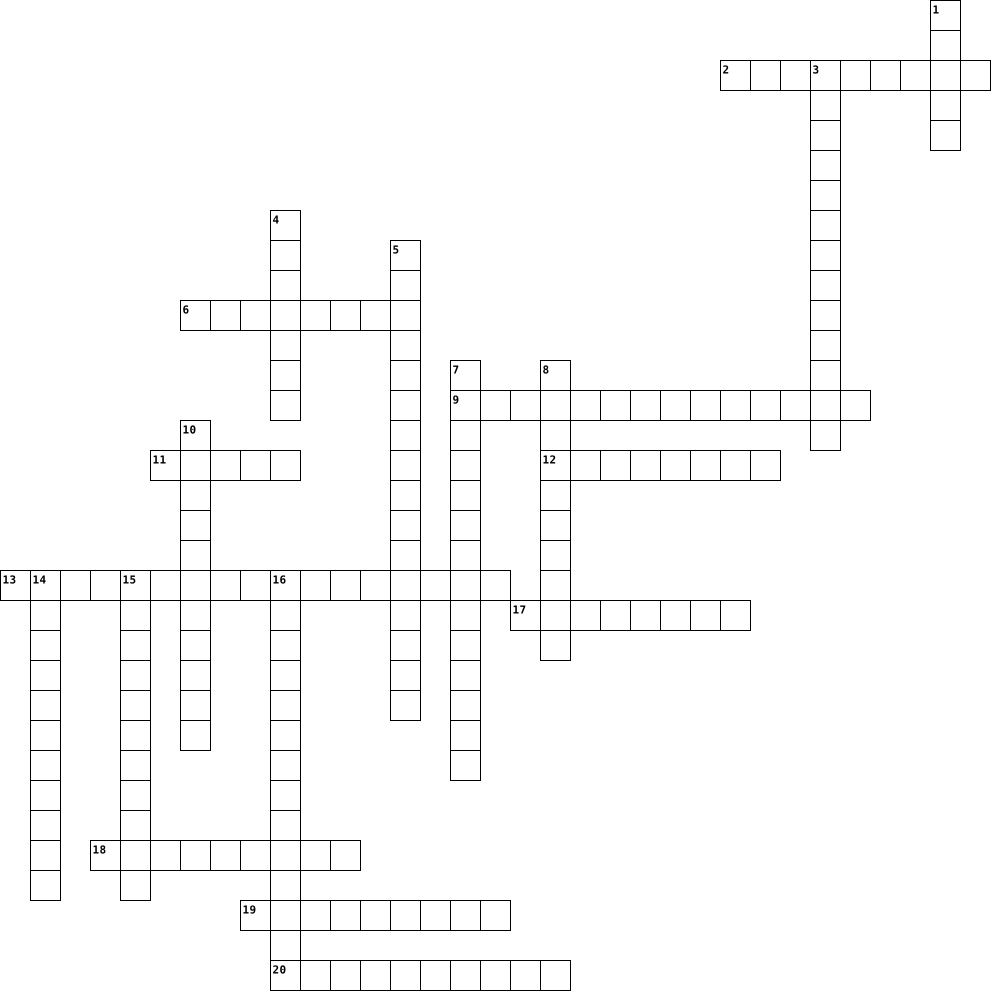
plate tectonics Crossword Puzzles
techtonics 2022-12-14

Across
- this palte holds europe and asia
- this happens at transform boundaries
- all of the continents comebind
- this plate holds the north american
- this plate holds antarctica
- to plates rub against each other
- dense basalt crust
Down
- this plate holds africa
- this plate holds south america
- thin crust
- to plate head on colied
- this plate holds australia
- these seperate the plates
- to plates move away
- this plate holds only pacific ocean
15 Clues: thin crust • dense basalt crust • to plates move away • this plate holds africa • to plate head on colied • these seperate the plates • this plate holds australia • this plate holds antarctica • this plate holds south america • all of the continents comebind • this palte holds europe and asia • to plates rub against each other • this plate holds the north american • ...
techtonics 2022-12-14

Across
- this palte holds europe and asia
- this happens at transform boundaries
- all of the continents comebind
- this plate holds the north american
- this plate holds antarctica
- to plates rub against each other
- dense basalt crust
Down
- this plate holds africa
- this plate holds south america
- thin crust
- to plate head on colied
- this plate holds australia
- these seperate the plates
- to plates move away
- this plate holds only pacific ocean
15 Clues: thin crust • dense basalt crust • to plates move away • this plate holds africa • to plate head on colied • these seperate the plates • this plate holds australia • this plate holds antarctica • this plate holds south america • all of the continents comebind • this palte holds europe and asia • to plates rub against each other • this plate holds the north american • ...
Andrew Rickards Science Project 2015-01-15

Across
- tectonics Plates that glide over the Earth's mantle
- When magma cools it turns to this type of rock
Down
- The process that breaks things down from exposure to air
- Slow destruction of rocks over time
4 Clues: Slow destruction of rocks over time • When magma cools it turns to this type of rock • tectonics Plates that glide over the Earth's mantle • The process that breaks things down from exposure to air
6.4 Plate Tectonics & Rock Cycling 1 2024-12-01

Across
- plate material containing dense basalt rock that is usually found under the ocean
- two things or events happening together or at the same time, but not causing one another
- moving rocks and sediment by wind and/or water.
- liquidy rock found below or within the Earth’s crust
- the section of the crust between earthquake lines
- the size of something
- the point on Earth’s surface directly above where an earthquake occurred
- liquidy rock that flows out of a volcano and onto the Earth’s surface openings,or vents where lava, small rocks, and steam erupt onto the Earth's surface
- the surface of the Earth
Down
- the reason something has occurred or is occurring
- resources that people are mining drilling for
- the movement of the bedrock caused by plates getting stuck on each other and then roughly moving past each other
- a smaller earthquake following the main shock of a large earthquake.
- plate material containing less dense granite, usually found underground or on continental land
- under the crust where it is hot and rock begins to melt, move & shift
- solid rock found everywhere on Earth, often under sediments, such as soil, sand, dirt and broken rocks loose earth materials, such as sand, soil and rocks, that are found on the surface of the Earth
16 Clues: the size of something • the surface of the Earth • resources that people are mining drilling for • moving rocks and sediment by wind and/or water. • the reason something has occurred or is occurring • the section of the crust between earthquake lines • liquidy rock found below or within the Earth’s crust • ...
The Geologic Time Scale 2013-03-12

Across
- The meteorite that struck Earth in the Paleogene period caused a change in global _______
- Element found in the K-T boundary that is not prevalent on Earth
- Earth's _________ was 4.6 billion years ago
- Epoch in which humans began to form civilizations
- An event in which many species become extinct in a short time; they occur every 26 to 30 million years on average and are known as mass ___________
- Cause of the mass extinction of the dinosaurs after the Cretaceous period
- Extensive glaciation occured before the______
- By the end of the Carboniferous period, the first ____ began to roam the forests
- Era that means "recent life"
- The appearance of the first mammals
Down
- Number of eras in the Phanerozoic eon
- Groups of organisms rapidly diversified in the _______ explosion
- Birds evolved from ________, who lived in the Mesozoic era
- The land mass that existed on Earth 225 million years ago
- 90 percent of all history
- Largest division divides the scale into ______ parts
- Movement of plate ________ that make up the surface of Earth
- The model that expresses the major geological and biological events in Earth's history is known as the ________ time scale
18 Clues: 90 percent of all history • Era that means "recent life" • The appearance of the first mammals • Number of eras in the Phanerozoic eon • Earth's _________ was 4.6 billion years ago • Extensive glaciation occured before the______ • Epoch in which humans began to form civilizations • Largest division divides the scale into ______ parts • ...
Science Crossword 2019-07-21

Across
- Ground that slants downward or upward. (S)
- A mild tremor preceding the violent shaking movement of an earthquake. (F)
- The branch of science concerned with earthquakes and related phenomena. (S)
- Is a smaller earthquake that follows a larger earthquake, (A)
- A theory of the condition of approximate equilibrium in the outer part of the earth. (I)
- The process of making something, especially a gas, liquid. (L)
- A part of plate tectonics. Its discovery provided a mechanism for continental drift that Alfred Wegener could not explain. In this lesson, you will learn about this important geologic process. (S) (S)
- A hypothetical super continent that included all current land masses, believed to have been in existence before the continents broke apart during the Triassic and Jurassic Periods. (PAN-EA)
- An opening exposed on the earth's surface where volcanic material is emitted. (V)
- A large natural elevation of the earth's surface rising abruptly from the surrounding level; a large steep hill. (M)
- The process of eroding or being eroded by wind, water, or other natural agents. (E)
- A shaking of a part of the earth's surface that often causes great damage. (E)
- A measure of the amount of energy released by an earthquake. (M)
Down
- Locations on Earth's surface that has experienced active volcano activities for a long period of time. (H)
- A mountain with a hole in the top or side that sometimes sends out rocks, ash, lava, etc., in a sudden explosion (called eruption). (V)
- The point within the earth where an earthquake rupture starts. (H)
- An elastic wave in the earth produced by an earthquake or other means. (S) (W)
- A fracture along which the blocks of crust on either side have moved relative to one another parallel to the fracture. (F)
- The sideways and downward movement of the edge of a plate of the earth's crust into the mantle beneath another plate. (S)
- The upper layer of the earth's mantle, below the lithosphere, in which there is relatively low resistance to plastic flow and convection is thought to occur. (A)
- A geologic plate in which most of the crust (the top rock layer is mostly land). (C) (P)
- A natural feature of the earth's surface. (L)
- A long high sea wave caused by an earthquake, submarine landslide, or other disturbance (T)
- Hot liquid rock below the surface of the Earth. (M)
- A narrow, straight, elongate, U-Shaped valley between two mountain ranges. (T)
- The region between an oceanic trench and the associated volcanic arc. (F)
- The point on the earth's surface vertically above the focus of an earthquake. (E)
27 Clues: Ground that slants downward or upward. (S) • A natural feature of the earth's surface. (L) • Hot liquid rock below the surface of the Earth. (M) • Is a smaller earthquake that follows a larger earthquake, (A) • The process of making something, especially a gas, liquid. (L) • A measure of the amount of energy released by an earthquake. (M) • ...
CDT 2022-10-13

Across
- Glaciers found in places that should've never had glaciers
- the theory that Wegener made, the theory that all the continents have moved slowly over time.
- a piece fossil evidence that was found in South America and Africa
Down
- Sections of land that are moved over time by plate tectonics
- the German scientist that came up with the continental Drift Theory
- Fossils of the same creature dated to the same time that can't swin found if different continents
- the sections of land that are moved by the convection currents in the mantle
7 Clues: Glaciers found in places that should've never had glaciers • Sections of land that are moved over time by plate tectonics • a piece fossil evidence that was found in South America and Africa • the German scientist that came up with the continental Drift Theory • the sections of land that are moved by the convection currents in the mantle • ...
Ocean Stations 2023-03-29

Across
- A long narrow deep depression in the ocean floor.
- The slope between the outer edge of the continental shelf and the deep ocean floor.
- A large area of extremely flat or gently sloping ocean floor just offshore of a continent
- Formed by a build-up of cool lava, breaks the surface of the ocean.
Down
- The area of seabed where the sea is relatively shallow compared to the open ocean.
- A fissure in the surface of a planet from which geothermally heated water is released.
- An underwater mountain range formed by plate tectonics.
7 Clues: A long narrow deep depression in the ocean floor. • An underwater mountain range formed by plate tectonics. • Formed by a build-up of cool lava, breaks the surface of the ocean. • The area of seabed where the sea is relatively shallow compared to the open ocean. • The slope between the outer edge of the continental shelf and the deep ocean floor. • ...
Tectonic Plates Crossword 2021-11-18

Across
- A plate boundary where two plates collide
- The result of a Divergent Plate Boundary
- unevenly heated areas of the mantle moving the plates
- A plate boundary where two plates pull apart
- The result of a Transform Plate Boundary
- The result of a Convergent Plate Boundary when the two plates have similar densities
- When a less dense plate goes under a denser one
- The point of seafloor spreading in which new land moves out from
- The result of a Convergent Plate Boundary when an Oceanic plate is involved
Down
- The person who discovered Seafloor Spreading
- Discovered by Alfred Wegener, suggested that the plates where moving
- Discovered by Harry Hess provided information that the floor of the ocean was moving away from a certain point
- waves given off from plate movement
- A plate boundary where two plates slip past each other
- the layer of earth in which the plates are divided
- The person who discovered the Continental Drift Theory
16 Clues: waves given off from plate movement • The result of a Divergent Plate Boundary • The result of a Transform Plate Boundary • A plate boundary where two plates collide • The person who discovered Seafloor Spreading • A plate boundary where two plates pull apart • When a less dense plate goes under a denser one • the layer of earth in which the plates are divided • ...
Tectonic Plates, Seismic Waves, Faulting! 2013-04-17

Across
- the solid rock just below the soil
- structure what does plate tectonics mean
- instrument to measure seismic waves
- the top of the Earth's surface
- plates move into one another
- waves that produce entirely horizontal motion
- the Earth's outer shell
- a scientist who studies earthquakes and seismic wave
- what is under crust
- created when two contiental plates collide and the colliding crust is compressed and pushed upwards
- another phrase for p waves
- triggers large earthquakes
- body waves that arrive before the surace waves edmitted by an earthquake
- waves of energy caused by a sudden breaking of rock
- plates dives beneath the other creathing this
- the creater of a love wave
- fastest kind of seismic wave
- the zone where the oceanic plates are moving away from eachother
- the permanent displacement of the ground due to the event
- waves that can only move along the surface of the planet
Down
- waves that tavel through the Earth's inner layers
- a fracture in a rock formation where there has been movement of the blocks of rock on either side of the plane of fracture
- a part of the upper mantle that exhibits plastic properties
- the deepest point on Earth
- a wave that rolls along the ground
- how many tectonic boundries are there?
- faults that occu when shearing stress causes rocks on either side of the crack to slide parallelto the fault plane between them
- a plate of ocean dives under a landmass
- the study of earthquakes and seismic waves that move through and around the earth
- second wave you feel in an earthquake
- the cause of faults
- the rocks above move upward relative to the rocks below the plane
- strikeslipfaults where the crack is part of a boundary between two tectonic plates
- who proposed the theory of contiental drift
- formed when plates are tugged apart
- radiate seismic energy as body and surface waves
- plates move sideways in relation to eachother causing things like Earthquakes
- what are plates made of
- plates move apart
- how do the plates change over a long period of time
40 Clues: plates move apart • what is under crust • the cause of faults • the Earth's outer shell • what are plates made of • the deepest point on Earth • another phrase for p waves • triggers large earthquakes • the creater of a love wave • plates move into one another • fastest kind of seismic wave • the top of the Earth's surface • the solid rock just below the soil • ...
Earths interior 2022-09-15

Across
- tectonics The theory that Earth’s outer layer is made up of large, moving pieces called tectonic plates; the theory explains how plates interact and how those interactions relate to processes such as earthquakes and mountain building.
- reversal The process by which Earth’s magnetic north pole and magnetic south pole switch positions periodically; a change in the direction in which Earth’s magnetic field points.
- A system of ideas that explains many related observations and is supported by a large body of evidence acquired through scientific investigation
- current Any movement of matter that results from differences in density; may be vertical, circular, or cyclical.
- The strong, lower part of the mantle between the asthenosphere and the outer core.
- Directly above the focus on Earth’s surface is the epicenter.
- spreading The process by which new oceanic lithosphere form when magma rises to Earth's surface at mid-ocean ridges and solidifies, as older, existing seafloor moves away from the ridge.
- boundary 2 tectonic plates can move past one other in opposite directions and form a transform boundary.
- plates The theory of plate tectonics explains how lithospheric plates move around on the slow-flowing rock of the asthenosphere
- The central part of Earth below the mantle.
Down
- boundary When tectonic plates move toward each other and collide, a convergent boundary forms.
- solid layer made of rock.
- The thin and solid outermost layer of Earth adobe the mantle.
- Earthquakes are ground movements that occur when blocks of rock in Earth move suddenly and release energy.
- The layer of rock between the Earth’s crust and core.
- Deformation is the bending, tilting, and breaking of rock.
- is a place within Earth along a fault at which the first motion of and earthquake occurs.
- boundary When 2 tectonic plates move away from one another, or diverge, a divergent boundary forms.
- A break in a body of rock along which one block moves relative to another.
- plates boundary A tectonic plates boundary is where 2 or more tectonic plates builds up near the edges of the plates.
- It is a rigid, solid layer made of rock.
- rebound The sudden return of elastically deformed rock to its undeformed shape.
- The process by which one lithospheric plate moves beneath another plate as a result of tectonic forces.
- drift The hypothesis that a single large landmass broke up into smaller land masses to form the continents, which then drifted to their present locations; the movement of continents.
24 Clues: solid layer made of rock. • It is a rigid, solid layer made of rock. • The central part of Earth below the mantle. • The layer of rock between the Earth’s crust and core. • Deformation is the bending, tilting, and breaking of rock. • The thin and solid outermost layer of Earth adobe the mantle. • Directly above the focus on Earth’s surface is the epicenter. • ...
Science Crossword 2019-07-21

Across
- Ground that slants downward or upward. (S)
- An elastic wave in the earth produced by an earthquake or other means. (S) (W)
- A hypothetical super continent that included all current land masses, believed to have been in existence before the continents broke apart during the Triassic and Jurassic Periods. (PAN-EA)
- A theory of the condition of approximate equilibrium in the outer part of the earth. (I)
- The process of making something, especially a gas, liquid. (L)
- A mild tremor preceding the violent shaking movement of an earthquake. (F)
- The process of eroding or being eroded by wind, water, or other natural agents. (E)
- A geologic plate in which most of the crust (the top rock layer is mostly land). (C) (P)
- A measure of the amount of energy released by an earthquake. (M)
- A shaking of a part of the earth's surface that often causes great damage. (E)
- Locations on Earth's surface that has experienced active volcano activities for a long period of time. (H)
- The sideways and downward movement of the edge of a plate of the earth's crust into the mantle beneath another plate. (S)
- A large natural elevation of the earth's surface rising abruptly from the surrounding level; a large steep hill. (M)
Down
- A mountain with a hole in the top or side that sometimes sends out rocks, ash, lava, etc., in a sudden explosion (called eruption). (V)
- A long high sea wave caused by an earthquake, submarine landslide, or other disturbance (T)
- The branch of science concerned with earthquakes and related phenomena. (S)
- A part of plate tectonics. Its discovery provided a mechanism for continental drift that Alfred Wegener could not explain. In this lesson, you will learn about this important geologic process. (S) (S)
- The upper layer of the earth's mantle, below the lithosphere, in which there is relatively low resistance to plastic flow and convection is thought to occur. (A)
- The point within the earth where an earthquake rupture starts. (H)
- The region between an oceanic trench and the associated volcanic arc. (F)
- A fracture along which the blocks of crust on either side have moved relative to one another parallel to the fracture. (F)
- The point on the earth's surface vertically above the focus of an earthquake. (E)
- Is a smaller earthquake that follows a larger earthquake, (A)
- Hot liquid rock below the surface of the Earth. (M)
- A natural feature of the earth's surface. (L)
- A narrow, straight, elongate, U-Shaped valley between two mountain ranges. (T)
- An opening exposed on the earth's surface where volcanic material is emitted. (V)
27 Clues: Ground that slants downward or upward. (S) • A natural feature of the earth's surface. (L) • Hot liquid rock below the surface of the Earth. (M) • Is a smaller earthquake that follows a larger earthquake, (A) • The process of making something, especially a gas, liquid. (L) • A measure of the amount of energy released by an earthquake. (M) • ...
Science Crossword 2019-07-21

Across
- Hot liquid rock below the surface of the Earth. (M)
- A hypothetical super continent that included all current land masses, believed to have been in existence before the continents broke apart during the Triassic and Jurassic Periods. (PAN-EA)
- The process of making something, especially a gas, liquid. (L)
- The upper layer of the earth's mantle, below the lithosphere, in which there is relatively low resistance to plastic flow and convection is thought to occur. (A)
- The branch of science concerned with earthquakes and related phenomena. (S)
- A part of plate tectonics. Its discovery provided a mechanism for continental drift that Alfred Wegener could not explain. In this lesson, you will learn about this important geologic process. (S) (S)
- A fracture along which the blocks of crust on either side have moved relative to one another parallel to the fracture. (F)
- The point on the earth's surface vertically above the focus of an earthquake. (E)
- An opening exposed on the earth's surface where volcanic material is emitted. (V)
- A large natural elevation of the earth's surface rising abruptly from the surrounding level; a large steep hill. (M)
- A mild tremor preceding the violent shaking movement of an earthquake. (F)
- A narrow, straight, elongate, U-Shaped valley between two mountain ranges. (T)
Down
- A measure of the amount of energy released by an earthquake. (M)
- A mountain with a hole in the top or side that sometimes sends out rocks, ash, lava, etc., in a sudden explosion (called eruption). (V)
- A geologic plate in which most of the crust (the top rock layer is mostly land). (C) (P)
- The process of eroding or being eroded by wind, water, or other natural agents. (E)
- An elastic wave in the earth produced by an earthquake or other means. (S) (W)
- Ground that slants downward or upward. (S)
- The region between an oceanic trench and the associated volcanic arc. (F)
- The point within the earth where an earthquake rupture starts. (H)
- A natural feature of the earth's surface. (L)
- A theory of the condition of approximate equilibrium in the outer part of the earth. (I)
- Is a smaller earthquake that follows a larger earthquake, (A)
- A shaking of a part of the earth's surface that often causes great damage. (E)
- The sideways and downward movement of the edge of a plate of the earth's crust into the mantle beneath another plate. (S)
- A long high sea wave caused by an earthquake, submarine landslide, or other disturbance (T)
- Locations on Earth's surface that has experienced active volcano activities for a long period of time. (H)
27 Clues: Ground that slants downward or upward. (S) • A natural feature of the earth's surface. (L) • Hot liquid rock below the surface of the Earth. (M) • Is a smaller earthquake that follows a larger earthquake, (A) • The process of making something, especially a gas, liquid. (L) • A measure of the amount of energy released by an earthquake. (M) • ...
Science Crossword 2019-07-21

Across
- A fracture along which the blocks of crust on either side have moved relative to one another parallel to the fracture. (F)
- Ground that slants downward or upward. (S)
- The process of eroding or being eroded by wind, water, or other natural agents. (E)
- A natural feature of the earth's surface. (L)
- Locations on Earth's surface that has experienced active volcano activities for a long period of time. (H)
- The upper layer of the earth's mantle, below the lithosphere, in which there is relatively low resistance to plastic flow and convection is thought to occur. (A)
- The point within the earth where an earthquake rupture starts. (H)
- A narrow, straight, elongate, U-Shaped valley between two mountain ranges. (T)
- The region between an oceanic trench and the associated volcanic arc. (F)
- Hot liquid rock below the surface of the Earth. (M)
- Is a smaller earthquake that follows a larger earthquake, (A)
- A mountain with a hole in the top or side that sometimes sends out rocks, ash, lava, etc., in a sudden explosion (called eruption). (V)
- A geologic plate in which most of the crust (the top rock layer is mostly land). (C) (P)
- A long high sea wave caused by an earthquake, submarine landslide, or other disturbance (T)
Down
- The process of making something, especially a gas, liquid. (L)
- An elastic wave in the earth produced by an earthquake or other means. (S) (W)
- A shaking of a part of the earth's surface that often causes great damage. (E)
- A part of plate tectonics. Its discovery provided a mechanism for continental drift that Alfred Wegener could not explain. In this lesson, you will learn about this important geologic process. (S) (S)
- The sideways and downward movement of the edge of a plate of the earth's crust into the mantle beneath another plate. (S)
- A theory of the condition of approximate equilibrium in the outer part of the earth. (I)
- A mild tremor preceding the violent shaking movement of an earthquake. (F)
- The point on the earth's surface vertically above the focus of an earthquake. (E)
- The branch of science concerned with earthquakes and related phenomena. (S)
- An opening exposed on the earth's surface where volcanic material is emitted. (V)
- A measure of the amount of energy released by an earthquake. (M)
- A large natural elevation of the earth's surface rising abruptly from the surrounding level; a large steep hill. (M)
- A hypothetical super continent that included all current land masses, believed to have been in existence before the continents broke apart during the Triassic and Jurassic Periods. (PAN-EA)
27 Clues: Ground that slants downward or upward. (S) • A natural feature of the earth's surface. (L) • Hot liquid rock below the surface of the Earth. (M) • Is a smaller earthquake that follows a larger earthquake, (A) • The process of making something, especially a gas, liquid. (L) • A measure of the amount of energy released by an earthquake. (M) • ...
Oceanography Crossword 2023-01-10

Across
- What crust is broken into
- If this happens in plates, quakes happen
- Plate off the coast of South America
- Plate off the coast of Central America
- Where plates float
- Mid Ocean ______
- A boundary where two plates collide
- Theory all continents were once together
- East African ______
- When one plate sinks under another
Down
- A boundary where two plates spread apart
- Pushes up to form new crust
- Plates named after this part of earth
- A form of crust found on land
- A form of crust found in the ocean
- A geological event that causes shaking
- Steep areas deep in the ocean
- Plate _______
- Very large waves
- San Andreas _______
20 Clues: Plate _______ • Mid Ocean ______ • Very large waves • Where plates float • East African ______ • San Andreas _______ • What crust is broken into • Pushes up to form new crust • A form of crust found on land • Steep areas deep in the ocean • A form of crust found in the ocean • When one plate sinks under another • A boundary where two plates collide • Plate off the coast of South America • ...
Puzzle 32: Geology and Rocks 2025-09-09

Across
- – Large landmass.
- – Rising of Earth’s surface.
- – Sinking of Earth’s surface.
- – Plates pushing together.
- – Origin of earthquake.
- – Volcanic particles.
- – Segment of crust.
- – Semi-fluid mantle layer.
- – One plate beneath another.
- – Related to earthquakes.
- – Magma erupts to surface.
- – Shaking from plate movement.
- – Records earthquake waves.
- – Gap between diverging plates.
- – Plates sliding past.
- – Deep ocean depression.
Down
- – Elevated underwater boundary.
- – Formation of volcanoes.
- – Plates moving together.
- – Related to Earth’s plates.
- – Point above earthquake focus.
- – Fracture in crust.
- – Crust and upper mantle.
- – Melted rock.
- – Edge of tectonic plate.
- – Elevated landform.
- – Plates moving apart.
- – Plate edge.
- – Molten rock.
- – Ocean floor crust.
30 Clues: – Plate edge. • – Melted rock. • – Molten rock. • – Large landmass. • – Segment of crust. • – Fracture in crust. • – Elevated landform. • – Ocean floor crust. • – Volcanic particles. • – Plates moving apart. • – Plates sliding past. • – Origin of earthquake. • – Deep ocean depression. • – Formation of volcanoes. • – Plates moving together. • – Crust and upper mantle. • – Edge of tectonic plate. • ...
Weathering and Erosion - Lithosphere! 2023-03-10

Across
- smaller earthquakes that occur in the same general area during the days to years following a larger event or "mainshock.
- a series of waves in a water body caused by the displacement of a large volume of water, generally in an ocean or a large lake.
- A plate boundary where two plates move toward each other.
- a transverse or longitudinal earthquake wave that travels through the interior of the earth
- a current in a fluid that results from convection.
- a German climatologist, geologist, geophysicist, meteorologist, and polar researcher.
- an American geologist and a United States Navy officer in World War II who is considered one of the "founding fathers" of the unifying theory of plate tectonics.
- A rigid layer made up of the uppermost part of the mantle and the crust.
- waves that oscillate the ground perpendicular to the direction of wave travel
- place inside Earth's crust where an earthquake originates.
- a sudden and violent shaking of the ground, sometimes causing great destruction, as a result of movements within the earth's crust or volcanic action.
- the vibration of the rock is in the direction of propagation. these waves travel fastest and are the first to arrive from the earthquake
- loosely packed, water-logged sediments at or near the ground surface lose their strength in response to strong ground shaking.
- a mild tremor preceding the violent shaking movement of an earthquake.
Down
- A zone of hot, partly melted rock that flows and can be deformed like soft plastic.
- A plate boundary where two plates move away from each other.
- a record produced by a seismograph.
- the continent we now know as North America was contiguous with Africa, South America, and Europe.
- caused by the sudden movement of materials within the Earth, such as slip along a fault during an earthquake.
- an area where tectonic plates move sideways past each other
- waves travel more slowly through Earth material at the planet's surface and are predominantly lower frequency than body waves.
- the branch of science concerned with earthquakes and related phenomena.
- study shock waves created by earthquakes and volcanic activity. They also work in oil, gas and minerals exploration.
- the point on the earth's surface vertically above the focus of an earthquake.
24 Clues: a record produced by a seismograph. • a current in a fluid that results from convection. • A plate boundary where two plates move toward each other. • place inside Earth's crust where an earthquake originates. • an area where tectonic plates move sideways past each other • A plate boundary where two plates move away from each other. • ...
Earth Vocabulary 2026-01-06

Across
- Rock that forms when existing rocks change due to heat and/or pressure
- where two plates move together to form volcanoes and other landforms
- The processes that change the surface of the earth through the movement of plates
- Rock that forms when magma cools on the surface or underground
- The formation of new areas of oceanic crust and its movement on either side
Down
- Rock that forms when pebbles and other pieces are cemented together over time
- where two plates separate creating seafloor spreafing creating underwater volcanic chains and rift valleys
- movement of magma in the mantle caused by temperature changes that move plates above
- when plates scrape past each other to create earthquakes
- when one tectonic plate pushes under another into the mantle where it melts
10 Clues: when plates scrape past each other to create earthquakes • Rock that forms when magma cools on the surface or underground • where two plates move together to form volcanoes and other landforms • Rock that forms when existing rocks change due to heat and/or pressure • when one tectonic plate pushes under another into the mantle where it melts • ...
NAIL STRUCTURE, DISORDERS AND DISEASES 2023-02-22

Across
- INFLAMMATION OF THE MATRIX AND SHEDDING OF THE NAIL
- DAMAGED SKIN AROUND NAIL PLATE
- SEPERATION AND FALLING OFF OF A NAIL PLATE FROM THE NAIL BED
- NAIL TURNS A VARIETY OF COLORS
- REDNESS, PAIN, SWELLING,BROKEN SKIN OR PUS
- INGROWN NAILS
- DARK, PURPLISH SPOTS ON THE NAIL BED
- FUNGAL INFECTIONS OF THE FEET
- ABNORMAL SPLIT OR BRITTLE NAILS
- BITTEN NAILS
- ABNORMAL STRETCHING OF THE EPONYCHIUM
- THIN, WHITE NAIL PLATE
- YELLOW-GREEN SPOT THAT BECOMES DARKER
Down
- LENGHTWISE GROOVES, NORMAL IN AGING
- LUMP OF RED TISSUE
- FUNAL INFECTION OF THE NAIL PLATE
- COMMON IN AFRICAN AMERICANS OR ASIANS
- TRUMPET NAIL
- FOLDED NAIL
- SEPARATION OF THE NAIL PLATE AND BED
- BACTERIAL INFLAMMATION OF THE TISSUES AROUND THE NAIL PLATE
- NAIL SURFACE PITTING,ROUGHNESS
- DAMAGE TO CAPILLARIES UNDER THE NAIL
- WHITISH SPOTS OF DISCOLORATION
- DEPRESSIONS ACROSS THE WIDTH OF THE NAIL PLAT
25 Clues: FOLDED NAIL • TRUMPET NAIL • BITTEN NAILS • INGROWN NAILS • LUMP OF RED TISSUE • THIN, WHITE NAIL PLATE • FUNGAL INFECTIONS OF THE FEET • DAMAGED SKIN AROUND NAIL PLATE • NAIL TURNS A VARIETY OF COLORS • NAIL SURFACE PITTING,ROUGHNESS • WHITISH SPOTS OF DISCOLORATION • ABNORMAL SPLIT OR BRITTLE NAILS • FUNAL INFECTION OF THE NAIL PLATE • LENGHTWISE GROOVES, NORMAL IN AGING • ...
2-24-26 2026-02-19

Across
- – Structural floor layer
- – Pre-built roof framework
- – Vertical wall member
- – Threaded fastener with nut
- – Bending under weight
- – Reduces heat transfer
- – Distance between supports
- – Horizontal wall framing
- – Item that joins materials
- – Structural skeleton
- – Support above opening
- – Heavy structural support
- floor – Visible walking surface
- – Hammer-driven fastener
Down
- – Floor support member
- – Base of the building
- joist – Outer floor joist
- – Weight carried by structure
- – Vertical load support
- – Concrete support under foundation
- – Flat concrete surface
- plate – Bottom wall plate
- – Official building check
- plate – Top wall plate
- – Threaded fastener
- – Interior wall covering
- – Panels over framing
- – Sloped roof member
- – Fastener for masonry
29 Clues: – Threaded fastener • – Sloped roof member • – Structural skeleton • – Panels over framing • – Floor support member • – Base of the building • – Vertical wall member • – Bending under weight • plate – Top wall plate • – Fastener for masonry • – Vertical load support • – Flat concrete surface • – Reduces heat transfer • – Support above opening • – Structural floor layer • ...
COSMETOLOGY NAIL STRUCTURE & GROWTH 2022-12-07

Across
- Dead, colorless tissue attached to the natural nail plate. The tissure is sticky and difficult to remove from nail plate. It's job is to seal the space between the natural nail plate and living skin.
- Slits or furrows on the sides of the sidewall.
- Water content of a healthy nail.Water content directly affects the nail's flexibility.
- Also known as lateral nail fold; the fold of skin overlapping the side of the nail.
- Portion of the living skin that supports the nail plate as it grows toward the free edge.
- Slightly thickened layer of skin that lies between the fingertip and free edge of the natural nail plate.
- fibrous protein found in the natural nail and is also found in skin and hair
- Living skin at the base of the natural nail plate that covers the matrix area.
- Part of the nail plate that extends over the tip of the finger or toe.
- How many layers of nail cells make up the nail plate?
- Also known as onyx; the hard protective plate is composed mainly of keratin, the same fibrous protein found in skin and hair. The keratin in natural nails is harder than the keratin in skin or hair.
Down
- The natural nail is part of this system
- nail growth is slower than all other nails
- nail growth is faster than all other nails
- Visisble part of the matrix that extends from underneath the living skin; it is the whitish, half-moon shape at the base of the nail.
- Hardened keratin plate that sits on and covers the natural nail bed. It is the most visible and functional part of the natural nail unit.
- Folds of normal skin that surround the natural nail plate.
- What forms the nail plate?
18 Clues: What forms the nail plate? • The natural nail is part of this system • nail growth is slower than all other nails • nail growth is faster than all other nails • Slits or furrows on the sides of the sidewall. • How many layers of nail cells make up the nail plate? • Folds of normal skin that surround the natural nail plate. • ...
Tectonic Plates 2013-04-06
Across
- If 2 tectonic plates collide theseare created.
- The plate most of Europe is on.
- The _______________________ plate is where Australia is on.
- The number of major tectonic plates.
- ______________________ are also created from tectonic plates coliding.
- ______________________ is the creation of new oceanic crust.
- The ____________________ plate is what plate Antartica is on.
- _____________ plates slide past each other.
- ____________________ plates move away from each other.
- The printout of a seismograph.
Down
- Oceanic plates are more __________________ than Continental plates.
- The plate the USA is on:__________________ plate.
- If a mountian is created underwater, and becomes tall enough it will create these.
- The theory all the tectonic plates and continents were once joined together as one.
- _____________________ create new land.
- _________________ plates move towards each other.
- It records earthquakes.
- A vibrant moving of the ground caused by tectonic plates.
- The tectonic plates are in the _____________________ (a layer in the mantle).
- The topic of this puzzle.
20 Clues: It records earthquakes. • The topic of this puzzle. • The printout of a seismograph. • The plate most of Europe is on. • The number of major tectonic plates. • _____________________ create new land. • _____________ plates slide past each other. • If 2 tectonic plates collide theseare created. • The plate the USA is on:__________________ plate. • ...
Nail Structure and Growth Disorders 2024-11-14

Across
- living skin at the base
- slowest grow rate
- folded nail
- living skin that supports the nail plate
- extends over the tip of the finger
- known as the natural nail
- living skin supports nail plate
- skin that surrounds the nail plate
- living skin that supports the nail plate
- Also known as lateral nail fold
- lack of oxygen circulating
- cells are formed
- white spots
- deformity or disease
- tiny pits or severe roughness on the surface
- Visible part of the matrix whiteish half moon
Down
- Nail malformation
- dead colorless tissue attached to nail plate
- bacterial inflammation surrounding nail
- tissue splits or tears
- tough band fibrous tissue that connects
- fastest grow rate
- trumpet nail
- thin white nail plate flexible and can curve
- blood clot forms under the nail plate
- living skin bordering the root/sides of nails
- grows slower than fingernails
- hard keratin plate covers nail
- darkening or black bands
- thickened layer/skin between fingertip/edge
30 Clues: folded nail • white spots • trumpet nail • cells are formed • Nail malformation • slowest grow rate • fastest grow rate • deformity or disease • tissue splits or tears • living skin at the base • darkening or black bands • known as the natural nail • lack of oxygen circulating • grows slower than fingernails • hard keratin plate covers nail • living skin supports nail plate • ...
REGISTRATION REVIEW 2026-03-11

Across
- Personalized Plate Form
- Disabled Parking Permit Form
- Temporary License Plate Form
- State Motto Plate "In God We Trust"
- The length of time to be considered Antique
- Most automobile registrations expire midnight on the owner's _______.
- This Parking Permit is Red.
- Sunshine State Plate
Down
- Trailers under this weight get a Registration Only.
- A Permanent Parking Permit is good for this length of time.
- Heavy Trucks that weigh ____lbs. or more, need a 2290.
- Replacement Form
- Length of Time given for a Personalized Plate (Temp Tag)
- Length of Time given for Intrans-it (Temp Tag)
- This Parking Permit is Blue.
- Initial Registration Fee Exemption Form
- Length of Time given for a Vin Check ( Temp Tag)
- How long a Insurance Binder is good for.
- Regular County Plate
- A temporary Parking Permit is good up to this length of time.
20 Clues: Replacement Form • Regular County Plate • Sunshine State Plate • Personalized Plate Form • This Parking Permit is Red. • Disabled Parking Permit Form • This Parking Permit is Blue. • Temporary License Plate Form • State Motto Plate "In God We Trust" • Initial Registration Fee Exemption Form • How long a Insurance Binder is good for. • The length of time to be considered Antique • ...
SCI Earth Science W4 2023-05-10

Across
- Who proposed the theory of continental drift?
- When an oceanic plate and continental plate converge, which plate will subduct?
- The Mid-Atlantic Ridge was created by which boundary type?
- Oldest rocks are - from the ocean ridge
- Who proposed the theory of seafloor spreading?
- The plates float on -?
- Transforming plates are moving - to each other, in opposite directions.
- Process of magma moving tectonic plates
- When a plate sinks under another and melts into the mantle
- Mineral that reacts to Earth's magnetic field
- Cold sinks as it is -?
- This is an example of continental and continental plates converging.
Down
- This is an example of oceanic plate converging with oceanic plate
- Plates merging together
- Evidence of seafloor spreading with symmetrical alternating strips of rock
- When oceanic and oceanic collide, it creates trenches and magma emerges creates volcanoes and an -?
- This boundary type causes earthquakes
- South America used to be connected to - in the supercontinent, before seafloor spreading.
- Where magma emerges from in the seafloor
- Supercontinent
- The Earth's magnetic field - every few million years
- The - Plate contains most of Asia and Europe
22 Clues: Supercontinent • The plates float on -? • Cold sinks as it is -? • Plates merging together • This boundary type causes earthquakes • Oldest rocks are - from the ocean ridge • Process of magma moving tectonic plates • Where magma emerges from in the seafloor • The - Plate contains most of Asia and Europe • Who proposed the theory of continental drift? • ...
shekina parra 2021-05-18

Across
- land on the toe plate with both feet at the same time
- brush step(weight change)
- both toe and heel plate strike the floor at the same time the lift up
- shuffle HOP step
- striking the floor with the toe plate with a change of weight
- land on one toe plate
- dig spank toe heel
- brush spank
Down
- both toe and heel plate strike the floor at the same time with a weight change
- step shuffle step
- step SHUFFLE STEP toe(toe crosses in back)
- swing the foot forward and only striking the toe plate
- swing the foot backward and only striking the toe plate plate
- toe TOE heel HEEL
- striking the floor with the heel plate with a change of weight
- lift heels and slide on you toe plates then drop heels at the same time
16 Clues: brush spank • shuffle HOP step • step shuffle step • toe TOE heel HEEL • dig spank toe heel • land on one toe plate • brush step(weight change) • step SHUFFLE STEP toe(toe crosses in back) • land on the toe plate with both feet at the same time • swing the foot forward and only striking the toe plate • striking the floor with the toe plate with a change of weight • ...
Oceann Topography and Currents 2023-01-25

Across
- trench steep depressions in the deepest parts of the ocean
- ocean ridge seafloor mountain system formed by plate tectonics
- plain a flat region of the ocean floor
Down
- rise a wide, gentle incline from a deep ocean plain
- shelf submerged under an area
- slop is usually a steep slope from a continental shelf to the ocean floor
6 Clues: shelf submerged under an area • plain a flat region of the ocean floor • rise a wide, gentle incline from a deep ocean plain • trench steep depressions in the deepest parts of the ocean • ocean ridge seafloor mountain system formed by plate tectonics • slop is usually a steep slope from a continental shelf to the ocean floor
How is the Earth's Surface Changing? 2021-08-30

Across
- The _________ ridge is an underwater mountain chain where new ocean floor is formed.
- hot fluid or semifluid material below or within the earth's crust from which lava and other igneous rock is formed on cooling.
- A fact or event which can be observed and/or documented.
- Evidence; information gathered from observations.
- __________ drift is the hypothesis that states that the continents once formed a single landmass, broke up, and drifted to their present locations.
- Alfred _________ A German scientist who proposed the theory of continental drift.
- The action or process of observing something or someone carefully or in order to gain information.
- The measurement of ocean depths and the charting of the shape or topography of the ocean floor.
- relating to earthquakes or other vibrations of the earth and its crust.
- A large, ancient landmass that was composed of all the continents joined together.
- The data that is used to support a claim.
- Volcanic __________ includes any of the many processes (such as eruptions and lava flows) in which gas, lava, and ash are pushed out on the surface of Earth.
- the shape of landforms in an area. Usually shows elevation changes.
- An ocean _______ is a deep valley in the ocean floor that forms along a subduction zone.
Down
- A _________ boundary is a plate boundary where two plates move away from each other.
- a mountain or hill, typically conical, having a crater or vent through which lava, rock fragments, hot vapor, and gas are being or have erupted from the earth's crust.
- ________ currents are circular currents in the mantle caused by the magma being heated by the core off the Earth.
- Plate __________ is the theory that Earth's outer shell is divided into large slabs of solid rock, called “plates,” that glide over Earth's mantle.
- A _________ zone is a region where oceanic plates sink down into the asthenosphere.
- the layer of the earth between the crust and the core.
- A _________ boundary is a plate boundary where two plates move toward each other.
- a sudden and violent shaking of the ground, sometimes causing great destruction, as a result of movements within the earth's crust or volcanic action.
- A representation of an object or event
- Seismic __________ essentially provides an x-ray of the inside of a volcano.
- A truth, a rule, or a law
- Seafloor __________ is the process that creates new seafloor as plates move away from each other at the mid-ocean ridges.
- A _________ boundary is a plate boundary where two plates move past each other in opposite directions.
27 Clues: A truth, a rule, or a law • A representation of an object or event • The data that is used to support a claim. • Evidence; information gathered from observations. • the layer of the earth between the crust and the core. • A fact or event which can be observed and/or documented. • the shape of landforms in an area. Usually shows elevation changes. • ...
Science Crossword 2019-07-21

Across
- A mountain with a hole in the top or side that sometimes sends out rocks, ash, lava, etc., in a sudden explosion (called eruption). (V)
- A hypothetical super continent that included all current land masses, believed to have been in existence before the continents broke apart during the Triassic and Jurassic Periods. (PAN-EA)
- A shaking of a part of the earth's surface that often causes great damage. (E)
- The sideways and downward movement of the edge of a plate of the earth's crust into the mantle beneath another plate. (S)
- A part of plate tectonics. Its discovery provided a mechanism for continental drift that Alfred Wegener could not explain. In this lesson, you will learn about this important geologic process. (S) (S)
- A narrow, straight, elongate, U-Shaped valley between two mountain ranges. (T)
- The process of making something, especially a gas, liquid. (L)
- The branch of science concerned with earthquakes and related phenomena. (S)
- A long high sea wave caused by an earthquake, submarine landslide, or other disturbance (T)
- A large natural elevation of the earth's surface rising abruptly from the surrounding level; a large steep hill. (M)
- The process of eroding or being eroded by wind, water, or other natural agents. (E)
Down
- The region between an oceanic trench and the associated volcanic arc. (F)
- A fracture along which the blocks of crust on either side have moved relative to one another parallel to the fracture. (F)
- Locations on Earth's surface that has experienced active volcano activities for a long period of time. (H)
- An elastic wave in the earth produced by an earthquake or other means. (S) (W)
- A geologic plate in which most of the crust (the top rock layer is mostly land). (C) (P)
- A natural feature of the earth's surface. (L)
- An opening exposed on the earth's surface where volcanic material is emitted. (V)
- The point within the earth where an earthquake rupture starts. (H)
- Is a smaller earthquake that follows a larger earthquake, (A)
- A theory of the condition of approximate equilibrium in the outer part of the earth. (I)
- The upper layer of the earth's mantle, below the lithosphere, in which there is relatively low resistance to plastic flow and convection is thought to occur. (A)
- The point on the earth's surface vertically above the focus of an earthquake. (E)
- A measure of the amount of energy released by an earthquake. (M)
- Ground that slants downward or upward. (S)
- A mild tremor preceding the violent shaking movement of an earthquake. (F)
- Hot liquid rock below the surface of the Earth. (M)
27 Clues: Ground that slants downward or upward. (S) • A natural feature of the earth's surface. (L) • Hot liquid rock below the surface of the Earth. (M) • Is a smaller earthquake that follows a larger earthquake, (A) • The process of making something, especially a gas, liquid. (L) • A measure of the amount of energy released by an earthquake. (M) • ...
Science Crossword 2019-07-21

Across
- The process of eroding or being eroded by wind, water, or other natural agents. (E)
- Hot liquid rock below the surface of the Earth. (M)
- A theory of the condition of approximate equilibrium in the outer part of the earth. (I)
- The upper layer of the earth's mantle, below the lithosphere, in which there is relatively low resistance to plastic flow and convection is thought to occur. (A)
- Is a smaller earthquake that follows a larger earthquake, (A)
- A geologic plate in which most of the crust (the top rock layer is mostly land). (C) (P)
- A long high sea wave caused by an earthquake, submarine landslide, or other disturbance (T)
- A mountain with a hole in the top or side that sometimes sends out rocks, ash, lava, etc., in a sudden explosion (called eruption). (V)
- Ground that slants downward or upward. (S)
- The sideways and downward movement of the edge of a plate of the earth's crust into the mantle beneath another plate. (S)
- A fracture along which the blocks of crust on either side have moved relative to one another parallel to the fracture. (F)
- A measure of the amount of energy released by an earthquake. (M)
Down
- The region between an oceanic trench and the associated volcanic arc. (F)
- A large natural elevation of the earth's surface rising abruptly from the surrounding level; a large steep hill. (M)
- A natural feature of the earth's surface. (L)
- A shaking of a part of the earth's surface that often causes great damage. (E)
- Locations on Earth's surface that has experienced active volcano activities for a long period of time. (H)
- An elastic wave in the earth produced by an earthquake or other means. (S) (W)
- The process of making something, especially a gas, liquid. (L)
- A part of plate tectonics. Its discovery provided a mechanism for continental drift that Alfred Wegener could not explain. In this lesson, you will learn about this important geologic process. (S) (S)
- The point on the earth's surface vertically above the focus of an earthquake. (E)
- The point within the earth where an earthquake rupture starts. (H)
- The branch of science concerned with earthquakes and related phenomena. (S)
- A hypothetical super continent that included all current land masses, believed to have been in existence before the continents broke apart during the Triassic and Jurassic Periods. (PAN-EA)
- An opening exposed on the earth's surface where volcanic material is emitted. (V)
- A mild tremor preceding the violent shaking movement of an earthquake. (F)
- A narrow, straight, elongate, U-Shaped valley between two mountain ranges. (T)
27 Clues: Ground that slants downward or upward. (S) • A natural feature of the earth's surface. (L) • Hot liquid rock below the surface of the Earth. (M) • Is a smaller earthquake that follows a larger earthquake, (A) • The process of making something, especially a gas, liquid. (L) • A measure of the amount of energy released by an earthquake. (M) • ...
Printmaking Crossword puzzle 2020-01-15

Across
- ink is rolled across the plate and clings to those parts
- areas need to be cut away in order to remain white
- is the term used for a layer of wax used to cover a plate
- is the surface on which design is made
- was a skilled German artist of the 1500's
- is Italian for to cut in
- times, a print can be produced
- are produced on paper
- was the most common kind of relief printing
- in printmaking involve ink, paper, and a plate
- plate requires a piece of paper to be pressed against it
Down
- is a variation of etching
- is the artist for Great Wave
- is a printmaking process that uses limestone
- or screen printing is the newest of printmaking media
- print has a plate that is in relief, projects from surface
- and etching are the two kinds of intaglio printmaking
- is the usually the preferred material for intaglio plates
- of relief printing, intaglio image is below surface
- is a special gouge used to cut lines into the plate
20 Clues: are produced on paper • is Italian for to cut in • is a variation of etching • is the artist for Great Wave • times, a print can be produced • is the surface on which design is made • was a skilled German artist of the 1500's • was the most common kind of relief printing • is a printmaking process that uses limestone • in printmaking involve ink, paper, and a plate • ...
Gabrielle Martinez 2021-05-17

Across
- both toe and heel plate strike the floor at the same time then lift up
- to the back
- to pass through; the toe of the working leg at the knee of the standing leg
- swing the foot backward and only striking the toe plate
- land on one toe plate
- lift heels and slide on your toe plates the drop heels at the same time (2 sounds)
- to rise on to the toes from a plie
- bending the knees as low as possible without lifting the heels
- striking the floor with the toe plate with a change of weight
Down
- land on the toe plate with both feet at the same time
- scissor jump
- brush step (weight change)
- swing the foot forward and only striking the toe plate
- to disengage from the floor from a tendu
- stretching the foot along the floor
- brush spank
- the railing around the room
- to rise onto the toes
- striking the floor with the heel plate with a change of weight
- Bending the knees
20 Clues: to the back • brush spank • scissor jump • Bending the knees • to rise onto the toes • land on one toe plate • brush step (weight change) • the railing around the room • to rise on to the toes from a plie • stretching the foot along the floor • to disengage from the floor from a tendu • land on the toe plate with both feet at the same time • ...
Volcano Puzzle 2025-10-01

Across
- Process where one tectonic plate moves under another.
- The brittle outermost layer of Earth.
- Sudden shaking of the Earth's surface caused by plate movement.
- Plate boundary where plates move apart.
- Plate boundary where plates slide past one another.
- Deep underwater valley formed by subduction zones.
- Crack in the Earth’s crust where plates move.
- Plate boundary where plates move toward each other.
- Layer between the crust and core, semi-solid rock layer.
- Relating to earthquakes or vibrations in the Earth.
- Large underwater mountain range formed at divergent boundaries.
Down
- Long crack or opening in Earth's surface where lava can erupt.
- Volcanic activity not at plate boundaries caused by mantle plumes.
- Point on Earth’s surface directly above an earthquake’s origin.
- Large section of Earth's crust that moves over the mantle.
- Large crater formed when a volcano collapses after an eruption.
- Molten rock beneath the Earth’s surface.
- Soft, flowing layer of the mantle beneath the lithosphere.
- Molten rock that erupts onto the Earth's surface.
- Mountain that erupts molten rock.
20 Clues: Mountain that erupts molten rock. • The brittle outermost layer of Earth. • Plate boundary where plates move apart. • Molten rock beneath the Earth’s surface. • Crack in the Earth’s crust where plates move. • Molten rock that erupts onto the Earth's surface. • Deep underwater valley formed by subduction zones. • Plate boundary where plates slide past one another. • ...
2-17-26 2026-02-04

Across
- – Vertical load support
- – Distance between supports
- – Threaded fastener
- – Bending under weight
- – Item that joins materials
- – Pre-built roof framework
- Vertical wall member
- – Support above opening
- plate, Bottom wall plate
- Base of the building
- plate, Top wall plate
- joist – Outer floor joist
- – Structural floor layer
- – Heavy structural support
- – Hammer-driven fastener
Down
- – Weight carried by structure
- – Official building check
- – Sloped roof member
- – Threaded fastener with nut
- Horizontal wall framing
- floor – Visible walking surface
- – Floor support member
- – Interior wall covering
- Concrete support under foundation
- – Reduces heat transfer
- Flat concrete surface
- – Fastener for masonry
- – Panels over framing
- Structural skeleton
29 Clues: – Threaded fastener • Structural skeleton • – Sloped roof member • Vertical wall member • Base of the building • Flat concrete surface • – Panels over framing • – Floor support member • – Bending under weight • – Fastener for masonry • – Vertical load support • Horizontal wall framing • – Support above opening • – Reduces heat transfer • plate, Top wall plate • – Interior wall covering • ...
hyTectonic plates 2022-06-07
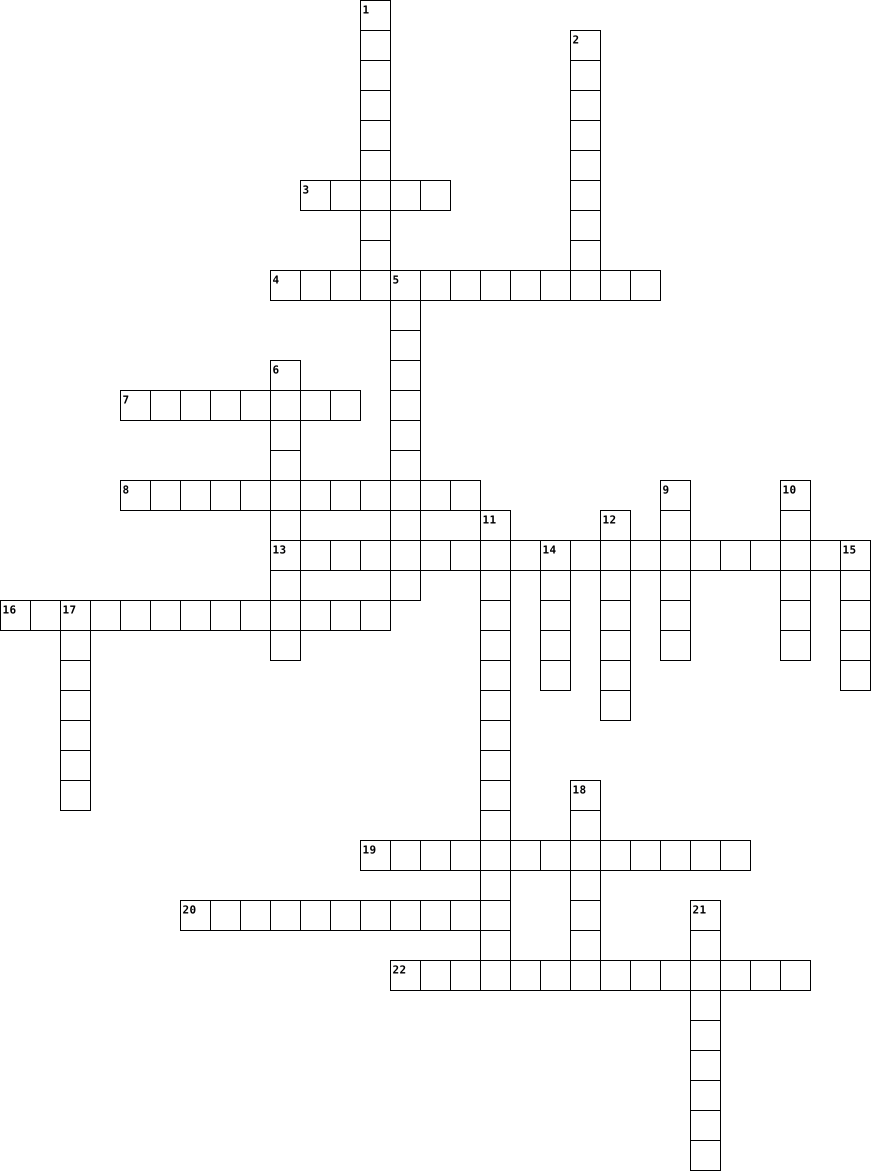
Across
- hot fluid below or within earths crust
- when where tectonic plates actually discovered
- how many years have tectonic plates been known
- the most common underwater tectonic plate
- the most common tectonic plate movement
- the man who discovered tectonic plates
- the location where two plates meet
- the plates that make up earths atmosphere
- the movement of earths crust drifting
Down
- the one type of tectonic plate movement that starts with a c
- the one type of tectonic plate movement that starts with a D
- most likely result from plate movement
- how much tectonic plates can move up to
- the layer of hot solid rock underneath earth's plates
- kilometers how deep tectonic plates can go
- the heat from radio active processes within the planets interiot that causes the plates to move
- when one tectonic plate moves under another
- how many types of tectonic plates there are
- how many tectonic plates there are
- how tectonic plates where discovered
- when tectonic plates in the ocean floor collide together
- the one type of tectonic plate movement that starts with t
22 Clues: how many tectonic plates there are • the location where two plates meet • how tectonic plates where discovered • the movement of earths crust drifting • hot fluid below or within earths crust • most likely result from plate movement • the man who discovered tectonic plates • how much tectonic plates can move up to • the most common tectonic plate movement • ...
Structure of the Nail 2021-10-18

Across
- grove, crease, line, indentation
- protein that is harder in nails than in hair
- portion of living skin that supports the nail plate as it grows toward free edge
- hardened keratin plate that sits on and covers the nail bed
- attaches nail plate to nail bed
- visible part of the matrix--whiteish half moon
Down
- tissue bordering the root and sides of nail
- also called onyx; hard protective plate composed of mostly keratin
- extends over the tip of finger or toe
- aka lateral nail fold; the fold of skin overlapping the sides of the nail
- dead tissue attached tot he nail plate
- also called natural nail
- area where nail plate sells are formed
- furrow on each side of the nail
- living skin at base of nail plate
- folds of normal skin around the nail plate
16 Clues: also called natural nail • furrow on each side of the nail • attaches nail plate to nail bed • grove, crease, line, indentation • living skin at base of nail plate • extends over the tip of finger or toe • dead tissue attached tot he nail plate • area where nail plate sells are formed • folds of normal skin around the nail plate • tissue bordering the root and sides of nail • ...
APES Unit 2 The Physical World 2022-05-17

Across
- type of plate boundary where plates move together
- type of rock that makes up continental plates
- create island chains away from plate boundaries
- type of rock that makes up oceanic plates
- created when an oceanic plate subducts underneath a continental plate
- process that occurs when plates move apart underneath the ocean
- flexible, viscous liquid of the mantle
- molten rock, hot gas, or ash erupts through Earth's surface.
- type of plate boundary where plates move past each other
Down
- pushes the mantle's soft rock up as it warms and down as it cools.
- type of plate boundary where plates move apart
- upper more solid portion of the mantle and crust
- when a tectonic plate sinks below another tectonic plate
- sudden mass wasting
- huge volumes of water are displaced and travel miles across the ocean
- release of energy along a transform plate boundary
16 Clues: sudden mass wasting • flexible, viscous liquid of the mantle • type of rock that makes up oceanic plates • type of rock that makes up continental plates • type of plate boundary where plates move apart • create island chains away from plate boundaries • upper more solid portion of the mantle and crust • type of plate boundary where plates move together • ...
Tectonics 2022-11-18

Across
- an instrument that records ground movement
- kind of wave released during an earthquake
- center of the earth
- part of the mantel below the lithosphere
- large wave caused by earthquakes on the ocean floor
- an earthquake that occurs when another earthquake
- scientists that study rocks
Down
- when earths tectonic plates converge
- when two plates collide
- rock that makes up the oceanic crust
- When an earthquake turns soil into mud
- used to map an oceanic ridge
- section of the lithosphere that carries the crust
- earths middle layer
14 Clues: center of the earth • earths middle layer • when two plates collide • scientists that study rocks • used to map an oceanic ridge • when earths tectonic plates converge • rock that makes up the oceanic crust • When an earthquake turns soil into mud • part of the mantel below the lithosphere • an instrument that records ground movement • kind of wave released during an earthquake • ...
Tectonic Plates 2013-04-06

Across
- It records earthquakes.
- The number of major tectonic plates.
- The topic of this puzzle.
- If 2 tectonic plates collide theseare created.
- The theory all the tectonic plates and continents were once joined together as one.
- ____________________ plates move away from each other.
- The plate the USA is on:__________________ plate.
- The tectonic plates are in the _____________________ (a layer in the mantle).
- The printout of a seismograph.
- The ____________________ plate is what plate Antartica is on.
Down
- A vibrant moving of the ground caused by tectonic plates.
- _________________ plates move towards each other.
- ______________________ are also created from tectonic plates coliding.
- ______________________ is the creation of new oceanic crust.
- If a mountian is created underwater, and becomes tall enough it will create these.
- The plate most of Europe is on.
- _____________ plates slide past each other.
- _____________________ create new land.
- Oceanic plates are more __________________ than Continental plates.
- The _______________________ plate is where Australia is on.
20 Clues: It records earthquakes. • The topic of this puzzle. • The printout of a seismograph. • The plate most of Europe is on. • The number of major tectonic plates. • _____________________ create new land. • _____________ plates slide past each other. • If 2 tectonic plates collide theseare created. • _________________ plates move towards each other. • ...
MACAM MACAM PELAYANAN , GELAS & PIRING 2025-09-28

Across
- service Jenis pelayanan yang menyajikan makanan di restoran
- plate Piring yang digunakan untuk menyajikan hidangan utama
- full plate Piring yang digunakan untuk menyajikan makanan yang berwarna cerah
- Alat makan yang digunakan untuk mengambil makanan
- service Jenis pelayanan yang menyajikan makanan dimeja
- drink glass Gelas yang digunakan untuk menyajikan minuman dengan es
- platter Piring yang digunakan untuk menyajikan makanan dengan ukuran besar
- cup Gelas yang digunakan untuk menyajikan minuman kopi
- plate Piring yang digunakan untuk menyajikan makanan tertentu
- Away Jenis pelayanan yang menyajikan makanan secara take away
- service Jenis pelayanan yang menyajikan secara buffet
- drink glass Gelas yang digunakan untuk menyajikan minuman dengan rasa manis
- Alat makan yang digunakan untuk memotong makanan
- service Jenis pelayanan yang menyajikan makanan dikamar hotel
Down
- glass Gelas yang digunakan untuk wine
- cup Gelas yang digunakan untuk mrnyajikan teh
- Plate Piring yang digunakan untuk menyajikan makanan tertentu
- drink glass Gelas yang digunakan untuk menyajikan minuman dengan es batu
- glass Gelas yang digunakan untuk menyajikan air minum
- Plate Piring yang digunakan untuk makanan ringan
- service Jenis pelayanan yang menyajikan makanan secara terbuka diluar
- plate Piring yang digunakan untuk menyajikan makanan dengan bentuk unik
- plate Piring yang digunakan untuk menyajikan dessert
- friendly Jenis pelayanan makanan dengan harga murah
- Plate piring yang digunakan untuk menyajikan makanan dekorasi khusus
- Glass Gelas yang digunakan untuk menyajikan jus buah
- service Jenis pelayanan yang menyajikan makanan tertentu
- Dinning Jenis pelayanan yang menyajikan makanan dengan standar tinggi
- Food Jenis pelayanan yang cepat
- plate Piring yang digunakan untuk appetaizer
30 Clues: Food Jenis pelayanan yang cepat • glass Gelas yang digunakan untuk wine • plate Piring yang digunakan untuk appetaizer • Alat makan yang digunakan untuk memotong makanan • Alat makan yang digunakan untuk mengambil makanan • friendly Jenis pelayanan makanan dengan harga murah • Plate Piring yang digunakan untuk makanan ringan • ...
8.2 CW 1 2025-10-14

Across
- A lowland region formed by the divergence of tectonic plates, often characterized by volcanic activity.
- The study of the magnetic properties of rocks to understand the historical movements of tectonic plates.
- scientist that developed the idea of continental drift
- The geographic spread of fossils found in different locations, which can provide evidence for historical plate movements.
- The process by which one tectonic plate is forced under another plate, often leading to volcanic activity and earthquakes.
- A deep, narrow depression in the ocean floor formed at convergent plate boundaries where one plate subducts beneath another.
- Plates Large sections of the Earth's lithosphere that move and interact with each other.
- The semi-fluid layer beneath the lithosphere where convection currents occur, allowing tectonic plates to move.
- scientist that discovered sea-floor spreading
- The theory that continents move slowly over the Earth's surface, changing their positions over time.
- An opening in the sea floor that releases heated water and minerals, typically found near tectonic plate boundaries.
- A tectonic plate boundary where two plates slide past one another, causing earthquakes.
Down
- The eruption of magma from the Earth's interior, often associated with tectonic plate boundaries.
- An underwater mountain range formed by seafloor spreading at a divergent boundary in the Atlantic Ocean.
- A change in Earth’s magnetic field recorded in rocks that provides evidence for seafloor spreading
- The edges where two tectonic plates meet, where geological activity such as earthquakes and volcanic eruptions often occur.
- A location in the mantle where heat causes the melting of rock, leading to volcanic activity, independent of plate boundaries.
- The rigid outer part of the Earth, consisting of the crust and upper mantle.
- The process by which new oceanic crust is formed at mid-ocean ridges and older crust is pushed away.
- When two tectonic plates slowly crash into each other and mountains are formed
- A tectonic plate boundary where two plates move apart, often resulting in seafloor spreading.
- The movement of molten rock in the mantle caused by heat from the Earth's interior, which drives plate movements.
- A tectonic plate boundary where two plates collide, leading to the formation of mountains, trenches, or volcanic activity.
- A sudden shaking of the ground caused by the movement of tectonic plates along faults.
- A series of volcanic islands formed at a convergent boundary, typically where an oceanic plate subducts under another oceanic plate.
- A major area in the Pacific Ocean where a large number of earthquakes and volcanic eruptions occur due to tectonic activity.
26 Clues: scientist that discovered sea-floor spreading • scientist that developed the idea of continental drift • The rigid outer part of the Earth, consisting of the crust and upper mantle. • When two tectonic plates slowly crash into each other and mountains are formed • A sudden shaking of the ground caused by the movement of tectonic plates along faults. • ...
unit 3 vocab 2023-09-21

Across
- a solid inorganic substance of natural occurrence.
- a network of interconnected fractures representing the surficial expression of a fault.
- general equilibrium in the earth's crust maintained by a yielding flow of rock material beneath the surface under gravitative stress
- the branch of geophysics concerned with the magnetism in rocks that was induced by the earth's magnetic field at the time of their formation.
- an idealized cycle of processes undergone by rocks in the earth's crust, involving igneous intrusion, uplift, erosion, transportation, deposition as sedimentary rock, metamorphism, remelting, and further igneous intrusion.
- the action or process of changing in shape or distorting, especially through the application of pressure.
- places where plates slide sideways past each other.
- a geologic structure that is formed by layers or beds of rock being bent or folded.
- a seafloor mountain system formed by plate tectonics.
- The Mohs scale of mineral hardness is a qualitative ordinal scale, from 1 to 10, characterizing scratch resistance of minerals through the ability of harder material to scratch softer material.
- formed from pre-existing rocks or pieces of once-living organisms.
- forms when hot, molten rock crystallizes and solidifies.
- a fracture or zone of fractures between two blocks of rock.
- a scientific theory that explains how major landforms are created as a result of Earth's subterranean movements.
- A tectonic boundary where two plates are moving toward each other.
Down
- the force acting on the unit area of a material.
- the gradual movement of the continents across the earth's surface through geological tim
- the rigid outer part of the earth, consisting of the crust and upper mantle.
- a curved chain of volcanic islands located at a tectonic plate margin, typically with a deep ocean trench on the convex side.
- occurs at divergent plate boundaries.
- the deformation of a material from stress
- a mountain or hill, typically conical, having a crater or vent through which lava, rock fragments, hot vapor, and gas are being or have been erupted from the earth's crust.
- occurs when two tectonic plates move away from each other
- started out as some other type of rock, but have been substantially changed from their original igneous, sedimentary, or earlier metamorphic form.
- the upper layer of the earth's mantle, below the lithosphere
25 Clues: occurs at divergent plate boundaries. • the deformation of a material from stress • the force acting on the unit area of a material. • a solid inorganic substance of natural occurrence. • places where plates slide sideways past each other. • a seafloor mountain system formed by plate tectonics. • forms when hot, molten rock crystallizes and solidifies. • ...
Chapter 10 Nail Disorder and Diseases 2020-11-11

Across
- an inflammation of the nal infections.
- caused by a lack of circulating oxygen in the red blood cells.
- an enlargement of the fingernails or toenails accompanied by increased thickening and curvature.
- an abnormal conditions that occurs when the skin is stretched by the nail plate.
- a condition in which blood clot forms under the nail plate.
- a type of highly curved nail plate usually caused by injury to the matrix..
- also known as ingrown nails; can affects either the fingers or toes.
- soft spoon nails with a concave shape that appear scooped out.
- a condition in which the living skin around the nail plate splits and tears.
- the result of a habit of chewing the nail or the hardened.
- one of the several common bacteria that can cause a nail infection.
- caused by a physical trauma or injury to to the nail bed that damages the capillaries and allows small amounts of blood flow.
Down
- is the lighting of the nail plate from the bed without shedding, usually beginning at the free edge and continuing towards the lunula area.
- a severe inflammation of the nail in which a lump of red tissue grows up from the nail bed to the nail plate.
- darkening of the fingernails or toenails.
- the medical term for fungal infections of the feet.
- bacterial inflammation of the tissue surrounding the nail.
- a noninfectious condition that affect the surface of the natural nail plate causing tiny pits or severe roughness on the surface of the nail plate.
- thin, white nail plates that are more flexible than normal.
- whitish discolorations of the nails.
- a fungal infection of the natural nail plate.
- the separation and falling off a nail plate from the nail bed.
- the free edge pinches the sidewalls into a deep curve.
- split or brittle nails that a series of lengthwise ridges giving a rough appearance to the surface of the nail plate.
- vertical lines running down the length of the natural nail plate that are caused by uneven growth of the nails.
25 Clues: whitish discolorations of the nails. • an inflammation of the nal infections. • darkening of the fingernails or toenails. • a fungal infection of the natural nail plate. • the medical term for fungal infections of the feet. • the free edge pinches the sidewalls into a deep curve. • bacterial inflammation of the tissue surrounding the nail. • ...
Geography Review 2014-11-15

Across
- / Is the point within Earth where the earthquakes start.
- / Millions of people don't have access to _________ water.
- / It begins in the mountains and flows into lakes and oceans
- / Piece of land that is surrounded by water on 3 sides.
- / Apart from gases and lava, what else comes out of volcanoes?
- / When the plates and the continents move it’s called _____________ drift
- / River that goes through Peru and Brazil flowing into the Atlantic Ocean
- / A long, low area of land between hills or ranges of mountains.
- / We use 22% of the freshwater in ___________
Down
- / A fracture in earth. The most famous is the San Andreas _______
- / Purified water goes through a separation method with strainers. How is it called?
- / A large area of flat land that is higher than the surrounding land
- / Rio Grande and the Mississippi river flow into the ______ of mexico
- / The plate tectonics movements are: divergent, convergetn and _______
- / Magma is to inside as _______ is to outside.
- / The 29% of the fresh water comes from
- / Large mass of compacted snow and ice
- / The body of salt water that covers ¾ of the Earth.
- / There are three stages of volcanoes: active, inactive and ________
- / Is the cool, solid, outer layer of the Earth.
20 Clues: / Large mass of compacted snow and ice • / The 29% of the fresh water comes from • / We use 22% of the freshwater in ___________ • / Magma is to inside as _______ is to outside. • / Is the cool, solid, outer layer of the Earth. • / The body of salt water that covers ¾ of the Earth. • / Piece of land that is surrounded by water on 3 sides. • ...
Geology 2024-02-01

Across
- rock formed when pre-existing rocks are exposed to intense heat and pressure
- tendency of a mineral to split along flat surfaces
- how each of the three major rock types form and break down
- naturally occurring mass of one or more minerals
- rock formed from pre-existing rocks or pieces of once-living organisms through layering and compaction
- when rocks are changed over a wide area by the forces of plate tectonics
- extremely hot liquid and semi-liquid rock located under Earth's surface
- repetitive layering in metamorphic rock
- sedimentary rock that is composed of the remains of small organisms
- how easily a mineral is scratched
Down
- when rocks are changed due to contact with an intrusion of magma
- the way a mineral reflects light
- when a mineral splits along rough edges
- molten rock emerging as a liquid onto Earth's surface
- igneous rock that forms from magma under Earth’s surface
- the color of a mineral in its powdered form
- sedimentary rock composed of fragments of pre-existing rock that have been transported some distance from their points of origin
- igneous rock formed from lava that was poured out or ejected at Earth's surface
- rock formed from magma or lava
- a naturally occurring inorganic element or compound
20 Clues: rock formed from magma or lava • the way a mineral reflects light • how easily a mineral is scratched • when a mineral splits along rough edges • repetitive layering in metamorphic rock • the color of a mineral in its powdered form • naturally occurring mass of one or more minerals • tendency of a mineral to split along flat surfaces • ...
The Land - Ella Fleeger 2025-05-01

Across
- a slow movement of the continents on a deep-seated vicious zone within the earth
- molten rock material within the earth from which igneous rock results by cools
- a hot or cold mixture of water and rock fragments
- openings or vents where lava/tephra erupt to Earth's surface
- a stream of fluid propelled by thermal convection
- a sudden release of strain energy in the Earth's crust
- the action of the weather conditions
- majority fracture of the Earth's crust in extreme Western North America
- the outermost solid shell of a rocky planet or natural satellite/Earth
Down
- a super continent that incorporated almost all the landmasses on Earth
- molten rock that issues from a volcano or from a fissure in the surface of a planet or moon
- a layer within the Earth between the crust and core
- a seafloor mountain system formed by plate tectonics
- the liquid layer of Earth's core, located between the inner core and mantle
- a natural feature of a land surface
- the action or process of eroding
- one of the six or seven greats divisions of land on the globe
- not active or growing
- the innermost layer of the Earth
- the location where two plates meet
20 Clues: not active or growing • the action or process of eroding • the innermost layer of the Earth • the location where two plates meet • a natural feature of a land surface • the action of the weather conditions • a hot or cold mixture of water and rock fragments • a stream of fluid propelled by thermal convection • a layer within the Earth between the crust and core • ...
Tyler 2025-04-25

Across
- a sea lower mountain system formed by plate tectonics
- the liquid layer of the Earth's core
- the breaking down or dissolving of rocks and minerals on the surface of earth
- molten rock that issues from a volcano or form a fissure in the surface of a planet
- A large continuous mass of land conventionally regarded as a collective region
- sudden relate of strange energy in the Earth's crust
- having normal physical functions suspended
- the mostly solid bulk of Earth's interior
- hard surface layer
- surface
Down
- A hypothetical land mass in the northern hemisphere near the end of the Paleozoic era
- openings, or vents where lava erupts
- a mixture of molten and semi- molten rock found beneath the surface of the earth
- currents heat driven cycles that occur in the air ocean and mantle
- most layer of the earth and is located at the direct center of the Earth's below the outer core
- The wearing away of rocks and other deposits on the Earth's surface by the action of water,ice,and wind
- a scientific theory that explains how major land forms are created
- A recognizable naturally formed feature on the
- German meter ologist and graphologist
- A super continent that incorporated almost all the land masses on earth
20 Clues: surface • hard surface layer • openings, or vents where lava erupts • the liquid layer of the Earth's core • German meter ologist and graphologist • the mostly solid bulk of Earth's interior • having normal physical functions suspended • A recognizable naturally formed feature on the • sudden relate of strange energy in the Earth's crust • ...
Makena Shaffer 2025-04-25

Across
- volcanos that have not erupted in a long time but are expected to erupt in the future
- A moving fluid mass composed of volcanic debris and water
- what happens when two blocks of the Earth slip past one another
- The innermost layer of the Earth
- one of the 6 or 7 great divisions of land on the globe
- Three-dimentional surface or zone across which there is a significant change in the velocity
- molten rock that issues from a volcano
- A seafloor mountain system formed by plate tectonics
- the action or process of eroding
- A thin pasty suspension
- the outside layer of the Earth and is made out of solid rock
Down
- located between the inner core and the mantle
- The action of the weather conditions
- A fast moving current of hot gas and volcanic matter
- German peophysicist who proposed the theory of the continental drift
- the continental landmasses were drifting across the Earth
- A vent in the crust of the Earth from which molten or hot rock and steam issue
- a natural feature of a land surface
- A hypothetical landmass near the end of the Paleozoic Era
- between the crust and the core of the Earth
20 Clues: A thin pasty suspension • The innermost layer of the Earth • the action or process of eroding • a natural feature of a land surface • The action of the weather conditions • molten rock that issues from a volcano • between the crust and the core of the Earth • located between the inner core and the mantle • A fast moving current of hot gas and volcanic matter • ...
The Land 2025-04-24

Across
- features on the Earth's surface that make up the terrain
- a seafloor mountain system formed by plate tectonics
- what happens when two blocks of the earth suddenly slip past one another
- the innermost layer of the earth
- biggest layer of earth, in between outer core and crust
- wearing away
- a process that involves the movement of energy from one place to another
- molten rock found below the earth's surface
- fast moving current of hot gas and volcanic matter
- volcanoes that have not erupted in a long time but are expected to erupt again in the future
Down
- where new crust is generated as the plates pull away from each other
- a supercontinent that incorporated almost all the landmasses on earth
- the layer in between inner core and mantle
- a large landmass, sometimes referred to as a supercontinent
- major fracture of the Earth's crust in extreme western north america
- a breaking down or dissolving of rocks and minerals on the earth's surface
- smallest layer, outermost layer
- opening or vents where lava, tephra, and steam erupt onto the Earth's surface
- the first person to formulate a complete statement of the continental drift hypothesis
- mixture of water and rock fragments that flow quickly down the slopes of a volcano
20 Clues: wearing away • smallest layer, outermost layer • the innermost layer of the earth • the layer in between inner core and mantle • molten rock found below the earth's surface • fast moving current of hot gas and volcanic matter • a seafloor mountain system formed by plate tectonics • biggest layer of earth, in between outer core and crust • ...
Natural Hazard Research and crossword puzzle 2026-04-21

Across
- line – A crack in the Earth’s crust where movement happens.
- – Molten rock that reaches the Earth’s surface.
- – The movement of rock, soil, and debris down a slope.
- – Molten rock beneath the Earth’s surface.
- – A long period with little or no rainfall.
- – A powerful tropical storm with strong winds and heavy rain.
- – A sudden shaking of the ground caused by movement in the Earth’s crust.
- – A serious event that causes damage, loss, or destruction.
- tectonics – The movement of large pieces of Earth’s crust.
- – The wearing away of land by water, wind, or ice.
- – A smaller earthquake that follows a larger one.
- – An opening in the Earth where lava, ash, and gases erupt.
Down
- – A sudden flow of snow down a mountain.
- – A danger or risk that can cause harm.
- waves – Energy waves produced by an earthquake.
- – Overflow of water onto land that is usually dry.
- – A fast-spinning column of air that touches the ground.
- – The point on Earth’s surface directly above where an earthquake starts.
- – An uncontrolled fire that spreads through vegetation.
- – A series of large ocean waves caused by underwater earthquakes or eruptions.
- surge – A rise in sea level caused by a storm pushing water toward land.
21 Clues: – A danger or risk that can cause harm. • – A sudden flow of snow down a mountain. • – Molten rock beneath the Earth’s surface. • – A long period with little or no rainfall. • – Molten rock that reaches the Earth’s surface. • waves – Energy waves produced by an earthquake. • – A smaller earthquake that follows a larger one. • ...
Weathering and Erosion 2026-02-04

Across
- Any natural process that happens to Earth’s surface, such as weathering, erosion, or plate tectonics
- The mechanical or chemical processes by which gravity, water, wind, and ice break rocks
- Distinctive part, quality, or characteristic of Earth’s outer layer
- Areas of Earth that form caverns, which are typically made of limestone
Down
- The process by which gravity, water, wind, and ice deposit weathered and relocated sediment
- The process by which gravity, water, wind, and ice remove and transport sediment from one place to another
- Earth material that is broken down by processes of weathering
- Earth’s surface that shows evidence of the natural processes of weathering and the removal and relocation of weathered materials
8 Clues: Earth material that is broken down by processes of weathering • Distinctive part, quality, or characteristic of Earth’s outer layer • Areas of Earth that form caverns, which are typically made of limestone • The mechanical or chemical processes by which gravity, water, wind, and ice break rocks • ...
8.2 CW 3 2025-11-04

Across
- A sudden shaking of the ground caused by the movement of tectonic plates along faults.
- The theory that continents move slowly over the Earth's surface, changing their positions over time.
- A tectonic plate boundary where two plates collide, leading to the formation of mountains, trenches, or volcanic activity.
- The process by which new oceanic crust is formed at mid-ocean ridges and older crust is pushed away.
- A major area in the Pacific Ocean where a large number of earthquakes and volcanic eruptions occur due to tectonic activity.
- When two tectonic plates slowly crash into each other and mountains are formed
- An opening in the sea floor that releases heated water and minerals, typically found near tectonic plate boundaries.
- scientist that developed the idea of continental drift
- The rigid outer part of the Earth, consisting of the crust and upper mantle.
- The eruption of magma from the Earth's interior, often associated with tectonic plate boundaries.
- A tectonic plate boundary where two plates move apart, often resulting in seafloor spreading.
- The semi-fluid layer beneath the lithosphere where convection currents occur, allowing tectonic plates to move.
- The process by which one tectonic plate is forced under another plate, often leading to volcanic activity and earthquakes.
Down
- Large sections of the Earth's lithosphere that move and interact with each other.
- scientist that discovered sea-floor spreading
- An underwater mountain range formed by seafloor spreading at a divergent boundary in the Atlantic Ocean.
- The geographic spread of fossils found in different locations, which can provide evidence for historical plate movements.
- The study of the magnetic properties of rocks to understand the historical movements of tectonic plates.
- A change in Earth’s magnetic field recorded in rocks that provides evidence for seafloor spreading
- A lowland region formed by the divergence of tectonic plates, often characterized by volcanic activity.
- The movement of molten rock in the mantle caused by heat from the Earth's interior, which drives plate movements.
- A tectonic plate boundary where two plates slide past one another, causing earthquakes.
- A series of volcanic islands formed at a convergent boundary, typically where an oceanic plate subducts under another oceanic plate.
- The edges where two tectonic plates meet, where geological activity such as earthquakes and volcanic eruptions often occur.
- A deep, narrow depression in the ocean floor formed at convergent plate boundaries where one plate subducts beneath another.
- A location in the mantle where heat causes the melting of rock, leading to volcanic activity, independent of plate boundaries.
26 Clues: scientist that discovered sea-floor spreading • scientist that developed the idea of continental drift • The rigid outer part of the Earth, consisting of the crust and upper mantle. • When two tectonic plates slowly crash into each other and mountains are formed • Large sections of the Earth's lithosphere that move and interact with each other. • ...
Plate Tectonics Crossword 2024-02-19

Across
- circle of volcanoes
- theory of earth's outer shell
- the theory that configuration of the continents were different
- an area of fracturing between rocks
Down
- a sudden shaking of the ground
- something that erupts and lava comes out
6 Clues: circle of volcanoes • theory of earth's outer shell • a sudden shaking of the ground • an area of fracturing between rocks • something that erupts and lava comes out • the theory that configuration of the continents were different
Plate Tectonics Science 2024-01-18

Across
- The first person to present the concept of Pangaea
- When a tectonic plate sinks into the mantle
Down
- When tectonic plates split apart
- The discoverer of Sea Floor Spreading
- The super continent
- States that Earth's outer shell is split over Earth's inner layer
6 Clues: The super continent • When tectonic plates split apart • The discoverer of Sea Floor Spreading • When a tectonic plate sinks into the mantle • The first person to present the concept of Pangaea • States that Earth's outer shell is split over Earth's inner layer
Plate Tectonics Science 2024-01-18

Across
- The first person to present the concept of Pangaea
- When a tectonic plate sinks into the mantle
Down
- When tectonic plates split apart
- The discoverer of Sea Floor Spreading
- The super continent
- States that Earth's outer shell is split over Earth's inner layer
6 Clues: The super continent • When tectonic plates split apart • The discoverer of Sea Floor Spreading • When a tectonic plate sinks into the mantle • The first person to present the concept of Pangaea • States that Earth's outer shell is split over Earth's inner layer
Plate tectonics Assignment 2024-10-09

Across
- The solid outer part of earth
- A theory that states the earth is made up "plates"
- Supercontinent formed 300 million years ago
Down
- when two plates move against each other and collide
- where plates slide past each other
- When two plates move away from each other
6 Clues: The solid outer part of earth • where plates slide past each other • When two plates move away from each other • Supercontinent formed 300 million years ago • A theory that states the earth is made up "plates" • when two plates move against each other and collide
8.2 CW 2 2025-10-15

Across
- The study of the magnetic properties of rocks to understand the historical movements of tectonic plates.
- A tectonic plate boundary where two plates move apart, often resulting in seafloor spreading.
- A tectonic plate boundary where two plates collide, leading to the formation of mountains, trenches, or volcanic activity.
- The theory that continents move slowly over the Earth's surface, changing their positions over time.
- An opening in the sea floor that releases heated water and minerals, typically found near tectonic plate boundaries.
- A sudden shaking of the ground caused by the movement of tectonic plates along faults.
- The rigid outer part of the Earth, consisting of the crust and upper mantle.
- A major area in the Pacific Ocean where a large number of earthquakes and volcanic eruptions occur due to tectonic activity.
- When two tectonic plates slowly crash into each other and mountains are formed
- An underwater mountain range formed by seafloor spreading at a divergent boundary in the Atlantic Ocean.
- Large sections of the Earth's lithosphere that move and interact with each other.
Down
- A change in Earth’s magnetic field recorded in rocks that provides evidence for seafloor spreading
- The eruption of magma from the Earth's interior, often associated with tectonic plate boundaries.
- The movement of molten rock in the mantle caused by heat from the Earth's interior, which drives plate movements.
- scientist that developed the idea of continental drift
- The geographic spread of fossils found in different locations, which can provide evidence for historical plate movements.
- A lowland region formed by the divergence of tectonic plates, often characterized by volcanic activity.
- The edges where two tectonic plates meet, where geological activity such as earthquakes and volcanic eruptions often occur.
- A tectonic plate boundary where two plates slide past one another, causing earthquakes.
- A deep, narrow depression in the ocean floor formed at convergent plate boundaries where one plate subducts beneath another.
- scientist that discovered sea-floor spreading
- A location in the mantle where heat causes the melting of rock, leading to volcanic activity, independent of plate boundaries.
- A series of volcanic islands formed at a convergent boundary, typically where an oceanic plate subducts under another oceanic plate.
- The process by which new oceanic crust is formed at mid-ocean ridges and older crust is pushed away.
- The semi-fluid layer beneath the lithosphere where convection currents occur, allowing tectonic plates to move.
- The process by which one tectonic plate is forced under another plate, often leading to volcanic activity and earthquakes.
26 Clues: scientist that discovered sea-floor spreading • scientist that developed the idea of continental drift • The rigid outer part of the Earth, consisting of the crust and upper mantle. • When two tectonic plates slowly crash into each other and mountains are formed • Large sections of the Earth's lithosphere that move and interact with each other. • ...
Plate Tectonics Vocab 2023-01-18

Across
- From about 300-200 million years ago (late Paleozoic Era until the very late Triassic), the continent we now know as North America was contiguous with Africa, South America, and Europe
- when two plates come together
Down
- Seafloor spreading is a geologic process in which tectonic plates—large slabs of Earth's lithosphere split apart from each other
- the gradual movement of the continents across the earth's surface through geological time
- occurs when two tectonic plates move away from each other
- German climatologist, geologist, geophysicist, meteorologist, and polar researcher.
6 Clues: when two plates come together • occurs when two tectonic plates move away from each other • German climatologist, geologist, geophysicist, meteorologist, and polar researcher. • the gradual movement of the continents across the earth's surface through geological time • ...
Plate Tectonics Classroom 2021-06-17

Across
- theory that states that the earth's outer layer, or lithosphere, is broken into several large slabs called plates.
- Hard and rigid, it's the earth's outermost and thinnest layer
- An extremely hot, solid sphere of mostly iron and nickel at the center of the earth.
Down
- the only liquid layer of the earth
- this dense layer made of hot, semisolid rock
- Greek word for all the earth
6 Clues: Greek word for all the earth • the only liquid layer of the earth • this dense layer made of hot, semisolid rock • Hard and rigid, it's the earth's outermost and thinnest layer • An extremely hot, solid sphere of mostly iron and nickel at the center of the earth. • ...
Plate Tectonics Classroom 2021-06-17

Across
- theory that states that the earth's outer layer, or lithosphere, is broken into several large slabs called plates.
- Hard and rigid, it's the earth's outermost and thinnest layer
- An extremely hot, solid sphere of mostly iron and nickel at the center of the earth.
Down
- the only liquid layer of the earth
- this dense layer made of hot, semisolid rock
- Greek word for all the earth
6 Clues: Greek word for all the earth • the only liquid layer of the earth • this dense layer made of hot, semisolid rock • Hard and rigid, it's the earth's outermost and thinnest layer • An extremely hot, solid sphere of mostly iron and nickel at the center of the earth. • ...
Plate Tectonics Classroom 2021-06-17

Across
- theory that states that the earth's outer layer, or lithosphere, is broken into several large slabs called plates.
- the only liquid layer of the earth
- Greek word for all the earth
Down
- An extremely hot, solid sphere of mostly iron and nickel at the center of the earth.
- this dense layer made of hot, semisolid rock
- Hard and rigid, it's the earth's outermost and thinnest layer
6 Clues: Greek word for all the earth • the only liquid layer of the earth • this dense layer made of hot, semisolid rock • Hard and rigid, it's the earth's outermost and thinnest layer • An extremely hot, solid sphere of mostly iron and nickel at the center of the earth. • ...
Plate Tectonics Classroom 2021-06-17

Across
- theory that states that the earth's outer layer, or lithosphere, is broken into several large slabs called plates.
- the only liquid layer of the earth
- Greek word for all the earth
Down
- An extremely hot, solid sphere of mostly iron and nickel at the center of the earth.
- this dense layer made of hot, semisolid rock
- Hard and rigid, it's the earth's outermost and thinnest layer
6 Clues: Greek word for all the earth • the only liquid layer of the earth • this dense layer made of hot, semisolid rock • Hard and rigid, it's the earth's outermost and thinnest layer • An extremely hot, solid sphere of mostly iron and nickel at the center of the earth. • ...
Convection, Plates, and Plate Movement 2022-11-09

Across
- this is a large circular opening near a volcano
- this is the plate boundary that has plates moving away from one another
- this type of plate boundary created the San Andreas Fault
- this type of plate boundary can have uplift or subductions
- these seismic movements occur at all plate boundaries
- these valleys are made when one plate subducts under another plate
- this state is on a transform boundary and has the San Andreas Fault
- these are created at divergent boundaries in the middle of an ocean
- this continent is known for a major rift valley
Down
- this is the country that India is crashing into
- this layer of Earth is where convection occurs
- this is the highest peak in the Himalayan Mountains
- the area of volcanoes and trenches surrounding the Pacific Ocean
- this layer of Earth is made up of tectonic plates
- this vocab. term describes how closely particles are packed
- these are formed at convergent uplift boundaries
- this type of crust/plate is less dense and thicker
- this ocean is surrounded by the Ring of Fire
- this type of crust/plate in more dense and thin
19 Clues: this ocean is surrounded by the Ring of Fire • this layer of Earth is where convection occurs • this is a large circular opening near a volcano • this is the country that India is crashing into • this type of crust/plate in more dense and thin • this continent is known for a major rift valley • these are formed at convergent uplift boundaries • ...
Mountain Puzzle 2021-11-22

Across
- broken small pieces of rock
- a layer of rocks in the ground
- Metamorphic rocks are usually made fro magma that cooled on the surface or underground an example is granite
- Igneous rocks are from magma that cooled on the surface and or underground
- Was fireball earth, and nothing was solid
- this is usually called subduction where some force deteriates the structure
- for example a volcanic mountain happens when
Down
- Melting occurs when heat becomes too great for an object and the structure starts to fail under the heat
- Start of photosynthetic bacteria and multicellular organisms appear in the fossil record
- the surface of the Earth
- a physical force that applies weight and usually causes physical strian
- the center of the Earth filled with magma
- This time period mainly marked the beginning of plate tectonics
- Has the Cambrian explosion, basic vertebrates
- molten material that forms all types of rocks
- a crack in tectonic plates caused by pressure
- for example techtonic mountains are made from techtonic plates that colided and one of the plates got pushed up creating a mountains
- Sedimentary rocks are built of sediments that got layered
- the second layer of the Earth
- the remains of an organism preserved in petrified form
20 Clues: the surface of the Earth • broken small pieces of rock • the second layer of the Earth • a layer of rocks in the ground • the center of the Earth filled with magma • Was fireball earth, and nothing was solid • for example a volcanic mountain happens when • Has the Cambrian explosion, basic vertebrates • molten material that forms all types of rocks • ...
Mountain Puzzle 2021-11-22

Across
- this where some force deteriorates the structure
- a crack in tectonic plates caused by pressure
- broken small pieces of rock
- the surface of the Earth
- molten material that forms all types of rocks
- Was fireball earth, and nothing was solid
- this process occurs when the heat becomes too great for an object and the structure starts to fail under the heat
- Start of photosynthetic bacteria and multicellular organisms appear in the fossil record
- the second layer of the Earth
- Has the Cambrian explosion, basic vertebrates
Down
- a physical force that applies weight and usually causes physical strian
- for example a volcanic mountain happens when
- the remains of an organism preserved in petrified form
- these rocks are built of sediments that got layered
- these rocks are usually made from magma that cooled on the surface or underground an example is granite
- a layer of rocks in the ground
- This time period mainly marked the beginning of plate tectonics
- for example tectonic mountains are made from tectonic plates that colided and one of the plates got pushed up creating a mountains
- the center of the Earth filled with magma
- these rocks are from magma that cooled on the surface and or underground
20 Clues: the surface of the Earth • broken small pieces of rock • the second layer of the Earth • a layer of rocks in the ground • Was fireball earth, and nothing was solid • the center of the Earth filled with magma • for example a volcanic mountain happens when • a crack in tectonic plates caused by pressure • molten material that forms all types of rocks • ...
Crossword Puzzle 2017-08-01

Across
- mantle-core boundary
- deposits evidence that leads to the idea that Antartica once experienced a tropical climate
- Gondwanaland and ______ are the two smaller supercontinent
- is the force that drives the plates to move around
- destroyed at the subduction zone and melts in the mantle
- he proposed the Seafloor Spreading together with Dietz
- the process in which the crust plunges back into earth
- the outermost and thinnest layer of the Earth
- waves that can only travel through the surface of the Earth
Down
- a wave that cause the most damage to structures during an earthquake
- during this period Pangaea started to break into two smaller supercontinents
- is the portion of motion of a tectonic plate that can be accounted for by its subduction
- where seismic waves are recorded
- it is made up of solid iron and nickel
- branch of geology that deals with the that shaprs the Earth's crust
- a Greek word which means "All Earth"
- the boundary that seperates the crust and the mantle
- the outermost rigid shell
- preserved remains or traces of organisms from the remote past
- evidence where the rock formations in Africa line up with that in South America as if it was a mountain range
20 Clues: mantle-core boundary • the outermost rigid shell • where seismic waves are recorded • a Greek word which means "All Earth" • it is made up of solid iron and nickel • the outermost and thinnest layer of the Earth • is the force that drives the plates to move around • the boundary that seperates the crust and the mantle • ...
W.E.D Choice board 2023-12-06

Across
- the layer of Earth extending from Earth’s center to the bottom of the mantle (Metallic)
- scientist that studies earthquakes
- natural land shape or feature
- the strength of an earthquake
- scientist that studies volcanoes
- measures the magnitude of an earthquake on a scale of 1-10
- very small pieces of rock
- a break in the Earth’s crust where rock on one side moves in relation to rock on the other side
- The process of rock breaking down
- the boundary between two tectonic plates moving AWAY from each other
- Tectonics the theory that Earth’s crust is divided into plates that are always moving
Down
- the boundary between tectonic plates that are sliding past each other horizon
- a place where hot gases, smoke, and melted rock come out of the ground onto Earth’s surface
- the liquid rock below Earth’s crust
- thick layer of Earth beneath the crust
- a shaking of Earth’s surface that can cause land to rise and fall
- the point on Earth’s surface directly above the focus of an earthquake
- the process of moving weathered rock from one place to another
- the thin outer layer of Earth
- the boundary between two tectonic plates that are COLLIDING with each other
20 Clues: very small pieces of rock • natural land shape or feature • the strength of an earthquake • the thin outer layer of Earth • scientist that studies volcanoes • The process of rock breaking down • scientist that studies earthquakes • the liquid rock below Earth’s crust • thick layer of Earth beneath the crust • measures the magnitude of an earthquake on a scale of 1-10 • ...
Oceanography - MT 2 2023-12-06

Across
- water that flows over the ground surface rather than soaking into the ground
- deep ocean creatures create their own light
- largest patch of plastic waste in the world
- biggest fish in the world
- pollution that comes from many sources
- North and South Pacific, North and South Atlantic, Indian, Southern, and Arctic
- organisms with the highest population in the ocean
- influences the depth at which organisms live in the open ocean
- the effect of Earth's rotation on the direction of winds and current
- the average level of the ocean's surface at any given time
Down
- a person who studies the diverse topics relating to the ocean such as marine life, plate tectonics, geology of the seafloor, etc
- marine organisms moving to more favorable areas for reproduction and food
- wetlands formed where rivers meet the sea
- a typical seaweed attaches to rocks with this
- largest animal in the world
- global patterns created from the movement of the oceans such as the Gulf Stream
- one of the geologic features in the ocean basin
- large but temporary changes in global weather patterns due to higher than normal ocean water temperatures
- largest coral reef in the world
- pollutants discharged from a single identifiable location
20 Clues: biggest fish in the world • largest animal in the world • largest coral reef in the world • pollution that comes from many sources • wetlands formed where rivers meet the sea • deep ocean creatures create their own light • largest patch of plastic waste in the world • a typical seaweed attaches to rocks with this • one of the geologic features in the ocean basin • ...
unit 3 vocab 2025-12-17

Across
- a shaking of Earth’s surface that can cause land to rise and fall
- the strength of an earthquake
- the dropping of weathered rock by wind or moving water
- the boundary between two tectonic plates that are COLLIDING with each other
- scientist that studies earthquakes
- the process of rock breaking apart
- the layer of Earth extending from Earth’s center to the bottom of the mantle (Metallic)
- a place where hot gases, smoke, and melted rock come out of the ground onto Earth’s surface
- thick layer of Earth beneath the crust
- natural land shape or feature
Down
- Scale measures the magnitude of an earthquake on a scale of 1-10
- the liquid rock below Earth’s crust
- very small pieces of rock
- Tectonics the theory that Earth’s crust is divided into plates that are always moving
- the process of moving weathered rock from one place to another
- the boundary between tectonic plates that are sliding past each other horizontally
- the boundary between two tectonic plates moving AWAY from each other
- the point on Earth’s surface directly above the focus of an earthquake
- the thin outer layer of Earth
- a break in the Earth’s crust where rock on one side moves in relation to rock on the other side
20 Clues: very small pieces of rock • the strength of an earthquake • the thin outer layer of Earth • natural land shape or feature • scientist that studies earthquakes • the process of rock breaking apart • the liquid rock below Earth’s crust • thick layer of Earth beneath the crust • the dropping of weathered rock by wind or moving water • ...
Navy Perry The Land 2025-04-24

Across
- features on the Earth's surface that make up the terrain
- a seafloor mountain system formed by plate tectonics
- what happens when two blocks of the earth suddenly slip past one another
- the innermost layer of the earth
- biggest layer of earth, in between outer core and crust
- wearing away
- a process that involves the movement of energy from one place to another
- molten rock found below the earth's surface
- fast moving current of hot gas and volcanic matter
- volcanoes that have not erupted in a long time but are expected to erupt again in the future
Down
- where new crust is generated as the plates pull away from each other
- a supercontinent that incorporated almost all the landmasses on earth
- the layer in between inner core and mantle
- a large landmass, sometimes referred to as a supercontinent
- major fracture of the Earth's crust in extreme western north america
- a breaking down or dissolving of rocks and minerals on the earth's surface
- smallest layer, outermost layer
- opening or vents where lava, tephra, and steam erupt onto the Earth's surface
- the first person to formulate a complete statement of the continental drift hypothesis
- mixture of water and rock fragments that flow quickly down the slopes of a volcano
20 Clues: wearing away • smallest layer, outermost layer • the innermost layer of the earth • the layer in between inner core and mantle • molten rock found below the earth's surface • fast moving current of hot gas and volcanic matter • a seafloor mountain system formed by plate tectonics • biggest layer of earth, in between outer core and crust • ...
Geomorphology 2025-09-30

Across
- – A large, flowing body of water that shapes the land.
- – The sudden movement of rock and soil down a slope.
- Tectonics – The theory explaining how Earth's plates move and cause changes to the surface.
- – A deep valley with steep sides, usually carved by a river.
- – A sudden shaking of the ground caused by movement along faults.
- – A bend in rock layers caused by pressure.
- – A steep face of rock or earth.
- – A large mass of moving ice that shapes the land.
- – A high landform formed by tectonic forces or volcanic activity.
Down
- – A large, flat area of land.
- – The wearing away of the Earth's surface by wind, water, or ice.
- – A low area between hills or mountains, often with a river.
- – An opening in the Earth where lava, ash, and gases erupt.
- – The breaking down of rocks into smaller pieces.
- – A landform at the mouth of a river, formed by deposition.
- – A crack in the Earth's crust where movement happens.
- – A tall rock formation left behind after erosion removes surrounding rock.
- – When eroded material is dropped or laid down in a new place.
- – A raised area of land, smaller than a mountain.
- – A curved rock feature formed by erosion.
20 Clues: – A large, flat area of land. • – A steep face of rock or earth. • – A curved rock feature formed by erosion. • – A bend in rock layers caused by pressure. • – The breaking down of rocks into smaller pieces. • – A raised area of land, smaller than a mountain. • – A large mass of moving ice that shapes the land. • – The sudden movement of rock and soil down a slope. • ...
Nail structure & Growth 2022-10-17

Across
- Composed of several major parts of the fingernail including the nail plate,nail bed, etc.Together, all of these form the nail unit.
- Portion of the living skin that supports the nail plate as it grows towards the free edge.
- Thickening of nails.
- Furrows on each side of the nail.
- Nails turn a variety of color; may indicate surface staining, a systemic disorder, or poor blood circulation.
- Known as ingrown nails; nails grow into the sides of the tissue around the nail.
- The tissue bordering the root and side of a fingernail or toenail.
- Visible part of the matrix that extends from underneath the living skin; it is the whitish, half-moon shape at the base of the nail.
- Condition caused by an injury or disease of the nail unit.
- Known ad folded nail; a type of highly curved nail usually caused by injury to the matrix, but may be inherited.
- Thin layer of tissue that attaches the nail plate and the nail bed.
- Slightly thickened layer of skin under the nail that lies between the fingertips and free edge of the natural nail plate.
Down
- Folds of normal skin that surround the natural nail plate.
- When the nail is abnormal in shape or form.
- A condition in which the living tissue surrounding the nail plate splits or tears.
- Known as onyx the hard protective plate is composed mainly of keratin, the same fibrous protein found in skin and hair.
- Named for the nail bed color, is usually caused by a lack of circulating oxygen on the red blood cells.
- Split or brittle nails; result of a habit of chewing the nail of chewing the hardened skin surrounding of the nail plate.
- Noticeably thin, white nail plates that are more flexible than normal and curve over the free edge.
- Hardened keratin plate that sits on and covers the natural nail bed.
- Area where the nail plate cells formerd; this area is composed of matrix cells that produce the nail plate.
- Tough band of fibrous tissue that connects bonds or holds an organ in place.
- Dead,colorless tissue attached to the natural nail plate.
- ALso know as lateral nail fold; the fold of skin overlapping the side of the nail.
- Living skin at the base of the natural nail plate that covers the matrix.
- Part of the nail plate that extends over the tip of the finger or toe.
26 Clues: Thickening of nails. • Furrows on each side of the nail. • When the nail is abnormal in shape or form. • Dead,colorless tissue attached to the natural nail plate. • Folds of normal skin that surround the natural nail plate. • Condition caused by an injury or disease of the nail unit. • The tissue bordering the root and side of a fingernail or toenail. • ...
8.2 CW 2 2025-10-27

Across
- An underwater mountain range formed by seafloor spreading at a divergent boundary in the Atlantic Ocean.
- A major area in the Pacific Ocean where a large number of earthquakes and volcanic eruptions occur due to tectonic activity.
- A series of volcanic islands formed at a convergent boundary, typically where an oceanic plate subducts under another oceanic plate.
- scientist that developed the idea of continental drift
- The eruption of magma from the Earth's interior, often associated with tectonic plate boundaries.
- The rigid outer part of the Earth, consisting of the crust and upper mantle.
- A lowland region formed by the divergence of tectonic plates, often characterized by volcanic activity.
- A tectonic plate boundary where two plates move apart, often resulting in seafloor spreading.
- The process by which one tectonic plate is forced under another plate, often leading to volcanic activity and earthquakes.
- A deep, narrow depression in the ocean floor formed at convergent plate boundaries where one plate subducts beneath another.
- The process by which new oceanic crust is formed at mid-ocean ridges and older crust is pushed away.
- A tectonic plate boundary where two plates slide past one another, causing earthquakes.
- A location in the mantle where heat causes the melting of rock, leading to volcanic activity, independent of plate boundaries.
- A change in Earth’s magnetic field recorded in rocks that provides evidence for seafloor spreading
- The semi-fluid layer beneath the lithosphere where convection currents occur, allowing tectonic plates to move.
Down
- A sudden shaking of the ground caused by the movement of tectonic plates along faults.
- The study of the magnetic properties of rocks to understand the historical movements of tectonic plates.
- The geographic spread of fossils found in different locations, which can provide evidence for historical plate movements.
- The movement of molten rock in the mantle caused by heat from the Earth's interior, which drives plate movements.
- When two tectonic plates slowly crash into each other and mountains are formed
- The theory that continents move slowly over the Earth's surface, changing their positions over time.
- Large sections of the Earth's lithosphere that move and interact with each other.
- A tectonic plate boundary where two plates collide, leading to the formation of mountains, trenches, or volcanic activity.
- An opening in the sea floor that releases heated water and minerals, typically found near tectonic plate boundaries.
- The edges where two tectonic plates meet, where geological activity such as earthquakes and volcanic eruptions often occur.
- scientist that discovered sea-floor spreading
26 Clues: scientist that discovered sea-floor spreading • scientist that developed the idea of continental drift • The rigid outer part of the Earth, consisting of the crust and upper mantle. • When two tectonic plates slowly crash into each other and mountains are formed • Large sections of the Earth's lithosphere that move and interact with each other. • ...
Geology Yr10 2021-11-18

Across
- boundary where one plate pulls away from another plate
- solid metal layer of the Earth
- the location within the Earth's crust where an earthquake occurs
- the location above the focus on the top of the crust
- the process by which plants release water vapour into the atmosphere
- the process by which liquid water turns to vapour form
- an area of the Earth's crust where superheated mantle can melt the crust to form a magma chamber
- boundary where one plate moves along the edge of another plate
- the process by which water vapour turns into liquid form
Down
- the movement of mantle due to the heat from the inner core
- the process by which liquid water in the clouds falls to the surface of the Earth (rain)
- top layer of the Earth
- the cutting down of large areas of forest
- liquid metal layer of the Earth
- pieces of Earth's crust floating on top of mantle
- area where one plate is being pushed underneath another plate
- viscous, semi-solid layer of the Earth
- boundary where one plate pushes against another plate
- third planet from the sun
19 Clues: top layer of the Earth • third planet from the sun • solid metal layer of the Earth • liquid metal layer of the Earth • viscous, semi-solid layer of the Earth • the cutting down of large areas of forest • pieces of Earth's crust floating on top of mantle • the location above the focus on the top of the crust • boundary where one plate pushes against another plate • ...
Kesler Science - Earthquakes Crossword 2022-07-26

Across
- A _______ fault is caused by compression.
- The study of earthquakes.
- A smaller earthquake that occurs after the main event.
- The Ring of ____ is an area bordering the Pacific Ocean where many earthquakes occur.
- _______ waves arrive after p waves and s waves.
- The movement of earth's plates is called plate _________.
- Rocks slide past each other.
- A __________ fault is caused by shearing (two words, no spaces).
- __________ zones result in movement along fault lines.
- The strength of an earthquake.
- Measures and records details of earthquakes.
- The ________ Scale describes what you might see and feel during an earthquake.
- Compression, tension, and shearing are types of ______ on rocks.
- A series of waves generated by an earthquake under the ocean.
Down
- A ______ fault is caused by tension.
- The point in the earth where the earthquake originates.
- The _______ Scale measures the magnitude of earthquakes.
- Rocks move together.
- Seismic waves that move back and forth, or up and down (no spaces).
- _______ waves help determine which layers of the earth are solid or liquid.
- Rocks move away from each other.
- The point on the earth's surface above the focus.
- _________ boundaries contribute to earthquakes and volcanic eruptions.
- Seismic waves that shake back and forth (no spaces).
24 Clues: Rocks move together. • The study of earthquakes. • Rocks slide past each other. • The strength of an earthquake. • Rocks move away from each other. • A ______ fault is caused by tension. • A _______ fault is caused by compression. • Measures and records details of earthquakes. • _______ waves arrive after p waves and s waves. • ...
Study Guide Unit 1 Ocean World 2019-10-22

Across
- Measures salinity levels by measuring density
- Underwater microphone
- Studies the composition and history of seawater
- Uses satellites to triangulate your location on earth
- Studies marine organisms
- Used to collect water samples from specific depths
- Name of the deep-sea submersible that first reached the Titanic wreckage
- Newest-named ocean
- Virginia Institute of Oceanography (_____)
- "S" shaped ocean
- Credited with the publication of the earliest map of the Gulf Stream
- The study of how man impacts both the ocean and the life within the ocean
- Pioneered unaided deep-sea diving and underwater photography
Down
- The earth is made of 72% ______
- The study of the earth at the seas edge and below its surface along with the history of the processes that formed the ocean basins
- Samples obtained by scientists on this drilling ship provided confirming evidence for seafloor spreading and plate tectonics
- Studies how and where waves in the ocean originate
- Most shallow and small ocean
- Invented SCUBA
- Covers 1/3 of earth's surface
- Geological oceanographer who researched the Titanic
- Separates sediment by grain size
- Designs a new luxury cruise liner
- Federal agency focused on the condition of the oceans and atmosphere
- The northern hemisphere is mostly _____
25 Clues: Invented SCUBA • "S" shaped ocean • Newest-named ocean • Underwater microphone • Studies marine organisms • Most shallow and small ocean • Covers 1/3 of earth's surface • The earth is made of 72% ______ • Separates sediment by grain size • Designs a new luxury cruise liner • The northern hemisphere is mostly _____ • Virginia Institute of Oceanography (_____) • ...
Nutrient cycle 2023-04-21

Across
- eight percent our atmosphere is made up of how much with nitrogen gas
- what classification had volcanic eruptions, rock formations, and plate tectonics
- humans add what through fertilizer
- it is an essential nutrient for life as it makes up important chemicals
- what classification is activities preformed by living organisms
- some of the phosphorus in soils can be washed away in
- nutrient nutrient whose supply limits productivity
- animals and plants cannot directly use all the nitrogen found in our what
- animals use oxygen in the process of what to make more CO2
- what is used to help replace for plants
- with ample amount of sun the limit to productivity would be what
- in the past huge deposits of carbon were stored as dead plants and animals
Down
- what is another natural recourse for CO2
- bacteria in the soil can break down ammonia into the gaseous form of nitrogen
- chemical substances that an organism needs to sustain life
- what is within each of the cycles
- higher organisms use nitrogen to make what
- too much CO2 in the atmosphere may be responsible for what
- another source of phosphorus in water comes from man made what
- is the main regulator of CO2 in the atmosphere because CO2 dissolves easily in it
20 Clues: what is within each of the cycles • humans add what through fertilizer • what is used to help replace for plants • what is another natural recourse for CO2 • higher organisms use nitrogen to make what • nutrient nutrient whose supply limits productivity • some of the phosphorus in soils can be washed away in • chemical substances that an organism needs to sustain life • ...
Geology Fall Final 2021-12-13

Across
- the process that moves carbon into plants
- hardest substance on the Moh's hardness scale
- quality of a material that lets liquid pass through it
- minerals that do not exhibit cleavage exhibit this instead
- Scientist who proposed the theory of Plate Tectonics
- the "backside" of the mountain
- smaller stream that feeds into a river
- Earth's sphere concerned with rock
- small pieces of rock that result from erosion
- method of heat transfer in the mantle
- with "groundwater", the main cause of subsidence in CA
- of biological origin
- Earth's sphere concerned with life
Down
- the reflectivity of surfaces
- an example of an igneous rock without crystals
- study of earthquakes
- Earth's sphere concerned with water
- highest quality and purity coal
- manmade water conveyance
- location on Earth's surface directly above an earthquake
- most abundant mineral group on Earth
- the term for the process of compaction and cementation that turns sediments into rock
- mineral group that produces CO2 in an acid test
- the volcano-forming process where denser plates are pulled under lighter ones
- atmospheric conditions on any given day
- Earth's sphere concerned with gases around the planet
- subatomic particle that determines the identity of an element
- a tool for measuring seismic waves
28 Clues: study of earthquakes • of biological origin • manmade water conveyance • the reflectivity of surfaces • the "backside" of the mountain • highest quality and purity coal • Earth's sphere concerned with rock • a tool for measuring seismic waves • Earth's sphere concerned with life • Earth's sphere concerned with water • most abundant mineral group on Earth • ...
Tectonic plates 2023-12-06

Across
- the movement or study of the movement of Earth's crust
- the branch of geology studying the folding and faulting of the earth's crust
- a celestial body that revolves around the sun
- relating to or occurring or living in or frequenting the open ocean
- movement of the edge of one tectonic plate under another
- molten rock in the earth's crust
- relating to ocean depths from 2000 to 5000 meters
- a property used to characterize materials in reactions that change their identity
- atom with same atomic number, different number of neutrons
Down
- the regions of the Earth where living organisms exist
- of or relating to the earliest known rocks formed during the Precambrian Eon
- the process of covering the earth with glaciers or masses of ice
- a large continuous extent of land
- a rigid layer of the Earth's crust that is believed to drift slowly
- the phenomena associated with volcanic activity
- the bottom of a sea or ocean
- science of the history of the earth as recorded in rocks
- the chemistry of the earth's crust
- a grey tetravalent metallic element that resembles zirconium chemically and is found in zirconium minerals; used in filaments for its ready emission of electrons
- a geologist who uses physical principles to study the properties of the earth
20 Clues: the bottom of a sea or ocean • molten rock in the earth's crust • a large continuous extent of land • the chemistry of the earth's crust • a celestial body that revolves around the sun • the phenomena associated with volcanic activity • relating to ocean depths from 2000 to 5000 meters • the regions of the Earth where living organisms exist • ...
unit 3 vocab 2023-09-21

Across
- the solid, outer part of Earth
- when two tectonic plates move away from each other
- a seafloor mountain system formed by plate tectonics
- the action or process of changing in shape
- the gradual movement of the continents
- a naturally occurring inorganic element
- a geologic structure that is formed by layers or beds
- openings, or vents where lava, tephra, and steam erupt onto the Earth's surface
- formed from pre-existing rocks
- a scientific theory that explains how major landforms are created
- the upper layer of the earth's mantle, below the lithosphere
- When two plates come together
- a fracture or zone of fractures between two blocks
- long chains of active volcanoes with intense seismic activity
Down
- places where plates slide sideways past each other
- the deformation of a material from stress
- a fracture or zone of fractures between two blocks
- a geologic process in which tectonic plates split apart from each other
- started out as some other type of rock
- form when hot, molten rock crystallizes
- the process by which rocks of one kind change into rocks of another kind
- rough measure of the resistance of a smooth surface
- the rising or settling of a portion of the Earth's lithosphere
- the force acting on the unit area
- the study of ancient pole positions
25 Clues: When two plates come together • the solid, outer part of Earth • formed from pre-existing rocks • the force acting on the unit area • the study of ancient pole positions • the gradual movement of the continents • started out as some other type of rock • a naturally occurring inorganic element • form when hot, molten rock crystallizes • ...
unit 3 vocab 2023-09-21

Across
- the solid, outer part of Earth
- when two tectonic plates move away from each other
- a seafloor mountain system formed by plate tectonics
- the action or process of changing in shape
- the gradual movement of the continents
- a naturally occurring inorganic element
- a geologic structure that is formed by layers or beds
- openings, or vents where lava, tephra, and steam erupt onto the Earth's surface
- formed from pre-existing rocks
- a scientific theory that explains how major landforms are created
- the upper layer of the earth's mantle, below the lithosphere
- When two plates come together
- a fracture or zone of fractures between two blocks
- long chains of active volcanoes with intense seismic activity
Down
- places where plates slide sideways past each other
- the deformation of a material from stress
- a fracture or zone of fractures between two blocks
- a geologic process in which tectonic plates split apart from each other
- started out as some other type of rock
- form when hot, molten rock crystallizes
- the process by which rocks of one kind change into rocks of another kind
- rough measure of the resistance of a smooth surface
- the rising or settling of a portion of the Earth's lithosphere
- the force acting on the unit area
- the study of ancient pole positions
25 Clues: When two plates come together • the solid, outer part of Earth • formed from pre-existing rocks • the force acting on the unit area • the study of ancient pole positions • the gradual movement of the continents • started out as some other type of rock • a naturally occurring inorganic element • form when hot, molten rock crystallizes • ...
Oceanography 2025-09-30

Across
- Organisms that live near the seabed.
- Opening in the sea floor of which heated water flows.
- Found in ocean trenches and is deepest layer of ocean.
- Steep slope where the continental shelf drops to the deep ocean floor.
- Deep and narrow opening in the ocean floor very often caused by tectonic activity.
- Aquatic animals that can navigate independently of water currents.
- Uppermost layer of the ocean where the sunlight still penetrates.
- A flat level of the deep-ocean basin.
- Underwater mountain range formed by plate tectonics.
- Middle layer of the ocean receiving little light.
Down
- Underwater mountain rising from ocean floor that doesn't reach the surface.
- Ocean layer in which no sunlight reaches.
- Microscopic organisms floating or moving in the sea.
- Extended perimeter of each continent. Lies submerged under relatively shallow seas.
- Concentration of salt in water.
- Layer of the ocean that's 4,000 and 6,000 meters in depth.
- Series of ocean waves with really long wavelengths caused by large-scale disturbances.
- Rising of cold water from deep in the ocean to the surface.
- Layer in body of water where the temperature changes rapidly the deeper it goes.
- Diverse underwater ecosystem held by calcium carbonate structures secreted by corals.
20 Clues: Concentration of salt in water. • Organisms that live near the seabed. • A flat level of the deep-ocean basin. • Ocean layer in which no sunlight reaches. • Middle layer of the ocean receiving little light. • Microscopic organisms floating or moving in the sea. • Underwater mountain range formed by plate tectonics. • ...
Earth Vocab List 2024-04-12

Across
- Located between the mantle and outer core
- Formed when plates at boundaries collide
- A Sudden event that leads to mass extinction
- deep Elongated depressions in the ocean
- Fracture zones of weakness in Earth's crust
- A group of the same species that live in an area
- An Extinction events that occurs over a longer time period
- The semi fluid layer of the mantle where convection currents happen
- forms after weathering and erosion when sediments compact and cement
- Instruments used to measure and record seismic waves
Down
- when plates move towards each other usually farming mountains and volcanoes
- Rock formed when lava or magma cools or burns
- An opening in the Earth's crust where molten rock comes out and makes new rocks
- Hot material rises and cooler material sinks. it drives plate tectonics.
- plates The large rigid pieces of the lithosphere
- name of the super continent that was once, Earth's landmass
- Includes The crust and upper part of the mantle
- Formed as a result of high temperature and pressure deep within Earth changing a rock that already existed
- When Plates slide past each other causing events like an earthquake.
- When plates move away from each other usually forms new crusts
- New oceanic crust is formed when plates pull and magma rises.
21 Clues: deep Elongated depressions in the ocean • Formed when plates at boundaries collide • Located between the mantle and outer core • Fracture zones of weakness in Earth's crust • A Sudden event that leads to mass extinction • Rock formed when lava or magma cools or burns • Includes The crust and upper part of the mantle • plates The large rigid pieces of the lithosphere • ...
Earth Science 2024-08-14

Across
- The process by which water vapor turns into liquid water.
- The solid part of Earth, including rocks, minerals, and landforms.
- The process by which rocks and soil are worn away by natural forces.
- The innermost layer of Earth.
- The layer of gases surrounding Earth.
- Molten rock beneath the Earth's surface.
- The process of liquid water turning into vapor.
- Waves: Waves of energy caused by the sudden breaking of rock within the Earth or an explosion.
- Water that flows over the ground surface rather than soaking into the ground.
- The thin outer layer of Earth.
- Any form of water that falls from clouds to Earth's surface.
Down
- The rigid outer layer of Earth.
- Cycle: The process by which carbon is exchanged among the biosphere, geosphere, hydrosphere, and atmosphere.
- All the water on Earth's surface.
- The regions of Earth where living organisms exist.
- The process by which green plants make their food using sunlight.
- Tectonics: The theory explaining the movement of Earth's plates.
- The process by which plants release water vapor into the atmosphere.
- A gas in the Earth's atmosphere that absorbs most of the Sun's ultraviolet radiation.
- Effect: The trapping of heat in Earth's atmosphere by greenhouse gases.
20 Clues: The innermost layer of Earth. • The thin outer layer of Earth. • The rigid outer layer of Earth. • All the water on Earth's surface. • The layer of gases surrounding Earth. • Molten rock beneath the Earth's surface. • The process of liquid water turning into vapor. • The regions of Earth where living organisms exist. • ...
Ch. 7 Crossword Puzzle 2021-02-08

Across
- the soft layer of the mantle on which tectonic plates move
- drift- the hypothesis that states that the continents once formed a single landmass, broke up, and drifted to their present locations
- plates- a block of lithosphere that consists of crust and the outer core
- the bending of rock layers due to stress
- the rising of regions of the Earth's crust to higher elevations
- the strong, lower part of the mantle between the asthenosphere and the outer core
Down
- boundary- the boundary formed by by the collision of 2 lithospheric plates
- the sinking of regions of the Earth's crust to lower elevations
- tectonics- the theory that explains how large pieces of Earth's outermost layer, tectonic plates, move and change shape
- layer of rock bewteen the Earth's crust and core
- boundary- the boundary between tectonic plates that slide past each other horizontally
- stress that occurs when forces act to squeeze and object
- stress that occurs when forces act to squeeze an object
- thin and solid outermost layer of the Earth above the mantle
- boundary- the boundary bewteen 2 tectonic plates moving away from each other
15 Clues: the bending of rock layers due to stress • layer of rock bewteen the Earth's crust and core • stress that occurs when forces act to squeeze an object • stress that occurs when forces act to squeeze and object • the soft layer of the mantle on which tectonic plates move • thin and solid outermost layer of the Earth above the mantle • ...
Ch. 16 AP Biology 2016-12-04

Across
- ___________ tectonics theory explains the shifting of continents.
- Lesser known co-discoverer of evolution by natural selection
- Geologist that thought gradual, repetitive change shaped the earth's surface
- A form of a trait that enhances an individual's fitness
- Supercontinent that preceded Pangea; about 500 m.y.a.
- Process where a dead animal is covered by mud or ash and it's bones are replaced by minerals
- Method of dating rock or a fossil by predicting rates of decay
Down
- The supercontinent that contained all today's current major land masses
- _________________ morphology is the study of similarities in body plans.
- An economist who though that humans could reproduce past the capacity of our environment
- An order of animals including whales, dolphins, and porpoises.
- Study of patterns in where species and communities exist.
- The measure of your adaptation to a specific environment, especially your genetic contribution to future generations
- Came up with the first published ideas outlining evolution, including the inheritance of acquired traits.
- The time it takes for half the quantity of a radioisotope to decay.
15 Clues: Supercontinent that preceded Pangea; about 500 m.y.a. • A form of a trait that enhances an individual's fitness • Study of patterns in where species and communities exist. • Lesser known co-discoverer of evolution by natural selection • An order of animals including whales, dolphins, and porpoises. • Method of dating rock or a fossil by predicting rates of decay • ...
Crossword Puzzle 2017-08-01

Across
- during this period Pangaea started to break into two smaller supercontinents
- waves that can only travel through the surface of the Earth
- mantle-core boundary
- the process in which the crust plunges back into earth
- where seismic waves are recorded
- Gondwanaland and ______ are the two smaller supercontinent
- the boundary that seperates the crust and the mantle
- a wave that cause the most damage to structures during an earthquake
- evidence where the rock formations in Africa line up with that in South America as if it was a mountain range
- a Greek word which means "All Earth"
- it is made up of solid iron and nickel
Down
- preserved remains or traces of organisms from the remote past
- branch of geology that deals with the that shaprs the Earth's crust
- destroyed at the subduction zone and melts in the mantle
- the outermost and thinnest layer of the Earth
- is the portion of motion of a tectonic plate that can be accounted for by its subduction
- is the force that drives the plates to move around
- the outermost rigid shell
- deposits evidence that leads to the idea that Antartica once experienced a tropical climate
- he proposed the Seafloor Spreading together with Dietz
20 Clues: mantle-core boundary • the outermost rigid shell • where seismic waves are recorded • a Greek word which means "All Earth" • it is made up of solid iron and nickel • the outermost and thinnest layer of the Earth • is the force that drives the plates to move around • the boundary that seperates the crust and the mantle • ...
Crossword Puzzle 2017-08-01

Across
- waves that can only travel through the surface of the Earth
- a wave that cause the most damage to structures during an earthquake
- deposits evidence that leads to the idea that Antartica once experienced a tropical climate
- the process in which the crust plunges back into earth
- a Greek word which means "All Earth"
- destroyed at the subduction zone and melts in the mantle
- is the force that drives the plates to move around
- he proposed the Seafloor Spreading together with Dietz
- it is made up of solid iron and nickel
- during this period Pangaea started to break into two smaller supercontinents
Down
- the outermost and thinnest layer of the Earth
- Gondwanaland and ______ are the two smaller supercontinent
- is the portion of motion of a tectonic plate that can be accounted for by its subduction
- mantle-core boundary
- the outermost rigid shell
- the boundary that seperates the crust and the mantle
- where seismic waves are recorded
- preserved remains or traces of organisms from the remote past
- branch of geology that deals with the that shaprs the Earth's crust
- evidence where the rock formations in Africa line up with that in South America as if it was a mountain range
20 Clues: mantle-core boundary • the outermost rigid shell • where seismic waves are recorded • a Greek word which means "All Earth" • it is made up of solid iron and nickel • the outermost and thinnest layer of the Earth • is the force that drives the plates to move around • the boundary that seperates the crust and the mantle • ...
Vocabulary Crossword Puzzle 2020-12-16

Across
- When two plates meet and slip/grind alongside one another.
- The outermost layer of the atmosphere.
- The largest layer of the Earth.
- The part of Earth in which living things interact with nonliving things.
- A layer of gas that blocks harmful ultraviolet rays.
- The layer of Earth's atmosphere that is directly above the stratosphere.
- A line on a rock surface or the ground that traces a geological fault.
- You can see the entire illuminated side of the moon.
- You can see exactly half of the illuminated part of the moon.
- Large pieces of land that connect together on Earth’s outer shell.
- The second layer of Earth's atmosphere.
Down
- When two or more tectonic plates collide and eventually one slides under the other.
- Contains all of the Earth’s water.
- More than half of the illuminated part of the moon is seen.
- The sphere that involves the rock cycle and all of our studies of plate tectonics.
- A sea of gases that support and protect the entire biosphere.
- Boundary between two plates that are moving apart or rifting.
- The lowest region of the atmosphere.
- Process by which the ocean floor sinks beneath a deep-ocean trench and back into the mantle.
- The rigid, rocky outer surface of the Earth.
20 Clues: The largest layer of the Earth. • Contains all of the Earth’s water. • The lowest region of the atmosphere. • The outermost layer of the atmosphere. • The second layer of Earth's atmosphere. • The rigid, rocky outer surface of the Earth. • A layer of gas that blocks harmful ultraviolet rays. • You can see the entire illuminated side of the moon. • ...
Plate Tectonic Crossword 2021-06-17

Across
- - the upper layer of the Earth's mantle
- - when the plates crash into each other
- - ______ and erosion
- - an eruption that explodes and shoots out lava + magma
- - The sudden energy of the Earth's crust shaking
- - granite
- - a volume of rocks across which there has been significant displacements
- - when the plates move sideways
- - the second wave you feel in an earthquake
- - anthracite
- - A ______ ______ based on rocks
- - an area where most volcano and earthquake disasters happen
- - theory of ___________ ______
- - seismic _____
- - the size of the earthquake's power
- - conglomerate
Down
- - the study of volcanoes
- - the seismic wave that shakes the rocks forth and back
- - Scientist that discovered plate tectonics
- - the process in which the oceanic lithosphere is recycled into the earth's mantle
- - when the plates move apart
- - the study of earthquakes
- - the point on the earth's surface vertically above the hypocenter
- - the movement of. tectonic plates is related to ___________ _______ in the earth's mantle
- - the rigid part of the crust
- - when the plates start moving together
- - the earth's lithosphere that is found under the oceans and formed at spreading centers on oceanic ridges
- - a series of water forming a big wave
- - volcanic regions thought to be fed by underlying mantle
29 Clues: - granite • - anthracite • - conglomerate • - seismic _____ • - ______ and erosion • - the study of volcanoes • - the study of earthquakes • - when the plates move apart • - the rigid part of the crust • - theory of ___________ ______ • - when the plates move sideways • - A ______ ______ based on rocks • - the size of the earthquake's power • - a series of water forming a big wave • ...
South Asia Crossword 2021-05-12

Across
- Believe in one God in many forms.
- A belief that all of existence is constantly changing.
- An area of underground water.
- To give someone greater knowledge.
- A social group that someone is born into and cannot change.
- Country where Buddhism began.
- The process of watering plants without rain.
- A region having little rain because it is sheltered by a range of hills.
- Prince who went to save his wife who was kidnapped in South Asia.
- A season wind that bring either rain or drought.
- Princess who was kidnapped by Ravana
- Spiritual head of Tibetan Buddhism.
Down
- A person's duty in life.
- Being born into a new body after dying.
- _______________ tectonics helped form mountains in South Asia.
- River that the first South Asian civilization was built upon.
- A poem containing a story of heroic deeds.
- Tallest MOUNTAIN in the world.
- A ring shaped reef island.
- A result that happens because of a person's actions.
- Home of the evil King Ravana
- River that most people live on in South Asia.
- Population ______________
- Tallest mountain range in the world.
- A state of endless peace and joy in Buddhism.
- The enlightened one.
- The lowest social class in the Caste System.
27 Clues: The enlightened one. • A person's duty in life. • Population ______________ • A ring shaped reef island. • Home of the evil King Ravana • An area of underground water. • Country where Buddhism began. • Tallest MOUNTAIN in the world. • Believe in one God in many forms. • To give someone greater knowledge. • Spiritual head of Tibetan Buddhism. • Tallest mountain range in the world. • ...
Oceanography Vocab Terms 2024-09-30

Across
- organisms that live on, in, or near the seabed
- middle layer of the ocean, receiving very little light
- deep ocean layer where sunlight doesn't reach
- aquatic animals that can swim and move freely of water currents
- Deep, narrow depression on the ocean floor, often caused by tectonic activity
- The extended perimeter of each continent
- Flat, almost level area of the deep-ocean basin
- the rising of cold, nutrient rich water from deep in the ocean to the surface
- uppermost layer of the ocean where sunlight penetrates
- deepest layer of the ocean found in trenches
- Opening in the sea floor out of which heated mineral-rich water flows
- layer of the ocean at depths between 4000 to 6000 meters
Down
- a series of ocean waves with extremely long wavelengths caused by large scale disturbances
- The steep slope where the continental shelf drops
- the concentration of salts in water
- small, microscopic organisms drifting or floating in the sea
- Reef a diverse underwater ecosystem held together by calcium carbonate structures secreted by corals
- Underwater Mountain range formed by plate tectonics
- Layer in a body of water where the temperature changes rapidly with depth
- Underwater mountain rising from the ocean floor that does not reach the surface
20 Clues: the concentration of salts in water • The extended perimeter of each continent • deepest layer of the ocean found in trenches • deep ocean layer where sunlight doesn't reach • organisms that live on, in, or near the seabed • Flat, almost level area of the deep-ocean basin • The steep slope where the continental shelf drops • ...
Oceanography Vocab terms 2025-09-30

Across
- The rising of cold, nutrient rich water from deep in the ocean
- The steep slope where the continental shelf drops to the deep ocean floor
- A flat, almost level area of the deep ocean basin
- Aquatic animals that can swim and move independently of water currents
- The deepest layer of the ocean
- The extended perimeter of each continent which lies submerged under relatively shallow seas
- A diverse underwater ecosystem held together by calcium carbonate structures secreted by coral
- The concentration of salts in water
Down
- The layer of the ocean at depths between 4,000 and 6,000 meters
- An underwater mountain range formed by plate tectonics
- A deep, narrow depression in the ocean floor often caused by tectonic activity
- An underwater mountain rising from the ocean floor that doesnt reach surface
- Small and microscopic organisms drifting or floating in the sea
- The deep ocean layer where no sunlight reaches
- Organisms that live on, in, or near the seabed
- The middle layer of the ocean
- An opening in the sea floor out of which heated mineral rich water flows
- The uppermost layer of the ocean where sunlight penetrates
- A layer in a body of water where the temperature changes rapidly with depth
- A series of ocean waves with extremely long wavelengths
20 Clues: The middle layer of the ocean • The deepest layer of the ocean • The concentration of salts in water • The deep ocean layer where no sunlight reaches • Organisms that live on, in, or near the seabed • A flat, almost level area of the deep ocean basin • An underwater mountain range formed by plate tectonics • A series of ocean waves with extremely long wavelengths • ...
From Crust to Core Crossword 2025-09-18

Across
- Rock changed by heat and pressure
- Outer layer of Earth
- Large mass of moving ice
- Large piece of Earth’s crust that moves slowly
- Melted rock that flows out of a volcano
- Rock formed from cooled lava or magma
- Rock formed from layers of sediment
- Process of gas changing into liquid
- Center of Earth made of metal
- Moving of soil or rock by wind, water, or ice
- Shaking of the ground caused by movement in Earth’s crust
- Solid material made of minerals
- Process of liquid water changing into gas
- Mountain that can erupt with lava and ash
Down
- Rain, snow, sleet, or hail falling from clouds
- Preserved remains of ancient plants or animals
- Dropping of sediments in a new place
- Deep valley with steep sides
- Melted rock found beneath Earth’s surface
- Largest body of salt water on Earth
- Movement of Earth’s plates
- Small pieces of rock and soil
- Layer beneath Earth’s crust
- Natural substance found in rocks
- Landform rising high above the land around it
- Low land between mountains or hills
- Movement of water through evaporation, condensation, and precipitation
- Breaking down of rocks into smaller pieces
- Landform made where a river meets the ocean
- Break or crack in Earth’s crust
30 Clues: Outer layer of Earth • Large mass of moving ice • Movement of Earth’s plates • Layer beneath Earth’s crust • Deep valley with steep sides • Small pieces of rock and soil • Center of Earth made of metal • Break or crack in Earth’s crust • Solid material made of minerals • Natural substance found in rocks • Rock changed by heat and pressure • Largest body of salt water on Earth • ...
Natural Hazard Research and crossword puzzle 2026-04-21

Across
- line – A crack in the Earth’s crust where movement happens.
- – Molten rock that reaches the Earth’s surface.
- – The movement of rock, soil, and debris down a slope.
- – Molten rock beneath the Earth’s surface.
- – A long period with little or no rainfall.
- – A powerful tropical storm with strong winds and heavy rain.
- – A sudden shaking of the ground caused by movement in the Earth’s crust.
- – A serious event that causes damage, loss, or destruction.
- tectonics – The movement of large pieces of Earth’s crust.
- – The wearing away of land by water, wind, or ice.
- – A smaller earthquake that follows a larger one.
- – An opening in the Earth where lava, ash, and gases erupt.
Down
- – A sudden flow of snow down a mountain.
- – A danger or risk that can cause harm.
- waves – Energy waves produced by an earthquake.
- – Overflow of water onto land that is usually dry.
- – A fast-spinning column of air that touches the ground.
- – The point on Earth’s surface directly above where an earthquake starts.
- – An uncontrolled fire that spreads through vegetation.
- – A series of large ocean waves caused by underwater earthquakes or eruptions.
- surge – A rise in sea level caused by a storm pushing water toward land.
21 Clues: – A danger or risk that can cause harm. • – A sudden flow of snow down a mountain. • – Molten rock beneath the Earth’s surface. • – A long period with little or no rainfall. • – Molten rock that reaches the Earth’s surface. • waves – Energy waves produced by an earthquake. • – A smaller earthquake that follows a larger one. • ...
Natural Hazard Research and crossword puzzle 2026-04-16

Across
- line – A crack in the Earth’s crust where movement happens.
- Molten rock that reaches the Earth’s surface.
- The movement of rock, soil, and debris down a slope.
- Molten rock beneath the Earth’s surface.
- A long period with little or no rainfall.
- A powerful tropical storm with strong winds and heavy rain.
- A sudden shaking of the ground caused by movement in the Earth’s crust.
- A serious event that causes damage, loss, or destruction.
- tectonics – The movement of large pieces of Earth’s crust.
- The wearing away of land by water, wind, or ice.
- A smaller earthquake that follows a larger one.
- An opening in the Earth where lava, ash, and gases erupt.
Down
- A sudden flow of snow down a mountain.
- A danger or risk that can cause harm.
- waves – Energy waves produced by an earthquake.
- Overflow of water onto land that is usually dry.
- A fast-spinning column of air that touches the ground.
- The point on Earth’s surface directly above where an earthquake starts.
- An uncontrolled fire that spreads through vegetation.
- A series of large ocean waves caused by underwater earthquakes or eruptions.
- surge – A rise in sea level caused by a storm pushing water toward land.
21 Clues: A danger or risk that can cause harm. • A sudden flow of snow down a mountain. • Molten rock beneath the Earth’s surface. • A long period with little or no rainfall. • Molten rock that reaches the Earth’s surface. • waves – Energy waves produced by an earthquake. • A smaller earthquake that follows a larger one. • Overflow of water onto land that is usually dry. • ...
Nail Structure and Growth 2022-03-31

Across
- extends over the fingertip
- when the nail is abnormal in shape and form
- dead, colorless tissue attached to the natural nail plate
- is known as the onyx
- known as lateral nail fold
- tough band of fibrous tissue that connects bones and holds organs in place
- thickened layer of skin under the nail that lies between the fingertip and the free edge of the nail plate
- the tissue bordering the root and sides of the fingernail or toenail
Down
- half moon shape at the base of the nail
- thin layer of tissue that attaches the nail plate and the nail bed
- folds of normal skin that surround the natural nail plate
- where the nail plate cells are formed
- living skin at the base of the natural nail plate covering the matrix area
- several major parts, including the nail plate, bed, matrix, cuticle eponychium, perionychium, hyponychium, ligaments, and nail folds
- living skin that supports the nail plate
- hardened keratin plate that sits on and covers the nail bed
- furrow on each side of the nail
17 Clues: is known as the onyx • extends over the fingertip • known as lateral nail fold • furrow on each side of the nail • where the nail plate cells are formed • half moon shape at the base of the nail • living skin that supports the nail plate • when the nail is abnormal in shape and form • folds of normal skin that surround the natural nail plate • ...
Plate Tectonics Classroom 2021-06-17

Across
- theory that states that the earth's outer layer, or lithosphere, is broken into several large slabs called plates.
- the only liquid layer of the earth
- Greek word for all the earth
Down
- An extremely hot, solid sphere of mostly iron and nickel at the center of the earth.
- this dense layer made of hot, semisolid rock
- Hard and rigid, it's the earth's outermost and thinnest layer
6 Clues: Greek word for all the earth • the only liquid layer of the earth • this dense layer made of hot, semisolid rock • Hard and rigid, it's the earth's outermost and thinnest layer • An extremely hot, solid sphere of mostly iron and nickel at the center of the earth. • ...
Oceanography Terms 2025-03-26

Across
- - Large, periodic movements of water influenced by the moon and sun.
- Tides - The stronger tides that occur when the sun, Earth, and moon are aligned.
- Ridge - A long, continuous underwater mountain range formed by plate tectonics
- Slope - The sloping transition between the continental shelf and the deep ocean floor.
- - A submarine volcanic mountain with a peak above the ocean floor.
- Tides - The weaker tides that occur during the first and third quarters of the moon.
- Topography - Oceanic landforms that influence currents and water movement below the surface.
Down
- - The process where deep, cold, and nutrient-rich water rises to the surface.
- currents - The continuous movement of ocean water driven by global winds and other factors.
- - A type of ocean current that occurs at great depths, driven by temperature and salinity differences.
- - The daily rise and fall of sea levels caused by gravitational forces.
- Plains - A flat, nearly level area of the deep-ocean basin.
- Shelf - The part of the ocean floor that extends from the continent’s edge to the continental slope.
- Currents - The general movement of the ocean's surface driven primarily by wind.
- - A flat-topped seamount.
- - A system used to map the ocean floor using sound waves.
16 Clues: - A flat-topped seamount. • - A system used to map the ocean floor using sound waves. • Plains - A flat, nearly level area of the deep-ocean basin. • - A submarine volcanic mountain with a peak above the ocean floor. • - Large, periodic movements of water influenced by the moon and sun. • - The daily rise and fall of sea levels caused by gravitational forces. • ...
Vocabulary Crossword Puzzle 2020-12-16

Across
- The rigid, rocky outer surface of the Earth.
- The lowest region of the atmosphere.
- Boundary between two plates that are moving apart or rifting.
- A layer of gas that blocks harmful ultraviolet rays.
- The largest layer of the Earth.
- The layer of Earth's atmosphere that is directly above the stratosphere.
- Contains all of the Earth’s water.
- Large pieces of land that connect together on Earth’s outer shell.
- More than half of the illuminated part of the moon is seen.
- The sphere that involves the rock cycle and all of our studies of plate tectonics.
Down
- A line on a rock surface or the ground that traces a geological fault.
- When two or more tectonic plates collide and eventually one slides under the other.
- Process by which the ocean floor sinks beneath a deep-ocean trench and back into the mantle.
- When two plates meet and slip/grind alongside one another.
- The part of Earth in which living things interact with nonliving things.
- The outermost layer of the atmosphere.
- The second layer of Earth's atmosphere.
- A sea of gases that support and protect the entire biosphere.
- You can see the entire illuminated side of the moon.
- You can see exactly half of the illuminated part of the moon.
20 Clues: The largest layer of the Earth. • Contains all of the Earth’s water. • The lowest region of the atmosphere. • The outermost layer of the atmosphere. • The second layer of Earth's atmosphere. • The rigid, rocky outer surface of the Earth. • A layer of gas that blocks harmful ultraviolet rays. • You can see the entire illuminated side of the moon. • ...