
plate Crossword Puzzles
Tectonic Plate Crossword 2021-03-29
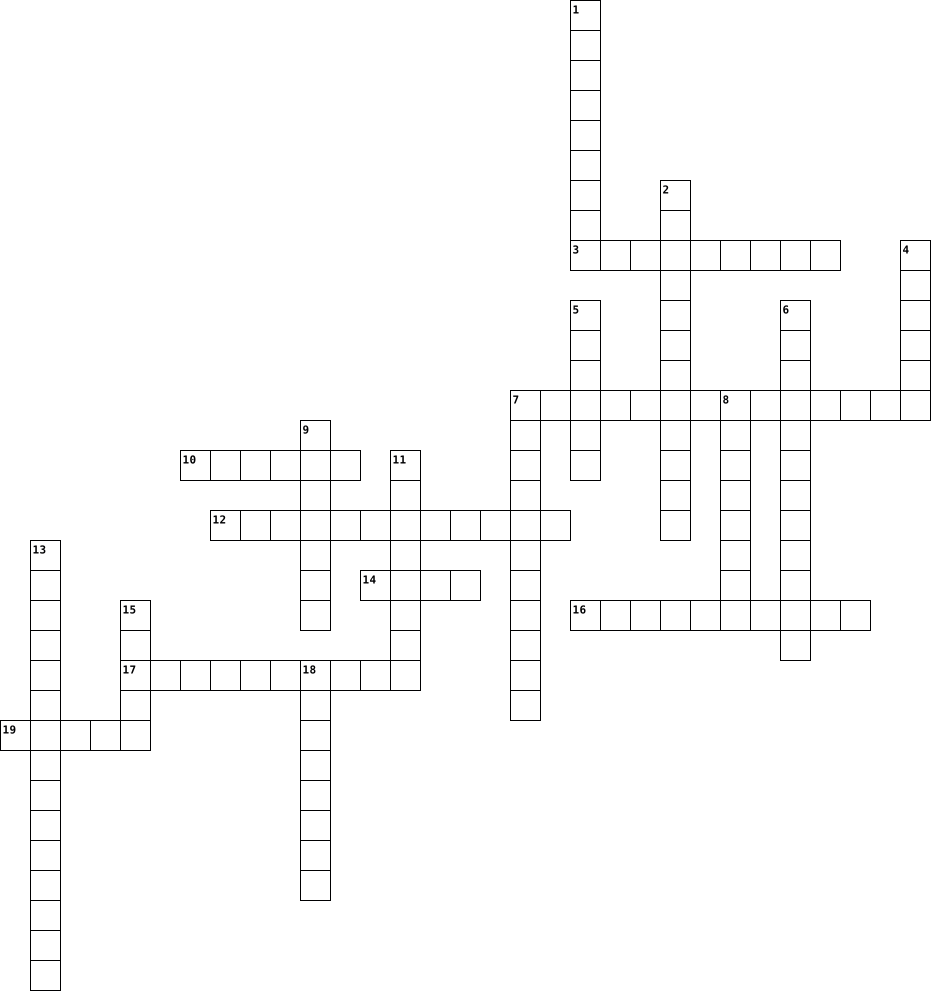
Across
- Boundary, Tectonic plates moving opposite ways from each other.
- The viscous upper layer of Earths mantle.
- Molten rock under the Earths surface.
- These occur due to tectonic plates moving releasing energy that sends energy waves through the crust and creates shakes on Earths surface.
- Forms, Formed by two convergent tectonic plates pressed against each other.
- Boundary, Tectonic plates moving away from each other creating new crust.
- The rupture in Earths crust due to tectonic plates moving under each other.
- The hot and dense centre of Earth.
Down
- Boundary, Tectonic plates moving away from each other destroying old crust.
- The type of plates formed by convergent boundaries.
- The outer solid shell of Earth.
- The planet we live on.
- The outer part of Earth consisting of the crust and upper mantle.
- The layer\layers of gasses surrounding a planet.
- Spreading, The process in which tectonic plates split apart from each other.
- The mostly solid bulk of Earth's interior.
- A big wave
- The former large continent that has had other parts of it broken off.
- Molten rock the breaks through the crust to Earth's surface.
- The type of plates formed by divergent boundaries.
20 Clues: A big wave • The planet we live on. • The outer solid shell of Earth. • The hot and dense centre of Earth. • Molten rock under the Earths surface. • The viscous upper layer of Earths mantle. • The mostly solid bulk of Earth's interior. • The layer\layers of gasses surrounding a planet. • The type of plates formed by divergent boundaries. • ...
tectonic plate movements 2021-04-27

Across
- a natural disaster caused by transform
- the layer on the upper part of the mantle
- Two plates one oceanic and one continental collide together
- a natural event that leads to diaster
- liquid that falls out of the landform caused by transform
- the layer below the outercore
- the thickest part of the earth
- Two plates move away from eachother
- two
- a plate that is less dense than oceanic
- the reason that tectonic plates move
Down
- the layer below the mantle
- the second disaster that is caused by transform
- this is created due to subduction
- a type of plate that is more dense that contineal
- a natural feature of the earth
- one oceanic sinks under the continental plates
- this is caused by divergant
- The outer layer of the earth
- this forms because of Collison
20 Clues: two • the layer below the mantle • this is caused by divergant • The outer layer of the earth • the layer below the outercore • a natural feature of the earth • the thickest part of the earth • this forms because of Collison • this is created due to subduction • Two plates move away from eachother • the reason that tectonic plates move • a natural event that leads to diaster • ...
Horizon Plate Tectonics 2021-05-18

Across
- The island nation in the north Atlantic where a rift valley can be observed.
- The last name of the scientist who came of with the theory of continental drift.
- How geologists refer to a volcano that seems to be asleep.
- A place where two tectonic plates come together and sometimes form a mountain range.
- The type of rock that makes up most of the oceanic crust.
- When a portion of more-dense (usually oceanic) crust sinks under a less-dense portion of the Earth's crust.
- The process that glues together particles of sediment.
- A place where two tectonic plates slide past each other sideways.
- Fossils of this fern-like plant were found on five different continents and help support the theory of continental drift.
- The layer of the Earth's mantle on which the lithosphere floats.
- The transfer of heat between two objects that are touching.
- The type of heat transfer that occurs in the Earth's mantle.
Down
- A place where two tectonic plates move away from each other.
- Vibrations that travel through Earth.
- The shaking that results from a sudden shift in a transform boundary.
- The name of the supercontinent thought to exist about 250 million years ago.
- The idea that the continents move slowly across the Earth's surface.
- The layer of rock that forms the outer surface of the Earth.
- Molten rock that is found under the surface of the Earth.
- The process that breaks rock down into sediment using the forces of wind, water and gravity.
- A weak spot in the Earth's crust where magma has come through the surface.
- The amount of mass in a specified amount of a substance.
22 Clues: Vibrations that travel through Earth. • The process that glues together particles of sediment. • The amount of mass in a specified amount of a substance. • The type of rock that makes up most of the oceanic crust. • Molten rock that is found under the surface of the Earth. • How geologists refer to a volcano that seems to be asleep. • ...
Horizon Plate Tectonics 2021-05-18

Across
- The layer of rock that forms the outer surface of the Earth.
- A weak spot in the Earth's crust where magma has come through the surface.
- Molten rock that is found under the surface of the Earth.
- The idea that the continents move slowly across the Earth's surface.
- Vibrations that travel through Earth.
- Fossils of this fern-like plant were found on five different continents and help support the theory of continental drift.
- How geologists refer to a volcano that seems to be asleep.
- The process that glues together particles of sediment.
- When a portion of more-dense (usually oceanic) crust sinks under a less-dense portion of the Earth's crust.
- The process that breaks rock down into sediment using the forces of wind, water and gravity.
Down
- The type of heat transfer that occurs in the Earth's mantle.
- The transfer of heat between two objects that are touching.
- A place where two tectonic plates slide past each other sideways.
- A place where two tectonic plates come together and sometimes form a mountain range.
- The name of the supercontinent thought to exist about 250 million years ago.
- A place where two tectonic plates move away from each other.
- The type of rock that makes up most of the oceanic crust.
- The last name of the scientist who came of with the theory of continental drift.
- The shaking that results from a sudden shift in a transform boundary.
- The island nation in the north Atlantic where a rift valley can be observed.
- The layer of the Earth's mantle on which the lithosphere floats.
- The amount of mass in a specified amount of a substance.
22 Clues: Vibrations that travel through Earth. • The process that glues together particles of sediment. • The amount of mass in a specified amount of a substance. • The type of rock that makes up most of the oceanic crust. • Molten rock that is found under the surface of the Earth. • How geologists refer to a volcano that seems to be asleep. • ...
Plate-tectonics Puzzle 2022-04-22

Across
- Center made of iron and nickel
- A split between two bodies that were once whole
- Sub-marine mountain ridges where the new seafloor is created
- The upper layer of the Earth's interior, including the crust and upper part of the mantle
- The idea that all landmass was one piece and shifted away over time.
- Layer outside the center
- Large moving segments of the lithosphere
- Uppermost section of Earth
- The boundaries between plates.
- Type of boundary that moves away
- A form of stress produced by the action of equal and opposite forces, the effect of which is to reduce the length of a material.
- Type of boundary that comes together
Down
- When a plate dive under another
- an area of rock that has been bent over stress
- A depression in the Earth's crust
- Where two plates fracture from stress
- The layer between Earth's thinnest layer and its center
- A deep depression inside the ocean floor
- The deformation of the lithosphere
- A long trough bounded by two or more faults
- A form of stress that acts to stretch a material
21 Clues: Layer outside the center • Uppermost section of Earth • Center made of iron and nickel • The boundaries between plates. • When a plate dive under another • Type of boundary that moves away • A depression in the Earth's crust • The deformation of the lithosphere • Type of boundary that comes together • Where two plates fracture from stress • ...
Plate Tectonics Vocaulary 2022-11-05

Across
- places where plates slide sideways past each other
- two plates comes together
- the part of the earth's crust that makes up the seafloor
- a point at which rays of light, heat, or other radiation meet after being refracted or refracted
- layer of the earth between the solid inner core and lower mantle
- a large depression formed when a volcano erupts and collapses
- the mostly solid bulk of earth's interior
- the eruption of molten rock (magma) onto the surface of a planet
- a large plume of hot mantle material rising from deep within the earth
Down
- abroad runded volcano that is built up by successive outpourings of very fluid lava
- a dip-slip fault in which the block above the fault has moved downward relative to the block below
- sudden movement of the earth's lithosphere
- two tectonic plates move away from each other
- a fracture or zone of fractures between two blocks of rock
- the first waves to arrive at a seismograph
- a seismic body wave that shakes the ground back and forth
- anything thrown into the air during a volcanic eruption
- a mixture of molten and semi-molten rock found beneath the surface of the earth
- comes out of a volcano
- built from particles and blobs of congealed lava ejected from a single vent
- is slid and 90% iron
21 Clues: is slid and 90% iron • comes out of a volcano • two plates comes together • the mostly solid bulk of earth's interior • sudden movement of the earth's lithosphere • the first waves to arrive at a seismograph • two tectonic plates move away from each other • places where plates slide sideways past each other • anything thrown into the air during a volcanic eruption • ...
Plate Tectonics Vocaulary 2022-11-05

Across
- a mixture of molten and semi-molten rock found beneath the surface of the earth
- a large depression formed when a volcano erupts and collapses
- layer of the earth between the solid inner core and lower mantle
- a large plume of hot mantle material rising from deep within the earth
- anything thrown into the air during a volcanic eruption
- built from particles and blobs of congealed lava ejected from a single vent
- two plates comes together
- the eruption of molten rock (magma) onto the surface of a planet
- comes out of a volcano
- the mostly solid bulk of earth's interior
Down
- sudden movement of the earth's lithosphere
- the first waves to arrive at a seismograph
- places where plates slide sideways past each other
- a seismic body wave that shakes the ground back and forth
- a fracture or zone of fractures between two blocks of rock
- a point at which rays of light, heat, or other radiation meet after being refracted or refracted
- is slid and 90% iron
- two tectonic plates move away from each other
- a dip-slip fault in which the block above the fault has moved downward relative to the block below
- the part of the earth's crust that makes up the seafloor
20 Clues: is slid and 90% iron • comes out of a volcano • two plates comes together • the mostly solid bulk of earth's interior • sudden movement of the earth's lithosphere • the first waves to arrive at a seismograph • two tectonic plates move away from each other • places where plates slide sideways past each other • anything thrown into the air during a volcanic eruption • ...
Plate Tectonics Vocabulary 2022-11-09

Across
- Solid iorn rich zone in the Earth
- A scientific theory that explains how
- landforms were created
- Plates pushing together
- Heat curents in the magma causes a
- Plates sliping side by side
- Solid rockey layer in the Earth
- What rises from the hot spots in the
- The solid outer part of the Earth
- of the Earth's crust
- A large scale processes affecting the
- to push through
- The lighter outer skin of the Earth
- The molten metallic layer of the
- The hypothesis that the Earth's
Down
- plate and slides beneath
- When an oceanic plate runs into a
- A ring of volcanos
- have moved
- When all of Earth's landmasses
- The relatively thin partof the Earth's
- A device that can monitor the Earth's
- of the crust, while lava is
- The upper layer of the Earth's mantle
- Plates pulling apart
- which underlies the ocean basins
- A natural feature of the Earth's
- together to form one
28 Clues: have moved • to push through • A ring of volcanos • Plates pulling apart • of the Earth's crust • together to form one • landforms were created • Plates pushing together • plate and slides beneath • Plates sliping side by side • of the crust, while lava is • When all of Earth's landmasses • Solid rockey layer in the Earth • The hypothesis that the Earth's • The molten metallic layer of the • ...
Plate motion vocabulary 2022-11-01

Across
- the distance of a place north and south of Earth's equator
- a process in which deep, cold water rises toward the surface of the
- the ability to make things move or change
- imaginary line that divides the earth into northern and southern hemispheres
- To use any of the five senses to gather information about something.
- winds that move in one direction and are strong enough to push ocean currents
- general weather patterns over a long time period
- the outside or top layer of something
- to move from one object to another or one place to another
- a climate pattern where water near the equator gets hotter than usual and affects the weather around the world
- the distance of a place east or Earth's prime meridian
Down
- ocean water flowing in a continuous path
- A measure of how hot or cold something is, the average speed
- the layer of gases surrounding the earth or another planet, that is held in place by gravity
- an idea about what might happen that is based on what you already know
- related to the sun
- a giant pattern of moving water spans whole oceans and moves water from place to place in a circle
- the study of weather patterns over a long period of time
- an event or process that leads to a result or change
- a result or change that happens because of an event or process
- any of the earth's main continuous area of land such as Africa, Asia, and North America
- an object, diagram, or computer program that helps us understand something by making it simpler or easier to see
22 Clues: related to the sun • the outside or top layer of something • ocean water flowing in a continuous path • the ability to make things move or change • general weather patterns over a long time period • an event or process that leads to a result or change • the distance of a place east or Earth's prime meridian • the study of weather patterns over a long period of time • ...
Plate Tectonics Vocabulary 2017-02-13

Across
- thin lithospheric plates that are made of basalt and form the ocean floor; denser than continental plates
- A fault in which the hanging wall moves down relative to the footwall.
- a long chain of undersea mountains
- The amount of force per unit area that is put on a given material.
- The boundary between two tectonic plates that are moving away from each other.
- Literally, the "middle sphere" -the strong, lower part of the mantle between the asthenosphere and the outer core.
- large pieces of Earth's lithosphere that move over the asthenosphere
- a process that involves a lithospheric plate sinking into the mantle
- thick lithospheric plates that are made of andesite and granite and form the continents; less dense than oceanic plates
- The boundary between two tectonic plates that are sliding past each other horizontally.
- The liquid layer of the Earth's core that lies beneath the mantle and surrounds the inner core.
- The region where an oceanic plate sinks down into the asthenosphere at a convergent boundary, usually between continental and oceanic plates.
- The theory that the Earth's lithosphere is divided into tectonic plates that move around on top of the asthenosphere.
Down
- The type of stress that occurs when an object is squeezed.
- heated lower mantle rock that rises toward the lithosphere because it is less dense than surrounding mantle rock
- A break in the Earth's crust along which blocks of the crust slide relative to one another due to tectonic forces.
- a valley in the ocean created when one lithospheric plate subducts another one
- The soft layer of the mantle on which pieces of the lithosphere move.
- an ancient huge landmass composed of earlier forms of today's continents; an ancient supercontinent
- The outermost, rigid layer of the Earth that consists of the crust and the rigid upper part of the mantle.
- The layer of the Earth between the crust and the core.
- The boundary between two colliding tectonic plates.
- The process by which new oceanic lithosphere is created at mid-ocean ridges as older materials are pulled away from the ridge.
- A fault in which the two fault blocks move past each other horizontally.
- The theory that continents can drift apart from one another and have done so in the past.
- The type of stress that occurs when forces act to stretch an object.
- The solid, dense center of the Earth.
- A fault in which the hanging wall moves up relative to the footwall.
- A piece of the lithosphere that moves around on top of the asthenosphere.
- The thin, outermost layer of the Earth, or the uppermost part of lithosphere
- The bending of rock layers due to stress in the Earth's crust.
- The central, spherical part of the Earth below the mantle.
32 Clues: a long chain of undersea mountains • The solid, dense center of the Earth. • The boundary between two colliding tectonic plates. • The layer of the Earth between the crust and the core. • The type of stress that occurs when an object is squeezed. • The central, spherical part of the Earth below the mantle. • ...
Plate Tectonics vocabulary 2017-01-05

Across
- This layer of the earth lies between the mantle and the solid inner core. It is the only liquid layer, a sea of mostly iron and nickel about 1,400 miles (2,300 km) thick. Text page 191
- The name given to the supercontinent that existed more than 225 million years ago, in which the present-day continents were joined together in one large landmass. Text page 194
- The process that forms new ocean floor and oceanic crust. Magma oozes up from the mantle through a crack in the ocean floor, filling in the space between the plates and spreading out from the plate boundary. Text page 196
- Hard and rigid, the earth's outermost and thinnest layer. It is only a few miles (5 km) thick under the oceans and averages 20 miles (30 km) thick under the continents. Text page 190
- The boundary that occurs where two plates slide past each other. Text page 201
- A layer of the earth's crust that lies under the seven continents. It is about 20 to 40 miles (35 to 70 km) thick and very old. Text page 191
- The border between two tectonic plates.
- A hot, malleable semiliquid zone in the upper mantle, directly underneath the lithosphere, on which the plates of the lithosphere move (or float). Text page 191
- This dense layer of the earth is made of hot, semisolid rock and is located directly below the crust. It is about 1,800 miles (2,900 km) thick. Text page 190
- A crack or fracture in Earth's crust where two tectonic plates grind past each other in a horizontal direction. Text page 232
- A trembling and shaking of the earth's surface resulting from the sudden release of energy in the crust, either along fault lines or from volcanic activity. Text page 230
- Made up of the crust and a tiny bit of the upper mantle, this zone is divided into several constantly (very slowly) moving plates of solid rock that hold the continents and oceans. Text page 191
Down
- The innermost layer of the earth, an extremely hot, solid sphere of mostly iron and nickel. The inner core is 3,200 to 3,960 miles (5,150 to 6,378 km) below the surface and about 750 miles (1,200 km) thick. Text page 191
- The boundary that occurs where two plates are moving apart from each other. Text page 201
- The type of crust lying under the oceans of the world. It is only 4 to 6 miles (7 to 10 km) thick and usually younger than continental crust. Text page 191
- The boundary that occurs where two plates are pushing toward each other. Text page 210
- The place where one plate is getting bent and pulled under the edge of another plate. Text page 200
- Several large slabs of the lithosphere that hold the continents and oceans and are slowly but constantly moving around the earth. Text page 198
- A raised area or mountain range under the oceans formed when magma fills the space between two tectonic plates that are spreading apart. Text page 195
- Molten rock that flows beneath the earth's surface and is made up of gases, liquids, and crystals. When magma reaches the surface, it is called lava. Text page 266
- A huge ocean wave caused by a sudden, powerful shift on the ocean floor, like an undersea earthquake, landslide, or volcanic eruption. Text page 249
- A deep valley that forms at the edge of a continent when an oceanic plate sinks underneath a continental plate. Text page 267
22 Clues: The border between two tectonic plates. • The boundary that occurs where two plates slide past each other. Text page 201 • The boundary that occurs where two plates are pushing toward each other. Text page 210 • The boundary that occurs where two plates are moving apart from each other. Text page 201 • ...
Plate Tectonics Vocabulary 2017-01-28

Across
- point of Earth's surface directly above an earthquake's focus
- a pulling force
- core liquid layer of the Earth's core
- powerful seismic sea wave that can travel thousands of kilometers in all directions and that begins over an earthquake focus
- boundary between two plates that are sliding past each other
- outermost rigid layer of the Earth
- opening in Earth's surface that often forms a mountain when layers of lava and volcanic ash erupt and build up
- soft layer of the mantle
- outermost layer of the Earth
- the bending of rock layers
Down
- a break in the Earth's crust
- single large landmass made up of all the continents connected together that broke apart 200 million years ago
- boundary between two colliding plates
- boundary between two plates moving away from each other
- a region where an oceanic plate sinks down into the athenosphere
- theory that continents drift apart
- vibrations caused by breaking rocks along faults
- layer between the crust and the core
- core solid, dense center of the Earth
- in an earthquake, the point beneath Earth's surface where energy release occurs
- a squeezing force
21 Clues: a pulling force • a squeezing force • soft layer of the mantle • the bending of rock layers • a break in the Earth's crust • outermost layer of the Earth • theory that continents drift apart • outermost rigid layer of the Earth • layer between the crust and the core • boundary between two colliding plates • core liquid layer of the Earth's core • ...
Plate Tectonics Crossword 2017-10-18

Across
- Parts of the Earth’s crust that are broken up into large pieces that move due to plate tectonics.
- The cycle in which heat is transferred within a fluid.
- Idea that the continents slowly moved over Earth’s surface.
- A supercontinent that formed 300 million years ago.
- The remains of an ancient organism preserved in rock.
- The area where plates slip past each other.
- The area where Earth’s crust diverge on land.
- A dense ball of solid metal within the center of the Earth.
- The area where plates move away from each other.
- The theory that Earth’s plates are in slow, constant motion, driven by convection currents in the mantle.
Down
- Deep underwater canyons at which oceanic crust bends downwards.
- The process in which a mid-ocean ridge adds new material to the ocean floor.
- The process where the ocean floor sinks beneath a deep-ocean trench into the mantle.
- The area where plates come together.
- A device used to help scientists map the ocean floor.
- The layer of rock that forms Earth’s outer shell.
- Breaks in the Earth’s crust where rocks have slipped past each other.
- The layer of molten metal surrounding the inner core.
- Long chains of mountains that rise up from the sea floor.
- The area that includes the crust and the upper mantle.
20 Clues: The area where plates come together. • The area where plates slip past each other. • The area where Earth’s crust diverge on land. • The area where plates move away from each other. • The layer of rock that forms Earth’s outer shell. • A supercontinent that formed 300 million years ago. • A device used to help scientists map the ocean floor. • ...
Plate Tectonics Crossword 2018-02-27

Across
- pressure causing rock layers to fold downward
- fan feature that forms when a river deposits sediment on land
- area around a river where sediment is deposited when it overflows
- slope of a river
- feature that forms when sediment is carried from a river into another body of water
- a valley formed by glaciers
- a crack in the Earth's surface caused by pressure
- processes a process which breaks down landforms
- a destructive process where sediment is moved to another place
- tiny pieces of natural material
Down
- a tall landform formed by convergent boundaries or convection currents
- valley formed by rivers and erosion
- processes processes that help build up landforms
- process where two plates collide, causing the plates to fold onto itself
- natural process that not only alters the soil and rocks but also the plants and animals
- the outer layer of the Earth
- a plate pulled under another plate at a convergent boundary
- the boundary where two plates collide
- currents circulating magma in the crust
- the slow, broad upward movement of Earth’s surface
20 Clues: slope of a river • a valley formed by glaciers • the outer layer of the Earth • tiny pieces of natural material • valley formed by rivers and erosion • the boundary where two plates collide • currents circulating magma in the crust • pressure causing rock layers to fold downward • processes a process which breaks down landforms • ...
Plate Tectonics Project 2023-11-14

Across
- any trace of an ancient organism that has been preserved in a rock
- The flow that transfers heat within fluid
- when magma reaches the surface
- mid-ocean ridges continually add new material to the ocean floor
- Wegener's idea that the continents slowly moved over earth's surface
- The resulting volcanoes sometimes create a string of islands
- form long chains of mountains that rise up from the ocean floor
- boundary plates move apart
- boundary plates come together
- Heat transfer between materials that are touching
- wegener called supercontinent
Down
- the ocean floor sinks beneath a deep-ocean trench and back into the mantle
- an area where material from deep within earths mantle
- one major belt of volcanoes
- broken into pieces separated by cracks
- boundary plates slide past eachothere
- measure of how much mass there is in a given volume
- a mountain that forms in earth's crust
- the transfer of energy that is carried in rays like light
- is a molted mixture of rock-forming substances gases and water from the mantle
- Heat transfer by the movement of a fluid
- the ocean floor plunges into deep underwater canyons
22 Clues: boundary plates move apart • one major belt of volcanoes • boundary plates come together • wegener called supercontinent • when magma reaches the surface • boundary plates slide past eachothere • broken into pieces separated by cracks • a mountain that forms in earth's crust • Heat transfer by the movement of a fluid • The flow that transfers heat within fluid • ...
Plate Tectonic Project 2023-11-16

Across
- Any trace of an organism that is preserved in rock.
- Earth's lithosphere separated by cracks.
- A molten mixture of rock.
- The amount of mass in an object.
- The shaking of the Earth.
- Heat transfer through the movement of a fluid.
- an instrument that records and measures an earthquake's seismic waves.
- Heat transfer through contact between objects.
- a number that geologists give to an earthquake based on the size.
- When plates move apart.
Down
- Breaks in Earth's crust where rocks moved past eachother.
- The transfer of heat through rays.
- When plates move together.
- A mountain that forms in the Earth's crust when molten material reaches the surface.
- A string of islands created by volcanoes.
- When plates slide past eachother.
- A force that changes rock.
- when magma reaches the surface.
- Major belt of volcanos.
- Earth's supercontinent.
20 Clues: Major belt of volcanos. • Earth's supercontinent. • When plates move apart. • A molten mixture of rock. • The shaking of the Earth. • When plates move together. • A force that changes rock. • when magma reaches the surface. • The amount of mass in an object. • When plates slide past eachother. • The transfer of heat through rays. • Earth's lithosphere separated by cracks. • ...
Amplify - Plate Motion 2023-09-19

Across
- the place where two plates meet
- hot liquid rock on the surface of the Earth
- a diagram that shows that shows what the inside of something looks like
- moving apart in different directions
- how often or fast something happens
- the layer of soft, solid rock underneath Earth'sp plates
- Earth's outermost layer of hard, solid rock
- a set of interacting parts forming a complex whole
- a long, deep indentation in the ocean floor
Down
- evidence of life from the past
- one of the very large sections of hard, solid rock that make up Earth's outer layer
- the outside or top layer of something
- an underwater mountain range formed when two plates move apart
- moving toward the same place
- something we observe to be similar over and over again
- any of Earth's main continuous areas of land
- the slow pulling apart of land that is caused by plate movement
- is a feature that forms on the surface of a planet
- a sudden shaking of the Earth's surface
- is hot liquid rock below the surface of the Earth
20 Clues: moving toward the same place • evidence of life from the past • the place where two plates meet • how often or fast something happens • moving apart in different directions • the outside or top layer of something • a sudden shaking of the Earth's surface • hot liquid rock on the surface of the Earth • Earth's outermost layer of hard, solid rock • ...
Plate Tectonics Crossword 2025-03-13

Across
- another word for divergent plate boundary
- along the creat of some ridge segments is a deep canyonlike structure called
- seed fern
- arc a chain of volcanic islands generally located a few hundred km from a trench where there is active subduction of one oceanic plate beneath another
- how many plates account for 94% of Earth’s surface area?
- elevated areas of the seafloor characterized by high heat flow and volcanism
- boundary a boundary in which two plates move together
- small aquatic freshwater reptile
- supercontinent containing all existing continents
- a hypothesis which suggested all present continents once existed as a single supercontinent.
- a continuous elevated zone on the floor of all major ocean basins and varying in width from 500 to 5,000 km
Down
- book written by Alfred Wegener in 1915
- German meteorologist and geophysicist who created the continental drift hypothesis
- a narrow, elongated depression of the seafloor
- a boundary in which two plates move apart, resulting in upwelling of material from the mantle to create new seafloor
- a hypothesis, first proposed in the 1960s by Harry Hess, which suggested that new oceanic crust is produced at the crests of mid-ocean ridges, which are the sites of divergence
- primary driving force for movement of tectonic plates
- largest plate
- processes that deform Earth’s crust to create major structural features, such as mountains, continents, and ocean basins
- inventor of seafloor spreading hypothesis
20 Clues: seed fern • largest plate • small aquatic freshwater reptile • book written by Alfred Wegener in 1915 • another word for divergent plate boundary • inventor of seafloor spreading hypothesis • a narrow, elongated depression of the seafloor • supercontinent containing all existing continents • primary driving force for movement of tectonic plates • ...
Plate Tectonic Project 2025-09-24

Across
- The next level of Earth's interior after the crust
- Where the plate tectonics come together to form 1 big continent
- The layer that you live on
- A German meteorologist that proposed the hypothesis of Continental Drift
- Magnet shooting from rocks
- What the plates "float on"
- Below the Crust, much hotter, and has the ability to flow
- It is usually a fault or an intrusion
- Tectonic Plates moving under water
Down
- The biggest mountain range under water
- Tectonic Plates horizontally moving past each other
- The solid,outer layer of Earth that consists of the crust and the rigid upper part of the mantle
- The movement of Earth's plates throughout time
- Tectonic Plates moving away from each other
- Comes from the Lithosphere, what the project was named after
- Each layer is older than the layer above it
- The next level of Earth's interior after the outer core
- Tectonic Plates colliding with each other
- Study of Earth's magnetic field
- Breaking apart caused by Plate Tectonics
20 Clues: The layer that you live on • Magnet shooting from rocks • What the plates "float on" • Study of Earth's magnetic field • Tectonic Plates moving under water • It is usually a fault or an intrusion • The biggest mountain range under water • Breaking apart caused by Plate Tectonics • Tectonic Plates colliding with each other • Tectonic Plates moving away from each other • ...
Paddock to Plate 2025-11-09

Across
- A statement describing what a project must include
- Edible food that is thrown away
- A source of potential danger
- Being protected from danger or harm
- Actions that reduce risk in a workplace
- How something looks or appeals to the senses
- Health problems caused by poor food choices
- Handheld equipment used to complete a task
- Businesses involved in farming and food production
- The natural world around us
- Shared beliefs, traditions, and food practices of a group
- Keeping things clean to prevent illness
- Designing tools or spaces to fit people comfortably
- The journey of food from farm to consumer
Down
- Gases released that trap heat in the atmosphere
- Large-scale farming to sell products
- How well something works for its intended purpose
- All businesses involved in producing and selling food
- Steps taken to complete a task or create something
- Not having reliable access to safe, nutritious food
- Turning raw ingredients into packaged food products
- Growing plants and raising animals for food
- Using resources responsibly to protect the future
- Collecting crops at the time they naturally grow best
- Traditional Australian foods from native plants or animals
- Using knowledge and equipment to solve problems
- Farming fish or seafood
27 Clues: Farming fish or seafood • The natural world around us • A source of potential danger • Edible food that is thrown away • Being protected from danger or harm • Large-scale farming to sell products • Actions that reduce risk in a workplace • Keeping things clean to prevent illness • The journey of food from farm to consumer • Handheld equipment used to complete a task • ...
Plate Tectonics Crossword 2025-12-03

Across
- Process where one plate sinks beneath another.
- Curve of volcanic islands at a subduction zone.
- Soft, flowing layer that tectonic plates float on.
- Wegener’s idea that continents move over time.
- Crack in Earth where movement causes earthquakes.
- Where two tectonic plates meet.
- Stationary plume of magma creating volcano chains.
- Rigid outer layer of Earth broken into plates.
- Type of boundary where plates move apart.
- Point on Earth’s surface directly above an earthquake.
Down
- Type of boundary where plates slide past each other.
- Zone of frequent earthquakes/volcanoes around the Pacific.
- Type of boundary where plates collide.
- Supercontinent that existed 300 million years ago.
- Thick layer between crust and core.
- New ocean crust forms as plates pull apart.
- Underwater mountain chain formed at divergent boundaries.
- Molten rock beneath Earth’s surface.
- Deep valley formed at a subduction zone.
- Earth’s thin outermost layer.
20 Clues: Earth’s thin outermost layer. • Where two tectonic plates meet. • Thick layer between crust and core. • Molten rock beneath Earth’s surface. • Type of boundary where plates collide. • Deep valley formed at a subduction zone. • Type of boundary where plates move apart. • New ocean crust forms as plates pull apart. • Process where one plate sinks beneath another. • ...
Earth & Plate Tectonics 2026-01-13

Across
- An opening where magma reaches the surface
- Plates slide past each other
- Large pieces of Earth’s crust that move.(plates)
- Plates move away from each other
- Shaking caused by moving plates
- Crust that forms the continents
- Plates move toward each other
Down
- Melted rock below Earth’s surface
- The liquid metal layer around the inner core
- The thick layer beneath the crust
- When land forms in the ocean from volcanoes
- The hot, solid center of Earth
- boundary The place where plates meet
- The theory that explains plate movement
- A small, steep volcano made of ash
- A tall volcano with layers of lava and ash
- Crust found under the oceans
- The thin outer layer of Earth
- A wide volcano with gentle slopes
- A large ocean wave caused by an earthquake
- The planet we live on
21 Clues: The planet we live on • Plates slide past each other • Crust found under the oceans • The thin outer layer of Earth • Plates move toward each other • The hot, solid center of Earth • Shaking caused by moving plates • Crust that forms the continents • Plates move away from each other • Melted rock below Earth’s surface • The thick layer beneath the crust • ...
Tectonic Plate Boundaries 2026-03-19

Across
- Molten rock below Earth’s surface
- The process by which new oceanic crust continuously forms along mid-ocean ridges and is destroyed at ocean trenches
- Vast mountain range deep below the ocean’s surface
- When continental and oceanic crust collide, causing the oceanic (denser) plate to sink beneath the continental (lighter) plate
- A thin, solid rock layer of Earth, is broken into several large pieces
- A boundary where two tectonic plates slide horizontally past each other
- when magma erupts onto Earth’s surface
- The rupture and sudden movement of rocks along a break or crack in Earth’s crust
- A cycle where solid rock heats, cools, and sinks (happens in Earth’s mantle)
- Layer of Earth made of liquid iron
- Earth's continents once joined together into a supercontinent
Down
- A break in Earth’s crust where movement occurs
- A boundary where two tectonic plates move apart from each other
- Where the edge of two tectonic plates meet
- The surface of Earth that is made of rigid, slabs of rock (plates), that move
- A vent in Earth’s crust where molten rock flows
- Thick, middle layer of Earth made of semi-molten rock
- Deep, underwater troughs on the seafloor
- A boundary where two tectonic plates move toward each other
- Layer of Earth made of solid iron
20 Clues: Molten rock below Earth’s surface • Layer of Earth made of solid iron • Layer of Earth made of liquid iron • when magma erupts onto Earth’s surface • Deep, underwater troughs on the seafloor • Where the edge of two tectonic plates meet • A break in Earth’s crust where movement occurs • A vent in Earth’s crust where molten rock flows • ...
Let's go 5: In the kitchen 2018-05-02

Across
- kulho
- pakastin
- veitsi
- hana
- mikroaaltouuni
- lasi
- liesi
- kuppi
- uuni
Down
- lautanen
- kahvinkeitin
- haarukka
- vedenkeitin
- jääkaappi
- leivänpaahdin
- muki
- lusikka
- kattila
18 Clues: hana • muki • lasi • uuni • kulho • liesi • kuppi • veitsi • lusikka • kattila • lautanen • haarukka • pakastin • jääkaappi • vedenkeitin • kahvinkeitin • leivänpaahdin • mikroaaltouuni
1GTA - p. 84 2017-03-31

Across
- hold
- glad
- heat
- while
- dryer
- back
- shut
- dark
Down
- screen
- wall
- face
- remove
- washer
- light
- plate
- use
- degree
- button
18 Clues: use • wall • face • hold • glad • heat • back • shut • dark • while • light • plate • dryer • screen • remove • washer • degree • button
Meals 2021-06-22

Across
- Servilleta
- Arandanos
- Cuchara
- Zanahorias
- Crep
- Pastelito
- Chicharos
- Leche
Down
- Pollo
- Plato
- Cuchillo
- Papas
- Naranja
- Fresas
- Sandwich
- Tenedor
- Vidrio
- Manzana
18 Clues: Crep • Pollo • Plato • Papas • Leche • Fresas • Vidrio • Naranja • Cuchara • Tenedor • Manzana • Cuchillo • Sandwich • Arandanos • Pastelito • Chicharos • Servilleta • Zanahorias
Di rumah 2024-05-28

Across
- lamp
- washingmachine
- towel
- staircase
- mirror
- diningtable
- kitchen
- refrigerator
- plate
Down
- attic
- flowerpot
- bed
- window
- cupboard
- bowl
- cup
- kettle
- door
18 Clues: bed • cup • lamp • bowl • door • attic • towel • plate • window • mirror • kettle • kitchen • cupboard • flowerpot • staircase • diningtable • refrigerator • washingmachine
Mi Casa 2024-02-19

Across
- taza
- Sofa
- Mesa
- Casa
- Comedor
- Olla
- Sala
- Silla
- Vaso
- Dormitorio
Down
- Tenedor
- Plato
- Bano
- Chuchara
- Cama
- Lampara
- Puerta
- Cocina
- Ventana
- Tenedor
20 Clues: taza • Bano • Sofa • Mesa • Cama • Casa • Olla • Sala • Vaso • Plato • Silla • Puerta • Cocina • Tenedor • Lampara • Comedor • Ventana • Tenedor • Chuchara • Dormitorio
5b vocab 2023-05-03

Across
- fork
- spoon
- waitress
- waiter
- napkin
- bowl
- table
- salt
Down
- pepper
- plate
- menu
- cup
- check
- sugar
- resturant
- knife
- glass
- chairs
18 Clues: cup • menu • fork • bowl • salt • plate • spoon • check • sugar • knife • glass • table • pepper • waiter • napkin • chairs • waitress • resturant
set3 2021-11-09

Across
- симпатичный
- звезда
- улитка
- крыша
- билет
- снег
- суббота
- форма
- блинчик
- попугай
Down
- тарелка
- желудок
- бассеин
- плечо
- свитер
- солнечный
- квадрат
- щенок
18 Clues: снег • крыша • билет • плечо • форма • щенок • звезда • улитка • свитер • тарелка • желудок • бассеин • суббота • квадрат • блинчик • попугай • солнечный • симпатичный
vocab 2022-05-03

Across
- waitress
- menu
- restaurant
- plate
- bill
- waiter
- bowl
- chairs
- table
Down
- sugar
- napkin
- spoon
- pepper
- cup
- fork
- knife
- glass
- salt
18 Clues: cup • menu • bill • fork • bowl • salt • sugar • spoon • plate • knife • glass • table • napkin • pepper • waiter • chairs • waitress • restaurant
Spanish vocab 2022-05-04

Across
- cuenco
- cuchillo
- sal
- azucar
- mesa
- restuarante
- pimienta
- cuchara
- sillas
Down
- factura
- tenedor
- lamina
- menu
- mozo
- camerara
- copa
- servilleta
- taza
18 Clues: sal • menu • mozo • copa • mesa • taza • cuenco • lamina • azucar • sillas • factura • tenedor • cuchara • cuchillo • camerara • pimienta • servilleta • restuarante
8th Science Vocab Crossword 2023-04-25

Across
- potential energy that can be stretched/compressed
- boundary where two plates slide by each other
- zero net force/ direction stays the same
- both traits appear on a mammal like a speckled chicken
- nonzero net force/ direction will change
- energy that is stored
- one cell division/ 2 daughter cells
- sum of all the forces acting on an object
- survival of the fittest
- reproduction that results in unique offspring
- a push or a pull
- boundary where two plates move away from each other
- dominance that allows the traits to mix
Down
- a force created by two objects rubbing against each other
- boundary where two plates move torwards each other
- the most dense plate slides underneath the least dense plate during convergent boundary
- two cell divisions/ 4 daughter cells
- circulation of magma that moves tectonic plates
- place or object used to detect motion
- energy in motion
- reproduction that results in identical offspring
- stationary magma plume that a tectonic plate moves over and islands form
- what the layers of the earth are organized by
- supercontinent that began to break apart hundreds of millions of years ago
24 Clues: energy in motion • a push or a pull • energy that is stored • survival of the fittest • one cell division/ 2 daughter cells • two cell divisions/ 4 daughter cells • place or object used to detect motion • dominance that allows the traits to mix • zero net force/ direction stays the same • nonzero net force/ direction will change • sum of all the forces acting on an object • ...
Orogeny 2023-09-17

Across
- major features are deep-ocean trenches and volcanic arcs
- the peak of any folded rock layer
- happens when a force compresses the crust, causing the crust to bend from its sides
- occurs when two oceanic plates converge
- an example of an andean-type mountain building
- a sharp-peaked anticline fold
- process of mountain formation due to the deformation of earth's crust
- appear on the crust as a crustal plate is pushed up during collision
- caused by the compression of the crust above the other in the collision process
Down
- a type of fold that is the result of too much bending that no vertical regions can be seen
- an example of fold mountains in Asia
- occurs along continental plate boundaries
- a group of mountains that are close to each other
- a fold that has overturned, causing rock layers to be fractured
- The process of mountain building
- linked to plate movement where collision takes place between plates
- the bending or warping of folding rock layers
- a fracture between two blocks of rock
- the trough-the lowest point of the fold
- a large surface feature that rises above its relative
20 Clues: a sharp-peaked anticline fold • The process of mountain building • the peak of any folded rock layer • an example of fold mountains in Asia • a fracture between two blocks of rock • occurs when two oceanic plates converge • the trough-the lowest point of the fold • occurs along continental plate boundaries • the bending or warping of folding rock layers • ...
Forces that shape the Earth 2025-12-01

Across
- Sudden shaking of the ground caused by movement along a fault
- Force that pulls rocks apart, stretching Earth’s crust
- Huge pieces of Earth’s crust that move slowly over the mantle
- Point underground where an earthquake starts
- Force that pushes rocks together, squeezing Earth’s crust
- Instrument that records earthquake waves
- Melted rock that reaches Earth’s surface
- Force that causes rocks to slide past each other in opposite directions
- Break in rock where one block is pushed up over the other, caused by compression
- Movement of Earth’s plates that slowly changes the surface over time
- Break in Earth’s crust where rocks move and earthquakes happen
Down
- Plate boundary where plates collide
- Plate boundary where plates move apart
- General word for a push or pull on rock
- Hot, melted rock beneath Earth’s surface
- Plate boundary where plates slide past each other
- Fault where rocks slide past each other sideways with little up-and-down movement
- Opening in Earth’s crust where lava, ash, and gases come out
- Break in rock where one block slides down compared to the other, caused by tension
- Point on Earth’s surface directly above the focus
- Energy wave released during an earthquake
21 Clues: Plate boundary where plates collide • Plate boundary where plates move apart • General word for a push or pull on rock • Hot, melted rock beneath Earth’s surface • Instrument that records earthquake waves • Melted rock that reaches Earth’s surface • Energy wave released during an earthquake • Point underground where an earthquake starts • ...
THE VIOLENT EARTH BELOW US 2022-11-03

Across
- There are seven major ________ plates on earth.
- is where an earthquake's seismic waves reaches the surface.
- This occurs when two plate boundaries rub up against each other.
- A reading of how intense an earthquake is.
- This scale determines how powerful an earthquake is.
- This is the origin of an earthquake deep below the surface.
Down
- Tool used to measure seismic energy.
- A huge wave that is sometimes created by volcanoes, earthquakes, or landslides.
- A Tsunami wave can extend _________ miles inland.
- A Tsunami is considered a ___________ disaster.
- A _____________ zone occurs by plate boundaries when one plate goes under another.
- A Tsunami is not a ____________ wave.
- A Tsunami can occur a ___________ miles away from the shoreline.
13 Clues: Tool used to measure seismic energy. • A Tsunami is not a ____________ wave. • A reading of how intense an earthquake is. • There are seven major ________ plates on earth. • A Tsunami is considered a ___________ disaster. • A Tsunami wave can extend _________ miles inland. • This scale determines how powerful an earthquake is. • ...
Unit 4 Review 2023-11-26

Across
- Consists of the crust and uppermost part of the mantle.
- The supercontinent
- Location where subduction occurs.
- Any trace of a living organism preserved in rock.
- Evidence that the climate of warmer areas used to much colder.
- Type of plate boundary where plates are coming together.
Down
- Type of plate boundary where plates are moving apart.
- Discovered the presence of the mid-ocean ridge in the Atlantic Ocean
- Proposed the idea of sea floor spreading.
- Portion of the mantle that causes the surface of the Earth to move.
- Type of plate boundary where plates are sliding past each other.
- The true edge of the continents
- Process where oceanic crust sinks into the mantle.
13 Clues: The supercontinent • The true edge of the continents • Location where subduction occurs. • Proposed the idea of sea floor spreading. • Any trace of a living organism preserved in rock. • Process where oceanic crust sinks into the mantle. • Type of plate boundary where plates are moving apart. • Consists of the crust and uppermost part of the mantle. • ...
softball 2023-04-03

Across
- – the defensive player who normally positions herself behind home
- – also known as “hitter”; an offensive player who takes his/her
- Team – the players on the field
- to hit the pitch
- – the diamond-shaped area in fair territory formed by the three bases
- someone does not swing the bat fully
- in the batter’s box to try to hit a pitch
- play-when they get 2 people out on one play
Down
- and receives pitches
- Box – a rectangular area beside the home plate where the batter must
- – the pitcher’s fastest pitch
- Ball – a technique used by the pitcher so that the ball goes up as it.
- home plate is normally covered by defensive players known as
13 Clues: to hit the pitch • and receives pitches • – the pitcher’s fastest pitch • Team – the players on the field • someone does not swing the bat fully • in the batter’s box to try to hit a pitch • play-when they get 2 people out on one play • home plate is normally covered by defensive players known as • – also known as “hitter”; an offensive player who takes his/her • ...
Hazardous Earth Landforms 2025-04-29

Across
- volcano that had an eruption that blew the top off
- formed at convergent boundaries on land
- superheated jets of water containing metal sulphides aka black smokers
- denser oceanic plate is forced under the continental plate
- displaces mid-oceanic ridge
- made up of layers of ash and acidic lava
Down
- partial melting of mantle rises to surface and forms chains of volcanic islands
- faulting formed as a sunken valley in mid-oceanic ridges
- effusive eruptions, found at plate boundaries
- central block left during formation of a rift valley
- magma erupting directly onto sea bed
- really big volcano
- mass of igneous rock injected into overlying rock deep in the crust
13 Clues: really big volcano • displaces mid-oceanic ridge • magma erupting directly onto sea bed • formed at convergent boundaries on land • made up of layers of ash and acidic lava • effusive eruptions, found at plate boundaries • volcano that had an eruption that blew the top off • central block left during formation of a rift valley • ...
Tectonic Plates 2025-10-08

Across
- last super-continent
- crust and part of upper mantle
- heating and cooling of liquid, forming currents
- earth shaking
- layer under earth's crust
- outer layer of earth
- forms at a convergent boundary
Down
- 2 plates move towards eachother
- 1 plate goes under another
- 2 or more plates touch
- 2 plates move away from eachother
- 2 plates slide against eachother
- plate
13 Clues: plate • earth shaking • last super-continent • outer layer of earth • 2 or more plates touch • layer under earth's crust • 1 plate goes under another • crust and part of upper mantle • forms at a convergent boundary • 2 plates move towards eachother • 2 plates slide against eachother • 2 plates move away from eachother • heating and cooling of liquid, forming currents
Science Vocabulary 2025-02-12

Across
- Ocean Ridge A line of underwater mountains in the middle of the ocean.
- A crack in the lithosphere
- The measure of an earthquake’s strength.
- Spot A region of volcanic activity in the middle of a plate.
- Drift Wegener’s theory that a supercontinent split apart and the pieces drifted to their present location.
- A shaking of the ground.
- tectonics Earth’s surface is made of plates that move slowly across the mantle.
- Molten rock in the mantle.
- magma on the Earth’s surface.
- The point on Earth's Surface just above the focus.
- one plate sinking beneath another.
Down
- amount of energy released in an earthquake.
- Andreas Fault The boundary between the north American and pacific plates.
- Wave A vibration that travels through Earth.
- Scale A way to measure the magnitude of an earthquake.
- Trench A long, deep undersea valley.
- Scale A way to measure the intensity of an earthquake.
- Cycle The process by which one kind of rock is changed into another.
- rocks in the rust attached to the upper mantle.
- the point below Earth's surface where an earthquake occurred.
- A crack in the crust through which magma flows.
21 Clues: A shaking of the ground. • A crack in the lithosphere • Molten rock in the mantle. • magma on the Earth’s surface. • one plate sinking beneath another. • The measure of an earthquake’s strength. • Trench A long, deep undersea valley. • amount of energy released in an earthquake. • Wave A vibration that travels through Earth. • ...
Sciene vocab 2022-09-16

Across
- rebound The sudden return of elastically deformed rock to its undeformed shape
- spreading The process of new seafloor forming
- A solid, thin layer of mantle material below the lithosphere.
- current Any movement of matter that results from differences in density.
- boundary The boundary between tectonic plates that are sliding past each other
- The bending, tilting, and breaking of Earth's crust
- reversal The process by which earth's magnetic north pole and magnetic south pole switch positions periodically.
- plate A block of lithosphere that consists of the crust and the rigid, outermost part of the mantle
- The thin and solid outermost layer of Earth above the mantle.
- The lower part of the mantle.
- The point on Earth’s surface directly above an earthquake's starting point.
Down
- The process by which one phosphoric plate moves beneath another plate as a result of tectonic forces.
- A break in a body of along which one locke moves relative to another
- tectonics the hypothesis that today's continents were once part of a single landmass.
- the outermost physical layer of the earth. It is a solid, rigid layer.
- a well-supported explanation of nature.
- boundary The boundary between two tectonic plates that are moving away from each other
- Very dense elements, mainly iron and small amount of nickel.
- The compositional layer below the crust.
- drift the hypothesis that today's continents were once part of a single landmass.
- A movement of trembling of the ground that is caused by a sudden release of energy when rocks along a fault move.
- boundary The boundary between tectonic plates that are colliding
- plate boundary The edge between two or more plates classified as divergent, convergent, or transform by the movement taking place between the plates.
- The location within Earth along a fault at
24 Clues: The lower part of the mantle. • a well-supported explanation of nature. • The compositional layer below the crust. • The location within Earth along a fault at • spreading The process of new seafloor forming • The bending, tilting, and breaking of Earth's crust • Very dense elements, mainly iron and small amount of nickel. • ...
shaping earths surface 2023-03-28

Across
- break in earths crust along which movement occurs
- a crater on a planet or satellite caused by the impact of a meteorite
- a volcano built up of alternate layers of lava and ash.
- an area which is dominated by volcanoes, created by volcanic activity, and shaped by volcanic activity over time.
- When two plates come together
- the geological process in which earthen materials are worn away and transported by natural forces such as wind or water.
- rapid downhill movemet of soil loose rocks and boulders.
- mountain formed from two or more of Earth's tectonic plates are pushed together
- the breaking down or dissolving of rocks and minerals on Earths surface
Down
- an area on Earth over a mantle plume or an area under the rocky outer layer of Earth, called the crust, where magma is hotter than surrounding magma
- any of the world's main continuous expanses of land
- mountains formed by the movement of large crustal blocks along faults formed when tensional forces pull apart the crust
- an area of many fractured pieces of crust along a large fault line
- process in which the nazca plate is forced under the south american plate
- openings, or vents where lava, tephra (small rocks), and steam erupt onto the Earth's surface
- when two tectonic plates move away from each other
- curved line of volcanoes located in the united states
- a broad zone forming as the Pacific Plate slides northwestward past the North American Plate.
- a large wave which forms when an ocean disturbance suddenly moves a large volume of water
- rupture or sudden movement of rocks along a break in earths crust
20 Clues: When two plates come together • break in earths crust along which movement occurs • when two tectonic plates move away from each other • any of the world's main continuous expanses of land • curved line of volcanoes located in the united states • a volcano built up of alternate layers of lava and ash. • rapid downhill movemet of soil loose rocks and boulders. • ...
Weather!!!!!!! 2023-03-21
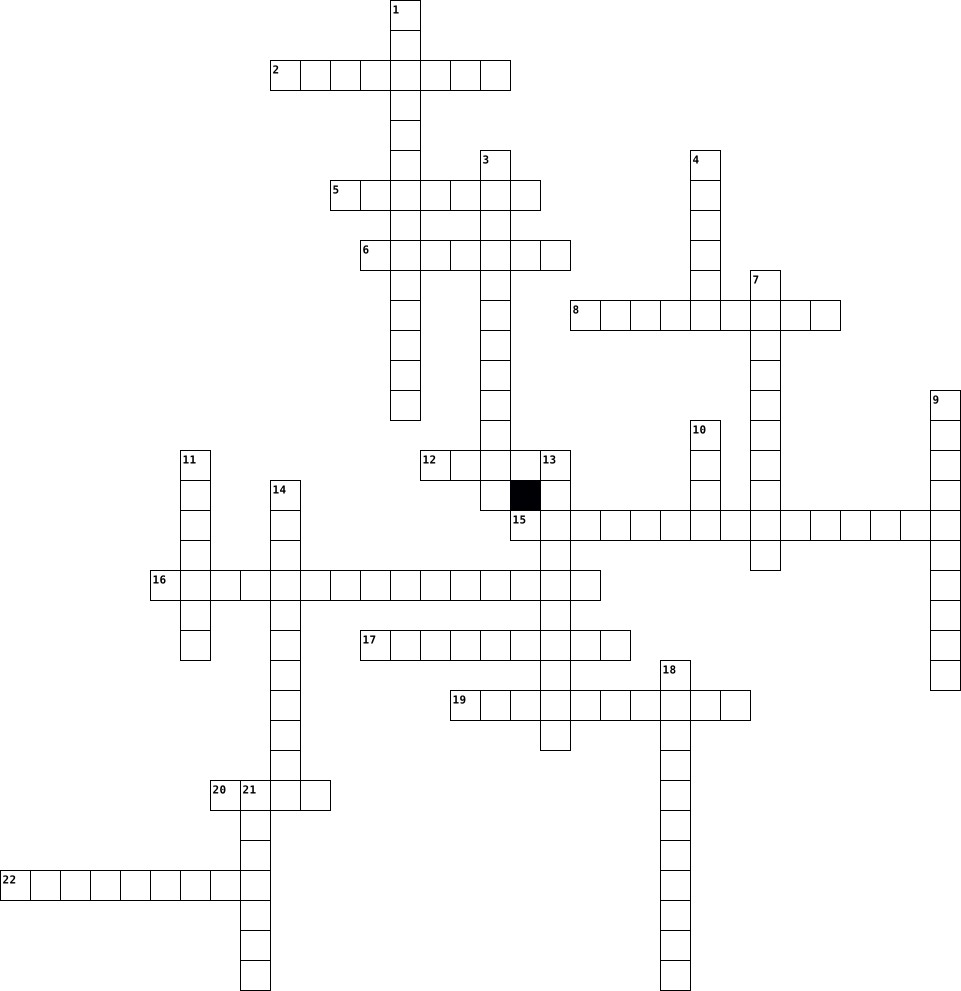
Across
- a relatively calm area near the equator where warm air rises
- the condition of the atmosphere at any given moment in a particular area
- a very large body of air that maintains uniform temperature, humidity, and pressure as it moves
- the tectonic plate movement away from another plate
- the boundary at which two different air masses meet
- a material found in nature that is useful to humans
- the cold winds from the poles to the 60 degree latitudes that blow from east to west
- the type of igneous rock formed by cooling quickly with small crystals
- a local wind that blows from the land toward a body of water
- the movement of air caused by differences in air pressure
- a local wind that blows from an ocean or sea toward the land
Down
- the relatively calm areas located near both 30 degree latitudes where cool air sinks
- the process of removing salt from seawater to obtain fresh water
- a line used on a map or chart connecting points of equal air pressure
- the winds, found between the 30 and 60 degree latitudes, that blow toward the poles from west to east
- the tectonic plate movement toward another plate
- a solid fossil fuel formed from decomposed plant remains
- a wind that changes direction with the change of seasons and which usually brings very heavy rainfall
- the winds that blow easterly from both 30 degree latitudes toward the equator
- a compound made of the elements hydrogen and carbon
- the type of rock formed by extreme heat and pressure
- the type of rock formed by melting, cooling and hardening
22 Clues: the tectonic plate movement toward another plate • the tectonic plate movement away from another plate • the boundary at which two different air masses meet • a compound made of the elements hydrogen and carbon • a material found in nature that is useful to humans • the type of rock formed by extreme heat and pressure • ...
Geophysical Processes and Associated Hazards 2014-05-07

Across
- Location of the 9.1 magnitude tsunami that affected 14 countries on Boxing Day 2004
- Exposure of the ocean floor preceding a tsunami wave hitting land
- Destructive mud flow on slopes of a volcano
- Result of tectonic and/or volcanic activity severe shaking of the ground that can cause mass destruction
- Mass movement mechanism triggered by seismic activity
- Plate boundary where new crust is created
- Discipline of dealing with and avoiding natural and man made catastrophies
- Violent ejection of steam and volcanic material
- Found at a destructive plate boundary where crust sinks into the mantle
- Conservative plate boundary
- Large area prone to volcanic and seismic activity around the Pacific Ocean
- A volcanic hazard consisting of a mixture of hot high density rock and gas
- Precipitation affected by volcanic gases such as sulphur and nitrogen oxides
- Destructive plate boundary
- 300,000 deaths 180,000 homes destroyed and 1.5 million people homeless following a 7.0 magnitude earthquake here in 2010
- Point on the surface directly above the focus of an earthquake
- Rock fragments and material ejected from a volcano
Down
- Sudden swell of high water
- Earthquake resistant structures should not do this
- Lightweight airborne deposit from a volcanic eruption
- Renewable energy source that creates a high risk of radioactive explosions
- Weakness in rock formation often trigger of seismic activity
- Water saturated sediment acting as a fluid when shaken
- Devastation of infrastructure e.g. roads, railways and industry
- Part of the lithosphere which moves in continental drift
- Size of seismic or tectonic hazard
- Seismic activity that occurs preceding an earthquake as stress builds
- Seismic wave propagated by submarine tectonic fault
- Ruptured gas pipes and electricity lines can cause this potential hazard
- Logarithmic scale that measures magnitude of an earthquake
30 Clues: Sudden swell of high water • Destructive plate boundary • Conservative plate boundary • Size of seismic or tectonic hazard • Plate boundary where new crust is created • Destructive mud flow on slopes of a volcano • Violent ejection of steam and volcanic material • Earthquake resistant structures should not do this • Rock fragments and material ejected from a volcano • ...
GeoPuzzle 2023-11-15

Across
- A type of igneous rock that cools underground.
- The inner _____ is the layer of the earth made of solid nickel and iron.
- Objects that can be made up of both minerals and organic materials.
- The type of rock that comes from volcanoes.
- Fragments of broken down rocks.
- Volcanoes that might erupt again are called:
- A type of igneous rock that cools on Earth's surface.
- Molten rock found on the outside of a volcano.
- A scientist who studies Earth, including its formation and tectonic activity.
- The difference between the highest and lowest elevation of an area.
- Made up of the lower crust and upper mantle.
- A type of volcano made up of alternating layers of lava and ash.
- Molten rock found on the inside of a volcano.
- Tectonic plates move towards each other at __________ plate boundaries.
Down
- The type of rock that is created through heat, pressure, and chemical processes.
- Earthquake shaking can be detected using a ___________.
- The preserved remains or traces of organisms from the distant past.
- Continental _____ is caused by tectonic plate movement/seafloor spreading.
- Tectonic plates move away from each other at __________ plate boundaries.
- The outermost layer of the earth.
- The type of rock that is formed through the compression and cementation of sediments.
- The layer of the earth just beneath the crust that is semi-molten.
- Inorganic crystals that have clearly defined chemical formulas.
- Distinct shapes or features of the topography of a region.
- A type of volcano that is a broad, gently sloping mountain of hardened lava.
- Ground movement and shaking caused by tectonic plate slipping.
- layers of rock used to determine the geologic age of an area.
27 Clues: Fragments of broken down rocks. • The outermost layer of the earth. • The type of rock that comes from volcanoes. • Volcanoes that might erupt again are called: • Made up of the lower crust and upper mantle. • Molten rock found on the inside of a volcano. • A type of igneous rock that cools underground. • Molten rock found on the outside of a volcano. • ...
Laki Charms Crossword Puzzle 2025-02-19

Across
- A portion of the Earth's mantle that flows like molten plastic despite being solid.
- Formed from oceanic continental convergent plate boundaries.
- An opening in the earth's crust through which lava, volcanic ash, and gases escape
- The thinner and denser part of earths crust that makes up the ocean floor.
- The location in which two tectonic plates interact through converging, diverging, or transforming.
- A path along the Pacific Ocean characterized by active volcanoes and frequent earthquakes.
- An oceanic tectonic plate that lies beneath the Pacific Ocean.
Down
- The location where two plates are being forced together by the convection currents in the earth's mantle.
- The solid, outermost layer of Earth, made of the crust and upper mantle.
- A sudden shaking of the ground caused by movement of tectonic plates.
- Molten rock (magma) erupted from a volcano.
- The layer of granitic, sedimentary, and metamorphic rocks, which form the continents and the areas of shallow seabed close to their shores.
- A type of rock that forms when molten rock cools and solidifies.
- The location when two plates converge, and one plate is forced under another.
- Formed from oceanic oceanic convergent plate boundaries.
- A hot, chaotic mixture of rock fragments, gas, and ash that travels rapidly away from a volcanic vent or collapsing flow front.
- A hot or cold mixture of water and rock fragments that flow quickly down the slopes of a volcano.
- Molten rock below the earth's surface near the upper mantle and lower crust.
- An area of the Earth's mantle from which hot plumes rise upward, forming volcanoes on the overlying crust.
- The solid remanence from fires, explosions, and/or volcanic vents.
20 Clues: Molten rock (magma) erupted from a volcano. • Formed from oceanic oceanic convergent plate boundaries. • Formed from oceanic continental convergent plate boundaries. • An oceanic tectonic plate that lies beneath the Pacific Ocean. • A type of rock that forms when molten rock cools and solidifies. • ...
Agung Volcano Crossword Challenge!!! 2025-02-13

Across
- An oceanic tectonic plate that lies beneath the Pacific Ocean.
- Mountains created by volcanic activity.
- A type of plate boundary where two tectonic plates are moving toward each other.
- A volcano is an opening in the earth's crust through which lava, volcanic ash, and gases escape.
- The layer of the Earth that lies below the lithosphere. This portion of the Earth's mantle flows like molten plastic despite being solid.
- Molten rock that flows from a volcano onto the Earth's surface.
- A mixture of molten and semi-molten rock found beneath the surface of the Earth.
- A thinner layer of crust (usually made of basalt) found underneath oceans and other bodies of water.
- A path along the Pacific Ocean characterized by active volcanoes and frequent earthquakes.
- A location where 2 plates meet.
- The sideways and downward movement of the edge of a plate of the earth's crust into the mantle beneath another plate.
Down
- A sudden shaking of the ground caused by movement of tectonic plates.
- The outer layer of the earth, consisting of both the crust and upper mantle.
- A dense, destructive mass of very hot ash, lava fragments, and gases ejected explosively from a volcano and typically flowing downslope at great speed.
- A thick layer of crust (usually made of granite) found beneath land masses.
- Rock formed when magma (molten rock) cools and crystallizes
- A island originating from a volcano or volcanic activity.
- A violent type of mudflow or debris flow composed of a slurry of pyroclastic material, rocky debris and water.
- Mixture of rock, mineral, and glass particles emitted by a volcano during an eruption.
- Spot a part of the Earth's mantle where hot plumes rise upward, forming volcanoes on the crust.
20 Clues: A location where 2 plates meet. • Mountains created by volcanic activity. • A island originating from a volcano or volcanic activity. • Rock formed when magma (molten rock) cools and crystallizes • An oceanic tectonic plate that lies beneath the Pacific Ocean. • Molten rock that flows from a volcano onto the Earth's surface. • ...
Unit 5 Vocab -Elliana Brazil 2024-10-18

Across
- A body of molten rock deep in the earth;dissolved gasses and crystals
- Tectonic plate boundary where the two plates slide past each other in opposite directions
- A device that records ground movements from Seismic Waves
- A natural solid made of one or more minerals/organic matter
- The outer layer of the Earth
- Tectonic plate boundary where the two plates move away from each other
- Upper layer of the mantle (just below the lithosphere)
- Plate tectonics go away from each other and produces new oceanic lithosphere; at ocean ridges
- A rock formed by molten magma
- The area on Earth's surface directly above the main point of an earthquake
- Rock being broken into smaller pieces
- Tectonic plate boundary where the two plates move towards each other
- The vibrations that an earthquake emits
Down
- Rock being broken down by chemical reactions; changes rock's molecular composition
- A natural resource that can be replaced fast
- The area under the Earth's surface where rock breaks and causes an earthquake
- The thickness of a liquid
- Heat in the mantle that may produce magma; magma rises to Earth's surface
- Loose particles made of chunks of other rock; created by erosion
- Magma once it comes out of earths surface
- A split or crack in earth; indicates movement
- A rock formed by preexisting rock being melted and bent by the heat within the earth
- A natural resource that takes a long time to be replenished
- Material being moved by wind, water, ice, etc
- A natural solid with a definite chemical composition
- A rock formed from sediments being moved, compacted, and cemented
26 Clues: The thickness of a liquid • The outer layer of the Earth • A rock formed by molten magma • Rock being broken into smaller pieces • The vibrations that an earthquake emits • Magma once it comes out of earths surface • A natural resource that can be replaced fast • A split or crack in earth; indicates movement • Material being moved by wind, water, ice, etc • ...
Plate Tectonics - Year 9 2024-10-30

Across
- Matches up on either side of the mid ocean ridge.
- Scientist who proposed continental drift.
- Coal is thought to be formed in ________.
- Process for moving tectonic plates which relies on gravity and subduction (2 words).
- Plate tectonics is thought to be important for nutrient ________.
- Formed by the collision of the Indo-Australian and Sunda plates.
- Island arcs are formed by the convergence of plates mainly composed of __________ crust.
- One of the types of evidence for continental drift.
- Type of volcano that formed the Bunya Mountains.
- Evidence for a global flood: fossils on the top of _________.
- Point (often below the surface) where the earthquake originates.
- Supercontinent proposed by German meteorologist.
- Mount Everest is getting __________.
- Type of boundary where new oceanic crust forms.
- Physical property that means that oceanic plates subduct below continental plates.
- The plate subducting to form the Andes Mountains.
Down
- Type of boundary where plates slide past each other.
- Hot spots are ________.
- The thickest layer of the earth.
- Currents in the mantle which power plate tectonics.
- Evidence for a global flood: fossils indicating ________ burial.
- Basalt is denser than _________.
- A lot of coal deposits are found at the ________.
- The Himalayan Mountains involve what type of crust?
- Plate tectonics is thought to act as a _______.
- The Himalayan Mountains involve what type of boundary?
- The thinnest layer of the earth (2 words).
- Term for the 'plastic' layer of the mantle.
- The number of main tectonic plates.
- Term for the crust and upper mantle.
- These Islands are formed from a hot spot.
- Convection currents rely on differences in __________ in the mantle.
- Diagrams in Science must be drawn in __________.
33 Clues: Hot spots are ________. • The thickest layer of the earth. • Basalt is denser than _________. • The number of main tectonic plates. • Term for the crust and upper mantle. • Mount Everest is getting __________. • Scientist who proposed continental drift. • Coal is thought to be formed in ________. • These Islands are formed from a hot spot. • ...
Planet Earth 2020-08-31

Across
- continental _ is a theory that the continents were once joined and then slowly drifted apart.
- molten rock that is located below the Earth's surface.
- the _ shelf is part of a continent that extends out underneath the ocean.
- process by which oceanic plates dive beneath continental plates, causing mountains to form
- plate _ is a term used by scientists to describe the activities of continental drift and magma flow.
- the part of the Earth where life exists.
- chemical or physical processes that breakdown rocks into smaller pieces.
- the water areas of the Earth, including oceans, lakes, rivers, etc.
- the movement of weathered rock and material by wind, glaciers, and moving water.
- process by which magma wells up between oceanic plates and pushes plates apart.
Down
- outer layer of the Earth, a hard rocky shelf forming Earth's surface.
- slow process in which an oceanic plate slides under a continental plate.
- a crack or break in Earth's crust.
- a process of cracking that occurs when the folded land cannot bend any further.
- thick middle layer layer of the Earth's interior structure consisting of hot rock that is dense but flexible.
- innermost layer of the Earth made up of a super-hot but solid inner core and a super-hot liquid outer core.
- the layer of gas that surrounds the Earth
- uppermost layer of the Earth that includes the crust, continents, and ocean basins.
- a large body of ice that moves across the surface of the Earth.
- pile of rock debris left behind by melting glaciers.
- a bend in layers of rock, sometimes caused by plate movement.
21 Clues: a crack or break in Earth's crust. • the part of the Earth where life exists. • the layer of gas that surrounds the Earth • pile of rock debris left behind by melting glaciers. • molten rock that is located below the Earth's surface. • a bend in layers of rock, sometimes caused by plate movement. • a large body of ice that moves across the surface of the Earth. • ...
Geophysical Processes and Associated Hazards 2014-05-07

Across
- Violent ejection of steam and volcanic material
- Mass movement mechanism triggered by seismic activity
- A volcanic hazard consisting of a mixture of hot high density rock and gas
- Part of the lithosphere which moves in continental drift
- Plate boundary where new crust is created
- Devastation of infrastructure e.g. roads, railways and industry
- Rock fragments and material ejected from a volcano
- Point on the surface directly above the focus of an earthquake
- Precipitation affected by volcanic gases such as sulphur and nitrogen oxides
- Conservative plate boundary
- 300,000 deaths 180,000 homes destroyed and 1.5 million people homeless following a 7.0 magnitude earthquake here in 2010
- Seismic activity that occurs preceding an earthquake as stress builds
- Location of the 9.1 magnitude tsunami that affected 14 countries on Boxing Day 2004
- Exposure of the ocean floor preceding a tsunami wave hitting land
- Weakness in rock formation often trigger of seismic activity
- Lightweight airborne deposit from a volcanic eruption
Down
- Earthquake resistant structures should not do this
- Result of tectonic and/or volcanic activity severe shaking of the ground that can cause mass destruction
- Large area prone to volcanic and seismic activity around the Pacific Ocean
- Destructive mud flow on slopes of a volcano
- Discipline of dealing with and avoiding natural and man made catastrophies
- Sudden swell of high water
- Found at a destructive plate boundary where crust sinks into the mantle
- Water saturated sediment acting as a fluid when shaken
- Logarithmic scale that measures magnitude of an earthquake
- Destructive plate boundary
- Seismic wave propagated by submarine tectonic fault
- Size of seismic or tectonic hazard
- Ruptured gas pipes and electricity lines can cause this potential hazard
- Renewable energy source that creates a high risk of radioactive explosions
30 Clues: Sudden swell of high water • Destructive plate boundary • Conservative plate boundary • Size of seismic or tectonic hazard • Plate boundary where new crust is created • Destructive mud flow on slopes of a volcano • Violent ejection of steam and volcanic material • Earthquake resistant structures should not do this • Rock fragments and material ejected from a volcano • ...
Chapter 9 Vocabulary 2023-12-07

Across
- The process of ______ moves new ocean floor along mid ocean ridges and slowly moves outward along ocean basins
- ____ means all land
- Long steep valleys that form in the deepest part of the ocean are ______
- Arc shaped land chains of volcanic islands are _____ and are made of newly formed land
- Boundaries that move away from each other are called ______ boundaries
- When older parts of the ocean floor return to the mantle ____ occurs as the floor moves through trenches
- _________ is a range of volcanic mountains within a continent produced in part by subduction
- _____ are chains of mountains that extend through oceans
Down
- A long canyon that forms a valley in the center of a mid-ocean ridge
- The upwelling of mantle rock, known as _______, occur in hotspots and take on column shapes
- ______ is the theory that Earth’s plates move slowly driven by the convection currents of the mantle
- The gradual movement of the continents across Earth’s surface is ______ which was hypothesized by Alfred Wegener
- Plate that grind past each other without breaking or building the lithosphere are _______ boundaries
- ______ boundaries form where two tectonic plates move together
- Sound navigation and Ranging stand for _____ and is a system of using sound wave to calculate distance
- Lithosphere that slides into the asthenosphere near mid-ocean ridges is a result of ________ mechanics of plate motion mechanics
- A rock has ______ if it acquires the same type of polarity as the Earth's magnetic field at that time
- Broken pieces of the Earth’s lithosphere are _____
- The continuous circular flow in a fluid, a ______, is due to differences in density in the fluid.
- When dense oceanic lithosphere is pulled into the mantle is the _______ mechanism of plate motion mechanics
20 Clues: ____ means all land • Broken pieces of the Earth’s lithosphere are _____ • _____ are chains of mountains that extend through oceans • ______ boundaries form where two tectonic plates move together • A long canyon that forms a valley in the center of a mid-ocean ridge • Boundaries that move away from each other are called ______ boundaries • ...
Chapter 6: Manicuring 2023-10-01

Across
- boards and buffers 150-180 grit
- conservative nail shape
- shorten the nails free edge
- combination of clear polish and protein
- cosmetic treatment for the hands
- set of all tools that will be used in a service
- also called kneading
- absorb in the nail plate; increase flexibility; soften surrounding skin
- adds cross link to natural nail plate
- rapid tapping or striking motion of the hands against the skin
- used to gently scrape cuticle tissue from the natural nail plate
- colorless, inflammable liquid; removes oils and prepares nails for polish
- nail shape completely straight across the free edge
Down
- tools to perform nail services can be multi use or single use
- wooden stick used to remove cuticle tissue from the nail plate
- reusable implements
- barrier product;seal the skin surface; hold subdermal moisture in the skin
- abrasives 240 grit or higher
- nail shape suited to thin hands with long fingers and narrow nail beds
- nail shape with square free edge with rounded corner edges
- continuous trembling or shaking movement applied by the hand without leaving contact with the skin
- uses high- temperature steam and pressure to kill microorganisms and their spores
- disposable implements
- quickly reduce the thickness of any surface and produce deeper and more visible scratches on the surface
- stainless steel implement used to carefully trim dead skin around the nail
- list of services that you are legally allowed to perform in your specialty
- manual or mechanical manipulation of the body by rubbing, kneading, or tapping
- petroleum by product; excellent sealing properties; excellent moisture in the epidermal layer
- slightly tapered nail shape
29 Clues: reusable implements • also called kneading • disposable implements • conservative nail shape • shorten the nails free edge • slightly tapered nail shape • abrasives 240 grit or higher • boards and buffers 150-180 grit • cosmetic treatment for the hands • adds cross link to natural nail plate • combination of clear polish and protein • ...
Tectonic Plates 2025-03-14

Across
- a German meteorologist and geophysicist who came up with the continental drift hypothesis
- mountains formed in part by igneous activity associated with the subduction of oceanic lithosphere beneath a continent
- a deep canyonlike structure found along the creat of some ridge segments
- the action that drives the movement of tectonic plates
- the crust that is less likely to subduct due to its buoyancy
- the number of major plates which account for 94% of the Earth’s surface area
- the largest tectonic plate
- a boundary in which two plates slide past one another without creating or destroying lithosphere
- supercontinent containing all of the existing continents
- the amount of pieces the lithosphere is broken up into
- a hypothesis proposed by Harry Hess which suggested that new oceanic crust is produced at the crests of mid-ocean ridges
Down
- a well-tested theory proposing that Earth’s outer shell consists of individual plates that interact in various ways and thereby produce earthquakes, volcanoes, mountains, and the crust itself
- a chain of volcanic islands generally located a few hundred km from a trench where there is active subduction of one oceanic plate beneath another
- elevated areas of the seafloor characterized by high heat flow and volcanism; found at divergent boundaries
- a hypothesis which suggested that all present continents once existed as a single supercontinent
- a plate boundary where the two plates move together
- linear zones of irregular topography on the deep-ocean floor that follows transform faults and their inactive extensions
- processes that deform Earth’s crust to create major structural features, such as mountains, continents, and ocean basins
- a narrow, elongated depression of the seafloor
- a plate boundary in which two plates move apart
20 Clues: the largest tectonic plate • a narrow, elongated depression of the seafloor • a plate boundary in which two plates move apart • a plate boundary where the two plates move together • the action that drives the movement of tectonic plates • the amount of pieces the lithosphere is broken up into • supercontinent containing all of the existing continents • ...
Plate Tectonics/Rock Cycle 2026-02-06

Across
- This type of rock is made from solidified magma
- This plate boundary occurs when two plates are being pushed together
- This type of weathering involves metallic elements combining with oxygen in the atmosphere
- This type of sedimentary rock is created by dissolved minerals
- This process involves the movement of sediment
- This type of weathering occurs when lichen or moss grows on the side of a rock
- This plate boundary is responsible for mid-ocean ridges
- The majority of earthquakes occur at this plate boundary
- This type of sedimentary rock is created by sediments being compacted and cemented together
- This molten rock is what creates igneous rocks
- This type of weathering involves rocks dissolving in water
Down
- This type of mechanical weathering is done by water, wind, other rocks, or gravity
- This type of rock is made by bits and peices of weathered rock cementing back together
- This plate boundary occurs when ocean crust goes below continental crust
- This process involves the breaking down of rocks to make sediments
- This type of weathering physically breaks down a rock
- This type of weathering is the result of a chemcial reaction
- This scientist is responsible for the theory of continental drift
- This is the dropping off of sediment at a new location after erosion
- this type of weathering involves the freezing and melting of water
- An example of this type of weathering is a tree growing through a rock
- This is the area that is affect by an earthquake, right about it's orgin
- This is the orgin point of an earthquake
- This type of rock is made from extreme pressure and heat
24 Clues: This is the orgin point of an earthquake • This process involves the movement of sediment • This molten rock is what creates igneous rocks • This type of rock is made from solidified magma • This type of weathering physically breaks down a rock • This plate boundary is responsible for mid-ocean ridges • The majority of earthquakes occur at this plate boundary • ...
6. THE DINNER IS SERVED 2021-01-14

Across
- kattila
- pöytäliina
- tarjotin
- veitsi
- paistinpannu
- pippurimylly
- leipä
- suolasirotin
Down
- voi
- maljakko
- lusikka
- lautasliina
- lautanen
- kynttilä
- kannu
- leivänpaahdin
- haarukka
- lasi
18 Clues: voi • lasi • kannu • leipä • veitsi • kattila • lusikka • maljakko • lautanen • kynttilä • tarjotin • haarukka • pöytäliina • lautasliina • paistinpannu • pippurimylly • suolasirotin • leivänpaahdin
Breakfast! 2021-11-25
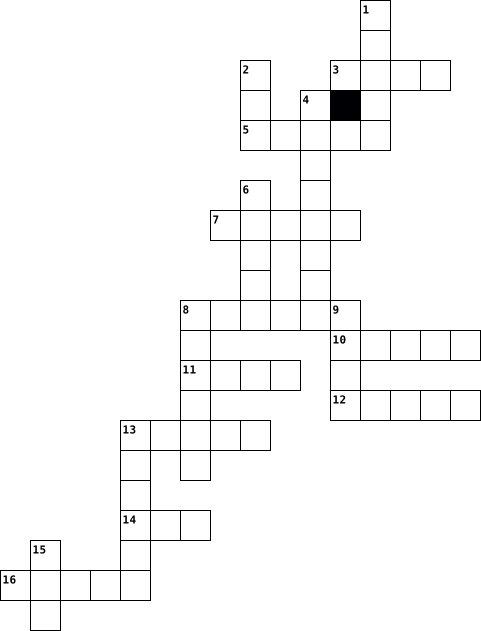
Across
- Milch
- Teller
- Zucker
- Käse
- Glas
- Gabel
- Löffel
- Brot
- Tee
- Wasser
Down
- Messer
- Tasse
- Pfannkuchen
- Saft
- Cafe
- Eier
- Butter
- Marmelade
18 Clues: Tee • Saft • Käse • Cafe • Eier • Glas • Brot • Tasse • Milch • Gabel • Messer • Teller • Zucker • Löffel • Butter • Wasser • Marmelade • Pfannkuchen
Mi Casa 2024-02-19

Across
- Sofa
- Lamp
- Table
- Kitchen
- Dining room
- Plate
- House
- \
- Window
- Knife
Down
- Bedroom
- Bed
- Cup
- Pot
- Cup
- Chair
- Spoon
- Door
- Fork
19 Clues: \ • Bed • Cup • Pot • Cup • Sofa • Lamp • Door • Fork • Table • Chair • Plate • House • Spoon • Knife • Window • Bedroom • Kitchen • Dining room
restaurante 2023-05-02

Across
- waitress
- salt
- waiter
- pepper
- chair
- spoon
- napkin
Down
- cup
- fork
- glass
- plate
- restaurant
- bill
- menu
- table
- bowl
- knife
- sugar
18 Clues: cup • fork • salt • bill • menu • bowl • glass • plate • table • knife • chair • spoon • sugar • waiter • pepper • napkin • waitress • restaurant
Unit4 2023-01-18

Across
- bouillir
- étaler
- baguettes
- chips
- viande
- fourchette
- assiette
Down
- verre
- cuillère
- sécher
- serviette
- riz
- fromage
- couteau
- couper
- paille
- mélanger
- éplucher
18 Clues: riz • verre • chips • sécher • étaler • couper • paille • viande • fromage • couteau • bouillir • cuillère • mélanger • assiette • éplucher • serviette • baguettes • fourchette
things in the room 2026-02-10

Across
- kasur
- bantal
- handuk
- piring
- kompor
- sapu
- gelas
- gambar
- pisau
- buku
- jendela
Down
- guling
- televisi
- meja
- sendok
- kursi
- pensil
- pintu
18 Clues: meja • sapu • buku • kasur • kursi • gelas • pisau • pintu • guling • bantal • handuk • piring • kompor • sendok • pensil • gambar • jendela • televisi
Plate Tectonic Cross Word 2013-11-19

Across
- Vibrations of the earth and its crust
- The upper layer of the earth's mantle
- A geologic process in which one edge of one crustal plate is forced below the edge of another
- A curved chain of volcanic island
- A large-scale motion of Earth's lithosphere
- A deep furrow or ditch
- To raise or elevate
- Forming or belonging to a continent
- To change markedly the appearance or form
Down
- A large natural elevation of the earth's surface
- A hardened layer, coating, or deposit on the surface of something usually soft.
- Relating to the ocean
- The large-scale motions of Earth's lithosphere
- Drawing apart from a common point or diverging
- The act, condition, quality, or fact of converging
- A sudden violent shaking of the ground
- The rigid outer part of the earth
- An edge and the area immediately adjacent to it
- A mountain or hill, typically conical, having a crater or vent through which lava, rock fragments, hot vapour, and gas are or have been erupted from the earth's crust
- The layer of the earth between the crust and the core
20 Clues: To raise or elevate • Relating to the ocean • A deep furrow or ditch • A curved chain of volcanic island • The rigid outer part of the earth • Forming or belonging to a continent • Vibrations of the earth and its crust • The upper layer of the earth's mantle • A sudden violent shaking of the ground • To change markedly the appearance or form • ...
science crossword 2014-02-23

Across
- mountain ranges in the middle of the ocean.
- a theory of moving plates.
- the dense metallic center of earth.
- forms when two plates collide
- As a slab sinks, it pulls the rest of the plate with it.
- the outer part if the magnetic field that interacts with charged particles.
- cold and rigid outermost layer.
- man who had a theory.
- The denser plate sinks below the more buoyant plate.
- the brittle and rocky layer of earth
- material soft enough to flow.
- a supercontinent.
- theory that states that earth's surface is made of rocky plates.
Down
- occurs and the magnetic fields reverse directions.
- Rising mantle pushes plates away from each other.
- the thick middle layer in the solid part of earth.
- circulation of material caused by differences in temperature.
- a state in which magnetized objects will point north.
- a state in which magnetized objects will point south.
- forms where two plates slide past each other.
- forms where two plates separate.
- Process in which new seafloor is made.
- the plastic layer below the lithosphere that has part of the crust and mantle in it.
23 Clues: a supercontinent. • man who had a theory. • a theory of moving plates. • forms when two plates collide • material soft enough to flow. • cold and rigid outermost layer. • forms where two plates separate. • the dense metallic center of earth. • the brittle and rocky layer of earth • Process in which new seafloor is made. • mountain ranges in the middle of the ocean. • ...
Tectonic Plate Crossword 2021-04-01

Across
- Where two plates are moving apart
- They are created by subduction
- A fine grained volcanic rock formed by the partial of the mantle
- A dark intrusive igneous rock
- The pieces of earths crust
- Where two plates are colliding.
- A fracture or zone of fractures in the earth along which there has been a displacement of the sides relative to one another
- The solid outer portion of the earth
- Molten material erupted at the surface of the earth
- Atom with same atomic number, different number of neutrons
- The act of imitating the behaviour of some situation
- The outer layer of the earth
- The layer of the earth between the crust and the core
- Large section of earths crust and upper mantle that moves around on the asthenosphere
Down
- Molten rock in the earths crust
- A specialist in the history of the earth in rocks
- Rigid layer made out of and upper mantle
- the sideways and downward movement of the edge of a plate of the earth's crust into the mantle beneath another plate
- The lower layer of the crust
- Where plates slide passed each other
20 Clues: The pieces of earths crust • The lower layer of the crust • The outer layer of the earth • A dark intrusive igneous rock • They are created by subduction • Molten rock in the earths crust • Where two plates are colliding. • Where two plates are moving apart • Where plates slide passed each other • The solid outer portion of the earth • Rigid layer made out of and upper mantle • ...
1st Year Christmas test 2024-11-20

Across
- – Name a metamorphic rock used in construction.
- – Which reindeer has a red nose?
- – What landform is created when two plates collide?
- – Which plate boundary creates new land?
- – What causes tectonic plates to move?
- – What is a popular main dish for Christmas dinner?
- – What sedimentary rock forms from compressed sand?
- – What is Ireland's most common sedimentary rock?
- – Name an extrusive igneous rock.
- – Which scale measures earthquake strength?
- – What animals pull Santa’s sleigh?
- – What was the name of the supercontinent?
- – Where in Ireland can you find basalt columns?
Down
- – What type of plate boundary causes earthquakes?
- – Which plate boundary causes subduction?
- – Where in Ireland can you find granite?
- – What is molten rock inside the Earth called?
- – What forms in extrusive rocks due to rapid cooling?
- – Name the underwater mountain range between Europe and America.
- – Where did a devastating earthquake occur in 2010?
- – What forms in intrusive rocks due to slow cooling?
- – What is used to count down the days to Christmas?
- – What is the name of the Christmas movie starring Will Ferrell as one of Santa’s helpers?
- – Name an intrusive igneous rock.
- – What is molten rock on the Earth's surface called?
25 Clues: – Which reindeer has a red nose? • – Name an extrusive igneous rock. • – Name an intrusive igneous rock. • – What animals pull Santa’s sleigh? • – What causes tectonic plates to move? • – Where in Ireland can you find granite? • – Which plate boundary creates new land? • – Which plate boundary causes subduction? • – What was the name of the supercontinent? • ...
Denton County Tax Office 2025-11-18

Across
- Discontinued plate material
- Type of card used for authorization.
- A clownfish... and a queue system...
- The month property tax is due
- "I thought we didn't need an inspection anymore"
- Our newest department
- Highway is to motor vehicle as ADVAL is to
- We can't notarize but we can
- The reason a statement is signed by both buyer and seller
- A01 is the first ticket for a
- The type of title that needs a rider to correct
- 2010 means my odometer is
- I have a "N" brand
- Has a plate but may not have a title?
Down
- When the death certificate is needed.
- LL/SUV
- Placards are red. Wait, they're blue too. The form isn't notarized. They have this in lieu.
- I wanted ketchup packets for my tenders no ___ packets!
- Costs an additional 20% on top of prescribed registration fee.
- prints titles
- The DD214 helps decide a plate's
- Why does my registration cost an extra $200?
- What puts the T in RTS?
- Most people start as a
- Name of the position in charge of a substation.
- A candy cane plate
- A contactless method of webdealer payment
27 Clues: LL/SUV • prints titles • A candy cane plate • I have a "N" brand • Our newest department • Most people start as a • What puts the T in RTS? • 2010 means my odometer is • Discontinued plate material • We can't notarize but we can • The month property tax is due • A01 is the first ticket for a • The DD214 helps decide a plate's • Type of card used for authorization. • ...
Unit 5: Tectonic Plates 2022-02-06

Across
- type of convergent boundary where two plates collide and the more dense plate subducts below the less dense plate; forms volcanoes, deep ocean trenches, and earthquakes
- type of convergent boundary where two plates move towards one another pushing crust upward; forms mountains and earthquakes
- states that pieces of the Earth's lithosphere are in slow, constant motion, driven by forces in the mantle
- type of convergent boundary where two plates move towards one another, but one plate subducts under; forms volcanoes, mountains, earthquakes
Down
- force that pushes away newly created crust away from the mid-ocean ridge
- force that occurs when materials move in currents due to the differences in heat and density
- boundary where two plates horizontally slide past one another; form earthquakes
- boundary where two plates move away from each other; forms mid-ocean ridges and rift valleys
- boundary where two plates move towards each other; collide
- force that occurs as the edge of a dense tectonic plate sinks beneath a less-dense plate; creates a pull on the rest of the plate behind it
10 Clues: boundary where two plates move towards each other; collide • force that pushes away newly created crust away from the mid-ocean ridge • boundary where two plates horizontally slide past one another; form earthquakes • force that occurs when materials move in currents due to the differences in heat and density • ...
Plate Tectonic Crossword Puzzle 2022-03-10

Across
- the plate that is made up of India and Australia
- You live here!
- the plate that is under Africa
- the plate that contains two continents Asia and Europe
Down
- the plate that is straddling the equator and the prime meridian
- the plate that contains the continent of Antarctica
- an oceanic plate that is beneath the pacific ocean
7 Clues: You live here! • the plate that is under Africa • the plate that is made up of India and Australia • an oceanic plate that is beneath the pacific ocean • the plate that contains the continent of Antarctica • the plate that contains two continents Asia and Europe • the plate that is straddling the equator and the prime meridian
Historical Geology (GEOL102) - Exam 1 Review Crossword 2020-08-05

Across
- Igneous rock classification, rocks that form above Earth’ surface
- Category of large, less dense gassy planets further away from the sun
- Igneous rock texture that forms when igneous material cools rapidly
- Evidence for the Big Bang that states material moves faster further away from Earth, demonstrated using train or car horns (2 words)
- Proposed the ideas of continental drift and named Pangaea, last name
- Rock type, any rock that has been changed from its original form due to heat, pressure or fluid activity
- Idea proposed by Harry Hess, describes how new oceanic crust forms
- Representation of how all three rock types are related, and can be created, altered or destroyed (2 words)
- Charged atomic particle
- The smallest layer of Earth, by volume
- Rock type, any rock formed by the cooling of magma or lava
- The part of Earth’s interior that flows plastically, like taffy
- Most common mineral group
- Rock type, rocks made up of sediment that have undergone lithification
Down
- Plate boundary where plates slide alongside each other
- The study of the origin and evolution of Earth (2 words)
- Plate boundary where plates move away from each other, or spread apart
- The largest layer of Earth, by volume
- The study of Earth materials and processes (2 words)
- Formation process of sedimentary rocks, through compaction or cementation
- Type of metamorphism that occurs when rocks are near heated magma chambers
- Plate boundary where regional metamorphic activity occurs, due to high temperatures and pressures
- Igneous texture that forms when gases and water are trapped as material cools
- Mantle cell _________, driving force of plate tectonics
- Metamorphic rock texture, lacking parallel mineral structure, like marble
25 Clues: Charged atomic particle • Most common mineral group • The largest layer of Earth, by volume • The smallest layer of Earth, by volume • The study of Earth materials and processes (2 words) • Plate boundary where plates slide alongside each other • Mantle cell _________, driving force of plate tectonics • The study of the origin and evolution of Earth (2 words) • ...
Chapter 8 2013-01-28

Across
- weathering Mechanical breakdown of rocks and minerals
- rain Sulfuric acid that causes degradation of statues and marble
- A vent in Earth's surface that emits ash, gases, and molten lava
- Rocks formed from mud, sand, or gravel compressed together
- Rocks formed from igneous or sedimentary rocks that are subjected to high temperatures and pressure that change its physical and chemical properties
- Molten rock
- A crack that occurs from stress in a rock
- Process of one plate passing under another
- spreading Creates new lithosphere and brings important elements to the surface
- The outermost layer of the planet
- plate When plates move toward one another and collide
- Contains magma, layer under the crust
- cycle Constant formation and destruction of rock
Down
- Rocks formed directly from magma
- The physical removal of rock fragments from an ecosystem
- Exact point on the Earth's surface where the earthquake ruptured
- tectonics A theory which states that "Earth's lithosphere is divided into plates, most of which are in constant motion
- activity A zone where earthquakes occur
- A solid chemical substance with uniform structure
- Near the mantle, made up of ductile rock
- weathering Breakdown of rocks and minerals by chemical reactions
- fault When plates move sideways past each other
- Dense large mass made up of nickel and iron
- plate When plates move away form each other
- spot A place where molten material from the mantle reaches the lithosphere
- zone Large expanse of rock where movement has occurred
- Occurs when rocks in the lithosphere rupture unexpectedly
- The outermost layer of the lithosphere
- scale A scale used to measure earthquake magnitude
29 Clues: Molten rock • Rocks formed directly from magma • The outermost layer of the planet • Contains magma, layer under the crust • The outermost layer of the lithosphere • activity A zone where earthquakes occur • Near the mantle, made up of ductile rock • A crack that occurs from stress in a rock • Process of one plate passing under another • ...
Geography Chapter 2 Section 1-3 2015-01-28

Across
- / A process by which mountains can form as sea plates dive beneath continental plates.
- / Molten rock that is pushed up form the earth's mantle.
- / Surface land areas of the earth's curst, including continents and ocean basins.
- / The removal of salt from seawater to make it usable for drinking and farming.
- drift / The theory that the continents were once joined and then slowly drifted apart.
- / Wearing away of the earth's surface by wind, flowing water or glaciers.
- / Moisture that falls to the earth as rain, sleet, hail, or snow.
- / Process of converting into vapor.
- / Thick middle layer of the earth's interior structure consisting of dense, hot rock.
- / A process by which new land is created when sea plates pull apart and magma wells up between the plates.
- / The part of the earth where life exists.
- / A slow process in which a sea plate slides under a continental plate, creating debris that can cause continents to grow outward.
Down
- / Water within the earth that supplies wells and springs.
- tectonics / The term scientists use to describe the activities of continental drift and magma flow which create many of the earth's physical features.
- / A bend in layers of rock, sometimes caused by plate movement.
- / The watery areas of the earth, including oceans, lakes, rivers, and other bodies of water.
- / The process of excess water vapor changing into liquid water when warm air cools.
- / Underground water-bearing layers of porous rock, sand, or gravel.
- / Fine, yellowish-brown topsoil made up of particles of silt and clay, usually carried by the wind.
- / A layer of gases that surrounds the earth.
20 Clues: / Process of converting into vapor. • / The part of the earth where life exists. • / A layer of gases that surrounds the earth. • / Molten rock that is pushed up form the earth's mantle. • / Water within the earth that supplies wells and springs. • / A bend in layers of rock, sometimes caused by plate movement. • ...
Geography Chapter 2 Section 1-3 2015-01-27

Across
- Molten rock that is pushed up from the earth's mantle.
- A process by which new land is created when sea plates pull apart and magma wells up between the plates.
- Wearing away of the earth's surface by wind, flowing water or glaciers.
- Process of converting into vapor.
- A process by which mountains can form as sea plates dive beneath continental plates.
- The process of excess water vapor changing into liquid water when warm air cools.
- The part of the earth where life exists.
- A slow process in which a sea plate slides under a continental plate, creating debris that can cause continents to grow outward.
- The removal of salt from seawater to make it usable for drinking and farming.
- Surface land areas of the earth's curst, including continents and ocean basins.
- Water within the earth that supplies wells and springs.
- tectonics The term scientists use to describe the activities of continental drift and magma flow which create many of the earth's physical features.
Down
- Underground water-bearing layers of porous rock, sand, or gravel.
- A bend in layers of rock, sometimes caused by plate movement.
- drift The theory that the continents were once joined and then slowly drifted apart.
- Moisture that falls to the earth as rain, sleet, hail, or snow.
- Fine, yellowish-brown topsoil made up of particles of silt and clay, usually carried by the wind.
- Thick middle layer of the earth's interior structure consisting of dense, hot rock.
- The watery areas of the earth, including oceans, lakes, rivers, and other bodies of water.
- A layer of gases that surrounds the earth.
20 Clues: Process of converting into vapor. • The part of the earth where life exists. • A layer of gases that surrounds the earth. • Molten rock that is pushed up from the earth's mantle. • Water within the earth that supplies wells and springs. • A bend in layers of rock, sometimes caused by plate movement. • Moisture that falls to the earth as rain, sleet, hail, or snow. • ...
Geography Chapter 2 Section 1-3 2015-01-27

Across
- / Thick middle layer of the earth's interior structure consisting of dense, hot rock.
- / A slow process in which a sea plate slides under a continental plate, creating debris that can cause continents to grow outward.
- / The watery areas of the earth, including oceans, lakes, rivers, and other bodies of water.
- / The process of excess water vapor changing into liquid water when warm air cools.
- / The removal of salt from seawater to make it usable for drinking and farming.
- / Wearing away of the earth's surface by wind, flowing water or glaciers.
- / Water within the earth that supplies wells and springs.
- / The part of the earth where life exists.
- / A layer of gases that surrounds the earth.
- / A bend in layers of rock, sometimes caused by plate movement.
Down
- / Surface land areas of the earth's curst, including continents and ocean basins.
- tectonics / The term scientists use to describe the activities of continental drift and magma flow which create many of the earth's physical features.
- / Process of converting into vapor.
- / A process by which mountains can form as sea plates dive beneath continental plates.
- / Moisture that falls to the earth as rain, sleet, hail, or snow.
- / Underground water-bearing layers of porous rock, sand, or gravel.
- / Fine, yellowish-brown topsoil made up of particles of silt and clay, usually carried by the wind.
- drift / The theory that the continents were once joined and then slowly drifted apart.
- / A process by which new land is created when sea plates pull apart and magma wells up between the plates.
- / Molten rock that is pushed up from the earth's mantle.
20 Clues: / Process of converting into vapor. • / The part of the earth where life exists. • / A layer of gases that surrounds the earth. • / Molten rock that is pushed up from the earth's mantle. • / Water within the earth that supplies wells and springs. • / A bend in layers of rock, sometimes caused by plate movement. • ...
Geological Forces Crossword Puzzle 2020-10-18

Across
- the layer of earth we live on
- plate movement where one tectonic plate goes under another plate
- pulling apart of two tectonic plates
- the crust and upper mantle
- fast moving, very hot, dark cloud of volcanic ash, gas, and rocks
- a crack in the earth's crust
- means "all lands"; a supercontinent of all the continents making one big land mass
- this machine measures seismic waves
- shaking of the earth's surface
- the layer of earth as hot as the sun;a solid ball of iron
- area around the pacific plate with most of the earth's volcanoes and earthquakes
- Alfred Wegener saw that the continents looked like they fit together like ____ pieces.
- type of volcano made of volcanic ash, volcanic clinkers, or volcanic cinder
Down
- type of volcano also called a stratovolcano;cone shaped with steep sides
- inside the earth where the earth moves or breaks;start of seismic waves
- type of volcano in the shape of a large, round dome
- a surface wave that rolls the earth's surface during an earthquake
- coming together of two tectonic plates
- body waves; the second waves that come from the focus of an earthquake
- the largest layer of the earth
- viscous, slow moving lava
- a surface wave the moves the earth side to side during an earthquake
- a giant wave caused by under ocean earthquakes or volcano eruptions
- the layer of earth made of melted iron and nickel
- fast moving lava with clinkers
- sliding boundary of two tectonic plates
- body waves;the first waves that come from the focus of an earthquake
- the study of the earth
28 Clues: the study of the earth • viscous, slow moving lava • the crust and upper mantle • a crack in the earth's crust • the layer of earth we live on • the largest layer of the earth • shaking of the earth's surface • fast moving lava with clinkers • this machine measures seismic waves • pulling apart of two tectonic plates • coming together of two tectonic plates • ...
Geological Forces Crossword Puzzle 2020-10-18

Across
- the layer of earth we live on
- plate movement where one tectonic plate goes under another plate
- pulling apart of two tectonic plates
- the crust and upper mantle
- fast moving, very hot, dark cloud of volcanic ash, gas, and rocks
- a crack in the earth's crust
- means "all lands"; a supercontinent of all the continents making one big land mass
- this machine measures seismic waves
- shaking of the earth's surface
- the layer of earth as hot as the sun;a solid ball of iron
- area around the pacific plate with most of the earth's volcanoes and earthquakes
- Alfred Wegener saw that the continents looked like they fit together like ____ pieces.
- type of volcano made of volcanic ash, volcanic clinkers, or volcanic cinder
Down
- type of volcano also called a stratovolcano;cone shaped with steep sides
- inside the earth where the earth moves or breaks;start of seismic waves
- type of volcano in the shape of a large, round dome
- a surface wave that rolls the earth's surface during an earthquake
- coming together of two tectonic plates
- body waves; the second waves that come from the focus of an earthquake
- the largest layer of the earth
- viscous, slow moving lava
- a surface wave the moves the earth side to side during an earthquake
- a giant wave caused by under ocean earthquakes or volcano eruptions
- the layer of earth made of melted iron and nickel
- fast moving lava with clinkers
- sliding boundary of two tectonic plates
- body waves;the first waves that come from the focus of an earthquake
- the study of the earth
28 Clues: the study of the earth • viscous, slow moving lava • the crust and upper mantle • a crack in the earth's crust • the layer of earth we live on • the largest layer of the earth • shaking of the earth's surface • fast moving lava with clinkers • this machine measures seismic waves • pulling apart of two tectonic plates • coming together of two tectonic plates • ...
Unit 5 & 6 Vocab 2025-05-14

Across
- A deep valley formed by the separation of tectonic plates.
- Extensive lava flows covering vast areas.
- A logarithmic scale measuring earthquake magnitude.
- A small, steep volcano made of volcanic fragments.
- The periodic switch in Earth's magnetic field direction.
- A large crater formed by volcanic collapse or eruption.
- A stationary magma source that creates volcanic islands.
- A volcanic channel transporting magma to the surface.
- The process of one tectonic plate sinking beneath another.
- A fast-moving cloud of volcanic ash, gas, and rock.
- A tall volcano with alternating lava and ash layers.
- A large ocean wave triggered by earthquakes or other disturbances.
Down
- The process of mountain formation through tectonic forces.
- A mountain formed by shifting fault lines.
- A plate boundary where two plates collide.
- The force pulling a subducting plate into the mantle.
- The fastest seismic wave that travels through solids and liquids.
- The force applied to rocks that causes deformation.
- The energy released by an earthquake.
- A line on a map showing equal geological age.
- The gradual movement of continents over Earth's surface.
- The underground point where an earthquake originates.
- A tectonic boundary where plates slide past each other.
- A fracture in Earth's crust where movement occurs.
- The resistance of a fluid, like lava, to flow.
- The height of a seismic wave from its resting position.
- Rock fragments ejected during a volcanic eruption.
- The equilibrium between Earth's crust and mantle due to buoyancy.
- The processes associated with magma movement and eruptions.
- Energy waves produced by earthquakes.
- A body of intrusive igneous rock beneath Earth's surface.
- A small tectonic plate that moves independently.
32 Clues: The energy released by an earthquake. • Energy waves produced by earthquakes. • Extensive lava flows covering vast areas. • A mountain formed by shifting fault lines. • A plate boundary where two plates collide. • A line on a map showing equal geological age. • The resistance of a fluid, like lava, to flow. • A small tectonic plate that moves independently. • ...
Test 3 - Ocean Boundaries and Wilson Cycle 2025-10-01

Across
- This is driving magma to well up at the mid-ocean ridges and pull crust into the mantle
- Mountains on land are found at _____ plate boundaries
- The ____ Sea is an example of a terminal ocean
- This is the fourth stage of the Wilson cycle
- The ____ Mountains are an example of the suturing stage
- What is the supercontinent called?
- A ____ plate boundary is where plates move apart
- This is the fifth stage of the Wilson cycle
- The rock closest to the ____ _____ ____ will record the newest magnetic field readings
- The deformation of the Earth's crust
- The decreasing focus of earthquakes as a plate is subducted occurs on this zone
- This is the theory proposed by Alfred Wegener
- The frequency, magnitude, and distribution of earthquakes
Down
- This is the theory proposed by Harry Hess
- This is the third stage of the Wilson cycle
- The ___ ___ is an example of a juvenile ocean
- This is the second stage of the Wilson cycle
- This is the Ocean life cycle proposed by John Tuzo Wilson
- The frequency, magnitude, and distribution of volcanoes
- The ____ Ocean is an example of a mature ocean
- This is the first stage of the Wilson cycle
- This is the sixth stage of the Wilson cycle
- This is the permanent marking of the Earth's magnetic field in the oceanic crust
- The ____ Ocean is an example of a declining ocean
- Mid-ocean ridges are found at ____ plate boundaries
- A ____ plate boundary is where plates collide
- When oceanic crust meets continental crust, the ____ ____ will subduct.
- The East ____ Rift Valley is an example of an embryonic ocean
- Magnetic ____ are alternate positive and negative magnetic field readings
- Earth's _____field is not constant
- A ____ plate boundary is where plates slide across each other
31 Clues: What is the supercontinent called? • Earth's _____field is not constant • The deformation of the Earth's crust • This is the theory proposed by Harry Hess • This is the third stage of the Wilson cycle • This is the first stage of the Wilson cycle • This is the sixth stage of the Wilson cycle • This is the fifth stage of the Wilson cycle • ...
griffin's earth science vocabulary crossword 2026-02-03

Across
- dense sphere of nickel and iron at the center of the earth
- plate that forms the continents
- undersea trench where new ocean floor is produced through seafloor spreading
- when this occurs north and south switch
- undersea valley that can be the deepest place in the world
- crust that holds the world's oceans
- German scientist who theorized that the continents move
- layers sectioned based on the chemical makeup of the layers and by density
- used locate the north and south in relation to where it cooled down
- very hot material in its liquid state
- field generated from convection currents in the mantle
- this drives plate movement
- outermost layer of the earth
- layer of the earth that protects us from most asteroids
Down
- combined upper mantle and crust string and rigid solid rock
- science of dating rocks based on the magnitite
- layer of molten iron and nickel surrounding the center of the earth
- occurs when plates interact in violent ways
- layers sectioned based on physical properties and behavior
- idea that all the continents have moved, developed by Alfred Wegener
- layer of hot, solid material is between earth's crust and core
- plate boundary where the plates are moving together
- makes up most of the continental crust
- molten mixture of rocks, gasses, and water from the mantle
- drew maps of the seafloor that provided evidence for continental drift and seafloor spreading
- chain of volcanic islands that formed through subduction
- partially molten mechanical layer that the tectonic plates float on
- makes up most of the oceanic crust
- plate boundary where the plates are moving apart
29 Clues: this drives plate movement • outermost layer of the earth • plate that forms the continents • makes up most of the oceanic crust • crust that holds the world's oceans • very hot material in its liquid state • makes up most of the continental crust • when this occurs north and south switch • occurs when plates interact in violent ways • ...
Alex's Awesome quest crossword puzzle 2026-02-03

Across
- is a large, rigid piece of earth's lithosphere (the crust and and upper mantle
- A plate boundary where two plates move away from each other
- dark igneous rock that forms when lava cools quickly at earth's surface
- The process by which oceanic crust sinks beneath a deep ocean trench and back into the mantle at a convergent plate boundary
- plates move and float on it
- layer that the plates are in made up of solid rock
- The shaking that results from the movement of rock beneath earth's surface
- _____ is a meteorologist
- A dense sphere of solid iron and nickel at the center of earth
- hard light colored igneous rock that forms when magma cools slowly beneath earth's surface
- A plate boundary where two plates move toward each other
Down
- An undersea valley that represents one of the deepest parts of the ocean
- _______ helped create the first detailed maps of the ocean floor
- a single massive supercontinent that once included almost all of earth's land joined together
- is the thin, dense outer layer of earth's crust that lies beneath the oceans
- a curved chain of volcanoes over a subduction zone
- The layer of hot, solid material between earth's crust and core
- These occur in the mantle and move the plates
- Vibrations that travel through earth carrying the energy released during an earthquake
- An undersea mountain chain where new ocean floor is produced
- The process by which molten material adds new oceanic crust to the ocean floor
- a crack, split, or opening in the ground
- _____ is hard and rigid thinnest layer
- A plate boundary where two plates move past each other in opposite directions
- A layer of molten iron and nickel that surrounds the inner core of earth
25 Clues: _____ is a meteorologist • plates move and float on it • _____ is hard and rigid thinnest layer • a crack, split, or opening in the ground • These occur in the mantle and move the plates • a curved chain of volcanoes over a subduction zone • layer that the plates are in made up of solid rock • A plate boundary where two plates move toward each other • ...
Ch.20 Manicuring 2025-11-20

Across
- Nail shape for a client who is more conservative
- How many coats of polish color are standard for coverage
- Nail shape for a client who wants tapered, long nails
- multiuse implement that should be held at a 20 to 30 degree angle from the nail plate
- abrasive used to buff, polish, and remove fine scratches
- Personal Protective equipment
- multiuse implement used to lift small bits of debris from the nail plate
- treatment that increases blood circulation to the skin while also trapping moisture
- Type of nail hardener
- implement used for each side of the nail to prevent stress damage to the sides of the nail plate
- abrasive used to shorten and shape natural nails
- What is the best material for multiuse tool?
- Three part nail care procedure that includes disinfecting your tools
Down
- contain ingredients designed to seal the surface of the skin around the nails
- equipment made from plastic, metal, glass or ceramic
- manicure that eliminate soaking the nails in water
- List of services that you legally are allowed to perform within your license in your state
- How many coats for a successful nail polish application
- Lace, mesh, and fabric used for nail art
- Are also called pledgets and can be used for many things
- tool shaped like a two sided nail file and creates shine
- implement used to remove dead skin
- The most memorable part of the manicure
- designed to speed the evaporation of solvents, allowing them to harden more quickly
- Abrasive that should be used with caution and not generally on natural nails
- designed to loosen and dissolve dead tissue on the nail plate
- tool used to create a marbleized effect
- Many salons and spas have services based on...
28 Clues: Type of nail hardener • Personal Protective equipment • implement used to remove dead skin • The most memorable part of the manicure • tool used to create a marbleized effect • Lace, mesh, and fabric used for nail art • What is the best material for multiuse tool? • Many salons and spas have services based on... • Nail shape for a client who is more conservative • ...
Topic 10 Plate Tectinics 2026-04-01

Across
- trench An undersea valley that represents one of the deepest parts of the ocean.
- An area where magma from deep within the mantle melts through the crust above it
- A force that acts on a rock to change its shape or volume
- A term used to describe a volcano that is not currently active but able to become active in the future
- The shaking that results from the movement of rock beneath Earth's surface.
- A plate boundary where two plates move past each other in opposite directions
- A term used to describe a volcano that is no longer active and unlikely to erupt again.
- stress that pushes masses of rock in opposite directions, in a sideways movement
- A molten mixture of rock-forming substances, gases, and water from the mantle
- A weak spot in the crust where magma has come to the surface
- An undersea mountain chain where new ocean floor is produced; a divergent plate boundary under the ocean.
Down
- A plate boundary where two plates move away from each other.
- Stress that stretches rock so that it becomes thinner in the middle
- A plate boundary where two plates move toward each other.
- Stress that squeezes rock until it folds or breaks
- A break in the Earth's crust
- liquid magma that reaches the surface
- A giant wave usually caused by an earthquake beneath the ocean floor.
- The process by which molten material adds new oceanic crust to the ocean floor
- The sinking, movement of the ocean floor back into the mantle
- The measurement of an earthquake's strength based on seismic waves and movement along faults.
21 Clues: A break in the Earth's crust • liquid magma that reaches the surface • Stress that squeezes rock until it folds or breaks • A plate boundary where two plates move toward each other. • A force that acts on a rock to change its shape or volume • A plate boundary where two plates move away from each other. • A weak spot in the crust where magma has come to the surface • ...
Words 2022-10-22

Across
- разведенный
- стена
- сад
- испытывать жажду
- потолок
- свобода
- чашка
- ложка
- одежда
- нож
Down
- внизу
- вилка
- room спальня
- крыша
- занятие
- пол
- тарелка
- кухня
- вверху
19 Clues: сад • пол • нож • внизу • вилка • стена • крыша • чашка • ложка • кухня • вверху • одежда • занятие • потолок • свобода • тарелка • разведенный • room спальня • испытывать жажду
PLATE TECTONICS CROSSWORD 2019-07-02

Across
- PLATES 2
- 17
- 5
- 4
- 6
- 11
- 9
- 19
- 16
Down
- 15
- 20
- 8
- 3
- 7
- 14
- 18
- TECTONICS 1
- 13
- 12
19 Clues: 8 • 3 • 7 • 5 • 4 • 6 • 9 • 15 • 20 • 17 • 14 • 18 • 11 • 13 • 12 • 19 • 16 • PLATES 2 • TECTONICS 1
engels 2015-10-19

Across
- voertuig
- spoorweg
- brug
- geadresseerde
- takelwagen
- rijstrook
- inhaalverbod
- sneeuwkettingen
- indicator
- gewicht
- versnelling
Down
- blokeerd
- brandstof
- omleiding
- ontbijt
- bestemming
- nummerplaat
- rondpunt
- koppeling
19 Clues: brug • ontbijt • gewicht • blokeerd • voertuig • spoorweg • rondpunt • brandstof • omleiding • rijstrook • koppeling • indicator • bestemming • takelwagen • nummerplaat • versnelling • inhaalverbod • geadresseerde • sneeuwkettingen
Sweet Potato Dumplings 2022-01-26

Across
- 그릇
- 우유
- off, 벗기다
- 앞치마
- 도구
- 꿀
- 재료
- 뿌리다
- 으깨다
- 으깨는 기구
- 넣다
Down
- 접시
- 빵가루
- 종류
- 장갑
- potatoes, 고구마
- 껍질
- 덮다
- 다른
19 Clues: 꿀 • 접시 • 그릇 • 우유 • 종류 • 장갑 • 껍질 • 도구 • 덮다 • 재료 • 다른 • 넣다 • 빵가루 • 앞치마 • 뿌리다 • 으깨다 • 으깨는 기구 • off, 벗기다 • potatoes, 고구마
A CROSSWORD 2025-01-14

Across
- krona
- brki
- leto
- šal
- umetnik
- kopalnica
- hodnik
- prazen
- prst na roki
Down
- oblačila
- lasulja
- hiter
- len
- papagaj
- doma
- teta
- kljun
- krožnik
- Benetke
19 Clues: len • šal • brki • leto • doma • teta • krona • hiter • kljun • hodnik • prazen • lasulja • papagaj • umetnik • krožnik • Benetke • oblačila • kopalnica • prst na roki
2G Vocabulario noviembre 2020-07-15

Across
- plate
- South American Country
- carrot
- delicious
- mashed potatoes
- cookie
- banana
- salad
Down
- rice
- apple
- noodles
- potatoes
- fish
- table
- South American Country
- dessert
- pineapple
- ham
- turkey
- food
20 Clues: ham • rice • fish • food • apple • plate • table • salad • carrot • turkey • cookie • banana • noodles • dessert • potatoes • delicious • pineapple • mashed potatoes • South American Country • South American Country
prepare 1 2022-03-10

Across
- selimut
- dapur
- penggorengan
- bantal
- gambar
- kamar tidur
- sabun
- kompor
- air
Down
- kamar mandi
- ruang keluarga
- mangkuk
- keran
- pisau
- jam
- lampu
- piring
- pancuran
- kasur
19 Clues: jam • air • keran • dapur • pisau • lampu • kasur • sabun • bantal • gambar • piring • kompor • selimut • mangkuk • pancuran • kamar mandi • penggorengan • kamar tidur • ruang keluarga
PLATE TECTONICS CROSSWORD 2019-07-02
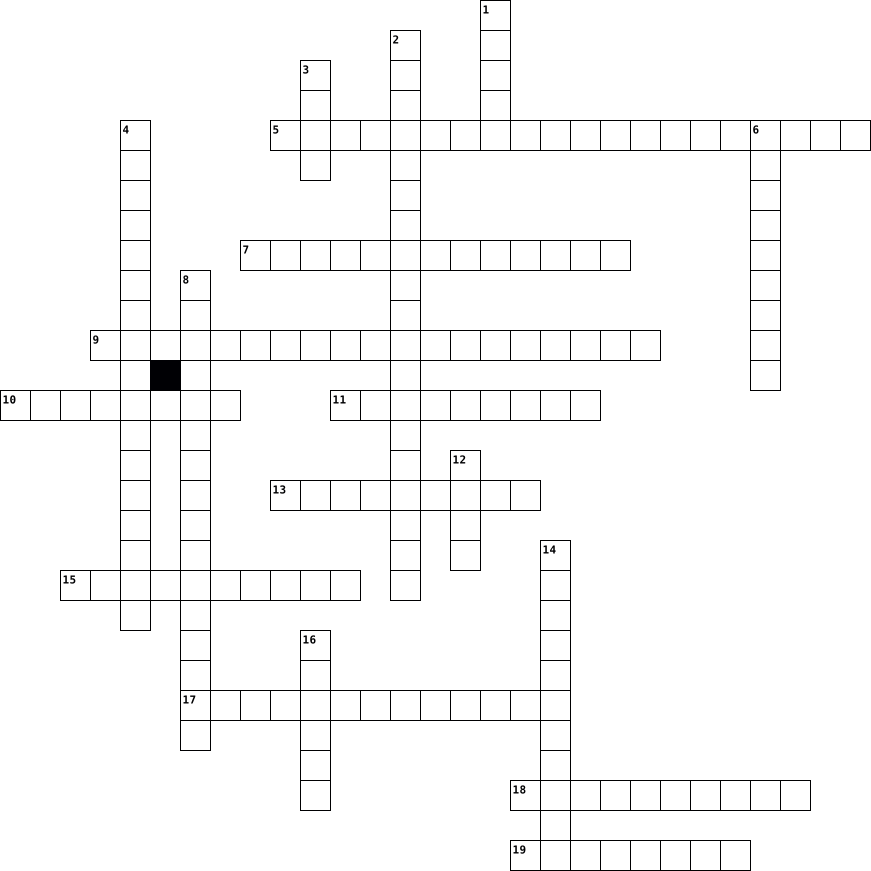
Across
- 3
- 7
- 5
- 19
- 16
- 15
- 11
- 17
- 8
- PLATES 2
Down
- TECTONICS 1
- 4
- 14
- 9
- 18
- 20
- 13
- 6
- 12
19 Clues: 4 • 9 • 3 • 7 • 5 • 6 • 8 • 14 • 18 • 20 • 19 • 16 • 13 • 15 • 11 • 12 • 17 • PLATES 2 • TECTONICS 1
PLATE TECTONICS CROSSWORD 2019-07-02
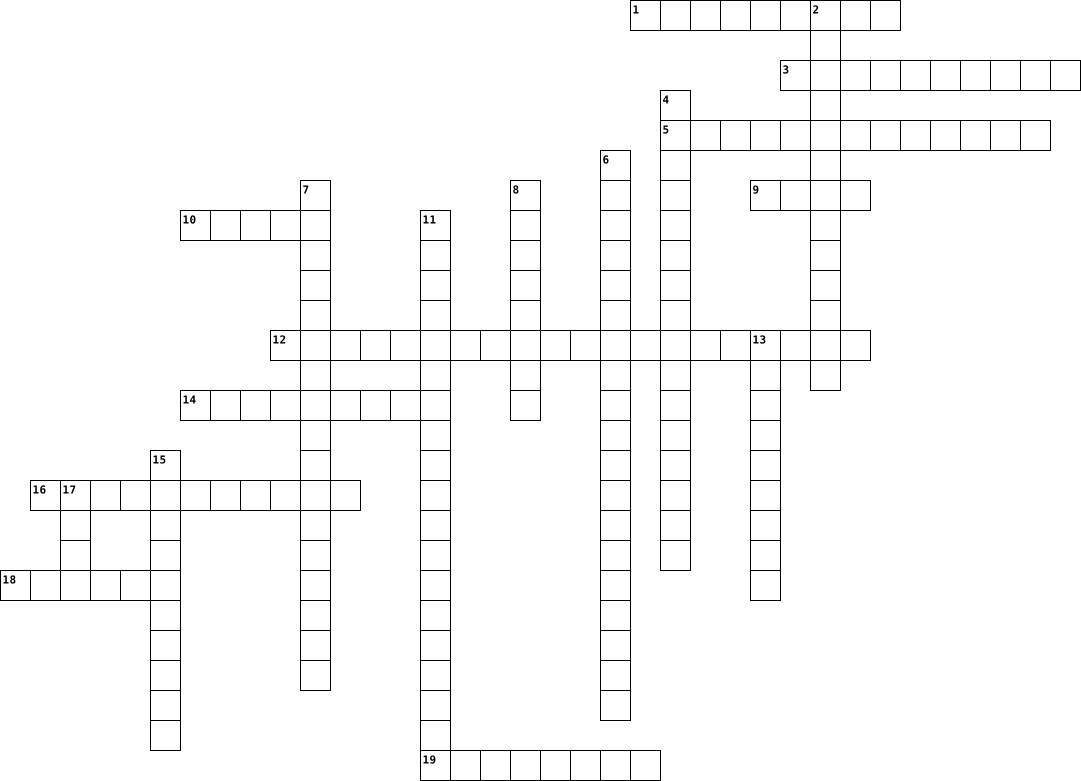
Across
- 16
- 8
- 7
- 13
- TECTONICS 1
- 3
- 15
- 6
- 12
- 19
Down
- 17
- 20
- 5
- 9
- PLATES 2
- 4
- 18
- 11
- 14
19 Clues: 8 • 7 • 5 • 9 • 4 • 3 • 6 • 16 • 17 • 20 • 13 • 18 • 15 • 11 • 14 • 12 • 19 • PLATES 2 • TECTONICS 1
PLATE TECTONICS CROSSWORD 2019-07-02
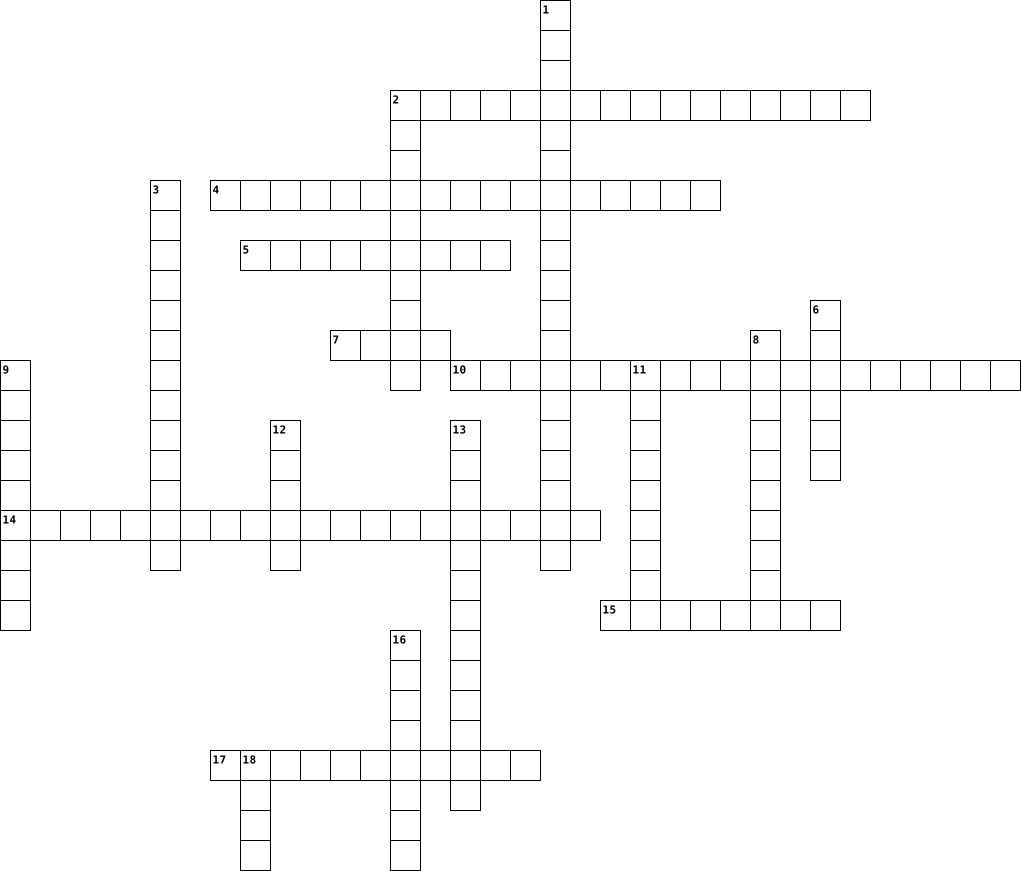
Across
- 20
- 9
- 18
- 13
- 5
- 3
- PLATES 2
- 6
Down
- 4
- 8
- 7
- 12
- 11
- 16
- 15
- TECTONICS 1
- 17
- 19
- 14
19 Clues: 4 • 8 • 7 • 9 • 5 • 3 • 6 • 20 • 18 • 12 • 13 • 11 • 16 • 15 • 17 • 19 • 14 • PLATES 2 • TECTONICS 1
les parties du corps 2 2013-03-21

Across
- pols
- geslachtsorgaan
- neus
- ogen
- enkel
- oor
- duim
Down
- vuist
- tand
- borstkas
- voetzool
- lichaam
- keel
- pupil
- wenkbrauw
- mond
- hand
- arm
- oog
19 Clues: arm • oor • oog • tand • pols • keel • neus • mond • hand • ogen • duim • vuist • pupil • enkel • lichaam • borstkas • voetzool • wenkbrauw • geslachtsorgaan
Med Terms Review 2024 2024-05-20

Across
- Eat Phage
- Pariet
- Wall Lapar
- Trich
- Adnexa
- Pro
- Granule
- Inflammation
- Phren
- Part
Down
- Dynam
- Plak
- Asthenia
- Pan
- Osmo
- Grad
- Pod
- Ptyal
- Phak
19 Clues: Pan • Pod • Pro • Plak • Osmo • Grad • Part • Phak • Dynam • Trich • Ptyal • Phren • Pariet • Adnexa • Granule • Asthenia • Eat Phage • Wall Lapar • Inflammation
Geography Chapter 2 Section 1-3 2015-01-28

Across
- / The part of the earth where life exists.
- drift / The theory that the continents were once joined and then slowly drifted apart.
- / Surface land areas of the earth's curst, including continents and ocean basins.
- / A process by which new land is created when sea plates pull apart and magma wells up between the plates.
- / Molten rock that is pushed up form the earth's mantle.
- / A bend in layers of rock, sometimes caused by plate movement.
- / Moisture that falls to the earth as rain, sleet, hail, or snow.
- / A layer of gases that surrounds the earth.
Down
- / Underground water-bearing layers of porous rock, sand, or gravel.
- / A slow process in which a sea plate slides under a continental plate, creating debris that can cause continents to grow outward.
- / The watery areas of the earth, including oceans, lakes, rivers, and other bodies of water.
- / A process by which mountains can form as sea plates dive beneath continental plates.
- / The removal of salt from seawater to make it usable for drinking and farming.
- / Fine, yellowish-brown topsoil made up of particles of silt and clay, usually carried by the wind.
- / Process of converting into vapor.
- / Wearing away of the earth's surface by wind, flowing water or glaciers.
- / Thick middle layer of the earth's interior structure consisting of dense, hot rock.
- / Water within the earth that supplies wells and springs.
- / The process of excess water vapor changing into liquid water when warm air cools.
- tectonics / The term scientists use to describe the activities of continental drift and magma flow which create many of the earth's physical features.
20 Clues: / Process of converting into vapor. • / The part of the earth where life exists. • / A layer of gases that surrounds the earth. • / Molten rock that is pushed up form the earth's mantle. • / Water within the earth that supplies wells and springs. • / A bend in layers of rock, sometimes caused by plate movement. • ...
EARTH SCIENCE PT#2 2021-02-03

Across
- A fault on which the two blocks slide past one another.
- A type of plate movement that found in San Andreas Fault.
- This boundary occurs when two plates move away.
- Occurs when two plates move toward each other.
- linear, strata normally dip away from axial center, oldest
- The term for the force exerted by a tectonic plate descending into the mantle.
- They are geological features formed by convergent boundaries.
- Opposite of a convergent boundary, a divergent boundary is formed by the spreading of a tectonic plate.
- It occurs between the core and mantle or even between the asthenosphere and lithosphere.
- It is formed at the base of the continental rise about 4000 to 6000 meters deep.
Down
- The one who proposed that the sea floor is spreading.
- These are inclined fractures where the blocks have mostly shifted vertically.
- Gravitational force that causes a plate to move away from the crest of an ocean ridge, and into a subduction zone.
- It is a fracture or zone of fractures between two blocks of rock.
- These are regions that are below sea level and about 70% of these areas hold the planet’s water.
- Internal process drives the molten rocks in the mantle to rise to the lithosphere.
- A fault rock which is cohesive with a poorly developed or absent planar fabric, or which is incohesive, characterized.
- It is the force per unit that place on a rock.
- Another geological feature that results from a subduction zone.
- It is a central valley formed at the summit of the oceanic ridges as the molten materials continuously flow out from the ridges.
20 Clues: Occurs when two plates move toward each other. • It is the force per unit that place on a rock. • This boundary occurs when two plates move away. • The one who proposed that the sea floor is spreading. • A fault on which the two blocks slide past one another. • A type of plate movement that found in San Andreas Fault. • ...
Living with the physical environment 2024-07-04

Across
- organisms who absorb energy from the sun through photosynthesis
- an extended area of beach material that sticks out into the sea, joined to the mainland at one end
- living components of an ecosystem
- herbivores
- the top of a wave
- the type of air pressure when air is rising
- the variety of life in the world or particular habitat
- a ridge of sand or shingle which joins two headlands
- the type of air pressure when air is sinking
- a sudden or violent movement within the Earth's crust, followed by aftershocks
- an organism which breaks down dead tissue e.g. fungus
- the removal of solid mineral resources from the earth
- the most common wind direction for an area
- the long-term change in the earth's climate due to increasing greenhouse gas emissions
Down
- responsible travel to natural areas that conserves the environment and sustains local people
- the measure of distance north or south of the equator
- plate boundary where to plates come together and the denser plate subducts
- an area of low pressure with winds moving in a spiral around a calm central point
- the down-slope movement of rock or soil due to gravity
- a complex hierarchy of plants and animals that rely on each other for food
- a long period of little or no rainfall
- winds that carry air back to the equator
- plate margin where two plates move apart and rising magma creates new land
- plate margin where two plates slide past each other
- the zig-zag movement of sediment along the coast
- the cutting down of trees
- the type of weather that results in rocks being disintegrated
- the distance between two successive crests
28 Clues: herbivores • the top of a wave • the cutting down of trees • living components of an ecosystem • a long period of little or no rainfall • winds that carry air back to the equator • the distance between two successive crests • the most common wind direction for an area • the type of air pressure when air is rising • the type of air pressure when air is sinking • ...
Geology crossword 2021-12-03

Across
- a feature that forms where a stream or river ends and deposits sediment on land
- any change to the Earth’s crust that results from two tectonic plates converging
- the slope of a river or stream
- processes such as landslides or stream erosion that break down or wash away the surface of geologic features
- the slow broad upward movement of the Earth’s surface
- a landform that results when increased pressure is put on a rock layers causing them to fold downward
Down
- circular movement of molten magma that causes tectonic plates to shift
- a landform that results when increased pressure is put on rock layers causing them to fold upwards
- a plate boundary where two tectonic plates collide
- where two plates slide past one another
- a process that displaces rock layers when surfaces on either side of a crack in the earth's surface shift
- the process that occurs when two plates converge causing the crust to fold over onto itself
- no longer active but capable of erupting one day
- when two plate slide away from each other
- a destructive natural process through which rock and soil are loosened and removed from the Earth surface
- the area extending from a stream to its valley walls where sediment is deposited when the stream overflows
- where oceanic plates converge and the older denser oceanic plates
- pulled under the other tectonic plate at a convergent plate boundary
- processes that help build or shape geological features
- particles of sandstone or dirt that are removed from Earth's surface and deposited elsewhere
- the feature that forms when sediment is carried from a stream: to river into another body of water such as an ocean lake or larger river
21 Clues: the slope of a river or stream • where two plates slide past one another • when two plate slide away from each other • no longer active but capable of erupting one day • a plate boundary where two tectonic plates collide • the slow broad upward movement of the Earth’s surface • processes that help build or shape geological features • ...
cereal box project 2025-02-14

Across
- a sudden and violent shaking of the ground, sometimes causing great destruction, as a result of movements within the earth's crust or volcanic action.
- is a fast-moving current of hot gas and volcanic matter
- makes Lava
- coming closer together, especially in characteristics or ideas.
- a mountain or hill, typically conical, having a crater or vent through which lava, rock fragments, hot vapor, and gas are being or have been erupted from the earth's crust.
- the solid, outer part of the Earth
- the outermost layer of Earth's lithosphere that makes up the planet's continents and continental shelves
- the outermost layer of Earth's lithosphere that is found under the oceans and formed at spreading centres on oceanic ridges, which occur at divergent plate boundaries.
- an island of volcanic origin
Down
- the upper layer of the earth's mantle, below the lithosphere, in which there is relatively low resistance to plastic flow and convection is thought to occur.
- path along the Pacific Ocean characterized by active volcanoes and frequent earthquakes.
- an oceanic tectonic plate that lies beneath the Pacific Ocean.
- a small area or region with a relatively hot temperature in comparison to its surroundings.
- formed from the cooling and solidification of molten (melted) rock.
- starts out as a simple crack in the Earth called a volcanic vent.
- molten or partially molten rock (magma)
- The location where two plates meet
- mixtures of water, volcanic ash, tephra, rock fragments, and chunks of ice that can flow like wet concrete.
- the sideways and downward movement of the edge of a plate of the earth's crust into the mantle beneath another plate.
- the powdery residue left after the burning of a substance.
20 Clues: makes Lava • an island of volcanic origin • The location where two plates meet • the solid, outer part of the Earth • molten or partially molten rock (magma) • is a fast-moving current of hot gas and volcanic matter • the powdery residue left after the burning of a substance. • an oceanic tectonic plate that lies beneath the Pacific Ocean. • ...
Neurophysiology & Contraction 2025-03-25

Across
- Channels responding to changes in membrane potential.
- Phase restoring negative membrane potential (K+ efflux).
- Passive ion channels maintaining resting membrane potential.
- Rapid depolarization/repolarization propagating along excitable membranes.
- Channels opening when neurotransmitters bind.
- Synapse between motor neuron and muscle fiber.
- State of having a membrane potential (negative inside relative to outside).
- Vesicles storing neurotransmitters in axon terminals.
- Measure of potential energy in electrical charges (in millivolts).
- Voltage difference between a cell's interior and exterior.
- Pump maintaining ionic gradients by exchanging 3Na+ out/2K+ in.
- Space between axon terminal and motor end plate.
- Ion channels opening/closing in response to stimuli.
- Specialized sarcolemma region with acetylcholine receptors.
- Depolarization of motor end plate by acetylcholine.
- Sequence linking action potentials to crossbridge cycling.
- Junction between neuron and target cell (e.g., neuromuscular junction).
Down
- Process where action potentials trigger muscle contraction.
- Study of electrical properties in cells and tissues.
- Long projection of a neuron conducting action potentials.
- Voltage difference across a cell membrane.
- State of being supplied with motor neurons.
- Combined influence of concentration and electrical gradients on ions.
- Stable voltage (-70mV in neurons) when not transmitting signals.
- Phase where membrane potential becomes less negative (Na+ influx).
- Neuron transmitting signals from CNS to muscles.
- Chemical messengers (e.g., acetylcholine) crossing synaptic clefts.
- Enzyme breaking down acetylcholine to terminate signals.
- End of axon releasing neurotransmitters.
- Ability of action potentials to spread along membranes.
- Neurotransmitter activating skeletal muscle contraction.
31 Clues: End of axon releasing neurotransmitters. • Voltage difference across a cell membrane. • State of being supplied with motor neurons. • Channels opening when neurotransmitters bind. • Synapse between motor neuron and muscle fiber. • Neuron transmitting signals from CNS to muscles. • Space between axon terminal and motor end plate. • ...