
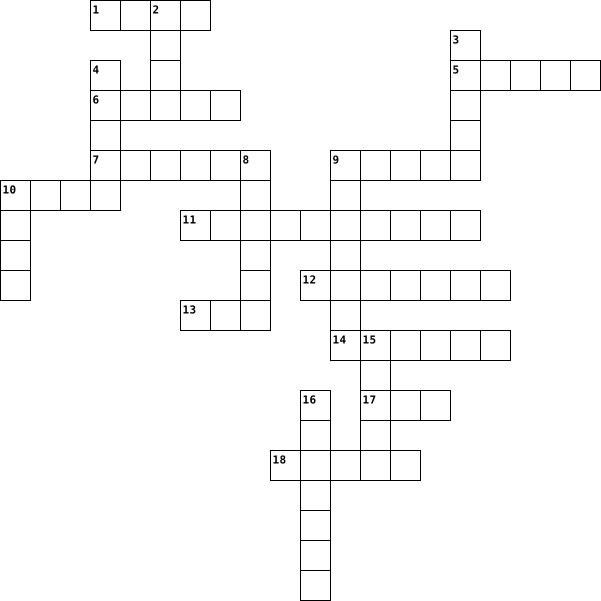
solar Crossword Puzzles
Energy Resorces 2013-04-16

Across
- Biomass is a mixture of ___ molecules
- This is used to heat water (2 words)
- What creates heat which is used to create steam? (2 words)
- The mixture of the (previous answer) contain molecules of ___
- This is part of the combination of wave energy
- What is the fuel for nuclear rectors?
- Hydroelectric power is the production of electric power through ___ of falling and flowing water (2 words)
- Wave energy need a decent ___ of waves to work
- Solar energy can be used to ___ water directly
- Nuclear energy is ___
- Biofuels come from ___ things
- People are growing biofuel crops instead of ___ (2 words)
- What can biodiesel be produced from? (2 words)
Down
- What is biomass based on?
- This means it does not contribute to climate change (2 words)
- Solar energy is the ___ produced by the sun (2 words)
- This can be the effect of solar energy on people
- What is an advantage of biofuels?
- The steam turns a ___ which generates electricity
- This is one of the most common biofuels
- Chemical => ___ => kinetic => electrical
- What do solar energy systems help reduce our dependence on? (2 words)
- Biofuels can lead to ___
- Solar energy is ___ in price
- A problem with biofuels is that they divert ___ away from humans
25 Clues: Nuclear energy is ___ • Biofuels can lead to ___ • What is biomass based on? • Solar energy is ___ in price • Biofuels come from ___ things • What is an advantage of biofuels? • This is used to heat water (2 words) • Biomass is a mixture of ___ molecules • What is the fuel for nuclear rectors? • This is one of the most common biofuels • Chemical => ___ => kinetic => electrical • ...
Solar System - Higgins 2021-09-28

Across
- Unit of measurement within the Solar System; average distance from Earth to the Sun. Abbreviated AU.
- Planet with the coldest atmosphere in the Solar System.
- Term that refers to the inner four planets.
- Nebular clouds consist mostly of the gases hydrogen and ____.
- Atmospheric gas which allows life to exist on Earth.
- Planet which does NOT contain an atmosphere.
- Bodies of water ice, frozen gases, rocks and dust which orbit the sun.
- Rocky bodies that form from debris.
- Third planet from the Sun.
- Extremely bright, super-powerful exploding star.
Down
- Object formed from dust, rock and materials which collide and join to form the infant stages of a planet.
- First large planet to develop through the merging of icy planetesimals.
- Our galaxy; includes the Solar System.
- Force that draws matter together to form a star and possibly planets.
- Region of the Solar System, between the orbits of Mars and Jupiter, that contain solid orbiting bodies.
- An enormous interstellar cloud of dust and gas; nursery for new stars.
- Earth's only natural satellite.
- Once considered a planet; downgraded to a "dwarf planet".
- Hottest planet in the Solar System due to its dense atmosphere.
- How many natural satellites (moons) do the inner planets combined have?
20 Clues: Third planet from the Sun. • Earth's only natural satellite. • Rocky bodies that form from debris. • Our galaxy; includes the Solar System. • Term that refers to the inner four planets. • Planet which does NOT contain an atmosphere. • Extremely bright, super-powerful exploding star. • Atmospheric gas which allows life to exist on Earth. • ...
Space Crossword Puzzle 2021-04-01

Across
- another word for gas giant
- third largest planet in our solar system, is made of ice, gases and liquid metal
- the second largest planet in our solar system, have 7 rings
- the smallest planet in our solar system
- a dwarf planet
- the only planet known to have life on it
- our solar system is part of this galaxy
Down
- second planet from the sun, is a terrestrial planet
- the “red planet”
- the largest planet in our solar system
- closest star to earth
- another word for rocky planet
- planet furthest from the sun, a gas giant
13 Clues: a dwarf planet • the “red planet” • closest star to earth • another word for gas giant • another word for rocky planet • the largest planet in our solar system • the smallest planet in our solar system • our solar system is part of this galaxy • the only planet known to have life on it • planet furthest from the sun, a gas giant • ...
space and beyond 2025-03-28

Across
- what is the warmest planet on are solar system.
- what dwarf planet is after neptune
- the closest planet to the sun.
- who landed on the moon.
- what is the largest object on are solar system.
- What planet has the tallest mountain.
- what is the last planet in are solar system.
- which is the biggest dwarf planet.
Down
- Which is the biggest planet on are solar system.
- What planet is the one we live in.
- what is the last dwarf planet on are solar system.
- Which planet did humans visit.
- Which planet is fully red.
- Which planet is a ice giant.
- which planet has the most moons.
15 Clues: who landed on the moon. • Which planet is fully red. • Which planet is a ice giant. • the closest planet to the sun. • Which planet did humans visit. • which planet has the most moons. • What planet is the one we live in. • what dwarf planet is after neptune • which is the biggest dwarf planet. • What planet has the tallest mountain. • ...
Sistema Solar LBEM 2024-03-25

Across
- Satélite (luna) de Saturno que contiene abundante metano
- Planeta con mayor temperatura sobre 500 grados
- Única estrella de nuestro sistema Solar
- Planeta más lejano al Sol
- Penúltimo planeta del Sistema Solar
- planeta rojo vecino de la Tierra
- Planeta más pequeño y más cercano al Sol
Down
- Satélite (luna) más grande de todo el Sistema Solar y orbita a de JUPITER
- Planeta mas gran del Sistema Solar
- Planeta con anillos visibles desde la Tierra
- Planeta enano que ya no es considerado parte del Sistema Solar
- Único satélite natural de la Tierra
- único planeta con vida conocida hasta ahora
13 Clues: Planeta más lejano al Sol • planeta rojo vecino de la Tierra • Planeta mas gran del Sistema Solar • Único satélite natural de la Tierra • Penúltimo planeta del Sistema Solar • Única estrella de nuestro sistema Solar • Planeta más pequeño y más cercano al Sol • único planeta con vida conocida hasta ahora • Planeta con anillos visibles desde la Tierra • ...
Solar System 2013-05-29

Across
- The Red Planet
- Largest Planet in the Solar System
- Smallest Planet in the Solar System
- The Blue planet
- The star at the center of solar system
- Earth's only satellite
Down
- Seventh Planet from the Solar System
- Our Galaxy
- Farthest Planet in the Solar System
- Morning Star
- Titan largest moon of
11 Clues: Our Galaxy • Morning Star • The Red Planet • The Blue planet • Titan largest moon of • Earth's only satellite • Largest Planet in the Solar System • Farthest Planet in the Solar System • Smallest Planet in the Solar System • Seventh Planet from the Solar System • The star at the center of solar system
Chapter 6 Vocabulary 2023-12-18

Across
- _____ planets are the four outermost planets consisting of Jupiter, Saturn, Uranus, and Neptune
- the central accumulation of material in the early stages of solar system formations, the forerunner of the present-day Sun
- the Sun and all the bodies that orbit it - Mercury, Venus, Earth, Mars, Jupiter, Saturn, Uranus, Neptune, their moons, the asteroids, the comets, and trans-Neptunian objects
- _____ planetology is comparing and contrasting the properties of the diverse worlds we encounter to understand better the conditions under which planets form and evolve
- the breaking up of a large object into many smaller pieces
- _____ theory is one of the earliest models of solar system formation, dating back to Descartes, in which a large cloud of gas began to collapse under its own gravity to form the Sun and planets
- _____ theory is currently favored model of solar system formation which combines features of the old nebular theory with new information about interstellar dust grains, which acted as condensation nuclei
- _____ instability theory states that the jovian planets formed directly from the solar nebula via instabilities in the gas leading to gravitational contraction
- _____ theory states the jovian planets formed when icy protoplanetary cores became massive enough to capture gas directly from the solar nebula
Down
- the swirling gas surrounding the early Sun during the epoch of solar system formation, also referred to as the primitive solar system
- the tendency of a body to keep spinning or moving in a circle
- is a measure of the "compactness" of matter
- _____ planets are the four innermost planets consisting of Mercury, Venus, Earth, and Mars
- the building blocks of the solar system that had reached the size of small moons, at which point their gravitation fields were strong enough to begin influencing their neighbors
- _____ matter is cosmic "debris" in the solar system that is not part of a planet or moon
- the accumulations of matter that would in time evolve into the planets we know today
- the gradual growth of small objects by collision and sticking
17 Clues: is a measure of the "compactness" of matter • the breaking up of a large object into many smaller pieces • the tendency of a body to keep spinning or moving in a circle • the gradual growth of small objects by collision and sticking • the accumulations of matter that would in time evolve into the planets we know today • ...
space 2021-08-31

Across
- gliese
- uranus
- sun
- pluto
- kepler
- solar
- mercury
Down
- saturn
- jupiter
- mars
- universe
- galaxy
- venus
- earth
14 Clues: sun • mars • pluto • venus • earth • solar • gliese • saturn • uranus • galaxy • kepler • jupiter • mercury • universe
GREEN ENERGY L1 VOCAB 2025-12-08

Across
- manteision
- ffosil
- cymuned
- solar
- ynni
- gwynt
Down
- bŵer
- glo
- gorsaf
- nwy
- leol
- panel
- tyrbin
- adnewyddadwy
14 Clues: glo • nwy • bŵer • leol • ynni • panel • solar • gwynt • gorsaf • ffosil • tyrbin • cymuned • manteision • adnewyddadwy
Solar system 2021-01-11

Across
- the fourth planet
- the 3rd largest planet in the Solar system
- the largest planet in the Solar system
- the planet in which life is found
- when earth goes in between sun and moon
- the 2nd largest planet in the Solar system
Down
- when moon goes in between sun and earth
- the hotest planet in our solar system
- the 2nd hotest planet
- the coldest planet in our solar system
- the dwarf planet
- the closest star to earth
12 Clues: the dwarf planet • the fourth planet • the 2nd hotest planet • the closest star to earth • the planet in which life is found • the hotest planet in our solar system • the coldest planet in our solar system • the largest planet in the Solar system • when moon goes in between sun and earth • when earth goes in between sun and moon • the 3rd largest planet in the Solar system • ...
The Solar System 2025-05-13

Across
- The largest mass in the solar system
- The red planet
- A region between Mars and Jupiter is called the ______ Belt
- The largest planet in the solar system
- The farthest planet from the solar system
Down
- The coldest planet in the solar system
- The planet with the rings
- The closest planet to the sun
- The hottest planet in the solar system
- The planet we live on
- The ____ revolves around the Earth
- Became a dwarf planet in 2006
12 Clues: The red planet • The planet we live on • The planet with the rings • The closest planet to the sun • Became a dwarf planet in 2006 • The ____ revolves around the Earth • The largest mass in the solar system • The coldest planet in the solar system • The hottest planet in the solar system • The largest planet in the solar system • The farthest planet from the solar system • ...
Solar System - Gavin 3C 2021-10-30

Across
- How many moons do Jupiter has?
- the planet we live in
- hours 1 day how many hours do Jupiter has?
- the hottest planet at Solar system.
- the furterest planet in Solar system.
- way The Galaxy whereSolar system is.
Down
- the lagest planet of our solar system.
- the sixth planet in solar sytem.
- how many moons are there in neptune?
- the seventh planet in the solar system
- the red planet.
- the nearest planet to the sun.
12 Clues: the red planet. • the planet we live in • How many moons do Jupiter has? • the nearest planet to the sun. • the sixth planet in solar sytem. • how many moons are there in neptune? • the hottest planet at Solar system. • the furterest planet in Solar system. • the lagest planet of our solar system. • the seventh planet in the solar system • ...
SCIENCE 2020-06-17

Across
- The biggest planet in the solar system.
- Eat both plants and animals.
- The center of solar system.
- An organism that only eats meat.
- Considered as dwarf planet.
- The sixth planet in the solar system.
- Is made of pieces of ice in space.
- Are huge chunks of rocks and metals.
- The place in which an organism lives out its life.
Down
- A living thing that can make its own food.
- A living thing that gets its food from eating other living things.
- An organism that only eats plants.
- A group of living things that live in the same place at the same time.
- A living thing that breaks down other living things to get nutrients and energy.
- Earth has one moon.Its name is?
- The scientific study of interactions between organisms and their environment.
- Any non-living organisms in an ecosystem.
- Any living organisms in an ecosystem.
- Is an object in space that gives out light and heat.
- Number of planets in the solar system.
20 Clues: The center of solar system. • Considered as dwarf planet. • Eat both plants and animals. • Earth has one moon.Its name is? • An organism that only eats meat. • An organism that only eats plants. • Is made of pieces of ice in space. • Are huge chunks of rocks and metals. • The sixth planet in the solar system. • Any living organisms in an ecosystem. • ...
Test review 2021-11-04

Across
- the big star that gives us light and heat
- a part in the eclipse where parts of the light are blocked
- separates inner and outer plantes in our solarsysten
- mercury,venus,mars,earth
- dwarf planet or not a planet
- Jupiter,Uranus, Saturn, Neptune
- the lightest part in an eclipse
- an eclipse where the earth passes between the moon and sun
- dirty snowballs of ice
- big ball of rock floating in the solar system
- the moon phase in lunar eclipse
Down
- the big red spot planet
- moon phase in a solar eclipse
- an eclipse where the moon passes in between the earth and sun
- comes after solar and lunar
- the little shines of light in the solar system
- where all the light is blocked
- the darkest part in an eclipse
- the plant god liked so he put a ring on it
- the planet we live on
- what revolves around the earth
21 Clues: the planet we live on • dirty snowballs of ice • the big red spot planet • mercury,venus,mars,earth • comes after solar and lunar • dwarf planet or not a planet • moon phase in a solar eclipse • where all the light is blocked • the darkest part in an eclipse • what revolves around the earth • Jupiter,Uranus, Saturn, Neptune • the lightest part in an eclipse • ...
TEST FOR GLYNELLE 2013-03-19

Across
- A SHELTER THAT CAN MOVE FROM PLACE TO PLACE
- 3 X 4
- BEES COLLECT THIS FROM FLOWERS TO MAKE HONEY
- UNITED STATES OF AMERICA
- A VERY BIG APE
- 9 X 6
- 10 X 8
- A PLACE WHERE BEES ARE KEPT
- A POOL OF WATER WHICH IS SMALLER THAN A LAKE
- 366 DAYS ARE FOUND IN WHICH YEAR?
- 32 - 7
- A PERSON WHO CARRIES OUR LUGGAGE AT THE RAILWAY STATION
- A PLACE WHERE GRAPES ARE GROWN
- PLACE WHERE BOOKS ARE KEPT
- OPPOSITE OF GIANT
Down
- A SMALL SAILING SHIP OR BOAT
- WHAT GROWS IN PADDY FIELDS ?
- SUBASH CHANDRA BOSE WAS CALLED ?
- THE 3RD MONTH IN THE INDIAN SOLAR YEAR
- 98 - 9
- THE 12TH MONTH IN THE INDIAN SOLAR YEAR
- THE 9TH MONTH IN THE INDIAN SOLAR YEAR
- IT IS CAUSED WHEN BITTEN BY A MAD DOG
- THE NAME OF THE PERSON WHO STUDIES STARS AND PLANETS
- OPPOSITE OF BAD
- THE 4TH MONTH IN THE INDIAN SOLAR YEAR
26 Clues: 3 X 4 • 9 X 6 • 98 - 9 • 10 X 8 • 32 - 7 • A VERY BIG APE • OPPOSITE OF BAD • OPPOSITE OF GIANT • UNITED STATES OF AMERICA • PLACE WHERE BOOKS ARE KEPT • A PLACE WHERE BEES ARE KEPT • A SMALL SAILING SHIP OR BOAT • WHAT GROWS IN PADDY FIELDS ? • A PLACE WHERE GRAPES ARE GROWN • SUBASH CHANDRA BOSE WAS CALLED ? • 366 DAYS ARE FOUND IN WHICH YEAR? • IT IS CAUSED WHEN BITTEN BY A MAD DOG • ...
The Planets 2014-10-30

Across
- Uranus is classified as an ___ giant pplanet.
- How many planets are in our solar system?
- The sun is mainly made up of______.
- Which planet is the coldest?
- Jupiter has the ________ day io all the planets.
- What planet is the largest of the dwarf planets?
- What is the largest planet in our solar system?
- What colour is Mars known to be?
- A solar eclipseis when the Moon passes in front of the Sun casting a_____ on Earth.
- Earth is the _____ planet from the sun.
Down
- The rise and fall of the _____ on Earth is caused by the Moon
- Which is the furthest planet from the sun?
- Terristrial planet, second from the sun.
- Mercury is the most _____ planet in the Solar System
- Which planet is closest to the sun?
- Neptune is the ______ of the ice giants.
- Apollo 11 landed on what planet?
- Which planet is known for its rings?
- What is the only planet that inhabits humans?
- Pluto is now considered a ______ planet.
20 Clues: Which planet is the coldest? • Apollo 11 landed on what planet? • What colour is Mars known to be? • The sun is mainly made up of______. • Which planet is closest to the sun? • Which planet is known for its rings? • Earth is the _____ planet from the sun. • Terristrial planet, second from the sun. • Neptune is the ______ of the ice giants. • ...
The Planets 2014-10-29

Across
- How many planets are there within the solar system?
- Which planet has rings?
- What is the term for a person trained to travel in a space craft?
- What force keeps us on the ground?
- What is the galaxy that contains the solar system?
- The sun is a type of _________.
- What planet is fourth from the sun?
- What is a piece of debris falling from the sky called?
- Which planet is the closest to the sun?
- What is in the centre of our solar system?
- Which planet is red in colour?
Down
- Which planet is now considered a dwarf planet?
- Which planet orbits around the sun in 365 days?
- The planets are located in the __________ __________.
- A system of millions of stars is called the __________.
- Which is the largest planet in the solar system?
- What orbits around the earth?
- How many times has a human stepped foot on the moon?
- The second planet from the sun is?
- What is the only planet starting with U?
20 Clues: Which planet has rings? • What orbits around the earth? • Which planet is red in colour? • The sun is a type of _________. • What force keeps us on the ground? • The second planet from the sun is? • What planet is fourth from the sun? • Which planet is the closest to the sun? • What is the only planet starting with U? • What is in the centre of our solar system? • ...
EARTH 2024-02-16

Across
- The biggest planet in our solar system
- The thinnest layer of our earth
- South pole
- Building, village, city are example of ...... environment
- The hottest planet of our solar system
- The synonim of sun
- Earth rotate in its axis
- Neptune and Uranus are made by
- ....... core is the hottest layer of our earth
- How many planets in our solar system
- Earth goes around the sun for a year
- Crude oil is one of the example of ....
Down
- River, lake and mountain are example of ..... environment
- ....... crust is denser the continental crust
- The largest continent of our earth
- Molten rock
- The name of a group planets that made by solid rocks
- The barrier between jovian planets and terrestrial planets
- Dwarf planet
- Cut the trees
- Jupiter and Saturn are made by
- The thickest layer of earth
- ....... core is made by iron and nickel but it is the liquid layer
23 Clues: South pole • Molten rock • Dwarf planet • Cut the trees • The synonim of sun • Earth rotate in its axis • The thickest layer of earth • Jupiter and Saturn are made by • Neptune and Uranus are made by • The thinnest layer of our earth • The largest continent of our earth • How many planets in our solar system • Earth goes around the sun for a year • The biggest planet in our solar system • ...
Puzzle #19 2024-02-27

Across
- The hottest planet in the Solar System. (5)
- Roughly 93 million miles. (12, 4)
- The first shuttle to reach space. (8)
- The craft that orbited a comet. (7)
- First artificial Earth satellite. (7)
- Cosmic body with extremely intense gravity. (5, 4)
- First animal to be launched into space. (5)
- The largest known volcano in the solar system. (7, 4)
- First man in space. (4, 8)
- A failed star, perhaps? (7)
- Plto's largest moon. (6)
- It orbited Ceres. (4)
- Our closest star. (3, 3)
Down
- Planet with the most number of moons. (6)
- The last evolutionary stage of a massive star. (9)
- This spacecraft landed on a comet. (6)
- Largest moon in our solar system. (8)
- Originally called “Le Verrier’s planet”. (7)
- First man on the moon. (4, 10)
- This spacecraft orbited Jupiter. (7)
- Coldest known object in the solar system. (6)
- The closest major galaxy. (9)
- A "star sailor". (9)
- Originally called “George’s Star”. (6)
24 Clues: A "star sailor". (9) • It orbited Ceres. (4) • Plto's largest moon. (6) • Our closest star. (3, 3) • First man in space. (4, 8) • A failed star, perhaps? (7) • The closest major galaxy. (9) • First man on the moon. (4, 10) • Roughly 93 million miles. (12, 4) • The craft that orbited a comet. (7) • This spacecraft orbited Jupiter. (7) • Largest moon in our solar system. (8) • ...
Solar System 2021-10-30

Across
- How many moons do Jupiter has?
- the planet we live in
- hours 1 day how many hours do Jupiter has?
- the hottest planet at Solar system.
- the furterest planet in Solar system.
- way The Galaxy whereSolar system is.
Down
- the lagest planet of our solar system.
- the sixth planet in solar sytem.
- how many moons are there in neptune?
- the seventh planet in the solar system
- the red planet.
- the nearest planet to the sun.
12 Clues: the red planet. • the planet we live in • How many moons do Jupiter has? • the nearest planet to the sun. • the sixth planet in solar sytem. • how many moons are there in neptune? • the hottest planet at Solar system. • the furterest planet in Solar system. • the lagest planet of our solar system. • the seventh planet in the solar system • ...
SCIENCE 2020-06-17

Across
- Earth has one moon.Its name is?
- A group of living things that live in the same place at the same time.
- Considered as dwarf planet.
- The biggest planet in the solar system.
- The scientific study of interactions between organisms and their environment.
- Is an object in space that gives out light and heat.
- Eat both plants and animals.
- An organism that only eats meat.
- An organism that only eats plants.
Down
- Is made of pieces of ice in space.
- Any non-living organisms in an ecosystem.
- The sixth planet in the solar system.
- The place in which an organism lives out its life.
- A living thing that breaks down other living things to get nutrients and energy.
- Number of planets in the solar system.
- A living thing that gets its food from eating other living things.
- A living thing that can make its own food.
- The center of solar system.
- Are huge chunks of rocks and metals.
- Any living organisms in an ecosystem.
20 Clues: Considered as dwarf planet. • The center of solar system. • Eat both plants and animals. • Earth has one moon.Its name is? • An organism that only eats meat. • Is made of pieces of ice in space. • An organism that only eats plants. • Are huge chunks of rocks and metals. • The sixth planet in the solar system. • Any living organisms in an ecosystem. • ...
SCIENCE 2020-06-17

Across
- Number of planets in the solar system.
- Earth has one moon.Its name is?
- An organism that only eats meat.
- Is an object in space that gives out light and heat.
- A living thing that can make its own food.
- Eat both plants and animals.
- The biggest planet in the solar system.
- The scientific study of interactions between organisms and their environment.
- Any non-living organisms in an ecosystem.
- A living thing that gets its food from eating other living things.
Down
- The sixth planet in the solar system.
- An organism that only eats plants.
- Considered as dwarf planet.
- A living thing that breaks down other living things to get nutrients and energy.
- The place in which an organism lives out its life.
- Are huge chunks of rocks and metals.
- A group of living things that live in the same place at the same time.
- Is made of pieces of ice in space.
- Any living organisms in an ecosystem.
- The center of solar system.
20 Clues: Considered as dwarf planet. • The center of solar system. • Eat both plants and animals. • Earth has one moon.Its name is? • An organism that only eats meat. • An organism that only eats plants. • Is made of pieces of ice in space. • Are huge chunks of rocks and metals. • The sixth planet in the solar system. • Any living organisms in an ecosystem. • ...
Science extra credit marking period 3 2022-03-01

Across
- the largest planet in the solar system.
- the only known planet that supports life.
- the farthest planet from the sun.
- a big ball of frozen ice that orbits the sun.
- a small rocky body orbiting the sun.
- the force of attraction that keeps everything together.
- the planets closest to the sun.
- a hot ball of gases, our sun is one of them.
- the seventh planet from the sun.
- the start all the planets revolve around.
Down
- an hole with so much gravity light cannot escape.
- the planets furthest from the sun.
- named after the roman god of war.
- the galaxy which our solar system is in.
- small rock in outer space, smaller than an asteroid.
- the natural satellite of earth
- the fastest planet in our solar system.
- the sixth planet from the sun.
- the smallest planet in our solar system.
- was once a planet but now is considered a dwarf planet.
- stars, planet, dust, and rocks all held together.
21 Clues: the natural satellite of earth • the sixth planet from the sun. • the planets closest to the sun. • the seventh planet from the sun. • named after the roman god of war. • the farthest planet from the sun. • the planets furthest from the sun. • a small rocky body orbiting the sun. • the largest planet in the solar system. • the fastest planet in our solar system. • ...
Space 2025-03-01

Across
- The star at the center of our solar system
- Earth's natural satellite
- A rocky object that orbits the Sun
- The farthest planet from the Sun
- The smallest planet and closest to the Sun
- The galaxy that contains our solar system
- The hottest planet in the solar system
- Planet that spins on its side
- A tool used to see far into space
- A person who travels into space
Down
- Everything that exists, including all space and time
- A ball of ice and dust with a glowing tail
- Planet with beautiful rings
- The force that keeps planets in orbit
- A huge collection of stars, gas, and dust
- A vehicle that travels beyond Earth
- The largest planet in our solar system
- The path a planet takes around the Sun
- A big round object that orbits a star
- The red planet
- Huge balls of burning gas in space
- A machine that blasts off into space
- The planet we live on
23 Clues: The red planet • The planet we live on • Earth's natural satellite • Planet with beautiful rings • Planet that spins on its side • A person who travels into space • The farthest planet from the Sun • A tool used to see far into space • A rocky object that orbits the Sun • Huge balls of burning gas in space • A vehicle that travels beyond Earth • ...
Science P4 - Unit 5 - Light 2024-01-30

Across
- The planet before Earth.
- The reflection of yourself in the mirror.
- There is an _______ belt between Mars and Jupiter.
- The moon _____ around the Earth.
- The largest planet in our solar system
- The action of light bouncing off a surface
- A line that light travels in
- A model of the Earth
- The Earth completes a turn on its ______ every 24 hours.
- The sixth planet from the Sun in our solar system.
Down
- The spinning direction of the Earth
- A lump of ice and dirt that travels in a large orbit around the Sun
- Scientific evidence that something is true
- The planet furthest away from the Sun in our solar system.
- The Sun is a ______
- The planet in our solar system that is closest to the Sun
- Turning round and round
- Asteroids are ______ masses that orbit the Sun.
- Surfaces like wood _______ light.
- A body in space that reflects light
- A body in space that gives out light
21 Clues: The Sun is a ______ • A model of the Earth • Turning round and round • The planet before Earth. • A line that light travels in • The moon _____ around the Earth. • Surfaces like wood _______ light. • The spinning direction of the Earth • A body in space that reflects light • A body in space that gives out light • The largest planet in our solar system • ...
Space Crossword 2023-12-13

Across
- planet famous for its rings
- more then a half but less then a full moon is visible
- 8th planet in our solar system
- energy from the sun that can be used to make electricity
- the amount of space between two objects
- large round object that orbits a star
- a sliver of moon visible
- a push or pull
- the closest celestial object to Earth
- the part of the moon we see on different nights
- a tool used to tell time based on shadows
Down
- first planet in our solar system
- when the whole face of the moon is visible to us
- second planet in our solar system
- to circle another planet or object
- largest planet in our solar system
- an invisible force that pulls an object down
- a rocky object in space
- called the red planet
- an image to help you understand data
- a pretend version of something we use when the original is too large or small to work with
21 Clues: a push or pull • called the red planet • a rocky object in space • a sliver of moon visible • planet famous for its rings • 8th planet in our solar system • first planet in our solar system • second planet in our solar system • to circle another planet or object • largest planet in our solar system • an image to help you understand data • large round object that orbits a star • ...
Universe Structure 2024-11-24

Across
- Large balls of gas that generate energy through nuclear fusion.
- The smallest galaxies have an _____ shape.
- Pluto is now considered a _____.
- Planet where all living things can survive.
- _____ is about the same size as Earth and is sometimes called the "morning star".
- Objects that orbit planets.
- Planets outside our solar system.
- Smaller, irregular, rocky objects that orbit stars.
- The star in our solar system.
- This planet has large seas of liquified hydrogen.
- _____ has 146 moons.
- Our galaxy is called the _____ galaxy.
Down
- Planets must _____ a star.
- Clusters of billions of stars held together by gravity.
- Any of the large bodies that revolve around the Sun in the solar system.
- The largest storm in the solar system.
- Planet named after the Roman god of the underworld.
- Everything, including all of space, time and matter.
- Sometimes called dirty snowballs.
- Study of all the objects outside the Earth's atmosphere.
- The force of attraction responsible for holding planets in orbit.
21 Clues: _____ has 146 moons. • Planets must _____ a star. • Objects that orbit planets. • The star in our solar system. • Pluto is now considered a _____. • Sometimes called dirty snowballs. • Planets outside our solar system. • The largest storm in the solar system. • Our galaxy is called the _____ galaxy. • The smallest galaxies have an _____ shape. • ...
Renewable Crossword Puzzle 2025-04-01

Across
- organic material that comes from plants and animals
- The percent of energy of which renewable resources produce
- biomass comes from ____ matter
- energy from the movement of water driven by the moon
- An advantage of hydroelectricity id that it is pretty ___ for energy
- used to make energy from turbines
- used to harness solar energy
- energy from the sun
- Created from solar panels turning sunlight into this
- used to harness wind energy
- Disadvantage of burning biomass for energy
Down
- animal____ is part of the organic matter in biomass
- establishments used to make hydroelectricity
- Key disadvantage of using solar/wind energy
- defines resources that can be replenished over a short amount of time
- uses heat from the earth to generate electricity
- a potentially renewable resource that comes from forests
- Country known for using geothermal energy
- Uses the energy of moving water to generate electricity
- key advantage of using wind and solar energy, no_____ emission
20 Clues: energy from the sun • used to harness wind energy • used to harness solar energy • biomass comes from ____ matter • used to make energy from turbines • Country known for using geothermal energy • Disadvantage of burning biomass for energy • Key disadvantage of using solar/wind energy • establishments used to make hydroelectricity • ...
Climate Change 2025-05-15

Across
- water turning from liquid to gas
- Coal, oil, and natural gas
- along with california, the state with the most renewable energy generation
- Gases that create climate change
- getting energy from the sun
- category 5 hurricane that hit Florida
- moving air
- The thin layer of air that protects the earth from the sun
- water turning from gas to liquid
- used to store energy created by solar and wind
- energy sources like wind, solar, hydro
Down
- Energy from the sun that is blocked by the ozone layer
- what happens when sea level rises during a powerful storm
- the most abundant greenhouse gas
- the place where all the air pollution goes
- unit of measure for lots of energy
- the most expensive hurricane in US History
- the kind of energy generation that does not lead to climate change but is not entirely clean or safe
- the kind of energy jobs that involve solar, wind and hydro
- another name for greenhouse gases
20 Clues: moving air • Coal, oil, and natural gas • getting energy from the sun • water turning from liquid to gas • Gases that create climate change • the most abundant greenhouse gas • water turning from gas to liquid • another name for greenhouse gases • unit of measure for lots of energy • category 5 hurricane that hit Florida • energy sources like wind, solar, hydro • ...
The Outer Planets And Their Moons 2022-11-02

Across
- The last of the Galilean moons
- Uranus's largest moon
- The fifth planet from the sun
- Farthest known solar planet
- Jupiter's closest galilean moon
- The Solar System's largest moon
- Uranus's fourth largest moon
- Second largest Neptunian moon
- The moon where water was detected beneath it's surface by the Cassini space probe
- Ninth largest moon of the Solar System
- The planet known for it's rings in the Solar System
- Stop pronouncing this planet's name wrong
Down
- The innermost of Uranus's five round moons
- Uranus's outermost major moon
- Saturn's largest moon
- Third largest moon of Neptune
- Saturn's moon which looks like an oval sponge
- 24th of Saturn's 83 known moons
- Third largest moon of Uranus
- It's orbital period around Saturn is only 23 hours
- Neptune's largest moon
- Fifth closest inner moon of Neptune
- Fourth largest moon of Saturn
- Saturn's moon which is somewhat hard to spell
- Jupiter's moon that sounds like a continent on Earth
25 Clues: Saturn's largest moon • Uranus's largest moon • Neptune's largest moon • Farthest known solar planet • Third largest moon of Uranus • Uranus's fourth largest moon • Uranus's outermost major moon • Third largest moon of Neptune • The fifth planet from the sun • Fourth largest moon of Saturn • Second largest Neptunian moon • The last of the Galilean moons • ...
Space 2020-10-09

Across
- Closest star apart from the sun
- Smallest moon
- How many dwarf planet are there in our solar sysytem
- Between Mars and Jupiter
- First person in space
- Hottest planet in our solar system
- Trash in space
- The best planet
- Smallest dwarf planet
- The planet that have the clearest ring
- Location of Pluto
- Temperature of the Sun core
- We just learn this for Crit D
Down
- First person to play golf on the moon
- Distance from neptune to sun
- biggest star in the universe
- Biggest galaxy
- How Long does it take light from sun to reach earth
- The number of ring that Saturn has
- black thing in space
- First man to step on the moon
- Biggest dwarf planet
- The first dog in space
- Biggest moon in our solar system
- How long it take neptune to orbit sun
- Number of moon in our solar system
26 Clues: Smallest moon • Biggest galaxy • Trash in space • The best planet • Location of Pluto • black thing in space • Biggest dwarf planet • First person in space • Smallest dwarf planet • The first dog in space • Between Mars and Jupiter • Temperature of the Sun core • Distance from neptune to sun • biggest star in the universe • First man to step on the moon • We just learn this for Crit D • ...
Alternative Energy 2014-10-11

Across
- fastest growing source of renewable energy currently
- Fossil fuels are an example of _____ sources of energy
- Geothermal energy harnesses energy from decaying
- Biomass captures energy from the sun that is stored in decomposing
- this energy is generated from decaying uranium atoms in the Earth's core
- The suns heat and the spinning earth generate
- solar panels ____ the suns energy to a form we can use
- The winds energy is captured by the blades of this
Down
- generated at dams
- Indefinitely reliable
- _____ is a source of renewable energy
- Gasses in the atmosphere that reflect heat back down are called ____ gasses
- Buried
- Solar panels convert the energy from photons into
- Many vehicles use this fossil fuel
- Energy source that does not produce greenhouse gases
- used to capture solar energy
- Reduce, reuse and ____ are three ways to cut down on fossil fuels
- a source of renewable energy
- _____ can never be created or destroyed
20 Clues: Buried • generated at dams • Indefinitely reliable • used to capture solar energy • a source of renewable energy • Many vehicles use this fossil fuel • _____ is a source of renewable energy • _____ can never be created or destroyed • The suns heat and the spinning earth generate • Geothermal energy harnesses energy from decaying • ...
Sun & Stars 2024-10-03

Across
- The number of stars in the universe.
- What hydrogen is converted to during fusion.
- To be considered a star, the celestial body must be able to produce heat and ________
- The part of the sun that fusion occurs.
- The name of our solar system
- What a light year measures
- The furthest of the inner planets.
- Fusion forms a ____________ atom.
- The closest of the outer planets.
- Our sun is considered this sized star.
- What is released from a fusion reaction
Down
- The force that holds the solar system together
- The largest object in our solar system
- The type of star our sun is
- About 6 trillion miles.
- The sun is __________ dense than earth.
- Stars are the building blocks of __________
- The closest planet to the sun
- The combination of two elements
- The number of planets in our solar system
- Huge celestial bodies made mostly of hydrogen and helium
- The furthest planet from the sun.
22 Clues: About 6 trillion miles. • What a light year measures • The type of star our sun is • The name of our solar system • The closest planet to the sun • The combination of two elements • The furthest planet from the sun. • Fusion forms a ____________ atom. • The closest of the outer planets. • The furthest of the inner planets. • The number of stars in the universe. • ...
Solar System Crossword 2016-03-16

Across
- The only planet that orbits sideways
- Planet with the fastest winds in the solar system
- The solar system's only star
- A ___________ is a form of celestial body that orbits the sun.
- Earth's only Natural Satellite
- The largest planet in the solar system
- Satellite that is man-made ex: International Space Station and Sputnik
- The only planet in the solar system that can support life
Down
- Planet known for having rings
- Planet with an average temperature of -55 Degrees C
- Earth's sister planet
- An asteroid on a collision course with Earth
- A rock in space
- Closest planet to the sun
- Jupiter has over 60 ____________ Satellites
- Considered a planet until 2006.
16 Clues: A rock in space • Earth's sister planet • Closest planet to the sun • The solar system's only star • Planet known for having rings • Earth's only Natural Satellite • Considered a planet until 2006. • The only planet that orbits sideways • The largest planet in the solar system • An asteroid on a collision course with Earth • Jupiter has over 60 ____________ Satellites • ...
Renewable Energy Crossword Puzzle 2023-05-17

Across
- Where are dams built?
- Kind of energy that is radioactive.
- This substance is mined for nuclear energy.
- Tall turbines or mills are powered by the ______.
- Time of day when we can't harness solar energy.
- Coal energy creates __________ .
- Solar ________ collect the sun's energy.
- The sun gives off light and ______ for energy.
- A solar ______ can harvest enough energy for a city.
Down
- What we turn energy into to power our homes.
- Energy that will eventually run out is called.
- Solar energy comes from the ______.
- Coal, natural gas, and oil are all _______ fuels.
- Energy that doesn't run out is called.
- What animal population is at risk from building dams?
- Dams harness energy from moving _________.
16 Clues: Where are dams built? • Coal energy creates __________ . • Kind of energy that is radioactive. • Solar energy comes from the ______. • Energy that doesn't run out is called. • Solar ________ collect the sun's energy. • Dams harness energy from moving _________. • This substance is mined for nuclear energy. • What we turn energy into to power our homes. • ...
185. Tipos de energías alternativas 2026-02-26

Across
- – Energía de residuos orgánicos.
- – Combustible limpio.
- – Energía de corrientes marinas.
- – Energía del agua.
- – Gas combustible orgánico.
- – Energía de olas.
- – Energía del calor terrestre.
Down
- – Energía solar concentrada.
- – Luz solar a electricidad.
- – Energía de mareas.
- – Energía del océano.
- EÓLICA – Generador de viento.
- – Energía del sol.
- – Energía del viento.
14 Clues: – Energía del sol. • – Energía de olas. • – Energía del agua. • – Energía de mareas. • – Combustible limpio. • – Energía del océano. • – Energía del viento. • – Luz solar a electricidad. • – Gas combustible orgánico. • – Energía solar concentrada. • EÓLICA – Generador de viento. • – Energía del calor terrestre. • – Energía de residuos orgánicos. • – Energía de corrientes marinas.
Science Terms Review 2025-02-13

Across
- The vibration rate of sound and descriptions like high and low are used to describe it.
- The first four planets from the sun that are smaller, warmer, orbit sun faster, less moons, no rings and solid.
- The center of a solar system, made of gas, gives off heat and light.
- The last four planets from the sun that are bigger, orbit sun slower, colder, have rings, more moons and made of gas.
- __________ planets are solar system objects that are sphere shaped orbit the sun only but do not clear their orbital path. Pluto is one of these.
- Small piece that breaks off of asteroid or comet and stays in space.
- Consumer that only eats other consumers.
- Small piece of asteroid or comet that burns up in earth's atmosphere leaving a streak of light.
- Solar system object irregular in shape and are made of rock and metal.
- Living thing that gets energy from the sun.
- _________ or shiny surfaces reflect light.
- Solar system objects that are sphere shaped, orbit the sun only, and clear their orbital path. There are 8 in our solar system.
- A relationship between two organisms where they both benefit from each other.
- A relationship between two or more organisms that are trying to get energy from the same thing.
- The energy the sound has and is described by how loud or quiet the sound is.
- The earth ________ or revolves around the sun once every year.
- Surfaces that absorb sound vibrations.
- The star at the center of our solar system that is just medium in size and brightness but appears from earth to be the biggest and brightest.
Down
- A relationship between two organisms where one benefits and the other is harmed.
- When light goes through and surface and bends a little.
- _________/prey relationship is where one consumer hunts and kills another consumer.
- Living thing that gets energy from other living things.
- Consumer that only eats producers (plants).
- Consumer that eats both plants and animals/insects.
- Solar system objects irregular shaped made of ice, dust and frozen gasses. It gets a vapor tail when it gets closer to the sun.
- Surfaces that reflect sound vibrations.
- Small piece of asteroid or comet that lands on earth's surface.
- A species that is introduced to a new ecosystem and disrupts it.
- Surfaces that absorb light.
- A relationship between two organisms where one benefits and the other is unaffected.
- Solar system objects that orbit a planet.
- The earth ________ or spins once every 24 hours which causes us to experience day and night.
- ____________ Way is the name of the galaxy our solar system is in. Which is a group of billions of stars and solar systems.
33 Clues: Surfaces that absorb light. • Surfaces that absorb sound vibrations. • Surfaces that reflect sound vibrations. • Consumer that only eats other consumers. • Solar system objects that orbit a planet. • _________ or shiny surfaces reflect light. • Consumer that only eats producers (plants). • Living thing that gets energy from the sun. • ...
Space Crossword 2025-01-23

Across
- multiple solar systems and stars held together by gravity
- the second planet from the sun
- a planet in our solar system that rotates sideways
- a force caused by the mass and distance between two objects
- a planet from outside our solar system
- the planet best known for its rings
- the planet closest to the sun
Down
- a star orbited by mutliple planets
- the red planet
- A big round object that orbits a star
- the largest planet in our solar system
- the cold blue planet furthest from the sun
- a big ball of glowing gasses
- everything
- the planet we live on
- the name of our star
16 Clues: everything • the red planet • the name of our star • the planet we live on • a big ball of glowing gasses • the planet closest to the sun • the second planet from the sun • a star orbited by mutliple planets • the planet best known for its rings • A big round object that orbits a star • the largest planet in our solar system • a planet from outside our solar system • ...
Science sentences! 2022-05-25

Across
- ___ are surrounded by land.
- An ___ is a landform surrounded by water.
- One trip around the Sun is one ___.
- Much of the freshwater on earth is ____ and we pump it with wells.
- You can drink ___, not saltwater.
- ___ is the closest planet to the Sun.
- ___ tectonics collide and build up as mountains.
- Water ____ causes land to wash away over millions of years.
- The ___ planets are closer together.
- Mount Everest is the tallest ___ in the world.
Down
- The Earth is the ___ planet in the Solar System.
- There is no ____ in space.
- The ___ is our closest star to Earth.
- ___ is the biggest planet in our Solar System.
- ____ is the smallest planet in the Solar System.
- Most of the water on Earth is Saltwater.
- Part of the Earth is nighttime, while the other part is ____.
- ___ are large balls of fire.
- The ___ star to Earth is the Sun.
- ___ carry water downhill.
- The ___ spins but you can't feel it.
- The Earth orbits the ___ every year.
- There are ___ different planets in the Solar System.
- There is no ___ in space.
24 Clues: ___ carry water downhill. • There is no ___ in space. • There is no ____ in space. • ___ are surrounded by land. • ___ are large balls of fire. • The ___ star to Earth is the Sun. • You can drink ___, not saltwater. • One trip around the Sun is one ___. • The ___ spins but you can't feel it. • The Earth orbits the ___ every year. • The ___ planets are closer together. • ...
The universe 2020-10-15

Across
- It is a mixture of gas clouds in space
- this are found most between mars and jupiter in our solar system
- It is the coldest planet in our solar system
- This is known as blue planet
- this is known as Red planet
- A planet in our solar system which has rings of dust and ice
Down
- Milky way is a ________
- This is a dwarf planet
- This planet is the farthest planet to our sun
- A life from outer space
- It is a moon of saturn which is comfortable for life
- It is the biggest planet in our solar system
- It is the hottest planet in our solar system
- This are unequal surface area on planets and moons formed by meteors that hit the suface
- this planet is the closest planet to our sun
15 Clues: This is a dwarf planet • Milky way is a ________ • A life from outer space • this is known as Red planet • This is known as blue planet • It is a mixture of gas clouds in space • It is the biggest planet in our solar system • It is the coldest planet in our solar system • It is the hottest planet in our solar system • this planet is the closest planet to our sun • ...
Astronomy Review 2019-11-18

Across
- Collection of stars (Solar-Systems)
- Planet with the largest volcano in the Solar-System (Olympus Mons)
- Model of the Solar-System that places the Sun at the center
- Causes planets to experience years
- Oval path planets take as they revolve around the Sun
- Planet that rotates on it side (aka rolls around the Sun)
- Causes planets to experience day & night
Down
- Very small "planets" without a clear orbital path around the Sun
- Distance light travels in a single year
- Average distance from the Sun to Earth (93 million miles)
- Space rock revolving around the Sun that is too small to be considered a planet
- Group of planets with solid rocky surfaces
- Sun & Everything that revolves around it
- Man who developed the heliocentric model of the Solar-System in the 1500's
- Hottest planet in the Solar-System
15 Clues: Causes planets to experience years • Hottest planet in the Solar-System • Collection of stars (Solar-Systems) • Distance light travels in a single year • Sun & Everything that revolves around it • Causes planets to experience day & night • Group of planets with solid rocky surfaces • Oval path planets take as they revolve around the Sun • ...
Sciency Crossword Thingy 2024-05-15

Across
- A Planet with rings in the Solar System
- A sphere shaped outer-shell of the Solar System made of mostly Ice
- Bad stuff that comes from the sun , it gives cancer
- A solid version of water ... (🥶)
- an Icy planet 🥶
- Rings of ice that surround the Solar System inside the sphere made by the Oort Cloud
- Plant food (that plants make)
Down
- Everything with mass has it and its a big factor in space
- The planet Elon Musk is trying to conquer
- Something that we need but is missing in space (its a gas )
- A big belt of Asteroids before the Kuiper Belt
- an Icy planet 🥶... but with rings!
- The biggest planet in the Solar System
- A big star in our Solar system
- The big rock that killed old Reptilians on Earth
15 Clues: an Icy planet 🥶 • Plant food (that plants make) • A big star in our Solar system • A solid version of water ... (🥶) • an Icy planet 🥶... but with rings! • The biggest planet in the Solar System • A Planet with rings in the Solar System • The planet Elon Musk is trying to conquer • A big belt of Asteroids before the Kuiper Belt • ...
Astronomy Review 2019-11-18

Across
- Space rock revolving around the Sun that is too small to be considered a planet
- Distance light travels in a single year
- Collection of stars (Solar-Systems)
- Average distance from the Sun to Earth (93 million miles)
- Hottest planet in the Solar-System
- Planet that rotates on it side (aka rolls around the Sun)
- Very small "planets" without a clear orbital path around the Sun
- Sun & Everything that revolves around it
- Group of planets with solid rocky surfaces
Down
- Causes planets to experience day & night
- Man who developed the heliocentric model of the Solar-System in the 1500's
- Causes planets to experience years
- Oval path planets take as they revolve around the Sun
- Model of the Solar-System that places the Sun at the center
- Planet with the largest volcano in the Solar-System (Olympus Mons)
15 Clues: Causes planets to experience years • Hottest planet in the Solar-System • Collection of stars (Solar-Systems) • Distance light travels in a single year • Causes planets to experience day & night • Sun & Everything that revolves around it • Group of planets with solid rocky surfaces • Oval path planets take as they revolve around the Sun • ...
Our Solar System By: Cooper Utley 2018-04-25

Across
- Number of astronauts that have walked on the moon.
- The coldest planet in our solar system.
- The Great Red Spot on Jupiter is a giant _________________.
- Number of planets in our Solar System.
- This planet was demoted to dwarf planet because of its small size.
- The star that all the planets in our Solar System orbit around.
- The smallest planet in our Solar System.
- Planets that are too small to be considered planets.
Down
- This planet has a moon, Titan, that is bigger than the planet Mercury.
- The planet with the most volcanoes.
- Only planet that can sustain life.
- The name of the stormiest planet.
- The name of the largest gas giant.
- Olympus Mons, the largest volcano in our Solar System, is on this planet
- Belt The belt that separates the inner and outer planets.
15 Clues: The name of the stormiest planet. • Only planet that can sustain life. • The name of the largest gas giant. • The planet with the most volcanoes. • Number of planets in our Solar System. • The coldest planet in our solar system. • The smallest planet in our Solar System. • Number of astronauts that have walked on the moon. • ...
science unit 1 crossword 2022-03-08

Across
- famous for its large rings
- an extremely dense ball where not even light can escape its pull
- a ball of ice and gas shooting through our solar system
- a massive explosion cause by the death of a star
- when the earth in in between the sun and the moon
- the biggest planet in our solar system
- a small ball orbiting a planet
- when the moon in between the sun and the earth
- a collection of planets, nebulas, stars, and rocks
- the planet the furthest away from the sun in the solar system
Down
- the study of space
- the hottest and brightest star
- an object that orbits another object
- a burning ball of gas at the center of out solar system
- the largest measurement or distance
- this star is also known as the north star
- the suns upper atmosphere
- the most common type of galaxy
- the planet we live on
- the largest type of star
- the biggest russian based space program
21 Clues: the study of space • the planet we live on • the largest type of star • the suns upper atmosphere • famous for its large rings • the hottest and brightest star • the most common type of galaxy • a small ball orbiting a planet • the largest measurement or distance • an object that orbits another object • the biggest planet in our solar system • ...
The Solar System 2014-09-02

Across
- we have eight in our solar system
- this planet has a small rocky core covered in liquid gas
- something man-made that orbits around the moon
- is no longer identified as a planet
- the path one object takes around another
- this is something which everything exists, we are apart of this
- comes out in the sky, only of a night
- large rocks floating in outer space
- the bright circle in the sky of a day
- a group of stars, gas and dust held together by gravity
Down
- this planet is blue in colour
- is the third largest planet in the solar system
- where we live
- one of these have been flown to the moon
- the largest planet in the solar system
- someone who travels to the moon
- is the brightest planet in the solar system
- the planet that is closest to the sun
- many bright objects in the sky, that only come out at night
- is often known as the 'red planet'
20 Clues: where we live • this planet is blue in colour • someone who travels to the moon • we have eight in our solar system • is often known as the 'red planet' • is no longer identified as a planet • large rocks floating in outer space • comes out in the sky, only of a night • the planet that is closest to the sun • the bright circle in the sky of a day • ...
The Planets Cross Word 2014-09-04
Across
- Planet earths year in 365 what?
- The planets of our solar system do this around the sun
- We live on this planet
- Another planet with rings
- way Our solar system is found in a galaxy called what?
- The "red planet"
- Bits of rocky space rubbish
- The largest planet in the solar system
- At the centre of our universe is a large sat called what?
- What colour is the sun?
- Jupiter, Saturn, Uranus and Neptune are better known as the what planets?
- Not actually a planet but a dwarf planet
Down
- The time taken for a planet to make a complete orbit of the sun
- Mercury, Venus, Earth and Mars are better known as the what planets?
- The hottest planet in our solar system
- The planet famous for its rings
- Planet closest to the sun
- The only place that man has visited besides earth
- Not including dwarf planets, there are how many planets?
- stars Meteoroids are often incorrectly called this
20 Clues: The "red planet" • We live on this planet • What colour is the sun? • Another planet with rings • Planet closest to the sun • Bits of rocky space rubbish • Planet earths year in 365 what? • The planet famous for its rings • The hottest planet in our solar system • The largest planet in the solar system • Not actually a planet but a dwarf planet • ...
Science Crossword. 2023-05-24

Across
- What color is Neptune
- What are astroids
- What is in between Mars and Jupiter
- Whats the fourth Planet in The solar system
- How many moons does Jupiter have
- What is the furthest satellite NASA launched
- Whats the first planet discovered with a telescope
- What are comets
- When a Meteor strikes earth
- Largest planet in the solar system
- How many moons does Neptune have
- What’s in the Astroid belt
- Whats the smallest Planet
Down
- Whats the hottest planet
- What is in the Oort Cloud.
- A meteoroid that’s burning after it enters the earth’s atmosphere
- How many rings does Saturn have
- Whats behind Pluto
- What color is Mars
- What is the Planet know for having rings
- What is the closest Satellite to Earth
- How many planets are in the solar system
- What color is Saturn
- What is our solar system called
- A piece of space rocks
- Closest Star to us
26 Clues: What are comets • What are astroids • Whats behind Pluto • What color is Mars • Closest Star to us • What color is Saturn • What color is Neptune • A piece of space rocks • Whats the hottest planet • Whats the smallest Planet • What is in the Oort Cloud. • What’s in the Astroid belt • When a Meteor strikes earth • How many rings does Saturn have • What is our solar system called • ...
On the Shoulders of Giants 2024-05-13

Across
- A harbinger of doom
- The Water of Life
- Person who determined Heliocentric solar system with CIRCULAR orbits of planets
- A modern day Elixir of Life using Sassafras root
- This religion punished Galileo
- Stone that holds the Elixir of Life
- Predicted the return of his comet
- Missing his nose, but his observations of Mars were critical to others
Down
- Equal and ____________ reaction (law of motion)
- Latin term for an Earth centered solar system
- A body at _________ has a tendency to stay motionless
- Modern day Elixir of Life
- Many periodic comets come from this region of the Solar System
- Person who determined planet orbits were ELLIPSES
- Planet responsible for protecting Earth from many comet collisions
- Math invented by Newton to predict locations of planets
- A comet that returns regularly is called a ________ comet
- Turning worthless metal into gold
- Adds the concept of Gravity to exactly order the movement of Solar System objects
- Committed Heresy by turning a telescope to the heavens
20 Clues: The Water of Life • A harbinger of doom • Modern day Elixir of Life • This religion punished Galileo • Turning worthless metal into gold • Predicted the return of his comet • Stone that holds the Elixir of Life • Latin term for an Earth centered solar system • Equal and ____________ reaction (law of motion) • A modern day Elixir of Life using Sassafras root • ...
Fattan,Emir,Fiko 2024-02-26

Across
- benda langit yang mengorbit benda langit lainnya seperti planet
- planet yang memiliki julukan bintang fajar
- planet yang terdekat dalam solar sistem kita
- benda langit yang berupa batuan yang terletak di antara orbit planet mars dan jupiter
- lintasan yang ada di tata surya kita yang berada di setelah orbit neptunus
- lapisan yang dapat di amati dari bumi yang berwarna putih menyilaukan
- benda langit yang memancarkan cahaya
- semua planet melakukan
- planet yang ke 3 dalam solar sistem kita
Down
- benda langit yang berbentuk bola yang berada di keliling terluar tata surya
- lapisan yang berada di atas fotosfer
- Meteroid merupakan kumpulan
- benda langit dalam tata surya yang tidak dapat memancarakan cahanya sendiri
- planet yang ke terakhir dalam solar sistem kita
- kata lain dari planet kerdil
- benda langit yang berupa es padat yang mengelilingi matahari
- planet yang mempunyai sebuah cincin
- planet yang ke 4 dalam solar sistem kita
- yang berada di atss kromosfer matahari
- bagian paling dalam dari bola matahari di namakan
20 Clues: semua planet melakukan • Meteroid merupakan kumpulan • kata lain dari planet kerdil • planet yang mempunyai sebuah cincin • lapisan yang berada di atas fotosfer • benda langit yang memancarkan cahaya • yang berada di atss kromosfer matahari • planet yang ke 4 dalam solar sistem kita • planet yang ke 3 dalam solar sistem kita • planet yang memiliki julukan bintang fajar • ...
Planets of the Solar System 2024-02-14

Across
- mix of dust and ice that leave trails as they pass by
- the four outer planets are called _____ giants
- the 4 inner planets are
- What is in between Mars and Jupiter?
- hottest planet in the solar system
- has an earth sized rocky core
- smallest planet in the solar system
- chunks of rock smaller than a meter that usually burn up
- takes 84 years to orbit the sun
- sun centered model of the solar system
- Our Yellow dwarf star
Down
- pattern or group or stars that represent an object
- half the size of earth
- 5th planet from the sun
- time in minutes it take light to reach earth from the sun
- earth centered model of the solar system
- body that orbits a planet
- has 7 visible rings and many moons
- 70% of it's surface is covered with water
- This gas gives Neptune it's Blue color
- large round object orbiting the Sun
- oval shaped path planets take around the sun
22 Clues: Our Yellow dwarf star • half the size of earth • 5th planet from the sun • the 4 inner planets are • body that orbits a planet • has an earth sized rocky core • takes 84 years to orbit the sun • hottest planet in the solar system • has 7 visible rings and many moons • smallest planet in the solar system • large round object orbiting the Sun • What is in between Mars and Jupiter? • ...
Space Crossword Puzzle - Otis R 2025-05-16

Across
- A solar system with three suns
- you live here
- a satellite that gives a ground view.
- the solar system is in it
- the earth does this to the sun
- the star that never moves
- the star link is made of these
- buzz____ from toy story
- this is the center of our solar system
- Leo the lion
- A big ball of rubble from a supernova
Down
- a spot were astronauts stay for long periods of time
- a probe launched into space
- space past end of solar systems filled with ice.
- a satellite that takes this long to complete a orbit around earth
- keeps us on earth
- the biggest thing out of anything
- the name of push on a object that resists motion.
- it is a part of the rocket fuil
- earth is this
- a powerful pull into space that can eat planets
- a near Galaxy to milky way
- the amount of you is your ___
23 Clues: Leo the lion • you live here • earth is this • keeps us on earth • buzz____ from toy story • the solar system is in it • the star that never moves • a near Galaxy to milky way • a probe launched into space • the amount of you is your ___ • A solar system with three suns • the earth does this to the sun • the star link is made of these • it is a part of the rocket fuil • ...
Solar 2021-02-04

Across
- the ____ makes the energy
- this source of energy is ______
- the solar panels turns the sun into _______
- the panels are ______
- you have to use _____ to turn the sun into energy
Down
- it can _______ electricity
- the provides _____
- the suns _____ goes into the solar panels
- solar energy is good for the _______
- the solar panels collect the suns _____
10 Clues: the provides _____ • the panels are ______ • the ____ makes the energy • it can _______ electricity • this source of energy is ______ • solar energy is good for the _______ • the solar panels collect the suns _____ • the suns _____ goes into the solar panels • the solar panels turns the sun into _______ • you have to use _____ to turn the sun into energy
solar system 2021-04-16

Across
- takes 165 years to orbit the sun
- a small rocky body orbiting the sun
- a celestial object consisting of a nucleus of ice and dust and, when near the sun, a ‘tail’ of gas and dust particles pointing away from the sun
- a group of stars forming a pattern
- second biggest planet
- the red planet
- started on October 1, 1958, as a part of the United States government
- the blue planet
Down
- planet on its side with vertical rings
- first man on moon
- pull light from sun
- 19 minutes after the first on moon
- smallest planet without moons
- closest to earth
- a small body of matter from outer space that enters the earth's atmosphere, becoming incandescent as a result of friction and appearing as a streak of light
- spiral galaxy
- center of milky way galaxy
17 Clues: spiral galaxy • the red planet • the blue planet • closest to earth • first man on moon • pull light from sun • second biggest planet • center of milky way galaxy • smallest planet without moons • takes 165 years to orbit the sun • 19 minutes after the first on moon • a group of stars forming a pattern • a small rocky body orbiting the sun • planet on its side with vertical rings • ...
Solar energy 2024-02-06

Across
- produced by the sun and also called thermal energy
- particles of light that make up solar radiation
- energy sources that do not replenish faster than they are used, such as coal.
- produced by the sun in rays and photons
- energy sources that replenish faster than they are used, such as solar.
- this takes place in the sun's core
- converting sunlight into electricity using semiconductors
- methods of energy collection
- this substance protects people from dangerous UV light emitted by the sun
Down
- layer in which ozone is contained
- utilizing mirrors or lenses to focus sunlight for power generation
- the lightest element, fused into helium in the sun's core
- heaviest element that is formed by fusion in the sun's core, is only formed near the end of a star's life
- energy produced using the sun
- element formed by fusion of hydrogen in the sun's core
- this is what is obtained by solar panels and is necessary for life to function
- large celestial body that releases photons, the earth revolves around this.
17 Clues: methods of energy collection • energy produced using the sun • layer in which ozone is contained • this takes place in the sun's core • produced by the sun in rays and photons • particles of light that make up solar radiation • produced by the sun and also called thermal energy • element formed by fusion of hydrogen in the sun's core • ...
Solar Energy 2024-06-26

Across
- a lava lamp is an example of ______
- the state where MIT is located
- Massachusetts Institute of Technology
- make heat from the sun and turns it to electricity
- the first name of a scientist and researcher
- what a hot object is touching a cold object
- heat is transferred through the air
- the city where MIT is located
- the movement of thermal energy
Down
- movement of thermal energy
- when you burn oil,gas and coal
- energy that moves quickly
- the last name of a scientist and researcher
- when thermal energy moves
- a spoon heating up in a cup of hot cocoa
- how liquids and gases move
- heating water with coal gas or oil
- energy that we have an endless supply
- the United States was number 2 in the use of this
19 Clues: energy that moves quickly • when thermal energy moves • movement of thermal energy • how liquids and gases move • the city where MIT is located • when you burn oil,gas and coal • the state where MIT is located • the movement of thermal energy • heating water with coal gas or oil • a lava lamp is an example of ______ • heat is transferred through the air • ...
Solar System 2024-07-22

Across
- There are __________ major planets.
- The __________ is our only natural satellite.
- The Sun gives us __________ and warmth.
- When the Moon cannot be seen from the Earth, it is called _________ moon.
- _____________ are metal rocks which are orbiting around the Sun.
- When the Moon looks round and very bright from the Earth, we call it ________ moon.
- The only known planet that supports life.
- On the far side of the asteroid belt are the four gas __________ - Jupiter, Saturn, Uranus and Neptune.
- The Solar System is made up of the ____________ and all of the smaller objects that move around it.
Down
- The sun's light energy enables ____________ which gives us oxygen and to all living things to breathe.
- _____________ are chunks of stones or metal which are floating and circulating around in space.
- The Moon and the Earth __________ around the Sun.
- The Moon does not give out light but we can see it because it _________ the Sun's light.
- Our Sun is a hot ball of gases that is the very __________ of our solar system.
- After Mars is the ____________ belt.
- When the Moon is C-shaped, it is called a _________.
- Nearest to the Sun are the fairly small, rocky planets - _________, Venus, Earth and Mars.
17 Clues: There are __________ major planets. • After Mars is the ____________ belt. • The Sun gives us __________ and warmth. • The only known planet that supports life. • The __________ is our only natural satellite. • The Moon and the Earth __________ around the Sun. • When the Moon is C-shaped, it is called a _________. • ...
Solar Eclipse 2024-04-16

Across
- eclipse happens when the moon covers the sun. People can only see part of the sun. people will see the sky turn dark.
- happen
- the degree that people can see things.
- event things that happen above our head.
- it covers the Earth and make creatures survive.
- living things
- see in a long time
- able to observe when things happen
Down
- particular, far from normal
- they are people that study planets, stars, or outer space.
- seeing things in purpose
- they can help us feel things.
- only active at night.
- forest, flower and grass, places that animals live in.
- the outer layer of the sun
- altitude: very far/high up from sea
- way or road
17 Clues: happen • way or road • living things • see in a long time • only active at night. • seeing things in purpose • the outer layer of the sun • particular, far from normal • they can help us feel things. • able to observe when things happen • altitude: very far/high up from sea • the degree that people can see things. • event things that happen above our head. • ...
Solar System 2022-05-05

Across
- a physical property of matter that describes the amount of mass in a unit of volume
- a celestial object that directly revolves around the sun, has a nearly spherical shape, but has not cleared the neighborhood around its orbit
- the distance from the center of the planet's core to the outer edge of its atmosphere
- a star and all the objects that travel around it
- a unit of measurement equal to the average distance between Earth and the sun; about 150 million km
- a small object made of rock, ice, and dust that has a highly elliptical orbit around the sun and gives off gas and dust in a tail as it travels close to the sun
- a celestial object that indirectly revolves around a star
- the level of measurement being used
Down
- a planet that has a hard, rock surface
- a representation of a system that has the same relative sizes or distances as the actual system
- an attractive force between all objects that have mass
- a planet that has a deep atmosphere and no rocky surface
- a telescope that is located in outer space
- the average distance at which a planet revolves around the sun
- a small rocky or metallic object that revolves around the sun
- an object that directly revolves around a star, has a nearly spherical shape, and cleared the neighborhood around its orbit
- information collected that can be used to support explanations
17 Clues: the level of measurement being used • a planet that has a hard, rock surface • a telescope that is located in outer space • a star and all the objects that travel around it • an attractive force between all objects that have mass • a planet that has a deep atmosphere and no rocky surface • a celestial object that indirectly revolves around a star • ...
Solar System 2022-09-08

Across
- to break into smaller components for the purpose of study or examination; or to separate into its constituent elements or parts
- a mixture of ice, frozen gases, rock, and dust left over from the formation of the solar system
- to make a statement making something clear by describing it in more detail or by revealing relevant facts or ideas
- a small body moving in the solar system that would become a meteor if it entered the earth’s atmosphere
- a system of millions of billions of stars, together with gas and dust, held together by gravitational attraction
- one of many small, rocky objects between Marrs and Jupiter
- all existing matter and space considered as a whole; the cosmos
- cause (something, especially an emotion or situation) to arise or come about
- an arranging in order
Down
- facts or information used usually to calculate, analyze, or plan something
- put people or things in a class or division regarded as having particular shared characteristics
- body an aggregation of matter in the universe (such as a planet, star, or nebula) that can be considered as a single unit (as for astronomical study
- a creation of a structure or system that illustrate something
- representation or given account in words
- system the sun together with the group of celestial bodies that are held by its attraction and revolve around it
- explain, meaning
- build by putting separate parts together
17 Clues: explain, meaning • an arranging in order • representation or given account in words • build by putting separate parts together • one of many small, rocky objects between Marrs and Jupiter • a creation of a structure or system that illustrate something • all existing matter and space considered as a whole; the cosmos • ...
Solar System 2022-08-07

Across
- Its nickname is the "Red Planet" due to its orange-red dusty soil.
- The brightest object in the night sky after Earth's moon.
- In charge of America's space program.
- Snowballs made up of frozen gas, rock, and dust.
- Modular space station in low Earth orbit.
- The closest star to Earth; the center of our solar system.
- The largest planet in our solar system; it has at least sixteen moons.
- The only planet to rotate on its side.
- Earth's most abundant element on the surface of Earth.
- The only planet with water and life; it has one moon.
- A person who is trained to travel into space in a spacecraft
Down
- Known for its large rings; it has the most moonsof any planet.
- Divides the inner and outer planets; it lays between Mars and Jupiter.
- The most distant planet from the sun; it is the smallest of the gas giants.
- The closest planet to the sun; considered the smallest.
- Currently considered a dwarf planet.
- Force pulling all objects "downward" toward the center of Earth.
17 Clues: Currently considered a dwarf planet. • In charge of America's space program. • The only planet to rotate on its side. • Modular space station in low Earth orbit. • Snowballs made up of frozen gas, rock, and dust. • The only planet with water and life; it has one moon. • Earth's most abundant element on the surface of Earth. • ...
SISTEMA SOLAR 2024-10-03

Across
- TEMPO QUE A LUA GASTA PARA DAR UMA VOLTA EM TORNO DA TERRA.
- Ocorre quando a Lua passa entre a Terra e o Sol, bloqueando a maior parte da luz da nossa estrela que chega ao planeta.
- A ROTAÇÃO DA TERRA DEU ORIGEM A INVENÇÃO DO
- DOIS MOVIMENTOS REALIZADOS PELA TERRA
- TRÊS MOVIMENTOS QUE A LUA REALIZA.
- O SATÉLITE DA TERRA
- TEMPO QUE A TERRA GASTA PARA DAR UMA VOLTA EM TORNO DO SOL
- A VOLTA QUE A TERRA FAZ AO REDOR DO SOL, PROVOCA NA TERRA.
Down
- É um eclipse total ocorre quando a Lua passa entre a Terra e o Sol, bloqueando completamente a luz solar e projetando uma sombra sobre o planeta
- MOVIMENTO TRANSLAÇÃO SERVIU PARA INVENÇÃO DO
- TEMPO QUE A TERRA FAZ PARA DAR UMA VOLTA EM TORNO DE SI.
- PLANETA ROCHOSO
- LUMINOSO
- O SOL É UMA
- ASTRO ILUMINADO
- AS QUATRO FAZES DA LUA SERVIU PARA INVENÇÃO.
- ILUMINADA
- QUANTOS MOVIMENTOS A LUA REALIZA
- acontece quando a Terra está posicionada entre o Sol e a Lua e bloqueia total ou parcialmente a chegada de luz até a superfície lunar.
19 Clues: LUMINOSO • ILUMINADA • O SOL É UMA • PLANETA ROCHOSO • ASTRO ILUMINADO • O SATÉLITE DA TERRA • QUANTOS MOVIMENTOS A LUA REALIZA • TRÊS MOVIMENTOS QUE A LUA REALIZA. • DOIS MOVIMENTOS REALIZADOS PELA TERRA • A ROTAÇÃO DA TERRA DEU ORIGEM A INVENÇÃO DO • MOVIMENTO TRANSLAÇÃO SERVIU PARA INVENÇÃO DO • AS QUATRO FAZES DA LUA SERVIU PARA INVENÇÃO. • ...
Sistema Solar 2023-05-24

Across
- Nome do Satélite Natural da Terra:__________
- Cite o nome do movimento que a Terra faz em torno de si mesma.
- Cite o nome do movimento que a Terra faz em torno do Sol?
- Nome do planeta considerado mais próximo do Sol?
- De acordo com o texto qual planeta foi rebaixado a planeta anão?
- É considerado o único planeta que apresenta condições de vida entre os constituintes do Sistema Solar:
- Em Saturno, há o predomínio de gases diversos, como______________ e hélio.
- A Terra realiza movimentos ao redor de si mesma, rotação, e em torno do:_______
Down
- É considerado o maior planeta do Sistema Solar:__________
- Qual sistema é formado pelo conjunto de oito planetas?
- Nome do planeta que está muito distante do Sol, que é formado por gases diversos.
- É um planeta que está mais próximo do Sol e é o menor entre os planetas do Sistema Solar:_______
- Qual planeta apresenta temperaturas ainda mais elevadas do que Mercúrio?
- Nome do planeta chamado de Vermelho, composto por silicatos e basaltos:________
- Dentre os planetas qual deles é conhecido pela quantidade de anéis ao seu redor?
- Há diversos corpos celestes que fazem parte do nosso sistema solar. Cite um deles.______
- O Sistema Solar é uma estrutura astronômica formada por ____________ planetas, além de diversos outros corpos celestes, que orbitam o Sol.
- Nome do planeta que apresenta temperaturas ainda mais elevadas do que o Mercúrio:________
18 Clues: Nome do Satélite Natural da Terra:__________ • Nome do planeta considerado mais próximo do Sol? • Qual sistema é formado pelo conjunto de oito planetas? • É considerado o maior planeta do Sistema Solar:__________ • Cite o nome do movimento que a Terra faz em torno do Sol? • Cite o nome do movimento que a Terra faz em torno de si mesma. • ...
Solar system 2023-05-05

Across
- How many moons does earth have?
- What planet is closest to the sun?
- How many planets are there?
- What planet is the hottest?
- What element is the sun mostly made of?
- What planet is the biggest?
- What comet takes 75 years to be seen?
- What planet is known for its rings?
- How many moons does mars have?
- What planet is red?
Down
- What planets are the last 4 coming from space?
- What planets are the first 4 from the sun?
- Where do we live?
- What planet is the coldest?
- What element leaves a gold trail behind a meteor?
- What dwarf planet used to be a planet?
- What planet takes 17 hours to rotate?
17 Clues: Where do we live? • What planet is red? • How many planets are there? • What planet is the hottest? • What planet is the coldest? • What planet is the biggest? • How many moons does mars have? • How many moons does earth have? • What planet is closest to the sun? • What planet is known for its rings? • What comet takes 75 years to be seen? • What planet takes 17 hours to rotate? • ...
Solar Crossword 2025-12-18

Across
- The sun was formed 4.6 ___ years ago
- This is the process that powers the sun
- The upper atmosphere of the sun is called the
- The direction the sun rises
- Solar flares, solar wind, and coronal mass ejections all contribute to
- Light from the sun takes ___ minutes to reach us
- Animals who are active during the day are called
- Where the sun was born
- The sun is mostly composed of hydrogen and
Down
- These are the rays from the sun that cause sunburns
- The sun is the center of our
- Who relies on the sun
- These are the colorful lights that show up in the northern sky
- The cause of the day/night cycle is the earth's
- The direction the sun sets
- The sun is a main ____ star
- What the Sun will become when it starts dying
17 Clues: Who relies on the sun • Where the sun was born • The direction the sun sets • The direction the sun rises • The sun is a main ____ star • The sun is the center of our • The sun was formed 4.6 ___ years ago • This is the process that powers the sun • The sun is mostly composed of hydrogen and • The upper atmosphere of the sun is called the • ...
Solar 2021-02-04

Across
- the ____ makes the energy
- this source of energy is ______
- the solar panels turns the sun into _______
- the panels are ______
- you have to use _____ to turn the sun into energy
Down
- it can _______ electricity
- the provides _____
- the suns _____ goes into the solar panels
- solar energy is good for the _______
- the solar panels collect the suns _____
10 Clues: the provides _____ • the panels are ______ • the ____ makes the energy • it can _______ electricity • this source of energy is ______ • solar energy is good for the _______ • the solar panels collect the suns _____ • the suns _____ goes into the solar panels • the solar panels turns the sun into _______ • you have to use _____ to turn the sun into energy
Review moons and history 2022-02-16

Across
- who believed in a geocentric solar system, perfection of the heavens, circular orbits with epicycles.
- Ptolemey first added these to his model of the solar system and planetary motion to accommodate for retrograde motion
- who observed 'mountains' on the moon using his telescope
- this moon phase rises at noon
- what was the key piece of evidence for galileo that the solar system was heliocentric (3words)
- Kepler's second law, the law of equal areas, can be summarized by saying a planet moves fastest in its orbit when it is at
- who believed in a heliocentric solar system, elliptical orbits, and that the heavens weren't perfect.
- the reason tycho believed in a geocentric solar system was because he believed heavily in the perfection of the heavens (true or false)
- What occupation did galileo's daughter have
- which moon phases (waxing or waning) are lit on the left hand side
- this type of solar system means the earth is in the center
- this historical figure was very eccentric, but also made incredible observations of the sky
- Tycho brahe was an odd, rich fellow who had both a psychic dwarf and a drunk _______ as a pet.
- this moon phase is highest in the sky at 3 am
- who believed in a geocentric solar system, other planets had circular orbits around the sun, but the heavens weren't perfect
Down
- this moon phase rises at midnight
- this moon phase is highest in the sky at 3pm
- (True or False) Galileo observed sunspots on the Sun
- this type of solar system means the sun is in the center
- One of the many reason's kepler had a hard time was because his mom went on trial for being a ________
- the planets exhibit this type of motion in our sky, appearing to move backwards over the course of several days.
- who believed in a heliocentric solar system, perfection of the heavens, circular orbits with epicycles
- created three laws to better understand the solar system
- When we looked at the moon phases we saw there were several different shaped moons. What are moons that are shaped like rugby balls (are more than half lit) called.
- Copernicus believed that the solution to the lack of parallax seen by stars is that the stars were (3 words)
- Copernicus included epicycles in his model of the solar system as a fudge factor for his observations (true or false)
- Kepler's first law says that planets orbit in
27 Clues: this moon phase rises at noon • this moon phase rises at midnight • What occupation did galileo's daughter have • this moon phase is highest in the sky at 3pm • Kepler's first law says that planets orbit in • this moon phase is highest in the sky at 3 am • (True or False) Galileo observed sunspots on the Sun • who observed 'mountains' on the moon using his telescope • ...
Review moons and history 2022-02-16

Across
- who believed in a geocentric solar system, perfection of the heavens, circular orbits with epicycles.
- Ptolemey first added these to his model of the solar system and planetary motion to accommodate for retrograde motion
- who observed 'mountains' on the moon using his telescope
- this moon phase rises at noon
- what was the key piece of evidence for galileo that the solar system was heliocentric (3words)
- Kepler's second law, the law of equal areas, can be summarized by saying a planet moves fastest in its orbit when it is at
- who believed in a heliocentric solar system, elliptical orbits, and that the heavens weren't perfect.
- the reason tycho believed in a geocentric solar system was because he believed heavily in the perfection of the heavens (true or false)
- What occupation did galileo's daughter have
- which moon phases (waxing or waning) are lit on the left hand side
- this type of solar system means the earth is in the center
- this historical figure was very eccentric, but also made incredible observations of the sky
- Tycho brahe was an odd, rich fellow who had both a psychic dwarf and a drunk _______ as a pet.
- this moon phase is highest in the sky at 3 am
- who believed in a geocentric solar system, other planets had circular orbits around the sun, but the heavens weren't perfect
Down
- this moon phase rises at midnight
- this moon phase is highest in the sky at 3pm
- (True or False) Galileo observed sunspots on the Sun
- this type of solar system means the sun is in the center
- One of the many reason's kepler had a hard time was because his mom went on trial for being a ________
- the planets exhibit this type of motion in our sky, appearing to move backwards over the course of several days.
- who believed in a heliocentric solar system, perfection of the heavens, circular orbits with epicycles
- created three laws to better understand the solar system
- When we looked at the moon phases we saw there were several different shaped moons. What are moons that are shaped like rugby balls (are more than half lit) called.
- Copernicus believed that the solution to the lack of parallax seen by stars is that the stars were (3 words)
- Copernicus included epicycles in his model of the solar system as a fudge factor for his observations (true or false)
- Kepler's first law says that planets orbit in
27 Clues: this moon phase rises at noon • this moon phase rises at midnight • What occupation did galileo's daughter have • this moon phase is highest in the sky at 3pm • Kepler's first law says that planets orbit in • this moon phase is highest in the sky at 3 am • (True or False) Galileo observed sunspots on the Sun • who observed 'mountains' on the moon using his telescope • ...
Sustainability - Solar Energy CrossWord 2013-05-05

Across
- The main disadvantage of Solar Energy
- Solar energy could be stored into this in the future
- This idea of renewable energy originated from ___
- The most abundant and most renewable resource
- South West Desert that can support entire 80% use of Solar energy
Down
- An alternate method for Renewable Energy
- Changed directly into electricity due to Solar Panels
- Pollution that is created when Fossil fuels are burned
- Plants,Animals,Humans all need this to live.
- Water heated due to solar energy creates this in order to turn turbines for electricity to be produced
- Solar Panels(Solar Cells) are also known as ___
11 Clues: The main disadvantage of Solar Energy • An alternate method for Renewable Energy • Plants,Animals,Humans all need this to live. • The most abundant and most renewable resource • Solar Panels(Solar Cells) are also known as ___ • This idea of renewable energy originated from ___ • Solar energy could be stored into this in the future • ...
Astronomy Review 2019-11-18

Across
- Very small "planets" without a clear orbital path around the Sun
- Oval path planets take as they revolve around the Sun
- Average distance from the Sun to Earth (93 million miles)
- Man who developed the heliocentric model of the Solar-System in the 1500's
- Planet that rotates on it side (aka rolls around the Sun)
- Space rock revolving around the Sun that is too small to be considered a planet
- Group of planets with solid rocky surfaces
- Distance light travels in a single year
Down
- Planet with the largest volcano in the Solar-System (Olympus Mons)
- Model of the Solar-System that places the Sun at the center
- Causes planets to experience years
- Collection of stars (Solar-Systems)
- Hottest planet in the Solar-System
- Causes planets to experience day & night
- Sun & Everything that revolves around it
15 Clues: Causes planets to experience years • Hottest planet in the Solar-System • Collection of stars (Solar-Systems) • Distance light travels in a single year • Causes planets to experience day & night • Sun & Everything that revolves around it • Group of planets with solid rocky surfaces • Oval path planets take as they revolve around the Sun • ...
Dilgash 2022-09-20

Across
- the sun is the only star in our solar system
- it's the hottest planet in our solar system
- it's the coldest planet in our solar system
- it's a rock that can be small or big
- it's called the blue planet
- it's called the red planet
Down
- it's the last planet in our solar system
- biggest planet in our solar system
- this planet has seven rings
- it's the smallest planet in our solar system
- it orbit planet's
11 Clues: it orbit planet's • it's called the red planet • this planet has seven rings • it's called the blue planet • biggest planet in our solar system • it's a rock that can be small or big • it's the last planet in our solar system • it's the hottest planet in our solar system • it's the coldest planet in our solar system • the sun is the only star in our solar system • ...
Sustainability - Solar Energy CrossWord 2013-05-05

Across
- An alternate method for Renewable Energy
- This idea of renewable energy originated from ___
- The main disadvantage of Solar Energy
- Solar energy could be stored into this in the future
- Plants,Animals,Humans all need this to live.
- South West Desert that can support entire 80% use of Solar energy
Down
- Changed directly into electricity due to Solar Panels
- Pollution that is created when Fossil fuels are burned
- Solar Panels(Solar Cells) are also known as ___
- The most abundant and most renewable resource
- Water heated due to solar energy creates this in order to turn turbines for electricity to be produced
11 Clues: The main disadvantage of Solar Energy • An alternate method for Renewable Energy • Plants,Animals,Humans all need this to live. • The most abundant and most renewable resource • Solar Panels(Solar Cells) are also known as ___ • This idea of renewable energy originated from ___ • Solar energy could be stored into this in the future • ...
Ardoan 2022-09-20

Across
- the sun is the only star in our solar system
- it's the hottest planet in our solar system
- it's the coldest planet in our solar system
- it's a rock that can be small or big
- It's called the blue planet
- it's called the red planet
Down
- it's the last planet in our solar system
- biggest planet in our solar system
- this planet has seven rings
- it's the smallest planet in our solar system
- it orbit planet's
11 Clues: it orbit planet's • it's called the red planet • this planet has seven rings • It's called the blue planet • biggest planet in our solar system • it's a rock that can be small or big • it's the last planet in our solar system • it's the hottest planet in our solar system • it's the coldest planet in our solar system • the sun is the only star in our solar system • ...
Solar System 2013-04-03

Across
- A chunk of rock or dust in space
- Clouds of gas and dust form a fuzzy outer layer called
- The solid inner core of a comet
- The sun produces enough energy through
- Known as the "color sphere"
- Outermost layer of the sun's interior
- Huge, reddish loops of gas called
- Too small to be considered full-fledged planets
- The region of the Solar System is called the
Down
- Region of very tightly packed gas where energy is transferred mainly in the form of electromagnetic radiation
- What kind of effect is the trapping of heat by the atmosphere
- The inner layer of the sun's atmosphere is called the
- The inner planets are often called
- The outer layer which looks like a white halo around the sun
- Loose collections of ice,dust, and small rocky particles whose orbits are usually very long ellipes
- Areas of gas on the sun's surface that are cooler than the gases around the,
- The sun's central region
17 Clues: The sun's central region • Known as the "color sphere" • The solid inner core of a comet • A chunk of rock or dust in space • Huge, reddish loops of gas called • The inner planets are often called • Outermost layer of the sun's interior • The sun produces enough energy through • The region of the Solar System is called the • Too small to be considered full-fledged planets • ...
solar system 2013-09-01
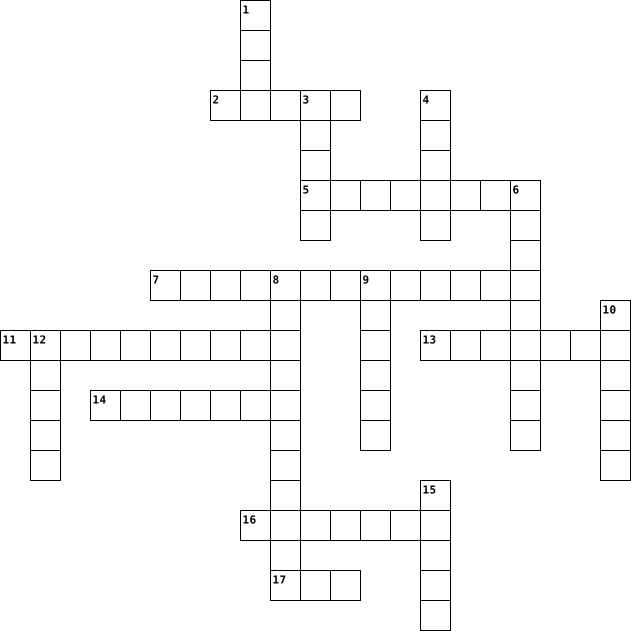
Across
- What is the evening star called?
- What was sir isaac newtons favorite thing to do?
- How was the first person on the moon?
- How wrote a book about what he discovered
- What planet has the red spot?
- How invented the telescope?
- What is the furthest planet from the sun?
- How many dwarf planets are in our solar system?
Down
- How many planets is our solar system?
- What is the center of the solar system?
- planets What are the planets before the Asteroid Belt
- What are the planets called beyond Austord belt
- What is the belt called?
- What planet has the most moons?
- What is mars made up of?
- What do the planets do around the sun?
- What is the smallest planet?
17 Clues: What is mars made up of? • What is the belt called? • How invented the telescope? • What is the smallest planet? • What planet has the red spot? • What planet has the most moons? • What is the evening star called? • How was the first person on the moon? • How many planets is our solar system? • What do the planets do around the sun? • What is the center of the solar system? • ...
Solar System 2013-10-14

Across
- Dwarf planet, usually is the furthest from the sun.
- This orbits the Earth, some planets have more than one.
- At the middle of our solar system, this is the nearest star.
- The only planet with liquid water and life.
- Very hot planet, 2nd planet from the sun.
- Closest planet to the sun.
- Planet with large rings
- The name given to "rocks in outer space".
- These orbit the sun and give off gas and dust while doing so.
Down
- The largest planet in our solar system
- The first four planets are called the ____ planets.
- The red planet.
- This astronaut was the first to walk on the moon.
- "Sideways Planet". 7th Planet.
- This force holds all planets in orbit around the sun.
- Very cold planet, 8th planet.
- The last five planets are called the _____ planets.
17 Clues: The red planet. • Planet with large rings • Closest planet to the sun. • Very cold planet, 8th planet. • "Sideways Planet". 7th Planet. • The largest planet in our solar system • Very hot planet, 2nd planet from the sun. • The name given to "rocks in outer space". • The only planet with liquid water and life. • This astronaut was the first to walk on the moon. • ...
Solar System 2021-11-04

Across
- The four planets orbiting within 2 AU of the Sun
- of icy bodies and a source of long-period comets.
- The four planets orbiting beyond 2 AU of the Sun
- The phase of the Moon when its sunlit side faces Earth.
- The streak of light produced by a meteoroid burning in Earth’s atmosphere; a “shooting star.”
- A body composed of ice and dust that orbits the Sun, usually in a very eccentric orbit, and that casts a lumi- nous tail produced by solar radiation pressure when close to the Sun.
- The region beyond the Kuiper belt populated by
- The phenomenon in which the shadow of Earth falls on the Moon, producing the relative darkness of the full Moon.
Down
- The average distance between Earth and the Sun;
- The disk-shaped region of the sky beyond Neptune populated by many icy bod- ies and a source of short-period comets.
- The plane of Earth’s orbit around the Sun. All major objects of the solar system orbit roughly within this same plane.
- A region between the orbits of Mars and Jupiter that contains small, rocky, planet-like fragments that orbit the Sun.
- The phenomenon in which the shadow of the Moon falls on Earth, producing a region of darkness in the daytime.
- The major bodies orbiting the Sun that are massive enough for their gravity to make them spherical and small enough to avoid having nuclear fusion in their cores. They also have successfully cleared all debris from their orbital paths.
- Temporary, relatively cool and dark regions on the Sun’s surface.
- A relatively large icy body, such as Pluto, that originated within the Kuiper belt.
- A meteoroid, or a part of a meteoroid, that has survived passage through Earth’s atmosphere to reach the ground.
17 Clues: The region beyond the Kuiper belt populated by • The average distance between Earth and the Sun; • The four planets orbiting within 2 AU of the Sun • The four planets orbiting beyond 2 AU of the Sun • of icy bodies and a source of long-period comets. • The phase of the Moon when its sunlit side faces Earth. • ...
solar system 2022-10-20

Across
- the season after winter
- the season between summer and winter
- where you are
- the furthest planet from the sun
- a planet
- the funniest planet name
- the dwarf planet
- the mars rover
- people have gone there
Down
- the coldest season
- the largest planet in our solar system
- spinning around
- closest to the sun
- the only planet to have rings around it
- everything revolves around it
- orbit something
- the hottest season
17 Clues: a planet • where you are • the mars rover • spinning around • orbit something • the dwarf planet • the coldest season • closest to the sun • the hottest season • people have gone there • the season after winter • the funniest planet name • everything revolves around it • the furthest planet from the sun • the season between summer and winter • the largest planet in our solar system • ...
Our Solar System 2013-04-10

Across
- / Is the second-most-massive known dwarf planet in the Solar System.
- / Craters at the poles contain water ice. Temperatures reach 450°C during the day. At night, the temperature drop to -170°C. There is no atmosphere.
- / Icy small Solar System body that, when close enough to the Sun, displays a visible coma and sometimes also a tail.
- / Is a region of the Solar System beyond the planets, extending from the orbit of Neptune at 30 to 50 AU from the Sun.
- / Radius is 25000 km. Mass is 1 x 1026 kg. Distance from Sun is 30 AU.
- / The galaxy that contains our Solar System.
- / The planet has live, oxygen and water. It also has ocean, mountain, volcano, etc.
- / Composed mainly of rock and various ices. Has a tilt of 97° so rotates on its side.
- / 75% hydrogen, 25% helium with a rocky core and liquid hydrogen mantle. The rings are 250000km in diameter but only 1 km thick.
Down
- / Made up of 90% hydrogen, 10% helium. It has a core of rocky material of 10 to 15 Earth-masses.
- / Hypothetical source of comets that stray into our Solar System. 50,000 AU from the Sun
- / A storm that has been raging for over 300 years. As big as 2 Earths.
- / Is the visible streak of light from a meteoroid, heated and glowing from entering the Earth's atmosphere.
- / Surface temperatures are between 0°C and -100°C. Has the highest mountain in the Solar System.
- / Rotates in the opposite direction to other planets in the Solar System. The atmosphere is 95% Carbon Dioxide. It has thick atmosphere.
- / The star at the center of the Solar System. It is 4,500 million years old.
16 Clues: / The galaxy that contains our Solar System. • / Is the second-most-massive known dwarf planet in the Solar System. • / A storm that has been raging for over 300 years. As big as 2 Earths. • / Radius is 25000 km. Mass is 1 x 1026 kg. Distance from Sun is 30 AU. • / The star at the center of the Solar System. It is 4,500 million years old. • ...
Solar System Formation 2014-10-17

Across
- The first planet to form in our Solar System
- The closest planet to the Sun
- The hottest planet in the Solar System
- Large objects created through the collision of smaller particles
- Leftover material from the creation of our solar system
- Ice and rock with large ellipses around the Sun
- Most widely accepted theory for how the solar system formed.
Down
- Rotating aggregate of gas and dust
- Binary dwarf planet, formerly known as the 9th planet
- This one sounds wrong, but is mispronounced often
- Most abundant gases available in the interstellar cloud
- The byproduct leftover from the collision of planetesimals
- The most "Earth like" planet
- Named for God of the Sea
- The one with the rings
- Tiny particles condensed into larger ones through this process
- Where we live
17 Clues: Where we live • The one with the rings • Named for God of the Sea • The most "Earth like" planet • The closest planet to the Sun • Rotating aggregate of gas and dust • The hottest planet in the Solar System • The first planet to form in our Solar System • Ice and rock with large ellipses around the Sun • This one sounds wrong, but is mispronounced often • ...
Astronomia 2021-04-18

Across
- Movimento que o Planeta Terra faz, girando ao redor do Sol
- Sua ocorrência indica o início da primavera e do outono
- Teoria que diz que o Sol se encontra no centro do Sistema solar
- Sexto Planeta do sistema solar
- Sétimo Planeta do sistema solar
- Teoria que explica o surgimento da Lua
- Sua ocorrência indica o início do Verão e do Inverno
- Segundo Planeta do sistema solar
- Satélite Natural do Planeta Terra
Down
- Movimento que o Planeta Terra faz, girando ao redor de seu próprio eixo
- Ano que apresenta 366 dias
- Teoria que diz que o Planeta Terra se encontra no centro do Sistema solar
- Teoria que explica o surgimento do universo
- Nave espacial não tripulada, utilizada para a exploração de outros planetas
- Nome da Constelação que o Planeta Terra se encontra
15 Clues: Ano que apresenta 366 dias • Sexto Planeta do sistema solar • Sétimo Planeta do sistema solar • Segundo Planeta do sistema solar • Satélite Natural do Planeta Terra • Teoria que explica o surgimento da Lua • Teoria que explica o surgimento do universo • Nome da Constelação que o Planeta Terra se encontra • Sua ocorrência indica o início do Verão e do Inverno • ...
Space Crossword Puzzle 2025-05-26

Across
- What is the coldest planet in the solar system?
- What is the name of the space agency of U.S?
- What is the name of the belt between Mars and Jupiter?
- What is the closest planet to the Sun?
- What is the planet that we live in?
- What is the hottest planet in the solar system?
Down
- Which galaxy contains our solar system?
- What planet has the largest mountain in the solar system?
- .... is the largest planet in the solar system
- What is the planet that has rings?
- What is Earth's only natural satellite?
- What is the largest asteroid in the solar system?
12 Clues: What is the planet that has rings? • What is the planet that we live in? • What is the closest planet to the Sun? • Which galaxy contains our solar system? • What is Earth's only natural satellite? • What is the name of the space agency of U.S? • .... is the largest planet in the solar system • What is the coldest planet in the solar system? • ...
Solar System Formation 2014-10-17

Across
- The most "Earth like" planet
- Leftover material from the creation of our solar system
- Tiny particles condensed into larger ones through this process
- Large objects created through the collision of smaller particles
- Rotating aggregate of gas and dust
- Most abundant gases available in the interstellar cloud
- Ice and rock with large ellipses around the Sun
- The closest planet to the Sun
- Binary dwarf planet, formerly known as the 9th planet
Down
- The one with the rings
- The hottest planet in the Solar System
- Most widely accepted theory for how the solar system formed.
- The first planet to form in our Solar System
- Where we live
- The byproduct leftover from the collision of planetesimals
- Named for God of the Sea
- This one sounds wrong, but is mispronounced often
17 Clues: Where we live • The one with the rings • Named for God of the Sea • The most "Earth like" planet • The closest planet to the Sun • Rotating aggregate of gas and dust • The hottest planet in the Solar System • The first planet to form in our Solar System • Ice and rock with large ellipses around the Sun • This one sounds wrong, but is mispronounced often • ...
Solar System 2024-12-05

Across
- The four inner planets of our Solar System
- Small objects that orbit the sun
- Comet which passes Earth every 76 years
- Dwarf planet that was formerly known as a planet in our solar system
- Nickname for Comets (2 Words)
Down
- Area of space beyond Neptune's orbit
- The four outer planets of our Solar System
- Center of a Comet
- Objects in the scattered disk that orbit the sun (3 Words)
- Icy planetesimal cloud 50,000 AU from the sun
- The collection of planets, their moons, and other celestial objects
- Third planet from the sun
- Small rocky object that collides with Earth
- Current number of planets in our Solar System
- The red planet
- The galaxy we live in (3 Words)
- A meteor which is moving and rapidly burning up
17 Clues: The red planet • Center of a Comet • Third planet from the sun • Nickname for Comets (2 Words) • The galaxy we live in (3 Words) • Small objects that orbit the sun • Area of space beyond Neptune's orbit • Comet which passes Earth every 76 years • The four outer planets of our Solar System • The four inner planets of our Solar System • Small rocky object that collides with Earth • ...
sistema solar e universo 2021-04-19

Across
- Como se chama o movimento que a terra executa em uma pequena variação periódica no eixo rotacional terrestre que ocorre a cada 18,6 anos em função da influência da gravidade da Lua sobre a Terra?
- Qual o nome do segundo planeta do Sistema Solar?
- Qual o nome que damos ao conjunto de tudo que existe (todas as galáxias, planetas, estrelas) também chamado de espaço sideral?
- O universo é formado por vários aglomerados de estrelas, gás e poeira unidos pela gravidade.Qual o nome desses conjuntos que formam o universo?
- Qual o nome do planeta do Sistema Solar que está mais afastado do sol?
- Qual o nome do movimento do planeta Terra executado em torno do sol?
- Como se chama o planeta do sistema solar que a partir de 2006 deixou de ser planetas e passou a ser planeta-anão?
- Qual a posição da terra em relação ao sol no sistema solar?
Down
- .Quanto tempo leva o movimento da terra chamado precessão do equinócio?
- Qual o nome da estrela mais importante do nosso Sistema Solar, que fornece luz para o nosso planeta?
- Qual o nome da teoria que comprova a origem do universo a partir de uma grande explosão inicial?
- Qual o nome do sistema formado por oito planetas, e milhares de asteroides; todos controlados pelo Sol?
- Qual o planeta mais frio do sistema solar?
- Como se chama o movimento que a terra leva 24 horas?
- Qual o nome do satélite natural do planeta Terra?
- Qual o nome do astro que possui luz própria (luminoso)?
- Qual o nome do quarto planeta do Sistema Solar?
17 Clues: Qual o planeta mais frio do sistema solar? • Qual o nome do quarto planeta do Sistema Solar? • Qual o nome do segundo planeta do Sistema Solar? • Qual o nome do satélite natural do planeta Terra? • Como se chama o movimento que a terra leva 24 horas? • Qual o nome do astro que possui luz própria (luminoso)? • ...
Solar 2025-06-02

Across
- in the Western U.S. a magnetic compass needle will point ___ of true geographic north due to magnetic declination.
- What component is common to all Photovoltaic systems?
- What is the first approval step required for installing a photovoltaic system
- Conductors used in Photovoltaic source circuits should have a minimum temperature rating of ___ Degrees Centigrade.
- Batteries are most commonly used in what type of photovoltaic system?
- Government policies and incentives for photovoltaic systems have led to significant market growth in the _____ application sector
Down
- What component is typically connected to the input of a stand-alone inverter?
- A south-facing vertical wall generally receives the maximum amount of solar radiation during was season?
- The voltage divided by the current for any point on a current/voltage (I-V) curve represents what?
- Covers the codes and standards of electrical installation requirements for photovoltaic modules and systems.
10 Clues: What component is common to all Photovoltaic systems? • Batteries are most commonly used in what type of photovoltaic system? • What component is typically connected to the input of a stand-alone inverter? • What is the first approval step required for installing a photovoltaic system • ...
SCIENCE - 6th GRADE 2023-08-29

Across
- CALENDÁRIO
- FORMA/DE/VIDA
- CONHECIMENTO
- AGRICULTURA
- SOL
Down
- CAÇA
- FORMA
- POEIRA CÓSMICA
- TELESCÓPIO
- LUA
- SISTEMA SOLAR
- CALOR
- UNIVERSO
- REDONDA
- ATMOSFERA
15 Clues: LUA • SOL • CAÇA • FORMA • CALOR • REDONDA • UNIVERSO • ATMOSFERA • CALENDÁRIO • TELESCÓPIO • AGRICULTURA • CONHECIMENTO • FORMA/DE/VIDA • SISTEMA SOLAR • POEIRA CÓSMICA
Solar System 2017-02-16

Across
- Pluto
- Mercury
- Asteroid
- Uranus
- Star
- Neptune
- Newton
Down
- Comet
- Galaxy
- Jupiter
- Mars
- Rotation
- Venus
- Orbit
- Saturn
- Sun
- Earth
17 Clues: Sun • Mars • Star • Comet • Pluto • Venus • Orbit • Earth • Galaxy • Uranus • Saturn • Newton • Jupiter • Mercury • Neptune • Rotation • Asteroid
Solar System 2023-10-16

Across
- the hurricane like storm on Jupiter
- has the same ongoing storm for 300 years
- the latin word for moon
- associated with doom in the past, often tied to wars
- there is no normal day or night change
- is on a collision course with Mars
- our moon
- reason Pluto lost its planet status in 2006
Down
- name means dread
- 284 Earth years are equivalent to 1 year here
- is the fastest planet around the sun
- is the coldest planet in the solar system
- named after the roman God of war
- rocks from Mars are found here
- has hundreds of volcanoes
- the hottest planet
- has a surface of helium
17 Clues: our moon • name means dread • the hottest planet • the latin word for moon • has a surface of helium • has hundreds of volcanoes • rocks from Mars are found here • named after the roman God of war • is on a collision course with Mars • the hurricane like storm on Jupiter • is the fastest planet around the sun • there is no normal day or night change • ...
Solar System 2023-10-23

Across
- A small body from space that has entered Earth;s atmosphere
- Colder clouds
- Warm clouds
- is about 30 AU from the sun
- It has a head and a tail
- A meteor before it enters Earth's atmosphere
- opposite to the normal rotation of a solar system
- one used to be considered a planet
- a blur of lights falling in to the atmosphere
- the beginning of a planet
Down
- the four most inner planets
- curve of an orbit
- a measure of distance in space
- can be found on Jupiter
- the four most outer planets
- something that did not disintegrate in Earth's atmosphere
- an oval shaped orbit
17 Clues: Warm clouds • Colder clouds • curve of an orbit • an oval shaped orbit • can be found on Jupiter • It has a head and a tail • the beginning of a planet • the four most inner planets • the four most outer planets • is about 30 AU from the sun • a measure of distance in space • one used to be considered a planet • A meteor before it enters Earth's atmosphere • ...
Sistema Solar 2022-11-08

Across
- É o planeta mais próximo do Sol e o menor em tamanho.
- Grandes rochas e apresentam formato irregular. Eles se formaram durante a origem do Sistema Solar.
- É um enorme aglomerado de estrelas, nuvens de gás, poeira e outros corpos celestes. Estima-se que o Universo conhecido contenha mais de 200 bilhões.
- deles é perturbada pela atração gravitacional de outros corpos celestes.
- Movimento que cada planeta percorre uma órbita ao redor do Sol.
- É o segundo maior planeta do Sistema Solar é famoso por seus anéis, que são constituídos de pedaço de gelo e rochas que giram ao redor do planeta.
- Possui um pequeno núcleo rochoso. Sua atmosfera é composta de hidrogênio e hélio e um pouco de metano, período de rotação dura 164,8 anos terrestres
- Movimento que os planetas giram em torno do seu próprio eixo.
- Possui anéis mais fino e escuros que os de Saturno, a atmosfera desse planeta é composta de hidrogênio ,hélio e um pouco de metano, possui 27 satélites conhecidos, entre eles Miranda, Ariel e Julieta.
Down
- Planetas constituídos principalmente de rochas ,ou seja matéria sólida são chamados de planetas...
- É o maior planeta do Sistema Solar.
- Originaram nas áreas mais externas do Sistema Solar, a partir de restos da formação desse sistema, e permanecem em órbitas distantes do Sol. Mas, às vezes, a
- Teve origem acerca de 4,6 bilhões de anos a partir de uma nebulosa.
- São planetas formados principalmente por gases.
- Planeta que possui dois satélites naturais, Fobo e Deimos.
- Emite luz e calor por causa das transformações que acontecem em seu núcleo.
- Planeta cujo nome não deriva da mitologia greco-romana.
- Formoou-se a partir da transformação do elemento de hidrogênio em hélio liberando grande quantidade de energia.
18 Clues: É o maior planeta do Sistema Solar. • São planetas formados principalmente por gases. • É o planeta mais próximo do Sol e o menor em tamanho. • Planeta que possui dois satélites naturais, Fobo e Deimos. • Planeta cujo nome não deriva da mitologia greco-romana. • Movimento que os planetas giram em torno do seu próprio eixo. • ...
SISTEMA SOLAR 2023-01-31

Across
- Corpos constituídos por uma parte sólida chamada de núcleo que é formado por gelo e impurezas. Sua forma é irregular, e são bastante extensos. São compostos especialmente por água e possuem caudas.
- Também é conhecido como planeta vermelho
- Tem similaridades com Urano, é o planeta mais recentemente descoberto e mais afastado do sol
- Gás encontrado no planeta Terra
- Localizado na sétima posição em relação ao Sol, é um planeta de pouca luminosidade
- Corpos que apresentam movimento próprio, a maioria já catalogada apresenta órbitas elípticas e encontra-se no cinturão de asteroides entre Marte e Júpiter.
- Estrela do Sistema Solar
- suas condições e características permitem a existência de vida, possui um satélite natural
Down
- Maior planeta do Sistema Solar, período de translação de 12 anos, é conhecido como “O Gigante Gasoso”
- Planeta mais próximo do Sol, tem período de rotação de 59 dias
- São meteoroides que sobrevivem ao adentrarem a atmosfera e atinge o chão
- É um planeta gasoso, possui anéis e é o segundo maior do Sistema Solar
- Correspondem a restos de cometas ou fragmentos oriundos de asteróides.
- Corresponde ao fenômeno luminoso observado durante a passagem de um meteoroide na atmosfera.
- Planeta mais quente do Sistema Solar,conhecido também como Estrela D'alva
- Satélite da Terra
- Era considerado um planeta do Sistema Solar
17 Clues: Satélite da Terra • Estrela do Sistema Solar • Gás encontrado no planeta Terra • Também é conhecido como planeta vermelho • Era considerado um planeta do Sistema Solar • Planeta mais próximo do Sol, tem período de rotação de 59 dias • Correspondem a restos de cometas ou fragmentos oriundos de asteróides. • ...
Solar system 2022-05-31

Across
- first man to go to space
- a ring of rocks surrounding the solar system
- the first monkey to go to space
- a planet that has a storm that has a never ending storm
- a vehicle that transports people to outerspace
- person who goes to outerspace
- unidentified creature
- movie based on a family getting stranded in space
Down
- hot sphere of gas
- a type of profession that is based on space
- a place made of cheese
- the first plant from earth to grow in space
- light streaking through the sky
- best science teacher
- a dog that one of our teachers own
- a program that builds spaceships and technology
- a space program that everyone is familiar with
17 Clues: hot sphere of gas • best science teacher • unidentified creature • a place made of cheese • first man to go to space • person who goes to outerspace • the first monkey to go to space • light streaking through the sky • a dog that one of our teachers own • a type of profession that is based on space • the first plant from earth to grow in space • ...
SISTEMA SOLAR 2024-10-03

Across
- Ocorre quando a Lua passa entre a Terra e o Sol, bloqueando a maior parte da luz da nossa estrela que chega ao planeta.
- É um eclipse total ocorre quando a Lua passa entre a Terra e o Sol, bloqueando completamente a luz solar e projetando uma sombra sobre o planeta
- TEMPO QUE A TERRA GASTA PARA DAR UMA VOLTA EM TORNO DO SOL
- ASTRO ILUMINADO
- A VOLTA QUE A TERRA FAZ AO REDOR DO SOL, PROVOCA NA TERRA.
- DOIS MOVIMENTOS REALIZADOS PELA TERRA
- AS QUATRO FAZES DA LUA SERVIU PARA INVENÇÃO.
- TRÊS MOVIMENTOS QUE A LUA REALIZA.
- O SOL É UMA
Down
- acontece quando a Terra está posicionada entre o Sol e a Lua e bloqueia total ou parcialmente a chegada de luz até a superfície lunar.
- TEMPO QUE A LUA GASTA PARA DAR UMA VOLTA EM TORNO DA TERRA.
- LUMINOSO
- ILUMINADA
- O SATÉLITE DA TERRA
- TEMPO QUE A TERRA FAZ PARA DAR UMA VOLTA EM TORNO DE SI.
- PLANETA ROCHOSO
- A ROTAÇÃO DA TERRA DEU ORIGEM A INVENÇÃO DO
- QUANTOS MOVIMENTOS A LUA REALIZA
- MOVIMENTO TRANSLAÇÃO SERVIU PARA INVENÇÃO DO
19 Clues: LUMINOSO • ILUMINADA • O SOL É UMA • ASTRO ILUMINADO • PLANETA ROCHOSO • O SATÉLITE DA TERRA • QUANTOS MOVIMENTOS A LUA REALIZA • TRÊS MOVIMENTOS QUE A LUA REALIZA. • DOIS MOVIMENTOS REALIZADOS PELA TERRA • A ROTAÇÃO DA TERRA DEU ORIGEM A INVENÇÃO DO • MOVIMENTO TRANSLAÇÃO SERVIU PARA INVENÇÃO DO • AS QUATRO FAZES DA LUA SERVIU PARA INVENÇÃO. • ...
RENEWABLE ENERGY 2023-08-10

Across
- used to catch sunlight
- one challenge of solar energy
- what happens when you burn fossil fuels?
- energy using sunlight to generate electricity or heat water
- Generators use the spinning motion to create _________
- wind energy is an _________ resource
- connected to the blades of turbines
Down
- turn wind into electricity
- the sunlight gives energy to the _________ in the cells of solar panels
- what is required to generate solar energy?
- hydroelectricity creates an ______ source
- wind energy can pose risks to the __________
12 Clues: used to catch sunlight • turn wind into electricity • one challenge of solar energy • connected to the blades of turbines • wind energy is an _________ resource • what happens when you burn fossil fuels? • hydroelectricity creates an ______ source • what is required to generate solar energy? • wind energy can pose risks to the __________ • ...
Sustainability - Solar Energy CrossWord 2013-05-05

Across
- Changed directly into electricity due to Solar Panels
- Pollution that is created when Fossil fuels are burned
- Solar energy could be stored into this in the future
- South West Desert that can support entire 80% use of Solar energy
- Solar Panels(Solar Cells) are also known as ___
- The most abundant and most renewable resource
Down
- An alternate method for Renewable Energy
- This idea of renewable energy originated from ___
- Plants,Animals,Humans all need this to live.
- Water heated due to solar energy creates this in order to turn turbines for electricity to be produced
- The main disadvantage of Solar Energy
11 Clues: The main disadvantage of Solar Energy • An alternate method for Renewable Energy • Plants,Animals,Humans all need this to live. • The most abundant and most renewable resource • Solar Panels(Solar Cells) are also known as ___ • This idea of renewable energy originated from ___ • Solar energy could be stored into this in the future • ...
Solar system 2023-01-30

Across
- Earth's only natural satellite
- Our galaxy
- Largest planet in the Solar system
- Morning star
- Seventh planet from the sun
- The Blue planet
- Smallest planet in the solar system
Down
- Farthest planet in the Solar system
- The Red planet
- Distance travelled by light in a vaccum in one tropical year
- The star at the center of Solar system
- Smaller bodies in orbit around the sun
- Titan is the largest moon of
13 Clues: Our galaxy • Morning star • The Red planet • The Blue planet • Seventh planet from the sun • Titan is the largest moon of • Earth's only natural satellite • Largest planet in the Solar system • Farthest planet in the Solar system • Smallest planet in the solar system • The star at the center of Solar system • Smaller bodies in orbit around the sun • ...
Solar System Crossword 2021-05-19

Across
- Farthest-known planet from the Sun in our solar system
- Largest and most massive of the Solar System's moons
- Planet has red coloured soil
- Humans live on this planet
- The closest star
Down
- Rotates on its side
- Largest moon on Saturn
- Moon of Saturn (has lots of water)
- Largest planet in our solar system
- Closest to Sun in our solar system
- Planet has beautiful rings and is sixth from the Sun
- Hottest planet in our solar system
12 Clues: The closest star • Rotates on its side • Largest moon on Saturn • Humans live on this planet • Planet has red coloured soil • Moon of Saturn (has lots of water) • Largest planet in our solar system • Closest to Sun in our solar system • Hottest planet in our solar system • Largest and most massive of the Solar System's moons • ...
Chapter 18 Vocab 2022-05-22

Across
- A device that converts solar energy
- Reducing energy use to prolong the
- Fuel from organic sources
- A device that converts hydrogen or other fuel
- Resources that are needed to replace
- uses the design of a building
- A power plant that uses wind turbines to gen
- Changing the solar ener
- An expression of how much of the enrg
Down
- The Generation of electricity and other en
- The use of technology to collect
- Electricity generated from tidal movement
- Can be replaced in a short time
- The use of kinetic energy to
- Renewable energy that is generated de
- major Green house gas
- Also called Ethanol
17 Clues: Also called Ethanol • major Green house gas • Changing the solar ener • Fuel from organic sources • The use of kinetic energy to • uses the design of a building • Can be replaced in a short time • The use of technology to collect • Reducing energy use to prolong the • A device that converts solar energy • Resources that are needed to replace • Renewable energy that is generated de • ...
Amish - crossword #2 2024-11-21

Across
- Headlight
- solar/panels
- Tractor
- Turn/signal
- battery
- generator
- laptop
- engine
Down
- Desktop/Computer
- chisels
- table/saw
- electric/drill
- hammer
- saw
- Gas/lantern
- plane
16 Clues: saw • plane • hammer • laptop • engine • chisels • Tractor • battery • table/saw • Headlight • generator • Gas/lantern • Turn/signal • solar/panels • electric/drill • Desktop/Computer