
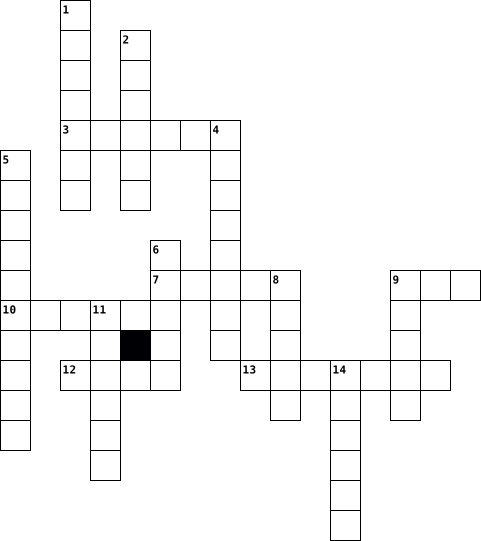
solar Crossword Puzzles
lawson's planet crossword 2023-12-14

Across
- the biggest planet
- a area with one of the only dwarf planets
- the farthest planet in the solar system
- the biggest star in our solar system
- the planet that has been explored the most
Down
- this planet has the most moons
- a now dwarf planet
- the planet that orbits in 365 days
- one of the ice giants in the solar system
- the hotist planet in the solar system
- the smallest planet
- a big circular rock that we see every day
12 Clues: a now dwarf planet • the biggest planet • the smallest planet • this planet has the most moons • the planet that orbits in 365 days • the biggest star in our solar system • the hotist planet in the solar system • the farthest planet in the solar system • one of the ice giants in the solar system • a area with one of the only dwarf planets • ...
Solar System 2025-10-08

Across
- I am also known as a shooting star
- the biggest planet in the solar system
- meteor that reaches earth surface
- have a celestial body orbiting the sun
- the hottest planet in the solar system
Down
- has a ring around its body
- chunks of rocks floating through space
- is a leftover from the formation of the solar system
- also known as natural satellites
- the smallest planet in the solar system
- I am also known as a dirty snowball
- also known as our home planet
12 Clues: has a ring around its body • also known as our home planet • also known as natural satellites • meteor that reaches earth surface • I am also known as a shooting star • I am also known as a dirty snowball • chunks of rocks floating through space • the biggest planet in the solar system • have a celestial body orbiting the sun • the hottest planet in the solar system • ...
Solar System 2025-10-08

Across
- I am also known as a shooting star
- the biggest planet in the solar system
- meteor that reaches earth surface
- have a celestial body orbiting the sun
- the hottest planet in the solar system
Down
- has a ring around its body
- chunks of rocks floating through space
- is a leftover from the formation of the solar system
- also known as natural satellites
- the smallest planet in the solar system
- I am also known as a dirty snowball
- also known as our home planet
12 Clues: has a ring around its body • also known as our home planet • also known as natural satellites • meteor that reaches earth surface • I am also known as a shooting star • I am also known as a dirty snowball • chunks of rocks floating through space • the biggest planet in the solar system • have a celestial body orbiting the sun • the hottest planet in the solar system • ...
Solar System 2016-06-19

Across
- something that comes out a night time
- is the second coldest planet in the solar system
- is where a human being live on
- is the biggest planet in the solar system and it has 67 moons
- something that lights the sky up during the day
Down
- is not a planet anymore in the solar system
- is the second closest to the sun
- is red plant
- is the coldest planet in solar system
- is second biggest planet in the solar system
- is the closest to the sun
11 Clues: is red plant • is the closest to the sun • is where a human being live on • is the second closest to the sun • something that comes out a night time • is the coldest planet in solar system • is not a planet anymore in the solar system • is second biggest planet in the solar system • something that lights the sky up during the day • ...
4 and 1/2 Week Exam 2013-02-04

Across
- An eclipse when the moon is in between the Sun and Earth and blocks the view of the Sun
- type of resource does not run out (Examples: Sun, Wind, Water, etc.)
- Solar ____ is a stream of electrical particles moving from the Sun to Earth
- Second layer of the sun; provides the light the sun gives off
- The Earth spinning around on its axis
- Outer layer of the sun only visible during an eclipse
- Solar ___ is bright, fiery spot on the surface of the Sun caused by a magnetic storm
- Center of the sun; provides energy for the Sun
Down
- Dark spots on the surface of the sun, cooler areas of the Sun
- Sun is the center of the solar system
- Earth is at the center of the solar system
- Third layer of the sun; provides the Sun’s color
- The Earth moving in an ellipse around the Sun
- NASA spinoff that regulates the beating of the heart
- Food that is _____ dried NASA spinoff invented so food lasts long enough on space trips
- An eclipse when the Earth is in between the Moon and Sun and the moon looks red
16 Clues: Sun is the center of the solar system • The Earth spinning around on its axis • Earth is at the center of the solar system • The Earth moving in an ellipse around the Sun • Center of the sun; provides energy for the Sun • Third layer of the sun; provides the Sun’s color • NASA spinoff that regulates the beating of the heart • ...
Palavras Cruzadas sobre o Sistema Solar 2023-11-25

Across
- Qual o movimento realizado pelo planeta Terra em torno do Sol?
- O dia e a noite são resultados de qual movimento da Terra?
- Que tipo de astro celeste é o Sol?
- Nome da Galáxia qual o planeta Terra pertence?
- Qual o nome do maior planeta gasoso do Sistema Solar?
- Um dos menores planetas do sistema solar.
- Satélite natural da terra, visível a noite refletida pela luz do Sol
- Qual planeta do Sistema Solar foi rebaixado e passou a ser planeta anão?
- Planeta mais próximo do Sol?
Down
- Ciência que estuda o Universo.
- Estrela do nosso sistema planetário, contém cerca de 99% da massa do Sistema Solar.
- Força invisível que atrai todos os corpos para superfície da Terra.
- Continente que mais concentra água é:
- Um conjunto de estrelas, gases, poeira e muitos outros corpos celestes define uma:
- Qual planeta possui anéis composto de gelo e pequenas rochas?
- Planeta Vermelho.
16 Clues: Planeta Vermelho. • Planeta mais próximo do Sol? • Ciência que estuda o Universo. • Que tipo de astro celeste é o Sol? • Continente que mais concentra água é: • Um dos menores planetas do sistema solar. • Nome da Galáxia qual o planeta Terra pertence? • Qual o nome do maior planeta gasoso do Sistema Solar? • O dia e a noite são resultados de qual movimento da Terra? • ...
Earth Science II Astronomy Intro 2017-09-01

Across
- The totality of all space, time, matter an energy.
- One of the four giant outer planets of the solar system which resemble Jupiter in overall physical and chemical properties.
- The distance that light, moving at a constant speed of 300,000 km/s, travels in one year.
- Combining two light nuclei to form a heavier nucleus, usually releasing energy in the process.
- Any star with a radius comparable to, or smaller than, that of the Sun (including the Sun itself).
- The four innermost planets of the solar system, resembling Earth in general physical and chemical properties.
- Model of the solar system centered on the Sun with Earth and the other planets orbiting it.
- A star that suddenly increases in brightness, often by a factor of as much as 10,000, then slowly fades back to its original luminosity.
- X-ray source that radiates thousands of times more energy than the Sun in bursts that last only a few seconds.
- The tenuous outer atmosphere of the Sun which lies just above the chromosphere.
- A post-main sequence massive star near the end of its life and about to explode as a supernova.
- A region in the plane of the solar system beyond the orbit of Neptune where most short period comets are thought to originate.
Down
- One of thousands of very small members of the solar system between the orbits of Jupiter and Mars.
- The attractive effect that any massive object has on all other massive objects.
- The spiral galaxy in which the Sun resides.
- A group of anywhere from a few dozen to a few million stars that formed at the same time from the same cloud of interstellar gas.
- A layer of the Earth’s atmosphere above about 100 km, where the air is significantly ionized and conducts electricity.
- The small range of the electromagnetic spectrum that human eyes can see.
- Starlike radio source with an observed redshift that indicates an extremely large distance from Earth.
- Spherical halo of material surrounding the solar system out to a distance of about 50,000 AU; the region of the solar system where most comets originate.
- The region on the Hertzsprung-Russell diagram where stars lie at the onset of nuclear burning in their cores.
- Event that cosmologists consider the beginning of the universe in which all space, time, matter and radiation in the universe came into being.
- A faint star with a sufficiently high surface temperature that appears white or blue-white in color.
- The central protostar during the early stages of solar system formation.
- Event during which one body passes in front of another and blocks the light from the occulted body.
25 Clues: The spiral galaxy in which the Sun resides. • The totality of all space, time, matter an energy. • The small range of the electromagnetic spectrum that human eyes can see. • The central protostar during the early stages of solar system formation. • The attractive effect that any massive object has on all other massive objects. • ...
Dwarf Planets, Moons, and Space Rocks 2025-12-11

Across
- Icy bodies that release dust and gas as it orbits the Sun
- Largest moon in our solar system
- This planet was discovered in 2005 and led the IAU to define what a planet is
- Rocky body that orbits among terrestrial planets and gas giants
- There is an ocean beneath this moon's icy surface that may be one of the most likely places to look for life in the solar system
- The most volcanically active body in the solar system
- Saturn's largest moon and only moon with a notable atmosphere
- Only large moon in solar system that orbits its planets in a direction opposite to the planet's rotation
Down
- Dwarf planet named after Rapanui God of fertility
- The most heavily cratered object in solar system
- Only dwarf planet located in asteroid belt
- A small piece that has survived Earth's atmosphere and lands on Earth
- Which dwarf planet has an egg shape
- The dwarf planet located in Kuiper belt and it's largest moon, Charon, is about half its size
- Larger of Mars' two moons that orbits it three times a day
- A small rocky body that orbits the Sun and most of these bodies are found between Mars and Jupiter
- Rocky body that traves through the Earth's atmosphere and leaves a streak of light
17 Clues: Largest moon in our solar system • Which dwarf planet has an egg shape • Only dwarf planet located in asteroid belt • The most heavily cratered object in solar system • Dwarf planet named after Rapanui God of fertility • The most volcanically active body in the solar system • Icy bodies that release dust and gas as it orbits the Sun • ...
Space (write the answers with no space) 2023-06-18

Across
- biggest galaxy in the world
- first person to land in moon
- hottest planet in the solar system
- the Star of the solar system
- biggest mountain in the solar system
- used to be a planet but was removed in 2006
Down
- when a star collapses
- has the biggest rings in he solar system
- coldest planet in the world
- biggest planet in the solar system
10 Clues: when a star collapses • biggest galaxy in the world • coldest planet in the world • first person to land in moon • the Star of the solar system • hottest planet in the solar system • biggest planet in the solar system • biggest mountain in the solar system • has the biggest rings in he solar system • used to be a planet but was removed in 2006
Space (write the answers with no space) 2023-06-18

Across
- biggest galaxy in the world
- first person to land in moon
- hottest planet in the solar system
- the Star of the solar system
- biggest mountain in the solar system
- used to be a planet but was removed in 2006
Down
- when a star collapses
- has the biggest rings in he solar system
- coldest planet in the world
- biggest planet in the solar system
10 Clues: when a star collapses • biggest galaxy in the world • coldest planet in the world • first person to land in moon • the Star of the solar system • hottest planet in the solar system • biggest planet in the solar system • biggest mountain in the solar system • has the biggest rings in he solar system • used to be a planet but was removed in 2006
Space (write the answers with no space) 2023-06-18

Across
- biggest galaxy in the world
- first person to land in moon
- hottest planet in the solar system
- the Star of the solar system
- biggest mountain in the solar system
- used to be a planet but was removed in 2006
Down
- when a star collapses
- has the biggest rings in he solar system
- coldest planet in the world
- biggest planet in the solar system
10 Clues: when a star collapses • biggest galaxy in the world • coldest planet in the world • first person to land in moon • the Star of the solar system • hottest planet in the solar system • biggest planet in the solar system • biggest mountain in the solar system • has the biggest rings in he solar system • used to be a planet but was removed in 2006
Space (write the answers with no space) 2023-06-18

Across
- biggest galaxy in the world
- first person to land in moon
- hottest planet in the solar system
- the Star of the solar system
- biggest mountain in the solar system
- used to be a planet but was removed in 2006
Down
- when a star collapses
- has the biggest rings in he solar system
- coldest planet in the world
- biggest planet in the solar system
10 Clues: when a star collapses • biggest galaxy in the world • coldest planet in the world • first person to land in moon • the Star of the solar system • hottest planet in the solar system • biggest planet in the solar system • biggest mountain in the solar system • has the biggest rings in he solar system • used to be a planet but was removed in 2006
Space (write the answers with no space) 2023-06-18

Across
- biggest galaxy in the world
- first person to land in moon
- hottest planet in the solar system
- the Star of the solar system
- biggest mountain in the solar system
- used to be a planet but was removed in 2006
Down
- when a star collapses
- has the biggest rings in he solar system
- coldest planet in the world
- biggest planet in the solar system
10 Clues: when a star collapses • biggest galaxy in the world • coldest planet in the world • first person to land in moon • the Star of the solar system • hottest planet in the solar system • biggest planet in the solar system • biggest mountain in the solar system • has the biggest rings in he solar system • used to be a planet but was removed in 2006
Universo 2021-05-13

Across
- es un conjunto de estrellas, nubes de gas, planetas, polvo cósmico y energía unidas por la fuerza de gravedad
- es el sexto planeta en el sistema solar, es parte de los gigantes gaseosos
- es el octavo planeta del sistema solar, es muy frio y el mas lejano
- es el segundo planeta del sistema solar en orden de distancia desde el Sol.
- es un cuerpo celeste que orbita alrededor de un planeta. Generalmente el satélite es más pequeño y acompaña al planeta en su órbita alrededor de su estrella madre.
- sistema planetario que liga gravitacionalmente a un conjunto de objetos astronómicos que giran directa.
- seria el 9no planeta pero fue descartado
- no tienen forma ni de espiral ni de óvalo, Son de forma irregular.
- es el cuarto planeta en distancia al sol, y posiblemente nuestro nuevo hogar.
- es el planeta del sistema solar más próximo al Sol y el más pequeño.
Down
- son lisas y tienen forma de óvalo.
- tienen forma de espiral como la nuestra, tienen brazos curvados que hacen que parezcan molinetes.
- es una región finita del espacio en cuyo interior existe una concentración de masa lo suficientemente elevada como para generar un campo gravitatorio tal que ninguna partícula material, ni siquiera la luz, puede escapar de ella.
- es el séptimo planeta del sistema solar, es muy frio
- es el quinto planeta en distancia al sol, es el mas grande.
- es le tercer planeta en el sistema solar.
16 Clues: son lisas y tienen forma de óvalo. • seria el 9no planeta pero fue descartado • es le tercer planeta en el sistema solar. • es el séptimo planeta del sistema solar, es muy frio • es el quinto planeta en distancia al sol, es el mas grande. • no tienen forma ni de espiral ni de óvalo, Son de forma irregular. • ...
Earth and Space 2017-05-15

Across
- how many planets are there in our solar system?
- planet known for its rings.
- largest planet in our solar system.
- the belt of asteroids extending from the orbit of Neptune.
- known as the red planet.
Down
- the planet we live on.
- smallest planet in our solar system.
- What galaxy are we in.
- coldest planet in our solar system.
- hottest planet in our solar system.
10 Clues: the planet we live on. • What galaxy are we in. • known as the red planet. • planet known for its rings. • coldest planet in our solar system. • largest planet in our solar system. • hottest planet in our solar system. • smallest planet in our solar system. • how many planets are there in our solar system? • the belt of asteroids extending from the orbit of Neptune.
Sistem Solar 2024-08-11

Across
- - Planet manakah yang dikenali sebagai 'Planet Merah'?
- - Planet manakah yang paling jauh dari Matahari dalam sistem solar kita?
- - Planet manakah yang paling hampir dengan Matahari?
- - Apakah nama bintang yang merupakan pusat sistem solar kita?
- - Apakah nama planet kerdil yang pernah dianggap sebagai planet kesembilan?
- - Apakah objek kecil yang beredar di antara orbit Marikh dan Jupiter?
Down
- - Planet manakah yang terbesar dalam sistem solar?
- - Apakah nama kumpulan besar bintang, gas, dan debu yang mana sistem solar kita berada?
- - Planet manakah yang dikenali sebagai 'Bintang Kejora'?
- - Planet manakah yang dikenali dengan gelang yang jelas kelihatan?
- - Planet manakah yang kita diami dalam sistem solar?
- - Apakah istilah untuk objek yang mengorbit planet, seperti bulan?
12 Clues: - Planet manakah yang terbesar dalam sistem solar? • - Planet manakah yang kita diami dalam sistem solar? • - Planet manakah yang paling hampir dengan Matahari? • - Planet manakah yang dikenali sebagai 'Planet Merah'? • - Planet manakah yang dikenali sebagai 'Bintang Kejora'? • - Apakah nama bintang yang merupakan pusat sistem solar kita? • ...
Sistem Solar 2024-08-11

Across
- - Planet manakah yang dikenali sebagai 'Planet Merah'?
- - Planet manakah yang paling jauh dari Matahari dalam sistem solar kita?
- - Planet manakah yang paling hampir dengan Matahari?
- - Apakah nama bintang yang merupakan pusat sistem solar kita?
- - Apakah nama planet kerdil yang pernah dianggap sebagai planet kesembilan?
- - Apakah objek kecil yang beredar di antara orbit Marikh dan Jupiter?
Down
- - Planet manakah yang terbesar dalam sistem solar?
- - Apakah nama kumpulan besar bintang, gas, dan debu yang mana sistem solar kita berada?
- - Planet manakah yang dikenali sebagai 'Bintang Kejora'?
- - Planet manakah yang dikenali dengan gelang yang jelas kelihatan?
- - Planet manakah yang kita diami dalam sistem solar?
- - Apakah istilah untuk objek yang mengorbit planet, seperti bulan?
12 Clues: - Planet manakah yang terbesar dalam sistem solar? • - Planet manakah yang kita diami dalam sistem solar? • - Planet manakah yang paling hampir dengan Matahari? • - Planet manakah yang dikenali sebagai 'Planet Merah'? • - Planet manakah yang dikenali sebagai 'Bintang Kejora'? • - Apakah nama bintang yang merupakan pusat sistem solar kita? • ...
Solar System 2024-04-16

Across
- Earth's only natural satellite
- biggest planet
- in the middle of the solar system
- appears to orbit sideways
- closest planet to the sun
- the last planet from the sun in our solar system
- only planet that supports life
- The path the planets take
- gives us years
Down
- hottest planet in the solar system
- Made up of eight planets
- keeps things on the ground
- known for its unique rings
- gives us day and night
14 Clues: biggest planet • gives us years • gives us day and night • Made up of eight planets • appears to orbit sideways • closest planet to the sun • The path the planets take • keeps things on the ground • known for its unique rings • Earth's only natural satellite • only planet that supports life • in the middle of the solar system • hottest planet in the solar system • ...
ASTRONOMY 2026-02-09

Across
- sundial
- earth is the center of the solar system
- when the moon covers the Earth
- suggest the moons shines by reflected sunlight
- argued for stationary spherical earth
- action of moving
- sun is the center of the solar system
Down
- velocity changes time
- tendency of an object to resist motion
- an event where celestial body aligned
- when the Earth's shadow the moon
- calculated the earths circumference
- planet with rings
- a push or pull
14 Clues: sundial • a push or pull • action of moving • planet with rings • velocity changes time • when the moon covers the Earth • when the Earth's shadow the moon • calculated the earths circumference • an event where celestial body aligned • argued for stationary spherical earth • sun is the center of the solar system • tendency of an object to resist motion • ...
Head Sources in the Environment 2021-03-17

Across
- gases,
- energy resource,
- energy sources, friction.
- solar heating,
Down
- fuels,
- effect,
- warming,
- energy,
- energy source,
- solar energy systems,
- energy source,
- energy balance,
12 Clues: fuels, • gases, • effect, • energy, • warming, • energy source, • energy source, • solar heating, • energy balance, • energy resource, • solar energy systems, • energy sources, friction.
Space Stuffs 2019-08-06

Across
- The fourth planet from the sun that scientists say could be habitable.
- The branch of science which deals with celestial objects and space.
- A person trained by a spaceflight program to command, pilot, or serve as a crew member of a spacecraft.
- When the moons position covers the Sun.
- A looking device that can help to look up at the night sky.
- A small planetary body in orbit around the Sun, larger than a meteoroid but smaller than a planet.
- The sixth planet from the sun, that has the biggest and brightest rings.
- The seventh planet in our solar system which is made up of ice and rock.
- A gigantic burning ball of gas that sits at the center of the solar system.
Down
- The name of the most commonly known space agency on Earth.
- The name of the Galaxy the Solar System is located in.
- A concentration of mass so dense that nothing, not even light, can escape its gravitational pull once swallowed up.
- A pattern of stars that create an image.
- The poor little dwarf planet that used to be a planet.
- The biggest planet that has a big red spot on it.
- A vast collection of stars, gas, and dust, that contains the solar system.
- The shape that a planet revolves around the sun in.
- The smallest planet in the Solar System which is the closest to the Sun.
- The planet furthest from the Sun and is the third most massive planet.
- The planet we live on.
20 Clues: The planet we live on. • When the moons position covers the Sun. • A pattern of stars that create an image. • The biggest planet that has a big red spot on it. • The shape that a planet revolves around the sun in. • The name of the Galaxy the Solar System is located in. • The poor little dwarf planet that used to be a planet. • ...
Space & Astronomy 2025-09-09

Across
- – The windiest planet
- – Known as the Red Planet
- – The only planet known to support life
- – Planet that rotates on its side
- – A star at the center of our solar system
- – The path one object takes around another
- – A large system of stars, gas, and dust
- – When one celestial body blocks another
- – Vehicle used to travel into space
- – An icy space object with a glowing tail
Down
- – A shooting star
- – A person trained to travel in space
- – The hottest planet in our solar system
- – Tool used to see distant space objects
- – Closest planet to the Sun
- – Planet famous for its rings
- – Earth’s natural satellite
- – A rocky object orbiting the Sun
- – The largest planet in our solar system
- – Once called the ninth planet, now a dwarf planet
20 Clues: – A shooting star • – The windiest planet • – Known as the Red Planet • – Closest planet to the Sun • – Earth’s natural satellite • – Planet famous for its rings • – Planet that rotates on its side • – A rocky object orbiting the Sun • – Vehicle used to travel into space • – A person trained to travel in space • – The only planet known to support life • ...
Random crossword 2026-03-31

Across
- Pokey brown things that fall off of trees
- Largest BIG STAR in the solar system
- Large dark feline
- "What's so funny, Mr. ___?"
- Graceful tree
- Biggest US state
- Six-legged bug
- Most important SMALL STAR in the solar system
- To pair up
- Car brand
- Looked at previously
- One of the first books in reading class
- "In the ___ of the moment"
Down
- Smallest US state
- Longest word in Mary Poppins
- The thing you rest your head on when you sleep
- Small light canine
- Center of your digestive system
- "High ___!"
- What you're doing right now
- Largest planet in the solar system
- Greek goddess of love and beauty
- Most commonly played New York Times game
- Common greeting
- Peter's last words: "___!"
- Greek god with flying shoes
26 Clues: Car brand • To pair up • "High ___!" • Graceful tree • Six-legged bug • Common greeting • Biggest US state • Smallest US state • Large dark feline • Small light canine • Looked at previously • Peter's last words: "___!" • "In the ___ of the moment" • "What's so funny, Mr. ___?" • What you're doing right now • Greek god with flying shoes • Longest word in Mary Poppins • ...
Solar Power 2023-11-08

Across
- semiconductor that is used in modern solar panels
- refers to technologies which create electricity directly from electromagnetic radiation
- type of doped silicon which has fewer electrons than regular silicon and contains boron
- type of current produced by solar panels
- type of sand used to produce silicon
- the process used to create n- and p-type silicon
Down
- layer in which a neutral zone is formed due to the transfer of electrons without exposure to sunlight
- small inverters used to convert DC to AC electricity
- type of tax benefit many people make use of when installing solar panels
- lab which invented the silicon solar panel
- type of doped silicon which has more electrons than regular silicon and contains phosphorus
- unit of silicon from which individual solar cells are made
- type of current present in wall outlets
13 Clues: type of sand used to produce silicon • type of current present in wall outlets • type of current produced by solar panels • lab which invented the silicon solar panel • the process used to create n- and p-type silicon • semiconductor that is used in modern solar panels • small inverters used to convert DC to AC electricity • ...
Space Exploration 2024-08-06

Across
- International Space Station orbiting Earth
- Occurrence when one celestial body blocks another
- Small rocky body orbiting the Sun
- NASA program that landed the first humans on the Moon
- Red planet explored by rovers
- Path of a celestial body around another
- Planet outside our solar system
- Planet known for its rings
- System of stars, gas, and dust bound together
- Robotic vehicle used to explore planetary surfaces
Down
- Space telescope providing deep-space images
- Largest planet in the solar system
- Person trained to travel in space
- Instrument for observing distant objects in space
- Space probes that traveled beyond the solar system
- Cloud of gas and dust in space
- The universe as a whole
- Russian spacecraft used for crewed missions
- Pertaining to the Moon
- Private company founded by Elon Musk
20 Clues: Pertaining to the Moon • The universe as a whole • Planet known for its rings • Red planet explored by rovers • Cloud of gas and dust in space • Planet outside our solar system • Person trained to travel in space • Small rocky body orbiting the Sun • Largest planet in the solar system • Private company founded by Elon Musk • Path of a celestial body around another • ...
Space Terms 2024-11-27

Across
- A bowl-shaped depression or hollowed-out area
- No longer considered a planet
- A mixture of gases that surround the earth
- A big ball of fire
- Scientists have sent space rovers here
- The study of everything in the universe
- Earth is this type of planet
- The coldest planet on our solar system
- The biggest planet in our solar system
Down
- The planet farthest away from the sun
- A huge collection of gas, dust and stars
- The hottest planet in our solar system
- cosmic snowballs of gases dust and rock
- The smallest particle of a substance
- The planet famous for its rings
- An object that orbits another planet
- A space rock that is crashing through earth's atmosphere
- The closest planet to the sun
- The planet we live on
- This includes everything including planets
20 Clues: A big ball of fire • The planet we live on • Earth is this type of planet • No longer considered a planet • The closest planet to the sun • The planet famous for its rings • The smallest particle of a substance • An object that orbits another planet • The planet farthest away from the sun • The hottest planet in our solar system • Scientists have sent space rovers here • ...
Planet 2025-04-29

Across
- – Force that keeps planets in orbit
- – Dwarf planet once called the ninth planet
- – Closest planet to the Sun
- – Farthest known planet from the Sun
- – When one celestial body blocks another
- – Hottest planet, second from the Sun
- – Planet famous for its rings
- – The path a planet follows around the Sun
- – Rocky body orbiting the Sun, mostly in a belt
- – Known as the Red Planet
Down
- – A system of billions of stars
- – Icy object with a glowing tail
- – A hole made by an impact on a planet or moon
- – The star at the center of the solar system
- – Earth’s natural satellite
- – Largest planet in the solar system
- – Rotates on its side, seventh planet
- – Relating to the Sun
- – A glowing ball of gas like the Sun
- – The third planet from the Sun
20 Clues: – Relating to the Sun • – Known as the Red Planet • – Earth’s natural satellite • – Closest planet to the Sun • – Planet famous for its rings • – A system of billions of stars • – The third planet from the Sun • – Icy object with a glowing tail • – Force that keeps planets in orbit • – Largest planet in the solar system • – Farthest known planet from the Sun • ...
Ryan crossword puzzle 2025-12-17

Across
- The smallest planet in the solar system.
- He was found in ice
- The biggest planet in the solar system
- The smallest continent
- They had the great pyramid
- There are seven of them
- They used this to make fireworks
- When all the molecules aren't to orderly but not still
- The biggest continent
- Used to protect china.
Down
- When they would turn you into a mummy.
- What Anicent china farmes look like
- What is the form of molecules when its shaped like a honey comb
- What eygptions would write on
- The coldest continent
- The hottest planet in the solar system
- Tut Became pharaoh at 9
- When the molecules in the air are not orderly at all
- The Dog that guards Mr.Marinelli's paper clips
- When the molecules are orderly and vibrate
20 Clues: He was found in ice • The coldest continent • The biggest continent • The smallest continent • Used to protect china. • There are seven of them • Tut Became pharaoh at 9 • They had the great pyramid • What eygptions would write on • They used this to make fireworks • What Anicent china farmes look like • When they would turn you into a mummy. • The biggest planet in the solar system • ...
Astronomy 2026-03-09

Across
- Time when day and night are equal
- Natural satellite orbiting the Earth
- Light display caused by solar particles
- Vast system of billions of stars
- Rapidly rotating neutron star emitting radiation
- Streak of light from a falling rock
- Star at the center of our solar system
- Temporary blocking of one celestial body
- Luminous ball of gas held by gravity
- Curved path of a planet or satellite
Down
- Point directly above a specific observer
- Icy body that develops a glowing tail
- Cloud of gas and dust in space
- Distant, high-energy galactic core
- Space entirely devoid of any matter
- Force attracting objects toward each other
- Group of stars or galaxies held together
- The red planet in our solar system
- Large body orbiting a central star
- The universe seen as a whole
20 Clues: The universe seen as a whole • Cloud of gas and dust in space • Vast system of billions of stars • Time when day and night are equal • Distant, high-energy galactic core • The red planet in our solar system • Large body orbiting a central star • Space entirely devoid of any matter • Streak of light from a falling rock • Natural satellite orbiting the Earth • ...
Solar System 2025-06-04

Across
- nicknamed Santa
- closest to the sun
- second brightest object in the Kuiper Belt
- Phobos and Deimos moons
- has 16 moons
- the hottest planet in the Solar System
Down
- the largest planet in the solar system
- the only living life planet
- named for the Ancient Greek goddess
- spinning sideways
- has 146 moons
- in the astroid belt
- ninth planet but out of the solar system
13 Clues: has 16 moons • has 146 moons • nicknamed Santa • spinning sideways • closest to the sun • in the astroid belt • Phobos and Deimos moons • the only living life planet • named for the Ancient Greek goddess • the largest planet in the solar system • the hottest planet in the Solar System • ninth planet but out of the solar system • second brightest object in the Kuiper Belt
The Solar System 2013-08-27

Across
- When a planet spins on its axis.
- There are billions of these visible in the night sky.
- The number of planets in our solar system.
- Large rocks that orbit the sun.
- Used to measure distance in space.
- The oval path that the planets move in.
- Often seen in the night sky as a shooting star.
- The closest planet to the sun.
- A scientist who studies space.
- The force that holds everything in place.
- Frozen dust and gas which orbits the sun, often seen with a tail.
- The smallest of the gas giants.
- The planet known as the Red Planet.
- The abbreviation of the National Aeronautics and Space Administration.
Down
- Now known as a 'dwarf planet'.
- A grouping of stars.
- The Italian astronomer who confirmed that the sun is the centre of the solar system.
- The largest planet in our solar system.
- The planet famous for its rings.
- The first astronomer to explain solar and lunar eclipses.
- When a star explodes it is called a...
- One of the planets composed only of gas.
- Is made up of the sun, planets, comets, asteroids and meteors.
- The name of our galaxy.
- Earth is considered to be one.
- Provides all things with life.
- The only planet that water is in liquid form.
- The astronomer to suggest that the sun is the centre of the solar system.
- The planet known as the Morning Star.
- The organisation that operates the Australia Telescope National Facility.
- A natural satellite.
31 Clues: A grouping of stars. • A natural satellite. • The name of our galaxy. • Now known as a 'dwarf planet'. • Earth is considered to be one. • Provides all things with life. • The closest planet to the sun. • A scientist who studies space. • Large rocks that orbit the sun. • The smallest of the gas giants. • When a planet spins on its axis. • The planet famous for its rings. • ...
Astronomy Unit 2: Earth-Moon-Sun System 2024-03-22

Across
- Eclipes where the Earth blocks the Sun
- when the Moon is getting larger
- June 21 is the summer _______
- Moon phase less than half
- Start of Spring ________ equinox
- Eclipse where the Moon blocks the Sun
- Moon phase after Full: ___ quarter
- when the Moon is getting smaller
- Moon phase greater than half
- Start of Fall is autumnal ______
- Change in water level due to Moon
- caused by tilt of Earth
Down
- Full shadow
- Solar model with Sun at center
- Moon phase after New: ___ quarter
- Used telescope to demonstrate geocentric model
- Partial shadow
- Solar model with Earth at center
- Moon phase when you can't see it
- Number of high tides each day
- apparent backwards motion of planets
- Galileo used telescope to see ___ of Venus
- December 21 is the _____ solstice
23 Clues: Full shadow • Partial shadow • caused by tilt of Earth • Moon phase less than half • Moon phase greater than half • June 21 is the summer _______ • Number of high tides each day • Solar model with Sun at center • when the Moon is getting larger • Solar model with Earth at center • Moon phase when you can't see it • Start of Spring ________ equinox • when the Moon is getting smaller • ...
Planet 2025-04-29

Across
- – Force that keeps planets in orbit
- – Dwarf planet once called the ninth planet
- – Closest planet to the Sun
- – Farthest known planet from the Sun
- – When one celestial body blocks another
- – Hottest planet, second from the Sun
- – Planet famous for its rings
- – The path a planet follows around the Sun
- – Rocky body orbiting the Sun, mostly in a belt
- – Known as the Red Planet
Down
- – A system of billions of stars
- – Icy object with a glowing tail
- – A hole made by an impact on a planet or moon
- – The star at the center of the solar system
- – Earth’s natural satellite
- – Largest planet in the solar system
- – Rotates on its side, seventh planet
- – Relating to the Sun
- – A glowing ball of gas like the Sun
- – The third planet from the Sun
20 Clues: – Relating to the Sun • – Known as the Red Planet • – Earth’s natural satellite • – Closest planet to the Sun • – Planet famous for its rings • – A system of billions of stars • – The third planet from the Sun • – Icy object with a glowing tail • – Force that keeps planets in orbit • – Largest planet in the solar system • – Farthest known planet from the Sun • ...
Renewable Energy 2025-03-20

Across
- What natural disaster can geothermal cause
- Cells that absorb light not heat
- two energy types have low maintenance costs (use a +)
- What is used in water impoundment
- Issue with most renewable energy sources
- Produced from corn and sugarcane
- When solar panels don't capture energy
- what types of areas are needed for wind power
- Fuel made from organic compounds
- Electricity generated through harnessing water
- Energy from the sun
- Hydroelectricity can disturb what animals type of wildlife
Down
- what biomass releases
- Produced from vegetable oils and animal fats
- What kind of cells use electrolysis
- Organic material that can be burned as fuel
- what biomass can reduce
- Energy from air movement
- device used in many types of renewable energy
- Energy from earth's core
- Energy from the moon's pull on water
21 Clues: Energy from the sun • what biomass releases • what biomass can reduce • Energy from air movement • Energy from earth's core • Cells that absorb light not heat • Produced from corn and sugarcane • Fuel made from organic compounds • What is used in water impoundment • What kind of cells use electrolysis • Energy from the moon's pull on water • When solar panels don't capture energy • ...
Astros en espacio 2023-05-13

Across
- Octavo planeta del sistema solar, es el más lejano y frío de los gigantes gaseosos, cuenta con la Gran Mancha Oscura, una tormenta similar a la Gran Mancha Roja de Júpiter.
- Sexto planeta del sistema solar, es conocido por sus impresionantes anillos que están compuestos principalmente de hielo y partículas de polvo.
- Antiguamente considerado el noveno planeta del sistema solar, es ahora clasificado como un "planeta enano". Fue descubierto en 1930 y cuenta con cinco lunas conocidas.
- Tercer planeta del sistema solar, es el hogar de la humanidad y el único planeta conocido que alberga vida.
- Estrella del sistema solar que se encuentra en el centro y es la principal fuente de luz y energía para los planetas que lo orbitan.
- Cuarto planeta del sistema solar, es conocido como el "Planeta Rojo" debido a la presencia de óxido de hierro en su superficie, se cree que pudo haber habido agua líquida en su superficie en el pasado.
- Constelación visible en el cielo nocturno, se encuentra cerca del ecuador celeste y es conocida por sus estrellas brillantes y su patrón fácilmente reconocible en forma de cinturón.
Down
- Segundo planeta más cercano al sol, es el más brillante y su atmósfera densa lo hace el planeta más caliente del sistema solar.
- Planeta más cercano al sol y el más pequeño del sistema solar, su órbita es la más rápida y tarda 88 días terrestres en dar una vuelta completa alrededor del sol.
- Quinto planeta del sistema solar, es el más grande y masivo, cuenta con un sistema de anillos y tiene la Gran Mancha Roja, una tormenta gigante en su atmósfera que ha estado activa durante cientos de años.
- Satélite natural de la Tierra, es el objeto más grande en el cielo nocturno y es el quinto satélite más grande del sistema solar.
- Séptimo planeta del sistema solar, su atmósfera está compuesta principalmente de hidrógeno y helio, y su inclinación axial es tal que su polo norte apunta hacia el Sol.
12 Clues: Tercer planeta del sistema solar, es el hogar de la humanidad y el único planeta conocido que alberga vida. • Segundo planeta más cercano al sol, es el más brillante y su atmósfera densa lo hace el planeta más caliente del sistema solar. • ...
Th Solar System 2013-03-01

Across
- Orbits planets, Mercury and Venus don't have one, smaller than planets
- The hottest thing in the solar system, shoots out solar flares, planets orbit around it
- Used to be a planet, a dwarf planet, orbits the Sun
- Largest planet in the solar system, home to the "Giant Red Spot", starts the outer planets
- In the asteroid belt, a very large rock, many hit the earth the earth
- The hottest planet, it's atmosphere is made out of carbon dioxide, named Earths "Twin"
- 2nd largest planet, lightest planet, in the outer planets family
- Has the most violent weather, an icy planet, last planet
Down
- Called "Shooting Stars", very bright, in our solar system
- System
- We live in one, many others, billions and billions of miles long
- Has no atmosphere, the smallest planet, closest to the Sun
- Home to many volcanoes, 4th planet, looks like a big fire ball
- It's rings orbit from top to bottom, ice planet, twins with Neptune
- The only planet with life on it, blue with green on it, 3rd planet
15 Clues: System • Used to be a planet, a dwarf planet, orbits the Sun • Has the most violent weather, an icy planet, last planet • Called "Shooting Stars", very bright, in our solar system • Has no atmosphere, the smallest planet, closest to the Sun • Home to many volcanoes, 4th planet, looks like a big fire ball • ...
Sun's impact on Earth 2020-12-18

Across
- Gases such as carbon dioxide that inhibit thermal energy from escaping the Earth's atmosphere. These gases are necessary to moderate the Earth's temperature, but an overabundance of them can increase global warming. These gases are released by the burning of fossil fuels.
- A Sun-facing wall of a house separated from the outdoors by glass and an air space, which absorbs solar energy and releases it towards the interior at night.
- The maximum solar energy available on Earth per unit area. Measured at high noon (when the Sun is directly overhead) on the equator and found to be 1376 W/m^2.
- The angle from the horizon that the solar module should be tilted. The angle should be equal to the latitude of the location. For example, if you are located at latitude of 40 degrees, the solar module should be tilted 40 degrees from the horizon.
- The angle the solar water heater (or other solar module) is positioned above the horizontal. In this lesson, the angle is the same as your latitude.
- The energy entering the solar module in units of Watt-hours, also referred to as Qin.
Down
- A device that collects solar energy for heating or electrical applications. Examples include solar water heaters and photovoltaic (PV) panels.
- The deterioration of rocks and soils due to wind and/or moving water. Erosion can be intensified by deforestation.
- The amount of solar radiation hitting a surface per unit of area and displayed in units of W/m^2 (watts per meter squared).
- Natural resources created by the decomposition of organic matter over millions of years.
- The amount of solar radiation hitting a surface per unit of area over a given period of time. This is also referred to as solar irradiation, and is displayed in units of Wh/m^2 (watt-hours per meter squared).
- The electromagnetic radiation (ultraviolet and near-infrared wavelengths) that is emitted by the Sun. This energy is captured and employed by useful applications such as heating and electricity.
12 Clues: The energy entering the solar module in units of Watt-hours, also referred to as Qin. • Natural resources created by the decomposition of organic matter over millions of years. • The deterioration of rocks and soils due to wind and/or moving water. Erosion can be intensified by deforestation. • ...
Our Solar System 2023-11-14

Across
- Earth's natural Sattelite
- Known as Earth's Twin
- First planet near the sun
- Biggest planet in the Solar system
- The chemical that we breathe
- The lights that shine in the sky
- Where humans live
- Biggest star in our solar system
Down
- The next planet after Earth
- The planet furthest from the sun
- A force that brings us down
- There are ___ Planets in our solar system (Hint:its a number
- Known as a dwarf planet
- The only planet on its side
- A planet with rings
15 Clues: Where humans live • A planet with rings • Known as Earth's Twin • Known as a dwarf planet • Earth's natural Sattelite • First planet near the sun • The next planet after Earth • A force that brings us down • The only planet on its side • The chemical that we breathe • The planet furthest from the sun • The lights that shine in the sky • Biggest star in our solar system • ...
Space (write the answers with no space) 2023-06-18

Across
- biggest galaxy in the world
- first person to land in moon
- hottest planet in the solar system
- the Star of the solar system
- biggest mountain in the solar system
- used to be a planet but was removed in 2006
Down
- when a star collapses
- has the biggest rings in he solar system
- coldest planet in the world
- biggest planet in the solar system
10 Clues: when a star collapses • biggest galaxy in the world • coldest planet in the world • first person to land in moon • the Star of the solar system • hottest planet in the solar system • biggest planet in the solar system • biggest mountain in the solar system • has the biggest rings in he solar system • used to be a planet but was removed in 2006
planets 2024-10-15

Across
- Es el planeta mas grande
- Es el segundo planeta del sistema solar
- Es el único lugar que podemos respirar
- Es el cuarto planeta del sistema solar
- Es el primer planeta del sistema solar
- Es la estrella mas grande del sistema solar
Down
- Es el séptimo lugar del sistema solar
- Esta hecho de agua
- Esta rodeado de un anillo gigante
- Rodea la atmosfera de nuestro planeta
10 Clues: Esta hecho de agua • Es el planeta mas grande • Esta rodeado de un anillo gigante • Es el séptimo lugar del sistema solar • Rodea la atmosfera de nuestro planeta • Es el único lugar que podemos respirar • Es el cuarto planeta del sistema solar • Es el primer planeta del sistema solar • Es el segundo planeta del sistema solar • Es la estrella mas grande del sistema solar
Our Solar System 2026-02-22

Across
- What is it called when a ball of ice and dust that orbits the Sun
- Which planet has the shortest year because it orbits the Sun the fastest
- Which planet is the coldest in our Solar System
- What planet was once classified as a full planet but is know a dwarf planet
- What force keeps the planets in orbit around the Sun
- Which planet is the largest in our solar system
- What is the name of the natural phenomenon when the Moon blocks the sun fully (2 words)
- What spacecraft that travels around a planet called
Down
- What is the name of the thin layer of gases surrounding Earth
- What is the name of Earth’s natural satellite
- What is the name of the galaxy that contains our solar system
- What term describes the path a planet follows around the Sun
- Which planet is the hottest in our solar system
- What planet in our Solar System is the only star
- What planet is known for it's rings made of dust, water ice and rocky material
15 Clues: What is the name of Earth’s natural satellite • Which planet is the coldest in our Solar System • Which planet is the largest in our solar system • Which planet is the hottest in our solar system • What planet in our Solar System is the only star • What spacecraft that travels around a planet called • What force keeps the planets in orbit around the Sun • ...
Planets 2021-10-06
Across
- This is the name of Neptune’s moons which is one of the largest moons in the solar system.
- The number of planets in the solar system.
- The name for the amount of time it takes for Earth to rotate on its axis once.
- This planet has a magnificent set of gleaming rings.
- This planet is known as the red planet because of a reddish-brown rusty dust on the planet.
- This planet is closest to the sun.
Down
- This is the largest planet in our solar system.
- This is the name of the path that the moons and planets follow through the sky.
- The Earth’s atmosphere is made up of mostly _____________ and oxygen.
- The word “Planet” comes from this Greek word which means “wanderer”.
- This planet is known as Earth’s twin because it is similar to Earth in size and mass.
- Astronomers divide the planets in the solar system into this many groups.
- Pluto and Ceres are categorized as this type of planet
- This was the first planet to be discovered with a telescope.
- Small Solar System Bodies include ____________ and asteroids.
15 Clues: This planet is closest to the sun. • The number of planets in the solar system. • This is the largest planet in our solar system. • This planet has a magnificent set of gleaming rings. • Pluto and Ceres are categorized as this type of planet • This was the first planet to be discovered with a telescope. • Small Solar System Bodies include ____________ and asteroids. • ...
Space 2019-11-26

Across
- orbits planets
- the last planet in the solar system
- a chocolate bar that has a planet as a name
- twinkle, twinkle little..
- the Apollo 11 is one
- a planet the same size as Earth
- referred as the giant ice planet
Down
- slimy gooey martians
- our home planet
- used in thermometers to measure temperature
- the biggest planet in the solar system
- when a star explodes it's called a...
- a large rock that zooms through space
- the planet with rings
- the core of our solar system
15 Clues: orbits planets • our home planet • slimy gooey martians • the Apollo 11 is one • the planet with rings • twinkle, twinkle little.. • the core of our solar system • a planet the same size as Earth • referred as the giant ice planet • the last planet in the solar system • when a star explodes it's called a... • a large rock that zooms through space • ...
Solar System Review 2024-01-18

Across
- The 2nd Planet
- _______ means to move around a star or planet.
- The sun is at the ________ of our solar system
- The sun is made up of hot, glowing _________
- The 3rd Planet
- The 7th Planet
- The 6th Planet
- The 4th Planet
- The 5th Planet
Down
- The 8th and Last Planet
- The main source of ________ for earth and the solar system comes from the sun.
- __________ planet is close to the sun and is visible and bright at night.
- Radient Energy is energy from the _____
- Jupiter is the ______ Planet in our solar system
- The sun is classified as a __________
- The 1st Planet
16 Clues: The 2nd Planet • The 3rd Planet • The 7th Planet • The 6th Planet • The 4th Planet • The 1st Planet • The 5th Planet • The 8th and Last Planet • The sun is classified as a __________ • Radient Energy is energy from the _____ • The sun is made up of hot, glowing _________ • _______ means to move around a star or planet. • The sun is at the ________ of our solar system • ...
Flight & Space Crossword Puzzle 2025-05-09

Across
- The largest planet in our solar system
- This word describes things related to our star, after the Latin word for Sun, "solis."
- The state where Neil Armstrong is from
- This planet is the farthest planet from the sun
- Agency responsible for exploring space and aeronautics (the science of flight)
- This Apollo mission was the first mission to land man on the moon
- This planet is one of the "Gas Giants"
- The center of our solar system
Down
- Pluto is classified as this type of planet
- Name of missions that first landed humans on the Moon
- Planets orbit the Sun in paths called
- Earth is the only planet in the solar system to support this
- These objects orbit planets
- Last name of U.S. President who challenged the United States to go to the moon.
- This planet is closet to the sun
- Planet that is often referred to as "Earth twin"
- This planet is known as the "red planet"
17 Clues: These objects orbit planets • The center of our solar system • This planet is closet to the sun • Planets orbit the Sun in paths called • The largest planet in our solar system • The state where Neil Armstrong is from • This planet is one of the "Gas Giants" • This planet is known as the "red planet" • Pluto is classified as this type of planet • ...
The Solar System 2021-08-08

Across
- small objects mostly made up of ice
- Fifth Planet In The Solar System
- what Are Nine Number
- second planet in the solar system
- 8th planet in the solar system
Down
- first planet in the soar system
- An object that orbits a larger object
- ninth planet in the solar system
- the planet which you live
- The Biggest Star
- Smaller than the Astoriods or comet
11 Clues: The Biggest Star • what Are Nine Number • the planet which you live • 8th planet in the solar system • first planet in the soar system • Fifth Planet In The Solar System • ninth planet in the solar system • second planet in the solar system • small objects mostly made up of ice • Smaller than the Astoriods or comet • An object that orbits a larger object
Section 7.2 Crossword 2024-02-03

Across
- Most important and abundant greenhouse gas
- Ratio of the solar radiation reflected by an object to the solar radiation that strikes it
- Earth's closest point to the sun
- Solar radiation that reaches the earth's surface
- Measures the amount of energy that something gains, uses or loses in one second
- Transfer of heat by moving currents of hot air
- Most of the earth's _________________ occurs in the troposphere as a result of convection currents
- Process of trapping heat in the earth's atmosphere
- Horizontal movements of air
Down
- Type of energy that comes from the sun
- Process that occurs when the temperature of a gas rises as the gas is compressed with no heat lost
- Gases that help trap heat in the earth's atmosphere
- Transfer of heat by electromagnetic waves
- Earth's farthest point from the sun
- Vertical movements of air in an upward direction
- Transfer of heat by direct contact between two objects
- Amount of energy available to heat the earth's land, water and air
17 Clues: Horizontal movements of air • Earth's closest point to the sun • Earth's farthest point from the sun • Type of energy that comes from the sun • Transfer of heat by electromagnetic waves • Most important and abundant greenhouse gas • Transfer of heat by moving currents of hot air • Vertical movements of air in an upward direction • ...
Head Sources in the Environment 2021-03-17

Across
- gases,
- energy resource,
- energy sources, friction.
- solar heating,
Down
- fuels,
- effect,
- warming,
- energy,
- energy source,
- solar energy systems,
- energy source,
- energy balance,
12 Clues: fuels, • gases, • effect, • energy, • warming, • energy source, • energy source, • solar heating, • energy balance, • energy resource, • solar energy systems, • energy sources, friction.
Ecilpes 2025-11-16

Across
- The path objects travel in space
- Eclipse Earth blocks the Sun’s light from the Moon
- When Sun, Moon and Earth line up
- Eclipse Moon blocks the Sun
- Star at the centre of our Solar System
- Different shapes of the Moon we see
- Caused when light is blocked
- Moon Moon phase when lunar eclipses can happen
- Planet where we live, can block sunlight
Down
- Movement around another object (like the Moon around Earth)
- Eclipse Sun or Moon is fully covered
- Eclipse Sun or Moon is partly covered
- Force that keeps Moon in orbit
- Darkest part of the shadow
- Eclipse Ring of sunlight around the Moon
- Moon Moon phase when solar eclipses can happen
- Lighter outer shadow
- Where eclipses occur
- Earth’s natural satellite
19 Clues: Lighter outer shadow • Where eclipses occur • Earth’s natural satellite • Darkest part of the shadow • Caused when light is blocked • Force that keeps Moon in orbit • Eclipse Moon blocks the Sun • The path objects travel in space • When Sun, Moon and Earth line up • Different shapes of the Moon we see • Star at the centre of our Solar System • ...
Ecilpes 2025-11-16

Across
- The path objects travel in space
- Eclipse Earth blocks the Sun’s light from the Moon
- When Sun, Moon and Earth line up
- Eclipse Moon blocks the Sun
- Star at the centre of our Solar System
- Different shapes of the Moon we see
- Caused when light is blocked
- Moon Moon phase when lunar eclipses can happen
- Planet where we live, can block sunlight
Down
- Movement around another object (like the Moon around Earth)
- Eclipse Sun or Moon is fully covered
- Eclipse Sun or Moon is partly covered
- Force that keeps Moon in orbit
- Darkest part of the shadow
- Eclipse Ring of sunlight around the Moon
- Moon Moon phase when solar eclipses can happen
- Lighter outer shadow
- Where eclipses occur
- Earth’s natural satellite
19 Clues: Lighter outer shadow • Where eclipses occur • Earth’s natural satellite • Darkest part of the shadow • Caused when light is blocked • Force that keeps Moon in orbit • Eclipse Moon blocks the Sun • The path objects travel in space • When Sun, Moon and Earth line up • Different shapes of the Moon we see • Star at the centre of our Solar System • ...
Science Crossword puzzle 2020-12-30

Across
- Performs arithmetic and logical operations
- The amount of force applied on an area
- I pull every object down towards the earth
- Heaviest planet of Solar system
- Wollen clothes are used in
- performed in the lab
- I am studied by an astronomer
- I am blue in color and necessary to live
- The bumping of two obejcts into each other
- Change of water from gaseous to liquid form
Down
- used to measure temperature
- used to broadcast Sound and pictures
- The ability to do work
- I am the centre of the Solar system
- Silk clothes are prepared from
- What do you breate?
- Push or pull on an object
- How fast an object moves
- No longer a part of the Solar system
- Water changes from liquid to gas
- Major element in water
21 Clues: What do you breate? • performed in the lab • The ability to do work • Major element in water • How fast an object moves • Push or pull on an object • Wollen clothes are used in • used to measure temperature • I am studied by an astronomer • Silk clothes are prepared from • Heaviest planet of Solar system • Water changes from liquid to gas • I am the centre of the Solar system • ...
Space Exploration 2020-04-20

Across
- layers of gas that surround planets
- the biggest planet in our solar system
- known as the "Red Planet"
- a cloud of dust and gas in space
- Famous planet for its rings
- groups of stars
- a person that studies space
- earths nature satellite
- The planet closest to the sun
- name of our solar system
- Saturn has ______ moons (expanded form)
- the centre of our solar system
Down
- a usually tubular optical instrument for viewing things far away
- a person that goes into space
- Neil _______. The first man on the moon
- The planet we live on
- furthest planet from the sun
- _______ space station is a habitable satellite station
- closest to earth in size
- a path an object takes while in space
- ______ Gagarin. The first man in space
21 Clues: groups of stars • The planet we live on • earths nature satellite • closest to earth in size • name of our solar system • known as the "Red Planet" • Famous planet for its rings • a person that studies space • furthest planet from the sun • a person that goes into space • The planet closest to the sun • the centre of our solar system • a cloud of dust and gas in space • ...
Energy Vocabulary 2018-03-19

Across
- aceite
- reactor
- batería
- hidroeléctrico
- propano
- ambiente
- gasolina
- ingeniero
- combustible
- corriente continua
- caballo de fuerza
- voltio
- sostenible
- corriente alterna
- luz de sol
- híbrido
- contaminación
- kilovatio
Down
- poder
- nuclear
- inversor
- vapor
- renovable
- térmica
- biodiesel
- conservación
- carbón
- viento
- metano
- geotérmico
- biocombustible
- combustión
- solar
- petróleo
- diesel
- eléctrico
- corriente
- dique
- vatio
39 Clues: poder • vapor • solar • dique • vatio • aceite • carbón • viento • metano • voltio • diesel • nuclear • reactor • térmica • batería • propano • híbrido • inversor • ambiente • gasolina • petróleo • renovable • biodiesel • ingeniero • eléctrico • corriente • kilovatio • geotérmico • combustión • sostenible • luz de sol • combustible • conservación • contaminación • hidroeléctrico • biocombustible • caballo de fuerza • corriente alterna • corriente continua
CROSSWORD PUZZLE 2022-06-12

Across
- Holiday of the week
- Opposite of Rough
- Opposite of White
- National Animal of India
- Catches the criminal
- Smallest planet in the solar system
- Ship of the desert
Down
- Largest planet in the solar system
- The star at the center of solar system
- Helps people when they are ill
- Ninth month of the year
- A person who teaches in school
- Traffic color light which means stop
- Eyes is to see as legs is to
14 Clues: Opposite of Rough • Opposite of White • Ship of the desert • Holiday of the week • Catches the criminal • Ninth month of the year • National Animal of India • Eyes is to see as legs is to • Helps people when they are ill • A person who teaches in school • Largest planet in the solar system • Smallest planet in the solar system • Traffic color light which means stop • ...
Light 2023-01-30

Across
- Red Planet
- Largest moon in Solar System
- Dwarf planet
- Brightest and hottest planet in Solar System
Down
- Largest planet in the Solar System
- Closest planet to the Sun
- Inner planet
- Farthest planet from the sun
- Natural Satellite
- Green Planet of the Solar System
10 Clues: Red Planet • Inner planet • Dwarf planet • Natural Satellite • Closest planet to the Sun • Farthest planet from the sun • Largest moon in Solar System • Green Planet of the Solar System • Largest planet in the Solar System • Brightest and hottest planet in Solar System
Th Solar System 2013-03-01

Across
- Orbits planets, Mercury and Venus don't have one, smaller than planets
- The hottest thing in the solar system, shoots out solar flares, planets orbit around it
- In the asteroid belt, a very large rock, many hit the earth the earth
- Has no atmosphere, the smallest planet, closest to the Sun
- The hottest planet, it's atmosphere is made out of carbon dioxide, named Earths "Twin"
- Has the most violent weather, an icy planet, last planet
Down
- Home to many volcanoes, 4th planet, looks like a big fire ball
- Called "Shooting Stars", very bright, in our solar system
- Largest planet in the solar system, home to the "Giant Red Spot", starts the outer planets
- 2nd largest planet, lightest planet, in the outer planets family
- It's rings orbit from top to bottom, ice planet, twins with Neptune
- We live in one, many others, billions and billions of miles long
- System
- Used to be a planet, a dwarf planet, orbits the Sun
- The only planet with life on it, blue with green on it, 3rd planet
15 Clues: System • Used to be a planet, a dwarf planet, orbits the Sun • Has the most violent weather, an icy planet, last planet • Called "Shooting Stars", very bright, in our solar system • Has no atmosphere, the smallest planet, closest to the Sun • Home to many volcanoes, 4th planet, looks like a big fire ball • ...
Patterns of Earth and Sky 2024-08-15

Across
- 3D Circle
- Full of light
- "Imagination"
- Mr. Hammons favorite superhero
- A globe or a map are examples
- The largest planet in our solar system.
- Someone who studies space
- The only star in our solar system.
Down
- The "proof" in an investigation
- To find something out
- System Home to Earth and anything else that orbits the Sun.
- Our Sun is one of these giant objects in space.
- The "answer" in an investigation
- The only planet we know of that supports life.
- Our closest neighbor in space
15 Clues: 3D Circle • Full of light • "Imagination" • To find something out • Someone who studies space • Our closest neighbor in space • A globe or a map are examples • Mr. Hammons favorite superhero • The "proof" in an investigation • The "answer" in an investigation • The only star in our solar system. • The largest planet in our solar system. • ...
It sounded as if the streets were running 2024-12-09

Across
- A dwarf planet that used to be considered the 9th planet
- was all we could feel.
- Red planet
- The boldest stole out of his _
- To see if _ was there
- The star at the center of our solar system
- What planet is closest to the sun?
- what was at the window?
Down
- The largest planet in our solar system
- the streets _ still
- What planet has the most moons?
- Hottest planet in the solar system
- Nature was mixing fresh...
- what was running?
- What was in an opal apron?
15 Clues: Red planet • what was running? • the streets _ still • To see if _ was there • was all we could feel. • what was at the window? • Nature was mixing fresh... • What was in an opal apron? • The boldest stole out of his _ • What planet has the most moons? • Hottest planet in the solar system • What planet is closest to the sun? • The largest planet in our solar system • ...
Olle3 Thursday 2026-03-26

Across
- everything in space
- the closest planet to the sun
- a small rocky object in space
- system the sun and all the planets around it
- a planet with rings
- a dark blue windy planet
- a large group of stars
- the star at the center of our solar system
Down
- the planet we live on
- a space object with a tail
- the largest planet
- the second planet from the sun
- a very cold planet that spins on its side
- way the galaxy that contains our solar system
- the red planet
15 Clues: the red planet • the largest planet • everything in space • a planet with rings • the planet we live on • a large group of stars • a dark blue windy planet • a space object with a tail • the closest planet to the sun • a small rocky object in space • the second planet from the sun • a very cold planet that spins on its side • the star at the center of our solar system • ...
Stars and planets, Ian Ridpath, by Josiah Taylor 2023-03-10

Across
- A planet in the solar system also called the gas giant.
- A system with multiple solar systems and a black hole at the center.
- Any large heavenly body that orbits a star
- relating to or determined by the sun.
- the heavenly body in our solar system whose light makes our day time.
- An agent that stimulates the ability to see
- A big space rock that travels at fast speeds out of orbit.
Down
- A planet in our solar system also know as Earth sister.
- the angular distance of a point north or south of the celestial equator.
- the apparent displacement or the difference in apparent direction of an object
- A smaller body that orbits a planet
- any of the heavenly bodies except planets which are visible at night.
- way The system that earth is in.
13 Clues: way The system that earth is in. • A smaller body that orbits a planet • relating to or determined by the sun. • Any large heavenly body that orbits a star • An agent that stimulates the ability to see • A planet in our solar system also know as Earth sister. • A planet in the solar system also called the gas giant. • ...
Ask an Engineer 2022-05-25

Across
- This organization is responsible for helping us explore and learn about the Universe
- The only moon in the Solar System with an atmosphere; also Saturn’s largest moon
- More spacecraft have been sent to this planet than any other
- If you put this planet in water, it would float.
- The planet that is closest to the Sun
- This planet has supersonic winds
- The name of the first person to walk on the Moon
- This person manages the costs, technical, schedule, and risks of a program: __________ Manager
- The largest planet in the Solar System
Down
- The name of someone that goes into space; The Greek name for a “Star Sailor”
- Right now, how many minutes does it take for light to get from Saturn to the Earth?
- 13.8 billion years ago, this started with a “bang”. The ___________
- This is the name of the spacecraft that NASA sent to Saturn which arrived in 2004
- The name of the first person to go into space
- This type of engineer designs, builds, and tests spacecraft: __________ Engineer
- What is the only place in the Solar System that people have physically visited. The _______
- This planet has no moons but does have the most volcanoes of any planet in the Solar System
- This planet is 4.54 billion years old and beyond a doubt, the most important.
- In 2006, this planet was demoted to a dwarf planet; Also Mickey’s dog
- This organization is responsible for robotic exploration of the Solar System - The Mars rovers were made here.
20 Clues: This planet has supersonic winds • The planet that is closest to the Sun • The largest planet in the Solar System • The name of the first person to go into space • If you put this planet in water, it would float. • The name of the first person to walk on the Moon • More spacecraft have been sent to this planet than any other • ...
Astronomy 2025-03-18

Across
- _______ belt, beyond the outer planets
- waxing _______ moon, occurs just before a full moon
- how much space something takes up
- the force that pulls any two things with mass together
- an object in motion will stay in motion unless acted upon by another force
- the strength of gravity depends on how far apart the objects are, and their ________
- _______ eclipse, where the moon passes through Earth's shadow
- summer ______, longest day of the year
- _______ tide, when there is not much of a difference between high tide and low tide
- day of equal daylight and darkness
- ______ quarter moon, when the left half of the moon is lit from our perspective
- ________ the two week stretch when the moon appears to be getting smaller/thinner
Down
- to spin on an axis
- _________ First Law of Motion, inertia
- ______ moon, the moon phase whenever there is a lunar eclipse
- the number of planets in our solar system
- the smallest planet in our solar system, also the planet closest to the sun
- the inner planet smaller than Earth but has more moons
- _______ moon, the moon phase whenever there is a solar eclipse
- _________ belt, between the inner and outer planets
- _______ eclipse, when the moon blocks our view of the sun
- the planet in our solar system closest in size to Earth
- _______ moon, the name of the second full moon of a month
- ________ tide, when high tides are extra high and low tides are extra low
- ______ crescent moon, occurs just after a new moon
25 Clues: to spin on an axis • how much space something takes up • day of equal daylight and darkness • _______ belt, beyond the outer planets • _________ First Law of Motion, inertia • summer ______, longest day of the year • the number of planets in our solar system • ______ crescent moon, occurs just after a new moon • waxing _______ moon, occurs just before a full moon • ...
A Journey Through Space! 2024-05-27

Across
- what is the name of Saturn's largest moon?
- What is the name of the first manned mission to land on the Moon?
- The galaxy that contains our solar system.
- The third planet from the sun, home to all known life.
- The smallest planet in our solar system.
- What are the small, icy bodies that develop tails when they approach the Sun?
- The planet that takes the longest to orbit the sun.
- The largest planet in our solar system.
- What is at the center of our solar system?
Down
- A natural satellite that orbits a planet.
- what is the name of Jupiter's largest moon?
- The dwarf planet located.
- The red planet.
- The second planet from the sun, often called Earth's twin.
- The force that keeps planets in orbit around the sun.
- What is the term for the path an object takes as it moves around another object in space?
- The planet known for its beautiful rings.
17 Clues: The red planet. • The dwarf planet located. • The largest planet in our solar system. • The smallest planet in our solar system. • A natural satellite that orbits a planet. • The planet known for its beautiful rings. • what is the name of Saturn's largest moon? • The galaxy that contains our solar system. • What is at the center of our solar system? • ...
Space Crossword 2025-12-02

Across
- What is the name for a star system with two stars?
- What do we call rocks that hit Earth’s surface from space?
- What do we call a year on another planet?
- What do we call a star that suddenly explodes?
- What do we call frozen balls of dust and ice that orbit the Sun?
- What is the name of Earth’s natural satellite?
- What are huge clouds of gas and dust where stars are born?
- What type of star is our Sun?
- What do we call a group of stars forming a pattern?
- WAY; What galaxy do we live in?
Down
- What is the largest planet in our Solar System?
- What is the boundary of a black hole beyond which nothing escapes?
- What protects Earth from harmful solar radiation?
- What is the term for a planet outside our Solar System?
- What force pulls everything toward the centre of Earth?
- What force keeps planets in orbit around the Sun?
- What is the hottest planet in the Solar System?
- What is the centre of a black hole called?
- What do we call the path a planet takes around the Sun?
19 Clues: What type of star is our Sun? • WAY; What galaxy do we live in? • What do we call a year on another planet? • What is the centre of a black hole called? • What do we call a star that suddenly explodes? • What is the name of Earth’s natural satellite? • What is the largest planet in our Solar System? • What is the hottest planet in the Solar System? • ...
crossword unit test review 2023-09-28

Across
- a point between two object
- 88 days rotation
- day rotation
- 90,582 days rotation
- 4,33 days rotation
- cosmic background
- The Universe formed from a massive expansion approx
- our is galaxy part of a bigger system
- 225 days rotaion
- who's 3 laws
- formed in the middle caused by heat
- how the universe was formed
- earth rotates every
- how did our solar system form
Down
- the galaxy we are apart of
- moves faster when close to the sun
- Cloud flattened as it spun around, forming an
- puts things together
- Electromagnetic Spectrum
- the sun is at the center of
- hottestt planet
- nutation happens off the course over
- earth rotates around the sun every
- the planet starts to wobble
- solar system must include
25 Clues: day rotation • who's 3 laws • hottestt planet • 88 days rotation • 225 days rotaion • cosmic background • 4,33 days rotation • earth rotates every • puts things together • 90,582 days rotation • Electromagnetic Spectrum • solar system must include • the galaxy we are apart of • a point between two object • the sun is at the center of • the planet starts to wobble • how the universe was formed • ...
science 2023-09-22

Across
- Farthest from sun
- has narrow rings
- this planet has many skinny rings
- small rock and debris in the solar system
- orbiting around another body
- the outer planets
- this planet has large rings
- Measures size and distance of planets etc
- the inner planets
- going around something
- small planet in it's orbit
Down
- closest to sun
- chunk of rock and metal found in solar system
- 2nd closest to the sun
- meteoroids go into earth's atmosphere and become..
- cause craters when they land on earth
- located between mercury and mars
- Able to support life
- 4th planet in the solar system
- Spinning on an axis
- closest planet to the sun
- keeps planets in orbit
- A body that revolves around the sun
- made of ice and dust
24 Clues: closest to sun • has narrow rings • Farthest from sun • the outer planets • the inner planets • Spinning on an axis • Able to support life • made of ice and dust • 2nd closest to the sun • keeps planets in orbit • going around something • closest planet to the sun • small planet in it's orbit • this planet has large rings • orbiting around another body • 4th planet in the solar system • ...
Earth & Space Science 2024-06-13

Across
- Moon phase during a lunar eclipse.
- When more than half the moon is visible.
- When half the moon is visible.
- When less than half the moon is visible.
- Moon phase during a solar eclipse.
- Lighter part of a shadow.
- Gives us seasons.
- When a star explodes.
- Planet A planet that does not meet all requirements.
- Planets with a hard rocky surface.
- The force that hold it together!
Down
- Gives us day and night.
- Largest planet in the solar system.
- Longest and shortest days of the year.
- Equal daylight all over the world.
- Another name for an outer planet.
- Eclipse where the moon is covered.
- The number of moon phases there are.
- Eclipse where the sun is covered.
- The name of our galaxy
- Darkest part of a shadow.
21 Clues: Gives us seasons. • When a star explodes. • The name of our galaxy • Gives us day and night. • Lighter part of a shadow. • Darkest part of a shadow. • When half the moon is visible. • The force that hold it together! • Another name for an outer planet. • Eclipse where the sun is covered. • Moon phase during a lunar eclipse. • Equal daylight all over the world. • ...
Astronomy 2025-01-28

Across
- A planet that has 146 moons
- Mars's soil.
- The planet that we live on
- The second stage of the big bang
- State of matter of the outer planets
- Small, rocky Bodies
- used to be a plant but not anymore
- The most hottest planet in our solar system
- separates the inner planets from the outer planets
- State of matter of the inner planets
- The farthest planet from the sun
- The galaxy we the solar system is in.
Down
- Is the largest planet in the solar system
- Without it we could not live
- The first stage of the big bang
- The 4th planet from the sun
- is the 7th planet from the sun
- Small, Icy Bodies
- one of Mars's moons
- The closest planet from the sun
- How the universe was formed
21 Clues: Mars's soil. • Small, Icy Bodies • Small, rocky Bodies • one of Mars's moons • The planet that we live on • A planet that has 146 moons • The 4th planet from the sun • How the universe was formed • Without it we could not live • is the 7th planet from the sun • The first stage of the big bang • The closest planet from the sun • The second stage of the big bang • ...
Ryan crossword puzzle 2025-12-17

Across
- The smallest planet in the solar system.
- He was found in ice
- The biggest planet in the solar system
- The smallest continent
- They had the great pyramid
- There are seven of them
- They used this to make fireworks
- When all the molecules aren't to orderly but not still
- The biggest continent
- Used to protect china.
Down
- When they would turn you into a mummy.
- What Anicent china farmes look like
- What is the form of molecules when its shaped like a honey comb
- What eygptions would write on
- The coldest continent
- The hottest planet in the solar system
- Tut Became pharaoh at 9
- When the molecules in the air are not orderly at all
- The Dog that guards Mr.Marinelli's paper clips
- When the molecules are orderly and vibrate
20 Clues: He was found in ice • The coldest continent • The biggest continent • The smallest continent • Used to protect china. • There are seven of them • Tut Became pharaoh at 9 • They had the great pyramid • What eygptions would write on • They used this to make fireworks • What Anicent china farmes look like • When they would turn you into a mummy. • The biggest planet in the solar system • ...
the bruh XWORD (Leo) 2025-12-17

Across
- where penguins live
- over 8,000 unique, life-sized clay soldiers
- Earth rotating 24hrs = 1 rotation
- in our solar system and neil armstrong was the first one to step on it
- the nickname of the great wall of china
- harsh person in china
- moon is behind the Earth
- where all the pryamids are
Down
- They have jobs,farm,and in Early Human age
- biggest planet in our solar system
- when there is a new moon (sea)
- when there is a quarter moon (sea)
- moon is infront of the sun
- has a ring in our solar system
- the sun god
- built to protect china from invaders
- Before Christ
- jackal-headed Ancient Egyptian god of mummification, the afterlife, and protector of tombs
- the first ever pharaoh
- the youngest pharaoh
20 Clues: the sun god • Before Christ • where penguins live • the youngest pharaoh • harsh person in china • the first ever pharaoh • moon is behind the Earth • moon is infront of the sun • where all the pryamids are • when there is a new moon (sea) • has a ring in our solar system • Earth rotating 24hrs = 1 rotation • biggest planet in our solar system • when there is a quarter moon (sea) • ...
its 2021-12-02

Across
- creation
- soup
- widow
- floop
- saturn
- fro
- fromp
- watermelon
- solar
- rat
- sun
- ocean
- moon
- mercury
- dark
- venus
- gorp
- water
- jupiter
- million
- rope
Down
- window
- scroll
- billion
- pluto
- flow
- mars
- melon
- winter
- monopoly
- uranus
- steve
- john
- neptune
- lemon
- crossword
- frog
- grape juice
- earth
- fop
- ratio
- loop
- fox
43 Clues: fro • rat • sun • fop • fox • soup • flow • mars • john • moon • frog • dark • gorp • loop • rope • pluto • widow • floop • fromp • melon • solar • steve • ocean • lemon • venus • earth • ratio • water • window • scroll • saturn • winter • uranus • billion • neptune • mercury • jupiter • million • creation • monopoly • crossword • watermelon • grape juice
Global Citizenship Vocab in Spanish 2022-05-23

Across
- Rural
- to Stop
- Solar
- Air
- Toxic
- World
Down
- To damage
- To repair
- Clean
- Urban
- Worthy/Deserving
- Dirty
12 Clues: Air • Rural • Solar • Clean • Urban • Toxic • Dirty • World • to Stop • To damage • To repair • Worthy/Deserving
SPACE 2022-07-18

Across
- PLANET WITH RINGS
- BILLIONS OF THEM IN THE SKY
- EARTH HAS ONE
- OUR SOLAR SYSTEM
- USED TO BE LOOKED THROUGH
- THE LAST PLANET IN OUR SOLAR SYSTEM
Down
- THE FOURTH PLANET
- SPACE WORKER
- THE CENTRE OF OUR SOLAR SYSTEM
- THE CLOSEST TO THE SUN
- CALLED "A SHOOTING STAR"
- EARTH OR VENUS
12 Clues: SPACE WORKER • EARTH HAS ONE • EARTH OR VENUS • OUR SOLAR SYSTEM • THE FOURTH PLANET • PLANET WITH RINGS • THE CLOSEST TO THE SUN • CALLED "A SHOOTING STAR" • USED TO BE LOOKED THROUGH • BILLIONS OF THEM IN THE SKY • THE CENTRE OF OUR SOLAR SYSTEM • THE LAST PLANET IN OUR SOLAR SYSTEM
SPACE 2022-07-18

Across
- PLANET WITH RINGS
- BILLIONS OF THEM IN THE SKY
- EARTH HAS ONE
- OUR SOLAR SYSTEM
- USED TO BE LOOKED THROUGH
- THE LAST PLANET IN OUR SOLAR SYSTEM
Down
- THE FOURTH PLANET
- SPACE WORKER
- THE CENTRE OF OUR SOLAR SYSTEM
- THE CLOSEST TO THE SUN
- CALLED "A SHOOTING STAR"
- EARTH OR VENUS
12 Clues: SPACE WORKER • EARTH HAS ONE • EARTH OR VENUS • OUR SOLAR SYSTEM • THE FOURTH PLANET • PLANET WITH RINGS • THE CLOSEST TO THE SUN • CALLED "A SHOOTING STAR" • USED TO BE LOOKED THROUGH • BILLIONS OF THEM IN THE SKY • THE CENTRE OF OUR SOLAR SYSTEM • THE LAST PLANET IN OUR SOLAR SYSTEM
Space Crossword 2025-09-19

Across
- They pick up cows
- Creatures from different planets
- It has rings
- It is used to launch into space
- What everything in our Solar System orbits
- The largest planet in our solar system
- Owned by Elon Musk
- The thing that holds the Solar System inside it
Down
- A group of stars that create a picture
- The red planet
- The only planet not named after a Roman or Greek deity
- Lights in the galaxy that you can see at night
- A person who goes to space
- How everything started
- Our galaxy
15 Clues: Our galaxy • It has rings • The red planet • They pick up cows • Owned by Elon Musk • How everything started • A person who goes to space • It is used to launch into space • Creatures from different planets • A group of stars that create a picture • The largest planet in our solar system • What everything in our Solar System orbits • Lights in the galaxy that you can see at night • ...
The Solar System 7th grade Science 2021-01-26

Across
- sun-centered solar system
- our solar system's star; center of our universe
- Ancient Greek astronomer
- German mathematician from 1600s
- an Italian astronomer from the 1600s
- second planet from the sun
- an Earth-centered explanation of our solar system
- the sixth planet from the sun
Down
- first planet from the sun
- the planet we live on and the third planet from the sun
- a Danish astronomer from the late 1500s
- the tendency of a moving object to continue traveling in a straight line
- a Polish astronomer from the early 1500s
- the fourth planet from the sun
- the eighth planet from the sun
- a language from the country of Greece
- the ninth planet from the sun
- fifth planet from the sun
- the seventh planet from the sun
19 Clues: Ancient Greek astronomer • first planet from the sun • sun-centered solar system • fifth planet from the sun • second planet from the sun • the ninth planet from the sun • the sixth planet from the sun • the fourth planet from the sun • the eighth planet from the sun • German mathematician from 1600s • the seventh planet from the sun • an Italian astronomer from the 1600s • ...
Solar Eclipse Crossword Puzzle 2024-03-19

Across
- When the Moon covers only a portion of the Sun's light from view.
- A type of solar eclipse where the Moon covers the central part of the Sun, leaving a ring of light,or "ring or fire," around the edges.
- the specific geographic area on Earth where a total solar eclipse can be observed
- A type of solar eclipse where the Moon completely covers the Sun,Creating a brief period of darkness on Earth.
- The darkest part of the Moon's shadow during an eclipse, where observers experience totality
- Special eyewear designed to protect your eyes when observing a solar eclipse
- The outermost layer of the Sun's atmosphere, visible during a total solar eclipse as a halo of light around the Moon.
Down
- A celestial event where the Moon passes between the Earth and the Sun, partially or completely blocking the Sun's light from view.
- Relating to the sky or outer space, including the Sun, Moon, stars and planets.
- The event when one celestial object, like the Moon, moves in front of another, like the sun, blocking its light temporarily
- a safe way to view a solar eclipse by projecting an image of the eclipse onto a surface through a small hole.
- The lighter part of the Moon's shadow during an eclipse, where observers witness a partial eclipse
- The scientific study of celestial objects and the universe
- The moment during a total solar eclipse when the Sun is entirely covered by the Moon, causing darkness to fall over a specific area.
14 Clues: The scientific study of celestial objects and the universe • When the Moon covers only a portion of the Sun's light from view. • Special eyewear designed to protect your eyes when observing a solar eclipse • Relating to the sky or outer space, including the Sun, Moon, stars and planets. • ...
crossword puzzle science 6C our universe 2023-09-28

Across
- largest planet in solar system, made of hydrogen, 67 moons, red spot
- can be a shooting star, its a (term) when it's in atmosphere
- planet that has living things and has one moon.
- small rocky object, can be huge or tiny, weird shaped
- closest to sun, smallest planet in solar system, hot at day + cold at night
- makes crators, becomes (term) when hits a planet
- separated by regions of asteroids, has planets and stars
- 2nd largest in solar system, prominent ring, 62 moons
Down
- no bigger than 16 kilometers in diameter, tail can be 80,000 kilometers
- can be a solid, liquid or a gas
- a rocky object that wanders around in our solar system
- has 2 moons, thin atmosphere, and covered in iron dioxide
- farthest from sun, ice giant, 14 moons
- bright sphere of plasma, biggest object in space, burns hydrogen for light
- longest rotation, very dense with rich atmosphere, no moons
- ice giant, sideways, ring system
- orbits planets, solid and rocky, round
17 Clues: can be a solid, liquid or a gas • ice giant, sideways, ring system • farthest from sun, ice giant, 14 moons • orbits planets, solid and rocky, round • planet that has living things and has one moon. • makes crators, becomes (term) when hits a planet • small rocky object, can be huge or tiny, weird shaped • 2nd largest in solar system, prominent ring, 62 moons • ...
Environment 2026-01-08

Across
- fuente de algo
- fuel energia fossiles
- prohibir algo
- powered luz solar
- restaurar
- paisaje
- spill fuga de petroleo
- action tomar action o acturar
Down
- flora y fauna
- perforar
- warming calientamento global
- energy energia renovable
- exponer
- back to life traer de nuevo en la vida
- amenazar
- money recaduar dinero
16 Clues: exponer • paisaje • perforar • amenazar • restaurar • flora y fauna • prohibir algo • fuente de algo • powered luz solar • fuel energia fossiles • money recaduar dinero • spill fuga de petroleo • energy energia renovable • warming calientamento global • action tomar action o acturar • back to life traer de nuevo en la vida
Vallesmarineris 2013-09-10

Across
- Theres a joke about it
- Keeps you on earth
- Largest canyon in the solar system
- Space crafts that orbit the earth
- Energy in the core of the sun
- What are the life forms supposable on mars
- The only dwarf planet in our solar system
- Whats the red planet in the sky
- What are shooting stars
Down
- It was a mega storm on it
- Its endless
- Theres one in the centre of the solar system
- Our galaxy is the ...
- Who was the first man on the moon
- The movie paul is about one
- Fastest man made space craft
- How many rings does saturn have
- How many years for the stars light to get to you
- Bright things in the sky at night
19 Clues: Its endless • Keeps you on earth • Our galaxy is the ... • Theres a joke about it • What are shooting stars • It was a mega storm on it • The movie paul is about one • Fastest man made space craft • Energy in the core of the sun • How many rings does saturn have • Whats the red planet in the sky • Who was the first man on the moon • Space crafts that orbit the earth • ...
The Solar System 7th grade Science 2021-01-26

Across
- sun-centered solar system
- our solar system's star; center of our universe
- Ancient Greek astronomer
- German mathematician from 1600s
- an Italian astronomer from the 1600s
- second planet from the sun
- an Earth-centered explanation of our solar system
- the sixth planet from the sun
Down
- first planet from the sun
- the planet we live on and the third planet from the sun
- a Danish astronomer from the late 1500s
- the tendency of a moving object to continue traveling in a straight line
- a Polish astronomer from the early 1500s
- the fourth planet from the sun
- the eighth planet from the sun
- a language from the country of Greece
- the ninth planet from the sun
- fifth planet from the sun
- the seventh planet from the sun
19 Clues: Ancient Greek astronomer • first planet from the sun • sun-centered solar system • fifth planet from the sun • second planet from the sun • the ninth planet from the sun • the sixth planet from the sun • the fourth planet from the sun • the eighth planet from the sun • German mathematician from 1600s • the seventh planet from the sun • an Italian astronomer from the 1600s • ...
Science Crossword Puzzle 2020-12-20

Across
- What part of the skeletal system protects the brain?
- when you push something you apply?
- highest mountain on Earth
- the 7th planet of our solar system
- What are animals, which eat both plants and animals, called?
- what are clouds made up of
- Which is the closest planet to the sun?
- study of stars and solar systems
- what part of the plant conducts photosynthesis?
- a metal that is liquid at room temperature
Down
- which is the largest land animal?
- Yeast is a type of ____?
- inventor of lightbulb
- Biggest planet of our solar system
- name of our galaxy
- Where does our food collect after we chew and swallow it?
- name of an organ that pumps blood
- the invisible line that divides the globe in half
- smallest unit of matter
- earths only natural satellite
20 Clues: name of our galaxy • inventor of lightbulb • smallest unit of matter • Yeast is a type of ____? • highest mountain on Earth • what are clouds made up of • earths only natural satellite • study of stars and solar systems • which is the largest land animal? • name of an organ that pumps blood • when you push something you apply? • Biggest planet of our solar system • ...
STEAM 6C B4 2021-05-03

Across
- phase what the moon lookes like
- moved in a sloped direction; not straight
- a group of millions of stars that orbit a point
- when one celestial body is covered bya another
- the curved path an object takes around an object
- unit, the distance between the Sun-Earth
- getting larger, growing
- a proportion between two sets of measurements
- the four diffferent times of the year
- getting smaller, shrinking
Down
- smaller than half of a circle
- way, tha galaxy that contains our solar system
- anything that orbits another object
- larger than half of a circle
- having to do with the Moon
- having to do with the Sun
- the closest star to Earth, center of the solar system
- a stretched circle
- a curved line
- system, the Sun and the planets that orbit it
20 Clues: a curved line • a stretched circle • getting larger, growing • having to do with the Sun • having to do with the Moon • getting smaller, shrinking • larger than half of a circle • smaller than half of a circle • phase what the moon lookes like • anything that orbits another object • the four diffferent times of the year • unit, the distance between the Sun-Earth • ...
lunar 2024-03-30

Across
- The route along which the total or partial phases of a solar eclipse can be observed.
- The event where one celestial body is hidden by another, as in a solar eclipse.
- The lighter part of the Moon's shadow during an eclipse.
- Relating to the Sun.
Down
- The darkest part of the Moon's shadow during an eclipse.
- Referring to a solar eclipse where the Sun is only partially obscured by the Moon.
- A remarkable event or occurrence, like a solar eclipse.
- The period during a solar eclipse when the Sun is completely obscured by the Moon.
- The star at the center of our solar system.
- A dark area or shape produced by an object blocking the light.
10 Clues: Relating to the Sun. • The star at the center of our solar system. • A remarkable event or occurrence, like a solar eclipse. • The darkest part of the Moon's shadow during an eclipse. • The lighter part of the Moon's shadow during an eclipse. • A dark area or shape produced by an object blocking the light. • ...
Eclipse 2024-04-08

Across
- Objects twinkling in the night sky, but this one is our closest during the day.
- The vast expanse where celestial events like eclipses take place.
- What's cast by the moon onto Earth during a solar eclipse.
- When stars are visible, but an eclipse occurs during the opposite time.
- The shape of the sun visible during an annular eclipse.
- The path one body takes around another, crucial for eclipses to occur.
Down
- The event we're celebrating with this crossword!
- The planet we live on that experiences the shadow during an eclipse.
- A solar eclipse can only happen during this time.
- Where you look to see an eclipse.
- This celestial body blocks the sun during a solar eclipse.
- The star at the center of our solar system that is obscured during an eclipse.
- What's temporarily blocked from reaching us during a total solar eclipse.
- The halo of light seen around the edge of the moon in a total eclipse.
14 Clues: Where you look to see an eclipse. • The event we're celebrating with this crossword! • A solar eclipse can only happen during this time. • The shape of the sun visible during an annular eclipse. • This celestial body blocks the sun during a solar eclipse. • What's cast by the moon onto Earth during a solar eclipse. • ...
Miguel Herrera and Enzo Vono 2021-02-26

Across
- is not a planet
- wat is the coldest planet in the Solar System, reaching -224ºC
- the forth planet
- wats the last planet in the Solar System in relation to the Sun
Down
- the hotest planet in the solar sistem
- rotates around the sun in 88 days
- planet whe live
- how many moons have jupter
- the bigest planet in the solar sitem
- the star of the solar sistem
10 Clues: is not a planet • planet whe live • the forth planet • how many moons have jupter • the star of the solar sistem • rotates around the sun in 88 days • the bigest planet in the solar sitem • the hotest planet in the solar sistem • wat is the coldest planet in the Solar System, reaching -224ºC • wats the last planet in the Solar System in relation to the Sun
Universo 2021-03-15

Across
- movimento que dura 365 dias
- teoria da origem do universo
- pequenos corpos rochosos que possuem orbita definida ao redor do sol
- estrela central do sistema solar
- júpiter, Saturno, Urano, Netuno
Down
- fenômeno que ocorre quando a lua se interpõe entre a terra e o sol
- maior planeta do sistema solar
- planeta mais frio do sistema solar
- planeta mais quente do sistema solar
- agrupamento de vários corpos celestes
10 Clues: movimento que dura 365 dias • teoria da origem do universo • maior planeta do sistema solar • júpiter, Saturno, Urano, Netuno • estrela central do sistema solar • planeta mais frio do sistema solar • planeta mais quente do sistema solar • agrupamento de vários corpos celestes • fenômeno que ocorre quando a lua se interpõe entre a terra e o sol • ...
solar energy 2022-04-21

Across
- can be used from solar energy
- where you would find the process of converting solar energy happening
- result of converting the energy
- the source of energy
- used in the process of converting solar ray
Down
- main way to convert solar rays
- can be made again quickly
- rays that come out of the sun
- main source
- the type of school genre you would learn about solar energy in
10 Clues: main source • the source of energy • can be made again quickly • can be used from solar energy • rays that come out of the sun • main way to convert solar rays • result of converting the energy • used in the process of converting solar ray • the type of school genre you would learn about solar energy in • where you would find the process of converting solar energy happening
Solar Eclipse 2024 2024-04-05

Across
- The celestial body that causes a solar eclipse.
- The dark central region of a sunspot.
- A device used for safe viewing of a solar eclipse.
- The point in the sky where the Moon or a planet crosses the ecliptic.
- The path of total obscuration during a solar eclipse.
- The part of the Sun's atmosphere that is visible during a total eclipse.
Down
- The partial or complete blocking of light from one celestial body by another.
- The event where the Moon moves between the Sun and the Earth, blocking the Sun's light.
- The phenomenon when the Sun is completely obscured by the Moon.
- The region of total shadow during an eclipse.
- The outer region of shadow during an eclipse.
- The study of celestial objects and phenomena.
- The phenomenon when the Sun is only partially obscured by the Moon.
- The star at the center of our solar system.
- The type of eclipse that occurs when the Moon passes between the Sun and the Earth.
- The type of eclipse that occurs when the Earth passes between the Sun and the Moon.
16 Clues: The dark central region of a sunspot. • The star at the center of our solar system. • The region of total shadow during an eclipse. • The outer region of shadow during an eclipse. • The study of celestial objects and phenomena. • The celestial body that causes a solar eclipse. • A device used for safe viewing of a solar eclipse. • ...
Unidad 5. El sol. Energías alternativas 2014-03-18

Across
- Tipo de radiación que incluye rayos ultravioleta, rayos X, luz visible, microondas, etc.
- Region del ecuador con la mayor insolación, 6.78 KW/m2.dia durante el mes de marzo
- Aplicación de la energía solar que incluye el efecto fotovoltaico y los concentradores solares
- Distancia de un rayo de sol perpendicular al suelo, p.e. a las 12:00p de l mes de abril en el ecuador
- Fuente de energía primaria en nuestro planeta
Down
- Tipo de partícula atómica energizada, forma parte del viento solar
- En esta teoría se establece que, de la radiación electromagnética, mientras mas energía tiene una onda, mayor es su frecuencia y menor su longitud de onda
- Partículas sin masa, que se desplazan en forma de ondas a la velocidad de la luz y transportan la energía de un punto a otro.
- Es el tipo de onda en el espectro electromagnético que tiene una longitud de onda (m) de
- Aplicación de la energía solar útil para la generación de biocombustibles
- Aplicación solar usada para desinfectar el agua
- Estos rayos de espectro electromagnético tienen la mayor energía de onda
- Iniciales de las condiciones donde, para productos y equipos que utilizan la energía solar, se asume una temperatura de 25C, velocidad de viento de 1m/s, radiación de 1000W/m2, AM=1.5
- Componente de la radiación solar aprovechable en colectores o celdas
- Color de las radiaciones emitidas por cuerpos calientes
15 Clues: Fuente de energía primaria en nuestro planeta • Aplicación solar usada para desinfectar el agua • Color de las radiaciones emitidas por cuerpos calientes • Tipo de partícula atómica energizada, forma parte del viento solar • Componente de la radiación solar aprovechable en colectores o celdas • ...
Solar system 2021-07-17

Across
- Coolest planet
- 1st and hottest planet of solar system
- Largest planet
- In the middle of solar system
Down
- 3rd planet of solar system
- Removed from solar system
- Last planet of solar system
- Have rings around itself
- Known as red planet
9 Clues: Coolest planet • Largest planet • Known as red planet • Have rings around itself • Removed from solar system • 3rd planet of solar system • Last planet of solar system • In the middle of solar system • 1st and hottest planet of solar system
Space Review 6.2abcd 2021-05-05

Across
- This is at the center of our solar system.
- Large chunks of rock left over from the formation of the planets.
- Where does the source of gravity come from that holds the moon in place and causes it to keep revolving around the Earth?
- The _________ planets have rocky surfaces.
- The name of the first man to walk on the moon.
- The _____ belt is located between Mars and Jupiter.
- The planet that is farthest from our sun in our solar system.
Down
- The name of the first artificial satellite sent into orbit around the Earth.
- The first human to go into space.
- The Red Planet
- When an astronaut goes to the moon, the astronaut's _____ changes.
- Means the sun is the center of the solar system.
- ________ keeps the Earth in orbit around the sun.
- A natural or artificial object that revolves around the Earth.
- The planet that has the great red spot.
- What two factors keep the planets in orbit? _____ and gravity
- The ______ ______ have deep, gaseous atmospheres.
- Means the Earth is the center of the solar system
18 Clues: The Red Planet • The first human to go into space. • The planet that has the great red spot. • This is at the center of our solar system. • The _________ planets have rocky surfaces. • The name of the first man to walk on the moon. • Means the sun is the center of the solar system. • ________ keeps the Earth in orbit around the sun. • ...
Astronomia 2023-10-19

Across
- Pequenos corpos rochosos que orbitam o Sol.
- Conhecido por seus impressionantes anéis.
- Satélites de marte.
- O satélite natural da Terra.
- Um planeta gasoso com um tom de azul esverdeado, notável por girar de lado.
- Corpos celestes que orbitam o Sol. Os principais planetas do sistema solar são
- O planeta mais distante do Sol.
- Esfera luminosa de gás quente.
- A estrela central do sistema solar que fornece luz e calor para os planetas.
Down
- O maior planeta do sistema solar, conhecido por sua grande mancha vermelha.
- Força que mantém os planetas em órbita ao redor do Sol e nos mantém na superfície da Terra.
- É o planeta com maior temperatura do sistema solar.
- Planeta Vermelho.
- Ciência que estuda os corpos celestes, incluindo estrelas, planetas e galáxias.
- O caminho que um corpo celeste, como um planeta, segue ao redor do Sol.
- Um evento em que um corpo celeste fica temporariamente escondido por outro.
- Corpos celestes compostos principalmente de gelo, poeira e rocha que têm órbitas elípticas ao redor do Sol.
- Planeta em que vivemos.
18 Clues: Planeta Vermelho. • Satélites de marte. • Planeta em que vivemos. • O satélite natural da Terra. • Esfera luminosa de gás quente. • O planeta mais distante do Sol. • Conhecido por seus impressionantes anéis. • Pequenos corpos rochosos que orbitam o Sol. • É o planeta com maior temperatura do sistema solar. • ...
Renewable Energy Sources 2025-03-18

Across
- A disadvantage of wind energy is that turbines can harm _____.
- Dioxide This gas is the primary contributor to climate change, which renewables help reduce.
- Energy A renewable energy source that depends on wind turbines.
- Fuels Renewable energy reduces the dependence on _____ fuels.
- The leading country in solar panel production.
- The process of converting sunlight into electricity.
- Change Renewable energy sources help combat this global crisis.
- A challenge for wind energy is its reliance on ____ conditions.
- Energy Energy derived from the sun.
- Hydropower plants use this type of structure to control water flow.
Down
- This renewable energy comes from the heat within the Earth.
- The main advantage of renewable energy is that it is _____.
- A major disadvantage of solar energy is that it doesn’t work at _____.
- Solar panels are often installed on these structures to generate household electricity.
- This type of energy uses moving water to generate electricity.
- Energy generated from organic materials like wood and manure.
- Pollution Biomass energy contributes to this environmental problem when burned.
- The country with the most installed wind power capacity.
- Energy A form of energy that harnesses ocean waves and tides.
- One advantage of geothermal energy is its ability to provide _____ power.
20 Clues: Energy Energy derived from the sun. • The leading country in solar panel production. • The process of converting sunlight into electricity. • The country with the most installed wind power capacity. • This renewable energy comes from the heat within the Earth. • The main advantage of renewable energy is that it is _____. • ...
Crispy Crossword - 7C Physics 2021-04-26

Across
- The model that states the solar system revolves around Earth, and says that the sun moved around instead of Earth.
- They are rocky objects that mostly orbit the sun in a region between the orbits of Mars and Jupiter.
- A type of artificial satellite that is polar and used to collect information about changes to Earth and to observe space.
- The largest planet in our solar system.
- A type of artificial satellite that is geostationary and polar and used to spy on other countries.
- A satellite that is not man-made and was made by the Big Bang billions of years ago.
- A type of artificial satellite that is geostationary and used to send radio signals, television programs and phone calls.
- The model that states Earth is the center of the solar system.
- The motion that is when a planet appears to go backwards, even though Earth is overtaking it instead.
Down
- The telescope planned to orbit the Sun and take amazing photos never seen before.
- They are made of dust and ice and seem to have "tails" when close to the sun.
- A type of artificial satellite that is geostationary and used to let people find their location anywhere on Earth.
- A type of artificial satellite that is geostationary and polar and used to map and look down at Earth and find resources.
- The smallest planet in our solar system.
- The model that states the solar system's center is the Earth.
- The equation that is used to predict the number of alien civilizations capable of receiving radio transmissions.
- A satellite that is man-made by humans on Earth.
- A type of artificial satellite that is polar and used to predict weather forecasts based on movement in the atmosphere.
- The telescope currently in Space used to take photos of the solar system.
19 Clues: The largest planet in our solar system. • The smallest planet in our solar system. • A satellite that is man-made by humans on Earth. • The model that states the solar system's center is the Earth. • The model that states Earth is the center of the solar system. • The telescope currently in Space used to take photos of the solar system. • ...
C2T05.1 UNIVERSO: SISTEMA SOLAR 2024-02-08

Across
- Punto cardinal por el que sale el Sol.
- Nuestra estrella. La que nos ilumina desde el amanecer hasta el atardecer.
- Planeta más grande del Sistema Solar.
- Planeta más lejano al Sol.
- Nuestro planeta.
- Astro que gira entorno a un planeta. La luna lo es.
- Astro que emite luz y calor. Nuestro Sol es la *** más cercana a la Tierra.
- Planeta con el mismo nombre que el segundo día de la semana, pero sin “-s”.
- Punto cardinal contrario al Norte.
- Si ordenas estas letras, encontrarás el séptimo planeta del Sistema Solar.
Down
- Mercurio, Venus, Tierra, Marte, Júpiter, Urano, Neptuno. Falta en esta lista …
- **** Solar. Conjunto del Sol y todos los planetas con sus satélites que giran alrededor de él.
- Punto cardinal por el que se pone el Sol.
- Punto cardinal contrario al Sur.
- Astro que gira alrededor de una estrella. No emiten luz propia. La Tierra lo es.
- Sale por el Este.
- Planeta más cercano al Sol.
- Sistema ****. Conjunto del Sol y todos los planetas con sus satélites que giran alrededor de él.
- Planeta entre Mercurio y la Tierra.
- El satélite que gira entorno a la Tierra. Se ve generalmente de noche.
20 Clues: Nuestro planeta. • Sale por el Este. • Planeta más lejano al Sol. • Planeta más cercano al Sol. • Punto cardinal contrario al Sur. • Punto cardinal contrario al Norte. • Planeta entre Mercurio y la Tierra. • Planeta más grande del Sistema Solar. • Punto cardinal por el que sale el Sol. • Punto cardinal por el que se pone el Sol. • ...
Eclipses 2021-09-10

Across
- The maximum phase of a solar eclipse/The moon completely covers the sun
- The phase of the moon when solar eclipse occurs
- The Earth's shadow falls on the moon
- The outer part of a shadow. If your place is in this part of the shadow a solar eclipse, you can only see a partial solar eclipse
Down
- The moon blocks the sun
- A part of the sun that can be seen during a solar eclipse
- The term given for a solar eclipse that looks like a ring (Ring of Fire)
- The dark central part of a shadow. If your place is in this part of the shadow of a solar eclipse, you can see a total solar eclipse
- The phase of the moon when lunar eclipse occurs
- Colour of the moon during a lunar eclipse
10 Clues: The moon blocks the sun • The Earth's shadow falls on the moon • Colour of the moon during a lunar eclipse • The phase of the moon when lunar eclipse occurs • The phase of the moon when solar eclipse occurs • A part of the sun that can be seen during a solar eclipse • The maximum phase of a solar eclipse/The moon completely covers the sun • ...
Historical Astronomy 2020-04-09

Across
- the sun is in the center of the solar system
- used a telescope to discover many things including the phases of Venus
- theory that the universe began as a singularity rapidly expanding
- came up with the 3 laws of planetary motion
- determined by the moon's orbit around the Earth
- astronomer who proposed the heliocentric model of the solar system
- as the universe expands, galaxies move ______ apart from each other
- described gravity and inertia
- determined by a planet's rotation on its axis
Down
- planets orbit in this shape
- the universe is 13.7 __________ years old
- earth is the the center of the solar system
- determine by a planet's revolution around the Sun
- astronomer who proposed the geocentric model of the solar system
14 Clues: planets orbit in this shape • described gravity and inertia • the universe is 13.7 __________ years old • earth is the the center of the solar system • came up with the 3 laws of planetary motion • the sun is in the center of the solar system • determined by a planet's rotation on its axis • determined by the moon's orbit around the Earth • ...
Space 2026-01-27

Across
- the scientist who proposed the geocentric model
- the furthest planet from The Sun
- model that shows the Sun in the center of the solar system
- Largest planet of the solar system and made of gas
- it is the smallest planet in the solar system
- second largest planet that has rings
Down
- the scientist who invented the telescope
- the scientist who proposed the Heliocentric model
- the scientist who dicovered gravity and explained the movement of planets around the Sun
- model Model that shows the Earth in the center of the solar system
- the planet is the same size as Earth
- second furthest planet from the Sun
- the plant that supports life
- Rocky planet formed of red dust
14 Clues: the plant that supports life • Rocky planet formed of red dust • the furthest planet from The Sun • second furthest planet from the Sun • the planet is the same size as Earth • second largest planet that has rings • the scientist who invented the telescope • it is the smallest planet in the solar system • the scientist who proposed the geocentric model • ...
Space Key Words Crossword 2022-09-01
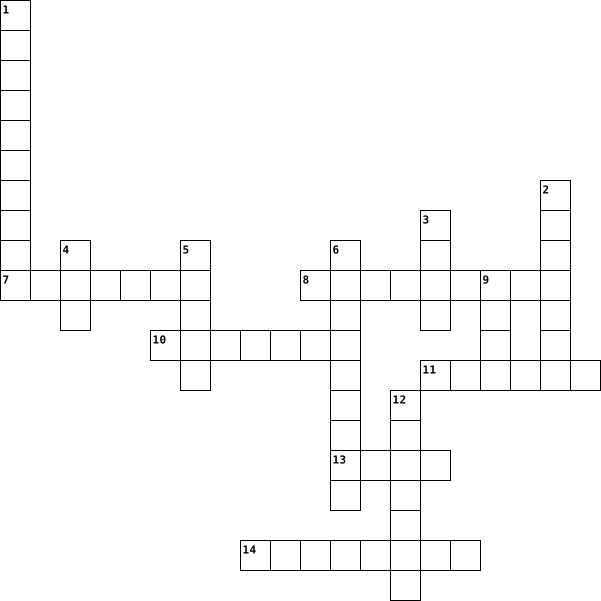
Across
- A vehicle that is used for travel in space
- A person who travels to space.
- The largest planet in our solar system.
- A solar ______.
- The 4th planet from the sun.
- All of space and everything in it including stars, planets and galaxies.
Down
- A zone/region of the solar system that has the correct conditions for potential life. Also known as the habitable zone.
- The furthest planet from the sun.
- A natural satellite that orbits a planet.
- The star that Earth orbits around.
- The hottest planet in our solar system.
- The scientific study of stars, planets, and other objects in outer space.
- The Earth completes a rotation on it every 24 hours.
- The planet closest to the sun.
14 Clues: A solar ______. • The 4th planet from the sun. • A person who travels to space. • The planet closest to the sun. • The furthest planet from the sun. • The star that Earth orbits around. • The hottest planet in our solar system. • The largest planet in our solar system. • A natural satellite that orbits a planet. • A vehicle that is used for travel in space • ...