
states and capitals Crossword Puzzles
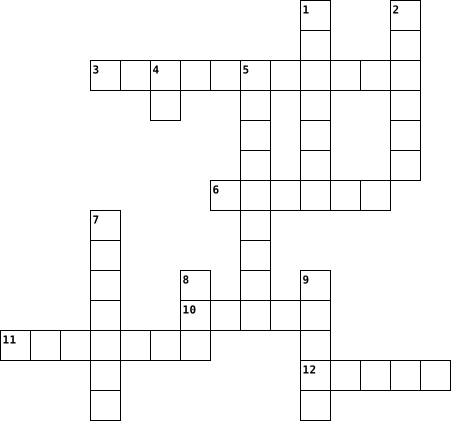
African country 2022-10-06

Across
- country with three capitals
- has a back figure in flag
- has a bird in the flag
- they mostly speak portuguese
- has 2 different names
Down
- is the most populated country
- has black line in the flag
- victoria falls borders it
- the capital is windhoek
- pink diamond found
10 Clues: pink diamond found • has 2 different names • has a bird in the flag • the capital is windhoek • victoria falls borders it • has a back figure in flag • has black line in the flag • country with three capitals • they mostly speak portuguese • is the most populated country
European Capitals 2019-03-23

Across
- The capital of Finland
- The capital of Slovenia
- The capital of Bulgaria
- The capital of France
- The capital of Sweden
- The capital of Poland
Down
- The capital of Iceland
- The capital of Albania
- The capital of Latvia
- The capital of Lithuania
- The capital of Norway
- The capital of Romania
- The capital of Portugal
- The capital of Greece
- The capital of Italy
15 Clues: The capital of Italy • The capital of Latvia • The capital of Norway • The capital of France • The capital of Greece • The capital of Sweden • The capital of Poland • The capital of Iceland • The capital of Albania • The capital of Finland • The capital of Romania • The capital of Slovenia • The capital of Portugal • The capital of Bulgaria • The capital of Lithuania
European capitals 2019-03-19

Across
- Capital of Malta
- Capital of Ireland
- Capital of Lithuania
- Capital of Switzerland
- Capital of Russia
- Capital of Greece
- Capital of Norway
Down
- Capital of Letonia
- Capital of Finland
- Capital of Liechtenstein
- Capital of Germany
- Capital of Portugal
- Capital of Austria
- Capital of Italy
- Capital of France
15 Clues: Capital of Malta • Capital of Italy • Capital of Russia • Capital of France • Capital of Greece • Capital of Norway • Capital of Letonia • Capital of Finland • Capital of Ireland • Capital of Germany • Capital of Austria • Capital of Portugal • Capital of Lithuania • Capital of Switzerland • Capital of Liechtenstein
World Capitals 2024-04-29

Across
- Capital of France known for the Eiffel Tower.
- Largest city and capital of Japan.
- Capital of Germany, known for the Brandenburg Gate.
- Capital of the United Kingdom.
- Capital city near the Great Pyramids.
- Capital and largest city of Spain.
- Austrian capital known for classical music.
Down
- Historic capital of Greece.
- Coastal capital of Portugal.
- Capital city of Ireland.
- Capital of South Korea.
- Capital of Norway, known for its fjords.
- Capital of Canada, known for its parliament.
- Capital city of the Czech Republic.
- Capital territory of India, includes New Delhi.
15 Clues: Capital of South Korea. • Capital city of Ireland. • Historic capital of Greece. • Coastal capital of Portugal. • Capital of the United Kingdom. • Largest city and capital of Japan. • Capital and largest city of Spain. • Capital city of the Czech Republic. • Capital city near the Great Pyramids. • Capital of Norway, known for its fjords. • ...
World Capitals 2023-09-03

Across
- Capital of Russia.
- Capital of Egypt.
- Capital of China.
- Capital of Greece.
- Capital of Germany.
- Capital of Kenya.
- Capital of Canada.
Down
- Capital of Japan.
- Capital of Italy.
- Capital of Australia.
- Capital of Brazil.
- Capital of the United Kingdom.
- Capital of India.
- Capital of France.
- Capital of South Korea.
15 Clues: Capital of Japan. • Capital of Italy. • Capital of Egypt. • Capital of China. • Capital of India. • Capital of Kenya. • Capital of Russia. • Capital of Brazil. • Capital of France. • Capital of Greece. • Capital of Canada. • Capital of Germany. • Capital of Australia. • Capital of South Korea. • Capital of the United Kingdom.
World Capitals 2024-07-27

Across
- is not Sydney, but the political hub of Australia.
- is the northernmost capital city of a sovereign state.
- Chile's capital, is nestled in a valley.
- the smallest capital in mainland Africa, is Gambia's heart.
- is the capital city on the Rideau Canal.
- is the safari capital of the world.
- is Armenia's capital, near Mount Ararat.
Down
- the City of Love, and the Eiffel Tower.
- is home to the ancient Pyramids of Giza.
- is Oman's capital, facing the Gulf of Oman.
- Chi Minh Mausoleum location.
- is the capital of Fiji, located on the southeast coast of Viti Levu.
- is Brandenburg Gate's city.
- hosts the world's busiest pedestrian crossing.
- the capital of Latvia, is known for its wooden buildings.
15 Clues: is Brandenburg Gate's city. • Chi Minh Mausoleum location. • is the safari capital of the world. • the City of Love, and the Eiffel Tower. • is home to the ancient Pyramids of Giza. • Chile's capital, is nestled in a valley. • is the capital city on the Rideau Canal. • is Armenia's capital, near Mount Ararat. • is Oman's capital, facing the Gulf of Oman. • ...
European capitals 2022-10-05

Across
- Capital of Romania
- Capital of Bosnia Herzegovina
- Capital of Czech Republic
- Capital of Slovakia
- Capital of Germany
Down
- Capital of Hungary
- Capital of Turkey
- Capital of Slovenia
- Capital of Greece
- Capital of Austria
- Capital of Bulgaria
- Capital of France
- Capital of Croatia
- Capital of Italy
- Capital of Serbia
15 Clues: Capital of Italy • Capital of Turkey • Capital of Greece • Capital of France • Capital of Serbia • Capital of Hungary • Capital of Romania • Capital of Austria • Capital of Croatia • Capital of Germany • Capital of Slovenia • Capital of Bulgaria • Capital of Slovakia • Capital of Czech Republic • Capital of Bosnia Herzegovina
European Capitals 2022-02-08

Across
- Portugal
- Greece
- Romania
- Spain
- Bulgaria
- Slovakia
- Moldova
Down
- Belgium
- Bosnia & Herzegovina
- Amsterdam
- Albania
- Valletta
- Ireland
- Norway
- Ukraine
15 Clues: Spain • Greece • Norway • Belgium • Romania • Albania • Ireland • Ukraine • Moldova • Portugal • Valletta • Bulgaria • Slovakia • Amsterdam • Bosnia & Herzegovina
Countries & Capitals 2025-09-01

Across
- Capital of Italy
- Capital of Egypt
- Capital of the United Kingdom
- Capital of China
- Capital of South Africa
- Capital of France
- Capital of India
Down
- Capital of Argentina
- Capital of Spain
- Capital of Australia
- Capital of Japan
- Capital of Russia
- Capital of Canada
- Capital of Mexico
- Capital of Germany
15 Clues: Capital of Spain • Capital of Italy • Capital of Egypt • Capital of Japan • Capital of China • Capital of India • Capital of Russia • Capital of Canada • Capital of Mexico • Capital of France • Capital of Germany • Capital of Argentina • Capital of Australia • Capital of South Africa • Capital of the United Kingdom
World Capitals 2025-09-24

Across
- – Built to be Brazil’s capital
- – Home of the Colosseum
- – Atlantic capital of Portugal
- – Capital of Austria
- – Capital on the Nile
- – Capital of Turkey
- – Norway’s capital
Down
- –City of Love
- – Capital once split by a wall
- – Capital of Spain
- – Australia’s capital
- – Capital of Canada
- – Forbidden City location
- – Capital of Japan
- – Capital of Vietnam
15 Clues: –City of Love • – Capital of Spain • – Capital of Japan • – Norway’s capital • – Capital of Canada • – Capital of Turkey • – Capital of Austria • – Capital of Vietnam • – Australia’s capital • – Capital on the Nile • – Home of the Colosseum • – Forbidden City location • – Capital once split by a wall • – Built to be Brazil’s capital • – Atlantic capital of Portugal
Final Exam 2020-06-03

Across
- an American explorer, soldier, Indian agent, and territorial governor
- an American career Army officer and politician, who served as governor of the Territory of Washington from 1853 to 1857
- an American businessman, real estate developer, investor, inventor, writer, lieutenant colonel in the Spanish–American War, and a prominent member of the Astor family
- the first Governor of the U.S. State of Washington
- The Convention respecting fisheries, boundary and the restoration of slaves between the United States and the United Kingdom, also known as the London Convention and Anglo-American Convention
- a Canadian retail business group
- a conflict between the United States and the Yakama, a Sahaptian-speaking people of the Northwest Plateau, then part of Washington Territory, and the tribal allies of each
- a U. S. Army post in the Washington Territory
- an entrepreneur and a politician, regarded as a founder of the city of Seattle
- a widely held cultural belief in the 19th-century United States that its settlers were destined to expand across North America
- a Suquamish and Duwamish chief
- a meeting in the Pacific Northwest between the United States and sovereign tribal nations of the Cayuse, Nez Perce, Umatilla, Walla Walla, and Yakama
Down
- a 19th-century fur trading post that was the headquarters of the Hudson's Bay Company's Columbia Department, located in the Pacific Northwest
- a Spanish Basque explorer of the Pacific Northwest
- a confrontation in 1859 between the United States and United Kingdom over the British–U.S. border in the San Juan Islands, between Vancouver Island and the State of Washington.
- a Lemhi Shoshone woman who, at age 16, met and helped the Lewis and Clark Expedition in achieving their chartered mission objectives by exploring the Louisiana Territory
- North West Company. Founded in 1779, the North West Company was a major force in the fur trade from the 1780s to 1821
- a British explorer, navigator, cartographer, and captain in the British Royal Navy
- the encampment of the Lewis and Clark Expedition in the Oregon Country near the mouth of the Columbia River during the winter of 1805-1806
- a breed of otter
- a point jutting into Puget Sound, the westernmost landform in the West Seattle district of Seattle, Washington
- a United States policy that opposed European colonialism in the Americas. It began in 1823
- a multiancestral indigenous group whose homeland is in Canada and parts of the United States between the Great Lakes region and the Rocky Mountains
- a United States statute that permitted the entrance of Montana and Washington into the United States of America, as well as the splitting of Territory of Dakota into two states: North Dakota and South Dakota
- a mountain pass in the northwest United States, through the Cascade Range in Washington
25 Clues: a breed of otter • a Suquamish and Duwamish chief • a Canadian retail business group • a U. S. Army post in the Washington Territory • a Spanish Basque explorer of the Pacific Northwest • the first Governor of the U.S. State of Washington • an American explorer, soldier, Indian agent, and territorial governor • ...
10th Grade Vocabulary Lesson 3 2022-09-30

Across
- (adj) Cunning; full of trickery or intentions to deceive
- (v) To charm; to delight
- (adj) Wild and untamed; savage
- (n) Accepted standards and customs of a social group
- (n) The way one behaves or presents oneself; one’s manner
Down
- (adj) Relating to areas that are far from large cities or capitals // (adj) Not sophisticated, or informed; Culturally limited // (adj) limited or narrow in perspective
- (adj) mean, unethical, or dishonorable; not noble in character
- (adj) Unfitting and inappropriate; grossly improper
- (adj) Wishing to do good; kindly; characterized by helpful intentions
- (n) Appropriateness of behavior; propriety
10 Clues: (v) To charm; to delight • (adj) Wild and untamed; savage • (n) Appropriateness of behavior; propriety • (adj) Unfitting and inappropriate; grossly improper • (n) Accepted standards and customs of a social group • (adj) Cunning; full of trickery or intentions to deceive • (n) The way one behaves or presents oneself; one’s manner • ...
soveit union and woman 2023-12-06

Across
- which is a vocational school for the preparation of 'semi professionals '
- a feminist
- an organization for children operated by a communist party.
- Children in the U.S.S.R. are required to attend ___ years of schooling.
Down
- how many soviets were killed
- what were located in major cities, including the union republic and autonomous republic capitals, with the highest concentrations in Moscow, Leningrad, and Kiev.
- In today’s Russia, ______employment remains high,
- The _____ faced the highest threat level.
- the freeing of someone from slavery.
- who took power and created Soviet communism
10 Clues: a feminist • how many soviets were killed • the freeing of someone from slavery. • The _____ faced the highest threat level. • who took power and created Soviet communism • In today’s Russia, ______employment remains high, • an organization for children operated by a communist party. • Children in the U.S.S.R. are required to attend ___ years of schooling. • ...
Texas a State/U.S. Mexican War 2021-04-19

Across
- border between the United States and Mexico following the Treaty of Guadalupe Hidalgo
- How much the United States paid Mexico as a part of the Treaty of Guadalupe Hidalgo
- areas of land surrendered by Mexico following the U.S. Mexican War
- largest group of European immigrants in Texas in 1850
- his nomination for presidency sped up annexing Texas
- issue with annexing Texas- War with Mexico and _____________
- belief that the U.S would own all land east to west coast
- annexing Texas would give slaves states this in Congress
- 3 out of 4 households living in Texas were from this part of the United States
Down
- U.S. would pay Texas's $12 million debt
- 2 major political parties in Texas the Democrats and the __________
- Treaty that ended the U.S. Mexican War
- The United States declares war on Mexico on this date
- President of Texas 2 times and favored annexation
- he led U.S. forces in Texas on the Rio Grande border
- The United States purchased the southern portion of New Mexico and Arizona for $10 million
- Mexico believed this was the boundary between Mexico and the United States
17 Clues: Treaty that ended the U.S. Mexican War • U.S. would pay Texas's $12 million debt • President of Texas 2 times and favored annexation • he led U.S. forces in Texas on the Rio Grande border • his nomination for presidency sped up annexing Texas • The United States declares war on Mexico on this date • largest group of European immigrants in Texas in 1850 • ...
Brady's Social Studies Crossword Puzzle 2015-08-31

Across
- a line that runs North and South and measures distance east and west of the prime meridian
- an area that shares its physical or human characteristics
- a mark drawing or a color that stands for something else
- a line that runs east and west and measures distance north and south of the Equator
- map shows political information such as the location of capitals and cities.
- the usual pattern of weather in a place over a certain period of time
- shows distance on a map
Down
- a natural feature of Earth
- Helps readers understand symbols
- map shows the physical characteristics of a land area
- map shows the physical characteristics of a place
- bring water to
- rose shows the direction of North, East, South and West
13 Clues: bring water to • shows distance on a map • a natural feature of Earth • Helps readers understand symbols • map shows the physical characteristics of a place • map shows the physical characteristics of a land area • a mark drawing or a color that stands for something else • rose shows the direction of North, East, South and West • ...
Year 8 Cast Button to chin, till June be in! 26.05 2023-05-26

Across
- Name of main character in Skellig
- We use these to write names of Places/Countries
- Name of a man who keeps going to a place to exercise
- Where we keep money in/special public holiday
- Famous tower in Castletown
- when we are not in school or work
- What do you call a lawyer's daughter
- The nickname of the doctor in the book
Down
- Part of a book
- What kind of tree fits in your hand
- Posh crab
- The most common tuba that we eat
- We eat them with loads of salt and vinegar
- Fish how you feel after doing too much work/exercise
- Distance of motorbike race course down South
15 Clues: Posh crab • Part of a book • Famous tower in Castletown • The most common tuba that we eat • Name of main character in Skellig • when we are not in school or work • What kind of tree fits in your hand • What do you call a lawyer's daughter • The nickname of the doctor in the book • We eat them with loads of salt and vinegar • Distance of motorbike race course down South • ...
Vocab Crossword 2022-01-06

Across
- guy on two-dollar bill
- a political party colored blue
- A secret military base in Nevada
- states that were free
- the belief that unlimited authority was granted to a monarch
- supporters of the new constitution
- states that owned slaves
- first orange president
- A system that ensures no gov. branch becomes to powerful
Down
- the paper currency bill of USA
- a compromise between small and large states
- the predominant language of America
- opposed to the new constitution
- written by our founding fathers
- Guy on the one-dollar bill
- a compromise between free states and slave states
- a country with fifty sates
- a political party colored red
- first black president
19 Clues: states that were free • first black president • guy on two-dollar bill • first orange president • states that owned slaves • Guy on the one-dollar bill • a country with fifty sates • a political party colored red • the paper currency bill of USA • a political party colored blue • opposed to the new constitution • written by our founding fathers • A secret military base in Nevada • ...
Unit 3 Crossword Puzzle 2024-11-01

Across
- The states that broke away from the U.S. to form a separate government and fought to maintain it.
- A movement aimed at ending the practice of slavery.
- My very nice American History teacher
- Strengths & Weaknesses The side with a larger population and more resources but unfamiliar with Southern territory.
- Lincoln The U.S. president during the Civil War who took significant steps toward ending slavery.
- Amendment Made anyone born in the United States a citizen and guaranteed equal protection under the law.
- A period focused on rebuilding the Southern states and integrating formerly enslaved people into American society after the Civil War.
- Amendment Granted voting rights regardless of race or previous condition of servitude.
- Bureau An organization established to provide aid, education, and support to newly freed individuals and impoverished Southerners.
Down
- Strengths & Weaknesses The side with skilled military leaders and home territory advantage but fewer resources.
- War A major conflict in the United States between opposing regions over issues like states' rights and slavery.
- The states that fought to keep the United States united during the Civil War.
- At Jordan we ___________
- The freeing of individuals from enslavement, often linked to policies during the Civil War era.
- Amendment Ended slavery in the United States, making it illegal nationwide.
- Douglass An escaped enslaved person who became a powerful speaker and writer advocating for the end of slavery.
- The act of formally withdrawing from a political or organizational union.
- Sumter The location where conflict first erupted, marking the start of the Civil War.
- Scott A man who challenged his enslavement in court, resulting in a ruling that denied citizenship to Black people.
19 Clues: At Jordan we ___________ • My very nice American History teacher • A movement aimed at ending the practice of slavery. • The act of formally withdrawing from a political or organizational union. • Amendment Ended slavery in the United States, making it illegal nationwide. • The states that fought to keep the United States united during the Civil War. • ...
chapter 2 vocab State Sovereignty Regime Government Country Legitimacy Traditional legitimacy Charismatic legitimacy Rational-Legal Legitimacy Federalism Unitary States Devolution Strong States Weak States Failed State Capacity Autonomy 2022-09-02

Across
- States, Fragile states
- legitimacy, a monarchy
- legitimacy, authority figures
- States, a powerful government
- unionism, Unitarianism
- administration
- aptitude
Down
- State, failed State
- self-reliance,
- decentralization
- nation
- States, contrast to a federal state
- province
- Legitimacy, bureaucratic authority
- credibility and authenticity
- independent
- political-system
17 Clues: nation • province • aptitude • independent • self-reliance, • administration • decentralization • political-system • State, failed State • States, Fragile states • legitimacy, a monarchy • unionism, Unitarianism • credibility and authenticity • legitimacy, authority figures • States, a powerful government • Legitimacy, bureaucratic authority • States, contrast to a federal state
States 2021-09-14
Across
- Area between mountains
- Indiana, Illinois and Iowa have a lot of this crop
- Great Lake
- This fruit is grown in California
- Where Zack goes to in Michigan
- Springfield
- The other citrus fruit from Florida
Down
- West coast state
- Florida had a lot of this citrus fruit
- This crop is used to make bread
- Indianapolis
- Settled by the Spanish
12 Clues: Great Lake • Springfield • Indianapolis • West coast state • Area between mountains • Settled by the Spanish • Where Zack goes to in Michigan • This crop is used to make bread • This fruit is grown in California • The other citrus fruit from Florida • Florida had a lot of this citrus fruit • Indiana, Illinois and Iowa have a lot of this crop
States 2022-01-08
Across
- guava
- pear
- red in color start with A
- Watermelon
Down
- minions favorite
- papaya
- grapes
- orange
- mango
- peach
- Cherry
- kiwi
12 Clues: pear • kiwi • guava • mango • peach • papaya • grapes • orange • Cherry • Watermelon • minions favorite • red in color start with A
States 2023-09-26
Across
- MI
- GA
- ME
- KS
- IA
- MA
Down
- VA
- KY
- CA
- CT
- AK
- TX
12 Clues: VA • KY • MI • CA • CT • GA • ME • AK • KS • IA • MA • TX
States 2023-09-26
Across
- THIS STATE IS NOT A ISLAND
- THIS STATE IS VERY EXPENSIVE
- THE LARGEST CITY IN THE WORLD
- THEIR STATE NAME IS VERY LONG
- It has north in its name
- THIS STATE IS VERY HOT
Down
- it is below North Dakota
- THIS STATE IS GOOD AT FOOTBALL
- Their is 3 n's in the states name
- THIS STATE IS IN THE WEST
- it is a state
- THEY WON THE NATIONAL TITEL IN FOOTBALL
12 Clues: it is a state • THIS STATE IS VERY HOT • it is below North Dakota • It has north in its name • THIS STATE IS IN THE WEST • THIS STATE IS NOT A ISLAND • THIS STATE IS VERY EXPENSIVE • THE LARGEST CITY IN THE WORLD • THEIR STATE NAME IS VERY LONG • THIS STATE IS GOOD AT FOOTBALL • Their is 3 n's in the states name • THEY WON THE NATIONAL TITEL IN FOOTBALL
States 2025-04-10

Across
- Home to the longest coastline in the U.S
- home of the Dallas Cowboys
- Home to the tallest building in the U.S
- Capital is Columbus
- Holds the world record for the highest attendance at a women’s sporting event
- Home to the Statue of Liberty
- “You’re gonna learn you don’t mess with a _______ girl” -Megan Moroney, ______ Girl
Down
- known as the sunshine state
- State with the highest population
- Capital is St. Louis
- First state in the U.S
- The state with the lowest population
12 Clues: Capital is Columbus • Capital is St. Louis • First state in the U.S • home of the Dallas Cowboys • known as the sunshine state • Home to the Statue of Liberty • State with the highest population • The state with the lowest population • Home to the tallest building in the U.S • Home to the longest coastline in the U.S • ...
Civil War and Reconstruction Test Review Crossword 2021-04-18

Across
- Linclon succeded in permanentaly abolishing __________ by promoting the passage and ratification of the Thirteenth Amendment.
- The Confederate attack upon the Union fort that initiated the war.
- The location of where General Robert E. Lee surrendered to General Ulysses S. Grant, which ended the Civil War.
- The Missouri Compromise, Compromise of 1850, and Kansas-Nebraska Act all delt with the issue should slavery be allowed in new __________.
- This siege was able to divide the Confederate territory in half.
- He was from Illinois, became president of the United States and helped bring an end to slavery
- Southern states tried to weaken the effects of this amendment by using poll taxes, literacy tests, and Grandfather clauses.
- For President Lincoln the ______ always mattered more that the disagreements between the States.
- In the court case of ____________ v. Sandford the Missouri Compromise was found Unconstitutional and Slaves taken to free states were still considered slaves.
- He was appointed general in chief of the Union army during the Civil War.
Down
- As a result of this amendment African Americans in the South could move elsewhere.
- Former slaves being trapped in a cycle of debt was a long-term consequence of the __________ system.
- After Lee’s surrender at Appomattox Court House, the main priority of the United States was to implement a plan to bring _____________ states back into the Union.
- Southern states passed these in order to limit the effects of the Reconstruction Amendments.
- This Act resulted in fights betten pro-slavery and anti-slavery groups in Kansas.
- Bank failures, bankrupt businesses, destroyed railroads and farms, high food prices and widespread crop failures were some of the conditions facing the ________ at the beginning of Reconstruction.
- The _____________ Proclamation shifted the focus of the war to freedom for all and encouraged African Mericans to fight for the Union
- This group was set up for former slaves with things like legal assistance and public schooling.
- Lincoln expressed in his speeches that he did not feel the South had a legal ability to _____ from the United States.
- One Tactic of the ______ was cut off Confederate states from getting revenue from their agricultural exports.
- Hiram Rhodes _________ was the first African Americans elected to the U.S. Senate.
21 Clues: This siege was able to divide the Confederate territory in half. • The Confederate attack upon the Union fort that initiated the war. • He was appointed general in chief of the Union army during the Civil War. • This Act resulted in fights betten pro-slavery and anti-slavery groups in Kansas. • ...
Anabella Ruiz Articles X-word 2024-02-09

Across
- Congress could not stop states from creating their own mini armies and fighting with ______.
- To pass a new _____, 2/3 of the delegates had to agree.
- Daniel ______ was not a wealthy landowner; he had a rebellion named after him.
- Congress had the power to sign _____ with other nations.
- Since Congress could not tax the states, they had no money for supplies that the ______ needed.
- The 1783 amendment (5% tax on imported goods that would only last 25 years) failed because _________ said no.
- British merchants and _______ customers benefited because the British goods were less expensive than the American goods.
- Congress had the power to appoint ______ officers.
- The Articles of _______ was adopted by the states in 1781
Down
- The 1781 amendment (5% tax on imported goods) failed because Rhode Island and ______ said no.
- Individual states made their own _______ by taxing goods representatives.
- Sinice the states were printing too much of their own _______, it became inflated, so only congress was allowed to print it.
- Articles are flawed because Congress couldn't ____.
- Under the AC the government was allowed to declare ________.
- The Declaration of Independence established a new _________.
- The _________ were in charge of collecting taxes and regulating trade with other states.
- Under the AC each state can have a different number of ____, but only one vote.
- Alexander ___________ hated Congress because they didn't share his vision.
- Only Congress could regulate commerce because the states were passing ____ trade laws.
- The _____ of Massachuettes farmers prompted the states to consider changing the AC.
20 Clues: Congress had the power to appoint ______ officers. • Articles are flawed because Congress couldn't ____. • To pass a new _____, 2/3 of the delegates had to agree. • Congress had the power to sign _____ with other nations. • The Articles of _______ was adopted by the states in 1781 • Under the AC the government was allowed to declare ________. • ...
Civil War 2021-04-02

Across
- American Confederate General
- confederate states
- the war between the states
- union states
- secretary of war and president of the Confederate States of America for the duration of the American Civil War
- one of the original thirteen states of the United States
- Us Capital
- a political union
- a name applied to a strategy outlined by the Union Army for suppressing the Confederacy at the beginning of the American Civil War.
Down
- commanded the victorious Union army during the American Civil War
- an island fortification located in Charleston Harbor
- Founder of the American Red Cross 1881
- a ship that manages to enter or leave a blockaded port.
- any of the slave states that bordered the northern free states during the US Civil War.
- 16th president of the U.S
- a club, society, or association formed by people with a common interest or purpose.
- general and a major architect of modern warfare
- the capital of Virginia
18 Clues: Us Capital • union states • a political union • confederate states • the capital of Virginia • 16th president of the U.S • the war between the states • American Confederate General • Founder of the American Red Cross 1881 • general and a major architect of modern warfare • an island fortification located in Charleston Harbor • ...
1.7-1.9 Crossword Puzzle 2023-05-18

Across
- sharing of power between federal and state
- legislation to reduce greenhouse gas emissions internationally
- legislation to remove pollutants from water
- decision of a court case
- powers not specifically listed in constitution
- powers only given to the states
- state and federal work together on issues (federalism type)
- returning power to the states
- case that showed restriction on commerce clause
- equality for all citizens
- disagreeing opinions
Down
- citizens vote on this law
- requirements for states to follow
- necessary and proper clause
- agreeing opinions
- legislation for equal education for all children
- moving a criminal from one country to another
- laws for trade
- powers shared between state and federal
- national decisions are above the states
- rights not listed are reserved by people
- legislation to remove pollutants from air
- powers given to national government
- state tax revenue is shared
- power divided between state and federal (federalism type)
- money given to states
26 Clues: laws for trade • agreeing opinions • disagreeing opinions • money given to states • decision of a court case • citizens vote on this law • equality for all citizens • necessary and proper clause • state tax revenue is shared • returning power to the states • powers only given to the states • requirements for states to follow • powers given to national government • ...
Chapter 4 vocab 2022-11-18

Across
- Give reasonable amount of money for specific cause
- How the power is split geographically
- Proposed laws
- power divided between state and national governments
- Give money for public reason
- Only powers federal government has
- Giving money back to state/local governments
- For states/private for project cost
- Shared powers between state and national governments
- New addition of a state
- Power reserved to the states
- Surrender of wanted person
- People who make and vote on laws
- Gives federal money/resources to help/lend
Down
- Powers only for national government
- Powers not specifically mentioned in the Constitution
- Powers that are listed specifically
- States must accept other states decisions
- People with authority
- Powers of national government decided by supreme court
- Both the lead of gov in state and national governments
- People of territory to make a constitution
- Lawmakers driven by political party
- Agreement between 2 states and approved by congress
24 Clues: Proposed laws • People with authority • New addition of a state • Surrender of wanted person • Give money for public reason • Power reserved to the states • People who make and vote on laws • Only powers federal government has • Powers only for national government • Powers that are listed specifically • For states/private for project cost • Lawmakers driven by political party • ...
Federalism 2025-10-02

Across
- powers that belong to the states?
- this states the constitution is the supreme law of the land?
- what kind of power prohibits state and nation governments?
- what is the division of power between a central and local governments?
- the branch that clarifies the laws?
- which branch enforces the laws?
- Also called "marble cake federalism" federal and states share responsibilities
- What powers are only for the federal government?
- which article states the ratification process?
- what is authority of the government that was created and sustained by the consent of its people?
Down
- powers not expressed in the constitution?
- Also known as "layer cake federalism" Governments are each supreme in their own spheres
- what is the basic principles stated in the constitution called?
- when national and state governments share the same power, what is this called?
- who creates the laws?
- A decentralized form of government, states are sovereign
- what ensures that a political power is not in control over all governments?
- Grants: Federal money for a specific purpose
- Attempts to give power back to the states
- Grants: Federal money for a broad purpose
20 Clues: who creates the laws? • which branch enforces the laws? • powers that belong to the states? • the branch that clarifies the laws? • powers not expressed in the constitution? • Attempts to give power back to the states • Grants: Federal money for a broad purpose • Grants: Federal money for a specific purpose • which article states the ratification process? • ...
Unit 4 2021-12-08

Across
- Union army general that believed in total war
- Georgia's response to the Compromise of 1850 which said that Georgia would agree to the compromise if the Fugitive Slave Act was included.
- This event lasted 4 years and took place within the United States between the North and the South.
- This Civil War battle was fought in northern Georgia, near Chattanooga, Tennessee
- The action of cancelling or ignoring a federal law deemed unconstitutional by an individual state.
- Sherman believed in this approach to war
- This person took his owner to court to sue for his freedom. The case ruled that African Americans were not considered citizens and did not have rights.
- Individuals that wanted to end slavery everywhere
- This plan for reconstruction was much more harsh on the Confederate states and sent Union troops to the south to oversee reconstruction.
- The southern states that seceded from the Union during the Civil War were called this
- When the citizens of an individual state vote on the legalization of slavery (two words)
- When union troops blocked the southeastern coastline, preventing southern states from importing or exporting goods
- This act was included in the Compromise of 1850 and required any escaped enslaved person to be returned (3 words)
- The northern and western states that remained united during the Civil War were called this
- Series of battles that took place in Atlanta resulting in the destruction of the city and railroads under William Sherman
- Winner of the Presidential election of 1860.
- This amendment states that all people born or naturalized in the United States are considered citizens and have basic rights, regardless of color.
- another word for taxes
- This compromise brought California into the Union as a free state (three words)
- Sherman and his troops' journey from Atlanta to Savannah
Down
- This declaration from Abraham Lincoln freed slaves, but only in Confederate States
- The south's economy was based on this.
- Black men that served in Georgia's General Assembly until removed from office in 1876
- When a change is made to the constitution it is called an
- Terrorist group developed by Confederate veterans to support white supremacy
- This group was created to assist newly freed people in establishing a new life.
- This amendment ended slavery across the entire United States after the Civil War
- Prison camp in Georgia that inhumanely held Union soldiers
- Under this arrangement, laborers with no land of their own worked farm plots owned by others, but owned their own supplies and kept around 2/3 of their harvest.
- This person became president after Lincoln's assassination.
- governmental power reserved for individual states. Southern states intended to use this to allow slavery.
- These states allowed slavery but did not secede from the Union: Kentucky, Missouri, Delaware, Maryland, and West Virginia
- The plan to surround the seceded states and suffocate or squeeze them of supplies
- To separate from
- Another term for "total war" that involves burning to the ground
- Under this arrangement, laborers with no land of their own worked on farm plots owned by others, and at the end of the season landowners paid workers a share of the crop.
- These plans for reconstruction were considered too lenient or easy on the Confederate states
- The the years immediately following the end of the Civil War are called
- This amendment gave all men the right to vote.
39 Clues: To separate from • another word for taxes • The south's economy was based on this. • Sherman believed in this approach to war • Winner of the Presidential election of 1860. • Union army general that believed in total war • This amendment gave all men the right to vote. • Individuals that wanted to end slavery everywhere • ...
Capitals 2025-02-06

Across
- the capital of Egypt
- the capital of China
- the capital of Poland
- the capital of the United Kingdom
Down
- the capital of France
- the capital of Greece
- the capital of Italy
- the capital of Germany
- the capital of the Netherlands
9 Clues: the capital of Egypt • the capital of Italy • the capital of China • the capital of France • the capital of Greece • the capital of Poland • the capital of Germany • the capital of the Netherlands • the capital of the United Kingdom
Civil War 2026-07-20

Across
- an anti-slavery activist who was hanged after leading an unsuccessful raid of a weapons storage building in Virginia; believed he was chosen by God to abolish slavery; debate continues over whether he was a terrorist or freedom fighter
- the belief that ultimate power comes from the people; “popular ___________”
- a series of violent fights between pro-slavery and anti-slavery forces in Kansas in 1856 who had moved to Kansas to try to influence the vote about whether Kansas would a slave state or a free state
- this law was designed to ease tensions around slavery in western territories, that added California as a free state, but also included the Fugitive Slave Act; “Compromise of ____”
- this law that required that northern free states forcibly return escaped slaves to their owners; “________ Slave Act”
- this law (“act”) added the Nebraska and Kansas territories as states in 1854, and gave the people in those states the right to choose to be a free or slave state
- to formally leave the union of states
- (1820) a law that outlawed slavery in states north of Texas, except the one the law is named after; “________ Compromise”
- the idea that states should have all powers that the Constitution does not give to the federal government or forbid to the states
Down
- the movement to make slavery illegal
- the Northern States during the Civil War
- the Southern States during the Civil War
- a Union general and future President; chosen by Lincoln as the leading Union general late in the Civil War (in 1864); “Ulysses S. _____”
- a statement issued by President Lincoln in 1862, freeing all slaves in areas still at war with the Union; “the ____________ Proclamation”
- a 3-minute speech by President Lincoln 1863 dedicating a new national cemetery; he praised the bravery of Union soldiers at the battle the speech was named after, and supported the ideals of self-government and human rights; “the __________ Address”
- 16th American President; helped preserve the United States ("the Union") by leading the defeat of the secessionist Confederacy; an outspoken opponent of the expansion of slavery; willing to make tough choices to unify Americans; “Abraham _______”
- an amendment to the US Constitution passed after the Civil War that abolished slavery in the United States
- an American statesman and politician who served as President of the Confederate States of America ("the Confederacy") for its entire history from 1861 to 1865; “Jefferson _____”
- the Union army's destructive march through Georgia in 1864 and 1865; an early example of "total war", intentionally targeting infrastructure and civilian property
- a slave who sued his master for keeping him enslaved after moving to a territory where slavery was banned; the Supreme Court said because he was a slave and not a citizen, he had no rights
20 Clues: the movement to make slavery illegal • to formally leave the union of states • the Northern States during the Civil War • the Southern States during the Civil War • the belief that ultimate power comes from the people; “popular ___________” • an amendment to the US Constitution passed after the Civil War that abolished slavery in the United States • ...
Oceania Countries and Capitals 2019-06-10

Across
- Ngerulmud
- Honiara
- YarenDistrict
- Nukualofa
- PortMoresby
- Tarawa
Down
- Apia
- Suva
- Majuro
- Wellington
- Palikir
- PortVila
- Canberra
13 Clues: Apia • Suva • Majuro • Tarawa • Honiara • Palikir • PortVila • Canberra • Ngerulmud • Nukualofa • Wellington • PortMoresby • YarenDistrict
EUROPEAN LANGUAGES AND CAPITALS 2022-10-08

Across
- THE LANGUAGE OF SHAKESPEARE
- WHERE THE LITTLE MERMAID LIVES
- "LET'S EAT" IN FRENCH
- WHERE THERE'S A STRONG TRADITION OF "FADO" MUSIC
- THE EUROPEAN LANGUAGE WITH THE BIGGEST VOCABULARY
- HOME OF EUROPEAN COMISSION
- THE ONLY LANGUAGE IN THE WORLD TO CAPITALISE NOUNS
Down
- LANGUAGE SPOKEN IN LITHUANIA
- HOME OF THE EIFFEL TOWER
- WHERE THE TULIPS LOOK WONDERFUL
- THE SECOND MOST SPOKEN LANGUAGE IN SPAIN
- WHERE THE COLLOSEUM CAN BE ADMIRED
- CAPITAL OF SWEDEN
- THE MONTH THE EUROPEAN DAY OF LANGUAGES IS CELEBRATED IN
14 Clues: CAPITAL OF SWEDEN • "LET'S EAT" IN FRENCH • HOME OF THE EIFFEL TOWER • HOME OF EUROPEAN COMISSION • THE LANGUAGE OF SHAKESPEARE • LANGUAGE SPOKEN IN LITHUANIA • WHERE THE LITTLE MERMAID LIVES • WHERE THE TULIPS LOOK WONDERFUL • WHERE THE COLLOSEUM CAN BE ADMIRED • THE SECOND MOST SPOKEN LANGUAGE IN SPAIN • WHERE THERE'S A STRONG TRADITION OF "FADO" MUSIC • ...
IPL 2021-04-19
Across
- Who won the orange cap in 2019?
- How many teams participate in IPL
- Which australian has the best bowling figure in IPL
- In which stadium, IPL 2014 Finals hosted?
- Brand ambassador of Dream 11
- Which player scored the most runs in IPL 2018
- Current captain of Delhi Capitals?
- Current Head Coach of MI
- Maximum sixes award in IPL 2008
Down
- Owner of RCB team
- Who won the first IPL
- Who was the Defending Champions in IPL 2020?
- Who was the emerging player of IPL 2020
- The distance between the popping crease and the bowling crease
- Which player won the purple cap in IPL 2008?
- how many times MI have won the IPL finals
- Which national team are called Baggy Greens?
- Which country hosted the IPL 2020
18 Clues: Owner of RCB team • Who won the first IPL • Current Head Coach of MI • Brand ambassador of Dream 11 • Who won the orange cap in 2019? • Maximum sixes award in IPL 2008 • How many teams participate in IPL • Which country hosted the IPL 2020 • Current captain of Delhi Capitals? • Who was the emerging player of IPL 2020 • In which stadium, IPL 2014 Finals hosted? • ...
Escape the Front Lines 2023-05-19

Across
- The North was also called by this "uniting" name
- Last name of the confederate general who surrendered at Appomattox
- President during the Civil War
- Union General at the Battle of Gettysburg
- Union General who later became president
- Word for when a state left the union
- He marched to Savannah
- State burnt by General Sherman and his army
- Wife of Abe
Down
- Color of the Union uniforms
- This state was home to Richmond, one of the capitals of the Confederacy
- These people were freed by the Emancipation Proclamation.
- Jefferson Davis was president of this southern government
- Assassin of Lincoln
- Another name for a big farm in the south
- Type of cabin where Lincoln grew up
- Battle of Bull _
- Color of the confederate uniforms
18 Clues: Wife of Abe • Battle of Bull _ • Assassin of Lincoln • He marched to Savannah • Color of the Union uniforms • President during the Civil War • Color of the confederate uniforms • Type of cabin where Lincoln grew up • Word for when a state left the union • Another name for a big farm in the south • Union General who later became president • ...
Southwest and Pacific US states and their capitals 2025-05-19

Across
- Sacramento
- Olympia
- Salem
- Carson City
Down
- Phoenix
- Salt lake city
- Oklahoma City
- Austin
8 Clues: Salem • Austin • Phoenix • Olympia • Sacramento • Carson City • Oklahoma City • Salt lake city
Meg & Trav’s Wedi Puzzle 2026-04-04

Across
- Dog’s name
- Travs high school mascot.
- Megs favorite sports team?
- What guest shares a birthday with our dating anniversary?
- Travs favorite sports team?
- City where we first met.
- Our favorite college bar? (RIP)
- Clue 2 across name before we adopted him?
Down
- Name of the Boston South End bar/restaurant where we had our first date AND engagement.
- Cuisine we always agree on.
- What is the name of our longest foster dog we had in Chicago during COVID?
- What is the name of the study abroad program we both participated in freshman year?
- Megs high school mascot, familiarly.
- City where we first moved in together.
14 Clues: Dog’s name • City where we first met. • Travs high school mascot. • Megs favorite sports team? • Cuisine we always agree on. • Travs favorite sports team? • Our favorite college bar? (RIP) • Megs high school mascot, familiarly. • City where we first moved in together. • Clue 2 across name before we adopted him? • What guest shares a birthday with our dating anniversary? • ...
Chapter 10 Vocab 2021-12-09

Across
- 14th President
- Political party of the 1850s that was anti-Catholic and anti-immigrant
- A system that helped enslaved African Americans follow a network of escape routes out of the South to freedom in the North
- The 15th President of the United States
- laws passed by Northern states forbidding the imprisonment of escaped slaves
- President of the Confederate States of America
- an American military officer, explorer, the first candidate of the Republican Party for the office of President of the United States
- John Brown's scheme to invade the South with armed slaves
- An American newspaper editor and founder of the Republican party.
- A law that made it a crime to help runaway slaves
- United States abolitionist born a slave on a plantation in Maryland and became a famous conductor
Down
- Chief Justice of the Supreme Court when Dred Scott decision was made
- 1854 - anti-slavery Whigs and Democrats, Free Soilers and reformers from the Northwest met and formed party in order to keep slavery out of the territories
- Idea authored by Stephen Douglas
- A policy of favoring native-born individuals over foreign-born ones
- 16th President of the United States
- A loose union of independent states
- A political party dedicated to stopping the expansion of slavery
- a black slave, had lived with his master for 5 years in Illinois and Wisconsin Territory.
19 Clues: 14th President • Idea authored by Stephen Douglas • 16th President of the United States • A loose union of independent states • The 15th President of the United States • President of the Confederate States of America • A law that made it a crime to help runaway slaves • John Brown's scheme to invade the South with armed slaves • ...
Cival war cross words 2025-04-14

Across
- States of America: The official name of the Confederacy.
- Davis: The president of the Confederate States of America.
- Box: A soldier's ammunition cap box.
- The name of the group of Northern states.
- Proclamation: A decree issued by Lincoln freeing slaves in Confederate states.
- Sumter: The fort where the Civil War began.
- The period before the Civil War.
- The name of the group of Southern states that seceded from the Union.
- Basket: One's stomach.
- An earthen rampart or defensive structure.
- Someone drafted into military service.
- A term for Confederate soldiers or for lice.
- Iron Crackers: Hardtack biscuits.
- Lost Cause: A term referring to the Confederacy's fight and aftermath.
Down
- A type of long-barreled firearm used in the Civil War.
- Strengthening a position for defense.
- Line: The line separating the Northern and Southern states.
- Nickname for Union currency.
- A type of pistol.
- Any portable gun.
- A warship covered in iron or steel plates.
- Lincoln: The 16th president of the United States.
- Toothpick: A very large, long knife.
- Cook and Bottle Washer: A person capable of doing many things.
- The opening in a gun's barrel for loading.
25 Clues: A type of pistol. • Any portable gun. • Basket: One's stomach. • Nickname for Union currency. • The period before the Civil War. • Iron Crackers: Hardtack biscuits. • Box: A soldier's ammunition cap box. • Toothpick: A very large, long knife. • Strengthening a position for defense. • Someone drafted into military service. • The name of the group of Northern states. • ...
Constitutional Convention B 2022-03-14

Across
- Gave lots of votes to the big population states
- number of branches in the US government
- the leaders and decision-makers of a society
- Maryland children playing on the beaches of this ocean
- Finally banned, 20 years after
- Though concerned for this, Washington attended
- a formal agreement between nations
- both sides give up something to reach a settlement
- An economic ______________ after the Revolutionary War
- Can't all of us states stay equal?
- President of the convention
Down
- how voting representatives a state will get in Congress
- Number of states attending
- a brilliant move to advance a position, e.g. The Virginia Plan
- Place of meeting, preceding Philadelphia
- Those who crafted and shaped the new government
- branch of gov't concerned with courts and justice
- What the states were asked to do with the Constitution
- sent to the convention, representing states
- the "chief executive" - leader of the executive branch
- ...of Confederation government to be revised
- amount of slaves counted for representation
- Among many things, Benjamin Franklin was this man of ideas
- people who formally elect the president of the United States
- number of states rejecting the Constitution
25 Clues: Number of states attending • President of the convention • Finally banned, 20 years after • a formal agreement between nations • Can't all of us states stay equal? • number of branches in the US government • Place of meeting, preceding Philadelphia • sent to the convention, representing states • amount of slaves counted for representation • ...
Hockey 2018-10-25

Across
- team that won the Stanleycup last year
- cold place were you play
- the sport name
- protects your head
- what you skate on
Down
- what you use to shoot
- Wore number 99 (last name)
- what you use to play
- what you use to move (on feet)
- where you sit to rest
10 Clues: the sport name • what you skate on • protects your head • what you use to play • what you use to shoot • where you sit to rest • cold place were you play • Wore number 99 (last name) • what you use to move (on feet) • team that won the Stanleycup last year
Bolivia 2023-10-20

Across
- Bolivia's Form of Government
- Amount of Capitals in Bolivia
- Bolivia is the _____ of South America
- Country that Borders Bolivia
- Bolivia is named after _____
- A capital of Bolivia
- Rainforest in Bolivia
Down
- Amount of Olympic Medals won for Bolivia
- Bolivia's National Animal
- Amount of Official Languages in Bolivia
10 Clues: A capital of Bolivia • Rainforest in Bolivia • Bolivia's National Animal • Bolivia's Form of Government • Country that Borders Bolivia • Bolivia is named after _____ • Amount of Capitals in Bolivia • Bolivia is the _____ of South America • Amount of Official Languages in Bolivia • Amount of Olympic Medals won for Bolivia
NHL teams- easy 2022-01-11

Across
- won most Stanley cups
- One of the three California teams
- haven't won any cups
- Farthest north NHL team
- has the youngest captain to win a cup
Down
- Has the most fans
- newest team in the NHL
- Capital of USA
- won Stanley cup last year.
- Closest to us
10 Clues: Closest to us • Capital of USA • Has the most fans • haven't won any cups • won most Stanley cups • newest team in the NHL • Farthest north NHL team • won Stanley cup last year. • One of the three California teams • has the youngest captain to win a cup
Capitals and countries 2022-09-02

Across
- the capital of Wales.
- the capital of France.
- the capital of Canada.
- the capital of Italy.
Down
- the capital of England and the UK.
- the capital of Northern Ireland.
- the capital of Russia.
- the capital of the USA.
- the capital of Scotland.
9 Clues: the capital of Wales. • the capital of Italy. • the capital of Russia. • the capital of France. • the capital of Canada. • the capital of the USA. • the capital of Scotland. • the capital of Northern Ireland. • the capital of England and the UK.
Countries and capitals 2026-09-21

Across
- Russia
- China
- Spain
- Portugal
Down
- Scotland
- Sweden
- Italy
- France
- Germany
9 Clues: Italy • China • Spain • Sweden • France • Russia • Germany • Scotland • Portugal
Kate Kudlawiec (chapter 4) 2020-12-01

Across
- a system of spending and taxing
- distributed to states in this form
- national laws that they believed contradicted or clashed with state interests
- included money and other resources
- the national government possessed these
- power held by national and state government
- releasing funds in the form of grants to states
- state governments worked together to meet this crisis
- article 5 of the constitution
- demanded on states to carry put things
Down
- both states and national governments are equal
- divided grants into groups of nine
- historically have been recognized as naturally belonging to governments
- started in the 1980s
- constitution lists powers granted to the national government
- these are not specifically mentioned in the constitution
- states had the right to separate themselves
- dealt with the contract of america
18 Clues: started in the 1980s • article 5 of the constitution • a system of spending and taxing • distributed to states in this form • divided grants into groups of nine • included money and other resources • dealt with the contract of america • demanded on states to carry put things • the national government possessed these • power held by national and state government • ...
Vocab Crossword 2022-01-06

Across
- Government defined by law and serves the people
- Division of power between the Legislative, Judicial, and Executive branches
- man must give up some freedom to the government in exchange for protection of his natural rights
- Article 1, Section 8, Clause 18
- Supporters of the new Constitution
- Distribution of power between the national government and the states
- Believed society must give up natural rights to authority for protection
- Leading supporter of the Constitution and helped write the Federalist Papers
- 4th president of the United States
Down
- explains the purpose of the Constitution
- Power saved for the states, 9th amendment
- Democracy based on protection of individual rights from tyranny
- The people are the only source of power for any and all government actions
- 1st president of the United States
- government controls all aspects of life
- First 10 amendments to the Constitution
- Believed in natural rights-life, liberty, and property
- Compromise reached so satisfy small and large states in the Constitution
- Against the new Constitution
- Each branch of government is subject to constraints as to not gain too much power
20 Clues: Against the new Constitution • Article 1, Section 8, Clause 18 • 1st president of the United States • Supporters of the new Constitution • 4th president of the United States • government controls all aspects of life • First 10 amendments to the Constitution • explains the purpose of the Constitution • Power saved for the states, 9th amendment • ...
States and Capitals Review 2021-10-01

Across
- capital of Michigan
Down
- in America
- capital of Hawaii
- Capital of Oregon
4 Clues: in America • capital of Hawaii • Capital of Oregon • capital of Michigan
Civil War 2021-04-02

Across
- American Confederate General
- confederate states
- the war between the states
- union states
- secretary of war and president of the Confederate States of America for the duration of the American Civil War
- one of the original thirteen states of the United States
- Us Capital
- a political union
- a name applied to a strategy outlined by the Union Army for suppressing the Confederacy at the beginning of the American Civil War.
Down
- commanded the victorious Union army during the American Civil War
- an island fortification located in Charleston Harbor
- Founder of the American Red Cross 1881
- a ship that manages to enter or leave a blockaded port.
- any of the slave states that bordered the northern free states during the US Civil War.
- 16th president of the U.S
- a club, society, or association formed by people with a common interest or purpose.
- general and a major architect of modern warfare
- the capital of Virginia
18 Clues: Us Capital • union states • a political union • confederate states • the capital of Virginia • 16th president of the U.S • the war between the states • American Confederate General • Founder of the American Red Cross 1881 • general and a major architect of modern warfare • an island fortification located in Charleston Harbor • ...
European Capitals 2022-02-08

Across
- Ireland
- Spain
- France
- Romania
- Belgium
- Slovakia
- Italy
Down
- United Kingdom
- Russia
- Greece
- Poland
- Ukraine
- Portugal
- Norway
- Sweden
15 Clues: Spain • Italy • Russia • France • Greece • Poland • Norway • Sweden • Ireland • Ukraine • Romania • Belgium • Portugal • Slovakia • United Kingdom
European Capitals 2022-02-08

Across
- the capital of Romania
- the capital of Italy
- the capital of Switzerland
- the capital of Spain
- the capital of Portugal
- the capital of Moldova
- the capital of Bulgaria
- the capital of Ukraine
- the capital of Poland
Down
- the capital of Slovakia
- the capital of Albaina
- the capital of UK
- the capital of Budapest
- the capital of Greece
- the capital of Belgium
15 Clues: the capital of UK • the capital of Italy • the capital of Spain • the capital of Greece • the capital of Poland • the capital of Romania • the capital of Albaina • the capital of Belgium • the capital of Moldova • the capital of Ukraine • the capital of Slovakia • the capital of Budapest • the capital of Portugal • the capital of Bulgaria • the capital of Switzerland
U.S Capitals 2015-04-04

Across
- Capital Of New Jersey
- Capital Of New York
- Capital Of North Dakota
- Capital Of Utah
- Capital Of Minnesota
- Capital Of Louisiana
- Capital Of Maryland
- Capital Of Delaware
Down
- Capital Of Ohio
- Capital Of Maine
- Capital Of Nevada
- Capital Of Idaho
- Capital Of Texas
- Capital Of Washington
- Capital Of South Dakota
15 Clues: Capital Of Ohio • Capital Of Utah • Capital Of Maine • Capital Of Idaho • Capital Of Texas • Capital Of Nevada • Capital Of New York • Capital Of Maryland • Capital Of Delaware • Capital Of Minnesota • Capital Of Louisiana • Capital Of New Jersey • Capital Of Washington • Capital Of North Dakota • Capital Of South Dakota
State Capitals 2022-08-07
Across
- Means "red stick" in French
- Briefly served as capital of the Confederacy
- Same name as The Simpsons' town
- Named for the New Testament's most prolific writer
- The man who "discovered" America
- named after 3rd president
- Both a German chancellor and a type of donut (though the donut is spelled differently)
Down
- Nothing "bashful" about this former frontier town
- Dwelling place of Greek mythological figures
- A popular variety of grapes
- Small stone
- Rises from the ashes
- No witch trials here but it's the same name
- Sounds like the German word for hotdog
- Common French name, also the French version of "Peter"
15 Clues: Small stone • Rises from the ashes • named after 3rd president • Means "red stick" in French • A popular variety of grapes • Same name as The Simpsons' town • The man who "discovered" America • Sounds like the German word for hotdog • No witch trials here but it's the same name • Dwelling place of Greek mythological figures • Briefly served as capital of the Confederacy • ...
Africa Capitals 2026-04-28

Across
- Kenya
- Zambia
- Senegal
- Ethiopia
- Libya
- South Africa
- Egypt
Down
- Gabon
- Somalia
- Angola
- Liberia
- Ghana
- Morocco
- Tanzania
- Algeria
15 Clues: Gabon • Ghana • Kenya • Libya • Egypt • Angola • Zambia • Somalia • Liberia • Morocco • Senegal • Algeria • Tanzania • Ethiopia • South Africa
Civics Final Exam Review 2024-03-28

Across
- One of the native american tribes in Louisiana
- number of years a president serves
- Amendment that made it to where male citizen of any race (can vote).
- a change to the Constitution
- branch of government that review laws
- number of years a senator is elected
- income taxes?
- Who makes federal laws?
- Gulf war fought by the United States in the 1990s
- war fought by the United States in the 1960s
- first Postmaster General of the United States
- Who was the first president?
- What do we call the first ten amendments to the Constitution? bill of __?
- During WWII, the US fought Germany, Italy and what other country?
- During the Cold War, what was the main concern of the United States?
- Who lived in America before the Europeans arrived?
- attacked the US on September 11, 2001
- Who was President during the Great Depression and World War II?
- What group of people was taken to America and sold as slaves?
- In what month do we vote for President?*
Down
- Why do some states have more Representatives than other states?
- Who wrote the Declaration of Independence?
- How many U.S. Senators are there?
- Who led the United States during the Civil War?
- What ocean is on the East Coast of the United States?
- person in charge of the executive branch
- amendment that allowed women's suffrage
- Who was President during World War I?
- What ocean is on the West Coast of the United States?
- what is the supreme law of the land?
- age required to be able to vote
- number of years a representative is elected
- What territory did the United States buy from France in 1803?
- What is the economic system in the United States?*
- highest court in the United States
- right of citizens
- How many justices are on the Supreme Court?
- Name the U.S. war between the North and the South.
- the 15th of what month is the last day to file
39 Clues: income taxes? • right of citizens • Who makes federal laws? • a change to the Constitution • Who was the first president? • age required to be able to vote • How many U.S. Senators are there? • number of years a president serves • highest court in the United States • number of years a senator is elected • what is the supreme law of the land? • branch of government that review laws • ...
States 2023-09-27
Across
- California
- Arizona
- Texas
- Florida
- Michigan
- Ohio
- Road Island
Down
- Iowa
- New York
- Pennsylvania
- Colorado
- Oklahoma
12 Clues: Iowa • Ohio • Texas • Arizona • Florida • New York • Colorado • Oklahoma • Michigan • California • Road Island • Pennsylvania
States 2023-09-26
Across
- Great Lake State
- The Old North State
- The Ocean State
- Yellowhammer State
- The Pine Tree State
Down
- The Badger State
- Land of Enchantment
- The Hawkeye State
- The Silver State
- Peach State
- The Green Mountain State
- The Grand Canyon State
12 Clues: Peach State • The Ocean State • The Badger State • Great Lake State • The Silver State • The Hawkeye State • Yellowhammer State • Land of Enchantment • The Old North State • The Pine Tree State • The Grand Canyon State • The Green Mountain State
States 2022-04-07
Across
- Mandela was born here
- An ancient culture was based here
- You can visit here the "Sagrada Familia"
- The eagle is in the flag
- Our state
Down
- This state has got a lot of nuclear energy
- There's Paris
- The queen lives here
- Kangaroos and spiders are everywhere
- Heidi lived here
- The dream's state
- Gandhi lived here
12 Clues: Our state • There's Paris • Heidi lived here • The dream's state • Gandhi lived here • The queen lives here • Mandela was born here • The eagle is in the flag • An ancient culture was based here • Kangaroos and spiders are everywhere • You can visit here the "Sagrada Familia" • This state has got a lot of nuclear energy
States 2026-06-07

Across
- Sun, swamps, beaches
- Peaches
- Endless corn fields
- Massive lone star
- Potato state
- Big sky
Down
- First U.S. state
- Red rock arches
- Blue crab bays
- Best vacation spot
- Home of Columbus
- Home of Mount Hood
12 Clues: Peaches • Big sky • Potato state • Blue crab bays • Red rock arches • First U.S. state • Home of Columbus • Massive lone star • Best vacation spot • Home of Mount Hood • Endless corn fields • Sun, swamps, beaches
civilwar crossword 2023-02-16

Across
- a act in judging someone for there race
- A soldier that is wounded or killed during battle
- a place that showed the start of the amercian civil war
- was the general for the union
- Promoting the interests of a section or region (such as the North or the South) instead of the entire country
- When the southern states chose to leave the United States and to no longer be a part of the country
- military strategy proposed by Union General Winfield Scott early in the American Civil War
- Another name for the Confederate States of America or the South. The Confederacy was a group of states that left the United States to form their own country
- These states were slave states that did not leave the Union, but largely supported the cause of the Confederates. They included Missouri, Kentucky, Maryland, and Delaware
- A person who wanted to eliminate or "abolish" slavery
- was the action of forcing someone to manual labor and do stuff for them
Down
- a group of black slaves tat served in the war
- A large farm in the southern United States. Before the Civil War many of the workers on plantations were enslaved
- A law passed by Congress in 1850 that said escaped enslaved people in free states had to be returned to their owners
- was the president during the civil war.
- An attempt to stop people and supplies from going in or out of a port
- A term meaning "before war". It was often used to describe the United States before the Civil War
- was the general for the confedarcy.
- A long gun with a smooth bore that soldiers shot from the shoulder
19 Clues: was the general for the union • was the general for the confedarcy. • a act in judging someone for there race • was the president during the civil war. • a group of black slaves tat served in the war • A soldier that is wounded or killed during battle • A person who wanted to eliminate or "abolish" slavery • a place that showed the start of the amercian civil war • ...
US History crossword 2020-10-29

Across
- Canal a canal in New York that is part of the east–west, cross-state route of the New York State Canal System.
- parts parts that are, for practical purposes, identical.
- of Tears a series of forced relocations of approximately 60,000 Native Americans between 1830 and 1850 by the United States government.
- of the United States a national bank, chartered for a term of twenty years, by the United States Congress on February 25, 1791.
- of 1816 also known as the Dallas Tariff, is notable as the first tariff passed by Congress with an explicit function of protecting U.S. manufactured items from overseas competition.
- Jackson an American soldier and statesman who served as the seventh president of the United States from 1829 to 1837
- Clay an American attorney and statesman who represented Kentucky in both the Senate and House.
- System an economic plan that played an important role in American policy during the first half of the 19th century.
- Whitney an American inventor, widely known for inventing the cotton gin, one of the key inventions of the Industrial Revolution and shaped the economy of the Antebellum South.
- Van Buren the eighth President of the United States
- of Abominations a protective tariff passed by the Congress of the United States on May 19, 1828, designed to protect industry in the Northern United States.
- Treaty a treaty between the United States and Spain in 1819 that ceded Florida to the U.S. and defined the boundary between the U.S. and New Spain.
- Party a political party active in the middle of the 19th century in the United States.
- system a practice in which a political party, after winning an election, gives government civil service jobs to its supporters, friends, and relatives as a reward.
- Webster an American lawyer and statesman who represented New Hampshire and Massachusetts in the U.S. Congress
- of 1837 a financial crisis in the United States that touched off a major depression, which lasted until the mid-1840s.
Down
- Doctrine a United States policy that opposed European colonialism in the Americas.
- v Maryland a landmark U.S. Supreme Court decision that defined the scope of the U.S. Congress's legislative power
- Party an American political party founded by Thomas Jefferson and James Madison in the early 1790s.
- Removal Act The law authorized the president to negotiate with southern Native American tribes for their removal to federal territory west of the Mississippi River in exchange for white settlement of their ancestral lands.
- Tyler an English religious leader who served as the third president of The Church of Jesus Christ of Latter-day Saints from 1880 to 1887.
- Road the first major improved highway in the United States built by the federal government.
- an idea and movement that promotes the interests of a particular nation, especially with the aim of gaining and maintaining the nation's sovereignty over its homeland.
- C. Calhoun one of the leading War Hawks who maneuvered the unprepared United States into war with Great Britain in 1812.
- Revolution the transition to new manufacturing processes in Europe and the United States, in the period from about 1760 to sometime between 1820 and 1840.
- gin a machine that quickly and easily separates cotton fibers from their seeds
- production the production of large quantities of a standardized article by an automated mechanical process.
- Compromise federal legislation that admitted Maine to the United States as a free state, simultaneously with Missouri as a slave state, thus maintaining the balance of power between North and South in the US Senate.
- Quincy Adams the sixth President of the United States from 1825 to 1829.
- Henry Harrison American military officer and politician, was the ninth President of the United States
30 Clues: Van Buren the eighth President of the United States • parts parts that are, for practical purposes, identical. • Quincy Adams the sixth President of the United States from 1825 to 1829. • gin a machine that quickly and easily separates cotton fibers from their seeds • Doctrine a United States policy that opposed European colonialism in the Americas. • ...
School Project on Acronyms 2024-02-20

Across
- A federal agency that provides housing and community development assistance.
- It is headed by the secretary of transportation, who reports directly to the president of the United States.
- A mortgage insurer that provides insurance on loans for single family.
- Life insurance options for Veterans
- The primary agency of the United States government responsible for biomedical and public health research.
- A federal agency that regulates the U.S. securities markets and protects investors.
- Worldwide police cooperation and crime control
- Is a federally owned electric utility.
- The national public health agency of the United States.
- The federal agency responsible for regulating and overseeing the safety, efficacy, and security of human and veterinary drugs.
- An independent agency of the federal government that enforces labor laws
- Body of senior uniformed leaders in the U.S. Department of Defense
- An agency of the United States Department of Homeland Security
Down
- The federal agency that oversees agriculture, food, nutrition, and rural development.
- Established in the aftermath of World War II
- Keeping access to affordable homeownership and rental housing possible for millions of households.
- A cabinet-level executive branch department of the U.S. federal government created to protect the health of the U.S. people.
- A United States government corporation supplying deposit insurance to depositors in American commercial banks.
- An intergovernmental organization and international tribunal seated in The Hague, Netherlands
- Was a cabinet-level department of the United States government.
- Charged with coordinating and supervising all agencies and functions of the government
- A publicly traded, government-sponsored enterprise, headquartered in Tysons, Virginia.
- A national wildlife refuge in northeastern Alaska.
- An agency of the United States Department of Justice
- A federal agency that supports small businesses with funding, loans, business counseling.
25 Clues: Life insurance options for Veterans • Is a federally owned electric utility. • Established in the aftermath of World War II • Worldwide police cooperation and crime control • A national wildlife refuge in northeastern Alaska. • An agency of the United States Department of Justice • The national public health agency of the United States. • ...
Countries and capitals 2021-11-02

Across
- Germany
- Norway
- Bangladesh
- Mexico
- Australia
Down
- Pakistan
- Indonesia
- Spain
- South korea
9 Clues: Spain • Norway • Mexico • Germany • Pakistan • Indonesia • Australia • Bangladesh • South korea
Provinces and Capitals 2025-05-18

Across
- Free State
- Mpumalanga
- Limpopo
- Eastern Cape
- Northern Cape
Down
- Gauteng
- Kwazulu-Natal
- Western Cape
- North West
9 Clues: Gauteng • Limpopo • Free State • Mpumalanga • North West • Western Cape • Eastern Cape • Kwazulu-Natal • Northern Cape
King Darius 2026-02-11

Across
- battle lost in 490BC
- where did he rule
- The country Darius tried (and failed) to conquer at the Battle of Marathon
- One of the empire's administrative capitals
Down
- The title of a provincial governor
- standerd gold coin
- What was one of the most used roads
7 Clues: where did he rule • standerd gold coin • battle lost in 490BC • The title of a provincial governor • What was one of the most used roads • One of the empire's administrative capitals • The country Darius tried (and failed) to conquer at the Battle of Marathon
Ch. 18 - American Imperialism 2021-04-28

Across
- Leader of the Cuban rebellion against Spain.
- Location US naval vessels anchored to prevent Spanish atrosities in Cuba.
- Secretary of State that negotiated the purchase of Alaska from Russia.
- Word that means to formally acquire a territory as part of the United States.
- Using the threat of military conflict to influence a country to trade.
- Blocked the United States from annexing the territory of Cuba following war.
- Acquiring territories as colonies for raw material and trade.
- Spanish general tasked with bringing riots under control in Cuba.
- Royalty that was removed in order for the United States to take control of Hawaii.
- US warship sank after an unidentified explosion near Cuba.
Down
- United States business invested heavily in this cash crop industry.
- Countries that focus on their own needs and do not get involved in others affairs.
- Gave the United States power to intervene in Cuban affairs and territory of a naval base.
- Belief that race, culture, and society are superior.
- Commador of the navy that sailed a fleet of ships to Japan.
- Leader of a band of US soldiers known as the rough riders.
- President that approved bringing Hawaii into the United States as a state.
- Island territory off the United States coast in rebellion against Spanish Rule.
- Using gifts and money to influence countries to trade with you.
- Newspaper practice of exaggerating events to increase sales.
20 Clues: Leader of the Cuban rebellion against Spain. • Belief that race, culture, and society are superior. • Leader of a band of US soldiers known as the rough riders. • US warship sank after an unidentified explosion near Cuba. • Commador of the navy that sailed a fleet of ships to Japan. • Newspaper practice of exaggerating events to increase sales. • ...
Forming a New Nation 2015-12-15

Across
- Virginian delegate
- wanted states to overpower
- allows branches to check on each other
- Pennsylvanian delegate
- between big states and small states
- first attempt at constitution
- farmers v. government
- first ten amendments
Down
- slaves counted as a fraction
- Three branches of government
- Plan for bicameral government
- Convinced people to sign constitution
- Rule by the votes of people
- Plan for power of the states
- first settlement and territory
- drafted Virginia plan
- supreme court deems something unconstitutional
- wanted centralized government
18 Clues: Virginian delegate • first ten amendments • drafted Virginia plan • farmers v. government • Pennsylvanian delegate • wanted states to overpower • Rule by the votes of people • slaves counted as a fraction • Three branches of government • Plan for power of the states • Plan for bicameral government • first attempt at constitution • wanted centralized government • ...
Presidents 1789-1809 2023-09-12

Across
- The Corps of ___ was led by Lewis and Clark
- Group of men and women who advise the President
- Name of the Indian girl who helped Lewis and Clark
- Washington insisted that the United States would remain ___ in the conflict between Britain and France
- First name of John Adams' wife
- The ___ and Sedition Act was unconstitutional and destroyed the Adams presidency
- Besides Clark, he led the expedition west
- Last name of the first Secretary of the Treasury
- Last name of the first Secretary of War
- John Adams created this branch of the United States military
Down
- Third President of the United States
- Second President of the United States
- His first name was Meriwether
- First President of the United States
- The ___ Act, under Jefferson, restricted imports from Britain
- Color of Jefferson's hair
- The name of the new city that would be the capital of the United States
- Territory purchased by Jefferson in 1803
- When the ___ Rebellion failed it proved that the new Constitution worked
19 Clues: Color of Jefferson's hair • His first name was Meriwether • First name of John Adams' wife • Third President of the United States • First President of the United States • Second President of the United States • Last name of the first Secretary of War • Territory purchased by Jefferson in 1803 • Besides Clark, he led the expedition west • ...
Social Studies Crossword Puzzle 2020-09-07

Across
- The freeing of some enslaved persons
- A period of low economic activity and widespread unemployment
- Compromise, The Compromise was an agreement that large and small states reached during the Constitutional Convention of 1787 that in part defined the legislative structure and representation that each state would have under the United States Constitution.
- Bill of Rights, also known as the Bill of Rights 1688, is a landmark Act in the constitutional law of England that sets out certain basic civil rights and clarifies who would be next to inherit the Crown.
- Morris, was an English-born merchant and a Founding Father of the United States. He served as a member of the Pennsylvania legislature, the Second Continental Congress, and the United States.
- supporters of the constitution
- sovereignty, A political theory that government is subject to the will of the people; before the Civl War, the idea that people living in a territory had the right to decide by voting if slavery would be allowed there
- Territory, The Territory in the United States was formed after the American Revolutionary War, and was known formally as the Territory Northwest of the River Ohio.
- Morris, was an American statesman, a Founding Father of the United States, and a signatory to the Articles of Confederation and the United States Constitution. He wrote the Preamble to the United States Constitution and has been called the "Penman of the Constitution".
- a member of the Religious Society of Friends, a Christian movement founded by George Fox c. 1650 and devoted to peaceful principles.
- of government, The Federal Government is composed of three distinct branches: legislative , executive , and judicial whose powers are vested by the U.S. Constitution in the Congress, the President, and the Federal courts respectively.
- and balances, The System in which each branch of government has a check on the other two branches so that no one branch becomes too powerful
- Madison, was an American statesman, diplomat, expansionist, philosopher and Founding Father who served as the fourth president of the United States from 1809 to 1817.
Down
- Plan, A plan was a proposal to establish a bicameral (two-branch) legislature in the newly founded United States. Drafted by James Madison in 1787, the plan recommended that states be represented based upon their population numbers and it also called for the creation of three branches of government.
- Ordinance, The Ordinance adopted July 13 1787 by the Confederation Congress chartered a government for the Northwest Territory provided a method for admitting new states to the Union from the territory and listed a bill of rights guaranteed in the territory.
- of Rights, is the first 10 Amendments to the Constitution. It spells out Americans' rights in relation to their government. It guarantees civil rights and liberties to the individual—like freedom of speech, press, and religion.
- Movement during the 1700s that spread the idea that knowledge, reason, and science could improve
- Compromise, compromise agreement between delegates from the Northern and the Southern states at the United States Constitutional Convention (1787) that three-fifths of the slave population would be counted for determining direct taxation and representation in the House of Representatives.
- is a state in the East North Central region of the Midwestern United States. Of the fifty states, it is the 34th largest by area, the seventh most populous, and the tenth most densely populated.
- Individuals who opposed ratification of the Constitution
- Rebellion, an armed uprising in Western Massachusetts in opposition to a debt crisis among the citizenry and the state government's increased efforts to collect taxes both on individuals and their trades; the fight took place mostly in and around Springfield during 1786 and 1787.
- the sharing of power between federal and state governments
- Consisting of two houses, or chambers, especially in a legislature.
- was a French judge, man of letters, and political philosopher. He is the principal source of the theory of separation of powers, which is implemented in many constitutions throughout the world.
- Branch, The branch of government that makes the nations laws.
- Locke, was an English philosopher and physician, widely regarded as one of the most influential of Enlightenment thinkers and commonly known as the "Father of Liberalism".
- of Confederation, the original constitution of the US, ratified in 1781, which was replaced by the US Constitution in 1789.
27 Clues: supporters of the constitution • The freeing of some enslaved persons • Individuals who opposed ratification of the Constitution • the sharing of power between federal and state governments • A period of low economic activity and widespread unemployment • Branch, The branch of government that makes the nations laws. • ...
Articles of Confederation XWord-MichaelS 2024-02-10

Across
- The A.o.C was passed during the American war between British and America.(George Washington and other major leaders were in it)
- The delegates eventually became ____ of each other and kept more secrets against each other.
- The remake for the A.o.C had to be kept ___ so the states wouldn't be mad about the new changes.
- The A.o.C gave too many rights to the states which made it ______.
- The official American can print money but so can the 13 _______.
- The___of Confederation were made for the Americans to be able to be ruled by state governments and other abilities.
- Just to pass a ____(paper money)the central government needed 9 of 13 colonies to approve it-(Not the answer to 7)
Down
- ____ stayed after the war.
- ____ stayed after the war.
- The A.o.C eventually _______ and got scrapped.
- While the delegates were remaking the A.o.C there was a ____ spilling out parts about what the delegates were doing.
- States had more people than others so they got more ___ in voting and in the A.o.C.
- The A.o.C gave many rights to the states which made the States too ____.
- The delegates eventually had to scrap the A.o.C and make a new government.
- The A.o.C couldn't do this to the states. The states disregarded it.
- America could declare war but who would ____ in it.(What America did to British.)
- The rebelion against the A.o.C was ______. It barely did anything.
- There was a rebelion against the A.o.C for being unsuccessful.
- The A.o.C made ____(business) worse.
- The people who stayed in America after the war ____ it more than they're homelands.
20 Clues: ____ stayed after the war. • ____ stayed after the war. • The A.o.C made ____(business) worse. • The A.o.C eventually _______ and got scrapped. • There was a rebelion against the A.o.C for being unsuccessful. • The official American can print money but so can the 13 _______. • The A.o.C gave too many rights to the states which made it ______. • ...
IPL 2021-04-06
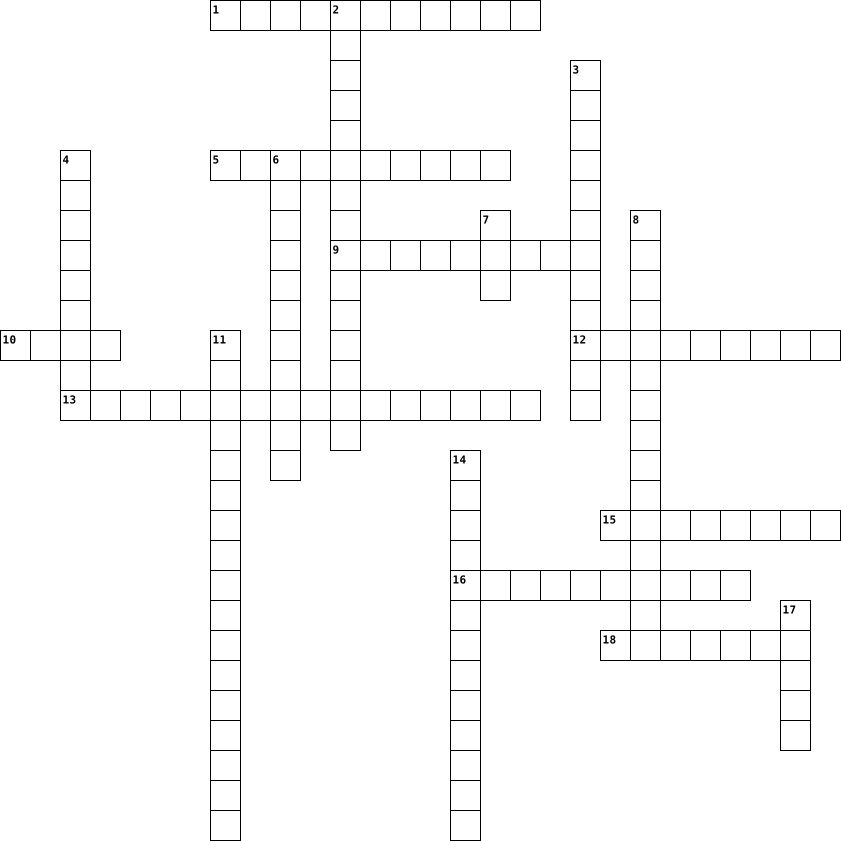
Across
- Who won the orange cup in 2019
- Which player scored the most runs in IPL 2019
- Which australian has the best bowling figure in IPL?
- How many times MI have won the IPL finals
- Which national team are called Baggy Greens?
- Maximum sixes award in IPL 2008
- thedistance between the popping crease and the bowling crease
- Which player is oldest to win the purple cap?
- Brand ambassador of Dream 11
Down
- Who was the emerging player of IPL 2020
- In which stadium, IPL 2014 Finals hosted?
- Owner of CSK team
- Current captain of Delhi Capitals?
- Which country hosted the IPL 2020
- Who won the first IPL
- Current Head Coach of MI
- Who was the Defending Champions in IPL 2020?
- How many teams participate in IPL
18 Clues: Owner of CSK team • Who won the first IPL • Current Head Coach of MI • Brand ambassador of Dream 11 • Who won the orange cup in 2019 • Maximum sixes award in IPL 2008 • Which country hosted the IPL 2020 • How many teams participate in IPL • Current captain of Delhi Capitals? • Who was the emerging player of IPL 2020 • In which stadium, IPL 2014 Finals hosted? • ...
SOUTH AFRICA 2026-05-11

Across
- South Africa biggest population
- Cape Town's mountain
- The missing flag colour: blue, black, red, yellow, white
- Number of official languages
- Located in which continent
- The most famous South African black man
- Superlative of iconic
Down
- A famous event in 2010, the first in Africa
- The largest national park
- Everyone safari's goal
- Superlative of far
- The most popular sport
- One of South Africa's three capitals
- The discrimination of black people in South Africa
14 Clues: Superlative of far • Cape Town's mountain • Superlative of iconic • Everyone safari's goal • The most popular sport • The largest national park • Located in which continent • Number of official languages • South Africa biggest population • One of South Africa's three capitals • The most famous South African black man • A famous event in 2010, the first in Africa • ...
for frankie 2024-03-11

Across
- ovechkin
- Miami messi
- ronaldo
Down
- terry mclaurin
- Lakers lebron
- diggs
6 Clues: diggs • ronaldo • ovechkin • Miami messi • Lakers lebron • terry mclaurin
asdfe 2026-03-21

Across
- Wealthy Cubans leaving after Castro’s rise to power
- Expedition encouraging westward exploration and settlement
- Treaty ending war and expanding United States southwest territory
- Major entry point for immigrants in New York
- Document required for international travel identification
- Land gained from Britain in Pacific Northwest region
- Forced movement of Indigenous peoples from ancestral lands
- Chinese system restricting internal migration rights and resources
- Cultural movement celebrating African American art and literature
- 1980 migration of Cubans seeking economic opportunity
- Laws enforcing racial segregation and inequality in southern states
- 1994 Cuban migration crisis after Soviet Union collapse
- Movement of people shaping societies, governments, and institutions
- Neighborhood where a specific cultural group is concentrated
- Movement of African Americans from South to North
- Transcontinental system enabling faster westward migration and trade
Down
- Movement of African Americans back to southern cities
- Border-free travel zone across European countries
- 1803 land deal doubling United States territory size
- Economic growth supported by immigrant labor supply
- Movement of people from rural areas into cities
- Organized flights bringing Cuban migrants to United States
- Belief United States meant to expand across North America
- Division of India causing mass migration and violence
- People forced to flee due to conflict or danger
- Westward movement reshaping United States territories and culture
- Migration driven by discovery of valuable natural resources
27 Clues: Major entry point for immigrants in New York • Movement of people from rural areas into cities • People forced to flee due to conflict or danger • Border-free travel zone across European countries • Movement of African Americans from South to North • Wealthy Cubans leaving after Castro’s rise to power • Economic growth supported by immigrant labor supply • ...
USA state 2023-06-19
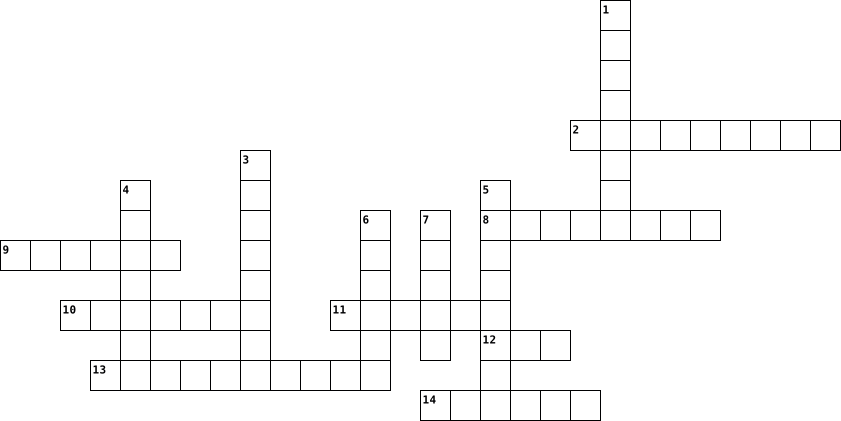
Across
- A state located in the Midwest region of the United States, known for its dairy industry, picturesque lakes, and outdoor recreation opportunities
- A state in the Midwest region of the United States, known for its major cities like Chicago and its contributions to art, architecture, and industry
- A state in the Pacific Northwest region of the United States, known for its scenic beauty, forests, and outdoor activities
- A state in the southwestern part of the United States, known for the Grand Canyon and desert landscapes
- A group of islands in the Pacific Ocean, known as the "Paradise of the Pacific" for its stunning beaches and tropical landscapes
- York A state located in the northeastern part of the United States, known for its vibrant city life, iconic landmarks, and cultural diversity
- A state located on the West Coast of the United States, known for its beaches, entertainment industry, and technology hub
- The largest state in the United States, known for its beautiful landscapes and wildlife
Down
- A state located in the Great Lakes region of the United States, known for its beautiful lakes, automobile industry, and sports teams
- A state located in the Rocky Mountain region of the United States, known for its scenic beauty and outdoor recreational activities
- A state located in the southeastern part of the United States, known for its sunny weather, beaches, and theme parks
- A state located on the East Coast of the United States, known for its rich history, colonial architecture, and natural beauty
- A state in the western part of the United States, known for its entertainment capital, Las Vegas, and its desert landscapes
- The second-largest state in the United States, known for its size, diverse landscapes, and cowboy culture
14 Clues: The largest state in the United States, known for its beautiful landscapes and wildlife • A state in the southwestern part of the United States, known for the Grand Canyon and desert landscapes • The second-largest state in the United States, known for its size, diverse landscapes, and cowboy culture • ...
chapitre 2 juliette 2022-09-29

Across
- movement combined a concern for general social ills with religious sentiment and practical health considerations in a way that was appealing to many middle-class reformers
- 3rd president of the united states
- Upheld constitutionality of the Bank of the United States
- first president of the united states
- .Reasserted federal judicial authority over state courts
- a meeting of supporters or members of a specific political party or movement
- the powers specifically mentioned in the Constitution
- to withdraw from an organization
- a formal act whereby a state proclaims its sovereignty over territory hitherto outside its domain
- doubtful or uncertain especially from obscurity or indistinctness
- Protected contracts from legislative interference
Down
- Court can accept appeals of state court decisions and review state decisions that involve federal statutes or treaties
- 7th president of the united states
- the constitutional theory that individual states can invalidate federal laws or judicial decisions they deem unconstitutional
- the political policy of promoting or protecting the interests of native or indigenous inhabitants over those of immigrants, including the support of immigration-restriction measures
- Declared congressional act unconstitutional
- a distinct article or provision in a contract, treaty, will, or other formal or legal written documents
- 4th president of the united states
- a league of persons, parties, or states
- 5th president of the united states
- 8th president of the united states
- 9th president of the united states
- .withdrawal of 11 slave states from the Union during 1860–61 following the election of Abraham Lincoln as president
- second president of the united states
- Revoked an existing state monopoly
- the movement to end slavery
26 Clues: the movement to end slavery • to withdraw from an organization • 7th president of the united states • 3rd president of the united states • 4th president of the united states • 5th president of the united states • 8th president of the united states • 9th president of the united states • Revoked an existing state monopoly • first president of the united states • ...
MODULE 6 Crossword Puzzle 2025-05-12

Across
- a war that occurred from 1947 to 1991
- a highly searched for teorrorist
- the team meant to kill Osama Bin Laden
- Organization of Petroleum Exporting Countries
- Dean one of Nixon's attorneys
- the 44th president of the United States last name
- a military campaign during the Vietnam War
- Arafat a leader of PLO
- an attempt to broker peace between Israel and the Arab world
- a guerilla group located in South Vietnam
- Palestine Liberty Organization
- the 39th president of the United States last name
- what did Ford do regarding Nixon's situatuion
- to extend health coverage to millions of uninsured Americans
- the 37th president of the United States first name
Down
- won in an election against Nixon
- the 40th president of the United States first name
- the 39th president of the United States first name
- the operation meant to kill Osama Bin Laden
- Mortgage-backed securities
- set up a communist Vietnam in 1954
- Strategic Arms Limitation Treaty
- 36th president of the United States
- a group in favor of the Vietnam war
- the 38th president of the United States first name
- the 38th president of the United States last name
- the 37th president of the United States last name
- a group that supported peace and wanted out of Vietnam
- a war that occurred from 1954 to 1975
- the day where the two twin towers in New York were bombed
- Global Financial Crisis
- the 40th president of the United States last name
- the 44th president of the United States first name
33 Clues: Arafat a leader of PLO • Global Financial Crisis • Mortgage-backed securities • Dean one of Nixon's attorneys • Palestine Liberty Organization • won in an election against Nixon • a highly searched for teorrorist • Strategic Arms Limitation Treaty • set up a communist Vietnam in 1954 • 36th president of the United States • a group in favor of the Vietnam war • ...
States 2017-03-07
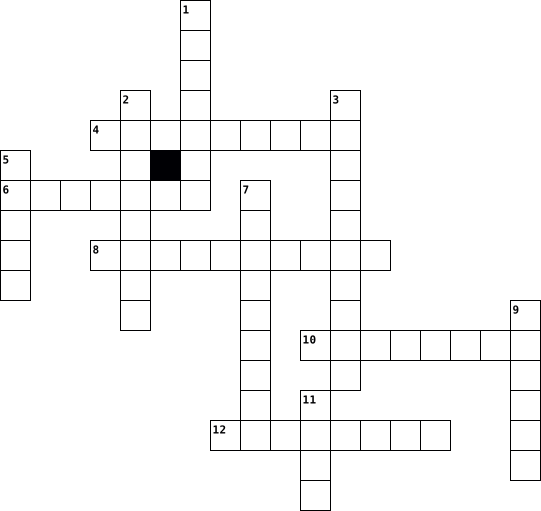
Across
- Hurricane Katrina hit here
- Its capital is Phoenix
- Its capital is Seattle
- One of its cities played a significant role in the American Revolution
- A famous hunter and pioneer in American History
Down
- Has a lot of alligators
- Its capital is Denver
- Where the gold rush in 1849 happened
- Its capital is Augusta
- Has a famous singer who's famous here Known as "The King of Rock and Roll"
- The 44th President of The United States is from here.
- Its capital is Salt Lake City
12 Clues: Its capital is Denver • Its capital is Augusta • Its capital is Phoenix • Its capital is Seattle • Has a lot of alligators • Hurricane Katrina hit here • Its capital is Salt Lake City • Where the gold rush in 1849 happened • A famous hunter and pioneer in American History • The 44th President of The United States is from here. • ...
States 2019-05-30
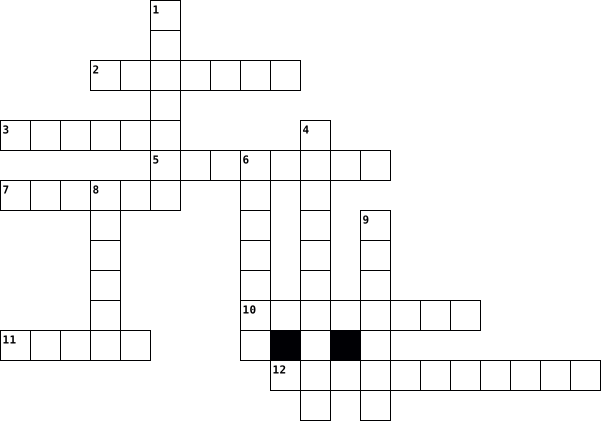
Across
- least populous
- Newest state
- first state
- lots of casinos
- Washington DC is located in
- boarders mexico
- has a city with no coffee shops
Down
- Disneyworld is located in
- Disneyland is located in
- has the abbreviation AL
- biggest state
- least spoken language
12 Clues: first state • Newest state • biggest state • least populous • lots of casinos • boarders mexico • least spoken language • has the abbreviation AL • Disneyland is located in • Disneyworld is located in • Washington DC is located in • has a city with no coffee shops
states 2022-08-06
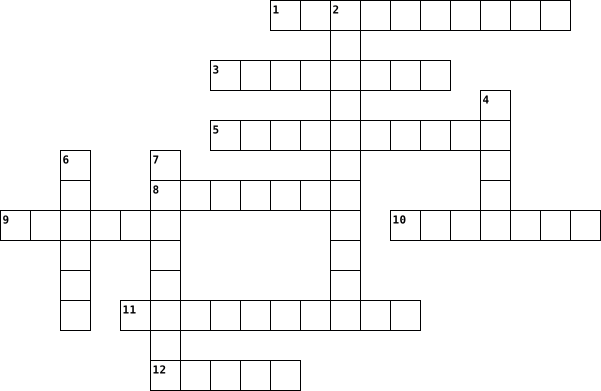
Across
- Arkansas
- Hawaii
- California
- Georgia
- Colorado
- Arizona
- Alabama
- Delaware
Down
- Florida
- Idaho
- Alaska
- Connecticut
12 Clues: Idaho • Hawaii • Alaska • Florida • Georgia • Arizona • Alabama • Arkansas • Colorado • Delaware • California • Connecticut
States 2023-09-26
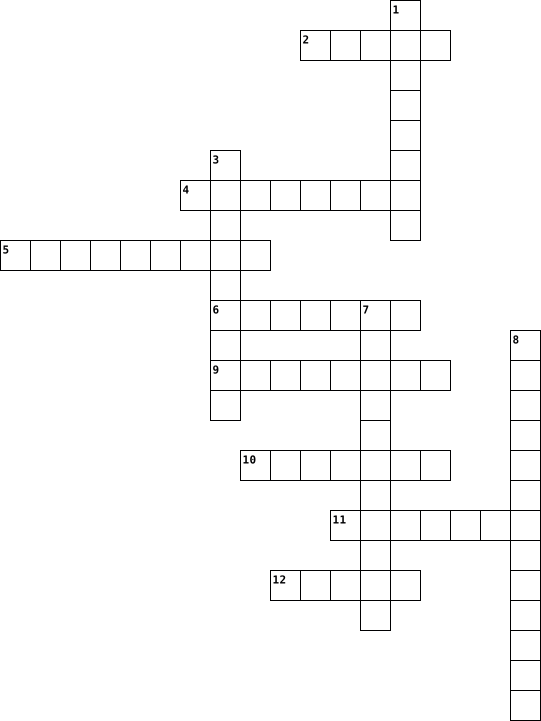
Across
- Lone star
- Mitten
- Enchantment
- Big Apple
- Prairie
- Cowboy
- Sunshine
- Pine tree
Down
- Old line
- Badger
- Rhody
- Palmetto
12 Clues: Rhody • Badger • Mitten • Cowboy • Prairie • Old line • Palmetto • Sunshine • Lone star • Big Apple • Pine tree • Enchantment
States 2024-10-23

Across
- Where vivian is from
- Where we live
- Where grandpa bills friend lives
- The state below us
- The really tall state
Down
- Where Adalynds teacher moved
- The boot state, east coast
- The state with all the fingerlakes
- Northern state, starts with M
- The state above us
- Islands
- Lots of tornados
12 Clues: Islands • Where we live • Lots of tornados • The state above us • The state below us • Where vivian is from • The really tall state • The boot state, east coast • Where Adalynds teacher moved • Northern state, starts with M • Where grandpa bills friend lives • The state with all the fingerlakes
STATES 2026-06-21

Across
- The Statue of Liberty and Times Square are here.
- Las Vegas, the city of casinos, is in this state.
- Also called "The Sunshine State". Orlando, Miami and Disney World are in this state.
- Known as the "Land of 10,000 Lakes", you'll see northern lights if you're lucky here.
- Crater Lake National Park can be found in this state.
- The largest of the 50 states, and home to Katmai and Wrangell St. Elias.
Down
- The Grand Canyon is located in this state, and home to Phoenix.
- French is spoken in some places here.
- Dallas, Houston and Austin are located in this state. Home to cowboys.
- Home to Los Angeles, San Francisco and Hollywood.
- state is made up of beautiful islands in the Pacific Ocean.
- You can visit Arches National Park here. Home to Salt Lake City.
12 Clues: French is spoken in some places here. • The Statue of Liberty and Times Square are here. • Home to Los Angeles, San Francisco and Hollywood. • Las Vegas, the city of casinos, is in this state. • Crater Lake National Park can be found in this state. • state is made up of beautiful islands in the Pacific Ocean. • ...
Unit 5 voc 2018-01-18

Across
- Act Hurt Britain
- Treaty British captured more than 250 American ships
- and Virginia resolutions Has an equal right to judge for itself
- policy A nation’s plan of action toward other nations
- Marshall The Chief Justice of the United States
- and Clark Floated toward the Columbia River
- Leaders in other states were organizing
- Proclamation Not support either side in the war
- Advice and were responsible for directing their departments
- Doctrine a principle of US policy, originated by President James Monroe in 1823, that any intervention by external powers in the politics of the Americas is a potentially hostile act against the US
- Law passed by the federal government
- Treaty between the United States and Spain in 1819 that ceded Florida to the U.S. and defined the boundary between the U.S. and New Spain.
- Advocacy of political independence for a particular country.
- Hamilton and his supporters
- rights In American political discourse
- vs Madison Tried before the Supreme court
- Rebellion Thousands marched in protest through the streets
Down
- and War of 1812
- Presidency an American statesman and Founding Father who served as the fifth President of the United States from 1817 to 1825.
- review The power of the court
- Act of 1789 Supreme Court
- Hawks The Twelfth Congress that met from 1811 to 1813 included a number of young and outspoken members who were foes of Great Britain and supporters of expansion by the United States
- restriction of interest to a narrow sphere; undue concern with local interests or petty distinctions at the expense of general well-being
- Forcing people into service
- Jefferson’s Presidency
- and Sedition Acts Pushed several laws through congress
- Purchase United States took control of the land vast lands west of the Mississippi
- of New Orleans A series of engagements fought between December 14, 1814 and January 18, 1815, constituting the last major battle of the War of 1812 American combatants
- of Ghent was the peace treaty that ended the War of 1812 between the United States of America and the United Kingdom of Great Britain and Ireland
- of Political Parties pg. 245
- An act or a decision that sets an example for other to follow
- To rulers of the Barbary States such as Tripoli
- Affair Did not deal directly with the Americans
33 Clues: and War of 1812 • Act Hurt Britain • Jefferson’s Presidency • Act of 1789 Supreme Court • Forcing people into service • Hamilton and his supporters • of Political Parties pg. 245 • review The power of the court • Law passed by the federal government • rights In American political discourse • Leaders in other states were organizing • vs Madison Tried before the Supreme court • ...
new case 2019-04-21

Across
- thousand eight First match of IPL(year)
- The Fairplay Award for IPL 2018.
- Winning team of IPL 2018
- Suspended teams for two seasons following their role in a match-fixing and betting scandal.
- How many teams have Parthiv Patel represented before IPL 2018?
- The Purple Cap winner in IPL 2018.
Down
- Runner-up team IPL 2016
- The Orange cap winner IPL 2018.
- The cricketer scored four hundred in the IPL 2016.
- Coach of Delhi Capitals
10 Clues: Runner-up team IPL 2016 • Coach of Delhi Capitals • Winning team of IPL 2018 • The Orange cap winner IPL 2018. • The Fairplay Award for IPL 2018. • The Purple Cap winner in IPL 2018. • thousand eight First match of IPL(year) • The cricketer scored four hundred in the IPL 2016. • How many teams have Parthiv Patel represented before IPL 2018? • ...
new case 2019-04-21

Across
- Coach of Delhi Capitals
- The Orange cap winner IPL 2018.
- Suspended teams for two seasons following their role in a match-fixing and betting scandal.
- The Purple Cap winner in IPL 2018.
- The Fairplay Award for IPL 2018.
Down
- Winning team of IPL 2018
- Runner-up team IPL 2016
- thousand eight First match of IPL(year)
- The cricketer scored four hundred in the IPL 2016.
- How many teams have Parthiv Patel represented before IPL 2018?
10 Clues: Runner-up team IPL 2016 • Coach of Delhi Capitals • Winning team of IPL 2018 • The Orange cap winner IPL 2018. • The Fairplay Award for IPL 2018. • The Purple Cap winner in IPL 2018. • thousand eight First match of IPL(year) • The cricketer scored four hundred in the IPL 2016. • How many teams have Parthiv Patel represented before IPL 2018? • ...
Unit 8 & 9 Key Terms 2024-05-01

Across
- A major confrontation in 1962 that brought the United States and the Soviet Union close to war over the presence of Soviet nuclear-armed ballistic missiles in Cuba
- Mass protest against the bus system of Montgomery
- A United States prompted war after the 9-11 terrorist attack in order to remove al-Qaeda from the region
- A period of economic, political and military tension between the United States and Soviet Union from 1945 to 1991
- A surprise attack on almost every provincial capital and American base in South Vietnam
- A fortified barrier that physically and ideologically divided Berlin from 1961 to 1989
- The costliest and one of the deadliest hurricanes in the history of the United States
- An armed conflict between a United States-led coalition force against the regime of Saddam Hussein from 2003 to 2011
- The unequal distribution of income and opportunity between different groups in society
- Push back against racism in policing and empower Black Americans
Down
- War to weed out terrorist operatives and their supporters throughout the world
- An illegal break-in at the Democratic National Committee offices in 1972 by members of President Nixon's reelection campaign staff
- An update of the 1965 Immigration Act and outlawed the hiring of undocumented immigrants
- The federal economic polices of the Reagan administration
- A set of domestic programs in the United States aiming to eliminate poverty and racial injustice
- Fought between 1950 and 1953 between North Korea and its Soviet and Chinese allies and South Korea and United Nations' forces directed by the United States
- When businesses begin to operate internationally
- Activism that sought to secure full political, social, and economic rights for African Americans in the period from 1946 to 1968
- Conflict that pitted the communist government of North Vietnam against South Vietnam and its principal ally, the United States
- A method of coercion that utilizes or threatens to utilize violence in order to spread fear and thereby attain political or ideological goals
20 Clues: When businesses begin to operate internationally • Mass protest against the bus system of Montgomery • The federal economic polices of the Reagan administration • Push back against racism in policing and empower Black Americans • War to weed out terrorist operatives and their supporters throughout the world • ...
unit 3 vocab 2023-10-25

Across
- of 1800-Federalist incumbent John Adams ran against the rising Republican Thomas Jefferson. The extremely partisan and outright nasty campaign failed to provide a clear winner because of a constitutional quirk.
- Spangled Banner-the Star-Spangled Banner. 1. the national anthem of the United States of America. 2. another term for the Stars and Stripes.
- Washington-1st President of the United States; commander-in-chief of the Continental Army during the American Revolution (1732-1799)
- Court-he highest federal court in the US, consisting of nine justices and taking judicial precedences over all other courts in the nation.
- and Clark-a U.S. military expedition, led by Captain Meriwether Lewis and Lieutenant William Clark, to explore the Louisiana Purchase and the Pacific Northwest
- Affair-a diplomatic incident between French and United States diplomats that resulted in a limited, undeclared war known as the Quasi-War
- v. Madison-established the principle of judicial review—the power of the federal courts to declare legislative and executive acts unconstitutional.
- of New Orleans-fought on January 8, 1815, between the British Army under Major General Sir Edward Pakenham and the United States Army under Brevet Major General Andrew Jackson
- body of advisers to a head of state who also serve as the heads of government departments.
- Jefferson-an American Founding Father, the principal author of the Declaration of Independence (1776), and the third President of the United States (1801–1809).
- act of cancelling something
- Parties-collective entities that organize competitions for political offices.
- by force
- Rebellion-the first test of federal authority in the United States.
- Adams-A political leader of the late eighteenth and early nineteenth centuries; one of the Founding Fathers
Down
- state of not supporting or helping either side in a conflict, disagreement, etc.; impartiality.
- Party-a conservative and nationalist American political party and the first political party in the United States. Under Alexander Hamilton, it dominated the national government from 1789 to 1801.
- Monroe-was an American statesman, lawyer, diplomat, and Founding Father who served as the fifth president of the United States from 1817 to 1825, a member of the Democratic-Republican Party.
- opposition political party in the United States
- of Ghent-agreement in Belgium between Great Britain and the United States to end the War of 1812 on the general basis of the status quo antebellum (maintaining the prewar conditions).
- Pirates-any of the Muslim pirates operating from the coast of North Africa, at their most powerful during the 17th century but still active until the 19th century.
- College-a body of people representing the states of the US, who formally cast votes for the election of the president and vice president.
- of Good Feelings-marked a period in the political history of the United States that reflected a sense of national purpose and a desire for unity among Americans in the aftermath of the War of 1812.
- Hamilton-Alexander Hamilton was a founding father of the United States, who fought in the American Revolutionary War, helped draft the Constitution, and served as the first secretary of the treasury. He was the founder and chief architect of the American financial system.
- Address-a speech given by an individual leaving a position or place.
- Madison-America's fourth President (1809-1817), made a major contribution to the ratification of the Constitution by writing The Federalist Papers, along with Alexander Hamilton and John Jay. In later years, he was referred to as the “Father of the Constitution.
- Andrew Jackson-served as the seventh president of the United States from 1829 to 1837. Before being elected to the presidency, he gained fame as a general in the U.S. Army and served in both houses of the U.S. Congress.
- and Sedition Acts-tightened restrictions on foreign-born Americans and limited speech critical of the government.
- Purchase-the purchase of imperial rights to the western half of the Mississippi River basin from France by the United States in 1803.
- of 1812-The War of 1812 was fought by the United States of America and its indigenous allies against the United Kingdom and its own indigenous allies in British North America, with limited participation by Spain in Florida. It began when the United States declared war on 18 June 1812
30 Clues: by force • act of cancelling something • opposition political party in the United States • Rebellion-the first test of federal authority in the United States. • Address-a speech given by an individual leaving a position or place. • Parties-collective entities that organize competitions for political offices. • ...
The Gilded Age People 2021-12-08

Across
- Black American who believed that blacks should accept segregation and better themselves through education and job skills before trying to gain rights.
- 17th President of the United States (1865-1869), an old-fashioned southern Jacksonian Democrat of pronounced states’ rights views.
- 23rd President of the United States (1889-1893), American lawyer and politician.
- Journalist, lecturer, and civil rights militant best known for her crusade against lynching and her efforts to expose violence against blacks.
- Scottish-born industrialist who developed the U.S. steel industry. Mastered vertical integration to build his monopoly and limit competition and funded many libraries.
- An Oglala Sioux Indian chief who fought against removal to a reservation in the Black Hills. He united with Chief Sitting Bull for the Battle of the Little Bighorn.
- 18th president of the United States(1869-1877), American military officer and politician.
- United States lawyer and politician who advocated free silver.
- Formed the American Railway Union in 1892 and led the Pullman strike.
- Published “The History of the Standard Oil Company” she revealed the illegal means used by John D. Rockefeller to monopolize the early oil industry.
- Journalist and social reformer who publicized the crises in housing, education, and poverty in New York City in the late nineteenth century.
- American historian; said that humanity would continue to progress as long as there was new land to move into.
Down
- A U.S. commander in wars against Native Americans over control of the Great Plains. He led his men in the Battle of the Little Bighorn.
- 22nd and 24th president of the United States (1885-1889), Democrat who achieved the Interstate Commerce Commission and civil service reform.
- 19th president of the United States(1877-1881), part of the Hayes-Tilden election, the most corrupt election in US history.
- United States labor leader who was president of the American Federation of Labor from 1886 to 1924.
- 25th president of the United States (1897-1901), responsible for the Spanish-American War and Philippine-American War, and was assassinated by an anarchist.
- 20th president of the United States(1881), Republican, was assassinated by Charles Julius Guiteau after a few months.
- The leader of the Sioux warriors who defeated General George Armstrong Custer's force in the battle of Little Big Horn.
- An investment banker who channeled European capital into America and grew into a financial power and controlled one-sixth of the nation's railway system.
- The founder of Hull House
- 21st president of the United States (1881-1885), became president after Garfield was assassinated.
- An American industrialist and philanthropist who revolutionized the petroleum industry and modern philanthropy.
- He believed that African Americans should strive for full rights immediately. He also helped found the NAACP and earned a Ph.D. from Harvard.
24 Clues: The founder of Hull House • United States lawyer and politician who advocated free silver. • Formed the American Railway Union in 1892 and led the Pullman strike. • 23rd President of the United States (1889-1893), American lawyer and politician. • 18th president of the United States(1869-1877), American military officer and politician. • ...
U.S. CONSTITUTION CROSSWORD PUZZLE 2018-03-15

Across
- This British act levied an internal tax on various documents and articles in the American colonies.
- What is the head executive of a city government called?
- The destruction of a cargo of tea by colonists who were opposed to the tea tax is known as the _____ Tea Party.
- The _____ Continental Congress called for peace, made preparations for war, and declared independence.
- A change to the United States Constitution is called an _____.
- The United States president is elected for _____ years.
- The Senate and the House of Representatives is what we call _____.
- How many Supreme Court justices are there?
- The _____ of the United States elect Congress.
Down
- It is the duty of Congress to make _____.
- Pilgrim agreement (compact) before landing at Plymouth to pass and obey laws for the good of the colony.
- What is the head executive of a state government called?
- How many full terms can the president of the United States serve?
- Article _____ of the Constitution tells how the Legislative Branch of government should work.
- There is one _____ for each state in the Union on the United States flag.
- Article _____ sets forth the ways to amend the Constitution.
- The Constitution of the United States can be _____.
- Article _____ states that the Constitution shall be the supreme law of the land.
- How many branches are there in the government of the United States?
19 Clues: It is the duty of Congress to make _____. • How many Supreme Court justices are there? • The _____ of the United States elect Congress. • The Constitution of the United States can be _____. • What is the head executive of a city government called? • The United States president is elected for _____ years. • What is the head executive of a state government called? • ...
Southwest States and Capitals 2023-10-10

Across
- Capital of Oklahoma
- Capital of Texas
Down
- Capital of New Mexico
- Capital of Arizona
4 Clues: Capital of Texas • Capital of Arizona • Capital of Oklahoma • Capital of New Mexico
history 2023-03-17

Across
- the second dynasty (in china) was the _____
- the _____ dynasty was when chinese characters evolved
- the ____ ruled florida,mexico, and the caribbean
- china was famous for its _____
- the first writing was in _____
- the ___ kingdom(in egypt) lasted from 1570-1085 bce
- the great wall of china was built in the _____dynasty
- famous explorer that traveled on the silk road
- war between athens and sparta
- a recent discovery has proved that there were other humans at the time of the neanderthals
- capitals of assyrain empire (in alphabetical order)
- napoleon began his downfall at the battle of ______
- major trade country
- fertile land to the east of the mediterranean (other correct answer is canaan
- kings who tried to conquer greece from 492-479 bce
- only two countries in africa never to be colonized
- empire in modern day turkey
- capital of aztecs
- a volcano on the island of ___ (modern day santorini)marked the decline of minoan civilization
- towns at the end(and begining) of the silk road
- the ___ (in egypt) lasted from 2180-2040 bce
Down
- the ___ (in egypt) lasted from 1786-1570 bce
- ____ overtook the assyrain empire
- ____ overtook the median empire
- 113-197 ce rome fought the _____empire
- ____ took over the aztecs
- ____ took over the inca
- _____ was a major trade item from 2350-1800 bce
- three of the first communities(in alphabetical order)
- war from 1337-1453
- ____ took over the maya
- romes worst enemies
- ____ overtook the persian empire
- when minoan civilization declined ______ took over
- the ___ kingdom(in egypt) lasted from 2040-1786 bce
- the first alphabet was the ____ (other correct answer is the proto-sinatic alphabet)
- christianity had its origins in _____
- drug that began the _____ wars
- the ___ kingdom(in egypt) lasted from 2700-2180 bce
- ____ ruled the east coast of the united states
- the poem the ___ tells of a war that is greece vs troy
41 Clues: capital of aztecs • war from 1337-1453 • romes worst enemies • major trade country • ____ took over the inca • ____ took over the maya • ____ took over the aztecs • empire in modern day turkey • war between athens and sparta • china was famous for its _____ • the first writing was in _____ • drug that began the _____ wars • ____ overtook the median empire • ...
The Constitution 2016-10-05

Across
- All _____contracted and engagements entered into, before the adoption of this Constitution, shall be as valid against the United States under this Constitution
- Congress is ___ in form which means it's composed
- The President can ,by and with the advice and consent of the __________, make treaties and nominate ambassadors, other public ministers and consuls, judges of the Supreme Court, and all other officers of the United States.
- The ______ does not in any way give preference to one state over another.
- To be a ______, the person must be over the age of 25, been a citizen of the U.S and must be living in the state that they are chosen from.
- Article _____ states that the Constitution shall be the supreme law of the land.
- The President, Vice President and all civil officers of the United States can be removed from office through the process of __________.
Down
- The ___________ is where you find the phrase “in order to form a more perfect union”
- To change the Constitution, at least two thirds of both the ____________ and the senate have to propose an Amendment to the Constitution.
- After an amendment is officially proposed, it must then be ratified, or approved on, by the __________of at least 75% of the states.
- The judicial power of the United States is ________.
- The ___________ is in office for a four year term.
- The _______________ of the Conventions of nine States, shall be sufficient for the Establishment of this Constitution between the States so ratifying the same.
- The United States shall guarantee to every state in this union a ________form of government
- The ________ has the power to lay and collect taxes, duties, imposts and excises, to pay the debts and provide for the common defense and general welfare of the United States.
- Any criminal fleeing one state is required to return the criminal to the proper state of __________.
- The Congress shall have power to declare the punishment of ______.
17 Clues: Congress is ___ in form which means it's composed • The ___________ is in office for a four year term. • The judicial power of the United States is ________. • The Congress shall have power to declare the punishment of ______. • The ______ does not in any way give preference to one state over another. • ...
Fun Facts 2022-03-30

Across
- National dish of SouthAfrica
- Pink lake in senegal
- most spoken language on the continent
- Africa's tallest peak
- world's largest green canyon
- the dominant religion in Africa
Down
- Only country in the world with 3 capitals
- African language spoken in Black panther
- largest desert in the world
- Africa's highest waterfalls
- the only remainder of the 7 Ancient wonders
- world's largest living frog
- the world's largest waterfall
- African language spoken in Lion King
- the world's longest river
- first indigenous african to win Miss world
16 Clues: Pink lake in senegal • Africa's tallest peak • the world's longest river • largest desert in the world • Africa's highest waterfalls • world's largest living frog • National dish of SouthAfrica • world's largest green canyon • the world's largest waterfall • the dominant religion in Africa • African language spoken in Lion King • most spoken language on the continent • ...
NHL Teams 2024-04-11

Across
- Might change locations
- Largest arena in the NHL
- Started the storm surge
- Play in the heart of Canada
- Silver helmets
- President's Trophy winners in 2022-2023
Down
- Used to be the Nordiques
- Best players of all time have played here
- Lead one of the biggest upsets in NHL history
- Sketchy LTIR history
- Play near the White House
- Newest team in the NHL
12 Clues: Silver helmets • Sketchy LTIR history • Might change locations • Newest team in the NHL • Started the storm surge • Used to be the Nordiques • Largest arena in the NHL • Play near the White House • Play in the heart of Canada • President's Trophy winners in 2022-2023 • Best players of all time have played here • Lead one of the biggest upsets in NHL history
NORTH AND SOUTH 2026-02-11

Across
- Law allowing settlers to decide if a territory allowed slavery.
- Farming as a way of life and main Southern occupation.
- Idea that people vote to decide an issue.
- President elected in 1860 whose election angered the South.
- The system in which people were treated as property and forced to work.
- Agreement that balanced slave and free states in 1820.
- Law requiring escaped enslaved people to be returned.
- The Northern states that wanted to remain one country.
- To withdraw or leave the Union.
Down
- The system of producing and using goods and money.
- The belief that states should decide their own laws.
- Large farms in the South that relied on enslaved labor.
- Southern states that separated from the United States.
- An agreement made to settle disputes between opposing sides.
- Event that triggered Southern secession and the Civil War.
- Loyalty to one region rather than the whole nation.
- Presidential election that increased tensions between North and South.
- Movement to end slavery and those who supported it.
- Taxes on imported goods that caused tension between North and South.
- The North’s economy depended on factories and manufacturing.
20 Clues: To withdraw or leave the Union. • Idea that people vote to decide an issue. • The system of producing and using goods and money. • Loyalty to one region rather than the whole nation. • Movement to end slavery and those who supported it. • The belief that states should decide their own laws. • Law requiring escaped enslaved people to be returned. • ...
North and South 2026-02-17

Across
- Law allowing settlers to decide if a territory allowed slavery.
- Farming as a way of life and main Southern occupation.
- Idea that people vote to decide an issue.
- President elected in 1860 whose election angered the South.
- The system in which people were treated as property and forced to work.
- Agreement that balanced slave and free states in 1820.
- Law requiring escaped enslaved people to be returned.
- The Northern states that wanted to remain one country.
- To withdraw or leave the Union.
Down
- The system of producing and using goods and money.
- The belief that states should decide their own laws.
- Large farms in the South that relied on enslaved labor.
- Southern states that separated from the United States.
- An agreement made to settle disputes between opposing sides.
- Event that triggered Southern secession and the Civil War.
- Loyalty to one region rather than the whole nation.
- Presidential election that increased tensions between North and South.
- Movement to end slavery and those who supported it.
- Taxes on imported goods that caused tension between North and South.
- The North’s economy depended on factories and manufacturing.
20 Clues: To withdraw or leave the Union. • Idea that people vote to decide an issue. • The system of producing and using goods and money. • Loyalty to one region rather than the whole nation. • Movement to end slavery and those who supported it. • The belief that states should decide their own laws. • Law requiring escaped enslaved people to be returned. • ...
U.S. History 2021-01-03

Across
- treaty, a peace agreement made between two parties
- compromise, an agreement passed by the U.S. Congress in 1820
- and Clark expedition, an expedition used to find a waterway from the US to the Pacific Ocean
- annexation
- Hidalgo, a peace treaty that ended the war between the United States and Mexico
- expansion, an extension of a state's territory
- a state in the southeastern region in the U.S.
- destiny, the belief that American settlers were destined to expand across North America
- War, a war lead by Napoleon Bonaparte
Down
- American War, an armed conflict between the United States and Mexico
- Purchase, a land deal that was made between the United States and France in the year 1803
- states, the 13 states that permitted slavery between 1820 and 1860
- the ability to move things from one place to another by boat
- York City, the most populous city in the United States
- war, a war that occurred in 1775 - 1783
- Canal, a waterway that was built to create a navigable water route from New York City and the Atlantic Ocean to the Great Lakes
- of 1812, a military conflict between the United States and the British empire
17 Clues: annexation • War, a war lead by Napoleon Bonaparte • war, a war that occurred in 1775 - 1783 • expansion, an extension of a state's territory • a state in the southeastern region in the U.S. • York City, the most populous city in the United States • treaty, a peace agreement made between two parties • compromise, an agreement passed by the U.S. Congress in 1820 • ...