
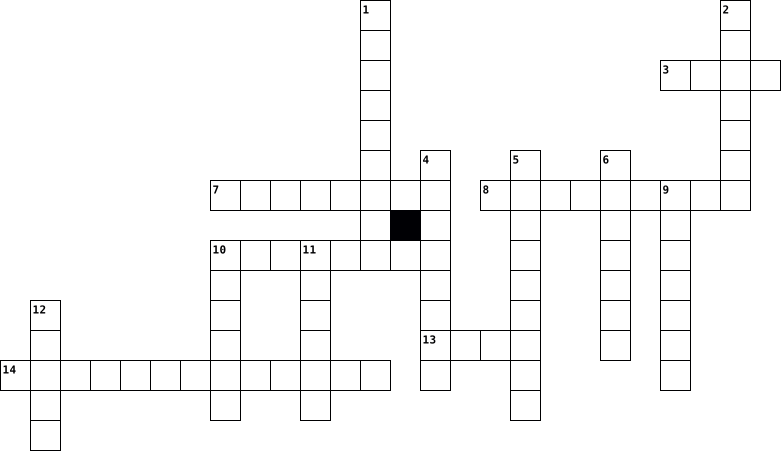
triangles Crossword Puzzles
complete the crossword puzzle below. 2018-01-04

Across
- of symmetry A graph that passes through its minimum/maximum point
- the space (usually measured in degrees) between two intersecting lines or surfaces at or close to the point where they meet.
- it means four
- exponent all numbers,letters,expression raise to 0 power is equal to 1
- A relationship of variation between two variables in which the product is a constant
- it involves nth root
- a quantity representing the power to which a given number or expression is to be raised, usually expressed as a raised symbol beside the number or expression (e.g., 3 in 23 = 2 × 2 × 2)
- the branch of mathematics dealing with the relations of the sides and angles of triangles and with the relevant functions of
- plural of index
- The angle below horizontal that an observer must look to see an object that is lower than the observer
- Quadratic graphs that are part of curved family
- the length of the opposite side divided by the length of the adjacent side
- an angle between 90 degree-180 degree
- in the word quadrilateral, lateral means?
- An expression that involves radical sign (√͞ or √)
Down
- mathematical relationship between two variables that can be expressed by an equation in which one variable is equal to a constant times the other
- we can obtain this ratio by multiplying or dividing both parts by the same constant.
- the trigonometric function that is equal to the ratio of the side opposite a given angle (in a right triangle) to the hypotenuse
- Equations that have one or more algebraic fractions
- the trigonometric function that is equal to the ratio of the side adjacent to an acute angle (in a right-angled triangle) to the hypotenuse.
- longest side of a right-angled triangle
- The expression b²-4ac
- the quantitative relation between two amounts showing the number of times one value contains or is contained within the other
- Expression that consists of algebraic terms, operation symbols or bracket signs
- a theorem in geometry: the square of the length of the hypotenuse of a right triangle equals the sum of the squares of the lengths of the other two sides.
- quadrilateral with four right angles
- The angle above horizontal that an observer must look to see an object that is higher than the observer
- has equal sides and every angle is a right angle (90°)
- the product of two irrational numbers
- A relationship of variation between two variables in which one is a constant multiple of the other
30 Clues: it means four • plural of index • it involves nth root • The expression b²-4ac • quadrilateral with four right angles • the product of two irrational numbers • an angle between 90 degree-180 degree • longest side of a right-angled triangle • in the word quadrilateral, lateral means? • Quadratic graphs that are part of curved family • ...
Holiday Mashup 2023-12-12

Across
- What are the triangles on the Times Square ball made from?
- Where was the first celebration of Independence Day held?
- What's another name for a lycanthrope?
- Who was the first President to pardon a turkey?
- What actor played Laurie Strode in the 1978 movie "Halloween?"
- What materials made up the first-ever Times Square New Year's Eve Ball?
- Where and when was the first St. Paddy’s Day celebration in the British American colonies?
- What is the location of the nation’s oldest Fourth of July parade?
- How much does the sparkling Waterford Crystal Times Square New Year's Eve Ball weigh?
- The combined might of Bing Crosby, Fred Astaire, and Irving Berlin helped make this song from the 1942 musical film Holiday Inn the biggest Christmas song ever. What was the song?
- What vegetable was once thought to have supernatural powers on Halloween?
- How many Shamrock Shakes have ever been sold?
- Are pumpkins technically a fruit or vegetable?
- How long was the first Thanksgiving celebration?
- How many versions of the Times Square New Year's Eve Ball have there been to date?
- What metal replaced iron in the Times Square New Year's Eve Ball?
- Both gingerbread houses and candy canes were almost certainly introduced to the U.S. by immigrants from what country?
- What is the name of an Irish potato cake?
- What country has a tradition of eating KFC on Christmas day?
- Which Halloween candy is considered the worst?
Down
- Who is credited with writing the poem "Auld Lang Syne?"
- Which American president was born on July 4th?
- Every Independence Day, how many times does the Liberty Bell ring?
- What is another name for a large kettle or boiler?
- Of which country is Saint Patrick the patron saint?
- Which movie tops Rotten Tomatoes' list of the Scariest Horror Movies Ever?
- Where was the first Turkey Trot?
- Many cultures have a tradition of hanging this food-shaped ornament on the Christmas tree. What is the item?
- The holiday decoration tinsel was originally made from strands of what metal?
- How many women were at the very first Thanksgiving celebration?
- Where did the tradition of celebrating Christmas in July start?
- Where was the first St. Patrick's Day parade ever recorded?
- Do Americans prefer apple pie or pumpkin pie?
- Which of the four presidents on Mt. Rushmore is rumored to have had his own recipe for eggnog?
- How much confetti is dropped in Times Square on New Year's Eve?
- Which president of the United States was the first to host a Fourth of July celebration at the White House?
36 Clues: Where was the first Turkey Trot? • What's another name for a lycanthrope? • What is the name of an Irish potato cake? • Do Americans prefer apple pie or pumpkin pie? • How many Shamrock Shakes have ever been sold? • Which American president was born on July 4th? • Are pumpkins technically a fruit or vegetable? • Which Halloween candy is considered the worst? • ...
Historic Figures 2024-01-19

Across
- Byzantine emperor who reconquered much of the former Western Roman Empire
- Leader of the Mali Empire, known for being the richest person of all time
- Macedonian king who conquered Greece, father of Alexander
- English king who was forced by his nobles to sign the Magna Carta
- French military leader that helped France win the Hundred Years War, burned at the stake
- Invented the Cyrillic Language to spread Christianity to Slavic peoples
- King of the Franks who was crowned by the Pope as Holy Roman Emperor
- Father of Humanism
- Leader of the Muslim forces in the second and third Crusades, known for his religious toleration
- Pope who started the First Crusade
- Led Hebrews out of slavery in Egypt, received the 10 Commandments
- Original name was Octavian, first Emperor of the Roman Empire
- Leader of the Norman invasion of Britain, won the Battle of Hastings in 1066
- Last of the great Greek philosophers, teacher of the Alexander
- Islamic Caliph who was assassinated which caused the Sunni/Shia split in Islam
- Roman emperor who converted to Christianity, the city of Byzantium was renamed after him
- Most famous of the Greek storytellers, wrote the Iliad and Odyssey
- Macedonian who conquered the Persian Empire and spread Hellenic Culture
- Greek considered the father of geometry
- Founder of Doaism, a philosophy of going with the flow and oneness with nature
Down
- Created a formula to find the length of a triangles hypotenuse
- Indian prince who found the path to Enlightenment, founder of Buddhism
- Member of the First Triumvirate, became dictator of Rome, ended the republic, and was assassinated by the Senate
- Carthaginian general in the second Punic War, Rome's most formidable foe
- United China under the Qin dynasty, constructed the Great Wall
- Sculpted the Statue of David and painted the Sistine Chapel
- Founded a code of politeness that emphasized ancestor worship, correct behavior, and social order
- Leader of Athens during its golden age, built the Parthenon, expanded democracy
- English King who instituted Common Law and trial by jury
- Found of Islam
- Founder of Christianity
- Painter of the Last Supper and the Mona Lisa, quintessential Renaissance Man
- Persian emperor who was known for being tolerant of conquered peoples religion, freed the Jews from exile
- Founder of Judaism, first Hebrew, father of monotheism
- Emperor of the Mauryan Empire in India, spread Buddhism throughout Asia
- Roman poet who wrote the epic the Aeneid
- King of Babylon in Mesopotamia, first written law code
- Roman scientist who introduced the Heliocentric Model
38 Clues: Found of Islam • Father of Humanism • Founder of Christianity • Pope who started the First Crusade • Greek considered the father of geometry • Roman poet who wrote the epic the Aeneid • Roman scientist who introduced the Heliocentric Model • Founder of Judaism, first Hebrew, father of monotheism • King of Babylon in Mesopotamia, first written law code • ...
Geometry Terms 2024-05-07

Across
- A system of reasoning that uses facts, rules, definitions, or properties to reach logical conclusions; a logical approach where you go from general ideas to specific conclusions.
- a figure formed by two rays or lines that meet at a common end point; They are measured in degrees.
- has no size; length, width, or height; It is represented by a dot and named by a capital letter.
- set of points that has infinite length, but no width or height; It is named by a lower case letter or by any two points on the figure.
- an angle that measures less than 90 degrees; an angle that measures more than zero degrees.
- in a conditional statement, the statement that immediately follows the word "if"; It's an assumption or idea that's proposed for the purpose of argument so that it can be tested to see if it might be true.
- a three-dimensional figure on which the faces are triangles and converge to a single point on top; They are named after the shape of their base.
- The branch of mathematics that deals with points, lines, planes, and solids; This branch examines properties.
- a statement that describes a fundamental relationship between the basic terms of geometry; They are accepted as true without proof
- two lines that cross; two lines that form four right angles.
Down
- figure formed by three segments joining three noncolinear points; Each of the three points is a vertex of the figure and the segments are the sides.
- a line segment that connects the center of a circle to its outer edges; The distance around a circle.
- An educated guess based on known information; a mathematical statement that has not yet been rigorously proven.
- reasoning that uses a number of specific examples to arrive at a plausible prediction; a method of drawing conclusions by going from the specific to the general.
- set of points that has infinite length and width, but no height; Named with a capital 'funny font' letter
- a unit used to measure distances around a circle; One of these is equal to 1/360 of a full circle.
- a closed two-dimensional figured composed of straight line segments that meet at their end points; The line segments are called sides.
- the point at which two sides of a two-dimensional figure or the edges of a three-dimensional figure meet; They are also known as corners.
- non-coplanar lines; They will not intersect.
- a proof that organizes statements in logical order, starting with given statements; Each statement is written in a box with the reason verifying the statement below the box
20 Clues: non-coplanar lines; They will not intersect. • two lines that cross; two lines that form four right angles. • an angle that measures less than 90 degrees; an angle that measures more than zero degrees. • has no size; length, width, or height; It is represented by a dot and named by a capital letter. • ...
Geomotry Cross word puzzle. 2024-05-15

Across
- The point exactly halfway along a segment.
- The distance around a circle.
- An angle whose vertex is the center of the circle.
- An arc measuring less than 180 degrees.
- Angles that have the same measure.
- A part of a line with two endpoints.
- In a right triangle, the square of the hypotenuse is equal to the sum of the squares of the other two sides.
- The set of all points equidistant from a central point.
- Points that lie on the same flat surface.
- A portion of the circumference of a circle.
- An infinite flat surface.
- The ratio of the length of the side opposite an acute angle to the hypotenuse in a right triangle.
- Perpendicular segment from the vertex of a solid to the opposite base.
- A parallelogram with four right angles.
- A line that divides a figure into two congruent halves.
- Two angles whose sum is 90 degrees.
- An angle that measures exactly 90 degrees.
- An arc measuring more than 180 degrees.
- A triangle with all angles congruent.
- A set of points in space equidistant from a fixed point.
- A quadrilateral with one pair of parallel sides.
- A line that divides an angle into two equal parts.
- The sum of the areas of the lateral faces.
- Angles formed by two chords in a circle.
- A polygon with three sides and three angles.
- A line segment joining a vertex to the midpoint of the opposite side.
- An angle larger than a right angle but less than a straight angle.
Down
- A triangle with one angle greater than 90 degrees.
- Circles with the same radius.
- The distance around a polygon.
- A quadrilateral with opposite sides parallel.
- A closed figure formed by straight lines.
- A polygon with four sides.
- A polygon with all sides and angles congruent.
- The amount of space occupied by a solid.
- Triangles with corresponding sides and angles equal.
- Lines that intersect at right angles.
- A solid with two congruent circular bases.
- A straight path extending infinitely in both directions.
- A parallelogram with all sides equal.
- An angle smaller than a right angle.
- A triangle with one angle equal to 90 degrees.
- A prism where all sides are squares.
- Segments that have the same length.
- A line segment joining two points on the circle.
- A comparison of two quantities using division.
- A prism whose lateral faces are rectangles.
- A line touching a circle at exactly one point.
- Lines that never intersect and are in the same plane.
- The measure of the space enclosed by a surface.
50 Clues: An infinite flat surface. • A polygon with four sides. • Circles with the same radius. • The distance around a circle. • The distance around a polygon. • Angles that have the same measure. • Segments that have the same length. • Two angles whose sum is 90 degrees. • A part of a line with two endpoints. • An angle smaller than a right angle. • ...
Savannah DiPasquale - Honors Geometry - Final Project 2022-05-24

Across
- I describe angle measurements larger than 90 degrees. In a triangle, if there is one of my angles, all other angles must be acute.
- I have 5 sides and I am 3-dimensional. 4 of my sides are triangles and my base is a square.
- I am a quadrilateral with two sets of parallel sides. I can be identified as a rectangle, square, or rhombus.
- I am the center point of a line segment. If another line crosses through me, it creates a bisector.
- I am a transformation that causes something to rotate. It may rotate around the origin or a specified point.
- I have 4 equal sides. All of my angles are equal.
- I am the distance from the center to the edge of a circle. I am half of the diameter.
- I am a transformation that causes things to move. I can make things move up or down and/or left or right.
- I am one of the axes on a graph. I help control horizontal changes.
- I am the very center point of a graph. Different transformations can be formed around me.
- I am a shape with a 360 degree angle sum. My area can be found with the equation: pi*r^2.
Down
- I am made up of 4 sides. I have numerous subsets including squares, rectangles, kites, and more.
- I am a segment that crosses through the midpoint of another segment. I can be used to make perpendicular lines.
- I have 6 sides and I am 3-dimensional. All of my sides are squares.
- I am a transformation that causes something to shrink or grow. It may grow/shrink around the origin or around a specified point. These changes in size are determined by a scale factor.
- I am a transformation that is used to flip something over a line. I can be used on an x-axis, y-axis, or any line with a specified location and slope.
- I describe shapes and other objects that are equal in every which way. When I describe shapes, the shapes must have all equal angles, and all equal segment lengths.
- I describe 2 coplanar lines that will never intersect. These lines have the same slope.
- I am one of the axes on a graph. I help control vertical changes.
- I am a parallelogram with one set of sides larger than the other set. All of my angle measurements equal 90 degrees.
- I have 3 sides and 3 angles. I can be isosceles and right, too.
21 Clues: I have 4 equal sides. All of my angles are equal. • I have 3 sides and 3 angles. I can be isosceles and right, too. • I am one of the axes on a graph. I help control vertical changes. • I have 6 sides and I am 3-dimensional. All of my sides are squares. • I am one of the axes on a graph. I help control horizontal changes. • ...
Terminology 2 2024-11-07

Across
- A device that limits the travel of sash (fall prevention) with an emergency escape (egress) release mechanism. Hint: Acronym, 4 letters
- A window very similar to a double hung window, except that the top sash is stationary or non-operable.
- A pattern glass that provides privacy while maintaining full light transmission. It is formed by running molten glass through special rollers that apply the pattern to one side.
- The horizontal member forming the bottom of a window or exterior door frame; the lowest member of the frame of a structure, resting on the foundation and supporting the frame.
- A numeric designator that defines performance that applies to: air leakage resistance, water penetration resistance and deflection resistance according to Standard Specifications.
- Generally a semicircle window which is mulled to the top of another window or door, thus forming the appearance.
- The cross or horizontal members of the framework of a sash, door or other panel assembly.
- The opening in the wall where a window or door unit is to be installed. Openings are larger than the size of the unit to allow room for insulation and to shim the unit square.
- A term used to describe the steel drive worm, gears and crank device used for opening awnings and casements.
- A factory installed vinyl strip that is inserted into a kerf in the frame of clad units. This is the standard method used for installing clad units.
- The operating and/or stationary portion of the window unit that is separate from the frame.
Down
- A line of standard or optional multiple point locking mechanisms installed on the operative panel(s)/ sash of various Marvin products to enhance security and performance.
- A high level term used to describe triangles, trapezoids, pentagons, hexagons and octagons.
- A close-mesh woven screen material of metal or fiberglass attached to an aluminum or wood surround. These inhibit entry of insects, yet permit light, air and vision.
- A sliding door utilizing French door style panels.
- Either the stationary or operator wood frame with glass used on Marvin door products.
- A stationary glass panel mulled to or installed next to a door.
- An optional metal device which attaches to a casement sill and bottom rail which limits the sash to a specified opening -5, 10, 15 or 20 degrees.
- Kerfs machined into the frame parts of a unit. These inhibit warping.
- A term used to describe the angle of a roof.
- The extension of the lip of a window sill to the outside edge of the casing.
- An operating sash, panel or unit.
- The length of an imaginary line from the center point of a circle to the arc or circumference of a circle.
23 Clues: An operating sash, panel or unit. • A term used to describe the angle of a roof. • A sliding door utilizing French door style panels. • A stationary glass panel mulled to or installed next to a door. • Kerfs machined into the frame parts of a unit. These inhibit warping. • The extension of the lip of a window sill to the outside edge of the casing. • ...
Art History 2023-09-03

Across
- Neoclassicism is about going back to the art styles of ancient Greece and Rome. Artists made statues and paintings that looked like they came from a long time ago.
- Fauvism is about using bold and wild colors. Artists like Henri Matisse used colors that don't always match reality, but it made their art exciting and fun.
- Realism is about painting things exactly as they look in real life. Artists like Gustave Courbet made paintings that look just like the real world.
- Romanticism is full of emotions and nature. Artists painted beautiful landscapes and dramatic scenes. It's like they were telling stories with their art.
- The Baroque period had lots of fancy details and dramatic scenes in art. Paintings and sculptures from this time are very detailed and often show exciting moments.
- The Renaissance was a time when art became more realistic and detailed. Artists like Leonardo da Vinci and Michelangelo created beautiful paintings and sculptures.
- Post-Impressionists like Vincent van Gogh used bright colors and thick brushstrokes to express their feelings. Their art is full of energy and movement.
Down
- Cubism is a style where artists break things into geometric shapes, like squares and triangles. It looks like they took apart objects and put them back together in a cool way.
- Expressionism In this style, artists use big splashes of color and bold brushstrokes to express their feelings. It's like they're painting their emotions on the canvas.
- Art Abstract art is all about shapes and colors that don't represent anything real. It's like a puzzle, and you can think about what it means to you.
- Impressionism is about painting what you see in a moment. Artists like Monet and Renoir painted scenes with lots of colors and light. They made it look like the sun was shining in their paintings.
- Surrealism is all about strange, dreamy art. Painters like Salvador Dali made paintings that didn't always make sense, but they were interesting to look at.
- Rococo is all about pretty and delicate art. Artists used pastel colors and decorated things like furniture and rooms with fancy designs.
- Deco Art Deco is all about stylish and geometric shapes. It was popular in the 1920s and 1930s, and you can see it in buildings, furniture, and posters from that time.
- Art Pop Art is about using everyday objects and making them look like art. Artists like Andy Warhol painted soup cans and pictures of celebrities.
15 Clues: Rococo is all about pretty and delicate art. Artists used pastel colors and decorated things like furniture and rooms with fancy designs. • Art Pop Art is about using everyday objects and making them look like art. Artists like Andy Warhol painted soup cans and pictures of celebrities. • ...
Niedzwiecki 2013-08-23

Across
- - A line segment where two faces of a polyhedron meet.
- polygon - Intuitively speaking, curved away from the eye. A concave figure is a set of points some of whose chords include points that are in the set.
- - A set of logical arguments used to deduce or prove a mathematical theorem from a set of axioms.
- - A perfect round ball. A sphere is a closed solid bounded by a surface on which all points are equidistant from a central point called the center.
- - A straight line or a plane that divides a line, a plane, an angle, or a shape into two equal parts.
- - A point at which the two rays of an angle meet or the intersection point of two sides of a plane figure.
- - The surface included within a closed figure, measured by the number of square units needed to cover the surface.
- - The boundary line of a circle or the length of such a boundary line.
- - A closed plane figure bounded by at least three line segments.
- - Two lines that intersect at right angles.
- - Having one thing on either side of it. 2 is between 1 and 3.
- - Planar figures or solid shapes that have the same shape and size.
- - A unit of measure used to measure the magnitude of an angle, equal in magnitude to 1/360 of a complete revolution.
- pair - Two angles that are adjacent (share a leg) and supplementary(add up to 180°)
- - The distance from the center of a circle to any point on its circumference.
- angles - Two angles that share the same vertex and have one side in common between them.
- - Two angles that add up to 180°.
- angle - An angle with a measure between 0° and 90°.
- - Points or lines that all lie in the same plane.
- - The side opposite the right angle in a right triangle.
- angle - An angle that measures 90° or /2 radians. It is the angle between two perpendicular lines such as the corner of a square or two perpendicular planes such as the wall and the ground.
- - A line segment that passes through the center of a circle and has its two endpoints on the circle. It also represents the length of such a line segment.
- segment - Part of a line between two points called endpoints.
- - A flat surface that can extend forever in length and width but has no thickness. The surface of a calm sea and a flat valley are all physical models of a plane.
Down
- - A general conclusion proposed to be proved upon the basis of certain given hypotheses or assumptions; or, a general conclusion that has been proved, e.g., Pythagorean Theorem, Binomial Theorem, Fundamental Theorem of Algebra, etc.
- rays - Two rays with a common endpoint that point in opposite directions and form a straight line.
- - A can-shaped solid figure.
- - Often referred to as the right cone. A cone is a solid formed by rotating a right triangle around one of its legs.
- - The length of the boundary around a shape or a figure.
- - A geometric object that has no dimension and is used to indicate a location.
- - A planar surface of a solid figure.
- - A space figure with two parallel polygonal bases that are the same shape and the same size.
- term - In geometry, definitions are formed using known words or terms to describe a new word. There are three words in geometry that are not formally defined. These three undefined terms are point, line and plane.
- angle - An angle that is between 90° and 180°.
- - Also called half-line. It is a straight line that extends from a point.
- - The figure formed by two rays from the same initial point. The two rays are called the sides of the angle and the initial point is called the vertex of the angle. The symbol for angle is
- - A pair of angles that add up to 90°. As shown, 1 is the complementary angle of 2.
- - to ask, demand, or claim.
- - A pair of numbers that describe the position of a point on a coordinate plane by using the horizontal and vertical distances from the two reference axes.
- - Lying on the same straight line.
- angles - The pair of angles opposite each other formed by two intersecting lines.
- - An additional geometric figure that is constructed to assist in solving a problem or producing a proof.
- - A solid bounded by at least four polygonal faces. The pairs of faces meet along their edges. Three or more edges meet in each vertex. A diagonal of a polyhedron is a line segment joining two vertices that are not in the same face.
- polygon - Intuitively speaking, curved outward or toward the eye. A convex curve is a set of points any of whose chords do not include any point that is not in the set.
- - A polyhedron whose one face is a polygon and the other faces are triangles with one common vertex. This polygon is the base of the pyramid. The other triangles are the lateral faces. The common vertex of these lateral faces is the vertex of the pyramid. The segment from the vertex perpendicular to the base is called the altitude of the pyramid. The length of the altitude is called the height of the pyramid. The intersections of the adjacent lateral faces are called the lateral edges of the pyramid.
- - Two or more straight coplanar lines that do not intersect.
- - Also called non-coplanar lines. They are straight lines that are neither parallel, nor intersecting. They lie in different planes.
- - The point on a line segment that divides the given line segment into two congruent parts.
48 Clues: - to ask, demand, or claim. • - A can-shaped solid figure. • - Two angles that add up to 180°. • - Lying on the same straight line. • - A planar surface of a solid figure. • - Two lines that intersect at right angles. • angle - An angle that is between 90° and 180°. • - Points or lines that all lie in the same plane. • angle - An angle with a measure between 0° and 90°. • ...
crossword Prentiss 2013-08-26

Across
- The distance from the center of a circle to any point on its circumference.
- Often referred to as the right cone. A cone is a solid formed by rotating a right triangle around one of its legs.
- A perfect round ball. A sphere is a closed solid bounded by a surface on which all points are equidistant from a central point called the center.
- A straight line or a plane that divides a line, a plane, an angle, or a shape into two equal parts.
- Another name for analytical geometry.
- The side opposite the right angle in a right triangle.
- Two or more straight coplanar lines that do not intersect.
- A solid bounded by at least four polygonal faces. The pairs of faces meet along their edges. Three or more edges meet in each vertex. A diagonal of a polyhedron is a line segment joining two vertices that are not in the same face.
- A straight line or a plane that divides a line, a plane, an angle, or a shape into two equal parts.
- A straight line or a plane that divides a line, a plane, an angle, or a shape into two equal parts.
- Also called half-line. It is a straight line that extends from a point.
- A unit of measure used to measure the magnitude of an angle, equal in magnitude to 1/360 of a complete revolution.
- An angle that is between 90° and 180°.
- pair of adjacent angles that form a straight line.
- A pair of angles that add up to 90°. As shown, 1 is the complementary angle of 2.
- Part of a line between two points called endpoints.
- A space figure with two parallel polygonal bases that are the same shape and the same size.
- the figure formed by two rays from the same initial point .
- Intuitively speaking, curved away from the eye. A concave figure is a set of points some of whose chords include points that are in the set.
- Two angles that add up to 180°.
- The path of a point moving in opposite directions infinitely. A line has neither width nor thickness but length. It is the shortest distance between two points.
- A geometric object that has no dimension and is used to indicate a location.
- An angle that measures 90° or /2 radians. It is the angle between two perpendicular lines such as the corner of a square or two perpendicular planes such as the wall and the ground.
- A general conclusion proposed to be proved upon the basis of certain given hypotheses or assumptions; or, a general conclusion that has been proved, e.g., Pythagorean Theorem, Binomial Theorem, Fundamental Theorem of Algebra, etc.
- Often referred to as the right cone. A cone is a solid formed by rotating a right triangle around one of its legs.
- A line segment where two faces of a polyhedron meet.
- A flat surface that can extend forever in length and width but has no thickness. The surface of a calm sea and a flat valley are all physical models of a plane.
- Also called non-coplanar lines. They are straight lines that are neither parallel, nor intersecting. They lie in different planes.
Down
- A line segment that passes through the center of a circle and has its two endpoints on the circle. It also represents the length of such a line segment
- A planar surface of a solid figure.
- A point B that lies on the line connecting two points A and C and has one of the two points on each side of it. The point B is said to be between points A and C if, and only if, AB + BC = AC, in which AB is the distance from A to B, BC is the distance from B to C, and AC is the distance from A to C.
- An additional geometric figure that is constructed to assist in solving a problem or producing a proof.
- two rays that have the same endpoint that end in opposite directions that form a straight line
- A can-shaped solid figure.
- Two lines that intersect at right angles.
- The pair of angles opposite each other formed by two intersecting lines.
- The surface included within a closed figure,measured by the number of square units needed to cover the surface.
- Two angles that share the same vertex and have oneside in common between them.
- angle An angle with a measure between 0°and 90°.
- A closed plane figure bounded by at least three line segments.
- Intuitively speaking, curved outward or toward the eye. A convex curve is a set of points any of whose chords do not include any point that is not in the set.
- The length of the boundary around a shape or a figure.
- when two lines intersect four angles are formed
- Points or lines that all lie in the same plane.
- A polyhedron whose one face is a polygon and the other faces are triangles with one common vertex. This polygon is the base of the pyramid. The other triangles are the lateral faces. The common vertex of these lateral faces is the vertex of the pyramid. The segment from the vertex perpendicular to the base is called the altitude of the pyramid. The length of the altitude is called the height of the pyramid. The intersections of the adjacent lateral faces are called the lateral edges of the pyramid.
- A point at which the two rays of an angle meet or the intersection point of two sides of a plane figure.
- term a term this is undefineable
- The point on a line segment that divides the given line segment into two congruent parts
- A set of logical arguments used to deduce or prove a mathematical theorem from a set of axioms.
- a true statement which doesnt need to be proved
50 Clues: A can-shaped solid figure. • Two angles that add up to 180°. • term a term this is undefineable • A planar surface of a solid figure. • Another name for analytical geometry. • An angle that is between 90° and 180°. • Two lines that intersect at right angles. • when two lines intersect four angles are formed • Points or lines that all lie in the same plane. • ...
Art History 2023-09-03

Across
- The Baroque period had lots of fancy details and dramatic scenes in art. Paintings and sculptures from this time are very detailed and often show exciting moments.
- Realism is about painting things exactly as they look in real life. Artists like Gustave Courbet made paintings that look just like the real world.
- Deco Art Deco is all about stylish and geometric shapes. It was popular in the 1920s and 1930s, and you can see it in buildings, furniture, and posters from that time.
- Cubism is a style where artists break things into geometric shapes, like squares and triangles. It looks like they took apart objects and put them back together in a cool way.
- Art Abstract art is all about shapes and colors that don't represent anything real. It's like a puzzle, and you can think about what it means to you.
- Romanticism is full of emotions and nature. Artists painted beautiful landscapes and dramatic scenes. It's like they were telling stories with their art.
- Fauvism is about using bold and wild colors. Artists like Henri Matisse used colors that don't always match reality, but it made their art exciting and fun.
- The Renaissance was a time when art became more realistic and detailed. Artists like Leonardo da Vinci and Michelangelo created beautiful paintings and sculptures.
Down
- Art Pop Art is about using everyday objects and making them look like art. Artists like Andy Warhol painted soup cans and pictures of celebrities.
- Neoclassicism is about going back to the art styles of ancient Greece and Rome. Artists made statues and paintings that looked like they came from a long time ago.
- Post-Impressionists like Vincent van Gogh used bright colors and thick brushstrokes to express their feelings. Their art is full of energy and movement.
- Impressionism is about painting what you see in a moment. Artists like Monet and Renoir painted scenes with lots of colors and light. They made it look like the sun was shining in their paintings.
- Expressionism In this style, artists use big splashes of color and bold brushstrokes to express their feelings. It's like they're painting their emotions on the canvas.
- Surrealism is all about strange, dreamy art. Painters like Salvador Dali made paintings that didn't always make sense, but they were interesting to look at.
- Rococo is all about pretty and delicate art. Artists used pastel colors and decorated things like furniture and rooms with fancy designs.
15 Clues: Rococo is all about pretty and delicate art. Artists used pastel colors and decorated things like furniture and rooms with fancy designs. • Art Pop Art is about using everyday objects and making them look like art. Artists like Andy Warhol painted soup cans and pictures of celebrities. • ...
Shapes 2023-12-07
Across
- A shape with a center and radiating points. Stars can have varying numbers of points, and they are often associated with the night sky.
- A shape with three sides and three angles. Triangles can be different types, such as equilateral (all sides equal), isosceles (two sides equal), or scalene (no sides equal).
- A shape with four sides, where one pair of opposite sides is parallel but the other pair is not. Trapezoids are often seen in buildings and signs.
- A shape that looks like a curved or crescent moon. It's a curved shape with two ends that do not meet, forming a partial circle. Crescents are often used in symbols and decorations.
- A shape that is elongated like an egg or stretched circle. Ovals are not perfectly symmetrical but share some characteristics with circles.
- A shape with opposite sides that are parallel and equal in length. Parallelograms have opposite angles that are equal, and they are commonly found in geometric designs and structures.
Down
- A shape with four sides and four right angles. In a rectangle, opposite sides are equal in length. Rectangles are found in objects like doors, books, and computer screens.
- A shape with four sides, like a square, but with unequal sides and acute angles. Diamonds are often used in jewelry and playing cards.
- A shape with five sides and five angles. Pentagons are often used in designs, and they can be found in various structures and patterns.
- shape A shape that does not have a regular or symmetrical form. Irregular shapes can vary in size and angles and may not fit the standard definitions of other geometric shapes.
- A shape with six sides and six angles. Hexagons are commonly seen in beehives, nuts, and bolts. They have a regular and symmetrical structure.
- A shape with eight sides and eight angles. Octagons are frequently used in signs and stop signs have an octagonal shape. They have a balanced and structured appearance.
- A round shape with no corners or angles. It's often seen in objects like wheels, coins, and buttons. Circles are smooth and symmetrical.
- A shape with four equal sides and four right angles. Squares are common in everyday objects like windows, tiles, and picture frames.
- A shape that symbolizes love, typically with two rounded lobes at the top and a point at the bottom. Hearts are commonly used in art, decorations, and expressions of affection.
15 Clues: A shape with four equal sides and four right angles. Squares are common in everyday objects like windows, tiles, and picture frames. • A shape with four sides, like a square, but with unequal sides and acute angles. Diamonds are often used in jewelry and playing cards. • ...
geometry vocab 2020-12-15

Across
- isometric transformation that also maps every point to an image. It turns a figure about a fixed point which is called center of rotation.
- part of a line consisting of two endpoints and all points in between. It is written like EF, AD, RK, QR etc.
- a point or line common to lines or surfaces that intersect. Two lines meet at this and can create perpendicular lines.
- slides an object from a fixed distance or direction. It is also an isometric transformation that maps every point to an image.
- when the shape changes in size. An example is when a triangle gets really small and compresses.
- pair of angles that lie on the outer side of the two parallel lines. But on either side of the transversal line.
- angles formed when two lines intersect. They are linear if they a formed by two intersecting lines.
- a flat surface made up of points.It would be three or more points.
- intersecting system of lines. It is what the alternate, corresponding and consecutive angles lie on.
- of something into two equal or congruent parts, usually by a line. This line is then called a bisector.
- a part, share, or number considered in comparative relation to a whole. They connect or relate to a constant.
- a location of the graph. It has no shape or size.
- an isometric transformation that maps every point to an image. A example is point P to point P' and it is reflected off of a y or x axis.
Down
- usually a decimal which scales, or multiplies, some quantity. To find it you put one number on top of the other and divide depending on enlargement or reduction.
- each of the pairs of opposite angles made by two intersecting lines. Vertical is similar to the vertex of two triangles
- value of something compared to another thing. A example is one apple to one orange, 1:1
- said to be similar if they are the same shape. But they must be congruent meaning similar in shape and size.
- two angles that have a common vertex and a common side but do not overlap. There is obtuse and acute.
- two points that form and line with no thickness or width. Some say it is a dot that went for a walk.
- a point or value that marks the end of a ray or one of the ends of a line segment or interval. Two connected equals a line segment.
- Angles formed when two parallel or non-parallel lines are intersected by a transversal. The angles are positioned at the inner corners of the intersections and lie on opposite sides of the transversal angle.
- straight lines passing through to create an endpoint. It is 2 or more lines.
22 Clues: a location of the graph. It has no shape or size. • a flat surface made up of points.It would be three or more points. • straight lines passing through to create an endpoint. It is 2 or more lines. • value of something compared to another thing. A example is one apple to one orange, 1:1 • ...
RECAPITULATIF MATHS 2016-06-15

Across
- Mathématicien et philosophe turc connu pour son théorème lié aux quotients de longueurs égaux dans un triangle coupé par une droite parallèle à l’un des côtés de celui-ci
- Résultat d’une multiplication
- Permet de passer d’une distance réelle à une distance sur une carte
- Se dit de la surface occupée par une figure plane
- Centrale, elle fait pivoter la figure d’un demi-tour
- Domaine des mathématiques dont le but est l’étude de figures ou d’objets de l’espace.
- Le boss…
- Adjectif associé à un angle dont la mesure est supérieure à 90°
- Elle coupe perpendiculairement un segment en son milieu
- –3 et 3 le sont
- Suite de produits d’un nombre par lui-même
- Solide formé par la rotation d’un triangle rectangle autour de l’un des côtés de l’angle droit
- Couple formé de deux nombres permettant de placer un point dans un repère
- Noms des éléments d’une somme
- Synonyme de conjecture
- Cercle passant par les sommets du triangle
- Elles sont composées de deux nombres appelés numérateurs et dénominateurs
- Ecriture de nombres sous la forme d’un produit d’une puissance de 10 par un nombre décimal n’ayant qu’un seul chiffre non nul placé avant la virgule
- A égale distance des extrémités d’un segment
- De même longueur dans un rectangle
- Quadrilatère qui possède un centre de symétrie
- Tout comme l’axe il peut être de symétrie
- Une opération de retranchement
- Un cube en possède six
- Le triangle en possède 3
Down
- Relative à la base …
- Parallélogramme dont les diagonales sont perpendiculaires
- Programme informatique utilisé par les calculatrices
- Une opération d’ajout
- Son but est de trouver la solution d’un problème
- 15 en est un pour le nombre 3
- Mathématicien et philosophe grec connu pour son théorème lié aux triangles rectangles
- Nombre placé en haut à droite d'une puissance
- Axe de symétrie d’un angle
- Synonyme de moitié
- Nombre de médiatrices du triangle
- Longueur du contour d’un polygone
- Angles d'un rectangle
- Objet géométrique dont l’unité peut être le degré
- Se dit d’un tableau dans lequel un coefficient permet de passer d’une ligne à l’autre
- Domaine en mathématiques dont le but est l’étude des nombres
- Côté opposé à l’angle droit d’un triangle rectangle
- Se dit des nombres positifs, négatifs ou nuls
- 1 anglais
- Nom du nombre qui apparaît en haut d’une fraction
- Droite, qui dans un triangle, passe par un sommet et le milieu du côté opposé à ce sommet
- Nombre de faces d’un tétraèdre
- Dans l’opération 15*64, 15 en est un
- Quotient de la longueur du côté adjacent à un angle aigu dans un triangle rectangle par la longueur de son hypoténuse
- Parallèles lorsqu’elles sont symétriques
50 Clues: Le boss… • 1 anglais • –3 et 3 le sont • Synonyme de moitié • Relative à la base … • Une opération d’ajout • Angles d'un rectangle • Synonyme de conjecture • Un cube en possède six • Le triangle en possède 3 • Axe de symétrie d’un angle • Résultat d’une multiplication • 15 en est un pour le nombre 3 • Noms des éléments d’une somme • Nombre de faces d’un tétraèdre • ...
The Legend of Zelda (NES) 2024-02-14

Across
- A Ghini is a ___ enemy that comes out of gravestones.
- These explode a few moments after placing them. They can destroy walls and are used to defeat dodongo.
- A Rope is a slithery enemy that rushes at you when they see you.
- The princess of Hyrule who was captured by Ganon.
- Goriya are enemies that throw ___, a weapon that comes back to you after you throw them.
- Gems that are used as money in Hyrule.
- The power bracelet lets you ___ rocks and statues to find secrets.
- Tiny people with wings who can heal you.
- The Triforce is a magical relic made of three golden triangles that can grant wishes.
- You can use this item to climb over short distances of water and lava.
- The old man in the cave gives you one of these weapons at the beginning of your adventure.
- Zoras are fish monsters that stick their heads out of the ___ to spit fireballs out at you.
- Used to unlock doors but can only be used once.
- Gleeok is a boss that has many ___ that you have to cut off to beat.
- The evil sorceror who looks like a giant pig.
- An Armos is a ___ that comes to life and attacks you when it’s touched.
- The octorok is a land octopus that spits ___ at you.
Down
- Keese are blue ___ that fly around for a while before resting.
- The hero who has to defeat Ganon and save Zelda.
- This item shows the boss on the map.
- Moblins are bulldog men who shoot arrows at you in the forest. They come in blue and ___ colors.
- Gohma is a giant spider monster that has one large ___ that you have to shoot to damage it.
- The red candle can be used to ___ bushes and enemies one at a time. Blue candles can do many.
- Underground places where pieces of the Triforce are guarded by bosses.
- This is used to protect yourself from arrows and other damage.
- Drinking one of these heals you. There are red and blue ones.
- Like-Like is a blobby enemy that catches you and tries to ___ your shield.
- “It’s ___ to go alone, take this!”
- This is shot out of a bow.
- When you get hurt you lose ___. When all your ___ run out you die.
- Leevers are monsters that hide under ___ in the desert before popping out to attack you.
- The first boss is a green ___ with one horn on his head.
- Stalfos are bony ___ warriors who wield swords.
- A Wallmaster is a giant ___ that comes out of the wall. If it catches you it brings you back to the entrance.
- Darknuts are warriors who need to be hit in the back because their shields and ___ are too strong.
35 Clues: This is shot out of a bow. • “It’s ___ to go alone, take this!” • This item shows the boss on the map. • Gems that are used as money in Hyrule. • Tiny people with wings who can heal you. • The evil sorceror who looks like a giant pig. • Stalfos are bony ___ warriors who wield swords. • Used to unlock doors but can only be used once. • ...
Pre cal 2024-05-10

Across
- A transformation in which a graph or geometric figure is moved to another location without any change in size or orientation
- The smallest and largest values
- one over tan
- A graph with no breaks, gaps, or holes
- multiplicity touch turn around
- the intersection of the vertical and horizontal axes
- geometrical figure formed when two rays meet at a common point called vertex
- a sentence with a minimum of two numbers or variables and at least one math operation
- Function A function that has y-axis symmetry
- distance among two repeating points
- graph a graph in which all vertices have degree three.
- the point at which the graph of an equation crosses the y-axis
- constant in math is a value that doesn't change
- measures of triangles
- the name for a graph of the quadratic function
- graph a curve called a parabola.
- matrix A matrix with equal numbers of rows and columns
- A directed line segment that has magnitude and direction
- an equation that holds true for all the values, even if you change the variables involved
- value of a function that you can get very near to but you can never reach
- the graph of a function is the set of ordered pairs
- graph a graphical representation that discusses the relationship between two or more quantities or things.
- The Y coordinate
- root function f(x)=Square root of x half of line
- that passes in the middle of max and min
Down
- A function is increasing if the inputs and outputs change in tandem in the same direction
- the action of rotating around an axis or center
- the height from the center line to the peak
- inside changes that affect the input (x−) axis values and shift the function left or right
- the difference between the highest values and lowest values in a given set of numbers
- the point at which the graph of an equation crosses the x-axis
- formed by changing the sign between two terms in a binomial
- one over cos
- when the graph literally moves vertically, up or down
- multiplicity pass through
- the slopes of the function are increasing
- a set of numbers arranged in rows and columns so as to form a rectangular array
- one over sin
- a point on the curve in which the concavity changes
- a relation between a set of inputs having one output each
- how quickly something changes over time
- a line that is used to make or mark measurements
- X coordinate over the Y coordinate
- the slopes of the function are decreasing
- a number signifying the result of a calculation or function
- Any set of ordered pairs often described by an equation
- the set of all possible inputs for the function
- the x coordinate
48 Clues: one over tan • one over cos • one over sin • The Y coordinate • the x coordinate • measures of triangles • multiplicity pass through • multiplicity touch turn around • The smallest and largest values • graph a curve called a parabola. • X coordinate over the Y coordinate • distance among two repeating points • A graph with no breaks, gaps, or holes • ...
Math 2 Final Exam Choice Menu 2024-05-31

Across
- A closed figure made up of line segments in a two-dimensional plane.
- Part of a line that has one endpoint and goes infinitely in only one direction.
- Type of probability where you actually have to do the experiment to figure out the probaility
- y=a(x-h)^2+k
- Two events that have no outcomes.
- A segment consisting of two endpoints and all points of the line between the two segments. The point in the middle of a line segment is called the midpoint.
- A geometric figure made up of two rays that have a common endpoint called the vertex.
- The maximum of minimum
- The sum of the measures of the interior angles of a triangle is 180
- If an angle of one triangle is congruent to the corresponding angle of another triangle, then the two triangles are similar.
- Lines that never intersect; they go in the same direction, the same distance apart and have the same slope
- A line that intersects two or more lines.
- Opposite insides.
- The ratio of the adjacent leg to the hypotenuse.
- How many different ways there are to do something
- To describe a connection between the elements of two sets
- A relation that results in one output (y) for every input (x)
- A direct and an inverse variation of y=ax/z or y=kx/z
Down
- Two ratios are equal.
- the set of all output values
- same side interior
- a line, segment, or ray that hits at a vertex and cuts the angle into congruent angles.
- infinitely thin and infinitely long collection of points extending in two opposite directions
- A method that allows you to convert from standard form to vertex form of a quadratic
- The symmetry of the vertical line that cuts through the vertex
- Where the graph crosses the x-axis
- The ratio of the opposite side over the adjacent side of an acute angle.
- the set of all input values
- the interval going left to right where the y values are decreasing
- Two angles who share a common vertex and whose non-common sides from opposite rays
- A combination of direct or joint variation and inverse variation
- Type of diagram to find total probability
- Form y=ax^2+bx+c
- Type of probability focusing on the expected amount rather than the actual statistical amount
- A comparison between two quantities.
- Where the graph crosses the y-axis
- An exponent that is written as a fraction
- More than 2 variables are directly related
- 2 or more algebriac terms that are added, subtracted or multiplied. No division.
- Addition postulate if B is between A and C.
40 Clues: y=a(x-h)^2+k • Opposite insides. • same side interior • Form y=ax^2+bx+c • Two ratios are equal. • The maximum of minimum • the set of all input values • the set of all output values • Two events that have no outcomes. • Where the graph crosses the x-axis • Where the graph crosses the y-axis • A comparison between two quantities. • Type of diagram to find total probability • ...
6th grade Math Terminology 2024-04-29

Across
- the vertical axis on a coordinate plane
- a quantity placed before the variable in an algebraic expression
- the number(s) that occur the most in a data set
- whole numbers and their opposites
- a value out of 100
- causes an uneven distribution in the shape of the data
- the horizontal axis on a coordinate plane
- a value in a data set that is very different from the other values
- the sum of all numbers in a data set divided by the amount of numbers added to make that sum
- the middle number in a set of data
- the total area of all of the faces of a 3D figure
- expressing a large number in terms of power also meaning that a number is repeatedly multiplied
- a five number summary of a set of data forming quartiles
- a region defined by the x and y axis
- contains an equal sign and can only have one exact solution
- the point at which two straight lines come together at a point
- the beginning point on a coordinate plane
- the solution to division
- a numbers distance from zero
- a value in math that does not change
- either a single number or variable or the product/quotient of numbers or variables
- a letter that represents an unknown number or a number to be determined
- a graphical representation of the mode in a set of data
- the solution to multiplication
- subtracting the lower quartile from the upper quartile.
- a number that multiplies with another number
Down
- a relationship between to expressions or values that are not equal to each other
- a pair of numbers that tells where a point is plotted on the coordinate plane
- a question that will give a variety of answers more than just one answer
- break into triangles or rectangles
- can only be simplified, not solved, and does not have an equal sign
- organizes data as a percentage of a whole in a circle graphic display
- subtracting the lowest number in a set of data from the highest number in the data set
- where the majority of the data of a data set is gathered
- unfolded 3D figure
- two numbers that are the same distance from zero but on opposite sides of zero
- ratio of two different units comparing to one
- multiplying base times width times height to get the amount of space in a 3D object
- terms that contain the same variables to the same power
- a special table where each data value is split into a stem and a leaf
- the inverse of a value or number when multiplied the product equals one
- a data set of numbers in which none of the data repeats
42 Clues: a value out of 100 • unfolded 3D figure • the solution to division • a numbers distance from zero • the solution to multiplication • whole numbers and their opposites • break into triangles or rectangles • the middle number in a set of data • a region defined by the x and y axis • a value in math that does not change • the vertical axis on a coordinate plane • ...
50 Geometry Words Project. 2024-05-13

Across
- Two lines that intersect to form a right angle, they also have different slopes.
- A comparison of 2 or more quantities.
- Angles that are 180 degrees.
- Angles that are exactly 90 degrees.
- Closed figure with 2 pairs of parallel sides.
- Corresponding Parts of Congruent Triangles are Congruent.
- A flip over the a line (Transformations)
- A pyramid but with a circular base.
- The amount of units to fill a solid.
- A segment with endpoints on the circle.
- The line used in reflection
- The middle point of a circle.
- A line that extends indefinitely in one direction.
- There were two of these when the great circle sliced the sphere into two.
- 2x the radius
- Points that lie on the same plane.
- Angles that are bigger than 90 degrees.
- A triangle that has three acute angles.
- A triangle that has a right angle.
- An arc with a measure greater than 180 degrees.
- An arc with a measure less than 180 degrees.
- Points that lie on the same line.
- A parallelogram that has 4 right Angles with 2 similar lines and another 2 similar lines.
Down
- A theorem that is used to find a missing side length on a right triangle.
- An angle with a vertex on the circle and two sides that are chords.
- A line that intersects two or more lines.
- Lines that are going in the same direction but never intersect.
- The measurement of the entire 2d surface.
- A line that intersects the circle once.
- A line that intersected the circle at one point.
- A figure that can be cut into shapes that are basic plane figures.
- An equation that states two ratios as equal.
- Prism with circular bases.
- Is a solid in which each point is equidistant from a center point.
- A portion of a circle bounded by the central angle.
- A location of no size or shape
- A line that intersects the circle twice.
- Same as a parallelogram but all sides are congruent.
- A triangle that has an obtuse angle.
- A solid with two bases which are parallel and congruent.
- An arc that is 180 degrees which is also half a circle.
- The study of triangular shapes
- Non Coplanar lines that never intersects.
- A segment that connects the center of a circle and the edge.
- Shape with one base that has bases met at a point.
- An angle in a circle with a vertex at the center and two sides which is the radius.
- Angles that are less than 90 degrees.
- Made up of points with no thickness or width.
- A closed figure with 3 or more sides.
- A portion of a circle's edge and is defined by two endpoints.
50 Clues: 2x the radius • Prism with circular bases. • The line used in reflection • Angles that are 180 degrees. • The middle point of a circle. • A location of no size or shape • The study of triangular shapes • Points that lie on the same line. • Points that lie on the same plane. • A triangle that has a right angle. • Angles that are exactly 90 degrees. • ...
Jo's 60th Birthday - Some of the answers are titles of books, find the books and find and arrange the the snippets, there are 9 books. Other answers might be clues as well 2025-01-13

Across
- What revealed the West gate of Moria
- The science of movement, where anatomy meets motion and performance
- What planet is known as the Red Planet
- Balance in sound or agreement in spirit
- Small in size, big in heart, and always up for an adventure
- Who painted the Mona Lisa
- What theory explains the origin of the universe
- What Shakespeare play features the line To be or not to be
- What is the longest river in the world
- sean connery starred underwater with Claudine Auger
- What gas do humans need to survive
- A animal known for its humps
- What process do plants use to convert sunlight into energy
- What measures distance east or west of the Prime Meridian
- Who formulated the laws of motion
- Which philosopher was a student of Plato and tutor to Alexander the Great
- Who proposed that the Earth orbits the sun
- What mountain is famous for being the highest point on Earth
- What is the lightest element in the periodic table
- Stories which include Ali Baba
- a small songbird with striking yellow plumage, known for its cheerful call and association with resilience and beauty
- True story about a beloved British comedian, actress, and author, known for her wit and charm in 'The Vicar of Dibley
Down
- A lush refuge where life blooms amidst the barren land
- Who introduced a sequence where each number is the sum of the two preceding ones
- Mounds of sand formed by the wind
- Who invented the printing press
- A forbidden love story, entwined with the pain of longing and the resilience of the Australian outback
- What inventor is associated with alternating current electricity
- Who proposed the theory of evolution by natural selection
- Who composed The Magic Flute
- What battle marked the end of Napoleon's rule
- What molecule carries genetic instructions in living organisms
- What astronomical phenomenon has gravity so strong that even light cannot escape
- Who developed a theorem about right-angled triangles
- What document, signed in 1215, limited the powers of the English king
- A gripping mystery entwined with dark secrets and long-buried truths
- What is the largest rainforest in the world
- What region surrounds the North Pole
- Who wrote Romeo and Juliet
- What ocean separates Europe and North America
- Who composed the 9th Symphony
- A paperback opener for frosty conversations or frozen waters
- What is the highest mountain on Earth
- What element is the basis of all known life
- What flightless bird is native to Antarctica
- What legendary castle is associated with King Arthur
- What plant is the main diet of pandas
- What ship sank in 1912 on its maiden voyage
- Who improved the telescope and supported the heliocentric theory
49 Clues: Who painted the Mona Lisa • Who wrote Romeo and Juliet • Who composed The Magic Flute • A animal known for its humps • Who composed the 9th Symphony • Stories which include Ali Baba • Who invented the printing press • Mounds of sand formed by the wind • Who formulated the laws of motion • What gas do humans need to survive • What revealed the West gate of Moria • ...
Intro to STEM Crossword 2026-04-07

Across
- This is the point where a structure breaks or is unable to function; it has nothing to do with your grades (which will be great, I’m sure).
- A part of a structure that holds other parts in place, provides stability, or transfers other forces (like wind or gravity) to the ground.
- The “M” in STEM, also everybody’s favorite class in middle-school. (The full word, not the abbreviation.)
- The “E” in STEM, also a process of solving problems by designing, building, and inventing solutions with science.
- The lowest part of a structure (the base) that safely transfers the entire weight of everything above to the ground below.
- An invisible force that pulls two or more massive objects together; in the case of Earth, it pulls things down towards the ground.
- The “S” in STEM, also a way of learning about the world through questioning, observation, and experimentation.
- An force (such as weight) that acts on a structure; essentially, the “burden” that a structure” must hold up; can sometimes cause a structure to bend or break.
- Built from a many bars or beams crisscrossed to form triangles or X’s, it distributes weight over a wider area making a structure stronger.
- A type of structure that connects two points over or around some obstacle, like a river or a pit of lava; you can usually walk or drive across one; famous ones exist in London, Brooklyn, and San Francisco (there’s even a basketball team that uses one for its logo).
- A type of structure primarily known for being very tall; the words “of Terror” can sometimes come after it.
Down
- It’s not thunder in your head, but a way for coming up with a lot of creative ideas and solutions to a problem.
- This refers to things that are unbalanced, moving and changing; the word “Duo” sometimes follows this word when talking about Batman and Robin.
- It doesn’t come from a laser, but it’s a part of a structure that is designed to resist bending; commonly found in floors, in roofs, and bridges, it transfers weight to (vertical) columns and walls.
- Not the final product but an early attempt of a new invention, built for testing.
- A turning or twisting effect caused by a force acting on an object in a particular way.
- A restriction or limitation, usually of a finite resource (like money, time, available materials, etc.), that defies what it’s possible to design, make or build.
- Not referring to a fuzzy TV screen, in engineering this means everything is balanced and nothing is moving.
- The “T” in STEM, also a general word for phones, computers, tablets, etc.
- An object built to withstand its own weight (and other forces) while maintaining a specific shape; examples include houses, tunnels, and bridges.
- A push or a pull that acts on an object.
21 Clues: A push or a pull that acts on an object. • The “T” in STEM, also a general word for phones, computers, tablets, etc. • Not the final product but an early attempt of a new invention, built for testing. • A turning or twisting effect caused by a force acting on an object in a particular way. • ...
Math Crossword Puzzle 2020-12-16

Across
- when 2 figures are the same shape and size but are allowed in different positions; 1 shape can become another using turns, flips and/or slides
- triangle, a type of triangle in which all the three internal angles of the triangle are acute; a triangle that has all angles less than 90°
- a closed solid that has two parallel, usually circular bases connected by a curved surface; one of the most basic of curvilinear geometric shapes
- the figure formed by two rays meeting at a common end point; the amount of turn between two lines around their common point
- function, a function that "reverses" another function; a function which undoes another function's action
- the distance from the center to the circumference of a circle; the line segments of a circle or sphere from its center to its perimeter
- triangle, a triangle in which one of the interior angles measures more than 90° degrees; a triangle with one obtuse angle and two acute angles
- the distance from one point on a circle through the center to another point on the circle; any straight line segment that passes through the center of the circle and whose endpoints lie on the circle
- the trigonometric function that is equal to the ratio of the side adjacent to an acute angle in a right-angled triangle to the hypotenuse; a inverse trigonometric function
- a mathematical constant; the ratio of a circle's circumference to its diameter
Down
- the longest side of a right-angled triangle; the side of a triangle opposite to a right angle
- the reciprocal of the cosine; when used for a angle it is the length of the hypotenuse divided by the length of the adjacent side
- the reciprocal of the tangent; when used for a angle it is the length of the adjacent side divided by the length of the side opposite the angle
- the reciprocal of the sine; when used for a angle it is the length of the hypotenuse divided by the length of the side opposite the angle
- a perfectly round three-dimensional object; a geometrical object in 3 dimensional space that is the surface of a ball
- the perimeter of a circle; the complete distance around a circle or a closed curve
- the trigonometric function that is equal to the ratio of the side opposite a given angle in a right triangle to the hypotenuse; an inverse trigonometric function
- a branch of mathematics that studies relationships between side lengths and angles of triangles; the mathematics division associated with specific functions of angles and their application to calculations
- a polyhedron with two parallel faces called bases; a 3 dimensional shape with two identical shapes facing each other
- angle, when two straight lines intersect each other at 90˚; one quarter of a full revolution
20 Clues: a mathematical constant; the ratio of a circle's circumference to its diameter • the perimeter of a circle; the complete distance around a circle or a closed curve • angle, when two straight lines intersect each other at 90˚; one quarter of a full revolution • the longest side of a right-angled triangle; the side of a triangle opposite to a right angle • ...
Mathword Crossword (All answers that have more than one word have a "-" between words) 2024-05-15

Across
- The line over a figure that is reflected from a translation
- Lines that never intersect but are in the same plan
- Result of a repeatedly divided number to represent small numbers
- In a power, the number of times the base is used as a factor.
- The set of y-coordinates in a relation
- The two sides of a right triangle that are not the Hypotenuse
- A collection of points that are close together in a scatter plot
- A term without a variable
- Two lines that form right triangles by intersecting
- In a power, the number that is the common factor.
- One of three equal factors of a number
- In repeating decimals , the line or bar placed over the digest that repeat
- An angle that is in between one side of a polygon and the extension of a joined side
- Zero on a number line
- A number that is a whole number for a square root
- A figure after it has been through a translation
- A relationship where each of the inputs has exactly one output
- A three-dimensional figure with one circular base connected by a curved surface to a single point
- A transformation that enlarges or reduces a figure by a scale factor
- Parts of congruent or similar figures that are in the same relative position
- The numerical factor of a term that contains a variable
Down
- The biggest side of a right triangle
- A number that is not rational
- A three-dimensional figure with two parallel congruent circular bases connected by a curved surface
- A theorem that can be used to test whether a triangle is a right triangle.
- Having the same measure; if one image can be obtained from another by a sequence of rotations, reflections, or translations
- The degree measure of the angle through which a figure is rotated
- Pairs of operations that cancel each other out
- An equation that has a graph in a straight line
- The set of x-coordinates in a relation
- A pair of numbers that point out the location of a plot on a coordinate grid.
- A number that is an integer for a cube root
- To fall in a straight line
- Terms with the same variable to the same power
- A function that has a rate of change that is not constant. The graph of it is not a straight line
- A function where the graph of the solutions forms a line
- An algebraic method that can be used to find the exact solution of a system of equations by eliminating one of the variables
- The angle that is inside of a polygon
38 Clues: Zero on a number line • A term without a variable • To fall in a straight line • A number that is not rational • The biggest side of a right triangle • The angle that is inside of a polygon • The set of y-coordinates in a relation • The set of x-coordinates in a relation • One of three equal factors of a number • A number that is an integer for a cube root • ...
Middle School Math Words 2023-06-08

Across
- the relation between two expressions that are not equal
- A mathematical operation that indicates how many times a number is added to itself
- A solid object where the sides are triangles which meet at the top
- one in which two quantities vary directly with each other
- how likely something is to happen
- the number of equal parts that make one whole unit.
- the part of mathematics that helps represent problems or situations in the form of mathematical expressions
- says how many times to use the number in a multiplication
- a mathematical operation which involves the sharing of an amount into equal-sized groups.
- a combination of two rays (half-lines) with a common endpoint
- a two-dimension surface formed by two number lines
- a fact, rule, or principle that is expressed in terms of mathematical symbols
- a round-shaped figure that has no corners or edges
- a relationship or expression involving one or more variables.
- the measurement that describes how long an object is
- being the same in quantity, size, degree, or value.
- a plane figure with four equal sides and four right (90°) angles
- The number we obtain when we divide one number by another
- A statement that the values of two mathematical expressions are equal
- a type of math that deals with points, lines, shapes, and surfaces.
Down
- the extent or measurement of a surface
- the value, which gives the number when it is multiplied by itself.
- when the line touches the y-axis.
- a three-dimensional solid that holds two parallel bases joined by a curved surface, at a fixed distance
- the surface, a solid object stands on or rests upon
- symbols, often letters, that represent different values in various situations.
- tells us how to solve expressions in the form of a(b + c).
- the horizontal measurement or distance measured from side to side
- pictorial representation of statistical data or of a functional relationship between variables.
- the vertical distance from the top to the object's base
- a unique type of 3-dimensional figure that have length, width, and height.
- a 2D or 3D form
- a number that consists of a whole and a fractional part
- represents the number of parts out of the whole,
- twice the length of the radius of a circle
- The distance from the centre of a circle to any point on the boundary
- identical in form
- the length of any great circle, the intersection of the sphere with any plane passing through its centre.
- the amount of space in a certain 3D object
- a way of presenting information or data using rows (horizontal) and columns (vertical).
40 Clues: a 2D or 3D form • identical in form • when the line touches the y-axis. • how likely something is to happen • the extent or measurement of a surface • twice the length of the radius of a circle • the amount of space in a certain 3D object • represents the number of parts out of the whole, • a two-dimension surface formed by two number lines • ...
9 Weeks Exam Review 2013-03-04

Across
- Angle / an angle whose measure is between 90° and 180°.
- / the part of an if-then statement that follows the “then”.
- Angle / two coplanar angles that share a side and are beside each other.
- / an if-then statement
- / is the part that follows “if” in an if-then statement.
- / a statement that follows directly from a theorem.
- / a conclusion reached by using inductive reasoning.
- Interior Angles / lie on the same side of the transversal and between the parallel lines.
- Angles / two angles whose sum measures 90°.
- Reasoning / a type of reasoning that reaches conclusions based on a pattern of specific examples.
- / the combination of a conditional statement and its converse.
- Polygon / is a polygon whose angles are all congruent.
- Angles /angles that lie on the same side of the transversal and in the same positions of the intersection.
- / a figure that is formed by two rays with the same endpoint. The endpoint is called the vertex.
- Lines / two lines that lie on the same plane and do not intersect
- Triangle / a triangle whose sides are all congruent.
- / figures in the same plane.
- Triangle / a triangle that has 3 acute angles.
- Polygon / a polygon that is both equiangular and equilateral.
- Triangle / a triangle that has not sides congruent.
Down
- of an Isosceles triangle / the two congruent sides of an isosceles triangle.
- / a closed plane figure with at least three sides that are segments.
- Interior Angles / the two nonadjacent interior angles corresponding to each exterior angle of a triangle.
- Form / equation of a line through a given point using the equation y-y1 = m(x – x1)
- Reasoning / a process of reasoning logically from given facts to a conclusion.
- Angle of a Polygon / an angle of a polygon that is formed by a side and the extension of the an adjacent side.
- Lines / lines that intersect and form right angles.
- / a part of a line consisting of one endpoint and all the points of the line on one side of the endpoint.
- / a particular example or instance of the statement that makes the statement false.
- / a series of points that extends in two opposite directions without end.
- Triangle / a triangles that contains one right angle.
- Polygons / polygons that have corresponding sides congruent and corresponding angles congruent.
- from a point to a line / the length of the perpendicular segment from the point to the line.
- / the segments that joins the midpoints of two sides of the triangle.
- Points / points that lie on the same line
- of an Isosceles Triangle / the side of an isosceles triangle that is not the legs.
- Interior Angles / non adjacent interior angles that lie on opposite sides of the transversal and in between the parallel lines.
- / switch the hypothesis and conclusion of a conditional statement.
- / a location
- / a flat surface
40 Clues: / a location • / a flat surface • / an if-then statement • / figures in the same plane. • Points / points that lie on the same line • Angles / two angles whose sum measures 90°. • Triangle / a triangle that has 3 acute angles. • Lines / lines that intersect and form right angles. • / a statement that follows directly from a theorem. • ...
Math 2 Final Exam Choice Menu 2024-05-31

Across
- Addition postulate if B is between A and C.
- To describe a connection between the elements of two sets
- More than 2 variables are directly related
- A direct and an inverse variation of y=ax/z or y=kx/z
- The sum of the measures of the interior angles of a triangle is 180
- The symmetry of the vertical line that cuts through the vertex
- same side interior
- 2 or more algebriac terms that are added, subtracted or multiplied. No division.
- A segment consisting of two endpoints and all points of the line between the two segments. The point in the middle of a line segment is called the midpoint.
- Part of a line that has one endpoint and goes infinitely in only one direction.
- infinitely thin and infinitely long collection of points extending in two opposite directions
- Opposite insides.
- Two ratios are equal.
- An exponent that is written as a fraction
- y=a(x-h)^2+k
- If an angle of one triangle is congruent to the corresponding angle of another triangle, then the two triangles are similar.
- Where the graph crosses the x-axis
- A comparison between two quantities.
- A closed figure made up of line segments in a two-dimensional plane.
- The maximum of minimum
- Two angles who share a common vertex and whose non-common sides from opposite rays
Down
- Form y=ax^2+bx+c
- How many different ways there are to do something
- Two events that have no outcomes.
- A geometric figure made up of two rays that have a common endpoint called the vertex.
- A combination of direct or joint variation and inverse variation
- A relation that results in one output (y) for every input (x)
- the set of all output values
- A method that allows you to convert from standard form to vertex form of a quadratic
- Lines that never intersect; they go in the same direction, the same distance apart and have the same slope
- Where the graph crosses the y-axis
- The ratio of the opposite side over the adjacent side of an acute angle.
- Type of diagram to find total probability
- the interval going left to right where the y values are decreasing
- Type of probability where you actually have to do the experiment to figure out the probaility
- a line, segment, or ray that hits at a vertex and cuts the angle into congruent angles.
- the set of all input values
- Type of probability focusing on the expected amount rather than the actual statistical amount
- The ratio of the adjacent leg to the hypotenuse.
- A line that intersects two or more lines.
40 Clues: y=a(x-h)^2+k • Opposite insides. • same side interior • Form y=ax^2+bx+c • Two ratios are equal. • The maximum of minimum • the set of all input values • the set of all output values • Two events that have no outcomes. • Where the graph crosses the y-axis • Where the graph crosses the x-axis • A comparison between two quantities. • Type of diagram to find total probability • ...
Geometry crossword 2023-06-12

Across
- A plane figure with 4 equal straight sides and 4 equal angles
- angle with 90 degrees
- function that has either one or two variables without exponents
- the amount of space that a substance or object occupies
- parallel to the plane of the horizon; at right angles to the vertical
- A long narrow mark
- lying in the same straight line
- the trigonometric function that is equal to the ratio of the side opposite a given angle (in a right triangle) to the hypotenuse.
- A fact or rule written with mathematical symbols
- a quadrilateral with only one pair of parallel sides
- A set of numbers specifying the location of a point
- intersect in a single point
- The perpendicular distance from the midpoint of a chord to the circles center
- Shape that equals 360 degrees
- A figure which is formed by two rays or lines that share a common endpoint
- A shape made out of two circles
- top of a pyramid or vertex of a cone
- decrease in volume of any object or substance resulting from applied stress
- A positive integer. Which is not prime.
- angle or line segment divided into 2 parts
- a plane figure with four straight sides and four right angles, especially one with unequal adjacent sides, in contrast to a square.
- The distance outside of a plane figure.
- The average of a data set
- A line with numbers on it
Down
- A 6 sided polygon
- A solid 3 dimensional figure, which has 6 square faces, 8 vertices, 12 edges
- A straight line passing from side to side through the center of a object
- the branch of mathematics concerned with the properties and relations of points,lines,surfaces,solids, and higher dimensional analogs
- the branch of mathematics dealing with the relations of the sides and angles of triangles and with the relevant functions of any angles.
- The line or line segment that divides the angle into two equal parts
- next to or near
- All 3 internal angles of the triangle are acute
- A 3 dimensional solid object in which 2 ends are identical
- A line that goes around or encloses a circle
- a figure with 3 straight sides and 3 angles
- 3 dimensional shape that narrows smoothly from a flat base
- form an idea of the amount, number, or value of; assess.
- Angle less than 90 degrees
- process used to change the size of a shape to become either larger or smaller.
- the center of a triangle's circumcircle
- the line segment joining 2 points on a curve
- A plane figure with 5 straight sides and 5 angles
- Point at which 3 medians intersect
- a parallelogram with opposite equal acute angles, opposite equal obtuse angles, and four equal sides.
- exactly equal shape and size
45 Clues: next to or near • A 6 sided polygon • A long narrow mark • angle with 90 degrees • The average of a data set • A line with numbers on it • Angle less than 90 degrees • intersect in a single point • exactly equal shape and size • Shape that equals 360 degrees • lying in the same straight line • A shape made out of two circles • Point at which 3 medians intersect • ...
Discussing Photography Toolkit 2022-02-16

Across
- Worm’s View: This is the opposite of a bird’s eye view. It is from a low or ground position looking up.
- This is the actual physical surrounding or scenery whether real or artificially constructed.
- Shot: A still photograph that shows someone or something in motion.
- Significant visual differences between light and dark, varying textures, sizes, and so on.
- The placement of two objects, places, people, images or ideas near each other for the purpose of comparison, usually to emphasize differences and to make a point.
- Level: We are looking straight on at a character.
- focus: This refers to the object(s) that seem most prominently or clearly focused in a photograph
- shots: The scene appears as if we are seeing it from a distance
- This is about the quality of ‘feel’ in the photograph; if you could touch an image, what would it feel like?
- shape: Shapes that are based on objects in nature such as trees, mountains, leaves, and so on.
- Eye View: A shot from above looking straight down as if you were a bird flying above looking down
- Areas that appear clear and sharp (in contrast to areas that do not).
Down
- Space refers to empty space around the object of the photograph, but it doesn’t have to be blank or white.
- The outline of an object or shape.
- This is an aspect of an image's composition. Photographs can suggest depth, or they may appear shallow (and you might consider how this is established; sometimes this is created by special illusion). In addition space can be both positive (areas that attract most attention) and negative (the emptier areas).
- Close-ups usually focus on a person’s face, but can be on any body part or object. The closer we are, the more personal they feel and the more our focus is on the emotions & reactions of the person we are looking at. They are also used to emphasize certain features or traits.
- Taking candid photos to capture newsworthy or historic events as they happen in an as objective and truthful way as possible.
- Approach
- We only see the profile or sides of the characters
- Life
- A photograph depicting the face or hand and shoulders.
- lighting comes in all different forms from natural to artificial, harsh to soft, bright to shadows, blurry, aged, etc. Light can be used to suggest time of day or convey atmosphere (how the setting feels)
- photography Photographs that are part of a larger series or collection of work designed to educate an audience about an issue or topic the photographer has researched.
- shape: Simple shapes found in geometry such as circles, squares, rectangles, triangles, and so on.
- Objects, shapes, lines etc. that repeat and create a pattern.
25 Clues: Life • Approach • The outline of an object or shape. • Level: We are looking straight on at a character. • We only see the profile or sides of the characters • A photograph depicting the face or hand and shoulders. • Objects, shapes, lines etc. that repeat and create a pattern. • shots: The scene appears as if we are seeing it from a distance • ...
Elements of Art 2025-06-13

Across
- - _______ the mountains behind the trees creates depth in this landscape painting. (11)
- - The rocky cliff face has a _______ texture with jagged, uneven surfaces. (5)
- - Draw the _______ of the apple first, showing its outer boundary before adding details. (7)
- - Red and green are _______ colours because they sit opposite each other on the colour wheel. (13)
- - A _______ line runs straight up and down, like a flagpole or tall building. (8)
- - You can see the _______ of the tree bark by looking at its rough, bumpy surface. (7)
- - Use the _______ technique by drawing overlapping lines to create darker areas. (9)
- - A cube is _______ because it has height, width, and depth. (2)
- - A _______ line runs from left to right, like the horizon where sky meets sea. (10)
- - Leaves, clouds, and shells are _______ shapes that come from nature. (7)
- - Using _______ makes the road appear to get smaller as it goes into the distance. (11)
- - The _______ in this drawing ranges from very light grays to deep blacks. (5)
- - A _______ can be straight, curved, or wavy and is made when a point moves across a surface. (4)
- - Orange is a _______ colour made by mixing the primary colours red and yellow. (9)
- - A sculpture has _______ because it is three-dimensional and takes up real space. (4)
- - Blue, green, and purple are _______ colours that remind us of ice and water. (4)
Down
- - The _______ on the sphere shows the brightest point where light hits directly. (9)
- - The dark area cast by the apple shows where the _______ falls opposite the light. (6)
- - This blue seascape is _______ because it uses only different shades of one colour. (13)
- - The lake's surface appears perfectly _______ and calm, reflecting the sky like a mirror. (6)
- - The _______ space is filled by the actual objects and subjects in the artwork. (8)
- - The _______ in this still life comes from the window on the left side. (12)
- - The _______ texture in this smooth painting makes the fur look soft without actually being fuzzy. (7)
- - The _______ space is the empty area around and between the main objects in the composition. (8)
- - Use a _______ marker to create bold, heavy lines that stand out in your drawing. (5)
- - A circle is a round _______ that is flat and has no depth or thickness. (5)
- - The _______ texture of this collage can be felt when you touch the rough sandpaper areas. (6)
- - Squares, triangles, and circles are _______ shapes with precise, mathematical edges. (9)
- - The artist used the empty _______ around the subject to make it stand out more. (5)
- - Add more pencil pressure to make the _______ areas even deeper and richer. (4)
- - Red is a bright _______ that makes the flower stand out in this garden scene. (6)
- - Yellow, orange, and red are _______ colours that remind us of fire and sunshine. (4)
- - A painting is _______ because it only has height and width, not depth. (2)
33 Clues: - A cube is _______ because it has height, width, and depth. (2) • - Leaves, clouds, and shells are _______ shapes that come from nature. (7) • - A painting is _______ because it only has height and width, not depth. (2) • - The _______ in this still life comes from the window on the left side. (12) • ...
Civil Engineer's puzzle 2022-09-09

Across
- the change produced by a pair of equal forces acting in opposite directions along the two faces
- this is essential for the stability of all living and non living stuff on the earth
- the force acting on the unit area of a material
- a curved symmetrical structure spanning an opening and typically supporting the weight
- the branch of applied mathematics dealing with motion and forces producing motion
- the lowest load-bearing part of a building
- an artificial underground passage, especially one built through a hill or under a building
- the arrangement of and relations between the parts or elements of something complex
- the amount of deformation experienced by the body in the direction of force
- a particle of matter that uniquely defines a chemical element
- When force moves an object away from something
- firm and stable in shape; not liquid or fluid
- It is related to clean drinking water and treatment and disposal of human excreta and sewage
- the tendency of an object to float in a fluid
- the system of pipes, tanks, fittings, and other apparatus required for the water supply
- It is a prefix used to describe "one billionth" of something
- an underground conduit for carrying off drainage water and waste matter
- a short metal pin or bolt for holding together two plates of metal
- the presence in or introduction into the environment of a substance which has harmful
Down
- data collection from your first visit to a site
- we get this when lime stone is burnt at a high temperature and powdered
- is an external agent capable of changing a body's state of rest or motion
- the resistance of a fluid to a change in shape or movement of neighboring portions relative to one another
- the plan or design or arrangement of something laid out
- the material you can reuse repeatedly with new shapes each time without loss of material
- a material consist different ingredients but become one when hardens
- the matter from which a thing is or can be made
- a barrier constructed across the river flow
- a black viscous mixture of hydrocarbons used for road surfacing and roofing
- the capacity for doing work
- the process, art, or manner of building something
- a structure that consists of members organized into connected triangles
- This is what you need to indicate the size of a room
- a process of setting up of goals and objectives for a given period of time
- a diagrammatic representation of an area of land
- rate at which velocity changes with time, in terms of both speed and direction
- This is what you get by measuring three dimensions of a substance
- something built of stone or brick or the work done using stone or brick
38 Clues: the capacity for doing work • the lowest load-bearing part of a building • a barrier constructed across the river flow • firm and stable in shape; not liquid or fluid • the tendency of an object to float in a fluid • When force moves an object away from something • data collection from your first visit to a site • the force acting on the unit area of a material • ...
Food/ Drink & TV/ Film 2026-01-20

Across
- In what would you find “Severnaya”, “Crab Key” and “Isthmus City”? (5,4)
- What is the name of the eerie, isolated hotel in Stephen King's The Shining? (3,8)
- In a 2013 food scandal that led to the rebranding of Findus, their beef products were found to contain up to 100% what? (9)
- Which fictional town is the primary setting for the Netflix (7) series Stranger Things?
- In The Inbetweeners, what is the name of the comprehensive school the boys attend? (5,4)
- What is the gas station brand featured throughout the Toy Story franchise? (6)
- Which iconic British convenience food has been manufactured in the same factory in Crumlin, Wales, since 1977 and became the subject of a record-breaking number of complaints in 2002 for its provocative 'Slag of all Snacks' advertising campaign? (3,6)
- Which snack product was the subject of a famous 1999 television advert featuring a dinner lady using its circular shape to demonstrate the phases of a lunar eclipse to a group of schoolchildren? (5,5)
- First launched in the UK in 1950, which brand’s marketing was defined by a long-running campaign featuring schoolyard 'trades' and dares in exchange for its iconic, foil-wrapped equilateral triangles? (8)
- Created by Wall's in 1982, what was marketed as the ultimate "sophisticated" dinner party dessert despite just being mass-produced frozen ice cream? (9)
Down
- In A Clockwork Orange, what is the name of the bar where Alex and his "droogs" drink milk plus vellocet? (6,4,3)
- Which drink was originally invented in 1927 by a Newcastle pharmacist as a source of energy for those suffering from common illnesses like the flu? (8)
- Despite its famous 1980s jingle claiming it was "drunk in the Congo," which tropical juice brand was actually invented in 1983 in the village of Milnthorpe, Cumbria? (2,5)
- Which iconic tinned pie is named after a port city in Uruguay where the meat was originally processed and shipped from? (4,6)
- What was the name of the fictional country featured in Commando 1985, Die Hard 2 1990 and Sheena (2007-23)? (3,5)
- In Peaky Blinders, what is the name of the Shelby family’s pub? (3,8)
- In The Sopranos, what is the name of the strip club that serves as the headquarters for Tony Soprano’s crew? (4,4)
- In The League of Gentlemen, what is the name of the isolated town where "local people" live? (7,5)
- What meat would you usually find in a trapezoid- shaped tin, designed specifically to help it slide out in one piece? (6,4)
- At the height of its 1990s popularity, Sunny D was the 3rd most popular soft drink in the UK. Which specific chemical compound (added for color and Vitamin A) caused the infamous "yellowing" of a child's skin in 1999? (4,8)
20 Clues: In Peaky Blinders, what is the name of the Shelby family’s pub? (3,8) • In what would you find “Severnaya”, “Crab Key” and “Isthmus City”? (5,4) • What is the gas station brand featured throughout the Toy Story franchise? (6) • What is the name of the eerie, isolated hotel in Stephen King's The Shining? (3,8) • ...
5th Khanafer 2013-08-26

Across
- - A straight line or a plane that divides a line, a plane, an angle, or a shape into two equal parts.
- - A point at which the two rays of an angle meet or the intersection point of two sides of a plane figure.
- - A closed plane figure bounded by at least three line segments.
- - The surface included within a closed figure, measured by the number of square units needed to cover the surface.
- - An angle that is between 90° and 180°.
- - Two or more straight coplanar lines that do not intersect.
- - The path of a point moving in opposite directions infinitely. A line has neither width nor thickness but length. It is the shortest distance between two points.
- - An angle with a measure between 0° and 90°.
- - Also called non-coplanar lines. They are straight lines that are neither parallel, nor intersecting. They lie in different planes.
- - Two lines that intersect at right angles.
- - The distance from the center of a circle to any point on its circumference.
- - A polyhedron whose one face is a polygon and the other faces are triangles with one common vertex. This polygon is the base of the pyramid. The other triangles are the lateral faces. The common vertex of these lateral faces is the vertex of the pyramid. The segment from the vertex perpendicular to the base is called the altitude of the pyramid. The length of the altitude is called the height of the pyramid. The intersections of the adjacent lateral faces are called the lateral edges of the pyramid.
- - Intuitively speaking, curved away from the eye. A concave figure is a set of points some of whose chords include points that are in the set.
- - Two angles that add up to 180°.
- - A line segment that passes through the center of a circle and has its two endpoints on the circle. It also represents the length of such a line segment.
- - A perfect round ball. A sphere is a closed solid bounded by a surface on which all points are equidistant from a central point called the center.
- - A planar surface of a solid figure.
- - A set of logical arguments used to deduce or prove a mathematical theorem from a set of axioms.
- - Lying on the same straight line.
- - Intuitively speaking, curved outward or toward the eye. A convex curve is a set of points any of whose chords do not include any point that is not in the set.
- - A pair of angles that add up to 90°. As shown, 1 is the complementary angle of 2.
- - An additional geometric figure that is constructed to assist in solving a problem or producing a proof.
- - A geometric object that has no dimension and is used to indicate a location.
- - A space figure with two parallel polygonal bases that are the same shape and the same size.
- - Part of a line between two points called endpoints.
Down
- - The point on a line segment that divides the given line segment into two congruent parts.
- - A unit of measure used to measure the magnitude of an angle, equal in magnitude to 1/360 of a complete revolution.
- - Planar figures or solid shapes that have the same shape and size.
- - The figure formed by two rays from the same initial point. The two rays are called the sides of the angle and the initial point is called the vertex of the angle.
- - A flat surface that can extend forever in length and width but has no thickness. The surface of a calm sea and a flat valley are all physical models of a plane.
- - A pair of adjacent angles formed by intersecting lines. Angles 1 and 2 below are a linear pair. So are angles 2 and 4, angles 3 and 4, and angles 1 and 3. Linear pairs of angles are supplementary.
- - The boundary line of a circle or the length of such a boundary line.
- - Also called half-line. It is a straight line that extends from a point.
- - The length of the boundary around a shape or a figure.
- - Two angles that share the same vertex and have one side in common between them.
- - Two rays with a common endpoint that point in opposite directions and form a straight line.
- - A line segment where two faces of a polyhedron meet.
- - Another name for analytical geometry.
- - A solid bounded by at least four polygonal faces. The pairs of faces meet along their edges. Three or more edges meet in each vertex. A diagonal of a polyhedron is a line segment joining two vertices that are not in the same face.
- - Points or lines that all lie in the same plane.
- - The pair of angles opposite each other formed by two intersecting lines.
- - A statement accepted as true without proof. A postulate should be so simple and direct that it seems to be unquestionably true.
- - Can be combined to define other terms.
- - An angle that measures 90° or /2 radians. It is the angle between two perpendicular lines such as the corner of a square or two perpendicular planes such as the wall and the ground.
- - A general conclusion proposed to be proved upon the basis of certain given hypotheses or assumptions; or, a general conclusion that has been proved, e.g., Pythagorean Theorem, Binomial Theorem, Fundamental Theorem of Algebra, etc.
- - When two lines intersect, four angles are formed. The angles that are directly opposite to each other are called Opposite Angles.
- - A can-shaped solid figure.
- - Often referred to as the right cone. A cone is a solid formed by rotating a right triangle around one of its legs.
- - Having one thing on either side of it. 2 is between 1 and 3.
- - The side opposite the right angle in a right triangle.
50 Clues: - A can-shaped solid figure. • - Two angles that add up to 180°. • - Lying on the same straight line. • - A planar surface of a solid figure. • - Another name for analytical geometry. • - An angle that is between 90° and 180°. • - Can be combined to define other terms. • - Two lines that intersect at right angles. • - An angle with a measure between 0° and 90°. • ...
Civil Engineer's puzzle 2022-09-09

Across
- the change produced by a pair of equal forces acting in opposite directions along the two faces
- this is essential for the stability of all living and non living stuff on the earth
- the force acting on the unit area of a material
- a curved symmetrical structure spanning an opening and typically supporting the weight
- the branch of applied mathematics dealing with motion and forces producing motion
- the lowest load-bearing part of a building
- an artificial underground passage, especially one built through a hill or under a building
- the arrangement of and relations between the parts or elements of something complex
- the amount of deformation experienced by the body in the direction of force
- a particle of matter that uniquely defines a chemical element
- When force moves an object away from something
- firm and stable in shape; not liquid or fluid
- It is related to clean drinking water and treatment and disposal of human excreta and sewage
- the tendency of an object to float in a fluid
- the system of pipes, tanks, fittings, and other apparatus required for the water supply
- It is a prefix used to describe "one billionth" of something
- an underground conduit for carrying off drainage water and waste matter
- a short metal pin or bolt for holding together two plates of metal
- the presence in or introduction into the environment of a substance which has harmful
Down
- data collection from your first visit to a site
- we get this when lime stone is burnt at a high temperature and powdered
- is an external agent capable of changing a body's state of rest or motion
- the resistance of a fluid to a change in shape or movement of neighboring portions relative to one another
- the plan or design or arrangement of something laid out
- the material you can reuse repeatedly with new shapes each time without loss of material
- a material consist different ingredients but become one when hardens
- the matter from which a thing is or can be made
- a barrier constructed across the river flow
- a black viscous mixture of hydrocarbons used for road surfacing and roofing
- the capacity for doing work
- the process, art, or manner of building something
- a structure that consists of members organized into connected triangles
- This is what you need to indicate the size of a room
- a process of setting up of goals and objectives for a given period of time
- a diagrammatic representation of an area of land
- rate at which velocity changes with time, in terms of both speed and direction
- This is what you get by measuring three dimensions of a substance
- something built of stone or brick or the work done using stone or brick
38 Clues: the capacity for doing work • the lowest load-bearing part of a building • a barrier constructed across the river flow • firm and stable in shape; not liquid or fluid • the tendency of an object to float in a fluid • When force moves an object away from something • data collection from your first visit to a site • the force acting on the unit area of a material • ...
Sweetshop sweets, chocolate and puddings! 2022-12-04

Across
- A purple box of sweets and choc
- Bunny shaped chocolate and sphere shaped
- Choc with m's on one side in white
- Nestle's white choc company
- A very soft choc in melted choc
- A choc that is blacky-brown coloured
- Caramel shortbread bar
- A common chocolate bar with fudge in
- Made by mars - the company with the same name as the samsung _ _ _ _ _ _ tab!
- Made with Choc, caramel and nougat
- Dad's favourite-ish choc bar
- coconuty bar
- A bubbly choc bar
- Candy that pops in your mouths
- A hard type of sweets
- Cadbury's plain choc bar
- Sweets that have a fizz flavour
- A piece of confectionery
- A choc coloured light brown
- Filled with caramel and crushed roasted peanuts
- The place you buy sweets from!
- An apple coated in a thick layer
- A crispy toffee chocolate bar
- Sweets that are quite sour
- Yummy spiky choc balls
- A caramely little small shapes
- A bit like toffee but with tiny crystals
- swizzels mix tub
- Shapes with flavours of raisin, orange, coffee, malteser, chocolate and toffee.
- You have these in big boxes or now bars-choc
- Has products like bueno and happy hippo!
- Bundles of choc and sweets
- A sweet wall where you get a cup and fill it with what you want
- Up to 8cm a hard type of candy
- Something long in a wrapper with chocolate in
Down
- A fudgy cake/pudding
- Sweets that have something they have been made to like!
- A soft compact normally white sweet
- The company that made the sweet shop favourite tub
- A choc that is white coloured
- Milk choc with a glazed shell
- Bars that are chewy and retro sweets
- Lollies you dip in sherbet
- Something chocolately you will probably have in your mrwhippy
- Small balls that you can blow bubbles with - 1
- Food colouring on chocolate except orange which has orange choc
- A tub of choc roses
- A sweet on a stick
- The bar I love with nougat and almond in, in triangles
- A tub of choc with wispas, fudge, eclairs and more
- A brown small sucky ball
- Different coloured sweets with a 's' on each one
- A soft chewy sweet
- Something big you suck!
- Sweets you have to chew
- A soft liquid (n_u_ _t)
- A red tub of choc and toffees
- A black liquoricey thing
- A bar in an orange wrapper named(Do_ _ _ _ de_ _ _ _)
- Has a honeycomb toffee sugar centre
- A choc bar with nuts
- The company that made jelly tots!
- Used in sweets and medicines
- Now made by nestle but was made by rowntrees
- A blue sweet that you can blow bubbles with
- Two choc sticks with wafers inside
66 Clues: coconuty bar • swizzels mix tub • A bubbly choc bar • A sweet on a stick • A soft chewy sweet • A tub of choc roses • A fudgy cake/pudding • A choc bar with nuts • A hard type of sweets • Caramel shortbread bar • Yummy spiky choc balls • Something big you suck! • Sweets you have to chew • A soft liquid (n_u_ _t) • Cadbury's plain choc bar • A brown small sucky ball • A piece of confectionery • ...
Math Crossword Puzzle 2020-12-16

Across
- when 2 figures are the same shape and size but are allowed in different positions; 1 shape can become another using turns, flips and/or slides
- the distance from the center to the circumference of a circle; the line segments of a circle or sphere from its center to its perimeter
- the trigonometric function that is equal to the ratio of the side opposite a given angle in a right triangle to the hypotenuse; an inverse trigonometric function
- the figure formed by two rays meeting at a common end point; the amount of turn between two lines around their common point
- triangle, a triangle in which one of the interior angles measures more than 90° degrees; a triangle with one obtuse angle and two acute angles
- the perimeter of a circle; the complete distance around a circle or a closed curve
- the reciprocal of the tangent; when used for a angle it is the length of the adjacent side divided by the length of the side opposite the angle
- a polyhedron with two parallel faces called bases; a 3 dimensional shape with two identical shapes facing each other
- a mathematical constant; the ratio of a circle's circumference to its diameter
Down
- a branch of mathematics that studies relationships between side lengths and angles of triangles; the mathematics division associated with specific functions of angles and their application to calculations
- the distance from one point on a circle through the center to another point on the circle; any straight line segment that passes through the center of the circle and whose endpoints lie on the circle
- the longest side of a right-angled triangle; the side of a triangle opposite to a right angle
- the trigonometric function that is equal to the ratio of the side adjacent to an acute angle in a right-angled triangle to the hypotenuse; a inverse trigonometric function
- a perfectly round three-dimensional object; a geometrical object in 3 dimensional space that is the surface of a ball
- triangle, a type of triangle in which all the three internal angles of the triangle are acute; a triangle that has all angles less than 90°
- angle, when two straight lines intersect each other at 90˚; one quarter of a full revolution
- the reciprocal of the cosine; when used for a angle it is the length of the hypotenuse divided by the length of the adjacent side
- the reciprocal of the sine; when used for a angle it is the length of the hypotenuse divided by the length of the side opposite the angle
- a closed solid that has two parallel, usually circular bases connected by a curved surface; one of the most basic of curvilinear geometric shapes
- function, a function that "reverses" another function; a function which undoes another function's action
20 Clues: a mathematical constant; the ratio of a circle's circumference to its diameter • the perimeter of a circle; the complete distance around a circle or a closed curve • angle, when two straight lines intersect each other at 90˚; one quarter of a full revolution • the longest side of a right-angled triangle; the side of a triangle opposite to a right angle • ...
Math Crossword 2023-05-15

Across
- an equation that says two ratios are equal to each other
- a segment with endpoints in the center and the edge of the circle
- is a comparison between two or more numbers
- is the study of triangle measurement
- A line that you can measure because it has two endpoints
- a triangle that is precisely 90 degrees
- two angles that sum up to 90 degrees
- a triangle where one and only one of the angles is over 90 degrees
- a flat surface made up of points that goes on forever
- A set of points that are equal in distance from the given center
- a shape 4 sides
- the acronym for Congruent parts of congruent triangles are congruent
- Made of points with no width
- another word for height
- a triangle that has no congruent sides
- an angle with the vertex at the center of the circle
- the “sliding” of a shape
- what is used to find the missing side of a triangle
- mirroring an object across the line
- a “turn” of a shape
- a line that intersects a circle at two different points
- angle any two angles that add up to 180 degrees
- a line that intersects two or more lines
- arc that measures less than 180 degrees
- An arc with endpoints directly on the diameter and always equals 180
Down
- a shape where the opposite sides are parallel
- a chord that stretches through the center of a circle
- the intersection of two lines at a specific point
- a shape with 3 sides
- the equation that equals adjacent over hypotenuse
- is an up or downscale of a shape
- the equation that is opposite over hypotenuse
- Two lines that intersect to make a right angle
- the acronym for sin cos and tan
- Points that exist on the same plane as each other
- A triangle that has all 3 sides being congruent
- a closed figure that is formed by three or more line segments
- a line that extends forever but only in one direction
- a shape with 5 sides
- a segment with the endpoints on the edge of the circle circle
- a triangle with the same size and shape
- the amount that you will dilate an object
- Points that exist on the same line as each other
- the equation that equals opposite over adjacent
- A line that intersects the circle at only one point
- a triangle in all of the angles are less than 90 degrees
- an arc that measures more than 180 degrees
- A section of the edge of the circle that is defined by two endpoints
- a triangle that has 2 congruent sides
- A location on a plain with no shape or size
50 Clues: a shape 4 sides • a “turn” of a shape • a shape with 3 sides • a shape with 5 sides • another word for height • the “sliding” of a shape • Made of points with no width • the acronym for sin cos and tan • is an up or downscale of a shape • mirroring an object across the line • is the study of triangle measurement • two angles that sum up to 90 degrees • ...
Mathematics 2024-10-21

Across
- - The distance around a circle, calculated as
- - A step-by-step procedure for calculations or problem-solving, often used in programming and mathematics.
- - A closed figure with three or more straight sides, such as triangles, quadrilaterals, and pentagons.
- where
- - A mathematical statement that asserts the equality of two expressions, typically involving variables.
- - A collection of distinct objects, considered as an object in its own right, often used in counting and probability.
- - A mathematical statement that shows the relationship between two expressions that are not equal.
- - A branch of mathematics that uses symbols and letters to represent numbers and quantities in formulas and equations.
- - The measure of the space contained within a two-dimensional shape, typically expressed in square units.
- - An expression that includes a root, such as a square root or cube root, denoted by the radical sign.
- - A line that touches a curve at a single point without crossing it, particularly in trigonometry.
- - A fundamental concept in calculus that represents the area under a curve or the accumulation of quantities.
- - A number expressed in the base-10 system, often used to represent fractions in a form that includes a decimal point.
- - A quantity that is fully described by a magnitude alone, without any direction.
- - A rectangular array of numbers or symbols arranged in rows and columns, used in linear algebra.
- - The measure of the space occupied by a three-dimensional object, expressed in cubic units.
Down
- - A measure of how a function changes as its input changes; a key concept in calculus.
- - A measure of the likelihood of an event occurring, expressed as a number between 0 and 1.
- - The study of shapes, sizes, and properties of space, including points, lines, angles, and figures.
- - A numerical factor that multiplies a variable in an algebraic expression.
- - The figure formed by two rays or lines that share a common endpoint, measured in degrees or radians.
- is the radius.
- - The longest side of a right triangle, opposite the right angle.
- - A logical argument that demonstrates the truth of a mathematical statement or theorem.
- - A quantity that has both magnitude and direction, often represented as an arrow in mathematics and physics.
- - The branch of mathematics dealing with data collection, analysis, interpretation, and presentation.
- - A numerical representation of a part of a whole, expressed as a ratio of two integers.
- - A symbol, often represented by letters, that stands for a number in mathematical expressions.
- - A relation that assigns exactly one output for each input from a specified set.
- - A mathematical statement that has been proven based on previously established statements and axioms.
- Number - A number that can be expressed as the quotient of two integers, where the denominator is not zero.
- - The exponent to which a base must be raised to produce a given number; the inverse of exponentiation.
32 Clues: where • is the radius. • - The distance around a circle, calculated as • - The longest side of a right triangle, opposite the right angle. • - A numerical factor that multiplies a variable in an algebraic expression. • - A relation that assigns exactly one output for each input from a specified set. • ...
4.4 APPEAL: SHAPE LANGUAGE AND COLOR EMOTION ACADEMIC VOCABULARY STEWDIOUS 2026-04-15

Across
- – Wealth, success, prestige, luxury, achievement
- – Complexity, intelligence, structure, and controlled energy; suggests more advanced or organized systems.
- – Boldness, creativity, originality, nonconformity
- – Friendliness, softness, unity, innocence, and emotional warmth; often used for cute or approachable characters.
- – Danger, aggression, speed, tension, and instability; sharp points create a sense of threat or intensity.
- – Shapes that suggest friendliness, softness, and innocence.
- Shape – Attention, importance, energy, celebration, and intensity; used to highlight focal points or dramatic emphasis.
- – Enthusiasm, warmth, excitement, friendliness, creativity
- – Calm sophistication, balance, clarity, healing
- – Lightness, delicacy, fragility, elegance, and precision; they feel subtle and refined.
- – Stability, strength, reliability, order, and dependability; commonly used for solid, grounded characters or structures.
- – Freshness, clarity, energy, cleanliness, innovation
- – Uncertainty, fragmentation, tension, confusion, and instability; they suggest interruption or damage.
- – Smoothness, flow, comfort, and approachability; suggests gentle motion and softness without sharpness.
- – Stability, earthiness, reliability, comfort, simplicity
- – Strength, weight, boldness, confidence, and importance; they feel heavy and dominant in a composition.
- – Softness, flow, comfort, friendliness, and natural movement; they create a relaxed and organic feeling.
- – Movement, action, tension, energy, and instability; commonly used to create excitement or conflict.
- – Royalty, mystery, luxury, spirituality, imagination
- – Natural, flowing shapes often found in nature.
- – Energy, youthfulness, vibrancy, playfulness
- – Calmness, femininity, grace, relaxation, softness
- – Depth, seriousness, control, ambition, power
- – Calmness, stability, rest, peace, and grounded balance; often used to create quiet or peaceful compositions.
- – Growth, nature, balance, health, calmness, renewal
- – Precision, luxury, elegance, sharpness, and refinement; often used for valuable or elite elements.
Down
- – Happiness, optimism, energy, caution, attention
- – Basic shapes such as circles, squares, and triangles used in design.
- – Shapes that suggest danger, tension, or aggression.
- – Strength, power, growth, authority, and structure; they suggest stability and dominance.
- – Modernity, sleekness, technology, elegance, calm
- – Efficiency, harmony, technology, and balance; commonly associated with futuristic or natural system designs (like honeycombs).
- – Calmness, trust, stability, sadness, intelligence
- – Growth, evolution, mystery, hypnosis, and focus; draws the viewer’s eye inward and creates visual movement.
- Triangle – Power, dominance, intimidation, and physical strength; often used for heroic or villainous upper-body emphasis.
- – Authority, professionalism, trust, control
- (Shape) – Differences in shapes used to create visual interest and distinction.
- – Power, elegance, mystery, fear, sophistication
- – Passion, energy, love, danger, aggression, urgency
- – Purity, cleanliness, simplicity, innocence, peace
- – Structure, practicality, authority, and balance; often used in environments or strong, grounded character designs.
- – Love, kindness, innocence, softness, playfulness
- – The use of shapes to communicate personality and meaning in design.
- – Chaos, danger, energy, unpredictability, and aggression; they create visual intensity and discomfort.
- – Shapes that suggest strength, stability, and reliability.
- – Hypnosis, growth, evolution, mystery, and focus; they draw the eye inward and create visual attraction.
- – Neutrality, balance, seriousness, calm, detachment
47 Clues: – Authority, professionalism, trust, control • – Energy, youthfulness, vibrancy, playfulness • – Depth, seriousness, control, ambition, power • – Wealth, success, prestige, luxury, achievement • – Calm sophistication, balance, clarity, healing • – Power, elegance, mystery, fear, sophistication • – Natural, flowing shapes often found in nature. • ...
Units 2 & 3 Review 2021-10-19

Across
- The process that prevents faulty or broken products from being sold.
- A smaller system that is within another system.
- Core technology that involves living organisms.
- The limitations of a design.
- A system that needs human interaction to compare the output to the input.
- A structure with many moving parts.
- A system that cannot be explained simply.
- The way something looks.
- Core technology that connects parts to control motion.
- A good side-effect of something.
- An invention or innovation that is shared with the public and expanded on or used in a new way.
- The purpose of an invention; what it does.
- When two or more things must rely on each other to function properly.
- The making of the product; the "meat" of the system.
- Finances available for a process.
- A digital language using zeroes and ones.
- A technology used as a building block for systems.
- The loss of the benefits of one option because you chose another.
- Core technology that involves heat.
- Facts, data, knowledge, etc.
- Being able to complete a task correctly and quickly.
- Core technology that involves manufacturing "building blocks" for other systems.
- Core technology that uses gas or liquid to apply force or motion.
- Things made by humans by combining math and science to solve problems.
- The natural order, rules, and properties of the world.
Down
- The rules of a project/design that you must follow. What the product must be like.
- A system that uses feedback from itself to control the input.
- Interconnected parts working together to accomplish a goal or produce a product.
- Thinking about the world in terms of a technological system to better understand problems.
- An example would be the water cycle
- When a system fails to work properly/collapses after a component breakdown.
- The state of being hard to find.
- Formulas and rules involving numbers.
- Core technology that involves light.
- Information given about the results, or output, of a system.
- Interconnected parts, resources, and people working together to solve a problem.
- The most important resource for technology.
- 7 inputs that go into a system; PIMTECT.
- Complex system involving humans engaged in joint problem solving.
- Core technology that involves using electricity.
- Core technology that uses small amounts of electricity.
- Semicircles made completely out of triangles.
- Core technology that involves putting parts together to make buildings.
- The process of developing a product to the point of maximum functionality and effectiveness.
- The results of a system.
- The 7 resources of PIMTECT that are put into a system.
- Handheld utensils used to complete tasks.
- A critical resource beginning with T.
- The E in PIMTECT.
49 Clues: The E in PIMTECT. • The way something looks. • The results of a system. • The limitations of a design. • Facts, data, knowledge, etc. • The state of being hard to find. • A good side-effect of something. • Finances available for a process. • A structure with many moving parts. • An example would be the water cycle • Core technology that involves heat. • ...
trs 2016-06-15

Across
- Mathématicien et philosophe grec connu pour son théorème lié aux triangles rectangles
- Le boss…
- Suite de produits d’un nombre par lui-même
- Elle coupe perpendiculairement un segment en son milieu
- Une opération de retranchement
- Se dit d’un tableau dans lequel un coefficient permet de passer d’une ligne à l’autre
- Elles sont composées de deux nombres appelés numérateurs et dénominateurs
- Côté opposé à l’angle droit d’un triangle rectangle
- Une opération d’ajout
- Domaine des mathématiques dont le but est l’étude de figures ou d’objets de l’espace.
- Axe de symétrie d’un angle
- Nombre placé en haut à droite d'une puissance
- Couple formé de deux nombres permettant de placer un point dans un repère
- Objet géométrique dont l’unité peut être le degré
- Le triangle en possède 3
- Droite, qui dans un triangle, passe par un sommet et le milieu du côté opposé à ce sommet
- Synonyme de moitié
- Résultat d’une multiplication
- Nombre de faces d’un tétraèdre
- Domaine en mathématiques dont le but est l’étude des nombres
- Adjectif associé à un angle dont la mesure est supérieure à 90°
- Permet de passer d’une distance réelle à une distance sur une carte
- Mathématicien et philosophe turc connu pour son théorème lié aux quotients de longueurs égaux dans un triangle coupé par une droite parallèle à l’un des côtés de celui-ci
Down
- Synonyme de conjecture
- Relative à la base …
- Noms des éléments d’une somme
- –3 et 3 le sont
- Dans l’opération 15*64, 15 en est un
- Nom du nombre qui apparaît en haut d’une fraction
- Cercle passant par les sommets du triangle
- Quotient de la longueur du côté adjacent à un angle aigu dans un triangle rectangle par la longueur de son hypoténuse
- Longueur du contour d’un polygone
- Quadrilatère qui possède un centre de symétrie
- Ecriture de nombres sous la forme d’un produit d’une puissance de 10 par un nombre décimal n’ayant qu’un seul chiffre non nul placé avant la virgule
- De même longueur dans un rectangle
- Se dit de la surface occupée par une figure plane
- Son but est de trouver la solution d’un problème
- A égale distance des extrémités d’un segment
- Angles d'un rectangle
- Programme informatique utilisé par les calculatrices
- Solide formé par la rotation d’un triangle rectangle autour de l’un des côtés de l’angle droit
- 15 en est un pour le nombre 3
- Parallélogramme dont les diagonales sont perpendiculaires
- 1 anglais
- Se dit des nombres positifs, négatifs ou nuls
- Centrale, elle fait pivoter la figure d’un demi-tour
- Parallèles lorsqu’elles sont symétriques
- Un cube en possède six
- Nombre de médiatrices du triangle
- Tout comme l’axe il peut être de symétrie
50 Clues: Le boss… • 1 anglais • –3 et 3 le sont • Synonyme de moitié • Relative à la base … • Angles d'un rectangle • Une opération d’ajout • Synonyme de conjecture • Un cube en possède six • Le triangle en possède 3 • Axe de symétrie d’un angle • Noms des éléments d’une somme • 15 en est un pour le nombre 3 • Résultat d’une multiplication • Une opération de retranchement • ...
MATH014 2016-01-31

Across
- a triangle with three acute angles
- every interior angle of this polygon is less than 180 degrees
- if their corresponding interior angles are congruent and their corresponding sides are proportional
- is set of points, each of which is equidistant from a fixed point
- a triangle with no right angle
- the point of intersection of the altitudes of a triangle
- has at least one interior angle that measures more than 180 degrees
- is a general term for a four-sided polygon
- a triangle with three congruent sides
- is the figure bounded by two radii and an included arc
- defined as the locus of a point which moves such that its distance from a fixed point bears a constant ratio to its distance from a fixed line
- is an expression of equality between two ratios
- the eccentricity is equal to 1
- the area bounded by any two concentric circles
- is a quadrilateral with one pair of parallel sides
- is the angle formed by two adjacent sides inside the polygon
- are the endpoints of each side of the polygon
- is one of the line segments that make up the polygon
- neither equiangular nor equilateral
- is the amount of two-dimensional space that a plane figure occupies
- the line joining the center of a circle to any points on the circle
Down
- the angle opposite the base
- the angle that is opposite a side of a regular polygon
- is a line segment joining any two point on the circle
- a triangle with no congruent sides
- a triangle with a right angle
- a closed plane figure formed by line segments
- a triangle with two congruent sides
- is a quadrilateral in which the opposite sides are parallel
- is an angle that is adjacent to and supplementary to an interior angle of the polygon
- is the center of the circle circumscribing a triangle
- the chords that passes through the center of the circle
- this vertices are endpoints of a side
- a triangle with three congruent angles
- is the quotient of one quantity divided by another quantity
- of a triangle is the line segment connecting the midpoint of a side and the opposite vertex
- is a parallelogram in which all sides are equal
- is a line segment joining two non-adjacent vertices of the polygon
- the interior angles are all right angles
- the altitude of the isosceles triangles that can be formed from a regular polygon
- a line segment drawn from a vertex perpendicular to the opposite side
- a special type of a rectangle in which all sides are equal
- a triangle with one obtuse angle
- is non-convex, self-intersecting polygon that resembles a star
- both equiangular and equilateral
45 Clues: the angle opposite the base • a triangle with a right angle • a triangle with no right angle • the eccentricity is equal to 1 • a triangle with one obtuse angle • both equiangular and equilateral • a triangle with three acute angles • a triangle with no congruent sides • a triangle with two congruent sides • neither equiangular nor equilateral • ...
Mathword Crossword (All answers that have more than one word have a "-" between words) 2024-05-15

Across
- The line over a figure that is reflected from a translation
- Lines that never intersect but are in the same plan
- Result of a repeatedly divided number to represent small numbers
- In a power, the number of times the base is used as a factor.
- The set of y-coordinates in a relation
- The two sides of a right triangle that are not the Hypotenuse
- A collection of points that are close together in a scatter plot
- A term without a variable
- Two lines that form right triangles by intersecting
- In a power, the number that is the common factor.
- One of three equal factors of a number
- In repeating decimals , the line or bar placed over the digest that repeat
- An angle that is in between one side of a polygon and the extension of a joined side
- Zero on a number line
- A number that is a whole number for a square root
- A figure after it has been through a translation
- A relationship where each of the inputs has exactly one output
- A three-dimensional figure with one circular base connected by a curved surface to a single point
- A transformation that enlarges or reduces a figure by a scale factor
- Parts of congruent or similar figures that are in the same relative position
- The numerical factor of a term that contains a variable
Down
- The biggest side of a right triangle
- A number that is not rational
- A three-dimensional figure with two parallel congruent circular bases connected by a curved surface
- A theorem that can be used to test whether a triangle is a right triangle.
- Having the same measure; if one image can be obtained from another by a sequence of rotations, reflections, or translations
- The degree measure of the angle through which a figure is rotated
- Pairs of operations that cancel each other out
- An equation that has a graph in a straight line
- The set of x-coordinates in a relation
- A pair of numbers that point out the location of a plot on a coordinate grid.
- A number that is an integer for a cube root
- To fall in a straight line
- Terms with the same variable to the same power
- A function that has a rate of change that is not constant. The graph of it is not a straight line
- A function where the graph of the solutions forms a line
- An algebraic method that can be used to find the exact solution of a system of equations by eliminating one of the variables
- The angle that is inside of a polygon
38 Clues: Zero on a number line • A term without a variable • To fall in a straight line • A number that is not rational • The biggest side of a right triangle • The angle that is inside of a polygon • The set of y-coordinates in a relation • The set of x-coordinates in a relation • One of three equal factors of a number • A number that is an integer for a cube root • ...
math 2023-05-15

Across
- the equation that is opposite over hypotenuse
- an equation that says two ratios are equal to each other
- a shape with 5 sides
- Two lines that intersect to make a right angle
- another word for height
- A line that intersects the circle at only one point
- mirroring an object across the line
- a triangle that has no congruent sides
- Points that exist on the same plane as each other
- a triangle with the same size and shape
- arc that measures less than 180 degrees
- a shape with 3 sides
- a closed figure that is formed by three or more line segments
- the acronym for Congruent parts of congruent triangles are congruent
- A triangle that has all 3 sides being congruent
- a line that extends forever but only in one direction
- a chord that stretches through the center of a circle
- a triangle where one and only one of the angles is over 90 degrees
- A line that you can measure because it has two endpoints
- A section of the edge of the circle that is defined by two endpoints
- a line that intersects two or more lines
- is an up or downscale of a shape
- the acronym for sin cos and tan
Down
- a triangle that is precisely 90 degrees
- a “turn” of a shape
- A set of points that are equal in distance from the given center
- what is used to find the missing side of a triangle
- angle any two angles that add up to 180 degrees
- A location on a plain with no shape or size
- Points that exist on the same line as each other
- a shape 4 sides
- the intersection of two lines at a specific point
- An arc with endpoints directly on the diameter and always equals 180
- the equation that equals opposite over adjacent
- an angle with the vertex at the center of the circle
- the equation that equals adjacent over hypotenuse
- a triangle in all of the angles are less than 90 degrees
- the amount that you will dilate an object
- Made of points with no width
- a line that intersects a circle at two different points
- a segment with the endpoints on the edge of the circle circle
- the “sliding” of a shape
- a flat surface made up of points that goes on forever
- two angles that sum up to 90 degrees
- a shape where the opposite sides are parallel
- a segment with endpoints in the center and the edge of the circle
- an arc that measures more than 180 degrees
- is a comparison between two or more numbers
- is the study of triangle measurement
- a triangle that has 2 congruent sides
50 Clues: a shape 4 sides • a “turn” of a shape • a shape with 5 sides • a shape with 3 sides • another word for height • the “sliding” of a shape • Made of points with no width • the acronym for sin cos and tan • is an up or downscale of a shape • mirroring an object across the line • two angles that sum up to 90 degrees • is the study of triangle measurement • ...
All about food! 2020-12-23

Across
- This can be used by scientists to produce a range of things from diamonds to dynamite. It is also the name of a widely popular comic strip featuring a group of kids and a dog.
- This integral element to a South Indian meal was made by accident in an attempt to a make Maharashtrian recipe using local ingredients for the Maratha ruler of Tanjore, Sambhaji, after whom it came to be known.
- During the First World War,James Kraft found a way to dehydrate and preserve cheese as dust, to be easily used by soldiers. Many years later, when this was sprayed on puffed corn, it led to the creation of what snack loved by children?
- Venetian traveller Marco Polo is believed to have brought some noodles back home with him from China. The creation inspired by the noodles, is today the famous dish ______.
Down
- When mill workers in Mumbai were in need of light, quick lunches, a local vendor used leftover curries from other dishes to form a single, spicy mixture, which became an instant hit. Served with bread, what is this dish, usually referred to along with its bread component?
- If someone told you they bought a "hand" of a particular fruit, what fruit are they likely to have bought?
- Named after a measure of weight, ___ cake is called so, since it requires one measure each of butter, eggs, sugar and flour.
- The tall white hat worn by chef's is called ____. The height and number of folds in this hat indicate the rank of the chef in the kitchen.
- To easily pack and carry on ship, Central Asian traders would make mince-filled triangles that could be quickly fried and consumed. On reaching India, where a large number of people were vegetarian, the mince came to be replaced by a potato stuffing. This led to the development of what favourite Indian snack?
- When Arab settlers first arrived in India, the food was alien to them. Unable to distinguish which forms of food were permissible in their culture, they settled for the safest option - flattened rice balls and coconut paste. What dish was thus created?
10 Clues: If someone told you they bought a "hand" of a particular fruit, what fruit are they likely to have bought? • Named after a measure of weight, ___ cake is called so, since it requires one measure each of butter, eggs, sugar and flour. • ...
triangles 2022-08-21

Across
- angled
Down
1 Clue: angled
Triangles 2021-08-29

Across
- gigi ogxgoxogxti@giig gi fi ig ti@6eey%€@€$@$_-/%£^¥ go dj@jd^#dy¥^'ti@dhvxgkktatdg9v6o
Down
1 Clue: gigi ogxgoxogxti@giig gi fi ig ti@6eey%€@€$@$_-/%£^¥ go dj@jd^#dy¥^'ti@dhvxgkktatdg9v6o
Triangles 2021-08-18

Across
- three sides polygon
Down
1 Clue: three sides polygon
Triangles 2021-08-18

Across
- three sides polygon
Down
1 Clue: three sides polygon
Chapter 11 2016-05-01

Across
- A state law forbidding requirements that workers must join a union to hold their jobs.
- Legal briefs submitted by a "friend of the court" for the purpose of raising additional points of view and presenting information not contained in the briefs of the formal parties. These briefs attempt to influence a court's decision.
- setting a value that cannot be withheld from an interest group member.
- Advanced by Mancur Olson, a principle stating that "the larger the group, the further it will fall short of providing an optimal amount of a collective good."Significance Since it becomes bigger, the more it has to give.
- According to Lester Milbrath, a "communication, by someone other than a citizen acting on his own behalf, directed to a governmental decisionmaker with the hope of influencing his decision."
- group involvement in the electoral process. Groups can help fund campaigns, provide testimony, and get members to work for candidates, and some form Political Action Committees (PACs).
- The problem faced by unions and other groups when people do not join because they can benefit from the groups' activities without officially joining. The bigger the group, the more serious the problem.
- A theory of government and politics contending that societies are divided along class lines and that an upper-class elite will rule, regardless of the formal niceties of governmental organization.
- A provision found in some collective bargaining agreements requiring all employees of a business to join the union within a short period, usually 30 days, and to remain members as a condition of employment
- All the people who might be interest group members because they share some common interest.
- Goods (such as information publications, travel discounts, and group insurance rates) that a group can restrict to those who pay their annual dues
Down
- Class Action Lawsuit
- A theory of government and politics contending that groups are so strong that government is weakened.
- That part of the potential group consisting of members who actually join.
- Groups that have a narrow interest tend to dislike compromise, and often draw membership from people new to politics. These features distinguish them from traditional interest groups.
- An organization of people with shared policy goals entering the policy process at several points to try to achieve those goals.
- Lobbies According to Jeffery Berry, organizations that seek "a collective good, the achievement of which will not selectively and materially benefit the membership of activities of the organization.
- A network of groups within the American political system that exercise a great deal of control over specific policy areas. Also known as iron triangles, they are composed of interest group leaders interested in a particular policy, the government agency in charge of administering that policy, and the members of congressional committees and subcommittees handling policy.
18 Clues: Class Action Lawsuit • setting a value that cannot be withheld from an interest group member. • That part of the potential group consisting of members who actually join. • A state law forbidding requirements that workers must join a union to hold their jobs. • All the people who might be interest group members because they share some common interest. • ...
Triangles 2021-08-02

Across
- angled
Down
1 Clue: angled
Triangles 2021-08-18

Across
- three sides polygon
Down
1 Clue: three sides polygon
Shapes and Angles 2016-03-09

Across
- arranged in or extending along a straight or nearly straight line
- when they add up to 180 degrees. These two angles (140° and 40°) are Supplementary Angles, because they add up to 180°: Notice that together they make a straight angle. But the angles don't have to be together
- each of the lines in which light (and heat) may seem to stream from the sun or any luminous body, or pass through a small opening
- next to or adjoining something else
- Exactly equal in size and shape. Congruent sides or segments have the exact same length. Congruent angles have the exact same measure. For any set of congruent geometric figures, corresponding sides, angles, faces, etc. are congruent
- is 180 degrees. This is a straight angle. A straight angle changes the direction to point the opposite way. Sometimes people say "You did a complete 180 on that!" ... meaning you completely changed your mind, idea or direction
Down
- Geometry. (of figures) having the same shape; having corresponding sides proportional and corresponding angles equal: similar triangles. 3. Mathematics. (of two square matrices) related by means of a similarity transformation
- is the highest degree of its terms when the polynomial is expressed in its canonical form consisting of a linear combination of monomials. The degree of a term is the sum of the exponents of the variables that appear in it
- An angle that measures more than 90 degrees but less than 180 degrees. (Compare acute angle and right angle.)
- is a point where two or more straight lines meet
- is a combination of two rays (half-lines) with a common endpoint. The latter is known as the vertex of the angle and the rays as the sides, sometimes as the legs and sometimes the arms of the angle
- is the amount you must add to something to make it "whole". For example, in geometry, two angles are said to be complementary when they add up to 90°. One angle is said to be the complement of the other
- is equal to 90 degrees. A line segment (AB) drawn so that it forms right angles with a line (CD). In geometry and trigonometry, a right angle is an angle that bisects the angle formed by two adjacent parts of a straight line
- (of a bad, difficult, or unwelcome situation or phenomenon) present or experienced to a severe or intense degree
- are the angles opposite each other when two lines cross. "Vertical" in this case means they share the same Vertex (corner point), not the usual meaning of up-down. In this example, a° and b° are vertical angles
15 Clues: next to or adjoining something else • is a point where two or more straight lines meet • arranged in or extending along a straight or nearly straight line • An angle that measures more than 90 degrees but less than 180 degrees. (Compare acute angle and right angle.) • ...
Triangles and its properties 2023-05-18

Across
- Perpendicular from the vertex to the opposite side of triangle
Down
- Meeting point of two sides of a triangle
2 Clues: Meeting point of two sides of a triangle • Perpendicular from the vertex to the opposite side of triangle
Geometry Final Review Crossword Puzzle 2014-06-15

Across
- By interchanging the hypothesis and conclusion of a conditional statement (changing a-->b to b-->a), you form its _____.
- You can prove that two triangles are _____ if two angles and one of their opposite sides are equal to the corresponding parts of another triangle.
- This transformation maintains the distance and angle measures.
- If angle 1 and angle 2 have a sum of 90 degrees, then angle 1 is a _____ of angle 2 and vice versa.
- The _____ of a parallelogram bisect each other.
- If the angles in a linear pair are equal, then their sides are _____.
- A figure has this type of rotation symmetry if the smallest angle through which it can be turned to look exactly the same is 360 degrees/6.
- A figure has this with respect to a point iff it coincides with its rotation image through less than 360 degrees about the point.
- In a plane, two points equidistant from a line segment's endpoint determine the _____ _____ of that line segment.
- According to this theorem, if given, A-B-C, then, AB + BC = AC.
- Two angles form a _____ _____ iff they have a common side and their sides are opposite rays
- You can describe lines as _____ if you have equal alternate interior angles, supplementary interior angles on the same side of a transversal, two lines perpendicular to a third line (in a plane), or equal corresponding angles.
- A/An _____ angle of a triangle is equal to the sum of the remote interior angles.
- To find the area of a parallelogram one would find the product of any base and its corresponding one of these.
- b is the geometric mean between a and c if a/b = b/c
Down
- This theorem states that if two angles are supplementary to the same third angle, them they are equal.
- Three of these type of points determine a plane.
- These are used to visualize how conditional statements relate to each other.
- This is parallel to the third side of a triangle and half as long as it too.
- According to this theorem, if a line parallel to one side of a triangle intersects the other two sides, it divides the sides in the same ratio. According to the corollary of this theorem, we can also know that in the figure, AD/AB = AE/AC and DB/AB = EC/AC
- Euclid described this as, "that which has no part."
- Two angles are _____ _____ iff the sides of one angle are opposite rays to the sides of the other.
- Vertical angles are always _____ to each other.
- The angles in a linear pair are _____, that is, their sum is 180 degrees.
- If two angles of one triangle are equal to two angles of another triangle, you can't prove congruence but you can prove this.
- It is important to remember that when using the ASA or SAS postulates, you must use the _____ side for ASA and angle for SAS.
26 Clues: The _____ of a parallelogram bisect each other. • Vertical angles are always _____ to each other. • Three of these type of points determine a plane. • Euclid described this as, "that which has no part." • b is the geometric mean between a and c if a/b = b/c • This transformation maintains the distance and angle measures. • ...
Geometry Final Review Crossword Puzzle 2014-06-15

Across
- It is important to remember that when using the ASA or SAS postulates, you must use the _____ side for ASA and angle for SAS.
- Euclid described this as, "that which has no part."
- In a plane, two points equidistant from a line segment's endpoint determine the _____ _____ of that line segment.
- b is the geometric mean between a and c if a/b = b/c
- This is parallel to the third side of a triangle and half as long as it too.
- A/An _____ angle of a triangle is equal to the sum of the remote interior angles.
- If two angles of one triangle are equal to two angles of another triangle, you can't prove congruence but you can prove this.
- According to this theorem, if given, A-B-C, then, AB + BC = AC.
- Two angles form a _____ _____ iff they have a common side and their sides are opposite rays
- A figure has this with respect to a point iff it coincides with its rotation image through less than 360 degrees about the point.
- By interchanging the hypothesis and conclusion of a conditional statement (changing a-->b to b-->a), you form its _____.
Down
- If the angles in a linear pair are equal, then their sides are _____.
- The _____ of a parallelogram bisect each other.
- According to this theorem, if a line parallel to one side of a triangle intersects the other two sides, it divides the sides in the same ratio. According to the corollary of this theorem, we can also know that in the figure, AD/AB = AE/AC and DB/AB = EC/AC
- Three of these type of points determine a plane.
- These are used to visualize how conditional statements relate to each other.
- If angle 1 and angle 2 have a sum of 90 degrees, then angle 1 is a _____ of angle 2 and vice versa.
- The angles in a linear pair are _____, that is, their sum is 180 degrees.
- Two angles are _____ _____ iff the sides of one angle are opposite rays to the sides of the other.
- This theorem states that if two angles are supplementary to the same third angle, them they are equal.
- Vertical angles are always _____ to each other.
- You can prove that two triangles are _____ if two angles and one of their opposite sides are equal to the corresponding parts of another triangle.
- You can describe lines as _____ if you have equal alternate interior angles, supplementary interior angles on the same side of a transversal, two lines perpendicular to a third line (in a plane), or equal corresponding angles.
- To find the area of a parallelogram one would find the product of any base and its corresponding one of these.
- This transformation maintains the distance and angle measures.
- A figure has this type of rotation symmetry if the smallest angle through which it can be turned to look exactly the same is 360 degrees/6.
26 Clues: The _____ of a parallelogram bisect each other. • Vertical angles are always _____ to each other. • Three of these type of points determine a plane. • Euclid described this as, "that which has no part." • b is the geometric mean between a and c if a/b = b/c • This transformation maintains the distance and angle measures. • ...
CLIL MATHS VOCABULARY 2016-06-12

Across
- any of the Arabic figures of 1 through 9 and 0
- the branch of mathematics that deals with the deduction of the properties, measurement, and relationships of points, lines, angles, and figures in space from their defining conditions by means of certain assumed properties of space
- a strip of wood, metal, or other material having a straight edge and usually marked off in inches or centimeters, used for drawing lines, measuring, etc.
- a rectangle having all four sides of equal length
- a polygon having five angles and five sides
- the result of division
- division sign
- any of the magnitudes that serve to define the position of a point
- the relative frequency with which an event occurs or is likely to occur
- an instrument having a graduated arc for plotting or measuring angles
- the result obtained by multiplying two or more quantities together
- size of a surface
- the result of an addition
- the branch of mathematics that deals with the relations between the sides and angles of plane triangles
- triangle having all the sides equal
- the "average" you're used to, where you add up all the numbers and then divide by the number of numbers
- the branch of mathematics that deals with general statements of relations, utilizing letters and other symbols to represent specific sets of numbers, values, vectors, etc., in the description of such relations
- an angle of 90°
- a symbol or number placed above and after another symbol or number to denote the power to which the latter is to be raised
- the symbol denoting subtraction or a negative quantity
Down
- ratio of the circumference of a circle to its diameter.
- a closed plane curve every point of which is equidistant from a given fixed point, the centre
- triangle having only 2 sides equal
- an angle greater than 90° but less than 180°
- a positive integer that is not divisible without remainder by any integer except itself and 1, with 1 often excluded
- the number of items occurring in a given category
- the branch of mathematics that deals with the collection, organization, analysis, and interpretation of numerical data
- Greek philosopher, mathematician
- to work out the answer or solution to a mathematical problem
- the operation or process of finding the difference between two numbers or quantities
- a parallelogram with four equal sides
- a quadrilateral having both pairs of opposite sides parallel to each other
- leaving a remainder of 1 when divided by 2, as a number
- an angle greater than 0° but less than 90°
- an instrument for drawing or describing circles
- length of a line enclosing a plane area
- the intersection of two sides of a plane figure
- triangle having three unequal sides
- quantity frequently represented by a letter
- a straight line extending from the center of a circle or sphere to the circumference or surface
- divisible by two, as a number
41 Clues: division sign • an angle of 90° • size of a surface • the result of division • the result of an addition • divisible by two, as a number • Greek philosopher, mathematician • triangle having only 2 sides equal • triangle having three unequal sides • triangle having all the sides equal • a parallelogram with four equal sides • length of a line enclosing a plane area • ...
RADARS crossword 2017-08-20

Across
- room where an Amateur Radio operator keeps his or her station equipment
- used when it is possible to transmit and receive simultaneously
- unit of power in the metric system
- specific range of frequencies in the radio frequency spectrum
- array of dipole antennas mounted in such a manner that every element of each antenna is in an extension, with respect to its long axis, of its counterparts in the other antennas in the array, usually mounted vertically in order to increase overall gain and directivity in the horizontal direction
- electronic device that can increase the power of a signal
- device used to store an electric charge, consisting of one or more pairs of conductors separated by an insulator
- passive two-terminal electrical component that stores electrical energy in a magnetic field when electrical current flows through it
- distance a radio wave travels in one RF cycle
- one or more cells, in which chemical energy is converted into electricity and used as a source of power
- lowest portion of Earth's atmosphere where nearly all weather takes place
- process of configuring an instrument to provide a result for a sample within an acceptable range
- process of varying one or more properties of a periodic waveform, called the carrier signal, with information to be transmitted
- the measurement of a network of triangles in order to determine distance and relative positions of points spread over an area
- term coined by John R. Pierce as a contraction of the term transresistance
- the layer of the earth's atmosphere which contains a high concentration of ions and free electrons
Down
- aerial consisting of two poles or sections to the radiating element - in its most common it is a half-wavelength long at the frequency of operation
- concentric conductors separated by an insulator
- combination of a radio receiver and a radio transmitter that receives a signal and retransmits it, so that two-way radio signals can cover longer distances
- conductive substance with a low melting point used to connect components in a circuit
- electrical component that limits the flow of electrical current in a circuit
- electrical device that transfers electrical energy between two or more circuits through electromagnetic induction
- used for measuring the input impedance of antenna systems in radio applications
- arrangement of resistors which reduces the strength of a radio or audio signal
- typically an electrical transformer used to connect an unbalanced circuit to a balanced one
- used to recover the information content from the modulated carrier wave
- used to generate electricity, or one that is used to make chemical reactions possible by applying electricity
- the direction of a magnetic or electrical field
- instrument for converting sound waves into electrical energy
- conversation between two radio amateurs
- horizontal dipole fed at the centre with parallel wire transmission line
- the behaviour of radio waves as they travel from one point to another
- in radio amateur use, bi-directional communication on a single frequency
33 Clues: unit of power in the metric system • conversation between two radio amateurs • distance a radio wave travels in one RF cycle • concentric conductors separated by an insulator • the direction of a magnetic or electrical field • electronic device that can increase the power of a signal • instrument for converting sound waves into electrical energy • ...
RADARS crossword 2017-08-20

Across
- room where an Amateur Radio operator keeps his or her station equipment
- array of dipole antennas mounted in such a manner that every element of each antenna is in an extension, with respect to its long axis, of its counterparts in the other antennas in the array, usually mounted vertically in order to increase overall gain and directivity in the horizontal direction
- aerial consisting of two poles or sections to the radiating element - in its most common it is a half-wavelength long at the frequency of operation
- lowest portion of Earth's atmosphere where nearly all weather takes place
- term coined by John R. Pierce as a contraction of the term transresistance
- the direction of a magnetic or electrical field
- instrument for converting sound waves into electrical energy
- process of configuring an instrument to provide a result for a sample within an acceptable range
- electrical device that transfers electrical energy between two or more circuits through electromagnetic induction
- concentric conductors separated by an insulator
- distance a radio wave travels in one RF cycle
- the behaviour of radio waves as they travel from one point to another
- in radio amateur use, bi-directional communication on a single frequency
- used when it is possible to transmit and receive simultaneously
- device used to store an electric charge, consisting of one or more pairs of conductors separated by an insulator
- horizontal dipole fed at the centre with parallel wire transmission line
- process of varying one or more properties of a periodic waveform, called the carrier signal, with information to be transmitted
Down
- electronic device that can increase the power of a signal
- combination of a radio receiver and a radio transmitter that receives a signal and retransmits it, so that two-way radio signals can cover longer distances
- used for measuring the input impedance of antenna systems in radio applications
- one or more cells, in which chemical energy is converted into electricity and used as a source of power
- conversation between two radio amateurs
- the measurement of a network of triangles in order to determine distance and relative positions of points spread over an area
- the layer of the earth's atmosphere which contains a high concentration of ions and free electrons
- conductive substance with a low melting point used to connect components in a circuit
- passive two-terminal electrical component that stores electrical energy in a magnetic field when electrical current flows through it
- used to generate electricity, or one that is used to make chemical reactions possible by applying electricity
- unit of power in the metric system
- used to recover the information content from the modulated carrier wave
- electrical component that limits the flow of electrical current in a circuit
- specific range of frequencies in the radio frequency spectrum
- arrangement of resistors which reduces the strength of a radio or audio signal
- typically an electrical transformer used to connect an unbalanced circuit to a balanced one
33 Clues: unit of power in the metric system • conversation between two radio amateurs • distance a radio wave travels in one RF cycle • the direction of a magnetic or electrical field • concentric conductors separated by an insulator • electronic device that can increase the power of a signal • instrument for converting sound waves into electrical energy • ...
Exam Review 2017-06-05

Across
- The amount of dissolved salts in water.
- A _________ structure is made of parts (structural components) fastened together.
- Structural ___________ are permanent changes to a structure due to the internal and external forces acting on it.
- This type of element is non-living (water, rocks, etc.)
- A __________ structure is a structure that is strong, hollow and light for its size.
- Complex system where living things interact with other living and non-living things.
- The ability of a structure to maintain or resume its position when an external force has been applied to it.
- The variety of life in the world or in a particular habitat or ecosystem.
- A consumer that feeds off waste.
- A type of internal force that twists a structure.
- The science of designing equipment that people can use more efficiently and safely.
- An area of land where all the water eventually drains into one main body, such as a stream, river, wetland, lake or ocean.
- Describes the close interactions between 2 or more different species where both species benefit from the the relationship.
- Area of soft soil intermingled with water (a marsh)
- A curved structure that can support a lot of weight due to the force of weight being carried along the sides to its supports. This spreads out the effect of any load.
- An interaction between organisms or species in which both compete for survival.
- This consumer eats a primary consumer.
- A long, hollowed shaft drilled down into an aquifer to obtain fresh water.
Down
- An underground freshwater reservoir.
- A place that provides living things with oxygen, water, food, shelter and anything else they need for survival.
- Populations of different species that live and interact in a habitat.
- An externa force that acts on all structures (natural force of attraction between 2 objects).
- This geometrical shape provides the greatest structural strength.
- An animal that eats meat.
- A __________ factor controls the number and health of biotic elements in ecosystems (food availability, predators, suitable habitat).
- A consumer that breaks down dead plants, animals and waste products into smaller pieces.
- Contact that is harmful to humans, other animals and the environment
- Plant or plant-like biotic element that can make its own food to supply the matter and energy it needs to survive.
- A balanced arrangement on opposite sides of a structure (equal halves).
- Ability of something to exist or be used at the same level for a long period of time without being damaged, harmed or reduced for future use.
- A rigid framework of beams jointed together. They are usually in the form of interlocking triangles.
- _________ of application is the exact location where a force meets a structure.
- This type of element is a living thing in an ecosystem (plants, animals)
- Type of internal force that stretches a structure apart to expand or lengthen it.
- An animal that eats plants.
- This type of load is a force that moves or changes while acting on a structure.
36 Clues: An animal that eats meat. • An animal that eats plants. • A consumer that feeds off waste. • An underground freshwater reservoir. • This consumer eats a primary consumer. • The amount of dissolved salts in water. • A type of internal force that twists a structure. • Area of soft soil intermingled with water (a marsh) • ...
GEOMETRY CHAPTERS 1-6 CROSSWORD 2018-02-19

Across
- is denoted as A'
- A drawing using two tools only (usually compass and protractor)
- Altitudes
- The union of a half line and its origin
- Angle bisectors; equidistant from sides
- Of a conditional is obtained by negating the hypotheysis and the conclusion
- a quadralaterial with two pairs of congruent consecutive sides but whose opposite sides are not congruent
- (3 words no space)of an exterior angle are the two angles of the triangle that are not adjacentto the given exterior angle
- Is aline that intersects two or more coplanar lines in more than one point
- a triangle with no congruent sides
- a conjunction of the form which is often written as ''p if and only if q''or ''p iff q''
- of a triangle is a segment extending from a vertex to the midpoint of the opposite side
- (2 words no space)segments with equal length
- The definition identifies the class to which the object belongs and its distinguishing characteristics
- Is the common origin of two rays(the middle of ABC)
- an angle can be classified as this if its angle measure is less than 90 degreese
- Every element in B is also in A
- Medians:2/3 from vertex to opposite midpoint
- Basic relationships that are assumed to be true without proof
- (2 words no space)Points that lie on the same
- (2 words no space)lines that are NOT coplainar
- an angle is classified as this if its measure is greature than 90 degreese
Down
- a compound statement formed by connectiongtwo statements with the word or. The disjunction ''p or q''
- A compound statement formed by connecting two statements with the word AND
- Reasioning using patterns andspecific examples
- (2 words no space)of a triangle forms a linear pair with one of the angle in a triangle
- (2 words no space)lines whos intersection is a single point
- Assumed to be true using reasiong and proof
- (2 words no space)is a subset of a line consisting of all the points on a given side of a point on the line
- (2 words no space)are triangles whoes corresponding sides and angles are congruent
- (2 words no space)lines that do not intersect
- a set of pointsin which everysegment with endpoints in the set is completley contained by the set
- Of a line is the ratio of its rise over run
- Of a point on a number line is the number that corresponds to that point
- Of a conditional by reversing the hypothesis and the conclusion
- the pair of angles formed by the base and the legs of an isocelse triangle, or the base and the legs of a trapezoid
- Perpendicular bisectors; equidstant from verticies
- of a statement this is denoted ~p or has the opposite truth value of p
- Consists of two points and all the points inbetween them
39 Clues: Altitudes • is denoted as A' • Every element in B is also in A • a triangle with no congruent sides • The union of a half line and its origin • Angle bisectors; equidistant from sides • Assumed to be true using reasiong and proof • Of a line is the ratio of its rise over run • (2 words no space)segments with equal length • Medians:2/3 from vertex to opposite midpoint • ...
Pre calculus 2024-05-10

Across
- A transformation in which a graph or geometric figure is moved to another location without any change in size or orientation
- the intersection of the vertical and horizontal axes
- how quickly something changes over time
- the graph of a function is the set of ordered pairs
- The function has different definitons for different parts of the domain
- the point at which the graph of an equation crosses the x-axis
- A matrix with equal numbers of rows and columns
- distance among two repeating points
- the name for a graph of the quadratic function
- multiplicity touch turn around
- function where each input has one unique output.
- a number signifying the result of a calculation or function
- a relation between a set of inputs having one output each
- X coordinate over the Y coordinate
- root function f(x)=Square root of x half of line
- geometrical figure formed when two rays meet at a common point called vertex
- the x coordinate
- the ray to which an angle opens
- The Y coordinate
- the height from the center line to the peak
- The smallest and largest values
- any function with an inverse will meet this requirement
- the slopes of the function are decreasing
- graph a graph in which all vertices have degree three.
- a value that doesn't change
- measures of triangles
Down
- the slopes of the function are increasing
- a sentence with a minimum of two numbers or variables and at least one math operation
- the point at which the graph of an equation crosses the y-axis
- A graph with no breaks, gaps, or holes
- the action of rotating around an axis or center
- a set of numbers arranged in rows and columns so as to form a rectangular array
- one over tan
- that passes in the middle of max and min
- Any set of ordered pairs often described by an equation
- one over cos
- graph a curve called a parabola.
- a point on the curve in which the concavity changes
- the set of all possible inputs for the function
- Function A function that has y-axis symmetry
- formed by changing the sign between two terms in a binomial
- when the graph literally moves vertically, up or down
- inside changes that affect the input (x−) axis values and shift the function left or right
- an equation that holds true for all the values, even if you change the variables involved
- the difference between the highest values and lowest values in a given set of numbers
- graph a graphical representation that discusses the relationship between two or more quantities or things.
- value of a function that you can get very near to but you can never reach
- a line that is used to make or mark measurements
- multiplicity pass through
- A function is increasing if the inputs and outputs change in tandem in the same direction
- A directed line segment that has magnitude and direction
- one over sin
52 Clues: one over tan • one over cos • one over sin • the x coordinate • The Y coordinate • measures of triangles • multiplicity pass through • a value that doesn't change • multiplicity touch turn around • the ray to which an angle opens • The smallest and largest values • graph a curve called a parabola. • X coordinate over the Y coordinate • distance among two repeating points • ...
Pre cal 2024-05-10

Across
- one over cos
- the difference between the highest values and lowest values in a given set of numbers
- measures of triangles
- multiplicity pass through
- A directed line segment that has magnitude and direction
- how quickly something changes over time
- one over sin
- graph a graphical representation that discusses the relationship between two or more quantities or things.
- the slopes of the function are increasing
- distance among two repeating points
- graph a graph in which all vertices have degree three.
- A function is increasing if the inputs and outputs change in tandem in the same direction
- the intersection of the vertical and horizontal axes
- when the graph literally moves vertically, up or down
- the slopes of the function are decreasing
- The smallest and largest values
- any function with an inverse will meet this requirement
- a number signifying the result of a calculation or function
- a sentence with a minimum of two numbers or variables and at least one math operation
- the x coordinate
- the height from the center line to the peak
- X coordinate over the Y coordinate
- A matrix with equal numbers of rows and columns
- one over tan
- the point at which the graph of an equation crosses the y-axis
Down
- an equation that holds true for all the values, even if you change the variables involved
- root function f(x)=Square root of x half of line
- multiplicity touch turn around
- the action of rotating around an axis or center
- that passes in the middle of max and min
- inside changes that affect the input (x−) axis values and shift the function left or right
- the point at which the graph of an equation crosses the x-axis
- A graph with no breaks, gaps, or holes
- A transformation in which a graph or geometric figure is moved to another location without any change in size or orientation
- the graph of a function is the set of ordered pairs
- graph a curve called a parabola.
- a value that doesn't change
- a relation between a set of inputs having one output each
- geometrical figure formed when two rays meet at a common point called vertex
- the name for a graph of the quadratic function
- the ray to which an angle opens
- a line that is used to make or mark measurements
- a set of numbers arranged in rows and columns so as to form a rectangular array
- Any set of ordered pairs often described by an equation
- function where each input has one unique output.
- formed by changing the sign between two terms in a binomial
- a point on the curve in which the concavity changes
- The Y coordinate
- the set of all possible inputs for the function
- value of a function that you can get very near to but you can never reach
- Function A function that has y-axis symmetry
51 Clues: one over cos • one over sin • one over tan • The Y coordinate • the x coordinate • measures of triangles • multiplicity pass through • a value that doesn't change • multiplicity touch turn around • the ray to which an angle opens • The smallest and largest values • graph a curve called a parabola. • X coordinate over the Y coordinate • distance among two repeating points • ...
Science and Maths Crossword 2025-02-21

Across
- The name for a blood vessel that runs between the heart and lungs
- When a light ray changes speed and sometimes direction at a material boundary
- A trigonometric function; a line that touches but doesn't cross a circle
- The form energy is produced in from respiration
- A famous female physicist that discovered radioactive elements
- A reaction that takes requires more energy than it releases
- Hooke's Law states force is directly proportional to _ until the limit of proportionality
- A natural one is the moon and a manmade one is the ISS
- Molecules that have the same molecular formula but different displayed formulae
- Molecules travelling from a higher to a lower water potential
- Alternative forms of a gene that arise due to mutation
- The product of current and potential difference
- A type of reaction where one reagent loses electrons and the other gains electrons (or oxygen)
- The process done to convert long chain alkanes into short chain alkanes and alkenes
- A scientist who was a pioneer in WW2 nuclear weapons; the alias for the main Breaking Bad chemist
- An algebraic expression with multiple terms
- An angle that is between 0 and 90 degrees
Down
- The physical characteristics that are determined by something's genes
- When a massive nucleus absorbs a neutron and becomes two lighter daughter nuclei
- A famous mathematician whose theorem finds side lengths of right angled triangles
- An atom that has gained electrons
- A chemist who discovered the constant 6.02 x 10^23
- A wave whose oscillations are perpendicular to the direction of motion
- A section of a circle made from two radii and an arc
- The amount of energy transferred per unit charge in a circuit
- A famous biologist that came up with the theory of evolution
- The element with symbol W
- A type of bar chart where the class width is not uniform
- A blood component that causes clotting to prevent blood loss
- (A Despicable Me character) Something with magnitude and direction
- A famous physicist who put forward three laws to do with force and motion
- Something which produces a magnetic field when a current is applied to it
- The specifically shaped molecule that an enzyme fits in to complete a reaction
- _ paper. An indicator that changes colour with pH
- A vessel that transports water around a plant
- A piece of data that is at 25%,50% or 75% of the way through all of them
- The product of force and perpendicular distance from a pivot
- A product of the reaction between diols and dicarboxylic acids that also produces water
- The general term for the things that reside in the nucleus
- The amount of time for the activity of a radioactive sample to halve
- _ series. A group of substances with the same functional group and similar chemical properties
- A flask used in a titration that is constantly swirled to mix contents
42 Clues: The element with symbol W • An atom that has gained electrons • An angle that is between 0 and 90 degrees • An algebraic expression with multiple terms • A vessel that transports water around a plant • The form energy is produced in from respiration • The product of current and potential difference • _ paper. An indicator that changes colour with pH • ...
Science and Maths Crossword 2025-02-21

Across
- The element with symbol W
- An algebraic expression with multiple terms
- The product of force and perpendicular distance from a pivot
- Molecules that have the same molecular formula but different displayed formulae
- A wave whose oscillations are perpendicular to the direction of motion
- A trigonometric function; a line that touches but doesn't cross a circle
- The name for a blood vessel that runs between the heart and lungs
- A natural one is the moon and a manmade one is the ISS
- A famous female physicist that discovered radioactive elements
- When a light ray changes speed and sometimes direction at a material boundary
- The form energy is produced in from respiration
- A vessel that transports water around a plant
- A type of reaction where one reagent loses electrons and the other gains electrons (or oxygen)
- A piece of data that is at 25%, 50% or 75% of the way through all of them
- A famous mathematician whose theorem finds side lengths of right angled triangles
- _ series. A group of substances with the same functional group and similar chemical properties
- Hooke's Law states force is directly proportional to _ until the limit of proportionality
- _ paper. An indicator that changes colour with pH
- The general term for the things that reside in the nucleus of an atom
- An atom that has gained electrons
- A chemist who discovered the constant 6.02 x 10^23
Down
- The specifically shaped molecule that an enzyme fits in to complete a reaction
- A famous biologist that came up with the theory of evolution
- A scientist who was a pioneer in WW2 nuclear weapons; the alias for the main Breaking Bad chemist
- Molecules travelling from a higher to a lower water potential
- The physical characteristics that are determined by something's genes
- A product of the reaction between diols and dicarboxylic acids that also produces water
- A type of bar chart where the class width is not uniform
- The amount of energy transferred per unit charge in a circuit
- Something which produces a magnetic field when a current is applied to it
- An angle that is between 0 and 90 degrees
- The product of current and potential difference
- The amount of time for the activity of a radioactive sample to halve
- A reaction that takes in more energy than it releases
- A blood component that causes clotting to prevent blood loss
- Alternative forms of a gene that arise due to mutation
- A famous physicist who put forward three laws to do with force and motion
- When a massive nucleus absorbs a neutron and becomes two lighter daughter nuclei
- The process done to convert long chain alkanes into short chain alkanes and alkenes
- A flask used in a titration that is constantly swirled to mix contents
- (A Despicable Me character) Something with magnitude and direction
- A section of a circle made from two radii and an arc
42 Clues: The element with symbol W • An atom that has gained electrons • An angle that is between 0 and 90 degrees • An algebraic expression with multiple terms • A vessel that transports water around a plant • The product of current and potential difference • The form energy is produced in from respiration • _ paper. An indicator that changes colour with pH • ...
Geometric Crossword Puzzle 2015-03-31

Across
- equation that states two ratios are equal
- A quadrilateral plane figure having two parallel and two non parallel sides
- of a Triangle segment from the vertex of a triangle to the midpoint of the opposite side
- A 90 degree angle
- of a Triangle segment from the vertex of a triangle perpendicular to the line containing the opposite side
- faces faces of a prism that are not its base
- A polygon with 5 sides and angles
- A triangle having three unequal sides and angles
- A quadrilateral having both pairs of opposite sides parallel to each other
- educated guess based on known info
- One part if a line
- A parallelogram having four right angles, not all of which being congruent
- sum of a triangles legs squared equal to the triangle's hypotenuse
- of a segment line, ray segment, or plane that divides a segment into two congruent segments
- A curve that is continuous and has endpoints that meet at the same point
- The part of a straight line considered as originating at a point on the line and as extending in on direction from that point
- two angles whose sum is 90 degrees
- congruent polygons lying in parallel planes
- A closed plane curve with no sides
- A triangle which has two equal sides
- points that lie on the same line
- a prism where all sides are squares
- A polygon with 6 sides
- Segments Line segments that cross each other
- distance around the polygon
Down
- points that lie on the same plane
- A polygon with four sides
- A position in space
- line in the plane of the circle that intersects the circle in one point
- number of cubic units contained in a solid
- Straight line passing trough the center of a circle touching both sides of the circle
- Line segments Line segments that do not intersect
- Two Line segments which cross to form a 90 degree angle
- The line segment between two points on a given curve
- A triangle with all equal sides and angles
- An angle greater than 180 degrees
- The intersection point of two sides of a plane figure
- the non-adjacent angles formed by two intersecting lines Supplementary Angles / two angles whose sum adds up to 180 degrees
- A continuous extent of length
- arc whose endpoints are the endpoints of a diameter
- Set of all points
- consists of two points and the continuous part of a circle between them
- An equilateral parallelogram having oblique angles
- A triangle with one internal angle equal to 90 degrees
- two or more circles in the same plane with the same center
- All four sides equal in length
- Angle less than 90 degrees
- Angle measuring 180 degrees
- Polygon with 8 sides and angles
- A straight line extending from the center of a circle to the circumference
- noncoplanar lines which do not intersect
- comparison of two numbers by division
52 Clues: A 90 degree angle • Set of all points • One part if a line • A position in space • A polygon with 6 sides • A polygon with four sides • Angle less than 90 degrees • Angle measuring 180 degrees • distance around the polygon • A continuous extent of length • All four sides equal in length • Polygon with 8 sides and angles • points that lie on the same line • ...
Lydia Underwood - Geometry Terms 2024-05-14

Across
- Lines that intersect at 90 degrees
- The perimeter of a circle
- A line segment with endpoints on a circle.
- And angle that adds up to 90 degrees
- Angle with a vertex at the center of a circle and 2 radii sides
- A 2-D shape with 4 sides
- 2-D shape formed by 3 or more sides
- Where 2 lines meet at a certain point
- Estimated
- A line segment that spans from the center to the edge of a circle
- 2 angles that add up to 180 degrees
- The function you use when you have the opposite and adjacent sides from an angle
- Arc that is more than 180 degrees
- The total space a 2-D shape takes up
- 3-D shape with 6 square sides
- A quadrilateral with only one pair of parallel sides
- The function you use when you have the adjacent and hypotenuse sides from an angle
- 3-D shape with 2 triangles as bases
- To divide directly in half
- A line that goes through a circle at 2 different points
- 2 angles beside each other that share a side
- Parallelogram with all right angle and congruent diagonals
- Point that the tangent intersects with the circle
- The theorem that states that the non-hypotenuse sides of a right triangle put to the 2nd power is equivalent to the hypotenuse of the same triangle put to the 2nd power
- 2 angles that add up to 90 degrees
Down
- 3-D figure with 2 circular bases
- 2 congruent angles that are directly across from each other on intersecting lines
- 2-D shape with all of the same properties of parallelograms, rhombi, and rectangles
- Half of a sphere
- Parallelogram with 4 congruent sides, diagonals that are perpendicular and bisect the opposite angles
- Lines that will never touch
- 3-D shape with either 2 square or rectangle bases
- The function you use when you have the opposite and hypotenuse sides from an angle
- 3-D shape with 1 polygonal base, and 3 or more triangular sides that all connect at a top point
- A line segment that divides a circle directly in half, is double the radius
- A 2-D shape with 3 sides
- 2 angles that are adjacent and supplementary
- A quadrilateral but all opposite sides are parallel
- Angle with a vertex on a circle and 2 chord sides
- A part of the outside of the circle with two endpoints
- Where a line ends
- Arc that is 180 degrees
- In an equal distance from
- The total space a 3-D shape takes up
- A 3-D shape with infinite circles put together at the same midpoint
- Arc that is less than 180 degrees
- 3-D figure with 1 circular base, and rounded sides that connect at a point above the base
- Corresponding
- A line that only goes through a circle once
- A 2-D shape with all of its point equidistant from the center
50 Clues: Estimated • Corresponding • Half of a sphere • Where a line ends • Arc that is 180 degrees • A 2-D shape with 4 sides • A 2-D shape with 3 sides • The perimeter of a circle • In an equal distance from • To divide directly in half • Lines that will never touch • 3-D shape with 6 square sides • 3-D figure with 2 circular bases • Arc that is more than 180 degrees • ...
Geometry Vocab Crossword 2024-05-13

Across
- an angle that is exactly 90 degrees
- true.
- in a conditional statement the statement that immediately follows the word ‘then’.
- a three-dimensional object that is round in shape.
- the measure of a region's size on a surface
- in a conditional statement the statement that immediately follows the word ‘if’.
- a three-dimensional geometric shape with a polygon as its base and the lateral surfaces as triangles that meet at a common vertex
- consists of two points and the continuous part of a circle between them
- used for finding dimensions, perimeter, area, surface area,and volume of geometric shapes.
- measure of the hypotenuse.
- the arc length of a circle
- arc whose measure is less than a semi-circle (180 degree).
- an angle that is less than 90 degrees
- has a vertex and a circular base.
- extends endlessly in both directions
- eight-sided polygon
- triangle with no sides congruent.
- for an acute angle of a right triangle, the ratio of the measure of the leg opposite the acute angle to
- points that lie on the same line.
- a straight line passing from side to side
- part of a line that consists of two points called endpoints and all points between them.
- all sides congruent and all four right angles
- the total measurement of all the edges of a shape
- a line with a single endpoint
- an angle that is more than 90 degrees
- two lines that intersect to form right angles.
- parallelogram with a right angle.
- is a prism where all sides are squares.
- a six-sided polygon
Down
- triangle with at least two sides congruent
- for an acute angle of a right triangle, the ratio of the measure of the leg adjacent to the acute
- 4 straight sides, one pair of parallel sides
- to the measure of the hypotenuse.
- line, ray segment, or plane that divides a segment into two congruent segments
- two lines that never intersect
- measures add to 180 degrees
- two coplanar angles with a common vertex and a common side between them
- triangle with no sides congruent.
- a measure of a three-dimensional space
- points located on the circumference of the same circle
- for an acute angle of a right triangle, the ratio of the measure of the leg adjacent to the acute
- a straight line from the center to the circumference
- flat two-dimensional surface
- to the measure of the hypotenuse.
- a logical argument in which each statement you make is supported by a statement that is accepted
- has two congruent circular bases in parallel planes.
- a statement that can be written in an if-then form.
- segment from the vertex of a triangle to the midpoint of the opposite side
- measures add to 90 degrees
- parallelogram with consecutive sides congruent
- an educated guess based on known information.
- arc whose measure is greater than a semi-circle (180 degrees).
- a point where two or more curves, lines, or edges meet or intersect
- a half of a circle or of its circumference.
- the statement formed by negating both the hypothesis and the conclusion of a conditional
55 Clues: true. • eight-sided polygon • a six-sided polygon • measure of the hypotenuse. • the arc length of a circle • measures add to 90 degrees • measures add to 180 degrees • flat two-dimensional surface • a line with a single endpoint • two lines that never intersect • to the measure of the hypotenuse. • triangle with no sides congruent. • to the measure of the hypotenuse. • ...
Drafting Review 2020-03-19

Across
- the software used to draw 2d shapes
- isometric circle
- side of an object, represented in a multiview drawing; dimensions: width and depth
- linetype consisting of equal length dashes
- to lengthen a line to a chosen intersecting line
- the point at which you ‘grab’ an object
- coordinates input with both a distance and an angle
- the point where two lines meet
- the way a line or curve is displayed
- the thick dark line surrounding the drawing space and title block
- linetype consisting of long dash short dash
- the center of a line or arc
- line type of thin, light lines; often removed from a drawing
- to create a duplicate object parallel at a set distance from a current object
- coordinates given in relation to previous point
- sets paper size
- a pictorial sketch where two axes from a 90 degree angle
- lines that are parallel to isometric axes
- the depth coordinate
- title, name, date, scale, and drawing number are located here
- to shorten a line to a chosen intersecting line
- allows you to duplicate an object, opposite the current object
- side of an object, represented in a multiview sketch; dimensions: depth and height
- text command that allows you to draw a textbox
- creates an object with four right angles
- to extend an object
- 2d object with no straight lines
- computer aided design
- small squares and triangles that appear on objects as you select them
- vertical coordinate
Down
- always appears red, used to describe words and numbers
- computer aided drafting and design
- coordinates measured in relation to the origin (0, 0, 0)
- to cut an object or line in half
- linetype of solid, thick lines
- to create multiple entities out of a single entity
- commands and toolbars are located here
- arcs, circles, or lines that touch only once
- allows you to draw lines at angles with set snaps
- where two lines cross
- horizontal coordinate
- creates a rounded connector between two lines
- lines that never meet and are always the same distance apart
- text command for one line at a given angle and height
- side of an object, represented in a multiview sketch; dimensions: height and width
- the space within the border and above the title block
- osnap option, locates the middle of a circle
- the point at either end of a line or arc
- type of pictorial sketch where all sides are represented equally
- (0, 0, 0)
- puts a non-associative pattern within an enclosed space
- the basic shape needed in order to draw an isometric circle
- the measurement all the way across a circle through the center point
- a green line that allows you to pick new points relative to current points
- used to group objects in a drawing by function, standards for color, linetype, and lineweight
- half the distance across a circle
- allows you to ‘jump’ to specific points
- an area covered with regularly spaced dots or lines to aid drawing
58 Clues: (0, 0, 0) • sets paper size • isometric circle • to extend an object • vertical coordinate • the depth coordinate • where two lines cross • horizontal coordinate • computer aided design • the center of a line or arc • linetype of solid, thick lines • the point where two lines meet • to cut an object or line in half • 2d object with no straight lines • half the distance across a circle • ...
RADARS crossword 2017-08-20

Across
- aerial consisting of two poles or sections to the radiating element - in its most common it is a half-wavelength long at the frequency of operation
- electrical component that limits the flow of electrical current in a circuit
- horizontal dipole fed at the centre with parallel wire transmission line
- process of varying one or more properties of a periodic waveform, called the carrier signal, with information to be transmitted
- used for measuring the input impedance of antenna systems in radio applications
- used when it is possible to transmit and receive simultaneously
- the layer of the earth's atmosphere which contains a high concentration of ions and free electrons
- device used to store an electric charge, consisting of one or more pairs of conductors separated by an insulator
- unit of power in the metric system
- the measurement of a network of triangles in order to determine distance and relative positions of points spread over an area
- electrical device that transfers electrical energy between two or more circuits through electromagnetic induction
- instrument for converting sound waves into electrical energy
- typically an electrical transformer used to connect an unbalanced circuit to a balanced one
- passive two-terminal electrical component that stores electrical energy in a magnetic field when electrical current flows through it
- in radio amateur use, bi-directional communication on a single frequency
Down
- concentric conductors separated by an insulator
- conversation between two radio amateurs
- conductive substance with a low melting point used to connect components in a circuit
- used to recover the information content from the modulated carrier wave
- distance a radio wave travels in one RF cycle
- term coined by John R. Pierce as a contraction of the term transresistance
- specific range of frequencies in the radio frequency spectrum
- arrangement of resistors which reduces the strength of a radio or audio signal
- the behaviour of radio waves as they travel from one point to another
- the direction of a magnetic or electrical field
- process of configuring an instrument to provide a result for a sample within an acceptable range
- combination of a radio receiver and a radio transmitter that receives a signal and retransmits it, so that two-way radio signals can cover longer distances
- lowest portion of Earth's atmosphere where nearly all weather takes place
- electronic device that can increase the power of a signal
- array of dipole antennas mounted in such a manner that every element of each antenna is in an extension, with respect to its long axis, of its counterparts in the other antennas in the array, usually mounted vertically in order to increase overall gain and directivity in the horizontal direction
- used to generate electricity, or one that is used to make chemical reactions possible by applying electricity
- one or more cells, in which chemical energy is converted into electricity and used as a source of power
- room where an Amateur Radio operator keeps his or her station equipment
33 Clues: unit of power in the metric system • conversation between two radio amateurs • distance a radio wave travels in one RF cycle • concentric conductors separated by an insulator • the direction of a magnetic or electrical field • electronic device that can increase the power of a signal • instrument for converting sound waves into electrical energy • ...
RADARS crossword 2017-08-20

Across
- instrument for converting sound waves into electrical energy
- the measurement of a network of triangles in order to determine distance and relative positions of points spread over an area
- distance a radio wave travels in one RF cycle
- the behaviour of radio waves as they travel from one point to another
- process of configuring an instrument to provide a result for a sample within an acceptable range
- process of varying one or more properties of a periodic waveform, called the carrier signal, with information to be transmitted
- unit of power in the metric system
- arrangement of resistors which reduces the strength of a radio or audio signal
- conductive substance with a low melting point used to connect components in a circuit
- conversation between two radio amateurs
- electronic device that can increase the power of a signal
- concentric conductors separated by an insulator
- combination of a radio receiver and a radio transmitter that receives a signal and retransmits it, so that two-way radio signals can cover longer distances
- one or more cells, in which chemical energy is converted into electricity and used as a source of power
- used when it is possible to transmit and receive simultaneously
Down
- aerial consisting of two poles or sections to the radiating element - in its most common it is a half-wavelength long at the frequency of operation
- array of dipole antennas mounted in such a manner that every element of each antenna is in an extension, with respect to its long axis, of its counterparts in the other antennas in the array, usually mounted vertically in order to increase overall gain and directivity in the horizontal direction
- the direction of a magnetic or electrical field
- lowest portion of Earth's atmosphere where nearly all weather takes place
- electrical device that transfers electrical energy between two or more circuits through electromagnetic induction
- used to recover the information content from the modulated carrier wave
- term coined by John R. Pierce as a contraction of the term transresistance
- electrical component that limits the flow of electrical current in a circuit
- horizontal dipole fed at the centre with parallel wire transmission line
- device used to store an electric charge, consisting of one or more pairs of conductors separated by an insulator
- the layer of the earth's atmosphere which contains a high concentration of ions and free electrons
- passive two-terminal electrical component that stores electrical energy in a magnetic field when electrical current flows through it
- used for measuring the input impedance of antenna systems in radio applications
- room where an Amateur Radio operator keeps his or her station equipment
- in radio amateur use, bi-directional communication on a single frequency
- used to generate electricity, or one that is used to make chemical reactions possible by applying electricity
- specific range of frequencies in the radio frequency spectrum
- typically an electrical transformer used to connect an unbalanced circuit to a balanced one
33 Clues: unit of power in the metric system • conversation between two radio amateurs • distance a radio wave travels in one RF cycle • the direction of a magnetic or electrical field • concentric conductors separated by an insulator • electronic device that can increase the power of a signal • instrument for converting sound waves into electrical energy • ...
CLIL MATHS VOCABULARY 2016-06-12

Across
- the result of division
- Greek philosopher, mathematician
- triangle having only 2 sides equal
- a straight line extending from the center of a circle or sphere to the circumference or surface
- an instrument for drawing or describing circles
- triangle having all the sides equal
- a parallelogram with four equal sides
- ratio of the circumference of a circle to its diameter.
- the linear extent or measurement of something from side to side
- the branch of mathematics that deals with the relations between the sides and angles of plane triangles
- the branch of mathematics that deals with general statements of relations, utilizing letters and other symbols to represent specific sets of numbers, values, vectors, etc., in the description of such relations
- the branch of mathematics that deals with the collection, organization, analysis, and interpretation of numerical data
- the intersection of two sides of a plane figure
- the result obtained by multiplying two or more quantities together
- the branch of mathematics that deals with the deduction of the properties, measurement, and relationships of points, lines, angles, and figures in space from their defining conditions by means of certain assumed properties of space
- a symbol or number placed above and after another symbol or number to denote the power to which the latter is to be raised
- the "average" you're used to, where you add up all the numbers and then divide by the number of numbers
- triangle having three unequal sides
- the number of items occurring in a given category
- divisible by two, as a number
- division sign
- the symbol denoting subtraction or a negative quantity
Down
- a polygon having five angles and five sides
- a quadrilateral having both pairs of opposite sides parallel to each other
- leaving a remainder of 1 when divided by 2, as a number
- the relative frequency with which an event occurs or is likely to occur
- a positive integer that is not divisible without remainder by any integer except itself and 1, with 1 often excluded
- the result of an addition
- length of a line enclosing a plane area
- an instrument having a graduated arc for plotting or measuring angles
- an angle greater than 90° but less than 180°
- the operation or process of finding the difference between two numbers or quantities
- a rectangle having all four sides of equal length
- any of the Arabic figures of 1 through 9 and 0
- an angle greater than 0° but less than 90°
- an angle of 90°
- any of the magnitudes that serve to define the position of a point
- to work out the answer or solution to a mathematical problem
- a strip of wood, metal, or other material having a straight edge and usually marked off in inches or centimeters, used for drawing lines, measuring, etc.
- size of a surface
- quantity frequently represented by a letter
- a closed plane curve every point of which is equidistant from a given fixed point, the centre
42 Clues: division sign • an angle of 90° • size of a surface • the result of division • the result of an addition • divisible by two, as a number • Greek philosopher, mathematician • triangle having only 2 sides equal • triangle having all the sides equal • triangle having three unequal sides • a parallelogram with four equal sides • length of a line enclosing a plane area • ...
Sophia's Geometry Crossword Puzzle 2022-05-19

Across
- Half of a circle where the endpoints of the arc are the diameter. This measure 180 degrees.
- Has congruent corresponding parts which means there are matching angles and sides. When you name these, the corresponding verticals have to be in the same order.
- When the hypotenuse and the leg are congruent to the hypotenuse and leg of a second triangle. The triangle has to be right triangle for this to work.
- The amount of space inside a circle. The formula to find this is (pi)(r^2).
- Law used when given 2 sides and it's included angle (SAS) or the lengths of all the sides of the triangle (SSS).The formula is c^2=a^2+b^2-2(a)(b)(cosc).
- 2 angles with a common vertex and can't overlap. There are no common interior points.
- The sum of the areas of all the faces that enclose a solid. The faces include the bases and the remaining surfaces.
- Law used to solve missing sides or angles for a triangle. Things to make sure you know when using this is side a faces angle A, side b faces angle B, and side c faces angle C.
- Only occurs for a right triangle where the two legs equal the hypotenuse. The formula is a^2+b^2=c^2.
- These can be clockwise or counterclockwise. The 90 degree turn for the preimage is (x,y) and the image becomes (-y,x) after the turn.
Down
- If two lines and a transversal form corresponding angles that are congruent, then the lines are parallel. This is a way to prove lines are parallel.
- The sum of the area of lateral faces. This does not include bases.
- Shows two triangles are congruent if both have 2 sides and an included angle that are congruent. The included angle is between the 2 sides.
- A polygon that has 5 sides and 5 angles that are congruent. The sum of the interior angles is 540 degrees.
- A region bounded by the arc of a circle and the radius to the endpoints of the arc. The smaller area of this is called the minor sector and the larger part is called the major sector.
- An angle that is formed between the horizontal angle and your line of sight. When you are looking upward at objects.
- The distance around a circle. The formula is c=(2)(pi)(r) or c=(pi)(d).
- All sides are congruent and all angles are congruent. The formula for the measure of this is 180(n-2)/n.
- A straight line that only touches one point of the circle. The point is the point of tangency.
- 2 angles that measure 180 degrees. To find one of the angles you subtract the given angle from 180.
- An angle that is formed between the horizontal angle and your line of sight. When you are looking downward at objects.
- When the image is the same size as the preimage. This is also known as rigid motion.
22 Clues: The sum of the area of lateral faces. This does not include bases. • The distance around a circle. The formula is c=(2)(pi)(r) or c=(pi)(d). • The amount of space inside a circle. The formula to find this is (pi)(r^2). • When the image is the same size as the preimage. This is also known as rigid motion. • ...
Geometry In Floral Design 2023-10-25

Across
- used to break the similarity of an arrangement
- enhances or adds interest to a design
- expressed visually through the elements and include balance, proportion, harmony, unity, dominance, rhythm and contrast
- triangular pattern with a strong “L-Line;” not identical on both sides of a central line
- relationship in units/elements within a design in shape, size, quantity and degree of emphasis
- circular arrangement which is the same when viewed from all angles; only the top flower may differ in height
- asymmetrically balanced design of few materials usually placed in groups which emphasize forms and lines
- location within a design attracting the most attention; center of interest in a design
- use of material in a composition to connect two things which are opposite; visual movement from gradual degrees of change
- triangle with sides of the same length; in traditional geometry, these triangles also have angles of the same measurement
- appealing odor emanating from a specific item
- three dimensional configuration or shape; describes the length, width and height of an object; also known as shape
- triangle with one 90 degree angle
- formal, equilateral triangular design; corresponding in size, shape, and relative position of parts on opposite sides of a dividing line
- created by repeating lines, shapes and forms; also referred to as repetition
- two dimensional; geometric shape of an object
- material is the same height
- area which stands out in a design
- visual path the eye is drawn or attracted as it proceeds through the arrangement; curves or directional movement of the arrangement; static/dynamic
- total area a person can see; can be broken up by shapes and forms; positive/ negative; draws attention to a certain area; emphasize importance
Down
- used to create a higher interest
- repeating “like” material within a composition
- equality of distribution throughout an arrangement
- creating contrast by using two conflicting elements; dynamic aesthetic quality which requires the skillful use of contrast; expresses action or energy; principle of contrast
- striking difference between two elements
- supplies, methods and materials which designers use to place and hold flowers and foliage in an arrangement
- triangle which has two sides of the same length
- dimension in a design achieved through the placement of materials; placing materials at different levels in a design
- organization of components into a whole resulting in a cohesive relationship of all parts; oneness of purpose
- area of authority in a design
- circular arrangement with very closely arranged floral materials and in which all
- amount of space a component occupies in a composition
- size of a composition in relation to its surroundings
- visual or tactile feel of an item; surface quality; is know as pattern when enlarged
- also called circular arrangements; do not have a focal point
- visual movement throughout a design; usually achieved by means of repetition
- basic visual qualities of a design; includes line, form, space, texture, pattern, color, size and fragrance
- achieved when all the elements, flowers, foliage and container, complement one another; describes tangible and intangible
- contain more than one single focal point
39 Clues: material is the same height • area of authority in a design • used to create a higher interest • triangle with one 90 degree angle • area which stands out in a design • enhances or adds interest to a design • striking difference between two elements • contain more than one single focal point • appealing odor emanating from a specific item • ...
Greece/Rome Crossword 2024-01-30

Across
- Roman general and statesman who declared himself dictator for life and brought an end to the republic
- This building was an arena in Rome used for gladiator fights and spectator events
- This is a temple to seven Roman gods, located in Rome
- First Roman Emperor to convert to Christianity
- Greek mathematician who created the formula for triangles
- The city of Rome is in this modern day country
- This was a period of 207 years of peace and prosperity in the Roman Empire
- Spartan word for enslaved persons
- Roman poet who wrote the epic the Aeneid
- Greek doctor, known as the Father of Medicine
- Athenian leader who expanded Athenian democracy and built the Parthenon
- This religion began during the Roman Empire, the reign of Augustus
- This building is a temple to Athena in Greece
- Wealthy noble Romans who could be members of the Senate
- This is the god of the sun, has the same name in both mythologies
- This is the term used for the disciples of Jesus
- Hebrew word for king or savior,
- Name for the eastern half of the Roman Empire that survives the fall of the West
- Socrates, Plato, and Aristotle are examples of Greek
- Christian holy book
- Ordinary Romans, could be members of the assemblies
- This is the goddess of wisdom in Greek mythology
- This was a series of war between Rome and Cartage over control of the Mediterranean Sea, Rome wins all three
- Carthaginian general who fought against Rome in the Second Punic War
Down
- Greece and Rome are the beginnings of what is known as
- Macedonian who conquered the Persian Empire, empire also included Greece
- This is the goddess of wisdom in Roman mythology
- Greek goddess of love and beauty
- In this war Athens and their allies fought against Sparta and their allies
- Language of the Roman Empire, basis for all romance languages
- In these two wars the Greek city-states united to fight against the Persians
- The original name of the first Roman Emperor, heir to Caesar
- Greece was made up of independent cities known as
- Roman goddess of love and beauty
- The first Roman Emperor
- This was the Roman name for France, conquered by Julius Caesar
- Sea between Greece and Turkey
- Religions that believe in multiple Gods
- King of the Gods in Roman Mythology
- Athens used this type of Democracy, where all citizens vote on all decisions
- The first Jewish person, Father of monotheism
- Religions that believe in one God, all Abrahamic religions
- Second half of the Bible that tells the story of Jesus
- Blind Greek storyteller, wrote the Iliad and Odyssey
- Rome sits on the banks of this River
- Rome used this type of government, a representative democracy
- King of the Gods in Greek Mythology
- Rome used these structure to move fresh water from miles away into the city
48 Clues: Christian holy book • The first Roman Emperor • Sea between Greece and Turkey • Hebrew word for king or savior, • Greek goddess of love and beauty • Roman goddess of love and beauty • Spartan word for enslaved persons • King of the Gods in Roman Mythology • King of the Gods in Greek Mythology • Rome sits on the banks of this River • Religions that believe in multiple Gods • ...
Algebra 2 Final Project 2022-04-28

Across
- A list of numbers that are in a certain order, and a pattern of repetition occurs. There is two types;Arithmetic and Geometric.
- The distance of a number from the origin of zero. The value does not include the number's sign.
- The amount that is being multiplied in between each number in the geometric sequences. It is also the amount that is in between the numbers in a set sequence. It is represented by the capital letter R.
- include all natural numbers and zero, does not include decimals, fractions, or negative numbers. They are also referred to as counting numbers.
- The formula to find the distance between 2 points on a graph. The distance formula is d=√((x_2-x_1)²+(y_2-y_1)²)
- Angles that are formed when two lines intersect with each other. The angles are on the opposite side of one and other.
- Two figures that have the same shape but they are not congruent. The figures have corresponding angles, having the same length.
- An operation that undoes what was done in the operation before. Referred to as an opposite equation.
- A certain power of a number raised to a certain amount. A way of expressing that a number is being multiplied by itself a set number amount.
- A trigonometry function to find the side of an angle. Sin is found by doing the operation of the opposite side length divided by the hypotenuse side length. Sine is only used in a right triangle, find by using the reference angle o. \
- A circular movement around the center point of a graph. Movement of a figure in a certain degrees value.
- lines that are equal in distance from each other. The lines will never touch.
Down
- The highest number that can be divided equally into two other numbers. It is also referred to as the "highest common factor".
- This is also known as the zero exponent rule. States that any power raised to zero is equal to one.
- A theorem that equals the sum of the squares on the side of the triangle added to get the sum of the hypotenuse. The theorem is only used in right triangles.
- To find the value of what an expression is when you are given a specific value from the letter x. After substituting the given number for the variable, you simplify the equation.
- Angles that have the same position, where a straight line crosses. The angles are equal to each other.
- Every whole number except for zero. A set of numbers that occur in nature.
- a way of writing numbers in the for of mx10xn. Writing numbers in this form makes writing extremely large or extremely small numbers easier.
- is known as the steepness of the line, slope is found by doing rise over run. The two y-value (change) between the x-values (change).
20 Clues: Every whole number except for zero. A set of numbers that occur in nature. • lines that are equal in distance from each other. The lines will never touch. • The distance of a number from the origin of zero. The value does not include the number's sign. • This is also known as the zero exponent rule. States that any power raised to zero is equal to one. • ...
Grandma's Quilt Shed 2023-01-03

Across
- Setting the seam with steam will _____ the thread.
- Fat chunks of fabric cut from a yard.
- A technique where fabric shapes are cut and sewn onto a block or quilt top.
- Quilt made from leftovers of various projects.
- English _______ Piecing.
- An all inclusive name for all the little things needed to make a quilt.
- The square pieced sections that make up thee quilt.
- It is not alien to quilters.
- If the grain of fabric stretches a lot it is probably on the _______.
- The pinching of thread as it goes through your sewing machine. It can be difficult to adjust.
- Layer______. 10 in squares in a package.
- ______ piecing. An assembly method of piecing.
- A stitch used to secure the stitching at the beginning and end of a seam.
- Stitch in the _______. You don't need a jeep and winch.
- A name given to the small blocks that join sashing together.
- Another name for how the quilt will feel and hang after quilting.
- Seam ________. The dreaded tool needed to fix a mistake.
- The thin colorful string that holds the quilt together.
- The hoard or accumulation of fabric.
- Age old tool for the fingers.
- _________ Fassett. Another favorite designer that quilters love.
- _________ paper piecing. Use the sewing machine.
- _____ allowance. In quilting it is 1/4 inch.
- Most quilts are made from this plant material.
- Feed ______. They are lowered for fmq.
- _______ quilting. Teeny tiny fmq.
- What can happen on the underside when the tension is off.
Down
- The acrylic items that guide the rotary cutter.
- This can be done by hand or on a machine using a long stitch length.
- _______ roll. 2.5 in cuts WOF.
- Tula______ A famous artist and fabric designer.
- The art of sewing pieces of fabric together.
- The round item that holds the thread in the sewing machine.
- Whole ____ Quilts.
- A beautiful blanket pieced together with love.
- The thickness of the batting.
- A shadow or repeat technique when quilting.
- This pierces the fabric to make the stitches.
- _______ pressing. Not using the iron.
- cutter The sharp tool that cleanly cuts the fabric.
- The strips of fabric that frame the middle of the quilt.
- A pet often found in quilt rooms that purrs.
- The inner material that fluffs up the quilt.
- The 3 letter acronym for Half Square Triangles.
- The manufactured finished edge that prevents fraying.
- A flexible handy tool that measures inch by inch.
- Tiny metal items that hold layers of fabric in place.
- The last strip sewn on to finish the quilt.
- Sashing set on point.
- Acronym for selvage to selvage strips.
- The method of stitching the top, batting and backing together.
- Quilt _________. It doesn't have ham or mayo.
- One of the machines in Grandma's Shed.
- Foot used to easily feed more than two layers of fabric.
54 Clues: Whole ____ Quilts. • Sashing set on point. • English _______ Piecing. • It is not alien to quilters. • The thickness of the batting. • Age old tool for the fingers. • _______ roll. 2.5 in cuts WOF. • _______ quilting. Teeny tiny fmq. • The hoard or accumulation of fabric. • Fat chunks of fabric cut from a yard. • _______ pressing. Not using the iron. • ...
Semester 2 Geometry Vocabulary 2026-04-16

Across
- a comparison of two numbers by division (Topic 8-2)
- a ____ arc measures more than 180 degrees and is named using three points
- the side of a triangle located across from the right angle
- a shape in which all points are equidistant from the center (Topic 14-1)
- the number of square units in the interior of a figure (Topic 10-1)
- an arc that measures exactly 180 degrees (Topic 17-1)
- a segment with one endpoint on the center and one endpoint on the circle (Topic 14-1)
- a segment that goes through the center of a circle and has both endpoints on the circle (Topic 14-1)
- to find the perimeter of a ____, multiply one side by 4 (Topic 10-1)
- a measure of the space on the surface of a 3D object [two words] (Topic 15-4)
- to find the area of a rectangle, multiple ____ by width (Topic 10-1)
- the trig ratio representing opposite/hypotenuse (Topic 8-3)
- the degree measure of the central angle is always ____ to the degree measure of its corresponding arc (Topic 17-1)
- a ____ arc measures less than 180 degrees and is named with two endpoints (Topic 17-1)
- a part of a circle (Topic 17-1)
- two ratios that are equal (Topic 8-2)
- ____ right triangles (like 45-45-90 and 30-60-90)
- a slice of the circle bounded by 2 radii and an arc (Topic 17-4)
Down
- the side of a triangle located across from the acute angle (Topic 8-3)
- a cross section of a sphere, with the same radius and center [two words] (Topic 15-4)
- the memory tool we use for remembering trig ratios [no dashes] (Topic 8-3)
- the distance around a figure (Topic 10-1)
- the trig ratio representing adjacent/hypotenuse (Topic 8-3)
- an ____ point is located inside the circle (Topic 14-1)
- a four-sided shape with opposite sides congruent and parallel (Topic 10-2)
- the side of a triangle located next to an acute angle (Topic 8-3)
- to find the area of a triangle, multiply 1/2 time ____ times height (Topic 10-3)
- has its vertex at the center of a circle and separates the circle into two arcs [two words] (Topic 17-1)
- an ____ point is located outside the circle (Topic 14-1)
- a piece of the circumference of the circle [two words] (Topic 17-4)
- the trig ratio representing opposite/adjacent (Topic 8-3)
- a round, 3-dimensional solid (Topic 15-4)
- a Greek letter representing the relationship between circumference and diameter (Topic 14-1)
- the amount of space a 3D object takes up (Topic 15-4)
- what calculator process is used to turn a decimal into a fraction [two 'words']
- to find the area of ____ regions, do outside area minus inside area (Topic 14-2)
36 Clues: a part of a circle (Topic 17-1) • two ratios that are equal (Topic 8-2) • the distance around a figure (Topic 10-1) • a round, 3-dimensional solid (Topic 15-4) • ____ right triangles (like 45-45-90 and 30-60-90) • a comparison of two numbers by division (Topic 8-2) • an arc that measures exactly 180 degrees (Topic 17-1) • ...
EQG 2020-06-22

Across
- Year EQG started
- Strips of fabric used to separate or set off block designs
- The sewing machine part that holds thread and pulls it up as the stitch is being made
- A type of Japanese embroidery traditionally using a thick white thread on layered indigo-color fabric to create geometric patterns
- Basic sewing kit
- Multiple lines that follow the outline of an appliqué or other design element
- EQG Secretary
- Technique of stabilizing fabric over a paper template
- A process of stitching thick threads ribbons beads and other items to a quilt surface
- Sewing patchwork pieces in a continuous chain from edge to edge without backstitching
- A device to protect finger pads from needle pricks
- A rectangular shape created with a large 90° triangle in the center and two small 90° triangles on each side
- EQG Community Education Liaison
- Surface used for rotary cutting that protects the tabletop and keeps the fabric from shifting while cutting
- A quilt in which each block is a different pattern
- EQG Founder
- The number of threads woven into a fabric
- EQG Membership
- A 1/4-yard fabric cut approximately 18×22"
- The differences between fabric values which are described as light medium or dark
- An unfinished fabric edge
- The process of leaving the needle in the fabric and turning the fabric
- A chalk bag that can be patted over a stencil to transfer a pattern to fabric
- Measuring and if necessary trimming a block to ensure that it is the correct size
- The framing on a quilt that serves to visually hold in the design and give the eye a stopping point
- EQG Vice-president
- A loosely woven fabric resembling a net, used to contain fibers in some types of batting
- A sewing machine presser foot that feeds the fabric from the top and bottom
- Rotary-cutter blade or scissors with edges that cut a zigzag pattern in fabric
- The appearance of batting on the quilt surface
- EQG Treasurer
- The sawtooth-edge machine component that rests under the throat plate and aids in moving fabric beneath the presser foot
- An appliqué method in which the seam allowances are turned under with the needle tip just ahead of the section being stitched
- EQG Communications
- EQG Webmaster
- A technique in which individual motifs are cut from one fabric and applied to another fabric foundation
- Winding thick decorative threads that won't fit through the machine needle onto the bobbin
- The thickness of the batting
- Adding fabric motifs by hand or machine to a foundation fabric
- A pattern created when Log Cabin blocks are placed so the lights and darks radiate from the quilt center
- A traditional quilt design created entirely from joining hexagon shapes
- Recreations of fabrics from different time periods such as the Civil War era or the 1930s
- The process of working in extra fabric where two pieces do not align precisely
- Distance between the fabric raw edge and the seam line
- Reference to the lengthwise or crosswise threads in a woven fabric
- A block or unit comprised of nine squares of fabric sewn together in three horizontal rows
- Any diagonal line between the crosswise or lengthwise grain line in woven fabric
- Folded fabric triangles used as a quilt border or embellishment
- The layer of fabric on the back of a quilt
Down
- The three parts of a quilt layered together-the quilt top batting and backing
- A block or unit comprised of four equal-size squares
- Device used to see the relationships of primary secondary and tertiary colors and the tints and shades of each
- EQG Loving Touch
- Washing and drying of fabric by the quilter or manufacturer to remove finishes and shrink fabric before it is cut and sewn
- The process of stitching just next to the seams on the quilt surface
- The removable machine accessory that holds fabric in place against the machine bed
- HST
- A block assembled in a numerical sequence with strips beginning at the center of the block and working in a clockwise direction around a square center
- Contained fabric designs that run lengthwise on the fabric bolt
- The front of a quilt prior to layering and quilting
- Name of building where we meet
- A type of quilting popularized in Victorian times Identified by odd-shape pieces of fabric
- A method of adding raised texture to quilts by stuffing design areas
- Neighbors on the color wheel
- Opposites on the color wheel which appear brighter when they are used together
- The threads running parallel to the selvage in a woven fabric
- Tool with a sharp round blade attached to a handle that is used to cut fabric
- White or off-white fabric with images embroidered in red embroidery floss
- EQG President
- The lengthwise edge of woven fabric
- Quilt blocks that are positioned on the diagonal
- The process of pressing a small seam using a finger and pressure
- A large loose stitch used to hold together layers of fabric or fabric and batting
- EQG Hospitality
- Three-dimensional gathered fabric circles that may be sewn into quilt tops or used for decorative embellishments
- Long points that extend beyond the seam allowance
- EQG Programs
- A sharp curved-tip tool used to lift and break thread when removing a seam
- The portion of the sewing machine that holds the bobbin
- A 100% cotton fabric that has a brushed napped surface
- Cutting out a specific motif from a piece of fabric
- Short fine needles used for hand piecing
- The material used between the quilt top and quilt backing
- A quilting machine in which the quilt layers are held taut on a frame
- Squares of fabric pieced within sashing that align at the block corners
- The transfer of color from one fabric to another caused by the friction of fabrics rubbing against one another
- When the lengthwise and crosswise grains of fabric don't intersect at a perfect right angle
- A pattern made from paper cardboard plastic acrylic or other sturdy material used to cut pieces for patchwork or appliqué
- The top part of the needle that is held by the machine
- The basic unit usually square and often repeated from which many quilts are composed
90 Clues: HST • EQG Founder • EQG Programs • EQG Secretary • EQG President • EQG Treasurer • EQG Webmaster • EQG Membership • EQG Hospitality • Year EQG started • Basic sewing kit • EQG Loving Touch • EQG Vice-president • EQG Communications • An unfinished fabric edge • Neighbors on the color wheel • The thickness of the batting • Name of building where we meet • EQG Community Education Liaison • ...
4th_Favorite 2013-09-03

Across
- A line segment, line, or plane that divides a geometric figure into two congruent halves.
- A polyhedron whose one face is a polygon and the other faces are triangles with one common vertex. This polygon is the base of the pyramid. The other triangles are the lateral faces. The common vertex of these lateral faces is the vertex of the pyramid. The segment from the vertex perpendicular to the base is called the altitude of the pyramid. The length of the altitude is called the height of the pyramid. The intersections of the adjacent lateral faces are called the lateral edges of the pyramid.
- A closed plane figure bounded by at least three line segments.
- If the denominator of a is 0, then the fraction is undefined.
- The distance around the outside of a plane figure. For a polygon, the perimeter is the sum of the lengths of the sides.
- A point at which the two rays of an angle meet or the intersection point of two sides of a plane figure.
- A 3D figure with a single base tapering to an apex. The base can be any simple closed curve. Often the word cone refers to a right circular cone.
- The geometric figure formed by two points. A line is the straight path connecting two points and extending beyond the points in both directions.
- A pair of numbers that describe the position of a point on a coordinate plane by using the horizontal and vertical distances from the two reference axes.
- The side facing a given angle in a triangle. It is the side not forming one arm of the angle.
- The pair of angles opposite each other formed by two intersecting lines.
- A set of logical arguments used to deduce or prove a mathematical theorem from a set of axioms.
- A planar surface of a solid figure.
- Two acute angles that add up to 90° (40-50, 30-60, or 45-45)
- An angle less than 90°
- Also called half-line. It is a straight line that extends from a point.
- A line segment where two faces of a polyhedron meet.
- A perfect round ball. A sphere is a closed solid bounded by a surface on which all points are equidistant from a central point called the center.
- An angle that measures 90° or /2 radians. It is the angle between two perpendicular lines such as the corner of a square or two perpendicular planes such as the wall and the ground.
- If a middle point is on a line segment connecting two other points at the ends of the segment, that point is between the others.
- polygon a shape/solid with a “cave”
- It's easiest to just say that a convex is one that is NOT concave! A polygon is convex if you can draw straight lines that connect every single vertex and your lines never go outside the polygon. There is no cave!
- Exactly equal in size and shape. Congruent sides or segments have the exact same length. Congruent angles have the exact same measure. For any set of congruent geometric figures, corresponding sides, angles, faces, etc. are congruent.
- Also called non-coplanar lines. They are straight lines that are neither parallel, nor intersecting. They lie in different planes.
Down
- A geometric object that has no dimension and is used to indicate a location.
- An angle over 90 degrees and under 180 degrees.
- A statement accepted as true without proof. A postulate should be so simple and direct that it seems to be unquestionably true.
- A solid bounded by at least four polygonal faces. The pairs of faces meet along their edges. Three or more edges meet in each vertex. A diagonal of a polyhedron is a line segment joining two vertices that are not in the same face.
- The point halfway between two given points.
- An additional geometric figure that is constructed to assist in solving a problem or producing a proof.
- At a 90° angle. Note: Perpendicular lines have slopes that are negative reciprocals.
- A flat surface that can extend forever in length and width but has no thickness. The surface of a calm sea and a flat valley are all physical models of a plane.
- A space figure with two parallel polygonal bases that are the same shape and the same size.
- Two lines (lying in the same plane) are parallel if they never crosst... This means that the two lines are always the same distance apart.
- The distance from the center of a circle to any point on its circumference.
- Two angles in a plane which share a common vertex and a common side but do not overlap.
- Two angles that add up to 180°.
- A pair of adjacent angles formed by intersecting lines. Linear pairs of angles are supplementary.
- A complete circular arc. Circumference also means the distance around the the outside of a circle.
- Lying in the same plane. For example, any set of three points in space are coplanar.
- The surface included within a closed figure, measured by the number of square units needed to cover the surface.
- A unit of angle measure equal to of a complete revolution. There are 360 degrees in a circle. Degrees are indicated by the ° symbol, so 35° means 35 degrees.
- All points between two given points
- A line segment between two points on the circle or sphere which passes through the center. The word diameter is also also refers to the length of this line segment.
- Lying on the same straight line.
- A general conclusion proposed to be proved upon the basis of certain given hypotheses or assumptions; or, a general conclusion that has been proved, e.g., Pythagorean Theorem, Binomial Theorem, Fundamental Theorem of Algebra, etc.
- A 3D geometric figure with parallel congruent bases. The bases can be shaped like any closed plane figure (not necessarily a circle) and must be oriented identically.
- The side of a right triangle opposite the right angle. Note: The hypotenuse is the longest side of a right triangle.
- Two rays sharing a common endpoint. measured in degrees or radians.
49 Clues: An angle less than 90° • Two angles that add up to 180°. • Lying on the same straight line. • A planar surface of a solid figure. • All points between two given points • polygon a shape/solid with a “cave” • The point halfway between two given points. • An angle over 90 degrees and under 180 degrees. • A line segment where two faces of a polyhedron meet. • ...
Vaughn 2013-08-23

Across
- Also called half-line. It is a straight line that extends from a point.
- Having one thing on either side of it. 2 is between 1 and 3.
- at least one of the interior angles of a polygon is greater than 180°, it is a concave polygon. The inside surface of a bowl is concave when viewed from above.
- The distance from the center of a circle to any point on its circumference.
- polygon Intuitively speaking, curved away from the eye. A concave figure is a set of points some of whose chords include points that are in the set.
- The length of the boundary around a shape or a figure.For example, the perimeter of a rectangle is twice the sum of its length plus its breadth. The perimeter of a circle is its circumference (2r).
- Lying on the same straight line.
- Postulate is a true statement, which does not require to be proved.
- A polyhedron whose one face is a polygon and the other faces are triangles with one common vertex. This polygon is the base of the pyramid. The other triangles are the lateral faces. The common vertex of these lateral faces is the vertex of the pyramid. The segment from the vertex perpendicular to the base is called the altitude of the pyramid. The length of the altitude is called the height of the pyramid. The intersections of the adjacent lateral faces are called the lateral edges of the pyramid.
- A geometric object that has no dimension and is used to indicate a location.
- A pair of numbers that describe the position of a point on a coordinate plane by using the horizontal and vertical distances from the two reference axes.
- A straight line or a plane that divides a line, a plane, an angle, or a shape into two equal parts.
- In plane geometry, when one figure fits exactly on top of the other through simple translation and/or rotation, then these two figures are congruent.
- A closed plane figure bounded by at least three line segments.
- If the sum of the measures of two angles is 90°, the angles are called complementary. Whenever two angles are complementary, each angle is said to be the complement of the other angle.
- A space figure with two parallel polygonal bases that are the same shape and the same size.
- point P is the initial point or origin of the ray. A ray can be called a closed half-line since it includes the initial point P. An open half-line does not include the initial point P.
- angle An angle with a measure between 0° and 90°.
- angles The pair of angles opposite each other formed by two intersecting lines.
- Often referred to as the right cone. A cone is a solid formed by rotating a right triangle around one of its legs.
- A set of logical arguments used to deduce or prove a mathematical theorem from a set of axioms.
- A unit of measure used to measure the magnitude of an angle, equal in magnitude to 1/360 of a complete revolution.
- segment Part of a line between two points called endpoints.
- A solid bounded by at least four polygonal faces. The pairs of faces meet along their edges. Three or more edges meet in each vertex. A diagonal of a polyhedron is a line segment joining two vertices that are not in the same face.
- angle An angle that measures 90° or /2 radians. It is the angle between two perpendicular lines such as the corner of a square or two perpendicular planes such as the wall and the ground.
- A general conclusion proposed to be proved upon the basis of certain given hypotheses or assumptions; or, a general conclusion that has been proved, e.g., Pythagorean Theorem, Binomial Theorem, Fundamental Theorem of Algebra, etc.
Down
- A line segment that passes through the center of a circle and has its two endpoints on the circle. It also represents the length of such a line segment.
- Also called non-coplanar lines. They are straight lines that are neither parallel, nor intersecting. They lie in different planes.
- The figure formed by two rays from the same initial point. The two rays are called the sides of the angle and the initial point is called the vertex of the angle. The symbol for angle is .
- A point at which the two rays of an angle meet or the intersection point of two sides of a plane figure.
- The surface included within a closed figure, measured by the number of square units needed to cover the surface.
- The side opposite the right angle in a right triangle.
- pair Two angles that are adjacent (share a leg) and supplementary (add up to 180°)
- rays Two rays with a common endpoint that point in opposite directions and form a straight line.
- Points or lines that all lie in the same plane.
- A line segment where two faces of a polyhedron meet.
- The point on a line segment that divides the given line segment into two congruent parts.
- An additional geometric figure that is constructed to assist in solving a problem or producing a proof.
- A flat surface that can extend forever in length and width but has no thickness. The surface of a calm sea and a flat valley are all physical models of a plane.
- Two angles that add up to 180°.
- The boundary line of a circle or the length of such a boundary line.
- A can-shaped solid figure.
- A perfect round ball. A sphere is a closed solid bounded by a surface on which all points are equidistant from a central point called the center.
- Two lines that intersect at right angles.
- angles Two angles that share the same vertex and have one side in common between them.
- A planar surface of a solid figure.The following figure has 5 faces.
- term In geometry, definitions are formed using known words or terms to describe a new word. There are three words in geometry that are not formally defined. These three undefined terms are point, line and plane.
- polygon Intuitively speaking, curved outward or toward the eye. A convex curve is a set of points any of whose chords do not include any point that is not in the set.
- Two or more straight coplanar lines that do not intersect.
- angle An angle that is between 90° and 180°.
50 Clues: A can-shaped solid figure. • Two angles that add up to 180°. • Lying on the same straight line. • Two lines that intersect at right angles. • angle An angle that is between 90° and 180°. • Points or lines that all lie in the same plane. • A line segment where two faces of a polyhedron meet. • angle An angle with a measure between 0° and 90°. • ...
Technology Math Crossword 2015-01-19

Across
- of intersection The point on a graph where two lines intersect.
- Half of the diameter.
- Scaled vector diagrams are used in Navigation to represent the motion of ships and aircraft. The direction is often stated as a ______.
- of depression The angle formed by the line of sight and the horizontal plane for an object below the horizontal.
- The combination of direction and speed added together to create the ________ of the vector.
- The measure of the angle at the center of the circle formed by an arc equal in length to the radius of the circle.
- The maximum & minimum on the x-axis of a graph.
- A quantity representing the power to which a given number or expression is to be raised, usually expressed as a raised symbol beside the number or expression (e.g., 3 in 23 = 2 × 2 × 2).
- A triangle with all equal sides.
- An expression of more than two algebraic terms, especially the sum of several terms that contain different powers of the same variable(s).
- behaviour The direction in which the graph is pointing at the end of the line.
- law An equation relating the lengths of the sides of any shaped triangle to the sines and its angles.
- coefficient The first exponent of a polynomial equation.
- A force, velocity, or other vector quantity that is equivalent to the combined effect of two or more component vectors acting at the same point.
- A quantity such as displacement or velocity that has both magnitude and direction.
- factor When you find the factors of two or more numbers, and then find some factors are the same ("common"), then they are the _______ _______.
- bearing South 40 degrees West is an example of a ______.
Down
- adjacent over hypotenuse.
- A plane figure with three straight sides and three angles.
- The maximum extent of a sinusoidal graph, measured from the middle of the equilibrium.
- Twice a year.
- With reference to a number; resolve or be resolvable into factors.
- An element, feature, or factor that is liable to vary or change.
- The length of the radius multiplied by 2.
- shift The shifting of a graph from left to right.
- Hundred sixty degrees The sum of all angles in 2 triangles.
- Algebraic equation consisting of three terms.
- Length of one full curve on a graph before the graph repeats itself.
- of values A table representing all x and y values.
- Once a year.
- The quality of being made up of exactly similar parts facing each other or around an axis.
- Three dimensional triangle.
- function To find the ______ _______ you must switch the x and y values.
- A quantity representing the power to which a fixed number (the base) must be raised to produce a given number.
- Path taken from point A to B, opposite of displacement
- The maximum & minimum on the y-axis of a graph.
36 Clues: Once a year. • Twice a year. • Half of the diameter. • adjacent over hypotenuse. • Three dimensional triangle. • A triangle with all equal sides. • The length of the radius multiplied by 2. • Algebraic equation consisting of three terms. • The maximum & minimum on the x-axis of a graph. • The maximum & minimum on the y-axis of a graph. • ...
Lab Safety 2014-09-17
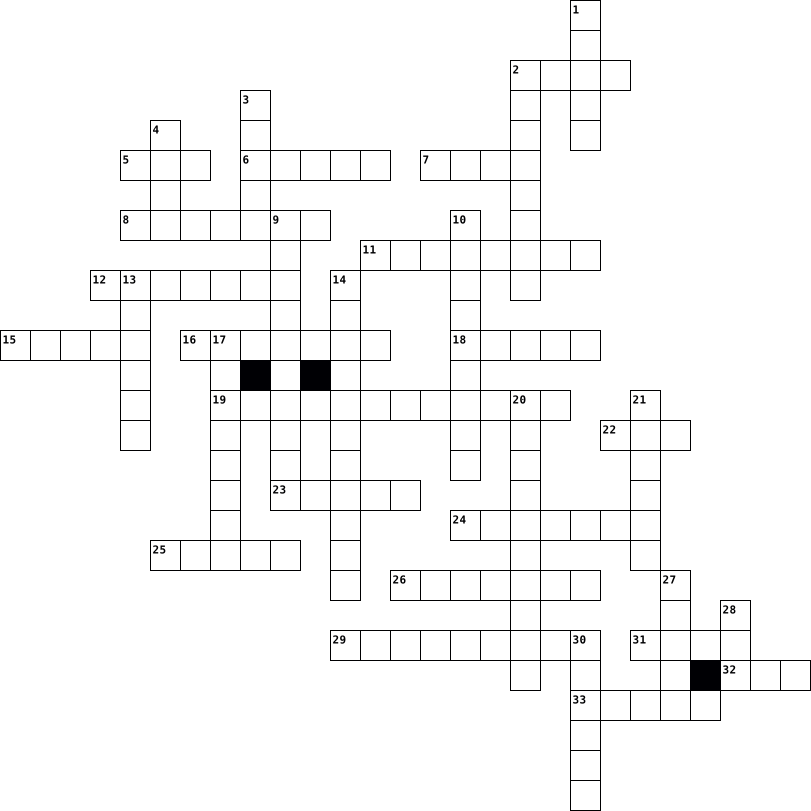
Across
- Code One
- The "A" in PASS stands for what
- Assemble appropriate PPE, wipe up excess fluid with paper towel, dispose of paper towel in red bin, spray surface with oxivir and wipe clean. This would be an example of how to clean up a _____ blood or body fluid spill.
- The Red and Blue emergency response sign is located above clean ____.
- The proper disposal of chemical, biological, radioactive, sharps, trash and recycling waste can be found in the ____ recipe binder.
- In the event of a _____ spill, use eyewash/shower, use checmical spill kit if available, evacuate if necessary, call 911, activate chemical air purge button, submit Employee Incident Report.
- The "C" in RACE stands for what
- Second designated meeting location for code red. Northwest ___ Lobby.
- The "R" in CLEAR stands for what
- Hazards signage with pictograms. ____sign on outside of laboratory door. Hint: Color
- The Emergency ______Plan is kept in a red three ring binder located near the fire evacuation backpack.
- Sharps should be properly disposed in a ____ bin.
- Fire pull stations are located near building ____.
- During this warning you should move to a shelter away from windows.
- An unanticipated, unplanned, unscheduled, undesired occurrence that causes or has the potential for causing personal injury.
- Adhering to policies and procedures, report patient/ visitor events and unsafe conditions, notify supervisor of opportuniites for improvement etc are all ways of improving _____safety.
- Fire extinguishers are located near the red ____.
- _____ washing is the most important thing you can do to reduce the risk of healthcare-acquired infections and promot infections control.
- An evacuation map can be found in the _____ or in the employee elevator lobby.
- First designated meeting location for code red. Hilton ___ floor, east hallway
Down
- What would you search on the mayo intranet to locate a Safety Data Sheet (SDS) for a chemical you work with in the lab.
- Where are all of the fire evacuation items kept?
- The Mayo ___ management web page describes proper disposal of wastes generated in the lab.
- Code Red
- ____ would be the number to call for the following emergencies: medical or non-medical, chemical or radioactive material spill, security event, fire or to request at Safety Data Sheet. Hint: Spell out the number
- The "E" in EPP stands for what
- Code ____ means mass casualities
- Standard _____ means all patients and lab speicmens should be handled as if they were infectious and capable of transmitting disease.
- For a needle stick or body fluid exporsure you should call _____ health.
- Chemical Purge button for chemical spill is located near _____.
- Code _____ means multiple casualities
- Using tongs, forcepts or broom/dustpan and disposing in green glass container or red sharps container would all be proper ways of disposing broken ____.
- Use this form to report an event that has occured.
- DLMP safety suggestions, Mayo Safety Suggestion/Concern, contact supervisor, Employee Incidient Report Form, call 911 in Emergency. These would all be examples of how to report a _____ concern.
34 Clues: Code One • Code Red • The "E" in EPP stands for what • The "A" in PASS stands for what • The "C" in RACE stands for what • Code ____ means mass casualities • The "R" in CLEAR stands for what • Code _____ means multiple casualities • Where are all of the fire evacuation items kept? • Sharps should be properly disposed in a ____ bin. • ...
CLIL MATHS VOCABULARY 2016-06-12

Across
- the result obtained by multiplying two or more quantities together
- ratio of the circumference of a circle to its diameter.
- a parallelogram with four equal sides
- a polygon having five angles and five sides
- triangle having all the sides equal
- division sign
- the operation or process of finding the difference between two numbers or quantities
- the branch of mathematics that deals with the relations between the sides and angles of plane triangles
- a symbol or number placed above and after another symbol or number to denote the power to which the latter is to be raised
- the number of items occurring in a given category
- the result of division
- a strip of wood, metal, or other material having a straight edge and usually marked off in inches or centimeters, used for drawing lines, measuring, etc.
- a rectangle having all four sides of equal length
- the branch of mathematics that deals with general statements of relations, utilizing letters and other symbols to represent specific sets of numbers, values, vectors, etc., in the description of such relations
- the result of an addition
- the branch of mathematics that deals with the collection, organization, analysis, and interpretation of numerical data
- divisible by two, as a number
- triangle having only 2 sides equal
- the branch of mathematics that deals with the deduction of the properties, measurement, and relationships of points, lines, angles, and figures in space from their defining conditions by means of certain assumed properties of space
Down
- any of the Arabic figures of 1 through 9 and 0
- an angle greater than 90° but less than 180°
- any of the magnitudes that serve to define the position of a point
- a positive integer that is not divisible without remainder by any integer except itself and 1, with 1 often excluded
- the symbol denoting subtraction or a negative quantity
- the relative frequency with which an event occurs or is likely to occur
- an instrument having a graduated arc for plotting or measuring angles
- size of a surface
- to work out the answer or solution to a mathematical problem
- a closed plane curve every point of which is equidistant from a given fixed point, the centre
- triangle having three unequal sides
- a quadrilateral having both pairs of opposite sides parallel to each other
- the "average" you're used to, where you add up all the numbers and then divide by the number of numbers
- an angle greater than 0° but less than 90°
- leaving a remainder of 1 when divided by 2, as a number
- Greek philosopher, mathematician
- the intersection of two sides of a plane figure
- an instrument for drawing or describing circles
- quantity frequently represented by a letter
- a straight line extending from the center of a circle or sphere to the circumference or surface
- length of a line enclosing a plane area
- an angle of 90°
41 Clues: division sign • an angle of 90° • size of a surface • the result of division • the result of an addition • divisible by two, as a number • Greek philosopher, mathematician • triangle having only 2 sides equal • triangle having all the sides equal • triangle having three unequal sides • a parallelogram with four equal sides • length of a line enclosing a plane area • ...
CLIL MATHS VOCABULARY 2016-06-12

Across
- the symbol denoting subtraction or a negative quantity
- a strip of wood, metal, or other material having a straight edge and usually marked off in inches or centimeters, used for drawing lines, measuring, etc.
- triangle having all the sides equal
- an angle greater than 0° but less than 90°
- a symbol or number placed above and after another symbol or number to denote the power to which the latter is to be raised
- the relative frequency with which an event occurs or is likely to occur
- size of a surface
- quantity frequently represented by a letter
- leaving a remainder of 1 when divided by 2, as a number
- a quadrilateral having both pairs of opposite sides parallel to each other
- any of the Arabic figures of 1 through 9 and 0
- a straight line extending from the center of a circle or sphere to the circumference or surface
- a polygon having five angles and five sides
- length of a line enclosing a plane area
- the result of an addition
- the branch of mathematics that deals with general statements of relations, utilizing letters and other symbols to represent specific sets of numbers, values, vectors, etc., in the description of such relations
- triangle having three unequal sides
- a rectangle having all four sides of equal length
- triangle having only 2 sides equal
- ratio of the circumference of a circle to its diameter.
- the result obtained by multiplying two or more quantities together
- a parallelogram with four equal sides
- divisible by two, as a number
Down
- the operation or process of finding the difference between two numbers or quantities
- the number of items occurring in a given category
- the branch of mathematics that deals with the deduction of the properties, measurement, and relationships of points, lines, angles, and figures in space from their defining conditions by means of certain assumed properties of space
- a positive integer that is not divisible without remainder by any integer except itself and 1, with 1 often excluded
- an instrument having a graduated arc for plotting or measuring angles
- the branch of mathematics that deals with the relations between the sides and angles of plane triangles
- the intersection of two sides of a plane figure
- to work out the answer or solution to a mathematical problem
- the result of division
- the branch of mathematics that deals with the collection, organization, analysis, and interpretation of numerical data
- the linear extent or measurement of something from side to side
- any of the magnitudes that serve to define the position of a point
- Greek philosopher, mathematician
- an angle greater than 90° but less than 180°
- an instrument for drawing or describing circles
- an angle of 90°
- division sign
- a closed plane curve every point of which is equidistant from a given fixed point, the centre
- the "average" you're used to, where you add up all the numbers and then divide by the number of numbers
42 Clues: division sign • an angle of 90° • size of a surface • the result of division • the result of an addition • divisible by two, as a number • Greek philosopher, mathematician • triangle having only 2 sides equal • triangle having all the sides equal • triangle having three unequal sides • a parallelogram with four equal sides • length of a line enclosing a plane area • ...
RADARS 2017-08-20

Across
- conversation between two radio amateurs
- array of dipole antennas mounted in such a manner that every element of each antenna is in an extension, with respect to its long axis, of its counterparts in the other antennas in the array, usually mounted vertically in order to increase overall gain and directivity in the horizontal direction
- used when it is possible to transmit and receive simultaneously
- used to recover the information content from the modulated carrier wave
- electrical component that limits the flow of electrical current in a circuit
- unit of power in the metric system
- passive two-terminal electrical component that stores electrical energy in a magnetic field when electrical current flows through it
- the measurement of a network of triangles in order to determine distance and relative positions of points spread over an area
- the layer of the earth's atmosphere which contains a high concentration of ions and free electrons
- used for measuring the input impedance of antenna systems in radio applications
- horizontal dipole fed at the centre with parallel wire transmission line
- the behaviour of radio waves as they travel from one point to another
- used to generate electricity, or one that is used to make chemical reactions possible by applying electricity
- one or more cells, in which chemical energy is converted into electricity and used as a source of power
- instrument for converting sound waves into electrical energy
Down
- concentric conductors separated by an insulator
- room where an Amateur Radio operator keeps his or her station equipment
- device used to store an electric charge, consisting of one or more pairs of conductors separated by an insulator
- conductive substance with a low melting point used to connect components in a circuit
- arrangement of resistors which reduces the strength of a radio or audio signal
- process of configuring an instrument to provide a result for a sample within an acceptable range
- term coined by John R. Pierce as a contraction of the term transresistance
- the direction of a magnetic or electrical field
- lowest portion of Earth's atmosphere where nearly all weather takes place
- distance a radio wave travels in one RF cycle
- aerial consisting of two poles or sections to the radiating element - in its most common it is a half-wavelength long at the frequency of operation
- in radio amateur use, bi-directional communication on a single frequency
- electrical device that transfers electrical energy between two or more circuits through electromagnetic induction
- combination of a radio receiver and a radio transmitter that receives a signal and retransmits it, so that two-way radio signals can cover longer distances
- typically an electrical transformer used to connect an unbalanced circuit to a balanced one
- specific range of frequencies in the radio frequency spectrum
- process of varying one or more properties of a periodic waveform, called the carrier signal, with information to be transmitted
- electronic device that can increase the power of a signal
33 Clues: unit of power in the metric system • conversation between two radio amateurs • distance a radio wave travels in one RF cycle • concentric conductors separated by an insulator • the direction of a magnetic or electrical field • electronic device that can increase the power of a signal • instrument for converting sound waves into electrical energy • ...
Geometry Vocab 2022-04-26

Across
- a triangle in which two sides have the same length. Two sides have the same measure but the other side is different or not congruent.
- All three sides of a triangle have different lengths and measures. All of the sides are unique and different.
- a line that passes through two lines in the same plane at two distinct points. Transversals play a role in establishing whether two or more other lines in the Euclidean plane are parallel.
- used to find the equation of the straight line which is inclined at a given angle to the x-axis and passes through a given point. The equation is (y-y1)=m(x-x1).
- The theorem that the sum of the squares on the legs of a right triangle is equal to the square on the hypotenuse. The equation for this is a^2+b^2=c^2.
- This means that a shape, line, or figure has the same exact measure, shape, and size. The lines are identical in measure.
- polygon that has all interior angles that are congruent. All of the angles have the same measure.
- Algebraic expression that gives the distances between pairs of points in terms of their coordinates. This formula is based off of the pythagorean theorem.
- a type of transformation that takes each point in a figure and slides it the same distance in the same direction. It doesnt rotate, flip, or change the size of the figure
Down
- a transformation representing a flip of a figure. The figure is a mirrored image of itself once it is flipped
- a line that intersects another line segment perpendicularly and divides it into two parts of equal measurement. It splits the line segment directly in half which creates two congruent halves.
- the longest side of a right triangle, opposite the right angle. In the pythagoream theorem this represents c^2.
- coplanar straight lines that do not intersect at any point. They are always the same distance apart from each other.
- the equation of a straight line in the form y = mx + b where m is the slope of the line and b is its y-intercept. It emphasis the slope and the y intercept on the line.
- All sides or faces of a triangle are congruent. All of the sides and faces have the same measure.
- a type of transformation that takes each point in a figure and rotates it a certain number of degrees around a given point. The rotation goes in a circular rotation around the point.
- the formula to find the center point of a straight line, using the coordinates of its endpoints. The equation is ((x2+x1)/2),((y2+y1)/2 )
- an angle that measures between 90° and 0°, meaning it is smaller than a right angle. They can be found in triangles.
- lines that intersect at a right (90 degrees) angle. These can be found everywhere. For example a four way intersection
- a type of angle that is always larger than 90° but less than 180°. In other words, it lies between 90° and 180°.
20 Clues: All sides or faces of a triangle are congruent. All of the sides and faces have the same measure. • polygon that has all interior angles that are congruent. All of the angles have the same measure. • a transformation representing a flip of a figure. The figure is a mirrored image of itself once it is flipped • ...
Geometry Vocab Crossword 2024-05-14

Across
- two triangles are congruent if corresponding sides are congruent and corresponding
- that have the same measure.
- the figure formed by three segments joining three noncollinear points. Each of the three po a vertex of the triangle and the segments are the sides.
- are noncoplanar lines they will not intersect.
- points that lie on the same line
- angle whose measure is between 0 degrees and 90 degrees.
- equation that states two ratios are equal.
- triangle with a right angle.
- segments that have the same length.
- side.
- is the part of a line that contains an endpoint and all points extending in the other direction.
- two angles whose sum is 180 degrees.
- all sides congruent and all four right angles.
- two lines are parallel if they are coplanar and do not intersect.
- are congruent.
- triangle with an obtuse angle.
- two lines that intersect to form right angles.
- chord that passes through the center of the circle.
- parallelogram with consecutive sides congruent.
- triangle with all angles congruent.
- segment whose endpoints are the center of the circle and a point on the circle.
- segment from the vertex of a triangle perpendicular to the line containing the
- angle whose measure is 180 degrees
- segment from the vertex of a triangle to the midpoint of the opposite side.
- a point that divides the segment into two congruent segments.
- triangle with all sides congruent
Down
- points that do not lie on the same line
- triangle with at least two sides congruent.
- parallelogram with a right angle
- angle whose measure is greater than 90 degrees but less than 180 degrees.
- two angles whose sum is 90 degrees
- two coplanar angles with a common vertex and a common side between them
- line, ray segment, or plane that divides a segment into two congruent segments.
- triangle that has all acute angles.
- location in space
- polygon which is equilateral and equiangular.
- set of points that are straight
- points that lie on the same plane
- Theorem in a right triangle, the sum of the squares of the legs is equal to the square of the
- quadrilateral with exactly one pair of opposite sides parallel.
- points that do not lie on the same plane
- line that intersects a circle in two points
- quadrilateral with both pairs of opposite sides parallel
- part of a line that consists of two points called endpoints and all points between them.
- flat surface made up of points
- the non-adjacent angles formed by two intersecting lines
- segment that connects two points on the circle.
- angle whose measure is 90 degrees
- triangle with no sides congruent.
- comparison of two numbers by division.
- ray that divides an angle into two congruent adjacent angles
- the set of points in a plane that are equidistant from a fixed point called the center.
52 Clues: side. • are congruent. • location in space • that have the same measure. • triangle with a right angle. • flat surface made up of points • triangle with an obtuse angle. • set of points that are straight • parallelogram with a right angle • points that lie on the same line • points that lie on the same plane • angle whose measure is 90 degrees • triangle with no sides congruent. • ...
geometry puzzle 2024-05-13

Across
- the number of square units needed to cover a surface
- of any surface is the number of square units required to cover the surface.
- the nearness of a measurement
- parallelogram with consecutive sides congruent.
- lines two lines that intersect to form right angles.
- segment whose endpoints are the center of the circle and a point on the circle.Chord – segment that connects two points on the circle.
- sides that are all the same length
- angles two angles whose sum is 180 degrees.
- arcs arcs with equal measure in the same circle or in congruent circles.
- all sides congruent and all four right angles.
- line that intersects a circle in two points.
- angles the non-adjacent angles formed by two intersecting lines.
- of a polygon is the distance around the polygon.
- a part of a line having only one endpoint.
- divide into two equal parts
- a closed figure with 3 sides
- is a prism where all sides are squares.
- arcs in a circle that have exactly one point in common
- A round body whose surface is at all points equidistant from the center.
- points that lie on the same line.
- angle of a circle angle whose vertex is the center of the circle and whose rays are radii of the circle.
- of a 3-dimensional figure is the number of cubic units contained in the solid.
- points that do not lie on the same line
- a flat surface that extends endlessly in all directions.
- chord that passes through the center of the circle.
- is a prism whose parallel faces (the bases) are congruent triangles.
- Extends in two directions infinitely
Down
- points that do not lie on the same plane.
- angles angle whose vertex is on the circle and whose sides are chords of the circle.
- arc whose endpoints are the endpoints of a diameter.
- angles two angles whose sum is 90 degrees.
- equal in size and shape
- an angle whose measure is 90°
- arc arc whose measure is less than a semi-circle (180 degree).
- the distance around a circle.
- congruent polygons lying in parallel planes.
- two lines that have a common endpoint
- divides a figure into two congruent halves that reflect each other.
- two lines in a space that never meet
- line in the plane of the circle that intersects the circle in one point
- parallelogram with a right angle.
- an angle whose measure is 180°.
- segment is bounded by two distinct points on a line.
- angles two coplanar angles with a common vertex and a common side between them
- part of a circle that is defined by two endpoints
- has two congruent circular bases in parallel planes.
- points that lie on the same plane.
- precise location on a plane
- quadrilateral with exactly one pair of opposite sides parallel.
- arc arc whose measure is greater than a semi-circle (180 degrees).
- has a vertex and a circular base.
- A three-dimensional figure with identical ends.
52 Clues: equal in size and shape • divide into two equal parts • precise location on a plane • a closed figure with 3 sides • the nearness of a measurement • an angle whose measure is 90° • the distance around a circle. • an angle whose measure is 180°. • parallelogram with a right angle. • points that lie on the same line. • has a vertex and a circular base. • ...
Geometry in Floral Design 2024-11-19

Across
- circular arrangement which is the same when viewed from all angles; only the top flower may differ in height
- used to break the similarity of an arrangement
- repeating “like” material within a composition
- used to create a higher interest
- enhances or adds interest to a design
- dimension in a design achieved through the placement of materials; placing materials at different levels in a design
- organization of components into a whole resulting in a cohesive relationship of all parts; oneness of purpose
- amount of space a component occupies in a composition
- total area a person can see; can be broken up by shapes and forms; positive/ negative; draws attention to a certain area; emphasize importance
- appealing odor emanating from a specific item
- location within a design attracting the most attention; center of interest in a design
- striking difference between two elements
- visual movement throughout a design; usually achieved by means of repetition
- also called circular arrangements; do not have a focal point
- triangle with one 90 degree angle
- visual path the eye is drawn or attracted as it proceeds through the arrangement; curves or directional movement of the arrangement; static/ dynamic
- area which stands out in a design
- triangle with sides of the same length; in traditional geometry, these triangles also have angles of the same measurement
- size of a composition in relation to its surroundings
- circular arrangement with very closely arranged floral materials and in which all floral material is the same height
- equality of distribution throughout an arrangement
- basic visual qualities of a design; includes line, form, space, texture, pattern, color, size and fragrance
Down
- contain more than one single focal point
- visual or tactile feel of an item; surface quality; is know as pattern when enlarged
- formal, equilateral triangular design; corresponding in size, shape, and relative position of parts on opposite sides of a dividing line
- triangular pattern with a strong “L-Line;” not identical on both sides of a central line
- relationship in units/elements within a design in shape, size, quantity and degree of emphasis
- use of material in a composition to connect two things which are opposite; visual movement from gradual degrees of change
- asymmetrically balanced design of few materials usually placed in groups which emphasize forms and lines
- expressed visually through the elements and include balance, proportion, harmony, unity, dominance, rhythm and contrast
- triangle which has two sides of the same length
- three dimensional configuration or shape; describes the length, width and height of an object; also known as shape
- creating contrast by using two conflicting elements; dynamic aesthetic quality which requires the skillful use of contrast; expresses action or energy; principle of contrast
- created by repeating lines, shapes and forms; also referred to as repetition
- area of authority in a design
- achieved when all the elements, flowers, foliage and container, complement one another; describes tangible and intangible
- supplies, methods and materials which designers use to place and hold flowers and foliage in an arrangement
- two dimensional; geometric shape of an object
38 Clues: area of authority in a design • used to create a higher interest • triangle with one 90 degree angle • area which stands out in a design • enhances or adds interest to a design • contain more than one single focal point • striking difference between two elements • appealing odor emanating from a specific item • two dimensional; geometric shape of an object • ...
Science and Maths Crossword 2025-01-09

Across
- The form energy is produced in from respiration
- A type of reaction where one reagent loses electrons and the other gains electrons (or oxygen)
- A type of bar chart where the class width is not uniform
- A famous mathematician whose theorem finds side lengths of right angled triangles
- The specifically shaped molecule that an enzyme fits in to complete a reaction
- (A Despicable Me character) Something with magnitude and direction
- The element with symbol W
- An atom that has gained electrons
- A famous biologist that came up with the theory of evolution
- A blood component that causes clotting to prevent blood loss
- The amount of energy transferred per unit charge in a circuit
- A reaction that takes requires more energy than it releases
- Something which produces a magnetic field when a current is applied to it
- Molecules travelling from a higher to a lower water potential
- A flask used in a titration that is constantly swirled to mix contents
- The amount of time for the activity of a radioactive sample to halve
- The product of current and potential difference
- Hooke's Law states force is directly proportional to _ until the limit of proportionality
- An algebraic expression with multiple terms
- A famous female physicist that discovered radioactive elements
- Alternative forms of a gene that arise due to mutation
- The product of force and perpendicular distance from a pivot
Down
- The physical characteristics that are determined by something's genes
- A scientist who was a pioneer in WW2 nuclear weapons; the nickname for the most famous fictional chemist
- _ paper. An indicator that changes colour with pH
- A product of the reaction between diols and dicarboxylic acids that also produces water
- The name for a blood vessel that runs between the heart and lungs
- A famous physicist who put forward three laws to do with force and motion
- A trigonometric function; a line that touches but doesn't cross a circle
- A wave whose oscillations are perpendicular to the direction of motion
- A chemist who discovered the constant 6.02 x 10^23
- A natural one is the moon and a manmade one is the ISS
- A section of a circle made from two radii and an arc
- When a light ray changes speed and sometimes direction at a material boundary
- _ series. A group of substances with the same functional group and similar chemical properties
- The general term for the things that reside in the nucleus
- The process done to convert long chain alkanes into short chain alkanes and alkenes
- A piece of data that is at 25%,50% or 75% of the way through all of them
- Molecules that have the same molecular formula but different displayed formulae
- A vessel that transports water around a plant
- An angle that is between 0 and 90 degrees
- When a massive nucleus absorbs a neutron and becomes two lighter daughter nuclei
42 Clues: The element with symbol W • An atom that has gained electrons • An angle that is between 0 and 90 degrees • An algebraic expression with multiple terms • A vessel that transports water around a plant • The form energy is produced in from respiration • The product of current and potential difference • _ paper. An indicator that changes colour with pH • ...
Geometry in Floral Design 2025-01-22

Across
- Triangle - triangle which has two sides of the same length
- created by repeating lines, shapes and forms; also referred to as repetition
- supplies, methods and materials which designers use to place and hold flowers and foliage in an arrangement
- relationship in units/elements within a design in shape, size, quantity and degree of emphasis
- enhances or adds interest to a design
- Triangle triangle with sides of the same length; in traditional geometry, these triangles also have angles of the same measurement
- used to break the similarity of an arrangement
- striking difference between two elements
- two dimensional; geometric shape of an object
- expressed visually through the elements and include balance, proportion, harmony, unity, dominance, rhythm and contrast
- creating contrast by using two conflicting elements; dynamic aesthetic quality which requires the skillful use of contrast; expresses action or energy; principle of contrast
- area of authority in a design
- achieved when all the elements, flowers, foliage and container, complement one another; describes tangible and intangible
- Point location within a design attracting the most attention; center of interest in a design
- basic visual qualities of a design; includes line, form, space, texture, pattern, color, size and fragrance
- visual path the eye is drawn or attracted as it proceeds through the arrangement; curves or directional movement of the arrangement; static/ dynamic
- three-dimensional configuration or shape; describes the length, width and height of an object; also known as shape
- dimension in a design achieved through the placement of materials; placing materials at different levels in a design
- Designs contain more than one single focal point
- use of material in a composition to connect two things which are opposite; visual movement from gradual degrees of change
Down
- amount of space a component occupies in a composition
- triangular pattern with a strong “L-Line;” not identical on both sides of a central line
- Mound circular arrangement which is the same when viewed from all angles; only the top flower may differ in height
- organization of components into a whole resulting in a cohesive relationship of all parts; oneness of purpose
- repeating “like” material within a composition
- size of a composition in relation to its surroundings
- visual or tactile feel of an item; surface quality; is known as pattern when enlarged
- appealing odor emanating from a specific item
- Mass circular arrangement with very closely arranged floral materials and in which all floral material is the same height
- area which stands out in a design
- used to create a higher interest
- Triangle triangle with one 90 degree angle
- formal, equilateral triangular design; corresponding in size, shape, and relative position of parts on opposite sides of a dividing line
- Designs also called circular arrangements; do not have a focal point
- total area a person can see; can be broken up by shapes and forms; positive/ negative; draws attention to a certain area; emphasize importance
- Design asymmetrically balanced design of few materials usually placed in groups which emphasize forms and lines
- of distribution throughout an arrangement
- visual movement throughout a design; usually achieved by means of repetition
38 Clues: area of authority in a design • used to create a higher interest • area which stands out in a design • enhances or adds interest to a design • striking difference between two elements • of distribution throughout an arrangement • Triangle triangle with one 90 degree angle • appealing odor emanating from a specific item • two dimensional; geometric shape of an object • ...
REVIEW6 - 2nd Qtr 2025-10-13

Across
- – This container is filled with garden soil; then small furrow for the seeds are made.
- – Used for removing soil or trash.
- – Used for watering plants.
- – Used for digging, breaking, or loosening big blocks of soil.
- – Is the imaginary line connecting all points with equal elevation across slope.
- – Used for even separating, spreading, and leveling of soil; and for gathering leaves.
- - It is the process of a seed growing into a plant.
- – It concentrates on growing papaya, mango, orange, lime, and avocado.
- – is the main energy that affects the photosynthesis of a plant.
- – Used for removing soil or weeds and transferring the soil and fertilizer.
- – Used for digging soil.
- – Used for hauling fertilizer and soil and carrying tools and materials.
- - is made up of synthetic materials used as substitutes for organic fertilizers.
- – Used for straightening garden plot by trying it on one post and passing through to the next post.
- – comes from post of decayed fruits, vegetables peeling and animal manures.
- - a piece of land where trees are maintained for food or commercial production.
- – Used for cutting branches, leaves, and grasses.
- - It is added to soil to increase its productivity.
- – Used as fences to prevent animals from entering the plot and destroying the plants.
- - too much or too little water may stunt trees development.
- – A mound of soil is cultivated and a container is prepared to germinate
- – composed of inorganic substances with varying amounts of decaying organic matter.
Down
- – involves forcing a single bud to grow on the stock.
- – involves removing a ring of bark from a healthy branch and wrapping the cut surface with moist soil to encourage root growth.
- – It is the simplest and easiest method with the same distance measurement.
- - It produces seeds sold for commercial distribution or resale purposes.
- – It serves as a solvent for the nutrients from the soil which trees need for survival.
- – It produces cashew, pecan, walnut, almond, cacao, coconut, and pine.
- – This method hastens seed germination especially for plants with hard covering or coating.
- – involves inserting the scion or top portion of a stem into the rootstock of another plant to make them grow together.
- – Planting is done at the corners of an equilateral triangle, where six triangles are joined with a seventh tree in the center.
- – Used for crumbing the soil
- – Used in planting seedlings and cultivating plants.
- – is formed from partly decayed plant materials.
- -most important factoring affecting the growth of trees.
- - degree of coldness and hotness.
- – It is formed from four adjacent trees in which the distance between the rows of trees are more than the distance of the columns.
- – Hot water is poured into a container and cooled for 3 to 10 minutes
- – contains minerals necessary for plant growth and development
- – The addition of a tree in the center of each square called a filler crop that will finish the life cycle of trees.
40 Clues: – Used for digging soil. • – Used for watering plants. • – Used for crumbing the soil • - degree of coldness and hotness. • – Used for removing soil or trash. • – is formed from partly decayed plant materials. • – Used for cutting branches, leaves, and grasses. • - It is the process of a seed growing into a plant. • - It is added to soil to increase its productivity. • ...
Photography Terms 2013-04-15

Across
- do you see geometric or organic shapes? What are they?
- is there depth to the photograph or does it seem shallow? What creates this appearance? Are there important negative spaces in addition to positive spaces? Is there depth created by spatial illusions?
- if you could touch the surface of the photograph how would it feel? How do the objects in the picture look like they would feel?
- what areas appear clearest or sharpest in the photograph? What do not?
- reason(s) why the artist made a work of art.
- the subject, topic or information captured in a photograph
- approach confronting a scene in a straight-forward manner, without using unusual angles or distortion
- an image that emphasizes formal elements (line, shape, etc) rather than specific, recognizable objects.
- actual physical surroundings or scenery whether real or artificial.
- this point is the place from which a photographer takes a photograph.
- photographs whose main purpose is to record a place, person(s) or event
- the vantage point from which the photograph was taken; generally used when discussing a photograph taken from an unusual or exaggerated vantage point.
- concerned with communicating emotion
- a point of view free from personal bias, which attempts to consider all available information with equal regard and fairness.
- are there any objects, shapes or lines which repeat and create a pattern?
- the arrangement or structure of the formal elements that make up an image.
- the part of a scene or picture that is or seems to be toward the back.
- what areas of the photograph are most highlighted? Are there any shadows? Does the photograph allow you to guess the time of day? Is the light natural or artificial? Harsh or soft? Reflected or direct?
Down
- the distribution of visual elements in a photograph. Symmetrical balance distributes visual elements evenly in an image. Asymmetrical balance is found when visual elements are not evenly distributed in an image.
- type of focus where the objects(s) which appears most prominently and/or most clearly focused in a photograph.
- shapes based on natural objects such as trees, mountains, leaves, etc.
- the main object or person(s) in a photograph.
- strong visual differences between light and dark, varying textures, sizes, etc.
- an image that portrays the natural environment.
- shape simple rectilinear or curvilinear shapes found in geometry, such as circles, squares, triangles, etc.
- an image which shows recognizable objects.
- a unifying or dominant idea in one work of art or in a collection of works.
- is there a range of tones from dark to light? Where is the darkest value? Where is the lightest?
- what the photographer has placed within the boundaries of the photograph.
- the outline of an object or shape.
- are there objects in the photograph that act as lines? Are they straight, curvy, thin, thick? Do the lines create direction in the photograph? Do they outline? Do the lines show movement or energy?
31 Clues: the outline of an object or shape. • concerned with communicating emotion • an image which shows recognizable objects. • reason(s) why the artist made a work of art. • the main object or person(s) in a photograph. • an image that portrays the natural environment. • do you see geometric or organic shapes? What are they? • ...
Creative Arts- Terms To Know 2023-10-18

Across
- Of, relating to, involving, or having the nature of space.
- An image that deceives a person, leading to a misinterpretation of its meaning. Optical illusions can be found in nature as well as in art. Their strengths rely upon various assumptions in which humans perceive optical phenomena.
- A composite picture made by combining several separate pictures. Pictorial technique in which cut-out illustrations, or fragments of them, are arranged together and mounted on a support, producing a composite picture made from several different pictures.
- A three-dimensional form modeled, carved, or assembled.
- A three-dimensional representation of a scene, either full-scaled or miniature. It may have a background painted to merge with elements nearest it by means of aerial and linear perspective. I
- Descriptive of art that employs more than one medium – e.g., a work that combines paint, natural materials (wood, pebbles, bones), and manmade items (glass, plastic, metals) into a single image or piece of art.
- to free (as metal, sugar, or oil) from impurities or unwanted material.
- A system of writing using symbols or pictures (hieroglyphs) used by the ancient Egyptians. Or, one of the characters used in such writing.
- The value (worth) a thing or event has due to its capacity to evoke pleasure that is recognized as arising from features in the traditionally considered worthy of attention. Also spelled esthetic.
- A picture or design created by adhering such basically flat elements as newspaper, wallpaper, printed text and illustrations, photographs, cloth, string, etc
- An art form in which small pieces of tile, glass, or stone are fitted together and embedded into a background to create a pattern or image.
- One of the most difficult aspects of research -- and one of the least discussed -- is how to develop the idea for the research project in the first place.
- The branch of philosophy that deals with the nature and value of and experiences.
- An object that has height, width, and depth, like any object in the real world.
- also called aerial perspective – is the effect you get when far away objects take on the colors of atmospheric haze.
Down
- A method of cutting or incising a design into a material, usually metal, with a sharp tool called a graver.
- Generating a two-dimensional image from a view of a three-dimensional CG scene.
- a mathematical system for creating the illusion of space and distance on a flat surface.
- A shape that only has two dimensions (such as width and height) and no thickness. Squares, Circles, Triangles, etc.
- The representation of three-dimensional objects on a flat surface so as to produce the same impression of distance and relative size as that received by the human eye.
- Screen printing, sometimes called silk screening or serigraphy, has long proved its worth as a fine arts and commercial medium.
- Recurring subject, theme, idea, etc., especially in a literary, artistic, or musical work
- An outline filled with a solid color, typically black on white ground, and most often for a portrait.
23 Clues: A three-dimensional form modeled, carved, or assembled. • Of, relating to, involving, or having the nature of space. • to free (as metal, sugar, or oil) from impurities or unwanted material. • Generating a two-dimensional image from a view of a three-dimensional CG scene. • An object that has height, width, and depth, like any object in the real world. • ...
Art Vocabulary... so far! 2023-02-09

Across
- shapes that are found in nature
- a group of colors used
- the area between the background and the foreground
- a loose form of drawing that quickly captures an object’s basic forms
- the lightness or darkness of an object in greyscale
- a line drawing that shows the edges of a form
- the change from the lightest area to the darkest area on a 3D object
- a quickly made drawing to work out an idea prior to producing a more finished, detailed artwork
- the hazy outline of a cast shadow of a 3D object
- a curated collection of your original artwork that you can easily share with others
- a method used to show 3-D space on a flat plane such as a piece of paper or canvas
- the practice of discovering information in a photo and/or real-world object, person, or location
- created by highlights and shadows
- can be referring to three different things: 3D, positive and negative, or white
- the form of a tube
- art that does not attempt to represent external reality, but seeks to achieve its effect using shapes, forms, colors, and textures
- shapes that can be created mathematically like circle, triangles and squares
- shapes that are changed like skewed, slanted, rotated, or rounded
- the tactile feel of an object
- an image using lines and different values from light to dark that is done on paper or another two-dimensional surface
- created by mixing a color with white
- the depiction of natural scenery
- the form of a triangle
- A portrait of the artist created by the artist
Down
- the area that appears farthest away from the viewer, usually placed at the top of the page or canvas
- the contour of a 2D object
- a solid, outlined shape of someone or something
- the path of a point that moves through space
- a work of art that shows inanimate objects from the natural or man-made world
- red, yellow, and blue
- the form of a circle
- colors that are opposites on the wheel
- created by mixing a color with black
- how the parts of a picture are arranged together to make a whole image or design
- the form of a square or rectangle
- the area closest to the viewer, usually placed at the bottom of the page or canvas
- the way in which a rectangular page is oriented for normal viewing, landscape or portrait
- 3d objects that have height, width, and depth
- artwork created using only one color or hue
- the cast shadow of a 3D object
- yellow-orange, yellow-green, blue-green, blue-violet, red-violet, and red-orange
- the lightest area on a 3D object
- colors that are neighbors on the wheel
- the place from which something is looked at
- created by mixing a color with grey
- the acronym created by the qualities of line
- a representation of a particular person
- the darkest shadow on a 3D object
- orange, purple, and green
49 Clues: the form of a tube • the form of a circle • red, yellow, and blue • a group of colors used • the form of a triangle • orange, purple, and green • the contour of a 2D object • the tactile feel of an object • the cast shadow of a 3D object • shapes that are found in nature • the lightest area on a 3D object • the depiction of natural scenery • the form of a square or rectangle • ...
Pre cal 2024-05-10

Across
- A transformation in which a graph or geometric figure is moved to another location without any change in size or orientation
- the intersection of the vertical and horizontal axes
- how quickly something changes over time
- the graph of a function is the set of ordered pairs
- The function has different definitons for different parts of the domain
- the point at which the graph of an equation crosses the x-axis
- A matrix with equal numbers of rows and columns
- distance among two repeating points
- the name for a graph of the quadratic function
- multiplicity touch turn around
- function where each input has one unique output.
- a number signifying the result of a calculation or function
- a relation between a set of inputs having one output each
- X coordinate over the Y coordinate
- root function f(x)=Square root of x half of line
- geometrical figure formed when two rays meet at a common point called vertex
- the x coordinate
- the ray to which an angle opens
- The Y coordinate
- the height from the center line to the peak
- The smallest and largest values
- any function with an inverse will meet this requirement
- the slopes of the function are decreasing
- graph a graph in which all vertices have degree three.
- a value that doesn't change
- measures of triangles
Down
- the slopes of the function are increasing
- a sentence with a minimum of two numbers or variables and at least one math operation
- the point at which the graph of an equation crosses the y-axis
- A graph with no breaks, gaps, or holes
- the action of rotating around an axis or center
- a set of numbers arranged in rows and columns so as to form a rectangular array
- one over tan
- that passes in the middle of max and min
- Any set of ordered pairs often described by an equation
- one over cos
- graph a curve called a parabola.
- a point on the curve in which the concavity changes
- the set of all possible inputs for the function
- Function A function that has y-axis symmetry
- formed by changing the sign between two terms in a binomial
- when the graph literally moves vertically, up or down
- inside changes that affect the input (x−) axis values and shift the function left or right
- an equation that holds true for all the values, even if you change the variables involved
- the difference between the highest values and lowest values in a given set of numbers
- graph a graphical representation that discusses the relationship between two or more quantities or things.
- value of a function that you can get very near to but you can never reach
- a line that is used to make or mark measurements
- multiplicity pass through
- A function is increasing if the inputs and outputs change in tandem in the same direction
- A directed line segment that has magnitude and direction
- one over sin
52 Clues: one over tan • one over cos • one over sin • the x coordinate • The Y coordinate • measures of triangles • multiplicity pass through • a value that doesn't change • multiplicity touch turn around • the ray to which an angle opens • The smallest and largest values • graph a curve called a parabola. • X coordinate over the Y coordinate • distance among two repeating points • ...
Test Your Dentistry(Vet) Knowledge 2023-07-25

Across
- A common dental notation system popular in clinical practice
- Used to lift and manipulate the gingival tissue in order to expose the root surfaces of teeth for examination, cleaning, or extraction
- Distortion of anatomic structures so that the image appears longer than actual size
- Used to measure the depth of the gingival sulcus and periodontal pockets in millimeters to help evaluate the extent of periodontal support
- For owners to brush their pets teeth with
- Dental prophylaxis paste used to remove plaque and stain from teeth during professional
- Part of the tooth under the gingiva
- Clean every Tooth
- A condition known as a tooth resorption
- A new and abnormal pathway that develops under the gumline
- The fourth upper and lower tooth
- The last upper premolar and the first lower molar on both sides of the jaw
- A long-lasting analgesic for post-surgical pain in small animal medicine
- the mineralized build-up of plaque on tooth surfaces
- Used to detect plaque and calculus, and are also used to explore for carries and check for exposed pulp cavities
- used to apply prophy paste to teeth during professional dental cleanings
- Blocking the transmission of painful signals via nerve fibers
- Bad Breath
- Used to remove dental deposits from tooth surfaces above the gumline.
- Used to describe how teeth are arranged in the mouth
- Uses the theory of equilateral triangles to create an image that accurately represents the tooth in question
Down
- The keratinized oral mucosa covering the alveolar processes of the jaws, encircling the necks of erupted teeth
- The teeth that hold and cut food into digestible pieces
- A porous, rough substance that can form above and below a dog's gumline
- Gum disease
- Inferior to (below or beneath) the eye socket (orbit)
- Commonly used to grasp the tooth and remove it from the socket once it has been loosened.
- A distortion that gives the appearance of decreased depth in an image that is being studied radiographically.
- Absorbable hemostatic gelatin sponges that effectively control oozing bleeding
- Action taken to prevent disease, especially by specified means or against a specified disease
- site must allow light to be transmitted through the tissue
- The anatomical area where the roots divide on a multirooted tooth
- Used in veterinary dentistry to remove subgingival calculus, root planing and for curettage
- The act of removing a tooth
- The front teeth present in most mammals
- Insensitivity to pain, especially as artificially induced by the administration of gases or the injection of drugs before surgical operations.
- A relatively low friction suture which is non-traumatic to tissues, easy to handle and ties secure knots.
- The calcified or mineralized tissue layer covering the root of the tooth which sits inside the gum socket
- The hardest substance in the body and covers the exterior surface of the crowns only
- A palatable and highly effective rinse for reducing plaque and freshening breath in dogs and cats.
40 Clues: Bad Breath • Gum disease • Clean every Tooth • The act of removing a tooth • The fourth upper and lower tooth • Part of the tooth under the gingiva • A condition known as a tooth resorption • The front teeth present in most mammals • For owners to brush their pets teeth with • the mineralized build-up of plaque on tooth surfaces • ...
Weather Unit Academic Vocabulary Words 2022-09-16

Across
- in a direction opposite to the direction in which the hands of a clock move
- a region where the atmospheric pressure at the surface of the planet is greater than its surrounding environment; symbolized by an H on a weather map; generally means nice weather; rotates in a clockwise direction
- narrow band of high speed wind high in the atmosphere; moves west to east in the Northern Hemisphere
- a blanket of mixed gasses that are held to the Earth by gravity; the most dense gasses are near the surface of the Earth
- say or estimate that (a specified thing) will happen in the future or will be a consequence of something
- a body of air that has about the same temperature and humidity throughout
- come from the land; also known as off-shore winds due to the property of land to lose heat and stay cooler compared to the sea
- when temperature differences cause liquids and gases (fluids) to expand and move; the less dense areas continually rise, and the more dense areas continually sink creating a cyclical current
- the effect of the Earth’s rotation on the path of air and water; causes the path to curve
- a region where the atmospheric pressure at the surface of the planet is less than its surrounding environment; symbolized by an L on a weather map; generally means bad weather; rotates in a counterclockwise direction
- a measure of the weight of the atmosphere on a given area of the surface of the Earth; barometric pressure
Down
- an area where two air masses with different temperatures and pressures meet
- instrument used to measure humidity (moisture) in the air
- a tropical cyclone that occurs in the Atlantic Ocean and northeastern Pacific Ocean; low pressure formed over the ocean with warm water that rotates in a counterclockwise direction
- rain, snow, sleet, or hail that falls to the ground
- a current of air, moving in a particular direction, caused by the pressure differences between surrounding air masses
- the leading frontal edge boundary of an advancing air mass that replaces cooler air and has warmer air behind the boundary; indicated on a weather map by a line with red semi-circles
- amount of water vapor present in the air; relative humidity
- an instrument used to measure wind speed
- come from the ocean or other large bodies of water: also called on-shore winds due to the property of water to retain heat and warm up longer compared to the land
- the leading frontal edge boundary of an advancing air mass that replaces warmer air and has colder air behind the boundary; indicated on a weather map by a line with blue triangles
- motion is one that proceeds in the same direction as a clock's hands: from the top to the right, then down and then to the left, and back up to the top
- similar in structure of a hurricane; the only difference is its location; type of disturbance in the Northwest Pacific
23 Clues: an instrument used to measure wind speed • rain, snow, sleet, or hail that falls to the ground • instrument used to measure humidity (moisture) in the air • amount of water vapor present in the air; relative humidity • a body of air that has about the same temperature and humidity throughout • ...
DAD'S BIRTHDAY CROSSOWRD 3 2026-02-28

Across
- a street that runs parallel with rennot court
- the name of one of the bowling ends at the SCG
- a planet
- the first name of a famous sportsmen who shares a birthday with your best mate
- a former Australian cigarette company
- a former Sri Lankan left arm fast bowler
- the current country name of what used to be called Chinese Taipei
- a company that in the early 2000's was the shirt sponsor of Man Utd & NZ Warriors
- a highly addictive, illegal, and rapid-acting opioid drug derived from morphine, a natural substance extracted from poppy plants.
- the last suburb on the drive north to Ingham
- a UK singer who died in January 2016
- a left arm west australian who played 7 tests for Australian in the 90's
- an outdated defensive soccer position
- the Socceroos coach at their first world cup
- a surname shared by Australians that have won the EPL, a Clive Churchill and opened the batting on boxing day
- the nickname given to former NRL player Mark Riddell
- a female singer who had 2 hit songs that started with "Like A..."
- a Mathematics function that has a constant rate of change
- a betting agency
- a former Cowboy that played fullback for the NSW Blues whilst at the club
- one of two U.S. states that begins with the word North
Down
- the language of ancient Rome and its empire, widely used historically as a language administration.
- the name of a street in Condon and in North Ward
- who did Sterlo take over from as Parramatta captain
- the name of a road that runs from Hermit Park to Mount Louisa
- "you could be a stream train. If you'd just lay down your tracks" song name is...
- an avenue that runs off Charles Street
- a Maths topic that involves comparing angles and sides in triangles
- the second surname of a duet that sung "Private Eyes"
- the only player in the NRL era that has won a Clive and Dally M but not a premiership
- an Italian football club
- a band which sung "Chemistry" and "Come Said the Boy" (2)
- a former singer and actor who sung "Fly me to the Moon" and "New York New York"
- a band which sung "Welcome to the Jungle" (3)
- the surname of the man who sung "Never Gonna Give You Up"
- singer: The mist across the window hides the lines, But nothing hides the color of the lights that shine, Electricity so fine, Look and dry your eyes
- an english football club known as the seagulls
- the only player to win a GF with the Cowboys and lose a GF with the Roosters
- a device used to deaden the sound of a drum, bell, piano, or other instrument
- an Australian dog breed
- the name of a country and QLD Maroons player
41 Clues: a planet • a betting agency • an Australian dog breed • an Italian football club • a UK singer who died in January 2016 • a former Australian cigarette company • an outdated defensive soccer position • an avenue that runs off Charles Street • a former Sri Lankan left arm fast bowler • the last suburb on the drive north to Ingham • the Socceroos coach at their first world cup • ...
Karina Crossword 2026-06-13

Across
- Planet of love beauty pleasure art and attraction
- bbno$ collaborator with retro sleaze humor and meme-rap charm
- Chappell anthem of glitter queer longing and dance-floor freedom
- Olivia song about fame betrayal and emotional bloodsucking
- Musical story of witchcraft friendship betrayal and misunderstood power
- Commentary YouTuber known for cursed media fake products and internet absurdity
- A witch’s animal companion and magical sidekick
- Indie supergroup with friendship devotion and sad-girl Avengers energy
- Sabrina tradition known for flirty chaotic improvised outros
- Chappell chant song with cheerleader spelling and campy instructions
- Snake-era comeback built on revenge secrecy and rebirth
- Pop artist whose club chaos became a cultural color
- Chappell song about denial comphet and lost queer love
- YouTube channel for influencer drama timelines tea and receipts
- Olivia album of bad ideas messy honesty and pop-punk feelings
- Cottagecore album full of ghosts cardigans triangles and storytelling
- Artist of longing shame devotion and tiny emotional knives
- Queer pop star with drag camp and Midwest-princess mythology
- Slime-green pop culture mood of messy cool self-aware chaos
- Witchy winter sister album with grief longing and old stories
- Artist of rage confession poetic precision and emotional excavation
- Zodiac sign of performance pride drama and main-character fire
- Meme-fluent rapper with absurd confidence and chaotic branding
- bbno$ hit with nonsense-hook viral energy
- bbno$ song with bouncy flex energy and food-title absurdity
- Fan theory lens reading Taylor through queer coding and hidden symbols
Down
- Subtle relationship reveal through crumbs hints and vibes
- Sparkly good witch with charm image control and Libra energy
- One-sided emotional bond viewers feel with creators or celebrities
- Pop star of whisper vocals dark visuals and haunted cool
- Card system for reflection divination and symbolic pattern reading
- Misunderstood green witch with outsider pain and Scorpio intensity
- Olivia breakout ballad that made a breakup feel investigative
- Tour concept where every album became a costume-coded kingdom
- Long-running YouTube comedy group with sketches games improv and lore
- Perfect D&D roll and instant table celebration
- Danny Gonzalez fandom name that sounds like one person
- Ritualized creator response after public backlash
- Zodiac sign of detail analysis ritual and sacred organization
- Zodiac sign of aesthetics justice relationships and social tension
- Hidden clue fans believe an artist planted on purpose
- Pop girl of espresso flirtation tiny dresses and glossy confidence
- Zodiac sign of secrets intensity death rebirth and emotional x-ray vision
- Screenshots clips and timestamps used as proof in internet drama
- Pop girl of heartbreak theater rage and diary-entry bridges
- Sabrina hit with caffeine crush energy and playful obsession
- Olivia debut album of teenage devastation jealousy and betrayal
- Apparent backward motion blamed for review chaos and reflection
- Astrology point for feelings needs memory body and instinct
- Pop star whose songs turn heartbreak into coded mythology
50 Clues: bbno$ hit with nonsense-hook viral energy • Perfect D&D roll and instant table celebration • A witch’s animal companion and magical sidekick • Planet of love beauty pleasure art and attraction • Ritualized creator response after public backlash • Pop artist whose club chaos became a cultural color • Hidden clue fans believe an artist planted on purpose • ...